<?xml version="1.0" encoding="UTF-8"?>
<feed xml:lang="en" xmlns="http://www.w3.org/2005/Atom" xmlns:opensearch="http://a9.com/-/spec/opensearch/1.1/" xmlns:s="http://jadedpixel.com/-/spec/shopify">
  <id>https://www.epicflyrods.com/blogs/news.atom</id>
  <link rel="alternate" type="text/html" href="https://www.epicflyrods.com/blogs/news"/>
  <link rel="self" type="application/atom+xml" href="https://www.epicflyrods.com/blogs/news.atom"/>
  <title>Epic Fly Rods - The Drift - Fly Fishing, Fly Casting and Fly Rod Building</title>
  <updated>2026-04-17T13:04:23+12:00</updated>
  <author>
    <name>Epic Fly Rods</name>
  </author>
  <entry>
    <id>https://www.epicflyrods.com/blogs/news/back-to-bonefish-a-simpler-way-to-fish-the-flats</id>
    <published>2026-04-17T13:04:23+12:00</published>
    <updated>2026-04-17T13:43:11+12:00</updated>
    <link rel="alternate" type="text/html" href="https://www.epicflyrods.com/blogs/news/back-to-bonefish-a-simpler-way-to-fish-the-flats"/>
    <title>Back to Bonefish: A Simpler Way to Fish the Flats</title>
    <author>
      <name>Adam Barlow</name>
    </author>
    <content type="html">
      <![CDATA[<p data-start="115" data-end="280">After 45 years of some pretty serious flats fishing fun, I have slowly evolved into a much simpler kind of tropical angler, specifically when it comes to bonefish.</p>
<p data-start="282" data-end="606">Back in the day, I bummed around Belize, Venezuela, and the Bahamas, and because of a profound lack of money, I did mostly DIY, on foot or occasionally in a rental skiff of some sort. Before Google Earth and other time-saving technologies, it was all trial and error. We called it, “Some days chicken, and some days rice.”</p>
<div style="text-align: left;"><img src="https://cdn.shopify.com/s/files/1/0120/5852/files/BOK1a.jpg?v=1776037147" alt="Palm trees and man with a Bonefish tattoo" style="float: none;"></div>
<p data-start="608" data-end="999">In the learning curve of where to go and when, there was also a keen interest in acquiring appropriate <a href="https://www.epicflyrods.com/collections/all-fly-rods" rel="noopener" target="_blank">fly rods</a>, reels, lines, flies, and anything else a flats fisherman could use. There came a lust for tarpon, then the seduction of permit (if that isn’t a love-hate relationship, I don’t know what is), and bonefish became less intriguing, as skiff guides were after the bigger, tougher fish.</p>
<p data-start="1001" data-end="1272">Fast forward to today, and I’ve done a 180 in priorities. Sure, nothing beats the anticipation, the cast, the take, and the jumps of big tarpon. But I’ve had some great fishing, landing tarpon over 180 pounds. Now, I like small tarpon and lots of action on an 8-weight.</p>
<p data-start="1274" data-end="1464">Permit? Well, if I see a tail, it’s game on. But my days of fishing all day or all week, with dozens of shots and few eats, are over. Plus, sharing a boat means only a half day of fishing.</p>
<div style="text-align: left;"><img src="https://cdn.shopify.com/s/files/1/0120/5852/files/BOK2.jpg?v=1776037147" alt="Brian O'Keefe holding a Bonefish caught on a fly rod" style="float: none;"></div>
<div style="text-align: left;"><img src="https://cdn.shopify.com/s/files/1/0120/5852/files/BOK6691a.jpg?v=1776037204" alt="Fly fishing skiff floating on perfectly still ocean flat" style="float: none;"></div>
<p data-start="1466" data-end="1496">So where does that leave me?</p>
<p data-start="1498" data-end="1851">My evolution as a flats angler has come full circle. I really enjoy wading for bonefish in places with big bonefish, hard bottoms, low angling pressure, and funky accommodations, be it an “off the beaten path” lodge or hotel. Throw in conch salad or ceviche every night, cold local beers, and grouper and snapper for dinner, and I’m in my happy place.</p>
<div style="text-align: left;"><img src="https://cdn.shopify.com/s/files/1/0120/5852/files/BOK3.jpg?v=1776037147" alt="Underwater shot of Bonefish" style="float: none;"></div>
<p data-start="1853" data-end="2048">I like a week that is at least 75% wading, often alone, or a fair distance from a guide or buddies. Nothing personal! I like spotting my own fish and not being told when to strip, stop, or set.</p>
<p data-start="2050" data-end="2286">I carry my Epic 790Ti or 890Ti fly rod and Epic Backcountry reels, a puck of a dozen flies, a spool of tippet, hemostats, and nippers, and that’s it. I do have my iPhone for photos, and sometimes an underwater housing for the phone.</p>
<p data-start="2050" data-end="2286"><meta charset="utf-8">If a boat is part of the equation, I have my lunch and drinks in it. So, no sling, fanny pack, chest pack, etc. Simple and light, as life should be.</p>
<div style="text-align: left;"><img src="https://cdn.shopify.com/s/files/1/0120/5852/files/BOK6653.jpg?v=1776037204" alt="Man holding Bonefish and Epic fly rod" style="float: none;"></div>
<div style="text-align: left;"><img src="https://cdn.shopify.com/s/files/1/0120/5852/files/BOK6737.jpg?v=1776037204" alt="Man playing bonefish on fly rod" style="float: none;"></div>
<table width="100%" height="211">
<tbody>
<tr>
<td>
<meta charset="utf-8">
<div style="text-align: start;"><img src="https://cdn.shopify.com/s/files/1/0120/5852/files/BRIAN-OKEEFE.jpg?v=1776116955" alt="" style="float: none;"></div>
</td>
<td>
<h3><strong>Words and images by Brian O'Keefe</strong></h3>
<div>
<meta charset="utf-8"> <meta charset="utf-8"> <span class="hover:entity-accent entity-underline inline cursor-pointer align-baseline"><span class="whitespace-normal">Brian O'Keefe</span></span> is a fly fishing photographer, writer, and lifelong angler whose work has appeared widely in the fishing world for decades. He is known for his deep field experience, global travel, and ability to capture authentic moments from the water with a simple, organic style. <a href="https://www.instagram.com/brianokeefephotos/" rel="noopener" target="_blank">Visit Brian here. </a><br>
</div>
</td>
</tr>
</tbody>
</table>
<h3>
<span style="color: #000000; background-color: #ffffff;"><span style="color: #ff2a00;"></span></span><br>
</h3>
<p><br></p>]]>
    </content>
  </entry>
  <entry>
    <id>https://www.epicflyrods.com/blogs/news/lucky-seven-could-the-7-weight-be-your-go-to-fly-rod</id>
    <published>2026-04-09T15:39:39+12:00</published>
    <updated>2026-04-13T09:12:33+12:00</updated>
    <link rel="alternate" type="text/html" href="https://www.epicflyrods.com/blogs/news/lucky-seven-could-the-7-weight-be-your-go-to-fly-rod"/>
    <title>Lucky Seven: Could the 7-Weight Be Your Go-To Fly Rod?</title>
    <author>
      <name>Adam Barlow</name>
    </author>
    <content type="html">
      <![CDATA[<p class="MsoNormal">In fly fishing, we love categories—five-weights for trout, eight-weights for bonefish, heavier for tarpon, lighter for spring creeks. The seven-weight, overlooked and underrated, sits quietly in between.</p>
<p class="MsoNormal">My first <a rel="noopener" href="https://www.epicflyrods.com/collections/all-fly-rods" target="_blank">fly rod</a> in 1974 was a seven. Not by design—it was simply what I had. So, it did everything. Bass bugs in farm ponds, nymphs and dries for trout—it never knew it was supposed to specialize.</p>
<p class="MsoNormal">Tackle has evolved, but the seven-weight still lives in that middle ground. That’s its strength. It offers power without sacrificing feel—turning over streamers, handling hopper-dropper rigs, and managing strong fish in current. In warmwater, it shines, delivering bulky <span class="gmail_default"></span>b<span class="gmail_default">ass bugs</span> with authority while still casting all day comfortably.</p>
<p class="MsoNormal">And then there’s the salt.</p>
<p class="MsoNormal">On a recent Bahamas bonefish trip, I chose an Epic 790Ti over my usual six or eight—and it proved the perfect middle path. In bonefishing, the ability to pick up and reposition a long line instead of stripping it all back often means a second shot. A good rod makes that possible, lifting and redirecting the line smoothly without collapsing the cast.</p>
<div style="text-align: left;"><img style="float: none;" alt="790Ti Titanium fly rod butt section on white background" src="https://cdn.shopify.com/s/files/1/0120/5852/files/790ti-fly-rod-butt-section.jpg?v=1775706185"></div>
<p class="MsoNormal">The 790Ti does this beautifully—smooth, progressive, and powerful without stiffness. Paired with a long-head bonefish line, it managed delicate presentations and windy conditions with equal confidence. Close or long, I never felt under<span class="gmail_default">-</span>powered or over<span class="gmail_default">-</span>gunned.</p>
<p class="MsoNormal">Years ago, I was told to carry a six and an eight—or a five and a seven. That still holds. But over time, I’ve come to appreciate just how much the seven alone can do.</p>
<p class="MsoNormal">It’s not flashy. It just works—across trout, warmwater, and the flats.</p>
<p class="MsoNormal">If I could bring only one rod<span class="gmail_default"></span>, I wouldn’t hesitate.</p>
<p class="MsoNormal">I’d reach for the seven.</p>
<div style="margin: 16px 0;"><a class="button" href="https://www.epicflyrods.com/en-nz/products/790ti-7wt-titanium-fly-rod?_pos=1&amp;_psq=790ti&amp;_ss=e&amp;_v=1.0"> Shop the 790Ti 7wt </a></div>
<table height="211" width="100%">
<tbody>
<tr>
<td>
<meta charset="utf-8"> <img src="https://cdn.shopify.com/s/files/1/0120/5852/files/Joe-Mahler-fly-casting.jpg?v=1655073202" alt="Joe Mahler fly casting">
</td>
<td>
<h3><strong>Words by Joe Mahler</strong></h3>
<div>
<meta charset="utf-8">
<p class="has-small-font-size">Joe Mahler is one of the USA's leading fly casting instructors and author and illustrator of “Essential Knots &amp; Rigs for Trout” and “Essential Knots &amp; Rigs for Salt Water”. You can Book a fly casting lesson with Joe via his website <a href="https://www.joemahler.com" title="Fly casting lessons" rel="noopener noreferrer" target="_blank">here.</a></p>
</div>
</td>
</tr>
</tbody>
</table>
<h3>
<span style="color: #000000; background-color: #ffffff;"><span style="color: #ff2a00;"></span></span><br>
</h3>
<p> </p>
<div dir="ltr">
<p class="MsoNormal"> </p>
</div>]]>
    </content>
  </entry>
  <entry>
    <id>https://www.epicflyrods.com/blogs/news/trout-hunting-with-bob-wyatt</id>
    <published>2026-03-31T14:14:40+13:00</published>
    <updated>2026-03-31T15:29:53+13:00</updated>
    <link rel="alternate" type="text/html" href="https://www.epicflyrods.com/blogs/news/trout-hunting-with-bob-wyatt"/>
    <title>Trout Hunting with Bob Wyatt</title>
    <author>
      <name>Adam Barlow</name>
    </author>
    <content type="html">
      <![CDATA[<h2 data-section-id="gxausf" data-start="174" data-end="215"><span role="text">Bob Wyatt’s <em data-start="189" data-end="204">Trout Hunting</em> is back.</span></h2>
<p data-start="216" data-end="280">A limited-edition run of just 200 autographed hardback copies.</p>
<p data-start="282" data-end="520">First published over 20 years ago, it’s one of those rare fly fishing books that quietly reshaped how anglers think about trout, flies, <a href="https://www.epicflyrods.com/collections/all-fly-rods" target="_blank">fly rods</a>, and presentation. No trends, no noise—just clear, hard-earned insight that still holds up.</p>
<p data-start="522" data-end="703">Bob’s not just a great writer—he’s the real thing. A thinking angler with a knack for cutting through the nonsense. If you missed it the first time, don’t make that mistake again.</p>
<div><b>A word from Bob:</b></div>
<div>“The first edition of <em data-start="752" data-end="767">Trout Hunting</em> was published in 2004 and is now a collector’s item. This revised edition is limited to only 200 signed copies.</div>
<div>It’s aimed at those who like to dig into the history and traditions of fly fishing and fly design, enjoy a good argument, and—importantly—like to read.</div>
<p data-start="1050" data-end="1271">There are plenty of photos to break up the text, some chewy material on fly design and the trout’s search image, a challenge to the selective trout theory, and a few fishy yarns to illustrate common fly fishing issues.”</p>
<p data-start="1050" data-end="1271">Available now from <strong data-start="2615" data-end="2638">Coch-Y-Bonddu Books</strong> in the UK.</p>
<div style="text-align: left;"><img src="https://cdn.shopify.com/s/files/1/0120/5852/files/Bob-wyatt-trout-hunting.png?v=1774921794" alt="trout fishing book hard cover" style="margin-bottom: 16px; float: none;"></div>
<h3 data-section-id="1b2ie8a" data-start="1273" data-end="1305">5 top tips from Bob Wyatt:</h3>
<p><strong data-start="1310" data-end="1328">1. Keep it simple:</strong><span> Bob’s fly box is “a handful of basic designs in a few colours and sizes…a few very simple designs cover literally any situation I come across in trout fishing.” Trout respond more to the general impression of food—the “prey image”—than a perfect hatch match.</span><br><strong data-start="1596" data-end="1628"></strong></p>
<p><strong data-start="1596" data-end="1628">2. Move slowly and with purpose: </strong><span>All wild animals are acutely alert to movement…edge cautiously into position, keeping low and going slow.” Stealth isn’t about camouflage—it’s about</span><span> </span><em data-start="1781" data-end="1795">how you move</em><span>.</span><br><strong data-start="1803" data-end="1833"></strong></p>
<p><strong data-start="1803" data-end="1833">3. Presentation beats patten:</strong><span> Trout notice the tiniest micro-movements in your line or leader. Bob says, “Even when the fly is floating irresistibly toward the waiting trout…micro-waves get the trout’s attention.” How you present your fly often matters more than the fly itself.</span><br><strong data-start="2091" data-end="2114"></strong></p>
<p><strong data-start="2091" data-end="2114">4. Practice your craft:</strong><span> “Most of our failures are due to poor casting skills. Practice makes perfect…make accuracy casts and presentation mends second nature so you don’t even think about it.” Precision and timing are everything.</span><br><strong data-start="2329" data-end="2350"></strong></p>
<p><strong data-start="2329" data-end="2350">5. Fish like a heron:</strong><span> Big trout are sensitive to movement. “Dead slow and stop. You’ll see more of what’s going on in and around the water, enjoy your time on the water, and even more importantly, catch more (and larger) fish.” Patience and observation pay off.</span><br></p>]]>
    </content>
  </entry>
  <entry>
    <id>https://www.epicflyrods.com/blogs/news/fly-casting-sharpen-your-shooting-1</id>
    <published>2026-03-12T13:07:00+13:00</published>
    <updated>2026-03-13T10:00:57+13:00</updated>
    <link rel="alternate" type="text/html" href="https://www.epicflyrods.com/blogs/news/fly-casting-sharpen-your-shooting-1"/>
    <title>Fly Casting - Sharpen Your Shooting</title>
    <author>
      <name>Carl McNeil</name>
    </author>
    <summary type="html">
      <![CDATA[<meta charset="utf-8"><span>Double your line length in a single cast without false casting Any fly fisher knows that stripping in and lengthening - or “shooting” line - is part of the fly-fishing process. Understanding how and when to lengthen line will make a significant difference in ease and performance.</span><p><a class="read-more" href="https://www.epicflyrods.com/blogs/news/fly-casting-sharpen-your-shooting-1">More</a></p>]]>
    </summary>
    <content type="html">
      <![CDATA[<h2>Double your line length in a single cast without false casting</h2>
<p>Any fly fisher knows that stripping in and lengthening - or “shooting” line - is part of the fly-fishing process. Understanding how and when to lengthen line will make a significant difference in ease and performance.<br><br>Perhaps the biggest misconception is the term “shooting” itself. The word “shooting” suggests that it is active, even aggressive, when in reality, shooting line is passive. It is something that you allow to happen, not force. When allowed to do its thing, the line will tell you precisely what to do. Many use false casting to lengthen line, but eliminating that extra movement will give surprising results. There are three times during the cast when you can lengthen your line, the third may surprise you.</p>
<p> </p>
<h2>A Bit about Power</h2>
<p>Fly casting, compared to conventional tackle, is full of opposites. For example, with a spinning outfit, you cast a weight of some sort. That is, the weight of a lure pulls the line off the reel. The lure is first to arrive. The heavier the weight, the farther it goes. With fly casting, the opposite is true. The thick <a title="fly lines for fly fishing" href="https://www.epicflyrods.com/collections/fly-lines-and-accessories">fly line</a> pulls the nearly weightless fly through the air. The fly is the last to arrive. As with a heavier lure, the more fly line you have out (to a point) the farther it will go. In other words, it is physically easier to make a long cast than a short one. <br><br>Opposite also is the way power is applied. The spinning rod is brought back slowly and then sped up on the forward stroke. Trying to overpower the forward stroke is one of the most common casting errors. <br><br></p>
<h2>Level 1: Shooting on the Forward Stroke</h2>
<p>This is where all fly casters start. Because, most fly fishers started fishing with conventional tackle, it seems like the natural time to shoot line. As you make the pick-up and back cast, you store energy. When you move the <a title="fly rods for fly fishing" href="https://www.epicflyrods.com/collections/epic-fly-rods">fly rod</a> forward, that stored energy is directed and released toward the target. <br><br>The forward-moving line stops for only three reasons: 1) the line runs out of energy, 2) the line reaches the end of what is available, or 3) The line makes contact with the surface. The first two are acceptable, but the most common reason that the line doesn’t shoot to the desired length, is that the line contacts the surface and piles up. It may even splash. </p>
<p><img alt="Fly casting tips how to shoot fly line step one" src="https://cdn.shopify.com/s/files/1/0120/5852/files/1-fly-casting-tips-for-fly-fishing-how-to-shoot-fly-line.jpg?v=1673567948"></p>
<p> </p>
<p><em>(top) Caster moves the rod tip forward in a straight path. Note that his casting arm forms the letter “V,” resulting in a high stop.</em><br><em>(bottom) Caster has moved the rod tip in a downward arced path. Note that his casting arm forms the letter “L,” sending the line downward.</em></p>
<p>The line cannot go any farther than that point of contact. Stopping the rod in a higher position will usually correct the problem. Good timing on the release is essential. When you move the rod forward, you bend or load it. When the rod stops briskly, or “unbends,” the line is propelled forward. If the release is premature, the rod unloads too soon and all tension is lost. This is usually evident by slack line wrapped around the bottom section of the rod. <br><br>If you hold the line tight until the rod stops in the forward position, the line will tug, and unroll smoothly. Form a circle with your thumb and forefinger and the line will glide gently out. Stop the line by closing your hand. </p>
<p><img alt="Fly casting tips how to shoot fly line step two" src="https://cdn.shopify.com/s/files/1/0120/5852/files/step-2-fly-casting-tips-for-fly-fishing-how-to-shoot-fly-line.jpg?v=1673568021"></p>
<h2><br></h2>
<p> </p>
<p><em>(left)An early release will cause the rod/line to lose tension, resulting in slack.</em><br><em>(right) Caster gently allows the line to glide through his fingers.</em></p>
<h2>Level 2: Shooting on the Back Cast</h2>
<p>There is a limit to how much line you can shoot on the forward stroke and the tendency will be to cast harder. A good and efficient approach is learning to shoot line on the back cast. <br><br>Instead of trying to shoot twenty feet on the forward stroke, shoot ten feet in the back and ten feet in the front. Release or “shoot” the line after the rod comes to a stop in the backward position and line unrolls behind. When the line gets tight, loosen your grip and allow the line to slide through your fingers until the line slows. Squeeze the line and begin the forward stroke. By doing this, you can shoot half of the desired line in the back and half in front. Make a few casts with your eyes closed and the tug should become obvious. </p>
<p><img alt="Fly casting tips how to shoot fly line step three" src="https://cdn.shopify.com/s/files/1/0120/5852/files/step-3-fly-casting-tips-for-fly-fishing-how-to-shoot-fly-line.jpg?v=1673568064"></p>
<p> </p>
<p><em>(left) After the back cast stop, the caster opens his hand to let line slide out.</em><br><em>(right) Caster clamps down on the line and begins the forward stroke.</em></p>
<p><br>As with the forward stop, stopping the rod in a higher position on the back cast will help. The added mass from the line will increase the rod-load going forward, helping with a smoother, more efficient cast.</p>
<h2><br></h2>
<h2>Level 3: The “Slip-Lift” Pick-up</h2>
<p>A common stumbling block that casting instructors encounter is keeping the student from letting the line “slip” through their fingers when making the pick-up. Well, just as some poisons, in small measure, can make great medicine, so is slipping line on the pick-up. The earlier in the cast that you lengthen the line, the more the line will work for you. This is a technique that I call “The Slip-lift.”<br><br>Start with your rod-tip in the water. Lift the rod, letting the line gently slip through your fingers until your casting hand is even with your shoulder. Clamp down on the line with your fingers and give a short haul. You have now added 8 or 9 feet of line that adds momentum and smoothly increases the rod-load on the pick-up. This added line weight will in turn make shooting line on the back cast even easier. </p>
<p><img alt="Fly casting tips how to shoot fly line step four" src="https://cdn.shopify.com/s/files/1/0120/5852/files/step-4-fly-casting-tips-for-fly-fishing-how-to-shoot-fly-line.jpg?v=1673568097"></p>
<h2><br></h2>
<p> </p>
<p><em>(left) With eight feet of line below, the caster starts with the rod tip in a low position</em><br><em>(middle) As he lifts the line slips through his fingers.</em><br><em>(right) As the rod reaches the “pick-up point,” the available line is mostly outside of the rod tip.</em></p>
<h2>Take the Challenge</h2>
<p>It is time to put your skills to the test. Stretch out a tape measure and grab a few markers.</p>
<p>Lay out 40 feet of line. With no false casts, pick up and shoot as much line only on the forward stoke as you can. 15-20 feet would be a good amount. Make several attempts and place a marker at you best one.<br><br>Next, lay the line out at 40 feet of line. Pick up and shoot line on the back cast and forward cast. You will see an increase of another 15-20 feet. Mark it.<br><br>Lastly, lay the line out at 40 feet, and allow line to gently slip out as you lift. “Pluck” the fly from the surface with a short but sharp haul. Make your back cast allowing the line to shoot, followed by the forward cast shoot. It is not uncommon to find that the length of the cast has doubled to 80 feet or more. <br><br>By putting all three shooting opportunities together in a single cast, you can reduce false casting and make your cast more smooth and efficient.<meta charset="utf-8"></p>
<div dir="ltr"></div>
<table height="211" width="100%">
<tbody>
<tr>
<td>
<meta charset="utf-8"> <img src="https://cdn.shopify.com/s/files/1/0120/5852/files/Joe-Mahler-fly-casting.jpg?v=1655073202" alt="Joe Mahler fly casting">
</td>
<td>
<h3><strong>Words and images by Joe Mahler</strong></h3>
<div>
<meta charset="utf-8">
<p class="has-small-font-size">Joe Mahler is one of the USA's leading fly casting instructors and author and illustrator of “Essential Knots &amp; Rigs for Trout” and “Essential Knots &amp; Rigs for Salt Water”. You can Book a fly casting lesson with Joe via his website <a href="https://www.joemahler.com" title="Fly casting lessons" rel="noopener noreferrer" target="_blank">here.</a></p>
</div>
</td>
</tr>
</tbody>
</table>
<h3>
<span style="color: #000000; background-color: #ffffff;"><span style="color: #ff2a00;"></span></span><br>
</h3>
<p> </p>
<div dir="ltr">
<p class="MsoNormal"> </p>
</div>]]>
    </content>
  </entry>
  <entry>
    <id>https://www.epicflyrods.com/blogs/news/landing-fish-safely-the-slip-and-grasp-technique</id>
    <published>2026-02-17T09:46:04+13:00</published>
    <updated>2026-02-17T09:46:07+13:00</updated>
    <link rel="alternate" type="text/html" href="https://www.epicflyrods.com/blogs/news/landing-fish-safely-the-slip-and-grasp-technique"/>
    <title>Landing Fish Safely: The Slip-and-Grasp Technique</title>
    <author>
      <name>Adam Barlow</name>
    </author>
    <content type="html">
      <![CDATA[<blockquote>
<p>Landing a fish cleanly and safely is the final test of an angler’s skill, and the “slip and grasp” method is one of the most efficient techniques for doing just that.</p>
</blockquote>
<p>Used effectively in both fresh and salt water – from a boat or on foot, this approach emphasizes control, patience, and feel rather than brute force.</p>
<p>The slip and grasp method begins once the fish is close and under control. Instead of rushing the landing, guide the fish with your <a rel="noopener" title="Epic Fly Fishing Rods" href="https://www.epicflyrods.com/" target="_blank">fly rod</a> tip in the opposite direction of its movement. As the rod tip moves away from the fish, allow the line to gently slip through your stripping finger until you are able to grasp it with your line hand. The key is tension with gentle resistance--enough to stay connected, but not so much that a last-second run results in a break-off. </p>
<p>When the moment is right, begin hand-lining the fish toward you. This gives you direct feedback and finer control than the rod alone. If the fish bolts or thrashes, simply ease up or release the line and let it run. Because the line is already slipping freely, there’s negligible risk of damage to your rod tip. Once it settles, repeat the process.</p>
<p><meta charset="utf-8">In freshwater, the slip and grasp method is ideal for species like bass, trout, and carp, especially in tight quarters or shallow water. In saltwater, it shines when landing snook, redfish, bonefish, or small tarpon from a boat, kayak, or wading. Mastering this technique not only improves landing success, but also promotes safer, more fish-friendly handling—proof that finesse often wins the fight.</p>
<div style="text-align: left;"><img src="https://cdn.shopify.com/s/files/1/0120/5852/files/Slip-and-Grasp-Illustration_845c15bf-14e8-41b4-9894-0ef103e84268.jpg?v=1770933311" alt="Diagram of man landing trout on fly rod" style="float: none;"></div>
<p> </p>
<p> </p>
<table width="100%" height="211">
<tbody>
<tr>
<td>
<meta charset="utf-8"> <img alt="Joe Mahler fly casting" src="https://cdn.shopify.com/s/files/1/0120/5852/files/Joe-Mahler-fly-casting.jpg?v=1655073202">
</td>
<td>
<h3><strong>Words and images by Joe Mahler</strong></h3>
<div>
<meta charset="utf-8">
<p class="has-small-font-size">Joe Mahler is one of the USA's leading fly casting instructors and author and illustrator of “Essential Knots &amp; Rigs for Trout” and “Essential Knots &amp; Rigs for Salt Water”. You can Book a fly casting lesson with Joe via his website <a rel="noopener noreferrer" title="Fly casting lessons" href="https://www.joemahler.com" target="_blank">here.</a></p>
</div>
</td>
</tr>
</tbody>
</table>
<h3>
<span style="color: #000000; background-color: #ffffff;"><span style="color: #ff2a00;"></span></span><br>
</h3>
<p> </p>
<div dir="ltr">
<p class="MsoNormal"> </p>
</div>]]>
    </content>
  </entry>
  <entry>
    <id>https://www.epicflyrods.com/blogs/news/patagonia-fly-fishing-three-lodges-one-week-in-argentina</id>
    <published>2026-02-03T15:05:14+13:00</published>
    <updated>2026-02-03T16:03:17+13:00</updated>
    <link rel="alternate" type="text/html" href="https://www.epicflyrods.com/blogs/news/patagonia-fly-fishing-three-lodges-one-week-in-argentina"/>
    <title>Patagonia Fly Fishing: Three Lodges, One Week in Argentina</title>
    <author>
      <name>Adam Barlow</name>
    </author>
    <content type="html">
      <![CDATA[<div class="blog-content">
<blockquote>
<h3 style="text-align: center;">Wind, wild trout, and a fast-moving week across Patagonia’s best fly fishing lodges</h3>
</blockquote>
<p style="text-align: center; margin-bottom: 24px;">We were driving back to the little airport in Esquel, Argentina, after a sprint week of visiting, fishing, and shooting images at three different lodges, when an old favorite song came up on the playlist: Manu Chao’s “Me Gustas Tu”. The opening lyrics translate to this:</p>
<p style="text-align: center; margin-bottom: 12px;"><em><strong>I like airplanes, I like you.</strong></em></p>
<p style="text-align: center; margin-bottom: 12px;"><em><strong>I like to travel, I like you.</strong></em></p>
<p style="text-align: center; margin-bottom: 12px;"><em><strong>I like the morning, I like you.</strong></em></p>
<p style="text-align: center; margin-bottom: 12px;"><em><strong>I like the wind, I like you.</strong></em></p>
<p style="text-align: center; margin-bottom: 24px;"><em><strong>I like to dream, I like you.</strong></em></p>
<p style="text-align: center; margin-bottom: 24px;"><em><strong>I like the sea, I like you.</strong></em></p>
<p style="text-align: center; margin-bottom: 24px;">I’ve always found it a fitting song for a traveling fly-fishing photographer, and after a week running around Patagonia, the words struck home a little more. Airplanes? Travel? Check, part of the job. Mornings, wind, dreams? Sure, that covered the week. And the sea? A windy day on a Patagonian lake will make you feel like you’re in a proper sea (but with rainbow, brown, and brook trout in the depths, pending on the individual lake). So it all just kind of fit.</p>
<div style="text-align: center; margin: 40px 0;"><img style="max-width: 100%; height: auto;" alt="Beautiful blue lake in Patagonia" src="https://cdn.shopify.com/s/files/1/0120/5852/files/beautiful-lake-in-patagonia.jpg?v=1769991728"></div>
<p style="text-align: center; margin-bottom: 24px;">The week had been spent visiting three operations, all running under the El Encuentro Lodge portfolio. My crew for the week, the lovely Federico as guide and Uriel as the assistant, picked me up at the airport in Esquel and we went right to Tecka Spring Creek, which is filled with fish due to the numerous spring seeps and creeks that feed it and the subsequent wealth of aquatic insects. Despite a windy day, we were able to get some nice brown trout up on dry flies…. a proper re-introduction for me back in Patagonia.</p>
<div style="text-align: center; margin: 40px 0;"><img style="max-width: 100%; height: auto;" alt="Brown trout and charcuterie board" src="https://cdn.shopify.com/s/files/1/0120/5852/files/brown-trout-and-charcuterie-board.jpg?v=1769994101"></div>
<div style="text-align: center; margin: 40px 0;"><img style="max-width: 100%; height: auto;" alt="Large brown trout held up in spring creek Patagonia" src="https://cdn.shopify.com/s/files/1/0120/5852/files/large-brown-trout-patagonia.jpg?v=1769992442"></div>
<p style="text-align: center; margin-bottom: 24px;">We then headed for the Brook Trout Base Camp, a wonderfully cozy camp centrally hubbed close to great brook trout lakes. The weather was cool, wet, and very windy, but we managed a couple lake days and were rewarded with 10+ brook trout, with several crossing over the 20” mark. Brook Trout Base Camp lived up to its name. We all traded the rods around (the Epic Titanium <a rel="noopener" title="Epic Ti Series Titanium Fly Rod" href="https://www.epicflyrods.com/collections/titanium-fly-rods" target="_blank">Fly Rod</a> was a favorite of us all) and all caught fish.</p>
<div style="text-align: center; margin: 40px 0;"><img style="max-width: 100%; height: auto;" alt="Brook trout Argentina" src="https://cdn.shopify.com/s/files/1/0120/5852/files/brooke-trout-Argentina.jpg?v=1769992620"></div>
<p style="text-align: center; margin-bottom: 24px;">Our next stop was El Encuentro Lodge proper, which is located on a bend of the gorgeous Rio Futaleufú (locally referred to as the Rio Grande). We stopped over for two nights, fishing one day inside the Los Alceres National Park, which had several large wildfires currently burning. In my home state of Montana summer wildfires are a pretty routine thing and the scent of smoke in the air, combined with the thunder of water bucket-wielding helicopters overhead made me feel right at home.</p>
<div style="text-align: center; margin: 40px 0;"><img style="max-width: 100%; height: auto;" alt="Fly fishing Argentinian lake" src="https://cdn.shopify.com/s/files/1/0120/5852/files/fly-fishing-argentinian-lake.jpg?v=1769992991"></div>
<p style="text-align: center; margin-bottom: 24px;">The waters here are crystal clear and deep; we fished one river where swinging streamers (my absolutely favorite way to fish) produced stunning browns and rainbows. A mouse pattern brought strikes as well, and it was just a fun day with new friends on a gorgeous river… hard to beat. We saw two mink, saved a swallow from drowning, and had a solid “team day.”</p>
<div style="text-align: center; margin: 40px 0;"><img style="max-width: 100%; height: auto;" alt="Drift boat on the Rio Grande" src="https://cdn.shopify.com/s/files/1/0120/5852/files/drift-boat-on-the-rio-grande.jpg?v=1769993520"></div>
<p style="text-align: center; margin-bottom: 24px;">The next morning we fished the Rio Grande down to the Chilean border, catching more browns and rainbows, enjoyed a hot lunch of steak and stir-fried veg by the river, and then drove to perhaps my favorite lodge of the week: Valle de Carrileufú (with an all-important gas station ice cream stop along the way). Valle de Carrileufú is family-run, and truly feels like you’re stepping into a home. The food was fresh, local, and exceptional, and the converted barn-turned-guest wing feels familiar in an uncanny way. Homey. Comfortable. The nearby town of Cholila is small and relaxed, with horses grazing on the football pitch and wildland fire crews bivying around town.</p>
<div style="text-align: center; margin: 40px 0;"><img style="max-width: 100%; height: auto;" alt="Fly fishing from a drift boat and catching rainbow trout in Argentina" src="https://cdn.shopify.com/s/files/1/0120/5852/files/drift-boat-fly-fishing-rainbow-trout.jpg?v=1769994866"></div>
<p style="text-align: center; margin-bottom: 24px;">We woke each morning to wildfire smoke and ash, nearby fires raging again in that oddly familiar way. Fede, Uriel, and I made the drive in through a local estancia, along a huge canyon, and to a remote lake that ended up being home to some truly massive rainbow trout. A chill, warm day on the water brought several rainbows over 20”, including a big-bellied 23” gem. It was a proper way to wrap up the week, and the next morning I was able to get a peek at the Rio Carrileufú near the lodge (it looked awesome, and I can’t wait to fish it next time!) and go visit the gauchos and horses, which guests can ride into the mountains as an optional activity.</p>
<div style="text-align: center; margin: 40px 0;"><img style="max-width: 100%; height: auto;" alt="Trophy rainbow trout caught on fly" src="https://cdn.shopify.com/s/files/1/0120/5852/files/trophy-rainbow-trout-caught-on-fly.jpg?v=1769993215"></div>
<p style="text-align: center; margin-bottom: 24px;">Then, sadly, it was time to leave. We headed back to the Esquel Airport, where I’d hop on a flight to Buenos Aires before meeting incoming hosted trip clients and flying south to fish at Estancia Laguna Verde for the following week. I’m always sad to leave Patagonia; this place always has a bit of a familiar flavor. It’s so similar in many ways to the Montana I grew up in—a Montana that’s gone, now—and I’m grateful to have met some of my favorite humans in this country. But I’ll be back to Argentina soon.</p>
<div style="text-align: center; margin: 40px 0;"><img style="max-width: 100%; height: auto;" alt="Ariel photo of El Encuentro fly fishing lodge" src="https://cdn.shopify.com/s/files/1/0120/5852/files/Argentina_El_Encuentro-fly-fishing-lodge.jpg?v=1769993812"></div>
<p style="text-align: center; margin-bottom: 32px;">I’m excited to announce I’ve opened up dates for a November 2026 Hosted Week split between the <a href="https://www.elencuentroflyfishing.com/brook-trout-base-camp" title="Brook Trout Base Camp Fly Fishing" rel="noopener" target="_blank">Brook Trout Base Camp</a> and the lovely <a href="https://www.elencuentroflyfishing.com/valle-del-carrileufu-lodge" title="Valle del Carrileufu fly fishing lodge" rel="noopener" target="_blank">Valle de Carrileufu Lodge</a>. You can expect prime trout fishing (on dries, streamers, and nymphs) on both lakes and rivers, wonderful guides, and comfy quarters. The dates are November 25 through December 2, 2026, at a rate of $8400 USD per angler / $6370 USD per non-angler, for a shared room and guide. Reach out to Jess (<a href="mailto:jessmcglothlinmedia@icloud.com">jessmcglothlinmedia@icloud.com</a>) for more information.</p>
</div>
<hr style="margin: 48px 0;"><!-- Container: flex on desktop, stack on mobile -->
<div style="display: flex; flex-wrap: wrap; align-items: center; gap: 24px; max-width: 900px; margin: 0 auto;">
<!-- Image -->
<div style="flex: 0 0 auto; text-align: center; width: 120px;"><img src="https://cdn.shopify.com/s/files/1/0120/5852/files/Jess-mcglothlin-profile-picture_240x240.jpg?v=1758590410" alt="Jess McGlothlin" style="width: 120px; height: auto; display: block; margin: 0 auto; vertical-align: middle;"></div>
<!-- Text -->
<div style="flex: 1 1 auto; display: flex; flex-direction: column; justify-content: center; padding: 0; margin: 0;">
<h3 style="margin: 0 0 8px; line-height: 1.2;">Words and images by Jess McGlothlin</h3>
<p style="margin: 0 0 8px; line-height: 1.4;">You can check out Jess's impressive portfolio and website <a href="https://www.jessmcglothlinmedia.com/" target="_blank">here</a>.</p>
<p style="margin: 0 0 8px; line-height: 1.4;">Follow her exploits on instagram <a href="https://www.instagram.com/jess_mcglothlin_media/" target="_blank">here</a>.</p>
<p style="margin: 0; line-height: 1.4;">Join her on facebook <a href="https://www.facebook.com/jessmcglothlinmedia/" target="_blank">here</a>.</p>
</div>
</div>
<!-- Responsive stacking for smaller screens -->
<style>
  @media only screen and (max-width:600px) {
    div[style*="display:flex"][style*="flex-wrap:wrap"] {
      flex-direction:column;
      align-items:center;
      text-align:center;
    }
    div[style*="flex:1 1 auto"] {
      margin-top:16px !important;
    }
  }
</style>]]>
    </content>
  </entry>
  <entry>
    <id>https://www.epicflyrods.com/blogs/news/in-praise-of-poppers</id>
    <published>2026-01-06T14:50:13+13:00</published>
    <updated>2026-01-06T14:50:16+13:00</updated>
    <link rel="alternate" type="text/html" href="https://www.epicflyrods.com/blogs/news/in-praise-of-poppers"/>
    <title>In Praise of Poppers</title>
    <author>
      <name>Adam Barlow</name>
    </author>
    <content type="html">
      <![CDATA[<blockquote>
<div><span>One of the ways fly fishers can strengthen and invigorate their fly fishing skills is to fish with poppers. Poppers are effective in fresh and saltwater environments and when fished skillfully will entice a wide variety of species to take at or just under the surface resulting in dramatic, heart-pounding strikes.</span></div>
</blockquote>
<div><span> </span></div>
<div><span>In fact, over the last 50 years, I’ve used a popper more than any other type of fly. They are fun to fish, elicit exciting strikes and are effective. Many days I’ll wrap it up at 2pm with the same popper that I tied on at daybreak. Poppers are among the most versatile flies. They can imitate frogs, mice, dragonflies, grasshoppers and many types of baitfish. You can fish them slow, fast, or somewhere in between, depending on your quarry and circumstances. A popper can be used to imitate specific prey for selective fish, or to elicit reactionary, or “anger strikes” from otherwise hard-to-trick territorial lunkers.</span></div>
<div>
<span> </span><span>The basic concept of the popper has changed little since the first made commercially available by Chattanooga businessman E.H. Peckinpaugh in 1920. It is said that he got the idea after witnessing a fish attack a bottle cork that he dropped in the river. Since then, inventive fly tiers have conceived different body shapes and experimented with other floating materials to achieve high levels of success.</span>
</div>
<div>
<span> </span><span>Personally, my early days of popper-making were onerous. At the beginning, it was tedious shaping the cork body, sanding, sealing, painting (two coats of lacquer) and finally completing the tying process. It took me nearly a week to create a batch. Today, I’ll admit, I can fill my fly box with ready-to-fish poppers in an evening. Foam, of different varieties, has largely replaced balsa and cork. My favorite material, EVA foam, comes in a variety of colors, eliminating the need to paint. The Krebs Popper Jig is an ingenious device for cutting foam popper heads from EVA cylinders in sizes ranging from ¼” (panfish) through 15/16” (saltwater/ blue water). Deer hair, whether stacked or spun, is a classic and is deserving of a category all its own.</span>
</div>
<div><span><meta charset="utf-8">Aside from size, the shape of your popper will indicate its purpose. Sleek, bulbous, angular, or cupped – all choices that will influence the “pop,” or water displacement, when stripped. Let’s look at a few different options.</span></div>
<div style="text-align: start;"><span><img style="margin-bottom: 16px; float: none;" alt="Illustration of popper fly fishing patterns" src="https://cdn.shopify.com/s/files/1/0120/5852/files/Fly-tying-poppers.jpg?v=1767648888"></span></div>
<h3><span>Body Types</span></h3>
<div>
<meta charset="UTF-8">
<strong>Bubble</strong><br><span>A favorite of panfish anglers, the bubble shape produces a gentle wake when stripped. Try fishing this one with only minimal movement. In larger sizes, this is a good choice for a cicada match.</span><br><strong></strong>
</div>
<div><strong></strong></div>
<div>
<strong>Bottle Stopper</strong><br>The original classic shape. Usually painted cork or EVA foam , this one is the most widely available in stores.<br><strong></strong>
</div>
<div><strong></strong></div>
<div>
<strong>Cupped</strong><br>The standard bass and panfish popper, made to move a lot of water. The front portion is concave to give the most commotion for the strip. This shape is often painted in frog or bumble bee motifs and is adorned with rubber legs, feather tail, and palmered hackle.</div>
<div>
<strong></strong><strong>Pencil Popper</strong><br>As the name suggests, the long, slender profile makes a great wounded minnow or lizard imitation.<br><strong></strong>
</div>
<div>
<strong>Slider</strong><br>Designed to be stealthy, the slider does just that – it slides and dives. Great for river fishing, the slider best mimics a baitfish. Look closely and you’ll notice that the body is the same as the pencil popper, only flipped so the back taper is at the front.<br><strong></strong>
</div>
<div>
<strong>Angular</strong><br>The clean lines and sharp edges produce considerable noise. Often this is the shape of EVA foam poppers.<br><strong></strong>
</div>
<div>
<strong>Deer Hair</strong><br>Deer hair bugs have a magic all their own. Stripes and spots are added by tying in different hues of deer belly hair. Well-tied hair bugs are a treat to the eye, but what truly sets them apart is the “pop” that they make. The individual hairs trap air between them so that when stripped, the bug releases hundreds of tiny air bubbles, making what I describe as a “blub” sound. Deer hair bugs can be trimmed to any number of shapes, and the artistry of practiced tyers is impressive.
<div>
<strong>Salt Water</strong><br>Saltwater poppers are designed to make a big disturbance, in fact, some anglers use the “pop” to imitate the noise of other feeding fish. Insects, frogs and mice do not play much of a role in saltwater, so the “buggy-looking” legs and hackles are usually abandoned in favor of a streamlined baitfish or shrimp look.</div>
</div>
<div style="text-align: start;"><span> <img style="margin-bottom: 16px; float: none;" src="https://cdn.shopify.com/s/files/1/0120/5852/files/popper-collection-with-type_2bc47b1e-376a-4bef-b18c-b02e12e277af.jpg?v=1767648785" alt="Illustration of various popper fly patterns"></span></div>
<h3><span>Equipment Choices</span></h3>
<div><strong>Leaders</strong></div>
<div>
<span>The basic technique of popper fishing is to make an intentional, controlled disturbance in the water. So a long, fine leader doesn’t carry the same importance as other types of presentations. I generally use a leader that is the same length as my rod. If you tie your own tapered leaders, follow the 50/25/25 formula – that is 50% butt section, 25% taper-section and 25% tippet. Determine the butt section using “the rule of five,” where you multiply the line weight that you’re using by five (example- 4wt. line x 5 = 20lb. test) and stepping down in diameter (not more than 25%) to the tippet. Choose nylon for your leaders. Fluorocarbon sinks and will hinder the action of your popper by pulling it downward, unless that is your desired result. </span><span></span>
</div>
<div style="text-align: start;"><img style="margin-bottom: 16px; float: none;" alt="Illustration of leader for fishing poppers on a fly rod" src="https://cdn.shopify.com/s/files/1/0120/5852/files/LEADER-SETUP-FOR-POPPERS.jpg?v=1767651360"></div>
<div><span>Match your tippet size proportionally to the size of your popper. If your tippet is too light, your fly won’t turn over properly; if your tippet is too heavy, the popper won’t have the most effective action. The following chart is a good general guide.</span></div>
<div style="text-align: start;"><img style="margin-bottom: 16px; float: none;" alt="Chart showing correct tippet weight for various popper flies" src="https://cdn.shopify.com/s/files/1/0120/5852/files/POPPER-TIPPET-LINE-CHART.jpg?v=1767651069"></div>
<div><strong>Lines</strong></div>
<div><span>Choose a floating fly line that comfortably delivers your fly smoothly to the target. I prefer a standard-length head and shy away from aggressive “bass bug” tapers. Although useful when using larger flies, short head, over-weighted lines tend to land with more of a splash than necessary – especially when using smaller poppers.</span></div>
<div><strong>Rods</strong></div>
<div><span>Use your favorite. Because I often fish tight quarters and under overhanging trees, using shorter rods makes it easier. The <a href="https://www.epicflyrods.com/collections/fastglass-fly-rods-1/products/reference-5wt-580-fastglass-fly-rod">Reference 5wt 580 FastGlass Fly Rod</a> is my go-to for most bass and panfish trips. Balancing your outfit, including the fly, is key. Choose a fly that suits your set up.</span></div>
<h3><span>Presenting the Fly</span></h3>
<div>
<span> </span><span>“The better the cast, the slower you fish.” That is my mantra for fishing shoreline and cover, and it works. If you place the fly in that perfect spot, you can bet that the fish sees it and perhaps sees it as a threat. Let it sit, let it “bug” the daylights out of that fish. Early on, I was told to “pop, let the rings clear, and pop again.” As the fly gets more out in the open, I’ll strip harder and maybe faster, to draw interest from a larger area. Instead of watching your popper, keep your eyes moving in a five-foot radius around the fly, looking for wakes. So many times, I’ve seen the popper get picked up just as the fish strikes. In the event of fish crashing bait, such as when fishing for saltwater jacks or stripers, cast into the school and strip as fast as you can. Traditional wisdom says that topwater fishing is done early and late in the day, but I have had some of my most notable catches after the noon hour. Then, one of the keys to success is finding shade – especially in shallow lakes and rivers.</span>
</div>
<div>
<span> </span><span>To get the most from your strips, keep your rod tip in, or very near the water. If the rod tip is raised, slack forms, costing you a good portion of your strip. Keeping the rod tip low is much more efficient, moves the popper immediately and makes a stronger pop. In addition, this slack-free presentation results in more hook-ups. Avoid trying to pop the fly by moving your rod tip, you’ll only create more slack. For a more dramatic pop, try fishing a longer line.</span>
</div>
<div style="text-align: start;"><span><img style="margin-bottom: 16px; float: none;" alt="keeping tip low when retrieving poppers" src="https://cdn.shopify.com/s/files/1/0120/5852/files/keeping-tip-low-when-fly-fishing-poppers.jpg?v=1767656680"> </span></div>
<h4><span>Double down</span></h4>
<p>For those who wish to increase the odds of success in freshwater, I suggest the “popper and dropper” rig. A simple in-line configuration works best. Tie a 12” to 18” section of lighter tippet to the bend of the hook, connecting the popper to your favorite wet fly such as a soft hackle or Western Coachman. Strip to the tempo of the dropper fly and give it time to sink.</p>
<div style="text-align: start;"><img style="margin-bottom: 16px; float: none;" src="https://cdn.shopify.com/s/files/1/0120/5852/files/dropper-with-bluegil_49937089-b3f9-4021-aa13-6593d6764624.jpg?v=1767649372" alt="Illustration of bluegill about to eat fly"></div>
<h4><span>Casting Tip</span></h4>
<div><span>Poppers are bulky, air resistant and sometimes heavy. Adopting an elliptical-style cast will save you heartache (and a few wind knots). Start near the surface and lift the rod tip gently to the side until the fly line is completely out of the water. Apply power to complete your back cast. Ideally, the only disturbance to the surface will be the “exit splash” of the popper.</span></div>
<div><span>When I think back on my favorite fishing memories, many were made with a popper tied to my tippet. Whether you tie them, or buy them, poppers are versatile, effective, and draw the most dramatic strikes imaginable- memories that last a lifetime.</span></div>
<div>
<p> </p>
<table height="211" width="100%">
<tbody>
<tr>
<td>
<meta charset="utf-8"> <img src="https://cdn.shopify.com/s/files/1/0120/5852/files/Joe-Mahler-fly-casting.jpg?v=1655073202" alt="Joe Mahler fly casting">
</td>
<td>
<h3><strong>Words and images by Joe Mahler</strong></h3>
<div>
<meta charset="utf-8">
<p class="has-small-font-size">Joe Mahler is one of the USA's leading fly casting instructors and author and illustrator of “Essential Knots &amp; Rigs for Trout” and “Essential Knots &amp; Rigs for Salt Water”. You can Book a fly casting lesson with Joe via his website <a href="https://www.joemahler.com" title="Fly casting lessons" rel="noopener noreferrer" target="_blank">here.</a></p>
</div>
</td>
</tr>
</tbody>
</table>
<h3>
<span style="color: #000000; background-color: #ffffff;"><span style="color: #ff2a00;"></span></span><br>
</h3>
<p> </p>
</div>
<div dir="ltr">
<p class="MsoNormal"> </p>
</div>]]>
    </content>
  </entry>
  <entry>
    <id>https://www.epicflyrods.com/blogs/news/5-classic-fishing-knots-that-just-work</id>
    <published>2025-11-14T11:10:46+13:00</published>
    <updated>2025-11-14T11:10:52+13:00</updated>
    <link rel="alternate" type="text/html" href="https://www.epicflyrods.com/blogs/news/5-classic-fishing-knots-that-just-work"/>
    <title>5 Classic Fishing Knots That Just Work</title>
    <author>
      <name>Adam Barlow</name>
    </author>
    <content type="html">
      <![CDATA[<blockquote>
<p dir="ltr"><span><meta charset="utf-8">Maybe you can tie these behind your back, or maybe you’re just getting started with fly fishing. Either way, these classic knots are the ones that land fish. Simple, reliable, and proven over decades, they’re the knots you’ll keep coming back to no matter how much the gear or techniques change.</span></p>
</blockquote>
<h2 dir="ltr"><span>The Nail Knot</span></h2>
<p dir="ltr">The Nail Knot is the time-honored way to attach your fly line to the leader. While you do need to retie it when changing leaders, it’s perfect for gentle presentations and especially useful when fishing in areas with floating debris like grass or leaves — the slim knot slides through guides without snagging.</p>
<p data-end="638" data-start="484">For a quicker, easier tie, the <strong data-end="542" data-start="515">Tie-Fast Nail Knot Tool</strong> makes the process simple and clips right to your vest or lanyard so it’s always within reach.</p>
<p dir="ltr"><span>Supplies: small metal or plastic tube (or nail-knot tool), flexible cement such as Pliobond</span></p>
<p><b><br></b></p>
<p role="presentation" dir="ltr"><strong>1. Place the fly line just beyond the tube. Position the butt end of the leader on top of the fly line and wrap it around the fly line and tube one time. </strong><span><br></span><span></span></p>
<div style="text-align: left;"><img style="float: none;" alt="" src="https://cdn.shopify.com/s/files/1/0120/5852/files/step-one-of-tying-a-nail-knot.jpg?v=1762734118"></div>
<p role="presentation" dir="ltr"><strong>2. Continue wrapping toward the end of the fly line (back over the leader itself) until you have a total of six wraps. Placing the coils close together makes it easier to close the knot. Use your fingers to pinch the coils in place.</strong><span></span><span></span></p>
<div style="text-align: left;"><img style="float: none;" alt="" src="https://cdn.shopify.com/s/files/1/0120/5852/files/tying-nail-knot-step-2.jpg?v=1762734156"></div>
<p role="presentation" dir="ltr"><strong>3. While holding the wraps tightly, insert the tag end of the leader into the tube and push it through.</strong><span></span><span></span></p>
<div style="text-align: left;"><img style="float: none;" alt="" src="https://cdn.shopify.com/s/files/1/0120/5852/files/tying-nail-knot-step-3.jpg?v=1762734186"></div>
<p role="presentation" dir="ltr"><strong>4. Gently remove the tube while continuing to pinch the coils. Dress and lubricate the coils. Tighten firmly by pulling on both ends of the leader.</strong><span></span><span></span></p>
<div style="text-align: left;"><img style="float: none;" src="https://cdn.shopify.com/s/files/1/0120/5852/files/tying-nail-knot-step-4.jpg?v=1762734455"></div>
<p role="presentation" dir="ltr"><strong>5. Trim the tag end of the leader and excess fly line. Add a flexible cement such as Pliobond to the knot to smooth out the connection.</strong><span></span><span></span></p>
<div style="text-align: left;"><img style="float: none;" alt="" src="https://cdn.shopify.com/s/files/1/0120/5852/files/tying-nail-knot-step-5.jpg?v=1762734477"></div>
<h2>Leftys Loop</h2>
<p>A no-slip loop connection to streamers and nymphs allows a free-swinging action that eliminates the stiff, mechanical connection that I call a “Puppet Show”. When the no-slip loop is finished the tag points toward the hook and is less likely to pick up grass or other flotsam. <br>In my opinion, the smaller the loop, the better. The size of the gap between the loop and the hook determines the size of the finished loop. The number of wraps changes with the diameter. Here is what Lefty recommends in Fishing Knots: “For lines testing 8X to 6-pound-test, make seven turns; for 8 to 12-pound-test, make five turns; for 15 to 40-pound-test, four turns.” For lines heavier that that (or wire), you only have to use three turns.</p>
<p><strong>1. Tie a simple overhand knot in the line before passing the tag end through the eye of the hook.</strong></p>
<p><img alt="" src="https://cdn.shopify.com/s/files/1/0120/5852/files/Lefty_s-Loop-1.jpg?v=1707795186"></p>
<p><strong>2. Pass the tag through the overhand knot the same way it came out. Pull gently on the tag until the overhand knot is near (1/4 inch or less) the eye of the hook.</strong></p>
<p><span style="font-weight: 400;"><img alt="Tying Lefty Kreh's No-slip loop knot" src="https://cdn.shopify.com/s/files/1/0120/5852/files/Lefty_s-Loop-2.jpg?v=1707795292"></span></p>
<p><strong>3. Make five turns (more for the lightest lines; less for heavier) around the standing line, working toward the hook. Pass the tag through the original overhand knot. Lubricate.</strong></p>
<p><img alt="No-slip loop knot for fly fishing" src="https://cdn.shopify.com/s/files/1/0120/5852/files/Lefty_s-Loop-3.jpg?v=1707795386"></p>
<p><strong>4. Tighten by pulling on the standing line, the tag, and the fly simultaneously. Trim the tag.</strong></p>
<p><img src="https://cdn.shopify.com/s/files/1/0120/5852/files/Lefty_s-Loop-4.jpg?v=1707795478" alt="No-slip loop knot for saltwater fly fishing"></p>
<h2>Surgeons Knot</h2>
<p dir="ltr"><span>A perfect balance of strength and simplicity, this is my go-to knot when I need to change tippet or build a leader quickly and easily (such as in low-light conditions). I also prefer this knot when attaching a fluorocarbon tippet. The surgeon’s knot, by definition, is only tow turns, while a double surgeon’s is four turns. For 6-pound-test monofilament or less, I recommend the double surgeon’s. This knot is better than the standard blood knot at joining lines of widely differing diameters.</span></p>
<p><strong>1. Place the two lines together with working ends opposite each other.</strong><span></span><span><img alt="" src="https://cdn.shopify.com/s/files/1/0120/5852/files/Surgeons-Knot-1.jpg?v=1762737205"></span><span></span></p>
<p><strong>2. Tie a simple overhand knot keeping the two lines together.</strong></p>
<p><span><img alt="" src="https://cdn.shopify.com/s/files/1/0120/5852/files/Surgeons-Knot-2.jpg?v=1762737267"></span></p>
<p role="presentation" dir="ltr"><strong>3. Pass the two lines through again for a surgeon’s (shown). Simply pass the two lines through one more time for increased security in lighter tippets. Lubricate.</strong><span></span></p>
<p role="presentation" dir="ltr"><span><img alt="" src="https://cdn.shopify.com/s/files/1/0120/5852/files/Surgeons-Knot-3.jpg?v=1762737302"></span></p>
<p role="presentation" dir="ltr"><strong>4. Tighten by pulling on all four strands (two tags and two standing lines). The finished knot should resemble a figure eight. </strong></p>
<p role="presentation" dir="ltr"><span><img alt="" src="https://cdn.shopify.com/s/files/1/0120/5852/files/Surgeons-Knot-4.jpg?v=1762737460"></span></p>
<h2 dir="ltr">
<span>Fisherman’s Knot</span><span><b></b></span>
</h2>
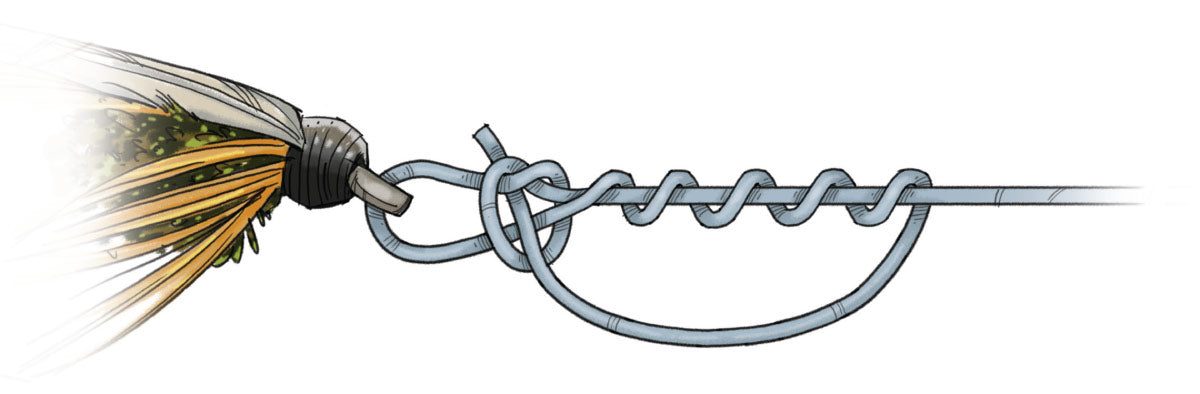
<p dir="ltr"><span>This knot is also called the <strong>Pitzen</strong> and <strong>16-20</strong>, among other names. Whatever you choose to call it, this “reversed clinch” is easily tied and stronger and smaller than the improved clinch. However, it does require you to use more tippet, and some find it harder to tie than the improved clinch – though I provide some tips for making it easier. With one simple variation – passing the tag end through the loop formed at the gook eye like you would for and improved clinch knot, you get another version of the knot, often called the Heiliger or San Diego jam.</span><span><b></b></span></p>
<p role="presentation" dir="ltr"><strong>1. Insert the tippet through the eye of the hook and form a crossed loop around the standing line.</strong></p>
<p role="presentation" dir="ltr"><span><img src="https://cdn.shopify.com/s/files/1/0120/5852/files/Fishermans_Knot_1.jpg?v=1762738375" alt=""></span></p>
<p role="presentation" dir="ltr"><strong>2. Make three of five wraps around both lines, wrapping back toward the hook.</strong></p>
<p role="presentation" dir="ltr"><span><img src="https://cdn.shopify.com/s/files/1/0120/5852/files/Fishermans_Knot_2.jpg?v=1762738375" alt=""></span></p>
<p role="presentation" dir="ltr"><strong>3. After making the wraps, take the tag and pass through the back of the loop opposite the hook.</strong></p>
<p role="presentation" dir="ltr"><span><img src="https://cdn.shopify.com/s/files/1/0120/5852/files/Fishermans_knot_3.jpg?v=1762738375" alt=""></span></p>
<p role="presentation" dir="ltr"><strong>4. Lubricate and dress so that the wraps lie neatly together. Tighten by pulling firmly on the standing line. When the knot is tied properly, you will see it pop into place. Trim the tag.</strong></p>
<p role="presentation" dir="ltr"><span><img src="https://cdn.shopify.com/s/files/1/0120/5852/files/Fishermans_Knot_4.jpg?v=1762738374" alt=""></span></p>
<p dir="ltr"><span>Tip: One way to make this knot easier to tie is by threading 4 to 6 inches of tippet through the eye of the fly, pinching the loop with your right hand, and then making the wraps back toward the fly with your left hand. If you want to impress your friends, you can clamp forceps on to the hook bend and swing the fly around as you wrap – similar to how bass pros tie this knot with spinner baits.</span><span><b></b></span></p>
<h2 dir="ltr">
<span>Slip Knot and Yarn Indicator</span><span><b></b></span>
</h2>
<p dir="ltr"><span>This indicator excels when you want to rig a yarn indicator quickly or don’t want to fuss with rubber bands. If you need to change the depth of your indicator frequently, such as when fishing pocket water, then it is better to go with a system that doesn’t kink your leader as much as this one.</span></p>
<p dir="ltr"><span>Supplies: yarn, scissors, small brush, floatant.</span><span><b></b></span></p>
<p dir="ltr" role="presentation"><strong>1. Form a crossing loop in the leader, form a second crossing loop behind the first, pull the back loop through the front loop to form the slip knot and pull the back loop through the front loop to form the slip knot. </strong></p>
<p dir="ltr" role="presentation"><span><img src="https://cdn.shopify.com/s/files/1/0120/5852/files/Slip-Knot-Yarn-1.jpg?v=1762740383" alt=""></span><strong>2. Insert the yarn into the slip-knot loop, pull the leader on each side of the slip knot to seat the knot, trim the yarn to length and apply floatant. </strong></p>
<p dir="ltr" role="presentation"><span><img src="https://cdn.shopify.com/s/files/1/0120/5852/files/Slip-Knot-Yarn-2.jpg?v=1762740383" alt=""></span></p>
<p dir="ltr" role="presentation"><span><img src="https://cdn.shopify.com/s/files/1/0120/5852/files/Slip-Knot-Yarn-3.jpg?v=1762740383" alt=""></span></p>
<table width="100%" height="211" style="font-family: -apple-system, BlinkMacSystemFont, 'San Francisco', 'Segoe UI', Roboto, 'Helvetica Neue', sans-serif; font-size: 0.875rem;">
<tbody>
<tr>
<td>
<meta charset="utf-8"> <img alt="Joe Mahler fly casting" src="https://cdn.shopify.com/s/files/1/0120/5852/files/Joe-Mahler-fly-casting.jpg?v=1655073202">
</td>
<td>
<h3><strong>Words and images by Joe Mahler</strong></h3>
<div>
<meta charset="utf-8">
<p class="has-small-font-size">Joe Mahler is one of the USA's leading fly casting instructors and author and illustrator of “Essential Knots &amp; Rigs for Trout” and “Essential Knots &amp; Rigs for Salt Water”. You can Book a fly casting lesson with Joe via his website <a rel="noopener noreferrer" title="Fly casting lessons" href="https://www.joemahler.com" target="_blank">here.</a></p>
</div>
</td>
</tr>
</tbody>
</table>]]>
    </content>
  </entry>
  <entry>
    <id>https://www.epicflyrods.com/blogs/news/paradise-in-the-brazilian-amazon</id>
    <published>2025-09-26T15:01:54+12:00</published>
    <updated>2025-09-29T11:46:41+13:00</updated>
    <link rel="alternate" type="text/html" href="https://www.epicflyrods.com/blogs/news/paradise-in-the-brazilian-amazon"/>
    <title>Paradise in the Brazilian Amazon</title>
    <author>
      <name>Adam Barlow</name>
    </author>
    <content type="html">
      <![CDATA[<blockquote>
<p dir="ltr"><meta charset="utf-8">Throughout the week Pam set a new personal record, Breno caught so many fish over 80cm we lost count, and Rodrigo had two fish over 90cm in a single day.</p>
</blockquote>
<p dir="ltr">One learns a lot during a month in the jungle. This past month working in Brazil with Untamed Angling wasn’t my first long-haul assignment in the Amazon but, like past jobs, I came back grateful for the skills I have and with a long list of things I want to learn. Because there’s nothing quite like the jungle for teaching lessons and for exposing areas needing improvement.</p>
<p dir="ltr">And for highlighting the spots in which you’ve put in the work.</p>
<h3 dir="ltr">Rio Marié and the Headwaters Camp</h3>
<p dir="ltr">My first week in the Amazon this trip was spent at the famed Rio Marié, a stunningly-gorgeous blackwater fishery in the northwestern corner of Brazil. The tannin-colored waters are home to cichla temensis–the largest species of peacock bass—as well as healthy numbers of butterfly peacock bass, which are smaller but a whole lot of fun. I was lucky enough to be teamed with a veritable A-Team of anglers for my time at Rio Marié: after two nights on the luxurious Untamed Amazon mothership, a group of us cut out and headed upriver for four days of fishing the headwaters, exploring further upriver and scouting out for client trips later in the season.</p>
<div style="text-align: left;"><img src="https://cdn.shopify.com/s/files/1/0120/5852/files/fly-fishings-skiffs-Rio_Marie_2fb2a0bc-227e-45b3-b931-48d60679d71b.jpg?v=1759091957" alt="Fly fishing skiff moored in the Amazon" style="float: none;"></div>
<p dir="ltr"><meta charset="utf-8">Sometimes you get lucky and get to work with the perfect group. This was one of those times. Our two-skiff exploratory squad consisted of Untamed Angling’s Brazil CEO Rodrigo Salles and his wife Pam, both strong anglers, who were joined in their boat by Lithuanian videographer extraordinaire and all-around mood-booster Vaidas Uselis. My skiff was manned by me, the random American woman with cameras, and Breno, a wonderful, affable Brazilian who could fish very well and knew how to hold fish properly for pictures. The native river boat Carlinha tailed behind us, carrying camp supplies and—believe it or not—Starlink. (Every night Vaidas and I crafted a little mobile camera charging / editing office on the boat’s central deck.)</p>
<div style="text-align: left;"><img src="https://cdn.shopify.com/s/files/1/0120/5852/files/fly-fishing-house-boat-base-camp-Rio-Marie_66ebd936-47cb-44c5-a12a-9b4305b6d2db.jpg?v=1759090725" alt="House boat fly fishing lodge Brazilian Amazon" style="float: none;"></div>
<p dir="ltr"><meta charset="utf-8">If you’ve never fished for trophy peacock bass, you’re missing out on a core life experience. These fish are jungle predators: targeted with big, large-profile flies, and they aren’t always easy. But the effort pays off: throughout the week Pam set a new personal record, Breno caught so many fish over 80cm we lost count, and Rodrigo had two fish over 90cm in a single day. Thanks to an epic guide team including head guide Rafa and indigenous-turned-pro guide Carlos (who was utterly wonderful), joined by native guide Neto, we all got into so many peacocks that we lost track daily.</p>
<div style="text-align: left;"><img src="https://cdn.shopify.com/s/files/1/0120/5852/files/peacock-bass-caught-on-the-fly.jpg?v=1758583590" alt="Peacock bass caught on the fly" style="float: none;"></div>
<p dir="ltr">At night we’d tuck into a new campsite—the Carlinha would have moved camp upriver each day while we fished—to enjoy good food, excellent company, and a good night’s sleep in the jungle wilderness before doing it all over again the next day. </p>
<p dir="ltr">My last cast of the last day, a fish we’d been working on for a while finally decided to eat. I’d landed a fish of 19.8lbs. earlier in the week, preciously close to the coveted 20-lb. mark but still shy, and had decided I was content without making it over the marker this trip. For I had no doubt I’d be back to Rio Marié some day, with more shots at big fish in the future. But this last fish… this last fish changed that. He measured in at 84cm and a 20.5lbs., enough to get me over the 20-lb. mark. The perfect end to the trip. </p>
<p dir="ltr">And it just means that next time, I need to get over 21lbs.</p>
<div style="text-align: left;"><img src="https://cdn.shopify.com/s/files/1/0120/5852/files/epic-686-fastglass-fly-rod-spooled-up-on-boat-dock.jpg?v=1758589419" alt="epic 686 Fastglass 6 weight fly rod" style="margin-bottom: 16px; float: none;"></div>
<p dir="ltr">I fished both the <a href="https://www.epicflyrods.com/collections/titanium-fly-rods/products/890ti-8wt-titanium-fly-rod">890Ti 8-wt. Titanium</a> and the <a href="https://www.epicflyrods.com/collections/fastglass-fly-rods-1/products/reference-10wt-bandit-fastglass-fly-rod">Reference 10-wt. Bandit FastGlass</a>, both paired with Scientific Anglers lines at Rio Marié and the Headwaters Camp. I’m hosting groups back to Rio Marié in both 2026 and 2027—reach out for details! </p>
<h3 dir="ltr">Learning From the Kayapó and Kendjam</h3>
<p dir="ltr">After Rio Marié I headed southeast, crossing hundreds of miles of Amazon jungle before arriving at Kendjam, located where the rainforest meets the savannah. The jungle here is more arid, and is home to a seemingly endless array of wildlife, including jaguar (we run into three in the first week), puma (I see two the second week), capybara, tapir, giant blue macaws, red striped water snakes, giant river otters, electric eels, caiman… the list goes on and on. And more bird species than I can count.</p>
<p dir="ltr"><img src="https://cdn.shopify.com/s/files/1/0120/5852/files/beautiful-golden-peacock-bass-caught-on-the-fly_2cf25ecd-2716-4358-b85f-af1ecc69b757.jpg?v=1759091275" alt=""></p>
<p dir="ltr">And while the wildlife is lovely, I’m here for something else: the fish. The Iriri River, which flows alongside Kendjam Village, home to the indigenous Kayapó tribe and then—three hours downstream—Kendjam Lodge, is home to a hit list of jungle species to chase with a fly rod. Peacock bass, payara, three kinds of pacu, matrinxã, wolf fish, bicuda, red-tailed catfish, surubi, piranha and more… they all call the Iriri home, and many of them will eat a dry fly.</p>
<div style="text-align: left;"><img src="https://cdn.shopify.com/s/files/1/0120/5852/files/peacock-bass-tail-spots-and-patterns.jpg?v=1758584888" alt="peacock bass tail tightly cropped" style="float: none;"></div>
<p dir="ltr">No one knows this fishery better than the Kayapó. Kendjam Lodge is run in deep cooperation with the tribe, and every fishing boat departs the lodge each day with not only an English-speaking pro guide, but also one or two Kayapó guides. It’s a combination which means we find the right places on the river, stay safe in a very wild corner of the world, and have a lot of fun. </p>
<div style="text-align: left;"><img src="https://cdn.shopify.com/s/files/1/0120/5852/files/Peacock-Agitator-fly-pattern-and-epic-titanium-fly-rod.jpg?v=1758585516" alt="peacock agitator fly pattern and Epic 890ti titanium fly rod" style="float: none;"></div>
<div style="text-align: left;"><img style="float: none;" alt="Wolf fish cuaght on the fly in the amazon" src="https://cdn.shopify.com/s/files/1/0120/5852/files/wolf-fish-caught-on-the-fly.jpg?v=1758840102"></div>
<p dir="ltr">Kendjam Lodge itself feels a bit like an African tent camp, though we are treated to actually wooden cabin-style rooms with en-suite bathrooms… posh for the jungle. The daily routine is gloriously simple: rise, breakfast, head to the boats and motor to our beat of the day, fish, boat lunch, fish more, motor home, shower, hang, dinner, sleep. Rinse and repeat. It’s a rhythm I easily fall into during my two weeks and the lodge, and one that leaves me wanting more of the same. Something about the wildness of the place, the camaraderie of the guides and newfound Kayapó friends, and the plethora of fish ready to come play, makes it seems like paradise. By the end of my time at Kendjam I’ve ticked off eight new species and know I want to return to chase a few more. </p>
<p dir="ltr">At Kendjam I fished the <a href="https://www.epicflyrods.com/collections/graphene-fly-rods/products/5wt-590g-carbon-fiber-fly-rod">Reference 5-wt 590 G Carbon Fiber</a> and the <a href="https://www.epicflyrods.com/collections/fastglass-fly-rods-1/products/reference-6wt-686-fastglass-fly-rod">Reference 6-wt. 686 FastGlass</a> (lovely for peacock bass and wolf fish!), paired again with Scientific Anglers lines. I’ll likely be hosting a group at Kendjam in the future, too—let me know if you want in on the adventure!</p>
<div style="text-align: left;"><img src="https://cdn.shopify.com/s/files/1/0120/5852/files/cabon-epic-fly-rod-and-reel-spooled.jpg?v=1758584564" alt="Epic 590G Carbon and 686 Fastglass fly rods" style="margin-bottom: 16px; float: none;"></div>
<div style="text-align: left;">
<table width="100%" style="width: 100.087%;">
<tbody>
<tr>
<td style="width: 29.3125%;"> <img src="https://cdn.shopify.com/s/files/1/0120/5852/files/Jess-mcglothlin-profile-picture_240x240.jpg?v=1758590410" style="float: none;">
</td>
<td style="width: 70.3372%;">
<h3>Words and images by Jess McGlothlin</h3>
<p>You can check out Jess's impressive portfolio and website <a href="https://www.jessmcglothlinmedia.com/" rel="noopener" target="_blank">here</a>.</p>
<p>Follow here exploits on instagram <a href="https://www.instagram.com/jess_mcglothlin_media/" rel="noopener" target="_blank">here</a>.</p>
<p>Join here on facebook <a href="https://www.facebook.com/jessmcglothlinmedia/" rel="noopener" target="_blank">here. </a></p>
</td>
</tr>
</tbody>
</table>
</div>
<div style="text-align: center;"><br></div>]]>
    </content>
  </entry>
  <entry>
    <id>https://www.epicflyrods.com/blogs/news/fly-casting-tips-on-casting-controlled-open-loops</id>
    <published>2025-09-08T09:44:00+12:00</published>
    <updated>2025-09-12T14:04:41+12:00</updated>
    <link rel="alternate" type="text/html" href="https://www.epicflyrods.com/blogs/news/fly-casting-tips-on-casting-controlled-open-loops"/>
    <title>Fly Casting - Tips on casting controlled open loops</title>
    <author>
      <name>Carl McNeil</name>
    </author>
    <content type="html">
      <![CDATA[<h2><strong>Open It Up</strong></h2>
<h3>Tips on fly casting controlled open loops - By Joe Mahler</h3>
<p>My fly-fishing teeth were cut on <a title="Fiberglass fly rods" href="https://www.epicflyrods.com/collections/epic-fly-rods">fiberglass fly rods</a> and, after wiping out my savings account, bamboo rods. I was always fascinated by the airborne line formations and gentle landings that skilled casters demonstrated. The loops that I saw as a teen were rarely what would be called tight by today’s standards, but what gave them elegance was control.</p>
<p><span>A tight, or narrow, loop combats windy conditions, adds accuracy and distance to the cast and delivers the fly nicely under docks and overhanging tree limbs. But there are situations that call for a different approach and “opening-up” a bit can really improve your presentation. To be clear, I’m not talking about a wide, sloppy loop that a “wristy” windshield-wiper rod motion gives, but rather a rounded loop that is under tension and rolls out gracefully above the water surface. Let’s look at a few situations that call for something other than a laser-sharp loop.</span></p>
<h3>Fishing heavily weighted and large air-resistant flies</h3>
<p><span>Heavy-moving objects really don’t change directions very easily (think of a jack-knifed truck), so when casting a fly like a Clouser minnow, a wider-turning radius will make for a smoother cast. We have all heard that familiar “<em>Tick</em>” sound when the lead-eyed fly passes too close by and oftentimes fractures the rod - only to be discovered later while battling a fish or freeing a snag. Big deer-hair bugs and poppers present a similar problem and a slower-moving, more-open loop will make delivering the fly much more enjoyable.</span></p>
<div style="text-align: start;"><img src="https://cdn.shopify.com/s/files/1/0120/5852/files/large-saltwater-fly-patterns.jpg?v=1757040012" alt="Large saltwater fly patters in fly box" style="margin-bottom: 16px; float: none;"></div>
<h3>Wind</h3>
<p><span>For punching a fly into the wind a tight loop is without a doubt, the way to go. But who says the loop has to be the same in both directions? Sometimes a tight loop on the back cast coupled with the wind creates too much line speed. Next time you’re casting into a wind, try opening up a little on your back cast and then throw that tight loop on the forward cast. When the wind is at your back, do the opposite and use the wind to your advantage as any good sailor would do.</span></p>
<h3>Casting sinking lines</h3>
<p><span>Much like the weighted fly, casting sinking lines can be troublesome. The dense nature of the line makes for a very “jerky” cast when thrown with a very tight loop, inviting tailing loops and resultant wind-knots. By opening the loop properly, you will gain control and make a smoother cast and stealthier offering.</span></p>
<h3>Accuracy </h3>
<p><span>An open loop is not generally associated with accuracy, but one situation that I call “goal posting” calls for it. Think about the last time you wanted to place the fly in a very tight spot between two trees with clearance above. By opening the loop on the forward stroke and drawing an imaginary line down the middle of the opening with the rod tip on the forward stroke, you will likely place the fly precisely on target with a soft landing and eliminate the chance of throwing a tailing loop.</span></p>
<h3>Rod choice </h3>
<p><span>Equipment also plays a role in the loop-shape picture. A faster, high modulus rod will be more conducive to throwing tight loops than a slower or medium action rod. A slower rod bends deeper and invites a more open loop as well as a relaxed style of casting. I have several slower fly rods that I enjoy both for fishing and instructing. The most popular rods on the market today tend to be much faster than rods from even ten years ago. It may be time to dust off that old favorite and give it a second look.</span></p>
<p><span>What makes a good “open” loop? In short, it is control. As long as the line is under tension, we have control, as soon as slack is introduced we lose it.</span></p>
<p><span>A tight loop requires great line speed with an abrupt stop on the backward and forward casts. As you slow the stroke and soften the stops, the loop will naturally begin to widen. Adding slight wrist turn-over early and late will give the rod tip a gently arched path. Notice as you make these adjustments that the fly follows a lower path on the back cast (hip to shoulder high) and a higher path (above the rod tip) going forward.</span></p>
<p><span> </span> </p>
<p><img alt="Fly casting with a fly rod" src="https://cdn.shopify.com/s/files/1/0120/5852/files/Fly-Casting-a-fly-rod-Belgian-Cast.jpg?v=1668717763"></p>
<h3>Belgian Cast</h3>
<p><span>A great way to open the loop and maintain or even gain distance is by using the Belgian cast, otherwise known as the Elliptical cast. The Belgian cast is a side-arm cast that relies on continuous motion, or nearly so, of the rod tip following the path of an ellipse. The fly line will pass under the rod tip on the back cast and over the rod tip on the forward cast. </span></p>
<p><span>Pull out 10 feet of line and start making small, steady circles with the rod tip. Notice that as long as the rod is moving steadily, the line follows. You can rotate your body around-the-clock and as long as the rod is moving smoothly at the proper speed, the line will continue to form those circles. The same holds true when making a Belgian cast. </span></p>
<div style="text-align: start;"><img src="https://cdn.shopify.com/s/files/1/0120/5852/files/fly-fishing-in-the-florida-keys.jpg?v=1757040288" alt="Fly fishing at sunrise florida keys" style="margin-bottom: 16px; float: none;"></div>
<h3>Changing planes</h3>
<p><span>My favorite way to open up is actually a combination of a side-arm and an overhead cast.</span></p>
<p><span>The Belgian cast is based on the line traveling back on one horizontal plane and going forward on another horizontal plane above. With this approach, the line travels backwards on a nearly horizontal plane and forward on a vertical plane. Here is how you do it;</span></p>
<p><span>Start with the rod tip on the water with a tight line. Rotate your hand so your palm and the side of the reel are facing upward. Draw the rod backwards to the side and to a slight upward angle. A crisp upward “flip” at the end of the backward stroke will straighten the fly line nicely and directly behind you. As the line straightens behind you, raise your rod (or circle up as spey casters say) to your upright casting position. From here, simply make your best forward cast accelerating smoothly and driving the rod tip in a straight path to a decisive stop. When coupled with the double-haul, impressive distances can be achieved with ease and fluidity.</span></p>
<p><span>This cast can also be used to form a horizontal loop overhead, sort of like a cowboy’s lasso, by picking the fly up on one side of the body and delivering it over the opposite side. Start by picking the line up as you would in a standard overhead cast and at the end of the back cast add the slight sideways “flick”, so the line passes by the outside of one shoulder and then to the outside of the other. This may take a bit of practice, but the overhead loop is great for side-wind conditions or when keeping line in the air while walking (or running) the beach.</span></p>
<p><span> </span></p>
<table width="100%" height="211" style="font-family: -apple-system, BlinkMacSystemFont, 'San Francisco', 'Segoe UI', Roboto, 'Helvetica Neue', sans-serif; font-size: 0.875rem;">
<tbody>
<tr>
<td>
<meta charset="utf-8"> <img alt="Joe Mahler fly casting" src="https://cdn.shopify.com/s/files/1/0120/5852/files/Joe-Mahler-fly-casting.jpg?v=1655073202">
</td>
<td>
<h3><strong>Words and images by Joe Mahler</strong></h3>
<div>
<meta charset="utf-8">
<p class="has-small-font-size">Joe Mahler is one of the USA's leading fly casting instructors and author and illustrator of “Essential Knots &amp; Rigs for Trout” and “Essential Knots &amp; Rigs for Salt Water”. You can Book a fly casting lesson with Joe via his website <a rel="noopener noreferrer" title="Fly casting lessons" href="https://www.joemahler.com" target="_blank">here.</a></p>
</div>
</td>
</tr>
</tbody>
</table>
<h3>
<span style="color: #000000; background-color: #ffffff;"><span style="color: #ff2a00;"></span></span><br>
</h3>
<p> </p>]]>
    </content>
  </entry>
  <entry>
    <id>https://www.epicflyrods.com/blogs/news/fly-fishing-in-iceland-chasing-browns-char-atlantic-salmon</id>
    <published>2025-08-01T12:43:56+12:00</published>
    <updated>2025-08-01T12:44:00+12:00</updated>
    <link rel="alternate" type="text/html" href="https://www.epicflyrods.com/blogs/news/fly-fishing-in-iceland-chasing-browns-char-atlantic-salmon"/>
    <title>Fly Fishing in Iceland: Chasing Browns, Char &amp; Atlantic Salmon</title>
    <author>
      <name>Adam Barlow</name>
    </author>
    <content type="html">
      <![CDATA[<blockquote>
<p dir="ltr"><span><meta charset="utf-8"> <meta charset="utf-8"> <b id="docs-internal-guid-1dc422d7-7fff-ea05-9088-797c1441f34b">Four fisheries, ten days. Not much sleep, but plenty of time on both the camera and the fly rod.</b></span></p>
</blockquote>
<p dir="ltr"><span>The fly-fishing industry is an odd one. We’re a diverse community, made up of a wide spectrum of anglers spread around the world. Sometimes, when we’re very lucky, we form friendships that morph into some kind of family vibe. A fishing family. And though we often live in different countries and even different continents, that distance makes it all the more special when we’re able to come together and spend time on the water.  </span><b></b></p>
<p dir="ltr"><span>When we get to work with friends, everything is better.</span><span></span></p>
<div style="text-align: start;"><img style="margin-bottom: 16px; float: none;" alt="Fly fishing with friends in Iceland" src="https://cdn.shopify.com/s/files/1/0120/5852/files/fly-fishing-iceland.jpg?v=1753671668"></div>
<p dir="ltr">And so when the opportunity to head back to Iceland to shoot images a second time for&amp;nbsp; <a href="https://fishpartner.com/" title="Fish Partner Icelandic fishing lodge" target="_blank">Fish Partner</a>, I was quick to rearrange my schedule, bumping back an already-scheduled Caribbean shoot and making room on the calendar to go chase fish with the Vikings. The Fish Partner team is one of my favorites in the industry—we work hard but fish harder—and I couldn’t turn down the chance to go explore more of The Land of Fire and Ice.</p>
<h3 dir="ltr"><span>Run-and-Gun Work… and Fishing </span></h3>
<p dir="ltr"><span>True to form, I landed in Reykjavik with a packed schedule. I’d move locations every few nights, maximizing the time on the ground to see different fisheries and spend time on the water with different anglers. For this kind of run-and-gun schedule, a selection of gear is required. </span><b></b></p>
<div style="text-align: start;"><img style="margin-bottom: 16px; float: none;" alt="Beautiful golden brown trout" src="https://cdn.shopify.com/s/files/1/0120/5852/files/brown-trout-caught-on-the-fly-iceland.jpg?v=1753673222"></div>
<p dir="ltr"><b></b><span>My camera kit remains one of the steady things in my life, whether I’m shooting in the Colombian Pacific or heading north to the Highlands of Iceland. I travel with two Sony mirrorless cameras, one mounted with a 16-35mm lens for scenic shots, lodge and culinary images, and the obligatory in-the-fish’s-face hero shots. My second “ride or die” lens is a 70-200mm, which I adore for detail work, reaching into scenes I can’t physically reach, and wildlife work. A 50mm also comes along for the ride, wonderful for culinary and detail work. Add in a small drone and the fishing gear, and it’s a camera load-out which adds a good 35-lb. to my daily hiking load, but it’s worth it.</span></p>
<div style="text-align: start;"><img style="margin-bottom: 16px; float: none;" alt="Lake fishing in Iceland with epic fly rods" src="https://cdn.shopify.com/s/files/1/0120/5852/files/fly-fishing-in-lake-iceland.jpg?v=1753669410"></div>
<p dir="ltr"><span>While the camera kit remains fairly uniform regardless of the location, fishing gear obviously changes. For a shoot like this, where I’m visiting four different fisheries in 10 days, the fishing gear tends to multiply.</span></p>
<p dir="ltr"><b></b>The first few days I fished lakes about an hour from Reykjavik, including the largest natural lake in Iceland, Lake Thingvallavatn, and another, smaller lake nearby. These days I fished floating lines on both the <a href="https://www.epicflyrods.com/products/5wt-590g-carbon-fiber-fly-rod" title="Reference 5wt 590G Carbon Fiber Fly Rod" target="_blank">Reference 5WT 590G Carbon Fiber Fly Rod</a> and the <a href="https://www.epicflyrods.com/collections/titanium-fly-rods/products/890ti-8wt-titanium-fly-rod" title="890Ti 8 weight titanium fly rod" target="_blank">890Ti 8WT Titanium Fly Rod</a>. Iceland Ice Age brown trout are no joke, and I was pleased to pull a buttery 75cm brown out of a lake within a few hours of arriving at the airport, in the stellar company of guide and artist Unnur Guðný. (Who needs sleep when there are trout to be caught? Jet lag’s a relative thing, after all.)<br></p>
<div style="text-align: start;"><img style="margin-bottom: 16px; float: none;" alt="75cm brown trout caught in Icelandic lake" src="https://cdn.shopify.com/s/files/1/0120/5852/files/huge-brown-trout-caught-on-fly-iceland.jpg?v=1753669266"></div>
<h3 dir="ltr"><span>Off to the Highlands</span></h3>
<p dir="ltr">After my lake days I headed up to Fish Partner’s <a href="https://fishpartner.com/trout-and-char-trout-fishing/" title="Highlands lodge Iceland" target="_blank">Highlands Lodge</a>, where I put the 8-weight to good use as we fished for both brown trout and gorgeous char in gin-clear water. The River Tungnaá provided us a lovely sunny afternoon with plenty of both species caught during one of those wonderful, relaxed days where guide friends and I took turns lying in tundra grass and leisurely spotting fish for whoever happened to hold a fly rod to cast to. Sometimes that chill vibe is just the ticket, and we all had plenty of fish to our name by the time we headed back to the lodge for a wonderful meal cooked by Argentine chef Fabi Trochine and a good night’s sleep.</p>
<div style="text-align: start;"><img style="margin-bottom: 16px; float: none;" alt="Drift boat fly fishing in Iceland" src="https://cdn.shopify.com/s/files/1/0120/5852/files/picnic-lunch-while-fly-fishing-iceland.jpg?v=1753670087"></div>
<p dir="ltr"><b></b><span>The next day was an eight-weight day again. I headed out to hike the winding, fantasy novel scenery of the River Kaldakvísl with friends and guides Jerome and Sindri, who is the co-owner of the business. We hiked and explored, canyoneering along steeply-walled cliffs and fishing under misty waterfalls. A day of exploring and chasing more of these fantastic Icelandic browns. </span><span></span></p>
<div style="text-align: start;"><img style="margin-bottom: 16px; float: none;" alt="Fly fishing among huge waterfalls in Iceland" src="https://cdn.shopify.com/s/files/1/0120/5852/files/fly-fishing-near-huge-waterfall-in-iceland.jpg?v=1753673432"></div>
<div style="text-align: start;"><img style="margin-bottom: 16px; float: none;" alt="Epic 890Ti Titanium 8 weight fly rod" src="https://cdn.shopify.com/s/files/1/0120/5852/files/epic-890ti-titanium-8-weight-fly-rod.jpg?v=1753670305"></div>
<h3>
<b></b><span>Adventures On the Mighty Blanda</span>
</h3>
<p dir="ltr">My next stop was Fish Partner’s newest operation, <a href="https://fishpartner.com/veidisvaedi/blanda/" title="Long Valley Lodge Iceland" target="_blank">Long Valley Lodge.</a> The lodge rests on the banks of the pastoral Blanda River, one of Iceland’s top Atlantic Salmon fisheries. The river features long, calm stretches and a canyon in its uppermost section. While heavy wading is required in parts of the lower section, it becomes easier as you move upstream, with pools ideally suited for both double-handed and single-handed rods. The Blanda is particularly famous for its high ratio of multi-winter salmon, which are known for being some of the most powerful in Iceland.</p>
<div style="text-align: start;"><img style="margin-bottom: 16px; float: none;" alt="fly fishing at Long Valley Lodge in Iceland" src="https://cdn.shopify.com/s/files/1/0120/5852/files/Long-Valley-fly-fishing-Lodge-iceland.jpg?v=1753670402"></div>
<div style="text-align: start;"><img style="margin-bottom: 16px; float: none;" alt="man wandering through lupines with fly rod in Iceland" src="https://cdn.shopify.com/s/files/1/0120/5852/files/fly-fishing-amongst-beautiful-scenery-iceland.jpg?v=1753674356"></div>
<p dir="ltr"><b></b>I was fortunate to fish the Blanda for a few days with Fish Partner Founder/CEO Páll Rafnsson, along with guide Ahmed. Kristján and I have fished together before, and always spend long, productive days covering a lot of water… ideal for the camera and for my often-tight travel schedules. We trekked up and down the Blanda as well as one of its tributaries, the Svartá, and fished the river all the way down to where it enters the sea at the small town of Blönduós. The sheer variety and size of this fishery caught me off guard; it’s a productive place for brown trout, sea-run browns, char, and—the hero of the show—Atlantic salmon. Fish Partner is also the first operation in Iceland to be running NRS rafts on sections of the Blanda, offering a nice change of pace from wading days.<br></p>
<div style="text-align: start;"><img style="margin-bottom: 16px; float: none;" alt="Fly fishing for arctic char in canyon in iceland" src="https://cdn.shopify.com/s/files/1/0120/5852/files/fly-fishing-in-an-icelandic-canyon.jpg?v=1753670436"></div>
<p dir="ltr"><b></b><span>On the Blanda I fished both the 8-weight Titanium rod as well as an 8-weighy Spey rod. Swinging for fish on a double-handed rod is always a treat; I’m preschool-level with my Spey casting but am thoroughly enjoying the learning process, and the moments when I get the timing right (rare, but occasionally it happens) the cast is reward unto itself.</span><b></b></p>
<h3 dir="ltr"><span>The Epic Day</span></h3>
<p dir="ltr"><span>My three-and-a-half days of fishing at Long Valley Lodge were filled with plenty of healthy brown trout, char, and even a sea-run brown. On day two I landed a grilse, which was exciting to see even though it wasn’t the big Atlantic salmon that lingered somewhere in the back of my mind. On my final day of fishing in Iceland (for this trip, at least!), I headed down to Beat One of the Blanda for a guides’ fishing day with guides Ahmed, David, and Robert. Each of the guys have loads more experience at the salmon game than my novice self, and very kindly let me tag along for the day. We divided up, two per side of the beat, and cycled through, often one angler per side lounging and watching while the other fished, giving the water a bit of a break in between swings.</span></p>
<div style="text-align: start;"><img style="margin-bottom: 16px; float: none;" alt="Rod rack full of epic fly fishing rods" src="https://cdn.shopify.com/s/files/1/0120/5852/files/guided-fly-fishing-iceland_66f85dca-7079-4759-b3df-e6aff3b2d851.jpg?v=1753671467"></div>
<p dir="ltr"><span>Robert landed his Atlantic salmon first. Then it was my turn. A slight tug toward the end of the swing, just on the far side of a big boulder. I can’t remember the last time I was shaky after landing a fish, but a short fight and an 85cm Atlantic salmon later, I had the shakes. And was rather giddy. I hadn’t had a chance to fish for these salmon since working in Russian in 2012, and it was surreal to be able to catch one at the end of the trip. </span><b></b></p>
<div style="text-align: start;"><img style="margin-bottom: 16px; float: none;" alt="85cm Atlantic salmon caught of fly rod in Iceland" src="https://cdn.shopify.com/s/files/1/0120/5852/files/Atlantic-salmon-on-fly-rod-iceland.jpg?v=1753671547"></div>
<p dir="ltr"><b></b><span>By the time 2200h rolled around and we had to get off the water—the northern sun still bright in the sky—both David and Ahmed had landed Atlantic salmon as well. It was a banner day; one salmon per angler, all between 75 and 85cm. A surreal finish to another trip to Iceland, and somewhat similar to how my last trip ended: I’d been over in September 2023 to photograph and fish for sea-run brown trout and ended up catching my largest fish of the trip in just enough time to quickly strip off waders at the truck and make the drive back to Reykjavik and then the airport.</span><b></b></p>
<div style="text-align: start;"><img style="margin-bottom: 16px; float: none;" alt="Big arctic char caught in Iceland on an Epic Fly Rod" src="https://cdn.shopify.com/s/files/1/0120/5852/files/arctic-char-on-the-fly-in-iceland_df018b2b-1d62-4e73-a077-f46c6254f7dd.jpg?v=1753673493"></div>
<p dir="ltr"><b></b><span>There’s something about Iceland… it’s been stellar to me as an angler, and certainly holds its own in the photography department as well. It remains one of my favorite destinations to both fish and photograph, in large part due to the team on the ground and the guides I get to work with. After all, what’s stellar fishing if you’re dealing with folks you don’t want to work with? It’s a treat to get to work with the best of the best, and this team is one of those (some of my other favorites include Estancia Laguna Verde in Argentina and Tsimane’s Pluma Lodge in Bolivia). Good people make all the difference.</span></p>
<p dir="ltr">Interested in chasing some Icelandic species of your own? I’m hosting a group back to Fish Partner’s Highlands Lodge July 1-6, 2027. We’ll chase Ice Age brown trout, Arctic char, and enjoy good times and camaraderie with the awesome guide and lodge team. <a title="Jess McGlothlin Instagram profile" href="https://www.instagram.com/jess_mcglothlin_media/" target="_blank">Send me a note if you’re keen!</a></p>
<p dir="ltr"> </p>
<table height="211" width="100%">
<tbody>
<tr>
<td style="width: 24.8525%;">
<meta charset="utf-8">
<img src="https://cdn.shopify.com/s/files/1/0120/5852/files/Jess-Mcglothlin-bio-pic.png?v=1739824817" alt="" width="201" height="203" style="display: block; margin-left: auto; margin-right: auto;">
</td>
<td style="width: 74.8846%;">
<h3><strong>Words and images by Jess Mcglothlin</strong></h3>
<div>You can check out out Jess’s impressive portfolio and website here:<strong><span> </span><a href="https://www.jessmcglothlinmedia.com/">https://www.jessmcglothlinmedia.com/</a></strong>
</div>
<div>Follow her exploits on instagram here: <strong><a href="https://www.instagram.com/jess_mcglothlin_media/">https://www.instagram.com/jess_mcglothlin_media/</a></strong>
</div>
<div>Join her on Facebook here: <strong><a href="https://www.facebook.com/jessmcglothlinmedia/">https://www.facebook.com/jessmcglothlinmedia/</a></strong>
</div>
</td>
</tr>
</tbody>
</table>]]>
    </content>
  </entry>
  <entry>
    <id>https://www.epicflyrods.com/blogs/news/bag-of-tricks-three-useful-fly-casts-you-ve-probably-never-seen</id>
    <published>2025-07-18T08:00:00+12:00</published>
    <updated>2026-01-06T14:47:33+13:00</updated>
    <link rel="alternate" type="text/html" href="https://www.epicflyrods.com/blogs/news/bag-of-tricks-three-useful-fly-casts-you-ve-probably-never-seen"/>
    <title>Bag of Tricks - Three Useful Fly Casts You’ve Probably Never Seen</title>
    <author>
      <name>Carl McNeil</name>
    </author>
    <summary type="html">
      <![CDATA[<meta charset="utf-8"><span>Three Useful Fly Casts You’ve Probably Never Seen Fly rodders are among the most resourceful and innovative creatures on earth. If there is a shady nook in the mangroves, a fishy-looking eddy, or a bait bust in a tidal rip, an accomplished angler will find a way to deliver his fly. </span><p><a class="read-more" href="https://www.epicflyrods.com/blogs/news/bag-of-tricks-three-useful-fly-casts-you-ve-probably-never-seen">More</a></p>]]>
    </summary>
    <content type="html">
      <![CDATA[<h2><span>Three Useful Fly Casts You’ve Probably Never Seen </span></h2>
<p><meta charset="utf-8">Fly rodders are among the most resourceful and innovative creatures on earth. If there is a shady nook in the mangroves, a fishy-looking eddy, or a bait bust in a tidal rip, an accomplished angler with a <a href="https://www.epicflyrods.com/collections/all-fly-rods" title="Epic Fly Fishing Rods" rel="noopener" target="_blank">fly rod</a> will find a way to deliver his fly. Oftentimes, a few adjustments will do the trick and a hybrid cast is the result.</p>
<p><span>There are, however, some casts that are truly unique; usually developed for a specific purpose. The three casts that I present here are stand-alones.  Have these casts been done at some time by somebody?  Perhaps, but I haven’t seen them before and suspect that you haven’t either.</span></p>
<h2><strong><span>1. The Quick Change Cast </span></strong></h2>
<p><span>Borne largely out of self-preservation, the Quick-Change cast is the work of Captain John Hand, who guides in the Tampa Bay area.  Many of Capt. John’s charters involve sight fishing for redfish. Frequently, if the first cast is refused, a forgiving fish will give the fly a second look, provided it is not spooked.  The Quick Change approach eliminates false casts, keeps the angler engaged, and most importantly, keeps the fly from whizzing about the guide’s head.  The Quick-Change works equally well whether the fish is travelling from right-to-left or vice-versa, and is easily made at distances up to 45 feet.  You can add a haul for even greater distance.</span></p>
<h4><span><meta charset="utf-8">Here’s how it is done: </span></h4>
<p><span><strong>Step one:</strong> Initial cast has been made.  Keep your rod low and pointed at the fly.</span></p>
<p><span><strong>Step two:</strong> Forget about the line and follow the fish with the rod-tip.  Keep your eyes on the fish.</span></p>
<p><span><strong>Step three:</strong> Raise the rod slowly and make a brisk back cast 180 degrees from your new target.  Don’t worry, the line will straighten beautifully behind and will be ready for the forward stroke. </span></p>
<p><span>When making this cast in the opposite direction shown, the back cast will be made cross-body or as Capt. John says “Just follow the line”.  A directional change of up to 45 degrees can be achieved.</span><span> </span></p>
<div style="text-align: left;"><img src="https://cdn.shopify.com/s/files/1/0120/5852/files/Fly-Casting-Bag-of-tricks-1.jpg?v=1659567156" alt="The quick change fly cast sequence" style="margin-bottom: 16px; float: none;"></div>
<h2><strong><span>2. The Misdirection Cast </span></strong></h2>
<p><span>Stories are legion of anglers wading miles of beach or flats looking for fish only to look down and see their quarry nearly at their feet. These are usually the hardest of all to catch.  Drew Chicone, who spends his share of time stalking shallow water species, chooses his clothes, lines, equipment – stopping just shy of military face paint- to blend into the environment.  His presentation to these “close-talkers” is equally unique. While we sometimes disagree on exactly what the fish sees (or actually cares about), his approach is deadly, and his success rate is undeniable. </span></p>
<p><span>When a fish appears at close range, nearly any movement will send him packing.  When casting straight at the fish, if you are lucky enough to present the fly without sounding the alarm, you have a very short stripping window to draw a strike.  If your fish is 20 feet away and you are using a 9’ leader and a 9’ rod, you will have 2 feet of fly line beyond the rod tip.  That equals only 1 strip.  At this point, the angler typically tries to wiggle, jiggle, or otherwise coerce the fly into looking alive without getting the leader inside the rod tip.  With Chicone’s method you will now have up to 18 feet (or 9 strips) of fly line beyond the rod tip and gain a favorable angle for which to set the hook.  The other critical element of this presentation is that because your back is turned to the fish, your stripping motion is concealed.</span></p>
<h4><span>Here’s how it is done: </span></h4>
<p><span><strong>Step one:</strong> Once a fish is spotted, slowly turn your back to it.  While keeping your rod-tip as low as possible, make a false cast one rod length away and parallel to the target while slipping out the desired amount of line.</span></p>
<p><span><strong>Step two:</strong> On your forward cast add a bit of speed and “shock” the rod to a stop, curving the line. Try this at various distances until you have the confidence to hit your target. </span></p>
<p><span>Once the cast is executed, keep the rod-tip low and pointed at the line, not the fly. The line will maintain the circular shape in the water and will provide enough tension to set the hook.</span></p>
<div style="text-align: left;"><img src="https://cdn.shopify.com/s/files/1/0120/5852/files/Fly-Casting-Bag-of-tricks-2.jpg?v=1659567213" alt="Man making misdirection fly cast" style="margin-bottom: 16px; float: none;"></div>
<h2><strong><span>3. The Sky Curve </span></strong></h2>
<p><span>Of all the casts, to me, the outside curve is the Holy Grail.  I have worked to develop this one for a couple of years.  Most often what is called an outside curve is actually an aerial mend.  By definition, an aerial mend is a motion intended to adjust the line formation after the stop on the forward stroke.  The aerial mend is useful for positioning the line in a current, or going over the top of an obstacle, but it is not a true curve cast.  It will not go around a tree or a bridge piling.  Inside curve casts are fairly easy to do. Making a curve to the outside is much more difficult.  A cross-body side-arm, or back-cast approach can achieve an outside curve, but these are cumbersome and accuracy usually suffers.</span></p>
<p><span>Frequently, a casting instructor’s mantra is “Straight line path of the rod-tip” and that is great advice, but we are now going to break from that.  The Sky curve is an overhead cast that features an elongated single spiral path of the rod-tip during the forward stroke. Make sure that you make only one rotation- a corkscrew motion will result in a heap of coils. With the Sky curve, you can effectively make casts with up to 60 feet of line and achieve a sharp and accurate curve. Once the fly lands (usually out of your line of sight) keep the rod pointed at the line and the curved shape will hold during the retrieve.</span></p>
<h4><span>Here’s how it is done: </span></h4>
<p><span><strong>Step 1:</strong> Choose a target behind a tree or telephone pole. Now choose a secondary target beside and 10 feet beyond the pole.</span></p>
<p><span><strong>Step 2:</strong> Make one false cast to the secondary target to build line speed</span></p>
<p><span><strong>Step 3:</strong> On the final forward cast, begin by bringing the hand slightly inward and move the hand forward in a single, spiralling motion (just like a proofreader’s “delete” mark). A brisk stop at the end of the stroke should curve the line, leader and fly nicely around the pole.</span></p>
<p><span>This cast works in either direction but solves a particular problem when curving accurately to the outside. The Sky curve is one of the rare instances in fly casting that a weighted fly does not hinder the cast.</span></p>
<blockquote>
<p><span><img src="https://cdn.shopify.com/s/files/1/0120/5852/files/Bag-of-tricks-3.jpg?v=1752792961" alt=""></span></p>
<p><span>These casts may seem strange and difficult at first, but with some dedicated practice, they will likely help you catch a few fish that you otherwise wouldn’t have.</span></p>
</blockquote>
<p> </p>
<table width="100%" height="211">
<tbody>
<tr>
<td>
<meta charset="utf-8"> <img alt="Joe Mahler fly casting" src="https://cdn.shopify.com/s/files/1/0120/5852/files/Joe-Mahler-fly-casting.jpg?v=1655073202">
</td>
<td>
<h3><strong>Words and images by Joe Mahler</strong></h3>
<div>
<meta charset="utf-8">
<p class="has-small-font-size">Joe Mahler is one of the USA's leading fly casting instructors and author and illustrator of “Essential Knots &amp; Rigs for Trout” and “Essential Knots &amp; Rigs for Salt Water”. You can Book a fly casting lesson with Joe via his website <a rel="noopener noreferrer" title="Fly casting lessons" href="https://www.joemahler.com" target="_blank">here.</a></p>
</div>
</td>
</tr>
</tbody>
</table>
<h3>
<span style="color: #000000; background-color: #ffffff;"><span style="color: #ff2a00;"></span></span><br>
</h3>
<p><br></p>]]>
    </content>
  </entry>
  <entry>
    <id>https://www.epicflyrods.com/blogs/news/10-common-fly-fishing-mistakes-and-how-to-fix-them</id>
    <published>2025-07-04T13:42:22+12:00</published>
    <updated>2025-07-04T13:47:58+12:00</updated>
    <link rel="alternate" type="text/html" href="https://www.epicflyrods.com/blogs/news/10-common-fly-fishing-mistakes-and-how-to-fix-them"/>
    <title>10 Common Fly Fishing Mistakes (And How to Fix Them)</title>
    <author>
      <name>Adam Barlow</name>
    </author>
    <content type="html">
      <![CDATA[<blockquote>
<p data-end="383" data-start="182" style="text-align: left;">Even the best anglers make mistakes. Whether you’re new to the game, a bit rusty after a long winter, or just need a refresher, these are the slip-ups that cost fish — and how to avoid them next time you’re on the water.</p>
</blockquote>
<h4 data-end="174" data-start="149"><strong data-end="172" data-start="149">1. Fishing Too Fast</strong></h4>
<p data-end="277" data-start="176"><strong data-end="192" data-start="176">The mistake:</strong> Covering 40 metres of water in 10 minutes, spooking fish before you even see them.</p>
<p data-end="527" data-start="279"><strong data-end="291" data-start="279">The fix:</strong> Slow your pace. Charging ahead, <a href="https://www.epicflyrods.com/collections/all-fly-rods" target="_blank" title="Epic fly fishing rods full range" rel="noopener">fly rod</a> in hand, means you’ll miss the subtle signs—and spook fish. Move quietly, take your time. Spot some likely water? Take a knee, have a snack, and keep your eyes peeled. You’re hunting, not mowing the lawn.<br></p>
<div style="text-align: start;"><img src="https://cdn.shopify.com/s/files/1/0120/5852/files/epic-fly-rods-fastglass-stalking-trout.jpg?v=1751578818" alt="Stalking trout in new zealand with epic fly rods" style="margin-bottom: 16px; float: none;"></div>
<h4 data-end="89" data-start="70"><strong data-end="87" data-start="70">2. Bad Timing</strong></h4>
<p data-end="194" data-start="91"><strong data-end="107" data-start="91">The mistake:</strong> Fishing at the wrong time of day or ignoring water temperature and light conditions.</p>
<p data-end="373" data-start="196"><strong data-end="208" data-start="196">The fix:</strong> Set yourself up for success by timing your outings around hatches, ideal temperatures, and low-light periods when fish are more active. Planning beats blind luck.</p>
<div style="text-align: start;"><img src="https://cdn.shopify.com/s/files/1/0120/5852/files/the-perfect-time-to-go-fishing-with-epic-fly-rods.jpg?v=1751579120" alt="Picking the perfect time of day to go fly fishing" style="margin-bottom: 16px; float: none;"></div>
<h4 data-end="179" data-start="148"><strong data-end="177" data-start="148">3. Chasing the Perfect Pattern</strong></h4>
<p data-end="267" data-start="181"><strong data-end="197" data-start="181">The mistake:</strong> Obsessing over the perfect pattern when the fish aren’t responding.</p>
<p data-end="493" data-start="269"><strong data-end="281" data-start="269">The fix:</strong> As Bob Wyatt says, trout eat impressions, not exact imitations. Focus on a fly that looks alive and convincing, then present it well. If they aren’t buying it, change how you fish it before you change the fly. </p>
<div style="text-align: start;"><img src="https://cdn.shopify.com/s/files/1/0120/5852/files/epic-fly-rods-fastglass-selecting-a-fly.jpg?v=1751579329" alt="man selecting the perfect fly pattern in new zealand" style="margin-bottom: 16px; float: none;"></div>
<h4>4. <strong data-end="1599" data-start="1573">Using the Wrong Tippet</strong>
</h4>
<p data-end="1790" data-start="1602"><strong data-end="1617" data-start="1602">The mistake</strong>: Fishing size 18 dries on 3X.</p>
<p data-end="1790" data-start="1602"><strong data-end="1661" data-start="1650"></strong><strong data-end="1661" data-start="1650">The fix</strong>: Match your tippet to your fly. Finer tippet gives you a more natural presentation, especially in clear water. It also helps a nymph sink more quickly and drift more naturally.</p>
<h4 data-end="105" data-start="63"><strong data-end="103" data-start="63">5. Not Checking Your Rig </strong></h4>
<p data-end="105" data-start="63"><strong data-end="123" data-start="107">The mistake:</strong> Forgetting to check your knots or leader after your last trip — or after catching fish.</p>
<p data-end="390" data-start="238"><strong data-end="250" data-start="238">The fix:</strong> Take a moment for a quick check before you start, and every so often on the water. It’s a simple habit that can save the fish of the day.</p>
<div style="text-align: start;"><img src="https://cdn.shopify.com/s/files/1/0120/5852/files/checking-your-knots-when-fly-fishing.jpg?v=1751582936" alt="Checking your knots when fly fishing" style="float: none;"></div>
<h4 data-end="176" data-start="149"><strong data-end="174" data-start="149">6. Tying Dodgy Knots</strong></h4>
<p data-end="288" data-start="178"><strong data-end="194" data-start="178">The mistake:</strong> <meta charset="utf-8">Tying knots in a hurry, <meta charset="utf-8">using the wrong knot for the job, or trusting a knot you never really mastered — all recipes for heartbreak when a good fish eats.</p>
<p data-end="435" data-start="290"><strong data-end="302" data-start="290">The fix:</strong> Learn a few solid fishing knots and practice until you can tie them confidently. A good knot is cheap insurance against lost fish.</p>
<p data-end="435" data-start="290"><img src="https://cdn.shopify.com/s/files/1/0120/5852/files/epic-fly-rods-fastglass-tying-knots.jpg?v=1751579385" alt="Fly angler tying a perfect fishing knot" style="float: none;"></p>
<h4 data-end="116" data-start="90"><strong data-end="114" data-start="90">7. Poor Presentation</strong></h4>
<p data-end="291" data-start="118"><strong data-end="134" data-start="118">The mistake:</strong> Delivering your fly without thinking about what the moment calls for — crashing it down when subtlety matters, or being too gentle when you need a splash.</p>
<p data-end="484" data-start="293"><strong data-end="305" data-start="293">The fix:</strong> Match your presentation to your fly and the fish. Subtle dry? Land it softly. Big cicada pattern or popper? Give it a healthy plop. Adjust how you deliver the fly to fit the situation.</p>
<div style="text-align: start;"><img src="https://cdn.shopify.com/s/files/1/0120/5852/files/epic-fly-rods-fastglass-checking-the-drift.jpg?v=1751579453" alt="getting the perfect drift with an epic fly rod and reel combo" style="float: none;"></div>
<h4 data-end="112" data-start="85"><strong data-end="110" data-start="85">8. Ignoring the Drift</strong></h4>
<p data-end="226" data-start="114"><strong data-end="130" data-start="114">The mistake:</strong> Getting caught up in fancy casts and forgetting that a dragging fly looks unnatural to fish.</p>
<p data-end="226" data-start="114"><strong data-end="261" data-start="249">The fix:</strong> Read the current before you cast. Mend early, mend often, and stay ahead of the drift. Control your line before the current does.</p>
<h4 data-end="115" data-start="79"><strong data-end="113" data-start="79">9. Botching the Hook Set</strong></h4>
<p data-end="192" data-start="117"><strong data-end="133" data-start="117">The mistake:</strong> Striking too early, too late, or freezing up altogether.</p>
<p data-end="409" data-start="194"><strong data-end="206" data-start="194">The fix:</strong> We’ve all been there, especially if it’s been a while between eats. With dries, wait half a beat before lifting (don’t pull the lips off it!). With nymphs, strike any time that indicator twitches, stalls, or moves oddly. <meta charset="utf-8">Streamers are a different story — techniques vary depending on the situation (and/or angler), but most of the time, a solid <em data-end="417" data-start="406">strip set</em> is your best bet.<strong data-end="128" data-start="100"></strong></p>
<div style="text-align: start;"><img src="https://cdn.shopify.com/s/files/1/0120/5852/files/perfect-hook-set-with-the-epic-686-fly-rod.jpg?v=1751579812" alt="the perfect hook set with the epic 686 fastglass fly rod" style="float: none;"></div>
<h4 data-end="409" data-start="194"><strong data-end="128" data-start="100">10. Not Practising Enough</strong></h4>
<p data-end="282" data-start="132"><strong data-end="148" data-start="132">The mistake:</strong> <meta charset="utf-8">Skipping regular practice on the lawn and expecting your casting to hold up on the water.</p>
<p data-end="282" data-start="132"><strong data-end="296" data-start="284">The fix:</strong> Practice before you hit the water. Trying to iron out casting kinks in front of feeding trout is neither ideal nor much fun.</p>
<blockquote>
<p data-end="282" data-start="132" style="text-align: left;"><meta charset="utf-8"><meta charset="utf-8">Fly fishing has a way of keeping you humble. New and seasoned anglers alike have frustrating moments on the water. Staying teachable and keeping humble is the key to continuous progress, fewer wind knots, and more fish in the net.<br></p>
</blockquote>
<p data-end="2621" data-start="2435"> </p>
<p data-start="182" data-end="383"> </p>]]>
    </content>
  </entry>
  <entry>
    <id>https://www.epicflyrods.com/blogs/news/fishing-spots-nobody-talks-about-and-everyone-lies-about</id>
    <published>2025-06-18T14:41:45+12:00</published>
    <updated>2025-06-19T15:52:51+12:00</updated>
    <link rel="alternate" type="text/html" href="https://www.epicflyrods.com/blogs/news/fishing-spots-nobody-talks-about-and-everyone-lies-about"/>
    <title>Fishing Spots Nobody Talks About (and Everyone Lies About)</title>
    <author>
      <name>Adam Barlow</name>
    </author>
    <content type="html">
      <![CDATA[<blockquote>
<p>Let me tell you something—there’s always a stream nearby. Always.</p>
</blockquote>
<div style="text-align: start;">
<meta charset="utf-8">
<p data-start="277" data-end="422">Somewhere close, there’s water flowing, whispering for you, hiding trout who still think a Royal Wulff is just a flashy forest bug showing off.</p>
</div>
<p data-end="768" data-start="439">All you really need is a browser and a suspicious mind. Start zooming around your area on satellite view and you’ll soon spot a little squiggly blue line you’ve never noticed before. Follow it. It might run under a highway, behind a cow pasture, or through the most mosquito-infested forest you've ever regretted stepping into.</p>
<p data-end="799" data-start="770">That’s where the magic lives.</p>
<p data-end="1010" data-start="801">And now that summer is stretching out its long, golden days here in the Nordics (where I live) and far beyond, here’s your cue: grab your rod, pull on your waders and boots, and go find your own secret stream.</p>
<div style="text-align: start;"><img style="float: none;" alt="Fly fishing in sweden with epic fly rods" src="https://cdn.shopify.com/s/files/1/0120/5852/files/fly-fishing-mountain-view-wading-boots-rod-reel.jpg?v=1750211100"></div>
<p data-end="1121" data-start="1049">There are fishing spots out there that people <em data-end="1107" data-start="1095">definitely</em> know about...</p>
<p data-end="1283" data-start="1123">But they would never, <em data-end="1151" data-start="1145">ever</em> tell you. Not even under mild interrogation. These are the holy grails—the “if I tell you, I’d have to push you in” kind of places.</p>
<div style="text-align: start;">
<img style="float: none;" alt="Fly fly fishing in Sweden with Epic fly rods" src="https://cdn.shopify.com/s/files/1/0120/5852/files/fly-fishing-with-epic-fly-rod-nordics.jpg?v=1750211605"><meta charset="utf-8">
<p data-end="1328" data-start="1300">But... there’s an exception.</p>
<p data-end="1607" data-start="1330">If you stumble upon someone fishing who’s still young enough to overshare absolutely everything without hesitation—talk to them. These are the folks who haven’t yet learned the ancient angler art of secrecy. They’ll spill the beans like an open fly box tipping over in a canoe.</p>
<p data-end="1641" data-start="1609">Happened to me not too long ago.</p>
<p data-end="1745" data-start="1643">I walked up to a kid fishing a quiet little stream and casually asked, “Hey, any trout in here?”</p>
<p data-end="1799" data-start="1747">He looked at me like I’d just asked if water is wet.</p>
<p data-end="1899" data-start="1801"><em data-end="1899" data-start="1803">“Yeah, loads! My dad caught a really big one here last year. Hold on—I’ll show you a picture.”</em></p>
<p data-end="2112" data-start="1901">And just like that, he pulled out his phone and showed me <em data-end="1971" data-start="1959">everything</em>: the trout, the spot, the timestamp—probably even what fly his dad used and what he had for lunch that day. Full disclosure. No gatekeeping.</p>
<p data-end="2201" data-start="2114">So, naturally, I returned the next day with my fly rod, stood in the exact same spot...</p>
<p data-end="2274" data-start="2203">And wouldn’t you know it—I caught a beautiful trout. The kid was right.</p>
</div>
<div style="text-align: start;"><img style="float: none;" alt="Brown trout caught on Epic fiberglass fly rod" src="https://cdn.shopify.com/s/files/1/0120/5852/files/brown-trout-caught-on-epic-fastglass-fly-rod.jpg?v=1750214145"></div>
<h3 data-end="2314" data-start="2291">Moral of the story?</h3>
<p data-end="2421" data-start="2316">If you want real fishing intel, skip the old-timers with the poker faces. Ask the kid with the juice box.</p>
<p data-end="2464" data-start="2423">And then there’s the opposite, of course.</p>
<p data-end="2540" data-start="2466">Here’s the real secret: <em data-end="2497" data-start="2490">never</em> trust what another angler tells you. Ever.</p>
<p data-end="2556" data-start="2542">If they say: <em data-end="2603" data-start="2559">“Nah, nothing bites there. Waste of time.”</em></p>
<p data-end="2690" data-start="2607">That’s your cue. Your golden invitation. The fishing version of someone saying: <em data-end="2746" data-start="2693">“Whatever you do, DON’T press that big red button.”</em></p>
<p data-end="2766" data-start="2748">So what do you do?</p>
<p data-end="2910" data-start="2768">You pack your gear, your hopes, and probably some bug spray, and you <em data-end="2847" data-start="2837">go there</em>. Walk through nettles. Step in mysterious mud. Fall in. Twice.</p>
<p data-end="3102" data-start="2912">And then, just maybe, you’ll find it: a pool so perfect it makes you suspicious.<br data-end="2995" data-start="2992">A shadow moves under the surface. You cast. You hook. Your rod bends.<br data-end="3067" data-start="3064">Your heart forgets how to function.</p>
<p data-end="3121" data-start="3104">And now you know.</p>
<p data-end="3221" data-start="3123">But remember this: if anyone ever asks where it was, you smile politely, shake your head, and say: <em data-end="3269" data-start="3225">“Nah, nothing bites there. Waste of time.”</em></p>
<p><span style="font-family: -apple-system, BlinkMacSystemFont, 'San Francisco', 'Segoe UI', Roboto, 'Helvetica Neue', sans-serif; font-size: 0.875rem;"> </span></p>
<div style="text-align: start;"><img style="float: none;" alt="Brown trout caught in sweden with epic carbon graphene fly fishing rod" src="https://cdn.shopify.com/s/files/1/0120/5852/files/Brown_trout_caught_on_epic_carbon_fly_rod_in_Sweden.jpg?v=1750214439"></div>
<h4 data-end="3308" data-start="3291">Gear Check</h4>
<p data-end="3388" data-start="3310">When I’m out scouting new river spots, I always bring along my go-to setups:</p>
<p data-end="3388" data-start="3310">The <a title="Epic fastglass fiberglass fly rod" href="https://www.epicflyrods.com/collections/fastglass-fly-rods-1/products/reference-4wt-476-fastglass-fly-rod" target="_blank"><strong data-end="3427" data-start="3395">Epic Reference 476 FastGlass</strong></a>, or the <strong data-end="3482" data-start="3446"><a title="Epic 480G Carbon graphene 4 weight fly rod" href="https://www.epicflyrods.com/collections/graphene-fly-rods/products/reference-4wt-4800g-carbon-fiber-fly-rod" target="_blank">Epic Reference 480G Carbon Fiber</a>. </strong></p>
<p data-end="3388" data-start="3310">Lately, I’ve also been loving my new favourite—the <a title="Epic Trutta clicker fly reel" href="https://www.epicflyrods.com/products/trutta-fly-reel" target="_blank"><strong data-end="3562" data-start="3543">Trutta Fly Reel</strong></a>.<br data-end="3566" data-start="3563">Tough, smooth, and good-looking enough to photograph (but I won’t tell you where I took that picture either).</p>
<p dir="ltr"> </p>
<table height="211" style="width: 107.525%;" width="100%">
<tbody>
<tr>
<td style="width: 22.324%;"><img src="https://cdn.shopify.com/s/files/1/0120/5852/files/magnus-profile-picture.jpg?v=1750301585" alt=""></td>
<td style="width: 77.4191%;">
<meta charset="utf-8">
<h3><strong>Words and images by Magnus Lindhardt</strong></h3>
<div>
<meta charset="utf-8">
<div>Check out Magnus on Youtube here: <a href="https://www.youtube.com/c/MagnusLindhardt" title="Magnus Lindhardt Youtube videos about fly fishing" rel="noopener" target="_blank">https://www.youtube.com/c/MagnusLindhardt<strong> </strong></a>
</div>
<div>Follow Magnus on Instagram here: <a href="https://www.instagram.com/justflymano" rel="noopener" target="_blank">https://www.instagram.com/justflymano</a>
</div>
<div><br></div>
</div>
<div><br></div>
</td>
</tr>
</tbody>
</table>
<p> </p>]]>
    </content>
  </entry>
  <entry>
    <id>https://www.epicflyrods.com/blogs/news/how-to-cast-tight-loops-fly-fishing-fly-casting</id>
    <published>2025-05-25T11:00:00+12:00</published>
    <updated>2025-05-27T13:39:59+12:00</updated>
    <link rel="alternate" type="text/html" href="https://www.epicflyrods.com/blogs/news/how-to-cast-tight-loops-fly-fishing-fly-casting"/>
    <title>How to Cast Tight Loops - Fly Fishing &amp; Fly Casting</title>
    <author>
      <name>Carl McNeil</name>
    </author>
    <summary type="html">
      <![CDATA[<meta charset="utf-8"><span>Casting tight loops are is actually pretty simple in theory. Line and loop shape are primarily dictated by the path the </span><a href="https://swiftflyfishing.com/collections/custom_fly_rods" title="fly rod">fly rod</a><span> tip takes during the cast and after the stop. The line does not follow the rod tip exactly - but for the purpose of this exercise that’s what we need to be thinking about.</span><p><a class="read-more" href="https://www.epicflyrods.com/blogs/news/how-to-cast-tight-loops-fly-fishing-fly-casting">More</a></p>]]>
    </summary>
    <content type="html">
      <![CDATA[<h2 class="p1">How to Cast Tight Loops</h2>
<p class="p1">The most common source of frustration I see with fly anglers are large open loops. It’s also one of the most common faults I see - tailing loops being number one. Although not strictly a fly casting fault per se, generally speaking, narrow loops are more desirable. And by narrow, I’m calling 3 to 4 feet wide a good, tight loop.</p>
<p class="p1">At times wide loops are definitely the way to go - eg, if you have a long line out and spot a fish close up, the quickest way to drop your fly much shorter is to throw a big, high, wide open loop - then take up the slack as the fly is landing - doing this you can shorten your line considerably in one cast.</p>
<p class="p1"><meta charset="utf-8">Casting big weighted flies also often necessitates opening your loops – but they should still be efficient and accurate. One thing to keep in mind: it all starts with your <a href="https://www.epicflyrods.com/collections/all-fly-rods" rel="noopener" target="_blank"><strong data-start="916" data-end="927">fly rod</strong></a>. Whether you’re aiming for tight loops or wide loops, the way you handle the fly rod is what shapes those loops.</p>
<h2 class="p1">Casting Large Open Loops</h2>
<p class="p1">Large open loops are less aerodynamically efficient and are less accurate. The frustrating bit for fly anglers is that they simply do not travel as far as a tight loop. And as a result, I see anglers applying far more power to their cast than is needed to reach the distance required. Big loops are also far less accurate and prone to being driven off course by any breeze - once the wind really gets up, big loops are just a nightmare to control.</p>
<h2 class="p1">Casting Tight Loops</h2>
<p class="p1">Tight loops are more aerodynamically efficient than wide loops, they cut through the air better.<span class="Apple-converted-space">  </span><strong>It’s easy to forget that the air around us is actually quite thick and presents resistance to anything traveling through it</strong>. A narrow loop with a point to the loop face cuts through the air far better than a large rounded bulge.</p>
<div style="text-align: left;"><img src="https://cdn.shopify.com/s/files/1/0120/5852/files/tight-loops-with-a-fly-rod.jpg?v=1747965442" alt="Casting tight loops with a fly rod" style="float: none;"></div>
<h2 class="p1">The Umbrella</h2>
<p class="p1">I like analogies, they help make things simple and simple is good. The one I use regularly with students is that of the umbrella.</p>
<p class="p1"><strong>Here's our thought experiment.</strong></p>
<p class="p1">You have an umbrella. Open it up and push it out forward - lots of air resistance over that big open surface. Imagine running along with the open umbrella facing out in front of you. Lots of work is happening and lots of resistance.</p>
<p class="p1">Now close your umbrella. Imagine pushing it out forward - how much air resistance is there now?</p>
<p class="p1">Imagine running along with the closed pointy umbrella facing out in front of you. Far less work, minimal resistance - easy by comparison.</p>
<p class="p1"><strong>Same umbrella.</strong></p>
<p class="p1">With the closed umbrella I imagine you could throw it like a Javelin and reach a fair distance. If the umbrella were open how far would it go? - Not far at all.</p>
<p class="p1"><strong>Same umbrella.</strong></p>
<p class="p1">That’s why narrow loops are the way to go (in most cases)</p>
<h2 class="p1">How to cast tight loops</h2>
<p class="p1">It’s actually pretty simple in theory. Line and loop shape are primarily dictated by the path the <a href="https://swiftflyfishing.com/collections/custom_fly_rods" title="fly rod">fly rod</a> tip takes during the cast and after the stop. The line does not follow the rod tip exactly, but for the purpose of this exercise, that’s what we need to be thinking about.</p>
<p class="p1">Accelerate smoothly, move the rod tip along a relatively straight line path and stop the rod crisply without dropping the tip - and you’ll get a nice tight loop.</p>
<div style="text-align: left;"><img src="https://cdn.shopify.com/s/files/1/0120/5852/files/fly-casting-tight-loops_50cccbba-69d5-4fc7-9f9a-f82bb704f3c5.jpg?v=1748295271" alt="How to cast a tight loop with your epic fly rod" style="float: none;"></div>
<h2 class="p1">To make a wide, open loop</h2>
<p class="p1">Move the rod tip through a wide sweeping arc (paint a rainbow) . Make a slow, sloppy stop. Drop the rod tip, and you create a big, wide, open loop.</p>
<div style="text-align: left;"><img src="https://cdn.shopify.com/s/files/1/0120/5852/files/fly-casting-wide-loops_0b7d6012-6cbe-4a12-8407-4e3107f49a18.jpg?v=1748295148" alt="How to cast a wide loop with a fly rod" style="float: none;"></div>
<p class="p1"><strong>So, when thinking about the path of your rod tip.</strong></p>
<ul>
<li>DON’T chop the wood</li>
<li>DON’T paint rainbows (catch em instead)</li>
<li>DON’T swat flies</li>
<li>DON’T move the rod like a windshield wiper</li>
</ul>
<p> </p>
<ul>
<li>DO - move the rod in a relatively straight line path (think of firing the rod tip down the barrel of a rifle)</li>
<li>DO make a crisp stop</li>
<li>DO stop the rod tip high - eye level is a good guide for most casts.</li>
</ul>
<p class="p1">A bit of an oversimplification - but that’s fundamentally it.</p>
<p class="p1">Here’s a video we filmed a number of years ago about loop shapes. *Note, I do say that the line always follows the rod tip - and while this isn’t exactly the case - for the purpose of instruction it’s what you need to be thinking about.</p>
<p class="p1">Next, you’ll likely be <a href="https://swiftflyfishing.com/blogs/news/tailing-loops-and-how-to-cure-them" title="fly casting how to fix tailing loops">throwing tailing loops</a> - and you can sort those out by reading <a href="https://swiftflyfishing.com/blogs/news/tailing-loops-and-how-to-cure-them" title="Fly casting how to cure tailing loops">this article &gt;</a></p>
<p class="p1"><strong>Take time out to practice, have fun. Enjoy!</strong></p>
<p class="p1"><strong><iframe width="560" height="315" src="https://www.youtube.com/embed/0eBlMG2Ds9Q"></iframe></strong></p>]]>
    </content>
  </entry>
  <entry>
    <id>https://www.epicflyrods.com/blogs/news/fly-fishing-argentina-jurassic-lake-golden-dorado-patagonian-spring-creeks-9</id>
    <published>2025-05-02T09:35:49+12:00</published>
    <updated>2025-06-19T14:53:26+12:00</updated>
    <link rel="alternate" type="text/html" href="https://www.epicflyrods.com/blogs/news/fly-fishing-argentina-jurassic-lake-golden-dorado-patagonian-spring-creeks-9"/>
    <title>Fly Fishing Argentina: Jurassic Lake, Golden Dorado &amp; Patagonian Spring Creeks</title>
    <author>
      <name>Adam Barlow</name>
    </author>
    <content type="html">
      <![CDATA[<blockquote>
<p dir="ltr"><meta charset="utf-8"><meta charset="utf-8">Four weeks, three very different fisheries, two hosted trips, and one very happy angler...</p>
</blockquote>
<p dir="ltr"><span>The plane banks into a landing over the urban sprawl of Buenos Aires, and I smile despite the lingering exhaustion of the day of travel and then the red-eye flight from New York. I’m about to be back in Argentina, and I can’t wait. More than three weeks of travel lie ahead: I was hosting two weeks of anglers, one far south on the famed Lago Strobel (Jurassic Lake) at Estancia Laguna Verde—one of my favorite lodges on the planet—and one at the Golden Dorado River Cruiser, a mothership operation on the Lower </span><span>Paraná. Both places I’d visited before, staffed with guides and teams I thoroughly enjoyed.</span></p>
<p dir="ltr"><b></b><span>The third stop was slated for after the hosted clients went home; I was heading to check out a new (to me) operation in northern Patagonia near the town of San Martín de los Andes called SET Spring Creek Lodge, scouting it out for potential hosted trips in the future, as well as photographing and penning a magazine article or two. </span></p>
<p dir="ltr"><span>It was a busy line-up. But it was all in Argentina—a proper escape from the snowy, cold Montana winter—and I was happy. </span></p>
<h4 dir="ltr"><span>Estancia Laguna Verde</span></h4>
<p dir="ltr"><span>First off was another flight from Buenos Aires to the southern town of El Calafate, then a half-day drive out to Estancia Laguna Verde. This is one of my favorite lodges for a reason: the sheer remoteness, coupled with a best-in-class team of guides and staff, a homey feel, and the chance to catch pristine 20+ lb. rainbow trout, makes for a compelling combination. Our arrival day happened to be my birthday, and I could hardly think of a better place—or better company—with which to celebrate.</span></p>
<div style="text-align: left;"><img src="https://cdn.shopify.com/s/files/1/0120/5852/files/McGlothlin_ELV_Day6-5.jpg?v=1745985296" alt="Fly fishing lodge Argentina" style="margin-bottom: 16px; float: none;"></div>
<p dir="ltr"><span>The famed Lago Strobel didn’t disappoint. Within the first ten minutes of fishing guests Les and Scott doubled up on a pair of healthy rainbows, and that appeared to set the tone for the week. Les had a very well-deserved big fish of the week at 20.2 lbs.—enough to get him into the lodge record book—and Scott had many that were very close to that marker. We had a taste of all kinds of weather, including Lago Strobel’s traditional high winds, but the team were troopers and fished well throughout the week.</span></p>
<div style="text-align: left;"><img src="https://cdn.shopify.com/s/files/1/0120/5852/files/McGlothlin_ELV_Day4-26.jpg?v=1746135340" alt="Fly fishing Jurassic Lake" style="margin-bottom: 16px; float: none;"></div>
<p dir="ltr"><span></span><span>I even got to fish more this trip; putting the camera down to pick up a rod myself. And landed a nice rainbow in the exact same place I had the year prior… there’s something nice about “coming home” and knowing that, after a wild year last year, some things haven’t changed.</span></p>
<div style="text-align: left;"><img src="https://cdn.shopify.com/s/files/1/0120/5852/files/IMG_8443.jpg?v=1746136220" alt="Large rainbow trout on the fly at Jurassic Lake" style="margin-bottom: 16px; float: none;"></div>
<p dir="ltr"><span>One thing that hasn’t changed at Laguna Verde is the wonderful team. They took stellar care of us, making the little outpost feel like home, and we shared what seemed to be an endless amount of laughter on the water with the guides. I can’t wait to return next year and visit friends once again.</span></p>
<div style="text-align: left;"><img src="https://cdn.shopify.com/s/files/1/0120/5852/files/McGlothlin_ELV_Day3-8.jpg?v=1746136341" alt="Large dry fly for fly fishing Argentina" style="margin-bottom: 16px; float: none;"></div>
<h4 dir="ltr">
<b></b><span>Golden Dorado River Cruiser</span>
</h4>
<p dir="ltr"><span>After flying north once more and a night in Buenos Aires, we headed out toward the Lower </span><span>Paraná River. This muddy, sprawling body of water is part of the Paraná River system—a massive river which flows throughout </span><span>south-central South America, </span><span>running through Brazil, Paraguay, and Argentina</span><span> for some 4,880 kilometers (3,030 mi). The operation is based on the </span><span>Paraná Gipsy, a comfortable mothership which serves as hotel, restaurant, and fishing home base for the week.</span></p>
<div style="text-align: left;"><img src="https://cdn.shopify.com/s/files/1/0120/5852/files/McGlothlin_GDRC_2025-9.jpg?v=1746139276" alt="Golden Dorado River Cruiser fly fishing" style="float: none;"></div>
<div style="text-align: left;"><img src="https://cdn.shopify.com/s/files/1/0120/5852/files/McGlothlin_GDRC_2025-17.jpg?v=1746139912" alt="Guided fly fishing in Argentina" style="margin-bottom: 16px; float: none;"></div>
<p dir="ltr"><span></span><span>We had a challenging weather week, with seasonal low-water conditions and then including getting rained out for the majority of a day due to massive thunderstorms rolling through. But the team made the most of it and fished hard, with everyone catching fish (dorado as well as several species of piranha) on the fly. The lodge team—including epic chef Alan, who is perpetually ready with a smile and some kind of delicious creation—took wonderful care of us. Golden dorado remain one of my favorite species to chase, and I look forward to the next encounter with these gleaming critters.</span></p>
<div style="text-align: left;"><img src="https://cdn.shopify.com/s/files/1/0120/5852/files/IMG_8443_a6c73092-6a00-4d71-9fe8-b53812dc2500.jpg?v=1746139635" alt="Fly fishing lodge Argentina" style="margin-bottom: 16px; float: none;"></div>
<div style="text-align: left;"><img src="https://cdn.shopify.com/s/files/1/0120/5852/files/McGlothlin_GDRC_2025-48.jpg?v=1746139980" alt="Golden Dorado fly fishing" style="margin-bottom: 16px; float: none;"></div>
<h4 dir="ltr"><span>SET Spring Creek Lodge</span></h4>
<p dir="ltr"><span>After the River Cruiser I said goodbye to the hosted group, had another quick overnight in Buenos Aires to catch up on emails and a bit of photo editing, and then flew southwest to the town of </span><span>San Martín de los Andes and the SET Spring Creek Lodge. This part of Argentina was new to me, and I was surprised how much it felt like the Montana I’d grown up in… including the scent of wildfire smoke heavy on the summer air. Large fires had kicked off in a nearby national park, and if I closed my eyes I could pretend it was twenty years ago, when I was a kid watching wildfires consume large swaths of Glacier National Park.</span><span></span></p>
<div style="text-align: left;"><img style="margin-bottom: 16px; float: none;" alt="Brown trout on the fly in Argentina" src="https://cdn.shopify.com/s/files/1/0120/5852/files/McGlothlin_SET_Spring_Creek-2.jpg?v=1746141138"></div>
<p dir="ltr"><span></span><span>SET’s program is different to most lodges I visit, in that while they have an exquisite fishing program, they also offer non-angling activities such as horseback riding, cooking classes, town tours, and more. But I was there for the fishing, so while I eyed the “menu” with interest, my focus was on the water.</span></p>
<div style="text-align: left;"><img style="margin-bottom: 16px; float: none;" alt="Aluminé River Fly Fishing" src="https://cdn.shopify.com/s/files/1/0120/5852/files/IMG_8443_b9870151-0402-48d1-ae5a-2fe9c2e217cb.jpg?v=1746141076"></div>
<div style="text-align: left;"><br></div>
<div style="text-align: left;"><img style="margin-bottom: 16px; float: none;" alt="Drift boat fly fishing spring creeks Argentina" src="https://cdn.shopify.com/s/files/1/0120/5852/files/IMG_8443_097adb41-5ecf-453b-92f3-c95a574fb577.jpg?v=1746141615"></div>
<p dir="ltr"><span>Spring Creek Lodge fishes a variety of rivers, reservoirs, and lakes in the region. Guests are treated to a luxurious (aka “glamping”) overnight camp on the </span><span>Río Chimehuin, which was a wonderful break and kick-started the week with a bounty of healthy rainbows and brown trout. Throughout the week we fished the Aluminé River the Collón Curá River, the Río Chimehuin, the Upper Río Chimehuin, and a local reservoir. The diversity of water—and the landscapes surrounding that water—kept things interesting, and I was astounded at the diversity both in the landscape and the fisheries. One thing each location had in common, however, was a bounty of rainbow and brown trout ready to rise to a well-managed fly.</span></p>
<h4 dir="ltr"><span>The Gear</span></h4>
<p dir="ltr"><span>I used my Epic gear throughout the trip, and guides at all three lodges were eager to test out the <a href="https://www.epicflyrods.com/collections/all-fly-rods" rel="noopener" target="_blank">fly rods</a>—especially the FastGlass. (And they were always pleasantly surprised; several wanted to know how to get their hands on one!) For Estancia Laguna Verde and the Golden Dorado River Cruiser, the <a href="https://www.epicflyrods.com/collections/fastglass-fly-rods-1/products/reference-8wt-888-fastglass-fly-rod" rel="noopener" target="_blank">8-weight FastGlass</a>, paired with the Backcountry Reel, was a workhorse, even in high winds. I alternated between floating and intermediate lines pending conditions.</span></p>
<p dir="ltr"><span><img src="https://cdn.shopify.com/s/files/1/0120/5852/files/IMG_9233-2.jpg?v=1746147864" alt=""></span></p>
<p><span style="font-family: -apple-system, BlinkMacSystemFont, 'San Francisco', 'Segoe UI', Roboto, 'Helvetica Neue', sans-serif; font-size: 0.875rem;">At the Spring Creek Lodge I fished the 6-weight FastGlass for streamers and the 5-weight Carbon rod for dries, both with floating lines. The two made for a very effective combination, and rumor soon spread around the lodge about the fiberglass rod, which was fun to see.</span></p>
<h4 dir="ltr">Argentina, Te Amo</h4>
<p dir="ltr"><span>I’m always grateful that this job allows me to dip in and out of a lot of countries; to “sample” ways of living and fishing, and to learn from them what I’d like. Argentina has always felt inexplicably familiar; from the beginning it was a place I knew I’d like to return to time and time again. And, thankfully, that seems to be happening. Something about the combination of big, open country, dotted with a few interesting big cities, plenty of quality water loaded with fish, unique—and wonderful—food, and even better people is rather addicting.</span><b></b></p>
<p dir="ltr"><span>I’ll be back to Estancia Laguna Verde (and perhaps other locations—stay tuned!) for a hosted trip in 2026. If you’d like to join (or simply want more information) be sure to follow along on </span><a href="https://www.instagram.com/jess_mcglothlin_media/"><span>Instagram</span></a><span>, or keep an eye on my Hosted Trip Page </span><a href="https://www.jessmcglothlinmedia.com/Pages/Hosted-Trips-and-Talks"><span>here</span></a><span>.</span></p>
<p dir="ltr"> </p>
<table width="100%" style="width: 107.525%;" height="211">
<tbody>
<tr>
<td style="width: 22.324%;"> <img height="203" width="201" alt="" src="https://cdn.shopify.com/s/files/1/0120/5852/files/Jess-Mcglothlin-bio-pic.png?v=1739824817" style="float: left;">
</td>
<td style="width: 77.4191%;">
<meta charset="utf-8">
<h3><strong>Words and images by Jess Mcglothlin</strong></h3>
<div>You can check out out Jess’s impressive portfolio and website here:<strong> <a href="https://www.jessmcglothlinmedia.com/">https://www.jessmcglothlinmedia.com/</a></strong>
</div>
<div>Follow her exploits on instagram here: <strong><a href="https://www.instagram.com/jess_mcglothlin_media/">https://www.instagram.com/jess_mcglothlin_media/</a></strong>
</div>
<div>Join her on Facebook here: <strong><a href="https://www.facebook.com/jessmcglothlinmedia/">https://www.facebook.com/jessmcglothlinmedia/</a></strong>
</div>
</td>
</tr>
</tbody>
</table>]]>
    </content>
  </entry>
  <entry>
    <id>https://www.epicflyrods.com/blogs/news/a-rising-star-in-the-world-of-fly-casting</id>
    <published>2025-03-25T11:55:50+13:00</published>
    <updated>2025-03-25T13:24:48+13:00</updated>
    <link rel="alternate" type="text/html" href="https://www.epicflyrods.com/blogs/news/a-rising-star-in-the-world-of-fly-casting"/>
    <title>A Rising Star in the World of Fly Casting</title>
    <author>
      <name>Adam Barlow</name>
    </author>
    <content type="html">
      <![CDATA[<h3 class="MsoNormal"><b>A Rising Star in the World of Fly Casting </b></h3>
<p class="MsoNormal">Home to snook, tarpon, redfish and a host of other gamefish, Sanibel Island is known as a top Florida fly fishing destination. It is also the home of the well-known Sanibel Fly Fishers. On February 8, the club hosted a fly casting tournament, or “Games” as the organizers insist. The organizers are national-level tournament casters Walt Hoover, Ed Matuzek, and Epic ambassador Joe Mahler. The tournament was preceded by ten weekly training workshops, and with a top prize of an <a href="https://www.epicflyrods.com/collections/titanium-fly-rods/products/890ti-8wt-titanium-fly-rod" title="Epic 890Ti 8-weight Titanium Fly Rod" rel="noopener" target="_blank">Epic 890Ti Titanium fly rod</a>, it is no surprise that 32 seasoned casters took part.</p>
<p class="MsoNormal">This year, the top spot was claimed by a 13-year-old named Elias. As the overall winner of “The Eight-Weight Game,” that includes accuracy and distance, he also made the second longest cast of 101 feet. The youngest member of SFF is not new to the sport. Since the age of seven, he has practiced his casting and put those skills to use throughout Southwest Florida and the Everglades. For his eighth birthday, he told his mentor and friend Joe Mahler that he would like to catch his first tarpon on a fly. While a tall order at that age, the two jumped in a canoe and Elias caught a 32” beauty- unassisted. Since that day, he has built an impressive log of catches, all the while perfecting his cast. His passion for fly fishing appears to be contagious. His mother used to just bring him to casting lessons, but in five years, Elizabeth has become an accomplished angler and caster as well.</p>
<div style="text-align: left;">
<meta charset="utf-8">
<img style="margin-bottom: 16px; float: none;" alt="Titanium Carbon Fly Rod from Epic Fly Fish" src="https://cdn.shopify.com/s/files/1/0120/5852/files/Elias_with_rod-2.jpg?v=1742856729">
</div>
<p class="MsoNormal">Following the Sanibel games, Elias traveled to Long Beach, CA to compete in the ACA Western Championships where he won his division in two events and placed in all eight events in which he participated. His dedication to the sport caught the eye of ACA President &amp; U.S. Casting Team Coach Chris Korich. Says Korich <i>“13 yr-old Florida angler Elias is clearly the most promising young caster I’ve seen across America. At the American Casting Association's recent mid-winter training session and Western Championships, he demonstrated an ability to learn quickly and perform under pressure, with plenty of World champions watching closely, including Steve Rajeff, Henry Mittel and Whitney Gould. His relaxed mechanics and keen eye at presenting a fly on target quickly is rare at any age.”</i></p>
<div style="text-align: left;">
<meta charset="utf-8">
<img src="https://cdn.shopify.com/s/files/1/0120/5852/files/Elias-tarpon-epic-fly-rods.jpg?v=1742856567" alt="Fly fishing for tarpon" style="float: none;">
</div>
<p class="MsoNormal">The always humble Elias said of his success<i>,” It’s a privilege to be part of the SWFL fly fishing community. A big thanks to Joe, Chris and the many others who are helping me along the way.”</i> When not casting and fishing, Elias spends his time fly tying, canoeing, adventuring in the Florida Everglades and studying its rich history.</p>]]>
    </content>
  </entry>
  <entry>
    <id>https://www.epicflyrods.com/blogs/news/simple-fly-patterns-big-results-learn-why-less-is-more</id>
    <published>2025-03-05T14:35:12+13:00</published>
    <updated>2025-03-05T14:57:10+13:00</updated>
    <link rel="alternate" type="text/html" href="https://www.epicflyrods.com/blogs/news/simple-fly-patterns-big-results-learn-why-less-is-more"/>
    <title>Simple Fly Patterns, Big Results: Learn Why Less is More</title>
    <author>
      <name>Adam Barlow</name>
    </author>
    <content type="html">
      <![CDATA[<blockquote>
<p class="p2"><b><meta charset="utf-8">Trout aren’t really that fussy, and certainly aren’t suspicious. Put a reasonable impression of food in front of trout and, if they are feeding, they’ll usually eat it.</b></p>
</blockquote>
<p class="p1">My own fly box is a pretty simple affair these days. The many flies I used to carry have been reduced to a handful of basic designs in a few colours and sizes.<span class="Apple-converted-space">  </span>Even the colours are limited - mostly buggy greys, olives and browns. For me, a few very simple designs cover literally any situation I come across in trout fishing. There may be a better specific pattern for a particular situation, but so far I haven’t come across a situation where my flies didn’t work at least as well as any other ‘hot’ pattern for the water in question, and often much better.<span class="Apple-converted-space">  </span>I find this kind of thing encouraging, but it’s not surprising, really.</p>
<p class="p1">In the twenty-five years since my book <i>Trout Hunting</i> was written, I’ve had some interesting discussions about one of the central planks in my “theory” of trout fly design.<span class="Apple-converted-space">  </span>Many of these conversations have involved my fishing pals. The great thing about these discussions is that they take place over weeks and months.<span class="Apple-converted-space">  </span>We argue away on some incredibly arcane point, then go away and mull it over for a while.<span class="Apple-converted-space">  </span>Ideas get thrashed out pretty thoroughly. <meta charset="utf-8">Not so much how to catch them, maybe, but why we catch them with our <a rel="noopener" title="Epic Fly Fishing rods" href="http://epicflyrods.com/collections/epic-fly-rods" target="_blank">fly rod</a><a title="Epic Fly Fishing rods" href="http://epicflyrods.com/collections/epic-fly-rods">.</a></p>
<p class="p1"><img src="https://cdn.shopify.com/s/files/1/0120/5852/files/bib-wyatt-simple-fly-patterns.jpg?v=1741138333" alt=""></p>
<p class="p1">Several years back I started thinking about something that all predators do when hunting.<span class="Apple-converted-space">  </span>When they begin to look for food they form what biologists call a ‘search image’.<span class="Apple-converted-space">  </span>We know that all wild animals have to be efficient in their search for food. They can’t waste energy charging around just trying out anything on the chance it might be food.</p>
<p class="p1">Many or most of the critters that predators eat are what the scientists call <i>cryptic</i>, which means they are hard to see. Some blend into the environment so successfully that they aren’t seen until they move.<span class="Apple-converted-space">  </span>Others have camouflage patterns and visually confusing stripes and spots to make them difficult to separate from a herd or flock. Some prey is encountered in bewildering numbers, relying on the difficulty and reduced probability of being singled out as food. These are what the scientists call strategies, but bugs are obviously not thinking this out for themselves, its innate.</p>
<p class="p1">So, the theory goes, the predator narrows its search for certain features that signal food or prey, and this is interesting for us fly fishers. It’s called ‘”imited attention” by animal behaviourists. All predators do this, and what it means is a kind of tunnel vision.<span class="Apple-converted-space">  </span>The predator, in our case a trout, sort of tunes-in to the specific characteristics of the bug or minnow it is searching for and tunes out almost everything else. The predator responds to the ‘fit’ between its search image and the outstanding characteristics of the prey.</p>
<p class="p1">How what we call “selectivity” develops is each time the trout has a successful encounter with a type of food, it reinforces the stimulus. When there is a lot of a certain bug on the water, the trout will narrow its search to that type.<span class="Apple-converted-space">  </span>This is the most difficult of all the situations fly fishers face. It makes it important to present your fly in a way that fits the trout’s current search image.</p>
<p class="p1">This is good news and bad news for the trout.<span class="Apple-converted-space">  </span>The good news is that by concentrating its attention on that limited bit of visual information, it can feed very efficiently. It doesn’t waste any time or energy on non-food items. The bad news for the trout is that by tuning out most of the other information from its environment, it becomes vulnerable to other predators, like us.<span class="Apple-converted-space">  </span>Another negative effect is that the trout misses some easy meals of perfectly good food items that it doesn’t recognise.<span class="Apple-converted-space">  </span>The trout feeds most efficiently when there is only <i>one</i> type of prey in large numbers.</p>
<p class="p1">Studies have shown that the detection rate for any single type of prey drops significantly when there are several types available.<span class="Apple-converted-space">  </span>That means that the trout has to eat the same kind of thing repeatedly to form a search image, and that the search image deteriorates or fades when there are several different types of food around.<span class="Apple-converted-space">  </span>So, the “selective trout” really doesn’t exist where there is a varied and inconsistent supply of food, which, when you think about it, is most of the time.</p>
<p class="p1">A big part of fly fishing’s lore is concerned with just what makes a good trout fly, and we have plenty of them, proven over the years by trial and error.<span class="Apple-converted-space">  </span>Although scientists have been dealing with the search image idea for decades, anglers have usually done things empirically. There have been lots of theories of course, but the way of a trout with a fly has been regarded as somewhat of a black box mystery.<span class="Apple-converted-space">  </span>Otherwise we wouldn’t have so many fly patterns.<span class="Apple-converted-space">  </span>And dreaming up new fly patterns is half the fun, right?</p>
<p class="p1">What we are dealing with here, I call “prey Image”. It’s not a scientific term, it just sounds like one.<span class="Apple-converted-space">  </span>I made it up to describe the image an artificial fly presents to a fish. Naturalistic close-copy flies are an attempt to make the artificial resemble exactly the appearance of the real thing – so that’s clear enough.<span class="Apple-converted-space">  </span>It makes sense too, but the problem is that close copy flies don’t catch any more fish than the scruffiest and vague impressions.<span class="Apple-converted-space">  </span>The Woolly Bugger is a good example. So, what gives?</p>
<p class="p1"><img src="https://cdn.shopify.com/s/files/1/0120/5852/files/wolly-bugger-fly-pattern.jpg?v=1741138486" alt=""></p>
<p class="p1">It doesn’t make sense, right?<span class="Apple-converted-space">  </span>If a fly is an exact copy of the natural, it stands to reason it should work almost as well as the natural.<span class="Apple-converted-space">  </span>Gary LaFontaine reckoned it was a matter of exaggerated “triggers”.<span class="Apple-converted-space">  </span>Good flies have, he said, salient features that trigger a feeding response in the trout.<span class="Apple-converted-space">  </span>Scientists call this trigger thing a ‘behavioural releaser’.<span class="Apple-converted-space">  </span>It’s part of an explanation for animal behaviour that includes genetically determined responses to certain stimuli.<span class="Apple-converted-space">  </span>Like the partridge dragging a wing to lead a predator away from the nest.<span class="Apple-converted-space">  </span>All partridges do it instinctively, and all the partridge’s predators respond to it instinctively. What LaFontaine was suggesting is that certain exaggerated features in a fly act as a trigger to this kind of instinctive response.</p>
<p class="p1">I like the search image and trigger idea and believe it describes what’s going on in a trout’s brain.<span class="Apple-converted-space">  </span>But there’s some flexibility there that needs explaining.<span class="Apple-converted-space">  </span>And I still don’t know for sure why a vague, scruffy impression of a bug should work better than a close copy replica of the trout’s real food. But I have another theory bubbling away.</p>
<p class="p1">GISS is a twitchers (birder watchers) acronym for <i>General Impression Shape and Size</i>.<span class="Apple-converted-space">  </span>Birders use this for identifying birds they see in the wild.<span class="Apple-converted-space">  </span>They even have a book on it, with impressionistic silhouette images of birds, rather than the detailed textbook images we are all used to seeing in bird books.<span class="Apple-converted-space">  </span>These silhouette images are apparently more useful for spotting birds than the detailed profiles.</p>
<p class="p1">It makes you wonder if something like this is what’s going on with trout flies.<span class="Apple-converted-space">  </span>I think the simple buggy and fishy patterns present a strong, generalised ‘prey image’ rather than an ‘accurate’ simulation.<span class="Apple-converted-space">  </span>It may be, and to my mind probably is the case, that the trout’s search image is geared more to the general impression, shape and size than it is to any particular detail.</p>
<p class="p1">I treat the generalised design as the basis for my whole approach.<span class="Apple-converted-space">  </span>I might tweak a particular model a little, maybe add something like rubber legs for more life and ‘kick’, or I might add some touch of colour or flash for certain conditions, but they stay pretty much the same from year to year.<span class="Apple-converted-space">  </span>Usually I just use the bog standard versions in those dowdy bug colours, and adjust for size.<span class="Apple-converted-space">  </span>They always work and I know I can go anywhere that trout swim and not feel handicapped by my fly collection.</p>
<p class="p1">This approach has been met with scepticism by several anglers and guides in several countries, but it hasn’t failed me yet. When I go to the Kootenays in B.C. for instance, I take the same flies I take to New Zealand, or to northern Scotland.<span class="Apple-converted-space">  </span>I’ll add a few local variations – like big ones with rubber legs for the western Golden Stonefly hatch, or a dark claret seal’s fur body for the northern Scottish lochs.</p>
<p class="p1">The thing is, if you only have a couple of flies in a range of sizes, you waste <i>no </i>time searching for “what the trout want” in a hatch situation.<span class="Apple-converted-space">  </span>Get the size in the ballpark and get down to the business of catching fish.<span class="Apple-converted-space">  </span>The reason, of course, is that trout aren’t really that fussy, and certainly aren’t suspicious.<span class="Apple-converted-space">  </span>What’s really going on is that they’d rather eat something than go hungry. Put a reasonable impression of food in front of trout and, if they are feeding, they’ll usually eat it.<span class="Apple-converted-space">  </span>My pal Carl McNeil in New Zealand calls it the “urinal cake theory” of fly design.</p>
<p class="p1">Carl says, if you put a urinal cake in a bowl of marshmallows and offered it to a kid, the kid would try to eat the urinal cake, especially if he’s eaten a marshmallow before.<span class="Apple-converted-space">  </span>He’s at least going to take a bite out of it, right?<span class="Apple-converted-space">  </span>Why wouldn’t he? He has no reason to suspect there’s a urinal cake among the marshmallows.<span class="Apple-converted-space">  </span>The urinal cake presents the <i>prey image</i> of a real marshmallow, more or less - the general impression, shape and size. (Needless to say, don’t try the urinal cake experiment at home with real kids. This is what scientists call a “mind experiment”.) The point is, what possible reason would there be for a trout not to eat something that looked more or less like a bug it usually eats? As long as the fly behaves naturally enough, there is no reason for a trout to “suspect” anything.</p>
<p class="p1">These generalised flies form the base of my entire battery.<span class="Apple-converted-space">  </span>I’ll use them anywhere with complete confidence – maybe the most important thing in the whole game.<span class="Apple-converted-space">  </span>You can build your own base using whatever general fly designs and patterns you want. There are some good ones to choose from out there, some more complicated than mine and maybe more fun to tie.<span class="Apple-converted-space">  </span>But, once you start thinking about trout flies using the GISS idea, and how trout probably really behave, you won’t go back to worrying about whether the hackle on your Parachute Adams is the right shade of grizzly.</p>
<p><a href="https://www.epicflyrods.com/collections/fly-fishing-flies" target="_blank" title="Effective fly fishing flies" rel="noopener"><strong>You can shop Bob Wyatt's most celebrated trout flies here.</strong></a></p>
<p dir="ltr"> </p>
<p dir="ltr"> </p>
<table height="211" style="width: 107.525%;" width="100%">
<tbody>
<tr>
<td style="width: 22.324%;"><img height="194" width="237" style="display: block; margin-left: auto; margin-right: auto;" src="https://cdn.shopify.com/s/files/1/0120/5852/files/bob-wyatt-bio-photo.jpg?v=1741138840" alt=""></td>
<td style="width: 77.4191%;">
<meta charset="utf-8">
<h3 style="text-align: left;"><strong>Words by Bob Wyatt</strong></h3>
<div style="text-align: left;">
<meta charset="utf-8">
<meta charset="utf-8">Canadian born, now residing in Scotland, Bob has been a fly fisherman since 1956, and a fly tier since the age of thirteen.<br>Having cut his angling teeth on the classic freestone rivers of Alberta and British Columbia. His writing on fly fishing and related topics has appeared in esteemed publications across the world.</div>
<div><br></div>
</td>
</tr>
</tbody>
</table>
<p class="p2"> </p>]]>
    </content>
  </entry>
  <entry>
    <id>https://www.epicflyrods.com/blogs/news/trip-report-the-flats-of-belize</id>
    <published>2025-02-19T10:38:19+13:00</published>
    <updated>2025-02-19T10:38:22+13:00</updated>
    <link rel="alternate" type="text/html" href="https://www.epicflyrods.com/blogs/news/trip-report-the-flats-of-belize"/>
    <title>Trip Report: The Flats of Belize</title>
    <author>
      <name>Adam Barlow</name>
    </author>
    <content type="html">
      <![CDATA[<blockquote>
<p dir="ltr"><span><meta charset="utf-8">Getting back on the water post-op…where physical therapy takes the form of jumping tarpon.</span></p>
</blockquote>
<p dir="ltr"><span>Suffice to say, 2024 has not gone as planned. The year started off nicely on schedule, busy with photo shoots at lodges and fishing operations in Argentina, Colombia, Mexico, and across the U.S.—good fishing, (overall) fun people, and business was good. Then it all came to a screeching halt in June when I ruptured a disc in my spine while on a shoot. Attempts at conservative care failed throughout the summer, and in August I left my Montana home base behind to head to Texas for surgery.</span><b></b></p>
<p dir="ltr"><span>Spine surgery had definitely not been in the business plan for 2024. </span><b></b></p>
<p dir="ltr"><span>Thankfully I was able to work with a stellar surgeon who, after we got to know each other, was just as invested in getting me back on the water and back to work as much as I was. Surgery took place on September 10 and I started in on working to regain strength the next day, walking around the neighborhood like a little </span><span>abuela</span><span> as I learned to walk again with the nerve damage caused by the injury.</span></p>
<p dir="ltr"><span>It’s been a process. And not the prettiest, at times. But that physical therapy and gym time is starting to pay off, as I recently found myself boarding a plane for my first post-op shoot and fishing trip. At only 10 weeks post-surgery I wasn’t exactly functioning at 100%; still limited in certain movements and definitely sore in others, but it was time. With the promise to my surgeon that I wouldn’t target big fish and I’d use good common sense, I was off to Belize. </span><b></b></p>
<h3 dir="ltr">Heading Back to El Pescador</h3>
<p dir="ltr"><span>For years, Belize’s </span><a href="https://www.elpescador.com/"><span>El Pescador Lodge </span></a><span>has been a sort of temporary home base for me. Every visit to the lodge has been for work—photo shoots, hosted trips, or working as the Fishing Director—but the lodge on the northern side of Ambergris Caye has been a touchpoint. I’m very grateful to call the guides and staff friends, and it’s a familiar stopping place amidst all the other travel. It was the perfect place to head for a shoot where I wasn’t quite back to my normal self; I warned the guides that my effective casting range was temporarily decreased and that our normal game plan of targeting big tarpon would be a no-go. The guys were game to see what we could do, and we formed a battle plan.</span></p>
<div style="text-align: left;"><img src="https://cdn.shopify.com/s/files/1/0120/5852/files/El-Pescador-fly-fishing-Lodge.jpg?v=1739759695" alt="Fly fishing lodge in Belize" style="margin-bottom: 16px; float: none;"></div>
<p dir="ltr"><span>El Pescador has been a flats fishing staple for decades, drawing anglers from around the world who want to target bonefish, permit, tarpon, snook, jack, and other Caribbean saltwater species. It’s a productive, fun fishery; especially when the skies and the water are clear. In what’s become true 2024 fashion, I arrived the day after Tropical Storm Sara swept through, dumping a lot of rain both the island and the mainland, and creating huge swaths of brackish water which displaced fish from their normal haunts. On my second day in Belize Sara was followed by another strong northern front, bringing cooler temperatures but also cooler fishing. </span></p>
<p dir="ltr"><span>Like the Belizeans themselves, the fish don’t love cold fronts.</span></p>
<p dir="ltr">But we make the most of it. I was just happy to be on an airplane again; to be on the island again. On the water, camera and <a href="https://www.epicflyrods.com/collections/epic-fly-rods" title="Epic Fly Fishing Rods" rel="noopener" target="_blank">fly rod</a> at hand. I headed right for the dock after arriving and unpacking, and felt giddy taking my first casts in five months off the lodge dock, testing to see how it felt before hopping on the panga the next morning. I was back in Belize with a quiver full of fly rods, a couple cameras, and an ice pack.</p>
<div style="text-align: left;"><img style="margin-bottom: 16px; float: none;" alt="Fly Fishing gear for the flats of belize" src="https://cdn.shopify.com/s/files/1/0120/5852/files/Fish-fishing-gear-for-belize.jpg?v=1739824078"></div>
<h3 dir="ltr">Back on the Flats</h3>
<p dir="ltr"><span>I rigged up 8, 10, and 12-weight rods—all Epic FastGlass—and immediately the colorful blanks caught the attention of guests and guides alike. The guides wanted to cast them, curious and pleased as to the rods’ performance in the windy conditions. Several guests had never heard of fiberglass rods and one night we grabbed drinks and headed down the dock so they could cast the rods. Glass is the perfect rod to teach someone knew to the idea of a double-hauling, as it’s easier to feel the correct rod load; it was fun to see a couple anglers grin as they started to figure out their double-haul timing.</span></p>
<p dir="ltr"><span>While I was in Belize for a commercial shoot and Instagram takeover for the lodge, I was able to sneak in four days of flats fishing around the shoot, and despite weather conditions we made the most of it. Bonefish were a daily thing; often a bit of a “let’s just bend a rod” distraction when our hunts for permit weren’t turning up much. A lot of saltwater anglers begin to snub their noses at bonefish, but to my mind they’re always a good time. This is the time of year in Belize when snook can be found, and I was happy to get into a handful of snook the first morning, out fishing with guide Michael. Later that morning a nice jack put a solid bend in the 10-weight Bandit, and Michael whipped out his iPhone with a laugh to video the way the rod bent oh-so-nicely as the fish ran.</span></p>
<div style="text-align: left;"><img alt="Snook and Jack on a fly rod in Belize" src="https://cdn.shopify.com/s/files/1/0120/5852/files/snook-on-the-fly-belize.jpg?v=1739762727" style="margin-bottom: 16px; float: none;"></div>
<p dir="ltr"><span>And the tarpon. Always my favorite in this fishery. Although I was on a medically-mandated ban from the big girls, we found plenty of small-to-medium fish to play with. The first one I set too hard and broke off like a beginner (still in pelagic tuna and snapper mode from Colombia this spring, maybe?) but there were others to be had.</span><b></b></p>
<div style="text-align: left;"><img src="https://cdn.shopify.com/s/files/1/0120/5852/files/fiber-glass-fly-rod-belize.jpg?v=1739761821" alt="Fiberglass Fly Rod Belize" style="margin-bottom: 16px; float: none;"></div>
<p dir="ltr"><span>The final day, fishing with guide Junior, we headed out to one of my favorite flats in this fishery, Savannah, where we pole and hunt for tarpon in water ranging from 8-10 feet. The day was quiet, the water still off from the recent storm, and the fish were deep. I finally threw a couple blind casts over a dark patch of turtle grass, bored and hoping something maybe—just maybe—would rise from the depths. </span></p>
<div style="text-align: left;"><img src="https://cdn.shopify.com/s/files/1/0120/5852/files/flats-fishing-belize.jpg?v=1739760855" alt="Fly fishing on the flats for tarpon in Belize" style="margin-bottom: 16px; float: none;"></div>
<p dir="ltr"><span>Well, rise it did. Just after Junior asked me to reel up so we could head to another flat, I threw one last cast just for the hell of it. Two strips, and a flash of silver scales broke the surface as a tarpon inhaled my home-tied purple-and-black tarpon toad. I set and he ran, giving us the traditional tarpon jumps and a couple nice little runs, and putting a solid bend in the Bandit. The rod was a lot of fun and I was happy to find the “bounciness” of the glass rods ended up producing a nice smooth, even fight and made it a little easier on my back, too, which was a nice little treat.</span></p>
<h3>
<b><img src="https://cdn.shopify.com/s/files/1/0120/5852/files/Tarpon-on-the-fly.jpg?v=1739762087" alt=""></b>Looking to 2025</h3>
<p dir="ltr"><span>Big thanks to the entire El Pescador family for welcoming me back, and for making this a great first week back in the field (and on the water) post-op. I’ve got a long list of PT and strength-building focus to work on before my next big trip, and look forward to continue bouncing back and once more becoming more durable in the field. And big thanks to the Epic team for making spine-injury-recovery friendly rods… who knew? </span></p>
<p dir="ltr"><span>If all goes to plan, we’ll be back to our regularly-scheduled programming in 2025. The year’s starting off strong with a three-week, three-location Argentina shoot and hosted trip for January / February, and then I go right from that to teaching at the Fly Fishing Show here in Denver, Colorado. I’m thankful to report the year is busy from then on out, so stay tuned for more trip reports in the future!</span><b id="docs-internal-guid-acf40ae9-7fff-aa52-5870-515923b76d6b"></b></p>
<p dir="ltr"> </p>
<p dir="ltr"> </p>
<table width="100%" style="width: 107.525%;" height="211">
<tbody>
<tr>
<td style="width: 22.324%;"> <img height="203" width="201" alt="" src="https://cdn.shopify.com/s/files/1/0120/5852/files/Jess-Mcglothlin-bio-pic.png?v=1739824817" style="float: left;">
</td>
<td style="width: 77.4191%;">
<meta charset="utf-8">
<h3><strong>Words and images by Jess Mcglothlin</strong></h3>
<div>You can check out out Jess’s impressive portfolio and website here:<strong> <a href="https://www.jessmcglothlinmedia.com/">https://www.jessmcglothlinmedia.com/</a></strong>
</div>
<div>Follow her exploits on instagram here: <strong><a href="https://www.instagram.com/jess_mcglothlin_media/">https://www.instagram.com/jess_mcglothlin_media/</a></strong>
</div>
<div>Join her on Facebook here: <strong><a href="https://www.facebook.com/jessmcglothlinmedia/">https://www.facebook.com/jessmcglothlinmedia/</a></strong>
</div>
</td>
</tr>
</tbody>
</table>
<div><br></div>]]>
    </content>
  </entry>
  <entry>
    <id>https://www.epicflyrods.com/blogs/news/casting-angles-the-tall-and-short-of-it</id>
    <published>2025-02-03T09:42:41+13:00</published>
    <updated>2025-02-04T08:34:21+13:00</updated>
    <link rel="alternate" type="text/html" href="https://www.epicflyrods.com/blogs/news/casting-angles-the-tall-and-short-of-it"/>
    <title>Casting Angles: The Tall and Short of it</title>
    <author>
      <name>Adam Barlow</name>
    </author>
    <content type="html">
      <![CDATA[<blockquote>
<p class="p1"><meta charset="utf-8">Adjusting your height could be your secret weapon for fooling the toughest-to-reach fish.</p>
</blockquote>
<p class="p1">Fly casters come in all shapes and sizes, and they move in different ways. At a not so towering 5’8”, I have always felt that I had certain advantages over my taller counterparts. Placing a fly under an overhanging tree limb, or rock ledge seems easy for some and maddening for others. We’ve all had the situation that if we were able to place the fly just a few more inches under a tree or ledge it would have made a big difference in getting a fish to strike. Skills with a <a href="https://www.epicflyrods.com/collections/epic-fly-rods" title="Fly Fishing Rods" rel="noopener" target="_blank">fly rod</a> are certainly key, but physical differences also play a role.<span class="Apple-converted-space">  </span>While a side-arm approach works best in some circumstances, the vertical-style is my choice for achieving accuracy in most fishing situations. Placing a fly in a narrow opening or achieving pin-point accuracy is where the vertical cast shines, and that is why it is the standard of tournament casters.</p>
<p class="p1">At first, it may be surprising to some fly fishers how you can use the vertical cast to get under objects. The lower the angle, the farther you can get under an obstruction with a vertical cast. While the advantage to this lower angle may seem obvious, I’ve always wondered exactly how much difference it makes.<span class="Apple-converted-space">     </span></p>
<p class="p1">Some flats boat owners choose to install a “casting platform” on their deck, raising the caster an additional 12” to 18.” This does help you spot fish better when sight fishing, but I have never been comfortable standing on one. For me, kneeling on the deck or standing in the cockpit feels better, and the lower angle makes for a softer presentation. Presenting a fly at a lower angle is one reason that kayak anglers are so effective.</p>
<p class="p1">Recently, to find out what effect stature has on presenting a fly, I enlisted the help of two of my fishing buddies, we’ll call them “Caster Tall” and “Caster Short,” to find out just how much of an effect stature has on presenting a fly.</p>
<div style="text-align: left;"><img style="float: none;" alt="Casting a fly under low hanging objects" src="https://cdn.shopify.com/s/files/1/0120/5852/files/fly-casting-in-tight-areas.jpg?v=1738032650"></div>
<p class="p1"><em>Caster Tall stands at 6’2”, while Caster Short is 5’1”. They are both outstanding casters, and there are variables, such as arm length and casting style, but I’ve tried to match their casting strokes and loops as much as possible. The effects of hauling were not considered.</em></p>
<h4 class="p1">The Test</h4>
<p class="p1">At a maximum distance of 30,’ I placed an obstacle overhanging 8.5’ out and 4’ high, Caster Tall can clear the obstacle to 27 feet coming in at an angle of 21 degrees, while Caster Short delivers his fly to 29 feet at 16 degrees. While a 2’ difference may not sound significant, on the water it can be the difference between a strike and no strike. At longer distances, the difference between the two angles is less dramatic, but the advantage still favors the shorter caster.</p>
<div style="text-align: left;"><img style="float: none;" alt="Learning about fly casting" src="https://cdn.shopify.com/s/files/1/0120/5852/files/Fly-casting-angle.jpg?v=1738033082"></div>
<h4 class="p1">The Fix</h4>
<p class="p1">By simply kneeling, Caster Tall was able to not only equalize, but gain an advantage over Caster Short. His cast under the same obstacle sails to 30’ at 14 degrees – a full 10% further than his standing cast. Same casting stroke and same loop size.</p>
<h4 class="p1">Try it For Yourself</h4>
<p class="p1">The best way to improve this, or any skill, is practice. You can make your own “Mangrove Trap,” with 6 pieces of PVC pipe and 6 matching elbows. Make yours any size you like, but using two 3’ lengths, two 4’ lengths and two 5’ lengths (width) is a great place to start. It is easily assembled and disassembled for storage.</p>
<p class="p1">By practising to deftly execute a vertical cast with a low angle in mind, adjusting your height could be your secret weapon for fooling the toughest-to-reach fish.</p>
<div style="text-align: left;"><img style="float: none;" alt="Tools for practicing your fly casting" src="https://cdn.shopify.com/s/files/1/0120/5852/files/practice-for-fly-casting.jpg?v=1738032778"></div>
<div style="text-align: left;">
<meta charset="utf-8">
<h3>Author</h3>
<div><img alt="Joe Mahler fly casting" src="https://cdn.shopify.com/s/files/1/0120/5852/files/Joe-Mahler-fly-casting.jpg?v=1655073202"></div>
<p class="has-small-font-size">Joe Mahler is one of the USA's leading fly casting instructors and author and illustrator of “Essential Knots &amp; Rigs for Trout” and “Essential Knots &amp; Rigs for Salt Water”. You can Book a fly casting lesson with Joe via his website<span> </span><a title="Fly casting lessons" href="https://www.joemahler.com/" target="_blank">here</a></p>
</div>]]>
    </content>
  </entry>
  <entry>
    <id>https://www.epicflyrods.com/blogs/news/in-memory-of-dick-marquand</id>
    <published>2025-01-22T10:47:46+13:00</published>
    <updated>2025-01-31T08:43:27+13:00</updated>
    <link rel="alternate" type="text/html" href="https://www.epicflyrods.com/blogs/news/in-memory-of-dick-marquand"/>
    <title>In Memory of Dick Marquand</title>
    <author>
      <name>Adam Barlow</name>
    </author>
    <content type="html">
      <![CDATA[<div>
<div>Renowned New Zealand fly fisherman, conservationist, and our dear friend Dick Marquand has sadly passed away recently. A familiar presence on the Tauranga flats, Dick spent countless summer days wading these waters in pursuit of Kingfish. His love for vintage Fenwick fly rods was well known, and he even tried his hand with a bamboo rod recently to land one of these royal opponents. However, his favourite was the 686 FastGlass Epic fly rod, which he considered the perfect flats rod for pursuing Kingfish.<br>
</div>
<div>
<meta charset="utf-8">During the winter, Dick turned his focus to Kahawai and Trevally, embracing the intricacies of ultra-light gear. He often used a 3lb leader paired with a 370 Epic glass rod and occasionally pushed the limits with a delicate 0wt glass rod.</div>
</div>
<div style="text-align: start;">
<img alt="Fly Fishing for Kingfish" src="https://cdn.shopify.com/s/files/1/0120/5852/files/Dick_Marquand_Kingfish_3c2c8283-b8cb-453d-8895-3b9928a23ba3.jpg?v=1737082370" style="margin-bottom: 16px; float: none;"><meta charset="utf-8">Dick’s was recently featured in FlyLife magazine, he was celebrated for catching 200 Kingfish while wading, including an impressive 22kg Kingfish landed on a fly rod. His current count is 204 waded Kingfish, all released for other anglers to enjoy.  Despite these achievements, Dick’s true passion lay in sharing the joy of fly fishing with others. It was common to see him on the flats, not casting a line himself but guiding other anglers to their first Kingfish on the fly. The number of people he mentored is beyond measure.</div>
<div style="text-align: start;"><img style="margin-bottom: 16px; float: none;" src="https://cdn.shopify.com/s/files/1/0120/5852/files/Dick-Marquand-saltwater-fly-fishing.jpg?v=1737083815" alt="Dick Marquand Saltwater Fly Fishing legend"></div>
<div>
<meta charset="utf-8">
<div style="text-align: start;">Dick was also a co-founder of the <a title="Tauranga Salt Fly Facebook Page" href="https://www.facebook.com/groups/536922660193560" target="_blank">Tauranga Salt Fly Facebook page</a>, which has grown to over 1,600 members. Through his daily fishing reports, Dick captivated readers with vivid, immersive accounts that made them feel as though they were right there beside him. He generously shared his extensive knowledge which has helped grow the Facebook page.</div>
<div style="text-align: start;">
<meta charset="UTF-8">
<div>While best known for his saltwater exploits, Dick was equally passionate about freshwater fishing, often spending time around the lakes of Taupō and Rotorua. He was also known to frequent local ponds in pursuit of the elusive grey mullet on the fly—a feat he sadly didn’t get to achieve.</div>
</div>
</div>
<div style="text-align: start;"><img style="margin-bottom: 16px; float: none;" src="https://cdn.shopify.com/s/files/1/0120/5852/files/Dick-Marquand-Fly-Angler.jpg?v=1737084614" alt="Dick Marquand Fly Fishing for Kahawai"></div>
<div style="text-align: start;">
<div>In Dick’s memory, Epic Fly Rods has donated one of their new 8wt titanium fly rods to be raffled off, with all proceeds going towards a memorial and a park bench overlooking the Tauranga flats. If you’d like the chance to own an exceptional fly rod while supporting a meaningful cause, be sure to get your tickets.</div>
<div>
<meta charset="utf-8">As Dick would say, "Cheers."</div>
<div style="text-align: start;">
<a href="https://www.epicflyrods.com/products/dicks-memorial-raffle-ticket" title="Fly Fishing Rod Raffle" rel="noopener" target="_blank"></a><br>
</div>
<div style="text-align: start;"><a href="https://www.epicflyrods.com/products/dicks-memorial-raffle-ticket"><img style="margin-bottom: 16px; float: none;" src="https://cdn.shopify.com/s/files/1/0120/5852/files/buy-tickets.jpg?v=1737498618" alt="Saltwater fly fishing"></a></div>
<div><br></div>
<div>
<meta charset="utf-8"> Words by <strong>Jasen Cronje</strong>
</div>
</div>]]>
    </content>
  </entry>
  <entry>
    <id>https://www.epicflyrods.com/blogs/news/pick-up-lines-tips-to-improve-your-fly-fishing-fly-casting</id>
    <published>2024-11-18T11:10:37+13:00</published>
    <updated>2024-11-18T11:10:37+13:00</updated>
    <link rel="alternate" type="text/html" href="https://www.epicflyrods.com/blogs/news/pick-up-lines-tips-to-improve-your-fly-fishing-fly-casting"/>
    <title>Pick Up Lines - Tips to Improve Your Fly Fishing &amp; Fly Casting</title>
    <author>
      <name>Carl McNeil</name>
    </author>
    <summary type="html">
      <![CDATA[<meta charset="utf-8"><span>Pick Up Lines – Joe Mahler. Like the first spoken words when meeting someone new, so are the first movements of a fly cast. Did the cast begin smoothly and effortlessly, or did it start with a sudden uncomfortable jerk that later needs correcting?</span><p><a class="read-more" href="https://www.epicflyrods.com/blogs/news/pick-up-lines-tips-to-improve-your-fly-fishing-fly-casting">More</a></p>]]>
    </summary>
    <content type="html">
      <![CDATA[<h2>
<b>Pick Up Lines</b><span style="font-weight: 400;"> – Joe Mahler </span>
</h2>
<p><span style="font-weight: 400;">Like the first spoken words when meeting someone new, so are the first movements of a fly cast. Did the cast begin smoothly and effortlessly, or did it start with a sudden uncomfortable jerk that later needs correcting? Those very first motions set the tone for the rest of the cast and final delivery. For this reason, I think that the “Pick-up” may be the most important element of the entire cast. </span></p>
<p><span style="font-weight: 400;">To clarify, the pick-up is the part of the cast that precedes the back cast – the set-up if you will – and is not usually given much thought, or ignored completely. Practice time is usually spent on gaining power for greater distance, but focused attention to the pick-up could add considerable length to your cast with no extra effort. Oftentimes, a poor pick-up is masked, or compensated for, by using extra power by way of a haul or “yanking” the <a title="Fly lines for fly fishing" href="https://www.epicflyrods.com/collections/fly-lines-and-accessories">fly line</a> out of the water. This approach takes a lot of power as you are breaking the surface tension very abruptly. The purpose of the pick up is to remove the surface tension between fly line and water allowing a smooth lift-off on the back cast. Whether using floating or sinking lines, weightless or heavily-weighted flies, improving your pick-up will set the stage for an efficient and more relaxed cast. Airplane pilots know that there is a greater likelihood of difficulty on the take-off than any other phase of flight. The same holds true in fly casting. </span></p>
<img alt="Fly casting tips" src="https://cdn.shopify.com/s/files/1/0120/5852/files/Epic-fly-rods-fly-casting-tips-1.jpg?v=1672959074"><br>
<h2><b>The overhead Pick-up </b></h2>
<p><span style="font-weight: 400;">I favor a more vertical plane for most of my fishing and teaching situations. With a vertical cast, the pick-up is much more noticeable than with the <a title="Fly Rods and fly casting for fly fishing" href="https://www.epicflyrods.com/collections/epic-fly-rods">fly rod</a> tilted to the side. Many casters begin with the rod tip at an upward angle, allowing a “belly” of line to sag between the rod tip and the water’s surface. If someone asks me “Why do I keep hitting myself in the face with the fly?” I can say with an amount of certainty, it is resultant of a poor pick-up. When power is applied abruptly, the fly line tends to bounce and create a mirror image of that “belly” forming waves in the line. Begin your cast with the rod tip very near the water. In most instances I will fish with my rod tip submerged so that the “belly” never forms. Next, slowly raise the rod nearly on the horizontal, allowing the wrist bend slightly forward, until all the fly line is off of the water. Now, with only the fly and possibly the leader on the water simply “pluck” the fly from the surface by snapping the wrist into the upright position. Practice this until it becomes one smooth, continuous motion. </span></p>
<p> </p>
<h2>
<img alt="5 tips to improve your fly casting and fly fishing" src="https://cdn.shopify.com/s/files/1/0120/5852/files/Epic-fly-rods-fly-casting-tips-2.jpg?v=1672959130"><b>Side-arm pick-up</b>
</h2>
<p><span style="font-weight: 400;">Due to the proximity of the airborne line to the surface, you will need to increase the tempo slightly when casting side-arm. Just as in the overhead pick-up, the side-armed cast should begin with the rod-tip at the surface. Raise the rod tip to waist-level or above to remove surface tension. All or most of the fly line should be off of the surface at this point. Next, draw the rod back at a slightly upward angle, allowing the wrist to bend slightly forward and then snap the wrist into the straight position propelling the line backward. </span></p>
<br><img alt="5 tips to improve your fly fishing" src="https://cdn.shopify.com/s/files/1/0120/5852/files/Epic-fly-rods-fly-casting-tips-3.jpg?v=1672959230"><br>
<h2><b>Picking up slack</b></h2>
<p><span style="font-weight: 400;">There are two kinds of slack, the kind that is piled in a heap and the kind that is merely waves of line on the water. If the line is piled up into tight overlapping pigtails, you have a problem that that will need to be corrected by making a roll cast or stripping the line in, but if the line is formed in relaxed waves, it can easily be picked up. For years, Lefty Kreh has said “You must get the end of the line moving before you can cast.” I couldn’t agree more. Before we can apply power to the back cast, the fly line must be moving, if the line has slack, it will be very difficult. But, if we get the line moving –even if it is in an irregular shape- we can “pluck” the line off of the water and into the air behind. Practice this by making a cast and adding some wiggles after the stop on the forward cast and lower your rod tip to the surface. Next, raise your rod tip in a path that mirrors the line formation on the ground, allowing the wrist to bend forward slightly. The path should be completed and the fly should be moving by the time the rod tip reaches the “snap point”. Now, gently pluck the fly from the surface. With practice, you will be surprised at how much slack you will be able to pick up to form a solid back cast.  </span></p>
<br>
<h2><b>Sinking line pick-up</b></h2>
<p><span style="font-weight: 400;">The pick-up can be particularly troublesome when using sinking lines or heavily weighted flies. In order to make a smooth pick-up, the fly must be brought to the surface by stripping the line in, using one or more roll casts, or by using what is commonly called the “water-haul.” The water-haul is executed by stripping the line in until the fly can be lifted from the depths and laid back down on the surface, possibly shooting a small amount of line. Before the line and fly begin to sink, the line is then picked up, as described in the previous casts, and the back cast is made. A small amount of surface disturbance is normal with the water haul, but when fishing sinking lines and flies, spooking fish is usually not a problem.</span></p>
<br><br>
<h2><b>Timing the haul</b></h2>
<p><span style="font-weight: 400;">The haul is a very powerful too when used at the right moment and in the proper measure. Too often, the haul is used to rip the line from the surface, leaving a trail of froth behind. Think of the haul as a supercharger, not the engine. The haul should be applied precisely at the point of pick-up, or “Pluck-point”. Start the cast by keeping both hands roughly together and raise the rod tip, as previously described, until only the leader and fly are on the water. Now, as the rod hand snaps straight, the line hand will “pluck” the fly from the surface with a short tug. The line hand then follows the rod hand back to set up for the forward stroke.</span></p>
<p> </p>
<p><img alt="The roll cast pickup a great fly casting tip that will help improve your fly casting and fly fishing" src="https://cdn.shopify.com/s/files/1/0120/5852/files/Epic-fly-rods-fly-casting-tips-4.jpg?v=1672959297"></p>
<h2><b>Roll Cast pick-up</b></h2>
<p><span style="font-weight: 400;">The roll-cast pick-up is one of the most valuable skills to master in any kind of fishing situation. Any time excessive slack forms in the line, it will need to be removed before a cast can be made. Whether in a trout stream or on the deck of a flats skiff, if you find yourself with a heap of slack line at your feet, think of the roll cast pick-up as your escape plan. First, with rod tip at the surface, raise the rod tip straight up to hip-height. Next, draw the rod tip slowly back in a slightly upward side-arm movement, placing the preponderance of the line directly behind you. Now, slowly raise the tip of the rod directly up to the forward stroke position and come to a complete stop. Make a forward cast, stopping the tip at in a particularly high position, allowing the line to straighten at head-level. Before the line falls to the surface, begin your back cast.</span></p>
<p><span style="font-weight: 400;">  </span></p>
<h2><b>Picking up too much line</b></h2>
<p><span style="font-weight: 400;">I commonly see is a casters make a nice cast shooting out a healthy amount of line, and then attempt to pick it up to cast again without shortening the line. The second cast is never as pretty as the first. Once the line is extended so that the head and rear taper are outside the rod tip it will be difficult to pick up because the thin running line does not have the mass to support the much thicker head. The result of picking up too much line will be a lack of control, and tell-tale waves very near the rod tip. Fly lines come in a variety of head-lengths, ranging from 20 feet in lengths to over 70 feet. For the most efficient cast, the line should be retrieved so that the thicker head of the line is at least inside the rod tip. Some lines come in two-toned models that aid in locating that transition. You can also mark your lines with a permanent marker.</span></p>
<p> </p>
<p><img alt="fly casting tips to improve your fly fishing skills" src="https://cdn.shopify.com/s/files/1/0120/5852/files/Epic-fly-rods-fly-casting-tips-5.jpg?v=1672959367"></p>
<h2><b>Popper Practice </b></h2>
<p><span style="font-weight: 400;">The best drill for improving the pick-up is tying on a bass popper and going to the pond. Start by making a cast and allowing the popper to settle on the surface. Next, slowly raise the rod, allowing your wrist to give slightly. When all of the fly line and leader has been lifted from the surface, simply “pluck” the popper from the water by snapping your wrist to the upright position. If you have done this well, you will see only the exit splash from the popper itself. Now try same with a side-arm pick-up.</span></p>
<meta charset="utf-8">
<h3>Author</h3>
<div><img alt="Joe Mahler fly casting" src="https://cdn.shopify.com/s/files/1/0120/5852/files/Joe-Mahler-fly-casting.jpg?v=1655073202"></div>
<p class="has-small-font-size">Joe Mahler is one of the USA's leading fly casting instructors and author and illustrator of “Essential Knots &amp; Rigs for Trout” and “Essential Knots &amp; Rigs for Salt Water”. You can Book a fly casting lesson with Joe via his website<span> </span><a title="Fly casting lessons" href="https://www.joemahler.com/" target="_blank">here</a></p>]]>
    </content>
  </entry>
  <entry>
    <id>https://www.epicflyrods.com/blogs/news/fly-selection-other-tactics-to-outsmart-wary-fish</id>
    <published>2024-11-06T16:17:31+13:00</published>
    <updated>2024-11-13T10:33:52+13:00</updated>
    <link rel="alternate" type="text/html" href="https://www.epicflyrods.com/blogs/news/fly-selection-other-tactics-to-outsmart-wary-fish"/>
    <title>Fly Selection &amp; other Tactics to Outsmart Wary Fish</title>
    <author>
      <name>Adam Barlow</name>
    </author>
    <content type="html">
      <![CDATA[<meta charset="utf-8">
<blockquote>
<p data-pm-slice="0 0 []">Fly selection is more than just choosing a pattern that looks pretty—it involves observing the conditions, understanding fish behaviour, and making strategic adjustments on the water. Let's look at some proven approaches that will help you bring more fish to the net <meta charset="utf-8">and put a bend in your fly rod.</p>
</blockquote>
<h3 data-mce-fragment="1"></h3>
<h3><strong>1. (REALLY) Match the Hatch</strong></h3>
<div class="group/conversation-turn relative flex w-full min-w-0 flex-col agent-turn">
<div class="flex-col gap-1 md:gap-3">
<div class="flex max-w-full flex-col flex-grow">
<div data-message-model-slug="gpt-4o" class="min-h-8 text-message flex w-full flex-col items-end gap-2 whitespace-normal break-words [.text-message+&amp;]:mt-5" dir="auto" data-message-id="b913ee91-3efb-4a74-b54c-d64884f32bdd" data-message-author-role="assistant">
<div class="flex w-full flex-col gap-1 empty:hidden first:pt-[3px]">
<div class="markdown prose w-full break-words dark:prose-invert light">
<p>We’ve all heard the term “Match the hatch”; let's consider what it means in practice—and how your fly rod plays a key role in delivering the perfect presentation.</p>
<p>Matching the hatch is more than picking a fly that resembles an insect. To really nail it, pay close attention to subtle variations in insect life. It’s not just about the type of insect; it’s also about which stage it’s in—nymph, emerger, or adult dun—based on what’s actively drifting through the water.</p>
<p>For example, fish might ignore a surface fly if emergers are abundant just beneath. Watch for signs of subsurface feeding, like subtle rises or swirls, which are a good indication that an emerger pattern will do the trick. With the right<a href="https://www.epicflyrods.com/" target="_blank" rel="noopener noreferrer"> fly rod</a> in hand and sharp observation skills, you can turn a slow day into a highly productive session on the water.</p>
</div>
</div>
</div>
</div>
</div>
</div>
<div style="text-align: left;"><img style="float: none;" alt="Adult Stonefly" src="https://cdn.shopify.com/s/files/1/0120/5852/files/2017.05.19_Deschutes_Fly_Fish_Camp_Dan_Root_Photo1312.jpg?v=1730924792"></div>
<p> </p>
<h3 data-mce-fragment="1">2. <meta charset="utf-8">Select the Right Fly for the Water Flow</h3>
<p data-mce-fragment="1"><meta charset="utf-8">Fish react differently based on the interplay of current speed and fly drift. In fast currents, the added energy of the water lets you get away with a larger fly that commands attention. But in slower flows, the fish have more time and better water clarity to scrutinise your flies, and even the smallest unnatural drift can spook them. Focus on perfecting your dead-drift technique or consider a slightly weighted fly that will sit in the feeding lane longer without darting downstream too quickly.</p>
<br>
<h3 data-mce-fragment="1">3. <strong data-mce-fragment="1">Fine-Tuning Fly Size</strong>
</h3>
<p data-mce-fragment="1"><meta charset="utf-8"><span>Many anglers will switch patterns if a fly isn’t working, when what is actually needed is a size adjustment. <meta charset="utf-8"> In clearer water, even a small reduction in fly size signals something more natural, especially if fish are pressured. Conversely, in murky water, a slight upsize—keeping the same profile—can trigger a reaction by improving visibility without overdoing it. Experiment with subtle shifts in fly dimensions before abandoning a fly that matches the hatch.</span></p>
<div style="text-align: left;"><img style="float: none;" alt="Selecting the right sized fly pattern" src="https://cdn.shopify.com/s/files/1/0120/5852/files/IAN-FLIES-DAN_ROOT.jpg?v=1730924943"></div>
<h3 data-mce-fragment="1">4. <strong data-mce-fragment="1">Reading Water Structure &amp; Getting Your Fly Where it Needs to be</strong>
</h3>
<p data-mce-fragment="1">Knowing where to place your fly is as critical as knowing which one to choose. For instance, submerged rocks or pockets behind boulders provide breaks in fast water where fish will feed. As fish will position himself strategically in these pockets, choose a fly that will either draw him out or meet him where he's at. At the right time of year a large terrestrial pattern will bring a fish out from the depths. Alternatively, a weighted nymph presented with a long drift will meet the fish at their level in the water column.</p>
<br>
<h3 data-mce-fragment="1">5.<strong data-mce-fragment="1"> Adapt to the Season &amp; Light Conditions</strong>
</h3>
<p data-mce-fragment="1">Fish behaviour shifts not just seasonally but also with daily light changes. During early morning or overcast conditions, darker flies often outperform, as they provide a clear silhouette against the water’s surface. As the day brightens, consider lighter colours that blend naturally. <meta charset="utf-8">As autumn shifts to winter and insect activity slows down, switch to small, sparse midges and simple patterns without flash. Fish tend to respond better to subtle presentations in the colder months.</p>
<p data-mce-fragment="1"><meta charset="utf-8"><img src="https://cdn.shopify.com/s/files/1/0120/5852/files/2021.03.22_Epic_Rods_Reels_Location_Shoot_Oreti_7517_7a20ab06-fa3a-49c7-9b7f-34973ddaad7c.jpg?v=1730926983" alt="Adapt to the Season &amp; Light Conditions when fly fishing"></p>
<h3 data-mce-fragment="1">6. <strong data-mce-fragment="1">Experiment with Profile and Movement</strong>
</h3>
<p data-mce-fragment="1"><meta charset="utf-8">When fish are selective, a slight change in profile—like a slimmer body or less hackle—can make all the difference. Don't forget to pair your small flies with light, supple tippet to ensure your fly looks natural and sinks well. <meta charset="utf-8">Adjusting your retrieve can also play a key role; sometimes, less is more—small, sparse twitches can be more effective than rapid, aggressive movements.</p>
<br>
<h3 data-mce-fragment="1">7. <meta charset="utf-8">Watch, Learn, &amp; Adapt</h3>
<p><strong>Resist the urge to select a fly based on the take you'd prefer.</strong></p>
<p>Yes, everyone loves a splashy surface take, <meta charset="utf-8"><span data-mce-fragment="1">but our own proclivities</span> won’t change where or what fish are eating!</p>
<p data-mce-fragment="1">Every choice you make on the water should be guided by what the fish and the environment are telling you. If a fly works, remember the conditions for next time. But when the fish are turning up their noses at even your best patterns, take a step back and re-assess—are there micro-hatches, subtle changes in light, or different feeding behaviours you’ve overlooked? Staying flexible and observant is what sets the pros apart.</p>
<div style="text-align: left;"></div>
<p data-mce-fragment="1">The next time you open your fly box, consider each of these factors, experiment, and let the water reveal its secrets.</p>]]>
    </content>
  </entry>
  <entry>
    <id>https://www.epicflyrods.com/blogs/news/5-essential-fly-fishing-knots-you-may-have-overlooked</id>
    <published>2024-10-30T15:38:55+13:00</published>
    <updated>2024-10-30T15:38:55+13:00</updated>
    <link rel="alternate" type="text/html" href="https://www.epicflyrods.com/blogs/news/5-essential-fly-fishing-knots-you-may-have-overlooked"/>
    <title>5 Essential Fly Fishing Knots You May Have Overlooked</title>
    <author>
      <name>Adam Barlow</name>
    </author>
    <content type="html">
      <![CDATA[<h2 data-mce-fragment="1">Duncan Loop</h2>
<p data-mce-fragment="1"><span style="font-weight: 400;" data-mce-style="font-weight: 400;" data-mce-fragment="1">The Duncan loop is and adjustable loop knot formed from the uni knot. It is useful when you want to allow your subsurface flies to have more action, and it is handy for rigging a movable dropper, which allows you to quickly and easily attach another fly to your nymphing system. Since it is a sliding loop (you can more or less close it tight and adjust the loop later), this knot is a good candidate if you like to rig your dropper nymphs ahead of time. Simply attach your nymph to 12 to 16 inches of tippet, tie a Duncan loop in the other end, and wrap them around a store-bought or homemade dropper holder.</span></p>
<p data-mce-fragment="1"><strong>1.</strong> Thread the tippet through the eye of the hook and bend the tag around to form a loop. Pass the tag through the loop four to six times.</p>
<div style="text-align: start;" data-mce-style="text-align: start;"><img style="float: none;" alt="Essential Fly Fishing Knots" src="https://cdn.shopify.com/s/files/1/0120/5852/files/Duncan-loop-1_2_1024x1024.jpg?v=1730243013" data-mce-src="https://cdn.shopify.com/s/files/1/0120/5852/files/Duncan-loop-1_2_1024x1024.jpg?v=1730243013" data-mce-style="float: none;"></div>
<div style="text-align: start;" data-mce-style="text-align: start;"></div>
<div style="text-align: start;" data-mce-style="text-align: start;">
<strong>2.</strong> Pull the tag and standing line but do not tighten the knot too much. Make sure the wraps are neatly lying next to each other. Lubricate the knot.</div>
<div style="text-align: start;" data-mce-style="text-align: start;">
<img style="float: none;" src="https://cdn.shopify.com/s/files/1/0120/5852/files/Duncan-loop-03_1024x1024.jpg?v=1730240539" alt="Adjustable Loop Knot for fly fishing" data-mce-style="float: none;"><strong>3.</strong> Pull on the standing line until the loop is the desired size, and then grasp the tag with forceps and pull firmly. <meta charset="utf-8">If you don’t want a loop, continue to pull the standing line until the knot touches the eye of the hook. Grasp the tag, tighten, and trim the tag. When this knot is pulled tight, you have a uni knot, an adequate substitute for the clinch. </div>
<div style="text-align: start;" data-mce-style="text-align: start;"><img style="float: none;" src="https://cdn.shopify.com/s/files/1/0120/5852/files/Duncan-loop-last-image_1024x1024.jpg?v=1730243263" alt="Tighten up the duncan loop with forceps"></div>
<br> <br> <br> <br>
<div style="text-align: start;" data-mce-style="text-align: start;">
<h2><span style="font-weight: 400;" data-mce-style="font-weight: 400;"></span></h2>
<h2><span style="font-weight: 400;" data-mce-style="font-weight: 400;">Hook-Bend Dropper </span></h2>
<p><span style="font-weight: 400;" data-mce-style="font-weight: 400;">To add a nymph dropper to a dry fly, simply take the tippet connected to the dropper and tie it to the bend of the dry-fly hood with your favorite knot (the aforementioned Duncan Loop works wonderfully). The distance between the dry fly and nymph can range from 4 inches to 6 feet.</span></p>
<p>This rig shines in shallow water or when larger indicators spook wary fish. Not only is it effective with one or more nymphs (John Barr’s hopper-copper-dropper system uses two nymphs below a buoyant hopper), but it is also effective with two dry flies. Use a larger fly to help you see a smaller one.</p>
<p><img alt="HOOK BEND DROPPER" src="https://cdn.shopify.com/s/files/1/0120/5852/files/hook-bend-double_1024x1024.jpg?v=1730249354" style="float: none;"></p>
<br> <br> <br> <br>
<h2><span style="font-weight: 400;" data-mce-style="font-weight: 400;"></span></h2>
<h2><span style="font-weight: 400;" data-mce-style="font-weight: 400;">Orvis (Becker) Knot</span></h2>
<p><span style="font-weight: 400;" data-mce-style="font-weight: 400;">The Orvis Company once set out to find the strongest knot for attaching the fly to the tippet. Larry Becker of Rockford, Illinois, answered the call. Here is Becker’s creation, a small, strong variation of a figure-eight knot that is easily tied and used little tippet material.</span></p>
<p><strong>1.</strong> Pass the line through the eye of the hook. Pass the line behind the standing line and to the front again.</p>
<p><span style="font-weight: 400;" data-mce-style="font-weight: 400;"><img alt="The Orvis Becker Knot is very strong" src="https://cdn.shopify.com/s/files/1/0120/5852/files/Orvis-_Becker_-Knot-1_1024x1024.jpg?v=1730242324" style="float: none;" data-mce-style="float: none;" data-mce-src="https://cdn.shopify.com/s/files/1/0120/5852/files/Orvis-_Becker_-Knot-1_1024x1024.jpg?v=1730242324"> <strong>2.</strong> <span style="font-weight: 400;" data-mce-style="font-weight: 400;">Pass the tag through the back side of the first loop, and the through the back side of the second loop. </span>Make two wraps around the second loop. Lubricate.</span></p>
<p><img alt="How to tie the Orvis Knot" src="https://cdn.shopify.com/s/files/1/0120/5852/files/Orvis-_Becker_-Knot-2_1024x1024.jpg?v=1730242239" style="float: none;" data-mce-style="float: none;" data-mce-src="https://cdn.shopify.com/s/files/1/0120/5852/files/Orvis-_Becker_-Knot-2_1024x1024.jpg?v=1730242239"><strong>3.</strong> Draw the knot nearly closed by pulling the fly and tag apart. Release the tag and finish tightening by pulling fly and standing line firmly. Trim the tag.</p>
<p><img alt="THE STRONGEST NOT FOR ATTACHING A FLY TO TIPPET" src="https://cdn.shopify.com/s/files/1/0120/5852/files/Orvis-_Becker_-Knot-3_1024x1024.jpg?v=1730242462" style="float: none;" data-mce-style="float: none;" data-mce-src="https://cdn.shopify.com/s/files/1/0120/5852/files/Orvis-_Becker_-Knot-3_1024x1024.jpg?v=1730242462"></p>
<br> <br> <br> <br>
<h2><span style="font-weight: 400;" data-mce-style="font-weight: 400;">Seaguar Knot</span></h2>
<p><span style="font-weight: 400;" data-mce-style="font-weight: 400;">This knot, which I first saw in Lefty Kreh’s </span><i><span style="font-weight: 400;" data-mce-style="font-weight: 400;">Fishing Knots</span></i><span style="font-weight: 400;" data-mce-style="font-weight: 400;">, is an effective way to make a connection that is stronger than a surgeon’s knot and easier to tie. In heavier tippets, you can just use your pointer finger instead of forceps. The line manufacturer Seaguar recommends this knot for fluorocarbon.</span></p>
<p><span data-mce-style="font-weight: 400;"><strong>1.</strong> Place the leader and tippet together with working ends opposite each other and form a loop. Hold the leader and tippet firmly together. </span>Insert the forceps into the loop and make three twists.</p>
<p><img alt="Seaguar Knot" src="https://cdn.shopify.com/s/files/1/0120/5852/files/Seaguar-Knot-1_1024x1024.jpg?v=1730251488" style="float: none;"><strong>2.</strong> Gently grasp the leader and tippet, and pull down through the loop.</p>
<p><img alt="Seaguar Knot provides a connection that is stronger than a surgeon’s knot" src="https://cdn.shopify.com/s/files/1/0120/5852/files/Seaguar-Knot-2_1024x1024.jpg?v=1730251537" style="float: none;"><strong>3.</strong> Remove the forceps and dress and lubricate the knot. Tighten by pulling first on all four strands and finally by pulling on the two standing lines. Trim the tags.</p>
<p><img alt="The recommended knot for fluorocarbon" src="https://cdn.shopify.com/s/files/1/0120/5852/files/Seaguar-Knot-3_1024x1024.jpg?v=1730251601" style="float: none;"></p>
</div>
<h2 data-mce-fragment="1"><span style="font-weight: 400;" data-mce-style="font-weight: 400;" data-mce-fragment="1">Uni to Uni</span></h2>
<p data-mce-fragment="1"><span style="font-weight: 400;" data-mce-style="font-weight: 400;" data-mce-fragment="1">You can also use the versatile uni to build or add tippet to your leader. When finished, the uni to uni knot resembles a blood knot and is equally strong – the difference is that the tags come out of each end of the knot, rather than the middle. </span></p>
<p data-mce-fragment="1"><span style="font-weight: 400;" data-mce-style="font-weight: 400;" data-mce-fragment="1"><strong>1.</strong> Place the two lines together with working ends opposite each other. Bend tag A around to form a loop and p</span>ass the tag through the loop up to six times.</p>
<div style="text-align: start;">
<img src="https://cdn.shopify.com/s/files/1/0120/5852/files/Uni-to-Uni-1_1024x1024.jpg?v=1730253325" alt="Uni to Uni knot" style="float: none;"><strong>2.</strong> <span style="font-weight: 400;" data-mce-style="font-weight: 400;" data-mce-fragment="1">Pull tag A and standing line A enough to make the knot snug but do not tighten too much. </span>Repeat the procedure using line B in the opposite direction. Lubricate both knots. Pull on the two standing lines to slide the two knots together. <meta charset="utf-8">Tighten by pulling on all four strands &amp; trim the tags.</div>
<div style="text-align: start;"><img style="float: none;" src="https://cdn.shopify.com/s/files/1/0120/5852/files/Uni-to-Uni-2_1024x1024.jpg?v=1730253375" alt="Great knot to connect backing to leader"></div>
<meta charset="utf-8">
<div data-mce-fragment="1"></div>
<div data-mce-fragment="1"><img src="https://cdn.shopify.com/s/files/1/0120/5852/files/Joe-Mahler-fly-casting.jpg?v=1655073202" alt="Joe Mahler fly casting" data-mce-src="https://cdn.shopify.com/s/files/1/0120/5852/files/Joe-Mahler-fly-casting.jpg?v=1655073202" data-mce-fragment="1"></div>
<p class="has-small-font-size" data-mce-fragment="1"><strong>Joe Mahler</strong> is one of the USA's leading fly casting instructors and author and illustrator of “Essential Knots &amp; Rigs for Trout” and “Essential Knots &amp; Rigs for Salt Water”. You can Book a fly casting lesson with Joe via his website<span data-mce-fragment="1"> </span><a href="https://www.joemahler.com/" title="Fly casting lessons" target="_blank" data-mce-href="https://www.joemahler.com/" data-mce-fragment="1">here</a></p>
<br>]]>
    </content>
  </entry>
  <entry>
    <id>https://www.epicflyrods.com/blogs/news/kayak-fly-fishing-skills-drills</id>
    <published>2024-10-23T13:24:32+13:00</published>
    <updated>2024-10-23T13:24:32+13:00</updated>
    <link rel="alternate" type="text/html" href="https://www.epicflyrods.com/blogs/news/kayak-fly-fishing-skills-drills"/>
    <title>Kayak Fly Fishing Skills &amp; Drills</title>
    <author>
      <name>Adam Barlow</name>
    </author>
    <summary type="html">
      <![CDATA[<meta charset="utf-8"><span data-contrast="auto" data-mce-fragment="1">The freedom and solitude that a kayak provides is unlike any other fishing experience. The skills that you develop by kayak fishing will enhance your casting in all fly-fishing situations.</span><span data-ccp-props="{}" data-mce-fragment="1"> </span><p><a class="read-more" href="https://www.epicflyrods.com/blogs/news/kayak-fly-fishing-skills-drills">More</a></p>]]>
    </summary>
    <content type="html">
      <![CDATA[<blockquote>
<p data-mce-fragment="1"><span data-contrast="auto" data-mce-fragment="1">The freedom and solitude that a kayak provides is unlike any other fishing experience. The skills that you develop by kayak fishing will enhance your casting in all fly-fishing situations.</span><span data-ccp-props="{}" data-mce-fragment="1"> </span></p>
</blockquote>
<p data-mce-fragment="1">Fly fishing is in many ways the toughest way to fish, but also the most rewarding. When you take to the kayak, you are upping the ante considerably. All the sudden that beautiful 60 ft. loop of line looks more like an EKG reading gone mad. With a little focused practice on kayak-specific skills, you will eliminate frustration and find greater enjoyment on the water. </p>
<p data-mce-fragment="1">Before we get into those skills, I have two bits of advice. First, you need to practice on the grass. 15 minutes a day is perfect. Practice each task while sitting on the ground and focus on developing a compact and efficient casting style to eliminate unnecessary boat rocking. Second: Leave your spinning rod at home. Going out with only a <a href="https://www.epicflyrods.com/collections/epic-fly-rods" target="_blank" title="Fly Fishing Rods" rel="noopener noreferrer">fly rod</a> will force you to figure it out. Many times, I have had students tell me “Well, I tried it for a while and then I saw some fish, so I grabbed my spinning rod.” View your next few trips as character-building experiences and you will improve greatly.</p>
<h2 data-mce-fragment="1">1. The Pick-up </h2>
<p data-mce-fragment="1">This skill is perhaps the most important because it is the first move you make. If the pick-up is jerky, the remainder of the cast will likely follow suit. Commonly, the line is “ripped” off the surface, leaving a trail of froth behind. Start with your rod tip on the ground (or in the water), then slowly lift the rod nearly on the horizontal until only the fly and leader remain on the surface, letting the wrist give slightly. Next, simply “pluck” the fly from the surface by snapping the arm and wrist into the upright position. If you are using a cork-bodied popper, you will see only a slight exit splash from the fly. </p>
<p data-mce-fragment="1"><span data-ccp-props="{}" data-mce-fragment="1"> </span></p>
<div style="text-align: left;" data-mce-style="text-align: left;"><img style="float: none;" alt="Fly fishing from a Kayak" src="https://cdn.shopify.com/s/files/1/0120/5852/files/Kayak_1.jpg?v=1729636616" data-mce-style="float: none;"></div>
<h2 data-mce-fragment="1">
<span data-contrast="auto" data-mce-fragment="1">2. Build a better Back Cast </span><span data-ccp-props="{}" data-mce-fragment="1"> </span>
</h2>
<p data-mce-fragment="1">Fly casting from a kayak will surely test your casting skills and most noticeably the back cast. Because you are much closer to the water, your timing will simply need to be better. A fly rodder can usually get away with a slightly sagging back cast when standing on the deck of a flats boat or even wading but sitting low in a kayak makes you aware of your shortcomings with every “slap” of the water. In general, the back cast is the energy-storing phase of the cast. Most of the power should be applied here. By stopping the rod briskly in the upright position, you’ll send the line directly behind you, unrolling at head-level. Once the line straightens completely the forward stroke begins. Practice your back cast by placing a lawn chair behind you at 30 feet. Now, sit on the ground and make a series of back casts, making sure that the line hits the chair before it touches the ground. If the back cast straightens out at head-level behind you, it should straighten out at head-level in front as well. </p>
<div style="text-align: left;" data-mce-style="text-align: left;"><img style="float: none;" alt="Working on your back cast from a kayak" src="https://cdn.shopify.com/s/files/1/0120/5852/files/Kayak_2.jpg?v=1729636723" data-mce-src="https://cdn.shopify.com/s/files/1/0120/5852/files/Kayak_2.jpg?v=1729636723" data-mce-style="float: none;"></div>
<h2 data-mce-fragment="1">
<span data-contrast="auto" data-mce-fragment="1">3. Roll Cast Pick-up</span><span data-ccp-props="{}" data-mce-fragment="1"> </span>
</h2>
<p data-mce-fragment="1"><span data-contrast="auto" data-mce-fragment="1">Think of the roll-cast pick-up as an escape plan when you have a mess of line on the water. If you have slack line outside of your rod-tip, it will be very difficult to make a cast. A roll cast is made by placing the line behind you, raising the rod to the upright position and then driving the rod-tip forward in a straight path. For a roll cast pick-up, don’t let the line hit the water in front, but rather allow the line to straighten in front of you and then make a false cast. This is also the way you execute a “Fly-in-hand” presentation. For an accurate cast, make sure the line straightens 180 degrees from your target.</span><span data-ccp-props="{}" data-mce-fragment="1"> </span></p>
<div style="text-align: left;" data-mce-style="text-align: left;"><img style="float: none;" alt="The Roll Cast Pick up" src="https://cdn.shopify.com/s/files/1/0120/5852/files/Kayak_3.jpg?v=1729636887" data-mce-style="float: none;"></div>
<p data-mce-fragment="1"><span data-contrast="auto" data-mce-fragment="1"> </span><span data-ccp-props="{}" data-mce-fragment="1"> </span></p>
<p data-mce-fragment="1"><span data-ccp-props="{}" data-mce-fragment="1"> </span></p>
<h2 data-mce-fragment="1">
<span data-contrast="auto" data-mce-fragment="1">4. Retrieving the Fly and “Strip-Setting” the Hook</span><span data-ccp-props="{}" data-mce-fragment="1"> </span>
</h2>
<p data-mce-fragment="1"><span data-contrast="auto" data-mce-fragment="1">The most common reason for not getting a proper hook set is that rod tip is in the air and not in the water. In other types of fishing the rod is held at a higher angle (that’s why it is called angling), but because fly line has weight and mass, it will sag and cause slack.  When a strike is not detected, it’s usually because there is not a direct connection between the fly and line hand. After the stop on the forward cast, lower the rod tip to the surface and don’t move it until you’re ready to make your next cast. Retrieve the fly only by stripping the line- not by moving the tip of the rod. This way, you are moving the fly through the water with no slack and when a strike occurs, you can just make a harder strip to drive the hook home.</span></p>
<div style="text-align: left;" data-mce-style="text-align: left;"><img src="https://cdn.shopify.com/s/files/1/0120/5852/files/Kayak_4.jpg?v=1729637120" alt="Strip setting a fly" style="float: none;" data-mce-style="float: none;" data-mce-src="https://cdn.shopify.com/s/files/1/0120/5852/files/Kayak_4.jpg?v=1729637120"></div>
<h2 data-mce-fragment="1">
<span data-contrast="auto" data-mce-fragment="1"></span><span data-contrast="auto" data-mce-fragment="1">5. Landing a Fish and Freeing Snags</span><span data-ccp-props="{}" data-mce-fragment="1"> </span>
</h2>
<p data-mce-fragment="1"><span data-contrast="auto" data-mce-fragment="1">This is where most rod tips are broken. The tip sections of fly rods are fragile. They are intended for casting not prying and yanking. When you battle a fish by raising the rod tip, it weakens your position- the closer to vertical, the less pressure you put on the fish and more pressure on the tip. Play your fish with a deep bend in the rod and when the fish gets close to the kayak, pull out some extra line, grab the leader and take all tension off the rod tip. When snagged, do not bend the tip to free it. Point the tip directly at the snag and pull. If you must go in to get the fly, pull out an ample amount of line, lay the rod down and “handline” your way into the brush.</span><span data-ccp-props="{}" data-mce-fragment="1"> </span></p>
<p data-mce-fragment="1"><span data-ccp-props="{}" data-mce-fragment="1"> </span></p>
<h2 data-mce-fragment="1">
<span data-contrast="auto" data-mce-fragment="1">6. Wind Casting </span><span data-ccp-props="{}" data-mce-fragment="1"> </span> </h2>
<p data-mce-fragment="1"><span data-contrast="auto" data-mce-fragment="1">Dealing with wind is a given, but it shouldn’t keep you from enjoying your fly rod. Two Simple adjustments in your cast will help you overcome even a stiff head wind- the one most anglers dread. If you learn to deal with it, staying down wind of your fish allows you to get closer without spooking. First, change the trajectory of the line so that it straightens out at an upward angle in the back and lower angle in front. This will use the wind to your advantage on the back cast, allowing the wind to add line speed and keep the line suspended in the air longer. Next, rather than placing the emphasis on the back cast, apply extra power to the slightly downward forward stroke. make sure to stop the stroke decisively in the direction of the target. This is the same as an accuracy cast. </span><span data-ccp-props="{}" data-mce-fragment="1"> </span></p>
<p data-mce-fragment="1"><span data-contrast="auto" data-mce-fragment="1">When dealing with a tailwind, an elliptical /Belgian cast is best. Keep your back cast low by making a side-arm back cast and then transition to an overhead cast on the forward stroke, sending the line in an upward trajectory and allowing the wind to carry your line outward.</span><span data-ccp-props="{}" data-mce-fragment="1"> </span></p>
<p data-mce-fragment="1"><span data-contrast="auto" data-mce-fragment="1">Cross winds can be the most difficult for accuracy. A wind on the casting arm side will tend to blow the line and fly into the caster’s body. The common approach is to make a cross-body cast by bringing the arm in front of the face, but if you keep your arm in the normal casting position and tilt the wrist inward, this will place the rod tip over the opposite shoulder and keep the fly and line down wind. You may also choose to deliver the fly on the back cast, although long backhand casts are not easily done in a kayak. Wind to the non-casting side poses no difficulty, as the line naturally stays down wind of the caster.</span><span data-ccp-props="{}" data-mce-fragment="1"> </span></p>
<p data-mce-fragment="1"><span data-ccp-props="{}" data-mce-fragment="1"> <meta charset="utf-8"></span></p>
<div style="text-align: start;"><img style="float: none;" alt="Fly casting in the wind" src="https://cdn.shopify.com/s/files/1/0120/5852/files/Kayak_5_6.jpg?v=1729642171"></div>
<h2 data-mce-fragment="1"><span data-contrast="auto" data-mce-fragment="1">7. Equipment &amp; Rigging</span></h2>
<p data-mce-fragment="1"><span data-contrast="auto" data-mce-fragment="1">The equipment that you choose for kayak fly fishing may be different from other situations. If you are navigating narrow, twisty creeks, a shorter rod that doesn’t stick out beyond the confines of the boat may be a better choice. In open water, a longer rod makes for easier casting and perhaps add a little more distance to your cast. </span><span data-ccp-props="{}" data-mce-fragment="1"> </span></p>
<p data-mce-fragment="1"><span data-contrast="auto" data-mce-fragment="1">Like most, when I bought my first kayak, I installed every attachment and gizmo that I could. One by one, I took them off until I had only the essentials. Rod holders, anchor trolleys, rudders, brackets of all sorts can just become “line catchers.” If using a popular pedal-drive kayak, it is even more critical. Most kayakers that primarily fly fish will end up with a stripped-down vessel. If you don’t need it, leave it.</span><span data-ccp-props="{}" data-mce-fragment="1"> </span></p>
<p data-mce-fragment="1"><span data-ccp-props="{}" data-mce-fragment="1"> </span></p>
<h2 data-mce-fragment="1">
<span data-contrast="auto" data-mce-fragment="1">8. Shoreline approaches</span><span data-ccp-props="{}" data-mce-fragment="1"> </span>
</h2>
<p data-mce-fragment="1"><span data-contrast="auto" data-mce-fragment="1">Positioning your kayak is as important as the cast you make. Kayakers have a real advantage over other boaters in that they can go places and position themselves in ways others can’t. One of my favorite approaches to a brushy shoreline is to place my non-casting side right next to the brush. I will usually have a tree branch in one hand and my fly rod in the other. I just work my way down the shoreline keeping the fly tightly tucked up next to (and sometimes under) the brush. This way, I am covering 100% of the shoreline, rather than just a few spots. When a fish is hooked, it almost always runs opposite the direction that it is pulled, often into open water. </span><span data-ccp-props="{}" data-mce-fragment="1"> </span></p>
<p data-mce-fragment="1"><span data-contrast="auto" data-mce-fragment="1">To achieve the same thorough coverage from an outward position in moving water, make your cast at the shoreline, and allow the line to move down stream ahead of the fly. Do not mend the line upstream, but rather keep the rod tip pointed at the line, and strip. The fly line has considerable mass and will provide resistance should a fish strike.</span><span data-ccp-props="{}" data-mce-fragment="1"> </span></p>
<h2 data-mce-fragment="1"><span data-ccp-props="{}" data-mce-fragment="1">Final thoughts: </span></h2>
<p data-mce-fragment="1"><span data-contrast="auto" data-mce-fragment="1">The freedom and solitude that a kayak provides is unlike any other fishing experience. The skills that you develop by kayak fishing will enhance your casting in all fly-fishing situations.</span><span data-ccp-props="{}" data-mce-fragment="1"> </span></p>
<p data-mce-fragment="1"><span data-ccp-props="{}" data-mce-fragment="1"> <meta charset="utf-8"></span></p>
<div><img alt="Joe Mahler fly casting" src="https://cdn.shopify.com/s/files/1/0120/5852/files/Joe-Mahler-fly-casting.jpg?v=1655073202"></div>
<p class="has-small-font-size">Joe Mahler is one of the USA's leading fly casting instructors and author and illustrator of “Essential Knots &amp; Rigs for Trout” and “Essential Knots &amp; Rigs for Salt Water”. You can Book a fly casting lesson with Joe via his website<span> </span><a title="Fly casting lessons" href="https://www.joemahler.com/" target="_blank">here</a></p>
<p data-mce-fragment="1"><span data-ccp-props="{}" data-mce-fragment="1"> </span></p>
<p data-mce-fragment="1"><span data-ccp-props="{}" data-mce-fragment="1"> </span></p>]]>
    </content>
  </entry>
  <entry>
    <id>https://www.epicflyrods.com/blogs/news/fast-and-furious-the-streamer-revelation</id>
    <published>2024-10-09T14:12:15+13:00</published>
    <updated>2024-10-11T09:02:03+13:00</updated>
    <link rel="alternate" type="text/html" href="https://www.epicflyrods.com/blogs/news/fast-and-furious-the-streamer-revelation"/>
    <title>Fast and Furious: The Streamer Revelation</title>
    <author>
      <name>Adam Barlow</name>
    </author>
    <content type="html">
      <![CDATA[<blockquote>
<p data-mce-fragment="1" class="p1"><meta charset="utf-8"><span><meta charset="utf-8">As the Greek poet Archilochus said, "The fox knows many things; the hedgehog one big thing." The one big thing to know here is that after reaching a certain size, trout turn to eating fish.</span></p>
</blockquote>
<p data-mce-fragment="1" class="p1">I saw my first streamers on the Crowsnest River in southern Alberta. It was 1958 or ’59, and my brothers and I were just kids, camping with my dad as we did for two weeks every summer. Fishing every day and never meeting another soul. Those really were the days.</p>
<p data-mce-fragment="1" class="p1">One day Dad came back to camp from downstream and showed me two big flies, tied on what I now know as black enamelled, low water salmon hooks. Big. Had to be a 1 or 1/0. We’d never seen anything like them. Our trout flies back then were size 12 wets, Royal Coachman and Blue Upright and the unusual dry Deer Hair Caddis, tied by Jerry Avoledo of Bellevue, which we naively called a “bucktail”.</p>
<p data-mce-fragment="1" class="p1">These big flies really <i data-mce-fragment="1">were</i> bucktails. About three inches of strong yellow bucktail lashed to either a red or black silk body, ribbed with silver oval tinsel. Dad said he’d met two anglers downstream, unusual enough, but more unusual was that they were Americans. Even more unusual was that they told Dad they were after big brown trout that lived in the river below Lundbreck Falls. This, to us, was crazy talk. I’d never seen a brown trout, anywhere we fished, and to hear this was patent nonsense. These guys clearly were on bad information. The Crowsnest held rainbows, cutthroat and whitefish, and suckers, of course. But brown trout, nope. Yanks, eh? What are they like?</p>
<div style="text-align: start;"><img src="https://cdn.shopify.com/s/files/1/0120/5852/files/2021.06.25_Tongariro_River_Location_Jack_Kos_02978.jpg?v=1728437557" alt="Swinging streamers with a fly rod" style="float: none;"></div>
<p data-mce-fragment="1" class="p1">Wrong. Years later, I learned that brown trout had been stocked below the falls many years earlier, possibly by some romantic Brit or early acclimatisation group, so these American anglers were not misled. They gave Dad the impression that these big streamers were successful on the Crow. We never tried them, just wore them in our hats, and never did see a brownie in that river. Now days, obviously, the river below the Oldman dam has a good population of brown trout, and anglers like Dave Jensen do great work on big trout down there with Woolly Buggers and streamers. Streamers are a thing, there and everywhere.</p>
<p data-mce-fragment="1" class="p1">Fish imitating flies have been around forever, of course. Joe Bates did a great book on it back in the sixties, with all the old and new patterns to that time. Joe Brooks was a famous streamer enthusiast for western brown trout and advocated the cross-stream “broadside float”, which reheated AHE Woods greased-line approach for Atlantic Salmon and is an excellent tactic for fishing streamers for trout.</p>
<p data-mce-fragment="1" class="p1">Like everyone else, I turn to a sort-of Woolly Bugger or similar lure any time the fish aren’t responding the way they should to dries and small nymphs. Over the years, streamers have rewarded me with some cracking fish, so I always carry a few with me, especially for high or coloured water. Now that high or coloured water is a regular event for some reason, the streamers get broken out regularly. I even begin with them sometimes, rather than waiting to see if they’ll take the dry.</p>
<p data-mce-fragment="1" class="p1">So, for me, maybe being a bit late to the party in some respects, streamers are a big thing.<span data-mce-fragment="1" class="Apple-converted-space">  </span>They are fun to tie and even more fun to fish. Better yet, they really work! Streamers for trout are slowly getting attention on some Scottish waters, and among Kiwi big fish hunters.<span data-mce-fragment="1" class="Apple-converted-space">  </span>I’m definitely planning on some serious streamer work on my next NZ trip.</p>
<div style="text-align: start;"><img src="https://cdn.shopify.com/s/files/1/0120/5852/files/2021.06.25_Tongariro_River_Location_Jack_Kos_04045.jpg?v=1728438128" alt="Fighting rainbow trout on a fly rod" style="float: none;"></div>
<p data-mce-fragment="1" class="p1">Kelly Galloup is responsible for the 21<span data-mce-fragment="1" class="s1"><sup data-mce-fragment="1">st</sup></span> Century streamer revival, and most of the current hot streamers owe a lot to his ideas on design and how to fish them. Guides rely on them for drift boat fishing, for example, and even newbies can usually get a few good fish without knowing everything about fly patterns or trout behaviour. As the Greek poet, Archilochus said; 'the fox knows many things; the hedgehog one big thing'. The one big thing to know here is that after reaching a certain size, trout turn to eating fish.</p>
<p data-mce-fragment="1" class="p1">Like any approach to fly fishing, it isn’t long before you realise that you have to gear up for it.<span data-mce-fragment="1" class="Apple-converted-space">  </span>My quick dry <a title="Premium Fly Fishing Rods" href="https://www.epicflyrods.com/collections/epic-fly-rods" target="_blank">fly rods</a> will do the job in a pinch but aren’t really designed for slinging four-inch streamers.<span data-mce-fragment="1" class="Apple-converted-space">  </span>Big streamers can be very air resistant and/or heavily weighted, both creating issues for casting, so I like a medium action rod with some bottom grunt to it.<span data-mce-fragment="1" class="Apple-converted-space">  </span>I line up in terms of grain weight, too, usually two sizes by the old AFTM. In other words, I string a 6wt rod with an 8wt line, usually a f<meta charset="utf-8">ull sinker or a floater with a sink tip.<span data-mce-fragment="1" class="Apple-converted-space">  </span>Both have advantages.</p>
<p data-mce-fragment="1" class="p1"><img data-mce-fragment="1" src="https://cdn.shopify.com/s/files/1/0120/5852/files/2021.06.25_Tongariro_River_Location_Jack_Kos_04066.jpg?v=1728438037" alt="Rainbow trout on the fly" data-mce-src="https://cdn.shopify.com/s/files/1/0120/5852/files/2021.06.25_Tongariro_River_Location_Jack_Kos_04066.jpg?v=1728438037"></p>
<p data-mce-fragment="1" class="p1">Forget tight overhead loops and pinpoint accuracy. Employ oval casts with nice smooth open loops, <i data-mce-fragment="1">fully extending</i> on the back cast, things I learned ducking heavy saltwater Clousers. One of those in the back of the head is a wake-up.</p>
<p data-mce-fragment="1" class="p1">Don’t worry about leader shyness for this work. Short heavy leaders of three to four feet, no lighter than twelve or even up twenty pounds is the order of the day. On still waters you’ll use more finesse but on streams it’s fast and furious. By the way, I’m not talking <i data-mce-fragment="1">swinging </i>flies here. That’s a different game entirely. This is <i data-mce-fragment="1">slinging </i>flies. Quartering upstream casts and quick jerky retrieves across the stream. Line handling is important. The fish respond right away or after a short chase. Occasionally you’ll get a snatch on the downstream swing, but it’s more often a fast grab across from you.</p>
<p data-mce-fragment="1" class="p1">My favourite streamers are rabbit strip “zonker” style things, tied on large single hooks, sometimes with a stinger or trailing hook. The trout usually grab the fly cross-wise and seem to go for the head of the critter you are presenting so the trailing hook is maybe not necessary.</p>
<p data-mce-fragment="1" class="p1">Kelly Galloup has some colour strategies taking light conditions into account, which are maybe worth looking into. I stick to dark or light flies, usually natural rabbit strips with a bit of colour somewhere, and don’t overdo the flash.<span data-mce-fragment="1" class="Apple-converted-space">  </span>Dark streamers for low light and light colourful jobs for bright days, is a good trad rule to go by. Dumb-bell eyes are good for weight, as are cone heads and large beads for smaller sizes. Unweighted flies on a sinking line with a short leader will usually work well on any stream less than six feet deep. Large fish-eating trout tend to feed up.<span data-mce-fragment="1" class="Apple-converted-space">  </span>Even sculpins get eaten when they are exposed, not tucked into the rocks. Crayfish imitations, if you have them on your water, require different tactics, like jig-streamers.</p>
<p data-mce-fragment="1" class="p1">Designing and tying your own streamers is half the fun, especially between seasons, and there is plenty of online stuff to guide you. Marabou, rabbit strips, rubber legs, all good. Some great streamers designs have been established for some time now, decades in some cases. Kelly Galloup and Gunnar Brammer are excellent online venues for info on streamer design and tactics. </p>
<p class="p1">- Bob Wyatt</p>
<p class="p1"><strong>Bob Wyatt</strong><span> </span><i>is a photographer, recognised author and painter, Certified Fly Casting Instructor and fly angler. He has published two highly regarded books on fly fishing. </i><em><a href="https://www.amazon.com/What-Trout-Want-Educated-Other/dp/081171179X/ref=sr_1_1?ie=UTF8&amp;qid=1533085072&amp;sr=8-1&amp;keywords=bob+wyatt+book" title="What Trout Want by Bob Wyatt" target="_blank"><strong>What Trout Want</strong></a>: The Educated Trout and Other Myths and <a href="https://www.amazon.com/Trout-Hunting-Happiness-Bob-Wyatt/dp/0811701220/ref=sr_1_3?ie=UTF8&amp;qid=1533085072&amp;sr=8-3&amp;keywords=bob+wyatt+book&amp;dpID=61TZ6SF04SL&amp;preST=_SX218_BO1,204,203,200_QL40_&amp;dpSrc=srch" title="Trout Hunting by Bob Wyatt" target="_blank"><strong>Trout Hunting:</strong></a><span> </span>The Pursuit of Happiness. Both available on Amazon</em></p>]]>
    </content>
  </entry>
  <entry>
    <id>https://www.epicflyrods.com/blogs/news/stealth-speed-and-movement</id>
    <published>2024-09-22T16:30:00+12:00</published>
    <updated>2024-09-23T16:11:52+12:00</updated>
    <link rel="alternate" type="text/html" href="https://www.epicflyrods.com/blogs/news/stealth-speed-and-movement"/>
    <title>Stealth, Speed and Movement</title>
    <author>
      <name>Carl McNeil</name>
    </author>
    <summary type="html">
      <![CDATA[<meta charset="utf-8"><span>STEALTH in fly fishing - What does it really mean? Let’s face it, no matter where you go to catch fish, and I mean in the world, you’re fishing ‘pressured’ water. I first fished the South Island of New Zealand in 1999. Back then the Kiwis I fished with would stop dead and turn around if they saw a bootprint on the bank...</span><p><a class="read-more" href="https://www.epicflyrods.com/blogs/news/stealth-speed-and-movement">More</a></p>]]>
    </summary>
    <content type="html">
      <![CDATA[<h2 class="p1"><b>Stealth in fly fishing - What does it really mean?</b></h2>
<p class="p1">Let’s face it, no matter where you go to catch fish, and I mean in the world, you’re fishing ‘pressured’ water.<span class="Apple-converted-space">  </span>I first fished the South Island of New Zealand in 1999. Back then the Kiwis I fished with would stop dead and turn around if they saw a bootprint on the bank. We’d immediately head off to some other spot, usually just as good, to find some fresh water and undisturbed fish. There was always somewhere else to go.</p>
<p class="p1">The idea that someone had fished the water ahead of us, even the day before, was enough for them to pronounce it ‘stuffed’ - meaning ‘f**ked’ in native Kiwi. God help the guy, innocently or not, who ‘jumped’ us by entering the water anywhere within five kilometres upstream of us.<span class="Apple-converted-space">  </span>I’ve fished with Kiwis who clearly seemed to relish a good on-stream dustup, although it never reached the heights of Alaskan combat fishing. No handguns at any rate.</p>
<div style="text-align: left;"><img src="https://cdn.shopify.com/s/files/1/0120/5852/files/Stealth_1-2.jpg?v=1727057642" alt="Wild Brown Trout New Zealand" style="float: none;"></div>
<p class="p1"><em>Take your time and you'll win a prize</em></p>
<p class="p1">Twenty years on the NZ scene has changed drastically, much like it has everywhere since fly fishing achieved its fashionable cachet. These days we’re lucky to get a stretch of water to ourselves, and that might be only for a few hours.<span class="Apple-converted-space">  </span>This is causing a lot of distress among those used to wandering up those dreamlike rivers, alone and at our ease, at one with the environment and just feeling, you know, happy.</p>
<p class="p1">So far this is looking at things from the angler’s point of view. There’s also the fish to consider. Especially trout - those wily, suspicious critters that we spend so much time, effort, and money trying to catch so we can let them go again. Many anglers feel strongly that all this new fishing pressure has created a new kind of quarry - the educated trout. This fish is smart and very hard to fool. Worse, all this pressure is making them even smarter.</p>
<p class="p1">Well, let’s get one thing out of the way right off.<span class="Apple-converted-space">  </span><i>Fly pattern</i> is not going to make any difference.<span class="Apple-converted-space">  </span>So forget about it.<span class="Apple-converted-space">  </span>Packing six fly boxes and two thousand flies up that river isn’t going to change things.<span class="Apple-converted-space">  </span>Unless they are feeding hard, trout that have been disturbed are going to be hard to catch, if at all.<span class="Apple-converted-space">  </span>If they are feeding, they actually aren’t that much harder to catch than they always were, but even then we do need some upskilling.<span class="Apple-converted-space">  </span>Good tackle helps, but most of the difficulty even well tooled up anglers find has much more to do with presentation skills and stealth than it does with matching the hatch.</p>
<div style="text-align: left;"><img src="https://cdn.shopify.com/s/files/1/0120/5852/files/Stealth_2_aa710d90-e7b5-42fa-996a-bb6afe541fd3.jpg?v=1727057837" alt="Fly Box" style="float: none;"></div>
<p class="p1"><em>There are surprisingly few fly patterns in Bob's fly boxes. Many sizes, but only a few patterns.</em></p>
<p class="p1">Basically, what we’re talking about when we say ‘stealth’ isn’t camo and face paint, but <strong><i>movement</i></strong>.<span class="Apple-converted-space">  </span>All wild animals are acutely alert to movement. Any hunter knows this. To an animal it usually means danger.<span class="Apple-converted-space">  </span>We fly fishers normally make some effort to keep out of sight, but often too late – our clumsiness rewarded by the bow wave of that big brownie moving away from our bank, yet again.</p>
<p class="p1">The outstanding reason for this that we are just fishing too fast. Too eager to get to that sweet spot in the run upstream, before that guy downstream leapfrogs us - spooking fish after fish resting in the slick tail outs and shallow margins.<span class="Apple-converted-space">  </span>So we learn to edge cautiously into position, keeping low and going slow.</p>
<p class="p1">But then, after careful observations of where the trout is holding and what it’s doing (feeding?), we tie on just the right pattern and blow the deal by making six or eight false casts over the fish’s head. Worse, we forgot that we are skylined. All that rod waving pushed the fish away before we get the fly halfway to the target.</p>
<div style="text-align: left;"><img src="https://cdn.shopify.com/s/files/1/0120/5852/files/Stealth_net.jpg?v=1727057373" alt="Bob Wyatt" style="float: none;"></div>
<p class="p1"><em>The Author: Bob Wyatt</em></p>
<p class="p1">Or, we make a decent presentation, perfect in fact, and the fly is floating irresistibly toward the waiting trout. We watch the fish for any sign that it’s seen and responding to the fly.<span class="Apple-converted-space">  </span>But we don’t see the slight straightening of our leader as the current draws on the belly of our fly line. The fly itself may not move, but that tippet is making almost invisible, to us, micro-waves that get the trout’s attention. The fish stiffens and then, after a suspenseful moment, just moves away. Not too alarmed but it just seems to be thinking, ’hmmm, something’s not right here’.</p>
<p class="p1">You’re thinking, “Damn, these fish are getting<i> really</i> selective!”<span class="Apple-converted-space">  </span>And change flies.</p>
<p class="p1">That’s movement. The trout doesn’t have to connect the dots between you and that tiny tippet movement, or know it’s being fished for, but just senses something isn’t right. It reverts to its default position - wary. It stops looking for food and just drifts slowly toward mid-stream. Hardly ‘spooked’, or panicked, but its feeding has been interrupted by a tiny, imperceptible to us, bit of movement. You blew it, somehow, and you move on, frustrated by another ‘refusal’.</p>
<p class="p1">The trout sees you walk past and now he really <i>is</i> spooked and hightails it out of the pool. That guy downstream doesn’t get a look in.<span class="Apple-converted-space">  </span>He hasn’t seen a fish all day. He thinks the river is stuffed.</p>
<p class="p1">- Bob Wyatt</p>
<meta charset="utf-8">
<p class="p1"><strong>Bob Wyatt</strong><span> </span><i>is a photographer, recognised author and painter, Certified Fly Casting Instructor and fly angler. He has published two highly regarded books on fly fishing. </i><em><a title="What Trout Want by Bob Wyatt" href="https://www.amazon.com/What-Trout-Want-Educated-Other/dp/081171179X/ref=sr_1_1?ie=UTF8&amp;qid=1533085072&amp;sr=8-1&amp;keywords=bob+wyatt+book" target="_blank"><strong>What Trout Want</strong></a>: The Educated Trout and Other Myths and <a title="Trout Hunting by Bob Wyatt" href="https://www.amazon.com/Trout-Hunting-Happiness-Bob-Wyatt/dp/0811701220/ref=sr_1_3?ie=UTF8&amp;qid=1533085072&amp;sr=8-3&amp;keywords=bob+wyatt+book&amp;dpID=61TZ6SF04SL&amp;preST=_SX218_BO1,204,203,200_QL40_&amp;dpSrc=srch" target="_blank"><strong>Trout Hunting:</strong></a><span> </span>The Pursuit of Happiness. Both available on Amazon</em></p>
<h3 style="text-align: center;" class="p1"><strong></strong></h3>]]>
    </content>
  </entry>
  <entry>
    <id>https://www.epicflyrods.com/blogs/news/snow-peak-acquires-majority-stake-in-swift-fly-fishing-company</id>
    <published>2024-09-12T13:47:46+12:00</published>
    <updated>2024-09-12T15:12:22+12:00</updated>
    <link rel="alternate" type="text/html" href="https://www.epicflyrods.com/blogs/news/snow-peak-acquires-majority-stake-in-swift-fly-fishing-company"/>
    <title>Snow Peak Acquires Majority Stake in Swift Fly Fishing Company</title>
    <author>
      <name>Carl McNeil</name>
    </author>
    <content type="html">
      <![CDATA[<div style="text-align: center;"><img style="float: none;" src="https://cdn.shopify.com/s/files/1/0120/5852/files/snow-peak-epic_cb9cf8f6-a923-4763-a357-e723767e6a8b.png?v=1726094556" alt="snow peak epic fly rods"></div>
<p><strong>September 12, 2024 - For Immediate Release.</strong></p>
<p><strong>Snow Peak Acquires Majority Stake in Swift Fly Fishing Company</strong><br data-mce-fragment="1"> <br data-mce-fragment="1">Portland, OR - September 12, 2024  - Snow Peak, a Japanese camping brand with 65 years of history,  is thrilled to announce the acquisition of a majority shareholding in Swift Fly Fishing, making it a proud subsidiary of the Snow Peak family. This strategic acquisition aligns with Snow Peak’s mission of reconnecting people with nature through innovative outdoor experiences.<br data-mce-fragment="1">Founded in 1958, Snow Peak has long been a pioneer in the outdoor industry, offering products and experiences that bring the outdoors into everyday life. With a deep commitment to enhancing human connections through nature, Snow Peak continues to expand its offerings, fostering a global community of campers and outdoor enthusiasts.<br data-mce-fragment="1"> <br data-mce-fragment="1">“We are thrilled to bring Swift Fly Fishing and the Epic Fly Rod brand into the Snow Peak family,”  said Tohru Yamai, Snow Peak CEO and Chairman of the Board. “This union beautifully blends our passion for camping with Swift’s artistry in fly fishing, further extending our mission to connect humans with nature’s rhythms. We look forward to the possibilities that lie ahead as we deepen our investment in the fly fishing market.”<br data-mce-fragment="1"> <br data-mce-fragment="1">Swift Fly Fishing, headquartered in Wanaka, New Zealand, is a leading innovator in the global fly fishing industry, best known for its Epic Fly Rods brand. The Epic brand has set a new standard in fly fishing gear with its use of advanced materials and innovative designs, including graphite, graphene, and Epics proprietary “FastGlass” composite material. Epic fly rods, reels, and accessories are celebrated for their superior design, strength, and precision, making them the top choice for discerning anglers around the world.<br data-mce-fragment="1"><br data-mce-fragment="1">Beyond its premium products, Swift will also expand into experiential adventure tours that will blend travel, accommodation, dining, and fly fishing experiences in collaboration with elite fly fishing communities globally.<br data-mce-fragment="1"> <br data-mce-fragment="1">Founded by Carl McNeil and Jeanie Ackley, Swift has established itself as an innovator within the industry. “While we will remain heavily influenced by our New Zealand heritage, the new relationship with Snow Peak will allow us to extend our fly fishing offerings and expand globally” says McNeil. “New Zealand is the perfect laboratory to design and develop world class fly fishing equipment, we’re extremely excited about what's on the horizon”<br data-mce-fragment="1"> <br data-mce-fragment="1">Through the acquisition, Snow Peak aims to integrate the advanced technologies and superior quality of Swift’s “Epic” brand into its own offerings, creating unique outdoor activity experiences that combine the joys of camping and fly fishing. This partnership is expected to further Snow Peak’s goal of restoring human nature by deepening people’s connection to the natural world.<br data-mce-fragment="1"><br data-mce-fragment="1"><strong>About Snow Peak.</strong><br data-mce-fragment="1">Founded in Japan in 1958, Snow Peak is a camping brand serving customers in the USA for more than 20 years, with a mission to unite people and alleviate the stresses of modern life through time gathering outside. Its Japanese-designed, lifetime-guaranteed camping equipment serves as a catalyst for restorative experiences in nature. Focused on bringing people together, Snow Peak operates immersive retail locations in Portland and Brooklyn, as well as a Portland restaurant, Takibi, a PNW izakaya that brings to life the brand's belief that time spent sharing food and drink by the fire is the best way to connect with one another. snowpeak.com<br data-mce-fragment="1"><br data-mce-fragment="1"><strong>About Swift Fly Fishing.</strong><br data-mce-fragment="1">Founded in 2011 Swift Fly Fishing, based in Wanaka, New Zealand, is well known for its upstart brand Epic Fly Rods, producing premium fly fishing gear.<br data-mce-fragment="1"> <br data-mce-fragment="1">The company was founded by Carl McNeil and Jeanie Ackley, the filmmaking couple that produced the award winning fly fishing films Once in a Blue Moon, Casts that Catch Fish and Itu’s Bones.<br data-mce-fragment="1"><br data-mce-fragment="1">Carl was one of the first FFI (Fly Fishers International) Certified Master Fly Casting Instructors in New Zealand and has taught hundreds of anglers how to fly cast both at home and abroad. The couples hugely popular fly casting DVD ‘Casts That Catch Fish’ remains one of the most popular fly casting films made.<br data-mce-fragment="1"><br data-mce-fragment="1">He is a recipient of the FFI’s Presidents Pin award for services to fly casting, and is also the recipient of the FFI’s conservation award. McNeil has Fly Fished for New Zealand in the Jackson Hole One Fly.<br data-mce-fragment="1">Previously nominated for an Emmy for Outstanding Individual Achievement in a Craft: Cinematography, Jeanie is an internationally recognised documentary filmmaker, camera woman and marine biologist. Jeanie takes care of the day to day management and smooth running of the company.</p>
<p class="p1">For more information, please visit <a title="snow peak" href="http://snowpeak.com">snowpeak.com</a> and <a title="Epic fly rods" href="http://epicflyrods.com">epicflyrods.com</a></p>]]>
    </content>
  </entry>
  <entry>
    <id>https://www.epicflyrods.com/blogs/news/10-tips-for-catch-and-release-fishing</id>
    <published>2024-08-30T11:46:03+12:00</published>
    <updated>2024-08-30T11:46:03+12:00</updated>
    <link rel="alternate" type="text/html" href="https://www.epicflyrods.com/blogs/news/10-tips-for-catch-and-release-fishing"/>
    <title>10 tips for catch and release fishing</title>
    <author>
      <name>Adam Barlow</name>
    </author>
    <content type="html">
      <![CDATA[<blockquote>
<p><meta charset="utf-8"><span>Practicing good catch-and-release skills is more than just a good idea; it is a responsibility. </span></p>
</blockquote>
<p>Certainly, there’s nothing wrong with keeping a few fish for dinner or putting a few away in the freezer for later. But if you are a skilled angler, <meta charset="utf-8">with a <a href="https://www.epicflyrods.com/collections/epic-fly-rods" title="Premium Fly Fishing Rods" target="_blank">fly rod</a> in hand, you will almost always catch more fish than you can use. Practicing good catch-and-release skills is more than just a good idea; it is a responsibility. Living in Southwest Florida and frequently driving along the causeway and beach, I see all sorts of mishandling of fish—not that it is intentional, but rather due to a lack of understanding of just how fragile even the heartiest of fish really are. There are a few things you can do to greatly increase the chances that the fish you just landed will swim away to fight another day.</p>
<h4><strong>Fish Barbless Hooks</strong></h4>
<p>This serves two purposes. First, a barbless hook comes free much easier than a barbed hook, allowing you to get the fish back in the water quicker. Secondly, the barbless hook does much less damage to the delicate inside of the fish’s mouth and gills. While many think that you will lose more fish in battle using a barbless hook, in most cases, the opposite is true. Studies show that the barbless hook actually penetrates deeper for a solid hook-set. To de-barb your hook, simply take a pair of fishing pliers and gently smash the barb so that it lays flush with the hook wire. Some hooks can be purchased in a barbless model.</p>
<h4><strong>Have the Camera Ready</strong></h4>
<p>I know it is an old superstition to not bring out the camera until the fish is in the boat (I was even yelled at by a Keys guide for grabbing the camera bag), but if you plan to take a photo, have it ready and turned on while the fish is on the line. Besides, action shots are often more interesting than “Grip and Grins.”</p>
<div style="text-align: left;"><img src="https://cdn.shopify.com/s/files/1/0120/5852/files/Charleston-sc-flyfishing-lifestyle-photography-53_8156c9a5-6b0a-4efc-9053-fe1f53bbd87b.jpg?v=1724967503" alt="Fly Fishing for Redfish" style="float: none;"></div>
<h4><strong>Practice the 'No-Touch' Release</strong></h4>
<p>This is the highest level and most effective technique. Leave the fish in the water. Grab the leader and guide the fish to your pliers and pop the hook. Another tip, if possible, is to get out of the boat and land the fish while in the water. The “no-touch” method causes the least amount of stress on the fish and gets him back on his way in no time.</p>
<h4><strong>Eliminate Contact With Dry Surfaces</strong></h4>
<p>Most fish (especially seatrout and bonefish) have a delicate protective mucus coating that, when removed by dry hands or, even worse, a towel, invites infection and signals predators. Dip your hands fully in the water and be sure to remove your sun gloves. Never lay a fish in the sand or on concrete.</p>
<h4>Land Your Fish Quickly</h4>
<p>Once you hook a fish, apply enough pressure to land the fish as soon as possible. During the fight, a fish will experience a lactic acid build-up, and the longer she fights, the more serious it becomes—especially in the warmer months. Once a fish is released, it can take up to 24 hours to recover. In that time, it becomes easy for sharks, birds, and other predators to find an easy meal in the beauty that you just released.</p>
<div style="text-align: left;"><img src="https://cdn.shopify.com/s/files/1/0120/5852/files/Charleston-sc-flyfishing-lifestyle-photography-9.jpg?v=1724967824" alt="Playing a fish effectively" style="float: none;"></div>
<h4><strong>Use a Rubber Net Bag</strong></h4>
<p>Rubber net bags are widely available and much more fish-friendly than the nylon version. Freshwater trout anglers were quick to champion this, and more and more saltwater fishermen are following suit.</p>
<h4><strong>Always Have Pliers on You</strong></h4>
<p>Wear them on your belt, around your neck, in your pocket, or attach them to your boat. Having a pair of pliers or hemostats makes removal easier on both the fish and the angler.</p>
<h4><strong>Minimise Air Exposure</strong></h4>
<p>Don’t keep the fish out of water any longer than you can hold your breath. Try it, and it will give you a better appreciation of what our finned friends are feeling.</p>
<div style="text-align: left;"><img src="https://cdn.shopify.com/s/files/1/0120/5852/files/Charleston-sc-flyfishing-lifestyle-photography-52.jpg?v=1724967594" alt="Redfish Underwater Photo" style="float: none;"></div>
<h4><strong>Never Lift by the Jaw</strong></h4>
<p>Some may disagree with me on this, but I never hold a fish by the jaw, and it breaks my heart when I see photos of pro bass anglers hefting a seven-pounder by the jaw. Fish spend their lives in a near-zero gravity condition and simply weren’t intended to be held vertically with undue strain put upon the delicate muscles of the underside. In the case of large snook, tarpon, and others, lifting a fish by the jaw can PERMANENTLY damage those parts and, even though the fish may swim away, it may no longer be able to eat. Lift your fish from the water horizontally by holding the jaw and cradling the underbelly.</p>
<p> </p>
<p><em><strong>Follow these tips, and you will keep your trophy catches alive and fighting for years to come.</strong></em></p>
<p> </p>
<div><img src="https://cdn.shopify.com/s/files/1/0120/5852/files/Joe-Mahler-fly-casting.jpg?v=1655073202" alt="Joe Mahler fly casting"></div>
<p class="has-small-font-size">Joe Mahler is one of the USA's leading fly casting instructors and author and illustrator of “Essential Knots &amp; Rigs for Trout” and “Essential Knots &amp; Rigs for Salt Water”. You can Book a fly casting lesson with Joe via his website<span> </span><a href="https://www.joemahler.com/" title="Fly casting lessons" target="_blank">here</a></p>]]>
    </content>
  </entry>
  <entry>
    <id>https://www.epicflyrods.com/blogs/news/tips-for-top-performance-from-a-new-zealand-guide</id>
    <published>2024-08-25T14:00:00+12:00</published>
    <updated>2024-08-30T10:26:21+12:00</updated>
    <link rel="alternate" type="text/html" href="https://www.epicflyrods.com/blogs/news/tips-for-top-performance-from-a-new-zealand-guide"/>
    <title>Tips for Top Fly Fishing from a New Zealand Guide</title>
    <author>
      <name>Carl McNeil</name>
    </author>
    <summary type="html">
      <![CDATA[<meta charset="utf-8"><img alt="Fly Fishing tips for New Zealand" src="//cdn.shopify.com/s/files/1/0120/5852/files/NZ-Fishing_medium.jpg?v=1478482850" style="margin-right: 10px; margin-bottom: 10px; float: left;">It has been quite noticeable over 25 years of guiding that fly fishers rarely practice their casting techniques from one year to the next, often leaving any practice to only when they fish. Fortunately, I am heartened to say, that is gradually changing among many of my clients. Practice can clearly reduce frustration “in the field” and undoubtedly increases success and hence personal satisfaction.<p><a class="read-more" href="https://www.epicflyrods.com/blogs/news/tips-for-top-performance-from-a-new-zealand-guide">More</a></p>]]>
    </summary>
    <content type="html">
      <![CDATA[<h2></h2>
<div style="text-align: left;"><img src="https://cdn.shopify.com/s/files/1/0120/5852/files/Dry_Fly_Fishing_New_Zealand.jpg?v=1724630285" alt="DRY FLY FISHING NEW ZEALAND" style="float: none;"></div>
<blockquote>
<p>Sort these three fly casting skills out in order to be on top of your game.</p>
</blockquote>
<p>It has been quite noticeable over 25 years of guiding that fly fishers rarely practice their casting techniques from one year to the next, often leaving any practice to only when they fish. Fortunately, I am heartened to say, that is gradually changing among many of my clients. Practice can clearly reduce frustration “in the field” and undoubtedly increases success and hence personal satisfaction.</p>
<p>Here in NZ while we enjoy a deserved reputation of being an “anglers’ paradise” the combination of large wary wild fish in clear water pose the ultimate fly fishing challenge in trying to catch them</p>
<p>Recently, I was asked what I would consider to be the three main essentials for a visiting fly fisher to be aware of in order to maximise their fly fishing success.</p>
<p> </p>
<h3>1/ CASTING ACCURACY</h3>
<p>Given the distinct characteristics of large wary wild fish in abundant clear water then it makes obvious sense that the accuracy of the very first cast is of prime importance. There is a saying among many guides that after the first presentation to a fish the chances of that fish being hooked diminish by 50% on each subsequent cast. While that may seem a little extreme, and there are certainly many noted exceptions, most would recognise the critical importance of getting that fist cast “in the zone” straight away.</p>
<p>To improve the whole ”hand/eye/<a href="https://www.epicflyrods.com/collections/epic-fly-rods" title="Epic Fly Fishing Rods" target="_blank">fly rod</a> tip co-ordination” it is essential to have some form of visual target to cast to when we practice.</p>
<p> </p>
<div style="text-align: left;" data-mce-style="text-align: left;"><img style="float: none;" alt="Fly Casting Tight Loops" src="https://cdn.shopify.com/s/files/1/0120/5852/files/FLY_CAST_WITH_TIGHT_LOOPS.jpg?v=1724630456" data-mce-style="float: none;"></div>
<h3>2/ CASTING INTO THE WIND</h3>
<p>It seems that the vast majority of rivers that I guide on in the south island roughly flow from north to south. Given that the most common prevailing wind is the dreaded “nor’ wester”, in order to fish upstream, we have to learn to cast into it.</p>
<p>What has been clear to me is that, many, if not most fly casters, struggle with casting in to a head wind.</p>
<p><strong>Some quick tips</strong></p>
<ul>
<li>Tip the casting arc forward - In an overhead cast simply adjust the positioning of the casting arc– ie “finish the back cast too early and put the power in too late on the forward cast”. What this effectively does is tilt the Straight Line Path [down in the front and up in the back] and conveniently delays the loop formation until the end of the forward stroke and thereby reduces the effect of wind on the loop. {An additional benefit of this technique is that it also reduces the temptation to put the power in too early in the forward stroke by physically reducing the room in the back cast}</li>
<li>Increase the line speed when casting into a headwind. While the correct execution of a double haul is clearly a useful technique to increase line speed it is by no means “the magic bullet”. Indeed, a poorly executed double haul will do much to hinder casting in to a wind. For many I believe it would be better to focus on increasing line speed at the critical times within the casting stroke. Indeed with regards to casting into the wind, it is often easier to teach a complete beginner with no “developed muscle memory” and no idea of what constitutes a double haul!!</li>
<li>Avoid casting very long lines – they’re invariably harder to turn over, they reduce accuracy, they increase the likelihood of drag, they spook fish and they reduce hook ups!! Why on earth would you want to cast long?!!</li>
<li>Avoid shooting line. Where possible, “use your legs” to get closer to the target!</li>
<li>Tight loops afford us control. The focus of nearly all casting improvement should be to consistently throw tight loops in all conditions. After all, the wind is the most brutal and unforgiving of loop analysers!!!</li>
</ul>
<div style="text-align: left;" data-mce-style="text-align: left;"><img style="float: none;" alt="Fly Casting in the wind" src="https://cdn.shopify.com/s/files/1/0120/5852/files/Premium_Fly_Fishing_Gear.jpg?v=1724630719" data-mce-style="float: none;"></div>
<p> </p>
<h3>3/ THE REACH CAST</h3>
<p>Probably the simplest and yet most overlooked presentation cast is the simple “reach cast”. In essence, the simplest explanation is “the repositioning of the rod tip immediately after the loop formation and prior to the line hitting the water”. This invariably entails “slipping slack line” through the non casting hand. It is unequivocally the most effective presentation cast on most of our rivers and, executed properly, enables more controlled and longer “drag free drifts” than other more involved presentation techniques. It is worthy to note that a reach cast serves as an essential tool in optimising presentation effectiveness in still waters too.</p>
<p>Practising these three fundamentals is all very achievable on grass. While there will never be a substitute for the “real experience” in front of wild wary trout any time spent practicing is an investment in success when we finally can get to the river.</p>
<p>Funny, an odd observation over the years has been, the more people practice their casting the luckier they seem to get!!</p>
<p><strong>Keep at it!!</strong></p>
<p> </p>
<hr><meta charset="utf-8">
<p class="p1" style="float: left;" data-mce-style="float: left;"><span class="s1"><em><strong><br><img alt="Ian Cole New Zealand Fly Fishing Guide" src="//cdn.shopify.com/s/files/1/0120/5852/files/Iancole_medium.jpg?v=1478482305" style="float: left; margin-right: 10px; margin-bottom: 10px;" data-mce-style="float: left; margin-right: 10px; margin-bottom: 10px;">Ian Cole is the real deal.</strong> He has extensively guided over the lower half of the South Island since 1992. Starting fly fishing at the tender age of 13 he has amassed 45 years of fly-fishing experience.<br></em></span><em><span class="s1">Ian is a Certified IFFF Fly Casting Instructor and IFFF Guides Association Member. </span></em><em><span class="s1">Ian</span> has made an outstanding contribution to New Zealand Fish and Game as a long standing council representative &amp; active conservationist.<br></em><em><a href="http://www.fly-fishing-guide-wanaka-new-zealand.co.nz/" title="Ian Cole Fly Fishing Guide Wanaka">http://www.fly-fishing-guide-wanaka-new-zealand.co.nz</a></em></p>]]>
    </content>
  </entry>
</feed>