
<?xml version="1.0" encoding="UTF-8"?> 


<feed xmlns="http://www.w3.org/2005/Atom">
<title type="text">Abbey Road</title> 
<subtitle type="text">Latest Blogs</subtitle> 
<link rel="alternate" type="text/html" href="http://www.abbeyroad.co.uk/" /> 
<link rel="self" type="application/atom+xml" href="http://www.abbeyroad.co.uk/" /> 
<updated>2008-07-26T17:42:24+01:00</updated>
<rights>Copyright (c) 2008, Abbey road</rights> 
<id>tag:abbeyroad.co.uk,2008-07-26T17:42:24+01:00</id> 


<entry>
<title><![CDATA[Golden Ears - Part 1 : The Studio]]></title>
<link href="http://www.abbeyroad.co.uk/news/blog/entry/?blogid=27"/>
<id>http://www.abbeyroad.co.uk/news/blog/entry/?blogid=27</id>
<updated>2008-07-26T17:42:24+01:00</updated>
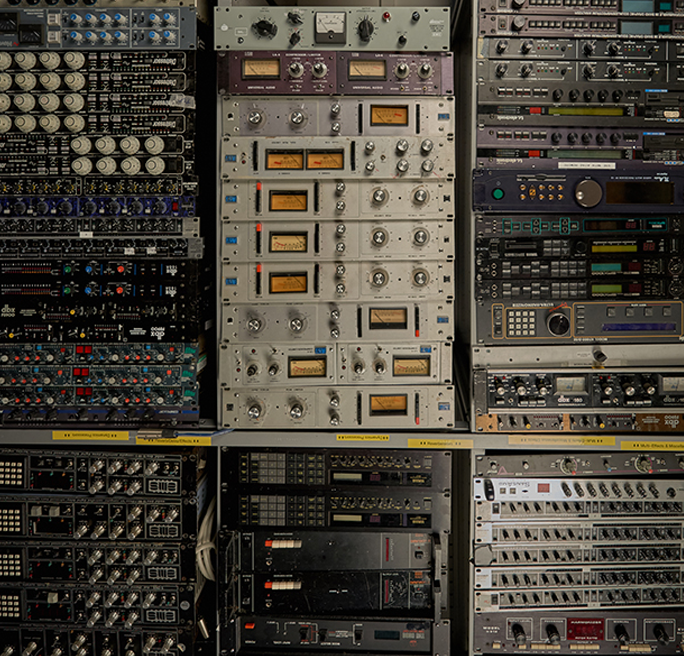
<summary type="xhtml"><![CDATA[In&nbsp;food, wine, perfume,&nbsp;there are experts with senses&nbsp;beyond those of ordinary mortals.&nbsp; In audio, they are called Golden Ears....This is a true story.&nbsp; It really happened this way, no kidding.&nbsp; It started innocently enough in a Bishop's Stortford B&amp;B.&nbsp; B &amp; I arrived downstairs for a full English breakfast. We were seated at a large family dining table next to one other resident.&nbsp; We proceeded to awkwardly ignore each other as one does when forced to join a complete stranger and his eggs.&nbsp; However, I was intrigued.&nbsp; This guy looks like Brian Eno, I thought.&nbsp; This possibility emboldened me to cross the threshold of English reserve and make contact.&nbsp; He was not Brian Eno.&nbsp; (Apologies to Brian Eno - the guy probably looks absolutely nothing like you).&nbsp;&nbsp; But, interestingly, he was an audio mastering engineer who owned his own studio in London not far from where we used to live.We found ourselves discussing the relative merits of the digitally remastered CD version of Pink Floyd's Wish You Were Here versus the original (un-remastered, flat transfer) CD version.&nbsp; I said I preferred the original.&nbsp; This led to a general discussion regarding the improved quality - or lack thereof - of digital remasters in general.&nbsp; Engineer was of the opinion that remasters were almost always inferior to the originals.&nbsp; As it happens, my CD collection contains numerous titles where I have the original version and one or more remastered versions (perks of working in a record company).&nbsp;&nbsp; Engineer thought this a fantastic opportunity to compare original versus remastered versions of classic titles on his hi-end studio mastering equipment and settle the matter once and for all, and he invited us to his studio to do this.Some weeks later B &amp; I arrived at Engineer's studio, CDs in tow.&nbsp; He invited us into his unlit sitting-room via his kitchen whereupon&nbsp;B &amp; I&nbsp;became nervous that perhaps we had entered the lair of an axe murderer.&nbsp; However, Engineer was not and he soon took us outside into his garden (to what was once perhaps a garage) and invited us into his studio.&nbsp; And boy - what a studio.&nbsp;&nbsp; Where to start?&nbsp; First, anything and everything in it, from the electronic equipment to the acoustic treatment of the walls, was the most top-of-the-range, high end, boutique, expensive, niche, military spec gear in the world and must have cost an absolute fortune.&nbsp; Half inch thick titanium dioxide insulated, hyper-core ultra-copper speaker cable with gold plugs that he claimed cost 300GBP a metre.&nbsp; Even the power leads were gold plated (apparently, AC voltage sounds better that way).&nbsp; Six foot high speaker stacks composed of custom separates from the bass cabs through to the platinum, diamond encrusted - or whatever is most expensive - tweeters.&nbsp; Custom desk, massive 1000 watt mono power amps (or was it 10,000 watts? Not sure, whatever it was it was a helluva-lotta-watts).&nbsp; The crossovers alone were the size of large suitcases.Everything was the best of the best.&nbsp; I've been in many top-end studios over the years and seen some pretty hot gear in my time, but I have never seen an audio rig anything like this one.&nbsp; And, I have to admit, the system did sound bloody good.&nbsp; If they made audio equipment pornography magazines this would be not only the centrefold, but playermate of the century.&nbsp; That this audio rig had a fetishist bent to it was something we felt subliminally but couldn't quite put our finger on.&nbsp; But Engineer would help us with where to put our finger. From the start, things got a bit weird.Engineer expounded that any mastering engineer worth his salt required at least this level of equipment quality in order to master audio properly.&nbsp; Anything less and only rancid soil would be created.&nbsp; Further, Engineer continued, he had very sensitive ears and could discern even minute differences in audio quality resulting from the configuration of the various components in the system and requested our indulgence as he performed some setup procedures.&nbsp; First procedure - apparently - was to eliminate the electrostatic fields that collect in front of the speakers (presumably overnight while one is sleeping).&nbsp; These must be dispersed lest the sound be fatally compromised.&nbsp;&nbsp; I'd never heard of such fields before and have obviously been enduring horrible audio fidelity all my life because I have never dispersed the electrostatic fields in front of my speakers.&nbsp; Have you?&nbsp; We are all diminished by our ignorance.However, Engineer is not so diminished.&nbsp; He knows what to do. To disperse these electrostatic fields, Engineer stands a few feet in front of the speakers and proceeds to shimmy his hips and wave his arms in a predefined pattern with great seriousness and solemnity.&nbsp; Engineer admitted that this probably looked a little bit strange but assured us it had profound impact on sound quality.&nbsp; I'll never know about the sound quality, but he was wrong about it looking a little bit strange - it looked very strange and B &amp; I caught each other checking out the proximity of exit.&nbsp; If your mastering engineer started belly dancing in front of his speakers to chase away the evil electrostatic demons what would you do?Next we got a guided tour of his audio equipment complete with the kind of intricate techie detail that men are entranced by and women fall asleep to - you know: make, model, sample rate, contortion zone, influx perturbation regurgitation level...that sort of thing.&nbsp; Even for me - and I like gear - it was way too much.&nbsp; B secretly held my hand trying to avoid slipping into torpor.&nbsp; A few interesting details though.&nbsp; Engineer had ripped his CD player apart, removing the cover to leave the guts exposed, guts which had all been painted florescent green.&nbsp; This improves the laser tracking he tells us.&nbsp; OK - perhaps I'll buy this idea when applied to the edges of the CD, or maybe even around the laser casing or some such - but the outer walls of the case?&nbsp; Methinks this is straying into finger-circling-the-temple-land.&nbsp; (Long ago I bought one of those green pens and applied it to the edge of Extreme's Pornograffiti CD.&nbsp; I can't say Nuno Bettencourt sounded any different.&nbsp; But hey, I guess I don't have golden ears.&nbsp; In any case, too much trouble - I haven't used it since.)Finally we sit down to listen to music.&nbsp; This was actually interesting.&nbsp; Engineer was consistent in that he found almost none of the remastered versions were as good as the originals.&nbsp; I was less consistent.&nbsp; My assessment of the Pink Floyd was reaffirmed - the original was better.&nbsp; However, I also came to the same opinion regarding the original of Jethro Tull's Thick as a Brick (admittedly under Engineer's unremitting persuasion).&nbsp; I found this surprising since when listening at home I had found the remaster a significant improvement over the original.&nbsp; What happened?&nbsp; Were my ears lying to me at home?&nbsp; When I got back home I replayed Brick on my hi-fi system - which, by the way, is no slouch, I assure you - and was confounded by the fact that on my system the remaster was clearly, significantly better than the original. (Lucky for me.&nbsp; I later discovered that the remaster was by none other than Abbey Road's Peter Mew who would have had stern words for my suggesting his remaster inferior to some dumb flat transfer. Remastering engineers have pride you know.)This raised a significant question for me regarding assessing audio quality.&nbsp; Does a particular version sound better than another depending on what equipment it is played on?&nbsp; In other words: did the original version of Brick really sound better than the remaster, but only when played on a Ferrari of a sound system?&nbsp; And thus, since most of us lack such gear at home, should we therefore opt for the remaster which sounds better on more pedestrian equipment?&nbsp; If so, perhaps there should be an advice label on the original CD: "only play on kick-ass hi-fi".&nbsp; And on the remaster:&nbsp; "suitable for crap mini systems".&nbsp; It raises a further question which, I discovered, is a matter of some debate among mastering engineers.&nbsp; This is the question of what kind of acoustic environment one should master in:&nbsp; an artificial, but ultra-accurate environment - which few listeners will ever have access to - or one that is similar to the environment that the audio will most usually be experienced in?&nbsp; Motown engineers always checked the music on a pair of small, cheap speakers to ensure it would sound good in cars and on transistor radios.&nbsp; What is the point of expending so much energy aspiring to sonic purity when you know that most audio systems aren't capable of reproducing it properly?&nbsp; Perhaps this is actually depriving the majority of listeners a better sonic experience based on their equipment.Since of taste there is no dispute, we all agreed - or agreed to disagree - as to which we preferred.&nbsp; Without question, the original and remastered versions were different and usually pretty obviously so.&nbsp;&nbsp; Ah, but when it comes to ears there is merely golden and then there is ultra-golden.&nbsp; Engineer's ears were far too golden to merely arbitrate between different mastering versions.&nbsp; The accuracy of Engineer's ears was the equivalent of shooting a fly between the eyes with a slingshot from 100 miles away.&nbsp; And he would prove that to us.&nbsp; It was time to demonstrate the puck.Next week:&nbsp; Golden Ears: The PuckBlog by Wayne Shevlin25 July 2008Image: The Mad Tea Party -&nbsp; Sir John Tenniel]]></summary>
  </entry><entry>
<title><![CDATA[The Abbey Road quiz]]></title>
<link href="http://www.abbeyroad.co.uk/news/blog/entry/?blogid=26"/>
<id>http://www.abbeyroad.co.uk/news/blog/entry/?blogid=26</id>
<updated>2008-07-26T17:42:24+01:00</updated>
<summary type="xhtml"><![CDATA[Last Wednesday saw the return of the legendary Abbey Road Quiz packed with teams from a varied selection of music companies including new additions 4AD, Domino Records and Bella Union. One of these teams would not only wrest the Winners Trophy which has been sitting on my desk for the last couple of months (my team being the current holders) from my grasp, but also went on to win most of the star raffle prizes!&nbsp;The night itself followed it's usual pattern with Steve our most excellent quizmaster and his glamorous assistant, Paula taking charge and getting the quiz underway by 7.30pm. I love the way Steve keeps any rowdy behaviour under control, not an easy task with such competitive elements in the room. Raffle tickets were sold, this time round the proceeds going to a charity Dan from Domino Records supports called Gifts' which provides support in a number of ways to patients suffering with life-threatening diseases. (http://www.giftshospice.org/index.html). Thanks to L'Aventure (delicious French restaurant) and Pizza Express, two of our local restaurants for contributing free meals for two to the raffle.&nbsp;Couldn't believe that we played our joker on the General Knowledge round only answering a pathetic 6 questions correctly (10 outta 10 at the previous quiz)! After the 1st round we were in second place, things getting steadily worse with our team falling further and further down the points table. Not only did we lose the Winners Trophy, we ended up out of the top three! &nbsp;Congratulations to the worthy winners, 4AD who pulled out their joker in the last round on music and came out on top after being in 4th place for most of the quiz. Hope to see you back for the next quiz in a couple of months time, we'll be ready for you! &nbsp;]]></summary>
  </entry><entry>
<title><![CDATA[Century of Spinning Plastic Discs]]></title>
<link href="http://www.abbeyroad.co.uk/news/blog/entry/?blogid=25"/>
<id>http://www.abbeyroad.co.uk/news/blog/entry/?blogid=25</id>
<updated>2008-07-26T17:42:24+01:00</updated>
<summary type="xhtml"><![CDATA[Opening salvo of the 21st century: announcing the end of the copy economy - sunset on the century of spinning plastic discs.&nbsp; The Byrds once advised aspiring rock n' roll stars: "Sell your soul to the company, who are waiting there to sell plastic-ware".&nbsp; The goal was crystal clear: multi-platinum.&nbsp; "The name of the game, boy - we call it riding the gravy train". That meant millions of copies. Copies of plastic discs.&nbsp; Plastic discs that must be pressed, be warehoused, be shipped, unpacked &amp; racked, sold and be played.&nbsp; Millions upon millions of plastic discs - they formed the basis of my personal existence and shaped the culture of my generation for many decades.&nbsp; They were also the foundation of entire industry.&nbsp; An industry based on the unquestioned premise that copies had value.&nbsp; And now they don't.Running a record section in late 1970s New York City we knew all these plastic discs by their catalogue numbers - it was a matter of pride:&nbsp; Billy Joel's The Stranger, the first Boston album, Frampton Comes Alive and the Saturday Night Fever soundtrack.&nbsp; You may wrinkle your nose, but these were monsters.&nbsp; They arrived by the truckload.&nbsp; The boxes lined the walls and filled every available corner of the shop.&nbsp; We ran out of room.&nbsp; I threw my back out lifting them all.&nbsp; Records had weight, let me tell you.&nbsp; When an album hit it big, you knew about it - physically.&nbsp; Queues stretched out the door and around the block.&nbsp; In the surreal rush of a hot new release we were the shamans. We had the mojo everyone was desperate for.&nbsp; We had gravitas and impact because we were the source - the only source - of the plastic discs.&nbsp; You could see the sense of awe in peoples' faces as they held the latest big&nbsp;album in their hands for the first time.&nbsp; We felt real pride in getting the hot new music to the people.&nbsp; My father queued up at midnight for the release of The Beatles White Album.&nbsp; And now, strange as it seems, these once ubiquitous plastic discs are now nothing more than the artefacts of a bygone culture - mine.&nbsp; They are now relegated to curios that might be dug up by an archaeologist.&nbsp; Once upon a time, in a place far away, these things really mattered.&nbsp; How sweet.&nbsp; How sad.Once, a serious music collection made a design statement: ceiling high spines of vinyl LP album sleeves replacing the need for wallpaper.&nbsp; Alan P's entire flat was wall to wall coloured cardboard in milk crates.&nbsp; Nowadays, this personal statement of his intense commitment to music would fit in his shirt pocket.&nbsp; Kind of loses its impact.&nbsp; Hard to point at it with pride and impress your date by saying "that's mine".&nbsp; (Probably didn't impress your date back then either, but we always hoped for the best.)&nbsp;&nbsp;A thousand vinyl albums against a wall had gravitas.&nbsp; Sharing your space with them proved that you really cared.&nbsp; It said something about you personally. &nbsp;Vinyl was superseded by the CD - the new, modern plastic disc.&nbsp; The CD heralded a new age and an extraordinary renaissance where, for over a decade,&nbsp; music spanning the entire 20th century was dusted off and given a new lease on life.&nbsp; New music continued to be created and thrive while, simultaneously, three older generations re-purchased the music of their youth.&nbsp; I kept an eagle-eye out for ?ber-niche artists, waiting for them to make their way to the top of the re-issue schedule: Morton Subotnick's Silver Apples of the Moon, Passport's Cross Collateral, Gentle Giant's In a Glass House, and hundreds of others equally obscure. And they all appeared eventually. And then, when the concept of re-mastering became the rage, we waited and bought many of them all again.&nbsp; How many industries can convince their customers to buy the same thing three times in this way?&nbsp; The 90s music industry wallowed in sheer mania of it all.&nbsp; Boy - that was a gravy train.&nbsp; And now it's over.&nbsp; And it won't happen again.&nbsp; It won't happen again because the CD was not just another kind of plastic disc like the 78, the 45 and the LP before it.&nbsp; The CD was - as it turned out - a Trojan horse.&nbsp; The CD had - hidden within its friendly, familiar plastic disc persona - the razor sharp teeth of digital bits.&nbsp; Shiny and round, it masked the truth about itself.&nbsp; It was not just a copy.&nbsp; It was a clone. What it contained could be set free from the plastic, every bit as good as the bits that originally made it - the music was not bound to the media. The CD put a digital production-master of its content into the hands of anyone who held it.&nbsp; Ironically, its very power made it valueless.&nbsp; The media was no longer the message.&nbsp; The media was superfluous and the copy had no value.&nbsp; If CD began the process, then the online digital file completed it: from media is the message to media superfluous to media non-existent.&nbsp; MP3 killed the value of the copy and signalled the death of the artefact.&nbsp;&nbsp; &nbsp;Are artefacts important at all to this new generation?&nbsp; For these digital natives, is there any value in stuff - or does mere access to content trump ownership?&nbsp; Music is now just bits in the ether.&nbsp; A 60GB MP3 player may contain the same content, but it is not the equivalent of Alan P's ceiling high wall of vinyl.&nbsp; How do we now show our intense, personal commitment to music?&nbsp; Do we have one?&nbsp;&nbsp; Somewhere we lost the gravitas.&nbsp; We lost the mojo.&nbsp; We lost the love of the artefacts.&nbsp;&nbsp; Spinning plastic discs: they're so 20th century, really.&nbsp;&nbsp; Blog by Wayne Shevlin18&nbsp;July 2008Image:&nbsp; Viktor Vasnetsov - Grave-digger (1848 modified by WS) - Public Domain&nbsp;&nbsp;&nbsp;&nbsp;&nbsp;&nbsp; &nbsp;]]></summary>
  </entry><entry>
<title><![CDATA[Music & Youth]]></title>
<link href="http://www.abbeyroad.co.uk/news/blog/entry/?blogid=24"/>
<id>http://www.abbeyroad.co.uk/news/blog/entry/?blogid=24</id>
<updated>2008-07-26T17:42:24+01:00</updated>
<summary type="xhtml"><![CDATA[Reflections on music and identity, sonic brutality and memories of the Nightbird...As a teenager growing up in NYC during the 60s &amp; 70s, music was one of the most, if not the most, significant expressions of culture and identity for me and my friends.&nbsp; More than clothes, film, sport or anything else.&nbsp; The music you listened to defined who you were: your values, aspirations, politics, lifestyle and dreams.&nbsp; It went much deeper than merely group or brand identity, more complicated than just being a mod, or a rocker or liking Disco.&nbsp; (However, let's make one thing clear:&nbsp; liking Disco was a crime beyond understanding - worse than tuberculosis.&nbsp; Disco sucked.&nbsp; People who liked Disco were other - superficial plastic aliens...horrible, just horrible.&nbsp; We couldn't bear to think on it.&nbsp; Of course, now, I appreciate the brilliance of Chic and am happy to Freak Out - if my slipped disc will let me.&nbsp; But I digress...)&nbsp;&nbsp; Music was an important method of communication and the context for defining our relationships.&nbsp; I remember Chris, the stoner guy, desperately trying to convince me to listen to Pink Floyd.&nbsp; That was a hard job.&nbsp;&nbsp; I was afraid of Pink Floyd.&nbsp; Afraid that they might be too strange and that their strangeness might irretrievably pollute my musical soul.&nbsp; You couldn't un-listen something.&nbsp; Once you heard it, it was too late.&nbsp; The demon was out and you would have to live with it forever.&nbsp; As far as I was concerned, people who listened to Pink Floyd all smoked dope.&nbsp; Listening to Pink Floyd might be the slippery slope to full blown heroin addiction.&nbsp; (Eventually I would listen to Pink Floyd, and Wish You Were Here would become a lifelong friend and, I am happy to report, I did not wind up on skid-row with a needle in my arm either.)&nbsp; One night, seven of us gathered in Doug B's room to hear together for the first time the debut album from some otherworldly English band called Black Sabbath. We sat around in a semi circle on the floor in front of Doug B's stereo.&nbsp; Doug solemnly lowered the tone-arm onto the record.&nbsp; And we waited.&nbsp; The opening rain and peels of thunder clued us in that this was no ordinary record and this would be no ordinary night.&nbsp; Then the pounding sledgehammer crunge of Tony Iommi's power-chord tri-tones shook our bones.&nbsp; As I would later learn, those notes are called the interval of the Devil, considered blasphemy by the mediaeval church and worth negative points on your Harmony &amp; Counterpoint exam - so, no accident Tony chose those then. Then, in sleazes Ozzy's malevolent, malignant shred of a voice:&nbsp; "What is this that stands before me? Oh no, no, no - please God help me!!"&nbsp; Well.&nbsp; That was that. We were transfixed.&nbsp; No one said a word.&nbsp; Silence as Doug got up to turn it over to side two. Just a night of good, clean, healthy fun and, no, we didn't turn into Satanists.&nbsp;&nbsp;&nbsp; There was mostly pop music on AM radio.&nbsp; But late night FM radio was something else. It had cache - a resonance that spoke to the more adventurous and enlightened music aficionado.&nbsp; Like us.&nbsp; And no FM show was more arty and progressive than Alison Steele the Nightbird.&nbsp; Her sultry voice purred "...Come fly with me, Alison Steele the Nightbird at WNEW-FM - until dawn".&nbsp; Sometimes I listened till dawn.&nbsp; Alison played the latest, most progressive, spacey, way-out stuff: album tracks - and sometimes whole albums.&nbsp; She introduced me to King Crimson's 21st Century Schizoid Man, the most disturbing, brutal piece of music I'd ever heard.&nbsp; I was shocked, bewildered and in awe.&nbsp; What the hell was that?&nbsp; I wish that a piece of music could have that kind of impact on me now.&nbsp; Had to run out and get it the next day, get the friends around and turn them on to your latest discovery.&nbsp; "Check this out man - caught it on the Nightbird last night".&nbsp; Some didn't pass muster. No matter how hard Doug B tried, we just couldn't get our heads around the Moody Blues' Days of Future Passed.&nbsp; I mean, it had an orchestra on it for crying out loud.&nbsp; That's not what we called Rock.&nbsp;&nbsp; So, how do we now share our relationship with music with others?&nbsp; How does music speak to us and about us?&nbsp; I watch today's teenagers sharing the latest hot track over the loudspeaker of their mobile phone, or sharing an earphone so each can listen to one channel of a stereo track.&nbsp; Ironically, in this age of Hi-Def, music is appreciated by the hip culture with a sound quality inferior to that of a 1960's transistor radio. Clearly shared culture does not require hi fidelity.&nbsp; But sharing hi fidelity wasn't always the key issue back in NYC either.&nbsp; Certainly not for the cool, rude dude swaggering down Broadway with a ghetto blaster the size of a refrigerator perched on his shoulder, blasting out a bass so distorted that speaker shreds flew in your ears.&nbsp; In addition to personal expression, music has always been a novel weapon to carve out personal territory in a public space.&nbsp; The tinny twizzle of earphones buzzing through the Tube roar is certainly annoying and can set one's teeth grating, but it lacks the aggression and emotional disruption of a righteous boom-box used in anger.&nbsp; There are many things and ways to communicate.&nbsp; The ghetto-blaster made it clear. You were staking your claim on the space surrounding you.&nbsp; The ear-bud announces that you are hiding from the surrounding space in your own world.&nbsp;&nbsp; Quite opposite things really.Music is everywhere.&nbsp; Music is everywhere, so people must want it.&nbsp; And, of course, music is everywhere whether people want it or not.&nbsp; Are we actually listening or just wandering through a sonic soup of aural wallpaper (and cheesy wallpaper at that)? Many of us are actually desperately trying to tune out.&nbsp; Nowadays music is inescapable. High voltage techno pumping up the volume in the sports shop.&nbsp; Vivaldi repelling hoodies at the Tube Station ("The Four Seasons AGAIN - Oh, no, no, no please God help me!"). Muzac treating us like suburban zombies in the mall.&nbsp; Computerised classical torturing us in the phone queue.&nbsp; The endless parade of the same rock &amp; pop "classics" aimed at my generation (who unfortunately did not - contrary to Roger Daltry's exhortations - die before we got old).&nbsp; I look in vain for the juke box where a coin will buy five minutes of silence.What is all this music communicating?&nbsp; Who is sharing what with whom and why? I would suggest that sharing requires a two-way agreement between the sharer and the share-ee.&nbsp;&nbsp; Far from deliberately and straightforwardly engaging our aesthetic sensibilities, much use of music these days is aimed at subliminally manipulating our emotions:&nbsp; to keep us in longer, to get us out faster or create an ambience that suits some ulterior purpose.&nbsp; We are not expected to listen.&nbsp; Music is not the point, it is a tool.&nbsp; Music's current ubiquity is devaluing something that is actually quite precious.&nbsp;&nbsp; This inflicted ubiquity is why so many believe that not only is music free, but it deserves to be.I hope that today's teenagers can still find a context for music to form part of a cultural identity as is it did for us.&nbsp; Not for any po-faced, self-righteous nostalgic principle - "now listen here sonny, when I was your age we had real music..."&nbsp; I am not my grandfather.&nbsp; And I also accept that many other pastimes such as the internet, video and computer games compete for leisure time - and money - but I would argue they are not in the same category as music.&nbsp; Music is a fundamental aspect of human society.&nbsp; It exists - or is explicitly prohibited - in all cultures worldwide and throughout history.&nbsp; Music is created for many different reasons and motives but humans have always made music of one sort or another unless actively prevented from doing so by the thought police.&nbsp; It is part of human nature and our brains are amazingly custom-wired for it.&nbsp; When we listen, music reaches many parts of our brains that others do not reach.&nbsp; And we can say things about ourselves through music - even someone else's music - that can be expressed no other way.&nbsp; That music can - and, for me, did - form such an important part of growing up is no accident.&nbsp; It is something to be protected for future generations.&nbsp;&nbsp;&nbsp;&nbsp; Blog by Wayne Shevlin11 July 2008]]></summary>
  </entry><entry>
<title><![CDATA[A Midsummer Night's Dream - a short surmise of Goldfrapp at the Royal Albert Hall]]></title>
<link href="http://www.abbeyroad.co.uk/news/blog/entry/?blogid=23"/>
<id>http://www.abbeyroad.co.uk/news/blog/entry/?blogid=23</id>
<updated>2008-07-26T17:42:24+01:00</updated>
<summary type="xhtml"><![CDATA[The atmosphere... a good bottle of wine and a great view of the stage in the opulent setting of a packed Royal Albert Hall had the makings of a fabulous live music experience.The evening... known for live theatrics Goldfrapp did not disappoint. Alison Goldfrapp and menagerie were performance personified. Her voice is truly amazing.The band... included a full string section, harps (we're not sure these were actually played but a lady in a pagan esque flowing white dress certainly looked the part), an especially excitable violinist, two guitarists (one of which was very aesthetically pleasing) and a choir. The dancers... something for everyone, from the random honey monster come yeti jumpy up and down dancers covered in tissue paper which I absolutely loved to the writhing bikini clad wolves. Latter of which can be seen all over YouTube.The set... it was a mixture of albums including a good few highlights from 'Seventh Tree'.&nbsp; 'Ooh La La' got everyone excited and on their feet, a short yet frenzied dance was a surprising part of the evening.The highlight... a lengthy version of 'Little Bird' was all kinds of wonderful. The performance... a midsummer night's dream... extraordinary, ever changing, electric, moody, operatic, haunting, glam, disco, dazzling.&nbsp;Photo credited to Greenwich Photography]]></summary>
  </entry><entry>
<title><![CDATA[Crunch Chords & Wheedley-Woo - Part 2 ]]></title>
<link href="http://www.abbeyroad.co.uk/news/blog/entry/?blogid=22"/>
<id>http://www.abbeyroad.co.uk/news/blog/entry/?blogid=22</id>
<updated>2008-07-26T17:42:24+01:00</updated>
<summary type="xhtml"><![CDATA[Heavy Rock is a genre populated by musicians with a particular brand of testosterone.&nbsp; Come on, let's face it, heavy rock is - and should be - played by males (and females like it that way too). But these are a unique breed of males.&nbsp; They are either boys who aspire to be men or men who aspire to be boys (and thus, by extrapolation, boys who aspire to be men who aspire to be boys - and vice versa).&nbsp; You can smell it 200 meters away:&nbsp; the arrogance, the pouting, preening, posturing, pomposity and promenading of these glorious peacocks as they strut their stuff down the catwalk to the mosh-pit platform to show off their prowess and bask in the adulation of their acolytes.&nbsp; There, in the hot glare of the spotlight they pose, wrestling with their demon instruments - the pain, the intensity, the grimaces as they squeeze, with all their might, every last ounce of unbearable angst from each note - before sauntering back with a swagger to their official position on the main stage.&nbsp; I am swept up in the impossible, implausible seriousness of it - as though the future existence of the entire world depended on the next power chord.&nbsp; And for the next few hours in the arena, it does. A heavy Rock concert must, by definition, be absolutely over-the-top to be any good.&nbsp; That's the beauty of it all:&nbsp; that this cultural ritual - which, objectively, has such an incredibly high absurdity quotient - can lift my spirits so high by the very fact that it so unashamedly promulgates the delusion of its own self importance.&nbsp; This is reinforced by the profusion of rock songs that are about rock itself: Rock of Ages, Rocket, Let's Get Rocked, Rock! Rock! (till you drop) - Rock On.&nbsp; Self obsessed perhaps, but these Rock songs about Rock at least offer a brief respite from the predominant subject of Heavy Rock songs which is: what these men-boys would like to do with girls (not women - women are generally not mentioned in Rock unless they are American or Devil).&nbsp; Indeed, what to do with girls is a subject generally explored in great, crude detail with much allusion and double-entendre but little elegance, empathy or sentimentality.&nbsp; Luckily, nobody cares about lyrics so it doesn't really matter.&nbsp; Women happily sing along with what are, objectively, some pretty dubious assertions that would have you visited by the thought police were you to say them out loud at a bus stop. Heavy Rock has its rules, its rituals, conventions and stylistic requirements that are every bit as defined as a late night jazz session, an opera or a religious service.&nbsp; There is the melodramatic incidental music in the dark as the band takes the stage, the opening hard number - preferably a well known hit - the lead singer's opening salutation "Hello London!" - "Yeahh!!" - "Are you feelin' alright?!" - "YEEAhhh" - "Are you ready to ROCK!" - "YEAAHHHH!!!" - "I CAN'T HEAR YOU!!!!" - pandemonium.... Lead singer launches off into next song, performing a never ending walkabout circuit of the stage and catwalk, ensuring that he makes visual contact with every point within the arena, as though he's really seeing you personally.&nbsp; He waves at the stalls and twirls his microphone stand.&nbsp; Guitarists and bassist make continuing pointless excursions stalking, stomping, running and skipping back and forth across the stage, every once in a while diverting to wander up the catwalk - perhaps to make sure it's still there.&nbsp; It always is.Lights flash.&nbsp; Guitarists meet up in the middle, face to face, guitar to guitar to perform some strange, mutual rite of passage: male bonding via guitar lick - the wheedley-woo dual.&nbsp; The bassist scales the drum riser to bond with the drummer as the "rhythm section", on-stage monitors are used as foot stools, lead-vocalist leads the pantomime call-and-response to the crowd, holding out his microphone to signal that it's the audience's turn to sing the chorus (which by the way I still find incredibly moving.&nbsp; The ability of an arena audience to sing not only in tune, but with feeling, never ceases to amaze me - even if the line is "Let's get, let's get ROCKED!").&nbsp; Perhaps the Snake and Leppard are grizzly veterans of the metal wars, but the show was opened by Kentucky youngsters Black Stone Cherry (proudly proclaiming that the oldest member is only 23) who deliver up a thrashy grunge of post Alice In Chains with a message of peace and love buried in there somewhere.&nbsp; I thought they were absolutely adorable.&nbsp; Think of the Wayne's World Bohemian Rhapsody scene and you get the gist.&nbsp; Bent at a 90 degree angle from the waist, heads down, two-foot long hair swashing like a L`Oreal commercial (they are worth it), the guitarist and bassist perform a ballet of synchronised head-banging with the cliche knob set to eleven.&nbsp; Cliches?&nbsp; We got them all: postured solos, twirling drum sticks, a full-throttle rendition of Hendrix's Voodoo Chile' (Slight Return) complete with guitars played behind the back &amp; with teeth.&nbsp; The only thing missing was the lighter fuel - but health &amp; safety don't allow that sort of thing anymore.But then the old boys come on - the behemoths celebrating thirty years of playing Rock. "And what's wrong with that?" asks David Coverdale.&nbsp; Indeed.&nbsp; I won't go into the details of exactly how any particular late-middle-aged lead singer might look wiggling his hips at the audience - presumably thinking he looks seductive, but perhaps more akin to a penguin attempting the hula-hula.&nbsp; Nor will I complain that there were definitely some "issues" with lead vocalists hitting some of the high notes (audience participation came in particularly useful this night).&nbsp; This is by-the-by and misses the point.&nbsp;&nbsp; The point is:&nbsp;&nbsp; These guys are real professionals.&nbsp; Man, can they play.&nbsp; Thirty years ago, when they started out, live rock concerts were a decidedly more ropey affair - feedback, awkward gaps between songs, guitars out of tune, appalling harmonies.&nbsp; No more.&nbsp; They are slick.&nbsp; All musicians to a man are absolutely top-drawer.&nbsp; They grimace and dig deep, fingers flying franticly like a shoal of piranhas feasting on a cow.&nbsp; But no matter how technically blinding they are, I am positive that they can easily play any of those impossible parts and read the morning paper at the same time.&nbsp; They are professional performers and they know exactly what they're doing.&nbsp; I don't know how seriously they take it personally - how much tongue is actually in cheek (I suspect quite a bit actually) - but their on-stage persona is absolutely rock-solid for REAL.&nbsp; They are believable. I believe in spite of my organic cynicism. And, whatever their position as role models for youth, they certainly have one for me.&nbsp; The fact is:&nbsp; I wish I could do it.&nbsp; I wish I had the energy to even want to do it.&nbsp; Once upon a time I did sort of do it - more or less.&nbsp; I had aspirations to be one of them.&nbsp; Whatever their short comings, I must face my own demons.&nbsp; These guys are my age and they can do it.&nbsp; And they leave no excuses. That buff guitar player is only 9 years younger than I am, strutting shirtless with his long blond hair and toned body with washboard abs (bastard).&nbsp; How lovely that my two female companions - remember, both somewhere in their forties - exuberantly enthuse about how much they wouldn't mind taking him home (thanks gals - that really made my night).&nbsp; But I've got to agree - he is hot, and he plays hot and my only consolation is that he's down there and we're up here in the top row where they can't easily get at him. So there it is.&nbsp; Heavy Rock is many things all at once.&nbsp; It is bombastic.&nbsp; It is ludicrous.&nbsp; It is self obsessed.&nbsp; It is loud.&nbsp; It is 21st century pagan ritual.&nbsp; It is catharsis.&nbsp; It is thrilling.&nbsp; It is 100% professional.&nbsp; And it is art.&nbsp; Yeah - it is ART.&nbsp; But most of all, with the right frame of mind - either that you view it from a wry, ironic, affectionate perspective such as mine or that you actually take it seriously (either is OK) - it is FUN.&nbsp; Yes, fun.&nbsp; At any age.&nbsp; And what's wrong with fun - particularly at my age?&nbsp; Thanks guys.&nbsp; Rock On! Blog by Wayne Shevlin4 July 2008&nbsp;&nbsp;]]></summary>
  </entry><entry>
<title><![CDATA[Live From Abbey Road]]></title>
<link href="http://www.abbeyroad.co.uk/news/blog/entry/?blogid=21"/>
<id>http://www.abbeyroad.co.uk/news/blog/entry/?blogid=21</id>
<updated>2008-07-26T17:42:24+01:00</updated>
<summary type="xhtml"><![CDATA[If you haven't seen our TV show "Live From Abbey Road" yet I would heartily recommend that you do. Season 2 (as our cousins across the Atlantic call it or Series 2 as we Brits prefer) has now started broadcasting all over the world. You can catch it on Channel 4 in the UK and on The Sundance channel in the USA. Check your local listings!The show is shot in HD within Abbey Road Studios and to quote the producers "looks like a movie, sounds like a record" - it's a great piece of work. Because the artists are performing without an audience but within the secure and familiar environment of a recording studio, as opposed to a more impersonal TV studio, they appear to relax and reveal more of themselves than in other music TV shows. I think its even better than the first series - more intimate. And the performances are superb. Watching Herbie Hancock playing with Corinne Bailey Rae was a supreme privilege on its own - and there are more than thirty other artists to choose from as well this series. They have a new website where you can get a proper taster of the new series and full details of the artists who took part: www.livefromabbeyroad.com Enjoy!]]></summary>
  </entry><entry>
<title><![CDATA[Crunch Chords & Wheedley-Woo - Part 1 ]]></title>
<link href="http://www.abbeyroad.co.uk/news/blog/entry/?blogid=20"/>
<id>http://www.abbeyroad.co.uk/news/blog/entry/?blogid=20</id>
<updated>2008-07-26T17:42:25+01:00</updated>
<summary type="xhtml"><![CDATA[The other night I attended a concert at London Wembley Arena featuring "dual" headliners Whitesnake and Def Leppard, both celebrating 30 years of playing Heavy Rock.&nbsp; This is not a review of the gig as such, but rather a reflection on a genre of music generally accorded little respect - and a fair amount of derision - by anyone and everyone other than its fans.&nbsp; I'm here to set the record straight.&nbsp; My perspective is not that of a die-hard fan, but rather of an objective observer with a fondness for it.&nbsp; So take your giggle-goggles off and allow me to introduce you to the glorious experience that is a contemporary Heavy Rock concert.For me Heavy Rock includes various rock styles including: hard rock, heavy metal, grunge, thrash, pop-metal, etc.&nbsp; However, for any style to be a style it must follow some rules and, for me, Heavy Rock must contain two key components: crunch chords and wheedley-woo.&nbsp; Crunch chords are the meat and potatoes of Heavy Rock.&nbsp; The crunch chord is the physical manifestation of the spiritual aspiration of any teenage boy: that you alone, with a single swipe of your hand can deliver thunder.&nbsp; A righteous crunch chord makes you Thor.&nbsp; It contains within it so much metaphor: power, volume, the beauty in distortion.&nbsp; The wheedley-woo is the screaming guitar solo where your self expression is allowed to fly.&nbsp; That this self expression almost invariably consists primarily of frantic arpeggios played in the upper register with such furious intensity that they become a sonic blur detracts nothing from its importance, which is far more about mutually appreciated technical proficiency than musical coherence.&nbsp; The purpose of wheedley-woo is to be thrilling, not necessarily melodically engaging.In addition to crunch chords and wheedley-woo, the other requisites for Heavy Rock are cannon drums, earthquake bass and, of course, screech-sing lead vocals.&nbsp; By default, &nbsp;drums are always close mic'd and we expect that when the snare drum is struck we get, not a thwack, but an explosion - BOOM.&nbsp; A Heavy Rock drummer should always sound like an artillery barrage.&nbsp; The bass should deliver notes almost below the range of human hearing, &nbsp;pumped up so loud that it is not so much a sound as an electro-magnetic force-field ploughing through your body.&nbsp; You don't actually hear the bass, you feel it going through you like the growl of an earthquake (which my LA based sister described as the voice from hell).&nbsp; Finally, there are the lead vocals which require that the singer sing in a register far more appropriate for a castrato and, without slipping into falsetto, push the lyrics out at top volume, transforming the singing into a primal scream - preferably with as little subtlety as possible.&nbsp; Lead vocals should always sound sufficiently histrionic to suppose that the singer is being drawn and quartered right before your eyes - though, of course, as the lyrics will inform you, his only problem is that: a) his baby's left him, b) she hasn't left him or c) he's ROCKIN'.&nbsp; These fundamental qualities of Heavy Rock haven't changed in thirty years with one slight exception on which I'd like to briefly expand: the wheedley-woo.&nbsp; Electric guitar lead solos, originally typified by Hendrix, Clapton and Page, were generally either melodic or lick based and had a strong sense of melodic motion.&nbsp; This was greatly altered by the style of Joe Satriani (and popularised by his&nbsp;protege Eddy Van Halen) who pioneered a unique style of frenetic, scalar based hyper-arpeggio lead playing, incorporating extensive use of the dual handed hammer-on, gymnastic use of the whammy bar and requiring significant technical ability to perform properly.&nbsp; Joe was certainly melodic as well, but it was his musical acrobatics that clearly captured other guitarists' imaginations and they all adopted the million-notes-a-second hammer-on and dive bomb technique as their main sonic palette for solo improvisation.&nbsp; It certainly is impressive when done well (and they all do it well) - but I do miss an emotive melodic line that I could possibly hum in my mind.&nbsp;&nbsp;&nbsp;&nbsp;&nbsp; In an arena, the sound is enormous and whatever quality of sound you personally get can vary dramatically from seat to seat.&nbsp; But regardless of where you sit, mostly it is a huge sonic thump.&nbsp; One isn't really hearing Heavy Rock properly unless one is being bludgeoned by it.&nbsp; And that's as it should be.&nbsp; The purpose of an arena based Hard Rock show is catharsis and for that you need some serious decibels.&nbsp;&nbsp; We are all to be purged of something - it doesn't really matter what - but only mega-sound can do the cleansing.&nbsp; We will all join in the crazy Heavy Rock rituals of pumping the air with our fists, screaming "YEAAHHH!!!" whenever requested to by the lead vocalist, communal singing, shimmy-shaking in the aisles etc and all this requires a suitable level of sonic bombast to make it seem reasonable behaviour and not the mass lunacy that it almost certainly is.&nbsp;&nbsp; As to this lunacy, no age or social group is immune.&nbsp; The audience is filled with dangerous looking, long haired tattooed outlaws. I would be frightened, but many are in their sixties. Where do they live during the day?&nbsp;&nbsp; You never see them except when they come out at night for Heavy Rock concerts,&nbsp; emerging&nbsp;as if by magic from&nbsp;some netherworld.&nbsp; I've made an effort:&nbsp; I'm wearing my Joe Satriani, Surfing With The Alien tee-shirt.&nbsp; However, there are plenty of the "youf" generation here as well, so this is clearly not just oldy-mouldy music for the rusty crusties.&nbsp; Suburban mums bring their teenage sons who, unbelievably, know the words to the Whitesnake songs.&nbsp; I attend with two female companions, both somewhere in their forties, one of whom spends almost the entire evening on her feet shakin' her thang with utter, unabashed, unrepentant abandon (putting most of the girls half her age to shame). Suburban mum looks on enviously - I'll bet she wishes she'd left the kids home so she could boogie down too.&nbsp; Grey hair and denim - not exactly what the rebel without a cause really had in mind.&nbsp; What are we rebelling against?&nbsp; I haven't a clue - but whatever it is, the only way you can really do it right is&nbsp;by Rockin'.&nbsp; Blog by Wayne Shevlin30&nbsp;June 2008]]></summary>
  </entry><entry>
<title><![CDATA[A Whisper That Roars]]></title>
<link href="http://www.abbeyroad.co.uk/news/blog/entry/?blogid=15"/>
<id>http://www.abbeyroad.co.uk/news/blog/entry/?blogid=15</id>
<updated>2008-07-26T17:42:25+01:00</updated>
<summary type="xhtml"><![CDATA[I'd like to celebrate the microphone and the revolutionary impact it has had on music.&nbsp; As technology, the microphone is a marvel: converting into electricity the invisible, minute air pressure waves - what we in our mind's ear perceive as sound - so that the very essence of sound can be captured and AMPLIFIED.&nbsp;&nbsp; Yet, however fascinating the technology, history and development of the microphone; however crucial its role in the very existence of audio recording, these are not the aspects I want to explore here.&nbsp; What I am interested in is the fundamental way in which the microphone has changed music in artistry, aesthetics and style.&nbsp; In the beginning, the microphone was used merely as an extension of the ear.&nbsp; It was placed where an ear would normally be, essentially hearing on the ear's behalf.&nbsp; But soon, microphones became pioneers, exploring sonic landscapes - going where ears could not go, capturing sound from unusual perspectives and contexts.&nbsp; From these unique vantage points the microphone creates new sounds and new ways of hearing sound.&nbsp; It allows unnatural sonic relationships to exist.&nbsp; With a microphone, the most delicately quiet sound can be highlighted, isolated and elevated to soar above the loudest cacophony.&nbsp;&nbsp; The microphone allows a whisper to roar.Without the microphone, naturally quiet sounds require turning down the volume of the surrounding soundscape to be heard.&nbsp; This directly affected the way music was composed prior to its invention.&nbsp; In a Mozart flute concerto, the orchestra must lower its volume when the flute plays lest the flute be drowned out.&nbsp; Mozart deliberately arranges the instruments so that the flute will be heard.&nbsp; Perhaps the brass cease playing and the violins go pizzicato - maybe it's a good time for a harpsichord accompaniment.&nbsp; Flute themes in classical music are seldom set against a thunderous accompaniment because the physics are simply against it.&nbsp; Even on one leg, Ian Anderson suffers no such impediment because he plays his flute through a microphone.&nbsp; His lone flute can soar above the bludgeoning onslaught of 120 decibels of electric guitars and drums (which are also amplified using microphones with a resulting change in musical impact).&nbsp; With a microphone, Ian Anderson can write music for flute, not as a sweet sound set against light accompaniment, but as a screaming banshee wailing through a maelstrom.&nbsp; The microphone gives his flute a new character, elevates its sonic relationship with the rest of the band and he writes a different style of music as a result.Singing has been even more profoundly impacted by the microphone.&nbsp; In the past, when the fat lady sang, she was attempting to reach the upper stalls of the opera house on the strength of her natural vocal power alone.&nbsp; This requires a style of singing that, by necessity, must have a high degree of concern for projection.&nbsp; That's why opera singers sing that way: larynx wide open, deep from the diaphragm.&nbsp; They need to reach the gallery.&nbsp; Power, volume, projection: to be heard above the orchestra (which, must still tone down) - these are the key qualities for opera singing.&nbsp; And the operatic style reflects this.&nbsp; It is instantly recognisable. Nuance and delicacy are, to a great extent, sacrificed for power and volume. And before a clutch of opera buffs huff and puff that, "damn it, opera is full of nuance and delicacy", please consider the singing style of Billie Holiday.&nbsp; That's the kind of delicacy I'm talking about:&nbsp; a whisper - a vocal teardrop - a sigh that shimmers above the hot brass.&nbsp;&nbsp; The microphone allows the most intimate vocal style - normally only appropriate for the smallest of spaces - to fill the grandest hall.&nbsp;&nbsp;&nbsp; When a mother sings a whispered lullaby in her baby's ear, it has a particular sonic impact.&nbsp; The relationship between the sound and the baby - the distance between mother's mouth and baby's ear - is natural and appropriate.&nbsp; Filling Wembley Arena with exactly the same sound, but at the volume of a jet engine, changes the sonic impact on the listener and the meaning of the lullaby. The medium is the message.&nbsp; A whisper heard as a roar acquires new meaning - and becomes a new kind of music.The microphone creates an unnatural relationship between the listener and the original source of sound. If the microphone is considered an extension of the listener's ear then it is worth noting that the microphone may be less than an inch from the singer's mouth and captures the nuance of the voice in that aural space.&nbsp; Sound is air pressure waves in motion and the sound emanating immediately from a singer's mouth is high pressure indeed.&nbsp; Other than babies listening to their mothers' lullabies, we do not typically listen to singers at such a close proximity.&nbsp; Singers are aware of the unnatural relationship between their voices and the listener and have developed specific techniques to avoid - and take advantage of - the sonic peculiarities resulting from, effectively, placing the listener's ear directly in front of their mouths.&nbsp; Good singers play their microphones like an instrument.&nbsp; They take advantage of the increased bass when the microphone is close but avoid sibilance (ssssssss's). They use the detail the microphone captures for dramatic effect.&nbsp; They vary the distance of the microphone from their mouth to achieve consistency in volume - so that belting out the chorus and humming the softest verse are equally loud.&nbsp; The microphone has created a new style of singing that is as demanding and specific as that of the opera singer, but completely different in perspective and technique.&nbsp;&nbsp;&nbsp;&nbsp;&nbsp; A sonic impossibility that we have all come to take for granted is the sound of the drum set.&nbsp; Today, drums are routinely amplified by placing microphones directly against cymbals and inside the drums.&nbsp; Though these are mixed to create a holistic drum set, nonetheless the actual sound is completely artificial.&nbsp; We do not normally listen to drums by simultaneously sticking our heads directly next to the crash cymbal and inside the bass drum.&nbsp; However, nowadays, this is what we expect drums to sound like.&nbsp; A drum set mic-ed as we would normally listen with ears - at least 10 feet in front - would sound empty and hollow.&nbsp; Without the artificial mic-ing technique, heavy metal would simply not have the requisite weight to satisfy the righteous head banger.&nbsp;&nbsp;&nbsp; Music has always been a reflection of and an adaptation to the available sound producing technology of the time.&nbsp; The evolution of musical instruments from hollow logs to brass tubes to digital synthesisers has, on the one hand, been a response to the needs of musicians and yet, on the other, has set the limitations on the sounds they could create.&nbsp; This, in turn, defines the style of music created.&nbsp; This is a quality not generally associated with the microphone; that it is not merely a passive receiver, but creates sound as much as does a saxophone; that it has changed the course and style of music.&nbsp; That it is an instrument in its own right. Image - Copyright EMI Records - Courtesy EMI Archive Trust]]></summary>
  </entry><entry>
<title><![CDATA[Come to Abbey Road and we won't destroy your new car before you collect it]]></title>
<link href="http://www.abbeyroad.co.uk/news/blog/entry/?blogid=14"/>
<id>http://www.abbeyroad.co.uk/news/blog/entry/?blogid=14</id>
<updated>2008-07-26T17:42:25+01:00</updated>
<summary type="xhtml"><![CDATA[So you go out and buy yourself a brand new carThe salesman says, "we've put some cigarette burns in the seats and scratched the paintwork for You"You go home, spend the next 30 minutes putting dents in the bodywork, and now its ready to goStrange?This is how the sale of CDs and digital music has worked for the past 10 yearsGreat recordings, are, with few exceptions, compressed and distorted before being put on CD (usually at the request of the artist and/or producer/A&amp;R person)And then compressed and distorted again for digital download or by the public themselves ripping the CDsWhat price quality in the music industry]]></summary>
  </entry> 

</feed>