<?xml version="1.0" encoding="UTF-8"?>
<feed xml:lang="en-US" xmlns="http://www.w3.org/2005/Atom" xmlns:opensearch="http://a9.com/-/spec/opensearch/1.1/" xmlns:s="http://jadedpixel.com/-/spec/shopify">
  <id>https://abundantearthfiber.com/blogs/fiber-love.atom</id>
  <link rel="alternate" type="text/html" href="https://abundantearthfiber.com/blogs/fiber-love"/>
  <link rel="self" type="application/atom+xml" href="https://abundantearthfiber.com/blogs/fiber-love.atom"/>
  <title>Abundant Earth Fiber - Fiber Love</title>
  <updated>2017-08-01T18:01:00-07:00</updated>
  <author>
    <name>Abundant Earth Fiber</name>
  </author>
  <entry>
    <id>https://abundantearthfiber.com/blogs/fiber-love/spinning-is-letting-go</id>
    <published>2017-08-01T18:01:00-07:00</published>
    <updated>2018-08-27T22:31:59-07:00</updated>
    <link rel="alternate" type="text/html" href="https://abundantearthfiber.com/blogs/fiber-love/spinning-is-letting-go"/>
    <title>Handspinning: The Art of Letting Go</title>
    <author>
      <name>Alan Christiansen</name>
    </author>
    <summary type="html">
      <![CDATA[<meta charset="utf-8"><meta charset="utf-8">
<p> </p><p><a class="read-more" href="https://abundantearthfiber.com/blogs/fiber-love/spinning-is-letting-go">More</a></p>]]>
    </summary>
    <content type="html">
      <![CDATA[<p> </p>
<p style="text-align: center;"> </p>
<meta charset="utf-8">
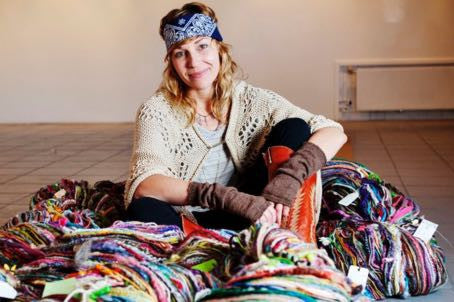
<p style="text-align: center;"><img alt="Lydia Handspinning" src="//cdn.shopify.com/s/files/1/0870/1968/files/spinning-is-letting-go_grande.jpg?v=1535434290" style="float: none;"></p>
<p>I once took my spinning wheel to a nearby farm for a weekend event. People traveled from urban areas to see, taste, and touch local agriculture. I sat under my canopy selling yarn and offering spinning demonstrations while looking out over a corral of alpacas. A man and woman on holiday from the East Coast eyed my wheel with curiosity. When I asked if either of them would like to try it the woman excitedly sat down. I helped her feel the rhythm of the wheel and the movement of the roving. She quickly progressed to drafting when I noticed the tension mounting in her shoulders and brow. The roving was moving faster than she wanted. Her response was to grasp it tighter, as if forcing it to stay would allow her more time to do the work of drafting. Instead, the uncooperative roving turned to knots as tighter and tighter it twisted onto itself. Her husband stepped in closer, put his hand on her shoulder, and pointed to each knot as it moved towards the bobbin. “Look”, he said “there goes Joey off to kindergarten. Let him go. And there he is with his driver’s license. It’s okay, let go.” In a sacred moment of understanding they looked at each other, then explained how their only child was leaving for college that summer and the hardest part was simply letting go.</p>
<meta charset="utf-8">
<blockquote>
<p style="text-align: center;">You cannot successfully spin a yarn without letting go over and over again.</p>
</blockquote>
<p>In the exact moment in which roving becomes yarn there is a life in it much like a thin stream of water falling over a smooth stone. It bounces, it wobbles, it rushes into it's new form. Controlling the consistency of the yarn is a matter of feeling for the right number of fibers, keeping up its momentum, and then at the perfect moment, letting go. Wether by hand or machine, this is the point when the chosen number of fibers have been loosened from the roving and allowed to join the energy of the twist. No matter what shape it becomes, it's letting go that allows great change to take place.</p>
<blockquote>
<div style="text-align: center;">No matter the circumstance, life is in constant motion.</div>
<div style="text-align: center;">Why not take up handspinning? </div>
<div style="text-align: center;">It will unavoidably teach you the art of letting go.</div>
</blockquote>]]>
    </content>
  </entry>
  <entry>
    <id>https://abundantearthfiber.com/blogs/fiber-love/shetland-wool</id>
    <published>2016-11-22T14:26:00-08:00</published>
    <updated>2017-07-04T05:10:19-07:00</updated>
    <link rel="alternate" type="text/html" href="https://abundantearthfiber.com/blogs/fiber-love/shetland-wool"/>
    <title>Shetland</title>
    <author>
      <name>Lydia Christiansen</name>
    </author>
    <content type="html">
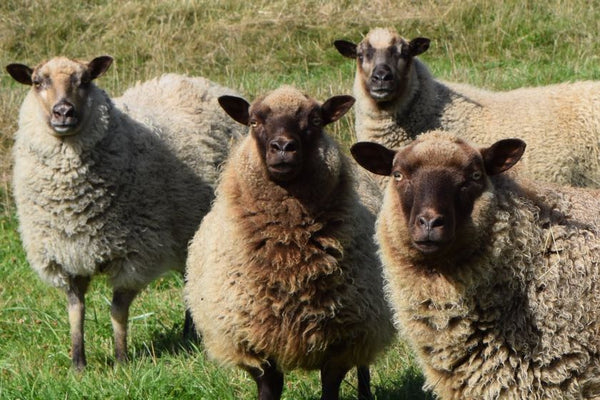
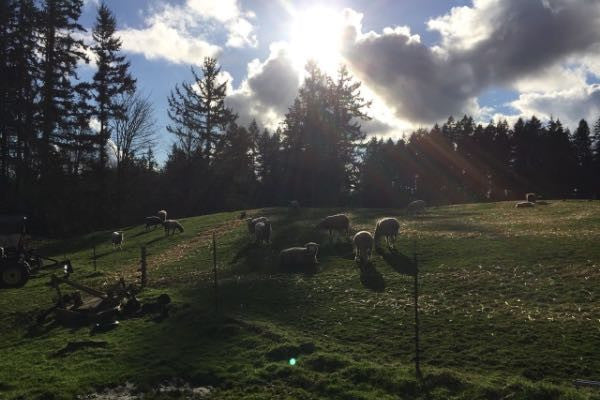
      <![CDATA[<p style="text-align: center;"><a href="http://www.anandahillsfarm.com/" target="_blank" title="Ewes from Ananda Hills Farm" rel="noopener noreferrer"><img alt="Ewes from Ananda Hills Farm" src="//cdn.shopify.com/s/files/1/0870/1968/files/ewes-from-ananda-hills-farm_grande.jpg?v=1499107347" style="float: none;"></a></p>
<p><a href="http://www.anandahillsfarm.com/" target="_blank" title="Ewes from Ananda Hills Farm" rel="noopener noreferrer">Ewes from Ananda Hills Farm</a></p>
<p>Shetland wool has a rich and time honored history of devotion from its shepherds, including some of our own right here in the Pacific Northwest. Ananda Hills Farms, Whoamule Farm, and Thistle Hill Farm are neighbors to Abundant Earth Fiber and producers of the wool used to spin the <a target="_blank" href="https://shop.abundantearthfiber.com/collections/spun-wool/products/nightingale-r" rel="noopener noreferrer">2016 Shetland Project</a>. This project is more than just locally raised wool, though. It is a window into a remarkable breed that articulates the abundant nurture of our earth. </p>
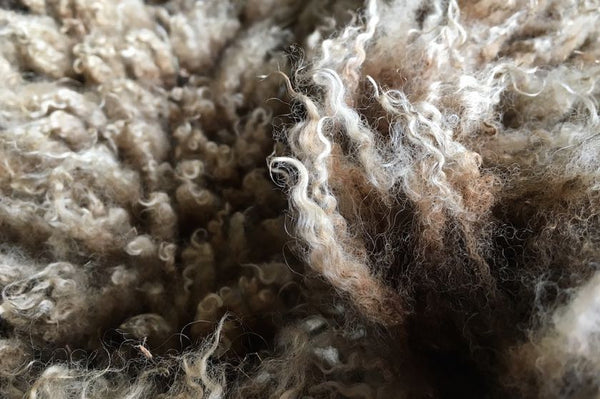
<p>In a world where white is the dominant color of commercially processed wool, Shetland offers a wonderfully diverse pallet of natural color. The breed recognizes a mind boggling aray of <a target="_blank" href="http://www.shetland-sheep.org/about-shetlands/shetland-markings/" rel="noopener noreferrer">colors and markings</a>. It is impossible to understate the beauty of these colors brought to us by the effortless relationship between sheep and grass and sunshine. </p>
<p style="text-align: center;"><a href="http://www.whoamulefarm.com/" target="_blank" title="Whoamule Farm" rel="noopener noreferrer"><img alt="Whoamule Farm" src="//cdn.shopify.com/s/files/1/0870/1968/files/whoamule-farm-fleece_grande.jpg?v=1499107439" style="float: none;"></a></p>
<p><a href="http://www.whoamulefarm.com/" target="_blank" title="Whoamule Farm" rel="noopener noreferrer">Whoamule Farm</a></p>
<p>If you wander the earth admiring the many colors of this wool, you will also discover there are three recognized Shetland breed types which have evolved to our present day. </p>
<p><strong>Single Coated</strong>  - These baby soft fleeces are short and downy, with high crimp and an average staple of about 2-4”. </p>
<p><strong>Medium</strong> - With an average staple in the range of 4-6” and silky soft from cut end to curly tip, this is the most common type of Shetland.</p>
<p><strong>Primitive</strong> - This is the oldest type of Shetland. Its origins are so old, in fact, they are untraceable.  The Shetland name pays homage simply to its oldest known pastures. These fleeces with 6-10” staples are dual coated which means they have a shorter, downy undercoat providing warmth guarded by longer, more coarse fibers shielding the animal from wind and rain. </p>
<p>Across all three types of Shetland you’ll find a soft hand that does not compromise on strength. Although uniformity is the modern standard, there was a time when one sheep produced a wide variety of wool grades. Each fleece could then be sorted and utilized in many different ways. I am fascinated by the staggering attention to detail and handwork this implies. </p>
<p>Rooing is another mesmerizing attribute of Shetland fleeces. Usually in late winter or spring, the animal can produce a natural “break” or weak spot across the whole fleece. If you catch it while the break is still close to the skin, you can literally pull the fleece right off the animal. So cool, right? Here’s a video of Tori rooing a Shetland ewe.</p>
<p><iframe width="854" height="480" src="https://www.youtube.com/embed/B8hp-rngcEA" frameborder="0" allowfullscreen=""></iframe></p>
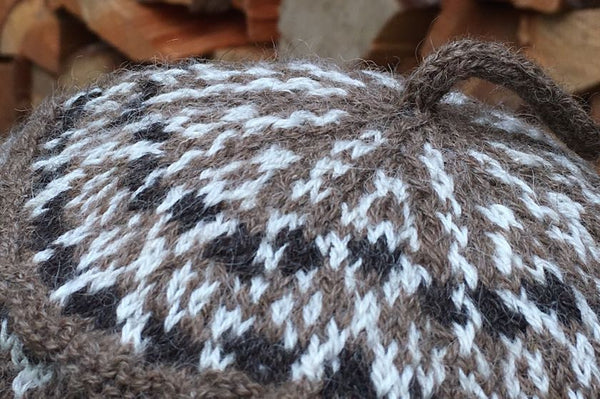
<p>Not surprisingly, the history of hand knitting and weaving with this remarkable wool is just as diverse as the attributes of its wool. Lace wedding shawls, fisherman sweaters, and all manner of intricate fair isle patterns have been particularly admired across the centuries. The northern islands of Great Britain are still dotted today with Shetland sheep, many of which have been contributing to the beloved Harris and Donegal tweeds for centuries. </p>
<p style="text-align: center;"><a href="https://shop.abundantearthfiber.com/collections/spun-wool/products/nightingale-r" title="2016 Shetland Project, designed by Susan Kroll, Thistle Hill Farm"><img alt="2016 Shetland Project, designed by Susan Kroll, Thistle Hill Farm" src="//cdn.shopify.com/s/files/1/0870/1968/files/shetland-project-knit-hat_grande.jpg?v=1499107513" style="float: none;"></a></p>
<p><a href="https://shop.abundantearthfiber.com/collections/spun-wool/products/nightingale-r" title="2016 Shetland Project, designed by Susan Kroll, Thistle Hill Farm">2016 Shetland Project, designed by Susan Kroll, Thistle Hill Farm</a></p>
<p>Every opportunity to spin Shetland at my mill rewards me with the thrill of discovery in learning something new about something very old. I feel honored to take part in textile traditions that have connected humankind with mother earth for generations, especially with such an exceptional breed as Shetland.  </p>
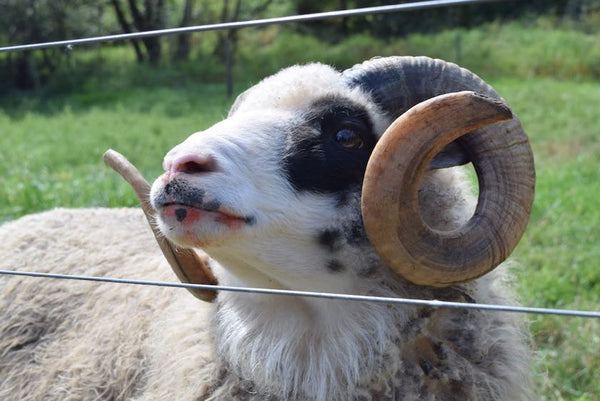
<p style="text-align: center;"><img alt="Ananda Hills Farm - Ram who just ate a plum" src="//cdn.shopify.com/s/files/1/0870/1968/files/ananda-hills-farm-ram-eating-plum_grande.jpg?v=1499107595" style="float: none;"></p>
Ananda Hills Farm - Ram who just ate a plum
<hr>
<p><em>Studio Reference is a category of posts containing technical insights and observations on working with natural fiber. The goal is to elevate our collective knowledge of textiles through an open dialogue about fiber. Please join the conversation with your own questions, comments and insights.</em></p>
<div style="text-align: center;"></div>]]>
    </content>
  </entry>
  <entry>
    <id>https://abundantearthfiber.com/blogs/fiber-love/for-indigo-with-love</id>
    <published>2016-11-02T05:00:00-07:00</published>
    <updated>2017-07-03T11:16:31-07:00</updated>
    <link rel="alternate" type="text/html" href="https://abundantearthfiber.com/blogs/fiber-love/for-indigo-with-love"/>
    <title>For Indigo, With Love</title>
    <author>
      <name>Lydia Christiansen</name>
    </author>
    <content type="html">
      <![CDATA[<p class="text-align-center"><img src="//cdn.shopify.com/s/files/1/0870/1968/files/indigo-with-love_grande.jpg?v=1499104520" alt="Indigo dyed fabric"></p>
<h1 class="text-align-center"><strong>For Indigo, With Love</strong></h1>
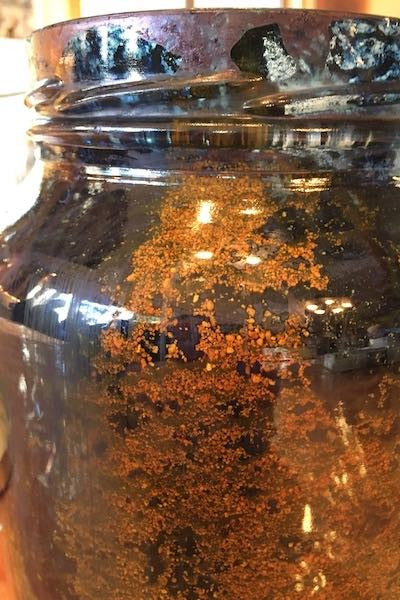
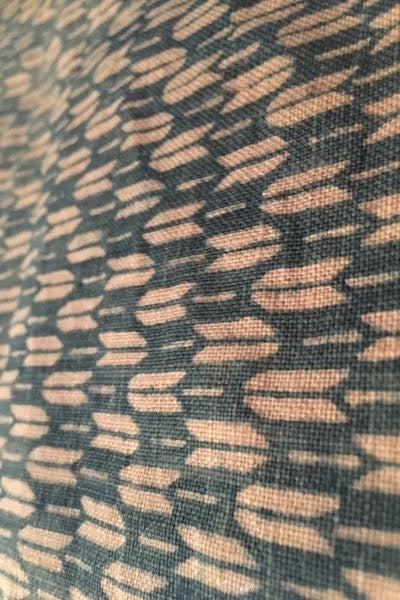
<p class="text-align-center">Dips deep and dark   <br>the mirrored face of indigo<br>Spilling generous and green<br>all around its rusty foam. </p>
<p class="text-align-center">I wish that I were indigo<br>so sure of the unknown<br>open wide with copper gates<br>not trembling as I do. </p>
<p class="text-align-center">-Lydia Christiansen</p>
<p class="text-align-center"><img src="//cdn.shopify.com/s/files/1/0870/1968/files/indigo-dye-jar_grande.jpg?v=1499104802" alt="Indigo dye in a jar"></p>
<p class="text-align-center"><img src="//cdn.shopify.com/s/files/1/0870/1968/files/indigo-dye-fabric_grande.jpg?v=1499104847" alt="Indigo died pattern fabric"></p>]]>
    </content>
  </entry>
  <entry>
    <id>https://abundantearthfiber.com/blogs/fiber-love/a-girl-and-her-mill</id>
    <published>2016-10-25T05:00:00-07:00</published>
    <updated>2017-07-03T12:08:16-07:00</updated>
    <link rel="alternate" type="text/html" href="https://abundantearthfiber.com/blogs/fiber-love/a-girl-and-her-mill"/>
    <title>A Girl and Her Mill</title>
    <author>
      <name>Lydia Christiansen</name>
    </author>
    <content type="html">
      <![CDATA[<p style="text-align: center;"><img alt="Abundant Earth Fiber street sign" src="//cdn.shopify.com/s/files/1/0870/1968/files/aef-sign_grande.jpg?v=1499108472" style="float: none;"></p>
<p>My name is Lydia Christiansen, I own and operate Abundant Earth Fiber, a small textile mill located on Whidbey Island. If you drive about 35 miles north from Seattle and cross the cool waters of the Puget Sound on the Mukilteo ferry, you will find yourself in the rural town of Clinton. Just a few blocks from the water, down a quiet residential street is the unassuming building where I turn wool into yarn. </p>
<p>The entrance takes you through a small room facing the water which is the epicenter of my creativity. This is where my single treadle Lendrum spinning wheel and four-harness Leclerc Artistat floor loom (two pieces which arguably started it all) are used regularly in designing, testing, and playing with yarn. </p>
<p>My ambition to open a mill came through a long and winding quest to discover a rewarding and meaningful career. I picked up hand spinning as a relaxing hobby after my first son was born, and quickly learned of my insatiable interest in wool. The transition from hand processing to owning a mill was an intense but also natural evolution.</p>
<blockquote>
<p>At the heart of it all, my work in textiles is an expression of devotion to source, process, our interconnectedness, and my fervent belief that the earth gives abundantly for us to thrive. </p>
</blockquote>
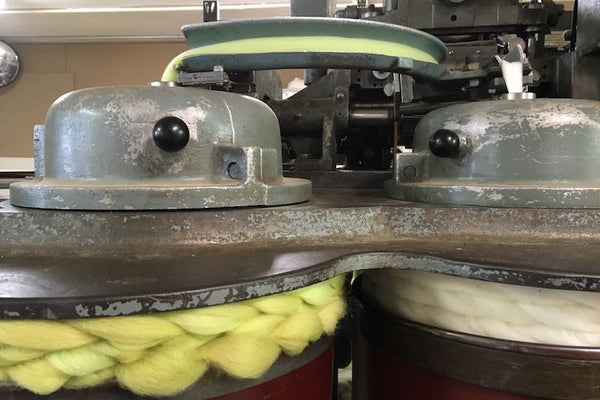
<p style="text-align: center;"><img alt="Pin Drafter with coiler" src="//cdn.shopify.com/s/files/1/0870/1968/files/pin-drafter-with-coiler_grande.jpg?v=1499108547" style="float: none;"></p>
<p>Although my work began sitting in front of a small hand spinning wheel, the mill itself is truly overwhelming in comparison. Pass through the back door of my small studio and you stand in between two large, open rooms packed to the gills with wool from local farms in various stages of development along with industrial textile equipment rescued from the remnants of American manufacturing. These rooms hum to the familiar rhythm of stout and simple mid-century mechanics. In fact, my family has even come to adore my evening perfume of wool and machine oil. </p>
<p style="text-align: center;"><img alt="Hanging Lavendar" src="//cdn.shopify.com/s/files/1/0870/1968/files/hanging-lavendar_grande.jpg?v=1499108591" style="float: none;"></p>
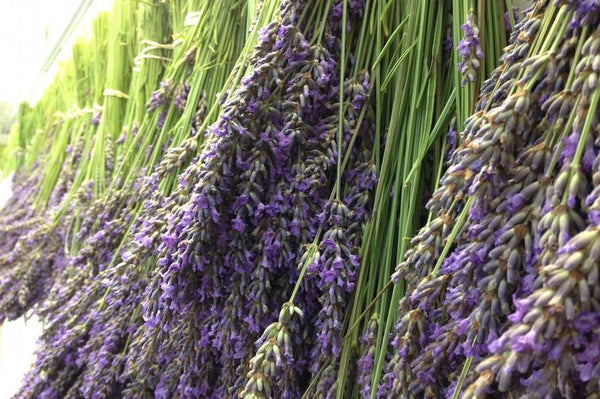
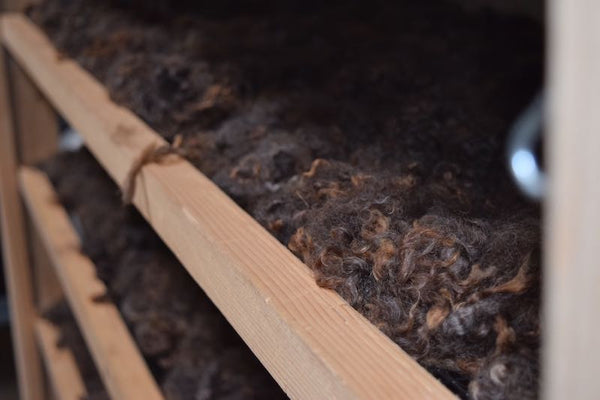
<p>Continue past these rooms, and you will find yourself in a long hallway lined with lavender leading into my wash room. A sturdy 6’ x 4’ skirting table stands in the center of the room, mesh drying racks line the walls, and a row of vintage washing machines attend to the scouring under high ceilings and ample natural light. This work is complicated and labor intensive as there has been little innovation for scouring in small quantities. Thirty to forty pounds of raw fiber represents a good day for washing raw fiber. Drying the clean wool can take two to three days depending on the weather. In spite of the inefficiencies of scouring, I take great satisfaction in reading each raw fleece by hand and embracing an armful of clean, dry locks as a job well done. </p>
<p style="text-align: center;"><img alt="Washed wool on drying racks" src="//cdn.shopify.com/s/files/1/0870/1968/files/wool-on-drying-racks_grande.jpg?v=1499108628" style="float: none;"></p>
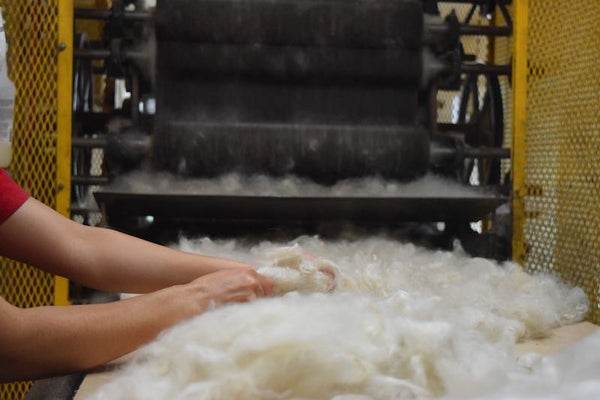
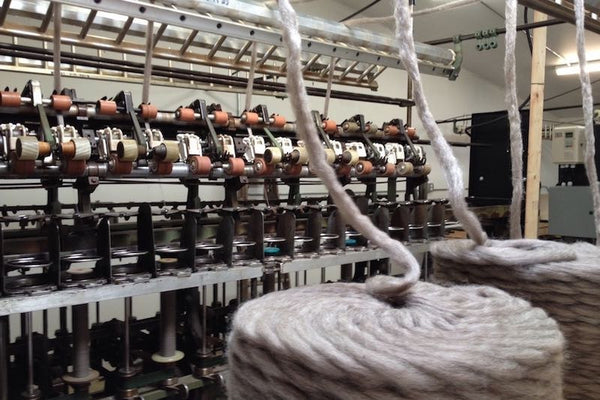
<p>Clean fiber goes on to be carded with the help of three different machines. It is first picked to open the locks, then carded into roving, and finally pin drafted to the specific gauge of the yarn it is to become. Spinning and plying is done on industrial frames to the tune of about one thousand skeins of yarn per month. </p>
<p style="text-align: center;"><img alt="Loading the carder with wool" src="//cdn.shopify.com/s/files/1/0870/1968/files/loading-the-carder_grande.jpg?v=1499108669" style="float: none;"></p>
<p>When I originally began researching milling equipment, I immediately knew I wanted salvaged industrial machines that would stand the test of time. Learning to operate and maintain them would fall entirely on my shoulders so I had to find reliable and simple machines. Word of mouth led me to a couple from Oklahoma who were retiring their carding business. Anxiously I flew out to meet them and to spend a day trying my hand at carding. When I saw the Patrick Green Power Picker, 26” McDermott Card, and Warner &amp; Swasey Pin Drafter it was love at first sight. From that point on, it was not a question of if, but how. I left Oklahoma with a purchase offer on the table, and the first handful of wool I had carded myself tucked away in my pocket. Amid the swirling emotions of risk and ambition, hope and fear, that little pocket of wool meant everything to me. I didn’t want to let go of it. </p>
<p>Overwhelmed with the enormous acquisition, I made up my mind to grow my business slowly over time and perhaps someday add a spin frame. My friend and mentor, Chuck McDermott called me shortly after my purchase to congratulate me. He also offered me two Whitin Roberts spin frames he’d found from a larger mill going out of business which were destined for scrap if I didn’t want them. I told him absolutely not, and was pretty sure I had already bitten off more than I should chew. For the next three nights I stayed awake thinking about those spinners and my looming feeling of regret for turning them down. I called Chuck back, closed my eyes and jumped. In hind sight, I can’t imagine this mill without them. They are the heart and soul of my work, and I will ever be grateful to my friend, Chuck, for pushing me over that cliff. </p>
<p style="text-align: center;"><img alt="Coiled roving ready to become yarn on the spinframe" src="//cdn.shopify.com/s/files/1/0870/1968/files/roving-ready-for-spinning_grande.jpg?v=1499108705" style="float: none;"></p>
<p>Miraculously the process of purchasing equipment fell in line with our efforts to obtain a lease on the building and prepare the space with adequate layout, power, and water. The first time I said the words out loud, “I think I need a mill.” was in January of 2014. In April, I made the offer on the carding equipment, and in May I bought the spinners. The first semi truck arrived in June, and the second in early July. On July 26, 2014 I opened my doors to the public for a grand opening.</p>
<blockquote>Sometimes the universe meets and carries you forward faster than you could have ever done alone. </blockquote>
<p>Owning and operating the mill has pushed me to understand more about yarn, the textile industry, and myself as a human being than I ever imagined I had the strength to learn. The path towards surviving as a small mill is unpaved. It is clear however, as I’m sure it is elsewhere in life, that we cannot repeat what has been done in the past and expect different results. Uncertainty pushes us to be creative, and I am grateful for the challenge. No matter what the future holds, I am quite certain I’ll be making yarn. I live daily by the mantra that my only option is to evolve and nothing is a loss if I choose to learn from it. </p>
<p>For now, I sell my yarn to dyers, designers, hand knitters and weavers all over the country. It brings me unimaginable joy to see my skeins transformed into colorful works of art by the skilled hands of makers far and wide. In a world engorged with mass produced textiles, I am proud to be offering something a little different made from hard work, attention to detail, and this abundant natural resource, wool. </p>
<p style="text-align: center;"><img alt="Raw fleece ready for processing" src="//cdn.shopify.com/s/files/1/0870/1968/files/whoamule-farm-fleece_grande.jpg?v=1499107439" style="float: none;"></p>]]>
    </content>
  </entry>
  <entry>
    <id>https://abundantearthfiber.com/blogs/fiber-love/jabberwocks-child</id>
    <published>2016-10-07T05:00:00-07:00</published>
    <updated>2017-07-03T10:53:57-07:00</updated>
    <link rel="alternate" type="text/html" href="https://abundantearthfiber.com/blogs/fiber-love/jabberwocks-child"/>
    <title>Jabberwock&apos;s Child</title>
    <author>
      <name>Lydia Christiansen</name>
    </author>
    <content type="html">
      <![CDATA[<p style="text-align: center;"><img alt="Cotton and Silk Embroidery on Denim" src="//cdn.shopify.com/s/files/1/0870/1968/files/jabberwoks-child-embroidery_grande.jpg?v=1499104409" style="float: none;"></p>
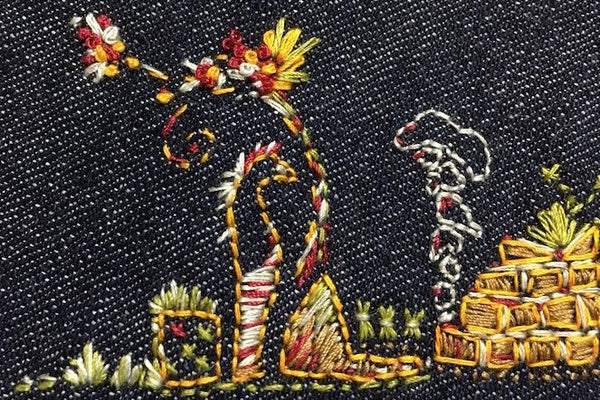
<p>Cotton and Silk Embroidery on Denim, by Lydia Christiansen</p>
<h1>Field Notes: 10/4/2016</h1>
<p>I have spent many bedtime tuck-ins reciting <a target="_blank" href="http://www.jabberwocky.com/carroll/jabber/jabberwocky.html" rel="noopener noreferrer">Lewis Carroll’s<em> Jabberwocky</em></a> to my children. I don’t remember exactly when it started, but there came a point when I discovered I could use my voice to experiment with different perspectives on the words about fear, stereotyping, and how we can sometimes get tricked into celebrating both. <br>I recently doodled this embroidery, and couldn’t resist the urge to write it a poem about my response to<a target="_blank" href="http://www.jabberwocky.com/carroll/jabber/jabberwocky.html" rel="noopener noreferrer"> <em>Jabberwocky</em></a>. I don’t have any significant experience studying or writing poetry, but as a medium, I love it. Jabberwocky in particular reaches out to me with words unrestrained by familiarity, which opens the door to many possible meanings. <a target="_blank" href="http://www.lewiscarroll.org/" rel="noopener noreferrer">Lewis Carroll</a> has expressed a distortion on fear in this verse that I find grotesque and terribly heart wrenching, and I love him for it. I do hope my mind continues wandering these lines for many years to come. Here is the original text often thought of as "glorious nonsense". Tell me, which is the nonsense? (originally published in "Through the Looking Glass", 1871)</p>
<blockquote><strong>Jabberwocky</strong></blockquote>
<blockquote>by Lewis Carroll</blockquote>
<blockquote>‘Twas brillig, and the slithy toves<br>Did gyre and gimble in the wabe:<br>All mimsy were the borogoves,<br>And the mome raths outgrabe.</blockquote>
<blockquote>‘Beware the Jabberwock, my son!<br>The jaws that bite, the claws that catch!<br>Beware the Jubjub bird, and shun<br>The frumious Bandersnatch!’</blockquote>
<blockquote>He took his vorpal sword in hand:<br>Long time the manxome foe he sought—<br>So rested he by the Tumtum tree,<br>And stood awhile in thought.</blockquote>
<blockquote>And, as in uffish thought he stood,<br>The Jabberwock, with eyes of flame,<br>Came whiffling through the tulgey wood,<br>And burbled as it came!</blockquote>
<blockquote>One, two! One, two! And through and through<br>The vorpal blade went snicker-snack!<br>He left it dead, and with its head<br>He went galumphing back.</blockquote>
<blockquote>‘And hast thou slain the Jabberwock?<br>Come to my arms, my beamish boy!<br>O frabjous day! Callooh! Callay!’<br>He chortled in his joy.</blockquote>
<blockquote>‘Twas brillig, and the slithy toves<br>Did gyre and gimble in the wabe:<br>All mimsy were the borogoves,<br>And the mome raths outgrabe.</blockquote>
<p>Here is my response to Carroll's piece: <br> </p>
<blockquote><strong>Jabberwock’s Child</strong></blockquote>
<blockquote>by Lydia Christiansen</blockquote>
<blockquote>A gentle beast, the Jabberwock's child, <br>builds walls with fire and mud.<br>Gifts from a father lost to the sword<br>and fear of that thing with the name. <br>Alone and aware, firing clay<br>Gives life to friends made by hand<br>Still the story spits and sputters hate<br>ringing Callooh! Callay!<br>warning little boys and girls of the<br>gruesome, droolling fangs, <br>and terrible claws of the Jabberwock<br>who fashions things with clay. </blockquote>]]>
    </content>
  </entry>
  <entry>
    <id>https://abundantearthfiber.com/blogs/fiber-love/i-love-this-merchant-and-mills</id>
    <published>2016-10-06T05:00:00-07:00</published>
    <updated>2017-07-02T08:27:03-07:00</updated>
    <link rel="alternate" type="text/html" href="https://abundantearthfiber.com/blogs/fiber-love/i-love-this-merchant-and-mills"/>
    <title>I Love This: Merchant and Mills</title>
    <author>
      <name>Lydia Christiansen</name>
    </author>
    <content type="html">
      <![CDATA[<p style="text-align: center;"><a href="http://merchantandmills.com/store/books/elementary-skills/" target="_blank" title="Elementary Sewing Skills book by Merchant and Mills" rel="noopener noreferrer"><img alt="Elementary Sewing Skills book by Merchant and Mills" src="//cdn.shopify.com/s/files/1/0870/1968/files/merchant_and_mills-feature_grande.jpg?v=1498964705" style="float: none;"></a></p>
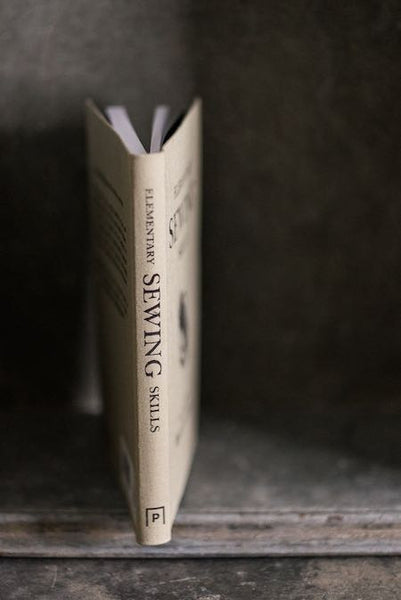
<p>Standing ovation for <a target="_blank" href="http://merchantandmills.com/store/books/elementary-skills/" rel="noopener noreferrer">Elementary Sewing Skills</a> put out by <a target="_blank" href="http://merchantandmills.com/" rel="noopener noreferrer">Carolyn N.K. Denham of Merchant and Mills</a>. This is a thoughtfully curated collection of simple and essential techniques for beginning sewing. This book does not feed the beginner with a firehose, but rather offers the perfect feast of simple understandings which can be applied a million different ways. </p>
<p>This is the gateway book of three designed to help you navigate sewing with increasing complexity. These books as well as a range of captivating sundries are available online through <a target="_blank" href="http://merchantandmills.com/store/" rel="noopener noreferrer">Merchant and Mills</a>.</p>
<p>I am in love with the level of quality that comes from true devotion to craft. </p>]]>
    </content>
  </entry>
  <entry>
    <id>https://abundantearthfiber.com/blogs/fiber-love/you-cant-outsource-momentum</id>
    <published>2016-10-05T05:00:00-07:00</published>
    <updated>2017-07-03T12:16:46-07:00</updated>
    <link rel="alternate" type="text/html" href="https://abundantearthfiber.com/blogs/fiber-love/you-cant-outsource-momentum"/>
    <title>You Can&apos;t Outsource Momentum</title>
    <author>
      <name>Lydia Christiansen</name>
    </author>
    <content type="html">
      <![CDATA[<p>Have you ever found yourself in a situation where you have one singular option for success surrounded by a million ways to fail? The tension and anxiety in those situations, for me, is stifling.</p>
<blockquote>Blinding fear of failure inhibits our natural drive to create.</blockquote>
<p>Now think about situations that offer clear direction with unlimited possibilities. When you can accept an unknown outcome, right and wrong become irrelevant, and there is only change, evolution, discovery, and resolve. Perspective is everything in the difference between the two. I make no claim that one is better than the other. We all find ourselves, at times, in both scenarios. I simply say that for me, the latter is my Polar Star. I find personal well-being in seeing the world for its infinite possibilities.</p>
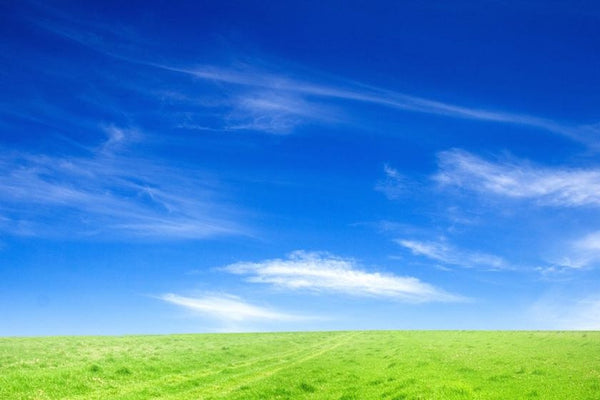
<blockquote>An open minded perspective feels like a deep breath of clean air in an open field of bright green earth and blue sky. </blockquote>
<p style="text-align: center;"><img alt="Grassy field with blue skies and clouds" src="//cdn.shopify.com/s/files/1/0870/1968/files/grassy-field-and-blue-sky_grande.jpg?v=1499109062" style="float: none;"></p>
<p>Having too many options, however, can feel just as stifling as not having enough. When choosing a specific path to follow, not knowing which way to go or remaining undecided for long periods of time has a way of feeling overwhelming or depressing. We need focus, direction, and limitations to enhance our creativity, and give us a sense of freedom. Choosing a medium in which to navigate and express your true self is a way of narrowing your focus and gaining momentum. The rules that exist within your chosen medium, whether physical or political, provide clarity and define the challenges that will motivate you to explore and discover new ideas.</p>
<blockquote>This is a choice that should never be outsourced. </blockquote>
<p>Allow yourself the time it takes to choose your own direction. Although we may reason, or intuit our way through many decisions in life, this is a choice that requires both, and will be validated by both. There is no other way to learn what nurtures and inspires your true self than by experience, and this takes time. If you feel rushed or anxious about this, just remember that wide open blue sky. Try to believe that all the time in the world is yours already to do with however your want. Rearrange your priorities so that self is at or near the top, and know that investing in yourself to become a more vibrant, passionate, and balanced person will enable you to send the same out into the world as never before. </p>
<p>After many years of trying and rejecting other paths, I have chosen spinning and weaving wool as my personal medium and direction. I find the depth of complexity and possibilities in designing yarn and fabric both challenging and liberating. The natural laws and characteristics of wool provide reason to be knowledgeable, and direction for being intentional about each piece I create. </p>
<p>Without fail, when I sit down at my loom to weave, my head and my heart align. I thoughtfully gather yarn and set my warp in place. Before throwing the shuttle for the first time, I acknowledge the unknown. The shed opens, and time does not exist, only my senses. I feel the wood under my feet and in my hands. Holding each strand of wool on the selvage before moving to the next row gives me the sense that everything is in its place, and I am connected with it. I am lost in the balance and movement of weaving. With love and simplicity these gestures take over the space in my mind and replenish my heart with a sense of calm. </p>
<p>The experience of weaving offers a natural give and take that stills my soul. My wonder is answered with beauty in the structures of woven wool. The loom is my teacher. I expect the magnificent unknowns to change over time. At some point the questions I now ask will fade for the simple fact that experience leads to knowing. I don’t know how my art will change, just that it will. I welcome that unknown just as well because I have found my focus. The possibilities are endless, and on this path I am free.</p>]]>
    </content>
  </entry>
  <entry>
    <id>https://abundantearthfiber.com/blogs/fiber-love/wool-scouring-at-home</id>
    <published>2016-10-04T14:00:00-07:00</published>
    <updated>2017-07-03T13:52:17-07:00</updated>
    <link rel="alternate" type="text/html" href="https://abundantearthfiber.com/blogs/fiber-love/wool-scouring-at-home"/>
    <title>Studio Reference: Wool Scouring at Home</title>
    <author>
      <name>Lydia Christiansen</name>
    </author>
    <content type="html">
      <![CDATA[<h1 class="text-align-center"><strong>What is the best way to wash wool at home? </strong></h1>
<blockquote>The essential considerations of a good scour are water quality, temperature, soap, extraction, and waste water.</blockquote>
<h2><strong>Notes &amp; Observations</strong></h2>
<h3><strong>Water Quality</strong></h3>
<p>Soft water is ideal, but not mandatory. Water with a high mineral content is likely to leave a residue on fiber just as it does on your sink at home. </p>
<h3><strong>Temperature</strong></h3>
<p>Use water that can be heated and sustained between 140-160 degrees for the entire duration of each soak. No matter which soap you use or how many times you soak your wool, lanolin will remain or re-solidify in water under 140 degrees. This is the most difficult task for most home scouring.</p>
<h3><strong>Soap</strong></h3>
<p>There are many easily accessible detergents and soaps available and effective for home scouring. The main responsibility of your soap is to cut the grease without being too harsh on your fiber. You decide which is best for you. I will show you a comparison of soaps and quantities in a future post. In the meantime, Dawn liquid dish detergent or even your average powdered laundry soap make a good choice. </p>
<h3>Extraction</h3>
<p>Removing the dirty, greasy water from the fiber is not as easy as it might sound, but in my opinion, this is a very important step to effective scouring. Ideally there applied pressure or centrifugal (spinning) action to remove the waste water while it is still over 140 degrees. By simply opening the drain, you run the risk of re-depositing lanolin onto the fiber as the temperature cools.  </p>
<h3>Waste Water</h3>
<p>It can be very expensive to overlook the destination of your waste water, especially if you are on a septic system like me. You are sending hot water, soap, sludge, and yes, some fiber down the drain. Consider your path of removal and be conscientious about avoiding problems. I look forward to divulging septic issues and recommendations in a future post, as these can be some of the most important as well as ambiguous. </p>
<h2>Recommendations</h2>
<p>There is one thing I have not included which is quite possibly the most important. </p>
<blockquote>Evaluate the quality of your fiber before scouring! </blockquote>
<p>This will make a huge impact on wether your time spent scouring is worthwhile or wasteful. There is no greater tragedy than laboring over a fleece for hours only to discover later that it has a major flaw. This task is separate from, but usually connected with skirting and can take as little as a few seconds. </p>
<p>Evaluating the quality of a fleece can be intimidating, but never fear! You can do this with just a few simple essentials which I will cover in a future post. There are endless volumes of information about fiber quality and breed characteristics for you down the road if you feel inspired to delve deeper. Personally I find this to be one of the most challenging and rewarding aspects of my job. Whether in a book or with my hands, I never get tired of studying wool.  </p>
<hr>
<p><em>Studio Reference is a category of posts containing technical insights and observations on working with fiber. The goal is to elevate our collective knowledge of textiles through an open dialogue about our questions, mistakes, lessons learned, and best practices with fiber. </em></p>
<hr>]]>
    </content>
  </entry>
  <entry>
    <id>https://abundantearthfiber.com/blogs/fiber-love/claudy-jongstra-exhibit</id>
    <published>2016-09-22T06:00:00-07:00</published>
    <updated>2017-07-03T13:51:29-07:00</updated>
    <link rel="alternate" type="text/html" href="https://abundantearthfiber.com/blogs/fiber-love/claudy-jongstra-exhibit"/>
    <title>Claudy Jongstra Fiber Exhibit</title>
    <author>
      <name>Lydia Christiansen</name>
    </author>
    <content type="html">
      <![CDATA[<p> </p>
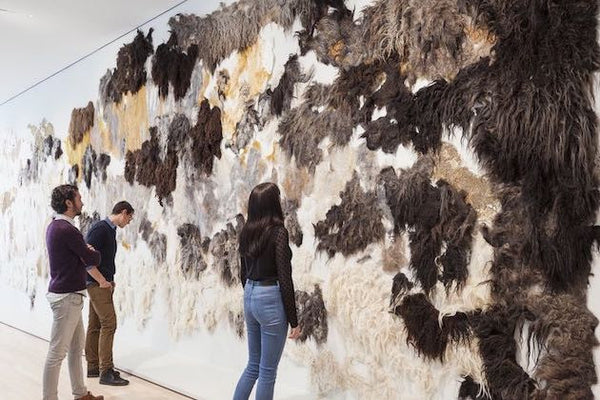
<p style="text-align: center;"><a target="_blank" href="http://www.claudyjongstra.com" rel="noopener noreferrer" title="Claudy Jongstra website"><img alt="Claudy Jongstra fiber art installation" src="//cdn.shopify.com/s/files/1/0870/1968/files/claudy-jongstra-fiber-art-installation_grande.jpg?v=1499111172" style="float: none;"></a>Please allow me to introduce,  <a target="_blank" href="http://www.claudyjongstra.com" rel="noopener noreferrer">Claudy Jongstra</a>. I recently learned of her when searching through exhibits at the <a target="_blank" href="http://www.sfmoma.org" rel="noopener noreferrer">San Francisco Museum of Modern Art</a> online. I find it arresting how much I get from this piece, and all of her installments. Her work feels like the pulse of the earth coming through the walls and floorboards to calm us, heal us. Then, I went to her website and read about her process, and I cried. She literally surrounds enormous spaces with felt made by hand, from wool she raises, and dyed with plants she grows. I admire her work and her story to no end, and hope you will enjoy it as well. </p>]]>
    </content>
  </entry>
  <entry>
    <id>https://abundantearthfiber.com/blogs/fiber-love/first-curiosity-then-play</id>
    <published>2016-09-21T06:00:00-07:00</published>
    <updated>2017-07-03T13:51:01-07:00</updated>
    <link rel="alternate" type="text/html" href="https://abundantearthfiber.com/blogs/fiber-love/first-curiosity-then-play"/>
    <title>First Curiosity, Then Play</title>
    <author>
      <name>Lydia Christiansen</name>
    </author>
    <content type="html">
      <![CDATA[<h3>Field Notes 9/21/16</h3>
<p style="text-align: center;"><img alt="Hand stitching example 1" src="//cdn.shopify.com/s/files/1/0870/1968/files/stitching-1_grande.jpg?v=1499111709" style="float: none;"></p>
<p>I try to practice hand stitching daily. I don’t yet know why, but it calls to me. Maybe it’s silly, but I’m just sure this skill is part of my big cosmic puzzle in some way. So, I do this, and as it turns out, I also love it. </p>
<p style="text-align: center;"><img alt="Hand Stitching example 2" src="//cdn.shopify.com/s/files/1/0870/1968/files/stitching-2-ORIG_grande.jpg?v=1499111751" style="float: none;"></p>
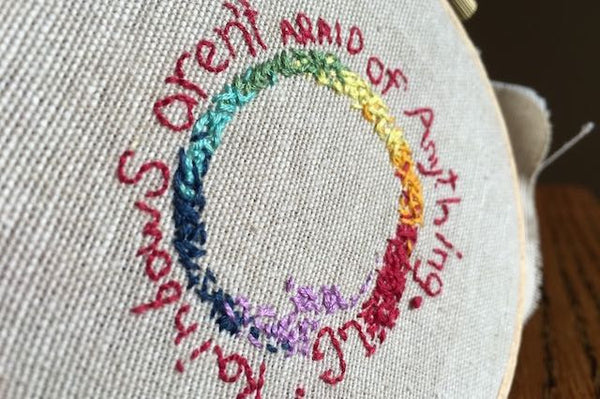
<p>I use small squares of linen or cotton which I have pre-cut and a tiny little 4 inch hoop that fits nicely in a zip lock sandwich baggie in my purse (nothing fancy here). I mostly doodle, although I have one piece scrawled with my favorite mantra, “Rainbows aren’t araid of anything.” That’s right, I forgot the “f” in “afraid”, whoops. It makes me smile though, because it reminds me how excited I was to spell words with thread. </p>
<blockquote>First curiosity, then play.  These are the true-leaves, first growth of creativity. </blockquote>
<p>I have no rules for myself other than to stitch what feels good. I am learning the intimate feel of each stitch and the empty spaces in between. I love it all, come what may. </p>]]>
    </content>
  </entry>
  <entry>
    <id>https://abundantearthfiber.com/blogs/fiber-love/historic-fabric-swatches</id>
    <published>2016-09-18T10:45:00-07:00</published>
    <updated>2017-07-03T13:50:43-07:00</updated>
    <link rel="alternate" type="text/html" href="https://abundantearthfiber.com/blogs/fiber-love/historic-fabric-swatches"/>
    <title>Online Catalogue of Historic Fabric Swatches</title>
    <author>
      <name>Lydia Christiansen</name>
    </author>
    <content type="html">
      <![CDATA[<p style="text-align: center;"><a href="http://tapestry.philau.edu/1996-116-291/" target="_blank" title="PLAIN WEAVE, COTTON, MANUFACTURED IN FRANCE, 1895. " rel="noopener noreferrer"><img alt="Plain weave " src="//cdn.shopify.com/s/files/1/0870/1968/files/plain-weave-cotton-france-1895_grande.jpg?v=1499112197" style="float: none;"></a></p>
<p>Plain Weave, Cotton, Manufactured in France, 1895</p>
<p>Wow, just wow! The good people at the <a target="_blank" href="http://www.philau.edu/library/textileandcostume/" rel="noopener noreferrer">Design Center at Philadelphia University</a> have catalogued thousands of images of historic fabrics from their textile collection. These swatches, manufactured all over the world, can be viewed online along with information about their weave structures and fiber content. This site has become my new morning indulgence. <a target="_blank" href="http://tapestry.philau.edu/" rel="noopener noreferrer">See for yourself</a>. </p>]]>
    </content>
  </entry>
  <entry>
    <id>https://abundantearthfiber.com/blogs/fiber-love/what-is-sett</id>
    <published>2016-09-16T06:00:00-07:00</published>
    <updated>2017-07-03T13:50:28-07:00</updated>
    <link rel="alternate" type="text/html" href="https://abundantearthfiber.com/blogs/fiber-love/what-is-sett"/>
    <title>What do you need to know to choose your sett?</title>
    <author>
      <name>Lydia Christiansen</name>
    </author>
    <content type="html">
      <![CDATA[<h3 style="text-align: center;"><img alt="View of weaving sett on loom" src="//cdn.shopify.com/s/files/1/0870/1968/files/weaving-sett_grande.jpeg?v=1499112508" style="float: none;"></h3>
<h1>Field Notes</h1>
<p>I have come to the point in my current weaving project when I have to just accept that I messed up. Last week I tried to adapt my weft pattern for a warp that was sett a little too wide. I was, at first, enchanted by the new design, but as the weft went on I was never in love with the way it felt. </p>
<p>The warp, being too loose, gave the feeling that my work might snag or fall apart in the normal, everyday use of the table runner. This is yarn that I made myself from raw fiber I washed myself. I will not compromise on quality now. The finished piece has got to embrace me with a feeling of accomplishment, not regret. There is no other way. The warp must be fixed.</p>
<p>So, I reversed the weft, untied the warp from the front bar, and carefully removed it from the reed. Obviously I was too quick in calculating my sett the first time around, so let’s back up and take a closer look. </p>
<h2>What is sett?</h2>
<p>Sett is the number of yarn ends that fall within one inch on the reed. In a 10 dent reed, there are ten open spaces for every inch. If I thread each space with two ends, my sett is 20 ends per inch. Here is my go to chart for <a target="_blank" href="http://www.pattyannesplace.com/images/reedsubchrt.pdf" rel="noopener noreferrer">warp sett reed conversion</a>.  </p>
<h2>What do you need to know in order to choose your sett?</h2>
<ol>
<li>How many Yards Per Pound (YPP) are in the yarn you will be using? </li>
<li>What do you want the piece to feel like? </li>
</ol>
<p>How do you determine your desired sett? </p>
<img src="https://cdn.shopify.com/s/files/1/0870/1968/files/blog_9071e-img.jpg?12291653520559606982" alt="">
<ol>
<li>Calculate the maximum sett for a balanced weave (plain weave) using <a target="_blank" href="https://peggyosterkamp.com/ashenhurst-rule/" rel="noopener noreferrer">Ashenhurst's formula</a> above or simply following a <a target="_blank" href="http://woolery.com/yarns/help-with-yarn-sizes/common-yarns-sett-chart.html" rel="noopener noreferrer">chart</a>. When in doubt, sample. </li>
<li>How do you want the fabric to feel? The maximum sett will yield a tight or dense fabric. If you want it to feel looser, reduce the number in the sett. The gauge of your weft yarn also plays a role. As a general rule:</li>
</ol>
<ul>
<li>If your weft yarn is the same YPP as your warp it will balance.</li>
<li>If your weft is a lighter gauge your piece will be warp-faced.</li>
<li>If your weft is heavier gauge it will be weft-faced. </li>
</ul>
<p>So, where did I go wrong, and what is the correct sett for my project? I am using two different gauges of yarn in the warp, intentionally. I have a center stripe of silver yarn at about 800YPP flanked by two dark gray stripes of about 950YPP. I want the dark gray to balance, and the center to be warp faced. My mistake is that I calculated my sett using the gauge of the center stripe. In hind sight, my mistake is obvious, but at the time. . .my vision was not so clear. So here we are. I will re-sett the warp through the reed with the dark gray yarn balancing, and that should do the trick. I'll let you know. </p>
<hr>
<p><em>Field Notes go behind the scenes to peak at the raw, unrefined, and real-time process of making. Through these blog posts I hope to capture the naturally recurring themes that keep a creative lifestyle buzzing, and I invite you to apply the unfiltered energy of creativity to your own work, in your own way.</em> </p>
<hr>]]>
    </content>
  </entry>
  <entry>
    <id>https://abundantearthfiber.com/blogs/fiber-love/janome-hd1000-in-black</id>
    <published>2016-09-15T06:00:00-07:00</published>
    <updated>2017-07-03T13:50:08-07:00</updated>
    <link rel="alternate" type="text/html" href="https://abundantearthfiber.com/blogs/fiber-love/janome-hd1000-in-black"/>
    <title>Janome HD1000 in Black</title>
    <author>
      <name>Lydia Christiansen</name>
    </author>
    <content type="html">
      <![CDATA[<img src="//cdn.shopify.com/s/files/1/0870/1968/files/janome-hd1000-black_large.jpg?v=1499113065" alt="Janome HD1000 Black">
<h2>Field Notes: 9/15</h2>
<p>The reverse on my trusty old Pfaff sewing machine recently bit the dust. The cost of repair would have been more than the machine itself. (Is this not the most frustrating dilemma brought on by cheep manufacturing - can I get an Amen?)  I’ve been hunting for a new machine for a little while now, and I am determined not to compromise on my list of requirements. </p>
<ul>
<li>I want heavy duty, if not industrial.</li>
<li>Metal casing would be ideal.  </li>
<li>Mechanical (No computer screen, please.)</li>
<li>Basic built in buttonhole, straight, and zig-zag stitches at least.</li>
<li>Above all, I want to be confident that my next machine will last. A one-year warrantee is the ultimate lack of confidence extended by the manufacturer themselves. If they don’t expect it to last longer than one year, why should I? </li>
</ul>
<p>Is that asking too much? </p>
<p>Enter, Janome HD1000. </p>
<ul>
<li>Sleek black metal casing. </li>
<li>Mechanical</li>
<li>14 built in stitches including a surger stitch and a bank of stretch stitch options. So cool. </li>
<li>Automatic tension adjustment that regulates when sewing over different thicknesses! </li>
<li>Automatic needle threading! </li>
<li>And the thing that tips the scale, a 25 year warranty! </li>
</ul>
<p>Welcome home, Janome. I think we’re going to get along just fine.  </p>
<hr>
<p><em>Field Notes go behind the scenes to peak at the raw, unrefined, and real-time process of making. Through these blog posts I hope to capture the naturally recurring themes that keep a creative lifestyle buzzing, and I invite you to apply the unfiltered energy of creativity to your own work, in your own way.</em> </p>
<hr>]]>
    </content>
  </entry>
  <entry>
    <id>https://abundantearthfiber.com/blogs/fiber-love/an-artists-greatest-fear</id>
    <published>2016-09-14T06:00:00-07:00</published>
    <updated>2017-07-03T13:49:51-07:00</updated>
    <link rel="alternate" type="text/html" href="https://abundantearthfiber.com/blogs/fiber-love/an-artists-greatest-fear"/>
    <title>An Artist&apos;s Greatest Fear</title>
    <author>
      <name>Lydia Christiansen</name>
    </author>
    <content type="html">
      <![CDATA[<p>The greatest satisfaction of a creative lifestyle is in living on the edge of uncertainty. An artist is in constant, relentless pursuit of raw and unrefined dissonance. The exhilaration comes after blood, sweat and tears given for transforming the chaos into beautiful, meaningful, intentional resonance. The greatest fear of all is whether the intense struggle will fall on deaf ears and be for naught. </p>
<h2>An Artist's Greatest Fear</h2>
<p>My stomach revolts pre-consciously. <br>I should feel encouraged<br>change is on its way<br>but all I feel is nausea</p>
<p>My voice chakra hurts, <br>and my neck is in knots.<br>I tried screaming out loud and my heart broke. <br>I can’t understand why.</p>
<p>It’s like those childhood nightmares when<br>your blood bursting scream is only a whisper. <br>My voice is weak, <br>but its not a dream.</p>
<p>I have to wonder if my work will be accepted<br>or if the most terrible sound my body can make<br>is only a whisper<br>pointless and never heard.</p>
<p>Am I willing to give all of this<br>devotion for vacant stares<br>am I willing to work for honesty<br>and maybe nothing else?</p>]]>
    </content>
  </entry>
  <entry>
    <id>https://abundantearthfiber.com/blogs/fiber-love/necessary-inefficiency</id>
    <published>2016-09-13T10:24:00-07:00</published>
    <updated>2017-07-03T13:49:33-07:00</updated>
    <link rel="alternate" type="text/html" href="https://abundantearthfiber.com/blogs/fiber-love/necessary-inefficiency"/>
    <title>Necessary Inefficiency</title>
    <author>
      <name>Lydia Christiansen</name>
    </author>
    <content type="html">
      <![CDATA[<h2>Field Notes 9/12/2016</h2>
<blockquote>The inefficiency of all beginnings is overshadowed by the depth of new understanding.</blockquote>
<p>It's scary and a little painful to admit this, but I am a timid knitter. My ability to invent is stronger than my ability to follow instructions and I generally favor the first. In my ability to follow knitting instructions, I'm afraid I am a kindergartener at best. We all want to be seen as talented and even excellent in our work, but what I'm about to reveal to you is definitely not that. </p>
<p>Why would I want to share this with you?  My fascination with textiles is all about process. Of course I want to share my proud accomplishments, but I also want to show the reality of progress which starts with mistakes. Lots, and lots of mistakes. It's messy and inefficient, and frustrating, and inspiring. </p>
<blockquote>
<p>It is in the act of blundering that we can find our lessons and choose our way. To me, that is a beautiful thing. </p>
</blockquote>
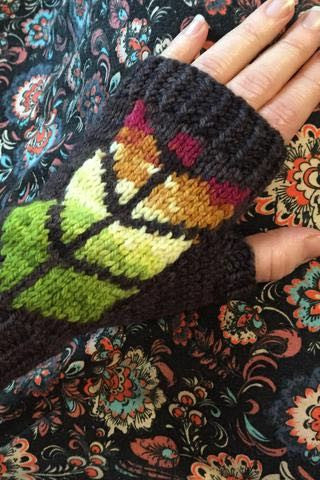
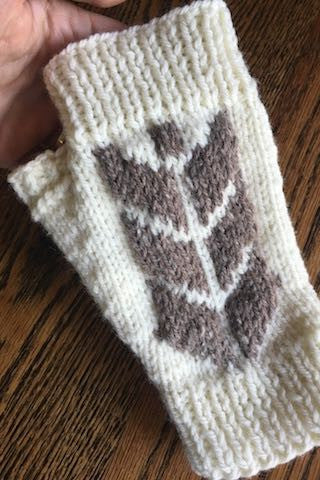
<p>The <a target="_blank" href="http://shop.stashlocal.com/collections/stash-exclusive/products/huckleberry-knits-carina-spencer-prairie-glass-mitts-kit?variant=20072598917" rel="noopener noreferrer">Prairie Glass</a> fingerless mitt pattern from <a target="_blank" href="http://www.stashlocal.com/" rel="noopener noreferrer">Stash</a> by designer <a target="_blank" href="http://www.ravelry.com/designers/carina-spencer" rel="noopener noreferrer">Carina Spencer</a>, yarn by Scarlet Tang at <a target="_blank" href="http://huckleberryknits.com/" rel="noopener noreferrer">Huckleberry Knits</a> arrived in my mailbox last Friday. I love this design. I love the yarn, the colors, the inspiration. Who doesn't love Frank Lloyd Wright?!  He has been on my mind ever since early August when I found myself face to face with some of his stained glass windows on display at the Art Institute of Chicago. I admire the man's work in architecture and design to no end. This pattern was just the inspiration I needed to push passed my little fear of instructions. My only show of defiance was in swapping out the intended yarn for some of my own. Other than that, I did my best to do as I was told. </p>
<p>Here's what I was supposed to do. . .</p>
<p style="text-align: center;"><img alt="Prairie Grass Knit Kit" src="//cdn.shopify.com/s/files/1/0870/1968/files/knit-glove-pattern-to-follow_large.jpg?v=1499113752" style="float: none;"></p>
<p>And here's what I did. </p>
<p style="text-align: center;"><img alt="Prairie Grass Knit Kit Variation I Did" src="//cdn.shopify.com/s/files/1/0870/1968/files/knit-glove-that-i-did_large.jpg?v=1499113822" style="float: none;"></p>
<p>This "draft" shall we call it, is fettered with novice blunders (see if you can spot them all), and I love each of them. They are my teachers.  I have enjoyed this pattern and process immensely, and look forward to repeating it with improved skills as well as the actual intended yarn, I promise!</p>
<hr>
<p><em>Field Notes go behind the scenes to peak at the raw, unrefined, and real-time process of making. Through these blog posts I hope to capture the naturally recurring themes that keep a creative lifestyle buzzing, and I invite you to apply the unfiltered energy of creativity to your own work, in your own way.</em> </p>
<hr>]]>
    </content>
  </entry>
  <entry>
    <id>https://abundantearthfiber.com/blogs/fiber-love/the-empowering-faith-of-doubt</id>
    <published>2016-09-11T06:00:00-07:00</published>
    <updated>2017-07-03T13:49:12-07:00</updated>
    <link rel="alternate" type="text/html" href="https://abundantearthfiber.com/blogs/fiber-love/the-empowering-faith-of-doubt"/>
    <title>The Empowering Faith of Doubt</title>
    <author>
      <name>Lydia Christiansen</name>
    </author>
    <content type="html">
      <![CDATA[<p style="text-align: center;"><a href="http://www.ted.com/talks/casey_gerald_the_gospel_of_doubt" target="_blank" title="Casey Gerald: The Empowering Faith of Doubt TED 2016" rel="noopener noreferrer"><img alt="Casey Gerald: The Empowering Faith of Doubt" src="//cdn.shopify.com/s/files/1/0870/1968/files/casey-gerald-the-gospel-of-doubt-TED2016_grande.jpg?v=1499114297" style="float: none;"></a></p>
<p>Casey Gerald: The Gospel of Doubt (TED2016)</p>
<p>Here is one TED talk I have thought about hundreds of times since originally watching it six months ago. In many ways, I see the "gospel of doubt", as Casey Gerald calls it, as essential to the health and well-being of my own creativity. See for yourself, and let me know if you agree.  </p>]]>
    </content>
  </entry>
  <entry>
    <id>https://abundantearthfiber.com/blogs/fiber-love/the-spaces-in-between</id>
    <published>2016-09-08T06:00:00-07:00</published>
    <updated>2017-07-03T13:47:56-07:00</updated>
    <link rel="alternate" type="text/html" href="https://abundantearthfiber.com/blogs/fiber-love/the-spaces-in-between"/>
    <title>The Spaces In Between</title>
    <author>
      <name>Lydia Christiansen</name>
    </author>
    <content type="html">
      <![CDATA[<h2>Field Notes 9/8/2016</h2>
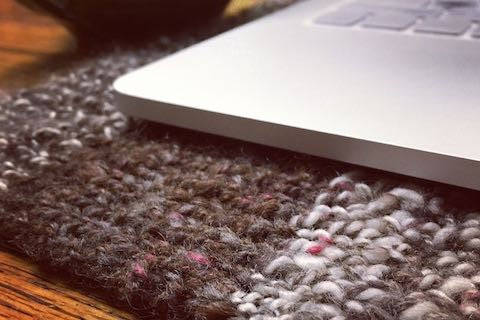
<p>My hand spinning is very utilitarian. I don't mean the yarn I spin is utilitarian. I mean I have a specific purpose for the act of hand spinning. I like to draw up my wheel when I sit down to do some serious writing, or I have a real problem that requires some thinking. Spinning creates empty space in my mind for thoughts to unravel and new ideas to spark. Sometimes just a few minutes of spinning are enough to resolve a question or bring back my focus. Working this way means my actual finished yarn is always a surprise. It also means I have a steady inflow of one-off skeins of hand spun yarn. Of course this begs the question. . .</p>
<p>What's the best use for one-off handspun skeins. . .for me? I'm still working on this question, but I've made myself a pretty sweet laptop blanket in the process. </p>
<p><img src="//cdn.shopify.com/s/files/1/0870/1968/files/sweet-woven-laptop-blanket_grande.jpg?v=1499114642" alt="Sweet woven laptop blanket pad"></p>]]>
    </content>
  </entry>
  <entry>
    <id>https://abundantearthfiber.com/blogs/fiber-love/a-weavers-checklist</id>
    <published>2016-09-07T06:00:00-07:00</published>
    <updated>2017-07-03T13:57:34-07:00</updated>
    <link rel="alternate" type="text/html" href="https://abundantearthfiber.com/blogs/fiber-love/a-weavers-checklist"/>
    <title>A Weaver&apos;s Checklist</title>
    <author>
      <name>Lydia Christiansen</name>
    </author>
    <content type="html">
      <![CDATA[<h3 style="text-align: center;"><img alt="A Weavers Checklist" src="//cdn.shopify.com/s/files/1/0870/1968/files/weavers-checklist_grande.jpg?v=1499115308" style="float: none;"></h3>
<h2>Field Notes 9/7/2016 </h2>
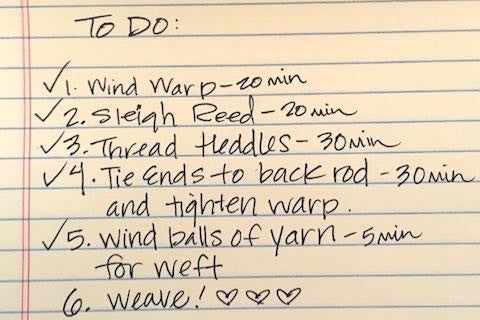
<p>. . .But what you didn't know is that when I started weaving (this is a 14" x 90" table runner using three yarns I made from wool raised here on Whidbey) I discovered I had set my warp ever so slightly too wide for my weft yarn. </p>
<p><strong>Dilemma:</strong> I had expected to use two strands of weft per pass. To create a balanced weave it looks like I really need three, but I just don't like the way that looks. Is there a handmade project in all of time that hasn't been altered by the forceful hand of a dilemma? </p>
<p><strong>Question:</strong> What do I do now? </p>
<p><strong>Experiment under Constraint: </strong>I am not going to change the warp. I am committed to the weft yarn as well. I started playing with different patterns of passing the shuttle, and discovered a charming little variation by passing the shuttle in repeating pattern of one single strand, two rows of two, then three rows of three, then two rows of two, and back to one single strand - and repeat. I think I love it. I hadn't thought of designing this piece in this way, but when it's all said and done, I might even like it better than my original plan.</p>
<p><strong>Will it work? </strong>I'll let you know. So far so good. </p>
<hr>
<p><em>Field Notes go behind the scenes to peak at the raw, unrefined, and real-time process of making. Through these blog posts I hope to capture the naturally recurring themes that keep a creative lifestyle buzzing, and I invite you to apply the unfiltered energy of creativity to your own work, in your own way.</em><span style="font-size: 16px;"> </span></p>
<hr>]]>
    </content>
  </entry>
  <entry>
    <id>https://abundantearthfiber.com/blogs/fiber-love/creative-cross-training</id>
    <published>2016-09-06T14:31:00-07:00</published>
    <updated>2017-07-03T14:02:45-07:00</updated>
    <link rel="alternate" type="text/html" href="https://abundantearthfiber.com/blogs/fiber-love/creative-cross-training"/>
    <title>Creative Cross Training</title>
    <author>
      <name>Lydia Christiansen</name>
    </author>
    <content type="html">
      <![CDATA[<h3 style="text-align: center;"><img alt="Grid of colored squares in a pattern" src="//cdn.shopify.com/s/files/1/0870/1968/files/grid-of-colors-in-pattern_large.jpg?v=1499115619" style="float: none;"></h3>
<h2>Field Notes 9/6/2016</h2>
<p>Yesterday my sons and I sat around the kitchen table with paints and brushes and had the most delightful time quietly working out our masterpieces. Okay, I'm not a refined painter, but I really, really enjoy it. In this moment I worked with watercolors on plain ol' graph paper using a brush that was way too big for the squares, but none of that mattered. It was play, and not with wool for a change. It was like creative cross training. I should do that more often. </p>
<hr>
<p><em>Field Notes go behind the scenes to peak at the raw, unrefined, and real-time process of making. Through these blog posts I hope to capture the naturally recurring themes that keep a creative lifestyle buzzing, and I invite you to apply the unfiltered energy of creativity to your own work, in your own way.</em> </p>
<hr>]]>
    </content>
  </entry>
  <entry>
    <id>https://abundantearthfiber.com/blogs/fiber-love/airplane-on-a-loom</id>
    <published>2016-09-02T14:30:00-07:00</published>
    <updated>2017-07-03T14:08:28-07:00</updated>
    <link rel="alternate" type="text/html" href="https://abundantearthfiber.com/blogs/fiber-love/airplane-on-a-loom"/>
    <title>Airplane on a Loom</title>
    <author>
      <name>Lydia Christiansen</name>
    </author>
    <content type="html">
      <![CDATA[<p style="text-align: center;"><img alt="Paper airplane set against a blue sky" src="//cdn.shopify.com/s/files/1/0870/1968/files/paper-airplane-and-sky_grande.jpg?v=1499115937" style="float: none;"></p>
<p>My five year old son, Paavo, loves to sit with me when I weave. It’s convenient for him since one of my looms is in our living room. Not too long ago, he even helped me cut a finished piece off the loom. He then looked at me longingly and asked if he could weave something all by himself. Quite possibly nothing has tugged at my heart more than this simple request. </p>
<p>We immediately started looking at yarn and talking about what he might like to weave, but he wasn’t all that interested in choosing supplies. Instead, he sat up on the bench, put both hands on the beater bar and said, “Mom, I know what I want to make. I want to make an airplane. A real airplane.” </p>
<blockquote>The urge to create is in all of us, but only a child’s mind is completely free of impossibility.  </blockquote>]]>
    </content>
  </entry>
  <entry>
    <id>https://abundantearthfiber.com/blogs/fiber-love/fence-lost-to-three-year-old</id>
    <published>2016-09-02T11:08:00-07:00</published>
    <updated>2017-07-03T14:14:15-07:00</updated>
    <link rel="alternate" type="text/html" href="https://abundantearthfiber.com/blogs/fiber-love/fence-lost-to-three-year-old"/>
    <title>The Fence that Lost to a Three-Year Old</title>
    <author>
      <name>Lydia Christiansen</name>
    </author>
    <content type="html">
      <![CDATA[<p style="text-align: center;"><img alt="An Open Gate" src="//cdn.shopify.com/s/files/1/0870/1968/files/open-gate_large.jpg?v=1499116277" style="float: none;"></p>
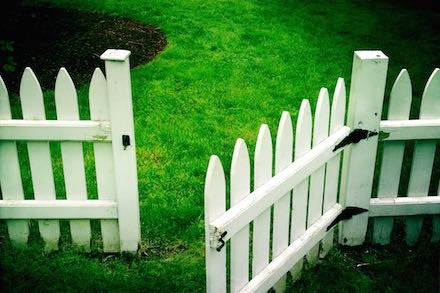
<p>When I was a toddler, my family lived in a neighborhood which I was told (many years later) you wouldn’t want to wander around in after dark. Two doors down lived a little girl one year younger than myself. She and I were best friends. From the time we were both walking until the day my family moved, we’d spent countless hours playing together. </p>
<p>Around the time she turned two, her parents decided, for safety and peace of mind, to build a fence around their yard. Whether it was to keep strangers out or little toddlers in, it meant nothing to me. What was a few wooden slats and a simple latch? You can imagine the panic that followed when her mother found the front door wide open, gate unlatched, and her daughter missing. To my three-year-old self looking for a friend, however, our break-out was a small victory. Now, many years later, I wonder if it’s silly to feel proud of my younger self for being so much like me? </p>
<p>To this day I am driven by fierce curiosity and stubborn determination to do things my own way. I take the long road every time. I embrace uncertainty. I feel compelled to make meaningful things in meaningful ways. Every decision made in a project is significant. Every question asked is influential. Every finished piece is a victory. For me, creativity is more than a job, it’s a lifestyle. <br> <br>During the month of September, I invite you to join me in going behind the finished pieces to see the real time process of making. Through this blog I hope to capture the naturally recurring themes that keep a creative lifestyle buzzing, and I invite you to apply the unfiltered energy of creativity to your own work, in your own way. </p>
<p>You can follow the adventure here on the blog, through <a target="_blank" href="https://www.instagram.com/abundantearthfiber/" rel="noopener noreferrer">Instagram</a>, and on my <a target="_blank" href="http://www.ravelry.com/groups/abundant-earth-fiber" rel="noopener noreferrer">Ravelry forum</a>.  So, what are we waiting for? Let's dive right in. </p>
<p>Disclaimer: My work as well as my writing in this blog is raw and mostly unrefined. This is intentional, and I sincerely hope not distracting. Please accept that life is always a draft in varying degrees of revision.</p>]]>
    </content>
  </entry>
  <entry>
    <id>https://abundantearthfiber.com/blogs/fiber-love/curiosity-welcome</id>
    <published>2016-08-16T19:18:00-07:00</published>
    <updated>2017-07-03T14:21:19-07:00</updated>
    <link rel="alternate" type="text/html" href="https://abundantearthfiber.com/blogs/fiber-love/curiosity-welcome"/>
    <title>Curiosity Welcome</title>
    <author>
      <name>Lydia Christiansen</name>
    </author>
    <content type="html">
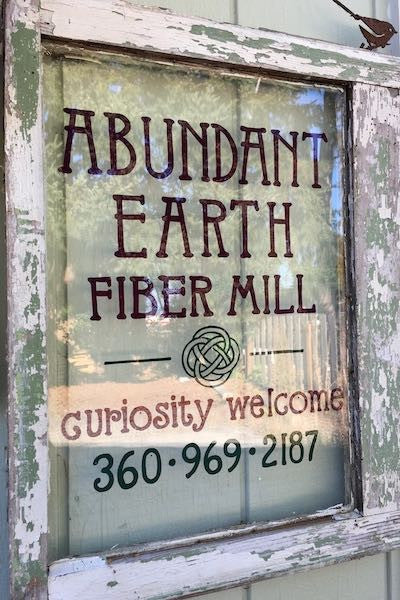
      <![CDATA[<p>The hand-lettered sign on my front door reads “Abundant Earth Fiber Mill, Curiosity Welcome.” When I hung the sign up two years ago I had no idea just how meaningful those two words would become.  <br> <br>Curiosity, after all, is what led me to imagine owning and operating my own mill in the first place. This space has since become my personal sanctuary, my sacred place of creativity. I am now convinced whether born of necessity or wonder our curiosity is actually what ignites us to create. </p>
<p>That little sign has welcomed hundreds of people through my door curious about the machines, the fiber, and the process involved in making natural yarn. It's not the sort of thing the average person has ever seen before, and I am thrilled each and every time I have the chance to tell the stories of wool. The flood of questions and curiosity from my guests inspires me, but as my work load has increased I've had fewer and fewer moments available for giving tours. I miss it.  </p>
<p>Beginning on September 1st, 2016 I would like to once again invite your curiosity, but this time in a more intimate way. To be completely honest, I'm not sure I'm entirely comfortable with this idea because I know it will push me well past my comfort zone. Perhaps that's just one more reason to do it. Hear me out. . .</p>
<p>When I entered Kindergarten I didn't know there was a right and wrong way to draw a picture until a well-meaning art teacher came to my classroom and showed us step by step how to draw a dog. I was so disappointed to discover that the dog I wanted to draw was not the dog I was supposed to draw. This unfortunate art lesson left me believing that my imagination was wrong. </p>
<p>I have since learned to appreciate my imagination, although I still remain a little skittish around teachers from the school of absolutes. Yes, I do realize this story betrays my stubborn nature. The fact is, however, that I have learned to rely on a more autodidactic style of makership which enables me to feel immensely proud of my work, and more importantly of myself. I don't recommend this path for everyone though. It takes a special kind of <a target="_blank" href="https://en.wikipedia.org/wiki/Sisu" rel="noopener noreferrer">sisu</a>. You have to be willing to walk to the edge of certainty and wander just a little into the unknown.</p>
<blockquote class="text-align-center">It’s in those breathless moments of uncertainty, where you find the precipice of innovation. </blockquote>
<p>To all my fearless friends out there, I invite you to dive deep with me for an intimate look at this makership. Coming this September, I will reveal to you my whole process and I don't mean just with fiber, although that's certainly part of the story. I will raise questions that will challenge your creative status quo, and offer up a feast for thought on what makes us creative all while sharing my own works in progress. Join me with any of your own projects in mind, and the month of September is guaranteed to shake the ruts right out of your own making. Your questions and comments are most welcome as you follow along through my blog, <a target="_blank" href="https://www.instagram.com/abundantearthfiber/" rel="noopener noreferrer">Instagram</a>, <a target="_blank" href="http://www.ravelry.com/groups/abundant-earth-fiber" rel="noopener noreferrer"> Ravelry</a>, and newsletter.  No matter what you're working on, you won't want to miss this epic month of makership! </p>
<blockquote class="text-align-center">One day at a time, one project at a time, one question at a time our masterpieces will evolve, the greatest one of all being ourselves.</blockquote>
<p style="text-align: center;"><img alt="Abundant Earth Fiber Sign - Curiosity Welcome" src="//cdn.shopify.com/s/files/1/0870/1968/files/abundant-earth-fiber-curiosity-welcome_grande.jpg?v=1499116606" style="float: none;"></p>]]>
    </content>
  </entry>
  <entry>
    <id>https://abundantearthfiber.com/blogs/fiber-love/for-the-love-of-wool</id>
    <published>2016-02-12T05:00:00-08:00</published>
    <updated>2017-07-03T14:28:35-07:00</updated>
    <link rel="alternate" type="text/html" href="https://abundantearthfiber.com/blogs/fiber-love/for-the-love-of-wool"/>
    <title>For the Love of Wool</title>
    <author>
      <name>Lydia Christiansen</name>
    </author>
    <content type="html">
      <![CDATA[<p style="text-align: center;"><img alt="Raw wool of various breeds" src="//cdn.shopify.com/s/files/1/0870/1968/files/raw-wool-of-various-breeds_grande.jpg?v=1499117102" style="float: none;"></p>
<p>It’s common for new guests at the mill to feel overwhelmed by the obscurity of knowledge that goes into making yarn. Most people know as much about wool as I do about astrophysics. As far as sheep go, Merino is a familiar word, but often mistaken as a catch-all term for all kinds of wool. People are often surprised to find out that “sheep fur” is only one of many fibers known as wool. Wool producing animals (including common terms for their fiber) which are most familiar to our mill include sheep (wool), alpaca (alpaca), goat (cashmere &amp; mohair), and rabbit (angora). Llama (llama), camel (camel), and musk ox (qiviut) also produce wool, but we rarely see them at the mill. </p>
<p><a target="_blank" href="https://en.wikipedia.org/wiki/Wool" rel="noopener noreferrer">Wool</a> is defined as natural fiber with elasticity, crimp, and staple structure. </p>
<p>Elasticity is the fibers’ ability to be stretched, strained, soaked, and twisted, but still return to its original form, which it does better than any other plant or animal fiber. Crimp describes how tightly or loosely the protein strands are coiled making the fiber appear as ringlets or zig zags. Staples are clusters of strands that grow together in groups forming a tip on the outer end. The combined qualities of wool are what make it exceptionally durable, comfortable, dyeable, flame retardant, water resistant, lint and stain resistant, and even regulate temperature - keeping warm (even when wet) in the winter and cool in the summer. In addition to all of this, wool is a recyclable, biodegradable, and renewable natural resource which has been adored by humans for over 10,000 years. </p>
<p>Variations on the three basic attributes of wool give us an unlimited palette of textures and potential uses for wool ranging from industrial to personal. There are countless <a target="_blank" href="http://www.fleeceandfiber.com/" rel="noopener noreferrer">breeds of wool</a> producing animals in the world, and countless variations of fiber characteristics within each breed. Even within the lifetime of one single animal, the quality and characteristics (including color) of its fiber can vary from year to year depending on elements beyond his or her control such as weather, climate change, illness, stress, diet, and age. In general, <a target="_blank" href="http://www.sheepusa.org/Contacts_BreedAssns" rel="noopener noreferrer">breed associations</a> strive to identify the most useful characteristics and promote breeding for uniformity of those qualities (at least I hope they do - uniformity is the absolute key to quality). </p>
<p>Washington and Oregon are great wool producing states for the variety of climate regions spanning east to west. In addition to having a great climate for raising <a target="_blank" href="http://www.pronkinpastures.com/" rel="noopener noreferrer">alpaca</a> , we are home to a wide range of thriving sheep breeds. Some (by no means all) of the sheep breeds in the Northwest which I have come to know and love include fine wools such as Targhee, CVM, Rambouillet, and Targhee. Local medium and downy breeds I often see are Corriedale, Oxford, Dorset, Columbia, and East Fresian. I absolutely love any opportunity I get to work with Shetlands, Icelandic, Cheviot, Jacob or other primitive breeds. But perhaps my all-time favorite local breeds are the longwools. I’m not yet sure why, but I go gaga every time I start a new batch of longwool yarn. Romney, Cotswold, Gotland, Lincoln, English Leicester, Wensleydale, Teesewater, Coopworth, and Border Leicester are some of the longwool breeds you might find me drooling over. </p>
<p>Each of these breeds has their own story and characteristics which I recognize and expect when their fiber comes through my door. Every diverse fleece can be appreciated for what it is, and designed for best use. I especially love seeing natural colored fleeces (any color besides white) in any breed. Don’t get me wrong, I love white as well. Natural colored fleeces are adored though, because there are so few in comparison to white, which are in higher demand for commercial use. That is not to imply commercial processing is bad. I appreciate and deeply admire the <a target="_blank" href="https://www.youtube.com/watch?v=6e9ZuuTYrKI" rel="noopener noreferrer">large mills in our country</a> who have survived very hard times in order to remain domestic producers. They play an important role, and we need them. Their products, however, are different from mine because their process is different. Not bad, just different. </p>
<p>When large quantities of wool are baled and sold at auction for large production mills, the quality of the fiber is evaluated in a laboratory by taking a core sample and running it through a series of tests that give a summary of its quality, cleanliness, and fineness. At my mill, I buy direct from farmers and evaluate each fleece by hand. I take great pride in this. I think of the work I do as “reading” each fleece in order to decide how to make best use of its characteristics. It keeps me connected with the people and animals who I rely on to make yarn. I also feel it adds a “living” quality to my yarn because it allows me to acknowledge and preserve the authentic attributes in each batch and even spotlight exceptional ones. There technical aspects this work of course, but when its just me and a bag of fiber, I'm all zen. My creative centers light up and my mind races around all the ways to spin, blend or card the fiber in front of me. I feel a thrill of excitement every single time I look into a bag or bale of fiber. I love it all. This is my art.</p>
<p>Unfortunately, as many independent artists are painfully aware, the road ahead is not exactly paved. The current state of <a target="_blank" href="https://www.youtube.com/watch?v=f77tE2ZLry8production" rel="noopener noreferrer">local, small batch wool</a> production and processing in our country is tenuous. I have observed farmers, mills, and independent artisans all looking at each other and wondering where the profits are hiding. From my perspective, it seems the <a target="_blank" href="https://www.youtube.com/watch?v=OaGp5_Sfbss" rel="noopener noreferrer">global textile supply chain</a> is in such poor health that the burden reaches to all of us. I don't believe any one member of the supply chain can afford to not care about the greater whole. If our local, small farms are not sustainable, my supply will disappear. We simply cannot think of ourselves as isolated entities. The truth is, we need each other.</p>
<p>When change affects the environment in drastic ways, survival has always depended on adaptation. The obvious way forward is to innovate. This gives me hope. The opportunity to think outside the box and make something of tomorrow that did not exist yesterday is exactly what I live for. We don't need to reinvent the wheel. I think the future will have deep roots in our <a target="_blank" href="http://www.abundantearthfiber.com/fiber-love/2016/2/1/i-like-old-things" rel="noopener noreferrer">treasured past</a>. It is simply time to look at the things we value most and start building a new home for them in the future.  To do this, we need to revive our ability to rely on each other, and work hard together for a common goal. Yarn is made when a great many individual strands of fiber draft and twist as one, making them stronger as a whole than any one of them is by itself. Maybe diversity matters. Process matters. People matter. Our natural resources matter. Perhaps bigger is not always better. I never stop thinking about what the future for local wool might look like, and I’m sure I’m not the only one. If any of this resonates with you, or if you have asked yourself the same questions, then we are in this together. Tell us, what does the future look like to you? </p>]]>
    </content>
  </entry>
  <entry>
    <id>https://abundantearthfiber.com/blogs/fiber-love/i-like-old-things</id>
    <published>2016-02-02T08:14:00-08:00</published>
    <updated>2017-07-03T14:35:18-07:00</updated>
    <link rel="alternate" type="text/html" href="https://abundantearthfiber.com/blogs/fiber-love/i-like-old-things"/>
    <title>I like Old Things</title>
    <author>
      <name>Lydia Christiansen</name>
    </author>
    <content type="html">
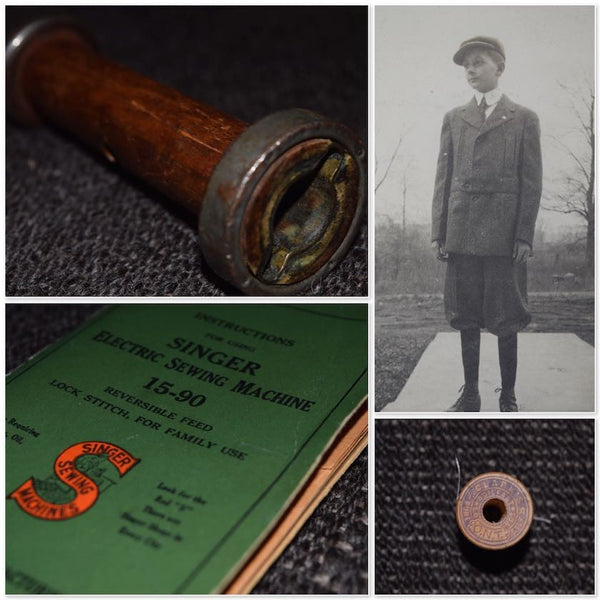
      <![CDATA[<p>There was a time, long ago, when things were made to last, were built with intention, and used with care. These things have a soul I relate with. It’s as if they are time capsules themselves waiting to retell their long lost stories of ingenuity, hard work, resourcefulness, and imagination. Or, at least, I want them to. </p>
<p>Perusing our local thrift shops is one of my favorite past times. I never know what I will find to admire and wonder about. When I do find worthy treasures, I image myself writing stories that will bring them back to life. I wonder about the people who used them, and how. I believe they knew, in intricate detail, how to make from scratch, do it by hand, and appreciate the slow carefulness of making it well. Although my plot lines usually trail off before making it home, I'm sure that my treasures will eventually speak again.</p>
<p>I am quite convinced that the way of the future will have deep roots in our treasured past. At least I hope it will.</p>
<p style="text-align: center;"><img alt="Old bobbin book spool of thread and clothing" src="//cdn.shopify.com/s/files/1/0870/1968/files/old-bobbin-book-spool-and-clothing_grande.jpg?v=1499117490" style="float: none;"></p>]]>
    </content>
  </entry>
  <entry>
    <id>https://abundantearthfiber.com/blogs/fiber-love/natural-inspiration</id>
    <published>2016-01-22T04:00:00-08:00</published>
    <updated>2017-07-03T14:45:41-07:00</updated>
    <link rel="alternate" type="text/html" href="https://abundantearthfiber.com/blogs/fiber-love/natural-inspiration"/>
    <title>Natural Inspiration</title>
    <author>
      <name>Lydia Christiansen</name>
    </author>
    <content type="html">
      <![CDATA[<blockquote>
<p>Earth’s cycles and changes are epic. Whether thunder or whisper, her ever-present voice is an unlimited supply for ideas and inspiration. </p>
</blockquote>
<p>The south end of Whidbey Island was recently visited by Winter with a thick shroud of hoar frost. I had double bundled myself for the brisk walk from my house to the mill as I started running through my lists for the day. I noticed a trickle of water making its way through a frozen ditch at the side of the road. Vibrant green hid behind the white of winter all around. It was beautiful. Then a single leaf stopped me dead in my tracks. </p>
<p style="text-align: center;"><img alt="Leaf frozen in frost" src="//cdn.shopify.com/s/files/1/0870/1968/files/leaf-frozen-in-frost_grande.jpg?v=1499118042" style="float: none;"></p>
<p>I reminded me of <a target="_blank" href="https://www.google.com/search?q=wooly+lambs+ear&amp;espv=2&amp;biw=1422&amp;bih=744&amp;source=lnms&amp;tbm=isch&amp;sa=X&amp;ved=0ahUKEwiS_PjIw7nKAhUDKWMKHSIqA2gQ_AUIBygC" rel="noopener noreferrer">Wooly Lamb’s Ear</a>, but in a Cubism sort of way.  Just the thought of those lamby leaves transported me to the warm buzz of July. For a brief, chilly moment I was sixteen again, and selling endless flats of flower and vegetable starts, including Wooly Lamb's Ear, at <a target="_blank" href="http://shadybrookfarm.com/" rel="noopener noreferrer">Shady Brook Farm</a>. It was my first real job, and I absolutely loved it. To this day, I cannot eat a fresh ear of corn without thinking about Shady Brook Farm. And, as one thought leads to another, I was reminded about the wool. They used to have a petting zoo with two sheep (among other animals including a donkey named Dolly). Every year the shearer would come, and the wool would be bagged and tossed in the trash. Something in my blood told me this was a crime, and even though I knew nothing about fiber or my future interest in it, I managed to convince one of the owners that it was worth something and they should look into selling it. For at least three years straight the bags of wool collected in a corner of a barn that no one used. I thought about them every time I walked by that barn, and I'm fairly certain I'm the only one who did. Those bags of wool are my unsettled score with fiber. I will forever be looking for ways to make use of them, and I see every bag of wool I encounter as my opportunity.  Shady Brook Farm has come a long way since then. I'm not sure the petting zoo is there anymore, but the great memories and people that made it such a special place to me certainly are. </p>
<p style="text-align: center;"><img alt="Rhododendron leaf frozen in frost" src="//cdn.shopify.com/s/files/1/0870/1968/files/rhododendron-leaf-frozen-in-frost_grande.jpg?v=1499118100" style="float: none;"></p>
<p id="yui_3_17_2_1_1453254524547_34917">What will I do with this moment of inspiration? I don’t know yet, but I have captured it, and it’s mine. Moments like this are all around us every day in abundance. Let’s tune in to collecting them like acorns, filling our cache of ideas for the next time we are bursting to make something, say something, or do something beautiful. </p>
<p style="text-align: center;"><img alt="Fern Leaf Frozen in Frost" src="//cdn.shopify.com/s/files/1/0870/1968/files/fern-leaf-frozen-in-frost_grande.jpg?v=1499118149" style="float: none;"></p>]]>
    </content>
  </entry>
  <entry>
    <id>https://abundantearthfiber.com/blogs/fiber-love/whats-your-fiber-profile</id>
    <published>2015-04-27T23:58:00-07:00</published>
    <updated>2017-07-03T15:02:28-07:00</updated>
    <link rel="alternate" type="text/html" href="https://abundantearthfiber.com/blogs/fiber-love/whats-your-fiber-profile"/>
    <title>What&apos;s Your Fiber Profile?</title>
    <author>
      <name>Lydia Christiansen</name>
    </author>
    <content type="html">
      <![CDATA[<h1>A lighthearted take on why we love fiber.</h1>
<p>We see it all the time here at the mill. People come to us with quite decided preferences about their roving. Some like it thick, others prefer thin, textured or smooth, striated or homogeneous. There are purists who take it strictly unblended, and alchemists who will blend anything in their quest for roving or yarn perfection. Personally, I happen to love it all and find the great diversity among fiber and fiber artists inspiring.  So, have you ever considered where you lie in the great spectrum of fiber lovers? What is your fiber profile? Check out these descriptions we've put together and see where you line up. Of course, its normal to relate with qualities from more than one profile. There’s no shame in claiming all of them!</p>
<hr>
<h2>Fiber Rescue First Responder</h2>
<h3 style="text-align: center;"><img alt="Fiber Rescue First Responder: Raw wool" src="//cdn.shopify.com/s/files/1/0870/1968/files/raw-wool-rescue_large.jpg?v=1499118985" style="float: none;"></h3>
<h3>Sourcing &amp; Stashing Habits</h3>
<p>Whether scouring the skirting floor for overlooked locks or taking in bags of unwanted VM with a touch of fiber, you are the first responder when a fleece starts heading for the bin. You tirelessly search for the diamonds in the rough while your friends urge you to stuff pillows, make dolls, or ANYTHING to keep that stuff away from your spinning wheel. </p>
<h3>Roving of Choice</h3>
<p>No discretion needed. A little elbow grease can fix anything - time and patience can produce results on even the most awful fibers!</p>
<h3>Finished Yarn</h3>
<p>You may have more fiber than yarn in your stash. Bits and bobs of this and that seem to hang around for that special day when they reveal their purpose in life. Your finished yarns may collectively resemble a patchwork quilt, but most of all they showcase your remarkable devotion to resurrecting fallen fibers.</p>
<h2>The Primal Fiberist</h2>
<h3 style="text-align: center;"><img alt="Primal Fiberist: Girl holding sheep in field" src="//cdn.shopify.com/s/files/1/0870/1968/files/primal-fiberist_large.jpg?v=1499119039" style="float: none;"></h3>
<h3>Sourcing &amp; Stashing Habits</h3>
<p>You prefer to get your fiber directly from the source - raw and unprocessed. You may be seen <span>climbing remote hillsides seeking</span> fiber snagged by branches or shrubs. Commercially processed fibers hold little to no appeal to you. Is that cotton growing in your bathroom??</p>
<p>(True Story: I once had a septic inspector notice the bags of raw fiber stored in my garage and ask, "But, doesn't it smell bad?")</p>
<h3>Roving of Choice</h3>
<p>Earthy and natural all the way. <span>The variety of texture and color</span><span> in all kinds of natural fiber</span><span> provides you with endless inspiration. A few b</span><span>its of VM are cherished, and </span><span>the scent of lanolin is acceptable or even highly valued</span><span>. </span></p>
<h3>Finished Yarn</h3>
<p><span> It's all about process. </span>Your yarns are rich with memories. A simple touch of your yarn may transport you to the farm, the animal, and each step of processing along the way.  What you lack in luxury, you make up for in meaning. </p>
<h2>The Tiffany Club</h2>
<p style="text-align: center;"><img alt="Tiffany Club" src="//cdn.shopify.com/s/files/1/0870/1968/files/tiffany-club_large.jpg?v=1499119097" style="float: none;"></p>
<h3>Sourcing &amp; Stashing Habits</h3>
<p>The Tiffany Club is drawn to the more elite and prestigious fibers and sources.  You will go to great lengths to acquire only the most luxurious fibers. You are generally well connected, possibly with inside information about when special yarn will hit the market. Everyone but a Primal Fiberist wants to sit next to you at gatherings, where you delight in showing off luscious samples that most of us just dream about.  </p>
<h3>Roving of Choice</h3>
<p>Prefers exotic fibers with zero tolerance for VM. The softer and silkier it glides through your fingers the better. </p>
<h3>Finished Yarn</h3>
<p>Your finished work makes people swoon. Your sense of quality and style are potent. Whether you sell your yarn or gift it to family and friends, your yarn is almost always about connecting with others. </p>
<h2>True Fiber Addict</h2>
<h3 style="text-align: center;"><img alt="True Fiber Addict: Woman surrounded by colored yarn and wool" src="//cdn.shopify.com/s/files/1/0870/1968/files/fiber-addict_large.jpg?v=1499119239" style="float: none;"></h3>
<h3>Sourcing &amp; Stashing Habits</h3>
<p>Characterized by rapid heart rate in the presence of fiber, you see the beauty in all fibers and have an insatiable appetite for bringing new ideas to life. The true addict is equipped with the skills of experience as well as youthful ambition. </p>
<h3>Roving of Choice</h3>
<p>A discerning yet broad palette, there are no boundaries for the true addict who often leads the way with trending blends and cutting edge applications. </p>
<h3>Finished Yarn</h3>
<p>Your creations demonstrate an evolved fiber sense. In learning all you can and trying everything, you may have identified a special style that reflect your unique personality. People can’t help but be amazed at the things you create. For you, fiber is a lifestyle. </p>
<hr>
<p><strong>Diversity is the element that makes life so interesting. We each bring to the fiber table a unique balance of creativity, nuance, and inspiration. But, it is our love of fiber that knits us together. Next time you sit down to your wheel or curl up with a ball of yarn, look around and see if you can't feel the endless circle of fiber lovers wrapping around the globe, across the centuries, and back to you.</strong></p>
<blockquote>This is more than just yarn. This is fiber love.</blockquote>]]>
    </content>
  </entry>
  <entry>
    <id>https://abundantearthfiber.com/blogs/fiber-love/farm-visit-the-pines</id>
    <published>2015-04-09T21:57:00-07:00</published>
    <updated>2017-07-03T15:17:37-07:00</updated>
    <link rel="alternate" type="text/html" href="https://abundantearthfiber.com/blogs/fiber-love/farm-visit-the-pines"/>
    <title>Visiting The Pines Farm</title>
    <author>
      <name>Lydia Christiansen</name>
    </author>
    <content type="html">
      <![CDATA[<p style="text-align: center;"><img alt="The Pines Farm" src="//cdn.shopify.com/s/files/1/0870/1968/files/the-pines-farm-field_grande.jpeg?v=1499119945" style="float: none;"></p>
<p>One of my favorite things to do is visit fiber farms, meet the farmers, and take in the whole big picture behind a yarn. I recently had the great pleasure of making my way to<a target="_blank" href="http://www.thepinesfarm.com/" rel="noopener noreferrer"> the Pines farm in Maple Valley</a> where Al and Lin Schwider raise a charming flock of Romney sheep and Angora goats. The whole day was unforgettably picturesque. Here are just a few moments I will think of when spinning their fiber.   </p>
<p style="text-align: center;"><img alt="Mother and Child feeding baby lamb" src="//cdn.shopify.com/s/files/1/0870/1968/files/mother-and-child-feeding-baby-lamb_medium.jpg?v=1499120028" style="float: none;"> <img src="//cdn.shopify.com/s/files/1/0870/1968/files/funny-looking-sheep_medium.jpg?v=1499120070" alt="Funny looking sheep"></p>
<p style="text-align: center;"><img src="//cdn.shopify.com/s/files/1/0870/1968/files/sheep-in-barn-lot_compact.jpeg?v=1499120129" alt="Sheep in Barn Lot"> <img src="//cdn.shopify.com/s/files/1/0870/1968/files/sheep-in-field_compact.jpg?v=1499120157" alt="Sheep in field"> <img src="//cdn.shopify.com/s/files/1/0870/1968/files/lambs-feeding_compact.jpeg?v=1499120178" alt="Two baby lambs feeding"></p>]]>
    </content>
  </entry>
  <entry>
    <id>https://abundantearthfiber.com/blogs/fiber-love/in-the-works-local-merino-lamb</id>
    <published>2015-04-09T21:57:00-07:00</published>
    <updated>2017-07-03T15:26:55-07:00</updated>
    <link rel="alternate" type="text/html" href="https://abundantearthfiber.com/blogs/fiber-love/in-the-works-local-merino-lamb"/>
    <title>In the Works: Local Merino Lamb</title>
    <author>
      <name>Lydia Christiansen</name>
    </author>
    <content type="html">
      <![CDATA[<p style="text-align: center;"><img alt="Baby lamb standing in barn stall" src="//cdn.shopify.com/s/files/1/0870/1968/files/baby-lamp_grande.jpeg?v=1499120578" style="float: none;"></p>
<p>Washington State is not typically the place you would expect to find Merino. But, if you travel east to Ellensburg as I did recently with my family in tow, you might just find some. Here's a few snapshots from the day I acquired two enormous wool bales. </p>
<p>And where is all that Merino now? It's in the works! We've already got one bale washed and ready for carding and the second is ready for skirting. I have been dreaming about what to do with this amazing batch of fiber for weeks, and although I'm tempted to tell you all my plans, I think you'll just have to wait for it to be revealed after it's all skeined up.</p>
<p style="text-align: center;"><img alt="Child holding a baby lamb" src="//cdn.shopify.com/s/files/1/0870/1968/files/child-holding-baby-lamb_grande.jpeg?v=1499120631" style="float: none;"></p>
<p style="text-align: center;"><img alt="Mother sheep with her baby lambs" src="//cdn.shopify.com/s/files/1/0870/1968/files/mother-sheep-with-baby-lambs_grande.jpeg?v=1499120672" style="float: none;"></p>
<p style="text-align: center;"><img src="//cdn.shopify.com/s/files/1/0870/1968/files/mother-holding-baby-lamb_grande.jpeg?v=1499120709" alt="Mother holding baby lamb"></p>]]>
    </content>
  </entry>
  <entry>
    <id>https://abundantearthfiber.com/blogs/fiber-love/welcome</id>
    <published>2015-04-05T21:11:00-07:00</published>
    <updated>2017-07-03T15:30:52-07:00</updated>
    <link rel="alternate" type="text/html" href="https://abundantearthfiber.com/blogs/fiber-love/welcome"/>
    <title>Welcome</title>
    <author>
      <name>Lydia Christiansen</name>
    </author>
    <content type="html">
      <![CDATA[<h3 class="text-align-center">Welcome to the Abundant Earth Fiber Mill blog. </h3>
<p><img src="//cdn.shopify.com/s/files/1/0870/1968/files/warped-loom_grande.jpeg?v=1499120948" alt="Warped Weaving Loom"></p>
<p>We produce batts, roving, and yarn from local wool, alpaca, and other fibers. We process custom orders as well as producing our own locally sourced, small batch, limited edition rovings and yarn. At the time of our grand opening in July, 2014 the mill was owned and operated all by myself, Lydia Christiansen. I am a self-taught hand spinner, weaver, and processor with a bad case of fiber love. It is almost one year later, and I now have the great pleasure of working alongside five more very talented women. Together we process roughly 1,000 pounds of raw fiber per month. But this is just the beginning of our story. </p>
<p>Our story unfolds daily as we work at the mill, share our stories with each other, and make amazing fiber discoveries together. The purpose of this blog is to invite you to join our story. We don’t know exactly where the road will lead us, or what we will find along the way. But, we do know one thing. </p>
<p>This is more than just yarn. This is fiber love. </p>]]>
    </content>
  </entry>
</feed>