<?xml version="1.0" encoding="UTF-8"?>
<feed xml:lang="en" xmlns="http://www.w3.org/2005/Atom" xmlns:opensearch="http://a9.com/-/spec/opensearch/1.1/" xmlns:s="http://jadedpixel.com/-/spec/shopify">
  <id>https://alembicrarebooks.com/blogs/alembic-rare-books-blog.atom</id>
  <link rel="alternate" type="text/html" href="https://alembicrarebooks.com/blogs/alembic-rare-books-blog"/>
  <link rel="self" type="application/atom+xml" href="https://alembicrarebooks.com/blogs/alembic-rare-books-blog.atom"/>
  <title>Alembic Rare Books - Alembic Blog</title>
  <updated>2024-08-28T18:30:07+01:00</updated>
  <author>
    <name>Alembic Rare Books</name>
  </author>
  <entry>
    <id>https://alembicrarebooks.com/blogs/alembic-rare-books-blog/goodbye-to-alembic</id>
    <published>2024-08-28T18:30:07+01:00</published>
    <updated>2024-08-28T18:30:07+01:00</updated>
    <link rel="alternate" type="text/html" href="https://alembicrarebooks.com/blogs/alembic-rare-books-blog/goodbye-to-alembic"/>
    <title>Goodbye to Alembic</title>
    <author>
      <name>Laura Massey</name>
    </author>
    <content type="html">
      <![CDATA[<div style="text-align: left;"><a href="https://shapero.com/collections/birds-and-ornithology/products/early-victorian-natural-history-manuscript-watercolours-1830s-112603" target="_blank"><img src="https://cdn.shopify.com/s/files/1/0455/7961/files/112603_2_1_600x600.jpg?v=1724853719" alt="" style="float: none;"></a></div>
<p data-mce-fragment="1" data-pm-slice="1 1 []"><span data-mce-fragment="1">This year is Alembic’s tenth anniversary, and it’s been an incredible decade. I’ve had so much fun building the business and developing relationships with amazing collectors, librarians, and booksellers. But I was starting to feel that it was time for a change. </span></p>
<p data-mce-fragment="1" data-pm-slice="1 1 []"><span data-mce-fragment="1">So I’m excited to announce that I’ve joined </span><a data-mce-fragment="1" tabindex="-1" href="https://shapero.com/" target="_blank" data-mce-href="https://shapero.com/" data-mce-tabindex="-1"><span data-mce-fragment="1">Shapero Rare Books</span></a><span data-mce-fragment="1"> in London as the senior science specialist. I’ll be developing the department around the same types of books I’ve always focused on, including women and under-represented groups in the sciences, but I’m also looking forward to significantly expanding the range of material I offer.</span></p>
<p data-mce-fragment="1"><span data-mce-fragment="1">My first list for Shapero is now available. It comprises fifty-eight items, largely new acquisitions, and you can </span><a href="https://cdn.shopify.com/s/files/1/0733/4694/1233/files/Shapero_Rare_Books_Science_List_August_2024.pdf?v=1724769945" target="_blank"><span data-mce-fragment="1">browse the full catalogue</span></a><span data-mce-fragment="1"> as a .pdf or visit our <a href="https://shapero.com/collections/natural-history-science" target="_blank">science &amp; natural history</a> page to see everything in stock.</span></p>
<p data-mce-fragment="1"><span data-mce-fragment="1">My email newsletter is now ending, so please </span><span data-mce-fragment="1">subscribe to the <a href="https://shapero.us10.list-manage.com/subscribe?u=1f5b82db110eaa34e31f70c51&amp;id=84f4d29866" target="_blank">Shapero m</a></span><a href="https://shapero.us10.list-manage.com/subscribe?u=1f5b82db110eaa34e31f70c51&amp;id=84f4d29866" target="_blank">ailing list</a><span data-mce-fragment="1"> — you can choose to</span> <span data-mce-fragment="1">receive updates specifically on science and natural history or on any of the subjects we offer, including travel, Islam and the near east, Judaica, Russian literature, photography, art, and modern first editions.</span></p>
<p data-mce-fragment="1"><span data-mce-fragment="1">Thank you to everyone who has supported me - I look forward to continuing our relationships in this new role!</span></p>]]>
    </content>
  </entry>
  <entry>
    <id>https://alembicrarebooks.com/blogs/alembic-rare-books-blog/revolutionary-childrens-books-eyewitness-dinosaur</id>
    <published>2023-08-09T13:27:39+01:00</published>
    <updated>2023-08-09T13:27:39+01:00</updated>
    <link rel="alternate" type="text/html" href="https://alembicrarebooks.com/blogs/alembic-rare-books-blog/revolutionary-childrens-books-eyewitness-dinosaur"/>
    <title>Revolutionary Children&apos;s Books: Eyewitness Dinosaur</title>
    <author>
      <name>Laura Massey</name>
    </author>
    <content type="html">
      <![CDATA[<p><iframe title="YouTube video player" src="https://www.youtube.com/embed/iYlqKTVSbQ4" height="315" width="560" allowfullscreen="" allow="accelerometer; autoplay; clipboard-write; encrypted-media; gyroscope; picture-in-picture; web-share" frameborder="0"></iframe></p>
<p>Did you have <a href="https://alembicrarebooks.com/products/norman-david-angela-milner-eyewitness-books-dinosaur?_pos=1&amp;_sid=cd39cc50c&amp;_ss=r" target="_blank" title="Eyewitness Dinosaur first editions - Alembic Rare Books" rel="noopener noreferrer">these books</a> as a kid? I did, too! And I had no idea until a few years ago just how revolutionary they were, or that the <em>Dinosaur</em> volume was written by an important palaeontologist.</p>
<p>Let’s start with the books themselves. The publisher, Dorling Kindersley, was founded in London 1974, and in the ‘80s they began taking advantage of new design technology to radically revise the page layouts of children’s books. As they explained in 1997, the goal was to “slow down the pictures and speed up the text” <meta charset="utf-8"><span data-mce-fragment="1">—</span>  to make space for children to explore information in their own way rather than creating a linear narrative. And the illustrations themselves were immersive, so colourful and detailed that they demanded careful attention.</p>
<p>Dorling Kindersley also hired leading academics as authors. One of the co-authors of this volume, Angela Milner, was at the forefront of dinosaur palaeontology throughout her career. She wrote the scientific description of the most important dinosaur specimen ever discovered in Britain, <em>Baryonyx walkeri</em>, and she led the team that used CT scanning to reconstruct the brain of <em>Archaeopteryx</em>, providing further evidence of its relationship to birds. She was an important administrator at the Natural History Museum in London and was the driving  force behind the updated Dinosaur Gallery that opened in 1992.</p>
<p> Published in 1989, <em>Dinosaur</em> was one of the first sixteen books in the Eyewitness series and is still in print. Most copies on the market are later printings, so I was thrilled when I found <a href="https://alembicrarebooks.com/products/norman-david-angela-milner-eyewitness-books-dinosaur?_pos=1&amp;_sid=cd39cc50c&amp;_ss=r" target="_blank" title="Eyewitness Dinosaur first editions - Alembic Rare Books" rel="noopener noreferrer">these beautiful examples</a> of the first British and first American printings, which I’m selling as a set. For more details about them just visit the link in our profile. And me know what your favourite Eyewitness book was in the comments!</p>
<p> Sources:</p>
<p><a href="https://scholarsarchive.byu.edu/cgi/viewcontent.cgi?article=4104&amp;context=etd" target="_blank" rel="noopener noreferrer">“The Efficacy of Small Multiples in the Visual Language of Instructional Designs”</a>, Brigham Young University thesis, 2012).</p>
<p>Cart, “Eyewitness Books: Putting the Graphic in Lexicographic,” <em>Booklist</em>, October 15, 2002.</p>
<p> <a href="https://www.theguardian.com/science/2021/aug/26/angela-milner-obituary" target="_blank" rel="noopener noreferrer">Angela Milner's obituary in the <em>Guardian</em></a>, August 26th, 2021.</p>]]>
    </content>
  </entry>
  <entry>
    <id>https://alembicrarebooks.com/blogs/alembic-rare-books-blog/a-cute-science-book-the-natural-history-of-the-polype-by-henry-baker</id>
    <published>2023-08-01T17:02:48+01:00</published>
    <updated>2023-08-01T17:02:49+01:00</updated>
    <link rel="alternate" type="text/html" href="https://alembicrarebooks.com/blogs/alembic-rare-books-blog/a-cute-science-book-the-natural-history-of-the-polype-by-henry-baker"/>
    <title>A Cute Science Book? The Natural History of the Polype by Henry Baker</title>
    <author>
      <name>Laura Massey</name>
    </author>
    <content type="html">
      <![CDATA[<p><iframe width="560" height="315" src="https://www.youtube.com/embed/SP_EyTKH-4I" title="YouTube video player" frameborder="0" allow="accelerometer; autoplay; clipboard-write; encrypted-media; gyroscope; picture-in-picture; web-share" allowfullscreen=""></iframe></p>
<p>You wouldn’t normally think of scientific illustrations as ‘cute’, but that’s one of the reasons I bought this book, <a href="https://alembicrarebooks.com/products/baker-henry-an-attempt-toward-a-natural-history-of-the-polype?_pos=1&amp;_sid=80e6603ad&amp;_ss=r" target="_blank" title="An Attempt Toward a Natural History of the Polype - Alembic Rare Books" rel="noopener noreferrer"><em>An Attempt Toward a Natural History of the Polype</em> by Henry Baker</a>. The adorable creatures featured in are freshwater polyps – more commonly known as hydra <span>–</span> tiny aquatic organisms related to the corals, anemones, and jellyfish. The hydra has an amazing ability that has fascinated scientists for nearly three hundred years: they can completely regenerate when cut into pieces.</p>
<p>The first person to report on this was the scientist Abraham Trembley, who presented his findings to the Royal Society in January of 1743. Shortly thereafter, his colleagues Henry Baker and Martin Folkes began their own research, culminating in this volume, which was published later in the same year.</p>
<p>It’s chock full of fabulous woodcut illustrations of the animals in various postures and performing different behaviours, such as feeding on small worms and reproducing by budding off clones – another ability that greatly intrigued scientists.</p>
<div style="text-align: start;"><img src="https://cdn.shopify.com/s/files/1/0455/7961/files/747_6_1024x1024.jpg?v=1690905196" alt="Photograph of an old, leather-bound book open on a small pillow. The pages display crude woodcuts of hydra, small organisms with long thin bodies and waving arms, in various postures, with some text on each page." style="float: none;"></div>
<p>But my favourite illustration is the one at the top of this page, which shows hydra hanging out in a glass jar, just like the ones I used to put tadpoles and fireflies in when I was a kid.</p>
<p>Another thing I like about this book is that it’s unusually decorative for a scientific volume, with loads of little illustrations such as historiated initials (capital letters with tiny scenes inside) and head and tail-pieces, like this one depicting two putti holding parrots.</p>
<p><img src="https://cdn.shopify.com/s/files/1/0455/7961/files/747_5_1024x1024.jpg?v=1690905390" alt="Close-up of a page in an old book showing an elaborate but crude woodcut at the top of a page of text. Two putti (cherubs) are depicted holding parrots aloft on their hands, with an open book between them and surrounded by plants and decorative motifs. "></p>
<p>If you'd like to see additional photos, or learn more about our copy of this book, <a href="https://alembicrarebooks.com/products/baker-henry-an-attempt-toward-a-natural-history-of-the-polype?_pos=1&amp;_sid=80e6603ad&amp;_ss=r" target="_blank" title="An Attempt Toward a Natural History of the Polype - Alembic Rare Books" rel="noopener noreferrer">visit its page in our shop</a>.</p>]]>
    </content>
  </entry>
  <entry>
    <id>https://alembicrarebooks.com/blogs/alembic-rare-books-blog/a-remarkable-home-front-diary-of-the-second-world-war</id>
    <published>2023-06-14T17:18:26+01:00</published>
    <updated>2023-08-01T16:51:57+01:00</updated>
    <link rel="alternate" type="text/html" href="https://alembicrarebooks.com/blogs/alembic-rare-books-blog/a-remarkable-home-front-diary-of-the-second-world-war"/>
    <title>A Remarkable Home Front Diary of the Second World War</title>
    <author>
      <name>Laura Massey</name>
    </author>
    <content type="html">
      <![CDATA[<p><iframe title="YouTube video player" src="https://www.youtube.com/embed/os3ssdk4UkA" height="315" width="560" allowfullscreen="" allow="accelerometer; autoplay; clipboard-write; encrypted-media; gyroscope; picture-in-picture; web-share" frameborder="0"></iframe></p>
<p><em>﻿Content advisory: anti-Semitism.</em></p>
<p>On September 2nd, 1939, a British woman named Marjorie True began a new diary with the chilling words, "On the verge of war. Germany bombed Warsaw &amp; has marched into Poland at several points”. Over the next two years she recorded her experiences of the war in a <a title="Second World War Home Front Diary of Marjorie True - Alembic Rare Books" href="https://alembicrarebooks.com/products/true-marjorie-diary-of-a-british-second-world-war-civil-defence-volunteer-september-1939-october-1941?_pos=1&amp;_sid=c9ad43d2a&amp;_ss=r" target="_blank">detailed and revealing journal</a> that also serves as a photo album.</p>
<p class="p1">True chronicles international events alongside her work staffing an ambulance station with the Women's Voluntary Service, but also describes local goings-on, private and public sentiment, and rumours. She closely follows the advances of Germany and Russia across the continent, and the efforts made by western European nations as one by one they fell to the Blitzkrieg, often commenting on the fortitude of the Europeans.</p>
<p class="p2">May 15<sup>th</sup>, 1940: “Today the Dutch Army have laid down their arms. Barely a week ago they were a free people. The Queen, government, Princess Juliana &amp; children are all in England.”</p>
<p class="p2">Saturday, June 15th: “The Germans marched into Paris yesterday. A heavy depression has all but NOT despair. To-day we had most of our windows painted with triplex. This should prevent the glass from flying if shattered.”</p>
<p class="p2"><img alt="Close-up of a page of a handwritten diary written in black ink and beginning on September 2, 1939 and describing the beginning of the Second World War." src="https://cdn.shopify.com/s/files/1/0455/7961/files/834_3_146374ef-1cb8-4697-a25e-5a949efa26ba_600x600.jpg?v=1686757999"></p>
<p class="p2">During the early part of the war True records how she and her fellow citizens were swinging between anxiety and inattention. In September 1939 she writes that “here things are getting rather slack. We feel Hitler cannot bother with us until Poland is finished. Already people are forgetting their gas masks…” She describes her experience of measures such as the blackout and reports that, “Amongst the things I miss is the sounding of the church clocks in the night”. In December that year she visits London for the first time since the outbreak of war and describes seeing “high in the sky only just visible in the fog &amp; mist… barrage balloons looking rather like fat sausages with large [?] fins. Sandbags everywhere — but apart from the darkened streets &amp; shops there seemed quite as many people as ever.”</p>
<p class="p2">The unprecedentedly severe winter of 1939/40 is a frequent subject. On January 25<sup>th</sup>, 1940 True writes, “This cold has nearly driven us all crazy - frost &amp; snow - burst pipes - water coming through ceilings &amp; general awful discomfort has been our lot for what seems like months”. And she discusses the rationing that had just started. “To-day Father went through the business of procuring our sugar for making homemade marmalade or jam! The fruiterer gives one a signed receipt for so many lbs of Seville oranges (no sugar is allowed for the sweet oranges) this has to be taken to the food control office where a [?] is made out for 1lb of sugar to each 16 of fruit. What a game.”</p>
<p class="p2"><img alt="Close-up of a handwritten diary entry with a grey clothing ration book and civil defense registration card lying loosely on top." src="https://cdn.shopify.com/s/files/1/0455/7961/files/834_8_0b35fc8c-1ebc-4aea-a3d8-4a7a39e1329c_600x600.jpg?v=1686758092"></p>
<p class="p2">Other aspects of the diary are both troubling and revealing. In recent decades historians have been at pains to point out that the perception of British self-sacrifice and “stiff upper lip” during the war was only part of a much more complex and morally ambiguous reality, with elements of class, colonialism, and anti-Semitism often at the forefront of events. This is apparent almost immediately in the diary, when on September 3rd, 1939 True reports that, “Since 11 am we have been at war with Germany. All day there has been a flood of evacuees from London — hundreds &amp; hundreds of women &amp; children all housed at the Government’s expense &amp; billeted on private homes here — almost as we were sitting down to lunch we had 2 women &amp; 3 children thrust on us... All the evacuees seem to be Jewish. Why they should choose a small cathedral town to let them loose on beats me. In a very short time both women were grumbling so we tried to get them removed &amp; fortunately were able to do so late in the day to Mrs. Mellow at Vineyard House... We are sorry for these women who have had to break up their homes but they forget our homes are broken up too. Life would have been unbearable had we had to live with that crowd — the women were passable but horribly cheap — the kind who jar horribly”.</p>
<p class="p2">Again, in September of the following year she writes that, “The town is again getting flooded with refugees – real refugees this time. People whose houses are in ruins or who have fled the unceasing crash of A.A. guns &amp; explosions. There are some terrible looking Jews about, I would be glad if those people did not send such a feeling of loathing thro’ on. Why is it? I always feel I must hurry by because what I am feeling must be written on my face.”</p>
<p class="p2"><img alt="Photo of a diary lying open, with three black and white photos pasted to each page, and handwritten annotations describing each." src="https://cdn.shopify.com/s/files/1/0455/7961/files/834_7_7485a077-5e48-4017-85c1-3f5085e4e029_600x600.jpg?v=1686760481"></p>
<p class="p2">True was a member of the Women’s Voluntary Services, working as an ambulance driver’s attendant and stationed at the local swimming pool. Many entries record her training sessions, experiences of nights on call, and interactions with other volunteers.</p>
<p class="p2">The work could be physically difficult but emotionally rewarding. On May 11<sup>th</sup>, 1941, <span>“</span>I tried my hand at putting out a fire by a stirrup pump. As I was wearing my best slacks &amp; not the usual dungarees, I did not feel too enthusiastic when Mr. Brown invited us to try. However, rolling up my slacks &amp; wearing an old oilskin over my Ambulance coat I waded in. It was great fun really... All went well except for my helmet which fell off… Also we were taken — four at a time into a smoke-filled room — here we had to crawl round the room…I felt sure I was to be the one to cry out for the door to be opened but pride as usual came to the rescue and I crawled out with the others after the longest four or five minutes of my life.”</p>
<p class="p2">But there are also happier times. True frequently writes about the other women who were good companions during long days and nights, and the socialising they did. Most of these friends and colleagues are mentioned by name and depicted in the numerous photographs pasted-in to the diary (there are also several pages where True has had the other women sign their own names.)</p>
<p class="p2"><img alt="A page of a diary with three black and white photos pasted on, two are large group shots of women relaxing together in chairs and doing needlework, and the other shows three women standing in their volunteer uniforms." src="https://cdn.shopify.com/s/files/1/0455/7961/files/834_16_d3f2cf14-00d1-43aa-9253-d857bd2d8cce_600x600.jpg?v=1686758555"></p>
<p class="p1">Some photos depict the volunteers doing practice exercises such as preparing equipment, cleaning an ambulance, carrying a comrade on a stretcher, and wearing gas masks and emergency oilskins “for mustard gas”. Other images are casual, the women relaxing together, knitting, having tea, holding pets, goofing around on bicycles, and posing in front of official vehicles.</p>
<p class="p1"><img alt="Black and white photo of three women relaxing, two sitting at a table with a tea service and the third standing and cradling cat, which a Scottie terrier looks up from at her feet." src="https://cdn.shopify.com/s/files/1/0455/7961/files/834_14_1f093d30-deb8-484c-9053-4abe04b2448a_600x600.jpg?v=1686758468"></p>
<p class="p1">True usually rode her bicycle to the station, and there are several photos labelled with variations of “Me &amp; my bike”, including one in uniform.</p>
<p class="p1"><img alt="Black and white photo of an early-middle aged woman in a dark coloured uniform with hat partially sitting on her bicycle in the street." src="https://cdn.shopify.com/s/files/1/0455/7961/files/834_11_baf673d9-cfa8-4007-baa4-638e2b9e14b3_600x600.jpg?v=1686758672"></p>
<p class="p2"><span>There are also images of True’s father </span><span class="s1">—<span> </span></span><span>with the handlebar moustache of a different era — in his warden uniform.</span></p>
<p class="p2"><img alt="Black and white photo of an elderly man with a white handlebar moustache and wearing a helmet standing in a garden backing onto some suburban houses." src="https://cdn.shopify.com/s/files/1/0455/7961/files/834_10_c2002435-505e-45ec-ac09-91ff5c158d62_600x600.jpg?v=1686758746"></p>
<p class="p2">By spring of 1940 the tension reflected in the diary has considerably ramped up, with the German threat coming ever closer to Peterborough. The diary covers the entire period of the Blitz and Battle for Britain. On June 19<sup>th</sup> True describes the anxious wait for the large-scale air raids that the population knew was coming. “A whole week gone &amp; no Battle for England – or rather Britain started yet. Our airmen have put in some marvellous work – this may be one factor. However many hours grace means a lot to us.” And by September she is reporting on the Blitz, which began on the 7<sup>th</sup>. Her entry for September 14<sup>th</sup>, 1940 reads, “London has suffered terribly – &amp; not only London. The Docks have been the chief target but Buckingham Palace received its first &amp; let’s hope last bomb the other night. There have been marvellous tales of courage…”</p>
<p class="p2"><img alt='A handwritten diary lying open, with the left hand of text visible, and a green and white pamphlet with a photo of marching soldiers, titled "A message to the Home Guard" lying loosely on the right hand side.' src="https://cdn.shopify.com/s/files/1/0455/7961/files/834_4_4efc0add-4d99-4b34-aae2-80b4b6df614f_600x600.jpg?v=1686758934"></p>
<p class="p2">In early June True describes Peterborough’s first air raid.</p>
<p class="p2">Friday June 7th: “This morning about 1-15am we had our first real air raid warning. It was hot &amp; still and my window was wide open &amp; I suddenly wakened to the fearful din of the air raid siren. I have often said when listening to the practices that we should never hear it but at 1-15 am on a still summer morning it sounded absolutely devilish. After the first paralysing second I leapt out of bed and tried feverishly to get into my battle dress which by great good fortune was handy. Of course the dungarees went on back to front &amp; it seemed hours to me before I set off on my cycle to the ambulance station. At first I was so rattled I had to get off my bike but gradually I calmed down &amp; rode as fast as the darkness would allow — arriving at last to find I was the first of the part timers to appear. I was given a hearty welcome and we then commenced our long wait until the ‘all clear’ went at 3-15. We looked a grim party of women — none of us looking our best, shining noses and hair entirely out of hand. Now and then we heard the uneven drone of the German planes but that thank goodness was all that happened.”</p>
<p class="p2">Saturday June 8th: “Last night we had our baptism by fire. To-day the town has a weary look after two practically sleepless nights. About 1-15 again — without any warning a German plane dropped what sounded like three or four bombs in Bridge St., Bishop’s Gardens &amp; the swimming pool! ... It is not just a bang - there is a sickening thud which shatters the nerves - At the first moment I felt sick &amp; then began gathering my things in my arms to get downstairs… I must say I listened carefully and sought the sky before venturing forth... What I hate most is thinking of Father on his beat, right in the midst of things. He says that there are several good places to shelter but we are very worried.<span class="Apple-converted-space">  </span>After another ghastly ride with my heart beating like a sledge hammer &amp; my knees knocking I arrived for the second night in succession at the A.S.”</p>
<p class="p2">True seems to have returned to this diary much later in life, as there are a few annotations in a spidery ballpoint pen and some pieces of late-20th century ephemera inserted. On one loose wartime photo of a group of women she writes “How easily one forgets. My Party. This is what I remember of my Party.” The final contemporary entry is dated October 26<sup>th</sup>, 1941, and ends on the back of the very last page in the diary. Below the signatures of colleagues she has later written: “I wish I had got more names to help my memory now on April 12 1992 when the war is over…”</p>
<ul>
<li>For more details and photos of this diary <a title="The Home Front Diary of Marjorie True - Alembic Rare Books" href="https://alembicrarebooks.com/products/true-marjorie-diary-of-a-british-second-world-war-civil-defence-volunteer-september-1939-october-1941?_pos=1&amp;_sid=c9ad43d2a&amp;_ss=r" target="_blank">visit its shop page</a> or email us: info@alembicrarebooks.com.</li>
<li>You may be interested in our other <a title="Rare Books &amp; Documents in Women's History - Alembic Rare Books" href="https://alembicrarebooks.com/collections/womens-history" target="_blank">rare books and documents connected with women's history</a>, or our <a title="Rare Books on Engineering &amp; Technology - Alembic Rare Books" href="https://alembicrarebooks.com/collections/engineering-technology" target="_blank">engineering &amp; technology section</a>, which includes military technology.</li>
</ul>]]>
    </content>
  </entry>
  <entry>
    <id>https://alembicrarebooks.com/blogs/alembic-rare-books-blog/a-beautiful-hand-painted-caterpillar-manuscript</id>
    <published>2023-06-14T16:10:33+01:00</published>
    <updated>2023-06-14T17:39:32+01:00</updated>
    <link rel="alternate" type="text/html" href="https://alembicrarebooks.com/blogs/alembic-rare-books-blog/a-beautiful-hand-painted-caterpillar-manuscript"/>
    <title>A Beautiful, Hand-Painted Caterpillar Manuscript</title>
    <author>
      <name>Laura Massey</name>
    </author>
    <content type="html">
      <![CDATA[<p><iframe width="560" height="315" src="https://www.youtube.com/embed/c5le1lt2TQs" title="YouTube video player" frameborder="0" allow="accelerometer; autoplay; clipboard-write; encrypted-media; gyroscope; picture-in-picture; web-share" allowfullscreen=""></iframe></p>
<p>The intersection of art and science is one of my favourite areas to explore, and this manuscript on caterpillars (now sold) is a fantastic example of the types of things I look for. It was made in Northamptonshire, primarily between 1887 and 1896 (with additions up to 1938), and contains 137 pages of original observations on local caterpillars illustrated with artistically accomplished watercolours made to scale.</p>
<div style="text-align: start;"><img src="https://cdn.shopify.com/s/files/1/0455/7961/files/828_8_0743118e-d406-4b23-ae4a-eac69c68e425_600x600.jpg?v=1686760711" alt="Close-up of a delicate watercolour of a green inch-worm type of caterpillar on the stem of a green leaf."></div>
<p class="p1">Notes in natural history manuscripts are often copied from authoritative sources, but in this case the observations are unusually original and thoughtful, with only occasional references to sources. For instance, a beautiful painting of a privet hawk moth caterpillar (<em>Sphinx ligustri</em>) is accompanied by the note: “I found a large number of these caterpillars feeding on Privet at Wellingboro’. I noticed that all of them were on the West side of the hedges so that they caught the full light of the sun. This seemed to me rather peculiar as the sun shining on the white stripes made them very conspicuous, and the green colour of the caterpillars is much brighter than the leaf of privet by reflected light, whereas it is very similar to the colour of the leaf with the light shining through it, so that if the caterpillars had been on the East side they would have been much more difficult to see”.</p>
<p class="p1"><img src="https://cdn.shopify.com/s/files/1/0455/7961/files/828_15_fa87a831-5991-4a95-afc6-63feabba1975_600x600.jpg?v=1686755063" alt="Close-up of a page of elegant manuscript text surrounding a detailed watercolour painting of a fat, white and grub-like caterpillar with black spots that is curled around so that the head is close to the tail."></p>
<p>There are also thirty-three pages on parasitic wasps, with detailed physical descriptions and greatly magnified pencil and ink drawings of the adults, as well as eggs and larvae. These all appear to be attempts at identification, as the focus is on the types of minute physical details necessary to differentiate species. The specimens were probably obtained from caterpillars being raised in captivity, and the author usually indicates which species they emerged from. This is particularly unusual for amateur nature journals, and indicates a high level of scientific enquiry was being pursued.</p>
<p><img src="https://cdn.shopify.com/s/files/1/0455/7961/files/828_20_a4ec04da-8d92-48e2-9efe-2241abae1e95_600x600.jpg?v=1686755149" alt="Close-up of a pencil and black ink illustration of a parasitic wasp, greatly magnified and with minute details made clear."></p>
<p class="p1">The likely compiler of this manuscript was Eustace Frederic Wallis, whose name appears in the front of this book together with that of a Bruce Wallis we have no identified. He was a partner in the Wallis Brothers photographic firm of Kettering, which was known for its successful lines of shutters, daylight changing film plates, and Penna hand camera (<a href="http://historiccamera.com/cgi-bin/librarium2/pm.cgi?action=app_display&amp;app=datasheet&amp;app_id=3387&amp;" target="_blank" title="Wallis Brothers Photography - Historic Camera" rel="noopener noreferrer">historiccamera.com</a>), and his name and that of his brother Percy are on a U.S. patent for a photographic shutter (patent no. 627.026, filed March 27th, 1899).</p>
<ul>
<li>You may also be interested in our other <a href="https://alembicrarebooks.com/collections/biology-natural-history" title="Rare Books on Biology &amp; Natural History - Alembic Rare Books">rare books on biology and natural history</a>.</li>
</ul>]]>
    </content>
  </entry>
  <entry>
    <id>https://alembicrarebooks.com/blogs/alembic-rare-books-blog/playing-cold-war-a-distant-early-warning-radar-station-toy-by-masudaya</id>
    <published>2023-05-10T16:33:21+01:00</published>
    <updated>2023-05-10T16:33:22+01:00</updated>
    <link rel="alternate" type="text/html" href="https://alembicrarebooks.com/blogs/alembic-rare-books-blog/playing-cold-war-a-distant-early-warning-radar-station-toy-by-masudaya"/>
    <title>Playing Cold War: A Distant Early Warning Radar Station Toy by Masudaya</title>
    <author>
      <name>Laura Massey</name>
    </author>
    <content type="html">
      <![CDATA[<div style="text-align: left;"><iframe width="560" height="315" src="https://www.youtube.com/embed/yvh8ChoFMaQ" title="YouTube video player" frameborder="0" allow="accelerometer; autoplay; clipboard-write; encrypted-media; gyroscope; picture-in-picture; web-share" allowfullscreen=""></iframe></div>
<p>This interactive tin toy is a remarkable relic of the Cold War and one of the most unusual items I've had in stock. </p>
<p class="p1">It was designed as a distant early warning station, complete with a radar “scope” showing the silhouettes of a moving planes, as well as a rotating radar dish and blinking lights, and morse code “signal key” that could be tapped out with a buzzing sound.</p>
<p class="p1"><img src="https://cdn.shopify.com/s/files/1/0455/7961/files/832_4_af20b44d-4ea6-41ec-b4e2-6845e3f81ac4_1024x1024.jpg?v=1683731989" alt='Red and white paper tag with morse code message in black and the instructions "tap out message in morse code".'></p>
<p class="p1">The toy was made by the famed Masudaya firm of Tokyo, which was founded in 1923 and became the leading producer of battery and mechanical-operated toys during the post-war period (fabtintoys.com). This toy has been tested and is only partially functional, with two of the lights and the rotating wheel of plane silhouettes not working at present, possibly due to loose connections. it is nevertheless a lovely example, and rare in the original box.</p>
<p class="p2"><img src="https://cdn.shopify.com/s/files/1/0455/7961/files/832_2_01776fd9-8f5b-4484-886d-14213b0495c8_1024x1024.jpg?v=1683732083" alt='Photograph of an old box lid with a multicolour illustration of a white boy with blonde hair sitting at a control panel and wearing headphones. The text reads, "Battery Operated Distant Early Warning Radar Station."'></p>
<p class="p1">Though early warning radar systems had been in use since Britain’s deployment of Chain Home in 1938, the post-war threat of nuclear bombers led to the development of increasingly sophisticated long-range systems, particularly to monitor activity over the Arctic. The most successful of these was the DEW Line, which was constructed primarily in Canada’s far north, with additional stations in Alaska, Greenland, and Iceland. It went on-line in 1957 but quickly became semi-obsolete as the nuclear threat shifted from bombers to ICBMs, though it continued to operate until the early 1990s to provide an early warning of airborne invasion forces that might have proceeded a missile strike by several hours. The militarisation of the Canadian Arctic had significant effects on Canadian politics, and resulted in increased government interference in the lives of the Inuit as well as serious environmental damage.</p>
<p class="p1"><a href="https://en.wikipedia.org/wiki/File:Dew_line_1960.jpg" target="_blank" title="DEW Line - Wikipedia" rel="noopener noreferrer"><img src="https://cdn.shopify.com/s/files/1/0455/7961/files/Dew_line_1960_1024x1024.jpg?v=1683732176" alt="Simplified map of North America showing three different early warning radar lines, including the DEW Line at the top across the Arctic Circle."></a></p>
<p class="p2">This toy was probably inspired by DEW, which was the only “distant” early warning radar at the time. Though the toy is undated it was probably sold in the late 1950s or early 1960s, given the short period during which distant early warning radar was of military significance. Work at these stations would have involved fairly dull duties, monitoring radar screens for the start of World War III in an isolated and harsh environment, and it’s strangely charming that someone chose to produce a colourful toy based on what must have been one of the more demoralising jobs in the Air Force.</p>
<p>For more about this toy, or to purchase it, <a href="https://alembicrarebooks.com/collections/instruments-measurement/products/masudaya-modern-toys-distant-early-warning-radar-station" target="_blank" title="Distant Early Warning Radar Toy - Alembic Rare Books" rel="noopener noreferrer">visit its page in our shop</a>.  You might also be interested in our stock of rare books on <a href="https://alembicrarebooks.com/collections/engineering-technology" target="_blank" title="Rare Books on Engineering &amp; technology - Alembic Rare Books" rel="noopener noreferrer">engineering and technology</a>.</p>]]>
    </content>
  </entry>
  <entry>
    <id>https://alembicrarebooks.com/blogs/alembic-rare-books-blog/a-victorian-guide-to-houseplants-hassard-floral-decorations</id>
    <published>2023-04-17T13:56:17+01:00</published>
    <updated>2023-04-17T13:56:18+01:00</updated>
    <link rel="alternate" type="text/html" href="https://alembicrarebooks.com/blogs/alembic-rare-books-blog/a-victorian-guide-to-houseplants-hassard-floral-decorations"/>
    <title>A Victorian Guide to Houseplants: Floral Decorations for the Dwelling House by Annie Hassard</title>
    <author>
      <name>Laura Massey</name>
    </author>
    <content type="html">
      <![CDATA[<p> </p>
<p><iframe width="560" height="315" src="https://www.youtube.com/embed/PLv-oNYLeV4" title="YouTube video player" frameborder="0" allow="accelerometer; autoplay; clipboard-write; encrypted-media; gyroscope; picture-in-picture; web-share" allowfullscreen=""></iframe></p>
<p>Are you a houseplant person? So were the Victorians! Many hobbies involving plants became popular during the 19th century, such as collecting and pressing flowers. Using plants decoratively in the home was a huge craze, encompassing both potted plants and arrangements of cut flowers and greenery. Ferns were particularly popular, to the point that some species actually became threatened in the wild, and this was also the period when Christmas trees became widespread in Britain and the US.</p>
<p><img src="https://cdn.shopify.com/s/files/1/0455/7961/files/802_6_600x600.jpg?v=1678450771" alt="Close-up of a engraving in a book that depicts an elaborate arrangement of flowers and plants such as ferns on a dining table."></p>
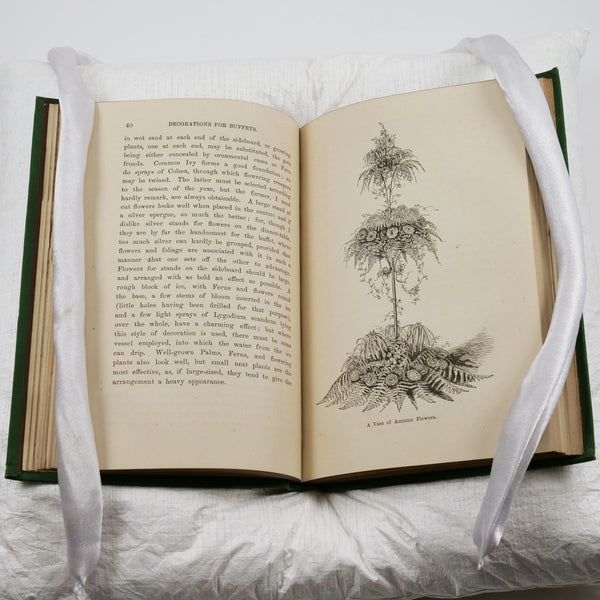
<p><a href="https://alembicrarebooks.com/products/hassard-annie-floral-decorations-for-the-dwelling-house?_pos=1&amp;_sid=ffbb965b9&amp;_ss=r" target="_blank" title="Floral decorations for the Dwelling House - Alembic Rare Books" rel="noopener noreferrer"><em>Floral Decorations for the Dwelling House</em></a>, by Annie Hassard, was first published in 1875 and provided advice on a wide variety of floral decorative schemes, from centrepieces to boutonnieres and flower crowns. Other books had been published on this topic, but Hassard's expanded the subject to include living plants in addition to cut flowers. </p>
<p><img src="https://cdn.shopify.com/s/files/1/0455/7961/files/802_4_600x600.jpg?v=1678451830" alt="A book open to show a large engraving of an elaborate floral arrangement on the right-hand page, and on the left some text with a smaller engraving of a vase with plants."></p>
<p>As the design historian Penny Sparke has written, <em>Floral Decorations for the Dwelling House</em> provided, "<span>a very detailed account, both practically and artistically oriented, of the best plants and best pieces of equipment to use for a wide variety of indoor plant and flower decorations, from bouquets to dining tables, window displays, hanging baskets and Christmas decorations, as well as giving advice on how best to arrange them” (</span><em>Nature Inside,</em><span> p. 48).</span></p>
<p><span><img src="https://cdn.shopify.com/s/files/1/0455/7961/files/802_7_600x600.jpg?v=1678451931" alt="Close-up of an engraving in a book that depicts a boutonniere composed of a rose, other small flowers, and some fern fronds. "></span></p>
<meta charset="utf-8">
<p><span>The book was praised in the January 1876 issue of <em>The Floral World and Garden Guide</em> as “a systematic treatise on the subject. The truth is, the gifted author of this stands alone and far in advance of all competitors, whether as an exhibitor or a judge of exhibitions, whether in the preparation of a bouquet for a princess or the decoration of a grand saloon for an important public ceremony”.</span></p>
<p>For more on this copy of Floral Decorations for the Dwelling-House visit <a href="https://alembicrarebooks.com/products/hassard-annie-floral-decorations-for-the-dwelling-house?_pos=1&amp;_sid=3d354a00d&amp;_ss=r" target="_blank" title="First edition of Floral Decorations for Dwelling-Houses by Annie Hassard - Alembic Rare Books" rel="noopener noreferrer">its page in our shop</a>. You may also be interested in our other <a href="https://alembicrarebooks.com/collections/biology-natural-history" target="_blank" title="Rare Books on Nature &amp; Biology - Alembic Rare Books" rel="noopener noreferrer">rare books on nature &amp; biology</a>.</p>
<p><span><img src="https://cdn.shopify.com/s/files/1/0455/7961/files/802_5_600x600.jpg?v=1678452030" alt="Image of a book open on a cushion. The right-hand page is an engraving of a large and elaborate, three-tiered floral arrangement including ferns. The left-hand page is text."></span></p>]]>
    </content>
  </entry>
  <entry>
    <id>https://alembicrarebooks.com/blogs/alembic-rare-books-blog/photographs-of-women-at-work-during-the-first-world-war</id>
    <published>2021-08-03T17:35:27+01:00</published>
    <updated>2023-04-17T13:57:55+01:00</updated>
    <link rel="alternate" type="text/html" href="https://alembicrarebooks.com/blogs/alembic-rare-books-blog/photographs-of-women-at-work-during-the-first-world-war"/>
    <title>Photographs of Women at Work during the First World War</title>
    <author>
      <name>Laura Massey</name>
    </author>
    <content type="html">
      <![CDATA[<meta charset="utf-8">
<div style="text-align: left;"><img src="https://cdn.shopify.com/s/files/1/0455/7961/files/644_6_1024x1024.jpg?v=1628002746" alt="Black and white photograph of a white, dark-haired woman agricultural worker in a long dress and a shirt with the sleeves rolled up and with a white hat standing in a field and sharpening a scythe. She stands facing the right side of the image, but turns her head and smiles at the camera." style="float: none;"></div>
<p>Today the women workers of the Second World War – represented by Rosie the Riveter and the 'We Can Do It' poster – loom large in the popular consciousness. But fewer people are aware of the huge role that women played in the labor force during the First World War, working in a wide variety of previously male-dominated industries. We recently acquired a remarkable record of their importance on the home front in Britain: <a href="https://alembicrarebooks.com/products/war-office-womens-war-work?_pos=1&amp;_sid=03436de5e&amp;_ss=r" target="_blank" title="Women's War Work first edition - Alembic Rare Books" rel="noopener noreferrer"><em>Women's War Work</em></a>, a publication of the War Office that contains seventy-two evocative and rarely-seen photos of female labourers.</p>
<p><img src="https://cdn.shopify.com/s/files/1/0455/7961/files/644_1_1024x1024.jpg?v=1628002967" alt="Photograph of a thin and tall booklet with grey cover printed in black, &quot;Women's War Work, issued by the War Office September 1916. London... Price One Shilling.&quot;"></p>
<p class="p1">Very quickly after the outbreak of war it became clear that the enlistment of British working men would create shortages of munitions, equipment, and food, and that large numbers of women would need to move into jobs<span> </span>they had previously been restricted from performing.</p>
<p class="p1">Despite the reluctance of some officials, factory managers, and trade unions, “reports were conducted early on as to the suitability of women to meet the demands of such work. As early as 1915 the Ministry of Munitions Supply Committee made recommendations on the employment and remuneration of women on munitions work. This helped contribute to agreed suitable conditions by which a woman could be employed, and the War Office published several guides as to the employment of women” ("<a href="https://www.nrscotland.gov.uk/research/learning/first-world-war/the-munitionettes-and-the-work-of-women-in-the-first-world-war" target="_blank" title="The Munitionettes and the Work of Women in the First World War - National Library of Scotland" rel="noopener noreferrer">The Munitionettes and the Work of Women in the First World War</a>”, National Records of Scotland).</p>
<p class="p1"><a href="https://alembicrarebooks.com/products/war-office-womens-war-work?_pos=1&amp;_sid=03436de5e&amp;_ss=r" target="_blank" title="Women's War Work First Edition - Alembic Rare Books" rel="noopener noreferrer"><em>Women’s War Work</em></a> was one of these publications, appearing in 1916 and providing a detailed list of roles in which women had been “successfully employed in the temporary replacement of men”, not only in munitions manufacturing, but also in agriculture, portering and haulage, commercial cleaning, clerical work, and the production of everyday goods such as chemicals and fertiliser, soap, candles, ceramics and metalwork, clothing and textiles, food and drink, and paper goods, (including printing and book binding!)</p>
<div style="text-align: left;"><img src="https://cdn.shopify.com/s/files/1/0455/7961/files/644_4_1024x1024.jpg?v=1628000367" alt='Close-up of a tall printed page titled "detailed list of processes in which women are successfully employed" with lists and sublists, for example "matches and firelighters: box and case making, chopping up fire lighters, tin lining..."' style="float: none;"></div>
<p class="p1">The lists are accompanied by the contact details of officials who can assist in the recruitment of women workers, and, of course, the remarkable photos, which seem to have been included "as visual proof of the women’s abilities" ("<a href="https://www.nrscotland.gov.uk/research/learning/first-world-war/the-munitionettes-and-the-work-of-women-in-the-first-world-war" target="_blank" title="The Munitionettes and the Work of Women in the First World War - National Library of Scotland" rel="noopener noreferrer">The Munitionettes</a>").</p>
<p class="p1">My favourite is the one at the top of this post, of the agricultural worker sharpening a scythe. But there are so many excellent shots. They often depict the workers in action, sometimes looking assertively or even cheekily toward the camera while performing a task. Some are beautifully composed, taking advantage of light and shadow in industrial spaces. Also of interest are the various wardrobe choices, which were tailored to the task at hand and frequently violated contemporary norms about women's wear.</p>
<p class="p1">Most of the photos are credited to various news agencies, including the Alfieri Picture Service, Topical Press Agency, and Central Press, so the individual photographers are unknown. But I do wonder if any of these were taken by women, and perhaps someday that question will be answered with archival research.    </p>
<p class="p1">A woman stoker working at the furnaces of a large factory in south London:</p>
<p class="p1"><img src="https://cdn.shopify.com/s/files/1/0455/7961/files/644_7_1024x1024.jpg?v=1628003532" alt="Black and white photo of a woman in overalls with her shirt sleeves rolled up and a handkerchief on her head shovels coal into a large, industrial furnace." style="display: block; margin-left: auto; margin-right: auto;"></p>
<p class="p1">Brewery workers, barley room:</p>
<p class="p1"><img src="https://cdn.shopify.com/s/files/1/0455/7961/files/644_8_1024x1024.jpg?v=1628004804" alt="Black and white photo of three white women in dark coveralls and with their hair pinned up, standing in a street and holding brooms, a handcart, and a shovel." style="display: block; margin-left: auto; margin-right: auto;"></p>
<p class="p1">Women wagon washers:</p>
<div style="text-align: start;"><img src="https://cdn.shopify.com/s/files/1/0455/7961/files/644_9_1024x1024.jpg?v=1628005231" alt="Black and white photo depicting a line of seven white women in dark clothing with round, brimmed hats, holding brushes in their hands and with buckets on the floor.Many of them are smiling, laughing, and looking around, while one rubs her face with the bak of her hand.." style="float: none; display: block; margin-left: auto; margin-right: auto;" width="1024x1024" height="1024x1024"></div>
<p class="p1">Oiling and hanging up leather in drying sheds:</p>
<p class="p1"><img src="https://cdn.shopify.com/s/files/1/0455/7961/files/644_10_1024x1024.jpg?v=1628005506" alt="Black and white photograph of a tannery, a large room with low wooden beams and large vats. Seven white women are working at various tasks, including hanging up large pieces of leather from the beams to dry. " style="display: block; margin-left: auto; margin-right: auto;"></p>
<p class="p1">Putting the finishing touches to a motor cycle:</p>
<div style="text-align: start;"><img src="https://cdn.shopify.com/s/files/1/0455/7961/files/Women_s_War_Work_3_1024x1024.jpg?v=1628006416" alt="Black and white photograph of a young white woman in a dress and shirtwaist with her hair pulled back loosely sitting down and working on the chassis of a motorcycle with a wrench.." style="float: none; display: block; margin-left: auto; margin-right: auto;"></div>
<div style="text-align: start;">Conveying leather from dipping beds on barrows:</div>
<div style="text-align: start;"><img src="https://cdn.shopify.com/s/files/1/0455/7961/files/Women_s_War_Work_4_1024x1024.jpg?v=1628006578" alt="Black and white photograph of eight white women working in a tannery wearing leather aprons. One woman in the foreground faces forward with a cart in her hands and behind her back, which another woman is loading with pieces of leather. A number of women are visible in the background." style="display: block; margin-left: auto; margin-right: auto;"></div>
<div style="text-align: start;">Women in newspaper offices– girls pulling proofs and correcting type:</div>
<div style="text-align: start;"></div>
<div style="text-align: start;"><img src="https://cdn.shopify.com/s/files/1/0455/7961/files/Women_s_War_Work_5_1024x1024.jpg?v=1628006942" alt="Black and white photographs of two white women in dresses standing on either side of a small hand-press. One woman has both hands on the press and appears to be taking an impression, while the other stands in front of a case of type and selects pieces."></div>
<div style="text-align: start;"></div>
<div style="text-align: start;">
<ul>
<li>For more details, or to purchase our of copy of <em>Women's War Work</em>, please visit <a href="https://alembicrarebooks.com/products/war-office-womens-war-work?_pos=1&amp;_sid=03436de5e&amp;_ss=r" target="_blank" title="Women's War Work 1916 - Alembic Rare Books" rel="noopener noreferrer">its page in our shop</a>.</li>
<li>You may also be interested in our other rare books on <a href="https://alembicrarebooks.com/collections/womens-history" target="_blank" title="Rare Books on Women's History - Alembic Rare Books" rel="noopener noreferrer">women's history</a> and <a href="https://alembicrarebooks.com/collections/women-in-science" target="_blank" title="Rare books by and about women in science and technology - Alembic Rare Books" rel="noopener noreferrer">women in science and technology</a>.</li>
<li>Two excellent books on women at work during the First World War are Patricia Fara's <a href="https://uk.bookshop.org/books/a-lab-of-one-s-own-science-and-suffrage-in-the-first-world-war/9780198794998" target="_blank" title="A Lab of One's Own - Bookshop.org" rel="noopener noreferrer">A Lab of One's Own: Science and Suffrage in the First World War</a> and <a href="https://uk.bookshop.org/books/magnificent-women-and-their-revolutionary-machines/9781783526604" target="_blank" title="Magnificent Women and Their Revolutionary Machines - Henrietta Heald" rel="noopener noreferrer">Magnificent Women and Their Revolutionary Machines</a> by Henrietta Heald.</li>
</ul>
</div>
<div style="text-align: start;"></div>]]>
    </content>
  </entry>
  <entry>
    <id>https://alembicrarebooks.com/blogs/alembic-rare-books-blog/pioneering-black-nurses-the-great-influenza</id>
    <published>2020-10-13T17:00:16+01:00</published>
    <updated>2021-08-03T17:36:16+01:00</updated>
    <link rel="alternate" type="text/html" href="https://alembicrarebooks.com/blogs/alembic-rare-books-blog/pioneering-black-nurses-the-great-influenza"/>
    <title>Pioneering Black Nurses &amp; The Great Influenza of 1918</title>
    <author>
      <name>Laura Massey</name>
    </author>
    <content type="html">
      <![CDATA[<p>One of the most fascinating aspects of the history of science and medicine is the way that women and people of colour have consistently advocated for themselves as scientists and professionals, often against very strong strong opposition from the establishment. And in some cases their efforts have given a helping hand by wider events. Many people are familiar with the ways that the First and Second World Wars expanded opportunities in fields such as engineering, but fewer know about the impact of the Great Influenza of 1918. One of our recent acquisitions reflects both these aspects of the history of medicine: it's a first edition of <a href="https://alembicrarebooks.com/collections/recent-acquisitions/products/thoms-adah-b-pathfinders-a-history-of-the-progress-of-colored-graduate-nurses" target="_blank" title="Pathfinders by Adah B. Thoms - Alembic Rare Books" rel="noopener noreferrer"><em>Pathfinders: A History of the Progress of Colored Graduate Nurses</em></a> by nursing administrator and activist Adah B. Thoms, with the ownership signature of Aileen Cole Stewart, one of the groundbreaking nurses featured in the text.</p>
<p><img src="https://cdn.shopify.com/s/files/1/0455/7961/files/525_3_1024x1024.jpg?v=1601393730" alt="" style="display: block; margin-left: auto; margin-right: auto;"></p>
<p>Adah Thoms (1863-1943), depicted in the author photo above, was a nurse and educational administrator who made great strides toward equality for Black nurses in the United States. </p>
<p>Thoms was born in Virginia and moved to New York for her education, first at the Women's Infirmary and School of Massage and then at the <a href="https://linmed.org/" target="_blank" title="Lincoln Medicine" rel="noopener noreferrer">Lincoln Hospital and Home</a> in the Bronx, which had been established to treat impoverished Black patients. Thoms worked as head nurse at the hospital and eventually became the assistant director. As an administrator she established the teaching of public health — still an emerging field at the time <span>—</span> in the nursing program, and even took the course herself (Ogilvie, <em>Biographical Dictionary of Women in Science</em>, p. 1286).</p>
<meta charset="utf-8">
<p><span>Thoms was one of the founders of the National Association of Colored Graduate Nurses, serving as the organisation's treasurer and then president. She advocated for the equality of Black nurses internationally, and "fought hard... to gain the admission of black nurses into the American Red Cross. Although the head of the Red Cross agreed, this was vetoed by the Surgeon General of the United States. By 1917, one African-American nurse was enrolled in the Red Cross but given no assignment. By 1918, the great influenza epidemic made the use of all available nurses urgent, and eighteen Black nurses were enrolled in the Army Nurse Corps where, although they treated sick soldiers of all backgrounds, they themselves lived in segregated quarters" (Ogilvie, p. 1286).</span></p>
<meta charset="utf-8">
<p>In 1929 Thoms published <em>Pathfinders</em>, which<span> charts the history of Black nurses, beginning by pointing out the medical skills of enslaved women and Harriet Tubman's work as a nurse for the Union army. The text goes on to chart the development of professional nursing education and careers for Black women during the late 19th and early 20th centuries. Below, two of the nurses featured are Jessie Sleet Scales, a social service nurse in New York City, and Ludie A. Andrews, who secured registration for Black nurses in the state of Georgia:</span></p>
<p><span><img src="https://cdn.shopify.com/s/files/1/0455/7961/files/525_6_1024x1024.jpg?v=1601396724" alt="" style="display: block; margin-left: auto; margin-right: auto;"></span></p>
<p>Among the many women featured in <em>Pathfinders</em> are the eighteen Black nurses who were able to enroll in the Army Nursing Corps in 1918 thanks to Thoms's advocacy and the increased demand for nurses resulting from the influenza pandemic. One of these women, Aileen Cole Stewart, is not only featured in <em>Pathfinders</em>, but owned this copy. In this photo from the book she is depicted standing at the bottom left with her colleagues at Camp Sherman in Ohio:</p>
<p><img src="https://cdn.shopify.com/s/files/1/0455/7961/files/525_4_1024x1024.jpg?v=1601393657" alt="" style="display: block; margin-left: auto; margin-right: auto;"></p>
<p>This is her ownership inscription in the book:</p>
<p><img src="https://cdn.shopify.com/s/files/1/0455/7961/files/525_2_1024x1024.jpg?v=1601393692" alt="" style="display: block; margin-left: auto; margin-right: auto;"></p>
<p>Stewart completed her nursing training in 1914, and "her dedication and courage helped her climb the ranks to become one of the first African American women to serve in the Army Nursing Corps" (Alexander, <a href="https://www.womenshistory.org/education-resources/biographies/aileen-cole-stewart" target="_blank" title="Biography of Aileen Cole Stewart at the National Women's History Museum" rel="noopener noreferrer">National Women's History Museum biography</a>).</p>
<p>Though little is known about Stewart's early life, she later wrote about her experiences as a student nurse at the Freedmen’s Hospital Training School in Washington, DC and Howard University Medical School (<span>Cole, "Ready to Serve," </span><em>The American Journal of Nursing</em><span> 63, no. 9, 1963)</span>. After completing her training Stewart applied to join the Army Nursing Corps through the American Red Cross, but because the services were still segregated she was not assigned to active duty.</p>
<meta charset="utf-8">
<p><span>"In October 1918, everything changed. African American Red Cross nurses were called into duty when soldiers and workers began to die of the flu. </span>The Red Cross sent Stewart to Putney, West Virginia with another nurse. Conditions for the railroad workers soon got worse, and Stewart was sent by herself to a small town called Cascade. She worked alone in the mountains until she received a letter from the director of field nursing at the American Red Cross asking Stewart to serve. On December 1, 1918, Stewart began her service in the Army Nurse Corps, along with 17 other African American nurses. Half of the nurses went to Camp Sherman in Ohio, and half went to Camp Grant in Illinois. Stewart was stationed at Camp Sherman, where the African American nurses lived in segregated areas" (NWHM biography).</p>
<p>After the pandemic Stewart worked as a public health nurse in New York City. "She earned a degree in public health nursing from the University of Washington at the age of 68 and continued to volunteer with the Red Cross youth program until she died” (NWHM biography).</p>
<p>The Great Influenza provided an unusual opportunity for Black nurses, but the groundwork had already been laid by decades of advocacy on the part of Adah B. Thoms and other Black medical professionals and educators. And it was brave and determined nurses like Aileen Cole Stewart <span>— </span>who fought to serve despite all the obstacles before them <span>— who stepped into those newly opened roles</span><span>.</span> </p>
<ul>
<li>For more details or to purchase this copy, <a href="https://alembicrarebooks.com/collections/recent-acquisitions/products/thoms-adah-b-pathfinders-a-history-of-the-progress-of-colored-graduate-nurses" target="_blank" title="Pathfinders by Adah B. Thoms - Alembic Rare Books" rel="noopener noreferrer">see its page in our online shop</a>.</li>
<li>You may also be interested in our other <a href="https://alembicrarebooks.com/collections/diverse-science" target="_blank" title="Rare books by and about scientists of colour - Alembic Rare Books" rel="noopener noreferrer">rare books by and about scientists of colour</a>, and our other books on <a href="https://alembicrarebooks.com/collections/medicine-anatomy" target="_blank" title="Rare books on medicine and anatomy - Alembic Rare Books" rel="noopener noreferrer">medicine and anatomy</a>.</li>
</ul>]]>
    </content>
  </entry>
  <entry>
    <id>https://alembicrarebooks.com/blogs/alembic-rare-books-blog/studying-storms-meteorologist-charles-e-andersons-dissertation-on-cumulus-clouds</id>
    <published>2020-08-13T09:35:00+01:00</published>
    <updated>2020-08-13T09:35:17+01:00</updated>
    <link rel="alternate" type="text/html" href="https://alembicrarebooks.com/blogs/alembic-rare-books-blog/studying-storms-meteorologist-charles-e-andersons-dissertation-on-cumulus-clouds"/>
    <title>Studying Storms: Meteorologist Charles E. Anderson&apos;s Dissertation on Cumulus Clouds</title>
    <author>
      <name>Laura Massey</name>
    </author>
    <content type="html">
      <![CDATA[<p>One of the stand-out items in our new <a href="https://cdn.shopify.com/s/files/1/0455/7961/files/Alembic_Rare_Books_List_13-_The_Climate_Crisis.pdf?v=1597224178" target="_blank" title="Alembic Rare Books List 13: The Climate Crisis" rel="noopener noreferrer">catalogue on the climate crisis</a> is the dissertation of Charles E. Anderson, the first Black American to earn a PhD in meteorology, whose work focused on storms, cloud and aerosol physics, and the meteorology of other planets.</p>
<p style="text-align: center;"><img src="https://cdn.shopify.com/s/files/1/0455/7961/files/Charles_E._Anderson_480x480.png?v=1597229141" alt="" width="480x480" height="480x480"></p>
<p class="p1">Anderson earned his bachelor’s degree at Lincoln University and in 1943 received a certificate in meteorology from the Army Air Forces Meteorological Aviation Cadet Program at the University of Chicago. He was commissioned a 2nd lieutenant and served as a Base Weather Officer for the <a href="https://en.wikipedia.org/wiki/Tuskegee_Airmen" target="_blank" title="Tuskeegee Airmen - Wikipedia" rel="noopener noreferrer">Tuskegee Airmen</a> between May 1943 and January 1944. You can hear Anderson recalling this experience in an <a href="https://www.youtube.com/watch?v=oiOOZ8vlrZY" target="_blank" title="Charles E. Anderson Recalls Tuskeegee Airman Experience - NCAR on YouTube" rel="noopener noreferrer">audio file</a> uploaded to YouTube by the National Center for Atmospheric Research.</p>
<meta charset="utf-8">
<p class="p1"><span>After the war Anderson continued his education with a master of science in chemistry at the Polytechnic Institute of Brooklyn and in 1960 a PhD in meteorology at MIT. His dissertation analyses the development of five cumulus congestus clouds near Tucson, Arizona, which “were found to exhibit a pulsating form of cellular convection as they grew upward”. Anderson proposed a “physical model for the circulation of a growing cumulus, in which two cells are acting concurrently, yet independently, along the same vertical axis” (abstract). The importance of this research was recognised immediately, and it was honoured with immediate publication (Krapp, </span><a href="https://books.google.co.uk/books/about/Notable_Black_American_Scientists.html?id=jeVsAAAAMAAJ&amp;source=kp_book_description&amp;redir_esc=y" target="_blank" title="Krapp - Notable Black American Scientists - Google Books" rel="noopener noreferrer">Notable Black American Scientists</a><span>, p. 12).</span></p>
<p class="p1"><img src="https://cdn.shopify.com/s/files/1/0455/7961/files/512_1_600x600.jpg?v=1597229246" alt="" width="600x600" height="600x600" style="display: block; margin-left: auto; margin-right: auto;"></p>
<p class="p2">Anderson had a long and varied career, working for the Air Force, the Douglas Aircraft Company, and the Department of Commerce before joining the University of Wisconsin as a professor and eventually associate dean.</p>
<p class="p2">His final post was at North Carolina State University, where he was “a major contributor to a program at the university that has received national recognition for its forecasting of severe storms” (Brown, The Faces of Science: African Americans in Science, University of California, Irvine website).</p>
<ul>
<li>For more details or to purchase this copy, <a href="https://alembicrarebooks.com/products/anderson-charles-e-a-study-of-the-pulsating-growth-of-cumulus-clouds" target="_blank" title="Anderson - Pulsating Growth of Cumulus Clouds - Alembic Rare Books" rel="noopener noreferrer">visit its shop page</a>.</li>
<li>You may be interested in the other books in our short list on <a href="https://cdn.shopify.com/s/files/1/0455/7961/files/Alembic_Rare_Books_List_13-_The_Climate_Crisis.pdf?v=1597224178" target="_blank" title="Alembic Rare Books List 13 - The Climate Crisis" rel="noopener noreferrer">The Climate Crisis</a>.</li>
<li>You can also browse our full selection of <a href="https://alembicrarebooks.com/collections/geology-paleontology" target="_blank" title="Rare Books on Geology, Meterology, &amp; Earth Science - Alembic Rare Books" rel="noopener noreferrer">rare books on geology, meteorology, and earth science</a>.</li>
</ul>]]>
    </content>
  </entry>
  <entry>
    <id>https://alembicrarebooks.com/blogs/alembic-rare-books-blog/elizabeth-woods-crystal-orientation-manual</id>
    <published>2020-08-04T16:47:00+01:00</published>
    <updated>2020-08-04T16:47:39+01:00</updated>
    <link rel="alternate" type="text/html" href="https://alembicrarebooks.com/blogs/alembic-rare-books-blog/elizabeth-woods-crystal-orientation-manual"/>
    <title>Seeing the Structure of Molecules: Elizabeth Wood&apos;s Crystal Orientation Manual</title>
    <author>
      <name>Laura Massey</name>
    </author>
    <content type="html">
      <![CDATA[<p>Elizabeth A. Wood's <a href="https://alembicrarebooks.com/collections/recent-acquisitions/products/wood-elizabeth-a-crystal-orientation-manual" target="_blank" title="Crystal Orientation Manual by Elizabeth Woods - Alembic Rare Books" rel="noopener noreferrer"><em>Crystal Orientation Manual</em></a> is an introductory guide to one of the most revelatory scientific developments of the 20th century: x-ray crystallography. This technique, in which x-rays are used to visualise electron density in a crystallised substance, allows researchers to precisely determine the atomic structures of important molecules, not only minerals but also bio-active substances such as pharmaceuticals, hormones, and proteins. Learning their structures <span>advanced our understanding of numerous physiological processes and</span> made it easier to recreate these substances in the lab for research or medical use. Most famously, UK crystallographer Dorothy Crowfoot Hodgkin determined the structures of insulin, vitamin B12, and penicillin, and Rosalind Franklin did cutting-edge work on coal, graphite, viruses, and DNA and RNA. </p>
<p><img src="//cdn.shopify.com/s/files/1/0455/7961/files/491_7_1024x1024.jpg?v=1596554478" alt=""></p>
<p>In the United States, another crystallographer made signifiant contributions while working as the first female scientist at Bell Laboratories. Elizabeth Wood (1912-2006) was educated at Bryn Mawr, where she became an instructor in geology. Following teaching stints at Barnard and Columbia she joined Bell Labs in 1942 and remained there for the next twenty-four years. Wood’s interests “ranged from the growth of single crystals with useful semiconducting, lasing, magnetic or superconducting properties to the crystallographic investigation of new materials with unusual properties such as the exhibition of both ferromagnetism and piezoelectricity. She also worked on material phases that could be changed by the application of appropriately oriented electric fields and on the formation of new superconductors” (<a href="https://www.iucr.org/news/newsletter/volume-14/number-4/elizabeth-armstrong-wood-1912-2007" target="_blank" title="Elizabeth Wood Obituary - International Union of Crystallographers" rel="noopener noreferrer">International Union of Crystallographers obituary</a>).</p>
<p><span>Wood was a highly respected scientist, whose advice was often sought by colleagues. She was also a talented science writer, publishing books for both popular and professional audiences, including a best-selling book on the science of airplane travel. </span></p>
<p><span>“Her reputation for clearly written texts spread as a result of her </span><em>Rewarding Careers for Women in Physics</em><span> (1962) and </span><em>Pressing Needs in School Sciences</em><span> (1969) published by the American Institute of Physics (AIP) in 1962. It became wider still with the publication of her </span><em>Crystal Orientation Manual</em><span> in 1963, which expounded the art and science of preparing shaped pieces of large accurately oriented single crystals for technicians" (</span>International Union of Crystallographers obituary)</p>
<p><em><img src="//cdn.shopify.com/s/files/1/0455/7961/files/491_8_1024x1024.jpg?v=1596554492" alt=""></em></p>
<p><em>Crystal Orientation Manual</em>, first published in 1963, was designed for "<span>chemists, physicists, engineers, and technicians who are today confronted with the problem of obtaining a slice or rod of suitable orientation for their experiments have not had crystallographic training", as Wood put it in the introduction. It was spiral-bound so that the pages would lie flat, making it easier to consult while working, and includes numerous illustrations and charts visualising the complex chemistry of crystals and how to prepare them for study. </span></p>
<p><span><img src="//cdn.shopify.com/s/files/1/0455/7961/files/491_6_1024x1024.jpg?v=1596554512" alt=""></span></p>
<p>In addition to her work at Bell Labs, Wood was active in professional societies, serving as secretary of the American Society for X-Ray and Electron Diffraction and leading its merger with the Crystallographic Society of America. In addition to drafting the constitution for the resulting organisation, the American Crystallographic Association, she was elected its first female president in 1957.  Wood's "deep interest in improving the scientific understanding of the general public was recognized by the ACA’s establishment of an Elizabeth A. Wood Science Writing Award" (IUC obituary).</p>
<ul>
<li>For more details about this copy, or to purchase it, <a href="https://alembicrarebooks.com/collections/recent-acquisitions/products/wood-elizabeth-a-crystal-orientation-manual" target="_blank" title="Crystal Orientation Manual by Elizabeth Wood - Alembic Rare Books" rel="noopener noreferrer">visit its shop page</a>.</li>
<li>You may be interested in our other <a href="https://alembicrarebooks.com/collections/chemistry-physics" target="_blank" title="Rare Books on Chemistry &amp; Physics - Alembic rare Books" rel="noopener noreferrer">rare books on chemistry and physics</a>, or <a href="https://alembicrarebooks.com/collections/women-in-science" target="_blank" title="Rare books by and about women in science - Alembic Rare Books" rel="noopener noreferrer">women in the sciences</a>.</li>
</ul>]]>
    </content>
  </entry>
  <entry>
    <id>https://alembicrarebooks.com/blogs/alembic-rare-books-blog/eggs</id>
    <published>2020-07-29T12:56:00+01:00</published>
    <updated>2020-08-04T16:48:35+01:00</updated>
    <link rel="alternate" type="text/html" href="https://alembicrarebooks.com/blogs/alembic-rare-books-blog/eggs"/>
    <title>Eggs!</title>
    <author>
      <name>Laura Massey</name>
    </author>
    <content type="html">
      <![CDATA[<p>One of our fun new acquisitions is this <a href="https://alembicrarebooks.com/products/pennington-mary-engle-et-al-paul-mandeville-ed-eggs?_pos=1&amp;_sid=6cdd2e9ad&amp;_ss=r" target="_blank" title="Eggs - Alembic Rare Books" rel="noopener noreferrer">two volume set on the science and economics of eggs</a>, co-authored by one of America's first female bacteriologists. It was published for the Institute of American Poultry Industries to distribute at the 1933 Chicago World's Fair as a way to promote the rapidly industrialising American poultry industry.</p>
<p><img src="//cdn.shopify.com/s/files/1/0455/7961/files/458_7_grande.jpg?v=1595944679" alt="" style="display: block; margin-left: auto; margin-right: auto;"></p>
<p>The text opens with the question, "What is an egg" and is pitched at both general and specialised readerships, with content of use to homemakers and cooks as well as agriculturists, grocers, agribusiness investors, and politicians.</p>
<p><img src="//cdn.shopify.com/s/files/1/0455/7961/files/458_9_1024x1024.jpg?v=1595948457" alt="" style="display: block; margin-left: auto; margin-right: auto;"></p>
<p>Included are chapters on egg biology:</p>
<p style="text-align: center;"><img alt="" src="//cdn.shopify.com/s/files/1/0455/7961/files/458_10_1024x1024.jpg?v=1595947084" style="float: none;"></p>
<p style="text-align: center;"><img alt="" src="//cdn.shopify.com/s/files/1/0455/7961/files/458_19_1024x1024.jpg?v=1595947760" style="display: block; margin-left: auto; margin-right: auto; float: none;"></p>
<p>poultry husbandry:</p>
<p><img src="//cdn.shopify.com/s/files/1/0455/7961/files/458_28_1024x1024.jpg?v=1595947418" alt="" style="display: block; margin-left: auto; margin-right: auto;"></p>
<p>and domestic and industrial agriculture (here we see both an early American model of incubator and a massive industrial incubator):</p>
<p style="text-align: center;"><img alt="" src="//cdn.shopify.com/s/files/1/0455/7961/files/458_13_1024x1024.jpg?v=1595947641" style="float: none;"><img alt="" src="//cdn.shopify.com/s/files/1/0455/7961/files/458_14_1024x1024.jpg?v=1595947677" style="float: none;"></p>
<p>grading and processing eggs for industrial-scale food production:</p>
<p style="text-align: left;"><img alt="" src="//cdn.shopify.com/s/files/1/0455/7961/files/458_23_84311277-3316-40cc-9bae-22996a299565_1024x1024.jpg?v=1595949419" style="display: block; margin-left: auto; margin-right: auto; float: none;"></p>
<p style="text-align: left;"><img alt="" src="//cdn.shopify.com/s/files/1/0455/7961/files/458_24_1024x1024.jpg?v=1595949487" style="display: block; margin-left: auto; margin-right: auto; float: none;"></p>
<p>research, including a display of eggs at a poultry show and a method of measuring yolk strength:</p>
<p style="text-align: left;"><img alt="" src="//cdn.shopify.com/s/files/1/0455/7961/files/458_25_1024x1024.jpg?v=1595949552" style="display: block; margin-left: auto; margin-right: auto; float: none;"></p>
<p style="text-align: center;"><img alt="" src="//cdn.shopify.com/s/files/1/0455/7961/files/458_27_1024x1024.jpg?v=1595949632" style="display: block; margin-left: auto; margin-right: auto; float: none;"></p>
<p>and the development and future of the poultry industry:</p>
<p style="text-align: center;"><img alt="" src="//cdn.shopify.com/s/files/1/0455/7961/files/458_26_1024x1024.jpg?v=1595949786" style="display: block; margin-left: auto; margin-right: auto; float: none;"></p>
<p style="text-align: left;">Volume two focuses on the place of eggs in the modern diet and it concludes with a large selection of recipes. Some of the recipes are familiar to us, like scrambled eggs and the "American favorite" ham and eggs:</p>
<p style="text-align: left;"><img src="//cdn.shopify.com/s/files/1/0455/7961/files/458_29_1024x1024.jpg?v=1596022313" alt="" style="display: block; margin-left: auto; margin-right: auto;"></p>
<p>Others are a little more unusual, like "maple fluff," "egg lemonade," "egg orangeade," "egg lemon fizz," the "artiste," "egg cocktail," and "honey egg milk shake".</p>
<p><img src="//cdn.shopify.com/s/files/1/0455/7961/files/458_32_1024x1024.jpg?v=1596022388" alt="" style="display: block; margin-left: auto; margin-right: auto;"></p>
<p><img src="//cdn.shopify.com/s/files/1/0455/7961/files/458_31_1024x1024.jpg?v=1596022622" alt="" style="display: block; margin-left: auto; margin-right: auto;"></p>
<p>There are even historic recipes:</p>
<p><img src="//cdn.shopify.com/s/files/1/0455/7961/files/458_33_1024x1024.jpg?v=1596023411" alt="" style="display: block; margin-left: auto; margin-right: auto;"></p>
<p>Aside from the wide-ranging contents, this book is particularly interesting because the lead author was Mary Engle Pennington (1872-1952), a pioneer of modern commercial bacteriology and food handling standards. In 1898, shortly after obtaining her doctoral degree, she established her own business performing bacteriological analyses for Philadelphia physicians and later became head of the Philadelphia Health Department’s bacteriological laboratory, “where she developed methods of preserving dairy products and standards for milk inspection that came to be employed throughout the country” (Ogilvie, <a href="https://bookshop.org/a/6738/9780415920384" target="_blank" title="Biographical Dictionary of Women in Science - Bookshop.org" rel="noopener noreferrer">Biographical Dictionary of Women in Science</a>, p. 1003).</p>
<p><img src="//cdn.shopify.com/s/files/1/0455/7961/files/Mary_Engle_Pennington__1872-1952_grande.jpg?v=1595946853" alt="Mary Engle Pennington - Smithsonian Institution" style="display: block; margin-left: auto; margin-right: auto;"><br>In 1908 Pennington was appointed chief of the Food Research Laboratory of the Department of Agriculture, supervising its research on food handling and storage. “During World War I, she devised standards for railroad refrigerator cars; her war work on perishable foods earned her the Notable Service Medal.” <br><br>Later she entered the private sector and “established her own consulting office in New York City, advising packing houses, shippers, and warehouses on food handling, storage, and transportation, as well as doing original research on frozen foods. Pennington’s early work in devising methods of preventing spoilage of eggs, poultry, and fish, as well as her later research on the freezing of various foods, resulted in many practical techniques for the preparation, packaging, storage, and distribution of perishables. She published her conclusions in technical journals, government bulletins, and magazines” (Ogilvie, p. 1003).</p>
<ul>
<li>For more details or to purchase this copy <a href="https://alembicrarebooks.com/products/pennington-mary-engle-et-al-paul-mandeville-ed-eggs?_pos=1&amp;_sid=6cdd2e9ad&amp;_ss=r" target="_blank" title="Eggs - Alembic Rare Books" rel="noopener noreferrer">visit its shop page</a>.</li>
<li>You may be interested in our other rare books on <a href="https://alembicrarebooks.com/collections/popular-science" target="_blank" title="Rare Books of Popular Science - Alembic Rare Books" rel="noopener noreferrer">popular science</a> and <a href="https://alembicrarebooks.com/collections/biology-natural-history" target="_blank" title="Rare Books on Biology &amp; Natural History - Alembic Rare Books" rel="noopener noreferrer">biology</a>.</li>
</ul>]]>
    </content>
  </entry>
  <entry>
    <id>https://alembicrarebooks.com/blogs/alembic-rare-books-blog/a-sumptuous-victorian-seaweed-album</id>
    <published>2020-06-08T13:58:00+01:00</published>
    <updated>2020-08-04T16:49:38+01:00</updated>
    <link rel="alternate" type="text/html" href="https://alembicrarebooks.com/blogs/alembic-rare-books-blog/a-sumptuous-victorian-seaweed-album"/>
    <title>A Sumptuous Victorian Seaweed Album</title>
    <author>
      <name>Laura Massey</name>
    </author>
    <content type="html">
      <![CDATA[<p>We're among the many British and international booksellers displaying highlights at <a href="https://www.firstslondon.com/" target="_blank" title="Firsts: London's Rare Book Fair" rel="noopener noreferrer">Firsts: London's Rare Book Fair</a> this week (June 5th - 11th). Here's one of ours, the <a href="https://alembicrarebooks.com/collections/biology-natural-history/products/seaweed-an-exceptional-victorian-seaweed-album" target="_blank" title="Sumptuous Victorian Seaweed Album" rel="noopener noreferrer">finest seaweed album</a> we've ever handled, finely bound (scroll down for the beautiful gilt endpapers) and containing eighty specimens labeled with their scientific names and the locations where they were collected. The species in this album represent a much wider variety than normally found in British seaweed collections, and they are all artfully arranged and extremely well-preserved.</p>
<p><img src="//cdn.shopify.com/s/files/1/0455/7961/files/475_11_1024x1024.jpg?v=1591620699" alt=""> <img src="//cdn.shopify.com/s/files/1/0455/7961/files/475_8_1024x1024.jpg?v=1591620718" alt=""></p>
<p><img src="//cdn.shopify.com/s/files/1/0455/7961/files/475_12_1024x1024.jpg?v=1591620734" alt=""></p>
<p><img src="//cdn.shopify.com/s/files/1/0455/7961/files/475_16_1024x1024.jpg?v=1591620746" alt=""></p>
<p><img src="//cdn.shopify.com/s/files/1/0455/7961/files/475_19_1024x1024.jpg?v=1591620759" alt=""></p>
<p><img src="//cdn.shopify.com/s/files/1/0455/7961/files/475_4_1024x1024.jpg?v=1591620958" alt=""></p>
<p><img src="//cdn.shopify.com/s/files/1/0455/7961/files/475_2_1024x1024.jpg?v=1591621023" alt=""></p>]]>
    </content>
  </entry>
  <entry>
    <id>https://alembicrarebooks.com/blogs/alembic-rare-books-blog/thomas-bewick-british-birds</id>
    <published>2020-05-20T10:09:00+01:00</published>
    <updated>2020-08-04T16:51:22+01:00</updated>
    <link rel="alternate" type="text/html" href="https://alembicrarebooks.com/blogs/alembic-rare-books-blog/thomas-bewick-british-birds"/>
    <title>The First Modern Field Guide: Thomas Bewick&apos;s A History of British Birds</title>
    <author>
      <name>Laura Massey</name>
    </author>
    <content type="html">
      <![CDATA[<p><em>"In early May 1825, near Helpston in Northampstonshire, the poet John Clare saw a small brown bird that he could not identify. Did anyone, he asked his friend Joseph Henderson, have a copy of Bewick’s Birds? All lovers of birds in these years looked to Bewick. He spoke directly to a man like Clare, a former farm worker and lime burner who knew every inch of the fields around his home, and to Henderson, head gardener at the nearby hall." (Uglow, <a href="https://bookshop.org/a/6738/9780374112363" target="_blank" title="Nature's Engraver by Jenny Uglow - Bookshop.com" rel="noopener noreferrer">Nature's Engraver</a> pp. xvii-xviii.)</em></p>
<p style="text-align: left;">The book that Clare hoped to consult was <a href="https://alembicrarebooks.com/collections/biology-natural-history/products/bewick-thomas-a-history-of-british-birds" target="_blank" title="Thomas Bewick's A History of British Birds - Alembic Rare Books" rel="noopener noreferrer"><em>A History of British Birds</em></a> by Thomas Bewick, the first modern field guide, originally published in two volumes in 1797 (<em>Land Birds</em>) and 1804 (<em>Water Birds</em>), with a supplement published in 1821. </p>
<p style="text-align: left;">Born in 1753, Bewick was raised in the Northumberland countryside, where he developed a deep love of nature and precocious artistic ability. At age thirteen he was apprenticed to the Newcastle engraver Ralph Beilby, where he learned to engrave everything from copper printing plates to decorative objects like clock faces. Around 1766 Beilby began accepting commissions for wood engraved illustrations, introducing Bewick to the illustration style that he would revolutionise. (Below, a <a href="https://www.npg.org.uk/collections/search/portrait/mw00558/Thomas-Bewick" target="_blank" title="Thomas Bewick portrait by James Ramsay - National Portrait Gallery" rel="noopener noreferrer">portrait of Thomas Bewick</a> painted in 1823 by James Ramsay, now in the National Portrait Gallery.)</p>
<p style="text-align: left;"><img src="//cdn.shopify.com/s/files/1/0455/7961/files/Thomas_Bewick_by_James_Ramsay_1024x1024.jpg?v=1589896626" alt="" style="display: block; margin-left: auto; margin-right: auto;"></p>
<p style="text-align: left;">In 1777, after a brief period working in London, Bewick set up in partnership with Beilby. Though wood engraving comprised only about 10% of the shop's output, Bewick completed engravings for numerous books, mainly inexpensive children's texts. At the time, wood engraving was considered a cheaper and cruder method of illustration than engraving on copper, which produced finer lines and subtler textures. But Bewick was an innovator, and he began experimenting with new techniques.</p>
<p style="text-align: left;"><img src="//cdn.shopify.com/s/files/1/0455/7961/files/477_52_1024x1024.jpg?v=1589896866" alt="" style="display: block; margin-left: auto; margin-right: auto;"></p>
<p style="text-align: left;">"Instead of using wood cut along the grain, he used blocks of wood which had been cut across. This wood was tougher and able to withstand the close cutting required for detailed images. By varying the depth of his cuts, Thomas could create different sections which when inked properly, printed in lighter and darker shades of grey, allowing him to create great depth in his images" (<a href="https://www.nationaltrust.org.uk/cherryburn/features/the-original-wild-child-thomas-bewick" target="_blank" title="Thomas Bewick - The National Trust" rel="noopener noreferrer">National Trust Biography</a>). End grain wood engravings were also superior in that they could be integrated with metal type, making printing faster and cheaper, and they were more durable, holding up longer under repeated pressings.</p>
<p style="text-align: left;">Bewick's skill in this type of engraving developed quickly, and his reputation as a master illustrator was cemented by the two works of natural history that he and Beilby published. <em>A General History of</em> <em>Quadrupeds</em>, on land animals,<em> </em>appeared in 1790, followed by the <em>History of British Birds</em>. These two guides were inspired by Bewick's "great dissatisfaction with the crudely illustrated books of his youth" (<a href="https://doi.org/10.1093/ref:odnb/2334" target="_blank" title="Thomas Bewick Biography - Online Dictionary of National Biography" rel="noopener noreferrer">ODNB</a>)</p>
<p style="text-align: left;"><img src="//cdn.shopify.com/s/files/1/0455/7961/files/477_49_1024x1024.jpg?v=1589896900" alt="" style="display: block; margin-left: auto; margin-right: auto;"></p>
<p style="text-align: left;">Bewick's <em>Birds</em> is considered his masterpiece and one of the most important illustrated books of all time. Its success stemmed not only from Bewick's technical proficiency, but his careful observation of both living birds and preserved specimens, and the care with which he depicted them.</p>
<p style="text-align: left;"><img src="//cdn.shopify.com/s/files/1/0455/7961/files/477_51_1024x1024.jpg?v=1589898507" alt="" style="display: block; margin-left: auto; margin-right: auto;"></p>
<meta charset="utf-8">
<p style="text-align: left;">"Any comparison of <span class="name">Bewick's</span> work with that of his predecessors makes clear how original it appeared at the time. Not only was there truth in outline and animated posture, but the habitat was beautifully realized. On 13 November 1797 <span class="name">George Allen</span> the antiquary wrote: '<span class="inlineQuote">I am in more raptures than I can possibly express … your ingenious Work … will ever remain inimitable and the Standard of the Art</span>'" (<a href="https://doi.org/10.1093/ref:odnb/2334" target="_blank" title="Thomas Bewick Biography - Online Dictionary of National Biography" rel="noopener noreferrer">ODNB</a>). </p>
<p style="text-align: left;"><img src="//cdn.shopify.com/s/files/1/0455/7961/files/477_29_1024x1024.jpg?v=1589898965" alt="" style="display: block; margin-left: auto; margin-right: auto;"></p>
<p><span style="font-weight: 400;">The </span><i><span style="font-weight: 400;">Birds</span></i><span style="font-weight: 400;"> differed from previous ornithology books in several ways. It was more clearly and accurately illustrated, making visual identification easier, and the approximately 600 illustrations were fresh, rather than being copies of previous engravings. The text was arranged for ease of use. Species were grouped by family, and the section for each species began on its own page with the illustration at the top, followed by the bird's scientific and common names. The text described the bird's appearance and behaviour, citing relevant authorities as well as Bewick's numerous correspondents. This structure, while not entirely original to Bewick, would set the precedent for all future field guides.</span></p>
<p><span style="font-weight: 400;"><img src="//cdn.shopify.com/s/files/1/0455/7961/files/477_5_1024x1024.jpg?v=1589897721" alt="" style="display: block; margin-left: auto; margin-right: auto;"></span></p>
<p style="text-align: left;">Also key to its popularity was the book's size and cost. Bewick's <em>Birds</em> was published in the smaller and less expensive octavo format (1,000 copies in demy octavo, 850 in royal octavo, and 24 in the grand imperial octavo), as opposed to the larger folio format that had often been used for prestigious natural history books. This made the work accessible, both in terms of cost and ease of use. Bewick's <em>Birds</em> was affordable to the middle class and could easily be carried into the field, read by the drawing room fire, or lent to friends.</p>
<meta charset="utf-8">
<p style="text-align: left;"><span>"In later years the </span><span class="name">Revd Charles Kingsley</span><span> wrote, in a letter dated 16 April 1867, of his father's response when a young hunting squire in the New Forest: his neighbours had laughed at him for buying a book about '</span><span class="inlineQuote">dicky birds</span><span>', but he carried it about with him until their curiosity persuaded them that '</span><span class="inlineQuote">it was the most clever book they had ever seen</span><span>'"(</span><a href="https://doi.org/10.1093/ref:odnb/2334" target="_blank" title="Thomas Bewick Biography - Online Dictionary of National Biography" rel="noopener noreferrer">ODNB</a><span>).</span></p>
<p style="text-align: left;"><img alt="" src="//cdn.shopify.com/s/files/1/0455/7961/files/477_32_1024x1024.jpg?v=1589897754" style="float: none;"><img alt="" src="//cdn.shopify.com/s/files/1/0455/7961/files/477_20_1024x1024.jpg?v=1589898282" style="float: none;">Another beloved aspect of both the <em>Quadrupeds</em> and the <em>Birds</em> were the miniscule tailpieces depicting rural scenes.</p>
<p style="text-align: left;"><span><img src="//cdn.shopify.com/s/files/1/0455/7961/files/477_34_1024x1024.jpg?v=1589897810" alt="" style="display: block; margin-left: auto; margin-right: auto;"></span></p>
<p style="text-align: left;"><span>"</span>Apart from lovingly observed landscape settings, the narrative content of many of <span class="name">Bewick's</span> tailpieces is often ironic and displays a mordant view of the world and human folly... The gritty reality of the lives of the crippled old soldiers, road menders, blind beggars, and rain-soaked packmen who inhabit <span class="name">Bewick's</span> landscapes is at odds with the sentimental view of those who now reproduce his work on pots and tea towels" (<a href="https://doi.org/10.1093/ref:odnb/2334" target="_blank" title="Thomas Bewick Biography - Online Dictionary of National Biography" rel="noopener noreferrer">ODNB</a>).</p>
<p style="text-align: left;"><img src="//cdn.shopify.com/s/files/1/0455/7961/files/477_46_1024x1024.jpg?v=1589898431" alt="" style="display: block; margin-left: auto; margin-right: auto;"></p>
<p style="text-align: left;"><span>Other tailpieces were humorous, like this crab claw holding a paintbrush:</span></p>
<p style="text-align: left;"><span><img src="//cdn.shopify.com/s/files/1/0455/7961/files/477_53_1024x1024.jpg?v=1589897971" alt="" style="display: block; margin-left: auto; margin-right: auto;"></span></p>
<p style="text-align: left;"><span>And in one case Bewick engraved an image of his own fingerprint. "This is Bewick's mark, drawing attention to the maker. But it is also a clever way of reminding us just how tiny this work of art is: though full of detail it can be covered by a finger. The story is hidden </span>— all we can see is that someone is riding into the shadow, towards the cottage... The image is simple yet playfully ambiguous" (<a href="https://bookshop.org/books/nature-s-engraver-a-life-of-thomas-bewick/9780374112363" target="_blank" title="Nature's Engraver by Jenny Uglow - Bookshop.com" rel="noopener noreferrer">Uglow</a>, p. xvii).</p>
<p style="text-align: left;"><span><img src="//cdn.shopify.com/s/files/1/0455/7961/files/477_38_1024x1024.jpg?v=1589898006" alt="" style="display: block; margin-left: auto; margin-right: auto;"></span></p>
<p style="text-align: left;"><span>The <em>Birds</em> was an immediate success </span>— the first volume selling out within a year —  and was published in eight editions during its author's lifetime. It was copied by later field guide authors and referenced frequently in literary and popular culture during the 19th century, most famously by Charlotte Bronte. Charlotte and her siblings had copied Bewick's illustrations as children, with Charlotte responding particularly to the tailpieces which depicted "eerie scenes of night and demons... Years later, she gave this vision to her heroine in <em>Jane Eyre</em>, published in 1847. When we first meet Jane, she is a small girl taking refuge in the window seat at Gateshead Hall, clutching a copy of Bewick's <em>Birds</em>. With the curtains screening her from the bully who torments her, and the windows behind her shut against the rain, she can escape, at least in her mind: 'With Bewick on my knee, I was then happy'" (<a href="https://bookshop.org/a/6738/9780374112363" target="_blank" title="Nature's Engraver by Jenny Uglow - Bookshop.com" rel="noopener noreferrer">Uglow</a>, p. 318).  </p>
<ul>
<li>
<span><a href="https://alembicrarebooks.com/collections/biology-natural-history/products/bewick-thomas-a-history-of-british-birds" target="_blank" title="Seventh edition of Bewick's History of British Birds - Alembic Rare Books" rel="noopener noreferrer">The copy of Bewick's <em>Birds</em></a> used to illustrate this post is a handsomely bound, two volume set of the seventh edition, the last published in Bewick's lifetime and including the artist's final bird engraving, the Cream Coloured Plover. </span>For more details, or to purchase this , see <a href="https://alembicrarebooks.com/collections/biology-natural-history/products/bewick-thomas-a-history-of-british-birds" target="_blank" title="Seventh edition of Thomas Bewick's Natural History of British Birds - Alembic Rare Books" rel="noopener noreferrer">its page in our online shop</a>.</li>
</ul>
<ul>
<li>For more on Thomas Bewick we recommend Jenny Uglow's wonderful biography, <a href="https://bookshop.org/a/6738/9780374112363" target="_blank" title="Nature's Engraver by Jenny Uglow - Bookshop.com" rel="noopener noreferrer"><em>Nature's Engraver: A Life of Thomas Bewick</em></a>. <br><br>
</li>
<li>
<a href="http://www.bewicksociety.org/" target="_blank" title="The Bewick Society" rel="noopener noreferrer">The Bewick Society</a> is an excellent resource, and they have made freely available <a href="http://www.bewicksociety.org/Research%20PDFs/Bewick%20Bibliography%202015.pdf" target="_blank" title="Bewick Bibliography - The Bewick Society" rel="noopener noreferrer">this comprehensive bibliography</a> for further reading.<br><br>
</li>
<li>
<span>You may also be interested in our other </span><a href="https://alembicrarebooks.com/collections/biology-natural-history" target="_blank" title="Rare Books on Natural History and Biology - Alembic Rare Books" rel="noopener noreferrer">rare books on natural history and biology</a><span>.</span>
</li>
</ul>
<p><span><img src="//cdn.shopify.com/s/files/1/0455/7961/files/477_58_1024x1024.jpg?v=1589900110" alt="" style="display: block; margin-left: auto; margin-right: auto;"></span></p>
<meta charset="utf-8">]]>
    </content>
  </entry>
  <entry>
    <id>https://alembicrarebooks.com/blogs/alembic-rare-books-blog/discretion-absolue-an-art-nouveau-contraceptives-catalogue</id>
    <published>2020-02-13T19:11:00+00:00</published>
    <updated>2020-08-04T16:52:01+01:00</updated>
    <link rel="alternate" type="text/html" href="https://alembicrarebooks.com/blogs/alembic-rare-books-blog/discretion-absolue-an-art-nouveau-contraceptives-catalogue"/>
    <title>&quot;Discrétion Absolue&quot; - An Art Nouveau Contraceptives Catalogue</title>
    <author>
      <name>Laura Massey</name>
    </author>
    <content type="html">
      <![CDATA[<p>Happy Valentine's Day! I looked through our stock for anatomical hearts to share, but realised I had something even better, a French Art Nouveau <a href="https://alembicrarebooks.com/collections/medicine-anatomy/products/societe-excelsior-preservatifs-pour-dames" target="_blank" title="Préservatifs pour Dames - Alembic Rare Books" rel="noopener noreferrer">contraceptives catalogue</a> published by the <span>Société Excelsior around 1907.</span></p>
<p>By the time this catalogue was published, contraceptives of various types already had a long history, and family planning was being <a href="https://books.google.co.uk/books?id=sqwMrennRsQC&amp;lpg=PA167&amp;ots=cPL_ns6lSb&amp;dq=syndicalists%20and%20contraception&amp;pg=PA167#v=onepage&amp;q=syndicalists%20and%20contraception&amp;f=false" target="_blank" title="Contraception: A History - Google Books" rel="noopener noreferrer">championed by French syndicalists</a> as a response to capitalist exploitation, an idea that influenced both Emma Goldman and <a href="https://www.womenshistory.org/education-resources/biographies/margaret-sanger" target="_blank" title="Margaret Sanger - National Women's History Museum" rel="noopener noreferrer">Margaret Sanger</a>. Sanger’s insistence that she was forced to travel to Paris to get information on contraceptives was a clever bit of self-mythologising; despite the passage of the <a href="https://embryo.asu.edu/pages/comstock-law-1873" target="_blank" title="Comstock Act" rel="noopener noreferrer">Comstock Act</a> in 1873, resources were available in the United States. So it's interesting to note that the catalogue’s title page advertises “Pessaires Américains”, showing that the exoticising of contraception travelled in both directions across the Atlantic.</p>
<p><img src="//cdn.shopify.com/s/files/1/0455/7961/files/309_3_1024x1024.jpg?v=1581615714" alt=""></p>
<p>I've been unable to find out much about the catalogue's publisher, Société Excelsior, other than that they may have been the first firm to offer a female condom, which is advertised on page 17 (Angèle, <a href="http://dune.univ-angers.fr/fichiers/20080073/2014PPHA3265/fichier/3265F.pdf" target="_blank" rel="noopener noreferrer">Histoire de la Contraception</a>, p. 64):</p>
<p><img src="//cdn.shopify.com/s/files/1/0455/7961/files/309_10_1024x1024.jpg?v=1581614759" alt=""></p>
<p>The catalogue also advertises diaphragms (the above-mentioned "<span>Pessaires Américains," </span><span>also recently invented</span>):</p>
<p><img src="//cdn.shopify.com/s/files/1/0455/7961/files/309_7_1024x1024.jpg?v=1581615960" alt=""></p>
<p>There are two illustrations of the female reproductive system, the one on the right showing the correct placement of a diaphragm.</p>
<p><img src="//cdn.shopify.com/s/files/1/0455/7961/files/309_8_1024x1024.jpg?v=1581620217" alt=""></p>
<p>Also on offer are sponges:</p>
<p><img src="//cdn.shopify.com/s/files/1/0455/7961/files/309_12_1024x1024.jpg?v=1581616064" alt=""></p>
<meta charset="utf-8">
<p><span>...belts for sanitary napkins:</span></p>
<p><span><img src="//cdn.shopify.com/s/files/1/0455/7961/files/IMG_20200213_180110_1024x1024.jpg?v=1581617530" alt=""></span></p>
<meta charset="utf-8">
<p><span>...artificial breasts:</span></p>
<p><span><img src="//cdn.shopify.com/s/files/1/0455/7961/files/MVIMG_20200213_180146_1024x1024.jpg?v=1581617555" alt=""></span></p>
<meta charset="utf-8">
<p><span>...douches and enemas, lubricant ("pommade virginale"), antiseptic creams, </span>and novelties like chastity belts:</p>
<p><img src="//cdn.shopify.com/s/files/1/0455/7961/files/MVIMG_20200213_180017_1024x1024.jpg?v=1581617632" alt="" style="display: block; margin-left: auto; margin-right: auto;"></p>
<meta charset="utf-8">
<p><span>... and intimate perfume:</span></p>
<p><span><img src="//cdn.shopify.com/s/files/1/0455/7961/files/MVIMG_20200213_180040_1024x1024.jpg?v=1581617856" alt="" style="display: block; margin-left: auto; margin-right: auto;"></span></p>
<p>All with the assurance of <span>"discr</span><span>étion absolue"!</span></p>
<p style="text-align: center;"><img alt="" src="//cdn.shopify.com/s/files/1/0455/7961/files/image_grande.jpg?v=1581620399" style="float: none;"></p>
<p>Catalogues of this type, which were both fragile and potentially embarrassing, are correspondingly rare. We cannot locate any library or auction copies with this particularly title, and there is only one other contraceptives catalogue by the same publisher listed in WorldCat, at the Bibliothèque Interuniversitaire de Santé, Paris.</p>
<ul>
<li>For more details or to purchase this catalogue, <a href="https://alembicrarebooks.com/collections/medicine-anatomy/products/societe-excelsior-preservatifs-pour-dames" target="_blank" title="Preservatifs des Dammes - Alembic Rare Books" rel="noopener noreferrer">visit its shop page</a>.</li>
<li>You may be interested in our other rare books on <a href="https://alembicrarebooks.com/collections/medicine-anatomy" target="_blank" title="Rare Books on Medicine &amp; Anatomy - Alembic Rare Books" rel="noopener noreferrer">medicine and anatomy</a>.</li>
<li>And if you're looking for information about modern contraceptives, try the <a href="https://www.nhs.uk/conditions/contraception/" target="_blank" title="Contraceptives - NHS" rel="noopener noreferrer">NHS</a>, <a href="https://www.cdc.gov/reproductivehealth/contraception/index.htm" target="_blank" title="Contraception - CDC" rel="noopener noreferrer">CDC</a>, or <a href="https://www.plannedparenthood.org/" target="_blank" title="Planned Parenthood" rel="noopener noreferrer">Planned Parenthood</a>.</li>
</ul>
<p><img src="//cdn.shopify.com/s/files/1/0455/7961/files/309_2_1024x1024.jpg?v=1581619956" alt="" style="display: block; margin-left: auto; margin-right: auto;"></p>]]>
    </content>
  </entry>
  <entry>
    <id>https://alembicrarebooks.com/blogs/alembic-rare-books-blog/networks-of-science-charles-darwin-leonard-jenyns-hewett-cottrell-watson</id>
    <published>2020-02-12T12:27:00+00:00</published>
    <updated>2020-08-05T14:44:02+01:00</updated>
    <link rel="alternate" type="text/html" href="https://alembicrarebooks.com/blogs/alembic-rare-books-blog/networks-of-science-charles-darwin-leonard-jenyns-hewett-cottrell-watson"/>
    <title>Networks of Science: Charles Darwin, Leonard Jenyns &amp; Hewett Cottrell Watson</title>
    <author>
      <name>Laura Massey</name>
    </author>
    <content type="html">
      <![CDATA[<p>Happy birthday to Charles Darwin, whose theory of evolution by natural selection is central to our understanding of life on Earth. To celebrate, we thought it might be interesting to look at two books by scientists whose lives and work were interwoven with his, and who, along with hundreds of other researchers and observers, contributed to the development of his great theory.</p>
<p>The first is Leonard Jenyns (1800-1893), who was considered a “patriarch of natural history studies in Great Britain” (<a href="https://www.oxforddnb.com/view/10.1093/ref:odnb/9780198614128.001.0001/odnb-9780198614128-e-2664?rskey=6Xa9Ve&amp;result=2" target="_blank" title="Leonard Jenyns - Oxford Dictionary of National Biography" rel="noopener noreferrer">ODNB</a>), and who made a decision that would dramatically change the course of Darwin's career.</p>
<p><a href="https://www.darwinproject.ac.uk/leonard-jenyns" target="_blank" title="Leonard Jenyns - the Darwin Correspondence Project" rel="noopener noreferrer"><img src="//cdn.shopify.com/s/files/1/0455/7961/files/JENYNS-L-01-02560_1024x1024.jpg?v=1581505623" alt="" style="display: block; margin-left: auto; margin-right: auto;"></a></p>
<p>Interested in science from a young age, Jenyns attended Cambridge, where he became a close friend and collaborator with J. S. Henslow, Darwin's mentor. In 1823 Jenyns was ordained, and his first post was as curate of <a href="https://en.wikipedia.org/wiki/Swaffham_Bulbeck" target="_blank" title="Swaffam Bulbeck - Wikipedia" rel="noopener noreferrer">Swaffam Bulbeck</a>, where he began making daily meteorological observations that were published as <a href="https://alembicrarebooks.com/products/jenyns-leonard-observations-in-meteorology?_pos=1&amp;_sid=231b72e0c&amp;_ss=r" target="_blank" title="Observations in Meteorology - Alembic Rare Books" rel="noopener noreferrer"><em>Observations in Meteorology</em></a> in 1858. This book is still useful today as a source for understanding past weather, particularly how global warming is altering the British climate.</p>
<p><a href="https://alembicrarebooks.com/products/jenyns-leonard-observations-in-meteorology?_pos=1&amp;_sid=231b72e0c&amp;_ss=r" target="_blank" title="Observations in Meteorology - Alembic Rare Books" rel="noopener noreferrer"><img src="//cdn.shopify.com/s/files/1/0455/7961/files/435_1_1024x1024.jpg?v=1581505142" alt="" style="display: block; margin-left: auto; margin-right: auto;"></a></p>
<meta charset="utf-8">
<p><span>Jenyns was a tireless observer, and made numerous other contributions to the field of natural history. Among </span><span>his most important publications were</span><span> </span><em>A Systematic Catalogue of British Vertebrate Animals </em>(1835)<span> </span><span>and</span><span> </span><em>A Manual of British Vertebrate Animals </em>(1835)<span>; “the latter work was held in high estimation as a work of reference” (ODNB).</span></p>
<p><a href="https://alembicrarebooks.com/products/jenyns-leonard-observations-in-meteorology?_pos=1&amp;_sid=231b72e0c&amp;_ss=r" target="_blank" title="Observations in Meteorology - Alembic Rare Books" rel="noopener noreferrer"><span><img src="//cdn.shopify.com/s/files/1/0455/7961/files/435_3_1024x1024.jpg?v=1581505669" alt="" style="display: block; margin-left: auto; margin-right: auto;"></span></a></p>
<p>Living near Cambridge while Darwin was an undergraduate, Jenyns became friends with the younger naturalist. Their relationship was apparently strained at first, when Jenyns refused to share insect specimens, but over time the two grew closer, with Darwin reporting to his cousin that "I have seen lots of him lately, &amp; the more I see the more I like him" (Pauly, <a href="https://books.google.co.uk/books?id=lTDa0fM4vQIC&amp;lpg=PA118&amp;ots=_TYQEM4OL3&amp;dq=darwin%20letters%20%22I%20have%20seen%20lots%20of%20him%20lately%22&amp;pg=PA118#v=onepage&amp;q=darwin%20letters%20%22I%20have%20seen%20lots%20of%20him%20lately%22&amp;f=false" target="_blank" title="Darwin's Fishes - Google Books" rel="noopener noreferrer">Darwin's Fishes</a>, p. 118).</p>
<p>Most famously, Jenyns was invited to join the Beagle voyage, but declined and recommended Darwin instead, later writing that, “no better man could have been chosen for the purpose” (<a href="https://www.darwinproject.ac.uk/leonard-jenyns" target="_blank" title="Leonard Jenyns biography - Darwin Correspondence Project" rel="noopener noreferrer">Darwin Correspondence project biographical sketch</a>). Jenyns remained involved with the voyage, though, cataloguing the fish specimens that Darwin collected on his journey, culminating in the important publication<span> </span><em>Fishes of the Zoology of the Voyage of the Beagle</em>, published between 1840 and 1842.</p>
<p><a href="https://commons.wikimedia.org/wiki/File:The_zoology_of_the_voyage_of_H.M.S._Beagle_(Fish._Pl._6)_(5985487142).jpg" target="_blank" title="Fishes of the Zoology of the Beagle - Wikimedia" rel="noopener noreferrer"><img src="//cdn.shopify.com/s/files/1/0455/7961/files/The_zoology_of_the_voyage_of_H.M.S._Beagle__Fish._Pl._6___5985487142_1024x1024.jpg?v=1581506690" alt="" style="display: block; margin-left: auto; margin-right: auto;"></a></p>
<meta charset="utf-8">
<p><span>Darwin and Jenyns remained friends and correspondents for the rest of their lives, and </span>Jenyns was supportive when his friend's theory of evolution by natural selection was made public in 1858. While researching the theory Darwin frequently sought material on species variation from other scientists, and just two years previously, had "requested a copy of a paper entitled 'the variation of species' which Jenyns read at a meeting of the British Association for the Advancement of Science" (ODNB).</p>
<p>Another scientist tapped for his expertise by Darwin was Hewett Cottrell Watson (1804-1881).</p>
<p><a href="https://en.wikipedia.org/wiki/Hewett_Watson#/media/File:Hewett_Cottrell_Watson.jpg" target="_blank" title="Hewett Cottrell Watson - Wikimedia" rel="noopener noreferrer"><img src="//cdn.shopify.com/s/files/1/0455/7961/files/Hewett_Cottrell_Watson_1024x1024.jpg?v=1581507143" alt="" style="display: block; margin-left: auto; margin-right: auto;"></a></p>
<p>Inspired by the work of <a href="https://www.nytimes.com/2015/09/27/books/review/the-invention-of-nature-by-andrea-wulf.html" target="_blank" title="Review of The Invention of Nature by Andrea Wulf - New York Times" rel="noopener noreferrer">Alexander von Humboldt</a>, Watson became Britain's leading phytogeographer — one who studies the geographical distribution of plants. "By 1834 he was also a <a href="https://evolution.berkeley.edu/evolibrary/article/history_09" target="_blank" title="Lamarck - Berkeley" rel="noopener noreferrer">Lamarckian transmutationist</a>, and he hoped that close attention to specimens collected in different parts of a species' range might provide evidence supporting transmutation" (<a href="https://www.oxforddnb.com/view/10.1093/ref:odnb/9780198614128.001.0001/odnb-9780198614128-e-28838?rskey=5ELMRr&amp;result=1" target="_blank" title="Hewett Cottrell Watson" rel="noopener noreferrer">ODNB</a>).</p>
<p>Watson's most significant contributions to science were the botanical specimen exchange clubs he developed, and his three books on phytogeography. <span class="work"><em>Outlines of the Geographical Distribution of British Plants, was </em>published in 1832 and then expanded into </span><span class="work"><em>Cybele Britannica, or, British Plants, and their Geographical Relations</em></span><span> (4 volumes published between 1847 and 1859). The summary of his life's work was published in two volumes as </span><span class="work"><em><a href="https://alembicrarebooks.com/products/watson-hewett-cottrell-topographical-botany?_pos=1&amp;_sid=8a420c07f&amp;_ss=r" target="_blank" title="Topographical Botany - Alembic Rare Books" rel="noopener noreferrer">Topographical Botany</a>: being Local and Personal Records towards shewing the Distribution of British Plants</em></span><span> (1873-74):</span></p>
<p><a href="https://alembicrarebooks.com/products/watson-hewett-cottrell-topographical-botany?_pos=1&amp;_sid=8a420c07f&amp;_ss=r" target="_blank" title="Topographical Botany - Alembic Rare Books" rel="noopener noreferrer"><span><img src="//cdn.shopify.com/s/files/1/0455/7961/files/436_1_1024x1024.jpg?v=1581507585" alt="" style="display: block; margin-left: auto; margin-right: auto;"></span></a></p>
<p><a href="https://alembicrarebooks.com/products/watson-hewett-cottrell-topographical-botany?_pos=1&amp;_sid=8a420c07f&amp;_ss=r" target="_blank" title="Topographical Botany - Alembic Rare Books" rel="noopener noreferrer">Our copy</a> of this important work is inscribed by Hewett in each volume in their years of publication:</p>
<p><a href="https://alembicrarebooks.com/products/watson-hewett-cottrell-topographical-botany?_pos=1&amp;_sid=8a420c07f&amp;_ss=r" target="_blank" title="Topographical Botany - Alembic Rare Books" rel="noopener noreferrer"><span><img src="//cdn.shopify.com/s/files/1/0455/7961/files/436_4_1024x1024.jpg?v=1581507717" alt="" style="display: block; margin-left: auto; margin-right: auto;"></span></a></p>
<p><span>Darwin and Watson had ever met, but in 1844 Darwin became interested in Watson's published work on the plants of the Azores, as well as his review of <em>The Vestiges of the Natural History of Creation</em>, a troubled precursor to Darwin's own theories. Darwin planned to contact Watson personally, but was dissuaded when Watson publicly and aggressively challenged a friend, Edward Forbes, over a perceived lack of credit for ideas used in a talk. The men's mutual friend Joseph Hooker stepped in and discreetly "</span>asked <span class="name">Darwin's</span> questions for him without mentioning their source. <span class="name">Hooker</span> sent <span class="name">Watson's</span> lengthy reply to <span class="name">Darwin</span>, who used it in <span class="work"><em>The Origin of Species </em>(ODNB).</span></p>
<p><span class="work">"</span><span class="name">Forbes</span><span> died on 18 November 1854, and nine months later </span><span class="name">Darwin</span><span> wrote directly to </span><span class="name">Watson</span><span>. </span><span class="name">Watson</span><span> then wrote </span><span class="name">Darwin</span><span> about eight letters in 1855 answering questions on the geographic distributions and variability of British species... </span><span class="name">Darwin</span><span> warmly acknowledged </span><span class="name">Watson's</span><span> assistance, but since </span><em>On the Origin of Species</em><span> (1859) appeared with little documentation, few readers understood what </span><span class="name">Watson</span><span> had contributed. Furthermore, when </span><span class="name">Darwin</span><span> added a historical preface to the 1861 edition, he forgot to mention </span><span class="name">Watson</span><span>. After reading the </span><em>Origin</em><span>, </span><span class="name">Watson</span><span> wrote to </span><span class="name">Darwin</span><span> that he was '</span><span class="inlineQuote">the greatest Revolutionist in natural history of this century, if not of all centuries</span><span>' (</span><span class="bibItem" id="odnb-9780198614128-e-28838-bibItem-d1202767e455"><span class="name">Watson</span><span> </span>to Darwin, 21 Nov 1859</span><span>). Later, however, he doubted the sufficiency of natural selection to account for all aspects of evolution" (ODNB).</span></p>
<p><span>What's particularly interesting about Jenyns and Watson is how their interactions with Darwin highlight the dense web of connections between researchers. Darwin was a great thinker who made enormous contributions to science, but he relied on the work of many others </span>— academics, farmers, animal breeders, and amateur nature enthusiasts — to provide and refine the data that built the theory of natural selection. We can see the origins of modern, international projects, such as the decoding of the human genome and the operation of the Large Hadron Collider, in the community of natural historians who made <em>On the Origin of Species</em> possible.</p>
<ul>
<li>For more on Darwin, the best biography is <a href="https://www.penguin.co.uk/books/13160/darwin/9780140131925.html" target="_blank" title="Darwin - Penguin Books" rel="noopener noreferrer"><em>Darwin</em></a> by Adrian Desmond and James Moore. </li>
<li>For details or to purchase the two first editions highlighted here, visit their shop pages: <a href="https://alembicrarebooks.com/products/jenyns-leonard-observations-in-meteorology?_pos=1&amp;_sid=2de37d2dd&amp;_ss=r" target="_blank" title="Observations in Meteorology - Alembic Rare Books" rel="noopener noreferrer"><em>Observations in Meteorology</em></a> and <em><a href="https://alembicrarebooks.com/products/watson-hewett-cottrell-topographical-botany?_pos=1&amp;_sid=8a420c07f&amp;_ss=r" target="_blank" title="Topographical Botany - Alembic Rare Books" rel="noopener noreferrer">Topographical Botany</a>.</em>
</li>
<li>And you may be interested in our other rare books on <a href="https://alembicrarebooks.com/collections/biology-natural-history" target="_blank" title="Rare Books on Biology &amp; Natural History - Alembic Rare Books" rel="noopener noreferrer">biology and natural history</a>.</li>
</ul>]]>
    </content>
  </entry>
  <entry>
    <id>https://alembicrarebooks.com/blogs/alembic-rare-books-blog/la-navigation-aerienne</id>
    <published>2020-02-03T11:24:00+00:00</published>
    <updated>2020-08-04T16:52:50+01:00</updated>
    <link rel="alternate" type="text/html" href="https://alembicrarebooks.com/blogs/alembic-rare-books-blog/la-navigation-aerienne"/>
    <title>La Navigation Aérienne</title>
    <author>
      <name>Laura Massey</name>
    </author>
    <content type="html">
      <![CDATA[<p>One of the most attractive books in our recent <a href="https://mailchi.mp/alembicrarebooks/list_12_aviation" target="_blank" title="List 12: Aviation - Alembic Rare Books" rel="noopener noreferrer">aviation list</a> is <em><a href="https://alembicrarebooks.com/collections/engineering-technology/products/lecornu-joseph-la-navigation-aerienne" target="_blank" title="La Navigation Aerienne - Alembic Rare Books" rel="noopener noreferrer">La Navigation Aérienne</a></em>, a beautiful volume on the history of flight, including balloons and experimental aircraft as well as more fanciful depictions of flight in literature and cartoons.</p>
<p>The lavish publisher's binding and large number of illustrations mean that this book would have been relatively expensive, and was probably intended for the high-end gift market. In a nice coincidence, it was published in the same year as the Wright brothers made their first flight, at Kitty Hawk in December 1903.</p>
<p>Below, a few of the wonderful illustrations, beginning with a portrait of <a href="https://blog.library.si.edu/blog/2016/03/28/sophie-blanchard-pioneer-aeronaut/#.WraQz5ch2Uk" target="_blank" title="Sophie Blanchard - Smithsonian Libraries" rel="noopener noreferrer">Sophie Blanchard</a>, the first woman to work as a professional balloonist.</p>
<ul>
<li>For more details or to purchase this copy, <a href="https://alembicrarebooks.com/collections/engineering-technology/products/lecornu-joseph-la-navigation-aerienne" target="_blank" title="La Navigation Aerienne - Alembic Rare Books" rel="noopener noreferrer">visit its shop page</a>.</li>
<li>You may be interested in our other r<a href="https://alembicrarebooks.com/collections/engineering-technology" target="_blank" title="Rare Books on Engineering &amp; Technology - Alembic Rare Books" rel="noopener noreferrer">are books on engineering &amp; technology</a>.</li>
</ul>
<p><img src="//cdn.shopify.com/s/files/1/0455/7961/files/461_9_1024x1024.jpg?v=1580310162" alt="" style="display: block; margin-left: auto; margin-right: auto;"></p>
<p>Blanchard ascending as part of the celebration of the restoration of the French monarchy in 1814:</p>
<p><img src="//cdn.shopify.com/s/files/1/0455/7961/files/461_10_1024x1024.jpg?v=1580310568" alt="" style="display: block; margin-left: auto; margin-right: auto;"></p>
<p>An illustration for the proto-science fiction novel <em>La Découverte Australe par un Homme-Volant</em> (1781) by <a href="https://en.wikipedia.org/wiki/Nicolas-Edme_R%C3%A9tif" target="_blank" title="restif de la Brettone - Wikipedia" rel="noopener noreferrer">Restif de la Brettone</a>:</p>
<p><img src="//cdn.shopify.com/s/files/1/0455/7961/files/461_13_1024x1024.jpg?v=1580310653" alt="" style="display: block; margin-left: auto; margin-right: auto;"></p>
<p>A popular 1804 cartoon satirising the balloon mania that had begun at the end of the previous century:</p>
<p><img src="//cdn.shopify.com/s/files/1/0455/7961/files/461_11_1024x1024.jpg?v=1580311306" alt="" style="display: block; margin-left: auto; margin-right: auto;"></p>
<p>A depiction of the first parachute, demonstrated by its inventor, Louis-S<span>é</span>bastien <a href="https://en.wikipedia.org/wiki/Louis-S%C3%A9bastien_Lenormand" target="_blank" title="Louis-Sebastien Lenormand - Wikipedia" rel="noopener noreferrer">Lenormand</a> in 1783:</p>
<p><img src="//cdn.shopify.com/s/files/1/0455/7961/files/461_12_1024x1024.jpg?v=1580311479" alt="" style="display: block; margin-left: auto; margin-right: auto;"></p>
<p>Jean-Marie <a href="https://www.europeana.eu/portal/en/record/2020801/dmglib_handler_biogr_24415004.html" target="_blank" title="Jean-Marie le Bris - Alembic Rare Books" rel="noopener noreferrer">le Bris's glider</a>, the Artificial Albatross, which flew briefly in 1856. Towed by a horse, it was the first heavier-then-air flying machine to fly higher than its point of departure:</p>
<p><img src="//cdn.shopify.com/s/files/1/0455/7961/files/461_5_1024x1024.jpg?v=1580312045" alt="" style="display: block; margin-left: auto; margin-right: auto;"></p>
<p>A rather fantastical airship designed by a M. Petin, which he believed would be propelled through the air at "20 to 120 miles an hour, and by means of which he promises to transport several thousand passengers, or a corresponding weight of freight... M. Petin is trying to accumulate the twenty thousand dollars needed to build his trial-ship; and, as hitherto, he has received only very small amounts francs, and half francs, and so on, he has only succeeded in obtaining four hundred dollars..." (<a href="https://books.google.co.uk/books?id=ycgRAAAAYAAJ&amp;lpg=PA317&amp;ots=MrlGUiBvnT&amp;dq=m%2C%20petin%20navigation&amp;pg=PA317#v=onepage&amp;q=m,%20petin%20navigation&amp;f=false" target="_blank" title="The Ladies' Repository - Google Books" rel="noopener noreferrer">The Ladies' Repository, volume 10, p. 317</a>):</p>
<p><img src="//cdn.shopify.com/s/files/1/0455/7961/files/461_7_1024x1024.jpg?v=1580312373" alt="" style="display: block; margin-left: auto; margin-right: auto;"></p>
<p>The crash of <a href="https://www.artic.edu/artworks/92202/le-geant-champ-de-mars" target="_blank" title="Geant (Giant) - The Art Institute of Chicago" rel="noopener noreferrer">Geant (Giant)</a> in 1863, what was then the largest balloon ever flown, created by the writer Gaspard Félix Tournachon Nadar, who also made the first aerial photos in 1858. Nadar suffered only a broken leg in the accident.</p>
<p><img src="//cdn.shopify.com/s/files/1/0455/7961/files/461_4_1024x1024.jpg?v=1580312961" alt="" style="display: block; margin-left: auto; margin-right: auto;"></p>
<p>Cirque de nuages (Circus of Clouds), as observed by artist and balloonist <a href="https://www.loc.gov/pictures/collection/tisc/background.html" target="_blank" title="Tissandier Collection - Library of Congress" rel="noopener noreferrer">Albert Tissandier</a>.</p>
<p><img src="//cdn.shopify.com/s/files/1/0455/7961/files/461_3_1024x1024.jpg?v=1580313308" alt="" style="display: block; margin-left: auto; margin-right: auto;"></p>]]>
    </content>
  </entry>
  <entry>
    <id>https://alembicrarebooks.com/blogs/alembic-rare-books-blog/a-second-world-war-signal-book</id>
    <published>2020-01-29T10:14:00+00:00</published>
    <updated>2020-08-04T16:53:59+01:00</updated>
    <link rel="alternate" type="text/html" href="https://alembicrarebooks.com/blogs/alembic-rare-books-blog/a-second-world-war-signal-book"/>
    <title>Communicating with Planes: A Second World War Signal Book for Air Navigation</title>
    <author>
      <name>Laura Massey</name>
    </author>
    <content type="html">
      <![CDATA[<p style="text-align: left;">In February 1940 Britain was holding its breath. War against Germany had been declared the previous September, but no major military actions had occurred on the Western front. Government and military preparations, however, were in high gear, and civilian rationing had been established just a month earlier. It was in this heightened atmosphere that this aviator's <a href="https://alembicrarebooks.com/collections/engineering-technology/products/air-ministry-signal-book-for-use-in-air-navigation" target="_blank" title="Second World War Signal Book - Alembic Rare Books" rel="noopener noreferrer">signal book</a> was published by the United Kingdom's Air Ministry.</p>
<p style="text-align: center;"><img alt="" src="//cdn.shopify.com/s/files/1/0455/7961/files/447_4_1024x1024.jpg?v=1580225835" style="float: none;"></p>
<p>Designed for air crews and ground or ship-based workers who might encounter planes, the signal book was designed to facilitate communication using the <a href="https://en.wikipedia.org/wiki/International_Code_of_Signals" target="_blank" title="International Code of Signals - Wikipedia" rel="noopener noreferrer">International Code of Signals</a>. The ICS had its origin in naval flag signalling, though it would come to include a number of techniques, and was first officially codified in 1920. Also incorporated are signals and procedures prescribed by the <a href="https://en.wikipedia.org/wiki/Paris_Convention_of_1919" target="_blank" title="International Air Convention of 1919 - Wikipedia" rel="noopener noreferrer">International Air Convention of 1919</a>, the first attempt to simplify and standardise the patchwork of practices governing international aviation.</p>
<p>So what do these signals entail? The most obvious in a theatre of war is national identification, and the signal book includes eleven pages of flags and the way those flags are displayed on aircraft (see the photo at the top of this post). There are also explanations of navigation lights - the red, green and white lights that are still used today to indicate a plane's position and direction relative to an observer. For instance, if when looking at a plane the lights you see are red on your right and green on your left, the plane is moving directly toward you. If green is on your right and white on your left, the plane is moving away from you towards your right. There are also light arrays for barrage balloons!</p>
<p style="text-align: center;"><img alt="" src="//cdn.shopify.com/s/files/1/0455/7961/files/447_8_1024x1024.jpg?v=1580229087" style="float: none;"></p>
<p>Ground signalling for both day and night is another important aspect of aviation reflected in the guide. </p>
<p style="text-align: center;"><img alt="" src="//cdn.shopify.com/s/files/1/0455/7961/files/MVIMG_20200128_135820_1_1024x1024.jpg?v=1580230003" style="float: none;"></p>
<p style="text-align: center;"><img alt="" src="//cdn.shopify.com/s/files/1/0455/7961/files/447_2_1024x1024.jpg?v=1580230054" style="float: none;"></p>
<p>As are ground lights to indicate runways and obstructions.</p>
<p style="text-align: center;"><img alt="" src="//cdn.shopify.com/s/files/1/0455/7961/files/IMG_20200128_135538_1024x1024.jpg?v=1580229652" style="float: none;"></p>
<p>Navigation and ground lights at airports will be familiar to many frequent fliers and plane enthusiasts, but I had been unaware that there was (is?) a signalling system designed for grounded planes to communicate with those flying above them. It utilises flat bands and discs — presumably these were fabric panels supplied as part of the standard kit for each military plane (or made from whatever was available at the time), but I've been unable to find any information about whether the system was regularly used in practice.</p>
<p style="text-align: center;"><img alt="" src="//cdn.shopify.com/s/files/1/0455/7961/files/MVIMG_20200128_135617_1024x1024.jpg?v=1580231160" style="float: none;"></p>
<p>This system would have been very flexible, capable of relaying a large number of messages. Anything from "I require petrol/arms and ammunition/food supplies" to "All is well. I can carry out repairs and take-off without assistance"; "Landing will be possible at low tide"; and "I am proceeding in the direction indicated by the 'T', but I intend returning here".</p>
<p style="text-align: center;"><img alt="" src="//cdn.shopify.com/s/files/1/0455/7961/files/IMG_20200128_135628_1024x1024.jpg?v=1580231191" style="float: none;"></p>
<p>My other favourite section is the long list of one, two, and three-letter morse signals. These were designed so that frequently used messages could be transmitted more quickly and easily than by sending whole sentences. For instance, in just two letters (AC) an aviator could report that "Aircraft will have to be abandoned" or "I am aground and require immediate assistance" (AT). </p>
<p style="text-align: center;"><img alt="" src="//cdn.shopify.com/s/files/1/0455/7961/files/IMG_20200128_135856_1024x1024.jpg?v=1580233213" style="float: none;"></p>
<p>The signal book gives hundreds of these codes, which could be used in communication with ships and ground workers, as well as other pilots. Some would have allowed aviators to report weather conditions and icebergs to ships: "I sighted an ice field" (OU); "Have you sighted any ice, if so , state position and whether berg or pack ice?" (PA).</p>
<p style="text-align: center;"><img alt="" src="//cdn.shopify.com/s/files/1/0455/7961/files/IMG_20200128_135908_1024x1024.jpg?v=1580233524" style="float: none;"></p>
<p>Also of interest, is that this copy bears evidence of use. A former owner has made three small pages of neat notes about morse code procedure and loosely inserted them at the front of the book. The handwriting is the correct style for the period of the Second World War, so it seems like this was a indeed a working copy owned by a service member or perhaps a civilian worker at a government installation or airfield. It's certainly a wonderful record of aviation procedures of the period, and what the British Air Ministry considered important to include in a signal book at the outset of a war that would soon engulf much of the world.</p>
<meta charset="utf-8">
<ul>
<li>For more details or to purchase this signal book, see its<span> </span><a href="https://alembicrarebooks.com/collections/engineering-technology/products/air-ministry-signal-book-for-use-in-air-navigation" target="_blank" title="Second World War Air Ministry Signal Book - Alembic Rare Books" rel="noopener noreferrer">shop page</a>.</li>
<li>You may be interested in the other items on our<span> </span><a href="https://mailchi.mp/alembicrarebooks/list_12_aviation?e=%5BUNIQID%5D" target="_blank" title="List 12: Aviation - Alembic Rare Books Newsletter" rel="noopener noreferrer">recent aviation list</a>, or our other <a href="https://alembicrarebooks.com/collections/engineering-technology" target="_blank" title="Rare Books on Engineering &amp; Technology - Alembic Rare Books" rel="noopener noreferrer">engineering and technology</a> stock.</li>
</ul>
<p style="text-align: center;"><img alt="" src="//cdn.shopify.com/s/files/1/0455/7961/files/447_6_1024x1024.jpg?v=1580292324" style="float: none;"></p>]]>
    </content>
  </entry>
  <entry>
    <id>https://alembicrarebooks.com/blogs/alembic-rare-books-blog/a-hand-coloured-map-of-the-extinct-volcanoes-that-formed-germanys-rhine-valley</id>
    <published>2019-12-18T17:39:00+00:00</published>
    <updated>2020-08-04T16:54:54+01:00</updated>
    <link rel="alternate" type="text/html" href="https://alembicrarebooks.com/blogs/alembic-rare-books-blog/a-hand-coloured-map-of-the-extinct-volcanoes-that-formed-germanys-rhine-valley"/>
    <title>The Extinct Volcanoes of the Rhine Valley: An Early Geological Account</title>
    <author>
      <name>Laura Massey</name>
    </author>
    <content type="html">
      <![CDATA[<p>This fantastic, hand-coloured map is from the first and only edition of a rare book on how volcanoes shaped the Rhine Valley, Samuel Hibbert Ware's <span><a href="https://alembicrarebooks.com/collections/geology-paleontology/products/hibbert-samuel-history-of-the-extinct-volcanos-of-the-basin-of-neuwied" target="_blank" title="Ware - History of the Extinct Volcanoes - Alembic Rare Books" rel="noopener noreferrer"><em>History of the Extinct Volcanoes of the Basin of Neuwied on the Lower Rhine</em></a>, published in 1832.</span></p>
<p><span><img src="//cdn.shopify.com/s/files/1/0455/7961/files/426_4_grande_04718344-aefd-478a-99fb-94010dc5ea54_grande.jpg?v=1576690275" alt="" style="display: block; margin-left: auto; margin-right: auto;"></span></p>
<p>Ware (1782-1848) was an antiquarian and geologist who spent most of his life in Edinburgh, where he was a member of numerous learned societies and was friendly with notables such as Sir Walter Scott. He did much work on the geology of Scotland, and "he and his family also spent two or three years abroad, chiefly visiting the volcanic districts of France, Italy, and northern Germany, and he published a <em>History of the Extinct Volcanoes of the Basin of Neuwied on the Lower Rhine</em> on his return to Edinburgh” (ODNB).<br><br>Ware's book was well received by the scientific community. Geologist Edward Hull later described it as a work of “remarkable merit, if we consider the time at which it was written. For not only does it give a clear and detailed account of the volcanic phenomena of the Eifel and the Lower Rhine, but it anticipates the principles upon which modern writers account for the formation of river valleys and other physical features; and in working out the physical history of the Rhine Valley below Mainz, and its connection with the extinct volcanos which are found on both banks of that river, he has taken very much the same line of reasoning which was some years afterwards adopted by Sir A. Ramsay when dealing with the same subject. It does not appear that the latter writer was aware of Dr. Hibbert’s treatise” (Hull, <a href="https://www.google.com/books/edition/Volcanoes/p9q7AAAAIAAJ?hl=en&amp;gbpv=1&amp;dq=hull%20%22remarkable%20merit%2C%20if%20we%20consider%20the%20time%20at%20which%20it%20was%20written%22&amp;pg=PA6&amp;printsec=frontcover&amp;bsq=hull%20%22remarkable%20merit%2C%20if%20we%20consider%20the%20time%20at%20which%20it%20was%20written%22" target="_blank" title="Hull, Volcanoes Past &amp; Present - Google Books" rel="noopener noreferrer"><em>Volcanos Past and Present</em>, p. 7</a>).</p>
<p><img src="//cdn.shopify.com/s/files/1/0455/7961/files/426_5_grande_0ddf7966-6c2d-4325-8b52-e70963e592c4_grande.jpg?v=1576690304" alt="" style="display: block; margin-left: auto; margin-right: auto;"></p>
<p><span>Copies of <em>History of the Extinct Volcanoes</em> are rare on the market, and only two have appeared at auction in the last decade, this copy at at Forum Auctions in 2017 and one in library cloth at Dominic Winter in 2013. WorldCat locates only three copies, at Berlin, Göttingen, and the University of Manchester. Our copy is particularly nice in that it remains in an attractive example of the original publisher's binding, a handsome silk morieé.</span></p>
<p><span><img src="//cdn.shopify.com/s/files/1/0455/7961/files/426_1_grande_c3485f0f-e9c2-4bb1-aa1c-e3d179fbffa4_grande.jpg?v=1576690328" alt="" style="display: block; margin-left: auto; margin-right: auto;"></span></p>
<ul>
<li>For more details or to purchase our copy, please <a href="https://alembicrarebooks.com/collections/geology-paleontology/products/hibbert-samuel-history-of-the-extinct-volcanos-of-the-basin-of-neuwied" target="_blank" title="Ware - History of Volcanoes - Alembic Rare Books" rel="noopener noreferrer">visit its shop page</a>.</li>
<li>You might also be interested in our other rare books on <a href="https://alembicrarebooks.com/collections/geology-paleontology" target="_blank" title="Rare books on geology &amp; earth science - Alembic Rare Books" rel="noopener noreferrer">geology and earth science</a>.</li>
</ul>
<div class="yj6qo"></div>]]>
    </content>
  </entry>
  <entry>
    <id>https://alembicrarebooks.com/blogs/alembic-rare-books-blog/food-samples</id>
    <published>2019-12-10T20:00:00+00:00</published>
    <updated>2020-08-04T16:55:45+01:00</updated>
    <link rel="alternate" type="text/html" href="https://alembicrarebooks.com/blogs/alembic-rare-books-blog/food-samples"/>
    <title>Learning to Cook in the Mid-20th Century: A Teaching Collection of Basic Ingredients</title>
    <author>
      <name>Laura Massey</name>
    </author>
    <content type="html">
      <![CDATA[<p class="p1" style="text-align: left;">I was thinking about Christmas baking today, and was reminded of these fun, mid-century cake decorations we have in stock. They're part of a remarkable collection of <a href="https://alembicrarebooks.com/collections/agriculture-food-science/products/mid-century-teaching-collection-of-cooking-ingredients" target="_blank" title="Cooking Ingredient Collection - Alembic Rare Books" rel="noopener noreferrer">160 samples of cooking ingredients</a>, all housed neatly in glass vials and stored in a carrying case. There's also a guide to the collection <span>⁠—</span> a binder of typed notes about  each substance. <span>The set was probably connected with a high school home economics class or a culinary or catering school, and it may have been designed by a teacher for use in the classroom, or created as a student project.</span></p>
<p class="p1"><img src="//cdn.shopify.com/s/files/1/0455/7961/files/381_1_1024x1024.jpg?v=1575994875" alt=""></p>
<p class="p1">The well-preserved samples include classic herbs and spices...</p>
<p class="p1"><img src="//cdn.shopify.com/s/files/1/0455/7961/files/381_5_73473857-fab1-4636-9013-3c1d200bf2b4_1024x1024.jpg?v=1576007370" alt=""></p>
<p class="p1">...as well as flours, nuts, beans, grains, infusions, gelatins, cake decorations, and dried and crystallised fruits and flowers.</p>
<p class="p1"><img src="//cdn.shopify.com/s/files/1/0455/7961/files/381_6_1024x1024.jpg?v=1576001469" alt="" style="display: block; margin-left: auto; margin-right: auto;"></p>
<p class="p1"><span>The accompanying notes have been typed by hand on ruled paper, and follow the same organisational scheme as the samples in the case. The text seems to have been taken largely from reference sources, most notably Margaret Grieve’s</span><span> </span><em><a href="https://www.google.com/books/edition/A_Modern_Herbal/FgW4KJUSXkIC?hl=en&amp;gbpv=0" target="_blank" title="Grieves - A Modern herbal - Google Books" rel="noopener noreferrer">A Modern Herbal</a> (</em><span>originally published in 1931), and </span>emphasizes the culinary, practical, and nutritional aspects of the different ingredients. For instance, the entry for cocoa describes the processing of chocolate nibs into culinary chocolates and lists the constituents of cocoa powder, “Fat 50% (about 30% left in commercial powder), Starch: 16%, Theobromine (an alkaloid): 2-4%, Caffeine, Sugar, Colouring matter and Ash”.</p>
<p class="p1"><img src="//cdn.shopify.com/s/files/1/0455/7961/files/381_9_1024x1024.jpg?v=1576000107" alt="">Medical uses are included where relevant: “Gelatine is known as a protein saver; it has stimulating properties, and helps the flow of gastric juice and thus indirectly aids digestion”.</p>
<p class="p1">There are also cultural and historical asides. Clary sage, for instance, “was first brought into use by the German Wine Merchants, who employed it as an adulterant, infusing it with Elder Flowers and then adding the liquid to the Rhenish wine”. <span>Camomile tea is “made from the dried flowers and is reputed to be very good for the complexion. It is so much drunk by American women after lunch instead of coffee that it is now obtainable at most fashionable English hotels.</span></p>
<p class="p1"><img src="//cdn.shopify.com/s/files/1/0455/7961/files/381_8_1024x1024.jpg?v=1576001785" alt="" style="display: block; margin-left: auto; margin-right: auto;"></p>
<p class="p1">Descriptions are generally at an introductory level, as to be expected from material taken directly from reference works such as encyclopaedias. But occasionally the entries are more technical, such as those for the raising agents: baking powder “consists of an acid (cream of tartar or tartaric acid) and an alkali (bicarbonate of soda) use (sic) in the proportion of twice the amount of acid to alkali... Immediately it is moistened, the alkali and acid combine to form a salt, and the gas, carbonic acid gas is given off”.</p>
<p class="p1"><img src="//cdn.shopify.com/s/files/1/0455/7961/files/381_7_1024x1024.jpg?v=1576002739" alt="" style="display: block; margin-left: auto; margin-right: auto;"></p>
<p class="p1">Though most of the samples are fairly standard ingredients often found in British kitchens, others are less familiar, or are used in unexpected ways. Mate tea, still many decades out from its status as a hip lifestyle drink, is included, the notes merely stating that it is “obtained from a shrum (sic) grown in Paraguay”. Raspberry leaves are “supposed to keep up the strength of the expectant mother". For some reason the <a href="https://en.wikipedia.org/wiki/Asimina_triloba" target="_blank" title="Pawpaw - Wikipedia" rel="noopener noreferrer">"pawpaw melon tree"</a>, which is native to eastern North America, has been included, described as "a native of tropical America" that is "cultivated in China and other parts of the Tropics. The flavor is that of a bad melon and a white juice exudes from the rind and this juice should not be taken unless under medical supervision.”</p>
<p class="p1">The collection is in remarkably good condition, with only a couple of damaged or empty vials. It's an unusual and colourful widow into mid-century culinary education and the types of ingredients that a professional chef or home cook would be expected to be familiar with.</p>
<ul>
<li>For more details, or to purchase this set, see its <a href="https://alembicrarebooks.com/collections/agriculture-food-science/products/mid-century-teaching-collection-of-cooking-ingredients" target="_blank" title="Mid-Century Cooking Ingredients Collection - Alembic Rare Books" rel="noopener noreferrer">shop page</a>.</li>
<li>You may be interested in our other <a href="https://alembicrarebooks.com/collections/agriculture-food-science" target="_blank" title="Rare books on food science - Alembic Rare Books" rel="noopener noreferrer">rare books on food science</a>.</li>
</ul>]]>
    </content>
  </entry>
  <entry>
    <id>https://alembicrarebooks.com/blogs/alembic-rare-books-blog/an-early-female-aviators-1935-christmas-card</id>
    <published>2019-12-04T22:53:00+00:00</published>
    <updated>2020-08-04T16:56:45+01:00</updated>
    <link rel="alternate" type="text/html" href="https://alembicrarebooks.com/blogs/alembic-rare-books-blog/an-early-female-aviators-1935-christmas-card"/>
    <title>An Early Female Aviator&apos;s 1935 Christmas Card</title>
    <author>
      <name>Laura Massey</name>
    </author>
    <content type="html">
      <![CDATA[<p>It's Christmas card time, but we're guessing that very few of you have made cards as cool as <a href="https://alembicrarebooks.com/collections/engineering-technology/products/bowman-martie-calendar-for-1936-depicting-pilot-martie-bowman-in-her-waco-inf-biplane" target="_blank" title="Martie Bowman Christmas Card - Alembic Rare Books" rel="noopener noreferrer">this one sent by the Bowmans</a>, a family of early aviators, in 1935.</p>
<p><span>Marguerite (Martie) Bowman (1901-1985) and her husband Leslie were both pilots, and together they ran a business ferrying planes during the 1920s, 30s, and 40s. Martie is depicted on the right, and in the centre photo she is flying her Waco-INF bi-plane, registration number NC625Y. Presumably the other two planes in the formation were being piloted by Leslie and the couple's daughter, Larnie (portrait at top). Larnie joined the family business early, becoming a wing-walker at age eight and flying solo at the remarkably early age of twelve.</span></p>
<p><span>Martie was a keen participant in air races; she competed in the 1930 Women’s Dixie Air Derby from Washington D. C. to Chicago, and won both the Women’s International Air Derby of 1934 and the two-day women’s championship Shell Trophy Cup at Long Beach, California. Author Janet Sherman, in her biography of fellow pilot Phoebie Omlie, recounts that during the Dixie Derby Bowman selflessly assisted Omlie by waking up each hour during the night to apply medicated drops to her eyes after an injury (Sherman, <a href="https://www.google.com/books/edition/Walking_on_Air/Saks47MtXLsC?hl=en&amp;gbpv=1&amp;dq=%22martie%20bowman%22&amp;pg=PA65&amp;printsec=frontcover&amp;bsq=%22martie%20bowman%22" target="_blank" title="Sherman, Walking on Air - Google Books" rel="noopener noreferrer"><em>Walking on Air</em></a>, p. 65).</span></p>
<ul>
<li>The Bowman’s papers are held at the Smithsonian Air and Space Museum - which has digitised this fantastic photo of <a href="https://airandspace.si.edu/collection-objects/north-american-navion-bowman-leslie-harold-bowman-martie-mrs-photograph" target="_blank" title="Martie &amp; Lleslie Bowman - Smithsonian Air &amp; Space Museum" rel="noopener noreferrer">Martie and Leslie with their champion great dane</a>, Duchess.</li>
<li>
<a href="https://mashable.com/2015/03/04/women-aviators/" target="_blank" title="Let Women Fly - Mashable" rel="noopener noreferrer">'Let Women Fly'</a> - This Mashable article features excellent photos of many early female aviators.</li>
<li>For more details, or to purchase this calendar<span> </span><a href="https://alembicrarebooks.com/collections/engineering-technology/products/bowman-martie-calendar-for-1936-depicting-pilot-martie-bowman-in-her-waco-inf-biplane" target="_blank" title="Martie Bowman Christmas Card Calendar - Alembic Rare Books" rel="noopener noreferrer">visit its shop page</a>.</li>
<li>This item was featured in our recent catalogue on women and science, <a href="https://cdn.shopify.com/s/files/1/0455/7961/files/A_Hunger_of_the_Mind.pdf?9968203935101252817" target="_blank" title="A Hunger of the Mind .pdf - Alembic Rare Books" rel="noopener noreferrer">A Hunger of the Mind</a>, and you may be interested in our other <a href="https://alembicrarebooks.com/collections/women-in-science" target="_blank" title="Rare books by and about women in science - Alembic Rare Books" rel="noopener noreferrer">rare books by and about women in science</a>.</li>
<li>More rare books on aviation can be found in our <a href="https://alembicrarebooks.com/collections/engineering-technology" target="_blank" title="Rare books on engineering &amp; technology - Alembic Rare Books" rel="noopener noreferrer">engineering &amp; technology section</a>.</li>
</ul>]]>
    </content>
  </entry>
  <entry>
    <id>https://alembicrarebooks.com/blogs/alembic-rare-books-blog/a-lovely-1930s-herbarium</id>
    <published>2019-11-07T16:00:00+00:00</published>
    <updated>2020-08-04T16:57:55+01:00</updated>
    <link rel="alternate" type="text/html" href="https://alembicrarebooks.com/blogs/alembic-rare-books-blog/a-lovely-1930s-herbarium"/>
    <title>A Lovely 1930s Herbarium of British Plants</title>
    <author>
      <name>Laura Massey</name>
    </author>
    <content type="html">
      <![CDATA[<p>Our loveliest recent acquisition is <a href="https://alembicrarebooks.com/collections/recent-acquisitions/products/skinner-elsie-t-collection-of-flowers-classified-according-to-natural-orders" target="_blank" title="Herbarium by Elsie T. Skinner of St. Katharine's College - Alembic Rare Books" rel="noopener noreferrer">this herbarium</a> created during the 1930s by Elsie T. Skinner, who was attending St. Katharine's College in Tottenham.</p>
<meta charset="utf-8">
<p><img src="//cdn.shopify.com/s/files/1/0455/7961/files/443_1_1024x1024.jpg?v=1573141741" alt="" style="display: block; margin-left: auto; margin-right: auto;"></p>
<p>We specialise in herbaria of various types, especially those made by women, and this one is particularly nice. It contains 151 carefully mounted specimens, representing a remarkable 121 different species from around the UK. This is an unusually large number, particularly for a student effort. The specimens are organised by <a href="https://simple.wikipedia.org/wiki/Genus" target="_blank" title="Genus - Simple English Wikipedia" rel="noopener noreferrer">genus</a> and almost all are labelled with both their scientific and common names. They're generally in good condition, most retaining their texture and even some colour. While many could be obtained locally in and around London, others, such as heather and crowberry, would have been collected from more remote areas, possibly during family trips or perhaps sent by friends and relatives. Below, a selection of some of our favourites, starting with yarrow:</p>
<p><img src="//cdn.shopify.com/s/files/1/0455/7961/files/443_4_1024x1024.jpg?v=1573142070" alt="" style="display: block; margin-left: auto; margin-right: auto;"></p>
<p><img src="//cdn.shopify.com/s/files/1/0455/7961/files/443_6_1024x1024.jpg?v=1573142128" alt="" style="display: block; margin-left: auto; margin-right: auto;"></p>
<p><img src="//cdn.shopify.com/s/files/1/0455/7961/files/443_8_1024x1024.jpg?v=1573142178" alt="" style="display: block; margin-left: auto; margin-right: auto;"></p>
<p><img src="//cdn.shopify.com/s/files/1/0455/7961/files/443_9_1024x1024.jpg?v=1573142207" alt="" style="display: block; margin-left: auto; margin-right: auto;"></p>
<p><img src="//cdn.shopify.com/s/files/1/0455/7961/files/443_10_1024x1024.jpg?v=1573142231" alt="" style="display: block; margin-left: auto; margin-right: auto;"></p>
<p><img src="//cdn.shopify.com/s/files/1/0455/7961/files/443_11_1024x1024.jpg?v=1573142298" alt="" style="display: block; margin-left: auto; margin-right: auto;"></p>
<ul>
<li>For more details or to purchase this herbarium, please <a href="https://alembicrarebooks.com/collections/recent-acquisitions/products/skinner-elsie-t-collection-of-flowers-classified-according-to-natural-orders" target="_blank" title="Herbarium by Elsie T. Skinner of St. Katharine's College - Alembic Rare Books" rel="noopener noreferrer">visit its stock page</a>.</li>
<li>We also have a <a href="https://alembicrarebooks.com/collections/biology-natural-history/products/armstrong-c-c-mary-ann-new-zealand-ferns" target="_blank" title="Mary Ann Armstrong Fern Album - Alembic Rare Books" rel="noopener noreferrer">New Zealand fern album</a> created by the entrepreneur and fern artist Mary Ann Armstrong of Dunedin, and a work of <a href="https://alembicrarebooks.com/collections/biology-natural-history/products/martius-ernst-wilhelm-neueste-anweisung-pflanzen-nach-dem-leben-abzudruken" target="_blank" title="Neueste Anweisung by Ernst Wilhelm Martius - Alembic Rare Books" rel="noopener noreferrer">18th-century nature printing</a> by Ernst Wilhelm Martius.</li>
</ul>]]>
    </content>
  </entry>
  <entry>
    <id>https://alembicrarebooks.com/blogs/alembic-rare-books-blog/nature-printing</id>
    <published>2019-10-31T13:14:00+00:00</published>
    <updated>2020-08-04T17:00:25+01:00</updated>
    <link rel="alternate" type="text/html" href="https://alembicrarebooks.com/blogs/alembic-rare-books-blog/nature-printing"/>
    <title>Prints from Life: Ernst Wilhelm Martius and the History of Nature Printing</title>
    <author>
      <name>Laura Massey</name>
    </author>
    <content type="html">
      <![CDATA[<p>Does this print illustrating the <a href="https://www.woodlandtrust.org.uk/trees-woods-and-wildlife/plants/wild-flowers/deadly-nightshade/" target="_blank" title="Belladonna - The Woodland Trust" rel="noopener noreferrer">belladonna plant</a> look unusual to you? It's from a wonderful 18th-century book that we recently acquired, <span><a href="https://alembicrarebooks.com/collections/biology-natural-history/products/martius-ernst-wilhelm-neueste-anweisung-pflanzen-nach-dem-leben-abzudruken" target="_blank" title="Neueste Anweisung, Pflanzen nach dem Leben abzudrucken - Alembic Rare Books" rel="noopener noreferrer"><em>Neueste Anweisung, Pflanzen nach dem Leben abzudrucken</em></a> </span>by Ernst Wilhelm Martius. Compared to most botanical illustrations of the period (and even modern ones) this example is exceptionally detailed<span>—you can see tiny veins in the leaves, the texture of the stem, and areas where the edges of the leaves have folded over on themselves, as if a living plant was preserved between the book's pages. And that tells us what we're looking at: not a typical engraving first produced in wood or metal by an artisan, but a work of nature printing—an impression taken directly from a plant or animal.</span></p>
<p>Humans have made impressions of plants for thousands of years. In Tahiti <a href="https://www.peabody.harvard.edu/node/2269" target="_blank" title="Tapa Cloth - Harvard Peabody Museum" rel="noopener noreferrer">tapa cloth</a>, made from the bark of the mulberry tree, was often decorated with prints of local plants such as ferns. Below, a piece of tapa cloth said to have been printed by the Queen of Tahiti, obtained in the Society Islands in the late-18th century and now in the Peabody Essex Museum (<span>Cave, </span><em><a href="https://www.theguardian.com/environment/gallery/2010/aug/19/impressions-of-nature" target="_blank" title="Impressions of Nature - The Guardian" rel="noopener noreferrer">Impressions of Nature</a>,</em><span> p. 18).</span></p>
<p><img src="//cdn.shopify.com/s/files/1/0455/7961/files/Tapa_Cloth_grande.jpg?v=1572522230" alt="" style="display: block; margin-left: auto; margin-right: auto;"></p>
<p>The earliest surviving European nature print was made by the German physician Conrad von Butzbach during his travels in Italy in 1425, and Leonardo da Vinci described the process of making prints from plants, including his own leaf print, in the Codex Atlanticus (fol. 72v-a) in 1508 (see Cave, pp. 21-24; Reed <span>"Leonardo da Vinci and Botanical Illustration" in </span><span><a href="https://books.google.co.uk/books?id=DgmoDQAAQBAJ&amp;pg=PT221&amp;lpg=PT221&amp;dq=%22codex+atlanticus%22+and+%22nature+printing%22&amp;source=bl&amp;ots=Nb3tWzZDAO&amp;sig=ACfU3U3AvEMVWLQm8BfhO9WkoeqZM4draw&amp;hl=en&amp;sa=X&amp;ved=2ahUKEwiGp9mzqsblAhVoQUEAHY1gCpIQ6AEwEHoECAkQAQ#v=onepage&amp;q&amp;f=false" target="_blank" title="Visualizing Medieval Medicine &amp; Natural History, 1200-1500 - Google Books" rel="noopener noreferrer">Visualizing Medieval Medicine and Natural History</a>)</span>. </p>
<p style="text-align: center;"><img src="//cdn.shopify.com/s/files/1/0455/7961/files/Nature_Printing_Codex_Atlanticus_grande.jpg?v=1572522032" alt=""></p>
<p><span>But the European tradition of nature printing really took off during the latter half of the </span><span>sixteenth century, as part of a growing interest in cataloguing and studying natural specimens, particularly medicinal plants. From Italy the art </span><span>spread to other parts of Europe and flourished during the 17th and 18th centuries. Regensburg, in Germany, became a centre of high quality nature printing, where several practitioners made contributions to its development.</span></p>
<meta charset="utf-8">
<p><span>"A problem when inking plates in the old manner... had been the difficulty of ensuring that the inking was even, and many prints certainly show heavier inking on one part of the leaf than another. One who sought a better way to deal with this was Ernst Wilhelm Martius (1756-1849), a Regensburg pharmacist who devised a better way of inking leaves on a polished copper plate: the copper shining through made it easy to see whether any areas were underinked" </span><span>(Cave, p. 52).</span></p>
<p><span>Martius published two books containing nature prints, the largest being </span><em>Icones Planatarum Originales</em> ('Original Images of Plants'), issued in 1780. The second, <em>Neueste Anweisung, Pflanzen nach dem Leben abzudrucken</em> ('New Instructions on Taking Prints from Fresh Plants'), was published in 1784 and contains an explanation of his method, along with a short history of nature printing. The title page, shown below, depicts the press he devised for making these prints.</p>
<p><img alt="" src="//cdn.shopify.com/s/files/1/0455/7961/files/439_2_1024x1024.jpg?v=1572523197" style="float: none;"></p>
<meta charset="utf-8">
<p>Even with these and other advances, nature printing was still tricky. Unlike metal plates or woodcuts, which can withstand thousands of impressions, plants can only be used to make ten or twenty prints. It is probably for this reason that most known copies of <em>Neueste Anweisung</em> contain only one or two plates with a different selection in each copy, as different plants were substituted into the press. <a href="https://alembicrarebooks.com/collections/biology-natural-history/products/martius-ernst-wilhelm-neueste-anweisung-pflanzen-nach-dem-leben-abzudruken" target="_blank" title="Neueste Anweisung, Pflanzen nach dem Leben abzudrucken - Alembic Rare Books" rel="noopener noreferrer">Our copy</a> is unusual in that it contains four plates: bittersweet (below), club moss, lilly of the valley, and belladonna (top).</p>
<p><span><img src="//cdn.shopify.com/s/files/1/0455/7961/files/439_7_1024x1024.jpg?v=1572522586" alt=""></span></p>
<p>Our copy is also interesting because it retains its original paper wrappers, rather than having been rebound in leather. Up to the 19th century books were often (but not always - though that's a topic for another post!) sold in cheap paper or board bindings because it made them less expensive, and purchasers generally had them rebound in something sturdier.</p>
<p><img src="//cdn.shopify.com/s/files/1/0455/7961/files/439_1_1024x1024.jpg?v=1572525554" alt="" style="display: block; margin-left: auto; margin-right: auto;"></p>
<p><span>The tradition of nature printing, not just with plants but also animals and fish, has carried on to the present day, and is popular among artists as well as scientists and nature enthusiasts. </span>If you're interested in learning more, the best place to start is Roderick Cave's beautifully illustrated book <em><a href="https://www.theguardian.com/environment/gallery/2010/aug/19/impressions-of-nature" target="_blank" title="Cave, Impressions of Nature - The Guardian" rel="noopener noreferrer">Impressions of Nature: A History of Nature Printing</a></em>, published by the British Library in 2010 (the link will take you to a nice Guardian photo feature showing many examples of nature printing from the book). It has unfortunately just gone out of print, but may be available on secondhand book sites such as <a href="https://www.biblio.com/" target="_blank" title="Biblio" rel="noopener noreferrer">Biblio</a> or <a href="https://www.abebooks.com/" target="_blank" title="ABE Books" rel="noopener noreferrer">ABE</a>, or through your library.</p>
<p>For more on Leonardo's nature printing, see Karen M. Reeds' article, "Leonardo da Vinci and Botanical Illustration: Nature Prints, Drawings and Woodcuts ca. 1500" in the volume <a href="https://books.google.co.uk/books?id=DgmoDQAAQBAJ&amp;pg=PT221&amp;lpg=PT221&amp;dq=%22codex+atlanticus%22+and+%22nature+printing%22&amp;source=bl&amp;ots=Nb3tWzZDAO&amp;sig=ACfU3U3AvEMVWLQm8BfhO9WkoeqZM4draw&amp;hl=en&amp;sa=X&amp;ved=2ahUKEwiGp9mzqsblAhVoQUEAHY1gCpIQ6AEwEHoECAkQAQ#v=onepage&amp;q&amp;f=false" target="_blank" title="Visualizing Medieval Medicine &amp; Natural History, 1200-1500 - Google Books" rel="noopener noreferrer">Visualizing Medieval Medicine and Natural History, 1200-1500</a>, edited by Givens, Reed, and Touwaide.</p>
<p><span>For more details or to purchase our copy of </span><em>Neueste Anweisung, </em>please <a href="https://alembicrarebooks.com/collections/biology-natural-history/products/martius-ernst-wilhelm-neueste-anweisung-pflanzen-nach-dem-leben-abzudruken" target="_blank" title="Neueste Anweisung, Pflanzen nach dem Leben abzudrucken - Alembic Rare Books" rel="noopener noreferrer">visit its shop page</a>.</p>]]>
    </content>
  </entry>
  <entry>
    <id>https://alembicrarebooks.com/blogs/alembic-rare-books-blog/otto-robert-frischs-hippopotamouse</id>
    <published>2019-08-21T09:56:00+01:00</published>
    <updated>2020-08-04T17:02:24+01:00</updated>
    <link rel="alternate" type="text/html" href="https://alembicrarebooks.com/blogs/alembic-rare-books-blog/otto-robert-frischs-hippopotamouse"/>
    <title>Otto Robert Frisch&apos;s Hippopotamouse</title>
    <author>
      <name>Laura Massey</name>
    </author>
    <content type="html">
      <![CDATA[<meta charset="utf-8">
<p>This charming, Edward Lear-esque drawing of a "<a href="https://alembicrarebooks.com/collections/chemistry-physics/products/frisch-otto-robert-order-of-service-for-frischs-memorial-card-depicting-hippopotamouse" target="_blank" title="Otto Robert Frisch Hippopotamouse Card &amp; Order of Service - Alembic Rare Books" rel="noopener noreferrer">hippopotamouse</a>" isn't by an illustrator or humour writer, but a nuclear physicist! Otto Robert Frisch (1904-1979) <span>contributed to the discovery of nuclear fission and developed the concept of a nuclear chain reaction leading to an explosion.</span> He was a key member of the Manhattan project, and after the war joined the Cavendish Laboratories in Cambridge, becoming chair in 1954.</p>
<p>Frisch “liked to sketch, and his doodles at meetings included portraits or caricatures of his colleagues”. This "hippopotamouse" was reproduced on cards that Frisch's wife Ulla sent to family and friends after his death. The back of the card reads, “Many thanks for the kindness and concern that you have shown us. As we wish him to be remembered rather than mourned we’re sending you this ⁠— a sample of the many things he had up his sleeve”.</p>
<p><img src="//cdn.shopify.com/s/files/1/0455/7961/files/422_3_1024x1024.jpg?v=1566230880" alt="" style="display: block; margin-left: auto; margin-right: auto;"></p>
<p>Inside the card Ulla has inscribed, "Your visits cheered us immensely, Ulla".</p>
<p><img src="//cdn.shopify.com/s/files/1/0455/7961/files/422_4_1024x1024.jpg?v=1566230941" alt="" style="display: block; margin-left: auto; margin-right: auto;"></p>
<p>The card comes together with the order of service for Frisch's memorial at Trinity College Chapel on November 3rd, 1979.</p>
<p><img src="//cdn.shopify.com/s/files/1/0455/7961/files/422_1_1024x1024.jpg?v=1566230827" alt=""></p>
<ul>
<li>You can purchase this card, or see more details, on our <a href="https://alembicrarebooks.com/collections/chemistry-physics/products/frisch-otto-robert-order-of-service-for-frischs-memorial-card-depicting-hippopotamouse" target="_blank" title="Otto Robert Frisch Hippopotamouse Card &amp; Order of Service" rel="noopener noreferrer">shop page</a>.</li>
<li>You might be interested in our other <a href="https://alembicrarebooks.com/collections/chemistry-physics" target="_blank" title="Rare Books on Chemistry and Physics - Alembic Rare Books" rel="noopener noreferrer">rare books on physics and chemistry</a>.</li>
</ul>]]>
    </content>
  </entry>
  <entry>
    <id>https://alembicrarebooks.com/blogs/alembic-rare-books-blog/keeping-time-in-your-pocket-a-rare-french-perpetual-calendar-notebook</id>
    <published>2019-08-07T10:27:00+01:00</published>
    <updated>2020-08-04T17:03:16+01:00</updated>
    <link rel="alternate" type="text/html" href="https://alembicrarebooks.com/blogs/alembic-rare-books-blog/keeping-time-in-your-pocket-a-rare-french-perpetual-calendar-notebook"/>
    <title>Keeping Time in Your Pocket - A Rare French Perpetual Calendar &amp; Notebook</title>
    <author>
      <name>Laura Massey</name>
    </author>
    <content type="html">
      <![CDATA[<meta charset="utf-8">
<div dir="auto">This is a remarkable survivor — a French <a href="https://alembicrarebooks.com/collections/instruments-measurement/products/early-19th-century-french-perpetual-calendar-and-pocket-notebook" target="_blank" title="French pocket notebook with perpetual calendar - Alembic Rare Books" rel="noopener noreferrer">pocket notebook with a perpetual calendar</a> in the cover, published in the late 1830s. Movable parts in books of this age are rare, and the few that survive, such as volvelles, tend to be inside the book. This is the first example I've had where the moving parts are in the cover and are designed for daily use. Given the fragility and ephemeral nature of items like this, it's unlikely that many lasted longer than a few years. In this case I suspect that the paper strips were stored folded within the leaves for a long time, keeping them safe.</div>
<div dir="auto"></div>
<div dir="auto">The perpetual calendar is adjusted by moving two paper strips, one printed with the days of the week and the other with the names of the months (and number of days they contain). Inside are twenty pages for the owner to fill. Four are made from a stiff, probably waxed, material that could be easily cleaned and reused by applying a damp cloth.</div>
<div dir="auto"></div>
<div dir="auto"><img src="//cdn.shopify.com/s/files/1/0455/7961/files/308_7_1024x1024.jpg?v=1565169706" alt="" style="display: block; margin-left: auto; margin-right: auto;"></div>
<div dir="auto"></div>
<div dir="auto">The notebook was probably a promotional item for a merchant, as the back cover includes a list of clothing and household items that they presumably sold.</div>
<div dir="auto"></div>
<div dir="auto"><img src="//cdn.shopify.com/s/files/1/0455/7961/files/308_3_1024x1024.jpg?v=1565169624" alt="" style="display: block; margin-left: auto; margin-right: auto;"></div>
<div dir="auto"></div>
<div dir="auto">This book's owner filled it with notes dated 1838, 1839 and 1840, mainly personal and household accounts, with prices paid for items such as butter, cakes, liquorice pats, a small bottle of phosphoric acid, a skein of black thread, a small round mirror, an almanac, and even a book on astrology.</div>
<div dir="auto"></div>
<div dir="auto"><img src="//cdn.shopify.com/s/files/1/0455/7961/files/308_5_1024x1024.jpg?v=1565169664" alt=""></div>
<div dir="auto"></div>
<div dir="auto">On the inside rear cover someone, possibly a child, has sketched what appears to be a French naval officer and written out the Jesuit motto “ad majuum dei gloriam” — “To the greater Glory of God”.</div>
<div dir="auto"></div>
<div dir="auto"><img src="//cdn.shopify.com/s/files/1/0455/7961/files/308_9_1024x1024.jpg?v=1565169766" alt="" style="display: block; margin-left: auto; margin-right: auto;"></div>
<div dir="auto"></div>
<div dir="auto">
<ul>
<li>For more details or to purchase this item, visit <a href="https://alembicrarebooks.com/collections/instruments-measurement/products/early-19th-century-french-perpetual-calendar-and-pocket-notebook" target="_blank" title="French perpetual calendar and pocket notebook - Alembic Rare Books" rel="noopener noreferrer">its shop page.</a>
</li>
<li>You may also be interested in our other <a href="https://alembicrarebooks.com/collections/instruments-measurement" target="_blank" title="Rare scientific objects and instruments - Alembic Rare Books" rel="noopener noreferrer">scientific objects and instruments</a>.</li>
</ul>
</div>
<div dir="auto"></div>]]>
    </content>
  </entry>
  <entry>
    <id>https://alembicrarebooks.com/blogs/alembic-rare-books-blog/wanderings-through-the-conservatories-at-kew-gosse</id>
    <published>2019-08-05T14:49:00+01:00</published>
    <updated>2020-08-04T17:13:22+01:00</updated>
    <link rel="alternate" type="text/html" href="https://alembicrarebooks.com/blogs/alembic-rare-books-blog/wanderings-through-the-conservatories-at-kew-gosse"/>
    <title>Wandering in Kew Gardens: Illustrations from a Victorian Guidebook</title>
    <author>
      <name>Laura Massey</name>
    </author>
    <content type="html">
      <![CDATA[<p>Do you recognise any of these scenes at <a href="https://www.kew.org/" target="_blank" title="Royal Botanic Gardens, Kew" rel="noopener noreferrer">Kew Gardens</a> in 1857? The illustrations are from a charming book, <a href="https://alembicrarebooks.com/products/gosse-philip-henry-conservatories-at-kew?_pos=1&amp;_sid=0b4c9d737&amp;_ss=r" target="_blank" title="Wanderings Through the Conservatories at Kew - Alembic Rare Books" rel="noopener noreferrer"><em>Wanderings Through the Conservatories at Kew</em></a>, published less than two decades after Kew's incorporation as a national botanical garden. <span>The book is organised as a conversational guide that leads the reader on a tour of the gardens, describing the plants and their settings, and providing ecological information, including numerous quotations from scientific authorities and explorers. </span></p>
<div dir="auto"><span></span></div>
<div dir="auto"></div>
<div dir="auto"><img src="//cdn.shopify.com/s/files/1/0455/7961/files/IMG_20190805_132805_grande.jpg?v=1565011902" alt="" style="display: block; margin-left: auto; margin-right: auto;"></div>
<div dir="auto"></div>
<div dir="auto">Much of the Victorian garden will be recognisable to modern visitors, including the Orangery, glasshouses, Kew Palace, and pagoda.</div>
<div dir="auto"></div>
<div dir="auto"><img src="//cdn.shopify.com/s/files/1/0455/7961/files/IMG_20190805_132716_grande.jpg?v=1565012289" alt="" style="display: block; margin-left: auto; margin-right: auto;"></div>
<div dir="auto"></div>
<div dir="auto"><img src="//cdn.shopify.com/s/files/1/0455/7961/files/IMG_20190805_141649_537_1_grande.jpg?v=1565011958" alt="" style="display: block; margin-left: auto; margin-right: auto;"></div>
<div dir="auto"></div>
<div dir="auto">Of particular interest are the India Rubber and Breadfruit trees, which were economically important to the British Empire - Kew was founded partly to study plants that could feed and supply slaves, colonists, and the Army and Navy.</div>
<div dir="auto"></div>
<div dir="auto" style="text-align: left;">
<br><img alt="" src="//cdn.shopify.com/s/files/1/0455/7961/files/IMG_20190805_141649_540_grande.jpg?v=1565012053" style="float: none; display: block; margin-left: auto; margin-right: auto;">
</div>
<div dir="auto" style="text-align: left;"><img alt="" src="//cdn.shopify.com/s/files/1/0455/7961/files/IMG_20190805_141649_535_grande.jpg?v=1565012099" style="float: none; display: block; margin-left: auto; margin-right: auto;"></div>
<div dir="auto"></div>
<div dir="auto">The engravings in <em>Wanderings Through the Conservatories at Kew</em> were made from daguerreotypes taken at Kew, probably by the book's author, Philip Henry Gosse (1810-1888), an English naturalist, Christian evangelist, and one of the leading science writers of the Victorian era.</div>
<div dir="auto"></div>
<div dir="auto"><img src="//cdn.shopify.com/s/files/1/0455/7961/files/IMG_20190805_141649_529_grande.jpg?v=1565012177" alt="" style="display: block; margin-left: auto; margin-right: auto;"></div>
<div dir="auto"></div>
<div dir="auto">He first came to prominence in the late 1840s for his scientifically significant books on the ecology of Canada and Jamaica. A series of successful volumes for the general public followed, and in 1853 he published <em>A Naturalist's Rambles on the Devonshire Coast</em>, "which brought before the public the science of marine biology, and was partly responsible for the sea-shore craze of the mid-Victorian period... In May 1853 he helped establish the first public aquarium in Regent's Park and later that year constructed one of the first domestic glass aquariums. The following year he published <em>The Aquarium</em> which triggered a second craze to sweep through Victorian society. Much of Gosse's success was due to the fact that he was essentially a field naturalist who was able to impart to his readers something of the thrill of studying living animals at first hand" (<a href="https://www.oxforddnb.com/view/10.1093/ref:odnb/9780198614128.001.0001/odnb-9780198614128-e-11114?rskey=UYlFwm&amp;result=2" target="_blank" title="Oxford Dictionary of National Biography" rel="noopener noreferrer">ODNB</a>). </div>
<div dir="auto"></div>
<div dir="auto"><img src="//cdn.shopify.com/s/files/1/0455/7961/files/IMG_20190805_141649_528_grande.jpg?v=1565012346" alt="" style="display: block; margin-left: auto; margin-right: auto;"></div>
<div dir="auto">
<ul>
<li>To purchase or learn more about our copy of <em>Wanderings Through the Conservatories at Kew</em>, <a href="https://alembicrarebooks.com/products/gosse-philip-henry-conservatories-at-kew?_pos=1&amp;_sid=0b4c9d737&amp;_ss=r" target="_blank" title="Wanderings Through the Conservatories at Kew - Alembic Rare Books" rel="noopener noreferrer">visit its shop page</a>.</li>
<li>You may also be interested in our other rare books on <a href="https://alembicrarebooks.com/collections/biology-natural-history" target="_blank" title="Rare Books on Natural History and Biology - Alembic Rare Books" rel="noopener noreferrer">natural history and biology</a>.</li>
</ul>
</div>
<div dir="auto"></div>]]>
    </content>
  </entry>
  <entry>
    <id>https://alembicrarebooks.com/blogs/alembic-rare-books-blog/the-family-tree-or-the-hoax-o-graph</id>
    <published>2019-07-30T13:21:00+01:00</published>
    <updated>2020-08-04T17:14:03+01:00</updated>
    <link rel="alternate" type="text/html" href="https://alembicrarebooks.com/blogs/alembic-rare-books-blog/the-family-tree-or-the-hoax-o-graph"/>
    <title>The Family Tree or, the Hoax-o-Graph</title>
    <author>
      <name>Laura Massey</name>
    </author>
    <content type="html">
      <![CDATA[<p>This is one of the strangest items we've ever had in stock, <a href="https://alembicrarebooks.com/products/album-amicorum-the-family-tree-or-the-hoax-o-graph?_pos=1&amp;_sid=4570f92ac&amp;_ss=r" target="_blank" title="The Family Tree, or The Hoax-o-Graph - Alembic Rare Books" rel="noopener noreferrer"><em>The Family Tree or, The Hoax-o-Graph</em></a>, published around 1913 by Dow and Lester, the firm that was also responsible for Cecil Henland's famous novelty album <em>The Ghosts of My Friends</em>.</p>
<p>This unusual little book is based on the album amicorum, or friendship album, in which friends and family write their signatures or meaningful inscriptions - a bit like signing your high school yearbook. The practice originated with European academics in the 16th century, and was popular among the middle classes during the late Georgian and Victorian periods. You can see examples online: the Cambridge Digital Library has made available the album amicorum of 16th-century mapmaker <a href="https://specialcollections-blog.lib.cam.ac.uk/?p=14031" target="_blank" title="Album Amicorum of Abraham Ortelius - Cambridge Digital Library" rel="noopener noreferrer">Abraham Ortelius</a>, which includes the signature of court astrologer John Dee.</p>
<p><em>The Family Tree</em> is a novelty or satire version of the album amicorum, probably produced for the Christmas shopping season. Participants are instructed to place a drop of ink in a small circle printed on the page and then blow across it, so that the ink creates random, tree-like patterns.</p>
<p><img src="//cdn.shopify.com/s/files/1/0455/7961/files/375_4_1024x1024.jpg?v=1564484172" alt="" style="display: block; margin-left: auto; margin-right: auto;"></p>
<p>It's such a strange idea, even for a novelty, that I can't imagine it proved popular, or that many people who purchased copies used them extensively. Indeed, we can locate only one institutional copy, at Princeton, and no records of sales at auction or online. It seems likely that very few were kept, even in comparison with similar novelty albums from the same period, which appear on the market more regularly.</p>
<p><img src="//cdn.shopify.com/s/files/1/0455/7961/files/375_6_1024x1024.jpg?v=1564484231" alt="" style="display: block; margin-left: auto; margin-right: auto;"></p>
<p>This copy, though, seems to have had a remarkably long life. The first six entries were made on Christmas Day, 1913, mainly by members of the Chichester family; it must have been presented during a family gathering for the holiday. An additional twenty-eight were added over the next three years, with the final two in February 1917.</p>
<p><img src="//cdn.shopify.com/s/files/1/0455/7961/files/375_9_1024x1024.jpg?v=1564484799" alt="" style="display: block; margin-left: auto; margin-right: auto;"></p>
<p>As you'd expect, every entry in <em>The Family Tree</em> is different <span>—</span> some are simple lines with only a few branches, while others (seemingly produced by the more enthusiastic participants, or perhaps those with the greatest lung capacity) exuberantly fill an entire page with jagged branches.</p>
<p><img src="//cdn.shopify.com/s/files/1/0455/7961/files/375_7_1024x1024.jpg?v=1564484290" alt=""></p>
<p><img src="//cdn.shopify.com/s/files/1/0455/7961/files/375_8_1024x1024.jpg?v=1564484888" alt="" style="display: block; margin-left: auto; margin-right: auto;"></p>
<p class="p1">The publishers Dow &amp; Lester had a sideline in novelty books, also publishing <em>The Faces of My Friends </em><span>and </span><em>Secret Signatures of My Friends</em>, as well as<em> </em>the much more popular <a href="https://www.atlasobscura.com/articles/these-autograph-albums-are-filled-with-ghostly-inkblots" target="_blank" title="The Ghosts of My Friends - Atlas Obscura" rel="noopener noreferrer"><em>The Ghosts of My Friends </em></a>by the female compiler of albums and novelty books, Cecil Henland. (<span>It's unclear whether Henland was also responsible for </span><em>The Family Tree </em>or any of the other anonymous albums published by Dow and Lester<span>.)</span></p>
<p class="p1"><em>The Ghosts of My Friends</em> asked that participants sign their name along the gutter and then close the book, creating an interesting blotted pattern across the two pages. The album created a sensation — as author Julia Rothenstein <a href="This%20of%20the%20strangest%20items%20we've%20ever%20had%20in%20stock,%20The%20Family%20Tree%20or,%20The%20Hoax-o-Graph,%20probably%20published%20in%201913%20by%20Dow%20and%20Lester,%20the%20firm%20that%20was%20also%20responsible%20for%20Cecil%20Henland's%20famous%20novelty%20album%20The%20Ghosts%20of%20My%20Friends.%20%20This%20unusual%20little%20book%20is%20based%20on%20the%20concept%20of%20the%20album%20amicorum,%20or%20friendship%20album,%20in%20which%20friends%20and%20family%20write%20their%20signatures,%20meaningful%20inscriptions,%20or%20favourite%20literary%20quotations,%20and%20make%20drawings.%20The%20practice%20originated%20with%20European%20academics%20of%20the%2016th%20century,%20and%20became%20popular%20among%20the%20middle%20classes%20during%20the%20late%20Georgian%20and%20Victorian%20periods.%20You%20can%20see%20examples%20online:%20the%20Cambridge%20Digital%20Library%20has%20digitised%20the%20album%20amicorum%20of%2016th-century%20mapmaker%20Abraham%20Ortelius,%20which%20includes%20the%20signature%20of%20court%20astrologer%20John%20Dee.%20%20The%20Family%20Tree%20is%20a%20novelty%20or%20satire%20version%20of%20the%20album%20amicorum,%20probably%20produced%20for%20the%20Christmas%20shopping%20season.%20In%20addition%20to%20leaving%20a%20signature,%20friends%20are%20instructed%20to%20place%20a%20drop%20of%20ink%20in%20a%20small%20circle%20printed%20on%20the%20page%20and%20then%20blow%20across,%20so%20that%20the%20ink%20creates%20random,%20tree-like%20patterns.%20%20%20%20It's%20such%20a%20strange%20idea,%20even%20for%20a%20novelty,%20that%20I%20can't%20imagine%20it%20proved%20popular,%20or%20that%20many%20people%20who%20purchased%20copies%20used%20them%20extensively.%20Indeed,%20we%20can%20locate%20only%20one%20institutional%20copy,%20at%20Princeton,%20and%20no%20records%20of%20sales%20at%20auction%20or%20online.%20It%20seems%20likely%20that%20very%20few%20were%20kept,%20especially%20in%20comparison%20with%20similar%20albums%20which%20appear%20on%20the%20market%20more%20regularly.%20%20%20%20This%20copy,%20though%20seems%20to%20have%20had%20a%20remarkably%20long%20life.%20The%20first%20six%20entries%20were%20made%20on%20Christmas%20Day,%201913,%20mainly%20by%20members%20of%20the%20Chichester%20family;%20it%20must%20have%20been%20presented%20during%20a%20family%20gathering%20for%20the%20holiday.%20An%20additional%20twenty-eight%20were%20added%20over%20the%20next%20three%20years,%20with%20the%20final%20two%20in%20February%201917.%20%20%20%20As%20you'd%20expect,%20every%20entry%20in%20The%20Family%20Tree%20is%20different%20%E2%80%94%20some%20are%20simple%20lines%20with%20only%20a%20few%20branches,%20while%20others%20(seemingly%20produced%20by%20the%20more%20enthusiastic%20participants,%20or%20perhaps%20those%20with%20the%20greatest%20lung%20capacity)%20exuberantly%20fill%20an%20entire%20page%20with%20jagged%20branches.%20%20%20%20%20%20The%20publishers%20Dow%20&amp;%20Lester%20had%20a%20sideline%20in%20novelty%20books,%20also%20publishing%20The%20Faces%20of%20My%20Friends%20and%20Secret%20Signatures%20of%20My%20Friends,%20as%20well%20as%20the%20much%20more%20popular%20The%20Ghosts%20of%20My%20Friends%20by%20the%20female%20compiler%20of%20albums%20and%20novelty%20books,%20Cecil%20Henland.%20%20%20The%20Ghosts%20of%20My%20Friends%20asked%20that%20participants%20sign%20their%20name%20along%20the%20gutter%20and%20then%20close%20the%20book%20without%20blotting%20the%20ink,%20creating%20an%20interesting%20mirrored%20pattern%20across%20the%20facing%20pages.%20It%20created%20a%20sensation%20%E2%80%94%20as%20author%20Julia%20Rothenstein%20explained%20to%20Atlas%20Obscura,%20Mark%20Twain%20mentioned%20the%20fad%20in%20a%20letter%20to%20his%20daughter;%20it%20may%20have%20influenced%20Hermann%20Rorscach;%20and%20a%20number%20of%20copies%20are%20known%20to%20contain%20the%20signatures%20of%20celebrities%20and%20political%20figures.%20Wright%20State%20University%20has%20posted%20some%20images%20of%20their%20copy,%20and%20a%20few%20of%20the%20signatures%20were%20collected%20while%20the%20owner%20was%20sailing%20aboard%20the%20Lusitania.%20%20%20It's%20unclear%20whether%20Henland%20was%20also%20responsible%20for%20The%20Family%20Tree,%20but%20would%20be%20a%20reasonable%20assumption." target="_blank" title="The Ghosts of My friends - Atlas Obscura" rel="noopener noreferrer">explained to Atlas Obscura</a>, Mark Twain mentioned the fad in a letter to his daughter; it may have influenced Hermann Rorschach; and a few copies are known to contain the signatures of celebrities and political figures. Wright State University has posted some <a href="https://www.libraries.wright.edu/community/outofthebox/2011/10/28/ghosts/" target="_blank" title="Faces of My Friends - Wright State University" rel="noopener noreferrer">images of their copy</a>, and a few of the signatures were collected while the owner was sailing aboard the Lusitania. </p>
<p class="p1">Unfortunately, <em>The Family Tree</em> didn't make quite as large a splash, but it's an unusual and fascinating example of the long-term interest in autograph books, friendship albums, and printed novelties.</p>
<ul>
<li>You can see more photos and purchase of our copy of <em>The Family Tree, or the Hoax-o-Graph</em> <a href="https://alembicrarebooks.com/products/album-amicorum-the-family-tree-or-the-hoax-o-graph?_pos=1&amp;_sid=4570f92ac&amp;_ss=r" target="_blank" title="The Family Tree, or The Hoax-o-Graph - Alembic Rare Books" rel="noopener noreferrer">on its page in our shop</a>.</li>
<li>You might also be interested in our other <a href="https://alembicrarebooks.com/collections/womens-history" target="_blank" title="Rare books and objects in women's history - Alembic Rare Books" rel="noopener noreferrer">items in women's history</a>, which include a variety of albums and a hairwork memorial.</li>
</ul>]]>
    </content>
  </entry>
  <entry>
    <id>https://alembicrarebooks.com/blogs/alembic-rare-books-blog/a-bus-to-the-moon-the-new-luna-conveyance-company</id>
    <published>2019-05-18T11:38:00+01:00</published>
    <updated>2020-08-04T17:14:48+01:00</updated>
    <link rel="alternate" type="text/html" href="https://alembicrarebooks.com/blogs/alembic-rare-books-blog/a-bus-to-the-moon-the-new-luna-conveyance-company"/>
    <title>A Bus to the Moon: The New Luna Conveyance Company</title>
    <author>
      <name>Laura Massey</name>
    </author>
    <content type="html">
      <![CDATA[<meta charset="utf-8">
<p style="text-align: left;">Elon Musk eat your heart out. In celebration of tonight's full moon we have an unusual 19th-century cartoon depicting "the New Luna Conveyance Company", an omnibus service ferrying passengers “to the Moon” and advertising routes “to the Seven Stars” and “the Milky Way”. The coachman and ticket taker wear comical pointed hats, one with a crescent moon symbol, as well as binoculars conveniently strapped to their heads, while passengers delightedly gaze out with similar devices and more traditional telescopes. </p>
<p style="text-align: left;"><img alt="" src="//cdn.shopify.com/s/files/1/0455/7961/files/382_2_1024x1024.jpg?v=1558175599" style="float: none;"><br>The origin of this lithograph is unclear, but it's probably a joke aimed at the proliferation of omnibus services during the early Victorian Era. The only other copy we can find is a <a href="https://airandspace.si.edu/collection-objects/new-omnibus-companycapital-%C2%A31200000000" target="_blank" title="New Luna Conveyance Company - Smithsonian National Air &amp; Space Museum" rel="noopener noreferrer">coloured version in the Smithsonian National Air and Space Museum</a>. That one is more complete, as it includes the second title, “New Omnibus Company — Capital £12,00,000,000” which has been trimmed off in our copy. Though undated, it's likely that this cartoon was published during the 1830s or early 40s, when networks of private omnibuses were rapidly expanding in European cities. The first British line was established in Manchester in 1824, followed by George Shillibeer’s London service in 1829, with competitors springing up almost overnight. The New Luna Conveyance Company's ridiculous capital accumulation of billions of pounds (which would make it a modern unicorn start-up!) seems to be a joke aimed at the rush to invest in and roll out these new omnibus services.</p>
<ul>
<li>See this print's <a href="https://alembicrarebooks.com/collections/astronomy-cosmology/products/new-luna-conveyance-company-new-omnibus-company-capital-12-00-000-000" target="_blank" title="New Luna Conveyance Company print - Alembic Rare Books" rel="noopener noreferrer">shop page</a> for full details or to purchase it.</li>
<li>You may also be interested in our other <a href="https://alembicrarebooks.com/collections/astronomy-cosmology" target="_blank" title="Rare Astronomy Books - Alembic Rare Books" rel="noopener noreferrer">rare books and antiques connected with astronomy and space travel</a>.</li>
</ul>]]>
    </content>
  </entry>
  <entry>
    <id>https://alembicrarebooks.com/blogs/alembic-rare-books-blog/a-hunger-of-the-mind-four-centuries-of-women-and-science</id>
    <published>2019-03-06T07:00:00+00:00</published>
    <updated>2020-08-04T17:23:42+01:00</updated>
    <link rel="alternate" type="text/html" href="https://alembicrarebooks.com/blogs/alembic-rare-books-blog/a-hunger-of-the-mind-four-centuries-of-women-and-science"/>
    <title>A Hunger of the Mind: Four Centuries of Women and Science</title>
    <author>
      <name>Laura Massey</name>
    </author>
    <content type="html">
      <![CDATA[<p style="text-align: left;">Today I'm proud to release my first major catalogue, <em><a href="https://cdn.shopify.com/s/files/1/0455/7961/files/A_Hunger_of_the_Mind.pdf?9968203935101252817" target="_blank" title='A Hunger of the Mind" Four Centuries of Women and Science' rel="noopener noreferrer">A Hunger of the Mind: Four Centuries of Women and Science</a></em>, published jointly with <a href="http://www.dcrb.co.uk/" target="_blank" title="Deborah Coltham Rare Books" rel="noopener noreferrer">Deborah Coltham Rare Books</a>. It contains books by famous scientists such as Marie Curie and Jane Goodall, but also focuses on lesser-known women. Many of these researchers weren’t household names but contributed enormously to their fields, and others were popular science writers, educators, translators, entrepreneurs, explorers, and activists. The catalogue shows that, despite the obstacles placed in their way, women have always engaged with science. As astronomer Maria Mitchell put it, "We have a hunger of the mind which asks for knowledge of all around us, and the more we gain, the more is our desire; the more we see, the more we are capable of seeing". </p>
<p><a href="https://cdn.shopify.com/s/files/1/0455/7961/files/A_Hunger_of_the_Mind.pdf?9968203935101252817" target="_blank" title="A Hunger of the Mind: Four Centuries of Women and Science" rel="noopener noreferrer">View the full catalogue as a .pdf here</a>, or email <a href="info@alembicrarebooks.com" target="_blank" rel="noopener noreferrer">info@alembicrarebooks</a> for a paper copy that will be available in a few weeks.</p>]]>
    </content>
  </entry>
  <entry>
    <id>https://alembicrarebooks.com/blogs/alembic-rare-books-blog/the-difficulty-would-be-stupendous-the-future-of-automation-in-1928</id>
    <published>2019-01-25T13:47:00+00:00</published>
    <updated>2020-08-04T17:24:48+01:00</updated>
    <link rel="alternate" type="text/html" href="https://alembicrarebooks.com/blogs/alembic-rare-books-blog/the-difficulty-would-be-stupendous-the-future-of-automation-in-1928"/>
    <title>&quot;The Difficulty Would be Stupendous&quot;: The Future of Automation in 1928</title>
    <author>
      <name>Laura Massey</name>
    </author>
    <content type="html">
      <![CDATA[<meta charset="utf-8">
<p>A lot has changed since 1928, when this unusual book, <a href="https://alembicrarebooks.com/collections/computer-information-science/products/hatfield-h-stafford-automation-or-the-future-of-the-mechanical-man" target="_blank" title="Automation, or, the Future of Mechanical Man by H. Stafford Hatfield - Alembic Rare Books" rel="noopener noreferrer"><em>Automation or The Future of the Mechanical Man </em>by Henry Stafford Hatfield</a>, evaluated the potential of many types of automation that we now take for granted.</p>
<p><span>Hatfield </span>analyses the types of automatic control systems that were then available and makes predictions about the types of work they might or might not be able to take over in the future. He discusses the possibility of:</p>
<ul>
<li>Machines reading printed text and handwriting (“The difficulty would be stupendous; I should say insuperable”).</li>
<li>Automatic traffic control (“a good light-sensitive relay would, as I have already remarked, readily enable a signal to be sent that something was approaching a cross road. It would be next door to impossible, however, to signal ‘man,’ ‘car,’ ‘horse and cart,’, let alone ‘policeman,’”).</li>
<li>Typing from dictation ("I venture to say that if any technical problem can be flatly termed insoluable, this is one").</li>
<li>Using machines to mass produce other machines.</li>
<li>Counting and accounting.</li>
<li>and even “the automatic steering of ships and airplanes”.</li>
</ul>
<p><img src="//cdn.shopify.com/s/files/1/0455/7961/files/298_3_1024x1024_1a46dea7-bd02-4e35-b34c-c4a7c01f9ec6_1024x1024.jpg?v=1548423842" alt=""></p>
<p>Hatfield seems to have been an inventor himself—he was involved in <a href="https://watermark.silverchair.com/37-12-273.pdf?token=AQECAHi208BE49Ooan9kkhW_Ercy7Dm3ZL_9Cf3qfKAc485ysgAAAkMwggI_BgkqhkiG9w0BBwagggIwMIICLAIBADCCAiUGCSqGSIb3DQEHATAeBglghkgBZQMEAS4wEQQMKkWYUeCFqmFIHlIDAgEQgIIB9n_3vLFKy9AGt96E1laG33PDvGj6TpWV8yFWfdK8oZDL2hhExAFOoZv_wL1pWdqOLUdYRjAcwB2wJabb0BKrnRE16qj17Xf1D1mTn94K1gSE_JhnmxY5Kq2f6bnJvqBB5J1pQOscBlCxoB6Xfkq99stsRRc369xpBgJcUm712JPQqAk1H3IlkVJCCaoszV1bu5G84PUBoDXAzsdKuung3i0BIN_647bFKclFP-79fH2IWc-gnosv8_kldVDLT8gath7EgMk60sqa0e4gtuC44GwU_JTHKjJJ7znlCfLE9MOpeepOeKwPTKYhQCWfPZ-LOwftDMdFEeUyc8Zi6AM5ViqBPmTYYyrN1TvW2tIBJf_TYY-w3BRlqJFH7mzOUihETFp0tCTPFJA5hU35Bbs2z5sfOBxDjjaC8sxc04re2EyRIO6dwsOeUXtI0lVRMMWrbe6ho1nBEvMv1i3ftRyNHohPgM_l1503YEWZ9ERTCcZ2p1LPvmGMdhHhCL6nQ7ABdqBkk_k73PsxTkOIiQ1ZPWdspLHqq3vLob96GWupsxsNoJR4RgZpB6le8bYv6uR94VF1gw8OTqhs43BOu8-cLag_PMM_Y9c1Gqz95Bl-vZhtcNjmDcqFmBwcjhPj0wIjU4skmVShp86bO5ZGpcfD1NRsCc270r4" target="_blank" title="Hatfield Patent Lawsuit" rel="noopener noreferrer">at least one patent lawsuit</a> and was connected with a business called The Reason Manufacturing Co. Ltd.<span>— and he was the author of several books about invention and technology. This very interesting volume</span> is now rare; we can locate only four copies in institutions, at the Johannesburg City Library, the Koninklijke Bibliotheek in the Hague, Oregon State, and the Staatsbibliotek zu Berlin.</p>
<ul>
<li>For more details or to purchase this copy please <a href="https://alembicrarebooks.com/collections/computer-information-science/products/hatfield-h-stafford-automation-or-the-future-of-the-mechanical-man" target="_blank" title="Hatfield - Automation - Alembic Rare Books" rel="noopener noreferrer">visit its shop page</a>.</li>
<li>You might also be interested in our other <a href="https://alembicrarebooks.com/collections/engineering-technology" target="_blank" title="Rare Books on Technology - Alembic Rare Books" rel="noopener noreferrer">rare books on technology</a> and on <a href="https://alembicrarebooks.com/collections/computer-information-science" target="_blank" title="Rare Books on Computing - Alembic Rare Books" rel="noopener noreferrer">computing</a>.</li>
</ul>
<p> </p>]]>
    </content>
  </entry>
</feed>