<?xml version="1.0" encoding="UTF-8"?>
<feed xml:lang="en" xmlns="http://www.w3.org/2005/Atom" xmlns:opensearch="http://a9.com/-/spec/opensearch/1.1/" xmlns:s="http://jadedpixel.com/-/spec/shopify">
  <id>https://www.alltiresupply.com/blogs/how-tos.atom</id>
  <link rel="alternate" type="text/html" href="https://www.alltiresupply.com/blogs/how-tos"/>
  <link rel="self" type="application/atom+xml" href="https://www.alltiresupply.com/blogs/how-tos.atom"/>
  <title>All Tire Supply - How To&apos;s</title>
  <updated>2018-11-16T23:10:00-06:00</updated>
  <author>
    <name>All Tire Supply</name>
  </author>
  <entry>
    <id>https://www.alltiresupply.com/blogs/how-tos/what-type-of-air-compressor-should-i-buy-for-a-tire-repair</id>
    <published>2018-11-16T23:10:00-06:00</published>
    <updated>2026-03-05T03:33:17-06:00</updated>
    <link rel="alternate" type="text/html" href="https://www.alltiresupply.com/blogs/how-tos/what-type-of-air-compressor-should-i-buy-for-a-tire-repair"/>
    <title>What Type of Air Compressor Should I Buy for a Tire Repair or Automotive Garage?</title>
    <author>
      <name>Jimmy Hill</name>
    </author>
    <content type="html">
      <![CDATA[<p style="text-align: center;"> </p>
<p style="text-align: center;"> <img alt="Tire Repair Shop" src="https://www.alltiresupply.com/cdn/shop/files/tire-shop_v2_grande.webp" style="float: none;" data-original="//cdn.shopify.com/s/files/1/0981/9342/files/tire-shop_v2_grande.png?12033870737894058697" loading="lazy" data-files="tire-shop_v2.webp"></p>
<p> </p>
<p><strong>How will you use it?</strong></p>
<p>When setting up a new tire repair shop (<a title="Tire Repair Shop" target="_blank" href="/blogs/how-tos/how-to-start-a-tire-repair-business" rel="noopener noreferrer" aria-label="Tire Repair Shop"><span style="text-decoration: underline;">View</span></a>) or seeking to replace a compressor in an existing shop, it becomes quickly apparent that there are a lot of types of compressors to choose from. You should first think about what your intended use for the compressor is. Do you plan to put in a garage setting where it will be used frequently for multiple applications, such as tire inflation and driving pneumatic equipment, or will it be used on a mobile service truck? If you plan to use a compressor in a shop, you would in most cases, want a unit that has a tank capacity of at least 60 gallons.   If you plan to put it on a service truck, you would want a smaller unit with a  gas powered motor.<br><br><strong></strong></p>
<p style="text-align: center;"><img src="https://www.alltiresupply.com/cdn/shop/files/Service-Trucks_v1_large.webp" alt="Roadside Service Truck" data-original="//cdn.shopify.com/s/files/1/0981/9342/files/Service-Trucks_v1_large.png?9565879274863131020" loading="lazy" data-files="Service-Trucks_v1.webp"></p>
<p><strong>How a compressor works.</strong> </p>
<p>A compressor sucks in  air  circulating in the room, and using the pump, squeezes it into a smaller volume and stores it in a steel tank under pressure.  As air is released to drive air tools or inflate tires and the pressure in the tank goes down,  the pump is reactivated by a pressure sensor and switch, then it runs until it rebuilds pressure in the tank to a preset level. It is important to note that the air around us has water(humidity) content as well as dirt and other impurities.  Therefore, running an air compressor will result in water accumulation and debris, in the steel tank as well as into the hoses and tools which can cause damage.  This underscores the need for placing a filter on the compressor outlet coupling to trap water and debris, as well as regularly draining any water which accumulates in the steel tank. Recognizing that some moisture will get through the hose,  the pneumatic tools should be cleaned and lubricated on a regular basis.</p>
<p> </p>
<p><strong>ATS Staff Recommendations</strong>.</p>
<table width="100%">
<tbody>
<tr>
<td style="text-align: center;"><a target="_blank" title="Light to Medium Duty Service Trucks" href="/collections/air-compressor/power-type_gas" rel="noopener noreferrer" aria-label="Light to Medium Duty Service Trucks"><img alt="Light to Medium Service Truck Applications" src="https://www.alltiresupply.com/cdn/shop/files/med-light-service-truck_thumb.png?10548203150973145397=" style="float: none;" data-original="//cdn.shopify.com/s/files/1/0981/9342/files/med-light-service-truck_thumb.png?10548203150973145397" loading="lazy" data-files="med-light-service-truck.png"></a></td>
<td>For Most Light-Medium Duty Mobile Service Trucks (<span style="text-decoration: underline;"><a title="Light to Medium Duty Mobile Service Trucks" target="_blank" href="/collections/air-compressor/engine_honda+power_10-hp+tank-capacity_30-gal" rel="noopener noreferrer" aria-label="Light to Medium Duty Mobile Service Trucks">View</a></span>)</td>
</tr>
<tr>
<td style="text-align: center;"><a title="Heavy Duty Service Trucks" target="_blank" href="/collections/air-compressor/power-type_diesel" rel="noopener noreferrer" aria-label="Heavy Duty Service Trucks"><img alt="Heavy Duty Service Truck Applications" src="https://www.alltiresupply.com/cdn/shop/files/heavy-service-truck_thumb.png?3764365993166361786=" style="float: none;" data-original="//cdn.shopify.com/s/files/1/0981/9342/files/heavy-service-truck_thumb.png?3764365993166361786" loading="lazy" data-files="heavy-service-truck.png"></a></td>
<td>For Heavy Duty Industrial Service Trucks and Mobile Applications (<span style="text-decoration: underline;"><a title="Heavy Duty Industrial Mobile Service Trucks and Mobile Applications" target="_blank" href="/collections/air-compressor/engine_honda+tank-capacity_50-gal" rel="noopener noreferrer" aria-label="Heavy Duty Industrial Mobile Service Trucks and Mobile Applications">View</a></span>)</td>
</tr>
<tr>
<td style="text-align: center;"><a title="Small to Medium Sized Garages" target="_blank" href="/collections/air-compressor/power-type_electric+type_2-stage" rel="noopener noreferrer" aria-label="Small to Medium Sized Garages"><img alt="What Type of Air Compressor Should I Buy for a Tire Repair" src="https://www.alltiresupply.com/cdn/shop/files/small-med-garage_compact.png?10631081677128722765=" style="float: none;" data-original="//cdn.shopify.com/s/files/1/0981/9342/files/small-med-garage_compact.png?10631081677128722765" loading="lazy" data-files="small-med-garage.png"></a></td>
<td>For Small - Medium Sized Garages (<a title="Small to Medium Sized Gargares" target="_blank" href="/collections/air-compressor/power_5-hp+tank-capacity_50-gal+brand_champion" rel="noopener noreferrer" aria-label="Small to Medium Sized Gargares"><span style="text-decoration: underline;">View</span></a>)</td>
</tr>
<tr>
<td style="text-align: center;"><a target="_blank" title="Large Garages" href="/collections/air-compressor/power-type_electric+power_15-hp" rel="noopener noreferrer" aria-label="Large Garages"><img alt="Large Garages" src="https://www.alltiresupply.com/cdn/shop/files/large-garage_small.png?8111490835631144931=" style="float: none;" data-original="//cdn.shopify.com/s/files/1/0981/9342/files/large-garage_small.png?8111490835631144931" loading="lazy" data-files="large-garage.png"></a></td>
<td>For Large Garages (<a title="Large Garages" target="_blank" href="/collections/air-compressor/power_10-hp+tank-capacity_100-gal+brand_champion" rel="noopener noreferrer" aria-label="Large Garages"><span style="text-decoration: underline;">View</span></a>)</td>
</tr>
</tbody>
</table>
<p> </p>
<p> </p>
<p><strong>More Details.</strong></p>
<p>Small to medium-sized shops will need a unit wire on a separate 240 volt circuit. We recommend a two stage compressor, which means it has two pistons and deliver nearly continuous flow of compressed air. A single stage compressor with only one piston is better for light use around the home. The horsepower of the motor driving the pump is usually in the range of  5 to 15 HP, but more importantly, one needs to look at the  CFM(cubic feet per minute) rating of the compressor and make sure that it supplies enough flow for all of tools and applications you expect to use it for. If you add up all the CFM ratings of your air tools, plus add a margin safety, that will give you an estimate of what to look for. A CFM of 20-25 for a small to medium-sized shop should be adequate.  Keep in mind, once you pick a compressor, you will also need fittings, a filter to put on the outlet coupler, hose(s), and Teflon tape.<br><br></p>]]>
    </content>
  </entry>
  <entry>
    <id>https://www.alltiresupply.com/blogs/how-tos/key-tips-on-how-to-bring-in-more-customers-your-car-repair-shop</id>
    <published>2018-02-02T17:06:00-06:00</published>
    <updated>2024-08-15T11:26:56-05:00</updated>
    <link rel="alternate" type="text/html" href="https://www.alltiresupply.com/blogs/how-tos/key-tips-on-how-to-bring-in-more-customers-your-car-repair-shop"/>
    <title>Key Tips On How To Bring In More Customers To Your Car Repair Shop</title>
    <author>
      <name>Chris Riley</name>
    </author>
    <content type="html">
      <![CDATA[<p style="float: right;">Car maintenance is an integral part of a lot of consumers and isn't solely for people who have malfunctioning parts that need rechecking, or for those who need periodic car maintenance. Sometimes, enthusiasts and car fans all over the world can flock to the best car repair shops to get a taste of their awesome gear, and your car repair shop can be the same. Here are a few key tips on how to bring more customers to your car repair shop, and you'd be surprised at how you can do some of these tips right after reading this piece.</p>
<p style="float: right;"><img alt="Key Tips On How To Bring In More Customers To Your Car" src="https://www.alltiresupply.com/cdn/shop/files/repair-shop_2_medium.jpg" style="float: right;" data-original="//cdn.shopify.com/s/files/1/0981/9342/files/repair-shop_2_medium.jpg?v=1517612557" loading="lazy" data-files="repair-shop_2.jpg">According to Outbound Engine, perhaps the best tips on how to bring in more customers to your car repair shop include making sure more customers are referring your shop more than others to their friends and peers. Advertisements, direct mail, and SEO can significantly help in these ventures - and these methods will be explored below. However, do remember that you don't necessarily have to spend a lot of money to make sure these campaigns can be successful. Sometimes you just need a bit of creativity and a bit of patience to make sure you invest in the right resources and the correct methods.</p>

<p> </p>
<h3>Use Newsletters More Efficiently</h3>
<p>Chances are, you've heard of email newsletters as a means to reach your audiences. After all, having an email list can allow you to give your customers a heads up if you have special offers and monthly discounts. In hindsight, this can be an effective way to attract people to your business. However, "just" a newsletter might seem a bit too "common" in businesses. So, what if you spice things up?</p>
<ul>
<li>Instead of just informing email readers of a coupon, you may want to keep them entertained by putting information that is related to the coupon that can be useful for the reader. If you have a coupon for new tires, for instance, why not make a short article about how to choose the best tires for your car?</li>
<li>Remember, useful content is what makes readers more invested in your company, as helpful content helps make them realize that you're caring for what they need and what they think. These also grab their attention, as this will be new information that will help them in the future.</li>
</ul>
<br>
<ul></ul>
<h3>Use Creative Ways To Thank Customers</h3>
<p style="float: left;">A little gratitude goes a long way, and it's the same when it comes to business. Being more creative when it comes to thanking your customers can make them feel more appreciated, and this is a good way to have them refer their friends to your business. You can make their experiences with you more memorable through some neat and creative ways to express thanks.</p>
<p>For instance, you can give customers little knick-knacks or trinkets as a sign of thanks, especially your patrons who've been with you for more than a few months. You can also organize small events or parties for enthusiasts and patrons that show them your gratitude towards their efforts to keep in touch with your shop.</p>
<p> </p>
<h3>Use Interaction More Efficiently</h3>
<p style="float: right;"><img alt="Key Tips On How To Bring In More Customers To Your Car" src="https://www.alltiresupply.com/cdn/shop/files/repair-shop_1_medium.jpg" style="float: right; margin-left: 20px;" data-original="//cdn.shopify.com/s/files/1/0981/9342/files/repair-shop_1_medium.jpg?v=1517612174" loading="lazy" data-files="repair-shop_1.jpg">Similarly to thanking customers more creatively, you can also utilize social networking sites more efficiently to entertain and help your customers. You don't necessarily have to be the unemotional and neutral-voiced "page" when it comes to your car repair shop. You can share photos of your shop's customers and their experiences to give your page a more "human" look, and at the same time, you can share relevant and engaging content with them. This not only gives you a more humanistic look but also an authoritative look as well.</p>

<p>Encourage your customers to check in on their social media sites when they visit your store as this gives you the exposure you might need. Encourage them to tag your pages to their respective social media sites, so you get exposed even to their feeds. This might seem like a slow way to get known, but a little wave can lead to a current of changes in the long run, given enough time.</p>
<p> </p>
<h3>Conclusion</h3>
<p>Making your car shop appealing is not a simple thing to do, just like in any enterprise. However, it's not impossible as there are a lot of ways for you to make your car shop appealing without having to lose its luster. Sometimes, you just need to have a little bit of creativity to make sure you have everything according to plan, and you might be able to get more customers in no time. Just remember, these methods aren't perfect for everyone, which means you've got to mix and match these techniques with your strategy. We hope you like this article from Gear Heads.</p>
<p> </p>
<hr>
<p style="float: left;"><em><strong><img alt="Key Tips On How To Bring In More Customers To Your Car" src="https://www.alltiresupply.com/cdn/shop/files/Chris-Riley_1_large.jpg" style="margin-right: 20px; float: left;" data-original="//cdn.shopify.com/s/files/1/0981/9342/files/Chris-Riley_1_large.jpg?v=1517611526" loading="lazy" data-files="Chris-Riley_1.jpg">Chris Riley</strong> is an auto enthusiast who enjoys spending time at car shows and learning more about the auto industry. He is the owner of Gearheads.org and loves to read or write about anything automotive related. All of his spare time is devoted to working on GearHeads and traveling.</em></p>]]>
    </content>
  </entry>
  <entry>
    <id>https://www.alltiresupply.com/blogs/how-tos/how-to-one-and-two-piece-patch-repair-for-passenger-car-tire</id>
    <published>2016-09-30T09:00:00-05:00</published>
    <updated>2024-08-15T11:25:51-05:00</updated>
    <link rel="alternate" type="text/html" href="https://www.alltiresupply.com/blogs/how-tos/how-to-one-and-two-piece-patch-repair-for-passenger-car-tire"/>
    <title>How To - One and Two Piece Patch Repair for Passenger Car Tire</title>
    <author>
      <name>Jimmy Hill</name>
    </author>
    <content type="html">
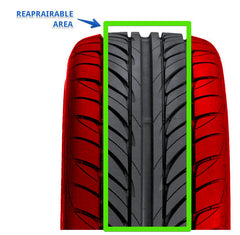
      <![CDATA[<p style="float: right;"><img alt="repairable areas" src="https://www.alltiresupply.com/cdn/shop/files/repairable-areas_medium.jpg" style="float: right;" data-original="https://cdn.shopify.com/s/files/1/0981/9342/files/repairable-areas_medium.jpg?v=1475255729" loading="lazy" data-files="repairable-areas.jpg">One of the most common causes of tire damage is when an object, such as a nail or screw, causes a puncture injury to a tire. This usually leads to loss of air pressure and eventually a flat tire. According to the Tire Industry Association guidelines, the tire must be dismounted from the rim to perform an internal inspection and a proper repair. Without doing so, the technician cannot appreciate the full extent of the injury and he/she may miss an injury which should not be repaired.</p>
<p style="float: right;">There are limitations on repairs of puncture injuries. The maximum hole size is 1/4 inch and it should be within the crown of the tire, which is the center of the tire space (between the major tire grooves on each side of the tire). Repairs should not be done within 1-1/2 inches of the tire shoulder.</p>
<p style="float: right;"><br><strong><a href="/collections/tire-repair-tools/tire-repair-tools_tire-spreaders" target="_blank" title="Tire Spreader" aria-label="Tire Spreader"><img alt="Tire Spreader" src="https://www.alltiresupply.com/cdn/shop/files/tire-spreader_v2_medium.webp" style="float: left; margin-right: 20px;" data-original="//cdn.shopify.com/s/files/1/0981/9342/files/tire-spreader_v2_medium.jpg?v=1475253886" loading="lazy" data-files="tire-spreader_v2.jpg"></a>Step 1: Inspection of the dismounted tire</strong><br>A thorough inspection of the tire lining and sidewalls should be performed while the tire is mounted in a well-lighted <a href="/collections/tire-repair-tools/tire-repair-tools_tire-spreaders" target="_blank" title="Tire Spreader" aria-label="Tire Spreader"><span style="text-decoration: underline;">tire spreader</span></a>. While wearing <a href="/collections/safety-product" target="_blank" title="Personal Safety" aria-label="Personal Safety"><span style="text-decoration: underline;">eye and hand protection</span></a>, technicians should check the  beads for defects, as well as any chips, cracks, cuts, or signs of improper repairs. The tread should be inspected to make sure there is at least 2/32 inch depth in any major groove.</p>
<p style="float: right;"><br><br><strong><a href="/collections/tire-repair-tools/tire-repair-tools_tire-spreaders" target="_blank" title="Tire Spreader" aria-label="Tire Spreader"><img alt="Clean inner-liner surface" src="https://www.alltiresupply.com/cdn/shop/files/clean-innerliner_v1_medium.jpg" style="float: right; margin-left: 20px;" data-original="//cdn.shopify.com/s/files/1/0981/9342/files/clean-innerliner_v1_medium.jpg?v=1475254104" loading="lazy" data-files="clean-innerliner_v1.jpg"></a>Step 2: Preparation of the Inner Liner Surface</strong><br><a href="/collections/tire-repair-supplies/tire-supplies_buffer-cleaner" target="_blank" title="Pre-buff Cleaner" aria-label="Pre-buff Cleaner"><span style="text-decoration: underline;">Pre-buff Inner Liner Cleaner</span></a> is a solvent which is applied around the injury to remove lubricants or any other contaminants from the liner surface. A <a href="/products/preferred-inner-liner-scraper" target="_blank" title="Inner Liner Scraper" aria-label="Inner Liner Scraper"><span style="text-decoration: underline;">scraper</span></a> is then used to remove the superficial layer along with contaminants. A white <a href="/collections/tire-repair-supplies/tire-supplies_marking-crayons" target="_blank" title="Marking Crayons" aria-label="Marking Crayons"><span style="text-decoration: underline;">grease pencil</span></a> is used to create a circle about 1/2 inches larger than the patch diameter over the repair area.</p>
<p style="float: left;"><br><strong>Step 3:  Cleaning the Injury Channel</strong><br>A <a href="/collections/tire-buffer/tire-buffer_low-speed" target="_blank" title="Tire Buffer" aria-label="Tire Buffer"><span style="text-decoration: underline;">low-speed tire buffer</span></a> with a <a href="/products/aa-carbide-cutter" target="_blank" title="Carbide Cutter" aria-label="Carbide Cutter"><span style="text-decoration: underline;">carbide cutter</span></a> tip is used to penetrate the injury channel to remove the damaged metal cables. Use a <a href="/collections/tire-repair-tools" title="Air Vacuum" target="_blank" aria-label="Air Vacuum">vacuum</a> to remove dust.</p>
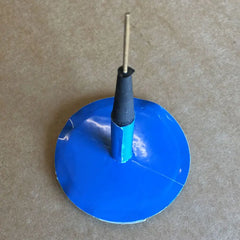
<p style="float: left;"><br><strong>Step 4: Select One-Piece or Two Piece Repair Units<br><br></strong><a href="/collections/tire-repair-patches/tire-plug_lead-wire-stem" title="tire plug" target="_blank" aria-label="tire plug"><img alt="two piece tire repair" src="https://www.alltiresupply.com/cdn/shop/files/twopiece-repair_medium.webp" style="float: left; margin-right: 20px;" data-original="//cdn.shopify.com/s/files/1/0981/9342/files/twopiece-repair_medium.jpg?v=1475255070" loading="lazy" data-files="twopiece-repair.jpg"></a>If a <strong>two-piece</strong> repair unit is selected, place an appropriately sized awl coated with vulcanizing cement into the channel. Next, apply a thin layer of <span style="text-decoration: underline;"><a href="/collections/tire-repair-supplies/tire-supplies_tire-cement" target="_blank" title="vulcanizing cement" aria-label="vulcanizing cement">vulcanizing cement</a></span> on the cushion gum of the stem (<a href="/collections/tire-repair-patches/tire-plug_lead-wire-stem" title="tire plug" target="_blank" aria-label="tire plug"><span style="text-decoration: underline;">Stems</span></a>, <a href="/collections/tire-repair-patches" title="tire repair patches" target="_blank" aria-label="tire repair patches"><span style="text-decoration: underline;">Patches</span></a>). Pull the stem from the inside to outside and trim with a rubber knife [product example]. Next, use a drill with a <a href="/products/radius-cup-rasps-36-grit" title="Radius Cup Rasps" aria-label="Radius Cup Rasps"><span style="text-decoration: underline;">buffing head</span></a> on a low speed (maximum of 5,000 RPM) to create a smooth platform for the repair patch. This should be done after the stem repair with vulcanizing cement has dried and has been trimmed. The buffing wheel (RMA#1 or #2) should be used to clean and level the area within the circular grease pencil mark. Next, a fine <a href="/products/brass-cleaning-brush" target="_blank" title="brass brush" aria-label="brass brush"><span style="text-decoration: underline;">brass brush</span></a> is used to clean off any fine particles and a <a href="/collections/tire-repair-tools" target="_blank" title="Air Vacuum" aria-label="Air Vacuum"><span style="text-decoration: underline;">vacuum</span></a> is then used to remove dust and particles inside the tire. <a href="/collections/tire-repair-supplies/tire-supplies_tire-cement" target="_blank" title="tire cement" aria-label="tire cement"><span style="text-decoration: underline;">Vulcanizing cement</span></a> is then applied to the inner liner around the injury and within the white circle and allowed to dry. The <a href="/collections/tire-repair-patches" target="_blank" title="tire patch" aria-label="tire patch">patch repair unit</a> is carefully applied to the smooth surface by removing the plastic backing. A <a href="/collections/tire-repair-tools" target="_blank" title="tire stitchers" aria-label="tire stitchers">stitcher</a> is rolled over the patch to remove excess air and ensure a firm bond. Apply a layer of <span style="text-decoration: underline;"><a href="/collections/tire-repair-supplies/tire-supplies_repair-sealant" target="_blank" title="inner linner sealant" aria-label="inner linner sealant">inner liner sealer</a></span> to the buffed area around and over the repair unit.</p>
<p style="float: left;"><br><img alt="one piece repair patch (minicomby)" src="https://www.alltiresupply.com/cdn/shop/files/onepiece-repair_medium.webp" style="margin-right: 20px; float: left;" data-original="//cdn.shopify.com/s/files/1/0981/9342/files/onepiece-repair_medium.jpg?v=1475254949" loading="lazy" data-files="onepiece-repair.jpg">If a <strong>one-piece</strong> repair unit is chosen, after use a drill with a <span style="text-decoration: underline;"><a href="/products/radius-cup-rasps-36-grit?variant=16349102981" target="_blank" title="buffing rasps" aria-label="buffing rasps">buffing head</a></span> on a low speed (maximum of 5,000 RPM) to create a smooth platform for the repair patch. The buffing wheel should be used to clean and level the area within the circular grease pencil mark. Next, a fine <span style="text-decoration: underline;"><a href="/products/brass-cleaning-brush" target="_blank" title="brass brush" aria-label="brass brush">brass brush</a></span> is used to clean off any fine particles and a <span style="text-decoration: underline;"><a href="/products/air-vacuum-w-bag-and-water-hose" target="_blank" title="air vacuum" aria-label="air vacuum">vacuum</a></span> is then used to remove dust and particles inside the tire. <span style="text-decoration: underline;"><a href="/products/all-tool-vulcanizing-cement-8-oz" target="_blank" title="tire repair cement" aria-label="tire repair cement">Vulcanizing cement</a></span> is then applied to a clean awl and it is placed in the injury channel as well as on the inner liner around the injury and along the stem of the one piece repair unit and allowed to dry. The <span style="text-decoration: underline;"><a href="/collections/tire-repair-patches" target="_blank" title="minicomby repair unit" aria-label="minicomby repair unit">one-piece patch</a></span> repair unit is carefully applied after the guide-wire and stem is pulled through the channel until a slight dimple forms. Stitch the repair unit to remove air with a <span style="text-decoration: underline;"><a href="/products/tire-repair-stitcher-1-12-in-x-18-in-corrugated" target="_blank" title="stitcher" aria-label="stitcher">stitcher</a></span>.</p>
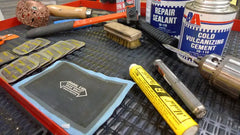
<p><br>Cut the stem on the outside of the tire flush with the tread with a <span style="text-decoration: underline;"><a href="/products/ultimate-skivers" target="_blank" title="rubber knife / skiver" aria-label="rubber knife / skiver">rubber knife</a></span>.</p>
<p><br><span style="color: #38761d;"><em>The initial investment, not including <span style="text-decoration: underline;"><a href="/collections/ravaglioli/categories_tire-changer" target="_blank" title="tire changer" style="color: #38761d; text-decoration: underline;" aria-label="tire changer">tire machine</a></span> or <span style="text-decoration: underline;"><a href="/collections/ravaglioli/categories_tire-balancers" target="_blank" title="tire balancer" style="color: #38761d; text-decoration: underline;" aria-label="tire balancer">balancer</a></span> to be able to do repairs ranges from $287 to $639. After that, the cost per repair is about $3.00.</em></span><br><br><em>September, 2016 ATS Technical Staff</em></p>
<p> </p>]]>
    </content>
  </entry>
  <entry>
    <id>https://www.alltiresupply.com/blogs/how-tos/what-do-i-need-to-tire-repair-for-cars-and-light-trucks</id>
    <published>2016-07-05T18:07:00-05:00</published>
    <updated>2026-03-05T03:33:58-06:00</updated>
    <link rel="alternate" type="text/html" href="https://www.alltiresupply.com/blogs/how-tos/what-do-i-need-to-tire-repair-for-cars-and-light-trucks"/>
    <title>What do I need to do Tire Repair for Cars and Light Trucks?</title>
    <author>
      <name>Jimmy Hill</name>
    </author>
    <content type="html">
      <![CDATA[<h3>And, how much do the products cost?</h3>
<p style="float: left;"><img alt="tire repair tools &amp; supplies" src="https://www.alltiresupply.com/cdn/shop/files/tire_repair_1-sk_medium.webp?16467491347383357117=" style="float: left; margin-top: 5px; margin-right: 20px;" data-original="//cdn.shopify.com/s/files/1/0981/9342/files/tire_repair_1_medium.jpg?16467491347383357117" loading="lazy" data-files="tire_repair_1.jpg"></p>
<p>Properly maintained tires are a key component of safe driving. Good tire maintenance includes inspecting the treads for adequate depth and abnormal wear patterns. A common tire defect is a puncture resulting in loss of air pressure and deflation of the tire. This article reviews the principles of radial tire repair for cars and light trucks recommended by the 2011 Tire Industry Association Tire Service Manual, and discuss the products and supplies needed for repair as well as current (2016) price estimates.  Nails and screws are some of the frequent objects that cause penetration of tire treads. It is important to dismount the tire from the rim using a (tire changing machine) to perform an internal inspection, and if necessary, a repair if a full thickness penetration is noted. There are limitations on the types of damage that can be repaired. For most tires, the maximum defect that can be safely repaired is ¼ inch or 6 mm on the center zone of the tread, which is about 1 to 1 ½ inches from the shoulder of the tire, or the zone between the first major grooves in the tread.</p>
<p style="float: right;"><a title="Tire Spreader" target="_blank" href="/collections/tire-repair-tools/tire-repair-tools_tire-spreaders" aria-label="Tire Spreader"><img alt="tire spreader" src="https://www.alltiresupply.com/cdn/shop/files/tire_spreader_medium.jpg?9908330844082028874=" style="margin-left: 20px; float: right;" data-original="//cdn.shopify.com/s/files/1/0981/9342/files/tire_spreader_medium.jpg?9908330844082028874" loading="lazy" data-files="tire_spreader.jpg"></a>The tire inspection should be performed using a <a title="Tire Spreader" target="_blank" href="/collections/tire-repair-tools/tire-repair-tools_tire-spreaders" aria-label="Tire Spreader"><span style="text-decoration: underline;">Tire Spreader with a bright light</span></a> these usually cost about $500. In addition to checking for full thickness defects, the tire bead and lining should be inspected as well. The defect is marked with a white <a title="Rubber Marking Crayons" target="_blank" href="/collections/tire-repair-supplies/tire-supplies_marking-crayons" aria-label="Rubber Marking Crayons"><span style="text-decoration: underline;">paint stick</span></a>. If a defect has been detected that fits within the repair guidelines, the inner liner surface is prepared with a pre-buff cleaner or <a title="pre-buff cleaner" target="_blank" href="/collections/tire-repair-supplies/tire-supplies_buffer-cleaner" aria-label="pre-buff cleaner"><span style="text-decoration: underline;">Cleaner Buffer</span></a> is a solvent which dissolves grease and contaminants from the liner surface. This product costs about $11 for a 32 oz. can. The liner surface is then scraped with a <span style="text-decoration: underline;"><a title="tire scraper" target="_blank" href="/products/preferred-inner-liner-scraper" aria-label="tire scraper">scraper</a></span> over the area of the injury. This helps to remove foreign material which may impede good adhesion. A scraper costs about $7.00. Next, the injury channel is cleaned with a carbide cutter tip on a low-speed drill. This process helps to cut the damaged tire belts. An adjustable <span style="text-decoration: underline;"><a title="low-speed tire buffer" target="_blank" href="/collections/tire-buffer/tire-buffer_low-speed" aria-label="low-speed tire buffer">low speed drill, buffer</a></span> costs about $100.</p>
<p style="float: left;"><a title="tire changer" target="_blank" href="/collections/tire-changer/product-type_equipment" aria-label="tire changer"><img alt="tire repair" src="https://www.alltiresupply.com/cdn/shop/files/AA_Site_Projectimg_0012_medium.webp?11071174949154366426=" style="float: left; margin-right: 20px; margin-top: 5px;" data-original="//cdn.shopify.com/s/files/1/0981/9342/files/AA_Site_Projectimg_0012_medium.JPG?11071174949154366426" loading="lazy" data-files="AA_Site_Projectimg_0012.jpg"></a>It is recommended that a one-piece or two-piece repair be done with a <span style="text-decoration: underline;"><a title="tire repair insert" target="_blank" href="/collections/tire-repair-patches" aria-label="tire repair insert">rubber stem</a></span> that fills the puncture void. This will prevent moisture from entering and damaging the cords. Vulcanizing cement is used to secure the stem in place.  Prior to placing cement on the inner surface, the surface must be prepared with a <span style="text-decoration: underline;"><a title="tire buffing wheel" target="_blank" href="/products/two-cup-rasps-mounted-back-to-back-on-arbor" aria-label="tire buffing wheel">buffing wheel</a></span> on a low speed buffer to create a smooth surface. A wire brush is used to clean the surface, followed by a vacuum to remove contaminants. Next, a thin coat of vulcanizing cement can be applied to buffed surface and allowed to air dry. The patch unit is carefully placed, and is painted with <span style="text-decoration: underline;"><a title="tire repair sealant" target="_blank" href="/products/innerliner-repair-sealant-w-brush-top-can" aria-label="tire repair sealant">inner liner sealer</a></span>; about $18 for a 16 oz. can. The excess stem on the outside of the tire is trimmed. The tire is then remounted and balanced using a <a title="tire changer" target="_blank" href="/collections/tire-changer/product-type_equipment" aria-label="tire changer"><span style="text-decoration: underline;">tire changer</span></a> and a <span style="text-decoration: underline;"><a title="wheel balancer machine" target="_blank" href="/collections/balancers-machine/application_car-light-truck" aria-label="wheel balancer machine">wheel balancer</a></span>.</p>]]>
    </content>
  </entry>
  <entry>
    <id>https://www.alltiresupply.com/blogs/how-tos/how-to-make-money-by-adding-wheel-alignment-service-your-tire-store</id>
    <published>2016-06-23T22:09:00-05:00</published>
    <updated>2026-03-05T03:33:35-06:00</updated>
    <link rel="alternate" type="text/html" href="https://www.alltiresupply.com/blogs/how-tos/how-to-make-money-by-adding-wheel-alignment-service-your-tire-store"/>
    <title>How to make money by adding wheel alignment service to your tire store</title>
    <author>
      <name>Jimmy Hill</name>
    </author>
    <content type="html">
      <![CDATA[<h4>The growing need for alignment services</h4>
<p>Driving style and road conditions often dictate the frequency of need, most sources recommend an alignment service every 10,000 miles, 1 to 3 years or with each new set of tires, however for most cars, there are no stated requirements from vehicle manufacturers. An article  from www.testingautoscom recommends  more frequent intervals if wider tires are used or if one drives a sports car. If the car hits something in the road such as a large pothole, the alignment will likely be off and require adjustment. With an estimated 255.8 million passenger vehicles on the road in 2013, (<span style="text-decoration: underline;"><a title="Passenger vehicles in the US" target="_blank" href="https://en.wikipedia.org/wiki/Passenger_vehicles_in_the_United_States" rel="noopener noreferrer" aria-label="Visit a webpage about Passenger vehicles in the US">link</a></span>) and growing each year, It is clear that this translates to a huge potential demand for customers needing alignments.</p>
<p> </p>
<h4>What is an alignment?</h4>
<p style="float: left;"><img alt="How to make money by adding wheel alignment service to your" src="https://www.alltiresupply.com/cdn/shop/files/alignment_2_medium.jpg?14540021324524082786=" style="float: left; margin-right: 20px; margin-top: 5px;" data-original="//cdn.shopify.com/s/files/1/0981/9342/files/alignment_2_medium.jpg?14540021324524082786" loading="lazy" data-files="alignment_2.jpg"></p>
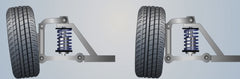
<p>Simply stated, an alignment makes sure the vehicle’s wheels are perpendicular to the ground and parallel to each other. A more detailed review of alignments can be found <span style="text-decoration: underline;"><a title="Detail review of alignment" target="_blank" href="http://www.carparts.com/alignment.htm#Set%20Back">here</a></span></p>
<p> </p>
<h4>How an alignment is performed</h4>
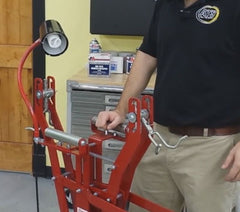
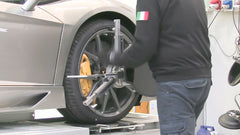
<p>An effective alignment will utilize sensors which are measured by a computer and compared against the specifications recommended for your specific model. A camera unit (sometimes called a "head") is attached to a specially designed clamp which holds on to a wheel. There are usually four camera units in a wheel alignment system (a camera unit for each wheel). The camera units communicate their physical positioning with respect to other camera units to a central computer which calculates and displays the results. Often with alignment equipment, these "heads" can be a large precision reflector. In this case, the alignment systems contains the cameras as well as arrays of LEDs. This system flashes one array of LEDs for each reflector while cameras "look for" an image of the reflectors patterned face. (<span style="text-decoration: underline;"><a title="Wikipedia - Wheel alignment" target="_blank" href="https://en.wikipedia.org/wiki/Wheel_alignment" rel="noopener noreferrer" aria-label="Visit a webpage about Wikipedia - Wheel alignment">link</a></span>) The tire and rim assemblies are thoroughly inspected to make sure that all of the weight is evenly distributed across the tire. In addition to all of the checks on the wheels, the suspension system must be considered which holds everything in place. Once this information is verified, the angles of the wheels are calculated. After this has been established, specialized tools are used to finely tune the alignment to provide long lasting benefits for tire wear and drivability.</p>
<p><br>Alignments can be done on 2-wheels or 4-wheels. Most mechanics will recommend purchase of a 4 wheel alignment to ensure the best results. This service should be completed by a properly trained professional  who has the tools and equipment necessary to properly diagnose and measure the angles (<span style="text-decoration: underline;"><a title="alignment cost" href="https://web.archive.org/sry" aria-label="Visit a webpage about alignment cost">link</a></span>).</p>
<p> </p>
<h4>Symptoms of a Misaligned Vehicle</h4>
<p style="float: left;"><img alt="uneven tread wear" src="https://www.alltiresupply.com/cdn/shop/files/alignment_3_medium.jpg?12041173416653430152=" style="margin-top: 5px; margin-right: 20px; float: left;" data-original="//cdn.shopify.com/s/files/1/0981/9342/files/alignment_3_medium.jpg?12041173416653430152" loading="lazy" data-files="alignment_3.jpg"></p>
<p>Some of the common complaints from customers driving misaligned cars are “pulling” of the car to one side or the other. Uneven tire wear and needing to replace tires more often than expected is frequently due to misalignment. Tire wear patterns indicative of alignment problems are excessive wear or feathering on the inside or outside  edges of one or both of the front tires, and diagonal wear pattern.</p>
<p> </p>
<h4>What are benefits of Wheel Alignment?</h4>
<p>A properly performed  alignment can enhance tire performance and service life by evening the tread surface on the road. This will lead to increased fuel efficiency and safer and more comfortable driving. During the alignment process, technicians can inspect the suspension system at the same time and detect worn and broken components. Furthermore, alignments save on tire replacements which are more expensive.</p>
<p> </p>
<h4>Benefits to your business?</h4>
<p style="float: left;"><img alt="Alignment service" src="https://www.alltiresupply.com/cdn/shop/files/alignment_1_medium.jpg?14844680701959202072=" style="margin-top: 5px; margin-right: 20px; float: left;" data-original="//cdn.shopify.com/s/files/1/0981/9342/files/alignment_1_medium.jpg?14844680701959202072" loading="lazy" data-files="alignment_1.jpg"></p>
<p>According to www.autoservicecosts.com , the average cost of an alignment across the United States is $115, with a  range of prices spanning from  $75 on the low end  to $159 on the high end. An alignment service begins and ends with a test drive and takes about an hour to complete. Many shops subcontract or refer this work out. Adding this service line to your tire repair business has several benefits: customers and revenues stay with your business. The additional revenues and service expertise increase the value of your business. Adding this service line requires a sizable capital investment. however once the investment is paid off, other than what you pay your mechanic, the rest is high margin revenue.  The suspension work you will get on ball joints, etc,  as a by-product  of alignment inspections is also highly profitable work.</p>
<p> </p>
<h4>How long to get a Return on Investment (ROI)?</h4>
<p>To assemble an alignment rack, a suitable lift is needed, as well as an alignment system.  A good alignment system that provides customers with color print outs is available for about $10K ~ $15K. With this initial investment, if a shop did 3 alignment services per day at $100 each for 20 days/month, the business would generate new gross revenues of $6K/month. If one includes overhead, parts and labor, a return on investment can be expected in 4 - 6 months.  Offering free screens to customers is a proven approach to building your alignment business. One of the alignment equipment manufacturers, Ravaglioli, has added a new twist to screening with a unique Bluetooth-enable feature that allows technicians to do rapid alignment screening on cars not on the alignment rack- they can be done hundreds of feet away in the parking lot via wireless controller and sensors, which could dramatically increase your identification of vehicles that need alignment services.  Providing the customer with a color print out of the misaligned angles before and with a second print out after the service has improved the alignment is a powerful tool to inform and reassure the customer about their purchase.</p>
<p> </p>
<h4>Comparison of equipment</h4>
<p>We have selected three brands of alignment equipment in the same price range of $10K ~ $15K to review for this article. </p>
<p> </p>
<table width="100%">
<tbody>
<tr>
<td style="text-align: center; width: 29.7164%;" valign="top"><img alt="Ravaglioli 8-Liner" src="https://www.alltiresupply.com/cdn/shop/files/RAV-8-LINER_1-sk_compact.jpg?10126278534961727340=" style="float: none;" height="98" width="98" data-original="https://cdn.shopify.com/s/files/1/0981/9342/files/RAV-8-LINER_1_compact.jpg?10126278534961727340" loading="lazy" data-files="RAV-8-LINER_1.jpg"></td>
<td style="width: 66.2836%;" valign="top">The Ravaglioli  8-liner is a non-tower system which uses 8 sensors and features a smart phone or tablet remote control, and as mentioned previously, the ability to quickly scan vehicles with mobile sensors that be taken out of the alignment bay and used in the parking lot. Another advantage of the tower-free 8-liner is that it can be easily moved to different lifts in the shop which provides maximum flexibility.</td>
</tr>
<tr>
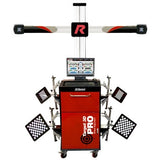
<td style="text-align: center; width: 29.7164%;" valign="top"><img alt="Ranger Target 3Dpro" src="https://www.alltiresupply.com/cdn/shop/files/Target-3DPro-2_compact.jpg?10126278534961727340=" style="float: none;" data-original="https://cdn.shopify.com/s/files/1/0981/9342/files/Target-3DPro-2_compact.jpg?10126278534961727340" loading="lazy" data-files="Target-3DPro-2.jpg"></td>
<td style="width: 66.2836%;" valign="top">Ranger makes the Target 3Dpro which features a rapid scan system. It uses a tower system which houses the LEDs, similar to the Hunter equipment. A tower based system may be an obstacle and create challenges with space limits in a busy automotive shop.</td>
</tr>
<tr>
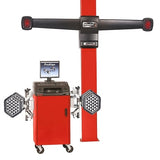
<td style="text-align: center; width: 29.7164%;" valign="top"><img alt="Hunter ProAlign" src="https://www.alltiresupply.com/cdn/shop/files/ProAlign_compact.jpg?10126278534961727340=" style="float: none;" data-original="https://cdn.shopify.com/s/files/1/0981/9342/files/ProAlign_compact.jpg?10126278534961727340" loading="lazy" data-files="ProAlign.jpg"></td>
<td style="width: 66.2836%;" valign="top">The Hunter ProAlign alignment system is a popular alignment system that also uses a tower configuration. It features a rapid scan system.</td>
</tr>
</tbody>
</table>
<p> </p>
<p>Depending on options, all three brands use very similar technology. Your choice will come down to features you like on a particular machine and as always the price point that suits your budget.</p>
<p><br>For more information on alignment equipment for light vehicles or heavy duty use contact Jimmy Hill at 832-972-5000 (cell) or 713-956-6665 (office)</p>
<br>
<hr>
<h4>References:</h4>
<ol>
<li><span style="text-decoration: underline;"><a title="Alignment by Charles Ofria" target="_blank" href="http://www.carparts.com/alignment.htm#Set%20Back%20by%20Charles%20Ofria">carparts.com</a></span></li>
<li><span style="text-decoration: underline;"><a title="performing profitable alignments" target="_blank" href="https://web.archive.org/sry" rel="noopener noreferrer" aria-label="Visit a webpage about performing profitable alignments">ratchetandwrench.com</a></span></li>
<li>Tire Industry Association. Automotive Tire Service Manual. 2011 ed.</li>
</ol>]]>
    </content>
  </entry>
  <entry>
    <id>https://www.alltiresupply.com/blogs/how-tos/how-to-start-a-tire-repair-business</id>
    <published>2016-05-15T10:10:00-05:00</published>
    <updated>2026-03-05T03:32:54-06:00</updated>
    <link rel="alternate" type="text/html" href="https://www.alltiresupply.com/blogs/how-tos/how-to-start-a-tire-repair-business"/>
    <title>How to start a Tire Repair Business</title>
    <author>
      <name>Jimmy Hill</name>
    </author>
    <content type="html">
      <![CDATA[<p style="text-align: center;"><img alt="Tire Repair Shop" src="https://www.alltiresupply.com/cdn/shop/files/tireshop_v1_grande.jpg" style="float: none;" data-original="//cdn.shopify.com/s/files/1/0981/9342/files/tireshop_v1_grande.jpg?16176170099018419059" loading="lazy" data-files="tireshop_v1.jpg"></p>
<p>New and used retail tire stores are popular small businesses because of the frequent service and replacement needs for consumer vehicle tires and tire pressure monitoring systems (<span style="text-decoration: underline;"><a title="TPMS" href="/collections/tpms-service" aria-label="TPMS">TPMS</a></span>). As the number vehicles on America’s roads increases each year, opportunities to serve this customer base grow as well.  Automotive repair shops may also consider expanding their business by adding tire installation and repair as a service to their customers.</p>
<p><strong>Business plan:</strong> it is generally a good idea to work with a business consultant or accountant to create a business plan and review the initial investment, projections of revenue from sales,  and expenses, to make sure the business will be profitable. Some questions to think about are: 1) What kind of training should I have?; 2) what distinguishes my business from competitors in the area?; 3) how will I advertise my services?; 4) is my business in a good location?; 5)what equipment and supplies do I need to start?; 6) where can I get equipment and supplies from?</p>
<p style="float: left;"><img alt="TPMS Training" src="https://www.alltiresupply.com/cdn/shop/files/article_training_center_bb41838e-ffac-423c-b181-04c3d9b5aaab_medium.jpg?12331850562574222640=" style="float: left; margin-right: 30px; margin-left: 20px;" data-original="//cdn.shopify.com/s/files/1/0981/9342/files/article_training_center_bb41838e-ffac-423c-b181-04c3d9b5aaab_medium.jpg?12331850562574222640" loading="lazy" data-files="article_training_center_bb41838e-ffac-423c-b181-04c3d9b5aaab.jpg"></p>
<ul>
<li>
<strong>Training:</strong> in addition to any required local, state, and federal registrations and licenses, a highly regarded tire industry educational resource is the Tire Industry Association (<span style="text-decoration: underline;"><a href="https://www.tireindustry.org/" title="Tire industry association | tire safety starts here" aria-label="Visit a webpage about Tire industry association | tire safety starts here">TIA</a></span>). The TIA offers a variety of certifications for commercial and passenger vehicle tire selection, inspection, mounting, and repairs (website reference).<br><br>
</li>
<li>
<strong>How to Stand Apart from Competitors:</strong> A growing business opportunity in tire installation and maintenance is servicing and installing Tire Pressure Monitoring Systems (TPMS). TPMS equipment is present on all late model vehicles after (Year?) so developing a comfort level with how to program, maintain, and replace sensors provides an opportunity to expand the offerings of your business. Training on TPMS can be provided through TIA courses, industry suppliers, such as: Schrader Bridgeport and Dills;. All Tire supply has previously published an article on TPMS (<span style="text-decoration: underline;"><a href="/blogs/how-tos/how-tpms-can-grow-your-tire-business-part-1-3" title="Itroduction to tpms &amp;ndash; all tire supply" aria-label="Itroduction to tpms &amp;ndash; all tire supply">Here</a></span>). Offering tire service may provide new business opportunities in some markets. Additional ways to stand out against competitors is to provide great customer service and perform high quality work in your shop. Understanding how to properly and safely perform a tire repair according to industry standards is a key aspect of this.</li>
<li>
<strong>Advertising:</strong> Perhaps the best and cheapest way to advertise is through “word of mouth”. A satisfied customer is one of the strongest ways to gain new business through referrals of friends and family. Print media advertising seems to be losing ground to web-based advertising. Nearly everyone usually does a web-search of an unfamiliar business, so consider maintaining a website with helpful information about your business. It is also important to manage your online reputation, since negative reviews by unsatisfied customers can discourage new customer from trying your service.</li>
<li>
<strong>Location:</strong> Positioning your business in a high vehicular traffic area with increase the visibility of your business and improve the likelihood of new, drop in customer traffic.  A commercial real estate broker in your area can help identify possible locations.</li>
</ul>
<div style="float: left;"><img alt="Tire Shop Equipments" src="https://www.alltiresupply.com/cdn/shop/files/showroom_old_medium.webp?13062249968461810170=" style="margin-left: 20px; margin-right: 30px; float: left;" data-original="//cdn.shopify.com/s/files/1/0981/9342/files/showroom_old_medium.jpg?13062249968461810170" loading="lazy" data-files="showroom_old.jpg"></div>
<ul>
<li>
<strong>Equipment and Tools:</strong> The <span style="text-decoration: underline;"><a title="Tire Tools" href="/collections/tire-tools" aria-label="Tire Tools">equipment</a></span> needed to mount and demount tires safety and efficiently is a tire machine. This typically includes a fitting to inflate a newly mounted tire. As part of a good quality service operation, a <span style="text-decoration: underline;"><a title="Tire Balancers" href="/collections/tire-balancers" aria-label="Tire Balancers">tire balancing machine</a></span> also required equipment. For most small to medium volume stores, one <span style="text-decoration: underline;"><a title="Tire Changer Machine" href="/collections/tire-changer/product-type_equipment" aria-label="Tire Changer Machine">tire machine</a></span> and one tire balancer should be sufficient. Next, vehicle lifting equipment is considered. A two post lift, can handle most passenger vehicles and is recommended for tire service as well as other automotive service needs. A less efficient approach for high volume work is the use of <span style="text-decoration: underline;"><a title="Automotive Jack" href="/collections/automotive-lifting-tools#gbaid421016" aria-label="Automotive Jack">floor jacks</a></span>. It is important to get trained on the safe usage of vehicle lift devices, and make sure lifts are inspected on a regular basis. A <span style="text-decoration: underline;"><a title="Two Stage Air Compressor" href="/collections/air-compressor/type_2-stage" aria-label="Two Stage Air Compressor">two stage air compressor</a></span> is also needed. Various tools are needed for a tire store: <span style="text-decoration: underline;"><a title="Impact Wrench" href="/collections/impact-wrench" aria-label="Impact Wrench">impact wrenches</a></span>, <span style="text-decoration: underline;"><a title="Tire Buffers" href="/collections/tire-buffer" aria-label="Tire Buffers">buffers/drills</a></span>, <span style="text-decoration: underline;"><a title="Tire Spreaders" href="/collections/tire-repair-tools/tire-repair-tools_tire-spreaders" aria-label="Tire Spreaders">tire stands</a></span>, <span style="text-decoration: underline;"><a title="TPMS Activation Tools" href="/collections/tpms-tools?page=1&amp;rb_snize_facet1=Tool&amp;rb_tags=TPMS%20Tools&amp;rb_snize_facet16=Bundle" aria-label="TPMS Activation Tools">TPMS activation tool</a></span>. One should expect to spend close to $20,000 (in 2016 dollars) to outfit a 1-bay tire repair garage.</li>
</ul>
<div style="float: left;"><img alt="AA American Automotive Chemical Products" src="https://www.alltiresupply.com/cdn/shop/files/AA_Image_Chemical_0002_medium.webp?2765373051296472768=" style="float: left; margin-right: 30px; margin-left: 20px;" data-original="//cdn.shopify.com/s/files/1/0981/9342/files/AA_Image_Chemical_0002_medium.jpg?2765373051296472768" loading="lazy" data-files="AA_Image_Chemical_0002.jpg"></div>
<ul>
<li>
<strong>Supplies:</strong> Various consumable items are needed- <span style="text-decoration: underline;"><a title="Chemicals" href="/collections/tire-repair-supplies/tire-supplies_chemical-products" aria-label="Chemicals">chemicals</a></span>, <span style="text-decoration: underline;"><a title="Tire Lubricants" href="/collections/tire-repair-supplies/tire-supplies_tire-lubricant" aria-label="Tire Lubricants">lubricants</a></span>, <a title="Tire Buffer Cleaner" href="/collections/tire-repair-supplies/tire-supplies_buffer-cleaner" aria-label="Tire Buffer Cleaner">solvents</a>, <span style="text-decoration: underline;"><a title="TPMS Sensors" href="/collections/tpms-service" aria-label="TPMS Sensors">TPMS sensors</a></span>, <span style="text-decoration: underline;"><a title="Tire Valves" href="/collections/tire-valves" aria-label="Tire Valves">valves</a></span>, <span style="text-decoration: underline;"><a title="Tire Wheel Weights" href="/collections/wheel-weights" aria-label="Tire Wheel Weights">wheel weights</a></span>, <span style="text-decoration: underline;"><a title="Tire Repair Patches" href="/collections/tire-repair-patches" aria-label="Tire Repair Patches">patches</a></span>, and so on. All of these products can be sourced from a single supplier, such as <span style="text-decoration: underline;"><a href="/" title="Automotive + tire repair supplies, tools and equipment &amp;ndash; all tire supply" aria-label="Automotive + tire repair supplies, tools and equipment &amp;ndash; all tire supply">All Tire Supply</a></span>.<br><br><br>
</li>
<li>
<strong>Suppliers:</strong> One should use a supplier with a long track record of reliable service to the industry and sells a range of quality products. The model that has gained a high degree of acceptance is to be on a mobile warehouse delivery route which brings tools and supplies to your site of business on a regular basis and can also meet your equipment needs. At All Tire Supply, we provide a complete range of tire maintenance supplies, tools, and equipment via our Houston Texas storefront, website, or through our mobile warehouses which serve south Texas. If our mobile warehouses do not serve your geography, and you are interested in opening a franchise in your area, visit <span style="text-decoration: underline;"><a href="/pages/welcome-back-1#gbaid420961" title="Welcome back! &amp;ndash; all tire supply" aria-label="Welcome back! &amp;ndash; all tire supply">here</a></span>.</li>
</ul>]]>
    </content>
  </entry>
  <entry>
    <id>https://www.alltiresupply.com/blogs/how-tos/how-to-properly-lift-a-vehicle-for-tire-service</id>
    <published>2016-04-26T01:00:00-05:00</published>
    <updated>2026-03-05T03:32:17-06:00</updated>
    <link rel="alternate" type="text/html" href="https://www.alltiresupply.com/blogs/how-tos/how-to-properly-lift-a-vehicle-for-tire-service"/>
    <title>How to Properly Lift a Vehicle for Tire Service</title>
    <author>
      <name>Beth Blysard</name>
    </author>
    <summary type="html">
      <![CDATA[<p> </p><p><a class="read-more" href="https://www.alltiresupply.com/blogs/how-tos/how-to-properly-lift-a-vehicle-for-tire-service">More</a></p>]]>
    </summary>
    <content type="html">
      <![CDATA[<p style="text-align: justify;">In order to remove a tire and wheel for service, the vehicle must be lifted so that the wheel assembly can be removed from the hub. A variety of approaches are commonly used- stationary lifts, which raises the entire vehicle is used by most shops, others use a combination of floor jacks and jack stands.  Key objectives are to prevent damage to the vehicle, and to prevent the vehicle from falling.</p>
<p style="float: left; text-align: justify;">The three types of stationary lifts in common use are: Two-post above-ground, In-ground, and <a title="Driven Over Above Ground Lift" href="/collections/automotive-lift/products/portable-mid-rise-lift-w-electrichydraulic-power-unit" aria-label="Driven Over Above Ground Lift">drive-over above-ground</a>.   The two-post above-ground lifts are most popular because of their ease of installation, maintenance, and use.  They can be used for virtually all types of automotive repair jobs. The in-ground lifts utilize four symmetrical lifting arms attached to a hydraulic unit in the concrete floor. The downside to these lifts is that repairs require removal of concrete to access the hydraulics.  The drive-over lifts have many of the benefits of the two-post lifts, but they have a more limited range of body styles and vehicle weights that can be lifted.</p>
<p style="float: right; text-align: justify;"><a title="Two Post Lift" href="/collections/automotive-lift/lifts_two-post" aria-label="Two Post Lift">Two-post</a> lifts come in styles with either symmetrical or asymmetrical lifting arms.  The asymmetrical arm configuration provides more floor space and makes it easier to open vehicle doors when positioned between the posts.  Before lifting a vehicle, lift towers must be positioned at the vehicle’s center of gravity, which for most rear-wheel, four-wheel, and all-wheel drive vehicles is under the driver’s seat.  For most front-wheel drive vehicles, the center of gravity is located under the steering wheel.</p>
<p style="float: left; text-align: justify;"><img alt="lift inspection" src="https://www.alltiresupply.com/cdn/shop/files/lift_safety_medium.webp?17007290400349342504=" style="float: left; margin-right: 15px;" data-original="//cdn.shopify.com/s/files/1/0981/9342/files/lift_safety_medium.png?17007290400349342504" loading="lazy" data-files="lift_safety.png">Before attempting to elevate a vehicle on any sort of lift, the lift equipment should be inspected for damage, cracks, leaks, or signs of broken components or excessive wear. The lifting arms should be extended to insure that the stops are in place.  Lifting pads should be in place, and if adjustable, they should be checked to ensure they are fully operational.</p>

<p style="float: right; text-align: justify;"><img alt="automotive lift accident" src="https://www.alltiresupply.com/cdn/shop/files/lift_safety2_medium.webp?7012010830588784599=" style="float: right; margin-left: 15px;" data-original="//cdn.shopify.com/s/files/1/0981/9342/files/lift_safety2_medium.png?7012010830588784599" loading="lazy" data-files="lift_safety2.png">Each year a number of injuries and deaths occur related to lifting vehicles, so it is imperative that users follow safety requirements and standards published by the Automotive Lift Institute.</p>

<p style="text-align: justify;">In part two, we will discuss: maximum lifting capacity, using the ALI Lift Point Guide,  and when to use floor jacks, and jack stands. We will also discuss importance of periodic lift inspections.</p>
<p style="text-align: justify;"><span style="color: #999999;"><strong>Reference: </strong> <em>Tire Industry Association, Instructor Workbook, Module 4. 2011</em></span></p>]]>
    </content>
  </entry>
  <entry>
    <id>https://www.alltiresupply.com/blogs/how-tos/how-tpms-can-grow-your-tire-business-part-3-3</id>
    <published>2015-11-20T11:55:00-06:00</published>
    <updated>2026-03-05T03:31:12-06:00</updated>
    <link rel="alternate" type="text/html" href="https://www.alltiresupply.com/blogs/how-tos/how-tpms-can-grow-your-tire-business-part-3-3"/>
    <title>How Tpms Can Grow Your Tire Business (Part 3/3)</title>
    <author>
      <name>Jimmy Hill</name>
    </author>
    <content type="html">
      <![CDATA[<p align="justify"><img alt="How Tpms Can Grow Your Tire Business (Part 3/3)" src="https://www.alltiresupply.com/cdn/shop/files/articleimg_anthony_small.jpg?15392651184161905537=" style="float: left; margin-right: 10px;" data-original="//cdn.shopify.com/s/files/1/0981/9342/files/articleimg_anthony_small.jpg?15392651184161905537" loading="lazy" data-files="articleimg_anthony.jpg"><small>An Interview with Anthony Ableman, TIAA Certified Instructor, Director of Operations at All Tire Supply LLC, Houston, Texas (www. alltiresupply.com)</small></p>
<p align="justify"><small><strong>Anthony’s background and experience in the tire industry<br></strong><em>Anthony is the second generation in the tire and wheel industry with a specific concentration in tire repair and tire and wheel service. He is a Tire Industry Association (TIA) Certified Advanced Instructor for Automotive Tire Service. He have also completed internal training programs from our suppliers on tire changing, tire repairing, wheel vibration, wheel balancing, TPMS, and vehicle lifting. </em></small></p>
<hr>
<div style="float: left;"><img alt="How Tpms Can Grow Your Tire Business (Part 3/3)" src="https://www.alltiresupply.com/cdn/shop/files/direct-indirect-tpms_large.webp" style="float: left; margin-right: 10px;" data-original="//cdn.shopify.com/s/files/1/0981/9342/files/direct-indirect-tpms_large.jpg?245621164414505921" loading="lazy" data-files="direct-indirect-tpms.webp"></div>
<h2>Part 3/3: 9 Awesome Tips To Grow Your Business With Tpms</h2>
<h4>TIP#1: Different Types of TPMS Systems</h4>
<p align="justify">It’s important that the service centers know the two different kinds of TPMS systems that vehicles may be equipped with. There are both direct and indirect systems. Direct systems feature some kind of pressure sensor inside of the tire and wheel assembly. Usually these systems are mounted to the valve, on some older Ford and Mazda vehicles, a sensor that was mounted on a cradle and strapped to the inside of the wheel well was used. Both systems are supposed to meet minimum monitoring requirements from NHTSA, alerting the driver when one or more of the tires are 25% below the recommended inflation pressure listed on the vehicle placard.</p>
<p align="justify">The main advantage for the indirect system is that it is cheaper for the vehicle manufacturers to equip the vehicles with this technology and ultimately cheaper for the driver to maintain. There are still some questions about the system’s ability to alert the driver in a situation of rapid pressure loss (like a tire failure, blow-out, or in the event that a tire was to become unseated from the wheel). Also, there seem to be some issues regarding alerting the driver when all tires or tires on the same axle become low at the same rate/time. The other main problem with this technology is that it can be easily worked around. A customer can initiate his own relearn process at a new tire pressure (which may be underinflated) but this will cause the light to go out, making the system capable to appropriately and safely monitor inflation pressure</p>
<p align="justify">The main advantage of direct systems is accuracy. Since there is a specially designed sensor installed for the purpose of recording and communicating tire pressure data, that’s exactly what this sensor does; also, there is talk of making these sensors capable of monitoring tire pressure and other diagnostic data, allowing service centers more information in providing tire and wheel related service. Another thing that direct systems allow for is stationary monitoring. Indirect systems require that the wheels be moving for the systems to monitor; direct monitoring allows the system to monitor tire pressure while the vehicle is stationary - even off. When the vehicle is started, the pressure light will be illuminated, letting the driver know that there is a pressure problem. A real-world scenario where this is applicable would be where a driver picks up an object on the way to a location and is unaware. When the driver returns to his or her vehicle, if the loss in pressure were substantial enough, the TPMS light would illuminate, drawing attention to the tires, and allowing the driver to either change the tire or make arrangements for the vehicle to be towed to a service facility or remedy it some other way. If this same scenario were to happen on a vehicle with indirect monitoring, that same driver would not be aware until up to about 10 minutes of driving. That could be on an interstate or some other busy road. Furthermore, some direct systems will alert the driver of which particular tire is low, further reducing diagnosis times.</p>
<p align="justify"><strong><img alt="How Tpms Can Grow Your Tire Business (Part 3/3)" src="https://www.alltiresupply.com/cdn/shop/files/article_training_center_large.jpg?8747669996617387726=" style="float: left; margin-right: 10px;" height="190" width="277" data-original="//cdn.shopify.com/s/files/1/0981/9342/files/article_training_center_large.jpg?8747669996617387726" loading="lazy" data-files="article_training_center.jpg">TIP#2: The Importance of Training </strong></p>
<p align="justify">Training technical and customer-facing staffs are two sides of the coin for TPMS success. Training technical staff on the how to perform diagnosis and best-practices like test-before-touch really make a difference in quality of service and customer care. Understanding the particulars about on-going valve and wearable component service are integral for economic success for the shop as well as providing proper service. Training customer-facing staff like service writers or counter sales staff is also important. Using point-of-sales materials like counter mats, or displays are integral. This is something that is inside the tire so trying to sell the customer something they can’t see is obviously difficult; get the item where the customer can see it will make it easier to sell.</p>
<p align="justify"><strong>TIP#3: Connecting with a Reputable Distributor/Service Provider </strong></p>
<p align="justify">In the automotive aftermarket, it is very important to link-up with suppliers that are well trained in the industry. Look for distributors with TIA Certified staff in your field (i.e. if you specialize in passenger and light-truck applications, seek a distributor with ATS certified staff, if you’re specialty is commercial or over the road truck, seek a distributor with CTS certified staff). Reputable distributors will have a host of suppliers and good quality products that will allow shops to deliver appropriate, professional products at prices that are competitive and good distributors will also offer training for technical staff, sales staff, and should offer after-sales support. When it comes to TPMS, distributors should know how to perform relearns, program sensors, and execute valve service. Distributors should be engaged and offer a multitude of products to create the right mix of products for their customers (tire dealers and service centers) to execute tire and TPMS service efficiently. Furthermore, good distributors should listen to warranty and service concerns from their dealers and take those to the manufacturer or to their supplier for resolution. A good distributor is a partner for their customers; distributorship goes far beyond sales, it extends deep into the realm of solving customers’ problems and being a true resource for those who work on the retail side of things.</p>
<p align="justify"><strong>TIP#4: Optimize Revenue and Profitability for Tire Stores, Tire Dealers and Shops That are Already Using TPMS</strong></p>
<p align="justify">If you are a tire dealer and/or service center that is already servicing TPMS: bravo. The best ways to build on that service would be to standardize and practice consistency with the service and execute best practices on a regular basis. Are the service writers performing test-before touch in the service lane before the vehicle is being pulled into the bay? If not, are the technicians performing this step before the wheel is taken off of the vehicle? Is the shop servicing all of the wearable components whenever the bead is loosened from the rim? The reality is that the shop is already executing the majority of this work, but is the shop communicating to the customer what it’s doing? Are patrons being told that all procedures being followed? If you are performing these kinds of services the next level is standardizing them so that every patron is receiving that level of service regularly and then ensuring that the delivery of that service is being communicated to the customer: tell your customers how great you are.</p>
<p align="justify"><strong>TIP# 5: Overcome Common Obstacles to Successful Implementation </strong></p>
<p align="justify">One of the most common questions I get when tire dealers want to begin TPMS is what to charge. My recommendation is to get a feel for what the market will bear in the market place. Go to the big chain stores around you and see what they charge and position yourself accordingly. Should you be higher because the quality of the service is greater? Should you be lower, because that’s your strategy? I don’t know the answer to those questions, but if you’re selling tires, then you already have pricing experience. My personal preference is to itemize things, charge for the parts, labor, new sensor, diagnostic fees etc. Again, my thing is to show the customer what they are getting. If they were to take that bill or quote somewhere, a competitor might beat your price, but are they offering everything that you are? If you bill everything out at one flat charge, let’s say you build it into “tire mounting” then someone can probably beat your pricing because they are also billing for “tire mounting” but that’s literally all they’re doing. Even if you don’t want to charge for it, I would still bill it out at $0.00, not saying you should, but it’s a differentiator.</p>
<p align="justify"><br> The most difficult thing about successful implementation is getting a good product mix. Luckily, things have changed a lot since the early days of TPMS implementation and thousands upon thousands of dollars of inventory just to stock the right number of sensors is no longer necessary. All a tire service center needs is a good tool (again, look for one with OBDII capability and a pedigree in the Original Equipment market). The next thing to look for is a quality sensor. Again, look for one with a pedigree in the Original Equipment market. I cannot stress having a working experience with the vehicle OEMs enough; we are not talking about a pair of needle nose pliers, TPMS sensors utilize software, and complex proprietary programming languages to communicate with the vehicles, using non-OEM components means relying on some factory off-shore to get their reverse-engineering right. Sensor manufacturers that have working relationships with vehicle OEMs already develop those communication languages with the vehicle manufacturers, or work with manufacturers directly to get them. That same technology goes into those products they develop for the aftermarket. Aftermarket-only manufacturers don’t have those connections, do not care to develop them, and their products are neither tested nor developed to the same standards as OEM products. You really do get what you pay for regarding TPMS sensors. The last component is valve service and service packs. I would recommend to start off with a kit of service packs on popular vehicles, so the shop can get used to what kind of vehicles are coming in and replenish as necessary. A toolkit is also nice to have to execute proper service and will group all the torque tools necessary (valve core, T-10, T-20, in-lbs./N.m. torque wrench w/ 11mm and 12mm sockets).</p>
<p align="justify"><strong>TIP#6: How to Market TPMS </strong></p>
<p align="justify">The best way to market TPMS is to have a conversation with your customers. Counter mats help, wheel cut-outs help, but those are tools to help the sales staff illustrate the point; they won’t do the talking themselves. POS materials help as much as tires on the show-room floor. They allow your customers to feel more comfortable but they won’t do the selling. The main thing that I would focus on is that TPMS is fundamentally a safety measure, like airbags, but they require more service than other safety systems on the vehicle - the main differentiator is that these directly pertain to the only means that the vehicle actually contacts the road (on most vehicles that’s less that one square foot) and TPMS is an integral piece to the puzzle to keep that one-square foot contact patch performing the way it should.</p>
<p align="justify"><strong>TIP#7: What is the Cost Range for Equipment/Supplies to Get Started. </strong></p>
<p align="justify">I would budget about $2,000 to $5,000 when it comes to outfitting a shop reasonably and professionally for TPMS service. Even the $2,000 will get you a professional level tool, some programmable sensors, torque tools, and some service packs. If the shop is large and needs multiple tools, I would budget accordingly. If the shop in question is a premium or high-end facility, I would also add a lower-function tool to use as a counter service or test-before you touch tool. This would be ideal if the service writer were to perform a walk-around of the vehicle with the customers and check things like tire tread depth, alignment or tire wear, pressure, wiper blades, inspection (if applicable) etc. TPMS should be part of the pre-work vehicle inspection for two-reasons: it will reduce liability (if the customer is made aware of a problem before the vehicle is in the way, it’s very cut and dry that the customer brought the vehicle in broken and also so that every vehicle is checked for another source of revenue).</p>
<p align="justify"><strong>TIP#8: How TPMS Service is an Integral Part of the Tire Sales and Service Cycle; Future Demand for TPMS. </strong></p>
<p align="justify">This, I think is something that is largely overlooked. The RMA has for some time essentially “required” or defined valve replacement as a necessary part of a complete tire changing procedure as outlined in their most current edition of “Care and Service of Passenger and Light Truck (LT) Tires” publication. In the same aforementioned publication, they go on to “strongly” recommend that wearable components of the TPMS system be replaced as well, but have so far refrained from using language so strong as to require it. As of Q2, 2015 I anticipate their language to be more consistent with that of the TPMS component manufacturers in the near future, perhaps by the end of the year. That being said, so many tire retailers have changed out the TR 413 or TR 418 valve without even thinking about it when servicing wheels for so long and now, with the advent of TPMS, there is a small computer attached to the end of the valve and so many adopted a hands-off policy as a means of liability mitigation. That mitigating of liability has also reduced revenue! It seems that the small sensor at the base of the valve has prevented them from seeing rather normal looking snap-in valve that the sensor is attached to. Clamp-in components are a bit more complicated, but there are plenty of places to find the requisite information and quite a few outlets for tire dealers to get their hands on the actual parts. We have completely embraced TPMS and provide support to our customers by keeping a full stock of valves and service packs</p>
<p align="justify"><strong>TIP#9 Where to Go for More Information </strong></p>
<p align="justify">For more information, customers shouldn’t hesitate to contact us, or their distributor for questions (and answers) about TPMS service. If looking on the web, I always recommend the following sites:</p>
<ul>
<li>Dill has some great videos available: <a href="https://www.dillvalves.com/videos/" title="Videos - air control products - tire hardware" aria-label="Visit a webpage about Videos - air control products - tire hardware">http://dillaircontrols.com/dill/tpms-videos/</a>
</li>
<li>Bartec has some good videos related to their tools: <a href="https://www.bartecusa.com/tpms-videos" target="_blank" title="Tpms | tire pressure monitoring systems | bartec usa | bartec usa llc" rel="noopener noreferrer" aria-label="Visit a webpage about Tpms | tire pressure monitoring systems | bartec usa | bartec usa llc">https://www.bartecusa.com/tpms-videos </a>
</li>
<li>Schrader has the most comprehensive selection of TPMS videos that I have seen available so far. You can see their YouTube page here: <a href="https://www.youtube.com/user/SchraderInnovation" title="Schrader tpms solutions north america - youtube" aria-label="Visit a webpage about Schrader tpms solutions north america - youtube">https://www.youtube.com/user/SchraderInnovation</a>
</li>
</ul>]]>
    </content>
  </entry>
  <entry>
    <id>https://www.alltiresupply.com/blogs/how-tos/how-tpms-can-grow-your-tire-business-part-2-3</id>
    <published>2015-11-13T09:19:00-06:00</published>
    <updated>2026-03-05T03:31:14-06:00</updated>
    <link rel="alternate" type="text/html" href="https://www.alltiresupply.com/blogs/how-tos/how-tpms-can-grow-your-tire-business-part-2-3"/>
    <title>How Tpms Can Grow Your Tire Business (Part 2/3)</title>
    <author>
      <name>Jimmy Hill</name>
    </author>
    <content type="html">
      <![CDATA[<p align="justify"><img alt="How Tpms Can Grow Your Tire Business (Part 2/3)" src="https://www.alltiresupply.com/cdn/shop/files/articleimg_anthony_small.jpg?15392651184161905537=" style="float: left; margin-right: 10px;" data-original="//cdn.shopify.com/s/files/1/0981/9342/files/articleimg_anthony_small.jpg?15392651184161905537" loading="lazy" data-files="articleimg_anthony.jpg"><small>An Interview with Anthony Ableman, TIAA Certified Instructor, Director of Operations at All Tire Supply LLC, Houston, Texas (www. alltiresupply.com)</small></p>
<p align="justify"><small><strong>Anthony’s background and experience in the tire industry<br></strong><em>Anthony is the second generation in the tire and wheel industry with a specific concentration in tire repair and tire and wheel service. He is a Tire Industry Association (TIA) Certified Advanced Instructor for Automotive Tire Service. He have also completed internal training programs from our suppliers on tire changing, tire repairing, wheel vibration, wheel balancing, TPMS, and vehicle lifting. </em></small></p>
<hr>
<h2 align="left">Part 2 Of 3 Part Series: How To Get Started &amp; Do It Profitably</h2>
<h4 align="left">Give us your recommendations on how tire stores and tire repair shops can get started with TPMS as a service line, and how they can do it profitably? Or, if they are already offering it, how can they generate more revenue? n they generate more revenue?</h4>
<p align="justify">There are a lot of solutions that are available on the market currently. Without naming particular brands of products, I would recommend manufacturers - on both the sensor and diagnostic/scan tool sides - that have a history with the vehicle OEMs. There are a lot of junk products on the market, and that will only make TPMS a headache. Some manufacturers of TPMS tools offer complete tool kits with the diagnostic tool, mechanical tools, and even marketing materials to complement it to provide information for customers in the waiting room or point of sale.</p>
<p align="justify">At the base line, shops will need a full-function diagnostic/programming/learn tool with OBDII functionality. Just about all Asian and European import vehicles require OBD style relearns. Domestic manufacturers are going to this style, as well which is fortunate; in the early days of TPMS the relearns were so decentralized that GM brands had over 26 different relearn procedures on their own. There is still no streamlined single process for performing a vehicle relearn, but the OBD style relearn is about as uniform as we have seen so far, and it is a really robust system in terms of making sure you really performed a good relearn as far as minimizing cross-talk and allowing the sensor IDs to be directly programmed to the ECU by the technician.</p>
<p align="justify">Shops will also need an array of mechanical torque tools. A lot of imports and some high-performance vehicles still use a single valve-sensor design with an anodized aluminum valve. This valve design is very corrosion prone and sensitive. Utilizing valve core torque tools and appropriate replacement components will almost eliminate the chance of galvanic corrosion that occurs between the contact of the valve and the brass of the valve core by stripping off the nickel plating of TPMS specific valve cores when technicians use non-torque valve core tools. An inch-pound torque wrench is also important to torque the nut on the sensor valve assembly. Some stem designs feature a flange that is designed to be deformed when the proper torque is reached. Also, the grommets, valves and nuts work as a system that take sensor weight, mounting, and even thickness at the valve hole into consideration when these torques are determined so it is important to maintain this regularity in fastening in the aftermarket to maintain a trouble-free system. T-10 and T-20 torque tools are also convenient. These are used on rubber snap-in valve replacement on most Ford and GM vehicles; we will also begin seeing the rubber snap-in valve style on some European imports in the North American market. The T-20 tool is used for Huf sensor systems which utilize the Alligator manufactured valve of varying lengths. These are seen on most German imports that utilize the direct system.</p>
<p align="justify">A service pack assortment is also key. Ideally, shops will have a full inventory of these items to be able to handle just about anything that comes into the shop. At a minimum I would recommend an assortment to cover the most popular vehicles. A big part of TPMS service is servicing the valve assembly by means of a service pack. This means changing the wearable components; for single piece sensor designs that means servicing the sealing valve cap, valve core (nickel plated for sensor assemblies that utilize an anodized aluminum valve), crush nut, and rubber grommet. For two-piece sensor designs that feature a rubber snap-in style valve, that means replacing the whole valve assembly (the typically come pre-assembled.</p>
<p align="justify">The final thing they will need will be a sensor system. Again, I would recommend going with a sensor that has OEM heritage for a couple reasons:</p>
<ul>
<ul>
<li>Proven reliability (OEM requirements are brutal)
<ul>
<li>Not reverse-engineered</li>
<li>Utilize the same algorithms to communicate with the vehicles as the OE sensor</li>
</ul>
</li>
<li>Widely serviceable</li>
</ul>
</ul>
<p align="justify">I would like to speak more in-depth about the factor of widely serviceable. Some shops like to carry or sell any one of the gazillion purely aftermarket sensors available on the market. The problem with this is that the OEMs have tried to prevent this by patenting all of the best systems whereby the valve is attached to the sensor body. Since these are patented, the aftermarket sensors have to come up with some rather silly means of doing this. Now the service provider has increased his inventory costs. I already said that service pack assortments are key to starting, maintaining, and operating a well-functioning TPMS program. If you carry X-Brand of sensor replacement that only makes parts for the aftermarket, now you have to also stock service pack replacements for the line of sensors you service, as well as all of the OEM service packs to service those. Also, when your customer goes on a road trip or finds himself having a problem across town, he better hope that the shop he has to rely on to get him back on the road also carries X-Brand service packs because they are not compatible with the OEM kits he has in stock. Aftermarket products that are manufactured by OEM manufacturers utilize the same service components as they use on their OEM pieces, so after-sales service is not an issue.</p>
<p align="justify"> </p>
<h4>How Profitable is TPMS?</h4>
<p> </p>
<p style="text-align: center;"><img alt="How Profitable is TPMS Chart" src="https://www.alltiresupply.com/cdn/shop/files/tpms-chart1_large.jpg" style="float: none;" data-original="//cdn.shopify.com/s/files/1/0981/9342/files/tpms-chart1_large.jpg?13181245588576865212" loading="lazy" data-files="tpms-chart1.jpg"></p>
<p> </p>
<p align="justify"><em>Look Out for Part 3 of 3 Part Series...</em></p>]]>
    </content>
  </entry>
  <entry>
    <id>https://www.alltiresupply.com/blogs/how-tos/how-tpms-can-grow-your-tire-business-part-1-3</id>
    <published>2015-11-06T11:28:00-06:00</published>
    <updated>2026-03-05T03:31:00-06:00</updated>
    <link rel="alternate" type="text/html" href="https://www.alltiresupply.com/blogs/how-tos/how-tpms-can-grow-your-tire-business-part-1-3"/>
    <title>How Tpms Can Grow Your Tire Business (Part 1/3)</title>
    <author>
      <name>Jimmy Hill</name>
    </author>
    <content type="html">
      <![CDATA[<p align="justify"><img alt="How Tpms Can Grow Your Tire Business (Part 1/3)" src="https://www.alltiresupply.com/cdn/shop/files/articleimg_anthony_small.jpg?15392651184161905537=" style="float: left; margin-right: 10px;" data-original="//cdn.shopify.com/s/files/1/0981/9342/files/articleimg_anthony_small.jpg?15392651184161905537" loading="lazy" data-files="articleimg_anthony.jpg"><small>An Interview with Anthony Ableman, TIAA Certified Instructor, Director of Operations at All Tire Supply LLC, Houston, Texas (www. alltiresupply.com)</small></p>
<p align="justify"><small><strong>Anthony’s background and experience in the tire industry<br></strong><em>Anthony is the second generation in the tire and wheel industry with a specific concentration in tire repair and tire and wheel service. He is a Tire Industry Association (TIA) Certified Advanced Instructor for Automotive Tire Service. He have also completed internal training programs from our suppliers on tire changing, tire repairing, wheel vibration, wheel balancing, TPMS, and vehicle lifting. </em></small></p>
<hr>
<h2 align="left">PART 1/3: INTRODUCTION TO TPMS</h2>
<p style="float: left;" align="left"><img alt="How Tpms Can Grow Your Tire Business (Part 1/3)" src="https://www.alltiresupply.com/cdn/shop/files/articleimg1_tpms_large.jpg?9999713537671681584=" style="float: left;" data-original="//cdn.shopify.com/s/files/1/0981/9342/files/articleimg1_tpms_large.jpg?9999713537671681584" loading="lazy" data-files="articleimg1_tpms.jpg"></p>
<h4>What TPMS means and what it is</h4>
<p align="justify">TPMS is an acronym that stands for Tire Pressure Monitoring System. It is a system by which a vehicle monitors tire inflation pressure. There are a couple of ways to go about this. The first and overwhelmingly more common and more accurate system is called “direct monitoring” whereby individual sensors are installed inside the tire and wheel assembly so that the sensor can periodically monitor inflation pressure. The other system is “indirect monitoring” whereby a sensor in the ABS is used to monitor individual wheel speed thereby inferring inflation pressure.</p>
<p align="justify"> </p>
<h4>Why TPMS should be on every Tire Store Owner’s radar?</h4>
<p> </p>
<p align="justify">TPMS should be important to every retail tire store owner because it is the one of the newest parts of the tire industry and customers are still not familiar with TPMS. Vehicle drivers are hungry for information and the tire retailer is the first real place that TPMS service should be introduced to the customer. There is a large potential for shops to make revenue. The other reason this should be of importance to owners is that it is an opportunity for them to offer the same (and often times better) service that national chains offer. TPMS should be on every shop owner’s mind because s/he should be learning about it. I have seen that those owners that take the initiative with TPMS and are positive with it do wonders; those that echo the grumblings in the industry of the early days of TPMS about how difficult it is shut off their customers as potential revenue streams and are filling the coffers for their competitors that do offer the service. It’s very rare that when you send the business down the road, it comes back for another service.</p>
<p align="justify"> </p>
<h4>TPMS is clearly important as an industry standard, and safety device. What percentage of tire stores are equipped and trained to offer TPMS services to their customers?</h4>
<p> </p>
<p align="justify">From personal experience, seeing and training tire shops and service facilities on TPMS, I can say that I would say about 80% of facilities are not equipped to handle TPMS related service. That, however, is a biased number - very few people that are equipped to handle TPMS service will call for a “refresher” course or ongoing training, that’s why I’m called to assist people just getting into TPMS. My personal experiences aside, though, there was a proper study published in Modern Tire Dealer where Schrader, who is by far the industry leader in TPMS, said that 88% of shops were performing TPMS related work. Those numbers do consider large chains of tire retailers; my experience is predominately with local, independent installers or companies with 5 locations or less.</p>
<p><em>Look out for Part 2 of 3 Part Series...</em></p>]]>
    </content>
  </entry>
  <entry>
    <id>https://www.alltiresupply.com/blogs/how-tos/robinair-four-simple-steps-to-take-avoid-costly-refrigerant</id>
    <published>2010-01-10T16:26:00-06:00</published>
    <updated>2024-10-10T17:56:11-05:00</updated>
    <link rel="alternate" type="text/html" href="https://www.alltiresupply.com/blogs/how-tos/robinair-four-simple-steps-to-take-avoid-costly-refrigerant"/>
    <title>Robinair - Four simple steps to take to avoid costly refrigerant contamination in your shop</title>
    <author>
      <name>Beth Blysard</name>
    </author>
    <summary type="html">
      <![CDATA[<p>Many new cars contain very little if any actual refrigerant, so it's more important than ever to be careful. Don't risk using contaminated refrigerant on your customers' cars - buy a 134a tester to make sure you're using the real deal.</p><p><a class="read-more" href="https://www.alltiresupply.com/blogs/how-tos/robinair-four-simple-steps-to-take-avoid-costly-refrigerant">More</a></p>]]>
    </summary>
    <content type="html">
      <![CDATA[<p>It’s not just DIY’ers and careless air-conditioning service providers that you need to watch out for when it comes to refrigerant contamination.  Now, even the new 134a refrigerant you buy may not be what you think it is.  Many reports have already surfaced in 2006 about brand new R134a refrigerant bottles containing very little, if any, R134a.  If your shop uses this “new” refrigerant on your recovery recycling/recharge machine, you’ll be contaminating every car you service with this refrigerant. Imagine that potential liability!<br><br>Here are the four simple steps you can take to keep your shop 100% clean from refrigerant contamination:</p>
<ul>
<li>Purchase a refrigerant identifier like the Robinair 16900 or 16910.</li>
<li>Immediately check the refrigerant bottles on your refrigerant recovery machine and make sure the refrigerant is 100% R134a and has less than 2% air.  This will ensure you have a clean shop to begin with.</li>
<li>Institute a simple new procedure for all A/C service jobs and any other service that would mandate the technician to access the A/C system:</li>
<ul>
<li>Identify the car’s refrigerant before ever working on the car.  Be sure you are inheriting a clean R134a vehicle before service begins.</li>
</ul>
<li>Check EVERY new bottle of refrigerant you buy and make sure the identifier says it is 100% pure R134a and less than 2% air.</li>
</ul>
It’s that easy…a little vigilance will go a long way and improve your service to your customers.]]>
    </content>
  </entry>
  <entry>
    <id>https://www.alltiresupply.com/blogs/how-tos/basic-information-about-automotive-alignment</id>
    <published>2006-09-13T11:00:00-05:00</published>
    <updated>2024-08-15T11:26:48-05:00</updated>
    <link rel="alternate" type="text/html" href="https://www.alltiresupply.com/blogs/how-tos/basic-information-about-automotive-alignment"/>
    <title>Basic Information About Automotive Alignment</title>
    <author>
      <name>Jimmy Hill</name>
    </author>
    <content type="html">
      <![CDATA[<div class="description-main">
<p align="justify">Alignment is one of the critical maintenance factors in getting the most wear and performance from your tires. Also, wheel alignment provides safe, predictable vehicle control as well as a smooth and comfortable ride—free of pulling or vibration. Today's modern suspensions require a precise four-wheel alignment that can only achieve through a modern alignment system. This applies to both front and rear wheel drive vehicles.</p>
</div>
<div class="description-bulletpoints">
<p align="justify"><strong>Alignment Basics</strong>: Aligning a car or truck involves the adjustment of the vehicle's suspension—not the tires and wheels. The direction and the angles that the tires point in after the alignment is complete are critically important. There are five factors involved in setting the alignment to specification: caster, camber, toe, thrust and ride height. The following brief discussion of each aspect will help you understand the process and spot potential problems.</p>
<p align="justify"><strong>Caster</strong>: Caster is the angle of the steering axis (the part of the suspension that supports the wheel and tire assembly). Viewed from the side of the vehicle, an imaginary line drawn between the centers of the upper and lower ball joints forms an angle with true vertical; this is defined as the caster. The illustration to the right shows whether this angle is referred to as positive or negative. Caster is important to steering feel and high-speed stability.</p>
<p align="justify"><strong>Camber</strong>: Viewed from the front of the vehicle, camber describes the inward or outward tilt of the tire. The illustration below shows whether this tilt is referred to as positive or negative. The camber adjustment maximizes the tire-to-road contact and takes into account the changes of force when a vehicle is turning. Camber is the one adjustment that can be set according to driving habits. If you drive more aggressively when cornering, more negative camber can be set. If you drive on highways and do very little hard cornering, more positive camber can be set.</p>
<p align="justify"><strong>Toe</strong>: Viewed from above the vehicle, toe describes whether the fronts of the tires are closer (toe-in) or farther apart (toe-out) than the rears of the tires. The illustration below shows this relationship. Toe settings vary between front and rear wheel drive vehicles. In a front wheel drive vehicle, the front wheels try to pull toward each other when the vehicle is in motion, which requires a compensating toe-out setting. A rear wheel drive vehicle works just the opposite, necessitating a toe-in setting. Stated differently, the toe is set to let the tires roll in parallel (at zero toes) when the vehicle is in motion.</p>
<p align="justify"><strong>Ride Height</strong>: By now you may have concluded that poor tire wear and misalignment are closely related. That, of course, is true. But what can be done to minimize this condition? It turns out that many of these misalignment conditions can be easily “read” by your tire dealer; and they can recommend the appropriate solution, which will be “get an alignment.” For your assistance, the following troubleshooting guide will help you see what your tire dealer sees. Armed with this knowledge you can check your tires every so often; a knowledgeable glance at the parking lot can pay big dividends.</p>
</div>
<div class="description-specs">
<strong>Misalignment Condition</strong><br>
<ul>
<li>Incorrect Camber Setting</li>
<li>Incorrect Toe Setting</li>
<li>Incorrect Caster Setting</li>
<li>Unequal Caster setting (either right or left side is out of specification)</li>
<li>Unequal Toe setting (either right or left side is out of specification)</li>
<li>Combination of two or more settings is out of specification.</li>
</ul>
<br><strong>Tire Wear Symptom</strong><br>
<ul>
<li>Premature smooth wear on either inside or outside shoulder.</li>
<li>Feathered wear across tread; raised tread block edges.</li>
<li>Excessive shoulder wear; tread blocks show inheel-toein wear pattern.</li>
<li>Sharp pulling necessitates steering compensation and feathered wear.</li>
<li>Irregular treadwear with feathering and smooth spots.</li>
</ul>
This is not meant to be an exhaustive listing of all the possibilities; but if you learn to spot these symptoms early, you can get a lot more wear on your tires. Remember… tires take the brunt of many problems; just simply replacing the old ones is not a solution. Very soon afterward, your new tires will begin to reflect the same problems if you have not made the appropriate remedy.</div>
<div class="description-specs">
<br><strong>Worn Parts</strong>: Very often a worn suspension part is the cause of an alignment problem. On older vehicles, worn springs can lower a vehicle's ride height, altering its geometry and creating misalignment (all alignment settings refer to ride height). Weak springs can also contribute to uneven or “cupped” tire wear. Another common problem is worn ball joints. The symptoms here are erratic handling, slow steering response, and irregular tire wear. Finally, worn tie rods can allow the tire to wander left to the right, effectively changing toe as the vehicle rolls down the road. Irregular feathering will develop on the tire tread when this is the problem. Again this is not an exhaustive listing, but if you stay alert to these common problems, it may help you schedule an early visit to your mechanic and save on tire wear.</div>]]>
    </content>
  </entry>
  <entry>
    <id>https://www.alltiresupply.com/blogs/how-tos/common-sense-of-compressor-air-system-maintenance</id>
    <published>2006-03-13T15:51:00-06:00</published>
    <updated>2024-05-27T23:17:22-05:00</updated>
    <link rel="alternate" type="text/html" href="https://www.alltiresupply.com/blogs/how-tos/common-sense-of-compressor-air-system-maintenance"/>
    <title>Common Sense Of Compressor Air System Maintenance</title>
    <author>
      <name>Beth Blysard</name>
    </author>
    <content type="html">
      <![CDATA[<p>Compressed air is probably one of the most universal operations within a plant environment. It transcends industries, operations and applications. Compressed air is used to power tools, move conveyers, transport products and make process applications possible. Considered a power source, compressed air systems are increasingly more reliable and predictable. Simply, its considered the fourth utility.</p>
<p><br>Therefore, similar to electricity, disruption of the compressed air supply can cause costly production delays. With more and more companies eliminating capital budgets to purchase back-up compressed air systems, compressor downtime for repair, adjustments and maintenance becomes a critical issue.</p>
<p><br>In a recent industry study, 20 percent of calls logged into equipment manufacturers’ help desks could have been avoided by proper installation and or maintenance procedure, which is why so m-any people -- from compressor manufacturers to consultants -- take time out to preach about compressed air reliability and efficiency.</p>
<p><br>However, before you attend a seminar, sign the predictive/preventive maintenance contract or call your compressor manufacturer, read this article. This guide will provide you with what could be considered common sense advice for compressed air system placement and maintenance that could reduce the amount of downtime you experience with your compressed air system. We will review compressor location, power source, ventilation, piping, filtration, cooling systems, and preventive maintenance.</p>
<p><br><strong>Compressor Placement</strong></p>
<p><br>While proper maintenance can help prevent complaints from compressor users, there are several issues that can be addressed before the compressed air system is actually in use. Proper compressor location, power sources, and ventilation can help prevent unscheduled downtime and environment issues.</p>
<p><br>Location Selection: One important consideration when utilizing a compressed air system within an operation is where to physically locate the unit. While there isn’t just one way to install a compressor you should be aware of all the advantages and disadvantages to each system. For most plant environments, compressed air systems are designed to fit in a centralized area, adjacent or near the actual applications in which it serves or, in certain scenarios, in an outdoor installation (see sidebar for guidelines for outdoor installations).</p>
<p><br>Again, each scenario will offer different sets of advantages and problems. Regardless if your company chooses a centralized, decentralized or outdoor installation, you should consider the advantages and shortcomings and prepare for potential problems.<br>For instance, if a compressor is located indoors in a centralized compressor room, the compressed air system is protected from the weather, allows for easy access for maintenance and maximizes plant floor space. However, centralized compressed air systems usually requires additional space to provide adequate ventilation and additional piping to reach the actual operation, which can increase the potential of system pressure drops.</p>
<p><br>A decentralized compressed air layout allows for compressors to be located closest to the largest air users and reduces pressure drop through air lines. However, this configuration can also result in the highest probability of incorrect filtration as well as noise and heat complaints.</p>
<p><br>Another issue surrounding compressor location is the ambient temperature of the area. Compressed air systems subjected to low temperatures may deal with slow starting, possible control line freeze problems, a condensate freeze problem and/or a possible fluid misapplication. To remedy these issues, maintenance personnel can specify heaters and heat tracing key elements to minimize the freezing or simply relocate the unit to a warmer area of the plant.</p>
<p><br>On the other end of the spectrum, compressed air systems exposed to extremely high temperatures can experience unscheduled shutdowns, increased maintenance, and decreased lubricant life. These factors can be reduced by adjusting ventilation, utilizing a higher performance lubricant or again, relocate the compressor to a better location.<br>Power Ratings: The quality of the incoming power from your utility company will greatly affect the reliability of the electrical components of your compressor.</p>
<p><br>For obvious reasons, the power supply should be free of any phase variation and voltage droops. For this reason many manufacturers offer phase and voltage monitors on their air compressors in order to help extend the life of the motor and any other electric/electronic components.</p>
<p><br>A simple rule to keep in mind when selecting a power source is matching voltages -- the voltage emitted by the power source and the voltage needed to run the compressed air system. The closer the voltages, the longer your motor will last. During relocation "voltage matching" can be solved by having the original motor rewound or simply buying a new one.</p>
<p><br>Ventilation: One of the leading complaints by plant workers and causes of unscheduled shutdowns is heat. Because compressed air systems generate such large amounts of heat, require extensive ventilation is required. Contrary to popular belief, ventilation is equally important for all compressors, regardless if it is water-cooled or air-cooled.<br>When there is insufficient ventilation, heated air from the compressor exhaust remains around the unit and is then ingested by the compressor increasing the operating temperature of the unit. This will cause the unit temperature to spiral upward and eventually shutdown.</p>
<p><br>It is important to plan for ventilation and access when deciding compressor placement. Plant designers need to be aware that they need to allow for three feet around the entire compressor package for maintenance and approximately 42-inches at the motor starter access panel. In addition, you need to avoid areas that are extremely humid or whose ambient temperatures exceed 115°F.</p>
<p><br>In addition to the actual ventilation area around the compressor, it is helpful to duct the cooling air exhaust of a compressed air system to either an outdoor area or an energy recovery system. Regardless on how you decide to duct the exhaust heat, addressing this issue at installation time can help extend the life of your compressor. Specifically, by exhausting the heat, you can increase the life of your coolant, heat exchanger, bearings and hoses.</p>
<p><br><strong>Filtration</strong></p>
<p><br>Poor air filtration is the leading cause of early death for air compressors. Here are a few guidelines to help ensure that your compressor will continue to produce clean, dry air:<br>Know Your Environment: One common mistake that compressor users make is when they neglect to evaluate the quality of the air that they will be using within the compressor. To get to know your environment, evaluate the size and make-up of air-borne particulates and ask yourself some questions regarding your surroundings:</p>
<ul>
<li>Is the compressor near a chemical process?</li>
<li>Is chemical cleaning being done in the area?</li>
<li>Are noxious fumes present?</li>
</ul>
<p>Most environments fall into one of three categories -- dusty, hostile and clean. Here is a brief description and the potential problems:</p>
<ul>
<li>
<strong>Clean:</strong> A clean environment is defined as having low dust and debris. This type of environment does not require much more beyond what would be considered standard maintenance. A common problem, however, is that many people think that because they are situated in a "cleanroom" environment their compressed air system is safe from air quality issues. However, cleanroom environments often contain gases that are incompatable with the cooler lubricant. One solution to this problem may be to add additional ducting that will bring in ambient air from outside the facility.</li>
<li>
<strong>Dusty:</strong> Dusty conditions, on the other hand, may contain dust as well as dirt, casting sand, and other airborne particulates. The hazards created by these conditions can be reduced by using a high dust inlet filter. While it may not remove any additional particles, it can reduce frequency of replacement.</li>
<li>
<strong>Hostile:</strong> A hostile environment is defined as having caustic gases/chemicals, chlorine, ammonia, acids, in the air. With a hostile environment, one solution may be to remove the problem by relocating the compressed air system or the caustic materials. Another option is replacing standard materials of construction with more tolerant materials; for instance stainless steel coolers vs. copper coolers. In addition, to save money, evaluate the compressor fluid life in the hostile environment. A smart move may be possible conversion to a more cost effective fluid given the shortened life.</li>
</ul>
<p>A proper evaluation of air quality at the time of installation and at least once a year could help prevent a premature failure of your compressor.</p>
<p><br>Confirm Inlet Filter Size: When inlet filters are not sized properly, it allows micron size dust to enter the compression system, which can decrease the life of the coolant and separator filters. A basic guideline for maintenance personnel is to monitor the pressure drop of filters and replace elements before the cost of increasing pressure drop, due to dirt or dust build up, exceeds the cost of a replacement element. Inlet and oil filters left too long before changing can literally choke a compressor, reducing its flow. This will also accelerate the wear rate of rotating elements, such as bearings, in rotary screw compressors.</p>
<p><br>In addition, you should remember that the air filter that came with the compressor originally may no longer be adequate for your changing facility. Systematically evaluate your air filtration needs to fit your application.</p>
<p><br>Evaluate Your Compressed Air Dryer Needs: Liquid water occurs naturally in air lines as a result of compression. Additional condensation occurs downstream as the compressed air continues to cool. Moisture in compressed air is responsible for costly problems in almost every application that relies on compressed air. Some common problems caused by moisture are rusting and scaling in pipelines, clogging of instruments, sticking of control valves, and freezing of outdoor compressed air lines. Any of the se could lead to downtime of your compressed air system.</p>
<p><br>Compressed air dryers help to reduce the water vapor concentration and prevent liquid water formation in compressed air lines. Dryers are a necessary companion to filters, aftercoolers, and automatic drains for improving the productivity of compressed air systems.</p>
<p><br>Refrigerated and desiccant dryers are the most commonly specified for correcting moisture related problems in a compressed air system. Refrigerated dryers are normally specified where compressed air pressure dew points of 330°F. to 390°F. are adequate. Desiccant dryers are required where pressure dew points dip below 330°F.</p>
<p><br>Evaluate Your Cooling Water: Aftercoolers are essential elements of air compressors. These aftercoolers are heat exchangers that utilize either water or ambient air to cool the compressed air. The compressed air is typically cooled to within 15°- 25&amp; deg; F of the cooling media. In addition, aftercoolers typically remove 60 percent of moisture content in the air and help insure that the temperature of the air within the piping system is not considered a safety hazard.</p>
<p><br>Just as clean cool air is important to every compressor, clean cool water is critical to units fitted with water-cooled heat exchangers.</p>
<p><br>At a minimum, water conditions should meet the manufacturer’s requirements for flow, pressure and temperature, however, one item that is often overlooked is the relevant "hardness" of the water. Hard water deposits lead quickly to clogging and fouling of coolers causing temperature shutdowns.</p>
<p><br>Water quality test kits are readily available from hardware or even swimming pool supply stores. Once a "bad" condition is identified, the cure could be as simple as scheduled chemical treatments of your cooling tower or the addition of an electro static or magnetic treatment system.</p>
<p><br><strong>Piping</strong></p>
<p><br>Regardless of what you do to maintain your compressor, if you are not maintaining your piping system your efforts have been wasted. All air/water inlet and discharge pipeworks are affected by vibration, pulsations, temperature, pressure, corrosion and chemical resistance. In addition, lubricated compressors will discharge small amounts of oil into the air stream; therefore, you need to assure compatibility between discharge piping, system accessories and software.</p>
<p><br>Nearly all of the compressed air system manufacturers recommend that customers do not use plastic piping, soldered copper fittings and rubber hose as discharge piping for compressed air systems. Plastic piping is not recommended because some types might react with compressor fluids, soften due to heat or shatter due to pressure or pulsation of the compressor. Soldered, copper fittings will eventually work loose due to pulsating caused by the compressed air system. Rubber hose piping is unacceptable because it is easily attacked by today’s lubricants. In addition, flexible joints and/or flex lines can only be considered for such purposes if their specifications fit the operating parameters of the system.</p>
<p><br>Condensate Removal: After compressed air leaves the compression chamber the compressor’s aftercooler reduces the discharge air temperature well below the dew point (for most ambient conditions), therefore, considerable water vapor is condensed. To remove this condensation, most compressors with a built-in aftercoolers are furnished with a combination condensate separator/trap. One concern when dealing with condensate is the Clean Water Act, which forbids the routing of condensate to floor and storm drains and to the ground outside even after condensate separation.</p>
<p><br>In situations such as this, a dripleg assembly and isolation valve should be mounted near the compressor discharge. A drain line should be connected to the condensate drain in the base. Keep in mind that it is important that the drain line must slope downward from the base to work properly. It is possible that additional condensation can occur if the downstream piping cools the air even further and low points in the piping systems should be provided with driplegs and traps. It is also important that the discharge piping is as large as the discharge connection at the compressor enclosure. All piping and fittings must be suitably rated for the discharge pressure.</p>
<p><br>Careful review of piping size from the compressor connection point is essential. Length of pipe, size of pipe, number and type of fittings and valves must be considered for optimum efficiency of your compressor.</p>
<p><br><strong>Preventive Maintenance</strong></p>
<p><br>If someone asked, "what is the key to maintaining an efficient compressed air system," my answer would have to be -- preventive maintenance. This is the one way the operator can actively help prevent unbudgeted maintenance expenses from cropping up. One way to execute a preventive maintenance program is by data trending.</p>
<p><br>Data trending is the recording of basic operation parameters including pressures, temperatures, and electrical data. For example, slowly increasing temperature indicates a variety of maintenance requirements including cooler core cleaning, overloading of system and possible mechanical problems. Another example might include slowly decreasing pressure, indicating increased system flow requirements, reduced compressor performance or increased system leakage.</p>
<p><br>Keep in mind, once a preventive maintenance program has been implemented, a key element often overlooked is data analysis. If the data is never reviewed, looking for trends, the benefit is lost.</p>
<p><br>Finally, the operator should understand that the same information used to evaluate and establish requirements for buying a new compressor should be used to re-evaluated periodically to ensure your compressor is still capable of doing the job. If not, there is a good chance you may be asking it to do more than it can, which will inevitably lead to a short life.</p>
<p><br>Paul Lombardozzi is the Manager of Quality Assurance for Ingersoll-Rand Company Air Compressor Group’s Rotary-Reciprocating Division.</p>
<p><br><strong>Sidebar A</strong></p>
<p><br>Many times a compressor must be installed outside due to jobsite conditions or limited space within a manufacturing facility. When this occurs there are certain items that should be incorporated into the installation to help ensure trouble free operation, including:</p>
<ul>
<li>The compressor must be purchased with the Outdoor Modification Option to provide NEMA 4 electric’s and a cabinet exhaust on the end of the unit rather than the top to prevent re-circulation of cooling air;</li>
<li>The compressor should be installed on a concrete pad designed to drain water away. If the concrete pad is sloped, the compressor must be leveled. In order to properly pull cooling air through the aftercooler, the base/skid must be sealed to the concrete pad;</li>
<li>The roof of the shelter should extend a minimum of 4 feet around all sides of the compressor to prevent direct rain and snow from falling on the unit. Air-cooled machines must be arranged in a way that prevents air re-circulation. (i.e. hot exhaust back to the package inlet).</li>
<li>If the installation includes more than one compressor, the hot air exhaust should not be directed towards the fresh air intake of the second unit or an air dryer.</li>
<li>Arrange the machine with controller/starter enclosure facing away from the sun as radiant heat can affect starter performance. In addition, direct sunlight and UV rays will degrade the membrane touch panel.</li>
<li>Power disconnect switch should be within line of sight and in close proximity to the unit operating panel.</li>
<li>Incoming power connections must use suitable connectors for outdoor weather tight service.</li>
<li>A minimum of three feet clearance must be allowed on all four sides of the unit for service access. If possible, access by a fork lift and or an overhead beam hoist should be kept in mind (for eventual service to airend or motor).</li>
<li>Some type of protection such as a fence or security system, should be provided to prevent unauthorized access.</li>
</ul>]]>
    </content>
  </entry>
  <entry>
    <id>https://www.alltiresupply.com/blogs/how-tos/basic-info-about-balancing-beads</id>
    <published>2005-01-11T13:13:00-06:00</published>
    <updated>2026-03-05T03:33:23-06:00</updated>
    <link rel="alternate" type="text/html" href="https://www.alltiresupply.com/blogs/how-tos/basic-info-about-balancing-beads"/>
    <title>Basic Info About Balancing Beads</title>
    <author>
      <name>Jimmy Hill</name>
    </author>
    <content type="html">
      <![CDATA[<p><strong>How It work</strong><br><br>At a speed of 60 miles per hour the tire revolutions per mile would be an average of 550 revolutions per minute. As a result of centrifugal force, the 6 oz. out of balance, or what is commonly referred to as the "heavy spot", will multiply itself to 60 pounds. As the suspension of the vehicle only allows for vertical motion, the 60 pounds of centrifugal force will compress upwards and downwards on the suspension 550 times per minute, which can be reinterpreted as 1100 shock waves.<br><br>Vibration is maximized when the resonating combined force of the rebound and the out of balance centrifugal force are aligned and working with reflex frequency of the suspension in unison at highway speeds; this dribbling effect sufficiently multiplies up and down forces so as to result in the tire bouncing off the road surface. This also explains why vibration is felt only at certain speeds, and why it can be exaggerated or reduced after hitting a bump. This effect can only be eliminated by altering speed (i.e. separating the out of balance and rebound force frequencies), or by balancing the tires and wheel assembly.<br><br></p>
<table style="margin-left: auto; margin-right: auto;" width="100%">
<tbody>
<tr style="height: 138px;">
<td style="height: 138px; text-align: center; width: 33%;"><img alt="Dynamic balance (Right of Centre)" src="https://www.alltiresupply.com/cdn/shop/files/ct-tirebalance1.jpg?9283495948062181131=" style="float: none;" data-original="https://cdn.shopify.com/s/files/1/0981/9342/files/ct-tirebalance1.jpg?9283495948062181131" data-files="ct-tirebalance1.jpg" loading="lazy"></td>
<td style="height: 138px; text-align: center; width: 33%;"><img alt="Static balance" src="https://www.alltiresupply.com/cdn/shop/files/ct-tirebalance2.jpg?1335145911251186565=" style="float: none;" data-original="https://cdn.shopify.com/s/files/1/0981/9342/files/ct-tirebalance2.jpg?1335145911251186565" data-files="ct-tirebalance2.jpg" loading="lazy"></td>
<td style="height: 138px; text-align: center; width: 34%;"><img alt="Dynamic balance (Left of Centre)" src="https://www.alltiresupply.com/cdn/shop/files/ct-tirebalance3.jpg?3942493402596849196=" style="float: none;" data-original="https://cdn.shopify.com/s/files/1/0981/9342/files/ct-tirebalance3.jpg?3942493402596849196" data-files="ct-tirebalance3.jpg" loading="lazy"></td>
</tr>
<tr style="height: 21.5px;">
<td style="height: 21.5px; width: 29.6205%; text-align: center;">Dynamic balance (Right of Centre)</td>
<td style="height: 21.5px; width: 27.3795%; text-align: center;">Static balance</td>
<td style="height: 21.5px; width: 38%; text-align: center;">Dynamic balance (Left of Centre)</td>
</tr>
</tbody>
</table>
<p style="text-align: left;"><br>This product is environmentally friendly and will not react to any known chemicals. These unique characteristics result in providing the best of both worlds, the mechanical fixed weight balancing of tires and the automatic adjustment of internal balancing agents.<br><br><strong>Types of Problems Can Be Avoided Using Counteract Balancing Beads</strong><br><br></p>
<table width="100%">
<tbody>
<tr>
<td style="width: 16.955%; text-align: center;"><img alt="Basic Info About Balancing Beads" src="https://www.alltiresupply.com/cdn/shop/files/ct-tirebalance4.jpg?12955478039363788505=" style="float: none;" data-original="https://cdn.shopify.com/s/files/1/0981/9342/files/ct-tirebalance4.jpg?12955478039363788505" data-files="ct-tirebalance4.jpg" loading="lazy"></td>
<td style="width: 80.2768%;">
<strong>Diagonal Wear</strong><br><br>Localized flat spot worn diagonally across the tread, often repeating around tread circumference.<br><br>Caused by runout and/or out of balance in conjunction with a slow rate of wear. Can develop from a brake skid, spot wear, shoulder wear, or other advanced wear conditions. Can also be caused by loose wheel bearings and is aggravated by misalignment.<br><br>
</td>
</tr>
<tr>
<td style="width: 16.955%; text-align: center;"><img alt="Cupping/Scallop Wear" src="https://www.alltiresupply.com/cdn/shop/files/ct-tirebalance5.jpg?12955478039363788505=" style="float: none;" data-original="https://cdn.shopify.com/s/files/1/0981/9342/files/ct-tirebalance5.jpg?12955478039363788505" data-files="ct-tirebalance5.jpg" loading="lazy"></td>
<td style="width: 80.2768%;">
<strong>Cupping/Scallop Wear</strong><br><br>Localized dished out areas of fast wear creating a scalloped appearance around tire. Appears around the tire on the shoulder ribs. May progress to adjoining ribs.<br><br>Usually a result of moderate to severe assembly out of balance condition, improper rim/wheel mounting or other assembly non-uniformity. Can also be due to lack of shock absorber control on some suspension types.<br><br>
</td>
</tr>
<tr>
<td style="width: 16.955%; text-align: center;"><img alt="Erratic Depression Wear" src="https://www.alltiresupply.com/cdn/shop/files/ct-tirebalance6.jpg?12955478039363788505=" style="float: none;" data-original="https://cdn.shopify.com/s/files/1/0981/9342/files/ct-tirebalance6.jpg?12955478039363788505" data-files="ct-tirebalance6.jpg" loading="lazy"></td>
<td style="width: 80.2768%;">
<strong>Erratic Depression Wear</strong><br><br>Random erratic wear around tire circumference.<br><br>Lack of shock absorber control in some suspension types. Loose or worn wheel bearings, assembly non-uniformity such as improper bead seating and out-of-balance condition, aggravated by high speed empty hauls.<br><br>
</td>
</tr>
</tbody>
</table>
<p style="text-align: left;"> </p>
<strong>Frequently Asked Question:</strong><br>
<p style="text-align: left;"><br><strong>Will the product react to any known materials?</strong><br>No, Counteract Balancing Beads will not react with any known metal or material.<br><br><strong>Is the product affected by moisture?</strong><br>No, Ambient moisture does not affect the product's performance once the product is loaded and used in the tire, because the relative humidity inside the tire decreases after the tire heats up during normal operation and use.<br><br><strong>Does Counteract Clump?</strong><br>No.<br><br><strong>How do I remove the product from the tire?</strong><br>Our product is easily removed simply by striking the tire with a tire iron several times along the tread. This will cause the material to fall to the bottom of the tire where it can be scooped or vacuumed out.<br><br><strong>Do you need a valve filter to prevent the valve from clogging?</strong><br>Valve clogging is not a common problem with our product. We remove all dust from the material after manufacturing, as dust is the cause of valve clogging. However, to reduce the possibility of a valve leak, we recommend the use of a long valve core and self sealing valve cap.<br><br><strong>Can you balance a tire with Counteract on a tire balancer?</strong><br>No. The Counteract Balancing Beads will only move to the balanced position through inertia which is generated by the out of balance condition and the up and down motion of the vehicle suspension while counteracting the out of balance condition.<br><br><strong>How is the product installed?</strong><br>There are three different methods of installation of Counteract Balancing Beads. The simplest and most preferable is the method that uses the throw-in bag in bag packaging. This method involves simply throwing the inside bag into the tire while installing new tires. The air pressure in the tire will collapse and burst the bag, allowing the material to get to work quickly. An air blaster can be used to seat the tire with this method. The second method is to pour the material directly into the tire during installation. The third method is to remove the valve core, remove approximately half of the tire's air pressure, and inject the material directly into the valve with our injector pump. We provide detailed instructions on how to complete all of our installation methods.<br><br><strong>What about when rotating tires?</strong><br>It is advisable when rotating tires that contain Counteract, to hit the tire on the tread area, with a hammer to free-up the microbeads for immediate readjustment to the new wheel assembly position. Counteract balances the complete wheel assembly and therefore, it has to readjust to the rotors, break drum and other wheel components.<br><br><strong>Advantages over Lead Weight Machine Balancing</strong></p>
<ul>
<li>Counteract Balancing Beads balance for the complete life of the tire because they can adjust to the balanced position as required... something lead weights are unable to do.</li>
<li>Counteract Balancing Beads balance the complete wheel assembly in all wheel positions on both truck and trailer and do so economically.</li>
<li>Counteract is protected from road hazards and obstructions, inside the tire and will not fall off as lead weights can do, thus saving the environment from the problems caused by lead.</li>
<li>Lead weights can damage custom wheels as well as being unattractive. Counteract is an internal balancing system and therefore is invisible.</li>
</ul>]]>
    </content>
  </entry>
</feed>