<?xml version="1.0" encoding="UTF-8"?><feed
	xmlns="http://www.w3.org/2005/Atom"
	xmlns:thr="http://purl.org/syndication/thread/1.0"
	xml:lang="en-US"
	>
	<title type="text">Andreas P. Schmidt</title>
	<subtitle type="text">andreas.schmidt.name</subtitle>

	<updated>2020-12-20T22:38:15Z</updated>

	<link rel="alternate" type="text/html" href="https://andreas.schmidt.name/" />
	<id>https://andreas.schmidt.name/feed/atom</id>
	<link rel="self" type="application/atom+xml" href="https://andreas.schmidt.name/feed/atom" />

	<generator uri="https://wordpress.org/" version="6.4.5">WordPress</generator>
	<entry>
		<author>
			<name>Andreas Schmidt</name>
							<uri>http://andreas.schmidt.name</uri>
						</author>

		<title type="html"><![CDATA[Reflections on a digital semester (2)]]></title>
		<link rel="alternate" type="text/html" href="https://andreas.schmidt.name/2020/06/reflections-on-a-digital-semester-2.html" />

		<id>https://andreas.schmidt.name/?p=490</id>
		<updated>2020-12-20T22:38:15Z</updated>
		<published>2020-06-09T10:39:28Z</published>
		<category scheme="https://andreas.schmidt.name/" term="education" /><category scheme="https://andreas.schmidt.name/" term="elearning" />
		<summary type="html"><![CDATA[<p>This is a continuation of my reflections on the digital experience. This time I want to focus on the tools&#8230;</p>
<p>The post <a href="https://andreas.schmidt.name/2020/06/reflections-on-a-digital-semester-2.html">Reflections on a digital semester (2)</a> appeared first on <a href="https://andreas.schmidt.name">Andreas P. Schmidt</a>.</p>
]]></summary>

					<content type="html" xml:base="https://andreas.schmidt.name/2020/06/reflections-on-a-digital-semester-2.html"><![CDATA[<p>This is a continuation of <a href="https://andreas.schmidt.name/2020/05/reflections-on-a-digital-semester.html">my reflections on the digital experience</a>. This time I want to focus on the tools that I found useful.</p>
<ul>
<li><a href="https://www.limnu.com"><strong>Limnu</strong> </a>is a great whiteboard tool. I learned to appreciate it already within a classroom to encourage student participation in a modelling of IT systems class where drawing and sketching as well as visual support for discussing alternatives is key. What do I like about Limnu? It is simple, works on every plattform (browser-based), it&#8217;s realtime &#8211; and extremely simple to share a link and invite others to a whiteboard. This has proven to be a very useful general-purpose tool. It was successfully used for sketching and storyboarding in a group work for a user-centered design course, and for supporting practice workshops for modelling or discussing about BPMN, UML, and other diagrams.</li>
<li>For more powerful whiteboard support, <a href="https://miro.com"><strong>Miro</strong></a> is definitely worth a recommendation. It has excellent PDF export (which is important for providing participants a more linear documentation), it has plenty of pre-defined templates and powerful grouping support.</li>
<li><a href="https://www.stormboard.com"><strong>Stormboard</strong> </a>was a surprise. While I had mixed feelings about it after using it in a project meeting, I was absolutely astonished about how much students liked the virtual cardboard. It boosted student engagement in a highly unexpected way. More than 90% of the students used it one way or another, which is far more than any other tool (including chat in the webconferencing solution). We used it for brainstorming sessions on ideas as well as their assessment, for developing a business model canvas, for applying the scenario technique, and for collecting and deciding about course topics. It is simple and highly visual &#8211; and again realtime, although it has its glitches with more than 20 users working simultaneously.</li>
<li><a href="https://rocket.chat"><strong>RocketChat</strong> </a>as a communication tool is a great improvement over email as a general purpose tool for communicating with students asynchronously. It is much faster, has less communication overhead &#8211; and it provides the context of the previous conversation. You can easily create group conversations. And it provides cross-platform support, and notifies via email (important for casual users). And it is self-hosted (or can be) so that you don&#8217;t have to worry about whether data protection rules are compatible. Apart from answering all kinds of questions, it was also used as an announcement channel and discussion space. Furthermore, it was used as a backchannel during synchronous workshops to accomodate different speeds of students (so they could share their results for feedback while others were still working on their part).</li>
<li><a href="https://bigbluebutton.org/"><strong>BigBlueButton</strong> </a>has a big advantage over my otherwise favourite Webconferencing solution <strong>GotoMeeting</strong>. You can create breakout rooms, which is important for group work. Setting it up was a bit of a hassle, but after the second installation it worked out smoothly. Be aware that you need a decent machine for it, otherwise sound quality degrades. No matter which webconferencing solution, my experience is that video (which tends to be the most important thing for overcoming distance) is <em>not</em> so important. Particularly not important to see you as a teacher. I wouldn&#8217;t go that far to see it as a narcisstic trap, but it is definitely overrated, and many students also feel awkward in turning on video, too. Much more important are the visuals (via screen sharing) and their annotation (to help students follow your arguments). Faces help to establish trust, but are definitely not essential, even more because video transmission still puts a strain on student&#8217;s internet connection for little added value. What establishes trust is what you say and do, how you facilitate the process.</li>
<li><a href="https://www.drawboard.com/"><strong>Drawboard</strong> </a>(Windows only) is a decent PDF annotation tool and turned out to be my favourite tool for presenting handwritten drawings (e.g., spontaneously during a conversation), and for annotating student submissions. It is powerful and with its radial menu very slick to use. The only thing that I sometimes missed was the infinite canvas of Limnu.</li>
<li><strong>WordPress</strong> and <strong>BuddyPress</strong>-based blogs provide a decent alternative to heavy-weight LMS such as ILIAS (which are deployed in many universities, including ours) and are by their design much more suited for participatory activities, such as students posting their contributions, commenting on others&#8217; contributions. And this is also valuable to share student&#8217;s final presentations and summaries, which are otherwise often buried in the teacher&#8217;s realm. And its video player feature is much more advanced. <strong>YouTube</strong> can be great complementary channel for curated videos, which you can easily embed into the blog.</li>
<li><strong>Realtime-collaborative document platforms</strong> such as Google Docs (but there are many others nowadays) are not only a good tool for student groups, but also for shaping topics for student&#8217;s projects, fixing group memberships and scope. And it is also a good and flexible way of signing up for exam slots (oral exams or presentation slots). This takes the hassle out of this activity and thus encourages more flexibility, which in turn allows students to better choose the best time for them and leads to higher quality performance.</li>
<li>Finally: <strong>Doodle</strong>. If you want to adapt to student needs, finding time slots is a recurring problem, and doodle facilitates this process in a way that you&#8217;re not going crazy about it. For me, this ranges from finetuning the slots at the beginning of the course (and later) up to scheduling the exam presentations.</li>
</ul>
<p>The post <a href="https://andreas.schmidt.name/2020/06/reflections-on-a-digital-semester-2.html">Reflections on a digital semester (2)</a> appeared first on <a href="https://andreas.schmidt.name">Andreas P. Schmidt</a>.</p>
]]></content>
		
					<link rel="replies" type="text/html" href="https://andreas.schmidt.name/2020/06/reflections-on-a-digital-semester-2.html#comments" thr:count="1" />
			<link rel="replies" type="application/atom+xml" href="https://andreas.schmidt.name/2020/06/reflections-on-a-digital-semester-2.html/feed/atom" thr:count="1" />
			<thr:total>1</thr:total>
			</entry>
		<entry>
		<author>
			<name>Andreas Schmidt</name>
							<uri>http://andreas.schmidt.name</uri>
						</author>

		<title type="html"><![CDATA[Reflections on a digital semester]]></title>
		<link rel="alternate" type="text/html" href="https://andreas.schmidt.name/2020/05/reflections-on-a-digital-semester.html" />

		<id>https://andreas.schmidt.name/?p=487</id>
		<updated>2020-06-10T22:39:18Z</updated>
		<published>2020-05-30T09:46:29Z</published>
		<category scheme="https://andreas.schmidt.name/" term="elearning" />
		<summary type="html"><![CDATA[<p>These are challenging times for teaching at universities, questioning long-standing practices. And challenges spark creativity and motivate you to rethink&#8230;</p>
<p>The post <a href="https://andreas.schmidt.name/2020/05/reflections-on-a-digital-semester.html">Reflections on a digital semester</a> appeared first on <a href="https://andreas.schmidt.name">Andreas P. Schmidt</a>.</p>
]]></summary>

					<content type="html" xml:base="https://andreas.schmidt.name/2020/05/reflections-on-a-digital-semester.html"><![CDATA[<div>
<div>These are challenging times for teaching at universities, questioning long-standing practices. And challenges spark creativity and motivate you to rethink your own practices. Here are some first reflections on my experiences, on interactions, conversations, and obsession with written exams:</div>
<div><a href="https://andreas.schmidt.name/wp-content/uploads/2020/05/david-pisnoy-46juD4zY1XA-unsplash-scaled.jpg"><img fetchpriority="high" decoding="async" class="aligncenter wp-image-503 size-large" src="https://andreas.schmidt.name/wp-content/uploads/2020/05/david-pisnoy-46juD4zY1XA-unsplash-scaled-e1591828726704-1024x853.jpg" alt="" width="688" height="573" srcset="https://andreas.schmidt.name/wp-content/uploads/2020/05/david-pisnoy-46juD4zY1XA-unsplash-scaled-e1591828726704-1024x853.jpg 1024w, https://andreas.schmidt.name/wp-content/uploads/2020/05/david-pisnoy-46juD4zY1XA-unsplash-scaled-e1591828726704-300x250.jpg 300w, https://andreas.schmidt.name/wp-content/uploads/2020/05/david-pisnoy-46juD4zY1XA-unsplash-scaled-e1591828726704-768x640.jpg 768w, https://andreas.schmidt.name/wp-content/uploads/2020/05/david-pisnoy-46juD4zY1XA-unsplash-scaled-e1591828726704-1536x1280.jpg 1536w, https://andreas.schmidt.name/wp-content/uploads/2020/05/david-pisnoy-46juD4zY1XA-unsplash-scaled-e1591828726704-1600x1333.jpg 1600w, https://andreas.schmidt.name/wp-content/uploads/2020/05/david-pisnoy-46juD4zY1XA-unsplash-scaled-e1591828726704.jpg 1920w" sizes="(max-width: 688px) 100vw, 688px" /></a></div>
<div></div>
<ul>
<li>
<div><b>Interaction is king, not content.</b> Content is easy to turn digital. Most of it already is. We have the slides, we have supportive videos, we have the digital modeling, development, and visualization tools. We already transformed all of our digital content back to a physical environment by projecting on a wall, way too often by printing it out and handing it out to use in a physical environment. Well, our ways of making it available were not perfect, not even close, and that&#8217;s something we start to realize now. But what is really the challenge is the interaction between students and between students and me (and, to a lesser extent, between colleagues and me). Learning is social. And that social dimension of learning changes when there is no longer the physical campus and classroom as a place for meeting. That does not mean that it becomes less, worse, or whatever. It becomes different. Instead of meeting face-to-face on a regular basis, you communicate via various channels. Group chat is a great tool for that (such as RocketChat, but also Teams, Slack or others), complemented by ad-hoc online meetings and communication mediated by artefacts (documents and annotations)</div>
</li>
<li>
<div><b>Seredipitous interactions.</b> That&#8217;s the real challenge. You meet students in the hallway, on the stairs, before and after the lesson in the classroom, on the campus outside, or even on the street or in the tram. These are organic opportunities for interactions, for establishing trust and communicating in a very informal way. Students can also meet their peers in a similar fashion, which leads to strengthening their social ties, which in turn influence team work in the courses. This is hard to replace online. Providing room for smalltalk is one way (which naturally emerged in some courses &#8211; as a surprise to me) as well as elements for getting to know each other during the lessons, but the trust formation has to take place throught other means, and particularly as a teacher, you have to be aware how you send trust cues to your students, particularly in your feedback. Developing personal relationships online is not impossible, but is harder, and you need to spend more time on communicating values, avoiding misunderstandings. One particularly successful approach is to make the course more participatory, which must include the way students are assessed. Because this is the test for trust where the power imbalances play the biggest role.</div>
</li>
<li>
<div><b>Synchronous first, asynchronous second.</b> Anytime, any place has always been a promise of technology-enhanced learning, but the experiences in the past weeks have shown me that for a university context synchronous is a priority, not just because we are used to, maybe addicted to the audience like theater stage actors. Synchronous creates much lower-threshold opportunities for interaction, it creates trust and atmosphere, it is the basis for participatory approaches and for overcoming a bit the inherent asymmetry of teacher vs. student, and it create a rhythm for the whole group, which is harder to do asynchronously. So you might see it as old-fashioned, betraying the space of new opportunites by sticking to web-conferences and smaller-scale one-on-one or student group meeting, but this is essential for motivation, and relationship-building. This does not mean, however, that synchronous is everything. On the contrary. The synchronous meetings are the anchors, and need to be complemented by asynchronous spaces, ranging from proving materials and recordings of the synchronous meetings, via polls and other feedback instruments, to individualized chat-based (or still email-based) support.</div>
</li>
<li>
<div><strong>Recordings.</strong> I have heard a lot of worries about recordings. That by providing recordings of synchronous teaching, participation drops. Everyone just watches the recordings. And to keep up reasonable attendance, you need to play with the fear of missing out. Nonsense, to put it bluntly. It does not have a big effect on attendance, neither for recordings of face-to-face lecture, nor online lectures. Because interaction matters and provides value. However, you also should not forget about students who need to work, or have other conflicting obligations, or are just ill. With the recordings, you help them to catch up. So offering recordings is a must, and is also used by quite a large share of students just to look again into parts of the course when they work on assignments or prepare for the exam.</div>
</li>
<li>
<div><b>Exams (or passing exams, or exam grades)</b> are not the ultimate goal of a course, but an imperfect tool to (i) to provide a formalized summative feedback on learning outcomes, (2) to provide a somehow certified indication to others about strengths and weakness, and (3) an extrinsic motivation to deepen learning. Not more, but also not less. Whether that needs to be a score, or a qualitative assessment, is a different story, but usually we are embedded into a system that expects a certain kind of representation. Universities are still places where the written exam is the glorious finish of a course experience, everyone in a room at the same time, within the same time box, sitting at a distance so that no interaction is possible (but not enough distance that it would count as the social distancing required in these times), with the same exam questions. Then afterwards, without any interaction between teacher and students, scores are assigned and translated into grades, and that&#8217;s many times the only feedback students get. I always had the feeling that this was not doing justice to the efforts both sides (teacher and student) had invested into the course, and it was a lame and sterile final event that hardly gave the appreciation to the journey we travelled together. With all the efforts needed to ensure adequate hygenic and physical distancing standards, it now seems absurd and completely fallen out of time. So use the opportunity to think about better forms of assessment, and there are plenty out there. Particularly portfolio-inspired approaches (where the assessment is not a one time event, but the result of ongoing feedback along the whole course. Be courageous, and particularly include the students in the shaping of the assessment. Respect their concerns and expectations.</div>
</li>
<li>
<div><b>Educational tools are not designed for participation</b> in the sense of participatory decision-making on the learning process. They are tool much focused on the asymmetry of higher education. It is not about teaching and listening, giving assignments, submitting, and then grading them. It is about a real and authentic conversation where very often general purpose tools are much more suited than specialized educational tools. WordPress works better than LMS, Enterprise Chat solutions better than specialized communication tools for teachers and students. Choose what fits to your values, do not adopt the role model these tools try to embody.</div>
</li>
</ul>
<div>
<p><span id="more-487"></span></p>
</div>
<div>These are exciting times, and there is much more to say. So this will be continued in a <a href="https://andreas.schmidt.name/2020/06/reflections-on-a-digital-semester-2.html">second part</a>.</div>
</div>
<div></div>
<p>The post <a href="https://andreas.schmidt.name/2020/05/reflections-on-a-digital-semester.html">Reflections on a digital semester</a> appeared first on <a href="https://andreas.schmidt.name">Andreas P. Schmidt</a>.</p>
]]></content>
		
			</entry>
		<entry>
		<author>
			<name>Andreas Schmidt</name>
							<uri>http://andreas.schmidt.name</uri>
						</author>

		<title type="html"><![CDATA[Professional identity transformation and technology-enhanced learning]]></title>
		<link rel="alternate" type="text/html" href="https://andreas.schmidt.name/2019/03/professional-identity-transformation-and-technology-enhanced-learning.html" />

		<id>https://andreas.schmidt.name/?p=482</id>
		<updated>2020-05-05T07:24:21Z</updated>
		<published>2019-03-19T07:21:22Z</published>
		<category scheme="https://andreas.schmidt.name/" term="Uncategorized" />
		<summary type="html"><![CDATA[<p>The world of work is undergoing fundamental transformations. We see technological developments such as digitization and automation in an ever-increasing&#8230;</p>
<p>The post <a href="https://andreas.schmidt.name/2019/03/professional-identity-transformation-and-technology-enhanced-learning.html">Professional identity transformation and technology-enhanced learning</a> appeared first on <a href="https://andreas.schmidt.name">Andreas P. Schmidt</a>.</p>
]]></summary>

					<content type="html" xml:base="https://andreas.schmidt.name/2019/03/professional-identity-transformation-and-technology-enhanced-learning.html"><![CDATA[
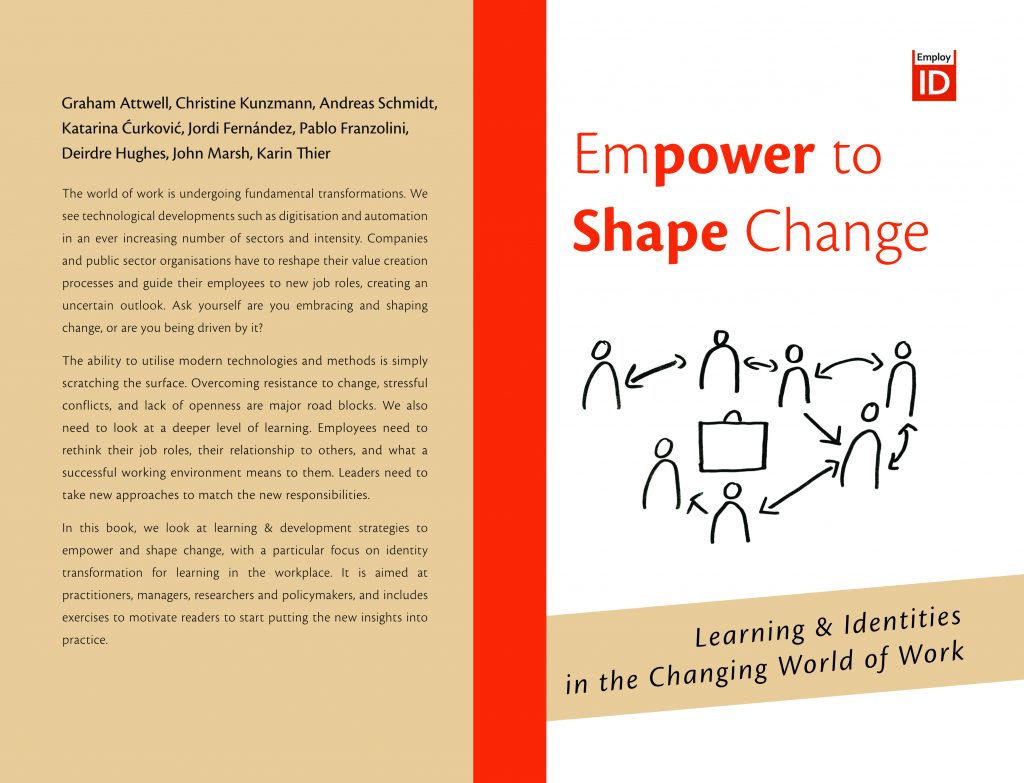
<p>The world of work is undergoing fundamental transformations. We see technological developments such as digitization and automation in an ever-increasing number of sectors and intensity. Companies and public sector organisations have to reshape their value creation processes and guide their employees to new job roles, creating an uncertain outlook. Are your team members embracing and shaping change, or are they being driven by it?</p>


<p>The ability to utilize modern technologies and methods is just the surface. Overcoming resistance to change, stressful conflicts, and lack of openness are major road blocks. We also need to look at a deeper level of learning. Employees need to rethink their job roles, the relationship to others, and what good work means to them. Leaders need to take new approaches to match the new responsibilities.</p>


<p>This indicates the importance of the professional identity of individuals and occupational groups. Employees are often not given spaces to engage in conversations and transform their identity, to consider the emotional aspects of their work, or to acquire the skills for moving from a problem focus to a solution focus and help each other in their learning process.</p>


<p>In this short book, we look at the role of technology for learning in the workplace to support identity transformation.</p>


<figure class="wp-block-image size-large"><a href="https://consultancy.employid.eu/2019/03/04/book-empower-to-shape-change/"><img decoding="async" width="1024" height="783" src="https://andreas.schmidt.name/wp-content/uploads/2020/05/EmployIDPlaybookCover-1-1024x783.jpg" alt="" class="wp-image-483" srcset="https://andreas.schmidt.name/wp-content/uploads/2020/05/EmployIDPlaybookCover-1-1024x783.jpg 1024w, https://andreas.schmidt.name/wp-content/uploads/2020/05/EmployIDPlaybookCover-1-300x229.jpg 300w, https://andreas.schmidt.name/wp-content/uploads/2020/05/EmployIDPlaybookCover-1-768x587.jpg 768w, https://andreas.schmidt.name/wp-content/uploads/2020/05/EmployIDPlaybookCover-1-1536x1174.jpg 1536w, https://andreas.schmidt.name/wp-content/uploads/2020/05/EmployIDPlaybookCover-1-2048x1565.jpg 2048w, https://andreas.schmidt.name/wp-content/uploads/2020/05/EmployIDPlaybookCover-1-1600x1223.jpg 1600w" sizes="(max-width: 1024px) 100vw, 1024px" /></a></figure>


<p></p>
<p>The post <a href="https://andreas.schmidt.name/2019/03/professional-identity-transformation-and-technology-enhanced-learning.html">Professional identity transformation and technology-enhanced learning</a> appeared first on <a href="https://andreas.schmidt.name">Andreas P. Schmidt</a>.</p>
]]></content>
		
			</entry>
		<entry>
		<author>
			<name>Andreas Schmidt</name>
							<uri>http://andreas.schmidt.name</uri>
						</author>

		<title type="html"><![CDATA[MATEL 2016]]></title>
		<link rel="alternate" type="text/html" href="https://andreas.schmidt.name/2016/09/matel2016.html" />

		<id>https://andreas.schmidt.name/?p=416</id>
		<updated>2017-06-02T13:26:21Z</updated>
		<published>2016-09-14T13:20:47Z</published>
		<category scheme="https://andreas.schmidt.name/" term="conference" /><category scheme="https://andreas.schmidt.name/" term="EmployID" /><category scheme="https://andreas.schmidt.name/" term="motivation" />
		<summary type="html"><![CDATA[<p>This year&#8217;s MATEL edition in Lyon, France (organized by EmployID members Christine Kunzmann, Carmen Wolf, and me) with more than&#8230;</p>
<p>The post <a href="https://andreas.schmidt.name/2016/09/matel2016.html">MATEL 2016</a> appeared first on <a href="https://andreas.schmidt.name">Andreas P. Schmidt</a>.</p>
]]></summary>

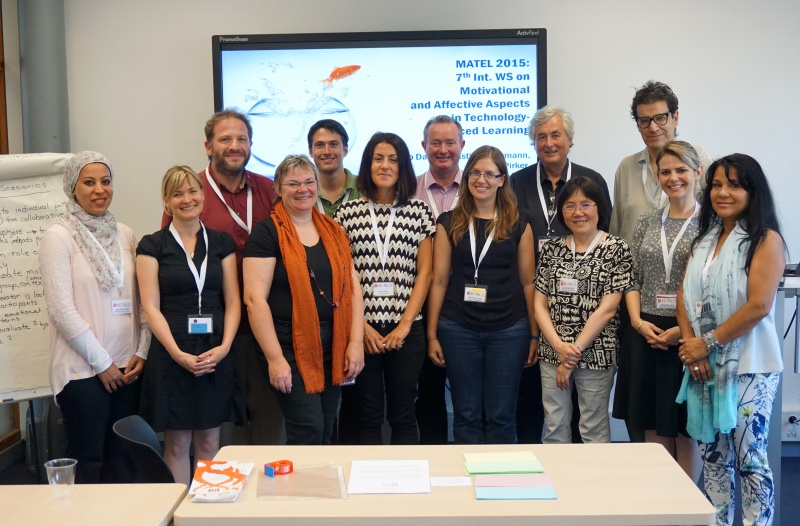
					<content type="html" xml:base="https://andreas.schmidt.name/2016/09/matel2016.html"><![CDATA[<p>This year&#8217;s MATEL edition in Lyon, France (organized by EmployID members Christine Kunzmann, Carmen Wolf, and me) with more than 20 participants focused on the further developing the ideas of patterns (see an <a href="http://www.slideshare.net/aps/7th-international-workshop-on-motivational-and-affective-aspects-keynote" rel="nofollow">introduction into the insights from previous workshops</a>), particularly on the challenges in dealing with motivational and affective issues in a systematic way.</p>
<p>A larger part of the discussion covered the spectrum of intrinsic and extrinsic motivation and the interindividual differences, particularly in the context of formal education. Does it depend on the subject, such as the usual argument that for many students learning maths cannot be fully achieved through measures focussed on intrinsic motivation? Does it depend the formal context around, such as hierarchically and strictly organized companies, or the strict bachelor and master programmes that make students focus on credits and minimizing their efforts? Or does it depend on the individual identity and presumed compatibility of the topics to learn with the image of oneself so that motivation might come from helping students developing their (future professional) identity? This would mean that we need to widen the scope of interventions to address motivational aspects in both workplace learning and formal education.</p>
<p>Finally it was concluded that the idea of patterns in a domain like technology-enhanced learning needs a community that still requires to be built. But other domains have shown that it can be an excellent complement to theory-driven or theory-focused research, enhancing also relevance to practice.</p>
<p>For more information: <a href="http://matel.professional-learning.eu/index.php/MATEL_2016">http://matel.professional-learning.eu/index.php/MATEL_2016</a><a href="https://andreas.schmidt.name/wp-content/uploads/2017/06/800px-MATEL-2016.jpg"><br />
</a></p>
<p>The post <a href="https://andreas.schmidt.name/2016/09/matel2016.html">MATEL 2016</a> appeared first on <a href="https://andreas.schmidt.name">Andreas P. Schmidt</a>.</p>
]]></content>
		
			</entry>
		<entry>
		<author>
			<name>Andreas Schmidt</name>
							<uri>http://andreas.schmidt.name</uri>
						</author>

		<title type="html"><![CDATA[Knowledge Maturing and Socio-technical (Design) Patterns]]></title>
		<link rel="alternate" type="text/html" href="https://andreas.schmidt.name/2016/07/knowledge-maturing-and-socio-technical-design-patterns.html" />

		<id>https://andreas.schmidt.name/?p=427</id>
		<updated>2017-06-02T18:00:49Z</updated>
		<published>2016-07-15T17:59:26Z</published>
		<category scheme="https://andreas.schmidt.name/" term="EmployID" /><category scheme="https://andreas.schmidt.name/" term="maturing" /><category scheme="https://andreas.schmidt.name/" term="project management" /><category scheme="https://andreas.schmidt.name/" term="publications" />
		<summary type="html"><![CDATA[<p>At EuroPLoP 2016, we have joined the conversation with the pattern community with respect to the approach of orienting large-scale collaborative&#8230;</p>
<p>The post <a href="https://andreas.schmidt.name/2016/07/knowledge-maturing-and-socio-technical-design-patterns.html">Knowledge Maturing and Socio-technical (Design) Patterns</a> appeared first on <a href="https://andreas.schmidt.name">Andreas P. Schmidt</a>.</p>
]]></summary>

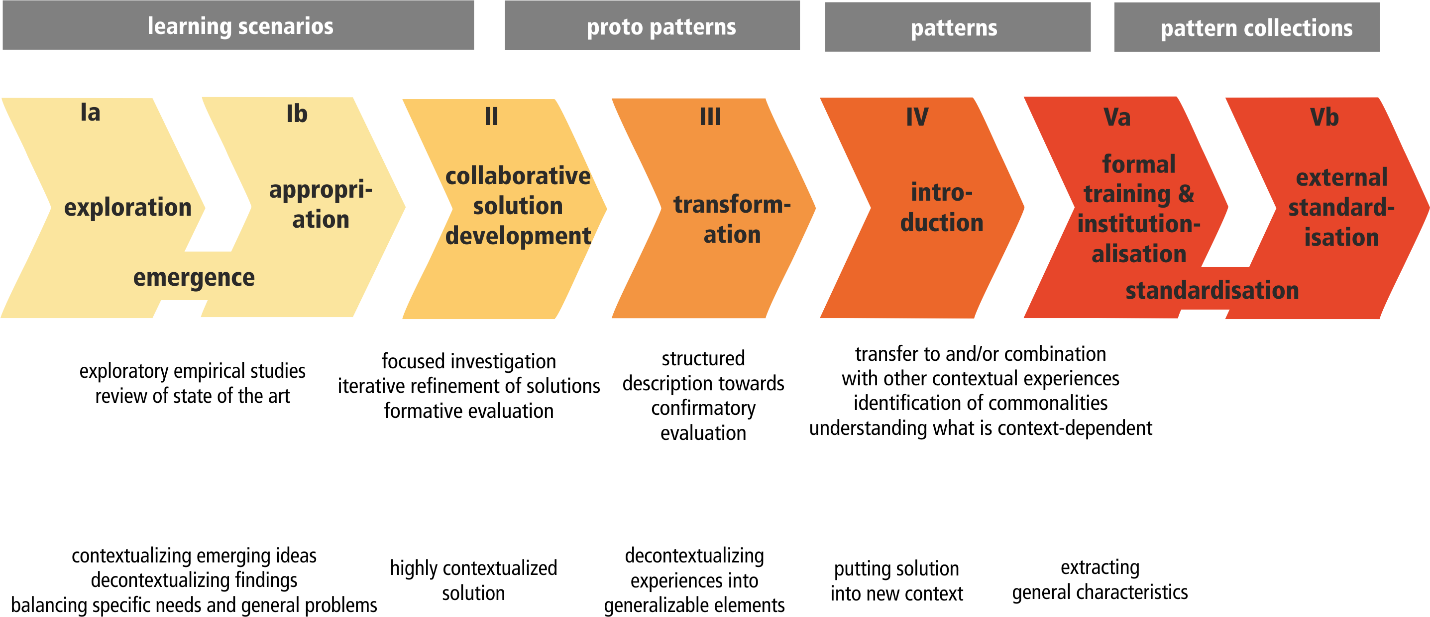
					<content type="html" xml:base="https://andreas.schmidt.name/2016/07/knowledge-maturing-and-socio-technical-design-patterns.html"><![CDATA[<p>At EuroPLoP 2016, we have joined the conversation with the pattern community with respect to the approach of orienting large-scale collaborative research projects towards patterns. Our contribution which outlined a knowledge maturing process for patterns received intense feedback from the community as part of so-called &#8220;writer&#8217;s workshops&#8221;. There the paper was discussed by the workshop participants with the authors as &#8220;flies on the wall&#8221;. This feedback is now incorporated into a <a href="https://www.bibsonomy.org/publication/23b74416ad95ea08c50f938f86d96fa10/aschmidt">camera ready version of the paper</a> for the post-proceedings to be published beginning of 2017. The key contribution is that extends the perspective on the knowledge process that leads to patterns towards early phases and applies that to the context of collaborative research projects.</p>
<p><a href="https://andreas.schmidt.name/wp-content/uploads/2017/06/pattern-maturing-process.png"><img decoding="async" class="aligncenter size-large wp-image-428" src="https://andreas.schmidt.name/wp-content/uploads/2017/06/pattern-maturing-process-1024x442.png" alt="" width="688" height="297" srcset="https://andreas.schmidt.name/wp-content/uploads/2017/06/pattern-maturing-process-1024x442.png 1024w, https://andreas.schmidt.name/wp-content/uploads/2017/06/pattern-maturing-process-300x129.png 300w, https://andreas.schmidt.name/wp-content/uploads/2017/06/pattern-maturing-process-768x331.png 768w, https://andreas.schmidt.name/wp-content/uploads/2017/06/pattern-maturing-process.png 1430w" sizes="(max-width: 688px) 100vw, 688px" /></a></p>
<p>Apart from that it was also unique experience at a conference that put a lot of emphasis on trust building and community formation through non-competetitive group games and a lot of opportunities for informal exchange.</p>
<p>The post <a href="https://andreas.schmidt.name/2016/07/knowledge-maturing-and-socio-technical-design-patterns.html">Knowledge Maturing and Socio-technical (Design) Patterns</a> appeared first on <a href="https://andreas.schmidt.name">Andreas P. Schmidt</a>.</p>
]]></content>
		
			</entry>
		<entry>
		<author>
			<name>Andreas Schmidt</name>
							<uri>http://andreas.schmidt.name</uri>
						</author>

		<title type="html"><![CDATA[Ten years of knowledge maturing]]></title>
		<link rel="alternate" type="text/html" href="https://andreas.schmidt.name/2015/10/ten-years-of-knowledge-maturing.html" />

		<id>http://andreas.schmidt.name/blog/?p=338</id>
		<updated>2017-06-02T18:02:35Z</updated>
		<published>2015-10-22T07:41:12Z</published>
		<category scheme="https://andreas.schmidt.name/" term="conference" /><category scheme="https://andreas.schmidt.name/" term="EmployID" /><category scheme="https://andreas.schmidt.name/" term="km" /><category scheme="https://andreas.schmidt.name/" term="maturing" /><category scheme="https://andreas.schmidt.name/" term="publications" />
		<summary type="html"><![CDATA[<p>It is a strange kind of experience if you discover that the topic that you are most associated with has&#8230;</p>
<p>The post <a href="https://andreas.schmidt.name/2015/10/ten-years-of-knowledge-maturing.html">Ten years of knowledge maturing</a> appeared first on <a href="https://andreas.schmidt.name">Andreas P. Schmidt</a>.</p>
]]></summary>

					<content type="html" xml:base="https://andreas.schmidt.name/2015/10/ten-years-of-knowledge-maturing.html"><![CDATA[<div>It is a strange kind of experience if you discover that the topic that you are most associated with has its 10 years anniversary. This happened to me when Ronald Maier and I together with <a href="https://www.bibsonomy.org/bibtex/27e127047377ba78dda4402bccf6a5b47/aschmidt">Christine Kunzmann</a> prepared the invited Special Track on Social Knowledge Management. I-KNOW 2015 celebrated its 15th anniversary with inviting influential paper authors to organize such a track. It was at I-KNOW 2005 when the <a href="https://www.bibsonomy.org/bibtex/27e127047377ba78dda4402bccf6a5b47/aschmidt">first paper on the model</a> was published. It was a reaction to the chasm between e-learning and knowledge management and has sensed the emerging transforming effect of a social collaboration view on knowledge management. Since then, numerous cross-disciplinary research activities have contributed to the extension and refinement of the model. At the heart is the insight that knowledge develops along distinct phases in which its characteristics and thus requirements for support change. It brings to­gether different perspectives and provides a frame­work for analysis and design of interventions.</div>
<div></div>
<p><iframe loading="lazy" style="border: 1px solid #CCC; border-width: 1px; margin-bottom: 5px; max-width: 100%;" src="//de.slideshare.net/slideshow/embed_code/key/An1f4eaLhjVucW" width="425" height="355" frameborder="0" marginwidth="0" marginheight="0" scrolling="no" allowfullscreen="allowfullscreen"> </iframe></p>
<div style="margin-bottom: 5px;"><strong> <a title="Social Knowledge Management and the Knowledge Maturing Perspective" href="//de.slideshare.net/aps/social-knowledge-management-and-the-knowledge-maturing-perspective" target="_blank" rel="noopener noreferrer">Social Knowledge Management and the Knowledge Maturing Perspective</a> </strong> from <strong><a href="//www.slideshare.net/aps" target="_blank" rel="noopener noreferrer">Andreas Schmidt</a></strong></div>
<div></div>
<div>Research is still continuing, and after analyzing its applicability to ontology engineering, to engineering software, we are now looking into socio-technical design patterns as an approach to capture and share experiential knowledge. We <a href="https://de.slideshare.net/aps/social-knowledge-management-and-the-knowledge-maturing-perspective">presented a tool-chain in which socio-technical patterns can be developed from peer coaching activities</a> in which eliciting of motivational and affective aspects becomes possible, via a collaborative editing system Living Documents to social learning programmes to disseminate to and engage with a wider audience.</div>
<p>The post <a href="https://andreas.schmidt.name/2015/10/ten-years-of-knowledge-maturing.html">Ten years of knowledge maturing</a> appeared first on <a href="https://andreas.schmidt.name">Andreas P. Schmidt</a>.</p>
]]></content>
		
			</entry>
		<entry>
		<author>
			<name>Andreas Schmidt</name>
							<uri>http://andreas.schmidt.name</uri>
						</author>

		<title type="html"><![CDATA[Facilitation support: the new frontier for social media and learning support]]></title>
		<link rel="alternate" type="text/html" href="https://andreas.schmidt.name/2014/06/facilitation-support-the-new-frontier-for-social-media-and-learning-support.html" />

		<id>http://andreas.schmidt.name/blog/?p=324</id>
		<updated>2017-06-02T18:07:12Z</updated>
		<published>2014-06-15T09:51:39Z</published>
		<category scheme="https://andreas.schmidt.name/" term="elearning" /><category scheme="https://andreas.schmidt.name/" term="EmployID" /><category scheme="https://andreas.schmidt.name/" term="ilin" /><category scheme="https://andreas.schmidt.name/" term="maturing" /><category scheme="https://andreas.schmidt.name/" term="workplace learning" />
		<summary type="html"><![CDATA[<p>Over the last two years, I have been building a course on Enterprise Social Media that put emphasis on conversations and reflection&#8230;</p>
<p>The post <a href="https://andreas.schmidt.name/2014/06/facilitation-support-the-new-frontier-for-social-media-and-learning-support.html">Facilitation support: the new frontier for social media and learning support</a> appeared first on <a href="https://andreas.schmidt.name">Andreas P. Schmidt</a>.</p>
]]></summary>

					<content type="html" xml:base="https://andreas.schmidt.name/2014/06/facilitation-support-the-new-frontier-for-social-media-and-learning-support.html"><![CDATA[<p>Over the last two years, I have been building a course on Enterprise Social Media that put emphasis on conversations and reflection on social media from a business perspective. In this context, we have defined social media along five criteria (as many existing definitions were of ridiculous quality, such as defining social media ontop of the vague notion of Web 2.0):</p>
<ul>
<li><em>Participation</em>: many instead of few contributors</li>
<li><em>Openness</em>: Opinions, ratings, comments are communicated openly (instead of restrictive editorial processes)</li>
<li><em>Conversation</em>: Dialogue instead of one-way communication</li>
<li><em>Networking</em>: Users are not isolated, but can relate to others</li>
<li><em>Community:</em> Users can create groups with shared interests</li>
</ul>
<p>Social media has become omnipresent, and many of its technical building blocks are diffusing into almost every area, including traditional enterprise systems. The technology &#8211; as it has shown &#8211; is not really exciting, but still <em>really</em> successful introduction of social media into companies is rare. It is the socio-technical challenge that is still largely unsolved from an engineering perspective, i.e., systematically developing a good solution. That is also due to the fact that social processes have rarely been included in engineering processes in the same way as the technical design; they were rather seen as contextual factors.</p>
<p>Recently, our new project <a href="https://employid.eu">EmployID</a> has started in which we plan to develop and deploy solutions for public employment services in Europe. Of course, the envisioned solutions are based on social media principles, and of course, we hit the limits of restrictions. But the difference of EmployID has been that we are fully aware that social processes need to evolve. And we have found one key area that is key to change: the professional identity. Therefore we target with our (socio-technical!) solutions at learning processes that trigger and accompany identity development processes.</p>
<p>It has turned out that technology has so far neglected one important perspective: the role of supporting the learning of others. We call this facilitation and use it in a very broad sense. In our <a href="https://publications.andreas.schmidt/ICELW2014_EmployID.pdf">ICELW 2014 paper</a>, we have categorized facilitation into human facilitation, facilitation through tools, and facilitations through shaping environments. Facilitators have so far hardly been seen as a primary target for tool functionality, but we believe them to be the key group.</p>
<p>From another angle, we have analyzed the role of knowledge in software systems in our contribution to this year&#8217;s <a href="https://publications.andreas.schmidt.name/2014_IKNOW_schmidt-kunzmann.pdf">I-KNOW conference</a>. With the current trend of software applications no longer prescribing usage processes, but supporting activities that can be flexibly combined, there arises the need for support in appropriating tools and co-evolving as part of the appropriation process, which is &#8211; by the way &#8211; another good example for <a href="http://www.palgrave-journals.com/kmrp/journal/vaop/ncurrent/full/kmrp201356a.html">knowledge maturing processes</a>. This again is about supporting facilitaiton where facilitation roles can be flexible assumed</p>
<p><a href="/wp-content/uploads/2014/06/table_typology_knowledge-in-apps1.png"><img loading="lazy" decoding="async" class="aligncenter wp-image-327" src="/wp-content/uploads/2014/06/table_typology_knowledge-in-apps1.png" alt="" width="599" height="194" srcset="https://andreas.schmidt.name/wp-content/uploads/2014/06/table_typology_knowledge-in-apps1.png 963w, https://andreas.schmidt.name/wp-content/uploads/2014/06/table_typology_knowledge-in-apps1-300x97.png 300w" sizes="(max-width: 599px) 100vw, 599px" /></a></p>
<p>From our perspective, the focus on facilitation is the next frontier for supporting learning, both at the workplace, but also in the context of MOOCs. Many technical developments can contribute here, especially those technologies that try to make sense from the activities in social media environments, such as recommender systems, (workplace) learning analytics, among others. But again, this require socio-techical engineering for which better methods are required. So challenging topics to research on!</p>
<p>References:</p>
<p><span style="color: #000000;">Schmidt, Andreas, Kunzmann, Christine</span><br style="color: #000000;" /><strong style="color: #000000;">Designing for knowledge maturing: from knowledge-driven software to supporting the facilitation of knowledge development</strong><br style="color: #000000;" /><span style="color: #000000;">In: </span><em style="color: #000000;">International Conference on Knowledge Management (I-KNOW 2014)</em><span style="color: #000000;">, ACM, 2014<br />
<a href="http://publications.andreas.schmidt.name/2014_IKNOW_schmidt-kunzmann.pdf">PDF</a></span></p>
<p><span style="color: #000000;">Bimrose, Jenny, Brown, Alan, Holocher-Ertl, Teresa, Kieslinger, Barbara, Kunzmann, Christine, Prilla, Michael, Schmidt, Andreas, Wolf, Carmen</span><br style="color: #000000;" /><strong style="color: #000000;">Introducing learning innovation in public employment services. What role can facilitation play?</strong><br style="color: #000000;" /><span style="color: #000000;">In: </span><em style="color: #000000;">Proceedings of International Conference on E-Learning at the Workplace (ICELW) 2014, New York City, USA, June 11-13, </em><span style="color: #000000;">2014<br />
<a href="http://publications.andreas.schmidt/ICELW2014_EmployID.pdf">PDF</a></span></p>
<p>The post <a href="https://andreas.schmidt.name/2014/06/facilitation-support-the-new-frontier-for-social-media-and-learning-support.html">Facilitation support: the new frontier for social media and learning support</a> appeared first on <a href="https://andreas.schmidt.name">Andreas P. Schmidt</a>.</p>
]]></content>
		
			</entry>
		<entry>
		<author>
			<name>Andreas Schmidt</name>
							<uri>http://andreas.schmidt.name</uri>
						</author>

		<title type="html"><![CDATA[Knowledge Maturing Model &#8211; the latest version]]></title>
		<link rel="alternate" type="text/html" href="https://andreas.schmidt.name/2014/01/knowledge-maturing-model-the-latest-version.html" />

		<id>http://andreas.schmidt.name/blog/?p=314</id>
		<updated>2017-06-02T13:37:21Z</updated>
		<published>2014-01-15T22:24:22Z</published>
		<category scheme="https://andreas.schmidt.name/" term="ilin" /><category scheme="https://andreas.schmidt.name/" term="km" /><category scheme="https://andreas.schmidt.name/" term="layers" /><category scheme="https://andreas.schmidt.name/" term="mature-ip" /><category scheme="https://andreas.schmidt.name/" term="maturing" /><category scheme="https://andreas.schmidt.name/" term="publications" /><category scheme="https://andreas.schmidt.name/" term="workplace learning" />
		<summary type="html"><![CDATA[<p>Social media demands knowledge management to refocus on broad participation and the active role of individuals as both consumers and&#8230;</p>
<p>The post <a href="https://andreas.schmidt.name/2014/01/knowledge-maturing-model-the-latest-version.html">Knowledge Maturing Model &#8211; the latest version</a> appeared first on <a href="https://andreas.schmidt.name">Andreas P. Schmidt</a>.</p>
]]></summary>

					<content type="html" xml:base="https://andreas.schmidt.name/2014/01/knowledge-maturing-model-the-latest-version.html"><![CDATA[<p>Social media demands knowledge management to refocus on broad participation and the active role of individuals as both consumers and contributors at the same time. To make sense of these developments within organisations, knowledge management approaches need to connect the dynamic and fluid social media interactions of individuals and in informal communities with stability and institutionalization in a formal organisational environment.</p>
<p style="text-align: left;">Towards that end, knowledge maturing is a novel perspective on knowledge creation in and across organisations. The knowledge maturing model contributes to theories of organisational knowledge creation by structuring the collective development process into characteristic phases which are not passed in a strictly linear way.</p>
<p style="text-align: left;">The x-axis of the model describes how knowledge moves through the four scopes of interaction individual, community, organization and society. The y-axis describes the abundant ideas entering the knowledge maturing process and the organisation’s focus of attention which is wide in the beginning and narrowed down along the phases<br />
<a href="/wp-content/uploads/2014/01/2012-04_Mature_MainFigure_with_numbers_without_arrowheads.png"><img loading="lazy" decoding="async" class="aligncenter wp-image-315" src="/wp-content/uploads/2014/01/2012-04_Mature_MainFigure_with_numbers_without_arrowheads-1024x783.png" alt="2012-04_Mature_MainFigure_with_numbers_without_arrowheads" width="614" height="470" srcset="https://andreas.schmidt.name/wp-content/uploads/2014/01/2012-04_Mature_MainFigure_with_numbers_without_arrowheads-1024x783.png 1024w, https://andreas.schmidt.name/wp-content/uploads/2014/01/2012-04_Mature_MainFigure_with_numbers_without_arrowheads-300x229.png 300w" sizes="(max-width: 614px) 100vw, 614px" /></a></p>
<ul>
<li><b>I. Emergence. </b>Individuals create personal knowledge by pursuing their interests in browsing abundant knowledge spaces inside and beyond the organisation, opening up for new knowledge and the changes it might bring about. Knowledge is subjective, deeply embedded in the originator’s context and the vocabulary used for communication might be vague and restricted to the originator. Based on the findings of our studies, we revised this phase to include two sub-phases, exploration and appropriation.</li>
<li>
<blockquote><p><b>Ia. Exploration</b>: New knowledge is developed by individuals either in highly informal discussions or by browsing the knowledge spaces available inside the organisation and beyond. Extensive search and retrieval activities often result in loads of material influencing creative processes of idea generation.</p></blockquote>
</li>
<li>
<blockquote><p><b>Ib. Appropriation</b><span style="line-height: 1.5em;">: New knowledge or results found in the exploration subphase that have been enriched, refined or otherwise contextualised with respect to their use are now appropriated by the individual, i.e. personalised and contributions are marked so that an individual can benefit from its future (re-)use. While many initiatives for knowledge management have focused on sharing knowledge or even detaching knowledge from humans as “media”, individuals also require support for appropriation, at least in a more individualistic culture.</span></p></blockquote>
</li>
<li><b>II. Distribution in communities</b>: The first phase in the scope of communities describes interactions between individuals driven by social motives and the benefits that individuals typically attribute to sharing knowledge. These are, among others, belonging to a preferred social group, thus increasing the probability of getting back knowledge from the community when one needs it. Distribution is not meant in the sense of a one way street of individuals contributing new knowledge that they have committed to. The phase includes discussing the new knowledge, negotiating its meaning and impact, co-developing knowledge, convincing others and agreeing plus committing to the knowledge as collective. From the perspective of semantics, a common terminology is developed and shared among community members.</li>
<li><b>III. Transformation</b>: Artefacts created in the preceding phases are often inherently unstructured and still highly subjective and embedded in the community context which means they are only comprehensible for people in this community due to shared knowledge needed to interpret them. Transformation means that knowledge is restructured and put into a form appropriate for moving it across the community’s boundaries. Structured documents are created in which knowledge is de-subjectified, sometimes formalised using established containers and context is made explicit to ease the transfer to collectives other than the originating community.</li>
<li><b>IV. Introduction</b>: Knowledge is prepared with a specific focus on enhancing understandability, handed on and applied in an ad-hoc manner in trainings in which a selected group of users is instructed using didactically prepared material. We found two primary interpretations of this first phase in the scope of organisation, i.e. (1) an instructional setting called ad-hoc training and (2) an experimental setting called piloting.</li>
<li>
<ul>
<li><b>IV<sub>1</sub>. Ad-hoc training</b>: Documents produced in the preceding phases are typically not well suited as learning materials because no didactical considerations were taken into account. Now the topic is refined to improve comprehensibility in order to ease its consumption or re-use. Individual learning objects are arranged to cover a broader subject area. Tests allow to determine the knowledge level and to select learning objects or learning paths.</li>
<li><b>IV<sub>2</sub>. Piloting</b>: Typically, not every implementation detail can be foreseen in the transformation phase. Knowledge is arranged in a way so that it can be applied in a dedicated, specific experiment involving not only the creators of knowledge, but other stakeholders. Experiences are collected with a test case before a larger roll-out of a product, a service to an external user community, e.g., customers or stakeholders, or new organisational rules, procedures or processes to an organisation-internal target community such as project teams, work groups, subsidiaries or other organisational units.</li>
</ul>
</li>
<li><b>V. Standardisation</b>: The knowledge is further solidified and formally established in the organisation to be used in repeatable formal trainings, work practices, processes, products or services. As in the introduction phase, we distinguish an instructional setting with standardised training activities, called formal training, and an experimental setting turning pilots into standard organisational infrastructure, processes and practices, called institutionalisation. The term standard, finally, can also refer to external standardisation initiatives which are similar for both settings, transcend the organisational boundaries and move knowledge maturing to the scope of societies.
<ul>
<li><b>V1a. Formal training</b>: In an instructional setting, the subject area becomes teachable to novices. A curriculum integrates learning content into a sequence using sophisticated didactical concepts in order to guide learners in their learning journeys to capture a subject area thus increasing the probability of successful knowledge transfer. Learning objects are arranged into courses covering a broader subject area. Learning modules and courses can be further combined into programs preparing for taking on a new role or for career development.</li>
<li><b>V2a. Institutionalisation</b>: In the organisation-internal case, formalised documents that have been learned by knowledge workers are solidified and implemented into the organisational infrastructure in the form of processes, business rules and/or standard operating procedures. In the organisation-external case, products or services are launched on the market. They are institutionalised into the portfolio of products and services offered by the organisation.</li>
<li><b>Vb. External standardisation</b>: The ultimate maturity sub-phase is very similar for both paths, the instructional and the experimental path, and covers some form of standardisation or certification. On an individual level, qualifications and certificates confirm that participants of formal trainings achieved a certain degree of proficiency which is comparable across institutions. On an organisational level, certificates allow organisations to prove compliance with a set of rules that they have agreed to fulfil. Concerning products and services, certificates show compliance to laws, regulations or recommendations that can, should or must be fulfilled before a product or service can be offered in a certain market.</li>
</ul>
</li>
</ul>
<blockquote><p>&nbsp;</p>
<p>Maier, Ronald, Schmidt, Andreas<br />
<strong>Explaining organizational knowledge creation with a knowledge maturing model</strong><br />
<em>Knowledge Management Research &amp; Practice</em>, vol. 2014, no. 1, 2014, pp. 1&#8211;20</p>
<p>http://www.palgrave-journals.com/kmrp/journal/vaop/ncurrent/full/kmrp201356a.html</p></blockquote>
<p>The post <a href="https://andreas.schmidt.name/2014/01/knowledge-maturing-model-the-latest-version.html">Knowledge Maturing Model &#8211; the latest version</a> appeared first on <a href="https://andreas.schmidt.name">Andreas P. Schmidt</a>.</p>
]]></content>
		
			</entry>
		<entry>
		<author>
			<name>Andreas Schmidt</name>
							<uri>http://andreas.schmidt.name</uri>
						</author>

		<title type="html"><![CDATA[Ontologies for spiritual care]]></title>
		<link rel="alternate" type="text/html" href="https://andreas.schmidt.name/2013/09/ontologies-for-spiritual-care.html" />

		<id>http://andreas.schmidt.name/blog/?p=298</id>
		<updated>2017-06-02T13:36:05Z</updated>
		<published>2013-09-14T22:02:08Z</published>
		<category scheme="https://andreas.schmidt.name/" term="ilin" /><category scheme="https://andreas.schmidt.name/" term="ontology" />
		<summary type="html"><![CDATA[<p>Over the last years, we&#8217;ve been working a very interesting subject that combines palliative care, theology, and semantic technologies. In&#8230;</p>
<p>The post <a href="https://andreas.schmidt.name/2013/09/ontologies-for-spiritual-care.html">Ontologies for spiritual care</a> appeared first on <a href="https://andreas.schmidt.name">Andreas P. Schmidt</a>.</p>
]]></summary>

					<content type="html" xml:base="https://andreas.schmidt.name/2013/09/ontologies-for-spiritual-care.html"><![CDATA[<p>Over the last years, we&#8217;ve been working a very interesting subject that combines palliative care, theology, and semantic technologies. In collaboration with Tanja Stiehl from LMU Munich, Traugott Roser from University of Münster, and <a href="http://christine-kunzmann.de">Christine Kunzmann</a> from Pontydysgu, we have developed a concept for a systematic approach to spiritual care in the context of (child) palliative care. Based on a empirical analysis of existing patient records, an ontology has been developed that links observations about patients, interpretations of those observations in terms of spiritual concepts, and spiritual care interventions.</p>
<p>This can be used to structure patient records and gain evidence about effectiveness of spiritual care interventions and to create awareness in a multi-professional setting.</p>
<p>Together with a student team at Karlsruhe University of Applied Sciences, we have developed a first prototype that demonstrates the added value of ontologies and semantically annotated patient records for developing a systematic approach to spiritual care.</p>
<p>This is going to be presented at the ARTEL 2013 workshop of ECTEL 2013 at Paphos, Cyprus. The respective paper is available as PDF from <a href="https://publications.andreas.schmidt.name/2013-Spironto_.pdf">here</a>.</p>
<p>More information can be found under http://spironto.de.</p>
<p>The post <a href="https://andreas.schmidt.name/2013/09/ontologies-for-spiritual-care.html">Ontologies for spiritual care</a> appeared first on <a href="https://andreas.schmidt.name">Andreas P. Schmidt</a>.</p>
]]></content>
		
			</entry>
		<entry>
		<author>
			<name>Andreas Schmidt</name>
							<uri>http://andreas.schmidt.name</uri>
						</author>

		<title type="html"><![CDATA[Advances in Technology Enhanced Learning: or MATURE &#8211; Four years in 5:30]]></title>
		<link rel="alternate" type="text/html" href="https://andreas.schmidt.name/2013/06/tel-advances-mature.html" />

		<id>http://andreas.schmidt.name/blog/?p=288</id>
		<updated>2017-06-02T18:11:39Z</updated>
		<published>2013-06-27T22:37:38Z</published>
		<category scheme="https://andreas.schmidt.name/" term="ilin" /><category scheme="https://andreas.schmidt.name/" term="mature-ip" /><category scheme="https://andreas.schmidt.name/" term="maturing" /><category scheme="https://andreas.schmidt.name/" term="workplace learning" />
		<summary type="html"><![CDATA[<p>The TELMap project has interviewed major TEL projects for a rich picture of the advances in Technology Enhanced Learning .&#8230;</p>
<p>The post <a href="https://andreas.schmidt.name/2013/06/tel-advances-mature.html">Advances in Technology Enhanced Learning: or MATURE &#8211; Four years in 5:30</a> appeared first on <a href="https://andreas.schmidt.name">Andreas P. Schmidt</a>.</p>
]]></summary>

					<content type="html" xml:base="https://andreas.schmidt.name/2013/06/tel-advances-mature.html"><![CDATA[<p>The TELMap project has interviewed major TEL projects for a rich picture of the advances in Technology Enhanced Learning . As former coordinator, I had the pleasure and challenge to present a brief summary of what MATURE has achieved (I blogged before about the experience). Here is now the result:</p>
<p><iframe loading="lazy" src="https://player.open.ac.uk/embed/c86211f079" width="480" height="270" frameborder="0" allowfullscreen="allowfullscreen"></iframe></p>
<p>TELMap has compiled an overview as an ebook (currently only iBooks, but other formats are promised): http://bit.ly/tel-advances &#8211; worth checking out.</p>
<p>For all those outside the i-universe: here is the <a href="/files/chapter-6-schmidt.pdf">chapter on MATURE</a> as PDF.</p>
<p>The post <a href="https://andreas.schmidt.name/2013/06/tel-advances-mature.html">Advances in Technology Enhanced Learning: or MATURE &#8211; Four years in 5:30</a> appeared first on <a href="https://andreas.schmidt.name">Andreas P. Schmidt</a>.</p>
]]></content>
		
			</entry>
	</feed>