<?xml version="1.0" encoding="UTF-8"?><feed
  xmlns="http://www.w3.org/2005/Atom"
  xmlns:thr="http://purl.org/syndication/thread/1.0"
  xml:lang=""
  xml:base="https://archivesblogs.com/wp-atom.php"
   >
	<title type="text">ArchivesBlogsArchivesBlogs</title>
	<subtitle type="text">a syndicated collection of blogs by and for archivists</subtitle>

	<updated>2020-09-18T20:52:43Z</updated>

	<link rel="alternate" type="text/html" href="https://archivesblogs.com" />
	<id>https://archivesblogs.com/feed/atom</id>
	<link rel="self" type="application/atom+xml" href="http://archivesblogs.com/feed/atom" />

	<generator uri="https://wordpress.org/" version="6.5.5">WordPress</generator>
		<entry>
		<author>
			<name>AOTUS</name>
			<uri>https://aotus.blogs.archives.gov</uri>
					</author>
		<title type="html"><![CDATA[Meet Ike]]></title>
		<link rel="alternate" type="text/html" href="https://aotus.blogs.archives.gov/2020/09/18/meet-ike/" />
		<id>https://aotus.blogs.archives.gov/2020/09/18/meet-ike/</id>
		<updated>2020-09-18T20:52:43Z</updated>
		<published>2020-09-18T20:52:43Z</published>
		<category scheme="https://archivesblogs.com" term="English" />		<summary type="html"><![CDATA[“I come from the very heart of America.” – Dwight Eisenhower, June 12, 1945 At a time when the world fought to overcome tyranny, he helped lead the course to victory as the Supreme Allied Commander in Europe. When our nation needed a leader, he upheld the torch of liberty as our 34th president. As … <a href="https://aotus.blogs.archives.gov/2020/09/18/meet-ike/" class="more-link">Continue reading <span class="screen-reader-text">Meet Ike</span></a> <a href="https://aotus.blogs.archives.gov/2020/09/18/meet-ike/">Continue reading <span class="meta-nav">&#8594;</span></a>]]></summary>
		<content type="html" xml:base="https://aotus.blogs.archives.gov/2020/09/18/meet-ike/"><![CDATA[<p><b><i>“I come from the very heart of America.” </i></b><b>– Dwight Eisenhower, June 12, 1945</b><b><br /></b></p>
<p><span style="font-weight: 400;">At a time when the world fought to overcome tyranny, he helped lead the course to victory as the Supreme Allied Commander in Europe. When our nation needed a leader, he upheld the torch of liberty as our 34th president. As a new memorial is unveiled, now is the time for us to meet Dwight David Eisenhower.</span></p>
<figure class="wp-block-image size-large"><a href="https://eisenhowermemorial.gov/"><img decoding="async" data-attachment-id="9443" data-permalink="https://aotus.blogs.archives.gov/2020/09/18/meet-ike/dday-statue/" data-orig-file="https://i0.wp.com/aotus.blogs.archives.gov/wp-content/uploads/2020/09/Dday-statue.png?fit=1600%2C1066&amp;ssl=1" data-orig-size="1600,1066" data-comments-opened="1" data-image-meta="{&quot;aperture&quot;:&quot;0&quot;,&quot;credit&quot;:&quot;&quot;,&quot;camera&quot;:&quot;&quot;,&quot;caption&quot;:&quot;&quot;,&quot;created_timestamp&quot;:&quot;0&quot;,&quot;copyright&quot;:&quot;&quot;,&quot;focal_length&quot;:&quot;0&quot;,&quot;iso&quot;:&quot;0&quot;,&quot;shutter_speed&quot;:&quot;0&quot;,&quot;title&quot;:&quot;&quot;,&quot;orientation&quot;:&quot;0&quot;}" data-image-title="Dday-statue" data-image-description="" data-medium-file="https://i0.wp.com/aotus.blogs.archives.gov/wp-content/uploads/2020/09/Dday-statue.png?fit=300%2C200&amp;ssl=1" data-large-file="https://i0.wp.com/aotus.blogs.archives.gov/wp-content/uploads/2020/09/Dday-statue.png?fit=685%2C456&amp;ssl=1" loading="lazy" width="685" height="456" src="https://i0.wp.com/aotus.blogs.archives.gov/wp-content/uploads/2020/09/Dday-statue.png?resize=685%2C456&#038;ssl=1" alt="Photograph of the statues and sculptures at the Eisenhower Memorial. The statue depicts Eisenhower speaking to a group of soldiers giving the D-Day address to troops." class="wp-image-9443" srcset="https://i0.wp.com/aotus.blogs.archives.gov/wp-content/uploads/2020/09/Dday-statue.png?resize=1024%2C682&amp;ssl=1 1024w, https://i0.wp.com/aotus.blogs.archives.gov/wp-content/uploads/2020/09/Dday-statue.png?resize=300%2C200&amp;ssl=1 300w, https://i0.wp.com/aotus.blogs.archives.gov/wp-content/uploads/2020/09/Dday-statue.png?resize=768%2C512&amp;ssl=1 768w, https://i0.wp.com/aotus.blogs.archives.gov/wp-content/uploads/2020/09/Dday-statue.png?resize=1536%2C1023&amp;ssl=1 1536w, https://i0.wp.com/aotus.blogs.archives.gov/wp-content/uploads/2020/09/Dday-statue.png?resize=685%2C456&amp;ssl=1 685w, https://i0.wp.com/aotus.blogs.archives.gov/wp-content/uploads/2020/09/Dday-statue.png?resize=342%2C228&amp;ssl=1 342w, https://i0.wp.com/aotus.blogs.archives.gov/wp-content/uploads/2020/09/Dday-statue.png?w=1600&amp;ssl=1 1600w, https://i0.wp.com/aotus.blogs.archives.gov/wp-content/uploads/2020/09/Dday-statue.png?w=1370&amp;ssl=1 1370w" sizes="(max-width: 685px) 100vw, 685px" data-recalc-dims="1" /></a><figcaption><em>Eisenhower Memorial statue and sculptures, photo by the Dwight D. Eisenhower Memorial Commission</em></figcaption></figure>
<p><span style="font-weight: 400;">An opportunity to get to know this man can be found at the </span><a href="https://eisenhowermemorial.gov/"><span style="font-weight: 400;">newly unveiled Eisenhower Memorial in Washington, DC</span></a><span style="font-weight: 400;">, and the all-new exhibits in the </span><a href="https://www.eisenhowerlibrary.gov/"><span style="font-weight: 400;">Eisenhower Presidential Library and Museum</span></a><span style="font-weight: 400;"> in Abilene, Kansas. Each site in its own way tells the story of a humble man who grew up in small-town America and became the leader of the free world.</span></p>
<p><span style="font-weight: 400;">The Eisenhower Presidential Library and Museum is a 22-acre campus which includes several buildings where visitors can interact with the life of this president. Starting with the </span><a href="https://youtu.be/mZk1UHYdy8U"><span style="font-weight: 400;">Boyhood Home</span></a><span style="font-weight: 400;">, guests discover the early years of Eisenhower as he avidly read history books, played sports, and learned lessons of faith and leadership. The library building houses the documents of his administration. With more than 26 million pages and 350,000 images, researchers can explore the career of a 40+-year public servant. The 25,000 square feet of all-new exhibits located in the museum building is where visitors get to meet Ike and Mamie again&#8230;for the first time. Using NARA’s holdings, guests gain insight into the life and times of President Eisenhower. Finally, visitors can be reflective in the Place of Meditation where Eisenhower rests beside his first-born son, Doud, and his beloved wife Mamie. A true encapsulation of his life.</span></p>
<figure class="wp-block-image size-large"><a href="https://www.eisenhowerlibrary.gov/"><img decoding="async" data-attachment-id="9444" data-permalink="https://aotus.blogs.archives.gov/2020/09/18/meet-ike/eisenhower-library-campus/" data-orig-file="https://i1.wp.com/aotus.blogs.archives.gov/wp-content/uploads/2020/09/Eisenhower-Library-campus.png?fit=949%2C708&amp;ssl=1" data-orig-size="949,708" data-comments-opened="1" data-image-meta="{&quot;aperture&quot;:&quot;0&quot;,&quot;credit&quot;:&quot;&quot;,&quot;camera&quot;:&quot;&quot;,&quot;caption&quot;:&quot;&quot;,&quot;created_timestamp&quot;:&quot;0&quot;,&quot;copyright&quot;:&quot;&quot;,&quot;focal_length&quot;:&quot;0&quot;,&quot;iso&quot;:&quot;0&quot;,&quot;shutter_speed&quot;:&quot;0&quot;,&quot;title&quot;:&quot;&quot;,&quot;orientation&quot;:&quot;0&quot;}" data-image-title="Eisenhower-Library-campus" data-image-description="" data-medium-file="https://i1.wp.com/aotus.blogs.archives.gov/wp-content/uploads/2020/09/Eisenhower-Library-campus.png?fit=300%2C224&amp;ssl=1" data-large-file="https://i1.wp.com/aotus.blogs.archives.gov/wp-content/uploads/2020/09/Eisenhower-Library-campus.png?fit=685%2C511&amp;ssl=1" loading="lazy" width="685" height="511" src="https://i1.wp.com/aotus.blogs.archives.gov/wp-content/uploads/2020/09/Eisenhower-Library-campus.png?resize=685%2C511&#038;ssl=1" alt="Photo of the Eisenhower Library Museum campus, showing a statue of Eisenhower in the middle of an emblem with the words &quot;Champion of Peace.&quot; " class="wp-image-9444" srcset="https://i1.wp.com/aotus.blogs.archives.gov/wp-content/uploads/2020/09/Eisenhower-Library-campus.png?w=949&amp;ssl=1 949w, https://i1.wp.com/aotus.blogs.archives.gov/wp-content/uploads/2020/09/Eisenhower-Library-campus.png?resize=300%2C224&amp;ssl=1 300w, https://i1.wp.com/aotus.blogs.archives.gov/wp-content/uploads/2020/09/Eisenhower-Library-campus.png?resize=768%2C573&amp;ssl=1 768w, https://i1.wp.com/aotus.blogs.archives.gov/wp-content/uploads/2020/09/Eisenhower-Library-campus.png?resize=685%2C511&amp;ssl=1 685w" sizes="(max-width: 685px) 100vw, 685px" data-recalc-dims="1" /></a><figcaption><em>Eisenhower Presidential Library and Museum, Abilene, Kansas</em></figcaption></figure>
<p><span style="font-weight: 400;">The updated gallery spaces were opened in 2019. The exhibition includes many historic objects from our holdings which highlight Eisenhower’s career through the military years and into the White House. Showcased items include Ike’s West Point letterman’s sweater, the D-Day Planning Table, Soviet lunasphere, and letters related to the Crisis at Little Rock. Several new films and interactives have been added throughout the exhibit including a D-Day film using newly digitized footage from the archives.</span></p>
<figure class="wp-block-image size-large"><a href="https://www.eisenhowerlibrary.gov/"><img decoding="async" data-attachment-id="9445" data-permalink="https://aotus.blogs.archives.gov/2020/09/18/meet-ike/eisenhower-library-exhibit/" data-orig-file="https://i1.wp.com/aotus.blogs.archives.gov/wp-content/uploads/2020/09/Eisenhower-Library-exhibit.png?fit=1345%2C709&amp;ssl=1" data-orig-size="1345,709" data-comments-opened="1" data-image-meta="{&quot;aperture&quot;:&quot;0&quot;,&quot;credit&quot;:&quot;&quot;,&quot;camera&quot;:&quot;&quot;,&quot;caption&quot;:&quot;&quot;,&quot;created_timestamp&quot;:&quot;0&quot;,&quot;copyright&quot;:&quot;&quot;,&quot;focal_length&quot;:&quot;0&quot;,&quot;iso&quot;:&quot;0&quot;,&quot;shutter_speed&quot;:&quot;0&quot;,&quot;title&quot;:&quot;&quot;,&quot;orientation&quot;:&quot;0&quot;}" data-image-title="Eisenhower-Library-exhibit" data-image-description="" data-medium-file="https://i1.wp.com/aotus.blogs.archives.gov/wp-content/uploads/2020/09/Eisenhower-Library-exhibit.png?fit=300%2C158&amp;ssl=1" data-large-file="https://i1.wp.com/aotus.blogs.archives.gov/wp-content/uploads/2020/09/Eisenhower-Library-exhibit.png?fit=685%2C361&amp;ssl=1" loading="lazy" width="685" height="361" src="https://i1.wp.com/aotus.blogs.archives.gov/wp-content/uploads/2020/09/Eisenhower-Library-exhibit-1024x540.png?resize=685%2C361&#038;ssl=1" alt="Photograph showing the exhibit space inside the Eisenhower Library and Museum. The exhibit shows photos documenting Eisenhower's career." class="wp-image-9445" srcset="https://i1.wp.com/aotus.blogs.archives.gov/wp-content/uploads/2020/09/Eisenhower-Library-exhibit.png?resize=1024%2C540&amp;ssl=1 1024w, https://i1.wp.com/aotus.blogs.archives.gov/wp-content/uploads/2020/09/Eisenhower-Library-exhibit.png?resize=300%2C158&amp;ssl=1 300w, https://i1.wp.com/aotus.blogs.archives.gov/wp-content/uploads/2020/09/Eisenhower-Library-exhibit.png?resize=768%2C405&amp;ssl=1 768w, https://i1.wp.com/aotus.blogs.archives.gov/wp-content/uploads/2020/09/Eisenhower-Library-exhibit.png?resize=685%2C361&amp;ssl=1 685w, https://i1.wp.com/aotus.blogs.archives.gov/wp-content/uploads/2020/09/Eisenhower-Library-exhibit.png?w=1345&amp;ssl=1 1345w" sizes="(max-width: 685px) 100vw, 685px" data-recalc-dims="1" /></a><figcaption><em>Eisenhower Presidential Library and Museum, Abilene, Kansas</em></figcaption></figure>
<p><span style="font-weight: 400;">In addition to facts and quotes, visitors will leave with an understanding of how his experiences made Ike the perfect candidate for Supreme Allied Commander of the Allied Expeditionary Force in Europe and the 34th President of the United States.</span><span style="font-weight: 400;"><br /></span><i><span style="font-weight: 400;"><br /></span></i><span style="font-weight: 400;">The Eisenhower Memorial, which opened to the public on September 18, is located at an important historical corridor in Washington, DC. The 4-acre urban memorial park is surrounded by four buildings housing institutions that were formed during the Eisenhower Administration and was designed by award-winning architect, Frank Gehry. In 2011, the </span><a href="https://www.c-span.org/video/?302068-1/creation-eisenhower-national-memorial"><span style="font-weight: 400;">National Archives hosted Frank Gehry and his collaborator, theater artist Robert Wilson</span></a><span style="font-weight: 400;"> in a discussion about the creation of the Eisenhower National Memorial.&nbsp;</span></p>
<p><span style="font-weight: 400;">As part of the creative process, Gehry’s team visited the Eisenhower Presidential Library and drew inspiration from the campus. They also used the holdings of the Eisenhower Presidential Library to form the plans for the memorial itself. This also led to the development of online educational programs which will have a continued life through the Eisenhower Foundation. Visitors to both sites will learn lasting lessons from President Eisenhower&#8217;s life of public service.</span></p>
<div class="wp-block-image">
<figure class="aligncenter size-large is-resized"><a href="https://eisenhowermemorial.gov/"><img decoding="async" data-attachment-id="9446" data-permalink="https://aotus.blogs.archives.gov/2020/09/18/meet-ike/eisenhower-memorial/" data-orig-file="https://i2.wp.com/aotus.blogs.archives.gov/wp-content/uploads/2020/09/Eisenhower-Memorial.png?fit=512%2C341&amp;ssl=1" data-orig-size="512,341" data-comments-opened="1" data-image-meta="{&quot;aperture&quot;:&quot;0&quot;,&quot;credit&quot;:&quot;&quot;,&quot;camera&quot;:&quot;&quot;,&quot;caption&quot;:&quot;&quot;,&quot;created_timestamp&quot;:&quot;0&quot;,&quot;copyright&quot;:&quot;&quot;,&quot;focal_length&quot;:&quot;0&quot;,&quot;iso&quot;:&quot;0&quot;,&quot;shutter_speed&quot;:&quot;0&quot;,&quot;title&quot;:&quot;&quot;,&quot;orientation&quot;:&quot;0&quot;}" data-image-title="Eisenhower-Memorial" data-image-description="" data-medium-file="https://i2.wp.com/aotus.blogs.archives.gov/wp-content/uploads/2020/09/Eisenhower-Memorial.png?fit=300%2C200&amp;ssl=1" data-large-file="https://i2.wp.com/aotus.blogs.archives.gov/wp-content/uploads/2020/09/Eisenhower-Memorial.png?fit=512%2C341&amp;ssl=1" loading="lazy" src="https://i2.wp.com/aotus.blogs.archives.gov/wp-content/uploads/2020/09/Eisenhower-Memorial.png?resize=572%2C381&#038;ssl=1" alt="Photograph showing the Eisenhower Memorial in Washington, DC. Light reflects off the building." class="wp-image-9446" width="572" height="381" srcset="https://i2.wp.com/aotus.blogs.archives.gov/wp-content/uploads/2020/09/Eisenhower-Memorial.png?w=512&amp;ssl=1 512w, https://i2.wp.com/aotus.blogs.archives.gov/wp-content/uploads/2020/09/Eisenhower-Memorial.png?resize=300%2C200&amp;ssl=1 300w, https://i2.wp.com/aotus.blogs.archives.gov/wp-content/uploads/2020/09/Eisenhower-Memorial.png?resize=342%2C228&amp;ssl=1 342w" sizes="(max-width: 572px) 100vw, 572px" data-recalc-dims="1" /></a><figcaption><em>Eisenhower Memorial, photo by the Dwight D. Eisenhower Memorial Commission</em></figcaption></figure>
</div>
]]></content>
<link href="" rel="enclosure" length="0" type="" />
<source>
	<title>AOTUS</title>
	<link rel="alternate" type="text/html" href="https://aotus.blogs.archives.gov" />
	<link rel="self" href="http://blogs.archives.gov/aotus/?feed=rss2" />
	<id>http://blogs.archives.gov/aotus/?feed=rss2</id>
</source>
		<link rel="replies" type="text/html" href="https://aotus.blogs.archives.gov/2020/09/18/meet-ike/#comments" thr:count="0"/>
		<link rel="replies" type="application/atom+xml" href="https://aotus.blogs.archives.gov/2020/09/18/meet-ike/feed/" thr:count="0"/>
		<thr:total>0</thr:total>
	</entry>
		<entry>
		<author>
			<name>NYPR Archives &amp; Preservation</name>
			<uri>https://www.wnyc.org/blogs/archives</uri>
					</author>
		<title type="html"><![CDATA[The First Post 9/11 Phone-In: Richard Hake Sitting-in For Brian Lehrer]]></title>
		<link rel="alternate" type="text/html" href="http://www.wnyc.org/story/first-post-911-phone-richard-hake-sitting-brian-lehrer/" />
		<id>http://www.wnyc.org/story/first-post-911-phone-richard-hake-sitting-brian-lehrer/</id>
		<updated>2020-09-16T16:12:04Z</updated>
		<published>2020-09-16T16:12:04Z</published>
		<category scheme="https://archivesblogs.com" term="English" />		<summary type="html"><![CDATA[On September 18, 2001, The late Richard Hake sat-in for Brian Lehrer at Columbia University's new studios at WKCR.  Just one week after the attack on the World Trade Center, WNYC was broadcasting on FM at reduced power from the Empire State Building an... <a href="http://www.wnyc.org/story/first-post-911-phone-richard-hake-sitting-brian-lehrer/">Continue reading <span class="meta-nav">&#8594;</span></a>]]></summary>
		<content type="html" xml:base="http://www.wnyc.org/story/first-post-911-phone-richard-hake-sitting-brian-lehrer/"><![CDATA[<p>On September 18, 2001, The late Richard Hake sat-in for Brian Lehrer at Columbia University&#8217;s new studios at WKCR.  Just one week after the attack on the World Trade Center, WNYC was broadcasting on FM at reduced power from the Empire State Building and over WNYE (91.5 FM).</p>
<p>Richard spoke with <em>New York Times</em> columnist Paul Krugman on airport security, author James Fallows on the airline industry, Robert Roach Jr. of the International Association of Machinists, and security expert and former New York City Police Commissioner William Bratton as well as WNYC listeners. </p>
]]></content>
<link href="" rel="enclosure" length="0" type="" />
<source>
	<title>NYPR Archives &amp; Preservation</title>
	<link rel="alternate" type="text/html" href="https://www.wnyc.org/blogs/archives" />
	<link rel="self" href="http://www.wnyc.org/feeds/channels/archives" />
	<id>http://www.wnyc.org/feeds/channels/archives</id>
</source>
		<link rel="replies" type="text/html" href="http://www.wnyc.org/story/first-post-911-phone-richard-hake-sitting-brian-lehrer/#comments" thr:count="0"/>
		<link rel="replies" type="application/atom+xml" href="https://archivesblogs.com/archives/412941/feed/atom" thr:count="0"/>
		<thr:total>0</thr:total>
	</entry>
		<entry>
		<author>
			<name>Illuminations</name>
			<uri>https://fsuspecialcollections.wordpress.com</uri>
					</author>
		<title type="html"><![CDATA[Capturing Virtual FSU]]></title>
		<link rel="alternate" type="text/html" href="https://fsuspecialcollections.wordpress.com/2020/09/16/capturing-virtual-fsu/" />
		<id>https://fsuspecialcollections.wordpress.com/2020/09/16/capturing-virtual-fsu/</id>
		<updated>2020-09-16T16:06:00Z</updated>
		<published>2020-09-16T16:06:00Z</published>
		<category scheme="https://archivesblogs.com" term="English" />		<summary type="html"><![CDATA[When the world of FSU changed in March 2020, the website for FSU was used as one of the primary communication tools to let students, faculty, and staff know what was going on. New webpages created specifically to share information and news popped up all over fsu.edu and we had no idea how long those … <a href="https://fsuspecialcollections.wordpress.com/2020/09/16/capturing-virtual-fsu/" class="more-link">Continue reading <span class="screen-reader-text">Capturing Virtual FSU</span> <span class="meta-nav">→</span></a> <a href="https://fsuspecialcollections.wordpress.com/2020/09/16/capturing-virtual-fsu/">Continue reading <span class="meta-nav">&#8594;</span></a>]]></summary>

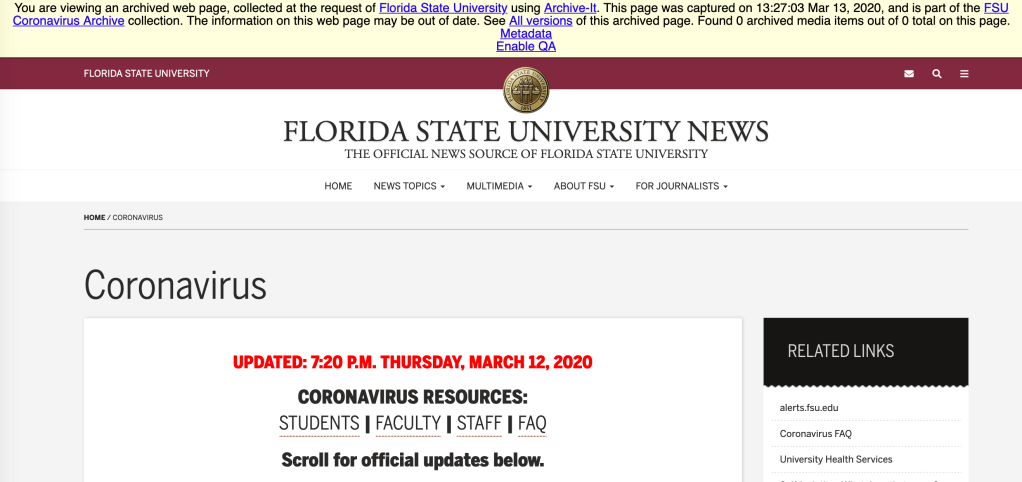
		<content type="html" xml:base="https://fsuspecialcollections.wordpress.com/2020/09/16/capturing-virtual-fsu/"><![CDATA[<p>When the world of FSU changed in March 2020, the website for FSU was used as one of the primary communication tools to let students, faculty, and staff know what was going on. New webpages created specifically to share information and news popped up all over fsu.edu and we had no idea how long those pages would exist (ah, the hopeful days of March) so Heritage &amp; University Archives wanted to be sure to capture those pages quickly and often as they changed and morphed into new online resources for the FSU community.</p>
<figure class="wp-block-image size-large"><img decoding="async" data-attachment-id="9947" data-permalink="https://fsuspecialcollections.wordpress.com/screen-shot-2020-09-14-at-12-04-15-pm/" data-orig-file="https://fsuspecialcollections.files.wordpress.com/2020/09/screen-shot-2020-09-14-at-12.04.15-pm.png" data-orig-size="2634,1242" data-comments-opened="1" data-image-meta="{&quot;aperture&quot;:&quot;0&quot;,&quot;credit&quot;:&quot;&quot;,&quot;camera&quot;:&quot;&quot;,&quot;caption&quot;:&quot;&quot;,&quot;created_timestamp&quot;:&quot;0&quot;,&quot;copyright&quot;:&quot;&quot;,&quot;focal_length&quot;:&quot;0&quot;,&quot;iso&quot;:&quot;0&quot;,&quot;shutter_speed&quot;:&quot;0&quot;,&quot;title&quot;:&quot;&quot;,&quot;orientation&quot;:&quot;0&quot;}" data-image-title="screen-shot-2020-09-14-at-12.04.15-pm" data-image-description="" data-medium-file="https://fsuspecialcollections.files.wordpress.com/2020/09/screen-shot-2020-09-14-at-12.04.15-pm.png?w=300" data-large-file="https://fsuspecialcollections.files.wordpress.com/2020/09/screen-shot-2020-09-14-at-12.04.15-pm.png?w=604" src="https://fsuspecialcollections.files.wordpress.com/2020/09/screen-shot-2020-09-14-at-12.04.15-pm.png?w=1024" alt="" class="wp-image-9947" srcset="https://fsuspecialcollections.files.wordpress.com/2020/09/screen-shot-2020-09-14-at-12.04.15-pm.png?w=1024 1024w, https://fsuspecialcollections.files.wordpress.com/2020/09/screen-shot-2020-09-14-at-12.04.15-pm.png?w=2048 2048w, https://fsuspecialcollections.files.wordpress.com/2020/09/screen-shot-2020-09-14-at-12.04.15-pm.png?w=150 150w, https://fsuspecialcollections.files.wordpress.com/2020/09/screen-shot-2020-09-14-at-12.04.15-pm.png?w=300 300w, https://fsuspecialcollections.files.wordpress.com/2020/09/screen-shot-2020-09-14-at-12.04.15-pm.png?w=768 768w" sizes="(max-width: 1024px) 100vw, 1024px" /><figcaption>Screenshot of a capture of the main FSU News feed regarding coronavirus. Captured March 13, 2020. </figcaption></figure>
<p>While FSU has had an Archive-It account for a while, we hadn&#8217;t fully implemented its use yet. Archive-It is a web archiving service that captures and preserves content on websites as well as allowing us to provide metadata and a public interface to viewing the collected webpages. COVID-19 fast-tracked me on figuring out Archive-It and how we could best use it to capture these unique webpages documenting FSU&#8217;s response to the pandemic. I worked to configure crawls of websites to capture the data we needed, set up a schedule that would be sufficient to capture changes but also not overwhelm our data allowance, and describe the sites being captured. It took me a few tries but we&#8217;ve successfully been capturing a set of COVID related FSU URLs since March.</p>
<p>One of the challenges of this work was some of the webpages had functionality that the web crawling just wouldn&#8217;t capture. This was due to some interactive widgets on pages or potentially some CSS choices the crawler didn&#8217;t like. I decided the content was the most important thing to capture in this case, more so than making sure the webpage looked exactly like the original. A good example of this is the International Programs Alerts page. We&#8217;re capturing this to track information about our study abroad programs but what Archive-It displays is quite different from the current site in terms of design. The content is all there though.</p>
<figure class="wp-block-jetpack-image-compare">
<div class="juxtapose" data-mode="horizontal"><img fetchpriority="high" decoding="async" id="9943" src="https://fsuspecialcollections.files.wordpress.com/2020/09/screen-shot-2020-09-14-at-11.58.10-am.png" alt="" width="2708" height="1118" class="image-compare__image-before"/><img decoding="async" id="9945" src="https://fsuspecialcollections.files.wordpress.com/2020/09/screen-shot-2020-09-14-at-11.58.29-am.png" alt="" width="2338" height="1166" class="image-compare__image-after"/></div><figcaption>On the left is how Archive-It displays a capture of the International Programs Alerts page. On the right is how the site actually looks. While the content is the same, the formatting and design is not </figcaption></figure>
<p>As the pandemic dragged on and it became clear that Fall 2020 would be a unique semester, I added the online orientation site and the Fall 2020 site to my collection line-up. The Fall 2020 page, once used to track the re-opening plan recently morphed into the Stay Healthy FSU site where the community can look for current information and resources but also see the original re-opening document. </p>
<p>We&#8217;ll continue crawling and archiving these pages in our <a href="https://archive-it.org/collections/13632">FSU Coronavirus Archive</a> for future researchers until they are retired and the university community returns to &#8220;normal&#8221; operations &#8211; whatever that might look like when we get there!</p>
]]></content>
<link href="https://fsuspecialcollections.files.wordpress.com/2020/09/pexels-photo-546819.jpeg" rel="enclosure" length="0" type="" />
<link href="https://1.gravatar.com/avatar/404bb9f740d1866106b0681ab9b30d35?s=96&#038;d=identicon&#038;r=PG" rel="enclosure" length="0" type="" />
<link href="https://fsuspecialcollections.files.wordpress.com/2020/09/screen-shot-2020-09-14-at-12.04.15-pm.png?w=1024" rel="enclosure" length="0" type="" />
<link href="https://fsuspecialcollections.files.wordpress.com/2020/09/screen-shot-2020-09-14-at-11.58.10-am.png" rel="enclosure" length="0" type="" />
<link href="https://fsuspecialcollections.files.wordpress.com/2020/09/screen-shot-2020-09-14-at-11.58.29-am.png" rel="enclosure" length="0" type="" />
<source>
	<title>Illuminations</title>
	<link rel="alternate" type="text/html" href="https://fsuspecialcollections.wordpress.com" />
	<link rel="self" href="http://fsuspecialcollections.wordpress.com/feed/" />
	<id>http://fsuspecialcollections.wordpress.com/feed/</id>
</source>
		<link rel="replies" type="text/html" href="https://fsuspecialcollections.wordpress.com/2020/09/16/capturing-virtual-fsu/#comments" thr:count="0"/>
		<link rel="replies" type="application/atom+xml" href="https://fsuspecialcollections.wordpress.com/2020/09/16/capturing-virtual-fsu/feed/" thr:count="0"/>
		<thr:total>0</thr:total>
	</entry>
		<entry>
		<author>
			<name>AOTUS</name>
			<uri>https://aotus.blogs.archives.gov</uri>
					</author>
		<title type="html"><![CDATA[Welcome to the New ClintonLibrary.Gov!]]></title>
		<link rel="alternate" type="text/html" href="https://aotus.blogs.archives.gov/2020/09/14/welcome-to-the-new-clintonlibrary-gov/" />
		<id>https://aotus.blogs.archives.gov/2020/09/14/welcome-to-the-new-clintonlibrary-gov/</id>
		<updated>2020-09-14T14:34:43Z</updated>
		<published>2020-09-14T14:34:43Z</published>
		<category scheme="https://archivesblogs.com" term="English" />		<summary type="html"><![CDATA[The National Archives’ Presidential Libraries and Museums preserve and provide access to the records of 14 presidential administrations. In support of this mission, we developed an ongoing program to modernize the technologies and designs that support the user experience of our Presidential Library websites. Through this program, we have updated the websites of the Hoover, … <a href="https://aotus.blogs.archives.gov/2020/09/14/welcome-to-the-new-clintonlibrary-gov/" class="more-link">Continue reading <span class="screen-reader-text">Welcome to the New ClintonLibrary.Gov!</span></a> <a href="https://aotus.blogs.archives.gov/2020/09/14/welcome-to-the-new-clintonlibrary-gov/">Continue reading <span class="meta-nav">&#8594;</span></a>]]></summary>
		<content type="html" xml:base="https://aotus.blogs.archives.gov/2020/09/14/welcome-to-the-new-clintonlibrary-gov/"><![CDATA[<p><span style="font-weight: 400;">The National Archives’ Presidential Libraries and Museums preserve and provide access to the records of 14 presidential administrations. In support of this mission, we developed an ongoing program to modernize the technologies and designs that support the user experience of our Presidential Library websites. Through this program, we have updated the websites of the Hoover, Truman, Eisenhower and Nixon Presidential Libraries.&nbsp;</span></p>
<p><span style="font-weight: 400;">Recently we launched </span><a href="https://www.clintonlibrary.gov/"><span style="font-weight: 400;">an updated website for the William J. Clinton Presidential Library &amp; Museum</span></a><span style="font-weight: 400;">. The website, which received more than 227,000 visitors over the past year, now improves access to the Clinton Presidential Library holdings by providing better performance, improving accessibility, and delivering a mobile-friendly experience. The updated website’s platform and design, based in the </span><a href="https://en.wikipedia.org/wiki/Drupal"><span style="font-weight: 400;">Drupal</span></a><span style="font-weight: 400;"> web content management framework, enables the Clinton Presidential Library staff to make increasing amounts of resources available online—especially while working remotely during the COVID-19 crisis.</span></p>
<figure class="wp-block-image size-large"><a href="https://www.clintonlibrary.gov/"  rel="noopener noreferrer"><img decoding="async" data-attachment-id="9430" data-permalink="https://aotus.blogs.archives.gov/2020/09/14/welcome-to-the-new-clintonlibrary-gov/clinton-library-website-homepage/" data-orig-file="https://i0.wp.com/aotus.blogs.archives.gov/wp-content/uploads/2020/09/Clinton-Library-website-homepage.jpg?fit=1600%2C863&amp;ssl=1" data-orig-size="1600,863" data-comments-opened="1" data-image-meta="{&quot;aperture&quot;:&quot;0&quot;,&quot;credit&quot;:&quot;&quot;,&quot;camera&quot;:&quot;&quot;,&quot;caption&quot;:&quot;&quot;,&quot;created_timestamp&quot;:&quot;0&quot;,&quot;copyright&quot;:&quot;&quot;,&quot;focal_length&quot;:&quot;0&quot;,&quot;iso&quot;:&quot;0&quot;,&quot;shutter_speed&quot;:&quot;0&quot;,&quot;title&quot;:&quot;&quot;,&quot;orientation&quot;:&quot;0&quot;}" data-image-title="Clinton-Library-website-homepage" data-image-description="" data-medium-file="https://i0.wp.com/aotus.blogs.archives.gov/wp-content/uploads/2020/09/Clinton-Library-website-homepage.jpg?fit=300%2C162&amp;ssl=1" data-large-file="https://i0.wp.com/aotus.blogs.archives.gov/wp-content/uploads/2020/09/Clinton-Library-website-homepage.jpg?fit=685%2C369&amp;ssl=1" loading="lazy" width="685" height="369" src="https://i0.wp.com/aotus.blogs.archives.gov/wp-content/uploads/2020/09/Clinton-Library-website-homepage.jpg?resize=685%2C369&#038;ssl=1" alt="" class="wp-image-9430" srcset="https://i0.wp.com/aotus.blogs.archives.gov/wp-content/uploads/2020/09/Clinton-Library-website-homepage.jpg?resize=1024%2C552&amp;ssl=1 1024w, https://i0.wp.com/aotus.blogs.archives.gov/wp-content/uploads/2020/09/Clinton-Library-website-homepage.jpg?resize=300%2C162&amp;ssl=1 300w, https://i0.wp.com/aotus.blogs.archives.gov/wp-content/uploads/2020/09/Clinton-Library-website-homepage.jpg?resize=768%2C414&amp;ssl=1 768w, https://i0.wp.com/aotus.blogs.archives.gov/wp-content/uploads/2020/09/Clinton-Library-website-homepage.jpg?resize=1536%2C828&amp;ssl=1 1536w, https://i0.wp.com/aotus.blogs.archives.gov/wp-content/uploads/2020/09/Clinton-Library-website-homepage.jpg?resize=685%2C369&amp;ssl=1 685w, https://i0.wp.com/aotus.blogs.archives.gov/wp-content/uploads/2020/09/Clinton-Library-website-homepage.jpg?w=1600&amp;ssl=1 1600w, https://i0.wp.com/aotus.blogs.archives.gov/wp-content/uploads/2020/09/Clinton-Library-website-homepage.jpg?w=1370&amp;ssl=1 1370w" sizes="(max-width: 685px) 100vw, 685px" data-recalc-dims="1" /></a></figure>
<p><span style="font-weight: 400;">To achieve this website redesign, staff from the National Archives’ Office of Innovation, with both web development and user experience expertise, collaborated with staff from the Clinton Presidential Library to define goals for the new website. Our user experience team first launched the project by interviewing staff of the Clinton Presidential Library to determine the necessary improvements for the updated website to facilitate their work. Next, the user experience team researched the Library’s customers—researchers, students, educators, and the general public—by analyzing user analytics, heatmaps, recordings of real users navigating the site, and top search referrals. Based on the data collected, the user experience team produced wireframes and moodboards that informed the final site design. The team also refined the website&#8217;s information architecture to improve the user experience and meet the Clinton Library staff’s needs.&nbsp;</span></p>
<p><span style="font-weight: 400;">Throughout the project, the team used </span><a href="https://en.wikipedia.org/wiki/Agile_software_development"><span style="font-weight: 400;">Agile project management</span></a><span style="font-weight: 400;"> development processes to deliver iterative changes focused on constant improvement. To be Agile, specific goals were outlined, defined, and distributed among team members for mutual agreement. Work on website designs and features was broken into development “sprints”—two-week periods to complete defined amounts of work. At the end of each development sprint, the resulting designs and features were demonstrated to the Clinton Presidential Library staff stakeholders for feedback which helped further refine the website.</span></p>
<figure class="wp-block-image size-large"><img decoding="async" data-attachment-id="9431" data-permalink="https://aotus.blogs.archives.gov/2020/09/14/welcome-to-the-new-clintonlibrary-gov/clinton-library-heatmap/" data-orig-file="https://i2.wp.com/aotus.blogs.archives.gov/wp-content/uploads/2020/09/Clinton-Library-heatmap.jpg?fit=512%2C288&amp;ssl=1" data-orig-size="512,288" data-comments-opened="1" data-image-meta="{&quot;aperture&quot;:&quot;0&quot;,&quot;credit&quot;:&quot;&quot;,&quot;camera&quot;:&quot;&quot;,&quot;caption&quot;:&quot;&quot;,&quot;created_timestamp&quot;:&quot;0&quot;,&quot;copyright&quot;:&quot;&quot;,&quot;focal_length&quot;:&quot;0&quot;,&quot;iso&quot;:&quot;0&quot;,&quot;shutter_speed&quot;:&quot;0&quot;,&quot;title&quot;:&quot;&quot;,&quot;orientation&quot;:&quot;0&quot;}" data-image-title="Clinton-Library-heatmap" data-image-description="" data-medium-file="https://i2.wp.com/aotus.blogs.archives.gov/wp-content/uploads/2020/09/Clinton-Library-heatmap.jpg?fit=300%2C169&amp;ssl=1" data-large-file="https://i2.wp.com/aotus.blogs.archives.gov/wp-content/uploads/2020/09/Clinton-Library-heatmap.jpg?fit=512%2C288&amp;ssl=1" loading="lazy" width="512" height="288" src="https://i2.wp.com/aotus.blogs.archives.gov/wp-content/uploads/2020/09/Clinton-Library-heatmap.jpg?resize=512%2C288&#038;ssl=1" alt="" class="wp-image-9431" srcset="https://i2.wp.com/aotus.blogs.archives.gov/wp-content/uploads/2020/09/Clinton-Library-heatmap.jpg?w=512&amp;ssl=1 512w, https://i2.wp.com/aotus.blogs.archives.gov/wp-content/uploads/2020/09/Clinton-Library-heatmap.jpg?resize=300%2C169&amp;ssl=1 300w" sizes="(max-width: 512px) 100vw, 512px" data-recalc-dims="1" /></figure>
<p><span style="font-weight: 400;">The project to update the Clinton Presidential Library and Museum website was guided by the National Archives’ </span><a href="https://www.archives.gov/about/plans-reports/strategic-plan/strategic-plan-2018-2022"><span style="font-weight: 400;">strategic goals</span></a><span style="font-weight: 400;">—to Make Access Happen, Connect with Customers, Maximize NARA’s Value to the Nation, and Build our Future Through our People. By understanding the needs of the Clinton Library’s online users and staff, and leveraging the in-house expertise of our web development and user experience staff, the National Archives is providing an improved website experience for all visitors. Please </span><a href="https://www.clintonlibrary.gov/"><span style="font-weight: 400;">visit the site</span></a><span style="font-weight: 400;">, and let us know what you think!</span></p>
]]></content>
<link href="" rel="enclosure" length="0" type="" />
<source>
	<title>AOTUS</title>
	<link rel="alternate" type="text/html" href="https://aotus.blogs.archives.gov" />
	<link rel="self" href="http://blogs.archives.gov/aotus/?feed=rss2" />
	<id>http://blogs.archives.gov/aotus/?feed=rss2</id>
</source>
		<link rel="replies" type="text/html" href="https://aotus.blogs.archives.gov/2020/09/14/welcome-to-the-new-clintonlibrary-gov/#comments" thr:count="0"/>
		<link rel="replies" type="application/atom+xml" href="https://aotus.blogs.archives.gov/2020/09/14/welcome-to-the-new-clintonlibrary-gov/feed/" thr:count="0"/>
		<thr:total>0</thr:total>
	</entry>
		<entry>
		<author>
			<name>Culture on Campus</name>
			<uri>https://archives.wordpress.stir.ac.uk</uri>
					</author>
		<title type="html"><![CDATA[The Road to Edinburgh (Part 2)]]></title>
		<link rel="alternate" type="text/html" href="https://archives.wordpress.stir.ac.uk/2020/09/11/the-road-to-edinburgh-part-2/" />
		<id>https://archives.wordpress.stir.ac.uk/2020/09/11/the-road-to-edinburgh-part-2/</id>
		<updated>2020-09-11T14:47:59Z</updated>
		<published>2020-09-11T14:47:59Z</published>
		<category scheme="https://archivesblogs.com" term="English" />		<summary type="html"><![CDATA[“Inevitably, official thoughts early turned to the time when Scotland would be granted the honour… <a href="https://archives.wordpress.stir.ac.uk/2020/09/11/the-road-to-edinburgh-part-2/">Continue reading <span class="meta-nav">&#8594;</span></a>]]></summary>
		<content type="html" xml:base="https://archives.wordpress.stir.ac.uk/2020/09/11/the-road-to-edinburgh-part-2/"><![CDATA[<blockquote class="wp-block-quote">
<p>“Inevitably, official thoughts early turned to the time when Scotland would be granted the honour of acting as hosts. Thought was soon turned into action and resulted in Scotland pursuing the opportunity to be host to the Games more relentlessly than any other country has.”</p>
<p><cite>From foreword to The Official History of the IXth Commonwealth Games (1970)</cite></p></blockquote>
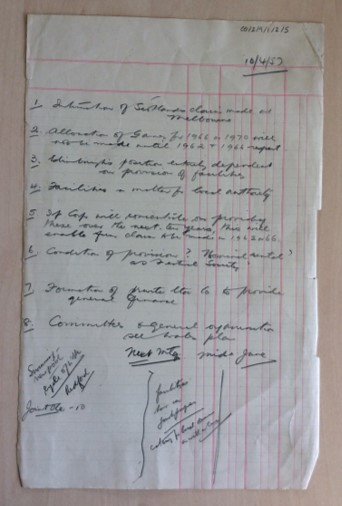
<p>In our <a href="https://archives.wordpress.stir.ac.uk/2020/08/28/the-road-to-edinburgh/"  rel="noreferrer noopener">last blog post</a> we left the campaigners working to bring the Commonwealth Games to Edinburgh reflecting on the loss of the 1966 Games to Kingston, Jamaica. The original plan of action sketched out by <a href="https://libguides.stir.ac.uk/archives/WCarmichael"  rel="noreferrer noopener">Willie Carmichael</a> in 1957 had factored in a renewed campaign for 1970 if the initial approach to host the 1966 Games proved unsuccessful.</p>
<p>The choice of host cities for the Games were made at the bi-annual General Assemblies of the Commonwealth Games Federation. The campaign to choose the host for 1970 began at a meeting held in Tokyo in 1964 (to coincide with the Olympics), with the final vote taking place at the 1966 Kingston Games.</p>
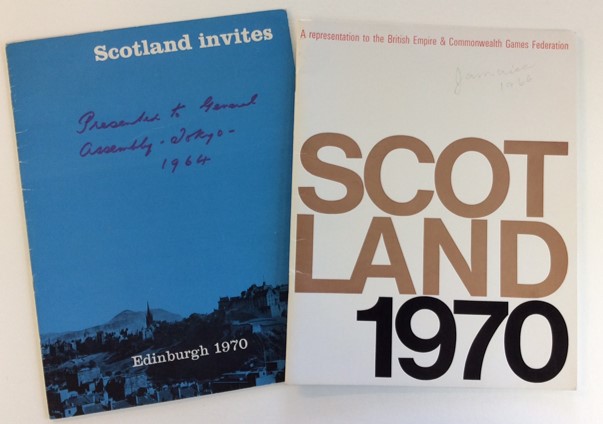
<p>In 1964 the Edinburgh campaign presented a document to the Federation restating its desire to be host city for the Games in 1970. Entitled ‘Scotland Invites’ it laid out Scotland’s case:</p>
<blockquote class="wp-block-quote">
<p>“We are founder members of the Federation; we have taken part in each Games since the inception in 1930; and we are the only one of six countries who have taken part in every Games, who have not yet had the honour of celebrating the Games.”</p>
<p><cite>From Scotland Invites, British Empire and Commonwealth Games Council for Scotland (1964)</cite></p></blockquote>
<div class="wp-block-image">
<figure class="aligncenter size-large"><img decoding="async" loading="lazy" width="603" height="424" src="https://archives.wordpress.stir.ac.uk/files/2020/09/Ed-70-bid.jpg" alt="" class="wp-image-2334" srcset="https://archives.wordpress.stir.ac.uk/files/2020/09/Ed-70-bid.jpg 603w, https://archives.wordpress.stir.ac.uk/files/2020/09/Ed-70-bid-300x211.jpg 300w" sizes="(max-width: 603px) 100vw, 603px" /><figcaption>Documents supporting Edinburgh&#8217;s bid to host the 1970 Commonwealth Games presented to meetings of the General Assembly of the Commonwealth Games Federation at Tokyo in 1964 and Kingston in 1966 (ref. WC/2/9/2)</figcaption></figure>
</div>
<p>Edinburgh faced a rival bid from Christchurch, New Zealand, the competition between the two cities recorded in a <a href="http://www.calmview.eu/stirling/CalmView/Record.aspx?src=CalmView.Catalog&amp;id=WC%2F2%2F9%2F2%2F1"  rel="noreferrer noopener">series of press cutting files</a> collected by Willie Carmichael. Reports in the Scottish press presented Edinburgh as the favourites for 1970, with Christchurch using their bid as a rehearsal for a more serious campaign to host the 1974 competition. However, the New Zealanders rejected this assessment, arguing that it was the turn of a country in the Southern Hemisphere to host the Games.</p>
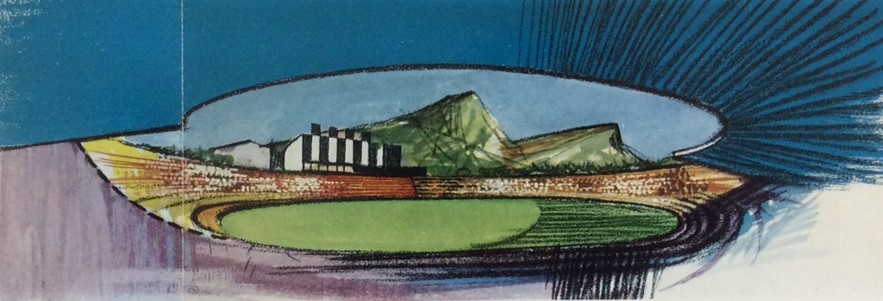
<p>The 1966 Games brought the final frantic round of lobbying and promotion for the rival bids as members of the Commonwealth Games Federation gathered in Kingston. The British Empire and Commonwealth Games Council for Scotland presented a bid document entitled ‘Scotland 1970’ which included detailed information on the venues and facilities to be provided for the competition along with a broader description of the city of Edinburgh.</p>
<div class="wp-block-image">
<figure class="aligncenter size-large"><img decoding="async" loading="lazy" width="883" height="301" src="https://archives.wordpress.stir.ac.uk/files/2020/09/Meadowbank.jpg" alt="" class="wp-image-2335" srcset="https://archives.wordpress.stir.ac.uk/files/2020/09/Meadowbank.jpg 883w, https://archives.wordpress.stir.ac.uk/files/2020/09/Meadowbank-300x102.jpg 300w, https://archives.wordpress.stir.ac.uk/files/2020/09/Meadowbank-768x262.jpg 768w" sizes="(max-width: 883px) 100vw, 883px" /><figcaption>Artists impression of the new Meadowbank athletics stadium, Edinburgh (ref. WC/2/9/2/12)</figcaption></figure>
</div>
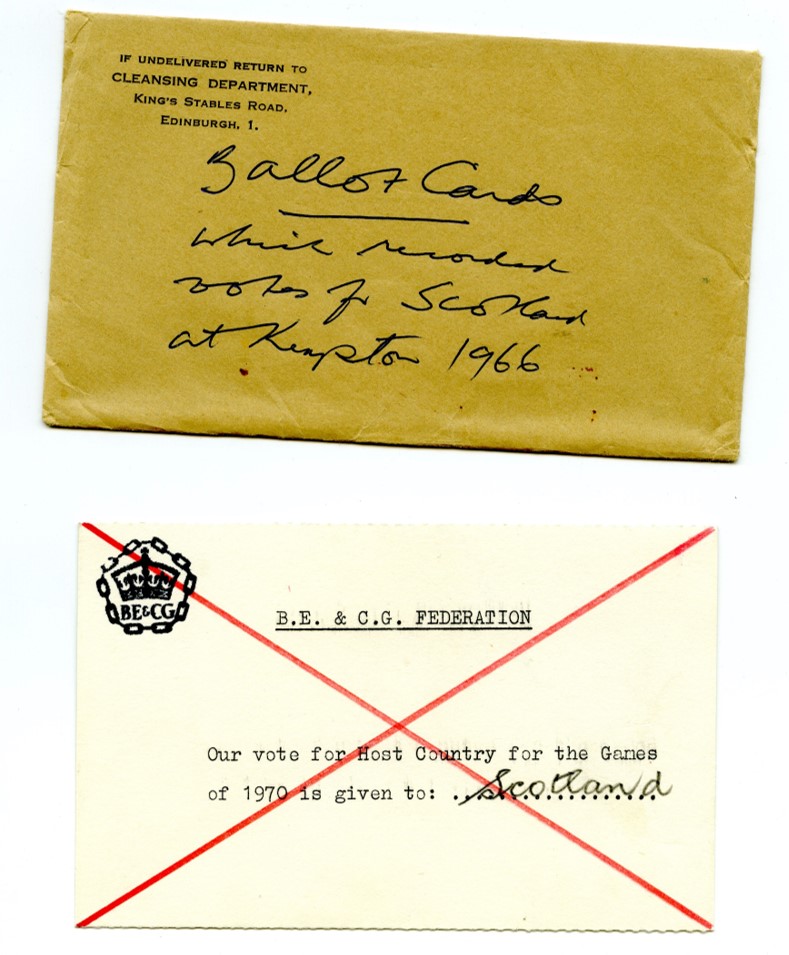
<p>At the General Assembly of the Commonwealth Games Federation held in Kingston, Jamaica, on 7 August 1966 the vote took place to decide the host of the 1970 Games. Edinburgh was chosen as host city by 18 votes to 11.</p>
<p>The Edinburgh campaign team kept a souvenir of this important event. At the end of the meeting they collected together the evidence of their success and put it in an envelope marked ‘Ballot Cards – which recorded votes for Scotland at Kingston 1966.’ The voting cards and envelope now sit in an administrative file which forms part of the <a href="https://libguides.stir.ac.uk/archives/cgs"  rel="noreferrer noopener">Commonwealth Games Scotland Archive</a>. </p>
<div class="wp-block-image">
<figure class="aligncenter size-large"><img decoding="async" loading="lazy" width="789" height="955" src="https://archives.wordpress.stir.ac.uk/files/2020/09/70-vote-crop.jpg" alt="" class="wp-image-2333" srcset="https://archives.wordpress.stir.ac.uk/files/2020/09/70-vote-crop.jpg 789w, https://archives.wordpress.stir.ac.uk/files/2020/09/70-vote-crop-248x300.jpg 248w, https://archives.wordpress.stir.ac.uk/files/2020/09/70-vote-crop-768x930.jpg 768w" sizes="(max-width: 789px) 100vw, 789px" /><figcaption>Voting card recording vote for Scotland to host the 1970 Commonwealth Games (ref. CG/2/9/1/2/7)</figcaption></figure>
</div>
]]></content>
<link href="" rel="enclosure" length="0" type="" />
<source>
	<title>Culture on Campus</title>
	<link rel="alternate" type="text/html" href="https://archives.wordpress.stir.ac.uk" />
	<link rel="self" href="http://archives.wordpress.stir.ac.uk/feed/" />
	<id>http://archives.wordpress.stir.ac.uk/feed/</id>
</source>
		<link rel="replies" type="text/html" href="https://archives.wordpress.stir.ac.uk/2020/09/11/the-road-to-edinburgh-part-2/#comments" thr:count="0"/>
		<link rel="replies" type="application/atom+xml" href="https://archivesblogs.com/archives/412902/feed/atom" thr:count="0"/>
		<thr:total>0</thr:total>
	</entry>
		<entry>
		<author>
			<name>Illuminations</name>
			<uri>https://fsuspecialcollections.wordpress.com</uri>
					</author>
		<title type="html"><![CDATA[New Ancient Texts Research Guide]]></title>
		<link rel="alternate" type="text/html" href="https://fsuspecialcollections.wordpress.com/2020/09/10/new-ancient-texts-research-guide/" />
		<id>https://fsuspecialcollections.wordpress.com/2020/09/10/new-ancient-texts-research-guide/</id>
		<updated>2020-09-10T20:13:55Z</updated>
		<published>2020-09-10T20:13:55Z</published>
		<category scheme="https://archivesblogs.com" term="English" />		<summary type="html"><![CDATA["In an effort to enhance remote research opportunities for students to engage with the oldest materials housed in Strozier Library, a research guide to Ancient Texts at FSU Libraries has been created by Special Collections &#38; Archives staff." <a href="https://fsuspecialcollections.wordpress.com/2020/09/10/new-ancient-texts-research-guide/">Continue reading <span class="meta-nav">&#8594;</span></a>]]></summary>
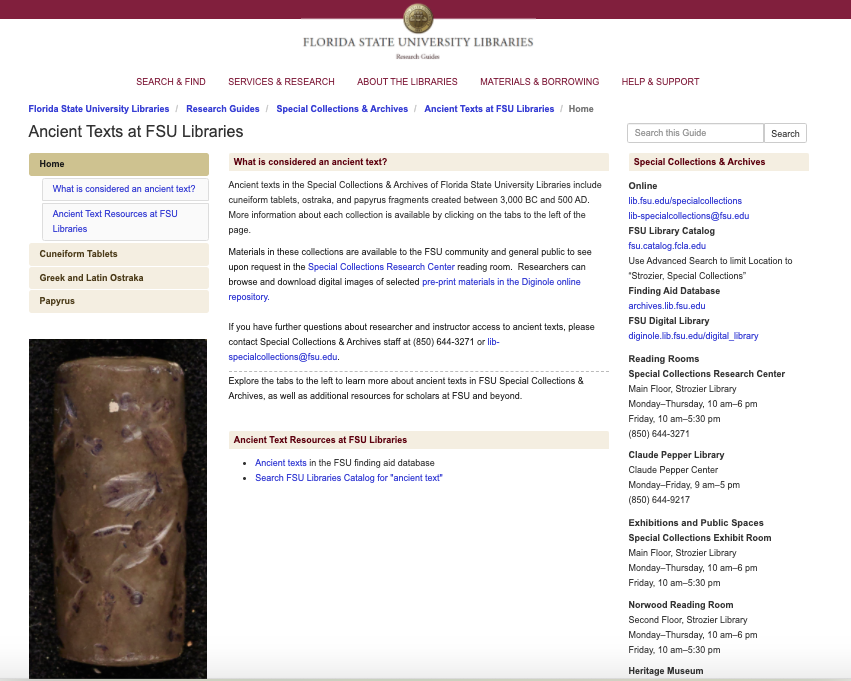
		<content type="html" xml:base="https://fsuspecialcollections.wordpress.com/2020/09/10/new-ancient-texts-research-guide/"><![CDATA[<p>&#8220;What are the oldest books you have?&#8221; is a common question posed to Special Collections &amp; Archives staff at Strozier Library. In fact, the oldest materials in the collection are not books at all but cuneiform tablets ranging in date from 2350 to 1788 BCE (4370-3808 years old). These cuneiform tablets, along with papyrus fragments and ostraka comprise the ancient texts collection in Special Collections &amp; Archives. </p>
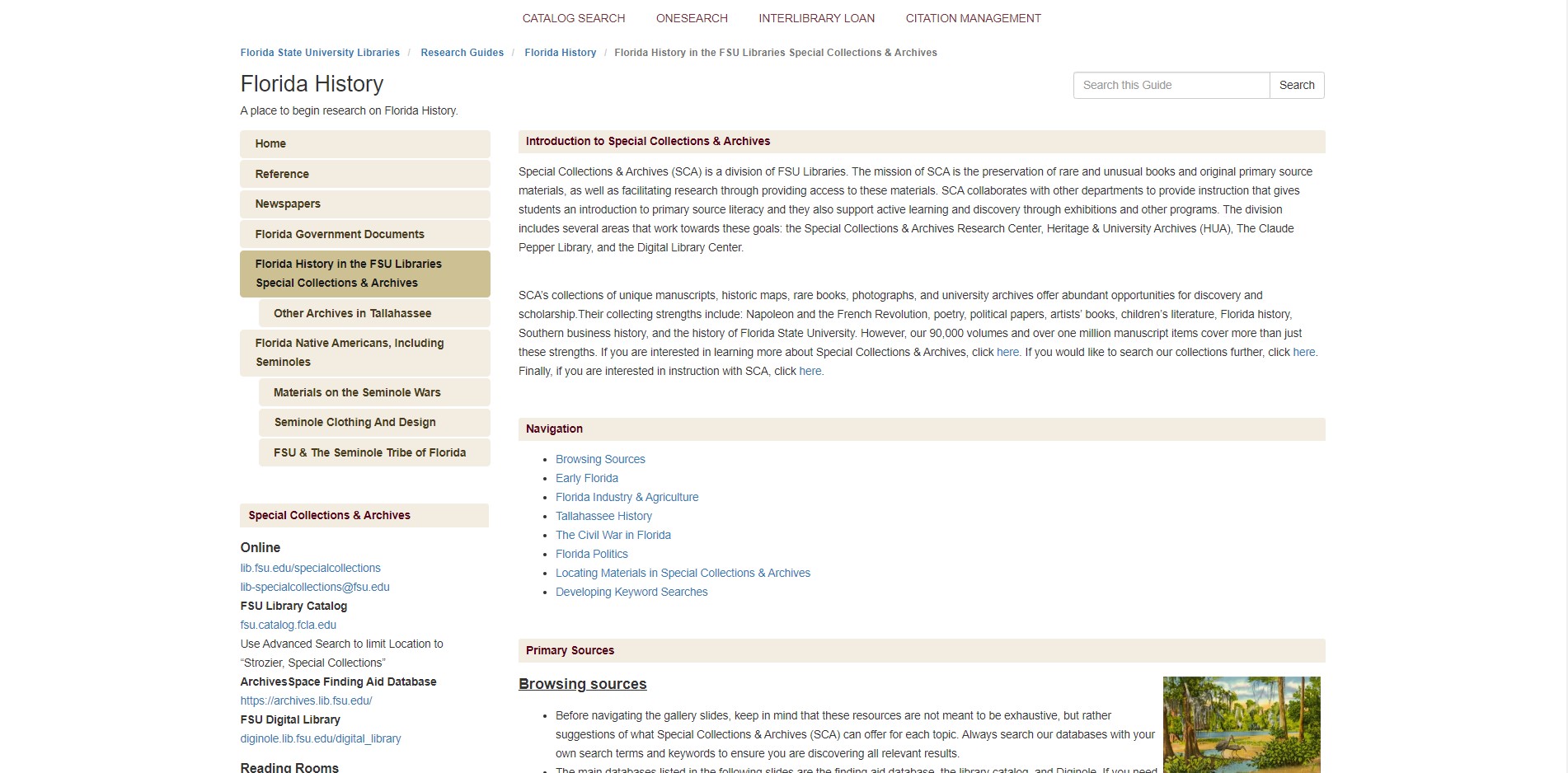
<p>In an effort to enhance remote research opportunities for students to engage with the oldest materials housed in Strozier Library, a research guide to <a rel="noreferrer noopener" href="https://guides.lib.fsu.edu/AncientTexts">Ancient Texts at FSU Libraries</a> has been created by Special Collections &amp; Archives staff. </p>
<figure class="wp-block-image size-large"><img decoding="async" data-attachment-id="9919" data-permalink="https://fsuspecialcollections.wordpress.com/screen-shot-2020-09-09-at-11-33-12-am/" data-orig-file="https://fsuspecialcollections.files.wordpress.com/2020/09/screen-shot-2020-09-09-at-11.33.12-am.png" data-orig-size="851,681" data-comments-opened="1" data-image-meta="{&quot;aperture&quot;:&quot;0&quot;,&quot;credit&quot;:&quot;&quot;,&quot;camera&quot;:&quot;&quot;,&quot;caption&quot;:&quot;&quot;,&quot;created_timestamp&quot;:&quot;0&quot;,&quot;copyright&quot;:&quot;&quot;,&quot;focal_length&quot;:&quot;0&quot;,&quot;iso&quot;:&quot;0&quot;,&quot;shutter_speed&quot;:&quot;0&quot;,&quot;title&quot;:&quot;&quot;,&quot;orientation&quot;:&quot;0&quot;}" data-image-title="screen-shot-2020-09-09-at-11.33.12-am" data-image-description="" data-medium-file="https://fsuspecialcollections.files.wordpress.com/2020/09/screen-shot-2020-09-09-at-11.33.12-am.png?w=300" data-large-file="https://fsuspecialcollections.files.wordpress.com/2020/09/screen-shot-2020-09-09-at-11.33.12-am.png?w=604" src="https://fsuspecialcollections.files.wordpress.com/2020/09/screen-shot-2020-09-09-at-11.33.12-am.png?w=851" alt="" class="wp-image-9919" srcset="https://fsuspecialcollections.files.wordpress.com/2020/09/screen-shot-2020-09-09-at-11.33.12-am.png 851w, https://fsuspecialcollections.files.wordpress.com/2020/09/screen-shot-2020-09-09-at-11.33.12-am.png?w=150 150w, https://fsuspecialcollections.files.wordpress.com/2020/09/screen-shot-2020-09-09-at-11.33.12-am.png?w=300 300w, https://fsuspecialcollections.files.wordpress.com/2020/09/screen-shot-2020-09-09-at-11.33.12-am.png?w=768 768w" sizes="(max-width: 851px) 100vw, 851px" /><figcaption><a href="http://ancient%20texts%20at%20fsu%20libraries/">Ancient Texts Research Guide</a></figcaption></figure>
<p>The <a rel="noreferrer noopener" href="https://guides.lib.fsu.edu/AncientTexts">Ancient Texts at FSU Libraries</a> research guide provides links to finding aids with collections information, high-resolution photos of the objects in the digital library, and links to articles or books about the collections. </p>
<p>Research guides can be accessed through the tile, “Research Guides,” on the&nbsp;<a href="https://www.lib.fsu.edu/">library’s main page</a>.&nbsp;Special Collections &amp; Archives currently has <a href="https://guides.lib.fsu.edu/sca">11 research guides</a> published that share information and resources on specific collections or subjects that can be accessed remotely. </p>
<p>While direct access to physical collections is unavailable at this time due to Covid-19, we hope to resume in-person research when it is safe to do so, and Special Collections &amp; Archives is still available to assist you remotely with research and instruction. Please get in touch with us via email at:&nbsp;<a href="mailto:lib-specialcollections@fsu.edu">lib-specialcollections@fsu.edu</a>. For a full list of our remote services, please visit our&nbsp;<a href="https://www.lib.fsu.edu/scaservicesduringcov19">services page</a>.</p>
]]></content>
<link href="https://fsuspecialcollections.files.wordpress.com/2020/09/beer-tablet-e1599763614537.png" rel="enclosure" length="0" type="" />
<link href="https://1.gravatar.com/avatar/ab3be42ea30229baa67bf4562b10bfab?s=96&#038;d=identicon&#038;r=PG" rel="enclosure" length="0" type="" />
<link href="https://fsuspecialcollections.files.wordpress.com/2020/09/screen-shot-2020-09-09-at-11.33.12-am.png?w=851" rel="enclosure" length="0" type="" />
<source>
	<title>Illuminations</title>
	<link rel="alternate" type="text/html" href="https://fsuspecialcollections.wordpress.com" />
	<link rel="self" href="http://fsuspecialcollections.wordpress.com/feed/" />
	<id>http://fsuspecialcollections.wordpress.com/feed/</id>
</source>
		<link rel="replies" type="text/html" href="https://fsuspecialcollections.wordpress.com/2020/09/10/new-ancient-texts-research-guide/#comments" thr:count="0"/>
		<link rel="replies" type="application/atom+xml" href="https://fsuspecialcollections.wordpress.com/2020/09/10/new-ancient-texts-research-guide/feed/" thr:count="0"/>
		<thr:total>0</thr:total>
	</entry>
		<entry>
		<author>
			<name>Transforming Classification</name>
			<uri>https://transforming-classification.blogs.archives.gov</uri>
					</author>
		<title type="html"><![CDATA[SSCI Members Embrace Need for Declassification Reform, Discuss PIDB Recommendations at Senate Hearing]]></title>
		<link rel="alternate" type="text/html" href="https://transforming-classification.blogs.archives.gov/2020/09/10/ssci-members-embrace-need-for-declassification-reform-discuss-pidb-recommendations-at-senate-hearing/" />
		<id>https://transforming-classification.blogs.archives.gov/2020/09/10/ssci-members-embrace-need-for-declassification-reform-discuss-pidb-recommendations-at-senate-hearing/</id>
		<updated>2020-09-10T19:36:17Z</updated>
		<published>2020-09-10T19:36:17Z</published>
		<category scheme="https://archivesblogs.com" term="English" />		<summary type="html"><![CDATA[The Board would like to thank Acting Chairman Marco Rubio (R-FL), Vice Chairman Mark Warner (D-VA), and members of the Senate Select Committee on Intelligence (SSCI) for their invitation to testify yesterday (September 9, 2020) at the open hearing on “Declassification Policy and Prospects for Reform.”    At the hearing, PIDB Member John Tierney responded … <a href="https://transforming-classification.blogs.archives.gov/2020/09/10/ssci-members-embrace-need-for-declassification-reform-discuss-pidb-recommendations-at-senate-hearing/" class="more-link">Continue reading <span class="screen-reader-text">SSCI Members Embrace Need for Declassification Reform, Discuss PIDB Recommendations at Senate Hearing</span></a> <a href="https://transforming-classification.blogs.archives.gov/2020/09/10/ssci-members-embrace-need-for-declassification-reform-discuss-pidb-recommendations-at-senate-hearing/">Continue reading <span class="meta-nav">&#8594;</span></a>]]></summary>
		<content type="html" xml:base="https://transforming-classification.blogs.archives.gov/2020/09/10/ssci-members-embrace-need-for-declassification-reform-discuss-pidb-recommendations-at-senate-hearing/"><![CDATA[<p>The Board would like to thank Acting Chairman Marco Rubio (R-FL), Vice Chairman Mark Warner (D-VA), and members of the Senate Select Committee on Intelligence (SSCI) for their invitation to testify yesterday (September 9, 2020) at the open hearing on “Declassification Policy and Prospects for Reform.” &nbsp;&nbsp;</p>
<p>At the hearing, PIDB Member John Tierney responded to questions from committee members about recommendations in the PIDB’s May 2020 <a href="https://www.archives.gov/files/declassification/pidb/recommendations/pidb-vision-for-digital-age-may-2020.pdf"><em>Report to the President</em></a>. He stressed the need for modernizing information security systems and the critical importance of sustained leadership through a senior-level Executive Agent (EA) to oversee and implement meaningful reform. In addition to Congressman Tierney, Greg Koch, the Acting Director of Information Management in the Office of the Director of National Intelligence (ODNI), testified in response to the SSCI’s concerns about the urgent need to improve how the Executive Branch classifies and declassifies national security information. Much of the discussion focused on the PIDB recommendation that the President designate the ODNI as the EA to coordinate the application of information technology, including artificial intelligence and machine learning, to modernize classification and declassification across the Executive Branch.</p>
<p>Senator Jerry Moran (R-KS), and Senator Ron Wyden (D-OR), who is a member of the SSCI, joined the hearing to discuss the bill they are cosponsoring to modernize declassification. Their proposed “<a href="https://www.congress.gov/bill/116th-congress/senate-bill/3733/text?r=20&amp;s=1"><em>Declassification Reform Act of 2020</em></a><em>” </em>aligns with the PIDB Report recommendations, including the recommendation to designate the ODNI as the EA for coordinating the required reforms. The Board would like to thank Senators Moran and Wyden for their continued support and attention to this crucial issue. Modernizing the classification and declassification system is important for our 21<sup>st</sup> century national security and it is important for transparency and our democracy.</p>
<p>Video of the entire hearing is available to view at the&nbsp;<a href="http://www.intelligence.senate.gov/">SSCI’s website</a>, and from <a href="https://www.c-span.org/video/?475556-1/senate-intelligence-committee-hearing-declassification-policy">C-SPAN</a>.&nbsp; The transcript of prepared testimony submitted to the SSCI by Mr. Tierney is posted on <a href="https://www.archives.gov/files/declassification/pidb/tierney-testimony-ssci-hearing-final-sept-8-2010.pdf">the PIDB website</a>.</p>
]]></content>
<link href="" rel="enclosure" length="0" type="" />
<source>
	<title>Transforming Classification</title>
	<link rel="alternate" type="text/html" href="https://transforming-classification.blogs.archives.gov" />
	<link rel="self" href="http://blogs.archives.gov/transformingclassification/?feed=rss2" />
	<id>http://blogs.archives.gov/transformingclassification/?feed=rss2</id>
</source>
		<link rel="replies" type="text/html" href="https://transforming-classification.blogs.archives.gov/2020/09/10/ssci-members-embrace-need-for-declassification-reform-discuss-pidb-recommendations-at-senate-hearing/#comments" thr:count="0"/>
		<link rel="replies" type="application/atom+xml" href="https://transforming-classification.blogs.archives.gov/2020/09/10/ssci-members-embrace-need-for-declassification-reform-discuss-pidb-recommendations-at-senate-hearing/feed/" thr:count="0"/>
		<thr:total>0</thr:total>
	</entry>
		<entry>
		<author>
			<name>Culture on Campus</name>
			<uri>https://archives.wordpress.stir.ac.uk</uri>
					</author>
		<title type="html"><![CDATA[Be Connected, Keep A Stir Diary]]></title>
		<link rel="alternate" type="text/html" href="https://archives.wordpress.stir.ac.uk/2020/09/09/be-connected-keep-a-stir-diary/" />
		<id>https://archives.wordpress.stir.ac.uk/2020/09/09/be-connected-keep-a-stir-diary/</id>
		<updated>2020-09-09T11:02:05Z</updated>
		<published>2020-09-09T11:02:05Z</published>
		<category scheme="https://archivesblogs.com" term="English" />		<summary type="html"><![CDATA[The new semester approaches and it’s going to be a bit different from what we’re… <a href="https://archives.wordpress.stir.ac.uk/2020/09/09/be-connected-keep-a-stir-diary/">Continue reading <span class="meta-nav">&#8594;</span></a>]]></summary>
		<content type="html" xml:base="https://archives.wordpress.stir.ac.uk/2020/09/09/be-connected-keep-a-stir-diary/"><![CDATA[<p>The new semester approaches and it&#8217;s going to be a bit different from what we&#8217;re used to here at the University of Stirling. </p>
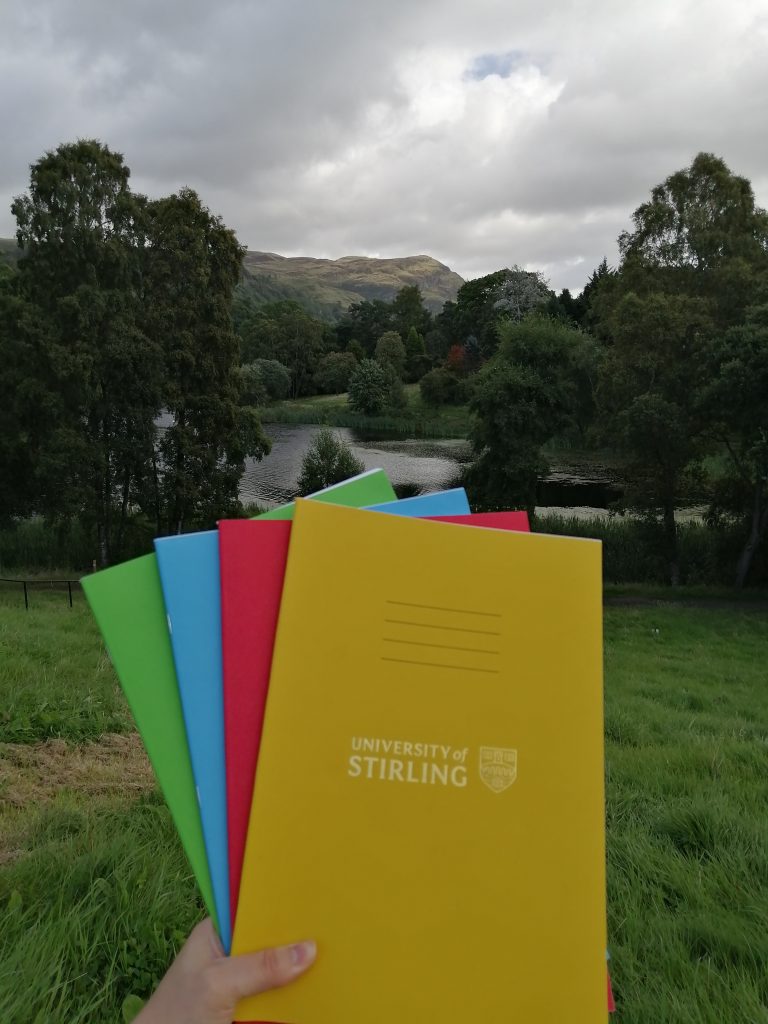
<p>To help you with your mental health and wellbeing this semester, we&#8217;ve teamed up with the Chaplaincy to provide students new and returning with a diary where you can keep your thoughts and feelings, process your new environment, record your joys and capture what the University was like for you in this unprecedented time.</p>
<p>Diaries will be stationed at the Welcome Lounges from <strong>12th September</strong> and we encourage students to take one for their personal use. Please be considerate of others and only take one diary each.</p>
<p>Inside each diary is a QR code which will take you to our project page where you can learn more about the project and where we will be creating an online resource for you to explore the amazing diaries that we keep in Archives and Special Collections. We will be updating this page throughout semester with information from the Archives and events for you to join. Keep an eye out for #StirDiary on social media for all the updates!</p>
<p>At the end of semester, you are able to donate your diary to the Archive where it will sit with the University&#8217;s institutional records and form a truthful and creative account of what student life was like in 2020. You absolutely don&#8217;t have to donate your diary if you don&#8217;t want to, the diary belongs to you and you can keep it, throw it away, donate it or anything else (<a href="https://www.goodreads.com/book/show/428862.Wreck_This_Journal?from_search=true&amp;from_srp=true&amp;qid=KegqeJqo5Z&amp;rank=1">wreck it?</a>) as you like.</p>
<p>If you would like to take part in the project but you have missed the Welcome Lounges, don&#8217;t worry! Contact Rosie on <a href="mailto:archives@stir.ac.uk">archives@stir.ac.uk</a> or Janet on <a href="mailto:janet.foggie1@stir.ac.uk">janet.foggie1@stir.ac.uk</a></p>
</p>
<figure class="wp-block-image size-large"><img decoding="async" loading="lazy" width="768" height="1024" src="https://archives.wordpress.stir.ac.uk/files/2020/09/Diaries-and-Dumyat-768x1024.jpg" alt="" class="wp-image-2324" srcset="https://archives.wordpress.stir.ac.uk/files/2020/09/Diaries-and-Dumyat-768x1024.jpg 768w, https://archives.wordpress.stir.ac.uk/files/2020/09/Diaries-and-Dumyat-225x300.jpg 225w, https://archives.wordpress.stir.ac.uk/files/2020/09/Diaries-and-Dumyat-1152x1536.jpg 1152w, https://archives.wordpress.stir.ac.uk/files/2020/09/Diaries-and-Dumyat-1536x2048.jpg 1536w, https://archives.wordpress.stir.ac.uk/files/2020/09/Diaries-and-Dumyat-scaled.jpg 1920w" sizes="(max-width: 768px) 100vw, 768px" /><figcaption>Welcome to the University of Stirling &#8211; pick a colour!</figcaption></figure>
]]></content>
<link href="" rel="enclosure" length="0" type="" />
<source>
	<title>Culture on Campus</title>
	<link rel="alternate" type="text/html" href="https://archives.wordpress.stir.ac.uk" />
	<link rel="self" href="http://archives.wordpress.stir.ac.uk/feed/" />
	<id>http://archives.wordpress.stir.ac.uk/feed/</id>
</source>
		<link rel="replies" type="text/html" href="https://archives.wordpress.stir.ac.uk/2020/09/09/be-connected-keep-a-stir-diary/#comments" thr:count="0"/>
		<link rel="replies" type="application/atom+xml" href="https://archivesblogs.com/archives/412870/feed/atom" thr:count="0"/>
		<thr:total>0</thr:total>
	</entry>
		<entry>
		<author>
			<name>Transforming Classification</name>
			<uri>https://transforming-classification.blogs.archives.gov</uri>
					</author>
		<title type="html"><![CDATA[PIDB Member John Tierney to Support Modernizing Classification and Declassification before the Senate Select Committee on Intelligence, Tomorrow at 3:00 p.m., Live on C-SPAN]]></title>
		<link rel="alternate" type="text/html" href="https://transforming-classification.blogs.archives.gov/2020/09/08/pidb-member-john-tierney-to-support-modernizing-classification-and-declassification-before-the-senate-select-committee-on-intelligence-tomorrow-at-300-p-m-live-on-c-span/" />
		<id>https://transforming-classification.blogs.archives.gov/2020/09/08/pidb-member-john-tierney-to-support-modernizing-classification-and-declassification-before-the-senate-select-committee-on-intelligence-tomorrow-at-300-p-m-live-on-c-span/</id>
		<updated>2020-09-08T21:03:37Z</updated>
		<published>2020-09-08T21:03:37Z</published>
		<category scheme="https://archivesblogs.com" term="English" />		<summary type="html"><![CDATA[PIDB member John Tierney will testify at an open hearing on declassification policy and the prospects for reform, to be held by the Senate Select Committee on Intelligence (SSCI) tomorrow, Wednesday, September 9, 2020, from 3:00-4:30 p.m. EST. The hearing will be shown on the SSCI’s website, and televised live on C-SPAN.  SSCI members Senators … <a href="https://transforming-classification.blogs.archives.gov/2020/09/08/pidb-member-john-tierney-to-support-modernizing-classification-and-declassification-before-the-senate-select-committee-on-intelligence-tomorrow-at-300-p-m-live-on-c-span/" class="more-link">Continue reading <span class="screen-reader-text">PIDB Member John Tierney to Support Modernizing Classification and Declassification before the Senate Select Committee on Intelligence, Tomorrow at 3:00 p.m., Live on C-SPAN</span></a> <a href="https://transforming-classification.blogs.archives.gov/2020/09/08/pidb-member-john-tierney-to-support-modernizing-classification-and-declassification-before-the-senate-select-committee-on-intelligence-tomorrow-at-300-p-m-live-on-c-span/">Continue reading <span class="meta-nav">&#8594;</span></a>]]></summary>

		<content type="html" xml:base="https://transforming-classification.blogs.archives.gov/2020/09/08/pidb-member-john-tierney-to-support-modernizing-classification-and-declassification-before-the-senate-select-committee-on-intelligence-tomorrow-at-300-p-m-live-on-c-span/"><![CDATA[<p>PIDB member John Tierney will testify at an open hearing on declassification policy and the prospects for reform, to be held by the Senate Select Committee on Intelligence (SSCI) tomorrow, Wednesday, September 9, 2020, from 3:00-4:30 p.m. EST. The hearing will be shown on the <a href="http://www.intelligence.senate.gov/">SSCI’s website</a>, and televised <a href="https://www.c-span.org/video/?475556-1/senate-intelligence-committee-hearing-declassification-policy">live on C-SPAN</a>.&nbsp;</p>
<p>SSCI members Senators Ron Wyden (D-OR) and Jerry Moran (R-KS) have cosponsored the proposed “Declassification Reform Act of 2020,” which aligns with recommendations of the PIDB’s latest report to the President, <a href="https://www.archives.gov/files/declassification/pidb/recommendations/pidb-vision-for-digital-age-may-2020.pdf"><em>A Vision for the Digital Age: Modernization of the U.S, National Security Classification and Declassification System</em></a><em> </em>(May 2020). In an Opinion-Editorial appearing today on the website <a href="https://www.justsecurity.org/72326/time-to-fix-a-broken-declassification-system"><em>Just Security</em></a>, Senators Wyden and Moran present their case for legislative reform to address the challenges of outmoded systems for classification and declassification.</p>
<p>At the hearing tomorrow, Mr. Tierney will discuss how the PIDB recommendations present a vision for a uniform, integrated, and modernized security classification system that appropriately defends national security interests, instills confidence in the American people, and maintains sustainability in the digital environment. Mr. Greg Koch, Acting Director of the Information Management Office for the Office of the Director of National Intelligence, will also testify at the hearing.</p>
<p>The PIDB welcomes the opportunity to speak before the SSCI and looks forward to discussing the need for reform with the Senators.</p>
<p>After the hearing, the PIDB will post a copy of Mr. Tierney’s prepared testimony on its website and on this blog.</p></p>
]]></content>
<link href="" rel="enclosure" length="0" type="" />
<source>
	<title>Transforming Classification</title>
	<link rel="alternate" type="text/html" href="https://transforming-classification.blogs.archives.gov" />
	<link rel="self" href="http://blogs.archives.gov/transformingclassification/?feed=rss2" />
	<id>http://blogs.archives.gov/transformingclassification/?feed=rss2</id>
</source>
		<link rel="replies" type="text/html" href="https://transforming-classification.blogs.archives.gov/2020/09/08/pidb-member-john-tierney-to-support-modernizing-classification-and-declassification-before-the-senate-select-committee-on-intelligence-tomorrow-at-300-p-m-live-on-c-span/#comments" thr:count="0"/>
		<link rel="replies" type="application/atom+xml" href="https://transforming-classification.blogs.archives.gov/2020/09/08/pidb-member-john-tierney-to-support-modernizing-classification-and-declassification-before-the-senate-select-committee-on-intelligence-tomorrow-at-300-p-m-live-on-c-span/feed/" thr:count="0"/>
		<thr:total>0</thr:total>
	</entry>
		<entry>
		<author>
			<name>Culture on Campus</name>
			<uri>https://archives.wordpress.stir.ac.uk</uri>
					</author>
		<title type="html"><![CDATA[Wiki loves monuments – digital skills and exploring stirling]]></title>
		<link rel="alternate" type="text/html" href="https://archives.wordpress.stir.ac.uk/2020/09/08/wiki-loves-monuments-digital-skills-and-exploring-stirling/" />
		<id>https://archives.wordpress.stir.ac.uk/2020/09/08/wiki-loves-monuments-digital-skills-and-exploring-stirling/</id>
		<updated>2020-09-08T11:26:09Z</updated>
		<published>2020-09-08T11:26:09Z</published>
		<category scheme="https://archivesblogs.com" term="English" />		<summary type="html"><![CDATA[Every year the Wikimedia Foundation runs Wiki Loves Monuments – the world’s largest photo competition.… <a href="https://archives.wordpress.stir.ac.uk/2020/09/08/wiki-loves-monuments-digital-skills-and-exploring-stirling/">Continue reading <span class="meta-nav">&#8594;</span></a>]]></summary>
		<content type="html" xml:base="https://archives.wordpress.stir.ac.uk/2020/09/08/wiki-loves-monuments-digital-skills-and-exploring-stirling/"><![CDATA[<p>Every year the Wikimedia Foundation runs <a href="https://www.wikilovesmonuments.org.uk/">Wiki Loves Monuments</a> &#8211; the world&#8217;s largest photo competition. Throughout September there is a push to take good quality images of listed buildings and monuments and add them to Wiki Commons where they will be openly licensed and available for use across the world &#8211; they may end up featuring on Wikipedia pages, on Google, in research and presentations worldwide and will be entered into the <a href="https://www.wikilovesmonuments.org.uk/judging-and-prizes">UK competition</a> where there are prizes to be had!</p>
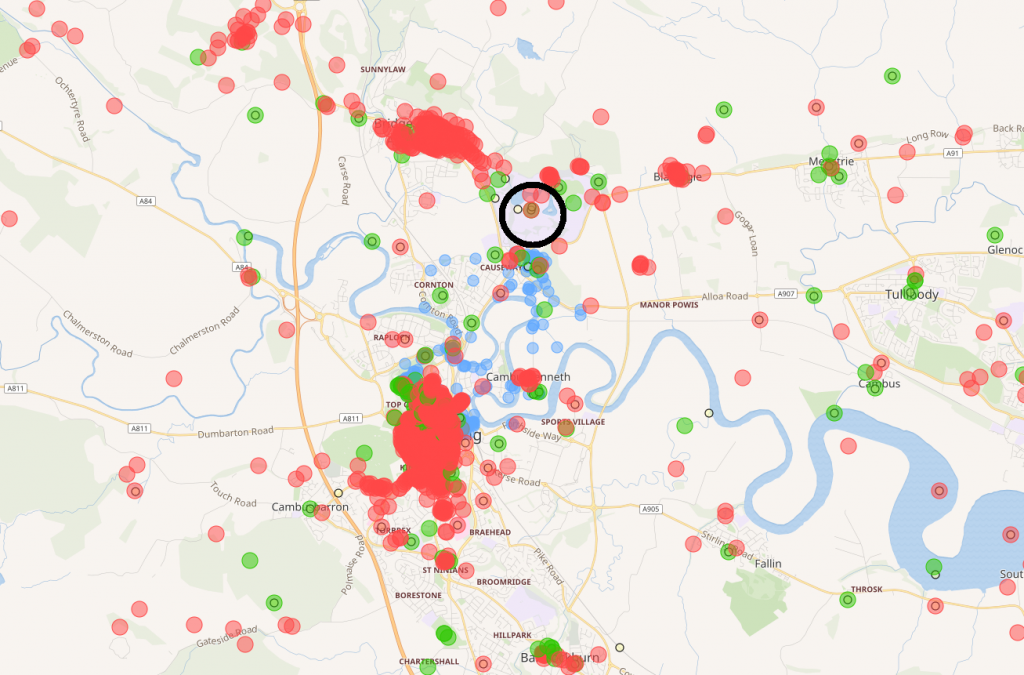
<p>Below you&#8217;ll see a map covered in red and blue pins. These represent all of the listed buildings and monuments that are covered by the Wiki Loves Monuments competition, blue pins are places that already have a photograph and red pins have no photograph at all. The aim of the campaign is to turn as many red pins blue as possible, greatly enhancing the amazing bank of open knowledge across the Wikimedia platforms. </p>
<p>The University of Stirling sits within the black circle. The two big clusters of red pins on the map are Stirling and Bridge of Allan &#8211; right on your doorstep! We encourage you to explore your local area. Knowing your surroundings, finding hidden gems and learning about the history of the area will all help Stirling feel like home to you, whether you&#8217;re a first year or returning student. </p>
<figure class="wp-block-image size-large"><img decoding="async" loading="lazy" width="1024" height="675" src="https://archives.wordpress.stir.ac.uk/files/2020/09/Wiki-Shoot-Me-Stirling-Uni-1024x675.png" alt="" class="wp-image-2317" srcset="https://archives.wordpress.stir.ac.uk/files/2020/09/Wiki-Shoot-Me-Stirling-Uni-1024x675.png 1024w, https://archives.wordpress.stir.ac.uk/files/2020/09/Wiki-Shoot-Me-Stirling-Uni-300x198.png 300w, https://archives.wordpress.stir.ac.uk/files/2020/09/Wiki-Shoot-Me-Stirling-Uni-768x506.png 768w, https://archives.wordpress.stir.ac.uk/files/2020/09/Wiki-Shoot-Me-Stirling-Uni.png 1307w" sizes="(max-width: 1024px) 100vw, 1024px" /><figcaption>Look at all those red dots!</figcaption></figure>
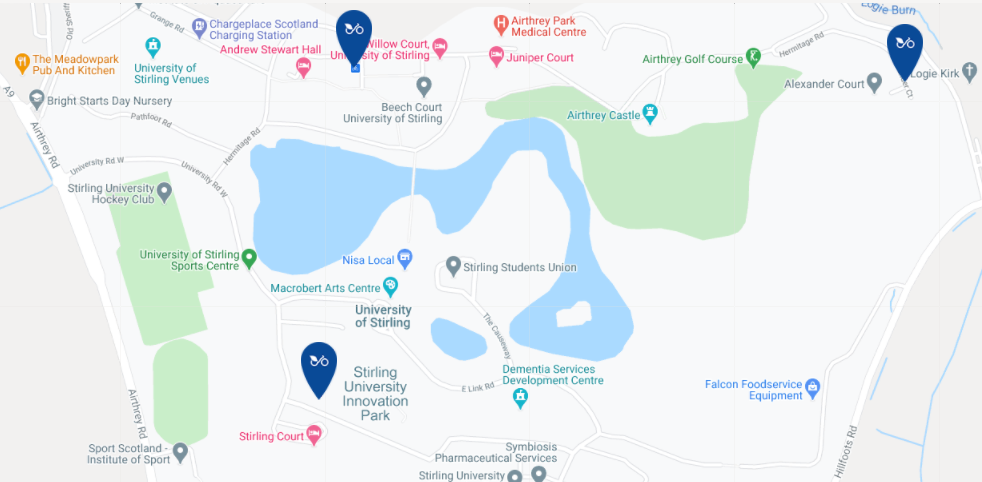
<p>Of course, this year we must be cautious and safe while taking part in this campaign and you should follow social distancing rules and all government coronavirus guidelines, such as wearing facemasks where appropriate, while you are out taking photographs. We encourage you to walk to locations you wish to photograph, or use the NextBikes which are situated on campus and in Stirling rather than take excessive public transport purely for the purposes of this project. Walking and cycling will help you to get a better sense of where everything is in relation to where you live and keeping active is beneficial to your mental health and wellbeing. </p>
<figure class="wp-block-image size-large"><img decoding="async" loading="lazy" width="982" height="482" src="https://archives.wordpress.stir.ac.uk/files/2020/09/University-map-nextbikes.png" alt="" class="wp-image-2320" srcset="https://archives.wordpress.stir.ac.uk/files/2020/09/University-map-nextbikes.png 982w, https://archives.wordpress.stir.ac.uk/files/2020/09/University-map-nextbikes-300x147.png 300w, https://archives.wordpress.stir.ac.uk/files/2020/09/University-map-nextbikes-768x377.png 768w" sizes="(max-width: 982px) 100vw, 982px" /><figcaption>Here are your NextBike points on campus where you can pick up a bike to use</figcaption></figure>
<p>We hope you&#8217;ll join us for this campaign &#8211; we have a session planned for <strong>4-5pm on Thursday 17th September </strong>on Teams where we&#8217;ll tell you more about Wiki Loves Monuments and show you how to upload your images. <strong>Sign up to the session on <a href="https://www.eventbrite.co.uk/e/wiki-loves-monuments-digital-skills-and-exploring-stirling-tickets-120014072321?ref=estw">Eventbrite</a></strong>.</p>
<p>If you cannot make our own University of Stirling session then Wikimedia UK have their own <a href="https://www.eventbrite.co.uk/e/getting-started-with-wiki-loves-monuments-uk-tickets-116105126559">training session</a> on the 21st September which you can join.</p>
<p>Please note that if you want your photographs to be considered for the competition prizes then they must be submitted before midnight on the 30th September. Photographs in general can be added at any time so you can carry on exploring for as long as you like! </p>
<p>Finally, just to add a little incentive, this year we&#8217;re having a friendly competition between the University of Stirling and the University of St Andrews students to see who can make the most edits so come along to a training session, pick up some brilliant digital skills and let&#8217;s paint the town green!</p>
]]></content>
<link href="" rel="enclosure" length="0" type="" />
<source>
	<title>Culture on Campus</title>
	<link rel="alternate" type="text/html" href="https://archives.wordpress.stir.ac.uk" />
	<link rel="self" href="http://archives.wordpress.stir.ac.uk/feed/" />
	<id>http://archives.wordpress.stir.ac.uk/feed/</id>
</source>
		<link rel="replies" type="text/html" href="https://archives.wordpress.stir.ac.uk/2020/09/08/wiki-loves-monuments-digital-skills-and-exploring-stirling/#comments" thr:count="0"/>
		<link rel="replies" type="application/atom+xml" href="https://archivesblogs.com/archives/412865/feed/atom" thr:count="0"/>
		<thr:total>0</thr:total>
	</entry>
		<entry>
		<author>
			<name>Illuminations</name>
			<uri>https://fsuspecialcollections.wordpress.com</uri>
					</author>
		<title type="html"><![CDATA[What’s the Tea?]]></title>
		<link rel="alternate" type="text/html" href="https://fsuspecialcollections.wordpress.com/2020/09/04/lgbtq-series-5/" />
		<id>https://fsuspecialcollections.wordpress.com/2020/09/04/lgbtq-series-5/</id>
		<updated>2020-09-04T16:23:02Z</updated>
		<published>2020-09-04T16:23:02Z</published>
		<category scheme="https://archivesblogs.com" term="English" />		<summary type="html"><![CDATA["I interviewed Kate McCormick in order to get a better understanding of the dynamics of Special Collections &#38; Archives." <a href="https://fsuspecialcollections.wordpress.com/2020/09/04/lgbtq-series-5/">Continue reading <span class="meta-nav">&#8594;</span></a>]]></summary>
		<content type="html" xml:base="https://fsuspecialcollections.wordpress.com/2020/09/04/lgbtq-series-5/"><![CDATA[<div class="wp-block-image">
<figure class="aligncenter size-large is-resized"><a href="https://fsuspecialcollections.wordpress.com/2020/07/07/lgbtq-series-1/"><img decoding="async" loading="lazy" data-attachment-id="9674" data-permalink="https://fsuspecialcollections.wordpress.com/2020/07/21/lgbtq-series-2/this-post-is-one-of-a-series/" data-orig-file="https://fsuspecialcollections.files.wordpress.com/2020/07/this-post-is-one-of-a-series..png" data-orig-size="1011,636" data-comments-opened="1" data-image-meta="{&quot;aperture&quot;:&quot;0&quot;,&quot;credit&quot;:&quot;&quot;,&quot;camera&quot;:&quot;&quot;,&quot;caption&quot;:&quot;&quot;,&quot;created_timestamp&quot;:&quot;0&quot;,&quot;copyright&quot;:&quot;&quot;,&quot;focal_length&quot;:&quot;0&quot;,&quot;iso&quot;:&quot;0&quot;,&quot;shutter_speed&quot;:&quot;0&quot;,&quot;title&quot;:&quot;&quot;,&quot;orientation&quot;:&quot;0&quot;}" data-image-title="This post is one of a series." data-image-description="" data-medium-file="https://fsuspecialcollections.files.wordpress.com/2020/07/this-post-is-one-of-a-series..png?w=300" data-large-file="https://fsuspecialcollections.files.wordpress.com/2020/07/this-post-is-one-of-a-series..png?w=604" src="https://fsuspecialcollections.files.wordpress.com/2020/07/this-post-is-one-of-a-series..png?w=1011" alt="" class="wp-image-9674" width="198" height="124" srcset="https://fsuspecialcollections.files.wordpress.com/2020/07/this-post-is-one-of-a-series..png?w=198 198w, https://fsuspecialcollections.files.wordpress.com/2020/07/this-post-is-one-of-a-series..png?w=394 394w, https://fsuspecialcollections.files.wordpress.com/2020/07/this-post-is-one-of-a-series..png?w=150 150w, https://fsuspecialcollections.files.wordpress.com/2020/07/this-post-is-one-of-a-series..png?w=300 300w" sizes="(max-width: 198px) 100vw, 198px" /></a></figure>
</div>
<div class="wp-block-image">
<figure class="alignright size-large is-resized"><img decoding="async" loading="lazy" data-attachment-id="9888" data-permalink="https://fsuspecialcollections.wordpress.com/katie_copy/" data-orig-file="https://fsuspecialcollections.files.wordpress.com/2020/09/katie_copy.jpg" data-orig-size="1526,1610" data-comments-opened="1" data-image-meta="{&quot;aperture&quot;:&quot;2.4&quot;,&quot;credit&quot;:&quot;&quot;,&quot;camera&quot;:&quot;iPhone 5&quot;,&quot;caption&quot;:&quot;&quot;,&quot;created_timestamp&quot;:&quot;1405022119&quot;,&quot;copyright&quot;:&quot;&quot;,&quot;focal_length&quot;:&quot;4.12&quot;,&quot;iso&quot;:&quot;50&quot;,&quot;shutter_speed&quot;:&quot;0.033333333333333&quot;,&quot;title&quot;:&quot;&quot;,&quot;orientation&quot;:&quot;0&quot;}" data-image-title="katie_copy" data-image-description="" data-medium-file="https://fsuspecialcollections.files.wordpress.com/2020/09/katie_copy.jpg?w=284" data-large-file="https://fsuspecialcollections.files.wordpress.com/2020/09/katie_copy.jpg?w=604" src="https://fsuspecialcollections.files.wordpress.com/2020/09/katie_copy.jpg?w=971" alt="" class="wp-image-9888" width="245" height="258" srcset="https://fsuspecialcollections.files.wordpress.com/2020/09/katie_copy.jpg?w=245 245w, https://fsuspecialcollections.files.wordpress.com/2020/09/katie_copy.jpg?w=490 490w, https://fsuspecialcollections.files.wordpress.com/2020/09/katie_copy.jpg?w=142 142w, https://fsuspecialcollections.files.wordpress.com/2020/09/katie_copy.jpg?w=284 284w" sizes="(max-width: 245px) 100vw, 245px" /><figcaption>Katie McCormick, Associate Dean<br />(she/her/hers)</figcaption></figure>
</div>
<p>For this post, I interviewed Kate McCormick in order to get a better understanding of the dynamics of <a href="https://www.lib.fsu.edu/specialcollections/index.html">Special Collections &amp; Archives</a>. Katie is one of the Associate Deans and has been with SCA for about nine years now (<a href="https://youtu.be/rjgZ5eS0U34">here&#8217;s a video of Katie discussing some of our collections on C-SPAN in 2014!</a>). As a vital part of the library, and our leader in Special Collections &amp; Archives, I wanted to get her opinion on how the division has progressed thus far and how they plan to continue to do so in regards to diversity and inclusion.  </p>
<p><strong>How would you describe FSU SCA when you first started?</strong></p>
<p><em>“…People didn’t feel comfortable communicating [with each other]… There was one person who really wrote for the blog, and maybe it would happen once every couple of months. When I came on board, my general sense was that we were a department and a group of people with a lot of really great ideas and some fantastic materials, who had come a long way from where things has been, but who hadn’t gotten to a place to be able to organize to change more or to really work more as a team… We were definitely valued as (mostly) the fancy crown jewel group. Really all that mattered was the stuff… it didn’t matter what we were doing with it.”</em></p>
<p><strong>How do you feel the lapse in communication affected diversity and inclusion?</strong></p>
<p><em>“While I don’t have any direct evidence that it excluded people or helped create an environment that was exclusive, I do know that even with our staff at the time, there were times where it contributed to hostilities, frustrations, an&nbsp; environment where people didn’t feel able to speak or be comfortable in…Everybody just wanted to be comfortable with the people who were just like them that it definitely created some potentially hostile environments. Looking back, I recognize what a poor job we did, as a workplace and a community truly being inclusive, and not just in ways that are immediately visible.”</em></p>
<p><strong>How diverse was SCA when you started?&nbsp;</strong></p>
<p><em>“In Special Collections there was minimal diversity, certainly less than we have now… [For the libraries as a whole] as you go up in classification and pay, the diversity decreases. That was certainly true when I got here and that remains true.”</em></p>
<p><strong>How would you rank SCA’s diversity and inclusion when you first started?</strong></p>
<p><em>“&#8230;Squarely a 5, possibly in some arenas a 4. Not nothing, but I feel like no one was really thinking of it.”</em></p>
<p><strong>And how would you describe it now?</strong></p>
<p><em>“Maybe we’re approaching a 7, I feel like there’s been progress, but there’s still a long way to go in my opinion.”</em></p>
<p><strong>What are some ways we can start addressing these issues? What are some tangible ways you are planning to enact?</strong></p>
<p><em>“For me, some of the first places [is] forming the inclusive research services task force in Special Collections, pulling together a group to look at descriptive practices and applications, and what we’re doing with creating coordinated processing workflows. Putting these issues on the table from the beginning is really important&#8230; Right now because we’re primarily in an online environment, i think we have some time to negotiate and change our practices so when we are re-open to the public and people are physically coming in to the spaces, we have new forms, new trainings, people have gone through training that gives them a better sense of identity, communication, diversity.&#8221;</em></p>
<p>After my conversation with Katie, I feel optimistic about the direction we are heading in. Knowing how open Special Collections &amp; Archives is about taking critique and trying to put it into action brought me comfort. I’m excited to see how these concerns are addressed and how the department will be putting Dynamic Inclusivity, one of <a href="https://www.fsu.edu/about/mission-vision.html">Florida State University&#8217;s core values</a>, at the forefront of their practice. I would like to give a big thank you to Katie McCormick for taking the time to do this post with me and for having these conversations!</p>
]]></content>
<link href="https://fsuspecialcollections.files.wordpress.com/2020/07/lgbtq-blog-series-cover-photo.png" rel="enclosure" length="0" type="" />
<link href="https://0.gravatar.com/avatar/98db6ce349653f4952fbad81c5eb6447?s=96&#038;d=identicon&#038;r=PG" rel="enclosure" length="0" type="" />
<link href="https://fsuspecialcollections.files.wordpress.com/2020/09/katie_copy.jpg?w=971" rel="enclosure" length="0" type="" />
<source>
	<title>Illuminations</title>
	<link rel="alternate" type="text/html" href="https://fsuspecialcollections.wordpress.com" />
	<link rel="self" href="http://fsuspecialcollections.wordpress.com/feed/" />
	<id>http://fsuspecialcollections.wordpress.com/feed/</id>
</source>
		<link rel="replies" type="text/html" href="https://fsuspecialcollections.wordpress.com/2020/09/04/lgbtq-series-5/#comments" thr:count="0"/>
		<link rel="replies" type="application/atom+xml" href="https://fsuspecialcollections.wordpress.com/2020/09/04/lgbtq-series-5/feed/" thr:count="0"/>
		<thr:total>0</thr:total>
	</entry>
		<entry>
		<author>
			<name>Culture on Campus</name>
			<uri>https://archives.wordpress.stir.ac.uk</uri>
					</author>
		<title type="html"><![CDATA[friday art blog: Terry Frost]]></title>
		<link rel="alternate" type="text/html" href="https://archives.wordpress.stir.ac.uk/2020/09/04/friday-art-blog-terry-frost/" />
		<id>https://archives.wordpress.stir.ac.uk/2020/09/04/friday-art-blog-terry-frost/</id>
		<updated>2020-09-04T01:29:13Z</updated>
		<published>2020-09-04T01:29:13Z</published>
		<category scheme="https://archivesblogs.com" term="English" />		<summary type="html"><![CDATA[Born in Leamington Spa, Warwickshire, in 1915, Terry Frost KBE RA did not become an&#8230; <a href="https://archives.wordpress.stir.ac.uk/2020/09/04/friday-art-blog-terry-frost/">Continue reading <span class="meta-nav">&#8594;</span></a>]]></summary>
		<content type="html" xml:base="https://archives.wordpress.stir.ac.uk/2020/09/04/friday-art-blog-terry-frost/"><![CDATA[<figure class="wp-block-image size-large"><img decoding="async" loading="lazy" width="1024" height="750" src="https://archives.wordpress.stir.ac.uk/files/2020/09/1970_9-1024x750.jpg" alt="" class="wp-image-2289" srcset="https://archives.wordpress.stir.ac.uk/files/2020/09/1970_9-1024x750.jpg 1024w, https://archives.wordpress.stir.ac.uk/files/2020/09/1970_9-300x220.jpg 300w, https://archives.wordpress.stir.ac.uk/files/2020/09/1970_9-768x562.jpg 768w, https://archives.wordpress.stir.ac.uk/files/2020/09/1970_9-1536x1124.jpg 1536w, https://archives.wordpress.stir.ac.uk/files/2020/09/1970_9-2048x1499.jpg 2048w" sizes="(max-width: 1024px) 100vw, 1024px" /><figcaption>Black and Red on Blue<br />(Screenprint, A/P, 1968)</figcaption></figure>
<p>Born in Leamington Spa, Warwickshire, in 1915, <a rel="noreferrer noopener" href="https://collections.stir.ac.uk/people/frost-terry/" >Terry Frost</a> KBE RA did not become an artist until he was in his 30s.  During&nbsp;World War II, he served in France, the Middle East and Greece, before joining the commandos. While in&nbsp;Crete&nbsp;in June 1941 he was captured and sent to various prisoner of war camps. As a&nbsp;prisoner at&nbsp;Stalag 383&nbsp;in&nbsp;Bavaria, he met&nbsp;Adrian Heath&nbsp;who encouraged him to paint.</p>
<p>After the war he attended Camberwell School of Art and the St. Ives School of Art and painted his first abstract work in 1949. In 1951 he moved to Newlyn and worked as an assistant to the sculptor <a rel="noreferrer noopener" href="https://archives.wordpress.stir.ac.uk/2020/04/23/object-of-the-week-4/" >Barbara Hepworth</a>. He was joined there by <a rel="noreferrer noopener" href="https://collections.stir.ac.uk/people/hilton-roger-cbe/" >Roger Hilton,</a> where they began a collaboration in collage and construction techniques.  In 1960 he put on his first exhibition in the USA, in New York, and there he met many of the American abstract expressionists, including Marc Rothko who became a great friend. </p>
<p>Terry Frost&#8217;s career included teaching at the Bath Academy of Art, serving as Gregory Fellow at the University of Leeds, and also teaching at the Cyprus College of Art. He later became the artist in residence and Professor of Painting at the Department of Fine Art of the University of Reading.</p>
<div class="wp-block-image">
<figure class="aligncenter size-large"><img decoding="async" loading="lazy" width="434" height="574" src="https://archives.wordpress.stir.ac.uk/files/2020/09/1971_8-2.jpg" alt="" class="wp-image-2292" srcset="https://archives.wordpress.stir.ac.uk/files/2020/09/1971_8-2.jpg 434w, https://archives.wordpress.stir.ac.uk/files/2020/09/1971_8-2-227x300.jpg 227w" sizes="(max-width: 434px) 100vw, 434px" /><figcaption>Orange Dusk<br />(Lithograph, 2/75, 1970)</figcaption></figure>
</div>
<p>Frost was renowned for his use of the Cornish light, colour and shape. He became a leading exponent of abstract art and a recognised figure of the British art establishment. These two prints were purchased in the early days of the Art Collection at the beginning of the 1970s. </p>
<p>Terry Frost married Kathleen Clarke in 1945 and they had six children, two of whom became artists, (and another, Stephen Frost, a comedian). His grandson Luke Frost, also an artist, is shown here, speaking about his grandfather.</p>
<figure class="wp-block-embed-youtube wp-block-embed is-type-video is-provider-youtube wp-embed-aspect-16-9 wp-has-aspect-ratio">
<div class="wp-block-embed__wrapper">
<iframe title="Sir Terry Frost | TateShots" width="500" height="281" src="https://www.youtube.com/embed/kutXRfBCdxs?feature=oembed" frameborder="0" allow="accelerometer; autoplay; encrypted-media; gyroscope; picture-in-picture" allowfullscreen></iframe>
</div>
</figure>
]]></content>
<link href="" rel="enclosure" length="0" type="" />
<source>
	<title>Culture on Campus</title>
	<link rel="alternate" type="text/html" href="https://archives.wordpress.stir.ac.uk" />
	<link rel="self" href="http://archives.wordpress.stir.ac.uk/feed/" />
	<id>http://archives.wordpress.stir.ac.uk/feed/</id>
</source>
		<link rel="replies" type="text/html" href="https://archives.wordpress.stir.ac.uk/2020/09/04/friday-art-blog-terry-frost/#comments" thr:count="0"/>
		<link rel="replies" type="application/atom+xml" href="https://archivesblogs.com/archives/412547/feed/atom" thr:count="0"/>
		<thr:total>0</thr:total>
	</entry>
		<entry>
		<author>
			<name>Transforming Classification</name>
			<uri>https://transforming-classification.blogs.archives.gov</uri>
					</author>
		<title type="html"><![CDATA[PIDB Sets Next Virtual Public Meeting for October 7, 2020]]></title>
		<link rel="alternate" type="text/html" href="https://transforming-classification.blogs.archives.gov/2020/09/03/pidb-sets-next-virtual-public-meeting-for-october-7-2020/" />
		<id>https://transforming-classification.blogs.archives.gov/2020/09/03/pidb-sets-next-virtual-public-meeting-for-october-7-2020/</id>
		<updated>2020-09-03T18:32:26Z</updated>
		<published>2020-09-03T18:32:26Z</published>
		<category scheme="https://archivesblogs.com" term="English" />		<summary type="html"><![CDATA[The Public Interest Declassification Board (PIDB) has scheduled its next virtual public meeting for Wednesday, October 7, 2020, from 1:00 to 2:30 p.m.&#160; At the meeting, PIDB members will discuss their priorities for improving classification and declassification in the next 18 months. They will also introduce former Congressman Trey Gowdy, who was appointed on August &#8230; <a href="https://transforming-classification.blogs.archives.gov/2020/09/03/pidb-sets-next-virtual-public-meeting-for-october-7-2020/">Continue reading <span>PIDB Sets Next Virtual Public Meeting for October 7, 2020</span></a> <a href="https://transforming-classification.blogs.archives.gov/2020/09/03/pidb-sets-next-virtual-public-meeting-for-october-7-2020/">Continue reading <span class="meta-nav">&#8594;</span></a>]]></summary>
		<content type="html" xml:base="https://transforming-classification.blogs.archives.gov/2020/09/03/pidb-sets-next-virtual-public-meeting-for-october-7-2020/"><![CDATA[<p>The Public Interest Declassification Board (PIDB) has scheduled its next virtual public meeting for Wednesday, October 7, 2020, from 1:00 to 2:30 p.m.  At the meeting, PIDB members will discuss their priorities for improving classification and declassification in the next 18 months. They will also introduce former Congressman Trey Gowdy, who was appointed on August 24, 2020, to a three-year term on the PIDB.</p>
<p>A full agenda, as well as information on how to pre-register, and how to submit questions and comments to the PIDB prior to the virtual meeting, will be posted soon to <em>Transforming Classification</em>.</p>
<p>The PIDB looks forward to your participation in continuing our public discussion of priorities for modernizing the classification system going forward.</p></p>
]]></content>
<link href="" rel="enclosure" length="0" type="" />
<source>
	<title>Transforming Classification</title>
	<link rel="alternate" type="text/html" href="https://transforming-classification.blogs.archives.gov" />
	<link rel="self" href="http://blogs.archives.gov/transformingclassification/?feed=rss2" />
	<id>http://blogs.archives.gov/transformingclassification/?feed=rss2</id>
</source>
		<link rel="replies" type="text/html" href="https://transforming-classification.blogs.archives.gov/2020/09/03/pidb-sets-next-virtual-public-meeting-for-october-7-2020/#comments" thr:count="0"/>
		<link rel="replies" type="application/atom+xml" href="https://transforming-classification.blogs.archives.gov/2020/09/03/pidb-sets-next-virtual-public-meeting-for-october-7-2020/feed/" thr:count="0"/>
		<thr:total>0</thr:total>
	</entry>
		<entry>
		<author>
			<name>UNC Greensboro Digital Collections</name>
			<uri>http://uncgdigital.blogspot.com/</uri>
					</author>
		<title type="html"><![CDATA[Digital Collections Updates]]></title>
		<link rel="alternate" type="text/html" href="http://uncgdigital.blogspot.com/2020/09/digital-collections-updates.html" />
		<id>http://uncgdigital.blogspot.com/2020/09/digital-collections-updates.html</id>
		<updated>2020-09-03T17:57:57Z</updated>
		<published>2020-09-03T16:55:00Z</published>
		<category scheme="https://archivesblogs.com" term="English" />		<summary type="html"><![CDATA[So as we start a new academic year, we thought this would be a good time for an update on what we've been working on recently.Digital collections migration:After more than a year's delay, the migration of our collections into a new and more user-friend... <a href="http://uncgdigital.blogspot.com/2020/09/digital-collections-updates.html">Continue reading <span class="meta-nav">&#8594;</span></a>]]></summary>
		<content type="html" xml:base="http://uncgdigital.blogspot.com/2020/09/digital-collections-updates.html"><![CDATA[<p>So as we start a new academic year, we thought this would be a good time for an update on what we&#8217;ve been working on recently.</p>
<div class="separator" style="clear: both; text-align: center;"><a href="https://1.bp.blogspot.com/-UYnMjrugIns/X1EeZQKmRjI/AAAAAAAAEHA/0u70ra7-CeY6mNiWvCTyQp8V2be9HsIJwCLcBGAsYHQ/s1296/Screen%2BShot%2B2020-09-03%2Bat%2B12.46.47%2BPM.png" style="margin-left: 1em; margin-right: 1em;"><img loading="lazy" decoding="async" border="0" data-original-height="1111" data-original-width="1296" height="548" src="https://1.bp.blogspot.com/-UYnMjrugIns/X1EeZQKmRjI/AAAAAAAAEHA/0u70ra7-CeY6mNiWvCTyQp8V2be9HsIJwCLcBGAsYHQ/w640-h548/Screen%2BShot%2B2020-09-03%2Bat%2B12.46.47%2BPM.png" width="640" /></a></div>
<p><b><br /></b></p>
<p><b>Digital collections migration:</b></p>
<p>After more than a year&#8217;s delay, the migration of our collections into a new and more user-friendly (and mobile-friendly) platform driven by the Islandora open-source content management system is in the home stretch. This has been a major undertaking and has given us the opportunity to reassess how our collections work. We hope to be live with the new platform in November. 30,000 items (over 380,000 digital images) have already been migrated.</p>
<p><b>2019-2020 Projects:</b></p>
<p>We&#8217;ve made significant progress on most of <a href="http://uncgdigital.blogspot.com/2019/08/digitization-priorities-2019-2020.html">this year&#8217;s projects</a>&nbsp;(see link for project descriptions), though many of these are currently not yet online pending our migration to the Islandora platform:</p>
<p>Grant-funded projects:</p>
</p>
<ul style="text-align: left;">
<li><i>Temple Emanuel Project:&nbsp;</i>We are working with the Public History department and a graduate student in that program. Several hundred items have already been digitized and more work is being done. We are also exploring grant options with the temple to digitize more material.</li>
<li><i><a href="https://library.uncg.edu/slavery/deeds/">People Not Property: NC Slave Deeds Project</a>:</i>&nbsp;We are in the final year of this project funded by the National Archives and hope to have it online as part of the <i><a href="https://library.uncg.edu/slavery/">Digital Library on American Slavery</a></i> late next year. We are also exploring additional funding options to continue this work.</li>
<li><i>Women Who Answered the Call: </i>This project was funded by a CLIR Recordings at Risk grant. The fragile cassettes have been digitized and we are midway through the process of getting them online in the new platform.</li>
</ul>
<p>Library-funded projects:</p>
</p>
<ul style="text-align: left;">
<li><i>Poetas sin Fronteras: Poets Without Borders, the Scrapbooks of Dr. Ramiro Lagos:</i>&nbsp;These items have been digitized and will go online when the new platform launches.</li>
<li><i><a href="http://libcdm1.uncg.edu/cdm/landingpage/collection/RAS">North Carolina Runaway Slaves Ads Project, Phase 2</a>: </i>Work continues on this ongoing project and over 5700 ads are now online. This second phase has involved both locating and digitizing/transcribing the ads, and we will soon triple the number of ads done in Phase One. We are also working on tighter integration of this project into the&nbsp;<i><a href="https://library.uncg.edu/slavery/">Digital Library on American Slavery</a>.</i></li>
<li><i><a href="https://pride.triadhistory.org/">PRIDE! of the Community</a>:</i> This ongoing project stemmed from an NEH grant two years ago and is growing to include numerous new oral history interviews and (just added) a project to digitize and display ads from LGBTQ+ bars and other businesses in the Triad during the 1980s and 1990s. We are also working with two Public History students on contextual and interpretive projects based on the digital collection.</li>
</ul>
<div class="separator" style="clear: both; text-align: center;"><a href="https://1.bp.blogspot.com/-7WMOPLBIjC4/X1Eex71kEGI/AAAAAAAAEHI/iq8pd40U0t4nmRljydRQjQQd8FoRRiH2gCLcBGAsYHQ/s1683/blm.jpg" style="margin-left: 1em; margin-right: 1em;"><img loading="lazy" decoding="async" border="0" data-original-height="1082" data-original-width="1683" height="412" src="https://1.bp.blogspot.com/-7WMOPLBIjC4/X1Eex71kEGI/AAAAAAAAEHI/iq8pd40U0t4nmRljydRQjQQd8FoRRiH2gCLcBGAsYHQ/w640-h412/blm.jpg" width="640" /></a></div>
<p></p>
<p>Faculty-involved projects:</p>
</p>
<ul style="text-align: left;">
<li><i><a href="http://libcdm1.uncg.edu/cdm/blm">Black Lives Matter Collections</a>: </i>This is a community-based initiative to document the Black Lives Matter movement and recent demonstrations and artwork in the area. Faculty: Dr. Tara Green (African America and Diaspora Studies);&nbsp; Stacey Krim, Erin Lawrimore, Dr. Rhonda Jones, David Gwynn (University Libraries).</li>
<li><i>Civil Rights Oral Histories: </i>This has become multiple projects. We are working with several faculty members in the Media Studies department to make these transcribed interviews available online. November is the target. Faculty: Matt Barr, Jenida Chase, Hassan Pitts, and Michael Frierson (Media Studies); Richard Cox, Erin Lawrimore, David Gwynn&nbsp;(University Libraries).</li>
<li><i>Oral Contraceptive Ads:</i> Working with a faculty member and a student on this project, which may be online by the end of the year. Faculty: Dr. Heather Adams (English); David Gwynn and Richard Cox&nbsp;(University Libraries).</li>
<li><i><a href="https://library.uncg.edu/dp/wellcraftednc/">Well-Crafted NC</a>: </i>Work is ongoing and we are in the second year of a UNCG P2 grant, working with a faculty member in eth Bryan School and a brewer based in Asheboro. Faculty: Erin Lawrimore, Richard Cox, David Gwynn (University Libraries), Dr. Erick Byrd (Marketing, Entrepreneurship, Hospitality, and Tourism)</li>
</ul>
<p>New projects taken on during the pandemic:</p>
</p>
<ul style="text-align: left;">
<li><i>City of Greensboro Scrapbooks:</i> Huge collection of scrapbooks from the Greensboro Urban Development Department dating back to the 1940s. These items have been digitized and will go online when the new platform launches.</li>
<li><i>Negro Health Week Pamphlets: </i>1930s-1950s pamphlets published by the State of North Carolina.<i>&nbsp;</i>These items are currently being digitized and will go online when the new platform launches.</li>
<li><i>Clara Booth Byrd Collection: </i>Manuscript collection.&nbsp;These items are currently being digitized and will go online when the new platform launches.</li>
<li><i>North Carolina Speaker Ban Collection</i><i>:&nbsp;</i>Manuscript collection.&nbsp;These&nbsp;items are currently being digitized and will go online when the new platform launches.</li>
<li><i>Mary Dail Dixon Papers:&nbsp;</i>Manuscript collection.&nbsp;These&nbsp;items are currently being digitized and will go online when the new platform launches.</li>
<li><i>Ruth Wade Hunter Collection:&nbsp;</i>Manuscript collection.&nbsp;These&nbsp;items are currently being digitized and will go online when the new platform launches.</li>
</ul>
<p>Projects on hold pending the pandemic:</p>
</p>
<ul style="text-align: left;">
<li><i>Junior League of Greensboro: </i>Much of this has already been digitized and will go online when the new platform launches.</li>
<li><i>UNCG Graduate School Bulletins: </i>Much of this has already been digitized and will go online when the new platform launches.&nbsp;</li>
</ul>
<p>David Gwynn (Digitization Coordinator, me) offers kudos to Erica Rau and Kathy Howard (Digitization and Metadata Technicians); Callie Coward (Special Collections Cataloging &amp; Digital Projects Library Technician); Charley Birkner&nbsp;(Technology Support Technician); and Dr. Brian Robinson (Fellow for Digital Curation and Scholarship) for their great work in very surreal circumstances over the past six months.</p>
]]></content>
<link href="" rel="enclosure" length="0" type="" />
<source>
	<title>UNC Greensboro Digital Collections</title>
	<link rel="alternate" type="text/html" href="http://uncgdigital.blogspot.com/" />
	<link rel="self" href="http://uncgdigital.blogspot.com/feeds/posts/default" />
	<id>tag:blogger.com,1999:blog-7680795803642984216</id>
	<updated>2020-09-03T13:59:28.534-04:00</updated>
</source>
		<link rel="replies" type="text/html" href="http://uncgdigital.blogspot.com/2020/09/digital-collections-updates.html#comments" thr:count="0"/>
		<link rel="replies" type="application/atom+xml" href="http://uncgdigital.blogspot.com/feeds/8904989989969489657/comments/default" thr:count="0"/>
		<thr:total>0</thr:total>
	</entry>
		<entry>
		<author>
			<name>Notes For Bibliophiles</name>
			<uri>https://pplspcoll.wordpress.com</uri>
					</author>
		<title type="html"><![CDATA[CORRECTION: Creative Fellowship Call for Proposals]]></title>
		<link rel="alternate" type="text/html" href="https://pplspcoll.wordpress.com/2020/09/03/correction-creative-fellowship-call-for-proposals/" />
		<id>https://pplspcoll.wordpress.com/2020/09/03/correction-creative-fellowship-call-for-proposals/</id>
		<updated>2020-09-03T14:19:11Z</updated>
		<published>2020-09-03T14:19:11Z</published>
		<category scheme="https://archivesblogs.com" term="English" />		<summary type="html"><![CDATA[We have an update to our last post! We&#8217;re still accepting proposals for our 2021 Creative Fellowship&#8230; But we&#8217;ve decided to postpone both the Fellowship and our annual Exhibition &#38; Program Series by six months due to the coronavirus. The &#8230; <a href="https://pplspcoll.wordpress.com/2020/09/03/correction-creative-fellowship-call-for-proposals/">Continue reading <span>&#8594;</span></a> <a href="https://pplspcoll.wordpress.com/2020/09/03/correction-creative-fellowship-call-for-proposals/">Continue reading <span class="meta-nav">&#8594;</span></a>]]></summary>
		<content type="html" xml:base="https://pplspcoll.wordpress.com/2020/09/03/correction-creative-fellowship-call-for-proposals/"><![CDATA[<p>We have an update to our last post! We&#8217;re still accepting proposals for our 2021 Creative Fellowship&#8230;</p>
<p>But we&#8217;ve decided to postpone both the Fellowship and our annual Exhibition &amp; Program Series by six months due to the coronavirus. The annual exhibition will now open on October 1, 2021 (which is 13 months away, but we&#8217;re still hard at work planning!).</p>
<p>The new due date for Fellowship proposals is <strong>April 1, 2021. </strong>We&#8217;ve adjusted the timeline and due dates in the <a href="https://www.provlib.org/research-collections/artists-at-ppl/creative-fellowship/creative-fellowship-call-proposals/">call for proposals</a> accordingly.</p>
]]></content>
<link href="https://2.gravatar.com/avatar/b4b30593fca916084ffc49f25b41d650?s=96&#038;d=identicon&#038;r=G" rel="enclosure" length="0" type="" />
<source>
	<title>Notes For Bibliophiles</title>
	<link rel="alternate" type="text/html" href="https://pplspcoll.wordpress.com" />
	<link rel="self" href="http://pplspcoll.wordpress.com/feed/" />
	<id>http://pplspcoll.wordpress.com/feed/</id>
</source>
		<link rel="replies" type="text/html" href="https://pplspcoll.wordpress.com/2020/09/03/correction-creative-fellowship-call-for-proposals/#comments" thr:count="0"/>
		<link rel="replies" type="application/atom+xml" href="https://pplspcoll.wordpress.com/2020/09/03/correction-creative-fellowship-call-for-proposals/feed/" thr:count="0"/>
		<thr:total>0</thr:total>
	</entry>
		<entry>
		<author>
			<name>Illuminations</name>
			<uri>https://fsuspecialcollections.wordpress.com</uri>
					</author>
		<title type="html"><![CDATA[On This Day in the Florida Flambeau, Friday, September 2, 1983]]></title>
		<link rel="alternate" type="text/html" href="https://fsuspecialcollections.wordpress.com/2020/09/02/on-this-day-september-2-1983/" />
		<id>https://fsuspecialcollections.wordpress.com/2020/09/02/on-this-day-september-2-1983/</id>
		<updated>2020-09-02T16:52:22Z</updated>
		<published>2020-09-02T16:52:22Z</published>
		<category scheme="https://archivesblogs.com" term="English" />		<summary type="html"><![CDATA[Today in 1983, a disgruntled reader sent in this letter to the editor of the Flambeau. In it, the reader describes the outcome of a trial and the potential effects that outcome will have on the City of Tallahassee. It is such a beautifully written letter that I still can&#8217;t tell whether or not it&#8217;s &#8230; <a href="https://fsuspecialcollections.wordpress.com/2020/09/02/on-this-day-september-2-1983/">Continue reading <span>On This Day in the Florida Flambeau, Friday, September 2,&#160;1983</span> <span>&#8594;</span></a> <a href="https://fsuspecialcollections.wordpress.com/2020/09/02/on-this-day-september-2-1983/">Continue reading <span class="meta-nav">&#8594;</span></a>]]></summary>
		<content type="html" xml:base="https://fsuspecialcollections.wordpress.com/2020/09/02/on-this-day-september-2-1983/"><![CDATA[<p>Today in 1983, a disgruntled reader sent in this letter to the editor of the Flambeau. In it, the reader describes the outcome of a trial and the potential effects that outcome will have on the City of Tallahassee.</p>
<figure class="wp-block-image size-large is-resized"><a href="http://purl.flvc.org/fsu/fd/FSU_Flambeau_09021983"><img decoding="async" loading="lazy" data-attachment-id="9878" data-permalink="https://fsuspecialcollections.wordpress.com/flambeau_sept_02_1983_02/" data-orig-file="https://fsuspecialcollections.files.wordpress.com/2020/09/flambeau_sept_02_1983_02.png" data-orig-size="390,832" data-comments-opened="1" data-image-meta="{&quot;aperture&quot;:&quot;0&quot;,&quot;credit&quot;:&quot;&quot;,&quot;camera&quot;:&quot;&quot;,&quot;caption&quot;:&quot;&quot;,&quot;created_timestamp&quot;:&quot;0&quot;,&quot;copyright&quot;:&quot;&quot;,&quot;focal_length&quot;:&quot;0&quot;,&quot;iso&quot;:&quot;0&quot;,&quot;shutter_speed&quot;:&quot;0&quot;,&quot;title&quot;:&quot;&quot;,&quot;orientation&quot;:&quot;0&quot;}" data-image-title="Florida Flambeau September 2 1983" data-image-description="" data-medium-file="https://fsuspecialcollections.files.wordpress.com/2020/09/flambeau_sept_02_1983_02.png?w=141" data-large-file="https://fsuspecialcollections.files.wordpress.com/2020/09/flambeau_sept_02_1983_02.png?w=390" src="https://fsuspecialcollections.files.wordpress.com/2020/09/flambeau_sept_02_1983_02.png?w=390" alt="" class="wp-image-9878" width="378" height="806" srcset="https://fsuspecialcollections.files.wordpress.com/2020/09/flambeau_sept_02_1983_02.png?w=378 378w, https://fsuspecialcollections.files.wordpress.com/2020/09/flambeau_sept_02_1983_02.png?w=70 70w, https://fsuspecialcollections.files.wordpress.com/2020/09/flambeau_sept_02_1983_02.png?w=141 141w, https://fsuspecialcollections.files.wordpress.com/2020/09/flambeau_sept_02_1983_02.png 390w" sizes="(max-width: 378px) 100vw, 378px" /></a><figcaption><a href="http://purl.flvc.org/fsu/fd/FSU_Flambeau_09021983">Florida Flambeau, September 2, 1983</a></figcaption></figure>
<p>It is such a beautifully written letter that I still can’t tell whether or not it’s satire. Do you think the author is being serious or sarcastic? Leave a comment below telling us what you think!</p>
]]></content>
<link href="https://2.gravatar.com/avatar/b465a9e40267f272c7d23e0f270e03e8?s=96&#038;d=identicon&#038;r=PG" rel="enclosure" length="0" type="" />
<link href="https://fsuspecialcollections.files.wordpress.com/2020/09/flambeau_sept_02_1983_02.png?w=390" rel="enclosure" length="0" type="" />
<source>
	<title>Illuminations</title>
	<link rel="alternate" type="text/html" href="https://fsuspecialcollections.wordpress.com" />
	<link rel="self" href="http://fsuspecialcollections.wordpress.com/feed/" />
	<id>http://fsuspecialcollections.wordpress.com/feed/</id>
</source>
		<link rel="replies" type="text/html" href="https://fsuspecialcollections.wordpress.com/2020/09/02/on-this-day-september-2-1983/#comments" thr:count="0"/>
		<link rel="replies" type="application/atom+xml" href="https://fsuspecialcollections.wordpress.com/2020/09/02/on-this-day-september-2-1983/feed/" thr:count="0"/>
		<thr:total>0</thr:total>
	</entry>
		<entry>
		<author>
			<name>The Consecrated Eminence</name>
			<uri>https://consecratedeminence.wordpress.com</uri>
					</author>
		<title type="html"><![CDATA[Hartgrove, Meriwether, and Mattingly]]></title>
		<link rel="alternate" type="text/html" href="https://consecratedeminence.wordpress.com/2020/09/02/hartgrove-meriwether-and-mattingly/" />
		<id>https://consecratedeminence.wordpress.com/2020/09/02/hartgrove-meriwether-and-mattingly/</id>
		<updated>2020-09-02T16:01:21Z</updated>
		<published>2020-09-02T16:01:21Z</published>
		<category scheme="https://archivesblogs.com" term="English" />		<summary type="html"><![CDATA[The past few months have been a challenging time for archivists everywhere as we adjust to doing our work remotely. Fortunately, the materials available in Amherst College Digital Collections enable us to continue doing much of our work. Back in February, I posted about five Black students from the 1870s and 1880s &#8212;&#160;Black Men of [&#8230;] <a href="https://consecratedeminence.wordpress.com/2020/09/02/hartgrove-meriwether-and-mattingly/">Continue reading <span class="meta-nav">&#8594;</span></a>]]></summary>
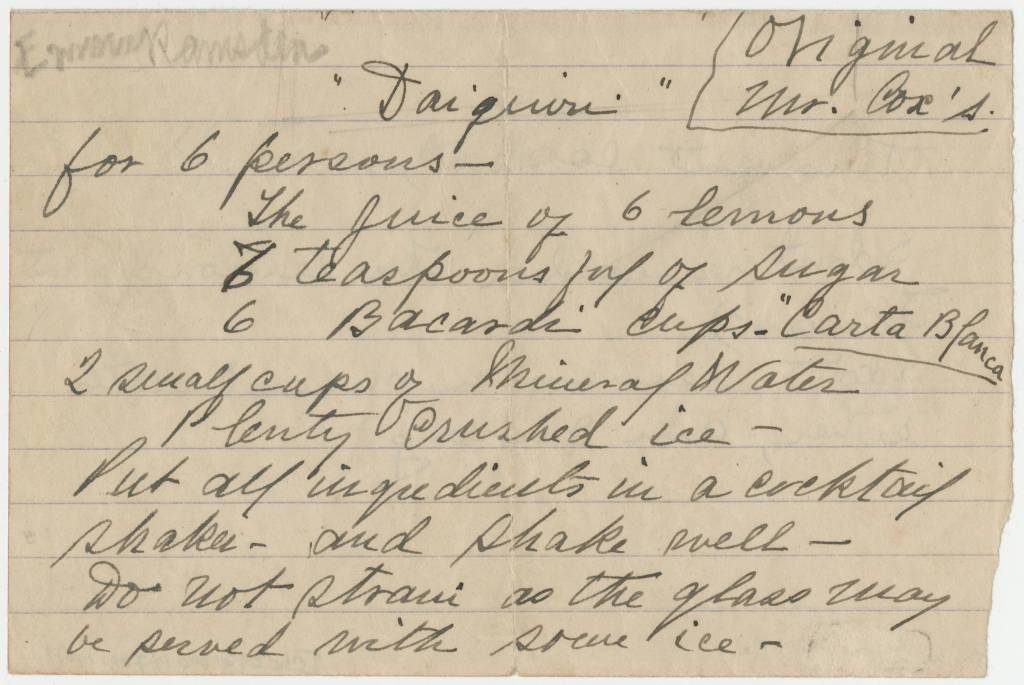
		<content type="html" xml:base="https://consecratedeminence.wordpress.com/2020/09/02/hartgrove-meriwether-and-mattingly/"><![CDATA[<p>The past few months have been a challenging time for archivists everywhere as we adjust to doing our work remotely. Fortunately, the materials available in <a href="https://acdc.amherst.edu/collection/asc"  rel="noopener">Amherst College Digital Collections</a> enable us to continue doing much of our work.</p>
<p>Back in February, I posted about five Black students from the 1870s and 1880s &#8212; <a href="https://consecratedeminence.wordpress.com/2020/02/07/black-men-of-amherst-1877-1883/">Black Men of Amherst, 1877-1883</a> &#8212; and now we&#8217;re moving into the early 20th century. A small clue in <em>The Olio</em> has revealed another Black student that was not included in Harold Wade&#8217;s <em>Black Men of Amherst</em>. Robert Sinclair Hartgrove (AC 1905) was known to Wade, as was Robert Mattingly (AC 1906), but we did not know about Robert Henry Meriwether. These three appear to be the first Black students to attend Amherst in the twentieth century.</p>
<div data-shortcode="caption" id="attachment_13623" style="width: 1995px" class="wp-caption alignnone"><img decoding="async" aria-describedby="caption-attachment-13623" data-attachment-id="13623" data-permalink="https://consecratedeminence.wordpress.com/2020/09/02/hartgrove-meriwether-and-mattingly/hartgrove-olio-detail/" data-orig-file="https://consecratedeminence.files.wordpress.com/2020/09/hartgrove-olio-detail.jpg" data-orig-size="1985,576" data-comments-opened="1" data-image-meta="{&quot;aperture&quot;:&quot;0&quot;,&quot;credit&quot;:&quot;&quot;,&quot;camera&quot;:&quot;&quot;,&quot;caption&quot;:&quot;&quot;,&quot;created_timestamp&quot;:&quot;0&quot;,&quot;copyright&quot;:&quot;&quot;,&quot;focal_length&quot;:&quot;0&quot;,&quot;iso&quot;:&quot;0&quot;,&quot;shutter_speed&quot;:&quot;0&quot;,&quot;title&quot;:&quot;&quot;,&quot;orientation&quot;:&quot;1&quot;}" data-image-title="Hartgrove Olio detail" data-image-description="&lt;p&gt;Yearbook photo of Robert Sinclair Hartgrove, Class of 1905&lt;/p&gt;
" data-medium-file="https://consecratedeminence.files.wordpress.com/2020/09/hartgrove-olio-detail.jpg?w=300" data-large-file="https://consecratedeminence.files.wordpress.com/2020/09/hartgrove-olio-detail.jpg?w=500" class="alignnone size-full wp-image-13623" src="https://consecratedeminence.files.wordpress.com/2020/09/hartgrove-olio-detail.jpg?w=500" alt="Robert Sinclair Hartgrove, Class of 1905" srcset="https://consecratedeminence.files.wordpress.com/2020/09/hartgrove-olio-detail.jpg?w=500 500w, https://consecratedeminence.files.wordpress.com/2020/09/hartgrove-olio-detail.jpg?w=1000 1000w, https://consecratedeminence.files.wordpress.com/2020/09/hartgrove-olio-detail.jpg?w=150 150w, https://consecratedeminence.files.wordpress.com/2020/09/hartgrove-olio-detail.jpg?w=300 300w, https://consecratedeminence.files.wordpress.com/2020/09/hartgrove-olio-detail.jpg?w=768 768w" sizes="(max-width: 500px) 100vw, 500px"   /></p>
<p id="caption-attachment-13623" class="wp-caption-text"><a href="https://acdc.amherst.edu/view/asc:333077/asc:336109"  rel="noopener">Robert Sinclair Hartgrove, Class of 1905</a></p>
</div>
<p>The text next to Hartgrove&#8217;s picture in the 1905 yearbook gives us a tiny glimpse into his time at Amherst. The same yearbook shows Hartgrove not just jollying the players, but playing second base for the Freshman baseball team during the 1902 season.</p>
<div data-shortcode="caption" id="attachment_13626" style="width: 3090px" class="wp-caption alignnone"><img decoding="async" aria-describedby="caption-attachment-13626" data-attachment-id="13626" data-permalink="https://consecratedeminence.wordpress.com/2020/09/02/hartgrove-meriwether-and-mattingly/asc-335627/" data-orig-file="https://consecratedeminence.files.wordpress.com/2020/09/asc-335627.jpg" data-orig-size="3080,4080" data-comments-opened="1" data-image-meta="{&quot;aperture&quot;:&quot;0&quot;,&quot;credit&quot;:&quot;&quot;,&quot;camera&quot;:&quot;&quot;,&quot;caption&quot;:&quot;&quot;,&quot;created_timestamp&quot;:&quot;0&quot;,&quot;copyright&quot;:&quot;&quot;,&quot;focal_length&quot;:&quot;0&quot;,&quot;iso&quot;:&quot;0&quot;,&quot;shutter_speed&quot;:&quot;0&quot;,&quot;title&quot;:&quot;&quot;,&quot;orientation&quot;:&quot;0&quot;}" data-image-title="asc-335627" data-image-description="&lt;p&gt;Freshman Baseball Team, 1902&lt;/p&gt;
" data-medium-file="https://consecratedeminence.files.wordpress.com/2020/09/asc-335627.jpg?w=226" data-large-file="https://consecratedeminence.files.wordpress.com/2020/09/asc-335627.jpg?w=500" class="alignnone size-full wp-image-13626" src="https://consecratedeminence.files.wordpress.com/2020/09/asc-335627.jpg?w=500" alt="Freshman Baseball Team, 1902" srcset="https://consecratedeminence.files.wordpress.com/2020/09/asc-335627.jpg?w=500 500w, https://consecratedeminence.files.wordpress.com/2020/09/asc-335627.jpg?w=1000 1000w, https://consecratedeminence.files.wordpress.com/2020/09/asc-335627.jpg?w=113 113w, https://consecratedeminence.files.wordpress.com/2020/09/asc-335627.jpg?w=226 226w, https://consecratedeminence.files.wordpress.com/2020/09/asc-335627.jpg?w=768 768w, https://consecratedeminence.files.wordpress.com/2020/09/asc-335627.jpg?w=773 773w" sizes="(max-width: 500px) 100vw, 500px"   /></p>
<p id="caption-attachment-13626" class="wp-caption-text">Freshman Baseball Team, 1902</p>
</div>
<p>The reference to Meriwether sent me to the <em>Amherst College Biographical Record</em>, where I found Robert Henry Meriwether listed as a member of the Class of 1904. A little digging into the College Catalogs revealed that he belongs with the Class of 1905.</p>
<div data-shortcode="caption" id="attachment_13627" style="width: 2612px" class="wp-caption alignnone"><img decoding="async" aria-describedby="caption-attachment-13627" data-attachment-id="13627" data-permalink="https://consecratedeminence.wordpress.com/2020/09/02/hartgrove-meriwether-and-mattingly/asc-567130/" data-orig-file="https://consecratedeminence.files.wordpress.com/2020/09/asc-567130.jpg" data-orig-size="2602,3891" data-comments-opened="1" data-image-meta="{&quot;aperture&quot;:&quot;0&quot;,&quot;credit&quot;:&quot;&quot;,&quot;camera&quot;:&quot;&quot;,&quot;caption&quot;:&quot;&quot;,&quot;created_timestamp&quot;:&quot;0&quot;,&quot;copyright&quot;:&quot;&quot;,&quot;focal_length&quot;:&quot;0&quot;,&quot;iso&quot;:&quot;0&quot;,&quot;shutter_speed&quot;:&quot;0&quot;,&quot;title&quot;:&quot;&quot;,&quot;orientation&quot;:&quot;0&quot;}" data-image-title="asc-567130" data-image-description="&lt;p&gt;College Catalog, 1901-02&lt;/p&gt;
" data-medium-file="https://consecratedeminence.files.wordpress.com/2020/09/asc-567130.jpg?w=201" data-large-file="https://consecratedeminence.files.wordpress.com/2020/09/asc-567130.jpg?w=500" class="alignnone size-full wp-image-13627" src="https://consecratedeminence.files.wordpress.com/2020/09/asc-567130.jpg?w=500" alt="College Catalog, 1901-02" srcset="https://consecratedeminence.files.wordpress.com/2020/09/asc-567130.jpg?w=500 500w, https://consecratedeminence.files.wordpress.com/2020/09/asc-567130.jpg?w=1000 1000w, https://consecratedeminence.files.wordpress.com/2020/09/asc-567130.jpg?w=100 100w, https://consecratedeminence.files.wordpress.com/2020/09/asc-567130.jpg?w=201 201w, https://consecratedeminence.files.wordpress.com/2020/09/asc-567130.jpg?w=768 768w, https://consecratedeminence.files.wordpress.com/2020/09/asc-567130.jpg?w=685 685w" sizes="(max-width: 500px) 100vw, 500px"   /></p>
<p id="caption-attachment-13627" class="wp-caption-text"><a href="https://acdc.amherst.edu/view/asc:566988/asc:567130"  rel="noopener">College Catalog, 1901-02</a></p>
</div>
<p>Hartgrove and Meriwether are both listed as members of the Freshman class in the 1901-02 catalog. The catalog also notes that they were both from Washington, DC and the <em>Biographical Record</em> indicates that they both prepped at Howard University before coming to Amherst. We find Meriwether&#8217;s name in the catalog for 1902-03, but he did not &#8220;pull through&#8221; as <em>The Olio </em>hopes Hartgrove will; Meriwether returned to Howard University where he earned his LLB in 1907. Hartgrove also became a lawyer, earning his JB from Boston University in 1908 and spending most of his career in Jersey City, NJ.</p>
<div data-shortcode="caption" id="attachment_13628" style="width: 1947px" class="wp-caption alignnone"><img decoding="async" aria-describedby="caption-attachment-13628" data-attachment-id="13628" data-permalink="https://consecratedeminence.wordpress.com/2020/09/02/hartgrove-meriwether-and-mattingly/mattingly-in-olio/" data-orig-file="https://consecratedeminence.files.wordpress.com/2020/09/mattingly-in-olio.jpg" data-orig-size="1937,671" data-comments-opened="1" data-image-meta="{&quot;aperture&quot;:&quot;0&quot;,&quot;credit&quot;:&quot;&quot;,&quot;camera&quot;:&quot;&quot;,&quot;caption&quot;:&quot;&quot;,&quot;created_timestamp&quot;:&quot;0&quot;,&quot;copyright&quot;:&quot;&quot;,&quot;focal_length&quot;:&quot;0&quot;,&quot;iso&quot;:&quot;0&quot;,&quot;shutter_speed&quot;:&quot;0&quot;,&quot;title&quot;:&quot;&quot;,&quot;orientation&quot;:&quot;1&quot;}" data-image-title="Mattingly in Olio" data-image-description="&lt;p&gt;Robert Nicholas Mattingly, Class of 1906&lt;/p&gt;
" data-medium-file="https://consecratedeminence.files.wordpress.com/2020/09/mattingly-in-olio.jpg?w=300" data-large-file="https://consecratedeminence.files.wordpress.com/2020/09/mattingly-in-olio.jpg?w=500" class="alignnone size-full wp-image-13628" src="https://consecratedeminence.files.wordpress.com/2020/09/mattingly-in-olio.jpg?w=500" alt="Robert Nicholas Mattingly, Class of 1906" srcset="https://consecratedeminence.files.wordpress.com/2020/09/mattingly-in-olio.jpg?w=500 500w, https://consecratedeminence.files.wordpress.com/2020/09/mattingly-in-olio.jpg?w=1000 1000w, https://consecratedeminence.files.wordpress.com/2020/09/mattingly-in-olio.jpg?w=150 150w, https://consecratedeminence.files.wordpress.com/2020/09/mattingly-in-olio.jpg?w=300 300w, https://consecratedeminence.files.wordpress.com/2020/09/mattingly-in-olio.jpg?w=768 768w" sizes="(max-width: 500px) 100vw, 500px"   /></p>
<p id="caption-attachment-13628" class="wp-caption-text"><a href="https://acdc.amherst.edu/view/asc:337715/asc:341036"  rel="noopener">Robert Nicholas Mattingly, Class of 1906</a></p>
</div>
<p>Mattingly was born in Louisville, KY in 1884 and prepped for Amherst at The M Street School in Washington, DC, which changed its name in 1916 to The Dunbar School. Matt Randolph (AC 2016) wrote <a href="https://doi.org/10.3998/mpub.11873533"  rel="noopener">&#8220;Remembering Dunbar: Amherst College and African-American Education in Washington, DC&#8221;</a> for the book <em><a href="https://doi.org/10.3998/mpub.11873533"  rel="noopener">Amherst in the World</a></em>, which includes more details of Mattingly&#8217;s life.</p>
<hr />
<p><strong>The Amherst College Archives and Special Collections reading room is closed to on-site researchers.</strong> <strong>However, many of our regular services are available remotely, with some modifications. Please read our <a href="https://www.amherst.edu/library/archives/services-during-covid-19-remote-learning"  rel="noopener">Services during COVID-19</a> page for more information. Contact us at archives@amherst.edu.</strong></p>
]]></content>
<link href="https://2.gravatar.com/avatar/bf23fccd5b98b7bb679eb38f46a3f5ad?s=96&#038;d=identicon&#038;r=G" rel="enclosure" length="0" type="" />
<link href="https://consecratedeminence.files.wordpress.com/2020/09/hartgrove-olio-detail.jpg" rel="enclosure" length="0" type="" />
<link href="https://consecratedeminence.files.wordpress.com/2020/09/asc-335627.jpg" rel="enclosure" length="0" type="" />
<link href="https://consecratedeminence.files.wordpress.com/2020/09/asc-567130.jpg" rel="enclosure" length="0" type="" />
<link href="https://consecratedeminence.files.wordpress.com/2020/09/mattingly-in-olio.jpg" rel="enclosure" length="0" type="" />
<source>
	<title>The Consecrated Eminence</title>
	<link rel="alternate" type="text/html" href="https://consecratedeminence.wordpress.com" />
	<link rel="self" href="http://consecratedeminence.wordpress.com/feed/" />
	<id>http://consecratedeminence.wordpress.com/feed/</id>
</source>
		<link rel="replies" type="text/html" href="https://consecratedeminence.wordpress.com/2020/09/02/hartgrove-meriwether-and-mattingly/#comments" thr:count="0"/>
		<link rel="replies" type="application/atom+xml" href="https://consecratedeminence.wordpress.com/2020/09/02/hartgrove-meriwether-and-mattingly/feed/" thr:count="0"/>
		<thr:total>0</thr:total>
	</entry>
		<entry>
		<author>
			<name>AOTUS</name>
			<uri>https://aotus.blogs.archives.gov</uri>
					</author>
		<title type="html"><![CDATA[Democratizing Access to our Records]]></title>
		<link rel="alternate" type="text/html" href="https://aotus.blogs.archives.gov/2020/09/01/democratizing-access-to-our-records/" />
		<id>https://aotus.blogs.archives.gov/2020/09/01/democratizing-access-to-our-records/</id>
		<updated>2020-09-01T16:03:40Z</updated>
		<published>2020-09-01T16:03:40Z</published>
		<category scheme="https://archivesblogs.com" term="English" />		<summary type="html"><![CDATA[The National Archives has a big, hairy audacious strategic goal to provide public access to 500 million digital copies of our records through our online Catalog by FY24. When we first announced this goal in 2010, we had less than a million digital copies in the Catalog and getting to 500 million sounded to some &#8230; <a href="https://aotus.blogs.archives.gov/2020/09/01/democratizing-access-to-our-records/">Continue reading <span>Democratizing Access to our Records</span></a> <a href="https://aotus.blogs.archives.gov/2020/09/01/democratizing-access-to-our-records/">Continue reading <span class="meta-nav">&#8594;</span></a>]]></summary>
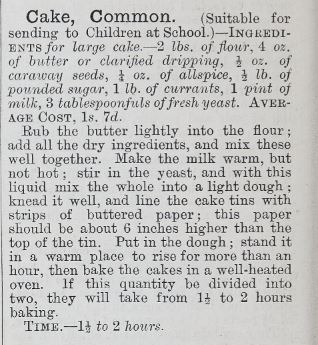

		<content type="html" xml:base="https://aotus.blogs.archives.gov/2020/09/01/democratizing-access-to-our-records/"><![CDATA[<p>The National Archives has a big, hairy audacious strategic goal to provide public access to 500 million digital copies of our records through our online <a href="https://catalog.archives.gov/">Catalog</a> by FY24. When we first announced this goal in 2010, we had less than a million digital copies in the Catalog and getting to 500 million sounded to some like a fairy tale.</p>
<p>The goal received a variety of reactions from people across the archival profession, our colleagues and our staff. Some were excited to work on the effort and wanted particular sets of records to be first in line to scan. Some laughed out loud at the sheer impossibility of it. Some were angry and said it was a waste of time and money. Others were fearful that digitizing the records could take their jobs away.</p>
<div class="wp-block-image">
<figure class="aligncenter size-large is-resized"><img decoding="async" data-attachment-id="9375" data-permalink="https://aotus.blogs.archives.gov/2020/09/01/democratizing-access-to-our-records/digital-objects-in-catalog-fy10-fy20/" data-orig-file="https://i1.wp.com/aotus.blogs.archives.gov/wp-content/uploads/2020/09/Digital-Objects-in-Catalog-FY10-FY20.png?fit=917%2C519&amp;ssl=1" data-orig-size="917,519" data-comments-opened="1" data-image-meta="{&quot;aperture&quot;:&quot;0&quot;,&quot;credit&quot;:&quot;&quot;,&quot;camera&quot;:&quot;&quot;,&quot;caption&quot;:&quot;&quot;,&quot;created_timestamp&quot;:&quot;0&quot;,&quot;copyright&quot;:&quot;&quot;,&quot;focal_length&quot;:&quot;0&quot;,&quot;iso&quot;:&quot;0&quot;,&quot;shutter_speed&quot;:&quot;0&quot;,&quot;title&quot;:&quot;&quot;,&quot;orientation&quot;:&quot;0&quot;}" data-image-title="Digital-Objects-in-Catalog-FY10-FY20" data-image-description="" data-medium-file="https://i1.wp.com/aotus.blogs.archives.gov/wp-content/uploads/2020/09/Digital-Objects-in-Catalog-FY10-FY20.png?fit=300%2C170&amp;ssl=1" data-large-file="https://i1.wp.com/aotus.blogs.archives.gov/wp-content/uploads/2020/09/Digital-Objects-in-Catalog-FY10-FY20.png?fit=685%2C388&amp;ssl=1" loading="lazy" src="https://i1.wp.com/aotus.blogs.archives.gov/wp-content/uploads/2020/09/Digital-Objects-in-Catalog-FY10-FY20.png?resize=685%2C387&#038;ssl=1" alt="Graph showing the number of digital objects in the Catalog from 2010 to 2020. The graph shows an increasing line up to 100 million digital objects." class="wp-image-9375" width="685" height="387" srcset="https://i1.wp.com/aotus.blogs.archives.gov/wp-content/uploads/2020/09/Digital-Objects-in-Catalog-FY10-FY20.png?w=917&amp;ssl=1 917w, https://i1.wp.com/aotus.blogs.archives.gov/wp-content/uploads/2020/09/Digital-Objects-in-Catalog-FY10-FY20.png?resize=300%2C170&amp;ssl=1 300w, https://i1.wp.com/aotus.blogs.archives.gov/wp-content/uploads/2020/09/Digital-Objects-in-Catalog-FY10-FY20.png?resize=768%2C435&amp;ssl=1 768w, https://i1.wp.com/aotus.blogs.archives.gov/wp-content/uploads/2020/09/Digital-Objects-in-Catalog-FY10-FY20.png?resize=685%2C388&amp;ssl=1 685w" sizes="(max-width: 685px) 100vw, 685px" data-recalc-dims="1" /></figure>
</div>
<p>We moved ahead. Staff researched emerging technologies and tested them through pilots in order to increase our efficiency. We set up a room at our facilities in College Park to transfer our digital copies from individual hard drives to new technology from Amazon, known as snowballs.</p>
<figure class="wp-block-image size-large is-resized"><img decoding="async" data-attachment-id="9376" data-permalink="https://aotus.blogs.archives.gov/2020/09/01/democratizing-access-to-our-records/snowball-fort-image/" data-orig-file="https://i2.wp.com/aotus.blogs.archives.gov/wp-content/uploads/2020/09/Snowball-fort-image.png?fit=897%2C671&amp;ssl=1" data-orig-size="897,671" data-comments-opened="1" data-image-meta="{&quot;aperture&quot;:&quot;0&quot;,&quot;credit&quot;:&quot;&quot;,&quot;camera&quot;:&quot;&quot;,&quot;caption&quot;:&quot;&quot;,&quot;created_timestamp&quot;:&quot;0&quot;,&quot;copyright&quot;:&quot;&quot;,&quot;focal_length&quot;:&quot;0&quot;,&quot;iso&quot;:&quot;0&quot;,&quot;shutter_speed&quot;:&quot;0&quot;,&quot;title&quot;:&quot;&quot;,&quot;orientation&quot;:&quot;0&quot;}" data-image-title="Snowball-fort-image" data-image-description="" data-medium-file="https://i2.wp.com/aotus.blogs.archives.gov/wp-content/uploads/2020/09/Snowball-fort-image.png?fit=300%2C224&amp;ssl=1" data-large-file="https://i2.wp.com/aotus.blogs.archives.gov/wp-content/uploads/2020/09/Snowball-fort-image.png?fit=685%2C512&amp;ssl=1" loading="lazy" src="https://i2.wp.com/aotus.blogs.archives.gov/wp-content/uploads/2020/09/Snowball-fort-image.png?resize=627%2C469&#038;ssl=1" alt="Image of the &quot;snowball fort&quot; sign outside the room where digital copies were transferred from hard drives." class="wp-image-9376" width="627" height="469" srcset="https://i2.wp.com/aotus.blogs.archives.gov/wp-content/uploads/2020/09/Snowball-fort-image.png?w=897&amp;ssl=1 897w, https://i2.wp.com/aotus.blogs.archives.gov/wp-content/uploads/2020/09/Snowball-fort-image.png?resize=300%2C224&amp;ssl=1 300w, https://i2.wp.com/aotus.blogs.archives.gov/wp-content/uploads/2020/09/Snowball-fort-image.png?resize=768%2C575&amp;ssl=1 768w, https://i2.wp.com/aotus.blogs.archives.gov/wp-content/uploads/2020/09/Snowball-fort-image.png?resize=685%2C512&amp;ssl=1 685w" sizes="(max-width: 627px) 100vw, 627px" data-recalc-dims="1" /></figure>
<p>We worked on developing new partnership projects in order to get more records digitized. We streamlined the work in our internal digitization labs and we piloted digitization projects with staff in order to find new ways to get digital copies into the Catalog. By 2015, we had 10 million in the Catalog.</p>
<p>We persisted. In 2017, we added more digital objects, with their metadata, to the Catalog in a single year than we had for the preceding decade of the project. Late in 2019, we surpassed a major milestone by having more than 100 million digital copies of our records in the Catalog. And yes, it has strained our technology. The Catalog has developed growing pains, which we continue to monitor and mitigate.</p>
<p>We also created new finding aids that focus on digital copies of our records that are now available online: see our <a href="https://www.archives.gov/findingaid/record-group-explorer">Record Group Explorer</a> and our <a href="https://www.archives.gov/findingaid/presidential-library-explorer">Presidential Library Explorer</a>. So now, anyone with a smart phone or access to a computer with wifi, can view at least some of the permanent records of the U.S. Federal government without having to book a trip to Washington, D.C. or one of our other facilities around the country. The descriptions of over 95% of our records are also available through the Catalog, so even if you can’t see it&nbsp;immediately, you can know what records exist. And that is convenient for the millions of visitors we get each year to our website, even more so during the pandemic.</p>
<div class="wp-block-image">
<figure class="aligncenter size-large is-resized"><img decoding="async" data-attachment-id="9378" data-permalink="https://aotus.blogs.archives.gov/2020/09/01/democratizing-access-to-our-records/attachment/20802392/" data-orig-file="https://i0.wp.com/aotus.blogs.archives.gov/wp-content/uploads/2020/09/20802392.png?fit=467%2C325&amp;ssl=1" data-orig-size="467,325" data-comments-opened="1" data-image-meta="{&quot;aperture&quot;:&quot;0&quot;,&quot;credit&quot;:&quot;&quot;,&quot;camera&quot;:&quot;&quot;,&quot;caption&quot;:&quot;&quot;,&quot;created_timestamp&quot;:&quot;0&quot;,&quot;copyright&quot;:&quot;&quot;,&quot;focal_length&quot;:&quot;0&quot;,&quot;iso&quot;:&quot;0&quot;,&quot;shutter_speed&quot;:&quot;0&quot;,&quot;title&quot;:&quot;&quot;,&quot;orientation&quot;:&quot;0&quot;}" data-image-title="20802392" data-image-description="" data-medium-file="https://i0.wp.com/aotus.blogs.archives.gov/wp-content/uploads/2020/09/20802392.png?fit=300%2C209&amp;ssl=1" data-large-file="https://i0.wp.com/aotus.blogs.archives.gov/wp-content/uploads/2020/09/20802392.png?fit=467%2C325&amp;ssl=1" loading="lazy" src="https://i0.wp.com/aotus.blogs.archives.gov/wp-content/uploads/2020/09/20802392.png?resize=536%2C373&#038;ssl=1" alt="Black and white photograph of two women outside a building with an American Red Cross sign." class="wp-image-9378" width="536" height="373" srcset="https://i0.wp.com/aotus.blogs.archives.gov/wp-content/uploads/2020/09/20802392.png?w=467&amp;ssl=1 467w, https://i0.wp.com/aotus.blogs.archives.gov/wp-content/uploads/2020/09/20802392.png?resize=300%2C209&amp;ssl=1 300w" sizes="(max-width: 536px) 100vw, 536px" data-recalc-dims="1" /><figcaption><a href="https://catalog.archives.gov/id/20802392">National Archives Identifier 20802392</a></figcaption></figure>
</div>
<p>We are well on our way to 500 million digital copies in the Catalog by FY24. And yet, with over 13 billion pages of records in our holdings, we know, we have only just begun.</p>
]]></content>
<link href="" rel="enclosure" length="0" type="" />
<source>
	<title>AOTUS</title>
	<link rel="alternate" type="text/html" href="https://aotus.blogs.archives.gov" />
	<link rel="self" href="http://blogs.archives.gov/aotus/?feed=rss2" />
	<id>http://blogs.archives.gov/aotus/?feed=rss2</id>
</source>
		<link rel="replies" type="text/html" href="https://aotus.blogs.archives.gov/2020/09/01/democratizing-access-to-our-records/#comments" thr:count="0"/>
		<link rel="replies" type="application/atom+xml" href="https://aotus.blogs.archives.gov/2020/09/01/democratizing-access-to-our-records/feed/" thr:count="0"/>
		<thr:total>0</thr:total>
	</entry>
		<entry>
		<author>
			<name>NYPR Archives &amp; Preservation</name>
			<uri>https://www.wnyc.org/blogs/archives</uri>
					</author>
		<title type="html"><![CDATA[Lola Hayes and &#8220;Tone Pictures of the Negro in Music&#8221;]]></title>
		<link rel="alternate" type="text/html" href="http://www.wnyc.org/story/lola-hayes-and-tone-pictures-negro-music/" />
		<id>http://www.wnyc.org/story/lola-hayes-and-tone-pictures-negro-music/</id>
		<updated>2020-08-31T21:13:58Z</updated>
		<published>2020-08-31T21:13:58Z</published>
		<category scheme="https://archivesblogs.com" term="English" />		<summary type="html"><![CDATA[<p>Lola Wilson Hayes (1906-2001) was a highly-regarded African-American mezzo-soprano, WNYC producer, and later, much sought after vocal teacher and coach. A Boston native, Hayes was a music graduate of Radcliffe College and studied voice with Frank Bibb at Baltimore's Peabody Conservatory. She taught briefly at a black vocational boarding school in New Jersey known as the 'Tuskeegee of the north'[1] before embarking on a recital and show career which took her to Europe and around the United States. During World War II, she also made frequent appearances at the American Theatre Wing of the Stage Door Canteen of New York and entertained troops at USO clubs and hospitals.</p>
<div><img src="https://media.wnyc.org/i/587/630/l/80/2020/08/hayesheadline.jpg" alt="" width="350"/><div>
<div>Headline from The New York Age, August 12, 1944, pg. 10.</div>
<div>(WNYC Archive Collections)</div>
</div>
</div>
<p><span>Hayes also made time to produce a short but notable run of WNYC programs, which she hosted and performed on the home front. Her November and December 1943 broadcasts were part of a rotating half-hour time slot designated for known recitalists. She shared the late weekday afternoon slot with sopranos Marjorie Hamill, Pina La Corte, Jean Carlton, <a href="https://en.wikipedia.org/wiki/Elaine_Malbin">Elaine Malbin</a>, and the Hungarian pianist <a href="https://www.allmusic.com/artist/arpad-sandor-mn0002205869/biography">Arp&#225;d S&#225;ndor.</a> Hayes' series,&#160;</span><span><em>Tone Pictures of the Negro in Music,</em>&#160;</span><span>sought to highlight African-American composers and was frequently referred to as&#160;</span><span><em>The Negro in Music</em>.</span></p>
<p><span>The following outline of 1943 and 1944 broadcasts was pieced together from the WNYC&#160;</span><em><span>Masterwork Bulletin</span></em><span>&#160;program guide and period newspaper radio listings. Details on the 1943 programs are sparse. We know that Hayes' last broadcast in 1943 featured the pianist&#160;</span><a target="_blank" href="https://oac.cdlib.org/ark:/13030/hb1779n73k/?brand=oac4"><span>William Duncan Allen&#160;</span></a><span>(1906-1999) performing&#160;</span><em><span>They Led My Lord Away&#160;</span></em><span>by Roland Hayes and</span><em><span>&#160;Good Lord Done Been Here</span></em><span>&#160;by Hall Johnson, and a&#160;</span><em><span>Porgy and Bess</span></em><span>&#160;medley by George Gershwin.</span></p>
<div><img src="https://media.wnyc.org/i/1042/436/l/80/2020/08/HayesA.jpg" alt="" width="350"/><div>
<div>Excerpt from "Behind the Mike," November/December 1944, WNYC <em>Masterwork Bulletin.</em></div>
<div>(WNYC Archive Collections)</div>
</div>
</div>
<p><span></span><span>The show was scheduled again in August 1944 as a 15-minute late Tuesday afternoon program and in November that year as a half-hour Wednesday evening broadcast. The August programs began with an interview of soprano&#160;</span><a target="_blank" href="https://www.blackpast.org/african-american-history/mitchell-abbie-1884-1960/"><span>Abbie Mitchell&#160;</span></a><span>(1884-1960), the widow of composer and choral director&#160;</span><a target="_blank" href="https://www.loc.gov/item/ihas.200038839/"><span>Will Marion Cook&#160;</span></a><span>(1869-1944). The composer and arranger&#160;</span><a target="_blank" href="https://www.pcmsconcerts.org/composer/hall-johnson/"><span>Hall Johnson&#160;</span></a><span>(1888-1970) was her studio guest the following week. The third Tuesday of the month featured pianist&#160;</span><a target="_blank" href="https://www.wnyc.org/story/opening-concert-from-museum-of-natural-history/"><span>Jonathan Brice</span></a><span>&#160;performing "songs of young contemporary Negro composers," and the August shows concluded with selections from&#160;</span><em><span>Porgy and Bess</span></em><span>&#160;and&#160;</span><em><span>Cameron Jones.</span></em><span>&#160;The November broadcasts focused on the work of William Grant Still, "the art songs, spirituals and street cries" of&#160;</span><a target="_blank" href="https://www.wnyc.org/story/negro-art-singers-program-no-28/"><span>William Lawrence</span></a><span>, as well as the songs and spirituals of William Rhodes, lyric soprano&#160;</span><a target="_blank" href="https://www.whitehousehistory.org/lillian-evanti"><span>Lillian Evanti</span></a><span>, and baritone&#160;</span><a target="_blank" href="https://www.wnyc.org/story/concert-singer-harry-t-burleigh-performs-city-hall/"><span>Harry T. Burleigh</span></a><span>. Hayes also spent airtime on the work of neo-romantic composer and violinist&#160;</span><a target="_blank" href="https://www.loc.gov/item/ihas.200038858/"><span>Clarence Cameron Whit</span></a><span>e. The November 29th program considered "the musical setting of poems by Langston Hughes and reportedly included the bard himself. "Langston Hughes was guest of honor and punctuated his interview with a reading from his opera&#160;</span><em><span>Troubled Island</span></em><span>."[2]</span></p>
<p>This was not the first time the poet's work was the subject of Hayes' broadcast.&#160;Below is a rare copy of her script from a program airing eight months earlier when she sat in for the regularly scheduled host, soprano Marjorie Hamill.</p>
<div><img src="https://media.wnyc.org/i/800/1244/l/80/2020/08/hayesscript1.jpg" alt=""/><div><img src="https://media.wnyc.org/i/800/1014/l/80/2020/08/hayesscript2.jpg" alt=""/><div>
<div>The script for <em>Tone Pictures of the Negro in Music</em> hosted by Lola Hayes on March 24, 1944.</div>
<div>(Image used with permission of Van Vecten Trust and courtesy of the Carl Van Vechten Papers Relating to African American Arts and Letters. James Weldon Johnson Collection in the Yale Collection in the Yale Collection of American Literature, <a href="https://beinecke.library.yale.edu/">Beinecke Rare Book and Manuscript Library)</a>[3]</div>
</div>
</div>
</div>
<p><span>It is unfortunate, but it appears there are no recordings of Lola Hayes' WNYC program. We can't say if that's because they weren't recorded or, if they were, the lacquer discs have not survived. We do know that World War II-era transcription discs, in general, are less likely to have survived since most of them were cut on coated glass, rather than aluminum, to save vital metals for the war effort.</span></p>
<p><span><span>After the war, Hayes focused on voice teaching and coaching. Her students included well-known performers like&#160;</span><a target="_blank" href="https://composers.com/dorothy-rudd-moore"><span>Dorothy Rudd Moore</span></a><span>,&#160;</span><a target="_blank" href="https://artsongalliance.org/users/details/hilda-harris"><span>Hilda Harris</span></a><span>,&#160;</span><a target="_blank" href="https://africlassical.blogspot.com/2010/01/in-memoriam-raoul-abdul-1929-2010.html"><span>Raoul Abdul-Rahim</span></a><span>,&#160;</span><a target="_blank" href="http://amistadresearchcenter.tulane.edu/archon/?p=creators/creator&#38;id=228"><span>Carol Brice</span></a><span>, Nadine Brewer,&#160;</span><a target="_blank" href="http://www.metchorusartists.com/features/2016/2/9/met-chorus-artists-remember-the-life-of-elinor-harper"><span>Elinor Harper,</span></a><span>&#160;Lucia Hawkins, and&#160;</span><a target="_blank" href="https://www.blackpast.org/african-american-history/tynes-margaret-1919/"><span>Margaret Tynes</span></a><span>. She was the first African-American president of the New York Singing Teachers Association (NYSTA), serving in that post from 1970-1972. In her later years, she devoted much of her time to the Lola Wilson Hayes Vocal Artists Award, which gave substantial financial aid to young professional singers worldwide.[4]&#160;</span></span></p>
<p><span>___________________________________________________________</span></p>
<p>[1] <a href="https://en.wikipedia.org/wiki/Bordentown_School">The&#160;Manual Training and Industrial School for Colored Youth </a>in Bordentown,&#160;New Jersey</p>
<p>[2] "The Listening Room," <em>The People's Voice</em>, December 2, 1944, pg. 29. The newspaper noted that the broadcast included Hall Johnson's <em>Mother to Son</em>, <a href="https://songofamerica.net/composer/cohen-cecil/">Cecil Cohen's</a>&#160;<em>Death of an Old Seaman</em> and&#160;<a href="https://www.wqxr.org/story/271521-musical-biography-florence-beatrice-price/">Florence Price's</a> <em>Song to a Dark Virgin,</em> all presumably sung by host, Lola Hayes.&#160;</p>
<p><a href="https://operawire.com/opera-profile-william-grant-stills-historic-troubled-island/"><em>Troubled Island</em> </a>is an opera set in Haiti in 1791. It was composed by William Grant Still with a libretto by Langston Hughes and Verna Arvey.</p>
<p><span>[3] Page two of the script notes Langston Hughes' grandmother was married to a veteran of the 1859 Harper's Ferry raid led by abolitionist John Brown. Indeed, Hughes' grandmother's first husband was&#160;L</span><a href="https://en.wikipedia.org/wiki/Lewis_Sheridan_Leary">ewis Sheridan Leary</a><span>, who was one of Brown&#8217;s raiders at Harper's Ferry. For more on the story please see:<span>&#160;</span></span><a href="https://www.neh.gov/humanities/2016/summer/feature/shawl-belonged-langston-hughes-true-and-was-worn-one-john-brown%E2%80%99s-men-harpers-ferry-well">A Shawl From Harper's Ferry.</a></p>
<p>[4] Abdul, Raoul, "Winners of the Lola Hayes Vocal Scholarship and Awards," <em>The New York Amsterdam News</em>, February 8, 1992, pg. 25.</p>
<p>Special thanks to Valeria Martinez for research assistance.</p>
<p>&#160;</p> <a href="http://www.wnyc.org/story/lola-hayes-and-tone-pictures-negro-music/">Continue reading <span class="meta-nav">&#8594;</span></a>]]></summary>
		<content type="html" xml:base="http://www.wnyc.org/story/lola-hayes-and-tone-pictures-negro-music/"><![CDATA[<p>Lola Wilson Hayes (1906-2001) was a highly-regarded African-American mezzo-soprano, WNYC producer, and later, much sought after vocal teacher and coach. A Boston native, Hayes was a music graduate of Radcliffe College and studied voice with Frank Bibb at Baltimore&#8217;s Peabody Conservatory. She taught briefly at a black vocational boarding school in New Jersey known as the &#8216;Tuskeegee of the north'[1] before embarking on a recital and show career which took her to Europe and around the United States. During World War II, she also made frequent appearances at the American Theatre Wing of the Stage Door Canteen of New York and entertained troops at USO clubs and hospitals.</p>
<p>Headline from The New York Age, August 12, 1944, pg. 10.<br />
(WNYC Archive Collections)</p>
<p>Hayes also made time to produce a short but notable run of WNYC programs, which she hosted and performed on the home front. Her November and December 1943 broadcasts were part of a rotating half-hour time slot designated for known recitalists. She shared the late weekday afternoon slot with sopranos Marjorie Hamill, Pina La Corte, Jean Carlton, <a href="https://en.wikipedia.org/wiki/Elaine_Malbin">Elaine Malbin</a>, and the Hungarian pianist <a href="https://www.allmusic.com/artist/arpad-sandor-mn0002205869/biography">Arpád Sándor.</a> Hayes&#8217; series, <em>Tone Pictures of the Negro in Music,</em> sought to highlight African-American composers and was frequently referred to as <em>The Negro in Music</em>.</p>
<p>The following outline of 1943 and 1944 broadcasts was pieced together from the WNYC <em>Masterwork Bulletin</em> program guide and period newspaper radio listings. Details on the 1943 programs are sparse. We know that Hayes&#8217; last broadcast in 1943 featured the pianist <a href="https://oac.cdlib.org/ark:/13030/hb1779n73k/?brand=oac4" class="_e75a791d-denali-editor-page-rtfLink">William Duncan Allen </a>(1906-1999) performing <em>They Led My Lord Away </em>by Roland Hayes and<em> Good Lord Done Been Here</em> by Hall Johnson, and a <em>Porgy and Bess</em> medley by George Gershwin.</p>
<p>Excerpt from &#8220;Behind the Mike,&#8221; November/December 1944, WNYC <em>Masterwork Bulletin.</em><br />
(WNYC Archive Collections)</p>
<p>The show was scheduled again in August 1944 as a 15-minute late Tuesday afternoon program and in November that year as a half-hour Wednesday evening broadcast. The August programs began with an interview of soprano <a href="https://www.blackpast.org/african-american-history/mitchell-abbie-1884-1960/" class="_e75a791d-denali-editor-page-rtfLink">Abbie Mitchell </a>(1884-1960), the widow of composer and choral director <a href="https://www.loc.gov/item/ihas.200038839/" class="_e75a791d-denali-editor-page-rtfLink">Will Marion Cook </a>(1869-1944). The composer and arranger <a href="https://www.pcmsconcerts.org/composer/hall-johnson/" class="_e75a791d-denali-editor-page-rtfLink">Hall Johnson </a>(1888-1970) was her studio guest the following week. The third Tuesday of the month featured pianist <a href="https://www.wnyc.org/story/opening-concert-from-museum-of-natural-history/" class="_e75a791d-denali-editor-page-rtfLink">Jonathan Brice</a> performing &#8220;songs of young contemporary Negro composers,&#8221; and the August shows concluded with selections from <em>Porgy and Bess</em> and <em>Cameron Jones.</em> The November broadcasts focused on the work of William Grant Still, &#8220;the art songs, spirituals and street cries&#8221; of <a href="https://www.wnyc.org/story/negro-art-singers-program-no-28/" class="_e75a791d-denali-editor-page-rtfLink">William Lawrence</a>, as well as the songs and spirituals of William Rhodes, lyric soprano <a href="https://www.whitehousehistory.org/lillian-evanti" class="_e75a791d-denali-editor-page-rtfLink">Lillian Evanti</a>, and baritone <a href="https://www.wnyc.org/story/concert-singer-harry-t-burleigh-performs-city-hall/" class="_e75a791d-denali-editor-page-rtfLink">Harry T. Burleigh</a>. Hayes also spent airtime on the work of neo-romantic composer and violinist <a href="https://www.loc.gov/item/ihas.200038858/" class="_e75a791d-denali-editor-page-rtfLink">Clarence Cameron Whit</a>e. The November 29th program considered &#8220;the musical setting of poems by Langston Hughes and reportedly included the bard himself. &#8220;Langston Hughes was guest of honor and punctuated his interview with a reading from his opera <em>Troubled Island</em>.&#8221;[2]</p>
<p>This was not the first time the poet&#8217;s work was the subject of Hayes&#8217; broadcast. Below is a rare copy of her script from a program airing eight months earlier when she sat in for the regularly scheduled host, soprano Marjorie Hamill.</p>
<p>The script for <em>Tone Pictures of the Negro in Music</em> hosted by Lola Hayes on March 24, 1944.<br />
(Image used with permission of Van Vecten Trust and courtesy of the Carl Van Vechten Papers Relating to African American Arts and Letters. James Weldon Johnson Collection in the Yale Collection in the Yale Collection of American Literature, <a href="https://beinecke.library.yale.edu/">Beinecke Rare Book and Manuscript Library)</a>[3]</p>
<p>It is unfortunate, but it appears there are no recordings of Lola Hayes&#8217; WNYC program. We can&#8217;t say if that&#8217;s because they weren&#8217;t recorded or, if they were, the lacquer discs have not survived. We do know that World War II-era transcription discs, in general, are less likely to have survived since most of them were cut on coated glass, rather than aluminum, to save vital metals for the war effort.</p>
<p>After the war, Hayes focused on voice teaching and coaching. Her students included well-known performers like <a href="https://composers.com/dorothy-rudd-moore" class="_e75a791d-denali-editor-page-rtfLink">Dorothy Rudd Moore</a>, <a href="https://artsongalliance.org/users/details/hilda-harris" class="_e75a791d-denali-editor-page-rtfLink">Hilda Harris</a>, <a href="https://africlassical.blogspot.com/2010/01/in-memoriam-raoul-abdul-1929-2010.html" class="_e75a791d-denali-editor-page-rtfLink">Raoul Abdul-Rahim</a>, <a href="http://amistadresearchcenter.tulane.edu/archon/?p=creators/creator&amp;id=228" class="_e75a791d-denali-editor-page-rtfLink">Carol Brice</a>, Nadine Brewer, <a href="http://www.metchorusartists.com/features/2016/2/9/met-chorus-artists-remember-the-life-of-elinor-harper" class="_e75a791d-denali-editor-page-rtfLink">Elinor Harper,</a> Lucia Hawkins, and <a href="https://www.blackpast.org/african-american-history/tynes-margaret-1919/" class="_e75a791d-denali-editor-page-rtfLink">Margaret Tynes</a>. She was the first African-American president of the New York Singing Teachers Association (NYSTA), serving in that post from 1970-1972. In her later years, she devoted much of her time to the Lola Wilson Hayes Vocal Artists Award, which gave substantial financial aid to young professional singers worldwide.[4] </p>
<p>___________________________________________________________</p>
<p>[1] <a href="https://en.wikipedia.org/wiki/Bordentown_School">The Manual Training and Industrial School for Colored Youth </a>in Bordentown, New Jersey</p>
<p>[2] &#8220;The Listening Room,&#8221; <em>The People&#8217;s Voice</em>, December 2, 1944, pg. 29. The newspaper noted that the broadcast included Hall Johnson&#8217;s <em>Mother to Son</em>, <a href="https://songofamerica.net/composer/cohen-cecil/">Cecil Cohen&#8217;s</a> <em>Death of an Old Seaman</em> and <a href="https://www.wqxr.org/story/271521-musical-biography-florence-beatrice-price/">Florence Price&#8217;s</a> <em>Song to a Dark Virgin,</em> all presumably sung by host, Lola Hayes. </p>
<p><a href="https://operawire.com/opera-profile-william-grant-stills-historic-troubled-island/"><em>Troubled Island</em> </a>is an opera set in Haiti in 1791. It was composed by William Grant Still with a libretto by Langston Hughes and Verna Arvey.</p>
<p>[3] Page two of the script notes Langston Hughes&#8217; grandmother was married to a veteran of the 1859 Harper&#8217;s Ferry raid led by abolitionist John Brown. Indeed, Hughes&#8217; grandmother&#8217;s first husband was L<a href="https://en.wikipedia.org/wiki/Lewis_Sheridan_Leary">ewis Sheridan Leary</a>, who was one of Brown’s raiders at Harper&#8217;s Ferry. For more on the story please see: <a href="https://www.neh.gov/humanities/2016/summer/feature/shawl-belonged-langston-hughes-true-and-was-worn-one-john-brown%E2%80%99s-men-harpers-ferry-well">A Shawl From Harper&#8217;s Ferry.</a></p>
<p>[4] Abdul, Raoul, &#8220;Winners of the Lola Hayes Vocal Scholarship and Awards,&#8221; <em>The New York Amsterdam News</em>, February 8, 1992, pg. 25.</p>
<p>Special thanks to Valeria Martinez for research assistance.</p>
<p> </p>
]]></content>
<link href="" rel="enclosure" length="0" type="" />
<source>
	<title>NYPR Archives &amp; Preservation</title>
	<link rel="alternate" type="text/html" href="https://www.wnyc.org/blogs/archives" />
	<link rel="self" href="http://www.wnyc.org/feeds/channels/archives" />
	<id>http://www.wnyc.org/feeds/channels/archives</id>
</source>
		<link rel="replies" type="text/html" href="http://www.wnyc.org/story/lola-hayes-and-tone-pictures-negro-music/#comments" thr:count="0"/>
		<link rel="replies" type="application/atom+xml" href="https://archivesblogs.com/archives/412529/feed/atom" thr:count="0"/>
		<thr:total>0</thr:total>
	</entry>
		<entry>
		<author>
			<name>Culture on Campus</name>
			<uri>https://archives.wordpress.stir.ac.uk</uri>
					</author>
		<title type="html"><![CDATA[the road to edinburgh]]></title>
		<link rel="alternate" type="text/html" href="https://archives.wordpress.stir.ac.uk/2020/08/28/the-road-to-edinburgh/" />
		<id>https://archives.wordpress.stir.ac.uk/2020/08/28/the-road-to-edinburgh/</id>
		<updated>2020-08-28T15:27:33Z</updated>
		<published>2020-08-28T15:27:33Z</published>
		<category scheme="https://archivesblogs.com" term="English" />		<summary type="html"><![CDATA[On the 50th anniversary of the 1970 Edinburgh Commonwealth Games newly catalogued collections trace the&#8230; <a href="https://archives.wordpress.stir.ac.uk/2020/08/28/the-road-to-edinburgh/">Continue reading <span class="meta-nav">&#8594;</span></a>]]></summary>
		<content type="html" xml:base="https://archives.wordpress.stir.ac.uk/2020/08/28/the-road-to-edinburgh/"><![CDATA[<h2>On the 50th anniversary of the 1970 Edinburgh Commonwealth Games newly catalogued collections trace the long road to the first Games held in Scotland.</h2>
<p>A handwritten note dated 10<sup>th</sup> April 1957 sits on the top of a file marked ‘Scotland for 1970 Host’. The document forms part of a series of files recording the planning, organisation and operation of the 1970 Edinburgh Commonwealth Games, the first to be held in Scotland. Written by <a href="https://libguides.stir.ac.uk/archives/WCarmichael"  rel="noreferrer noopener">Willie Carmichael</a>, a key figure in Scotland’s Games history, the note sets out his plans to secure the Commonwealth Games for Scotland. He begins by noting that Scotland’s intention to host the Games was made at a meeting of Commonwealth Games Federations at the 1956 Melbourne Olympic Games. Carmichael then proceeds to lay out the steps required to make Scotland’s case to be the host of the Games in 1966 or 1970.</p>
<div class="wp-block-columns">
<div class="wp-block-column">
<figure class="wp-block-image size-large"><img decoding="async" loading="lazy" width="342" height="506" src="https://archives.wordpress.stir.ac.uk/files/2020/08/Carmichael-note.jpg" alt="" class="wp-image-2276" srcset="https://archives.wordpress.stir.ac.uk/files/2020/08/Carmichael-note.jpg 342w, https://archives.wordpress.stir.ac.uk/files/2020/08/Carmichael-note-203x300.jpg 203w" sizes="(max-width: 342px) 100vw, 342px" /></figure>
</div>
<div class="wp-block-column">
<figure class="wp-block-image size-large"><img decoding="async" loading="lazy" width="770" height="1024" src="https://archives.wordpress.stir.ac.uk/files/2020/08/WC-02-09-04-04-002-770x1024.jpg" alt="" class="wp-image-2278" srcset="https://archives.wordpress.stir.ac.uk/files/2020/08/WC-02-09-04-04-002-770x1024.jpg 770w, https://archives.wordpress.stir.ac.uk/files/2020/08/WC-02-09-04-04-002-226x300.jpg 226w, https://archives.wordpress.stir.ac.uk/files/2020/08/WC-02-09-04-04-002-768x1021.jpg 768w, https://archives.wordpress.stir.ac.uk/files/2020/08/WC-02-09-04-04-002-1155x1536.jpg 1155w, https://archives.wordpress.stir.ac.uk/files/2020/08/WC-02-09-04-04-002-1541x2048.jpg 1541w, https://archives.wordpress.stir.ac.uk/files/2020/08/WC-02-09-04-04-002.jpg 1758w" sizes="(max-width: 770px) 100vw, 770px" /><figcaption>Willie Carmichael</figcaption></figure>
</div>
</div>
<p>The steps which Carmichael traced out in his note can be followed through the official records and personal papers relating to the Games held in the University Archives. The recently catalogued <a href="http://www.calmview.eu/stirling/CalmView/Record.aspx?src=CalmView.Catalog&amp;id=CG%2F2%2F9%2F1"  rel="noreferrer noopener">administrative papers of Commonwealth Games Scotland</a> for the period provide a detailed account of the long process of planning for this major event, recording in particular the close collaboration with Edinburgh Corporation which was an essential element in securing the Games for Scotland (with major new venues being required for the city to host the event).</p>
<p>Further details and perspectives on the road to the 1970 Games can be found in the personal papers of figures associated with Commonwealth Games Scotland also held in the University Archives including Sir Peter Heatly and <a href="http://www.calmview.eu/stirling/CalmView/Record.aspx?src=CalmView.Catalog&amp;id=WC%2F2%2F9"  rel="noreferrer noopener">Willie Carmichael himself</a>.</p>
<p>The choice of host city for the 1966 Games was to be made at a meeting held at the 1962 Games in Perth, Australia. The first target on Carmichael’s plan, the Edinburgh campaign put forward its application as host city at a Federation meeting held in Rome in 1960. A series of press cutting files collected by Carmichael trace the campaigns progress from this initial declaration of intent through to the final decision made in Perth.</p>
<div class="wp-block-image">
<figure class="aligncenter size-large"><img decoding="async" loading="lazy" width="626" height="422" src="https://archives.wordpress.stir.ac.uk/files/2020/08/66-bid-docs.jpg" alt="" class="wp-image-2280" srcset="https://archives.wordpress.stir.ac.uk/files/2020/08/66-bid-docs.jpg 626w, https://archives.wordpress.stir.ac.uk/files/2020/08/66-bid-docs-300x202.jpg 300w" sizes="(max-width: 626px) 100vw, 626px" /><figcaption>Documents supporting Edinburgh&#8217;s bid to host the 1966 Commonwealth Games presented to meetings of the Commonwealth Games Federation in Rome (1960) and Perth (1962), part of the Willie Carmichael Archive.</figcaption></figure>
</div>
<p>Edinburgh faced competition both within Scotland, with the press reporting a rival bid from Glasgow, and across the Commonwealth, with other nations including Jamaica, India and Southern Rhodesia expressing an interest in hosting the 1966 competition. When it came to the final decision in 1962 three cities remained in contention: Edinburgh, Kingston in Jamaica, and Salisbury in Southern Rhodesia. The first round of voting saw Salisbury eliminated. In the subsequent head-to-head vote Kingston was selected as host city for the 1966 Games by the narrowest of margins (17 votes to 16).</p>
<p>As Carmichael had sketched out in his 1957 plan if Edinburgh failed in its attempt to host the 1966 Games it would have another opportunity to make its case to hold the 1970 event. Carmichael and his colleagues travelled to Kingston in 1966 confident of securing the support required to bring the Games to Scotland in 1970. In our next blog we’ll look at how they succeeded in making the case for Edinburgh.</p>
<div class="wp-block-image">
<figure class="aligncenter size-large"><img decoding="async" loading="lazy" width="703" height="484" src="https://archives.wordpress.stir.ac.uk/files/2020/08/Scotland-invites.jpg" alt="" class="wp-image-2281" srcset="https://archives.wordpress.stir.ac.uk/files/2020/08/Scotland-invites.jpg 703w, https://archives.wordpress.stir.ac.uk/files/2020/08/Scotland-invites-300x207.jpg 300w" sizes="(max-width: 703px) 100vw, 703px" /><figcaption>&#8216;Scotland Invites&#8217;, title page to document supporting Edinburgh&#8217;s bid to host the 1966 Commonwealth Games (Willie Carmichael Archive). </figcaption></figure>
</div>
]]></content>
<link href="" rel="enclosure" length="0" type="" />
<source>
	<title>Culture on Campus</title>
	<link rel="alternate" type="text/html" href="https://archives.wordpress.stir.ac.uk" />
	<link rel="self" href="http://archives.wordpress.stir.ac.uk/feed/" />
	<id>http://archives.wordpress.stir.ac.uk/feed/</id>
</source>
		<link rel="replies" type="text/html" href="https://archives.wordpress.stir.ac.uk/2020/08/28/the-road-to-edinburgh/#comments" thr:count="0"/>
		<link rel="replies" type="application/atom+xml" href="https://archivesblogs.com/archives/412524/feed/atom" thr:count="0"/>
		<thr:total>0</thr:total>
	</entry>
		<entry>
		<author>
			<name>Culture on Campus</name>
			<uri>https://archives.wordpress.stir.ac.uk</uri>
					</author>
		<title type="html"><![CDATA[friday art blog: kate downie]]></title>
		<link rel="alternate" type="text/html" href="https://archives.wordpress.stir.ac.uk/2020/08/28/friday-art-blog-kate-downie/" />
		<id>https://archives.wordpress.stir.ac.uk/2020/08/28/friday-art-blog-kate-downie/</id>
		<updated>2020-08-28T02:25:56Z</updated>
		<published>2020-08-28T02:25:56Z</published>
		<category scheme="https://archivesblogs.com" term="English" />		<summary type="html"><![CDATA[During a series of visits to China a few years ago, Kate Downie was brought&#8230; <a href="https://archives.wordpress.stir.ac.uk/2020/08/28/friday-art-blog-kate-downie/">Continue reading <span class="meta-nav">&#8594;</span></a>]]></summary>
		<content type="html" xml:base="https://archives.wordpress.stir.ac.uk/2020/08/28/friday-art-blog-kate-downie/"><![CDATA[<div class="wp-block-image">
<figure class="aligncenter size-large"><img decoding="async" loading="lazy" width="918" height="498" src="https://archives.wordpress.stir.ac.uk/files/2020/08/2013_11.jpg" alt="" class="wp-image-2264" srcset="https://archives.wordpress.stir.ac.uk/files/2020/08/2013_11.jpg 918w, https://archives.wordpress.stir.ac.uk/files/2020/08/2013_11-300x163.jpg 300w, https://archives.wordpress.stir.ac.uk/files/2020/08/2013_11-768x417.jpg 768w" sizes="(max-width: 918px) 100vw, 918px" /><figcaption>Nanbei by Kate Downie<br />(Oil on canvas, 2013)</figcaption></figure>
</div>
<p>During a series of visits to China a few years ago, Kate Downie was brought into contact with traditional ink painting techniques, and also with the China of today. There she encountered the contrasts and meeting points between the epic industrial and epic romantic landscapes: the motorways, rivers, cityscapes and geology &#8211; all of which she absorbed and reflected on in a series of oil and ink paintings. As Kate creates studies for her paintings in situ, she is very much immersed in the landscapes that she is responding to and reflecting on.</p>
<p>The artwork shown above, &#8216;Nanbei&#8217;, which was purchased by the Art Collection in 2013, tackles similar themes to Downie’s Scottish based work, reflecting both her interest in the urban landscape and also the edges where land meets water. Here we encounter both aspects within a new setting – an industrial Chinese landscape set by the edge of a vast river. Downie is also obsessed with bridges. As well as the bridge that appears in this image, seemingly supported by trees that follow its line, the space depicted forms an unseen bridge between two worlds and two extremes, between epic natural and epic industrial forms. In this imagined landscape, north meets south (Nanbei literally means North South) and mountains meet skyscrapers; here both natural and industrial structures dominate the landscape. This juxtaposition is one of the aspects of China that impressed the artist and inspired the resulting work.</p>
<div class="wp-block-image">
<figure class="aligncenter size-large"><img decoding="async" loading="lazy" width="1024" height="683" src="https://archives.wordpress.stir.ac.uk/files/2020/08/IMG_3388-1024x683.jpg" alt="" class="wp-image-2267" srcset="https://archives.wordpress.stir.ac.uk/files/2020/08/IMG_3388-1024x683.jpg 1024w, https://archives.wordpress.stir.ac.uk/files/2020/08/IMG_3388-300x200.jpg 300w, https://archives.wordpress.stir.ac.uk/files/2020/08/IMG_3388-768x512.jpg 768w, https://archives.wordpress.stir.ac.uk/files/2020/08/IMG_3388-1536x1024.jpg 1536w, https://archives.wordpress.stir.ac.uk/files/2020/08/IMG_3388-2048x1365.jpg 2048w" sizes="(max-width: 1024px) 100vw, 1024px" /></figure>
</div>
<p>After purchasing this work by Kate Downie, the Art Collection invited her to be one of three exhibiting artists in its exhibition &#8216;Reflections of the East&#8217; in 2015 (the other two artists were <a rel="noreferrer noopener" href="https://collections.stir.ac.uk/people/lam-christie-fanny/" >Fanny Lam Christie</a> and <a rel="noreferrer noopener" href="https://collections.stir.ac.uk/people/scott-smith-emma/" >Emma Scott Smith</a>). All artists had links to China, and &#8216;Nanbei&#8217; was central to the display of works in the Crush Hall that Kate had entitled &#8216;Shared Vision&#8217;.</p>
<div class="wp-block-image">
<figure class="aligncenter size-large"><img decoding="async" loading="lazy" width="491" height="508" src="https://archives.wordpress.stir.ac.uk/files/2020/08/2015_15-1.jpg" alt="" class="wp-image-2266" srcset="https://archives.wordpress.stir.ac.uk/files/2020/08/2015_15-1.jpg 491w, https://archives.wordpress.stir.ac.uk/files/2020/08/2015_15-1-290x300.jpg 290w" sizes="(max-width: 491px) 100vw, 491px" /><figcaption>Temple Bridge<br />(Monoprint, 2015)</figcaption></figure>
</div>
<p>Kate Downie studied Fine Art at Gray’s School of Art, Aberdeen and has held artists’ residencies in the USA and Europe. She has exhibited widely and has also taught and directed major art projects. In 2010 Kate Downie travelled to Beijing and Shanghai to work with ink painting masters and she has since returned there several times, slowly building a lasting relationship with Chinese culture. On a recent visit she learned how to carve seals from soapstone, and these red stamps can now be seen on all of her work, including on her print &#8216;Temple Bridge&#8217; above, which was purchased by the Collection at the end of the exhibition.</p>
<p>Kate Downie recently gave an interesting online talk about her work and life in lockdown. It was organised by The Scottish Gallery in Edinburgh which is currently holding an exhibition entitled &#8216;<a rel="noreferrer noopener" href="https://scottish-gallery.co.uk/exhibitions/modern-masters-women" >Modern Masters Women</a>&#8216; featuring many women artists. Watch Kate Downie&#8217;s talk below:</p>
<figure class="wp-block-embed-youtube wp-block-embed is-type-video is-provider-youtube wp-embed-aspect-16-9 wp-has-aspect-ratio">
<div class="wp-block-embed__wrapper">
<iframe loading="lazy" title="Meet the Artists: Kate Downie | Modern Masters Women Events Programme" width="500" height="281" src="https://www.youtube.com/embed/IjD2ApeDA5E?feature=oembed" frameborder="0" allow="accelerometer; autoplay; encrypted-media; gyroscope; picture-in-picture" allowfullscreen></iframe>
</div>
</figure>
]]></content>
<link href="" rel="enclosure" length="0" type="" />
<source>
	<title>Culture on Campus</title>
	<link rel="alternate" type="text/html" href="https://archives.wordpress.stir.ac.uk" />
	<link rel="self" href="http://archives.wordpress.stir.ac.uk/feed/" />
	<id>http://archives.wordpress.stir.ac.uk/feed/</id>
</source>
		<link rel="replies" type="text/html" href="https://archives.wordpress.stir.ac.uk/2020/08/28/friday-art-blog-kate-downie/#comments" thr:count="0"/>
		<link rel="replies" type="application/atom+xml" href="https://archivesblogs.com/archives/412522/feed/atom" thr:count="0"/>
		<thr:total>0</thr:total>
	</entry>
		<entry>
		<author>
			<name>Illuminations</name>
			<uri>https://fsuspecialcollections.wordpress.com</uri>
					</author>
		<title type="html"><![CDATA[Telling Untold Stories Through the Emmett Till Archives]]></title>
		<link rel="alternate" type="text/html" href="https://fsuspecialcollections.wordpress.com/2020/08/27/telling-untold-stories/" />
		<id>https://fsuspecialcollections.wordpress.com/2020/08/27/telling-untold-stories/</id>
		<updated>2020-08-27T20:23:47Z</updated>
		<published>2020-08-27T20:23:47Z</published>
		<category scheme="https://archivesblogs.com" term="English" />		<summary type="html"><![CDATA[Friday August 28th marks the 65th anniversary of the abduction and murder of Emmett Till. Till&#8217;s murder is regarded as a significant catalyst for the mid-century African-American Civil Rights Movement. Calls for justice for Till still drive national conversations about racism and oppression in the United States. In 2015, Florida State University (FSU) Libraries Special &#8230; <a href="https://fsuspecialcollections.wordpress.com/2020/08/27/telling-untold-stories/">Continue reading <span>Telling Untold Stories Through the Emmett Till&#160;Archives</span> <span>&#8594;</span></a> <a href="https://fsuspecialcollections.wordpress.com/2020/08/27/telling-untold-stories/">Continue reading <span class="meta-nav">&#8594;</span></a>]]></summary>
		<content type="html" xml:base="https://fsuspecialcollections.wordpress.com/2020/08/27/telling-untold-stories/"><![CDATA[<figure class="wp-block-image size-large"><img decoding="async" data-attachment-id="9856" data-permalink="https://fsuspecialcollections.wordpress.com/untold-story/" data-orig-file="https://fsuspecialcollections.files.wordpress.com/2020/08/untold-story.jpg" data-orig-size="1449,605" data-comments-opened="1" data-image-meta="{&quot;aperture&quot;:&quot;0&quot;,&quot;credit&quot;:&quot;Rory Grennan&quot;,&quot;camera&quot;:&quot;&quot;,&quot;caption&quot;:&quot;&quot;,&quot;created_timestamp&quot;:&quot;1598530790&quot;,&quot;copyright&quot;:&quot;&quot;,&quot;focal_length&quot;:&quot;0&quot;,&quot;iso&quot;:&quot;0&quot;,&quot;shutter_speed&quot;:&quot;0&quot;,&quot;title&quot;:&quot;&quot;,&quot;orientation&quot;:&quot;1&quot;}" data-image-title="untold-story" data-image-description="" data-medium-file="https://fsuspecialcollections.files.wordpress.com/2020/08/untold-story.jpg?w=300" data-large-file="https://fsuspecialcollections.files.wordpress.com/2020/08/untold-story.jpg?w=604" src="https://fsuspecialcollections.files.wordpress.com/2020/08/untold-story.jpg?w=1024" alt="" class="wp-image-9856" srcset="https://fsuspecialcollections.files.wordpress.com/2020/08/untold-story.jpg?w=1024 1024w, https://fsuspecialcollections.files.wordpress.com/2020/08/untold-story.jpg?w=150 150w, https://fsuspecialcollections.files.wordpress.com/2020/08/untold-story.jpg?w=300 300w, https://fsuspecialcollections.files.wordpress.com/2020/08/untold-story.jpg?w=768 768w, https://fsuspecialcollections.files.wordpress.com/2020/08/untold-story.jpg 1449w" sizes="(max-width: 1024px) 100vw, 1024px" /><figcaption>Detail of a <a href="http://purl.flvc.org/fsu/fd/FSU_MSS2017_002_MC5_F05_07">newspaper clipping</a> from the <a href="https://archives.lib.fsu.edu/repositories/10/resources/962">Joseph Tobias Papers, MSS 2017-002</a></figcaption></figure>
<p>Friday August 28th marks the 65th anniversary of the abduction and murder of Emmett Till. Till’s murder is regarded as a significant catalyst for the mid-century African-American Civil Rights Movement. Calls for justice for Till still drive national conversations about racism and oppression in the United States. </p>
<p>In 2015, Florida State University (FSU) Libraries Special Collections &amp; Archives <a href="https://fsuspecialcollections.wordpress.com/2015/08/27/establishing-the-emmett-till-research-archives/">established the Emmett Till Archives</a> in collaboration with Emmett Till scholar <a href="https://fsuspecialcollections.wordpress.com/2017/05/02/davis-houck-papers/">Davis Houck</a>, filmmaker <a href="https://archives.lib.fsu.edu/repositories/10/resources/992">Keith Beauchamp</a>, and author Devery Anderson. Since then, we have continued to build <a href="https://guides.lib.fsu.edu/till">robust research collections of primary and secondary sources</a> related to the life, murder, and commemoration of Emmett Till. We invite researchers from around the world, from any age group, to explore these collections and ask questions. It is through research and exploration of original, primary resources that Till&#8217;s story can be best understood and that truth can be shared.</p>
<p><span id="more-9847"></span></p>
<figure class="wp-block-video alignright wp-block-embed is-type-video is-provider-videopress">
<div class="wp-block-embed__wrapper">
<iframe width='604' height='340' src='https://video.wordpress.com/embed/nUB4YjBW?preloadContent=metadata&amp;hd=1' frameborder='0' allowfullscreen></iframe><script src='https://v0.wordpress.com/js/next/videopress-iframe.js?m=1435166243'></script>
</div><figcaption>&#8220;Mamie had a little boy&#8230;&#8221;, from the <a href="http://purl.flvc.org/fsu/fd/FSU_MSS2015-016_BD_001">Wright Family Interview</a>, Keith Beauchamp Audiovisual Recordings, <a href="https://archives.lib.fsu.edu/repositories/10/resources/992">MSS 2015-016</a><br />FSU Special Collections &amp; Archives.</figcaption></figure>
</p>
<p>As noted in our <a href="https://fsuspecialcollections.wordpress.com/2020/07/24/birthday-wishes-for-emmett-till/">Emmett Till birthday post</a> this year, an interview with Emmett Till&#8217;s family, conducted by civil rights filmmaker Keith Beauchamp in 2018, is now available through the FSU Digital Library in <a href="http://purl.flvc.org/fsu/fd/FSU_MSS2015-016_BD_001">two</a> <a href="http://purl.flvc.org/fsu/fd/FSU_MSS2015-016_BD_002">parts</a>. Willie Wright, Thelma Wright Edwards, and Wilma Wright Edwards were kind enough to share their perspectives with Beauchamp and in a panel presentation at the FSU Libraries Heritage Museum that Spring. Soon after this writing, original audio and video files from the interview will be also be available to any visitor, researcher, or aspiring documentary filmmaker through the <a href="http://fsu.digital.flvc.org/islandora/search/?type=edismax&amp;collection=fsu%3Abeauchampaudiovisualrecordings">FSU Digital Library</a>.</p>
<div class="wp-block-image">
<figure class="alignleft size-large is-resized"><img decoding="async" loading="lazy" data-attachment-id="9712" data-permalink="https://fsuspecialcollections.wordpress.com/emmett-1954/" data-orig-file="https://fsuspecialcollections.files.wordpress.com/2020/07/emmett-1954.jpg" data-orig-size="460,583" data-comments-opened="1" data-image-meta="{&quot;aperture&quot;:&quot;0&quot;,&quot;credit&quot;:&quot;&quot;,&quot;camera&quot;:&quot;&quot;,&quot;caption&quot;:&quot;&quot;,&quot;created_timestamp&quot;:&quot;0&quot;,&quot;copyright&quot;:&quot;&quot;,&quot;focal_length&quot;:&quot;0&quot;,&quot;iso&quot;:&quot;0&quot;,&quot;shutter_speed&quot;:&quot;0&quot;,&quot;title&quot;:&quot;&quot;,&quot;orientation&quot;:&quot;1&quot;}" data-image-title="Emmett Till, December 1954" data-image-description="" data-medium-file="https://fsuspecialcollections.files.wordpress.com/2020/07/emmett-1954.jpg?w=237" data-large-file="https://fsuspecialcollections.files.wordpress.com/2020/07/emmett-1954.jpg?w=460" src="https://fsuspecialcollections.files.wordpress.com/2020/07/emmett-1954.jpg" alt="Emmett Till, 1954" class="wp-image-9712" width="230" height="292" srcset="https://fsuspecialcollections.files.wordpress.com/2020/07/emmett-1954.jpg?w=230&amp;h=292 230w, https://fsuspecialcollections.files.wordpress.com/2020/07/emmett-1954.jpg?w=118&amp;h=150 118w, https://fsuspecialcollections.files.wordpress.com/2020/07/emmett-1954.jpg?w=237&amp;h=300 237w, https://fsuspecialcollections.files.wordpress.com/2020/07/emmett-1954.jpg 460w" sizes="(max-width: 230px) 100vw, 230px" /><figcaption>Emmett Till, December 1954. Image from the <a href="http://purl.flvc.org/fsu/fd/FSU_MSS_2015-007_S03_SS02_I012">Davis Houck Papers</a> </figcaption></figure>
</div>
<p>A <a href="https://news.fsu.edu/news/education-society/2019/09/12/fsu-libraries-to-host-esteemed-emmett-till-scholar/">presentation by a Till scholar in 2019</a> led to renewed contact with and a valuable donation from FSU alum Steve Whitaker, who in a way was the earliest contributor to Emmett Till research at FSU. His seminal <a href="http://purl.fcla.edu/fsu/etd-05272004-140932">1963 master&#8217;s thesis</a>, completed right here at Florida State University, is still the earliest known scholarly work on the kidnapping and murder of Till, and was influential on many subsequent retellings of the story. The Till Archives recently received <a href="https://archives.lib.fsu.edu/repositories/10/resources/1553">a few personal items</a> from Whitaker documenting life in mid-century Mississippi, as well as a small library of books on Till, Mississippi law, and other topics that can give researchers valuable context for his thesis and the larger Till story.</p>
<p>In the future, the newly-founded <a href="https://news.fsu.edu/news/2020/02/27/fsu-professor-establishes-new-emmett-till-lecture-and-archives-fund/">Emmett Till Lecture and Archives Fund</a> will ensure further opportunities to commemorate Till through events and collection development. FSU Libraries will continue to partner with Till&#8217;s family, the  <a href="https://tillapp.emmett-till.org/">Emmett Till Memory Project</a>, <a href="https://www.emmett-till.org/">Emmett Till Interpretive Center</a>, the <a href="https://www.emmetttillproject.com/">Emmett Till Project</a>, the <a href="https://news.fsu.edu/news/university-news/2018/11/02/florida-state-launches-new-civil-rights-institute-3/">FSU Civil Rights Institute</a>, and other institutions and private donors to collect, preserve and provide access to the ongoing story of Emmett Till.</p>
<p><strong>Sources and Further Reading</strong></p>
<p>FSU Libraries. Emmett Till Archives Research Guide. <a href="https://guides.lib.fsu.edu/till">https://guides.lib.fsu.edu/till</a></p>
<p>Wright Family Interview, <a href="http://purl.fcla.edu/fsu/MSS_2015-016">Keith Beauchamp Audiovisual Recordings, MSS 2015-016</a>, Special Collections &amp; Archives, Florida State University, Tallahassee, Florida.<br />Interview Part I: <a href="http://purl.flvc.org/fsu/fd/FSU_MSS2015-016_BD_001">http://purl.flvc.org/fsu/fd/FSU_MSS2015-016_BD_001</a><br />Interview Part II: <a href="http://purl.flvc.org/fsu/fd/FSU_MSS2015-016_BD_002">http://purl.flvc.org/fsu/fd/FSU_MSS2015-016_BD_002</a></p>
]]></content>
<link href="https://2.gravatar.com/avatar/5594741c412eb030b56bc4cd2e445397?s=96&#038;d=identicon&#038;r=PG" rel="enclosure" length="0" type="" />
<link href="https://fsuspecialcollections.files.wordpress.com/2020/08/untold-story.jpg?w=1024" rel="enclosure" length="0" type="" />
<link href="https://fsuspecialcollections.files.wordpress.com/2020/07/emmett-1954.jpg" rel="enclosure" length="0" type="" />
<source>
	<title>Illuminations</title>
	<link rel="alternate" type="text/html" href="https://fsuspecialcollections.wordpress.com" />
	<link rel="self" href="http://fsuspecialcollections.wordpress.com/feed/" />
	<id>http://fsuspecialcollections.wordpress.com/feed/</id>
</source>
		<link rel="replies" type="text/html" href="https://fsuspecialcollections.wordpress.com/2020/08/27/telling-untold-stories/#comments" thr:count="0"/>
		<link rel="replies" type="application/atom+xml" href="https://fsuspecialcollections.wordpress.com/2020/08/27/telling-untold-stories/feed/" thr:count="0"/>
		<thr:total>0</thr:total>
	</entry>
		<entry>
		<author>
			<name>Transforming Classification</name>
			<uri>https://transforming-classification.blogs.archives.gov</uri>
					</author>
		<title type="html"><![CDATA[Former Congressman Trey Gowdy Appointed to the PIDB]]></title>
		<link rel="alternate" type="text/html" href="https://transforming-classification.blogs.archives.gov/2020/08/26/former-congressman-trey-gowdy-appointed-to-the-pidb/" />
		<id>https://transforming-classification.blogs.archives.gov/2020/08/26/former-congressman-trey-gowdy-appointed-to-the-pidb/</id>
		<updated>2020-08-26T18:50:04Z</updated>
		<published>2020-08-26T18:50:04Z</published>
		<category scheme="https://archivesblogs.com" term="English" />		<summary type="html"><![CDATA[On August 24, 2020, House Minority Leader Kevin McCarthy (R-CA) appointed former Congressman Harold W. &#8220;Trey&#8221; Gowdy, III as a member of the Public Interest Declassification Board. Mr. Gowdy served four terms in Congress, representing his hometown of Spartansburg in South Carolina&#8217;s 4th congressional district. The Board members and staff welcome Mr. Gowdy and look &#8230; <a href="https://transforming-classification.blogs.archives.gov/2020/08/26/former-congressman-trey-gowdy-appointed-to-the-pidb/">Continue reading <span>Former Congressman Trey Gowdy Appointed to the PIDB</span></a> <a href="https://transforming-classification.blogs.archives.gov/2020/08/26/former-congressman-trey-gowdy-appointed-to-the-pidb/">Continue reading <span class="meta-nav">&#8594;</span></a>]]></summary>
		<content type="html" xml:base="https://transforming-classification.blogs.archives.gov/2020/08/26/former-congressman-trey-gowdy-appointed-to-the-pidb/"><![CDATA[<p>On August 24, 2020, House Minority Leader Kevin McCarthy (R-CA) appointed former Congressman Harold W. “Trey” Gowdy, III as a member of the Public Interest Declassification Board. Mr. Gowdy served four terms in Congress, representing his hometown of Spartansburg in South Carolina’s 4th congressional district. The Board members and staff welcome Mr. Gowdy and look forward to working with him in continuing efforts to modernize and improve how the Federal Government classifies and declassifies sensitive information.</p>
<p>Mr. Gowdy was appointed by the Minority Leader McCarthy on August 24, 2020. He is serving his first three-year term on the Board. His appointment was announced on August 25, 2020 in the Congressional Record <a href="https://www.congress.gov/116/crec/2020/08/25/CREC-2020-08-25-house.pdf" rel="nofollow">https://www.congress.gov/116/crec/2020/08/25/CREC-2020-08-25-house.pdf</a></p>
]]></content>
<link href="" rel="enclosure" length="0" type="" />
<source>
	<title>Transforming Classification</title>
	<link rel="alternate" type="text/html" href="https://transforming-classification.blogs.archives.gov" />
	<link rel="self" href="http://blogs.archives.gov/transformingclassification/?feed=rss2" />
	<id>http://blogs.archives.gov/transformingclassification/?feed=rss2</id>
</source>
		<link rel="replies" type="text/html" href="https://transforming-classification.blogs.archives.gov/2020/08/26/former-congressman-trey-gowdy-appointed-to-the-pidb/#comments" thr:count="0"/>
		<link rel="replies" type="application/atom+xml" href="https://transforming-classification.blogs.archives.gov/2020/08/26/former-congressman-trey-gowdy-appointed-to-the-pidb/feed/" thr:count="0"/>
		<thr:total>0</thr:total>
	</entry>
		<entry>
		<author>
			<name>NYPR Archives &amp; Preservation</name>
			<uri>https://www.wnyc.org/blogs/archives</uri>
					</author>
		<title type="html"><![CDATA[Tracey Sterne]]></title>
		<link rel="alternate" type="text/html" href="http://www.wnyc.org/story/tracey-sterne/" />
		<id>http://www.wnyc.org/story/tracey-sterne/</id>
		<updated>2020-08-25T14:01:25Z</updated>
		<published>2020-08-25T14:01:25Z</published>
		<category scheme="https://archivesblogs.com" term="English" />		<summary type="html"><![CDATA[<p>In November of 1981, an item appeared in <em>The New York Times</em> -and it seemed all of us in New York (and elsewhere) who were interested in music, radio, and culture in general, saw it:&#160;</p>
<p>&#8220;Teresa Sterne,&#8221; it read, &#8220;who in 14 years helped build the Nonesuch Record label into one of the most distinguished and innovative in the recording industry, will be named Director of Music Programming at WNYC radio next month.&#8221; The piece went on to promise that Ms. Sterne, under WNYC&#8217;s management, would be creating &#8220;new kinds of programming -including some innovative approaches to new music and a series of live music programs.&#8221;&#160;</p>
<p>This was incredible news. Sterne, by this time, was a true cultural legend. She was known not only for those 14 years she&#8217;d spent building Nonesuch, a remarkably smart, serious, and daring record label &#8212;but also for how it had all ended, with her sudden dismissal from that label by Elektra, its parent company (whose own parent company was Warner Communications), two years earlier. The widely publicized outrage over her termination from Nonesuch included passionate letters of protest from the likes of Leonard Bernstein, Elliott Carter, Aaron Copland &#8212;only the alphabetical beginning of a long list of notable musicians, critics and journalists who saw her firing as a sharp blow to excellence and diversity in music. But the dismissal stood.&#160;</p>
<p>By coincidence, only three weeks before the news of her hiring broke, I had applied for a job as a part-time music-host at WNYC. Steve Post, a colleague whom I&#8217;d met while doing some producing and on-air work at New York&#8217;s decidedly non-profit Pacifica station, WBAI, had come over from there to WNYC, a year before, to do the weekday morning music and news program. &#8220;Fishko,&#8221; he said to me, &#8220;they need someone on the weekends -and I think they want a woman.&#8221; My day job of longstanding was as a freelance film editor, but I wanted to keep my hand in the radio world. Weekends would be perfect. In two interviews with executives at WNYC, I had failed to impress. But now I could feel hopeful about making a connection to Ms. Sterne, who was a music person, as was I.&#160;</p>
<p>Soon after her tenure began, I threw together a sample tape and got it to her through a contact on the inside. And she said, simply: Yeah, let&#8217;s give her a chance. And so it began.&#160;</p>
<p>Tracey&#8212;the name she was called by all friends and colleagues &#8212; seemed, immediately, to be a fascinating, controversial character: she was uniquely qualified to do the work at hand, but at the same time she was a fish out of water. She was un-corporate, not inclined to be polite to the young executives upstairs, and not at all enamored of current trends or audience research. For this we dearly loved her, those of us on the air. She cared how the station sounded, how the music connected, how the information about the music surrounded it. Her preoccupations seemed, even then, to be of the Old School. But she was also fiercely modern in her attitude toward the music, unafraid to mix styles and periods, admiring of new music, up on every instrumentalist and conductor and composer, young, old, avant-garde, traditional. And she had her own emphatic and impeccable taste. Always the best, that was her motto &#8212;whatever it is, if it&#8217;s great, or even just extremely good, it will distinguish itself and find its audience, she felt.&#160;</p>
<div><img src="https://media.wnyc.org/i/350/287/l/80/2020/08/Sterne2.jpg" alt="" width="350"/><div>
<div><span>Tracey Sterne, age 13, rehearsing for a Tchaikovsky concerto performance at WNYC in March 1940</span>.</div>
<div>(Finkelstein/WNYC Archive Collections)</div>
</div>
</div>
<p>She had developed her ear and her convictions, as it turned out, as a musician, having been a piano prodigy who performed at Madison Square Garden at age 12. She went on to a debut with the New York Philharmonic, gave concerts at Lewisohn Stadium and the Brooklyn Museum, and so on. I could relate. Though my gifts were not nearly at her level, I, too, had been a dedicated, early pianist and I, too, had looked later for other ways to use what I&#8217;d learned at the piano keyboard. And our birthdays were on the same date in March. So, despite being at least a couple of decades apart in age, we bonded.&#160;</p>
<p>Tracey&#8217;s tenure at WNYC was fruitful, though not long. As she had at Nonesuch, she embraced ambitious and adventurous music programming. She encouraged some of the on-air personalities to express themselves about the music, to &#8220;personalize&#8221; the air, to some degree. That was also happening in special programs launched shortly before she arrived as part of a New Music initiative, with John Schaefer and Tim Page presenting a range of music way beyond the standard classical fare. And because of Tracey&#8217;s deep history and contacts in the New York music business, she forged partnerships with music institutions and found ways to work live performances by individual musicians and chamber groups into the programming. She helped me carve out a segment on air for something we called Great Collaborations, a simple and very flexible idea of hers that spread out to every area of music and made a nice framework for some observations about musical style and history. She loved to talk (sometimes to a fault) and brainstorm about ways to enliven the idea of classical music on the radio, not something all that many people were thinking about, then.&#160;</p>
<p>But management found her difficult, slow and entirely too perfectionistic. She found management difficult, slow and entirely too superficial. And after a short time, maybe a year, she packed up her sneakers &#8212;essential for navigating the unforgiving marble floors in that old place&#8212; and left the long, dusty hallways of the Municipal Building.&#160;</p>
<p>After that, I occasionally visited Tracey&#8217;s house in Brooklyn for events which I can only refer to as &#8220;musicales.&#8221; Her residence was on the Upper West Side, but this family house was treated as a country place, she&#8217;d go on the weekends. She&#8217;d have people over, they&#8217;d play piano, and sing, and it might be William Bolcom and Joan Morris, or some other notables, spending a musical and social afternoon.&#160;Later, she and I produced a big, New York concert together for the 300th birthday of Domenico Scarlatti --which exact date fell on a Saturday in 1985. "Scarlatti Saturday," we called it, with endless phone-calling, musician-wrangling and fundraising needed for months to get it off the ground.&#160; The concert itself, much of which was also broadcast on WNYC, went on for many hours, with appearances by some of the finest pianists and harpsichordists in town and out, lines all up and down Broadway to get into Symphony Space.&#160; Throughout, Tracey was her incorruptible self -- and a brilliant organizer, writer, thinker, planner, and impossibly driven producing-partner.&#160;</p>
<p>I should make clear, however, that for all her knowledge and perfectionistic, obsessive behavior, she was never the cliche of the driven, lonely careerist -or whatever other cliche you might want to choose. She was a warm, haimish person with friends all over the world, friends made mostly through music. A case in point: the &#8220;Scarlatti Saturday&#8221; event was produced by the two of us on a shoestring. And Tracey, being Tracey, she insisted that we provide full musical and performance information in printed programs, offered free to all audience members, and of course accurate to the last comma. How to assure this? She quite naturally charmed and befriended the printer -- who wound up practically donating the costly programs to the event. By the time we were finished she was making him batches of her famous rum balls and he was giving us additional, corrected pages &#8212;at no extra charge. It was not a calculated maneuver -it was just how she did things.&#160;</p>
<p>You just had to love and respect her for the life force, the intelligence, the excellence and even the temperament she displayed at every turn. Sometimes even now, after her death many years ago at 73 from ALS, I still feel Tracey Sterne&#8217;s high standards hanging over me &#8212;in the friendliest possible way.</p>
<p>___________________________________________</p>
<p><span><a href="https://www.wnyc.org/people/sara-fishko/">Sara Fishko</a> hosts WNYC's culture series, <a href="https://www.wnyc.org/shows/fishko">Fishko Files</a></span><em>.</em></p> <a href="http://www.wnyc.org/story/tracey-sterne/">Continue reading <span class="meta-nav">&#8594;</span></a>]]></summary>
		<content type="html" xml:base="http://www.wnyc.org/story/tracey-sterne/"><![CDATA[<p>In November of 1981, an item appeared in <em>The New York Times</em> -and it seemed all of us in New York (and elsewhere) who were interested in music, radio, and culture in general, saw it: </p>
<p>“Teresa Sterne,” it read, “who in 14 years helped build the Nonesuch Record label into one of the most distinguished and innovative in the recording industry, will be named Director of Music Programming at WNYC radio next month.” The piece went on to promise that Ms. Sterne, under WNYC’s management, would be creating “new kinds of programming -including some innovative approaches to new music and a series of live music programs.” </p>
<p>This was incredible news. Sterne, by this time, was a true cultural legend. She was known not only for those 14 years she’d spent building Nonesuch, a remarkably smart, serious, and daring record label —but also for how it had all ended, with her sudden dismissal from that label by Elektra, its parent company (whose own parent company was Warner Communications), two years earlier. The widely publicized outrage over her termination from Nonesuch included passionate letters of protest from the likes of Leonard Bernstein, Elliott Carter, Aaron Copland —only the alphabetical beginning of a long list of notable musicians, critics and journalists who saw her firing as a sharp blow to excellence and diversity in music. But the dismissal stood. </p>
<p>By coincidence, only three weeks before the news of her hiring broke, I had applied for a job as a part-time music-host at WNYC. Steve Post, a colleague whom I’d met while doing some producing and on-air work at New York’s decidedly non-profit Pacifica station, WBAI, had come over from there to WNYC, a year before, to do the weekday morning music and news program. “Fishko,” he said to me, “they need someone on the weekends -and I think they want a woman.” My day job of longstanding was as a freelance film editor, but I wanted to keep my hand in the radio world. Weekends would be perfect. In two interviews with executives at WNYC, I had failed to impress. But now I could feel hopeful about making a connection to Ms. Sterne, who was a music person, as was I. </p>
<p>Soon after her tenure began, I threw together a sample tape and got it to her through a contact on the inside. And she said, simply: Yeah, let’s give her a chance. And so it began. </p>
<p>Tracey—the name she was called by all friends and colleagues — seemed, immediately, to be a fascinating, controversial character: she was uniquely qualified to do the work at hand, but at the same time she was a fish out of water. She was un-corporate, not inclined to be polite to the young executives upstairs, and not at all enamored of current trends or audience research. For this we dearly loved her, those of us on the air. She cared how the station sounded, how the music connected, how the information about the music surrounded it. Her preoccupations seemed, even then, to be of the Old School. But she was also fiercely modern in her attitude toward the music, unafraid to mix styles and periods, admiring of new music, up on every instrumentalist and conductor and composer, young, old, avant-garde, traditional. And she had her own emphatic and impeccable taste. Always the best, that was her motto —whatever it is, if it’s great, or even just extremely good, it will distinguish itself and find its audience, she felt. </p>
<p>Tracey Sterne, age 13, rehearsing for a Tchaikovsky concerto performance at WNYC in March 1940.<br />
(Finkelstein/WNYC Archive Collections)</p>
<p>She had developed her ear and her convictions, as it turned out, as a musician, having been a piano prodigy who performed at Madison Square Garden at age 12. She went on to a debut with the New York Philharmonic, gave concerts at Lewisohn Stadium and the Brooklyn Museum, and so on. I could relate. Though my gifts were not nearly at her level, I, too, had been a dedicated, early pianist and I, too, had looked later for other ways to use what I’d learned at the piano keyboard. And our birthdays were on the same date in March. So, despite being at least a couple of decades apart in age, we bonded. </p>
<p>Tracey’s tenure at WNYC was fruitful, though not long. As she had at Nonesuch, she embraced ambitious and adventurous music programming. She encouraged some of the on-air personalities to express themselves about the music, to “personalize” the air, to some degree. That was also happening in special programs launched shortly before she arrived as part of a New Music initiative, with John Schaefer and Tim Page presenting a range of music way beyond the standard classical fare. And because of Tracey’s deep history and contacts in the New York music business, she forged partnerships with music institutions and found ways to work live performances by individual musicians and chamber groups into the programming. She helped me carve out a segment on air for something we called Great Collaborations, a simple and very flexible idea of hers that spread out to every area of music and made a nice framework for some observations about musical style and history. She loved to talk (sometimes to a fault) and brainstorm about ways to enliven the idea of classical music on the radio, not something all that many people were thinking about, then. </p>
<p>But management found her difficult, slow and entirely too perfectionistic. She found management difficult, slow and entirely too superficial. And after a short time, maybe a year, she packed up her sneakers —essential for navigating the unforgiving marble floors in that old place— and left the long, dusty hallways of the Municipal Building. </p>
<p>After that, I occasionally visited Tracey’s house in Brooklyn for events which I can only refer to as “musicales.” Her residence was on the Upper West Side, but this family house was treated as a country place, she’d go on the weekends. She’d have people over, they’d play piano, and sing, and it might be William Bolcom and Joan Morris, or some other notables, spending a musical and social afternoon. Later, she and I produced a big, New York concert together for the 300th birthday of Domenico Scarlatti &#8211;which exact date fell on a Saturday in 1985. &#8220;Scarlatti Saturday,&#8221; we called it, with endless phone-calling, musician-wrangling and fundraising needed for months to get it off the ground.  The concert itself, much of which was also broadcast on WNYC, went on for many hours, with appearances by some of the finest pianists and harpsichordists in town and out, lines all up and down Broadway to get into Symphony Space.  Throughout, Tracey was her incorruptible self &#8212; and a brilliant organizer, writer, thinker, planner, and impossibly driven producing-partner. </p>
<p>I should make clear, however, that for all her knowledge and perfectionistic, obsessive behavior, she was never the cliche of the driven, lonely careerist -or whatever other cliche you might want to choose. She was a warm, haimish person with friends all over the world, friends made mostly through music. A case in point: the “Scarlatti Saturday” event was produced by the two of us on a shoestring. And Tracey, being Tracey, she insisted that we provide full musical and performance information in printed programs, offered free to all audience members, and of course accurate to the last comma. How to assure this? She quite naturally charmed and befriended the printer &#8212; who wound up practically donating the costly programs to the event. By the time we were finished she was making him batches of her famous rum balls and he was giving us additional, corrected pages —at no extra charge. It was not a calculated maneuver -it was just how she did things. </p>
<p>You just had to love and respect her for the life force, the intelligence, the excellence and even the temperament she displayed at every turn. Sometimes even now, after her death many years ago at 73 from ALS, I still feel Tracey Sterne’s high standards hanging over me —in the friendliest possible way.</p>
<p>___________________________________________</p>
<p><a href="https://www.wnyc.org/people/sara-fishko/">Sara Fishko</a> hosts WNYC&#8217;s culture series, <a href="https://www.wnyc.org/shows/fishko">Fishko Files</a><em>.</em></p>
]]></content>
<link href="" rel="enclosure" length="0" type="" />
<source>
	<title>NYPR Archives &amp; Preservation</title>
	<link rel="alternate" type="text/html" href="https://www.wnyc.org/blogs/archives" />
	<link rel="self" href="http://www.wnyc.org/feeds/channels/archives" />
	<id>http://www.wnyc.org/feeds/channels/archives</id>
</source>
		<link rel="replies" type="text/html" href="http://www.wnyc.org/story/tracey-sterne/#comments" thr:count="0"/>
		<link rel="replies" type="application/atom+xml" href="https://archivesblogs.com/archives/412520/feed/atom" thr:count="0"/>
		<thr:total>0</thr:total>
	</entry>
		<entry>
		<author>
			<name>AOTUS</name>
			<uri>https://aotus.blogs.archives.gov</uri>
					</author>
		<title type="html"><![CDATA[Heroes Work Here]]></title>
		<link rel="alternate" type="text/html" href="https://aotus.blogs.archives.gov/2020/08/24/heroes-work-here/" />
		<id>https://aotus.blogs.archives.gov/2020/08/24/heroes-work-here/</id>
		<updated>2020-08-24T17:18:43Z</updated>
		<published>2020-08-24T17:18:43Z</published>
		<category scheme="https://archivesblogs.com" term="English" />		<summary type="html"><![CDATA[The National Archives is home to an abundance of remarkable records that chronicle and celebrate the rich history of our nation. It is a privilege to be Archivist of the United States&#8212;to be the custodian of our most treasured documents and the head of an agency with such a unique and rewarding mission. But it &#8230; <a href="https://aotus.blogs.archives.gov/2020/08/24/heroes-work-here/">Continue reading <span>Heroes Work Here</span></a> <a href="https://aotus.blogs.archives.gov/2020/08/24/heroes-work-here/">Continue reading <span class="meta-nav">&#8594;</span></a>]]></summary>
		<content type="html" xml:base="https://aotus.blogs.archives.gov/2020/08/24/heroes-work-here/"><![CDATA[<p><span style="font-weight: 400;">The National Archives is home to an abundance of remarkable records that chronicle and celebrate the rich history of our nation. It is a privilege to be Archivist of the United States—to be the custodian of our most treasured documents and the head of an agency with such a unique and rewarding mission. But it is my greatest privilege to work with such an accomplished and dedicated staff—the real treasures of the National Archives go home at night.</span></p>
<p><span style="font-weight: 400;">Today I want to recognize and thank the mission-essential staff of NARA’s <a href="https://www.archives.gov/personnel-records-center">National Personnel Records Center (NPRC)</a>. Like all NARA offices, the NPRC closed in late March to protect its workforce and patrons from the spread of the pandemic and comply with local government movement orders. While modern military records are available electronically and can be referenced remotely, the majority of NPRC’s holdings and reference activity involve paper records that can be accessed only by on-site staff. Furthermore, these records are often needed to support veterans and their families with urgent matters such as medical emergencies, homeless veterans seeking shelter, and funeral services for deceased veterans. </span></p>
<p><span style="font-weight: 400;">Concerned about the impact a disruption in service would have on veterans and their families, over 150 staff voluntarily set aside concerns for their personal welfare and regularly reported to the office throughout the period of closure to respond to these types of urgent requests. These exceptional staff were pioneers in the development of alternative work processes to incorporate social distancing and other protective measures to ensure a safe work environment while providing this critical service.</span></p>
<figure class="wp-block-image size-large"><img decoding="async" data-attachment-id="9364" data-permalink="https://aotus.blogs.archives.gov/2020/08/24/heroes-work-here/st-louis-bldg-m/" data-orig-file="https://i1.wp.com/aotus.blogs.archives.gov/wp-content/uploads/2020/08/st-louis-bldg-m.jpg?fit=504%2C271&amp;ssl=1" data-orig-size="504,271" data-comments-opened="1" data-image-meta="{&quot;aperture&quot;:&quot;0&quot;,&quot;credit&quot;:&quot;&quot;,&quot;camera&quot;:&quot;&quot;,&quot;caption&quot;:&quot;&quot;,&quot;created_timestamp&quot;:&quot;1372501580&quot;,&quot;copyright&quot;:&quot;&quot;,&quot;focal_length&quot;:&quot;0&quot;,&quot;iso&quot;:&quot;0&quot;,&quot;shutter_speed&quot;:&quot;0&quot;,&quot;title&quot;:&quot;&quot;,&quot;orientation&quot;:&quot;1&quot;}" data-image-title="st-louis-bldg-m" data-image-description="" data-medium-file="https://i1.wp.com/aotus.blogs.archives.gov/wp-content/uploads/2020/08/st-louis-bldg-m.jpg?fit=300%2C161&amp;ssl=1" data-large-file="https://i1.wp.com/aotus.blogs.archives.gov/wp-content/uploads/2020/08/st-louis-bldg-m.jpg?fit=504%2C271&amp;ssl=1" loading="lazy" width="504" height="271" src="https://i1.wp.com/aotus.blogs.archives.gov/wp-content/uploads/2020/08/st-louis-bldg-m.jpg?resize=504%2C271&#038;ssl=1" alt="" class="wp-image-9364" srcset="https://i1.wp.com/aotus.blogs.archives.gov/wp-content/uploads/2020/08/st-louis-bldg-m.jpg?w=504&amp;ssl=1 504w, https://i1.wp.com/aotus.blogs.archives.gov/wp-content/uploads/2020/08/st-louis-bldg-m.jpg?resize=300%2C161&amp;ssl=1 300w" sizes="(max-width: 504px) 100vw, 504px" data-recalc-dims="1" /></figure>
<p><span style="font-weight: 400;"><em>National Personnel Records Center (NPRC) building in St. Louis</em></span></p>
<p><span style="font-weight: 400;">The Center is now in Phase One of a gradual re-opening, allowing for additional on-site staff.&nbsp; The same group that stepped up during the period of closure continues to report to the office and are now joined by additional staff volunteers, enabling them to also respond to requests supporting employment opportunities and home loan guaranty benefits. There are now over 200 staff supporting on-site reference services on a rotational basis. Together they have responded to over 32,000 requests since the facility closed in late March. More than half of these requests supported funeral honors for deceased veterans.</span></p>
<p><span style="font-weight: 400;">With each passing day we are a day closer to the pandemic being behind us. Though it may seem far off, there will come a time when Covid-19 is no longer the threat that it is today, and the Pandemic of 2020 will be discussed in the context of history. When that time comes, the mission essential staff of NPRC will be able to look back with pride and know that during this unprecedented crisis, when their country most needed them, they looked beyond their personal well-being to serve others in the best way they were able.</span></p>
<p><span style="font-weight: 400;">As Archivist of the United States, I applaud you for your commitment to the important work of the National Archives, and as a Navy veteran whose service records are held at NPRC, I thank you for your unwavering support to America’s veterans.</span></p>
]]></content>
<link href="" rel="enclosure" length="0" type="" />
<source>
	<title>AOTUS</title>
	<link rel="alternate" type="text/html" href="https://aotus.blogs.archives.gov" />
	<link rel="self" href="http://blogs.archives.gov/aotus/?feed=rss2" />
	<id>http://blogs.archives.gov/aotus/?feed=rss2</id>
</source>
		<link rel="replies" type="text/html" href="https://aotus.blogs.archives.gov/2020/08/24/heroes-work-here/#comments" thr:count="0"/>
		<link rel="replies" type="application/atom+xml" href="https://aotus.blogs.archives.gov/2020/08/24/heroes-work-here/feed/" thr:count="0"/>
		<thr:total>0</thr:total>
	</entry>
		<entry>
		<author>
			<name>Illuminations</name>
			<uri>https://fsuspecialcollections.wordpress.com</uri>
					</author>
		<title type="html"><![CDATA[Contribute to the FSU Community COVID 19 Project]]></title>
		<link rel="alternate" type="text/html" href="https://fsuspecialcollections.wordpress.com/2020/08/21/contribute-to-the-fsu-community-covid-19-project/" />
		<id>https://fsuspecialcollections.wordpress.com/2020/08/21/contribute-to-the-fsu-community-covid-19-project/</id>
		<updated>2020-08-21T16:00:00Z</updated>
		<published>2020-08-21T16:00:00Z</published>
		<category scheme="https://archivesblogs.com" term="English" />		<summary type="html"><![CDATA[Students, faculty, and alumni! Heritage &#38; University Archives is collecting stories and experiences from the FSU community during COVID-19. University life during a pandemic will be studied by future scholars. During this pandemic, we have received requests surrounding the 1918 Flu Pandemic. Unfortunately, not many documents describing these experiences survive in the archive.&#160; To create &#8230; <a href="https://fsuspecialcollections.wordpress.com/2020/08/21/contribute-to-the-fsu-community-covid-19-project/">Continue reading <span>Contribute to the FSU Community COVID 19&#160;Project</span> <span>&#8594;</span></a> <a href="https://fsuspecialcollections.wordpress.com/2020/08/21/contribute-to-the-fsu-community-covid-19-project/">Continue reading <span class="meta-nav">&#8594;</span></a>]]></summary>
		<content type="html" xml:base="https://fsuspecialcollections.wordpress.com/2020/08/21/contribute-to-the-fsu-community-covid-19-project/"><![CDATA[<div class="wp-block-image">
<figure class="alignleft size-large is-resized"><img decoding="async" loading="lazy" data-attachment-id="9839" data-permalink="https://fsuspecialcollections.wordpress.com/wear-masks-sign/" data-orig-file="https://fsuspecialcollections.files.wordpress.com/2020/08/wear-masks-sign.jpg" data-orig-size="3096,4128" data-comments-opened="1" data-image-meta="{&quot;aperture&quot;:&quot;1.9&quot;,&quot;credit&quot;:&quot;&quot;,&quot;camera&quot;:&quot;SM-A205U&quot;,&quot;caption&quot;:&quot;&quot;,&quot;created_timestamp&quot;:&quot;1587386786&quot;,&quot;copyright&quot;:&quot;&quot;,&quot;focal_length&quot;:&quot;3.6&quot;,&quot;iso&quot;:&quot;100&quot;,&quot;shutter_speed&quot;:&quot;0.016666666666667&quot;,&quot;title&quot;:&quot;&quot;,&quot;orientation&quot;:&quot;1&quot;}" data-image-title="wear-masks-sign" data-image-description="" data-medium-file="https://fsuspecialcollections.files.wordpress.com/2020/08/wear-masks-sign.jpg?w=225" data-large-file="https://fsuspecialcollections.files.wordpress.com/2020/08/wear-masks-sign.jpg?w=604" src="https://fsuspecialcollections.files.wordpress.com/2020/08/wear-masks-sign.jpg?w=768" alt="" class="wp-image-9839" width="193" height="257" srcset="https://fsuspecialcollections.files.wordpress.com/2020/08/wear-masks-sign.jpg?w=193 193w, https://fsuspecialcollections.files.wordpress.com/2020/08/wear-masks-sign.jpg?w=386 386w, https://fsuspecialcollections.files.wordpress.com/2020/08/wear-masks-sign.jpg?w=113 113w, https://fsuspecialcollections.files.wordpress.com/2020/08/wear-masks-sign.jpg?w=225 225w" sizes="(max-width: 193px) 100vw, 193px" /><figcaption>Masks Sign, contributed by Lorraine Mon, view this item in the digital library <a href="http://purl.flvc.org/fsu/fd/FSU_HUA_2020_016_004">here</a></figcaption></figure>
</div>
<p>Students, faculty, and alumni! Heritage &amp; University Archives is collecting stories and experiences from the FSU community during COVID-19.</p>
<p>University life during a pandemic will be studied by future scholars. During this pandemic, we have received requests surrounding the 1918 Flu Pandemic. Unfortunately, not many documents describing these experiences survive in the archive.&nbsp;</p>
<p>To create a rich record of life in these unique times we are asking the FSU Community to contribute their thoughts, experiences, plans, and photographs to the archive.</p>
<div class="wp-block-image">
<figure class="alignright size-large is-resized"><img decoding="async" loading="lazy" data-attachment-id="9841" data-permalink="https://fsuspecialcollections.wordpress.com/work-from-home/" data-orig-file="https://fsuspecialcollections.files.wordpress.com/2020/08/work-from-home.jpg" data-orig-size="2638,2638" data-comments-opened="1" data-image-meta="{&quot;aperture&quot;:&quot;0&quot;,&quot;credit&quot;:&quot;&quot;,&quot;camera&quot;:&quot;&quot;,&quot;caption&quot;:&quot;&quot;,&quot;created_timestamp&quot;:&quot;0&quot;,&quot;copyright&quot;:&quot;&quot;,&quot;focal_length&quot;:&quot;0&quot;,&quot;iso&quot;:&quot;0&quot;,&quot;shutter_speed&quot;:&quot;0&quot;,&quot;title&quot;:&quot;&quot;,&quot;orientation&quot;:&quot;0&quot;}" data-image-title="work-from-home" data-image-description="" data-medium-file="https://fsuspecialcollections.files.wordpress.com/2020/08/work-from-home.jpg?w=300" data-large-file="https://fsuspecialcollections.files.wordpress.com/2020/08/work-from-home.jpg?w=604" src="https://fsuspecialcollections.files.wordpress.com/2020/08/work-from-home.jpg?w=1024" alt="" class="wp-image-9841" width="244" height="244" srcset="https://fsuspecialcollections.files.wordpress.com/2020/08/work-from-home.jpg?w=244 244w, https://fsuspecialcollections.files.wordpress.com/2020/08/work-from-home.jpg?w=488 488w, https://fsuspecialcollections.files.wordpress.com/2020/08/work-from-home.jpg?w=150 150w, https://fsuspecialcollections.files.wordpress.com/2020/08/work-from-home.jpg?w=300 300w" sizes="(max-width: 244px) 100vw, 244px" /><figcaption>Working from Home, contributed by Shaundra Lee, view this time in the digital library <a href="http://purl.flvc.org/fsu/fd/FSU_HUA_2020_016_019">here</a></figcaption></figure>
</div>
<p>How did COVID-19 affect your summer? Tell us about your plans for fall. How did COVID-19 change your plans for classes? Upload photographs of your dorm rooms or your work from home set ups.</p>
<p>If you’d like to see examples of what people have already contributed, please see the collection on <a href="https://urldefense.com/v3/__https://fsu.us10.list-manage.com/track/click?u=c3e86e087bdd7b0a18b3853ea&amp;id=6d460c71cd&amp;e=c819ea9688__;!!PhOWcWs!nOv7Hd0KKWEcqnwnrGveBMAdEuvwgeE2vUTfPctmNrY7w_Q5h04npsaufsyvHVw$">Diginole</a>.</p>
<p>You can add your story to the project <a href="http://bit.ly/2yLCyS5">here</a>.</p>
]]></content>
<link href="https://0.gravatar.com/avatar/69af609aaa60d654702a93c618c4cffd?s=96&#038;d=identicon&#038;r=PG" rel="enclosure" length="0" type="" />
<link href="https://fsuspecialcollections.files.wordpress.com/2020/08/wear-masks-sign.jpg?w=768" rel="enclosure" length="0" type="" />
<link href="https://fsuspecialcollections.files.wordpress.com/2020/08/work-from-home.jpg?w=1024" rel="enclosure" length="0" type="" />
<source>
	<title>Illuminations</title>
	<link rel="alternate" type="text/html" href="https://fsuspecialcollections.wordpress.com" />
	<link rel="self" href="http://fsuspecialcollections.wordpress.com/feed/" />
	<id>http://fsuspecialcollections.wordpress.com/feed/</id>
</source>
		<link rel="replies" type="text/html" href="https://fsuspecialcollections.wordpress.com/2020/08/21/contribute-to-the-fsu-community-covid-19-project/#comments" thr:count="0"/>
		<link rel="replies" type="application/atom+xml" href="https://fsuspecialcollections.wordpress.com/2020/08/21/contribute-to-the-fsu-community-covid-19-project/feed/" thr:count="0"/>
		<thr:total>0</thr:total>
	</entry>
		<entry>
		<author>
			<name>Notes For Bibliophiles</name>
			<uri>https://pplspcoll.wordpress.com</uri>
					</author>
		<title type="html"><![CDATA[2021 Creative Fellowship – Call for Proposals]]></title>
		<link rel="alternate" type="text/html" href="https://pplspcoll.wordpress.com/2020/08/21/2021-creative-fellowship-call-for-proposals/" />
		<id>https://pplspcoll.wordpress.com/2020/08/21/2021-creative-fellowship-call-for-proposals/</id>
		<updated>2020-08-21T15:08:01Z</updated>
		<published>2020-08-21T15:08:01Z</published>
		<category scheme="https://archivesblogs.com" term="English" />		<summary type="html"><![CDATA[PPL is now accepting proposals for our 2021 Creative Fellowship! We&#8217;re looking for an artist working in illustration or two-dimensional artwork to create new work related to the theme of our 2021 exhibition, Tomboys. View the full call for proposals, &#8230; <a href="https://pplspcoll.wordpress.com/2020/08/21/2021-creative-fellowship-call-for-proposals/">Continue reading <span>&#8594;</span></a> <a href="https://pplspcoll.wordpress.com/2020/08/21/2021-creative-fellowship-call-for-proposals/">Continue reading <span class="meta-nav">&#8594;</span></a>]]></summary>
		<content type="html" xml:base="https://pplspcoll.wordpress.com/2020/08/21/2021-creative-fellowship-call-for-proposals/"><![CDATA[<p><img decoding="async" data-attachment-id="7385" data-permalink="https://pplspcoll.wordpress.com/2020/08/21/2021-creative-fellowship-call-for-proposals/tomboykate/" data-orig-file="https://pplspcoll.files.wordpress.com/2020/08/tomboykate.jpg" data-orig-size="1586,892" data-comments-opened="1" data-image-meta="{&quot;aperture&quot;:&quot;2.2&quot;,&quot;credit&quot;:&quot;&quot;,&quot;camera&quot;:&quot;iPhone 6&quot;,&quot;caption&quot;:&quot;&quot;,&quot;created_timestamp&quot;:&quot;1570631369&quot;,&quot;copyright&quot;:&quot;&quot;,&quot;focal_length&quot;:&quot;4.15&quot;,&quot;iso&quot;:&quot;40&quot;,&quot;shutter_speed&quot;:&quot;0.033333333333333&quot;,&quot;title&quot;:&quot;&quot;,&quot;orientation&quot;:&quot;1&quot;}" data-image-title="TomboyKate" data-image-description="" data-medium-file="https://pplspcoll.files.wordpress.com/2020/08/tomboykate.jpg?w=300" data-large-file="https://pplspcoll.files.wordpress.com/2020/08/tomboykate.jpg?w=584" class="alignnone size-full wp-image-7385" src="https://pplspcoll.files.wordpress.com/2020/08/tomboykate.jpg?w=584" alt="TomboyKate" srcset="https://pplspcoll.files.wordpress.com/2020/08/tomboykate.jpg?w=584 584w, https://pplspcoll.files.wordpress.com/2020/08/tomboykate.jpg?w=1166 1166w, https://pplspcoll.files.wordpress.com/2020/08/tomboykate.jpg?w=150 150w, https://pplspcoll.files.wordpress.com/2020/08/tomboykate.jpg?w=300 300w, https://pplspcoll.files.wordpress.com/2020/08/tomboykate.jpg?w=768 768w, https://pplspcoll.files.wordpress.com/2020/08/tomboykate.jpg?w=1024 1024w" sizes="(max-width: 584px) 100vw, 584px"   /></p>
<p>PPL is now accepting proposals for our 2021 Creative Fellowship! We&#8217;re looking for an artist working in illustration or two-dimensional artwork to create new work related to the theme of our 2021 exhibition, Tomboys.</p>
<p>View the full call for proposals, including application instructions, <a href="https://www.provlib.org/research-collections/artists-at-ppl/creative-fellowship/creative-fellowship-call-proposals/">here</a>. The application deadline is <del>October 1, 2020</del> April 1, 2021*.</p>
<p>*This deadline has shifted since we originally posted this call for proposals! The 2021 Fellowship, and the Exhibition &amp; Program Series, have both been shifted forward by six months due to the coronavirus. Updated deadlines and timeline in the call for proposals!</p>
]]></content>
<link href="https://2.gravatar.com/avatar/b4b30593fca916084ffc49f25b41d650?s=96&#038;d=identicon&#038;r=G" rel="enclosure" length="0" type="" />
<link href="https://pplspcoll.files.wordpress.com/2020/08/tomboykate.jpg" rel="enclosure" length="0" type="" />
<source>
	<title>Notes For Bibliophiles</title>
	<link rel="alternate" type="text/html" href="https://pplspcoll.wordpress.com" />
	<link rel="self" href="http://pplspcoll.wordpress.com/feed/" />
	<id>http://pplspcoll.wordpress.com/feed/</id>
</source>
		<link rel="replies" type="text/html" href="https://pplspcoll.wordpress.com/2020/08/21/2021-creative-fellowship-call-for-proposals/#comments" thr:count="0"/>
		<link rel="replies" type="application/atom+xml" href="https://pplspcoll.wordpress.com/2020/08/21/2021-creative-fellowship-call-for-proposals/feed/" thr:count="0"/>
		<thr:total>0</thr:total>
	</entry>
		<entry>
		<author>
			<name>Culture on Campus</name>
			<uri>https://archives.wordpress.stir.ac.uk</uri>
					</author>
		<title type="html"><![CDATA[Friday art blog: still life in the collection]]></title>
		<link rel="alternate" type="text/html" href="https://archives.wordpress.stir.ac.uk/2020/08/21/friday-art-blog-still-life-in-the-collection/" />
		<id>https://archives.wordpress.stir.ac.uk/2020/08/21/friday-art-blog-still-life-in-the-collection/</id>
		<updated>2020-08-21T00:00:46Z</updated>
		<published>2020-08-21T00:00:46Z</published>
		<category scheme="https://archivesblogs.com" term="English" />		<summary type="html"><![CDATA[Welcome to our new regular blog slot, the &#8216;Friday Art Blog&#8217;. We look forward to&#8230; <a href="https://archives.wordpress.stir.ac.uk/2020/08/21/friday-art-blog-still-life-in-the-collection/">Continue reading <span class="meta-nav">&#8594;</span></a>]]></summary>
		<content type="html" xml:base="https://archives.wordpress.stir.ac.uk/2020/08/21/friday-art-blog-still-life-in-the-collection/"><![CDATA[<p>Welcome to our new regular blog slot, the ‘Friday Art Blog’. We look forward to your continued company over the next weeks and months. <br />You can return to the Art Collection website <a rel="noreferrer noopener" href="https://www.stir.ac.uk/about/art-collection/" >here</a>, and search our entire permanent collection&nbsp;<a rel="noreferrer noopener" href="https://collections.stir.ac.uk/" >here</a>.</p>
<div class="wp-block-image">
<figure class="aligncenter size-large"><img decoding="async" loading="lazy" width="1024" height="769" src="https://archives.wordpress.stir.ac.uk/files/2020/08/1974_1-1024x769.jpg" alt="" class="wp-image-2230" srcset="https://archives.wordpress.stir.ac.uk/files/2020/08/1974_1-1024x769.jpg 1024w, https://archives.wordpress.stir.ac.uk/files/2020/08/1974_1-300x225.jpg 300w, https://archives.wordpress.stir.ac.uk/files/2020/08/1974_1-768x577.jpg 768w, https://archives.wordpress.stir.ac.uk/files/2020/08/1974_1-1536x1153.jpg 1536w, https://archives.wordpress.stir.ac.uk/files/2020/08/1974_1-2048x1538.jpg 2048w" sizes="(max-width: 1024px) 100vw, 1024px" /><figcaption>Pears by<a href="https://collections.stir.ac.uk/people/knox-jack-rsa-rgi-rsw-hfrias-dlitt/"  rel="noreferrer noopener"> Jack Knox</a><br />(Oil on board, 1973)</figcaption></figure>
</div>
<p>This week we are taking a look at some of the still life works of art in the permanent collection.</p>
<p>&#8216;Still life&#8217; (or &#8216;nature morte&#8217; as it is also widely known) refers to the depiction of mostly inanimate subject matter. It has been a part of art from the very earliest days, from thousands of years ago in Ancient Egypt, found also on the walls in 1st century Pompeii, and featured in illuminated medieval manuscripts. During the Renaissance, when it began to gain recognition as a genre in its own right, it was adapted for religious purposes. Dutch golden age artists in particular, in the early 17th century, depicted objects which had a symbolic significance. The still life became a moralising meditation on the brevity of life. and the vanity of the acquisition of possessions. But, with urbanization and the rise of a middle class with money to spend, it also became fashionable simply as a celebration of those possessions &#8211; in paintings of rare flowers or sumptuous food-laden table tops with expensive silverware and the best china. </p>
<p>The still life has remained a popular feature through many modern art movements.  Artists might use it as an exercise in technique (much cheaper than a live model), as a study in colour, form, or light and shade, or as a meditation in order to express a deeper mood. Or indeed all of these. </p>
<p>The works collected by the University of Stirling Art Collection over the past fifty years reflect its continuing popularity amongst artists and art connoisseurs alike.</p>
<div class="wp-block-image">
<figure class="aligncenter size-large"><img decoding="async" loading="lazy" width="1024" height="763" src="https://archives.wordpress.stir.ac.uk/files/2020/08/1970_14-1024x763.jpg" alt="" class="wp-image-2231" srcset="https://archives.wordpress.stir.ac.uk/files/2020/08/1970_14-1024x763.jpg 1024w, https://archives.wordpress.stir.ac.uk/files/2020/08/1970_14-300x223.jpg 300w, https://archives.wordpress.stir.ac.uk/files/2020/08/1970_14-768x572.jpg 768w, https://archives.wordpress.stir.ac.uk/files/2020/08/1970_14-1536x1144.jpg 1536w, https://archives.wordpress.stir.ac.uk/files/2020/08/1970_14-2048x1526.jpg 2048w" sizes="(max-width: 1024px) 100vw, 1024px" /><figcaption>Bouteille et Fruits by <a href="https://collections.stir.ac.uk/people/hayden-henri/"  rel="noreferrer noopener">Henri Hayden</a><br />(Lilthograph, 75/75, 1968)</figcaption></figure>
</div>
<p>In the modern era the still life featured in the post impressionist art of Van Gogh, Cezanne and Picasso. Henri Hayden trained in Warsaw, but moved to Paris in 1907 where Cezanne and Cubism were influences. From 1922 he rejected this aesthetic and developed a more figurative manner, but later in life there were signs of a return to a sub-cubist mannerism in his work, and as a result the landscapes and still lifes of his last 20 years became both more simplified and more definitely composed than the previous period, with an elegant calligraphy. They combine a new richness of colour with lyrical melancholy. Meditation and purity of vision mark the painter&#8217;s last years.</p>
<div class="wp-block-image">
<figure class="aligncenter size-large"><img decoding="async" loading="lazy" width="540" height="462" src="https://archives.wordpress.stir.ac.uk/files/2020/08/1998_16-1.jpg" alt="" class="wp-image-2241" srcset="https://archives.wordpress.stir.ac.uk/files/2020/08/1998_16-1.jpg 540w, https://archives.wordpress.stir.ac.uk/files/2020/08/1998_16-1-300x257.jpg 300w" sizes="(max-width: 540px) 100vw, 540px" /><figcaption>Black Lace by <a href="https://collections.stir.ac.uk/people/redpath-anne-obe-ara/"  rel="noreferrer noopener">Anne Redpath</a><br />(Gouache, 1951)</figcaption></figure>
</div>
<p>Anne Redpath is best known for her still lifes and interiors, often with added textural interest, and also with the slightly forward-tilted table top, of which this painting is a good example. Although this work is largely monochrome it retains the fascination the artist had in fabric and textiles &#8211; the depiction of the lace is enhanced by the restrained palette.</p>
<div class="wp-block-image">
<figure class="aligncenter size-large"><img decoding="async" loading="lazy" width="400" height="624" src="https://archives.wordpress.stir.ac.uk/files/2020/08/1974_9-1.jpg" alt="" class="wp-image-2245" srcset="https://archives.wordpress.stir.ac.uk/files/2020/08/1974_9-1.jpg 400w, https://archives.wordpress.stir.ac.uk/files/2020/08/1974_9-1-192x300.jpg 192w" sizes="(max-width: 400px) 100vw, 400px" /><figcaption>Untitled still life by <a href="https://collections.stir.ac.uk/people/heng-euan/"  rel="noreferrer noopener">Euan Heng</a><br />(Linocut, 1/5, 1974)</figcaption></figure>
</div>
<p>While Euan Heng&#8217;s work is contemporary in practice his imagery is not always contemporary in origin. He has long been influenced by Italian iconography, medieval paintings and frescoes.</p>
<div class="wp-block-image">
<figure class="aligncenter size-large"><img decoding="async" loading="lazy" width="1024" height="816" src="https://archives.wordpress.stir.ac.uk/files/2020/08/1971_10-1024x816.jpg" alt="" class="wp-image-2240" srcset="https://archives.wordpress.stir.ac.uk/files/2020/08/1971_10-1024x816.jpg 1024w, https://archives.wordpress.stir.ac.uk/files/2020/08/1971_10-300x239.jpg 300w, https://archives.wordpress.stir.ac.uk/files/2020/08/1971_10-768x612.jpg 768w, https://archives.wordpress.stir.ac.uk/files/2020/08/1971_10-1536x1224.jpg 1536w, https://archives.wordpress.stir.ac.uk/files/2020/08/1971_10-2048x1632.jpg 2048w" sizes="(max-width: 1024px) 100vw, 1024px" /><figcaption>Origin of a rose by Ceri Richards<br />(Lithograph, 30/70, 1967)</figcaption></figure>
</div>
<p>In Ceri Richards&#8217; work there is a constant recurrence of visual symbols and motifs always associated with the mythic cycles of nature and life. These symbols include rock formations, plant forms, sun, moon and seed-pods, leaf and flower. These themes refer to the cycle of human life and its transience within the landscape of earth.</p>
<div class="wp-block-image">
<figure class="aligncenter size-large"><img decoding="async" loading="lazy" width="1022" height="768" src="https://archives.wordpress.stir.ac.uk/files/2020/08/1973_25.jpg" alt="" class="wp-image-2247" srcset="https://archives.wordpress.stir.ac.uk/files/2020/08/1973_25.jpg 1022w, https://archives.wordpress.stir.ac.uk/files/2020/08/1973_25-300x225.jpg 300w, https://archives.wordpress.stir.ac.uk/files/2020/08/1973_25-768x577.jpg 768w" sizes="(max-width: 1022px) 100vw, 1022px" /><figcaption>Still Life, Summer by <a href="https://collections.stir.ac.uk/people/blackadder-elizabeth-dbe-ra-rsa/"  rel="noreferrer noopener">Elizabeth Blackadder</a><br />(Oil on canvas, 1963)</figcaption></figure>
</div>
<p>This is a typical example of one of Elizabeth Blackadder&#8217;s &#8216;flattened&#8217; still life paintings, with no perspective. Works such as this retain the form of the table, with the top raised to give the fullest view.</p>
<div class="wp-block-image">
<figure class="aligncenter size-large"><img decoding="async" loading="lazy" width="479" height="521" src="https://archives.wordpress.stir.ac.uk/files/2020/08/1998_5-1.jpg" alt="" class="wp-image-2257" srcset="https://archives.wordpress.stir.ac.uk/files/2020/08/1998_5-1.jpg 479w, https://archives.wordpress.stir.ac.uk/files/2020/08/1998_5-1-276x300.jpg 276w" sizes="(max-width: 479px) 100vw, 479px" /><figcaption>Broken Cast by <a rel="noreferrer noopener" href="https://collections.stir.ac.uk/people/donaldson-david/" >David Donaldson</a><br />(Oil on canvas , 1975)</figcaption></figure>
</div>
<p>David Donaldson was well known for his still lifes and landscape paintings as well as literary, biblical and allegorical subjects. </p>
<div class="wp-block-image">
<figure class="aligncenter size-large"><img decoding="async" loading="lazy" width="428" height="583" src="https://archives.wordpress.stir.ac.uk/files/2020/08/1998_12-1.jpg" alt="" class="wp-image-2258" srcset="https://archives.wordpress.stir.ac.uk/files/2020/08/1998_12-1.jpg 428w, https://archives.wordpress.stir.ac.uk/files/2020/08/1998_12-1-220x300.jpg 220w" sizes="(max-width: 428px) 100vw, 428px" /><figcaption>Flowers for Fanny by<a href="https://collections.stir.ac.uk/people/mactaggart-william-frse-ra-rsa/"  rel="noreferrer noopener"> William MacTaggart</a><br />Oil on board, 1954</figcaption></figure>
</div>
<p>William MacTaggart typically painted landscapes, seascapes and still lifes featuring vases of flowers. These flowers, for his wife, Fanny Aavatsmark, are unusual for not being poppies, his most commonly painted flower.</p>
<div class="wp-block-image">
<figure class="aligncenter size-large"><img decoding="async" loading="lazy" width="498" height="501" src="https://archives.wordpress.stir.ac.uk/files/2020/08/2011_10-1.jpg" alt="" class="wp-image-2249" srcset="https://archives.wordpress.stir.ac.uk/files/2020/08/2011_10-1.jpg 498w, https://archives.wordpress.stir.ac.uk/files/2020/08/2011_10-1-298x300.jpg 298w, https://archives.wordpress.stir.ac.uk/files/2020/08/2011_10-1-150x150.jpg 150w" sizes="(max-width: 498px) 100vw, 498px" /><figcaption>Cake by <a href="https://collections.stir.ac.uk/people/watson-fiona/"  rel="noreferrer noopener">Fiona Watson</a><br />(Digital print, 18/25, 2009)</figcaption></figure>
</div>
<p>We end this blog post with one of the most popular still lifes in the collection. This depiction of Scottish classic the Tunnock&#8217;s teacake is a modern take on the still life. It is a firm favourite whenever it is on display.</p>
<div class="wp-block-image">
<figure class="aligncenter size-large is-resized"><img decoding="async" loading="lazy" src="https://archives.wordpress.stir.ac.uk/files/2020/08/StirlingUniArtCollection015.jpg" alt="" class="wp-image-2251" width="612" height="408" srcset="https://archives.wordpress.stir.ac.uk/files/2020/08/StirlingUniArtCollection015.jpg 612w, https://archives.wordpress.stir.ac.uk/files/2020/08/StirlingUniArtCollection015-300x200.jpg 300w" sizes="(max-width: 612px) 100vw, 612px" /><figcaption>Image by Julie Howden</figcaption></figure>
</div>
]]></content>
<link href="" rel="enclosure" length="0" type="" />
<source>
	<title>Culture on Campus</title>
	<link rel="alternate" type="text/html" href="https://archives.wordpress.stir.ac.uk" />
	<link rel="self" href="http://archives.wordpress.stir.ac.uk/feed/" />
	<id>http://archives.wordpress.stir.ac.uk/feed/</id>
</source>
		<link rel="replies" type="text/html" href="https://archives.wordpress.stir.ac.uk/2020/08/21/friday-art-blog-still-life-in-the-collection/#comments" thr:count="0"/>
		<link rel="replies" type="application/atom+xml" href="https://archivesblogs.com/archives/412506/feed/atom" thr:count="0"/>
		<thr:total>0</thr:total>
	</entry>
		<entry>
		<author>
			<name>Illuminations</name>
			<uri>https://fsuspecialcollections.wordpress.com</uri>
					</author>
		<title type="html"><![CDATA[Solar Energy: A Brief Look Back]]></title>
		<link rel="alternate" type="text/html" href="https://fsuspecialcollections.wordpress.com/2020/08/20/solar-energy-a-brief-look-back/" />
		<id>https://fsuspecialcollections.wordpress.com/2020/08/20/solar-energy-a-brief-look-back/</id>
		<updated>2020-08-20T13:24:47Z</updated>
		<published>2020-08-20T13:24:47Z</published>
		<category scheme="https://archivesblogs.com" term="English" />		<summary type="html"><![CDATA[In the early 1970&#8217;s the United States was in the midst of an energy crisis. Massive oil shortages and high prices made it clear that alternative ideas for energy production were needed and solar power was a clear front runner. The origins of the solar cell in the United States date back to inventor Charles &#8230; <a href="https://fsuspecialcollections.wordpress.com/2020/08/20/solar-energy-a-brief-look-back/">Continue reading <span>Solar Energy: A Brief Look&#160;Back</span> <span>&#8594;</span></a> <a href="https://fsuspecialcollections.wordpress.com/2020/08/20/solar-energy-a-brief-look-back/">Continue reading <span class="meta-nav">&#8594;</span></a>]]></summary>
		<content type="html" xml:base="https://fsuspecialcollections.wordpress.com/2020/08/20/solar-energy-a-brief-look-back/"><![CDATA[<p>     In the early 1970’s the United States was in the midst of an energy crisis. Massive oil shortages and high prices made it clear that alternative ideas for energy production were needed and solar power was a clear front runner. The origins of the solar cell in the United States date back to inventor Charles Fritz in the 1880’s, and the first attempts at harvesting solar energy for homes, to the late 1930’s. In 1974, the State of Florida put it’s name in the ring to become the host of the National Solar Energy Research Institute.</p>
<figure class="wp-block-image size-large"><img decoding="async" data-attachment-id="9832" data-permalink="https://fsuspecialcollections.wordpress.com/s301_b502_f4_seri/" data-orig-file="https://fsuspecialcollections.files.wordpress.com/2020/08/s301_b502_f4_seri.jpg" data-orig-size="2560,3285" data-comments-opened="1" data-image-meta="{&quot;aperture&quot;:&quot;0&quot;,&quot;credit&quot;:&quot;&quot;,&quot;camera&quot;:&quot;&quot;,&quot;caption&quot;:&quot;&quot;,&quot;created_timestamp&quot;:&quot;0&quot;,&quot;copyright&quot;:&quot;&quot;,&quot;focal_length&quot;:&quot;0&quot;,&quot;iso&quot;:&quot;0&quot;,&quot;shutter_speed&quot;:&quot;0&quot;,&quot;title&quot;:&quot;&quot;,&quot;orientation&quot;:&quot;1&quot;}" data-image-title="s301_b502_f4_seri" data-image-description="" data-medium-file="https://fsuspecialcollections.files.wordpress.com/2020/08/s301_b502_f4_seri.jpg?w=234" data-large-file="https://fsuspecialcollections.files.wordpress.com/2020/08/s301_b502_f4_seri.jpg?w=604" src="https://fsuspecialcollections.files.wordpress.com/2020/08/s301_b502_f4_seri.jpg?w=798" alt="" class="wp-image-9832" srcset="https://fsuspecialcollections.files.wordpress.com/2020/08/s301_b502_f4_seri.jpg?w=798 798w, https://fsuspecialcollections.files.wordpress.com/2020/08/s301_b502_f4_seri.jpg?w=1596 1596w, https://fsuspecialcollections.files.wordpress.com/2020/08/s301_b502_f4_seri.jpg?w=117 117w, https://fsuspecialcollections.files.wordpress.com/2020/08/s301_b502_f4_seri.jpg?w=234 234w, https://fsuspecialcollections.files.wordpress.com/2020/08/s301_b502_f4_seri.jpg?w=768 768w" sizes="(max-width: 798px) 100vw, 798px" /><figcaption>Site proposal for the National Solar Energy Research Institute. Claude Pepper Papers S. 301 B. 502 F. 4</figcaption></figure>
<p>     With potential build sites in Miami and Cape Canaveral, the latter possessing the added benefit of proximity to NASA, the Florida Solar Energy Task Force, led by Robert Nabors and endorsed by Representative Pepper, felt confident. The state made it to the final rounds of the search before the final location of Golden, Colorado was settled upon, which would open in 1977. Around this same time however (1975), the Florida Solar Energy Center was established at the University of Central Florida. The Claude Pepper Papers contain a wealth of information on Florida’s efforts in the solar energy arena from the onset of the energy crisis, to the late 1980’s.</p>
<figure class="wp-block-image size-large"><img decoding="async" data-attachment-id="9833" data-permalink="https://fsuspecialcollections.wordpress.com/s301_b502_f4_seri_nabors/" data-orig-file="https://fsuspecialcollections.files.wordpress.com/2020/08/s301_b502_f4_seri_nabors.jpg" data-orig-size="2080,2792" data-comments-opened="1" data-image-meta="{&quot;aperture&quot;:&quot;0&quot;,&quot;credit&quot;:&quot;&quot;,&quot;camera&quot;:&quot;&quot;,&quot;caption&quot;:&quot;&quot;,&quot;created_timestamp&quot;:&quot;0&quot;,&quot;copyright&quot;:&quot;&quot;,&quot;focal_length&quot;:&quot;0&quot;,&quot;iso&quot;:&quot;0&quot;,&quot;shutter_speed&quot;:&quot;0&quot;,&quot;title&quot;:&quot;&quot;,&quot;orientation&quot;:&quot;1&quot;}" data-image-title="s301_b502_f4_seri_nabors" data-image-description="" data-medium-file="https://fsuspecialcollections.files.wordpress.com/2020/08/s301_b502_f4_seri_nabors.jpg?w=223" data-large-file="https://fsuspecialcollections.files.wordpress.com/2020/08/s301_b502_f4_seri_nabors.jpg?w=604" src="https://fsuspecialcollections.files.wordpress.com/2020/08/s301_b502_f4_seri_nabors.jpg?w=763" alt="" class="wp-image-9833" srcset="https://fsuspecialcollections.files.wordpress.com/2020/08/s301_b502_f4_seri_nabors.jpg?w=763 763w, https://fsuspecialcollections.files.wordpress.com/2020/08/s301_b502_f4_seri_nabors.jpg?w=1526 1526w, https://fsuspecialcollections.files.wordpress.com/2020/08/s301_b502_f4_seri_nabors.jpg?w=112 112w, https://fsuspecialcollections.files.wordpress.com/2020/08/s301_b502_f4_seri_nabors.jpg?w=223 223w, https://fsuspecialcollections.files.wordpress.com/2020/08/s301_b502_f4_seri_nabors.jpg?w=768 768w" sizes="(max-width: 763px) 100vw, 763px" /><figcaption>Carbon copy of correspondence between Claude Pepper and Robert L. Nabors regarding the Cape Canaveral proposed site for the National Solar Research Institute. Claude Pepper Papers S. 301 B. 502 F. 4</figcaption></figure>
<p>     Earlier this year, “Tallahassee Solar II”, a new solar energy farm, began operating in Florida’s capitol city.  Located near the Tallahassee International Airport, it provides electricity for more than 9,500 homes in the Leon County area. With the steady gains that the State of Florida continues to make in the area of solar energy expansion, it gets closer to fully realizing its nickname, “the Sunshine State.”</p>
]]></content>
<link href="https://2.gravatar.com/avatar/2c9bb7532d71f210577509cd8ef30270?s=96&#038;d=identicon&#038;r=PG" rel="enclosure" length="0" type="" />
<link href="https://fsuspecialcollections.files.wordpress.com/2020/08/s301_b502_f4_seri.jpg?w=798" rel="enclosure" length="0" type="" />
<link href="https://fsuspecialcollections.files.wordpress.com/2020/08/s301_b502_f4_seri_nabors.jpg?w=763" rel="enclosure" length="0" type="" />
<source>
	<title>Illuminations</title>
	<link rel="alternate" type="text/html" href="https://fsuspecialcollections.wordpress.com" />
	<link rel="self" href="http://fsuspecialcollections.wordpress.com/feed/" />
	<id>http://fsuspecialcollections.wordpress.com/feed/</id>
</source>
		<link rel="replies" type="text/html" href="https://fsuspecialcollections.wordpress.com/2020/08/20/solar-energy-a-brief-look-back/#comments" thr:count="0"/>
		<link rel="replies" type="application/atom+xml" href="https://fsuspecialcollections.wordpress.com/2020/08/20/solar-energy-a-brief-look-back/feed/" thr:count="0"/>
		<thr:total>0</thr:total>
	</entry>
		<entry>
		<author>
			<name>Illuminations</name>
			<uri>https://fsuspecialcollections.wordpress.com</uri>
					</author>
		<title type="html"><![CDATA[(C)istory Lesson]]></title>
		<link rel="alternate" type="text/html" href="https://fsuspecialcollections.wordpress.com/2020/08/18/lgbtq-series-4/" />
		<id>https://fsuspecialcollections.wordpress.com/2020/08/18/lgbtq-series-4/</id>
		<updated>2020-08-18T22:18:19Z</updated>
		<published>2020-08-18T22:18:19Z</published>
		<category scheme="https://archivesblogs.com" term="English" />		<summary type="html"><![CDATA["Does the implication of queerness mean we should make the text discoverable under queer search terms?" <a href="https://fsuspecialcollections.wordpress.com/2020/08/18/lgbtq-series-4/">Continue reading <span class="meta-nav">&#8594;</span></a>]]></summary>
		<content type="html" xml:base="https://fsuspecialcollections.wordpress.com/2020/08/18/lgbtq-series-4/"><![CDATA[<div class="wp-block-image">
<figure class="aligncenter size-large is-resized"><a href="https://fsuspecialcollections.wordpress.com/2020/07/07/lgbtq-series-1/"><img decoding="async" loading="lazy" data-attachment-id="9674" data-permalink="https://fsuspecialcollections.wordpress.com/2020/07/21/lgbtq-series-2/this-post-is-one-of-a-series/" data-orig-file="https://fsuspecialcollections.files.wordpress.com/2020/07/this-post-is-one-of-a-series..png" data-orig-size="1011,636" data-comments-opened="1" data-image-meta="{&quot;aperture&quot;:&quot;0&quot;,&quot;credit&quot;:&quot;&quot;,&quot;camera&quot;:&quot;&quot;,&quot;caption&quot;:&quot;&quot;,&quot;created_timestamp&quot;:&quot;0&quot;,&quot;copyright&quot;:&quot;&quot;,&quot;focal_length&quot;:&quot;0&quot;,&quot;iso&quot;:&quot;0&quot;,&quot;shutter_speed&quot;:&quot;0&quot;,&quot;title&quot;:&quot;&quot;,&quot;orientation&quot;:&quot;0&quot;}" data-image-title="This post is one of a series." data-image-description="" data-medium-file="https://fsuspecialcollections.files.wordpress.com/2020/07/this-post-is-one-of-a-series..png?w=300" data-large-file="https://fsuspecialcollections.files.wordpress.com/2020/07/this-post-is-one-of-a-series..png?w=604" src="https://fsuspecialcollections.files.wordpress.com/2020/07/this-post-is-one-of-a-series..png?w=1011" alt="" class="wp-image-9674" width="198" height="124" srcset="https://fsuspecialcollections.files.wordpress.com/2020/07/this-post-is-one-of-a-series..png?w=198 198w, https://fsuspecialcollections.files.wordpress.com/2020/07/this-post-is-one-of-a-series..png?w=394 394w, https://fsuspecialcollections.files.wordpress.com/2020/07/this-post-is-one-of-a-series..png?w=150 150w, https://fsuspecialcollections.files.wordpress.com/2020/07/this-post-is-one-of-a-series..png?w=300 300w" sizes="(max-width: 198px) 100vw, 198px" /></a></figure>
</div>
<p>Our next submission is from Rachel Duke, our Rare Books Librarian, who has been with Special collections for two years. This project was primarily geared towards full-time faculty and staff, so I chose to highlight her contribution to see what a full-time faculty’s experience would be like looking through the catalog.</p>
<figure class="wp-block-image size-large is-resized"><img decoding="async" loading="lazy" data-attachment-id="9824" data-permalink="https://fsuspecialcollections.wordpress.com/salome-spread/" data-orig-file="https://fsuspecialcollections.files.wordpress.com/2020/08/salome-spread.jpg" data-orig-size="1024,755" data-comments-opened="1" data-image-meta="{&quot;aperture&quot;:&quot;0&quot;,&quot;credit&quot;:&quot;&quot;,&quot;camera&quot;:&quot;&quot;,&quot;caption&quot;:&quot;&quot;,&quot;created_timestamp&quot;:&quot;0&quot;,&quot;copyright&quot;:&quot;&quot;,&quot;focal_length&quot;:&quot;0&quot;,&quot;iso&quot;:&quot;0&quot;,&quot;shutter_speed&quot;:&quot;0&quot;,&quot;title&quot;:&quot;&quot;,&quot;orientation&quot;:&quot;0&quot;}" data-image-title="salome-spread" data-image-description="" data-medium-file="https://fsuspecialcollections.files.wordpress.com/2020/08/salome-spread.jpg?w=300" data-large-file="https://fsuspecialcollections.files.wordpress.com/2020/08/salome-spread.jpg?w=604" src="https://fsuspecialcollections.files.wordpress.com/2020/08/salome-spread.jpg?w=1024" alt="" class="wp-image-9824" width="634" height="467" srcset="https://fsuspecialcollections.files.wordpress.com/2020/08/salome-spread.jpg?w=634 634w, https://fsuspecialcollections.files.wordpress.com/2020/08/salome-spread.jpg?w=150 150w, https://fsuspecialcollections.files.wordpress.com/2020/08/salome-spread.jpg?w=300 300w, https://fsuspecialcollections.files.wordpress.com/2020/08/salome-spread.jpg?w=768 768w, https://fsuspecialcollections.files.wordpress.com/2020/08/salome-spread.jpg 1024w" sizes="(max-width: 634px) 100vw, 634px" /><figcaption>Frontispiece and Title Page, Salome, 1894. Image from <a href="https://collection.cooperhewitt.org/objects/68775953/">https://collection.cooperhewitt.org/objects/68775953/</a></figcaption></figure>
<p>The item she chose was <em><a href="https://en.wikipedia.org/wiki/Salome_(play)">Salome</a></em>, originally written in French by <a href="https://en.wikipedia.org/wiki/Oscar_Wilde">Oscar Wilde</a>, then translated into English, as her object. While this book does not explicitly identify as a “Queer Text,” Wilde has become canonized in queer historical literature. In the first edition of the book, there is even a dedication to his lover,<a href="https://www.history.com/topics/gay-rights/oscar-wilde-trial"> Lord Alfred Bruce Douglas</a>, who helped with the translation. While there are documented historical examples of what we would refer to today as “queerness,” (queer meaning non-straight) there is still no demarcation of his queerness anywhere in the catalog record. Although the author is not necessarily unpacking his own queer experiences in the text, &#8220;both [<em>Salome’s</em>] author and its legacy participate strongly in queer history” as Duke states in her submission.&nbsp;</p>
<div class="wp-block-image">
<figure class="alignright size-large is-resized"><img decoding="async" loading="lazy" data-attachment-id="9812" data-permalink="https://fsuspecialcollections.wordpress.com/oscar_wilde_et_alfred_douglas/" data-orig-file="https://fsuspecialcollections.files.wordpress.com/2020/08/oscar_wilde_et_alfred_douglas.jpg" data-orig-size="3024,4032" data-comments-opened="1" data-image-meta="{&quot;aperture&quot;:&quot;2.2&quot;,&quot;credit&quot;:&quot;&quot;,&quot;camera&quot;:&quot;iPhone SE&quot;,&quot;caption&quot;:&quot;&quot;,&quot;created_timestamp&quot;:&quot;1515290465&quot;,&quot;copyright&quot;:&quot;&quot;,&quot;focal_length&quot;:&quot;4.15&quot;,&quot;iso&quot;:&quot;320&quot;,&quot;shutter_speed&quot;:&quot;0.058823529411765&quot;,&quot;title&quot;:&quot;&quot;,&quot;orientation&quot;:&quot;1&quot;}" data-image-title="oscar_wilde_et_alfred_douglas" data-image-description="" data-medium-file="https://fsuspecialcollections.files.wordpress.com/2020/08/oscar_wilde_et_alfred_douglas.jpg?w=225" data-large-file="https://fsuspecialcollections.files.wordpress.com/2020/08/oscar_wilde_et_alfred_douglas.jpg?w=604" src="https://fsuspecialcollections.files.wordpress.com/2020/08/oscar_wilde_et_alfred_douglas.jpg?w=768" alt="" class="wp-image-9812" width="201" height="268" srcset="https://fsuspecialcollections.files.wordpress.com/2020/08/oscar_wilde_et_alfred_douglas.jpg?w=201 201w, https://fsuspecialcollections.files.wordpress.com/2020/08/oscar_wilde_et_alfred_douglas.jpg?w=402 402w, https://fsuspecialcollections.files.wordpress.com/2020/08/oscar_wilde_et_alfred_douglas.jpg?w=113 113w, https://fsuspecialcollections.files.wordpress.com/2020/08/oscar_wilde_et_alfred_douglas.jpg?w=225 225w" sizes="(max-width: 201px) 100vw, 201px" /><figcaption>Oscar Wilde and Lord Alfred Bruce Douglas</figcaption></figure>
</div>
<p>Even though Wilde was in a queer relationship with Lord Alfred Bruce Douglas, and has been accepted into the Queer canon, why doesn’t his catalog record reflect that history? Well, a few factors come into play. One of the main ones is an aversion to retroactively labeling historical figures. Since we cannot confirm which modern label would fit Wilde, we can’t necessarily outright label him as gay. How would a queer researcher like me go about finding authors and artists from the past who are connected with queer history?</p>
<p>It is important to acknowledge LGBTQ+ erasure when discussing this topic. Since the LGBTQ+ community has historically been marginalized, documentation of queerness is hard to come by because:</p>
<ul>
<li>People did not collect, and even actively erased, Queer and Trans Histories.</li>
<li>LGBTQ+ history has been passed down primarily as an oral tradition.&nbsp;</li>
<li>Historically, we cannot confirm which labels people would have identified with.</li>
<li>Language and social conventions change over time.</li>
</ul>
<p>So while we view and know someone to be queer, since it is not in official documentation we have no “proof.” On the other hand, in some cultures, gay relations were socially acceptable. For example, in the Middle Ages, there was a legislatively approved form of same-sex marriage, known as <a href="https://historynewsnetwork.org/article/42361">affrèrement</a>. This example is clearly labeled as *gay* in related library-based description because it was codified that way in the historical record. By contrast, Shakespeare’s sonnets, <a href="https://en.wikipedia.org/wiki/Sexuality_of_William_Shakespeare">which (arguably) use queer motifs and themes</a>, are not labeled as “queer” or “gay.” Does queer content mean we retroactively label the AUTHOR queer? Does the implication of queerness mean we should make the text discoverable under queer search terms?</p>
<div class="wp-block-image">
<figure class="aligncenter size-large is-resized"><img decoding="async" loading="lazy" data-attachment-id="9822" data-permalink="https://fsuspecialcollections.wordpress.com/the_modern_messiah_-_keller_1882/" data-orig-file="https://fsuspecialcollections.files.wordpress.com/2020/08/the_modern_messiah_-_keller_1882.jpg" data-orig-size="900,559" data-comments-opened="1" data-image-meta="{&quot;aperture&quot;:&quot;0&quot;,&quot;credit&quot;:&quot;&quot;,&quot;camera&quot;:&quot;&quot;,&quot;caption&quot;:&quot;&quot;,&quot;created_timestamp&quot;:&quot;0&quot;,&quot;copyright&quot;:&quot;&quot;,&quot;focal_length&quot;:&quot;0&quot;,&quot;iso&quot;:&quot;0&quot;,&quot;shutter_speed&quot;:&quot;0&quot;,&quot;title&quot;:&quot;&quot;,&quot;orientation&quot;:&quot;0&quot;}" data-image-title="the_modern_messiah_-_keller_1882" data-image-description="" data-medium-file="https://fsuspecialcollections.files.wordpress.com/2020/08/the_modern_messiah_-_keller_1882.jpg?w=300" data-large-file="https://fsuspecialcollections.files.wordpress.com/2020/08/the_modern_messiah_-_keller_1882.jpg?w=604" src="https://fsuspecialcollections.files.wordpress.com/2020/08/the_modern_messiah_-_keller_1882.jpg?w=900" alt="" class="wp-image-9822" width="474" height="294" srcset="https://fsuspecialcollections.files.wordpress.com/2020/08/the_modern_messiah_-_keller_1882.jpg?w=474 474w, https://fsuspecialcollections.files.wordpress.com/2020/08/the_modern_messiah_-_keller_1882.jpg?w=150 150w, https://fsuspecialcollections.files.wordpress.com/2020/08/the_modern_messiah_-_keller_1882.jpg?w=300 300w, https://fsuspecialcollections.files.wordpress.com/2020/08/the_modern_messiah_-_keller_1882.jpg?w=768 768w, https://fsuspecialcollections.files.wordpress.com/2020/08/the_modern_messiah_-_keller_1882.jpg 900w" sizes="(max-width: 474px) 100vw, 474px" /><figcaption>Cartoon depicting Oscar Wilde&#8217;s visit to San Francisco. By <a href="https://en.wikipedia.org/wiki/en:George_Frederick_Keller">George Frederick Keller</a>&nbsp;&#8211;&nbsp;<em>The Wasp</em>, March 31, 1882.</figcaption></figure>
</div>
<p>Personally, I see both sides. As someone who is queer, I would not want a random person trying to retroactively label me as something I don’t identify with. On the other hand, as a queer researcher, I find it vital to have access to that information. Although they might not have been seen as queer in their time period, their experiences speak to queer history. Identities and people will change, which is completely normal, but as a group that has experienced erasure of their history, it is important to acknowledge all examples of historical queerness as a proof that LGBTQ+ individuals have existed <span style="text-decoration:underline;">throughout time</span>.&nbsp;How do we responsibly and ethically go about making historical queerness discoverable in our finding aids and catalogs?</p>
<p><a href="https://www.advocate.com/world/2016/7/08/20-lgbt-people-who-changed-world#media-gallery-media-8">Click Here</a> to see some more historical figures you might not have known were LGBTQ+.</p>
<div class="wp-block-image">
<figure class="aligncenter size-large is-resized"><a href="https://fsuspecialcollections.wordpress.com/2020/09/04/lgbtq-series-5/"><img decoding="async" loading="lazy" data-attachment-id="9899" data-permalink="https://fsuspecialcollections.wordpress.com/this-post-is-one-of-a-series-1/" data-orig-file="https://fsuspecialcollections.files.wordpress.com/2020/09/this-post-is-one-of-a-series.-1.png" data-orig-size="1011,636" data-comments-opened="1" data-image-meta="{&quot;aperture&quot;:&quot;0&quot;,&quot;credit&quot;:&quot;&quot;,&quot;camera&quot;:&quot;&quot;,&quot;caption&quot;:&quot;&quot;,&quot;created_timestamp&quot;:&quot;0&quot;,&quot;copyright&quot;:&quot;&quot;,&quot;focal_length&quot;:&quot;0&quot;,&quot;iso&quot;:&quot;0&quot;,&quot;shutter_speed&quot;:&quot;0&quot;,&quot;title&quot;:&quot;&quot;,&quot;orientation&quot;:&quot;0&quot;}" data-image-title="this-post-is-one-of-a-series.-1" data-image-description="" data-medium-file="https://fsuspecialcollections.files.wordpress.com/2020/09/this-post-is-one-of-a-series.-1.png?w=300" data-large-file="https://fsuspecialcollections.files.wordpress.com/2020/09/this-post-is-one-of-a-series.-1.png?w=604" src="https://fsuspecialcollections.files.wordpress.com/2020/09/this-post-is-one-of-a-series.-1.png?w=1011" alt="" class="wp-image-9899" width="197" height="123" srcset="https://fsuspecialcollections.files.wordpress.com/2020/09/this-post-is-one-of-a-series.-1.png?w=197 197w, https://fsuspecialcollections.files.wordpress.com/2020/09/this-post-is-one-of-a-series.-1.png?w=391 391w, https://fsuspecialcollections.files.wordpress.com/2020/09/this-post-is-one-of-a-series.-1.png?w=150 150w, https://fsuspecialcollections.files.wordpress.com/2020/09/this-post-is-one-of-a-series.-1.png?w=300 300w" sizes="(max-width: 197px) 100vw, 197px" /></a></figure>
</div>
]]></content>
<link href="https://fsuspecialcollections.files.wordpress.com/2020/07/lgbtq-blog-series-cover-photo.png" rel="enclosure" length="0" type="" />
<link href="https://0.gravatar.com/avatar/98db6ce349653f4952fbad81c5eb6447?s=96&#038;d=identicon&#038;r=PG" rel="enclosure" length="0" type="" />
<link href="https://fsuspecialcollections.files.wordpress.com/2020/08/salome-spread.jpg?w=1024" rel="enclosure" length="0" type="" />
<link href="https://fsuspecialcollections.files.wordpress.com/2020/08/oscar_wilde_et_alfred_douglas.jpg?w=768" rel="enclosure" length="0" type="" />
<link href="https://fsuspecialcollections.files.wordpress.com/2020/08/the_modern_messiah_-_keller_1882.jpg?w=900" rel="enclosure" length="0" type="" />
<link href="https://fsuspecialcollections.files.wordpress.com/2020/09/this-post-is-one-of-a-series.-1.png?w=1011" rel="enclosure" length="0" type="" />
<source>
	<title>Illuminations</title>
	<link rel="alternate" type="text/html" href="https://fsuspecialcollections.wordpress.com" />
	<link rel="self" href="http://fsuspecialcollections.wordpress.com/feed/" />
	<id>http://fsuspecialcollections.wordpress.com/feed/</id>
</source>
		<link rel="replies" type="text/html" href="https://fsuspecialcollections.wordpress.com/2020/08/18/lgbtq-series-4/#comments" thr:count="0"/>
		<link rel="replies" type="application/atom+xml" href="https://fsuspecialcollections.wordpress.com/2020/08/18/lgbtq-series-4/feed/" thr:count="0"/>
		<thr:total>0</thr:total>
	</entry>
		<entry>
		<author>
			<name>Transforming Classification</name>
			<uri>https://transforming-classification.blogs.archives.gov</uri>
					</author>
		<title type="html"><![CDATA[Confirmation Testimony of New U.S. Space Force Commander Reiterates Concerns about Over-classification in Space, Calls for Review]]></title>
		<link rel="alternate" type="text/html" href="https://transforming-classification.blogs.archives.gov/2020/08/18/confirmation-testimony-of-new-u-s-space-force-commander-reiterates-concerns-about-over-classification-in-space-calls-for-review/" />
		<id>https://transforming-classification.blogs.archives.gov/2020/08/18/confirmation-testimony-of-new-u-s-space-force-commander-reiterates-concerns-about-over-classification-in-space-calls-for-review/</id>
		<updated>2020-08-18T19:00:46Z</updated>
		<published>2020-08-18T19:00:46Z</published>
		<category scheme="https://archivesblogs.com" term="English" />		<summary type="html"><![CDATA[On his way to becoming the new Commander of the U.S. Space Command (USSPACECOM), Lt. Gen. James Dickinson discussed the problem of over-classification in space operations at his confirmation hearing on July 28, 2020, before the Senate Armed Services Committee. In his testimony, Lt. Gen. Dickinson called for &#8220;a review of classification for collection data &#8230; <a href="https://transforming-classification.blogs.archives.gov/2020/08/18/confirmation-testimony-of-new-u-s-space-force-commander-reiterates-concerns-about-over-classification-in-space-calls-for-review/">Continue reading <span>Confirmation Testimony of New U.S. Space Force Commander Reiterates Concerns about Over-classification in Space, Calls for Review</span></a> <a href="https://transforming-classification.blogs.archives.gov/2020/08/18/confirmation-testimony-of-new-u-s-space-force-commander-reiterates-concerns-about-over-classification-in-space-calls-for-review/">Continue reading <span class="meta-nav">&#8594;</span></a>]]></summary>
		<content type="html" xml:base="https://transforming-classification.blogs.archives.gov/2020/08/18/confirmation-testimony-of-new-u-s-space-force-commander-reiterates-concerns-about-over-classification-in-space-calls-for-review/"><![CDATA[<p>On his way to becoming the new Commander of the U.S. Space Command (USSPACECOM), Lt. Gen. James Dickinson discussed the problem of over-classification in space operations at his <a href="https://www.armed-services.senate.gov/imo/media/doc/Dickinson_APQs_07-28-20.pdf">confirmation hearing</a> on July 28, 2020, before the Senate Armed Services Committee. In his testimony, Lt. Gen. Dickinson called for “a review of classification for collection data to ensure widest dissemination possible to the war fighter in a timely fashion.”</p>
<p>Dickinson explained that the over-classification of space information leads to the duplication of space systems, the lack of integration of space capabilities and training, and a critical lack of knowledge about specific space threats across U.S. operational forces. Similar concerns about over-classification in space have been raised since December 2019 by current and former Department of Defense (DOD) officials, including <a href="https://www.defensenews.com/smr/reagan-defense-forum/2019/12/08/barrett-rogers-plan-to-declassify-black-space-programs/">Secretary of the U.S. Air Force Barbara Barrett</a>, and <a href="https://www.defensenews.com/opinion/commentary/2020/07/13/stovepipes-in-space-how-the-us-can-overcome-bureaucracy-to-improve-capabilities/">former Commander of the U.S. Pacific Command and Director of National Intelligence Dennis Blair, and former Deputy Secretary of Defense Robert Work</a>.</p>
<p>USSPACECOM relies heavily on information collected and prepared by both the Intelligence Community (IC) and the combatant commands to support the mission of protecting and defending national security in space. Effective space defense relies on the collection, processing, and sharing of highly classified information that includes valuable sensor data, satellite communications, and navigation signals for a diverse set of end users. Over-classification of this information, which is strictly regulated by security controls, stymies the performance of Government engineers and contractors developing new technologies on a broad range of projects, and endangers warfighters.</p>
<p>Leaders across the DOD and the IC struggle with the existing classification system that protects, but also inhibits the proper sharing of sensitive information. Many from within the Government now call for a comprehensive review of the classification system to improve the timely dissemination for the operational support of warfighters. These demands echo recommendations the Public Interest Declassification Board has long advocated for the modernization of classification and declassification as a means of cutting costs, aligning the digital business practices of Federal agencies, and combatting over-classification to ensure a credible system for protecting national security information.</p>
<p>Outdated and excessively costly, the current method for classifying and declassifying national security information remains unsustainable in the digital information age. As all media become fully digital, analog technology and paper records become practically inaccessible and dysfunctional. The costs of the security classification system are staggering (reported to be an estimated $18.39 <em>billion </em>in FY 2017), yet resources for declassification remain woefully underfunded, while over-classification and the declassification backlog give rise to leaks and inadvertent disclosures that damage national security imperatives.</p>
<p>By continuing to unnecessarily classify information without timely declassification and a strategic transformation of the Government information system, the volume and diversity of records inaccessible to policymakers and the public will only continue to increase. Current practices diminish public confidence in the security classification system, impede appropriate information-sharing within the Government, and diminish the open discussion of our national history that is so fundamental to the democratic process. Yet, the Government still struggles to increase transparency and to demystify its classified activities.</p>
<p>In January this year, the Vice Chairman of the Joint Chiefs of Staff Gen. John Hyten called for cleaning up the Pentagon’s classification process, noting that <a href="https://www.defensenews.com/pentagon/2020/01/29/unbelievably-ridiculous-four-star-general-seeks-to-clean-up-pentagons-classification-process/">“we’re just so overclassified it’s ridiculous, just unbelievably ridiculous.”</a> Crucial reforms to the system will need to include a tightening of definitions and greater specificity for categories requiring protection in the first place. Some measure of constraint on the system will be necessary to combat over-classification, a topic which requires broader study and more clearly defined outcomes to reverse the trend of excessive secrecy. Over-classification manifested in excessive secrecy remains and will likely continue to pose a serious challenge to appropriate information sharing and control. The benefits of sharing classified information with properly cleared users outweighs the perceived detriments of inappropriate distribution. Classification need no longer be the default selection to ensure national security interests are adequately protected.</p>
]]></content>
<link href="" rel="enclosure" length="0" type="" />
<source>
	<title>Transforming Classification</title>
	<link rel="alternate" type="text/html" href="https://transforming-classification.blogs.archives.gov" />
	<link rel="self" href="http://blogs.archives.gov/transformingclassification/?feed=rss2" />
	<id>http://blogs.archives.gov/transformingclassification/?feed=rss2</id>
</source>
		<link rel="replies" type="text/html" href="https://transforming-classification.blogs.archives.gov/2020/08/18/confirmation-testimony-of-new-u-s-space-force-commander-reiterates-concerns-about-over-classification-in-space-calls-for-review/#comments" thr:count="0"/>
		<link rel="replies" type="application/atom+xml" href="https://transforming-classification.blogs.archives.gov/2020/08/18/confirmation-testimony-of-new-u-s-space-force-commander-reiterates-concerns-about-over-classification-in-space-calls-for-review/feed/" thr:count="0"/>
		<thr:total>0</thr:total>
	</entry>
		<entry>
		<author>
			<name>Archivólogo - blog de archivo - Lic. Carmen Marín</name>
			<uri>http://archivologo.blogspot.com/</uri>
					</author>
		<title type="html"><![CDATA[Los archivos legislativos en la era de la información]]></title>
		<link rel="alternate" type="text/html" href="http://feedproxy.google.com/~r/blogspot/CTGky/~3/Jmtu-keaAdk/los-archivos-legislativos-en-la-era-de.html" />
		<id>http://feedproxy.google.com/~r/blogspot/CTGky/~3/Jmtu-keaAdk/los-archivos-legislativos-en-la-era-de.html</id>
		<updated>2020-08-18T13:40:58Z</updated>
		<published>2020-08-18T13:40:00Z</published>
		<category scheme="https://archivesblogs.com" term="Español" />		<summary type="html"><![CDATA[<span><b>Organiza Congreso local capacitaci&#243;n web &#8220;Los archivos legislativos en la era de la informaci&#243;n&#8221;</b></span><div><span><b><a href="https://www.altorre.com/">https://www.altorre.com/</a></b></span></div><div><span><br /></span></div><div><img height="266" src="https://static.wixstatic.com/media/5d2d61_50ad9602e62a4362aa6b3f94395bde71~mv2.jpg/v1/fill/w_740,h_493,al_c,q_90,usm_0.66_1.00_0.01/5d2d61_50ad9602e62a4362aa6b3f94395bde71~mv2.webp" width="400"/></div><div><br /></div><span>Morelia, Michoac&#225;n, 14 de agosto de 2020. Al reconocer el gran valor que tienen para una naci&#243;n los archivos hist&#243;ricos, la 74 Legislatura a trav&#233;s de un esfuerzo conjunto para dar continuidad y profesionalizaci&#243;n al trabajo legislativo, organiz&#243; la capacitaci&#243;n v&#237;a web &#8220;Los Archivos Legislativos en la era de la informaci&#243;n&#8221;.&#160;</span><div><span><br /></span></div><div><span>En este sentido, la presidenta de la Mesa Directiva, Brenda Fraga Guti&#233;rrez, reconoci&#243; el inter&#233;s de esta Legislatura por adaptarse a esta nueva modalidad de capacitaci&#243;n a distancia, por lo que la colaboraci&#243;n de los ponentes en estos seminarios, ha sido fundamental para darle continuidad a la importante labor del Legislativo.</span></div><div><span><br /></span></div><div><span>Asimismo, destac&#243; la importancia de los archivos hist&#243;ricos como reconocimiento fundamental de nuestra historia como sociedad, por lo dijo, el Congreso michoacano comparte esta responsabilidad y compromiso con la organizaci&#243;n permanente que se requiere para esta &#225;rea.&#160;</span></div><div><span><br /></span></div><div><span>Aunado a lo anterior, la diputada Cristina Portillo Ayala, presidenta de la Comisi&#243;n de Gobernaci&#243;n, reconoci&#243; que los archivos han permitido acceder a informaci&#243;n de gran inter&#233;s y conocer la historia de nuestra sociedad, y si bien en nuestro pa&#237;s contamos con una gran riqueza documental que data sobre las distinta etapas de la historia, hoy el reto es la conservaci&#243;n y resguardo de aquellos archivos con alto valor hist&#243;rico.&#160;</span></div><div><span><br /></span></div><div><span>Portillo Ayala relat&#243; que desde abril de 1824, el Congreso Constituyente del Estado inici&#243; su existencia pero incluso, ya se resguardaba informaci&#243;n desde 1822, por lo que gracias a las nuevas tecnolog&#237;as, el Poder legislativo michoacano tiene debidamente organizado, preservado y modernizado su archivo hist&#243;rico.&#160;</span></div><div><span><br /></span></div><div><span>Adem&#225;s, explic&#243; que en el Congreso local existen cinco iniciativas para una nueva Ley de Archivos,  las cu&#225;les han sido discutidas y analizadas por las comisiones dictaminadoras, ello a trav&#233;s de consultas y reuniones con expertos en la materia para emitir una norma acorde a la realidad imperante en este tema.&#160;</span></div><div><span><br /></span></div><div><span>Cabe se&#241;alar que durante esta capacitaci&#243;n, se cont&#243; con la participaci&#243;n de la coordinadora de Editorial, Biblioteca y Archivo, Vanessa Caratachea S&#225;nchez; de Mireya Quintos Mart&#237;nez, Directora del Sistema Nacional de Archivos del Archivo General de la Naci&#243;n; del Dr. Roberto Hern&#225;n, Director de Planeaci&#243;n, Evaluaci&#243;n y Normatividad de la C&#225;mara de Diputados del Congreso de la Uni&#243;n; Dra. Marlene Silva, titular del Archivo General del Poder Legislativo del Estado de Zacatecas; Alberto Mac&#237;as P&#225;ez, Director del Diario de Debates y Archivo General del Estado de Guanajuato.</span></div><img src="http://feeds.feedburner.com/~r/blogspot/CTGky/~4/Jmtu-keaAdk" height="1" width="1" alt=""/> <a href="http://feedproxy.google.com/~r/blogspot/CTGky/~3/Jmtu-keaAdk/los-archivos-legislativos-en-la-era-de.html">Continue reading <span class="meta-nav">&#8594;</span></a>]]></summary>
		<content type="html" xml:base="http://feedproxy.google.com/~r/blogspot/CTGky/~3/Jmtu-keaAdk/los-archivos-legislativos-en-la-era-de.html"><![CDATA[<p><span style="color: #2b00fe; font-size: small;"><b>Organiza Congreso local capacitación web “Los archivos legislativos en la era de la información”</b></span></p>
<div><span style="color: #2b00fe; font-size: small;"><b><a href="https://www.altorre.com/">https://www.altorre.com/</a></b></span></div>
<div><span style="color: #2b00fe; font-size: small;"><br /></span></div>
<div style="text-align: center;"><img loading="lazy" decoding="async" height="266" src="https://static.wixstatic.com/media/5d2d61_50ad9602e62a4362aa6b3f94395bde71~mv2.jpg/v1/fill/w_740,h_493,al_c,q_90,usm_0.66_1.00_0.01/5d2d61_50ad9602e62a4362aa6b3f94395bde71~mv2.webp" width="400" /></div>
<div style="text-align: center;"></div>
<p><span style="font-size: x-small;">Morelia, Michoacán, 14 de agosto de 2020. Al reconocer el gran valor que tienen para una nación los archivos históricos, la 74 Legislatura a través de un esfuerzo conjunto para dar continuidad y profesionalización al trabajo legislativo, organizó la capacitación vía web “Los Archivos Legislativos en la era de la información”.&nbsp;</span></p>
<div><span style="font-size: x-small;"><br /></span></div>
<div><span style="font-size: x-small;">En este sentido, la presidenta de la Mesa Directiva, Brenda Fraga Gutiérrez, reconoció el interés de esta Legislatura por adaptarse a esta nueva modalidad de capacitación a distancia, por lo que la colaboración de los ponentes en estos seminarios, ha sido fundamental para darle continuidad a la importante labor del Legislativo.</span></div>
<div><span style="font-size: x-small;"><br /></span></div>
<div><span style="font-size: x-small;">Asimismo, destacó la importancia de los archivos históricos como reconocimiento fundamental de nuestra historia como sociedad, por lo dijo, el Congreso michoacano comparte esta responsabilidad y compromiso con la organización permanente que se requiere para esta área.&nbsp;</span></div>
<div><span style="font-size: x-small;"><br /></span></div>
<div><span style="font-size: x-small;">Aunado a lo anterior, la diputada Cristina Portillo Ayala, presidenta de la Comisión de Gobernación, reconoció que los archivos han permitido acceder a información de gran interés y conocer la historia de nuestra sociedad, y si bien en nuestro país contamos con una gran riqueza documental que data sobre las distinta etapas de la historia, hoy el reto es la conservación y resguardo de aquellos archivos con alto valor histórico.&nbsp;</span></div>
<div><span style="font-size: x-small;"><br /></span></div>
<div><span style="font-size: x-small;">Portillo Ayala relató que desde abril de 1824, el Congreso Constituyente del Estado inició su existencia pero incluso, ya se resguardaba información desde 1822, por lo que gracias a las nuevas tecnologías, el Poder legislativo michoacano tiene debidamente organizado, preservado y modernizado su archivo histórico.&nbsp;</span></div>
<div><span style="font-size: x-small;"><br /></span></div>
<div><span style="font-size: x-small;">Además, explicó que en el Congreso local existen cinco iniciativas para una nueva Ley de Archivos,  las cuáles han sido discutidas y analizadas por las comisiones dictaminadoras, ello a través de consultas y reuniones con expertos en la materia para emitir una norma acorde a la realidad imperante en este tema.&nbsp;</span></div>
<div><span style="font-size: x-small;"><br /></span></div>
<div><span style="font-size: x-small;">Cabe señalar que durante esta capacitación, se contó con la participación de la coordinadora de Editorial, Biblioteca y Archivo, Vanessa Caratachea Sánchez; de Mireya Quintos Martínez, Directora del Sistema Nacional de Archivos del Archivo General de la Nación; del Dr. Roberto Hernán, Director de Planeación, Evaluación y Normatividad de la Cámara de Diputados del Congreso de la Unión; Dra. Marlene Silva, titular del Archivo General del Poder Legislativo del Estado de Zacatecas; Alberto Macías Páez, Director del Diario de Debates y Archivo General del Estado de Guanajuato.</span></div>
<p><img loading="lazy" decoding="async" src="http://feeds.feedburner.com/~r/blogspot/CTGky/~4/Jmtu-keaAdk" height="1" width="1" alt=""/></p>
]]></content>
<link href="" rel="enclosure" length="0" type="" />
<source>
	<title>Archivólogo - blog de archivo - Lic. Carmen Marín</title>
	<link rel="alternate" type="text/html" href="http://archivologo.blogspot.com/" />
	<link rel="self" href="http://archivologo.blogspot.com/feeds/posts/default" />
	<id>tag:blogger.com,1999:blog-142879207358732045</id>
	<updated>2020-09-18T02:40:17.671-07:00</updated>
</source>
		<link rel="replies" type="text/html" href="http://feedproxy.google.com/~r/blogspot/CTGky/~3/Jmtu-keaAdk/los-archivos-legislativos-en-la-era-de.html#comments" thr:count="0"/>
		<link rel="replies" type="application/atom+xml" href="http://archivologo.blogspot.com/feeds/9167620138478144032/comments/default" thr:count="0"/>
		<thr:total>0</thr:total>
	</entry>
		<entry>
		<author>
			<name>Archivólogo - blog de archivo - Lic. Carmen Marín</name>
			<uri>http://archivologo.blogspot.com/</uri>
					</author>
		<title type="html"><![CDATA[Calendarios de Conservación resultantes de los dictámenes de la Comisión Superior Calificadora de Documentos Administrativos]]></title>
		<link rel="alternate" type="text/html" href="http://feedproxy.google.com/~r/blogspot/CTGky/~3/MT_HITCeL-4/calendarios-de-conservacion-resultantes.html" />
		<id>http://feedproxy.google.com/~r/blogspot/CTGky/~3/MT_HITCeL-4/calendarios-de-conservacion-resultantes.html</id>
		<updated>2020-08-18T12:38:36Z</updated>
		<published>2020-08-18T12:38:00Z</published>
		<category scheme="https://archivesblogs.com" term="Español" />		<summary type="html"><![CDATA[<p><span><b>Resoluci&#243;n de 6 de agosto de 2020, de la Subsecretar&#237;a, por la que se aprueban los calendarios de conservaci&#243;n de las series comunes de gesti&#243;n jur&#237;dico-administrativa, asesoramiento jur&#237;dico y elaboraci&#243;n de disposiciones generales.</b></span></p><span><b>N&#186; de Disposici&#243;n: BOE-A-2020-9843&#124;Bolet&#237;n Oficial: 222&#124;Fecha Disposici&#243;n: 2020-08-06&#124;Fecha Publicaci&#243;n: 2020-08-18&#124;&#211;rgano Emisor: Ministerio de Industria, Comercio y Turismo</b></span><div><a href="https://www.derecho.com/">https://www.derecho.com/</a></div><div><br /></div><span>La Ley 16/1985, de 25 de junio, del Patrimonio Hist&#243;rico Espa&#241;ol, establece en su art&#237;culo 49.2, que una parte integrante del mismo es el Patrimonio Documental, constituido por los documentos de cualquier &#233;poca generados, conservados o reunidos en el ejercicio de sus funciones, entre otros, por cualquier organismo o entidad de car&#225;cter p&#250;blico.<br /><br />Por otra parte, dicha norma exige a todos los poseedores que custodian bienes del patrimonio documental y bibliogr&#225;fico que garanticen su conservaci&#243;n y protecci&#243;n, su destino a un uso que no impida su conservaci&#243;n y su mantenimiento en lugares adecuados, as&#237; como que se recabe autorizaci&#243;n de la Administraci&#243;n competente para excluir o eliminar todo o parte de los bienes del Patrimonio Documental contemplado en el art&#237;culo 49.2 y de los dem&#225;s de titularidad p&#250;blica. No obstante, el art&#237;culo 55.2 contempla que en ning&#250;n caso se podr&#225;n destruir tales documentos en tanto subsista su valor probatorio de derechos y obligaciones de las personas o los entes p&#250;blicos.<br /><br />El art&#237;culo 58 de la citada Ley 16/1985, de 25 de junio, crea la Comisi&#243;n Superior Calificadora de Documentos Administrativos, como &#243;rgano encargado del estudio y dictamen de las cuestiones relativas a la calificaci&#243;n y utilizaci&#243;n de los documentos de la Administraci&#243;n del Estado y del sector p&#250;blico estatal, su integraci&#243;n en los archivos y el r&#233;gimen de acceso e inutilidad administrativa de tales documentos.<br /><br />Asimismo, la Ley 16/1985, ha sido desarrollada a trav&#233;s de diferentes disposiciones reglamentarias que persiguen como objetivo la racionalizaci&#243;n del tratamiento de los documentos, con la consiguiente mejora de la propia gesti&#243;n de la Administraci&#243;n, a la vez que se asegura la conservaci&#243;n de aquellos de sus documentos que tengan valor hist&#243;rico.<br /><br />En la reuni&#243;n plenaria de 16 de octubre de 2012 de la Comisi&#243;n Superior Calificadora de Documentos Administrativos, se constituy&#243; el Grupo de Trabajo de Valoraci&#243;n de Series y Funciones Comunes de la Administraci&#243;n General del Estado, siguiendo lo previsto en el art&#237;culo 3 del Real Decreto 1401/2007, de 29 de octubre. El cometido de este grupo de trabajo es la realizaci&#243;n de estudios de identificaci&#243;n y valoraci&#243;n de series comunes, as&#237; como de estudios comparativos de series complementarias y paralelas de los distintos organismos y su ubicaci&#243;n, con el fin de elaborar propuestas de conservaci&#243;n, eliminaci&#243;n y calendarios de conservaci&#243;n.<br /><br />Entre las series dictaminadas favorablemente por la Comisi&#243;n Superior Calificadora de Documentos Administrativos destacan seis series documentales de Gesti&#243;n Jur&#237;dico-Administrativa, Asesoramiento Jur&#237;dico y Elaboraci&#243;n de Disposiciones Generales, consideradas comunes para la Administraci&#243;n General del Estado que fueron aprobadas en las reuniones de 21 de mayo de 2014 (dictamen 10/2014), de 17 de diciembre de 2014 (dictamen 47/2014), de 6 de julio de 2016 (dictamen 38/2016), de 14 de marzo de 2017 (dict&#225;menes 22-23/2017) y de 13 de diciembre de 2017 (dictamen 81/2017), a propuesta del Grupo de Trabajo de Valoraci&#243;n de Series y Funciones Comunes de la Administraci&#243;n General del Estado.<br /><br />De acuerdo con lo anterior, corresponde ahora, en el &#225;mbito del Ministerio de Industria, Comercio y Turismo, aprobar los calendarios de conservaci&#243;n de las seis series comunes de gesti&#243;n jur&#237;dico-administrativa, asesoramiento jur&#237;dico y elaboraci&#243;n de disposiciones generales custodiadas por el Ministerio de Industria, Comercio y Turismo y que han sido dictaminadas hasta la fecha, as&#237; como ordenar su publicaci&#243;n en el &#171;Bolet&#237;n Oficial del Estado&#187;, de acuerdo con lo establecido en el art&#237;culo 6.1 del Real Decreto 1164/2002, de 8 de noviembre.<br /><br />En virtud de lo anterior, resuelvo:<br /><br />Primero.<br /><br />Ordenar la publicaci&#243;n en el &#171;Bolet&#237;n Oficial del Estado&#187; de los calendarios de conservaci&#243;n resultantes de los dict&#225;menes 10/2014, 47/2014, 38/2016, 22-23/2017, y 81/2017 de la Comisi&#243;n Superior Calificadora de Documentos Administrativos, que figuran en el anexo de esta resoluci&#243;n.<br /><br />Segundo.<br /><br />Autorizar la eliminaci&#243;n de los documentos, cuando proceda de acuerdo a los referidos calendarios de conservaci&#243;n, as&#237; como a las formalidades, plazos y muestreos contenidos en los dict&#225;menes de la Comisi&#243;n Superior Calificadora de Documentos Administrativos.<br /><br />Dentro de esta autorizaci&#243;n se entender&#225;n comprendidos todos los organismos p&#250;blicos que custodien documentaci&#243;n generada por unidades del Ministerio de Industria, Comercio y Turismo, o de sus antecesores, a las que sean de aplicaci&#243;n los referidos dict&#225;menes, en particular:<br /><br />a)&#8195;El archivo central y todos los organismos de los servicios centrales, perif&#233;ricos o en el exterior del Ministerio de Industria, Comercio y Turismo.<br /><br />b)&#8195;Los organismos aut&#243;nomos vinculados al Ministerio de Industria, Comercio y Turismo.<br /><br />c)&#8195;Las unidades que, con dependencia org&#225;nica de otros departamentos de la Administraci&#243;n General del Estado, custodien documentaci&#243;n generada en el ejercicio de competencias bajo dependencia funcional del Ministerio de Industria, Comercio y Turismo, y a la que sean de aplicaci&#243;n dichos dict&#225;menes.<br /><br />d)&#8195;Los archivos intermedios e hist&#243;ricos del Sistema de Archivos de la Administraci&#243;n General del Estado que custodien documentaci&#243;n a la que sean de aplicaci&#243;n dichos dict&#225;menes (Archivo General de la Administraci&#243;n; archivos hist&#243;ricos provinciales o an&#225;logos, etc.).<br /><br />e)&#8195;Los organismos y archivos de las administraciones auton&#243;micas que custodien documentaci&#243;n de unidades perif&#233;ricas del departamento a las que sean de aplicaci&#243;n.<br /><br />Tercero.<br /><br />El proceso de eliminaci&#243;n se har&#225; peri&#243;dicamente una vez transcurridos los a&#241;os de conservaci&#243;n establecidos para las series se&#241;aladas en el anexo, previa comunicaci&#243;n de conformidad de la Secretar&#237;a General T&#233;cnica.<br /><br />Cuarto.<br /><br />Del procedimiento de destrucci&#243;n se levantar&#225; la correspondiente acta, expresiva del dictamen aplicado, volumen de documentaci&#243;n eliminada en metros de estanter&#237;a y r&#233;gimen de custodia interna o externa de la documentaci&#243;n conforme al modelo de la Comisi&#243;n Superior Calificadora de Documentos Administrativos disponible en su web:<br /><br />http://www.culturaydeporte.gob.es/cultura/areas/archivos/mc/cscda/documentos.html<br /><br />La unidad responsable deber&#225; hacer llegar a la Secretar&#237;a General T&#233;cnica un ejemplar del acta de destrucci&#243;n y, asimismo, conforme al apartado 3 del art&#237;culo 7 del Real Decreto 1164/2002, otro ejemplar se deber&#225; hacer llegar a la Comisi&#243;n Superior Calificadora de Documentos Administrativos, en el plazo de diez d&#237;as desde las actuaciones.<br /><br />Quinto.<br /><br />No podr&#225; eliminarse la documentaci&#243;n que forme parte de expedientes objeto de recurso administrativo o judicial que est&#233;n pendientes de resoluci&#243;n o sentencia.<br /><br />Sexto.<br /><br />El proceso de destrucci&#243;n garantizar&#225; la seguridad de la documentaci&#243;n mediante la oportuna protecci&#243;n contra intromisiones externas. El m&#233;todo empleado ser&#225; el adecuado para imposibilitar la reconstrucci&#243;n de la documentaci&#243;n y la recuperaci&#243;n de cualquier informaci&#243;n contenida en ellos.<br /><br />S&#233;ptimo.<br /><br />Conforme a lo previsto en el art&#237;culo 39.2 de la Ley 39/2015, de 1 de octubre, del Procedimiento Administrativo Com&#250;n de las Administraciones P&#250;blicas, y en el art&#237;culo 6.2 b) del Real Decreto 1164/2002, de 8 de noviembre, la eficacia de esta resoluci&#243;n queda demorada hasta transcurridos tres meses desde su publicaci&#243;n en el &#171;Bolet&#237;n Oficial del Estado&#187;, y condicionada a que en dicho plazo no haya constancia de la interposici&#243;n de recurso de cualquier naturaleza contra la misma. En caso de que la resoluci&#243;n fuese impugnada no podr&#225; procederse a la destrucci&#243;n o transferencia de documentos de acuerdo a los calendarios de conservaci&#243;n recogidos en su anexo, hasta que la misma adquiera firmeza.<br /><br />Octavo.<br /><br />Contra la presente resoluci&#243;n, que no agota la v&#237;a administrativa, podr&#225; interponerse recurso de alzada ante la ministra de Industria, Comercio y Turismo en el plazo de un mes contado desde el d&#237;a siguiente al de su publicaci&#243;n, de conformidad con lo dispuesto en los art&#237;culos 121 y 122 de la Ley 39/2015, de 1 de octubre, del Procedimiento Administrativo Com&#250;n de las Administraciones P&#250;blicas.<br /><br />Madrid, 6 de agosto de 2020.&#8211;El Subsecretario de Industria, Comercio y Turismo, Pablo Garde Lobo.</span><img src="http://feeds.feedburner.com/~r/blogspot/CTGky/~4/MT_HITCeL-4" height="1" width="1" alt=""/> <a href="http://feedproxy.google.com/~r/blogspot/CTGky/~3/MT_HITCeL-4/calendarios-de-conservacion-resultantes.html">Continue reading <span class="meta-nav">&#8594;</span></a>]]></summary>
		<content type="html" xml:base="http://feedproxy.google.com/~r/blogspot/CTGky/~3/MT_HITCeL-4/calendarios-de-conservacion-resultantes.html"><![CDATA[<p><span style="color: #2b00fe;"><b>Resolución de 6 de agosto de 2020, de la Subsecretaría, por la que se aprueban los calendarios de conservación de las series comunes de gestión jurídico-administrativa, asesoramiento jurídico y elaboración de disposiciones generales.</b></span></p>
<p><span style="color: #2b00fe;"><b>Nº de Disposición: BOE-A-2020-9843|Boletín Oficial: 222|Fecha Disposición: 2020-08-06|Fecha Publicación: 2020-08-18|Órgano Emisor: Ministerio de Industria, Comercio y Turismo</b></span></p>
<div><a href="https://www.derecho.com/">https://www.derecho.com/</a></div>
<div></div>
<p><span style="font-size: x-small;">La Ley 16/1985, de 25 de junio, del Patrimonio Histórico Español, establece en su artículo 49.2, que una parte integrante del mismo es el Patrimonio Documental, constituido por los documentos de cualquier época generados, conservados o reunidos en el ejercicio de sus funciones, entre otros, por cualquier organismo o entidad de carácter público.</p>
<p>Por otra parte, dicha norma exige a todos los poseedores que custodian bienes del patrimonio documental y bibliográfico que garanticen su conservación y protección, su destino a un uso que no impida su conservación y su mantenimiento en lugares adecuados, así como que se recabe autorización de la Administración competente para excluir o eliminar todo o parte de los bienes del Patrimonio Documental contemplado en el artículo 49.2 y de los demás de titularidad pública. No obstante, el artículo 55.2 contempla que en ningún caso se podrán destruir tales documentos en tanto subsista su valor probatorio de derechos y obligaciones de las personas o los entes públicos.</p>
<p>El artículo 58 de la citada Ley 16/1985, de 25 de junio, crea la Comisión Superior Calificadora de Documentos Administrativos, como órgano encargado del estudio y dictamen de las cuestiones relativas a la calificación y utilización de los documentos de la Administración del Estado y del sector público estatal, su integración en los archivos y el régimen de acceso e inutilidad administrativa de tales documentos.</p>
<p>Asimismo, la Ley 16/1985, ha sido desarrollada a través de diferentes disposiciones reglamentarias que persiguen como objetivo la racionalización del tratamiento de los documentos, con la consiguiente mejora de la propia gestión de la Administración, a la vez que se asegura la conservación de aquellos de sus documentos que tengan valor histórico.</p>
<p>En la reunión plenaria de 16 de octubre de 2012 de la Comisión Superior Calificadora de Documentos Administrativos, se constituyó el Grupo de Trabajo de Valoración de Series y Funciones Comunes de la Administración General del Estado, siguiendo lo previsto en el artículo 3 del Real Decreto 1401/2007, de 29 de octubre. El cometido de este grupo de trabajo es la realización de estudios de identificación y valoración de series comunes, así como de estudios comparativos de series complementarias y paralelas de los distintos organismos y su ubicación, con el fin de elaborar propuestas de conservación, eliminación y calendarios de conservación.</p>
<p>Entre las series dictaminadas favorablemente por la Comisión Superior Calificadora de Documentos Administrativos destacan seis series documentales de Gestión Jurídico-Administrativa, Asesoramiento Jurídico y Elaboración de Disposiciones Generales, consideradas comunes para la Administración General del Estado que fueron aprobadas en las reuniones de 21 de mayo de 2014 (dictamen 10/2014), de 17 de diciembre de 2014 (dictamen 47/2014), de 6 de julio de 2016 (dictamen 38/2016), de 14 de marzo de 2017 (dictámenes 22-23/2017) y de 13 de diciembre de 2017 (dictamen 81/2017), a propuesta del Grupo de Trabajo de Valoración de Series y Funciones Comunes de la Administración General del Estado.</p>
<p>De acuerdo con lo anterior, corresponde ahora, en el ámbito del Ministerio de Industria, Comercio y Turismo, aprobar los calendarios de conservación de las seis series comunes de gestión jurídico-administrativa, asesoramiento jurídico y elaboración de disposiciones generales custodiadas por el Ministerio de Industria, Comercio y Turismo y que han sido dictaminadas hasta la fecha, así como ordenar su publicación en el «Boletín Oficial del Estado», de acuerdo con lo establecido en el artículo 6.1 del Real Decreto 1164/2002, de 8 de noviembre.</p>
<p>En virtud de lo anterior, resuelvo:</p>
<p>Primero.</p>
<p>Ordenar la publicación en el «Boletín Oficial del Estado» de los calendarios de conservación resultantes de los dictámenes 10/2014, 47/2014, 38/2016, 22-23/2017, y 81/2017 de la Comisión Superior Calificadora de Documentos Administrativos, que figuran en el anexo de esta resolución.</p>
<p>Segundo.</p>
<p>Autorizar la eliminación de los documentos, cuando proceda de acuerdo a los referidos calendarios de conservación, así como a las formalidades, plazos y muestreos contenidos en los dictámenes de la Comisión Superior Calificadora de Documentos Administrativos.</p>
<p>Dentro de esta autorización se entenderán comprendidos todos los organismos públicos que custodien documentación generada por unidades del Ministerio de Industria, Comercio y Turismo, o de sus antecesores, a las que sean de aplicación los referidos dictámenes, en particular:</p>
<p>a) El archivo central y todos los organismos de los servicios centrales, periféricos o en el exterior del Ministerio de Industria, Comercio y Turismo.</p>
<p>b) Los organismos autónomos vinculados al Ministerio de Industria, Comercio y Turismo.</p>
<p>c) Las unidades que, con dependencia orgánica de otros departamentos de la Administración General del Estado, custodien documentación generada en el ejercicio de competencias bajo dependencia funcional del Ministerio de Industria, Comercio y Turismo, y a la que sean de aplicación dichos dictámenes.</p>
<p>d) Los archivos intermedios e históricos del Sistema de Archivos de la Administración General del Estado que custodien documentación a la que sean de aplicación dichos dictámenes (Archivo General de la Administración; archivos históricos provinciales o análogos, etc.).</p>
<p>e) Los organismos y archivos de las administraciones autonómicas que custodien documentación de unidades periféricas del departamento a las que sean de aplicación.</p>
<p>Tercero.</p>
<p>El proceso de eliminación se hará periódicamente una vez transcurridos los años de conservación establecidos para las series señaladas en el anexo, previa comunicación de conformidad de la Secretaría General Técnica.</p>
<p>Cuarto.</p>
<p>Del procedimiento de destrucción se levantará la correspondiente acta, expresiva del dictamen aplicado, volumen de documentación eliminada en metros de estantería y régimen de custodia interna o externa de la documentación conforme al modelo de la Comisión Superior Calificadora de Documentos Administrativos disponible en su web:</p>
<p>http://www.culturaydeporte.gob.es/cultura/areas/archivos/mc/cscda/documentos.html</p>
<p>La unidad responsable deberá hacer llegar a la Secretaría General Técnica un ejemplar del acta de destrucción y, asimismo, conforme al apartado 3 del artículo 7 del Real Decreto 1164/2002, otro ejemplar se deberá hacer llegar a la Comisión Superior Calificadora de Documentos Administrativos, en el plazo de diez días desde las actuaciones.</p>
<p>Quinto.</p>
<p>No podrá eliminarse la documentación que forme parte de expedientes objeto de recurso administrativo o judicial que estén pendientes de resolución o sentencia.</p>
<p>Sexto.</p>
<p>El proceso de destrucción garantizará la seguridad de la documentación mediante la oportuna protección contra intromisiones externas. El método empleado será el adecuado para imposibilitar la reconstrucción de la documentación y la recuperación de cualquier información contenida en ellos.</p>
<p>Séptimo.</p>
<p>Conforme a lo previsto en el artículo 39.2 de la Ley 39/2015, de 1 de octubre, del Procedimiento Administrativo Común de las Administraciones Públicas, y en el artículo 6.2 b) del Real Decreto 1164/2002, de 8 de noviembre, la eficacia de esta resolución queda demorada hasta transcurridos tres meses desde su publicación en el «Boletín Oficial del Estado», y condicionada a que en dicho plazo no haya constancia de la interposición de recurso de cualquier naturaleza contra la misma. En caso de que la resolución fuese impugnada no podrá procederse a la destrucción o transferencia de documentos de acuerdo a los calendarios de conservación recogidos en su anexo, hasta que la misma adquiera firmeza.</p>
<p>Octavo.</p>
<p>Contra la presente resolución, que no agota la vía administrativa, podrá interponerse recurso de alzada ante la ministra de Industria, Comercio y Turismo en el plazo de un mes contado desde el día siguiente al de su publicación, de conformidad con lo dispuesto en los artículos 121 y 122 de la Ley 39/2015, de 1 de octubre, del Procedimiento Administrativo Común de las Administraciones Públicas.</p>
<p>Madrid, 6 de agosto de 2020.–El Subsecretario de Industria, Comercio y Turismo, Pablo Garde Lobo.</span><img loading="lazy" decoding="async" src="http://feeds.feedburner.com/~r/blogspot/CTGky/~4/MT_HITCeL-4" height="1" width="1" alt=""/></p>
]]></content>
<link href="" rel="enclosure" length="0" type="" />
<source>
	<title>Archivólogo - blog de archivo - Lic. Carmen Marín</title>
	<link rel="alternate" type="text/html" href="http://archivologo.blogspot.com/" />
	<link rel="self" href="http://archivologo.blogspot.com/feeds/posts/default" />
	<id>tag:blogger.com,1999:blog-142879207358732045</id>
	<updated>2020-09-18T02:40:17.671-07:00</updated>
</source>
		<link rel="replies" type="text/html" href="http://feedproxy.google.com/~r/blogspot/CTGky/~3/MT_HITCeL-4/calendarios-de-conservacion-resultantes.html#comments" thr:count="0"/>
		<link rel="replies" type="application/atom+xml" href="http://archivologo.blogspot.com/feeds/2935724024815633428/comments/default" thr:count="0"/>
		<thr:total>0</thr:total>
	</entry>
		<entry>
		<author>
			<name>Archivólogo - blog de archivo - Lic. Carmen Marín</name>
			<uri>http://archivologo.blogspot.com/</uri>
					</author>
		<title type="html"><![CDATA[La carpeta oculta AppData en Windows: almacena la configuración de las aplicaciones instaladas en el sistema]]></title>
		<link rel="alternate" type="text/html" href="http://feedproxy.google.com/~r/blogspot/CTGky/~3/XWvam5KZ0Ew/la-carpeta-oculta-appdata-en-windows.html" />
		<id>http://feedproxy.google.com/~r/blogspot/CTGky/~3/XWvam5KZ0Ew/la-carpeta-oculta-appdata-en-windows.html</id>
		<updated>2020-08-18T12:31:58Z</updated>
		<published>2020-08-18T12:31:00Z</published>
		<category scheme="https://archivesblogs.com" term="Español" />		<summary type="html"><![CDATA[<span><b>Esto es lo que puedes hacer con la carpeta AppData de Windows</b></span><div><span><b><a href="https://www.softzone.es/">https://www.softzone.es/</a></b></span></div><div><span><b><span>Autor:&#160;</span><span>David Onieva</span></b></span></div><div><span><br /></span></div><div><img alt="Carpeta AppData" height="209" src="https://www.softzone.es/app/uploads-softzone.es/2020/08/Carpeta-AppData.jpg" width="400"/></div><div><br /></div><div><span>El espacio de almacenamiento disponible en cualquier dispositivo, ya sea m&#243;vil o de sobremesa, es un elemento clave para el trabajo con el mismo. Aqu&#237; es donde guardamos los datos propios e instalamos las aplicaciones sobre el sistema operativo, como Windows, por ejemplo.<br /><br />Por tanto, si nos quedamos sin ese preciado espacio en las unidades de almacenamiento de rigor, no podremos seguir guardando nada. Esto puede ser un gran problema, por antes de llegar a ese punto, es recomendable saber gestionar y controlar el que nos queda libre. Y es que debemos tener en cuenta que el propio sistema operativo consume una buena parte de este. Por ejemplo esto es algo que se hace especialmente patente al hablar de un software de la potencia de Windows 10, elemento que no para de crecer.<br /><br />Por tanto, en el caso de que se&#225;is usuarios habituales del sistema de los de Redmond, es muy probable que en ocasiones os hay&#225;is encontrado con carpetas muy voluminosas. Muchas de ellas se crean junto al propio sistema operativo, no son nuestras ni de alguna aplicaci&#243;n, por lo que no entendemos su cometido.<br /><br />Es m&#225;s, en ocasiones nos encontramos con algunos de estos contenidos, archivos o carpetas, que se mantienen ocultos en el propio sistema. Estos elementos almacenan cierta informaci&#243;n y est&#225; ocultos para que ning&#250;n usuario inexperto o por descuido, pueda eliminarlos de forma accidental. En el supuesto de que eso pasase, el funcionamiento de Windows se podr&#237;a ver seriamente perjudicado, hasta el punto de no arrancar. A pesar de todo ello, no podemos dejar de fijarnos en la enorme cantidad de espacio que consumen algunas de ellas.<br /><br />C&#243;mo encontrar y ver la carpeta oculta AppData en Windows<br /><br />Os contamos todo esto porque a continuaci&#243;n os queremos hablar de una de estas carpetas ocultas que probablemente os hay&#225;is preguntado la raz&#243;n por la que est&#225; ah&#237;. Antes de nada os diremos que para poder ver estos contenidos ocultos, los podr&#233;is activar en el propio Explorador de Windows. En el mismo nos situamos en Vista y activamos el selector llamado Elementos ocultos.</span><div><p><img alt="Elementos ocultos explorador" height="436" src="https://www.softzone.es/app/uploads-softzone.es/2020/08/Elementos-ocultos-explorador.jpg" width="900"/></p><p><span>Pues bien, es entonces que para poder echar un vistazo a la carpeta a la que os hacemos menci&#243;n, nos tenemos que situar en una ruta de disco del sistema. En concreto nos referimos a la ruta C:UsersNOMBRE_USUARIO. Aqu&#237;, con un tono un poco m&#225;s tenue al tratarse de una carpeta oculta del sistema, nos encontramos con la mencionada&#160;<span>AppData</span>. Si echamos un vistazo a sus propiedades, veremos que lo habitual es que ocupe bastantes gigas de espacio en disco. Esto nos puede llevar a la duda de qu&#233; hacer con ella, si deber&#237;amos eliminarla.</span></p><p><span>Pues bien, llegados a este punto os diremos que eso no es lo m&#225;s recomendable en este caso. La principal raz&#243;n de todo ello es que en realidad&#160;<span>Windows</span>&#160;utiliza la carpeta AppData para almacenar la configuraci&#243;n de las aplicaciones instaladas en el sistema. Por tanto y como os podr&#233;is imaginar, en un principio la mantiene&#160;<span>oculta</span>&#160;para que no se pueda acceder a ella.</span></p><p><img alt="Espacio appdata" height="620" src="https://www.softzone.es/app/uploads-softzone.es/2020/08/Espacio-appdata.jpg" width="900"/></p><h2><span>De qu&#233; sirve la carpeta AppData y su contenido</span></h2><p><span>Pues bien, como os decimos, una vez la tenemos a la vista y a pesar de los gigas que ocupa, no os recomendamos modificarla. La principal raz&#243;n de ello es que las&#160;<span>aplicaciones</span>&#160;que tenemos instaladas en Windows y que usamos a diario, podr&#237;an verse afectadas. De hecho si accedemos al interior de la misma, en seguida veremos que contiene en tres carpetas. Estas se llaman , Local,&#160;<span>LocalLow</span>&#160;y&#160;<span>Roaming</span>&#160;y las mismas almacenan toda la informaci&#243;n sobre la configuraci&#243;n de las aplicaciones instaladas en el equipo, como os comentamos.</span></p><p><img alt="Contenidos de appdata" height="500" src="https://www.softzone.es/app/uploads-softzone.es/2020/08/Contenidos-de-appdata.jpg" width="900"/></p><div><span>Precisamente esa es la raz&#243;n de que cada cuenta de usuario dada de alta en Windows disponga de su propia&#160;<span>carpeta AppData</span>. Y es que las apps disponibles para usar en cada una de estas, puede variar. As&#237; el sistema operativo echa mano de este directorio para poder establecer la configuraci&#243;n de las aplicaciones para cada usuario de manera independiente.</span></div><h3><span>Utilidad de la carpeta Local de Windows</span></h3><p><span>Pues bien, para que nos hagamos una idea de la utilidad e importancia de su&#160;<span>contenido</span>, decir que en la carpeta Local se guarda la informaci&#243;n asociada a un &#250;nico equipo. Esto se traduce en que desde aqu&#237; no se podr&#225;n llevar a cabo trabajos de&#160;<span>sincronizaci&#243;n</span>&#160;de datos con otros equipos.</span></p><p><span>As&#237;, aqu&#237; mismo se almacenan archivos de gran tama&#241;o que contienen la cache de aplicaciones y configuraciones del propio desarrollador de los programas instalados.</span></p><h3><span>Para qu&#233; sirve la carpeta LocalLow</span></h3><p><span>Cambiando de tercio, si nos centramos en la carpeta llamada LocalLow, lo primero que os diremos es que es muy similar a la anteriormente mencionada Local. Sin embargo el contenido almacenado en esta, est&#225; m&#225;s enfocado a aplicaciones que se ejecutan con ciertas medidas de seguridad.</span></p><p><span>Con esto lo que os queremos decir es que aqu&#237; se&#160;<span>guardar los datos</span>&#160;correspondientes a programas que se ejecutan en modo protegido. Es por ello que estos tan solo tendr&#225;n acceso a esta carpeta, m&#225;s que nada por temas relacionados con la seguridad.</span></p><h3><span>Qu&#233; hace la carpeta Roaming de AppData</span></h3><p><span>Y la tercera en discordia, la carpeta Roaming, guarda la&#160;<span>configuraci&#243;n</span>&#160;de ciertas aplicaciones m&#225;s relacionado con el sector online. Por tanto aqu&#237; entran en juego programas tales como los navegadores de Internet. As&#237;, en esta ubicaci&#243;n precisamente es donde vamos a encontrar los marcadores, historial de navegaci&#243;n y otra informaci&#243;n relativa a las&#160;<span>cuentas de usuario</span>&#160;que creamos en cada software de este tipo.</span></p><p><span>De este modo y en una &#250;nica carpeta, dispondremos de toda la configuraci&#243;n y datos necesarios al cambiar de PC, por ejemplo, o para exportar lo mismos. Del mismo modo, en determinadas ocasiones todo esto nos ser&#225; de utilidad a la hora de hacer copias de seguridad de los datos de algunos programas.</span></p><p><img alt="Datos navegadores" height="415" src="https://www.softzone.es/app/uploads-softzone.es/2020/08/Datos-navegadores.jpg" width="900"/></p><p>Pero claro, para llevar a cabo este tipo de tareas, debemos tener mucho cuidado para no da&#241;ar a los&#160;<span>programas de origen</span>&#160;instalados. Al mismo tiempo, a la hora de eliminar contenidos de las&#160;<span>ubicaciones de disco</span>&#160;comentadas, os recomendamos saber bien lo que hacemos para que todo ello no perjudique m&#225;s adelante al funcionamiento del propio Windows.</p></div></div><div><span><br /></span></div><img src="http://feeds.feedburner.com/~r/blogspot/CTGky/~4/XWvam5KZ0Ew" height="1" width="1" alt=""/> <a href="http://feedproxy.google.com/~r/blogspot/CTGky/~3/XWvam5KZ0Ew/la-carpeta-oculta-appdata-en-windows.html">Continue reading <span class="meta-nav">&#8594;</span></a>]]></summary>
		<content type="html" xml:base="http://feedproxy.google.com/~r/blogspot/CTGky/~3/XWvam5KZ0Ew/la-carpeta-oculta-appdata-en-windows.html"><![CDATA[<p><span style="color: #2b00fe; font-size: small;"><b>Esto es lo que puedes hacer con la carpeta AppData de Windows</b></span></p>
<div><span style="color: #2b00fe; font-size: small;"><b><a href="https://www.softzone.es/">https://www.softzone.es/</a></b></span></div>
<div><span style="color: #2b00fe;"><b><span style="font-size: small;">Autor:&nbsp;</span><span style="background-color: white; font-family: Montserrat, Arial, Helvetica, sans-serif; font-size: 14px; letter-spacing: -0.2px;">David Onieva</span></b></span></div>
<div><span style="background-color: white; color: #333333; font-family: Montserrat, Arial, Helvetica, sans-serif; font-size: 14px; letter-spacing: -0.2px;"><br /></span></div>
<div style="text-align: center;"><img loading="lazy" decoding="async" alt="Carpeta AppData" height="209" src="https://www.softzone.es/app/uploads-softzone.es/2020/08/Carpeta-AppData.jpg" width="400" /></div>
<div style="text-align: center;"></div>
<div><span style="font-size: x-small;">El espacio de almacenamiento disponible en cualquier dispositivo, ya sea móvil o de sobremesa, es un elemento clave para el trabajo con el mismo. Aquí es donde guardamos los datos propios e instalamos las aplicaciones sobre el sistema operativo, como Windows, por ejemplo.</p>
<p>Por tanto, si nos quedamos sin ese preciado espacio en las unidades de almacenamiento de rigor, no podremos seguir guardando nada. Esto puede ser un gran problema, por antes de llegar a ese punto, es recomendable saber gestionar y controlar el que nos queda libre. Y es que debemos tener en cuenta que el propio sistema operativo consume una buena parte de este. Por ejemplo esto es algo que se hace especialmente patente al hablar de un software de la potencia de Windows 10, elemento que no para de crecer.</p>
<p>Por tanto, en el caso de que seáis usuarios habituales del sistema de los de Redmond, es muy probable que en ocasiones os hayáis encontrado con carpetas muy voluminosas. Muchas de ellas se crean junto al propio sistema operativo, no son nuestras ni de alguna aplicación, por lo que no entendemos su cometido.</p>
<p>Es más, en ocasiones nos encontramos con algunos de estos contenidos, archivos o carpetas, que se mantienen ocultos en el propio sistema. Estos elementos almacenan cierta información y está ocultos para que ningún usuario inexperto o por descuido, pueda eliminarlos de forma accidental. En el supuesto de que eso pasase, el funcionamiento de Windows se podría ver seriamente perjudicado, hasta el punto de no arrancar. A pesar de todo ello, no podemos dejar de fijarnos en la enorme cantidad de espacio que consumen algunas de ellas.</p>
<p>Cómo encontrar y ver la carpeta oculta AppData en Windows</p>
<p>Os contamos todo esto porque a continuación os queremos hablar de una de estas carpetas ocultas que probablemente os hayáis preguntado la razón por la que está ahí. Antes de nada os diremos que para poder ver estos contenidos ocultos, los podréis activar en el propio Explorador de Windows. En el mismo nos situamos en Vista y activamos el selector llamado Elementos ocultos.</span></p>
<div class="content" style="background-color: white; box-sizing: inherit; color: #333333; font-family: Montserrat, Arial, Helvetica, sans-serif; letter-spacing: -0.23px; text-align: start;">
<p style="box-sizing: inherit; display: inline-block; font-size: 16px; margin: 20px 0px; width: 634.266px;"><img loading="lazy" decoding="async" alt="Elementos ocultos explorador" class="aligncenter size-full wp-image-369601 loaded" data-src="https://www.softzone.es/app/uploads-softzone.es/2020/08/Elementos-ocultos-explorador.jpg" data-srcset="https://www.softzone.es/app/uploads-softzone.es/2020/08/Elementos-ocultos-explorador.jpg 900w, https://www.softzone.es/app/uploads-softzone.es/2020/08/Elementos-ocultos-explorador-300x145.jpg 300w, https://www.softzone.es/app/uploads-softzone.es/2020/08/Elementos-ocultos-explorador-655x317.jpg 655w, https://www.softzone.es/app/uploads-softzone.es/2020/08/Elementos-ocultos-explorador-768x372.jpg 768w" height="436" sizes="(max-width: 900px) 100vw, 900px" src="https://www.softzone.es/app/uploads-softzone.es/2020/08/Elementos-ocultos-explorador.jpg" srcset="https://www.softzone.es/app/uploads-softzone.es/2020/08/Elementos-ocultos-explorador.jpg 900w, https://www.softzone.es/app/uploads-softzone.es/2020/08/Elementos-ocultos-explorador-300x145.jpg 300w, https://www.softzone.es/app/uploads-softzone.es/2020/08/Elementos-ocultos-explorador-655x317.jpg 655w, https://www.softzone.es/app/uploads-softzone.es/2020/08/Elementos-ocultos-explorador-768x372.jpg 768w" style="border: 0px; box-sizing: inherit; display: block; height: auto; margin: 0px auto; max-width: 100%; object-fit: cover;" width="900" /></p>
<p style="box-sizing: inherit; margin: 20px 0px;"><span style="font-size: x-small;">Pues bien, es entonces que para poder echar un vistazo a la carpeta a la que os hacemos mención, nos tenemos que situar en una ruta de disco del sistema. En concreto nos referimos a la ruta C:UsersNOMBRE_USUARIO. Aquí, con un tono un poco más tenue al tratarse de una carpeta oculta del sistema, nos encontramos con la mencionada&nbsp;<span style="box-sizing: inherit; font-weight: 700;">AppData</span>. Si echamos un vistazo a sus propiedades, veremos que lo habitual es que ocupe bastantes gigas de espacio en disco. Esto nos puede llevar a la duda de qué hacer con ella, si deberíamos eliminarla.</span></p>
<p style="box-sizing: inherit; margin: 20px 0px;"><span style="font-size: x-small;">Pues bien, llegados a este punto os diremos que eso no es lo más recomendable en este caso. La principal razón de todo ello es que en realidad&nbsp;<span style="box-sizing: inherit; font-weight: 700;">Windows</span>&nbsp;utiliza la carpeta AppData para almacenar la configuración de las aplicaciones instaladas en el sistema. Por tanto y como os podréis imaginar, en un principio la mantiene&nbsp;<span style="box-sizing: inherit; font-weight: 700;">oculta</span>&nbsp;para que no se pueda acceder a ella.</span></p>
<p style="box-sizing: inherit; display: inline-block; font-size: 16px; margin: 20px 0px; width: 634.266px;"><img loading="lazy" decoding="async" alt="Espacio appdata" class="aligncenter size-full wp-image-369604 loaded" data-src="https://www.softzone.es/app/uploads-softzone.es/2020/08/Espacio-appdata.jpg" data-srcset="https://www.softzone.es/app/uploads-softzone.es/2020/08/Espacio-appdata.jpg 900w, https://www.softzone.es/app/uploads-softzone.es/2020/08/Espacio-appdata-300x207.jpg 300w, https://www.softzone.es/app/uploads-softzone.es/2020/08/Espacio-appdata-655x451.jpg 655w, https://www.softzone.es/app/uploads-softzone.es/2020/08/Espacio-appdata-768x529.jpg 768w" height="620" sizes="(max-width: 900px) 100vw, 900px" src="https://www.softzone.es/app/uploads-softzone.es/2020/08/Espacio-appdata.jpg" srcset="https://www.softzone.es/app/uploads-softzone.es/2020/08/Espacio-appdata.jpg 900w, https://www.softzone.es/app/uploads-softzone.es/2020/08/Espacio-appdata-300x207.jpg 300w, https://www.softzone.es/app/uploads-softzone.es/2020/08/Espacio-appdata-655x451.jpg 655w, https://www.softzone.es/app/uploads-softzone.es/2020/08/Espacio-appdata-768x529.jpg 768w" style="border: 0px; box-sizing: inherit; display: block; height: auto; margin: 0px auto; max-width: 100%; object-fit: cover;" width="900" /></p>
<h2 style="box-sizing: inherit; color: #430707; letter-spacing: -0.42px; line-height: 30px; margin: 0px; padding: 0.6em 0px 0px;"><span style="font-size: x-small;">De qué sirve la carpeta AppData y su contenido</span></h2>
<p style="box-sizing: inherit; margin: 20px 0px;"><span style="font-size: x-small;">Pues bien, como os decimos, una vez la tenemos a la vista y a pesar de los gigas que ocupa, no os recomendamos modificarla. La principal razón de ello es que las&nbsp;<span style="box-sizing: inherit; font-weight: 700;">aplicaciones</span>&nbsp;que tenemos instaladas en Windows y que usamos a diario, podrían verse afectadas. De hecho si accedemos al interior de la misma, en seguida veremos que contiene en tres carpetas. Estas se llaman , Local,&nbsp;<span style="box-sizing: inherit; font-weight: 700;">LocalLow</span>&nbsp;y&nbsp;<span style="box-sizing: inherit; font-weight: 700;">Roaming</span>&nbsp;y las mismas almacenan toda la información sobre la configuración de las aplicaciones instaladas en el equipo, como os comentamos.</span></p>
<p style="box-sizing: inherit; display: inline-block; margin: 20px 0px; width: 634.266px;"><img loading="lazy" decoding="async" alt="Contenidos de appdata" class="aligncenter size-full wp-image-369607 loaded" data-src="https://www.softzone.es/app/uploads-softzone.es/2020/08/Contenidos-de-appdata.jpg" data-srcset="https://www.softzone.es/app/uploads-softzone.es/2020/08/Contenidos-de-appdata.jpg 900w, https://www.softzone.es/app/uploads-softzone.es/2020/08/Contenidos-de-appdata-300x167.jpg 300w, https://www.softzone.es/app/uploads-softzone.es/2020/08/Contenidos-de-appdata-655x364.jpg 655w, https://www.softzone.es/app/uploads-softzone.es/2020/08/Contenidos-de-appdata-768x427.jpg 768w" height="500" sizes="(max-width: 900px) 100vw, 900px" src="https://www.softzone.es/app/uploads-softzone.es/2020/08/Contenidos-de-appdata.jpg" srcset="https://www.softzone.es/app/uploads-softzone.es/2020/08/Contenidos-de-appdata.jpg 900w, https://www.softzone.es/app/uploads-softzone.es/2020/08/Contenidos-de-appdata-300x167.jpg 300w, https://www.softzone.es/app/uploads-softzone.es/2020/08/Contenidos-de-appdata-655x364.jpg 655w, https://www.softzone.es/app/uploads-softzone.es/2020/08/Contenidos-de-appdata-768x427.jpg 768w" style="border: 0px; box-sizing: inherit; display: block; height: auto; margin: 0px auto; max-width: 100%; object-fit: cover;" width="900" /></p>
<div style="box-sizing: inherit; margin: 20px 0px; text-align: left;"><span style="font-size: x-small;">Precisamente esa es la razón de que cada cuenta de usuario dada de alta en Windows disponga de su propia&nbsp;<span style="box-sizing: inherit; font-weight: 700;">carpeta AppData</span>. Y es que las apps disponibles para usar en cada una de estas, puede variar. Así el sistema operativo echa mano de este directorio para poder establecer la configuración de las aplicaciones para cada usuario de manera independiente.</span></div>
<h3 style="box-sizing: inherit; margin: 0px; padding: 0.6em 0px;"><span style="font-size: x-small;">Utilidad de la carpeta Local de Windows</span></h3>
<p style="box-sizing: inherit; margin: 20px 0px;"><span style="font-size: x-small;">Pues bien, para que nos hagamos una idea de la utilidad e importancia de su&nbsp;<span style="box-sizing: inherit; font-weight: 700;">contenido</span>, decir que en la carpeta Local se guarda la información asociada a un único equipo. Esto se traduce en que desde aquí no se podrán llevar a cabo trabajos de&nbsp;<span style="box-sizing: inherit; font-weight: 700;">sincronización</span>&nbsp;de datos con otros equipos.</span></p>
<p style="box-sizing: inherit; margin: 20px 0px;"><span style="font-size: x-small;">Así, aquí mismo se almacenan archivos de gran tamaño que contienen la cache de aplicaciones y configuraciones del propio desarrollador de los programas instalados.</span></p>
<h3 style="box-sizing: inherit; margin: 0px; padding: 0.6em 0px;"><span style="font-size: x-small;">Para qué sirve la carpeta LocalLow</span></h3>
<p style="box-sizing: inherit; margin: 20px 0px;"><span style="font-size: x-small;">Cambiando de tercio, si nos centramos en la carpeta llamada LocalLow, lo primero que os diremos es que es muy similar a la anteriormente mencionada Local. Sin embargo el contenido almacenado en esta, está más enfocado a aplicaciones que se ejecutan con ciertas medidas de seguridad.</span></p>
<p style="box-sizing: inherit; margin: 20px 0px;"><span style="font-size: x-small;">Con esto lo que os queremos decir es que aquí se&nbsp;<span style="box-sizing: inherit; font-weight: 700;">guardar los datos</span>&nbsp;correspondientes a programas que se ejecutan en modo protegido. Es por ello que estos tan solo tendrán acceso a esta carpeta, más que nada por temas relacionados con la seguridad.</span></p>
<h3 style="box-sizing: inherit; margin: 0px; padding: 0.6em 0px;"><span style="font-size: x-small;">Qué hace la carpeta Roaming de AppData</span></h3>
<p style="box-sizing: inherit; margin: 20px 0px;"><span style="font-size: x-small;">Y la tercera en discordia, la carpeta Roaming, guarda la&nbsp;<span style="box-sizing: inherit; font-weight: 700;">configuración</span>&nbsp;de ciertas aplicaciones más relacionado con el sector online. Por tanto aquí entran en juego programas tales como los navegadores de Internet. Así, en esta ubicación precisamente es donde vamos a encontrar los marcadores, historial de navegación y otra información relativa a las&nbsp;<span style="box-sizing: inherit; font-weight: 700;">cuentas de usuario</span>&nbsp;que creamos en cada software de este tipo.</span></p>
<p style="box-sizing: inherit; margin: 20px 0px;"><span style="font-size: x-small;">De este modo y en una única carpeta, dispondremos de toda la configuración y datos necesarios al cambiar de PC, por ejemplo, o para exportar lo mismos. Del mismo modo, en determinadas ocasiones todo esto nos será de utilidad a la hora de hacer copias de seguridad de los datos de algunos programas.</span></p>
<p style="box-sizing: inherit; display: inline-block; font-size: 16px; margin: 20px 0px; width: 634.266px;"><img loading="lazy" decoding="async" alt="Datos navegadores" class="aligncenter size-full wp-image-369610 loaded" data-src="https://www.softzone.es/app/uploads-softzone.es/2020/08/Datos-navegadores.jpg" data-srcset="https://www.softzone.es/app/uploads-softzone.es/2020/08/Datos-navegadores.jpg 900w, https://www.softzone.es/app/uploads-softzone.es/2020/08/Datos-navegadores-300x138.jpg 300w, https://www.softzone.es/app/uploads-softzone.es/2020/08/Datos-navegadores-655x302.jpg 655w, https://www.softzone.es/app/uploads-softzone.es/2020/08/Datos-navegadores-768x354.jpg 768w" height="415" sizes="(max-width: 900px) 100vw, 900px" src="https://www.softzone.es/app/uploads-softzone.es/2020/08/Datos-navegadores.jpg" srcset="https://www.softzone.es/app/uploads-softzone.es/2020/08/Datos-navegadores.jpg 900w, https://www.softzone.es/app/uploads-softzone.es/2020/08/Datos-navegadores-300x138.jpg 300w, https://www.softzone.es/app/uploads-softzone.es/2020/08/Datos-navegadores-655x302.jpg 655w, https://www.softzone.es/app/uploads-softzone.es/2020/08/Datos-navegadores-768x354.jpg 768w" style="border: 0px; box-sizing: inherit; display: block; height: auto; margin: 0px auto; max-width: 100%; object-fit: cover;" width="900" /></p>
<p style="box-sizing: inherit; font-size: 16px; margin: 20px 0px;">Pero claro, para llevar a cabo este tipo de tareas, debemos tener mucho cuidado para no dañar a los&nbsp;<span style="box-sizing: inherit; font-weight: 700;">programas de origen</span>&nbsp;instalados. Al mismo tiempo, a la hora de eliminar contenidos de las&nbsp;<span style="box-sizing: inherit; font-weight: 700;">ubicaciones de disco</span>&nbsp;comentadas, os recomendamos saber bien lo que hacemos para que todo ello no perjudique más adelante al funcionamiento del propio Windows.</p>
</div>
</div>
<div><span style="color: #3d85c6; font-size: small;"><br /></span></div>
<p><img loading="lazy" decoding="async" src="http://feeds.feedburner.com/~r/blogspot/CTGky/~4/XWvam5KZ0Ew" height="1" width="1" alt=""/></p>
]]></content>
<link href="" rel="enclosure" length="0" type="" />
<source>
	<title>Archivólogo - blog de archivo - Lic. Carmen Marín</title>
	<link rel="alternate" type="text/html" href="http://archivologo.blogspot.com/" />
	<link rel="self" href="http://archivologo.blogspot.com/feeds/posts/default" />
	<id>tag:blogger.com,1999:blog-142879207358732045</id>
	<updated>2020-09-18T02:40:17.671-07:00</updated>
</source>
		<link rel="replies" type="text/html" href="http://feedproxy.google.com/~r/blogspot/CTGky/~3/XWvam5KZ0Ew/la-carpeta-oculta-appdata-en-windows.html#comments" thr:count="0"/>
		<link rel="replies" type="application/atom+xml" href="http://archivologo.blogspot.com/feeds/3051869991976161182/comments/default" thr:count="0"/>
		<thr:total>0</thr:total>
	</entry>
		<entry>
		<author>
			<name>Archivólogo - blog de archivo - Lic. Carmen Marín</name>
			<uri>http://archivologo.blogspot.com/</uri>
					</author>
		<title type="html"><![CDATA[Informatica Forense: Introducción y herramientas gratuitas]]></title>
		<link rel="alternate" type="text/html" href="http://feedproxy.google.com/~r/blogspot/CTGky/~3/PaOvQq4MYc8/informatica-forense-introduccion-y.html" />
		<id>http://feedproxy.google.com/~r/blogspot/CTGky/~3/PaOvQq4MYc8/informatica-forense-introduccion-y.html</id>
		<updated>2020-08-18T12:07:52Z</updated>
		<published>2020-08-18T12:07:00Z</published>
		<category scheme="https://archivesblogs.com" term="Español" />		<summary type="html"><![CDATA[<span><b><a href="https://www.redeszone.net/tutoriales/seguridad/mejores-herramientas-gratuitas-informatica-forense/">Mejores herramientas gratuitas de inform&#225;tica forense</a><br /><a href="https://www.redeszone.net/">https://www.redeszone.net/</a></b></span><div><span><b>Autor:&#160;</b></span><span>Jos&#233; Antonio Lorenzo</span><span><b><br /></b></span><div><span><br /></span></div><div><img height="209" src="https://www.redeszone.net/app/uploads-redeszone.net/2020/08/informatica_forense_destacada.jpg" width="400"/></div><div><br /></div><span>Casi todos d&#237;as nos encontramos que se producen filtraciones de datos de particulares o de empresas a Internet, ya sea por una mala configuraci&#243;n en la red y en los sistemas inform&#225;ticos, o porque un cibercriminal ha conseguido burlar las medidas de seguridad implementadas y se ha hecho con mucha informaci&#243;n que posteriormente ha terminado en Internet. Hoy en RedesZone os vamos a hablar de las mejores herramientas gratuitas para inform&#225;tica forense, ya que cuando ocurre un incidente de seguridad, es fundamental trazar por d&#243;nde ha venido, qu&#233; es lo que ha ocurrido, y c&#243;mo actuar para que no vuelva a pasar nunca m&#225;s.<br /><br />Introducci&#243;n a la inform&#225;tica forense digital<br /><br />El an&#225;lisis forense digital es una especialidad muy importante de la seguridad inform&#225;tica. Es un conjunto de t&#233;cnicas que permiten extraer informaci&#243;n de los discos y memorias de un equipo, sin alterar el estado de los mismos. Esto sirve para buscar datos, tratando de detectar un patr&#243;n o descubrir informaci&#243;n que no est&#225; a simple vista. Ante cualquiera incidente de seguridad, es fundamental realizar un an&#225;lisis forense digital a todos los soportes de informaci&#243;n, como discos duros, SSD, memorias USB y otro tipo de almacenamiento interno y externo.<br /><br />El trabajo de un perito inform&#225;tico forense tiene diferentes etapas, la primera de ellas es la adquisici&#243;n y preservaci&#243;n de los datos de un sistema, ya que es fundamental guardar toda la informaci&#243;n en un lugar seguro. Para realizar este trabajo, se hace uso de herramientas software gratuitas y de pago, y tambi&#233;n herramientas hardware para clonado de discos. En esta etapa es muy importante tener una copia exacta de los discos, y acceder al sistema de archivos completo, analizando en detalle el sistema de archivos, los documentos, registros internos del sistema operativo y mucho m&#225;s.<br /><br />Despu&#233;s tenemos la fase de an&#225;lisis profundo de toda la informaci&#243;n, donde el experto analizar&#225; en detalle toda la informaci&#243;n que ha obtenido, e intentar&#225; averiguar qu&#233; ha ocurrido en el sistema para que se haya visto expuesto, y tambi&#233;n c&#243;mo han conseguido hacerse con todos los datos. Actualmente existen suites forenses que nos facilitan mucho la vida, ya que podremos buscar entre una gran cantidad de informaci&#243;n lo que nosotros necesitamos. Por supuesto, podremos realizar actividades como la recuperaci&#243;n de archivos borrados anteriormente, ya que hay mucha informaci&#243;n que se puede recuperar f&#225;cilmente porque no ha sido sobrescrita.<br /><br />Aunque en un primer momento se podr&#237;a pensar que el an&#225;lisis forense digital solo se limita a ordenadores, dispositivos m&#243;viles como smartphones y tablets, y otros, lo cierto es que tambi&#233;n se extiende a los datos que enviamos y transmitimos a trav&#233;s de la red cableada o inal&#225;mbrica, por lo que es muy importante disponer de herramientas de este tipo.<br /><br />Si queremos combatir el cibercrimen y proteger los activos digitales que tenemos en Internet, la mejor forma de hacerlo es con el uso de la inform&#225;tica forense. Gracias a estas herramientas que os vamos a indicar, podremos conseguir y analizar esas pruebas tan importantes de los diferentes dispositivos electr&#243;nicos y soporte de almacenamiento de datos.<br /><br />A continuaci&#243;n, os presentamos un completo listado de herramientas forenses, tanto sistemas operativos que est&#225;n orientados a la inform&#225;tica forense, como tambi&#233;n herramientas que est&#225;n incorporadas en estos sistemas operativos.<br />Sistemas operativos completos orientados a inform&#225;tica forense<br /><br />Actualmente existen sistemas operativos todo en uno, que disponen de la gran mayor&#237;a de herramientas de inform&#225;tica forense que veremos a continuaci&#243;n. Si est&#225;s pensando en realizar un an&#225;lisis forense y no tienes creado un sistema operativo todo en uno con tus propias herramientas, con estos sistemas operativos podr&#225;s empezar r&#225;pidamente.</span><div><span><br />CAINE<br /><br /><a href="https://www.caine-live.net/">CAINE</a> es un sistema operativo completo que est&#225; orientado espec&#237;ficamente a la inform&#225;tica forense, est&#225; basado en Linux e incorpora la gran mayor&#237;a de herramientas que necesitaremos para realizar un an&#225;lisis forense completo. Dispone de una interfaz gr&#225;fica de usuario, es muy f&#225;cil de utilizar, aunque l&#243;gicamente necesitar&#225;s los conocimientos adecuados para utilizar todas y cada una de sus herramientas.<br /><br />CAINE se puede utilizar en modo LiveCD sin tocar el almacenamiento del ordenador donde queremos arrancarlo, de esta manera, toda la informaci&#243;n del disco duro permanecer&#225; intacta para posteriormente realizar la copia de toda la informaci&#243;n. Entre las herramientas incluidas con CAINE tenemos las siguientes: The Sleuth Kit, Autopsy, RegRipper, Wireshark, PhotoRec, Fsstat y muchas otras.<br /><br />Un aspecto muy importante de CAINE es que tambi&#233;n dispone de herramientas que se pueden ejecutar directamente en sistemas operativos Windows, por lo que si nos bajamos la imagen ISO y extraemos su contenido, podremos acceder al software para Windows que incorpora, sin necesidad de arrancar el LiveCD o utilizar una m&#225;quina virtual. Algunas de las herramientas para Windows que tenemos disponibles son: Nirsoft suite + launcher, WinAudit, MWSnap, Arsenal Image Mounter, FTK Imager, Hex Editor, JpegView, Network tools, NTFS Journal viewer, Photorec &#38; TestDisk, QuickHash, NBTempoW, USB Write Protector, VLC y Windows File Analyzer.</span></div><div><span><br />Kali Linux<br /><br /><a href="https://www.kali.org/downloads/">Kali Linux</a> es uno de los sistemas operativos relacionados con seguridad inform&#225;ticas m&#225;s utilizados, tanto para pentesting como tambi&#233;n para inform&#225;tica forense, ya que en su interior tenemos una gran cantidad de herramientas preinstaladas y configuradas para ponernos a realizar un an&#225;lisis forense lo antes posible.<br /><br />Este sistema operativo no solo tiene una gran cantidad de herramientas forenses en su interior, sino que dispone de un modo Live espec&#237;fico para an&#225;lisis forense, y no escribir absolutamente nada en el disco duro o almacenamiento interno que tengamos en los equipos. Tambi&#233;n impide que cuando introducimos un dispositivo de almacenamiento extra&#237;ble, se monte autom&#225;ticamente, sino que lo tendremos que hacer nosotros mismos manualmente.</span></div><div><span><br />DEFT Linux y DEFT Zero<br /><br />El sistema operativo <a href="https://distrowatch.com/table.php?distribution=deft">DEFT Linux</a> est&#225; tambi&#233;n orientado espec&#237;ficamente a an&#225;lisis forense, incorpora la gran mayor&#237;a de herramientas de CAINE y Kali Linux, es una alternativa m&#225;s que tenemos disponible y que podemos utilizar. Lo m&#225;s destacable de DEFT es que dispone de una gran cantidad de herramientas forenses listo para utilizar.<br /><br />DEFT Zero es una versi&#243;n mucho m&#225;s ligera y reducida de DEFT, est&#225; orientada a exactamente lo mismo, pero ahora necesitaremos menos recursos para poder utilizarla sin problemas, adem&#225;s, es compatible tanto con sistemas de 32 bits y 64 bits, as&#237; como sistemas UEFI.</span></div><div><span><br />Herramientas gratuitas de an&#225;lisis forense<br /><br />Una vez que ya hemos visto todos los sistemas operativos orientados a inform&#225;tica y an&#225;lisis forense, vamos a ver diferentes herramientas gratuita para la realizaci&#243;n de tareas forense. Todas las herramientas que os vamos a ense&#241;ar, son completamente gratuitas, y de hecho, est&#225;n incorporadas en estas distribuciones Linux que os acabamos de ense&#241;ar.</span></div><div><span><br />Autopsy y The Sleuth Kit<br /><br />La herramienta <a href="https://www.sleuthkit.org/autopsy/">Autopsy</a> es una de las m&#225;s utilizadas y recomendadas, nos permitir&#225; localizar muchos de los programas y plugins de c&#243;digo abierto, es como una biblioteca de Unix y utilidades basadas en Windows, el cual facilita enormemente el an&#225;lisis forense de sistemas inform&#225;ticos.<br /><br />Autopsy es una interfaz gr&#225;fica de usuario que muestra los resultados de la b&#250;squeda forense. Esta herramienta es muy utilizada por la polic&#237;a, los militares y las empresas cuando quieren investigar qu&#233; es lo que ha pasado en un equipo.<br /><br />Uno de los aspectos m&#225;s interesantes es que es extensible, esto significa que los usuarios pueden agregar nuevos complementos de manera f&#225;cil y r&#225;pida. Incorpora algunas herramientas de manera predeterminada como PhotoRec para recuperar archivos, e incluso permite extraer informaci&#243;n EXIF de im&#225;genes y v&#237;deos.<br /><br />En cuanto a <a href="https://www.sleuthkit.org/sleuthkit/">The Sleuth Kit</a>, es una colecci&#243;n de herramientas de comandos en l&#237;nea para investigar y analizar el volumen y los sistemas de archivos utilizados en investigaciones forenses digitales. Con su dise&#241;o modular, se puede utilizar para obtener los datos correctos y encontrar evidencias. Adem&#225;s, es compatible y funciona en Linux y se ejecuta en plataformas Windows y Unix.</span></div><div><span><br />Magnet Encrypted Disk Detector<br /><br />Esta herramienta funciona a trav&#233;s de la l&#237;nea de comandos, verifica de manera r&#225;pida y no intrusiva los vol&#250;menes cifrados en un ordenador, para saber si existen para posteriormente intentar acceder a ellos con otras herramientas. La &#250;ltima versi&#243;n disponible es la 3.0, y es la que se recomienda utilizar, adem&#225;s, es recomendable usar el sistema operativo Windows 7 o superior. Esta herramienta nos permite detectar discos f&#237;sicos cifrados con TrueCrypt, PGP, VeraCrypt, SafeBoot, o Bitlocker de Microsoft. <a href="https://www.magnetforensics.com/resources/encrypted-disk-detector/">Magnet Encrypted Disk Detector</a> es totalmente gratuita, pero necesitaremos registrarnos en su web oficial para proceder con la descarga.</span></div><div><span><br />Magnet RAM Capture y RAM Capturer<br /><br /><a href="https://www.magnetforensics.com/resources/magnet-ram-capture/">Magnet RAM Capture</a> es una herramienta que est&#225; dise&#241;ada para obtener la memoria f&#237;sica del ordenador donde la utilicemos. Al usarla, podremos recuperar y analizar datos muy valiosos que se almacenan en la memoria RAM y no en un disco duro o SSD. Es posible que, en determinados casos, tengamos que buscar la evidencia directamente en la memoria RAM, y debemos recordar que la RAM es vol&#225;til y que se borra cada vez que apagamos el equipo.<br /><br />&#191;Qu&#233; podemos encontrar en la memoria RAM? Procesos, programas ejecut&#225;ndose en el sistema, conexiones de red, evidencias de malware, credenciales de usuario y mucho m&#225;s. Esta herramienta permite exportar los datos de memoria en bruto, sin procesar, para posteriormente cargar esta informaci&#243;n en otras herramientas espec&#237;ficamente dise&#241;adas para ello. Por supuesto, este software tambi&#233;n es gratis.<br /><br />Otra herramienta similar es <a href="https://belkasoft.com/ram-capturer">RAM Capturer</a>, podremos volcar los datos de la memoria RAM de un ordenador a un disco duro, pendrive u otro dispositivo de almacenamiento extra&#237;ble. Esta herramienta nos permitir&#225; acceder a las credenciales de usuario de vol&#250;menes cifrados como TrueCrypt, BitLocker, PGP Disk o credenciales de inicio de sesi&#243;n de cuenta para muchos servicios de correo web y redes sociales, ya que toda esta informaci&#243;n suele almacenarse en la memoria RAM.</span></div><div><span><br />Magnet Process Capture<br /><br />MAGNET Process Capture es una herramienta gratuita que nos permitir&#225; capturar la memoria de procesos individuales de un sistema, es decir, si necesitamos saber los datos que est&#225; utilizando un determinado proceso de nuestro sistema operativo, podremos hacerlo con esto.</span></div><div><span><br />Magnet Web Page Saver y FAW<br /><br /><a href="https://www.magnetforensics.com/resources/web-page-saver/">MAGNET Web Page Saver</a> es una alternativa a la anterior, y se encuentra actualizada por lo que dispondremos de todas las mejoras. Esta herramienta es perfecta para capturar c&#243;mo est&#225; la web en un determinado momento, es especialmente &#250;til cuando queremos mostrar una web, pero no tenemos conexi&#243;n a Internet. Adem&#225;s, esta herramienta permite realizar capturas de cada p&#225;gina, podremos indicar las URL manualmente o import&#225;ndolas v&#237;a fichero de texto o CSV, adem&#225;s, podremos navegar f&#225;cilmente por la web descargada.<br /><br /><a href="https://en.fawproject.com/">FAW</a> o Forensics Acquisition of Websites, es una herramienta que nos permite descargar p&#225;ginas web completas para su posterior an&#225;lisis forense, los requisitos de esta herramienta son muy b&#225;sicos, por lo que podr&#225;s ejecutarla sin problemas. Con esta herramienta podremos adquirir evidencias de p&#225;ginas web de manera f&#225;cil y r&#225;pida. Otras caracter&#237;sticas interesantes son que podremos decidir qu&#233; &#225;rea de la web queremos analizar, podremos capturar las im&#225;genes, el c&#243;digo fuente HTML e incluso puede integrarse con Wireshark que hemos visto anteriormente.</span></div><div><span><br />SIFT<br /><br /><a href="https://digital-forensics.sans.org/community/downloads">SIFT</a>, que significa SANS Investigative Forensic Toolkit, es un conjunto completo de herramientas forenses y una de las plataformas de respuesta a incidentes de c&#243;digo abierto m&#225;s populares. En cuanto a sistemas operativos, tenemos disponible una versi&#243;n para utilizar en m&#225;quina virtual que hace uso de Ubuntu LTS 16.04 en su versi&#243;n de 64 bits, esta versi&#243;n ha sufrido importantes cambios, como, por ejemplo, mejor utilizaci&#243;n de memoria, actualizaci&#243;n autom&#225;tica del paquete DFIR para respuesta ante incidentes inform&#225;ticos, incorpora las &#250;ltimas herramientas forenses y t&#233;cnicas, as&#237; como disponibilidad cruzada entre Linux y Windows.<br /><br />Esta herramienta es un todo en uno realmente interesante y recomendable, todas las herramientas son gratuitas, y est&#225;n dise&#241;adas para realizar ex&#225;menes forenses digitales detallados dando soporte a una gran variedad de situaciones. Uno de los aspectos m&#225;s destacables es que se actualiza con mucha frecuencia.<br /><br />Volatility es otra aplicaci&#243;n forense de memoria de c&#243;digo abierto para respuesta a incidentes y an&#225;lisis de malware, esta herramienta se encuentra incorporada en SIFT. Permite a los investigadores analizar el estado de tiempo en ejecuci&#243;n de un dispositivo, mediante la lectura de la memoria RAM. Volatility no tiene muchas actualizaciones, pero este framework es realmente potente y a&#250;n se encuentra con actualizaciones.<br /><br />Os recomendamos acceder a su web oficial donde encontrar&#233;is todos los detalles sobre esta gran herramienta.</span></div><div><span><br />Programas para realizar hash y comprobar integridad<br /><br /><a href="https://www.nirsoft.net/utils/hash_my_files.html">HashMyFiles</a> te ayudar&#225; a calcular los hashes MD5 y SHA1 y funciona en casi todos los sistemas operativos Windows, esta herramienta es una de las m&#225;s utilizadas por todos para calcular estos hash y garantizar la integridad de todos los archivos, por lo que si cambia un solo bit, tambi&#233;n cambiar&#225; por completo el hash que nosotros tengamos. Hay otros muchos programas de este estilo, tanto para Windows como para Linux, por nombrar algunos, en Windows tambi&#233;n tenemos IgorWare Hasher, HashCheck, HashTools y muchos otros, para Linux tenemos por defecto los md5sum y sha1sum instalado en el propio sistema operativo.</span></div><div><span><br />CrowdResponse<br /><br />Crowdresponse es una aplicaci&#243;n de Windows de Crowd Strike, esta herramienta te permitir&#225; recopilar informaci&#243;n del sistema operativo para dar respuesta a los incidentes que hayan ocurrido y a cualquier compromiso de la seguridad del sistema. Este programa es portable, no necesita instalaci&#243;n, y todos los m&#243;dulos est&#225;n integrados en la aplicaci&#243;n principal y no se requieren de herramientas externas de terceros.<br /><br />CrowdResponse es ideal para la recopilaci&#243;n de datos de forma no intrusiva de m&#250;ltiples sistemas cuando se coloca en la red. Tambi&#233;n tiene otras herramientas &#250;tiles para investigadores Shellshock Scanner, que escanear&#225; su red para buscar una vulnerabilidad shellshock y mucho m&#225;s.</span></div><div><span><br />Exiftool<br /><br />Cualquier imagen y v&#237;deo incorpora unos datos EXIF con todos los metadatos de la imagen, esta herramienta gratuita te ayudar&#225; a leer, escribir y editar metainformaci&#243;n para varios tipos de archivos. Es capaz de leer EXIF, GPS, IPTC, XMP, JFIF, GeoTIFF, Photoshop IRB, FlashPix, etc. Esta herramienta se ejecuta directamente sin necesidad de instalaci&#243;n, es portable, y est&#225; disponible tanto para Windows como tambi&#233;n para macOS.<br /><br />Esta herramienta es una biblioteca Perl independiente m&#225;s una aplicaci&#243;n de comandos en l&#237;nea para leer, escribir y editar metainformaci&#243;n en una amplia variedad de formatos.<br /><br />Como pod&#233;is observar admite muchos formatos de metadatos diferentes y algunas de sus caracter&#237;sticas incluyen sus im&#225;genes Geotags de archivos de registro de seguimiento GPS con correcci&#243;n de deriva de tiempo, y adem&#225;s tambi&#233;n genera registros de seguimiento de im&#225;genes geoetiquetadas.<br /><br />Esta herramienta es una de las m&#225;s completas para ver todos los metadatos de una imagen.<br />Browser History Capturer (BHC) y Browser History Viewer (BHV)<br /><br />El software Browser History Capture nos permite capturar el historial de navegaci&#243;n web de cualquier sistema operativo Windows, posteriormente, podremos usar Browser History Viewer (BHV) que es una herramienta de software forense para extraer y ver el historial de Internet de los principales navegadores web de escritorio.<br /><br />Ambas las podemos encontrar de manera gratuita. Estas herramientas se pueden ejecutar desde una memoria USB y lo que har&#225; b&#225;sicamente es capturar el historial de los principales navegadores: Chrome, Edge, Firefox e Internet Explorer. Los archivos del historial se copian a un destino en su formato original para su posterior tratamiento.</span></div><div><span><br />Paladin Forensic Suite<br /><br />Paladin es una herramienta basada en Ubuntu que permite simplificar la tarea del inform&#225;tico forense. Encontraremos una gran cantidad de herramientas en esta suite para realizar diferentes tareas, lo m&#225;s destacable es que incorpora m&#225;s de 100 herramientas muy &#250;tiles para investigar incidentes inform&#225;ticos. Gracias a Paladin, podremos simplificar y acelerar las tareas forenses. Este software dispone de interfaz gr&#225;fica de usuario, no requiere la utilizaci&#243;n de comandos en l&#237;nea, por lo que nos facilitar&#225; enormemente su utilizaci&#243;n.</span></div><div><span><br />FTK Imager<br /><br />FTK Imager es una herramienta forense para sistemas Windows, nos permite obtener una vista previa de los datos recuperables de un disco de cualquier tipo. Tambi&#233;n puede crear copias perfectas, llamadas im&#225;genes forenses, de esos datos. Entre sus caracter&#237;sticas y funciones adicionales tenemos la posibilidad de crear archivos hash o montar las im&#225;genes de disco ya creadas son otra de las importantes ventajas a mencionar.<br /><br />Aparentemente AccessData FTK Imager parece una herramienta muy profesional creada s&#243;lo para expertos en inform&#225;tica forense avanzada. Sin embargo, en realidad es m&#225;s sencilla de usar de lo que aparenta y la podr&#237;a utilizar m&#225;s gente.</span></div><div><span><br />Bulk_extractor<br /><br />Bulk_extractor es una herramienta inform&#225;tica forense que nos va a permitir escanear la imagen de un disco, un archivo o un directorio de archivos. Los resultados que obtenemos pueden inspeccionarse y analizarse f&#225;cilmente con herramientas automatizadas. Un aspecto destacable es que esta herramienta es muy r&#225;pida, a diferencia de otros programas similares, esto es debido a que ignora la estructura del sistema de archivos, por lo que puede procesar diferentes partes del disco en paralelo.</span></div><div><span><br />LastActivityView<br /><br />LastActivityView es una herramienta de software portable para ver la &#250;ltima actividad registrada en su PC. Respecto a esta aplicaci&#243;n, hay un aspecto importante a mencionar, y es que el registro de Windows ya no se va a actualizar. LastActivityView tiene un muy buen tiempo de respuesta y es capaz de detectar actividad antes de su primera ejecuci&#243;n, adem&#225;s, se ejecuta con una cantidad muy baja de CPU y RAM, por lo que no afectar&#225; el rendimiento general de su computadora. Que consuma pocos recursos es una cosa muy positiva y a valorar.</span></div><div><span><br />FireEye RedLine<br /><br />FireEye es una herramienta de seguridad Endpoint que proporciona capacidades de investigaci&#243;n de hosts a los usuarios para encontrar signos de actividad maliciosa a trav&#233;s de la memoria y el an&#225;lisis de archivos. En este caso hay que se&#241;alar que est&#225; disponible en OS X y Linux.<br /><br />Entre sus caracter&#237;sticas principales, se incluyen la auditor&#237;a y la recopilaci&#243;n de todos los procesos y controles en ejecuci&#243;n desde la memoria, metadatos del sistema de archivos, datos de registro, registros de eventos, informaci&#243;n de red, servicios, tareas e historial web. Tambi&#233;n podremos considerar muy &#250;til un an&#225;lisis en profundidad, porque permite al usuario establecer la l&#237;nea de tiempo y el alcance de un incidente.</span></div><div><span><br />Wireshark y Network Miner<br /><br /><a href="https://www.redeszone.net/tutoriales/redes-cable/wireshark-capturar-analizar-trafico-red/">Wireshark</a> es actualmente uno de los mejores analizadores de protocolos de redes que existen, es el m&#225;s conocido y utilizado, multiplataforma (Windows, Linux, FreeBSD y m&#225;s), y, por supuesto, completamente gratuito. En RedesZone hemos hablado en multitud de ocasiones sobre esta herramienta tan importante, y es que podremos realizar un completo an&#225;lisis forense a la red local, esnifando todos los paquetes para su posterior estudio. Wireshark nos permite realizar una inspecci&#243;n profunda de todos los paquetes capturados, y tiene una interfaz gr&#225;fica de usuario para verlo todo en detalle clasificado por capas (capa f&#237;sica, de enlace, de red, de transporte y aplicaci&#243;n). Con la informaci&#243;n que Wireshark captura, podremos ver la informaci&#243;n con TShark a trav&#233;s de la l&#237;nea de comandos. Lo m&#225;s destacable de Wireshark son los filtros, y es que podremos filtrar una gran captura para que solamente nos muestre lo que nos interesa.<br /><br />Network Miner es muy similar a Wireshark, es un analizador forense de red para Windows, Linux y MAC OS X. Esta herramienta se utiliza para detectar SO, nombre de host, sesiones, y qu&#233; direcciones Ip y puertos se han usado en la captura de datos. Network Miner se puede usar para analizar e incluso capturar paquetes transferidos a trav&#233;s de la red, podremos detectar sistemas operativos de los equipos que hay en la red, puertos abiertos y mucho m&#225;s.<br /><br />Estas dos herramientas nos permitir&#225;n tambi&#233;n obtener credenciales de usuario, certificados digitales, informaci&#243;n en texto plano, e incluso descifrar comunicaciones si las crackeamos o contamos con la clave de descifrado. Network Miner tiene una versi&#243;n gratuita, pero tambi&#233;n una versi&#243;n de pago con la que podremos acceder a todas las funcionalidades avanzadas, como la detecci&#243;n del sistema operativo, geolocalizaci&#243;n de IP y mucho m&#225;s.</span></div></div><img src="http://feeds.feedburner.com/~r/blogspot/CTGky/~4/PaOvQq4MYc8" height="1" width="1" alt=""/> <a href="http://feedproxy.google.com/~r/blogspot/CTGky/~3/PaOvQq4MYc8/informatica-forense-introduccion-y.html">Continue reading <span class="meta-nav">&#8594;</span></a>]]></summary>
		<content type="html" xml:base="http://feedproxy.google.com/~r/blogspot/CTGky/~3/PaOvQq4MYc8/informatica-forense-introduccion-y.html"><![CDATA[<p><span style="font-size: small;"><b><a href="https://www.redeszone.net/tutoriales/seguridad/mejores-herramientas-gratuitas-informatica-forense/">Mejores herramientas gratuitas de informática forense</a><br /><a href="https://www.redeszone.net/">https://www.redeszone.net/</a></b></span></p>
<div><span style="font-size: small;"><b>Autor:&nbsp;</b></span><span style="background-color: white; color: #333333; font-family: Montserrat, Arial, Helvetica, sans-serif; font-size: 14px; letter-spacing: -0.2px;">José Antonio Lorenzo</span><span style="font-size: small;"><b><br /></b></span></p>
<div><span style="font-size: small;"><br /></span></div>
<div style="text-align: center;"><img loading="lazy" decoding="async" height="209" src="https://www.redeszone.net/app/uploads-redeszone.net/2020/08/informatica_forense_destacada.jpg" width="400" /></div>
<div style="text-align: center;"></div>
<p><span style="font-size: small;">Casi todos días nos encontramos que se producen filtraciones de datos de particulares o de empresas a Internet, ya sea por una mala configuración en la red y en los sistemas informáticos, o porque un cibercriminal ha conseguido burlar las medidas de seguridad implementadas y se ha hecho con mucha información que posteriormente ha terminado en Internet. Hoy en RedesZone os vamos a hablar de las mejores herramientas gratuitas para informática forense, ya que cuando ocurre un incidente de seguridad, es fundamental trazar por dónde ha venido, qué es lo que ha ocurrido, y cómo actuar para que no vuelva a pasar nunca más.</p>
<p>Introducción a la informática forense digital</p>
<p>El análisis forense digital es una especialidad muy importante de la seguridad informática. Es un conjunto de técnicas que permiten extraer información de los discos y memorias de un equipo, sin alterar el estado de los mismos. Esto sirve para buscar datos, tratando de detectar un patrón o descubrir información que no está a simple vista. Ante cualquiera incidente de seguridad, es fundamental realizar un análisis forense digital a todos los soportes de información, como discos duros, SSD, memorias USB y otro tipo de almacenamiento interno y externo.</p>
<p>El trabajo de un perito informático forense tiene diferentes etapas, la primera de ellas es la adquisición y preservación de los datos de un sistema, ya que es fundamental guardar toda la información en un lugar seguro. Para realizar este trabajo, se hace uso de herramientas software gratuitas y de pago, y también herramientas hardware para clonado de discos. En esta etapa es muy importante tener una copia exacta de los discos, y acceder al sistema de archivos completo, analizando en detalle el sistema de archivos, los documentos, registros internos del sistema operativo y mucho más.</p>
<p>Después tenemos la fase de análisis profundo de toda la información, donde el experto analizará en detalle toda la información que ha obtenido, e intentará averiguar qué ha ocurrido en el sistema para que se haya visto expuesto, y también cómo han conseguido hacerse con todos los datos. Actualmente existen suites forenses que nos facilitan mucho la vida, ya que podremos buscar entre una gran cantidad de información lo que nosotros necesitamos. Por supuesto, podremos realizar actividades como la recuperación de archivos borrados anteriormente, ya que hay mucha información que se puede recuperar fácilmente porque no ha sido sobrescrita.</p>
<p>Aunque en un primer momento se podría pensar que el análisis forense digital solo se limita a ordenadores, dispositivos móviles como smartphones y tablets, y otros, lo cierto es que también se extiende a los datos que enviamos y transmitimos a través de la red cableada o inalámbrica, por lo que es muy importante disponer de herramientas de este tipo.</p>
<p>Si queremos combatir el cibercrimen y proteger los activos digitales que tenemos en Internet, la mejor forma de hacerlo es con el uso de la informática forense. Gracias a estas herramientas que os vamos a indicar, podremos conseguir y analizar esas pruebas tan importantes de los diferentes dispositivos electrónicos y soporte de almacenamiento de datos.</p>
<p>A continuación, os presentamos un completo listado de herramientas forenses, tanto sistemas operativos que están orientados a la informática forense, como también herramientas que están incorporadas en estos sistemas operativos.<br />Sistemas operativos completos orientados a informática forense</p>
<p>Actualmente existen sistemas operativos todo en uno, que disponen de la gran mayoría de herramientas de informática forense que veremos a continuación. Si estás pensando en realizar un análisis forense y no tienes creado un sistema operativo todo en uno con tus propias herramientas, con estos sistemas operativos podrás empezar rápidamente.</span></p>
<div><span style="font-size: small;"><br />CAINE</p>
<p><a href="https://www.caine-live.net/">CAINE</a> es un sistema operativo completo que está orientado específicamente a la informática forense, está basado en Linux e incorpora la gran mayoría de herramientas que necesitaremos para realizar un análisis forense completo. Dispone de una interfaz gráfica de usuario, es muy fácil de utilizar, aunque lógicamente necesitarás los conocimientos adecuados para utilizar todas y cada una de sus herramientas.</p>
<p>CAINE se puede utilizar en modo LiveCD sin tocar el almacenamiento del ordenador donde queremos arrancarlo, de esta manera, toda la información del disco duro permanecerá intacta para posteriormente realizar la copia de toda la información. Entre las herramientas incluidas con CAINE tenemos las siguientes: The Sleuth Kit, Autopsy, RegRipper, Wireshark, PhotoRec, Fsstat y muchas otras.</p>
<p>Un aspecto muy importante de CAINE es que también dispone de herramientas que se pueden ejecutar directamente en sistemas operativos Windows, por lo que si nos bajamos la imagen ISO y extraemos su contenido, podremos acceder al software para Windows que incorpora, sin necesidad de arrancar el LiveCD o utilizar una máquina virtual. Algunas de las herramientas para Windows que tenemos disponibles son: Nirsoft suite + launcher, WinAudit, MWSnap, Arsenal Image Mounter, FTK Imager, Hex Editor, JpegView, Network tools, NTFS Journal viewer, Photorec &amp; TestDisk, QuickHash, NBTempoW, USB Write Protector, VLC y Windows File Analyzer.</span></div>
<div><span style="font-size: small;"><br />Kali Linux</p>
<p><a href="https://www.kali.org/downloads/">Kali Linux</a> es uno de los sistemas operativos relacionados con seguridad informáticas más utilizados, tanto para pentesting como también para informática forense, ya que en su interior tenemos una gran cantidad de herramientas preinstaladas y configuradas para ponernos a realizar un análisis forense lo antes posible.</p>
<p>Este sistema operativo no solo tiene una gran cantidad de herramientas forenses en su interior, sino que dispone de un modo Live específico para análisis forense, y no escribir absolutamente nada en el disco duro o almacenamiento interno que tengamos en los equipos. También impide que cuando introducimos un dispositivo de almacenamiento extraíble, se monte automáticamente, sino que lo tendremos que hacer nosotros mismos manualmente.</span></div>
<div><span style="font-size: small;"><br />DEFT Linux y DEFT Zero</p>
<p>El sistema operativo <a href="https://distrowatch.com/table.php?distribution=deft">DEFT Linux</a> está también orientado específicamente a análisis forense, incorpora la gran mayoría de herramientas de CAINE y Kali Linux, es una alternativa más que tenemos disponible y que podemos utilizar. Lo más destacable de DEFT es que dispone de una gran cantidad de herramientas forenses listo para utilizar.</p>
<p>DEFT Zero es una versión mucho más ligera y reducida de DEFT, está orientada a exactamente lo mismo, pero ahora necesitaremos menos recursos para poder utilizarla sin problemas, además, es compatible tanto con sistemas de 32 bits y 64 bits, así como sistemas UEFI.</span></div>
<div><span style="font-size: small;"><br />Herramientas gratuitas de análisis forense</p>
<p>Una vez que ya hemos visto todos los sistemas operativos orientados a informática y análisis forense, vamos a ver diferentes herramientas gratuita para la realización de tareas forense. Todas las herramientas que os vamos a enseñar, son completamente gratuitas, y de hecho, están incorporadas en estas distribuciones Linux que os acabamos de enseñar.</span></div>
<div><span style="font-size: small;"><br />Autopsy y The Sleuth Kit</p>
<p>La herramienta <a href="https://www.sleuthkit.org/autopsy/">Autopsy</a> es una de las más utilizadas y recomendadas, nos permitirá localizar muchos de los programas y plugins de código abierto, es como una biblioteca de Unix y utilidades basadas en Windows, el cual facilita enormemente el análisis forense de sistemas informáticos.</p>
<p>Autopsy es una interfaz gráfica de usuario que muestra los resultados de la búsqueda forense. Esta herramienta es muy utilizada por la policía, los militares y las empresas cuando quieren investigar qué es lo que ha pasado en un equipo.</p>
<p>Uno de los aspectos más interesantes es que es extensible, esto significa que los usuarios pueden agregar nuevos complementos de manera fácil y rápida. Incorpora algunas herramientas de manera predeterminada como PhotoRec para recuperar archivos, e incluso permite extraer información EXIF de imágenes y vídeos.</p>
<p>En cuanto a <a href="https://www.sleuthkit.org/sleuthkit/">The Sleuth Kit</a>, es una colección de herramientas de comandos en línea para investigar y analizar el volumen y los sistemas de archivos utilizados en investigaciones forenses digitales. Con su diseño modular, se puede utilizar para obtener los datos correctos y encontrar evidencias. Además, es compatible y funciona en Linux y se ejecuta en plataformas Windows y Unix.</span></div>
<div><span style="font-size: small;"><br />Magnet Encrypted Disk Detector</p>
<p>Esta herramienta funciona a través de la línea de comandos, verifica de manera rápida y no intrusiva los volúmenes cifrados en un ordenador, para saber si existen para posteriormente intentar acceder a ellos con otras herramientas. La última versión disponible es la 3.0, y es la que se recomienda utilizar, además, es recomendable usar el sistema operativo Windows 7 o superior. Esta herramienta nos permite detectar discos físicos cifrados con TrueCrypt, PGP, VeraCrypt, SafeBoot, o Bitlocker de Microsoft. <a href="https://www.magnetforensics.com/resources/encrypted-disk-detector/">Magnet Encrypted Disk Detector</a> es totalmente gratuita, pero necesitaremos registrarnos en su web oficial para proceder con la descarga.</span></div>
<div><span style="font-size: small;"><br />Magnet RAM Capture y RAM Capturer</p>
<p><a href="https://www.magnetforensics.com/resources/magnet-ram-capture/">Magnet RAM Capture</a> es una herramienta que está diseñada para obtener la memoria física del ordenador donde la utilicemos. Al usarla, podremos recuperar y analizar datos muy valiosos que se almacenan en la memoria RAM y no en un disco duro o SSD. Es posible que, en determinados casos, tengamos que buscar la evidencia directamente en la memoria RAM, y debemos recordar que la RAM es volátil y que se borra cada vez que apagamos el equipo.</p>
<p>¿Qué podemos encontrar en la memoria RAM? Procesos, programas ejecutándose en el sistema, conexiones de red, evidencias de malware, credenciales de usuario y mucho más. Esta herramienta permite exportar los datos de memoria en bruto, sin procesar, para posteriormente cargar esta información en otras herramientas específicamente diseñadas para ello. Por supuesto, este software también es gratis.</p>
<p>Otra herramienta similar es <a href="https://belkasoft.com/ram-capturer">RAM Capturer</a>, podremos volcar los datos de la memoria RAM de un ordenador a un disco duro, pendrive u otro dispositivo de almacenamiento extraíble. Esta herramienta nos permitirá acceder a las credenciales de usuario de volúmenes cifrados como TrueCrypt, BitLocker, PGP Disk o credenciales de inicio de sesión de cuenta para muchos servicios de correo web y redes sociales, ya que toda esta información suele almacenarse en la memoria RAM.</span></div>
<div><span style="font-size: small;"><br />Magnet Process Capture</p>
<p>MAGNET Process Capture es una herramienta gratuita que nos permitirá capturar la memoria de procesos individuales de un sistema, es decir, si necesitamos saber los datos que está utilizando un determinado proceso de nuestro sistema operativo, podremos hacerlo con esto.</span></div>
<div><span style="font-size: small;"><br />Magnet Web Page Saver y FAW</p>
<p><a href="https://www.magnetforensics.com/resources/web-page-saver/">MAGNET Web Page Saver</a> es una alternativa a la anterior, y se encuentra actualizada por lo que dispondremos de todas las mejoras. Esta herramienta es perfecta para capturar cómo está la web en un determinado momento, es especialmente útil cuando queremos mostrar una web, pero no tenemos conexión a Internet. Además, esta herramienta permite realizar capturas de cada página, podremos indicar las URL manualmente o importándolas vía fichero de texto o CSV, además, podremos navegar fácilmente por la web descargada.</p>
<p><a href="https://en.fawproject.com/">FAW</a> o Forensics Acquisition of Websites, es una herramienta que nos permite descargar páginas web completas para su posterior análisis forense, los requisitos de esta herramienta son muy básicos, por lo que podrás ejecutarla sin problemas. Con esta herramienta podremos adquirir evidencias de páginas web de manera fácil y rápida. Otras características interesantes son que podremos decidir qué área de la web queremos analizar, podremos capturar las imágenes, el código fuente HTML e incluso puede integrarse con Wireshark que hemos visto anteriormente.</span></div>
<div><span style="font-size: small;"><br />SIFT</p>
<p><a href="https://digital-forensics.sans.org/community/downloads">SIFT</a>, que significa SANS Investigative Forensic Toolkit, es un conjunto completo de herramientas forenses y una de las plataformas de respuesta a incidentes de código abierto más populares. En cuanto a sistemas operativos, tenemos disponible una versión para utilizar en máquina virtual que hace uso de Ubuntu LTS 16.04 en su versión de 64 bits, esta versión ha sufrido importantes cambios, como, por ejemplo, mejor utilización de memoria, actualización automática del paquete DFIR para respuesta ante incidentes informáticos, incorpora las últimas herramientas forenses y técnicas, así como disponibilidad cruzada entre Linux y Windows.</p>
<p>Esta herramienta es un todo en uno realmente interesante y recomendable, todas las herramientas son gratuitas, y están diseñadas para realizar exámenes forenses digitales detallados dando soporte a una gran variedad de situaciones. Uno de los aspectos más destacables es que se actualiza con mucha frecuencia.</p>
<p>Volatility es otra aplicación forense de memoria de código abierto para respuesta a incidentes y análisis de malware, esta herramienta se encuentra incorporada en SIFT. Permite a los investigadores analizar el estado de tiempo en ejecución de un dispositivo, mediante la lectura de la memoria RAM. Volatility no tiene muchas actualizaciones, pero este framework es realmente potente y aún se encuentra con actualizaciones.</p>
<p>Os recomendamos acceder a su web oficial donde encontraréis todos los detalles sobre esta gran herramienta.</span></div>
<div><span style="font-size: small;"><br />Programas para realizar hash y comprobar integridad</p>
<p><a href="https://www.nirsoft.net/utils/hash_my_files.html">HashMyFiles</a> te ayudará a calcular los hashes MD5 y SHA1 y funciona en casi todos los sistemas operativos Windows, esta herramienta es una de las más utilizadas por todos para calcular estos hash y garantizar la integridad de todos los archivos, por lo que si cambia un solo bit, también cambiará por completo el hash que nosotros tengamos. Hay otros muchos programas de este estilo, tanto para Windows como para Linux, por nombrar algunos, en Windows también tenemos IgorWare Hasher, HashCheck, HashTools y muchos otros, para Linux tenemos por defecto los md5sum y sha1sum instalado en el propio sistema operativo.</span></div>
<div><span style="font-size: small;"><br />CrowdResponse</p>
<p>Crowdresponse es una aplicación de Windows de Crowd Strike, esta herramienta te permitirá recopilar información del sistema operativo para dar respuesta a los incidentes que hayan ocurrido y a cualquier compromiso de la seguridad del sistema. Este programa es portable, no necesita instalación, y todos los módulos están integrados en la aplicación principal y no se requieren de herramientas externas de terceros.</p>
<p>CrowdResponse es ideal para la recopilación de datos de forma no intrusiva de múltiples sistemas cuando se coloca en la red. También tiene otras herramientas útiles para investigadores Shellshock Scanner, que escaneará su red para buscar una vulnerabilidad shellshock y mucho más.</span></div>
<div><span style="font-size: small;"><br />Exiftool</p>
<p>Cualquier imagen y vídeo incorpora unos datos EXIF con todos los metadatos de la imagen, esta herramienta gratuita te ayudará a leer, escribir y editar metainformación para varios tipos de archivos. Es capaz de leer EXIF, GPS, IPTC, XMP, JFIF, GeoTIFF, Photoshop IRB, FlashPix, etc. Esta herramienta se ejecuta directamente sin necesidad de instalación, es portable, y está disponible tanto para Windows como también para macOS.</p>
<p>Esta herramienta es una biblioteca Perl independiente más una aplicación de comandos en línea para leer, escribir y editar metainformación en una amplia variedad de formatos.</p>
<p>Como podéis observar admite muchos formatos de metadatos diferentes y algunas de sus características incluyen sus imágenes Geotags de archivos de registro de seguimiento GPS con corrección de deriva de tiempo, y además también genera registros de seguimiento de imágenes geoetiquetadas.</p>
<p>Esta herramienta es una de las más completas para ver todos los metadatos de una imagen.<br />Browser History Capturer (BHC) y Browser History Viewer (BHV)</p>
<p>El software Browser History Capture nos permite capturar el historial de navegación web de cualquier sistema operativo Windows, posteriormente, podremos usar Browser History Viewer (BHV) que es una herramienta de software forense para extraer y ver el historial de Internet de los principales navegadores web de escritorio.</p>
<p>Ambas las podemos encontrar de manera gratuita. Estas herramientas se pueden ejecutar desde una memoria USB y lo que hará básicamente es capturar el historial de los principales navegadores: Chrome, Edge, Firefox e Internet Explorer. Los archivos del historial se copian a un destino en su formato original para su posterior tratamiento.</span></div>
<div><span style="font-size: small;"><br />Paladin Forensic Suite</p>
<p>Paladin es una herramienta basada en Ubuntu que permite simplificar la tarea del informático forense. Encontraremos una gran cantidad de herramientas en esta suite para realizar diferentes tareas, lo más destacable es que incorpora más de 100 herramientas muy útiles para investigar incidentes informáticos. Gracias a Paladin, podremos simplificar y acelerar las tareas forenses. Este software dispone de interfaz gráfica de usuario, no requiere la utilización de comandos en línea, por lo que nos facilitará enormemente su utilización.</span></div>
<div><span style="font-size: small;"><br />FTK Imager</p>
<p>FTK Imager es una herramienta forense para sistemas Windows, nos permite obtener una vista previa de los datos recuperables de un disco de cualquier tipo. También puede crear copias perfectas, llamadas imágenes forenses, de esos datos. Entre sus características y funciones adicionales tenemos la posibilidad de crear archivos hash o montar las imágenes de disco ya creadas son otra de las importantes ventajas a mencionar.</p>
<p>Aparentemente AccessData FTK Imager parece una herramienta muy profesional creada sólo para expertos en informática forense avanzada. Sin embargo, en realidad es más sencilla de usar de lo que aparenta y la podría utilizar más gente.</span></div>
<div><span style="font-size: small;"><br />Bulk_extractor</p>
<p>Bulk_extractor es una herramienta informática forense que nos va a permitir escanear la imagen de un disco, un archivo o un directorio de archivos. Los resultados que obtenemos pueden inspeccionarse y analizarse fácilmente con herramientas automatizadas. Un aspecto destacable es que esta herramienta es muy rápida, a diferencia de otros programas similares, esto es debido a que ignora la estructura del sistema de archivos, por lo que puede procesar diferentes partes del disco en paralelo.</span></div>
<div><span style="font-size: small;"><br />LastActivityView</p>
<p>LastActivityView es una herramienta de software portable para ver la última actividad registrada en su PC. Respecto a esta aplicación, hay un aspecto importante a mencionar, y es que el registro de Windows ya no se va a actualizar. LastActivityView tiene un muy buen tiempo de respuesta y es capaz de detectar actividad antes de su primera ejecución, además, se ejecuta con una cantidad muy baja de CPU y RAM, por lo que no afectará el rendimiento general de su computadora. Que consuma pocos recursos es una cosa muy positiva y a valorar.</span></div>
<div><span style="font-size: small;"><br />FireEye RedLine</p>
<p>FireEye es una herramienta de seguridad Endpoint que proporciona capacidades de investigación de hosts a los usuarios para encontrar signos de actividad maliciosa a través de la memoria y el análisis de archivos. En este caso hay que señalar que está disponible en OS X y Linux.</p>
<p>Entre sus características principales, se incluyen la auditoría y la recopilación de todos los procesos y controles en ejecución desde la memoria, metadatos del sistema de archivos, datos de registro, registros de eventos, información de red, servicios, tareas e historial web. También podremos considerar muy útil un análisis en profundidad, porque permite al usuario establecer la línea de tiempo y el alcance de un incidente.</span></div>
<div><span style="font-size: small;"><br />Wireshark y Network Miner</p>
<p><a href="https://www.redeszone.net/tutoriales/redes-cable/wireshark-capturar-analizar-trafico-red/">Wireshark</a> es actualmente uno de los mejores analizadores de protocolos de redes que existen, es el más conocido y utilizado, multiplataforma (Windows, Linux, FreeBSD y más), y, por supuesto, completamente gratuito. En RedesZone hemos hablado en multitud de ocasiones sobre esta herramienta tan importante, y es que podremos realizar un completo análisis forense a la red local, esnifando todos los paquetes para su posterior estudio. Wireshark nos permite realizar una inspección profunda de todos los paquetes capturados, y tiene una interfaz gráfica de usuario para verlo todo en detalle clasificado por capas (capa física, de enlace, de red, de transporte y aplicación). Con la información que Wireshark captura, podremos ver la información con TShark a través de la línea de comandos. Lo más destacable de Wireshark son los filtros, y es que podremos filtrar una gran captura para que solamente nos muestre lo que nos interesa.</p>
<p>Network Miner es muy similar a Wireshark, es un analizador forense de red para Windows, Linux y MAC OS X. Esta herramienta se utiliza para detectar SO, nombre de host, sesiones, y qué direcciones Ip y puertos se han usado en la captura de datos. Network Miner se puede usar para analizar e incluso capturar paquetes transferidos a través de la red, podremos detectar sistemas operativos de los equipos que hay en la red, puertos abiertos y mucho más.</p>
<p>Estas dos herramientas nos permitirán también obtener credenciales de usuario, certificados digitales, información en texto plano, e incluso descifrar comunicaciones si las crackeamos o contamos con la clave de descifrado. Network Miner tiene una versión gratuita, pero también una versión de pago con la que podremos acceder a todas las funcionalidades avanzadas, como la detección del sistema operativo, geolocalización de IP y mucho más.</span></div>
</div>
<p><img loading="lazy" decoding="async" src="http://feeds.feedburner.com/~r/blogspot/CTGky/~4/PaOvQq4MYc8" height="1" width="1" alt=""/></p>
]]></content>
<link href="" rel="enclosure" length="0" type="" />
<source>
	<title>Archivólogo - blog de archivo - Lic. Carmen Marín</title>
	<link rel="alternate" type="text/html" href="http://archivologo.blogspot.com/" />
	<link rel="self" href="http://archivologo.blogspot.com/feeds/posts/default" />
	<id>tag:blogger.com,1999:blog-142879207358732045</id>
	<updated>2020-09-18T02:40:17.671-07:00</updated>
</source>
		<link rel="replies" type="text/html" href="http://feedproxy.google.com/~r/blogspot/CTGky/~3/PaOvQq4MYc8/informatica-forense-introduccion-y.html#comments" thr:count="0"/>
		<link rel="replies" type="application/atom+xml" href="http://archivologo.blogspot.com/feeds/3613439376329711555/comments/default" thr:count="0"/>
		<thr:total>0</thr:total>
	</entry>
		<entry>
		<author>
			<name>NYPR Archives &amp; Preservation</name>
			<uri>https://www.wnyc.org/blogs/archives</uri>
					</author>
		<title type="html"><![CDATA[1938 WNYC Clock Radio Alarm]]></title>
		<link rel="alternate" type="text/html" href="http://www.wnyc.org/story/sunrise-symphony-alarm-clock/" />
		<id>http://www.wnyc.org/story/sunrise-symphony-alarm-clock/</id>
		<updated>2020-08-16T16:15:28Z</updated>
		<published>2020-08-16T16:15:28Z</published>
		<category scheme="https://archivesblogs.com" term="English" />		<summary type="html"><![CDATA[<div><img src="https://media.wnyc.org/i/601/652/c/80/2020/08/garelalarm.jpg" alt="" width="350"/><div>
<div><span>Jack Bruce Mercer's&#160;clock radio alarm as drawn by <a href="https://www.wnyc.org/story/96888-the-whimsy-of-artist-leo-garel/">Leo Garel</a> for the WNYC&#160;<em>Masterwork Bulletin</em>.</span></div>
<div>(WNYC Archive Collections)</div>
</div>
</div>
<p><strong>Letter to WNYC director <a href="https://www.wnyc.org/story/218821-morris-s-novik-public-radio-pioneer/">Morris S. Novik</a>:</strong>&#160;</p>
<p><em>Mill Lane </em></p>
<p><em>Bronx, N.Y.C.&#160;</em></p>
<p><em>October 27, 1938</em><em>&#160;</em></p>
<p><em>Gentlemen:</em></p>
<p><em>The radio, as far as I am concerned, is WNYC.&#160;</em></p>
<p><em>I work on the night shift, 4-12, in an ice plant.</em></p>
<p><em>At seven in the morning my alarm clock is rigged so that instead of a horrible ringing, the Sunrise Symphony switches on. (Want the patent fellow music lovers?)</em></p>
<p><em>So there I lie in bed, a working man enjoying a millionaire's comfort. By eight I'm ready for breakfast and the morning paper. At nine, another hour of good music. And so I am well fortified for a new day!</em></p>
<p><em>Sincerely,</em></p>
<p><em>Jack Bruce Mercer</em></p>
<p><em>P.S. Please send me the Masterwork Booklet.&#160;</em>&#160;</p>
<div>
<p>According to a <span></span>news release issued a week-a-half later by the office of Mayor La Guardia, &#8203;Morris Novik passed Mercer's diagram (pictured above) on to &#8203;WNYC's Chief Engineer <a href="https://www.wnyc.org/story/119518-isaac-brimberg-the-broadcast-pioneer-who-made-it-all-work/">Isaac Brimberg</a> who put the Rube Goldberg-like design to the test. It worked!</p>
<p><em>Sunrise Symphony</em> was the station's daily morning program of recorded classical music. <em>The Masterwork Booklet</em>,&#160;&#8203;which Mercer requests in the postscript of his letter, was actually <em>The Masterwork Bulletin</em>, WNYC's program guide.</p>
Special thanks to the <a href="https://www1.nyc.gov/site/records/about/municipal-archives.page">New York City Municipal Archives</a> and to <span>the <a href="https://www.laguardiawagnerarchive.lagcc.cuny.edu/">La Guardia and Wagner Archives,</a> La Guardia Community College/The City University of New York.</span></div>
<p>&#160;</p>
<p>&#160;</p>
<p>&#160;</p>
<p>&#160;</p> <a href="http://www.wnyc.org/story/sunrise-symphony-alarm-clock/">Continue reading <span class="meta-nav">&#8594;</span></a>]]></summary>
		<content type="html" xml:base="http://www.wnyc.org/story/sunrise-symphony-alarm-clock/"><![CDATA[<p>Jack Bruce Mercer&#8217;s clock radio alarm as drawn by <a href="https://www.wnyc.org/story/96888-the-whimsy-of-artist-leo-garel/">Leo Garel</a> for the WNYC <em>Masterwork Bulletin</em>.<br />
(WNYC Archive Collections)</p>
<p>Letter to WNYC director <a href="https://www.wnyc.org/story/218821-morris-s-novik-public-radio-pioneer/">Morris S. Novik</a>: </p>
<p><em>Mill Lane </em></p>
<p><em>Bronx, N.Y.C. </em></p>
<p><em>October 27, 1938</em><em> </em></p>
<p><em>Gentlemen:</em></p>
<p><em>The radio, as far as I am concerned, is WNYC. </em></p>
<p><em>I work on the night shift, 4-12, in an ice plant.</em></p>
<p><em>At seven in the morning my alarm clock is rigged so that instead of a horrible ringing, the Sunrise Symphony switches on. (Want the patent fellow music lovers?)</em></p>
<p><em>So there I lie in bed, a working man enjoying a millionaire&#8217;s comfort. By eight I&#8217;m ready for breakfast and the morning paper. At nine, another hour of good music. And so I am well fortified for a new day!</em></p>
<p><em>Sincerely,</em></p>
<p><em>Jack Bruce Mercer</em></p>
<p><em>P.S. Please send me the Masterwork Booklet. </em> </p>
<p>According to a news release issued a week-a-half later by the office of Mayor La Guardia, ​Morris Novik passed Mercer&#8217;s diagram (pictured above) on to ​WNYC&#8217;s Chief Engineer <a href="https://www.wnyc.org/story/119518-isaac-brimberg-the-broadcast-pioneer-who-made-it-all-work/">Isaac Brimberg</a> who put the Rube Goldberg-like design to the test. It worked!</p>
<p><em>Sunrise Symphony</em> was the station&#8217;s daily morning program of recorded classical music. <em>The Masterwork Booklet</em>, ​which Mercer requests in the postscript of his letter, was actually <em>The Masterwork Bulletin</em>, WNYC&#8217;s program guide.</p>
<p>Special thanks to the <a href="https://www1.nyc.gov/site/records/about/municipal-archives.page">New York City Municipal Archives</a> and to the <a href="https://www.laguardiawagnerarchive.lagcc.cuny.edu/">La Guardia and Wagner Archives,</a> La Guardia Community College/The City University of New York.</p>
<p> </p>
<p> </p>
<p> </p>
<p> </p>
]]></content>
<link href="" rel="enclosure" length="0" type="" />
<source>
	<title>NYPR Archives &amp; Preservation</title>
	<link rel="alternate" type="text/html" href="https://www.wnyc.org/blogs/archives" />
	<link rel="self" href="http://www.wnyc.org/feeds/channels/archives" />
	<id>http://www.wnyc.org/feeds/channels/archives</id>
</source>
		<link rel="replies" type="text/html" href="http://www.wnyc.org/story/sunrise-symphony-alarm-clock/#comments" thr:count="0"/>
		<link rel="replies" type="application/atom+xml" href="https://archivesblogs.com/archives/412497/feed/atom" thr:count="0"/>
		<thr:total>0</thr:total>
	</entry>
		<entry>
		<author>
			<name>Transforming Classification</name>
			<uri>https://transforming-classification.blogs.archives.gov</uri>
					</author>
		<title type="html"><![CDATA[ODNI, NGA Officials Tout Modernization During the Current Pandemic]]></title>
		<link rel="alternate" type="text/html" href="https://transforming-classification.blogs.archives.gov/2020/08/14/odni-nga-officials-tout-modernization-during-the-current-pandemic/" />
		<id>https://transforming-classification.blogs.archives.gov/2020/08/14/odni-nga-officials-tout-modernization-during-the-current-pandemic/</id>
		<updated>2020-08-14T18:00:12Z</updated>
		<published>2020-08-14T18:00:12Z</published>
		<category scheme="https://archivesblogs.com" term="English" />		<summary type="html"><![CDATA[At an industry-sponsored webinar on Wednesday, August 12, officials from the Office of the Director of National Intelligence (ODNI) and the National Geospatial Agency (NGA) discussed how during the current COVID-19 pandemic their agencies: &#8220;innovate and deploy new technologies and methodologies to drive digital transformation for efficiency and cost savings.&#8221; La&#8217;Naia Jones, acting Chief Information &#8230; <a href="https://transforming-classification.blogs.archives.gov/2020/08/14/odni-nga-officials-tout-modernization-during-the-current-pandemic/">Continue reading <span>ODNI, NGA Officials Tout Modernization During the Current Pandemic</span></a> <a href="https://transforming-classification.blogs.archives.gov/2020/08/14/odni-nga-officials-tout-modernization-during-the-current-pandemic/">Continue reading <span class="meta-nav">&#8594;</span></a>]]></summary>
		<content type="html" xml:base="https://transforming-classification.blogs.archives.gov/2020/08/14/odni-nga-officials-tout-modernization-during-the-current-pandemic/"><![CDATA[<p>At an industry-sponsored webinar on Wednesday, August 12, officials from the Office of the Director of National Intelligence (ODNI) and the National Geospatial Agency (NGA) discussed how during the current COVID-19 pandemic their agencies: “<a href="https://goto.webcasts.com/starthere.jsp?ei=1349862&amp;tp_key=24e8be1493&amp;sti=JangoB">innovate and deploy new technologies and methodologies to drive digital transformation for efficiency and cost savings.</a>”</p>
<p>La’Naia Jones, acting Chief Information Officer for the Intelligence Community (ICCIO) in the ODNI, emphasized that the application of ODNI’s <a href="https://www.dni.gov/files/documents/CIO/Improving_Cybersecurity-IC_IE_ImpPlan-August_2019_reduced_web.pdf">2019 Cyber Implementation Plan</a>, and lessons learned over seven years since the ODNI decided to invest in Cloud technologies, have reduced costs through the integration of IT services and process automation across the IC to “do more with less.” She acknowledged that manual processes put a drag on workflows, noting that this became especially obvious as the IC transitioned to performing as much telework as possible under the pandemic lockdown. Jones explained that the ODNI is uniquely positioned to leverage modernization through a common infrastructure and federated approach across the 17 IC agencies.  This allows for flexibility in adapting specific technologies to the needs of each IC agency for automation and processing unstructured data.</p>
<p>NGA’s Associate CIO Mark Chatelain explained that flexibility in implementing technological solutions for specific tasks have allowed the NGA to go from having only a few employees working remotely before March 15, to now having almost its entire workforce work remotely.  Less than 10 percent of NGA employees work on site. He emphasized the role of NGA’s agile business processes in rapidly adapting to support the NGA in deploying a remote topographic platform at the unclassified level within the first week of the pandemic lockdown.</p>
<p>As highlighted in these presentations, the IC’s rapid response to the COVID-19 pandemic was aided by their modernization plans.  They deployed advanced technologies for remote access and collaboration, shifting away from manual processes that were either inefficient or impossible to perform remotely.  IC adoption of automation, and the ability to efficiently and effectively process unstructured data, illustrate how the IC is cutting costs through digital transformation— a strategy that the Public Interest Declassification Board has long recommended for improving classification and declassification across the Federal Government. Modernization during the current pandemic further amplifies why the ODNI is uniquely positioned to serve as the Executive Agent for designing and implementing a transformed security classification system that leverages ODNI success in leading implementation of the Intelligence Community Information Technology Enterprise.</p>
<p>The response to COVID-19 provides an opportunity to accelerate the specific adaptation of new technologies for the digital transformation of classification and declassification. In the public interest, the Board will continue to study the implications of best practices and innovations in the IC driven by the ongoing public health emergency.</p>
<p>&nbsp;</p>
]]></content>
<link href="" rel="enclosure" length="0" type="" />
<source>
	<title>Transforming Classification</title>
	<link rel="alternate" type="text/html" href="https://transforming-classification.blogs.archives.gov" />
	<link rel="self" href="http://blogs.archives.gov/transformingclassification/?feed=rss2" />
	<id>http://blogs.archives.gov/transformingclassification/?feed=rss2</id>
</source>
		<link rel="replies" type="text/html" href="https://transforming-classification.blogs.archives.gov/2020/08/14/odni-nga-officials-tout-modernization-during-the-current-pandemic/#comments" thr:count="0"/>
		<link rel="replies" type="application/atom+xml" href="https://transforming-classification.blogs.archives.gov/2020/08/14/odni-nga-officials-tout-modernization-during-the-current-pandemic/feed/" thr:count="0"/>
		<thr:total>0</thr:total>
	</entry>
		<entry>
		<author>
			<name>Culture on Campus</name>
			<uri>https://archives.wordpress.stir.ac.uk</uri>
					</author>
		<title type="html"><![CDATA[the friday art blog:The Mackenzie sisters]]></title>
		<link rel="alternate" type="text/html" href="https://archives.wordpress.stir.ac.uk/2020/08/14/the-friday-art-blogthe-mackenzie-sisters/" />
		<id>https://archives.wordpress.stir.ac.uk/2020/08/14/the-friday-art-blogthe-mackenzie-sisters/</id>
		<updated>2020-08-14T00:24:11Z</updated>
		<published>2020-08-14T00:24:11Z</published>
		<category scheme="https://archivesblogs.com" term="English" />		<summary type="html"><![CDATA[After the Pathfoot Building was shut in late March, the Art Collection began to produce&#8230; <a href="https://archives.wordpress.stir.ac.uk/2020/08/14/the-friday-art-blogthe-mackenzie-sisters/">Continue reading <span class="meta-nav">&#8594;</span></a>]]></summary>
		<content type="html" xml:base="https://archives.wordpress.stir.ac.uk/2020/08/14/the-friday-art-blogthe-mackenzie-sisters/"><![CDATA[<p>After the Pathfoot Building was shut in late March, the Art Collection began to produce several blog posts every week, which aimed at providing a broader and deeper insight into our collections, and into the history of the University. Now that lockdown is starting to ease, we will be turning this into one regular weekly blog slot &#8211; the new &#8216;Friday Art Blog&#8217; &#8211; and we look forward to your continued company over the next weeks and months. Remember that you can now search our entire collection <a rel="noreferrer noopener" href="https://collections.stir.ac.uk/" >here</a>.</p>
<div class="wp-block-image">
<figure class="aligncenter size-large"><img decoding="async" loading="lazy" width="465" height="537" src="https://archives.wordpress.stir.ac.uk/files/2020/08/2015_4-2.jpg" alt="" class="wp-image-2211" srcset="https://archives.wordpress.stir.ac.uk/files/2020/08/2015_4-2.jpg 465w, https://archives.wordpress.stir.ac.uk/files/2020/08/2015_4-2-260x300.jpg 260w" sizes="(max-width: 465px) 100vw, 465px" /><figcaption>Vase with poppies by Winifred McKenzie<br />(Oil on canvas, 1984)</figcaption></figure>
</div>
<p>This week we are looking at the paintings of the McKenzie sisters in the Collection.</p>
<p>In 2015, the Art Collection received an unexpected letter from a solicitor in St Andrew&#8217;s stating that the late Sydney Aylwin Clark had bequeathed five pictures to the Collection. As it turned out, these paintings were by two sisters called McKenzie &#8211; Winifred (1905-2001) and Alison (1907-1982) &#8211; and <a rel="noreferrer noopener" href="https://www.scotsman.com/news/obituaries/obituary-aylwin-clark-teacher-1515268" >Aylwin Clark</a> (as she was known) had been their friend and biographer. <br />No explanation was given as to why these works were to come to Stirling, but apparently Ms Clark had decided that the Art Collection would be a worthy recipient.</p>
<div class="wp-block-image">
<figure class="aligncenter size-large"><img decoding="async" loading="lazy" width="1024" height="685" src="https://archives.wordpress.stir.ac.uk/files/2020/08/2015_7-1024x685.jpg" alt="" class="wp-image-2213" srcset="https://archives.wordpress.stir.ac.uk/files/2020/08/2015_7-1024x685.jpg 1024w, https://archives.wordpress.stir.ac.uk/files/2020/08/2015_7-300x201.jpg 300w, https://archives.wordpress.stir.ac.uk/files/2020/08/2015_7-768x514.jpg 768w, https://archives.wordpress.stir.ac.uk/files/2020/08/2015_7-1536x1028.jpg 1536w, https://archives.wordpress.stir.ac.uk/files/2020/08/2015_7-2048x1371.jpg 2048w" sizes="(max-width: 1024px) 100vw, 1024px" /><figcaption>Carnbee Church by Alison McKenzie<br />(Watercolour on paper, 1953)</figcaption></figure>
</div>
<p>In 1990 Sydney Aylwin Clark had written a biography about her friends entitled &#8216;The McKenzie Sisters: The Lives and Art of Winifred and Alison McKenzie&#8217; with a foreword by <a rel="noreferrer noopener" href="https://collections.stir.ac.uk/people/mcclure-david-rsa-rsw-rgi/" >David McClure</a>, and this provides a fascinating account of their joint lives. </p>
<p>Winifred and Alison McKenzie were born in the first decade of the 20th Century in Bombay, where their father worked in the family sawmill business (though he had originally trained as an architect at Glasgow School of Art in the 1880s, where he was a contemporary and friend of Charles Rennie <a rel="noreferrer noopener" href="https://collections.stir.ac.uk/people/mackintosh-charles-rennie/" >Mackintosh</a>). The family moved back to Scotland when the girls were still young and in 1923 Winifred enrolled in Drawing &amp; Painting classes at Glasgow School of Art, where the lecturer Chica MacNab introduced her to the art of woodcuts. Alison followed shortly after and became one of the leading students in Design &amp; Textiles. They completed their art training together at the Grosvenor School of Modern Art in London. While living in the capital in the 1930s, Winifred was elected a member of the National Society of Painters, Sculptors, and Engravers, and she was also a member of the Society of Wood Engravers.</p>
<div class="wp-block-image">
<figure class="aligncenter size-large"><img decoding="async" loading="lazy" width="457" height="546" src="https://archives.wordpress.stir.ac.uk/files/2020/08/2015_6-2.jpg" alt="" class="wp-image-2204" srcset="https://archives.wordpress.stir.ac.uk/files/2020/08/2015_6-2.jpg 457w, https://archives.wordpress.stir.ac.uk/files/2020/08/2015_6-2-251x300.jpg 251w" sizes="(max-width: 457px) 100vw, 457px" /><figcaption>Corfu Cliffs by Alison McKenzie<br />(Acrylic on board, 1976)</figcaption></figure>
</div>
<p>In 1940 the family moved back to Scotland, to live in St Andrews, where they joined the artist Annabel Kidston in running a series of art classes for the allied forces stationed in the town during the war. Run under the auspices of the Committee for Education for the Forces, the classes proved extremely popular, particularly with the Polish soldiers, whose work was exhibited in 1944 at the National Gallery in Edinburgh<br />Winifred joined the staff of Dundee College of Art in 1944, to teach wood engraving and composition. Alison joined her two years later on a job-share basis when their mother fell ill. They were popular and successful teachers, but their mother&#8217;s declining health forced them to resign from the College in 1957, to care for her full-time. The wood engraving course was taken over by Jozef Sekalski, another Polish artist who twice escaped from Nazi imprisonment during his attempts to reach Britain. </p>
<blockquote class="wp-block-quote">
<p>&#8220;The two McKenzie sisters have lived close together throughout their lives, and as engravers each has a remarkable quality though in matters of individuality they are surprisingly different. The handling of light in Winifred&#8217;s engraving is the flood source, breaking through the arboreal colander. Her engraving technique is that of the painter. Alison&#8217;s handling of light is the beam source, illuminating a world of solids, a sculptural concept expressing solidity, security and order. Her engraving is remarkable for its economy and precision.&#8221;</p>
<p><cite><em>&#8211; A History of British Wood Engraving by Albert Garrett 1978</em></cite></p></blockquote>
<div class="wp-block-image">
<figure class="aligncenter size-large"><img decoding="async" loading="lazy" width="1024" height="843" src="https://archives.wordpress.stir.ac.uk/files/2020/08/2015_3-1024x843.jpg" alt="" class="wp-image-2198" srcset="https://archives.wordpress.stir.ac.uk/files/2020/08/2015_3-1024x843.jpg 1024w, https://archives.wordpress.stir.ac.uk/files/2020/08/2015_3-300x247.jpg 300w, https://archives.wordpress.stir.ac.uk/files/2020/08/2015_3-768x632.jpg 768w, https://archives.wordpress.stir.ac.uk/files/2020/08/2015_3-1536x1265.jpg 1536w, https://archives.wordpress.stir.ac.uk/files/2020/08/2015_3-2048x1687.jpg 2048w" sizes="(max-width: 1024px) 100vw, 1024px" /><figcaption>Untitled and undated painting by Winifred McKenzie<br />(Oil on canvas)</figcaption></figure>
</div>
<p>The above painting is probably this one, referred to in Aylwin Clark&#8217;s biography:</p>
<blockquote class="wp-block-quote">
<p>&#8216;From Ovronnaz [Rhone Valley, Switzerland] they walked up the valley as the sun came out, which provided Winifred with a dramatic image, made up of retreating storm clouds, grey glacier, varied light on the different planes of the mountain sides and in the foreground, green fields and a clump of trees, brilliantly illuminated. She worked it up later in their St Andrews studio &#8211; a perfect example of &#8217;emotion recollected in tranquility&#8217;&#8221;</p>
<p><cite> &#8216;The McKenzie Sisters&#8217; by Sydney Aylwin Clark, page 108</cite></p></blockquote>
<div class="wp-block-image">
<figure class="aligncenter size-large"><img decoding="async" loading="lazy" width="1024" height="820" src="https://archives.wordpress.stir.ac.uk/files/2020/08/2015_5-1-1024x820.jpg" alt="" class="wp-image-2216" srcset="https://archives.wordpress.stir.ac.uk/files/2020/08/2015_5-1-1024x820.jpg 1024w, https://archives.wordpress.stir.ac.uk/files/2020/08/2015_5-1-300x240.jpg 300w, https://archives.wordpress.stir.ac.uk/files/2020/08/2015_5-1-768x615.jpg 768w, https://archives.wordpress.stir.ac.uk/files/2020/08/2015_5-1-1536x1230.jpg 1536w, https://archives.wordpress.stir.ac.uk/files/2020/08/2015_5-1-2048x1640.jpg 2048w" sizes="(max-width: 1024px) 100vw, 1024px" /><figcaption>Chateauneuf-du-Pape by Winifred McKenzie<br />(Oil on canvas, 1992)</figcaption></figure>
</div>
<p>Aylwin Clark in her book describes how Winifred, in old age, enjoyed trips abroad, discovering France with the Friends of the RSA: &#8216;Looking from her cabin, she was thrilled with the light on Chateauneuf-du-Pape, with the brilliant blue of the bow wave in the foreground&#8217;.</p>
<figure class="wp-block-embed-amazon-kindle aligncenter wp-block-embed is-type-rich is-provider-amazon">
<div class="wp-block-embed__wrapper">
<iframe loading="lazy" title="The McKenzie Sisters: The Lives and Art of Winifred and Alison McKenzie" type="text/html" width="500" height="550" frameborder="0" allowfullscreen style="max-width:100%" src="https://read.amazon.co.uk/kp/card?preview=inline&#038;linkCode=kpd&#038;%23038;ref_=k4w_oembed_qGk66qJhR6bvec&#038;%23038;asin=1872988512&#038;%23038;tag=kpembed-20"></iframe>
</div><figcaption>The front cover of the biography, with a woodcut by Winifred McKenzie</figcaption></figure>
]]></content>
<link href="" rel="enclosure" length="0" type="" />
<source>
	<title>Culture on Campus</title>
	<link rel="alternate" type="text/html" href="https://archives.wordpress.stir.ac.uk" />
	<link rel="self" href="http://archives.wordpress.stir.ac.uk/feed/" />
	<id>http://archives.wordpress.stir.ac.uk/feed/</id>
</source>
		<link rel="replies" type="text/html" href="https://archives.wordpress.stir.ac.uk/2020/08/14/the-friday-art-blogthe-mackenzie-sisters/#comments" thr:count="0"/>
		<link rel="replies" type="application/atom+xml" href="https://archivesblogs.com/archives/412495/feed/atom" thr:count="0"/>
		<thr:total>0</thr:total>
	</entry>
		<entry>
		<author>
			<name>Illuminations</name>
			<uri>https://fsuspecialcollections.wordpress.com</uri>
					</author>
		<title type="html"><![CDATA[Catastrophic Health Care: A Goal Not Met]]></title>
		<link rel="alternate" type="text/html" href="https://fsuspecialcollections.wordpress.com/2020/08/13/catastrophic-health-care-a-goal-not-met/" />
		<id>https://fsuspecialcollections.wordpress.com/2020/08/13/catastrophic-health-care-a-goal-not-met/</id>
		<updated>2020-08-13T14:57:50Z</updated>
		<published>2020-08-13T14:57:50Z</published>
		<category scheme="https://archivesblogs.com" term="English" />		<summary type="html"><![CDATA[In the Summer of 1987, Representative Claude Pepper introduced House Resolution 2654. In it a request was made to establish a 12-member committee charged with providing recommendations to Congress for a comprehensive health care program for all Americans. In October of 1988, Pepper was appointed as the chairperson of the United States Bipartisan Commission on &#8230; <a href="https://fsuspecialcollections.wordpress.com/2020/08/13/catastrophic-health-care-a-goal-not-met/">Continue reading <span>Catastrophic Health Care: A Goal Not&#160;Met</span> <span>&#8594;</span></a> <a href="https://fsuspecialcollections.wordpress.com/2020/08/13/catastrophic-health-care-a-goal-not-met/">Continue reading <span class="meta-nav">&#8594;</span></a>]]></summary>
		<content type="html" xml:base="https://fsuspecialcollections.wordpress.com/2020/08/13/catastrophic-health-care-a-goal-not-met/"><![CDATA[<p>In the Summer of 1987, Representative <a href="https://www.lib.fsu.edu/pepper-library">Claude Pepper</a> introduced House Resolution 2654. In it a request was made to establish a 12-member committee charged with providing recommendations to Congress for a comprehensive health care program for all Americans. In October of 1988, Pepper was appointed as the chairperson of the United States Bipartisan Commission on Comprehensive Health Care. The committee’s findings indicated that the majority of Americans were prohibited at some level from obtaining adequate health care due to the high costs associated with medical treatment, particularly for long-term and catastrophic illness.  </p>
<p>Throughout his career, Pepper was uniquely devoted to the idea of <a href="https://www.lib.fsu.edu/sites/default/files/upload/documents/finding_aids-health_care.pdf">comprehensive health care coverage</a>. In 1937, during his first term as Senator, he co-authored legislation establishing the National Cancer Institute. Throughout the remainder of his career, he was instrumental in establishing an additional thirteen National Institutes of Health. Beginning in 1946, Pepper began efforts to muster support for the Wagner-Murray-Dingell Bill. A proposal to institute a national health care and hospital system intended to ease the hardship that America&#8217;s health care system imposed on those least able to afford it, the bill failed to gain traction or support.</p>
<p>For the next thirty years, the possibility of a National Health Care system continued to remain on the forefront of Pepper’s agenda. His last legislative efforts began in 1987. After the Bipartisan Commission, Pepper and his colleagues in the House began to craft what would become the Medicare Catastrophic Coverage Act of 1988. The bill was designed to improve acute care benefits for the elderly and disabled, which was to be phased in from 1989 to 1993.The act was meant to expand Medicare benefits to include outpatient drugs and set a cap on out of pocket medical costs. It was the first bill to significantly expand Medicare benefits since the program&#8217;s inception. Although the bill passed easily with initial support, the House and Senate repealed it a year later in response to widespread criticism over projected government costs.</p>
<p>Senator Pepper died in May of 1989, not seeing his goal of a national health care system achieved. Today the work toward that goal continues, and if you are interested to learn more about the history and evolution of the path toward affordable and equitable health care coverage for all Americans, the Pepper Papers, and all of our political collections, are <a href="https://archives.lib.fsu.edu/">searchable online</a>.</p>
<figure class="wp-block-image size-large"><a href="https://fsu.digital.flvc.org/islandora/object/fsu%3A161671"><img decoding="async" data-attachment-id="9806" data-permalink="https://fsuspecialcollections.wordpress.com/pepper_longtermcare/" data-orig-file="https://fsuspecialcollections.files.wordpress.com/2020/08/pepper_longtermcare.jpg" data-orig-size="600,470" data-comments-opened="1" data-image-meta="{&quot;aperture&quot;:&quot;0&quot;,&quot;credit&quot;:&quot;&quot;,&quot;camera&quot;:&quot;&quot;,&quot;caption&quot;:&quot;&quot;,&quot;created_timestamp&quot;:&quot;0&quot;,&quot;copyright&quot;:&quot;&quot;,&quot;focal_length&quot;:&quot;0&quot;,&quot;iso&quot;:&quot;0&quot;,&quot;shutter_speed&quot;:&quot;0&quot;,&quot;title&quot;:&quot;&quot;,&quot;orientation&quot;:&quot;0&quot;}" data-image-title="pepper_longtermcare" data-image-description="" data-medium-file="https://fsuspecialcollections.files.wordpress.com/2020/08/pepper_longtermcare.jpg?w=300" data-large-file="https://fsuspecialcollections.files.wordpress.com/2020/08/pepper_longtermcare.jpg?w=600" src="https://fsuspecialcollections.files.wordpress.com/2020/08/pepper_longtermcare.jpg?w=600" alt="" class="wp-image-9806" srcset="https://fsuspecialcollections.files.wordpress.com/2020/08/pepper_longtermcare.jpg 600w, https://fsuspecialcollections.files.wordpress.com/2020/08/pepper_longtermcare.jpg?w=150 150w, https://fsuspecialcollections.files.wordpress.com/2020/08/pepper_longtermcare.jpg?w=300 300w" sizes="(max-width: 600px) 100vw, 600px" /></a></figure>
<p>Claude Pepper speaking at the Aging Subcommittee on Health Maintenance and Long Term Care hearing. Claude Pepper Papers Photo B(1397)-01.</p>
]]></content>
<link href="https://fsuspecialcollections.files.wordpress.com/2020/08/pepper_longtermcare.jpg" rel="enclosure" length="0" type="" />
<link href="https://2.gravatar.com/avatar/2c9bb7532d71f210577509cd8ef30270?s=96&#038;d=identicon&#038;r=PG" rel="enclosure" length="0" type="" />
<link href="https://fsuspecialcollections.files.wordpress.com/2020/08/pepper_longtermcare.jpg?w=600" rel="enclosure" length="0" type="" />
<source>
	<title>Illuminations</title>
	<link rel="alternate" type="text/html" href="https://fsuspecialcollections.wordpress.com" />
	<link rel="self" href="http://fsuspecialcollections.wordpress.com/feed/" />
	<id>http://fsuspecialcollections.wordpress.com/feed/</id>
</source>
		<link rel="replies" type="text/html" href="https://fsuspecialcollections.wordpress.com/2020/08/13/catastrophic-health-care-a-goal-not-met/#comments" thr:count="0"/>
		<link rel="replies" type="application/atom+xml" href="https://fsuspecialcollections.wordpress.com/2020/08/13/catastrophic-health-care-a-goal-not-met/feed/" thr:count="0"/>
		<thr:total>0</thr:total>
	</entry>
		<entry>
		<author>
			<name>Illuminations</name>
			<uri>https://fsuspecialcollections.wordpress.com</uri>
					</author>
		<title type="html"><![CDATA[Updated SCA Page in Florida History Research Guide]]></title>
		<link rel="alternate" type="text/html" href="https://fsuspecialcollections.wordpress.com/2020/08/11/updated-sca-page-in-florida-history-research-guide/" />
		<id>https://fsuspecialcollections.wordpress.com/2020/08/11/updated-sca-page-in-florida-history-research-guide/</id>
		<updated>2020-08-11T16:00:34Z</updated>
		<published>2020-08-11T16:00:34Z</published>
		<category scheme="https://archivesblogs.com" term="English" />		<summary type="html"><![CDATA[This post was co-authored by Jennifer Fain. Special Collections &#38; Archives is pleased to announce our new and improved page on the Florida History research guide. One of our major projects this summer in light of Covid-19 and the need for expanded online services has been to update our presence on FSU Library research guides &#8230; <a href="https://fsuspecialcollections.wordpress.com/2020/08/11/updated-sca-page-in-florida-history-research-guide/">Continue reading <span>Updated SCA Page in Florida History Research&#160;Guide</span> <span>&#8594;</span></a> <a href="https://fsuspecialcollections.wordpress.com/2020/08/11/updated-sca-page-in-florida-history-research-guide/">Continue reading <span class="meta-nav">&#8594;</span></a>]]></summary>
		<content type="html" xml:base="https://fsuspecialcollections.wordpress.com/2020/08/11/updated-sca-page-in-florida-history-research-guide/"><![CDATA[<p style="text-align:center;"><em>This post was co-authored by Jennifer Fain.</em></p>
<p><span style="font-weight:400;">Special Collections &amp; Archives is pleased to announce our new and improved page on the </span><a href="https://guides.lib.fsu.edu/c.php?g=353159&amp;p=7571412"><span style="font-weight:400;">Florida History</span></a><span style="font-weight:400;"> research guide. One of our major projects this summer in light of Covid-19 and the need for expanded online services has been to update our presence on FSU Library research guides to better connect patrons with our materials remotely.</span></p>
<p><span style="font-weight:400;">The Florida History guide is overseen by Humanities librarian, </span><a href="https://www.lib.fsu.edu/service/library-liaisons"><span style="font-weight:400;">Adam Beauchamp</span></a><span style="font-weight:400;">, who will be working on updating the rest of it in the future. Research guides can be accessed through the tile, “Research Guides,” on the </span><a href="https://www.lib.fsu.edu/"><span style="font-weight:400;">library’s main page</span></a><span style="font-weight:400;">. To navigate to our updated page on the Florida History guide (pictured below), select the “Florida History in the FSU Libraries Special Collections &amp; Archives&#8221; tab via the left-hand navigation bar in the research guide.</span></p>
<p><figure data-shortcode="caption" id="attachment_9799" aria-describedby="caption-attachment-9799" style="width: 1902px" class="wp-caption alignnone"><img decoding="async" loading="lazy" data-attachment-id="9799" data-permalink="https://fsuspecialcollections.wordpress.com/2020/08/11/updated-sca-page-in-florida-history-research-guide/floridahistoryguidesca-2/" data-orig-file="https://fsuspecialcollections.files.wordpress.com/2020/08/floridahistoryguidesca-1.jpg" data-orig-size="1902,938" data-comments-opened="1" data-image-meta="{&quot;aperture&quot;:&quot;0&quot;,&quot;credit&quot;:&quot;&quot;,&quot;camera&quot;:&quot;&quot;,&quot;caption&quot;:&quot;&quot;,&quot;created_timestamp&quot;:&quot;0&quot;,&quot;copyright&quot;:&quot;&quot;,&quot;focal_length&quot;:&quot;0&quot;,&quot;iso&quot;:&quot;0&quot;,&quot;shutter_speed&quot;:&quot;0&quot;,&quot;title&quot;:&quot;&quot;,&quot;orientation&quot;:&quot;0&quot;}" data-image-title="FloridaHistoryGuideSCA" data-image-description="" data-medium-file="https://fsuspecialcollections.files.wordpress.com/2020/08/floridahistoryguidesca-1.jpg?w=300" data-large-file="https://fsuspecialcollections.files.wordpress.com/2020/08/floridahistoryguidesca-1.jpg?w=604" class="alignnone size-full wp-image-9799" src="https://fsuspecialcollections.files.wordpress.com/2020/08/floridahistoryguidesca-1.jpg" alt="Our new page on the Florida History research guide!" width="1902" height="938" srcset="https://fsuspecialcollections.files.wordpress.com/2020/08/floridahistoryguidesca-1.jpg 1902w, https://fsuspecialcollections.files.wordpress.com/2020/08/floridahistoryguidesca-1.jpg?w=150&amp;h=74 150w, https://fsuspecialcollections.files.wordpress.com/2020/08/floridahistoryguidesca-1.jpg?w=300&amp;h=148 300w, https://fsuspecialcollections.files.wordpress.com/2020/08/floridahistoryguidesca-1.jpg?w=768&amp;h=379 768w, https://fsuspecialcollections.files.wordpress.com/2020/08/floridahistoryguidesca-1.jpg?w=1024&amp;h=505 1024w" sizes="(max-width: 1902px) 100vw, 1902px" /><figcaption id="caption-attachment-9799" class="wp-caption-text">Our new page on the Florida History research guide!</figcaption></figure>
</p>
<p><span style="font-weight:400;">What were the improvements we have made to the page? We updated an introduction to Special Collections &amp; Archives’ holdings and spaces, as well as information on our databases and how to search them. The main addition to this page is a break-down of our resources by topical subject areas within Florida History. The first section gives introductory information on how to use the resources listed as well as other places on the page to learn more about our searchable databases. </span><span style="font-weight:400;">Scroll down the page to explore different subjects represented in our collections. Alternatively, there are links that directly jump to each subject. The topics we have highlighted are Early Florida, Florida Industry &amp; Agriculture, Tallahassee History, The Civil War in Florida, and Florida Politics. </span></p>
<p><figure data-shortcode="caption" id="attachment_9794" aria-describedby="caption-attachment-9794" style="width: 216px" class="wp-caption aligncenter"><img decoding="async" loading="lazy" data-attachment-id="9794" data-permalink="https://fsuspecialcollections.wordpress.com/2020/08/11/updated-sca-page-in-florida-history-research-guide/floridaindustryagriculture/" data-orig-file="https://fsuspecialcollections.files.wordpress.com/2020/08/floridaindustryagriculture.jpg" data-orig-size="216,272" data-comments-opened="1" data-image-meta="{&quot;aperture&quot;:&quot;0&quot;,&quot;credit&quot;:&quot;&quot;,&quot;camera&quot;:&quot;&quot;,&quot;caption&quot;:&quot;&quot;,&quot;created_timestamp&quot;:&quot;0&quot;,&quot;copyright&quot;:&quot;&quot;,&quot;focal_length&quot;:&quot;0&quot;,&quot;iso&quot;:&quot;0&quot;,&quot;shutter_speed&quot;:&quot;0&quot;,&quot;title&quot;:&quot;&quot;,&quot;orientation&quot;:&quot;1&quot;}" data-image-title="FloridaIndustry&amp;amp;Agriculture" data-image-description="" data-medium-file="https://fsuspecialcollections.files.wordpress.com/2020/08/floridaindustryagriculture.jpg?w=216" data-large-file="https://fsuspecialcollections.files.wordpress.com/2020/08/floridaindustryagriculture.jpg?w=216" class=" size-full wp-image-9794 aligncenter" src="https://fsuspecialcollections.files.wordpress.com/2020/08/floridaindustryagriculture.jpg" alt="Photograph of Saturn V Moon Rocket." width="216" height="272" srcset="https://fsuspecialcollections.files.wordpress.com/2020/08/floridaindustryagriculture.jpg 216w, https://fsuspecialcollections.files.wordpress.com/2020/08/floridaindustryagriculture.jpg?w=119&amp;h=150 119w" sizes="(max-width: 216px) 100vw, 216px" /><figcaption id="caption-attachment-9794" class="wp-caption-text">Photograph of the Saturn V Moon Rocket from the Claude Pepper Papers.</figcaption></figure>
</p>
<p><span style="font-weight:400;">The sections explain how and where to find materials like the above </span><span style="font-weight:400;">photograph</span><span style="font-weight:400;"> of the <a href="http://purl.flvc.org/fsu/fd/FSUPhotoF(01)">Saturn V Moon Rocket</a> across different searchable databases like <a href="https://archives.lib.fsu.edu/">ArchivesSpace</a>, the <a href="https://fsu.catalog.fcla.edu/fs.jsp?ADV=S">Library Catalog</a>, and the <a href="https://fsu.digital.flvc.org/">Digital Library</a>. We included links and examples of digital collections, finding aids, and Library of Congress Subject Headings as starting points for research. There are also suggestions for how to develop keyword searches at the bottom of the page. </span></p>
<p><span style="font-weight:400;">Be on the lookout for more blog posts as we continue to unveil updated pages and guides for the Fall semester. And, of course, make sure to </span><a href="https://guides.lib.fsu.edu/c.php?g=353159&amp;p=7571412"><span style="font-weight:400;">check out our new page on the Florida History guide!</span></a><span style="font-weight:400;"> While direct access to physical collections is unavailable at this time due to Covid-19, we hope to resume in-person research when it is safe to do so, and Special Collections &amp; Archives is still available to assist you remotely with research and instruction. Please get in touch with us via email at: </span><a href="mailto:lib-specialcollections@fsu.edu"><span style="font-weight:400;">lib-specialcollections@fsu.edu</span></a><span style="font-weight:400;">. For a full list of our remote services, please visit our </span><a href="https://www.lib.fsu.edu/scaservicesduringcov19"><span style="font-weight:400;">services page</span></a><span style="font-weight:400;">.</span></p>
]]></content>
<link href="https://2.gravatar.com/avatar/81d495cf758bfe970607b4f410f7bf97?s=96&#038;d=identicon&#038;r=PG" rel="enclosure" length="0" type="" />
<link href="https://fsuspecialcollections.files.wordpress.com/2020/08/floridahistoryguidesca-1.jpg" rel="enclosure" length="0" type="" />
<link href="https://fsuspecialcollections.files.wordpress.com/2020/08/floridaindustryagriculture.jpg" rel="enclosure" length="0" type="" />
<source>
	<title>Illuminations</title>
	<link rel="alternate" type="text/html" href="https://fsuspecialcollections.wordpress.com" />
	<link rel="self" href="http://fsuspecialcollections.wordpress.com/feed/" />
	<id>http://fsuspecialcollections.wordpress.com/feed/</id>
</source>
		<link rel="replies" type="text/html" href="https://fsuspecialcollections.wordpress.com/2020/08/11/updated-sca-page-in-florida-history-research-guide/#comments" thr:count="0"/>
		<link rel="replies" type="application/atom+xml" href="https://fsuspecialcollections.wordpress.com/2020/08/11/updated-sca-page-in-florida-history-research-guide/feed/" thr:count="0"/>
		<thr:total>0</thr:total>
	</entry>
		<entry>
		<author>
			<name>Culture on Campus</name>
			<uri>https://archives.wordpress.stir.ac.uk</uri>
					</author>
		<title type="html"><![CDATA[The J D Fergusson memorial collection at Stirling]]></title>
		<link rel="alternate" type="text/html" href="https://archives.wordpress.stir.ac.uk/2020/08/10/the-j-d-fergusson-memorial-collection-at-stirling/" />
		<id>https://archives.wordpress.stir.ac.uk/2020/08/10/the-j-d-fergusson-memorial-collection-at-stirling/</id>
		<updated>2020-08-10T10:52:18Z</updated>
		<published>2020-08-10T10:52:18Z</published>
		<category scheme="https://archivesblogs.com" term="English" />		<summary type="html"><![CDATA[This week&#8217;s #BeConnected Explore Our Campus looks at&#160;the collection of paintings of Scottish colourist J&#8230; <a href="https://archives.wordpress.stir.ac.uk/2020/08/10/the-j-d-fergusson-memorial-collection-at-stirling/">Continue reading <span class="meta-nav">&#8594;</span></a>]]></summary>
		<content type="html" xml:base="https://archives.wordpress.stir.ac.uk/2020/08/10/the-j-d-fergusson-memorial-collection-at-stirling/"><![CDATA[<p>This week’s #BeConnected Explore Our Campus looks at&nbsp;the collection of paintings of Scottish colourist J D Fergusson (1874-1961) in the Art Collection.</p>
<div class="wp-block-image">
<figure class="aligncenter size-large"><img decoding="async" loading="lazy" width="868" height="1024" src="https://archives.wordpress.stir.ac.uk/files/2020/08/1968_6-868x1024.jpg" alt="" class="wp-image-2164" srcset="https://archives.wordpress.stir.ac.uk/files/2020/08/1968_6-868x1024.jpg 868w, https://archives.wordpress.stir.ac.uk/files/2020/08/1968_6-254x300.jpg 254w, https://archives.wordpress.stir.ac.uk/files/2020/08/1968_6-768x906.jpg 768w, https://archives.wordpress.stir.ac.uk/files/2020/08/1968_6-1303x1536.jpg 1303w, https://archives.wordpress.stir.ac.uk/files/2020/08/1968_6.jpg 1440w" sizes="(max-width: 868px) 100vw, 868px" /><figcaption>Self Portrait<br />(OIl on board, 1907)</figcaption></figure>
</div>
<p>In 1968 the brand new University of Stirling was fortunate to be presented with a collection of 14 paintings by the eminent Scottish painter John Duncan Fergusson. The &#8216;J D Fergusson Memorial Collection&#8217; was gifted by the artist&#8217;s widow Margaret Morris, as a mark of her friendship with Tom Cottrell, the University&#8217;s first Principal, and her excitement at the inauguration of a great new adventure in Scottish education. </p>
<p>J D Fergusson was a principal artist in the group now known as the Scottish Colourists, which combined French Impressionist techniques with Scottish themes to produce outstanding works in the early 20th Century. The collection of fourteen of Fergusson’s paintings at Stirling was chosen to represent all periods of his life from his very early Bazaar in Tangiers (c. 1897) to A Bridge on the Kelvin (1942). It contains some of his finest work and includes the seminal painting Rhythm (1911). This blog post focusses on just some of these works. They can be viewed in full <a rel="noreferrer noopener" href="https://www.stir.ac.uk/about/art-collection/art-and-artists/fergusson-at-stirling/" >here.</a></p>
<div class="wp-block-image">
<figure class="aligncenter size-large"><img decoding="async" loading="lazy" width="1024" height="792" src="https://archives.wordpress.stir.ac.uk/files/2020/08/1968_2-1-1024x792.jpg" alt="" class="wp-image-2163" srcset="https://archives.wordpress.stir.ac.uk/files/2020/08/1968_2-1-1024x792.jpg 1024w, https://archives.wordpress.stir.ac.uk/files/2020/08/1968_2-1-300x232.jpg 300w, https://archives.wordpress.stir.ac.uk/files/2020/08/1968_2-1-768x594.jpg 768w, https://archives.wordpress.stir.ac.uk/files/2020/08/1968_2-1-1536x1188.jpg 1536w, https://archives.wordpress.stir.ac.uk/files/2020/08/1968_2-1-2048x1584.jpg 2048w" sizes="(max-width: 1024px) 100vw, 1024px" /><figcaption>Bazaar in Tangiers<br />(Oil on canvas, 1897)</figcaption></figure>
</div>
<p>The first of four children, J D Fergusson was born in Leith in 1874. After the Royal High School, the idea of being a naval surgeon appealed briefly, but Fergusson soon realised that his vocation was to paint. Art studies in Edinburgh became too rigid for him however and, resolving to teach himself, he started to travel. Around 1897 he went to Southern Spain and Morocco. In his works of this time he acknowledged the influence of Arthur Melville who had made similar painting excursions ten years earlier. As can be seen above in &#8216;Bazaar in Tangiers&#8217;, his oil paintings of this time are loosely worked, with a restrained palette.</p>
<p>He started to spend time in France, meeting fellow artists and studying at the Louvre, deeply impressed by the Impressionist paintings in the Salle Caillebotte. During these years the strongest influence on Fergusson was his friend S J Peploe whom he had met in the late 1890s.</p>
<div class="wp-block-image">
<figure class="aligncenter size-large"><img decoding="async" loading="lazy" width="480" height="572" src="https://archives.wordpress.stir.ac.uk/files/2020/08/Pam.jpg" alt="" class="wp-image-2173" srcset="https://archives.wordpress.stir.ac.uk/files/2020/08/Pam.jpg 480w, https://archives.wordpress.stir.ac.uk/files/2020/08/Pam-252x300.jpg 252w" sizes="(max-width: 480px) 100vw, 480px" /><figcaption>Pam<br />(Oil on canvas, 1910)</figcaption></figure>
</div>
<p>In 1907 Fergusson moved to Paris and began to fully embrace the new era. During the first years of the new century, the city was a ferment of ideas in art, literature, philosophy, music and dance. Here, he was a contemporary of Picasso and was influenced by such artists as Cezanne, Monet and Matisse and the intense colour of the Fauvists such as Derain. This painting deploys fauvist use of colour to delineate form, and gains energy from the unpainted areas of canvas and the set of the shoulder axis.</p>
<div class="wp-block-image">
<figure class="aligncenter size-large"><img decoding="async" loading="lazy" width="352" height="710" src="https://archives.wordpress.stir.ac.uk/files/2020/08/1968_7-1.jpg" alt="" class="wp-image-2180" srcset="https://archives.wordpress.stir.ac.uk/files/2020/08/1968_7-1.jpg 352w, https://archives.wordpress.stir.ac.uk/files/2020/08/1968_7-1-149x300.jpg 149w" sizes="(max-width: 352px) 100vw, 352px" /><figcaption>Red Shawl<br />(Oil on canvas, 1908)</figcaption></figure>
</div>
<p>He also painted the many friends he made during this time. In this portrait of the American writer and critic Elizabeth Dryden, colour is used descriptively on form, whilst the background is a decorative surface of diminuished perspectival depth. This painting was exhibited in the Paris Salon d&#8217;Automne in 1909.</p>
<div class="wp-block-image">
<figure class="aligncenter size-large"><img decoding="async" loading="lazy" width="423" height="590" src="https://archives.wordpress.stir.ac.uk/files/2020/08/1968_10-2.jpg" alt="" class="wp-image-2182" srcset="https://archives.wordpress.stir.ac.uk/files/2020/08/1968_10-2.jpg 423w, https://archives.wordpress.stir.ac.uk/files/2020/08/1968_10-2-215x300.jpg 215w" sizes="(max-width: 423px) 100vw, 423px" /><figcaption>Rhythm<br />(Oil on canvas, 1911)</figcaption></figure>
</div>
<p>&#8216;Rhythm&#8217; was a key modernist concept, based on the philosophy of Henri Bergson, and this painting is perhaps Fergusson&#8217;s first modernist masterpiece. The young John Middleton Murry met Fergusson in 1910 and remembered &#8216;one word in all our strange discussions &#8211; the word &#8216;rhythm&#8217;. We never made any attempt to define it….for F. it was the essential quality in a painting or a sculpture; and since it was at that moment that the Russian Ballet first came to Western Europe….dancing was obviously linked, by rhythm, with the plastic arts&#8217;. Middleton Murry subsequently founded a literary magazine with Rhythm as the title, and Fergusson became art editor &#8211; a design based on this painting was used as the cover design. The painting itself shows a proud healthy Eve-like woman, complete with apple, though she seems more self-assertive than alluring or guilty. The figure is static but dynamic, poised to leap. Tension is introduced by the juxtaposition of verticals with more fluid lines, and movement through the shape and colour of her body and of the tree and drapes which surround her. Rhythm was first exhibited in Paris, at the Salon d&#8217;Automne, in 1911.</p>
<div class="wp-block-image">
<figure class="aligncenter size-large"><img decoding="async" loading="lazy" width="480" height="614" src="https://archives.wordpress.stir.ac.uk/files/2020/08/Portsmouth-.jpg" alt="" class="wp-image-2174" srcset="https://archives.wordpress.stir.ac.uk/files/2020/08/Portsmouth-.jpg 480w, https://archives.wordpress.stir.ac.uk/files/2020/08/Portsmouth--235x300.jpg 235w" sizes="(max-width: 480px) 100vw, 480px" /><figcaption>Portsmouth Docks<br />(Oil on canvas, 1918)</figcaption></figure>
</div>
<p>In 1914, with the outbreak of the First World War, Fergusson returned to live in London. This is one of a series of paintings which portray life in the naval dockyard at Portsmouth. The painting shows a dramatic viewpoint with strong verticals and a large destroyer&#8217;s bow. Energy not war creates the focal point. It was clearly influenced by the Vorticist movement. It has been claimed in the past that Fergusson was an official war artist, but apparently this was not the case. He was merely given permission by the Admiralty to visit the docks &#8216;to gather impressions for painting a picture&#8217;.</p>
<div class="wp-block-image">
<figure class="aligncenter size-large"><img decoding="async" loading="lazy" width="530" height="480" src="https://archives.wordpress.stir.ac.uk/files/2020/08/Glen-Isla.jpg" alt="" class="wp-image-2190" srcset="https://archives.wordpress.stir.ac.uk/files/2020/08/Glen-Isla.jpg 530w, https://archives.wordpress.stir.ac.uk/files/2020/08/Glen-Isla-300x272.jpg 300w" sizes="(max-width: 530px) 100vw, 530px" /><figcaption>In Glen Isla<br />(Oil on canvas, 1923)</figcaption></figure>
</div>
<p>Painted after a tour of the Scottish Highlands in 1922, this picture illustrates a debt to Paul Cezanne and in its architectural approach to landscape heralds a new maturity in Fergusson&#8217;s art. It is a good example of a dialogue between colours and planes, created at a time when the artist was concerned with the problems of development of a shape within the many shapes of a composition. Many of the paintings from this trip were shown at his first major Scottish Exhibitions at the Scottish Gallery, Edinburgh and at Alexander Reid&#8217;s Gallery in Glasgow.</p>
<div class="wp-block-image">
<figure class="aligncenter size-large"><img decoding="async" loading="lazy" width="1024" height="804" src="https://archives.wordpress.stir.ac.uk/files/2020/08/Bathers-1-1024x804.jpg" alt="" class="wp-image-2168" srcset="https://archives.wordpress.stir.ac.uk/files/2020/08/Bathers-1-1024x804.jpg 1024w, https://archives.wordpress.stir.ac.uk/files/2020/08/Bathers-1-300x236.jpg 300w, https://archives.wordpress.stir.ac.uk/files/2020/08/Bathers-1-768x603.jpg 768w, https://archives.wordpress.stir.ac.uk/files/2020/08/Bathers-1-1536x1206.jpg 1536w, https://archives.wordpress.stir.ac.uk/files/2020/08/Bathers-1-2048x1608.jpg 2048w" sizes="(max-width: 1024px) 100vw, 1024px" /><figcaption>Bathers, Noon<br />(Oil on canvas, 1937)</figcaption></figure>
</div>
<p>After the war ended, Fergusson began to visit France regularly again, settling with Margaret Morris in the south in the late Twenties. The colour and subject matter that he found there informed his painting and sculpture for the rest of his career.</p>
<div class="wp-block-image">
<figure class="aligncenter size-large"><img decoding="async" loading="lazy" width="480" height="568" src="https://archives.wordpress.stir.ac.uk/files/2020/08/kelvin-.jpg" alt="" class="wp-image-2172" srcset="https://archives.wordpress.stir.ac.uk/files/2020/08/kelvin-.jpg 480w, https://archives.wordpress.stir.ac.uk/files/2020/08/kelvin--254x300.jpg 254w" sizes="(max-width: 480px) 100vw, 480px" /><figcaption>A Bridge on the Kelvin<br />(Oil on canvas, 1942)</figcaption></figure>
</div>
<p>In 1939 with the outbreak of the Second World War the couple returned to Britain, setting up home in Glasgow, and Fergusson became actively involved with the New Scottish Art Group. This picture was painted near their flat on Clouston Street. The refracted light and rich, sonorous colour is similar to a late Monet with a softer touch.</p>
<p>J D Fergusson is regarded as the most versatile and experimental of the quartet of<br />Scottish painters known as the Colourists (along with Samuel Peploe, Francis Cadell<br />and Leslie Hunter).  The work of the group remains highly influential to this day.</p>
<blockquote class="wp-block-quote">
<p>‘Everyone in Scotland should refuse to have anything to do with black or dirty and dingy colours, and insist on clean colours in everything. I remember when I was young any colour was considered a sign of vulgarity. Greys and blacks were the only colours for people of taste and refinement. Good pictures had to be black, grey, brown or drab. Well! let&#8217;s forget it, and insist on things in Scotland being of colour that makes for and associates itself with light, hopefulness, health and happiness.’</p>
<p><cite>J.D.Fergusson in Modern Scottish Painting (pub. William MacLellan, Glasgow 1943)</cite></p></blockquote>
<p>This is a short film about J D Fergusson which was made to coincide with a major Scottish Colourist exhibition in Edinburgh 2013/14.</p>
<figure class="wp-block-embed-youtube wp-block-embed is-type-video is-provider-youtube wp-embed-aspect-16-9 wp-has-aspect-ratio">
<div class="wp-block-embed__wrapper">
<iframe loading="lazy" title="The Scottish Colourists | JD Fergusson" width="500" height="281" src="https://www.youtube.com/embed/DJ8e3R5Smss?feature=oembed" frameborder="0" allow="accelerometer; autoplay; encrypted-media; gyroscope; picture-in-picture" allowfullscreen></iframe>
</div>
</figure>
<p>The University Art Collection has recently re-published a catalogue of these works with added accompanying essays. &#8216;Colour, Light, Freedom: Fergusson at Stirling&#8217; can be purchased in the Pathfoot Building Crush Hall for £5, or <a href="https://www.stir.ac.uk/about/art-collection/shop/">ordered online here</a>.</p>
<p>All images copyright The Fergusson Gallery, Perth</p>
]]></content>
<link href="" rel="enclosure" length="0" type="" />
<source>
	<title>Culture on Campus</title>
	<link rel="alternate" type="text/html" href="https://archives.wordpress.stir.ac.uk" />
	<link rel="self" href="http://archives.wordpress.stir.ac.uk/feed/" />
	<id>http://archives.wordpress.stir.ac.uk/feed/</id>
</source>
		<link rel="replies" type="text/html" href="https://archives.wordpress.stir.ac.uk/2020/08/10/the-j-d-fergusson-memorial-collection-at-stirling/#comments" thr:count="0"/>
		<link rel="replies" type="application/atom+xml" href="https://archivesblogs.com/archives/412470/feed/atom" thr:count="0"/>
		<thr:total>0</thr:total>
	</entry>
		<entry>
		<author>
			<name>Culture on Campus</name>
			<uri>https://archives.wordpress.stir.ac.uk</uri>
					</author>
		<title type="html"><![CDATA[object of the week]]></title>
		<link rel="alternate" type="text/html" href="https://archives.wordpress.stir.ac.uk/2020/08/07/object-of-the-week-18/" />
		<id>https://archives.wordpress.stir.ac.uk/2020/08/07/object-of-the-week-18/</id>
		<updated>2020-08-07T00:05:49Z</updated>
		<published>2020-08-07T00:05:49Z</published>
		<category scheme="https://archivesblogs.com" term="English" />		<summary type="html"><![CDATA[While the Pathfoot Building is closed, the Art Collection will each week focus on an&#8230; <a href="https://archives.wordpress.stir.ac.uk/2020/08/07/object-of-the-week-18/">Continue reading <span class="meta-nav">&#8594;</span></a>]]></summary>
		<content type="html" xml:base="https://archives.wordpress.stir.ac.uk/2020/08/07/object-of-the-week-18/"><![CDATA[<p>While the Pathfoot Building is closed, the Art Collection will each week focus on an object of interest. You can also search our entire collection online&nbsp;<a rel="noreferrer noopener" href="https://collections.stir.ac.uk/" >here</a>.</p>
<div class="wp-block-image">
<figure class="aligncenter size-large"><img decoding="async" loading="lazy" width="1024" height="1007" src="https://archives.wordpress.stir.ac.uk/files/2020/08/1967_11-1024x1007.jpg" alt="" class="wp-image-2152" srcset="https://archives.wordpress.stir.ac.uk/files/2020/08/1967_11-1024x1007.jpg 1024w, https://archives.wordpress.stir.ac.uk/files/2020/08/1967_11-300x295.jpg 300w, https://archives.wordpress.stir.ac.uk/files/2020/08/1967_11-768x755.jpg 768w, https://archives.wordpress.stir.ac.uk/files/2020/08/1967_11-1536x1511.jpg 1536w, https://archives.wordpress.stir.ac.uk/files/2020/08/1967_11.jpg 1940w" sizes="(max-width: 1024px) 100vw, 1024px" /></figure>
</div>
<h4>Yardbird<br />Michael Tyzack (1933-2007)<br />(Emulsion on board, 1962)</h4>
<p>Born in Sheffield, <a rel="noreferrer noopener" href="https://collections.stir.ac.uk/people/tyzack-michael/" >Michael Tyzack </a>studied at the Slade School of Fine Art in London. In 1956 he won a French Government Scholarship that allowed him to travel to Paris and Menton, where his work began to show a tendency towards abstraction and the influence of Cezanne. In 1965 he won first prize in the prestigious John Moores&#8217; Liverpool Exhibition and continued to exhibit at prominent galleries and museums in the UK and America during the 1960s and 1970s, while also working as a professional jazz trumpeter.</p>
<p>Two works by this artist were purchased for the brand new University Art Collection in 1967 from the Richard Demarco Gallery in Edinburgh. The works collected in&nbsp;that period for the new University were by contemporary artists, in keeping with its modernist architecture.&nbsp;They were displayed around the Pathfoot Building, making art and culture part of the everyday experience at the University. </p>
<figure class="wp-block-image size-large is-resized"><img decoding="async" loading="lazy" src="https://archives.wordpress.stir.ac.uk/files/2020/07/1967_12-1024x928.jpg" alt="" class="wp-image-2114" width="606" height="549" srcset="https://archives.wordpress.stir.ac.uk/files/2020/07/1967_12-1024x928.jpg 1024w, https://archives.wordpress.stir.ac.uk/files/2020/07/1967_12-300x272.jpg 300w, https://archives.wordpress.stir.ac.uk/files/2020/07/1967_12-768x696.jpg 768w, https://archives.wordpress.stir.ac.uk/files/2020/07/1967_12-1536x1393.jpg 1536w, https://archives.wordpress.stir.ac.uk/files/2020/07/1967_12.jpg 1928w" sizes="(max-width: 606px) 100vw, 606px" /><figcaption>Albinoni&#8217;s Screen<br />(Acrylic on cotton, 1964)</figcaption></figure>
<p>In 1971 Tyzack took up a short teaching post in Iowa &#8211; originally planning to stay only one year. However, he and his family decided to remain in America after he was offered the post of Professor of Fine Arts at the College of Charleston, where he lived until his death in 2007. <br />He was one of the most distinguished British abstract painters to have settled in the United States in the last half-century. As a teacher he became a revered mentor for many young artists.</p>
]]></content>
<link href="" rel="enclosure" length="0" type="" />
<source>
	<title>Culture on Campus</title>
	<link rel="alternate" type="text/html" href="https://archives.wordpress.stir.ac.uk" />
	<link rel="self" href="http://archives.wordpress.stir.ac.uk/feed/" />
	<id>http://archives.wordpress.stir.ac.uk/feed/</id>
</source>
		<link rel="replies" type="text/html" href="https://archives.wordpress.stir.ac.uk/2020/08/07/object-of-the-week-18/#comments" thr:count="0"/>
		<link rel="replies" type="application/atom+xml" href="https://archivesblogs.com/archives/412461/feed/atom" thr:count="0"/>
		<thr:total>0</thr:total>
	</entry>
		<entry>
		<author>
			<name>Illuminations</name>
			<uri>https://fsuspecialcollections.wordpress.com</uri>
					</author>
		<title type="html"><![CDATA[The DLC in the times of COVID]]></title>
		<link rel="alternate" type="text/html" href="https://fsuspecialcollections.wordpress.com/2020/08/06/the-dlc-in-the-times-of-covid/" />
		<id>https://fsuspecialcollections.wordpress.com/2020/08/06/the-dlc-in-the-times-of-covid/</id>
		<updated>2020-08-06T14:04:22Z</updated>
		<published>2020-08-06T14:04:22Z</published>
		<category scheme="https://archivesblogs.com" term="English" />		<summary type="html"><![CDATA[A long time ago, in March 2020, when we all had such hopes that closing the library was a temporary measure, the Digital Library Center (DLC) started to think about how it could support remote research and instruction during the rest of the spring semester. Fast forward to August 2020, and the DLC is now &#8230; <a href="https://fsuspecialcollections.wordpress.com/2020/08/06/the-dlc-in-the-times-of-covid/">Continue reading <span>The DLC in the times of&#160;COVID</span> <span>&#8594;</span></a> <a href="https://fsuspecialcollections.wordpress.com/2020/08/06/the-dlc-in-the-times-of-covid/">Continue reading <span class="meta-nav">&#8594;</span></a>]]></summary>
		<content type="html" xml:base="https://fsuspecialcollections.wordpress.com/2020/08/06/the-dlc-in-the-times-of-covid/"><![CDATA[<p>A long time ago, in March 2020, when we all had such hopes that closing the library was a temporary measure, the Digital Library Center (DLC) started to think about how it could support remote research and instruction during the rest of the spring semester. Fast forward to August 2020, and the DLC is now firmly engaged in on-demand digitization for patrons as well as a fully developed instructional support digitization work stream that is digitizing and fast tracking description to get materials into the digital library for fall classes. We&#8217;ve faced a lot of challenges during the last few months, the least of which at times has been a pandemic, but I think the DLC is headed in new and exciting directions. </p>
<div class="wp-block-image">
<figure class="aligncenter size-large is-resized"><img decoding="async" loading="lazy" data-attachment-id="9779" data-permalink="https://fsuspecialcollections.wordpress.com/medium-sized-jpeg-22/" data-orig-file="https://fsuspecialcollections.files.wordpress.com/2020/08/medium-sized-jpeg.jpg" data-orig-size="573,800" data-comments-opened="1" data-image-meta="{&quot;aperture&quot;:&quot;0&quot;,&quot;credit&quot;:&quot;&quot;,&quot;camera&quot;:&quot;&quot;,&quot;caption&quot;:&quot;&quot;,&quot;created_timestamp&quot;:&quot;1590529464&quot;,&quot;copyright&quot;:&quot;&quot;,&quot;focal_length&quot;:&quot;0&quot;,&quot;iso&quot;:&quot;0&quot;,&quot;shutter_speed&quot;:&quot;0&quot;,&quot;title&quot;:&quot;&quot;,&quot;orientation&quot;:&quot;0&quot;}" data-image-title="Leaf from a Book of Hours" data-image-description="" data-medium-file="https://fsuspecialcollections.files.wordpress.com/2020/08/medium-sized-jpeg.jpg?w=215" data-large-file="https://fsuspecialcollections.files.wordpress.com/2020/08/medium-sized-jpeg.jpg?w=573" src="https://fsuspecialcollections.files.wordpress.com/2020/08/medium-sized-jpeg.jpg?w=573" alt="Illuminated manuscript Leaf from a Book of Hours" class="wp-image-9779" width="430" height="600" srcset="https://fsuspecialcollections.files.wordpress.com/2020/08/medium-sized-jpeg.jpg?w=430 430w, https://fsuspecialcollections.files.wordpress.com/2020/08/medium-sized-jpeg.jpg?w=107 107w, https://fsuspecialcollections.files.wordpress.com/2020/08/medium-sized-jpeg.jpg?w=215 215w, https://fsuspecialcollections.files.wordpress.com/2020/08/medium-sized-jpeg.jpg 573w" sizes="(max-width: 430px) 100vw, 430px" /><figcaption>Leaf from a Book of Hours, 1465, see <a href="http://purl.flvc.org/fsu/fd/FSU_BX2080A21465_001">original object</a></figcaption></figure>
</div>
<p>First of all, the challenges. One, a global pandemic but this one the DLC has navigated (cross all the fingers) really well so far. The DLC was closed from mid-March through early May. We returned to work on a rotation schedule which is working well. Another challenge was the retirement of a long time employee (we miss you Giesele!) which means the DLC is down a staff member. We&#8217;re also not actually *in* the DLC right now. Due to construction on the 2nd floor of Strozier Library, we&#8217;re in temporary digs until mid-September. This limits what equipment we have to do digitization right now. Bonus square on 2020 bingo? We&#8217;re also prepping for a platform migration for our digital library because why do one thing at a time when you can do ALL the things at the same time!</p>
<p>So, what are we doing to meet these challenges? The open position in the DLC is being reviewed currently and hopefully, we&#8217;ll be able to move forward with it before the end of the year. While we are limited in terms of our temporary space, we&#8217;re making it work and creating a &#8220;wait list&#8221; for projects to do once we&#8217;re back in the DLC. We&#8217;re proactively communicating with those on the wait list and so far, everyone is working with us on delayed delivery dates. We&#8217;re also working with  our Special Collections &amp; Archives Instruction Group on digitization needs and created guidelines to help instruction liaisons understand when the DLC might not be needed to meet their needs. We&#8217;re also planning and prepping for our upcoming migration and getting ourselves ready for if the digital library might need to be offline for a time during our move into the new and improved platform.</p>
<p>Even through all that, we&#8217;ve managed to get a lot of new materials up in the digital library since May. Some of this material was already digitized prior to our shutdown in March but was waiting on description for loading into the digital library. Thanks to the need for remote work, and the increased number of staff looking for it, we got a lot of waiting materials off the list and into the digital library. We&#8217;ve continued to add new materials online as we&#8217;ve digitized on campus and worked on description and loading remotely. </p>
<div class="wp-block-media-text alignwide is-stacked-on-mobile">
<figure class="wp-block-media-text__media"><img decoding="async" data-attachment-id="9783" data-permalink="https://fsuspecialcollections.wordpress.com/2020/08/06/the-dlc-in-the-times-of-covid/blackvoice-2/" data-orig-file="https://fsuspecialcollections.files.wordpress.com/2020/08/blackvoice-1.jpg" data-orig-size="641,834" data-comments-opened="1" data-image-meta="{&quot;aperture&quot;:&quot;0&quot;,&quot;credit&quot;:&quot;&quot;,&quot;camera&quot;:&quot;&quot;,&quot;caption&quot;:&quot;&quot;,&quot;created_timestamp&quot;:&quot;0&quot;,&quot;copyright&quot;:&quot;&quot;,&quot;focal_length&quot;:&quot;0&quot;,&quot;iso&quot;:&quot;0&quot;,&quot;shutter_speed&quot;:&quot;0&quot;,&quot;title&quot;:&quot;&quot;,&quot;orientation&quot;:&quot;0&quot;}" data-image-title="The Black Voice: June 1977. Volume I. Number II." data-image-description="&lt;p&gt;The Black Voice: June 1977. Volume I. Number II.&lt;/p&gt;
" data-medium-file="https://fsuspecialcollections.files.wordpress.com/2020/08/blackvoice-1.jpg?w=231" data-large-file="https://fsuspecialcollections.files.wordpress.com/2020/08/blackvoice-1.jpg?w=604" src="https://fsuspecialcollections.files.wordpress.com/2020/08/blackvoice-1.jpg?w=641" alt="The cover of The Black Voice: June 1977. Volume I. Number II." class="wp-image-9783" srcset="https://fsuspecialcollections.files.wordpress.com/2020/08/blackvoice-1.jpg 641w, https://fsuspecialcollections.files.wordpress.com/2020/08/blackvoice-1.jpg?w=115 115w, https://fsuspecialcollections.files.wordpress.com/2020/08/blackvoice-1.jpg?w=231 231w" sizes="(max-width: 641px) 100vw, 641px" /></figure>
<div class="wp-block-media-text__content">
<p>We added several university publications this spring and summer. <em>Smoke Signals</em> and <em>Talaria</em> (<a href="https://fsuspecialcollections.wordpress.com/2020/06/11/from-the-talisman-to-the-smoke-signals-a-student-publication-at-fsu/">highlighted in a blog post earlier this year</a>), <em>Athanor</em>, <em>Black Insight</em>, <em>Black Voice</em> (see the full issue highlighted at the side <a href="http://purl.flvc.org/fsu/fd/FSU_ARCH_3705B629_1977_02">here</a>), and <em>Affirmative Action Quarterly</em> were all added to the <a href="http://fsu.digital.flvc.org/islandora/object/fsu:hpuapublications1">University Publications digital collection</a>. We completed loading several more years&#8217; worth of issues to the ongoing project to make the full run of <em>Il Secolo</em> <a href="http://fsu.digital.flvc.org/islandora/object/fsu:156155">available online</a>. Continuing our partnership with community organizations, we also added new materials to both the <a href="http://fsu.digital.flvc.org/islandora/object/fsu:leonhigh">Leon High School</a> and <a href="http://fsu.digital.flvc.org/islandora/object/fsu:fbctlhmain">First Baptist Church of Tallahassee</a> collections.</p>
</div>
</div>
<p>Just this past month, we also added new video footage from <a href="http://fsu.digital.flvc.org/islandora/object/fsu:beauchampaudiovisualrecordings">an interview with Wright Family members</a> to the Emmett Till Archives, <a href="http://fsu.digital.flvc.org/islandora/object/fsu:huacovid19communityproject">shared our first submissions</a> to the FSU COVID-19 Community Experience Project and loaded our first big batch of Instructional Support materials. The instructional materials are scattered through several collections in the digital library but include some of SCA&#8217;s &#8220;greatest hits&#8221; such as <a href="http://purl.flvc.org/fsu/fd/FSU_BX1756H448S4_parent">our chained book</a> and our signed first edition of Darwin&#8217;s <em><a href="http://purl.flvc.org/fsu/fd/FSU_QH365O21859">On the Origin of Species</a></em> as well as many of our Book of Hours leaves. </p>
<p>As we head into the Fall, the DLC is trying to be prepared for whatever 2020 might throw our way next but we feel confident we&#8217;re moving in the right direction and continuing to support our faculty, staff and students!</p>
]]></content>
<link href="https://1.gravatar.com/avatar/404bb9f740d1866106b0681ab9b30d35?s=96&#038;d=identicon&#038;r=PG" rel="enclosure" length="0" type="" />
<link href="https://fsuspecialcollections.files.wordpress.com/2020/08/medium-sized-jpeg.jpg?w=573" rel="enclosure" length="0" type="" />
<link href="https://fsuspecialcollections.files.wordpress.com/2020/08/blackvoice-1.jpg?w=641" rel="enclosure" length="0" type="" />
<source>
	<title>Illuminations</title>
	<link rel="alternate" type="text/html" href="https://fsuspecialcollections.wordpress.com" />
	<link rel="self" href="http://fsuspecialcollections.wordpress.com/feed/" />
	<id>http://fsuspecialcollections.wordpress.com/feed/</id>
</source>
		<link rel="replies" type="text/html" href="https://fsuspecialcollections.wordpress.com/2020/08/06/the-dlc-in-the-times-of-covid/#comments" thr:count="0"/>
		<link rel="replies" type="application/atom+xml" href="https://fsuspecialcollections.wordpress.com/2020/08/06/the-dlc-in-the-times-of-covid/feed/" thr:count="0"/>
		<thr:total>0</thr:total>
	</entry>
		<entry>
		<author>
			<name>Archivólogo - blog de archivo - Lic. Carmen Marín</name>
			<uri>http://archivologo.blogspot.com/</uri>
					</author>
		<title type="html"><![CDATA[RIBEAU-ALA: Encuesta para la detección de necesidades de formación en Archivística en Venezuela]]></title>
		<link rel="alternate" type="text/html" href="http://feedproxy.google.com/~r/blogspot/CTGky/~3/xd7de1NfIqE/ribeau-ala-encuesta-para-la-deteccion.html" />
		<id>http://feedproxy.google.com/~r/blogspot/CTGky/~3/xd7de1NfIqE/ribeau-ala-encuesta-para-la-deteccion.html</id>
		<updated>2020-08-06T13:31:08Z</updated>
		<published>2020-08-06T13:31:00Z</published>
		<category scheme="https://archivesblogs.com" term="Español" />		<summary type="html"><![CDATA[<div><b><span>Encuesta para la detecci&#243;n de necesidades de formaci&#243;n en Archiv&#237;stica en Venezuela</span></b></div><div><br /></div><div>La encuesta lleva por objeto conocer las necesidades de formaci&#243;n o capacitaci&#243;n sobre archiv&#237;stica y gesti&#243;n documental</div><div><br /></div>Nuestra colega Ana Virginia Tovar Representante por Venezuela en el grupo de expertos de la RIBEAU-ALA nos hace env&#237;o de la&#160;Encuesta para la Detecci&#243;n de Necesidades de Formaci&#243;n en Archiv&#237;stica. Agradecemos su difusi&#243;n.&#160;<div><br /></div><div>En el siguiente link podr&#225;n tener acceso a la misma.</div><div><br /></div><div><a href="https://docs.google.com/forms/d/e/1FAIpQLSckKIxDBIEO-NTjIXEwUOUQniqimu6_QTYOOdNFd03OrGylhw/viewform">https://docs.google.com/forms/d/e/1FAIpQLSckKIxDBIEO-NTjIXEwUOUQniqimu6_QTYOOdNFd03OrGylhw/viewform</a></div><div><br /></div>La RIBEAU como sus siglas lo indican es la Red Iberoamericana de Ense&#241;anza Archiv&#237;stica Universitaria.<div><br /></div>&#191;Qu&#233; es RIBEAU-ALA?<br /><br />La Red Iberoamericana de Ense&#241;anza Archiv&#237;stica Universitaria RIBEAU se une a la ALA como Grupo de Expertos<br /><br />En febrero de 2020, el pleno de la Asamblea General Ordinaria de la ALA aprob&#243; en Sevilla, Espa&#241;a, en base a los estatutos vigentes de la ALA, que la RIBEAU se integrara a la ALA como un Grupo de Expertos, en el cual podr&#225;n adherirse m&#225;s participantes con el perfil establecido por la coordinaci&#243;n del grupo. Con el prop&#243;sito de incentivar proyectos atractivos e implementar un programa de colaboraciones anuales de parte de los afiliados a ALA-RIBEAU, a trav&#233;s de cursos de capacitaci&#243;n en l&#237;nea, art&#237;culos para el bolet&#237;n ARKH&#201;, sugerencias de bibliograf&#237;a, tesis universitarias e investigaci&#243;n archiv&#237;stica con proyecci&#243;n en Iberoam&#233;rica.<br /><br />Con esto se busca crear un espacio destinado a la formaci&#243;n de una Red de Acad&#233;micos, cuyo prop&#243;sito es promover el intercambio de ideas y proyectos entre miembros de la comunidad acad&#233;mica archiv&#237;stica de Iberoam&#233;rica.<br /><br />Los representantes de Argentina, Bolivia, Brasil, Costa Rica, Espa&#241;a, Panam&#225;, Uruguay y Venezuela propusieron que la finalidad de RIBEAU es la de propiciar la cooperaci&#243;n interinstitucional e internacional para fortalecer la docencia y la investigaci&#243;n con miras a lograr la excelencia acad&#233;mica y propender a una formaci&#243;n continua y permanente.<img src="http://feeds.feedburner.com/~r/blogspot/CTGky/~4/xd7de1NfIqE" height="1" width="1" alt=""/> <a href="http://feedproxy.google.com/~r/blogspot/CTGky/~3/xd7de1NfIqE/ribeau-ala-encuesta-para-la-deteccion.html">Continue reading <span class="meta-nav">&#8594;</span></a>]]></summary>
		<content type="html" xml:base="http://feedproxy.google.com/~r/blogspot/CTGky/~3/xd7de1NfIqE/ribeau-ala-encuesta-para-la-deteccion.html"><![CDATA[<div><b><span style="color: #3d85c6;">Encuesta para la detección de necesidades de formación en Archivística en Venezuela</span></b></div>
<div></div>
<div>La encuesta lleva por objeto conocer las necesidades de formación o capacitación sobre archivística y gestión documental</div>
<div></div>
<p>Nuestra colega Ana Virginia Tovar Representante por Venezuela en el grupo de expertos de la RIBEAU-ALA nos hace envío de la&nbsp;Encuesta para la Detección de Necesidades de Formación en Archivística. Agradecemos su difusión.&nbsp;</p>
<div></div>
<div>En el siguiente link podrán tener acceso a la misma.</div>
<div></div>
<div><a href="https://docs.google.com/forms/d/e/1FAIpQLSckKIxDBIEO-NTjIXEwUOUQniqimu6_QTYOOdNFd03OrGylhw/viewform">https://docs.google.com/forms/d/e/1FAIpQLSckKIxDBIEO-NTjIXEwUOUQniqimu6_QTYOOdNFd03OrGylhw/viewform</a></div>
<div></div>
<p>La RIBEAU como sus siglas lo indican es la Red Iberoamericana de Enseñanza Archivística Universitaria.</p>
<div></div>
<p>¿Qué es RIBEAU-ALA?</p>
<p>La Red Iberoamericana de Enseñanza Archivística Universitaria RIBEAU se une a la ALA como Grupo de Expertos</p>
<p>En febrero de 2020, el pleno de la Asamblea General Ordinaria de la ALA aprobó en Sevilla, España, en base a los estatutos vigentes de la ALA, que la RIBEAU se integrara a la ALA como un Grupo de Expertos, en el cual podrán adherirse más participantes con el perfil establecido por la coordinación del grupo. Con el propósito de incentivar proyectos atractivos e implementar un programa de colaboraciones anuales de parte de los afiliados a ALA-RIBEAU, a través de cursos de capacitación en línea, artículos para el boletín ARKHÉ, sugerencias de bibliografía, tesis universitarias e investigación archivística con proyección en Iberoamérica.</p>
<p>Con esto se busca crear un espacio destinado a la formación de una Red de Académicos, cuyo propósito es promover el intercambio de ideas y proyectos entre miembros de la comunidad académica archivística de Iberoamérica.</p>
<p>Los representantes de Argentina, Bolivia, Brasil, Costa Rica, España, Panamá, Uruguay y Venezuela propusieron que la finalidad de RIBEAU es la de propiciar la cooperación interinstitucional e internacional para fortalecer la docencia y la investigación con miras a lograr la excelencia académica y propender a una formación continua y permanente.<img loading="lazy" decoding="async" src="http://feeds.feedburner.com/~r/blogspot/CTGky/~4/xd7de1NfIqE" height="1" width="1" alt=""/></p>
]]></content>
<link href="" rel="enclosure" length="0" type="" />
<source>
	<title>Archivólogo - blog de archivo - Lic. Carmen Marín</title>
	<link rel="alternate" type="text/html" href="http://archivologo.blogspot.com/" />
	<link rel="self" href="http://archivologo.blogspot.com/feeds/posts/default" />
	<id>tag:blogger.com,1999:blog-142879207358732045</id>
	<updated>2020-09-18T02:40:17.671-07:00</updated>
</source>
		<link rel="replies" type="text/html" href="http://feedproxy.google.com/~r/blogspot/CTGky/~3/xd7de1NfIqE/ribeau-ala-encuesta-para-la-deteccion.html#comments" thr:count="0"/>
		<link rel="replies" type="application/atom+xml" href="http://archivologo.blogspot.com/feeds/2064882032628537124/comments/default" thr:count="0"/>
		<thr:total>0</thr:total>
	</entry>
		<entry>
		<author>
			<name>Illuminations</name>
			<uri>https://fsuspecialcollections.wordpress.com</uri>
					</author>
		<title type="html"><![CDATA[Light. A. Fire.]]></title>
		<link rel="alternate" type="text/html" href="https://fsuspecialcollections.wordpress.com/2020/08/05/lgbtq-series-3/" />
		<id>https://fsuspecialcollections.wordpress.com/2020/08/05/lgbtq-series-3/</id>
		<updated>2020-08-05T19:50:56Z</updated>
		<published>2020-08-05T19:50:56Z</published>
		<category scheme="https://archivesblogs.com" term="English" />		<summary type="html"><![CDATA["Following bureaucratic etiquette, more times than not, perpetuates a mess of red tape that always ensnares progress for marginalized communities." <a href="https://fsuspecialcollections.wordpress.com/2020/08/05/lgbtq-series-3/">Continue reading <span class="meta-nav">&#8594;</span></a>]]></summary>
		<content type="html" xml:base="https://fsuspecialcollections.wordpress.com/2020/08/05/lgbtq-series-3/"><![CDATA[<div class="wp-block-image">
<figure class="aligncenter size-large is-resized"><a href="https://fsuspecialcollections.wordpress.com/2020/07/07/lgbtq-series-1/"><img decoding="async" loading="lazy" data-attachment-id="9674" data-permalink="https://fsuspecialcollections.wordpress.com/2020/07/21/lgbtq-series-2/this-post-is-one-of-a-series/" data-orig-file="https://fsuspecialcollections.files.wordpress.com/2020/07/this-post-is-one-of-a-series..png" data-orig-size="1011,636" data-comments-opened="1" data-image-meta="{&quot;aperture&quot;:&quot;0&quot;,&quot;credit&quot;:&quot;&quot;,&quot;camera&quot;:&quot;&quot;,&quot;caption&quot;:&quot;&quot;,&quot;created_timestamp&quot;:&quot;0&quot;,&quot;copyright&quot;:&quot;&quot;,&quot;focal_length&quot;:&quot;0&quot;,&quot;iso&quot;:&quot;0&quot;,&quot;shutter_speed&quot;:&quot;0&quot;,&quot;title&quot;:&quot;&quot;,&quot;orientation&quot;:&quot;0&quot;}" data-image-title="This post is one of a series." data-image-description="" data-medium-file="https://fsuspecialcollections.files.wordpress.com/2020/07/this-post-is-one-of-a-series..png?w=300" data-large-file="https://fsuspecialcollections.files.wordpress.com/2020/07/this-post-is-one-of-a-series..png?w=604" src="https://fsuspecialcollections.files.wordpress.com/2020/07/this-post-is-one-of-a-series..png?w=1011" alt="" class="wp-image-9674" width="218" height="136" srcset="https://fsuspecialcollections.files.wordpress.com/2020/07/this-post-is-one-of-a-series..png?w=216 216w, https://fsuspecialcollections.files.wordpress.com/2020/07/this-post-is-one-of-a-series..png?w=432 432w, https://fsuspecialcollections.files.wordpress.com/2020/07/this-post-is-one-of-a-series..png?w=150 150w, https://fsuspecialcollections.files.wordpress.com/2020/07/this-post-is-one-of-a-series..png?w=300 300w" sizes="(max-width: 218px) 100vw, 218px" /></a></figure>
</div>
<p>For this blog post, I am choosing to write this from a more candid place, in hopes that people understand why change in library description is necessary. My last post talked about <em><a href="https://fsu.catalog.fcla.edu/permalink.jsp?23FS032933148">How to Transition on 63 Cents a Day</a></em>, showing how there are outdated terms referencing Lee Krist’s identity in the catalog record. Those terms are still in the catalog record. <a href="https://fsuspecialcollections.wordpress.com/2020/07/07/lgbtq-series-1/">My first post</a> discussed how there are 0 results when you search “LGBT.” There are still zero results in Special Collections and Archives for that search. I started these posts as a way to facilitate the conversation about white supremacy in library settings, and to create some tangible ways to start addressing them.&nbsp;</p>
<p>I was initially hired by Special Collections to update the <a href="https://guides.lib.fsu.edu/artists-books">artists’ book inventory</a>, focusing on the labeling of printmaking techniques, themes, and identities to make them more accessible. One of the first books I ever worked on was <em>How to Transition on 63 cents a Day</em>. I remember updating the SCA spreadsheet of search terms with every term I could think of, the first one of them was LGBT. These terms have yet to make it into the catalog record. It feels frustrating to me because I have been doing this kind of work since my first day in Special Collections, but it seems progress moves at a glacier’s pace.</p>
<p>Tackling systemic issues within universities and other similar institutions sometimes feels impossible. Contacting the right people, organizing multiple meetings to discuss an action plan, finding the resources to do so, etc. etc. etc. and all while following “proper protocol.” Following bureaucratic etiquette, more times than not, <a href="https://login.proxy.lib.fsu.edu/login?url=https://www.jstor.org/stable/25836108">perpetuates a mess of red tape that always ensnares progress for marginalized communities</a>.</p>
<p>Meetings are important. I understand that! I just want tangible progress, and the ability to keep track of what’s been done in this effort. In a predominately white cisgender heterosexual career and institution, meetings can often feel performative rather than action-based. So much has been written about performative allyship in the workplace when it comes to racism, feminism, and anti-queer sentiment.&nbsp; <a href="https://fortune.com/2020/06/19/performative-allyship-working-while-black-white-allies-corporate-diversity-racism/">A recent Fortune article</a> discusses performative allyship in workspaces, where organizations are “condemning racism through broad gestures but enabling its effects.”&nbsp;</p>
<p>We all acknowledge that prejudice is bad. We all acknowledge that we want to “get better.” But you don’t “get better,” you DO BETTER. We haven’t uplifted the community that these problems have affected, so how can we say that we’re addressing them? One of the most important parts of creating change is recognizing that no person or institution is perfect. True allyship doesn’t lie in perfection (<a href="https://fresnoalliance.com/politeness-lack-of/">OR POLITENESS</a>); it lies in the ability to accept critique and take accountability, which is what I hope we can do as a division and as a library. Next week is our first meeting about this initiative, and I want to make this about ACTION, to “light a proverbial fire.”&nbsp;</p>
<p>I’m asking my division colleagues to do this “Privilege Check Game” prior to the meeting. We’d love for you to play along, and to think of one way that you can make your work more inclusive. This can be as big or as small as you want.&nbsp;</p>
<p><strong>Privilege Check Game: Start with 10 fingers!</strong></p>
<p>Put down a finger if&#8230;</p>
<p>&#8230;you’ve ever been called a slur?</p>
<p>&#8230;you’ve ever had to see the same slur you were called in a catalog record?</p>
<p>&#8230;you’ve searched your identity (race, gender, sexuality, etc.) and no results came up?</p>
<p>&#8230;you’ve ever had someone (actively) not address you by your name or pronouns at work?</p>
<p>&#8230;you’ve ever had your identity “explained” to you by someone not of that identity?&nbsp;</p>
<p>&#8230;you’ve ever had your identity affect how people behaved around/treated you?</p>
<p>&#8230;you’ve ever been anxious about your job status due to federal/state law?</p>
<p>&#8230;you’ve ever not spoken out in a situation for fear that you might get in trouble/people will think you’re overreacting?</p>
<p>&#8230;you’ve ever gotten frustrated when people use gendered language (guys, dude, sir/ma’am)?</p>
<p>&#8230;you’ve ever felt unwelcome in professional/academic spaces?</p>
<p>&#8230; you’ve ever had to switch the way you present yourself in different settings (appearance, clothes/style, language/speech, name/pronouns, etc.)</p>
<p>Inspiration for game: </p>
<figure class="wp-block-embed-youtube aligncenter wp-block-embed is-type-rich wp-embed-aspect-16-9 wp-has-aspect-ratio">
<div class="wp-block-embed__wrapper">
<iframe class='youtube-player' width='604' height='340' src='https://www.youtube.com/embed/BeuhKBSNQPo?version=3&#038;rel=1&#038;%23038;fs=1&#038;%23038;autohide=2&#038;%23038;showsearch=0&#038;%23038;showinfo=1&#038;%23038;iv_load_policy=1&#038;%23038;wmode=transparent' allowfullscreen='true' style='border:0;'></iframe>
</div>
</figure>
<div class="wp-block-image">
<figure class="aligncenter size-large is-resized"><a href="https://fsuspecialcollections.wordpress.com/2020/08/05/lgbtq-series-3/fsuspecialcollections.wordpress.com/2020/08/18/lgbtq-series-4/"><img decoding="async" loading="lazy" data-attachment-id="9899" data-permalink="https://fsuspecialcollections.wordpress.com/this-post-is-one-of-a-series-1/" data-orig-file="https://fsuspecialcollections.files.wordpress.com/2020/09/this-post-is-one-of-a-series.-1.png" data-orig-size="1011,636" data-comments-opened="1" data-image-meta="{&quot;aperture&quot;:&quot;0&quot;,&quot;credit&quot;:&quot;&quot;,&quot;camera&quot;:&quot;&quot;,&quot;caption&quot;:&quot;&quot;,&quot;created_timestamp&quot;:&quot;0&quot;,&quot;copyright&quot;:&quot;&quot;,&quot;focal_length&quot;:&quot;0&quot;,&quot;iso&quot;:&quot;0&quot;,&quot;shutter_speed&quot;:&quot;0&quot;,&quot;title&quot;:&quot;&quot;,&quot;orientation&quot;:&quot;0&quot;}" data-image-title="this-post-is-one-of-a-series.-1" data-image-description="" data-medium-file="https://fsuspecialcollections.files.wordpress.com/2020/09/this-post-is-one-of-a-series.-1.png?w=300" data-large-file="https://fsuspecialcollections.files.wordpress.com/2020/09/this-post-is-one-of-a-series.-1.png?w=604" src="https://fsuspecialcollections.files.wordpress.com/2020/09/this-post-is-one-of-a-series.-1.png?w=1011" alt="" class="wp-image-9899" width="237" height="148" srcset="https://fsuspecialcollections.files.wordpress.com/2020/09/this-post-is-one-of-a-series.-1.png?w=235 235w, https://fsuspecialcollections.files.wordpress.com/2020/09/this-post-is-one-of-a-series.-1.png?w=471 471w, https://fsuspecialcollections.files.wordpress.com/2020/09/this-post-is-one-of-a-series.-1.png?w=150 150w, https://fsuspecialcollections.files.wordpress.com/2020/09/this-post-is-one-of-a-series.-1.png?w=300 300w" sizes="(max-width: 237px) 100vw, 237px" /></a></figure>
</div>
]]></content>
<link href="https://fsuspecialcollections.files.wordpress.com/2020/07/lgbtq-blog-series-cover-photo.png" rel="enclosure" length="0" type="" />
<link href="https://0.gravatar.com/avatar/98db6ce349653f4952fbad81c5eb6447?s=96&#038;d=identicon&#038;r=PG" rel="enclosure" length="0" type="" />
<link href="https://fsuspecialcollections.files.wordpress.com/2020/07/this-post-is-one-of-a-series..png?w=1011" rel="enclosure" length="0" type="" />
<link href="https://fsuspecialcollections.files.wordpress.com/2020/09/this-post-is-one-of-a-series.-1.png?w=1011" rel="enclosure" length="0" type="" />
<source>
	<title>Illuminations</title>
	<link rel="alternate" type="text/html" href="https://fsuspecialcollections.wordpress.com" />
	<link rel="self" href="http://fsuspecialcollections.wordpress.com/feed/" />
	<id>http://fsuspecialcollections.wordpress.com/feed/</id>
</source>
		<link rel="replies" type="text/html" href="https://fsuspecialcollections.wordpress.com/2020/08/05/lgbtq-series-3/#comments" thr:count="0"/>
		<link rel="replies" type="application/atom+xml" href="https://fsuspecialcollections.wordpress.com/2020/08/05/lgbtq-series-3/feed/" thr:count="0"/>
		<thr:total>0</thr:total>
	</entry>
		<entry>
		<author>
			<name>Culture on Campus</name>
			<uri>https://archives.wordpress.stir.ac.uk</uri>
					</author>
		<title type="html"><![CDATA[art at the university: the early days]]></title>
		<link rel="alternate" type="text/html" href="https://archives.wordpress.stir.ac.uk/2020/08/03/art-at-the-university-the-early-days/" />
		<id>https://archives.wordpress.stir.ac.uk/2020/08/03/art-at-the-university-the-early-days/</id>
		<updated>2020-08-03T09:36:22Z</updated>
		<published>2020-08-03T09:36:22Z</published>
		<category scheme="https://archivesblogs.com" term="English" />		<summary type="html"><![CDATA[This week&#8217;s #BeConnected Explore Our Campus looks at&#160;the first years of art at the University&#8230; <a href="https://archives.wordpress.stir.ac.uk/2020/08/03/art-at-the-university-the-early-days/">Continue reading <span class="meta-nav">&#8594;</span></a>]]></summary>
		<content type="html" xml:base="https://archives.wordpress.stir.ac.uk/2020/08/03/art-at-the-university-the-early-days/"><![CDATA[<p>This week’s #BeConnected Explore Our Campus looks at&nbsp;the first years of art at the University of Stirling.</p>
<div class="wp-block-image">
<figure class="aligncenter size-large is-resized"><img decoding="async" loading="lazy" src="https://archives.wordpress.stir.ac.uk/files/2020/07/058-1024x818.jpg" alt="" class="wp-image-2073" width="617" height="493" srcset="https://archives.wordpress.stir.ac.uk/files/2020/07/058-1024x818.jpg 1024w, https://archives.wordpress.stir.ac.uk/files/2020/07/058-300x240.jpg 300w, https://archives.wordpress.stir.ac.uk/files/2020/07/058-768x613.jpg 768w, https://archives.wordpress.stir.ac.uk/files/2020/07/058-1536x1227.jpg 1536w, https://archives.wordpress.stir.ac.uk/files/2020/07/058-2048x1636.jpg 2048w" sizes="(max-width: 617px) 100vw, 617px" /><figcaption>An exhibition of <a rel="noreferrer noopener" href="https://collections.stir.ac.uk/people/davison-francis/" >Francis Davison&#8217;</a>s collages in the MacRobert Gallery in 1971</figcaption></figure>
</div>
<p>The tradition of collecting art at the University of Stirling goes back to its founding in 1967. It was decided from the start that one per cent of the capital cost of new buildings should be made available for works of art, to improve the internal and external environment. </p>
<p>An Art Committee was formed and this made decisions about these early purchases, taking advice from art experts in Scotland at the time. Douglas Hall, first Keeper of the Scottish National Gallery of Modern Art, was invited to join this committee and he encouraged the University to develop an art policy and to purchase and exhibit notable works. This was felt to be especially important as no other such major art collection existed locally. Click <a rel="noreferrer noopener" href="https://archives.wordpress.stir.ac.uk/2020/04/13/explore-our-campus-2/" >here</a> to see a short film about the beginnings of the collection.</p>
<div class="wp-block-image">
<figure class="aligncenter size-large"><img decoding="async" loading="lazy" width="1024" height="816" src="https://archives.wordpress.stir.ac.uk/files/2020/07/160-1024x816.jpg" alt="" class="wp-image-2081" srcset="https://archives.wordpress.stir.ac.uk/files/2020/07/160-1024x816.jpg 1024w, https://archives.wordpress.stir.ac.uk/files/2020/07/160-300x239.jpg 300w, https://archives.wordpress.stir.ac.uk/files/2020/07/160-768x612.jpg 768w, https://archives.wordpress.stir.ac.uk/files/2020/07/160-1536x1225.jpg 1536w, https://archives.wordpress.stir.ac.uk/files/2020/07/160-2048x1633.jpg 2048w" sizes="(max-width: 1024px) 100vw, 1024px" /></figure>
</div>
<p>In these early days, site-specific works were commissioned and an excellent example of this is the wall-mounted steel sculptural panel by Mary Martin which was originally designed for the Pathfoot Dining Room, where it can be seen above during the 1971 graduation ceremony. It now hangs in the Crush Hall &#8211; you can read more about the piece <a rel="noreferrer noopener" href="https://archives.wordpress.stir.ac.uk/2020/04/02/object-of-the-week-2/" >here</a>.‌ </p>
<div class="wp-block-image">
<figure class="aligncenter size-large"><img decoding="async" loading="lazy" width="985" height="768" src="https://archives.wordpress.stir.ac.uk/files/2020/03/Uni-of-Stirling-smaller.jpg" alt="" class="wp-image-1314" srcset="https://archives.wordpress.stir.ac.uk/files/2020/03/Uni-of-Stirling-smaller.jpg 985w, https://archives.wordpress.stir.ac.uk/files/2020/03/Uni-of-Stirling-smaller-300x234.jpg 300w, https://archives.wordpress.stir.ac.uk/files/2020/03/Uni-of-Stirling-smaller-768x599.jpg 768w" sizes="(max-width: 985px) 100vw, 985px" /></figure>
</div>
<p>Major works were also borrowed, such as <a rel="noreferrer noopener" href="https://archives.wordpress.stir.ac.uk/2020/04/23/object-of-the-week-4/" >Barbara Hepworth</a>&#8216;s iconic sculpture &#8216;Figure (Archaean)&#8217; (shown above) which came on permanent loan from the Scottish Arts Council, was subsequently gifted, and has remained in the same Pathfoot courtyard ever since.</p>
<div class="wp-block-image">
<figure class="aligncenter size-large is-resized"><img decoding="async" loading="lazy" src="https://archives.wordpress.stir.ac.uk/files/2020/07/1967_4-1024x833.jpg" alt="" class="wp-image-2088" width="616" height="501" srcset="https://archives.wordpress.stir.ac.uk/files/2020/07/1967_4-1024x833.jpg 1024w, https://archives.wordpress.stir.ac.uk/files/2020/07/1967_4-300x244.jpg 300w, https://archives.wordpress.stir.ac.uk/files/2020/07/1967_4-768x625.jpg 768w, https://archives.wordpress.stir.ac.uk/files/2020/07/1967_4-1536x1249.jpg 1536w, https://archives.wordpress.stir.ac.uk/files/2020/07/1967_4-2048x1666.jpg 2048w" sizes="(max-width: 616px) 100vw, 616px" /><figcaption>&#8216;Cadmium and Light Red&#8217; by Patrick Heron<br />(Oil on canvas, 1967)<br />Purchased from the Waddington Galleries, London, for the new Art Collection in 1967</figcaption></figure>
</div>
<p>Works were acquired chiefly from galleries such as the Waddington in London, the Compass Gallery in Glasgow and the Richard Demarco Gallery in Edinburgh.&nbsp;The fine works collected in&nbsp;that period were by contemporary artists, in keeping with the modernist architecture of the Pathfoot Building.&nbsp;&nbsp;They included&nbsp;paintings&nbsp;by <a rel="noreferrer noopener" href="https://collections.stir.ac.uk/people/heron-patrick-cbe/" >Patrick Heron</a>, <a rel="noreferrer noopener" href="https://archives.wordpress.stir.ac.uk/2020/05/21/object-of-the-week-7/" >Sir Robin Philipson</a>, <a rel="noreferrer noopener" href="https://collections.stir.ac.uk/people/tyzack-michael/" >Michael Tyzack</a> and&nbsp;<a rel="noreferrer noopener" href="https://archives.wordpress.stir.ac.uk/2020/07/10/object-of-the-week-14/" >Jon Schueler</a> and sculptures by <a rel="noreferrer noopener" href="https://archives.wordpress.stir.ac.uk/2020/06/08/eduardo-paolozzi/" >Eduardo Paolozzi </a>and <a href="https://archives.wordpress.stir.ac.uk/2020/07/31/object-of-the-week-17/"  rel="noreferrer noopener">Justin Knowles.</a> Along with the major gift of 14 paintings by eminent Scottish Colourist <a rel="noreferrer noopener" href="https://collections.stir.ac.uk/people/fergusson-john-duncan/" >J D Fergusson</a>, these were displayed around the Pathfoot Building, making art and culture part of the everyday experience at the University. This was the stated aim of the first Prinicipal Tom Cottrell, who, although a scientist, was also a knowledgeable art connoisseur who believed that artworks should be accessible to all. These early acquisitions perfectly expressed the spirit of the age and Tom Cottrell&#8217;s confident hopes for the new University. As Douglas Hall recalled in 2011 &#8216; Abstract art held the field. All right, the art we bought in those few years could shock.&nbsp; But it was a visual shock, not a moral one.&nbsp; People missed the old themes, and were dazzled by the bright colours and vivid shapes.&nbsp; These were just what Principal Cottrell wanted.&#8217;</p>
<div class="wp-block-image">
<figure class="aligncenter size-large"><img decoding="async" loading="lazy" width="1024" height="928" src="https://archives.wordpress.stir.ac.uk/files/2020/07/1967_12-1024x928.jpg" alt="" class="wp-image-2114" srcset="https://archives.wordpress.stir.ac.uk/files/2020/07/1967_12-1024x928.jpg 1024w, https://archives.wordpress.stir.ac.uk/files/2020/07/1967_12-300x272.jpg 300w, https://archives.wordpress.stir.ac.uk/files/2020/07/1967_12-768x696.jpg 768w, https://archives.wordpress.stir.ac.uk/files/2020/07/1967_12-1536x1393.jpg 1536w, https://archives.wordpress.stir.ac.uk/files/2020/07/1967_12.jpg 1928w" sizes="(max-width: 1024px) 100vw, 1024px" /><figcaption>&#8216;Albinoni&#8217;s Screen&#8217; by Michael Tyzack<br />(Acrylic on cotton, 1964)<br />Purchased from the Richard Demarco Gallery for the new Art Collection in 1967</figcaption></figure>
</div>
<p>The commissioning and purchasing of artworks however was only part of the art story at Stirling. Students and staff in the late 1960s and early 1970s also had the opportunity to listen to an annual art lecture given by an expert art critic and accompanied by a major exhibition, and there was a constantly changing, rich and varied programme of temporary exhibitions, which were organised by Matilda Mitchell, the first art curator.</p>
<div class="wp-block-image">
<figure class="aligncenter size-large"><img decoding="async" loading="lazy" width="945" height="1024" src="https://archives.wordpress.stir.ac.uk/files/2020/07/079-945x1024.jpg" alt="" class="wp-image-2077" srcset="https://archives.wordpress.stir.ac.uk/files/2020/07/079-945x1024.jpg 945w, https://archives.wordpress.stir.ac.uk/files/2020/07/079-277x300.jpg 277w, https://archives.wordpress.stir.ac.uk/files/2020/07/079-768x832.jpg 768w, https://archives.wordpress.stir.ac.uk/files/2020/07/079-1417x1536.jpg 1417w, https://archives.wordpress.stir.ac.uk/files/2020/07/079.jpg 1528w" sizes="(max-width: 945px) 100vw, 945px" /></figure>
</div>
<p>At first pictures were hung in Pathfoot around the spacious main concourse and A corridor, with the long-since disappeared &#8216;J Lounge&#8217; upstairs being used for smaller exhibitions of local artists.  Sometimes the works were for sale (the Collection also acquired works in this way), and there were also touring exhibitions from the Scottish Arts Council eg drawings by Albrecht Durer, and paintings by Joan Eardley. Exhibitions organised by Stirling also sometimes subsequently went on tour to other locations in the UK. </p>
<p>From 1971 onwards, there was a specially allocated gallery space (see photo above) in the newly built MacRobert Centre, and as Matilda Mitchell recalls, the many exhibitions were not restricted to that space but also &#8216;crept into the foyer, indeed into the small foyer on the way in to the little theatre, along the walls to the café and eventually outside into the grounds&#8217;.&nbsp;</p>
<div class="wp-block-image">
<figure class="aligncenter size-large"><img decoding="async" loading="lazy" width="365" height="683" src="https://archives.wordpress.stir.ac.uk/files/2020/07/side-1-1.jpg" alt="" class="wp-image-2098" srcset="https://archives.wordpress.stir.ac.uk/files/2020/07/side-1-1.jpg 365w, https://archives.wordpress.stir.ac.uk/files/2020/07/side-1-1-160x300.jpg 160w" sizes="(max-width: 365px) 100vw, 365px" /></figure>
</div>
<p>Several catalogues and price lists have survived from these early days. The Art Collection purchased the work below &#8211; &#8216;Plum Tree I&#8217;  &#8211; from this Duncan Shanks exhibition at the MacRobert Gallery in 1973.</p>
<div class="wp-block-image">
<figure class="aligncenter size-large"><img decoding="async" loading="lazy" width="1024" height="768" src="https://archives.wordpress.stir.ac.uk/files/2020/07/1973_28-1-1024x768.jpg" alt="" class="wp-image-2095" srcset="https://archives.wordpress.stir.ac.uk/files/2020/07/1973_28-1-1024x768.jpg 1024w, https://archives.wordpress.stir.ac.uk/files/2020/07/1973_28-1-300x225.jpg 300w, https://archives.wordpress.stir.ac.uk/files/2020/07/1973_28-1-768x576.jpg 768w, https://archives.wordpress.stir.ac.uk/files/2020/07/1973_28-1-1536x1153.jpg 1536w, https://archives.wordpress.stir.ac.uk/files/2020/07/1973_28-1-2048x1537.jpg 2048w" sizes="(max-width: 1024px) 100vw, 1024px" /><figcaption>&#8216;Plum Tree I&#8217; by <a href="https://collections.stir.ac.uk/people/shanks-duncan/"  rel="noreferrer noopener">Duncan Shanks</a><br />(Watercolour and chalk)</figcaption></figure>
</div>
<p>Temporary exhibitions did not always consist of pictures. Matilda Mitchell recalls one more unusual show:</p>
<blockquote class="wp-block-quote">
<p>For some six months, large boxes of about 4ft x 3ft, filled with local earth, occupied two or three of the car parking spaces outside <a href="https://archives.wordpress.stir.ac.uk/2020/07/26/garden-cottage/"  rel="noreferrer noopener">Garden Cottage</a>.&nbsp; This became one of the centre points of the <a href="https://en.wikipedia.org/wiki/Mark_Boyle_(artist)"  rel="noreferrer noopener">Mark Boyle</a> show. He always worked with his wife Joan Hills as collaborator but when his two children grew up they all worked together and the exhibitions became the Boyle Family exhibitions.&nbsp; What grew in these boxes was just what was already in the soil and what the wind brought.&nbsp; Wild flowers flourished and when we brought the boxes into the Gallery, they flourished better still and the spiders were able greatly to increase their webs.&nbsp; As you would expect, going into an art gallery, we put in our ‘art viewing’ lenses and suddenly nature’s casual offerings became objects of great natural beauty and fascination.<br />They also replicated several large sections of London pavements in resin, complete with slabs, kerbs, gutters, cigarette butts, in one a discarded trainer, and assorted pleasing rubbish. With art gallery lenses firmly in place, these too became images of compelling interest.&nbsp; But could we see clearly enough to purchase? &nbsp;I am afraid not. They were expensive. &nbsp;It was a wonderful show.</p>
<p><cite></p>
<p>Matilda Mitchell speaking at The Principal&#8217;s Art Lecture in 2007<br />&nbsp;</cite></p></blockquote>
<p>&nbsp;As well as these temporary exhibitions, staff and students were also given the opportunity to purchase good quality fine art prints when London Graphic Arts set up shop in the J lounge. For two years running (1968 and 69), over £1000 worth of pictures were sold in three days. The Art Collection enjoyed a 10% commission on sales, which also helped to fill the walls of the staff offices and lectures rooms. The Victor Vasarely print below was purchased for the Collection at the first of these sales.</p>
<div class="wp-block-image">
<figure class="aligncenter size-large"><img decoding="async" loading="lazy" width="1024" height="951" src="https://archives.wordpress.stir.ac.uk/files/2020/07/1968_18-1024x951.jpg" alt="" class="wp-image-2092" srcset="https://archives.wordpress.stir.ac.uk/files/2020/07/1968_18-1024x951.jpg 1024w, https://archives.wordpress.stir.ac.uk/files/2020/07/1968_18-300x279.jpg 300w, https://archives.wordpress.stir.ac.uk/files/2020/07/1968_18-768x714.jpg 768w, https://archives.wordpress.stir.ac.uk/files/2020/07/1968_18-1536x1427.jpg 1536w, https://archives.wordpress.stir.ac.uk/files/2020/07/1968_18-rotated.jpg 1934w" sizes="(max-width: 1024px) 100vw, 1024px" /><figcaption>&#8216;Composition&#8217; by <a href="https://collections.stir.ac.uk/people/vasarely-victor/"  rel="noreferrer noopener">Victor Vasarely</a><br />(Screenprint, 94/175, 1968)</figcaption></figure>
</div>
<p>As the permanent collection grew, works were displayed in the new University buildings as they were completed. Below, a work entitled &#8216;Frosted Window&#8217; by Barbara Balmer (purchased in 1973) is seen hanging in the staff room, in Cottrell.</p>
<div class="wp-block-image">
<figure class="aligncenter size-large"><img decoding="async" loading="lazy" width="1024" height="770" src="https://archives.wordpress.stir.ac.uk/files/2020/07/072-1024x770.jpg" alt="" class="wp-image-2075" srcset="https://archives.wordpress.stir.ac.uk/files/2020/07/072-1024x770.jpg 1024w, https://archives.wordpress.stir.ac.uk/files/2020/07/072-300x226.jpg 300w, https://archives.wordpress.stir.ac.uk/files/2020/07/072-768x578.jpg 768w, https://archives.wordpress.stir.ac.uk/files/2020/07/072-1536x1156.jpg 1536w, https://archives.wordpress.stir.ac.uk/files/2020/07/072-2048x1541.jpg 2048w" sizes="(max-width: 1024px) 100vw, 1024px" /></figure>
</div>
<p>Not all art initiatives were successful however. A scheme to offer framed prints on loan to students for their rooms was abandoned due to lack of interest.</p>
<div class="wp-block-image">
<figure class="aligncenter size-large"><img decoding="async" loading="lazy" width="1024" height="756" src="https://archives.wordpress.stir.ac.uk/files/2020/07/110-1024x756.jpg" alt="" class="wp-image-2079" srcset="https://archives.wordpress.stir.ac.uk/files/2020/07/110-1024x756.jpg 1024w, https://archives.wordpress.stir.ac.uk/files/2020/07/110-300x221.jpg 300w, https://archives.wordpress.stir.ac.uk/files/2020/07/110-768x567.jpg 768w, https://archives.wordpress.stir.ac.uk/files/2020/07/110-1536x1134.jpg 1536w, https://archives.wordpress.stir.ac.uk/files/2020/07/110-2048x1512.jpg 2048w" sizes="(max-width: 1024px) 100vw, 1024px" /><figcaption>This student seems to have preferred Led Zeppelin.</figcaption></figure>
</div>
<figure class="wp-block-embed-youtube wp-block-embed is-type-video is-provider-youtube wp-embed-aspect-16-9 wp-has-aspect-ratio">
<div class="wp-block-embed__wrapper">
<iframe loading="lazy" title="History of the Macrobert Arts Centre" width="500" height="281" src="https://www.youtube.com/embed/xv_eLA4xsq0?feature=oembed" frameborder="0" allow="accelerometer; autoplay; encrypted-media; gyroscope; picture-in-picture" allowfullscreen></iframe>
</div><figcaption>Art Curator Jane Cameron discusses the history and architecture of the macrobert Arts Centre on campus.</figcaption></figure>
]]></content>
<link href="" rel="enclosure" length="0" type="" />
<source>
	<title>Culture on Campus</title>
	<link rel="alternate" type="text/html" href="https://archives.wordpress.stir.ac.uk" />
	<link rel="self" href="http://archives.wordpress.stir.ac.uk/feed/" />
	<id>http://archives.wordpress.stir.ac.uk/feed/</id>
</source>
		<link rel="replies" type="text/html" href="https://archives.wordpress.stir.ac.uk/2020/08/03/art-at-the-university-the-early-days/#comments" thr:count="0"/>
		<link rel="replies" type="application/atom+xml" href="https://archivesblogs.com/archives/412448/feed/atom" thr:count="0"/>
		<thr:total>0</thr:total>
	</entry>
		<entry>
		<author>
			<name>NYPR Archives &amp; Preservation</name>
			<uri>https://www.wnyc.org/blogs/archives</uri>
					</author>
		<title type="html"><![CDATA[&#8220;WNYC Mobilizes For Harlem Emergency&#8221;]]></title>
		<link rel="alternate" type="text/html" href="http://www.wnyc.org/story/wnyc-mobilizes-harlem-emergency/" />
		<id>http://www.wnyc.org/story/wnyc-mobilizes-harlem-emergency/</id>
		<updated>2020-08-01T22:00:00Z</updated>
		<published>2020-08-01T22:00:00Z</published>
		<category scheme="https://archivesblogs.com" term="English" />		<summary type="html"><![CDATA[<p>On the evening of August 1, 1943, a riot in Harlem reportedly began after a white policeman shot and wounded an African-American soldier who had been charged by the officer with interfering in the arrest of a black woman in the lobby of a hotel on West 126th Street. (The audio above dates from August 1). C<span>ity officials and Harlem civic leaders used WNYC to help quell the violence that followed.&#160; &#160;</span></p>
<div><img src="https://media.wnyc.org/i/1860/1467/l/80/2019/08/AP_430802045.jpg" alt="" width="300"/><div>
<div><span>Bystanders gather to look over a pile of merchandise scattered over the sidewalk in front of a pawnshop at 145th Street and Eighth Avenue, August 2, 1943, an aftermath of Harlem disorders.</span></div>
<div>(AP Photo)</div>
</div>
</div>
<p>False rumors that the soldier was killed by the officer spread rapidly and provoked an outburst of window smashing, fires, overturning of cars, and attacks on police. Property damage was estimated at as much as $5 million (1943 dollars). Five hundred people were arrested for rioting, looting, and assault. Five people were killed, and 400 were wounded. The rioting was noted, at the time, as the most violent disturbance in Harlem's history.&#160;</p>
<div><img src="https://media.wnyc.org/i/1489/1860/l/80/1/harlemlaguardia.jpg" alt="" width="300"/><div>
<div><span>Mayor La Guardia with educator Dr. Max Yergan and union leader Ferdinand Smith near the scene of disorder, August 2, 1943.</span></div>
<div>(International News Photo/WNYC Archive Collections)</div>
</div>
</div>
<p>Mayor La Guardia imposed a curfew, and 8,000 National Guardsmen were ordered on standby. Leaders of the NAACP, National Urban League, and Councilman Rev. Adam Clayton Powell, Jr., praised the police response and said the disturbance was not a race riot but the result of "criminal hoodlum elements." Powell, who would become the neighborhood's&#160; Congressman from 1945-1967, blamed the riot on poor economic conditions and&#160;"a blind smoldering and unorganized resentment against Jim Crow treatment of Negro men in the armed forces and the unusual high rents and cost of living forced upon the Negroes of Harlem."[1]&#160;</p>
<p>WNYC, the lead station of the city-owned Municipal Broadcasting System, an agency reporting directly to the Mayor, was enlisted in the effort to bring peace to Harlem. A leading goal was to make sure everyone knew the soldier was alive. They also sought to make the Mayor's message, and that of community leaders urging residents to return to the safety of their homes, available to other stations and throughout the streets of Harlem. This was station director <a href="https://www.wnyc.org/story/218821-morris-s-novik-public-radio-pioneer/">Morris Novik</a>'s official account.</p>
<div><img src="https://media.wnyc.org/i/800/181/l/80/2020/07/release1of5.jpg" alt=""/>&#160;</div>
<div><img src="https://media.wnyc.org/i/800/942/l/80/2020/07/release2of5.jpg" alt=""/></div>
<p>&#160;<img src="https://media.wnyc.org/i/800/1135/l/80/2020/07/release3of5.jpg" alt=""/></p>
<div><img src="https://media.wnyc.org/i/800/1116/l/80/2020/07/release4of5.jpg" alt=""/></div>
<div><img src="https://media.wnyc.org/i/800/155/l/80/2020/08/release5of5.jpg" alt=""/><div>
<div>WNYC News Release on Harlem emergency, page 4, August, 1943.</div>
<div>(Vertical files/NYC Municipal Archives)</div>
</div>
</div>
<p>Mayor F. H. La Guardia's August 2, 1943 broadcast over WNYC.</p>
<p></p>
<p>The progressive and ad-free tabloid <em>PM</em> ran the following piece on August 3, 1943 on the incident that ignited the violence.</p>
<div><img src="https://media.wnyc.org/i/800/1518/l/80/2020/07/PMriot4.jpg" alt=""/><div>
<div>From the tabloid PM's August 3, 1943 coverage of the disturbances in Harlem.</div>
<div>(WNYC Archive Collections)</div>
</div>
</div>
<p><span>While the newspaper highlighted Mayor La Guardia's emphasis that the disturbance was not a "race riot," in the sense of blacks fighting whites, "the incidence and underlying causes of the outbreak, however, were racial." Indeed, white-owned businesses (particularly pawnshops and groceries) were targeted in the uprising as the residents of Harlem were all too aware of the contrast between the touted ideals of America and the reality of their daily lives. Their often dire social and economic conditions, especially the job and housing discrimination, revealed the nation's thin veneer of 'freedom and democracy.' The author Ralph Ellison covered the riot for the <em>New York Post[2] a</em>nd described the rioting largely as revenge.&#160;</span></p>
<p>&#160;</p>
<blockquote>
<p><span><em>In the distance there suddenly came the sound of a voice speaking over a loud speaker. Soon we saw a WNYC truck approaching. The speaker, speaking in the name of the Negro Neighborhood Victory Committee, asked the people to return to their homes. He assured them that the soldier had not been killed, and that Mayor La Guardia had promised that fair judgement would be done. The crowd applauded and cheered, then returned to its looting activities...</em></span>In talking with the people along the sidewalks, I get the impression that they were giving way to resentment over the price of food and other necessities, police brutality, and the general indignities borne by Negro soldiers.[3]</p>
<p>&#160;</p>
</blockquote>
<p>Ellison would revisit the riot as fiction in the final chapter of his 1952 novel, <em>Invisible Man.</em></p>
<p>&#160;</p>
<blockquote>
<p><span><em>'I tell you they mad over what happen to that young fellow, what's his name...'</em></span></p>
<p><span><em>We were passing a building now and I heard a voice calling frantically, 'Colored store! Colored store!' 'Then put up a sign, motherfouler,' a voice said. 'You probably as rotten as the others.' 'Listen at the bastard. For one time in his life he's glad to be colored,' Scofield said. 'Colored store,' the voice went on automatically.[4]</em></span></p>
</blockquote>
<p>&#160;</p>
<p><span>The prejudice suffered by African-Americans at the hands of a nearly all-white police force made the struggle against systemic bigotry worse. And the imposed sacrifices of domestic&#160;wartime rationing to support America's military --a military intent on keeping in step with Jim Crow segregation, was more salt in the wound. </span><span> </span><em><span>PM</span></em><span>&#160;quoted NAACP executive secretary Walter White as saying, "The mistreatment of Negro soldiers is a terribly sore point with Negroes. This is the beginning of the trouble. Had it been a Negro civilian, however prominent, who was shot, there would have been no riot."[5]</span></p>
<p>&#160;</p>
<div><img src="https://media.wnyc.org/i/573/768/l/80/2020/07/harlemriot1.jpg" alt="" width="350"/><div>
<div><span>In 1943 Yale sociologist Harold Orlansky concluded the riot was protest against the property and authority used to oppress the people of Harlem.[6]</span></div>
<div>(WNYC Archive Collections)</div>
</div>
</div>
<p><span>The Harlem riot came at a vulnerable time, the mid-point of the United States' involvement in World War II. The event in New York was also not an isolated incident but followed in the wake of the Los Angeles 'Zoot Suit Riots' and race-related disturbances in other American cities that summer. The upheavals threatened morale and cohesiveness on the home front when the country was bogged down in two different theaters of war. Mayor La Guardia and other leaders were keen to do whatever was necessary to 'keep a lid' on African-American dissatisfaction and complaints, in light of the critical role played by minority units in supporting white combat troops on the front lines of a strictly segregated military.&#160;</span></p>
<p>&#160;</p>
<p><span>Only a few months earlier, WNYC and other New York stations aired the series,&#160;</span><a target="_blank" href="https://www.wnyc.org/series/unity-at-home-victory-abroad"><em><span>Unity at Home, Victory Abroad</span></em><span>,</span></a><em><span>&#160;</span></em><span>a program urging city residents to take tolerance and unity to heart because prejudice undermines America's efforts to win the war. At the time, many African-Americans saw this cooperation with the war effort, both on the home front and in the military, as a proving ground for which their loyalty and willingness to carry on would bring rewards in the post-war period with greater freedoms and less discrimination. The war ended in victory for America and its allied forces in 1945 but, as history has shown, victory's promised rewards for African-Americans were few. And seventy-five years after America helped vanquish injustice in Europe and Japan, its fight at home for civil, social, and economic rights rages on.&#160; <br /></span></p>
<p><span></span>__________________________________</p>
<p>[1] "Delany and Powell Find High Prices Incite Negroes," <em>The New York Sun</em>, August 2, 1943, pg. 1.&#160;</p>
<p>[2] During World War II the <em>New York Post</em> was a liberal newspaper owned by Dorothy Schiff.&#160;</p>
<p>[3] Ellison, Ralph, "All of Harlem Was Awake," <em>New York Post</em>, August 2, 1943, reprinted in <em>Reporting Civil Rights, Part One: American Journalism 1941-1963,</em>&#160;The Library of America, 2003, pgs. 50-51.&#160;</p>
<p>[4] Ellison, Ralph, <em>Invisible Man</em>, Vintage Books edition 1972, pg. 529.</p>
<p>[5] Stewart, Kenneth, "Dewey Orders State Guard to Stand By; Riots Leave Harlem Stores in Shambles," <em>PM</em>, August 3, 1943, pg. 3.</p>
<p>[6] Harold Orlansky's 29-page 1943 study was published in New York by Social Analysis, "a group which seeks to apply the techniques of social anthropology to studies of the contemporary American scene." It is an important piece of work that approaches the event from a holistic perspective. Among the aspects worth noting is his description of the national and local African-American press as "agreeing almost unanimously with the white press's analysis" of the disturbance. Only the <em>Amsterdam News</em> and the <em>People's Voice</em>, wrote Orlansky, "made an attempt to point out underlying causes." (Page 4 of the study).</p>
<p>Special thanks to NYPR's Senior Archivist Daniel Sbardella and to the New York City Municipal Archives vertical files for the WNYC News Release and audio.&#160;</p>
<div><img src="https://media.wnyc.org/i/800/967/l/80/2020/08/riot1.jpg" alt=""/><div>
<div>Excerpt from "Behind the Mike," September/October 1943, WNYC Masterwork Bulletin,</div>
<div>(WNYC Archive Collections)</div>
</div>
</div>
<p>&#160;</p>
<p>&#160;</p>
<p>&#160;</p>
<p>&#160;</p>
<p>&#160;</p>
<p>&#160;</p>
<p>&#160;</p>
<p><span>&#160;</span></p> <a href="http://www.wnyc.org/story/wnyc-mobilizes-harlem-emergency/">Continue reading <span class="meta-nav">&#8594;</span></a>]]></summary>
		<content type="html" xml:base="http://www.wnyc.org/story/wnyc-mobilizes-harlem-emergency/"><![CDATA[<p>On the evening of August 1, 1943, a riot in Harlem reportedly began after a white policeman shot and wounded an African-American soldier who had been charged by the officer with interfering in the arrest of a black woman in the lobby of a hotel on West 126th Street. (The audio above dates from August 1). City officials and Harlem civic leaders used WNYC to help quell the violence that followed.   </p>
<p>Bystanders gather to look over a pile of merchandise scattered over the sidewalk in front of a pawnshop at 145th Street and Eighth Avenue, August 2, 1943, an aftermath of Harlem disorders.<br />
(AP Photo)</p>
<p>False rumors that the soldier was killed by the officer spread rapidly and provoked an outburst of window smashing, fires, overturning of cars, and attacks on police. Property damage was estimated at as much as $5 million (1943 dollars). Five hundred people were arrested for rioting, looting, and assault. Five people were killed, and 400 were wounded. The rioting was noted, at the time, as the most violent disturbance in Harlem&#8217;s history. </p>
<p>Mayor La Guardia with educator Dr. Max Yergan and union leader Ferdinand Smith near the scene of disorder, August 2, 1943.<br />
(International News Photo/WNYC Archive Collections)</p>
<p>Mayor La Guardia imposed a curfew, and 8,000 National Guardsmen were ordered on standby. Leaders of the NAACP, National Urban League, and Councilman Rev. Adam Clayton Powell, Jr., praised the police response and said the disturbance was not a race riot but the result of &#8220;criminal hoodlum elements.&#8221; Powell, who would become the neighborhood&#8217;s  Congressman from 1945-1967, blamed the riot on poor economic conditions and &#8220;a blind smoldering and unorganized resentment against Jim Crow treatment of Negro men in the armed forces and the unusual high rents and cost of living forced upon the Negroes of Harlem.&#8221;[1] </p>
<p>WNYC, the lead station of the city-owned Municipal Broadcasting System, an agency reporting directly to the Mayor, was enlisted in the effort to bring peace to Harlem. A leading goal was to make sure everyone knew the soldier was alive. They also sought to make the Mayor&#8217;s message, and that of community leaders urging residents to return to the safety of their homes, available to other stations and throughout the streets of Harlem. This was station director <a href="https://www.wnyc.org/story/218821-morris-s-novik-public-radio-pioneer/">Morris Novik</a>&#8216;s official account.</p>
<p> </p>
<p> </p>
<p>WNYC News Release on Harlem emergency, page 4, August, 1943.<br />
(Vertical files/NYC Municipal Archives)</p>
<p>Mayor F. H. La Guardia&#8217;s August 2, 1943 broadcast over WNYC.</p>
<p>The progressive and ad-free tabloid <em>PM</em> ran the following piece on August 3, 1943 on the incident that ignited the violence.</p>
<p>From the tabloid PM&#8217;s August 3, 1943 coverage of the disturbances in Harlem.<br />
(WNYC Archive Collections)</p>
<p style="color: #0e101a; background: transparent; margin-top: 0pt; margin-bottom: 0pt;">While the newspaper highlighted Mayor La Guardia&#8217;s emphasis that the disturbance was not a &#8220;race riot,&#8221; in the sense of blacks fighting whites, &#8220;the incidence and underlying causes of the outbreak, however, were racial.&#8221; Indeed, white-owned businesses (particularly pawnshops and groceries) were targeted in the uprising as the residents of Harlem were all too aware of the contrast between the touted ideals of America and the reality of their daily lives. Their often dire social and economic conditions, especially the job and housing discrimination, revealed the nation&#8217;s thin veneer of &#8216;freedom and democracy.&#8217; The author Ralph Ellison covered the riot for the <em>New York Post[2] a</em>nd described the rioting largely as revenge. </p>
<p style="color: #0e101a; background: transparent; margin-top: 0pt; margin-bottom: 0pt;"> </p>
<p style="color: #0e101a; background: transparent; margin-top: 0pt; margin-bottom: 0pt;"><em>In the distance there suddenly came the sound of a voice speaking over a loud speaker. Soon we saw a WNYC truck approaching. The speaker, speaking in the name of the Negro Neighborhood Victory Committee, asked the people to return to their homes. He assured them that the soldier had not been killed, and that Mayor La Guardia had promised that fair judgement would be done. The crowd applauded and cheered, then returned to its looting activities&#8230;</em>In talking with the people along the sidewalks, I get the impression that they were giving way to resentment over the price of food and other necessities, police brutality, and the general indignities borne by Negro soldiers.[3]</p>
<p style="color: #0e101a; background: transparent; margin-top: 0pt; margin-bottom: 0pt;"> </p>
<p style="color: #0e101a; background: transparent; margin-top: 0pt; margin-bottom: 0pt;">Ellison would revisit the riot as fiction in the final chapter of his 1952 novel, <em>Invisible Man.</em></p>
<p style="color: #0e101a; background: transparent; margin-top: 0pt; margin-bottom: 0pt;"> </p>
<p style="color: #0e101a; background: transparent; margin-top: 0pt; margin-bottom: 0pt;"><em>&#8216;I tell you they mad over what happen to that young fellow, what&#8217;s his name&#8230;&#8217;</em></p>
<p style="color: #0e101a; background: transparent; margin-top: 0pt; margin-bottom: 0pt;"><em>We were passing a building now and I heard a voice calling frantically, &#8216;Colored store! Colored store!&#8217; &#8216;Then put up a sign, motherfouler,&#8217; a voice said. &#8216;You probably as rotten as the others.&#8217; &#8216;Listen at the bastard. For one time in his life he&#8217;s glad to be colored,&#8217; Scofield said. &#8216;Colored store,&#8217; the voice went on automatically.[4]</em></p>
<p style="color: #0e101a; background: transparent; margin-top: 0pt; margin-bottom: 0pt;"> </p>
<p style="color: #0e101a; background: transparent; margin-top: 0pt; margin-bottom: 0pt;">The prejudice suffered by African-Americans at the hands of a nearly all-white police force made the struggle against systemic bigotry worse. And the imposed sacrifices of domestic wartime rationing to support America&#8217;s military &#8211;a military intent on keeping in step with Jim Crow segregation, was more salt in the wound.  <em style="color: #0e101a; background: transparent; margin-top: 0pt; margin-bottom: 0pt;">PM</em> quoted NAACP executive secretary Walter White as saying, &#8220;The mistreatment of Negro soldiers is a terribly sore point with Negroes. This is the beginning of the trouble. Had it been a Negro civilian, however prominent, who was shot, there would have been no riot.&#8221;[5]</p>
<p style="color: #0e101a; background: transparent; margin-top: 0pt; margin-bottom: 0pt;"> </p>
<p>In 1943 Yale sociologist Harold Orlansky concluded the riot was protest against the property and authority used to oppress the people of Harlem.[6]<br />
(WNYC Archive Collections)</p>
<p style="color: #0e101a; background: transparent; margin-top: 0pt; margin-bottom: 0pt;">The Harlem riot came at a vulnerable time, the mid-point of the United States&#8217; involvement in World War II. The event in New York was also not an isolated incident but followed in the wake of the Los Angeles &#8216;Zoot Suit Riots&#8217; and race-related disturbances in other American cities that summer. The upheavals threatened morale and cohesiveness on the home front when the country was bogged down in two different theaters of war. Mayor La Guardia and other leaders were keen to do whatever was necessary to &#8216;keep a lid&#8217; on African-American dissatisfaction and complaints, in light of the critical role played by minority units in supporting white combat troops on the front lines of a strictly segregated military. </p>
<p style="color: #0e101a; background: transparent; margin-top: 0pt; margin-bottom: 0pt;"> </p>
<p style="color: #0e101a; background: transparent; margin-top: 0pt; margin-bottom: 0pt;">Only a few months earlier, WNYC and other New York stations aired the series, <a style="color: #0e101a; background: transparent; margin-top: 0pt; margin-bottom: 0pt; ; color: #4a6ee0;"  href="https://www.wnyc.org/series/unity-at-home-victory-abroad" class="_e75a791d-denali-editor-page-rtfLink"><em style="color: #0e101a; background: transparent; margin-top: 0pt; margin-bottom: 0pt;">Unity at Home, Victory Abroad</em>,</a><em style="color: #0e101a; background: transparent; margin-top: 0pt; margin-bottom: 0pt;"> </em>a program urging city residents to take tolerance and unity to heart because prejudice undermines America&#8217;s efforts to win the war. At the time, many African-Americans saw this cooperation with the war effort, both on the home front and in the military, as a proving ground for which their loyalty and willingness to carry on would bring rewards in the post-war period with greater freedoms and less discrimination. The war ended in victory for America and its allied forces in 1945 but, as history has shown, victory&#8217;s promised rewards for African-Americans were few. And seventy-five years after America helped vanquish injustice in Europe and Japan, its fight at home for civil, social, and economic rights rages on.  </p>
<p>__________________________________</p>
<p>[1] &#8220;Delany and Powell Find High Prices Incite Negroes,&#8221; <em>The New York Sun</em>, August 2, 1943, pg. 1. </p>
<p>[2] During World War II the <em>New York Post</em> was a liberal newspaper owned by Dorothy Schiff. </p>
<p>[3] Ellison, Ralph, &#8220;All of Harlem Was Awake,&#8221; <em>New York Post</em>, August 2, 1943, reprinted in <em>Reporting Civil Rights, Part One: American Journalism 1941-1963,</em> The Library of America, 2003, pgs. 50-51. </p>
<p>[4] Ellison, Ralph, <em>Invisible Man</em>, Vintage Books edition 1972, pg. 529.</p>
<p>[5] Stewart, Kenneth, &#8220;Dewey Orders State Guard to Stand By; Riots Leave Harlem Stores in Shambles,&#8221; <em>PM</em>, August 3, 1943, pg. 3.</p>
<p>[6] Harold Orlansky&#8217;s 29-page 1943 study was published in New York by Social Analysis, &#8220;a group which seeks to apply the techniques of social anthropology to studies of the contemporary American scene.&#8221; It is an important piece of work that approaches the event from a holistic perspective. Among the aspects worth noting is his description of the national and local African-American press as &#8220;agreeing almost unanimously with the white press&#8217;s analysis&#8221; of the disturbance. Only the <em>Amsterdam News</em> and the <em>People&#8217;s Voice</em>, wrote Orlansky, &#8220;made an attempt to point out underlying causes.&#8221; (Page 4 of the study).</p>
<p>Special thanks to NYPR&#8217;s Senior Archivist Daniel Sbardella and to the New York City Municipal Archives vertical files for the WNYC News Release and audio. </p>
<p>Excerpt from &#8220;Behind the Mike,&#8221; September/October 1943, WNYC Masterwork Bulletin,<br />
(WNYC Archive Collections)</p>
<p> </p>
<p> </p>
<p> </p>
<p> </p>
<p> </p>
<p> </p>
<p> </p>
<p> </p>
]]></content>
<link href="" rel="enclosure" length="0" type="" />
<source>
	<title>NYPR Archives &amp; Preservation</title>
	<link rel="alternate" type="text/html" href="https://www.wnyc.org/blogs/archives" />
	<link rel="self" href="http://www.wnyc.org/feeds/channels/archives" />
	<id>http://www.wnyc.org/feeds/channels/archives</id>
</source>
		<link rel="replies" type="text/html" href="http://www.wnyc.org/story/wnyc-mobilizes-harlem-emergency/#comments" thr:count="0"/>
		<link rel="replies" type="application/atom+xml" href="https://archivesblogs.com/archives/412446/feed/atom" thr:count="0"/>
		<thr:total>0</thr:total>
	</entry>
		<entry>
		<author>
			<name>Transforming Classification</name>
			<uri>https://transforming-classification.blogs.archives.gov</uri>
					</author>
		<title type="html"><![CDATA[What We Heard at the Virtual Public Meeting]]></title>
		<link rel="alternate" type="text/html" href="https://transforming-classification.blogs.archives.gov/2020/07/31/what-we-heard-at-the-virtual-public-meeting/" />
		<id>https://transforming-classification.blogs.archives.gov/2020/07/31/what-we-heard-at-the-virtual-public-meeting/</id>
		<updated>2020-07-31T12:00:05Z</updated>
		<published>2020-07-31T12:00:05Z</published>
		<category scheme="https://archivesblogs.com" term="English" />		<summary type="html"><![CDATA[The Public Interest Declassification Board (PIDB) held its first virtual meeting last month. The members used this occasion to publicly release their 2020 Report to the President, A Vision for the Digital Age: Modernization of the U.S. National Security Classification and Declassification System. They invited comments and discussion of their recommendations. During the meeting Steven &#8230; <a href="https://transforming-classification.blogs.archives.gov/2020/07/31/what-we-heard-at-the-virtual-public-meeting/">Continue reading <span>What We Heard at the Virtual Public Meeting</span></a> <a href="https://transforming-classification.blogs.archives.gov/2020/07/31/what-we-heard-at-the-virtual-public-meeting/">Continue reading <span class="meta-nav">&#8594;</span></a>]]></summary>
		<content type="html" xml:base="https://transforming-classification.blogs.archives.gov/2020/07/31/what-we-heard-at-the-virtual-public-meeting/"><![CDATA[<p>The Public Interest Declassification Board (PIDB) held its first virtual meeting last month. The members used this occasion to publicly release their 2020 Report to the President, <a href="https://www.archives.gov/files/declassification/pidb/recommendations/pidb-vision-for-digital-age-may-2020.pdf"><em>A Vision for the Digital Age: Modernization of the U.S. National Security Classification and Declassification System</em></a>. They invited comments and discussion of their recommendations. During the meeting Steven Aftergood, of the “Secrecy News” blog sponsored by the Federation of American Scientists, served as commentator and provided his views on the recommendations, including the recommendation for the President to appoint a Cabinet head as the Executive Agent responsible for coordinating new policies and applying technologies to improve performance goals in classification and declassification across the Executive branch.</p>
<p>In addition to addressing the need to coordinate policies and the application of technology in managing the explosive volume of classified digital data, participants in the virtual public meeting discussed:</p>
<ul>
<li>designating the Office of the Director of National Intelligence (ODNI) as the Executive Agent to coordinate the modernization of classification and declassification across the Federal Government;</li>
<li>developing new metrics and measures for understanding how the government creates, uses, stores and works with all information in the digital space, including the actual line item costs of classification and declassification across agencies;</li>
<li>applying Artificial Intelligence and Machine Learning technologies already in use at agencies in mission-focused areas to support specific performance goals in classification and declassification;</li>
<li>simplifying classification into a two-tiered system;</li>
<li>prioritizing topics of public interest for potential declassification; and</li>
<li>expanding the focus on individual instances to develop a broader consensus on questions of overclassification;</li>
</ul>
<p>The PIDB looks forward to continuing discussions with the public and with stakeholders inside and outside of government. There is consensus that the current system is failing. The recommendations in this report aim to help Government modernize the classification and declassification system.</p>
<p>&nbsp;</p>
]]></content>
<link href="" rel="enclosure" length="0" type="" />
<source>
	<title>Transforming Classification</title>
	<link rel="alternate" type="text/html" href="https://transforming-classification.blogs.archives.gov" />
	<link rel="self" href="http://blogs.archives.gov/transformingclassification/?feed=rss2" />
	<id>http://blogs.archives.gov/transformingclassification/?feed=rss2</id>
</source>
		<link rel="replies" type="text/html" href="https://transforming-classification.blogs.archives.gov/2020/07/31/what-we-heard-at-the-virtual-public-meeting/#comments" thr:count="0"/>
		<link rel="replies" type="application/atom+xml" href="https://transforming-classification.blogs.archives.gov/2020/07/31/what-we-heard-at-the-virtual-public-meeting/feed/" thr:count="0"/>
		<thr:total>0</thr:total>
	</entry>
		<entry>
		<author>
			<name>Culture on Campus</name>
			<uri>https://archives.wordpress.stir.ac.uk</uri>
					</author>
		<title type="html"><![CDATA[Object of the week]]></title>
		<link rel="alternate" type="text/html" href="https://archives.wordpress.stir.ac.uk/2020/07/31/object-of-the-week-17/" />
		<id>https://archives.wordpress.stir.ac.uk/2020/07/31/object-of-the-week-17/</id>
		<updated>2020-07-31T00:12:22Z</updated>
		<published>2020-07-31T00:12:22Z</published>
		<category scheme="https://archivesblogs.com" term="English" />		<summary type="html"><![CDATA[While the Pathfoot Building is closed, the Art Collection will each week focus on an&#8230; <a href="https://archives.wordpress.stir.ac.uk/2020/07/31/object-of-the-week-17/">Continue reading <span class="meta-nav">&#8594;</span></a>]]></summary>
		<content type="html" xml:base="https://archives.wordpress.stir.ac.uk/2020/07/31/object-of-the-week-17/"><![CDATA[<p>While the Pathfoot Building is closed, the Art Collection will each week focus on an object of interest. You can also search our entire collection online&nbsp;<a rel="noreferrer noopener" href="https://collections.stir.ac.uk/" >here</a>.</p>
<div class="wp-block-image">
<figure class="aligncenter size-large"><img decoding="async" loading="lazy" width="646" height="1024" src="https://archives.wordpress.stir.ac.uk/files/2020/07/Pictures-066-1-646x1024.jpg" alt="" class="wp-image-2120" srcset="https://archives.wordpress.stir.ac.uk/files/2020/07/Pictures-066-1-646x1024.jpg 646w, https://archives.wordpress.stir.ac.uk/files/2020/07/Pictures-066-1-189x300.jpg 189w, https://archives.wordpress.stir.ac.uk/files/2020/07/Pictures-066-1-768x1218.jpg 768w, https://archives.wordpress.stir.ac.uk/files/2020/07/Pictures-066-1-969x1536.jpg 969w, https://archives.wordpress.stir.ac.uk/files/2020/07/Pictures-066-1-1292x2048.jpg 1292w, https://archives.wordpress.stir.ac.uk/files/2020/07/Pictures-066-1-scaled.jpg 1615w" sizes="(max-width: 646px) 100vw, 646px" /></figure>
</div>
<h4>2 Stainless Steel Forms with White<br />Justin Knowles<br />(Steel, 1969)</h4>
<p>The art object from the permanent collection that we are focusing on this week is this striking sculpture by <a href="https://collections.stir.ac.uk/people/knowles-justin/"  rel="noreferrer noopener">Justin Knowles</a>. Situated on the side of the small loch by the MacRobert Centre, on one side steel and the other painted white, it was commissioned for this location by the University Art Collection in 1970, enabled by the donation of £500 from the British Steel Corporation.</p>
<p>A University press release of the time states that &#8216;the sculpture was created utilising a technique normally applied to aircraft manufacture instead of welding: the stainless steel was resin-bonded to an alloy honeycomb frame. This method reduces the weight of the structure and eliminates the danger of surface distortion whilst ensuring that it can sustain structural stresses. Although resin-bonding has been extensively used in the aircraft industry, it is the first time that the technique has been adopted for sculpture.&#8217;</p>
<div class="wp-block-image">
<figure class="aligncenter size-large"><img decoding="async" loading="lazy" width="496" height="1024" src="https://archives.wordpress.stir.ac.uk/files/2020/07/62466283_619417665218571_5154518439523516416_n-1-496x1024.jpg" alt="" class="wp-image-2126" srcset="https://archives.wordpress.stir.ac.uk/files/2020/07/62466283_619417665218571_5154518439523516416_n-1-496x1024.jpg 496w, https://archives.wordpress.stir.ac.uk/files/2020/07/62466283_619417665218571_5154518439523516416_n-1-145x300.jpg 145w, https://archives.wordpress.stir.ac.uk/files/2020/07/62466283_619417665218571_5154518439523516416_n-1-768x1586.jpg 768w, https://archives.wordpress.stir.ac.uk/files/2020/07/62466283_619417665218571_5154518439523516416_n-1-744x1536.jpg 744w, https://archives.wordpress.stir.ac.uk/files/2020/07/62466283_619417665218571_5154518439523516416_n-1-991x2048.jpg 991w, https://archives.wordpress.stir.ac.uk/files/2020/07/62466283_619417665218571_5154518439523516416_n-1-scaled.jpg 1239w" sizes="(max-width: 496px) 100vw, 496px" /></figure>
</div>
<p>Born in Exeter, Justin Knowles was encouraged to take up art by school teachers but discouraged by his father. He tried a number of other careers before visiting New York in 1965 and deciding to take up art properly at the age of 30. Though he lacked formal training he enjoyed success immediately, and quickly established an impressive reputation as a boldly inventive painter.  Using a limited range of acrylic colours straight from the pot, he produced shaped canvases and free-standing shapes. </p>
<blockquote class="wp-block-quote">
<p>&#8216;These were not painted sculptures; they remained paintings, the paint working across the physical form rather than following it&#8217;. </p>
<p><cite>Obituary, David Buckman, April 2004 The Independent</cite></p></blockquote>
<p>This sculpture was commissioned for the brand new University campus during that period. W J Strachan (1984) explained that white was added &#8216;to help the eye to separate the rising columns of his sculpture &#8216;Steel Forms&#8217; at the University of Southampton, whereas here, it is added to harmonise with the white building and make an agreeable contrast with the green lawn.&#8217;<br />At the press conference held to mark the handing over of the sculpture, Dr Tom Cottrell, Principal and Vice-Chancellor of the University, said: “We feel we have a duty to staff and students to provide an environment in which the arts play a full part&#8230;.we feel that it is important in our comparatively rural setting that we should provide some of the things which students take for granted in say Glasgow or London. And the artist said: “Stirling University is exceptional in its ready appreciation of the functions of arts as part of the environment.”</p>
<p>Tragically, a studio fire in 1973 destroyed most of Justin Knowles&#8217; work, and he would not exhibit again until the 1990s. His final years were successful again, and Winchester and Exeter cathedrals commissioned sculptures. </p>
<div class="wp-block-image">
<figure class="aligncenter size-large"><img decoding="async" loading="lazy" width="512" height="348" src="https://archives.wordpress.stir.ac.uk/files/2020/07/2009_3.jpg" alt="" class="wp-image-2128" srcset="https://archives.wordpress.stir.ac.uk/files/2020/07/2009_3.jpg 512w, https://archives.wordpress.stir.ac.uk/files/2020/07/2009_3-300x204.jpg 300w" sizes="(max-width: 512px) 100vw, 512px" /><figcaption>&#8216;D. Yellow&#8217; by Justin Knowles<br />(Screenprint, A/P, 1971)</figcaption></figure>
</div>
<p>A special series of four prints (originally published by the artist in 1968) was made by Justin Knowles in 1971, to commemorate the installation of his sculpture on campus. These were presented to four key persons involved in the beginnings of the new University which had been founded in 1967.  </p>
<p>A. Black, C. Red and D. Yellow were given respectively to Douglas Hall, (first Keeper of the Scottish National Gallery of Modern Art and member of the University art committee), Tom Cottrell (first Principal of the University), and John Richards (Architect of the Pathfoot Building). These three have subsequently been gifted to the Art Collection. The whereabouts of the fourth print (<a href="https://www.tate.org.uk/art/artworks/knowles-b-black-p04545"  rel="noreferrer noopener">B. Black</a>) is unknown.</p>
]]></content>
<link href="" rel="enclosure" length="0" type="" />
<source>
	<title>Culture on Campus</title>
	<link rel="alternate" type="text/html" href="https://archives.wordpress.stir.ac.uk" />
	<link rel="self" href="http://archives.wordpress.stir.ac.uk/feed/" />
	<id>http://archives.wordpress.stir.ac.uk/feed/</id>
</source>
		<link rel="replies" type="text/html" href="https://archives.wordpress.stir.ac.uk/2020/07/31/object-of-the-week-17/#comments" thr:count="0"/>
		<link rel="replies" type="application/atom+xml" href="https://archivesblogs.com/archives/412434/feed/atom" thr:count="0"/>
		<thr:total>0</thr:total>
	</entry>
		<entry>
		<author>
			<name>AOTUS</name>
			<uri>https://aotus.blogs.archives.gov</uri>
					</author>
		<title type="html"><![CDATA[Commemorating the 19th Amendment Centennial]]></title>
		<link rel="alternate" type="text/html" href="https://aotus.blogs.archives.gov/2020/07/30/commemorating-the-19th-amendment-centennial/" />
		<id>https://aotus.blogs.archives.gov/2020/07/30/commemorating-the-19th-amendment-centennial/</id>
		<updated>2020-07-30T18:31:32Z</updated>
		<published>2020-07-30T18:31:32Z</published>
		<category scheme="https://archivesblogs.com" term="English" />		<summary type="html"><![CDATA[Today&#8217;s post comes from Debra Steidel Wall, Deputy Archivist of the United States and Commissioner on the Congressional Women&#8217;s Suffrage Centennial Commission. As the home of the 19th Amendment, the National Archives invites you to join our virtual commemoration of the centennial of the Constitutional amendment that guaranteed that &#8220;The right of citizens of the &#8230; <a href="https://aotus.blogs.archives.gov/2020/07/30/commemorating-the-19th-amendment-centennial/">Continue reading <span>Commemorating the 19th Amendment Centennial</span></a> <a href="https://aotus.blogs.archives.gov/2020/07/30/commemorating-the-19th-amendment-centennial/">Continue reading <span class="meta-nav">&#8594;</span></a>]]></summary>
		<content type="html" xml:base="https://aotus.blogs.archives.gov/2020/07/30/commemorating-the-19th-amendment-centennial/"><![CDATA[<p><i><span style="font-weight: 400;">Today’s post comes from Debra Steidel Wall, Deputy Archivist of the United States and Commissioner on the Congressional Women’s Suffrage Centennial Commission.</span></i></p>
<p><span style="font-weight: 400;">As the home of the </span><a href="https://www.archives.gov/exhibits/featured-documents/amendment-19"><span style="font-weight: 400;"> 19th Amendment</span></a><span style="font-weight: 400;">, the National Archives invites you to join our virtual commemoration of the centennial of the Constitutional amendment that guaranteed that &#8220;The right of citizens of the United States to vote shall not be denied or abridged by the United States or by any State on account of sex.”</span></p>
<figure class="wp-block-image size-large is-resized"><a href="https://catalog.archives.gov/id/596314"><img decoding="async" data-attachment-id="9330" data-permalink="https://aotus.blogs.archives.gov/2020/07/30/commemorating-the-19th-amendment-centennial/amendment-19-l/" data-orig-file="https://i0.wp.com/aotus.blogs.archives.gov/wp-content/uploads/2020/07/amendment-19-l.jpg?fit=893%2C1334&amp;ssl=1" data-orig-size="893,1334" data-comments-opened="1" data-image-meta="{&quot;aperture&quot;:&quot;0&quot;,&quot;credit&quot;:&quot;&quot;,&quot;camera&quot;:&quot;&quot;,&quot;caption&quot;:&quot;&quot;,&quot;created_timestamp&quot;:&quot;0&quot;,&quot;copyright&quot;:&quot;&quot;,&quot;focal_length&quot;:&quot;0&quot;,&quot;iso&quot;:&quot;0&quot;,&quot;shutter_speed&quot;:&quot;0&quot;,&quot;title&quot;:&quot;&quot;,&quot;orientation&quot;:&quot;0&quot;}" data-image-title="amendment-19-l" data-image-description="" data-medium-file="https://i0.wp.com/aotus.blogs.archives.gov/wp-content/uploads/2020/07/amendment-19-l.jpg?fit=201%2C300&amp;ssl=1" data-large-file="https://i0.wp.com/aotus.blogs.archives.gov/wp-content/uploads/2020/07/amendment-19-l.jpg?fit=685%2C1024&amp;ssl=1" loading="lazy" src="https://i0.wp.com/aotus.blogs.archives.gov/wp-content/uploads/2020/07/amendment-19-l.jpg?resize=294%2C440&#038;ssl=1" alt="" class="wp-image-9330" width="294" height="440" srcset="https://i0.wp.com/aotus.blogs.archives.gov/wp-content/uploads/2020/07/amendment-19-l.jpg?resize=685%2C1023&amp;ssl=1 685w, https://i0.wp.com/aotus.blogs.archives.gov/wp-content/uploads/2020/07/amendment-19-l.jpg?resize=201%2C300&amp;ssl=1 201w, https://i0.wp.com/aotus.blogs.archives.gov/wp-content/uploads/2020/07/amendment-19-l.jpg?resize=768%2C1147&amp;ssl=1 768w, https://i0.wp.com/aotus.blogs.archives.gov/wp-content/uploads/2020/07/amendment-19-l.jpg?w=893&amp;ssl=1 893w" sizes="(max-width: 294px) 100vw, 294px" data-recalc-dims="1" /></a></figure>
<p><i><span style="font-weight: 400;">House Joint Resolution 1 proposing the 19th amendment to the states. </span></i><a href="https://catalog.archives.gov/id/596314"><i><span style="font-weight: 400;">National Archives Identifier 596314</span></i></a></p>
<p><span style="font-weight: 400;">This August, we will explore the complex story of the struggle for women’s suffrage, leading up to and beyond the certification of the 19th Amendment on August 26, 1920. The campaign for women’s suffrage was long, difficult, and often dramatic. The </span><a href="https://www.archives.gov/women"><span style="font-weight: 400;"> National Archives holds the records</span></a><span style="font-weight: 400;"> that help tell this story, including petitions, legislation, court cases, and more.&nbsp;</span></p>
<p><span style="font-weight: 400;">Join us online as we highlight records from our holdings and examine the fight for women’s voting rights through virtual public programs for all ages.</span></p>
<p><span style="font-weight: 400;">Visit our</span><a href="https://www.archives.gov/news/19th-amendment-centennial-events"><span style="font-weight: 400;"> 19th Amendment Centennial Events</span></a><span style="font-weight: 400;"> page to view and sign up for a full schedule of events, programs and activities. We will be adding more events and providing links as they become available.</span></p>
<div class="wp-block-image">
<figure class="aligncenter size-large is-resized"><a href="https://catalog.archives.gov/id/593556"><img decoding="async" data-attachment-id="9329" data-permalink="https://aotus.blogs.archives.gov/2020/07/30/commemorating-the-19th-amendment-centennial/ny-suffrage-parade-l/" data-orig-file="https://i2.wp.com/aotus.blogs.archives.gov/wp-content/uploads/2020/07/ny-suffrage-parade-l.jpg?fit=680%2C514&amp;ssl=1" data-orig-size="680,514" data-comments-opened="1" data-image-meta="{&quot;aperture&quot;:&quot;0&quot;,&quot;credit&quot;:&quot;&quot;,&quot;camera&quot;:&quot;&quot;,&quot;caption&quot;:&quot;&quot;,&quot;created_timestamp&quot;:&quot;0&quot;,&quot;copyright&quot;:&quot;&quot;,&quot;focal_length&quot;:&quot;0&quot;,&quot;iso&quot;:&quot;0&quot;,&quot;shutter_speed&quot;:&quot;0&quot;,&quot;title&quot;:&quot;&quot;,&quot;orientation&quot;:&quot;0&quot;}" data-image-title="ny-suffrage-parade-l" data-image-description="" data-medium-file="https://i2.wp.com/aotus.blogs.archives.gov/wp-content/uploads/2020/07/ny-suffrage-parade-l.jpg?fit=300%2C227&amp;ssl=1" data-large-file="https://i2.wp.com/aotus.blogs.archives.gov/wp-content/uploads/2020/07/ny-suffrage-parade-l.jpg?fit=680%2C514&amp;ssl=1" loading="lazy" src="https://i2.wp.com/aotus.blogs.archives.gov/wp-content/uploads/2020/07/ny-suffrage-parade-l.jpg?resize=566%2C428&#038;ssl=1" alt="" class="wp-image-9329" width="566" height="428" srcset="https://i2.wp.com/aotus.blogs.archives.gov/wp-content/uploads/2020/07/ny-suffrage-parade-l.jpg?w=680&amp;ssl=1 680w, https://i2.wp.com/aotus.blogs.archives.gov/wp-content/uploads/2020/07/ny-suffrage-parade-l.jpg?resize=300%2C227&amp;ssl=1 300w" sizes="(max-width: 566px) 100vw, 566px" data-recalc-dims="1" /></a></figure>
</div>
<p><i><span style="font-weight: 400;">Photograph of a Suffrage Parade in New York City. </span></i><a href="https://catalog.archives.gov/id/593556"><i><span style="font-weight: 400;">National Archives Identifier 593556</span></i></a></p>
<p><span style="font-weight: 400;">You can also visit the </span><a href="https://www.archives.gov/women"><span style="font-weight: 400;"> Women’s Rights</span></a><span style="font-weight: 400;"> page for a wide variety of women’s rights topics, stories from our exhibit, </span><a href="https://museum.archives.gov/rightfully-hers"><span style="font-weight: 400;"> Rightfully Hers: American Women and the Vote</span></a><span style="font-weight: 400;">, and a chance to participate </span><a href="https://www.archives.gov/citizen-archivist/missions"><span style="font-weight: 400;"> in tagging and transcription missions on records related to women’s rights</span></a><span style="font-weight: 400;">.&nbsp;</span></p>
<p><span style="font-weight: 400;">Finally, from </span><b>August 18 to 26</b><span style="font-weight: 400;">, the National Archives Building in Washington, DC, and many Presidential Libraries across the country will light up in purple and gold, the colors of the suffrage movement, from sunset to dawn. This lighting is part of the nationwide </span><a href="https://www.womensvote100.org/"><span style="font-weight: 400;"> Women’s Suffrage Centennial Commission</span></a><span style="font-weight: 400;"> (WSCC) Forward Into Light Campaign, named in honor of the historic suffrage slogan, “Forward through the Darkness, Into the Light.” I am proud to represent the National Archives on this Commission, which also offers a full month of commemorative activities.&nbsp;</span></p>
<p><span style="font-weight: 400;">Employees across the National Archives have been planning this commemoration for more than a year. I’m thankful for their hard work and for their resourcefulness and creativity in developing an exciting observance of this landmark event as our own current public health events changed around us.&nbsp;</span></p>
<p><span style="font-weight: 400;">We are honored to be the home of the 19th Amendment and to commemorate its 100th anniversary with the American people.</span></p>
<div class="wp-block-image">
<figure class="aligncenter size-large is-resized"><a href="https://www.archives.gov/news/19th-amendment-centennial-events"><img decoding="async" data-attachment-id="9328" data-permalink="https://aotus.blogs.archives.gov/2020/07/30/commemorating-the-19th-amendment-centennial/19thcentenniallogo/" data-orig-file="https://i2.wp.com/aotus.blogs.archives.gov/wp-content/uploads/2020/07/19thCentennialLogo.png?fit=645%2C405&amp;ssl=1" data-orig-size="645,405" data-comments-opened="1" data-image-meta="{&quot;aperture&quot;:&quot;0&quot;,&quot;credit&quot;:&quot;&quot;,&quot;camera&quot;:&quot;&quot;,&quot;caption&quot;:&quot;&quot;,&quot;created_timestamp&quot;:&quot;0&quot;,&quot;copyright&quot;:&quot;&quot;,&quot;focal_length&quot;:&quot;0&quot;,&quot;iso&quot;:&quot;0&quot;,&quot;shutter_speed&quot;:&quot;0&quot;,&quot;title&quot;:&quot;&quot;,&quot;orientation&quot;:&quot;0&quot;}" data-image-title="19thCentennialLogo" data-image-description="" data-medium-file="https://i2.wp.com/aotus.blogs.archives.gov/wp-content/uploads/2020/07/19thCentennialLogo.png?fit=300%2C188&amp;ssl=1" data-large-file="https://i2.wp.com/aotus.blogs.archives.gov/wp-content/uploads/2020/07/19thCentennialLogo.png?fit=645%2C405&amp;ssl=1" loading="lazy" src="https://i2.wp.com/aotus.blogs.archives.gov/wp-content/uploads/2020/07/19thCentennialLogo.png?resize=446%2C280&#038;ssl=1" alt="" class="wp-image-9328" width="446" height="280" srcset="https://i2.wp.com/aotus.blogs.archives.gov/wp-content/uploads/2020/07/19thCentennialLogo.png?w=645&amp;ssl=1 645w, https://i2.wp.com/aotus.blogs.archives.gov/wp-content/uploads/2020/07/19thCentennialLogo.png?resize=300%2C188&amp;ssl=1 300w" sizes="(max-width: 446px) 100vw, 446px" data-recalc-dims="1" /></a></figure>
</div>
]]></content>
<link href="" rel="enclosure" length="0" type="" />
<source>
	<title>AOTUS</title>
	<link rel="alternate" type="text/html" href="https://aotus.blogs.archives.gov" />
	<link rel="self" href="http://blogs.archives.gov/aotus/?feed=rss2" />
	<id>http://blogs.archives.gov/aotus/?feed=rss2</id>
</source>
		<link rel="replies" type="text/html" href="https://aotus.blogs.archives.gov/2020/07/30/commemorating-the-19th-amendment-centennial/#comments" thr:count="0"/>
		<link rel="replies" type="application/atom+xml" href="https://aotus.blogs.archives.gov/2020/07/30/commemorating-the-19th-amendment-centennial/feed/" thr:count="0"/>
		<thr:total>0</thr:total>
	</entry>
		<entry>
		<author>
			<name>Illuminations</name>
			<uri>https://fsuspecialcollections.wordpress.com</uri>
					</author>
		<title type="html"><![CDATA[Michael McClure: In Memoriam]]></title>
		<link rel="alternate" type="text/html" href="https://fsuspecialcollections.wordpress.com/2020/07/28/michael-mcclure-in-memoriam/" />
		<id>https://fsuspecialcollections.wordpress.com/2020/07/28/michael-mcclure-in-memoriam/</id>
		<updated>2020-07-28T17:23:37Z</updated>
		<published>2020-07-28T17:23:37Z</published>
		<category scheme="https://archivesblogs.com" term="English" />		<summary type="html"><![CDATA[On May 4th of this year, one of the great geniuses of poetry and the arts passed away, and we wanted to take a moment here to commemorate his passing. Michael McClure helped launch the counterculture Beat generation alongside Allen Ginsberg, Jack Kerouac, William Burroughs, Philip Whalen, and Diane Di Prima, and is also associated &#8230; <a href="https://fsuspecialcollections.wordpress.com/2020/07/28/michael-mcclure-in-memoriam/">Continue reading <span>Michael McClure: In&#160;Memoriam</span> <span>&#8594;</span></a> <a href="https://fsuspecialcollections.wordpress.com/2020/07/28/michael-mcclure-in-memoriam/">Continue reading <span class="meta-nav">&#8594;</span></a>]]></summary>
		<content type="html" xml:base="https://fsuspecialcollections.wordpress.com/2020/07/28/michael-mcclure-in-memoriam/"><![CDATA[<p><figure data-shortcode="caption" id="attachment_9740" aria-describedby="caption-attachment-9740" style="width: 195px" class="wp-caption alignleft"><a href="https://www.emptymirrorbooks.com/keenan/b1965-6.html"  rel="noopener"><img decoding="async" loading="lazy" data-attachment-id="9740" data-permalink="https://fsuspecialcollections.wordpress.com/2020/07/28/michael-mcclure-in-memoriam/ginsberg-dylan-mcclure/" data-orig-file="https://fsuspecialcollections.files.wordpress.com/2020/07/ginsberg-dylan-mcclure.jpg" data-orig-size="195,288" data-comments-opened="1" data-image-meta="{&quot;aperture&quot;:&quot;0&quot;,&quot;credit&quot;:&quot;&quot;,&quot;camera&quot;:&quot;&quot;,&quot;caption&quot;:&quot;&quot;,&quot;created_timestamp&quot;:&quot;0&quot;,&quot;copyright&quot;:&quot;&quot;,&quot;focal_length&quot;:&quot;0&quot;,&quot;iso&quot;:&quot;0&quot;,&quot;shutter_speed&quot;:&quot;0&quot;,&quot;title&quot;:&quot;&quot;,&quot;orientation&quot;:&quot;0&quot;}" data-image-title="Robertson, Ginsberg, Dylan, McClure" data-image-description="" data-medium-file="https://fsuspecialcollections.files.wordpress.com/2020/07/ginsberg-dylan-mcclure.jpg?w=195" data-large-file="https://fsuspecialcollections.files.wordpress.com/2020/07/ginsberg-dylan-mcclure.jpg?w=195" class="alignnone size-full wp-image-9740" src="https://fsuspecialcollections.files.wordpress.com/2020/07/ginsberg-dylan-mcclure.jpg" alt="A black and white photograph of four men against the backdrop of a wall and a door. The photo style is relaxed and candid." width="195" height="288" srcset="https://fsuspecialcollections.files.wordpress.com/2020/07/ginsberg-dylan-mcclure.jpg 195w, https://fsuspecialcollections.files.wordpress.com/2020/07/ginsberg-dylan-mcclure.jpg?w=102&amp;h=150 102w" sizes="(max-width: 195px) 100vw, 195px" /></a><figcaption id="caption-attachment-9740" class="wp-caption-text">Robbie Robertson, Michael McClure, Bob Dylan and Allen Ginsberg in the alley behind City Lights Books, San Francisco, 1965.</figcaption></figure>
</p>
<p><span style="font-weight:400;">On <a href="https://time.com/5833063/poet-michael-mcclure-obituary/">May 4th of this year</a>, one of the great geniuses of poetry and the arts passed away, and we wanted to take a moment here to commemorate his passing. <a href="https://en.wikipedia.org/wiki/Michael_McClure">Michael McClure</a> helped launch the counterculture Beat generation alongside <a href="https://en.wikipedia.org/wiki/Allen_Ginsberg">Allen Ginsberg</a>, <a href="https://en.wikipedia.org/wiki/Jack_Kerouac">Jack Kerouac</a>, <a href="https://en.wikipedia.org/wiki/William_S._Burroughs">William Burroughs</a>, <a href="https://en.wikipedia.org/wiki/Philip_Whalen">Philip Whalen</a>, and <a href="https://en.wikipedia.org/wiki/Diane_di_Prima">Diane Di Prima</a>, and is also associated with The <a href="https://en.wikipedia.org/wiki/San_Francisco_Renaissance">San Francisco Renaissance</a> school of poetry along with <a href="https://en.wikipedia.org/wiki/Kenneth_Rexroth">Kenneth Rexroth</a>, <a href="https://en.wikipedia.org/wiki/Jack_Spicer">Jack Spicer</a>, <a href="https://en.wikipedia.org/wiki/Robin_Blaser">Robin Blaser</a>, <a href="https://en.wikipedia.org/wiki/Joanne_Kyger">Joanne Kyger</a>, <a href="https://en.wikipedia.org/wiki/David_Meltzer">David Meltzer</a>, and <a href="https://en.wikipedia.org/wiki/Robert_Duncan_(poet)">Robert Duncan</a>, his mentor at San Francisco State. </span></p>
<p><figure data-shortcode="caption" id="attachment_9728" aria-describedby="caption-attachment-9728" style="width: 243px" class="wp-caption alignright"><img decoding="async" loading="lazy" data-attachment-id="9728" data-permalink="https://fsuspecialcollections.wordpress.com/2020/07/28/michael-mcclure-in-memoriam/hummingbird/" data-orig-file="https://fsuspecialcollections.files.wordpress.com/2020/07/hummingbird.jpg" data-orig-size="243,498" data-comments-opened="1" data-image-meta="{&quot;aperture&quot;:&quot;0&quot;,&quot;credit&quot;:&quot;&quot;,&quot;camera&quot;:&quot;&quot;,&quot;caption&quot;:&quot;&quot;,&quot;created_timestamp&quot;:&quot;0&quot;,&quot;copyright&quot;:&quot;&quot;,&quot;focal_length&quot;:&quot;0&quot;,&quot;iso&quot;:&quot;0&quot;,&quot;shutter_speed&quot;:&quot;0&quot;,&quot;title&quot;:&quot;&quot;,&quot;orientation&quot;:&quot;0&quot;}" data-image-title="Hummingbird" data-image-description="" data-medium-file="https://fsuspecialcollections.files.wordpress.com/2020/07/hummingbird.jpg?w=146" data-large-file="https://fsuspecialcollections.files.wordpress.com/2020/07/hummingbird.jpg?w=243" class="alignnone size-full wp-image-9728" src="https://fsuspecialcollections.files.wordpress.com/2020/07/hummingbird.jpg" alt="A tan book cover with a black spine, with alternating color text on the cover: Touching the Edge (burgundy, very large), Michael McClure (Black, Very large), Dharma Devotions from the Hummingbird Sangha (Burgundy, smaller). Text is under an image that appears to be a hand arising out of some kind of script or inky shape." width="243" height="498" srcset="https://fsuspecialcollections.files.wordpress.com/2020/07/hummingbird.jpg 243w, https://fsuspecialcollections.files.wordpress.com/2020/07/hummingbird.jpg?w=73&amp;h=150 73w" sizes="(max-width: 243px) 100vw, 243px" /><figcaption id="caption-attachment-9728" class="wp-caption-text">Cover for Touching the Edge by Michael McClure</figcaption></figure>
</p>
<p><span style="color:var(--color-text);font-size:1rem;">McClure’s groundbreaking work transformed our understanding of the relationship of the poet/artist to nature. He helped pioneer our thinking on ecology and illuminated the connection between human expression and the expression of all living things. While often remembered for his poetry, McClure was also a playwright, essayist, and his performance collaborations defined a new way of bringing the audience to poetry. </span><span style="font-weight:400;">McClure’s </span><i><span style="font-weight:400;"><a href="https://fsu.catalog.fcla.edu/permalink.jsp?23FS037007475">Meat Science Essays</a> </span></i><span style="font-weight:400;">was a clarion call to liberation. </span><span style="font-weight:400;">His play,<em> <a href="https://fsu.catalog.fcla.edu/permalink.jsp?23FS024514760">The Beard</a></em>, rocked the comfortable sensibilities of the theater-going public, leading to censorship battles and boarded-up theaters. That play would go on to win an Obie for “Best Play” and “Best Director.” His performances with musicians <a href="https://en.wikipedia.org/wiki/Ray_Manzarek">Ray Manzarek</a> from <a href="https://en.wikipedia.org/wiki/The_Doors">The Doors</a> and the minimalist composer <a href="https://en.wikipedia.org/wiki/Terry_Riley">Terry Riley</a> explored the bardic tradition and brought poetry to pop culture with relentless mastery. </span></p>
<p>
<a href='https://fsuspecialcollections.wordpress.com/2020/07/28/michael-mcclure-in-memoriam/meat-science-essays/'><img decoding="async" width="102" height="150" src="https://fsuspecialcollections.files.wordpress.com/2020/07/meat-science-essays.jpg?w=102" class="attachment-thumbnail size-thumbnail" alt="" loading="lazy" srcset="https://fsuspecialcollections.files.wordpress.com/2020/07/meat-science-essays.jpg?w=102 102w, https://fsuspecialcollections.files.wordpress.com/2020/07/meat-science-essays.jpg?w=204 204w" sizes="(max-width: 102px) 100vw, 102px" data-attachment-id="9744" data-permalink="https://fsuspecialcollections.wordpress.com/2020/07/28/michael-mcclure-in-memoriam/meat-science-essays/" data-orig-file="https://fsuspecialcollections.files.wordpress.com/2020/07/meat-science-essays.jpg" data-orig-size="650,960" data-comments-opened="1" data-image-meta="{&quot;aperture&quot;:&quot;0&quot;,&quot;credit&quot;:&quot;&quot;,&quot;camera&quot;:&quot;&quot;,&quot;caption&quot;:&quot;&quot;,&quot;created_timestamp&quot;:&quot;0&quot;,&quot;copyright&quot;:&quot;&quot;,&quot;focal_length&quot;:&quot;0&quot;,&quot;iso&quot;:&quot;0&quot;,&quot;shutter_speed&quot;:&quot;0&quot;,&quot;title&quot;:&quot;&quot;,&quot;orientation&quot;:&quot;0&quot;}" data-image-title="Meat Science Essays" data-image-description="" data-medium-file="https://fsuspecialcollections.files.wordpress.com/2020/07/meat-science-essays.jpg?w=203" data-large-file="https://fsuspecialcollections.files.wordpress.com/2020/07/meat-science-essays.jpg?w=604" /></a><br />
<a href='https://fsuspecialcollections.wordpress.com/2020/07/28/michael-mcclure-in-memoriam/the-beard-playbill/'><img decoding="async" width="108" height="150" src="https://fsuspecialcollections.files.wordpress.com/2020/07/the-beard-playbill.jpg?w=108" class="attachment-thumbnail size-thumbnail" alt="" loading="lazy" srcset="https://fsuspecialcollections.files.wordpress.com/2020/07/the-beard-playbill.jpg?w=108 108w, https://fsuspecialcollections.files.wordpress.com/2020/07/the-beard-playbill.jpg?w=216 216w" sizes="(max-width: 108px) 100vw, 108px" data-attachment-id="9735" data-permalink="https://fsuspecialcollections.wordpress.com/2020/07/28/michael-mcclure-in-memoriam/the-beard-playbill/" data-orig-file="https://fsuspecialcollections.files.wordpress.com/2020/07/the-beard-playbill.jpg" data-orig-size="862,1200" data-comments-opened="1" data-image-meta="{&quot;aperture&quot;:&quot;0&quot;,&quot;credit&quot;:&quot;Robert Howard&quot;,&quot;camera&quot;:&quot;&quot;,&quot;caption&quot;:&quot;&quot;,&quot;created_timestamp&quot;:&quot;0&quot;,&quot;copyright&quot;:&quot;\u00a92015 Bob Howard&quot;,&quot;focal_length&quot;:&quot;0&quot;,&quot;iso&quot;:&quot;0&quot;,&quot;shutter_speed&quot;:&quot;0&quot;,&quot;title&quot;:&quot;&quot;,&quot;orientation&quot;:&quot;0&quot;}" data-image-title="The Beard Playbill" data-image-description="" data-medium-file="https://fsuspecialcollections.files.wordpress.com/2020/07/the-beard-playbill.jpg?w=216" data-large-file="https://fsuspecialcollections.files.wordpress.com/2020/07/the-beard-playbill.jpg?w=604" /></a><br />
<a href='https://fsuspecialcollections.wordpress.com/2020/07/28/michael-mcclure-in-memoriam/theresawordcd/'><img decoding="async" width="150" height="146" src="https://fsuspecialcollections.files.wordpress.com/2020/07/theresawordcd.jpg?w=150" class="attachment-thumbnail size-thumbnail" alt="" loading="lazy" srcset="https://fsuspecialcollections.files.wordpress.com/2020/07/theresawordcd.jpg?w=150 150w, https://fsuspecialcollections.files.wordpress.com/2020/07/theresawordcd.jpg 286w" sizes="(max-width: 150px) 100vw, 150px" data-attachment-id="9741" data-permalink="https://fsuspecialcollections.wordpress.com/2020/07/28/michael-mcclure-in-memoriam/theresawordcd/" data-orig-file="https://fsuspecialcollections.files.wordpress.com/2020/07/theresawordcd.jpg" data-orig-size="286,279" data-comments-opened="1" data-image-meta="{&quot;aperture&quot;:&quot;0&quot;,&quot;credit&quot;:&quot;&quot;,&quot;camera&quot;:&quot;&quot;,&quot;caption&quot;:&quot;&quot;,&quot;created_timestamp&quot;:&quot;0&quot;,&quot;copyright&quot;:&quot;&quot;,&quot;focal_length&quot;:&quot;0&quot;,&quot;iso&quot;:&quot;0&quot;,&quot;shutter_speed&quot;:&quot;0&quot;,&quot;title&quot;:&quot;&quot;,&quot;orientation&quot;:&quot;0&quot;}" data-image-title="theresawordcd" data-image-description="" data-medium-file="https://fsuspecialcollections.files.wordpress.com/2020/07/theresawordcd.jpg?w=286" data-large-file="https://fsuspecialcollections.files.wordpress.com/2020/07/theresawordcd.jpg?w=286" /></a><br />
<a href='https://fsuspecialcollections.wordpress.com/2020/07/28/michael-mcclure-in-memoriam/riley-mcclure-cd-cover/'><img decoding="async" width="150" height="133" src="https://fsuspecialcollections.files.wordpress.com/2020/07/riley-mcclure-cd-cover.jpg?w=150" class="attachment-thumbnail size-thumbnail" alt="" loading="lazy" srcset="https://fsuspecialcollections.files.wordpress.com/2020/07/riley-mcclure-cd-cover.jpg?w=150 150w, https://fsuspecialcollections.files.wordpress.com/2020/07/riley-mcclure-cd-cover.jpg?w=300 300w" sizes="(max-width: 150px) 100vw, 150px" data-attachment-id="9733" data-permalink="https://fsuspecialcollections.wordpress.com/2020/07/28/michael-mcclure-in-memoriam/riley-mcclure-cd-cover/" data-orig-file="https://fsuspecialcollections.files.wordpress.com/2020/07/riley-mcclure-cd-cover.jpg" data-orig-size="482,427" data-comments-opened="1" data-image-meta="{&quot;aperture&quot;:&quot;0&quot;,&quot;credit&quot;:&quot;&quot;,&quot;camera&quot;:&quot;&quot;,&quot;caption&quot;:&quot;&quot;,&quot;created_timestamp&quot;:&quot;0&quot;,&quot;copyright&quot;:&quot;&quot;,&quot;focal_length&quot;:&quot;0&quot;,&quot;iso&quot;:&quot;0&quot;,&quot;shutter_speed&quot;:&quot;0&quot;,&quot;title&quot;:&quot;&quot;,&quot;orientation&quot;:&quot;0&quot;}" data-image-title="Riley McClure CD Cover" data-image-description="" data-medium-file="https://fsuspecialcollections.files.wordpress.com/2020/07/riley-mcclure-cd-cover.jpg?w=300" data-large-file="https://fsuspecialcollections.files.wordpress.com/2020/07/riley-mcclure-cd-cover.jpg?w=482" /></a>
</p>
<p><span style="font-weight:400;"><a href="https://www.lib.fsu.edu/specialcollections/index.html">FSU Special Collections and Archives</a> is fortunate to hold materials, both in our rare books and manuscript collections, that chronicle the life of Michael McClure through his close relationship with <a href="https://en.wikipedia.org/wiki/Michael_Rothenberg">Michael Rothenberg, FSU Libraries Poet-in-Residence</a>. </span></p>
<p><figure data-shortcode="caption" id="attachment_9732" aria-describedby="caption-attachment-9732" style="width: 310px" class="wp-caption alignleft"><img decoding="async" loading="lazy" data-attachment-id="9732" data-permalink="https://fsuspecialcollections.wordpress.com/2020/07/28/michael-mcclure-in-memoriam/mr-and-mm/" data-orig-file="https://fsuspecialcollections.files.wordpress.com/2020/07/mr-and-mm.jpg" data-orig-size="2048,1366" data-comments-opened="1" data-image-meta="{&quot;aperture&quot;:&quot;0&quot;,&quot;credit&quot;:&quot;&quot;,&quot;camera&quot;:&quot;&quot;,&quot;caption&quot;:&quot;&quot;,&quot;created_timestamp&quot;:&quot;0&quot;,&quot;copyright&quot;:&quot;&quot;,&quot;focal_length&quot;:&quot;0&quot;,&quot;iso&quot;:&quot;0&quot;,&quot;shutter_speed&quot;:&quot;0&quot;,&quot;title&quot;:&quot;&quot;,&quot;orientation&quot;:&quot;0&quot;}" data-image-title="MR and MM" data-image-description="" data-medium-file="https://fsuspecialcollections.files.wordpress.com/2020/07/mr-and-mm.jpg?w=300" data-large-file="https://fsuspecialcollections.files.wordpress.com/2020/07/mr-and-mm.jpg?w=604" class=" size-medium wp-image-9732 alignleft" src="https://fsuspecialcollections.files.wordpress.com/2020/07/mr-and-mm.jpg?w=300" alt="Two men seated in a bookstore. One, Michael Rothenberg, has his arm around the other, Michael McClure. Rothenberg looks directly at the camera while McClure is examining a book in his lap." width="300" height="200" srcset="https://fsuspecialcollections.files.wordpress.com/2020/07/mr-and-mm.jpg?w=300 300w, https://fsuspecialcollections.files.wordpress.com/2020/07/mr-and-mm.jpg?w=600 600w, https://fsuspecialcollections.files.wordpress.com/2020/07/mr-and-mm.jpg?w=150 150w" sizes="(max-width: 300px) 100vw, 300px" /><figcaption id="caption-attachment-9732" class="wp-caption-text">Michael R. and Michael M. in recent years.</figcaption></figure>
</p>
<p>Rothenberg’s <a href="http://purl.fcla.edu/fsu/01/MSS_2018-002">personal papers</a> and <a href="https://fsu.catalog.fcla.edu/fs.jsp?ADV=S&amp;t1=michael+rothenberg&amp;k1=kw&amp;op1=a&amp;t2=&amp;k2=kw&amp;op2=a&amp;t3=&amp;k3=kw&amp;S=1791595956158775&amp;avli=FSUSP*&amp;fa=&amp;fa=&amp;pf=&amp;pt=#top">book collection</a> document the network of artists and thinkers that comprised the Beat Generation and San Francisco Renaissance movements. We are fortunate to have McClure’s official publications in our book collections, but also personal items from McClure from Rothenberg’s association with him through the years.</p>
<p>&nbsp;</p>
<p><figure data-shortcode="caption" id="attachment_9746" aria-describedby="caption-attachment-9746" style="width: 255px" class="wp-caption alignright"><img decoding="async" loading="lazy" data-attachment-id="9746" data-permalink="https://fsuspecialcollections.wordpress.com/2020/07/28/michael-mcclure-in-memoriam/michael-bromeliad/" data-orig-file="https://fsuspecialcollections.files.wordpress.com/2020/07/michael-bromeliad.jpg" data-orig-size="255,197" data-comments-opened="1" data-image-meta="{&quot;aperture&quot;:&quot;0&quot;,&quot;credit&quot;:&quot;&quot;,&quot;camera&quot;:&quot;&quot;,&quot;caption&quot;:&quot;&quot;,&quot;created_timestamp&quot;:&quot;0&quot;,&quot;copyright&quot;:&quot;&quot;,&quot;focal_length&quot;:&quot;0&quot;,&quot;iso&quot;:&quot;0&quot;,&quot;shutter_speed&quot;:&quot;0&quot;,&quot;title&quot;:&quot;&quot;,&quot;orientation&quot;:&quot;0&quot;}" data-image-title="michael bromeliad" data-image-description="" data-medium-file="https://fsuspecialcollections.files.wordpress.com/2020/07/michael-bromeliad.jpg?w=255" data-large-file="https://fsuspecialcollections.files.wordpress.com/2020/07/michael-bromeliad.jpg?w=255" class="alignright size-full wp-image-9746" src="https://fsuspecialcollections.files.wordpress.com/2020/07/michael-bromeliad.jpg" alt="michael bromeliad" width="255" height="197" srcset="https://fsuspecialcollections.files.wordpress.com/2020/07/michael-bromeliad.jpg 255w, https://fsuspecialcollections.files.wordpress.com/2020/07/michael-bromeliad.jpg?w=150&amp;h=116 150w" sizes="(max-width: 255px) 100vw, 255px" /><figcaption id="caption-attachment-9746" class="wp-caption-text">A Bromeliad named after Rothenberg from his time working at the nursery in Pacifica.</figcaption></figure>
</p>
<p><span style="font-weight:400;">Michael Rothenberg first encountered a copy of McClure’s </span><i style="color:var(--color-text);font-size:1rem;">Meat Science Essays</i><span style="font-weight:400;"> when he was seventeen in Miami Beach. He recalls, “McClure’s work was a gateway to a greater understanding of the poet in the natural world. He gave me permission to express myself in a language that was indigenous to me. He offered a kind of thinking and concern that became my path. He blew my mind.” Then, something like ten years later, Rothenberg was </span></p>
<p><figure data-shortcode="caption" id="attachment_9729" aria-describedby="caption-attachment-9729" style="width: 157px" class="wp-caption alignleft"><img decoding="async" loading="lazy" data-attachment-id="9729" data-permalink="https://fsuspecialcollections.wordpress.com/2020/07/28/michael-mcclure-in-memoriam/mammals/" data-orig-file="https://fsuspecialcollections.files.wordpress.com/2020/07/mammals.jpg" data-orig-size="309,427" data-comments-opened="1" data-image-meta="{&quot;aperture&quot;:&quot;0&quot;,&quot;credit&quot;:&quot;&quot;,&quot;camera&quot;:&quot;&quot;,&quot;caption&quot;:&quot;&quot;,&quot;created_timestamp&quot;:&quot;0&quot;,&quot;copyright&quot;:&quot;&quot;,&quot;focal_length&quot;:&quot;0&quot;,&quot;iso&quot;:&quot;0&quot;,&quot;shutter_speed&quot;:&quot;0&quot;,&quot;title&quot;:&quot;&quot;,&quot;orientation&quot;:&quot;0&quot;}" data-image-title="Mammals" data-image-description="" data-medium-file="https://fsuspecialcollections.files.wordpress.com/2020/07/mammals.jpg?w=217" data-large-file="https://fsuspecialcollections.files.wordpress.com/2020/07/mammals.jpg?w=309" class="alignleft  wp-image-9729" src="https://fsuspecialcollections.files.wordpress.com/2020/07/mammals.jpg?w=217" alt="Mammals" width="157" height="217" srcset="https://fsuspecialcollections.files.wordpress.com/2020/07/mammals.jpg?w=217 217w, https://fsuspecialcollections.files.wordpress.com/2020/07/mammals.jpg?w=157 157w, https://fsuspecialcollections.files.wordpress.com/2020/07/mammals.jpg?w=109 109w, https://fsuspecialcollections.files.wordpress.com/2020/07/mammals.jpg 309w" sizes="(max-width: 157px) 100vw, 157px" /><figcaption id="caption-attachment-9729" class="wp-caption-text">Cover of The Mammals by McClure</figcaption></figure>
</p>
<p><span style="font-weight:400;">introduced to McClure at <a href="https://shelldance.com/aboutus.html">Rothenberg’s orchid and bromeliad nursery in Pacifica, California</a>. </span><span style="font-weight:400;">They went hiking together, shared many lunches, and almost instantly became very close friends. “I felt that we were kindred spirits,” Rothenberg remembers, “Everything that McClure had set out in his work was what I was looking for as a poet and as a mammal.”</span></p>
<p>&nbsp;</p>
<p>&nbsp;</p>
<p>&nbsp;</p>
<p>&nbsp;</p>
<p><a href="https://fsuspecialcollections.wordpress.com/2020/07/28/michael-mcclure-in-memoriam/#gallery-9724-1-slideshow">Click to view slideshow.</a></p>
<p><img decoding="async" loading="lazy" data-attachment-id="9743" data-permalink="https://fsuspecialcollections.wordpress.com/2020/07/28/michael-mcclure-in-memoriam/meat-science-essays-inscription/" data-orig-file="https://fsuspecialcollections.files.wordpress.com/2020/07/meat-science-essays-inscription.jpg" data-orig-size="639,797" data-comments-opened="1" data-image-meta="{&quot;aperture&quot;:&quot;0&quot;,&quot;credit&quot;:&quot;&quot;,&quot;camera&quot;:&quot;&quot;,&quot;caption&quot;:&quot;&quot;,&quot;created_timestamp&quot;:&quot;0&quot;,&quot;copyright&quot;:&quot;&quot;,&quot;focal_length&quot;:&quot;0&quot;,&quot;iso&quot;:&quot;0&quot;,&quot;shutter_speed&quot;:&quot;0&quot;,&quot;title&quot;:&quot;&quot;,&quot;orientation&quot;:&quot;0&quot;}" data-image-title="Meat Science Essays Inscription" data-image-description="" data-medium-file="https://fsuspecialcollections.files.wordpress.com/2020/07/meat-science-essays-inscription.jpg?w=241" data-large-file="https://fsuspecialcollections.files.wordpress.com/2020/07/meat-science-essays-inscription.jpg?w=604" class="alignright size-medium wp-image-9743" src="https://fsuspecialcollections.files.wordpress.com/2020/07/meat-science-essays-inscription.jpg?w=241" alt="Meat Science Essays Inscription" width="241" height="300" srcset="https://fsuspecialcollections.files.wordpress.com/2020/07/meat-science-essays-inscription.jpg?w=241 241w, https://fsuspecialcollections.files.wordpress.com/2020/07/meat-science-essays-inscription.jpg?w=482 482w, https://fsuspecialcollections.files.wordpress.com/2020/07/meat-science-essays-inscription.jpg?w=120 120w" sizes="(max-width: 241px) 100vw, 241px" /></p>
<p><span style="font-weight:400;">Eventually, Rothenberg and McClure would travel to Florida together to read at the Miami Book Fair. During that trip, Rothenberg took McClure out on a tour of the Everglades, “to show him the nature that I grew up with,” Rothenberg says. It was there that McClure signed the old, tattered copy of </span><i><span style="font-weight:400;">Meat Science Essays</span></i><span style="font-weight:400;"> that Rothenberg read when he was seventeen, the book that opened Rothenberg’s eyes to ecology-based writing. </span></p>
<p>&nbsp;</p>
<p>&nbsp;</p>
<p>&nbsp;</p>
<p><a href="https://fsuspecialcollections.wordpress.com/2020/07/28/michael-mcclure-in-memoriam/#gallery-9724-2-slideshow">Click to view slideshow.</a></p>
<p><span style="font-weight:400;">McClure had a distinct writing style, and Rothenberg describes it like this: “McClure’s writing is cosmic. Open, romantic, haiku-ish, abstract, specific, concrete, and light-filled. You can hear the </span><b>roar of lions</b><span style="font-weight:400;">, and the throbbing of a living cell in each word and breath he speaks.” </span></p>
<p><div class="jetpack-video-wrapper"><iframe class='youtube-player' width='604' height='340' src='https://www.youtube.com/embed/djtmpdlXKEA?version=3&#038;rel=1&#038;%23038;fs=1&#038;%23038;autohide=2&#038;%23038;showsearch=0&#038;%23038;showinfo=1&#038;%23038;iv_load_policy=1&#038;%23038;wmode=transparent' allowfullscreen='true' style='border:0;'></iframe></div>
</p>
<p><span style="font-weight:400;">“I will miss him dearly,” Rothenberg said, “but I know that his work will inform and enlighten generations to come.”</span></p>
<p>&nbsp;</p>
<p>&nbsp;</p>
<p><span style="text-decoration:underline;">More reading on Michael McClure&#8217;s legacy: </span></p>
<p>McClure Bibliography: <a href="https://www.emptymirrorbooks.com/mcclure/">https://www.emptymirrorbooks.com/mcclure/</a></p>
<p><span style="font-weight:400;">&#8220;The Flame Is Ours”, Michael McClure correspondence with Stan Brakhage ,edited by Christopher Luna</span><a href="http://www.bigbridge.org/BB15/2011_BB_15_FEATURES/Luna_McClure_Brakhage_Feature/THE_FLAME_IS_OURS.pdf?fbclid=IwAR0lNlixID2MrlssfOvRzzVGXKEv2DOAid_9mtLehkkN0qP-8MTGVdF2lX8"> <span style="font-weight:400;">http://www.bigbridge.org/…/Luna_McClu…/THE_FLAME_IS_OURS.pdf</span></a><span style="font-weight:400;"> ,</span></p>
<p><span style="font-weight:400;">“Engraving of Snakes”, a chapbook by Michael McClure with illustrations by Nancy Victoria Davis,</span><a href="http://www.bigbridge.org/issue5/snakes.pdf?fbclid=IwAR0i1lb1a_irvVS8misHmeUBQuxKsqpV0z2X_BMsm9I1TELY8hPywJCVBFI"> <span style="font-weight:400;">http://www.bigbridge.org/issue5/snakes.pdf</span></a></p>
<p>&nbsp;</p>
<p><strong>A special thank you to Michael Rothenberg for participating in writing this blog post, and for sharing his personal memories of Michael McClure. </strong></p>
]]></content>
<link href="https://fsuspecialcollections.files.wordpress.com/2020/07/mcclure-in-memoriam.png" rel="enclosure" length="0" type="" />
<link href="https://2.gravatar.com/avatar/b5fab18270dc050b06126fe08f5f2fc1?s=96&#038;d=identicon&#038;r=PG" rel="enclosure" length="0" type="" />
<link href="https://fsuspecialcollections.files.wordpress.com/2020/07/ginsberg-dylan-mcclure.jpg" rel="enclosure" length="0" type="" />
<link href="https://fsuspecialcollections.files.wordpress.com/2020/07/hummingbird.jpg" rel="enclosure" length="0" type="" />
<link href="https://fsuspecialcollections.files.wordpress.com/2020/07/meat-science-essays.jpg?w=102" rel="enclosure" length="0" type="" />
<link href="https://fsuspecialcollections.files.wordpress.com/2020/07/the-beard-playbill.jpg?w=108" rel="enclosure" length="0" type="" />
<link href="https://fsuspecialcollections.files.wordpress.com/2020/07/theresawordcd.jpg?w=150" rel="enclosure" length="0" type="" />
<link href="https://fsuspecialcollections.files.wordpress.com/2020/07/riley-mcclure-cd-cover.jpg?w=150" rel="enclosure" length="0" type="" />
<link href="https://fsuspecialcollections.files.wordpress.com/2020/07/mr-and-mm.jpg?w=300" rel="enclosure" length="0" type="" />
<link href="https://fsuspecialcollections.files.wordpress.com/2020/07/michael-bromeliad.jpg" rel="enclosure" length="0" type="" />
<link href="https://fsuspecialcollections.files.wordpress.com/2020/07/mammals.jpg?w=217" rel="enclosure" length="0" type="" />
<link href="https://fsuspecialcollections.files.wordpress.com/2020/07/meat-science-essays-inscription.jpg?w=241" rel="enclosure" length="0" type="" />
<source>
	<title>Illuminations</title>
	<link rel="alternate" type="text/html" href="https://fsuspecialcollections.wordpress.com" />
	<link rel="self" href="http://fsuspecialcollections.wordpress.com/feed/" />
	<id>http://fsuspecialcollections.wordpress.com/feed/</id>
</source>
		<link rel="replies" type="text/html" href="https://fsuspecialcollections.wordpress.com/2020/07/28/michael-mcclure-in-memoriam/#comments" thr:count="0"/>
		<link rel="replies" type="application/atom+xml" href="https://fsuspecialcollections.wordpress.com/2020/07/28/michael-mcclure-in-memoriam/feed/" thr:count="0"/>
		<thr:total>0</thr:total>
	</entry>
		<entry>
		<author>
			<name>Archivólogo - blog de archivo - Lic. Carmen Marín</name>
			<uri>http://archivologo.blogspot.com/</uri>
					</author>
		<title type="html"><![CDATA[Día del Bibliotecólogo y del Archivólogo en Venezuela]]></title>
		<link rel="alternate" type="text/html" href="http://feedproxy.google.com/~r/blogspot/CTGky/~3/ikBlZar0Pi8/dia-del-bibliotecologo-y-del.html" />
		<id>http://feedproxy.google.com/~r/blogspot/CTGky/~3/ikBlZar0Pi8/dia-del-bibliotecologo-y-del.html</id>
		<updated>2020-07-27T23:57:18Z</updated>
		<published>2020-07-27T12:52:00Z</published>
		<category scheme="https://archivesblogs.com" term="Español" />		<summary type="html"><![CDATA[<div><b>27 de Julio&#160;</b></div><div><b>D&#205;A DEL BIBLIOTEC&#211;LOGO Y&#160;</b></div><div><b>DEL ARCHIV&#211;LOGO</b></div><div><b><br /></b></div><div><b>FELICIDADES</b></div><div><br /></div><div><br /></div><div><br /></div><div><a href="https://1.bp.blogspot.com/-p4WgDCawhvY/Xx3aj5GzrxI/AAAAAAAAAng/1hJ7foWkFkAB728dFB0-V6FTHxmYiMm4ACLcBGAsYHQ/s300/Feliz%2BD%25C3%25ADa%2B2020.jpg"><img border="0" height="224" src="https://1.bp.blogspot.com/-p4WgDCawhvY/Xx3aj5GzrxI/AAAAAAAAAng/1hJ7foWkFkAB728dFB0-V6FTHxmYiMm4ACLcBGAsYHQ/w375-h224/Feliz%2BD%25C3%25ADa%2B2020.jpg" width="375"/></a></div><div><br /></div><div>Les desea nuestro Blog Archiv&#243;logo</div><div><br /></div><img src="http://feeds.feedburner.com/~r/blogspot/CTGky/~4/ikBlZar0Pi8" height="1" width="1" alt=""/> <a href="http://feedproxy.google.com/~r/blogspot/CTGky/~3/ikBlZar0Pi8/dia-del-bibliotecologo-y-del.html">Continue reading <span class="meta-nav">&#8594;</span></a>]]></summary>
		<content type="html" xml:base="http://feedproxy.google.com/~r/blogspot/CTGky/~3/ikBlZar0Pi8/dia-del-bibliotecologo-y-del.html"><![CDATA[<div class="separator" style="clear: both; text-align: center;"><font color="#0b5394" size="5"><b>27 de Julio&nbsp;</b></font></div>
<div class="separator" style="clear: both; text-align: center;"><font color="#0b5394" size="5"><b>DÍA DEL BIBLIOTECÓLOGO Y&nbsp;</b></font></div>
<div class="separator" style="clear: both; text-align: center;"><font color="#0b5394" size="5"><b>DEL ARCHIVÓLOGO</b></font></div>
<div class="separator" style="clear: both; text-align: center;"><font color="#0b5394" size="5"><b><br /></b></font></div>
<div class="separator" style="clear: both; text-align: center;"><font color="#0b5394" size="5"><b>FELICIDADES</b></font></div>
<div class="separator" style="clear: both; text-align: center;"></div>
<div class="separator" style="clear: both; text-align: center;"><a href="https://1.bp.blogspot.com/-p4WgDCawhvY/Xx3aj5GzrxI/AAAAAAAAAng/1hJ7foWkFkAB728dFB0-V6FTHxmYiMm4ACLcBGAsYHQ/s300/Feliz%2BD%25C3%25ADa%2B2020.jpg" style="margin-left: 1em; margin-right: 1em;"><img loading="lazy" decoding="async" border="0" data-original-height="179" data-original-width="300" height="224" src="https://1.bp.blogspot.com/-p4WgDCawhvY/Xx3aj5GzrxI/AAAAAAAAAng/1hJ7foWkFkAB728dFB0-V6FTHxmYiMm4ACLcBGAsYHQ/w375-h224/Feliz%2BD%25C3%25ADa%2B2020.jpg" width="375" /></a></div>
<div class="separator" style="clear: both; text-align: center;"></div>
<div class="separator" style="clear: both; text-align: center;">Les desea nuestro Blog Archivólogo</div>
<div style="text-align: center;"></div>
<p><img loading="lazy" decoding="async" src="http://feeds.feedburner.com/~r/blogspot/CTGky/~4/ikBlZar0Pi8" height="1" width="1" alt=""/></p>
]]></content>
<link href="" rel="enclosure" length="0" type="" />
<source>
	<title>Archivólogo - blog de archivo - Lic. Carmen Marín</title>
	<link rel="alternate" type="text/html" href="http://archivologo.blogspot.com/" />
	<link rel="self" href="http://archivologo.blogspot.com/feeds/posts/default" />
	<id>tag:blogger.com,1999:blog-142879207358732045</id>
	<updated>2020-09-18T02:40:17.671-07:00</updated>
</source>
		<link rel="replies" type="text/html" href="http://feedproxy.google.com/~r/blogspot/CTGky/~3/ikBlZar0Pi8/dia-del-bibliotecologo-y-del.html#comments" thr:count="0"/>
		<link rel="replies" type="application/atom+xml" href="http://archivologo.blogspot.com/feeds/5017706598573566451/comments/default" thr:count="0"/>
		<thr:total>0</thr:total>
	</entry>
		<entry>
		<author>
			<name>Culture on Campus</name>
			<uri>https://archives.wordpress.stir.ac.uk</uri>
					</author>
		<title type="html"><![CDATA[Garden Cottage]]></title>
		<link rel="alternate" type="text/html" href="https://archives.wordpress.stir.ac.uk/2020/07/26/garden-cottage/" />
		<id>https://archives.wordpress.stir.ac.uk/2020/07/26/garden-cottage/</id>
		<updated>2020-07-26T20:52:33Z</updated>
		<published>2020-07-26T20:52:33Z</published>
		<category scheme="https://archivesblogs.com" term="English" />		<summary type="html"><![CDATA[This week&#8217;s #BeConnected Explore Our Campus looks at a little known part of the campus&#8230; <a href="https://archives.wordpress.stir.ac.uk/2020/07/26/garden-cottage/">Continue reading <span class="meta-nav">&#8594;</span></a>]]></summary>
		<content type="html" xml:base="https://archives.wordpress.stir.ac.uk/2020/07/26/garden-cottage/"><![CDATA[<p>This week&#8217;s #BeConnected Explore Our Campus looks at a little known part of the campus which played a very important role in the University&#8217;s history, Garden Cottage.  Garden Cottage is located near Airthrey Castle beside Gardens and Grounds at the University.</p>
<div class="wp-block-image">
<figure class="aligncenter size-large"><img decoding="async" loading="lazy" width="1024" height="755" src="https://archives.wordpress.stir.ac.uk/files/2020/07/067-1024x755.jpg" alt="" class="wp-image-2055" srcset="https://archives.wordpress.stir.ac.uk/files/2020/07/067-1024x755.jpg 1024w, https://archives.wordpress.stir.ac.uk/files/2020/07/067-300x221.jpg 300w, https://archives.wordpress.stir.ac.uk/files/2020/07/067-768x566.jpg 768w, https://archives.wordpress.stir.ac.uk/files/2020/07/067.jpg 1140w" sizes="(max-width: 1024px) 100vw, 1024px" /></figure>
</div>
<p>Prior to the University being established in 1967 the Airthey Estate where the University stands had been in various hands.  The owner who had the single greatest impact on the present landscape was Robert Haldane, who between 1787 and 1798 created the loch, employed Thomas White (Senior) to assist with the designed landscape, and built Airthrey Castle.  </p>
<p>During this time most of the estate were laid out as parkland, but to the north of the Castle there was a more intimate area, containing the practical supporting buildings upon which the smooth running of the household depended. These included an icehouse, stables and offices, Ivy cottage and Garden Cottage.</p>
<div class="wp-block-image">
<figure class="aligncenter size-large"><img decoding="async" loading="lazy" width="644" height="648" src="https://archives.wordpress.stir.ac.uk/files/2020/07/158.jpg" alt="" class="wp-image-2056" srcset="https://archives.wordpress.stir.ac.uk/files/2020/07/158.jpg 644w, https://archives.wordpress.stir.ac.uk/files/2020/07/158-298x300.jpg 298w, https://archives.wordpress.stir.ac.uk/files/2020/07/158-150x150.jpg 150w" sizes="(max-width: 644px) 100vw, 644px" /></figure>
</div>
<p>Garden Cottage was contained within a walled garden and would have been appreciated from the Estate East Drive.  The character of the bricks in the surviving walls of the walled garden suggest a late 18th or early 19th century date. Originally it would have been fitted with glasshouses along the north wall.</p>
<p>Gardeners Magazine described the garden in 1842 as <em>&#8220;perfect as regards culture and neatness and the abundance and fine quality of fruit&#8221;</em>.  The position of this cottage within the walled garden was carefully chosen, and its front elevation included an elegant porch. The building still contains some 18th century joinery and fireplaces</p>
<p>In 1965 when the new University was established Garden Cottage took on new importance and became the epicentre of the new University as home of  the first University offices.  Its use was short lived as by 1966 there were 27 members of staff which proved to be too much for it and adjacent Ivy Cottage.</p>
<div class="wp-block-image">
<figure class="aligncenter size-large"><img decoding="async" loading="lazy" width="1024" height="672" src="https://archives.wordpress.stir.ac.uk/files/2020/07/055-1024x672.jpg" alt="" class="wp-image-2063" srcset="https://archives.wordpress.stir.ac.uk/files/2020/07/055-1024x672.jpg 1024w, https://archives.wordpress.stir.ac.uk/files/2020/07/055-300x197.jpg 300w, https://archives.wordpress.stir.ac.uk/files/2020/07/055-768x504.jpg 768w, https://archives.wordpress.stir.ac.uk/files/2020/07/055.jpg 1340w" sizes="(max-width: 1024px) 100vw, 1024px" /></figure>
</div>
<p>However, during this brief period of use those who came to the University remember visiting these offices.  The first Curator of the Art Collection Matilda Mitchell recalls that the original idea for an Art Collection began in Garden Cottage with a conversation with Principal Tom Cottrell. </p>
<blockquote class="wp-block-quote">
<p>When we first moved into Garden Cottage, my boss and hero said “Matilda, better fill up the place with pictures: try the Scottish Arts Council”.&nbsp; After a very civilised lunch in Edinburgh with the director, I brought back paintings and prints (artists’ prints) for our walls.&nbsp;</p>
<p><cite>Public Lecture, Matilda Mitchell, 2007</cite></p></blockquote>
<p>The memories of those who worked in the University have been captured by the <a href="http://www.oralhistory.stir.ac.uk/index.php"  rel="noreferrer noopener">Stirling University Retired Staff Association</a> and you can listen to former staff including Curator <a href="http://www.oralhistory.stir.ac.uk/nameM.php"  rel="noreferrer noopener">Matilda Mitchell </a>recalling their experiences of life at the new University.</p>
<p>Garden Cottage is no longer in use.  However, the Art Collection aspires to gain funding to restore the building to its former glory to be used as an artist and writers retreat.</p>
<figure class="wp-block-embed-youtube wp-block-embed is-type-video is-provider-youtube wp-embed-aspect-16-9 wp-has-aspect-ratio">
<div class="wp-block-embed__wrapper">
<iframe loading="lazy" title="Garden Cottage" width="500" height="281" src="https://www.youtube.com/embed/-45wRvSFGjk?feature=oembed" frameborder="0" allow="accelerometer; autoplay; encrypted-media; gyroscope; picture-in-picture" allowfullscreen></iframe>
</div><figcaption>Curator Jane Cameron discusses the history of Garden Cottage</figcaption></figure></p>
]]></content>
<link href="" rel="enclosure" length="0" type="" />
<source>
	<title>Culture on Campus</title>
	<link rel="alternate" type="text/html" href="https://archives.wordpress.stir.ac.uk" />
	<link rel="self" href="http://archives.wordpress.stir.ac.uk/feed/" />
	<id>http://archives.wordpress.stir.ac.uk/feed/</id>
</source>
		<link rel="replies" type="text/html" href="https://archives.wordpress.stir.ac.uk/2020/07/26/garden-cottage/#comments" thr:count="0"/>
		<link rel="replies" type="application/atom+xml" href="https://archivesblogs.com/archives/412429/feed/atom" thr:count="0"/>
		<thr:total>0</thr:total>
	</entry>
		<entry>
		<author>
			<name>Illuminations</name>
			<uri>https://fsuspecialcollections.wordpress.com</uri>
					</author>
		<title type="html"><![CDATA[Birthday Wishes For Emmett Till]]></title>
		<link rel="alternate" type="text/html" href="https://fsuspecialcollections.wordpress.com/2020/07/24/birthday-wishes-for-emmett-till/" />
		<id>https://fsuspecialcollections.wordpress.com/2020/07/24/birthday-wishes-for-emmett-till/</id>
		<updated>2020-07-24T14:08:51Z</updated>
		<published>2020-07-24T14:08:51Z</published>
		<category scheme="https://archivesblogs.com" term="English" />		<summary type="html"><![CDATA[Saturday will mark what would have been Emmett Till&#8217;s 79th birthday. Conversation and scholarship around Emmett Till and his place in the mid-century American Civil Right Movement usually focuses on his 1955 kidnapping, murder, and the ensuing trial, and rightfully so. But today, to commemorate the anniversary of his birth, FSU Special Collections &#38; Archives &#8230; <a href="https://fsuspecialcollections.wordpress.com/2020/07/24/birthday-wishes-for-emmett-till/">Continue reading <span>Birthday Wishes For Emmett&#160;Till</span> <span>&#8594;</span></a> <a href="https://fsuspecialcollections.wordpress.com/2020/07/24/birthday-wishes-for-emmett-till/">Continue reading <span class="meta-nav">&#8594;</span></a>]]></summary>
		<content type="html" xml:base="https://fsuspecialcollections.wordpress.com/2020/07/24/birthday-wishes-for-emmett-till/"><![CDATA[<p>Saturday will mark what would have been Emmett Till’s 79th birthday. Conversation and scholarship around Emmett Till and his place in the mid-century American Civil Right Movement usually focuses on his <a href="http://www.emmetttillproject.com/home2">1955 kidnapping, murder, and the ensuing trial</a>, and rightfully so. But today, to commemorate the anniversary of his birth, FSU Special Collections &amp; Archives shares here some primary sources documenting his abbreviated life.</p>
<p><span id="more-9702"></span></p>
<p>Emmett Louis Till was born on July 25, 1941, at <a href="https://blockclubchicago.org/2020/01/28/after-languishing-for-years-old-cook-county-hospital-set-to-debut-as-hotel-medical-offices-in-may/">Cook County Hospital</a>, Chicago, Illinois, to Mamie Till. He was named for his father Louis and his mother’s uncle, Emmett Carthan. Till was rarely called “Emmett” by family; he was frequently nicknamed “Bobo” or “Bo”. In 2018, Mamie’s cousin Thelma Wright Edwards reminisced with filmmaker Keith Beauchamp about Till’s birth, his nickname, and helping take care of young Emmett:</p>
<figure class="wp-block-video wp-block-embed is-type-video is-provider-videopress">
<div data-carousel-extra='{"blog_id":20747789,"permalink":"https:\/\/fsuspecialcollections.wordpress.com\/2020\/07\/24\/birthday-wishes-for-emmett-till\/"}' class="wp-block-embed__wrapper">
<iframe width='604' height='340' src='https://video.wordpress.com/embed/nUB4YjBW?preloadContent=metadata&amp;hd=1' frameborder='0' allowfullscreen></iframe><script src='https://v0.wordpress.com/js/next/videopress-iframe.js?m=1435166243'></script>
</div><figcaption>&#8220;Mamie had a little boy&#8230;&#8221;, from the <a href="http://purl.flvc.org/fsu/fd/FSU_MSS2015-016_BD_001">Wright Family Interview</a>, Beauchamp Recordings, <br />FSU Special Collections &amp; Archives.</figcaption></figure>
<p>In 1947, relatives moved from Money, Mississippi to live next-door to Till and his mother in Argo, Illinois. Till’s second cousin Wheeler Parker Jr. was of a similar age and they became good friends. Parker and other family members shared their memories of young Emmett with Beauchamp for the 2005 documentary <em>The Untold Story of Emmett Louis Till</em> (Parker&#8217;s interview is featured at about 1:42):</p>
<figure class="wp-block-embed-youtube wp-block-embed is-type-rich wp-embed-aspect-16-9 wp-has-aspect-ratio">
<div data-carousel-extra='{"blog_id":20747789,"permalink":"https:\/\/fsuspecialcollections.wordpress.com\/2020\/07\/24\/birthday-wishes-for-emmett-till\/"}' class="wp-block-embed__wrapper">
<iframe class='youtube-player' width='604' height='340' src='https://www.youtube.com/embed/bvijYSJtkQk?version=3&#038;rel=1&#038;%23038;fs=1&#038;%23038;autohide=2&#038;%23038;showsearch=0&#038;%23038;showinfo=1&#038;%23038;iv_load_policy=1&#038;%23038;wmode=transparent' allowfullscreen='true' style='border:0;'></iframe>
</div>
</figure>
<p>On December 27, 1954, a family friend took photos of Emmett and Mamie, with Emmett sporting new clothes he had received as Christmas presents that year. These are the last known images of Till before his lynching, and have played a key part in court proceedings and publications ever since.</p>
<figure class="wp-block-gallery aligncenter columns-2 is-cropped">
<ul data-carousel-extra='{"blog_id":20747789,"permalink":"https:\/\/fsuspecialcollections.wordpress.com\/2020\/07\/24\/birthday-wishes-for-emmett-till\/"}' class="blocks-gallery-grid">
<li class="blocks-gallery-item">
<figure><img decoding="async" data-attachment-id="9712" data-permalink="https://fsuspecialcollections.wordpress.com/emmett-1954/" data-orig-file="https://fsuspecialcollections.files.wordpress.com/2020/07/emmett-1954.jpg" data-orig-size="460,583" data-comments-opened="1" data-image-meta="{&quot;aperture&quot;:&quot;0&quot;,&quot;credit&quot;:&quot;&quot;,&quot;camera&quot;:&quot;&quot;,&quot;caption&quot;:&quot;&quot;,&quot;created_timestamp&quot;:&quot;0&quot;,&quot;copyright&quot;:&quot;&quot;,&quot;focal_length&quot;:&quot;0&quot;,&quot;iso&quot;:&quot;0&quot;,&quot;shutter_speed&quot;:&quot;0&quot;,&quot;title&quot;:&quot;&quot;,&quot;orientation&quot;:&quot;1&quot;}" data-image-title="Emmett Till, December 1954" data-image-description="" data-medium-file="https://fsuspecialcollections.files.wordpress.com/2020/07/emmett-1954.jpg?w=237" data-large-file="https://fsuspecialcollections.files.wordpress.com/2020/07/emmett-1954.jpg?w=460" src="https://fsuspecialcollections.files.wordpress.com/2020/07/emmett-1954.jpg" data-id="9712" class="wp-image-9712" /></figure>
</li>
<li class="blocks-gallery-item">
<figure><img decoding="async" data-attachment-id="9713" data-permalink="https://fsuspecialcollections.wordpress.com/emmett-and-mamie-1954/" data-orig-file="https://fsuspecialcollections.files.wordpress.com/2020/07/emmett-and-mamie-1954.jpg" data-orig-size="640,472" data-comments-opened="1" data-image-meta="{&quot;aperture&quot;:&quot;0&quot;,&quot;credit&quot;:&quot;&quot;,&quot;camera&quot;:&quot;&quot;,&quot;caption&quot;:&quot;&quot;,&quot;created_timestamp&quot;:&quot;0&quot;,&quot;copyright&quot;:&quot;&quot;,&quot;focal_length&quot;:&quot;0&quot;,&quot;iso&quot;:&quot;0&quot;,&quot;shutter_speed&quot;:&quot;0&quot;,&quot;title&quot;:&quot;&quot;,&quot;orientation&quot;:&quot;1&quot;}" data-image-title="Emmett and Mamie Till, December 1954" data-image-description="" data-medium-file="https://fsuspecialcollections.files.wordpress.com/2020/07/emmett-and-mamie-1954.jpg?w=300" data-large-file="https://fsuspecialcollections.files.wordpress.com/2020/07/emmett-and-mamie-1954.jpg?w=604" src="https://fsuspecialcollections.files.wordpress.com/2020/07/emmett-and-mamie-1954.jpg" data-id="9713" class="wp-image-9713" /></figure>
</li>
</ul>
</figure>
<p>We can only speculate as to what the next sixty-five years of Emmett Till’s life would have brought, had he come back from his trip to Mississippi in 1955, or never gone at all. Author Devery Anderson offered this passage about Till’s aspirations in his 2005 book <em>Emmett Till: The Murder That Shocked the World and Propelled the Civil Rights Movement</em>:</p>
<p>&#8220;Like most kids, Emmett thought about his future, and he talked about becoming a motorcycle cop or a professional baseball player. He had dreams of building his grandmother a new church and even talked of joining the air force after he heard that a boy could sign up at sixteen with a parent’s permission.&#8221;</p>
<p>In 2018, Mamie Till’s cousin Willie Wright told Beauchamp that, upon his joining the US Army in 1955, Till told him “I wish I was old enough, I’d go too.”</p>
<p>Which dream would have come true? All of them? None of them? No one can say, which is of course the deepest wound when children are taken from us &#8211; the loss of a life&#8217;s potential, sixty-five birthday wishes that were never made.</p>
<p>This weekend presents many opportunities for one to commemorate of Emmett Till. If you mark the occasion by attending events like <a href="https://www.eventbrite.com/e/music-for-emmett-virtual-online-tickets-114003922802?fbclid=IwAR25zpKasQPd19rD3i2cfcmOZR643PTRGvAOD3IaXwf_U2xtGBmyhVfnI6E">this one</a>, or reviewing American civil rights history, we invite you to remember Till the boy as well as Till the historical figure, and consider what might have been.</p>
<p><span style="text-decoration:underline;">Sources and Further Reading</span></p>
<p>Wright Family Interview, <a href="http://purl.fcla.edu/fsu/MSS_2015-016">Keith Beauchamp Audiovisual Recordings, MSS 2015-016</a>, Special Collections &amp; Archives, Florida State University, Tallahassee, Florida.<br />Interview Part I: <a href="http://purl.flvc.org/fsu/fd/FSU_MSS2015-016_BD_001">http://purl.flvc.org/fsu/fd/FSU_MSS2015-016_BD_001</a><br />Interview Part II: <a href="http://purl.flvc.org/fsu/fd/FSU_MSS2015-016_BD_002">http://purl.flvc.org/fsu/fd/FSU_MSS2015-016_BD_002</a></p>
<p>Devery Anderson. (2015). <em>Emmett Till: The Murder That Shocked the World and Propelled the Civil Rights Movement</em>. Jackson: University Press of Mississippi. <a href="https://fsu.catalog.fcla.edu/permalink.jsp?23FS037183478">https://fsu.catalog.fcla.edu/permalink.jsp?23FS037183478</a></p>
<p>Keith Beauchamp (director). (2005). <em>The Untold Story of Emmett Louis Till</em> [motion picture]. USA: Velocity/Thinkfilm. <a href="https://youtu.be/bvijYSJtkQk">https://youtu.be/bvijYSJtkQk</a></p>
<p>Florida State University Digital Library. Emmett Till Archives. <a href="https://fsu.digital.flvc.org/islandora/object/fsu%3Aemmetttillarchivesmain">https://fsu.digital.flvc.org/islandora/object/fsu%3Aemmetttillarchivesmain</a></p>
<p>Emmett Till Interpretive Center, Sumner, Mississippi. <a href="http://www.emmett-till.org/">http://www.emmett-till.org/</a></p>
<p>Emmett Till Memory Project. <a href="https://tillapp.emmett-till.org/">https://tillapp.emmett-till.org/</a></p>
<p>New York Public Library Schomburg Center For Research In Black Culture. Emmett Till Project. <a href="http://www.emmetttillproject.com/">http://www.emmetttillproject.com/</a></p>
<p>Florida State University Libraries. Emmett Till Archives [research guide]. <a href="https://guides.lib.fsu.edu/Till">https://guides.lib.fsu.edu/Till</a></p>
]]></content>
<link href="https://fsuspecialcollections.files.wordpress.com/2020/07/emmett-and-mamie-1954.jpg" rel="enclosure" length="0" type="" />
<link href="https://2.gravatar.com/avatar/5594741c412eb030b56bc4cd2e445397?s=96&#038;d=identicon&#038;r=PG" rel="enclosure" length="0" type="" />
<link href="https://fsuspecialcollections.files.wordpress.com/2020/07/emmett-1954.jpg" rel="enclosure" length="0" type="" />
<source>
	<title>Illuminations</title>
	<link rel="alternate" type="text/html" href="https://fsuspecialcollections.wordpress.com" />
	<link rel="self" href="http://fsuspecialcollections.wordpress.com/feed/" />
	<id>http://fsuspecialcollections.wordpress.com/feed/</id>
</source>
		<link rel="replies" type="text/html" href="https://fsuspecialcollections.wordpress.com/2020/07/24/birthday-wishes-for-emmett-till/#comments" thr:count="0"/>
		<link rel="replies" type="application/atom+xml" href="https://fsuspecialcollections.wordpress.com/2020/07/24/birthday-wishes-for-emmett-till/feed/" thr:count="0"/>
		<thr:total>0</thr:total>
	</entry>
		<entry>
		<author>
			<name>Culture on Campus</name>
			<uri>https://archives.wordpress.stir.ac.uk</uri>
					</author>
		<title type="html"><![CDATA[object of the week]]></title>
		<link rel="alternate" type="text/html" href="https://archives.wordpress.stir.ac.uk/2020/07/24/object-of-the-week-16/" />
		<id>https://archives.wordpress.stir.ac.uk/2020/07/24/object-of-the-week-16/</id>
		<updated>2020-07-24T00:01:51Z</updated>
		<published>2020-07-24T00:01:51Z</published>
		<category scheme="https://archivesblogs.com" term="English" />		<summary type="html"><![CDATA[While the Pathfoot Building is closed, the Art Collection will each week focus on some&#8230; <a href="https://archives.wordpress.stir.ac.uk/2020/07/24/object-of-the-week-16/">Continue reading <span class="meta-nav">&#8594;</span></a>]]></summary>
		<content type="html" xml:base="https://archives.wordpress.stir.ac.uk/2020/07/24/object-of-the-week-16/"><![CDATA[<p>While the Pathfoot Building is closed, the Art Collection will each week focus on some objects of interest. You can also search our entire collection online&nbsp;<a rel="noreferrer noopener" href="https://collections.stir.ac.uk/" >here</a>.</p>
<div class="wp-block-image">
<figure class="aligncenter size-large"><img decoding="async" loading="lazy" width="1024" height="667" src="https://archives.wordpress.stir.ac.uk/files/2020/07/1970_4-1024x667.jpg" alt="" class="wp-image-2002" srcset="https://archives.wordpress.stir.ac.uk/files/2020/07/1970_4-1024x667.jpg 1024w, https://archives.wordpress.stir.ac.uk/files/2020/07/1970_4-300x195.jpg 300w, https://archives.wordpress.stir.ac.uk/files/2020/07/1970_4-768x500.jpg 768w, https://archives.wordpress.stir.ac.uk/files/2020/07/1970_4-1536x1001.jpg 1536w, https://archives.wordpress.stir.ac.uk/files/2020/07/1970_4-2048x1334.jpg 2048w" sizes="(max-width: 1024px) 100vw, 1024px" /></figure>
</div>
<h4>Large Green, Swiss<br />John Hoyland<br />(Lithograph, 8/75, 1968)</h4>
<p><a href="https://collections.stir.ac.uk/people/hoyland-john/"  rel="noreferrer noopener">John Hoyland</a>&#8216;s art used simple shapes, high-key colour and, later, texture and the movement of paint to evoke a world of emotion and imagination. He disliked the &#8216;abstract&#8217; label and described himself as &#8216;a painter&#8217;.</p>
<div class="wp-block-image">
<figure class="aligncenter size-large"><img decoding="async" loading="lazy" width="1024" height="700" src="https://archives.wordpress.stir.ac.uk/files/2020/07/1970_5-1024x700.jpg" alt="" class="wp-image-2003" srcset="https://archives.wordpress.stir.ac.uk/files/2020/07/1970_5-1024x700.jpg 1024w, https://archives.wordpress.stir.ac.uk/files/2020/07/1970_5-300x205.jpg 300w, https://archives.wordpress.stir.ac.uk/files/2020/07/1970_5-768x525.jpg 768w, https://archives.wordpress.stir.ac.uk/files/2020/07/1970_5-1536x1050.jpg 1536w, https://archives.wordpress.stir.ac.uk/files/2020/07/1970_5-2048x1399.jpg 2048w" sizes="(max-width: 1024px) 100vw, 1024px" /><figcaption>Small Grey, Swiss<br />Lithograph, A/P, 1968</figcaption></figure>
</div>
<p>Born in Sheffield, John Hoyland was one of Britain’s leading abstract painters. He studied at Sheffield School of Art and at the Royal Academy. From the early 1960s onwards he achieved international recognition for a body of work that eliminates literal depiction of the observed world. </p>
<div class="wp-block-image">
<figure class="aligncenter size-large"><img decoding="async" loading="lazy" width="472" height="1024" src="https://archives.wordpress.stir.ac.uk/files/2020/07/1970_23-472x1024.jpg" alt="" class="wp-image-2005" srcset="https://archives.wordpress.stir.ac.uk/files/2020/07/1970_23-472x1024.jpg 472w, https://archives.wordpress.stir.ac.uk/files/2020/07/1970_23-138x300.jpg 138w, https://archives.wordpress.stir.ac.uk/files/2020/07/1970_23-768x1666.jpg 768w, https://archives.wordpress.stir.ac.uk/files/2020/07/1970_23-708x1536.jpg 708w, https://archives.wordpress.stir.ac.uk/files/2020/07/1970_23-944x2048.jpg 944w, https://archives.wordpress.stir.ac.uk/files/2020/07/1970_23-scaled.jpg 1180w" sizes="(max-width: 472px) 100vw, 472px" /><figcaption>6.2.1970<br />Oil on canvas, 1970</figcaption></figure>
</div>
<p>Hoyland&#8217;s early works were identified by their date of completion. This painting was purchased for the new Art Collection from the Waddington Galleries in London. <br />Novelist William Boyd, a great admirer and collector of Hoyland&#8217;s work, calls such pieces &#8216;a pure visual delight&#8217;, and adds that his &#8216;large canvases of the 1960s prove that, as a colourist working in abstraction, Hoyland is unmatched. Between the early 1960s and the early 1970s, he produced work of tremendous ambition and audacity, with an impact that is almost palpable, and that should finally prompt a posthumous recognition that he is a modern British master – one of the great abstract painters of the 20th century.&#8217; (William Boyd&#8217;s 2015 Guardian article can be read <a rel="noreferrer noopener" href="https://www.theguardian.com/artanddesign/2015/oct/06/william-boyd-on-john-hoylands-beautiful-geometry" >here</a>)</p>
<div class="wp-block-image">
<figure class="aligncenter size-large"><img decoding="async" loading="lazy" width="512" height="349" src="https://archives.wordpress.stir.ac.uk/files/2020/07/1970_6.jpg" alt="" class="wp-image-2012" srcset="https://archives.wordpress.stir.ac.uk/files/2020/07/1970_6.jpg 512w, https://archives.wordpress.stir.ac.uk/files/2020/07/1970_6-300x204.jpg 300w" sizes="(max-width: 512px) 100vw, 512px" /><figcaption>Reds, Greens<br />(Screenprint, 1969)</figcaption></figure>
</div>
<p>After several works had been purchased from the Waddington Galleries by the new University of Stirling, Leslie Waddington made a generous donation of several prints, including those shown here, to the Art Collection. Matilda Mitchell, the first art curator, explained that &#8216;it was because we were keen to buy pictures, to show pictures and to build up a collection, that we were given these&#8217;. </p>
<p>&#8216;If John Hoyland hadn&#8217;t existed, it would have been necessary to have invented him&#8230;.&#8217; Watch a 1977 BBC Arena film about the artist here&#8230;</p>
<figure class="wp-block-embed-youtube wp-block-embed is-type-video is-provider-youtube wp-embed-aspect-16-9 wp-has-aspect-ratio">
<div class="wp-block-embed__wrapper">
<iframe loading="lazy" title="John Hoyland Six Days in September" width="500" height="281" src="https://www.youtube.com/embed/npTmogw8m30?feature=oembed" frameborder="0" allow="accelerometer; autoplay; encrypted-media; gyroscope; picture-in-picture" allowfullscreen></iframe>
</div>
</figure>
]]></content>
<link href="" rel="enclosure" length="0" type="" />
<source>
	<title>Culture on Campus</title>
	<link rel="alternate" type="text/html" href="https://archives.wordpress.stir.ac.uk" />
	<link rel="self" href="http://archives.wordpress.stir.ac.uk/feed/" />
	<id>http://archives.wordpress.stir.ac.uk/feed/</id>
</source>
		<link rel="replies" type="text/html" href="https://archives.wordpress.stir.ac.uk/2020/07/24/object-of-the-week-16/#comments" thr:count="0"/>
		<link rel="replies" type="application/atom+xml" href="https://archivesblogs.com/archives/412427/feed/atom" thr:count="0"/>
		<thr:total>0</thr:total>
	</entry>
		<entry>
		<author>
			<name>Illuminations</name>
			<uri>https://fsuspecialcollections.wordpress.com</uri>
					</author>
		<title type="html"><![CDATA[In Memoriam: Katherine “Kitty” Blood Hoffman]]></title>
		<link rel="alternate" type="text/html" href="https://fsuspecialcollections.wordpress.com/2020/07/23/in-memoriam-katherine-kitty-blood-hoffman/" />
		<id>https://fsuspecialcollections.wordpress.com/2020/07/23/in-memoriam-katherine-kitty-blood-hoffman/</id>
		<updated>2020-07-23T15:00:00Z</updated>
		<published>2020-07-23T15:00:00Z</published>
		<category scheme="https://archivesblogs.com" term="English" />		<summary type="html"><![CDATA[We are saddened to hear of the passing of Katherine &#8220;Kitty&#8221; Blood Hoffman. Hoffman has had a relationship with Florida State University and its predecessor institutions since the 1930s. She was a student, a professor, and an administrator during her time with the University and continued to be active after her retirement. Katherine Blood Hoffman &#8230; <a href="https://fsuspecialcollections.wordpress.com/2020/07/23/in-memoriam-katherine-kitty-blood-hoffman/">Continue reading <span>In Memoriam: Katherine &#8220;Kitty&#8221; Blood&#160;Hoffman</span> <span>&#8594;</span></a> <a href="https://fsuspecialcollections.wordpress.com/2020/07/23/in-memoriam-katherine-kitty-blood-hoffman/">Continue reading <span class="meta-nav">&#8594;</span></a>]]></summary>
		<content type="html" xml:base="https://fsuspecialcollections.wordpress.com/2020/07/23/in-memoriam-katherine-kitty-blood-hoffman/"><![CDATA[<div class="wp-block-image">
<figure class="alignleft size-large is-resized"><img decoding="async" loading="lazy" data-attachment-id="9692" data-permalink="https://fsuspecialcollections.wordpress.com/1934_flastacowo_class_photo/" data-orig-file="https://fsuspecialcollections.files.wordpress.com/2020/07/1934_flastacowo_class_photo.png" data-orig-size="282,379" data-comments-opened="1" data-image-meta="{&quot;aperture&quot;:&quot;0&quot;,&quot;credit&quot;:&quot;&quot;,&quot;camera&quot;:&quot;&quot;,&quot;caption&quot;:&quot;&quot;,&quot;created_timestamp&quot;:&quot;0&quot;,&quot;copyright&quot;:&quot;&quot;,&quot;focal_length&quot;:&quot;0&quot;,&quot;iso&quot;:&quot;0&quot;,&quot;shutter_speed&quot;:&quot;0&quot;,&quot;title&quot;:&quot;&quot;,&quot;orientation&quot;:&quot;0&quot;}" data-image-title="1934_flastacowo_class_photo" data-image-description="" data-medium-file="https://fsuspecialcollections.files.wordpress.com/2020/07/1934_flastacowo_class_photo.png?w=223" data-large-file="https://fsuspecialcollections.files.wordpress.com/2020/07/1934_flastacowo_class_photo.png?w=282" src="https://fsuspecialcollections.files.wordpress.com/2020/07/1934_flastacowo_class_photo.png?w=282" alt="" class="wp-image-9692" width="213" height="286" srcset="https://fsuspecialcollections.files.wordpress.com/2020/07/1934_flastacowo_class_photo.png?w=213 213w, https://fsuspecialcollections.files.wordpress.com/2020/07/1934_flastacowo_class_photo.png?w=112 112w, https://fsuspecialcollections.files.wordpress.com/2020/07/1934_flastacowo_class_photo.png 282w" sizes="(max-width: 213px) 100vw, 213px" /><figcaption>From the 1934 Flastacowo. View the digital item <a href="http://purl.flvc.org/fsu/fd/FSUYB_1934">here</a></figcaption></figure>
</div>
<p>We are saddened to hear of the passing of Katherine “Kitty” Blood Hoffman. Hoffman has had a relationship with Florida State University and its predecessor institutions since the 1930s. She was a student, a professor, and an administrator during her time with the University and continued to be active after her retirement.</p>
<p>Katherine Blood Hoffman began attending Florida State College for Women in the 1930s, and graduated in 1936 with a degree in bacteriology. During her time at FSCW, Hoffman became president of the College Government Association and became a member of several student organizations, including Phi Beta Kappa, Esteren, and Mortar Board.</p>
<p>Hoffman graduated from Columbia University in 1938 with a master’s degree. She began working as faculty at Florida State College for Women in 1940 and became a professor of chemistry in 1973. From 1967 to 1970 Hoffman served as the Dean of Women for Florida State University. She also served as the president of the Faculty Senate from 1980 to 1982. She retired from teaching in 1984 and the Katherine B. Hoffman Teaching Laboratory was dedicated in her honor. In 2007, she was presented with an Honorary Doctorate of Science.</p>
<div class="wp-block-image">
<figure class="alignright size-large is-resized"><img decoding="async" loading="lazy" data-attachment-id="9693" data-permalink="https://fsuspecialcollections.wordpress.com/1936_flastacowo_grad_photo/" data-orig-file="https://fsuspecialcollections.files.wordpress.com/2020/07/1936_flastacowo_grad_photo.png" data-orig-size="275,470" data-comments-opened="1" data-image-meta="{&quot;aperture&quot;:&quot;0&quot;,&quot;credit&quot;:&quot;&quot;,&quot;camera&quot;:&quot;&quot;,&quot;caption&quot;:&quot;&quot;,&quot;created_timestamp&quot;:&quot;0&quot;,&quot;copyright&quot;:&quot;&quot;,&quot;focal_length&quot;:&quot;0&quot;,&quot;iso&quot;:&quot;0&quot;,&quot;shutter_speed&quot;:&quot;0&quot;,&quot;title&quot;:&quot;&quot;,&quot;orientation&quot;:&quot;0&quot;}" data-image-title="1936_flastacowo_grad_photo" data-image-description="" data-medium-file="https://fsuspecialcollections.files.wordpress.com/2020/07/1936_flastacowo_grad_photo.png?w=176" data-large-file="https://fsuspecialcollections.files.wordpress.com/2020/07/1936_flastacowo_grad_photo.png?w=275" src="https://fsuspecialcollections.files.wordpress.com/2020/07/1936_flastacowo_grad_photo.png?w=275" alt="" class="wp-image-9693" width="131" height="224" srcset="https://fsuspecialcollections.files.wordpress.com/2020/07/1936_flastacowo_grad_photo.png?w=131 131w, https://fsuspecialcollections.files.wordpress.com/2020/07/1936_flastacowo_grad_photo.png?w=262 262w, https://fsuspecialcollections.files.wordpress.com/2020/07/1936_flastacowo_grad_photo.png?w=88 88w" sizes="(max-width: 131px) 100vw, 131px" /><figcaption>Graduation photograph, 1936</figcaption></figure>
</div>
<p>After retiring Hoffman served as a board member for the FSU Alumni Association and trustee for the FSU Foundation. She also serves as chairwoman of the Emeritus Alumni Society and co-chairwoman of FSU’s Sesquicentennial Celebration.</p>
<p>Hoffman and her husband established a major scholarship in chemistry, the $100,000 Katherine Blood Hoffman Endowed Scholarship in Chemistry. Hoffman also created the Katherine Blood Hoffman Endowed Lectureship in Environmental Chemistry Fund, the Hank and Prescott Hoffman Fund for Biological Research Conducted Toward Preserving the Wakulla River, the Katherine Blood Hoffman Symposia in the Liberal Arts Fund, the Katherine Blood Hoffman Scholarship Fund in Chemistry, and an Alumni Center Fund.</p>
<p>Katherine Hoffman paved the way for women in the sciences and set up many lasting initiatives to better science and the FSU community. She will be greatly missed.</p>
<div class="wp-block-image">
<figure class="alignleft size-large is-resized"><img decoding="async" loading="lazy" data-attachment-id="9696" data-permalink="https://fsuspecialcollections.wordpress.com/1934_flastacowo_volleyball/" data-orig-file="https://fsuspecialcollections.files.wordpress.com/2020/07/1934_flastacowo_volleyball.png" data-orig-size="632,647" data-comments-opened="1" data-image-meta="{&quot;aperture&quot;:&quot;0&quot;,&quot;credit&quot;:&quot;&quot;,&quot;camera&quot;:&quot;&quot;,&quot;caption&quot;:&quot;&quot;,&quot;created_timestamp&quot;:&quot;0&quot;,&quot;copyright&quot;:&quot;&quot;,&quot;focal_length&quot;:&quot;0&quot;,&quot;iso&quot;:&quot;0&quot;,&quot;shutter_speed&quot;:&quot;0&quot;,&quot;title&quot;:&quot;&quot;,&quot;orientation&quot;:&quot;0&quot;}" data-image-title="1934_flastacowo_volleyball" data-image-description="" data-medium-file="https://fsuspecialcollections.files.wordpress.com/2020/07/1934_flastacowo_volleyball.png?w=293" data-large-file="https://fsuspecialcollections.files.wordpress.com/2020/07/1934_flastacowo_volleyball.png?w=604" src="https://fsuspecialcollections.files.wordpress.com/2020/07/1934_flastacowo_volleyball.png?w=632" alt="" class="wp-image-9696" width="311" height="319" srcset="https://fsuspecialcollections.files.wordpress.com/2020/07/1934_flastacowo_volleyball.png?w=311 311w, https://fsuspecialcollections.files.wordpress.com/2020/07/1934_flastacowo_volleyball.png?w=622 622w, https://fsuspecialcollections.files.wordpress.com/2020/07/1934_flastacowo_volleyball.png?w=147 147w, https://fsuspecialcollections.files.wordpress.com/2020/07/1934_flastacowo_volleyball.png?w=293 293w" sizes="(max-width: 311px) 100vw, 311px" /><figcaption>From the 1934 Flastacowo. View the digital item <a href="http://purl.flvc.org/fsu/fd/FSUYB_1934">here</a></figcaption></figure>
</div>
<div class="wp-block-image">
<figure class="alignright size-large is-resized"><img decoding="async" loading="lazy" data-attachment-id="9697" data-permalink="https://fsuspecialcollections.wordpress.com/1936_flastacowo_charm_feature/" data-orig-file="https://fsuspecialcollections.files.wordpress.com/2020/07/1936_flastacowo_charm_feature.png" data-orig-size="555,625" data-comments-opened="1" data-image-meta="{&quot;aperture&quot;:&quot;0&quot;,&quot;credit&quot;:&quot;&quot;,&quot;camera&quot;:&quot;&quot;,&quot;caption&quot;:&quot;&quot;,&quot;created_timestamp&quot;:&quot;0&quot;,&quot;copyright&quot;:&quot;&quot;,&quot;focal_length&quot;:&quot;0&quot;,&quot;iso&quot;:&quot;0&quot;,&quot;shutter_speed&quot;:&quot;0&quot;,&quot;title&quot;:&quot;&quot;,&quot;orientation&quot;:&quot;0&quot;}" data-image-title="1936_flastacowo_charm_feature" data-image-description="" data-medium-file="https://fsuspecialcollections.files.wordpress.com/2020/07/1936_flastacowo_charm_feature.png?w=266" data-large-file="https://fsuspecialcollections.files.wordpress.com/2020/07/1936_flastacowo_charm_feature.png?w=555" src="https://fsuspecialcollections.files.wordpress.com/2020/07/1936_flastacowo_charm_feature.png?w=555" alt="" class="wp-image-9697" width="224" height="252" srcset="https://fsuspecialcollections.files.wordpress.com/2020/07/1936_flastacowo_charm_feature.png?w=224 224w, https://fsuspecialcollections.files.wordpress.com/2020/07/1936_flastacowo_charm_feature.png?w=448 448w, https://fsuspecialcollections.files.wordpress.com/2020/07/1936_flastacowo_charm_feature.png?w=133 133w, https://fsuspecialcollections.files.wordpress.com/2020/07/1936_flastacowo_charm_feature.png?w=266 266w" sizes="(max-width: 224px) 100vw, 224px" /><figcaption>From the 1936 Flastacowo. View the digital item <a href="http://purl.flvc.org/fsu/fd/FSUYB_1936">here</a></figcaption></figure>
</div>
]]></content>
<link href="https://0.gravatar.com/avatar/69af609aaa60d654702a93c618c4cffd?s=96&#038;d=identicon&#038;r=PG" rel="enclosure" length="0" type="" />
<link href="https://fsuspecialcollections.files.wordpress.com/2020/07/1934_flastacowo_class_photo.png?w=282" rel="enclosure" length="0" type="" />
<link href="https://fsuspecialcollections.files.wordpress.com/2020/07/1936_flastacowo_grad_photo.png?w=275" rel="enclosure" length="0" type="" />
<link href="https://fsuspecialcollections.files.wordpress.com/2020/07/1934_flastacowo_volleyball.png?w=632" rel="enclosure" length="0" type="" />
<link href="https://fsuspecialcollections.files.wordpress.com/2020/07/1936_flastacowo_charm_feature.png?w=555" rel="enclosure" length="0" type="" />
<source>
	<title>Illuminations</title>
	<link rel="alternate" type="text/html" href="https://fsuspecialcollections.wordpress.com" />
	<link rel="self" href="http://fsuspecialcollections.wordpress.com/feed/" />
	<id>http://fsuspecialcollections.wordpress.com/feed/</id>
</source>
		<link rel="replies" type="text/html" href="https://fsuspecialcollections.wordpress.com/2020/07/23/in-memoriam-katherine-kitty-blood-hoffman/#comments" thr:count="0"/>
		<link rel="replies" type="application/atom+xml" href="https://fsuspecialcollections.wordpress.com/2020/07/23/in-memoriam-katherine-kitty-blood-hoffman/feed/" thr:count="0"/>
		<thr:total>0</thr:total>
	</entry>
		<entry>
		<author>
			<name>Illuminations</name>
			<uri>https://fsuspecialcollections.wordpress.com</uri>
					</author>
		<title type="html"><![CDATA[TRANSforming the Stacks]]></title>
		<link rel="alternate" type="text/html" href="https://fsuspecialcollections.wordpress.com/2020/07/21/lgbtq-series-2/" />
		<id>https://fsuspecialcollections.wordpress.com/2020/07/21/lgbtq-series-2/</id>
		<updated>2020-07-21T17:02:12Z</updated>
		<published>2020-07-21T17:02:12Z</published>
		<category scheme="https://archivesblogs.com" term="English" />		<summary type="html"><![CDATA[***Trigger Warning: trans slurs/derogatory terms*** &#160; &#160; Our first submission is from Kacee Reguera, a recently-graduated student worker, who has been with Special collections for 2 years. While this project was geared towards the full-time staff, I chose to highlight her contribution first because I&#8217;m happy to see this conversation being engaged with by everyone &#8230; <a href="https://fsuspecialcollections.wordpress.com/2020/07/21/lgbtq-series-2/">Continue reading <span>TRANSforming the Stacks</span> <span>&#8594;</span></a> <a href="https://fsuspecialcollections.wordpress.com/2020/07/21/lgbtq-series-2/">Continue reading <span class="meta-nav">&#8594;</span></a>]]></summary>
		<content type="html" xml:base="https://fsuspecialcollections.wordpress.com/2020/07/21/lgbtq-series-2/"><![CDATA[<p class="has-text-align-center"><a href="https://fsuspecialcollections.wordpress.com/2020/07/07/lgbtq-series-1/"  rel="noopener"><img decoding="async" loading="lazy" data-attachment-id="9674" data-permalink="https://fsuspecialcollections.wordpress.com/2020/07/21/lgbtq-series-2/this-post-is-one-of-a-series/" data-orig-file="https://fsuspecialcollections.files.wordpress.com/2020/07/this-post-is-one-of-a-series..png" data-orig-size="1011,636" data-comments-opened="1" data-image-meta="{&quot;aperture&quot;:&quot;0&quot;,&quot;credit&quot;:&quot;&quot;,&quot;camera&quot;:&quot;&quot;,&quot;caption&quot;:&quot;&quot;,&quot;created_timestamp&quot;:&quot;0&quot;,&quot;copyright&quot;:&quot;&quot;,&quot;focal_length&quot;:&quot;0&quot;,&quot;iso&quot;:&quot;0&quot;,&quot;shutter_speed&quot;:&quot;0&quot;,&quot;title&quot;:&quot;&quot;,&quot;orientation&quot;:&quot;0&quot;}" data-image-title="This post is one of a series." data-image-description="" data-medium-file="https://fsuspecialcollections.files.wordpress.com/2020/07/this-post-is-one-of-a-series..png?w=300" data-large-file="https://fsuspecialcollections.files.wordpress.com/2020/07/this-post-is-one-of-a-series..png?w=604" class="  wp-image-9674 aligncenter" src="https://fsuspecialcollections.files.wordpress.com/2020/07/this-post-is-one-of-a-series..png" alt="This post is one of a series..png" width="229" height="144" srcset="https://fsuspecialcollections.files.wordpress.com/2020/07/this-post-is-one-of-a-series..png?w=229&amp;h=144 229w, https://fsuspecialcollections.files.wordpress.com/2020/07/this-post-is-one-of-a-series..png?w=458&amp;h=288 458w, https://fsuspecialcollections.files.wordpress.com/2020/07/this-post-is-one-of-a-series..png?w=150&amp;h=94 150w, https://fsuspecialcollections.files.wordpress.com/2020/07/this-post-is-one-of-a-series..png?w=300&amp;h=189 300w" sizes="(max-width: 229px) 100vw, 229px" /></a></p>
<p style="text-align:center;"><strong>***Trigger Warning: trans slurs/derogatory terms***</strong></p>
<p>&nbsp;</p>
<figure data-shortcode="caption" id="attachment_9684" aria-describedby="caption-attachment-9684" style="width: 210px" class="wp-caption alignleft"><img decoding="async" loading="lazy" data-attachment-id="9684" data-permalink="https://fsuspecialcollections.wordpress.com/2020/07/21/lgbtq-series-2/kacee/" data-orig-file="https://fsuspecialcollections.files.wordpress.com/2020/07/kacee.jpg" data-orig-size="400,600" data-comments-opened="1" data-image-meta="{&quot;aperture&quot;:&quot;0&quot;,&quot;credit&quot;:&quot;&quot;,&quot;camera&quot;:&quot;&quot;,&quot;caption&quot;:&quot;&quot;,&quot;created_timestamp&quot;:&quot;0&quot;,&quot;copyright&quot;:&quot;&quot;,&quot;focal_length&quot;:&quot;0&quot;,&quot;iso&quot;:&quot;0&quot;,&quot;shutter_speed&quot;:&quot;0&quot;,&quot;title&quot;:&quot;&quot;,&quot;orientation&quot;:&quot;0&quot;}" data-image-title="kacee" data-image-description="" data-medium-file="https://fsuspecialcollections.files.wordpress.com/2020/07/kacee.jpg?w=200" data-large-file="https://fsuspecialcollections.files.wordpress.com/2020/07/kacee.jpg?w=400" class="alignleft size-medium wp-image-9684" src="https://fsuspecialcollections.files.wordpress.com/2020/07/kacee.jpg?w=200" alt="kacee" width="200" height="300" srcset="https://fsuspecialcollections.files.wordpress.com/2020/07/kacee.jpg?w=200 200w, https://fsuspecialcollections.files.wordpress.com/2020/07/kacee.jpg 400w, https://fsuspecialcollections.files.wordpress.com/2020/07/kacee.jpg?w=100 100w" sizes="(max-width: 200px) 100vw, 200px" /><figcaption id="caption-attachment-9684" class="wp-caption-text">Kacee Reguera (she/her/hers)</figcaption></figure>
<p>&nbsp;</p>
<p>Our first submission is from Kacee Reguera, a recently-graduated student worker, who has been with Special collections for 2 years. While this project was geared towards the full-time staff, I chose to highlight her contribution first because I’m happy to see this conversation being engaged with by everyone in the community. Getting students involved in this process ensures that the conversation continues in the next generation of professionals.</p>
<p class="has-text-align-center">
<p>&nbsp;</p>
<p>&nbsp;</p>
<p>The object she found is <em>How to Transition on 63 Cents a Day </em>by Lee Krist, which is an unbound letterpress-printed artists’ book by a transgender man that describes the author’s transition and coming out story through postcards addressed to his mother and other ephemera. It is a very intimate story meant to bring us into his gender and family experience in a personal way. When students interact with it, they report feeling as though they’re digging through a collection of personal memories, like an act of voyeurism. This book was published in 2013, making it fairly recent.</p>
<p>&nbsp;</p>
<div id="v-D4GKY3uw-1" class="video-player" style="width:604px;height:454px">
<embed id="v-D4GKY3uw-1-video" src="https://v0.wordpress.com/player.swf?v=1.04&amp;guid=D4GKY3uw&amp;isDynamicSeeking=true" type="application/x-shockwave-flash" width="604" height="454" title="How to Transition" wmode="direct" seamlesstabbing="true" allowfullscreen="true" allowscriptaccess="always" overstretch="true"/></div>
<p class="has-text-align-center">
<h5 style="text-align:center;">Video Excerpt of <em>How to Transition on 63 Cents a Day </em>by Lee Krist, 2013</h5>
<p>Though <em>How to Transition on 63 Cents a Day</em> is an amazing book that is well designed and a beautifully told story, and I’m excited for the opportunity to share the text here, it does not qualify for the challenge I initially raised. This project is geared towards highlighting queer and trans BIPOC voices, which are sorely lacking in FSU Special Collections and Archives. Kacee’s efforts to provide an example, though not exactly what I was looking for, both demonstrates this lack and creates an opportunity to explore problems in subject headings for these materials. </p>
</p>
<p>Keeping in mind that this is a queer and trans-focused project, it is important that we also recognize history. Black and Latinx trans women were at the forefront of the fight for queer rights. Aside from throwing the first brick, which is still a point of contention, BIPOC trans individuals were at the apex of the queer rights movement and that is something that all institutions must acknowledge and recognize when collecting these histories. As FSU’s Pride Union was founded the same year as the start of the Stonewall Riots, I feel that this holds especially true for us. Out of the three titles that appear when you search the term “transgender,” none of them are by queer or trans people of color. Equitability and accessibility must be taken into consideration at all library levels, from acquisitions to cataloging.</p>
<p style="text-align:center;">
<div class="jetpack-video-wrapper">
<div class="embed-vimeo" style="text-align: center;"><iframe loading="lazy" src="https://player.vimeo.com/video/144135575" width="350" height="197" frameborder="0" webkitallowfullscreen mozallowfullscreen allowfullscreen></iframe></div>
</div>
<p style="text-align:center;"><a href="https://vimeo.com/144135575">Reina Gossett: Historical Erasure as Violence</a> from <a href="https://vimeo.com/bcrw">BCRW Videos</a> on <a href="https://vimeo.com/">Vimeo</a>.</p>
</p>
<p><em>How to Transition on 63 Cents a Day</em> is a great text and has been very useful in giving some insight into the trans experience. Many in our library commonly pick it when they want LGBTQ+ related materials. However, when I looked at the <a href="https://fsu.catalog.fcla.edu/permalink.jsp?23FS032933148">catalog record for it</a>, I discovered outdated and now offensive terms are found in the “Subjects, general” section of the entry. I don’t have a libraries degree (yet), and I have only been working with Special Collections for a year, but it blew my mind that these derogatory terms made it into a catalog record for a book published this decade. After ranting to my roommate for 30 minutes on the impact of white supremacy in library settings, I wanted to know where these terms came from. </p>
</p>
<p>In order to unpack these issues, a little background is needed, and I thought I’d share what I discovered in the process of my research. </p>
</p>
<h3>LOCSH (LIBRARY OF CONGRESS SUBJECT HEADINGS):</h3>
</p>
<div class="wp-block-image">
<figure class="alignright size-large is-resized"><img decoding="async" loading="lazy" data-attachment-id="9668" data-permalink="https://fsuspecialcollections.wordpress.com/screen-shot-2020-07-21-at-11-26-44-am-1/" data-orig-file="https://fsuspecialcollections.files.wordpress.com/2020/07/screen-shot-2020-07-21-at-11.26.44-am-1.png" data-orig-size="556,328" data-comments-opened="1" data-image-meta="{&quot;aperture&quot;:&quot;0&quot;,&quot;credit&quot;:&quot;&quot;,&quot;camera&quot;:&quot;&quot;,&quot;caption&quot;:&quot;&quot;,&quot;created_timestamp&quot;:&quot;0&quot;,&quot;copyright&quot;:&quot;&quot;,&quot;focal_length&quot;:&quot;0&quot;,&quot;iso&quot;:&quot;0&quot;,&quot;shutter_speed&quot;:&quot;0&quot;,&quot;title&quot;:&quot;&quot;,&quot;orientation&quot;:&quot;0&quot;}" data-image-title="screen-shot-2020-07-21-at-11.26.44-am-1" data-image-description="" data-medium-file="https://fsuspecialcollections.files.wordpress.com/2020/07/screen-shot-2020-07-21-at-11.26.44-am-1.png?w=300" data-large-file="https://fsuspecialcollections.files.wordpress.com/2020/07/screen-shot-2020-07-21-at-11.26.44-am-1.png?w=556" class="wp-image-9668" src="https://fsuspecialcollections.files.wordpress.com/2020/07/screen-shot-2020-07-21-at-11.26.44-am-1.png?w=556" alt="" width="282" height="166" srcset="https://fsuspecialcollections.files.wordpress.com/2020/07/screen-shot-2020-07-21-at-11.26.44-am-1.png?w=282 282w, https://fsuspecialcollections.files.wordpress.com/2020/07/screen-shot-2020-07-21-at-11.26.44-am-1.png?w=150 150w, https://fsuspecialcollections.files.wordpress.com/2020/07/screen-shot-2020-07-21-at-11.26.44-am-1.png?w=300 300w, https://fsuspecialcollections.files.wordpress.com/2020/07/screen-shot-2020-07-21-at-11.26.44-am-1.png 556w" sizes="(max-width: 282px) 100vw, 282px" /><figcaption>Subject Headings for <em>How to Transition on 63 cents a Day</em></figcaption></figure>
</div>
<p>In an attempt to standardize the organization and classification of information, the Library of Congress developed a list of terms to be referenced and used when creating records for materials. This list is one of the banks that institutions may pull search terms from when intaking materials into their system. Terms were chosen based on what they thought the ‘average patron’ would search to find materials about a certain topic… </p>
</p>
<p>Take a guess what the ‘average patron’ looked like to these information <a href="https://www.loc.gov/about/about-the-librarian/previous-librarians-of-congress/">gatekeepers</a>. Search headings for identity groups were, it seems, determined by what they thought a cisgender heterosexual affluent white christian male would search to find it. The record for <em>How to Transition on 60 Cents a Day</em> is evidence of this historical practice. The thing that’s particularly cruel about this is queer and trans people (or any marginalized person for that matter) has to comb through slurs and strife to even look at their own history.</p>
</p>
<p class="has-text-align-center">Click <a href="https://scholar.princeton.edu/sites/default/files/steven.a.knowlton/files/knowlton_three_decades.pdf">here</a> for the article I referenced for this section.</p>
</p>
<h3>HOW DO LIBRARY OF CONGRESS SUBJECT HEADINGS GET INTO CATALOG RECORDS?:</h3>
</p>
<p>Just because a subject heading exists does not mean institutions are required to adhere to them. Cataloging decisions and methodologies are governed by best practices, but the ultimate decision lies within the jurisdiction of the institution. In the next blog post in this series, I will be exploring current/best practices and the ways they perpetuate outdated/derogatory terminology. I especially want to take a look at copy cataloging as a practice, and how we can/will intervene when a copied record contains terminology that needs to be addressed.</p>
</p>
<h3>Quick queer and trans history:</h3>
<p>A quick overview of queer history:</p>
<div class="jetpack-video-wrapper"><iframe class='youtube-player' width='604' height='340' src='https://www.youtube.com/embed/Q1D65SxzojI?version=3&#038;rel=1&#038;%23038;fs=1&#038;%23038;autohide=2&#038;%23038;showsearch=0&#038;%23038;showinfo=1&#038;%23038;iv_load_policy=1&#038;%23038;wmode=transparent' allowfullscreen='true' style='border:0;'></iframe></div>
<p>A cursory overview of trans history:</p>
<div class="jetpack-video-wrapper"><iframe class='youtube-player' width='604' height='340' src='https://www.youtube.com/embed/qRJJR6bGyL4?version=3&#038;rel=1&#038;%23038;fs=1&#038;%23038;autohide=2&#038;%23038;showsearch=0&#038;%23038;showinfo=1&#038;%23038;iv_load_policy=1&#038;%23038;wmode=transparent' allowfullscreen='true' style='border:0;'></iframe></div>
<p>&nbsp;</p>
</p>
<div><a href="https://fsuspecialcollections.wordpress.com/2020/07/21/lgbtq-series-2/"><img loading="lazy" decoding="async" alt="How to Transition" src="https://videos.files.wordpress.com/D4GKY3uw/how-to-transition_std.original.jpg" width="160" height="120" /></a></div>
]]></content>
<link href="https://videos.files.wordpress.com/D4GKY3uw/how-to-transition_hd.mp4" rel="enclosure" length="0" type="video/mp4" />
<link href="https://videos.files.wordpress.com/D4GKY3uw/how-to-transition_dvd.mp4" rel="enclosure" length="0" type="video/mp4" />
<link href="https://videos.files.wordpress.com/D4GKY3uw/how-to-transition_std.mp4" rel="enclosure" length="0" type="video/mp4" />
<link href="https://videos.files.wordpress.com/D4GKY3uw/how-to-transition_fmt1.ogv" rel="enclosure" length="0" type="video/ogg" />
<link href="https://fsuspecialcollections.files.wordpress.com/2020/07/lgbtq-blog-series-cover-photo.png" rel="enclosure" length="0" type="" />
<link href="https://0.gravatar.com/avatar/98db6ce349653f4952fbad81c5eb6447?s=96&#038;d=identicon&#038;r=PG" rel="enclosure" length="0" type="" />
<link href="https://fsuspecialcollections.files.wordpress.com/2020/07/this-post-is-one-of-a-series..png" rel="enclosure" length="0" type="" />
<link href="https://fsuspecialcollections.files.wordpress.com/2020/07/kacee.jpg?w=200" rel="enclosure" length="0" type="" />
<link href="https://fsuspecialcollections.files.wordpress.com/2020/07/screen-shot-2020-07-21-at-11.26.44-am-1.png?w=556" rel="enclosure" length="0" type="" />
<link href="https://videos.files.wordpress.com/D4GKY3uw/how-to-transition_hd.mp4" rel="enclosure" length="0" type="video/mp4" />
<source>
	<title>Illuminations</title>
	<link rel="alternate" type="text/html" href="https://fsuspecialcollections.wordpress.com" />
	<link rel="self" href="http://fsuspecialcollections.wordpress.com/feed/" />
	<id>http://fsuspecialcollections.wordpress.com/feed/</id>
</source>
		<link rel="replies" type="text/html" href="https://fsuspecialcollections.wordpress.com/2020/07/21/lgbtq-series-2/#comments" thr:count="0"/>
		<link rel="replies" type="application/atom+xml" href="https://fsuspecialcollections.wordpress.com/2020/07/21/lgbtq-series-2/feed/" thr:count="0"/>
		<thr:total>0</thr:total>
	</entry>
		<entry>
		<author>
			<name>Culture on Campus</name>
			<uri>https://archives.wordpress.stir.ac.uk</uri>
					</author>
		<title type="html"><![CDATA[The Campus as Inspiration]]></title>
		<link rel="alternate" type="text/html" href="https://archives.wordpress.stir.ac.uk/2020/07/19/the-campus-as-inspiration/" />
		<id>https://archives.wordpress.stir.ac.uk/2020/07/19/the-campus-as-inspiration/</id>
		<updated>2020-07-19T18:31:00Z</updated>
		<published>2020-07-19T18:31:00Z</published>
		<category scheme="https://archivesblogs.com" term="English" />		<summary type="html"><![CDATA[Explore Our Campus this week looks at the campus and University collections as the inspiration&#8230; <a href="https://archives.wordpress.stir.ac.uk/2020/07/19/the-campus-as-inspiration/">Continue reading <span class="meta-nav">&#8594;</span></a>]]></summary>
		<content type="html" xml:base="https://archives.wordpress.stir.ac.uk/2020/07/19/the-campus-as-inspiration/"><![CDATA[<p>Explore Our Campus this week looks at the campus and University collections as the inspiration for new works of art, music, sound and writing.  </p>
<p>No one who spends any time at Stirling does not stop every so often and appreciate the beautiful surroundings.  The Art Collection are committed to finding new ways for visitors to engage with art and the natural environment at the University. This week&#8217;s blog looks at several projects which have drawn on the campus and collections as inspiration</p>
<p>During the course of the 50<sup>th</sup> anniversary year in 2017 Suzy Angus and Janieann Macracken spent the year recording the sounds of Pathfoot building.  The <a rel="noreferrer noopener" href="https://soundcloud.com/universityofstirling/pathfoot-sounds" >resulting sound installation </a>reflected&nbsp;the architecture and&nbsp;fabric of the Pathfoot building as well as the people who work&nbsp;and study&nbsp;within.&nbsp;&nbsp;</p>
<figure class="wp-block-image size-large is-resized"><img decoding="async" loading="lazy" src="https://archives.wordpress.stir.ac.uk/files/2020/07/Stirling-Archive-4-1024x772.jpg" alt="" class="wp-image-2022" width="686" height="517" srcset="https://archives.wordpress.stir.ac.uk/files/2020/07/Stirling-Archive-4-1024x772.jpg 1024w, https://archives.wordpress.stir.ac.uk/files/2020/07/Stirling-Archive-4-300x226.jpg 300w, https://archives.wordpress.stir.ac.uk/files/2020/07/Stirling-Archive-4-768x579.jpg 768w, https://archives.wordpress.stir.ac.uk/files/2020/07/Stirling-Archive-4-1536x1157.jpg 1536w, https://archives.wordpress.stir.ac.uk/files/2020/07/Stirling-Archive-4-2048x1543.jpg 2048w" sizes="(max-width: 686px) 100vw, 686px" /><figcaption>Loch Bridge by 2017 artist in residence Alan Dimmick</figcaption></figure>
<p>In the same year photographer Alan Dimmick was the Art Collection’s Photographer in Residence.  His remit was to capture a <a href="https://www.stir.ac.uk/events/calendar-of-events/2020/february/alan-dimmick-photographs-at-stirling-university-2017/"  rel="noreferrer noopener">‘Portrait of the Campus’</a>, exploring the unique natural, built and human environment of the University. Whilst the University archives and Art Collection held a collection of fine photographs from the early days of the University in the 1960s and ‘70s, relatively little had been done to document and explore the changing physical and human landscape of the campus in recent decades.&nbsp; Alan’s residency contributed to redressing this balance. </p>
<p><a rel="noreferrer noopener" href="https://www.allywallace.co.uk/About" >Ally Wallace</a> was artist in residence at the University in 2017.  He spent two days a week at the Pathfoot Building for six months, <a rel="noreferrer noopener" href="https://www.allywallace.co.uk/Pathfoot-2017" >making work</a> that focused on the building &#8211; its Modernist architecture, art collection, relationship to surrounding picturesque parkland and its occupants.&nbsp;His exhibition <a rel="noreferrer noopener" href="https://www.allywallace.co.uk/Stirling-publication-2017" >Low-Rise High-Function</a> at the University showcased work created during his residency.  The Art Collection acquired two pieces <a rel="noreferrer noopener" href="https://collections.stir.ac.uk/collections/getrecord/STIAC_2017_30" >Pathfoot Roof Ladders</a> and <a href="https://collections.stir.ac.uk/collections/getrecord/STIAC_2017_31"  rel="noreferrer noopener">Hanging Mobile</a> from this time for our permanent collection.</p>
<figure class="wp-block-embed-vimeo wp-block-embed is-type-video is-provider-vimeo wp-embed-aspect-16-9 wp-has-aspect-ratio">
<div class="wp-block-embed__wrapper">
<iframe loading="lazy" title="Animated Bertoia" src="https://player.vimeo.com/video/202723373?dnt=1&amp;app_id=122963" width="500" height="281" frameborder="0" allow="autoplay; fullscreen" allowfullscreen></iframe>
</div><figcaption>Bertoia chairs were bought for every University office in 1967.  There are several on public display in the Pathfoot Building.  Film created by Ally Wallace during his residency at Stirling</figcaption></figure>
<p>The Pathfoot Building has been the location for the creation of other works including a series of still motion photo montages, which are part of the Red Shoes project (a Get Scotland Dancing activity run in conjunction with the Macrobert Arts centre).  Three works including Pathfoot 2 below were added to the Art Collection in 2013.  They are the work of <a rel="noreferrer noopener" href="https://collections.stir.ac.uk/people/hartley-brian/" >Brian Hartley </a> who studied illustration at Glasgow School of Art (1992-95) and is a Glasgow based artist whose multi-disciplinary work combines visual art and design, theatre and dance and extensive work in arts education. </p>
<figure class="wp-block-image size-large is-resized"><img decoding="async" loading="lazy" src="https://archives.wordpress.stir.ac.uk/files/2020/07/2013_18-1024x683.jpg" alt="" class="wp-image-2021" width="686" height="457" srcset="https://archives.wordpress.stir.ac.uk/files/2020/07/2013_18-1024x683.jpg 1024w, https://archives.wordpress.stir.ac.uk/files/2020/07/2013_18-300x200.jpg 300w, https://archives.wordpress.stir.ac.uk/files/2020/07/2013_18-768x512.jpg 768w, https://archives.wordpress.stir.ac.uk/files/2020/07/2013_18.jpg 1500w" sizes="(max-width: 686px) 100vw, 686px" /><figcaption><a href="https://collections.stir.ac.uk/collections/getrecord/STIAC_2013_18"  rel="noreferrer noopener">Pathfoot 2</a> by Brian Hartley.  University of Stirling Art Collection</figcaption></figure>
<figure class="wp-block-embed-youtube wp-block-embed is-type-video is-provider-youtube wp-embed-aspect-16-9 wp-has-aspect-ratio">
<div class="wp-block-embed__wrapper">
<iframe loading="lazy" title="Loch Bridge" width="500" height="281" src="https://www.youtube.com/embed/2cBaYcjWbCQ?feature=oembed" frameborder="0" allow="accelerometer; autoplay; encrypted-media; gyroscope; picture-in-picture" allowfullscreen></iframe>
</div><figcaption>Art Collection Curator Jane Cameron talks about the Loch Bridge which she loves architecturally and is inspired by</figcaption></figure>
<p>The Art Collection is regularly used by staff and students as inspiration for the creation of creative writing, art and music.  We annually host the Pathfoot Project working in conjunction with the <a rel="noreferrer noopener" href="https://www.stir.ac.uk/courses/pg-taught/literature-and-languages/creative-writing/" >M.Litt in Creative Writing</a> at Stirling who create wriiten pieces inspired by our exhibitions.  This work is performed at our <a href="https://www.stir.ac.uk/events/calendar-of-events/2019/june/experiences-of-exile-art-collection-open-day/"  rel="noreferrer noopener">annual open day</a> which also showcases musical compositions by students at the Royal Conservatoire of Scotland.</p>
<p>During lockdown our campus and collections have continued to inspire.  We have been working with<a rel="noreferrer noopener" href="https://www.umis.ac.uk/" > University Museums in Scotland</a> (UMIS) on a joint project <a rel="noreferrer noopener" href="https://www.ed.ac.uk/information-services/library-museum-gallery/cultural-heritage-collections/museums-and-galleries/capturing-lives-in-scotlands-communities" >Capturing Lives in Scotland&#8217;s Communities</a>.  This project is particularly targeted at those from more disadvantaged areas throughout Scotland, encouraging them to explore their local communities using different forms of art. The 110 participants come from regions across Scotland, from the Borders all the way to the Orkney Islands. Participants have used the collections as inspiration, learnt new art skills and are working towards an Arts Award Explore qualification. </p>
<figure class="wp-block-embed-facebook aligncenter wp-block-embed is-type-rich is-provider-facebook">
<div class="wp-block-embed__wrapper">
<div id="fb-root"></div>
<p><script async="1" defer="1" crossorigin="anonymous" src="https://connect.facebook.net/en_GB/sdk.js#xfbml=1&amp;version=v7.0" nonce="zTy1CWCK"></script></p>
<div class="fb-post" data-href="https://www.facebook.com/unimuseumsscot/photos/a.1015236641922624/3031141486998786/" data-width="500">
<blockquote cite="https://www.facebook.com/unimuseumsscot/photos/a.1015236641922624/3031141486998786/?type=3" class="fb-xfbml-parse-ignore">
<p>This week our #CapturingLives2020 project is exploring the medium of public art. Designed to be a creative and aesthetic&#8230;</p>
<p>Posted by <a href="https://www.facebook.com/unimuseumsscot/">UMIS</a> on&nbsp;<a href="https://www.facebook.com/unimuseumsscot/photos/a.1015236641922624/3031141486998786/?type=3">Wednesday, 15 July 2020</a></p></blockquote>
</div>
</div>
</figure>
<p>Last week&#8217; theme was Public Art and Archaean by Barbara Hepworth was one of the featured public art pieces used to start pupils thinking how to create their own pieces of public art.</p>
<figure class="wp-block-embed-instagram wp-block-embed is-type-rich is-provider-instagram">
<div class="wp-block-embed__wrapper">
<blockquote class="instagram-media" data-instgrm-captioned data-instgrm-permalink="https://www.instagram.com/p/CCoEsGdDha4/?utm_source=ig_embed&amp;utm_campaign=loading" data-instgrm-version="12" style=" background:#FFF; border:0; border-radius:3px; box-shadow:0 0 1px 0 rgba(0,0,0,0.5),0 1px 10px 0 rgba(0,0,0,0.15); margin: 1px; max-width:500px; min-width:326px; padding:0; width:99.375%; width:-webkit-calc(100% - 2px); width:calc(100% - 2px);">
<div style="padding:16px;"> <a href="https://www.instagram.com/p/CCoEsGdDha4/?utm_source=ig_embed&amp;utm_campaign=loading" style=" background:#FFFFFF; line-height:0; padding:0 0; text-align:center; text-decoration:none; width:100%;" > </p>
<div style=" display: flex; flex-direction: row; align-items: center;">
<div style="background-color: #F4F4F4; border-radius: 50%; flex-grow: 0; height: 40px; margin-right: 14px; width: 40px;"></div>
<div style="display: flex; flex-direction: column; flex-grow: 1; justify-content: center;">
<div style=" background-color: #F4F4F4; border-radius: 4px; flex-grow: 0; height: 14px; margin-bottom: 6px; width: 100px;"></div>
<div style=" background-color: #F4F4F4; border-radius: 4px; flex-grow: 0; height: 14px; width: 60px;"></div>
</div>
</div>
<div style="padding: 19% 0;"></div>
<div style="display:block; height:50px; margin:0 auto 12px; width:50px;"><svg width="50px" height="50px" viewBox="0 0 60 60" version="1.1" xmlns="https://www.w3.org/2000/svg" xmlns:xlink="https://www.w3.org/1999/xlink"><g stroke="none" stroke-width="1" fill="none" fill-rule="evenodd"></g><g transform="translate(-511.000000, -20.000000)" fill="#000000"></g><g><path d="M556.869,30.41 C554.814,30.41 553.148,32.076 553.148,34.131 C553.148,36.186 554.814,37.852 556.869,37.852 C558.924,37.852 560.59,36.186 560.59,34.131 C560.59,32.076 558.924,30.41 556.869,30.41 M541,60.657 C535.114,60.657 530.342,55.887 530.342,50 C530.342,44.114 535.114,39.342 541,39.342 C546.887,39.342 551.658,44.114 551.658,50 C551.658,55.887 546.887,60.657 541,60.657 M541,33.886 C532.1,33.886 524.886,41.1 524.886,50 C524.886,58.899 532.1,66.113 541,66.113 C549.9,66.113 557.115,58.899 557.115,50 C557.115,41.1 549.9,33.886 541,33.886 M565.378,62.101 C565.244,65.022 564.756,66.606 564.346,67.663 C563.803,69.06 563.154,70.057 562.106,71.106 C561.058,72.155 560.06,72.803 558.662,73.347 C557.607,73.757 556.021,74.244 553.102,74.378 C549.944,74.521 548.997,74.552 541,74.552 C533.003,74.552 532.056,74.521 528.898,74.378 C525.979,74.244 524.393,73.757 523.338,73.347 C521.94,72.803 520.942,72.155 519.894,71.106 C518.846,70.057 518.197,69.06 517.654,67.663 C517.244,66.606 516.755,65.022 516.623,62.101 C516.479,58.943 516.448,57.996 516.448,50 C516.448,42.003 516.479,41.056 516.623,37.899 C516.755,34.978 517.244,33.391 517.654,32.338 C518.197,30.938 518.846,29.942 519.894,28.894 C520.942,27.846 521.94,27.196 523.338,26.654 C524.393,26.244 525.979,25.756 528.898,25.623 C532.057,25.479 533.004,25.448 541,25.448 C548.997,25.448 549.943,25.479 553.102,25.623 C556.021,25.756 557.607,26.244 558.662,26.654 C560.06,27.196 561.058,27.846 562.106,28.894 C563.154,29.942 563.803,30.938 564.346,32.338 C564.756,33.391 565.244,34.978 565.378,37.899 C565.522,41.056 565.552,42.003 565.552,50 C565.552,57.996 565.522,58.943 565.378,62.101 M570.82,37.631 C570.674,34.438 570.167,32.258 569.425,30.349 C568.659,28.377 567.633,26.702 565.965,25.035 C564.297,23.368 562.623,22.342 560.652,21.575 C558.743,20.834 556.562,20.326 553.369,20.18 C550.169,20.033 549.148,20 541,20 C532.853,20 531.831,20.033 528.631,20.18 C525.438,20.326 523.257,20.834 521.349,21.575 C519.376,22.342 517.703,23.368 516.035,25.035 C514.368,26.702 513.342,28.377 512.574,30.349 C511.834,32.258 511.326,34.438 511.181,37.631 C511.035,40.831 511,41.851 511,50 C511,58.147 511.035,59.17 511.181,62.369 C511.326,65.562 511.834,67.743 512.574,69.651 C513.342,71.625 514.368,73.296 516.035,74.965 C517.703,76.634 519.376,77.658 521.349,78.425 C523.257,79.167 525.438,79.673 528.631,79.82 C531.831,79.965 532.853,80.001 541,80.001 C549.148,80.001 550.169,79.965 553.369,79.82 C556.562,79.673 558.743,79.167 560.652,78.425 C562.623,77.658 564.297,76.634 565.965,74.965 C567.633,73.296 568.659,71.625 569.425,69.651 C570.167,67.743 570.674,65.562 570.82,62.369 C570.966,59.17 571,58.147 571,50 C571,41.851 570.966,40.831 570.82,37.631"></path></g></svg></div>
<div style="padding-top: 8px;">
<div style=" color:#3897f0; font-family:Arial,sans-serif; font-size:14px; font-style:normal; font-weight:550; line-height:18px;"> View this post on Instagram</div>
</div>
<div style="padding: 12.5% 0;"></div>
<div style="display: flex; flex-direction: row; margin-bottom: 14px; align-items: center;">
<div>
<div style="background-color: #F4F4F4; border-radius: 50%; height: 12.5px; width: 12.5px; transform: translateX(0px) translateY(7px);"></div>
<div style="background-color: #F4F4F4; height: 12.5px; transform: rotate(-45deg) translateX(3px) translateY(1px); width: 12.5px; flex-grow: 0; margin-right: 14px; margin-left: 2px;"></div>
<div style="background-color: #F4F4F4; border-radius: 50%; height: 12.5px; width: 12.5px; transform: translateX(9px) translateY(-18px);"></div>
</div>
<div style="margin-left: 8px;">
<div style=" background-color: #F4F4F4; border-radius: 50%; flex-grow: 0; height: 20px; width: 20px;"></div>
<div style=" width: 0; height: 0; border-top: 2px solid transparent; border-left: 6px solid #f4f4f4; border-bottom: 2px solid transparent; transform: translateX(16px) translateY(-4px) rotate(30deg)"></div>
</div>
<div style="margin-left: auto;">
<div style=" width: 0px; border-top: 8px solid #F4F4F4; border-right: 8px solid transparent; transform: translateY(16px);"></div>
<div style=" background-color: #F4F4F4; flex-grow: 0; height: 12px; width: 16px; transform: translateY(-4px);"></div>
<div style=" width: 0; height: 0; border-top: 8px solid #F4F4F4; border-left: 8px solid transparent; transform: translateY(-4px) translateX(8px);"></div>
</div>
</div>
<p></a> </p>
<p style=" margin:8px 0 0 0; padding:0 4px;"> <a href="https://www.instagram.com/p/CCoEsGdDha4/?utm_source=ig_embed&amp;utm_campaign=loading" style=" color:#000; font-family:Arial,sans-serif; font-size:14px; font-style:normal; font-weight:normal; line-height:17px; text-decoration:none; word-wrap:break-word;" >Today we’d like to share Agata’s work! She’s put together a collage depicting her process as she creates her own public art this week. . . . #art #scottishart #youngartists #youngartistsofScotland #UMIS #UniversityMuseumsinScotland #UofE #UniversityofEdinburgh #GlasgowSchoolofArt #UniversityofDundee #UniversityofAberdeen #UniversityofStirling #ArtsAward #CapturingLives2020 #gsaarchives #artatstirling #uoacollections #djcad_uod #UoDculture #edinburghcrc #edunilibraries #publicart</a></p>
<p style=" color:#c9c8cd; font-family:Arial,sans-serif; font-size:14px; line-height:17px; margin-bottom:0; margin-top:8px; overflow:hidden; padding:8px 0 7px; text-align:center; text-overflow:ellipsis; white-space:nowrap;">A post shared by <a href="https://www.instagram.com/unimuseumsinscotland/?utm_source=ig_embed&amp;utm_campaign=loading" style=" color:#c9c8cd; font-family:Arial,sans-serif; font-size:14px; font-style:normal; font-weight:normal; line-height:17px;" > University Museums in Scotland</a> (@unimuseumsinscotland) on <time style=" font-family:Arial,sans-serif; font-size:14px; line-height:17px;" datetime="2020-07-14T14:38:51+00:00">Jul 14, 2020 at 7:38am PDT</time></p>
</div>
</blockquote>
<p><script async src="https://www.instagram.com/embed.js"></script>
</div>
</figure>
]]></content>
<link href="" rel="enclosure" length="0" type="" />
<source>
	<title>Culture on Campus</title>
	<link rel="alternate" type="text/html" href="https://archives.wordpress.stir.ac.uk" />
	<link rel="self" href="http://archives.wordpress.stir.ac.uk/feed/" />
	<id>http://archives.wordpress.stir.ac.uk/feed/</id>
</source>
		<link rel="replies" type="text/html" href="https://archives.wordpress.stir.ac.uk/2020/07/19/the-campus-as-inspiration/#comments" thr:count="0"/>
		<link rel="replies" type="application/atom+xml" href="https://archivesblogs.com/archives/412421/feed/atom" thr:count="0"/>
		<thr:total>0</thr:total>
	</entry>
		<entry>
		<author>
			<name>NYPR Archives &amp; Preservation</name>
			<uri>https://www.wnyc.org/blogs/archives</uri>
					</author>
		<title type="html"><![CDATA[John Lewis at the March on Washington]]></title>
		<link rel="alternate" type="text/html" href="http://www.wnyc.org/story/john-lewis-sncc-march-washington/" />
		<id>http://www.wnyc.org/story/john-lewis-sncc-march-washington/</id>
		<updated>2020-07-19T00:00:53Z</updated>
		<published>2020-07-19T00:00:53Z</published>
		<category scheme="https://archivesblogs.com" term="English" />		<summary type="html"><![CDATA[<div><img src="https://media.wnyc.org/i/1854/1860/l/80/2020/07/John_Lewis_1964_04_16.jpg" alt="" width="350"/><div>
<div>John Lewis speaking April 16, 1964.</div>
<div>(Wikimedia Commons)</div>
</div>
</div>
<p>Congressman John Lewis (1940-2020) was with Dr. Martin Luther King, Jr. and other civil rights leaders for the landmark March on Washington for Jobs and Freedom, August 28, 1963. Lewis was then chair of the Student Non-Violent Coordinating Committee (SNCC) when he spoke these words at the Lincoln Memorial.</p>
<p><em>We march today for jobs and freedom, but we have nothing to be proud of. For hundreds and thousands of our brothers are not here. For they are receiving starvation wages, or no wages at all. While we stand here, there are sharecroppers in the Delta of Mississippi who are out in the fields working for less than three dollars a day. While we stand here there are students in jail on trumped-up charges. Our brother James Farmer, along with many others, is also in jail. We come here today with a great sense of misgiving.</em></p>
<p><em>It is true that we support the administration&#8217;s civil rights bill. We support it with great reservations, however.&#160; Unless Title III is put in this bill, there is nothing to protect the young children and old women who must face police dogs and fire hoses in the South while they engage in peaceful demonstrations. In its present form, this bill will not protect the citizens of Danville, Virginia, who must live in constant fear of a police state. It will not protect the hundreds and thousands of people that have been arrested on trumped charges. What about the three young men, SNCC field secretaries in Americus, Georgia, who face the death penalty for engaging in peaceful protest?</em></p>
<p><em>As it stands now, the voting section of this bill will not help the thousands of black people who want to vote. It will not help the citizens of Mississippi, of Alabama and Georgia, who are qualified to vote, but lack a sixth-grade education.&#8220;One man, one vote&#8221; is the African cry. It is ours too. It must be ours!</em></p>
<p><em>We must have legislation that will protect the Mississippi sharecropper who is put off of his farm because he dares to register to vote. We need a bill that will provide for the homeless and starving people of this nation. We need a bill that will ensure the equality of a maid who earns five dollars a week in a home of a family whose total income is $100,000 a year. We must have a good FEPC bill.</em></p>
<p><em>My friends, let us not forget that we are involved in a serious social revolution. By and large, American politics is dominated by politicians who build their careers on immoral compromises and ally themselves with open forms of political, economic, and social exploitation. There are exceptions, of course.&#160; We salute those. But what political leader can stand up and say, &#8220;My party is the party of principles&#8221;? For the party of Kennedy is also the party of Eastland. The party of Javits is also the party of Goldwater. Where is our party? Where is the political party that will make it unnecessary to march on Washington?</em></p>
<p><em>Where is the political party that will make it unnecessary to march in the streets of Birmingham? Where is the political party that will protect the citizens of Albany, Georgia? Do you know that in Albany, Georgia, nine of our leaders have been indicted, not by the Dixiecrats, but by the federal government for peaceful protest? But what did the federal government do when Albany&#8217;s deputy sheriff beat Attorney C.B. King and left him half-dead? What did the federal government do when local police officials kicked and assaulted the pregnant wife of Slater King, and she lost her baby?</em></p>
<p><em>To those who have said, &#8220;Be patient and wait,&#8221; we must say that we cannot be patient. We do not want our freedom gradually, but we want to be free now! We do not want to go to jail. But we will go to jail if this is the price we must pay for love, brotherhood, and true peace.</em></p>
<p><em>I appeal to all of you to get into this great revolution that is sweeping this nation. Get in and stay in the streets of every city, every village and hamlet of this nation until true freedom comes, until the revolution of 1776 is complete. We must get in this revolution and complete the revolution. For in the Delta in Mississippi, in southwest Georgia, in the Black Belt of Alabama, in Harlem, in Chicago, Detroit, Philadelphia, and all over this nation, the black masses are on the march for jobs and freedom.</em></p>
<p><em>They&#8217;re talking about slow down and stop. We will not stop. All of the forces of Eastland, Barnett, Wallace, and Thurmond will not stop this revolution. If we do not get meaningful legislation out of this Congress, the time will come when we will not confine our marching to Washington. We will march through the South; through the streets of Jackson, through the streets of Danville, through the streets of Cambridge, through the streets of Birmingham.&#160; But we will march with the spirit of love and with the spirit of dignity that we have shown here today. </em></p>
<p><em>By the force of our demands, our determination, and our numbers, we shall splinter the segregated South into a thousand pieces and put them together in the image of God and democracy. We must say: &#8220;Wake up America! Wake up!&#8221; For we cannot stop, and we will not and cannot be patient.</em></p>
<p><em>______________________________</em></p>
<p>Note: The above transcript of the our audio sourced from the National Archives/Voice of America broadcast, however, does not include the reported last paragraph of Lewis' speech as well as a small portion of material from the third to last paragraph when compared to the text provided by University of Maryland's <a href="https://voicesofdemocracy.umd.edu/lewis-speech-at-the-march-on-washington-speech-text/">Voices of Democracy Project: The U.S. Oratory Project.</a></p>
<p>&#160;</p> <a href="http://www.wnyc.org/story/john-lewis-sncc-march-washington/">Continue reading <span class="meta-nav">&#8594;</span></a>]]></summary>
		<content type="html" xml:base="http://www.wnyc.org/story/john-lewis-sncc-march-washington/"><![CDATA[<p>John Lewis speaking April 16, 1964.<br />
(Wikimedia Commons)</p>
<p>Congressman John Lewis (1940-2020) was with Dr. Martin Luther King, Jr. and other civil rights leaders for the landmark March on Washington for Jobs and Freedom, August 28, 1963. Lewis was then chair of the Student Non-Violent Coordinating Committee (SNCC) when he spoke these words at the Lincoln Memorial.</p>
<p><em>We march today for jobs and freedom, but we have nothing to be proud of. For hundreds and thousands of our brothers are not here. For they are receiving starvation wages, or no wages at all. While we stand here, there are sharecroppers in the Delta of Mississippi who are out in the fields working for less than three dollars a day. While we stand here there are students in jail on trumped-up charges. Our brother James Farmer, along with many others, is also in jail. We come here today with a great sense of misgiving.</em></p>
<p><em>It is true that we support the administration’s civil rights bill. We support it with great reservations, however.  Unless Title III is put in this bill, there is nothing to protect the young children and old women who must face police dogs and fire hoses in the South while they engage in peaceful demonstrations. In its present form, this bill will not protect the citizens of Danville, Virginia, who must live in constant fear of a police state. It will not protect the hundreds and thousands of people that have been arrested on trumped charges. What about the three young men, SNCC field secretaries in Americus, Georgia, who face the death penalty for engaging in peaceful protest?</em></p>
<p><em>As it stands now, the voting section of this bill will not help the thousands of black people who want to vote. It will not help the citizens of Mississippi, of Alabama and Georgia, who are qualified to vote, but lack a sixth-grade education.“One man, one vote” is the African cry. It is ours too. It must be ours!</em></p>
<p><em>We must have legislation that will protect the Mississippi sharecropper who is put off of his farm because he dares to register to vote. We need a bill that will provide for the homeless and starving people of this nation. We need a bill that will ensure the equality of a maid who earns five dollars a week in a home of a family whose total income is $100,000 a year. We must have a good FEPC bill.</em></p>
<p><em>My friends, let us not forget that we are involved in a serious social revolution. By and large, American politics is dominated by politicians who build their careers on immoral compromises and ally themselves with open forms of political, economic, and social exploitation. There are exceptions, of course.  We salute those. But what political leader can stand up and say, “My party is the party of principles”? For the party of Kennedy is also the party of Eastland. The party of Javits is also the party of Goldwater. Where is our party? Where is the political party that will make it unnecessary to march on Washington?</em></p>
<p><em>Where is the political party that will make it unnecessary to march in the streets of Birmingham? Where is the political party that will protect the citizens of Albany, Georgia? Do you know that in Albany, Georgia, nine of our leaders have been indicted, not by the Dixiecrats, but by the federal government for peaceful protest? But what did the federal government do when Albany’s deputy sheriff beat Attorney C.B. King and left him half-dead? What did the federal government do when local police officials kicked and assaulted the pregnant wife of Slater King, and she lost her baby?</em></p>
<p><em>To those who have said, “Be patient and wait,” we must say that we cannot be patient. We do not want our freedom gradually, but we want to be free now! We do not want to go to jail. But we will go to jail if this is the price we must pay for love, brotherhood, and true peace.</em></p>
<p><em>I appeal to all of you to get into this great revolution that is sweeping this nation. Get in and stay in the streets of every city, every village and hamlet of this nation until true freedom comes, until the revolution of 1776 is complete. We must get in this revolution and complete the revolution. For in the Delta in Mississippi, in southwest Georgia, in the Black Belt of Alabama, in Harlem, in Chicago, Detroit, Philadelphia, and all over this nation, the black masses are on the march for jobs and freedom.</em></p>
<p><em>They’re talking about slow down and stop. We will not stop. All of the forces of Eastland, Barnett, Wallace, and Thurmond will not stop this revolution. If we do not get meaningful legislation out of this Congress, the time will come when we will not confine our marching to Washington. We will march through the South; through the streets of Jackson, through the streets of Danville, through the streets of Cambridge, through the streets of Birmingham.  But we will march with the spirit of love and with the spirit of dignity that we have shown here today. </em></p>
<p><em>By the force of our demands, our determination, and our numbers, we shall splinter the segregated South into a thousand pieces and put them together in the image of God and democracy. We must say: “Wake up America! Wake up!” For we cannot stop, and we will not and cannot be patient.</em></p>
<p><em>______________________________</em></p>
<p>Note: The above transcript of the our audio sourced from the National Archives/Voice of America broadcast, however, does not include the reported last paragraph of Lewis&#8217; speech as well as a small portion of material from the third to last paragraph when compared to the text provided by University of Maryland&#8217;s <a href="https://voicesofdemocracy.umd.edu/lewis-speech-at-the-march-on-washington-speech-text/">Voices of Democracy Project: The U.S. Oratory Project.</a></p>
<p> </p>
]]></content>
<link href="" rel="enclosure" length="0" type="" />
<source>
	<title>NYPR Archives &amp; Preservation</title>
	<link rel="alternate" type="text/html" href="https://www.wnyc.org/blogs/archives" />
	<link rel="self" href="http://www.wnyc.org/feeds/channels/archives" />
	<id>http://www.wnyc.org/feeds/channels/archives</id>
</source>
		<link rel="replies" type="text/html" href="http://www.wnyc.org/story/john-lewis-sncc-march-washington/#comments" thr:count="0"/>
		<link rel="replies" type="application/atom+xml" href="https://archivesblogs.com/archives/412419/feed/atom" thr:count="0"/>
		<thr:total>0</thr:total>
	</entry>
		<entry>
		<author>
			<name>Culture on Campus</name>
			<uri>https://archives.wordpress.stir.ac.uk</uri>
					</author>
		<title type="html"><![CDATA[Object of the week]]></title>
		<link rel="alternate" type="text/html" href="https://archives.wordpress.stir.ac.uk/2020/07/17/object-of-the-week-15/" />
		<id>https://archives.wordpress.stir.ac.uk/2020/07/17/object-of-the-week-15/</id>
		<updated>2020-07-17T02:31:24Z</updated>
		<published>2020-07-17T02:31:24Z</published>
		<category scheme="https://archivesblogs.com" term="English" />		<summary type="html"><![CDATA[While the Pathfoot Building is closed, the Art Collection will each week focus on some&#8230; <a href="https://archives.wordpress.stir.ac.uk/2020/07/17/object-of-the-week-15/">Continue reading <span class="meta-nav">&#8594;</span></a>]]></summary>
		<content type="html" xml:base="https://archives.wordpress.stir.ac.uk/2020/07/17/object-of-the-week-15/"><![CDATA[<p>While the Pathfoot Building is closed, the Art Collection will each week focus on some objects of interest. You can also search our entire collection online <a rel="noreferrer noopener" href="https://collections.stir.ac.uk/" >here</a>.</p>
<div class="wp-block-image">
<figure class="aligncenter size-large"><img decoding="async" loading="lazy" width="1024" height="681" src="https://archives.wordpress.stir.ac.uk/files/2020/07/1998_2-1024x681.jpg" alt="" class="wp-image-1965" srcset="https://archives.wordpress.stir.ac.uk/files/2020/07/1998_2-1024x681.jpg 1024w, https://archives.wordpress.stir.ac.uk/files/2020/07/1998_2-300x199.jpg 300w, https://archives.wordpress.stir.ac.uk/files/2020/07/1998_2-768x510.jpg 768w, https://archives.wordpress.stir.ac.uk/files/2020/07/1998_2-1536x1021.jpg 1536w, https://archives.wordpress.stir.ac.uk/files/2020/07/1998_2-2048x1361.jpg 2048w" sizes="(max-width: 1024px) 100vw, 1024px" /></figure>
</div>
<h4>Venice Window<br />Elizabeth Blackadder DBE RA RSA<br />(Oil on canvas, mid 1960s)</h4>
<p><a rel="noreferrer noopener" href="https://collections.stir.ac.uk/people/blackadder-elizabeth-dbe-ra-rsa/" >Elizabeth Blackadder</a> is famous as the first woman artist to be elected to both the Royal Academy and the Royal Scottish Academy, and she has long been a friend of the University of Stirling&#8217;s Art Collection. We have acquired her works over a period of nearly 40 years through generous bequests, purchases and as gifts from the artist herself. Today we look at three of her still lifes in the Collection.<br />Elizabeth Blackadder first visited Venice in 1954, on a Carnegie Travelling Scholarship. As well as Venice and Brindisi in Italy she also visited Yugoslavia, then Athens and Thessaloniki in Greece. It was not practical for her to paint in oils during these scholarship travels and she mainly used brush, pen and ink. The painting above is likely to have been inspired by her visit to Venice, but was executed later. As with many of Blackadder’s still life works, the table featured here to the left is tilted almost vertically towards the viewer. Perspective though is regained as ones gaze turns to  the colourful riches of Venice, glimpsed through the window.  In the following short film Blackadder talks about a more recent trip to Venice, which inspired some print making.</p>
<figure class="wp-block-embed-youtube wp-block-embed is-type-video is-provider-youtube wp-embed-aspect-16-9 wp-has-aspect-ratio">
<div class="wp-block-embed__wrapper">
<iframe loading="lazy" title="Elizabeth Blackadder | Print in Progress" width="500" height="281" src="https://www.youtube.com/embed/TkC28Bvfa-w?feature=oembed" frameborder="0" allow="accelerometer; autoplay; encrypted-media; gyroscope; picture-in-picture" allowfullscreen></iframe>
</div>
</figure>
<p>There are two further large still lifes in the Art Collection at Stirling.</p>
<div class="wp-block-image">
<figure class="aligncenter size-large"><img decoding="async" loading="lazy" width="1022" height="768" src="https://archives.wordpress.stir.ac.uk/files/2020/07/1973_25.jpg" alt="" class="wp-image-1969" srcset="https://archives.wordpress.stir.ac.uk/files/2020/07/1973_25.jpg 1022w, https://archives.wordpress.stir.ac.uk/files/2020/07/1973_25-300x225.jpg 300w, https://archives.wordpress.stir.ac.uk/files/2020/07/1973_25-768x577.jpg 768w" sizes="(max-width: 1022px) 100vw, 1022px" /><figcaption>Still Life, Summer<br />Oil on canvas, 1963</figcaption></figure>
</div>
<p>This work is a typical example of one of Elizabeth Blackadder&#8217;s &#8216;flattened&#8217; paintings. &#8216;The implied space of abstract painting, without conventional pictorial structure, allowed her, using an almost empty canvas or sheet of paper, to assemble a variety of objects in a free and seemingly random association. These representational elements provide a schema, but the painting is a poem built around them with its own internal logic&#8217; (Duncan MacMillan in &#8216;Scottish Art 1460-1990&#8217;). Works such as this retain the form of the table, with the top raised to give the fullest view. Blackadder later dispensed with this method, using the surface of the canvas itself as the field on which objects appear. Here she is moving towards this, and only a suggestion of the table can be seen, with a definite tonal change on the left and right sides, indicating the edge of a table and a suggestion of a tablecloth edge at the bottom of the canvas. In fact the artist seems to have ensured that she has signed the work on the solid table, rather than on the draping fabric below. The objects here include a black coffee pot, which appears in a number of works of this period, a pair of clogs, a painted Easter egg and a coffee grinder. The objects featured in Blackadder’s still lifes of this time tend to reflect objects collected on travels &#8211; “an eclectic array of objects [which speak of her] fascination with the exotic” (Annabel Macmillan)</p>
<div class="wp-block-image">
<figure class="aligncenter size-large"><img decoding="async" loading="lazy" width="1024" height="778" src="https://archives.wordpress.stir.ac.uk/files/2020/07/2004_11-1024x778.jpg" alt="" class="wp-image-1970" srcset="https://archives.wordpress.stir.ac.uk/files/2020/07/2004_11-1024x778.jpg 1024w, https://archives.wordpress.stir.ac.uk/files/2020/07/2004_11-300x228.jpg 300w, https://archives.wordpress.stir.ac.uk/files/2020/07/2004_11-768x583.jpg 768w, https://archives.wordpress.stir.ac.uk/files/2020/07/2004_11-1536x1166.jpg 1536w, https://archives.wordpress.stir.ac.uk/files/2020/07/2004_11-2048x1555.jpg 2048w" sizes="(max-width: 1024px) 100vw, 1024px" /><figcaption>Still Life with Japanese Waterflower<br />Oil on canvas, 1973/4</figcaption></figure>
</div>
<p>The title here only gives a hint, but as Elizabeth Blackadder reveals in the following film, after she and her husband <a rel="noreferrer noopener" href="https://collections.stir.ac.uk/people/houston-john-obe-rsa/" >John Houston</a> visited an exhibition of Japanese art they developed a great interest in this country, which they visited several times. Blackadder gathered Japanese artefacts, including a kimono, which appear in her paintings.</p>
<figure class="wp-block-embed-youtube wp-block-embed is-type-video is-provider-youtube wp-embed-aspect-16-9 wp-has-aspect-ratio">
<div class="wp-block-embed__wrapper">
<iframe loading="lazy" title="Elizabeth Blackadder | In the Studio" width="500" height="281" src="https://www.youtube.com/embed/0Ff_dZVPzE8?feature=oembed" frameborder="0" allow="accelerometer; autoplay; encrypted-media; gyroscope; picture-in-picture" allowfullscreen></iframe>
</div>
</figure>
<p>In 2012 the University of Stirling Art Collection held an exhibition entitled &#8216;Journeys Together&#8217; which celebrated the 80th birthday of Elizabeth Blackadder and her creative relationship with her late husband John Houston. This exhibition was held in conjunction with the exhibition &#8216;Journeys from Home&#8217; which ran at The Park Gallery in Falkirk (Blackadder&#8217;s birthplace). You can obtain a catalogue from these exhibitions by clicking <a rel="noreferrer noopener" href="https://shop.stir.ac.uk/product-catalogue/development-external-affairs/art-collection" >here</a>.</p>
]]></content>
<link href="" rel="enclosure" length="0" type="" />
<source>
	<title>Culture on Campus</title>
	<link rel="alternate" type="text/html" href="https://archives.wordpress.stir.ac.uk" />
	<link rel="self" href="http://archives.wordpress.stir.ac.uk/feed/" />
	<id>http://archives.wordpress.stir.ac.uk/feed/</id>
</source>
		<link rel="replies" type="text/html" href="https://archives.wordpress.stir.ac.uk/2020/07/17/object-of-the-week-15/#comments" thr:count="0"/>
		<link rel="replies" type="application/atom+xml" href="https://archivesblogs.com/archives/412418/feed/atom" thr:count="0"/>
		<thr:total>0</thr:total>
	</entry>
		<entry>
		<author>
			<name>Transforming Classification</name>
			<uri>https://transforming-classification.blogs.archives.gov</uri>
					</author>
		<title type="html"><![CDATA[PIDB Posts Transcript of Virtual Public Meeting, Responds to Public Questions]]></title>
		<link rel="alternate" type="text/html" href="https://transforming-classification.blogs.archives.gov/2020/07/16/pidb-posts-transcript-of-virtual-public-meeting-responds-to-public-questions/" />
		<id>https://transforming-classification.blogs.archives.gov/2020/07/16/pidb-posts-transcript-of-virtual-public-meeting-responds-to-public-questions/</id>
		<updated>2020-07-16T20:31:44Z</updated>
		<published>2020-07-16T20:31:44Z</published>
		<category scheme="https://archivesblogs.com" term="English" />		<summary type="html"><![CDATA[The agenda and transcript of the Public Interest Declassification Board (PIDB) Virtual Public Meeting held on June 5, 2020, is now available online here: PIDB Meetings &#8211; 2020.&#160; The teleconference began an important discussion about the PIDB&#8217;s 2020 Report to the President, A Vision for the Digital Age: Modernization of the U.S. National Security Classification &#8230; <a href="https://transforming-classification.blogs.archives.gov/2020/07/16/pidb-posts-transcript-of-virtual-public-meeting-responds-to-public-questions/">Continue reading <span>PIDB Posts Transcript of Virtual Public Meeting, Responds to Public Questions</span></a> <a href="https://transforming-classification.blogs.archives.gov/2020/07/16/pidb-posts-transcript-of-virtual-public-meeting-responds-to-public-questions/">Continue reading <span class="meta-nav">&#8594;</span></a>]]></summary>
		<content type="html" xml:base="https://transforming-classification.blogs.archives.gov/2020/07/16/pidb-posts-transcript-of-virtual-public-meeting-responds-to-public-questions/"><![CDATA[<p>The agenda and transcript of the Public Interest Declassification Board (PIDB) Virtual Public Meeting held on June 5, 2020, is now available online here: <a href="https://www.archives.gov/declassification/pidb/meetings/pidb2020">PIDB Meetings – 2020</a>.  The teleconference began an important discussion about the PIDB’s 2020 Report to the President, <a href="https://www.archives.gov/files/declassification/pidb/recommendations/pidb-vision-for-digital-age-may-2020.pdf"><em>A Vision for the Digital Age: Modernization of the U.S. National Security Classification and Declassification System</em></a>. To continue this discussion, and other topics of interest, the PIDB encourages you to post comments below, or by email to: <a href="mailto:PIDB@nara.gov">PIDB@nara.gov</a>.</p>
<p>During the virtual meeting, PIDB members addressed several questions from the public. However, time did not allow responses to all questions received.  The following are the remaining questions that were not answered during the meeting:</p>
<ol>
<li>In advocating for a two-tier system (getting rid of confidential) to better align with how systems work, does the Board also advocate getting rid of SCI or SAP?</li>
</ol>
<p>No, the Board does not advocate eliminating SCI or SAP when changing to a two-tiered classification system.  Sensitive Compartmented Information (SCI) and special access programs (SAPs) are types of controlled access programs and not a classification level.  Information at any classification level may exist within an SCI control system or contain SAP information.</p>
<ol start="2">
<li>Why does the PIDB prefer a “cherry picked” topic-based approach to declassification as opposed to respecting records provenance and advocating for the prioritization for the review and declassification of specific “high interest” records series?</li>
</ol>
<p>The Board sees the need to balance the declassification of “high interest” records series with topic-based prioritization which aims to target the records and information most sought-after by the public.  The Board also recognizes that while declassification of series of records is necessary for some classified textual records, declassification processes require modernization. The Board recognizes that traditional archival principles and practices for textual records no longer work in the electronic environment where metadata standards, Cloud storage, and access permissions/security are critical. Declassification processes must also modernize &#8211; moving from a textual-based analog system to one capable of dealing with large volumes of born digital classified records.</p>
<ol start="3">
<li>Is there any consideration given to enabling researcher submission of electronic MDR appeals directly to NARA on electronic media (USB drive, etc.)?</li>
</ol>
<p>The Board sees no objection to a researcher being able to submit an MDR request or appeal electronically.  NARA and the ISCAP accepts MDR requests or appeals electronically via email. There are likely security issues for accepting requests via a USB drive.</p>
<ol start="4">
<li>Will the Public be able to learn what records are undergoing declassification reviews and the results?  Will there be changes in how the public accesses the declassified records?  The primary means of access are through the websites of agencies and presidential libraries or visiting the College Park National Archives or the presidential libraries.  Will these websites be greatly expanded?  With respect to College Park, massive numbers of permanent, classified records 25 years old and older are not even there although the retention periods have long expired.  For example, it holds very few records of the CIA, NSA, DIA, JCS, and FBI – a limited number are at the Washington National Records Center but the vast majority are at the agencies themselves.  Who will review these and how will the public access the declassified records?</li>
</ol>
<p>The National Declassification Center at the National Archives is responsible for coordinating declassification reviews of records and currently lists record series prioritized for declassification on its website: <a href="http://www.archives.gov/declassification">www.archives.gov/declassification</a>. The NDC is also responsible for reviewed classified Presidential records and materials for declassification. The National Archives is responsible for maintaining and updating its online catalog, including both series of records available for research as well as digital images for select records. The National Archives invites public comment on its blogs, including those related to public access. For records not yet in NARA’s legal custody, agencies are required to conduct declassification reviews.  In the new system we envision in our report, an Executive Committee led by the Director of National Intelligence and comprised of agencies, would offer implementation guidance for prioritizing declassification reviews that will allow improved access.</p>
<p>&nbsp;</p>
<p>&nbsp;</p>
]]></content>
<link href="" rel="enclosure" length="0" type="" />
<source>
	<title>Transforming Classification</title>
	<link rel="alternate" type="text/html" href="https://transforming-classification.blogs.archives.gov" />
	<link rel="self" href="http://blogs.archives.gov/transformingclassification/?feed=rss2" />
	<id>http://blogs.archives.gov/transformingclassification/?feed=rss2</id>
</source>
		<link rel="replies" type="text/html" href="https://transforming-classification.blogs.archives.gov/2020/07/16/pidb-posts-transcript-of-virtual-public-meeting-responds-to-public-questions/#comments" thr:count="0"/>
		<link rel="replies" type="application/atom+xml" href="https://transforming-classification.blogs.archives.gov/2020/07/16/pidb-posts-transcript-of-virtual-public-meeting-responds-to-public-questions/feed/" thr:count="0"/>
		<thr:total>0</thr:total>
	</entry>
		<entry>
		<author>
			<name>Culture on Campus</name>
			<uri>https://archives.wordpress.stir.ac.uk</uri>
					</author>
		<title type="html"><![CDATA[Sports take us out of ourselves]]></title>
		<link rel="alternate" type="text/html" href="https://archives.wordpress.stir.ac.uk/2020/07/16/sports-take-us-out-of-ourselves/" />
		<id>https://archives.wordpress.stir.ac.uk/2020/07/16/sports-take-us-out-of-ourselves/</id>
		<updated>2020-07-16T08:54:31Z</updated>
		<published>2020-07-16T08:54:31Z</published>
		<category scheme="https://archivesblogs.com" term="English" />		<summary type="html"><![CDATA[The Passing Hour, the magazine of the Stirling District Asylum which was published from 1901&#8230; <a href="https://archives.wordpress.stir.ac.uk/2020/07/16/sports-take-us-out-of-ourselves/">Continue reading <span class="meta-nav">&#8594;</span></a>]]></summary>
		<content type="html" xml:base="https://archives.wordpress.stir.ac.uk/2020/07/16/sports-take-us-out-of-ourselves/"><![CDATA[<p>The Passing Hour, the magazine of the <a href="https://libguides.stir.ac.uk/archives/SDA">Stirling District Asylum</a> which was published from 1901 up until the First World War, is a mine of information on life at the asylum. Side by side with the serialised stories written by staff and patients alike, are the reports of dances, theatre troupes and entertainers coming from all over the UK to put on a show for the patients, congratulations to staff as they pass their proficiency exams and almost unfailingly something about sport at the institution.</p>
<div style="height:20px" aria-hidden="true" class="wp-block-spacer"></div>
<p>From The Passing Hour, we can tell that SDA had a full sporting calendar with cricket and bowling clubs which played all summer and football and the odd billiards tournament during the winter time. There&#8217;s even a passing mention of winter hockey in 1906 though it doesn&#8217;t crop up again. Did they abandon hockey? Or was The Passing Hour short of a hockey correspondent? For while we do dutifully receive a list of football fixtures and results every season there is rarely an additional comment on that sport; a billiards report might briefly dwell on handicaps and bowling tends to venture no further than an account of the annual opening of the green. But cricket. Cricket was the sport, cricket was the enthusiasm. That is, if the four page reports of the season, the team photographs and the occasional &#8216;cricket issue&#8217; are anything to go by!</p>
<div class="wp-block-image">
<figure class="aligncenter size-large"><img decoding="async" loading="lazy" width="486" height="119" src="https://archives.wordpress.stir.ac.uk/files/2020/07/bowling-1.png" alt="" class="wp-image-2028" srcset="https://archives.wordpress.stir.ac.uk/files/2020/07/bowling-1.png 486w, https://archives.wordpress.stir.ac.uk/files/2020/07/bowling-1-300x73.png 300w" sizes="(max-width: 486px) 100vw, 486px" /><figcaption>An amiable start to the summer of 1906</figcaption></figure>
</div>
<p>We can gather from the many reports and from the names of players which cannot be found in our admission registers that the teams were most often comprised of staff members. That patients were primarily spectators seems to be made clear in a report made by a patient in the April-May-June 1911 issue on the games day held in celebration of the coronation of King George V and Queen Mary:</p>
<blockquote class="wp-block-quote">
<p><cite>Among the means for the amelioration of the mentally afflicted, rational, innocent amusement hold a prominent, if subordinate, place. The high pressure of modern life, its dangerous intricacies, the tendency to forget the calls of Nature in the pursuit of gold or even in one’s avocation, oft-times results in the breakdown both of bodily and mental health. To sit for a long time in a room is at least monotonous, and for the young to be compelled to sit long with only those of mature years becomes irksome. Sports, such as we enjoyed, take us for the time out of ourselves, and our very applause of successful performances affords a natural outlet for animal spirits.”</cite></p></blockquote>
<p>However, it would be incorrect to say that patients never took part at all. It seems from this report on batting averages from the September-October 1906 issue that patients made it onto the SDA Cricket Club team and for a most successful season. </p>
<div class="wp-block-image">
<figure class="aligncenter size-large is-resized"><img decoding="async" loading="lazy" src="https://archives.wordpress.stir.ac.uk/files/2020/07/patients-as-players-1024x855.jpg" alt="" class="wp-image-2030" width="498" height="415" srcset="https://archives.wordpress.stir.ac.uk/files/2020/07/patients-as-players-1024x855.jpg 1024w, https://archives.wordpress.stir.ac.uk/files/2020/07/patients-as-players-300x251.jpg 300w, https://archives.wordpress.stir.ac.uk/files/2020/07/patients-as-players-768x641.jpg 768w, https://archives.wordpress.stir.ac.uk/files/2020/07/patients-as-players.jpg 1067w" sizes="(max-width: 498px) 100vw, 498px" /><figcaption>SD/3/6/5/14</figcaption></figure>
</div>
<p>Aside from team sports that played year in, year out, there were the occasional sports days where we know that both staff and patients took part in their droves. As mentioned above, one such day was in celebration of the 1911 coronation and another day which is recounted in The Passing Hour is put on in 1913 simply due to donations from &#8216;grateful friends of recovered patients&#8217; making it financially possible. At both, the festivities centre around races divided into every category you could think of: Male Staff, Male Patients, Female Staff, Female Patients, Married vs Single Male Staff, Old Women Patients, Young Boys (under 10), you name it! </p>
<p>The variety of races is also prodigious, though our favourite has to be the Blind Wheelbarrow race from 1913 where the competitor is blindfolded and has a guide sitting in their wheelbarrow to direct their course of travel.</p>
<div class="wp-block-image">
<figure class="aligncenter size-large is-resized"><img decoding="async" loading="lazy" src="https://archives.wordpress.stir.ac.uk/files/2020/07/for-the-blog-post-1024x753.png" alt="" class="wp-image-2032" width="772" height="567" srcset="https://archives.wordpress.stir.ac.uk/files/2020/07/for-the-blog-post-1024x753.png 1024w, https://archives.wordpress.stir.ac.uk/files/2020/07/for-the-blog-post-300x221.png 300w, https://archives.wordpress.stir.ac.uk/files/2020/07/for-the-blog-post-768x565.png 768w, https://archives.wordpress.stir.ac.uk/files/2020/07/for-the-blog-post.png 1129w" sizes="(max-width: 772px) 100vw, 772px" /><figcaption>Races from 1913 and photographs from the Coronation Games in 1911</figcaption></figure>
</div>
<p>The fixtures lists always make for an interesting read, with SDA playing teams from other asylums (there is one fleeting mention of an inter-asylum championship) such as Royal Edinburgh, Dundee, Perth District, Woodilee and Gartloch, with whom SDA seemed to have a friendly rivalry and firmly established annual home and away games for both the cricket and the football, referred to as &#8216;<em>the</em> events of the football season&#8217;. Beyond this, it is also clear that SDA played a wide range of teams that were not comprised of asylum staff, many local names appear on the fixtures lists for both football and cricket with the SDA football team even playing the Edinburgh Civil Service and the Edinburgh University First XI in a particularly strong season in 1913 (the first and only year that the football team photo appears in The Passing Hour). Some team names suggest at being hospital teams &#8211; Stirling Victoria who play SDA at cricket was surely a team from Stirling&#8217;s Victoria Convalescent Home? Some are a little harder to place &#8211; is Haddington a local team or a team attached to Haddington District Lunatic Asylum? Or perhaps a bit of both as we do know the sometime captain of SDA&#8217;s cricket team Dr Anderson also played for Stirling County Cricket Club and even represented Scotland in International Matches against the West Indies in 1906. Undoubtedly, SDA played a broad range of opponents in both sports and all were welcome. A 1909 issue mentions a cricket match with the West of Scotland where Australian players were attempting to come over from Ireland to play.</p>
<div style="height:20px" aria-hidden="true" class="wp-block-spacer"></div>
<p>Sadly the First World War not only eventually halts the printing of The Passing Hour in 1917 but it puts a stop to sports at SDA. Many of the fit and able male staff leave to fight for King and country while nurses and doctors leave to administer to the troops and The Passing Hour is, instead, filled with news of these men and women with letters both from the front and from staff home on leave. In 1915, it is reported that Dr Chisholm has managed to rustle up enough folk for just two teams to play each other at cricket and bowling on Saturdays but this is all that&#8217;s left in The Passing Hour of SDA&#8217;s previous enthusiasm for sports. </p>
<p>Nevertheless, we do have accounts of staff still playing regular matches against other hospitals in the 1980s and an oral history project conducted by Scotspeak in 1998 with patients and staff at SDA &#8211; then named Bellsdyke &#8211; shows that patients still ran in races and football and cricket were still played regularly &#8211; there&#8217;s even a mention of badminton! </p>
<div class="wp-block-image">
<figure class="aligncenter size-large"><img decoding="async" loading="lazy" width="695" height="541" src="https://archives.wordpress.stir.ac.uk/files/2020/07/football-for-blog.png" alt="" class="wp-image-2035" srcset="https://archives.wordpress.stir.ac.uk/files/2020/07/football-for-blog.png 695w, https://archives.wordpress.stir.ac.uk/files/2020/07/football-for-blog-300x234.png 300w" sizes="(max-width: 695px) 100vw, 695px" /><figcaption>A rare photo of the SDA football team</figcaption></figure>
</div>
<div style="height:20px" aria-hidden="true" class="wp-block-spacer"></div>
<div class="wp-block-image">
<figure class="aligncenter size-large"><img decoding="async" loading="lazy" width="988" height="521" src="https://archives.wordpress.stir.ac.uk/files/2020/07/All-the-cricket-photos-3.png" alt="" class="wp-image-2039" srcset="https://archives.wordpress.stir.ac.uk/files/2020/07/All-the-cricket-photos-3.png 988w, https://archives.wordpress.stir.ac.uk/files/2020/07/All-the-cricket-photos-3-300x158.png 300w, https://archives.wordpress.stir.ac.uk/files/2020/07/All-the-cricket-photos-3-768x405.png 768w" sizes="(max-width: 988px) 100vw, 988px" /><figcaption>From 1910-1914 the 3rd of the quarterly issues of the Passing Hour was a special &#8216;cricket issue&#8217;</figcaption></figure>
</div>
<div style="height:20px" aria-hidden="true" class="wp-block-spacer"></div>
<blockquote class="wp-block-quote">
<p>But where does the fellow at wicket come in I should like to know, particularly with those fast erratic bowlers who send a ball in as if it were a shot from a gatling-gun. Take me for example. I want to play cricket, and my girl wants me to play. She says it’s such a nice, manly, athletic game. But, I give you my word, after these few weeks’ play, I am blue spots all over. As if I had been painted like one of my own early ancestors, and had only succeeded in washing it off in patches.</p>
<p><cite>Vol. XIII, No. 2, April-May-June 1913</cite></p></blockquote>
]]></content>
<link href="" rel="enclosure" length="0" type="" />
<source>
	<title>Culture on Campus</title>
	<link rel="alternate" type="text/html" href="https://archives.wordpress.stir.ac.uk" />
	<link rel="self" href="http://archives.wordpress.stir.ac.uk/feed/" />
	<id>http://archives.wordpress.stir.ac.uk/feed/</id>
</source>
		<link rel="replies" type="text/html" href="https://archives.wordpress.stir.ac.uk/2020/07/16/sports-take-us-out-of-ourselves/#comments" thr:count="0"/>
		<link rel="replies" type="application/atom+xml" href="https://archivesblogs.com/archives/412416/feed/atom" thr:count="0"/>
		<thr:total>0</thr:total>
	</entry>
		<entry>
		<author>
			<name>Illuminations</name>
			<uri>https://fsuspecialcollections.wordpress.com</uri>
					</author>
		<title type="html"><![CDATA[Botany: one of FSU’s longest taught subjects]]></title>
		<link rel="alternate" type="text/html" href="https://fsuspecialcollections.wordpress.com/2020/07/15/botany-one-of-fsus-longest-taught-subjects/" />
		<id>https://fsuspecialcollections.wordpress.com/2020/07/15/botany-one-of-fsus-longest-taught-subjects/</id>
		<updated>2020-07-15T19:00:42Z</updated>
		<published>2020-07-15T19:00:42Z</published>
		<category scheme="https://archivesblogs.com" term="English" />		<summary type="html"><![CDATA[Botany was one of the first hard science majors offered at the Florida State College for Women. It was established in 1916 with Alban Stewart as the professor at the time. The classes were made up of only a few students, up to 10 a semester, due to a lack of interest in the subject. &#8230; <a href="https://fsuspecialcollections.wordpress.com/2020/07/15/botany-one-of-fsus-longest-taught-subjects/">Continue reading <span>Botany: one of FSU&#8217;s longest taught&#160;subjects</span> <span>&#8594;</span></a> <a href="https://fsuspecialcollections.wordpress.com/2020/07/15/botany-one-of-fsus-longest-taught-subjects/">Continue reading <span class="meta-nav">&#8594;</span></a>]]></summary>
		<content type="html" xml:base="https://fsuspecialcollections.wordpress.com/2020/07/15/botany-one-of-fsus-longest-taught-subjects/"><![CDATA[<div class="wp-block-image">
<figure class="alignleft size-large is-resized"><img decoding="async" loading="lazy" data-attachment-id="9648" data-permalink="https://fsuspecialcollections.wordpress.com/flambeau-5-24-1929/" data-orig-file="https://fsuspecialcollections.files.wordpress.com/2020/07/flambeau-5.24.1929.jpg" data-orig-size="485,737" data-comments-opened="1" data-image-meta="{&quot;aperture&quot;:&quot;0&quot;,&quot;credit&quot;:&quot;CIVIL WAR MICROFILM INC&quot;,&quot;camera&quot;:&quot;Phoenix, SN# 709012&quot;,&quot;caption&quot;:&quot;&quot;,&quot;created_timestamp&quot;:&quot;0&quot;,&quot;copyright&quot;:&quot;&quot;,&quot;focal_length&quot;:&quot;0&quot;,&quot;iso&quot;:&quot;0&quot;,&quot;shutter_speed&quot;:&quot;0&quot;,&quot;title&quot;:&quot;&quot;,&quot;orientation&quot;:&quot;1&quot;}" data-image-title="flambeau-5.24.1929" data-image-description="" data-medium-file="https://fsuspecialcollections.files.wordpress.com/2020/07/flambeau-5.24.1929.jpg?w=197" data-large-file="https://fsuspecialcollections.files.wordpress.com/2020/07/flambeau-5.24.1929.jpg?w=485" src="https://fsuspecialcollections.files.wordpress.com/2020/07/flambeau-5.24.1929.jpg?w=485" alt="" class="wp-image-9648" width="183" height="279" srcset="https://fsuspecialcollections.files.wordpress.com/2020/07/flambeau-5.24.1929.jpg?w=183 183w, https://fsuspecialcollections.files.wordpress.com/2020/07/flambeau-5.24.1929.jpg?w=366 366w, https://fsuspecialcollections.files.wordpress.com/2020/07/flambeau-5.24.1929.jpg?w=99 99w, https://fsuspecialcollections.files.wordpress.com/2020/07/flambeau-5.24.1929.jpg?w=197 197w" sizes="(max-width: 183px) 100vw, 183px" /><figcaption>Florida Flambeau, May 24, 1929. View object in the digital library <a href="http://purl.flvc.org/fsu/fd/FSU_Flambeau_05241929">here</a></figcaption></figure>
</div>
<p>Botany was one of the first hard science majors offered at the Florida State College for Women. It was established in 1916 with Alban Stewart as the professor at the time. The classes were made up of only a few students, up to 10 a semester, due to a lack of interest in the subject.</p>
<p>In 1929, a club was established under the name: Primitive and Botanical Order of Ronales. Membership to this club was only available to botany majors. The club started off with only 8 members, the total of women involved in the major at that time. The Primitive and Botanical Order of Ronales was founded by Dr. Hurman Kurz who was known for his studies of traditional Native American ways of identifying and distinguishing flora and fauna.</p>
<div class="wp-block-image">
<figure class="alignright size-large is-resized"><img decoding="async" loading="lazy" data-attachment-id="9649" data-permalink="https://fsuspecialcollections.wordpress.com/botany-field-trip/" data-orig-file="https://fsuspecialcollections.files.wordpress.com/2020/07/botany-field-trip.jpg" data-orig-size="600,351" data-comments-opened="1" data-image-meta="{&quot;aperture&quot;:&quot;0&quot;,&quot;credit&quot;:&quot;&quot;,&quot;camera&quot;:&quot;&quot;,&quot;caption&quot;:&quot;&quot;,&quot;created_timestamp&quot;:&quot;0&quot;,&quot;copyright&quot;:&quot;&quot;,&quot;focal_length&quot;:&quot;0&quot;,&quot;iso&quot;:&quot;0&quot;,&quot;shutter_speed&quot;:&quot;0&quot;,&quot;title&quot;:&quot;&quot;,&quot;orientation&quot;:&quot;0&quot;}" data-image-title="botany-field-trip" data-image-description="" data-medium-file="https://fsuspecialcollections.files.wordpress.com/2020/07/botany-field-trip.jpg?w=300" data-large-file="https://fsuspecialcollections.files.wordpress.com/2020/07/botany-field-trip.jpg?w=600" src="https://fsuspecialcollections.files.wordpress.com/2020/07/botany-field-trip.jpg?w=600" alt="" class="wp-image-9649" width="413" height="242" srcset="https://fsuspecialcollections.files.wordpress.com/2020/07/botany-field-trip.jpg?w=413 413w, https://fsuspecialcollections.files.wordpress.com/2020/07/botany-field-trip.jpg?w=150 150w, https://fsuspecialcollections.files.wordpress.com/2020/07/botany-field-trip.jpg?w=300 300w, https://fsuspecialcollections.files.wordpress.com/2020/07/botany-field-trip.jpg 600w" sizes="(max-width: 413px) 100vw, 413px" /><figcaption>Botany Field Trip, circa 1920s. View object in the digital library <a href="http://purl.flvc.org/fcla/dt/370229">here</a></figcaption></figure>
</div>
<p>Dr. Kurz organized a yearly field trip to the Apalachicola area. This field trip was exclusively for the senior members of the Primitive and Botanical Order of Ronales. On this trip Dr. Kurz would teach the members how to identify the flora and fauna using Native American traditions.</p>
<p>Under Dr. Kurz, the botany department was able to have a laboratory/greenhouse dedicated to botany. There, students were able to conduct experiments such as growing seedless tomatoes, research, and gardening. They were also able to examine fossils that were either found by students or donated to the department.</p>
<div class="wp-block-image">
<figure class="alignleft size-large is-resized"><img decoding="async" loading="lazy" data-attachment-id="9651" data-permalink="https://fsuspecialcollections.wordpress.com/flambeau-12-6-1946/" data-orig-file="https://fsuspecialcollections.files.wordpress.com/2020/07/flambeau-12.6.1946.jpg" data-orig-size="894,1253" data-comments-opened="1" data-image-meta="{&quot;aperture&quot;:&quot;0&quot;,&quot;credit&quot;:&quot;CIVIL WAR MICROFILM INC&quot;,&quot;camera&quot;:&quot;Phoenix, SN# 709012&quot;,&quot;caption&quot;:&quot;&quot;,&quot;created_timestamp&quot;:&quot;0&quot;,&quot;copyright&quot;:&quot;&quot;,&quot;focal_length&quot;:&quot;0&quot;,&quot;iso&quot;:&quot;0&quot;,&quot;shutter_speed&quot;:&quot;0&quot;,&quot;title&quot;:&quot;&quot;,&quot;orientation&quot;:&quot;1&quot;}" data-image-title="flambeau-12.6.1946" data-image-description="" data-medium-file="https://fsuspecialcollections.files.wordpress.com/2020/07/flambeau-12.6.1946.jpg?w=214" data-large-file="https://fsuspecialcollections.files.wordpress.com/2020/07/flambeau-12.6.1946.jpg?w=604" src="https://fsuspecialcollections.files.wordpress.com/2020/07/flambeau-12.6.1946.jpg?w=731" alt="" class="wp-image-9651" width="229" height="321" srcset="https://fsuspecialcollections.files.wordpress.com/2020/07/flambeau-12.6.1946.jpg?w=229 229w, https://fsuspecialcollections.files.wordpress.com/2020/07/flambeau-12.6.1946.jpg?w=458 458w, https://fsuspecialcollections.files.wordpress.com/2020/07/flambeau-12.6.1946.jpg?w=107 107w, https://fsuspecialcollections.files.wordpress.com/2020/07/flambeau-12.6.1946.jpg?w=214 214w" sizes="(max-width: 229px) 100vw, 229px" /><figcaption>Florida Flambeau, December 6, 1946. View object in the digital library <a href="http://purl.flvc.org/fsu/fd/FSU_Flambeau_12061946">here</a></figcaption></figure>
</div>
<figure class="wp-block-image size-large is-resized"><img decoding="async" loading="lazy" data-attachment-id="9652" data-permalink="https://fsuspecialcollections.wordpress.com/students-studying-cacti-in-a-greenhouse/" data-orig-file="https://fsuspecialcollections.files.wordpress.com/2020/07/students-studying-cacti-in-a-greenhouse.jpg" data-orig-size="600,495" data-comments-opened="1" data-image-meta="{&quot;aperture&quot;:&quot;0&quot;,&quot;credit&quot;:&quot;&quot;,&quot;camera&quot;:&quot;&quot;,&quot;caption&quot;:&quot;&quot;,&quot;created_timestamp&quot;:&quot;0&quot;,&quot;copyright&quot;:&quot;&quot;,&quot;focal_length&quot;:&quot;0&quot;,&quot;iso&quot;:&quot;0&quot;,&quot;shutter_speed&quot;:&quot;0&quot;,&quot;title&quot;:&quot;&quot;,&quot;orientation&quot;:&quot;0&quot;}" data-image-title="students-studying-cacti-in-a-greenhouse" data-image-description="" data-medium-file="https://fsuspecialcollections.files.wordpress.com/2020/07/students-studying-cacti-in-a-greenhouse.jpg?w=300" data-large-file="https://fsuspecialcollections.files.wordpress.com/2020/07/students-studying-cacti-in-a-greenhouse.jpg?w=600" src="https://fsuspecialcollections.files.wordpress.com/2020/07/students-studying-cacti-in-a-greenhouse.jpg?w=600" alt="" class="wp-image-9652" width="429" height="354" srcset="https://fsuspecialcollections.files.wordpress.com/2020/07/students-studying-cacti-in-a-greenhouse.jpg?w=429 429w, https://fsuspecialcollections.files.wordpress.com/2020/07/students-studying-cacti-in-a-greenhouse.jpg?w=150 150w, https://fsuspecialcollections.files.wordpress.com/2020/07/students-studying-cacti-in-a-greenhouse.jpg?w=300 300w, https://fsuspecialcollections.files.wordpress.com/2020/07/students-studying-cacti-in-a-greenhouse.jpg 600w" sizes="(max-width: 429px) 100vw, 429px" /><figcaption>Students studying cacti in a greenshouse, circa 1950s. View object in the digital library <a href="http://purl.flvc.org/fcla/dt/2708892">here</a></figcaption></figure>
<p>During World War 2, more job specific classes were added to the class registry, allowing for students to be more prepared to enter into the workforce after college. These classes were usually centered around jobs that were in high demand and relevant to the war effort. In 1942, more botany courses were added to the register due to the Pure Seed Law Enactment of 1939. This federal enactment required seeds to be correctly identified, pure in composition, and properly packaged. Since more classes were added, it allowed for the botany major to grow in size.</p>
<figure class="wp-block-image size-large"><img decoding="async" data-attachment-id="9653" data-permalink="https://fsuspecialcollections.wordpress.com/students-taking-notes-in-a-greenhouse/" data-orig-file="https://fsuspecialcollections.files.wordpress.com/2020/07/students-taking-notes-in-a-greenhouse.jpg" data-orig-size="600,484" data-comments-opened="1" data-image-meta="{&quot;aperture&quot;:&quot;0&quot;,&quot;credit&quot;:&quot;&quot;,&quot;camera&quot;:&quot;&quot;,&quot;caption&quot;:&quot;&quot;,&quot;created_timestamp&quot;:&quot;0&quot;,&quot;copyright&quot;:&quot;&quot;,&quot;focal_length&quot;:&quot;0&quot;,&quot;iso&quot;:&quot;0&quot;,&quot;shutter_speed&quot;:&quot;0&quot;,&quot;title&quot;:&quot;&quot;,&quot;orientation&quot;:&quot;0&quot;}" data-image-title="students-taking-notes-in-a-greenhouse" data-image-description="" data-medium-file="https://fsuspecialcollections.files.wordpress.com/2020/07/students-taking-notes-in-a-greenhouse.jpg?w=300" data-large-file="https://fsuspecialcollections.files.wordpress.com/2020/07/students-taking-notes-in-a-greenhouse.jpg?w=600" src="https://fsuspecialcollections.files.wordpress.com/2020/07/students-taking-notes-in-a-greenhouse.jpg?w=600" alt="" class="wp-image-9653" srcset="https://fsuspecialcollections.files.wordpress.com/2020/07/students-taking-notes-in-a-greenhouse.jpg 600w, https://fsuspecialcollections.files.wordpress.com/2020/07/students-taking-notes-in-a-greenhouse.jpg?w=150 150w, https://fsuspecialcollections.files.wordpress.com/2020/07/students-taking-notes-in-a-greenhouse.jpg?w=300 300w" sizes="(max-width: 600px) 100vw, 600px" /><figcaption>Students taking notes in a greenhouse, circa 1950s. View object in the digital library <a href="http://purl.flvc.org/fcla/dt/2708891">here</a></figcaption></figure>
<p>As of 2020, Botany is still a major offered in the biological sciences department. It is now referred to as “the field of Plant Sciences”. This major “broadly includes the study of photosynthetic organisms, especially plants and algae. It prepares students to make important contributions to the world in the areas of agriculture, food security, natural resource management, sustainability, policy, and many others.”</p>
<p>This article was written by Aya Saludo, a student worker in Heritage &amp; University Archives.</p>
]]></content>
<link href="https://0.gravatar.com/avatar/69af609aaa60d654702a93c618c4cffd?s=96&#038;d=identicon&#038;r=PG" rel="enclosure" length="0" type="" />
<link href="https://fsuspecialcollections.files.wordpress.com/2020/07/flambeau-5.24.1929.jpg?w=485" rel="enclosure" length="0" type="" />
<link href="https://fsuspecialcollections.files.wordpress.com/2020/07/botany-field-trip.jpg?w=600" rel="enclosure" length="0" type="" />
<link href="https://fsuspecialcollections.files.wordpress.com/2020/07/flambeau-12.6.1946.jpg?w=731" rel="enclosure" length="0" type="" />
<link href="https://fsuspecialcollections.files.wordpress.com/2020/07/students-studying-cacti-in-a-greenhouse.jpg?w=600" rel="enclosure" length="0" type="" />
<link href="https://fsuspecialcollections.files.wordpress.com/2020/07/students-taking-notes-in-a-greenhouse.jpg?w=600" rel="enclosure" length="0" type="" />
<source>
	<title>Illuminations</title>
	<link rel="alternate" type="text/html" href="https://fsuspecialcollections.wordpress.com" />
	<link rel="self" href="http://fsuspecialcollections.wordpress.com/feed/" />
	<id>http://fsuspecialcollections.wordpress.com/feed/</id>
</source>
		<link rel="replies" type="text/html" href="https://fsuspecialcollections.wordpress.com/2020/07/15/botany-one-of-fsus-longest-taught-subjects/#comments" thr:count="0"/>
		<link rel="replies" type="application/atom+xml" href="https://fsuspecialcollections.wordpress.com/2020/07/15/botany-one-of-fsus-longest-taught-subjects/feed/" thr:count="0"/>
		<thr:total>0</thr:total>
	</entry>
		<entry>
		<author>
			<name>Illuminations</name>
			<uri>https://fsuspecialcollections.wordpress.com</uri>
					</author>
		<title type="html"><![CDATA[Recipes from the Repository]]></title>
		<link rel="alternate" type="text/html" href="https://fsuspecialcollections.wordpress.com/2020/07/13/recipes-from-the-repository/" />
		<id>https://fsuspecialcollections.wordpress.com/2020/07/13/recipes-from-the-repository/</id>
		<updated>2020-07-13T19:05:32Z</updated>
		<published>2020-07-13T19:05:32Z</published>
		<category scheme="https://archivesblogs.com" term="English" />		<summary type="html"><![CDATA[Whether you are an advanced chef in the kitchen or a beginner just starting out, you can always use more inspiration and recipes. The Sunshine State Digital Network repository is an excellent place to go to find new inspiration. The recipes in the repository range from Spanish traditional food to stereotypical mid-century jello mold salads. &#8230; <a href="https://fsuspecialcollections.wordpress.com/2020/07/13/recipes-from-the-repository/">Continue reading <span>Recipes from the&#160;Repository</span> <span>&#8594;</span></a> <a href="https://fsuspecialcollections.wordpress.com/2020/07/13/recipes-from-the-repository/">Continue reading <span class="meta-nav">&#8594;</span></a>]]></summary>
		<content type="html" xml:base="https://fsuspecialcollections.wordpress.com/2020/07/13/recipes-from-the-repository/"><![CDATA[<figure data-shortcode="caption" id="attachment_9643" aria-describedby="caption-attachment-9643" style="width: 367px" class="wp-caption aligncenter"><img decoding="async" loading="lazy" data-attachment-id="9643" data-permalink="https://fsuspecialcollections.wordpress.com/2020/07/13/recipes-from-the-repository/page_1/" data-orig-file="https://fsuspecialcollections.files.wordpress.com/2020/07/page_1.jpg" data-orig-size="367,471" data-comments-opened="1" data-image-meta="{&quot;aperture&quot;:&quot;0&quot;,&quot;credit&quot;:&quot;&quot;,&quot;camera&quot;:&quot;&quot;,&quot;caption&quot;:&quot;&quot;,&quot;created_timestamp&quot;:&quot;0&quot;,&quot;copyright&quot;:&quot;&quot;,&quot;focal_length&quot;:&quot;0&quot;,&quot;iso&quot;:&quot;0&quot;,&quot;shutter_speed&quot;:&quot;0&quot;,&quot;title&quot;:&quot;&quot;,&quot;orientation&quot;:&quot;0&quot;}" data-image-title="Manual Del Cocinero Criollo" data-image-description="" data-medium-file="https://fsuspecialcollections.files.wordpress.com/2020/07/page_1.jpg?w=234" data-large-file="https://fsuspecialcollections.files.wordpress.com/2020/07/page_1.jpg?w=367" class=" size-full wp-image-9643 aligncenter" src="https://fsuspecialcollections.files.wordpress.com/2020/07/page_1.jpg" alt="Manual Del Cocinero Criollo" width="367" height="471" srcset="https://fsuspecialcollections.files.wordpress.com/2020/07/page_1.jpg 367w, https://fsuspecialcollections.files.wordpress.com/2020/07/page_1.jpg?w=117&amp;h=150 117w, https://fsuspecialcollections.files.wordpress.com/2020/07/page_1.jpg?w=234&amp;h=300 234w" sizes="(max-width: 367px) 100vw, 367px" /><figcaption id="caption-attachment-9643" class="wp-caption-text"><a href="https://ssdn.dp.la/item/b8127f3306e6fa97cd70a6f546d720bc?q=cooking&amp;type=%22text%22&amp;page=1"  rel="noopener">Source</a></figcaption></figure>
<p>Whether you are an advanced chef in the kitchen or a beginner just starting out, you can always use more inspiration and recipes. The <a href="https://ssdn.dp.la/"  rel="noopener">Sunshine State Digital Network repository </a>is an excellent place to go to find new inspiration. The <a href="https://ssdn.dp.la/search?q=cooking&amp;type=%22text%22&amp;page=1"  rel="noopener">recipes in the repository</a> range from Spanish traditional food to stereotypical mid-century jello mold salads.</p>
<p>The Sunshine State Digital Network repository is an excellent resource for planning your next dinner party. Here are the recipes I would choose for hosting a multiple course dinner party.</p>
<p>To start the night off on the right foot, I found an excellent drink recipe. Here is a recipe for an Original Daiquiri created by Jennings Cox. The ingredients of this 6 serving recipe include 6 lemons, 6 teaspoons of sugar, 6 cups of Bacardi Rum, 2 cups of mineral water, and ice. This recipe was not provided in a cook book in the repository, but instead was alone. Make sure while you search the repository to not skip over the non-published recipes!</p>
<div class="wp-block-image" style="text-align:center;">
<figure class="aligncenter size-large"><img decoding="async" data-attachment-id="9625" data-permalink="https://fsuspecialcollections.wordpress.com/original_daiquiri_recipe_by_mr_cox/" data-orig-file="https://fsuspecialcollections.files.wordpress.com/2020/07/original_daiquiri_recipe_by_mr_cox.jpg" data-orig-size="4187,2802" data-comments-opened="1" data-image-meta="{&quot;aperture&quot;:&quot;0&quot;,&quot;credit&quot;:&quot;&quot;,&quot;camera&quot;:&quot;&quot;,&quot;caption&quot;:&quot;&quot;,&quot;created_timestamp&quot;:&quot;0&quot;,&quot;copyright&quot;:&quot;&quot;,&quot;focal_length&quot;:&quot;0&quot;,&quot;iso&quot;:&quot;0&quot;,&quot;shutter_speed&quot;:&quot;0&quot;,&quot;title&quot;:&quot;&quot;,&quot;orientation&quot;:&quot;0&quot;}" data-image-title="original_daiquiri_recipe_by_mr_cox" data-image-description="" data-medium-file="https://fsuspecialcollections.files.wordpress.com/2020/07/original_daiquiri_recipe_by_mr_cox.jpg?w=300" data-large-file="https://fsuspecialcollections.files.wordpress.com/2020/07/original_daiquiri_recipe_by_mr_cox.jpg?w=604" class="wp-image-9625 aligncenter" src="https://fsuspecialcollections.files.wordpress.com/2020/07/original_daiquiri_recipe_by_mr_cox.jpg?w=1024" alt="" srcset="https://fsuspecialcollections.files.wordpress.com/2020/07/original_daiquiri_recipe_by_mr_cox.jpg?w=1024 1024w, https://fsuspecialcollections.files.wordpress.com/2020/07/original_daiquiri_recipe_by_mr_cox.jpg?w=2048 2048w, https://fsuspecialcollections.files.wordpress.com/2020/07/original_daiquiri_recipe_by_mr_cox.jpg?w=150 150w, https://fsuspecialcollections.files.wordpress.com/2020/07/original_daiquiri_recipe_by_mr_cox.jpg?w=300 300w, https://fsuspecialcollections.files.wordpress.com/2020/07/original_daiquiri_recipe_by_mr_cox.jpg?w=768 768w" sizes="(max-width: 1024px) 100vw, 1024px" /><figcaption><a href="https://ssdn.dp.la/item/38735feff5b7a849f5718f73cc927b25?q=recipe&amp;subject=%22Cocktails%22&amp;page=1"  rel="noopener">Source</a></figcaption></figure>
</div>
<p>Now that the drinks have been served, it is time to move on to the first portion of the night. Most of the books within the repository do not break up into segments of the meal as modern day cook books do. Most books within the repository are broken up into ingredient type. That being said, I chose a soup out of the book <a href="https://ssdn.dp.la/item/8ce8e93c0d2c96ad74799567b5566f7e?subject=%22Cooking%2C%20American%22"  rel="noopener">&#8220;The American practical cookery-book, or, Housekeeping made easy, pleasant, and economical in all its departments.&#8221;</a> The soup I chose was the lobster soup, but there are plenty of other soup options within that cook book.</p>
<div class="wp-block-image" style="text-align:center;">
<figure class="aligncenter size-large is-resized"><img decoding="async" loading="lazy" data-attachment-id="9632" data-permalink="https://fsuspecialcollections.wordpress.com/lobster-soup/" data-orig-file="https://fsuspecialcollections.files.wordpress.com/2020/07/lobster-soup.jpg" data-orig-size="509,267" data-comments-opened="1" data-image-meta="{&quot;aperture&quot;:&quot;0&quot;,&quot;credit&quot;:&quot;Hannah Blevins&quot;,&quot;camera&quot;:&quot;&quot;,&quot;caption&quot;:&quot;&quot;,&quot;created_timestamp&quot;:&quot;1594641688&quot;,&quot;copyright&quot;:&quot;&quot;,&quot;focal_length&quot;:&quot;0&quot;,&quot;iso&quot;:&quot;0&quot;,&quot;shutter_speed&quot;:&quot;0&quot;,&quot;title&quot;:&quot;&quot;,&quot;orientation&quot;:&quot;0&quot;}" data-image-title="lobster-soup" data-image-description="" data-medium-file="https://fsuspecialcollections.files.wordpress.com/2020/07/lobster-soup.jpg?w=300" data-large-file="https://fsuspecialcollections.files.wordpress.com/2020/07/lobster-soup.jpg?w=509" class="wp-image-9632 aligncenter" src="https://fsuspecialcollections.files.wordpress.com/2020/07/lobster-soup.jpg?w=509" alt="" width="523" height="275" srcset="https://fsuspecialcollections.files.wordpress.com/2020/07/lobster-soup.jpg 509w, https://fsuspecialcollections.files.wordpress.com/2020/07/lobster-soup.jpg?w=150 150w, https://fsuspecialcollections.files.wordpress.com/2020/07/lobster-soup.jpg?w=300 300w" sizes="(max-width: 523px) 100vw, 523px" /><figcaption><a href="https://ssdn.dp.la/item/8ce8e93c0d2c96ad74799567b5566f7e?subject=%22Cooking%2C%20American%22"  rel="noopener">Source</a></figcaption></figure>
</div>
<p>The main course of any dinner party is important. The guests await it, most hosts spend much time preparing it, and it is the main dish. There are an abundance of options in the repository for a main dish, however the one I would serve if I hosted a dinner party comes from the book, <a href="https://ssdn.dp.la/item/2079c6e9ca3020b44ba6a41c488452ca?subject=%22Cooking%2C%20American%22"  rel="noopener">&#8220;The frugal housekeeper&#8217;s kitchen companion: or, Guide to economical cookery : &#8230; dedicated to those American housewives who are not ashamed of economy.&#8221;</a> I would choose to create a stewed beef and I believe the recipe down below is a very traditional and savory version of that.</p>
<div class="wp-block-image" style="text-align:center;">
<figure class="aligncenter size-large"><img decoding="async" data-attachment-id="9631" data-permalink="https://fsuspecialcollections.wordpress.com/beef-stew/" data-orig-file="https://fsuspecialcollections.files.wordpress.com/2020/07/beef-stew.jpg" data-orig-size="519,180" data-comments-opened="1" data-image-meta="{&quot;aperture&quot;:&quot;0&quot;,&quot;credit&quot;:&quot;Hannah Blevins&quot;,&quot;camera&quot;:&quot;&quot;,&quot;caption&quot;:&quot;&quot;,&quot;created_timestamp&quot;:&quot;1594640790&quot;,&quot;copyright&quot;:&quot;&quot;,&quot;focal_length&quot;:&quot;0&quot;,&quot;iso&quot;:&quot;0&quot;,&quot;shutter_speed&quot;:&quot;0&quot;,&quot;title&quot;:&quot;&quot;,&quot;orientation&quot;:&quot;0&quot;}" data-image-title="beef-stew" data-image-description="" data-medium-file="https://fsuspecialcollections.files.wordpress.com/2020/07/beef-stew.jpg?w=300" data-large-file="https://fsuspecialcollections.files.wordpress.com/2020/07/beef-stew.jpg?w=519" class="wp-image-9631 aligncenter" src="https://fsuspecialcollections.files.wordpress.com/2020/07/beef-stew.jpg?w=519" alt="" srcset="https://fsuspecialcollections.files.wordpress.com/2020/07/beef-stew.jpg 519w, https://fsuspecialcollections.files.wordpress.com/2020/07/beef-stew.jpg?w=150 150w, https://fsuspecialcollections.files.wordpress.com/2020/07/beef-stew.jpg?w=300 300w" sizes="(max-width: 519px) 100vw, 519px" /><figcaption><a href="https://ssdn.dp.la/item/2079c6e9ca3020b44ba6a41c488452ca?subject=%22Cooking%2C%20American%22"  rel="noopener">Source</a></figcaption></figure>
</div>
<p>The only way to end any dinner party is to finish off the night with a dessert. For my dessert at my fake dinner party, I would choose to make what the book<a href="http://fsu.digital.flvc.org/islandora/object/fsu%3A217560#page/Page+85/mode/2up"  rel="noopener">&#8220;All about cookery: a collection of practical recipes arranged in alphabetical order&#8221; calls &#8220;common cake.&#8221;</a> This book has many different cake and pudding recipes, but this is the most standard by modern standards.</p>
<div class="wp-block-image" style="text-align:center;">
<figure class="aligncenter size-large"><img decoding="async" data-attachment-id="9635" data-permalink="https://fsuspecialcollections.wordpress.com/common-cake/" data-orig-file="https://fsuspecialcollections.files.wordpress.com/2020/07/common-cake.jpg" data-orig-size="318,345" data-comments-opened="1" data-image-meta="{&quot;aperture&quot;:&quot;0&quot;,&quot;credit&quot;:&quot;Hannah Blevins&quot;,&quot;camera&quot;:&quot;&quot;,&quot;caption&quot;:&quot;&quot;,&quot;created_timestamp&quot;:&quot;1594642182&quot;,&quot;copyright&quot;:&quot;&quot;,&quot;focal_length&quot;:&quot;0&quot;,&quot;iso&quot;:&quot;0&quot;,&quot;shutter_speed&quot;:&quot;0&quot;,&quot;title&quot;:&quot;&quot;,&quot;orientation&quot;:&quot;0&quot;}" data-image-title="common-cake" data-image-description="" data-medium-file="https://fsuspecialcollections.files.wordpress.com/2020/07/common-cake.jpg?w=277" data-large-file="https://fsuspecialcollections.files.wordpress.com/2020/07/common-cake.jpg?w=318" class="wp-image-9635 aligncenter" src="https://fsuspecialcollections.files.wordpress.com/2020/07/common-cake.jpg?w=318" alt="" srcset="https://fsuspecialcollections.files.wordpress.com/2020/07/common-cake.jpg 318w, https://fsuspecialcollections.files.wordpress.com/2020/07/common-cake.jpg?w=138 138w, https://fsuspecialcollections.files.wordpress.com/2020/07/common-cake.jpg?w=277 277w" sizes="(max-width: 318px) 100vw, 318px" /><figcaption><a href="http://fsu.digital.flvc.org/islandora/object/fsu%3A217560#page/Page+85/mode/2up"  rel="noopener">Source</a></figcaption></figure>
</div>
<p>Overall, there is an abundance of options you can choose from while planning a dinner party using only <a href="https://ssdn.dp.la/search?q=cooking&amp;type=%22text%22&amp;page=1">cook books</a> from the repository. Most of the books I used were from the late 1800&#8217;s, however there are my more books from a more recent time period. I urge you to explore the books listed above to find more recipes than the few included in this article because you will find many <a href="https://ssdn.dp.la/search?q=recipe*"  rel="noopener">more delicious recipes</a> to serve yourself and others.</p>
]]></content>
<link href="https://1.gravatar.com/avatar/a5e26a7d2622eba0a421906907d0feb0?s=96&#038;d=identicon&#038;r=PG" rel="enclosure" length="0" type="" />
<link href="https://fsuspecialcollections.files.wordpress.com/2020/07/page_1.jpg" rel="enclosure" length="0" type="" />
<link href="https://fsuspecialcollections.files.wordpress.com/2020/07/original_daiquiri_recipe_by_mr_cox.jpg?w=1024" rel="enclosure" length="0" type="" />
<link href="https://fsuspecialcollections.files.wordpress.com/2020/07/lobster-soup.jpg?w=509" rel="enclosure" length="0" type="" />
<link href="https://fsuspecialcollections.files.wordpress.com/2020/07/beef-stew.jpg?w=519" rel="enclosure" length="0" type="" />
<link href="https://fsuspecialcollections.files.wordpress.com/2020/07/common-cake.jpg?w=318" rel="enclosure" length="0" type="" />
<source>
	<title>Illuminations</title>
	<link rel="alternate" type="text/html" href="https://fsuspecialcollections.wordpress.com" />
	<link rel="self" href="http://fsuspecialcollections.wordpress.com/feed/" />
	<id>http://fsuspecialcollections.wordpress.com/feed/</id>
</source>
		<link rel="replies" type="text/html" href="https://fsuspecialcollections.wordpress.com/2020/07/13/recipes-from-the-repository/#comments" thr:count="0"/>
		<link rel="replies" type="application/atom+xml" href="https://fsuspecialcollections.wordpress.com/2020/07/13/recipes-from-the-repository/feed/" thr:count="0"/>
		<thr:total>0</thr:total>
	</entry>
		<entry>
		<author>
			<name>Archivólogo - blog de archivo - Lic. Carmen Marín</name>
			<uri>http://archivologo.blogspot.com/</uri>
					</author>
		<title type="html"><![CDATA[Manipulación indebida de las fotografías en las redes]]></title>
		<link rel="alternate" type="text/html" href="http://feedproxy.google.com/~r/blogspot/CTGky/~3/5R1vr1mW0ss/manipulacion-indebida-de-las.html" />
		<id>http://feedproxy.google.com/~r/blogspot/CTGky/~3/5R1vr1mW0ss/manipulacion-indebida-de-las.html</id>
		<updated>2020-07-13T14:03:41Z</updated>
		<published>2020-07-13T14:03:00Z</published>
		<category scheme="https://archivesblogs.com" term="Español" />		<summary type="html"><![CDATA[<b>'Sexting', 'nudes', v&#237;deos y su riesgo al compartirlos en redes sociales o chats privados</b><div><b><a href="https://www.heraldo.es/">https://www.heraldo.es/</a></b></div><div><br /></div><div><img alt="Compartir o tener fotos de terceros sin su consentimiento puede suponer un delito penal o administrativo." height="300" src="https://imagenes.heraldo.es/files/image_990_v1/files/fp/uploads/imagenes/2020/07/03/compartir-o-tener-fotos-de-terceros-sin-su-consentimiento-puede-suponer-un-delito-penal-o-administrativo.r_d.940-627-5923.jpeg" width="400"/></div><div><br /></div>&#191;Has enviado alguna vez una foto &#237;ntima a una persona a la que est&#225;s conociendo? &#191;<a href="https://www.heraldo.es/noticias/sociedad/2020/07/13/xina-mora-estrena-reina-un-videoclip-de-denuncia-hecho-con-nudes-no-deseados-1383749.html">Has recibido un 'nude' indeseado</a> o el de un tercero a trav&#233;s de un amigo o amiga? &#191;Sabes hasta qu&#233; punto est&#225;s expuesto practicando 'sexting' o incurriendo en alg&#250;n tipo de agresi&#243;n a la intimidad y la privacidad teniendo en tu tel&#233;fono m&#243;vil im&#225;genes sin el consentimiento de su propietario porque te las ha enviado alguien? <br /><br />Estas situaciones suelen darse en chats privados de aplicaciones como Whatsapp, en grupos de amigos o en conversaciones por parejas. Pero, &#191;d&#243;nde pueden acabar esas fotograf&#237;as?<br />&#191;Se quedan guardados los archivos en las redes sociales?<br /><br />A diferencia de otras redes sociales, &#8220;la informaci&#243;n transmitida por WhatsApp no es conservada por un servidor externo a los dispositivos que sea del administrador de WhatsApp&#8221; por lo que &#8220;no se puede solicitar a WhatsApp Inc. o a Facebook Inc. que certifiquen el contenido de un mensaje; pero puede haber otros sistemas de mensajer&#237;a instant&#225;nea en los que s&#237; se almacene la informaci&#243;n en un servidor de la aplicaci&#243;n", indica Daniel Luna, abogado especializado en Derecho de la Privacidad y Nuevas Tecnolog&#237;as. Por lo que el destino de los archivos intercambiados depende de qu&#233; decida hacer con ellos la persona que los recibe. En cambio, en el caso de otras redes sociales. &#191;Qu&#233; sucede con otras redes sociales? "La historia de Max Schrems es un buen ejemplo para explicar qu&#233; sucede en estos casos", a&#241;ade Luna. Schrems es un activista austriaco que, a sus 24  (2011) cre&#243; una asociaci&#243;n llamada 'Europa versus Facebok', y se embarc&#243; en un proceso legal contra esta red social (entre otras), para proteger a los usuarios de lo que hab&#237;a descubierto: que exist&#237;an decenas de datos recopilados por la red social y no exclusivamente posteados por el usuario, entre ellas, amistades nuevas y rotas, relaciones, mensajes que hab&#237;an sido eliminados... De esta forma, pod&#237;a recabar informaci&#243;n incluso de personas que no dispon&#237;an de la red social, si otros usuarios hab&#237;an mostrado informaci&#243;n sobre ellas. El desenlace del juicio supuso la ruptura de acuerdo entre la Uni&#243;n Europea y Estados Unidos de la transferencia de datos personales en 2015. <br /><br />&#191;Cu&#225;l es la conclusi&#243;n? "No es que tus fotos y tu informaci&#243;n sea posesi&#243;n de Facebook, pero desde que las subas, siempre estar&#225;n alojadas en internet, aunque las borres de tu cuenta". Ya no solo depende de las intenciones de la persona que haya recibido los archivos. Tal vez, si alguien los busca, pueda llegar a encontrarlos colgados en la nube.<br />&#191;C&#243;mo puede el 'sexting' pasar a ser una actividad de riesgo?<br /><br />Aunque muchos lo han utilizado durante los meses de aislamiento sin m&#225;s objetivo que el entretenimiento en pareja, el peligro del 'sexting' reside en los objetivos ocultos que esta pr&#225;ctica puede tener. "El sexting puede utilizarse para almacenar esas fotos, para usarlas para llevar a cabo otro delito, como la pornograf&#237;a infantil, o para chantajear", explica el abogado. Por ello es muy importante saber c&#243;mo<a href="https://www.heraldo.es/noticias/sociedad/2019/05/23/claves-para-practicar-sexting-seguro-sin-poner-en-riesgo-nuestra-intimidad-1316052.html"> practicarlo de forma segura y sin poner en riesgo nuestra intimidad</a>.<br />&#191;Cu&#225;l es el castigo por compartir im&#225;genes sin permiso?<br /><br />Veamos un ejemplo de c&#243;mo podr&#237;a violarse el art&#237;culo 197 del C&#243;digo Penal sobre el descubrimiento y revelaci&#243;n de secretos. Imagina que una amiga o un amigo te env&#237;a las fotos de otra persona a la que est&#225; conociendo o mantiene una relaci&#243;n y que esta misma le ha hecho llegar. Pero esa persona desconoce que t&#250; las has recibido y nunca ha dado ninguna autorizaci&#243;n para ser compartidas. En ese caso, tu amigo est&#225; atentando contra la intimidad mediante la revelaci&#243;n de datos, comunicaciones o im&#225;genes de una persona, y la privacidad, es decir, al &#225;mbito de la vida privada. "Si, adem&#225;s de atentar contra estos dos derechos, se difunden im&#225;genes o grabaciones que menoscaben gravemente la intimidad personal de una persona, el acto puede constituir un delito penado con c&#225;rcel de 3 meses a 1 a&#241;o. Por otro lado, el mero hecho de guardarlas, sin cederlas, puede constituir una infracci&#243;n administrativa (que no es lo mismo que un delito) que conlleve una sanci&#243;n de m&#225;s de 300.000 euros de multa".<br />&#191;Y si me env&#237;an fotos que yo no he pedido, puedo ser acusado de algo?<br /><br />Resulta dif&#237;cil que alguien decida investigar si tienes tenencia de im&#225;genes sin el consentimiento de su propietario, pero, en el caso de que  suceda, las multas pueden superar los 40.000 euros. "De hecho, en ocasiones, la infracci&#243;n administrativa (la tenencia de im&#225;genes) puede terminar suponiendo un castigo mayor que el penal (compartirlas)", concluye Luna.<br /><br />Ante todo recuerda que, en el caso de serlo, es importante saber <a href="https://www.heraldo.es/noticias/sociedad/2019/05/10/como-actuar-si-eres-victima-de-acoso-o-ciberacoso-1313818.html">qu&#233; hacer y qu&#233; no si eres v&#237;ctima de acoso o ciberacoso</a>.<div><br /></div><div><br /></div><img src="http://feeds.feedburner.com/~r/blogspot/CTGky/~4/5R1vr1mW0ss" height="1" width="1" alt=""/> <a href="http://feedproxy.google.com/~r/blogspot/CTGky/~3/5R1vr1mW0ss/manipulacion-indebida-de-las.html">Continue reading <span class="meta-nav">&#8594;</span></a>]]></summary>
		<content type="html" xml:base="http://feedproxy.google.com/~r/blogspot/CTGky/~3/5R1vr1mW0ss/manipulacion-indebida-de-las.html"><![CDATA[<p><font color="#3367d6"><b>&#8216;Sexting&#8217;, &#8216;nudes&#8217;, vídeos y su riesgo al compartirlos en redes sociales o chats privados</b></font></p>
<div><font color="#3367d6"><b><a href="https://www.heraldo.es/">https://www.heraldo.es/</a></b></font></div>
<div><font color="#3367d6"><br /></font></div>
<div style="text-align: center;"><img loading="lazy" decoding="async" alt="Compartir o tener fotos de terceros sin su consentimiento puede suponer un delito penal o administrativo." height="300" src="https://imagenes.heraldo.es/files/image_990_v1/files/fp/uploads/imagenes/2020/07/03/compartir-o-tener-fotos-de-terceros-sin-su-consentimiento-puede-suponer-un-delito-penal-o-administrativo.r_d.940-627-5923.jpeg" width="400" /></div>
<div style="text-align: center;"></div>
<p><font size="2">¿Has enviado alguna vez una foto íntima a una persona a la que estás conociendo? ¿<a href="https://www.heraldo.es/noticias/sociedad/2020/07/13/xina-mora-estrena-reina-un-videoclip-de-denuncia-hecho-con-nudes-no-deseados-1383749.html">Has recibido un &#8216;nude&#8217; indeseado</a> o el de un tercero a través de un amigo o amiga? ¿Sabes hasta qué punto estás expuesto practicando &#8216;sexting&#8217; o incurriendo en algún tipo de agresión a la intimidad y la privacidad teniendo en tu teléfono móvil imágenes sin el consentimiento de su propietario porque te las ha enviado alguien? </p>
<p>Estas situaciones suelen darse en chats privados de aplicaciones como Whatsapp, en grupos de amigos o en conversaciones por parejas. Pero, ¿dónde pueden acabar esas fotografías?<br />¿Se quedan guardados los archivos en las redes sociales?</p>
<p>A diferencia de otras redes sociales, “la información transmitida por WhatsApp no es conservada por un servidor externo a los dispositivos que sea del administrador de WhatsApp” por lo que “no se puede solicitar a WhatsApp Inc. o a Facebook Inc. que certifiquen el contenido de un mensaje; pero puede haber otros sistemas de mensajería instantánea en los que sí se almacene la información en un servidor de la aplicación&#8221;, indica Daniel Luna, abogado especializado en Derecho de la Privacidad y Nuevas Tecnologías. Por lo que el destino de los archivos intercambiados depende de qué decida hacer con ellos la persona que los recibe. En cambio, en el caso de otras redes sociales. ¿Qué sucede con otras redes sociales? &#8220;La historia de Max Schrems es un buen ejemplo para explicar qué sucede en estos casos&#8221;, añade Luna. Schrems es un activista austriaco que, a sus 24  (2011) creó una asociación llamada &#8216;Europa versus Facebok&#8217;, y se embarcó en un proceso legal contra esta red social (entre otras), para proteger a los usuarios de lo que había descubierto: que existían decenas de datos recopilados por la red social y no exclusivamente posteados por el usuario, entre ellas, amistades nuevas y rotas, relaciones, mensajes que habían sido eliminados&#8230; De esta forma, podía recabar información incluso de personas que no disponían de la red social, si otros usuarios habían mostrado información sobre ellas. El desenlace del juicio supuso la ruptura de acuerdo entre la Unión Europea y Estados Unidos de la transferencia de datos personales en 2015. </p>
<p>¿Cuál es la conclusión? &#8220;No es que tus fotos y tu información sea posesión de Facebook, pero desde que las subas, siempre estarán alojadas en internet, aunque las borres de tu cuenta&#8221;. Ya no solo depende de las intenciones de la persona que haya recibido los archivos. Tal vez, si alguien los busca, pueda llegar a encontrarlos colgados en la nube.<br />¿Cómo puede el &#8216;sexting&#8217; pasar a ser una actividad de riesgo?</p>
<p>Aunque muchos lo han utilizado durante los meses de aislamiento sin más objetivo que el entretenimiento en pareja, el peligro del &#8216;sexting&#8217; reside en los objetivos ocultos que esta práctica puede tener. &#8220;El sexting puede utilizarse para almacenar esas fotos, para usarlas para llevar a cabo otro delito, como la pornografía infantil, o para chantajear&#8221;, explica el abogado. Por ello es muy importante saber cómo<a href="https://www.heraldo.es/noticias/sociedad/2019/05/23/claves-para-practicar-sexting-seguro-sin-poner-en-riesgo-nuestra-intimidad-1316052.html"> practicarlo de forma segura y sin poner en riesgo nuestra intimidad</a>.<br />¿Cuál es el castigo por compartir imágenes sin permiso?</p>
<p>Veamos un ejemplo de cómo podría violarse el artículo 197 del Código Penal sobre el descubrimiento y revelación de secretos. Imagina que una amiga o un amigo te envía las fotos de otra persona a la que está conociendo o mantiene una relación y que esta misma le ha hecho llegar. Pero esa persona desconoce que tú las has recibido y nunca ha dado ninguna autorización para ser compartidas. En ese caso, tu amigo está atentando contra la intimidad mediante la revelación de datos, comunicaciones o imágenes de una persona, y la privacidad, es decir, al ámbito de la vida privada. &#8220;Si, además de atentar contra estos dos derechos, se difunden imágenes o grabaciones que menoscaben gravemente la intimidad personal de una persona, el acto puede constituir un delito penado con cárcel de 3 meses a 1 año. Por otro lado, el mero hecho de guardarlas, sin cederlas, puede constituir una infracción administrativa (que no es lo mismo que un delito) que conlleve una sanción de más de 300.000 euros de multa&#8221;.<br />¿Y si me envían fotos que yo no he pedido, puedo ser acusado de algo?</p>
<p>Resulta difícil que alguien decida investigar si tienes tenencia de imágenes sin el consentimiento de su propietario, pero, en el caso de que  suceda, las multas pueden superar los 40.000 euros. &#8220;De hecho, en ocasiones, la infracción administrativa (la tenencia de imágenes) puede terminar suponiendo un castigo mayor que el penal (compartirlas)&#8221;, concluye Luna.</p>
<p>Ante todo recuerda que, en el caso de serlo, es importante saber <a href="https://www.heraldo.es/noticias/sociedad/2019/05/10/como-actuar-si-eres-victima-de-acoso-o-ciberacoso-1313818.html">qué hacer y qué no si eres víctima de acoso o ciberacoso</a>.</font></p>
<div><font size="2"><br /></font></div>
<p><img loading="lazy" decoding="async" src="http://feeds.feedburner.com/~r/blogspot/CTGky/~4/5R1vr1mW0ss" height="1" width="1" alt=""/></p>
]]></content>
<link href="" rel="enclosure" length="0" type="" />
<source>
	<title>Archivólogo - blog de archivo - Lic. Carmen Marín</title>
	<link rel="alternate" type="text/html" href="http://archivologo.blogspot.com/" />
	<link rel="self" href="http://archivologo.blogspot.com/feeds/posts/default" />
	<id>tag:blogger.com,1999:blog-142879207358732045</id>
	<updated>2020-09-18T02:40:17.671-07:00</updated>
</source>
		<link rel="replies" type="text/html" href="http://feedproxy.google.com/~r/blogspot/CTGky/~3/5R1vr1mW0ss/manipulacion-indebida-de-las.html#comments" thr:count="0"/>
		<link rel="replies" type="application/atom+xml" href="http://archivologo.blogspot.com/feeds/3422294258458642075/comments/default" thr:count="0"/>
		<thr:total>0</thr:total>
	</entry>
		<entry>
		<author>
			<name>Archivólogo - blog de archivo - Lic. Carmen Marín</name>
			<uri>http://archivologo.blogspot.com/</uri>
					</author>
		<title type="html"><![CDATA[La importancia de los documentos en los casos judiciales: Caso Ghislaine Maxwell]]></title>
		<link rel="alternate" type="text/html" href="http://feedproxy.google.com/~r/blogspot/CTGky/~3/ZNa7Ja-NWao/la-importancia-de-los-documentos-en-los.html" />
		<id>http://feedproxy.google.com/~r/blogspot/CTGky/~3/ZNa7Ja-NWao/la-importancia-de-los-documentos-en-los.html</id>
		<updated>2020-07-13T14:53:16Z</updated>
		<published>2020-07-13T13:54:00Z</published>
		<category scheme="https://archivesblogs.com" term="Español" />		<summary type="html"><![CDATA[<b>Ghislaine Maxwell quiere bloquear archivos vinculados a Epstein</b><div><b><a href="https://mx.blastingnews.com/">https://mx.blastingnews.com/</a></b></div><div><br /></div><div><img alt="Ghislaine Maxwell quiere que eliminen los archivos del caso Epstein" src="https://staticr1.blastingcdn.com/media/photogallery/2020/7/13/660x290/b_502x220/ghislaine-maxwell-quiere-que-eliminen-los-archivos-del-caso-epstein_2489392.jpg"/></div><div><br /></div><div>Los abogados de Ghislaine Maxwell argumentan que los documentos de la corte, que est&#225;n sellados, podr&#237;an usarse para promover el esc&#225;ndalo p&#250;blico<br /><br />Ghislaine Maxwell est&#225; tratando de bloquear documentos judiciales que revelan los nombres de "cientos de personas" presuntamente vinculadas a su amigo, el ped&#243;filo Jeffrey Epstein.</div><div><br />Ghislaine Maxwell busca suprimir la declaraci&#243;n que vincula al pr&#237;ncipe Andr&#233;s con una joven de entonces 17 a&#241;os<br /><br />La mujer que es se&#241;alada como la encargada de <a href="https://mx.blastingnews.com/politica/2017/08/mexico-es-un-pais-de-destino-origen-y-transito-de-personas-victimas-de-trata-001916421.html">recultar a las ni&#241;as</a> para ofrec&#233;rselas a Epsetin, tambi&#233;n espera suprimir una declaraci&#243;n de 418 p&#225;ginas de sus propias palabras en el testimonio que brind&#243; en un caso de difamaci&#243;n con Virginia Giuffre, quien afirma que el pr&#237;ncipe Andrew se acost&#243; con ella cuando ten&#237;a 17 a&#241;os, lo que &#233;l niega.<br /><br />Los abogados de Maxwell argumentan que los documentos, que est&#225;n sellados, podr&#237;an usarse para "promover el esc&#225;ndalo p&#250;blico". Dochos documentos tambi&#233;n contienen res&#250;menes de registros de vuelo del avi&#243;n privado de Epstein denominado "Lolita Express".<br /><br />Maxwell, de 58 a&#241;os, est&#225; detenido luego de ser acusado de y tr&#225;fico de menores para Epstein, quien muri&#243; en la c&#225;rcel el a&#241;o pasado. Ella niega los reclamos y debe hacer su primera aparici&#243;n en una corte de Nueva York el d&#237;a de ma&#241;ana 13 de julio.<br />Hay cuatro mujeres acusadas de tr&#225;fico de menores<br /><br />Son cuatro las mujeres acusadas de <a href="https://mx.blastingnews.com/opinion/2017/11/la-palabra-muda-de-las-victimas-sexuales-002169921.html">ofrecer ni&#241;as para favores sexuales</a> a Epstein: Lesley Groff, Nadia Marcinkova, Sarah Kellen y Adriana Ross, que se enfrentan a una investigaci&#243;n del FBI.<br /><br />Kellen ha sido calificada como el "teniente" de Maxwell por las v&#237;ctimas del difunto financiero. Una de ellas afirm&#243; que cuando Jeffrey quer&#237;a abusar de ella, Sarah Kellen o Ghislaine la llamaban a su habitaci&#243;n.<br /><br />Ghislaine Maxwell podr&#237;a ser puesta en libertad bajo fianza de 5 millones de d&#243;lares (&#163; 4 millones) mientras espera juicio por trata sexual de menores por el riesgo de contraer coronavirus en la c&#225;rcel, argumentaron sus abogados.<br /><br />Ghislaine Maxwell fue arrestada el 2 de julio. Los abogados de las v&#237;ctimas pr&#225;cticamente imploraban que la que se menciona como amante de Epstein fuera por fin detenida pues a pesar de que todas la se&#241;alaban como la mujer que ayudaba al ped&#243;filo a conseguir a las ni&#241;as para violarlas, ella hab&#237;a librado durante todo ese tiempo, a la justicia.</div><div><br /><div>Autor:&#160;<a href="https://mx.blastingnews.com/redaccion/la-tia-carmenchu/" rel="author">LT Camench</a></div></div><div><br /></div><img src="http://feeds.feedburner.com/~r/blogspot/CTGky/~4/ZNa7Ja-NWao" height="1" width="1" alt=""/> <a href="http://feedproxy.google.com/~r/blogspot/CTGky/~3/ZNa7Ja-NWao/la-importancia-de-los-documentos-en-los.html">Continue reading <span class="meta-nav">&#8594;</span></a>]]></summary>
		<content type="html" xml:base="http://feedproxy.google.com/~r/blogspot/CTGky/~3/ZNa7Ja-NWao/la-importancia-de-los-documentos-en-los.html"><![CDATA[<p><font color="#3367d6"><b>Ghislaine Maxwell quiere bloquear archivos vinculados a Epstein</b></font></p>
<div><font color="#3367d6"><b><a href="https://mx.blastingnews.com/">https://mx.blastingnews.com/</a></b></font></div>
<div><font color="#3367d6"><br /></font></div>
<div style="text-align: center;"><img decoding="async" alt="Ghislaine Maxwell quiere que eliminen los archivos del caso Epstein" src="https://staticr1.blastingcdn.com/media/photogallery/2020/7/13/660x290/b_502x220/ghislaine-maxwell-quiere-que-eliminen-los-archivos-del-caso-epstein_2489392.jpg" /></div>
<div style="text-align: center;"></div>
<div><font size="1">Los abogados de Ghislaine Maxwell argumentan que los documentos de la corte, que están sellados, podrían usarse para promover el escándalo público</p>
<p>Ghislaine Maxwell está tratando de bloquear documentos judiciales que revelan los nombres de &#8220;cientos de personas&#8221; presuntamente vinculadas a su amigo, el pedófilo Jeffrey Epstein.</font></div>
<div><font size="1"><br />Ghislaine Maxwell busca suprimir la declaración que vincula al príncipe Andrés con una joven de entonces 17 años</p>
<p>La mujer que es señalada como la encargada de <a href="https://mx.blastingnews.com/politica/2017/08/mexico-es-un-pais-de-destino-origen-y-transito-de-personas-victimas-de-trata-001916421.html">recultar a las niñas</a> para ofrecérselas a Epsetin, también espera suprimir una declaración de 418 páginas de sus propias palabras en el testimonio que brindó en un caso de difamación con Virginia Giuffre, quien afirma que el príncipe Andrew se acostó con ella cuando tenía 17 años, lo que él niega.</p>
<p>Los abogados de Maxwell argumentan que los documentos, que están sellados, podrían usarse para &#8220;promover el escándalo público&#8221;. Dochos documentos también contienen resúmenes de registros de vuelo del avión privado de Epstein denominado &#8220;Lolita Express&#8221;.</p>
<p>Maxwell, de 58 años, está detenido luego de ser acusado de y tráfico de menores para Epstein, quien murió en la cárcel el año pasado. Ella niega los reclamos y debe hacer su primera aparición en una corte de Nueva York el día de mañana 13 de julio.<br />Hay cuatro mujeres acusadas de tráfico de menores</p>
<p>Son cuatro las mujeres acusadas de <a href="https://mx.blastingnews.com/opinion/2017/11/la-palabra-muda-de-las-victimas-sexuales-002169921.html">ofrecer niñas para favores sexuales</a> a Epstein: Lesley Groff, Nadia Marcinkova, Sarah Kellen y Adriana Ross, que se enfrentan a una investigación del FBI.</p>
<p>Kellen ha sido calificada como el &#8220;teniente&#8221; de Maxwell por las víctimas del difunto financiero. Una de ellas afirmó que cuando Jeffrey quería abusar de ella, Sarah Kellen o Ghislaine la llamaban a su habitación.</p>
<p>Ghislaine Maxwell podría ser puesta en libertad bajo fianza de 5 millones de dólares (£ 4 millones) mientras espera juicio por trata sexual de menores por el riesgo de contraer coronavirus en la cárcel, argumentaron sus abogados.</p>
<p>Ghislaine Maxwell fue arrestada el 2 de julio. Los abogados de las víctimas prácticamente imploraban que la que se menciona como amante de Epstein fuera por fin detenida pues a pesar de que todas la señalaban como la mujer que ayudaba al pedófilo a conseguir a las niñas para violarlas, ella había librado durante todo ese tiempo, a la justicia.</font></div>
<div><font size="1"><br /></font></p>
<div class="name-author blastingnews" itemscope="" itemtype="http://schema.org/Person" style="background-color: white; box-sizing: border-box; color: #999999; font-family: &quot;helvetica neue&quot;, roboto, arial, sans-serif; line-height: 22px;"><font size="1">Autor:&nbsp;<a class="link-author" href="https://mx.blastingnews.com/redaccion/la-tia-carmenchu/" rel="author" style="background-color: transparent; box-sizing: border-box; color: #204369; outline: 0px; text-decoration-line: none;">LT Camench</a></font></div>
</div>
<div><font color="#3367d6"><br /></font></div>
<p><img loading="lazy" decoding="async" src="http://feeds.feedburner.com/~r/blogspot/CTGky/~4/ZNa7Ja-NWao" height="1" width="1" alt=""/></p>
]]></content>
<link href="" rel="enclosure" length="0" type="" />
<source>
	<title>Archivólogo - blog de archivo - Lic. Carmen Marín</title>
	<link rel="alternate" type="text/html" href="http://archivologo.blogspot.com/" />
	<link rel="self" href="http://archivologo.blogspot.com/feeds/posts/default" />
	<id>tag:blogger.com,1999:blog-142879207358732045</id>
	<updated>2020-09-18T02:40:17.671-07:00</updated>
</source>
		<link rel="replies" type="text/html" href="http://feedproxy.google.com/~r/blogspot/CTGky/~3/ZNa7Ja-NWao/la-importancia-de-los-documentos-en-los.html#comments" thr:count="0"/>
		<link rel="replies" type="application/atom+xml" href="http://archivologo.blogspot.com/feeds/2284621878455625007/comments/default" thr:count="0"/>
		<thr:total>0</thr:total>
	</entry>
		<entry>
		<author>
			<name>Archivólogo - blog de archivo - Lic. Carmen Marín</name>
			<uri>http://archivologo.blogspot.com/</uri>
					</author>
		<title type="html"><![CDATA[Coronavirus y su incidencia en los archivos digitales]]></title>
		<link rel="alternate" type="text/html" href="http://feedproxy.google.com/~r/blogspot/CTGky/~3/gqQ-SFL5EOQ/coronavirus-y-su-incidencia-en-los.html" />
		<id>http://feedproxy.google.com/~r/blogspot/CTGky/~3/gqQ-SFL5EOQ/coronavirus-y-su-incidencia-en-los.html</id>
		<updated>2020-07-13T13:45:50Z</updated>
		<published>2020-07-13T13:45:00Z</published>
		<category scheme="https://archivesblogs.com" term="Español" />		<summary type="html"><![CDATA[<span><b>El tiempo de los archivos digitales&#160;</b></span><div><span><b>https://www.milenio.com/&#160;</b></span></div><div><br /></div><div>La vida nos ha cambiado a todos a ra&#237;z de la pandemia. Aunque en su mayor&#237;a el coronavirus ha significado dolor y crisis, tambi&#233;n nos ha llamado a un ejercicio profundo de reflexi&#243;n e innovaci&#243;n.&#160;</div><div><br /></div><div>La transici&#243;n hacia lo digital es una realidad inevitable, pero en M&#233;xico le hemos tenido miedo al uso intensivo de la tecnolog&#237;a porque los niveles de desconfianza en nuestras instituciones son enormes, impactando la productividad.&#160;</div><div><br /></div><div>La pandemia vino a demostrar que la justicia digital ya no es un tema deseable, tiene el car&#225;cter de indispensable. La necesidad de adaptarnos e incorporarnos en serio a la era digital irrumpi&#243;.&#160;</div><div><br /></div><div>Con tantas posibilidades de comunicaci&#243;n y de informaci&#243;n, el ritmo de la vida productiva no puede estar supeditado a la presencia f&#237;sica. Investigando sobre las herramientas de trabajo que viven un auge, y como las videoconferencias, llegaron para quedarse, encontr&#233; los servicios de digitalizaci&#243;n de documentos y de firma electr&#243;nica.&#160;</div><div><br /></div><div>Autor: Sa&#250;l Barrientos&#160;</div><div><br /></div><div>Seguir leyendo en: https://www.milenio.com/opinion/saul-barrientos/prospectivas/el-tiempo-de-los-archivos-digitales </div><img src="http://feeds.feedburner.com/~r/blogspot/CTGky/~4/gqQ-SFL5EOQ" height="1" width="1" alt=""/> <a href="http://feedproxy.google.com/~r/blogspot/CTGky/~3/gqQ-SFL5EOQ/coronavirus-y-su-incidencia-en-los.html">Continue reading <span class="meta-nav">&#8594;</span></a>]]></summary>
		<content type="html" xml:base="http://feedproxy.google.com/~r/blogspot/CTGky/~3/gqQ-SFL5EOQ/coronavirus-y-su-incidencia-en-los.html"><![CDATA[<p><span style="background-color: white;"><font color="#3367d6"><b>El tiempo de los archivos digitales&nbsp;</b></font></span></p>
<div><span style="background-color: white;"><font color="#3367d6"><b>https://www.milenio.com/&nbsp;</b></font></span></div>
<div></div>
<div>La vida nos ha cambiado a todos a raíz de la pandemia. Aunque en su mayoría el coronavirus ha significado dolor y crisis, también nos ha llamado a un ejercicio profundo de reflexión e innovación.&nbsp;</div>
<div></div>
<div>La transición hacia lo digital es una realidad inevitable, pero en México le hemos tenido miedo al uso intensivo de la tecnología porque los niveles de desconfianza en nuestras instituciones son enormes, impactando la productividad.&nbsp;</div>
<div></div>
<div>La pandemia vino a demostrar que la justicia digital ya no es un tema deseable, tiene el carácter de indispensable. La necesidad de adaptarnos e incorporarnos en serio a la era digital irrumpió.&nbsp;</div>
<div></div>
<div>Con tantas posibilidades de comunicación y de información, el ritmo de la vida productiva no puede estar supeditado a la presencia física. Investigando sobre las herramientas de trabajo que viven un auge, y como las videoconferencias, llegaron para quedarse, encontré los servicios de digitalización de documentos y de firma electrónica.&nbsp;</div>
<div></div>
<div>Autor: Saúl Barrientos&nbsp;</div>
<div></div>
<div>Seguir leyendo en: https://www.milenio.com/opinion/saul-barrientos/prospectivas/el-tiempo-de-los-archivos-digitales </div>
<p><img loading="lazy" decoding="async" src="http://feeds.feedburner.com/~r/blogspot/CTGky/~4/gqQ-SFL5EOQ" height="1" width="1" alt=""/></p>
]]></content>
<link href="" rel="enclosure" length="0" type="" />
<source>
	<title>Archivólogo - blog de archivo - Lic. Carmen Marín</title>
	<link rel="alternate" type="text/html" href="http://archivologo.blogspot.com/" />
	<link rel="self" href="http://archivologo.blogspot.com/feeds/posts/default" />
	<id>tag:blogger.com,1999:blog-142879207358732045</id>
	<updated>2020-09-18T02:40:17.671-07:00</updated>
</source>
		<link rel="replies" type="text/html" href="http://feedproxy.google.com/~r/blogspot/CTGky/~3/gqQ-SFL5EOQ/coronavirus-y-su-incidencia-en-los.html#comments" thr:count="0"/>
		<link rel="replies" type="application/atom+xml" href="http://archivologo.blogspot.com/feeds/6222734048570953093/comments/default" thr:count="0"/>
		<thr:total>0</thr:total>
	</entry>
		<entry>
		<author>
			<name>Culture on Campus</name>
			<uri>https://archives.wordpress.stir.ac.uk</uri>
					</author>
		<title type="html"><![CDATA[The Pathfoot Building]]></title>
		<link rel="alternate" type="text/html" href="https://archives.wordpress.stir.ac.uk/2020/07/13/the-pathfoot-building/" />
		<id>https://archives.wordpress.stir.ac.uk/2020/07/13/the-pathfoot-building/</id>
		<updated>2020-07-13T08:53:02Z</updated>
		<published>2020-07-13T08:53:02Z</published>
		<category scheme="https://archivesblogs.com" term="English" />		<summary type="html"><![CDATA[This week&#8217;s #BeConnected Explore Our Campus looks at the history of the Pathfoot Building, home&#8230; <a href="https://archives.wordpress.stir.ac.uk/2020/07/13/the-pathfoot-building/">Continue reading <span class="meta-nav">&#8594;</span></a>]]></summary>
		<content type="html" xml:base="https://archives.wordpress.stir.ac.uk/2020/07/13/the-pathfoot-building/"><![CDATA[<p>This week&#8217;s #BeConnected Explore Our Campus looks at the history of the Pathfoot Building, home to the Art Collection and the first building on the left as you enter campus.</p>
<div class="wp-block-image">
<figure class="aligncenter size-large"><img decoding="async" loading="lazy" width="1024" height="695" src="https://archives.wordpress.stir.ac.uk/files/2020/07/021-1024x695.jpg" alt="" class="wp-image-1976" srcset="https://archives.wordpress.stir.ac.uk/files/2020/07/021-1024x695.jpg 1024w, https://archives.wordpress.stir.ac.uk/files/2020/07/021-300x204.jpg 300w, https://archives.wordpress.stir.ac.uk/files/2020/07/021-768x521.jpg 768w, https://archives.wordpress.stir.ac.uk/files/2020/07/021-1536x1043.jpg 1536w, https://archives.wordpress.stir.ac.uk/files/2020/07/021-2048x1390.jpg 2048w" sizes="(max-width: 1024px) 100vw, 1024px" /></figure>
</div>
<p>The University of Stirling was built on 330 acres of land within the grounds of Airthrey Estate, beneath the Ochil Hills two miles from Stirling itself and close to the Bridge of Allan. The campus was the first new university to be built in Scotland for almost 400 years. This followed the <a href="http://www.educationengland.org.uk/documents/robbins/robbins1963.html"  rel="noreferrer noopener">Robbins Report (1963)</a>, drawn up by Lord Robbins, who recommended an expansion of universities across the UK, and became the University&#8217;s first Chancellor in 1968. </p>
<p>Stirling was selected from a shortlist that included Falkirk and Perth, with the Pathfoot Building being built in the first phase of a thoroughly modern development. Constructed&nbsp;in 1967, it was the first building to be completed on the new campus and is now a listed building.&nbsp; With its wide-open spaces giving a countrified feel, the landscape surrounding the University already provided a natural canvas.  Though Lord Robbins recalled he had reservations when he visited the campus during the initial building stages.</p>
<blockquote class="wp-block-quote">
<p>I was overcome by the beauty of the setting&#8230; the most enchanting setting for a campus anywhere in the island.  But the first piles of the Pathfoot Building were being dug.  There was much mud about.  It was very messy and as I looked around I could not repress the thought, Can it be that I have become Chancellor of a University which is going to ruin this marvellous landscape?  </p>
<p>No reflection could have been more inappropriate.  The Pathfoot Building has won world-wide commendations as an outstanding exhibition of what the best of modern architecture can do if it pays attention to the nature of the setting.</p>
<p><cite>Lord Robbins speaking at the opening of the Pathfoot Building in 1967</cite></p></blockquote>
<div class="wp-block-image">
<figure class="aligncenter size-large"><img decoding="async" loading="lazy" width="1024" height="836" src="https://archives.wordpress.stir.ac.uk/files/2020/07/061-1024x836.jpg" alt="" class="wp-image-1975" srcset="https://archives.wordpress.stir.ac.uk/files/2020/07/061-1024x836.jpg 1024w, https://archives.wordpress.stir.ac.uk/files/2020/07/061-300x245.jpg 300w, https://archives.wordpress.stir.ac.uk/files/2020/07/061-768x627.jpg 768w, https://archives.wordpress.stir.ac.uk/files/2020/07/061-1536x1254.jpg 1536w, https://archives.wordpress.stir.ac.uk/files/2020/07/061-2048x1672.jpg 2048w" sizes="(max-width: 1024px) 100vw, 1024px" /><figcaption>The Pathfoot Building is shown in the top left with subsequent construction work underway</figcaption></figure>
</div>
<p>In keeping with the liberal sensibilities of the era, the Art Collection was initiated from the start, with the University&#8217;s founding Principal Tom Cottrell insisting that art &#8216;should be part of everyday life on campus.&#8217;  With work displayed in the Pathfoot building&#8217;s iconic Crush Hall and the surrounding courtyards, the Art Collection has played a vital role in University life ever since.</p>
<figure class="wp-block-image size-large"><img decoding="async" loading="lazy" width="985" height="768" src="https://archives.wordpress.stir.ac.uk/files/2020/03/Uni-of-Stirling-smaller.jpg" alt="" class="wp-image-1314" srcset="https://archives.wordpress.stir.ac.uk/files/2020/03/Uni-of-Stirling-smaller.jpg 985w, https://archives.wordpress.stir.ac.uk/files/2020/03/Uni-of-Stirling-smaller-300x234.jpg 300w, https://archives.wordpress.stir.ac.uk/files/2020/03/Uni-of-Stirling-smaller-768x599.jpg 768w" sizes="(max-width: 985px) 100vw, 985px" /><figcaption>Courtyard in the Pathfoot Building showing Archaean by Barbara Hepworth</figcaption></figure>
<p>As well as the Crush Hall, the building itself originally housed lecture theatres, offices and classrooms, while extensions in 1979 to house a tropical aquarium and in 1987 for a virology unit saw it widen its remit. The Pathfoot building itself is a work of art, with international conservation organisation DoCoMomo recognising it in 1993 as one of sixty key Scottish monuments of the post-war era. It was also voted as one of Prospect magazine&#8217;s 100 best modern Scottish buildings, and now has Category A listed status.&nbsp;&nbsp;</p>
<p>Even though the Pathfoot Building has been altered and extended over the years, the spirit of the original design remains, and is appreciated by those who visit, study and work there. Alongside the offices and lecture theatres, Pathfoot is a public art space, displaying the University’s&nbsp;permanent art collection&nbsp;as well as a series of&nbsp;temporary exhibitions&nbsp;in its main concourse and corridors, the large Crush Hall and some of its seventeen courtyards.</p>
<figure class="wp-block-embed-youtube aligncenter wp-block-embed is-type-video is-provider-youtube wp-embed-aspect-16-9 wp-has-aspect-ratio">
<div class="wp-block-embed__wrapper">
<iframe loading="lazy" title="Virtual Tour: Pathfoot Building | University of Stirling" width="500" height="281" src="https://www.youtube.com/embed/mRRHaxX2iU0?feature=oembed" frameborder="0" allow="accelerometer; autoplay; encrypted-media; gyroscope; picture-in-picture" allowfullscreen></iframe>
</div>
</figure>
<p>You can also view Stirling student Pierre Engelhard&#8217;s&nbsp;<a href="https://play.eevo.com/?narrative=o8jy79dg&amp;t=b04nyc7PhB6Zhgg_fIDwp9HZBV2cLAHFl1IBj2j-Df5qSdT-Jl3ke63XjjZC4AHC">interactive video</a>&nbsp;of the Pathfoot&nbsp;building and its artworks.</p>
<p>In the 50th anniversary year Ally Wallace was the Art Collection&#8217;s Artist in residence. Ally created films about the Pathfoot building including this one by our curator Jane Cameron.</p>
<figure class="wp-block-embed-vimeo wp-block-embed is-type-video is-provider-vimeo wp-embed-aspect-16-9 wp-has-aspect-ratio">
<div class="wp-block-embed__wrapper">
<iframe loading="lazy" title="Soul Payback" src="https://player.vimeo.com/video/194699365?dnt=1&amp;app_id=122963" width="500" height="281" frameborder="0" allow="autoplay; fullscreen" allowfullscreen></iframe>
</div><figcaption>Our Curator Jane talks about the effect that the architecture of Pathfoot has on those who work and study in the building</figcaption></figure>
<p>Details of Ally&#8217;s residency and more films can be found on his website <a href="https://www.allywallace.co.uk/About">https://www.allywallace.co.uk/About</a></p></p>
]]></content>
<link href="" rel="enclosure" length="0" type="" />
<source>
	<title>Culture on Campus</title>
	<link rel="alternate" type="text/html" href="https://archives.wordpress.stir.ac.uk" />
	<link rel="self" href="http://archives.wordpress.stir.ac.uk/feed/" />
	<id>http://archives.wordpress.stir.ac.uk/feed/</id>
</source>
		<link rel="replies" type="text/html" href="https://archives.wordpress.stir.ac.uk/2020/07/13/the-pathfoot-building/#comments" thr:count="0"/>
		<link rel="replies" type="application/atom+xml" href="https://archivesblogs.com/archives/412408/feed/atom" thr:count="0"/>
		<thr:total>0</thr:total>
	</entry>
		<entry>
		<author>
			<name>Culture on Campus</name>
			<uri>https://archives.wordpress.stir.ac.uk</uri>
					</author>
		<title type="html"><![CDATA[object of the week]]></title>
		<link rel="alternate" type="text/html" href="https://archives.wordpress.stir.ac.uk/2020/07/10/object-of-the-week-14/" />
		<id>https://archives.wordpress.stir.ac.uk/2020/07/10/object-of-the-week-14/</id>
		<updated>2020-07-10T01:32:54Z</updated>
		<published>2020-07-10T01:32:54Z</published>
		<category scheme="https://archivesblogs.com" term="English" />		<summary type="html"><![CDATA[While the Pathfoot Building is closed, the Art Collection will each week focus on some&#8230; <a href="https://archives.wordpress.stir.ac.uk/2020/07/10/object-of-the-week-14/">Continue reading <span class="meta-nav">&#8594;</span></a>]]></summary>
		<content type="html" xml:base="https://archives.wordpress.stir.ac.uk/2020/07/10/object-of-the-week-14/"><![CDATA[<p>While the Pathfoot Building is closed, the Art Collection will each week focus on some objects of interest. You can also search our entire collection online&nbsp;<a rel="noreferrer noopener" href="https://collections.stir.ac.uk/" >here</a>.</p>
<div class="wp-block-image">
<figure class="aligncenter size-large"><img decoding="async" src="https://archives.wordpress.stir.ac.uk/files/2020/07/1975_5-927x1024.jpg" alt="" class="wp-image-1932" srcset="https://archives.wordpress.stir.ac.uk/files/2020/07/1975_5-927x1024.jpg 927w, https://archives.wordpress.stir.ac.uk/files/2020/07/1975_5-272x300.jpg 272w, https://archives.wordpress.stir.ac.uk/files/2020/07/1975_5-768x848.jpg 768w, https://archives.wordpress.stir.ac.uk/files/2020/07/1975_5.jpg 977w" sizes="(max-width: 927px) 100vw, 927px" /><figcaption>Schueler: o/c 374.</figcaption></figure>
</div>
<h4>Night Sky: Magda<br />Jon Schueler (1916-1992)<br />Oil on canvas, 1973</h4>
<p><a href="https://collections.stir.ac.uk/people/schueler-jon/"  rel="noreferrer noopener">Jon Schueler</a> painted a series of &#8216;women in the sky&#8217; works, which related to significant women from the artist&#8217;s life. The &#8216;Magda&#8217; in the title of this painting is Magda Salvesen whom Schueler had first met in Edinburgh in 1970. She was to become his partner for the rest of his life.  Another work in this series, &#8216;Night Sky: Bunty&#8217;, also in the collection, is shown below. These two works are of a significant size, and are a permanent feature in the Pathfoot Building, hanging high up in the Crush Hall.</p>
<div class="wp-block-image">
<figure class="aligncenter size-large"><img decoding="async" src="https://archives.wordpress.stir.ac.uk/files/2020/07/L_1973_1-936x1024.jpg" alt="" class="wp-image-1933" srcset="https://archives.wordpress.stir.ac.uk/files/2020/07/L_1973_1-936x1024.jpg 936w, https://archives.wordpress.stir.ac.uk/files/2020/07/L_1973_1-274x300.jpg 274w, https://archives.wordpress.stir.ac.uk/files/2020/07/L_1973_1-768x840.jpg 768w, https://archives.wordpress.stir.ac.uk/files/2020/07/L_1973_1.jpg 959w" sizes="(max-width: 936px) 100vw, 936px" /><figcaption>Night Sky: Bunty<br />Oil on canvas, 1973<br />Schueler: o/c 375.</figcaption></figure>
</div>
<p>Born in Milwaukee, Wisconsin, Jon Schueler came rather late to art, working first as a journalist, and after WWII as a teacher of literature. During the war he was with the US Airforce and the experience of extreme danger while navigating a B17 flying fortress, sitting in the clear plexiglas nose of the plane, surrounded by sky, was to have a powerful hold over Schueler for the rest of his life. Vivid descriptions of the Scottish Highlands too, related to him by Bunty Challis with whom he had an affair in wartime London (and whose name he used in the title of the painting above), similarly fired his imagination. After the war, he started part time art classes while working in San Francisco and he was influenced by Clyfford Still who was pivotal in Schueler&#8217;s decision to move to New York in 1951. Here he established himself as one of the &#8216;second generation&#8217; of Abstract Expressionists (following on from Mark Rothko, Jackson Pollock etc). In 1957-8 he fulfilled his long-held dream to visit Scotland, staying in Mallaig for the winter and from 1970 onwards he kept a permanent base there, at Romasaig, visiting regularly, and exhibiting successfully in Edinburgh and in the US. </p>
<div class="wp-block-image">
<figure class="aligncenter size-large is-resized"><img loading="lazy" decoding="async" src="https://archives.wordpress.stir.ac.uk/files/2020/07/1972_13-1024x854.jpg" alt="" class="wp-image-1934" width="645" height="537" srcset="https://archives.wordpress.stir.ac.uk/files/2020/07/1972_13-1024x854.jpg 1024w, https://archives.wordpress.stir.ac.uk/files/2020/07/1972_13-300x250.jpg 300w, https://archives.wordpress.stir.ac.uk/files/2020/07/1972_13-768x641.jpg 768w, https://archives.wordpress.stir.ac.uk/files/2020/07/1972_13-1536x1282.jpg 1536w, https://archives.wordpress.stir.ac.uk/files/2020/07/1972_13-2048x1709.jpg 2048w" sizes="(max-width: 645px) 100vw, 645px" /><figcaption>Red in a Night Sky IV<br />Lithograph, 4/20, 1971<br />lith 71-4 (4/20)</figcaption></figure>
</div>
<p>An extremely prolific artist, who also continued to write throughout his life, Schueler&#8217;s main passions, reflected in his work, were for women and nature:<br />&#8216;When I speak of nature, I&#8217;m speaking of the sky…and when I think of the sky, I think of the Scottish sky over Mallaig&#8217;. </p>
<p>The following one-hour film conversation unfortunately has poor sound quality, but it is worth trying, as the discussion about the life and creative process of this important artist is an interesting one. </p>
<figure class="wp-block-embed-youtube wp-block-embed is-type-video is-provider-youtube wp-embed-aspect-16-9 wp-has-aspect-ratio">
<div class="wp-block-embed__wrapper">
<iframe loading="lazy" title="Jon Schueler Conversation" width="500" height="281" src="https://www.youtube.com/embed/vTaE6Zk44-k?feature=oembed" frameborder="0" allow="accelerometer; autoplay; encrypted-media; gyroscope; picture-in-picture" allowfullscreen></iframe>
</div>
</figure>
<p>This was filmed during the 2016 Jon Schueler centenary celebrations in Scotland, in which the University of Stirling Art Collection took part, hosting a major exhibition entitled &#8216;Speaking of the Sky&#8217;.</p>
<div class="wp-block-image">
<figure class="aligncenter size-large"><img decoding="async" src="https://archives.wordpress.stir.ac.uk/files/2020/07/IMG_6006-1-862x1024.jpg" alt="" class="wp-image-1946" srcset="https://archives.wordpress.stir.ac.uk/files/2020/07/IMG_6006-1-862x1024.jpg 862w, https://archives.wordpress.stir.ac.uk/files/2020/07/IMG_6006-1-253x300.jpg 253w, https://archives.wordpress.stir.ac.uk/files/2020/07/IMG_6006-1-768x912.jpg 768w, https://archives.wordpress.stir.ac.uk/files/2020/07/IMG_6006-1-1293x1536.jpg 1293w, https://archives.wordpress.stir.ac.uk/files/2020/07/IMG_6006-1-1724x2048.jpg 1724w" sizes="(max-width: 862px) 100vw, 862px" /></figure>
</div>
<div class="wp-block-image">
<figure class="aligncenter size-large"><img decoding="async" src="https://archives.wordpress.stir.ac.uk/files/2020/07/IMG_6005-1024x596.jpg" alt="" class="wp-image-1944" srcset="https://archives.wordpress.stir.ac.uk/files/2020/07/IMG_6005-1024x596.jpg 1024w, https://archives.wordpress.stir.ac.uk/files/2020/07/IMG_6005-300x175.jpg 300w, https://archives.wordpress.stir.ac.uk/files/2020/07/IMG_6005-768x447.jpg 768w, https://archives.wordpress.stir.ac.uk/files/2020/07/IMG_6005-1536x895.jpg 1536w, https://archives.wordpress.stir.ac.uk/files/2020/07/IMG_6005-2048x1193.jpg 2048w" sizes="(max-width: 1024px) 100vw, 1024px" /></figure>
</div>
<p>All images © Jon Schueler Estate</p>
]]></content>
<link href="" rel="enclosure" length="0" type="" />
<source>
	<title>Culture on Campus</title>
	<link rel="alternate" type="text/html" href="https://archives.wordpress.stir.ac.uk" />
	<link rel="self" href="http://archives.wordpress.stir.ac.uk/feed/" />
	<id>http://archives.wordpress.stir.ac.uk/feed/</id>
</source>
		<link rel="replies" type="text/html" href="https://archives.wordpress.stir.ac.uk/2020/07/10/object-of-the-week-14/#comments" thr:count="0"/>
		<link rel="replies" type="application/atom+xml" href="https://archivesblogs.com/archives/412406/feed/atom" thr:count="0"/>
		<thr:total>0</thr:total>
	</entry>
		<entry>
		<author>
			<name>Culture on Campus</name>
			<uri>https://archives.wordpress.stir.ac.uk</uri>
					</author>
		<title type="html"><![CDATA[Dancers! Protest!]]></title>
		<link rel="alternate" type="text/html" href="https://archives.wordpress.stir.ac.uk/2020/07/09/dancers-protest/" />
		<id>https://archives.wordpress.stir.ac.uk/2020/07/09/dancers-protest/</id>
		<updated>2020-07-09T14:53:08Z</updated>
		<published>2020-07-09T14:53:08Z</published>
		<category scheme="https://archivesblogs.com" term="English" />		<summary type="html"><![CDATA[Top 5 Musicians&#8217; Union leaflets 5. Dancers! Protest! (undated) The 1930s were a challenging time&#8230; <a href="https://archives.wordpress.stir.ac.uk/2020/07/09/dancers-protest/">Continue reading <span class="meta-nav">&#8594;</span></a>]]></summary>
		<content type="html" xml:base="https://archives.wordpress.stir.ac.uk/2020/07/09/dancers-protest/"><![CDATA[<h2>Top 5 Musicians&#8217; Union leaflets</h2>
<p><strong>5. Dancers! Protest! (undated) </strong></p>
<div class="wp-block-columns">
<div class="wp-block-column">
<p>The 1930s were a challenging time for members of the MU. The arrival of the ‘talkies’ had removed cinema orchestras as a dependable source of employment almost overnight. Many of the union’s orchestral members were forced instead to adapt to playing music for dancing in the growing ‘dance band’ scene which provided entertainment in cafes, restaurants and ballrooms. However they found themselves facing competition from both foreign musicians and non-union bands. The union mobilised its members on many occasions to protest against non-union entertainment on offer in venues across the country. The impact of leaflets such as this example on the dancing public is not recorded.</p>
</div>
<div class="wp-block-column">
<figure class="wp-block-image size-large"><img decoding="async" src="https://archives.wordpress.stir.ac.uk/files/2020/07/MU-leaflet-01-651x1024.jpg" alt="" class="wp-image-1951" srcset="https://archives.wordpress.stir.ac.uk/files/2020/07/MU-leaflet-01-651x1024.jpg 651w, https://archives.wordpress.stir.ac.uk/files/2020/07/MU-leaflet-01-191x300.jpg 191w, https://archives.wordpress.stir.ac.uk/files/2020/07/MU-leaflet-01-768x1208.jpg 768w, https://archives.wordpress.stir.ac.uk/files/2020/07/MU-leaflet-01-976x1536.jpg 976w, https://archives.wordpress.stir.ac.uk/files/2020/07/MU-leaflet-01-1302x2048.jpg 1302w, https://archives.wordpress.stir.ac.uk/files/2020/07/MU-leaflet-01.jpg 1602w" sizes="(max-width: 651px) 100vw, 651px" /><figcaption>(ref. MU/7/1/3)</figcaption></figure>
</div>
</div>
<p><strong>4. The MU can help you break out of your bedroom (1992)</strong></p>
<div class="wp-block-columns">
<div class="wp-block-column">
<figure class="wp-block-image size-large"><img decoding="async" src="https://archives.wordpress.stir.ac.uk/files/2020/07/MU-leaflet-90s-001-730x1024.jpg" alt="" class="wp-image-1955" srcset="https://archives.wordpress.stir.ac.uk/files/2020/07/MU-leaflet-90s-001-730x1024.jpg 730w, https://archives.wordpress.stir.ac.uk/files/2020/07/MU-leaflet-90s-001-214x300.jpg 214w, https://archives.wordpress.stir.ac.uk/files/2020/07/MU-leaflet-90s-001-768x1077.jpg 768w, https://archives.wordpress.stir.ac.uk/files/2020/07/MU-leaflet-90s-001-1095x1536.jpg 1095w, https://archives.wordpress.stir.ac.uk/files/2020/07/MU-leaflet-90s-001-1461x2048.jpg 1461w, https://archives.wordpress.stir.ac.uk/files/2020/07/MU-leaflet-90s-001.jpg 1738w" sizes="(max-width: 730px) 100vw, 730px" /><figcaption>(ref. MU/7/1/73)</figcaption></figure>
</div>
<div class="wp-block-column">
<p>The MU has often had a troubled relationship with technology and its impact of the livelihood of musicians. From gramophone records in the 1920s to increasingly sophisticated synthesisers in the 1970s new ways of producing and playing music were generally perceived as threats. By the start of the 1990s however the union was embracing the musical potential of technology. Dance music and DJ culture had become a firmly established element of the music industry and the MU was keen to support emerging talent as it had done in the 1960s when it shifted its focus to supporting rock &amp; roll bands. This leaflet brings together an impressive line-up of artists to promote the union to a whole new audience of potential members.</p>
</div>
</div>
<p><strong>3. Join the Musicians&#8217; Union (1930)</strong></p>
<div class="wp-block-columns">
<div class="wp-block-column">
<p>The 1920s were a period of crisis for the union which had to deal with a variety of threats to its members livelihoods including technological change, the decline of silent cinema which required live musical accompaniment, and increasing competition from military bands and foreign musicians. The 1930s saw a renewed membership drive focusing in particular on the dance bands which were providing a lucrative new opportunity for musicians. This four page leaflet strikes an optimistic tone, noting that opportunities of employment are increasing and pointing out that ‘those who argued that the Modern Dance Combination was just a passing phase have lived to see it rise to financial heights undreamt of in the old days.’</p>
</div>
<div class="wp-block-column">
<div class="wp-block-image">
<figure class="aligncenter size-large is-resized"><img loading="lazy" decoding="async" src="https://archives.wordpress.stir.ac.uk/files/2020/07/MU-leaflet-07-644x1024.jpg" alt="" class="wp-image-1985" width="265" height="421" srcset="https://archives.wordpress.stir.ac.uk/files/2020/07/MU-leaflet-07-644x1024.jpg 644w, https://archives.wordpress.stir.ac.uk/files/2020/07/MU-leaflet-07-189x300.jpg 189w, https://archives.wordpress.stir.ac.uk/files/2020/07/MU-leaflet-07-768x1221.jpg 768w, https://archives.wordpress.stir.ac.uk/files/2020/07/MU-leaflet-07-966x1536.jpg 966w, https://archives.wordpress.stir.ac.uk/files/2020/07/MU-leaflet-07-1288x2048.jpg 1288w, https://archives.wordpress.stir.ac.uk/files/2020/07/MU-leaflet-07.jpg 1396w" sizes="(max-width: 265px) 100vw, 265px" /><figcaption>(ref. MU/7/1/10)</figcaption></figure>
</div>
</div>
</div>
<p><strong>2. Dr Feelgood says&#8230; (1976)</strong></p>
<div class="wp-block-columns">
<div class="wp-block-column">
<div class="wp-block-image">
<figure class="aligncenter size-large is-resized"><img loading="lazy" decoding="async" src="https://archives.wordpress.stir.ac.uk/files/2020/07/MU-leaflet-04-720x1024.jpg" alt="" class="wp-image-1989" width="275" height="390" srcset="https://archives.wordpress.stir.ac.uk/files/2020/07/MU-leaflet-04-720x1024.jpg 720w, https://archives.wordpress.stir.ac.uk/files/2020/07/MU-leaflet-04-211x300.jpg 211w, https://archives.wordpress.stir.ac.uk/files/2020/07/MU-leaflet-04-768x1093.jpg 768w, https://archives.wordpress.stir.ac.uk/files/2020/07/MU-leaflet-04-1080x1536.jpg 1080w, https://archives.wordpress.stir.ac.uk/files/2020/07/MU-leaflet-04-1440x2048.jpg 1440w, https://archives.wordpress.stir.ac.uk/files/2020/07/MU-leaflet-04.jpg 1704w" sizes="(max-width: 275px) 100vw, 275px" /><figcaption>(MU/7/1/44)</figcaption></figure>
</div>
</div>
<div class="wp-block-column">
<p>Over the years a range of popular musicians have lent their support to the MU’s promotional campaigns. From the 1960s onwards leaflets have featured an eclectic selection of performers including Spencer Davis, The Hollies, Sting, Nik Kershaw, Stereo MCs and The Shamen. In 1976 the union’s poster boys were Canvey Island’s own R&amp;B rockers Dr Feelgood. The striking leaflet provides a statement of the union’s strength: ‘There are 40,000 musicians in over 120 branches nationwide who are members of the Musicians’ Union. <strong>Why aren’t you?’</strong> with Dr Feelgood warning &#8216;there are so many people out there waiting to rip you off in rock music.&#8217;</p>
</div>
</div>
<p><strong>1. Keep Music Live (1966)</strong></p>
<div class="wp-block-columns">
<div class="wp-block-column">
<p>With its striking badges, bumper stickers and banners the <strong>Keep Music Live</strong> campaign has been a core part of its union’s activities for over 50 years. A slogan which encapsulates the union’s support for the live music sector, it initially appeared on the cover of its members diary for 1959. By the mid 1960s the campaign was fully developed, this leaflet providing a key element of the promotional activity. The four page leaflet features the BBC Symphony Orchestra, The Hollies and Ronnie Scott highlighting the range of live music the union was supporting across orchestras, pop and jazz. An article in the January 1966 provides full details of the launch of the Keep Music Live campaign &#8211; <a href="https://collections.stir.ac.uk/collections/getrecord/GB559_MU_1_5_49"  rel="noreferrer noopener">a digitised copy is available to view</a> on our new website. </p>
</div>
<div class="wp-block-column">
<div class="wp-block-image">
<figure class="aligncenter size-large is-resized"><img loading="lazy" decoding="async" src="https://archives.wordpress.stir.ac.uk/files/2020/07/MU-leaflet-12-712x1024.jpg" alt="" class="wp-image-1994" width="287" height="412" srcset="https://archives.wordpress.stir.ac.uk/files/2020/07/MU-leaflet-12-712x1024.jpg 712w, https://archives.wordpress.stir.ac.uk/files/2020/07/MU-leaflet-12-209x300.jpg 209w, https://archives.wordpress.stir.ac.uk/files/2020/07/MU-leaflet-12-768x1105.jpg 768w, https://archives.wordpress.stir.ac.uk/files/2020/07/MU-leaflet-12-1068x1536.jpg 1068w, https://archives.wordpress.stir.ac.uk/files/2020/07/MU-leaflet-12-1424x2048.jpg 1424w, https://archives.wordpress.stir.ac.uk/files/2020/07/MU-leaflet-12.jpg 1710w" sizes="(max-width: 287px) 100vw, 287px" /><figcaption>(MU/7/1/39)</figcaption></figure>
</div>
</div>
</div>
<p>The ephemeral nature of leaflets means we have many gaps in our collection. There are tantalising mentions in the archive to other leaflets such as those handed out to cinema goers in the late 1920s opposing the introduction of the ‘talkies’ – we would love to add some examples of these items to the collection.</p>
<div class="wp-block-image">
<figure class="aligncenter size-large"><img decoding="async" src="https://archives.wordpress.stir.ac.uk/files/2020/07/Ad-crop-1024x330.jpg" alt="" class="wp-image-1998" srcset="https://archives.wordpress.stir.ac.uk/files/2020/07/Ad-crop-1024x330.jpg 1024w, https://archives.wordpress.stir.ac.uk/files/2020/07/Ad-crop-300x97.jpg 300w, https://archives.wordpress.stir.ac.uk/files/2020/07/Ad-crop-768x247.jpg 768w, https://archives.wordpress.stir.ac.uk/files/2020/07/Ad-crop-1536x494.jpg 1536w, https://archives.wordpress.stir.ac.uk/files/2020/07/Ad-crop.jpg 1600w" sizes="(max-width: 1024px) 100vw, 1024px" /><figcaption>Detail from MU leaflet (ref. MU/7/1/44)</figcaption></figure>
</div>
]]></content>
<link href="" rel="enclosure" length="0" type="" />
<source>
	<title>Culture on Campus</title>
	<link rel="alternate" type="text/html" href="https://archives.wordpress.stir.ac.uk" />
	<link rel="self" href="http://archives.wordpress.stir.ac.uk/feed/" />
	<id>http://archives.wordpress.stir.ac.uk/feed/</id>
</source>
		<link rel="replies" type="text/html" href="https://archives.wordpress.stir.ac.uk/2020/07/09/dancers-protest/#comments" thr:count="0"/>
		<link rel="replies" type="application/atom+xml" href="https://archivesblogs.com/archives/412405/feed/atom" thr:count="0"/>
		<thr:total>0</thr:total>
	</entry>
		<entry>
		<author>
			<name>Transforming Classification</name>
			<uri>https://transforming-classification.blogs.archives.gov</uri>
					</author>
		<title type="html"><![CDATA[House Speaker Appoints John Tierney to New Three-year PIDB Term]]></title>
		<link rel="alternate" type="text/html" href="https://transforming-classification.blogs.archives.gov/2020/07/08/house-speaker-appoints-john-tierney-to-new-three-year-pidb-term/" />
		<id>https://transforming-classification.blogs.archives.gov/2020/07/08/house-speaker-appoints-john-tierney-to-new-three-year-pidb-term/</id>
		<updated>2020-07-08T12:30:28Z</updated>
		<published>2020-07-08T12:30:28Z</published>
		<category scheme="https://archivesblogs.com" term="English" />		<summary type="html"><![CDATA[On July 1, 2020, House Speaker Nancy Pelosi appointed John F. Tierney to a new three-year term on the Public Interest Declassification Board (Board). He previously was appointed by Minority Leader of the House of representatives, Nancy Pelosi on July 11, 2017, for a three-year term that was extended to June 29, 2021, in the &#8230; <a href="https://transforming-classification.blogs.archives.gov/2020/07/08/house-speaker-appoints-john-tierney-to-new-three-year-pidb-term/">Continue reading <span>House Speaker Appoints John Tierney to New Three-year PIDB Term</span></a> <a href="https://transforming-classification.blogs.archives.gov/2020/07/08/house-speaker-appoints-john-tierney-to-new-three-year-pidb-term/">Continue reading <span class="meta-nav">&#8594;</span></a>]]></summary>
		<content type="html" xml:base="https://transforming-classification.blogs.archives.gov/2020/07/08/house-speaker-appoints-john-tierney-to-new-three-year-pidb-term/"><![CDATA[<p>On July 1, 2020, House Speaker Nancy Pelosi appointed John F. Tierney to a new three-year term on the Public Interest Declassification Board (Board). He previously was appointed by Minority Leader of the House of representatives, Nancy Pelosi on July 11, 2017, for a three-year term that was extended to June 29, 2021, in the Fiscal Year 2020 National Defense Authorization Act.  He resigned his position on the Board on June 30, 2020, to realign the House of Representatives appointments. His current three-year term will end on June 30, 2023.</p>
<p>As authorized by Congress, the Board consists of nine members, five appointed by the President, and one each by the Speaker and Minority Leader of the House, and by the Majority and Minority Leaders of the Senate. Mr. Tierney’s appointment by the Speaker now opens a vacancy appointment for House Minority Leader Kevin McCarthy to fill.</p>
<p>Prior to joining the Board, Mr. Tierney served nine terms in the U.S. House of Representatives from the State of Massachusetts, where he served on the House Intelligence Committee and chaired the National Security and Foreign Affairs Subcommittee of the Government Oversight and Reform Committee. In Congress, he participated in oversight of the Government Accountability Office’s annual assessment of the Department of Defense Weapons Selection Programs and reform of overall Defense spending. He currently serves as the Executive Director at the Center for Arms Control &amp; Non-Proliferation, and The Council for a Livable World.</p>
]]></content>
<link href="" rel="enclosure" length="0" type="" />
<source>
	<title>Transforming Classification</title>
	<link rel="alternate" type="text/html" href="https://transforming-classification.blogs.archives.gov" />
	<link rel="self" href="http://blogs.archives.gov/transformingclassification/?feed=rss2" />
	<id>http://blogs.archives.gov/transformingclassification/?feed=rss2</id>
</source>
		<link rel="replies" type="text/html" href="https://transforming-classification.blogs.archives.gov/2020/07/08/house-speaker-appoints-john-tierney-to-new-three-year-pidb-term/#comments" thr:count="0"/>
		<link rel="replies" type="application/atom+xml" href="https://transforming-classification.blogs.archives.gov/2020/07/08/house-speaker-appoints-john-tierney-to-new-three-year-pidb-term/feed/" thr:count="0"/>
		<thr:total>0</thr:total>
	</entry>
		<entry>
		<author>
			<name>Illuminations</name>
			<uri>https://fsuspecialcollections.wordpress.com</uri>
					</author>
		<title type="html"><![CDATA[LGBTQ+ in Rare Books and Manuscripts: A Pride Month Project Becomes a Blog Series!]]></title>
		<link rel="alternate" type="text/html" href="https://fsuspecialcollections.wordpress.com/2020/07/07/lgbtq-series-1/" />
		<id>https://fsuspecialcollections.wordpress.com/2020/07/07/lgbtq-series-1/</id>
		<updated>2020-07-07T16:28:33Z</updated>
		<published>2020-07-07T16:28:33Z</published>
		<category scheme="https://archivesblogs.com" term="English" />		<summary type="html"><![CDATA[Hello! My name is Gino Romero. I am a queer non-binary artist, researcher, and the Rare Books Assistant in Special Collections and Archives. My research deals with queerness, highlighting the erasure of queer history, primarily focusing on people of color. As an undergrad, trying to do research in this topic with no formal training in &#8230; <a href="https://fsuspecialcollections.wordpress.com/2020/07/07/lgbtq-series-1/">Continue reading <span>LGBTQ+ in Rare Books and Manuscripts: A Pride Month Project Becomes a Blog&#160;Series!</span> <span>&#8594;</span></a> <a href="https://fsuspecialcollections.wordpress.com/2020/07/07/lgbtq-series-1/">Continue reading <span class="meta-nav">&#8594;</span></a>]]></summary>
		<content type="html" xml:base="https://fsuspecialcollections.wordpress.com/2020/07/07/lgbtq-series-1/"><![CDATA[<h4>Hello! My name is Gino Romero.</h4>
<figure data-shortcode="caption" id="attachment_9617" aria-describedby="caption-attachment-9617" style="width: 292px" class="wp-caption alignright"><img decoding="async" loading="lazy" data-attachment-id="9617" data-permalink="https://fsuspecialcollections.wordpress.com/2020/07/07/lgbtq-series-1/img_8569/" data-orig-file="https://fsuspecialcollections.files.wordpress.com/2020/07/img_8569.jpg" data-orig-size="3648,5472" data-comments-opened="1" data-image-meta="{&quot;aperture&quot;:&quot;2.8&quot;,&quot;credit&quot;:&quot;&quot;,&quot;camera&quot;:&quot;Canon EOS 6D&quot;,&quot;caption&quot;:&quot;&quot;,&quot;created_timestamp&quot;:&quot;1563217318&quot;,&quot;copyright&quot;:&quot;&quot;,&quot;focal_length&quot;:&quot;50&quot;,&quot;iso&quot;:&quot;160&quot;,&quot;shutter_speed&quot;:&quot;0.005&quot;,&quot;title&quot;:&quot;&quot;,&quot;orientation&quot;:&quot;1&quot;}" data-image-title="Gino Photo" data-image-description="&lt;p&gt;Photo of Gino Romero&lt;/p&gt;
" data-medium-file="https://fsuspecialcollections.files.wordpress.com/2020/07/img_8569.jpg?w=200" data-large-file="https://fsuspecialcollections.files.wordpress.com/2020/07/img_8569.jpg?w=604" class="alignnone  wp-image-9617" src="https://fsuspecialcollections.files.wordpress.com/2020/07/img_8569.jpg" alt="Gino Photo" width="292" height="439" srcset="https://fsuspecialcollections.files.wordpress.com/2020/07/img_8569.jpg?w=292&amp;h=439 292w, https://fsuspecialcollections.files.wordpress.com/2020/07/img_8569.jpg?w=584&amp;h=876 584w, https://fsuspecialcollections.files.wordpress.com/2020/07/img_8569.jpg?w=100&amp;h=150 100w, https://fsuspecialcollections.files.wordpress.com/2020/07/img_8569.jpg?w=200&amp;h=300 200w" sizes="(max-width: 292px) 100vw, 292px" /><figcaption id="caption-attachment-9617" class="wp-caption-text">Photo of Gino Romero (They/Them, Elle/Ellx)</figcaption></figure>
<p>I am a <a href="https://www.uua.org/lgbtq/identity/queer"  rel="noopener">queer</a> <a href="https://transequality.org/issues/resources/understanding-non-binary-people-how-to-be-respectful-and-supportive"  rel="noopener">non-binary</a> artist, researcher, and the Rare Books Assistant in <a href="https://www.lib.fsu.edu/specialcollections/index.html"  rel="noopener">Special Collections and Archives</a>. My research deals with queerness, highlighting the erasure of queer history, primarily focusing on people of color. As an undergrad, trying to do research in this topic with no formal training in research proved to be next to impossible. I leaned on my professors for resources, but these results were not so fruitful. Later that year, we went to Special Collections and Archives to look at <a href="https://guides.lib.fsu.edu/c.php?g=352660&amp;p=2381150"  rel="noopener">artists&#8217; books</a> and before the class started, a librarian helped us look through the catalog and find topics we were interested in. I shouted out “LGBTQ+ History!”: no results. We tried just “LGBT”: no results! We tried dozens of configurations until we found results, but even then, it wasn’t guaranteed that they would actually be of use to my research. </p>
<p>As a student, it was comforting to know that it wasn’t just me, that the institution was also struggling to find these histories. But as a researcher, I was frustrated beyond reason. I wondered why it’s so hard to find these histories. Now I work in Special Collections and Archives, and I wonder what my fellow coworkers and I can do to fix this? I began asking these questions to my colleagues and decided to make it into a project.</p>
<figure data-shortcode="caption" id="attachment_9615" aria-describedby="caption-attachment-9615" style="width: 511px" class="wp-caption aligncenter"><img decoding="async" loading="lazy" data-attachment-id="9615" data-permalink="https://fsuspecialcollections.wordpress.com/2020/07/07/lgbtq-series-1/lgbt-search/" data-orig-file="https://fsuspecialcollections.files.wordpress.com/2020/07/lgbt-search.jpg" data-orig-size="1810,728" data-comments-opened="1" data-image-meta="{&quot;aperture&quot;:&quot;0&quot;,&quot;credit&quot;:&quot;Rachel Duke&quot;,&quot;camera&quot;:&quot;&quot;,&quot;caption&quot;:&quot;&quot;,&quot;created_timestamp&quot;:&quot;1594116657&quot;,&quot;copyright&quot;:&quot;&quot;,&quot;focal_length&quot;:&quot;0&quot;,&quot;iso&quot;:&quot;0&quot;,&quot;shutter_speed&quot;:&quot;0&quot;,&quot;title&quot;:&quot;&quot;,&quot;orientation&quot;:&quot;0&quot;}" data-image-title="LGBT Search" data-image-description="&lt;p&gt;Screenshot of the search results in FSU Libraries Special Collections and Archives catalog, showing &#8220;0 matching items&#8221; on a search for &#8220;LGBT&#8221; or LGBTQ.&#8221; &lt;/p&gt;
" data-medium-file="https://fsuspecialcollections.files.wordpress.com/2020/07/lgbt-search.jpg?w=300" data-large-file="https://fsuspecialcollections.files.wordpress.com/2020/07/lgbt-search.jpg?w=604" class="alignnone  wp-image-9615" src="https://fsuspecialcollections.files.wordpress.com/2020/07/lgbt-search.jpg" alt="LGBT Search" width="511" height="206" srcset="https://fsuspecialcollections.files.wordpress.com/2020/07/lgbt-search.jpg?w=511&amp;h=206 511w, https://fsuspecialcollections.files.wordpress.com/2020/07/lgbt-search.jpg?w=1022&amp;h=412 1022w, https://fsuspecialcollections.files.wordpress.com/2020/07/lgbt-search.jpg?w=150&amp;h=60 150w, https://fsuspecialcollections.files.wordpress.com/2020/07/lgbt-search.jpg?w=300&amp;h=121 300w, https://fsuspecialcollections.files.wordpress.com/2020/07/lgbt-search.jpg?w=768&amp;h=309 768w" sizes="(max-width: 511px) 100vw, 511px" /><figcaption id="caption-attachment-9615" class="wp-caption-text">Image &#8211; &#8220;0 matching items&#8221; for &#8220;LGBT&#8221; or &#8220;LGBTQ&#8221;</figcaption></figure>
<p class="has-text-align-left">We often think that libraries are neutral, that they are solely a source of information for <img decoding="async" loading="lazy" data-attachment-id="9616" data-permalink="https://fsuspecialcollections.wordpress.com/2020/07/07/lgbtq-series-1/rainbow-pull-quote/" data-orig-file="https://fsuspecialcollections.files.wordpress.com/2020/07/rainbow-pull-quote.png" data-orig-size="1080,1080" data-comments-opened="1" data-image-meta="{&quot;aperture&quot;:&quot;0&quot;,&quot;credit&quot;:&quot;&quot;,&quot;camera&quot;:&quot;&quot;,&quot;caption&quot;:&quot;&quot;,&quot;created_timestamp&quot;:&quot;0&quot;,&quot;copyright&quot;:&quot;&quot;,&quot;focal_length&quot;:&quot;0&quot;,&quot;iso&quot;:&quot;0&quot;,&quot;shutter_speed&quot;:&quot;0&quot;,&quot;title&quot;:&quot;&quot;,&quot;orientation&quot;:&quot;0&quot;}" data-image-title="Rainbow Pull Quote" data-image-description="&lt;p&gt;Rainbow background with isolate quote from associated paragraph: &#8220;Libraries are sites of power, organizing, labeling, and delivering information in ways that affect cultural beliefs and understanding on institutional, national, and even global scales.&#8221;&lt;/p&gt;
" data-medium-file="https://fsuspecialcollections.files.wordpress.com/2020/07/rainbow-pull-quote.png?w=300" data-large-file="https://fsuspecialcollections.files.wordpress.com/2020/07/rainbow-pull-quote.png?w=604" class="  wp-image-9616 alignright" src="https://fsuspecialcollections.files.wordpress.com/2020/07/rainbow-pull-quote.png" alt="Rainbow Pull Quote" width="314" height="314" srcset="https://fsuspecialcollections.files.wordpress.com/2020/07/rainbow-pull-quote.png?w=314&amp;h=314 314w, https://fsuspecialcollections.files.wordpress.com/2020/07/rainbow-pull-quote.png?w=628&amp;h=628 628w, https://fsuspecialcollections.files.wordpress.com/2020/07/rainbow-pull-quote.png?w=150&amp;h=150 150w, https://fsuspecialcollections.files.wordpress.com/2020/07/rainbow-pull-quote.png?w=300&amp;h=300 300w" sizes="(max-width: 314px) 100vw, 314px" />people to come and formulate their own opinions on the matter. Librarians are human; personal biases always creep into the work, often to the detriment of marginalized populations.<strong> Libraries are sites of power, organizing, labeling, and delivering information in ways that affect cultural beliefs and understanding on institutional, national, and even global scales</strong>. It is important that we take the time to acknowledge that power and privilege, and that the discipline evolves out of (perhaps comfortable) old practices that contribute to systems of bigotry, oppression, and <a href="https://www.adl.org/resources/glossary-terms/white-supremacy">white supremacy</a>. </p>
<p>Librarians are tasked with the role of making information discoverable and available. They have the ability to place subject headings and search terms on materials, are involved in the acquisition of materials, and even contribute to what is taught in the classroom. These factors, among many others, put libraries in a unique position of power, as gatekeepers of information. </p>
<h4><strong>The project &#8211; asking my colleagues to engage with queer histories in archives</strong></h4>
<p>For Pride month, I tasked my fellow coworkers with taking a moment to reflect on our role in the distribution and accessibility of information relating to LGBTQ+ history. I asked them to look into our catalogs in order to find materials, to experience what it’s like to be a queer researcher in our institution. The rules for the search were to prioritize the following: </p>
<ul>
<li>LGBTQ+ people of color</li>
<li>Materials outside of the <a href="https://archives.lib.fsu.edu/repositories/10/resources/612"  rel="noopener">Pride Student Union collection</a> (These institutional records don’t represent intentional acquisition, and while valuable records of queer life on campus, don’t tell the story of underrepresentation on a larger scale.)</li>
<li>Stories that do not relate to LGBTQ+ struggles/hardships (Look for stories that highlight queer joy/culture!)</li>
</ul>
<p>I asked my colleagues to submit a write up of their findings, describing why they chose that object, and what their experience was like in the shoes of a queer researcher. I will curate these submissions and blog about them on a biweekly basis, in hopes that this conversation will continue past Pride month and help create sustainable change.</p>
<p>I’m happy that this Pride Month work is turning into a blog series! In addition to sharing my colleagues’ findings, I hope to interview librarians and scholars who study representation in the archives. Be sure to check out the next post (hoping for a biweekly schedule), where I plan to include some of the discovered materials and describe the challenges my colleagues reported in their search process. </p>
<h4><strong>In addition to this prompt, I also sent my colleagues some LGBTQ+ resources that I would like to share here as well:</strong></h4>
<ul>
<li><a href="https://urldefense.com/v3/__https:/www.glitsinc.org/__;!!PhOWcWs!jLTfki_4iSpQdc5LMCPlrTrhBW3kLLDZfcYxn-9BvTJZsIu1TSBaAwrn1QWnPr1dWA$">https://www.glitsinc.org/</a></li>
<li><a href="https://urldefense.com/v3/__https:/time.com/4327915/gender-neutral-pronouns/__;!!PhOWcWs!jLTfki_4iSpQdc5LMCPlrTrhBW3kLLDZfcYxn-9BvTJZsIu1TSBaAwrn1QVDSTiz-Q$">https://time.com/4327915/gender-neutral-pronouns/</a></li>
<li><a href="https://urldefense.com/v3/__https:/www.glaad.org/transgender/allies__;!!PhOWcWs!jLTfki_4iSpQdc5LMCPlrTrhBW3kLLDZfcYxn-9BvTJZsIu1TSBaAwrn1QXDT8yV6w$">https://www.glaad.org/transgender/allies</a></li>
<li><a href="https://urldefense.com/v3/__https:/www.glaad.org/resources/ally/2__;!!PhOWcWs!jLTfki_4iSpQdc5LMCPlrTrhBW3kLLDZfcYxn-9BvTJZsIu1TSBaAwrn1QXWlwZfSA$">https://www.glaad.org/resources/ally/2</a></li>
<li><a href="https://urldefense.com/v3/__https:/www.glaad.org/__;!!PhOWcWs!jLTfki_4iSpQdc5LMCPlrTrhBW3kLLDZfcYxn-9BvTJZsIu1TSBaAwrn1QWoDujQCw$">https://www.glaad.org/</a></li>
<li><a href="https://urldefense.com/v3/__https:/marshap.org/about-mpji/__;!!PhOWcWs!jLTfki_4iSpQdc5LMCPlrTrhBW3kLLDZfcYxn-9BvTJZsIu1TSBaAwrn1QU0hM9nZg$">https://marshap.org/about-mpji/</a></li>
<li><a href="https://urldefense.com/v3/__https:/www.hrc.org/resources/glossary-of-terms__;!!PhOWcWs!jLTfki_4iSpQdc5LMCPlrTrhBW3kLLDZfcYxn-9BvTJZsIu1TSBaAwrn1QVrw344nQ$">https://www.hrc.org/resources/glossary-of-term</a></li>
</ul>
<p>Other institutions have been researching and working towards a solution for this issue as well. <a href="https://library.unc.edu/idea/projects/conscious-editing-initiative/"  rel="noopener">UNC has created a conscious editing initiative to repair and fix any harmful/outdated language in their catalog</a>. </p>
<p>Whether we follow the lead of other institutions or create a new program entirely just for FSU, it is important to take the time to acknowledge the power information holds and to make sure that we are doing our part to make it accurate, available, and equitable.</p>
]]></content>
<link href="https://fsuspecialcollections.files.wordpress.com/2020/07/lgbtq-blog-series-cover-photo.png" rel="enclosure" length="0" type="" />
<link href="https://0.gravatar.com/avatar/98db6ce349653f4952fbad81c5eb6447?s=96&#038;d=identicon&#038;r=PG" rel="enclosure" length="0" type="" />
<link href="https://fsuspecialcollections.files.wordpress.com/2020/07/img_8569.jpg" rel="enclosure" length="0" type="" />
<link href="https://fsuspecialcollections.files.wordpress.com/2020/07/lgbt-search.jpg" rel="enclosure" length="0" type="" />
<link href="https://fsuspecialcollections.files.wordpress.com/2020/07/rainbow-pull-quote.png" rel="enclosure" length="0" type="" />
<source>
	<title>Illuminations</title>
	<link rel="alternate" type="text/html" href="https://fsuspecialcollections.wordpress.com" />
	<link rel="self" href="http://fsuspecialcollections.wordpress.com/feed/" />
	<id>http://fsuspecialcollections.wordpress.com/feed/</id>
</source>
		<link rel="replies" type="text/html" href="https://fsuspecialcollections.wordpress.com/2020/07/07/lgbtq-series-1/#comments" thr:count="0"/>
		<link rel="replies" type="application/atom+xml" href="https://fsuspecialcollections.wordpress.com/2020/07/07/lgbtq-series-1/feed/" thr:count="0"/>
		<thr:total>0</thr:total>
	</entry>
		<entry>
		<author>
			<name>Archivólogo - blog de archivo - Lic. Carmen Marín</name>
			<uri>http://archivologo.blogspot.com/</uri>
					</author>
		<title type="html"><![CDATA[El Sellado de Tiempo]]></title>
		<link rel="alternate" type="text/html" href="http://feedproxy.google.com/~r/blogspot/CTGky/~3/vj1aUveObfc/el-sellado-de-tiempo.html" />
		<id>http://feedproxy.google.com/~r/blogspot/CTGky/~3/vj1aUveObfc/el-sellado-de-tiempo.html</id>
		<updated>2020-07-06T13:49:17Z</updated>
		<published>2020-07-06T13:49:00Z</published>
		<category scheme="https://archivesblogs.com" term="Español" />		<summary type="html"><![CDATA[<b>Sellado de Tiempo, un paso m&#225;s hacia la gesti&#243;n del futuro<br /><a href="https://negocios.elpais.com.uy/">https://negocios.elpais.com.uy/</a></b><div><br /></div>Despu&#233;s de lanzar la Identidad Mobile y la firma digital, la nueva tecnolog&#237;a de Abitab permite establecer el momento exacto en que se gener&#243; un documento<div><br /></div><div><div><img alt="Abitab Sellado en el Tiempo" height="231" src="https://sc2.elpais.com.uy/files/article_main/uploads/2020/07/03/5effb9c7a0335.png" width="400"/></div><div><br /></div><div>Un avanzado software y el uso de relojes at&#243;micos de extrema precisi&#243;n, conectados a la red global de GPS, permiten a la empresa Abitab, pionera en la certificaci&#243;n de identidades digitales, lanzar ahora el Sellado de Tiempo, un procedimiento que permite establecer y documentar el momento exacto en que se gener&#243; un archivo o un documento.<br /><br />La iniciativa representa un paso m&#225;s hacia la generalizaci&#243;n de los tr&#225;mites electr&#243;nicos, una tendencia mundial, que se acentuar&#225; con la difusi&#243;n de la tecnolog&#237;a 5G y el internet de las cosas. Pero no se trata solamente de una visi&#243;n futurista: el sistema mostr&#243; sus ventajas durante la actual pandemia.<br /><br />En mayo, unas 5.000 personas firmaron documentos en forma digital mediante este sistema.<br /><br />Actualmente, en Uruguay unas 50 mil empresas usan la facturaci&#243;n electr&#243;nica y tambi&#233;n las personas f&#237;sicas pueden generar documentos digitales para presentar ante distintos organismos p&#250;blicos y privados. En total, se estima que hay m&#225;s de 100 mil personas o empresas con certificaciones digitales.<br /><br />&#8220;El Sellado de Tiempo es otra certificaci&#243;n que emite el Estado, para que en cualquier documento o archivo conste la hora oficial y legal. Abitab es la &#250;nica empresa en el pa&#237;s certificada en este procedimiento, que antes deb&#237;a hacerse mediante un acuerdo con alguna empresa extranjera&#8221;, explic&#243; Diego Vergara, gerente de ID Digital de Abitab.<br /><br />&#8220;El usuario env&#237;a el archivo, o el hash de este, y se le emite el sello de tiempo, que constituye un reconocimiento oficial. Queda registrado exactamente el momento en que se present&#243; el documento. Por ejemplo, se puede indicar la hora en un video que se usar&#225; en un juicio&#8221;, a&#241;adi&#243;.<br /><br />Se trata de la evoluci&#243;n de procedimientos y tecnolog&#237;as que llegaron al pa&#237;s con el siglo XXI. &#8220;Abitab fue, junto con el Correo, pionero desde 2002 en el tema, cuando en Uruguay no se conoc&#237;a esta tecnolog&#237;a ni exist&#237;a el ecosistema digital necesario para su completa aplicaci&#243;n&#8221;, explic&#243;.</div><div><br /><div><div><div><figure><img alt="Abitab Sellado en el Tiempo" height="297" src="https://sc2.elpais.com.uy/files/article_default_content/uploads/2020/07/03/5effb9c865242.jpeg" width="400"/></figure></div></div></div>Hoy, Abitab es la &#250;nica autoridad de certificaci&#243;n privada del pa&#237;s, acreditada como prestador de servicios de certificaci&#243;n acreditada (PSCA) y prestador de confianza (PSCO) ante la Unidad Competente y la Agencia de Gobierno Electr&#243;nico y Sociedad de la Informaci&#243;n y del Conocimiento (Agesic).<br /><br />El proceso <br /><br />En Uruguay, la posibilidad de firmar documentos electr&#243;nicos con la misma validez legal que si se hace en forma presencial, de pu&#241;o y letra, est&#225; establecida desde la aprobaci&#243;n de la Ley 18.600 en 2009. Esta normativa regula la firma digital y establece los criterios de seguridad que deben seguir las empresas que quieran ser Autoridades de Certificaci&#243;n, lo cual permite la generaci&#243;n de Firmas Electr&#243;nicas Avanzadas.<br /><br />A partir de la creaci&#243;n de la Agesic hubo una autoridad de certificaci&#243;n madre, que estableci&#243; los mecanismos para que las firmas que se generaran electr&#243;nicamente tuvieran la misma validez que las firmas manuscritas. En 2018, y a trav&#233;s de una ley de presupuesto, se agregaron tres art&#237;culos a la 18.600 que habilitaron la emisi&#243;n de certificados digitales con custodia centralizada, lo cual represent&#243; una evoluci&#243;n de las soluciones ofrecidas hasta ese momento.<br /><br />Este cambio trajo consigo una mejora sustancial en la usabilidad y la seguridad e hizo posible en 2019 el surgimiento de Identidad Mobile Abitab, la herramienta de ID digital que permite a sus usuarios identificarse y firmar a trav&#233;s de internet con su celular ante organizaciones p&#250;blicas y privadas. De esta forma se pueden cumplir gestiones que antes requer&#237;an la presencia f&#237;sica en una oficina.<br /><br />&#8220;En Abitab hicimos un estudio global de estas tecnolog&#237;as, recorrimos Europa para comparar los sistemas y terminamos eligiendo una tecnolog&#237;a espa&#241;ola. As&#237;, para la Identidad Mobile Abitab hay que registrarse en la web de ID digital, identificarse en una de las sucursales de Abitab e instalar la aplicaci&#243;n. En la sucursal se realiza una identificaci&#243;n biom&#233;trica con la huella digital, para validar que la persona que concurre al local es quien dice ser. All&#237;, hay una caja especial donde se realiza esta identificaci&#243;n biom&#233;trica. Se coloca la huella digital que se contrasta con la que est&#225; en la Direcci&#243;n Nacional de Identificaci&#243;n Civil o con el chip de las nuevas c&#233;dulas de identidad&#8221;, explic&#243;.<br /><br />Siguiendo un ambicioso plan de incorporaci&#243;n de nuevas tecnolog&#237;as en materia de seguridad en la informaci&#243;n y en colaboraci&#243;n con el ecosistema de digitalizaci&#243;n que el pa&#237;s lleva adelante, Abitab lanz&#243; a principios de 2020 su nueva plataforma de firma de documentos: ID firma.<br /><br />Esto permiti&#243; que durante mayo, en plena pandemia, miles de uruguayos firmaran y enviaran documentos digitalmente con el mismo valor que la firma manuscrita, evitando traslados y ahorrando costos y tiempo.<br /><br />Un nuevo paso<br /><br /> A la firma digital se incorpora ahora el sellado de tiempo, un elemento que resulta imprescindible en un ecosistema digital.<br /><br />Abitab tom&#243; el desaf&#237;o de montar la primera selladora de tiempo oficial del pa&#237;s, convirti&#233;ndose en Prestador de Sellado Tiempo (TSA por su sigla en ingl&#233;s), acreditado por Agesic.<br /><br />Por su definici&#243;n, el sellado de tiempo (Timestamping en ingl&#233;s), es la tecnolog&#237;a que permite demostrar que una serie de datos ha existido y no ha sido alterada desde una fecha y hora determinada. Se puede aplicar a cualquier tipo de archivo digital, desde un documento, un video, una foto, un audio, entre otros.<br /><br />Habitualmente, las fuentes de tiempo utilizadas para estos archivos son las de los de los propios dispositivos que los generan, cuya hora puede ser modificada o estar desfasada con respecto a la hora oficial, por lo que no se trata de una hora confiable. Una autoridad de Sellado de Tiempo garantiza que la hora que aparece en el archivo, es la hora oficial y legal, y la misma es confiable e inalterable.<br /><br />Para obtener el sellado de tiempo se env&#237;a el archivo, o resumen de este, a la TSA, que genera un archivo con la fecha y hora certificada. Despu&#233;s, el documento se env&#237;a de vuelta al usuario con el sello de tiempo oficial que tiene seguridad legal y posibilita su verificaci&#243;n a cualquier persona que reciba el archivo.<br /><br />Abitab usa para el sellado un software de la empresa estadounidense Entrust Data Card, que produce selladores de tiempo con caracter&#237;sticas y calificaciones internacionales. A eso se suman los relojes at&#243;micos conectados a la red GPS (ver aparte). &#8220;El conjunto software-relojes-sat&#233;lites permite tener la hora oficial con exactitud&#8221;, enfatiz&#243; Vergara.<br /><br />Un ventaja adicional radica en que su costo es &#237;nfimo, puede ir de 10 a 15 pesos. Y si se hace con la firma digital no cuesta nada. La identificaci&#243;n digital tambi&#233;n tiene costo cero para el usuario.<br /><br />Todas estas operaciones cambian radicalmente el valor de las transacciones. Se puede entrar en gub.uy y realizar tr&#225;mites en l&#237;nea con el Estado con costo cero. M&#225;s all&#225; del plan b&#225;sico, si se realiza un alto n&#250;mero de operaciones por mes, igual resulta m&#225;s barato que tomarse un &#243;mnibus para ir a una oficina para el tr&#225;mite presencial.<br /><br />&#8220;Hasta ahora en Uruguay no exist&#237;a esta tecnolog&#237;a. Con la innovaci&#243;n de Abitab y la certificaci&#243;n de Agesic, Uruguay se mantiene como pionero en la regi&#243;n en materia del ecosistema digital&#8221;, coment&#243; el ejecutivo.<br /><br />Asombrosa exactitud de los relojes<br /><br />La fuente del tiempo para el sellado tiene que ser confiable. Para eso, Abitab adquiri&#243; en Alemania dos relojes at&#243;micos, que ofrecen una exactitud que no tiene cualquier otro tipo de relojes: puede haber una diferencia de un segundo en 30 millones de a&#241;os. Esos relojes, ubicados en cajas selladas para evitar cualquier alteraciones, est&#225;n sincronizados con la red global de GPS.</div><div><br /></div></div><img src="http://feeds.feedburner.com/~r/blogspot/CTGky/~4/vj1aUveObfc" height="1" width="1" alt=""/> <a href="http://feedproxy.google.com/~r/blogspot/CTGky/~3/vj1aUveObfc/el-sellado-de-tiempo.html">Continue reading <span class="meta-nav">&#8594;</span></a>]]></summary>
		<content type="html" xml:base="http://feedproxy.google.com/~r/blogspot/CTGky/~3/vj1aUveObfc/el-sellado-de-tiempo.html"><![CDATA[<p><font color="#3367d6" size="1"><b>Sellado de Tiempo, un paso más hacia la gestión del futuro<br /><a href="https://negocios.elpais.com.uy/">https://negocios.elpais.com.uy/</a></b></font></p>
<div><font color="#3367d6" size="1"><br /></font></div>
<p><font size="1">Después de lanzar la Identidad Mobile y la firma digital, la nueva tecnología de Abitab permite establecer el momento exacto en que se generó un documento</font></p>
<div><font size="1"><br /></font></div>
<div>
<div style="text-align: center;"><img loading="lazy" decoding="async" alt="Abitab Sellado en el Tiempo" height="231" src="https://sc2.elpais.com.uy/files/article_main/uploads/2020/07/03/5effb9c7a0335.png" width="400" /></div>
<div style="text-align: center;"></div>
<div><font size="1">Un avanzado software y el uso de relojes atómicos de extrema precisión, conectados a la red global de GPS, permiten a la empresa Abitab, pionera en la certificación de identidades digitales, lanzar ahora el Sellado de Tiempo, un procedimiento que permite establecer y documentar el momento exacto en que se generó un archivo o un documento.</p>
<p>La iniciativa representa un paso más hacia la generalización de los trámites electrónicos, una tendencia mundial, que se acentuará con la difusión de la tecnología 5G y el internet de las cosas. Pero no se trata solamente de una visión futurista: el sistema mostró sus ventajas durante la actual pandemia.</p>
<p>En mayo, unas 5.000 personas firmaron documentos en forma digital mediante este sistema.</p>
<p>Actualmente, en Uruguay unas 50 mil empresas usan la facturación electrónica y también las personas físicas pueden generar documentos digitales para presentar ante distintos organismos públicos y privados. En total, se estima que hay más de 100 mil personas o empresas con certificaciones digitales.</p>
<p>“El Sellado de Tiempo es otra certificación que emite el Estado, para que en cualquier documento o archivo conste la hora oficial y legal. Abitab es la única empresa en el país certificada en este procedimiento, que antes debía hacerse mediante un acuerdo con alguna empresa extranjera”, explicó Diego Vergara, gerente de ID Digital de Abitab.</p>
<p>“El usuario envía el archivo, o el hash de este, y se le emite el sello de tiempo, que constituye un reconocimiento oficial. Queda registrado exactamente el momento en que se presentó el documento. Por ejemplo, se puede indicar la hora en un video que se usará en un juicio”, añadió.</p>
<p>Se trata de la evolución de procedimientos y tecnologías que llegaron al país con el siglo XXI. “Abitab fue, junto con el Correo, pionero desde 2002 en el tema, cuando en Uruguay no se conocía esta tecnología ni existía el ecosistema digital necesario para su completa aplicación”, explicó.</font></div>
<div><font size="1"><br /></font></p>
<div id="p250769-m311-7-312" style="border: 0px; box-sizing: border-box; font-family: Arial, &quot;Helvetica Neue&quot;, Helvetica, sans-serif; margin: 0px; padding: 0px; text-align: start; vertical-align: baseline;">
<div class="composite-captioned-image size_normal " id="m315-314-316" style="border: 0px; box-sizing: border-box; margin: 0px 0px 30px; padding: 0px; position: relative; vertical-align: baseline;">
<div class="image-container" style="border: 0px; box-sizing: border-box; margin: 0px; padding: 0px; vertical-align: baseline;">
<figure class="image " id="m319-318-320" style="border: 0px; box-sizing: border-box; margin: 0px; padding: 0px; position: relative; text-align: center; vertical-align: baseline;"><img loading="lazy" decoding="async" alt="Abitab Sellado en el Tiempo" height="297" src="https://sc2.elpais.com.uy/files/article_default_content/uploads/2020/07/03/5effb9c865242.jpeg" style="border: 0px; box-sizing: border-box; display: inline; margin: 0px; padding: 0px; vertical-align: baseline;" width="400" /></figure>
</div>
</div>
</div>
<p><font size="1">Hoy, Abitab es la única autoridad de certificación privada del país, acreditada como prestador de servicios de certificación acreditada (PSCA) y prestador de confianza (PSCO) ante la Unidad Competente y la Agencia de Gobierno Electrónico y Sociedad de la Información y del Conocimiento (Agesic).</p>
<p>El proceso </p>
<p>En Uruguay, la posibilidad de firmar documentos electrónicos con la misma validez legal que si se hace en forma presencial, de puño y letra, está establecida desde la aprobación de la Ley 18.600 en 2009. Esta normativa regula la firma digital y establece los criterios de seguridad que deben seguir las empresas que quieran ser Autoridades de Certificación, lo cual permite la generación de Firmas Electrónicas Avanzadas.</p>
<p>A partir de la creación de la Agesic hubo una autoridad de certificación madre, que estableció los mecanismos para que las firmas que se generaran electrónicamente tuvieran la misma validez que las firmas manuscritas. En 2018, y a través de una ley de presupuesto, se agregaron tres artículos a la 18.600 que habilitaron la emisión de certificados digitales con custodia centralizada, lo cual representó una evolución de las soluciones ofrecidas hasta ese momento.</p>
<p>Este cambio trajo consigo una mejora sustancial en la usabilidad y la seguridad e hizo posible en 2019 el surgimiento de Identidad Mobile Abitab, la herramienta de ID digital que permite a sus usuarios identificarse y firmar a través de internet con su celular ante organizaciones públicas y privadas. De esta forma se pueden cumplir gestiones que antes requerían la presencia física en una oficina.</p>
<p>“En Abitab hicimos un estudio global de estas tecnologías, recorrimos Europa para comparar los sistemas y terminamos eligiendo una tecnología española. Así, para la Identidad Mobile Abitab hay que registrarse en la web de ID digital, identificarse en una de las sucursales de Abitab e instalar la aplicación. En la sucursal se realiza una identificación biométrica con la huella digital, para validar que la persona que concurre al local es quien dice ser. Allí, hay una caja especial donde se realiza esta identificación biométrica. Se coloca la huella digital que se contrasta con la que está en la Dirección Nacional de Identificación Civil o con el chip de las nuevas cédulas de identidad”, explicó.</p>
<p>Siguiendo un ambicioso plan de incorporación de nuevas tecnologías en materia de seguridad en la información y en colaboración con el ecosistema de digitalización que el país lleva adelante, Abitab lanzó a principios de 2020 su nueva plataforma de firma de documentos: ID firma.</p>
<p>Esto permitió que durante mayo, en plena pandemia, miles de uruguayos firmaran y enviaran documentos digitalmente con el mismo valor que la firma manuscrita, evitando traslados y ahorrando costos y tiempo.</p>
<p>Un nuevo paso</p>
<p> A la firma digital se incorpora ahora el sellado de tiempo, un elemento que resulta imprescindible en un ecosistema digital.</p>
<p>Abitab tomó el desafío de montar la primera selladora de tiempo oficial del país, convirtiéndose en Prestador de Sellado Tiempo (TSA por su sigla en inglés), acreditado por Agesic.</p>
<p>Por su definición, el sellado de tiempo (Timestamping en inglés), es la tecnología que permite demostrar que una serie de datos ha existido y no ha sido alterada desde una fecha y hora determinada. Se puede aplicar a cualquier tipo de archivo digital, desde un documento, un video, una foto, un audio, entre otros.</p>
<p>Habitualmente, las fuentes de tiempo utilizadas para estos archivos son las de los de los propios dispositivos que los generan, cuya hora puede ser modificada o estar desfasada con respecto a la hora oficial, por lo que no se trata de una hora confiable. Una autoridad de Sellado de Tiempo garantiza que la hora que aparece en el archivo, es la hora oficial y legal, y la misma es confiable e inalterable.</p>
<p>Para obtener el sellado de tiempo se envía el archivo, o resumen de este, a la TSA, que genera un archivo con la fecha y hora certificada. Después, el documento se envía de vuelta al usuario con el sello de tiempo oficial que tiene seguridad legal y posibilita su verificación a cualquier persona que reciba el archivo.</p>
<p>Abitab usa para el sellado un software de la empresa estadounidense Entrust Data Card, que produce selladores de tiempo con características y calificaciones internacionales. A eso se suman los relojes atómicos conectados a la red GPS (ver aparte). “El conjunto software-relojes-satélites permite tener la hora oficial con exactitud”, enfatizó Vergara.</p>
<p>Un ventaja adicional radica en que su costo es ínfimo, puede ir de 10 a 15 pesos. Y si se hace con la firma digital no cuesta nada. La identificación digital también tiene costo cero para el usuario.</p>
<p>Todas estas operaciones cambian radicalmente el valor de las transacciones. Se puede entrar en gub.uy y realizar trámites en línea con el Estado con costo cero. Más allá del plan básico, si se realiza un alto número de operaciones por mes, igual resulta más barato que tomarse un ómnibus para ir a una oficina para el trámite presencial.</p>
<p>“Hasta ahora en Uruguay no existía esta tecnología. Con la innovación de Abitab y la certificación de Agesic, Uruguay se mantiene como pionero en la región en materia del ecosistema digital”, comentó el ejecutivo.</p>
<p>Asombrosa exactitud de los relojes</p>
<p>La fuente del tiempo para el sellado tiene que ser confiable. Para eso, Abitab adquirió en Alemania dos relojes atómicos, que ofrecen una exactitud que no tiene cualquier otro tipo de relojes: puede haber una diferencia de un segundo en 30 millones de años. Esos relojes, ubicados en cajas selladas para evitar cualquier alteraciones, están sincronizados con la red global de GPS.</font></div>
<div></div>
</div>
<p><img loading="lazy" decoding="async" src="http://feeds.feedburner.com/~r/blogspot/CTGky/~4/vj1aUveObfc" height="1" width="1" alt=""/></p>
]]></content>
<link href="" rel="enclosure" length="0" type="" />
<source>
	<title>Archivólogo - blog de archivo - Lic. Carmen Marín</title>
	<link rel="alternate" type="text/html" href="http://archivologo.blogspot.com/" />
	<link rel="self" href="http://archivologo.blogspot.com/feeds/posts/default" />
	<id>tag:blogger.com,1999:blog-142879207358732045</id>
	<updated>2020-09-18T02:40:17.671-07:00</updated>
</source>
		<link rel="replies" type="text/html" href="http://feedproxy.google.com/~r/blogspot/CTGky/~3/vj1aUveObfc/el-sellado-de-tiempo.html#comments" thr:count="0"/>
		<link rel="replies" type="application/atom+xml" href="http://archivologo.blogspot.com/feeds/507669556151158090/comments/default" thr:count="0"/>
		<thr:total>0</thr:total>
	</entry>
		<entry>
		<author>
			<name>Archivólogo - blog de archivo - Lic. Carmen Marín</name>
			<uri>http://archivologo.blogspot.com/</uri>
					</author>
		<title type="html"><![CDATA[Coronavirus se transmite por el aire dicen más de 200 expertos]]></title>
		<link rel="alternate" type="text/html" href="http://feedproxy.google.com/~r/blogspot/CTGky/~3/rSIiJzaE1m8/coronavirus-se-transmite-por-el-aire.html" />
		<id>http://feedproxy.google.com/~r/blogspot/CTGky/~3/rSIiJzaE1m8/coronavirus-se-transmite-por-el-aire.html</id>
		<updated>2020-07-06T13:33:21Z</updated>
		<published>2020-07-06T13:33:00Z</published>
		<category scheme="https://archivesblogs.com" term="Español" />		<summary type="html"><![CDATA[<b>M&#225;s de 200 expertos contradicen a la OMS y afirman que el coronavirus se transmite por el aire<br /><a href="https://www.airedesantafe.com.ar/">https://www.airedesantafe.com.ar/</a></b><div><br /></div><div>La pandemia de coronavirus avanza en el mundo y ya contagi&#243; a m&#225;s de diez millones de personas. El virus est&#225; encontrando nuevas v&#237;ctimas en bares y restaurantes, oficinas, mercados y casinos, lo que confirma que permanece en el aire en ambientes interiores, como sospechan muchos cient&#237;ficos.</div><div><br /><div><img alt="El coronavirus est&#225; infectando a millones de personas en todo el mundo." height="225" src="https://media.airedesantafe.com.ar/adjuntos/268/imagenes/001/961/0001961593.jpg?0000-00-00-00-00-00" width="400"/></div></div><div><br /></div>Incluso en su &#250;ltima actualizaci&#243;n sobre el coronavirus, publicada el 29 de junio, la OMS dijo que la transmisi&#243;n del virus en el aire es posible solo despu&#233;s de procedimientos m&#233;dicos que producen aerosoles o gotas de menos de cinco micras (un micr&#243;n es igual a 1 millon&#233;sima parte de un metro). <br /><br />La ventilaci&#243;n adecuada y las m&#225;scaras N95 s&#243;lo son necesarias en esas circunstancias, seg&#250;n la OMS. En cambio, su gu&#237;a de control de infecciones, antes y durante esta pandemia, ha promovido en gran medida la importancia del lavado de manos como estrategia de prevenci&#243;n primaria , a pesar de que hay pruebas limitadas de la transmisi&#243;n del virus desde las superficies. (Los Centros para el Control y la Prevenci&#243;n de Enfermedades ahora dicen que es probable que las superficies incluso jueguen un papel menor). <br /><br />La doctora Benedetta Allegranzi, l&#237;der t&#233;cnica de la OMS en control de infecciones, dijo que la evidencia de que el virus se propaga por el aire no era convincente. <br /><br />"Especialmente en los &#250;ltimos meses, hemos estado afirmando varias veces que consideramos que la transmisi&#243;n a&#233;rea es posible, pero ciertamente no est&#225; respaldada por evidencia s&#243;lida o incluso clara", dijo. "Hay un fuerte debate sobre esto". <br /><br />La doctora Benedetta Allegranzi, l&#237;der t&#233;cnica de la OMS en control de infecciones, dijo que la evidencia de que el virus se propaga por el aire no era convincente. <br /><br />Pero las entrevistas con casi 20 cient&#237;ficos, incluidos una docena de consultores de la OMS y varios miembros del comit&#233; que dise&#241;aron la gu&#237;a, y los correos electr&#243;nicos internos muestran la imagen de una organizaci&#243;n que, a pesar de las buenas intenciones, no est&#225; al d&#237;a con la ciencia. <br /><br />Ya sea que lo transporten grandes gotas que se elevan por el aire despu&#233;s de un estornudo, o por gotas exhaladas mucho m&#225;s peque&#241;as que pueden deslizarse a lo largo de una habitaci&#243;n, dijeron estos expertos, el coronavirus se transmite por el aire y puede infectar a las personas cuando se inhala. <br /><br />La mayor&#237;a de estos expertos se&#241;alaron la reducci&#243;n del presupuesto de la OMS, y las dif&#237;ciles relaciones pol&#237;ticas que tiene que gestionar, especialmente con Estados Unidos y China. Tambi&#233;n elogiaron al personal del organismo por realizar sesiones informativas diarias y responder incansablemente a preguntas sobre la pandemia.<br /><br />Pero el Comit&#233; de Prevenci&#243;n y Control de Infecciones en particular, dijeron los expertos, est&#225; sujeto a una visi&#243;n r&#237;gida de la evidencia cient&#237;fica , es lento y reacio al riesgo de actualizar su gu&#237;a y permite que algunas voces conservadoras griten la disonancia.<br /><br />"Morir&#225;n defendiendo su punto de vista" , dijo una consultora de la OMS hace un tiempo, que no deseaba ser identificada debido a su continuo trabajo para la organizaci&#243;n. Incluso sus partidarios m&#225;s firmes dijeron que el comit&#233; deber&#237;a diversificar su experiencia y relajar sus criterios de prueba, especialmente en un brote de r&#225;pido movimiento.<br /><br />"Me siento frustrada por los problemas del flujo de aire y el tama&#241;o de las part&#237;culas", dijo Mary-Louise McLaws, miembro del comit&#233; y epidemi&#243;loga de la Universidad de Nueva Gales del Sur en S&#237;dney.<br /><br />"Si comenzamos a revisar el flujo de aire, tendr&#237;amos que estar preparados para cambiar mucho de lo que hacemos", dijo. "Creo que es una buena idea, una muy buena idea, pero causar&#225; un enorme estremecimiento en la sociedad de control de infecciones".<br /><br />"Si comenzamos a revisar el flujo de aire, tendr&#237;amos que estar preparados para cambiar mucho de lo que hacemos", dijo Mary-Louise McLaws.<br /><br />A principios de abril, un grupo de 36 expertos en calidad del aire inst&#243; a la OMS a considerar la creciente evidencia sobre la transmisi&#243;n del coronavirus en el aire . La agencia respondi&#243; con prontitud y llam&#243; a Lidia Morawska, l&#237;der del grupo y consultora de la OMS desde hace mucho tiempo, para concertar una reuni&#243;n.<br /><br />Pero la discusi&#243;n estuvo dominada por unos pocos expertos que eran firmes partidarios del lavado de manos y consideraron que deb&#237;a enfatizarse sobre los aerosoles, seg&#250;n algunos participantes, y el consejo del comit&#233; se mantuvo sin cambios.<br /><br />Morawska y otros se&#241;alaron varios incidentes que indican la transmisi&#243;n del virus en el aire, particularmente en espacios interiores poco ventilados y abarrotados. Dijeron que la OMS estaba haciendo una distinci&#243;n artificial entre aerosoles peque&#241;os y gotas m&#225;s grandes, a pesar de que las personas infectadas producen ambos.<br /><br />"Sabemos desde 1946 que toser y hablar generan aerosoles", dijo Linsey Marr, experta en transmisi&#243;n de virus en el aire en Virginia Tech.<br /><br />Los cient&#237;ficos no han podido cultivar el coronavirus a partir de aerosoles en el laboratorio. Pero eso no significa que los aerosoles no sean infecciosos, dijo Marr: la mayor&#237;a de las muestras en esos experimentos provienen de habitaciones de hospital con un buen flujo de aire que diluir&#237;a los niveles virales.<br /><br />En la mayor&#237;a de los edificios, dijo, "la tasa de intercambio de aire suele ser mucho m&#225;s baja, lo que permite que los virus se acumulen en el aire y supongan un mayor riesgo".<br /><br />La OMS tambi&#233;n se basa en una definici&#243;n anticuada de transmisi&#243;n a&#233;rea , dijo Marr. La agencia cree que un pat&#243;geno en el aire, como el virus del sarampi&#243;n, tiene que ser altamente infeccioso y viajar largas distancias.<br /><br />En general, la gente "piensa y habla de la transmisi&#243;n por v&#237;a a&#233;rea de manera profundamente est&#250;pida", dijo Bill Hanage, epidemi&#243;logo de la Escuela de Salud P&#250;blica T.H. Chan de Harvard.<br /><br />"Tenemos la noci&#243;n de que la transmisi&#243;n por aire significa gotas que cuelgan en el aire capaces de infectarte muchas horas despu&#233;s, que van a la deriva por las calles, a trav&#233;s de los buzones y que llegan a las casas de todas partes", dijo Hanage.<br /><br />Todos los expertos est&#225;n de acuerdo en que el coronavirus no se comporta de esa manera. Marr y otros dijeron que el coronavirus parec&#237;a ser m&#225;s infeccioso cuando la gente estaba en contacto prolongado a corta distancia, especialmente en interiores , y m&#225;s a&#250;n en eventos de superdifusi&#243;n, exactamente lo que los cient&#237;ficos esperaban de la transmisi&#243;n en aerosol.<br /><br />Contradicciones en la OMS<br /><br />La OMS se ha encontrado en desacuerdo con grupos de cient&#237;ficos m&#225;s de una vez durante esta pandemia. La agencia se qued&#243; atr&#225;s de la mayor&#237;a de sus pa&#237;ses miembros en el apoyo al uso de mascarillas en p&#250;blico. Mientras que otras organizaciones, incluida la CDC, han reconocido desde hace tiempo la importancia de la transmisi&#243;n por parte de personas sin s&#237;ntomas.<br /><br />"A nivel de los pa&#237;ses, muchos de los t&#233;cnicos de la OMS se rascan la cabeza", dijo un consultor de una oficina regional del Asia sudoriental, que no quiso ser identificado porque le preocupaba perder su contrato. "Esto no nos est&#225; dando credibilidad". El consultor record&#243; que los funcionarios del organismo internacional de su pa&#237;s eran los &#250;nicos que no llevaban m&#225;scaras despu&#233;s de que el gobierno de ese pa&#237;s los respaldara.<br /><br />Muchos expertos dijeron que la OMS deber&#237;a adoptar lo que algunos llamaron "principio de precauci&#243;n" y otros "necesidades y valores" , es decir, la idea de que incluso sin pruebas definitivas, la agencia deber&#237;a asumir.<br /><br />"No hay pruebas irrefutables de que el SARS-CoV-2 viaja o se transmite significativamente por medio de aerosoles, pero no hay absolutamente ninguna evidencia de que no sea as&#237;", dijo Trish Greenhalgh, m&#233;dico de atenci&#243;n primaria de la Universidad de Oxford en Gran Breta&#241;a. "As&#237; que en este momento tenemos que tomar una decisi&#243;n ante la incertidumbre, y por Dios, ser&#225; una decisi&#243;n desastrosa si nos equivocamos", dijo. "As&#237; que, &#191;por qu&#233; no nos enmascaramos durante unas semanas, por si acaso?"<br /><br />"No hay pruebas irrefutables de que el SARS-CoV-2 viaja o se transmite significativamente por medio de aerosoles, pero no hay absolutamente ninguna evidencia de que no sea as&#237;", dijo Trish Greenhalgh, m&#233;dico de atenci&#243;n primaria de la Universidad de Oxford en Gran Breta&#241;a.<br /><br />Despu&#233;s de todo, la OMS parece dispuesta a aceptar sin muchas pruebas la idea de que el virus puede ser transmitido desde las superficies, ella y otros investigadores se&#241;alaron, incluso cuando otras agencias de salud han dado un paso atr&#225;s enfatizando esta ruta.<br /><br />"Estoy de acuerdo en que la transmisi&#243;n de f&#243;mites no est&#225; directamente demostrada para este virus", dijo Allegranzi, l&#237;der t&#233;cnico de la OMS en el control de la infecci&#243;n, refiri&#233;ndose a los objetos que pueden ser infecciosos. "Pero es bien sabido que otros coronavirus y virus respiratorios se transmiten por contacto con el f&#243;mito".<br /><br />El organismo tambi&#233;n debe considerar las necesidades de todos sus pa&#237;ses miembros, incluidos los que tienen recursos limitados, y asegurarse de que sus recomendaciones se aten&#250;an por "la disponibilidad, la viabilidad, el cumplimiento y las consecuencias en materia de recursos" , dijo. <br /><br />Los aerosoles pueden desempe&#241;ar un papel limitado en la propagaci&#243;n del virus , dijo Paul Hunter, miembro del comit&#233; de prevenci&#243;n de infecciones y profesor de medicina de la Universidad de East Anglia en Gran Breta&#241;a. Pero si la OMS presiona para que se adopten medidas de control rigurosas en ausencia de pruebas, los hospitales de los pa&#237;ses de ingresos bajos y medios pueden verse obligados a desviar los escasos recursos de otros programas cruciales.<br /><br />"Ese es el equilibrio que una organizaci&#243;n como la OMS tiene que lograr", dijo. "Es lo m&#225;s f&#225;cil del mundo decir: 'Tenemos que seguir el principio de precauci&#243;n', e ignorar los costos de oportunidad de eso". En las entrevistas, otros cient&#237;ficos criticaron este punto de vista como paternalista. "No vamos a decir lo que realmente pensamos, porque pensamos que no puedes lidiar con ello? No creo que eso sea correcto", dijo Don Milton, un experto en aerosoles de la Universidad de Maryland. Incluso las m&#225;scaras de tela, si son usadas por todos, pueden reducir significativamente la transmisi&#243;n, y la Organizaci&#243;n Mundial de la Salud deber&#237;a decirlo claramente, agreg&#243;.<br /><br />Varios expertos criticaron los mensajes de la OMS durante la pandemia, diciendo que el personal parece valorar m&#225;s la perspectiva cient&#237;fica que la claridad.<br /><br />"Lo que usted dice est&#225; dise&#241;ado para ayudar a la gente a entender la naturaleza de un problema de salud p&#250;blica", dijo William Aldis, un colaborador de la OMS con sede en Tailandia desde hace mucho tiempo. "Eso es diferente a describir cient&#237;ficamente una enfermedad o un virus".<br /><br />Varios expertos criticaron los mensajes de la OMS durante la pandemia, diciendo que el personal parece valorar m&#225;s la perspectiva cient&#237;fica que la claridad.<br /><br />La OMS tiende a describir "una ausencia de evidencia como evidencia de ausencia" , a&#241;adi&#243; Aldis. En abril, por ejemplo, la OMS dijo: "Actualmente no hay pruebas de que las personas que se han recuperado del Covid-19 y tienen anticuerpos est&#233;n protegidas de una segunda infecci&#243;n". La declaraci&#243;n ten&#237;a por objeto indicar incertidumbre, pero la frase aviv&#243; el malestar del p&#250;blico y mereci&#243; las reprimendas de varios expertos y periodistas. La Organizaci&#243;n Mundial de la Salud finalmente se desdijo.<br /><br />En una instancia menos p&#250;blica, la OMS dijo que no hab&#237;a "ninguna evidencia que sugiriera" que las personas con VIH tuvieran un mayor riesgo de contraer el coronavirus. Despu&#233;s de que Joseph Amon, el director de salud global de la Universidad de Drexel en Filadelfia, que ha formado parte de muchos comit&#233;s de la agencia, se&#241;al&#243; que la frase era enga&#241;osa, la OMS la cambi&#243; para decir que el nivel de riesgo era "desconocido".<br /><br />Pero el personal de la OMS y algunos miembros dijeron que los cr&#237;ticos no daban suficiente cr&#233;dito a sus comit&#233;s. "Los que se hayan sentido frustrados pueden no saber c&#243;mo funcionan los comit&#233;s de expertos de la OMS, trabajan lenta y deliberadamente", dijo McLaws. <br /><br />Soumya Swaminathan, cient&#237;fico jefe de la OMS, dijo que los miembros del personal de la agencia estaban tratando de evaluar las nuevas pruebas cient&#237;ficas lo m&#225;s r&#225;pido posible, pero sin sacrificar la calidad de su revisi&#243;n. A&#241;adi&#243; que la agencia intentar&#225; ampliar la experiencia y las comunicaciones de los comit&#233;s para asegurarse de que todos sean escuchados. "Nos tomamos en serio cuando los periodistas o cient&#237;ficos o cualquiera que nos desaf&#237;a a ser mejores", dijo. "Definitivamente queremos hacerlo mejor". <br /><br />FUENTE: The New York Times.<div><p><br /></p></div><img src="http://feeds.feedburner.com/~r/blogspot/CTGky/~4/rSIiJzaE1m8" height="1" width="1" alt=""/> <a href="http://feedproxy.google.com/~r/blogspot/CTGky/~3/rSIiJzaE1m8/coronavirus-se-transmite-por-el-aire.html">Continue reading <span class="meta-nav">&#8594;</span></a>]]></summary>
		<content type="html" xml:base="http://feedproxy.google.com/~r/blogspot/CTGky/~3/rSIiJzaE1m8/coronavirus-se-transmite-por-el-aire.html"><![CDATA[<p><font color="#3367d6" size="1"><b>Más de 200 expertos contradicen a la OMS y afirman que el coronavirus se transmite por el aire<br /><a href="https://www.airedesantafe.com.ar/">https://www.airedesantafe.com.ar/</a></b></font></p>
<div><font color="#3367d6" size="1"><br /></font></div>
<p><font size="1"></p>
<div style="text-align: justify;">La pandemia de coronavirus avanza en el mundo y ya contagió a más de diez millones de personas. El virus está encontrando nuevas víctimas en bares y restaurantes, oficinas, mercados y casinos, lo que confirma que permanece en el aire en ambientes interiores, como sospechan muchos científicos.</div>
<p></font></p>
<div><font size="1"><br /></font></p>
<div style="text-align: center;"><img loading="lazy" decoding="async" alt="El coronavirus está infectando a millones de personas en todo el mundo." height="225" src="https://media.airedesantafe.com.ar/adjuntos/268/imagenes/001/961/0001961593.jpg?0000-00-00-00-00-00" width="400" /></div>
</div>
<div style="text-align: center;"></div>
<p><font size="1">Incluso en su última actualización sobre el coronavirus, publicada el 29 de junio, la OMS dijo que la transmisión del virus en el aire es posible solo después de procedimientos médicos que producen aerosoles o gotas de menos de cinco micras (un micrón es igual a 1 millonésima parte de un metro). </p>
<p>La ventilación adecuada y las máscaras N95 sólo son necesarias en esas circunstancias, según la OMS. En cambio, su guía de control de infecciones, antes y durante esta pandemia, ha promovido en gran medida la importancia del lavado de manos como estrategia de prevención primaria , a pesar de que hay pruebas limitadas de la transmisión del virus desde las superficies. (Los Centros para el Control y la Prevención de Enfermedades ahora dicen que es probable que las superficies incluso jueguen un papel menor). </p>
<p>La doctora Benedetta Allegranzi, líder técnica de la OMS en control de infecciones, dijo que la evidencia de que el virus se propaga por el aire no era convincente. </p>
<p>&#8220;Especialmente en los últimos meses, hemos estado afirmando varias veces que consideramos que la transmisión aérea es posible, pero ciertamente no está respaldada por evidencia sólida o incluso clara&#8221;, dijo. &#8220;Hay un fuerte debate sobre esto&#8221;. </p>
<p>La doctora Benedetta Allegranzi, líder técnica de la OMS en control de infecciones, dijo que la evidencia de que el virus se propaga por el aire no era convincente. </p>
<p>Pero las entrevistas con casi 20 científicos, incluidos una docena de consultores de la OMS y varios miembros del comité que diseñaron la guía, y los correos electrónicos internos muestran la imagen de una organización que, a pesar de las buenas intenciones, no está al día con la ciencia. </p>
<p>Ya sea que lo transporten grandes gotas que se elevan por el aire después de un estornudo, o por gotas exhaladas mucho más pequeñas que pueden deslizarse a lo largo de una habitación, dijeron estos expertos, el coronavirus se transmite por el aire y puede infectar a las personas cuando se inhala. </p>
<p>La mayoría de estos expertos señalaron la reducción del presupuesto de la OMS, y las difíciles relaciones políticas que tiene que gestionar, especialmente con Estados Unidos y China. También elogiaron al personal del organismo por realizar sesiones informativas diarias y responder incansablemente a preguntas sobre la pandemia.</p>
<p>Pero el Comité de Prevención y Control de Infecciones en particular, dijeron los expertos, está sujeto a una visión rígida de la evidencia científica , es lento y reacio al riesgo de actualizar su guía y permite que algunas voces conservadoras griten la disonancia.</p>
<p>&#8220;Morirán defendiendo su punto de vista&#8221; , dijo una consultora de la OMS hace un tiempo, que no deseaba ser identificada debido a su continuo trabajo para la organización. Incluso sus partidarios más firmes dijeron que el comité debería diversificar su experiencia y relajar sus criterios de prueba, especialmente en un brote de rápido movimiento.</p>
<p>&#8220;Me siento frustrada por los problemas del flujo de aire y el tamaño de las partículas&#8221;, dijo Mary-Louise McLaws, miembro del comité y epidemióloga de la Universidad de Nueva Gales del Sur en Sídney.</p>
<p>&#8220;Si comenzamos a revisar el flujo de aire, tendríamos que estar preparados para cambiar mucho de lo que hacemos&#8221;, dijo. &#8220;Creo que es una buena idea, una muy buena idea, pero causará un enorme estremecimiento en la sociedad de control de infecciones&#8221;.</p>
<p>&#8220;Si comenzamos a revisar el flujo de aire, tendríamos que estar preparados para cambiar mucho de lo que hacemos&#8221;, dijo Mary-Louise McLaws.</p>
<p>A principios de abril, un grupo de 36 expertos en calidad del aire instó a la OMS a considerar la creciente evidencia sobre la transmisión del coronavirus en el aire . La agencia respondió con prontitud y llamó a Lidia Morawska, líder del grupo y consultora de la OMS desde hace mucho tiempo, para concertar una reunión.</p>
<p>Pero la discusión estuvo dominada por unos pocos expertos que eran firmes partidarios del lavado de manos y consideraron que debía enfatizarse sobre los aerosoles, según algunos participantes, y el consejo del comité se mantuvo sin cambios.</p>
<p>Morawska y otros señalaron varios incidentes que indican la transmisión del virus en el aire, particularmente en espacios interiores poco ventilados y abarrotados. Dijeron que la OMS estaba haciendo una distinción artificial entre aerosoles pequeños y gotas más grandes, a pesar de que las personas infectadas producen ambos.</p>
<p>&#8220;Sabemos desde 1946 que toser y hablar generan aerosoles&#8221;, dijo Linsey Marr, experta en transmisión de virus en el aire en Virginia Tech.</p>
<p>Los científicos no han podido cultivar el coronavirus a partir de aerosoles en el laboratorio. Pero eso no significa que los aerosoles no sean infecciosos, dijo Marr: la mayoría de las muestras en esos experimentos provienen de habitaciones de hospital con un buen flujo de aire que diluiría los niveles virales.</p>
<p>En la mayoría de los edificios, dijo, &#8220;la tasa de intercambio de aire suele ser mucho más baja, lo que permite que los virus se acumulen en el aire y supongan un mayor riesgo&#8221;.</p>
<p>La OMS también se basa en una definición anticuada de transmisión aérea , dijo Marr. La agencia cree que un patógeno en el aire, como el virus del sarampión, tiene que ser altamente infeccioso y viajar largas distancias.</p>
<p>En general, la gente &#8220;piensa y habla de la transmisión por vía aérea de manera profundamente estúpida&#8221;, dijo Bill Hanage, epidemiólogo de la Escuela de Salud Pública T.H. Chan de Harvard.</p>
<p>&#8220;Tenemos la noción de que la transmisión por aire significa gotas que cuelgan en el aire capaces de infectarte muchas horas después, que van a la deriva por las calles, a través de los buzones y que llegan a las casas de todas partes&#8221;, dijo Hanage.</p>
<p>Todos los expertos están de acuerdo en que el coronavirus no se comporta de esa manera. Marr y otros dijeron que el coronavirus parecía ser más infeccioso cuando la gente estaba en contacto prolongado a corta distancia, especialmente en interiores , y más aún en eventos de superdifusión, exactamente lo que los científicos esperaban de la transmisión en aerosol.</p>
<p>Contradicciones en la OMS</p>
<p>La OMS se ha encontrado en desacuerdo con grupos de científicos más de una vez durante esta pandemia. La agencia se quedó atrás de la mayoría de sus países miembros en el apoyo al uso de mascarillas en público. Mientras que otras organizaciones, incluida la CDC, han reconocido desde hace tiempo la importancia de la transmisión por parte de personas sin síntomas.</p>
<p>&#8220;A nivel de los países, muchos de los técnicos de la OMS se rascan la cabeza&#8221;, dijo un consultor de una oficina regional del Asia sudoriental, que no quiso ser identificado porque le preocupaba perder su contrato. &#8220;Esto no nos está dando credibilidad&#8221;. El consultor recordó que los funcionarios del organismo internacional de su país eran los únicos que no llevaban máscaras después de que el gobierno de ese país los respaldara.</p>
<p>Muchos expertos dijeron que la OMS debería adoptar lo que algunos llamaron &#8220;principio de precaución&#8221; y otros &#8220;necesidades y valores&#8221; , es decir, la idea de que incluso sin pruebas definitivas, la agencia debería asumir.</p>
<p>&#8220;No hay pruebas irrefutables de que el SARS-CoV-2 viaja o se transmite significativamente por medio de aerosoles, pero no hay absolutamente ninguna evidencia de que no sea así&#8221;, dijo Trish Greenhalgh, médico de atención primaria de la Universidad de Oxford en Gran Bretaña. &#8220;Así que en este momento tenemos que tomar una decisión ante la incertidumbre, y por Dios, será una decisión desastrosa si nos equivocamos&#8221;, dijo. &#8220;Así que, ¿por qué no nos enmascaramos durante unas semanas, por si acaso?&#8221;</p>
<p>&#8220;No hay pruebas irrefutables de que el SARS-CoV-2 viaja o se transmite significativamente por medio de aerosoles, pero no hay absolutamente ninguna evidencia de que no sea así&#8221;, dijo Trish Greenhalgh, médico de atención primaria de la Universidad de Oxford en Gran Bretaña.</p>
<p>Después de todo, la OMS parece dispuesta a aceptar sin muchas pruebas la idea de que el virus puede ser transmitido desde las superficies, ella y otros investigadores señalaron, incluso cuando otras agencias de salud han dado un paso atrás enfatizando esta ruta.</p>
<p>&#8220;Estoy de acuerdo en que la transmisión de fómites no está directamente demostrada para este virus&#8221;, dijo Allegranzi, líder técnico de la OMS en el control de la infección, refiriéndose a los objetos que pueden ser infecciosos. &#8220;Pero es bien sabido que otros coronavirus y virus respiratorios se transmiten por contacto con el fómito&#8221;.</p>
<p>El organismo también debe considerar las necesidades de todos sus países miembros, incluidos los que tienen recursos limitados, y asegurarse de que sus recomendaciones se atenúan por &#8220;la disponibilidad, la viabilidad, el cumplimiento y las consecuencias en materia de recursos&#8221; , dijo. </p>
<p>Los aerosoles pueden desempeñar un papel limitado en la propagación del virus , dijo Paul Hunter, miembro del comité de prevención de infecciones y profesor de medicina de la Universidad de East Anglia en Gran Bretaña. Pero si la OMS presiona para que se adopten medidas de control rigurosas en ausencia de pruebas, los hospitales de los países de ingresos bajos y medios pueden verse obligados a desviar los escasos recursos de otros programas cruciales.</p>
<p>&#8220;Ese es el equilibrio que una organización como la OMS tiene que lograr&#8221;, dijo. &#8220;Es lo más fácil del mundo decir: &#8216;Tenemos que seguir el principio de precaución&#8217;, e ignorar los costos de oportunidad de eso&#8221;. En las entrevistas, otros científicos criticaron este punto de vista como paternalista. &#8220;No vamos a decir lo que realmente pensamos, porque pensamos que no puedes lidiar con ello? No creo que eso sea correcto&#8221;, dijo Don Milton, un experto en aerosoles de la Universidad de Maryland. Incluso las máscaras de tela, si son usadas por todos, pueden reducir significativamente la transmisión, y la Organización Mundial de la Salud debería decirlo claramente, agregó.</p>
<p>Varios expertos criticaron los mensajes de la OMS durante la pandemia, diciendo que el personal parece valorar más la perspectiva científica que la claridad.</p>
<p>&#8220;Lo que usted dice está diseñado para ayudar a la gente a entender la naturaleza de un problema de salud pública&#8221;, dijo William Aldis, un colaborador de la OMS con sede en Tailandia desde hace mucho tiempo. &#8220;Eso es diferente a describir científicamente una enfermedad o un virus&#8221;.</p>
<p>Varios expertos criticaron los mensajes de la OMS durante la pandemia, diciendo que el personal parece valorar más la perspectiva científica que la claridad.</p>
<p>La OMS tiende a describir &#8220;una ausencia de evidencia como evidencia de ausencia&#8221; , añadió Aldis. En abril, por ejemplo, la OMS dijo: &#8220;Actualmente no hay pruebas de que las personas que se han recuperado del Covid-19 y tienen anticuerpos estén protegidas de una segunda infección&#8221;. La declaración tenía por objeto indicar incertidumbre, pero la frase avivó el malestar del público y mereció las reprimendas de varios expertos y periodistas. La Organización Mundial de la Salud finalmente se desdijo.</p>
<p>En una instancia menos pública, la OMS dijo que no había &#8220;ninguna evidencia que sugiriera&#8221; que las personas con VIH tuvieran un mayor riesgo de contraer el coronavirus. Después de que Joseph Amon, el director de salud global de la Universidad de Drexel en Filadelfia, que ha formado parte de muchos comités de la agencia, señaló que la frase era engañosa, la OMS la cambió para decir que el nivel de riesgo era &#8220;desconocido&#8221;.</p>
<p>Pero el personal de la OMS y algunos miembros dijeron que los críticos no daban suficiente crédito a sus comités. &#8220;Los que se hayan sentido frustrados pueden no saber cómo funcionan los comités de expertos de la OMS, trabajan lenta y deliberadamente&#8221;, dijo McLaws. </p>
<p>Soumya Swaminathan, científico jefe de la OMS, dijo que los miembros del personal de la agencia estaban tratando de evaluar las nuevas pruebas científicas lo más rápido posible, pero sin sacrificar la calidad de su revisión. Añadió que la agencia intentará ampliar la experiencia y las comunicaciones de los comités para asegurarse de que todos sean escuchados. &#8220;Nos tomamos en serio cuando los periodistas o científicos o cualquiera que nos desafía a ser mejores&#8221;, dijo. &#8220;Definitivamente queremos hacerlo mejor&#8221;. </p>
<p>FUENTE: The New York Times.</font></p>
<div style="text-align: justify;">
<p style="background-color: white; border: 0px; box-sizing: inherit; color: #555555; display: inline-block; font-family: Roboto, sans-serif !important; font-size: 20px; font-stretch: inherit; font-variant-east-asian: inherit; font-variant-numeric: inherit; line-height: 1.5em; margin: 15px 0px; padding: 0px; text-align: left; vertical-align: baseline; width: 728px;"></p>
</div>
<p><img loading="lazy" decoding="async" src="http://feeds.feedburner.com/~r/blogspot/CTGky/~4/rSIiJzaE1m8" height="1" width="1" alt=""/></p>
]]></content>
<link href="" rel="enclosure" length="0" type="" />
<source>
	<title>Archivólogo - blog de archivo - Lic. Carmen Marín</title>
	<link rel="alternate" type="text/html" href="http://archivologo.blogspot.com/" />
	<link rel="self" href="http://archivologo.blogspot.com/feeds/posts/default" />
	<id>tag:blogger.com,1999:blog-142879207358732045</id>
	<updated>2020-09-18T02:40:17.671-07:00</updated>
</source>
		<link rel="replies" type="text/html" href="http://feedproxy.google.com/~r/blogspot/CTGky/~3/rSIiJzaE1m8/coronavirus-se-transmite-por-el-aire.html#comments" thr:count="0"/>
		<link rel="replies" type="application/atom+xml" href="http://archivologo.blogspot.com/feeds/5792636808828204800/comments/default" thr:count="0"/>
		<thr:total>0</thr:total>
	</entry>
		<entry>
		<author>
			<name>Archivólogo - blog de archivo - Lic. Carmen Marín</name>
			<uri>http://archivologo.blogspot.com/</uri>
					</author>
		<title type="html"><![CDATA[Como liberar espacio en WhatsApp]]></title>
		<link rel="alternate" type="text/html" href="http://feedproxy.google.com/~r/blogspot/CTGky/~3/WfGq7-nc_xI/whatsapp-como-liberar-espacio-en-la.html" />
		<id>http://feedproxy.google.com/~r/blogspot/CTGky/~3/WfGq7-nc_xI/whatsapp-como-liberar-espacio-en-la.html</id>
		<updated>2020-07-06T13:10:18Z</updated>
		<published>2020-07-06T13:08:00Z</published>
		<category scheme="https://archivesblogs.com" term="Español" />		<summary type="html"><![CDATA[<b>WhatsApp: &#191;C&#243;mo liberar espacio en la aplicaci&#243;n?<br /><a href="https://www.airedesantafe.com.ar/">https://www.airedesantafe.com.ar/</a></b><div><br /></div>&#191;WhatsApp ocupa mucho espacio en tu celular u m&#243;vil en la actualidad? &#191;Est&#225;s harto de tener que "borrar tus datos" para liberar tu almacenamiento?<div><br /></div><div><img alt="WhatsApp" height="225" src="https://media.airedesantafe.com.ar/adjuntos/268/imagenes/001/963/0001963483.jpg" width="400"/></div><br />Uno de los mayores problemas que tenemos con nuestro tel&#233;fono m&#243;vil es el espacio que nos ocupan todas las aplicaciones, fotograf&#237;as, etc. que tenemos. Y es que, si bien hay opciones para saber cu&#225;nta bater&#237;a nos consume cada aplicaci&#243;n que tenemos instalada en el tel&#233;fono, tambi&#233;n es importante saber c&#243;mo liberar espacio en nuestro tel&#233;fono para no saturarlo. Y es que, cuando tenemos el m&#243;vil con el espacio pr&#225;cticamente lleno, notamos que no funciona del todo bien. Por lo tanto, es muy importante gestionar el espacio de nuestro tel&#233;fono de forma eficiente y liberarlo de vez en cuando.<br /><br />Te mostramos el truco para liberar espacio en <a href="https://www.airedesantafe.com.ar/whatsapp-a623">WhatsApp</a>, una de las aplicaciones que m&#225;s utilizamos y que m&#225;s espacio seguramente nos ocupar&#225; en nuestro tel&#233;fono m&#243;vil.<div><p><span>&#191;C&#243;mo liberar espacio en WhatsApp?</span></p>Es posible decidir que tipo de archivo borrar de tu WhatsApp pulsando en la ventana de &#168;ajustes&#168;, luego en &#168;datos y almacenamiento&#168;, y finalmente d&#225;ndole un toque a la opci&#243;n &#168;uso de almacenamiento&#168;, donde luego se abrir&#225; una ventana con todos nuestros chats y cu&#225;nto es que ocupa cada uno.<p><img alt="Chats de WhatsApp" height="225" src="https://media.airedesantafe.com.ar/adjuntos/268/imagenes/001/963/0001963505.jpg?0000-00-00-00-00-00" width="400"/></p><p></p><div><div><p>Chats de WhatsApp</p></div></div><div>Una vez hecho esto, lo siguiente ser&#225; pulsar sobre las conversaciones que m&#225;s peso ocupen, a lo que aparecer&#225; una nueva ventana con los archivos a liberar. Como bien se coment&#243; en p&#225;rrafos anteriores, estas son: im&#225;genes, v&#237;deos, GIFs, audios, documentos, localizaciones, contactos o mensajes. Ahora bien, a continuaci&#243;n solo depende de ti qu&#233; borrar.</div><div><br /></div>As&#237;, ya seleccionado o deseleccionado (seg&#250;n sea el caso) aquellos archivos que quieras borrar, lo &#250;ltimo por hacer es pulsar sobre la opci&#243;n &#168;eliminar mensajes&#168;, donde como podr&#225;s observar se aprecia tama&#241;o que se liberar&#225; al borrar los archivos elegidos. Hecho esto no hay vuelta atr&#225;s, y tu WhatsApp ir&#225; reduciendo espacio en tu tel&#233;fono conforme vayas eliminando tus archivos de esta forma.</div><div><br /></div><div><span>POR&#160;</span><a href="https://www.airedesantafe.com.ar/perfil/4-redaccion-aire-digital">REDACCI&#211;N AIRE DIGITAL</a></div><img src="http://feeds.feedburner.com/~r/blogspot/CTGky/~4/WfGq7-nc_xI" height="1" width="1" alt=""/> <a href="http://feedproxy.google.com/~r/blogspot/CTGky/~3/WfGq7-nc_xI/whatsapp-como-liberar-espacio-en-la.html">Continue reading <span class="meta-nav">&#8594;</span></a>]]></summary>
		<content type="html" xml:base="http://feedproxy.google.com/~r/blogspot/CTGky/~3/WfGq7-nc_xI/whatsapp-como-liberar-espacio-en-la.html"><![CDATA[<p><font color="#3367d6" size="1"><b>WhatsApp: ¿Cómo liberar espacio en la aplicación?<br /><a href="https://www.airedesantafe.com.ar/">https://www.airedesantafe.com.ar/</a></b></font></p>
<div><font color="#3367d6" size="1"><br /></font></div>
<p><font size="1">¿WhatsApp ocupa mucho espacio en tu celular u móvil en la actualidad? ¿Estás harto de tener que &#8220;borrar tus datos&#8221; para liberar tu almacenamiento?</font></p>
<div><font size="1"><br /></font></div>
<div style="text-align: center;"><img loading="lazy" decoding="async" alt="WhatsApp" height="225" src="https://media.airedesantafe.com.ar/adjuntos/268/imagenes/001/963/0001963483.jpg" width="400" /></div>
<p><font size="1"><br />Uno de los mayores problemas que tenemos con nuestro teléfono móvil es el espacio que nos ocupan todas las aplicaciones, fotografías, etc. que tenemos. Y es que, si bien hay opciones para saber cuánta batería nos consume cada aplicación que tenemos instalada en el teléfono, también es importante saber cómo liberar espacio en nuestro teléfono para no saturarlo. Y es que, cuando tenemos el móvil con el espacio prácticamente lleno, notamos que no funciona del todo bien. Por lo tanto, es muy importante gestionar el espacio de nuestro teléfono de forma eficiente y liberarlo de vez en cuando.</p>
<p>Te mostramos el truco para liberar espacio en <a href="https://www.airedesantafe.com.ar/whatsapp-a623">WhatsApp</a>, una de las aplicaciones que más utilizamos y que más espacio seguramente nos ocupará en nuestro teléfono móvil.</font></p>
<div>
<p style="background-color: white; border: 0px; box-sizing: inherit; color: #555555; font-family: Roboto, sans-serif !important; font-stretch: inherit; font-variant-east-asian: inherit; font-variant-numeric: inherit; line-height: 1.5em; margin: 15px 0px; padding: 0px; text-align: left; vertical-align: baseline;"><span style="font-family: &quot;IBM Plex Sans&quot;, sans-serif;"><font size="1">¿Cómo liberar espacio en WhatsApp?</font></span></p>
<p><font size="1">Es posible decidir que tipo de archivo borrar de tu WhatsApp pulsando en la ventana de ¨ajustes¨, luego en ¨datos y almacenamiento¨, y finalmente dándole un toque a la opción ¨uso de almacenamiento¨, donde luego se abrirá una ventana con todos nuestros chats y cuánto es que ocupa cada uno.</font></p>
<p class="story-content__font--secondary mb-25 title-xs line-h-md mt-20 secondary-font pr-20" style="background-color: white; border: 0px; box-sizing: inherit; color: #555555; font-family: Roboto, sans-serif !important; font-size: 20px; font-stretch: inherit; font-variant-east-asian: inherit; font-variant-numeric: inherit; line-height: 1.5em; margin: 15px 0px; padding: 0px; text-align: center; vertical-align: baseline;"><img loading="lazy" decoding="async" alt="Chats de WhatsApp" height="225" src="https://media.airedesantafe.com.ar/adjuntos/268/imagenes/001/963/0001963505.jpg?0000-00-00-00-00-00" width="400" /></p>
<p class="story-content__font--secondary mb-25 title-xs line-h-md mt-20 secondary-font pr-20" style="background-color: white; border: 0px; box-sizing: inherit; color: #555555; font-family: Roboto, sans-serif !important; font-size: 20px; font-stretch: inherit; font-variant-east-asian: inherit; font-variant-numeric: inherit; line-height: 1.5em; margin: 15px 0px; padding: 0px; text-align: justify; vertical-align: baseline;">
<div class="embed_cont type_imagen" contenteditable="false" id="184161-Libre-1219806798_wrap" style="background-color: black; border: 0px; box-sizing: inherit; color: #555555; font-family: &quot;IBM Plex Sans&quot;, sans-serif; font-size: 20px; font-stretch: inherit; font-variant-east-asian: inherit; font-variant-numeric: inherit; line-height: inherit; margin: 0px 0px 15px; padding: 0px; vertical-align: baseline;">
<div class="embed_epigrafe" id="184161-Libre-1219806798_epigrafe" style="border: 0px; box-sizing: inherit; color: white; display: inline-block; font-family: inherit; font-size: 18px !important; font-stretch: inherit; font-style: inherit; font-variant: inherit; line-height: 1.2em !important; margin: 5px 0px; padding: 5px 10px; vertical-align: middle; width: calc(90% - 6px);">
<p style="border: 0px; box-sizing: inherit; display: inline-block; font-family: Roboto, sans-serif !important; font-stretch: inherit; font-style: inherit; font-variant: inherit; line-height: 1.2em !important; margin-bottom: 0px; margin-left: 0px; margin-right: 0px; margin-top: 5px !important; padding: 0px; vertical-align: baseline; width: 567.391px;">Chats de WhatsApp</p>
</div>
</div>
<p><font size="1"></p>
<div style="text-align: justify;">Una vez hecho esto, lo siguiente será pulsar sobre las conversaciones que más peso ocupen, a lo que aparecerá una nueva ventana con los archivos a liberar. Como bien se comentó en párrafos anteriores, estas son: imágenes, vídeos, GIFs, audios, documentos, localizaciones, contactos o mensajes. Ahora bien, a continuación solo depende de ti qué borrar.</div>
<div style="text-align: justify;"></div>
<p>Así, ya seleccionado o deseleccionado (según sea el caso) aquellos archivos que quieras borrar, lo último por hacer es pulsar sobre la opción ¨eliminar mensajes¨, donde como podrás observar se aprecia tamaño que se liberará al borrar los archivos elegidos. Hecho esto no hay vuelta atrás, y tu WhatsApp irá reduciendo espacio en tu teléfono conforme vayas eliminando tus archivos de esta forma.</font></div>
<div style="text-align: center;"></div>
<div style="text-align: justify;"><font size="1"><span style="background-color: white; color: #282828; font-family: &quot;IBM Plex Sans&quot;, sans-serif; text-align: left; text-transform: uppercase;">POR&nbsp;</span><a href="https://www.airedesantafe.com.ar/perfil/4-redaccion-aire-digital" style="-webkit-tap-highlight-color: transparent; background-color: white; border: 0px; box-sizing: inherit; color: #282828; font-family: &quot;IBM Plex Sans&quot;, sans-serif; font-stretch: inherit; font-variant-east-asian: inherit; font-variant-numeric: inherit; line-height: inherit; margin: 0px; padding: 0px; text-align: left; text-transform: uppercase; touch-action: manipulation; vertical-align: baseline;">REDACCIÓN AIRE DIGITAL</a></font></div>
<p><img loading="lazy" decoding="async" src="http://feeds.feedburner.com/~r/blogspot/CTGky/~4/WfGq7-nc_xI" height="1" width="1" alt=""/></p>
]]></content>
<link href="" rel="enclosure" length="0" type="" />
<source>
	<title>Archivólogo - blog de archivo - Lic. Carmen Marín</title>
	<link rel="alternate" type="text/html" href="http://archivologo.blogspot.com/" />
	<link rel="self" href="http://archivologo.blogspot.com/feeds/posts/default" />
	<id>tag:blogger.com,1999:blog-142879207358732045</id>
	<updated>2020-09-18T02:40:17.671-07:00</updated>
</source>
		<link rel="replies" type="text/html" href="http://feedproxy.google.com/~r/blogspot/CTGky/~3/WfGq7-nc_xI/whatsapp-como-liberar-espacio-en-la.html#comments" thr:count="0"/>
		<link rel="replies" type="application/atom+xml" href="http://archivologo.blogspot.com/feeds/9031067015464062470/comments/default" thr:count="0"/>
		<thr:total>0</thr:total>
	</entry>
	</feed>