<?xml version="1.0" encoding="UTF-8"?>
<?xml-stylesheet type="text/xsl" media="screen" href="/~d/styles/rss2full.xsl"?><?xml-stylesheet type="text/css" media="screen" href="http://feeds.feedburner.com/~d/styles/itemcontent.css"?><rss xmlns:content="http://purl.org/rss/1.0/modules/content/" xmlns:wfw="http://wellformedweb.org/CommentAPI/" xmlns:dc="http://purl.org/dc/elements/1.1/" xmlns:atom="http://www.w3.org/2005/Atom" xmlns:sy="http://purl.org/rss/1.0/modules/syndication/" xmlns:slash="http://purl.org/rss/1.0/modules/slash/" xmlns:feedburner="http://rssnamespace.org/feedburner/ext/1.0" version="2.0">

<channel>
	<title>Ask Dr. StorBetter</title>
	
	<link>http://www.massmedicalstorage.com/blog</link>
	<description>Have a Medical Storage Question? Just ask!</description>
	<lastBuildDate>Mon, 03 Dec 2012 18:58:14 +0000</lastBuildDate>
	<language>en</language>
	<sy:updatePeriod>hourly</sy:updatePeriod>
	<sy:updateFrequency>1</sy:updateFrequency>
	<generator>http://wordpress.org/?v=3.1</generator>
		<atom10:link xmlns:atom10="http://www.w3.org/2005/Atom" rel="self" type="application/rss+xml" href="http://feeds.feedburner.com/AskDrStorbetter" /><feedburner:info uri="askdrstorbetter" /><atom10:link xmlns:atom10="http://www.w3.org/2005/Atom" rel="hub" href="http://pubsubhubbub.appspot.com/" /><feedburner:emailServiceId>AskDrStorbetter</feedburner:emailServiceId><feedburner:feedburnerHostname>http://feedburner.google.com</feedburner:feedburnerHostname><item>
		<title>Augmented Reality: Bringing Sci-Fi To Healthcare</title>
		<link>http://feedproxy.google.com/~r/AskDrStorbetter/~3/IOnLBdvNn0k/</link>
		<comments>http://www.massmedicalstorage.com/blog/uncategorized/augmented-reality-bringing-sci-fi-to-healthcare/#comments</comments>
		<pubDate>Fri, 17 Aug 2012 20:44:32 +0000</pubDate>
		<dc:creator>Dr. StorBetter</dc:creator>
				<category><![CDATA[Health News]]></category>
		<category><![CDATA[Medical Storage Cabinets]]></category>
		<category><![CDATA[Medical Storage Carts]]></category>
		<category><![CDATA[Uncategorized]]></category>
		<category><![CDATA[3D]]></category>
		<category><![CDATA[augmented reality]]></category>
		<category><![CDATA[Healthcare]]></category>
		<category><![CDATA[MRI]]></category>
		<category><![CDATA[storage]]></category>
		<category><![CDATA[technology]]></category>

		<guid isPermaLink="false">http://www.massmedicalstorage.com/blog/?p=298</guid>
		<description><![CDATA[Augmented reality promises advances in healthcare technology. ]]></description>
			<content:encoded><![CDATA[<p>A recent article on the <a title="MRI With Augmented Reality Accurately Finds Path Arthography" href="http://www.fiercehealthit.com/story/augmented-reality-mri-accurately-finds-path-arthrography/2012-08-15" target="_blank">FierceHealthIT</a> website features a new technology straight out of sci-fi movies that’s now being used in healthcare. Johns Hopkins researchers are using an augmented reality overlay system along with magnetic resonance imaging, or MRI, to guide a needle for joint arthrography, an injection procedure to determine ligament and cartilage damage.</p>
<div id="attachment_299" class="wp-caption alignright" style="width: 310px"><a href="http://www.massmedicalstorage.com/blog/wp-content/uploads/2012/08/augmented-reality-healthcare.jpg"><img class="size-medium wp-image-299" title="augmented-reality-healthcare" src="http://www.massmedicalstorage.com/blog/wp-content/uploads/2012/08/augmented-reality-healthcare-300x300.jpg" alt="Augmented Reality Healthcare" width="300" height="300" /></a><p class="wp-caption-text">Could augmented reality be the future of healthcare?</p></div>
<p>The original study is featured in the journal, <em>Radiology</em>, details the procedure preformed on human cadavers to conduct imaging and joint injection in less time, which reduces exposure to radiation, and may also allow them to be performed at outpatient imaging centers.</p>
<p>Joint injection and MRI guidance can be done simultaneously but the procedure normally requires more time inside the magnet bore, the “tube” of the MRI unit. The research team used two operators to test the use of augmented reality with guidance outside the bore. There was no statistical difference between the procedure within and outside the bore.</p>
<p>This is promising news for patients who are claustrophobic or simply uncomfortable spending long periods confined inside the bore of the MRI machine.</p>
<h2>Augmented reality is more than video games.</h2>
<p>If you’ve seen the superimposed first down line graphic during NFL games you have a sense of what augmented reality is. But true augmented reality goes a step further and displays graphics for each viewer’s perspective. It adds images, sound, touch and even smell to the environment to create a specific experience.</p>
<p>And augmented reality isn’t just for high-tech operations and superheroes, Google recently announced <a title="You Will Want Google Goggles" href="http://www.technologyreview.com/review/428212/you-will-want-google-goggles/" target="_blank">Project Glass</a>, an emerging consumer-aimed AR system a user wears like glasses.</p>
<p>Adding augmented reality to healthcare is an exciting development. Technology involving <a title="3D Technology Improving Medical Visualization" href="http://www.massmedicalstorage.com/blog/health-news/3d-technology-improving-medical-visualization/" target="_blank">3D imaging</a> is also in use and combined with augmented reality hold promising implications for healthcare from telehealth for rural areas or underdeveloped countries to a lifesaving tool for emergency responders.</p>
<p><a title="MASS Medical Storage" href="http://www.massmedicalstorage.com/" target="_blank">MASS Medical Storage</a> has its own state-of-the-art healthcare systems-storage carts and cabinets for MRI support. We understand the critical need for non-ferrous materials and they are used throughout our products, even metal fixtures on the storage units are completely safe in an MRI environment. MASS Medical Storage units are completely customizable and economical and our <a title="Design Guide Download" href="http://www.massmedicalstorage.com/DesignGuideDownload.php" target="_blank">complementary design guide</a> means you can create the perfect storage system for your facility.</p>
<p>&nbsp;</p>
<img src="http://feeds.feedburner.com/~r/AskDrStorbetter/~4/IOnLBdvNn0k" height="1" width="1"/>]]></content:encoded>
			<wfw:commentRss>http://www.massmedicalstorage.com/blog/uncategorized/augmented-reality-bringing-sci-fi-to-healthcare/feed/</wfw:commentRss>
		<slash:comments>0</slash:comments>
		<feedburner:origLink>http://www.massmedicalstorage.com/blog/uncategorized/augmented-reality-bringing-sci-fi-to-healthcare/</feedburner:origLink></item>
		<item>
		<title>The American Cancer Society Asks For Volunteers For Research</title>
		<link>http://feedproxy.google.com/~r/AskDrStorbetter/~3/SO3PVu6mzZY/</link>
		<comments>http://www.massmedicalstorage.com/blog/the-healthcare-life/the-american-cancer-society-asks-for-volunteers-for-research/#comments</comments>
		<pubDate>Wed, 01 Aug 2012 11:55:53 +0000</pubDate>
		<dc:creator>Dr. StorBetter</dc:creator>
				<category><![CDATA[Health News]]></category>
		<category><![CDATA[The Healthcare Life]]></category>
		<category><![CDATA[cancer]]></category>
		<category><![CDATA[health news]]></category>
		<category><![CDATA[Healthcare]]></category>

		<guid isPermaLink="false">http://www.massmedicalstorage.com/blog/?p=290</guid>
		<description><![CDATA[The American Cancer Society is beginning the third phase of cancer prevention research and needs volunteers. ]]></description>
			<content:encoded><![CDATA[<p>In 1959 the <a title="The American Cancer Society" href="http://www.cancer.org/index" target="_blank">American Cancer Society</a> recruited a million people in 25 states and began what was the first cancer prevention study. Fifty-three years later they’re recruiting again for a new study. It’s called CPS-3 and the ACS is looking for 300,00 adults between the ages of 30 and 65, of various races, sex and background, who have no personal history of cancer to join the fight.</p>
<div id="attachment_294" class="wp-caption alignleft" style="width: 310px"><a href="http://www.massmedicalstorage.com/blog/wp-content/uploads/2012/08/cancer_research_volunteer.jpg"><img class="size-medium wp-image-294" title="cancer_research_volunteer" src="http://www.massmedicalstorage.com/blog/wp-content/uploads/2012/08/cancer_research_volunteer-300x288.jpg" alt="" width="300" height="288" /></a><p class="wp-caption-text">The American Cancer Society is looking for you!</p></div>
<p>“Many individuals diagnosed with cancer struggle to answer the question, ‘What caused my cancer?’ In many cases, we don’t know the answer,” said Alpa V. Patel, Ph.D., principal investigator of CPS-3. “CPS-3 will help us better understand what factors cause cancer, and once we know that, we can be better equipped to prevent cancer.”</p>
<p>Dr. Patel added, “Our previous cancer prevention studies have been instrumental in helping us identify some of the major factors that can affect cancer risk. CPS-3 holds the best hope of identifying new and emerging cancer risks, and we can only do this if members of the community are willing to become involved.”</p>
<p>Over the past decades previous Cancer Prevention Studies, CPS 1 and 2, have played a huge role in understanding cancer, it’s risk and prevention, and helped in the development of public health guidelines.</p>
<p>It was those studies that uncovered the link between lung cancer and cigarettes as well as the relationship between larger waist size and increased death rates from cancer, the impact of air and water pollution on heart and lung conditions and many other life-saving discoveries.</p>
<p>The current study, CPS-2, began in 1982 and is still ongoing but changes in lifestyle, population demographics, even where we live now, makes it important to begin a new study.</p>
<p>If you’d like to get involved the <a title="American Cancer Society CPS-3" href="http://www.cancer.org/Research/ResearchProgramsFunding/Epidemiology-CancerPreventionStudies/CancerPreventionStudy-3/index" target="_blank">American Cancer Society </a>has all the details. So join the fight against cancer and help save the ones you love.</p>
<img src="http://feeds.feedburner.com/~r/AskDrStorbetter/~4/SO3PVu6mzZY" height="1" width="1"/>]]></content:encoded>
			<wfw:commentRss>http://www.massmedicalstorage.com/blog/the-healthcare-life/the-american-cancer-society-asks-for-volunteers-for-research/feed/</wfw:commentRss>
		<slash:comments>0</slash:comments>
		<feedburner:origLink>http://www.massmedicalstorage.com/blog/the-healthcare-life/the-american-cancer-society-asks-for-volunteers-for-research/</feedburner:origLink></item>
		<item>
		<title>American Heart Association Retreats From Gum and Heart Disease Link</title>
		<link>http://feedproxy.google.com/~r/AskDrStorbetter/~3/xrDiFZKG_9I/</link>
		<comments>http://www.massmedicalstorage.com/blog/uncategorized/debunking-the-association-between-gum-disease-and-heart-disease/#comments</comments>
		<pubDate>Fri, 27 Jul 2012 16:39:11 +0000</pubDate>
		<dc:creator>Dr. StorBetter</dc:creator>
				<category><![CDATA[Uncategorized]]></category>

		<guid isPermaLink="false">http://www.massmedicalstorage.com/blog/?p=282</guid>
		<description><![CDATA[After decades of advice to brush and floss regularly as a way to combat heart disease and stroke, the American Heart Association has now retreated. In a surprising statement issued in April of 2012 they revealed a conclusion that gum disease has not been shown to raise the risk of cardiovascular illness. The statement also [...]]]></description>
			<content:encoded><![CDATA[<p>After decades of advice to brush and floss regularly as a way to combat heart disease and stroke, the American Heart Association has now retreated. In a surprising <a title="No link between gum disease and heart disease" href="http://www.cbsnews.com/8301-504763_162-57416038-10391704/heart-association-no-link-between-gum-disease-and-heart-disease/" target="_blank">statement</a> issued in April of 2012 they revealed a conclusion that gum disease has <em>not</em> been shown to raise the risk of cardiovascular illness. The statement also added treating gum disease either with professional attention or regular oral care such as brushing, flossing or other preventative care has not been conclusively proven to reduce the risk of either heart disease or stroke.</p>
<div id="attachment_287" class="wp-caption alignleft" style="width: 210px"><a href="http://www.massmedicalstorage.com/blog/wp-content/uploads/2012/07/brushing_teeth_health.jpg"><img class="size-medium wp-image-287" title="brushing_teeth_health" src="http://www.massmedicalstorage.com/blog/wp-content/uploads/2012/07/brushing_teeth_health-200x300.jpg" alt="" width="200" height="300" /></a><p class="wp-caption-text">Brushing your teeth is good for your health!</p></div>
<p>Previous research seemed to indicate that bacteria from infected gums was sticking to fatty plaques in the bloodstream and contributing directly to atherosclerosis in the carotid artery in the neck. Other studies showed that the presence of common problems in the mouth, including gingivitis (gum disease), cavities, and missing teeth, were as good at predicting heart disease as cholesterol levels.</p>
<p>An AHA research team spent three years analyzing over 500 studies to find a link between oral care and heart health. The team was comprised of cardiologists, dentists and infectious disease specialists and after careful study of the research they could not find a solid link.</p>
<p>Gum disease and cardiovascular disease can both produce markers of inflammation and share some common risk factors such as smoking, age and diabetes, and this could explain why both diseases can appear together but there is no substantive link between them.</p>
<p>This is certainly not to say that proper brushing and flossing of your teeth aren’t important as they certainly are. There are still many health problems that can be caused by neglecting your teeth and gums. Tooth decay, gingivitis and plain old bad breath are just three reasons to brush and floss at least twice daily.</p>
<p>It&#8217;s not always the major actions we take in our lives that affect our health. Sure smoking is bad for us but even simple behaviors can have a negative impact on our health. Too much fast or overly processed food, sun exposure or not enough exercise can have large impacts on our health over the course of a lifetime. Of course this doesn&#8217;t mean walling yourself off and living on berries and water (although a lot of both go a long way) moderation and sensible behaviors are key to sticking around for a while.</p>
<p>&nbsp;</p>
<p>&nbsp;</p>
<p>&nbsp;</p>
<p>&nbsp;</p>
<p>&nbsp;</p>
<img src="http://feeds.feedburner.com/~r/AskDrStorbetter/~4/xrDiFZKG_9I" height="1" width="1"/>]]></content:encoded>
			<wfw:commentRss>http://www.massmedicalstorage.com/blog/uncategorized/debunking-the-association-between-gum-disease-and-heart-disease/feed/</wfw:commentRss>
		<slash:comments>0</slash:comments>
		<feedburner:origLink>http://www.massmedicalstorage.com/blog/uncategorized/debunking-the-association-between-gum-disease-and-heart-disease/</feedburner:origLink></item>
		<item>
		<title>Drinking Wine May Slow Bones Loss In Women</title>
		<link>http://feedproxy.google.com/~r/AskDrStorbetter/~3/9GL1V4eyXU8/</link>
		<comments>http://www.massmedicalstorage.com/blog/medical-storage-cabinets/drinking-wine-may-slow-bones-loss-in-women/#comments</comments>
		<pubDate>Mon, 23 Jul 2012 13:24:54 +0000</pubDate>
		<dc:creator>Dr. StorBetter</dc:creator>
				<category><![CDATA[Health News]]></category>
		<category><![CDATA[Medical Storage Cabinets]]></category>
		<category><![CDATA[Medical Storage Carts]]></category>
		<category><![CDATA[cabinets]]></category>
		<category><![CDATA[carts]]></category>
		<category><![CDATA[Healthcare]]></category>
		<category><![CDATA[MASS Medical Storage]]></category>
		<category><![CDATA[planning tool]]></category>
		<category><![CDATA[storage]]></category>

		<guid isPermaLink="false">http://www.massmedicalstorage.com/blog/?p=276</guid>
		<description><![CDATA[A study of women in their 50s and early 60s indicates that moderate alcohol consumption may help with the bone loss that comes with menopause. ]]></description>
			<content:encoded><![CDATA[<p>Chocolate has been used in clinical trials and has been found to <a title="A Dark Chocolate a Day Keeps the Doctor Away" href="http://www.webmd.com/diet/news/20040601/dark-chocolate-day-keeps-doctor-away" target="_blank">improve artery and heart health</a>. It’s also been shown to help with <a title="Dark Chocolate Lessens Emotional Stress" href="http://www.femalenetwork.com/health-wellness/new-study-dark-chocolate-lessens-emotional-stress/" target="_blank">emotional stress</a>. This is not news to any woman alive. And now the news just got better.</p>
<p>A study of women in their 50s and early 60s indicates that moderate alcohol consumption may help with the bone loss that comes with menopause. The women in this study drank about 1-2 drinks per day, primarily wine.</p>
<div id="attachment_277" class="wp-caption alignleft" style="width: 310px"><a href="http://www.massmedicalstorage.com/blog/wp-content/uploads/2012/07/wine_osteoporosis_menopause.jpg"><img class="size-medium wp-image-277" title="wine_osteoporosis_menopause" src="http://www.massmedicalstorage.com/blog/wp-content/uploads/2012/07/wine_osteoporosis_menopause-300x218.jpg" alt="" width="300" height="218" /></a><p class="wp-caption-text">What&#39;s in wine that lowers bone loss?</p></div>
<p>The finding corresponds with previous studies such as the <a title="Framingham Heart Study" href="http://circ.ahajournals.org/content/102/25/3092.full" target="_blank">Framingham Heart Study</a>, which documented that moderate drinkers (1-2 drinks daily) have higher bone mineral density compared to heavy drinkers or people who didn’t drink at all.</p>
<p>It may now be considered doctor’s orders to shut ourselves off with a bottle of Chateau Margaux, a bar of Lindt and several George Clooney movies. All this and no deductible!</p>
<p>The latest study, published in the journal <a title="North American Menopause Society" href="http://www.menopause.org/" target="_blank"><em>Menopause</em></a>, finds evidence that moderate alcohol consumption influences bone turnover. It&#8217;s a small study, just 40 women, but it helps explain why this may be the case.</p>
<p>So here’s the science behind this fabulous news.</p>
<p>As women age their bodies are constantly balancing the loss of bone and the creation of new bone. As bone is lost it dissolves or resorbs and then new bone is made. Bone mass peaks at about age 30 and then within a few years the body begins to lose bone faster than it can be replaced.</p>
<p>At about age 51 bone loss dramatically accelerates as ovaries stop producing estrogen which helps to keep bones strong.  The resorption rate increases but the formation of new bone doesn’t keep up so bone loss becomes more dramatic.</p>
<p>The study authors from Oregon State University took blood samples to measure specific byproducts of bone remodeling, the bits of protein that were part of the bone and are now in the bloodstream. These proteins, known as markers, correlate with the amount of bone that is resorped.</p>
<p>Blood samples were collected from the women who had been regularly drinking alcohol (mostly wine). They were then told not to drink for two weeks and blood samples were then taken again.</p>
<p>&#8220;What we found was that the [blood] markers were higher, significantly higher [after the women stopped drinking],&#8221; explains researcher Urszula Iwaniec. &#8220;Indicating that more bone was being resorped,&#8221; she says.</p>
<p>Once the women began drinking again the blood markers dropped back to where they had been before. It seemed to indicate that the alcohol slowed down the bone turnover rate.</p>
<p>While this is promising news for women approaching or experiencing menopause it isn’t necessarily the case for younger women under the age of 25 who are still building bone mass. Excess alcohol consumption may interfere with bone mass development so it should be avoided.</p>
<p>Researchers hope to expand the study soon.</p>
<p><a title="MASS Medical Storage" href="http://www.massmedicalstorage.com" target="_blank">MASS Medical Storage</a> loves chocolate and wine and if push came to shove we could definitely store it because that’s our business. Our storage carts and cabinets are completely customizable so no matter what you need it’s right at your fingertips. And we make customizing your storage units easy and affordable. Take a look at our short planning video and download your <a title="Planning Tools" href="http://www.massmedicalstorage.com/PlanningTools.php" target="_blank">personal planning tools</a> to see how MASS Medical Storage can increase your efficiency and improve patient care.</p>
<img src="http://feeds.feedburner.com/~r/AskDrStorbetter/~4/9GL1V4eyXU8" height="1" width="1"/>]]></content:encoded>
			<wfw:commentRss>http://www.massmedicalstorage.com/blog/medical-storage-cabinets/drinking-wine-may-slow-bones-loss-in-women/feed/</wfw:commentRss>
		<slash:comments>0</slash:comments>
		<feedburner:origLink>http://www.massmedicalstorage.com/blog/medical-storage-cabinets/drinking-wine-may-slow-bones-loss-in-women/</feedburner:origLink></item>
		<item>
		<title>Two Endoscopy Highlights From DDW</title>
		<link>http://feedproxy.google.com/~r/AskDrStorbetter/~3/yKlo9TWbqLk/</link>
		<comments>http://www.massmedicalstorage.com/blog/uncategorized/two-endoscopy-highlights-from-ddw/#comments</comments>
		<pubDate>Tue, 17 Jul 2012 13:59:52 +0000</pubDate>
		<dc:creator>Dr. StorBetter</dc:creator>
				<category><![CDATA[Uncategorized]]></category>

		<guid isPermaLink="false">http://www.massmedicalstorage.com/blog/?p=271</guid>
		<description><![CDATA[Digestive Disease Week, was held in San Diego in late May of this year and a couple of endoscopy systems were the highlight of the show. Olympus introduced a new video endoscopy system, the Evis Exera III, that employs the company&#8217;s proprietary narrow-band imaging technology, but at 4X the brightness than the system&#8217;s previous generation, [...]]]></description>
			<content:encoded><![CDATA[<p>Digestive Disease Week, was held in San Diego in late May of this year and a couple of endoscopy systems were the highlight of the show.</p>
<p>Olympus introduced a new video endoscopy system, the <a title="Olympus Evis Exera III" href="http://www.olympusamerica.com/msg_section/msg_evis_exera_iii.asp?page=visualization" target="_blank">Evis Exera III</a>, that employs the company&#8217;s proprietary narrow-band imaging technology, but at 4X the brightness than the system&#8217;s previous generation, makes tissue surfaces clearer and more evident. Improved visualization helps identify what type of polyp is being examined, including pit patterns. The early detection of cancer, particularly small and flat lesions, is getting a lot of attention in GI circles and anything that can be done to enhance the ability to detect those lesions is a success.</p>
<p>Olympus also added &#8220;pre-freeze&#8221; technology found in its consumer camera models, which takes a series of images and relays back the best image captured so you&#8217;re able to get a crisp, true picture in a single attempt. See, trying to capture three year olds at play did an additional positive outcome.</p>
<p>Physicians can now take the picture, examine the still image on the fly and continue the procedure. This can reduce procedure costs as it may enable physicians to perform a semi-pathology exam during an endoscopy to avoid having to send a tissue sample for a polyp not considered significant.</p>
<p>Another whiz bang benefit is a new insertion technology that includes passive bending behind the scope’s active bending section to get a 1:1 transfer of pushing and rotating forces to the distal end. There’s even another optional feature that provides doctors with a real-time outline of the shape of the scope as it’s aligned in the body. This compensates for the individual features of a patient’s colon to avoid any difficulties during the procedure. Also helpful for retrieving coins from under the sofa cushions.</p>
<p>Another cool new product is the <a title="EC 2990Li Endoscope" href="http://www.pentaxmedical.ca/en/products/endoscopes/lower-gastrointestinale/colonoscopes/EC-2990Li.aspx" target="_blank">EC 2990Li Endoscope</a> from Pentax. The ultra-slim scope features a tight turning radius that reportedly will turn through a nearly 4cm diameter arc and lets the scope retroflex to 210º. The bending section is also shorter and more maneuverable. It’s also a smaller 1.700 mm with a 2.8 working channel and a smaller diameter scope is nice when trying to observe and treat patients with smaller anatomy such as children or smaller women or procedure issues due to inflammation, obstructions or strictures in the colon.  This would also be great for finding change in your ductwork.</p>
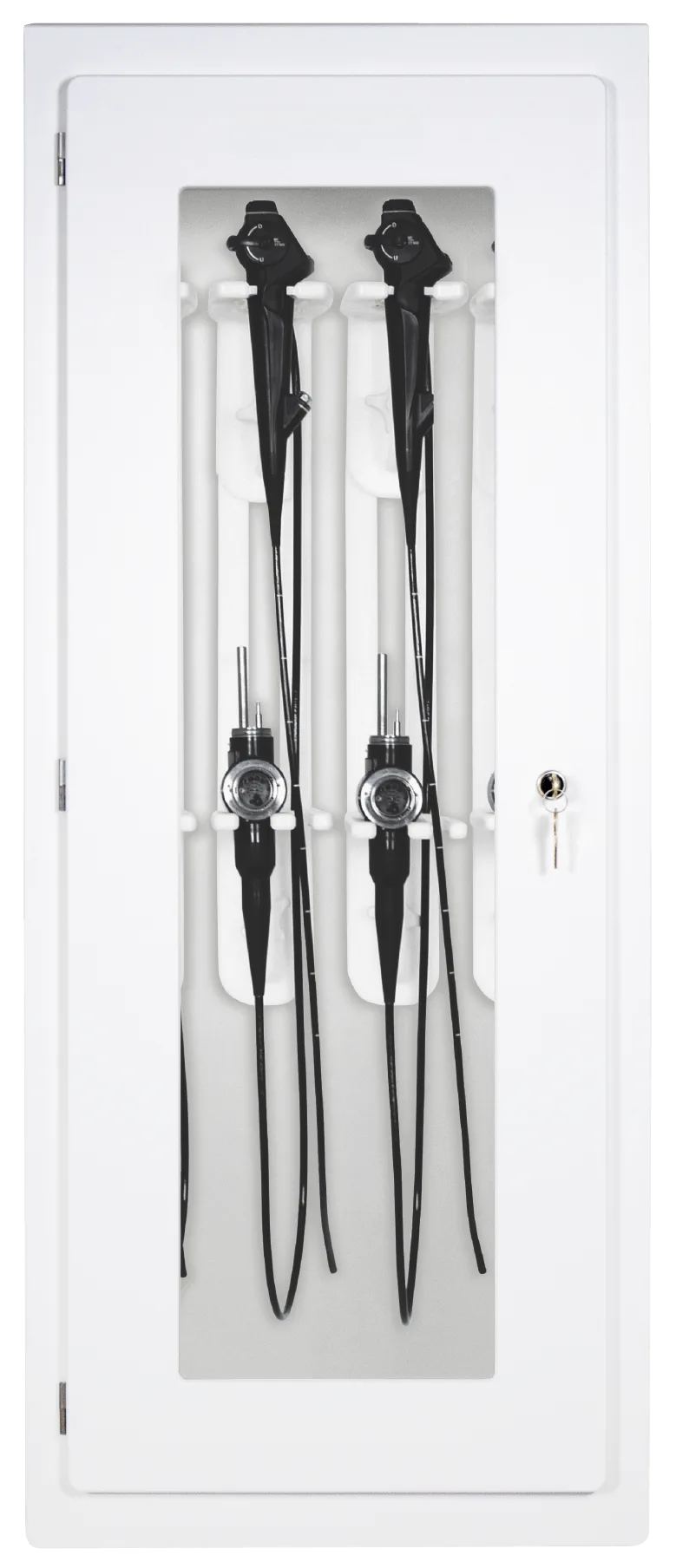
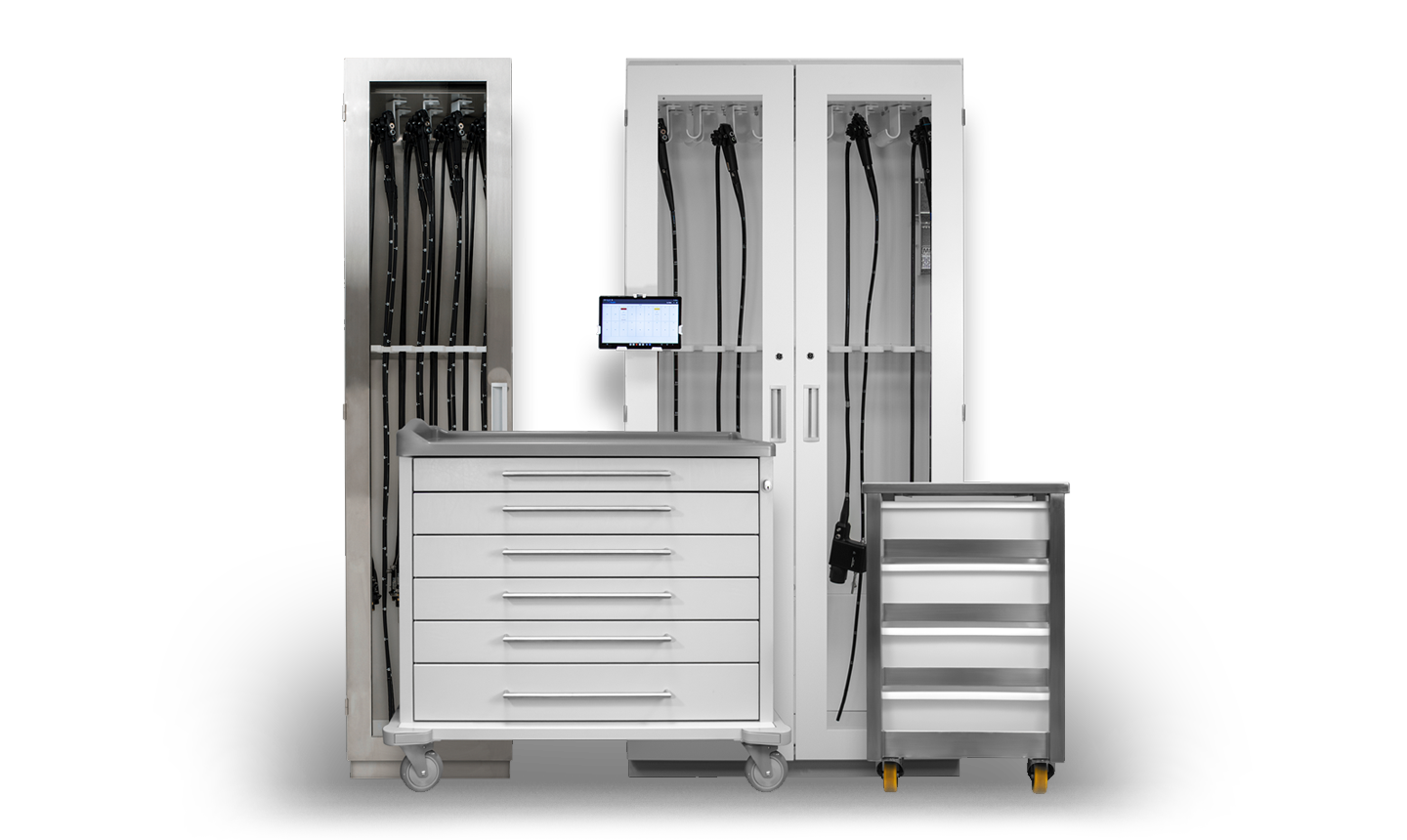
<p>No matter the endoscopy tools used in your healthcare facility, you can’t use it if you can’t find it. <a title="MASS Medical Storage" href="http://www.massmedicalstorage.com" target="_blank">MASS Medical Storage</a> is your superior choice for keeping organized. We build <a title="MASS Medical Storage Endoscopy Storage" href="http://www.massmedicalstorage.com/medical-storage-products/endoscopy-scopes/endoscopy-scopes.php" target="_blank">exceptional storage for endoscopy scopes</a> custom fitted to your specific facility’s needs. The MASS™ Secure-A-Scope cabinets feature a revolutionary new design that sets the standard for scope storage and accessibility. Rotating scope holders make loading and removing scopes easy, safe and secure.</p>
<p>Give us a call at 800-593-1900 or fill out our <a title="QuikQuote" href="http://www.massmedicalstorage.com/mass-quikquote.php" target="_blank">QuikQuote</a> form and we&#8217;ll get you a quote in about 24 hours!</p>
<p>Review information from <a title="Outpatient Surgery" href="http://www.outpatientsurgery.net/" target="_blank">Outpatient Surgery</a> magazine and thanks to Drs. Andrew Mayer, MD; and Edward Paredez, MD</p>
<img src="http://feeds.feedburner.com/~r/AskDrStorbetter/~4/yKlo9TWbqLk" height="1" width="1"/>]]></content:encoded>
			<wfw:commentRss>http://www.massmedicalstorage.com/blog/uncategorized/two-endoscopy-highlights-from-ddw/feed/</wfw:commentRss>
		<slash:comments>0</slash:comments>
		<feedburner:origLink>http://www.massmedicalstorage.com/blog/uncategorized/two-endoscopy-highlights-from-ddw/</feedburner:origLink></item>
		<item>
		<title>Mad Men Era Women Now Facing Lung Cancer</title>
		<link>http://feedproxy.google.com/~r/AskDrStorbetter/~3/Aa8RariGdc4/</link>
		<comments>http://www.massmedicalstorage.com/blog/uncategorized/mad-men-era-women-now-facing-lung-cancer/#comments</comments>
		<pubDate>Fri, 29 Jun 2012 11:42:58 +0000</pubDate>
		<dc:creator>Dr. StorBetter</dc:creator>
				<category><![CDATA[Health News]]></category>
		<category><![CDATA[Uncategorized]]></category>
		<category><![CDATA[cancer]]></category>
		<category><![CDATA[health news]]></category>
		<category><![CDATA[healthy living]]></category>
		<category><![CDATA[lung cancer]]></category>
		<category><![CDATA[smoking]]></category>

		<guid isPermaLink="false">http://www.massmedicalstorage.com/blog/?p=260</guid>
		<description><![CDATA[Research is discovering a correlation in the increase in smoking in women and lung cancer deaths. ]]></description>
			<content:encoded><![CDATA[<p>If you’re a fan of the television series, <em>Mad Men</em> you’ve no doubt noticed that just about every human on the show is smoking. There’s smoking in offices, in elevators and even during dinner, a fork in one hand and a Lucky in the other. The women light up often as the men and they have a kind of “I dare you to stop me,” air about them.</p>
<p>It’s becoming clear that this isn’t an exaggeration.  New research is showing a correlation between the increase in smoking in women born after 1950 and the number of deaths due to lung cancer.</p>
<p>It was about the time of <em>Mad Men</em> that women became more and more empowered and in control of their own lives. This coincided with cigarette campaigns linking smoking and this new independence. The cigarette companies (and ironically, their advertising agencies) convinced women that smoking was an expression of their liberation and self-determination.<a href="http://www.massmedicalstorage.com/blog/wp-content/uploads/2012/06/mad-men-smoking.gif"><img class="alignright size-medium wp-image-265" title="mad-men-smoking" src="http://www.massmedicalstorage.com/blog/wp-content/uploads/2012/06/mad-men-smoking-224x300.gif" alt="" width="224" height="300" /></a></p>
<p>&#8220;In the 60s and 70s, there was a sharp increase in the number of girls, not boys, who started to smoke,&#8221; explained Ahmedin Jemal, vice president of surveillance research for the American Cancer Society</p>
<p>&#8220;These women are now in their 50s, and already we&#8217;re seeing a sharp rise in deaths from lung cancer in this group. Because it&#8217;s occurring in people who are young and middle-aged, if they quit now, they can decrease their lung cancer risk by 50 percent as compared to those who continue to smoke,&#8221; Jemal said.</p>
<p>The research was compiled using data from the National Cancer Institute to identify emerging regional trends in lung cancer death rates from 1973 through 2007.  They were able to find date related to age, sex and race from all 50 states and District of Columbia and examined changes in lung cancer death rates among white women (the research was limited to whites solely due to availability of data) in the 23 states that provided enough data to allow for analysis.</p>
<p>Death rates varied depending on area of the country in which the women lived.  Age-specific lung cancer death rates declined among subjects in California while decreasing less dramatically or even increasing among some southern and Midwestern states. In Alabama, the lung cancer death rate for women born after 1950 is more than double that for those born in 1933.</p>
<p>The discrepancy is startling.  &#8220;Lung cancer follows the smoking pattern,&#8221; says Jemal.</p>
<p>Unlike states in the south and Midwest, California led the way toward reducing smoking with excise taxes on cigarettes and ordinances banning smoking at the workplace and in bars. The state also did a lot to encourage smokers to quit through public awareness campaigns and health services. In contrast the south and Midwestern states were among the last to promote non-smoking.</p>
<p>It’s hard to remember the <em>Mad Men </em>days when smoking was seen as an expression of freedom instead of a deadly habit. And although attitudes towards smoking both personally and publicly have changed and cancer rates are decreasing we are still choosing to risk our lives with every cigarette we smoke.  If you smoke and want to quit there are free resources at <a href="http://www.smokefree.gov">www.smokefree.gov</a>.</p>
<img src="http://feeds.feedburner.com/~r/AskDrStorbetter/~4/Aa8RariGdc4" height="1" width="1"/>]]></content:encoded>
			<wfw:commentRss>http://www.massmedicalstorage.com/blog/uncategorized/mad-men-era-women-now-facing-lung-cancer/feed/</wfw:commentRss>
		<slash:comments>0</slash:comments>
		<feedburner:origLink>http://www.massmedicalstorage.com/blog/uncategorized/mad-men-era-women-now-facing-lung-cancer/</feedburner:origLink></item>
		<item>
		<title>Medical Advances From The Battlefield</title>
		<link>http://feedproxy.google.com/~r/AskDrStorbetter/~3/Gk9fx0PFMPs/</link>
		<comments>http://www.massmedicalstorage.com/blog/uncategorized/medical-advances-from-the-battlefield/#comments</comments>
		<pubDate>Fri, 22 Jun 2012 12:50:54 +0000</pubDate>
		<dc:creator>Dr. StorBetter</dc:creator>
				<category><![CDATA[Health News]]></category>
		<category><![CDATA[Uncategorized]]></category>
		<category><![CDATA[Healthcare]]></category>
		<category><![CDATA[MASS Medical Storage]]></category>
		<category><![CDATA[medicine]]></category>
		<category><![CDATA[planning tool]]></category>
		<category><![CDATA[storage]]></category>

		<guid isPermaLink="false">http://www.massmedicalstorage.com/blog/?p=251</guid>
		<description><![CDATA[Many advances in medicine have come from the battlefield. ]]></description>
			<content:encoded><![CDATA[<p>As America has experienced war its veterans have been the benefit of medical advances that improve with the unique challenges brought on by each conflict. These advances cross over into civilian life and with each new war come more lifesaving techniques for you and I.</p>
<p>New technologies both on the battlefield and in the operating room mean that soldiers are surviving wounds that in past wars would have been fatal. Up to 90% of wounds suffered in present day conflicts are survivable.</p>
<div id="attachment_252" class="wp-caption alignright" style="width: 210px"><a href="http://www.massmedicalstorage.com/blog/wp-content/uploads/2012/06/war_medicine_technology.jpg"><img class="size-medium wp-image-252" title="war_medicine_technology" src="http://www.massmedicalstorage.com/blog/wp-content/uploads/2012/06/war_medicine_technology-200x300.jpg" alt="" width="200" height="300" /></a><p class="wp-caption-text">The battlefield has led to medical advances. </p></div>
<p>Historically, different wars have provided the medical advances that met the unique set of injuries that are inflicted. In the Civil War over thirty thousand veterans came home with amputations. The mortality rate was 35% for field and hospital surgeons struggling to confront the gruesome wounds suffered by both sides.</p>
<p>Moving toward Korea and Vietnam the introduction of the helicopter again meant more and more injured soldiers were surviving their injuries. High velocity bullet wounds weren’t always fatal and so returning vets experienced more brain injuries that previously would have been fatal. This meant advances in neuroscience as the brain began to reveal its mysteries.</p>
<p>The current war in Iraq has introduced a huge growth in a particular type of brain injury. Improvised Explosive Devices (IED) are the crude and unpredictable weapons that cause both amputations as well as what’s known as closed-head injuries where the brain is shocked from the blast with no external signs of injury.  The effect is similar to multiple concussions occurring simultaneously and symptoms may not show up for years. Treating this type of injury will aid not only returning vets but also auto crash and even sports injury victims. Other brain injuries can require hours of delicate and intricate surgeries and doctors are learning more and more about the inner workings of the brain through each and every encounter.</p>
<p>Amputations no longer mean wheelchairs and limited abilities. Stunning advances in robotics, nano-technology and even Bluetooth combine with materials like titanium and carbon to make modern prosthetics an entirely new opportunity to return to a normal life.</p>
<p>The stress of extended tours in both Iraq and Afghanistan have also resulted in the rise of Post Traumatic Stress Disorder (PTSD) and returning vets are in need of counseling and therapy. The stigma is slowly receding as more and more vets seeking treatment. These treatments are also crossing over to treat crime victims and even young victims of bullying.</p>
<p>Advances in medicine from the battlefield spill over into every day life and more and more lives are saved or improved by what is learned in the direst of circumstances. Big jumps in both technology and skill sets that come directly from war mean that ordinary lives thousands of miles away are saved or improved. That at least may salvage some dignity from the indignity perpetuated by war.</p>
<p>Medical breakthroughs mean using new tools and new technologies and this presents new challenges to keeping these tools close at hand and organized. <a title="MASS Medical Storage" href="http://www.massmedicalstorage.com" target="_blank">MASS Medical Storage</a> is continually in the re-design process as we know how critical it is to have scopes, catheters, MRI and CT supplies and any other aid at the ready every time. We offer <a title="Planning Tools" href="http://www.massmedicalstorage.com/PlanningTools.php" target="_blank">planning tools</a> so your every storage need can be met and exceeded so contact us to learn more or browse our site to learn more.</p>
<img src="http://feeds.feedburner.com/~r/AskDrStorbetter/~4/Gk9fx0PFMPs" height="1" width="1"/>]]></content:encoded>
			<wfw:commentRss>http://www.massmedicalstorage.com/blog/uncategorized/medical-advances-from-the-battlefield/feed/</wfw:commentRss>
		<slash:comments>0</slash:comments>
		<feedburner:origLink>http://www.massmedicalstorage.com/blog/uncategorized/medical-advances-from-the-battlefield/</feedburner:origLink></item>
		<item>
		<title>84 Years Later And The Simple Stress Test Is Still Effective</title>
		<link>http://feedproxy.google.com/~r/AskDrStorbetter/~3/tmEXVQbMRwA/</link>
		<comments>http://www.massmedicalstorage.com/blog/uncategorized/84-years-later-and-the-simple-stress-test-is-still-effective/#comments</comments>
		<pubDate>Fri, 15 Jun 2012 10:02:52 +0000</pubDate>
		<dc:creator>Dr. StorBetter</dc:creator>
				<category><![CDATA[Health News]]></category>
		<category><![CDATA[Medical Storage Cabinets]]></category>
		<category><![CDATA[Uncategorized]]></category>
		<category><![CDATA[cardiology]]></category>
		<category><![CDATA[catheter]]></category>
		<category><![CDATA[coronary heart disease]]></category>
		<category><![CDATA[Healthcare]]></category>
		<category><![CDATA[Medical Storage]]></category>
		<category><![CDATA[storage]]></category>
		<category><![CDATA[stress test]]></category>

		<guid isPermaLink="false">http://www.massmedicalstorage.com/blog/?p=245</guid>
		<description><![CDATA[Developed in 1928 the cardiac stress test is still a highly effective diagnostic tool.]]></description>
			<content:encoded><![CDATA[<p>One of the oldest medical tests still in use today is the exercise stress test. First developed in 1928, it&#8217;s still the most widely used medical test for coronary heart disease.</p>
<p><a title="Coronary Heart Disease" href="http://health.nytimes.com/health/guides/disease/coronary-heart-disease/overview.html" target="_blank">Coronary heart disease (CHD)</a> is the leading cause of death in the United States for men and women. CHD is caused by the buildup of plaque in the arteries to your heart which restricts the flow of blood. In the past it was sometimes referred to as hardening of the arteries.</p>
<p>In the journal <em><a title="Current Problems In Cardiology" href="http://www.researchgate.net/publication/223981687_An_update_on_exercise_stress_testing" target="_blank">Current Problems In Cardiology</a></em>, Dr. Martha Gulati of The Ohio State University&#8217;s Wexner Medical Center, states that even though doctors are using procedures such as nuclear heart scans, MRIs and CTs, and even <a title="3D Technology Improving Medical Visualization" href="http://www.massmedicalstorage.com/blog/health-news/3d-technology-improving-medical-visualization/" target="_blank">3D imaging</a>, the benefits of the simple exercise stress test are still valuable.</p>
<p>&#8220;Even though they&#8217;ve been around for nearly a century, they can not only tell us if you currently have heart disease, but can also predict your risk for it in the future,&#8221; said Martha Gulati. &#8220;By today&#8217;s standards these tests may seem low-tech, but they can be highly effective and very efficient in diagnosing heart problems.&#8221;</p>
<p>Dr. Gulati by no means shuns the latest medical procedures, &#8220;In my practice I use a lot of advanced imaging when it&#8217;s appropriate but I think we need to get away from just doing the most expensive test because we can.&#8221;</p>
<p>High-tech imaging can be highly effective but it’s also expensive and often involves radiation which may not be appropriate for all patients. Using the stress test can provide effective guidance for diagnosis and treatment.</p>
<p>&#8220;We need to be doing the right test for our patients, and when the guidelines are strictly followed, for almost all patients who can exercise, the right test, initially, will be the exercise stress test,” said Dr. Gulati.</p>
<p>A stress test involves small electrodes being attached to the body which monitor the heard during exercise. They will record everything from beats per minute, blood pressure, lung capacity, blood flow and recovery times. It’s non-invasive and can even be performed in a doctor’s office.</p>
<p>&#8220;We sometimes get caught up in the latest technology in our society, and often what gets ignored is the simple stuff,&#8221; said Dr. Gulati.</p>
<p>According to Gulati, stress tests can give physicians important predictive information for patients, not just about their immediate health or their current status of coronary disease, but also information that might help predict their risk of developing heart disease in the future.</p>
<p>Sometimes it’s the simple things that can prove to be the most beneficial. A stress test may be all that’s needed to begin a course of treatment for CHD but if further treatment is necessary a heart specialist may elect to use cardiac catheterization as the next step. For those situations it’s important that stent boxes, balloons, guidewires, and other supplies are within reach and efficiently stored. <a title="MASS Medical Storage" href="http://massmedicalstorage.com" target="_blank">MASS Medical Storage</a> offers the best in <a title="Cath Lab Storage Products" href="http://massmedicalstorage.com/medical-storage-products/cath-lab-storage/cath-lab-storage.php" target="_blank">cath lab organization</a> cabinets and procedure carts. Units equipped with our unique, rotating <strong>FifoGlide</strong>™ catheter tracks will increase efficiency as the hooks rotate so the package label is never out of sight even when on the back hook. MASS has engineered better solutions for all medical storage needs which makes the life of healthcare professional a little bit easier.</p>
<p>&nbsp;</p>
<img src="http://feeds.feedburner.com/~r/AskDrStorbetter/~4/tmEXVQbMRwA" height="1" width="1"/>]]></content:encoded>
			<wfw:commentRss>http://www.massmedicalstorage.com/blog/uncategorized/84-years-later-and-the-simple-stress-test-is-still-effective/feed/</wfw:commentRss>
		<slash:comments>0</slash:comments>
		<feedburner:origLink>http://www.massmedicalstorage.com/blog/uncategorized/84-years-later-and-the-simple-stress-test-is-still-effective/</feedburner:origLink></item>
		<item>
		<title>3D Technology Improving Medical Visualization</title>
		<link>http://feedproxy.google.com/~r/AskDrStorbetter/~3/BGXOI_lNu04/</link>
		<comments>http://www.massmedicalstorage.com/blog/health-news/3d-technology-improving-medical-visualization/#comments</comments>
		<pubDate>Fri, 08 Jun 2012 19:59:18 +0000</pubDate>
		<dc:creator>Dr. StorBetter</dc:creator>
				<category><![CDATA[Health News]]></category>
		<category><![CDATA[3D]]></category>
		<category><![CDATA[Healthcare]]></category>
		<category><![CDATA[MASS Medical Storage]]></category>
		<category><![CDATA[medical visualization]]></category>

		<guid isPermaLink="false">http://www.massmedicalstorage.com/blog/?p=237</guid>
		<description><![CDATA[In recent years medical visualization has taken a big leap and this is only the beginning.]]></description>
			<content:encoded><![CDATA[<p>3D technology isn’t just for moviegoers. And if you thought “The Avengers” was amazing you should see your spleen. In recent years medical visualization has taken a big leap and this is only the beginning.</p>
<p>An <a title="From individual to population: Challenges in Medical Visualization  " href="http://arxiv.org/abs/1206.1148" target="_blank">article</a> published on the Cornell University website discusses upcoming advances and their implications. Currently 3D imaging relies on magnetic resonance imaging (MRI) and computed tomography (CT) scanners for its images. In the last few years CT scanners have become available that take images fast enough to make 3D videos of a beating heart.</p>
<p>New technology on the horizon will allow imaging techniques to get down to the molecular and even genetic levels. They will be able to detect issues long before they manifest themselves as tumors, heart disease or cancer.</p>
<p>Imaging techniques are currently being developed that can detect the diffusion of water throughout the body. As water tends to follow nerve bundles and muscle fibers which are difficult to image, mastering this technique will allow new treatments in neuroscience and biomechanics.</p>
<div id="attachment_238" class="wp-caption alignleft" style="width: 286px"><a href="http://www.massmedicalstorage.com/blog/wp-content/uploads/2012/06/3D_imaging_medical.jpg"><img class="size-medium wp-image-238" title="3D_imaging_medical" src="http://www.massmedicalstorage.com/blog/wp-content/uploads/2012/06/3D_imaging_medical-276x300.jpg" alt="" width="276" height="300" /></a><p class="wp-caption-text">3D medical technology will continue to improve and impress.</p></div>
<p>Even more exciting are the newest image processing methods that also allow the addition of realistic lighting effects to create photo-realistic images. This may allow physicians to see the actual shapes of your individual organs and plan more accurate, safer and potentially quicker surgical procedures. It could someday also allow for images of potential outcomes of interventions, in effect show the aftermath even before the actual procedure.</p>
<p>&nbsp;</p>
<p>For teaching and research purposes the visualization of multi-subject data sets is very exciting. It would allow for the collection of images from multiple patients and then combine them in a way to show the progression of a disease or how a particular condition varies among different populations.</p>
<p>As we move closer and closer to “Star Trek” medicine it becomes evident that technology will grant advances to develop life-saving techniques that might even culminate in surgery without even using a knife. But no matter how sci-fi medicine becomes there’s no substitute for compassionate and considerate caregiving. Observing a patient’s liver while still looking into their eyes may be the greatest achievement of all.</p>
<p><a title="MASS Medical Storage" href="www.massmedicalstorage.com" target="_blank">MASS Medical Storage</a> continually develops our technology as well. As medical advances move forward we will also continue to adapt and offer the latest in storage, <a title="MASS Medical Storage Cabinets" href="http://www.massmedicalstorage.com/medical-storage-products/medical-cabinets/medical-storage-cabinets.php" target="_blank">cabinet</a> and <a title="MASS Medical Storage Carts" href="http://www.massmedicalstorage.com/medical-storage-products/medical-carts/medical-storage-carts.php" target="_blank">cart</a> options for nurses and clinicians. MASS Medical Storage products offer increased storage and easy maneuverability as well as highly specific <a title="MASS Medical Storage Components" href="http://www.massmedicalstorage.com/medical-storage-products/medical-storage-components/medical-storage-components.php" target="_blank">interiors</a> custom designed for the specific needs of each department to keep healthcare professionals at the top of their game.</p>
<p>&nbsp;</p>
<p>&nbsp;</p>
<img src="http://feeds.feedburner.com/~r/AskDrStorbetter/~4/BGXOI_lNu04" height="1" width="1"/>]]></content:encoded>
			<wfw:commentRss>http://www.massmedicalstorage.com/blog/health-news/3d-technology-improving-medical-visualization/feed/</wfw:commentRss>
		<slash:comments>0</slash:comments>
		<feedburner:origLink>http://www.massmedicalstorage.com/blog/health-news/3d-technology-improving-medical-visualization/</feedburner:origLink></item>
		<item>
		<title>Paralyzed Rats Learn To Walk</title>
		<link>http://feedproxy.google.com/~r/AskDrStorbetter/~3/47JnilYeDis/</link>
		<comments>http://www.massmedicalstorage.com/blog/uncategorized/paralyzed-rats-learn-to-walk/#comments</comments>
		<pubDate>Tue, 05 Jun 2012 11:46:54 +0000</pubDate>
		<dc:creator>Dr. StorBetter</dc:creator>
				<category><![CDATA[Health News]]></category>
		<category><![CDATA[Uncategorized]]></category>
		<category><![CDATA[health news]]></category>
		<category><![CDATA[Healthcare]]></category>
		<category><![CDATA[MASS Medical Storage]]></category>
		<category><![CDATA[paralysis]]></category>
		<category><![CDATA[planning tool]]></category>

		<guid isPermaLink="false">http://www.massmedicalstorage.com/blog/?p=230</guid>
		<description><![CDATA[A study published this week in Science details how paralyzed rats learned to walk, run and even jump.]]></description>
			<content:encoded><![CDATA[<div id="attachment_231" class="wp-caption alignleft" style="width: 310px"><a href="http://www.massmedicalstorage.com/blog/wp-content/uploads/2012/06/spinalcordrats.jpg"><img class="size-medium wp-image-231  " title="spinalcordrats" src="http://www.massmedicalstorage.com/blog/wp-content/uploads/2012/06/spinalcordrats-300x200.jpg" alt="" width="300" height="200" /></a><p class="wp-caption-text">Paralyzed rats &quot;learn&quot; to walk again. Ecole Polytechnique Federale de Lausanne / AP</p></div>
<p>If you had a spinal cord injury what might motivate you to force your  brain and spinal cord to create new pathways to each other? For rats in  Switzerland it’s really good chocolate, naturally. A <a title="Paralyzed Rats Learn To Walk Again" href="http://newsfeed.time.com/2012/06/03/paralyzed-rats-learn-to-walk-again-in-rehabilitation-experiment/" target="_blank">study</a> published  this week in <a title="Science " href="http://www.sciencemag.org/content/336/6085/1182" target="_blank">Science</a> details how paralyzed rats learned to walk, run and  even jump over obstacles after being put on a training program that  included electrical and chemical stimulations of their broken spinal  cords and a “robotic postural interface”.</p>
<p>This suggests that for humans with spinal cord injuries it may be possible to create completely new pathways from brain to spinal cord instead of regenerating the damaged area. The authors of the study compare the process to how infants with incomplete nervous systems learn by experience to sync their brains and bodies to walk, crawl and run.</p>
<p>Persuading the new route to activate took four key components: three neurotransmitters (serotonin, dopamine and norepinephrine) injected into the epidural space, a continuous flow of electrical energy from electrodes near the site of the damage, a curious rehabilitation rig that supported the unsteady animal that initially forced movement of the legs all working together on a training course with real world obstacles.</p>
<p>After six weeks of intense training on the uneven terrain, including essentially dragging them along at first,  all 10 rats in the study regained the capacity to walk voluntarily “and even to sprint up a staircase,” says study co-author Gregoire Courtine, a research scientist in spinal cord repair at the Ecole Polytechnique Federale de Lausanne in Switzerland.</p>
<p>There are almost a quarer of a million people in the US with spinal cord injuries and just over half are paraplegic. Each year 11,000 new injuries occur and most of them are in young males. The advances in medicine on the battlefield also contribute to a rise in paralyzed veterans who, in earlier years, may have died.</p>
<p>“This is not an intervention that will cure spinal cord injury; we need to be realistic here,” Courtine said in an interview. For people with complete or near-complete severing of the spinal cord, the study authors wrote, “undoubtedly, neuroregeneration will be essential.” That may be a job for stem-cell therapies years away from reality.</p>
<p>But he was encouraging for the immediate future that humans may have the “remarkable capacity of spared neuronal systems to reorganize” themselves. Courtine hopes to begin Phase 2 with human subjects within a couple of years.</p>
<p><a title="MASS Medical Storage" href="http://www.massmedicalstorage.com" target="_blank">MASS Medical Storage</a> designs customizable cabinets, procedure carts and scope storage for healthcare facilities. They keep valuable tools in line for nurses and clinicians who perform minor miracles every day. Our website contains a short <a title="MASS Medical Storage Planning Tools" href="http://www.massmedicalstorage.com/PlanningTools.php" target="_blank">video</a> about how our planning tools can help you design the perfect storage unit for your needs.</p>
<img src="http://feeds.feedburner.com/~r/AskDrStorbetter/~4/47JnilYeDis" height="1" width="1"/>]]></content:encoded>
			<wfw:commentRss>http://www.massmedicalstorage.com/blog/uncategorized/paralyzed-rats-learn-to-walk/feed/</wfw:commentRss>
		<slash:comments>0</slash:comments>
		<feedburner:origLink>http://www.massmedicalstorage.com/blog/uncategorized/paralyzed-rats-learn-to-walk/</feedburner:origLink></item>
	</channel>
</rss>