<?xml version="1.0" encoding="UTF-8"?>
<feed xml:lang="en" xmlns="http://www.w3.org/2005/Atom" xmlns:opensearch="http://a9.com/-/spec/opensearch/1.1/" xmlns:s="http://jadedpixel.com/-/spec/shopify">
  <id>https://thearcherhotyogatowel.com/blogs/some-like-it-hot.atom</id>
  <link rel="alternate" type="text/html" href="https://thearcherhotyogatowel.com/blogs/some-like-it-hot"/>
  <link rel="self" type="application/atom+xml" href="https://thearcherhotyogatowel.com/blogs/some-like-it-hot.atom"/>
  <title>Bull and Bow - Some Like it Hot 🔥Hot Yoga and Your Body</title>
  <updated>2020-06-22T12:48:00+10:00</updated>
  <author>
    <name>Bull and Bow</name>
  </author>
  <entry>
    <id>https://thearcherhotyogatowel.com/blogs/some-like-it-hot/mirror-mirror-on-the-wall</id>
    <published>2020-06-22T12:48:00+10:00</published>
    <updated>2020-06-23T10:37:57+10:00</updated>
    <link rel="alternate" type="text/html" href="https://thearcherhotyogatowel.com/blogs/some-like-it-hot/mirror-mirror-on-the-wall"/>
    <title>Mirror mirror, on the wall.</title>
    <author>
      <name>Jacki Owen</name>
    </author>
    <content type="html">
      <![CDATA[<meta charset="utf-8">
<section class="fu fv fw fx fy">
<div class="n p">
<div class="z ab ac ae af fz ah ai">
<div style="float: left;">
<p class="ga gb ap bx gc b gd ge go gf gg gp gh gi gq gj gk gr gl gm gs gn" style="text-align: center;"> </p>
<meta charset="utf-8">
<p class="ga gb ap bx gc b gd ge go gf gg gp gh gi gq gj gk gr gl gm gs gn"><img src="//cdn.shopify.com/s/files/1/0121/2900/9760/files/mirror4.png?v=1592810674" alt=""></p>
<h2 class="ga gb ap bx gc b gd ge go gf gg gp gh gi gq gj gk gr gl gm gs gn">Who is the fairest one of all?</h2>
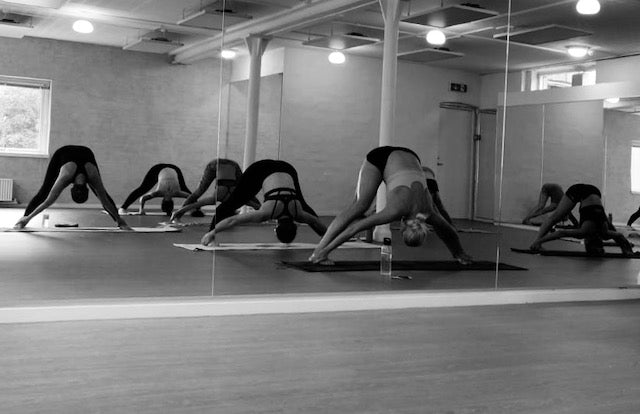
<p id="177d" class="ga gb ap bx gc b gd ge go gf gg gp gh gi gq gj gk gr gl gm gs gn">The Evil Queen would probably be perfectly content admiring her reflection in the giant mirrors of the yoga room, (only until Snow White rolled her mat out in <strong>her</strong> spot and then all hell would break loose). </p>
<p class="ga gb ap bx gc b gd ge go gf gg gp gh gi gq gj gk gr gl gm gs gn">But for some of us those mirrors, or more accurately the <strong>reflection</strong> in the mirrors, can be a challenging prospect without engaging a certain level of detachment. </p>
<p class="ga gb ap bx gc b gd ge go gf gg gp gh gi gq gj gk gr gl gm gs gn">Adopting a more detached approach to our reflection by removing the emotional values we place on it is a handy lesson from our Insular Cortex. </p>
<h3 class="ga gb ap bx gc b gd ge go gf gg gp gh gi gq gj gk gr gl gm gs gn">Change your frame of reference.</h3>
<img alt="glasses" src="//cdn.shopify.com/s/files/1/0121/2900/9760/files/noun_Glasses_1359016_medium.png?v=1592707782" style="float: left; margin-right: 5px;">If<em> detachment</em> feels cold, remote and unfeeling, remember that other definitions of <span>d</span>etachment include<span> </span><strong class="ka ko">objective</strong> or <strong>separate</strong>, as in ‘detached housing’.  Objectively speaking a detached house isn’t cold or aloof, just able to take a metaphorical step back.</div>
<p style="float: left;">To face your reflection in full length mirrors, under bright lights all while wearing form fitting active-wear requires detachment for us to see ourselves through a different lens. Turning down the volume on our inner monologue for 90 minutes to become more aware of our default responses to our reflection and our practice takes <strong>practice</strong>. </p>
<p style="float: left;"> </p>
<div style="float: left;"></div>
<p style="float: left;"><strong>Why practice detachment?</strong></p>
<p style="float: left;">Although challenging, successful detachment is rewarding. We become more teachable, aware of our knee-jerk emotional responses, open to or self acceptance. Would a more detached approach might benefit your yoga practice?</p>
</div>
</div>
</section>
<section class="fu fv fw fx fy">
<div class="n p" style="text-align: left;">
<h3 class="z ab ac ae af fz ah ai"></h3>
<h3 class="z ab ac ae af fz ah ai"> </h3>
<h3 class="z ab ac ae af fz ah ai">1. Stop cataloguing your strengths and weaknesses.</h3>
<img alt="" src="//cdn.shopify.com/s/files/1/0121/2900/9760/files/noun_List_3210205_medium.png?v=1592708264" style="float: left;">
<div class="z ab ac ae af fz ah ai"></div>
</div>
<div class="n p">
<p id="df67" class="jy kk ap bx ka b gu kb kl gw kc km kd ke hh kf kg hi kh ki hj kj fu" data-selectable-paragraph="" style="text-align: left;">We've been conditioned to believe this a good thing, to bring awareness to our strengths and weaknesses, to catalogue the areas we can improve on and others we shine in. Not everything that <strong>seems</strong> like a good idea actually <em>is</em> a good idea, just ask the producers of the movie Cats. </p>
<p class="jy kk ap bx ka b gu kb kl gw kc km kd ke hh kf kg hi kh ki hj kj fu" data-selectable-paragraph="" style="text-align: left;">When we assess our strengths and weaknesses we have a tendency to find lots of fault(s) and the occasional tiny slivers of positivity. </p>
<p class="z ab ac ae af fz ah ai" style="text-align: left;"><em><strong>"I am terrible at balancing postures. I'll never be able to do *insert posture name here*".</strong></em></p>
<p class="z ab ac ae af fz ah ai" style="text-align: left;"><em><strong>"I'm too fat/thin/bald/hairy? It's hideous."</strong></em></p>
<p class="z ab ac ae af fz ah ai" style="text-align: left;"><em><strong>"I suppose my eyebrows are okay." </strong></em></p>
<blockquote class="le lf lg"></blockquote>
<meta charset="utf-8">
<p class="z ab ac ae af fz ah ai"><strong>Good v Bad.</strong></p>
<p class="z ab ac ae af fz ah ai"><span>As soon as we allocate </span><strong class="ka ko">value </strong>to something about ourselves,<span> no matter</span><span> whether we determine it to be a strength ‘good’ (i.e. eyebrows) or a weakness ‘bad’ (i.e. our balance) we are locked into how we</span><span> </span><strong class="ka ko">feel </strong><span>about that 'thing' </span><span>unless we <strong>change</strong></span><span> </span><span>that </span>thing<span>. We now have to get better at balancing (or whatever) to shift it to the 'good' column leaving no way to accept ourselves and our yoga (and our balance!) simply as we are.</span></p>
<p class="z ab ac ae af fz ah ai"><span>This is also true for features that we 'hate' about ourselves (mine used to be my feet), as long as we call them bad or ugly we are locked into feeling that way until we change them, and that my friends is how we end up with something as tragic as labiaplasty (Google it at your peril). </span></p>
</div>
</section>
<section class="fu fv fw fx fy">
<div class="n p">
<h3 class="z ab ac ae af fz ah ai">2. Forget arbitrary measurements. </h3>
<div class="z ab ac ae af fz ah ai">
<img alt="tape measure" src="//cdn.shopify.com/s/files/1/0121/2900/9760/files/noun_Tape_Measure_3404441_medium.png?v=1592708461" style="float: left;">
<p id="da4c" class="jy kk ap bx ka b gu kb kl gw kc km kd ke hh kf kg hi kh ki hj kj fu" data-selectable-paragraph="">Most of the measures we use when we observe ourselves are totally arbitrary and based on comparisons either to ourselves on a different day or to others around us. </p>
<p class="jy kk ap bx ka b gu kb kl gw kc km kd ke hh kf kg hi kh ki hj kj fu" data-selectable-paragraph="" style="padding-left: 30px;"><strong>"What is <em>wrong</em> with me today? I can normally do this posture no problem."</strong></p>
<p class="jy kk ap bx ka b gu kb kl gw kc km kd ke hh kf kg hi kh ki hj kj fu" data-selectable-paragraph="" style="padding-left: 30px;"><strong>"Snow White is so beautiful, her nose is perfect and her postures are amazing! I'll never look as good as that."</strong></p>
<p class="jy kk ap bx ka b gu kb kl gw kc km kd ke hh kf kg hi kh ki hj kj fu" data-selectable-paragraph="">Trying to stop this kind of deeply ingrained behaviour is hard. Sometimes even to notice that we are doing it is a challenge. Try the example below as a template for detaching yourself from this kind of comparison and measurement. </p>
<p class="jy kk ap bx ka b gu kb kl gw kc km kd ke hh kf kg hi kh ki hj kj fu" data-selectable-paragraph="" style="text-align: center;"><img alt="" src="//cdn.shopify.com/s/files/1/0121/2900/9760/files/noun_line_3212705_1_medium.png?v=1592709094" style="float: none; margin-top: -100px; margin-bottom: -100px;"></p>
<p id="d6f2" class="jy kk ap bx ka b gu kp kl gw kq km kd kr hh kf ks hi kh kt hj kj fu" data-selectable-paragraph=""><strong class="ka ko">Question</strong>: Is twenty degrees celsius cold or hot?</p>
<p id="b163" class="jy kk ap bx ka b gu kp kl gw kq km kd kr hh kf ks hi kh kt hj kj fu" data-selectable-paragraph=""><strong class="ka ko">Answer</strong>: It is neither cold nor hot. It’s twenty degrees. Cold or hot is our comparative (and emotional) response to the temperature. How we <strong>feel</strong> depends what our usual experience of twenty degrees is. Are we acclimated to higher or lower temperatures? Is the sun shining? Is it windy? Is it raining? Am I dressed for twenty degrees?</p>
<p class="jy kk ap bx ka b gu kp kl gw kq km kd kr hh kf ks hi kh kt hj kj fu" data-selectable-paragraph="" style="text-align: center;"><img alt="" src="//cdn.shopify.com/s/files/1/0121/2900/9760/files/noun_line_3212705_1_medium.png?v=1592709094" style="float: none; margin-top: -100px; margin-bottom: -100px;"></p>
<p id="baba" class="jy kk ap kn ka b gu kp kl gw kq km kd kr hh kf ks hi kh kt hj kj fu" data-selectable-paragraph="" style="text-align: left;"><strong>What does the temperature have to do with your inner critic?</strong></p>
<p id="b4fa" class="jy kk ap bx ka b gu kp kl gw kq km kd kr hh kf ks hi kh kt hj kj fu" data-selectable-paragraph="">Well it’s like this, your balance is neither good nor bad (nor cold or hot!), it is just your balance. If you like, try replacing balance with any other body part or trait. Your teeth, your breasts, your feet, your laugh, introversion, extraversion, whatever. Our<span> </span><strong class="ka ko">judgement</strong><span> </span>of these things as good or bad is driven by comparison not reality.</p>
</div>
</div>
</section>
<section class="fu fv fw fx fy">
<div class="n p">
<h3 class="z ab ac ae af fz ah ai">3. Choose your own thoughts.</h3>
<img alt="thought bubble" src="//cdn.shopify.com/s/files/1/0121/2900/9760/files/noun_Thought_41306_medium.png?v=1592710524" style="margin-right: 5px; float: left;">
<div class="z ab ac ae af fz ah ai">
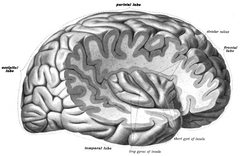
<p id="d965" class="jy kk ap bx ka b gu kb kl gw kc km kd ke hh kf kg hi kh ki hj kj fu" data-selectable-paragraph="">Deep within your cerebral cortex, behind your frontal lobe sits your insular cortex. This lobe acts as an interpreter, it notices what’s happening<span> </span><strong class="ka ko">internally</strong><span> in your body and </span>translates these sensations into appropriate emotional responses. It’s a remarkable function known as<span> </span><a href="http://kelly-mahler.com/what-is-interoception/" class="cm jf jg jh ji jj" target="_blank" rel="nofollow noopener noreferrer">interoception</a>.</p>
<p id="3838" class="jy kk ap bx ka b gu kp kl gw kq km kd kr hh kf ks hi kh kt hj kj fu" data-selectable-paragraph="">It works like this. Imagine your bladder is full, your insular cortex receives the sensation of pressure and fullness and responds by conveying an appropriate response. If your bladder holds a total of one litre of fluid and is currently pretty close to that limit then an appropriate response is something along the lines of:</p>
<p class="le lf lg"><strong>‘I need to go to the bathroom to empty my bladder.’</strong></p>
<p>Consider for a moment the futility of the responses below:</p>
<p class="le lf lg"><strong>’You useless idiot, how can anyone have a bladder so tiny? If only you had a bladder as big as *celebrity name here* then your life would be much better’."</strong></p>
<p class="le lf lg"><strong>or</strong></p>
<p class="le lf lg"><strong>Why is my bladder full already? Yesterday I was able to drink way more water and didn't need to go to the bathroom anywhere nearly as often. I'm hopeless."</strong></p>
<p id="b493" class="jy kk ap bx ka b gu kp kl gw kq km kd kr hh kf ks hi kh kt hj kj fu" data-selectable-paragraph="">In this way the insular cortex gives us an example of self-detached observation that can be useful to adopt. </p>
</div>
</div>
</section>
<section class="fu fv fw fx fy">
<div class="n p">
<div class="z ab ac ae af fz ah ai">
<h3 id="d001" class="jk jl ap bx bw ej jm jn jo jp jq jr js jt ju jv jw">4. What would my IC (insular cortex) say?</h3>
<img alt="" src="//cdn.shopify.com/s/files/1/0121/2900/9760/files/noun_Brain_872851_medium.png?v=1592710626" style="float: left;">If you catch yourself defaulting to critical judgement have a go at implementing this type of detached thinking. For example, imagine you are practicing Tree Pose and fall out of the posture, do you allow yourself to indulge in the type of internal commentary below?
<p class="le lf lg"><strong>a) Reactive comparison </strong><em>‘This is so embarrassing! I'm the only person in the room falling out of this posture.'</em></p>
<p class="le lf lg">or</p>
<p class="le lf lg"><strong>b) Internal criticism<em class="bx"> </em></strong><em>‘My balance is so terrible, I'm never going to be able to do this pose. I don't know why I even bother with this’. </em></p>
</div>
<p class="z ab ac ae af fz ah ai"><strong>Instead think about how it feels?</strong></p>
<p class="z ab ac ae af fz ah ai">Can you instead draw your attention to the <strong>physical</strong> sensations of the posture instead of your emotional reaction? Both when you fall out of the pose <strong>and</strong> when you hold it for longer. With detachment and without judgement ask yourself if your weight is on the heel or ball of your foot? Is your core contracted or relaxed. Where is your gaze resting? Notice small things such as the direction when you lean or fall. What is your breath doing? Where do you get stuck? </p>
<p class="z ab ac ae af fz ah ai"><strong>Notice yourself.</strong></p>
<p class="z ab ac ae af fz ah ai">Notice these things then use the information to provide objective feedback to yourself. For example: 'When my weight is forward on my toes I lean more forward and tend to fall out and reach down. If I lean back more and shift my centre of gravity toward my heel that creates a different outcome.'  Do the same when you 'successfully' do a posture. Examine the physical sensations of holding the posture with ease, what did you feel? Where did you feel it? Can you replicate it? </p>
</div>
</section>
<section class="fu fv fw fx fy">
<h3 class="z ab ac ae af fz ah ai">5. There is no such thing as perfect.</h3>
<p id="e087" class="jy kk ap bx ka b gu kb kl gw kc km kd ke hh kf kg hi kh ki hj kj fu" data-selectable-paragraph=""><img alt="diverse" src="//cdn.shopify.com/s/files/1/0121/2900/9760/files/noun_Fish_174385_medium.png?v=1592791397" style="float: left;">Your insular cortex isn’t perfect either, occasionally (or more often) misinterpreting internal sensations such as a racing heartbeat as anxiety when excitement would be more appropriate. If you don’t manage to magically implement this practice perfectly <strong>every single time</strong> overnight, congratulations, you're human.</p>
<p class="jy kk ap bx ka b gu kb kl gw kc km kd ke hh kf kg hi kh ki hj kj fu" data-selectable-paragraph=""><strong>It's a practice.</strong></p>
<p class="jy kk ap bx ka b gu kp kl gw kq km kd kr hh kf ks hi kh kt hj kj fu" data-selectable-paragraph="">If you catch yourself, for example, berating yourself because your jeans are a smidge too tight (i.e. '<em>how could you let yourself go like this? Why do you have so little willpower? Lockdown isn't an excuse to just turn into a slob!</em>') take a step back and put your yoga pants on instead. You can choose to do the math and eat less buttered digestive biscuits and increase your physical. activity until the jeans fit again without feeling the need to add anything else to the story about personal weaknesses, laziness or any other traits. </p>
<p class="jy kk ap bx ka b gu kp kl gw kq km kd kr hh kf ks hi kh kt hj kj fu" data-selectable-paragraph="">That might just be me?</p>
<p class="jy kk ap bx ka b gu kp kl gw kq km kd kr hh kf ks hi kh kt hj kj fu" data-selectable-paragraph="">And remember, at least you're not responsible for a $100m film adaptation of a musical about cats that was watched by half a dozen people.</p>
<h3 class="jy kk ap bx ka b gu kp kl gw kq km kd kr hh kf ks hi kh kt hj kj fu">A final word on the Insular Cortex.</h3>
<img alt="insular cortex" src="//cdn.shopify.com/s/files/1/0121/2900/9760/files/Sobo_1909_633_medium.png?v=1592630769" style="display: block; float: left; margin-left: auto; margin-right: 5px;">
<p class="jy kk ap bx ka b gu kp kl gw kq km kd kr hh kf ks hi kh kt hj kj fu" data-selectable-paragraph="">Many of the regions of the brain are positively impacted through yoga practice. The Insular Cortex is mediated by yoga practice, leading to increased interoceptive awareness and <strong><a href="https://www.ncbi.nlm.nih.gov/pmc/articles/PMC4153807/" title="yoga and the insular cortex">pain tolerance in yoga practitioners</a></strong>.  <strong><a href="https://www.hindawi.com/journals/ecam/2012/821307/" title="insular cortex and yoga research">Research </a></strong>has also<strong> </strong>shown that yoga practice increases grey matter density and white matter connectivity in the Insular Cortex.</p>
<p class="n p">Image credit: Dr. Johannes Sobotta - Sobotta's Textbook and Atlas of Human Anatomy 1908, Public Domain. </p>
</section>
</section>
<section class="fu fv fw fx fy">
<p class="jy kk ap bx ka b gu kp kl gw kq km kd kr hh kf ks hi kh kt hj kj fu" data-selectable-paragraph=""> </p>
</section>
<div class="mailmunch-forms-widget-884247"></div>]]>
    </content>
  </entry>
  <entry>
    <id>https://thearcherhotyogatowel.com/blogs/some-like-it-hot/why-we-need-yoga-more-than-ever</id>
    <published>2020-05-11T14:53:00+10:00</published>
    <updated>2020-05-15T10:11:17+10:00</updated>
    <link rel="alternate" type="text/html" href="https://thearcherhotyogatowel.com/blogs/some-like-it-hot/why-we-need-yoga-more-than-ever"/>
    <title>Why we need yoga more than ever.</title>
    <author>
      <name>Jacki Owen</name>
    </author>
    <content type="html">
      <![CDATA[<meta charset="utf-8">
<h2 style="text-align: center;"><img src="//cdn.shopify.com/s/files/1/0121/2900/9760/files/yoga_can_support_isolated_people_large.png?v=1589166925" alt="why we need yoga more than ever"></h2>
<h2>Anxiety and depression in isolation. </h2>
<p class="p1"><span class="s1">The <strong>lockdown</strong> of our communities during the Covid-19 Pandemic can be particularly difficult for those who suffer from symptoms of anxiety and/or depression. The loss of social connection, structure and routine and physical outlets can worsen the symptoms for those already struggling with these conditions or precipitate the onset of them in those who may have never experienced them in the past. To help keep this at bay maintaining a regular yoga practice is more important than ever. </span></p>
<h3>Social isolation is a health risk.</h3>
<p class="p1" style="float: left;"><span class="s1"><img alt="depression and anxiety" src="//cdn.shopify.com/s/files/1/0121/2900/9760/files/noun_Over_Thinking_1584207_bbb401b5-dd82-474a-8a06-3df70eb3e570_compact.png?v=1589169379" style="margin-right: 5px; float: left;">Social isolation can have </span><span class="s2"><b>as big</b></span><span class="s1"> an impact on our health as smoking or obesity and increases the risk of premature death. <a href="https://www.apa.org/monitor/2019/05/ce-corner-isolation"><span class="s3"><b>Research</b></span></a> has also demonstrated links between isolation and depression, poor sleep, cognitive decline and even impaired immunity. </span></p>
<h3><span class="s1">Exercise withdrawal can induce depression.</span></h3>
<p class="p1"><span class="s1">Even for those who haven't previously experienced depression or anxiety, the cessation of their usual physical activity can precipitate the onset of symptoms.<b> </b><a href="https://medicalxpress.com/news/2018-03-symptoms-depression.html"><span class="s3"><b>Research</b></span></a> from the University of Adelaide has shown that for regular exercisers it can take just <strong>three days</strong> of inactivity for symptoms of depression to present. These findings confirmed an earlier <a href="https://www.ncbi.nlm.nih.gov/pubmed/28625704"><span class="s3"><b>review</b></span></a> that found exercise withdrawal has negative consequences for mental health.</span></p>
<h3 class="p1"><span class="s1">Active people are happier people. </span></h3>
<img alt="active people are happier people" src="//cdn.shopify.com/s/files/1/0121/2900/9760/files/noun_Yoga_Instructor_974383_compact.png?v=1589170459" style="float: right; margin-left: 5px;">Being <strong>active</strong>, not just exercising, is linked to happiness. A <a href="https://journals.plos.org/plosone/article?id=10.1371/journal.pone.0160589"><span class="s2"><b>study</b></span></a> of over ten thousand people found that just standing up and moving around is a predictor of happiness.
<h2 class="p1">
<br>Yoga improves symptoms of anxiety and depression.</h2>
<p class="p1"><span class="s1">A group of people with Major Depressive Disorder (MDD) participated in a <a href="https://journals.lww.com/practicalpsychiatry/Abstract/2019/11000/Psychological_Function,_Iyengar_Yoga,_and_Coherent.4.aspx"><span class="s2"><b>clinical trial</b></span></a> assessing different 'doses' of yoga. The high dose group took <strong>three 90 minute yoga classes per week</strong> with four 30 minute homework sessions per week for twelve weeks while the low dose group did two 90 minute classes and three 30 minute homework sessions per week. After twelve weeks both groups had  "<i><strong>reduced symptoms of depression</strong> and anxiety and <strong>increased feelings of positivity</strong></i>". </span></p>
<p class="p1"><img src="//cdn.shopify.com/s/files/1/0121/2900/9760/files/yoga.png?v=1589171024" alt="yoga improves anxiety and depression" style="display: block; margin-left: auto; margin-right: auto;"></p>
<h3 class="p1"> The social bonds of yoga.</h3>
<p class="p1"><span class="s1">While yoga itself has an effect on the physical and emotional wellbeing of the practitioner, yoga also has a positive impact on the feeling of connection and trust that a group experience when <strong>practicing together.</strong> <a href="https://www.ncbi.nlm.nih.gov/pmc/articles/PMC3291107/pdf/nihms-359331.pdf"><span class="s2"><b>Research</b></span></a> shows that the steepness of a hill is judged to be less difficult when you are walking up the incline with a friend than when you walk it alone. Things just feel easier when we do them together.</span></p>
<h3 class="p1"><span class="s1">The power of synchronised movement.</span></h3>
<meta charset="utf-8">
<p><span class="s1">Synchronised movement has a powerful effect on groups. Whether it is dancing to the same steps (think Nutbush CIty Limits), marching on parade or doing a group yoga class the effect is <strong>unifying</strong>. This effect has been shown to increase cooperation and other prosocial behaviours (things like helping, donating and sharing) from those who participate in synchronised activity such as yoga. This comes about through the feeling of one-ness that we experience when we move in unison with others. </span></p>
<p><span class="s1"><img src="//cdn.shopify.com/s/files/1/0121/2900/9760/files/ec828b77-99e8-4a43-95b2-5ee3b7730024.jpeg?v=1589171498" alt="yoga is a powerful form of synchronised movement"></span></p>
<h2><span class="s1">But my yoga studio is closed!</span></h2>
<p style="float: left;"><span class="s1"><img alt="closed sign" src="//cdn.shopify.com/s/files/1/0121/2900/9760/files/noun_Closed_434096.png?v=1589171942" style="margin-right: 5px; float: left;">While it isn't perfect, a home practice can offer opportunities (reduced commute time) and an opportunity to <strong>connect</strong> with yourself and with your studio and maybe even include your family. Or maybe not if you live in my house....  The are a lot of benefits including:</span></p>

<h3> Keeping your activity levels up.</h3>
<p class="p1"><span class="s1">Engaging in a home practice during a difficult time can certainly help keep your activity levels up. As well as the physical benefits there are upsides to creating space for yourself, allocating time to engage in an activity designed to look after your wellbeing. </span></p>
<h3> Is online yoga a viable alternative?</h3>
<p class="p1"><span class="s1">While studios are closed (hopefully not for much longer!) there are a wealth of options for keeping up your practice up while in isolation. From youtube videos to yoga apps there are many options for a wide variety of practices.</span></p>
<p class="p1" style="float: left;"><span class="s1"><a href="https://www.downdogapp.com/"><b><img alt="down dog yoga app" src="//cdn.shopify.com/s/files/1/0121/2900/9760/files/down_dog_yoga_app_compact.png?v=1589168416" style="float: left; margin-right: 5px; margin-bottom: 5px;">YOME</b></a></span><span class="s2"> has a huge array of videos embracing many different yoga styles from Bikram to Power Yoga. <a href="https://www.youtube.com/user/yogawithadriene/featured"><span class="s1"><b>Yoga with Adriene</b></span></a> is a youtube powerhouse and has great beginner videos and also offers short practices and there are a dizzying array of apps available. <a href="https://www.downdogapp.com/"><span class="s1"><b>Down Dog</b></span></a> is offering totally free access to their app until July 1st 2020 (no credit card required!).</span></p>
<p class="p1" style="float: left;">  </p>
<p class="p1" style="float: left;"> </p>
<h3 class="p1" style="float: left;"><span class="s2"></span></h3>
<h3 class="p1" style="text-align: left;"> Virtual Yoga.</h3>
<p class="p1" style="text-align: left;"><span class="s1">But if you want to get the benefits of your yoga practice on your health and wellbeing <strong>AND</strong> you want to get the social and emotional benefits of practicing with others try looking into <b>virtual classes</b>. Check to see if your local studio is offering classes via <b>Zoom</b> or other group platforms and join them. Or search online using an app such as MindBody to see if you can schedule a virtual class with another studio. Instagram Live has a multitude of classes and options to try. (*Zoom yoga class Image thanks to Instagram). </span></p>
<img alt="" src="//cdn.shopify.com/s/files/1/0121/2900/9760/files/zoom_yoga_medium.png?v=1589168290" style="margin-right: 5px; float: left;">
<p class="p1"><span class="s1">No it's not the same as going to the studio, but it <b>is</b> a way to <b>connect</b>, to get your workout in and reach out to others in the same boat. Plus, it's a lot harder to give up halfway through a class when you have a real life teacher encouraging you and your regular fellow classmates practicing alongside you. </span></p>
<p class="p1"><span class="s1">Wishing everyone health and happiness until we can get back to a studio!</span></p>
<p class="p1"> Namaste,</p>
<p class="p1"> <img src="//cdn.shopify.com/s/files/1/0121/2900/9760/files/Screen_Shot_2020-01-23_at_7.35.43_pm_thumb.png?v=1589165596" alt=""></p>
<p class="p1"><span class="s1"><b>PS</b> If you want to set up a hot room at home for your Hot Yoga practice check out my blog <a href="https://thearcherhotyogatowel.com/blogs/some-like-it-hot/make-your-own-hot-room"><span class="s2"><b>here</b></span></a>.</span></p>
<p class="p1" style="float: left;"> </p>]]>
    </content>
  </entry>
  <entry>
    <id>https://thearcherhotyogatowel.com/blogs/some-like-it-hot/make-your-own-hot-room</id>
    <published>2020-04-02T12:24:00+11:00</published>
    <updated>2020-07-13T21:10:15+10:00</updated>
    <link rel="alternate" type="text/html" href="https://thearcherhotyogatowel.com/blogs/some-like-it-hot/make-your-own-hot-room"/>
    <title>Create your own home hot yoga space for under $150.</title>
    <author>
      <name>Jacki Owen</name>
    </author>
    <summary type="html">
      <![CDATA[<h1 style="text-align: center;">Make your own hot yoga studio at home.</h1>
<p>While we are isolating ourselves during the Corona Virus pandemic you can still keep up with your hot yoga practice. </p>
<h2 style="text-align: center;">Virtual Classes</h2>
<p>Many studios are offering their students virtual classes. Check out your local studio or Mind Body Online to find a class you can log into. Otherwise dearch through Youtube for classes you can listen to at a time that suits you. </p>
<h2 style="text-align: center;">Set up your hot room.</h2>
<p>This blog has a step by step guide to setting up your own hot room at home. It won't be the same as your beloved studio but might fill the gap for you until it is time for all of us to re-enter the world!</p><p><a class="read-more" href="https://thearcherhotyogatowel.com/blogs/some-like-it-hot/make-your-own-hot-room">More</a></p>]]>
    </summary>
    <content type="html">
      <![CDATA[<h1 style="text-align: center;"><a href="https://thearcherhotyogatowel.com/products/bikram-yoga-towel" title="the archer hot yoga towel"><img src="//cdn.shopify.com/s/files/1/0121/2900/9760/files/IMG_5551_1_large.jpeg?v=1594638274" alt=""></a></h1>
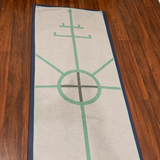
Missing the sweat of your Hot Yoga Studio? Make your home studio to get you through lock-down. This towel is our very own Archer designed for Bikram Yoga. If you would like to look at it closer click <strong><a href="https://thearcherhotyogatowel.com/products/bikram-yoga-towel" title="the archer hot yoga towel">here</a></strong>.
<h1 style="text-align: center;">DIY Hot Yoga Studio at home.</h1>
<p style="text-align: left;">As many of us have been forced to deal with serious withdrawals from our hot yoga addiction without access to the hot room I decided this week to set up my own temporary hot yoga studio (with minimum expenditure). This way I can practice from home until the enforced isolation comes to an end we can all run at full speed back to our beloved hot yoga studios. I set mine up in the spare room this week complete with temperature gauge for a total of $73.99 and have achieved a consistent <strong>40 degrees celsius</strong> for my home practice. If you had to buy all of the items on the shopping list below it would cost you $143.99 to start from scratch. (Obviously this doesn't include the possible increase in your electricity bill but I figure my sanity is worth it!).</p>
<meta charset="utf-8">
<h2 style="text-align: center;">What you need for your home hot yoga room?</h2>
<h3>Shopping List</h3>
<div style="text-align: center;">
<ul>
<li style="text-align: left;">Electric Oil Heater $35</li>
<li style="text-align: left;">Electric Fan Heater $39</li>
<li style="text-align: left;">Humidifier $29.99</li>
<li style="text-align: left;">Temperature Gauge $8.99</li>
<li style="text-align: left;">Mirror $19</li>
<li style="text-align: left;">Bluetooth Speaker $12</li>
</ul>
</div>
<h3 style="text-align: left;">Items already on hand:</h3>
<ul>
<li style="text-align: left;">
<div>Curtain/blind (or use a towel)</div>
</li>
<li style="text-align: left;">
<div>Draught excluder (or use rolled up towel)</div>
</li>
<li style="text-align: left;">
<div>Yoga Mat</div>
</li>
<li>
<div style="text-align: left;">Yoga Towel (try<span> </span><a href="https://thearcherhotyogatowel.com/products/thearcherhotyogatowel" title="the archer hot yoga towel for hot yoga and bikram yoga">The Archer</a>!)</div>
</li>
</ul>
<h2 style="text-align: center;">Step One - Windows and blinds</h2>
<p><strong>1.</strong> First step, close up any windows and if you can use a blind that has a honeycomb structure as they are more effective at maintaining the room temperature. Mine is a cheap one from <a href="https://www.ikea.com/au/en/p/hoppvals-cellular-blind-white-60290638/" title="honeycomb blind used in my hot yoga home practice studio">Ikea</a> that was already in place so no outlay there. </p>
<p style="text-align: left;"><img alt="Honeycomb style blind from ikea to use in home hot room." src="//cdn.shopify.com/s/files/1/0121/2900/9760/files/IMG_5368_compact.jpeg?v=1585724181" style="display: block; margin-left: auto; margin-right: auto; float: none;"></p>
<h2 style="text-align: center;">Step Two - Declutter the space.</h2>
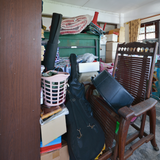
<p><strong>2. </strong> Next, as much as possible try to declutter the space. Think <strong>minimalism</strong>. The more crowded the room with furniture, stacks of boxes or baskets of washing etc the harder it is for the warm air to circulate - not to mention it isn't that good for you to try and practice yoga surrounded by piles of stuff! If this is your bedroom then just do the best you can but if you are lucky enough to have a spare room then clear it out!</p>
<p style="text-align: center;"><img src="//cdn.shopify.com/s/files/1/0121/2900/9760/files/Untitled_design_13_compact.png?v=1585725021" alt="cluttered messy room "> <img src="//cdn.shopify.com/s/files/1/0121/2900/9760/files/Untitled_design_12_compact.png?v=1585725061" alt="home hot yoga studio"></p>
<p style="text-align: center;"><span style="color: #666666;">Where would you prefer to practice?</span></p>
<h2 style="text-align: center;"><span style="color: #000000;">Step Three - Turn up the heat.</span></h2>
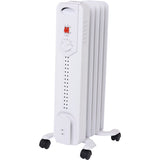
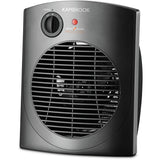
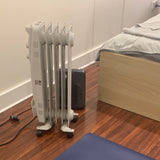
<p><strong>3.</strong> Heating!! My experimenting and research resulted in a two pronged approach. Firstly an electric oil 'fin' heater is good at heating a room but tends to need a while to be effective and doesn't move the air around so this goes on for my baseline heat and then I've an electric fan heater placed to blow <span style="text-decoration: underline;">through</span> the oil heater fins to circulate the hot air from the oil heater in conjunction with its own heat. </p>
<p style="text-align: center;"><img src="//cdn.shopify.com/s/files/1/0121/2900/9760/files/fin_heater_compact.jpg?v=1585725522" alt="fin heater"> <img src="//cdn.shopify.com/s/files/1/0121/2900/9760/files/electric_fan_heater_compact.jpg?v=1585725550" alt="electric fan heater."><img src="//cdn.shopify.com/s/files/1/0121/2900/9760/files/IMG_5361_compact.jpeg?v=1585725652" alt="heater combination in my home hot yoga studio"></p>
<p style="text-align: center;"><span style="color: #444444;">From left to right. 1. <a href="https://www.kmart.com.au/product/5-fin-oil-heater/2953342?&amp;gclid=CjwKCAjw95D0BRBFEiwAcO1KDAh2EWLMKV5MFO-OVRZHp5mJuCF2ec0Y4NTv7J8u6mNK0_J2NmvbOxoC89wQAvD_BwE&amp;gclsrc=aw.ds" title="Electric oil heater for use in home hot yoga studio" style="color: #444444;">Electric Oil Heater</a> - similar one available from Kmart $35. 2. <a href="https://www.bigw.com.au/product/kambrook-upright-fan-heater-2400w-kfh600/p/886096/" title="Electric fan heater" style="color: #444444;">Electric Fan Heater</a> from Big W $39 and 3. My home set up.</span></p>
<p style="text-align: left;">We already had the oil heater and bought the fan heater this week from Big W. I find if I heat the room up around 2 hours before I practice it gets to 40 degrees celsius and stays there.</p>
<h2 style="text-align: center;">Step Four - Block any draughts.</h2>
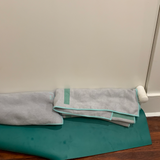
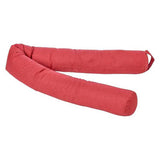
<p style="text-align: left;"><strong>4.</strong> Stop any cool draughts by using a draft excluder to block any air that may come in through gaps under doors. You can get them from <a href="https://www.spotlightstores.com/home/rugs-mats-accessories/doorstops/in-habit-plain-dyed-draught-excluder/BP80384756" title="draught excluder">Spotlight</a> for around $12 or just roll up some towels for zero cost like I did!</p>
<p style="text-align: center;"><img alt="hot yoga towels" src="//cdn.shopify.com/s/files/1/0121/2900/9760/files/IMG_5375_compact.png?v=1585789566" style="float: none;"><img src="//cdn.shopify.com/s/files/1/0121/2900/9760/files/draught_excluder_compact.jpeg?v=1585789764" alt="draught excluder"></p>
<p style="text-align: center;"><span style="color: #666666;">Left: Yoga towels rolled up to block draughts. Right: Sausage shaped draught excluder from Spotlight.</span></p>
<h2 style="text-align: center;">Step Five - turn up the humidity</h2>
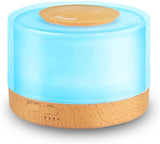
<p><strong>5</strong>. All the heating might make your room feel hot but also make the air a bit dry. Introduce a little moisture with a <strong>humidifier</strong>. These can be cheap and cheerful like this one from <a href="https://www.amazon.com.au/gp/product/B07VZXDW75/ref=ppx_yo_dt_b_asin_title_o01_s01?ie=UTF8&amp;psc=1" title="humidifier">Amazon</a> that I bought for $29.99 or spend a little more for a bigger more efficient unit. </p>
<p style="text-align: center;"><img src="//cdn.shopify.com/s/files/1/0121/2900/9760/files/51y3sXcTGqL._AC_SL1000_compact.jpg?v=1585780905" alt="Amazon aroma diffuser and humififier"><img src="//cdn.shopify.com/s/files/1/0121/2900/9760/files/beurer-lb55-eir-humidifier_compact.jpg?v=1585781065" alt="humidifier"></p>
<p style="text-align: center;"><span style="color: #666666;">From left to right 1. Small aroma diffuser for use as humidifier from Amazon 2. Beurer humidifier from Harvey Norman (images not to scale!).</span></p>
<p style="text-align: left;"><span style="color: #666666;"><span style="color: #000000;">While these will help the air be a little less dry in your hot room this isn't exactly precision heating and it is unlikely you will be able to perfectly replicate the precise heating and humidity of the studio you practice at home.  </span></span>One low tech way to measure the humidity in the room is to place a few ice cubes in a glass and put the glass in the room. Leave it for a few minutes and when you come back check if the glass has some condensation forming on the outside. If it does't you might need to think about adding some moisture to the air. </p>
<h2 style="text-align: center;">Read the room temperature!</h2>
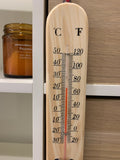
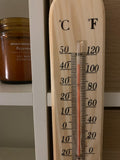
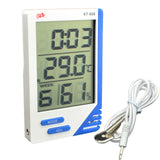
<p style="text-align: left;">If you have a temperature gauge handy then put it in the room. I have this one that I found at a local $2 shop. It actually cost $5.... </p>
<p style="text-align: center;"><img src="//cdn.shopify.com/s/files/1/0121/2900/9760/files/IMG_5369_compact.jpeg?v=1585782478" alt="temperature gauge in my home bikram hot yoga studio"> <img src="//cdn.shopify.com/s/files/1/0121/2900/9760/files/IMG_5366_compact.jpeg?v=1585782530" alt="Temperature gauge in my home hot yoga bikram yoga studio"><img src="//cdn.shopify.com/s/files/1/0121/2900/9760/files/temp_guage_compact.jpg?v=1585782575" alt="digital temperature gauge and humidity measurer for home hot yoga studio or bikram yoga studio."></p>
<p style="text-align: center;"><span style="color: #666666;">From left to right: 1. Temperature before heating the room at around 22 degrees celsius. 2 After heating the room for approx. two hours the room was at 40+ degrees celsius. 3. Temperature Humidity Gauge available online from <a href="https://www.ebay.com.au/p/14026935361?iid=173945108537&amp;chn=ps&amp;norover=1&amp;mkevt=1&amp;mkrid=705-139619-5960-0&amp;mkcid=2&amp;itemid=173945108537&amp;targetid=833371296430&amp;device=c&amp;mktype=pla&amp;googleloc=9071459&amp;poi=&amp;campaignid=7412064611&amp;mkgroupid=80796191477&amp;rlsatarget=aud-786643580126:pla-833371296430&amp;abcId=1139216&amp;merchantid=7364522&amp;gclid=CjwKCAjw95D0BRBFEiwAcO1KDOGE9_nl5J5Cc98BwZwxlad91R3LVShz8hULGsAh14gphoNnnTStvBoC384QAvD_BwE" title="Temperature humidity gauge for use in measuring heat in home hot yoga or bikram. yoga studio." style="color: #666666;">Ebay</a> for $8.99</span></p>
<h2 style="text-align: center;"><span style="color: #000000;">Finally, Mirror, Audio, Mat, Action!</span></h2>
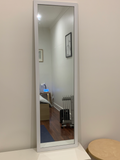
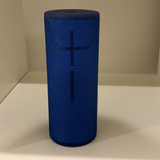
<p><span style="color: #000000;">I had this mirror leaning against a wall that I had planned to put up a while ago (when I got time) that I bought from <a href="https://www.bigw.com.au/product/house-home-over-door-adhesive-mirror/p/686851/" title="mirror for home hot yoga or bikram yoga studio">Big W for $19</a> but you could use any mirror that you have handy. I've been using <strong>youtube</strong> videos by a variety of teachers using my mobile phone. To avoid overheating the phone I have connected it to a bluetooth speaker and left the phone outside. I had this already but you can buy them from lots of places relatively inexpensively - <a href="https://www.target.com.au/p/target-micro-bluetooth-reg-speaker-cs-1-1-assorted/62065306?utm_term=62065306&amp;utm_content=target-micro-bluetooth-reg-speaker-cs-1-1-assorted&amp;utm_source=google&amp;utm_medium=merchant-site&amp;utm_campaign=merchant-site&amp;gclid=CjwKCAjw95D0BRBFEiwAcO1KDJMAtGO5DMvl23VSLkW_rJd-T6NbGR2JNpGjiNpsabJ_hMkFJo2qexoCU_8QAvD_BwE&amp;gclsrc=aw.ds" title="bluetooth speaker for home hot yoga studio">Target</a> has them for $12. </span></p>
<h2 style="text-align: center;">The best towel for hot yoga.</h2>
<p>If you don't already have a great <strong>yoga towel</strong> try <a href="https://64q6z3qg7gs77jyc-12129009760.shopifypreview.com/products/thearcherhotyogatowel" title="The archer hot yoga and bikram yoga towel.">The Archer</a>. Super absorbent, designed with your alignment and hot yoga practice in mind. Free shipping worldwide. </p>
<p style="text-align: center;"><span style="color: #000000;"><img src="//cdn.shopify.com/s/files/1/0121/2900/9760/files/IMG_5373_2_compact.png?v=1585789692" alt="mirrors in home hot yoga studio"><img src="//cdn.shopify.com/s/files/1/0121/2900/9760/files/boom_box_compact.png?v=1585789149" alt="boom box"><img src="//cdn.shopify.com/s/files/1/0121/2900/9760/files/the_archer_hot_yoga_towel_compact.png?v=1585788994" alt="the archer hot yoga towel for bikram yoga"></span></p>
<p> You are good to go! Put a sign on the door and get changed into your regular yoga clothes. Set a time to start class and go in 5 minutes before and be sure to keep yourself honest - work hard. Enjoy a nice long <strong>savasana</strong> at the end. </p>
<h2 style="text-align: center;">Smile, you did it. </h2>
<p style="text-align: center;"><img src="//cdn.shopify.com/s/files/1/0121/2900/9760/files/IMG_5410_1_large.jpeg?v=1585985295" alt="hot yoga practice at home using the archer hot yoga towel"></p>
<p style="text-align: center;">Let me know how you get on and if you have any tips or hints or improvements in the comments below! Namaste!</p>
<p><span style="color: #000000;"></span> </p>
<meta charset="utf-8">
<p> </p>
<div class="mailmunch-forms-widget-884247"></div>]]>
    </content>
  </entry>
  <entry>
    <id>https://thearcherhotyogatowel.com/blogs/some-like-it-hot/lockyourknee</id>
    <published>2020-03-18T05:52:00+11:00</published>
    <updated>2020-05-21T15:23:58+10:00</updated>
    <link rel="alternate" type="text/html" href="https://thearcherhotyogatowel.com/blogs/some-like-it-hot/lockyourknee"/>
    <title>The key to locking your knee.</title>
    <author>
      <name>Jacki Owen</name>
    </author>
    <content type="html">
      <![CDATA[<p style="text-align: left;">From a Bikram yoga perspective, what exactly is meant by 'lock your knee'? There are a few different definitions of a locked knee so it can be confusing to understand exactly what you are meant to do with this instruction. If in your hot yoga practice you have ever wondered ‘<em>what lamp-post</em>"? "<em>concrete, how?</em>" <strong>How can I lock 'no knee'</strong>? then read on!</p>
<p style="text-align: left;"><img src="//cdn.shopify.com/s/files/1/0121/2900/9760/files/Untitled_design_9_medium.png?v=1584409321" alt="lock and key" style="display: block; margin-left: auto; margin-right: auto;"></p>
<p><strong>Firstly, what a locked knee <em>isn't</em></strong>. Let's cross this off from the start. Medically speaking a <em>knee lock</em> is what happens when your knee joint becomes stuck and won't move. Most often this is when a bone fragment, cartilage from a torn meniscus or other foreign body gets trapped within the knee joint. It locks and will not bend or stays bent unable to straighten. This injury requires medical attention and is definitely not what you want to do in standing head to knee pose! More about this acute injury <a href="https://www.verywellhealth.com/locked-knee-unable-to-bend-joint-2548655" title="information on knee lock">here</a>.</p>
<p>Secondly, simply pushing your knee backward as far as you can does not qualify as locking your knee. This is hyperextension of the knee joint. It may not cause you an acute injury but it is certainly not what you are aiming for in your hot yoga practice.</p>
<h3 style="text-align: center;">Knee Joint Alignment - Neutral Knee</h3>
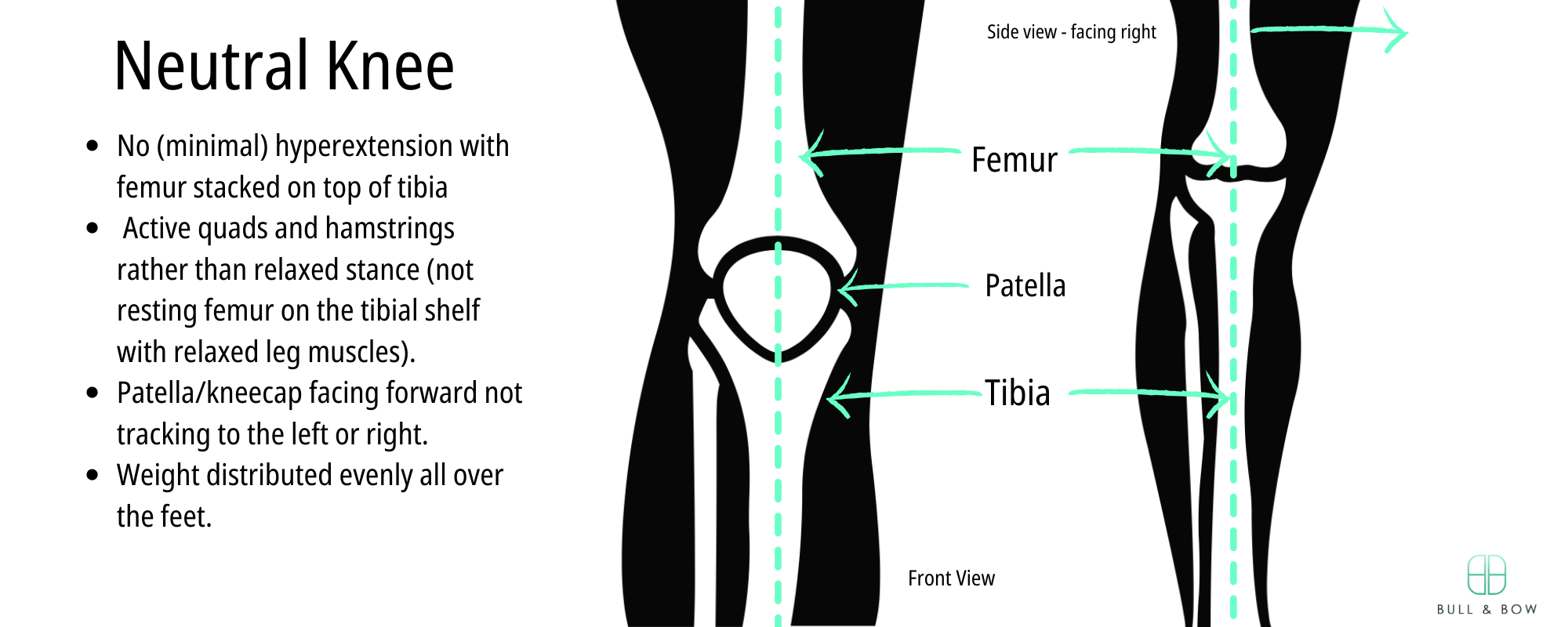
<p>In yoga, a locked knee refers to alignment of the knee to ensure the stability of the total joint. The bone structure alone is quite weak so we rely heavily on the surrounding muscles and ligaments to keep the knee joint stable. Instead of saying 'lock the knee' imagine replacing this phrase with 'engage neutral knee'. This, in a perfect world, would be your leg in a straight 180 degree line with the bones neatly stacked on top of each other. In reality we are all individual beautiful snowflakes and most of us have some level of hyperextension (how far <em>past</em> 180 degrees our knee joint extends)- on average up to six percent. You can read more about the normal range of hyperextension <a href="https://yogainternational.com/article/view/i-hyperextend-my-knees-is-this-bad-probably-not" title="Knee hyperextension in yoga postures and locking the knee.">here</a>. Aim for the 180 degree straight line minimising hyperextension and get ready to engage the muscles. </p>
<p><img src="//cdn.shopify.com/s/files/1/0121/2900/9760/files/Femur_2.png?v=1584409020" alt="Neutral or locked knee description with side and front view of knee joint." style="display: block; margin-left: auto; margin-right: auto;"></p>
<p style="padding-left: 30px;"><strong>Figure 1</strong>. Neutral knee. </p>
<p> </p>
<h3 style="text-align: center;">How do I lift my kneecap up?</h3>
<meta charset="utf-8">
<p>The main job required of your kneecap is to protect the quadriceps tendon. This tendon extends from your quadriceps muscles and over the knee and down to your shin bone. It should glide smoothly straight up and down but can get pulled over to the side which causes misalignment of your knees. Look carefully at your knees in the mirror in class. Are they facing straight ahead? Now contract your quadriceps, the thigh muscles that 'lift' your kneecaps up slightly. Look again and check that your kneecaps aren't moving to the side at all but are still facing forwards. </p>
<h3 style="text-align: center;">Contract all four quadriceps.....</h3>
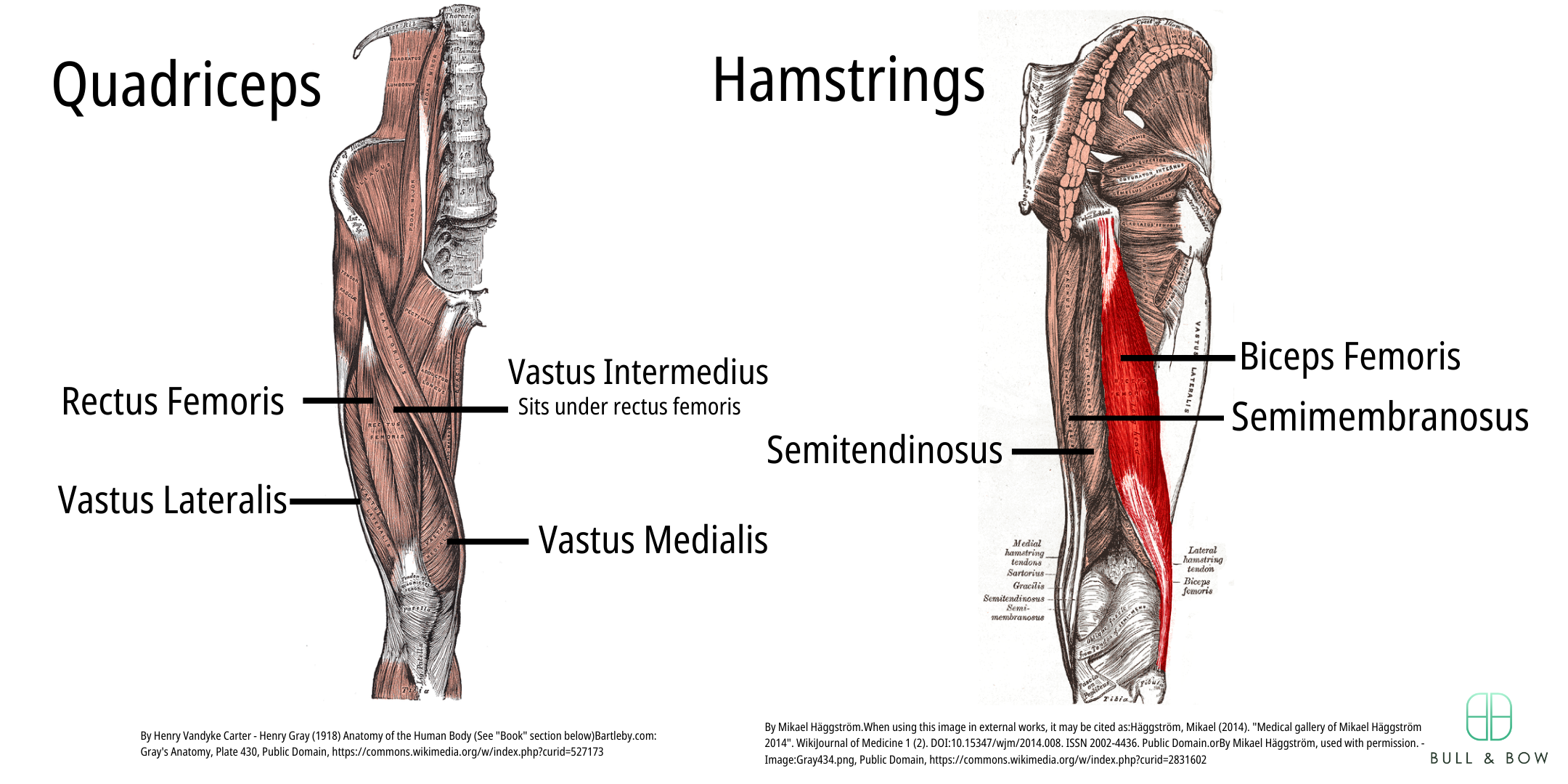
<p>If your kneecaps are sliding outwards slightly one way to keep them straight is when you hear '<em>contract your thighs</em>' think '<em>contract all four quadriceps</em>'. We have four quadricep muscles (hence quads!) and you need to engage <strong><em>all</em></strong> of them while maintaining your neutral knee position. The main thigh muscle or 'rectus femoris' is just <em>one</em> of the quads but it is a dominant muscle that is easy to contract so it tends to take over. Just contracting the rectus femoris will pull your patella to the outer side slightly. When you lock your knee work hard to engage all four quadriceps (see figure 2 below), the other three are the vastus lateralis, vastus intermedius and the frequently weak and underused inner thigh muscle - the vastus medialis. </p>
<p><img src="//cdn.shopify.com/s/files/1/0121/2900/9760/files/quadricep_and_hamstring_muscles.png?v=1584417182" alt="Quadricep muscles including rectus femoris, vastus medialis, vastus lateralis and vastus intermedius. Hamstring muscles including bicep femoris, semitendinosus and semimembranosus" style="display: block; margin-left: auto; margin-right: auto;"></p>
<p style="padding-left: 30px;"><strong>Figure 2.</strong> Muscle groups of the thigh.</p>
<p> </p>
<h3 style="text-align: center;">....and your hamstrings.</h3>
<p>The hamstring muscles at the back of the leg also connect your femur (thigh bone) to the tibia (shin bone) using three main muscles, the semitendinosus, semimembranosus and the biceps femoris. Contracting all of these major muscles in unison with the quadriceps is known as working 'opposing muscle groups' and helps maintain strength. This can reduce injuries and contracting all of them together with the quadriceps is what makes a locked knee. </p>
<h3 style="text-align: center;">Lock the knee!</h3>
<p>In the standing series <strong>Pranayama Breathing,</strong> <strong>Half Moon Pose</strong> (including the backbend), <strong>Awkward Pose</strong> (in the set up before you sit down) <strong>Standing Head to Knee Pose</strong>, <strong>Standing Bow Pulling Pose</strong>, <strong>Balancing Stick</strong>, <strong>Triangle Pose</strong> and <strong>Tree Pose</strong> contract your quadriceps and hamstrings, align your leg and lock everything in. Full muscle contraction. </p>
<p>On the floor you still need to lock your knee. Specifically think about the <strong>Sit-Up</strong>, <strong>Cobra Pose</strong>, <strong>Locust</strong> and <strong>Full Locust</strong>. </p>
<p><img src="//cdn.shopify.com/s/files/1/0121/2900/9760/files/floor_series_locked_knee.png?v=1584663097" alt="sit up, cobra pose bhujangasana, locust pose salabhasana, full locust poorna salabhasana" style="display: block; margin-left: auto; margin-right: auto;"></p>
<p style="padding-left: 30px;"><strong>Figure 3.</strong> Floor poses that require a locked knee. </p>
<h3 style="text-align: center;">One 'locked knee' does not fit all. </h3>
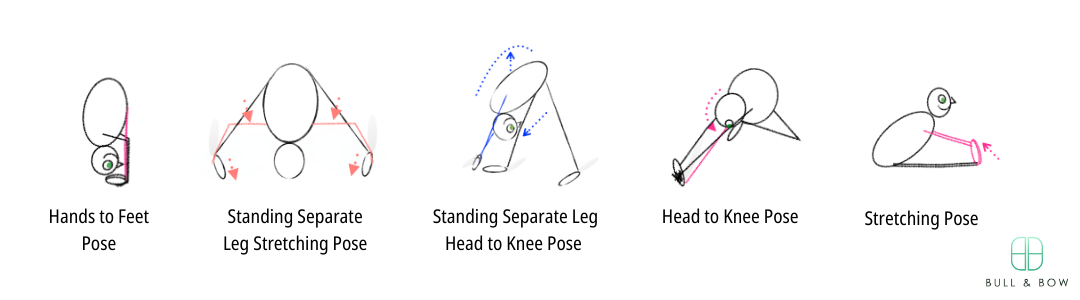
<p>During a Bikram Hot Yoga class how you lock the knee can vary slightly in particular in some of the stretching postures. In particular <strong>Hands to Feet Pose</strong>, <strong>Standing Separate Leg Head to Knee Pose</strong> and <strong>Head to Knee with Stretching Pose. </strong> These postures require you to either <strong>start</strong> with a bent knee <strong>or</strong> to bend the knee in order to achieve correct form and work on locking the knee from there. It is more important to maintain the correct form than to lock the knee. The quadriceps should be the focus here and the hamstrings remain relaxed.</p>
<p><strong>Standing Separate Leg Stretching Pose</strong> requires that you contract the quadriceps only, in order to relax the hamstrings and allow the stretch. This action is known as reciprocal inhibition, the process of contracting one muscle group in order to allow another group to relax.  </p>
<p><img src="//cdn.shopify.com/s/files/1/0121/2900/9760/files/Add_a_heading_1.png?v=1584420706" alt="Hands to feet pose, standing separate leg stretching pose, standing separate leg head to knee pose, head to knee with stretching pose all from the bikram hot yoga poses. " style="display: block; margin-left: auto; margin-right: auto;"></p>
<p style="padding-left: 30px;"><strong> Figure 4</strong>. Stretching poses require a modified locked knee with contracted quadriceps and relaxed hamstrings. </p>
<h3 style="text-align: center;">Summary</h3>
<p>Locking the knee means contracting all of the major muscles of the legs to tighten around the knee joint  and keep it strong and stable when in standing postures. Think 'neutral knee' with the bones stacked neatly, not flexed backward and then contract the all the muscles. Engage your glutes, keep your. core tight and keep your tailbone long. </p>
<p> </p>]]>
    </content>
  </entry>
  <entry>
    <id>https://thearcherhotyogatowel.com/blogs/some-like-it-hot/your-brain-on-yoga</id>
    <published>2020-02-26T11:23:00+11:00</published>
    <updated>2020-05-15T10:16:49+10:00</updated>
    <link rel="alternate" type="text/html" href="https://thearcherhotyogatowel.com/blogs/some-like-it-hot/your-brain-on-yoga"/>
    <title>Your Brain on Yoga - Grey Matter(s)</title>
    <author>
      <name>Jacki Owen</name>
    </author>
    <content type="html">
      <![CDATA[<p style="text-align: center;"><img alt="Image of brain" src="//cdn.shopify.com/s/files/1/0121/2900/9760/files/Untitled_design-95_medium.png?v=1582520180" style="float: none;"></p>
<p>Yoga changes your body but have you considered how, if at all, yoga could change your brain? </p>
<h3 style="text-align: center;">Grey Matter(s)</h3>
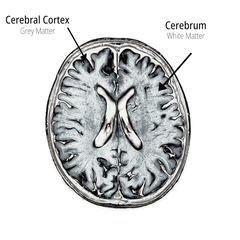
<p style="text-align: left;">Research studies have found that people who practice yoga regularly have more grey matter volume than people who are matched with them in every other way <span style="text-decoration: underline;">but</span> don't practice yoga - called matched controls (<a href="https://www.frontiersin.org/articles/10.3389/fnhum.2015.00281/full">Villemure et al 2015</a>). Grey matter makes up around 40% of your total brain volume (the other 60% being white matter) and it is mostly comprised of neurons (the nerve cells that transmit information to other cells). Your cerebral cortex, the crinkly outer surface of your brain is made of grey matter.</p>
<p style="text-align: left;"><img alt="Cerebral cortex grey matter and cerebrum white matter human brain showing regions that improve with. yoga practice" src="//cdn.shopify.com/s/files/1/0121/2900/9760/files/Cerebral_Cortex-3_medium.png?v=1582671521" style="display: block; margin-left: auto; margin-right: auto; float: none;"></p>
<p style="text-align: left;"><strong>Figure 1.</strong> Transverse view of the human brain showing the cerebral cortex (grey matter). </p>
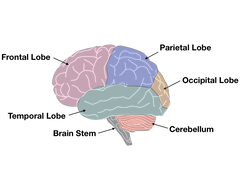
<p style="text-align: left;">In fact despite ranging from only 1mm to 4.5mm thick, the cerebral cortex has 14 to 16 billion neurons packed into its folds (called sulcus or sulci) and ridges (gyrus or gyri). Covering the two halves (left and right) of the cerebrum the cerebral cortex is further classed into four regions or lobes. These are the frontal lobe, parietal lobe, occipital lobe and the temporal lobe. Also packed into your skull are your cerebellum or 'little brain' sitting just below your occipital lobe that also contains grey matter as does your brainstem connecting the whole shebang to your spinal cord.</p>
<p style="text-align: left;">So where do yogis stash their extra grey matter? And does having more of something always equal better? More weeds don't make a better garden. So does that extra grey matter, matter?</p>
<h3 style="text-align: center;">A Quick Lap Around the Brain.</h3>
<p style="text-align: left;">Despite weighing only 2% of our total body weight, our brains use 20% of the energy we consume just to keep it ticking over. The surface area of the cerebral cortex is much larger than it looks and would cover 1500 to 2000 square cm's if you unfolded it all. It's also pretty electric, producing enough energy to power a light bulb. </p>
<p style="text-align: left;"><img src="//cdn.shopify.com/s/files/1/0121/2900/9760/files/Untitled_design-102_medium.png?v=1582684546" alt="our brain has enough energy to power a light bulb" style="display: block; margin-left: auto; margin-right: auto;"></p>
<p style="text-align: left;"><strong>Figure 2.</strong> Bright Spark! Your brain produces enough energy to power a light bulb. </p>
<p style="text-align: left;">The <strong>frontal lobe</strong> is home to our executive function, attention, reward, working memory, planning and motivation. Very useful functions like remembering to pay bills, knowing what to say (and what NOT to say) in a meeting, and deciding to go to yoga instead of staying home to watch Netflix. The <strong>parietal lobe</strong> is involved in spacial perception or proprioception, navigation as well as our sense of touch. The <strong>occipital lobe</strong>, despite being curiously located at the rear of the brain, is directly responsible for the visual processing, colour differentiation and perception of motion.</p>
<p style="text-align: left;"><img alt="regions of the brain including those that are enhanced by practicing yoga" src="//cdn.shopify.com/s/files/1/0121/2900/9760/files/Brain_Labelled_medium.png?v=1582514682" style="display: block; float: none; margin-left: auto; margin-right: auto;"></p>
<p style="text-align: left;"><strong>Figure 3</strong>: Regions of the brain including the cerebellum and brainstem. </p>
<p style="text-align: left;">The<strong> temporal lobe</strong> holds long term memories, auditory processes (hearing) and the interpretation of visual stimuli such as what a facial expression means. The <strong>cerebellum</strong> helps keep us standing on one leg for standing bow, maintaining balance and coordinating movement (amongst many things) and the brain stem manages many of the critical things you do without thinking - breathe, swallow, digestion and reflexes. </p>
<h3 style="text-align: center;">Yoga and Cortical Thickness </h3>
<p style="text-align: left;">One study, published in Frontiers of Aging Neuroscience, found women with an average of eight years of hatha yoga practice had more grey matter and greater cortical thickness than a group of matched controls. Cortical thickness is associated with cognitive preservation and cortical thinning is typically associated with ageing and declining cognitive ability. Grey matter volume is also positively associated with executive function (<a href="https://www.sciencedirect.com/science/article/pii/S0028393218304792" title="Size Matters Grey matter and executive function.">Laubach et al 2017</a>). </p>
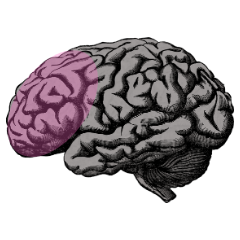
<p style="text-align: left;">Laubach's study found the yoga practitioners had increased cortical thickness in several lobes in the <strong>left prefrontal cortex</strong>, an important area for cognitive control.</p>
<p style="text-align: left;"><img alt="Left prefrontal cortex is a brain region that has more grey matter in regular yoga practitioners" src="//cdn.shopify.com/s/files/1/0121/2900/9760/files/Untitled_design-100_medium.png?v=1582674872" style="display: block; margin-left: auto; margin-right: auto; float: none;"></p>
<p style="text-align: left;"><strong>Figure 4.</strong> Yoga is associated with increased cortical thickness in the left prefrontal cortex.</p>
<p style="text-align: left;">Total cumulative years of yoga practice was related to increased grey matter in several areas, including the left frontal operculum (<a href="https://www.frontiersin.org/articles/10.3389/fnhum.2015.00281/full">Villemure et al. 2015</a>). This area, located in the frontal cortex is believed to be responsible for the motor aspect of speech, music perception, some hand movements and the very important task that keeps many a households in ongoing harmony, response suppression.  </p>
<p style="text-align: left;">Another study (<a href="https://www.jneurosci.org/content/32/26/8988">Cole et al 2012</a>) examined the connectivity of different brain regions and the relationship of that connectivity to cognition and intelligence. They <span>wanted to understand if there was a "brain region that uses brain-wide connectivity as a central mechanism for supporting cognitive control and intelligence." They found that only the <strong>left prefrontal cortex</strong> global brain connectivity was able to predict cognitive control and fluid intelligence. </span></p>
<p style="text-align: center;"><img alt="" src="//cdn.shopify.com/s/files/1/0121/2900/9760/files/Untitled_design-99_medium.png?v=1582675655" style="float: none;"></p>
<p style="text-align: left;"><strong>Figure 5.</strong> Yoga practice is linked with improvement in working memory, attention, verbal acquisition and other areas of executive function.</p>
<p style="text-align: left;">Short term yoga practice also is linked to cortical thickness. A group of women experiencing first episode psychosis had a 12 week yoga and exercise (walking and cycling) intervention (<a href="https://www.nature.com/articles/npjschz201547.pdf?origin=ppub">Lin et al, 2015</a>). The group demonstrated significant improvements in working memory, verbal acquisition and attention. Their cortical thickness also increased.</p>
<h3 style="text-align: center;"><span>SUMMARY </span></h3>
<p style="text-align: left;">These studies look at different types of interventions and different yoga practices in different groups of people, so we can't conclude categorically that these results will be true for all people who do yoga. Consistently however, it appears that cortical thickness, a highly desirable quality for your brain, appears to increase in people with both a long or short term yoga practice. </p>
<p style="text-align: left;">Cortical thickness is positively associated with a higher IQ <a href="https://www.sciencedaily.com/releases/2014/03/140304141734.htm">(link here</a>) so there is every chance your yoga will make you smarter! </p>
<p style="text-align: left;">Furthermore one of the regions where grey matter increases in yogis, the left prefrontal cortex, is linked to cognitive control and fluid intelligence. It also has a big role to play in establishing positive feelings, being able to overcome any negative thoughts and feelings that arise and replacing them with a positive perspective. So if yoga gives you greater cortical thickness in that region - I'll happily take it! </p>
<p style="text-align: left;">Check back in our next blog to read more about how other brain changes related to can impact on your every day life. </p>
<p style="text-align: left;"><strong>Namaste!</strong></p>
<p style="text-align: left;"><strong>PS.</strong> This is not an exhaustive representation of the published literature on yoga and the brain. I am not a neurologist, I am a yoga teacher with a strong interest in neuroscience and anatomy. I really encourage everyone to read more about this topic and feel free to ask questions in the comments section and I will endeavour to answer them in the next blog post. </p>
<h1 style="text-align: center;"></h1>]]>
    </content>
  </entry>
  <entry>
    <id>https://thearcherhotyogatowel.com/blogs/some-like-it-hot/bikram-or-hot-yoga-and-bunions</id>
    <published>2020-02-09T13:02:00+11:00</published>
    <updated>2020-06-05T11:53:50+10:00</updated>
    <link rel="alternate" type="text/html" href="https://thearcherhotyogatowel.com/blogs/some-like-it-hot/bikram-or-hot-yoga-and-bunions"/>
    <title>Are your bunions sabotaging your yoga alignment?</title>
    <author>
      <name>Jacki Owen</name>
    </author>
    <summary type="html">
      <![CDATA[<h2>Bunions and Yoga.</h2>
<p>How you position your feet impacts both on your posture and your yoga postures. Your practice in the hot yoga room relies on each part of your body aligning correctly with the next to produce the right form. </p>
<h3>Bikram Yoga Feet Together.</h3>
<p>Keeping your feet together with heels and toes touching might not be the best stance if you have bunions. </p>
<h3>Correct your feet in your hot yoga practice. </h3>
<p>Bunions are the result of misaligned bones in your feet. Failing to correct for this will result in misalignment in your shins, knees, thigh bones, hips and spine. A small correction in your feet will have a big result in the form of your yoga. This blog describes how to correct for bunions and dramatically improve your form. </p><p><a class="read-more" href="https://thearcherhotyogatowel.com/blogs/some-like-it-hot/bikram-or-hot-yoga-and-bunions">More</a></p>]]>
    </summary>
    <content type="html">
      <![CDATA[<h2 style="text-align: center;"><span>Your feet and your Bikram Yoga Practice.</span></h2>
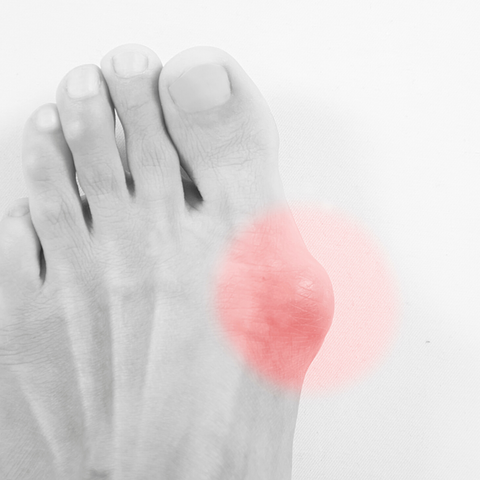
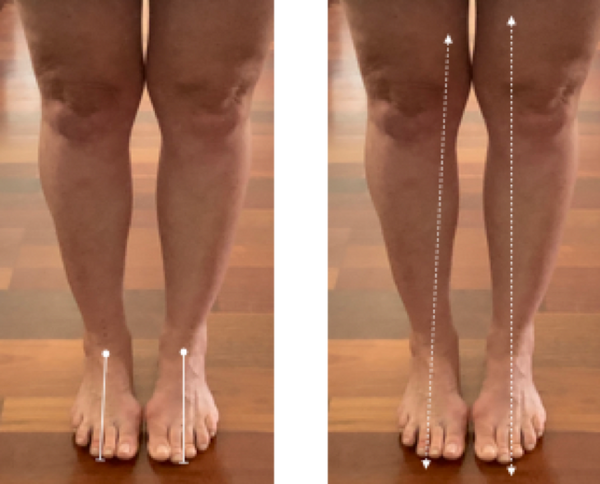
<p><span>Have you ever looked down at your feet at the start of a hot yoga class when the teacher says ‘<i>feet together nicely, heels and toes touching</i>’ and wonder how on earth to make <em>that</em> work when your bunions protrude outwards and your big toes are pointing away from each other?</span></p>
<div><img src="//cdn.shopify.com/s/files/1/0121/2900/9760/files/Untitled_design-96_large.png?v=1582601247" alt="bunions" style="display: block; margin-left: auto; margin-right: auto;"></div>
<br>
<p style="padding-left: 30px;"><span style="color: #20124d;"><strong> Figure (1)</strong>. Bunions make it difficult to bring your feet together with your heels and toes touching. They also make it hard to wear a lovely pair of narrow pointy Jimmy Choo's but that's a different blog post. </span></p>
<p><span>As my feet are quite anatomically diverse (yep, huge bunions) I’ve struggled with this instruction. Should I force my feet together? Or stand with my heels touching and my bunions touching which gives me a kind of awkward duck stance? Is it more important that my feet are together or that my feet are straight? Does it even matter? We come back to this instruction many times in the Bikram sequence, even in the floor series, and the question niggled away at me until I decided I would investigate it further. </span></p>
<h2 style="text-align: center;"><span mce-data-marked="1">How do bunions occur?</span></h2>
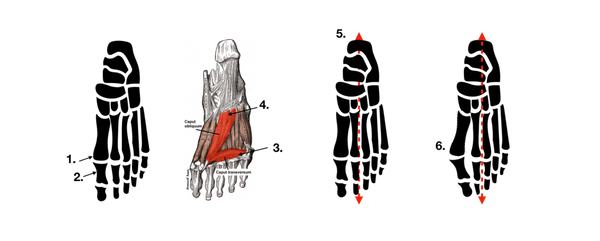
<p style="text-align: left;">Just like the yoga sequence, our foot has 26 &amp; 2. Bones that is! Twenty six bones and two small sesamoid bones (pea sized bones that sit within a tendon) that run right underneath the first metatarsophalangeal joint (MTP). This where the first long bone of your foot (metatarsal) meets the first bone of the big toe (phalanx). The MTP is the joint that protrudes when a bunion occurs (6. in the below image). </p>
<p><span>Bunions develop when the adductor hallucis muscle, the muscle that runs left to right underneath your toes (3. in the diagram below)) contracts and tightens. This tightening has the effect of dragging the phalanx bones (2. below) of the big toe towards the other toes and away from the straight position. The displaced MTP joint can get bigger and more painful over time (6).<span class="Apple-converted-space"> This isn't hideous or ugly. It's just your feet. Some anatomical issues plus or minus some hereditary predispositions. Be kind to them. </span></span></p>
<img alt="Foot bones and muscles that create bunions including the MTP joint, adductor hallucis, abductor hallucis and phalanx" src="//cdn.shopify.com/s/files/1/0121/2900/9760/files/footbones_grande.png?v=1581038136" style="display: block; float: left; margin-left: auto; margin-right: auto;"><br>
<p style="padding-left: 30px;"><span style="color: #20124d;"><strong> <span class="Apple-converted-space">Figure (2)</span></strong><span class="Apple-converted-space">. </span><span class="Apple-converted-space">1. First Metatarsophalangeal joint (MTP) 2. First phalanx bone of the big toe. 3. Adductor Hallucis muscle. 4. Abductor Hallucis muscle 5. Midline of the foot 6. Foot with displacement of the MTP or bunion. </span> </span></p>
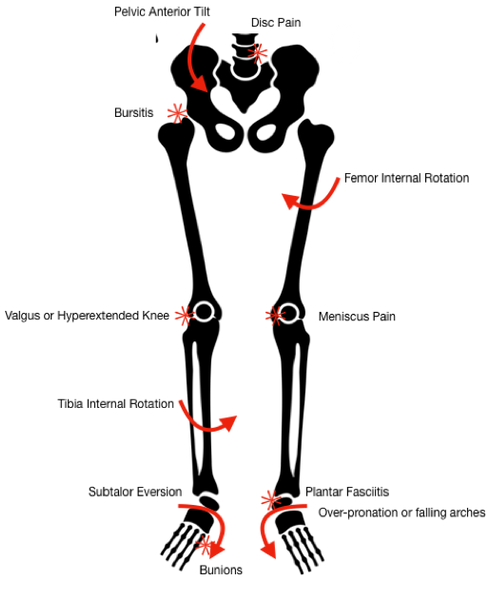
<p><span>Bunions tend to go hand-in-hand with over-pronation. Over-pronation happens when the muscle that runs along the arch under your foot (Abductor Hallucis) becomes overstretched and weak. When strong this muscle helps to pull your big toe back into a straight line however when weak it flattens down the arch as you bear weight on your foot and your foot rolls inwards as a result.<span class="Apple-converted-space"> "So what?" you might </span></span>ask. Well, the flow on effect from this for the rest of your body can be big. </p>
<p>When your feet pronate inwards, your tibia (shinbone) also rotates inward. This turns your knees towards each other slightly, which can lead to poor alignment and poor knee tracking, knee pain and hyperextension of the knee joint. Continuing up your leg your thigh bone and hip also rotate inwards and your pelvis tilts forward giving you a 'sway back' or lordosis of the lumbar spine. All because of those pesky weak arches.  </p>
<img alt="Human skeleton showing effect of bunions and overpronation on tibia, knees, hips and lumbar spine." src="//cdn.shopify.com/s/files/1/0121/2900/9760/files/hips_grande.png?v=1581039939"><br>
<div style="padding-left: 30px;"><span class="Apple-converted-space" style="color: #20124d;"><strong>Figure 3</strong>. Impact of bunions and overpronation on the joints of the lower body. </span></div>
<div style="text-align: center;"><span style="color: #20124d;"><span class="Apple-converted-space"></span></span></div>
<h2 style="text-align: center;"><span><span class="Apple-converted-space">So, feet together or not?</span></span></h2>
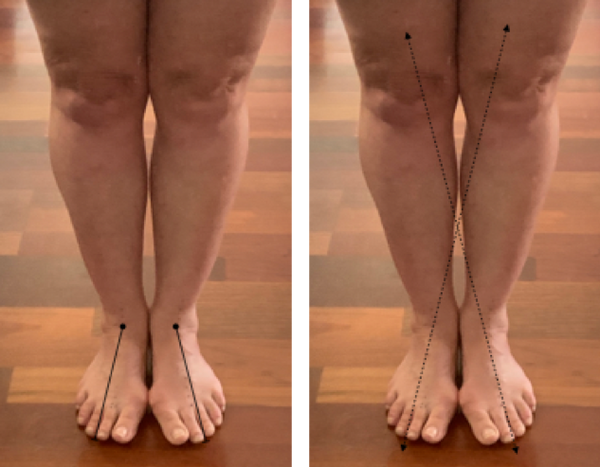
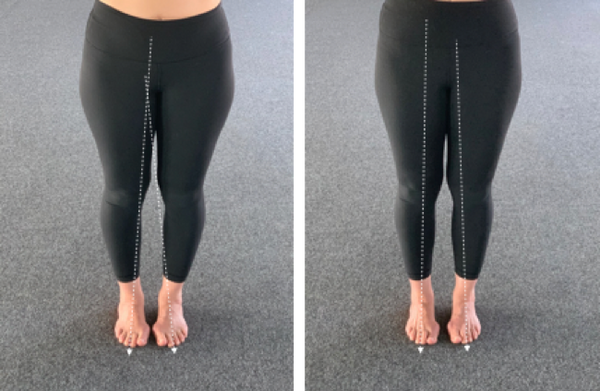
<p><span><span class="Apple-converted-space">Ah, no. When you have bunions, having your feet together will be unlikely to be a good starting position for you in class for any of the standing or balancing postures. If the midlines of your feet are not parallel then your knees will turn in toward each other. Your knees should face forward for best alignment. </span></span></p>
<p style="text-align: left;"><span><span class="Apple-converted-space"><img src="//cdn.shopify.com/s/files/1/0121/2900/9760/files/feet_midline_together_grande.png?v=1581124001" alt="Feet together with bunions showing midlines of feet"></span></span></p>
<div style="padding-left: 30px;"><span style="color: #20124d;"> <span class="Apple-converted-space"><strong>Figure 4.</strong> Feet together position with bunions and pronation. The image on the left shows the midline of the foot (middle of heel to between second and third toe). The image on the right extends the midline out demonstrating the significant inward track of the knees.</span> </span></div>
<div style="padding-left: 30px;"><span style="color: #20124d;"><span class="Apple-converted-space"></span></span></div>
<p> </p>
<p><span><span class="Apple-converted-space">The image above shows very clearly the inward turn of the knees that leads to hyperextension of the knee joint and an over-reliance on the inside of the foot and big toe mound for balance when having your heels and toes together if you also have bunions. </span></span></p>
<p><span><span class="Apple-converted-space"><img src="//cdn.shopify.com/s/files/1/0121/2900/9760/files/feettogether_arches_active_grande.png?v=1581124462" alt="Feet together with activated arches and a neutral foot position."></span></span></p>
<div style="padding-left: 30px;"><span class="Apple-converted-space" style="color: #20124d;"><strong> Figure 5.</strong> After activating arches and finding neutral foot the midlines are much closer to parallel and the extension of the midlines demonstrates a large improvement in knee alignment.  </span></div>
<div style="padding-left: 30px;"><span><span class="Apple-converted-space"></span></span></div>
<div><span><span class="Apple-converted-space"></span></span></div>
<div>
<span><span class="Apple-converted-space">In figure five we can see the same person</span></span><span><span class="Apple-converted-space"> this time utilising</span></span> arch activation and some correction of the pronation to achieve a more 'neutral' foot position where the knees face more forward correcting some of the misalignment. The heels separate slightly to enable the midlines of each foot to become parallel. </div>
<h2 style="text-align: center;"><span><span class="Apple-converted-space">Feet together nicely with bunions. </span></span></h2>
<p><span>The first step is to work on correcting the pronation and find your ‘neutral foot’ position.<span class="Apple-converted-space">  </span>One way to do this is perform ‘short foot’, an exercise <strong>(<a href="https://youtu.be/yobd001Mq6A" target="_blank" title="Finding Neutral in the Pronated Foot with Dr Emily Splichal" rel="noopener noreferrer">great video here</a>)</strong> that works by contracting the underneath of your foot to strengthen and lift your arch. While keeping your toes on the floor, ‘scrunch up’ your arch like you are picking a tissue up with the bottom of your foot. This contracts the abductor hallucis and pulls your big toe back towards centre a little. <span class="Apple-converted-space"> </span></span></p>
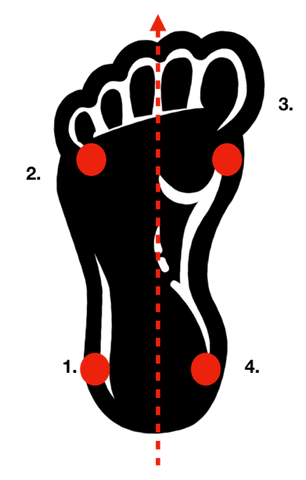
<p>Now keeping the arch in its upward position, lift all five toes of each foot off the floor. Maintain the arch height and feel the pressure beneath the big toe mound (probably quite easy to feel). Now equally find the same pressure underneath the small toe mound. Slightly harder isn’t it? Try to ground all four points of your foot in this order. <strong>One:</strong> under the outside edge of your heel, <strong>two:</strong> under the little toe mound, T<strong>hree</strong> under the inside edge of the heel and lastly <strong>Four:</strong> under the big toe mound. Try to share the weight equally across all four points. </p>
<div style="padding-left: 30px;">
<span style="color: #20124d;"><strong>Figure 6</strong>. Equal distribution points across the foot, starting with the outside of the foot can help find a neutral starting point for balancing</span><img src="//cdn.shopify.com/s/files/1/0121/2900/9760/files/fourpoints2_large.png?v=1581140166" alt="Graphic of foot showing midline and four equal distribution lines." style="display: block; margin-left: auto; margin-right: auto;">
</div>
<h3 style="text-align: center;">Foot Midline</h3>
<p><span>Observe where your foot midline is. Typically this line runs from the centre of your heel (under your ankle) straight down your foot towards your toes. While keeping these two lines parallel to each other bring your feet together as closely as your anatomy will allow without losing the alignment <span style="text-decoration: underline;"><strong>or</strong></span> the arch activation <span style="text-decoration: underline;"><strong>or</strong></span> the weight distribution. It may look a little like you have your bunions touching and your heels separated. This is <span style="text-decoration: underline;"><strong>your</strong></span> feet together nicely position. It probably won’t look like anyone else, and that’s okay because you are a unique snowflake and have your very own special anatomical make-up!</span></p>
<h2 style="text-align: center;"><span>But, don't just open your heels...</span></h2>
<p><span><img src="//cdn.shopify.com/s/files/1/0121/2900/9760/files/heelsapart_grande.png?v=1581125059" alt="Feet together for bikram yoga showing arch active and neutral foot for yoga practitioners with bunions"></span></p>
<div style="padding-left: 30px;"><span style="color: #20124d;"> <strong>Figure 7</strong>.  Left shows heels separated but without arch contraction or neutral foot distribution. The weight is still distributed more to the inside of the foot and knees still track in as shown by the foot midline extension. The picture to the right looks similar however the arches are contracted and the outer edges of the foot engaged in even weight distribution. </span></div>
<div style="padding-left: 30px;"><span style="color: #20124d;"></span></div>
<p><span>While these two pictures in Figure 7 look similar, closer inspection shows that above left the knees still track toward each other when the foot midline is extended. Whereas on the right, where the arches are active and neutral foot is engaged the knees face forward more. You need to really maintain the contracted arch and work on keeping the foot in neutral. This is really hard. It will feel like you are back at the very beginning of your practice again. </span></p>
<p><span>That's because you are. That’s yoga.</span></p>
<p><strong>More information:</strong> if you want to read more about this subject, much of which informed my understanding of this condition in the context of yoga: A great article on <strong><a href="https://yogainternational.com/article/view/9-poses-to-prevent-bunions-relieve-bunion-pain" target="_blank" title="9 Poses to Prevent Bunions &amp; Relieve Bunion Pain" rel="noopener noreferrer">preventing and relieving bunion pain</a> </strong>by Doug Keller and another on <strong><a href="https://yogainternational.com/article/view/yoga-exercises-for-bunions" target="_blank" title="Yoga for Bunions" rel="noopener noreferrer">yoga for bunions</a></strong> by Amber Burke. Doug Keller also has a terrific video and also a great video on how to <strong><a href="https://youtu.be/7XrnnQcdHws" title="How to prevent bunions from getting worse - Yoga for Bunions">prevent bunions from getting worse </a></strong>with Yoga for bunions. </p>
<p>Namaste!</p>
<p><strong>Disclaimer:</strong> I'm not a podiatrist or any other kind of foot specialist. If you have painful feet or need medical advice regarding your bunions then get in touch with the appropriate health professional. I'm a Bikram Method Instructor with a personal interest in anatomy and neuroscience and I researched this topic to improve my own balance and practice. </p>]]>
    </content>
  </entry>
</feed>