The post Exotic Trades: What CDS Really Are first appeared on Business Cycles Finance.
]]>
Credit Default Swaps (CDS) are insurance against the default of a company. These derivative instruments are widely used for hedging and speculative purposes. Over the last few years, some un-orthodox trades have been pulled off. Let's review these transactions, and see what we can learn from them.
A collection of CDS trades
The Codere Trade (2013)
Codere was a distressed Spanish firm. Blackstone's GSO fund bought CDS on Codere, and then went on to offer financing to the firm to keep it afloat, with the condition that it delayed the payment of an interest, hence briefly defaulting and triggering the CDS 12.
The RadioShack Trade (2014)
Radioshack was a troubled retailer, with a lot of debt. It had one specificity, which is that the outstanding amount of CDS was colossal ($26bn gross amount for $840m of debt). The CDS sellers kept the company afloat by renewing short term loans until the maturity date of CDS in december 2014 3. CDS buyers tried to challenge the trade, but ISDA found the trade to be in compliance with the loans and CDS terms 4. The company defaulted soon after.
The Norske Skog Trade (2016)
Norske Skog was a distressed Norwegian firm. Blackstone sold CDS on Norske Skog with a maturity of one year, and provided financing to the firm to keep it from defaulting during that period 5. Norske Skog eventually defaulted a year and a half after the maturity date of the CDS, hence allowing GSO to keep the handsome premiums of the CDS.
The Hovnanian Trade (2017)
Blackstone's GSO bought CDS on Hovnanian, and then offered refinancing to Hovnanian with a similar condition to Codere's: Hovnanian would briefly default on its debt. GSO and Hovnanian structured the refinancing so that it would maximize the payoff on the CDS, by playing with the face value of coupon rate of the new bonds 6. GSO eventually cleared its CDS position with the major counterparties for an undisclosed amount 7.
The McClatchy Trade (2018)
Chatham Asset Management sold CDS on McClatchy, a troubled American firm. It then went on to offer financing with attractive terms to the firm. However, the new debt was assigned and confined to a subsidy of McClatchy, making the CDS on the mother firm worthless, as no more debt supported by the mother firm. Chatham thus went on to collect premiums on the CDS it had sold, without any risks of the instruments being triggered 8.
What you should know about CDS
How do CDS behave: CDS, as well as any derivative instrument, do not behave as you think they theoretically do. They behave just as described in the prospectus and the documentation. The Caveat Emptor applies: if you buy a CDS, you ought to perform the appropriate diligence to ensure that you gain exposure only to the risks you want. After all the trades described above, in which CDS holders were surprised, there are no more excuses.
Why do CDS exist: CDS are hedging tools. Using them for anything else, in particular without a position in the bonds of the firm, is risky. On the other hand, it is quite striking to see that in all of the trades highlighted above, the firm on which the CDS were written benefitted from the transactions: even though all of them were not saved for all time, at least the economic default and the bankruptcy were avoided in the short run.
CDS do not offer free lunch: in each of the trades described above, the party apparently benefiting from the trade did not enjoy a free lunch. GSO, Chatham and others did extensive research and analysis to find suitable targets and ways to structure the deals 9. In addition, they often lent money to the target firms, therefore taking the risk not to be repaid, or to suffer the consequences of a default.
References
The post Exotic Trades: What CDS Really Are first appeared on Business Cycles Finance.
]]>The post Clam Shells are Better Currencies than Cryptocurrencies first appeared on Business Cycles Finance.
]]>
Cryptocurrencies, or "digital coins" are terrible at being currencies and do not deserve to bear this name. Clams did much better with no other technology needed than bending over to pick them up from beaches in the XVIIth century. Making the case for clams being better currencies than digital coins hopefully also establishes that today's currencies such as Euro, Dollar, and Yen are much better currencies than digital coins.
What are digital coins?
Most of the self-designated "cryptocurrencies" rely on distributed ledger technologies (DLTs). It is the case with the largest of them (by market capitalization), with Bitcoin, Ethereum, Ripple, Bitcoin Cash and Litecoin leading the way.

Source: Coinmarketcap
DLTs are technologies implementing secured distributed ledgers within a network of participants. The transactions or events happening in the network are first of all encrypted and then inscribed into a ledger that is maintained and duplicated throughout the whole network. To be added, a block of transactions or events need to be validated by the network. This may take several forms, but the most common, which is also used by the Blockchain, is to have the network find the solution to a computation-heavy cryptographic problem. When someone solves the problem and hence validates a transaction, he is rewarded with a few new coins. This is typically the only money creation that occurs within the network.
The proponents of digital coins propose them as an alternative to fiat currencies, that is the traditional currencies such as Euro, Dollar or Yen. In particular, they find digital coins to bring several benefits, the largest probably being that they do not require a trusted third party, hence removing the need for intermediaries to make transactions. Let’s dive in the opposite direction: one of the most basic an un-technologic money : clam shells.
Did you say clam shells?
American Indians used clam shells as a currency for a very long time to settle transaction between and within tribes 1. Iroquois tribes gathered a treasure of clam shells necklaces, even though there territory was nowhere near the seaside where such clams could be found.
Clam shells were an efficient enough money to be adopted by the first colonists in the XVIIth century. In fact, clam shells even became legal tender in the then New England for 25 years in the middle of the century, and subsisted as a medium of exchange after that.
Digital coins versus clam shells
Let's review how good digital coins and clam shells are doing through the various criteria that make a money 'good'.
Money is a medium of exchange
Money is supposed to be a medium of exchange. That is, you should be able to make transactions using the money in question.
Digital coins today are quite bad at this. The adoption rate is terrible and only slowly increasing. The transaction costs are very high, in particular in the case of Bitcoin, for which each transaction costs about $2.5 in fees.2. But the real cost is significantly larger, as new bitcoins are issued to reward the person (the computer) having solved the cryptographic problem and validated the transaction. Accounting for the dilution (the nominal money supply increases without real increase in value), the cost of each transaction is above $1003. The time needed to validate the transaction is long, more than an hour on average over the last 6 months4. In addition, it is not easy to use digital coins to make peer-to-peer transactions, which is why huge platforms have developed and serve as intermediaries - trusted third parties - to help users make transactions in digital coins.
Clam shells were quite good at this, and were better than the limited number of english coins that were available to the colonists in the XVIIth century in the Americas. They were widely used among the locals for a long time, and subsisted as a medium of exchange even after the Crown allowed official coins to be distributed to the colonists as payment for the goods they exported to Europe. Clam shells were gathered into necklaces and wampum, making them transportable and easier to count and physically exchange.

A clam shells necklace
Money is a unit of account
Money is a unit of account, meaning it can be used to measure the value of the good (the price) and compare easily the value of that good with the value of other goods.
Digital coins vary very much on this issue. On one hand, the bitcoin is terrible at this because a single bitcoin has a large value, that is to buy a regular coffee you would use 0.0002BTC. Not quite easy to read with all those decimals, but we could definitively get over it, or simply use other notations to have that look like "2". A “satoshi” is the smallest division of a Bitcoin, and represents 0.00000001 Bitcoins. Now your coffee is worth 20,000 satoshis. A bigger issue is that a coffee of a similar value was worth 20% more a week ago. It was worth 30% less a month ago. It was worth 350% more last July. So, how much exactly is worth a coffee, or any good, as measured in Bitcoin? your answer will only be valid on the moment you look up its price.
Clam shells were doing OK on this side. There were no decimals, but prices could be expressed in a certain number of clam shells, and these prices could be compared easily, using understandable numbers (though probably large ones).
Money is a store of value
Money is a store of value, that is it has value in itself, and its value remains somewhat constant. This doesn't mean that the money has an intrinsic value, it means that society puts trust in the money, and will continue to trust that money tomorrow, so that the value of the money still exists tomorrow.
Once again, digital coins are awful in this respect. They display a crazy volatility basically unseen in financial markets. A single picture says it all:
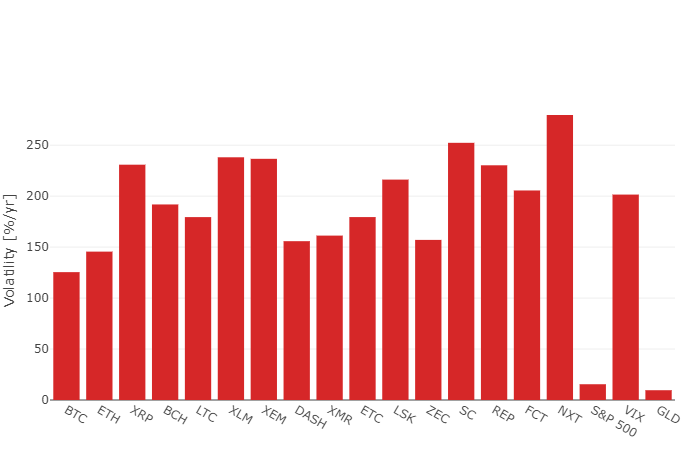
Data from Sifr Data
What this means is that the standard deviation (or "volatility") of all the major digital coins is above 100% per year. In the case of Bitcoin, the volatility is tenfold that of the S&P500, an index tracking the value of the shares of the largest US companies. Equities are considered to be a risky asset (ie. volatile), so that says a lot about digital coins. They are not reserve of values, they are highly volatile and risky instruments.
Clam shells were good reserves of value. They are easy to store in the form of necklaces and other arrangements. They do not break easily and basically don’t age. It is likely that the total stock of clam shells has been relatively stable without dramatic increases, at least up until the arrival of the British colonists.

Storage of clam shells in the form of a wampum
Which is the best money?
Obviously, with digital coins failing all three tests5, we should not expect it to be the winner in this contest. Clam shells were a much better money than digital coins. For one, they were actually used as a money. The colonists adopted it because it was more suitable than the other currencies available. It is very notable that the people, without pressure from a State or other authority, did adopt the most suitable money, when several opportunities were available. It might very well be the case that if Bitcoin or Ethereum or whichever other would-be currency was as good a currency as its proponents claim, then the people would adopt it.
A special note on the centralization.
The claim is often made that digital coins are decentralized systems and that they remove the need for third parties. But then, why are there third parties in the market? Coindesk, Kraken, Circle, Bitpay, and so many others... What are they? Who actually uses a wallet over which they alone actually exercise control and ownership, instead of having their bitcoins under custody at a third party? Who actually exchanges Bitcoin peer-to-peer and not through an intermediary, being a Broker or an exchange of some sort? The answer to all the previous question is: a marginal number of users of digital coins. Only technologists with a deep understanding of the technical aspects of digital coins and a strong philosophical belief that decentralization is good may do so.
To add insult to injury, it is not only the access to the use of the network that is intermediated: the contribution to the network and the composition of the network is itself strongly intermediated, with large pools of miners controlling inappropriate proportions of the computing power (hashrate) of the network. That is, miners, who try to solve the cryptographic problems in order to validate transactions can put their efforts together and gather in a "pool", who has a much larger chance of finding the solution than a single miner all by himself. The pool then retributes all of its miner, insuring a more stable level of income to them than if they were all by themselves. Once again, a picture is worth a thousand word to show the concentration of the hashrate:
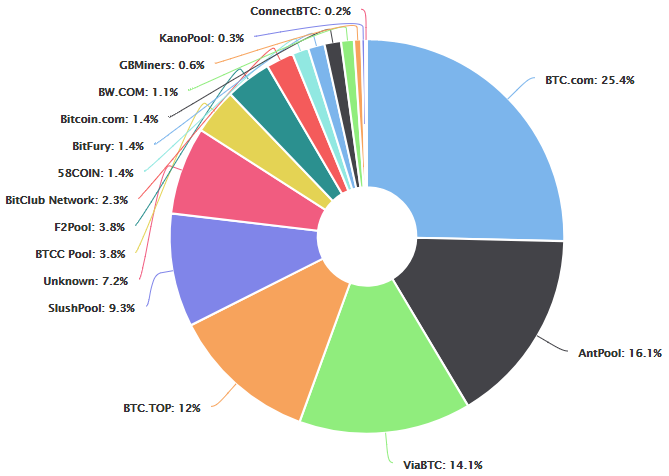
Three pools of miners do control more than 51% of the computing power of the network, therefore opening the possibility of maliciously altering the blockchain by corrupting only three players of the network6. Some other digital coins have been hit by such attacks, for example feathercoin7. In addition, large players can do damage and acquire a significant nuisance power even without controlling 51% of the hashrate by denying the validation of transactions8. I hope you trust these third parties not to collude or abuse of their dominance position9.
I don't mind that third parties exist. I simply refute strongly the argument according to which digital coins are "decentralized" or "peer-to-peer" or any other such concepts. The ledger is distributed. Its setup was the doing of a small group, its management and access to it are today intermediated, and controlled by a handful of firms growing larger and larger. Satoshi Nakamoto did create the Bitcoin as a decentralized protocol10, however its use has been re-appropriated by service providers who act as third parties and intermediaries. You may think that it is good or bad, but the fact remains: all the digital coins are today used through intermediaries.
I agree that the current frequency of transaction, the distance between buyers and sellers and such other features of modern transactions do not allow Clam shells to be an appropriate currency today. However, they seem so ridiculous that nobody would argue that they were a better currency than the Pound and the then gold & silver coins, whereas they were actually working well as a currency. Today's argument about digital coins being currencies is wrong and fallacious.
The post Clam Shells are Better Currencies than Cryptocurrencies first appeared on Business Cycles Finance.
]]>The post Index funds: the antitrust critique first appeared on Business Cycles Finance.
]]>
Index funds have recently been the target of a peculiar attack. Its proponents argue that these funds, which implement a passive strategy to track the performance of an index, pose a serious threat to free competition.
What’s wrong with index funds?
Index funds, whether they are ETFs, mutual funds, or UCITS, try to closely replicate the performance of an index. In order to achieve that, they usually use ‘physical replication’, i.e. they purchase all the components of the index, with the appropriate weights.
This physical replication means that large funds tracking specific industries end up having large holdings in all the firms of that industry. That is where the problem originates: if there are few firms in an industry, and we are in an oligopolistic situation, then concentrated ownership may lead to milder competition than before.
Indeed, a fund manager who owns stakes in all the market participants probably won’t want to push these various firms to compete against one another. If the various firms of the industry were to compete for market share through a price war, then the market shares of each firm would be shuffled—however, the profits generated by the industry as a whole would decrease, negatively affecting the performance of the funds holding them.
Therefore, it is in the interest of the funds to let the firms collude—which can also happen in an unspoken, understood manner—to maintain the status quo or to raise prices, hurting consumers. For example, there is convincing evidence that common ownership in the US airline industry has pushed up plane ticket prices by up to 10%.[1]
Should we ban index funds?
The proponents of the antitrust critique do not go that far. Rather, they suggest implementing a “one firm or one percent” rule, which they formulate as follows: “No institutional investor or individual holding shares of more than a single effective firm in an oligopoly may ultimately own more than 1% of the market share unless the entity holding shares is a free-standing index fund that commits to being purely passive.”[2] Laws in Europe already prohibit UCITS funds from building up controlling stakes in any security issuer.[3] But this proposed rule is much more complex and problematic.
First of all, the limits are not to be applied at the fund level, but at the investment company level. It would indeed be easy to create an umbrella fund, under which each of the funds individually would abide by this rule, but in aggregate they could break it. There is a problem, however: an investment company providing purely passive funds (ETFs and such) alongside active funds would be barred from investing in certain industries. Hence, the concerned investment companies would have to make a choice about which funds—and thus which investors—to favor, leading to an unhealthy discrimination of investors.
If funds decide to cope with the 1% hurdle by taking the other choice offered to them, i.e. by investing in a single entity, it would have two detrimental effects simultaneously: it would transform the passive index trackers into active funds selecting a sample of firms to invest in, and it would decrease their diversification and hence decrease the correlation with the index they try to track.
We could also mention that choosing the measurements and thresholds to identify oligopolistic industries is tricky. The proponents of the critique[4] suggest using a MHHI or GHHI, which are modified versions of the Herfindahl-Hirschman (HH) concentration index taking into account common ownership. Notwithstanding the thresholds attached to these exotic measures, their effectiveness is debatable, and their use by academics is very limited.
But let’s put things into perspective: the proposed rule claims to limit the bad effects of common ownership. However, the incentive for the firms to not compete with one another doesn’t need to materialize in the form of explicit pressure: the fund managers do not need to remind the firms that they are looking to maximize the return of their whole portfolio and not only of a single specific firm. In short, the proposed “one firm or one percent” rule would both fail to eliminate the source of the anticompetitive behaviors observed, and cause serious threats to index tracking funds.
So… laissez-faire
Laissez-faire would mean accepting the cost of the pseudo cartels and letting the funds invest as much as they want in oligopolistic industries. It would be acceptable to do so if the cost of the oligopoly to the consumer is, in aggregate, lower than the benefits for investors. Typically, however, this is not the case, as any oligopolistic or monopolistic behaviors incur a “deadweight loss” of utility for all players in the market.[5] Therefore we must tackle the competition problem posed by common ownership.
Limiting barriers to entry is an efficient way to incentivize oligopolies to compete with one another. Indeed, if new competitors may enter the market at any time, oligopolies have an interest in not creating the conditions for super-profits which would doubtlessly attract new competitors. We call such markets ‘contestable markets.’[6] Often the State has the power to limit barriers to entry: making licenses more readily available and administrative and legal procedures shorter, easier and less costly can encourage national entrepreneurs to join the industry and disrupt anticompetitive behaviors. That Xavier Niel’s Free Mobile in France received a mobile operator license to in 2010 shows how decreasing barriers to entry can break up oligopolies.
The state can also limit barriers to entry by lowering customs as well as other barriers to foreign companies. That is actually how Ryanair successfully started in 1986: they took advantage of new EU regulations to compete with legacy carriers in Ireland and in the UK.
Another approach to pushing oligopolistic firms to compete with one another is to welcome the efforts of activist shareholders. These investors often receive bad press, but they actually have, in the aggregate, positive effects on the firms in which they invest.[7] Activist investors could provide the necessary incentive to a firm to exit the de facto cartel and compete on prices with the other firms of the industry. They would have a first-mover advantage, and thus give a superior return to the activist investor, generating a positive effect for the consumers.
Summing it up
The antitrust critique argues very sensibly that index tracking funds provide a damaging incentive on oligopolistic industries to soften competition and adopt cartel behaviors. This is a concerning issue that deserves more attention from the industry, from academics, and from regulators.
However, we must be very cautious when trying to solve the problem: in principle, index trackers are good and provide useful solutions for investors. We should aim at finding a way to solve the problem without harming these funds.
Targeting oligopolies and trying to counterweight the influence of index trackers thus seems to be the most sensible solution to the problem. The role of the State shouldn’t be to close opportunities, but to open new ones: instead of preventing funds from operating through complex rules, the State should eliminate regulatory barriers, and foster competition and innovation in oligopolistic industries.
________________________________
[1] José Azar, Martin C. Schmalz, and Isabel Tecu, “Anti-Competitive Effects of Common Ownership”, 2014
[2] Eric A. Posner, Fiona Scott Morton, and E. Glen Weyl, “A Proposal to Limit the Anti-Competitive Power of Institutional Investors”, 2017
[3] Law of 17 December 2010, Article 48 (1)
[4] José Azar, Sahil Raina, and Martin C. Schmalz, “Ultimate Ownership and Bank Competition”, 2016
[5] Arnold C. Harberger, “Monopoly and resource allocation”, The American Economic Review, 1954
[6] William Baumol, John Panzar, Robert Willig, Contestable Markets and the Theory of Industry Structure, 1982
[7]The Economist argues that activist investors shake up management out of their comfort zone for the benefit of existing shareholders, the firm itself and the customers: http://www.economist.com/news/leaders/21642169-why-activist-investors-are-good-public-company-capitalisms-unlikely-heroes
The post Index funds: the antitrust critique first appeared on Business Cycles Finance.
]]>The post Complexity in Finance: Swing Pricing first appeared on Business Cycles Finance.
]]>
Luxembourg, host of many funds using swing pricing
What is swing pricing exactly?
Swing pricing is an adjustment, sometimes called 'dilution adjustment' in the price of a fund, that is in the price that you would pay if you want to subscribe to it, or the price that you would received if you were already an investor but wanted out. The underlying idea is that large transactions generate large transaction costs, and that it would be unfair that all the investors of the fund bear those costs if they are only caused by a single or a few other investors.
Not all transaction costs are targeted: funds buy and sell securities all the time, but the focus is here on increases or decreases in the size of the portfolio, not on internal turnover. The idea behind swing pricing is that internal turnover transaction costs are covered by the regular fees of the fund, but that transaction costs caused by subscriptions in the fund or redemptions are not, and the investors should not collectively bear those costs.
Therefore, funds using swing pricing increase slightly their price when a large subscription is made: the newcomer will thus pay a slight premium to account for the transaction costs. Reciprocally, a large existing investor wanting his investment back will receive slightly less than the true price of the fund, as shown in the image below.

On the left side of the graph, we see the effect of the swing in case of a large redemption: the price is lowered, and thus the investor will receive less than the intrinsic value of the fund that he was holding. On the right side, we see that the price increases in the case of a large subscription to the fund: the new investor will pay a higher price than the intrinsic value of what he purchases.
The Challenges of Swing Pricing
As described above, the feature sounds fair, but its implementation seems difficult. It is. First of all, we need to decide of a threshold above which is subscription or a redemption is deemed "large". Then, we need to choose the amount of the premium. Both are challenging, and the practice differs very much depending on the Asset manager. Some are more transparent than others, but most keep a significant part of discretion as to when and by how much to change the price of the fund.
The table below shows the disparity of practice among several large asset managers in Luxembourg:
| Asset Manager | Swing Pricing Threshold | Swing Pricing Factor |
|---|---|---|
| Aberdeen | 5% of TNA | ND |
| Credit Suise | ND | 2% max |
| NN IP | 1-2% of TNA | 0-1% |
| JPMorgan | ND | ND |
| State Street | ND | 2-3% max |
| Eastspring Investments | ND | 2% max |
| Robeco | ND | ND |
| Capital Group | ND | 2% max |
| Franklin Templeton | ND | 2% max |
| SEB | ND | 0.99% max |
ND: not disclosed
It appears very clearly that most asset manager keep a veil of opacity on their swing pricing policy. Almost without exceptions, they also reserve themselves a wide discretion as to when to trigger the swing pricing: the fund is continuously shrinking? the manager thinks that it is in the best interest of existing investors to swing the fund? Those reasons are solid enough to trigger the swing, even if the agreed upon threshold has not been crossed.
Doing Swing Pricing Right
To do swing pricing "right", we need two things: transparency and rule-based parameters. Transparency is the simplest of both: investors need to know what they buy and where the price comes from. They need to know how the fund works and how much they will get when they will go out of the fund. Thus, the parameters of the swing pricing need to be public, and the underlying principles and calculations should also be disclosed to existing and prospective investors.
The parameters of the swing pricing, ie. the thresholds and the swing factors need to derive from rules, and not from arbitrary decisions of the asset manager. Their purpose is to protect existing investors, and rules can ensure that such remain the case at all time: for example, the asset manager shouldn't be able to discretionary decide to swing a fund to penalize an exiting investor. The threat of this happening should not even be out there. How to choose these parameters accurately using rules?
We need a careful analysis of the universe of securities in which the fund invests as per its policy. For example, equities and bonds markets are very different. US and emerging markets are also fundamentally different. We need to account for that. The more liquid the market, the lower the swing factor should be. The lower the lot premium (or the cost of trading large volume), the lower the swing factor should be. Those are only a few indicators from a large range available. Asset managers should rely more heavily and systematically on them. Some already do, but all should.
In the end, swing pricing must be approached with caution, and implemented in a way that is indeed to the advantage of existing shareholders of the funds. The only valid alternatives should be either to accept this significant layer of complexity and getting to the bottom of it, or to reject it plainly, and not using swing pricing at all. There should be no middle ground.
The post Complexity in Finance: Swing Pricing first appeared on Business Cycles Finance.
]]>The post Revolving Doors: Not The Evil You Think first appeared on Business Cycles Finance.
]]>
First Jose Manuel Barroso, and now Mervyn King: in a few weeks of time, two high-profile politicians have turned to banks: Mr. Barroso joins Goldman Sachs, while Mr. King is heads to Citigroup. Many have criticized the 'revolving doors' and vilified the two former civil servants. But revolving doors are not as evil as is thought.
There are a few points that need to be addressed:
- Should civil servants and politicians make vows and serve the public during their whole life?
- How can we have skilled and knowledgeable politicians, able to understand complex or technical issues?
- Are banks the problem? If so, how can we change them?
Politician, a lifetime job?
First of all, let's consider the position of a politician who reached the top of the ladder. Manuel Barroso was Prime Minister of Portugal and then headed the European Commission. Mervyn King was Governor of the Bank of England. Though I've always been far from the top, I can only imagine how difficult it must be to stay in an organization which you headed, but in a secondary position. Heads of governments usually don't stick around that much. Some go and sit in special councils, but it is typically not their primary occupation.
The same goes for CEO: if they stay in the corporation, it is usually as an outsider, in the Board of Directors, rather than on the management side, which is a way of leaving them with some influence without bringing them down the hierarchy. But such things don't really exists in many institutions. Sometimes, there is a way for a president to stay around: in France, Presidents typically sit at the Conseil Constitutionnel. In the US, Obama kind of tries to emulate that with the Supreme Court.
But beside the lack of opportunities to stay in an institution after being its head, there is a much bigger issue with long-term politicians. They are a strong hurdle for democracy. The longer a politicians stay in the government and law-making sphere, the higher the chances that he gets corrupt. They are high-profile targets for lobbyist who know them well. The longer they stay in the job, the longer they want to stay, and the more difficult for them to find another job outside politics (without the help of lobbyist that is). Switzerland imposes on its members of parliament to have another job beside being a politician, and that is a sign of a healthy democracy.
To make the point clear: we should encourage politicians to have shorter careers in politics. We should show them that our society is happy with them moving on after their service. We should not vilify them for going into banking after serving the public.
Skill, knowledge, and conflict of interest
Another good reason not to disprove revolving doors is that we actually need politicians to be top profiles who have strong knowledge and understanding abilities on complex and technical issues. France has a particular way to address this challenge: the top civil servants are recruited after a special administration school, the ENA (Ecole Nationale d'Administration), which guarantees that our technocrats are skilled. But it doesn't free them from external pressures or lobbyism. They constitute a form of cast, and keep links within their classmates for life.
In most countries around the world, a good way to appoint skilled civil servants is to recruit them from the private sector. It is difficult to do otherwise. Those people have a strong knowledge of the problems that cripple their sector of activity. They know where the abuses are. They often have some idea of which solutions would be effective or not. They have ideas about what should be done to improve things.
The problem that we face today in Europe is that people are defiant of the private sector. Because an individual has worked for finance, he is identified as an agent of the devil. But we cannot let ourselves to such judgments. A good counterexample is Nicholas Nassim Taleb, who worked as a trader in his early career, and is a strong critic of the sector. He still works with the sector and tries to raise awareness on technical problems crippling measurement of risk.
In short, we should not be afraid of recruiting civil servants in the private sector. Their expertise is valuable and useful.
Banks, sins of the past and ethics
Banks do not have a good image in Europe. And the same goes in the US and pretty much all around the world. Banks are seen as responsible of the 2008 crisis. We could argue that Central banks bear a larger part of the fault, but let's focus on commercial banks. Did commercial bank do something wrong? Yes, they failed at measuring risk, they failed at understanding their own products, and they misrepresented and mis-sold them to investors. Did they pay for their mistake? No, they didn't. More bankers should have been prosecuted, and more banks should have been allowed to fail. But revenge is pointless. We are now 8 years later, and we need to correct a problem, we need to improve a system.
What ways do we have to change banks? We could regulate them harder. How do you find people knowledgeable about banks and their business outside of the banking system? I hold no grudge against anyone, but nobody is quite as fit for the task as former bankers. Economists and academics have an broad vision full of concepts, which, as accurate as they might be, are hard to translate into effective regulations without loopholes. Accountants and other technicians lack the concepts: a quick glance at IASB, the organization responsible for the IFRS accounting standards, is quite convincing. Going through IFRS 13 on fair value is painfully awkward for financiers.
Another approach leads us to the same conclusion about revolving doors: we could try to improve the ethics of bankers. And for that, what best than allowing former civil servants with a strong sense of ethics and duty to work for banks? Mervyn King has long been a critic of the banks, and of the excess of the financial system as a whole. His latest book "The End of Alchemy" (which I haven't finished yet) is a clear example of that. Mervyn King isn't going to swallow his pride and tarnish his image by giving up his ideas. But why did Citibank want him then?
Chances are, when a bank brings in a strong critic or hardline regulator of banks within, they will be a very strong and precious counsel. The bank will be able to better understand the limits, and will know for sure that when their counsel tells them not to do something, they should listen.
Don't blame politicians who move on
To wrap it all up, politicians should be encouraged to move on, and go to the private sector. We should not be afraid to recruit our politicians in the private sector. We need their expertise. Having that said, we should always be very vigilant, and carefully observe our politicians. They must be controlled by the people to make sure that they don't serve other interests. We would gain a lot by putting the emphasis on personal values and on the sense of ethics of politicians rather than on their career path.
The post Revolving Doors: Not The Evil You Think first appeared on Business Cycles Finance.
]]>The post Climate Change: The Great Challenge first appeared on Business Cycles Finance.
]]>
COP 21 has been over for about 6 months. Most observers were pretty optimistic back then, and it seemed clear to everyone that action was urgently required to tackle climate change. Some clarity is however still needed now, in order to better understand why economic agents didn’t already take action long ago, without waiting for governments to step up, and thus determine how we can effectively lead our society to improve toward a greener path of development.
We are (almost) rational agents
The very basis of how we perceive climate change, is the same mechanism that drives most of our actions: we choose paths that lead to a higher ‘utility’. That is, we try to increase our happiness and well-being. This is how we choose between work and leisure, according to the traditional neoclassical approach. It is also how we make the choice between buying one good or buying another. Our economic behaviour is therefore not the fruit of chance or hazard, but the result of a well-founded choices. Of course, the calculus is unconscious: we don’t actually use our pocket calculator to measure the utility of a particular purchase. This choice is made through a calculation process, during which we assess each possibility and determine which outcome is more desirable, which outcome yields more benefits to us.
This calculation doesn’t only occurs between a basket of various goods, it also accounts for a strong preference for present. Indeed, we would rather receive the pleasure right now, and the pain later. At a given moment, a pain that will occur in a distant future feels like a lesser pain than if you were to go through it tomorrow. This concept is well established in finance theory, and it is common practice to decrease the value of future cash flow: a profit made next year is worth less to us today than a profit that will be made next month. In particular, the preference for present is materialized in interest rates, that represent how much we favour present over future: interest rates are a compensation for not having the leisure of spending today the money you own but lent.
To sum it up, the decisions that we make in our life are driven by calculations which have for goal to improve our happiness, if possible in the present rather than in a distant future.
Why haven’t we strongly acted yet?
This process, as beneficial as it can be, has its flaws. The biggest one is probably the strong bias that makes us discard some events in our calculation because they have a very low probability of occurrence, and might take place is a far distant future, even though the cost of such occurrence would be gigantic. Climate change is one of them. We do not correctly account for climate change in our daily lives, and firms underestimate its importance as well. Thus, we take non-optimal decisions which lead to greater costs than expected. Martin Weitzman has closely studied this question, and he has shown (“Additive damages, Fat-Tailed Climate Dynamics, and Uncertain Discounting”, 2009) that the cost of doing nothing about Climate Change, a behavior close to ours today, amounts to “uncomfortably big numbers”. In other words, it would be worth it to spend a large part of our resources today to avert the future consequences of Climate Change. Though the conclusions of Weitzman have been question by other prominent economists, such as William Nordhaus (“An Analysis of the Dismal Theorem”, 2009), it still has the merit to show that we underestimate the potential consequences of climate change, and that our current course of action is far from appropriate to address this problem.
Nassim Nicholas Taleb also pointed out this issue (The Black Swan: The Impact of the Highly Improbable, 2007). When we analyze our environment, we typically believe that it is characterized by what we see, and that what happens the most often defines it. But in some cases, it is what we do not see that matters. Take the example of a turkey growing up in a farm. Her environment seems friendly enough. Her masters feed her in abundance. Every day that comes confirms that she has a lovely life. But comes December, and the farmer slays the turkey. This event, from the perspective of the turkey, was the only one worth caring about, as it was by far the most consequent of her life. It was the one that mattered. We act in a similar way with climate change: as we cannot directly appreciate it, nor witness it on a day-to-day basis, we tend to discard it from our decision-taking process. Yet, we know that it might change life on earth, and have irreversible consequences on humanity as a whole.
Furthermore, the fight against climate change poses another challenge: the free rider problem. Indeed, all humans on earth are concerned by climate change. It is thus tempting to hold the following reasoning: ”My individual contribution in attempting to affect climate change is negligible. I can therefore do nothing without impacting the global effort .” Agents try and will try to benefit from the efforts of others, without contributing to the costs. Indeed, we could consider that the fight against climate change is a sort of non-excludable public good -a category of goods and services defined by Mancur Olson (The Logic of Collective Action, 1965): Street lamps belong to that category as well, in the sense that even though you do not pay your taxes, you will still enjoy the street light when the night comes.
Implementing taxes
How can we solve these problems? How can we have agents fully take climate change into account? Two options stand out. The first, efficient mostly in the short run, is to alter the input of our calculation by levying taxes. The second solution, which should be our medium-run goal, consists in a global rise in awareness and an emphasis on individual responsibility toward climate change.
Taxes are often hard to recommend, as they have a lot of negative effects. First of all, it is hard to precisely determine who, between the supplier and the consumer, actually bears the economic burden of the tax. It is indeed not enough to legally impose the tax on the producer to have him bear the weight of the tax. It is a matter of price-elasticity: the more an agent is sensible to a change in price, the smaller the share of the tax will he carry.
Economists such as Harold Hotelling have argued that excise taxes are less efficient that taxes on income (“The General Welfare in Relation to Problems of Taxation and of Railway and Utility Rates”, Econometrica, 1938). Undeniably, they affect the relative prices of goods, leading consumers to choose a non utility-maximizing basket of goods to consume. Thus, for a same level of increase in government revenue, excise taxes decrease the happiness of the society more than income taxes would. Yet, we do not focus here on government revenue, but on consumption habits. We want people to change their habits and back away from heavily polluting behaviors. Same goes for firms: we want them to be more energy-efficient and to favor renewable resources over fossil fuels.
Hotelling stated that “When the question arises of building new major industry, or of scraping the old, we shall face, not a historical, but a mathematical and economic problem”. There is no doubt that taxes are hence an appropriate instrument to parry undesirable tendencies. However, we must be very careful with the use of taxes in fighting against climate change. Indeed, taxes fetter freedom. They must be implemented in a democratic, bottom-up process and be collectively agreed upon as a part of the new social contract that holds society together. A number of associations, political parties and individual concerns seems to point out that such taxes are acceptable in today’s world.
Taxes will generate additional revenue for the government which should put it to good use. Hopefully, that money should be invested in research on energy efficiency and renewable energies. Philippe Aghion (Philippe Aghion, David Hemous & Reinhilde Veugelers, “No Green Growth without Innovation”, 2009) has shown the positive effects of such subsidies: they create a strong incentive to quickly develop the sector. The goal shall therefore be to create a “green path” of economic development and technological progress.
Subsidies are not sufficient: consistent political support and coherent regulations must also be enacted to create a framework encouraging ‘green’ innovation. The Financial Stability Board (FSB), an international organization composed of major regulators throughout the world, along with Central Banks, ministries of finance, and other institutions, set up a Task Force to make propositions on climate-related financial disclosure. The aim is to have firms make additional disclosure, beside the regular financial ones. The FSB hopes to be able to incite firms to report on several kinds of risks related to climate change as well as on the transition toward a cleaner economy.
Emphasizing individual responsibilities
Looking further, more actions than taxing and subsidizing are required. These actions and changes will not all come from the government. A global rise in awareness about the risks of climate change is necessary. Individuals want to make better choices by themselves, without the government guiding them with taxes. We need to choose willingly goods that are more energy-efficient, and produced through the use of renewable energies that are less polluting. Similarly, firms must contribute to this shift in mentality.
To achieve it, we need several elements: insiders in the firms who strongly believe in the “green path” that we have described, ready to lead the firm toward it. We also need consumer pressure to force the firms to adapt, even reluctantly. Finally, finance also has a role to play. Particularly, large investment funds such as pension funds and sovereign funds must use their power to leave a print on the firms they partly own. They must play an active role, and reckon that their interest is not only to maximize the financial gain of their investors, but also to seek the long-term well-being of the investors of today and tomorrow.
Overall, we would want the sentiment of individual responsibility toward this great issue to be much stronger. Research has shown (Thomas Roulet & Samuel Touboul “The intentions with which the road is paved: Attitudes to liberalism as determinants of greenwashing” Journal of Business Ethics, 2005) that individual responsibility is a very strong levy to push firms into real actions, rather than marketing symbolic actions, as far as CSR is concerned, and climate change is a large part of it. Therefore, putting a particular emphasis on individual responsibilities should be a key element of our reflection on how to curb climate change’s tendency.
This article was initially published on The Market Mogul. Go there and have a look at their other awesome articles!
The post Climate Change: The Great Challenge first appeared on Business Cycles Finance.
]]>The post Insider trading in the US ? first appeared on Business Cycles Finance.
]]>
The ECB published a paper earlier this week pointing at potential insider trading in the US. Alexandre Kurov, Alessio Sancetta, Georg Strasser and Marketa Halova Wolfe, the co-author of Price drift before U.S. macroeconomic news: private information about public announcement?, believe to have found some evidences of insider trading.
It is entertaining that the ECB tries to find evidences that the US markets are rigged, instead of looking inward. Nevertheless, the paper displays some interesting facts:

These graph show the variations of the prices of the S&P 500 e-mini future contracts (on the left) and of the 10-year Treasury Notes futures (on the right), from 2008 to 2014, for the 30 minutes before and after the announcement. The dashed line show the +/-2 standard deviation range, that is about 95% of the observations. The announcements that have been taken into account are the following: CB Consumer confidence index, Existing home sales, GDP preliminary, Industrial production, ISM Manufacturing index, ISM Non-manufacturing index, and pending home sales.
All these announcements have the ability to move the markets, as they impact directly all the investors which have a macro strategy, or that are simply affected by general economic news. For these announcements, it seems clear that the 'instinct' of the market is surprisingly accurate... close to half the total drift occurs before the release goes public.
The researchers identify 2 potential causes for this: "superior forecasting", and "insider trading". Of course, it is difficult to know why someone with superior forecasting would start to place his bets 30 minutes (or rather typically 15 minutes according to the findings of the paper) before the announcement. It could still be explained: for example, the investors might want to limit their exposure to any other market movement than the announcement. If they place their bets 2 or 3 days before, they might be hurt by other variations and other events than the annoucement which they successfully forecast.
$27.5m per year
The paper has the kindness to answer the question everyone has on its lips: how much money did the insiders make (if there is indeed insider trading)? The paper is quite precise, and gives us an estimate of $119m for the e-minis and $46m for the 10-Y treasury notes the during the period considered (2008-2014), for a total of $165m, or $27.5m per year.
If I was to do such things, I would get highly leveraged: first I'm sure of my shot (I've got insider information!), and secondly, if I get caught, it's going to be expensive... So you'd better keep it relatively small in order not to raise too much attention. And when you want to keep something small, but still have a hefty returns, leverage is what you're looking for.
Missing pieces
Though the paper is convincing, it is still not enough to be 100% sure that there was any insider trading. First of all, the researchers looked at a wide universe of announcements, and selected those which best fitted their hypothesis, with a confidence level often around 95% (i.e. 1 chance in 20 that you find only a fluke).
A deeper analysis of the events for which nothing was identified might also have shown interesting results: for example, are there some announcements for which the surprise is real? i.e. for which the time 0 changes consistently the direction of the market variation?
The paper can be found on this link.
The post Insider trading in the US ? first appeared on Business Cycles Finance.
]]>The post How good are we at forecasting employment? first appeared on Business Cycles Finance.
]]>
Long story short: really really bad. But there's a optimistic remark coming: we're almost as good at forecasting that we are at counting. In other words, we are bad at both, and should potentially question more heavily the reliability of monthly employment figures.
Counting - having 10 fingers is not enough
Yesterday (06/05/2016), the US Bureau of Labor Statistics published some of the figures that markets expect every month. The one who receives the most scrutiny, the "Non-farm payroll" employment creation counts the number of new job created during the previous month. Let's have a look at the first and last paragraphs of the press release:
Total nonfarm payroll employment increased by 160,000 in April, and the unemployment rate was unchanged at 5.0 percent, the U.S. Bureau of Labor Statistics reported today. Job gains occurred in professional and business services, health care, and financial activities. Job losses continued in mining.
The change in total nonfarm payroll employment for February was revised from +245,000 to +233,000, and the change for March was revised from +215,000 to +208,000. With these revisions, employment gains in February and March combined were 19,000 less than previously reported. Over the past 3 months, job gains have averaged 200,000 per month.
Source: US Bureau of Labor Statistics
The last paragraph is a elegant warning to the reader: last month's figures were wrong. A tiny 3%. And the figures for the month before were also overstated by a mere 5%. Let's see whether those revisions are a one-off miscalculation, or a wider phenomenon.
| Statistic | Init vs M+1 | Init vs M+2 |
| Average difference | 11% | 15% |
| Standard deviation of drift | 13% | 17% |
| Minimum deviation | 1% | 2% |
| Maximum deviation | 33% | 43% |
So. Over the 30 months for which we have the three data (the first announcement, the first and the second revision), 6,890,000 jobs have been created. That is great news. But that's also about half a million, or 8% more than announced at a first glance. While we should certainly welcome a conservative approach to statistics and surveys, an 8% error is pretty large. And it gets much larger if we consider the overall drift to prevent overestimation and underestimation to compensate one another: on average, the figure initially announced by the BLS (Bureau of Labor Statistics) is off by 15%!
And, just to visualize a bit how a poor estimate the first figure is, here is a graph showing the total change in the NFP (Non farm Payroll) figure from the first publishing to the second revision:
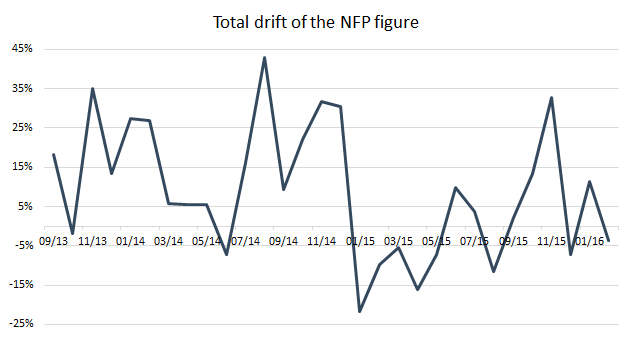
Source: BLS, own calculations
How about forecasting?
It is sure hard to count jobs. But how are the analysts doing? They also consistently fail. Here is the same graph as previously, but also displaying the difference between the revised NFP figure (which we assume to be the 'true' figure) with the previsions of the analysts, in the form of the 'consensus' survey led by Bloomberg (we used the median of the survey):
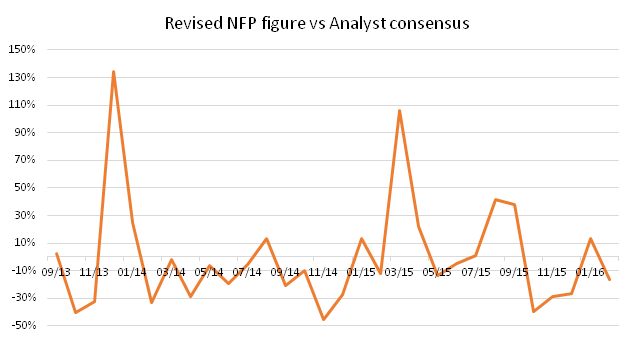
Sources: Bloomberg, BLS
The trend is quite clear: the analysts are bearish and tend to underestimate job creation. 19 times out of the 30 observations in our sample (63%), the figures were underestimated. Yet, the graphic clearly shows something else: Analysts are especially bad at predicting extreme events, in particular bad news, in our sample: for the month of February 2015, their estimate was 106% above the true figure (i.e. twice as large), and 94% higher than BLS's first estimate. Here are a few statistics to have a better view of the phenomenon:
| Statistic | Consensus vs init | Consensus vs M+2 |
| Average difference | 28% | 27% |
| Standard deviation of drift | 33% | 29% |
| Minimum deviation | 1% | 1% |
| Maximum deviation | 166% | 135% |
The analysts didn't do a very good job. On average, their estimate is almost 30% off. While they had a few good months, they had some catastrophic ones. The standard deviation of the difference between their estimate and the actual figure is also very high. Interestingly, we can see there that the analyst's estimate is generally closer to the final figure than to the first announced one.
Analysts provide estimates that are consistent with trends. The median of the surveys displays low volatility: the standard deviation (a measure of dispersion) of the revised NFP figures is more than two times larger that of the analysts' forecast (69 vs 28). If analysts are only good at predicting a figure consistent with the trend, then we might want to use the 3 or 6 month average instead. Or simply refrain from forming expectations that are consistently proven wrong, month after month, years after years.
Take-aways
- BLS's figures poorly reflect reality, and the announcement effect around their publication is overrated.
- Analysts do a very poor job at forecasting NFP figures.
- Analysts are easily caught by surprise when out of the ordinary events happen.
The post How good are we at forecasting employment? first appeared on Business Cycles Finance.
]]>The post Can statistics lie? first appeared on Business Cycles Finance.
]]>
Are my shrimps chips the best ever?
I stamble across the following label a few days back:

(see also the product page on Casino's website)
The package of my (cheap and average tasting) shrimp chips advertises that they have been chosen as having the best taste. The writing around the central circle states that they have been compared to 4 competitor's chips by 125 consumers.
Everything is wrong with this, and it is one of the core rationale for the common saying that statistics can tell whatever the commentator/journalist/politician/etc. want them to. The truth however is slightely different: you can indeed have statistics tell whatever you want, if and only if you use a weak enough methodology.
Here, the sample is only composed of 125 consumers. In France, there are about 65 million persons. That is, the chips have been tested by 0.000002% of the population. Sure, it wouldn't be wise to use the full population as a sample, but you might want to scale up a bit the size of the sample. To test the preferences of a population on things that are supposedly easily distinguished, such as politicians, survey institutes typically gather the opinions of a random sample composed of about 2000 people. Now, if you want people to make a difference between 5 similarly looking and tasting chips (which rip your palace at each bite by the way), you should use a bigger sample than a mere 125 persons.
There are several advantages in choosing such small sample:
- It is less costly,
- You are much more likely to see a false positive appear, as your confidence interval for your statistics is as good as null. That is, you are much more likely to find an artefact, something that doesn't holds for the whole population, but that you nevertheless find in your sample by pure luck,
- If you don't find the expected result, you can easily discard the result as non significant, and try again. Remember 1), such study on few people is relatively quick. So in the end, it's more like 'keep on sampling 125 people until you find the desired result'.
It is crystal clear here that Casino is using a very weak methodology. They actually do their best to keep costs low and to have the stats be wrong, or at least unreliable.
Take-aways and further readings
- Statistics are reliable if and only if the methodology used is rigorous.
- We always need to be sceptical of statistics, and find out the methodology, sample size, assumptions, etc.
- All domains are concerned by this, from shrimp chips to finance and economics
- Campbell Harvey and host Russ Roberts discussed at length the potential weakness of statistics in an EconTalk episode
The post Can statistics lie? first appeared on Business Cycles Finance.
]]>The post Where To Get Your Daily Shot Of News first appeared on Business Cycles Finance.
]]>Morning News
- The Economist's Espresso (Android, iOS): That's a great app, and typically gives you 5 (very) short articles about news in the world (policitcs, economics, etc.), plus a snapshot with shorter still pieces of information. It's efficient, and you'll receive the morning update in the morning (6:30am)
- The Market Mogul's Daily Breakfast Briefing: Good timing with this app, which gets to your inbox approximately at 7:30am. Well, hopefully you haven't started your day yet. As for me, it's a perfect additional shot of information that I get when commuting in the morning. It mainly covers economics, and also highlights some good articles published on the website
Midday News
As a European, I have an easy way to get informed during lunch break: the US's morning news. Here are my favorites:
- CFA Institute's Financial Newsbrief: The first of the midday news trio. It covers a wide range of news, focused on stock-related information and economics news. (12:15am)
- Bloomberg's Forward Guidance: Bloomberg tells us 5 things we should know about to start the day. Or the afternoon. The myriad of links in this newsletter is very much appreciated (1pm)
- Seeking Alpha's Wall Street Breakfast: This is a state of the Art daily newsletter, which covers finance and macroeconomics topics, as well as firm's specific news. It is targeted at investors, so the information there is straight forward, and structured so it can easily translate in portfolio management/strategic decisions. (1:15pm)
Editorials
- Matt Levine's Money Stuff: Matt Levine is an experienced financer. The tone in his brief is decontracted, the focuses are original and different from the previous newsletters. In addition, Matt Levine provides plenty of external links for those who want to know more about the topics he deals with. (3pm)
Specialized News
You may also want, in addition to the above, have some news focused on particular topics. Here are my favorites:
- PE Hub's Wire: One of the best newsletter out there about Private Equity, Venture Capital, IPO and M&A. The editorial gives the big picture of what's hot in the sector, while the long and exhaustive list of deals allow the reader to dive in more deeply with ease. (1pm)
- Pitchbook's PE & VC Combined Newsletter: Also focused on PE and VC, this newsletter is issued by a large service provider of the sector. The visuals are terrific - just scroll through this newsletter to immerse yourself in the state of the sector. (4pm)
If you manage to have a look at half this stuff every day, you'll end up being quite up to date about any significant event in the finance world.
The post Where To Get Your Daily Shot Of News first appeared on Business Cycles Finance.
]]>