<?xml version="1.0" encoding="UTF-8"?>
<feed xml:lang="en" xmlns="http://www.w3.org/2005/Atom" xmlns:opensearch="http://a9.com/-/spec/opensearch/1.1/" xmlns:s="http://jadedpixel.com/-/spec/shopify">
  <id>https://www.chandelierparts.com/blogs/chandelier-lighting-design.atom</id>
  <link rel="alternate" type="text/html" href="https://www.chandelierparts.com/blogs/chandelier-lighting-design"/>
  <link rel="self" type="application/atom+xml" href="https://www.chandelierparts.com/blogs/chandelier-lighting-design.atom"/>
  <title>ChandelierParts - Chandelier &amp; Lighting Design</title>
  <updated>2017-05-19T14:05:00-05:00</updated>
  <author>
    <name>ChandelierParts</name>
  </author>
  <entry>
    <id>https://www.chandelierparts.com/blogs/chandelier-lighting-design/arms-ferrules-plaster-of-paris</id>
    <published>2017-05-19T14:05:00-05:00</published>
    <updated>2017-05-19T14:32:46-05:00</updated>
    <link rel="alternate" type="text/html" href="https://www.chandelierparts.com/blogs/chandelier-lighting-design/arms-ferrules-plaster-of-paris"/>
    <title>Arms, Ferrules &amp; Plaster of Paris</title>
    <author>
      <name>Kurt Kiefer</name>
    </author>
    <content type="html">
      <![CDATA[<p><img src="//cdn.shopify.com/s/files/1/0353/0513/files/pp3_large.JPG?v=1495220424" alt=""></p>
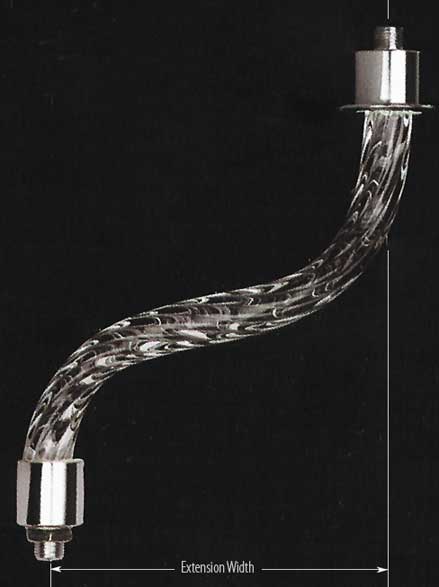
<p>Chandelier arms are the center of a good chandelier. They are what adds the diameter and scale to the central body of the fixture.  There can be many or just a few. We sell arms from 6-inches wide to a massive 24-inches wide.  Occasionally these arms break and cause significant problems to the chandelier owner.  We get asked from time to time about how to get the metal piece off the end of an arm.</p>
<p>First, the metal piece on the end of an arm is called a "ferrule". They come in brass (gold) or chrome (silver) colors.  One end has a lip which is used to hold the bobesche in place.  The bottom end does not have a lip which is the end that connects to the chandelier.  For the most part chandelier arms have a "wireway" for the electrical wire to run thru them.  (Occasionally on older fixtures wires can be placed on top or below the arms).</p>
<p><em>IMPORTANT:   Make sure power is off to the fixture prior to doing any work on a chandelier.</em></p>
<p>There are a variety of reasons you might need to get the ferrule off an arm.  So here's a sure fire way. There may be easier ways that involve stronger chemicals, but I'd used this method and it works without harsh chemicals or acid.    I use regular baking soda and water to soften the plaster of paris that holds the crystal arm in the ferrule.   Use lots of baking soda and soak, soak, soak.  I use a mixture of about 3 to 1, water to baking soda or 3 cups water to one cup baking soda. Then I let the arm soak for a good 4 hours.  Over time the plaster softens and you can chisel it out with a file or very thin screwdriver.  I will warn you the paster of paris does not "dissolve" but it "softens" to almost a hard toothpaste.</p>
<p>The trick seems to be to take the loosest plaster off the top then resoak.  Usually there is one side that is quite a bit thicker than the other and easier to get a tool in to take the plaster out.  So you take some out, resoak and try again to get more out. Depending on the age of the plaster and the amount will determine how many times you need to repeat.   The goal is to get enough plaster of paris out of one side the arm will loosen and fairly easily come out of the ferrule.  You'll then need to clean out the residual plaster in the ferrule if your going to reuse the ferrule.  Because ferrules are so cheap most of the time it's not the ferrule you are trying to save but rather the arm.  You need to exercise caution when using the tool in chipping out the old plaster and even more caution when handling long arms. Don't apply pressure or try to force the arm out.  The baking soda method works, but you need to be patient to allow it to work and soften the plaster.</p>
<p>I've seen people on-line try to give advise by using different kinds of acids and a host of other crazy things.  I don't like harsh chemicals and the baking soda is something I always have on hand.  It works.</p>
<p>I had a client who bought a long arm chandelier on-line.   There were 30 arms that were 18-inches long.  The fixture was about 42-inches in diameter and 5-feet tall.   The weight of the arms with all the prisms eventually caused the ferrule to have some metal fatigue and start to bend down because of the weight of the prism side of the arm. It actually created a "fulcrum" effect with the outside weight pushing down on the edge of the ferrule. This caused the inside edge of the ferrule to raise up, lowering the prism side of the arm.  Eventually several of the arms pulled out and hung by the electrical wire. In this case the arms were black glass and the only way to save the fixture would be to replace the dented ferrules and perhaps use stronger and longer  threaded rod to hold the arms in. It appeared the original builder use lighter weight aluminum ferrules.  A contributing factor was the owner replaced some small prisms with 40-mm balls which were considerably heavier than the original prisms.</p>
<p> </p>]]>
    </content>
  </entry>
  <entry>
    <id>https://www.chandelierparts.com/blogs/chandelier-lighting-design/methods-of-making-finishing-chandelier-prisms</id>
    <published>2017-01-26T11:56:00-06:00</published>
    <updated>2017-01-26T11:57:44-06:00</updated>
    <link rel="alternate" type="text/html" href="https://www.chandelierparts.com/blogs/chandelier-lighting-design/methods-of-making-finishing-chandelier-prisms"/>
    <title>Methods of Making/Finishing Chandelier Prisms</title>
    <author>
      <name>Mike Breen</name>
    </author>
    <content type="html">
      <![CDATA[<p>When looking at various crystals, it is good to consider just how they are made. There are several standard methods that have been used for centuries. The following will provide a little information about the most popular.</p>
<p><strong>HAND CUT AND POLISHED:</strong> This methods goes back the farthest, as for centuries in Europe the trained and skilled craftsmen individually cut and polish prisms by hand. Typically, Turkish Crystal is hand cut and polished.</p>
<p><span>Hand cutting is typically done in two stages, on an iron wheel and then on a sandstone wheel. Polishing is then done on a wooden wheel with marble dust. If you look closely you will notice faint traces and minor differences in pieces, which shows the personal attention these workers used. The beauty of this is that each piece is a unique and original.</span></p>
<p><span><strong>FIRE POLISHED:</strong> Fire polishing of crystals and beads is also a very popular, and old-world process. Fire is used to polish pieces as it is fast and economical, involving less human intervention. The use of the fire rounds out the sharp facets of prisms as the heating process that gently melts the glass at the edge of the facets and on the edges of the holes.</span></p>
<p><span><strong>MACHINE CUT:</strong> The use of machines to cut crystal elevated much of the product line to a new level. It allowed makers to create uniform, consistent items. It is much less costly than hand cut, as well as different than the "precision cutting" of Swarovski products.</span></p>
<p><span><strong>PRESSED:</strong> </span>Generally made from sand, soda, and lime heated in furnace and then pressed (molded), or “drawn” (re-shaped), this type of glass is the least expensive. Seams are often visible in pressed glass lamps and prisms.</p>]]>
    </content>
  </entry>
  <entry>
    <id>https://www.chandelierparts.com/blogs/chandelier-lighting-design/speaking-the-crystal-language</id>
    <published>2017-01-09T10:19:00-06:00</published>
    <updated>2017-01-09T10:42:35-06:00</updated>
    <link rel="alternate" type="text/html" href="https://www.chandelierparts.com/blogs/chandelier-lighting-design/speaking-the-crystal-language"/>
    <title>Speaking the &quot;crystal&quot; language</title>
    <author>
      <name>Mike Breen</name>
    </author>
    <content type="html">
      <![CDATA[<p>The term "crystal" is thrown around quite a bit in the chandelier prism world, so for consistency sake we would like to give it some context and definition.</p>
<p>Glass is <span>basically made from silica sand and other minerals such as soda ash and limestone. </span>When we speak of "crystal", the understood reference is that the glass prism or chandelier part contains a significant amount of lead oxide as well. This practice began in the late 1600 when it was discovered that adding the lead oxide make the glass more brilliant and easier to melt and to cut.</p>
<p>The lead allows light that hits the glass to be refracted, which to the common eye is noticed through the rainbows that are produced especially when in direct sunlight. The lead will also give the glass a more clear, often white look, which is where we get the term "crystal clear". Leaded pieces will also be heavier than standard glass.</p>
<p>In order for an item to be considered "full lead" means it contains at least 24% lead oxide. The Asfour line of prisms, advertises 30 percent lead.</p>
<p><span>Makers such as Swarovski, however, have gone away from the use of lead and used a process to create what they call "Advanced Crystal". Their product is made by replacing the lead oxide in production of the glass with barium oxide, zinc oxide, or potassium oxide.  It has a similar refractive index to lead crystal, but it is lighter and it has less dispersive power.</span></p>
<p> </p>]]>
    </content>
  </entry>
  <entry>
    <id>https://www.chandelierparts.com/blogs/chandelier-lighting-design/hanging-crystal-prisms-sun-catchers-with-dental-floss</id>
    <published>2016-12-06T15:22:00-06:00</published>
    <updated>2016-12-06T15:22:00-06:00</updated>
    <link rel="alternate" type="text/html" href="https://www.chandelierparts.com/blogs/chandelier-lighting-design/hanging-crystal-prisms-sun-catchers-with-dental-floss"/>
    <title>Hanging crystal prisms (sun catchers) with dental floss</title>
    <author>
      <name>Kurt Kiefer</name>
    </author>
    <content type="html">
      <![CDATA[<p>We do not recommend using dental floss to hang crystal chandelier parts.  We've had reports of people using dental floss in windows to make sun catchers. </p>
<p>Dental floss is easy to come by so it's only natural people think of it.  There are many types of dental floss including waxed and unwaxed in mono-filament (single) and multi-filament (multiple) thread styles. The standard multi-filament can have as many as 1000 strands which twists six times per inch to add strength.</p>
<p>Using standard tensile strength testing shows that the longer the length of dental floss the weaker the floss.  A 20-inch piece is more than 3.2 times weaker than a 10 inch piece.  A 30-inch piece is half again as weak as the 20-inch. Over time a sun-drenched window would further dry out and weaken the dental floss.</p>
<p>The "tensile strength" is the amount of pressure needed to burst the cord or floss. It's a common unit of measure for cord.  </p>
<p>A 15# test fishing line is 57 times stronger than dental floss.  The heavier the prism the stronger the cord or line you'll need to hang it. Don't run the risk of damage to your beautiful prisms.  Test the line and calculate what the burst or tensile strength is. </p>]]>
    </content>
  </entry>
  <entry>
    <id>https://www.chandelierparts.com/blogs/chandelier-lighting-design/replacement-parts-for-your-chandelier</id>
    <published>2016-09-26T15:53:00-05:00</published>
    <updated>2023-05-16T16:47:58-05:00</updated>
    <link rel="alternate" type="text/html" href="https://www.chandelierparts.com/blogs/chandelier-lighting-design/replacement-parts-for-your-chandelier"/>
    <title>Replacement parts for your chandelier!</title>
    <author>
      <name>Kurt Kiefer</name>
    </author>
    <content type="html">
      <![CDATA[
<!--Gem_Page_Main_Editor--><div class="clearfix"></div><div class="gryffeditor">
<div data-label="Row" data-key="row" data-atomgroup="row" id="r-1684273670443" class="gf_row" data-icon="gpicon-row" data-id="1684273670443"><div class="gf_column gf_col-lg-12 gf_col-md-12 gf_col-sm-12 gf_col-xs-12" id="c-1684273670515" data-id="1684273670515"><div data-label="Text Block" class="element-wrap" data-description="" data-key="text-block" id="e-1684185490919" data-icon="gpicon-textblock" data-ver="1" data-id="1684185490919"><div class="elm text-edit gf_gs-text-paragraph-1 gf-elm-left-lg gf-elm-left-md gf-elm-left-sm gf-elm-left-xs" data-exc="">
<p>We get many requests every day for help in finding replacement or broken chandelier parts. We are glad to help, but there are limits to what we can do.  Here's a few tips:</p>
<p>1. We don't have a huge library of old manufacturers catalogs.  Many people write in and say they have a "Miller" or a "Smitty" this or that.  This doesn't help us.  We deal in parts and prisms and are interested in knowing if you need an arm or a pendalogue.  The manufacturer doesn't help us.</p>
<p>2. How it broke doesn't really matter to us.  We get some of the best stories of who broke the chandelier and/or how.  Uncle Willie or Fluffy the cat doesn't help us find you the part you need.  Just the facts, as Joe Friday would say.  Save the story for the grandkids. </p>
<p>3. We do have thousands of crystal parts. We also have many manufacturers catalogs. We can usually identify most crystal parts and will know if they are currently made. </p>
<p>4. Many old crystal parts are one of a kind. We've seen many parts that were hand made by craftsmen of another era.  Sometimes old parts cannot be found today.  Many of these parts were hand crafted and not available.  </p>
<p>5. Be prepared to substitute.  Some old fixtures are impossible to find parts. Sometimes you have to replace all like-kind parts with new parts because you cannot find matching parts. We do have a vast inventory and many times we can find an exact match.</p>
<p>6. Swarovski/Strass never made chandeliers until they bought Schonbek in 2012.  We get people every day who say their grandmother bought a Swarovski chandelier 20 or 30 years ago.  Swarovski itself has never made chandeliers. Swarovski makes components and sells them to manufacturers who make the chandeliers.   They can use all Swarovski/Strass components and get a Swarovski/Strass badge so the consumer knows it is made of genuine  Swarovski/Strass components.   Chandelier Parts.com is an Authorized Swarovski Distributor and buys direct from Swarovski.  We meet regularily with Swarovski and pride ourselves on maintaining stocking inventory on the many parts and colors in their line.  </p>
<p><br></p>
</div></div></div></div>
<!--gfsplit--><script>window.__gemStoreData = {};window.__gemStoreData.gemKeyValid = {};window.__gemStoreData.gemKeyValid.bestWayAddToCart = 1;</script>
</div><div id="divContentBk"></div><!--End_Gem_Page_Main_Editor-->]]>
    </content>
  </entry>
  <entry>
    <id>https://www.chandelierparts.com/blogs/chandelier-lighting-design/15294833-new-platform-new-possibilities</id>
    <published>2014-09-04T10:16:00-05:00</published>
    <updated>2014-09-04T10:16:12-05:00</updated>
    <link rel="alternate" type="text/html" href="https://www.chandelierparts.com/blogs/chandelier-lighting-design/15294833-new-platform-new-possibilities"/>
    <title>New platform, New possibilities</title>
    <author>
      <name>Mike Breen</name>
    </author>
    <content type="html">
      <![CDATA[<p>We are excited at ChandelierParts.com to have moved our website to a new platform. While much of our site looks very much the same, there are many new and exciting features.</p>
<p>Among the advantages to our new site is ultimately a better search feature, the products present much cleaner and improved photos, easier to understand quantity discounts, integration to social media that will make new product announcements accessible, plus so much more.</p>
<p>The downside is that with the realignment of the site there are always some cleanup and updates that need to be made. We continue daily to assure that ChandelierParts.com remains the leading source for replacement prisms and chandelier parts.</p>
<p>As always, we encourage our customers and visitors to share their thoughts about how we are doing and how we can improve.</p>]]>
    </content>
  </entry>
  <entry>
    <id>https://www.chandelierparts.com/blogs/chandelier-lighting-design/15206885-millimeter-conversion-chart</id>
    <published>2014-08-26T09:37:00-05:00</published>
    <updated>2025-06-02T15:19:18-05:00</updated>
    <link rel="alternate" type="text/html" href="https://www.chandelierparts.com/blogs/chandelier-lighting-design/15206885-millimeter-conversion-chart"/>
    <title>Millimeter Conversion Chart</title>
    <author>
      <name>Josh Wold</name>
    </author>
    <content type="html">
      <![CDATA[<p><img src="https://cdn.shopify.com/s/files/1/0353/0513/files/size_comparison_chart.jpg?v=1748895186" alt=""></p>
<table border="0" cellpadding="3" cellspacing="3">
<tbody>
<tr>
<td class="medHEADER" width="48">
<div align="center">MM</div>
</td>
<td class="medHEADER" width="200">Approximate Size In Inches</td>
<td class="medHEADER" width="148">Exact Size In Inches</td>
</tr>
<tr class="conversionchartBLACK">
<td align="center" bgcolor="DFD3B5">1mm</td>
<td align="center" bgcolor="DFD3B5">1/32 Inch</td>
<td align="center" bgcolor="DFD3B5">0.03937 Inches</td>
</tr>
<tr class="conversionchartBLACK">
<td align="center">2mm</td>
<td align="center">1/16 Inch</td>
<td align="center">0.07874 Inches</td>
</tr>
<tr class="conversionchartBLACK" bgcolor="DFD3B5">
<td align="center">3mm</td>
<td align="center">3/32 Inch</td>
<td align="center">0.11811 Inches</td>
</tr>
<tr class="conversionchartBLACK">
<td align="center">4mm</td>
<td align="center">1/8 Inch</td>
<td align="center">0.15748 Inches</td>
</tr>
<tr class="conversionchartBLACK" bgcolor="DFD3B5">
<td align="center">5mm</td>
<td align="center">3/16 Inch</td>
<td align="center">0.19685 Inches</td>
</tr>
<tr class="conversionchartBLACK">
<td align="center">6mm</td>
<td align="center">Just short of 1/4 Inch</td>
<td align="center">0.23622 Inches</td>
</tr>
<tr class="conversionchartBLACK" bgcolor="DFD3B5">
<td align="center">7mm</td>
<td align="center">Little over 1/4 Inch</td>
<td align="center">0.27559 Inches</td>
</tr>
<tr class="conversionchartBLACK">
<td align="center">8mm</td>
<td align="center">5/16 Inch</td>
<td align="center">0.31496 Inches</td>
</tr>
<tr class="conversionchartBLACK" bgcolor="DFD3B5">
<td align="center">9mm</td>
<td align="center">Just short of 3/8 Inch</td>
<td align="center">0.35433 Inches</td>
</tr>
<tr class="conversionchartBLACK">
<td align="center">10mm</td>
<td align="center">Little over 3/8 Inch</td>
<td align="center">0.39370 Inches</td>
</tr>
<tr class="conversionchartBLACK" bgcolor="DFD3B5">
<td align="center">11mm</td>
<td align="center">7/16 Inch</td>
<td align="center">0.43307 Inches</td>
</tr>
<tr class="conversionchartBLACK">
<td align="center">12mm</td>
<td align="center">Just short of 1/2 Inch</td>
<td align="center">0.47244 Inches</td>
</tr>
<tr class="conversionchartBLACK" bgcolor="DFD3B5">
<td align="center">13mm</td>
<td align="center">Little over 1/2 Inch</td>
<td align="center">0.51181 Inches</td>
</tr>
<tr class="conversionchartBLACK">
<td align="center">14mm</td>
<td align="center">9/16 Inch</td>
<td align="center">0.55118 Inches</td>
</tr>
<tr class="conversionchartBLACK" bgcolor="DFD3B5">
<td align="center">15mm</td>
<td align="center">Just short of 5/8 Inch</td>
<td align="center">0.59055 Inches</td>
</tr>
<tr class="conversionchartBLACK">
<td align="center">16mm</td>
<td align="center">5/8 Inch</td>
<td align="center">0.62992 Inches</td>
</tr>
<tr class="conversionchartBLACK" bgcolor="DFD3B5">
<td align="center">17mm</td>
<td align="center">Just short of 11/16 Inch</td>
<td align="center">0.66929 Inches</td>
</tr>
<tr class="conversionchartBLACK">
<td align="center">18mm</td>
<td align="center">Just short of 3/4 Inch</td>
<td align="center">0.70866 Inches</td>
</tr>
<tr class="conversionchartBLACK" bgcolor="DFD3B5">
<td align="center">19mm</td>
<td align="center">Little over 3/4 Inch</td>
<td align="center">0.74803 Inches</td>
</tr>
<tr class="conversionchartBLACK">
<td align="center">20mm</td>
<td align="center">Just short of 13/16 Inch</td>
<td align="center">0.78740 Inches</td>
</tr>
<tr class="conversionchartBLACK" bgcolor="DFD3B5">
<td align="center">21mm</td>
<td align="center">Little over 13/16 Inch</td>
<td align="center">0.82677 Inches</td>
</tr>
<tr class="conversionchartBLACK">
<td align="center">22mm</td>
<td align="center">Just short of 7/8 Inch</td>
<td align="center">0.86614 Inches</td>
</tr>
<tr class="conversionchartBLACK" bgcolor="DFD3B5">
<td align="center">23mm</td>
<td align="center">Little over 7/8 Inch</td>
<td align="center">0.90551 Inches</td>
</tr>
<tr class="conversionchartBLACK">
<td align="center">24mm</td>
<td align="center">15/16 Inch</td>
<td align="center">0.94488 Inches</td>
</tr>
<tr class="conversionchartBLACK" bgcolor="DFD3B5">
<td align="center">25mm</td>
<td align="center">1 Inch</td>
<td align="center">0.98425 Inches</td>
</tr>
</tbody>
</table>
<p> </p>
<p><img><img></p>
<h2>Conversion Calculator</h2>
<form name="inputFormt2f7t16" id="inputFormt2f7t16">
<div style="background-image: url('http://www.metric-conversions.org/img/calcTool.jpg'); background-repeat: no-repeat; background-color: #000000; height: 180px; width: 250px;">
<a href="http://metric-conversions.org/length/millimeters-to-inches.htm" style="position: relative; display: block; width: 240px; padding: 8px 0 0 0; margin: 0 0 0 0; font-family: Arial, Helvetica, sans-serif; font-size: 12px; font-weight: bold; text-align: center; color: #ffffff; text-decoration: none;" target="_blank"> mm to in converter</a><input name="argument" id="argument" style="background-image: url('http://www.metric-conversions.org/img/calcIP.jpg'); width: 207px; height: 32px; font-family: Arial, Helvetica, sans-serif; font-size: 24px; font-weight: bold; border: 0px; position: relative; top: 20px; left: 21px; line-height: 34px; padding: 0 0 0 0; margin: 0 0 0 0;" value="mm" type="text">
<div id="convertButtont2f7t16" style="position: relative; display: block; height: 30px; width: 105px; top: 26px; left: 124px; padding: 0 0 0 0; margin: 0 0 0 0; border: 0px; z-index: 2; cursor: pointer;"></div>
<input id="result" name="arg" style="background-image: url('http://www.metric-conversions.org/img/calcIP.jpg'); width: 207px; height: 32px; font-family: Arial, Helvetica, sans-serif; font-size: 24px; font-weight: bold; border: 0px; position: relative; top: 32px; left: 21px; line-height: 34px; padding: 0 0 0 0; margin: 0 0 0 0;" value="" readonly type="text"><span style="position: relative; display: block; top: 44px; left: 4px; width: 240px; padding: 0 0 0 0; margin: 0 0 0 0; font-family: Arial, Helvetica, sans-serif; font-size: 12px; font-weight: bold; text-align: center; color: #ffffff; text-decoration: none;">www.metric-conversions.org</span>
</div>
</form>]]>
    </content>
  </entry>
  <entry>
    <id>https://www.chandelierparts.com/blogs/chandelier-lighting-design/15206829-measuring-a-chandelier-arm</id>
    <published>2014-08-26T09:27:00-05:00</published>
    <updated>2023-07-28T10:11:52-05:00</updated>
    <link rel="alternate" type="text/html" href="https://www.chandelierparts.com/blogs/chandelier-lighting-design/15206829-measuring-a-chandelier-arm"/>
    <title>Measuring a Chandelier Arm &amp; Scroll</title>
    <author>
      <name>Josh Wold</name>
    </author>
    <content type="html">
      <![CDATA[<p>Below, you will find several illustrations on the proper way to measure various chandelier arms.</p>
<meta charset="utf-8"><strong>S Arm:</strong><br> <img src="//cdn.shopify.com/s/files/1/0353/0513/files/armRope_1_grande.jpg?1144">
<p> </p>
<meta charset="utf-8">
<p><strong>Up Arm:</strong></p>
<meta charset="utf-8"><img src="//cdn.shopify.com/s/files/1/0353/0513/files/upRope_1_grande.jpg?1144"><br><br>
<p><strong>Scroll:</strong></p>
<img src="https://cdn.shopify.com/s/files/1/0353/0513/files/scroll_measurement_diagram_480x480.jpg?v=1690557055" alt="" width="442" height="428"><br><br>]]>
    </content>
  </entry>
  <entry>
    <id>https://www.chandelierparts.com/blogs/chandelier-lighting-design/15206709-cleaning-a-chandelier</id>
    <published>2014-08-26T09:10:00-05:00</published>
    <updated>2023-05-09T11:40:39-05:00</updated>
    <link rel="alternate" type="text/html" href="https://www.chandelierparts.com/blogs/chandelier-lighting-design/15206709-cleaning-a-chandelier"/>
    <title>Cleaning a Chandelier</title>
    <author>
      <name>Josh Wold</name>
    </author>
    <content type="html">
      <![CDATA[<p><span class="strassTEXT">The following information is courtesy <a href="http://www.kingschandelier.com" target="_blank">King's Chandelier Co.</a></span><br> <br> <span class="strassTEXT">"If properly cared for a chandelier is an investment and an heirloom that can be passed down from generation to generation"<br> <br> Most people never need to clean a chandelier more than once a year. In many cases, especially with new house constructions, once every two years will suffice. Cleaning a chandelier can be intimidating, but the shining result is well worth the time and effort. Before disassembling your fixture, ALWAYS, ALWAYS, ALWAYS make a diagram of where all the removable part of the chandelier belong. Take it from us, you may think you know where everything goes, but odds are you'll find yourself scratching your head while staring at a mound of crystal chandelier parts. Another solution is to clean the chandelier by sections. <br> <br> Never clean the chandelier with the lights turned on, and make sure to give the bulbs time to cool before beginning. Place a thick quilt or comforter under your fixture to catch any prisms you may drop. Hopefully, this will provide enough cushion to keep anything that slips out of your hand from breaking or from scratching your table. Most importantly, do not turn your chandelier as you clean it. Keep the fixture stationary while you move around it. <br> <br> We recommend the following method for cleaning all the crystal and chandelier parts: <br> Carefully remove all of the trimmings, placing the pendants in a plastic colander. Use a small amount of mild dish detergent and rinse the pendants well with hot water. TIP: The hotter the water, the fewer the spots. When putting festoons under running water, they should be held at full length with both hands to discourage tangling. Again, use a small amount of mild dish detergent and rinse well. At this point, you can either lay out the chandelier parts separately to air dry or leave in the colander to cloth dry later. TIP: We recommend that you use mild soaps when cleaning your pendants. Harsh chemicals have a tendency to react with the pinning causing them to become blackened and brittle. Admittedly, most pinning darkens with age (remember the black pins on your Grandmother's chandelier), but you can slow this process by sticking with soap and water. <br> <br> When cleaning the body of the all-crystal chandelier, we recommend dusting the fixture with a dry cloth, then using your favorite glass or <a href="http://www.chandelierparts.com/index.asp?PageAction=VIEWPROD&amp;ProdID=4">chandelier cleaner</a> sprayed on to a cloth (never spray into the fixture), wipe and polish all pieces. TIP: Dusting first cuts down on polishing later. Don't forget the bulbs. The more lint-free the cloth, the better results you will have. We favor cheap (the cheaper they are, the less lint they leave behind) paper towels, but worn-out sheeting or newspaper is popular as well. Return all hanging chandelier parts and pieces to the fixture, working from the inside to the outside. A quick polish on each piece as you go will take care of any lingering drops of water. TIP: For a quick spruce-up, clean and polish your bulbs. You won't believe what a difference this makes. For our solid brass fixtures, we recommend that you remove the crystal trimmings and clean in the same manner as described for the all-crystal chandelier trimmings. However, the bodies of the brass chandeliers need only dusting. Do not apply cleaner or brass polish to this brass. Vinegar or ammonia will give the crystal a good shine; however, you should be careful to keep these solutions away from the metal pinning. A strong wipe with a cloth shines just as much without the fumes. There are many <a href="http://www.chandelierparts.com/index.asp?PageAction=VIEWPROD&amp;ProdID=4">spray-on chandelier cleaners</a> on the market, and these work well for those who don't have the means to clean their chandelier any other way; however, the "old fashioned" method of taking the chandelier apart is the most thorough and longest lasting method. If you really don't want to clean your chandelier, contact local cleaning services and lighting stores for contract workers. </span></p>
<p> </p>
<p><span class="strassTEXT"><img src="//cdn.shopify.com/s/files/1/0353/0513/files/cleaning_1_large.jpg?1138"></span></p>]]>
    </content>
  </entry>
  <entry>
    <id>https://www.chandelierparts.com/blogs/chandelier-lighting-design/15206565-chandelier-size</id>
    <published>2014-08-26T08:54:00-05:00</published>
    <updated>2014-08-26T08:54:16-05:00</updated>
    <link rel="alternate" type="text/html" href="https://www.chandelierparts.com/blogs/chandelier-lighting-design/15206565-chandelier-size"/>
    <title>Chandelier Size</title>
    <author>
      <name>Josh Wold</name>
    </author>
    <content type="html">
      <![CDATA[<span class="strassTEXT">You want the size of your chandelier to complement the room that it is in. Finding the right size chandelier for your room does not have to be a difficult task. There is a simple formula that can help you. Just to give you a general idea of where to start with size, add the width and length of your room measured in feet. The sum equals the desired diameter of your chandelier measured in inches. For example, if your room is 14 feet x 16 feet, your chandelier diameter should be 30 inches. Remember, this is just a general starting point. Depending on how much your room is furnished, you may want to go larger or smaller. Also keep in mind that a chandelier will look smaller as you hang it higher. Therefore, if you have high ceilings or a two-story foyer, you might want to add a couple inches to the original size. At the same time, if you have low ceilings, you will want a smaller size so that people can walk underneath the chandelier. Generally, you will want at least 6-1/2 feet between your chandelier and the floor for someone to walk underneath it.<br /><br />Many times, people choose the size of a chandelier based on a table that it will be hanging over. One recommendation is to allow 32 to 34 inches between the chandelier and the tabletop. Again, this is a general guideline, and you should allow more space if you prefer large centerpieces for your table. As far as the width of your chandelier is concerned, there are a couple suggestions for finding the right diameter of a chandelier that will be hanging over a table. One is that the diameter should be half the width of your table, and another is that the diameter should be two feet narrower than the table length.<br /><br />Ultimately, use your own discretion and taste when it comes to your final decision about your chandelier size. Your opinion is the most important one.</span>]]>
    </content>
  </entry>
  <entry>
    <id>https://www.chandelierparts.com/blogs/chandelier-lighting-design/15206553-parts-of-a-chandelier</id>
    <published>2014-08-26T08:53:00-05:00</published>
    <updated>2023-05-17T09:59:41-05:00</updated>
    <link rel="alternate" type="text/html" href="https://www.chandelierparts.com/blogs/chandelier-lighting-design/15206553-parts-of-a-chandelier"/>
    <title>Parts of a Chandelier</title>
    <author>
      <name>Josh Wold</name>
    </author>
    <content type="html">
      <![CDATA[<p><strong><span class="medHEADER"><img src="//cdn.shopify.com/s/files/1/0353/0513/files/chandelier_map_graphic_grande.gif?1136"></span></strong></p>
<p><strong><span class="medHEADER">Crystals:</span></strong>The main part of a crystal chandelier is certainly the crystal itself. Crystals that are used in chandeliers can be one of many types. A chandelier can have very high priced crystals which are made by some of the best crystal companies in the world, such as Swarovski Strass crytals or can have more economical crystals, which although less expensive in terms of money, are still very reflective &amp; brilliant.<br><br><strong><span class="medHEADER">Chandelier Arms:</span></strong>The chandelier arms are what extend out from the main body of the chandelier and on which the chandelier candles are placed. Chandelier arms can be of different types such as an S shaped arm, a fluted chandelier arm, and a rope chandelier arm. These are also available in different materials such as crystal, brass, metal etc depending on the type of chandelier.<br><br><strong><span class="medHEADER">Chandelier Candles:</span></strong>The candles that go on the end of the chandelier arms are what are used for illuminating the chandelier. Most chandelier candles or candle covers are hand made and even have wax drippings on the candles which make them look very authentic and attractive. .<br><br><strong><span class="medHEADER">Miscellaneous Chandelier Parts:</span></strong>Other than the above mentioned crystal chandelier parts, a chandelier has various other parts such as:</p>
<ul>
<li>Bulbs, converters, and sockets to provide light and brilliance to the chandelier.</li>
<li>Bobeches which can be used to collect the wax drippings of real candles or to enhance the overall look of a chandelier.</li>
<li>Collars, canopies, and chains from which to suspend your chandelier from the ceiling.</li>
<li>Chandelier shades to cover the lamps.</li>
</ul>]]>
    </content>
  </entry>
  <entry>
    <id>https://www.chandelierparts.com/blogs/chandelier-lighting-design/15206521-finding-the-right-size-replacement-part</id>
    <published>2014-08-26T08:49:00-05:00</published>
    <updated>2014-08-26T08:49:28-05:00</updated>
    <link rel="alternate" type="text/html" href="https://www.chandelierparts.com/blogs/chandelier-lighting-design/15206521-finding-the-right-size-replacement-part"/>
    <title>Finding the Right Size Replacement Part</title>
    <author>
      <name>Josh Wold</name>
    </author>
    <content type="html">
      <![CDATA[<p>To help you find the right size replacement part, always measure the actual prism length and do not include the top bead. So if your prisms or pendalogues measure 4"e;(not including top bead) then you should look for a 4"e; prism with a similiar shape. The prism bead or jewel head along with the head pin add approximately 1/2"e; to 3/4"e; to the stated prism length.<img src="//cdn.shopify.com/s/files/1/0353/0513/files/measuring_part_1_small.gif?1136" height="191" width="42" /></p>]]>
    </content>
  </entry>
  <entry>
    <id>https://www.chandelierparts.com/blogs/chandelier-lighting-design/15199785-dressing-a-chandelier</id>
    <published>2014-08-26T08:45:00-05:00</published>
    <updated>2014-08-28T23:02:20-05:00</updated>
    <link rel="alternate" type="text/html" href="https://www.chandelierparts.com/blogs/chandelier-lighting-design/15199785-dressing-a-chandelier"/>
    <title>Dressing A Chandelier</title>
    <author>
      <name>Josh Wold</name>
    </author>
    <content type="html">
      <![CDATA[<table class="content " style="width: 100%;" border="0" cellpadding="0" cellspacing="0">
<tbody>
<tr class="content-body-row">
<td class="content-lt"></td>
<td class="content-body">
<div id="ctl00_pageContent_htmlContent">
<p>Chandeliers are a prominent part of many homes. If your chandelier doesn't quite fit your home anymore, consider a redressing. Redressing a chandelier can involve replacing prisms, a thorough cleaning, adding shades, changing bulb styles, adding a unique candle cover in addition to many other items.</p>
<div class="LandingPageDescriptionBlock">
<h2>Prisms &amp; Chains</h2>
<p>Prisms are often the most distinguishing feature of a chandelier, establishing it's identity. Adjusting the style and quality of prism can produce a drastically different chandelier. Replacing prisms can be very simple but the choice of prisms can be a challenge with so many options available. Here are a few things to keep in mind when redressing your chandelier:</p>
<ol>
<li>Size – You want to make sure that the prisms you are using are correct proportion to your fixture. If the prism are too small, they will be lost (especially if your chandelier is hanging 10 feet above your head). If the prisms are too big, it will overwhelm the fixture and you can lose the features of the frame.</li>
<li>Quality – There is a wide range of quality when it comes to prisms. While many standard cut and polished glass pieces are very elegant and work just fine, you can also make an incredible statement with items that are leaded (typically 30%). It is the lead in the prisms that gives the prisms the “wow factor”, where the light is refracted and produces the rainbow effect. An example of the highest end prisms in the industry is the Strass line produced by Swarovski. The best route, however, is to make sure that you stay with the same quality of prism throughout your chandelier as mixing them can give an unbalanced feel.</li>
<li>Color – Nothing makes a quicker and bigger statement than adding color to a chandelier with the prisms. Many people will have a set of prisms for each major holiday or season... ie. red and green at Christmas time; pastel colors at Easter; warmer, darker colors for the fall. Also keep in mind, you don’t have to change out every clear prism with color to make a statement. Sometimes a random colored piece within the clear ones can bring a sophisticated look.</li>
<li>Shape – You can find a wide variety of shapes with chandelier prisms. From round balls (smooth or faceted), to almond shapes, to long raindrops, to French-style cuts. You can again use either an entire pattern (possibly with varying sizes) or a combination of styles to bring the chandelier to life.</li>
</ol>
<p>No matter what route you go when redressing your chandelier, make sure you let your creativity take over. Redressing allows you to take a mass-produced fixture and turn it into a one-of-a-kind showpiece which reflects your personality.</p>
<p>Keep in mind the size quality and color of prism that you are ordering. Use like-quality prisms on the same chandelier. Color accent prisms can be increase the aesthetic of a chandelier.</p>
<p>The type of pin used to connect each prism vary by manufacturer, check the color and pattern of pin before you order, to match your design needs.</p>
</div>
</div>
</td>
</tr>
</tbody>
</table>
<h2></h2>
<h2>Bulbs &amp; Candle Covers</h2>
<p>A simple bulb change can upgrade the look of your chandelier drastically. Many varieties of bulbs are available including, flame tips, torpedo, historic filament and novelty. Before ordering bulbs, check the type of base you have on your chandelier bulbs. If your chandelier doesn't have a standard base, there are adapters available to match many of the old style bases.</p>
<p>Bulb covers are an easy way to modify your lighting. Bulb covers slip over an existing bulb to alter the quality of light coming from the chandelier as well as upgrade the appearance of the chandelier.</p>
<p>New candle covers are a great way to customize your chandelier. Candle covers slip over the lamp base below the bulb. These can be made from a variety of materials and patterns. There are value covers made from plastic that can be painted. There are a wide variety of colors and printed candle covers as well as beeswax drip candle covers.</p>
<p>These can be replaced simply by removing the bulb, slipping off the old cover and replacing with a new style.</p>
<h2>Chandelier Cleaning</h2>
<p>Most chandeliers need a cleaning once every year or two. The process can seem daunting, but with a little planning and a few supplies the results can be spectacular.</p>
<p>Before you begin, turn off the lighting, take photos of the placement of prisms and chains as well as place a thick blanket below the chandelier to catch any falling pieces.</p>
<p>Remove any hanging prisms, these can be cleaned with a very mild detergent or a <a href="http://www.chandelierparts.com/chandeliercleaner.aspx" target="_blank" alt="chandelier cleaner">chandelier cleaner</a>. Depending on what the pieces of your chandelier are made of, use a chandelier cleaner or polish on the arms, bobeches, cups and other parts. Don't forget to polish the bulbs.</p>
<p>Replace the pieces based on your photographs. For more information on <a href="http://www.chandelierparts.com/cleaningyourchandelier.aspx" target="_blank">cleaning a chandelier</a>, visit <a href="http://www.chandelierparts.com/cleaningyourchandelier.aspx" target="_blank">ChandelierParts.com/CleaningYourChandelier.aspx</a></p>]]>
    </content>
  </entry>
  <entry>
    <id>https://www.chandelierparts.com/blogs/chandelier-lighting-design/12682297-picking-a-chandelier</id>
    <published>2014-03-05T09:14:00-06:00</published>
    <updated>2018-03-15T12:11:10-05:00</updated>
    <link rel="alternate" type="text/html" href="https://www.chandelierparts.com/blogs/chandelier-lighting-design/12682297-picking-a-chandelier"/>
    <title>Picking a Chandelier</title>
    <author>
      <name>Kurt Kiefer</name>
    </author>
    <content type="html">
      <![CDATA[<div class="moz-text-html" lang="x-western"><span style="font-size: small;" size="2"><img style="float: right; margin: 0 0 10px 10px;" src="//cdn.shopify.com/s/files/1/0353/0513/files/ChandelierBlogPost.png?899"> Chandeliers go back centuries. They are a focal point in a house, foyer, dining room, hall or anywhere you need elegant lighting. A chandelier can be a statement with elegance and grace or it can simply provide lighting. The points to consider when looking for a chandelier are:</span></div>
<div class="moz-text-html" lang="x-western"><span style="font-size: small;" size="2"></span></div>
<div style="color: black; font-family: arial;"><span style="font-size: small;" size="2"><br> </span></div>
<div style="color: black; font-family: arial;"><span style="font-size: small;" size="2"><strong>HEIGHT:</strong> If you have a standard eight foot ceiling you'll need more of a flush mount that doesn't come down into the room very much. If you are putting it over a dining room table you can come down much more than if you are walking under it.  The height of the fixture should be an important consideration and decision you make before you start looking.  The diameter is also a consideration.</span></div>
<div style="color: black; font-family: arial;"><span style="font-size: small;" size="2"><br> </span></div>
<div style="color: black; font-family: arial;"><span style="font-size: small;" size="2"><strong>FRAME:</strong> Do you want a glass frame? wrought iron?  The frame gives a chandelier a "look" that may or may not work with your room or furniture.</span></div>
<div style="color: black; font-family: arial;"><span style="font-size: small;" size="2"><br> </span></div>
<div style="color: black; font-family: arial;">
<span style="font-size: small;" size="2"><strong>STYLE:</strong> There are so many styles of chandeliers. You can pick modern or traditional or antique or anything in between. You should look for </span><span style="font-size: small;">a style that fits with your furnishings and house. Don't be afraid to go a bit "wild".</span>
</div>
<div style="color: black; font-family: arial;"><span style="font-size: small;" size="2"><br> </span></div>
<div style="color: black; font-family: arial;"><span style="font-size: small;" size="2"><strong>PRISMS:</strong> Swarovski is the world leader of prisms and really make a chandelier "pop". Many chandeliers blend more expensive prisms with less expensive prisms. Swarovski is an industry leader and no longer produces "leaded" crystal but developed a new process that exceeds brilliance and refraction of traditional prisms but are lead free. Swarovski crystal prisms are manufactured in Austria. Other countries that produce many fine prisms are Italy, Germany, Turkey and Egypt.</span></div>
<div style="color: black; font-family: arial;"><span style="font-size: small;" size="2"><br> </span></div>
<div style="color: black; font-family: arial;">
<span style="font-size: small;" size="2"><strong>INSTALLATION:</strong> Don't assume an electrical box in your ceiling will hold the weight of your chandelier. Have an electrician or lighting showroom professional install your chandelier. A chandelier with many large crystal prisms can weigh a tremendous amount. It's important your chandelier be installed correctly so it does not come loose and fall. Another consideration is the number of light bulbs your fixture holds and the capacity of the electrical circuit. Look for your chandelier at finer lighting showrooms or online. Many estate furniture stores have chandeliers as well as </span><span style="color: black; font-family: arial; font-size: small;" size="2">antique stores and flea markets.</span>
</div>
<div style="color: black; font-family: arial;"><span style="font-size: small;" size="2"><br> </span></div>
]]>
    </content>
  </entry>
</feed>