<?xml version="1.0" encoding="UTF-8"?>
<?xml-stylesheet type="text/xsl" media="screen" href="/~d/styles/rss2full.xsl"?><?xml-stylesheet type="text/css" media="screen" href="http://feeds.feedburner.com/~d/styles/itemcontent.css"?><rss xmlns:content="http://purl.org/rss/1.0/modules/content/" xmlns:wfw="http://wellformedweb.org/CommentAPI/" xmlns:dc="http://purl.org/dc/elements/1.1/" xmlns:atom="http://www.w3.org/2005/Atom" xmlns:feedburner="http://rssnamespace.org/feedburner/ext/1.0" version="2.0">

<channel>
	<title>CoreConnex | Industry Trends for VAR, MSP or IT Service Providers | Business Systems for IT Service Companies</title>
	
	<link>http://www.coreconnex.com</link>
	<description>Business Systems for IT Service Companies</description>
	<pubDate>Sat, 20 Jun 2009 19:46:26 +0000</pubDate>
	<generator>http://wordpress.org/?v=2.6</generator>
	<language>en</language>
			<atom10:link xmlns:atom10="http://www.w3.org/2005/Atom" rel="self" href="http://feeds.feedburner.com/Coreconnex" type="application/rss+xml" /><item>
		<title>Who is Driving Your Business?</title>
		<link>http://feedproxy.google.com/~r/Coreconnex/~3/5anUYb9izJI/</link>
		<comments>http://www.coreconnex.com/2009/05/06/who-is-driving-your-business/#comments</comments>
		<pubDate>Wed, 06 May 2009 17:49:59 +0000</pubDate>
		<dc:creator>Tony Lael</dc:creator>
		
		<category><![CDATA[Business Management]]></category>

		<category><![CDATA[ConnexIT]]></category>

		<category><![CDATA[Corelytics]]></category>

		<category><![CDATA[Operations Management]]></category>

		<category><![CDATA[financial dashboard]]></category>

		<category><![CDATA[professional services automation]]></category>

		<category><![CDATA[psa software]]></category>

		<guid isPermaLink="false">http://www.coreconnex.com/?p=2151</guid>
		<description><![CDATA[<p>As described in <em>The E-Myth - Why Most Small Businesses Don&#8217;t Work and What to Do About IT by Michael Gerber</em>, all of today&#8217;s small business owners are playing three roles.</p>
<p><strong>Entrepreneur </strong>- envisions the future, but lacks execution</p>
<p><strong>Manager </strong>- organizes everything, but forgets the big picture</p>
<p><strong>Technician</strong> - gets work done, but to the detriment of all else</p>
<p>Each personality or person in&#8230;</p>]]></description>
			<content:encoded><![CDATA[<p>As described in <em>The E-Myth - Why Most Small Businesses Don&#8217;t Work and What to Do About IT by Michael Gerber</em>, all of today&#8217;s small business owners are playing three roles.</p>
<p><strong>Entrepreneur </strong>- envisions the future, but lacks execution</p>
<p><strong>Manager </strong>- organizes everything, but forgets the big picture</p>
<p><strong>Technician</strong> - gets work done, but to the detriment of all else</p>
<p>Each personality or person in these roles needs to each push beyond their comfort zones in order for the business to be successful at the next stage. So how should you push your business beyond its comfort zone? </p>
<p>Take some time to think through how these personalities or people playing these roles can push past their current comfort zones - here are some tips.</p>
<p><strong>Give the Entrepreneur a business dashboard</strong> - by having a quick, easy to understand <a title="Corelytics" href="http://www.coreconnex.com/corelytics" target="_blank">financial dashboard</a> of where the business is and where it is headed the Entrepreneur is free to implement his next idea with the Manager operationalizing it for him.</p>
<p><strong>The Manager must tie operations to company goals</strong> - connect the Entreprenuer&#8217;s vision to performance goals for the business and make certain the Manager understands how she is going to organize the people, processes and systems to meet those business goals - she might try using a <a title="ConnexIT" href="http://www.coreconnex.com/connexit" target="_blank">professional services automation platform</a> to accomplish this.</p>
<p><strong>Schedule all the recurring work for the Technician</strong> - have a work plan for the Technician where time is blocked off so they have structure to their day. Any <a title="ConnexIT" href="http://www.coreconnex.com/connexit" target="_blank">recurring &#8216;maintenance&#8217; work </a>should be pre-scheduled by the Technician so they know what their daily priorities are and how they can work around them.</p>
<p>Once you understand who is driving your business, who is supporting the operations of your business and who is handling the technical work it becomes easier to make sure those personalities or people are given what they need to push beyond their comfort zones and grow the business.</p>
<img src="http://feeds.feedburner.com/~r/Coreconnex/~4/5anUYb9izJI" height="1" width="1"/>]]></content:encoded>
			<wfw:commentRss>http://www.coreconnex.com/2009/05/06/who-is-driving-your-business/feed/</wfw:commentRss>
		<feedburner:origLink>http://www.coreconnex.com/2009/05/06/who-is-driving-your-business/</feedburner:origLink></item>
		<item>
		<title>Why Do Good Systems Fail?</title>
		<link>http://feedproxy.google.com/~r/Coreconnex/~3/Q2xGHoNdXaM/</link>
		<comments>http://www.coreconnex.com/2009/05/06/why-do-good-systems-fail/#comments</comments>
		<pubDate>Wed, 06 May 2009 17:19:37 +0000</pubDate>
		<dc:creator>Tony Lael</dc:creator>
		
		<category><![CDATA[Business Management]]></category>

		<category><![CDATA[ConnexIT]]></category>

		<category><![CDATA[CoreConnex]]></category>

		<category><![CDATA[Operations Management]]></category>

		<category><![CDATA[psa software]]></category>

		<guid isPermaLink="false">http://www.coreconnex.com/?p=2146</guid>
		<description><![CDATA[<p>It happens all the time; the Owner of an IT services firm wonders if the struggle will ever pay off; the challenges seem unending and unsolvable. The business problems are obvious, but the answers are unclear:</p>
<ul>
<li>The need for better processes is clear, but software solutions are not a silver bullet</li>
<li>Managed Services promise higher revenues, but disappointing stories are everywhere</li>
<li>All the&#8230;</li></ul>]]></description>
			<content:encoded><![CDATA[<p>It happens all the time; the Owner of an IT services firm wonders if the struggle will ever pay off; the challenges seem unending and unsolvable. The business problems are obvious, but the answers are unclear:</p>
<ul>
<li>The need for better processes is clear, but software solutions are not a silver bullet</li>
<li>Managed Services promise higher revenues, but disappointing stories are everywhere</li>
<li>All the solutions that led to today&#8217;s success are no longer adequate for future growth</li>
</ul>
<p><strong>The research on system solutions begins:</strong><br />
Due diligence is done, a list of needed features is created, a budget is thought about, &#8216;price&#8217; is defined as a driver, and a rough deadline for implementing a new system is put on a sticky pad somewhere.</p>
<p><strong>The search for the right system begins:</strong><br />
Vendors and features all start to blend together, pricing gets confusing, frustration sets in and paralysis follows - the business suffers.</p>
<p>If you can identify with any of these problems and are looking for a <a title="ConnexIT" href="http://www.coreconnex.com/connexit" target="_blank">professional services automation </a>(psa) system to be your answer - stop!</p>
<p>What you need is to integrate your processes and existing systems and create a comprehensive business deployment plan for the psa software solution you think you want to implement - don&#8217;t get caught buying a system with cool features if you don&#8217;t have a plan for implementing it in your business.</p>
<img src="http://feeds.feedburner.com/~r/Coreconnex/~4/Q2xGHoNdXaM" height="1" width="1"/>]]></content:encoded>
			<wfw:commentRss>http://www.coreconnex.com/2009/05/06/why-do-good-systems-fail/feed/</wfw:commentRss>
		<feedburner:origLink>http://www.coreconnex.com/2009/05/06/why-do-good-systems-fail/</feedburner:origLink></item>
		<item>
		<title>Use BI to take your business to new places</title>
		<link>http://feedproxy.google.com/~r/Coreconnex/~3/Xw7sbqC4rhA/</link>
		<comments>http://www.coreconnex.com/2009/04/16/use-bi-to-take-your-business-to-new-places/#comments</comments>
		<pubDate>Thu, 16 Apr 2009 19:56:04 +0000</pubDate>
		<dc:creator>Bob Taylor</dc:creator>
		
		<category><![CDATA[Business Management]]></category>

		<category><![CDATA[CoreConnex]]></category>

		<category><![CDATA[business dashboards]]></category>

		<category><![CDATA[business intelligence]]></category>

		<category><![CDATA[business intelligence dashboards]]></category>

		<guid isPermaLink="false">http://www.coreconnex.com/?p=2096</guid>
		<description><![CDATA[<p>An uncertain economy and increasing competition for new business is driving the need for companies to move quickly in order to capitalize on opportunities. As a business owner today it is imperative that you be able to get the right information, at the right time to make adjustments to stay on course to hit your goals. Business Intelligence (BI) previously&#8230;</p>]]></description>
			<content:encoded><![CDATA[<p>An uncertain economy and increasing competition for new business is driving the need for companies to move quickly in order to capitalize on opportunities. As a business owner today it is imperative that you be able to get the right information, at the right time to make adjustments to stay on course to hit your goals. Business Intelligence (BI) previously unavailable to small companies, are being used by VARs, MSPs and IT Service Companies today. But why use BI and what information should you care about?</p>
<p>Business Intelligence is not a new concept. In 1959 IBM researcher Hans Peter Lund defined BI as&#8230; <em>&#8220;the ability to apprehend the interrelationships of presented facts in such a way as to guide action towards a desired goal.&#8221;</em> Now, more than any time, your business depends on you (the owner) to quickly make decisions and cut through the fluff. BI gives you the information you need in a manner that brings clarity to your management process.</p>
<p><strong>What are the benefits of BI?</strong><strong></strong></p>
<ul>
<li><span style="text-decoration: underline;">Visibility</span> - get a clear picture of financial movement and relationships</li>
<li><span style="text-decoration: underline;">Decision Making</span> - make decisions about high business priorities faster</li>
<li><span style="text-decoration: underline;">Management</span> - view relevant information without wading through the weeds</li>
<li><span style="text-decoration: underline;">Goal Tracking</span> - understand realistic targets and track progress</li>
<li><span style="text-decoration: underline;">Trend Monitoring</span> - stay tuned to relevant trends in your business and industry</li>
</ul>
<p>There are three categories of BI becoming more available today you should be aware of as your business evolves a) financial b) operational and c) competitive/industry. This post addresses the basics of financial BI, but watch for future posts that discuss other areas of BI. A lot of people we run into think that since they get reports from their accounting system there is no need for BI, but traditional reporting gives ‘snapshots&#8217; of information and makes it more difficult to see key relationships and trends you can only get with BI. First, set goals for your business then monitor it.</p>
<p><strong>What financial BI should I care about?</strong></p>
<ul>
<li><span style="text-decoration: underline;">Revenue growth compared to expense growth</span> - expenses should not outpace revenues</li>
<li><span style="text-decoration: underline;">Expenses as a % of revenue</span> - the relationship between the two should be consistent</li>
<li><span style="text-decoration: underline;">Gross margins</span> (growth and % of revenues) - margins are a gauge for profitability</li>
<li><span style="text-decoration: underline;">Profit by line of business</span> (growth and % of revenues) - everything you do needs to be profitable</li>
<li><span style="text-decoration: underline;">Revenue per billable FTE and Employee</span> - make sure you know how to cover the next hire</li>
</ul>
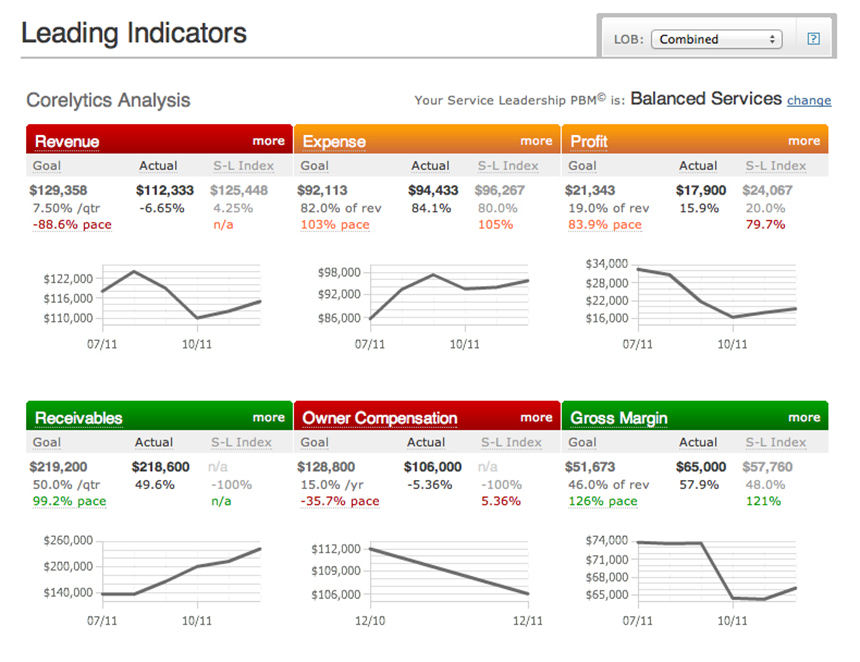
<p>The <a title="blocked::http://www.corelytics.com/" href="http://www.corelytics.com/" target="_blank">Corelytics</a><sup>TM</sup> financial dashboard CoreConnex offers is a great example of an affordable financial BI tool. There are also programs like <a href="http://www.smbtn.org/vitalsigns.htm">VitalSigns</a> offered by SMBTN to guide you through integrating BI processes into your business.</p>
<p>The key is to become knowledgeable about this subject because it is a trend that is not going away. Competition is increasing and the winners will be those companies who understand how to quickly see the trends in their business, make the necessary decisions and take quicker actions toward achieving their goals.</p>
<img src="http://feeds.feedburner.com/~r/Coreconnex/~4/Xw7sbqC4rhA" height="1" width="1"/>]]></content:encoded>
			<wfw:commentRss>http://www.coreconnex.com/2009/04/16/use-bi-to-take-your-business-to-new-places/feed/</wfw:commentRss>
		<feedburner:origLink>http://www.coreconnex.com/2009/04/16/use-bi-to-take-your-business-to-new-places/</feedburner:origLink></item>
		<item>
		<title>What clients really want from their VAR, MSP or IT service provider</title>
		<link>http://feedproxy.google.com/~r/Coreconnex/~3/9Rg5PUn1Suc/</link>
		<comments>http://www.coreconnex.com/2009/03/25/what-clients-really-want-from-their-var-smp-or-it-service-provider/#comments</comments>
		<pubDate>Wed, 25 Mar 2009 16:11:19 +0000</pubDate>
		<dc:creator>Tony Lael</dc:creator>
		
		<category><![CDATA[Sales &amp; Marketing]]></category>

		<category><![CDATA[business team]]></category>

		<category><![CDATA[Client interviews]]></category>

		<category><![CDATA[making technology run smoothly]]></category>

		<category><![CDATA[monthly budget]]></category>

		<category><![CDATA[MSP]]></category>

		<category><![CDATA[VAR]]></category>

		<guid isPermaLink="false">http://www.coreconnex.com/?p=2071</guid>
		<description><![CDATA[<p>IT service companies who are getting the best results during these challenging times are the ones who have built the strongest business relationships with their clients over time. These relationships are based on the IT service firm understanding what really matters to their clients:</p>
<ul>
<li>Be a part of their business team</li>
<li>Coach them on changes in technology so they are aware, but not overwhelmed</li>
<li>Stick to planned&#8230;</li></ul>]]></description>
			<content:encoded><![CDATA[<p>IT service companies who are getting the best results during these challenging times are the ones who have built the strongest business relationships with their clients over time. These relationships are based on the IT service firm understanding what really matters to their clients:</p>
<ul>
<li>Be a part of their business team</li>
<li>Coach them on changes in technology so they are aware, but not overwhelmed</li>
<li>Stick to planned budgets - monthly budgets work best</li>
<li>Take responsibility for making their technology run smoothly and reliably</li>
<li>Be proactive in managing relationships and communications</li>
</ul>
<p>We interviewed several business executives who are clients of successful IT service firms - watch this video to see what really matters to them.</p>
<div class="vvqbox vvqyoutube" style="width:425px;height:355px;">
<p id="vvq4a50f6c89aea0"><a href="http://www.youtube.com/watch?v=FxR3nIYMMfg">http://www.youtube.com/watch?v=FxR3nIYMMfg</a></p>
</div>
<img src="http://feeds.feedburner.com/~r/Coreconnex/~4/9Rg5PUn1Suc" height="1" width="1"/>]]></content:encoded>
			<wfw:commentRss>http://www.coreconnex.com/2009/03/25/what-clients-really-want-from-their-var-smp-or-it-service-provider/feed/</wfw:commentRss>
		<feedburner:origLink>http://www.coreconnex.com/2009/03/25/what-clients-really-want-from-their-var-smp-or-it-service-provider/</feedburner:origLink></item>
		<item>
		<title>The gap between setting and achieving goals</title>
		<link>http://feedproxy.google.com/~r/Coreconnex/~3/91J4Z-Dicio/</link>
		<comments>http://www.coreconnex.com/2009/02/17/the-gap-between-setting-and-achieving-goals/#comments</comments>
		<pubDate>Tue, 17 Feb 2009 23:59:06 +0000</pubDate>
		<dc:creator>Bob Taylor</dc:creator>
		
		<category><![CDATA[Business Management]]></category>

		<category><![CDATA[CoreConnex]]></category>

		<category><![CDATA[Corelytics]]></category>

		<category><![CDATA[Operations Management]]></category>

		<category><![CDATA[business goals]]></category>

		<category><![CDATA[financial dashboard]]></category>

		<category><![CDATA[goals]]></category>

		<category><![CDATA[Increase revenues]]></category>

		<category><![CDATA[Increase utilization]]></category>

		<category><![CDATA[IT service firms]]></category>

		<category><![CDATA[MSPs]]></category>

		<category><![CDATA[VARs]]></category>

		<guid isPermaLink="false">http://www.coreconnex.com/?p=2037</guid>
		<description><![CDATA[<p>Everyone is told they need to set goals. Whether they are for personal or business reasons, the important thing (aside from having goals) is to have a way to track performance against those goals - measuring performance is the only true way to know if improvement has been made. To be meaningful, goals need to be specific, measurable, attainable, relevant&#8230;</p>]]></description>
			<content:encoded><![CDATA[<p>Everyone is told they need to set goals. Whether they are for personal or business reasons, the important thing (aside from having goals) is to have a way to track performance against those goals - measuring performance is the only true way to know if improvement has been made. To be meaningful, goals need to be specific, measurable, attainable, relevant and timely.Recently, I was having a conversation with the owner of an IT service company about his business plan for the coming year. In spite of the uncertainty in the economy he expects his business to grow and he hopes to be more profitable than last year. When I pressed him for details on how he was going to achieve this he said he was going to sign up more customers, cut expenses and improve his engineers&#8217; productive time.</p>
<p>So I worked with the owner of the IT service company to create specific objectives that could be monitored individually and together would allow him to achieve his overall goal. We came up with the following three main goals:</p>
<p><strong><span style="text-decoration: underline;">Goal 1:</span></strong><br />
Increase revenues by an annual rate of 18%. At his present size, he would need to add two new clients per month at an average of $1,200 per client per month to achieve this.</p>
<p><strong><span style="text-decoration: underline;">Goal 2:</span></strong><br />
Keep annual expense growth to 15%. Since his previous year expenses had an annual growth rate of 25% he wanted to reduce overall expenses by 10% for the year.. I reminded him that he needs to watch this carefully because if expenses grow at the same rate as revenue there is no increase in profitability and that 3% difference in revenue growth does not leave a lot of room for error.</p>
<p><strong><span style="text-decoration: underline;">Goal 3:</span></strong><br />
Increase billable hours by 5%. Through the use of improved scheduling and remote access. Since the majority of his clients are on hourly billing arrangements this was a relevant goal. He is exploring how to transition his business model to monthly service fees for clients in the coming year.</p>
<p>Of course we had to do some number crunching to make sure these goals were attainable so he could achieve the desired result. But, like many other small business owners, he had been managing his business using instinct, past experience and monthly reports from his accounting system. We plugged in the <a title="Corelytics" href="http://www.corelytics.com" target="_blank">Corelytics Financial Dashboard</a> to simplify the process of tracking and monitoring his progress toward the goals he set for his company. Now he has a solid plan for the future and the tools in place to stay on course.</p>
<p>Make sure you are not only declaring goals for your business, but that you have a way to measure your performance on a regular basis throughout the year.</p>
<img src="http://feeds.feedburner.com/~r/Coreconnex/~4/91J4Z-Dicio" height="1" width="1"/>]]></content:encoded>
			<wfw:commentRss>http://www.coreconnex.com/2009/02/17/the-gap-between-setting-and-achieving-goals/feed/</wfw:commentRss>
		<feedburner:origLink>http://www.coreconnex.com/2009/02/17/the-gap-between-setting-and-achieving-goals/</feedburner:origLink></item>
		<item>
		<title>Find Out What Motivates the Other Guy When Planning Your Negotiations</title>
		<link>http://feedproxy.google.com/~r/Coreconnex/~3/vxO20A2jjPY/</link>
		<comments>http://www.coreconnex.com/2009/02/17/find-out-what-motivates-the-other-guy-when-planning-your-negotiations/#comments</comments>
		<pubDate>Tue, 17 Feb 2009 23:58:34 +0000</pubDate>
		<dc:creator>Jeanette Nyden, J.D.</dc:creator>
		
		<category><![CDATA[Business Management]]></category>

		<category><![CDATA[Sales &amp; Marketing]]></category>

		<category><![CDATA[contract negotiations]]></category>

		<category><![CDATA[leverage in negotiations]]></category>

		<category><![CDATA[motivating factors]]></category>

		<category><![CDATA[Negotiating ITservice agreements]]></category>

		<category><![CDATA[Negotiation Coach]]></category>

		<category><![CDATA[Negotiations]]></category>

		<category><![CDATA[Negotiations planning]]></category>

		<category><![CDATA[Successful negotiating techniques]]></category>

		<guid isPermaLink="false">http://www.coreconnex.com/?p=2031</guid>
		<description><![CDATA[<p>A discussion between two lawyers I recently listed in on reminded me that <strong>(usually) hidden motivations are what drive leverage in negotiations</strong>, not personality traits of the person you are negotiating with.</p>
<p>Let me elaborate; I put on my Negotiation Coach hat during the discussion I overheard and here is what I noticed - #1 Guy started by asking #2 Guy&#8230;</p>]]></description>
			<content:encoded><![CDATA[<p>A discussion between two lawyers I recently listed in on reminded me that <strong>(usually) hidden motivations are what drive leverage in negotiations</strong>, not personality traits of the person you are negotiating with.</p>
<p>Let me elaborate; I put on my Negotiation Coach hat during the discussion I overheard and here is what I noticed - #1 Guy started by asking #2 Guy what their next move should be at the bargaining table with a counterpart. #2 Guy complained about the personality of their counterpart. #1 Guy agreed with the personality assessment and added a few choice words about the behavior of their counterpart. #2 Guy then added that their counterpart&#8217;s requests were completely unreasonable. And on it went for 15 minutes.Ok, maybe these two lawyers were blowing off steam, but they did not get anywhere in planning the next negotiation meeting with their counterpart.</p>
<p>They let the behavior of their counterpart drive their perception of the request that was made. At no time did they discuss what was motivating their counterpart to make that particular request. Their decision about what to negotiate for during the next meeting could have been being based off of the wrong assumptions instead of motivating factors. It is ok to blow off steam regarding someone&#8217;s personality (not all personalities click), but when negotiating a deal or agreement, focus on what is motivating the other person and not their personality.</p>
<p>The first question to ask your self is what is DRIVING this behavior, position or tactic - <strong>what is motivating the person I am negotiating with?</strong> Getting to the bottom of those issues will prove to be worth your while during your next bargaining opportunity.</p>
<img src="http://feeds.feedburner.com/~r/Coreconnex/~4/vxO20A2jjPY" height="1" width="1"/>]]></content:encoded>
			<wfw:commentRss>http://www.coreconnex.com/2009/02/17/find-out-what-motivates-the-other-guy-when-planning-your-negotiations/feed/</wfw:commentRss>
		<feedburner:origLink>http://www.coreconnex.com/2009/02/17/find-out-what-motivates-the-other-guy-when-planning-your-negotiations/</feedburner:origLink></item>
		<item>
		<title>Growing and Managing Your Prospect Pipeline</title>
		<link>http://feedproxy.google.com/~r/Coreconnex/~3/Z6nAT_EhKJU/</link>
		<comments>http://www.coreconnex.com/2009/02/04/growing-and-managing-your-prospect-pipeline/#comments</comments>
		<pubDate>Thu, 05 Feb 2009 04:39:13 +0000</pubDate>
		<dc:creator>Derek Brown</dc:creator>
		
		<category><![CDATA[Sales &amp; Marketing]]></category>

		<category><![CDATA[Client Creation Factory]]></category>

		<category><![CDATA[client portfolio]]></category>

		<category><![CDATA[Client referrals]]></category>

		<category><![CDATA[Derek Brown]]></category>

		<category><![CDATA[future revenue]]></category>

		<category><![CDATA[newsletter]]></category>

		<category><![CDATA[opt-in]]></category>

		<category><![CDATA[PR Web]]></category>

		<category><![CDATA[Press Release]]></category>

		<category><![CDATA[Pronto Marketing]]></category>

		<category><![CDATA[Prospect pipeline]]></category>

		<category><![CDATA[PRWeb]]></category>

		<category><![CDATA[PSA]]></category>

		<guid isPermaLink="false">http://www.coreconnex.com/?p=2015</guid>
		<description><![CDATA[<p>In my last blog (What Should Marketing be Doing Anyway?) I introduced the concept of a Client Creation Factory and discussed the three stages of building that factory - understanding the first stage (your Prospect Pipeline) is key to building a productive and healthy factory that yields increased revenues.</p>
<p>Your pipeline is your identified opportunities for future revenue. It&#8217;s a valuable&#8230;</p>]]></description>
			<content:encoded><![CDATA[<p>In my last blog (<a title="What Should Marketing be Doing Anyway?" href="http://www.coreconnex.com/2008/11/03/what-should-your-marketing-be-doing-anyway-1-of-4/" target="_blank">What Should Marketing be Doing Anyway?</a>) I introduced the concept of a Client Creation Factory and discussed the three stages of building that factory - understanding the first stage (your Prospect Pipeline) is key to building a productive and healthy factory that yields increased revenues.</p>
<p>Your pipeline is your identified opportunities for future revenue. It&#8217;s a valuable asset and you should treat it as such. Even if you have all the business you need today - you&#8217;ll need more tomorrow.</p>
<p><strong>Growing</strong><br />
It&#8217;s beyond the scope of this blog post to go over all the demand generation options. But before you go spending money chasing after new leads for prospective clients, you should first make sure you&#8217;re managing and nurturing the clients you already have in your client portfolio effectively. To learn more on client portfolio management read <a title="Client Portfolio Basics (1 of 3)" href="http://www.coreconnex.com/2008/10/17/client-portfolio-basics-part-1-of-3/">Client Portfolio Basics</a>.</p>
<p>The number one place you should be looking for new pipeline material is from referrals from your existing client base and the circle of influencers you know.</p>
<p><strong>Client Referrals</strong></p>
<ol>
<li> <strong>Have a program:</strong> It doesn&#8217;t have to be much, but it should be organized in a way that is not over the top - you can give gifts, discounts, and other incentives to remind your existing clients and influencers how much you appreciate them and their referrals.</li>
<li><strong>Communicate your program:</strong> Your monthly company newsletter, website, and other communication should have a regular spot to feature your referrals program.</li>
<li><strong>Ask for the referral:</strong> Don&#8217;t be bashful. It&#8217;s OK to ask for suggestions on referrals just like it&#8217;s OK to ask for the business.</li>
</ol>
<p><strong>Influencer Referrals</strong></p>
<ol>
<li> Grow your list:  Make a list of your circle of influence - these are the professional colleagues and others you know who can be referral sources. Informal business networking groups on LinkedIn and Facebook are a great place to start meeting and tracking these influencers.</li>
<li>Keep in contact consistently: Have a system to communicate with these influencers on a consistent basis. Even if you see them at regular functions such as Rotary, you should have a professional communication reminding them of the value you bring to clients.</li>
</ol>
<p><strong>Managing</strong><br />
It&#8217;s vital that each and every lead, business card, name and contact that comes across your desk with a modicum of future opportunity be captured, categorized, and tracked. If you can&#8217;t track it you can&#8217;t measure and manage it. This should apply to your circle of influencers as well, not just client prospects.</p>
<p>It is well established that the vast majority of leads generated by marketing go unmanaged. An easy way to manage leads generated by marketing activity is to track if they are hot, warm, or cold leads.</p>
<p>With your CRM or PSA system you can build a systematic follow-up process - make it simple. I&#8217;d focus on using follow-up communications that position you as a trusted business professional by providing them with valuable information using the following:</p>
<ul>
<li><span style="text-decoration: underline;">e-Newslette</span>r - an opt-in company newsletter that&#8217;s sent on a regular basis, featuring content of value to the recipient, is a proven prospect nurturing tool. It&#8217;s a positive, professional way to keep in front of your prospects.</li>
<li><span style="text-decoration: underline;">FYI Email</span> - if you don&#8217;t have a newsletter, I&#8217;m sure that every month you come across an interesting article in a respected publication on small business IT - forward these articles with a link and a short note to your prospect.</li>
<li><span style="text-decoration: underline;">PR</span> - there are plenty of good DIY (do it yourself) PR guides out there. At least once a quarter you should do a company press release. Email a copy to your customers, prospects, and key influencers. <a title="PRWeb.Com" href="http://www.prweb.com/" target="_blank">PR Web</a> is a good site to start with.</li>
</ul>
<p><strong>Start Today</strong><br />
Be realistic. You don&#8217;t have a lot of time, and it&#8217;s understandably easy to let spending valuable time on a group of people, the majority whom will never buy from you, fall to the bottom of your To Do list. Think of it like long term investing: a little saved each month, growing at a modest rate, yields big returns over time.  Invest a little each month in building your client pipeline and it will yield revenues.</p>
<img src="http://feeds.feedburner.com/~r/Coreconnex/~4/Z6nAT_EhKJU" height="1" width="1"/>]]></content:encoded>
			<wfw:commentRss>http://www.coreconnex.com/2009/02/04/growing-and-managing-your-prospect-pipeline/feed/</wfw:commentRss>
		<feedburner:origLink>http://www.coreconnex.com/2009/02/04/growing-and-managing-your-prospect-pipeline/</feedburner:origLink></item>
		<item>
		<title>How Do I Sound Like A Professional Consultant?</title>
		<link>http://feedproxy.google.com/~r/Coreconnex/~3/2gUe4m-l3MM/</link>
		<comments>http://www.coreconnex.com/2009/01/22/how-do-i-sound-like-a-professional-consultant/#comments</comments>
		<pubDate>Fri, 23 Jan 2009 01:23:24 +0000</pubDate>
		<dc:creator>Anna Bernstein</dc:creator>
		
		<category><![CDATA[Business Management]]></category>

		<category><![CDATA[Operations Management]]></category>

		<category><![CDATA[consultant]]></category>

		<category><![CDATA[consulting]]></category>

		<category><![CDATA[leadership]]></category>

		<category><![CDATA[management]]></category>

		<category><![CDATA[professional consultant]]></category>

		<category><![CDATA[voice]]></category>

		<guid isPermaLink="false">http://www.coreconnex.com/?p=2000</guid>
		<description><![CDATA[<p>They say the clothes maketh the man, but I believe that the voice is much more important in making a professional consultant.</p>
<p>Our voices carry our knowledge and expertise out into the world. How we speak sends nonverbal messages that impact our reputation, business and sales figures. We sound better if we use a reliable system that helps us sound efficient,&#8230;</p>]]></description>
			<content:encoded><![CDATA[<p>They say the clothes maketh the man, but I believe that the voice is much more important in making a professional consultant.</p>
<p>Our voices carry our knowledge and expertise out into the world. How we speak sends nonverbal messages that impact our reputation, business and sales figures. We sound better if we use a reliable system that helps us sound efficient, organized and knowledgeable. After all, who is going to hire a consultant who sounds disorganized and uncertain?</p>
<p>There are many layers to achieving the smooth delivery that we all desire. However, one of the most important aspects I teach clients is a technique I call The Three Ones<sup>©</sup>. These are:</p>
<ul>
<li>1. one breath</li>
<li>2. one topic</li>
<li>3. one sentence</li>
</ul>
<p>I designed this technique according to how our brains receive information. We can only understand one idea at a time. However, most people pile several facts into a sentence, and then expect their audience to follow their train of thought. By the time the sentence ends, they may have mentioned 5 or 6 unrelated ideas. The listener does not stand a chance of remembering all of them.</p>
<p>It is more practical to deliver one idea in one sentence, and then end that sentence with a period. A strong, definitive period is when your voice lowers and your stop speaking. For an example, imagine telling a dog, ‘Sit.&#8221; That is what a period sounds like.</p>
<p>When you try this technique, you will find yourself using commas instead of periods. This is a common habit, but it doesn&#8217;t help your audience. Listeners are trained to listen until they hear a &#8220;stop&#8221; signal - the period. Until they do, they will continue listening to you. Once they hear that signal, then they will begin processing what you said. In other words, listening and understanding are two separate activities, and they cannot be done at the same time. When you use The Three Ones<sup>©</sup>, your audience will find your thoughts easier to follow. They will have time to digest each sentence before you begin the next one.</p>
<p>Try this technique and see how it helps you sound like an expert consultant. Please email me with any questions or comments. <a href="mailto:anna@brain-voice.com">anna@brain-voice.com</a></p>
<img src="http://feeds.feedburner.com/~r/Coreconnex/~4/2gUe4m-l3MM" height="1" width="1"/>]]></content:encoded>
			<wfw:commentRss>http://www.coreconnex.com/2009/01/22/how-do-i-sound-like-a-professional-consultant/feed/</wfw:commentRss>
		<feedburner:origLink>http://www.coreconnex.com/2009/01/22/how-do-i-sound-like-a-professional-consultant/</feedburner:origLink></item>
		<item>
		<title>Virtualizing Your IT Service Business</title>
		<link>http://feedproxy.google.com/~r/Coreconnex/~3/jnPsdPzmixo/</link>
		<comments>http://www.coreconnex.com/2008/12/31/virtualizing-your-it-service-business/#comments</comments>
		<pubDate>Wed, 31 Dec 2008 19:37:32 +0000</pubDate>
		<dc:creator>Frank Coker</dc:creator>
		
		<category><![CDATA[Business Management]]></category>

		<category><![CDATA[ConnexIT]]></category>

		<category><![CDATA[CoreConnex]]></category>

		<category><![CDATA[Operations Management]]></category>

		<category><![CDATA[client portfolio]]></category>

		<category><![CDATA[isv]]></category>

		<category><![CDATA[IT service]]></category>

		<category><![CDATA[managed services]]></category>

		<category><![CDATA[MSP]]></category>

		<category><![CDATA[PSA]]></category>

		<category><![CDATA[psa software]]></category>

		<category><![CDATA[revenue]]></category>

		<category><![CDATA[service business]]></category>

		<category><![CDATA[solution provider]]></category>

		<category><![CDATA[VAR]]></category>

		<category><![CDATA[virtualize]]></category>

		<guid isPermaLink="false">http://www.coreconnex.com/?p=1939</guid>
		<description><![CDATA[<p>In the past 6 months, 71% of IT service companies (MSPs, VARs, and other IT service providers) surveyed by CoreConnex have continued to grow in spite of the global economic down turn. Of these growing companies 80% continue to show healthy profitability. All evidence shows that the economic down-turn is good for IT service businesses.</p>
<p>As we look closer, we see&#8230;</p>]]></description>
			<content:encoded><![CDATA[<p>In the past 6 months, 71% of IT service companies (MSPs, VARs, and other IT service providers) surveyed by CoreConnex have continued to grow in spite of the global economic down turn. Of these growing companies 80% continue to show healthy profitability. All evidence shows that the economic down-turn is good for IT service businesses.</p>
<p>As we look closer, we see a number of important changes occurring in many growing IT service companies. One change that is particularly note worthy is a movement toward &#8220;virtualized business.&#8221;</p>
<p>As we all know, small businesses can benefit greatly when they virtualize systems. This broadly includes virtualizing internal servers, outsourcing computing utility to third-party hosting services and running systems on servers that you host in co-location (rented server facilities) sites. By virtualizing, businesses can reduce many forms of overhead and optimize the costs of infrastructure. This strategy is beneficial to IT companies and to their clients. And of course the IT service provider can play a key role in helping their clients select and implement virtualized resources to get these benefits.</p>
<p>But let&#8217;s take this a step further. We also see many IT service companies taking steps to virtualize their staff and their offices. Some of the most profitable IT service providers use a combination of employed and contracted engineers to get a balanced blend of skills and yet avoid the overheads associated with experts that would be very expensive to put on a payroll.</p>
<p>It&#8217;s very common to see IT service companies contract for accounting and bookkeeping services, but a much smaller percent have figured out how to support their network operations center (NOC) using contracted staff. A few have figured out that there can be great savings by hiring a qualified, part-time contractor to work specific hours each day to help with peak loads.</p>
<p>Some IT service providers have employed engineers that work at client locations and/or at home and therefore do not have a dedicated office space. In fact, there is a growing number that don&#8217;t even have an office other than their home. Some have worked out deals with their major clients that allow the engineers to have a dedicated desk and phone at the client&#8217;s office. In these situations the engineer may work part time, say 15 hours per week, for the client and is available on site for emergency situations while supporting other clients.</p>
<p>The idea of reducing the office footprint and therefore the overheads associated with rent and utilities can make a big difference in profitability, but it takes the right systems and processes to support this working environment. One example of this form of virtualization is the company that reduced its office space from 5 single offices, a server room and a conference room down to one office, and a shared work space. This saved a lot of money and made it clear to their staff that the office was not intended to be the place where they spend their working day. They helped each engineer set up at home and at client offices such that they only needed to come to the company office for weekly meetings and occasional problem-solving meetings. This ended up saving a lot of drive time for the engineering staff and created a real gain in employee satisfaction.</p>
<p>Of course none of these moves to virtualization are as simple as they sound. There are many examples of failed attempts to have engineers work from home and many situations where the cost of contractors far exceeded the benefit of outsourcing. To make this work requires a combination of tight management processes and solid infrastructure that can allow all team members to function as a whole.</p>
<p>The ConnexIT<sup>TM</sup> Service Management System is specifically designed for virtualized teams and for clear management oversight (<a href="http://www.coreconnex.com/">www.coreconnex.com</a>). In addition, a good VOIP system along with a virtualized network monitoring system can open the doors to entirely new forms of business flexibility.</p>
<p>The real key is to question all old assumptions</p>
<ul>
<li>All employees need and want an office</li>
<li>Employees cost less than contractors</li>
<li>Working at home results in lower productivity.</li>
</ul>
<p>Not only do we have a lot of evidence that these assumptions can often be wrong, we know that many highly successful businesses have turned conventional thinking on its head and are growing because of it.</p>
<p>In fact, this is just like the big challenge IT service companies face when selling their services. They must get their prospects and clients to rethink their conventional wisdom. Relying on conventional full-time on-site employees is not always the best answer. Taking advantage of outsourced (contracted) IT support can save money and improve the overall operations stability.</p>
<img src="http://feeds.feedburner.com/~r/Coreconnex/~4/jnPsdPzmixo" height="1" width="1"/>]]></content:encoded>
			<wfw:commentRss>http://www.coreconnex.com/2008/12/31/virtualizing-your-it-service-business/feed/</wfw:commentRss>
		<feedburner:origLink>http://www.coreconnex.com/2008/12/31/virtualizing-your-it-service-business/</feedburner:origLink></item>
		<item>
		<title>Selling Made Easier</title>
		<link>http://feedproxy.google.com/~r/Coreconnex/~3/5_hsWJyCvEo/</link>
		<comments>http://www.coreconnex.com/2008/12/11/selling-made-easier/#comments</comments>
		<pubDate>Thu, 11 Dec 2008 23:30:40 +0000</pubDate>
		<dc:creator>Tony Lael</dc:creator>
		
		<category><![CDATA[CoreConnex]]></category>

		<category><![CDATA[Sales &amp; Marketing]]></category>

		<category><![CDATA[monthly service agreement]]></category>

		<category><![CDATA[MSP]]></category>

		<category><![CDATA[PSA]]></category>

		<category><![CDATA[psa software]]></category>

		<category><![CDATA[Selling managed services]]></category>

		<category><![CDATA[VAR]]></category>

		<guid isPermaLink="false">http://www.coreconnex.com/?p=1873</guid>
		<description><![CDATA[<p>Everyone can sell services if they can develop a technique that they can get comfortable with.</p>
<p>There is not a day that goes by that I do not hear a VAR using PSA software in the IT service world tell me they do not like to sell, how uncomfortable it makes them, and how they just can&#8217;t seem to muster the&#8230;</p>]]></description>
			<content:encoded><![CDATA[<p>Everyone can sell services if they can develop a technique that they can get comfortable with.</p>
<p>There is not a day that goes by that I do not hear a VAR using PSA software in the IT service world tell me they do not like to sell, how uncomfortable it makes them, and how they just can&#8217;t seem to muster the energy to do it. Most technically skilled people feel that they are just not the <i>right</i> person to be selling. If you own an IT service company - you <i>are</i> the right (and sometimes only) person to sell your services.</p>
<p>One break-through approach is to <b>think of selling as helping people get something they already want</b>. It&#8217;s much easier to help someone get what they want than it is to convince them to buy something that they do not really want. This changes the selling process into helping a person or group make a good decision for their business that they are already predisposed to make. That&#8217;s it!</p>
<p>Getting a contract signed that tells the client how much they will have to pay for making a good decision for their business is (should be) a formality that comes after the decision is made. The problem is when the formality of getting a signature from the client is put ahead of them making a good decision for their business - that is where the sales process can get tripped up.</p>
<p>Everyone can sell if they follow some simple rules of thumb to help their clients make a good (or better) decision. The following process guidelines will help you sell a new service contract, upgrade and existing service agreement or transition from an hourly fee arrangement to a monthly service contract.</p>
<ol>
<li>Inform the client of your intentions - this needs to be framed as &#8220;<i>helping them get  more or better results for their IT budget</i>&#8220;</li>
<li>Ask the client when it would be appropriate date/time to have a conversation</li>
<li>Ask the client to tell you about their immediate and short-term priorities - this is where the negotiation and decision happens: your client is telling you what they really care about and what their priorities are. Once you know what is important to them, you can inform them of what you think can be put into place to help support their priorities. Then, get an idea of the monthly budget they might be comfortable with if that level of support were in place</li>
<li>Ask if there are any time constraints for them you need to be aware of</li>
<li>Ask the client if there is any reason why what you have discussed (your services to support their decisions on priorities) with them will not work and if you can put it in a proposal</li>
<li>Create a proposed service agreement with a brief cover letter</li>
<li>Get sign off on proposed service agreement</li>
</ol>
<p><b>A major key to success in the selling process is to go into it with a positive frame of mind</b>. If you are doubtful or reluctant it will show through in your conversation. To get your mind right before you start this process, remember that <b>it is normal to feel uneasy about being outside of your comfort zone </b>the first few times you do something different - even the best of people feel uncomfortable outside their comfort zones. But it is important to your business and to you on a personal level to expand your comfort zone.</p>
<p>Remember, selling is not only about asking for money or getting a client signature - though that is part of the process. The fun and rewarding part of selling is helping your client get something they want. When done right, they will thank you for your help.</p>
<img src="http://feeds.feedburner.com/~r/Coreconnex/~4/5_hsWJyCvEo" height="1" width="1"/>]]></content:encoded>
			<wfw:commentRss>http://www.coreconnex.com/2008/12/11/selling-made-easier/feed/</wfw:commentRss>
		<feedburner:origLink>http://www.coreconnex.com/2008/12/11/selling-made-easier/</feedburner:origLink></item>
	</channel>
</rss>