<?xml version="1.0" encoding="UTF-8"?>
<feed xml:lang="en" xmlns="http://www.w3.org/2005/Atom" xmlns:opensearch="http://a9.com/-/spec/opensearch/1.1/" xmlns:s="http://jadedpixel.com/-/spec/shopify">
  <id>https://www.decadesofstyle.com/blogs/news.atom</id>
  <link rel="alternate" type="text/html" href="https://www.decadesofstyle.com/blogs/news"/>
  <link rel="self" type="application/atom+xml" href="https://www.decadesofstyle.com/blogs/news.atom"/>
  <title>Decades of Style Pattern Company - News</title>
  <updated>2023-09-24T10:53:20-07:00</updated>
  <author>
    <name>Decades of Style Pattern Company</name>
  </author>
  <entry>
    <id>https://www.decadesofstyle.com/blogs/news/slouchy-witch-hat-pattern-hack-for-hilde-hat</id>
    <published>2023-09-24T10:53:20-07:00</published>
    <updated>2023-09-24T10:53:20-07:00</updated>
    <link rel="alternate" type="text/html" href="https://www.decadesofstyle.com/blogs/news/slouchy-witch-hat-pattern-hack-for-hilde-hat"/>
    <title>Slouchy Witch Hat Pattern Hack for Hilde Hat</title>
    <author>
      <name>Janet Manning</name>
    </author>
    <content type="html">
      <![CDATA[<h4>
<span data-mce-fragment="1">We are SO thrilled to have guest blogger Tamsin Eilers of @greenstitchwitch Instagram account giving us her Slouchy Witch Hat Pattern Hack for our <a href="https://www.decadesofstyle.com/collections/decades-everyday/products/no-110-hilde-hat" title="shop Hilde Hat Pattern" target="_blank">Hilde Hat pattern</a> .</span><br aria-hidden="true" data-mce-fragment="1"><br aria-hidden="true" data-mce-fragment="1"><span data-mce-fragment="1">So without further ado, here's Tamsin!</span>
</h4>
<p> I am a Halloween superfan! There's nothing better than hot apple cider, costumes and scary decorations! From the first moment I laid eyes on the Hilde Hat pattern, I just knew I was going to hack it into a witch hat. I have been on the hunt for *the* perfect witch hat pattern for over a decade! My hunt is over, and this is the only witch that I will ever need.  This is a super fast and easy sew, thanks to the pattern! </p>
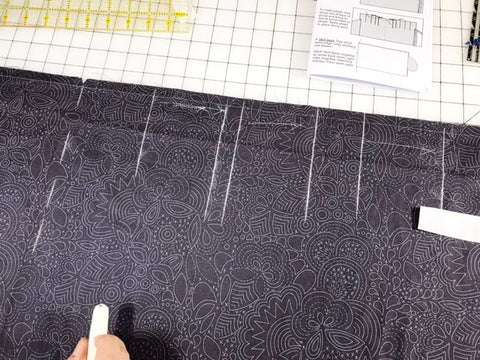
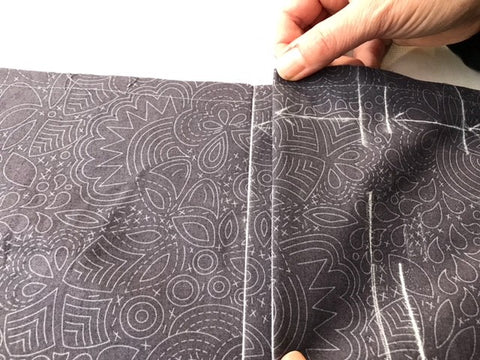
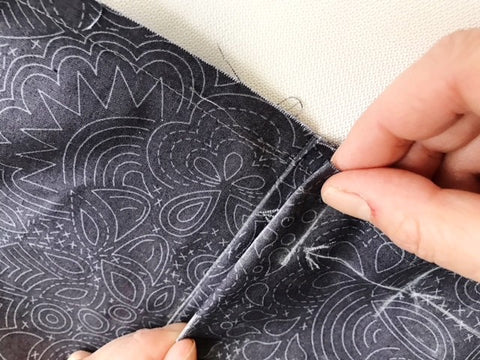
<p><span data-mce-fragment="1">To get started, you'll need some supplies:</span><br aria-hidden="true" data-mce-fragment="1"><br aria-hidden="true" data-mce-fragment="1"><span data-mce-fragment="1">-<a href="https://www.decadesofstyle.com/collections/decades-everyday/products/no-110-hilde-hat" title="shop Hilde Hat Pattern" target="_blank">The Hilde Hat pattern</a></span><br aria-hidden="true" data-mce-fragment="1"><span data-mce-fragment="1">-1 yard of fabric (i used flocked denim, and it was the perfect weight)</span><br aria-hidden="true" data-mce-fragment="1"><span data-mce-fragment="1">-1 yard of lining fabric</span><br aria-hidden="true" data-mce-fragment="1"><span data-mce-fragment="1">-two yards fairly stiff interfacing (you need your hat to stand on its own) I used Pellon #809</span><br aria-hidden="true" data-mce-fragment="1"><span data-mce-fragment="1">-chalk or fabric marker</span><br aria-hidden="true" data-mce-fragment="1"><span data-mce-fragment="1">-long ruler or yardstick</span><br aria-hidden="true" data-mce-fragment="1"><span data-mce-fragment="1">-bias binding (at least 2 yards)</span><br aria-hidden="true" data-mce-fragment="1"><span data-mce-fragment="1">-measuring tape</span><br aria-hidden="true" data-mce-fragment="1"><span data-mce-fragment="1">-decorations for your finished hat! Fabric or dried flowers, plastic fruits and vegetables, ribbons and lace,</span><br aria-hidden="true" data-mce-fragment="1"><span data-mce-fragment="1">the sky's the limit!</span><br aria-hidden="true" data-mce-fragment="1"><br aria-hidden="true" data-mce-fragment="1"><span data-mce-fragment="1">Start by taking your head measurement and choosing the correct size of the Hilde Hat. We'll only be needing the crown(B) and brim(C) pieces.</span><br aria-hidden="true" data-mce-fragment="1"><span data-mce-fragment="1">set your crown piece on the fold of your fabric and use your ruler to draw a line from the base to the fold, creating a long triangle. You can do this on paper to create a pattern you can reuse or draw your chalk line directly on the fabric like i did.</span></p>
<div style="text-align: left;"><img src="https://cdn.shopify.com/s/files/1/0515/2417/files/PXL_20230920_203709441.PORTRAIT.ORIGINAL_480x480.jpg?v=1695575840" alt="" style="float: none;"></div>
<div style="text-align: left;" data-mce-fragment="1" data-mce-style="text-align: left;"><img src="https://cdn.shopify.com/s/files/1/0515/2417/files/PXL_20230920_203846601.PORTRAIT.ORIGINAL_480x480.jpg?v=1695575539" style="float: none;" data-mce-fragment="1" data-mce-style="float: none;" data-mce-src="https://cdn.shopify.com/s/files/1/0515/2417/files/PXL_20230920_203846601.PORTRAIT.ORIGINAL.jpg?v=1695575539"></div>
<p> </p>
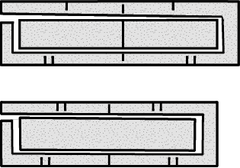
<p><br aria-hidden="true" data-mce-fragment="1"><span data-mce-fragment="1">For the brim, we'll be tracing the outside edge to be 2" bigger. Use your ruler to create a dotted line 2" larger than the pattern piece. The inside circle will remain the same.</span><br aria-hidden="true" data-mce-fragment="1"><img alt="" src="https://cdn.shopify.com/s/files/1/0515/2417/files/BLog_brim_adjustment_480x480.png?v=1695576658" data-mce-fragment="1" data-mce-src="https://cdn.shopify.com/s/files/1/0515/2417/files/BLog_brim_adjustment_480x480.png?v=1695576658"><br aria-hidden="true" data-mce-fragment="1"><br aria-hidden="true" data-mce-fragment="1"><span data-mce-fragment="1"></span></p>
<p><span data-mce-fragment="1">Cut out your fabric and lining, one crown and one brim each. (Lining not shown.)</span></p>
<div style="text-align: left;"><img style="float: none;" src="https://cdn.shopify.com/s/files/1/0515/2417/files/pieces_cut_480x480.jpg?v=1695576816"></div>
<p> </p>
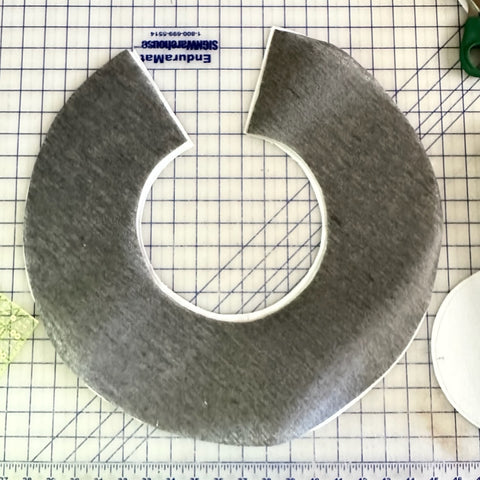
<p><span data-mce-fragment="1">Then cut your interfacing. For the interfacing you'll need two crowns and two brims. All four pattern pieces will be interfaced for maximum stiffness.</span></p>
<div style="text-align: left;"><img style="float: none;" alt="" src="https://cdn.shopify.com/s/files/1/0515/2417/files/all_interfaced_480x480.jpg?v=1695576978"></div>
<p><br aria-hidden="true" data-mce-fragment="1"><br aria-hidden="true" data-mce-fragment="1"><span data-mce-fragment="1">Next, sew up the cone pieces along the long side, both the main fabric and lining.</span><br aria-hidden="true" data-mce-fragment="1"><img src="https://cdn.shopify.com/s/files/1/0515/2417/files/PXL_20230920_214044544_480x480.jpg?v=1695577045" alt="" data-mce-fragment="1" data-mce-src="https://cdn.shopify.com/s/files/1/0515/2417/files/PXL_20230920_214044544_480x480.jpg?v=1695577045"><br aria-hidden="true" data-mce-fragment="1"><br aria-hidden="true" data-mce-fragment="1"><span data-mce-fragment="1">Attach the cone to the brim (use the instructions included with the pattern), right sides together for both main fabric and lining.</span><br aria-hidden="true" data-mce-fragment="1"><span data-mce-fragment="1">turn the lining inside out and insert it into the main fabric piece</span></p>
<p><span data-mce-fragment="1"><img src="https://cdn.shopify.com/s/files/1/0515/2417/files/PXL_20230920_215207835_240x240.jpg?v=1695577255" alt="" data-mce-selected="1"></span></p>
<div style="text-align: left;"><img style="float: none;" src="https://cdn.shopify.com/s/files/1/0515/2417/files/PXL_20230920_215034465.PORTRAIT.ORIGINAL_480x480.jpg?v=1695577190"></div>
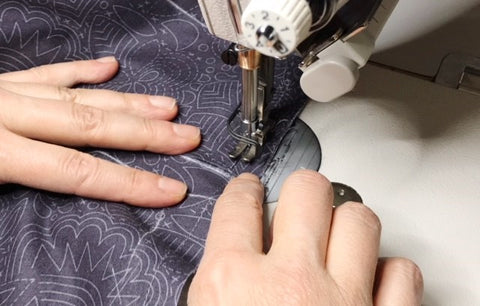
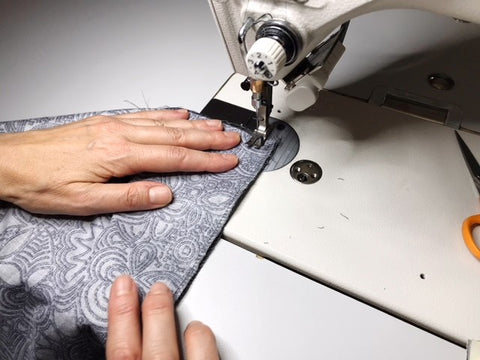
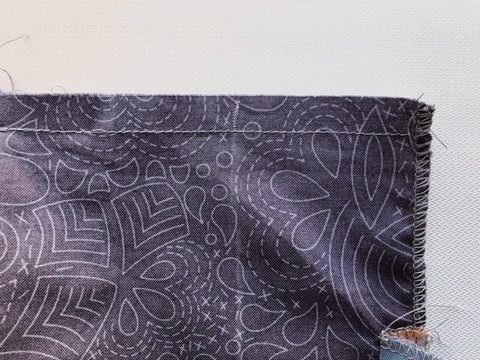
<p><br aria-hidden="true" data-mce-fragment="1"><span data-mce-fragment="1"> </span><br aria-hidden="true" data-mce-fragment="1"><span data-mce-fragment="1">Sew the two brims together and attach bias binding following the instructions included in with the pattern.</span></p>
<div style="text-align: left;"><img style="float: none;" alt="Undecorated hat with brim finished and edge bound." src="https://cdn.shopify.com/s/files/1/0515/2417/files/PXL_20230920_223006465_480x480.jpg?v=1695577540"></div>
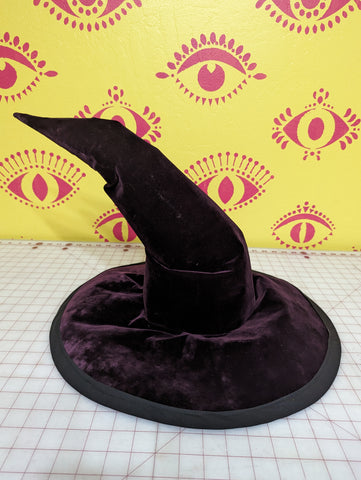
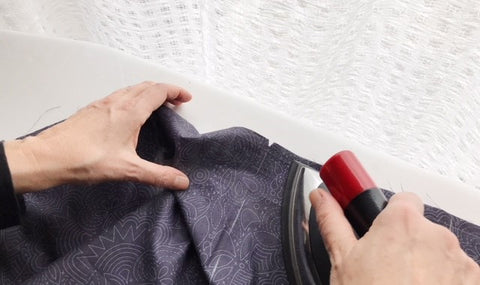
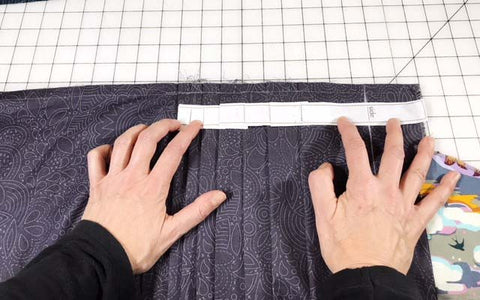
<p><br aria-hidden="true" data-mce-fragment="1"><span data-mce-fragment="1">This is the fun part! you can scrunch it up in any way you like! The scrunches will stay in place for the most part, but if your interfacing is very stiff, you may want to tack your folds down with a hand stitch.</span><br aria-hidden="true" data-mce-fragment="1"><span data-mce-fragment="1"> </span><br aria-hidden="true" data-mce-fragment="1"><span data-mce-fragment="1">Decorate to your liking and you're finished!</span></p>
<div style="text-align: left;"><img style="float: none;" alt="Finished slouchy witch hat decorated with dried flowers on a wig stand." src="https://cdn.shopify.com/s/files/1/0515/2417/files/PXL_20230920_225407938.PORTRAIT_480x480.jpg?v=1695577398"></div>]]>
    </content>
  </entry>
  <entry>
    <id>https://www.decadesofstyle.com/blogs/news/hilde-hat-sew-along-part-4-finishing</id>
    <published>2023-07-14T16:48:45-07:00</published>
    <updated>2023-07-14T17:06:48-07:00</updated>
    <link rel="alternate" type="text/html" href="https://www.decadesofstyle.com/blogs/news/hilde-hat-sew-along-part-4-finishing"/>
    <title>Hilde Hat Sew Along Part 4 - Finishing</title>
    <author>
      <name>Janet Manning</name>
    </author>
    <summary type="html">
      <![CDATA[Finishing hat includes stitching down hat band and adding drawstring.<p><a class="read-more" href="https://www.decadesofstyle.com/blogs/news/hilde-hat-sew-along-part-4-finishing">More</a></p>]]>
    </summary>
    <content type="html">
      <![CDATA[<p><a href="https://www.decadesofstyle.com/blogs/news/hilde-hat-sew-along-part-3-bind-that-brim" target="_blank" title="Hilde Hat Sew Along Part 3" rel="noopener noreferrer">Click here for previous installment</a>. </p>
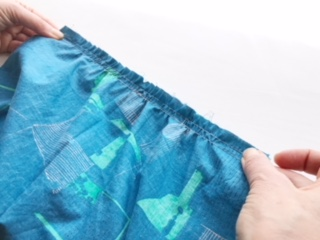
<p><span>Release the hat band from any basting or safety pins. Press the hat band down into place starting at the center front and working in separate passes towards the center back (working on a pressing ham was our favorite way to do this step but you can get there without one for sure.)</span></p>
<p><span>You will see the hat band gently stretching along the bottom edge to accommodate the circumference at the very top of the brim. You can pin the bottom edge of the brim in place as you are going along here. It’s OK to scrunch up the brim to put your pins in - it will recover with no issues. When you get to the center back, you’ll see why the bottom edge needed to be a bit longer than the top edge.  Tuck in the short raw edges at the center back and pin in</span></p>
<div style="text-align: left;"><img src="https://cdn.shopify.com/s/files/1/0515/2417/files/IMG_0873_480x480.jpg?v=1689193913" alt="" style="float: none;"></div>
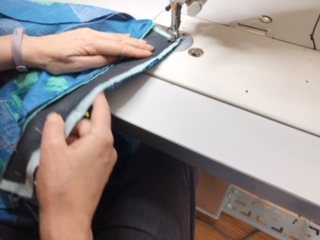
<p><br aria-hidden="true"><span>Edge stitch the bottom of the hat band in place, again check to make sure the lining of the hat doesn’t slip down and get caught in the stitching in the step.</span></p>
<p><img src="https://cdn.shopify.com/s/files/1/0515/2417/files/IMG_0934_480x480.jpg?v=1689207493" alt=""></p>
<p><br aria-hidden="true"><br aria-hidden="true"><span>All that’s left is to thread your drawstring through the hat band. A large safety pin will work. We liked using the long metal bodkin. Ribbon or double fold bias tape stitched closed makes a nice drawstring with a flat profile.</span></p>
<p> <img src="https://cdn.shopify.com/s/files/1/0515/2417/files/IMG_0933_480x480.jpg?v=1689194175" alt=""></p>
<p>Adding a chinstrap is a simple matter of marking the attachment point and stitching it by hand where the brim meets the crown lining as shown.<br><img src="https://cdn.shopify.com/s/files/1/0515/2417/files/IMG_9474_480x480.jpg?v=1689194518" alt=""><br aria-hidden="true"><br aria-hidden="true"><span>That’s it! You just made a hat! Thanks for joining us and don’t forget to tag your Photos #HildeHat on social media.</span></p>]]>
    </content>
  </entry>
  <entry>
    <id>https://www.decadesofstyle.com/blogs/news/hilde-hat-sew-along-part-3-bind-that-brim</id>
    <published>2023-07-14T16:48:29-07:00</published>
    <updated>2023-07-14T17:04:03-07:00</updated>
    <link rel="alternate" type="text/html" href="https://www.decadesofstyle.com/blogs/news/hilde-hat-sew-along-part-3-bind-that-brim"/>
    <title>Hilde Hat Sew Along Part 3 - Bind that Brim</title>
    <author>
      <name>Janet Manning</name>
    </author>
    <summary type="html">
      <![CDATA[Raw edge of the brim is bound with bias tape in this installment.<p><a class="read-more" href="https://www.decadesofstyle.com/blogs/news/hilde-hat-sew-along-part-3-bind-that-brim">More</a></p>]]>
    </summary>
    <content type="html">
      <![CDATA[<p><a href="https://www.decadesofstyle.com/blogs/news/hilde-hat-sew-along-part-2" target="_blank" title="Hilde Hat Sew Along Part 2" rel="noopener noreferrer">Click here for previous installment</a>.</p>
<p><span> Once again, don’t freak out if the fabric/hat in the photos changes from step to step.<br></span></p>
<p><span>To finish the outer edge of the brim, you will need a bias strip that is 2” by approximately 54.” You’ll most likely need to piece this to get that length. The ends of your bias need to be cut on the cross grain as shown.</span><br aria-hidden="true"><img src="https://cdn.shopify.com/s/files/1/0515/2417/files/IMG_0832_480x480.jpg?v=1689111444" alt=""><br aria-hidden="true"><span><br>Working on the top side of the hat, pre-shape the bias binding aligning the raw edge of the binding with the raw edge of the brim gently pressing as you work.</span></p>
<p><span><img src="https://cdn.shopify.com/s/files/1/0515/2417/files/IMG_9857_480x480.jpg?v=1688936756" alt=""></span></p>
<p><span> Once you’ve worked all the way around the perimeter of the hat, overlap the short ends by 1/2” and cut the excess off the binding.</span></p>
<p><span><img src="https://cdn.shopify.com/s/files/1/0515/2417/files/IMG_0841_480x480.jpg?v=1689111646" alt=""></span></p>
<div style="text-align: left;">
<p class="p1"><span class="s1">Starting about 3” from the end of your binding, stitch to the brim with a 3/8” seam allowance.</span></p>
<img src="https://cdn.shopify.com/s/files/1/0515/2417/files/IMG_0906_480x480.jpg?v=1689111987" alt=""><br><br>
</div>
<div style="text-align: left;">Your bias strip will most likely grow as you are stitching and your overlap will be greater than 1/2” when you get to the other end. Check the length of your strip and trim so that the overlap is 1/2.”</div>
<p><span><img src="https://cdn.shopify.com/s/files/1/0515/2417/files/IMG_0909_480x480.jpg?v=1689112393" alt=""></span></p>
<p>Fold your brim bringing the two loose ends of the bias strip together <span>and secure with a sewing clip (left pic). Close the circle of the binding stitching the short ends</span>, right size together, with a 1/4” seam allowance (middle pic.) Trim corners.  </p>
<meta charset="UTF-8">
<p><span>Release the brim from the sewing clip. Press the seam open, you might need to reshape that 7” segment of bias strip back into shape (right pic.)</span></p>
<p><img src="https://cdn.shopify.com/s/files/1/0515/2417/files/IMG_0910_480x480.jpg?v=1689112839" alt=""><br><br aria-hidden="true"><span>Stitch the remaining section of bias trip to the brim.</span></p>
<p><img src="https://cdn.shopify.com/s/files/1/0515/2417/files/IMG_0912_480x480.jpg?v=1689118285" alt=""><br aria-hidden="true"><br aria-hidden="true"><span>Press the bias strip towards the outer edge of the brim.  This step is a little fiddly. You want want to avoid stretching out the pre-shaping. Working with just the tip of your iron, gently lift up the binding and press towards the outer edge of the brim. The loose edge of binding will be cupping over the tip of your iron. Work your way all the way around the brim pressing as you go.</span></p>
<p><img src="https://cdn.shopify.com/s/files/1/0515/2417/files/IMG_0861_480x480.jpg?v=1689118762" alt=""></p>
<p><span>Next, flip the binding over to the underside of the brim - if your shaping is still in place, it will snap around to the underside and be cupping the underside of the brim as shown.</span></p>
<p> <img src="https://cdn.shopify.com/s/files/1/0515/2417/files/IMG_0863_480x480.jpg?v=1689118858" alt=""></p>
<p> </p>
<p>With the underside of the hat facing up, fold under the raw edge of the binding until you have approximately 1/2” finished width. Pin or clip securely in place. Edge stitch the folded edge of the binding from the underside of the brim- through all layers.</p>
<p><img src="https://cdn.shopify.com/s/files/1/0515/2417/files/IMG_0913_480x480.jpg?v=1689119267" alt=""><br aria-hidden="true"><span>Just the hat band to finish!!</span></p>
<a href="https://www.decadesofstyle.com/blogs/news/hilde-hat-sew-along-part-4-finishing" target="_blank" title="Hilde Hat Sew Along Final Installment" rel="noopener noreferrer">Click here for final installment</a>. 
<p> </p>
<p> </p>]]>
    </content>
  </entry>
  <entry>
    <id>https://www.decadesofstyle.com/blogs/news/hilde-hat-sew-along-part-2</id>
    <published>2023-07-14T16:48:09-07:00</published>
    <updated>2023-07-14T16:59:39-07:00</updated>
    <link rel="alternate" type="text/html" href="https://www.decadesofstyle.com/blogs/news/hilde-hat-sew-along-part-2"/>
    <title>Hilde Hat Sew Along Part 2 - Lining and Brim Stitching</title>
    <author>
      <name>Janet Manning</name>
    </author>
    <summary type="html">
      <![CDATA[Hat lining is assembled. Outer hat and lining meet. Brim topstitching happens.<p><a class="read-more" href="https://www.decadesofstyle.com/blogs/news/hilde-hat-sew-along-part-2">More</a></p>]]>
    </summary>
    <content type="html">
      <![CDATA[<p><a href="https://www.decadesofstyle.com/blogs/news/hilde-hat-sew-along-official-part-1" title="Hilde Hat Sew Along Part 1" target="_blank" rel="noopener noreferrer"><span>Click here for previous installment.</span></a></p>
<p><span><br>You’ve got your outer hat completed now. Next is making the lining assembly. Repeat instruction steps 2, 4-6  using your lining fabric for the crown and top (see photo below.) This installment will use photos from several different hat projects. If the hat fabric changes from one step to the next, don’t panic; it’s us not you.</span></p>
<p><span><img src="https://cdn.shopify.com/s/files/1/0515/2417/files/IMG_0775_480x480.jpg?v=1688923468" alt=""></span></p>
<p><span>Turn both out her hat assembly and the lining assembly wrong side out. <br></span></p>
<p><span><img src="https://cdn.shopify.com/s/files/1/0515/2417/files/IMG_0778_480x480.jpg?v=1688923134" alt=""></span></p>
<p><span> Place the top pieces next to one another. Tack the two assemblies to one another on the crown seam allowance at the center front, center back and sides. You can do this by hand or machine. It doesn’t have to be perfect.</span><br aria-hidden="true"><img src="https://cdn.shopify.com/s/files/1/0515/2417/files/IMG_0801_480x480.jpg?v=1688923397" alt=""><br aria-hidden="true"><span></span></p>
<p><span>Push the lining assembly all the way inside the outer hat assembly, turning the outer hat assembly right side out in the process. Now you’ll have the two hats stacked with the lining inside of the outer hat.</span><br aria-hidden="true"><img src="https://cdn.shopify.com/s/files/1/0515/2417/files/IMG_0802_480x480.jpg?v=1688923644" alt=""><br aria-hidden="true"><span><br>Line up the center back seams on the brim as closely as you can. Tack the stitching in the center back seams to one another with a few hand stitches; this anchors the two brims together at the critical spot where they should match. <br>With your sewing clips, secure the brims together smoothing them out. Don’t worry if your brims don’t seem to be exactly the same size or match perfectly. It will all work out.</span><br aria-hidden="true"><img src="https://cdn.shopify.com/s/files/1/0515/2417/files/IMG_9795_480x480.jpg?v=1688923900" alt=""><br aria-hidden="true"><span><br>Stitch the perimeter of the brim 1/4” from the raw edge. Once you’ve done this, you can press the brim from the top side of the hat and convince the 2 brims they are really the same size and want to be together forever and always.</span><br aria-hidden="true"><img src="https://cdn.shopify.com/s/files/1/0515/2417/files/IMG_0782_480x480.jpg?v=1688924083" alt=""><br aria-hidden="true"><span><br>Follow the instructions and make your masking tape (or washi tape) topstitching guide. A magnetic seam guide is going to be a very good friend for this topstitching step. <br></span></p>
<p> <img src="https://cdn.shopify.com/s/files/1/0515/2417/files/ACS_1071_480x480.jpg?v=1688924365" alt=""></p>
<p><span>Continue topstitching the brim with concentric circles 3/8” apart. When you get to the inner edge of the brim, check to make sure your crown lining is in place inside the crown and not slipping down and getting caught in your topstitching.</span></p>
<p> <img src="https://cdn.shopify.com/s/files/1/0515/2417/files/IMG_0804_480x480.jpg?v=1688924611" alt=""></p>
<p><span>It’s really starting to look like a hat now!! All that is left is binding the edge and finishing up the hat band.<br></span></p>
<p><a href="https://www.decadesofstyle.com/blogs/news/hilde-hat-sew-along-part-3-bind-that-brim" target="_blank" title="Hilde Hat Sew Along Part 3" rel="noopener noreferrer"><span>Click here for next Sew Along Part 3.</span></a></p>]]>
    </content>
  </entry>
  <entry>
    <id>https://www.decadesofstyle.com/blogs/news/hilde-hat-sew-along-official-part-1</id>
    <published>2023-07-14T16:47:49-07:00</published>
    <updated>2023-07-14T16:55:02-07:00</updated>
    <link rel="alternate" type="text/html" href="https://www.decadesofstyle.com/blogs/news/hilde-hat-sew-along-official-part-1"/>
    <title>Hilde Hat Sew Along Official Part 1 - Let’s sew!</title>
    <author>
      <name>Janet Manning</name>
    </author>
    <summary type="html">
      <![CDATA[Construction of the Hilde Hat begins in this post. Hat band application is followed by crown construction. Attaching the brim finishes up the outer hat assembly.<p><a class="read-more" href="https://www.decadesofstyle.com/blogs/news/hilde-hat-sew-along-official-part-1">More</a></p>]]>
    </summary>
    <content type="html">
      <![CDATA[<p><a href="https://www.decadesofstyle.com/blogs/news/hilde-hat-sew-along-introduction" target="_blank" title="Hilde Hat Sew Along Introduction" rel="noopener noreferrer">Click here for previous sew along installment</a>.</p>
<p>You have cut out your pieces at this point and you all used the cutting layout diagram - right? The yardage requirements don’t leave massive amounts of extra fabric to cut your bias. If you want an easier time of it, you can use something from your stash for contrasting hat band and/or brim binding - all combos looks nice for this one whether it’s everything done in a single cloth or multiple fabrics.</p>
<p>Here we go!</p>
<p><span>It’s in the instructions but we are going to reiterate DO NOT skip step 1!! The bulk of the fusible fleece in the seam allowance will impact the fit of your hat and it will be too late to remove it by the time you find this out. Please, trim it off like the instructions tell you to! The seam allowance for the center back seam was removed already in the photo below.</span></p>
<p><img src="https://cdn.shopify.com/s/files/1/0515/2417/files/IMG_0770_480x480.jpg?v=1688866874" alt=""></p>
<p><span><img src="https://cdn.shopify.com/s/files/1/0515/2417/files/IMG_9510_480x480.jpg?v=1688678129" alt=""></span></p>
<p><span>Fuse fleece to the brim pieces (not shown.) Fuse interfacing to the hat pieces, brim, crown and top. The photo above shows black interfacing on a white canvas brim. (We really liked black interfacing in the brim especially for a light colored fabric but it seemed excessive to call for two different colors of interfacing.)<br></span></p>
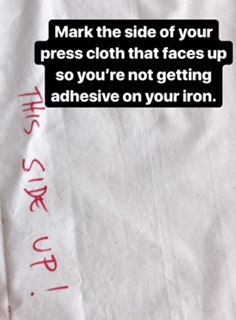
<p><span> These images below show the top and crown pieces with the interfacing on them. (We use a press cloth below and above when fusing interfacing. If there’s any bleedthrough of the glue or, God forbid, glue side the facing up, it saves you a lot of grief cleaning up your iron and ironing surface.)</span></p>
<div style="text-align: left;"><img src="https://cdn.shopify.com/s/files/1/0515/2417/files/IMG_0683_240x240.jpg?v=1688678617" alt="Collage of crown peace with interfacing and top of at peace with interfacing" style="float: none;"></div>
<p> </p>
<p>Now sewing! Stitch the center back crown seam and<span style="-webkit-tap-highlight-color: rgba(0, 0, 0, 0);"> </span>press open.</p>
<div style="text-align: left;"><img src="https://cdn.shopify.com/s/files/1/0515/2417/files/IMG_9601_480x480.jpg?v=1688761454" alt="Crown piece of pattern on sewing machine bed with center back seam stitched" style="float: none;"></div>
<p> </p>
<p><span>This next part, constructing and applying the hat band, is somewhat fiddly but not hard. Once you get past this part, it comes together fast.<br aria-hidden="true"><br aria-hidden="true">You’ll need a bias strip 1 1/2” wide by the circumference measurement of your head plus a few inches. <br aria-hidden="true"><br aria-hidden="true">Next, cut the corners off one of the long edges to make the piece a trapezoid (middle photo.) The bottom edge of the hat band needs to be a little bit longer than the top edge because the hat circumference is larger where the bottom edge of the hat band attaches.<br aria-hidden="true"><br aria-hidden="true">Press up 1/4” on the longer side.</span></p>
<div style="text-align: left;"><img src="https://cdn.shopify.com/s/files/1/0515/2417/files/IMG_0716_480x480.jpg?v=1688761871" alt="" style="float: none;"></div>
<p> </p>
<p> Leaving a 3/8” extension at the CB, pin the hat band to the crown aligning the raw edge with the placement line, right sides together. Stitch it to the crown, 1/4” from raw edge and leaving another 3/8” extension at the center back. Because of the bias, the hat band might grow as you stitch leaving more of an extension at the end of the seam. <br><span>You can fold the crown at the center back seam (top right pic) and align the extensions and trim them to make each side even (bottom left pic.) <br aria-hidden="true"></span></p>
<p><span><img src="https://cdn.shopify.com/s/files/1/0515/2417/files/IMG_0719_480x480.jpg?v=1688763748" alt=""></span></p>
<p> </p>
<p><span>Next, press the hat band down to its finished orientation. Tuck in the extensions inside the hat band and have the folded edges abut at the center back as shown (top photos - right and left.)<br></span></p>
<p><span><br aria-hidden="true">Edge stitch the top edge of the hat band (not shown.)<br aria-hidden="true"><br aria-hidden="true">Then, flip the hat band up again and either hand-baste or safety pin in place so it won’t be in the way when you attach the brim (bottom photos.)<br aria-hidden="true"></span></p>
<p><span><img src="https://cdn.shopify.com/s/files/1/0515/2417/files/IMG_0720_480x480.jpg?v=1688764308" alt=""></span></p>
<p><span>Stitch the top to the crown, right sides together. Please review the information at the beginning of the instructions on stitching a circular piece to a straight edge. It covers how to make these two different shapes go together.  The takeaway point is that the seamlines are where the measurements are equal. The cut edges must align while you are stitching but they are of different lengths, so you have to continually adjust keeping the SEAMLINES stacked directly on top of each other.</span></p>
<p>The Collage below shows the step with the lining fabric but it’s precisely the same action.</p>
<p><img src="https://cdn.shopify.com/s/files/1/0515/2417/files/IMG_0723_480x480.jpg?v=1688767436" alt=""></p>
<p> Clip the seam allowance on the crown and press the seam open. A pressing ham is helpful to manipulate these pieces but you can do it on the point of an ironing board as well.</p>
<p><span><img src="https://cdn.shopify.com/s/files/1/0515/2417/files/IMG_0724_480x480.jpg?v=1688767680" alt=""><br aria-hidden="true"><br>Next, stitch center back seam in the brims if you haven’t already done that and press the seam open. <br><img src="https://cdn.shopify.com/s/files/1/0515/2417/files/IMG_0725_480x480.jpg?v=1688767954" alt=""><br></span></p>
<p><span>Stitch the crown assembly to the brim- right sides together. We found sewing clips were the best method of temporary holding the pieces together while stitching.</span></p>
<p> Clip the seam allowance and press seam allowance towards the crown (lower left hand photo shows pressing the seam with the lining fabric but it’s the same action.) Again, we liked working on a pressing ham for this but it’s possible to do it on the point of an ironing board or on a rolled up towel etc. </p>
<p><img src="https://cdn.shopify.com/s/files/1/0515/2417/files/IMG_0799_480x480.jpg?v=1688919836" alt=""></p>
<p><br>You’ve completed the outer hat assembly and in the next installment, will do the line assembly and more!</p>
<p><a href="https://www.decadesofstyle.com/blogs/news/hilde-hat-sew-along-part-2" target="_blank" title="Hilde Hat Sew Along Part 2" rel="noopener noreferrer">Click here for Sew Along Part 2.</a></p>]]>
    </content>
  </entry>
  <entry>
    <id>https://www.decadesofstyle.com/blogs/news/hilde-hat-sew-along-introduction</id>
    <published>2023-07-14T16:47:18-07:00</published>
    <updated>2023-07-14T16:52:04-07:00</updated>
    <link rel="alternate" type="text/html" href="https://www.decadesofstyle.com/blogs/news/hilde-hat-sew-along-introduction"/>
    <title>Hilde Hat Sew Along Introduction</title>
    <author>
      <name>Janet Manning</name>
    </author>
    <content type="html">
      <![CDATA[<p><span>Welcome to the Hilde Hat sew along! We are so happy you are joining us!</span><br aria-hidden="true"><br aria-hidden="true"><span>If you’ve never made a hat before, don’t be anxious because it’s just sewing. No wires involved, perhaps there is a Pellon product you have never used before but we all know how to fuse interfacing to our pieces so it’s going to be fine.</span><br aria-hidden="true"><br aria-hidden="true"><span>This installment is just going to be a quick introduction covering suggested fabrics and the aforementioned Pellon products. The suggested fabric list is pretty short, “light to mid weight to canvas. Avoid heavy or bulky fabrics.“ Other mid weight fabrics (bottom weight) with a stable weave will work. The seam allowances in the pattern are 3/8” so if your fabric frays very easily (like linen), the project will be challenging.</span></p>
<p>If you’re wondering if apparel fabric that is more dress weight or shirting weight, like regular quilting cotton <span>or oxford cloth</span> will be suitable, the answer is not really. It's a bit like looking for the Goldilocks weight of fabric; not to light, not too heavy, but just right.<br aria-hidden="true"><span><br>Quilt cotton or other lightweight fabrics are suitable for the lining.</span></p>
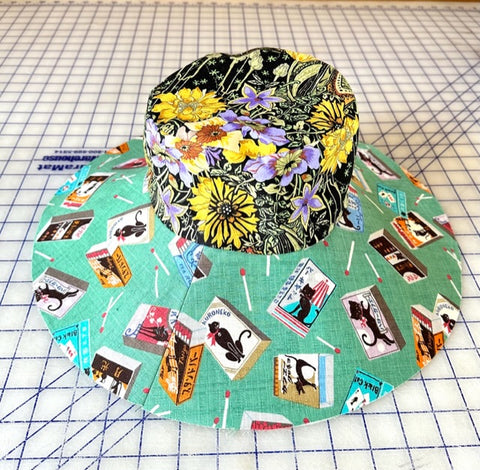
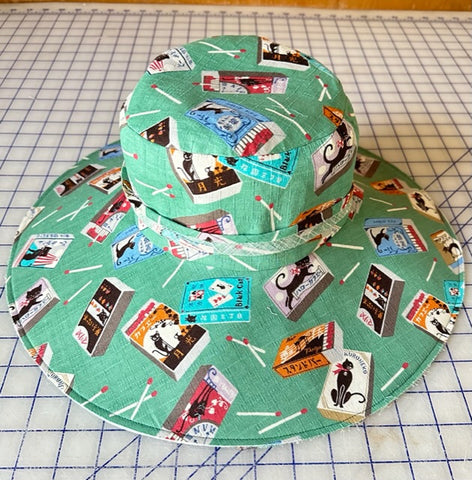
<p>No matter how tempting it is to use a heavy weight fabric or heavy weight canvas, try to resist because it will be more difficult to sew. Also, the fit will not be as expected due to the extra bulk of the heavy fabric in the seam allowance. We know this firsthand from our many rounds of testing on this pattern!<br aria-hidden="true"><br aria-hidden="true">Japanese linen canvas fabrics are the perfect weight for this project -  tested and confirmed!  And you’re not going do better in terms of whimsical prints if you go this route - see three photos below! You can find Japanese fabrics at independent fabric stores like <a href="https://stonemountainfabric.com/product-category/fabric/japanese-imports/" target="_blank" title="Link to Stonemountain Japanese fabric page" rel="noopener noreferrer">Stonemoutain and Daughter Fabrics</a>, <a href="https://hartsfabric.com/fashion-apparel-fabrics.html/european-japanese-imports.html?content_fabric=1640&amp;product_list_order=fabric-type" target="_blank" title="Harts Fabrics Japanese Linen Blend fabrics" rel="noopener noreferrer">Harts Fabrics</a> and <a href="https://shop.boltfabricboutique.com/collections/canvas" target="_blank" title="Bolt Fabrics Canvas fabric page" rel="noopener noreferrer">Bolt Fabric Boutique;</a> </p>
<p><img src="https://cdn.shopify.com/s/files/1/0515/2417/files/IMG_9457_480x480.jpg?v=1688659039" alt="Fabric hat sitting on green velvet. Fabric of hat is printed origami cranes on an offwhite background."></p>
<div style="text-align: left;"><img src="https://cdn.shopify.com/s/files/1/0515/2417/files/ACS_1070_480x480.jpg?v=1688659282" alt="Fabric hat on an ironing board. Fabric in hat is bright birds printed on a mint colored background" style="float: none;"></div>
<div style="text-align: left;"><img src="https://cdn.shopify.com/s/files/1/0515/2417/files/image000000_480x480.jpg?v=1688664915" alt="Fabric hat on a yellow surface. Hat fabric is fried eggs on a pink background."></div>
<p> </p>
<p> </p>
<p>The cotton canvas at Joann Fabrics  -  44” wide and $12.99/yard regular price - is another option with large selection of prints available. This fabric is technically in their decorator section but it is just right! <a href="https://www.joann.com/search/?q=cotton%20canvas&amp;prefn1=content&amp;prefv1=100%25%20Cotton&amp;prefn2=productGroup&amp;prefv2=Product&amp;srule=search-default&amp;sorder=descending" target="_blank" title="Joann Fabrics cotton canvas fabric" rel="noopener noreferrer">Shop Joann's Cavas selection</a>. The solid cotton duck in the Joann decorator department is also an option. This fabric comes with a very heavy duty coating of sizing. If you are not pre-washing the cotton duck, you probably won’t need the layer of interfacing in the brim.</p>
<p><span>Fabric brands like Ruby Star and Cotton and Steel usually have a light weight canvas included in their quilting cotton collections so there are many options.</span></p>
<p><span>You can successfully use a large scale print for the project but it’s probably best to stick to an abstract design. (Also, it helps to buy extra yardage of a large scale print so you have more leeway in how you cut your fabric.) The photo below show 1 yard of a large scale print canvas. The repeat on this fabric is almost overwhelming! But keep reading and see how it works beautifully for the pieces of the hat.</span></p>
<p> </p>
<div style="text-align: left;"><img src="https://cdn.shopify.com/s/files/1/0515/2417/files/ACS_1060_480x480.jpg?v=1688661502" alt="1 Yard of abstract print canvas in bright colors" style="float: none;"></div>
<p> </p>
<p><span>One helpful way to envision how a print will ultimately work in your project is to use the paper scraps from the pattern to make a template. The template simply creates a “frame” of exactly what part of the print will show.</span></p>
<p><span><img src="https://cdn.shopify.com/s/files/1/0515/2417/files/IMG_9973_480x480.jpg?v=1688679621" alt=""></span></p>
<p><span> Below are 3 different choices of fussy cutting that fabric to show the crown of the hat.</span></p>
<p><span><img src="https://cdn.shopify.com/s/files/1/0515/2417/files/IMG_0672_480x480.jpg?v=1688661758" alt="Collage image shows a paper template framing different sections of the fabric from the previous image."></span></p>
<p><span><br aria-hidden="true"><br aria-hidden="true">As you can see, it can be surprising and delightful the way a large scale print parses in the hat pieces.</span></p>
<p><span><img src="https://cdn.shopify.com/s/files/1/0515/2417/files/IMG_0021_480x480.jpg?v=1688661848" alt="All the hat pieces from the pattern cut out of the aforementioned fabric. Pieces are sitting on a cutting table."></span></p>
<p> <img src="https://cdn.shopify.com/s/files/1/0515/2417/files/IMG_0032_480x480.jpg?v=1688677458" alt=""></p>
<p><span>If you have recognizable elements in a large scale print, such as flowers, leaves or animals, you will most likely only see parts of any one element on the hat pieces. So depending on the scale, not a whole flower, only a cropped part of it. Use your template to help you fussy cut to maximize the effect of the fabric. <br><img src="https://cdn.shopify.com/s/files/1/0515/2417/files/IMG_0735_480x480.jpg?v=1688775253" alt=""><br></span></p>
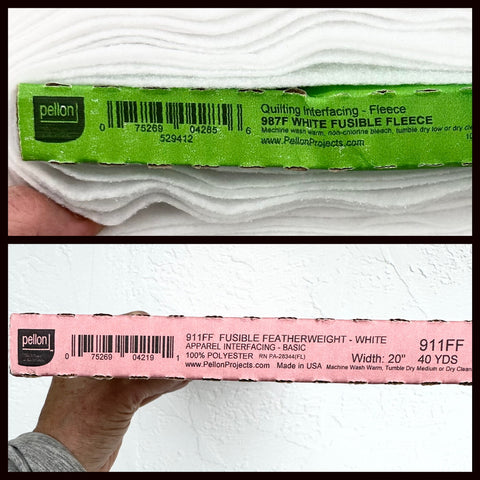
<p><span><br aria-hidden="true"><img src="https://cdn.shopify.com/s/files/1/0515/2417/files/IMG_0737_480x480.jpg?v=1688774533" alt=""><br aria-hidden="true"><br>The pattern specifies exactly what Pellon products to use. If you want to use other products, go ahead if you want. Just know ahead of time that <strong>WE DON’T KNOW</strong> if your substitutions will work. We just don’t. If you email us to ask if "X or Y" will work instead of the fusible fleece, the answer is <strong>WE DON'T KNOW.  </strong></span>There are times to "shop your stash;" we don't think this is one of them. If you shop the sales and/or use coupons, the fusible fleece and interfacing is not difficult to find and not that expensive. You will end up saving in the long run if you use what the pattern says. Photo shows the exact products specified in the pattern. </p>
<p><span><img src="https://cdn.shopify.com/s/files/1/0515/2417/files/IMG_0678_480x480.jpg?v=1688664932" alt="Collage showing the bolt ends of 2 Pellon products: 987F - fusible fleece and 911FF fusible interfacing"></span></p>
<p><span>Find yourself some fabric, get your Pellon products and we'll start sewing in the next installment.</span></p>
<p><a href="https://www.decadesofstyle.com/blogs/news/hilde-hat-sew-along-official-part-1" target="_blank" title="Hilde Hat Sew Along Part 1" rel="noopener noreferrer"><span>Click here for "Official Part 1 Hilde Hat Sew Along."</span></a></p>
<div style="text-align: left;"></div>]]>
    </content>
  </entry>
  <entry>
    <id>https://www.decadesofstyle.com/blogs/news/peaks-and-valleys-pants-waistband-tutorial</id>
    <published>2021-07-27T03:00:02-07:00</published>
    <updated>2021-07-27T03:00:02-07:00</updated>
    <link rel="alternate" type="text/html" href="https://www.decadesofstyle.com/blogs/news/peaks-and-valleys-pants-waistband-tutorial"/>
    <title>Peaks and Valleys Pants Waistband Tutorial</title>
    <author>
      <name>Janet Manning</name>
    </author>
    <summary type="html">
      <![CDATA[Waistband tutorial for Decades Everyday Peaks and Valleys Pants. Step by step photos of applying the waistband, waistband facing and elastic.<p><a class="read-more" href="https://www.decadesofstyle.com/blogs/news/peaks-and-valleys-pants-waistband-tutorial">More</a></p>]]>
    </summary>
    <content type="html">
      <![CDATA[<div style="text-align: left;">
<br>
<p>Hey everyone! Thanks so much for checking out our blog and this tutorial. We are hoping the PVP construction is so straightforward there’s no problem for anyone. The waistband is the one place where someone might want some extra info so this is it!</p>
The waistband is curved in order to conform to your body and be more comfortable and fit better than a rectangular waistband. The construction is the Waistband piece with a facing. Once attached, seam allowances of the Waistband, the facing and the pants are distributed above and below the waistband seam to minimize bulk. Yes, there is a faster, less fiddly way of doing this but this outcome is worth the little bit of extra effort! </div>
<div style="text-align: left;">-</div>
<div style="text-align: left;"></div>
<div style="text-align: left;">Let’s get started.  In the photo below, you can see that the waistband pieces are shaped. The smaller (top edge) of the waistband is the top of the pants; the lower, longer edge is sewn to the pants.</div>
<p><img src="https://cdn.shopify.com/s/files/1/0515/2417/files/7C707ADD-6670-4A0D-86C0-E1E3D2856BDE_240x240.jpg?v=1626713760" alt="Waistband pieces above Pants assembly"></p>
<p>First, sew the Center Back seam on one Waistband piece (left) and press that seam open as shown (right.)</p>
<p> <img src="https://cdn.shopify.com/s/files/1/0515/2417/files/2EFA590F-203F-4CB8-9D37-01B8AEEB129A_240x240.jpg?v=1626714789" alt=""></p>
<p>Next, the top photo shows the Waistband and the pants with the matching seam edges next to each other. The middle photo shows the Waistband flipped so that the raw edges of the Waistband and Pants are aligned with the right sides of the fabric together. Bottom photo shows the Waistband pinned to the pants and ready for stitching.</p>
<p><img src="https://cdn.shopify.com/s/files/1/0515/2417/files/19CED866-A242-4916-BF5F-4047C3E176CB_480x480.jpg?v=1626715239" alt=""></p>
<p> Stitch the seam (top.) Grade the seam allowance trimming Pants seam allowance to be shorter than the Waistband seam allowance (middle.) Press seam towards Waistband (bottom.)</p>
<p><img src="https://cdn.shopify.com/s/files/1/0515/2417/files/CEA63E4F-FAE6-40D9-ACD7-5B700B32A672_480x480.jpg?v=1626716458" alt=""></p>
<p>Congratulations! Your Waistband is on; all that is left now is the Waistband facing. </p>
<p>Finish the bottom edge of the remaining Waistband piece however you like LEAVING THE ENTIRE SEAM ALLOWANCE INTACT! We serged the egde (top.) Next, turn the seam allowance at the center back and press (middle and bottom.)</p>
<p><img src="https://cdn.shopify.com/s/files/1/0515/2417/files/B14FFA3F-EC14-4401-A902-8629B6DA2C78_480x480.jpg?v=1626718550" alt=""></p>
<p> Now you’re going to pin the Waistband facing to the pants, right sides together, matching the center front (top photo) and side notches. Make sure the folded edges at the center back of the Waistband facing abut one another as shown and are directly over the center back seam on the Waistband (middle photo.) Stitch (bottom photo.)</p>
<p><img src="https://cdn.shopify.com/s/files/1/0515/2417/files/1E79746D-C9CE-41A6-8449-77C2C554E188_480x480.jpg?v=1626729838" alt=""><br><br></p>
<p>Grade the seam allowance making Waistband facing the shortest layer (Top and middle photo.) Press the seam open (bottom photo.) This might seem strange because you’re about to fold the Waistband facing to the inside of the pants but it makes it MUCH easier to control everything.</p>
<p> <img src="https://cdn.shopify.com/s/files/1/0515/2417/files/095D3314-0FD9-4401-BF03-F9CA9E6F5A60_480x480.jpg?v=1626730519" alt=""></p>
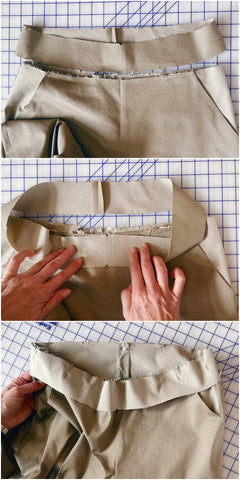
<p>OK! Just a few more steps now. Flip the Waistband facing to the inside of the pants and press along the top edge (top photo.) At the center back, make sure the folded edges abut one another (middle photo.) Pin in place. You might have to pin from the inside first keeping everything flat and in position. Then, pin from the outside because you’ll be stitching from the outside (bottom photo.)</p>
<p><img src="https://cdn.shopify.com/s/files/1/0515/2417/files/2A7C0A37-FEB9-43D9-8F43-0D9340EE403E_480x480.jpg?v=1626731834" alt=""></p>
<p>Stitch in the ditch of the waistband seam from the outside making sure you catch the facing with the stitching. You will be stitching with your narrow zigzag stitch but it shouldn’t show. Don’t worry if your stitching isn’t absolutely perfect and goes on to the waist band or the pants. Nobody’s going to see it when you’re wearing them.</p>
<div style="text-align: left;"><img src="https://cdn.shopify.com/s/files/1/0515/2417/files/92CD83DC-F412-4AA4-B559-D33F0A502370_240x240.jpg?v=1626735714" alt="" style="float: none;"></div>
<p><br>Thread your elastic into the casing using a large safety pin or bodkin (top photo.)  It’s going to be a snug fit but that will just keep the non-roll elastic from twisting around in the casing when you’re getting in and out of the pants. It might be difficult to distribute the pants evenly around the elastic. Don’t worry, it will eventually smooth out (middle photo.) <br>Once you’ve tried on the pants and determined how tight you want your elastic to be, overlap the ends as shown in the bottom photo and pin. </p>
<p> <img src="https://cdn.shopify.com/s/files/1/0515/2417/files/C5C3640F-7F04-4926-9977-22181CDF280F_480x480.jpg?v=1626735871" alt=""></p>
<p>Now stitch the  ends of the elastic together (top photo) and work it back into the casing. Stitch the two folded edges together by hand middle and bottom photos.)</p>
<p><img src="https://cdn.shopify.com/s/files/1/0515/2417/files/87EA8E64-B848-4FE8-B425-4F96665BC11C_480x480.jpg?v=1626811039" alt=""></p>
<p>That’s it! You’ve got a nice low profile waistband and it was pretty easy, right?</p>
<p>The pants might fit snugly when you first put them on or get them out of the wash. Most stretch woven fabric relaxes after a few hours of wear so give it a few hours before decide what you think about the fit. And speaking of relaxing, sometimes elastic can also lose its "recovery" and get looser as time goes on. Doing the waistband this way makes if much easier to get back in there to shorten up the elastic if necessary.</p>
<p>Thanks for making it all the way to the end!</p>
<div style="text-align: left;"><img src="https://cdn.shopify.com/s/files/1/0515/2417/files/8BFF6DA7-0A8F-479D-9667-C862677B56E1_480x480.jpg?v=1626812212" style="float: none;" width="480x480" height="480x480"></div>
<p> </p>
<p> </p>]]>
    </content>
  </entry>
  <entry>
    <id>https://www.decadesofstyle.com/blogs/news/ophelia-overalls-sew-along-part-4-straps-and-snaps</id>
    <published>2019-02-16T08:13:00-08:00</published>
    <updated>2019-02-16T08:19:31-08:00</updated>
    <link rel="alternate" type="text/html" href="https://www.decadesofstyle.com/blogs/news/ophelia-overalls-sew-along-part-4-straps-and-snaps"/>
    <title>Ophelia Overalls Sew Along Part 4: Straps and Snaps</title>
    <author>
      <name>Janet Manning</name>
    </author>
    <content type="html">
      <![CDATA[<p><a href="https://www.decadesofstyle.com/blogs/news/ophelia-overalls-sew-along-part-3-bibbity-bobbity" target="_blank" title="Overalls Sew Along Part 3" rel="noopener noreferrer">Click here for previous installment in the sew along</a>.</p>
<p> </p>
<p>All that is left is the Straps and a number of finishing items - so let's get 'er done! </p>
<p>If you have used a loose weave or light weight fabric for your overalls, you will want to flat line the straps with a stable weave fabric like muslin or quilting cotton. Just cut Straps pieces from the muslin or quilting cotton. Stack the muslin Straps on the fashion fabric Straps, wrong sides together and baste them together around the outer edges. Procede with the construction treating the stacked pieces of fabric as one layer.</p>
<p>Narrow hem the unnotched edges of the Straps. Turn in a scant 1/4” and press, then turn in 3/8” and press. Edge stitch close to the fold.</p>
<p><img alt="" src="//cdn.shopify.com/s/files/1/0515/2417/files/D6A21481-984B-414D-83DA-45CFC1C1CAB3_large.jpeg?v=1549230655"></p>
<p> </p>
<p>Next, you’ll attach the Strap to the top of the Center Back Pants. The Straps should meet precisely at the center back at the square on the pattern pieces (upper left).  Stitch with the pieces right sides together, matching notches (upper right). Serge or zigzag the seam together and press seam down (lower row).</p>
<p><img alt="" src="//cdn.shopify.com/s/files/1/0515/2417/files/0AE064B7-7ED9-4845-88C6-F01E52370BBB_large.jpeg?v=1549231785"> </p>
<p style="margin: 0px 0px 1em; line-height: 1.4; caret-color: #000000; color: #000000; font-family: 'Helvetica Neue', Helvetica, Arial, sans-serif; font-size: 15px; font-style: normal; font-variant-caps: normal; font-weight: normal; letter-spacing: normal; orphans: auto; text-align: start; text-indent: 0px; text-transform: none; white-space: normal; widows: auto; word-spacing: 0px; -webkit-tap-highlight-color: rgba(26, 26, 26, 0.301961); -webkit-text-size-adjust: none; -webkit-text-stroke-width: 0px; text-decoration: none;"> </p>
<p style="margin: 0px 0px 1em; line-height: 1.4; caret-color: #000000; color: #000000; font-family: 'Helvetica Neue', Helvetica, Arial, sans-serif; font-size: 15px; font-style: normal; font-variant-caps: normal; font-weight: normal; letter-spacing: normal; orphans: auto; text-align: start; text-indent: 0px; text-transform: none; white-space: normal; widows: auto; word-spacing: 0px; -webkit-tap-highlight-color: rgba(26, 26, 26, 0.301961); -webkit-text-size-adjust: none; -webkit-text-stroke-width: 0px; text-decoration: none;">Edge stitch and topstitch on the Center Back Pants, catching the seam allowance in place on the inside of the overalls.</p>
<p style="margin: 0px 0px 1em; line-height: 1.4; caret-color: #000000; color: #000000; font-family: 'Helvetica Neue', Helvetica, Arial, sans-serif; font-size: 15px; font-style: normal; font-variant-caps: normal; font-weight: normal; letter-spacing: normal; orphans: auto; text-align: start; text-indent: 0px; text-transform: none; white-space: normal; widows: auto; word-spacing: 0px; -webkit-tap-highlight-color: rgba(26, 26, 26, 0.301961); -webkit-text-size-adjust: none; -webkit-text-stroke-width: 0px; text-decoration: none;"><img alt="" src="//cdn.shopify.com/s/files/1/0515/2417/files/A2422D08-AA25-4E55-B204-807EA8B58124_large.jpeg?v=1549232976"></p>
<p style="margin: 0px 0px 1em; line-height: 1.4; caret-color: #000000; color: #000000; font-family: 'Helvetica Neue', Helvetica, Arial, sans-serif; font-size: 15px; font-style: normal; font-variant-caps: normal; font-weight: normal; letter-spacing: normal; orphans: auto; text-align: start; text-indent: 0px; text-transform: none; white-space: normal; widows: auto; word-spacing: 0px; -webkit-tap-highlight-color: rgba(26, 26, 26, 0.301961); -webkit-text-size-adjust: none; -webkit-text-stroke-width: 0px; text-decoration: none;"> </p>
<p>Time to attach the front Belt. </p>
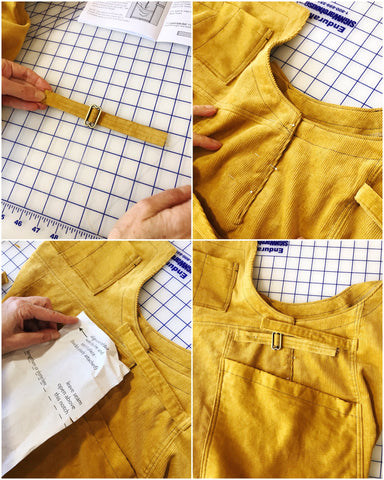
<p>With the remaining belt pieces, thread your buckle or D rings through about half way (upper left). Work with the side vent pinned shut (upper right). Place the finished end of the Belt at the placement line and pin temporarily (lower row).</p>
<p><img alt="" src="//cdn.shopify.com/s/files/1/0515/2417/files/7F798F2D-AFCA-40F8-AD44-DA959089E6CC_large.jpeg?v=1549233585"></p>
<p>Thread the back Belt through the buckle and positioned the buckle so that the back Belt just reaches through the buckle (upper left). Mark <span>the location of the buckle on</span> the front Belt (upper right, lower left). Unthread the back Belt and unpin the front Belt from the overalls (lower right).</p>
<p><img alt="" src="//cdn.shopify.com/s/files/1/0515/2417/files/D8C8CBA1-0924-4696-A793-05B3AF9DC764_large.jpeg?v=1549234433"></p>
<p> </p>
<p>Cut off the front Belt about 1” past the mark for the buckle (top). Finish the cut end (middle).  Fold that end to the underside of the Belt and hand stitch in place keeping the buckle at the designated location (bottom).</p>
<p><img alt="" src="//cdn.shopify.com/s/files/1/0515/2417/files/E21F3E66-2E08-4AA0-B0F8-278194796A63_large.jpeg?v=1549235091"> </p>
<p> </p>
<p> Underside of Belt and top side of Belt (upper left). Pin the front Belt on the Side Front Pants aligning the free end with the Belt placement line (upper right). Stitch in place (lower left). Voila (lower right).</p>
<p><img alt="" src="//cdn.shopify.com/s/files/1/0515/2417/files/B59C4DC6-9A12-4A21-B2AF-D97FEB602957_large.jpeg?v=1549236022"></p>
<p> </p>
<p> OK - Now for all the finishing stuff. We have some tips to speed it along.</p>
<p> </p>
<p>Try the overalls on and pin the Bib to the Strap so that the waistline of the overalls is right at your natural waist. We are working on a dress form, so this photo shows her waist (top row). On the Strap, mark the top of the overalls <span style="display: inline !important; float: none; background-color: transparent; color: #000000; font-family: 'Helvetica Neue',Helvetica,Arial,sans-serif; font-size: 15px; font-style: normal; font-variant: normal; font-weight: 400; letter-spacing: normal; line-height: 21px; orphans: 2; text-align: left; text-decoration: none; text-indent: 0px; text-transform: none; -webkit-text-stroke-width: 0px; white-space: normal; word-spacing: 0px;">(bottom row)</span>. Now you can take the overalls off.</p>
<p><img alt="" src="//cdn.shopify.com/s/files/1/0515/2417/files/7C21CAA7-84C6-4F6B-9A35-139F2B754C0E_large.jpeg?v=1549243487"></p>
<p> </p>
<p>Fold the Strap in half lengthwise and mark that center line along the fold. Mark the center of the button location on the center line. For a 1" button, mark the 1" below the line indicating the top of the Bib.</p>
<p><img alt="" src="//cdn.shopify.com/s/files/1/0515/2417/files/BF3709E9-3860-49BC-A5A1-D588AD249D98_large.jpeg?v=1549243793"> </p>
<p> </p>
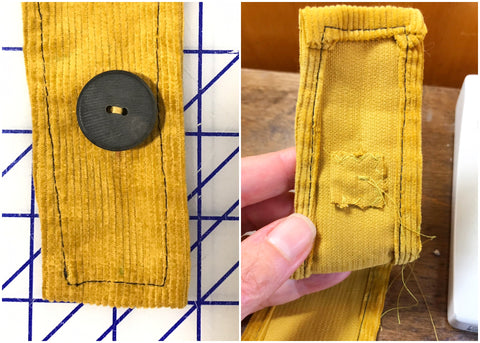
<p>Take a small scrap of fabric aproximately 3/4" by 1 1/2" and fold in half, right sides together. Zigzag around the perimeter (top row). Baste this square on the wrong side of the strap centering it at the button mark (bottom row).</p>
<p><img alt="" src="//cdn.shopify.com/s/files/1/0515/2417/files/5F8962C6-DB0B-48A1-9162-9DE61F7C5C44_large.jpeg?v=1549244270"></p>
<p> </p>
<p>Sew the button on the right side of the Strap through all layers of the patch on the wrong side. (If you have anything other than a 1 inch button, you will need to adjust the button location on the Strap. A larger button will be a bit further down the Strap.)</p>
<p><img alt="" src="//cdn.shopify.com/s/files/1/0515/2417/files/35509ABE-F1C7-4A7B-B751-E151695CAA8B_large.jpeg?v=1549244784"></p>
<p> </p>
<p>Make a vertical button holes in the upper corners of the Bib. The distance from the side of the Bib is half the width of the Strap at the location of the button (left).  The top of the buttonhole should be 7/8” the top of the Bib and 1 1/8” long for a 1” button (center). </p>
<p><img alt="" src="//cdn.shopify.com/s/files/1/0515/2417/files/BEFFDCE4-8CA6-4E19-8DB3-2AF45EE10DB3_large.jpeg?v=1549245719"></p>
<p> </p>
<p>Make a horizontal button hole on the Bib at the waist line. Start buttonhole 7/8” from the edge of the Bib and center it in the area above the waist as best as possible.  Sew on button for waist.</p>
<p><img alt="" src="//cdn.shopify.com/s/files/1/0515/2417/files/C8059395-7B07-4F80-9A74-8C059D99F7AB_large.jpeg?v=1549247030"></p>
<p> </p>
<p>With the Button Placket pinned as shown (upper left), mark snap locations spacing 3 snaps in the area under the button (upper right). We sewed the buttons and on with the machine using the darning foot, stitch width of 4 and a stitch length of 0. Using the same stitch settings, we attached the male half of the snaps to the Button Placket  knotting the loose threads securely afterwards (bottom row).</p>
<p> <img alt="" src="//cdn.shopify.com/s/files/1/0515/2417/files/6E6A9D84-842E-4CEE-9C3C-117BEF789534_large.jpeg?v=1549248416"></p>
<p> </p>
<p>Sewing the female snap goes pretty quickly if you double thread your needle. Take a fairly long length of thread and fold it in half. Thread your needle with two strands of the thread (top row). You now have four strands of thread going through your needle and will only need to stitch twice through each attachment point on the snaps (bottom row)</p>
<p><img alt="" src="//cdn.shopify.com/s/files/1/0515/2417/files/E08EF93C-F17E-4E34-9427-742F14DE747B_large.jpeg?v=1549249119">.</p>
<p> A 5/8” narrow hem is allowed on the pant legs.  Turn up 5/8", turn the raw edge into the fold and press. Machine stitch hem.</p>
<p><img alt="" src="//cdn.shopify.com/s/files/1/0515/2417/files/7AB297CA-29B9-4708-B28B-EA574DD9A4E2_large.jpeg?v=1549249471"></p>
<p> </p>
<p>Now you have the cutest pair of overalls on the planet!</p>
<p><img alt="" src="//cdn.shopify.com/s/files/1/0515/2417/files/AE6B114C-6874-46FB-A11E-27E736E09FFC_large.jpeg?v=1549303834"></p>
<p>Thank you so much for sewing along with us!</p>]]>
    </content>
  </entry>
  <entry>
    <id>https://www.decadesofstyle.com/blogs/news/ophelia-overalls-sew-along-part-3-bibbity-bobbity</id>
    <published>2019-02-16T08:12:00-08:00</published>
    <updated>2019-02-16T08:17:23-08:00</updated>
    <link rel="alternate" type="text/html" href="https://www.decadesofstyle.com/blogs/news/ophelia-overalls-sew-along-part-3-bibbity-bobbity"/>
    <title>Ophelia Overalls Sew Along Part 3: Bibbity Bobbity</title>
    <author>
      <name>Janet Manning</name>
    </author>
    <content type="html">
      <![CDATA[<p><a href="https://www.decadesofstyle.com/blogs/news/set-up-and-sew" target="_blank" title="Ophelia Overalls Sew Along Part 2" rel="noopener noreferrer"><span>Click here for previous installment in the sew along.</span></a></p>
<p>Let’s jump right in and get the bib on these babies!</p>
<p>Make the Bib Pocket by turning back the top edge along the foldline (A) and stitching up the sides(B). Turn it right side out and then press in the seam allowance on all the remaining sides (D_E). Stitch top edge in place (F).</p>
<p><img alt="" src="//cdn.shopify.com/s/files/1/0515/2417/files/2_18_large.jpg?v=1549134337"></p>
<p> </p>
<p>Finished Bib Pocket:</p>
<p style="text-align: left;"><img style="float: none;" alt="" src="//cdn.shopify.com/s/files/1/0515/2417/files/2_19_medium.jpg?v=1549134414"></p>
<p> </p>
<p>Before you start working on the Bib and manipulating it, stay stitch the curved edges right along the seam line So they won’t get stressed or distorted while you’re working. (The stay stitching is hard to see because the thread color matches the fabric.)</p>
<p style="text-align: left;"><img style="float: none;" alt="" src="//cdn.shopify.com/s/files/1/0515/2417/files/2_20_medium.jpg?v=1549134488"></p>
<p> </p>
<p>Mark the Bib Pocket placement lines on the Bib. We used an awl punch hole just inside of the placement lines so the Pocket covers the marks (a-c). Place the pocket on the bib and glue-baste or hand baste the pocket in place (d). We glue basted the Pocket and it did shift a tiny bit while we were stitching (hand basting it is always the best). Edge stitch and topstitch the pocket in place (e-f). </p>
<p><img alt="" src="//cdn.shopify.com/s/files/1/0515/2417/files/2_21_large.jpg?v=1549134585"></p>
<p> </p>
<p><span>If you want, use stitching lines to divide the pocket into sections. </span>A clear 2 inch ruler can be used to mark your stitching lines.  </p>
<p><img alt="" src="//cdn.shopify.com/s/files/1/0515/2417/files/2_22_large.jpg?v=1549134948"></p>
<p> </p>
<p>Next ,pin the Bib to the front edge of the waist, right sides together, matching center fronts and matching the notches to the princess seams (1). Stitch seam (2). Trim the seam allowance on the Bib only and press the seam towards the Bib (3-5). And edge stitch and topstitch the seam on the Bib (6).</p>
<p><img alt="" src="//cdn.shopify.com/s/files/1/0515/2417/files/2_23_large.jpg?v=1549135274"></p>
<p> </p>
<p>Now we’re going to use the facing to finish all the edges of the Bib and the front opening on the overalls. First, interface the Bib Facing pieces, trimming 3/8" off the notched edges and fusing to the corresponding bib facing pieces. Finish the inner and lower edges (right). We rounded the inner curves on the Bib Facing piece to make it easier to put through the serger.</p>
<p style="text-align: left;"><img style="float: none;" alt="" src="//cdn.shopify.com/s/files/1/0515/2417/files/2_24_large.jpg?v=1549135758"></p>
<p> </p>
<p>Stitch the Bib Facing right sides together at the center front. Trim the seam, press  open.</p>
<p> <img alt="" src="//cdn.shopify.com/s/files/1/0515/2417/files/2_25_large.jpg?v=1549135965"></p>
<p> </p>
<p>Pin Bib Facing to Bib, right sides together. Stitch Facing to the Bib, starting from lower notch on the Facing to lower notch on the other side.</p>
<p><img alt="" src="//cdn.shopify.com/s/files/1/0515/2417/files/2_26_large.jpg?v=1549135994"></p>
<p><img alt="" src="//cdn.shopify.com/s/files/1/0515/2417/files/2_27_large.jpg?v=1549136095"></p>
<p> </p>
<p>Clip corners (left). Grade the seam allowances so that they are graduated in height and the shortest layer is closest to the body (center). Clip seam allowances along the curve (right).</p>
<p><img alt="" src="//cdn.shopify.com/s/files/1/0515/2417/files/2_29_large.jpg?v=1549136159"></p>
<p> </p>
<p>If you have a point presser, this is a good tool to use it to press the seam open before turning the Facing right side out. This makes the edge along the seam much easier to control once you’ve turned the Facing right side out.</p>
<p><img alt="" src="//cdn.shopify.com/s/files/1/0515/2417/files/2_28_medium.jpg?v=1549136244"><img alt="" src="//cdn.shopify.com/s/files/1/0515/2417/files/2_32_medium.jpg?v=1549137827"></p>
<p> </p>
<p>Edge stitch the seam from lower notch to lower notch.</p>
<p><img alt="" src="//cdn.shopify.com/s/files/1/0515/2417/files/2_30_large.jpg?v=1549137873"></p>
<p> </p>
<p><span>Top stitch the Bib approximately 1" from the edge as shown, starting at the waist and stitching to the waist at the other side.</span></p>
<p><span><img alt="" src="//cdn.shopify.com/s/files/1/0515/2417/files/2_31_large.jpg?v=1549137955"></span></p>
<p>  </p>
<p>Now we can attach the Back Button Plackets. With the right sides together, stitch the top edge. Then turn them right side out. If your fabric is not too bulky, you don’t need to clip the corner (left). Just fold the corner down and hold it in place pinched between your thumb and your forefinger as you turn(center). </p>
<p><img alt="" src="//cdn.shopify.com/s/files/1/0515/2417/files/2_33_large.jpg?v=1549150331"></p>
<p><span>Press and </span><span>serge </span><span>the bottom edge. You can serge the sides at this time like we did or you </span><span>can also wait until you attach the Placket and serge the sides along with the Pants.</span></p>
<p><span><img alt="" src="//cdn.shopify.com/s/files/1/0515/2417/files/2_34_medium.jpg?v=1549150384"></span></p>
<p> </p>
<p>If you haven't done so yet, mark the notches on the Placket (left). Center photo shows the notch at the side opening. Match the lower notch on the Placket with that notch at the bottom of the side opening (right).</p>
<p><img alt="" src="//cdn.shopify.com/s/files/1/0515/2417/files/2_35_large.jpg?v=1549150445"></p>
<p>  </p>
<p><span>Match upper edge of Placket with circle at waist (left - the circle is marked with a tiny awl punch that doesn't show in the photo. Just note that top edge of the Placket is offset from the corner by 5/8"). Placket pinned in place at side opening (center). Stitch between the lower notches </span><span>and the circle at the waist edge. </span>Press all the seams towards the back (right).</p>
<p><img alt="" src="//cdn.shopify.com/s/files/1/0515/2417/files/2_36_large.jpg?v=1549150728"></p>
<p> </p>
<p>Stay stitch the curved back edge right along the seam line. The stay stitching is in matching thread so it is not easy to see but it is there.</p>
<p><img alt="" src="//cdn.shopify.com/s/files/1/0515/2417/files/2_37_large.jpg?v=1549150910"></p>
<p> </p>
<p>Prep the Back Facing pieces exactly as you did the front, trimming the interfacing and fusing it to the corresponding pieces (left). Finish the inner edge (center). Mark where the back princess seam will match the facing (right).</p>
<p><img alt="" src="//cdn.shopify.com/s/files/1/0515/2417/files/2_38_large.jpg?v=1549151039"></p>
<p> </p>
<p>Pin Back Facing to the overalls right sides together <span>matching the reference marks and notches </span>(upper left). Stitch from circle  at waist edge of facing - the location of the circle is the pin (upper right). Grade the seam allowance in the same manner as the Bib Facing (lower left). Clip the curve (lower right).</p>
<p><img alt="" src="//cdn.shopify.com/s/files/1/0515/2417/files/2_39_large.jpg?v=1549151110"></p>
<p> </p>
<p>Press the seam open (upper left). Turn under the seam allowance at the short end that abuts the Button Placket (upper right). Turn the Back Facing to the inside and press (bottom row).</p>
<p><img alt="" src="//cdn.shopify.com/s/files/1/0515/2417/files/2_40_large.jpg?v=1549151323"></p>
<p>The Back Facing will look like this after pressing:</p>
<p><img alt="" src="//cdn.shopify.com/s/files/1/0515/2417/files/2_41_medium.jpg?v=1549151462"></p>
<p> </p>
<p>Edge stitch the facing (left). Topstitch 1" from edge securing the Facing in place on the inside (center). The back edge is finished now and will look like the photo at the far right.</p>
<p><img alt="" src="//cdn.shopify.com/s/files/1/0515/2417/files/2_42_large.jpg?v=1549151603"></p>
<p> </p>
<p>Let's finish this installment up with anchoring the Button Placket and Bib Facing to the overalls.</p>
<p>Lap the front edge of the waist opening over the Button Placket and pin the opening shut as shown (upper left). Pin the bottom of the Bib Facing and the Button Placket in place . It makes it easier to deal with if you hand baste everything at this point (upper right). Mache Stitch through all layers at the level of the lower notch anchoring the Button Placket and the Bib Facing to the side front trousers (bottom row).</p>
<p><img alt="" src="//cdn.shopify.com/s/files/1/0515/2417/files/2_43_large.jpg?v=1549151939"></p>
<p> </p>
<p>You made it through another long installment!! All that is left now is the Straps and the finishing steps. Join us next time!</p>
<p><a href="https://www.decadesofstyle.com/blogs/news/ophelia-overalls-sew-along-part-4-straps-and-snaps" target="_blank" title="Ophelia Overalls Sew Along Part 4" rel="noopener noreferrer"> Click here for the next installment in the sew along</a>.</p>
<p> </p>]]>
    </content>
  </entry>
  <entry>
    <id>https://www.decadesofstyle.com/blogs/news/set-up-and-sew</id>
    <published>2019-02-13T22:11:00-08:00</published>
    <updated>2019-02-16T08:14:32-08:00</updated>
    <link rel="alternate" type="text/html" href="https://www.decadesofstyle.com/blogs/news/set-up-and-sew"/>
    <title>Ophelia Overalls Sew Along Part 2: Set Up and Sew</title>
    <author>
      <name>Janet Manning</name>
    </author>
    <content type="html">
      <![CDATA[<p><a title="Ophelia Sew Along Part 1" href="https://www.decadesofstyle.com/blogs/news/ophelia-overalls-sew-along-part-1-fabric-and-fit" target="_blank" rel="noopener noreferrer">Click here for previous installment in the sew along</a>.</p>
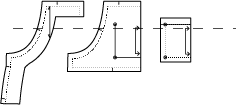
<p>In spite of the multiple (and maybe a little finicky) elements of design in this pattern, it is a fun sew! If you have a serger, you can speed up the sewing time by pre-finishing the edges. Here's a quick guide regarding the edges to serge and which you can leave raw. Serged edges are highlighted in red. Serge at the raw edge leaving your 5/8” seam allowance in tact.</p>
<p><img alt="" src="//cdn.shopify.com/s/files/1/0515/2417/files/Over_sergeedge_large.png?v=1549060479"></p>
<p><span>The remaining non-serged edges will either be enclosed in a facing or will be finished with along with additional edges as the construction progresses.</span></p>
<p>If you don’t have a serger and are zigzagging or using some other method to finish your seams, it’s no problem! Just use your desired finishing method as you progress. </p>
<p>For any of you who might happen to have an extra (possibly vintage) sewing machine lying around (or maybe even a collection of them), this is the perfect time to set it up with contrasting top stitching thread if you are going with that option. Gratuitous vintage sewing machine photo below:  </p>
<p><img alt="" src="//cdn.shopify.com/s/files/1/0515/2417/files/vint_white_large.jpg?v=1549061097"></p>
<p>Let’s sew! </p>
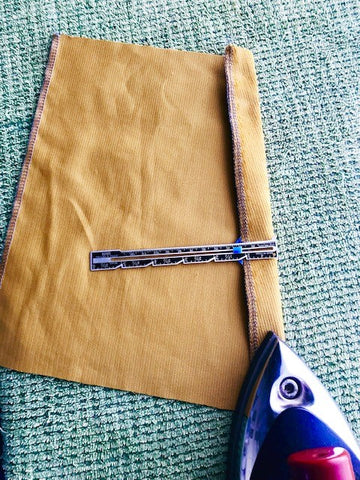
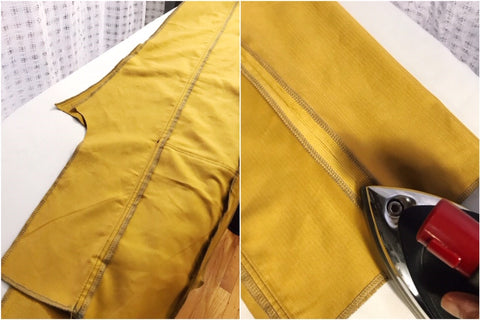
<p><span>Stitch Side Front and Side Back Pants together at the side seam leaving the seam open above the notch indicated. Press that seam open. (Just a note ahead of time that there are limited "at the sewing machine" photos. And please forgive the color variations in the photos. The lighting as well as the fabric made consistency a challenge.) This photo is pressing open the seam after stitching.</span></p>
<p><span><img alt="" src="//cdn.shopify.com/s/files/1/0515/2417/files/2_1_large.jpg?v=1549064072"> </span></p>
<p>Stabilizing the top edge of the Pants Pocket will prevent it from stretching out as you wear the overalls. This is particularly important if you’ve chosen to cut this pocket on the straight of grain as opposed to the cross grain. A quick strip of fusible interfacing along the fold line will do the job. Pressing on a towel to try to preserve the pile on the corduroy (right side images).</p>
<p><img alt="" src="//cdn.shopify.com/s/files/1/0515/2417/files/pocket_prep_col_large.jpg?v=1549064877"></p>
<p> </p>
<p><span>Turn down along the fold line at the top. </span></p>
<p style="text-align: left;"><img width="350" height="467" alt="" src="//cdn.shopify.com/s/files/1/0515/2417/files/2_1_e7cdc2ee-597d-4673-9056-b60b07160d0e_large.jpg?v=1549065410"></p>
<p style="text-align: left;"> </p>
<p>Turn up the seam allowance on the bottom edge and press.</p>
<p><img alt="" src="//cdn.shopify.com/s/files/1/0515/2417/files/2_3_large.jpg?v=1549065418"></p>
<p> </p>
<p>Stitch 7/8” from top fold. </p>
<p><img alt="" src="//cdn.shopify.com/s/files/1/0515/2417/files/2_4_large.jpg?v=1549065428"></p>
<p> </p>
<p> With all the pieces facing right sides up, align the bottom edge of the pocket on the Placement line. Baste the sides of the pocket in place.  </p>
<p><img alt="" src="//cdn.shopify.com/s/files/1/0515/2417/files/2_5_large.jpg?v=1549065434"></p>
<p> </p>
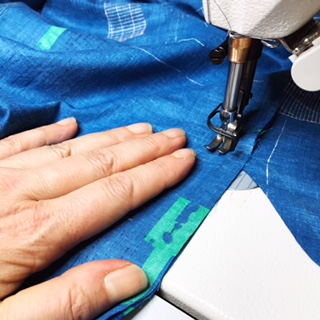
<p><span>Edge stitch and top stitch along the bottom edge of the Pocket. </span>You will be stitching on the cross grain on the pants and on the straight of grain on the pocket. These two different grain lines often have different amounts of “give” to them so hand basting or aggressive pinning is recommended. </p>
<p><img alt="" src="//cdn.shopify.com/s/files/1/0515/2417/files/2_6_large.jpg?v=1549065441"></p>
<p> </p>
<p><span>If you have a little shift of the pocket and the raw edges no longer align at the sides, don’t worry about it as long as the Pocket still falls in the 5/8” seam allowance, you’ll be good. You can see at the lower left hand corner of the pocket, it shifted and there is about a 1/4" gap to the side. It worked out fine in the end.</span></p>
<p><span><img alt="" src="//cdn.shopify.com/s/files/1/0515/2417/files/2_7_large.jpg?v=1549066087"></span></p>
<p> </p>
<p>Now it's time to make the Side Belt pieces. You should have enough extra fabric to make a test piece if you have any doubt whether your fabric is light weight or not. We used the light weight fabric construction for the back belt but ultimately we should have gone with the heavy weight construction.  So-it’s worth a test!</p>
<p>Here's a tip for the light weight fabric construction. After you trim 1/4" off the edges and press in 3/8" along each side (top row photos), you can stitch the short ends together, clip the corners and turn it to finish that short edge (bottom row.) </p>
<p><img alt="" src="//cdn.shopify.com/s/files/1/0515/2417/files/2_8_large.jpg?v=1549066601"></p>
<p> </p>
<p>Otherwise, if you are using heavier fabric, turn in 1/4", then 3/8"  and stitch the folded edges down the middle of the belt piece. </p>
<p> <img alt="" src="//cdn.shopify.com/s/files/1/0515/2417/files/2_9_large.jpg?v=1549066893"></p>
<p> </p>
<p>Place one of the belt pieces in the position indicated below the waist notch (left) and baste it in place (right.)</p>
<p><img alt="" src="//cdn.shopify.com/s/files/1/0515/2417/files/2_10_large.jpg?v=1549066700"></p>
<p> </p>
<p>Stitch the Center Front Pants to your side assembly right sides together. Pieces next to each other (left). Seam stitched (center). Trim seam allowance Side Front trousers (right).</p>
<p><img alt="" src="//cdn.shopify.com/s/files/1/0515/2417/files/2_11_large.jpg?v=1549068124"></p>
<p> </p>
<p>Press the seam allowances all towards the side assembly (left). Edge stitch and top stitch on Side Front to create the faux flat felled seam (center). What it will look like (right).</p>
<p><img alt="" src="//cdn.shopify.com/s/files/1/0515/2417/files/2_12_large.jpg?v=1549068151"></p>
<p> </p>
<p>Repeat step with the Center Back Pants. <span>Pieces next to each other (left). Seam stitched (center). Seam allowance pressed towards the side assembly (right).</span></p>
<p> <img alt="" src="//cdn.shopify.com/s/files/1/0515/2417/files/2_13_large.jpg?v=1549068952"></p>
<p> </p>
<p>Edge stitch and top stitch Side Back Pants (left). Finished seam (right).</p>
<p><img alt="" src="//cdn.shopify.com/s/files/1/0515/2417/files/2_14_large.jpg?v=1549068961"></p>
<p> </p>
<p>Stitch the inseam right sides together and press seam open. </p>
<p><img alt="" src="//cdn.shopify.com/s/files/1/0515/2417/files/2_14a_large.jpg?v=1549131843"></p>
<p> </p>
<p>Turn one pant leg right side out as shown. Then slip it inside the remaining pant leg that is still inside out. Your crotch seam should align perfectly with the right sides of the fabric together.</p>
<p><img alt="" src="//cdn.shopify.com/s/files/1/0515/2417/files/2_15_large.jpg?v=1549131893"></p>
<p> </p>
<p>Clearly mark corner of the seams at the center back - it is the SQUARE on the pattern piece (upper left).  Stitch the seam ending at that Square on the center Back Pants pieces (upper right). Clip seam allowance on where the crotch curve breaks in the front and back (lower left). Finish seam between clips (lower right). If you are not using a serger, trim the seam between the clips to 3/8" and finish as desired.</p>
<p><img alt="" src="//cdn.shopify.com/s/files/1/0515/2417/files/2_16_large.jpg?v=1549132255"></p>
<p> </p>
<p>Press the seams open above the clips.</p>
<p><img alt="" src="//cdn.shopify.com/s/files/1/0515/2417/files/2_17_large.jpg?v=1549133098"></p>
<p> </p>
<p>Phew! Are you still reading? Congrats! Your trousers are assembled. Next time we will assemble the Bib and attach it. See you then!</p>
<p><a href="https://www.decadesofstyle.com/blogs/news/ophelia-overalls-sew-along-part-3-bibbity-bobbity" target="_blank" title="Ophelia Overalls Sew Along Part 3" rel="noopener noreferrer"> Click here for the next installment in the sew along</a>.</p>]]>
    </content>
  </entry>
  <entry>
    <id>https://www.decadesofstyle.com/blogs/news/ophelia-overalls-sew-along-part-1-fabric-and-fit</id>
    <published>2019-02-13T22:10:00-08:00</published>
    <updated>2019-02-13T22:25:46-08:00</updated>
    <link rel="alternate" type="text/html" href="https://www.decadesofstyle.com/blogs/news/ophelia-overalls-sew-along-part-1-fabric-and-fit"/>
    <title>Ophelia Overalls Sew Along Part 1: Fabric and Fit</title>
    <author>
      <name>Janet Manning</name>
    </author>
    <content type="html">
      <![CDATA[<p>Hi all! Welcome to the Ophelia Overalls Sew Along! This is just going to be an introductory post covering fabric choice and the fit of the pattern so we can hit the ground running next time in the construction. </p>
<p>The main thing to keep in mind when selecting your fabric for this project is to avoid anything too heavy or too bulky! Look for a bottom weight fabric that is either mid to light weight and has a stable weave. </p>
<p>It all sounds a little bit wordy but that’s what works best with this pattern. You need something substantial enough to be considered a bottom weight fabric (something that can handle that abuse sustained by pants) but it can’t be super heavy. No heavy weight or super bulky denim or canvas. The construction uses a faux flat felled seam so there are places where you are stitching through quite a few layers.  If your machine has the clearance and the pressure to handle 4-6 layers of heavy bulky fabric, then no problem; but many domestic machines will struggle with that load. So keep this in mind. </p>
<p><img alt="" src="//cdn.shopify.com/s/files/1/0515/2417/files/Flats_SA_large.png?v=1548709063"></p>
<p>The suggested fabrics are: Stable bottom-weight woven fabrics are suitable. Avoid very heavy weight fabrics. Light weight denim, twill, light weight canvas, poplin, gabardine, corduroy.</p>
<p>If you are going to choose corduroy,  a smaller wale is best.  And it might be a good idea to get a bit extra in case you want to play with how you cut that trouser pocket. We used a 14 wale for this sew along and it was lovely! (14 cords per inch).</p>
<p><img alt="" src="//cdn.shopify.com/s/files/1/0515/2417/files/cord_pock_detail_large.jpg?v=1548708599"></p>
<p>If you want to go with a lighter weight, looser weave fabric like a chambray or linen, it will work fine but you will most likely need to support the straps by using a double layer of fabric or flat lining the strap pieces with something stable like muslin or quilting cotton.</p>
<p> And speaking of the trouser pocket, it is cut on the cross grain in the pattern. It is a big, awkward pattern piece so if you desire the pocket on the straight of grain, purchase extra fabric (1/4 yard extra should do it). A striped fabric is a very fun choice because of the princess seams and the possibility to play with the grain line! We rotated the grainline on so many pieces in this sample, we can't really keep track of it all.But just look at the result! Purchase extra fabric if you want to play around with rotating the pieces.</p>
<p><img alt="" src="//cdn.shopify.com/s/files/1/0515/2417/files/stripe_play_large.jpg?v=1548707223"></p>
<p>Let’s talk about the fit now. These overalls have a very relaxed fit! There’s 5" of ease in the hip. <span>That’s a lot of ease but not overwhelming.</span></p>
<p><img alt="" src="//cdn.shopify.com/s/files/1/0515/2417/files/Janet_frt_crop_large.jpg?v=1548706278"></p>
<p>That much ease preserves a vintage look from both the early century (as shown in this <span> WW1 era </span>photo of ladies delivering ice) and later into the 30s and 40s. </p>
<p><img alt="" src="//cdn.shopify.com/s/files/1/0515/2417/files/2_GirlsDeliverIce-large_large.jpg?v=1548706330"></p>
<p><img alt="" src="//cdn.shopify.com/s/files/1/0515/2417/files/vint_over_bk_large.jpg?v=1549059014"></p>
<p><img alt="" src="//cdn.shopify.com/s/files/1/0515/2417/files/vintage_2_png_large.jpg?v=1548706347"></p>
<p> If your body measurements fall between sizes, using the smaller size will be fine. A number of our pattern testers decided to go down a size from what their body measurements corresponded to. This will result in a closer, more modern fit. You’ll end up with 3" of ease in the hip which is standard. Kathe's overalls are fitted with very little ease and they look great!</p>
<p><img alt="" src="//cdn.shopify.com/s/files/1/0515/2417/files/Kathe_collage_large.jpg?v=1549059113"></p>
<p>Just a reminder that this pattern has been drafted for a B cup. If you need to make adjustments because your cup size is much larger, your options are lengthening the straps and/or making the bib taller and wider as you desire. On this particular pattern, it’s not very scientific - it just means a bit of trial and error work with scrap fabric.</p>
<p>Whatever adjustments you make to your Bib, make the same adjustment to the Bib Pocket and Bib Facing! It is a smallish space and the Pocket to Bib <span>proportion </span>gets thrown off very quickly! </p>
<p> </p>
<p><img alt="" src="//cdn.shopify.com/s/files/1/0515/2417/files/Over_PD_SA_1_large.png?v=1548708221"></p>
<p>Lengthen or shorten on dotted line for Bib, Bib Facing and Bib Pocket.</p>
<p>The best way to make your decision which size you prefer is to make a muslin! We really recommend making a muslin! Making a muslin is the best way to address fitting issues and achieve a finish garment that is successful! In summation, we really recommend making a muslin! Seriously though! We can’t emphasize enough how making a test version will save you time and money in the end and help you achieve the best results possible. </p>
<p><a title="Product page Ophelia Overalls" href="https://www.decadesofstyle.com/collections/decades-everyday/products/no-108-ophelia-overalls" target="_blank" rel="noopener noreferrer">Click here to purchase the pattern</a>.</p>
<p>Okey-doke! See you next time where are the sewing will commence!</p>
<p><a title="Ophelia Sew Along Part 2" href="https://www.decadesofstyle.com/blogs/news/set-up-and-sew" target="_blank" rel="noopener noreferrer">Click here for next installment in the sew along</a>.</p>]]>
    </content>
  </entry>
  <entry>
    <id>https://www.decadesofstyle.com/blogs/news/tlc-sew-along-part-4-machine-stitching-on-the-home-stretch</id>
    <published>2018-05-09T10:07:00-07:00</published>
    <updated>2018-05-09T10:07:03-07:00</updated>
    <link rel="alternate" type="text/html" href="https://www.decadesofstyle.com/blogs/news/tlc-sew-along-part-4-machine-stitching-on-the-home-stretch"/>
    <title>TLC Sew Along Part 4 - Machine Stitching the Home Stretch</title>
    <author>
      <name>Janet Manning</name>
    </author>
    <content type="html">
      <![CDATA[<p><a href="https://www.decadesofstyle.com/blogs/news/tlc-sew-along-part-3-about-face" target="_blank" rel="noopener noreferrer">Click here to read previous installment.</a></p>
<p> </p>
<p>We're on the home stretch now! In spite of the somewhat time consuming detail of the reverse facing, this Caftan can zoom along quite quickly after that because the rest of the contstruction is done by machine (with a wee bit of hand basting to facilitate one step.)</p>
<p>Next in the construction is to attach the Side Panel to the bodice/skirt assembly. Start by turning the Side Panel right side out. Your bodice/skirt assembly should be inside out. Slip the Side Panel inside the<span> bodice/skirt assembly and match up the shoulder seams and reference marks. (If this caftan looks off to you in terms of length, remember we shortened View B by about 12 inches to make a tunic length version.)</span></p>
<p style="text-align: center;"><span><img src="//cdn.shopify.com/s/files/1/0515/2417/files/Sd_attach_2_large.png?v=1524500810" alt=""></span></p>
<p> </p>
<p><span>The Waist Insets go in between the notches marked on the pattern piece.</span></p>
<p style="text-align: center;"><span><img src="//cdn.shopify.com/s/files/1/0515/2417/files/Sd_attach_1_large.png?v=1524500851" alt=""></span></p>
<p style="text-align: left;"> </p>
<p style="text-align: left;"><span>Stitch the Side Panel to the bodice/skirt assembly. There might be a bit of easing to be done along the bodice part of the seam.</span></p>
<p style="text-align: center;"><span><img src="//cdn.shopify.com/s/files/1/0515/2417/files/Sd_attach_3_large.png?v=1524501340" alt=""></span></p>
<p style="text-align: left;"> </p>
<p style="text-align: left;"><span> Pivot at the small circles and stitch around the perimeter of the pocket.</span></p>
<p style="text-align: center;"> <img src="//cdn.shopify.com/s/files/1/0515/2417/files/Sd_attach_4_large.png?v=1524501359" alt=""></p>
<p style="text-align: center;"><img src="//cdn.shopify.com/s/files/1/0515/2417/files/Sd_attach_5_large.png?v=1524501414" alt=""></p>
<p style="text-align: center;"><img src="//cdn.shopify.com/s/files/1/0515/2417/files/Sd_attach_6_large.png?v=1524501429" alt=""></p>
<p style="text-align: left;"><span>Clip the seam allowance above and below the Pocket and press the Pocket towards the center front. Press the rest of the seam towards the Side Panel. (somehow, we did not end up with photos of this part! Sorry!)</span></p>
<p style="text-align: left;"> </p>
<p style="text-align: left;"><span>On to the Waist Inset Facings. We'll show you our work attaching elastic to one end of an Inset Facing piece. You'll need to do these steps to finish both the Front and Back Waist Facings.</span></p>
<p style="text-align: left;"><span>Turn in the 5/8" seam allowance all around the Waist Facing (the end of the seam gauge is 5/8" and makes for a quick check for accuracy).</span></p>
<p style="text-align: center;"><span><img src="//cdn.shopify.com/s/files/1/0515/2417/files/In_fcg_1_large.png?v=1524501979" alt=""></span></p>
<p style="text-align: center;"><span><img src="//cdn.shopify.com/s/files/1/0515/2417/files/In_fcg_2_large.png?v=1524502001" alt=""></span></p>
<p style="text-align: center;"> </p>
<p><span>Now turn under the tips of the seam allowance across the short ends to create a straight edge as shown.</span></p>
<p style="text-align: center;"><span><img src="//cdn.shopify.com/s/files/1/0515/2417/files/In_fcg_3_large.png?v=1524502093" alt=""></span></p>
<p style="text-align: center;"> </p>
<p><span>Cut your length of elastic into 4 equal pieces and slide the end of one piece under that straight edge.</span></p>
<p style="text-align: center;"> <img src="//cdn.shopify.com/s/files/1/0515/2417/files/In_fcg_4_large.png?v=1524502198" alt=""></p>
<p style="text-align: center;"><img src="//cdn.shopify.com/s/files/1/0515/2417/files/In_fcg_5_large.png?v=1524502214" alt=""></p>
<p> </p>
<p>Edge stitch the straight edge through all layers securing the elastic in place.</p>
<p style="text-align: center;"><img src="//cdn.shopify.com/s/files/1/0515/2417/files/In_fcg_6_large.png?v=1524502295" alt=""><img src="//cdn.shopify.com/s/files/1/0515/2417/files/In_fcg_7_large.png?v=1524502307" alt=""></p>
<p style="text-align: left;"> </p>
<p style="text-align: left;"> Flip the elastic towards the point at shown.</p>
<p style="text-align: center;"><img src="//cdn.shopify.com/s/files/1/0515/2417/files/In_fcg_8_large.png?v=1524502365" alt=""></p>
<p style="text-align: center;"> </p>
<p> Stitch from the right side securing the elastic to the point. Pretty much any configuration of stitching will do. The goal is to have that tip of the Waist Facing stitched to the elastic.</p>
<p style="text-align: center;"><img src="//cdn.shopify.com/s/files/1/0515/2417/files/In_fcg_9_large.png?v=1524502499" alt=""></p>
<p style="text-align: center;"> </p>
<p> Once you have attached the elastic to each end of the Waist Facings, turn the caftan inside out and place the Facing over the corresponding Waist Inset. We are working with the Waist Facing Front in these photos.</p>
<p><img src="//cdn.shopify.com/s/files/1/0515/2417/files/In_fcg_10_large.png?v=1524502629" alt="" style="display: block; margin-left: auto; margin-right: auto;"> </p>
<p> Pin the Waist facing in place matching the center fronts. The folded edges of the Waist Facings should just cover the seams from the Waist insets.</p>
<p style="text-align: center;"><img src="//cdn.shopify.com/s/files/1/0515/2417/files/In_fcg_11_large.png?v=1524502728" alt=""></p>
<p> </p>
<p> Even though hand basting seams like a pain, it is the best way to do this step. It is worth the small bit of time to hand baste the Waist facing in place.</p>
<p style="text-align: center;"> <img src="//cdn.shopify.com/s/files/1/0515/2417/files/In_fcg_12_large.png?v=1524502808" alt=""></p>
<p style="text-align: left;"> </p>
<p style="text-align: left;">Sorry for the change up but the photos now switch to the Waist Inset BACK. Here is the Waist Facing basted in place.</p>
<p style="text-align: center;"><img src="//cdn.shopify.com/s/files/1/0515/2417/files/In_fcg_13_large.png?v=1524502927" alt=""></p>
<p> </p>
<p>Working from the right side of the garment, edge stitch the Waist Facing through all layers. Take care to keep the elastic (or twill tape) free from the stitching.</p>
<p style="text-align: center;"> <img src="//cdn.shopify.com/s/files/1/0515/2417/files/In_fcg_14_large.png?v=1524503025" alt=""></p>
<p style="text-align: center;"> </p>
<p> It will look like this from the right side:</p>
<p style="text-align: center;"><img src="//cdn.shopify.com/s/files/1/0515/2417/files/In_fcg_16_large.png?v=1524503074" alt=""></p>
<p> </p>
<p>On the inside, the edges of the Waist Facing should be secured and it will look like this:</p>
<p><img src="//cdn.shopify.com/s/files/1/0515/2417/files/In_fcg_15_large.png?v=1524503152" alt="" style="display: block; margin-left: auto; margin-right: auto;"></p>
<p> </p>
<p style="text-align: left;"> You can remove the basting stitches now.</p>
<p style="text-align: left;">All that is left is to make a quick machine hem and secure the elastic at the sides. Feel free to hem the caftan by hand if you prefer. The instructions call for a 5/8" hem but this is only a suggestion. You can put in a deeper hem if that is what you want. </p>
<p style="text-align: left;">Turn up 5/8" and turn the raw edge down into the crease.</p>
<p style="text-align: center;"><img src="//cdn.shopify.com/s/files/1/0515/2417/files/fin_1_large.png?v=1524504712" alt=""></p>
<p style="text-align: center;"> </p>
<p style="text-align: left;">Stitch close to the fold.</p>
<p style="text-align: center;"><img src="//cdn.shopify.com/s/files/1/0515/2417/files/fin_2_large.png?v=1524504754" alt=""></p>
<p style="text-align: left;"> </p>
<p style="text-align: left;">Try on the caftan and pin or tie the elastic at the inside the caftan to your preferred snugness at the waist. Mark the elastic.</p>
<p style="text-align: center;"><img src="//cdn.shopify.com/s/files/1/0515/2417/files/fin_3_large.png?v=1524504964" alt=""></p>
<p style="text-align: left;"> </p>
<p style="text-align: left;">Overlap the elastic, aligning the marks and stitch together.</p>
<p style="text-align: center;"><img src="//cdn.shopify.com/s/files/1/0515/2417/files/fin_4_large.png?v=1524505011" alt=""><img src="//cdn.shopify.com/s/files/1/0515/2417/files/fin_5_large.png?v=1524505020" alt=""></p>
<p style="text-align: left;"> </p>
<p style="text-align: left;"> You're done! Enjoy!</p>
<p style="text-align: center;"><img src="//cdn.shopify.com/s/files/1/0515/2417/files/tuniccollage_large.png?v=1525364384" alt=""></p>]]>
    </content>
  </entry>
  <entry>
    <id>https://www.decadesofstyle.com/blogs/news/tlc-sew-along-part-3-about-face</id>
    <published>2018-05-08T08:59:00-07:00</published>
    <updated>2018-05-09T10:08:59-07:00</updated>
    <link rel="alternate" type="text/html" href="https://www.decadesofstyle.com/blogs/news/tlc-sew-along-part-3-about-face"/>
    <title>TLC Sew Along Part 3 - About Face! (ings)</title>
    <author>
      <name>Janet Manning</name>
    </author>
    <summary type="html">
      <![CDATA[This installment covers the reverse facing at the armhole openings on the TCL Caftan.<p><a class="read-more" href="https://www.decadesofstyle.com/blogs/news/tlc-sew-along-part-3-about-face">More</a></p>]]>
    </summary>
    <content type="html">
      <![CDATA[<p><a title="TCL Caftan sew along part 2" href="https://www.decadesofstyle.com/blogs/news/tlc-sew-along-part-2-skirting-the-issue"> Click here to read previous installment.</a></p>
<p> </p>
<p>Now we are cooking with gas and getting to another detail that makes the TLC caftan so unique. The Side Panel does not have a side seam! The armhole is a slash at the side line with a reverse facing of contrasting fabric. It might seem like a small detail but it is the kind of design element that makes a pattern nerd very happy!</p>
<p>So let's get started. First step is to mark your Side Panel pieces determining which edges will be the "front edges." You need to mark the small circles for the Pocket opening and transfer the stitching line and slash line from the Armhole Facing to the Side Panels.</p>
<p style="text-align: center;"><img alt="" src="//cdn.shopify.com/s/files/1/0515/2417/files/Xfer_1_large.png?v=1524248679"></p>
<p style="text-align: center;"><img alt="" src="//cdn.shopify.com/s/files/1/0515/2417/files/Xfer_2_large.png?v=1524248694"></p>
<p style="text-align: left;"> </p>
<p style="text-align: left;"><span> Also, mark the stitching lines on the right and the wrong side of the Armhole Facings.</span></p>
<p style="text-align: center;"><img alt="" src="//cdn.shopify.com/s/files/1/0515/2417/files/Xfer_3_large.png?v=1524248712"></p>
<p> </p>
<p>Attaching the remaining Pockets to the "front edges" is the next step in the instructions, but we made the facing first and sewed the pockets on after so these photos don't have the pocket on there yet.</p>
<p>Start by cutting two 1" x 1" squares of fusible interfacing and fusing them to the right side of the Side Panels. Center one square over the bottom of the slash line. The interfacing provides reinforcement for this area.</p>
<p style="text-align: center;"> <img alt="" src="//cdn.shopify.com/s/files/1/0515/2417/files/stch_ssh_1a_large.png?v=1524249498"></p>
<p> </p>
<p>With the right side of the Armhole Facing against the WRONG side of the Side Panel, align the stitching lines and pin in place.</p>
<p style="text-align: center;"><img alt="" src="//cdn.shopify.com/s/files/1/0515/2417/files/stch_ssh_1_large.png?v=1524249556"></p>
<p> </p>
<p>Stitch along the stitching lines, pivoting at the upper angled seam. The stitching line has this crazy shape to better enclose the raw edges near the armhole opening once the Facing is turned and the shoulder seam completed.</p>
<p style="text-align: center;"> <img alt="" src="//cdn.shopify.com/s/files/1/0515/2417/files/stch_ssh_2_large.png?v=1524249648"></p>
<p> </p>
<p style="text-align: center;"><img alt="" src="//cdn.shopify.com/s/files/1/0515/2417/files/stch_ssh_1b_large.png?v=1524249785"></p>
<p>Follow the stitching line until about 1" from the pivot point at the bottom of the slash line. Shorten your stitch length to 2mm or so.</p>
<p style="text-align: center;"><img alt="" src="//cdn.shopify.com/s/files/1/0515/2417/files/stch_ssh_3_large.png?v=1524249824"></p>
<p> </p>
<p>Use the shorter stitch length for the stitching through the pivot point and back up the other side for about 1".</p>
<p style="text-align: center;"> <img alt="" src="//cdn.shopify.com/s/files/1/0515/2417/files/stch_ssh_4_large.png?v=1524249849"></p>
<p style="text-align: center;"><img alt="" src="//cdn.shopify.com/s/files/1/0515/2417/files/stch_ssh_5_large.png?v=1524249867"></p>
<p> </p>
<p>Return to a normal stitch length and stitch the remainder of the seam.</p>
<p>Turn up a scant 1/4" on the outer edges of the armhole facing as shown.</p>
<p style="text-align: center;"><img alt="" src="//cdn.shopify.com/s/files/1/0515/2417/files/trn_f_1_large.png?v=1524250395"></p>
<p> </p>
<p>Slash along the slash line taking great care at the bottom not to cut through the seam. </p>
<p style="text-align: center;"><img alt="" src="//cdn.shopify.com/s/files/1/0515/2417/files/trn_f_2_large.png?v=1524250438"></p>
<p style="text-align: center;"><img alt="" src="//cdn.shopify.com/s/files/1/0515/2417/files/trn_f_3_large.png?v=1524250458"></p>
<p> </p>
<p>Carefully clip the seam allowance at the curve near the bottom of the slash. These clips are important to getting the curved area of the seam to lie flat once the facing is turned.</p>
<p style="text-align: center;"><img alt="" src="//cdn.shopify.com/s/files/1/0515/2417/files/trn_f_4_large.png?v=1524250482"></p>
<p> </p>
<p>Clip the corner at the seam angle near the top. The left side has been clipped, the right side is still intact.</p>
<p style="text-align: center;"><img alt="" src="//cdn.shopify.com/s/files/1/0515/2417/files/trn_f_5a_large.png?v=1524250634"></p>
<p> </p>
<p>Turn the Armhole Facing to the right side and press. </p>
<p><img style="display: block; margin-left: auto; margin-right: auto;" alt="" src="//cdn.shopify.com/s/files/1/0515/2417/files/trn_f_5_large.png?v=1524250688"></p>
<p> </p>
<p>Take care to tuck in any raw edges that might be trying to peek out at the corners of the facing. (A dot of glue stick can be useful controlling areas like this.)</p>
<p style="text-align: center;"><img alt="" src="//cdn.shopify.com/s/files/1/0515/2417/files/Glue_crn1_large.png?v=1524255782"></p>
<p style="text-align: center;"><em><img alt="" src="//cdn.shopify.com/s/files/1/0515/2417/files/Glue_crn2_large.png?v=1524255804"></em></p>
<p> </p>
<p>Edge stitch the Facing in place.</p>
<p style="text-align: center;"><img alt="" src="//cdn.shopify.com/s/files/1/0515/2417/files/edgestch_fcng_large.png?v=1524255813"></p>
<p style="text-align: center;"><img alt="" src="//cdn.shopify.com/s/files/1/0515/2417/files/8FEEB6C0-F196-4F1E-BF5A-05323BFF2B0C_medium.jpeg?v=1525315997"></p>
<p>At this point, we remembered the Pockets and stitched them on to the "front edges" of the panels. Stitch with right sides together matching notches and small circles.</p>
<p style="text-align: center;"><img alt="" src="//cdn.shopify.com/s/files/1/0515/2417/files/Poct_efge_large.png?v=1524255928"></p>
<p> </p>
<p>Here are both Side Panels with the Facings complete and the Pockets attached and pressed to the side.</p>
<p style="text-align: center;"><img alt="" src="//cdn.shopify.com/s/files/1/0515/2417/files/Poct_press_large.png?v=1524255960"></p>
<p> </p>
<p style="text-align: left;">With right sides together, stitch the shoulder seam. The Armhole Facings will meet at the edge as shown.</p>
<p style="text-align: center;"><img alt="" src="//cdn.shopify.com/s/files/1/0515/2417/files/sh_sm1_large.png?v=1524256028"></p>
<p style="text-align: center;"><img alt="" src="//cdn.shopify.com/s/files/1/0515/2417/files/sh_sm2_large.png?v=1524256072"></p>
<p>Before pressing the seam open, turn down a scant 1/4" along the seam allowance edge and stitch close to the fold to finish the seam. This is vintage technique for seam finishing before the days of zigzag stitch and sergers. It makes for the best way to avoid any raw edges showing near the armhole opening. Feel free to finish the seam differently if you prefer, this was just the method that dealt with the raw edge exposure as completely as possible. If raw edges at the armhole opening don't bother you, you can serge this seam and be done with it!</p>
<p><img style="display: block; margin-left: auto; margin-right: auto;" alt="" src="//cdn.shopify.com/s/files/1/0515/2417/files/sh_sm3_large.png?v=1524256092"></p>
<p style="text-align: center;"><img alt="" src="//cdn.shopify.com/s/files/1/0515/2417/files/sh_sm4_large.png?v=1524256127"></p>
<p style="text-align: center;"><img alt="" src="//cdn.shopify.com/s/files/1/0515/2417/files/sh_sm5_large.png?v=1524256151"></p>
<p> </p>
<p> Now press the shoulder seam open.</p>
<p style="text-align: center;"><img alt="" src="//cdn.shopify.com/s/files/1/0515/2417/files/sh_sm6_large.png?v=1524256177"></p>
<p> </p>
<p> <span>That's it! Next time will stitch the Side Panels to the Bodice/Skirt assembly and make the Inset Facings. Getting there!!</span></p>
<p><a href="https://www.decadesofstyle.com/blogs/news/tlc-sew-along-part-4-machine-stitching-on-the-home-stretch" target="_blank" rel="noopener noreferrer">Click here to read the next and final installment.</a></p>]]>
    </content>
  </entry>
  <entry>
    <id>https://www.decadesofstyle.com/blogs/news/tlc-sew-along-part-2-skirting-the-issue</id>
    <published>2018-05-07T10:10:00-07:00</published>
    <updated>2018-05-08T09:03:35-07:00</updated>
    <link rel="alternate" type="text/html" href="https://www.decadesofstyle.com/blogs/news/tlc-sew-along-part-2-skirting-the-issue"/>
    <title>TLC Sew Along Part 2 - Skirting the Issue</title>
    <author>
      <name>Janet Manning</name>
    </author>
    <summary type="html">
      <![CDATA[Part 2 of the TLC Caftan sew along covers attaching the Waist Insets and the Skirt pieces to the bodice assembly constructed in Part 1.<p><a class="read-more" href="https://www.decadesofstyle.com/blogs/news/tlc-sew-along-part-2-skirting-the-issue">More</a></p>]]>
    </summary>
    <content type="html">
      <![CDATA[<p><a title="TLC Caftan Sew Along Part 1 - Bodice construction" href="https://www.decadesofstyle.com/blogs/news/tlc-sew-along-part-1-bodice-construction" target="_blank" rel="noopener noreferrer">Click here for previous installment of sew along.</a></p>
<p> </p>
<p>We finished the neck edge last time so the Waist Insets are next. The Waist Insets are interfaced according to the instructions. The interfacing stabiles them and reinforces the fabric if you are using a light weight fabric. This will prevent stretching and distorting with wear. </p>
<p>The interfacing is cut with the same pattern piece so first trim off about 1/2" from the perimeter of the interfacing pieces. This leaves the interfacing large enough to extend across the seam line. We didn't photograph trimming the interfacing so here is the illustration from the instructions showing trimming the perimeter of the interfacing.</p>
<p style="text-align: center;"><img style="float: none;" alt="" src="//cdn.shopify.com/s/files/1/0515/2417/files/Interfacing_1a_medium.png?v=1524166746"></p>
<p style="text-align: center;"> </p>
<p>Next, fuse the interfacing to the wrong side of the Waist Inset pieces.</p>
<p>TIP: The adhesive from the fusible interfacing can bleed through the interfacing when you are fusing it to your fabric. Using a press cloth to cover the pieces as you fuse them will protect your iron from getting adhesive on it. We're using a piece of scrap muslin here. Keeping a dedicated "interfacing" press cloth in your sewing supplies can keep your iron cleaner! </p>
<p><img style="display: block; margin-left: auto; margin-right: auto;" alt="" src="//cdn.shopify.com/s/files/1/0515/2417/files/interface_2_large.jpg?v=1524166162"></p>
<p> </p>
<p><span>Write on the press cloth which side faces up so you are keeping the glue-y side away from your iron plate!</span></p>
<p><img style="display: block; margin-left: auto; margin-right: auto;" alt="" src="//cdn.shopify.com/s/files/1/0515/2417/files/interface_3_large.png?v=1524166366"></p>
<p> </p>
<p>Now pull up the gathers on the Bodice Back Piece to match the Waist Inset Back and stitch them right sides together.</p>
<p><img style="display: block; margin-left: auto; margin-right: auto;" alt="" src="//cdn.shopify.com/s/files/1/0515/2417/files/waist_1_large.png?v=1524166391"></p>
<p style="text-align: center;"><img alt="" src="//cdn.shopify.com/s/files/1/0515/2417/files/WI_sew_large.png?v=1524168148"></p>
<p> </p>
<p>Grade the seam allowance and press towards the Waist Inset. Grading the seam allowance means trimming the seam allowances in a graduated heights so the the shortest height is closest to the body. </p>
<p><img style="display: block; margin-left: auto; margin-right: auto;" alt="" src="//cdn.shopify.com/s/files/1/0515/2417/files/grade_large.gif?v=1524166423"></p>
<p> </p>
<p>Attaching the Waist Inset Front has a bit more to it. With the Bodice Pieces facing right side up, lap them over one another as shown below matching the center front lines. It should like just like the the illustration below. (grey tint represents the right side of the fabric)</p>
<p><img style="display: block; margin-left: auto; margin-right: auto;" alt="" src="//cdn.shopify.com/s/files/1/0515/2417/files/bodice_overlap_large.png?v=1524166663"></p>
<p> </p>
<p>Anchoring the Bodice Front pieces together at the center front with a few basting stitches makes it much easier to pull up the gathers and keep all the pieces under control.</p>
<p style="text-align: center;"><img alt="" src="//cdn.shopify.com/s/files/1/0515/2417/files/FB_cf_anchor_large.png?v=1524168175"></p>
<p style="text-align: center;"> </p>
<p> Because Bodice Front pieces overlap, there are 2 layers of fabric along part of the waist seam. The gathering is configured so that one layer has gathers and the other layer is flat. Secure the gathering thread at the center front. </p>
<p style="text-align: center;"><img alt="" src="//cdn.shopify.com/s/files/1/0515/2417/files/secure_cf_threads_large.png?v=1524168237"></p>
<p style="text-align: center;"> </p>
<p style="text-align: left;"><span>Pull up the gathers from the side. </span></p>
<p style="text-align: center;"><span><img alt="" src="//cdn.shopify.com/s/files/1/0515/2417/files/pull_gther_side_large.png?v=1524168289"></span></p>
<p style="text-align: left;"><span> </span></p>
<p style="text-align: left;"><span>It should look like the photo below when the gathers are pulled up. The gathers end at the center front line and the piece is flat out to the neck binding.</span></p>
<p style="text-align: center;"><span><img alt="" src="//cdn.shopify.com/s/files/1/0515/2417/files/FB_gather_set_large.png?v=1524168434"></span></p>
<p> </p>
<p>Stitch to the Waist Inset Front, right sides together.</p>
<p style="text-align: center;"><img alt="" src="//cdn.shopify.com/s/files/1/0515/2417/files/FB_WI_stitch_large.png?v=1524168519"></p>
<p>As with the back, grade the seam allowance and press it towards the Waist Inset.</p>
<p style="text-align: center;"><img alt="" src="//cdn.shopify.com/s/files/1/0515/2417/files/grade_fb_large.png?v=1524168561"></p>
<p style="text-align: center;"> </p>
<p>The Skirt Front is next. The skirt pieces for the front and back are cut from the same pattern piece. Designate one as the Skirt Front and make sure to transfer the circles markings the Pocket opening.</p>
<p style="text-align: center;"><img alt="" src="//cdn.shopify.com/s/files/1/0515/2417/files/Skrt_frt_pattern_piece_large.png?v=1524172187"></p>
<p style="text-align: center;"> </p>
<p>Make gathering stitches at the waist edge 3/4" and 1/2" from the raw edge, leaving a 5/8" gap at each side of the piece.</p>
<p style="text-align: center;"><img alt="" src="//cdn.shopify.com/s/files/1/0515/2417/files/skrt_gthr_stitcht_large.png?v=1524170864"></p>
<p>Attach a pair of Pocket Pieces to the Skirt Front, right sides together, matching notches and small circles. Press the pocket towards the sides.</p>
<p style="text-align: center;"><img alt="" src="//cdn.shopify.com/s/files/1/0515/2417/files/skrt_attach_pckt_large.png?v=1524170885"></p>
<p>Pull up the gathers on the Skirt Front to <span>match the Waist Inset Front and stitch them right sides together. </span></p>
<p style="text-align: center;"><img alt="" src="//cdn.shopify.com/s/files/1/0515/2417/files/skrt_pll_gthrs_large.png?v=1524170920"></p>
<p style="text-align: center;"><img alt="" src="//cdn.shopify.com/s/files/1/0515/2417/files/attach_skrt_large.png?v=1524171022"></p>
<p style="text-align: left;"> </p>
<p><span>Again, grade the seam allowance and press it towards the the seam towards the Waist Inset.</span></p>
<p style="text-align: center;"><span><img alt="" src="//cdn.shopify.com/s/files/1/0515/2417/files/grade_skrt_large.png?v=1524171141"></span></p>
<p style="text-align: center;"> </p>
<p style="text-align: left;">Attach the Skirt Back to the Waist Inset Back in exactly the same manner, omitting anything regarding Pockets. The remaining Pocket pieces attach to the Side Panel and will happen next time!</p>
<p> </p>
<p><span>That's it for this installment. Next time we face the Armhole Facings!</span></p>
<p><a title="TLC CAftan Sew along part 3 - About Face! (ings)" href="https://www.decadesofstyle.com/blogs/news/tlc-sew-along-part-3-about-face" target="_blank" rel="noopener noreferrer">Click here to read the next installment in the sew along.</a><span></span></p>]]>
    </content>
  </entry>
  <entry>
    <id>https://www.decadesofstyle.com/blogs/news/tlc-sew-along-part-1-bodice-construction</id>
    <published>2018-05-04T09:31:00-07:00</published>
    <updated>2018-05-07T10:15:23-07:00</updated>
    <link rel="alternate" type="text/html" href="https://www.decadesofstyle.com/blogs/news/tlc-sew-along-part-1-bodice-construction"/>
    <title>TLC Sew Along Part 1 - Bodice Construction</title>
    <author>
      <name>Janet Manning</name>
    </author>
    <content type="html">
      <![CDATA[<p><a title="TLC Sew Along Introductions" href="https://www.decadesofstyle.com/blogs/news/tlc-sew-along-introduction" target="_blank" rel="noopener noreferrer">CLICK HERE TO READ PREVIOUS INSTALLMENT - Sew Along Introduction</a></p>
<p> </p>
<p>The Bodice of the TLC Caftan is one of the things that makes the caftan unique and flattering. The bodice is more or less fitted to the body. The Waist Insets are held close to the body by either elastic or twill tape ties, effectively holding the bodice in place and making the bodice conform to the body. NO TENT!</p>
<p>So let's jump right in! </p>
<p>Please pay attention to the note at the very beginning of the Construction details in the instructions. The note addresses how important it is to test your fabric to determine how stable the weave is on the straight of grain. The neckline is a surplice (sort of a wrap style construction). If your fabric has any "give" when you tug on it on the straight of grain, your neckline will most likely stretch out during construction and it will gap when you wear it. </p>
<p style="text-align: center;"><img alt="" src="//cdn.shopify.com/s/files/1/0515/2417/files/TLC_pt2_1a_large.png?v=1523984413"></p>
<p>If your fabric stretches when you tug on the straight of grain, you will want to stabilize the neck edge of the Bodice Front. Cut a narrow strip of interfacing, 3/8" wide will do, and fuse it along the seam line on the wrong side of the fabric. </p>
<p><img alt="" src="//cdn.shopify.com/s/files/1/0515/2417/files/TLC_pt2_2_large.png?v=1523984457"></p>
<p>Now to the sewing machine! The first steps are simple and familiar. Stay stitch the neck edges and make gathering stitches at the waist  and shoulder of the Front Bodice pieces. <span>Start your gathering stitches 5/8" from the edge as shown. This just keeps the gathering clear of that seam.</span></p>
<p><img alt="" src="//cdn.shopify.com/s/files/1/0515/2417/files/SA_pic_1_large.png?v=1523987193">    <img alt="" src="//cdn.shopify.com/s/files/1/0515/2417/files/SA_pic_2_large.png?v=1523987501"></p>
<p>NOTE:  If you made an FBA on your Bodice Front <a href="https://www.decadesofstyle.com/blogs/news/tlc-sew-along-introduction" target="_blank" rel="noopener noreferrer">(see previous installment Sew Along Intro</a>) - you would stitch the newly created side dart here and press it towards the waist.</p>
<p><span>Next, the Back Bodice gets gathering stitches at the waist and darts at the shoulders (pressed towards the center back.) Start the gathering stitches 5/8" from the edge just like on the Bodice Front pieces.</span></p>
<p> <img alt="" src="//cdn.shopify.com/s/files/1/0515/2417/files/TLC_SA_3a_large.png?v=1523988160"></p>
<p><img alt="" src="//cdn.shopify.com/s/files/1/0515/2417/files/TLC_SA_3_large.png?v=1523988134"></p>
<p> </p>
<p>The shoulder seams are next:</p>
<p> <img alt="" src="//cdn.shopify.com/s/files/1/0515/2417/files/TLC_shoulder1_large.png?v=1523989576"></p>
<p><img alt="" src="//cdn.shopify.com/s/files/1/0515/2417/files/TLC_shoulder2_large.png?v=1523989625"></p>
<p><img alt="" src="//cdn.shopify.com/s/files/1/0515/2417/files/TLC_shoulder3_large.png?v=1523989648"></p>
<p><img alt="" src="//cdn.shopify.com/s/files/1/0515/2417/files/TLC_shoulder4_large.png?v=1523989676"></p>
<p> </p>
<p>Now the neck edge gets finished with bias binding. </p>
<p>First trim 1/4" from the entire neck edge. This leaves you with a 3/8" seam allowance. The smaller seam allowance makes it easier to shape the bias to the curves.</p>
<p><img alt="" src="//cdn.shopify.com/s/files/1/0515/2417/files/TLC_neck1_large.png?v=1523992759"></p>
<p><span>The pattern instructions call for you to cut a bias strip from your left over fabric. We're using a contrasting fabric that shows better in the photos: a contrasting bias finish is pretty detail to add to your garment.</span></p>
<p>Start at the waist edge of the Bodice Front and pre-shape your bias strip by aligning the raw edges and pressing the bias tape as you go.</p>
<p><img alt="" src="//cdn.shopify.com/s/files/1/0515/2417/files/TLC_neck2_large.png?v=1523993115"></p>
<p> </p>
<p>Shaping the bias strip neck curve is the most important part of this step and will help you have a nice smooth result. It helps to "ease" the bias tape at the sharpest part of the curve. The goal is to keep the outer edge of the bias strip nice and flat. You can kind of gather the bias tape along the inner or neck edge here as shown. Just enough to be able to keep the other edge of the bias strip flat as you go around the curve.</p>
<p><img alt="" src="//cdn.shopify.com/s/files/1/0515/2417/files/TLC_neck3_large.jpg?v=1523993208"></p>
<p><img alt="" src="//cdn.shopify.com/s/files/1/0515/2417/files/TLC_neck4_large.png?v=1523993235"></p>
<p><img alt="" src="//cdn.shopify.com/s/files/1/0515/2417/files/TLC_neck5_large.png?v=1523993260"></p>
<p>After you've pre-shaped the bias strip along entire neck edge, stitch it to the neck edge, right sides together.</p>
<p><em><img alt="" src="//cdn.shopify.com/s/files/1/0515/2417/files/TLC_binding1_large.jpg?v=1523999387"></em></p>
<p> </p>
<p>Clip seam allowance at the curves and turn the binding to the inside.</p>
<p><img alt="" src="//cdn.shopify.com/s/files/1/0515/2417/files/TLC_binding2_large.png?v=1523999470"></p>
<p><img alt="" src="//cdn.shopify.com/s/files/1/0515/2417/files/TLC_binding3_large.png?v=1523999498"></p>
<p>Next you want to turn in the raw edge of the bias strip. We find it easier to turn in the raw edge here before you turn the bias strip to the inside of the bodice. 1/4" pressed in will do the job.</p>
<p><img alt="" src="//cdn.shopify.com/s/files/1/0515/2417/files/TLC_binding4_large.png?v=1523999527"></p>
<p> </p>
<p>Now, when you turn the bias to the inside, that outer edge is already to go!</p>
<p><img alt="" src="//cdn.shopify.com/s/files/1/0515/2417/files/TLC_binding5_large.png?v=1523999686"></p>
<p>Next, stitch the bias facing in place by hand or machine. We machine stitched here for speed but got a crap result the first time.</p>
<p><img alt="" src="//cdn.shopify.com/s/files/1/0515/2417/files/TLC_binding6_large.png?v=1523999784"></p>
<p> </p>
<p>Unpicked that hot mess and hand basted the bias facing.</p>
<p><img alt="" src="//cdn.shopify.com/s/files/1/0515/2417/files/TLC_binding7_large.png?v=1523999844"></p>
<p> </p>
<p>Machine stitching the bias facing in place round 2 went much better. We stitched from the center back down to the waist and then repeated for the other side. Nice and smooth this time!</p>
<p><img alt="" src="//cdn.shopify.com/s/files/1/0515/2417/files/TLC_binding8_large.png?v=1523999930"></p>
<p> </p>
<p> That's all for this installment. Next time we'll attach the Waist Insets and the Skirt Pieces.</p>
<p><a href="https://www.decadesofstyle.com/blogs/news/tlc-sew-along-part-2-skirting-the-issue" target="_blank" title="TLC CAFTAN sew along part 2" rel="noopener noreferrer"> Click here for the next installment in the sew along.</a></p>]]>
    </content>
  </entry>
  <entry>
    <id>https://www.decadesofstyle.com/blogs/news/tlc-sew-along-introduction</id>
    <published>2018-05-03T09:22:00-07:00</published>
    <updated>2018-05-05T10:34:02-07:00</updated>
    <link rel="alternate" type="text/html" href="https://www.decadesofstyle.com/blogs/news/tlc-sew-along-introduction"/>
    <title>TLC Sew Along Introduction - Fabrics and FBA</title>
    <author>
      <name>Janet Manning</name>
    </author>
    <summary type="html">
      <![CDATA[Get ready for the TLC Caftan Sew Along with a post about fabric choice and stash busting with this project. Also covered is a quick FBA tutorial for those curvy ladies with a D cup bra size and larger.<p><a class="read-more" href="https://www.decadesofstyle.com/blogs/news/tlc-sew-along-introduction">More</a></p>]]>
    </summary>
    <content type="html">
      <![CDATA[<p>Are you ready to embrace your inner Elizabeth Taylor caftan-wearing-diva? Well, even if you're not, the TLC caftan is the perfect summer dress in the shorter length and a true statement piece in the full length. Whatever your preference, we're going to take you through a sew along to get you there. If you haven't got your copy of the pattern yet, click on the image below to shop!</p>
<p><a title="TLC Caftan product page" href="https://www.decadesofstyle.com/collections/decades-everyday/products/no-107-tlc-caftan" target="_blank" rel="noopener noreferrer"><img style="display: block; margin-left: auto; margin-right: auto;" alt="" src="//cdn.shopify.com/s/files/1/0515/2417/files/TLC_FRT_cver_PNG_large.png?v=1523901814"></a></p>
<p>Let's talk about fabric first. The list of suggested fabrics is: </p>
<p>Mid- to light-weight fabrics with a soft drape most suitable: light- weight linen, lightweight ikat, lightweight chambray, double gauze, gauze, voile, lawn, silk noil, crepe, rayon challis. More challenging fabrics are georgette, charmeuse, or silk velvet.</p>
<p>There many more fabrics that aren't on this list that would be suitable. The important aspects to consider are the weight and the drape. Stay away from anything too heavy or too stiff. Any fabric that is soft-ish and mid to light weight will work. This garment is actually a good one for stash busting in spite of the daunting yardage requirements. The yardages in the chart err to the side of too much. If you have something in your stash but are 1/2 yard or even a full yard (or more) short of the suggested yardage, pull it out anyways because there are design opportunities to be had!</p>
<p>The largest pieces are rectangular and easy to alter. The yardages are based on the largest size in the grouping and include the bias binding strips and pockets. This means there's a good chance you can squeeze the main pieces out of 1/2 yard less than the recommended yardage. You can supplement with other fabrics for the pockets and bias strips if necessary.</p>
<p>If you still come up short, don't give up yet. Consider shortening the finished length. View B, the short version, is still pretty long. The finished length at the center back is approximately 40".  You could shorten the Side Panel and Skirt pieces by 4", 6" even 10" and squeeze your pieces onto a shorter cut of fabric. Shortening View B by 10" gives you a tunic length caftan that is pretty darn cute!</p>
<p style="text-align: center;"><img alt="" src="//cdn.shopify.com/s/files/1/0515/2417/files/tuniccollage_large.png?v=1525364384"></p>
<p> </p>
<p>Either go with a shorter length OR add a fabric border at the bottom of the shortened pieces to make up the length. You can use up yard-long pieces in your stash to make a fabric border depending on how deep you want the border to be.</p>
<p style="text-align: left;"> </p>
<p style="text-align: left;">         <img style="float: none;" alt="" src="//cdn.shopify.com/s/files/1/0515/2417/files/TLC_Flats_SA_border_large.png?v=1523905110"></p>
<p style="text-align: left;"><img alt="" src="//cdn.shopify.com/s/files/1/0515/2417/files/TLC_Sew_along_1b_large.png?v=1523981361"></p>
<p> The other option if you are short on yardage is piece to fabric block the pieces! There are any number of options depending on your yardages. <span>So instead of needing a 4, 5 or 6 yard piece, you can split that up to shorter yardages of several pieces of fabric. CREATIVE OPPORTUNITY! And stash busting potential galore! </span></p>
<p><span> 3 yards will do for View A Side Panels </span></p>
<p><span>1 1 /4 yards will do for the Side Panels of View B</span></p>
<p><span> 3/4 to 1 1/4 yard pieces will do for the Bodice pieces depending on the size you're making. </span></p>
<p><span>2 yards for View A Skirt pieces</span></p>
<p><span>1 5/8 yards for View B Skirt pieces</span></p>
<p><span>Some fabric blocking options below show you just a few combinations that you could do. There are no rules so you mix and match and have fun with it!</span></p>
<p style="text-align: center;"><span><img alt="" src="//cdn.shopify.com/s/files/1/0515/2417/files/TLC_Flats_fabric_block1_large.png?v=1523908498"></span></p>
<p style="text-align: left;"><span> </span></p>
<p style="text-align: center;"><span><img alt="" src="//cdn.shopify.com/s/files/1/0515/2417/files/TLC_Flats_fabric_block2_large.png?v=1523909628"></span></p>
<p style="text-align: center;"> <img alt="" src="//cdn.shopify.com/s/files/1/0515/2417/files/TLC_Flats_fabric_block3a_large.png?v=1523911026"></p>
<p> Now lets talk about fit. If your measurements fall between sizes on our chart, you can go to the smaller size on this pattern with no worries.</p>
<p>As with all our patterns, the bodice is drafted based on a B bra cup size. If you are a D cup or larger (C cups will probably be fine straight off the pattern), it is easy to do a quick Full Bust Adjustment or FBA. If you are new to the concept of an FBA - we highly recommend the <a title="Full Bust Adjustment tutorial by Curvy Sewing Collective" href="http://curvysewingcollective.com/the-beginners-guide-full-bust-adjustment/" target="_blank" rel="noopener noreferrer">FBA tutorial at the Curvy Sewing Collective</a> . </p>
<p>To do an FBA on the TLC, all you need is the Bodice Front Piece. Mark the Bodice Front pattern for slashing (shown by red lines below).</p>
<p> <img alt="" src="//cdn.shopify.com/s/files/1/0515/2417/files/FBA_illstration_1_large.png?v=1523911321"></p>
<p> </p>
<p>Next, spread the desired amount according to the CSC tutorial.</p>
<p><img alt="" src="//cdn.shopify.com/s/files/1/0515/2417/files/FBA_illstration_2_large.png?v=1523911507"></p>
<p> </p>
<p>Redraw the <span>adjusted </span><span>adjusted </span>piece. There is now a side dart on the Bodice Front piece. </p>
<p><img alt="" src="//cdn.shopify.com/s/files/1/0515/2417/files/FBA_illstration_3_large.png?v=1523911727"></p>
<p> </p>
<p>The FBA lengthens the front neck edge. This will probably make the neckline gap there. To avoid gapping, shorten the front neck edge. The simplest way to do this is to slash from the front neckline edge to near the square reference mark (slash line in red on image on the left.) Overlap edges at the slash until the front neck edge is about 1/2" shorter. Red line is shows adjustment on the right.</p>
<p><img alt="" src="//cdn.shopify.com/s/files/1/0515/2417/files/FBA_illstration_3a_large.png?v=1523919651">       <img alt="" src="//cdn.shopify.com/s/files/1/0515/2417/files/FBA_illstration_4_large.png?v=1523919716"></p>
<p> </p>
<p>Ok! That's it for now. Find some fabric and cut out your caftan. We'll see you next time to start sewing.</p>
<p><a title="TLC Sew along Part one of sewing" href="https://www.decadesofstyle.com/blogs/news/tlc-sew-along-part-1-bodice-construction" target="_blank" rel="noopener noreferrer">Click here for next installment in the sew along.</a></p>]]>
    </content>
  </entry>
  <entry>
    <id>https://www.decadesofstyle.com/blogs/news/get-er-done</id>
    <published>2017-11-01T13:23:00-07:00</published>
    <updated>2018-04-13T16:00:18-07:00</updated>
    <link rel="alternate" type="text/html" href="https://www.decadesofstyle.com/blogs/news/get-er-done"/>
    <title>Get &apos;er Done (Part 6 - Final Post)</title>
    <author>
      <name>Janet Manning</name>
    </author>
    <summary type="html">
      <![CDATA[Final installment of Chore Skirt Sew along covering waist binding, curtain weights and hem.<p><a class="read-more" href="https://www.decadesofstyle.com/blogs/news/get-er-done">More</a></p>]]>
    </summary>
    <content type="html">
      <![CDATA[<p><a href="https://www.decadesofstyle.com/blogs/news/zip-it" target="_blank" title="Part 5 Chore Skirt Sew Along - the zipper" rel="noopener noreferrer">Click here for Part 5 of the sew along.</a></p>
<p>We're going to do our best to finish up the sew along in this one post. There really is not that much left to go but we have lots of photos so lets get going!</p>
<p> </p>
<h2>Waist Efforts</h2>
<p>The waist binding for the skirt is the next step. (If you are between sizes, remember to shorten your Waist Binding piece by the difference in waist measurement from that of the larger size that you cut. Our model has a 33" waist. We cut the size 14 for a 34" waist, so we'll be taking 1" off the Waist Binding for her skirt.) </p>
<p><img src="//cdn.shopify.com/s/files/1/0515/2417/files/binidng_1_large.jpg?v=1509561435" alt=""></p>
<p>The Binding should not have any "give" to it. Usually, the straight of grain of fabric is stable and won't stretch. Give your fabric a little test by trying to stretch a strip of fabric on the straight of grain. If it has any degree of "give," use a strip of very light weight interfacing to stabilize it. You don't want to add bulk so it is important to find the lightest weight interfacing that you can. </p>
<p>First step in this part is to finish one long edge of the Waist Binding. We serged the edge ahead of time trimming off 1/4" as per the instructions.(We didn't photograph this because it was just a serging assembly line before we got started.) If you are not serging, you can turn under 1/4" along that edge and straight stitch to finish it.</p>
<p><span>(If you want to mark the center front and center back of the Waist Binding  - you can use your Pleat Guides to do this. Tape the pleats closed on the Guides. Turn under at the "side" line on the Pleat Guide Front. With the Binding facing right side up and the finished edge at the top of the piece, place the Front </span><span>Guide at the right edge</span><span> starting 5/8" from the short end as shown.)</span></p>
<p> <img src="//cdn.shopify.com/s/files/1/0515/2417/files/binidng_2_txt_large.jpg?v=1509562099" alt=""></p>
<p>Flip the Front Guide at the center front to mark the "side." Your Front Guide should be folded at the "side" line.</p>
<p><img src="//cdn.shopify.com/s/files/1/0515/2417/files/binidng_3_txt_large.jpg?v=1509562523" alt=""></p>
<p> </p>
<p>Tape the pleats closed on the Pleat Guide <span>Back</span> but leave the "side" as is. Place the Back Guide at the left side, 5/8" from the raw edge. Mark the "side" line and center back. </p>
<p><img src="//cdn.shopify.com/s/files/1/0515/2417/files/binidng_4_txt_large.jpg?v=1509562547" alt=""></p>
<p> </p>
<p>Pin the Waist Binding to your skirt at the waist, right sides together. The piece should fit along the waist of your skirt with 5/8" seam allowance extending at either end as shown.</p>
<p><img src="//cdn.shopify.com/s/files/1/0515/2417/files/CS_f_1_large.jpg?v=1509557440" alt=""></p>
<p><img src="//cdn.shopify.com/s/files/1/0515/2417/files/CS_f_2_large.jpg?v=1509557452" alt=""></p>
<p> </p>
<p>Stitch Waist Binding to skirt.</p>
<p><img src="//cdn.shopify.com/s/files/1/0515/2417/files/CS_f_3_large.jpg?v=1509557461" alt=""></p>
<p> </p>
<p>Trim a scant 1/8" from seam.</p>
<p><img src="//cdn.shopify.com/s/files/1/0515/2417/files/CS_f_4_large.jpg?v=1509557469" alt=""></p>
<p> </p>
<p>Press Waist Binding up and wrap seam allowance around to inside at either end.</p>
<p> </p>
<p><img src="//cdn.shopify.com/s/files/1/0515/2417/files/CS_f_5_large.jpg?v=1509557478" alt=""></p>
<p><img src="//cdn.shopify.com/s/files/1/0515/2417/files/CS_f_6_large.jpg?v=1509557489" alt=""></p>
<p> </p>
<p> </p>
<p>Next, press the Waist Binding over to the inside of the skirt, enclosing the the seam.</p>
<p><img src="//cdn.shopify.com/s/files/1/0515/2417/files/CS_f_7_large.jpg?v=1509557496" alt=""></p>
<p> </p>
<p>Pin in place if desired and from the outside of the skirt. Stitch in the ditch at the waist binding seam through all layers. </p>
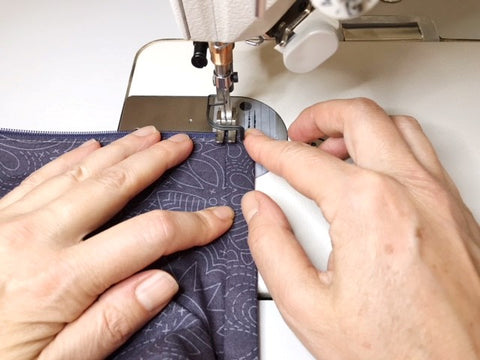
<p><img src="//cdn.shopify.com/s/files/1/0515/2417/files/CS_f_8_large.jpg?v=1509557503" alt=""></p>
<p><img src="//cdn.shopify.com/s/files/1/0515/2417/files/CS_f_9_large.jpg?v=1509557511" alt=""></p>
<p>Waist binding done!</p>
<p> <em>﻿<img src="//cdn.shopify.com/s/files/1/0515/2417/files/binding_fini_large.jpg?v=1509562746" alt=""></em></p>
<h2>Band on the Run </h2>
<p>The last part is the Skirt Band. We have a hack that eliminates hand sewing the weights to the hemline! Let's start with that.</p>
<p>Cut a strip of scrap fabric that is 3"  by the width of the Band Front piece. You can use just about anything in your scrap bin that is similar or lighter weight than your Skirt Band Fabric. The only thing to watch out for is checking if any part of your scrap fabric will show through your Band fabric. </p>
<p><img src="//cdn.shopify.com/s/files/1/0515/2417/files/CS_f_10_txt_large.jpg?v=1509563690" alt=""></p>
<p> </p>
<p>We've got plenty of muslin scraps lying around so that is what we used. Press up 1" along one long edge. This crease will align with the hemline.</p>
<p><img src="//cdn.shopify.com/s/files/1/0515/2417/files/CS_f_11_large.jpg?v=1509557525" alt=""></p>
<p> </p>
<p>Cut a double strand of curtain weights the width of the Front Band MINUS the seam allowance at both ends. There should be a good 3/4" space  at either end of the weights.</p>
<p>.<img src="//cdn.shopify.com/s/files/1/0515/2417/files/CS_f_12_large.jpg?v=1509557532" alt=""></p>
<p> </p>
<p>Place the weights in the crease and stitch next to them using a zipper foot. You're creating something like weight cording!</p>
<p><img src="//cdn.shopify.com/s/files/1/0515/2417/files/CS_f_13_large.jpg?v=1509557538" alt=""></p>
<p> </p>
<p><span> Stitch across at each end of the weights so that they are secure and won't be shifting at all once the skirt is finished.</span></p>
<p><span><img src="//cdn.shopify.com/s/files/1/0515/2417/files/CS_f_14_large.jpg?v=1509557544" alt=""></span></p>
<p><span><img src="//cdn.shopify.com/s/files/1/0515/2417/files/CS_f_15_large.jpg?v=1509557550" alt=""></span></p>
<p> </p>
<p>Attach the weighted strip of fabric to the wrong side of hem edge of the Band Front. The weights are 2" from the raw edge aligning with the hemline. </p>
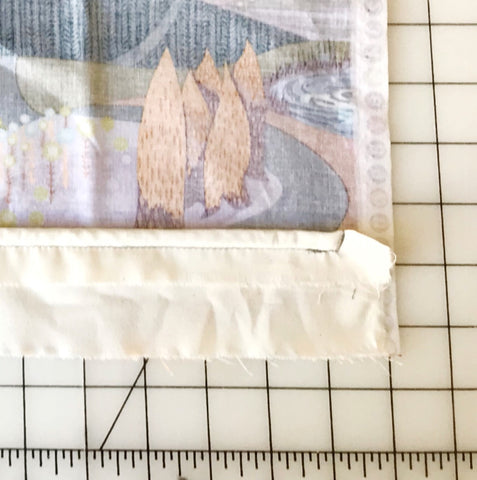
<p><img src="//cdn.shopify.com/s/files/1/0515/2417/files/CS_f_17_large.jpg?v=1509557569" alt=""></p>
<p> </p>
<p><span>We serged the strip to attach it to the Band.  You can use any method you desire; straight stitching is fine.</span></p>
<p><img src="//cdn.shopify.com/s/files/1/0515/2417/files/CS_f_18_large.jpg?v=1509557581" alt=""></p>
<p> </p>
<p>Now you are ready to assemble the Band! No hand sewing the weights! </p>
<p>As previously mentions, we serged all the edges of our pieces ahead of time and some of the pieces went right up to the selvage so the Band application went very fast this time around.</p>
<p>Stitch the center back seam for the Band Backs, right sides together and press the seam open.</p>
<p><img src="//cdn.shopify.com/s/files/1/0515/2417/files/CS_f_19_large.jpg?v=1509557589" alt=""></p>
<p> </p>
<p>Stitch Band Front to Band Back assembly at the sides, right sides together. You will be catching the weighted strip in the seam so you might need to switch to a zipper foot. The weights should clear the seam itself.</p>
<p><img src="//cdn.shopify.com/s/files/1/0515/2417/files/CS_f_20_large.jpg?v=1509557597" alt=""></p>
<p> </p>
<p>Press seam open.<br><img src="//cdn.shopify.com/s/files/1/0515/2417/files/CS_f_21_large.jpg?v=1509557605" alt=""></p>
<p> </p>
<p>Now pin the Band assembly to the skirt, right sides together. Match the center back seams, the side seams, and the center fronts first. Then you can pin in between those points.</p>
<p><img src="//cdn.shopify.com/s/files/1/0515/2417/files/CS_f_22_large.jpg?v=1509557621" alt=""></p>
<p> </p>
<p>Stitch the Band to skirt (oops! no photo for this seam). Press the seam towards the skirt once the Band is attached. </p>
<p><img src="//cdn.shopify.com/s/files/1/0515/2417/files/CS_f_23_large.jpg?v=1509557631" alt=""></p>
<p> </p>
<p> Turn up a 2" hem and press. The strand of weights will be right at the hemline. </p>
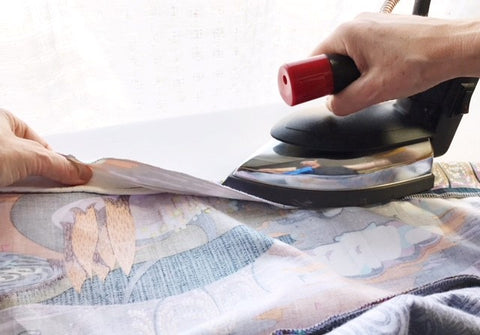
<p><img src="//cdn.shopify.com/s/files/1/0515/2417/files/CS_f_24_large.jpg?v=1509557640" alt=""></p>
<p> </p>
<p>Stitch the hem as you desire by hand or machine. We used the blind hem stitch on the machine and made quick work of it.</p>
<p><img src="//cdn.shopify.com/s/files/1/0515/2417/files/CS_f_25_large.jpg?v=1509557647" alt=""></p>
<p> </p>
<h2>Final detail</h2>
<p>All that is left is to sew two sets of hooks and eyes at the side opening. Mark the placement for 2 sets of hooks and eyes as shown.</p>
<p><img src="//cdn.shopify.com/s/files/1/0515/2417/files/hooks_1_txt_large.jpg?v=1509566348" alt=""></p>
<p> </p>
<p>Sew the hooks and eyes in the configuration shown below.</p>
<p><img src="//cdn.shopify.com/s/files/1/0515/2417/files/hooks_2_txt_large.jpg?v=1509566359" alt=""></p>
<p> </p>
<p>Now put it on and have fun! Thank you so much for joining us!!</p>
<p><span style="text-decoration: underline;"><img src="//cdn.shopify.com/s/files/1/0515/2417/files/CS_f_26_large.jpg?v=1509557655" alt=""></span></p>
<p><span style="text-decoration: underline;"><img src="//cdn.shopify.com/s/files/1/0515/2417/files/CS_f_27_large.jpg?v=1509557663" alt=""></span></p>
<p><span style="text-decoration: underline;"> </span></p>]]>
    </content>
  </entry>
  <entry>
    <id>https://www.decadesofstyle.com/blogs/news/zip-it</id>
    <published>2017-10-29T14:17:00-07:00</published>
    <updated>2018-04-13T16:01:17-07:00</updated>
    <link rel="alternate" type="text/html" href="https://www.decadesofstyle.com/blogs/news/zip-it"/>
    <title>Zip It! Part 5</title>
    <author>
      <name>Janet Manning</name>
    </author>
    <summary type="html">
      <![CDATA[Zipper installation for the Chore Skirt with photos and helpful tips.<p><a class="read-more" href="https://www.decadesofstyle.com/blogs/news/zip-it">More</a></p>]]>
    </summary>
    <content type="html">
      <![CDATA[<p><a href="https://www.decadesofstyle.com/blogs/news/pleats-for-reals" title="Part 4 in the Decades Everyday Chore Skirt Sew Along">Click here for Part 4 in the sew along.</a></p>
<p>Hope you guys are all caught up on the posts and are ready to zip it!</p>
<p>Admittedly, this zipper installation is a bit fiddly but it is worth it. This part of the sew along will take you step by step through the zipper. In the end, you'll see the benefits of this arrangement- in spite of the fiddly factor.</p>
<h2>Let's get fiddlin!</h2>
<p><span>Tip to get you started: Stitch the seam allowances of the pocket together above the pocket opening, as shown, keeping the Skirt piece free.</span></p>
<p><img src="//cdn.shopify.com/s/files/1/0515/2417/files/CS_5_1_large.jpg?v=1509304480" alt=""></p>
<p> </p>
<p>We'll be working with the Front Skirt facing right side up. <span>Open up the zipper and place it face down at</span> left side seam where the entire pocket is stitched to the side seam. The zipper coil should start 3/4" from the waist edge. .</p>
<p><img src="//cdn.shopify.com/s/files/1/0515/2417/files/CS_5_2_large.jpg?v=1509304491" alt=""></p>
<p> </p>
<p><span> Align the zipper tape with the fabric as shown. The zipper coil falls within the seam allowance. </span></p>
<p><span><img src="//cdn.shopify.com/s/files/1/0515/2417/files/CS_5_3_large.jpg?v=1509304497" alt=""></span></p>
<p> </p>
<p><span>Stitch from the waist edge to the pockets and back stitch.</span></p>
<p><span><img src="//cdn.shopify.com/s/files/1/0515/2417/files/CS_5_4_large.jpg?v=1509304504" alt=""></span></p>
<p><span><img src="//cdn.shopify.com/s/files/1/0515/2417/files/CS_5_5_large.jpg?v=1509304509" alt=""></span></p>
<p> </p>
<p>Now, flip the Pocket to the left, under the skirt, and continue stitching the zipper to loose seam allowance of the pocket at the pocket opening. Back stitch at the bottom of the Pocket. </p>
<p><img src="//cdn.shopify.com/s/files/1/0515/2417/files/CS_5_6_large.jpg?v=1509304517" alt=""></p>
<p><img src="//cdn.shopify.com/s/files/1/0515/2417/files/CS_5_7_large.jpg?v=1509304525" alt=""></p>
<p> </p>
<p>Next, with right sides together, align the side seam of the Skirt Back. </p>
<p><img src="//cdn.shopify.com/s/files/1/0515/2417/files/CS_5_8_large.jpg?v=1509304533" alt=""></p>
<p> </p>
<p><span>Stitch the left side seam below the Pocket keeping the the zipper tape free from the seam.</span></p>
<p><img src="//cdn.shopify.com/s/files/1/0515/2417/files/CS_5_9_large.jpg?v=1509304540" alt=""></p>
<p> <img src="//cdn.shopify.com/s/files/1/0515/2417/files/CS_5_10_17ac6e25-0590-4d4c-b756-1b6784cb1fe3_large.jpg?v=1509305691" alt=""></p>
<p> </p>
<p><span>Press seam open below the Pocket.</span></p>
<p><span><img src="//cdn.shopify.com/s/files/1/0515/2417/files/CS_5_11_large.jpg?v=1509304841" alt=""></span></p>
<p> </p>
<p><span>On Skirt Back, turn in seam allowance above above zipper as shown.</span></p>
<p><span><img src="//cdn.shopify.com/s/files/1/0515/2417/files/CS_5_12_large.jpg?v=1509305764" alt=""></span></p>
<p><span><img src="//cdn.shopify.com/s/files/1/0515/2417/files/CS_5_13_large.jpg?v=1509305772" alt=""></span></p>
<p> </p>
<p>Place the skirt on your work surface right side up. The pocket should be flipped towards the left leaving the remaining side of the zipper exposed and right side up. Close the zipper and place the folded edge of the seam allowance near the zipper coil. Everything should lie flat and be nicely aligned.</p>
<p><img src="//cdn.shopify.com/s/files/1/0515/2417/files/CS_5_14_large.jpg?v=1509305989" alt=""></p>
<p> </p>
<p>Pin in place and open the zipper to stitch it. Stitch fairly close to the coils.</p>
<p><img src="//cdn.shopify.com/s/files/1/0515/2417/files/CS_5_16_large.jpg?v=1509306012" alt=""></p>
<p> </p>
<p>Tip: Depending on your zipper length, you might need to stitch across the zipper at the bottom of the opening to keep the zipper pull from disappearing.</p>
<p><img src="//cdn.shopify.com/s/files/1/0515/2417/files/CS_5_18_large.jpg?v=1509306032" alt=""></p>
<p> </p>
<p>Congratulations! The zipper is done! A little bit of unusual application but it was the best option for this skirt.</p>
<p><img src="//cdn.shopify.com/s/files/1/0515/2417/files/CS_5_19_large.jpg?v=1509306042" alt=""></p>
<p> </p>
<h2>Sides and Pleats</h2>
<p>To form the left side pleat, open the zipper. Turn the Front Skirt back along the side reference line (SRL - marked in white chalk.) Baste in place along waist edge.</p>
<p><img src="//cdn.shopify.com/s/files/1/0515/2417/files/CS_5_20_large.jpg?v=1509306601" alt=""></p>
<p><img src="//cdn.shopify.com/s/files/1/0515/2417/files/CS_5_21_large.jpg?v=1509306615" alt=""></p>
<p> </p>
<p>When the zipper is closed, the pleat is formed when the <span>Front </span>fold aligns with the SRL on the Skirt back.</p>
<p><img src="//cdn.shopify.com/s/files/1/0515/2417/files/CS_5_22_large.jpg?v=1509306807" alt=""></p>
<p><img src="//cdn.shopify.com/s/files/1/0515/2417/files/CS_5_23_large.jpg?v=1509306624" alt=""></p>
<p> </p>
<p>Before stitching the right side seam, you can mark the pivot points at the pocket opening if you want total precision. The pivot points are at the corners of the seam allowance on the Pocket. The upper pivot point is circled in red.</p>
<p><img src="//cdn.shopify.com/s/files/1/0515/2417/files/CS_5_24_large.jpg?v=1509310825" alt=""></p>
<p> </p>
<p>Stitch the right side seam, right sides together, matching notches. The Pocket pieces should align so you can pivot at Pocket corner and stitch perimeter of Pockets.</p>
<p><img src="//cdn.shopify.com/s/files/1/0515/2417/files/CS_5_25_large.jpg?v=1509310836" alt=""></p>
<p><img src="//cdn.shopify.com/s/files/1/0515/2417/files/CS_5_26_large.jpg?v=1509310845" alt=""></p>
<p><img src="//cdn.shopify.com/s/files/1/0515/2417/files/CS_5_27_large.jpg?v=1509310854" alt=""></p>
<p> </p>
<p>Press seam open below pocket. (oops! apparently, there is no photo for this side. lol!)</p>
<p>To make the right side pleat, baste along SRL with right sides together, (SRL marked in blue)</p>
<p><img src="//cdn.shopify.com/s/files/1/0515/2417/files/CS_5_28_large.jpg?v=1509310865" alt=""></p>
<p> </p>
<p>Press Pocket towards skirt front and baste at waist edge. (You will remove this basting when the skirt is finished)</p>
<p><img src="//cdn.shopify.com/s/files/1/0515/2417/files/CS_5_29_large.jpg?v=1509310874" alt=""></p>
<p><img src="//cdn.shopify.com/s/files/1/0515/2417/files/CS_5_30_large.jpg?v=1509310888" alt=""></p>
<p> </p>
<p>Now you have what looks like an unfinished mini skirt.</p>
<p><img src="//cdn.shopify.com/s/files/1/0515/2417/files/CS_5_31_large.jpg?v=1509310899" alt=""></p>
<p> </p>
<p>That's enough for now. Next time we'll make the waist binding and Skirt Band. We'll be showing you a trick to weighting the hemline that is all done by machine! </p>
<p>Thanks for reading and sewing along!</p>
<p><a href="https://www.decadesofstyle.com/blogs/news/get-er-done" target="_blank" title="Final Post Chore Skirt Sew along" rel="noopener noreferrer"> Click here for the final installment in the sew along.</a></p>
<p> </p>
<p> </p>
<p> </p>
<p> </p>
<p> </p>]]>
    </content>
  </entry>
  <entry>
    <id>https://www.decadesofstyle.com/blogs/news/pleats-for-reals</id>
    <published>2017-10-23T15:13:00-07:00</published>
    <updated>2018-04-13T16:02:40-07:00</updated>
    <link rel="alternate" type="text/html" href="https://www.decadesofstyle.com/blogs/news/pleats-for-reals"/>
    <title>Pleats! For Reals! Part 4</title>
    <author>
      <name>Janet Manning</name>
    </author>
    <summary type="html">
      <![CDATA[Pleats, pleats and more pleats. Step by step pleating and inside help on keeping things under control.<p><a class="read-more" href="https://www.decadesofstyle.com/blogs/news/pleats-for-reals">More</a></p>]]>
    </summary>
    <content type="html">
      <![CDATA[<p style="margin: 0in 0in 12.0pt 0in;"><span style="font-size: 11.5pt;"><a href="https://www.decadesofstyle.com/blogs/news/get-your-pleat-on" title="Part 3 in the Decades Everday Chore Skirt Sew Along"><span style="font-family: Helvetica, sans-serif; color: black;">Click here for Part 3 in the sew along.</span></a></span></p>
<h4 style="margin: 0in 0in 12.0pt 0in;"><span style="font-size: 11.5pt; font-family: 'Helvetica',sans-serif; color: black;">Just One More Thing . . .</span></h4>
<p style="margin: 0in 0in 12.0pt 0in;"><span style="font-size: 11.5pt; font-family: 'Helvetica',sans-serif; color: black;">Let's make some pleats!</span></p>
<p style="margin: 0in 0in 12.0pt 0in;"><span style="font-size: 11.5pt; font-family: 'Helvetica',sans-serif; color: black;">But first a small tutorial on how to adjust the pleats if you are between sizes. Two posts back, we told you to cut the larger size if you are in between sizes. Before you start pleating, you need to alter the pleat guide to take up the extra to get the finished waist size that you want.  </span></p>
<p>For instance, our model has a 33" waist. We cut a pattern size 14 for a 34" waist. There is a difference of 1" between her waist and the pattern size. Divide that difference by 4 to determine the amount of the adjustment; in this case 1/4".</p>
<p>Make the adjustment on the pleat nearest the "side" line on the Pleat Guide Front and Pleat Guide Back. Just move the pleat placement line towards the "side" line by the amount of the adjustment, in this case, 1/4" as shown. That's all there is to it!</p>
<p> <img src="//cdn.shopify.com/s/files/1/0515/2417/files/CS4-1_large.jpg?v=1508784980" alt=""></p>
<p style="font-variant-ligatures: normal; font-variant-caps: normal; orphans: 2; text-align: start; widows: 2; -webkit-text-stroke-width: 0px; text-decoration-style: initial; text-decoration-color: initial; word-spacing: 0px; margin: 0in 0in 12.0pt 0in;"><img src="//cdn.shopify.com/s/files/1/0515/2417/files/CS4-2_large.jpg?v=1508784996" alt=""></p>
<h4>Pleat the Skirt Front</h4>
<p style="font-variant-ligatures: normal; font-variant-caps: normal; orphans: 2; text-align: start; widows: 2; -webkit-text-stroke-width: 0px; text-decoration-style: initial; text-decoration-color: initial; word-spacing: 0px; margin: 0in 0in 12.0pt 0in;"><span style="font-size: 11.5pt; font-family: 'Helvetica',sans-serif; color: black;">FINALLY! Now we are ready to pleat! For reals! As with everything in sewing, you can do it in whatever manner works best for you. The tip we have for you on this project is to refer to your pleat guide early and often!  You will have the most control over the pleats and over your outcome if you baste the pleats in place one at a time as you go along - rather than pinning them all at once and then basting at the end. (Again - that is just the way we like doing it. You are welcome to use whatever method you prefer.) </span></p>
<p> On the right side of the fabric on the the Skirt Front, mark the center front (CF).</p>
<p> <img src="//cdn.shopify.com/s/files/1/0515/2417/files/CS4-3_large.jpg?v=1508785332" alt=""> </p>
<p style="font-variant-ligatures: normal; font-variant-caps: normal; orphans: 2; text-align: start; widows: 2; -webkit-text-stroke-width: 0px; text-decoration-style: initial; text-decoration-color: initial; word-spacing: 0px; margin: 0in 0in 12.0pt 0in;"><span style="font-size: 11.5pt; font-family: 'Helvetica',sans-serif; color: black;">Match up the Pleat Guide Front on the CF and the "side" reference line (SRL) and mark the pleat lines.</span><span style="font-size: 11.5pt; font-family: 'Helvetica',sans-serif; color: black;"><span>Another tip from us is to use clear tape to temporarily hold the Pleat Guide in place while you mark the pleat lines.</span> </span></p>
<p style="font-variant-ligatures: normal; font-variant-caps: normal; orphans: 2; text-align: start; widows: 2; -webkit-text-stroke-width: 0px; text-decoration-style: initial; text-decoration-color: initial; word-spacing: 0px; margin: 0in 0in 12.0pt 0in;"><span style="font-size: 11.5pt; font-family: 'Helvetica',sans-serif; color: black;"><img src="//cdn.shopify.com/s/files/1/0515/2417/files/CS4-4_large.jpg?v=1508785587" alt=""></span></p>
<p style="font-variant-ligatures: normal; font-variant-caps: normal; orphans: 2; text-align: start; widows: 2; -webkit-text-stroke-width: 0px; text-decoration-style: initial; text-decoration-color: initial; word-spacing: 0px; margin: 0in 0in 12.0pt 0in;"><span style="font-size: 11.5pt; font-family: 'Helvetica',sans-serif; color: black;">If you have a quilter's hard ruler you can easily align one edge with the waist of the skirt and draw you pleat lines down a good 5" - 6" like we have done here. </span></p>
<p> <img src="//cdn.shopify.com/s/files/1/0515/2417/files/CS4-5_large.jpg?v=1508785745" alt=""> </p>
<p><img src="//cdn.shopify.com/s/files/1/0515/2417/files/CS4-6_large.jpg?v=1508787976" alt=""></p>
<p style="font-variant-ligatures: normal; font-variant-caps: normal; orphans: 2; text-align: start; widows: 2; -webkit-text-stroke-width: 0px; text-decoration-style: initial; text-decoration-color: initial; word-spacing: 0px; margin: 0in 0in 12.0pt 0in;"><span style="font-size: 11.5pt; font-family: 'Helvetica',sans-serif; color: black;">To make the pleat, press a crease on the right side of the fabric at the line at the end of the arrow and bring that crease to match the line at the ARROW HEAD.</span></p>
<p style="font-variant-ligatures: normal; font-variant-caps: normal; orphans: 2; text-align: start; widows: 2; -webkit-text-stroke-width: 0px; text-decoration-style: initial; text-decoration-color: initial; word-spacing: 0px; margin: 0in 0in 12.0pt 0in;"><span style="font-size: 11.5pt; font-family: 'Helvetica',sans-serif; color: black;"><img src="//cdn.shopify.com/s/files/1/0515/2417/files/CS4-7_large.jpg?v=1508788207" alt=""></span></p>
<p style="font-variant-ligatures: normal; font-variant-caps: normal; orphans: 2; text-align: start; widows: 2; -webkit-text-stroke-width: 0px; text-decoration-style: initial; text-decoration-color: initial; word-spacing: 0px; margin: 0in 0in 12.0pt 0in;"><span style="font-size: 11.5pt; font-family: 'Helvetica',sans-serif; color: black;"> Press in place.</span></p>
<p style="font-variant-ligatures: normal; font-variant-caps: normal; orphans: 2; text-align: start; widows: 2; -webkit-text-stroke-width: 0px; text-decoration-style: initial; text-decoration-color: initial; word-spacing: 0px; margin: 0in 0in 12.0pt 0in;"><span style="font-size: 11.5pt; font-family: 'Helvetica',sans-serif; color: black;"><img src="//cdn.shopify.com/s/files/1/0515/2417/files/CS4-8_large.jpg?v=1508788715" alt=""></span></p>
<p style="font-variant-ligatures: normal; font-variant-caps: normal; orphans: 2; text-align: start; widows: 2; -webkit-text-stroke-width: 0px; text-decoration-style: initial; text-decoration-color: initial; word-spacing: 0px; margin: 0in 0in 12.0pt 0in;"><span style="font-size: 11.5pt; font-family: 'Helvetica',sans-serif; color: black;">Then, baste it in place immediately before you go on to the next pleat. (We aren't using pins at all in this process since we can hold the single pleat in place with our hands. If pinning the pleat gives you more control, then please pin away!)</span></p>
<p style="font-variant-ligatures: normal; font-variant-caps: normal; orphans: 2; text-align: start; widows: 2; -webkit-text-stroke-width: 0px; text-decoration-style: initial; text-decoration-color: initial; word-spacing: 0px; margin: 0in 0in 12.0pt 0in;"><span style="font-size: 11.5pt; font-family: 'Helvetica',sans-serif; color: black;"><img src="//cdn.shopify.com/s/files/1/0515/2417/files/CS4-9_large.jpg?v=1508788750" alt=""></span> </p>
<p style="font-variant-ligatures: normal; font-variant-caps: normal; orphans: 2; text-align: start; widows: 2; -webkit-text-stroke-width: 0px; text-decoration-style: initial; text-decoration-color: initial; word-spacing: 0px; margin: 0in 0in 12.0pt 0in;"><span>Continue making pleats across the waist line following the Pleat Guide Front and basting in one pleat at a time. (Tip: If desired, you can finger press the crease before bringing it to the placement line and then press in place with the iron. To finger press, just fold along the line as shown and run your pinched fingers along it to crease.)</span></p>
<p style="font-variant-ligatures: normal; font-variant-caps: normal; orphans: 2; text-align: start; widows: 2; -webkit-text-stroke-width: 0px; text-decoration-style: initial; text-decoration-color: initial; word-spacing: 0px; margin: 0in 0in 12.0pt 0in;"><span><img src="//cdn.shopify.com/s/files/1/0515/2417/files/CS4-10_large.jpg?v=1508789092" alt=""></span></p>
<p style="font-variant-ligatures: normal; font-variant-caps: normal; orphans: 2; text-align: start; widows: 2; -webkit-text-stroke-width: 0px; text-decoration-style: initial; text-decoration-color: initial; word-spacing: 0px; margin: 0in 0in 12.0pt 0in;"><span><img src="//cdn.shopify.com/s/files/1/0515/2417/files/CS4-11_large.jpg?v=1508789284" alt=""></span></p>
<p style="font-variant-ligatures: normal; font-variant-caps: normal; orphans: 2; text-align: start; widows: 2; -webkit-text-stroke-width: 0px; text-decoration-style: initial; text-decoration-color: initial; word-spacing: 0px; margin: 0in 0in 12.0pt 0in;"><span><img src="//cdn.shopify.com/s/files/1/0515/2417/files/CS4-12_large.jpg?v=1508789513" alt=""></span></p>
<p style="font-variant-ligatures: normal; font-variant-caps: normal; orphans: 2; text-align: start; widows: 2; -webkit-text-stroke-width: 0px; text-decoration-style: initial; text-decoration-color: initial; word-spacing: 0px; margin: 0in 0in 12.0pt 0in;"> If you baste in one pleat at a time, it will be easy to refer back to your pleat guide to see if the waist is stretching out while you're working. Tape up the pleats you have made and line up the SRL on the Guide and the skirt and see if the all the lines are matching up.</p>
<p style="font-variant-ligatures: normal; font-variant-caps: normal; orphans: 2; text-align: start; widows: 2; -webkit-text-stroke-width: 0px; text-decoration-style: initial; text-decoration-color: initial; word-spacing: 0px; margin: 0in 0in 12.0pt 0in;"><img src="//cdn.shopify.com/s/files/1/0515/2417/files/CS4-13_large.jpg?v=1508789797" alt=""></p>
<p> <img src="//cdn.shopify.com/s/files/1/0515/2417/files/CS4-14_large.jpg?v=1508789980" alt=""></p>
<p>Make all the pleats on the Skirt front. After pleating up the entire waist edge, the Skirt Front will look like this. </p>
<p> <img src="//cdn.shopify.com/s/files/1/0515/2417/files/CS4-15_large.jpg?v=1508790299" alt=""></p>
<p> </p>
<h4 style="font-variant-ligatures: normal; font-variant-caps: normal; orphans: 2; text-align: start; widows: 2; -webkit-text-stroke-width: 0px; text-decoration-style: initial; text-decoration-color: initial; word-spacing: 0px; margin: 0in 0in 12.0pt 0in;"><span style="font-size: 11.5pt; font-family: 'Helvetica',sans-serif; color: black;">All about that Back</span></h4>
<p style="font-variant-ligatures: normal; font-variant-caps: normal; orphans: 2; text-align: start; widows: 2; -webkit-text-stroke-width: 0px; text-decoration-style: initial; text-decoration-color: initial; word-spacing: 0px; margin: 0in 0in 12.0pt 0in;"><span style="font-size: 11.5pt; font-family: 'Helvetica',sans-serif; color: black;">The Back Skirt is simply a repeat of the process for the front with exception of a center back seam. And of course, many many more pleats. </span></p>
<p style="font-variant-ligatures: normal; font-variant-caps: normal; orphans: 2; text-align: start; widows: 2; -webkit-text-stroke-width: 0px; text-decoration-style: initial; text-decoration-color: initial; word-spacing: 0px; margin: 0in 0in 12.0pt 0in;"><span style="font-size: 11.5pt; font-family: 'Helvetica',sans-serif; color: black;">Stitch the center back (CB) seam and press the seam open.</span></p>
<p style="font-variant-ligatures: normal; font-variant-caps: normal; orphans: 2; text-align: start; widows: 2; -webkit-text-stroke-width: 0px; text-decoration-style: initial; text-decoration-color: initial; word-spacing: 0px; margin: 0in 0in 12.0pt 0in;"><img src="//cdn.shopify.com/s/files/1/0515/2417/files/CS4-bk1_large.jpg?v=1508791647" alt=""> </p>
<p style="font-variant-ligatures: normal; font-variant-caps: normal; orphans: 2; text-align: start; widows: 2; -webkit-text-stroke-width: 0px; text-decoration-style: initial; text-decoration-color: initial; word-spacing: 0px; margin: 0in 0in 12.0pt 0in;"><img src="//cdn.shopify.com/s/files/1/0515/2417/files/CS4-bk2_large.jpg?v=1508791653" alt=""></p>
<p style="font-variant-ligatures: normal; font-variant-caps: normal; orphans: 2; text-align: start; widows: 2; -webkit-text-stroke-width: 0px; text-decoration-style: initial; text-decoration-color: initial; word-spacing: 0px; margin: 0in 0in 12.0pt 0in;">We used chalk to mark the pleats. We marked the CB seam to make it easy to see since it is the placement line for the first two pleats.</p>
<p style="font-variant-ligatures: normal; font-variant-caps: normal; orphans: 2; text-align: start; widows: 2; -webkit-text-stroke-width: 0px; text-decoration-style: initial; text-decoration-color: initial; word-spacing: 0px; margin: 0in 0in 12.0pt 0in;"><em><img src="//cdn.shopify.com/s/files/1/0515/2417/files/CS4-bk3_large.jpg?v=1508791660" alt=""></em></p>
<p style="font-variant-ligatures: normal; font-variant-caps: normal; orphans: 2; text-align: start; widows: 2; -webkit-text-stroke-width: 0px; text-decoration-style: initial; text-decoration-color: initial; word-spacing: 0px; margin: 0in 0in 12.0pt 0in;"><em><img src="//cdn.shopify.com/s/files/1/0515/2417/files/CS4-bk4_large.jpg?v=1508791668" alt=""></em></p>
<p style="font-variant-ligatures: normal; font-variant-caps: normal; orphans: 2; text-align: start; widows: 2; -webkit-text-stroke-width: 0px; text-decoration-style: initial; text-decoration-color: initial; word-spacing: 0px; margin: 0in 0in 12.0pt 0in;"> </p>
<p style="font-variant-ligatures: normal; font-variant-caps: normal; orphans: 2; text-align: start; widows: 2; -webkit-text-stroke-width: 0px; text-decoration-style: initial; text-decoration-color: initial; word-spacing: 0px; margin: 0in 0in 12.0pt 0in;"> Starting at the CB, there are a series of pleats that have 2 pleats stacked directly on top of each other. The process is EXACTLY the same as the front.</p>
<p>Press the fabric on the line at the end of the arrow and bring that creased line to the line at the arrow head. The first placement line is the CB seam shown below. </p>
<p> <img src="//cdn.shopify.com/s/files/1/0515/2417/files/CS4-bk5_large.jpg?v=1508791701" alt=""></p>
<p><span>Press in place.</span></p>
<p><span><img src="//cdn.shopify.com/s/files/1/0515/2417/files/CS4-bk6_large.jpg?v=1508793184" alt=""></span></p>
<p><span>Then baste it in place. </span></p>
<p><span><img src="//cdn.shopify.com/s/files/1/0515/2417/files/CS4-bk7_large.jpg?v=1508793274" alt=""></span></p>
<p> Make the next pleat exactly the same way. The placement line where you bring the pressed edge is the same as for the first pleat you just made (in this case, the CB seam.) </p>
<p> <img src="//cdn.shopify.com/s/files/1/0515/2417/files/CS4-bk8_large.jpg?v=1508793195" alt=""></p>
<p><img src="//cdn.shopify.com/s/files/1/0515/2417/files/CS4-bk9_large.jpg?v=1508793428" alt=""></p>
<p>And baste it in place. It is stacked precisely on top of the pleat you just made.</p>
<p>The next 3 series of pleats on the Pleat Guide Back have the same configuration of 2 pleats stacked directly on top of one another. Just work your way along the Pleat Guide marking and basting each pleat in place as you go. Below is the next set of stacked pleats pressed in place.</p>
<p> <img src="//cdn.shopify.com/s/files/1/0515/2417/files/CS4-bk10_large.jpg?v=1508794744" alt=""></p>
<p> And so on and sew on. The third set of stacked pleats below.</p>
<p><img src="//cdn.shopify.com/s/files/1/0515/2417/files/CS4-bk11_large.jpg?v=1508794903" alt=""></p>
<p>And the final set of stacked pleats in place (below).</p>
<p><img src="//cdn.shopify.com/s/files/1/0515/2417/files/CS4-bk14_large.jpg?v=1508796055" alt=""></p>
<p>After the stacked pleats, there are just a few more regular single pleats until you get to the side. Continue until all the pleats are made. As suggested with the Skirt Front, compare the Skirt Back to the Pleat Guide and make sure the waist edge is not stretching out. (if you find that it is, you can absorb any extra in the pleats as you go.) </p>
<p><img src="//cdn.shopify.com/s/files/1/0515/2417/files/CS4-bk12_large.jpg?v=1508795234" alt=""></p>
<p style="font-variant-ligatures: normal; font-variant-caps: normal; orphans: 2; text-align: start; widows: 2; -webkit-text-stroke-width: 0px; text-decoration-style: initial; text-decoration-color: initial; word-spacing: 0px; margin: 0in 0in 12.0pt 0in;"> After pleating the entire waist edge, the back of the skirt will look like this.</p>
<p><img src="//cdn.shopify.com/s/files/1/0515/2417/files/CS4-bk13_large.jpg?v=1508795458" alt=""></p>
<p style="font-variant-ligatures: normal; font-variant-caps: normal; orphans: 2; text-align: start; widows: 2; -webkit-text-stroke-width: 0px; text-decoration-style: initial; text-decoration-color: initial; word-spacing: 0px; margin: 0in 0in 12.0pt 0in;"><span style="font-size: 11.5pt; font-family: 'Helvetica',sans-serif; color: black;">See you next time for zipper installation! </span></p>
<p style="font-variant-ligatures: normal; font-variant-caps: normal; orphans: 2; text-align: start; widows: 2; -webkit-text-stroke-width: 0px; text-decoration-style: initial; text-decoration-color: initial; word-spacing: 0px; margin: 0in 0in 12.0pt 0in;"><span style="font-size: 11.5pt;"><a href="https://www.decadesofstyle.com/blogs/news/zip-it" title="Chore Skirt Sew Along Zipper installation"><span style="font-family: Helvetica, sans-serif; color: black;">Click here for the next installment in the sew along.</span></a></span></p>
<p> </p>
<p> </p>
<p style="font-variant-ligatures: normal; font-variant-caps: normal; orphans: 2; text-align: start; widows: 2; -webkit-text-stroke-width: 0px; text-decoration-style: initial; text-decoration-color: initial; word-spacing: 0px; margin: 0in 0in 12.0pt 0in;"><span style="font-size: 11.5pt; font-family: 'Helvetica',sans-serif; color: black;">  </span></p>
<p> </p>
<p> </p>]]>
    </content>
  </entry>
  <entry>
    <id>https://www.decadesofstyle.com/blogs/news/get-your-pleat-on</id>
    <published>2017-10-22T17:16:00-07:00</published>
    <updated>2018-04-13T16:03:47-07:00</updated>
    <link rel="alternate" type="text/html" href="https://www.decadesofstyle.com/blogs/news/get-your-pleat-on"/>
    <title>Bait and Switch (Part 3)</title>
    <author>
      <name>Janet Manning</name>
    </author>
    <summary type="html">
      <![CDATA[Stabilizing the waist edge and installing the pockets on the Chore Skirt.<p><a class="read-more" href="https://www.decadesofstyle.com/blogs/news/get-your-pleat-on">More</a></p>]]>
    </summary>
    <content type="html">
      <![CDATA[<p><a href="https://www.decadesofstyle.com/blogs/news/odds-and-ends-at-the-beginning" target="_blank" title="Part 2 of the Chore Skirt Sew Along" rel="noopener noreferrer">Click here for Part 2 in the sew along.</a></p>
<p>All those teasers about covering the the pleats in this post were TOTAL lies! There are a few more things to cover before we get to the pleats and it was just too much for a single post. The pleats will be front and center next time (as well as back and center) so it will be worth it to stay tuned for the next installment. Apologies for the bait and switch!</p>
<h4>Waisted Edges</h4>
<p>We decided to serge all the edges of the pieces before assembling. You can finish the seam edges now or as you proceed. It is entirely up to you. We cut out a small V in the seam allowance for the notches on the pattern. These V notches are still visible after the edges are serged. You can see right before the presser foot where a small V is notched out along the fabric edge.</p>
<p style="text-align: left;"><img alt="" src="//cdn.shopify.com/s/files/1/0515/2417/files/CS_2_1_large.jpg?v=1508712411" style="float: none;"></p>
<p>It is important to stabilize the waist edge of the Skirt Front and Back pieces. You will be doing quite a bit of handling and pressing at these edges as you make the pleats. All this handling and manipulation is on the cross grain of the fabric. Without  any stabilizing, this edge will almost certainly stretch out as you put in the pleats. If the waist edge stretches out, when you try to attach the Waist Binding, the pieces won't fit together and that will be annoying! </p>
<p>The pattern calls for your to stay stitch the waist edges. Use a regular stitch length 2 - 2.5 mm and stitch 1/2" from the raw edge. (you can stitch right at the seam line but I prefer the stay stitching to be completely hidden in the seam allowance.) </p>
<p style="text-align: left;"><img alt="" src="//cdn.shopify.com/s/files/1/0515/2417/files/CS_2_2_large.jpg?v=1508714003" style="float: none;"></p>
<p>We are also making a Chore Skirt out of a stretch cotton sateen. The cross grain on this fabric is very stretchy! If you are using a stretch woven or something with a lot of "give" on the cross grain, consider using a mesh stay tape like the Dritz tape. This product won't add any appreciable bulk to the seam which will be important when we get to the Skirt Back. (Click photo to link to product on Amazon)</p>
<p><a href="https://www.amazon.com/dp/B000YYZQIS/ref=asc_df_B000YYZQIS5225225/?tag=hyprod-20&amp;creative=394997&amp;creativeASIN=B000YYZQIS&amp;linkCode=df0&amp;hvadid=198082367034&amp;hvpos=1o3&amp;hvnetw=g&amp;hvrand=7718197967807500680&amp;hvpone=&amp;hvptwo=&amp;hvqmt=&amp;hvdev=c&amp;hvdvcmdl=&amp;hvlocint=&amp;hvlocphy=9032082&amp;hvtargid=pla-319715042363" target="_blank" title="Amazon product page for Dritz stay tape." rel="noopener noreferrer"><img src="//cdn.shopify.com/s/files/1/0515/2417/files/staytape_medium.jpg?v=1508530223" alt=""></a></p>
<p>Just stitch the stay tape along the waist edge, on the wrong side of the fabric, right along the seam line (top edge).</p>
<p style="text-align: left;"><img alt="" src="//cdn.shopify.com/s/files/1/0515/2417/files/CS_2_3_large.jpg?v=1508714084" style="float: none;"></p>
<p> </p>
<h4>All About the Pockets</h4>
<p>The next step is attaching the pockets. The pocket of for the right side seam is straight forward and attaches to the Skirt Front and Skirt Back at at the right side seam, right sides together, matching notches. Press the pocket out towards the side of the skirt. Photos: 1-Skirt Front right side seam. 2-Skirt Back right side seam. 3-Skirt Back and Pocket</p>
<p style="text-align: left;"><img alt="" src="//cdn.shopify.com/s/files/1/0515/2417/files/CS_2_4_compact.jpg?v=1508714513" style="float: none;"> <img alt="" src="//cdn.shopify.com/s/files/1/0515/2417/files/CS_2_5_compact.jpg?v=1508714575" style="float: none;">  <img alt="" src="//cdn.shopify.com/s/files/1/0515/2417/files/CS_2_6_compact.jpg?v=1508714579" style="float: none;"></p>
<p> The left pocket construction is a bit odd but it is necessary for the zipper insertion later on. Attach one Pocket piece to the Skirt Front at the left side, <span>right sides together, matching notches. Press the pocket out towards the side of the skirt. (looks familiar, doesn't it!)</span></p>
<p><span><img src="//cdn.shopify.com/s/files/1/0515/2417/files/CS_2_6_large.jpg?v=1508714579" alt=""></span></p>
<p><span>Now for the odd part. Now you stitch the last Pocket piece directly to the Pocket you just stitched. Mark the seam allowance along the straight edge at the top and bottom of the pocket opening. </span></p>
<p><img src="//cdn.shopify.com/s/files/1/0515/2417/files/CS_2_7_large.jpg?v=1508715265" alt=""></p>
<p><span>Stitch around the perimeter of the pocket starting at the mark you made for the seam allowance (far left of photo 1) and ending at the mark for the seam allowance at the bottom of the Pocket opening (photo 2). </span></p>
<p><img src="//cdn.shopify.com/s/files/1/0515/2417/files/CS_2_8_large.jpg?v=1508715612" alt=""> </p>
<p><img src="//cdn.shopify.com/s/files/1/0515/2417/files/CS_2_9_large.jpg?v=1508715809" alt=""></p>
<p><span>You want to take care to isolate the pockets you are stitching them together. Keep the Skirt Front and other seam allowances from getting caught up in the pocket seam.</span></p>
<p><img src="//cdn.shopify.com/s/files/1/0515/2417/files/CS_2_10_large.jpg?v=1508716238" alt=""> </p>
<p><span>The seam allowance along the straight edge of the Pocket will be loose. This is the pocket opening so all further steps for the zipper insertion involve preserving this pocket opening. Press the loose seam allowance of the pocket opening towards the pocket as shown.</span></p>
<p><img src="//cdn.shopify.com/s/files/1/0515/2417/files/CS_2_11_large.jpg?v=1508716628" alt=""></p>
<p> So - PLEATS - next time! Promise! Thanks so much for following along! </p>
<p><a href="https://www.decadesofstyle.com/blogs/news/pleats-for-reals" target="_blank" title="Pleats blog post Chore Skirt Sew Along" rel="noopener noreferrer">Click here for the next installment</a>.</p>]]>
    </content>
  </entry>
  <entry>
    <id>https://www.decadesofstyle.com/blogs/news/odds-and-ends-at-the-beginning</id>
    <published>2017-10-18T16:27:00-07:00</published>
    <updated>2018-04-13T10:47:02-07:00</updated>
    <link rel="alternate" type="text/html" href="https://www.decadesofstyle.com/blogs/news/odds-and-ends-at-the-beginning"/>
    <title>Odds and Ends - At the beginning! Part 2</title>
    <author>
      <name>Janet Manning</name>
    </author>
    <summary type="html">
      <![CDATA[Brief description of fabric drape on the straight of grain, cross grain and bias. Also unique elements of the pattern like piecing sections that are wider than the fabric width of 44" and the use of curtain weights.<p><a class="read-more" href="https://www.decadesofstyle.com/blogs/news/odds-and-ends-at-the-beginning">More</a></p>]]>
    </summary>
    <content type="html">
      <![CDATA[<p><a href="https://www.decadesofstyle.com/blogs/news/a-sew-along-is-announced" target="_blank" title="Previous post for Chore Skirt Sew along" rel="noopener noreferrer">Click here for previous post in the sew along.</a></p>
<p>Before we get started sewing, let's cover a few odds and ends about this pattern. Just a few things about which you might have questions.</p>
<p>First off, you might be wondering what to do if your waist measurement is in between sizes? No problem! Cut out the larger size and as we go along, we will show you how easy it is to make up the difference when making the pleats.</p>
<p>Next- the curtain weights. We know it seems weird. Curtain weights are probably not something you have used in garment sewing so here is the skinny on it. The back part of this skirt uses 2/3 of the fabric in the project. That distribution creates drag in the back. Is it absolutely necessary to use the weights? No. But in testing the skirt, we found that without the weights, the front waist of the skirt wants to crawl up the belly towards the bust as the back half of the skirt droops due to the uneven distribution of weight. The curtain weights at the <span>front </span>hemline balance things and eliminates the tendency of the front to creep skyward. We will be surprised if you can detect the small bit of added weight once you are wearing the skirt.</p>
<p>There's a good chance you will be able to find the cotton covered beaded curtain weight by the yard at your local fabric store (some Joann's carry it in store). If not, Micheal's sells it online - click the photo below to link Micheal's site.</p>
<p><a href="https://www.michaels.com/weighted-drapery-tape--sausage-bead--332/D008466S.html" target="_blank" title="Michael's website page for curtain weights" rel="noopener noreferrer"><img src="//cdn.shopify.com/s/files/1/0515/2417/files/curtain_weight_large.jpg?v=1508280215" alt="" style="display: block; margin-left: auto; margin-right: auto;"></a></p>
<p>The next oddity in the pattern is the need to piece the Skirt Front and Front Band for sizes 14 and up if using 44" wide fabric. You might just be able to squeak it out in the size 14 but we always try to be conservative and not leave anyone short on fabric! The obvious question is, "why piece it? Can't you just cut it on the cross grain and be done with it?" </p>
<p>The answer to that is yes you can. Keep in mind that fabric drapes differently on the cross grain than it does on the straight of grain. The straight of grain normally has a softer drape. The cross grain will probably be more stiff and voluminous. The photos below show the subtle difference of the drape of the straight of grain (left), cross grain (center) and bias.</p>
<p style="text-align: left;"><img alt="" src="//cdn.shopify.com/s/files/1/0515/2417/files/straightgrndrape_medium.jpg?v=1508287073" style="float: none;"><img src="//cdn.shopify.com/s/files/1/0515/2417/files/crossdrape_medium.jpg?v=1508287109" alt=""><img src="//cdn.shopify.com/s/files/1/0515/2417/files/baisdrape_medium.jpg?v=1508287081" alt=""></p>
<p style="text-align: left;">See how the straight of grain fabric (left) falls in cone shaped drapes from any point of prominence on the the dress form? Compare that to the drapes of the cross grain fabric (center). The cross grain falls in drapes that stand away from the dress form and do not fall as softly as those in the straight of grain. The bias of the fabric falls in the softest drapes that fall closest to the dress form (right) of all three options.</p>
<p style="text-align: left;"> <span>The Chore Skirt is laid out on the straight of grain to take advantage of the softer drape. (We tested the skirt using the cross grain and I just didn't like it as much.) Cutting the skirt on straight of grain means having to piece the Skirt Front and Band Front sizes 14 and up for 44" fabric. </span></p>
<p>Piecing the Skirt Front and Band Front is very simple. First, place the Skirt Front pattern piece on your fabric and decide where the piecing will happen. Draw a line where the seam will be (bottom photo) .  (These photos involve a miniature pattern piece for our convenience. We've used a scrap of linen to represent your fabric. You will have a selvage on both edges.)</p>
<p style="text-align: left;"><img alt="" src="//cdn.shopify.com/s/files/1/0515/2417/files/Piecing_1_large.jpg?v=1508367713" style="float: none;"></p>
<p style="text-align: left;"><img alt="" src="//cdn.shopify.com/s/files/1/0515/2417/files/Piecing_2_large.jpg?v=1508367854" style="float: none;"></p>
<p>﻿Cut the piece at your line creating 2 pieces.</p>
<p style="text-align: left;"><img alt="" src="//cdn.shopify.com/s/files/1/0515/2417/files/Piecing_3_large.jpg?v=1508367977" style="float: none;"> <img alt="" src="//cdn.shopify.com/s/files/1/0515/2417/files/Piecing_4_large.jpg?v=1508367987" style="float: none;"></p>
<p>Next, add seam allowance to each piece where you have made the cut. Faint red line is the cut line. (You can use a smaller seam allowance than 5/8 inch.)</p>
<p><img src="//cdn.shopify.com/s/files/1/0515/2417/files/Piecing_5_large.jpg?v=1508368040" alt=""></p>
<p>Place both pieces on fabric and cut.</p>
<p><img src="//cdn.shopify.com/s/files/1/0515/2417/files/Piecinglast_large.jpg?v=1508368148" alt=""></p>
<p> </p>
<p>Once you’ve cut both pieces of the Skirt Front (or Band Front), sew the two pieces together, and press the seam open. That’s it. You’re ready to move on.</p>
<p>We said we'd talk about stabilizing the waist edge but we want to get this one out so we'll save that for next time!</p>
<p style="text-align: left;"><a href="https://www.decadesofstyle.com/blogs/news/get-your-pleat-on" target="_blank" title="Pocket Blog post Chore Skirt Sew along" rel="noopener noreferrer"> Click here for the next blog post in the sew along.</a></p>]]>
    </content>
  </entry>
  <entry>
    <id>https://www.decadesofstyle.com/blogs/news/a-sew-along-is-announced</id>
    <published>2017-10-12T11:16:00-07:00</published>
    <updated>2017-11-01T13:03:07-07:00</updated>
    <link rel="alternate" type="text/html" href="https://www.decadesofstyle.com/blogs/news/a-sew-along-is-announced"/>
    <title>A Sew Along is Announced! Part 1</title>
    <author>
      <name>Janet Manning</name>
    </author>
    <content type="html">
      <![CDATA[<p>Admittedly, the Decades blog has been a seriously neglected child for most of this year. We're going to rectify that with a Chore Skirt Sew along. Please tell anyone you think might be interested! This is going to be fun and in the end, you will have a very cool skirt! If you need to purchase the pattern, just click on the image below.</p>
<p style="text-align: center;"><a href="https://www.decadesofstyle.com/collections/decades-everyday/products/no-106-chore-skirt" target="_blank" title="Vintage Chore Skirt Product Page" rel="noopener noreferrer"><img alt="" src="//cdn.shopify.com/s/files/1/0515/2417/products/CHORE-Web-Front-Cover_medium.png?v=1505773336" style="float: none;"></a></p>
<p style="text-align: left;"> We don't have a specific schedule for this sew along. <span>We will try to get something posted every week or even twice a week if possible. You guys can work at your own speed and the posts will be here for you to read at your leisure. </span></p>
<p>So here we go! Let's talk a bit about fabric selection for this project. The list of suggested fabric on the pattern cover includes:</p>
<p>- cotton (quilting cotton is fine. Don't choose anything too heavy - you'll see the explanation for that below)</p>
<p>- mid or lightweight rayons</p>
<p>- seersucker</p>
<p>- double gauze</p>
<p>- shirtings</p>
<p>- lightweight ikat</p>
<p>- chambray</p>
<p>- fine wool suiting</p>
<p>- tropical weight wool</p>
<p> It seems a bit like an everything-but-the-kitchen-sink fabric list!  Ultimately, fabric choice for the upper skirt is determined more by bulk and weight of the fabric over any other characteristics. At the center back of this skirt, there are 4 layers of the fabric in stacked pleats. Those 4 layers are bound with the waist binding creating a total of 6 layers at the center back. </p>
<p style="text-align: center;"><img src="//cdn.shopify.com/s/files/1/0515/2417/files/Chore_CB__text_large.jpg?v=1507828943" alt=""></p>
<p>There are MANY fabrics not listed in the suggested fabrics that you could use for the upper skirt. The best way to determine if a fabric will work is to stack up 6 layers of the fabric you are considering and see how bulky it is. Let that be your guide in choosing the upper skirt fabric.</p>
<p>The Skirt Band at the bottom of the skirt does not have any construction elements limiting your fabric choices. So far, we have stuck to using fabric that is similar in weight and drape to the upper skirt and have been pleased with the results. You can use fabric that is a bit heavier or bulkier than what you choose for the upper skirt and everything will still work out fine. Something like velveteen or corduroy could really make for a lux bottom band! Striped silk blend suiting next to cotton velveteen shown below can give you an idea of how striking that could be!</p>
<p style="text-align: center;"><img src="//cdn.shopify.com/s/files/1/0515/2417/files/velvetcombo_medium.jpg?v=1507831958" alt=""></p>
<p>Hopefully one of you will give that a try and let us know how you like it!</p>
<p> In the interest of actually getting this sew along off the ground, we'll end here with some inspiration photos. </p>
<p style="text-align: left;"><img alt="" src="//cdn.shopify.com/s/files/1/0515/2417/files/Mj_frt_medium.jpg?v=1507830353" style="float: none;"><img alt="" src="//cdn.shopify.com/s/files/1/0515/2417/files/MJ_bk_medium.jpg?v=1507830359" style="float: none;"><img src="//cdn.shopify.com/s/files/1/0515/2417/files/MJ_bk_flare_medium.jpg?v=1507830624" alt=""></p>
<p>The upper skirt on this yellow beauty is made from a textured mystery cotton. It had a bit of bulk to it but is worked out fine in the end. The Bottom Band is a hypnotizing ikat that came from Turkey.  </p>
<p>Your assignment for the next post is to choose your fabric! And then choose your pattern size based on your waist measurement. Trim or trace your pattern pieces as you like and cut out the skirt. It doesn't take long; it is mostly simple rectangles.</p>
<p>Next time we'll cover piecing the Skirt Front and Front Band for sizes 14 and up (for 44" fabric) for those who have never come across this in a pattern before. And we'll touch a bit on the importance of stabilizing the waist edge of the skirt. </p>
<p> Thanks for joining us!!</p>
<p><a href="https://www.decadesofstyle.com/blogs/news/odds-and-ends-at-the-beginning" target="_blank" title="Chore Skirt Sew Along first post." rel="noopener noreferrer">Click here for the first installment in The Sew Along</a>.</p>
<p style="text-align: center;"><img src="//cdn.shopify.com/s/files/1/0515/2417/files/Me_frt_notext_medium.jpg?v=1507831253" alt=""></p>
<p style="text-align: center;"> </p>]]>
    </content>
  </entry>
  <entry>
    <id>https://www.decadesofstyle.com/blogs/news/guest-blogger-littledipper-co-ciao-decades-little-dipper-is-so-pleased-to-meet-you</id>
    <published>2017-02-21T09:00:00-08:00</published>
    <updated>2017-02-21T09:00:00-08:00</updated>
    <link rel="alternate" type="text/html" href="https://www.decadesofstyle.com/blogs/news/guest-blogger-littledipper-co-ciao-decades-little-dipper-is-so-pleased-to-meet-you"/>
    <title>Guest Blogger LittleDipper.co: Ciao, Decades! Little Dipper is so pleased to meet you!</title>
    <author>
      <name>Janet Manning</name>
    </author>
    <content type="html">
      <![CDATA[<p><em>Today we have a guest blog from Emilie and Adrienne, owners of locally owned <a href="http://littledipper.co" target="_blank" title="little dipper.co">LittleDipper.co</a> fabric company talking about designing fabric for your sewing projects. They made a beautiful <a href="https://www.decadesofstyle.com/collections/decades-everyday/products/no-101-the-e-s-p-dress" target="_blank" title="E.S.P. dress pattern by Decades of Style">E.S.P. Dress</a> using their <a href="http://littledipper.co/products/preston-stripes" target="_blank" title="preston stripes in navy blue by little dipper.co">Preston Stripes</a>. They used poplin for their ESP Dress. Poplin, most commonly used with cotton batiks and favored by quilters, is known for its crisp hand and stiff drape.</em></p>
<p style="text-align: center;"><img src="//cdn.shopify.com/s/files/1/0515/2417/files/image004_large.jpg?v=1487629191" alt=""></p>
<p> We are a fabric company based out of Berkeley, CA. Because we believe that fashion and style have no minimum or maximum size or a perfect shape, we are super excited about Decades of Style. We love that Decades patterns offer a full range of sizes. Some of us have curves and some of us don't and all that makes us is women. Whether you are a size 0 or a size 20, the best way to walk through life feeling like a million bucks is for your clothes to fit the skin you are in, as it is! Decades Everyday patterns fit great and allow you to make adjustments based on your curves. Hmm...clothes that fit. What a concept!</p>
<p><br>We (LittleDipper.co) are a fabric company, but, we are so much more than that. We are supporters of beauty and style and creative choice. LittleDipper.co fabric is created by independent artists. Any fabric created through LittleDipper.co, has been selected by you......our fabric loving consumers. Artist submit their designs to us, we curate and present them to you, and you decide which designs you want to buy. We provided the fabric, the patterns and the inspiration and let you make (or have made) what you want. Haven’t you ever seen a dress and thought, “ I would totally love a table runner in that fabric”; or a pair of curtains and thought, “Oooh, that design would look great on a pair of pants”? At LittleDipper.co, we want to provide you with the flexibility to create what you want, when you want.</p>
<p style="text-align: center;"><img alt="" src="//cdn.shopify.com/s/files/1/0515/2417/files/image003_large.jpg?v=1487628984" style="float: none;"></p>
<p>So, how does it work? I'm glad you asked... Design of any kind, whether it be fashion or furniture, only allow us to purchase what they deem “in”, or “out”, charging top dollar and only discounting items that don’t sell. Incentivizing us to waste money on things we really don't want or need. Unlike the mainstream retail market that only discounts the unwanted, or less desirable products; We produce limited edition, small runs of the highest quality, and award the best price to the early bird, who make a purchase within the first 7 days of a design going live on our site. Once a fabric design has been presented on LittleDipper.co, it is available for pre-order, and pre-orders are everything! The magic number is 300. An artist's design must be popular enough to get at least 300 pre-ordered yards, before we will produce it. If you pre-order a design and it doesn't make it to 300, your credit card will not be charged.</p>
<p>We so appreciate the opportunity to say hello to the Decades of Style community and hope to encourage a trend towards great fitting clothes, and a super stylish lifestyle, one yard at a time! Thanks for reading and here's a little something from us; save 10% on your first fabric purchase on <a href="http://littledipper.co" target="_blank" title="little dipper.co">Little Dipper</a> when you use the code: <strong>LoveDecades </strong></p>
<p style="text-align: center;"><img alt="" src="//cdn.shopify.com/s/files/1/0515/2417/files/image005_large.jpg?v=1487629012" style="float: none;"></p>
<p>~Emilie D. &amp; Adrienne W.</p>
<p>Please check us out on your favorite social media outlets; share, post and let us know what inspires you! </p>
<p><span>• </span><a href="http://facebook.com/spark.littledipper" target="_blank" data-saferedirecturl="https://www.google.com/url?hl=en&amp;q=http://facebook.com/spark.littledipper&amp;source=gmail&amp;ust=1487706105794000&amp;usg=AFQjCNEC2yd6NO2vCWmKIfK9ti8doqq9-A" title="Facebook little dipper.co"><span>facebook.com/spark.<wbr></wbr>littledipper</span></a><span><br>• </span><a href="http://instagram.com/golittledipper" target="_blank" data-saferedirecturl="https://www.google.com/url?hl=en&amp;q=http://instagram.com/golittledipper&amp;source=gmail&amp;ust=1487706105794000&amp;usg=AFQjCNE5lwqiA8oGJO_HK3CoJgonJYY_8A" title="little dipper.co instagram"><span>instagram.com/golittledipper</span></a><span><br>• </span><a href="http://twitter.com/golittledipper" target="_blank" data-saferedirecturl="https://www.google.com/url?hl=en&amp;q=http://twitter.com/golittledipper&amp;source=gmail&amp;ust=1487706105794000&amp;usg=AFQjCNHrw5u5os42WaWuWV_igDoiLyn6Hw" title="little dipper.co twitter"><span>twitter.com/golittledipper</span></a><span><br>• </span><a href="http://pinterest.com/golittledipper" target="_blank" data-saferedirecturl="https://www.google.com/url?hl=en&amp;q=http://pinterest.com/golittledipper&amp;source=gmail&amp;ust=1487706105794000&amp;usg=AFQjCNEDI0aQud7eXWllp4MNbQHh5RhKiA" title="little dipper.co pinterest"><span>pinterest.com/golittledipper</span></a></p>]]>
    </content>
  </entry>
  <entry>
    <id>https://www.decadesofstyle.com/blogs/news/baltimore-dress-sew-along-french-binding</id>
    <published>2017-02-13T15:22:00-08:00</published>
    <updated>2017-02-14T09:41:30-08:00</updated>
    <link rel="alternate" type="text/html" href="https://www.decadesofstyle.com/blogs/news/baltimore-dress-sew-along-french-binding"/>
    <title>Baltimore Dress Sew Along: French Binding</title>
    <author>
      <name>Janet Manning</name>
    </author>
    <content type="html">
      <![CDATA[<p>Sorry for the long wait in between blog posts. We worked really hard to release a trio of pattens at once and then promptly contracted the plague. Seriously, we all went down with a variety of ick from sinus infections to the flu. But at least it was possible to enjoy the enthusiastic response of all of you to our new patterns! We are grateful for all of the excitement shared by our customers and followers on our social media. It makes us anxious to get on to the next round! (1930s anyone?)</p>
<p>But first, let's finish with the <a href="https://www.decadesofstyle.com/collections/1920s-sewing-patterns/products/2005-1920s-baltimore-dress" target="_blank" title="Baltimore Dress pattern by Decades of Style">Baltimore Dress</a>.</p>
<p>Now that the bias seams are stabilized and the front part of the dress is sewn together, the rest of the dress is very straight forward starting with shoulder darts on the Dress Back. Sizes 30, 32, and 34, require a continuous neck placket. Sewaholic has a <a href="http://sewaholic.net/sewing-a-continuous-bound-placket-the-simple-one/" target="_blank" title="Continuous Neck Placket Tutorial by Sewaholic">great tutorial on sewing a continuous neck placket</a> to give you a detailed look at this process. </p>
<p>Next step is shoulder seams. We reinforced the shoulder seam with <a href="http://www.stonemountainfabric.com/shop/Notions/Sewing-Aides/Seam-Finish--Stay-Tape.htm" target="_blank" title="Design Plus at Stonemountain &amp; Daughter Fabrics">Design Plus</a> stay tape just because our fabric was so lightweight and the shoulder seams can be stressed by the weight of the garment, and therefore pull.</p>
<p style="text-align: center;"><img alt="" src="//cdn.shopify.com/s/files/1/0515/2417/files/Baltimore_blog_2.1_large.jpg?v=1487018176" style="float: none;"></p>
<p>We used French binding to finish the neck and armhole edges. <em>Mais, qu'est que-ce?</em> Most people use the the technique illustrated by <a href="http://www.tillyandthebuttons.com/2015/04/how-to-finish-facing-with-bias-binding.html" target="_blank" title="Bias Binding tutorial">Tilly and the Buttons</a>, where the bias encompasses the raw edge and is visible on the finished garment. You can use this technique if you like; it is perfectly accurate to 1920s finishing options. You can use the same fabric or a contrasting fabric. Ultimately, we decided on French binding for finishing the edges because the binding is not visible on the finished garment and therefore has a "cleaner" look. </p>
<p>We like to make our own bias as it allows us to control the width and weight of it. The store bought stuff tends to be stiff (often a cotton/poly blend) and never seems to behave quite right. For this Baltimore Dress, instead of using the very lightweight silk/cotton fabric of the dress, we used a black cotton voile. It is lightweight enough to mold easily and yet stiff enough to act as a stabilizer. If you are using a loosely woven fabric, like a chiffon, make your bias at least 2"-2 1/4" wide as chiffon blooms quite a bit when on the bias. <a href="http://www.madeeveryday.com/2008/07/technique-understanding-bias-and-making-bias-tape.html/" target="_blank" title="Bias Tape Tutorial">MADE EVERYDAY</a> has a comprehensive tutorial to making your own bias. (She uses a bias maker, the tool you use to fold and press the bias tape, which we didn't use this time around.)</p>
<p>Once the bias tape is made, head to the ironing board with the dress and bias tape. The bias tape needs to be shaped to match the curve of the armscye.</p>
<p style="text-align: center;"><img alt="" src="//cdn.shopify.com/s/files/1/0515/2417/files/Baltimore_Blog_2.2_large.jpg?v=1487019319" style="float: none;"></p>
<p>Pre-shaping the bias keeps it from pulling, puckering and twisting through all the steps involved: stitching it to the dress: turning and pressing the binding to the inside and finally, hand sewing it into place. </p>
<p>HAND SEWING?! Yes. It is SOO worth the time and effort to up your couture sewing game and achieve a result that matches any authentic vintage garment out there. To sew the facing in place as invisibly as possible, use a running or whip stitch where you only grab 2-3 threads on the right side of the fabric and then take a medium to small stitch on the wrong side of the fabric. </p>
<p style="text-align: center;"><img alt="" src="//cdn.shopify.com/s/files/1/0515/2417/files/Baltimore_Blog_2.3_with_text_grande.jpg?v=1487019985" style="float: none;"></p>
<p> The process of French binding is the same for finishing the neckline. If you want a detailed explanation on binding for garments, Victory Patterns has a great tutorial on the the two types of <a href="https://www.victorypatterns.com/blog/2013/03/finishing-edges-with-bias-binding/" target="_blank" title="Victory Patterns Bias Binding Tutorial">bias binding by machine</a>.</p>
<p style="text-align: center;"><img alt="" src="//cdn.shopify.com/s/files/1/0515/2417/files/Baltimore_Blog_2.4_with_text_grande.jpg?v=1487020545" style="float: none;"></p>
<p>We hemmed this particular skirt by hand. The Skirt Front Panel has some bias so hemming it by hand gives you the most control. We tested this pattern in a firmly woven lightweight shirting fabric and had great success using a rolled hem foot and hemming it on the machine. Stay-stitching the bias curves before putting it through the rolled hem was the key to getting a nice result.</p>
<p style="text-align: center;"><img alt="" src="//cdn.shopify.com/s/files/1/0515/2417/files/Baltimore_Blog_2.5_with_text_grande.jpg?v=1487021774" style="float: none;"></p>
<p> The Baltimore Dress is so versatile, it can shift effortlessly from a serious 1920s themed event to daily wear with a simple change of accessories and hairstyle.  We hoped you enjoyed our sew along and we can't wait to see what you make!</p>]]>
    </content>
  </entry>
  <entry>
    <id>https://www.decadesofstyle.com/blogs/news/new-1920s-pattern-baltimore-dress-sew-along</id>
    <published>2017-01-24T12:17:00-08:00</published>
    <updated>2017-01-24T12:17:30-08:00</updated>
    <link rel="alternate" type="text/html" href="https://www.decadesofstyle.com/blogs/news/new-1920s-pattern-baltimore-dress-sew-along"/>
    <title>New 1920s Pattern: Baltimore Dress Sew Along</title>
    <author>
      <name>Janet Manning</name>
    </author>
    <content type="html">
      <![CDATA[<p>Well, It's been a busy end of 2016 and a busier beginning of 2017. We are releasing THREE new Decades Of Style patterns: the <a href="https://www.decadesofstyle.com/collections/1920s-sewing-patterns/products/2005-1920s-baltimore-dress" target="_blank" title="The Baltimore Dress Pattern by Decades of Style">Baltimore Dress</a>, the <a href="https://www.decadesofstyle.com/collections/1920s-sewing-patterns/products/2006-1920s-sugar-coat" target="_blank" title="The Sugar Coat Dress Pattern by Decades of Style">Sugar Coat</a> and the <a href="https://www.decadesofstyle.com/collections/1920s-sewing-patterns/products/2007-1920s-isabella-dress" target="_blank" title="The Isabelle Dress Pattern by Decades of Style">Isabella Dress</a>! These 1920s inspired patterns can be made for everyday wear or lush evening wear. We have been wanting to take the time to grow our 20s pattern collection and are happy to start the new year with a small wardrobe of them. We'll talk more about our new patterns in the coming weeks, but for now we're going to focus on the first dress in this new release trio.</p>
<p style="text-align: center;"><a href="https://www.decadesofstyle.com/collections/1920s-sewing-patterns/products/2005-1920s-baltimore-dress" title="Baltimore Dress Pattern"><img alt="" src="//cdn.shopify.com/s/files/1/0515/2417/files/Baltimore-web_large.png?v=1485288555" style="float: none;"></a></p>
<p>The Baltimore dress is a loose fitting sleeveless frock with paneling at the front hip which allows for color blocking and fun with directional prints. Lighter weight fabrics like silk chiffon or crepe, rayon, voile, handkerchief linen are recommended because of the loose fit and amount of ease in this dress. You can use medium weight cotton, but the drape will be more stiff, especially in the front skirt panel.</p>
<p><span>Unlike the E.S.P. dress, o</span>ur model did not need to do a Full Bust Adjustment on this pattern as it is a loose fitting dress. We did, however, take it in at the center back to adjust for sloping shoulders and a small back width. Our model wanted a softer, slinkier look than the muslin provided which is better suited to her curvy figure.</p>
<p>We chose a lightweight cotton/silk print for the main part of the dress and a <a href="http://www.stonemountainfabric.com/shop/Fashion-Fabrics--Quilting-Cottons/Cotton/Cotton-Woven/Cotton-Blends/p/Radiance-SilkCotton-Wisteria-x954779.htm" title="Robert Kaufman Radiance in Wisteria cotton/silk blend at Stonemountain &amp; Daughter Fabrics">Robert Kaufman Radiance</a> (cotton/silk blend) for it's drape and satin finish as the contrast. The central design detail in this pattern is the paneling in the front, the "X" if you will. This dress has a 3/8" seam allowance, which is considered generous in vintage clothes. This is to minimize bulky seams, especially at the "X".</p>
<p style="text-align: center;"><img alt="" src="//cdn.shopify.com/s/files/1/0515/2417/files/Baltimore_2_with_text_large.jpg?v=1484691746" style="float: none;"></p>
<p>What is tricky about the "X" is the seams are all on the bias. If you are working with a stable woven, like a medium weight cotton (otherwise known as quilting cotton) the bias does not move around too much. But when you are working with a lighter weight fabric like a chiffon or a voile the fabric distort and stretch easily on the bias. Hence, the use of fusible stay tape. We recommend <a href="http://www.stonemountainfabric.com/shop/c/p/Design-Plus-Straight-Stay-Tape-White-x8308596.htm" target="_blank" title="Design Plus Straight Stay Tape at Stonemountain &amp; Daughter Fabrics">Design Plus' Straight Fusible Stay Tape</a> because it comes in a 3/8" width but it is also available in black and white and on the bias (if you are going using it on necklines or armholes). It also comes in a <a href="http://www.stonemountainfabric.com/shop/c/p/Design-Plus-Super-Fine-Straight-Stay-Tape-White-x8308594.htm" target="_blank" title="Design Plus Super Fine Stay Tape at Stonemountain &amp; daughter Fabrics">super fine weight</a> which is ideal for chiffon and rayon challis. You can make your own stay tape from any woven or non-woven fusible interfacing, you just have to cut thin strips. The stay tape keeps the fabric from distorting and keeps the threads from fraying. We still recommend finishing your seams, even with the stay tape.</p>
<p>After cutting your pattern pieces you must begin by cutting and fusing the stay tape to the seams in the "X" (Front Skirt, Side Front Skirt, Bodice) and the Front Yoke. as well as stay stitching the neckline on the Front Yoke.</p>
<p style="text-align: center;"><img alt="" src="//cdn.shopify.com/s/files/1/0515/2417/files/Baltimore_Collage_3_with_text_large.jpg?v=1484693362" style="float: none;"></p>
<p>If you transferred your markings onto your fabric before ironing the stay tape, check to see that they are still visible. If not, mark them again. The markings at the points are particularly important because it ensures you start and stop your stitching accurately, giving you a precise "X" with no bubbling or wonkiness.</p>
<p style="text-align: center;"><img alt="" src="//cdn.shopify.com/s/files/1/0515/2417/files/Baltimore_4_large.jpg?v=1484693957" style="float: none;"></p>
<p>When sewing the Front Skirt to the Side Front Skirt, you must start and stop at the markings at the point. Then, when you attach the Bodice to the Side Front Skirt, do the same, taking care not to sew through the seam allowance of the side front-front skirt. The seam allowances must be left lose, not sewn to one another as it will effect the drape.</p>
<p style="text-align: center;"><img src="//cdn.shopify.com/s/files/1/0515/2417/files/Baltimore_Collage_5_with_text_81e00309-5c75-47b0-9614-7c073d602ca7_large.jpg?v=1484843955" alt=""></p>
<p>See how the seams just touch. That's what you want. Then when you press the seams and clip the necessary bits, you get a beautiful "X". The alphabet never looked so good.</p>
<p style="text-align: center;"><img src="//cdn.shopify.com/s/files/1/0515/2417/files/Baltimore_6_a9fc24e1-12eb-4187-ae60-57adbc2d65f8_large.jpg?v=1484843780" alt=""></p>
<p>Next post: using bias for a French binding of the armscye and neck.</p>]]>
    </content>
  </entry>
  <entry>
    <id>https://www.decadesofstyle.com/blogs/news/120675971-e-s-p-pattern-hack-frankenstein-your-dress</id>
    <published>2016-11-15T08:59:00-08:00</published>
    <updated>2018-04-13T10:29:16-07:00</updated>
    <link rel="alternate" type="text/html" href="https://www.decadesofstyle.com/blogs/news/120675971-e-s-p-pattern-hack-frankenstein-your-dress"/>
    <title>E.S.P. Pattern Hack: 3/4 Length Sleeves</title>
    <author>
      <name>Janet Manning</name>
    </author>
    <content type="html">
      <![CDATA[<p>The <a href="https://www.decadesofstyle.com/collections/decades-everyday/products/no-101-the-e-s-p-dress" target="_blank" title="E.S.P. Dress Pattern">E.S.P. Dress</a> is one of our most versatile patterns because once fitted, the pattern can be a base for many different variations. We have covered how to alter the gathered skirt into pleats, shorten the sleeves and even make the dress sleeveless on previous posts. Now that the weather in the Northern hemisphere has turned colder, it's a good time to hack this TNT pattern for fall and winter.</p>
<p>We have had a few requests on our blog regarding making the short, wide raglan sleeve into an elbow length or 3/4 sleeve. When <a href="http://www.hartsfabric.com" target="_blank" title="Harts Fabric website">Harts Fabrics</a> in Santa Cruz invited us to write a guest blog tutorial for <a href="http://blog.hartsfabric.com/sew-your-hart-out-september-2016/" title="Sew Your Hart Out September 2016">Sew Your Hart Out September</a>, it was the perfect opportunity and venue for it! If you missed the tutorial back then, here it is!</p>
<p>Cotton + Steel via Harts provided us with a lovely <a href="http://www.hartsfabric.com/quilting-fabrics/manufacturers/cotton-and-steel/cotton-and-steel-rifle-paper-co-les-fleurs-birch-floral-navy-89635.html" title="Cotton and Steel 100% Rayon Rifle Paper Co. Les Fleurs Birch Floral Navy">Les Fleur Birch Floral rayon by Rifle Paper Co</a>. This fabric is like buttuh, both the hand and drape. </p>
<p style="text-align: center;"><img alt="" src="//cdn.shopify.com/s/files/1/0515/2417/files/picture_1_large.jpg?v=1479225354" style="float: none;"></p>
<p><span>To alter short sleeves into a longer sleeve using the slash and spread technique, you’ll need these supplies: </span></p>
<p><span>Clear 2” ruler, we like Collins’</span></p>
<p><span>Pattern paper - it must by transparent enough to see the printed pattern through it so tissue and architecture paper can also work</span></p>
<p><span>Tape</span></p>
<p><span>Pencil and pen</span></p>
<p><span>Paper scissors</span></p>
<p><span>Fabric for muslin/mock-ups</span></p>
<p>Begin by tracing the sleeve pattern in your determined size - see our post on <a href="https://www.decadesofstyle.com/blogs/news/120674947-e-s-p-dress-sew-along-week-1" title="E.S.P. Dress Sew Along Week 1">measurements vs. muslins for more information on determining your size</a>. Transferring all markings and cut it out. We will not be changing the armscye, so all of the pattern alteration will take place below that. To begin, use the ruler and draw a line  - Line 1 - across the sleeve, perpendicular to the grain and at the bottom of the armscye. </p>
<p style="text-align: center;"><img alt="" src="//cdn.shopify.com/s/files/1/0515/2417/files/picture_2_large.jpg?v=1479225774" style="float: none;"></p>
<p><span>Draw two more lines 1” apart from the top line - Line 2 and 3. Line 3 should be right before the sleeve bottom begins to curve. Cut along these lines. You now have four pattern pieces. We labeled the pattern pieces 1-4 to make sure we didn’t mix them up. </span></p>
<p style="text-align: center;"><img alt="" src="//cdn.shopify.com/s/files/1/0515/2417/files/Picture_3_large.jpg?v=1479225898" style="float: none;"></p>
<p><span>Slide a piece of pattern paper underneath pieces 1-4. To determine your desired sleeve length and circumference, take measurements from any existing garment that is a good fit for you. (Measure the underarm seam for the length and the circumference of the opening at the bottom of the sleeve.) We apologize, but now you have to do math. Start with your desired finished sleeve length and subtract 3. Then divide that number by 3.</span></p>
<p><span>You will be inserting that amount between each section to achieve your desired length.</span></p>
<div>
<p><span>We spread the pieces 3 3/8” apart and taped them to the paper underneath. It is easiest to measure and tape one piece at a time. Tissue paper tears easily, so you may want to use artist rather than painter’s tape. Trim any excess paper from back and sides. </span></p>
<p style="text-align: center;"><img alt="" src="//cdn.shopify.com/s/files/1/0515/2417/files/Picture_4_large.jpg?v=1479225991" style="float: none;"><br><span></span></p>
<p><span>Now the pattern piece is longer but still a really wide bell sleeve. Draw a line from the sleeve dart to straight down the pattern piece past Line 1. This will be your guide to reassembling the pattern piece after you’ve tapered it. To taper the sleeve, first cut away the pattern piece at Line 1 and set aside the top section. Divide the remaining piece into five by drawing four lines approximately 4” apart that are parallel with the grain line marking.  </span></p>
<p style="text-align: center;"><img alt="" src="//cdn.shopify.com/s/files/1/0515/2417/files/Picture_5_large.jpg?v=1479226029" style="float: none;"></p>
<p><span>We’ll mark these pieces alphabetically. Now things start to get fun. Now you will need your finished circumference measurement that you got from an existing garment. Measure the width of the sleeve pattern at line 4 (minus the seam allowance) and subtract the finished circumference from that. Then divide that number by 4. This gives you your overlap amount. Cut along the vertical lines separating pieces A-E, keeping 1/8” at the top uncut. Overlap the pieces at the bottom by your overlap amount. For this project we overlapped by about 2” between each section and taped them together. </span></p>
<p style="text-align: center;"><img alt="" src="//cdn.shopify.com/s/files/1/0515/2417/files/Picture_6_grande.jpg?v=1479226143" style="float: none;"></p>
<p><span>On top of a new piece of paper, align the top part of the sleeve with the newly tapered bottom part of the sleeve using the line you drew as a guide. Tape down the pieces in place to the new paper so that the new paper fills in the voids created by tapering the sleeve. Trim excess paper. </span></p>
<p style="text-align: center;"><img alt="" src="//cdn.shopify.com/s/files/1/0515/2417/files/Piucture_7_grande.jpg?v=1479226367" style="float: none;"></p>
<p><span>To eliminate the curve at the bottom of the sleeve, draw a line that runs to each edge at the bottom. We add a piece of pattern paper that is the same width and 1” long to create the hem allowance. Flare out the hem allowance at each side to match the flare of the sleeve above. </span></p>
<p style="text-align: center;"><img alt="" src="//cdn.shopify.com/s/files/1/0515/2417/files/Picture_8_grande.jpg?v=1479226439" style="float: none;"></p>
<p><span>Now it’s time to test our pattern with a quick muslin of the top. We used a lightweight rayon for our muslin. We marked on our muslin a curve at the outside elbow to make the sleeve hang more elegantly. We transferred those changes on our newly altered sleeve. </span></p>
<p style="text-align: center;"><img alt="" src="//cdn.shopify.com/s/files/1/0515/2417/files/Picture_9_grande.jpg?v=1479226659" style="float: none;"></p>
<p><span>Then a last muslin to make up and check our sleeve. Perfect. Be sure to bend your arm to test the fit at the forearm. If you find you need to add a little bit of width to the sides at the forearm, slide that pattern paper under and add what you need - sometimes just a 1/4” on either side is just enough. </span></p>
<p style="text-align: center;"><img alt="" src="//cdn.shopify.com/s/files/1/0515/2417/files/Picture_10_large.jpg?v=1479226707" style="float: none;"></p>
<p><span>The E.S.P. dress comes together easily. The only changes we made to the order of sewing the dress was to hem the sleeve before attaching them to the dress. Turn up the fabric 1/2”, press, then turn up another 1/2” and press, pin and sew. </span></p>
<p style="text-align: center;"><img alt="" src="//cdn.shopify.com/s/files/1/0515/2417/files/Picture_11_large.jpg?v=1479226749" style="float: none;"></p>
<p>The finished dress is breath of floral prettiness! Thanks for sticking it through our long tutorial. The E.S.P. dress is really wonderfully versatile and fits even full busted beauties with proper adjustments. We did a Full Bust Adjustment and Sway Back adjustment on this E.S.P. dress as well. Details on how to do these can be found on on our <a href="https://www.decadesofstyle.com/blogs/news/120674947-e-s-p-dress-sew-along-week-1" title="E.S.P. Dress Sew Along Week 1">E.S.P. Dress Sew Along Week 1</a> post. We’d like to thank Harts for letting us guest blog for giving us a chance to create this tutorial! </p>
</div>
<div><img src="//cdn.shopify.com/s/files/1/0515/2417/files/picture_12_grande.jpg?v=1479226897" alt=""></div>]]>
    </content>
  </entry>
  <entry>
    <id>https://www.decadesofstyle.com/blogs/news/e-s-p-dress-more-sleeves-please</id>
    <published>2016-07-26T15:05:00-07:00</published>
    <updated>2018-04-13T10:29:16-07:00</updated>
    <link rel="alternate" type="text/html" href="https://www.decadesofstyle.com/blogs/news/e-s-p-dress-more-sleeves-please"/>
    <title>E.S.P. Dress: Getting It Done</title>
    <author>
      <name>Janet Manning</name>
    </author>
    <content type="html">
      <![CDATA[<p>Just when you were thinking the E.S.P. dress was going to be an eternal UFO (unfinished object), here is the last installment of the sew along. We could go on and on about the fun things you can do with the E.S.P. dress, but we released a new pattern, <a href="http://www.decadesofstyle.com/products/no-105-cats-cradle-dress" title="Cats Cradle Dress Pattern by Decades of Style">the Cats Cradle dress</a>, and we want to get to that sew along as soon as possible. Lets run though one more pattern adjustment that you can make and a few details of finishing the E.S.P.!</p>
<p style="text-align: center;"><img alt="" src="//cdn.shopify.com/s/files/1/0515/2417/products/105-FRONT-WEB_large.png?v=1467222075" style="float: none;"></p>
<p> </p>
<p><strong>Sleeveless E.S.P.</strong></p>
<p>A bit more work but a fun alternative for hot summer days. You will not be needing the bodice facing pieces for this adaptation.</p>
<p>Things you need:</p>
<p>1 yard of 1" wide bias. We prefer to make our own bias as purchased bias tape can be hard to manipulate. Feel free to use some fun contrasting fabric as no one will see it... unless you want them to.</p>
<p>2 yards of 3/8" - 1/2" ribbon or make your own tie. </p>
<p>Cut the bodice front and back with an additional 3/8" at the top of the neckline. Stay stitch the armscye a scant 5/8" from the edge.</p>
<p>Sew your bodice darts, attach the skirt to the bodice front and back. Measure 9" from the top of the bodice back down the center back and clip into the seam allowance, about 5/8" (to the seam line). Turn in the seam allowance 1/4" then again 3/8" and sew down. Or, if you have a serger, overlock the center back seam and turn and sew it down. The zipper will now start 9" below the neckline. Insert the zipper to the center back.</p>
<p style="text-align: center;"><img alt="" src="//cdn.shopify.com/s/files/1/0515/2417/files/blog_5_zipper_d5207372-5cc3-40cf-ad30-2603afdb049d_grande.jpg?13213684819668736039" style="float: none;"></p>
<p>Trim the armscye seam allowance 3/8". Now, fold the free edge of the bias about 1/4" and press (the pressing really helps here). Attach the bias, right sides together using a 1/4" seam allowance, to the armscye, trimming any excess at the ends. Grade the seam allowance of the bias. Then turn bias along the seam line toward the inside of the bodice and stitch 1/8" near the fold. Need a super detailed tutorial on this technique? <a href="https://www.victorypatterns.com/blog/2013/03/finishing-edges-with-bias-binding/" target="_blank" title="Finishing edges with bias by Victory Patterns">Victory Patterns has a lovely tutorial on bias finishing edges</a> which can be applied to making a sleeveless dress.</p>
<p style="text-align: center;"><img alt="" src="//cdn.shopify.com/s/files/1/0515/2417/files/blog_5_bias_armcye_Collage_with_text_252d6d1f-1143-4047-8bd9-07541927389e_large.jpg?6264244430635414462" style="float: none;"></p>
<p>Fold and iron neck line of the bodice front and back 1/4", then again 1/2", pin and sew down, sewing a scant 1/8" from the hem line. You have just made your neckline casing.</p>
<p style="text-align: center;"><img alt="creating casing" src="//cdn.shopify.com/s/files/1/0515/2417/files/blog_5_folding_bodice_Collage_large.jpg?14839884669595296546" style="float: none;"></p>
<p>Now thread the neckline casings with your ribbon having it start and finish at the center back. </p>
<p style="text-align: center;"><img src="//cdn.shopify.com/s/files/1/0515/2417/files/blog_5_finished_sleevelss_Collage_grande.jpg?13510942720620234267" alt="Finished sleeveless E.S.P. dress "></p>
<p><strong>Finishing Your E.S.P. Dress</strong></p>
<p>If you are finishing the dress without any adjustments, you'll be attaching the facings and hand tacking them to the seams. While some find facings fidgety, we like the vintage technique of hand tacking. You could hand tack them all around, using a prick stitch if you really don't like loose facings. Using a slip stitch to sew down the facing at the zipper make the stitching invisible.</p>
<p style="text-align: center;"><img alt="hand sewing detail" src="//cdn.shopify.com/s/files/1/0515/2417/files/blog_5_hand_sewing_Collagewith_text_large.jpg?16561869813332794890" style="float: none;"></p>
<p>Hemming the skirt is simple as it is all straight (no fussy curves here). The E.S.P. is meant to be hemmed 2" for a 23" skirt. You are welcome to make it longer or shorter as desired. </p>
<p><img src="//cdn.shopify.com/s/files/1/0515/2417/files/blog_5_finished_dress_Collage_grande.jpg?10427642478858333349" alt=""></p>
<p>To accessorize, we made a sash from our leftover fabric. Check out Tanya's tutorial on <a href="http://curvysewingcollective.com/how-to-make-a-fabric-belt/" title="How to make a fabric belt">making a self fabric belt</a> at the Curvy Sewing Collective. Also, check out <a href="http://gmariesews.blogspot.com/2015/05/esp-picnic-dress-b-collection-dress-1.html?m=1" title="gMarie Sews tutorial on lowering the neckline of the E.S.P. dress">gMarie Sews' tutorial on lowering the neckline</a> if you like to show a little bit more skin. We'll come back to the E.S.P. dress in the future to show some other fun pattern adjustments but we REALLY want to get to our <a href="http://www.decadesofstyle.com/products/no-105-cats-cradle-dress" title="Cats Cradle Dress Pattern by Decades of Style">newest pattern the Cats Cradle dress</a> and the fabulously easy trick to sewing its lovely ribbon cage work!</p>
<p>Cheers!</p>]]>
    </content>
  </entry>
  <entry>
    <id>https://www.decadesofstyle.com/blogs/news/120675523-e-s-p-sleeves-find-your-sleeve</id>
    <published>2016-06-22T10:19:00-07:00</published>
    <updated>2018-04-13T10:29:16-07:00</updated>
    <link rel="alternate" type="text/html" href="https://www.decadesofstyle.com/blogs/news/120675523-e-s-p-sleeves-find-your-sleeve"/>
    <title>E.S.P. Dress Sleeves: Sleevie Wonder</title>
    <author>
      <name>Janet Manning</name>
    </author>
    <content type="html">
      <![CDATA[<p>Okay, starting to get a hang of this writing thing. </p>
<p>Now that the bodice is fitted and the skirt is gathered or pleated to your liking, we can get the sleeves done. The E.S.P. dress has slightly flared raglan sleeves that hit about mid bicep. Tanya, from <a href="http://curvysewingcollective.com" target="_blank" title="Turvey Sewing Collectie website">Curvy Sewing Collective</a>, looks AMAZING in this length of sleeve. We LURV <a href="http://curvysewingcollective.com/tried-and-true-pattern-decades-everyday-e-s-p-dress/" title="Tanya's E.S.P. dresses">all of the E.S.P. dresses she has made</a>.</p>
<p>You may find that you want a different sleeve for a slightly different look. Here are some options.</p>
<p><strong>Shortened sleeve</strong></p>
<p>Our model found the sleeve length did not work with her proportions (she felt it made her bust seem wider). So, to let the bust "stand out on its own" (her words) we pinned up the sleeve to a length she liked (about two inches shorter).</p>
<p style="text-align: center;"><img alt="" src="//cdn.shopify.com/s/files/1/0515/2417/files/ESP_sleeve_1_collage_5bb5e1c7-3abf-45c3-a7ff-88162b9f1421_grande.jpg?16858821706144322867" style="float: none;"></p>
<p style="text-align: center;">(Gratuitous photo of adorable corgi a blatant an attempt to increase readership)</p>
<p>We then transferred that adjustment to the pattern so that she will always have a shortened sleeve option.</p>
<p><strong>Elastic band sleeve</strong></p>
<p>If you like the sleeve as it is but want an easy change, try adding elastic to the sleeve hem. We used a 1/4" elastic cut to 1 inch larger than the bicep measurement (14") and used a 1/4" seam allowance (don't sew the ends together yet). If the elastic is too tight, you're feel like you've got a tourniquet on your arm, so test the band to make sure its comfortable.</p>
<p>Iron the sleeve hem up 1/4".</p>
<p style="text-align: center;"><img alt="" src="//cdn.shopify.com/s/files/1/0515/2417/files/elastic_sleeve_1_grande.jpg?14274920610287939041" style="float: none;"></p>
<p>Now, iron the sleeve hem an additional 1/2". Pin and sew the hem close to the folded edge leaving 1" on either side of the side seam.</p>
<p style="text-align: center;"><img alt="" src="//cdn.shopify.com/s/files/1/0515/2417/files/elastic_sleeve_2_grande.jpg?14791884929132761065" style="float: none;"></p>
<p>With your casing all but finished, attach a small safety pin to one end of the elastic and draw it though the casing. Sew the elastic ends together with a big zig-zag stitch. Finally, sew down the 2" of the casing at the side seam.</p>
<p style="text-align: center;"><img alt="" src="//cdn.shopify.com/s/files/1/0515/2417/files/elastic_sleeve_collage_grande.jpg?9413907989484928689" style="float: none;"></p>
<p>You now have a slightly gathered sleeve.</p>
<p style="text-align: center;"><img alt="" src="//cdn.shopify.com/s/files/1/0515/2417/files/ESP_sleeve_3_collage_d861519a-f516-41ef-a049-14d87a8d0784_grande.jpg?4644507618038558996" style="float: none;"></p>
<p style="text-align: center;">(Glamorous movie star scarf and sunglasses enhance the awesomeness of this sleeve option)</p>
<p>Next time: Cap sleeve and sleeveless</p>]]>
    </content>
  </entry>
  <entry>
    <id>https://www.decadesofstyle.com/blogs/news/124703811-e-s-p-sew-along-ok-pleats-for-real-this-time</id>
    <published>2016-06-01T11:27:00-07:00</published>
    <updated>2018-04-13T10:29:16-07:00</updated>
    <link rel="alternate" type="text/html" href="https://www.decadesofstyle.com/blogs/news/124703811-e-s-p-sew-along-ok-pleats-for-real-this-time"/>
    <title>E.S.P. Sew Along: OK Pleats For Real This Time</title>
    <author>
      <name>Janet Manning</name>
    </author>
    <content type="html">
      <![CDATA[<p>Okeedoke. Onto the topic of skirt fullness and pleating. The <a href="http://www.decadesofstyle.com/products/no-101-the-e-s-p-dress" title="E.S.P. Dress pattern">E.S.P.</a>  pattern has a skirt softly gathered at the waistline a ratio of 2:1 fullness. This means for every one inch of the waist measurement, there are two inches of skirt. </p>
<p style="text-align: center;"><img alt="" src="//cdn.shopify.com/s/files/1/0515/2417/files/acolorstory_grande.jpg?14579758151485507398" style="float: none;"></p>
<p><span>Gathering the <span>skirt </span><span>at the waistline creates a certain amount of bulk depending on the ratio and the heaviness of your fabric. </span></span>To achieve the luxurious look of a fuller skirt without added bulk at the waistline, PLEATS!  Pleats might have a bad rep for being harder to do than straight gathering.  And yes, there are more steps to the process but it is TOTALLY doable even for someone newer to sewing. </p>
<p>Our preferred fullness ratio for a pleated skirt is a 3:1. To get this number, we measure the waist edge of bodice front after the darts are sewn and minus the seam allowance, and then multiply that number by three. For <span>the Skirt Front</span> on the size 40 we need a piece that is 19" x 3 or 57" wide. For each Skirt Back, we need pieces that are 10" x 3 or 30" wide. For the length, you can work from the pattern piece (it is just at or above the knee so if this is too short for your taste, use the skirt length from a pattern you like.)</p>
<p>We cut our Skirt Front piece at 57"x 25" and our two Skirt Back pieces at 30"x 25" each. Next, we transfer our skirt markings (pocket position on the side seams and zipper position on the center back seam). We will be doing one direction knife pleats, but there are lots of pleating options. The <a href="http://www.yellowspool.com/pleats/" title="Yellow Spool blog on Pleats">Yellow Spool</a> has a very clear tutorial on three different pleats: knife, inverted box and box.</p>
<p>For this dress, we made fewer pleats that are fairly deep. This is not a surgically precise way of making pleats. But it doesn't matter because no one will be measuring the pleats on your dress when you are finished. The goal is to make them appear uniform. If they are off by 1/8" or 1/4," it won't be noticeable. If free wheelin' gorilla pleating sets off your OCD, then the math version is to divide the waist front measurement by the number of pleats you want (this gives you the depth of each pleat.) Repeat for the back using an even number so you can have the same number of pleats on either side of the center back zipper. </p>
<p>Laying out the skirt front (right side down), we first marked the seam allowances.</p>
<p style="text-align: center;"><img alt="" src="//cdn.shopify.com/s/files/1/0515/2417/files/Sa_before_pleat_with_text_large.jpg?7080732760479962752" style="float: none;"></p>
<p>Measuring from the seam line, we place a pin at the distance our our chosen pleat depth of 1 1/2" (Pin A), followed by a pin at 3" (Pin B) Repeat this configuration all the way across the Skirt Front piece and the two Skirt Back pieces. </p>
<p style="text-align: center;"><img src="//cdn.shopify.com/s/files/1/0515/2417/files/pleat_distance_with_text_caf4f0a2-7b79-4f09-8999-d0ecdc7936bd_grande.jpg?1907797949879134000" alt=""></p>
<p><span>When you bring Pin A to Pin B, you will get a knife pleat that is 1 1/2" deep. </span></p>
<p style="text-align: center;"><img alt="" src="//cdn.shopify.com/s/files/1/0515/2417/files/making_a_pleat_with_text_grande.jpg?7320105682145863738" style="float: none;"></p>
<p style="text-align: left;">The pleats should abut one another with no spacing between.</p>
<p style="text-align: center;"><img alt="" src="//cdn.shopify.com/s/files/1/0515/2417/files/abutting_pleats_grande.jpg?2611274211867943473" style="float: none;"></p>
<p>There was a bit of unpinning and redistributing to get the fabric worked down to the waist line but any unevenness is not noticeable.</p>
<p style="text-align: center;"><img alt="" src="//cdn.shopify.com/s/files/1/0515/2417/files/ESP_skirt_large.jpg?12503904474853457244" style="float: none;"></p>
<p>Other gathering and pleating options:</p>
<p style="text-align: center;"><img alt="" src="//cdn.shopify.com/s/files/1/0515/2417/files/pleat_Collage_with_text_2048x2048.jpg?11644840867477785670" style="float: none;"></p>
<p>From left to right: 2:1 gathered, 3:1 gathered, 4:1 box pleated (too much fabric to gather), 3:1 pleated changing direction at the Center Front (box pleat) and Center Back (inverted box pleat).</p>
<p>Next up: Sleeves!</p>]]>
    </content>
  </entry>
  <entry>
    <id>https://www.decadesofstyle.com/blogs/news/120675267-e-s-p-dress-sew-along-a-week-late-and-not-about-pleats</id>
    <published>2016-05-17T07:00:00-07:00</published>
    <updated>2018-04-13T10:29:16-07:00</updated>
    <link rel="alternate" type="text/html" href="https://www.decadesofstyle.com/blogs/news/120675267-e-s-p-dress-sew-along-a-week-late-and-not-about-pleats"/>
    <title>E.S.P. Dress Sew Along: A Week Late And Not About Pleats</title>
    <author>
      <name>Janet Manning</name>
    </author>
    <content type="html">
      <![CDATA[<p><a href="http://collections.lacma.org/node/239578" target="_blank" title="The Treachery of Images by Magreitte"> Art history nerd joke</a><span> mash up of Magritte and pleats for the header image. Apologies to the art sensitive!</span></p>
<p>Man! This "blog voice" thing is tricky! Last week's post really had an overwhelming "Wah wuh. Wah wah was wuh." feel to it. That's the teacher from Charlie Brown in case you couldn't tell. The teacher from Charlie Brown is not the voice we want so we'll keep working on it. </p>
<p>We said we were going to talk about pleats in this post but we lied. We're going to talk about cutting your pattern on the cross grain instead. Here we go!</p>
<p><a href="http://www.stonemountainfabric.com/shop/Fashion-Fabrics--Quilting-Cottons/Cotton/Cotton-Woven/Ikats/p/Luxury-Threads-NavyChartreuse-x12079400.htm" title="Stone mountain &amp; Daughter Fabrics striped fabric " target="_blank">Our fabric</a> has stripes running perpendicular to the selvage (aka railroaded stripes). <span>Cutting the pattern on the straight of grain would give us a horizontally striped dress. Our model said, "Um. Nope." to horizontal stripes, so we'll cut on the cross grain.</span></p>
<p style="text-align: center;"><img src="//cdn.shopify.com/s/files/1/0515/2417/files/selvege_5d7d9edc-5335-407a-9dce-dae32e3bd34c_large.jpg?2218426378501978170" alt=""></p>
<p> </p>
<p style="text-align: center;"><img src="//cdn.shopify.com/s/files/1/0515/2417/files/grain_comparison_DRESSES_large.jpg?13629312957419640243" alt=""></p>
<p>The biggest difference between the cross grain and the straight of grain is the cross grain has more "give" to it. You can see for yourself by pinching two points on the cross grain and stretching it slightly. Try it again of the straight of the grain and you should see a difference. The cross has more stretch; it should bounce back, as the "give" is due to the tension in the threads when it is woven. Threads has a <a href="http://www.threadsmagazine.com/item/5024/go-against-the-grain/page/all" target="_blank" title="Threads Magazine Go Against The Grain">very informative article</a> on changing your grain direction for different design effects as well as a detailed article on <a href="http://www.taunton.com/threads/pdf/grainline.pdf" target="_blank" title="Threads Article on Grainlines">how grain lines "behave"</a>.</p>
<p style="text-align: center;"><img src="//cdn.shopify.com/s/files/1/0515/2417/files/Grain_Comparison_with_text_grande.jpg?5839906929547405071" alt=""></p>
<p><span>You can see the difference between the two. The drape of the straight of grain is softer and falls closer to the dress from. The fabric draped on the cross grain holds a shape further out from the dress form. Some recommend increasing the circumference of your garment by an inch if you are cutting on the cross grain. </span><span>It </span><span>all boils down to personal preference and the specifics of your fabric and pattern. You might notice a garment cut on the cross grain feeling a bit constricting across the back and shoulders. </span></p>
<p style="text-align: center;"><img src="//cdn.shopify.com/s/files/1/0515/2417/files/determing_pattern_layout_with_text_large.jpg?17908211590131273170" alt=""></p>
<p>Our fabric has an unusually stable weave and there is actually not much difference between the cross and straight grain regarding "give" and drape. So for this project, cutting the bodice and skirt on the cross will have little affect to the drape and fit of the dress. </p>
<p style="text-align: center;"><img src="//cdn.shopify.com/s/files/1/0515/2417/files/finished_bodice_collage_with_text_574fe4cf-6b11-4fcf-a213-2e0e197483e7_1024x1024.jpg?13269985069732366608" alt=""></p>
<p> Ok. We're still figuring out how to pace things so we'll end it here this week. Next week, we'll talk about increasing the fullness of the skirt and how we gorilla pleat the skirt.</p>
<p style="text-align: center;"><img alt="Pleating  Tutorial Sneak Peek" src="//cdn.shopify.com/s/files/1/0515/2417/files/pleat_sneak_peek_large.jpg?12824819768157408460" style="float: none;"></p>
<p>Cheers! </p>]]>
    </content>
  </entry>
</feed>