<?xml version="1.0" encoding="UTF-8"?>
<feed xml:lang="en" xmlns="http://www.w3.org/2005/Atom" xmlns:opensearch="http://a9.com/-/spec/opensearch/1.1/" xmlns:s="http://jadedpixel.com/-/spec/shopify">
  <id>https://elementalscience.com/blogs/news.atom</id>
  <link rel="alternate" type="text/html" href="https://elementalscience.com/blogs/news"/>
  <link rel="self" type="application/atom+xml" href="https://elementalscience.com/blogs/news.atom"/>
  <title>elementalscience.com - Elemental Science Blog</title>
  <updated>2025-06-06T13:21:07-04:00</updated>
  <author>
    <name>elementalscience.com</name>
  </author>
  <entry>
    <id>https://elementalscience.com/blogs/news/how-can-we-use-one-experiment-for-multiple-ages</id>
    <published>2025-06-06T13:21:07-04:00</published>
    <updated>2025-06-12T09:04:04-04:00</updated>
    <link rel="alternate" type="text/html" href="https://elementalscience.com/blogs/news/how-can-we-use-one-experiment-for-multiple-ages"/>
    <title>How can we use one experiment for multiple ages?</title>
    <author>
      <name>Paige Hudson</name>
    </author>
    <summary type="html">
      <![CDATA[<div style="text-align: center;"><img src="https://cdn.shopify.com/s/files/1/0881/2750/files/one_experiment_feature_copy_240x240.jpg?v=1749230357" style="margin-bottom: 16px; float: none;"></div>
<p><span>Is it possible to do only one experiment for homeschool science each week with multiple kids? Yes, but it will take some work. Click to get tips on how.</span></p><p><a class="read-more" href="https://elementalscience.com/blogs/news/how-can-we-use-one-experiment-for-multiple-ages">More</a></p>]]>
    </summary>
    <content type="html">
      <![CDATA[<div style="text-align: center;"><img src="https://cdn.shopify.com/s/files/1/0881/2750/files/one_experiment_feature_long_copy.png?v=1749222902" alt="" style="float: none;"></div>
<p data-pm-slice="1 1 []">As homeschoolers, it is common for us to have a wide age range of students. We are comfortable scaling writing assignments, spelling words, history notebooks, and art projects. The thought of being able to do one experiment with all our students seems elusive.</p>
<p>In today’s Homeschool Science Corner, I wanted to share with you could use <strong>one experiment—with all of your students—at once—and still walk away with each one learning something</strong>.</p>
<p>Now that I have got your attention, I will say that this takes a bit of work and preparation on your part. You will need to know the principles involved in the experiment and determine what each student needs to walk away knowing.</p>
<h1 style="text-align: center;">How can we use one experiment for multiple ages?</h1>
<p>Let’s look at 3 ways you can use one experiment with multiple ages.</p>
<h2>1. Have the older students take the lead.</h2>
<p>I have shared before about the difference between <a href="https://elementalblogging.com/science-corner-scientific-demonstrations-vs-experiments/" target="_blank">scientific demonstrations and experiments</a>. Basically, in the younger years, your students will act more than observers to a scientific test, while the older students will carry out these tests with some guidance.</p>
<p>With that in mind, <strong>when you have multiple ages doing one experiment together, it’s best to let the older students take the lead.</strong> If you have a middle school or high school student, have him or her read over the directions before beginning. Then you can hover in the background for help as they perform the experiment.</p>
<p>You don’t need to expect them to be the ones to explain the concepts. After all, they are still learning too. However, it’s an opportunity to let them gain experience with initiating the process.</p>
<h2>2. Share specific information for each age group.</h2>
<p>When you use one experiment will a variety of ages, you need to share targeted information with each group. In other words, <strong>you should be explaining what has occurred to your students on their level.</strong></p>
<p>I feel that the best way to explain how to do this is to show you through a sample experiment. So, let’s look at the ever popular “Elephant Toothpaste” (You can read the directions for <a href="http://www.stevespanglerscience.com/lab/experiments/elephants-toothpaste" target="_blank">this experiment here</a>).</p>
<p>After watching the “toothpaste” explode up and over the bottle, you could express the following to your students:</p>
<p>For the preschooler, you could share:</p>
<blockquote>
<p><em>Wow, wasn’t that neat! We just made toothpaste for an elephant. Do you remember what letter elephant starts with?</em></p>
</blockquote>
<p>For the elementary student, you could state:</p>
<blockquote>
<p><em>Did you notice how the materials in the bottle didn’t really foam up and over until we added the yeast? The breakdown of hydrogen peroxide into water and oxygen happens very slowly, so much so that you can’t really see it happening except for a few bubbles here and there. The yeast acted as a catalyst for the reaction, causing it to speed up, which creates lots of oxygen bubbles super fast. Then, they combine with the detergent and water to create foam which comes up and out of the container.</em></p>
</blockquote>
<p>For the middle school student, you could suggest:</p>
<blockquote>
<p><em>The reaction we are watching involves the breakdown of hydrogen peroxide into water and oxygen. It’s something that normally happens very slowly, but in this case, we have added a catalyst. Do you remember what the job of a catalyst is? What is acting as a catalyst in this reaction? Do you think that if we added more or less of the yeast, it would make a difference?</em></p>
</blockquote>
<p>For the high school student, you could begin with:</p>
<blockquote>
<p><em>The reaction we are watching involves the breakdown of hydrogen peroxide into water and oxygen. Can you think of the equation for that? What is acting as a catalyst in this reaction? Why do you think that is the case? Knowing why the yeast acts as the catalyst in this experiment, can you think of another material that would speed up this reaction?</em></p>
</blockquote>
<p>Notice that you are <strong>spoon-feeding the information to the youngest students</strong>.</p>
<p>You are <strong>leading the middle school students through with questions</strong>.</p>
<p>And, you are <strong>guiding the high school level students to develop their own inquiries</strong>.</p>
<h2>3. Expect age-appropriate responses.</h2>
<p>Finally, you need to expect each of your students to give age-appropriate responses. In other words, <strong>each student should write about the experiment in a manner that is appropriate for their skill level.</strong></p>
<p>So, the preschooler will be oohing and aahing, which is really all you will expect from him at this age. You could have them share a bit with you about what they learned or what they enjoyed the most, but mainly, your goal is to have them take delight in the experience.</p>
<p>The elementary student can write or dictate to you a brief demonstration report. His report will cover a bit about what he has learned, but again, your goal is to introduce science in a fun and exciting way. So, don’t worry if their responses aren’t all that scientific.</p>
<p>The middle school student can fill out an experiment sheet that will show his growing intellect. Basically, it will be more detailed and the conclusion will show that he has learned something about the principles at work in the experiment.</p>
<p>The high school student can do a bit more research on the topics before writing a more formal lab report. This report will be much more detailed. It will also display his background knowledge of the subject, relevant calculations, and his insights into the project.</p>
<p><strong>By having the students write about the experiment in a relevant way, you are giving them an opportunity to engage with and learn from the material in an age-appropriate manner.</strong></p>
<div style="text-align: center;"><img src="https://cdn.shopify.com/s/files/1/0881/2750/files/one_experiment_copy_1024x1024.png?v=1749222529" alt="Tips for how to do one experiment with multiple ages in your homeschool" style="margin-bottom: 16px; float: none;"></div>
<h1 style="text-align: center;">Final Thoughts</h1>
<p><strong>At its core, a scientific test in the educational setting, such as a scientific demonstration or experiment, engages the students with the hands-on reality of science.</strong> This is why we are such proponents of using these tools starting in preschool and continuing throughout your students’ academic journey.</p>
<p>However, there is nothing in the rule book that says that you can’t use the same experiment to teach a variety of ages the unfamiliar concepts found in science. The students should still read and write about science on their level, but<strong> it is possible to have only one experiment per week for your entire family.</strong></p>
<p>I trust that in this article I have given you some food for thought as to how you can enjoy science together. </p>]]>
    </content>
  </entry>
  <entry>
    <id>https://elementalscience.com/blogs/news/all-about-experiment-variables</id>
    <published>2025-04-12T05:30:02-04:00</published>
    <updated>2025-04-12T05:30:02-04:00</updated>
    <link rel="alternate" type="text/html" href="https://elementalscience.com/blogs/news/all-about-experiment-variables"/>
    <title>All About Experiment Variables for Hands-on Science and Science Fair Projects</title>
    <author>
      <name>Paige Hudson</name>
    </author>
    <summary type="html">
      <![CDATA[<div style="text-align: center;"><img src="https://cdn.shopify.com/s/files/1/0881/2750/files/Experiment_Variables_Instagram_Post_240x240.png?v=1744207920" alt="" style="float: none;"></div>
<p>What variables are found in an experiment? And how can you know which is which? Click "Read More" to get the answers.</p><p><a class="read-more" href="https://elementalscience.com/blogs/news/all-about-experiment-variables">More</a></p>]]>
    </summary>
    <content type="html">
      <![CDATA[<p data-pm-slice="1 1 []">There are three main types of experiment variables that our students must be aware of, especially when approaching the science fair project. They are the independent variable, the dependent variable, and the controlled variable. </p>
<p>In today’s science corner, we are going to look closer at each of these variables. </p>
<h1 style="text-align: center;">The Three Main Types of Experiments</h1>
<div style="text-align: right;"><img src="https://cdn.shopify.com/s/files/1/0881/2750/files/Experiment_Variables_600x600.png?v=1744207833" alt="" style="margin-bottom: 10px; margin-left: 10px; float: right;"></div>
<h2>Independent Variables</h2>
<p>The independent experiment variable is the factor that is controlled or changed by the scientist performing the experiment. </p>
<p>Ask your students the following question to determine the independent variable in their experiment: </p>
<ul>
<li>
<p>What factor are we trying to test? </p>
</li>
</ul>
<h2>Dependent Variables  </h2>
<p>The dependent experiment variable is what the scientist uses to measure the effect of the changes to the independent variable. The dependent variable depends on the independent variable. </p>
<p>Ask your students the following question to determine the dependent variable in their experiment: </p>
<ul>
<li>
<p>What factor will we use to measure the progress of our test? </p>
</li>
</ul>
<h2>Controlled Variables</h2>
<p>The controlled experiment variable is a factor that is not being examined in the experiment. The scientist will keep the controlled variables constant so that their effect on the test is minimized. </p>
<p>Ask your students the following question to determine the controlled variable in their experiment:</p>
<ul>
<li>
<p>What factors do we need to keep constant so that they will not affect our results? </p>
</li>
</ul>
<p>You can use the handy infographic below to help determine your experiment variables.</p>
<h1 style="text-align: center;">A Look At A Sample Project </h1>
<h3>Question</h3>
<p>Which soil is best for house plants to be grown in? </p>
<h3>Hypothesis</h3>
<p>If a plant is grown in potting soil, then it will grow much faster. </p>
<h3>Experiment Design</h3>
<p>I will begin by filling three pots with soil from my backyard, which I will call my control group. Then, I will fill three more pots with potting soil from the store, which I will call test group #1. Finally, I will fill three more pots with sand from the sandbox, which I will call test group #2. Next, I will plant one tablespoon of grass seed in each pot. I will water each of the pots with a nutrient-rich solution made from fertilizer and water on the first day. After that, I will set each pot on a windowsill in full sunlight. I will check the pots daily for four weeks and water them with the nutrient-rich solution when the soil appears dry. Once I notice that the plants have sprouted, I will record how much they grow each day until the end.</p>
<h3>Experiment Variables</h3>
<p>The student with the above experiment design would have the following variables: </p>
<ul>
<li>
<p>Independent Experiment Variable: the type of soil </p>
</li>
<li>
<p>Dependent Experiment Variable: the growth of the plant </p>
</li>
<li>
<p>Controlled Experiment Variables: the amount of sunlight, the amount of water, the size of the pot, the type of plant </p>
</li>
</ul>
<p>I hope that this gives you a clearer picture of experiment variables. If you still have questions, hit the email icon and send them our way!</p>]]>
    </content>
  </entry>
  <entry>
    <id>https://elementalscience.com/blogs/news/current-events-homeschool-science-plan</id>
    <published>2024-11-02T05:30:07-04:00</published>
    <updated>2024-11-02T05:30:07-04:00</updated>
    <link rel="alternate" type="text/html" href="https://elementalscience.com/blogs/news/current-events-homeschool-science-plan"/>
    <title>4 Easy Steps to Add Current Events into your Homeschool Science Plan</title>
    <author>
      <name>Paige Hudson</name>
    </author>
    <summary type="html">
      <![CDATA[<div style="text-align: center;"><img alt="Adding Current Events into your Science Studies" src="//cdn.shopify.com/s/files/1/0881/2750/files/nov14_news_medium.png?7253530502520492156" style="float: none;"></div>
<div style="text-align: left;">
<p>Adding a current events study to a subject can increase the student’s interest as well as inform him or her of the latest advances in the field. Having a student read a relevant article or two each month will enhance what he or she is learning in a subject.</p>
<p>This month, I wanted to share with you all how to incorporate the latest scientific news into your studies.</p>
</div><p><a class="read-more" href="https://elementalscience.com/blogs/news/current-events-homeschool-science-plan">More</a></p>]]>
    </summary>
    <content type="html">
      <![CDATA[<p>In our homeschool, we have discussed the latest news in science informally for several years, but this year we began a more formal approach to using current events in our homeschool science instruction.</p>
<p>Here are the steps we take each week to incorporate the latest scientific news into our studies.</p>
<h1 style="text-align: center;">How to Add Current Events into your Homeschool Science Plan</h1>
<img alt="Adding Current Events into your Science Studies" src="https://cdn.shopify.com/s/files/1/0881/2750/files/Nov_news_list.png?9052850659543888559" style="float: right; margin-left: 10px; margin-bottom: 10px;">
<h2>Step 1: Choose the article. </h2>
<p>You can subscribe to a kid’s science magazine, like Science News, or do a Google search. Here are a few websites to check:</p>
<ul>
<li><a href="https://www.sciencenewsforstudents.org/" target="_blank">Science News for Students</a></li>
<li><a href="https://kids.nationalgeographic.com/" target="_blank">National Geographic for Kids</a></li>
<li><a href="https://teachbesideme.com/teaching-current-events-to-homeschool-kids/" target="_blank">Current Events for Kids from Teach Beside Me</a></li>
</ul>
<p>Once I have collected a list of options, I peruse through them and pick one from the field of biology that I think will interest my daughter. We are currently studying biology as part of our<span> </span><a href="http://www.elementalscience.com/" target="_blank">homeschool science curriculum</a>, so that’s why I try to stay in that field.</p>
<h2>Step 2: Read the article.</h2>
<p>I print off the article for my daughter to read because she does better with a piece of paper in her hands.  </p>
<p>We typically do our current events studies on Fridays since we like to have a change of pace that day. I simply hand her the article I printed off and tell her to come to see me when she’s done reading it.</p>
<h2>Step 3: Discuss the article.</h2>
<p>When she is finished, we talk about what she has read. I ask questions like…</p>
<ul>
<li>What was the article about?</li>
<li>What do you think about (<em>a piece of research or an experiment that the article pointed out</em>)?</li>
<li>How does the article relate to (<em>something that we have studied on the subject</em>)?</li>
<li>Did you find the article to be interesting?</li>
<li>Do you agree with the opinion(s) stated in the article?</li>
</ul>
<p>I usually read the article in its entirety ahead of time so that I will know if her answers are correct. This also gives me the ability to add to our discussion.</p>
<h2>Step 4: Write a summary. </h2>
<p>Once we finish our discussion, I ask my daughter to write 3-5 sentences on the article, including her opinion on it. Since we have already talked about the piece and her thoughts on it, this step is easy for her to do.  </p>
<p>I have her write her paragraph on a notebooking page, which we staple to the front of the article, and then we store these in her science binder. (<a href="http://elementalblogging.com/wp-content/uploads/2012/12/science-in-the-news.pdf" target="_blank">Download our Science in the News notebooking template here</a>.)</p>
<p>Here’s an example of what she wrote last week…</p>
<blockquote>
<p><em>Scientists found out that barbed quills require 60 to 70 percent less force to penetrate than quills with no barbs. They want to make a stitch that goes in like a barbed quill, but comes out like a regular needle. I liked this article because it shared about how nature is useful for science.<span> </span></em>(Summary of <a href="http://esciencenews.com/articles/2012/12/10/inspiration.a.porcupines.quills" target="_blank">Inspiration from a Porcupine Quill</a> on <em>eScience News.</em>)</p>
</blockquote>
<p>I always read over her paragraph to make sure that she hasn’t copied any sentences directly from the article and to verify that it makes sense.</p>
<h1>Wrapping it Up</h1>
<p>Well, that’s my four easy steps for employing current events for homeschool science education. Our daughter has really enjoyed studying current events this year because it makes science come alive for her and gives a sense of purpose to what she is learning. </p>
<p>You can always add another step by having your student's study more about the science involved in the article. However, we choose not to because our science curriculum is already full enough.</p>]]>
    </content>
  </entry>
  <entry>
    <id>https://elementalscience.com/blogs/news/getting-started-with-notebooking</id>
    <published>2024-10-05T05:00:00-04:00</published>
    <updated>2024-10-05T05:00:01-04:00</updated>
    <link rel="alternate" type="text/html" href="https://elementalscience.com/blogs/news/getting-started-with-notebooking"/>
    <title>Notebooking Doesn&apos;t Have to Be Scary! Here&apos;s 3 Easy Steps To Get Started...</title>
    <author>
      <name>Paige Hudson</name>
    </author>
    <summary type="html">
      <![CDATA[<div style="text-align: center;"><img style="float: none;" alt="Notebooking doesn't have to be scary - these three steps from Elemental Science will help you get started." src="https://cdn.shopify.com/s/files/1/0881/2750/files/Notebooking_doesn_t_have_to_be_240x240.png?v=1727453893"></div>
<p>Notebooking seems daunting, but it doesn't have to be scary. Click "Read More" to see three easy steps to get started!</p><p><a class="read-more" href="https://elementalscience.com/blogs/news/getting-started-with-notebooking">More</a></p>]]>
    </summary>
    <content type="html">
      <![CDATA[<p><img style="float: none;" alt="Notebooking doesn't have to be scary - these three steps from Elemental Science will help you get started." src="https://cdn.shopify.com/s/files/1/0881/2750/files/Notebooking_doesn_t_have_to_be_1140_x_438_px.png?v=1727453657" data-mce-src="https://cdn.shopify.com/s/files/1/0881/2750/files/Notebooking_doesn_t_have_to_be_1140_x_438_px.png?v=1727453657" data-mce-style="float: none;"></p>
<p>With the spookiest holiday around the corner, we don’t want you to be scared by the thought of notebooking for science. These three steps will help you get started!</p>
<h1 style="text-align: center;">3 Easy Steps to Get Started With Notebooking</h1>
<div style="text-align: right;"><img src="https://cdn.shopify.com/s/files/1/0881/2750/files/Notebooking_doesn_t_have_to_be_Pinterest_Pin_480x480.png?v=1727454129" alt="Notebooking doesn't have to be scary - these three steps from Elemental Science will help you get started." style="margin-bottom: 10px; margin-left: 10px; float: right;"></div>
<p>Notebooking is a fantastic way to record what your students are learning in science or any other subject you are studying.</p>
<p>This technique has been around for hundreds of years. Men and woman like <a href="http://www.pinterest.com/pin/339740365612590464/" target="_blank">DaVinci, Beatrix Potter, and Thomas Edison</a> all took advantage of notebooking.</p>
<p>That said, notebooking is a bit of a departure from the traditional worksheets used in schools today. So, it's challenging to know how to get started.</p>
<p>I trust these tips will help you get over that barrier and start reaping the benefits of notebooking.</p>
<h2>Step #1—Read up on notebooking.</h2>
<p>The first step for getting started with notebooking is to read up on the concept itself. To effectively teach notebooking, you need to understand the why’s and how’s behind it.</p>
<p>Here are a few articles I have written that will help you learn about notebooking:</p>
<ul>
<li>
<p><a href="https://elementalscience.com/blogs/news/what-is-notebooking" target="_blank">What is Notebooking?</a></p>
</li>
<li>
<p><a href="https://elementalscience.com/blogs/news/notebooking-with-different-ages" target="_blank">How to Use Notebooking with Different Ages</a></p>
</li>
<li>
<p><a href="Why%20Choose%20Notebooking%20over%20Worksheets" target="_blank">Why Choose Notebooking over Worksheets</a></p>
</li>
</ul>
<h2>Step #2—Choose your materials.</h2>
<p>Now that you are familiar with notebooking, you can move onto the next step—choosing the material the students are going to study.</p>
<p>For this step, you need to decide what you want to study and then pick a resource that will present that information to your students.</p>
<p>You can choose to use:</p>
<ul>
<li>
<p>An encyclopedia;</p>
</li>
<li>
<p>A living book;</p>
</li>
<li>
<p>A non-fiction book;</p>
</li>
<li>
<p>Or even a textbook</p>
</li>
</ul>
<p>Whatever you choose, it needs to present the facts to the students in a way that they will understand. This way, they will pick out the key facts or remember something interesting from what was read.</p>
<h2>Step #3—Create a notebooking page.</h2>
<p>It is time to put what you have learned and chosen to work as part of step three—creating your very own notebooking page!</p>
<p>Begin by reading the material you chose in step two to your students, or have them read it on their own.</p>
<p>After you have finished reading, discuss what was read with the students. You can ask the following questions as part of your discussion:</p>
<ol>
<li>
<p><strong>Leading</strong>—This type of question pulls out the most important information. (E.g., What is the difference between male and female lions?)</p>
</li>
<li>
<p><strong>Broad</strong>—This type of question will help you see what material the students have absorbed. (E.g., What one thing that you have about lions in this chapter?)</p>
</li>
</ol>
<p>Once you are sure they understand the material, have the students write or dictate to you an age-appropriate narration. This can range from one simple sentence to a paragraph or more.</p>
<p>Then, top it all off will a related image and viola—you have entered the wonderful world of notebooking!</p>
<h2>A Final Thought</h2>
<p>The best way to get started with notebooking is to learn more about it, to decide what you want to notebook about, and then try it out.</p>
<p>So, have some fun today—ditch those worksheets and give notebooking a whirl!</p>
<h2></h2>]]>
    </content>
  </entry>
  <entry>
    <id>https://elementalscience.com/blogs/news/science-made-fun-dive-into-learning-with-these-free-printable-games</id>
    <published>2024-09-28T06:00:04-04:00</published>
    <updated>2024-09-28T06:00:04-04:00</updated>
    <link rel="alternate" type="text/html" href="https://elementalscience.com/blogs/news/science-made-fun-dive-into-learning-with-these-free-printable-games"/>
    <title>Science Made Fun: Dive into Learning with these FREE Printable Games</title>
    <author>
      <name>Paige Hudson</name>
    </author>
    <summary type="html">
      <![CDATA[<div style="text-align: center;" data-mce-fragment="1" data-mce-style="text-align: center;"><img src="https://cdn.shopify.com/s/files/1/0881/2750/files/for_Science_240x240.png?v=1726763311" alt="How do you make science fun? Play a few games! Come get some inspiration, game suggestions, and lots of free printables from Elemental Science." style="float: none;" data-mce-fragment="1" data-mce-style="float: none;" data-mce-src="https://cdn.shopify.com/s/files/1/0881/2750/files/for_Science_240x240.png?v=1726763311"></div>
<div style="text-align: left;" data-mce-fragment="1" data-mce-style="text-align: center;">How do you make science fun? Play a few games! Click "Read More" to get some inspiration.</div><p><a class="read-more" href="https://elementalscience.com/blogs/news/science-made-fun-dive-into-learning-with-these-free-printable-games">More</a></p>]]>
    </summary>
    <content type="html">
      <![CDATA[<div style="text-align: center;"><img src="https://cdn.shopify.com/s/files/1/0881/2750/files/for_Science_1140_x_438_px.png?v=1726763310" alt="How do you make science fun? Play a few games! Come get some inspiration, game suggestions, and lots of free printables from Elemental Science." style="float: none;"></div>
<p data-pm-slice="1 1 []">One of my favorite quotes from Albert Einstein is:</p>
<blockquote>
<p data-pm-slice="1 1 []">“Play is the highest form or research.”</p>
</blockquote>
<p data-pm-slice="1 1 []">And science games are one of the best ways to sneak in a bit of play-research!</p>
<h1 style="text-align: center;">Science Made Fun Through Games</h1>
<div style="text-align: right;"><img src="https://cdn.shopify.com/s/files/1/0881/2750/files/for_Science_Pinterest_Pin_480x480.png?v=1726763311" alt="How do you make science fun? Play a few games! Come get some inspiration, game suggestions, and lots of free printables from Elemental Science." style="margin-bottom: 10px; margin-left: 10px; float: right;"></div>
<p>Sometimes we try to make science way too serious. Instead, we need to lighten things up and make science fun by diving into learning with a game!</p>
<h2>The Inspiration</h2>
<p>My mom was an elementary school teacher before my brother and I came along. She mainly taught second grade and because of this, she had an entire cabinet full of educational games. </p>
<p>But you see, when we were younger, we just thought we had a lot of cool games that our mom would play with us. We had so much fun that we did not know we were actually learning or reviewing material at the same time.</p>
<p>Her passion for making learning fun spilled over into me and into our homeschool.</p>
<h2>How to Fit In Science Games</h2>
<p>We instituted <a href="https://elementalscience.com/blogs/homeschool-science-tips/friday-fun-day" target="_blank">Friday Fun Days</a> in our homeschool and a big part of those Fridays was games. We played language games, logic games, math games, and science games.</p>
<p>The kids loved it! And I loved it because we were reviewing what we had learned in an interesting way.</p>
<h1 style="text-align: center;">A Few Science Game Ideas</h1>
<p>Your game can be a simple one - like the Molecular Motion game that our son came up with when we were learning about the different states of matter. In this game, the caller (you) cries out either solid, liquid, or gas and the players (your students) have to imitate those states.</p>
<ul>
<li>
<p>In the solid state, the player freezes.</p>
</li>
<li>
<p>In the liquid state, the player moves smoothly and slowly, gliding around the room.</p>
</li>
<li>
<p>And in the gas state, the player jumps, bounces, and runs around.</p>
</li>
</ul>
<p>It’s hilarious to watch, and it gives the students a feel for how molecules move in the different states.</p>
<h2 data-pm-slice="1 1 []">FREE Printable Games and Paid Options</h2>
<p><span>You don't have to come up with your own game. There are lots of science game options out there for free or to buy! </span></p>
<ul></ul>
<p><span>We offer lots of FREE printable science games:</span></p>
<ul>
<li><a href="https://elementalscience.com/collections/free-printable-games/products/human-body-game-pick-up-bones-free-ebook" target="_blank">Pick-up Bones </a></li>
<li><a href="https://elementalscience.com/collections/free-printable-games/products/zoology-bingo" target="_blank">Zoology Bingo</a></li>
<li><a href="https://elementalscience.com/collections/free-printable-games/products/plants-game-plant-quest-free-ebook" target="_blank">Plant Quest</a></li>
<li><a href="https://elementalscience.com/collections/free-printable-games/products/earth-science-game-atlas-run" target="_blank">Atlas Run</a></li>
<li><a href="https://elementalscience.com/collections/free-printable-games/products/astronomy-game-planetary-bingo-free-ebook" target="_blank">Planetary Bingo</a></li>
<li><a href="https://elementalscience.com/collections/free-printable-games/products/geology-game-rock-slides-and-arrows-free-ebook" target="_blank">Rock Slides and Arrows</a></li>
<li><a href="https://elementalscience.com/collections/free-printable-games/products/chemistry-game-atoms-isotopes-free" target="_blank">Atoms and Isotopes</a></li>
<li><a href="https://elementalscience.com/collections/free-printable-games/products/chemistry-game-periodic-table-match-up-free-ebook" target="_blank">Periodic Table Match-up</a></li>
</ul>
<p><span>And here is a list of science game options from Our Journey Westward:</span></p>
<ul>
<li><a href="https://ourjourneywestward.com/best-science-games/" target="_blank">20 of the Very Best Science Games for Homeschoolers</a></li>
</ul>]]>
    </content>
  </entry>
  <entry>
    <id>https://elementalscience.com/blogs/news/what-are-lapbooks</id>
    <published>2024-08-24T06:00:03-04:00</published>
    <updated>2024-08-24T07:49:57-04:00</updated>
    <link rel="alternate" type="text/html" href="https://elementalscience.com/blogs/news/what-are-lapbooks"/>
    <title>What Are Lapbooks? And how can they be used for homeschool science?</title>
    <author>
      <name>Paige Hudson</name>
    </author>
    <summary type="html">
      <![CDATA[<div style="text-align: center;"><img style="float: none;" alt="What are lapbooks? And how can you use them for homeschool science?" src="https://cdn.shopify.com/s/files/1/0881/2750/files/what_lapbooks_feature_240x240.png?v=1724180181"></div>
<p>What are lapbooks? How can you use a lapbook in your homeschool? Get the answer to these questions are more by reading the article!</p><p><a class="read-more" href="https://elementalscience.com/blogs/news/what-are-lapbooks">More</a></p>]]>
    </summary>
    <content type="html">
      <![CDATA[<div style="text-align: left;"><img src="https://cdn.shopify.com/s/files/1/0881/2750/files/whatlapbooks.png?v=1724179885" alt="What are lapbooks? Come get the answer from Elemental Science." style="float: none;"></div>
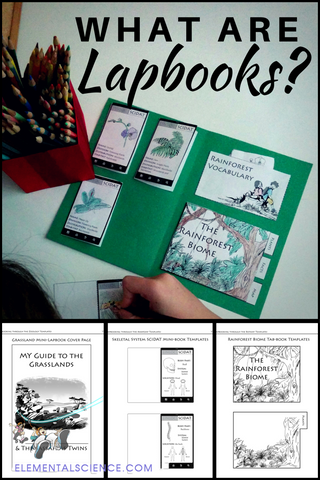
<p>Lapbooks are mini-notebooks for…you guessed it… your lap!</p>
<p>But what do lapbooks really look like? And how can you best use them for science? Keep reading to find out.</p>
<h1>What Are Lapbooks?</h1>
<div style="text-align: right;"><img src="//cdn.shopify.com/s/files/1/0881/2750/files/what_are_lapbooks_pin_large.png?v=1543843716" alt="What are lapbooks? Come get the answer from Elemental Science." style="margin-bottom: 10px; margin-left: 10px; float: right;"></div>
<p>We love mixing things up a bit in our homeschool and throwing a lapbook or two into the mix.</p>
<p>But before I share about how you can use lapbooks, let’s chat about what lapbooks are. Here is my definition:</p>
<blockquote>
<p><em>Lapbooks are educational scrapbooks that fit into the lap of a student.</em></p>
</blockquote>
<p>Typically, lapbooks are a collection of related mini-books on a certain subject. These mini-books are glued into a file folder for easy viewing, but they can also include pictures or projects that the students have completed.</p>
<p>In the same way that <a href="https://elementalscience.com/blogs/news/why-choose-notebooking-over-worksheets">notebooking</a> does not require regurgitation of facts, lapbooking causes the students to interact with the materials instead of just responding to comprehension questions.</p>
<p data-pm-slice="1 1 []">You can use lapbooks with any subject the students are learning about, making them extremely versatile. They are excellent tools to use with elementary students as a way of reinforcing what they are learning because this age group prefers a more creative format of notebooking.</p>
<h1>The Mini-Book at the Heart of the Lapbook</h1>
<p data-pm-slice="1 1 []">The heartbeat of the lapbook is the mini-books that are placed inside.</p>
<ul>
<li>
<p>Mini-books contain information on topics related to the primary subject of the lapbook.</p>
</li>
<li>
<p>Mini-books can be a variety of shapes and sizes, but the cover should have a picture related to the subject and a title.</p>
</li>
<li>
<p>The interior of each mini-book should contain several sentences detailing what the students have learned about the topic in their own words.</p>
</li>
<li>
<p>The mini-books each pertain to different sub-topics of the main lapbook topic.</p>
</li>
</ul>
<p>So for instance, for a lapbook could have the major topic of “plants”. The related mini-books could then be on the types of leaves, the kinds of flowers, the parts of a seed, and more.</p>
<h1>How Can You Use Lapbooks?</h1>
<p>Now that we know a bit more about lapbooks, let’s look at three different ways you can use them in your homeschool:</p>
<ol>
<li>You can use lapbooks to review a unit that you have just finished covering in your current curriculum.</li>
<li>You can use lapbooks to switch things up a bit by swapping a lapbook in for your regular notebook, logbook, or journal.</li>
<li>You can use a lapbook with your younger students, while your older students create a full notebook, logbook, or journal.</li>
</ol>
<p>However you choose to use lapbooks in your homeschool, your students will benefit from these educational scrapbooks!</p>
<h2>Science Lapbooks</h2>
<p>The good news is that we have many lapbooks that go along with our science programs!</p>
<ol>
<li>All our <a href="https://elementalscience.com/collections/science-chunks" target="_blank">Science Chunks</a> series have lapbook templates as part of each unit.</li>
<li>All our <a href="https://elementalscience.com/collections/sassafras-science" target="_blank">Sassafras Science</a> novels have corresponding lapbooking guides, with templates.</li>
<li>All of our <a href="https://elementalscience.com/collections/grammar-stage-science" target="_blank">Grammar Stage Classical Science</a> series have coordinating lapbooking templates.</li>
</ol>
<p>If you have any questions about lapbooks and using them for science, don't hesitate to drop us a line!</p>]]>
    </content>
  </entry>
  <entry>
    <id>https://elementalscience.com/blogs/news/3-things-every-homeschool-science-plan-needs</id>
    <published>2024-08-17T06:00:04-04:00</published>
    <updated>2024-08-17T06:00:04-04:00</updated>
    <link rel="alternate" type="text/html" href="https://elementalscience.com/blogs/news/3-things-every-homeschool-science-plan-needs"/>
    <title>The 3 things every homeschool science plan needs (don&apos;t forget no. 3)</title>
    <author>
      <name>Paige Hudson</name>
    </author>
    <summary type="html">
      <![CDATA[<div style="text-align: center;"><img style="float: none;" alt="What should a plan for science include? Come see the three things that you need to have a successful homeschool science plan. Don't forget number 3..." src="https://cdn.shopify.com/s/files/1/0881/2750/files/Three_things_you_need_for_240x240.png?v=1723654111"></div>
<p><span>What should your plan for homeschool science include? Click "Read More" to see the three things every successful homeschool science plan needs.</span></p><p><a class="read-more" href="https://elementalscience.com/blogs/news/3-things-every-homeschool-science-plan-needs">More</a></p>]]>
    </summary>
    <content type="html">
      <![CDATA[<div style="text-align: center;"><img style="float: none;" alt="What should a plan for science include? Come see the three things that you need to have a successful homeschool science plan. Don't forget number 3..." src="https://cdn.shopify.com/s/files/1/0881/2750/files/Three_things_you_need_for_1140_x_438_px.png?v=1723654456"></div>
<p data-pm-slice="1 1 []">Every homeschool science plan must include three things. Each of these will help your students gain a true understanding of the subject.</p>
<p>Since many of us are gearing up for the upcoming school year, we wanted to share with you all the three things that are essential to your plan for teaching science. We call these the three keys to teaching science.</p>
<p>Our hope is they will help you prepare and organize a plan for next year.</p>
<p>Don’t want to read through them? Check out our audiobook for <a href="https://a.co/d/aWBBc6v" target="_blank"><em>The Three Keys to Teaching Science</em></a> or watch a video about the three keys to teaching science!</p>
<center><iframe title="YouTube video player" src="https://www.youtube.com/embed/yOVbBNENkOU?si=9owhwutVJ56SP56k" height="315" width="560" allowfullscreen="" referrerpolicy="strict-origin-when-cross-origin" allow="accelerometer; autoplay; clipboard-write; encrypted-media; gyroscope; picture-in-picture; web-share" frameborder="0"></iframe></center>
<h1 style="text-align: center;">What every plan for homeschool science needs</h1>
<h2 data-pm-slice="1 1 []">#1—DO science</h2>
<p>The first essential is to actually DO science. A solid plan for homeschool science will have the students performing hands-on scientific tests.</p>
<p>These scientific tests can be:</p>
<ul>
<li>
<p>Teacher-led scientific <a href="https://elementalscience.com/blogs/news/89905795-scientific-demonstrations-or-experiments" target="_blank">demonstrations</a>,</p>
</li>
<li>
<p>Student-performed <a href="https://elementalscience.com/blogs/news/89905795-scientific-demonstrations-or-experiments" target="_blank">experiments</a>,</p>
</li>
<li>
<p><a href="https://elementalscience.com/blogs/news/nature-study" target="_blank">Nature studies,</a></p>
</li>
<li>
<p><a href="https://elementalscience.com/blogs/news/science-fair" target="_blank">Science fair projects</a>,</p>
</li>
<li>
<p>Or interactive on-line demonstrations.</p>
</li>
</ul>
<p>By doing, the students are seeing the concepts they are learning in action. They will engage with the information face-to-face and see science in action.</p>
<h2>#2—READ about science</h2>
<p>The second essential is to READ about science. A strong plan for homeschool science will have the students gather information from a reliable source.</p>
<p>The students can read from:</p>
<ul>
<li>
<p>Standard <a href="https://elementalscience.com/blogs/podcast/24" target="_blank">textbooks</a>,</p>
</li>
<li>
<p>Science-focused <a href="https://elementalscience.com/blogs/news/what-are-living-books" target="_blank">living books</a>,</p>
</li>
<li>
<p><a href="https://elementalscience.com/blogs/news/117976003-50-books-we-love-to-use-to-teach-science-at-home" target="_blank">Non-fiction works</a>,</p>
</li>
<li>
<p>Or age-appropriate <a href="https://elementalscience.com/blogs/news/117976003-50-books-we-love-to-use-to-teach-science-at-home" target="_blank">encyclopedias</a>.</p>
</li>
</ul>
<p>By reading scientific information from one of the above resources, the students are learning the information they need to know. They are learning about the science they saw, which helps them understand the principles and concepts involved.</p>
<h2>#3—WRITE science</h2>
<p>The final essential is to WRITE science. A sound plan for homeschool science will have the students keep a record of what they have learned.</p>
<p>The student can do this through:</p>
<ul>
<li>
<p><a href="https://elementalscience.com/blogs/news/what-is-notebooking" target="_blank">Notebooking pages</a>,</p>
</li>
<li>
<p><a href="https://elementalscience.com/blogs/news/why-choose-notebooking-over-worksheets" target="_blank">Comprehension worksheets</a>,</p>
</li>
<li>
<p><a href="https://elementalscience.com/blogs/news/what-are-lapbooks" target="_blank">Lapbooks</a>,</p>
</li>
<li>
<p>Or lab reports and <a href="https://elementalscience.com/blogs/news/how-to-record-an-experiment" target="_blank">experiment sheets</a>.</p>
</li>
</ul>
<p>By keeping a record, the students are organizing and sharing with others the facts they have studied.</p>
<div style="text-align: center;"><img style="float: none;" alt="What should a plan for science include? Come see the three things that you need to have a successful homeschool science plan. Don't forget number 3..." src="https://cdn.shopify.com/s/files/1/0881/2750/files/Three_things_you_need_for_Pinterest_Pin_480x480.png?v=1723654424"></div>
<h2>In a Nutshell</h2>
<p>What do you need to do for science? You need to...</p>
<ul>
<li>
<p>DO hands-on science</p>
</li>
<li>
<p>READ about science</p>
</li>
<li>
<p>WRITE what you learned</p>
</li>
</ul>
<p>That’s it!</p>
<p>The great news is that every one of our programs includes these three things already laid out for you. So if you are using a <a href="https://elementalscience.com/pages/where-do-i-start-with-elemental-science">homeschool science program from Elemental Science</a>, you can rest easy knowing that you are giving your students a solid science education at home.</p>
<p> </p>]]>
    </content>
  </entry>
  <entry>
    <id>https://elementalscience.com/blogs/news/5-ways-to-get-ready-for-homeschool-science-for-this-next-year</id>
    <published>2024-08-03T06:00:02-04:00</published>
    <updated>2024-08-03T06:00:02-04:00</updated>
    <link rel="alternate" type="text/html" href="https://elementalscience.com/blogs/news/5-ways-to-get-ready-for-homeschool-science-for-this-next-year"/>
    <title>5 Ways to Get Ready for Homeschool Science for this Next Year</title>
    <author>
      <name>Paige Hudson</name>
    </author>
    <summary type="html">
      <![CDATA[<div style="text-align: center;" data-mce-fragment="1" data-mce-style="text-align: center;"><img src="https://cdn.shopify.com/s/files/1/0881/2750/files/5_Ways_to_GEt_REady_for_another_year_of_240x240.png?v=1722516093" alt="Are you ready for another year of homeschool science? These five tips from Elemental Science will help." style="float: none;" data-mce-fragment="1" data-mce-style="float: none;" data-mce-src="https://cdn.shopify.com/s/files/1/0881/2750/files/5_Ways_to_GEt_REady_for_another_year_of_240x240.png?v=1722516093"></div>
<div data-mce-fragment="1" style="text-align: left;" data-mce-style="text-align: center;">Are you ready for another year of homeschool science? Click read more to see five ways you can use to get ready for this next year of teaching science at home. </div><p><a class="read-more" href="https://elementalscience.com/blogs/news/5-ways-to-get-ready-for-homeschool-science-for-this-next-year">More</a></p>]]>
    </summary>
    <content type="html">
      <![CDATA[<div style="text-align: center;"><img style="float: none;" alt="Are you ready for another year of homeschool science? These five tips from Elemental Science will help." src="https://cdn.shopify.com/s/files/1/0881/2750/files/5_Ways_to_GEt_REady_for_another_year_of_1140_x_438_px.png?v=1722516091"></div>
<p data-pm-slice="1 3 []">August often marks the beginning of the back-to-school season, or the not-back-to-school season if you are homeschooling!</p>
<p>And we want to help you get ready for another year of doing science at home. Here are five ways to get read for a new year of homeschooling.</p>
<p style="text-align: center;"><strong>NOTE -</strong> When you choose to use one of our science programs, we have taken care of most of this work for you! You can simply scan over your teacher guide to make sure you have the supplies you need on hand and skip down to step 5.</p>
<h1 style="text-align: center;">5 Ways to Get Ready for Homeschool Science for this Next Year</h1>
<div style="text-align: right;"><img style="margin-bottom: 10px; margin-left: 10px; float: right;" alt="Are you ready for another year of homeschool science? These five tips from Elemental Science will help." src="https://cdn.shopify.com/s/files/1/0881/2750/files/5_Ways_to_GEt_REady_for_another_year_of_Pinterest_Pin_600x600.png?v=1722516094"></div>
<h2 style="display: inline !important;">1. Get Ready for Experiments</h2>
<p style="display: inline !important;"> </p>
<p> </p>
<p>The first step for getting ready to do experiments is to plan them out. There are two options here:</p>
<ol>
<li>
<p>Get a program with the experiments planned out for you and take a moment to read over the first couple of weeks of experiments just to see what you have in store.</p>
</li>
<li>
<p>Pull out those experiment books or pull up your Pinterest account and search for science activities that will fit the topics you have planned.</p>
</li>
</ol>
<p>Your second step to getting ready for experiments is to gather the supplies you need for at least the first few weeks of experiments or for the entire year.</p>
<p>The last step is to prepare yourself for when things don’t go as planned. You will have an experiment that doesn’t go according to plan. When it does, you want to:</p>
<ul>
<li>
<p>Ask a few questions that will help you get to the heart of why the experiment didn’t go as planned.</p>
</li>
<li>
<p>Then, discuss what should have happened or you can correct the problems.</p>
</li>
<li>
<p>And try again if there is time.</p>
</li>
</ul>
<p>Going through this type of analysis will help you rescue that dud and turn it into a positive learning opportunity!</p>
<p>Once you plan your experiments, get your supplies ready, and prepare yourself for the work, you are ready to dig into sharing experiments with your kids this next year.</p>
<h3>More Homeschool Science Experiment Tips:</h3>
<ul>
<li><a href="https://elementalscience.com/blogs/news/88176259-5-tips-for-success-with-experiment-at-home" target="_blank">5 Tips for success with experiments at home</a></li>
<li><a href="https://elementalscience.com/blogs/podcast/23" target="_blank">Have you visited the realm of the failed science experiment?</a></li>
<li><a href="https://elementalscience.com/blogs/news/100-useful-items-science-supply-cabinet" target="_blank">100 Useful items for a science supply closet</a></li>
</ul>
<h2 style="display: inline !important;">2. Get Ready for Science Reading</h2>
<p>Just like with experiments, your first step in getting ready for your science reading is to plan out the books you are going to use.</p>
<p>You can choose:</p>
<ul>
<li>
<p>Children’s encyclopedias (DK, Usborne, or Kingfisher)</p>
</li>
<li>
<p>Living books (Sassafras Science)</p>
</li>
<li>
<p>Textbooks (Prentice Hall or CK-12)</p>
</li>
</ul>
<p>After you have the books you want to read from, the second step is to choose your reading selections. Start by figuring out how many weeks you have for each book and then divide up the pages you want to cover equally between the weeks.</p>
<p>Now that you have a plan in place for reading, you are ready for the last step of preparing for your discussion time. Yes, it is important to read the pages you have planned, but the discussion time you have afterward is the way you know your student understood and will remember the information you just read. You can use the following questions:</p>
<ul>
<li>
<p><strong>Leading Questions</strong>–This type of question pulls out the most important information. </p>
</li>
<li>
<p><strong>Broad Questions</strong>–This type of question will help you see what material the students have absorbed. </p>
</li>
<li>
<p><strong>General Questions</strong>–This type of question will allow you to see what the students found interesting. </p>
</li>
</ul>
<p>Once you plan your reading, get your books ready, and prepare yourself for discussion time, you are ready to dig into reading science with your kids this next year.</p>
<h3>More Homeschool Science Reading Tips:</h3>
<ul>
<li><a href="https://elementalscience.com/blogs/news/117976003-50-books-we-love-to-use-to-teach-science-at-home" target="_blank">50+ Books we love to use to teach science</a></li>
<li><a href="https://elementalscience.com/blogs/podcast/78" target="_blank">How do we narrate and what to expect</a></li>
<li><a href="https://elementalscience.com/blogs/podcast/53" target="_blank">Don't skip that science discussion time</a></li>
</ul>
<h2 style="display: inline !important;">3. Get Ready for Writing in Science</h2>
<p>The first step to getting ready for writing is to decide how you are going to keep a record. You can choose:</p>
<ul>
<li>
<p>Comprehension worksheets,</p>
</li>
<li>
<p>Notebooking,</p>
</li>
<li>
<p>Lapbooks,</p>
</li>
<li>
<p>Or some other form of writing.</p>
</li>
</ul>
<p>I recommend using notebooking with your students!</p>
<p>Once you have a plan for writing, you need to get ready to be flexible! Remember, the main point of teaching science is to learn about science - writing is just a tool you are using. If your student hates science because of the writing, simply modify the writing expectations so that they are easy on your child.</p>
<p>The third step for getting ready for writing in science is to be prepared to assess your student’s work. We believe students go through six stages over multiple years:</p>
<ol>
<li>
<p>Giving oral answers</p>
</li>
<li>
<p>Copying their oral narrations</p>
</li>
<li>
<p>Writing their own narrations</p>
</li>
<li>
<p>Finding and writing the facts</p>
</li>
<li>
<p>Organizing those facts</p>
</li>
<li>
<p>Summarizing those facts</p>
</li>
</ol>
<p>The main thing you are looking for in your child’s writing in science is consistent progress year after year. </p>
<p>Once you plan your writing, get ready to be flexible, and prepare knowing how to assess your children’s writing in science, you are ready to dig into writing in science with your kids this next year.</p>
<h3>More Homeschool Science Writing Tips:</h3>
<ul>
<li><a href="https://elementalscience.com/blogs/podcast/episode-12" target="_blank">Writing in Science: The Elementary Years</a></li>
<li>
<a href="https://elementalscience.com/blogs/podcast/episode-13" target="_blank">Writing in Science: Middle School and Beyond</a> </li>
<li><a href="https://elementalscience.com/blogs/podcast/127" target="_blank">Writing in Science with a Well-Trained Mind {Interview with Susan Wise Bauer}</a></li>
</ul>
<h2 style="display: inline !important;">4. Get Ready for the Extras</h2>
<p>Extras are all those fun things you sprinkle in throughout the year. These extras can be:</p>
<ul>
<li>
<p>Memory work,</p>
</li>
<li>
<p>Unit projects,</p>
</li>
<li>
<p>Related crafts,</p>
</li>
<li>
<p>Field trips,</p>
</li>
<li>
<p>And so much more.</p>
</li>
</ul>
<p>All these extra activities should add value and interest to the core of your science plans.</p>
<p>Once you decide what you are going to add, you need to do a bit of legwork to get ready for the extras. Here are a few ways you can get ready for the extras.</p>
<ol>
<li>
<p>Have your memory work selections printed out so you can reference them throughout the year. </p>
</li>
<li>
<p>Have an art and crafts box with the supplies you will need for arts and crafts projects. </p>
</li>
<li>
<p>Have a field trip folder with ideas in it. </p>
</li>
</ol>
<p>A caveat: Be ready to set aside those planned extras on the crazy weeks when life gets in the way. Do your best to add in those things that enhance your core science plans, but give yourself grace for the moments when that is not possible!</p>
<p>Once you plan out your extras, get ready with a bit of legwork, and prepare yourself for those crazy weeks. You are ready to dig into the science extras with your kids this next year.</p>
<h3>More Homeschool Science Extras:</h3>
<ul>
<li><a href="https://elementalscience.com/blogs/science-activities" target="_blank">The Elemental Science Activities Blog</a></li>
<li>Memory Work Guides (<a href="https://elementalscience.com/products/the-grammar-stage-reference-guide-for-science" target="_blank">Elementary</a><span> </span>and<span> </span><a href="https://elementalscience.com/products/the-logic-stage-reference-guide-for-science" target="_blank">Middle School</a>)</li>
<li><a href="https://elementalscience.com/blogs/homeschool-science-tips/friday-fun-day" target="_blank">Friday Fun Day</a></li>
<li><a href="https://elementalscience.com/blogs/homeschool-science-tips/field-trip" target="_blank">Science Field Trip Ideas</a></li>
</ul>
<h2 style="display: inline !important;">5. Get Read for the Tough Days</h2>
<p>There is one thing I want you to remember when it comes to teaching science—<strong>Plan for success but be prepared to be flexible.</strong></p>
<p>The good news is that over the last four steps, you have done the work of planning your year of science! But you can continue to plan for success by getting tips to help you as you work through those plans. You can do this by:</p>
<ul>
<li>
<p>Reading books,</p>
</li>
<li>
<p>Following helpful blogs</p>
</li>
<li>
<p>Or by listening to podcasts.</p>
</li>
</ul>
<p>Basically, you want to find a few places you can turn to when you hit a rough patch in your plans that you need to work through. </p>
<p>Remember the beauty of homeschooling is we can be flexible! When you have one of those days, let things go or change things up. You are in the driver’s seat of your science plans, so adjust them to meet your needs!</p>
<h3>More Homeschool Science Help:</h3>
<ul>
<li>Book: <a href="https://www.amazon.com/dp/B0CRCZDSZ3?ref_=cm_sw_r_mwn_dp_1SGANXGHCRP2S3Q3RAJE&amp;language=en_US" target="_blank">The Homeschooler's Guide to Experiments</a>
</li>
<li>Blog: <a href="https://elementalscience.com/blogs/news" target="_blank">The Elemental Science Blog</a>
</li>
<li>Podcast: <a href="https://tipsforhomeschoolscience.buzzsprout.com/" target="_blank">The Tips for Homeschool Science Show</a>
</li>
</ul>
<p>We hope you feel encouraged and ready to dig into a new year of homeschool science with your kids!</p>
<ol></ol>]]>
    </content>
  </entry>
  <entry>
    <id>https://elementalscience.com/blogs/news/tips-for-practicing-observation-skills-with-impromptu-nature-study</id>
    <published>2024-07-20T05:55:16-04:00</published>
    <updated>2024-07-20T05:55:16-04:00</updated>
    <link rel="alternate" type="text/html" href="https://elementalscience.com/blogs/news/tips-for-practicing-observation-skills-with-impromptu-nature-study"/>
    <title>3 Tips for practicing observation skills with impromptu nature study</title>
    <author>
      <name>Paige Hudson</name>
    </author>
    <summary type="html">
      <![CDATA[<div style="text-align: center;"><img alt="Impromptu nature study is a fantastic way to work on your kids observation skills. Check out these three tips from Elemental Science." src="https://cdn.shopify.com/s/files/1/0881/2750/files/3_Tips_for_practicing_observation_skills_-_IG_240x240.png?v=1720202587" style="float: none;"></div>
<div>
<p>Impromptu nature study is a fantastic way to work on your kids observation skills. Click read more to check out these three tips.</p>
</div><p><a class="read-more" href="https://elementalscience.com/blogs/news/tips-for-practicing-observation-skills-with-impromptu-nature-study">More</a></p>]]>
    </summary>
    <content type="html">
      <![CDATA[<div style="text-align: left;"><img src="https://cdn.shopify.com/s/files/1/0881/2750/files/3_Tips_for_practicing_observation_skills_-_IG_1140_x_438_px.png?v=1720202582" alt="Impromptu nature study is a fantastic way to work on your kids observation skills. Check out these three tips from Elemental Science." style="float: none;"></div>
<p>Last month we shared <a href="https://elementalscience.com/blogs/news/three-tips-summer-science" data-mce-href="https://elementalscience.com/blogs/news/three-tips-summer-science" target="_blank">three tips to help you avoid the summer science slip</a>. The first of those tips was to observe, observe, observe.</p>
<p>We wanted to give you some practical ideas for ways to incorporate observation into your summer plans. One of the best ways to do this is through <a href="https://elementalscience.com/blogs/podcast/episode-7" target="_blank">impromptu nature study</a>.</p>
<p>At its core, impromptu nature study is about taking advantage of the opportunities to study science outdoors as they present themselves. It is about opening your eyes to observe the changes in nature you encounter as you go about your day.</p>
<p>Now that we understand what impromptu nature study is, let's dig into the tips...</p>
<h1 style="text-align: center;">3 TIPS FOR PRACTICING OBSERVATION WITH IMPROMPTU NATURE STUDY</h1>
<img style="float: right;" src="https://cdn.shopify.com/s/files/1/0881/2750/files/July_News_list.png?1378922986777066238" alt="3 tips for practicing observation skills with impromptu nature study" data-mce-style="float: right;">
<p>So, how can you encounter opportunities for observation with impromptu nature study? There are lots of ways, but these three tips should get your juices flowing for ideas.</p>
<center></center>
<h2><strong>Tip #1 – Work in the Garden</strong></h2>
<p>Having your own garden for growing herbs and vegetables can be rewarding for many reasons. One of these is that it can teach your students about science. You can discuss how plants grow from a seed. You can share about monocots and dicots. You can talk about what soil is made of and how that affects how well it holds water. You can talk about the invertebrates, like worms and beetles, you find in and near the soil. <br><br>The possibilities are endless and the best thing about this is that you don’t have to plan out any of these opportunities. Rather, they will present themselves as you work in your garden.</p>
<h2><strong>Tip #2 – Go Hiking</strong></h2>
<p>Summer is a great time to get outdoors and hike your local trails. Not only will the hike provide needed exercise and family time, but you can learn some science along the way. <br><br>On the trail, you can see an insect, like the leaf miner, at work. You can see the work of decomposers on a fallen tree. You can see examples of rock weathering. You can observe a stream ecosystem. There are thousands of nature study subjects for you to explore and learn from while out on a hike.</p>
<h2><strong>Tip #3 – Play Outdoors</strong></h2>
<p>Playing outside allows your students to get the exercise and sunshine they need, plus it affords an opportunity to study the science that is displayed in your own backyard. <br><br>You can spot and collect insects, like moths, butterflies, and lightning bugs. You can talk about how the grass and plants in your yard grow more when there is more rain. You can talk about the purpose of the bark on the trees. You can talk about how bees play an important role in pollination. <br><br>As you can see, even your backyard is a science-filled playground! All you need to do is get outside and take advantage of the opportunities.</p>
<h1>IN A NUTSHELL</h1>
<p>Work in your garden, go for a hike, and play in your own backyard. These activities can lead to an impromptu nature study that will help your students practice their observation skills. <br><br>The science that you find in books is waiting to be discovered in the world around you. So, head outside this summer and observe it!</p>]]>
    </content>
  </entry>
  <entry>
    <id>https://elementalscience.com/blogs/news/if-you-give-your-kid-a-sassafras-science-adventures-book</id>
    <published>2024-07-13T06:00:02-04:00</published>
    <updated>2024-07-13T06:00:02-04:00</updated>
    <link rel="alternate" type="text/html" href="https://elementalscience.com/blogs/news/if-you-give-your-kid-a-sassafras-science-adventures-book"/>
    <title>If you give your kid a Sassafras Science Adventures book...</title>
    <author>
      <name>Paige Hudson</name>
    </author>
    <summary type="html">
      <![CDATA[<div style="text-align: center;" data-mce-fragment="1" data-mce-style="text-align: center;"><img src="https://cdn.shopify.com/s/files/1/0881/2750/files/If_you_give_your_kid_a_Sassafras_Science_book..._Instagram_Post_d90378e9-a6f0-4c5e-a502-cf690448e358_240x240.png?v=1720040495" alt="If you kid a Sassafras Science Adventure book, you'd better be ready for a lifetime legacy of science fun." style="float: none;" data-mce-fragment="1" data-mce-style="float: none;" data-mce-src="https://cdn.shopify.com/s/files/1/0881/2750/files/If_you_give_your_kid_a_Sassafras_Science_book..._Instagram_Post_d90378e9-a6f0-4c5e-a502-cf690448e358_240x240.png?v=1720040495"></div>
<div style="text-align: left;" data-mce-fragment="1" data-mce-style="text-align: center;">If you kid a Sassafras Science Adventure book, you'd better be ready for a lifetime legacy of science fun. Click to read the story...</div><p><a class="read-more" href="https://elementalscience.com/blogs/news/if-you-give-your-kid-a-sassafras-science-adventures-book">More</a></p>]]>
    </summary>
    <content type="html">
      <![CDATA[<div style="text-align: start;"><img style="float: none;" alt="If you kid a Sassafras Science Adventure book, you'd better be ready for a lifetime legacy of science fun." src="https://cdn.shopify.com/s/files/1/0881/2750/files/If_you_give_your_kid_a_Sassafras_Science_book..._1140_x_438_px.png?v=1720040470"></div>
<h1 style="text-align: center;" data-mce-fragment="1"><span style="font-weight: 400;" data-mce-fragment="1" data-mce-style="font-weight: 400;">If you give your kid a Sassafras Science Adventures book...</span></h1>
<center><iframe width="560" height="315" src="https://www.youtube.com/embed/7O9a62kRCrY?rel=0" frameborder="0" allow="autoplay; encrypted-media" allowfullscreen=""></iframe></center>
<p data-mce-fragment="1"><span style="font-weight: 400;" data-mce-fragment="1" data-mce-style="font-weight: 400;">If you give your kid a Sassafras Science Adventures book, he’ll take one look at the animals on the cover and want to read it.</span></p>
<p data-mce-fragment="1"><span style="font-weight: 400;" data-mce-fragment="1" data-mce-style="font-weight: 400;">He’ll grab it out of your hands and disappear to his room.</span></p>
<p data-mce-fragment="1"><span style="font-weight: 400;" data-mce-fragment="1" data-mce-style="font-weight: 400;">Hours later he’ll emerge and regale you with tales of adventures, weaving in the science he’s learned along the way.</span></p>
<p data-mce-fragment="1"><span style="font-weight: 400;" data-mce-fragment="1" data-mce-style="font-weight: 400;">He’ll ask you a question about giraffe saliva, which is okay because you have the activity guide. </span></p>
<p data-mce-fragment="1"><span style="font-weight: 400;" data-mce-fragment="1" data-mce-style="font-weight: 400;">You’ll pull it off the shelf and follow the directions for the experiment.</span></p>
<p data-mce-fragment="1"><span style="font-weight: 400;" data-mce-fragment="1" data-mce-style="font-weight: 400;">You’ll take pictures of him as he plays and observes.</span></p>
<p data-mce-fragment="1"><span style="font-weight: 400;" data-mce-fragment="1" data-mce-style="font-weight: 400;">You’ll ask him what he’s learned. </span></p>
<p data-mce-fragment="1"><span style="font-weight: 400;" data-mce-fragment="1" data-mce-style="font-weight: 400;">You’ll add his words and the picture to the project page in the SCIDAT logbook.</span></p>
<p data-mce-fragment="1"><span style="font-weight: 400;" data-mce-fragment="1" data-mce-style="font-weight: 400;">He’ll see what you’re doing and want to add more. </span></p>
<p data-mce-fragment="1"><span style="font-weight: 400;" data-mce-fragment="1" data-mce-style="font-weight: 400;">You’ll have to get out the coloring pencils and work with him to create pages for the giraffe, the lion, and the grasslands.</span></p>
<p data-mce-fragment="1"><span style="font-weight: 400;" data-mce-fragment="1" data-mce-style="font-weight: 400;">At the end of the semester, you’ll have a beautiful scrapbook of what he learned about animals.</span></p>
<p data-mce-fragment="1"><span style="font-weight: 400;" data-mce-fragment="1" data-mce-style="font-weight: 400;">It will sit on your bookshelf until years later your grandchildren discover the keepsake memento.</span></p>
<p data-mce-fragment="1"><span style="font-weight: 400;" data-mce-fragment="1" data-mce-style="font-weight: 400;">They’ll open it up and flip through the pages. </span></p>
<p data-mce-fragment="1"><span style="font-weight: 400;" data-mce-fragment="1" data-mce-style="font-weight: 400;">They’ll ask you questions and want to know more about the Sassafras Twins.</span></p>
<p data-mce-fragment="1"><span style="font-weight: 400;" data-mce-fragment="1" data-mce-style="font-weight: 400;">You’ll pull down your worn copy of <em>Volume One: Zoology</em>.</span></p>
<p data-mce-fragment="1"><span style="font-weight: 400;" data-mce-fragment="1" data-mce-style="font-weight: 400;">And if you give your grandchildren a Sassafras Science Adventures book, they’ll take one look at the animals on the cover and want to read it.</span></p>
<div style="text-align: center;"><img style="float: none;" alt="If you kid a Sassafras Science Adventure book, you'd better be ready for a lifetime legacy of science fun." src="https://cdn.shopify.com/s/files/1/0881/2750/files/If_you_give_your_kid_a_Sassafras_Science_book..._600x600.png?v=1720040504"></div>
<h2 data-mce-fragment="1"><span style="font-weight: 400;" data-mce-fragment="1" data-mce-style="font-weight: 400;">Start your adventure</span></h2>
<p data-mce-fragment="1"><span style="font-weight: 400;" data-mce-fragment="1" data-mce-style="font-weight: 400;">If you want to build a legacy of a love for science, start your adventure here:</span></p>
<ul>
<li><a href="https://elementalscience.com/collections/sassafras-science" target="_blank">The Sassafras Science Adventures</a></li>
</ul>]]>
    </content>
  </entry>
  <entry>
    <id>https://elementalscience.com/blogs/news/what-is-notebooking</id>
    <published>2024-07-06T06:30:01-04:00</published>
    <updated>2024-07-06T06:30:01-04:00</updated>
    <link rel="alternate" type="text/html" href="https://elementalscience.com/blogs/news/what-is-notebooking"/>
    <title>What Is notebooking? The 2 key components you need to know</title>
    <author>
      <name>Paige Hudson</name>
    </author>
    <summary type="html">
      <![CDATA[<div style="text-align: center;"><img src="https://cdn.shopify.com/s/files/1/0881/2750/files/What_is_Notebooking_240x240.png?v=1719944777" style="float: none;" alt="Notebooking has two key components - the material and the visual. Come learn about both in this post from Elemental Science."></div>
<div style="text-align: left;">What is notebooking? Click to read about the two key components of notebooking and more!</div><p><a class="read-more" href="https://elementalscience.com/blogs/news/what-is-notebooking">More</a></p>]]>
    </summary>
    <content type="html">
      <![CDATA[<div style="text-align: left;"><img style="float: none;" alt="Notebooking has two key components - the material and the visual. Come learn about both in this post from Elemental Science." src="https://cdn.shopify.com/s/files/1/0881/2750/files/What_is_Notebooking_1140_x_438_px.png?v=1719944774"></div>
<p data-pm-slice="1 1 []">What is notebooking?</p>
<p>What does a notebooking page need?</p>
<p>We are answering these two questions and more in this article, so keep reading!</p>
<h2>What is Notebooking?</h2>
<p>Notebooking is a method of interacting with and recording the information that students are learning.</p>
<p>It asks the students don’t regurgitate facts, but rather they think about what they have read or heard. Then, the students respond with what they have found to be meaningful.</p>
<p>I have found notebooking to be an effective tool that, over time, teaches students how to process and release information.</p>
<p>At its core, notebooking has two key components:</p>
<ol>
<li>
<p><strong>Material Content</strong></p>
</li>
<li>
<p><strong>Visual Content</strong></p>
</li>
</ol>
<p>Both are equally important since they each engage different parts of the students’ brains.</p>
<h2>The Material Component of Notebooking</h2>
<div style="text-align: right;"><img style="margin-bottom: 10px; margin-left: 10px; float: right;" src="https://cdn.shopify.com/s/files/1/0881/2750/files/What_is_Notebooking_Pinterest_Pin_600x600.png?v=1719944776" alt="Notebooking has two key components - the material and the visual. Come learn about both in this post from Elemental Science."></div>
<p>The material component of notebooking contains the information the students have learned. It should contain:</p>
<ul>
<li>
<p>A record of what the students find to be meaningful,</p>
</li>
<li>
<p>Or documentation of what you would like for the students to remember.</p>
</li>
</ul>
<p>You can get this information from the students by asking open-ended questions like:</p>
<ul>
<li>
<p>What did you find interesting about what we just read?</p>
</li>
<li>
<p>What do you remember from what we just studied?</p>
</li>
</ul>
<p>These questions will help the students plan a record of what they found to be meaningful.</p>
<p>If you want the students to document specific information, you can ask them leading questions. These answers will help them plan out the desired response before they write it down on their notebooking page.</p>
<p>Essentially, the material component is a written record of the facts the students have studied.</p>
<h2>The Visual Component of Notebooking</h2>
<p>The visual component of notebooking displays a picture of the concept the students have studied.</p>
<p>Students can:</p>
<ul>
<li>
<p>Print out an actual picture;</p>
</li>
<li>
<p>Make their own copy of a real-life photo;</p>
</li>
<li>
<p>Or draw their own version.</p>
</li>
</ul>
<p>They can look at the internet or in encyclopedias for these images. The key is to have the students use an illustration that relates to the information they have written down.</p>
<p>At its core, the visual component is a visible representation of the information the students have learned.</p>
<h2>How to use these two components</h2>
<p>However, how you arrange the two components of notebooking is up to you and your students. You have the freedom to display the key elements through:</p>
<ul>
<li>
<p>Notebooking Pages</p>
</li>
<li>
<p>Lapbooks</p>
</li>
<li>
<p>Booklets</p>
</li>
<li>
<p>Posters</p>
</li>
</ul>
<p>Good news—&gt;notebooking is what we use in all our programs here at Elemental Science! Come check out <a href="https://elementalscience.com/pages/where-do-i-start-with-elemental-science" target="_blank" rel="noopener noreferrer">our award-winning science programs</a> to see which one fits your family best.</p>
<p>However you choose to use notebooking methods in your homeschooling the material and visual components will help to solidify the information in the students’ minds.</p>]]>
    </content>
  </entry>
  <entry>
    <id>https://elementalscience.com/blogs/news/5-ways-you-can-learn-about-science-and-have-fun-during-the-summer</id>
    <published>2024-06-22T06:00:03-04:00</published>
    <updated>2024-06-22T06:00:03-04:00</updated>
    <link rel="alternate" type="text/html" href="https://elementalscience.com/blogs/news/5-ways-you-can-learn-about-science-and-have-fun-during-the-summer"/>
    <title>5 Ways You Can Learn About Science And Have Fun During The Summer</title>
    <author>
      <name>Paige Hudson</name>
    </author>
    <summary type="html">
      <![CDATA[<div style="text-align: center;"><img style="float: none;" alt="Looking to add some science fun to your summer plans? These five ideas from Elemental Science are perfect for you." src="https://cdn.shopify.com/s/files/1/0881/2750/files/5_ways_to_Learn_about_science_this_summer_240x240.png?v=1717166687"></div>
<p>We have always called summer the fun season and in the past, we called science the boring subject. But we have discovered five ways you can learn about science and still have fun this summer!</p><p><a class="read-more" href="https://elementalscience.com/blogs/news/5-ways-you-can-learn-about-science-and-have-fun-during-the-summer">More</a></p>]]>
    </summary>
    <content type="html">
      <![CDATA[<div style="text-align: center;"><img style="float: none;" alt="Looking to add some science fun to your summer plans? These five ideas from Elemental Science are perfect for you." src="https://cdn.shopify.com/s/files/1/0881/2750/files/5_ways_to_Learn_about_science_this_summer_1140_x_438_px.png?v=1717166531"></div>
<p data-pm-slice="1 1 []">Lots of people love summer. And lots of people find science boring. But what if you mixed science with summer?</p>
<p>Well, that leads to everyone having a blast! Here are five ways you can learn about science during the summer.</p>
<h1 style="text-align: center;">5 Ways You Can Learn About Science This Summer</h1>
<div id="buzzsprout-player-12922163"></div>
<script charset="utf-8" type="text/javascript" src="https://www.buzzsprout.com/784577/12922163-5-ways-to-learn-about-science-this-summer-audio-blog-from-elemental-science.js?container_id=buzzsprout-player-12922163&amp;player=small"></script>
<p style="float: right;"> </p>
<div style="text-align: right;"><img style="margin-bottom: 5px; margin-left: 5px; float: right;" alt="Looking to add some science fun to your summer plans? These five ideas from Elemental Science are perfect for you." src="https://cdn.shopify.com/s/files/1/0881/2750/files/5_ways_to_Learn_about_science_this_summer_Pinterest_Pin_480x480.png?v=1717166534"></div>
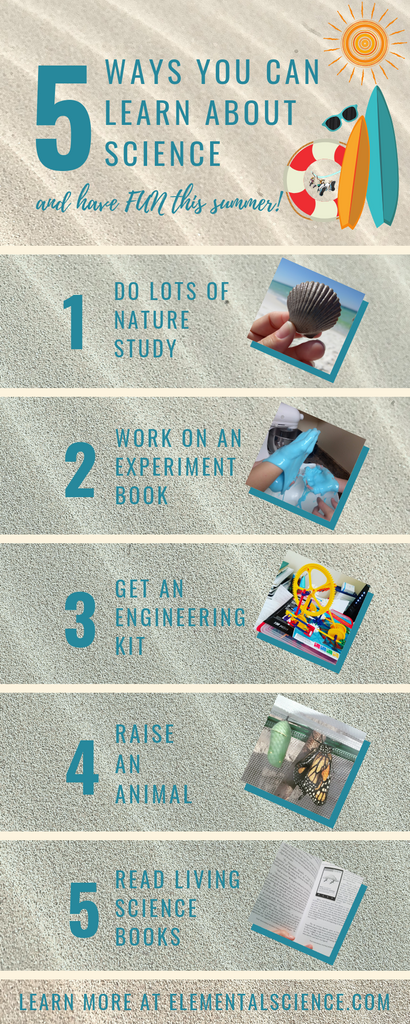
<h2>1. Do lots of nature study.</h2>
<p data-pm-slice="1 1 []">The sun is shining. The temps are warm. And nature is out on display during this season!</p>
<p>So our first tip is to...</p>
<blockquote>
<p><em>Do lots of nature study at the beach or in your backyard!</em></p>
</blockquote>
<p>You can plan out nature study field trips to local state parks, or just learn about the things you encounter on our daily walk. Here are a few tips about nature study to help you get started:</p>
<ul>
<li><a href="https://elementalscience.com/blogs/podcast/episode-7" target="_blank">Learning science on the fly</a></li>
<li><a href="http://elementalblogging.com/digital-nature-study/" target="_blank">What is digital nature study?</a></li>
<li><a href="https://elementalscience.com/blogs/news/science-apps" target="_blank">12 Science apps you can find on our phone</a></li>
</ul>
<p>Either way, you will have a blast learning about nature this summer!</p>
<h2>2. Do lots of experiments.</h2>
<p>It's always fun to get your hands dirty and experiment with science, which leads us to our second tip...</p>
<blockquote>
<p><em>Do those experiments and learn as you play with science!</em></p>
</blockquote>
<p data-pm-slice="1 1 []">You can grab an experiment book. We highly recommend any experiment book by Janice VanCleave, or you can just pick experiments from <a href="https://www.pinterest.com/elementalscienc/" target="_blank">Pinterest</a> to try out.</p>
<p>Maybe you can do all those activities you didn't get to during the school year - things like <a href="https://elementalscience.com/blogs/science-activities/owl-pellet-dissection">dissecting an owl pellet</a>. Or you can just work your way through these <a href="https://elementalscience.com/blogs/science-activities/48-more-summer-science-activities-for-you-to-enjoy">48 summer science activities</a>.</p>
<p>Either way, you'll have a blast playing with science this summer!</p>
<h2>3. Get an engineering kit.</h2>
<p>Have you ever heard of STEM (or STEAM)? Yep, these days it's just about everywhere. And if you didn't already know, the "E" stands for engineering, which is why our third tip is to...</p>
<blockquote>
<p><em>Get an engineering kit to build on those rare rainy days!</em></p>
</blockquote>
<p>Here are a few of our fav's:</p>
<ul>
<li><a href="https://www.amazon.com/KNEX-Education-Simple-Machines-Engineering/dp/B000O910E2/ref=sr_1_3?ie=UTF8&amp;qid=1527616603&amp;sr=8-3&amp;keywords=knex+gears+kit" target="_blank">K'Nex Simple Machines - Gears Kit</a></li>
<li><a href="https://www.amazon.com/Snap-Circuits-Snaptricity-Electronics-Discovery/dp/B0013BL3LK/ref=sr_1_1_sspa?ie=UTF8&amp;qid=1527616709&amp;sr=8-1-spons&amp;keywords=snap+circuits+jr+sc-100+electronics+discovery+kit&amp;psc=1" target="_blank">Snap Circuits Junior Kit</a></li>
</ul>
<p>But you don't have to buy a kit, you can just open up a bin of LEGOs, give your kids a pack of popsicle sticks, or build with sticks and rocks you collected outside.</p>
<p>Either way, you'll have a blast engineering new creations this summer!</p>
<h2>4. Raise an animal.</h2>
<p>A few years back, we actually <a href="https://elementalscience.com/blogs/science-activities/how-to-grow-a-butterfly-a-zoology-project">raised a few caterpillars into butterflies</a> and it was something we will never forget! It's the reason we are sharing our fourth tip...</p>
<blockquote>
<p><em>Raise an animal and watch a life cycle in action!</em></p>
</blockquote>
<p>You can raise butterflies or frogs. You can raise chickens or hang up a birdhouse and keep an eye out for a nest. Or you can get add a new kitten or puppy to your family and watch it grow over the summer.</p>
<p>Either way, you'll have a blast raising an animal this summer!</p>
<h2>5. Read living science books.</h2>
<p>Let's face it - during the dog days of summer, it's just plain hot. You need to get out of the sun for a bit and that's why our fifth tip is to...</p>
<blockquote>
<p><em>Read living science books and enjoy taking a break from the sun!</em></p>
</blockquote>
<p>Of course, we know a few <a href="https://elementalscience.com/collections/the-sassafras-science-adventures-novels">science adventure novels</a> you could read and enjoy {wink, wink, nudge, nudge}, but we have also shared a longer list here:</p>
<ul>
<li><a href="https://elementalscience.com/blogs/news/living-books-for-science">A List of Living Books for Science</a></li>
</ul>
<p>Whatever you choose, you'll have a blast getting wrapped up in a few living science books this summer!</p>
<h1>Wrapping It Up</h1>
<p><img src="//cdn.shopify.com/s/files/1/0881/2750/files/5_Ways_You_can_Learn_about_Science_-_infographic_1024x1024.png?v=1546003627" alt="5 Ways you can learn about science and have fun during the summer" style="display: block; margin-left: auto; margin-right: auto;"></p>
<p>Whether you choose to do some nature study, do some experiments, get an engineering kit, raise an animal or read a few living science books, we are positive that adding a bit of science to your summer plans will be a blast!</p>]]>
    </content>
  </entry>
  <entry>
    <id>https://elementalscience.com/blogs/news/5-free-homeschooling-workshops-for-science</id>
    <published>2024-06-15T06:00:02-04:00</published>
    <updated>2024-06-15T06:00:02-04:00</updated>
    <link rel="alternate" type="text/html" href="https://elementalscience.com/blogs/news/5-free-homeschooling-workshops-for-science"/>
    <title>5 Free Workshops to Help you Plan Science in your Homeschool (Season 2 Recap)</title>
    <author>
      <name>Paige Hudson</name>
    </author>
    <summary type="html">
      <![CDATA[<p style="text-align: center;"> <img src="//cdn.shopify.com/s/files/1/0881/2750/files/Free_Workshops_-_feature_medium.png?v=1528717487" alt=""></p>
<p>We shared 5 completely free workshops from our conference vaults as part of Season 2 of the Tips for Homeschool Science Show. Click "Read More" to see each of these episodes along with our plans for season 3 of the show!</p><p><a class="read-more" href="https://elementalscience.com/blogs/news/5-free-homeschooling-workshops-for-science">More</a></p>]]>
    </summary>
    <content type="html">
      <![CDATA[<p style="text-align: left;"><img style="float: none;" src="//cdn.shopify.com/s/files/1/0881/2750/files/season_2_recap_long.png?v=1527533201" alt="Listen to 5 workshops to help with homeschool science for free"></p>
<p data-pm-slice="1 1 []">We want to help you teach science at home! It’s the reason behind why we share everything at Elemental Science.</p>
<p>In that spirit, we opened our vaults to share with you five completely free workshops as part of Season 2 of the Tips for Homeschool Science Show. Each of these workshops will help you as you create your plans for science in your homeschool. </p>
<p>We broke each of the sessions up into three 15 to 20-minute podcasts, but we also shared <a href="https://www.youtube.com/watch?v=yOVbBNENkOU&amp;list=PLoySKHT1OQt5F4MEC73_8Lqc-UGSlNtVt" target="_blank">videos of each session</a> on our YouTube channel.</p>
<p>Let's dig in!</p>
<p> </p>
<h1 style="text-align: center;">5 Free Workshops from the Tips for Homeschool Science Show Season 2</h1>
<img style="float: right; margin-left: 10px; margin-bottom: 10px;" src="//cdn.shopify.com/s/files/1/0881/2750/files/5_Free_Workshops_to_Help_you_Plan_Science_in_your_Homeschool_grande.png?v=1528212504" alt="5 Free Workshops to Help you Plan Science in your Homeschool">
<h2>Workshop #1 - The Three Keys for Teaching Science at Home</h2>
<p><strong>Session Description:</strong><span> </span>In this session, Paige details the three key ingredients for teaching science in your homeschool. She also provides several tools and methods you can use to apply the keys to your homeschool education plan from preschool through high school.</p>
<p>Watch the full <a href="https://youtu.be/yOVbBNENkOU" target="_blank">3 Keys to Teaching Science video</a> or listen to the three session episodes:</p>
<ol>
<li><a href="https://elementalscience.com/blogs/podcast/35" target="_blank">Ep 35 - Hands-on Science 101</a></li>
<li><a href="https://elementalscience.com/blogs/podcast/36" target="_blank">Ep 36 - Finding Scientific Information 101</a></li>
<li><a href="https://elementalscience.com/blogs/podcast/37" target="_blank">Ep 37 - Notebooking for Science 101</a></li>
</ol>
<h2>Workshop #2 - Inspiring your students to love science through living books</h2>
<p><strong>Session Description:</strong><span> In this session, Paige defines what qualifies a book as “living” and shares how to use these resources effectively in your homeschool. She also gives several examples of how to foster a love of science in your students through the use of living books as spines or supplements in your homeschool.</span></p>
<p>Watch the full <a href="https://youtu.be/Dvk1LfYGONw" target="_blank">Living Books for Science video</a> or listen to the three session episodes:</p>
<ol>
<li><a href="https://elementalscience.com/blogs/podcast/38" target="_blank">Ep 38 - Choosing &amp; Using Living Books</a></li>
<li><a href="https://elementalscience.com/blogs/podcast/39" target="_blank">Ep 39 - How to use Living Books (elementary)</a></li>
<li><a href="https://elementalscience.com/blogs/podcast/40" target="_blank">Ep 40 - How to use Living Books (middle)</a></li>
</ol>
<h2>Workshop #3 - I want to teach science, but these three hurdles stand in my way</h2>
<p><span><strong>Session Description: </strong>In this session, Paige tackles the top three reasons people are afraid to teach science</span>—<span>experience, experiments, and equipment. She provides tips to help you jump over each of these hurdles and get straight to the science-learning fun!</span></p>
<p>Watch the full <a href="https://youtu.be/LpqmPAddE1s" target="_blank">Getting Over Three Science-teaching Hurdles video</a> or listen to the three session episodes:</p>
<ol>
<li><a href="https://elementalscience.com/blogs/podcast/41" target="_blank">Ep 41 - The Hurdle of Experiments</a></li>
<li><a href="https://elementalscience.com/blogs/podcast/42" target="_blank">Ep 42 - The Hurdle of Experience</a></li>
<li><a href="https://elementalscience.com/blogs/podcast/43" target="_blank">Ep 43 - The Hurdle of Equipment</a></li>
</ol>
<h2>Workshop #4 - Nature Study - the natural way to study science</h2>
<p><span><strong>Session Description: </strong>In this session, Paige explains what nature study is and where this method fits into science education. She shares about nature journals, how to use nature study with the whole family, and what nature study can look like in each of the seasons. You’ll be inspired to add this beneficial tool to your bag of science-teaching tricks!</span></p>
<p>Watch the full <a href="https://youtu.be/1U2t7oSxDKA" target="_blank">Nature Study video</a> or listen to the three session episodes:</p>
<ol>
<li><a href="https://elementalscience.com/blogs/podcast/44" target="_blank">Ep 44 - The natural way to learn about science</a></li>
<li><a href="https://elementalscience.com/blogs/podcast/45" target="_blank">Ep 45 - The two types of nature study</a></li>
<li><a href="https://elementalscience.com/blogs/podcast/46" target="_blank">Ep 46 - The sufficiency of nature study</a></li>
</ol>
<h2>Workshop #5 - Eliminate your fears and doubts surrounding the science fair project</h2>
<p><span><strong>Session Description:</strong> In this session, Paige helps you move past the fear and doubt you have surrounding the much-dreaded science fair project! She shares eight easy steps to complete a science fair project along with tips on when you should do one and advice for setting up a homeschool science fair co-op in your area.</span></p>
<p>Watch the full <a href="https://youtu.be/0BtGDKbAjMk" target="_blank">Science Fair Project video</a> or listen to the three session episodes:</p>
<ol>
<li><a href="https://elementalscience.com/blogs/podcast/47" target="_blank">Ep 47 - Do you really have to do a science fair project?</a></li>
<li><a href="https://elementalscience.com/blogs/podcast/48" target="_blank">Ep 48 - How to get through your science fair project</a></li>
<li><a href="https://elementalscience.com/blogs/podcast/49" target="_blank">Ep 49 - Wrapping up your science fair project</a></li>
</ol>
<h1 style="text-align: center;">Wrapping it up</h1>
<p>Well, that's a look at season two of the<span> </span><a href="https://elementalscience.com/blogs/podcast" target="_blank">Tips for Homeschool Science Show</a>. If there's a question you want to be answered or a topic you want to be covered in future episodes, let us know in the comments below!</p>]]>
    </content>
  </entry>
  <entry>
    <id>https://elementalscience.com/blogs/news/three-tips-summer-science</id>
    <published>2024-06-01T06:00:22-04:00</published>
    <updated>2024-06-01T06:00:22-04:00</updated>
    <link rel="alternate" type="text/html" href="https://elementalscience.com/blogs/news/three-tips-summer-science"/>
    <title>3 Tips for summer science to help you enjoy the season</title>
    <author>
      <name>Paige Hudson</name>
    </author>
    <summary type="html">
      <![CDATA[<div style="text-align: center;"><img alt="Get three tips for adding some science fun to your summer plans from Elemental Science" src="https://cdn.shopify.com/s/files/1/0881/2750/files/See_the_Tips_Instagram_Post_240x240.png?v=1716567936" style="float: none;"></div>
<div style="text-align: left;">
<p>Ahh, the lazy days of summer. Time to sleep in. Time to sit back and relax and sneak in a bit of science with these three tips. Click to "Read More" to see them.</p>
</div><p><a class="read-more" href="https://elementalscience.com/blogs/news/three-tips-summer-science">More</a></p>]]>
    </summary>
    <content type="html">
      <![CDATA[<div style="text-align: center;"><img style="float: none;" alt="Get three tips for adding some science fun to your summer plans from Elemental Science" src="https://cdn.shopify.com/s/files/1/0881/2750/files/See_the_Tips_1140_x_438_px.png?v=1716567657"></div>
<p>Ahh, the lazy days of summer. </p>
<p>Time to sleep in. </p>
<p>Time to sit back and relax by the pool with a cool drink. </p>
<p>Time to watch every bit of information you worked so hard to share with your students just wash away like waves at the beach. </p>
<p>Umm...not so much.</p>
<h1 style="text-align: center;" data-mce-style="text-align: center;">Three Tips for Summer Science</h1>
<p><span>We have all heard of the summer slip and we work hard to prevent it. This month, we want to share with you three tips for incorporating science into your summer. So that you can guarantee your students will be fresh and ready for when school begins once more!</span></p>
<h2>Tip #1. Observe, Observe, Observe</h2>
<p>The summer weather is a perfect time to get out and explore nature while building your students' observation skills. You can have them look at the environment around them and note the plants and animals they see. They can observe the movement and behaviors of the animals in the area, such as what trees the birds like to visit the most. </p>
<p data-pm-slice="1 1 []">The students can see the changes and differences in the nature around them as they pay attention to it. Through these observations, the students will learn a lot about nature and a lot about science. If you want to learn more about nature study, check out:</p>
<ul>
<li><a href="https://elementalscience.com/blogs/podcast/episode-8" data-mce-href="https://elementalscience.com/blogs/podcast/episode-8" target="_blank">What is Nature Study?</a></li>
<li><a href="https://elementalscience.com/blogs/podcast/122" target="_blank" data-mce-href="https://elementalscience.com/blogs/podcast/122">Nature Study Interview with Cindy West</a></li>
</ul>
<a data-pin-do="embedBoard" href="https://www.pinterest.com/elementalscienc/nature-study/" data-pin-scale-width="80" data-pin-scale-height="200" data-pin-board-width="600"> Follow Elemental Science 's board Nature Study on Pinterest.</a><!-- Please call pinit.js only once per page --><script src="//assets.pinterest.com/js/pinit.js" async="" type="text/javascript"></script>
<h2>Tip #2. Do the Really Big Experiments</h2>
<p>If you don’t have a regular schedule during the summer, this is a great time to work on the really big experiments. You know, the ones that you put off doing during the year, like building a volcano or firing of a rocket. Not only will you be able to check the project off the list, but the student will also learn about science in the process.</p>
<p>The other option would be to have the students work on their science fair project during the summer. Although this would limit their presentation options, they will still have a successful learning experience. Check out the following series to learn more about doing a science fair project:</p>
<ul>
<li>Ep. 1 -<span> </span><a href="https://elementalscience.com/blogs/podcast/sfp-1" aria-label="How to pick your science fair project topic (Hint: Start with something interesting.) - Opens in a new tab" data-mce-href="https://elementalscience.com/blogs/podcast/sfp-1" target="_blank">How to pick your science fair project topic (Hint: Start with something interesting.)</a>
</li>
<li>Ep. 2 - <a href="https://elementalscience.com/blogs/podcast/sfp-2" aria-label="Every great project includes a bit of research, now it's your turn - Opens in a new tab" data-mce-href="https://elementalscience.com/blogs/podcast/sfp-2" target="_blank">Every great project includes a bit of research, now it's your turn</a>
</li>
<li>Ep. 3 - <a href="https://elementalscience.com/blogs/podcast/sfp-3" aria-label="Now you are ready to make an educated guess, or rather how to formulate your hypothesis - Opens in a new tab" data-mce-href="https://elementalscience.com/blogs/podcast/sfp-3" target="_blank">Now you are ready to make an educated guess, or rather how to formulate your hypothesis</a>
</li>
<li>Ep. 4 - <a href="https://elementalscience.com/blogs/podcast/sfp-4" aria-label="Roll up your sleeves, it is time to design your science fair project experiment!  - Opens in a new tab" data-mce-href="https://elementalscience.com/blogs/podcast/sfp-4" target="_blank">Roll up your sleeves, it is time to design your science fair project experiment!</a>
</li>
<li>Ep. 5 -<span> </span><a href="https://elementalscience.com/blogs/podcast/sfp-5" aria-label="Dust off your lab coat and goggles, it is time to get dirty and do your experiment!  - Opens in a new tab" data-mce-href="https://elementalscience.com/blogs/podcast/sfp-5" target="_blank">Dust off your lab coat and goggles, it is time to get dirty and do your experiment!</a>
</li>
<li>Ep. 6 -<span> </span><a href="https://elementalscience.com/blogs/podcast/sfp-6" aria-label="Time to figure out what is what - how to analyze your data - Opens in a new tab" data-mce-href="https://elementalscience.com/blogs/podcast/sfp-6" target="_blank">Time to figure out what is what - how to analyze your data</a>
</li>
<li>
<span>Ep. 7 - </span><a href="https://elementalscience.com/blogs/podcast/sfp-7" aria-label="Invite the grandparents and neighbors to see a superb science fair presentation - Opens in a new tab" data-mce-href="https://elementalscience.com/blogs/podcast/sfp-7" target="_blank">Invite the grandparents and neighbors to see a superb science fair presentation</a>
</li>
</ul>
<a data-pin-do="embedBoard" href="https://www.pinterest.com/elementalscienc/science-fair/" data-pin-scale-width="80" data-pin-scale-height="200" data-pin-board-width="600"> Follow Elemental Science 's board Science Fair on Pinterest.</a>
<h2>Tip #3. Read, Read, Read</h2>
<p data-pm-slice="1 1 []">Summer is the perfect time for students to immerse themselves in a science book. It’s also an ideal time to catch up on all the reading you missed throughout the year. Many libraries have a summer reading program that rewards students for the books they read during the season. Who’s to say that you can’t require that your students read at least one science book for their prize? </p>
<p>If you would like to learn more about what makes up a living book or see our summer-long science adventure, check out:</p>
<ul>
<li><a href="https://elementalscience.com/blogs/news/what-are-living-books" data-mce-href="https://elementalscience.com/blogs/news/what-are-living-books">What are Living Books?</a></li>
<li><a href="https://elementalscience.com/collections/the-sassafras-science-adventures-novels" target="_blank" data-mce-href="https://elementalscience.com/collections/the-sassafras-science-adventures-novels">Our Science Adventure Series Perfect for Summer</a></li>
</ul>
<a data-pin-do="embedBoard" href="https://www.pinterest.com/sassafrassci/living-books/" data-pin-scale-width="80" data-pin-scale-height="200" data-pin-board-width="600"> Follow Sassafras Science Adventures's board Living Books on Pinterest.</a>
<h1 style="text-align: center;" data-mce-style="text-align: center;"><strong>Summer Science Tips in a Nutshell</strong></h1>
<div style="text-align: center;"><img style="float: none;" alt="Get three tips for adding some science fun to your summer plans from Elemental Science" src="https://cdn.shopify.com/s/files/1/0881/2750/files/tips_for_summer_sci_Infographic_1_1024x1024.png?v=1716567933"></div>
<p data-pm-slice="1 1 []">You can incorporate a bit of science into your summer through observations, big experiments, and living books. Doing so will ensure that what your students learned this past year will not magically disappear out of their minds!</p>]]>
    </content>
  </entry>
  <entry>
    <id>https://elementalscience.com/blogs/news/the-index-card-system</id>
    <published>2024-05-20T06:30:01-04:00</published>
    <updated>2024-05-27T07:36:30-04:00</updated>
    <link rel="alternate" type="text/html" href="https://elementalscience.com/blogs/news/the-index-card-system"/>
    <title>The Index Card System: A Perfect Way to Organize your Science Research</title>
    <author>
      <name>Paige Hudson</name>
    </author>
    <summary type="html">
      <![CDATA[<div style="text-align: center;" data-mce-fragment="1" data-mce-style="text-align: center;"><img src="https://cdn.shopify.com/s/files/1/0881/2750/files/The_Index_Card_System_240x240.png?v=1714493084" alt="The index card system" style="float: none;" data-mce-fragment="1" data-mce-style="float: none;" data-mce-src="https://cdn.shopify.com/s/files/1/0881/2750/files/The_Index_Card_System_240x240.png?v=1714493084" loading="lazy"></div>
<div style="text-align: center;" data-mce-fragment="1" data-mce-style="text-align: center;">The index card system is a perfect way to organize your research for any science report or research paper. Click "Read More" to learn about this system.</div><p><a class="read-more" href="https://elementalscience.com/blogs/news/the-index-card-system">More</a></p>]]>
    </summary>
    <content type="html">
      <![CDATA[<div style="text-align: center;"><img src="https://cdn.shopify.com/s/files/1/0881/2750/files/The_Index_Card_System_1140_x_438_px.png?v=1714493084" alt="The index card system is a perfect way to organize your research for any science report or research paper." style="float: none;"></div>
<p>In high school, one of my teachers taught me a method for using index cards in the research phase of writing reports. Through my college years, it developed into what I now affectionately refer to as the index card system.</p>
<p>In a nutshell, this method uses index cards for recording facts, and then organizes these cards into a straightforward outline that the students can draw from when writing their paper.</p>
<p>I don’t hold the market on this system, as I’m sure I’m not the first to use index cards to prepare for a <a href="https://elementalscience.com/blogs/news/what-is-the-difference-between-a-report-and-a-research-paper-for-science" target="_blank">research report or paper</a>. However, I thought I would take a moment to share this simple technique for organizing research with you.</p>
<h2 style="text-align: center;"><span mce-data-marked="1">The Index Card System: A Perfect Way to Organize your Science Research</span></h2>
<div style="text-align: right;"><img src="https://cdn.shopify.com/s/files/1/0881/2750/files/The_Index_Card_System_Pinterest_Pin_600x600.png?v=1714493084" alt="The index card system is a perfect way to organize your research for any science report or research paper." style="margin-bottom: 10px; margin-left: 10px; float: right;"></div>
<h2><span>STEP 1: GETTING READY</span></h2>
<p>The students will need to begin their research project by selecting a topic for research. Once they have that, they need to choose several categories into which their information will fall. These will help them organize their index cards and help them know how to determine what information is important to their project and what is not.</p>
<p>For example, if the student is researching for a science fair project where his question is, “Which soil is best for house plants to be grown in?” He could come up with the following research categories: </p>
<ul>
<li>Soil Components</li>
<li>Plant Growth</li>
<li>Plant Structure</li>
<li>Types of Soil</li>
</ul>
<p>Once they have chosen their categories, have them assign a number for each one. Then, hand them a stack of index cards.</p>
<h2>STEP 2: RECORDING THE FACTS</h2>
<p>Now the students can delve into the available material on their chosen subject.</p>
<p>As they uncover bits of relevant data, they can write one fact in their own words on an index card. They should number each card at the top left with the category in which it fits. Then, they should assign a letter for each reference they use and write that in the right-hand top corner of each card.</p>
<div style="text-align: center;"><img style="float: none;" alt="Index Card System for Researching from Elemental Science" src="https://cdn.shopify.com/s/files/1/0881/2750/files/index_card_480x480.png?v=1714486918"></div>
<p style="text-align: left;"><span>This way, after they organize and sort their cards, they will know which references they need to include in their bibliography. So, their index cards would look like the ones below:</span></p>
<div style="text-align: center;"><img alt="Sample Index Card for Researching from Elemental Science" src="https://cdn.shopify.com/s/files/1/0881/2750/files/index_card_1_480x480.png?v=1714486994" style="float: none;"></div>
<h2>STEP 3: ORGANIZING FOR THE REPORT</h2>
<p>Once the students have finished their research, they need to organize the cards to prepare for writing their report. They can sort their cards into piles using the research categories, which are in the top left-hand corner.</p>
<p>Then, have them read through each of the facts to determine the most relevant pieces of information from each pile. You may need to help them as they decide which ones pertain to their project and which do not.</p>
<p>This process will leave them with an informal outline that can serve as the basis for their report.</p>
<h2 style="text-align: center;">The Final Product</h2>
<p>The index card system can work for any type of research project that your students have been assigned. Whether your student is just gathering facts for a <a href="https://elementalscience.com/blogs/news/science-fair" target="_blank">science fair project</a> or writing a <a href="https://elementalscience.com/blogs/news/what-is-the-difference-between-a-report-and-a-research-paper-for-science" target="_blank">research report</a>, they will find the index card system to be an indispensable tool.</p>]]>
    </content>
  </entry>
  <entry>
    <id>https://elementalscience.com/blogs/news/what-is-the-difference-between-a-report-and-a-research-paper-for-science</id>
    <published>2024-05-13T06:30:03-04:00</published>
    <updated>2024-05-27T07:46:48-04:00</updated>
    <link rel="alternate" type="text/html" href="https://elementalscience.com/blogs/news/what-is-the-difference-between-a-report-and-a-research-paper-for-science"/>
    <title>What is the difference between a report and a research paper for science?</title>
    <author>
      <name>Paige Hudson</name>
    </author>
    <summary type="html">
      <![CDATA[<div style="text-align: center;"><img style="float: none;" alt="what is the difference?" src="https://cdn.shopify.com/s/files/1/0881/2750/files/Science_Report_240x240.png?v=1714490669" loading="lazy"></div>
<p>In the middle school and high school years, students frequently receive assignments for research papers or reports in science and history. But what is the difference? And how to you go about writing both of these? Click "Read More" to get answers.</p><p><a class="read-more" href="https://elementalscience.com/blogs/news/what-is-the-difference-between-a-report-and-a-research-paper-for-science">More</a></p>]]>
    </summary>
    <content type="html">
      <![CDATA[<div style="text-align: center;"><img style="float: none;" alt="In the middle school and high school years, students frequently receive assignments for research papers or reports in science and history. But what is the difference? And how to you go about writing both of these?" src="https://cdn.shopify.com/s/files/1/0881/2750/files/Science_Report_Feature_Image.png?v=1714490664"></div>
<p data-pm-slice="1 1 []" data-mce-fragment="1">In the middle school and high school years, students frequently receive assignments for research papers or reports in science and history. But what is the difference? And how to you go about writing both of these?</p>
<p data-mce-fragment="1">People often use the terms “report” and “research paper” interchangeably. Although both assignments require research, they differ in several ways.</p>
<p data-mce-fragment="1">In a nutshell, the student writing a research report does some research and churns out facts. The student writing the research paper analyzes a topic and forms an opinion.</p>
<h2 style="text-align: center;" data-mce-fragment="1">What is the difference between a report and a research paper for science?</h2>
<div style="text-align: right;"><img style="margin-bottom: 10px; margin-left: 10px; float: right;" alt="In the middle school and high school years, students frequently receive assignments for research papers or reports in science and history. But what is the difference? And how to you go about writing both of these?" src="https://cdn.shopify.com/s/files/1/0881/2750/files/Science_Report_Pinterest_Pin_2_600x600.png?v=1714491156"></div>
<h2 data-mce-fragment="1">What is a report?</h2>
<p data-mce-fragment="1">A science report summarizes what the student has learned. They will explore a topic in books, encyclopedias, or the Internet. The student will read the desired material, such as several non-fiction books on a specific subject, and organize the information. Then, they will summarize what they have learned in a well-thought out manner.</p>
<p data-mce-fragment="1">These reports should take anywhere from a week to a month to complete. The report’s 3 to 5 paragraphs maintain an informational tone and do not include any opinions. It should be concise and to the point. For the report, the student is basically delving into a topic, organizing the material he has found and sharing what he has learned in his own words.</p>
<h2 data-mce-fragment="1">What is a research paper?</h2>
<p data-mce-fragment="1">The research paper contains the student’s analysis and opinion of a subject. He will still do a fair amount of research and his paper should still include some summary information. However, the writer will also offer his thoughts on what he has learned, and he will use quotes and authoritative opinions to back up his claims. This means that the student will also need to use a citation to show from where their quotes and support material have come, which will add to the complexity of this assignment.</p>
<p data-mce-fragment="1">These papers should take anywhere from six weeks to several months to complete. A research paper must include a thesis statement which causes the student to form and defend an opinion about the material. The completed paper should be clear, comprehensive and at least 6 to 8 pages. It should touch on why he chose the topic and how it affects the writer as well as explain what he has found out about the subject.</p>
<h2 style="text-align: center;" data-mce-fragment="1">Report or Research Paper?</h2>
<p data-mce-fragment="1">So, should you assign a report or research paper to your student?</p>
<p data-mce-fragment="1">I recommend beginning to assign mini-research reports during the late elementary years. This will give time for the student to develop good reading and writing skills. As the students get older, you can add to the length requirements of the research report. You can also increase the frequency of the assignment or advance the complexity of the material being studied.</p>
<p data-mce-fragment="1">We suggest reserving research papers for high school and above, as the student’s brain needs time to develop the skills necessary to write this type of assignment. However, around seventh and eighth grade, you can also assign a hybrid research project. The hybrid project will include all the components of a research report, but will add to a page where the student explains how the material affected him. This type of paper will ease the student into writing the more complex research paper.</p>]]>
    </content>
  </entry>
  <entry>
    <id>https://elementalscience.com/blogs/news/why-choose-notebooking-over-worksheets</id>
    <published>2024-05-06T06:30:02-04:00</published>
    <updated>2024-05-27T07:42:26-04:00</updated>
    <link rel="alternate" type="text/html" href="https://elementalscience.com/blogs/news/why-choose-notebooking-over-worksheets"/>
    <title>Why Choose Notebooking over Worksheets? Here are 3 Reasons...</title>
    <author>
      <name>Paige Hudson</name>
    </author>
    <summary type="html">
      <![CDATA[<p><img src="//cdn.shopify.com/s/files/1/0881/2750/files/Why_ChooseNotebooking_overWorksheets_feature_medium.png?v=1543246720" loading="lazy" alt="why choose notebooking" style="display: block; margin-left: auto; margin-right: auto;"></p>
<p>Why choose notebooking over worksheets? Click "Read More" to see three reasons why we have chosen notebooking over worksheets.</p><p><a class="read-more" href="https://elementalscience.com/blogs/news/why-choose-notebooking-over-worksheets">More</a></p>]]>
    </summary>
    <content type="html">
      <![CDATA[<p data-pm-slice="1 1 []">Worksheets... worksheets... worksheets...</p>
<p>Worksheets killed the joy of learning science for Blaine and Tracey Sassafras. That’s the reason that they much prefer notebooking over worksheets. And when we included notebooking with Sassafras Science, they were super glad.</p>
<p>Not that there is anything wrong with worksheets. There are people who love to fill out worksheet after worksheet. But for most, these sheets become a boring and repetitive task.</p>
<p>So, Paige is here to explain why <a href="https://elementalscience.com/collections/sassafras-science" target="_blank">Sassafras Science</a> (and the rest of our programs) included notebooking instead of worksheets.</p>
<h2>Why Choose Notebooking Over Worksheets?</h2>
<p style="float: right;"><img alt="why choose notebooking" src="//cdn.shopify.com/s/files/1/0881/2750/files/Why_ChooseNotebooking_overWorksheets_1_large.png?v=1543248824" style="margin-left: 10px; margin-bottom: 10px; float: right;"></p>
<p data-pm-slice="1 1 []">I was unaware of the concept of notebooking before we started homeschooling.</p>
<p>In fact, I was one of those freaks of nature who actually liked worksheets. Maybe it was the fact that my mom was a teacher, or possibly it was because I clearly knew what was required in my response.</p>
<p>I still appreciate worksheets as they serve a purpose, but through the years’ experience has made me fall in love with notebooking. I now understand how valuable it is to have a student narrate rather than respond with expected facts.</p>
<p>I wanted to share with you all today three reasons why we choose to use notebooking over worksheets.</p>
<h2>1. Notebooking requires the students to think about what they have learned.</h2>
<p data-pm-slice="1 1 []">There are no canned responses in notebooking. There are no blanks to fill in. There are no answers to match up. Instead, the students need to mull over what they just read to plan a summary of what they learned. In short, notebooking requires the students to engage with the material before they write a word.</p>
<h2>2. Notebooking provides freedom for the students.</h2>
<p data-pm-slice="1 1 []">Students are more likely to remember what they find meaningful. If they write it down, the chance of them internalizing this material goes up exponentially. Notebooking allows the freedom for the student to write the most interesting and meaningful facts they found in what they read.</p>
<h2>3. Notebooking engages both sides of the students' brains.</h2>
<p><a href="https://elementalscience.com/blogs/news/what-is-notebooking">Notebooking has two key components</a> - the material content and the visual component. The material content is what the students write, while the visual component is a picture that relates to the topic. The two pieces stimulate different parts of the brain, which helps to solidify the information in their minds.</p>
<p>Notebooking leads to greater retention of the material because of the three reasons stated above. So we offer open-ended logbooks and lapbooks perfect for notebooking with the Sassafras Science series.</p>
<h2>A Final Word from Blaine and Tracey</h2>
<p data-pm-slice="1 1 []">Thanks Paige for sharing today. We are shocked that you actually liked worksheets... BLEH!</p>
<p>We always knew there was something *special* about you, just kidding - luv ya!</p>
<p>Ok, seriously folks, we remember so much more when we notebook, and we are glad that some of our teachers agree! Plus we have proven that students have way more fun making a notebook page than filling out a worksheet. See what we mean:</p>
<p style="text-align: center;"><img alt="Notebooking with the Sassafras Twins" src="//cdn.shopify.com/s/files/1/0881/2750/files/Notebooking-with-the-Sassafras-Twins_large.png?v=1543248832" style="float: none;"></p>
<p>Doesn't that look way more exciting than a sheet filled with fill-in-the-blanks? We think so too!</p>
<p>If you want to learn more about notebooking, check out the following posts:</p>
<ul>
<li><a href="https://elementalscience.com/blogs/news/what-is-notebooking">What is Notebooking?</a></li>
<li><a href="https://elementalscience.com/blogs/news/getting-started-with-notebooking">3 Easy Steps for Getting Started with Notebooking</a></li>
<li><a href="https://elementalscience.com/blogs/news/notebooking-with-different-ages">How to Use Notebooking with Different Ages</a></li>
</ul>
<p>Thanks for reading!</p>]]>
    </content>
  </entry>
  <entry>
    <id>https://elementalscience.com/blogs/news/10-posts-on-notebooking-dont-want-miss</id>
    <published>2024-04-22T06:00:02-04:00</published>
    <updated>2024-05-27T06:25:50-04:00</updated>
    <link rel="alternate" type="text/html" href="https://elementalscience.com/blogs/news/10-posts-on-notebooking-dont-want-miss"/>
    <title>10 Posts On Notebooking That You Don’t Want To Miss</title>
    <author>
      <name>Paige Hudson</name>
    </author>
    <summary type="html">
      <![CDATA[<div style="text-align: center;"><img src="https://cdn.shopify.com/s/files/1/0881/2750/files/10_posts_on_notebooking_feature_240x240.png?v=1712694585" loading="lazy" alt="These ten posts on notebooking will help you understand the how's and why's of this super effective tool." style="float: none;"></div>
<p>We love notebooking at Sassafras Science! And these ten posts on notebooking will help you understand the how's and why's of this super effective tool.</p><p><a class="read-more" href="https://elementalscience.com/blogs/news/10-posts-on-notebooking-dont-want-miss">More</a></p>]]>
    </summary>
    <content type="html">
      <![CDATA[<p>Nowadays, Blaine and Tracey love notebooking! They think it's so much better than those boring worksheets they used to have to do.</p>
<p>Paige has shared about <a href="https://elementalscience.com/blogs/news/what-is-notebooking">the basics of notebooking</a> before, but here's a quick recap:</p>
<p><em>"Notebooking is a method of interacting with and recording the information that students are learning. At its core, notebooking has two key components - material content and a visual component. Both are equally important since they each engage different parts of the students’ brains."</em></p>
<p>Let's dive into ten posts that will help you on your notebooking journey!</p>
<h2 style="text-align: center;">10 Posts On Notebooking</h2>
<div style="text-align: right;"><img style="float: right;" alt="These ten posts on notebooking will help you understand the how's and why's of this super effective tool." src="https://cdn.shopify.com/s/files/1/0881/2750/files/10_posts_on_notebooking_480x480.png?v=1712694639"></div>
<p><strong>#1 - <a href="http://notebookingfairy.com/2012/01/correcting-errors/">Should I correct errors on notebooking pages?</a></strong></p>
<p>The Notebooking Fairy answers a common question about notebooking in this post. She says:</p>
<blockquote>
<p><em>"You don’t want to nit-pick. But you want to have certain standards of excellence."</em></p>
</blockquote>
<p>The rest of the article is filled with great tips for how and when to point out errors while notebooking.</p>
<p><strong>#2 -</strong><strong> <a href="https://www.benandme.com/5-ways-to-use-notebooking-in-high-school/" target="_blank">5 Ways to Use Notebooking in Middle and High School</a></strong></p>
<p>Think that notebooking is only for the elementary years? Think again! Marcy at Ben and Me shares her top 5 reasons for using notebooking during the middle and high school years. She says:</p>
<blockquote>
<p><em>"<span data-mce-fragment="1">In middle school, notebooking proved to benefit {her son} many ways — some I expected based on our experience with lapbooking — but also in ways I had not initially expected or planned for.</span>"</em></p>
</blockquote>
<p><strong>#3 - <a href="http://www.thinkingkidsblog.org/2014/04/28/is-notebooking-right-for-your-child-it-worked-for-these-famous-people/">Is notebooking right for your child?</a></strong></p>
<p>Danika from Thinking Kids helps you to determine if notebooking is right for you and inspires you to give notebooking a try through learning about some famous notebookers. She says:</p>
<blockquote>
<p><em>"There are a lot of fads in education. However, notebooking has existed for a long time and been used by many successful, creative adults."</em></p>
</blockquote>
<p><strong>#4 - <a href="http://www.theunlikelyhomeschool.com/2014/06/notebooking-101-what-and-why-of.html">Notebooking 101</a></strong></p>
<p>All the basics of notebooking are wrapped up into this post from Jamie at the Unlikely Homeschooler. She says:</p>
<blockquote>
<p><em>"In its simplest form, notebooking is just journaling.  It is a tool to compile and organize the written thoughts, opinions, discoveries, and experiences of an individual."</em></p>
</blockquote>
<p><strong>#5 - <a href="https://elementalscience.com/blogs/news/lapbook-or-notebook">Lapbooking vs. Notebooking</a></strong></p>
<p>Paige explains what lapbooks and notebooks are and helps you to see which will work best for your students. She says:</p>
<blockquote>
<p><em>"Both lapbooks and notebooks have a place in my teacher toolbox."</em></p>
</blockquote>
<p><strong>#6 - <a href="https://elementalscience.com/blogs/news/getting-started-with-notebooking">3 Easy Steps for Getting Started with Notebooking</a></strong></p>
<p>How do you get started with notebooking? These three easy steps will get you on the right path! Paige says:</p>
<blockquote>
<p><em>"The best way to get started with notebooking is to learn more about it, to decide what you want to notebook about, and then try it out."</em></p>
</blockquote>
<p><strong>#7 - <a href="https://elementalscience.com/blogs/news/why-choose-notebooking-over-worksheets">Why Choose Notebooking over Worksheets?</a></strong></p>
<p>Worksheets have been a part of the education scene for years, so why use notebooking instead? This post will help you answer that question. In it, Paige says:</p>
<blockquote>
<p><em>"I still appreciate worksheets as they have their place, but I have fallen in love with notebooking. I now understand how valuable it is to have a student narrate rather than respond with expected facts."</em></p>
</blockquote>
<p><strong>#8 - <a href="https://elementalscience.com/blogs/news/notebooking-with-different-ages">How to Use Notebooking with Different Ages</a></strong></p>
<p>Notebooking can be used from preschool all the way up! In this post, Paige shares how you can tailor notebooking for the different ages. She says:</p>
<blockquote>
<p><em>"Throughout the years, notebooking is a beneficial way to document what your students have learned in a way that is meaningful to them."</em></p>
</blockquote>
<p><strong>#9 - <a href="https://elementalscience.com/blogs/news/organizational-tips-for-notebooking">7 Organizational Tips for Notebooking</a></strong></p>
<p>Your notebooking pages can get out of control! These seven tips will help you organize your notebooks. Here's a look at one of those tips:</p>
<blockquote>
<p><em>"Keep a file folder for each subject and place the papers in there in order throughout the year. Then, hole-punch and file as you have time."</em></p>
</blockquote>
<p><strong>#10 - <a href="https://elementalscience.com/blogs/news/3-content-related-tips-for-notebooking">3 Content Related Tips for Notebooking</a></strong></p>
<p>Figuring out what to put on your notebooking pages is another common struggle with notebooking. These three tips will help with that. Here's a look at one of those tips:</p>
<blockquote>
<p><em>"I always recommend discussing what the students read before asking for the narrations that you will serve as the material component of their notebooking pages."</em></p>
</blockquote>
<h2>A Final Word</h2>
<p>We trust that these ten posts will help you as you wield the tool of notebooking in your homeschool! Want to see a living books curriculum that uses notebooking? <a href="https://elementalscience.com/collections/sassafras-science-activity-guides-and-scidat-lobooks">Here you go!</a></p>]]>
    </content>
  </entry>
  <entry>
    <id>https://elementalscience.com/blogs/news/stop-drop-read-dear-day</id>
    <published>2024-04-08T06:30:05-04:00</published>
    <updated>2024-05-20T03:16:19-04:00</updated>
    <link rel="alternate" type="text/html" href="https://elementalscience.com/blogs/news/stop-drop-read-dear-day"/>
    <title>DEAR Day – Stop, Drop, And Read With The Sassafras Science</title>
    <author>
      <name>Paige Hudson</name>
    </author>
    <summary type="html">
      <![CDATA[<p><img style="display: block; margin-left: auto; margin-right: auto;" alt="DEAR Day – Stop, Drop, And Read with the Sassafras Science" src="//cdn.shopify.com/s/files/1/0881/2750/files/DEAR_Day_-_feature_medium.png?v=1545849806" loading="lazy"></p>
<p>Stop what you are doing, drop what is in your hands, grab a book, and start reading! And don't forget to come celebrate DEAR Day with Sassafras Science.</p><p><a class="read-more" href="https://elementalscience.com/blogs/news/stop-drop-read-dear-day">More</a></p>]]>
    </summary>
    <content type="html">
      <![CDATA[<p><span data-mce-fragment="1">Did you know that today, April 12th, was a national day set aside for reading? It's know as DEAR Day.</span></p>
<p>So if you're reading this on twelfth---Stop what you are doing! Or rather stop your kids from what they are doing?</p>
<p>Drop what is in your hands! Unless it could break. If that is the case, just set it down gently.</p>
<p>Now use those free hands to pick up a book and start reading!!</p>
<h1>What Is DEAR Day?</h1>
<div style="text-align: right;"><img src="//cdn.shopify.com/s/files/1/0881/2750/files/DEAR_Day_-_pinnable_large.png?v=1545849837" alt="Stop what you are doing, drop what is in your hands, grab a book, and start reading! And don't forget to come celebrate DEAR Day with Sassafras Science!" style="margin-bottom: 10px; margin-left: 10px; float: right;"></div>
<p>Beverly Cleary first wrote about the DEAR concept in her book, <em>Ramona Quimby, Age 8</em>, which is fantastic by the way!</p>
<p>It stands for:</p>
<blockquote>
<p><em><strong>D</strong>rop</em></p>
<p><em><strong>E</strong>verything</em></p>
<p><em><strong>A</strong>nd</em></p>
<p><em><strong>R</strong>ead</em></p>
</blockquote>
<p>Which is totally something we can get behind!!</p>
<p data-block-id="70060b26-753c-4327-98e6-6442629ad96e" data-pm-slice="1 1 []">Every year on Ms. Cleary's birthday, we celebrate the amazing gift that books provide us. We do this by dropping everything and spending the day reading.</p>
<h2>5 Ways To Celebrate DEAR Day</h2>
<p>Anybody and everybody can celebrate D.E.A.R day according to the official website! Here are a few ways you can make the day special for you and yours.</p>
<h2>#1 - Read a "real" paper book.</h2>
<p>Drop the Kindles, Nooks, and iPads.</p>
<p>Pick up the paperback, hardback, and leather-bound wonders that grace your shelves.</p>
<p>Open them up and get lost in an adventure! We know a few good ones {ahem...<a href="https://elementalscience.com/collections/the-sassafras-science-adventures-novels">Sassafras Science</a>...ahem} if you need some suggestions.</p>
<h2>#2 - Discuss your favorite books.</h2>
<p>At lunch (breakfast or dinner would work too), ask everyone to share a few things about books! You can ask the following questions:</p>
<ul>
<li>What is your favorite book and why?</li>
<li>What is your favorite character and why?</li>
<li>What is your favorite part of the current book you are reading?</li>
</ul>
<p>It's always fun to see what the peeps around your table connect with in the books you are reading!</p>
<h2>#3 - Enjoy tea and poetry.</h2>
<p>If you have never had a <a href="http://www.bravewriter.com/program/brave-writer-lifestyle/poetry-teatimes/" target="_blank">poetry tea time</a>, D.E.A.R. day is a great time to get started!</p>
<p>Basically, you brew a pot of tea (or hot chocolate, or lemonade, or...well you get the idea) and grab your favorite poetry volume.</p>
<p>You pick out a poem and read it out loud. Then, you rinse and repeat.</p>
<p>Your kids can also share their faves is they have one, too!</p>
<h2>#4 - Host a reading party!</h2>
<p>Have a few friends over, which is always a blast!</p>
<p>Then, instead of watching TV or playing video games, pull a book off the shelf to read. Here's how you can make a game of it:</p>
<ol>
<li>Sit down in a circle (preferable with cookies or some kind of candy in the center).</li>
<li>Read the first page of your selected book.</li>
<li>Then, hand it to the person to your right to read the next page.</li>
<li>Continue around the circle until the chapter is done (or until you all end up in a fit of giggles!)</li>
</ol>
<p>Here are a few tips to make your read-aloud time go a bit smoother:</p>
<center><iframe src="https://www.youtube.com/embed/QctsWzdbAFQ" width="560" height="315" frameborder="0" allowfullscreen="allowfullscreen"></iframe></center>
<h2>#5 - Head to the library or your local bookstore.</h2>
<p>Lots of libraries and bookstores have special events for D.E.A.R. day.</p>
<p>You can check one of those out, or you can just head on over to one to grab a few "real" books or poetry volumes!</p>
<p><img src="//cdn.shopify.com/s/files/1/0881/2750/files/DEAR_Day_-_infographic_1024x1024.png?v=1545849940" alt="Stop what you are doing, drop what is in your hands, grab a book, and start reading! And don't forget to come celebrate DEAR Day with us!" style="display: block; margin-left: auto; margin-right: auto;"></p>
<h1>Wrapping It Up</h1>
<p>Blaine and Tracey Sassafras hope that you all have a fantastic day packed with a truckload of super cool books!</p>]]>
    </content>
  </entry>
  <entry>
    <id>https://elementalscience.com/blogs/news/writing-and-science-tips-for-homeschool-science-season-11-recap</id>
    <published>2024-04-01T06:00:03-04:00</published>
    <updated>2024-04-01T06:00:03-04:00</updated>
    <link rel="alternate" type="text/html" href="https://elementalscience.com/blogs/news/writing-and-science-tips-for-homeschool-science-season-11-recap"/>
    <title>Writing and Science: Tips for Homeschool Science  {Season 11 Recap}</title>
    <author>
      <name>Paige Hudson</name>
    </author>
    <summary type="html">
      <![CDATA[<div style="text-align: center;" data-mce-fragment="1" data-mce-style="text-align: center;"><img src="https://cdn.shopify.com/s/files/1/0881/2750/files/season_11_recap_square_240x240.png?v=1711562124" alt="" style="float: none;" data-mce-fragment="1" data-mce-style="float: none;" data-mce-src="https://cdn.shopify.com/s/files/1/0881/2750/files/season_11_recap_square_240x240.png?v=1711562124"></div>
<div style="text-align: left;" data-mce-fragment="1" data-mce-style="text-align: center;">In the eleventh season of the Tips for Homeschool Science Show, we are talking about writing and science. We're covering lapbooks, notebooks, and what to expect for writing! Click "Read More" to listen in.</div><p><a class="read-more" href="https://elementalscience.com/blogs/news/writing-and-science-tips-for-homeschool-science-season-11-recap">More</a></p>]]>
    </summary>
    <content type="html">
      <![CDATA[<div style="text-align: center;"><img style="float: none;" alt="" src="https://cdn.shopify.com/s/files/1/0881/2750/files/season_11_recap.png?v=1711562103"></div>
<p><span>We’re back with new episodes for the eleventh season of the Tips for Homeschool Science Show. In this season, we are talking about writing and science. I’ve gotten a lot of questions lately about lapbooks, notebooks, and what to expect, so I thought it was time to dedicate an entire season to the third key to teaching science—writing it down.</span></p>
<p>You can listen to the full season here:</p>
<div id="buzzsprout-large-player-tags-season-11"></div>
<script src="https://www.buzzsprout.com/784577.js?artist=&amp;container_id=buzzsprout-large-player-tags-season-11&amp;player=large&amp;tags=season+11" charset="utf-8" type="text/javascript"></script>
<p>Or you can watch the full season here: </p>
<center><iframe title="YouTube video player" src="https://www.youtube.com/embed/videoseries?si=SQNzMbwZVI6kRlsQ&amp;list=PLoySKHT1OQt79c0uOoBkGQNjAQDW_0Ias" height="315" width="560" allowfullscreen="" referrerpolicy="strict-origin-when-cross-origin" allow="accelerometer; autoplay; clipboard-write; encrypted-media; gyroscope; picture-in-picture; web-share" frameborder="0"></iframe></center>
<h1 style="text-align: center;">Writing and Science in your Homeschool</h1>
<p><span>If you don't want to binge listen, check out all six episodes from this season below.</span></p>
<h2>Episode 124 - What is notebooking?</h2>
<p><span data-mce-fragment="1">In this episode, we're chatting about notebooking!</span><br><br><b>Key Takeaways</b></p>
<ol>
<li>Notebooking is the best method of writing for science! </li>
</ol>
<p><b>Episode's Topics</b></p>
<ul>
<li>00:00 – Intro </li>
<li>01:05 – What Season 11 is going to look like </li>
<li>01:46 – Why notebooking is the best method for writing in science </li>
<li>03:24 – The Two Components of Notebooking </li>
<li>03:50 – The material component of notebooking</li>
<li>05:16 – The visual component of notebooking</li>
<li>06:41 – Wrapping it up </li>
</ul>
<p><a href="https://elementalscience.com/blogs/podcast/124" target="_blank">Listen to episode 124 here.</a></p>
<h2>Episode 125 - What are lapbooks?</h2>
<p>In this episode, we are chatting about lapbooks!</p>
<p><b>Key Takeaway</b></p>
<ul>
<li>Lapbooks are educational scrapbooks that fit into the lap of a student.</li>
</ul>
<p><b>Episode's Topics</b></p>
<ul>
<li>00:00 – Intro </li>
<li>00:36 – A review of notebooks </li>
<li>01:36 – What are lapbooks</li>
<li>03:32 – The Mini-book</li>
<li>05:04 – 3 Ways to use lapbooks </li>
<li>06:58 – Wrapping it up </li>
</ul>
<h2>Ep 126 - Which one is better in your homeschool - a lapbook or a notebook?</h2>
<p><span>In this episode, we'll discuss how to choose between lapbooks and notebooks in your homeschool.</span></p>
<p><b>Key Takeaway</b></p>
<ul>
<li>Lapbooks are great for younger kids and shorter units.</li>
<li>Notebooks are great for older kids and longer units.</li>
<li>In the end, choose what will work for you and your student.</li>
</ul>
<p><b>Episode's Topics</b></p>
<ul>
<li>00:00 – Intro </li>
<li>00:32 – Lapbook or Notebook </li>
<li>01:33 – What is a Lapbook</li>
<li>02:04 – What is a Notebook</li>
<li>03:17 – 4 Questions to Ask</li>
<li>05:18 – Wrapping it Up </li>
</ul>
<ol></ol>
<p><a href="https://elementalscience.com/blogs/podcast/126" target="_blank">Listen to episode 126 here.</a></p>
<h2 class="native:py-2 md:text-3xl text-2xl font-bold native:text-center leading-tight" data-native--page-target="title">Ep 127 - Writing in Science with a Well-Trained Mind</h2>
<p><span>In this episode, Susan Wise Bauer and Susanna Jarret are joining Paige to share tips and tools about the third key to teaching science!</span></p>
<p><b>Key Takeaway</b></p>
<ul>
<li>Use your narrations in science for writing.</li>
<li>One thing - just worry about your students remembering one thing to write down.</li>
</ul>
<p><b>Episode's Topics</b></p>
<ul>
<li>00:00 – Intro </li>
<li>00:35 – Welcome our guests </li>
<li>01:11 – Should we write everything down for science?</li>
<li>04:20 – What are your top three tips for writing and science?</li>
<li>08:44 – How do we handle the blank stares?</li>
<li>11:58 – How do our expectations of writing in science change over the years?</li>
<li>14:30 –  What I wish all homeschoolers knew about writing and science (Susan's answer)</li>
<li>15:38 – What I wish all homeschoolers knew about writing and science (Susanna's answer)</li>
<li>19:24 –The Well-Trained Mind Press</li>
<li>20:31 – Wrapping it up </li>
</ul>
<p><a href="https://elementalscience.com/blogs/podcast/127" target="_blank">Listen to episode 127 here.</a></p>
<h2 class="native:py-2 md:text-3xl text-2xl font-bold native:text-center leading-tight" data-native--page-target="title">Ep 128 - How should you handle notebooking through the different ages?</h2>
<p>In this episode, we are chatting about notebooking with different age groups!<br><br><b>Key Takeaway</b></p>
<ul>
<li>Notebooking is a wonderful tool we can use to document what our students have learned in a way that is meaningful to them.</li>
</ul>
<p><b>Episode's Topics</b></p>
<ul>
<li>00:00 – Intro </li>
<li>00:28 – Notebooking with different age groups</li>
<li>00:57 – Preschool Notebooking</li>
<li>01:52 – Elementary Notebooking </li>
<li>03:54 – Middle School Notebooking</li>
<li>04:59 – High School Notebooking</li>
<li>05:55 – Wrapping it up </li>
</ul>
<p><a href="https://elementalscience.com/blogs/podcast/128" target="_blank">Listen to episode 128 here.</a></p>
<h2 class="native:py-2 md:text-3xl text-2xl font-bold native:text-center leading-tight" data-native--page-target="title">Ep 129 - All About Spelling Those Science Words</h2>
<p>In this episode, we'll be interviewing Robin Williams from All About Spelling. In our conversation, we discussed tips and tricks for spelling all those science words!<br><br><b>Key Takeaway</b></p>
<ul>
<li>Spelling words correctly is important for science.</li>
<li>Games are a fantastic way to learn how to spell science words!</li>
</ul>
<p><b>Episode's Topics</b></p>
<ul>
<li>00:00 – Intro </li>
<li>02:01 – How to handle spelling science words</li>
<li>02:45 – Best tip for spelling and science</li>
<li>03:58 – Tips for writing and science</li>
<li>05:53 – About All About Spelling</li>
<li>09:51 – Wrapping it up</li>
</ul>
<p><a href="https://elementalscience.com/blogs/podcast/129" target="_blank">Listen to episode 129 here.</a></p>]]>
    </content>
  </entry>
  <entry>
    <id>https://elementalscience.com/blogs/news/3-negative-things-to-stop-saying-about-homeschool-science-as-we-head-into-a-new-year</id>
    <published>2024-01-08T05:00:03-05:00</published>
    <updated>2024-01-08T05:00:03-05:00</updated>
    <link rel="alternate" type="text/html" href="https://elementalscience.com/blogs/news/3-negative-things-to-stop-saying-about-homeschool-science-as-we-head-into-a-new-year"/>
    <title>3 Negative Things to Stop Saying about Homeschool Science As We Head Into a New Year</title>
    <author>
      <name>Paige Hudson</name>
    </author>
    <summary type="html">
      <![CDATA[<p><img src="https://cdn.shopify.com/s/files/1/0881/2750/files/Even_though_many_people_think_you_are_successful_you_still_feel_humble_240x240.png?v=1704214255" alt="See how to reframe these negative thoughts about homeschool science for this next year." style="float: none; display: block; margin-left: auto; margin-right: auto;"></p>
<p>The new year is the perfect time to hit reset on our homeschool science plans. Click "Read More" to see the three negative thoughts we want to encourage you to ditch! </p><p><a class="read-more" href="https://elementalscience.com/blogs/news/3-negative-things-to-stop-saying-about-homeschool-science-as-we-head-into-a-new-year">More</a></p>]]>
    </summary>
    <content type="html">
      <![CDATA[<p> <img src="https://cdn.shopify.com/s/files/1/0881/2750/files/3_Negative_Thoughts_about_Homeschool_Science_1140_x_438_px.png?v=1704214489" alt="Stop saying you science is too hard. Or that you can't teach it at home. Or that you have to fit it all in. Reframe these negative thoughts with these tips from Elemental Science." data-mce-fragment="1" data-mce-src="https://cdn.shopify.com/s/files/1/0881/2750/files/3_Negative_Thoughts_about_Homeschool_Science_1140_x_438_px.png?v=1704214489"></p>
<p>The new year is the perfect time to hit reset on our homeschool science plans.</p>
<p>If things are going great, don't change a thing. In fact, you can stop reading this now.</p>
<p>But if science in your homeschool is not going the way you thought it would, there are three negative thoughts we want to encourage you to ditch before you make any changes.</p>
<div id="buzzsprout-player-14243430"></div>
<script charset="utf-8" type="text/javascript" src="https://www.buzzsprout.com/784577/14243430-3-negative-things-to-stop-saying-about-homeschool-science-audio-blog-from-elemental-science.js?container_id=buzzsprout-player-14243430&amp;player=small"></script>
<h1 style="text-align: center;">3 Negative Things to Stop Saying about Homeschool Science</h1>
<div style="text-align: right;"><img style="margin-bottom: 10px; margin-left: 10px; float: right;" alt="Stop saying you science is too hard. Or that you can't teach it at home. Or that you have to fit it all in. Reframe these negative thoughts with these tips from Elemental Science." src="https://cdn.shopify.com/s/files/1/0881/2750/files/3_Negative_Thoughts_about_Homeschool_Science_Pinterest_Pin_600x600.png?v=1704214617"></div>
<p>We all struggle with negative thoughts and doubts around homeschooling. The following thoughts are common ones we hear at Elemental Science. But we don't want to just share them, we want to help you reframe these thoughts for this next year.</p>
<h2>Negative Thought #1 - <strong>Science is too hard.</strong>
</h2>
<p>Science is often seen as too hard. But in reality, t<span data-mce-fragment="1">eaching science is less about book-smarts and degree-pursuits. It’s about setting up an environment or providing opportunities to do, see, observe, reason, touch, sense, think, connect, dream, build, question, organize, and learn from books.</span></p>
<p>At its heart, science education is about providing opportunities for the mind to work. When we approach science this way – read, do, write – we provide opportunities for the mind to work. </p>
<p>This doesn’t mean that you have to manufacture every single learning opportunity. You can use a program to help you provide pockets of opportunities for the students’ scientific minds to work each week.</p>
<p>When you find yourself thinking that science is too hard, just remember that at it's heart <a href="https://youtu.be/98_VVVvHeJg?si=7O5Qq5ke43alRZEM" target="_blank">science is simply providing an opportunity for the mind to work</a>.</p>
<h2>Negative Thought #2 - I cannot teach science.</h2>
<p>You don't have to be an expert or a lover of science to share it with your kids. The basic idea is to find materials that will make it possible for you to DO science, READ about science, and WRITE down science each week.</p>
<p>Those materials could be a full science program, an eclectic mix of resources, or an outsourced class. Whatever you choose as your support materials, I want you to know that you can teach science to your kids. </p>
<p>When you find yourself thinking that you cannot possibly teach science to your kids, just remember that <a href="https://elementalscience.com/pages/where-do-i-start-with-elemental-science" target="_blank">with the right materials in hand you can share science at home</a>.</p>
<h2>Negative Thought #3 - <strong>I have to teach it all.</strong>
</h2>
<p>I love a sheet full of checked boxes! So, when we first started homeschooling if there was something on the schedule or in the guide, I would work so hard to make it happen. And this worked okayish in the early years, but as our daughter got older . . . not so much.<span> </span></p>
<p>Over time, I learned that you don't have to do it all. You don't have to be a slave to box-checking. You can customize your science program to fit the needs of a specific child. You can cherry-pick what you know will benefit your students the most, fitting in the keys to teaching science - <a href="https://elementalscience.com/blogs/news/3-keys" target="_blank">do, read, and write</a> - in a way that is meaningful to them. (<a href="https://elementalscience.com/blogs/podcast/110" target="_blank">See how we did this in our homeschool</a>.)</p>
<p>When you find yourself thinking that you have to teach it ALL, remember that you<span data-mce-fragment="1"> get to customize your chosen science program to fit your needs.</span></p>
<h2>Science Synopsis</h2>
<p>Stop saying science is too hard. Or that you can't teach it at home. Or that you have to fit it all in. </p>
<p>In reality, homeschool science at its heart is about providing opportunities for your kids to observe, explore, and think. It's easier to share when you have the right materials backing you up. And you don't have to do everything, just focus on getting in the three keys each week. </p>
<p>And when you have reframed the negative thoughts, check out <a href="https://elementalscience.com/blogs/homeschool-science-tips/mid-year-evaluation" target="_blank">our questions to evaluate your current science plans</a> so you know what changes you need to make going forward. As always, if you have any questions, please don't hesitate to let us know!</p>]]>
    </content>
  </entry>
  <entry>
    <id>https://elementalscience.com/blogs/news/33951107-3-reasons-we-do-nature-study-in-the-winter</id>
    <published>2023-12-04T05:00:02-05:00</published>
    <updated>2023-12-04T17:17:12-05:00</updated>
    <link rel="alternate" type="text/html" href="https://elementalscience.com/blogs/news/33951107-3-reasons-we-do-nature-study-in-the-winter"/>
    <title>3 Reasons We Continue To Do Nature Study During the Winter Months</title>
    <author>
      <name>Paige Hudson</name>
    </author>
    <summary type="html">
      <![CDATA[<p style="text-align: center;"><img alt="" src="//cdn.shopify.com/s/files/1/0881/2750/files/Dec_news_medium.png?11950262211028806132" style="float: none;"></p>
<p style="text-align: left;">A<span data-mce-fragment="1">s the weather turns colder should you bother with continuing to do nature study? Click "Read More" to see our answer!</span></p><p><a class="read-more" href="https://elementalscience.com/blogs/news/33951107-3-reasons-we-do-nature-study-in-the-winter">More</a></p>]]>
    </summary>
    <content type="html">
      <![CDATA[<p><img src="https://cdn.shopify.com/s/files/1/0881/2750/files/Dec_news_long_copy.png?v=1701365480" alt="Here are three reasons why we continue to do nature study, even in the winter."></p>
<p>We have shared often about how <a href="https://elementalscience.com/blogs/podcast/episode-8" target="_blank">nature study</a> is a great way to make science real and practical. In our homeschool, we lean towards doing <a href="https://elementalscience.com/blogs/podcast/episode-7" target="_blank">impromptu nature study</a> while we are already enjoying the outdoors. But as the weather turns colder should you bother with continuing to do nature study?</p>
<p>This month, I thought we'd share three subjects that make us bundle up and brave the temps for winter nature study!</p>
<div id="buzzsprout-player-14058367"></div>
<script charset="utf-8" type="text/javascript" src="https://www.buzzsprout.com/784577/14058367-3-reasons-we-continue-to-do-nature-study-during-the-winter-months-audio-blog-from-elemental-science.js?container_id=buzzsprout-player-14058367&amp;player=small"></script>
<h2>3 Reasons We Continue To Do Nature Study During the Winter Months</h2>
<p><a href="http://elementalblogging.com/what-is-nature-study/" target="_blank"><img style="float: right;" src="//cdn.shopify.com/s/files/1/0881/2750/files/Dec_news_list.png?17267130247488186268" alt="3 Reasons We Do Nature Study in the Winter"></a></p>
<p>Of course, taking a look at the evergreen plants in your backyard is an excellent winter nature study idea, but I want to highlight three more winter nature study subjects.</p>
<h3>#1 – YOU CAN STUDY ICE.</h3>
<p>Often it is cold enough in the winter for the water outdoors to freeze, which means you have plenty of ice to study! You can look at when the ice freezes and how the ice appears to take up more room than the water did.</p>
<p>You can look at the destructive power of ice by watching the freeze-thaw cycle in action. You can <a href="http://elementalblogging.com/science-corner-more-winter-science-fun/" target="_blank">see how salt affects the ice</a>. As the winter comes to a close, you can examine how quickly the ice melts and where all that water goes.</p>
<p>You have to deal with the freezing temps to study ice, but it is worth see the solid state of water up close and personal.</p>
<h3>#2 – YOU CAN EASILY SEE LICHENS.</h3>
<p>Lichen is amazing example of a living biological partnership between a fungus and a bacteria. The fungus protects the bacteria underneath and the bacteria provides the fungus with the food it needs to grow.</p>
<p>With most of the foliage gone it is much easier to find patches of lichens on the tree trunks. Most of these patches are crustose lichen, but you may find some foliose lichen as well.</p>
<p>You can also examine fallen branches on the forest floor as well as rocks. Both of these usually contain one or more of the <a href="http://elementalblogging.com/homeschool-science-lichens/" target="_blank">three different types of lichens</a>.</p>
<h3>#3 – YOU CAN EXAMINE ROCKS CLOSE UP.</h3>
<p>With no flowers and few leaves to study in the winter, rocks make a perfect winter nature study subject. You can hunt for the <a href="http://elementalblogging.com/homeschool-science-corner-types-of-rock/" target="_blank">three major types of rock</a> in your backyard.</p>
<p>You can compare the different colors and discuss the minerals that in the rocks that produced the color. For example, copper in a rock might cause it to have a blue or green hue. Iron can cause a dark red or brown tint, while manganese can cause the rock to be pinkish.</p>
<p>However you choose to study rocks, they are plentiful and accessible during the winter months.</p>
<h2>FINAL PRODUCT</h2>
<p>Winter is still a great time to get outdoors and find science in action! You can avoid the bugs and crowds as you learn about science. So, be one of the few who hits the trails this winter to soak up the ice, rocks, and lichens.</p>]]>
    </content>
  </entry>
  <entry>
    <id>https://elementalscience.com/blogs/news/2-options-for-science-during-the-holidays</id>
    <published>2023-11-06T05:00:00-05:00</published>
    <updated>2023-11-06T05:00:00-05:00</updated>
    <link rel="alternate" type="text/html" href="https://elementalscience.com/blogs/news/2-options-for-science-during-the-holidays"/>
    <title>Two Different Ways You Can Handle Science During the Holidays this Year</title>
    <author>
      <name>Paige Hudson</name>
    </author>
    <summary type="html">
      <![CDATA[<p style="text-align: center;"><img alt="Two Different Ways You Can Handle Science During the Holidays this Year from Elemental Science" src="https://cdn.shopify.com/s/files/1/0881/2750/files/Untitled_design_240x240.png?v=1698094664"></p>
<p>Science during the holidays, do you change your plans and keep them the same? These tips will help you make the decision!</p><p><a class="read-more" href="https://elementalscience.com/blogs/news/2-options-for-science-during-the-holidays">More</a></p>]]>
    </summary>
    <content type="html">
      <![CDATA[<p>Science during the holidays, to change or not to change - that is the question.</p>
<p>Every year during the holiday season, educators around the globe ask themselves:</p>
<blockquote>
<p><em>What do we do for school around the holidays?</em></p>
</blockquote>
<p>Paige, our author and homeschooling expert, is sharing her answer to this age-old question. Without further ado . . .</p>
<center><iframe width="560" height="315" src="https://www.youtube.com/embed/ikLE_QNxl6A?si=o2YHdKY-3J_Z62nQ" title="YouTube video player" frameborder="0" allow="accelerometer; autoplay; clipboard-write; encrypted-media; gyroscope; picture-in-picture; web-share" allowfullscreen></iframe></center>
<h1 style="text-align: center;">The Two Options For Science During The Holidays</h1>
<p> </p>
<div id="buzzsprout-player-13838692"></div>
<script charset="utf-8" type="text/javascript" src="https://www.buzzsprout.com/784577/13838692-two-different-ways-you-can-handle-science-during-the-holidays-audio-blog-from-elemental-science.js?container_id=buzzsprout-player-13838692&amp;player=small"></script>
<div style="text-align: right;"><img style="margin-bottom: 10px; margin-left: 10px; float: right;" alt="Two Different Ways You Can Handle Science During the Holidays this Year from Elemental Science" src="https://cdn.shopify.com/s/files/1/0881/2750/files/Science_during_Holidays_Pinterest_Pin_600x600.png?v=1698094127"></div>
<p>As homeschoolers, we have two options for science during the holidays.</p>
<ol>
<li>We can stick to our original plans.</li>
<li>We can switch things up a bit.</li>
</ol>
<p>I want to explore both options and share a few tips to help you determine which one is best for your situation.</p>
<h2>Option #1 - Stick with your original plan.</h2>
<p>During the holidays, life can get a bit crazy with parties to go to and visitors to entertain. Sometimes it’s best to keep parts of your routine going as it will keep your kids grounded during the vortex of holiday chaos.</p>
<p>With this option, you will protect your two to three hours of homeschooling time each weekday. Your plans will carry out as usual and you can let any guests that may be staying with you sit in on your homeschooling day.</p>
<p>This option is best if:</p>
<ul>
<li>You are happy with your plans.</li>
<li>Your kids are older.</li>
<li>You have a schedule to stick to.</li>
</ul>
<p>If you choose this option, here are a few tips to help you stick to your plans:</p>
<ol>
<li>Eliminate all the distractions you can during your school time.</li>
<li>Write out your plans before the week begins.</li>
<li>Add in some holiday cushion time to your plans.</li>
</ol>
<h2>Option #2 - Switch your plan to holiday science fun.</h2>
<p>We all need a break and the holidays are a perfect time to take one. But taking two months off with no science smack dab in the middle of the year is not necessarily the best idea.</p>
<p>So instead of calling it quits on science for the holidays, you can plan a whole lot of holiday science fun!</p>
<p>This option is best if:</p>
<ul>
<li>You need a change.</li>
<li>Your kids are younger.</li>
<li>You school year-round.</li>
</ul>
<p>If you choose this option, here are a few tips to help you switch your plans:</p>
<ol>
<li>Plan out a “grab bag” of holiday science activities in advance.</li>
<li>Set aside some time each week to have some holiday science fun.</li>
<li>Ask some friends to join you for your holiday fun time!</li>
</ol>
<p>Here are a few links to help you create that “grab bag” of holiday-themed science fun:</p>
<ul>
<li><a href="https://elementalscience.com/blogs/science-activities/18-thanksgiving-science-activities">18 Thanksgiving Science Activities</a></li>
<li><a href="https://elementalscience.com/blogs/science-activities/25-christmas-science-ideas">25 Christmas Science Ideas</a></li>
<li><a href="https://elementalscience.com/collections/holiday-science-from-elemental-science" target="_blank">Holiday Science from Elemental Science</a></li>
</ul>
<div style="text-align: center;"><img style="float: none;" alt="You have two options when deciding how to handle science during the holidays. See them both and get more tips at Elemental Science." src="https://cdn.shopify.com/s/files/1/0881/2750/files/Science_during_holidays_1024x1024.png?v=1698094232"></div>]]>
    </content>
  </entry>
  <entry>
    <id>https://elementalscience.com/blogs/news/4-tips-to-increase-your-homeschool-science-teaching-mojo</id>
    <published>2023-10-02T05:00:00-04:00</published>
    <updated>2023-10-02T05:00:00-04:00</updated>
    <link rel="alternate" type="text/html" href="https://elementalscience.com/blogs/news/4-tips-to-increase-your-homeschool-science-teaching-mojo"/>
    <title>4 Tips to Increase Your Homeschool Science Teaching Mojo</title>
    <author>
      <name>Paige Hudson</name>
    </author>
    <summary type="html">
      <![CDATA[<div style="text-align: center;"><img style="float: none;" alt="Homeschool science-teaching mojo is the magical ability to attract your kiddos to want to learn about science. These 4 tips from Elemental Science will help you increase your HST-mojo." src="https://cdn.shopify.com/s/files/1/0881/2750/files/Science-teaching_Mojo_240x240.png?v=1695670158"></div>
<p>Homeschool science-teaching mojo is the magical ability to attract your kiddos to want to learn about science. Click "Read More" to see 4 tips to help you increase your HST-mojo!</p><p><a class="read-more" href="https://elementalscience.com/blogs/news/4-tips-to-increase-your-homeschool-science-teaching-mojo">More</a></p>]]>
    </summary>
    <content type="html">
      <![CDATA[<p><img alt="Want to get better at teaching science in your homeschool? These 4 tips from Elemental Science will help." src="https://cdn.shopify.com/s/files/1/0881/2750/files/Science-teaching_Mojo_1140_x_438_px.png?v=1695669913"></p>
<p>Mojo is the personal charm or magical power to attract.</p>
<p>Homeschool science-teaching mojo is the magical ability to attract your kiddos to want to learn about science.</p>
<p>I know that this ability often seems elusive, especially if you didn't have a great experience with science in your own education. Many fear that because we disliked science or didn’t understand the subject, there’s no way that we could ever be a good science teacher.</p>
<p>But this doesn’t have to be the case! You can teach science, even if the thought of science textbooks or dissections make you want to gag.</p>
<div id="buzzsprout-player-13665695"></div>
<script src="https://www.buzzsprout.com/784577/13665695-4-tips-to-increase-your-homeschool-science-teaching-mojo-audio-blog-from-elemental-science.js?container_id=buzzsprout-player-13665695&amp;player=small" type="text/javascript" charset="utf-8"></script>
<h1 style="text-align: center;"><span>4 Tips to Increase your Homeschool Science Teaching Mojo</span></h1>
<p>Here are four tips to increase your science-teaching mojo!</p>
<div style="text-align: right;"><img style="margin-bottom: 10px; margin-left: 10px; float: right;" alt="Want to get better at teaching science in your homeschool? These 4 tips from Elemental Science will help." src="https://cdn.shopify.com/s/files/1/0881/2750/files/Science-teaching_Mojo_Pinterest_Pin_600x600.png?v=1695669967"></div>
<h2>Tip #1 – Do lots of hands-on.</h2>
<p>What kid doesn’t prefer to do a hands-on project over reading about a subject in a textbook? After all, doing it is way more fun than reading about it!</p>
<p>Adding scientific demonstrations, experiments, nature study, online dissections, and even science fair projects serve to ramp up your student’s interest in the subject. Plus it gives your child a chance to see the principles he or she is learning about in action!</p>
<p>Doing science instead of reading about it in boring book will serve to make you look like a super-star science teacher. <a href="https://elementalscience.com/blogs/science-activities" target="_blank">Check out all our free science activities</a>.</p>
<h2>Tip #2 – Read oodles of great non-fiction and living books.</h2>
<p>There are a multitude of options available to help you study science beyond the standard textbook.</p>
<p>Non-fiction books like the <em>Let’s Read and Find Out</em> series allow you to dig deeper into a subject at a level that your student will understand. Living books like the <em>Sassafras Science Adventures</em> and the <em>Burgess Bird Book </em>create excitement and adventure around science facts for your child.</p>
<p>Reading from these resources makes learning scientific information tons of fun, which will cause your student to think you rock at teaching science. <a href="https://elementalscience.com/blogs/news/117976003-50-books-we-love-to-use-to-teach-science-at-home" target="_blank">Check out 50+ books we loved to use to teach science</a>.</p>
<h2>Tip #3 – Watch tons of science video.</h2>
<p>Videos from Magic School Bus, National Geographic, BBC, and more bring a visual tie-in to the principles your student needs to know. Plus, watching a movie is a great break from the standard routine.</p>
<p>Letting your child watch movies for science one day will definitely increase your cool-science-teacher factor. <a href="https://elementalscience.com/blogs/homeschool-science-tips/youtube-channels" target="_blank">Check out a few ideas for science-related YouTube videos</a>.</p>
<h2>Tip #4 – Get the right curriculum.</h2>
<p>The right curriculum supports your weak spots and adds to your strengths. It will provide the guidance and direction you need. No one curriculum fits every homeschooler, so don’t be afraid to look at all the options before you decide which one will work for you. And if it turns out that after several months, it just isn’t working, don’t be afraid to pitch it for something new.</p>
<p>Having the right curriculum on hand will serve to give you the confidence you need to be the best science teacher you can be. <a href="https://elementalscience.com/pages/where-do-i-start-with-elemental-science" target="_blank">See how we can help you teach science at home.</a></p>
<h2 style="text-align: center;">In a Nutshell</h2>
<p>Add in some hands-on, some great books, and some videos. Support those with the right curriculum for your situation and you’ll have a recipe for some major science-teaching mojo!</p>]]>
    </content>
  </entry>
  <entry>
    <id>https://elementalscience.com/blogs/news/59611267-3-supplies-you-must-have-on-hand-for-fall-science-experiments</id>
    <published>2023-09-04T05:00:01-04:00</published>
    <updated>2023-09-04T05:00:01-04:00</updated>
    <link rel="alternate" type="text/html" href="https://elementalscience.com/blogs/news/59611267-3-supplies-you-must-have-on-hand-for-fall-science-experiments"/>
    <title>3 Supplies you must have on hand for Fall Science Experiments</title>
    <author>
      <name>Paige Hudson</name>
    </author>
    <summary type="html">
      <![CDATA[<p style="text-align: center;"><img alt="" src="//cdn.shopify.com/s/files/1/0881/2750/files/Fall_Science_feature_medium.png?1655634066249953388" style="float: none;"></p>
<p>Fall is Brad’s favorite season. I’ll admit that before I met him, I wasn’t all that impressed with the season. I am more of a spring gal – love all those spring blooms!</p>
<p>But over the years, his love of fall has worn off on me. I have come to really enjoy the crisp mornings and the changing colors. Click "Read More" to see my three favorite supplies to use for fall science experiments!</p><p><a class="read-more" href="https://elementalscience.com/blogs/news/59611267-3-supplies-you-must-have-on-hand-for-fall-science-experiments">More</a></p>]]>
    </summary>
    <content type="html">
      <![CDATA[<p style="text-align: center;" data-mce-style="text-align: center;"><img alt="Pumpkins, fall leaves, and cranberries are perfect for fall science experiments! Get some ideas on how to use the supplies at elementalscience.com." src="//cdn.shopify.com/s/files/1/0881/2750/files/Fall_Science_banner.png?11098437311287273084" style="float: none;" data-mce-style="float: none;"></p>
<p>Fall is my husband’s favorite season.</p>
<p>I’ll admit that before I met him, I wasn’t all that impressed with the season. I am more of a spring gal – love all those spring blooms!</p>
<p>But over the years, his love of fall has worn off on me. I have come to really enjoy the crisp mornings and the changing colors. Fall may be a sign that winter is close at hand, but it also has a beauty of its own that can’t be beat!</p>
<p>In the past, I have shared tips for enjoying science in <a href="http://elementalscience.com/blogs/news/33951107-3-reasons-we-do-nature-study-in-the-winter">winter</a>, <a href="http://elementalscience.com/blogs/news/33970883-3-tips-for-exploring-science-during-spring">spring</a>, and <a href="http://elementalscience.com/blogs/news/33967555-3-tips-for-summer-science">summer</a>. Today, I want to share with you all three of my favorite supplies to use for fall science experiments!</p>
<div id="buzzsprout-player-13505485"></div><script src="https://www.buzzsprout.com/784577/13505485-3-supplies-for-fall-science-experiments-audio-blog-from-elemental-science.js?container_id=buzzsprout-player-13505485&amp;player=small" type="text/javascript" charset="utf-8"></script>
<h1 style="text-align: center;" data-mce-style="text-align: center;">3 Supplies you must have on hand for Fall Science Experiments</h1>
<img alt="Check out these fall science experiment ideas using pumpkins, fall leaves, and cranberries!" src="//cdn.shopify.com/s/files/1/0881/2750/files/Fall_science_infograph_400.png?2464972446931646402" style="margin-left: 5px; margin-bottom: 5px; float: right;" data-mce-style="margin-left: 5px; margin-bottom: 5px; float: right;">
<h2>#1 – Pumpkins</h2>
<p>Pumpkin lattes.</p>
<p>Pumpkin waffles.</p>
<p>Pumpkin muffins.</p>
<p>These days you can find pumpkin in so much more than pie during the fall season.</p>
<p>So you won’t be surprised when I say that pumpkins are great for science as well!</p>
<p>You can use the pumpkins for:</p>
<ul>
<li>
<a href="https://youtube.com/shorts/F33hzHWOn0Y?feature=share" target="_blank" data-mce-href="https://youtube.com/shorts/F33hzHWOn0Y?feature=share">Exploding Pumpkin Volcanoes</a> (<em>Scoop out the pumpkin guts and sprinkle in a cup or so of baking soda. Pour in some white vinegar and watch your pumpkin explode with white foam</em>.)</li>
<li>Watching Seeds Grow (<em>Open up the pumpkin, sprinkle in a fair amount of dirt, enough to cover the seeds. Then, wait. Water it as needed until the seeds sprout</em>.)</li>
<li>Making <a href="http://www.ehow.com/how_12203212_make-pumpkin-chunkin-catapult.html?utm_source=pinterest&amp;utm_medium=fanpage&amp;utm_content=inline&amp;crlt.pid=camp.yTQBmxzxtMFI">Pumpkin Chunkin’ Catapults</a> (<em>What would fall be without some pumpkin chunkin’</em>!)</li>
</ul>
<p>And don’t forget to eat some pumpkin pie for me as you enjoy some pumpkin science!</p>
<h2>#2 – Fall Leaves</h2>
<p>One of the most beautiful parts of fall is the changing colors of the leaves.</p>
<p>But before those leaves fall to the ground and fade away, grab a stack for some science! You can use those fall leaves for:</p>
<ul>
<li>Creating <a href="http://elementalblogging.com/science-corner-nature-prints/">Nature Prints</a> (<em>Follow the directions from the blog post for this one, only use fall leaves and berries instead of spring blooms</em>.)</li>
<li>Doing <a href="http://www.thehomeschoolvillage.com/leaf-pigment-chromatography-hands-on-science/">Leaf Chromatography</a> (<em>This post explains it better than I could in a sentence or two</em>!)</li>
<li>Making <a href="https://elementalscience.com/collections/free-printable-games/products/fall-leaf-book-free-printable" target="_blank" data-mce-href="https://elementalscience.com/collections/free-printable-games/products/fall-leaf-book-free-printable">Tree Identification Books</a> (<em>Collect and press the different leaves you find on the ground around your home. Then, use them to create a tree identification book. You can add a few bark rubbings, too</em>!)</li>
</ul>
<p>Once you are done, check out the following video from ACS Reactions to learn <a href="https://www.youtube.com/watch?v=X0nWmTeQPfo">why the leaves change color in fall</a>.</p>
<h2>#3 – Cranberries</h2>
<p>I love to eat cranberries. And I have dried ones just about every morning with my oatmeal.</p>
<p>But during the fall, I like to grab an extra bag or two of fresh cranberries just for some science fun!!</p>
<p>Here are a few ideas for what to do with all those berries:</p>
<ul>
<li>Explore Buoyancy (<em>Place some cranberries in a bowl and watch them float. Then, cut one open and see that inside</em> <em>a cranberry has a pocket of air that contributes to its buoyancy</em>.)</li>
<li>Make Cranberry Juice (<em>You can make your own cranberry juice by boiling the cranberries for several minutes. As they cook stay close by, but watch out as the cranberries will “pop” open before releasing their juice</em>.)</li>
<li>Learn About <a href="https://youtube.com/shorts/QQXcUlsgMoo?feature=share" target="_blank">Acids and Bases</a>(<em>Use your cranberry juice to test some kitchen acids and bases. Cranberry juice remains red in the presence of an acid and will turn a greenish-purple or yellowish-tan in the presence of a base</em>.)</li>
</ul>
<p>Once you are done, you can string some orange slices and cranberries together. Then, hang the fruit garland outside as a treat for the birds.</p>
<h1 style="text-align: center;" data-mce-style="text-align: center;">Wrapping it Up</h1>
<p>There you have it – my top three materials for fall science experiments! If you are looking for a few additional fall nature study ideas, check out these:</p>
<ul>
<li><a href="https://elementalscience.com/blogs/instascience/queen-annes-lace-instascience" target="_blank">Queen Anne's Lace</a></li>
<li><a href="https://elementalscience.com/blogs/instascience/turkey-tail-instascience" target="_blank">Turkey Tail Fungus</a></li>
<li><a href="https://elementalscience.com/blogs/instascience/tree-bark-instascience" target="_blank">Tree Bark</a></li>
<li><a href="https://elementalscience.com/blogs/instascience/acorns-instascience" target="_blank">Acorns</a></li>
<li><a href="https://elementalscience.com/blogs/instascience/monarchs-instascience" target="_blank">Monarch Butterflies</a></li>
<li><a href="https://elementalscience.com/blogs/instascience/cones-instascience" target="_blank">Cones</a></li>
</ul>
<p style="text-align: center;" data-mce-style="text-align: center;"><img src="//cdn.shopify.com/s/files/1/0881/2750/files/Before_those_leaves_large.png?2195467143772110139" alt='Pinspiration-&gt;"Before those leaves fall to the ground and fade away, grab a stack for some science!"'></p>]]>
    </content>
  </entry>
  <entry>
    <id>https://elementalscience.com/blogs/news/get-ready-for-this-next-year-of-homeschool-science</id>
    <published>2023-08-07T05:00:01-04:00</published>
    <updated>2023-08-10T13:08:05-04:00</updated>
    <link rel="alternate" type="text/html" href="https://elementalscience.com/blogs/news/get-ready-for-this-next-year-of-homeschool-science"/>
    <title>Get ready for this next year of homeschool science with our audio boot camp</title>
    <author>
      <name>Paige Hudson</name>
    </author>
    <summary type="html">
      <![CDATA[<p style="text-align: center;"><img style="float: none;" alt="Let's get ready for another year of homeschool science!" src="https://cdn.shopify.com/s/files/1/0881/2750/files/HS_Boot_Camp_Series_240x240.png?v=1691687226"></p>
<p><span>Homeschool science can be simple when you have the right tools in your hand. Click "Read More" to listen to this audio boot camp from Elemental Science.</span></p><p><a class="read-more" href="https://elementalscience.com/blogs/news/get-ready-for-this-next-year-of-homeschool-science">More</a></p>]]>
    </summary>
    <content type="html">
      <![CDATA[<p><img src="https://cdn.shopify.com/s/files/1/0881/2750/files/HS_Boot_Camp_long.png?v=1690471045" alt="Get ready for another year of homeschool science with these tips and tools from Elemental Science"></p>
<p>Homeschool science can be simple when you have the right tools in your hand. This audio boot camp helps you gather what you need before your homeschool year begins!</p>
<p>Several years back, we shared a homeschool science boot camp. One that would help you to get ready for a new year of science in your homeschool.  Each episode is about 5 minutes long, but every one is packed with tips and tricks to get you started on the right foot for science. </p>
<p>Listen below:</p>
<div id="buzzsprout-large-player-tags-homeschool-science-boot-camp"></div>
<script type="text/javascript" charset="utf-8" src="https://www.buzzsprout.com/784577.js?artist=&amp;container_id=buzzsprout-large-player-tags-homeschool-science-boot-camp&amp;player=large&amp;tags=homeschool+science+boot+camp"></script>
<p>Or keep reading for a brief look at what you'll need and links to dig deeper.</p>
<h1 style="text-align: center;">Let's get ready for homeschool science</h1>
<p>NOTE - If you have purchased a science program from us, you can skip the steps marked with an *. If you have purchased a book package or an experiment kit, you can skip the steps marked with a ^ as well.</p>
<div style="text-align: right;"><img src="https://cdn.shopify.com/s/files/1/0881/2750/files/HS_Boot_Camp_Pin_600x600.png?v=1690473513" alt="It's that time of year--time to get ready for another year of homeschool science. These tips and tools from Elemental Science will help." style="margin-bottom: 10px; margin-left: 10px; float: right;"></div>
<h2>1 - Get ready for experiments.</h2>
<p>One of the first keys to teaching science is to do some hands-on science. Here's how to get ready to do:</p>
<ol>
<li>
<strong>*Plan your experiments</strong> - <span class="WdYUQQ text-decoration-none text-strikethrough-none">The first step for getting ready to do experiments is to plan them out. Either read over the planned ones in the program you selected or plan your own to match the topics you will study.</span>
</li>
<li>
<strong>^Get the supplies ready</strong> - <span class="WdYUQQ text-decoration-none text-strikethrough-none">The next step is to gather the supplies you need for at least the first few weeks of experiments or if you have the time and storage space, you can get the supplies you will need for the whole year.</span>
</li>
<li>
<strong>Be ready to handle a failed experiments</strong> - <span class="WdYUQQ text-decoration-none text-strikethrough-none">The final step is to mentally prepare yourself for failure. I know it sounds counter-intuitive, but there will be experiment duds and you need to be ready to turn that moment into a learning experience. </span>
</li>
</ol>
<p><a href="https://elementalscience.com/blogs/podcast/bcday1" target="_blank" rel="noopener noreferrer">Get more tips to help you get ready for experiments</a>.</p>
<h2>2 - Get ready for science reading.</h2>
<p>The second key to teaching science in your homeschool is to read information about the subject. Here's how to get ready to read: </p>
<ol>
<li>
<strong>^Get your books</strong> - <span class="WdYUQQ text-decoration-none text-strikethrough-none">The first step for getting ready for your science reading is to plan out the books you are going to use. This may be chosen for you in your curriculum or you can choose to get children's encyclopedias (from Usborne, DK, or Kingfisher), living books (like the Sassafras Science Adventures), or textbooks (ones such as CK12 or Prentice Hall).</span>
</li>
<li><span class="WdYUQQ text-decoration-none text-strikethrough-none"><strong>*Plan your reading selections ready</strong> - The next step is to start to figure out how many weeks you have for each book and then divide up the pages you want to cover equally between the weeks.</span></li>
<li><span class="WdYUQQ text-decoration-none text-strikethrough-none"><strong>Be ready for science discussion time</strong> - The final step is to mentally prepare yourself for your discussion time. The discussion time you have afterward is the way you know your student understood and will remember the information you just read.</span></li>
</ol>
<p><a href="https://elementalscience.com/blogs/podcast/bcday2" target="_blank" rel="noopener noreferrer">Get more tips to help you get ready for science reading.</a></p>
<h2>3 - Get ready for writing in science.</h2>
<p>The third and final key for teaching science in you homeschool is to write down what the students have learned. Here's how to get ready to write:</p>
<ol>
<li>
<strong>*Plan what you will write</strong> - <span>The first step for getting ready for writing is to decide how you are going to keep a record. You can use things like comprehension worksheets, notebooking sheets, lapbooks, and more.</span>
</li>
<li>
<span><span><strong>Get ready to be flexible</strong> - </span></span>Remember that the main point of teaching science is to learn about science - writing is just a tool you are using.</li>
<li>
<strong>Be ready to assess their writing</strong> - <span class="WdYUQQ text-decoration-none text-strikethrough-none">The main thing you are looking for in your child’s writing in science is consistent progress year after year.</span><span></span>
</li>
</ol>
<p><a href="https://elementalscience.com/blogs/podcast/bcday3">Get more tips to help you get ready for writing in science</a>.</p>
<h2 style="text-align: center;">Wrapping it up</h2>
<p>The extras are just that--a little something extra that will enhance what your kids are learning. These are not necessary, but we have included tips to help you <a href="https://elementalscience.com/blogs/podcast/bcday4">get ready for the extras</a>.</p>
<p>And finally, don't leave this series without <a href="https://elementalscience.com/blogs/podcast/bcday5" target="_blank" rel="noopener noreferrer">getting some encouragement</a> for this next year of homeschool science.</p>
<p>With the right tools in hand, we know you'll have a fantastic year of science! </p>]]>
    </content>
  </entry>
  <entry>
    <id>https://elementalscience.com/blogs/news/are-you-a-homeschool-scientist</id>
    <published>2023-07-03T05:00:01-04:00</published>
    <updated>2023-07-03T05:00:01-04:00</updated>
    <link rel="alternate" type="text/html" href="https://elementalscience.com/blogs/news/are-you-a-homeschool-scientist"/>
    <title>Are you a homeschool scientist? Take the quiz to find out!</title>
    <author>
      <name>Paige Hudson</name>
    </author>
    <summary type="html">
      <![CDATA[<p style="text-align: center;"><img src="https://cdn.shopify.com/s/files/1/0881/2750/files/Are_you_a_homeschool_scientist_240x240.png?v=1611667785" alt=""></p>
<p>Here are Elemental Science we love science! And we love homeschool!! But how do you know if you are a homeschool scientist? Click "Read More" to take the quiz to find out your homeschool-scientistness.</p><p><a class="read-more" href="https://elementalscience.com/blogs/news/are-you-a-homeschool-scientist">More</a></p>]]>
    </summary>
    <content type="html">
      <![CDATA[<div style="text-align: center;"><img src="https://cdn.shopify.com/s/files/1/0881/2750/files/Copy_of_Are_you_a_homeschool_scientist.png?v=1611667623" alt="Are you a homeschool scientist? Take the quiz to find out your degree of homeschool-scientistness." style="float: none;"></div>
<p>Here are Elemental Science we love science! And we love homeschooling!! So we like to consider ourselves homeschool scientists.</p>
<p>That said, Paige actually developed a quiz seven years ago to determine your degree of homeschool-scientistness. It's a word - we might have just made it up, but homeschool-scientistness is definitely a word.</p>
<p>So without further ado, here is the quiz...</p>
<h1>You might be a homeschool scientist if...</h1>
<div id="buzzsprout-player-13111049"></div><script src="https://www.buzzsprout.com/784577/13111049-take-the-quiz-are-you-a-homeschool-scientist-audio-blog-from-elemental-science.js?container_id=buzzsprout-player-13111049&amp;player=small" type="text/javascript" charset="utf-8"></script>
<p>Here are twenty ways you can use to determine whether or not you are a homeschool scientist. These may or may not have come from real life experiences, but I will not admit to any specifics.</p>
<p>20. Your husband has said, “I actually like this version of {insert some kind of food dish}, please stop experimenting.”</p>
<p>19. You have been known to recite the step of the<span> </span>scientific method<span> </span>in your sleep.</p>
<p>18. Your child has rolled their eyes before saying, “Mom, it’s just soggy cereal, not a study of how milk can breakdown the weak intramolecular forces found in Cheerios.”</p>
<p>17. You carry a<span> </span>palm-sized microscope<span> </span>instead of a pocket knife. Your motto is to always be prepared for science!</p>
<p>16. You turned at least one of your Christmas cookie baking sessions into a science lesson.</p>
<p>15. Your Christmas tree was decorated with multiple<span> </span>Borax snowflakes which you have collected over the years.</p>
<p>14. Your kids refer to the kitchen as<span> </span><span>“</span>her lab” and the pantry as “the supply cabinet.”</p>
<p>13. You have an entire Pinterest board devoted to<span> </span>science jokes.</p>
<p>12. There are at least five “science experiment” labels on various items in your fridge.</p>
<p>11. Your<span> </span>science encyclopedia collection<span> </span>has its own bookcase.</p>
<p>10. A five minute walk to the library takes you well over an hour as you stopped to examine each of the different tree species along the way.</p>
<p>9. You have two catalogs on your beside stand – one from<span> </span>Rainbow Resources and one from<span> </span>Carolina Biological.</p>
<p>8. You have knit your very own<span> </span>frog model for dissection.</p>
<p>7. You have a periodic table poster on a wall in your home.</p>
<p>6. You secretly wish you could submit a project to the annual<span> </span>homeschool co-op science fair.</p>
<p>5. You get mistaken for a tour guide at your local science museum.</p>
<p>4. You can quote/describe almost all of the<span> </span>BBC Planet Earth series<span> </span>by heart.</p>
<p>3. You go to the local butcher to find your next dissection specimen and remember that you also need a rib roast for your in-laws upcoming visit.</p>
<p>2. You are subscribed to at least 5 science-related YouTube channels or podcasts.</p>
<p style="text-align: center;">And the number one reason you might be a homeschool scientist . . .</p>
<p>1. You bought the<span> </span>Lego Scientist set for yourself and only let your kids play with it sparingly.</p>
<h2>Your Results</h2>
<p>Here is how to score your results:</p>
<ul>
<li>
<strong>0 to 1 yes's</strong> - If you said yes to less than two of these, my guess is you are a whiz at grammar.</li>
<li>
<strong>2 to 6 yes's</strong> - If you said yes to two to six of these, you are on your way to becoming a homeschool scientist.</li>
<li>
<strong>7 to 12 yes's</strong> - If you said yes to seven to twelve of these, you might be a homeschool scientist.</li>
<li>
<strong>13 to 17 yes's -</strong> If you said yes to thirteen to seventeen of these, you are definitely a homeschool scientist.</li>
<li>
<strong>18 or more yes's -</strong> If you said yes to eighteen or more of these, you should be writing for us.</li>
</ul>
<p>So, what did you find out? Are you a homeschool scientist?</p>
<p>Seriously, though, you don't have to score high on this quiz to teach science at home. Here is what it really takes...</p>
<div style="text-align: center;"><img src="https://cdn.shopify.com/s/files/1/0881/2750/files/Science_Memes_to_use_2_480x480.png?v=1611666581" alt="Are you a homeschool scientist? Take the quiz to find out your degree of homeschool-scientistness." style="float: none;"></div>]]>
    </content>
  </entry>
  <entry>
    <id>https://elementalscience.com/blogs/news/should-you-use-sassafras-science-or-science-chunks-in-your-homeschool-next-year</id>
    <published>2023-05-01T05:00:01-04:00</published>
    <updated>2025-05-03T09:33:05-04:00</updated>
    <link rel="alternate" type="text/html" href="https://elementalscience.com/blogs/news/should-you-use-sassafras-science-or-science-chunks-in-your-homeschool-next-year"/>
    <title>Should you use Sassafras Science or Science Chunks in your homeschool next year?</title>
    <author>
      <name>Paige Hudson</name>
    </author>
    <summary type="html">
      <![CDATA[<p style="text-align: center;"><img src="https://cdn.shopify.com/s/files/1/0881/2750/files/Sassafras_vs_Chunks_Instagram_Post_240x240.png?v=1682365210" alt="Sassafras Science or Science Chunks? See a side-by-side comparison of the two series from Elemental Science."></p>
<p><span>Sassafras Science or Science Chunks - which science series from Elemental Science is better for your homeschool next year? Click "Read More" to see a comparison of these two programs.</span></p><p><a class="read-more" href="https://elementalscience.com/blogs/news/should-you-use-sassafras-science-or-science-chunks-in-your-homeschool-next-year">More</a></p>]]>
    </summary>
    <content type="html">
      <![CDATA[<p><img src="https://cdn.shopify.com/s/files/1/0881/2750/files/Sassafras_vs_Chunks_long.png?v=1682364261" alt="Sassafras Science or Science Chunks - which one is better?"></p>
<p>Sassafras Science or Science Chunks - which is better? We often get asked to compare our series. And so today, we wanted to do just that!</p>
<p>Here are all of the articles in this series:</p>
<ol>
<li><a href="https://elementalscience.com/blogs/news/should-you-use-classical-science-or-sassafras-science-in-your-homeschool-next-year" rel="noopener noreferrer" target="_blank">Should you use Classical Science or Sassafras Science?</a></li>
<li><a href="https://elementalscience.com/blogs/news/should-you-use-science-chunks-or-classical-science-in-your-homeschool-next-year" rel="noopener noreferrer" target="_blank">Should you use Science Chunks or Classical Science?</a></li>
<li>
<a href="https://elementalscience.com/blogs/news/should-you-use-sassafras-science-or-science-chunks-in-your-homeschool-next-year" rel="noopener noreferrer" target="_blank">Should you use Sassafras Science or Science Chunks?</a> </li>
</ol>
<h1 style="text-align: center;"><strong>Should you use Sassafras Science or Science Chunks in your homeschool next year?</strong></h1>
<h2><strong>The short answer...</strong></h2>
<center>
<blockquote class="instagram-media" data-instgrm-permalink="https://www.instagram.com/reel/Cr0ViYSvNK7/?utm_source=ig_embed&amp;utm_campaign=loading" data-instgrm-version="14" style="background: #FFF; border: 0; border-radius: 3px; box-shadow: 0 0 1px 0 rgba(0,0,0,0.5),0 1px 10px 0 rgba(0,0,0,0.15); margin: 1px; max-width: 540px; min-width: 326px; padding: 0; width: calc(100% - 2px);">
<div style="padding: 16px;">
<a href="https://www.instagram.com/reel/Cr0ViYSvNK7/?utm_source=ig_embed&amp;utm_campaign=loading" style="background: #FFFFFF; line-height: 0; padding: 0 0; text-align: center; text-decoration: none; width: 100%;" rel="noopener noreferrer" target="_blank">
<div style="display: flex; flex-direction: row; align-items: center;">
<div style="background-color: #f4f4f4; border-radius: 50%; flex-grow: 0; height: 40px; margin-right: 14px; width: 40px;"><br></div>
<div style="display: flex; flex-direction: column; flex-grow: 1; justify-content: center;">
<div style="background-color: #f4f4f4; border-radius: 4px; flex-grow: 0; height: 14px; margin-bottom: 6px; width: 100px;"><br></div>
<div style="background-color: #f4f4f4; border-radius: 4px; flex-grow: 0; height: 14px; width: 60px;"><br></div>
</div>
</div>
<div style="padding: 19% 0;"><br></div>
<div style="display: block; height: 50px; margin: 0 auto 12px; width: 50px;"><svg width="50px" height="50px" viewbox="0 0 60 60" version="1.1" xmlns="https://www.w3.org/2000/svg" xmlns:xlink="https://www.w3.org/1999/xlink"><g stroke="none" stroke-width="1" fill="none" fill-rule="evenodd"><g transform="translate(-511.000000, -20.000000)" fill="#000000"><g><path d="M556.869,30.41 C554.814,30.41 553.148,32.076 553.148,34.131 C553.148,36.186 554.814,37.852 556.869,37.852 C558.924,37.852 560.59,36.186 560.59,34.131 C560.59,32.076 558.924,30.41 556.869,30.41 M541,60.657 C535.114,60.657 530.342,55.887 530.342,50 C530.342,44.114 535.114,39.342 541,39.342 C546.887,39.342 551.658,44.114 551.658,50 C551.658,55.887 546.887,60.657 541,60.657 M541,33.886 C532.1,33.886 524.886,41.1 524.886,50 C524.886,58.899 532.1,66.113 541,66.113 C549.9,66.113 557.115,58.899 557.115,50 C557.115,41.1 549.9,33.886 541,33.886 M565.378,62.101 C565.244,65.022 564.756,66.606 564.346,67.663 C563.803,69.06 563.154,70.057 562.106,71.106 C561.058,72.155 560.06,72.803 558.662,73.347 C557.607,73.757 556.021,74.244 553.102,74.378 C549.944,74.521 548.997,74.552 541,74.552 C533.003,74.552 532.056,74.521 528.898,74.378 C525.979,74.244 524.393,73.757 523.338,73.347 C521.94,72.803 520.942,72.155 519.894,71.106 C518.846,70.057 518.197,69.06 517.654,67.663 C517.244,66.606 516.755,65.022 516.623,62.101 C516.479,58.943 516.448,57.996 516.448,50 C516.448,42.003 516.479,41.056 516.623,37.899 C516.755,34.978 517.244,33.391 517.654,32.338 C518.197,30.938 518.846,29.942 519.894,28.894 C520.942,27.846 521.94,27.196 523.338,26.654 C524.393,26.244 525.979,25.756 528.898,25.623 C532.057,25.479 533.004,25.448 541,25.448 C548.997,25.448 549.943,25.479 553.102,25.623 C556.021,25.756 557.607,26.244 558.662,26.654 C560.06,27.196 561.058,27.846 562.106,28.894 C563.154,29.942 563.803,30.938 564.346,32.338 C564.756,33.391 565.244,34.978 565.378,37.899 C565.522,41.056 565.552,42.003 565.552,50 C565.552,57.996 565.522,58.943 565.378,62.101 M570.82,37.631 C570.674,34.438 570.167,32.258 569.425,30.349 C568.659,28.377 567.633,26.702 565.965,25.035 C564.297,23.368 562.623,22.342 560.652,21.575 C558.743,20.834 556.562,20.326 553.369,20.18 C550.169,20.033 549.148,20 541,20 C532.853,20 531.831,20.033 528.631,20.18 C525.438,20.326 523.257,20.834 521.349,21.575 C519.376,22.342 517.703,23.368 516.035,25.035 C514.368,26.702 513.342,28.377 512.574,30.349 C511.834,32.258 511.326,34.438 511.181,37.631 C511.035,40.831 511,41.851 511,50 C511,58.147 511.035,59.17 511.181,62.369 C511.326,65.562 511.834,67.743 512.574,69.651 C513.342,71.625 514.368,73.296 516.035,74.965 C517.703,76.634 519.376,77.658 521.349,78.425 C523.257,79.167 525.438,79.673 528.631,79.82 C531.831,79.965 532.853,80.001 541,80.001 C549.148,80.001 550.169,79.965 553.369,79.82 C556.562,79.673 558.743,79.167 560.652,78.425 C562.623,77.658 564.297,76.634 565.965,74.965 C567.633,73.296 568.659,71.625 569.425,69.651 C570.167,67.743 570.674,65.562 570.82,62.369 C570.966,59.17 571,58.147 571,50 C571,41.851 570.966,40.831 570.82,37.631"></path></g></g></g></svg></div>
<div style="padding-top: 8px;">
<div style="color: #3897f0; font-family: Arial,sans-serif; font-size: 14px; font-style: normal; font-weight: 550; line-height: 18px;">View this post on Instagram</div>
</div>
<div style="padding: 12.5% 0;"><br></div>
<div style="display: flex; flex-direction: row; margin-bottom: 14px; align-items: center;">
<div>
<div style="background-color: #f4f4f4; border-radius: 50%; height: 12.5px; width: 12.5px; transform: translateX(0px) translateY(7px);"><br></div>
<div style="background-color: #f4f4f4; height: 12.5px; transform: rotate(-45deg) translateX(3px) translateY(1px); width: 12.5px; flex-grow: 0; margin-right: 14px; margin-left: 2px;"><br></div>
<div style="background-color: #f4f4f4; border-radius: 50%; height: 12.5px; width: 12.5px; transform: translateX(9px) translateY(-18px);"><br></div>
</div>
<div style="margin-left: 8px;">
<div style="background-color: #f4f4f4; border-radius: 50%; flex-grow: 0; height: 20px; width: 20px;"><br></div>
<div style="width: 0; height: 0; border-top: 2px solid transparent; border-left: 6px solid #f4f4f4; border-bottom: 2px solid transparent; transform: translateX(16px) translateY(-4px) rotate(30deg);"><br></div>
</div>
<div style="margin-left: auto;">
<div style="width: 0px; border-top: 8px solid #F4F4F4; border-right: 8px solid transparent; transform: translateY(16px);"><br></div>
<div style="background-color: #f4f4f4; flex-grow: 0; height: 12px; width: 16px; transform: translateY(-4px);"><br></div>
<div style="width: 0; height: 0; border-top: 8px solid #F4F4F4; border-left: 8px solid transparent; transform: translateY(-4px) translateX(8px);"><br></div>
</div>
</div>
<div style="display: flex; flex-direction: column; flex-grow: 1; justify-content: center; margin-bottom: 24px;">
<div style="background-color: #f4f4f4; border-radius: 4px; flex-grow: 0; height: 14px; margin-bottom: 6px; width: 224px;"><br></div>
<div style="background-color: #f4f4f4; border-radius: 4px; flex-grow: 0; height: 14px; width: 144px;"><br></div>
</div>
</a>
<p style="color: #c9c8cd; font-family: Arial,sans-serif; font-size: 14px; line-height: 17px; margin-bottom: 0; margin-top: 8px; overflow: hidden; padding: 8px 0 7px; text-align: center; text-overflow: ellipsis; white-space: nowrap;"><a href="https://www.instagram.com/reel/Cr0ViYSvNK7/?utm_source=ig_embed&amp;utm_campaign=loading" style="color: #c9c8cd; font-family: Arial,sans-serif; font-size: 14px; font-style: normal; font-weight: normal; line-height: 17px; text-decoration: none;" rel="noopener noreferrer" target="_blank">A post shared by Elemental Science (@elementalscience)</a></p>
</div>
</blockquote>
<script src="//www.instagram.com/embed.js" async=""></script>
</center>
<p data-pm-slice="1 1 []">The fundamental difference is that the Sassafras Science series is centered on a living book that covers one subject over a semester, while the Science Chunks series uses encyclopedias for the spines of the program and touches on multiple disciplines in a year. Both programs feature weekly hands-on science activities and notebooking.</p>
<p>In other words—both are good options, but they approach teaching science in a different way. So, it really depends on which approach fits your unique homeschooling style better.</p>
<h2><strong>The longer answer...</strong></h2>
<div style="text-align: right;"><img src="https://cdn.shopify.com/s/files/1/0881/2750/files/Sassafras_vs_Chunks_Pinterest_Pin_1_600x600.png?v=1682364759" alt="Which Elemental Science series is right for you? Sassafras Science or Science Chunks?" style="margin-bottom: 10px; margin-left: 10px; float: right;"></div>
<p>We believe that every science program needs to have three keys...</p>
<ol>
<li>Some kind of <strong>hands-on science</strong>
</li>
<li>A way to gather <strong>scientific information</strong>
</li>
<li>An opportunity to keep a <strong>student record</strong> with what they learned</li>
</ol>
<p>There are many different ways that you can put these three keys together to teach science at home. We shared more about how this works in the free conference session—<a href="https://elementalscience.com/blogs/news/3-keys">The Three Keys to Teaching Science</a>.</p>
<p>Here at Elemental Science, our different series plan out these three keys in different ways. Here's how this works...</p>
<h2><strong>A Look at the Sassafras Science series</strong></h2>
<p>The main programs in the <a href="https://elementalscience.com/collections/sassafras-science">Sassafras</a><a href="https://elementalscience.com/collections/sassafras-science"> Science series</a> are semester-long programs, meaning they contain 18 weeks of plans for you to use. The novels cover a single area of science per year - zoology, anatomy, botany, earth science, geology, or astronomy, and eventually chemistry and physics. (Note - Summer's Lab is a 32-week long introduction to all of the above topics.)</p>
<p>Here is how the three keys work in these programs...</p>
<ol>
<li>
<strong>Hands-on Science:</strong> Weekly demonstrations are included in the activity guides for the teacher.</li>
<li>
<strong>Scientific Information:</strong> Readings come from the included text - either the stories in Summer's Lab or the Sassafras Science Adventure novels.</li>
<li>
<strong>Student Records: </strong>Custom notebook with plenty of pictures and space to write down what they have learned. (There are also optional lapbooks and coloring pages with the programs.)</li>
</ol>
<p>The programs in this series also include...</p>
<ul>
<li>Memory work, vocabulary, and additional STEAM activities</li>
<li>Plus, quizzes for each of the locations in the novels </li>
</ul>
<p>Our Sassafras Science programs range in age from kindergarten through sixth grade, but you can combine all your students into one group, adjusting the writing and reading expectations based on the age of the student.</p>
<p>Here is the typical progression through this series...</p>
<ul>
<li>Pre-Journey: <a href="https://elementalscience.com/collections/summers-lab">Summer's Lab</a> </li>
<li>Year 1: <a href="http://elementalscience.com/collections/the-sassafras-science-adventures-volume-1-zoology">The Sassafras Science Adventures Volume 1: Zoology</a> and Year 1: <a href="http://elementalscience.com/collections/the-sassafras-science-adventures-volume-1-zoology">The Sassafras Science Adventures Volume 1: Zoology</a> and <a href="http://elementalscience.com/collections/the-sassafras-science-adventures-volume-2-anatomy">The Sassafras Science Adventures Volume 2: Anatomy</a>
</li>
<li>Year 2: <a href="http://elementalscience.com/collections/the-sassafras-science-adventures-volume-3-botany">The Sassafras Science Adventures Volume 3: Botany</a> and <a href="http://elementalscience.com/collections/the-sassafras-science-adventures-volume-4-earth-science">The Sassafras Science Adventures Volume 4: Earth Science</a>
</li>
<li>Year 3: <a href="https://elementalscience.com/collections/the-sassafras-science-adventures-volume-5-geology">The Sassafras Science Adventures Volume 5: Geology</a> and <a href="https://elementalscience.com/collections/the-sassafras-science-adventures-volume-6-astronomy">The Sassafras Science Adventures Volume 6: Astronomy</a> </li>
<li>Year 4: <a href="https://elementalscience.com/collections/the-sassafras-science-adventures-volume-7-chemistry">The Sassafras Science Adventures Volume 7: Chemistry</a> and <a href="https://elementalscience.com/collections/the-sassafras-science-adventures-volume-8-physics">The Sassafras Science Adventures Volume 8: Physics</a>
</li>
<li>After-Journey: More exciting things to come!! (Or if those aren't available yet, we recommend moving into the logic stage programs from the Classical Series.)</li>
</ul>
<p>It is best to read the novels in this series in order for the sake of the storyline. However, we do have many people who pick up the story with one of the later volumes. We do review a bit from the previous book in the first chapter, so it is possible.</p>
<p>This series is best for...</p>
<ul>
<li>Those who want to cover more than one area of science in a year.</li>
<li>Those who wish to teach science at home a bit differently.</li>
<li>Those who only want to do one program with multiple children.</li>
</ul>
<p>If you want to see what it looks like to use the Sassafras Science series, check out <a href="https://elementalscience.com/blogs/news/our-experience-sassafras-science-adventures">our experience with the Sassafras Science series</a>.</p>
<p>If you want to dig more into the philosophy behind this series and what it looks like, check out the following posts: </p>
<ul>
<li><a href="https://elementalscience.com/blogs/news/how-to-use-living-books-science-elementary">How to use living books for science with elementary students</a></li>
<li><a href="https://elementalscience.com/blogs/news/use-living-books-science-middle-school-student">How to use living books for science with middle school students</a></li>
</ul>
<h2><strong>A Look at the Science Chunks series</strong></h2>
<p>The programs in the <a href="https://elementalscience.com/collections/science-chunks">Science Chunks series</a> are 4- to 12-week-long units. However, we also have year bundles with 36 weeks of plans for you to use. The idea is that you will cover multiple disciplines through several units each year. In other words, you'll do a bit of biology, a bit of earth science or astronomy, a bit of chemistry, and a bit of physics each year.</p>
<p>Here is how the three keys work in these units...</p>
<ol>
<li>
<strong>Hands-on Science:</strong> Weekly demonstrations or hands-on science activities are included in the guide.</li>
<li>
<strong>Scientific Information:</strong> Readings come from full-color, visually appealing children's non-fiction books by publishers such as DK, Kingfisher, or Usborne.</li>
<li>
<strong>Student Records: </strong>Custom lapbook templates and notebooking pages with plenty of pictures and space to write down what they have learned.</li>
</ol>
<p>The programs in this series also include...</p>
<ul>
<li>Additional STEAM activities, vocabulary, and review sheets.</li>
</ul>
<p>Our Science Chunks units range in age from kindergarten through sixth grade. You can combine all your students into one group, adjusting the writing and reading expectations based on the age of the student.</p>
<p>This series is designed for you to pick and choose what you want to study, which is why there are single units. However, if you choose to use the year bundles, here is the typical progression through this series...</p>
<ul>
<li>Year K (<a href="https://elementalscience.com/collections/science-chunks/products/science-chunks-colors-unit" target="_blank">Colors Unit</a>)</li>
<li>
<a href="https://elementalscience.com/collections/science-chunks-year-a" rel="noopener noreferrer" target="_blank">Year A</a><span> </span>(Includes units on Plants, Biomes, Solar System, Atoms, Light, and Sound, plus a unit on Gregor Mendel)</li>
<li>
<a href="https://elementalscience.com/collections/science-chunks-year-b" rel="noopener noreferrer" target="_blank">Year B</a><span> </span>(Includes units on Human Body, Weather, Stars, Matter, Acids and Bases, and Energy, plus a unit on Louis Pasteur)</li>
<li>
<a href="https://elementalscience.com/collections/science-chunks-year-c" rel="noopener noreferrer" target="_blank">Year C</a><span> </span>(Includes units on Living World, Invertebrates, Planet Earth, Periodic Table, Force, Motion, plus a unit on Marie Curie)</li>
<li>Year D (<em>Units currently being written)</em>
</li>
<li>More year bundles are in the works!<br>
</li>
</ul>
<p>You can pick up the Science Chunks Series at any point and with any unit, so choose what you would like to learn about and start there.</p>
<p>This series is best for...</p>
<ul>
<li>Those who want to learn a bit about every area of science each year.</li>
<li>Those who would prefer to pick and choose what they learn about science.</li>
<li>Those who want to use the same program with multiple children.</li>
</ul>
<p>If you want to dig more into the philosophy behind this series and what it looks like, check out the following video: </p>
<ul>
<li><a href="https://youtu.be/AMhSszJG2K8">How to Teach Science to Elementary Students</a></li>
</ul>
<h1 style="text-align: center;"><strong>Wrapping it Up</strong></h1>
<p>The Sassafras Science series and the Science Chunks series cover similar broad topics, but the specifics are different.</p>
<p>In other words, you won't miss out on anything important by choosing one series over the other. But the specific topics and the methods you use to learn the basics will be different.</p>
<p>If you have any more questions, please don't hesitate to drop us an email using the envelope icon at the top left or bottom right of our website.</p>]]>
    </content>
  </entry>
  <entry>
    <id>https://elementalscience.com/blogs/news/living-books-and-homeschool-science-season-10-recap</id>
    <published>2023-04-24T05:00:00-04:00</published>
    <updated>2023-04-24T05:00:00-04:00</updated>
    <link rel="alternate" type="text/html" href="https://elementalscience.com/blogs/news/living-books-and-homeschool-science-season-10-recap"/>
    <title>Living Books and Science at Home {Season 10 Recap}</title>
    <author>
      <name>Paige Hudson</name>
    </author>
    <summary type="html">
      <![CDATA[<p style="text-align: center;"> <img src="https://cdn.shopify.com/s/files/1/0881/2750/files/Season_10_feature_images_2_240x240.png?v=1681331085" alt="For season 10 of the Tips for Homeschool Science Show we talked about what living books are and how you can use them for homeschool science. "></p>
<p><span>For season 10 of the Tips for Homeschool Science Show we talked about what living books are and how you can use them for homeschool science. Click "Read More" to get both the audio and video of this season. </span></p><p><a class="read-more" href="https://elementalscience.com/blogs/news/living-books-and-homeschool-science-season-10-recap">More</a></p>]]>
    </summary>
    <content type="html">
      <![CDATA[<p> <img src="https://cdn.shopify.com/s/files/1/0881/2750/files/Season_10_feature_images_1140_x_438_px.png?v=1681329068" alt="Wondering what living books are and how you can use them for science at home? Season 10 of the Tips for Homeschool Science answers those questions and more."></p>
<p>For season 10 of the Tips for Homeschool Science Show we talked about what living books are and how you can use them for homeschool science. In this season we shared both audio and video for each episode. </p>
<p>You can listen to the full season here:</p>
<div id="buzzsprout-large-player-tags-season-10"></div>
<script type="text/javascript" charset="utf-8" src="https://www.buzzsprout.com/784577.js?artist=&amp;container_id=buzzsprout-large-player-tags-season-10&amp;player=large&amp;tags=season+10"></script>
<p>Or you can watch the full season here: </p>
<center><iframe width="560" height="315" src="https://www.youtube.com/embed/videoseries?list=PLoySKHT1OQt4n2FCCsjGbv-jJqAZAGzu2" title="YouTube video player" frameborder="0" allow="accelerometer; autoplay; clipboard-write; encrypted-media; gyroscope; picture-in-picture; web-share" allowfullscreen=""></iframe></center>
<h1 style="text-align: center;">Living books and Science at Home</h1>
<p><span>If you don't want to binge listen, check out all seven episodes, plus one bonus episode, from this season below.</span></p>
<h2>Episode 117 - What is a Living Book? (with Leah Boden, the Modern Miss Mason)</h2>
<p>In this episode, we'll be discussing what living books are with Charlotte Mason education expert, Leah Boden, the Modern Miss Mason.<br><br><b>Key Takeaways</b></p>
<ol>
<li>A traditional education spoon-feeds. A Charlotte Mason education ask of the child, "Why don't you contribute?"</li>
<li>Living books help our kids to form relationships with knowledge.</li>
<li>If a book is full of facts and pictures, it's not a living book.</li>
</ol>
<p><a href="https://elementalscience.com/blogs/podcast/117" target="_blank" rel="noopener noreferrer">Listen to episode 117 here</a>.</p>
<h2>Episode 118 - Living books for science, along with a few recommendations</h2>
<p>In this episode of the Tips for Homeschool Science podcast, we'll be discussing what to look for in a living book for science, how you can use these books, and a few suggestions for you to check out! <br><br><b>Key Takeaways</b></p>
<ol>
<li>You want a living book to pull the reader in such a way that they don't even realize that they're learning about science.</li>
<li>We can use living books as a resource that we add on to our current science program to add a little bit more interest. Or we can use living books as our main spine or main source of information for science.</li>
<li>However you choose to use living books for science, you can't go wrong! You are creating an interest and a passion in this subject within your students by using these resources. </li>
</ol>
<p><a href="https://elementalscience.com/blogs/podcast/118" target="_blank" rel="noopener noreferrer">Listen to episode 118 here</a>. </p>
<h2>Episode 119 - How to use living books for elementary science</h2>
<p>In this episode, we'll be chatting about what you need for elementary science and what it looks like when you use a living book as your main source of information.<br><br><b>Key Takeaways</b></p>
<ol>
<li>Living books are definitely excellent tools we can use to accomplish the goals for elementary science. </li>
<li>Remember, with living books, we're creating a relationship with the knowledge. So we want these narrations and these written and notebook pages to be a personal record of what the student has learned. For the first three days you're reading and writing and you're doing, you're getting those three keys done. Then if you want to add in extra projects, you can do those on the next two days.</li>
</ol>
<p><a href="https://elementalscience.com/blogs/podcast/119" target="_blank" rel="noopener noreferrer">Listen to episode 119 here</a>.</p>
<h2>Episode 120 - Morning Time and Living Books (with Pam Barnhill)</h2>
<p>In this episode, the queen of morning time, Pam Barnhill, is coming on to share about this homeschooling game-changer.<br><br><b>Key Takeaways</b></p>
<ol>
<li>Morning time is the best time of the day! It's about connections, efficiency, and quick wins. </li>
<li>Morning time is a great time to add in living books on science. </li>
<li>Morning time is also a good time to look at nature.</li>
</ol>
<p><a href="https://elementalscience.com/blogs/podcast/120" target="_blank" rel="noopener noreferrer">Listen to episode 120 here</a>.</p>
<h2>Episode 121 - How to use living books for middle school science</h2>
<p>In this episode, we'll be chatting about what you need for middle school science and what it looks like when you use a living book as your main source of information.<br><br><b>Key Takeaways</b></p>
<ol>
<li>The three keys remain the same - do, read, and write - but they mature with your students.</li>
<li>Discussion time is still just as important, but the questions you ask will be more thought-provoking and less information-parroting.</li>
<li>Don't forget to add in a science fair project!</li>
</ol>
<p><a href="https://elementalscience.com/blogs/podcast/121" target="_blank" rel="noopener noreferrer">Listen to episode 121 here</a>.</p>
<h2>Episode 122 - Nature Study and Living Books (with Cindy West)</h2>
<p>In this episode, the empress of nature study, Cindy West, is coming on to share about this homeschooling game-changer.<br><br><b>Key Takeaways</b></p>
<ol>
<li>Nature study is science! It's experiential and hands-on, almost as if it's a science lab for your kids. </li>
<li>Nature study can be ever-changing based on the needs of your homeschool. Maybe that's the most important thing to say about nature study - it can look like whatever you want it to look like in your homeschool.</li>
<li>It's exercise. It's sunshine. It's getting oxygen to muscles. It's getting the wiggles out. </li>
</ol>
<p><a href="https://elementalscience.com/blogs/podcast/122" target="_blank" rel="noopener noreferrer">Listen to episode 122 here</a>.</p>
<h2>Episode 123 - Are living books the only way to teach homeschool science?</h2>
<p>In this episode, we'll be discussing whether or not living books are superior and if they are the only tools you should use in your homeschool.<br><br><b>Key Takeaways</b></p>
<ol>
<li>Living books are really wonderful resources to have in our homeschooling toolbox. </li>
<li>Living books help create interest pegs and these interest pegs can help boost retention of the material.</li>
<li>Living books aren't necessarily superior or the only way to teach science, but rather a tool that we have in our homeschooling toolbox.</li>
</ol>
<p><a href="https://elementalscience.com/blogs/podcast/123" target="_blank" rel="noopener noreferrer">Listen to episode 123 here</a>.</p>
<h2>{Bonus} How the Sassafras Science Series Works</h2>
<p><span>Wondering how the Sassafras Science series came about? And how this modern living book will work for science in your home? In this Season 10 bonus episode, we're answering these questions and more!</span></p>
<center><iframe width="560" height="315" src="https://www.youtube.com/embed/HtlYUxGAYbc" title="YouTube video player" frameborder="0" allow="accelerometer; autoplay; clipboard-write; encrypted-media; gyroscope; picture-in-picture; web-share" allowfullscreen></iframe></center>
<p>Ready to begin your story-based science adventure? Click on one of the following volumes to learn more or add one of the products below to get started.</p>
<p><strong>Pre-Journey</strong></p>
<ul>
<li>
<a href="https://elementalscience.com/collections/summers-lab" target="_blank" aria-label="Summer's Lab - Opens in a new tab " rel="noopener noreferrer">Summer's Lab</a> (Best for Kindergarten, Full-year)</li>
</ul>
<p><span><strong>The Main Adventure</strong></span></p>
<ul>
<li>
<a href="http://elementalscience.com/collections/the-sassafras-science-adventures-volume-1-zoology" target="_blank" aria-label="The Sassafras Science Adventures Volume 1: Zoology - Opens in a new tab " rel="noopener noreferrer">The Sassafras Science Adventures Volume 1: Zoology</a> (Best for K through 5th grade, Semester-long)</li>
<li>
<a href="http://elementalscience.com/collections/the-sassafras-science-adventures-volume-2-anatomy" target="_blank" aria-label="The Sassafras Science Adventures Volume 2: Anatomy - Opens in a new tab " rel="noopener noreferrer">The Sassafras Science Adventures Volume 2: Anatomy</a> <span>(Best for K through 5th grade, Semester-long)</span>
</li>
<li>
<a href="http://elementalscience.com/collections/the-sassafras-science-adventures-volume-3-botany" target="_blank" aria-label="The Sassafras Science Adventures Volume 3: Botany - Opens in a new tab " rel="noopener noreferrer">The Sassafras Science Adventures Volume 3: Botany</a> <span>(Best for K through 5th grade, Semester-long)</span>
</li>
<li>
<a href="http://elementalscience.com/collections/the-sassafras-science-adventures-volume-4-earth-science" target="_blank" aria-label="The Sassafras Science Adventures Volume 4: Earth Science - Opens in a new tab " rel="noopener noreferrer">The Sassafras Science Adventures Volume 4: Earth Science</a> <span>(Best for K through 5th grade, Semester-long)</span>
</li>
<li>
<a href="https://elementalscience.com/collections/the-sassafras-science-adventures-volume-5-geology" target="_blank" aria-label="The Sassafras Science Adventures Volume 5: Geology - Opens in a new tab " rel="noopener noreferrer">The Sassafras Science Adventures Volume 5: Geology</a> <span>(Best for 1st through 6th grade, Semester-long)</span>
</li>
<li>
<a href="https://elementalscience.com/collections/the-sassafras-science-adventures-volume-6-astronomy" target="_blank" aria-label="The Sassafras Science Adventures Volume 6: Astronomy - Opens in a new tab " rel="noopener noreferrer">The Sassafras Science Adventures Volume 6: Astronomy</a> <span>(Best for 1st through 6th grade, Semester-long)</span>
</li>
<li>
<a href="https://elementalscience.com/collections/the-sassafras-science-adventures-volume-7-chemistry" target="_blank" aria-label="The Sassafras Science Adventures Volume 7: Chemistry - Opens in a new tab " rel="noopener noreferrer">The Sassafras Science Adventures Volume 7: Chemistry</a><span> (Best for 1st through 6th grade, Semester-long)</span>
</li>
<li>
<a href="https://elementalscience.com/collections/the-sassafras-science-adventures-volume-8-physics" target="_blank" rel="noopener noreferrer">The Sassafras Science Adventures Volume 8: Physics</a> <span>(Best for 1st through 6th grade, Semester-long)</span>
</li>
</ul>]]>
    </content>
  </entry>
  <entry>
    <id>https://elementalscience.com/blogs/news/5-simple-steps-for-writing-a-biography-report-on-a-famous-scientist</id>
    <published>2023-02-06T06:00:00-05:00</published>
    <updated>2023-02-06T06:00:00-05:00</updated>
    <link rel="alternate" type="text/html" href="https://elementalscience.com/blogs/news/5-simple-steps-for-writing-a-biography-report-on-a-famous-scientist"/>
    <title>5 Simple steps for writing an interesting  biography report on a famous scientist</title>
    <author>
      <name>Paige Hudson</name>
    </author>
    <summary type="html">
      <![CDATA[<p style="text-align: center;"> <img src="//cdn.shopify.com/s/files/1/0881/2750/files/5_Simple_steps_for_writing_an_interesting_biography_report_on_a_famous_scientist_medium.png?v=1574872400" alt=""></p>
<p><span>We love sharing about the key men and women in science with our students.</span> Click "Read More" to see how to write a biography report on a famous scientist in 5 easy steps.</p><p><a class="read-more" href="https://elementalscience.com/blogs/news/5-simple-steps-for-writing-a-biography-report-on-a-famous-scientist">More</a></p>]]>
    </summary>
    <content type="html">
      <![CDATA[<p style="text-align: center;"><img src="//cdn.shopify.com/s/files/1/0881/2750/files/scientist_biography_1.png?v=1574872331" alt=""></p>
<p>Learning about famous scientists can deepen our students' appreciation and understanding of science. And so it's important that we add a few biographies and reports on key scientists throughout their homeschooling years.</p>
<p>To help you out with this task, we wanted to share <span>5 easy steps for writing </span>a biography report on a famous scientist.</p>
<h1 style="text-align: center;">5 Easy steps for writing a scientist biography report</h1>
<div id="buzzsprout-player-12156497"></div>
<script src="https://www.buzzsprout.com/784577/12156497-how-to-write-a-scientist-biography-report-audio-blog-from-elemental-science.js?container_id=buzzsprout-player-12156497&amp;player=small" type="text/javascript" charset="utf-8"></script>
<p>We love sharing about the key men and women in science with our students. We usually do this at different stages throughout their journey and this is something we incorporate into our programs. But typically, we recommend that students begin sharing scientist biography reports around third or fourth grade. In this beginning these will be super simple and they'll get more complex as the students get older. But they will all begin with...</p>
<p style="float: right;"><img alt="Have your students follow these steps to write a scientist biography report. See a fuller description at the Elemental Science website." src="//cdn.shopify.com/s/files/1/0881/2750/files/Scientist_Bio_infographic_1024x1024.png?v=1575553739" style="margin-left: 10px; margin-bottom: 10px; float: right;"></p>
<h2>Step 1: Choose and read</h2>
<p>The first step for writing any scientist biography report is to have the students read about the scientist. </p>
<p>You may have a book, or article, scheduled in your science program, but if<span> you don't have a book already scheduled for you with your science program, simply choose the scientist you would like to study and then head to your local library.  The children's literature section generally has a section for biographies, which makes it easy to find a book that will work for your student.</span></p>
<p>Here is a list of options we have used in the past:</p>
<ul>
<li>
<em>100 Scientists who made history</em> (This book has simple articles on a variety of scientists that are great for younger kids.)</li>
<li>Science Stories Series by Beverly Birch (These are simple biographies also good for younger kids.)</li>
<li>Who Was series by a variety of authors <span>(There are several scientists in this series, which is good for upper elementary and middle school kids.)</span>
</li>
<li>Living History Library by Jeanne Benedick (There are several scientists in this series, which is good for middle school kids.)</li>
<li>DK Biography Series (Again, there <span>are several scientists in this series, which is good for middle school  and high school kids.)</span>
</li>
<li>
<em>DK Eyewitness: Great Scientists </em><span>(This book has simple articles on a variety of scientists that are great for older kids.)</span>
</li>
</ul>
<p>Once you have your book or article selected, you can read the selection all in one shot or you can break it up over a week or so. If your students are younger, feel free to read the selection out loud. Just be sure to discuss what the students have read, or listened to, each day.</p>
<p>Looking for a unit already put together for you on a scientist? Here are two you can download for free: <a href="https://elementalscience.com/collections/science-chunks/products/science-chunks-mendel-unit">Mendel</a> and <a href="https://elementalscience.com/collections/science-chunks/products/science-chunks-pasteur-unit">Pasteur.</a></p>
<h2>Step 2: Answers several questions</h2>
<p>After the students finish reading the book or the article, have them answer a few questions about the book. </p>
<p>These are the questions we like to ask:</p>
<ol>
<li>Who was the scientist you read about?</li>
<li>When and where were they born?</li>
<li>What was their major scientific contribution?</li>
<li>List the events that surround their discovery.</li>
<li>List some other interesting events in the scientist’s life.</li>
<li>Why do you think that it is important to learn about this scientist?</li>
</ol>
<p>Here is a free printable for you to use with your students as they answer these questions:</p>
<ul>
<li><a href="https://elementalblogging.com/wp-content/uploads/2011/09/scientist-bio-report.pdf">Scientist Biography Questionnaire</a></li>
</ul>
<p>If your students are younger, feel free to act as their scribe as they answer these questions. The plan is that these questions will serve as a basic outline or a list of facts to pick and choose from when the students go to write their actual reports.</p>
<h2>Step 3: Write a rough draft</h2>
<p>The day after you answer the questions, review the student's answers and talk about how to structure the report.  Your goal may be a simple one-paragraph report or it may be a several-page essay - this really depends upon the students' ages.</p>
<p>Here is a basic structure for a multi-paragraph report:</p>
<ul>
<li>One paragraph with the introduction and biographical information on the scientist,</li>
<li>One paragraph on the scientist's major discovery and the events surrounding the discovery,</li>
<li>One paragraph on some other events in the scientist's life,</li>
<li>And a final paragraph that concludes the report and shares why someone should study the scientist.</li>
</ul>
<p>You can reduce these topics to once sentence for a shorter report or expand them for a longer one.</p>
<h2>Step 4: Edit</h2>
<p>The day after, or a few days after, the students complete the third step, you need to have them edit their papers.</p>
<p>We read the whole draft together when editing because when we do it this way, my student usually picks up most of the errors on her own. Thus making the corrections hers instead of mine, which saves us quite a few tears. If we don't catch them all this way, I will point out any remaining errors and then we move on.</p>
<p>Then once we have finished editing, we will chat about the format for the final report. We typically give a few options for a scientist biography report.</p>
<ol>
<li><span>A mini-book</span></li>
<li><span>A full-size poster</span></li>
<li><span>A lapbook</span></li>
<li><span>Or a standard report </span></li>
</ol>
<p>If the students choose to do a mini-book, poster, or lapbook, we will also discuss what the layout of their final project will look like.</p>
<h2>Step 5: Prepare the final report</h2>
<p>After you finish editing and choosing a layout, the students should pull together their final reports. </p>
<p>This step is fairly easy because of all the work you did in the previous four steps. Basically, the students will take their edited draft and put it in the format you decided upon.</p>
<p>You can choose to grade the report or share it with a group. Either way, your students will gain a deeper understanding of science through the men and women that have shaped the course of the subject through their discoveries!</p>
<h2>The Final Product</h2>
<p>Choose and read a scientist's biography, answer the questions, write the rough draft, edit, and prepare the final report.</p>
<p>That is how you can write a scientist biography report in five simple steps. Hopefully, you are now inspired to try writing one with your students!</p>]]>
    </content>
  </entry>
</feed>