<?xml version="1.0" encoding="UTF-8"?>
<feed xml:lang="en" xmlns="http://www.w3.org/2005/Atom" xmlns:opensearch="http://a9.com/-/spec/opensearch/1.1/" xmlns:s="http://jadedpixel.com/-/spec/shopify">
  <id>https://www.epicwaterfilters.com/blogs/news.atom</id>
  <link rel="alternate" type="text/html" href="https://www.epicwaterfilters.com/blogs/news"/>
  <link rel="self" type="application/atom+xml" href="https://www.epicwaterfilters.com/blogs/news.atom"/>
  <title>Epic Water Filters USA - WaterLeaks</title>
  <updated>2026-05-19T10:50:16-06:00</updated>
  <author>
    <name>Epic Water Filters USA</name>
  </author>
  <entry>
    <id>https://www.epicwaterfilters.com/blogs/news/brtmoun-vs-epic-water-filters</id>
    <published>2026-05-19T10:50:16-06:00</published>
    <updated>2026-05-19T11:05:12-06:00</updated>
    <link rel="alternate" type="text/html" href="https://www.epicwaterfilters.com/blogs/news/brtmoun-vs-epic-water-filters"/>
    <title>BRTMOUN vs Epic Water Filters</title>
    <author>
      <name>Wick Creative</name>
    </author>
    <summary type="html">
      <![CDATA[<p class="p1">We cut open a BRTMOUN replacement filter and compared it directly against the USA-made Epic Pure XP. From filtration media and wall thickness to material safety and NSF certifications, the differences quickly became clear.</p><p><a class="read-more" href="https://www.epicwaterfilters.com/blogs/news/brtmoun-vs-epic-water-filters">More</a></p>]]>
    </summary>
    <content type="html">
      <![CDATA[<div class="studioengine-wrapper">
<link href="//studios.cdn.theshoppad.net/blogstudio/blocks.css?shop=epicwaterfilters.myshopify.com&amp;v=3" rel="stylesheet" type="text/css">
<script src="//studios.cdn.theshoppad.net/blogstudio/blogstudio.dist.js?shop=epicwaterfilters.myshopify.com&amp;v=3"></script><div class="studioengine">
<div class="is-section is-section-auto is-box">
<div class="is-boxes">
<div class="is-box-centered">
<div class="is-container is-content-maxwidth">
<div class="sse-row sse-clearfix">
<div class="sse-column sse-full sse-center">
<div class="sse-display">
<h1 class="sse-size-64">BRTMOUN Water Filter vs. Epic Water Filters</h1>
</div>
</div>
</div>
<div class="sse-row sse-clearfix">
<div class="sse-column sse-full sse-center">
<div style="margin: 10px 0;">
<span></span><span><a href="#" class="sse-is-btn sse-is-btn-ghost1 is-upper is-rounded-30">Does BRTMOUN replacement filter work?<br></a></span>
</div>
<div style="margin: 10px 0;"></div>
</div>
</div>
<div class="sse-row sse-clearfix">
<div class="sse-column sse-half"><img src="https://blogstudio.s3.theshoppad.net/epicwaterfilters/485579862ab5419d3901764a5bb5c702.jpg" alt="" data-filename="BRTMOUNT_vs_EPIC_WATER_FILTERS.jpg"></div>
<div class="sse-column sse-half">
<p class="p1" style="caret-color: rgb(0, 0, 0); color: rgb(0, 0, 0);"></p>
<p class="p1" style="caret-color: rgb(0, 0, 0); color: rgb(0, 0, 0);"><span class="sse-size-18">Not all replacement water filters are built the same. To see exactly what separates premium filtration from low-cost knockoff filters, we decided to tear down an Brtmoun replacement filter side-by-side with the USA-made Epic Pure XP. After comparing the materials, wall thickness, filtration media, certifications, and overall construction, the differences became very clear.</span></p>
<p class="p1" style="caret-color: rgb(0, 0, 0); color: rgb(0, 0, 0);"></p>
<p class="p1" style="caret-color: rgb(0, 0, 0); color: rgb(0, 0, 0);"><span class="sse-size-18"><br></span></p>
<p class="p1" style="caret-color: rgb(0, 0, 0); color: rgb(0, 0, 0);"></p>
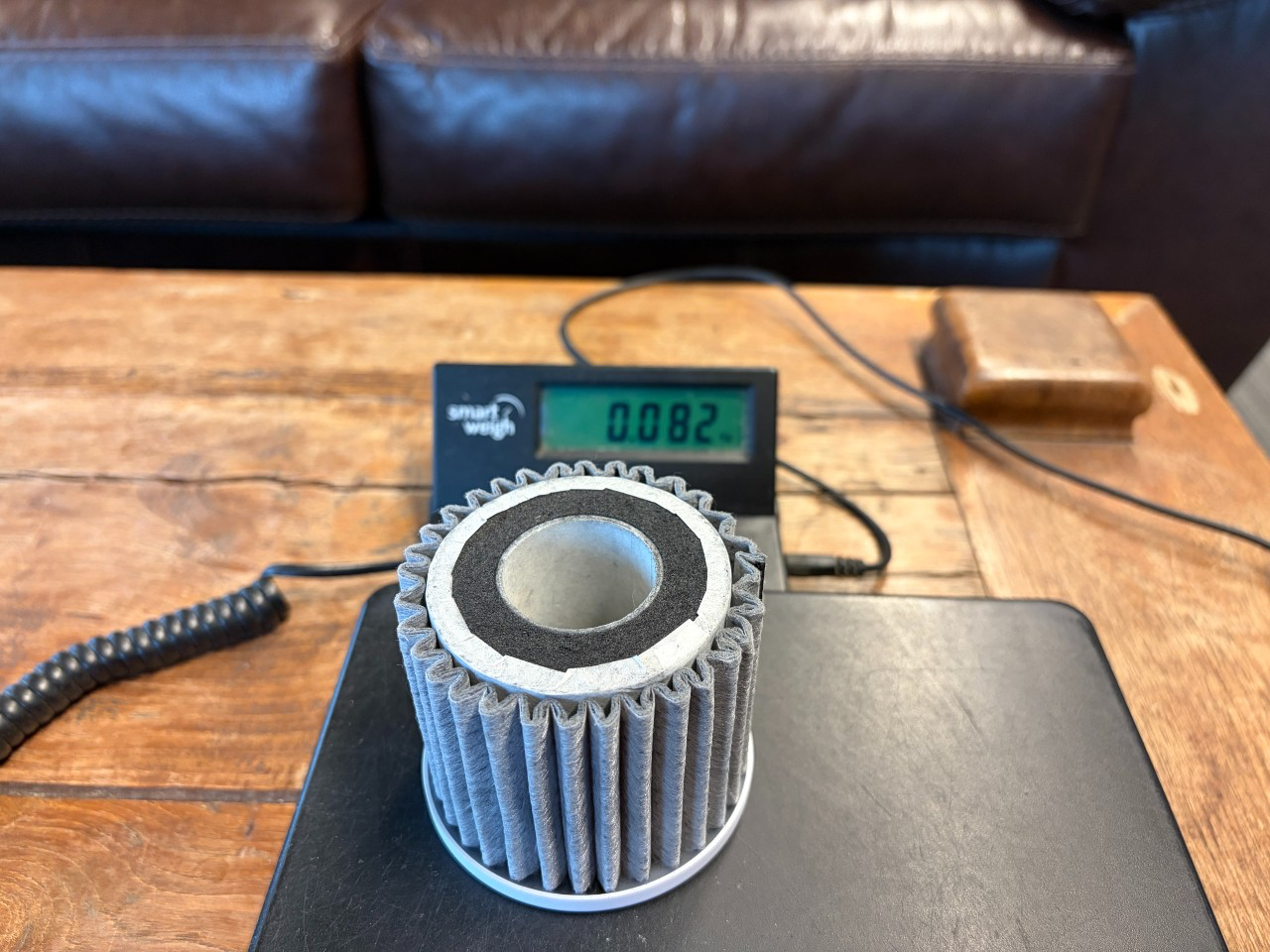
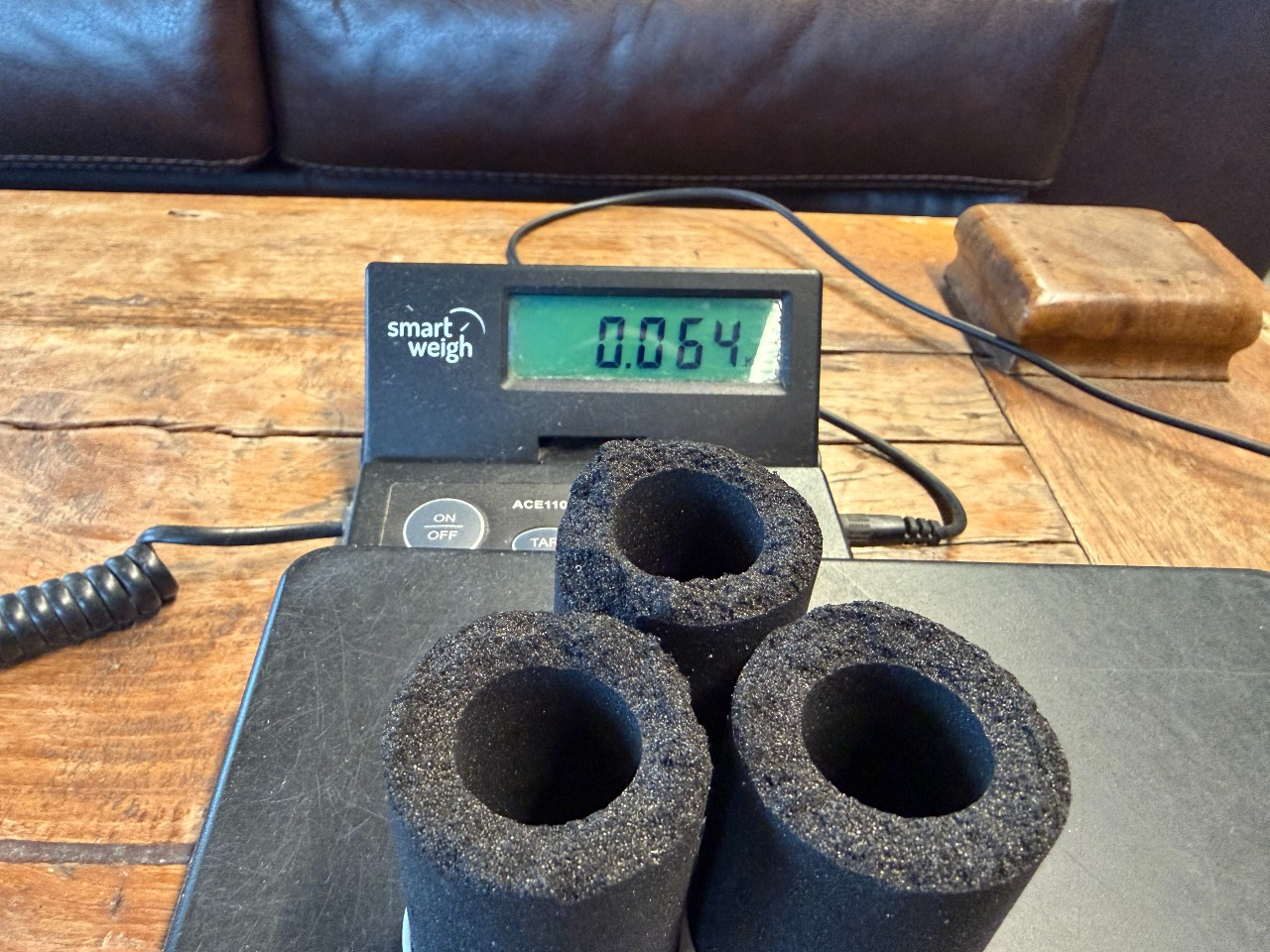
<p class="p1" style="caret-color: rgb(0, 0, 0); color: rgb(0, 0, 0);"><span class="sse-size-18">One of the first differences that stood out during our teardown was the overall mass of the filters. The Brtmoun filter came in at 0.064 KG, while the Epic Pure XP weighed 0.082 KG. In the filtration world, extra weight is often a sign of a more substantial build, additional filtration media, and thicker internal construction designed for higher performance and durability.</span></p>
<p class="p1" style="caret-color: rgb(0, 0, 0); color: rgb(0, 0, 0);"><span class="sse-size-18"><br></span></p>
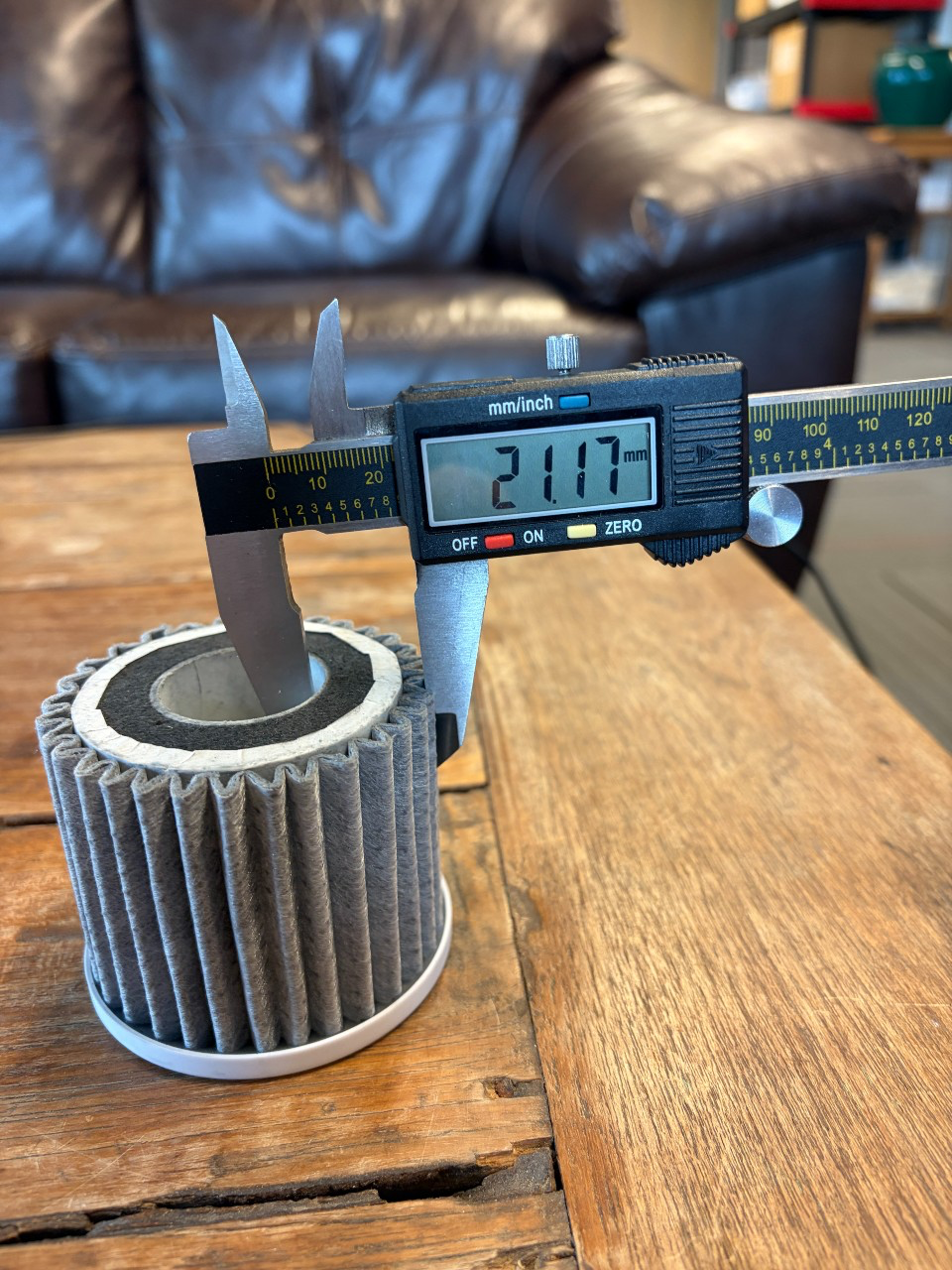
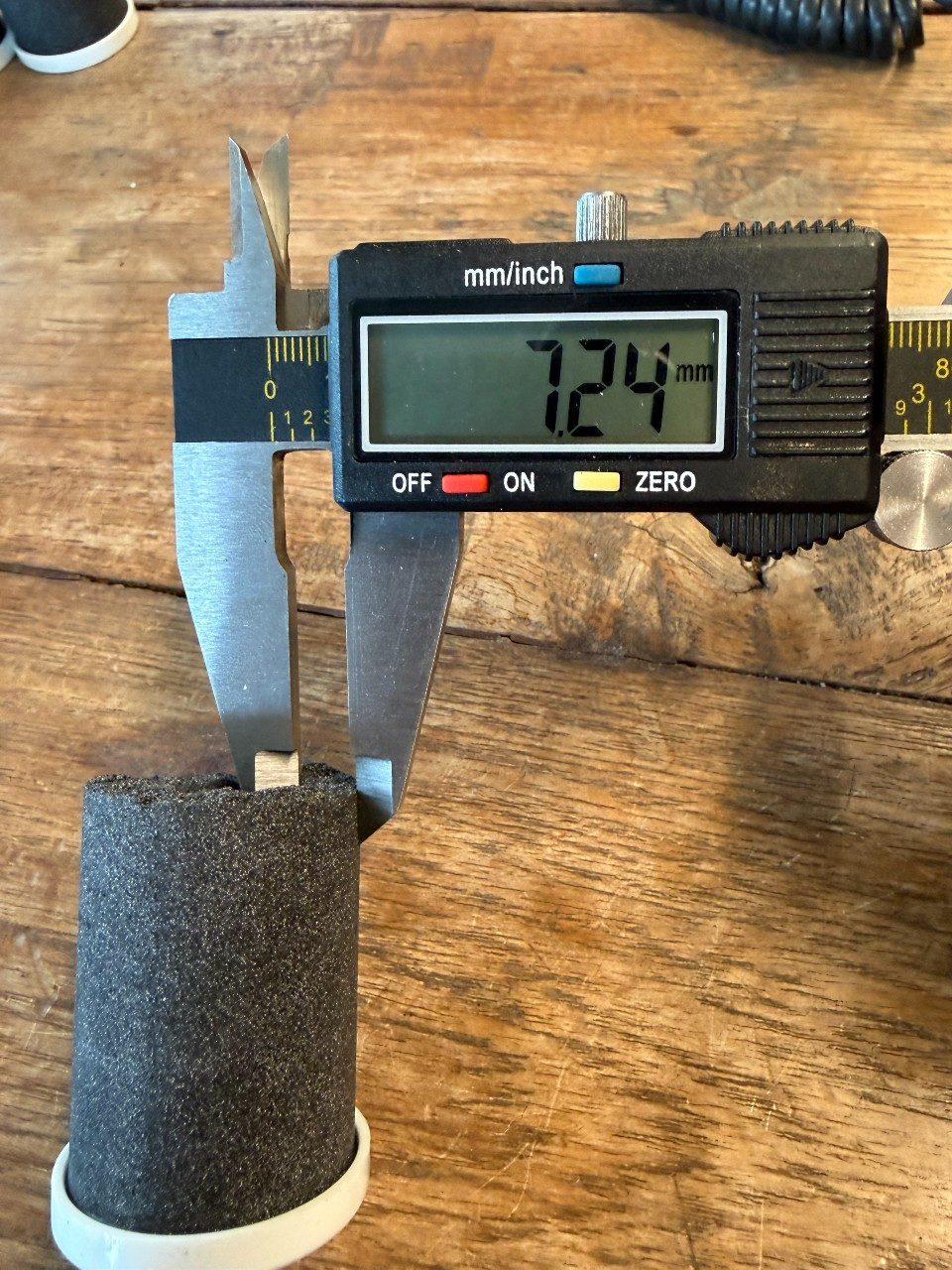
<p class="p1" style="caret-color: rgb(0, 0, 0); color: rgb(0, 0, 0);"><span class="sse-size-18">We also compared the physical thickness of the filter walls after cutting both filters open. The Brtmoun filter measured 7.24mm, while the Epic Pure XP measured an impressive 21.17mm. That means the Pure XP was built with nearly three times the wall thickness. Side-by-side, the difference in construction quality is obvious the moment you handle the filters in person.</span></p>
<p class="p1" style="caret-color: rgb(0, 0, 0); color: rgb(0, 0, 0);"><br></p>
<p class="p1 sse-size-18" style="caret-color: rgb(0, 0, 0); color: rgb(0, 0, 0);">However, wall thickness alone does not tell the full story. What truly matters is the quality of the materials, filtration media, and manufacturing standards used inside the filter itself.</p>
</div>
</div>
<div class="sse-row sse-clearfix">
<div class="sse-column sse-full"><hr></div>
</div>
<div class="sse-row sse-clearfix">
<div class="sse-column sse-full" style="text-align: center;">
<h3>Brtmoun Water Filter Review</h3>
</div>
</div>
<div class="sse-row sse-clearfix">
<div class="sse-column sse-full"><hr></div>
</div>
<div class="sse-row sse-clearfix">
<div class="sse-column sse-half">
<p class="p1" style="caret-color: rgb(0, 0, 0); color: rgb(0, 0, 0);"><span class="sse-size-18">The Epic Pure XP is proudly made in the USA inside an NSF-certified manufacturing facility. That matters because NSF-certified factories are required to maintain strict quality standards, material traceability, manufacturing controls, and ongoing auditing processes. Water filters are not just about contaminant reduction they are also about making sure the product itself is safe.</span></p>
<p class="p1" style="caret-color: rgb(0, 0, 0); color: rgb(0, 0, 0);"><br></p>
<p class="p1" style="caret-color: rgb(0, 0, 0); color: rgb(0, 0, 0);"><span class="sse-size-18">That is why the Epic Pure XP is certified to NSF International NSF/ANSI 42 for material safety. This certification verifies that the materials used in the filter are safe for contact with drinking water and are not leaching harmful contaminants back into your water over time.</span></p>
<p class="p1" style="caret-color: rgb(0, 0, 0); color: rgb(0, 0, 0);"><span class="sse-size-18"><br></span></p>
<p class="p1" style="caret-color: rgb(0, 0, 0); color: rgb(0, 0, 0);"><span class="sse-size-18">The Epic Pure XP uses our trademarked CoreXchange™ Technology, an advanced dual-layer filtration system designed to tackle a broad range of contaminants. The outer nanofiber layers are engineered to help remove microbiological contaminants like bacteria, viruses, giardia, cryptosporidium, and microplastics, while the internal carbon fiber block targets heavy metals, PFAS, chlorine, pesticides, herbicides, VOCs, and more. Unlike older traditional carbon block designs, CoreXchange™ Technology combines multiple filtration approaches into one integrated system for improved performance and consistency. </span></p>
<p class="p1" style="caret-color: rgb(0, 0, 0); color: rgb(0, 0, 0);"><span class="sse-size-18"><br></span></p>
<p class="p1" style="caret-color: rgb(0, 0, 0); color: rgb(0, 0, 0);"><span class="sse-size-18"><span style="font-family: var(--font-body-family); font-style: var(--font-body-style); letter-spacing: var(--font-body-letter-spacing);">Brtmoun</span> filters rely on older carbon block technology that has historically shown inconsistency in manufacturing quality, especially when products are not NSF certified and not produced inside an NSF-certified manufacturing facility with ongoing quality controls and material verification.</span></p>
<p class="p1" style="caret-color: rgb(0, 0, 0); color: rgb(0, 0, 0);"><br></p>
<p class="p1 sse-size-18" style="caret-color: rgb(0, 0, 0); color: rgb(0, 0, 0);">Epic uses food-safe polypropylene for our filter housing material because polypropylene is considered one of the gold standards for water filtration products. It is highly stable, durable, and widely used in NSF-certified systems. In our experience, premium water filtration products almost always rely on polypropylene because it is one of the best materials available for drinking water applications.</p>
</div>
<div class="sse-column sse-half"><img src="https://blogstudio.s3.theshoppad.net/epicwaterfilters/11689e3e98fa8e535401fb5dca592841.jpg" alt="" data-filename="epic-water-filters-pure-xp-wall-thickness.jpg"></div>
</div>
<div class="sse-row sse-clearfix">
<div class="sse-column sse-full"><hr></div>
</div>
<div class="sse-row sse-clearfix">
<div class="sse-column sse-full">
<h3 style="text-align: center;">BRTMOUN vs Epic Pure Water Filter</h3>
</div>
</div>
<div class="sse-row sse-clearfix">
<div class="sse-column sse-full"><hr></div>
</div>
<div class="sse-row sse-clearfix" draggable="false">
<div class="sse-column sse-half"><img src="https://blogstudio.s3.theshoppad.net/epicwaterfilters/d8b51642b92287bd71588f6eff3e0b89.jpg" alt="" draggable="false" data-filename="BRTMOUN_WATER_FILTER.jpg"></div>
<div class="sse-column sse-half">
<p class="p1" style="caret-color: rgb(0, 0, 0); color: rgb(0, 0, 0);"><span class="sse-size-18"><span style="font-family: var(--font-body-family); font-style: var(--font-body-style); letter-spacing: var(--font-body-letter-spacing);">Brtmoun</span> filters, on the other hand, use ABS plastic construction. ABS is commonly used in lower-cost products because it is inexpensive and easy to manufacture, but it is generally not the preferred material for premium drinking water filtration systems. ABS plastic is also known to leach into water which is why premium brands do not use this plastic. </span></p>
<p class="p1" style="caret-color: rgb(0, 0, 0); color: rgb(0, 0, 0);"><br></p>
<p class="p1" style="caret-color: rgb(0, 0, 0); color: rgb(0, 0, 0);"><span class="sse-size-18">Additionally, Epic uses NSF 61 and FDA-compliant filtration media inside our filters. NSF 61 certification is important because it verifies that materials coming into contact with drinking water meet strict safety standards. We believe consumers should know not only what a filter removes from water, but also what materials are being used inside the filter itself.</span></p>
<p class="p1" style="caret-color: rgb(0, 0, 0); color: rgb(0, 0, 0);"><br></p>
<p class="p1" style="caret-color: rgb(0, 0, 0); color: rgb(0, 0, 0);"><span class="sse-size-18"><span style="font-family: var(--font-body-family); font-style: var(--font-body-style); letter-spacing: var(--font-body-letter-spacing);">Brtmoun</span> does not appear to have NSF certification on these filters, and we could not find transparency around whether NSF 61-certified filtration media is being used. Without independent certification and testing, consumers are left to trust marketing claims rather than verified standards.</span></p>
<p class="p1" style="caret-color: rgb(0, 0, 0); color: rgb(0, 0, 0);"></p>
<p class="p1" style="caret-color: rgb(0, 0, 0); color: rgb(0, 0, 0);"><br></p>
<p class="p1" style="caret-color: rgb(0, 0, 0); color: rgb(0, 0, 0);"><span class="sse-size-18">At <a href="https://www.epicwaterfilters.com/?utm_source=chatgpt.com">Epic Water Filters</a>, we believe independent third-party testing matters. The Epic Pure XP has been tested in multiple accredited laboratories to NSF standards including NSF/ANSI 42, 53, 401, P231, and P473 protocols for a wide range of contaminants and performance claims.</span></p>
</div>
</div>
<div class="sse-row sse-clearfix" draggable="false">
<div class="sse-column sse-full"><hr></div>
</div>
<div class="sse-row sse-clearfix">
<div class="sse-column sse-half">
<p class="sse-size-18"><span style="caret-color: rgb(0, 0, 0); color: rgb(0, 0, 0);" class="sse-size-18">These standards cover everything from chlorine reduction and heavy metals to PFAS, emerging contaminants, and microbiological protection. Independent testing helps verify that a filter actually performs as advertised under real-world conditions. In researching Brtmoun replacement filters, we could not find publicly available independent testing to these same standards or evidence of equivalent NSF certification on the finished filter. </span></p>
<p class="sse-size-18"><span style="caret-color: rgb(0, 0, 0); color: rgb(0, 0, 0);" class="sse-size-18"><br></span></p>
<p class="sse-size-18"><span style="caret-color: rgb(0, 0, 0); color: rgb(0, 0, 0);" class="sse-size-18">At the end of the day, water filters should not be a guessing game. Make sure your filter works, or your body becomes the filter.</span><br></p>
</div>
<div class="sse-column sse-half"><img src="https://blogstudio.s3.theshoppad.net/epicwaterfilters/ff7569c481de5d2e289091bd01581cf2.png" alt="" data-filename="made in usa 50s ad.png"></div>
</div>
<div class="sse-row sse-clearfix"><div class="sse-column sse-full"><hr></div></div>
<div class="sse-row sse-clearfix">
<div class="sse-column sse-full">
<h3 style="text-align: center;">Epic Water Filters Pure XP Weight</h3>
</div>
</div>
<div class="sse-row sse-clearfix" draggable="false">
<div class="sse-column sse-full"><hr></div>
</div>
<div class="sse-row sse-clearfix">
<div class="sse-column sse-full"><img src="https://blogstudio.s3.theshoppad.net/epicwaterfilters/2f243d728a38ec9e995d69a17ee0bfb7.jpg" alt="" data-filename="epic_water_filters_xp_weight.jpg"></div>
</div>
<div class="sse-row sse-clearfix">
<div class="sse-column sse-full"><hr></div>
</div>
<div class="sse-row sse-clearfix">
<div class="sse-column sse-full">
<h3 style="text-align: center;">BRTMOUN Water Filter Weight</h3>
</div>
</div>
<div class="sse-row sse-clearfix">
<div class="sse-column sse-full"><hr></div>
</div>
<div class="sse-row sse-clearfix">
<div class="sse-column sse-full"><img src="https://blogstudio.s3.theshoppad.net/epicwaterfilters/48ab5a48c7f57a91ab505f1bd7790bd3.jpg" alt="" data-filename="BRTMOUN_WATER_FILTER_WEIGHT.jpg"></div>
</div>
<div class="sse-row sse-clearfix">
<div class="sse-column sse-full"><hr></div>
</div>
<div class="sse-row sse-clearfix">
<div class="sse-column sse-full">
<p class="sse-size-18"><span style="caret-color: rgb(0, 0, 0); color: rgb(0, 0, 0);">At Epic Water Filters, we believe clean water starts with transparency, certified materials, independent testing, and manufacturing standards consumers can trust. After comparing these filters side-by-side, we stand firmly behind the quality, safety, and construction of the USA-made Epic Pure XP.</span><br></p>
</div>
</div>
<div class="sse-row sse-clearfix">
<div class="sse-column sse-full"><hr></div>
</div>
</div>
</div>
</div>
</div>
</div>
</div>]]>
    </content>
  </entry>
  <entry>
    <id>https://www.epicwaterfilters.com/blogs/news/icepure-water-filters-vs-epic-water-filters</id>
    <published>2026-05-19T09:44:37-06:00</published>
    <updated>2026-05-19T10:49:15-06:00</updated>
    <link rel="alternate" type="text/html" href="https://www.epicwaterfilters.com/blogs/news/icepure-water-filters-vs-epic-water-filters"/>
    <title>IcePure vs Epic Water Filters</title>
    <author>
      <name>Wick Creative</name>
    </author>
    <summary type="html">
      <![CDATA[<p class="p1">We tore down an ICEPURE replacement filter and put it head-to-head against the USA-made Epic Pure XP. From wall thickness and filtration media to certifications and material quality, the differences were impossible to ignore.</p><p><a class="read-more" href="https://www.epicwaterfilters.com/blogs/news/icepure-water-filters-vs-epic-water-filters">More</a></p>]]>
    </summary>
    <content type="html">
      <![CDATA[<div class="studioengine-wrapper">
<link href="//studios.cdn.theshoppad.net/blogstudio/blocks.css?shop=epicwaterfilters.myshopify.com&amp;v=3" rel="stylesheet" type="text/css">
<script src="//studios.cdn.theshoppad.net/blogstudio/blogstudio.dist.js?shop=epicwaterfilters.myshopify.com&amp;v=3"></script><div class="studioengine">
<div class="is-section is-section-auto is-box">
<div class="is-boxes">
<div class="is-box-centered">
<div class="is-container is-content-maxwidth">
<div class="sse-row sse-clearfix">
<div class="sse-column sse-full sse-center">
<div class="sse-display">
<h1 class="sse-size-64">ICEPure Water Filter vs. Epic Water Filters</h1>
</div>
</div>
</div>
<div class="sse-row sse-clearfix">
<div class="sse-column sse-full sse-center">
<div style="margin: 10px 0;"><span><a href="#" class="sse-is-btn sse-is-btn-ghost1 is-upper is-rounded-30">Does Ice Pure replacement filter work?<br></a></span></div>
</div>
</div>
<div class="sse-row sse-clearfix">
<div class="sse-column sse-half"><img src="https://blogstudio.s3.theshoppad.net/epicwaterfilters/e5409eb39e1ac6f8ee6f268312e6f7e8.jpg" alt="" data-filename="ICEPURE_Water_FILTER_REVIEW.jpg"></div>
<div class="sse-column sse-half">
<p class="p1" style="caret-color: rgb(0, 0, 0); color: rgb(0, 0, 0);"></p>
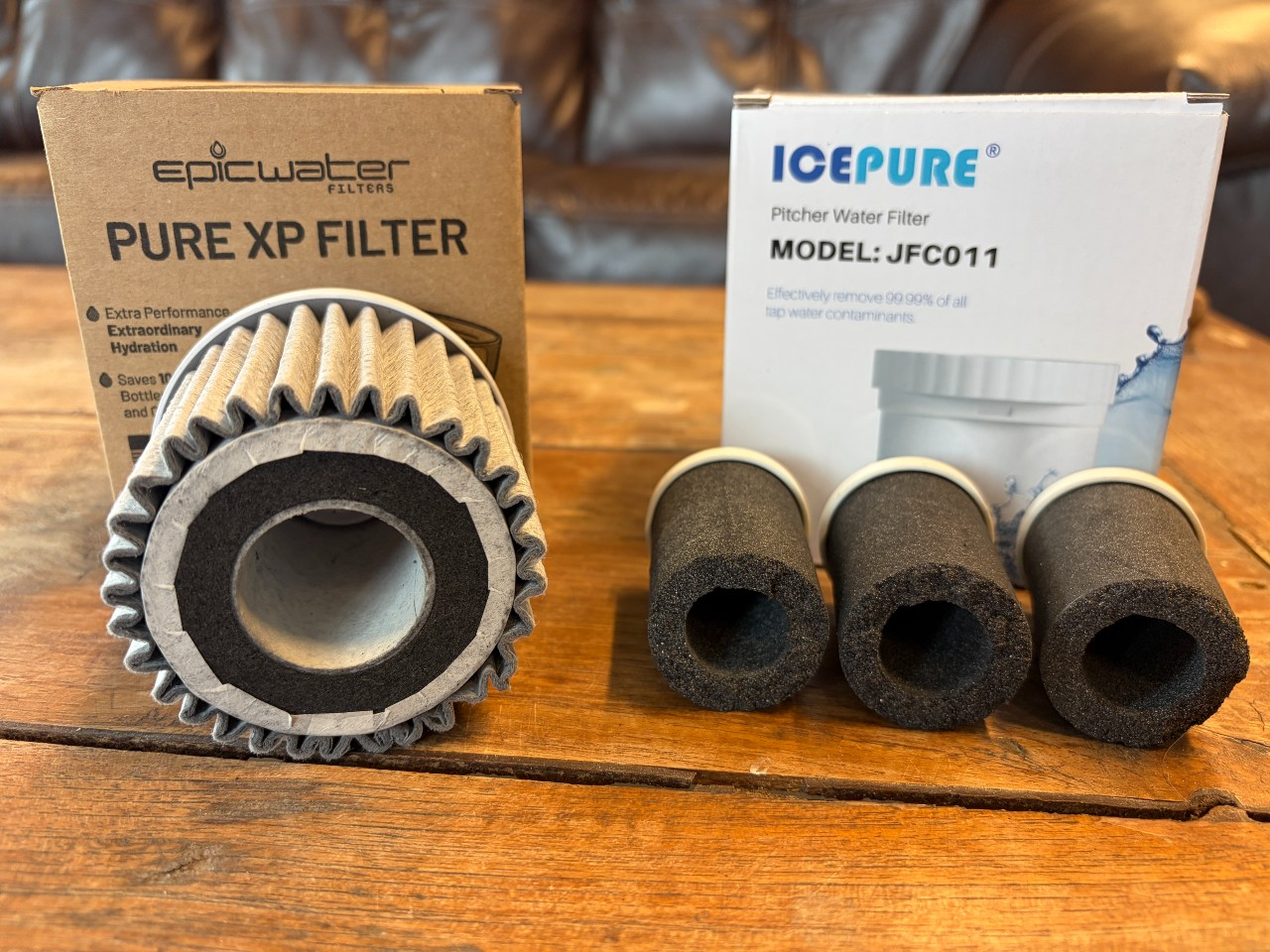
<p class="p1" style="caret-color: rgb(0, 0, 0); color: rgb(0, 0, 0);"><font class="sse-size-18">Not all replacement water filters are built the same. To see exactly what separates premium filtration from low-cost knockoff filters, we decided to tear down an ICEPURE replacement filter side-by-side with the USA-made Epic Pure XP. After comparing the materials, wall thickness, filtration media, certifications, and overall construction, the differences became very clear.</font></p>
<p class="p1" style="caret-color: rgb(0, 0, 0); color: rgb(0, 0, 0);"></p>
<p class="p1" style="caret-color: rgb(0, 0, 0); color: rgb(0, 0, 0);"><span class="sse-size-18"><br></span></p>
<p class="p1" style="caret-color: rgb(0, 0, 0); color: rgb(0, 0, 0);"></p>
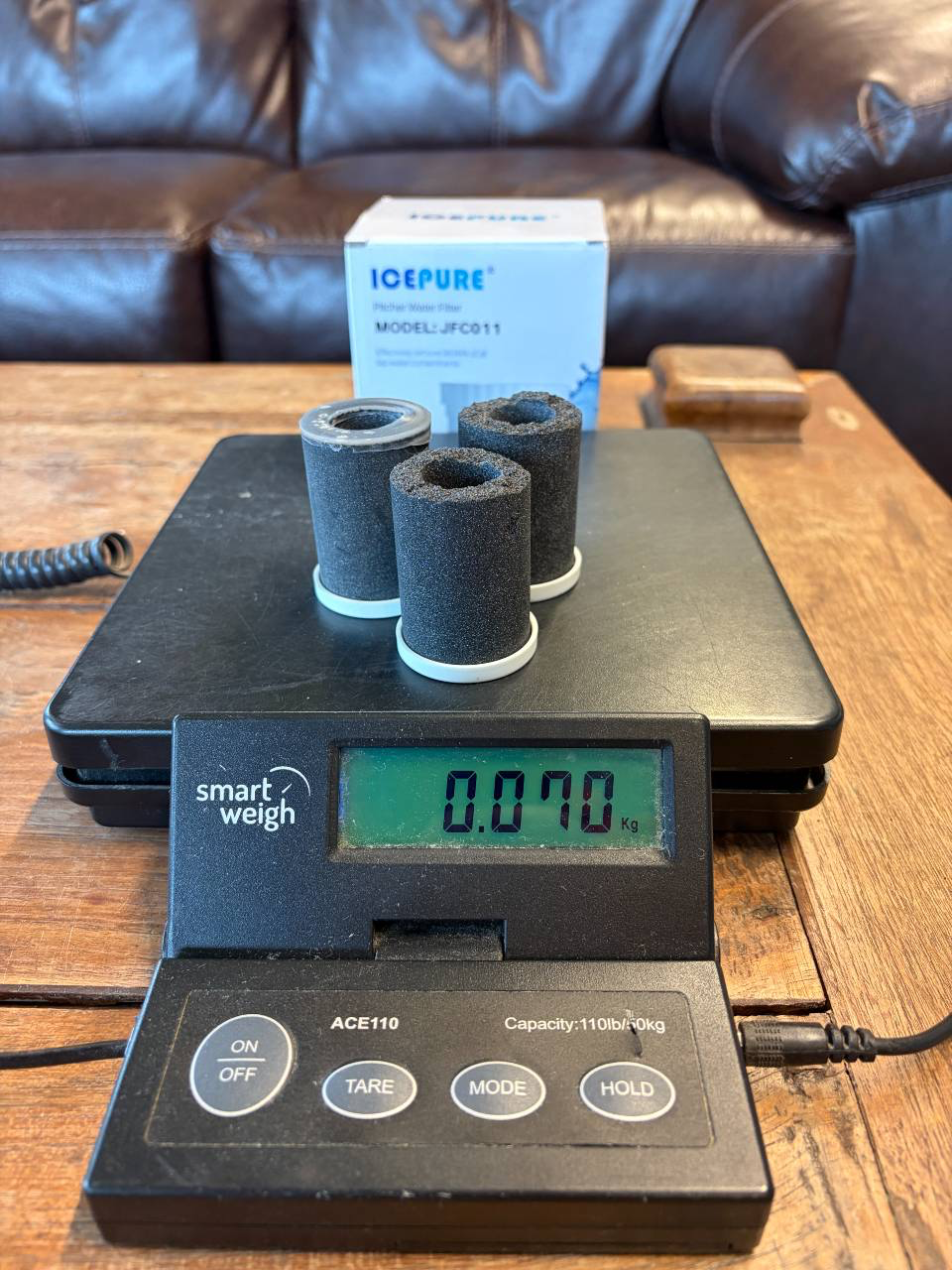
<p class="p1" style="caret-color: rgb(0, 0, 0); color: rgb(0, 0, 0);"><font class="sse-size-18">One of the first differences that stood out during our teardown was the overall mass of the filters. The ICEPURE filter came in at 0.070 KG, while the Epic Pure XP weighed 0.082 KG. In the filtration world, extra weight is often a sign of a more substantial build, additional filtration media, and thicker internal construction designed for higher performance and durability.</font></p>
<p class="p1" style="caret-color: rgb(0, 0, 0); color: rgb(0, 0, 0);"><span class="sse-size-18"><br></span></p>
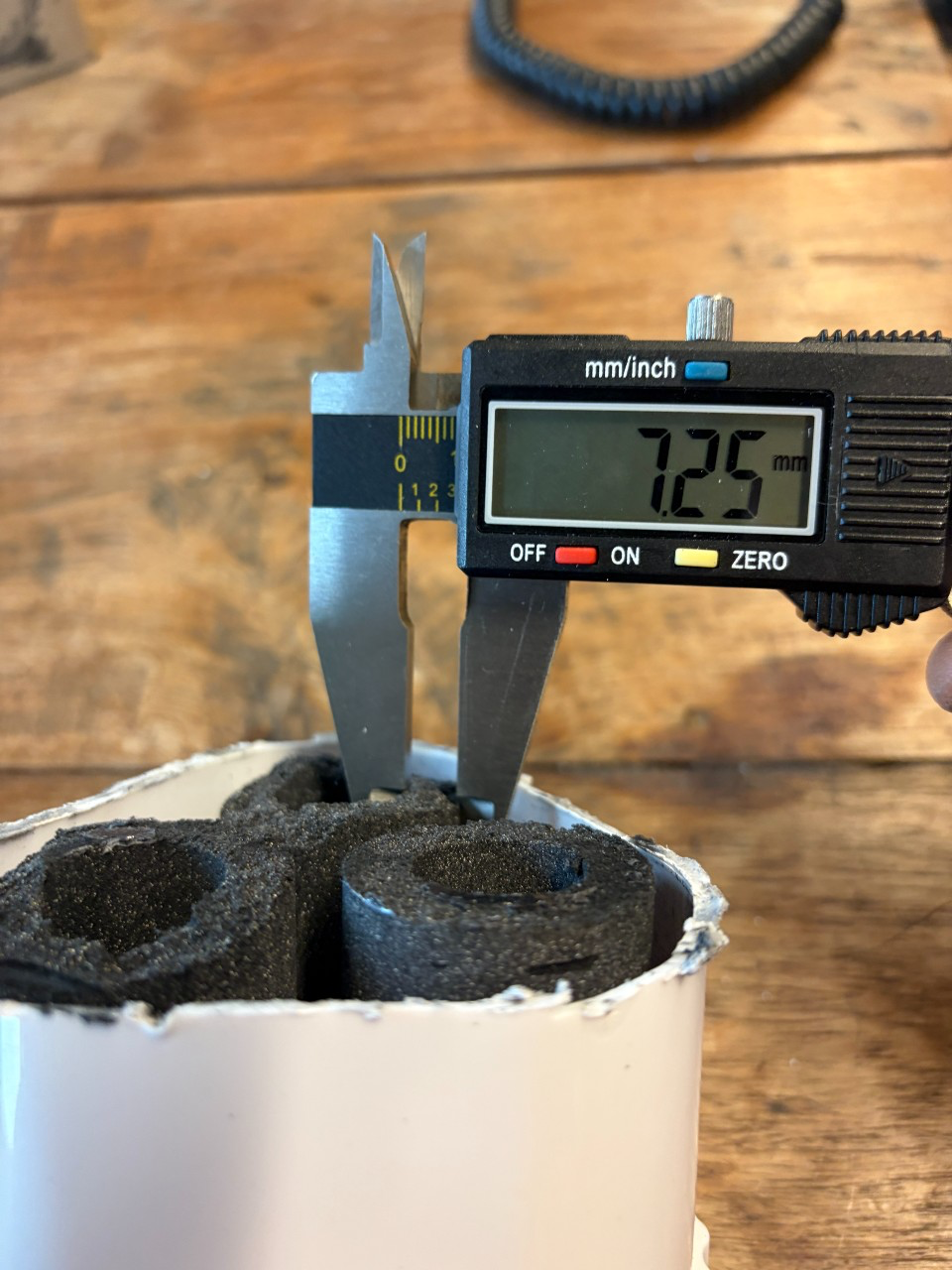
<p class="p1" style="caret-color: rgb(0, 0, 0); color: rgb(0, 0, 0);"><font class="sse-size-18">We also compared the physical thickness of the filter walls after cutting both filters open. The ICEPURE filter measured 7.25mm, while the Epic Pure XP measured an impressive 21.17mm. That means the Pure XP was built with nearly three times the wall thickness. Side-by-side, the difference in construction quality is obvious the moment you handle the filters in person.</font></p>
<p class="p1" style="caret-color: rgb(0, 0, 0); color: rgb(0, 0, 0);"><br></p>
<p class="p1 sse-size-18" style="caret-color: rgb(0, 0, 0); color: rgb(0, 0, 0);">However, wall thickness alone does not tell the full story. What truly matters is the quality of the materials, filtration media, and manufacturing standards used inside the filter itself.</p>
</div>
</div>
<div class="sse-row sse-clearfix">
<div class="sse-column sse-full"><hr></div>
</div>
<div class="sse-row sse-clearfix">
<div class="sse-column sse-full" style="text-align: center;">
<h3>ICEPURE Water Filter Review</h3>
</div>
</div>
<div class="sse-row sse-clearfix">
<div class="sse-column sse-full"><hr></div>
</div>
<div class="sse-row sse-clearfix">
<div class="sse-column sse-half">
<p class="p1" style="caret-color: rgb(0, 0, 0); color: rgb(0, 0, 0);"><span class="sse-size-18">The Epic Pure XP is proudly made in the USA inside an NSF-certified manufacturing facility. That matters because NSF-certified factories are required to maintain strict quality standards, material traceability, manufacturing controls, and ongoing auditing processes. Water filters are not just about contaminant reduction they are also about making sure the product itself is safe.</span></p>
<p class="p1" style="caret-color: rgb(0, 0, 0); color: rgb(0, 0, 0);"><br></p>
<p class="p1" style="caret-color: rgb(0, 0, 0); color: rgb(0, 0, 0);"><span class="sse-size-18">That is why the Epic Pure XP is certified to NSF International NSF/ANSI 42 for material safety. This certification verifies that the materials used in the filter are safe for contact with drinking water and are not leaching harmful contaminants back into your water over time.</span></p>
<p class="p1" style="caret-color: rgb(0, 0, 0); color: rgb(0, 0, 0);"><span class="sse-size-18"><br></span></p>
<p class="p1" style="caret-color: rgb(0, 0, 0); color: rgb(0, 0, 0);"><span class="sse-size-18">The Epic Pure XP uses our trademarked CoreXchange™ Technology, an advanced dual-layer filtration system designed to tackle a broad range of contaminants. The outer nanofiber layers are engineered to help remove microbiological contaminants like bacteria, viruses, giardia, cryptosporidium, and microplastics, while the internal carbon fiber block targets heavy metals, PFAS, chlorine, pesticides, herbicides, VOCs, and more. Unlike older traditional carbon block designs, CoreXchange™ Technology combines multiple filtration approaches into one integrated system for improved performance and consistency. </span></p>
<p class="p1" style="caret-color: rgb(0, 0, 0); color: rgb(0, 0, 0);"><span class="sse-size-18"><br></span></p>
<p class="p1" style="caret-color: rgb(0, 0, 0); color: rgb(0, 0, 0);"><span class="sse-size-18">ICEPURE filters rely on older carbon block technology that has historically shown inconsistency in manufacturing quality, especially when products are not NSF certified and not produced inside an NSF-certified manufacturing facility with ongoing quality controls and material verification.</span></p>
<p class="p1" style="caret-color: rgb(0, 0, 0); color: rgb(0, 0, 0);"> </p>
<p class="p1" style="caret-color: rgb(0, 0, 0); color: rgb(0, 0, 0);"><br></p>
<p class="p1 sse-size-18" style="caret-color: rgb(0, 0, 0); color: rgb(0, 0, 0);">Epic uses food-safe polypropylene for our filter housing material because polypropylene is considered one of the gold standards for water filtration products. It is highly stable, durable, and widely used in NSF-certified systems. In our experience, premium water filtration products almost always rely on polypropylene because it is one of the best materials available for drinking water applications.</p>
</div>
<div class="sse-column sse-half"><img src="https://blogstudio.s3.theshoppad.net/epicwaterfilters/b3fe385905ed292040f2b8d9566c3600.jpg" alt="" data-filename="aquacrest-filter-wall-thickness.jpg"></div>
</div>
<div class="sse-row sse-clearfix">
<div class="sse-column sse-full"><hr></div>
</div>
<div class="sse-row sse-clearfix">
<div class="sse-column sse-full">
<h3 style="text-align: center;">ICEPURE vs Epic Pure Water Filter</h3>
</div>
</div>
<div class="sse-row sse-clearfix">
<div class="sse-column sse-full"><hr></div>
</div>
<div class="sse-row sse-clearfix" draggable="false">
<div class="sse-column sse-half"><img src="https://blogstudio.s3.theshoppad.net/epicwaterfilters/39d6b66c141b8e4dbdb96807e515e5c7.jpg" alt="" draggable="false" data-filename="ICEPURE-Water_Filter_REplacement_Filter.jpg"></div>
<div class="sse-column sse-half">
<p class="p1" style="caret-color: rgb(0, 0, 0); color: rgb(0, 0, 0);"><span class="sse-size-18">ICEPURE filters, on the other hand, use ABS plastic construction. ABS is commonly used in lower-cost products because it is inexpensive and easy to manufacture, but it is generally not the preferred material for premium drinking water filtration systems. ABS plastic is also known to leach into water which is why premium brands do not use this plastic. </span></p>
<p class="p1" style="caret-color: rgb(0, 0, 0); color: rgb(0, 0, 0);"><br></p>
<p class="p1" style="caret-color: rgb(0, 0, 0); color: rgb(0, 0, 0);"><span class="sse-size-18">Additionally, Epic uses NSF 61 and FDA-compliant filtration media inside our filters. NSF 61 certification is important because it verifies that materials coming into contact with drinking water meet strict safety standards. We believe consumers should know not only what a filter removes from water, but also what materials are being used inside the filter itself.</span></p>
<p class="p1" style="caret-color: rgb(0, 0, 0); color: rgb(0, 0, 0);"><br></p>
<p class="p1" style="caret-color: rgb(0, 0, 0); color: rgb(0, 0, 0);"><span class="sse-size-18">ICEPURE does not appear to have NSF certification on these filters, and we could not find transparency around whether NSF 61-certified filtration media is being used. Without independent certification and testing, consumers are left to trust marketing claims rather than verified standards.</span></p>
<p class="p1" style="caret-color: rgb(0, 0, 0); color: rgb(0, 0, 0);"><span class="sse-size-18"><br></span></p>
<p class="p1" style="caret-color: rgb(0, 0, 0); color: rgb(0, 0, 0);"> </p>
<p class="p1" style="caret-color: rgb(0, 0, 0); color: rgb(0, 0, 0);"><span class="sse-size-18">At <a href="https://www.epicwaterfilters.com/?utm_source=chatgpt.com">Epic Water Filters</a>, we believe independent third-party testing matters. The Epic Pure XP has been tested in multiple accredited laboratories to NSF standards including NSF/ANSI 42, 53, 401, P231, and P473 protocols for a wide range of contaminants and performance claims.</span></p>
</div>
</div>
<div class="sse-row sse-clearfix" draggable="false">
<div class="sse-column sse-full"><hr></div>
</div>
<div class="sse-row sse-clearfix">
<div class="sse-column sse-half">
<p class="sse-size-18"><span style="caret-color: rgb(0, 0, 0); color: rgb(0, 0, 0);" class="sse-size-18">These standards cover everything from chlorine reduction and heavy metals to PFAS, emerging contaminants, and microbiological protection. Independent testing helps verify that a filter actually performs as advertised under real-world conditions. In researching ICEPURE replacement filters, we could not find publicly available independent testing to these same standards or evidence of equivalent NSF certification on the finished filter. </span></p>
<p class="sse-size-18"><span style="caret-color: rgb(0, 0, 0); color: rgb(0, 0, 0);" class="sse-size-18"><br></span></p>
<p class="sse-size-18"><span style="caret-color: rgb(0, 0, 0); color: rgb(0, 0, 0);" class="sse-size-18">At the end of the day, water filters should not be a guessing game. Make sure your filter works, or your body becomes the filter.</span><br></p>
</div>
<div class="sse-column sse-half"><img src="https://blogstudio.s3.theshoppad.net/epicwaterfilters/ff7569c481de5d2e289091bd01581cf2.png" alt="" data-filename="made in usa 50s ad.png"></div>
</div>
<div class="sse-row sse-clearfix"><div class="sse-column sse-full"><hr></div></div>
<div class="sse-row sse-clearfix">
<div class="sse-column sse-full">
<h3 style="text-align: center;">Epic Water Filters Pure XP Weight</h3>
</div>
</div>
<div class="sse-row sse-clearfix" draggable="false">
<div class="sse-column sse-full"><hr></div>
</div>
<div class="sse-row sse-clearfix">
<div class="sse-column sse-full"><img src="https://blogstudio.s3.theshoppad.net/epicwaterfilters/2f243d728a38ec9e995d69a17ee0bfb7.jpg" alt="" data-filename="epic_water_filters_xp_weight.jpg"></div>
</div>
<div class="sse-row sse-clearfix">
<div class="sse-column sse-full"><hr></div>
</div>
<div class="sse-row sse-clearfix">
<div class="sse-column sse-full">
<h3 style="text-align: center;">ICEPURE Water Filter Weight</h3>
</div>
</div>
<div class="sse-row sse-clearfix">
<div class="sse-column sse-full"><hr></div>
</div>
<div class="sse-row sse-clearfix">
<div class="sse-column sse-full"><img src="https://blogstudio.s3.theshoppad.net/epicwaterfilters/f3a8921337b88024f5efe10e1c9b0d76.jpg" alt="" data-filename="ICEPURE_WATER_FILTER_EPIC_WATER_FILTERS_SEYCHELLE_AQUAGEAR.jpg"></div>
</div>
<div class="sse-row sse-clearfix">
<div class="sse-column sse-full"><hr></div>
</div>
<div class="sse-row sse-clearfix">
<div class="sse-column sse-full">
<p class="sse-size-18"><span style="caret-color: rgb(0, 0, 0); color: rgb(0, 0, 0);">At Epic Water Filters, we believe clean water starts with transparency, certified materials, independent testing, and manufacturing standards consumers can trust. After comparing these filters side-by-side, we stand firmly behind the quality, safety, and construction of the USA-made Epic Pure XP.</span><br></p>
</div>
</div>
<div class="sse-row sse-clearfix">
<div class="sse-column sse-full"><hr></div>
</div>
</div>
</div>
</div>
</div>
</div>
</div>]]>
    </content>
  </entry>
  <entry>
    <id>https://www.epicwaterfilters.com/blogs/news/aquacrest-filters-water-filter-review</id>
    <published>2026-05-18T16:08:24-06:00</published>
    <updated>2026-05-18T16:34:01-06:00</updated>
    <link rel="alternate" type="text/html" href="https://www.epicwaterfilters.com/blogs/news/aquacrest-filters-water-filter-review"/>
    <title>Aqua Crest Filters vs Epic Water Filters</title>
    <author>
      <name>Wick Creative</name>
    </author>
    <summary type="html">
      <![CDATA[<p class="p1">We cut open an AquaCrest water filter and compared it side-by-side with the USA-made Epic Pure XP. See the shocking differences in wall thickness, materials, NSF certification, and overall build quality.</p><p><a class="read-more" href="https://www.epicwaterfilters.com/blogs/news/aquacrest-filters-water-filter-review">More</a></p>]]>
    </summary>
    <content type="html">
      <![CDATA[<div class="studioengine-wrapper">
<link href="//studios.cdn.theshoppad.net/blogstudio/blocks.css?shop=epicwaterfilters.myshopify.com&amp;v=3" rel="stylesheet" type="text/css">
<script src="//studios.cdn.theshoppad.net/blogstudio/blogstudio.dist.js?shop=epicwaterfilters.myshopify.com&amp;v=3"></script><div class="studioengine">
<div class="is-section is-section-auto is-box">
<div class="is-boxes">
<div class="is-box-centered">
<div class="is-container is-content-maxwidth">
<div class="sse-row sse-clearfix">
<div class="sse-column sse-full sse-center">
<div class="sse-display">
<h1 class="sse-size-64">Aqua Crest Water Filter vs. Epic Water Filters</h1>
</div>
</div>
</div>
<div class="sse-row sse-clearfix">
<div class="sse-column sse-full sse-center">
<div style="margin: 10px 0;"><span><a href="#" class="sse-is-btn sse-is-btn-ghost1 is-upper is-rounded-30">Does AquaCrest replacement filter work?<br></a></span></div>
</div>
</div>
<div class="sse-row sse-clearfix">
<div class="sse-column sse-half"><img src="https://blogstudio.s3.theshoppad.net/epicwaterfilters/e9b9f2a3461243fc96cf49b11a485733.jpg" alt="" data-filename="epicvsaquacrest.jpg"></div>
<div class="sse-column sse-half">
<p class="p1" style="caret-color: rgb(0, 0, 0); color: rgb(0, 0, 0);"><span class="sse-size-18">At <a href="https://www.epicwaterfilters.com/?utm_source=chatgpt.com">Epic Water Filters</a>, we believe consumers deserve transparency about the water filters they use every single day. Recently, we cut open one of the AquaCrest replacement filters next to our USA-made Epic Pure XP filter to compare the internal construction, materials, and overall build quality. Honestly, some of the differences were surprising.</span></p>
<p class="p1" style="caret-color: rgb(0, 0, 0); color: rgb(0, 0, 0);"><br></p>
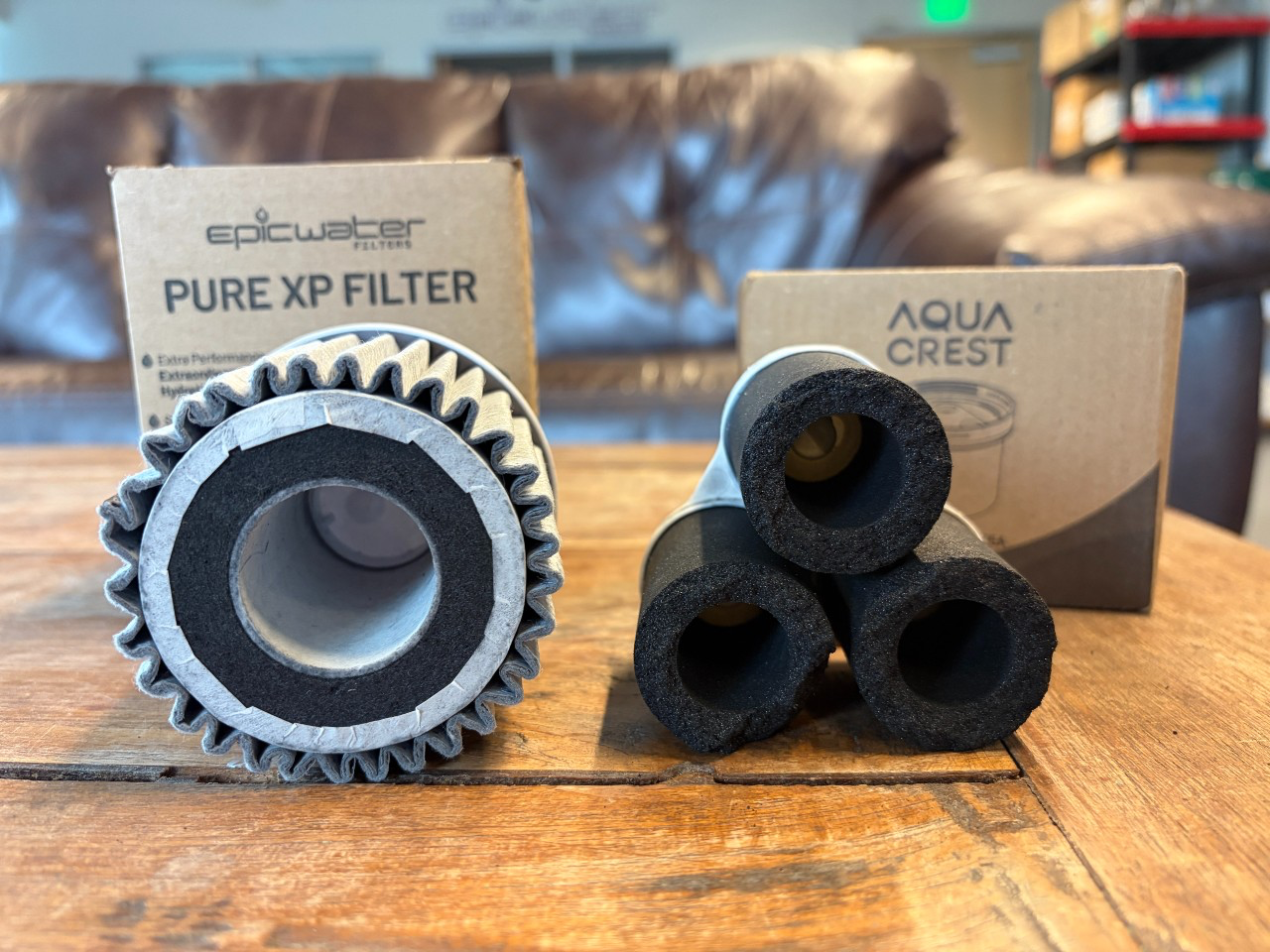
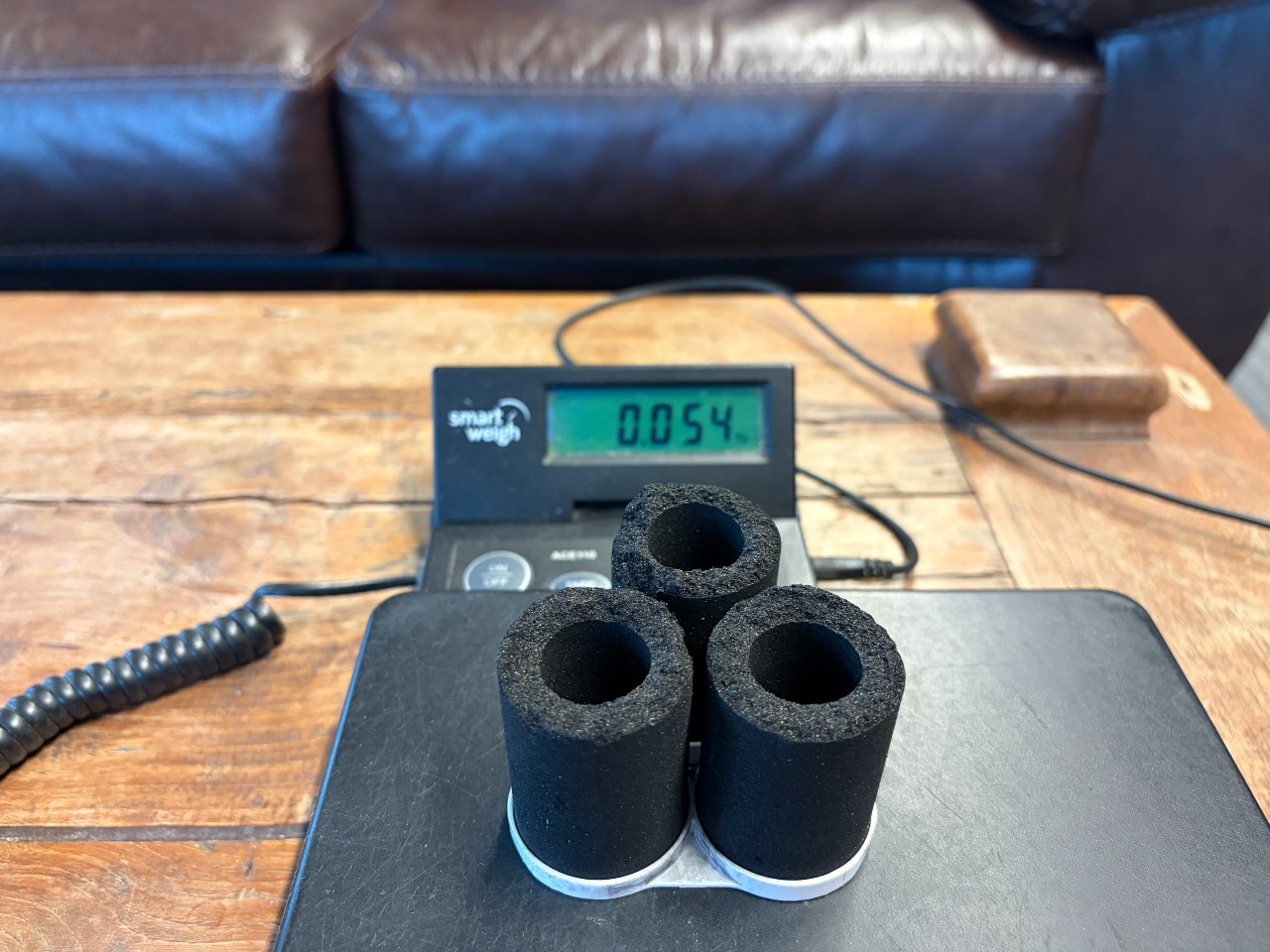
<p class="p1" style="caret-color: rgb(0, 0, 0); color: rgb(0, 0, 0);"><span class="sse-size-18">The first thing we noticed was the overall weight. The AquaCrest filter weighed 0.054 KG, while the Epic Pure XP weighed 0.082 KG, more than 50% heavier. In water filtration, added weight often means more filtration media, thicker construction, and more robust internal components.</span></p>
<p class="p1" style="caret-color: rgb(0, 0, 0); color: rgb(0, 0, 0);"><br></p>
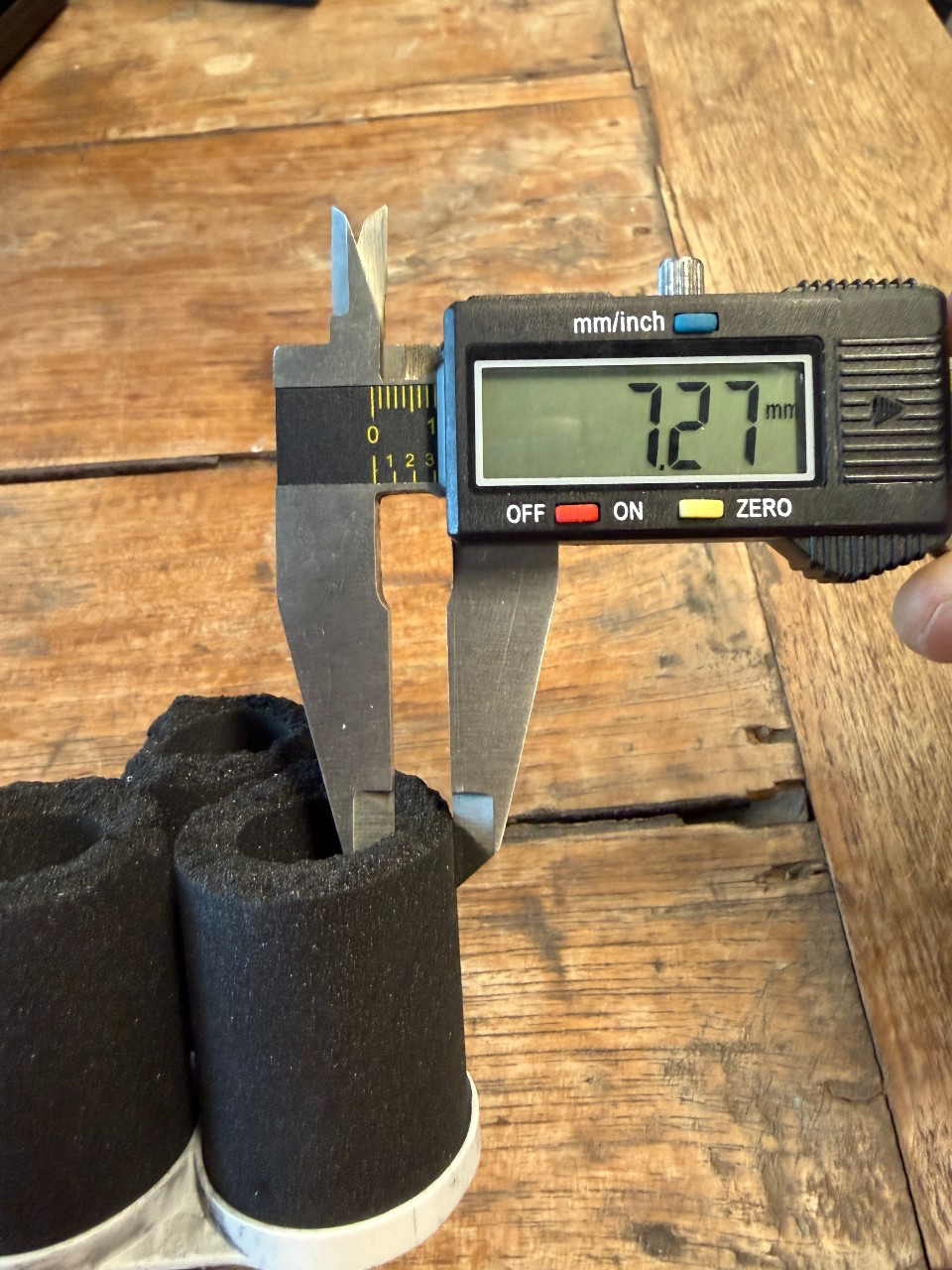
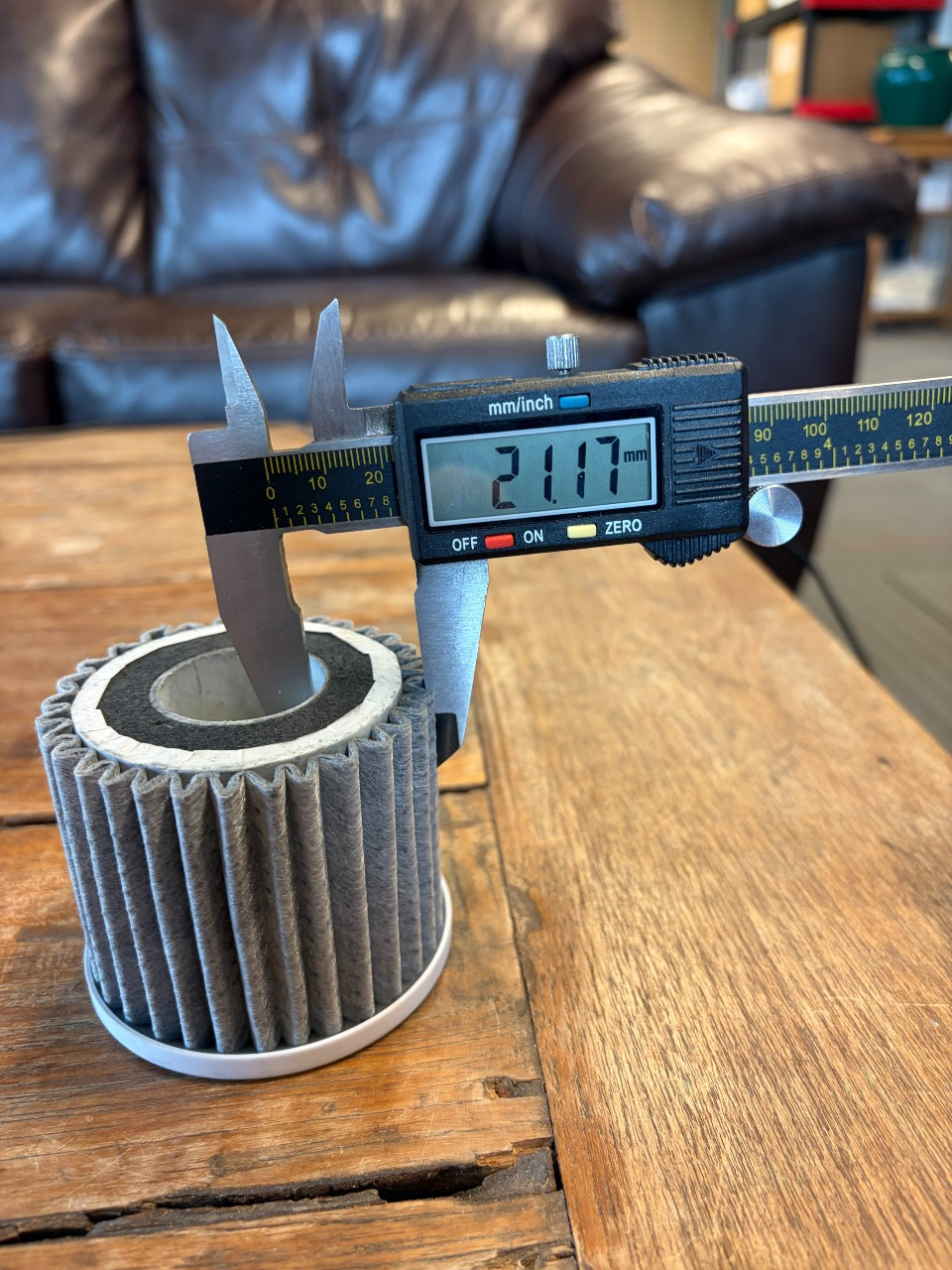
<p class="p1" style="caret-color: rgb(0, 0, 0); color: rgb(0, 0, 0);"><span class="sse-size-18">We also measured the filter wall thickness. The AquaCrest filter measured 7.27mm, while the Epic Pure XP measured 21.17mm thick, nearly three times thicker. When you physically hold and cut these filters apart side-by-side, the difference is immediately noticeable.</span></p>
<p class="p1" style="caret-color: rgb(0, 0, 0); color: rgb(0, 0, 0);"><br></p>
<p class="p1 sse-size-18" style="caret-color: rgb(0, 0, 0); color: rgb(0, 0, 0);">But what matters even more than thickness is what these filters are actually made from.</p>
</div>
</div>
<div class="sse-row sse-clearfix">
<div class="sse-column sse-full"><hr></div>
</div>
<div class="sse-row sse-clearfix">
<div class="sse-column sse-full" style="text-align: center;">
<h3>Aquacrest Water Filter Review</h3>
</div>
</div>
<div class="sse-row sse-clearfix">
<div class="sse-column sse-full"><hr></div>
</div>
<div class="sse-row sse-clearfix">
<div class="sse-column sse-half">
<p class="p1" style="caret-color: rgb(0, 0, 0); color: rgb(0, 0, 0);"><span class="sse-size-18">The Epic Pure XP is proudly made in the USA inside an NSF-certified manufacturing facility. That matters because NSF-certified factories are required to maintain strict quality standards, material traceability, manufacturing controls, and ongoing auditing processes. Water filters are not just about contaminant reduction they are also about making sure the product itself is safe.</span></p>
<p class="p1" style="caret-color: rgb(0, 0, 0); color: rgb(0, 0, 0);"><br></p>
<p class="p1" style="caret-color: rgb(0, 0, 0); color: rgb(0, 0, 0);"><span class="sse-size-18">That is why the Epic Pure XP is certified to NSF International NSF/ANSI 42 for material safety. This certification verifies that the materials used in the filter are safe for contact with drinking water and are not leaching harmful contaminants back into your water over time.</span></p>
<p class="p1" style="caret-color: rgb(0, 0, 0); color: rgb(0, 0, 0);"><span class="sse-size-18"><br></span></p>
<p class="p1" style="caret-color: rgb(0, 0, 0); color: rgb(0, 0, 0);"><span class="sse-size-18">The Epic Pure XP uses our trademarked CoreXchange™ Technology, an advanced dual-layer filtration system designed to tackle a broad range of contaminants. The outer nanofiber layers are engineered to help remove microbiological contaminants like bacteria, viruses, giardia, cryptosporidium, and microplastics, while the internal carbon fiber block targets heavy metals, PFAS, chlorine, pesticides, herbicides, VOCs, and more. Unlike older traditional carbon block designs, CoreXchange™ Technology combines multiple filtration approaches into one integrated system for improved performance and consistency. </span></p>
<p class="p1" style="caret-color: rgb(0, 0, 0); color: rgb(0, 0, 0);"><span class="sse-size-18"><br></span></p>
<p class="p1" style="caret-color: rgb(0, 0, 0); color: rgb(0, 0, 0);"><span class="sse-size-18">AquaCrest filters rely on older carbon block technology that has historically shown inconsistency in manufacturing quality, especially when products are not NSF certified and not produced inside an NSF-certified manufacturing facility with ongoing quality controls and material verification.</span></p>
<p class="p1" style="caret-color: rgb(0, 0, 0); color: rgb(0, 0, 0);"> </p>
<p class="p1" style="caret-color: rgb(0, 0, 0); color: rgb(0, 0, 0);"><br></p>
<p class="p1 sse-size-18" style="caret-color: rgb(0, 0, 0); color: rgb(0, 0, 0);">Epic uses food-safe polypropylene for our filter housing material because polypropylene is considered one of the gold standards for water filtration products. It is highly stable, durable, and widely used in NSF-certified systems. In our experience, premium water filtration products almost always rely on polypropylene because it is one of the best materials available for drinking water applications.</p>
<p class="p1 sse-size-18" style="caret-color: rgb(0, 0, 0); color: rgb(0, 0, 0);"> </p>
</div>
<div class="sse-column sse-half"><img src="https://blogstudio.s3.theshoppad.net/epicwaterfilters/b3fe385905ed292040f2b8d9566c3600.jpg" alt="" data-filename="aquacrest-filter-wall-thickness.jpg"></div>
</div>
<div class="sse-row sse-clearfix">
<div class="sse-column sse-full"><hr></div>
</div>
<div class="sse-row sse-clearfix">
<div class="sse-column sse-full">
<h3 style="text-align: center;">Aqua Crest vs Epic Pure Water Filter</h3>
</div>
</div>
<div class="sse-row sse-clearfix">
<div class="sse-column sse-full"><hr></div>
</div>
<div class="sse-row sse-clearfix" draggable="false">
<div class="sse-column sse-half"><img src="https://blogstudio.s3.theshoppad.net/epicwaterfilters/08dbd40d576c8d01edfb79a773fe49e0.jpg" alt="" draggable="false" data-filename="epic-water-filters-pure-xp-wall-thickness.jpg"></div>
<div class="sse-column sse-half">
<p class="p1" style="caret-color: rgb(0, 0, 0); color: rgb(0, 0, 0);"><span class="sse-size-18">AquaCrest filters, on the other hand, use ABS plastic construction. ABS is commonly used in lower-cost products because it is inexpensive and easy to manufacture, but it is generally not the preferred material for premium drinking water filtration systems.</span></p>
<p class="p1" style="caret-color: rgb(0, 0, 0); color: rgb(0, 0, 0);"><br></p>
<p class="p1" style="caret-color: rgb(0, 0, 0); color: rgb(0, 0, 0);"><span class="sse-size-18">Additionally, Epic uses NSF 61 and FDA-compliant filtration media inside our filters. NSF 61 certification is important because it verifies that materials coming into contact with drinking water meet strict safety standards. We believe consumers should know not only what a filter removes from water, but also what materials are being used inside the filter itself.</span></p>
<p class="p1" style="caret-color: rgb(0, 0, 0); color: rgb(0, 0, 0);"><br></p>
<p class="p1" style="caret-color: rgb(0, 0, 0); color: rgb(0, 0, 0);"><span class="sse-size-18">AquaCrest does not appear to have NSF certification on these filters, and we could not find transparency around whether NSF 61-certified filtration media is being used. Without independent certification and testing, consumers are left to trust marketing claims rather than verified standards.</span></p>
<p class="p1" style="caret-color: rgb(0, 0, 0); color: rgb(0, 0, 0);"><span class="sse-size-18"><br></span></p>
<p class="p1" style="caret-color: rgb(0, 0, 0); color: rgb(0, 0, 0);"> </p>
<p class="p1" style="caret-color: rgb(0, 0, 0); color: rgb(0, 0, 0);"><span class="sse-size-18">At <a href="https://www.epicwaterfilters.com/?utm_source=chatgpt.com">Epic Water Filters</a>, we believe independent third-party testing matters. The Epic Pure XP has been tested in multiple accredited laboratories to NSF standards including NSF/ANSI 42, 53, 401, P231, and P473 protocols for a wide range of contaminants and performance claims. </span></p>
<p class="p1" style="caret-color: rgb(0, 0, 0); color: rgb(0, 0, 0);"><span class="sse-size-18"><br></span></p>
<p class="p1" style="caret-color: rgb(0, 0, 0); color: rgb(0, 0, 0);"><span class="sse-size-18">These standards cover everything from chlorine reduction and heavy metals to PFAS, emerging contaminants, and microbiological protection. Independent testing helps verify that a filter actually performs as advertised under real-world conditions. In researching AquaCrest replacement filters, we could not find publicly available independent testing to these same standards or evidence of equivalent NSF certification on the finished filter. At the end of the day, water filters should not be a guessing game. Make sure your filter works, or your body becomes the filter.</span></p>
</div>
</div>
<div class="sse-row sse-clearfix" draggable="false">
<div class="sse-column sse-full"><hr></div>
</div>
<div class="sse-row sse-clearfix">
<div class="sse-column sse-full">
<h3 style="text-align: center;">Epic Water Filters Pure XP Weight</h3>
</div>
</div>
<div class="sse-row sse-clearfix" draggable="false">
<div class="sse-column sse-full"><hr></div>
</div>
<div class="sse-row sse-clearfix">
<div class="sse-column sse-full"><img src="https://blogstudio.s3.theshoppad.net/epicwaterfilters/2f243d728a38ec9e995d69a17ee0bfb7.jpg" alt="" data-filename="epic_water_filters_xp_weight.jpg"></div>
</div>
<div class="sse-row sse-clearfix">
<div class="sse-column sse-full"><hr></div>
</div>
<div class="sse-row sse-clearfix">
<div class="sse-column sse-full">
<h3 style="text-align: center;">Aquacrest Water Filter Weight</h3>
</div>
</div>
<div class="sse-row sse-clearfix">
<div class="sse-column sse-full"><hr></div>
</div>
<div class="sse-row sse-clearfix">
<div class="sse-column sse-full"><img src="https://blogstudio.s3.theshoppad.net/epicwaterfilters/c635e8ee9beb3a13210b2d812dec4fe5.jpg" alt="" data-filename="aquacrest_water_filter_weight.jpg"></div>
</div>
<div class="sse-row sse-clearfix">
<div class="sse-column sse-full"><hr></div>
</div>
<div class="sse-row sse-clearfix">
<div class="sse-column sse-full">
<p class="sse-size-18"><span style="caret-color: rgb(0, 0, 0); color: rgb(0, 0, 0);">At Epic Water Filters, we believe clean water starts with transparency, certified materials, independent testing, and manufacturing standards consumers can trust. After comparing these filters side-by-side, we stand firmly behind the quality, safety, and construction of the USA-made Epic Pure XP.</span><br></p>
</div>
</div>
<div class="sse-row sse-clearfix">
<div class="sse-column sse-full"><hr></div>
</div>
</div>
</div>
</div>
</div>
</div>
</div>]]>
    </content>
  </entry>
  <entry>
    <id>https://www.epicwaterfilters.com/blogs/news/are-cliff-bars-good-for-you</id>
    <published>2024-10-09T08:28:07-06:00</published>
    <updated>2025-09-10T09:37:05-06:00</updated>
    <link rel="alternate" type="text/html" href="https://www.epicwaterfilters.com/blogs/news/are-cliff-bars-good-for-you"/>
    <title>Are Cliff Bars Good For You</title>
    <author>
      <name>Upward Insights</name>
    </author>
    <summary type="html">
      <![CDATA[Are Clif Bars really as healthy as they seem? Discover the truth behind their ingredients, especially the vague term "natural flavors," and learn about the potential hidden risks, including processed ingredients, high sugar content, seed oils, "natural flavors" and possible allergens.<p><a class="read-more" href="https://www.epicwaterfilters.com/blogs/news/are-cliff-bars-good-for-you">More</a></p>]]>
    </summary>
    <content type="html">
      <![CDATA[<div class="studioengine-wrapper">
<link href="//studios.cdn.theshoppad.net/blogstudio/blocks.css?shop=epicwaterfilters.myshopify.com&amp;v=3" rel="stylesheet" type="text/css">
<script src="//studios.cdn.theshoppad.net/blogstudio/blogstudio.dist.js?shop=epicwaterfilters.myshopify.com&amp;v=3"></script><div class="studioengine">
<div class="is-section is-section-auto is-box"><div class="is-boxes"><div class="is-box-centered"><div class="is-container is-content-maxwidth">
<div class="sse-row sse-clearfix"><div class="sse-column sse-full sse-right"><div class="sse-display">
	<h1 class="sse-size-48">are cliff bars good for you</h1>
</div></div></div>
<div class="sse-row sse-clearfix"><div class="sse-column sse-full sse-right"><span><a href="#" class="sse-is-btn sse-is-btn-ghost1 is-upper sse-is-btn-small">Are Clif bars healthy for weight loss</a></span></div></div>
<div class="sse-row sse-clearfix"><div class="sse-column sse-full"><hr></div></div>
<div class="sse-row sse-clearfix">
<div class="sse-column sse-half"><img src="https://blogstudio.s3.theshoppad.net/epicwaterfilters/a307a7520c29846117db35c851515360.jpg" alt="" data-filename="shutterstock_1408033517.jpg"></div>
<div class="sse-column sse-half"><p class="sse-size-18">Clif Bars have long been marketed as a convenient, health-conscious snack aimed at athletes, outdoor enthusiasts, and those needing an energy boost. They often seem like a healthier alternative to candy bars or other processed snacks, but is that perception accurate? We’ll take a deep dive into the ingredients and nutrition of Clif Bars to determine whether they truly live up to their healthy image or is Clif Bar just another highly processed food found in the middle aisles of the typical American grocery store.</p></div>
</div>
<div class="sse-row sse-clearfix"><div class="sse-column sse-full"><hr></div></div>
<div class="sse-row sse-clearfix"><div class="sse-column sse-full"><h3 style="text-align: center;">What's in a clif bar</h3></div></div>
<div class="sse-row sse-clearfix"><div class="sse-column sse-full"><hr></div></div>
<div class="sse-row sse-clearfix"><div class="sse-column sse-full">
<p><font class="sse-size-18">Let’s start by examining the core ingredients of a Clif Bar (Chocolate Chip): </font></p>
<p><font class="sse-size-18">Organic Rolled Oats <br><font class="sse-size-18">Organic Brown Rice Syrup (<font style="color: rgb(198, 40, 40);">*</font>Sugar)<br></font>Soy Rice Crisps (Soy Protein Isolate, Rice Flour, Barley Malt Extract)
<br>Organic Roasted Soybeans
<br>Organic Tapioca Syrup</font><font class="sse-size-18"> (<font style="color: rgb(198, 40, 40);">*</font>Sugar)<br>Organic Cane Syrup (<font style="color: rgb(198, 40, 40);">*</font>Sugar)
<br>Unsweetened Chocolate
<br>Chicory Fiber <br>Organic Soy Flour
<br>Sunflower and/or Soybean Oil (<font style="color: rgb(198, 40, 40);">*</font>Seed Oils)
<br>Natural Flavors (<font style="color: rgb(198, 40, 40);">*</font>Unknown)<br>Salt
<br>Organic Cinnamon
<br>Mixed Tocopherols (Antioxidant)<br></font></p>
<p><font class="sse-size-18">These ingredients feature a combination of organic grains, plant-based proteins, natural sweeteners, and oils. Many of these ingredients, such as the organic oats and soybeans, may sound wholesome, but it's essential to evaluate them more closely.</font><br></p>
</div></div>
<div class="sse-row sse-clearfix"><div class="sse-column sse-full"><hr></div></div>
<div class="sse-row sse-clearfix"><div class="sse-column sse-full"><h3 style="text-align: center;">Sugar Content: High and Comparable to Candy Bars</h3></div></div>
<div class="sse-row sse-clearfix"><div class="sse-column sse-full"><hr></div></div>
<div class="sse-row sse-clearfix">
<div class="sse-column sse-half"><p class="sse-size-18">One of the most striking aspects of Clif Bars is their sugar content. A standard bar contains:
<br>17 grams of sugar
<br>16 grams of added sugar
<br>Total carbohydrates: 43 grams
<br>Fiber: 5 grams<br><br>Clif Bars are about 55.88% sugar by weight. For comparison, a Snickers bar is 58% sugar. That’s a minimal difference, which can be surprising for a product marketed as a health food. <br><br>Additionally, Clif Bars contain 32% of their total weight in added sugars. This includes various types of sweeteners:
Organic Brown Rice Syrup, Organic Tapioca Syrup, Organic Cane Syrup <br></p></div>
<div class="sse-column sse-half"><img src="https://blogstudio.s3.theshoppad.net/epicwaterfilters/1811accf466afc214de1c485e459dab3.jpg" alt="" data-filename="shutterstock_1092248225.jpg"></div>
</div>
<div class="sse-row sse-clearfix"><div class="sse-column sse-full"><hr></div></div>
<div class="sse-row sse-clearfix"><div class="sse-column sse-full">
<p class="sse-size-18">While the term “organic” might give the impression that these sugars are healthier, they are still added sugars and can contribute to the same health issues as regular table sugar, including weight gain, blood sugar spikes, and tooth decay. </p>
<p class="sse-size-18"><b>IS ALL THIS SUGAR NECESSARY? </b></p>
<p class="sse-size-18">The high sugar content in Clif Bars is primarily aimed at delivering a quick source of energy, especially for athletes. Sugar is rapidly absorbed and metabolized, providing a fast fuel source during prolonged physical exertion. However, for the average person who isn’t engaged in sustained physical activity, consuming a Clif Bar as a snack could result in a sugar rush followed by a crash, potentially contributing to long-term health issues like insulin resistance if consumed regularly.</p>
</div></div>
<div class="sse-row sse-clearfix"><div class="sse-column sse-full"><hr></div></div>
<div class="sse-row sse-clearfix"><div class="sse-column sse-full"><h3 style="text-align: center;">Carbohydrates and Starches: Energy, But at What Cost?</h3></div></div>
<div class="sse-row sse-clearfix"><div class="sse-column sse-full"><hr></div></div>
<div class="sse-row sse-clearfix"><div class="sse-column sse-full">
<p class="sse-size-18">Clif Bars also contain 43 grams of carbohydrates, much of which comes from starches and sugars. While carbohydrates are a vital source of energy, especially for athletes, the body processes these sugars quickly, which can lead to energy spikes and crashes.
<br><br>The high starch content in Clif Bars comes from ingredients like:
<br></p>
<ul class="sse-size-18">
<li>Organic Rolled Oats
</li>
<li>Rice Flour
</li>
<li>Soy Rice Crisps
</li>
</ul>
<p><span style="font-size: 18px;">These provide a slow-burning source of carbohydrates, but the large amount of sugar overshadows their benefits in terms of sustained energy.</span></p>
<p></p>
</div></div>
<div class="sse-row sse-clearfix"><div class="sse-column sse-full"><hr></div></div>
<div class="sse-row sse-clearfix"><div class="sse-column sse-full"><h3 style="text-align: center;">Protein: Is Soy Protein Isolate Beneficial?</h3></div></div>
<div class="sse-row sse-clearfix"><div class="sse-column sse-full"><hr></div></div>
<div class="sse-row sse-clearfix"><div class="sse-column sse-full">
<p class="sse-size-18">Clif Bars contain 10 grams of protein per bar, primarily from Soy Protein Isolate. While soy is considered a complete plant-based protein, meaning it contains all nine essential amino acids, the form of soy used here—Soy Protein Isolate—is considered a low-quality protein. </p>
<p class="sse-size-18">Here’s why: </p>
<p class="sse-size-18"><b>Highly Processed:</b> Soy protein isolate is derived from defatted soybean flakes through an extensive chemical process. This strips away many of the nutrients found in whole soybeans, leaving behind a highly processed product. </p>
<p class="sse-size-18"><b>Potential Digestive Issues:</b> Some people find soy protein isolate harder to digest, and it may cause bloating or discomfort in those who are sensitive to soy. </p>
<p class="sse-size-18"><b>Phytoestrogens:</b> Soy contains compounds called phytoestrogens, which can mimic estrogen in the body. While the research on the health impacts of phytoestrogens is mixed, it’s something to consider for individuals with hormone-sensitive conditions.
For comparison, a protein bar made with whole food protein sources like nuts, seeds, or pea protein may offer a more digestible and nutrient-dense option.</p>
</div></div>
<div class="sse-row sse-clearfix"><div class="sse-column sse-full"><hr></div></div>
<div class="sse-row sse-clearfix"><div class="sse-column sse-full"><h3 style="text-align: center;">Seed Oils and Their Impact</h3></div></div>
<div class="sse-row sse-clearfix"><div class="sse-column sse-full"><hr></div></div>
<div class="sse-row sse-clearfix">
<div class="sse-column sse-half">
<p class="sse-size-18">Clif Bars contain Sunflower and/or Soybean Oil, both of which are considered seed oils. Its great when companies say "and/or" in their ingredients. Makes you feel confident that they know what they are doing. These oils are commonly used in processed foods because they are cheap and have a long shelf life. </p>
<p class="sse-size-18">However, these seed oils are high in omega-6 fatty acids, which can be inflammatory when consumed in excess, particularly when not balanced with omega-3s.
The concern with seed oils like these is their role in: </p>
<p class="sse-size-18"><b>Inflammation:</b> Omega-6 fatty acids can promote inflammation in the body when not balanced with omega-3s.
<br><b>Processed Nature:</b> Like soy protein isolate, these oils are highly refined, which can strip them of beneficial nutrients and make them less healthy.</p>
<p class="sse-size-18">If you're looking for a healthier fat source in your snacks, opt for bars made with nuts or nut butters, which offer more heart-healthy fats and essential nutrients.<br></p>
</div>
<div class="sse-column sse-half"><img src="https://blogstudio.s3.theshoppad.net/epicwaterfilters/a1dfcf062fd3957fe33586e22aa9d5a3.jpg" alt="" data-filename="shutterstock_767114428.jpg"></div>
</div>
<div class="sse-row sse-clearfix"><div class="sse-column sse-full"><hr></div></div>
<div class="sse-row sse-clearfix"><div class="sse-column sse-full"><h3 style="text-align: center;">The Benefits of Chicory Root Fiber</h3></div></div>
<div class="sse-row sse-clearfix"><div class="sse-column sse-full"><hr></div></div>
<div class="sse-row sse-clearfix"><div class="sse-column sse-full"><p class="sse-size-18">One positive aspect of Clif Bars is their fiber content, with 5 grams of fiber per bar. This fiber comes primarily from Chicory Root Fiber and Organic Rolled Oats. Fiber is important for:
Digestive Health: Helps maintain regularity.
Blood Sugar Control: Slows down the absorption of sugar, which can mitigate blood sugar spikes.
Satiety: Helps you feel full longer, reducing the temptation to overeat.
While the fiber in Clif Bars does provide some health benefits, it’s worth noting that the high sugar content may offset these advantages in terms of overall health.</p></div></div>
<div class="sse-row sse-clearfix"><div class="sse-column sse-full"><hr></div></div>
<div class="sse-row sse-clearfix"><div class="sse-column sse-full"><h3 style="text-align: center;">Natural Flavors</h3></div></div>
<div class="sse-row sse-clearfix"><div class="sse-column sse-full"><hr></div></div>
<div class="sse-row sse-clearfix">
<div class="sse-column sse-half"><img src="https://blogstudio.s3.theshoppad.net/epicwaterfilters/828768fd0897bc2f6b698d5c661898d7.jpg" alt="" data-filename="pexels-chokniti-khongchum-2280571.jpg"></div>
<div class="sse-column sse-half">
<p class="sse-size-18">The term "natural flavors" in Clif Bars may appear to suggest a healthier, more natural ingredient, but the reality is often more complicated. According to the FDA, natural flavors are substances derived from plant or animal matter, yet this definition allows for a wide range of synthetic processes and chemical treatments to be used in their production. </p>
<p class="sse-size-18">In the case of many Protein bars, these natural flavors could be extracted using high heat or chemical solvents, far from what many consumers would consider truly natural. Adding to the concern, manufacturers aren’t required to disclose the specific sources or methods involved, which can obscure the use of chemically altered or synthetic ingredients. </p>
<p class="sse-size-18">Certain natural flavors may even be derived from substances that aren’t safe in their original form, potentially leading to allergic reactions or adverse effects in sensitive individuals. This lack of transparency raises important questions about what consumers are really eating when they reach for products labeled as containing "natural flavors."</p>
</div>
</div>
<div class="sse-row sse-clearfix"><div class="sse-column sse-full"><hr></div></div>
<div class="sse-row sse-clearfix"><div class="sse-column sse-full"><h3 style="text-align: center;">are clif bars fattening</h3></div></div>
<div class="sse-row sse-clearfix"><div class="sse-column sse-full"><hr></div></div>
<div class="sse-row sse-clearfix"><div class="sse-column sse-full">
<p class="sse-size-18">To determine if Clif Bars are healthy, it depends on your individual needs and how you’re using them. Let’s break it down: </p>
<p class="sse-size-18"><b>WHO SHOULD LIMIT ENERGY BARS OR PROTEIN BARS?
</b><br>The General Population: If you’re not engaging in high-intensity physical activity everyday, high sugar and carb consumption may lead to weight gain, blood sugar spikes, and energy crashes.
<br>People Watching Their Sugar Intake: With 17 grams of sugar per bar, including 16 grams of added sugar, these type of bars may not be the best choice for those monitoring their sugar consumption.
<br><br><font class="sse-size-18"><b>HEALTHIER SNACK ALTERNATIVES</b> </font></p>
<p class="sse-size-18"></p>
<p><font class="sse-size-18">If you’re looking for a healthier snack option, consider these alternatives:
</font></p>
<p><font class="sse-size-18"><b>Whole Food-Based Bars:</b> Look for bars made with nuts, seeds, and dried fruits that contain less added sugar and more natural ingredients or better yet, just pack nuts seeds and dried fruit with no processing. Look for some organic trail mix. </font></p>
<p><font class="sse-size-18"><b>Protein Bars with Whole Proteins:</b> Bars made with whole food proteins like almonds, peanuts, or pea protein can provide a more nutrient-dense and digestible protein source. </font></p>
<p><font class="sse-size-18"><b>Homemade Energy Balls:</b> Consider making your own snack bars or energy balls with ingredients like oats, dates, nuts, and chia seeds. These homemade options allow you to control the sugar content and include higher-quality ingredients. I have never tried this but now with this article, I am going to look into it. <br></font></p>
<p></p>
</div></div>
<div class="sse-row sse-clearfix" draggable="false"><div class="sse-column sse-full"><hr></div></div>
<div class="sse-row sse-clearfix"><div class="sse-column sse-full"><p class="sse-size-18">Energy bars and Protein bars are a convenient snack option for those who need quick energy during prolonged physical activity. However, for the average person looking for a healthy snack, the high sugar content, processed protein, and use of seed oils make them a less ideal choice. While they contain fiber and some whole food ingredients, their nutritional profile may not align with the needs of those seeking to maintain stable energy levels and avoid excess sugar.
As with any snack, moderation is key. If you choose to enjoy a Clif Bar, consider doing so in the context of an active lifestyle or balanced diet. For those looking for healthier snack options, focusing on bars with whole food ingredients, less added sugar, and higher-quality fats and proteins can be a better approach.</p></div></div>
<div class="sse-row sse-clearfix"><div class="sse-column sse-full"><hr></div></div>
<div class="sse-row sse-clearfix"><div class="sse-column sse-full" style="text-align: center;"><h3>Video: Dr. Eric Berg On PROTEIN BARS</h3></div></div>
<div class="sse-row sse-clearfix"><div class="sse-column sse-full"><hr></div></div>
<div class="sse-row sse-clearfix" draggable="false"><div class="sse-column sse-full"><div class="sse-embed-responsive sse-embed-responsive-16by9"><iframe width="560" height="315" src="//www.youtube.com/embed/3PYi3yIiMig?rel=0" frameborder="0" allowfullscreen=""></iframe></div></div></div>
<div class="sse-row sse-clearfix"><div class="sse-column sse-full"><hr></div></div>
<div class="sse-row sse-clearfix"><div class="sse-column sse-full">
<p>Sources: </p>
<p><a href="https://www.sciencedirect.com/science/article/pii/S1756464623001470" target="_blank" title="">Daily ingestion of protein bars (with or without added fiber) increased energy intake and body fat mass after one week in healthy adults: A crossover trial</a></p>
<p><a href="https://www.ewg.org/news-insights/news/2024/02/protein-predicament-health-concerns-about-protein-bars" target="_blank" title="">Protein predicament: Health concerns about protein bars</a></p>
<p><a href="https://www.npr.org/sections/thesalt/2017/11/03/560048780/is-natural-flavor-healthier-than-artificial-flavor" target="_blank" title="">Is 'Natural Flavor' Healthier Than 'Artificial Flavor'? </a></p>
<p><a href="https://www.nytimes.com/2019/02/01/well/eat/are-natural-flavors-really-natural.html#:~:text=A.,otherwise%20manipulated%20in%20a%20lab." target="_blank" title="">Are ‘Natural Flavors’ Really Natural?</a><br></p>
</div></div>
<div class="sse-row sse-clearfix"><div class="sse-column sse-full"><hr></div></div>
</div></div></div></div>
<!---OTHERS--->
<div class="is-static"><div id="btn-style-stub">
<!--Your theme does not support default button styles, so this style snippet has been added --><style type="text/css">.studioengine .sse-is-btn, .studioengine .sse-btn{color: #fff;}</style>
</div></div>
</div>
</div>]]>
    </content>
  </entry>
  <entry>
    <id>https://www.epicwaterfilters.com/blogs/news/how-bad-is-cool-whip-for-you</id>
    <published>2024-06-16T16:12:23-06:00</published>
    <updated>2026-08-15T14:56:35-06:00</updated>
    <link rel="alternate" type="text/html" href="https://www.epicwaterfilters.com/blogs/news/how-bad-is-cool-whip-for-you"/>
    <title>How Bad Is Cool Whip For You</title>
    <author>
      <name>Matt</name>
    </author>
    <summary type="html">
      <![CDATA[Cool Whip is an ultra processed dessert topping made with hydrogenated oils, corn syrups, and emulsifiers. An occasional spoonful is not going to harm you, but it offers no nutrition, and real whipped cream has a much shorter ingredient list.<p><a class="read-more" href="https://www.epicwaterfilters.com/blogs/news/how-bad-is-cool-whip-for-you">More</a></p>]]>
    </summary>
    <content type="html">
      <![CDATA[<p><strong>Quick answer:</strong> Cool Whip is an ultra processed dessert topping made with hydrogenated oils, corn syrups, and emulsifiers. An occasional spoonful on pie is not going to harm you, and calling it toxic would be an overstatement. But it offers no nutrition, its sweetness comes from high fructose corn syrup and corn syrup, and real whipped cream does the same job with a much shorter ingredient list. Portion size matters more than which topping you choose.</p>
<h2>What is Cool Whip made of?</h2>
<p>Cool Whip earned its place in refrigerators on convenience: it is pre-whipped, holds its shape, and keeps far longer than fresh whipped cream. That shelf stability comes from its formulation. The main ingredients are high fructose corn syrup, corn syrup, hydrogenated vegetable oil (usually coconut and palm kernel oils), sodium caseinate (a milk protein), natural and artificial flavors, xanthan and guar gums (thickeners), polysorbate 60 (an emulsifier), and synthetic beta-carotene (a coloring agent).</p>
<img src="https://cdn.shopify.com/s/files/1/1681/3573/files/cool-whip-ingredient-label.jpg?v=1786025853" alt="Cool Whip ingredient label listing hydrogenated oils and corn syrups" width="720" loading="lazy">
<p>None of these ingredients is banned or considered acutely dangerous. The fair criticism is different: it is a dessert topping built from processed fats, two forms of corn syrup, and stabilizers, with essentially no nutritional upside.</p>
<h3>Hydrogenated vegetable oil</h3>
<p>Hydrogenation turns liquid vegetable oils into solid, shelf-stable fats. The version with the worst reputation, partially hydrogenated oil, was the main source of artificial trans fat, which raises LDL (bad) cholesterol and lowers HDL (good) cholesterol. The FDA determined partially hydrogenated oils were no longer generally recognized as safe and they have been phased out of the US food supply. The hydrogenated coconut and palm kernel oils used in products like Cool Whip today are a different, fully hydrogenated type. They are not a trans fat loophole, but they are still highly processed fats that are high in saturated fat, which is worth limiting in a heart-conscious diet.</p>
<h3>High fructose corn syrup and corn syrup</h3>
<p>Cool Whip's sweetness comes from high fructose corn syrup and corn syrup. Research has linked high overall intake of fructose-heavy sweeteners to weight gain, elevated triglycerides, and non-alcoholic fatty liver disease, and animal research suggests HFCS can alter gut bacteria. The honest context is dose: a spoonful of Cool Whip contributes a small amount of added sugar, and the health findings above are about sustained high intake across an entire diet. The problem is that HFCS shows up in so many processed foods that small amounts add up quickly.</p>
<img src="https://cdn.shopify.com/s/files/1/1681/3573/files/dessert-with-whipped-topping.jpg?v=1786025853" alt="Dessert served with whipped topping" width="720" loading="lazy">
<h3>Flavors, gums, and emulsifiers</h3>
<p>The natural and artificial flavors, xanthan and guar gums, and polysorbate 60 in Cool Whip are all permitted additives, and the gums in particular are well tolerated by most people. "Natural flavors" is a broad labeling term that says little about how a flavor was actually made, which is a transparency issue more than a safety one. Research into the long-term effects of some emulsifiers is ongoing, so "generally recognized as safe" is a reasonable but not ironclad reassurance.</p>
<h2>Is Cool Whip healthier than whipped cream?</h2>
<p>Real whipped cream is the simpler product: heavy cream, sugar, and perhaps vanilla. It contains more saturated fat than Cool Whip because it is actual dairy fat, but it skips the corn syrups, emulsifiers, and stabilizers entirely. If you whip it at home, you also control the sugar, which usually means far less than any pre-sweetened tub.</p>
<p>Neither topping is a health food. Choose based on what you value: fewer ingredients and better flavor favor real whipped cream, while convenience and shelf life favor Cool Whip. If your diet is otherwise built on whole foods, the difference between the two on a slice of holiday pie is small.</p>
<h2>Is Cool Whip good for weight loss?</h2>
<p>No topping is a weight loss food, but Cool Whip is not uniquely fattening either. A standard serving is small and modest in calories. The realistic risks are portion creep, since few people measure dessert topping by the tablespoon, and the way regular sweet toppings keep your palate expecting dessert-level sweetness. Lighter and sugar-free varieties exist, but swapping the sweetener does not turn a topping into a weight loss tool. If you are managing your weight, the amount matters far more than the variety, and whole foods that keep you full are the better daily investment.</p>
<h2>The bottom line</h2>
<p>Cool Whip is an occasional-treat food, and treating it as one is a perfectly reasonable choice. It is not toxic, but it is ultra processed and nutritionally empty, and real whipped cream is the better version of the same indulgence if ingredients matter to you.</p>
<p>If you are looking at labels because you want to clean up your diet, start with the thing you consume most: water. Filtering your tap water removes chlorine taste along with contaminants like lead and microplastics, and it makes plain water an easier habit to keep. Our <a href="/products/pure-xp-pitcher">Pure XP pitcher</a> is independently tested to reduce lead, PFAS, chlorine, and over 99.9% of microplastics, and the <a href="/products/epic-pure-water-filter-dispenser">Pure XP dispenser</a> does the same for bigger households.</p>
<h2>Related reading</h2>
<ul>
<li><a href="/blogs/quick-drips/why-is-rotisserie-chicken-bad-for-you">Why is rotisserie chicken bad for you?</a></li>
<li><a href="/blogs/news/which-diet-sodas-do-not-contain-aspartame">Which diet sodas do not contain aspartame?</a></li>
<li><a href="/blogs/news/is-gatorade-zero-bad-for-you">Is Gatorade Zero bad for you?</a></li>
<li><a href="/blogs/quick-drips/benefits-of-baking-soda-in-water">Benefits of baking soda in water</a></li>
</ul>
<h2>Sources</h2>
<ul>
<li>PubMed (Journal of Hepatology): <a href="https://pubmed.ncbi.nlm.nih.gov/28878197/" target="_blank" rel="noopener">Fructose Consumption, Lipogenesis, and Non-Alcoholic Fatty Liver Disease</a>
</li>
<li>Nature (npj Science of Food): <a href="https://www.nature.com/articles/s41538-022-00133-7" target="_blank" rel="noopener">Effects of High Fructose Corn Syrup on Intestinal Microbiota Structure and Obesity in Mice</a>
</li>
<li>The New York Times: <a href="https://www.nytimes.com/2019/02/01/well/eat/are-natural-flavors-really-natural.html" target="_blank" rel="noopener">Are 'Natural Flavors' Really Natural?</a>
</li>
<li>NPR: <a href="https://www.npr.org/sections/thesalt/2017/11/03/560048780/is-natural-flavor-healthier-than-artificial-flavor" target="_blank" rel="noopener">Is 'Natural Flavor' Healthier Than 'Artificial Flavor'?</a>
</li>
</ul>
<p><em>COOL WHIP is a trademark of Kraft Foods Group Brands LLC. Epic Water Filters is not affiliated with Kraft. This article is for educational purposes and is not medical advice.</em></p>]]>
    </content>
  </entry>
  <entry>
    <id>https://www.epicwaterfilters.com/blogs/news/coconut-water-and-diarrhea</id>
    <published>2024-06-12T10:26:06-06:00</published>
    <updated>2026-08-15T14:56:35-06:00</updated>
    <link rel="alternate" type="text/html" href="https://www.epicwaterfilters.com/blogs/news/coconut-water-and-diarrhea"/>
    <title>Coconut water and Diarrhea</title>
    <author>
      <name>Matt</name>
    </author>
    <summary type="html">
      <![CDATA[Coconut water is fine in moderation and can help with mild rehydration, but drinking a lot of it can cause loose stools because of its high potassium and FODMAP content. For everyday hydration, plain water is still the better default.<p><a class="read-more" href="https://www.epicwaterfilters.com/blogs/news/coconut-water-and-diarrhea">More</a></p>]]>
    </summary>
    <content type="html">
      <![CDATA[<p><strong>Quick answer:</strong> Coconut water is fine for most people in moderate amounts, and it is a reasonable choice for mild rehydration. Drink a lot of it, though, and it can have the opposite effect: its high potassium content and its fermentable carbohydrates (sorbitol and other FODMAPs) can loosen stools. If you already have diarrhea, small amounts may help you keep fluids down, but plain water or a proper oral rehydration solution is usually the better first choice.</p>
<h2>Can coconut water cause diarrhea?</h2>
<img src="https://cdn.shopify.com/s/files/1/1681/3573/files/coconut-water-glass.png?v=1786029541" alt="Glass of coconut water served with a fresh coconut" width="720" loading="lazy">
<p>Yes, it can, although it usually takes more than one serving. Two things in coconut water explain why.</p>
<h3>The potassium factor</h3>
<p>Coconut water is one of the more potassium-rich drinks you can buy. That is a big part of its appeal as a natural electrolyte drink, but potassium in large doses has a well-known side effect: it can upset the stomach and loosen stools. Several servings in a short window add up to a potassium load your gut may notice. People with kidney disease or anyone taking medication that affects potassium levels should talk to a doctor before making coconut water a daily habit, because their bodies may not clear the excess efficiently.</p>
<h3>Natural sugars and FODMAPs</h3>
<p>Coconut water also contains natural sugars and fermentable carbohydrates in the FODMAP family, including sorbitol. In a small serving this is usually a non-issue. In larger servings, these carbohydrates can draw water into the intestine and feed gas-producing gut bacteria. For sensitive people that means bloating, cramping, and loose stools. If you have irritable bowel syndrome or follow a low-FODMAP diet, coconut water is a drink to sip in small amounts, not to chug by the carton.</p>
<h2>Is coconut water good for an upset stomach?</h2>
<img src="https://cdn.shopify.com/s/files/1/1681/3573/files/upset-stomach-discomfort.png?v=1786029541" alt="Person holding their stomach due to digestive discomfort" width="720" loading="lazy">
<p>Sometimes. When your stomach is unsettled or you have mild diarrhea, the main job is replacing the fluids you are losing. Coconut water is mostly water, carries some electrolytes, tastes mild, and is not carbonated, so many people find it easier to keep down than soda or fruit juice. Used that way, in small sips, it is a reasonable rehydration option for mild cases.</p>
<p>It is not a medical rehydration solution, though. Oral rehydration solutions are formulated with a specific balance of sodium and glucose to maximize fluid absorption. Coconut water is comparatively low in sodium and high in potassium, so it does not match that formula. For moderate to severe diarrhea, and especially for infants and young children, an oral rehydration solution and a call to a healthcare provider are the right moves.</p>
<p>There is also an obvious catch: the same potassium and fermentable sugars that make coconut water a gamble in quantity can make an unhappy gut unhappier. If coconut water seems to make your symptoms worse, stop drinking it. That is your answer.</p>
<h2>Coconut water benefits</h2>
<img src="https://cdn.shopify.com/s/files/1/1681/3573/files/fresh-coconut-water-drink.png?v=1786029541" alt="Fresh coconut water served in a coconut with a straw" width="720" loading="lazy">
<p>None of this makes coconut water a bad drink. It has legitimate things going for it:</p>
<ul>
<li>
<strong>Hydration.</strong> It is mostly water, so it hydrates well, especially in hot weather or after physical activity.</li>
<li>
<strong>Electrolytes.</strong> It naturally contains potassium, along with smaller amounts of sodium and magnesium, which matter for fluid balance and muscle function.</li>
<li>
<strong>A lighter alternative.</strong> Unsweetened coconut water is low in calories and fat compared with soda and most fruit juices, with no added sugar if you buy the plain version.</li>
<li>
<strong>Possible heart benefits.</strong> Some small studies have suggested coconut water may help with blood pressure, likely because of the potassium. The evidence is limited, so treat this as a maybe, not a promise.</li>
</ul>
<h2>How much coconut water is too much?</h2>
<img src="https://cdn.shopify.com/s/files/1/1681/3573/files/drinking-coconut-water.jpg?v=1786029541" alt="Drinking a glass of coconut water" width="720" loading="lazy">
<p>There is no official cutoff, and tolerance varies from person to person. As a practical rule, one serving a day is unlikely to bother a healthy adult. The digestive complaints tend to show up when people treat coconut water like plain water and drink it all day long. Watch for these situations:</p>
<ul>
<li>You are drinking multiple servings back to back, for example after a workout.</li>
<li>You have a sensitive gut, IBS, or a known FODMAP intolerance.</li>
<li>You have kidney problems or take medications that raise potassium, in which case ask your doctor first.</li>
<li>You are using it as your main fluid during an illness instead of water or an oral rehydration solution.</li>
</ul>
<h2>When plain water is the better choice</h2>
<p>For everyday hydration, plain water wins on every practical measure: no sugar, no calories, no potassium load, and a fraction of the cost. Sports science is fairly consistent that for ordinary workouts under an hour, water covers your needs and electrolyte drinks are optional. Coconut water earns its place after long, sweaty exercise, in serious heat, or as a gentler option during mild stomach trouble. The rest of the time, it is an occasional drink you have because you like it, not a health requirement.</p>
<h2>The bottom line on coconut water and diarrhea</h2>
<p>Coconut water in moderation is fine, and for mild rehydration it is genuinely useful. In quantity, its potassium and FODMAP content can send you to the bathroom, and during real illness it is no substitute for water or an oral rehydration solution.</p>
<p>If part of the reason you reach for flavored drinks is that you do not love the taste of your tap water, a filter is the cheaper fix. Our <a href="/products/pure-xp-pitcher">Pure XP pitcher</a> is independently tested to reduce lead, PFAS, chlorine, and over 99.9% of microplastics, and the <a href="/products/epic-pure-water-filter-dispenser">Pure XP Dispenser</a> does the same job for bigger households. For the gym bag, a <a href="/products/hydro-flask-nalgene-water-bottle-filter">filtered water bottle</a> keeps clean water within reach on the go.</p>
<h2>Related reading</h2>
<ul>
<li><a href="/blogs/quick-drips/powerade-good-for-you">Is Powerade good for you?</a></li>
<li><a href="/blogs/news/is-gatorade-zero-bad-for-you">Is Gatorade Zero bad for you?</a></li>
<li><a href="/blogs/quick-drips/benefits-of-baking-soda-in-water">Benefits of baking soda in water</a></li>
<li><a href="/blogs/quick-drips/how-much-weight-will-i-lose-on-a-3-day-water-fast">How much weight will I lose on a 3-day water fast?</a></li>
</ul>
<p><em>This article is for educational purposes and is not medical advice. If diarrhea is severe, bloody, or lasts more than a couple of days, or if it occurs in an infant or young child, contact a healthcare provider.</em></p>]]>
    </content>
  </entry>
  <entry>
    <id>https://www.epicwaterfilters.com/blogs/news/can-you-drink-the-water-in-mexico</id>
    <published>2024-05-24T12:54:21-06:00</published>
    <updated>2026-08-15T14:56:20-06:00</updated>
    <link rel="alternate" type="text/html" href="https://www.epicwaterfilters.com/blogs/news/can-you-drink-the-water-in-mexico"/>
    <title>Can You Drink The Water In Mexico</title>
    <author>
      <name>Pete</name>
    </author>
    <summary type="html">
      <![CDATA[Skip the tap water in Mexico and stick to bottled, purified, boiled, or filtered water, the same thing most locals do. Ice and coffee at reputable places are usually fine, but it never hurts to ask.<p><a class="read-more" href="https://www.epicwaterfilters.com/blogs/news/can-you-drink-the-water-in-mexico">More</a></p>]]>
    </summary>
    <content type="html">
      <![CDATA[<p><strong>Quick answer:</strong> No, you should not drink the tap water in Mexico as a visitor. Stick to bottled or purified water, water you have boiled, or water run through a filter rated for bacteria and parasites. That is not tourist paranoia; it is what most Mexican households do too. With a few simple habits around drinks, ice, and brushing your teeth, water safety should not get in the way of your trip.</p>
<h2>Why travelers should skip the tap water in Mexico</h2>
<img src="https://cdn.shopify.com/s/files/1/1681/3573/files/can-you-drink-the-water-in-mexico.jpg?v=1786026024" alt="Coastal view in Mexico where travelers ask if tap water is safe to drink" width="720" loading="lazy">
<p>The concern is microbiological: bacteria, viruses, and parasites that cause gastrointestinal illness, with E. coli, Salmonella, and Giardia among the usual suspects. Travelers call the result "Montezuma's Revenge," but it is ordinary traveler's diarrhea, the same risk the CDC flags for many destinations around the world.</p>
<h3>It is mostly an infrastructure problem</h3>
<p>Here is the non-alarmist version: many Mexican cities treat their municipal water to reasonable standards at the plant. The trouble is what happens between the plant and the faucet. Aging distribution pipes, intermittent supply, and rooftop storage tanks (tinacos) and cisterns give treated water plenty of chances to pick up contamination on the way to the tap. Quality also varies a lot from one city or neighborhood to the next, so there is no reliable way for a visitor to know whether a particular tap is fine.</p>
<h3>Why locals get sick less often</h3>
<p>Residents who grew up with the local water tend to have more built-up exposure to the local microbes than visitors do. That offers partial protection, not immunity, which leads to the next point.</p>
<h2>What locals actually do</h2>
<p>Most Mexican households do not drink from the tap either. Drinking and cooking water typically comes from garrafones, the ubiquitous 20-liter jugs of purified water delivered to homes or refilled at purification shops called purificadoras. When the people who live somewhere buy their drinking water, that is the most useful signal a traveler can get. Do what the locals do.</p>
<h2>Safe ways to drink water in Mexico</h2>
<p>The standard traveler guidance gives you three good options:</p>
<h3>Bottled or purified water</h3>
<p>The simplest option. Buy sealed bottled water, or drink from the garrafon your hotel or rental provides. Check that bottle caps are sealed; refilled bottles are rare but not unheard of in tourist areas.</p>
<h3>Boiled water</h3>
<p>Boiling kills bacteria, viruses, and parasites. Bring water to a rolling boil for at least one minute, or three minutes at altitudes above roughly 6,500 feet, which includes Mexico City. Boiled water is how most coffee and tea gets made safely everywhere in the country.</p>
<h3>Filtered water</h3>
<p>A portable filter rated for bacteria and protozoan parasites lets you refill from taps instead of buying an endless stream of plastic bottles. One honest caveat: most portable filters are not rated for viruses, so a filter is best used on the cleanest water available to you, such as a treated municipal tap, rather than as a fix for visibly questionable water.</p>
<h2>Common destination questions</h2>
<img src="https://cdn.shopify.com/s/files/1/1681/3573/files/mexico-resort-drinking-water.jpg?v=1786026024" alt="Resort in Mexico where purified drinking water is provided to guests" width="720" loading="lazy">
<h3>Can you drink the water in Cancun?</h3>
<p>Cancun's hotel zone has well-developed infrastructure, and many hotels run their own purification systems. Even so, the standard advice holds: drink bottled or purified water, and treat the tap as fine for showering and washing, not for drinking.</p>
<h3>Can you drink the water in Mexico City?</h3>
<p>Mexico City's water system is under real strain, with aging pipes and supply challenges, and tap water there is generally not considered safe to drink. Locals rely heavily on garrafones, and visitors should do the same. Remember the altitude if you boil: three minutes, not one.</p>
<h3>What about resorts?</h3>
<p>Most large resorts invest in serious on-site purification and also hand out bottled water liberally. Drinks, ice, and restaurant food at reputable resorts are generally safe. If you are unsure whether the in-room tap is purified, ask the front desk; it is a question they answer every day.</p>
<h2>The everyday details travelers ask about</h2>
<img src="https://cdn.shopify.com/s/files/1/1681/3573/files/mexico-ice-coffee-water-safety.jpg?v=1786026024" alt="Drinks and ice in Mexico made with purified water" width="720" loading="lazy">
<h3>Brushing your teeth</h3>
<p>Brushing with tap water is lower risk than drinking it, since you are not meant to swallow. Cautious travelers use bottled water for brushing, which is a cheap way to remove the accidental-swallow risk entirely. Either way, keep your mouth closed in the shower.</p>
<h3>Ice cubes</h3>
<p>Ice is only as safe as the water it was made from. Most reputable restaurants, bars, and hotels buy commercially produced ice made from purified water, often recognizable as uniform cylinders with a hole through the middle. At small roadside stands, it is fair to ask, or skip the ice.</p>
<h3>Coffee and hot drinks</h3>
<p>Coffee and tea are generally safe because the water is boiled or run through commercial machines at high temperature. This is one worry you can mostly cross off the list.</p>
<h3>Fruits and vegetables</h3>
<p>Produce rinsed in tap water can carry the same microbes as the water itself. Favor fruit you peel yourself, and cooked vegetables over raw. Many households and restaurants in Mexico disinfect produce with purified water or vegetable washes; salads at well-run establishments are usually handled this way, but street-stand raw garnishes are a common source of trouble.</p>
<h2>The bottom line</h2>
<img src="https://cdn.shopify.com/s/files/1/1681/3573/files/mexico-tap-water-safety.jpg?v=1786026024" alt="Glass of tap water and the question of water safety in Mexico" width="720" loading="lazy">
<p>You can eat and drink well in Mexico without ever thinking hard about water: bottled or garrafon water for drinking, boiled water for hot drinks, sensible caution with ice and raw produce outside reputable establishments. That is the whole playbook.</p>
<p>If you would rather not buy a suitcase worth of plastic bottles, a filtered bottle is the travel-friendly middle path. Our <a href="/products/the-epic-nalgene-og-water-filtration-system">Epic Nalgene OG</a> and <a href="/products/hydro-flask-nalgene-water-bottle-filter">The Answer 2.0 filter</a> (which fits Hydro Flask, Nalgene, and other wide-mouth bottles) use filter cartridges tested against waterborne contaminants, so you can refill from treated taps and drink through the filter instead of stockpiling bottles. Browse the full <a href="/collections/bottles">filtered bottle collection</a> before your trip.</p>
<h2>Related reading</h2>
<ul>
<li><a href="/blogs/news/why-is-dasani-water-bad-for-you">Why is Dasani water bad for you?</a></li>
<li><a href="/blogs/quick-drips/plastic-water-bottles-microplastics">Plastic water bottles and microplastics</a></li>
<li><a href="/blogs/quick-drips/how-much-does-water-weigh">How much does water weigh?</a></li>
</ul>
<h2>Sources</h2>
<ul>
<li>CDC Travelers' Health: <a href="https://wwwnc.cdc.gov/travel/destinations/traveler/none/mexico" target="_blank" rel="noopener">Mexico destination page</a>
</li>
<li>CDC Travelers' Health: <a href="https://wwwnc.cdc.gov/travel/page/food-water-safety" target="_blank" rel="noopener">Food and Water Safety</a>
</li>
</ul>
<p><em>Nalgene and Hydro Flask are trademarks of their respective owners, which are not affiliated with Epic Water Filters beyond product compatibility. This article is for educational purposes and is not medical advice.</em></p>]]>
    </content>
  </entry>
  <entry>
    <id>https://www.epicwaterfilters.com/blogs/news/gatorade-fast-twitch-good-for-you</id>
    <published>2024-02-16T06:14:33-07:00</published>
    <updated>2025-09-10T09:37:24-06:00</updated>
    <link rel="alternate" type="text/html" href="https://www.epicwaterfilters.com/blogs/news/gatorade-fast-twitch-good-for-you"/>
    <title>Gatorade Fast Twitch Good For You</title>
    <author>
      <name>Upward Insights</name>
    </author>
    <content type="html">
      <![CDATA[<div class="studioengine-wrapper">
<link href="//studios.cdn.theshoppad.net/blogstudio/blocks.css?shop=epicwaterfilters.myshopify.com&amp;v=3" rel="stylesheet" type="text/css">
<script src="//studios.cdn.theshoppad.net/blogstudio/blogstudio.dist.js?shop=epicwaterfilters.myshopify.com&amp;v=3"></script><div class="studioengine">
<div class="is-section is-section-auto is-box"><div class="is-boxes"><div class="is-box-centered"><div class="is-container is-content-maxwidth">
<div class="sse-row sse-clearfix"><div class="sse-column sse-full">
<h3 class="sse-size-21" style="letter-spacing: 3px;">IS gatorade fast twitch BAD FOR YOU</h3>
<h1 class="sse-size-64" style="letter-spacing: 5px;"><b style="font-weight: 800;">Gatorade Fast Twitch Good For You</b></h1>
</div></div>
<div class="sse-row sse-clearfix"><div class="sse-column sse-full"><hr></div></div>
<div class="sse-row sse-clearfix">
<div class="sse-column sse-half">
<p style="text-align: left;" class="sse-size-18"><b>Gatorade Fast Twitch Energy Drink:</b> Gatorade Fast Twitch, a product aimed at enhancing athletic performance, has garnered significant attention in the sports nutrition market. Marketed as a specialized formula designed to optimize energy and hydration for athletes engaging in high-intensity, short-duration activities, Fast Twitch promises to provide an edge in performance. However, behind its aggressive marketing lies a debate regarding its actual benefits and potential drawbacks. </p>
<p style="text-align: left;" class="sse-size-18">While Gatorade emphasizes its ability to replenish electrolytes and fuel muscles efficiently, critics raise concerns about its artificial sweeteners, artificial additives, and notably, its high levels of caffeine. This juxtaposition between marketing claims and scientific scrutiny underscores the importance of critically evaluating sports beverages like Gatorade Fast Twitch to make informed decisions about their suitability for individual fitness and wellness goals.</p>
</div>
<div class="sse-column sse-half"><img src="https://blogstudio.s3.theshoppad.net/epicwaterfilters/ab7a340831d362d28dc3340d3d64f4ea.jpg" alt="" data-filename="gatorade_fast_twitch.jpg"></div>
</div>
<div class="sse-row sse-clearfix"><div class="sse-column sse-full"><hr></div></div>
<div class="sse-row sse-clearfix"><div class="sse-column sse-full"><h3 style="text-align: center;">Contains the ARTIFICIAL SWEETENER: Sucralose</h3></div></div>
<div class="sse-row sse-clearfix"><div class="sse-column sse-full"><hr></div></div>
<div class="sse-row sse-clearfix"><div class="sse-column sse-full">
<p class="sse-size-18">Swapping Bad for Worse: In the effort to reduce added sugars, many food and beverage manufacturers opt for artificial sweeteners as a seemingly healthier alternative, such as Gatorade Fast Twitch, which contains sucralose. These sugar substitutes, often praised for their low-calorie appeal, bring their own set of health concerns, with recent studies linking them to significant health issues. </p>
<p class="sse-size-18"><b>Upsetting Gut Health:</b> Artificial sweeteners have been found to upset the balance of gut microbiota, potentially leading to digestive problems. A healthy gut microbiome is vital for overall well-being, impacting everything from digestion to immune function. </p>
<p class="sse-size-18"><b>Effects on Metabolism:</b> Despite being marketed as a weight-loss aid due to their low-calorie content, artificial sweeteners may have contradictory effects on metabolism. Some research suggests that these sweeteners could contribute to weight gain by disrupting the body's calorie intake regulation. </p>
<p class="sse-size-18"><b>Connection to Metabolic Disorders:</b> There's increasing evidence associating the consumption of artificial sweeteners with a heightened risk of metabolic disorders, including type 2 diabetes. While further research is required to establish a definitive link, these findings call for caution. </p>
<p class="sse-size-18"><b>Sweetness Tolerance:</b> Regular consumption of artificial sweeteners may increase tolerance to sweetness. This heightened sensitivity to sweetness could potentially lead to a preference for excessively sweet foods, perpetuating unhealthy dietary habits. </p>
<p class="sse-size-18">Spotting products using artificial sweeteners instead of added sugars demands attention to detail. Terms like "sugar-free," "diet," or "low-calorie" should raise concerns, prompting consumers to scrutinize ingredient lists for names such as aspartame, sucralose, or saccharin. Check for Code Names on Labels: Artificial sweeteners often appear under code names on ingredient lists. Familiarize yourself with these terms, including aspartame, saccharin, sucralose, and acesulfame potassium, to identify products containing these additives. Be Cautious of 'Sugar-Free' Claims:</p>
</div></div>
<div class="sse-row sse-clearfix"><div class="sse-column sse-full"><hr></div></div>
<div class="sse-row sse-clearfix"><div class="sse-column sse-full"><h3 style="text-align: center;">uSE OF synthetic VITAMIN B-12 (cyanocobalamin)</h3></div></div>
<div class="sse-row sse-clearfix"><div class="sse-column sse-full"><hr></div></div>
<div class="sse-row sse-clearfix"><div class="sse-column sse-full"><p class="sse-size-18">Gatorade Fast Twitch includes two synthetic vitamins, one being cyanocobalamin (vitamin B-12). While these vitamins are vital for maintaining bodily functions, depending solely on synthetic sources rather than obtaining them from whole foods may not offer the same advantages. Excessive consumption of certain synthetic vitamins may even result in toxicity. Concerns have been voiced about the use of synthetic cyanocobalamin B-12, including by human biologist Gary Brecka during a recent appearance on the Joe Rogan show.</p></div></div>
<div class="sse-row sse-clearfix"><div class="sse-column sse-full"><hr></div></div>
<div class="sse-row sse-clearfix"><div class="sse-column sse-full"><h3 style="text-align: center;">human biologist - Gary brecka on Products containing Cyanocobalamin (Vitamin B12)</h3></div></div>
<div class="sse-row sse-clearfix"><div class="sse-column sse-full"><div class="sse-embed-responsive sse-embed-responsive-16by9"><iframe width="560" height="315" src="//www.youtube.com/embed/yltZt23WAwY?rel=0" frameborder="0" allowfullscreen=""></iframe></div></div></div>
<div class="sse-row sse-clearfix"><div class="sse-column sse-full"><hr></div></div>
<div class="sse-row sse-clearfix"><div class="sse-column sse-full"><h3 style="text-align: center;">NATURAL VS. SYNTHETIC CAFFEINE</h3></div></div>
<div class="sse-row sse-clearfix"><div class="sse-column sse-full"><hr></div></div>
<div class="sse-row sse-clearfix">
<div class="sse-column sse-half"><img src="https://blogstudio.s3.theshoppad.net/epicwaterfilters/8dc5549123b9370ee91fab2d2c1a5d78.jpg" alt="" data-filename="gatorade_fast_twitch_energy_drink.jpg"></div>
<div class="sse-column sse-half">
<p class="sse-size-18">Caffeine occurring naturally in plants such as cacao, guarana berries, and yerba mate comes with a blend of vitamins and methylxanthines. This combination facilitates a gradual release of caffeine into the bloodstream, resulting in a prolonged and smoother energy boost. This sustained release not only enhances mental clarity and focus but also helps mitigate the common side effects of jitteriness and energy crashes associated with synthetic caffeine, commonly found in drinks like Gatorade Fast Twitch. </p>
<p class="sse-size-18">In contrast to synthetic caffeine, which can trigger discomfort, sleep disturbances, and facial flushing, natural caffeine tends to lack these adverse reactions. Moreover, natural caffeine exhibits distinct antioxidant properties that potentially aid in preventing heart disease and Alzheimer's. While synthetic caffeine, often sourced from Chinese pharmaceutical plants, provides an immediate but short-lived energy surge, natural caffeine offers a sustained energy supply over an extended period.</p>
</div>
</div>
<div class="sse-row sse-clearfix"><div class="sse-column sse-full"><hr></div></div>
<div class="sse-row sse-clearfix"><div class="sse-column sse-full"><h3 style="text-align: center;">Natural Flavors &amp; CITRIC ACID</h3></div></div>
<div class="sse-row sse-clearfix"><div class="sse-column sse-full"><hr></div></div>
<div class="sse-row sse-clearfix">
<div class="sse-column sse-half">
<p class="sse-size-18">Gatorade Fast Twitch is celebrated for its inclusion of "natural flavor" among its ingredients. However, it's crucial to understand the potential side effects associated with this vague and often misleading term. While "natural flavors" may imply that these flavors originate from natural sources, it does not provide specific insights into the ingredients or the production methods used. The FDA defines natural flavors as "substances derived from plant or animal matter," yet it allows a wide range of synthetic processes and chemicals in their creation. The lack of transparency surrounding natural flavors raises concerns as it can obscure the use of artificial or chemically altered ingredients. In the case of Gatorade Fast Twitch, a "natural flavor" might be generated using high heat or chemicals, deviating from what consumers typically consider natural. </p>
<p class="sse-size-18">Moreover, some natural flavors may be derived from substances that are not safe for consumption in their natural form, such as certain essential oils or chemical extracts. While regulatory agencies generally deem natural flavors safe for consumption, some individuals may experience adverse reactions or allergies to these components. To safeguard their well-being, consumers should be vigilant in understanding what they consume and should carefully scrutinize labels and ingredient lists before purchasing or consuming products containing natural flavors. The use of natural flavors in products like Gatorade Fast Twitch highlights the need for increased transparency and accountability within the food and beverage industry. Consumers have the right to know precisely what they are ingesting, and companies should be held to higher standards regarding the quality and safety of their products. Gatorade Fast Twitch also contains manufactured citric acid, which is often used as a flavor enhancer. While manufactured citric acid is generally recognized as safe in small amounts, excessive consumption can lead to gastrointestinal issues such as stomach cramps and acid reflux.</p>
</div>
<div class="sse-column sse-half"><img src="https://blogstudio.s3.theshoppad.net/epicwaterfilters/41cc055482171c3998ccf5e35e92787c.jpg" alt="" data-filename="gatorade_fast_twitch_energy_drink_review.jpg"></div>
</div>
<div class="sse-row sse-clearfix"><div class="sse-column sse-full"><hr></div></div>
<div class="sse-row sse-clearfix"><div class="sse-column sse-full">
<p class="sse-size-18">Here’s what happens to your body when you drink highly caffeinated artificial energy drinks every day: </p>
<p class="sse-size-18"></p>
<ol>
<li>
<span class="sse-size-18"><b>Increased Risk of Heart Disease:</b> Energy drinks contain high levels of caffeine, which can cause an increase in blood pressure and heart rate. Drinking energy drinks daily can lead to an increased risk of heart disease, including irregular heartbeat and high blood pressure. </span>
</li>
<li>
<span class="sse-size-18"><b>Dehydration:</b> Energy drinks can contain high levels of artificial sweeteners (sucralose) along with caffeine, which can lead to dehydration. Dehydration can cause fatigue, headaches, and decreased cognitive function. </span>
</li>
<li>
<span class="sse-size-18"><b>Insulin Resistance:</b> Excessive artificial sweetener intake can also lead to insulin resistance and Type 2 diabetes. The artificial sweetener sucralose has been linked to Type 2 diabetes by a British Medical Journal study. </span>
</li>
<li>
<span class="sse-size-18"><b>Tooth Decay:</b> Energy drinks contain high levels of acid and artificial sweeteners, which can erode tooth enamel and lead to tooth decay. Drinking them every day can lead to long-term dental problems. </span>
</li>
<li>
<span class="sse-size-18"><b>Insomnia:</b> Energy drinks contain high levels of caffeine, which can interfere with sleep patterns. Drinking them every day can lead to insomnia and a lack of restful sleep. </span>
</li>
<li>
<span class="sse-size-18"><b>Addiction:</b> Energy drinks can be addictive due to their high levels of caffeine and artificial sweeteners. Drinking them every day can lead to dependency and withdrawal symptoms if consumption is stopped suddenly. </span>
</li>
<li class="sse-size-18">
<b>Headaches:</b>  When we drink energy drinks the caffeine causes the blood vessels in the brain to constrict. When you stop the caffeine intake, the blood vessels in the brain dilate. This increases the blood flow and can trigger a headache.</li>
</ol>
<p></p>
</div></div>
<div class="sse-row sse-clearfix" draggable="false"><div class="sse-column sse-full"><hr></div></div>
<div class="sse-row sse-clearfix"><div class="sse-column sse-full"><p class="sse-size-18">While the processed drink "Gatorade Fast Twitch" may offer some benefits in terms of hydration and energy replenishment for athletes, it's essential to consider the potential drawbacks associated with its ingredients, including artificial sweeteners, artificial additives, and caffeine. Moreover, the ambiguity surrounding terms like "natural flavors" underscores the importance of scrutinizing labels and seeking transparency from manufacturers. Opting for healthier alternatives that prioritize natural ingredients and minimal processing can provide similar benefits without the potential risks associated with synthetic additives. By making informed choices and prioritizing products that align with individual health goals, consumers can optimize their performance while safeguarding their overall well-being.</p></div></div>
<div class="sse-row sse-clearfix"><div class="sse-column sse-full"><hr></div></div>
<div class="sse-row sse-clearfix"><div class="sse-column sse-full"><h3 style="text-align: center;">gatorade fast twitch ingredients</h3></div></div>
<div class="sse-row sse-clearfix"><div class="sse-column sse-full"><hr></div></div>
<div class="sse-row sse-clearfix"><div class="sse-column sse-full"><p class="sse-size-18">Water, <b>Citric Acid</b>, <b>Natural Flavor</b>, Red Sweet Potato Juice Concentrate (Color), <b>Sodium Citrate</b>, <b>Caffeine</b>, Salt, <b>Monopotassium Phosphate</b>, <b>Sucralose,</b> Carrot Juice Concentrate (Color), Xanthan Gum, Pyridoxine Hydrochloride (Vitamin B6), <b>Cyanocobalamin (Vitamin B12)</b>.</p></div></div>
<div class="sse-row sse-clearfix"><div class="sse-column sse-full"><hr></div></div>
<div class="sse-row sse-clearfix"><div class="sse-column sse-full"><table class="default" style="border-collapse:collapse;width:100%;">
                <tbody>
                <tr>
                    <td style="border-width: 1px; border-style: solid; border-color: rgb(0, 0, 0);"><b>Drink</b></td>
                    <td style="border-width: 1px; border-style: solid; border-color: rgb(0, 0, 0);"><b>Caffeine Per Serving</b></td>
                </tr>
            </tbody>
</table></div></div>
<div class="sse-row sse-clearfix"><div class="sse-column sse-full"><table class="default" style="border-collapse:collapse;width:100%;">
                <tbody>
<tr>
                    <td style="border-width: 1px; border-style: solid; border-color: rgb(0, 0, 0);">Organic Coffee (cup) *for reference</td>
                    <td style="border-width: 1px; border-style: solid; border-color: rgb(0, 0, 0);">95 mg (No sugar or artificial sweeteners - naturally occurring caffeine - not synthetic)</td>
                </tr>
                <tr>
                    <td style="border-width: 1px; border-style: solid; border-color: rgb(0, 0, 0);">Organic Green Tea (cup) *for reference</td>
                    <td style="border-width: 1px; border-style: solid; border-color: rgb(0, 0, 0);">30-50 mg (No sugar or artificial sweeteners - naturally occurring caffeine - not synthetic)</td>
                </tr>
            </tbody>
</table></div></div>
<div class="sse-row sse-clearfix" draggable="false"><div class="sse-column sse-full">
<table class="default" style="border-collapse:collapse;width:100%;">
                <tbody>
<tr>
                    <td style="border-width: 1px; border-style: solid; border-color: rgb(0, 0, 0);">Gatorade Fast Twitch - Strawberry Watermelon - 12oz </td>
<td style="border-width: 1px; border-style: solid; border-color: rgb(0, 0, 0);">200 mg/per bottle<br>
</td>
                </tr>
                <tr>
                    <td style="border-width: 1px; border-style: solid; border-color: rgb(0, 0, 0);">Gatorade Fast Twitch - Cool Blue - 12oz </td>
                    <td style="border-width: 1px; border-style: solid; border-color: rgb(0, 0, 0);">200 mg/per bottle</td>
                </tr>
            </tbody>
</table>
<table class="default" style="border-collapse:collapse;width:100%;">
                <tbody>
<tr>
                    <td style="border-width: 1px; border-style: solid; border-color: rgb(0, 0, 0);">Gatorade Fast Twitch - Glacier Freeze 12oz <br>
</td>
                    <td style="border-width: 1px; border-style: solid; border-color: rgb(0, 0, 0);">200 mg/per bottle<br>
</td>
                </tr>
                <tr>
                    <td style="border-width: 1px; border-style: solid; border-color: rgb(0, 0, 0);">Gatorade Fast Twitch - Tropical Mango - 12oz <br>
</td>
                    <td style="border-width: 1px; border-style: solid; border-color: rgb(0, 0, 0);">200 mg/per bottle<br>
</td>
                </tr>
            </tbody>
</table>
<table class="default" style="border-collapse:collapse;width:100%;">
                <tbody>
<tr>
                    <td style="border-width: 1px; border-style: solid; border-color: rgb(0, 0, 0);">Gatorade Fast Twitch - Orange - 12oz </td>
                    <td style="border-width: 1px; border-style: solid; border-color: rgb(0, 0, 0);">200 mg/per bottle</td>
                </tr>
                <tr>
                    <td style="border-width: 1px; border-style: solid; border-color: rgb(0, 0, 0);">Gatorade Fast Twitch - Strawberry Lemonade​ - 12oz <br>
</td>
                    <td style="border-width: 1px; border-style: solid; border-color: rgb(0, 0, 0);">200 mg/per bottle<br>
</td>
                </tr>
            </tbody>
</table>
</div></div>
<div class="sse-row sse-clearfix"><div class="sse-column sse-full"><hr></div></div>
<div class="sse-row sse-clearfix"><div class="sse-column sse-full">
<p><b>Sources:</b> </p>
<p><a href="https://web.musc.edu/about/news-center/2019/08/08/energy-drinks" target="_blank" title="">Energy Drinks May Do More Harm Than Good Says Researchers</a><br><br><a href="https://www.frontiersin.org/articles/10.3389/fpubh.2017.00225/full" target="_blank" title="">Health Effects and Public Health Concerns of Energy Drink Consumption in the United States</a><br></p>
<p><a href="https://publications.aap.org/pediatrics/article/127/6/1182/30098/Sports-Drinks-and-Energy-Drinks-for-Children-and?_ga=2.107344642.1494575093.1679864096-1300669919.1679864096?autologincheck=redirected" target="_blank" title="">Sports Drinks and Energy Drinks for Children and Adolescents: Are They Appropriate? </a><br></p>
<p><a href="https://journals.lww.com/acsm-healthfitness/fulltext/2018/05000/stimulant_containing_energy_drinks__what_you_need.7.aspx" target="_blank" title="">STIMULANT-CONTAINING ENERGY DRINKS What You Need to Know</a><br></p>
<p><a href="https://www.ncbi.nlm.nih.gov/pmc/articles/PMC6280269/" target="_blank" title="">Long-term consumption of energy drinks induces biochemical and ultrastructural alterations in the heart muscle</a><br></p>
<p><a href="https://www.ncbi.nlm.nih.gov/pmc/articles/PMC6080197/#:~:text=Popular%20highly%20caffeinated%20food%20and,%2DHour%20Energy%2C%202016)." target="_blank" title="">Age restriction warning label efficacy and high school student consumption of highly-caffeinated products</a></p>
<p><a href="https://jamanetwork.com/journals/jamanetworkopen/fullarticle/2784545?utm_source=For_The_Media&amp;utm_medium=referral&amp;utm_campaign=ftm_links&amp;utm_term=092821" target="_blank" title="">Obesity and Sex-Related Associations With Differential Effects of Sucralose vs Sucrose on Appetite and Reward Processing</a></p>
<p><a href="https://pubmed.ncbi.nlm.nih.gov/28716847/" target="_blank" title="">Nonnutritive sweeteners and cardiometabolic health: a systematic review and meta-analysis of randomized controlled trials and prospective cohort studies</a></p>
<p><a href="https://via.library.depaul.edu/cgi/viewcontent.cgi?referer=https://scholar.google.com/&amp;httpsredir=1&amp;article=1122&amp;context=depaul-disc" target="_blank" title="">Potential Mechanisms for NNS-Induced Metabolic Deviances: Satiety Hormone Secretion and Alterations in the Gut Microbiota </a><br></p>
<p><a href="https://www.npr.org/sections/thesalt/2017/11/03/560048780/is-natural-flavor-healthier-than-artificial-flavor" target="_blank" title="">Is 'Natural Flavor' Healthier Than 'Artificial Flavor'?</a></p>
<p><a href="https://www.nytimes.com/2019/02/01/well/eat/are-natural-flavors-really-natural.html#:~:text=A.,otherwise%20manipulated%20in%20a%20lab." target="_blank" title="">Are ‘Natural Flavors’ Really Natural?</a><br></p>
<p><a href="https://www.clarkson.edu/news/clarkson-study-finds-natural-caffeine-offers-longer-lasting-improvement-cognition-and-moods#:~:text=A%20team%20of%20Clarkson%20University,comes%20to%20cognition%20and%20moods." target="_blank" title="">Natural Caffeine Offers Longer Lasting Improvement on Cognition and Moods</a></p>
<p><a href="https://www.researchgate.net/publication/49665151_Effects_of_artificial_sweeteners_on_body_weight_food_and_drink_intake" target="_blank" title="">Effects of Artificial Sweeteners on Body Weight, Food and Drink Intake</a><br></p>
<p><a href="https://www.ncbi.nlm.nih.gov/pmc/articles/PMC6097542/" target="_blank" title="">Potential role of the common food additive manufactured citric acid in eliciting significant inflammatory reactions contributing to serious disease states: A series of four case reports</a></p>
<p>GATORADE IS A REGISTERED TRADEMARK OF S-VC, INC.</p>
</div></div>
</div></div></div></div>
<!---OTHERS--->
<div class="is-static"><div id="btn-style-stub">
<!--Your theme does not support default button styles, so this style snippet has been added --><style type="text/css">.studioengine .sse-is-btn, .studioengine .sse-btn{color: #fff;}</style>
</div></div>
</div>
</div>]]>
    </content>
  </entry>
  <entry>
    <id>https://www.epicwaterfilters.com/blogs/news/how-to-filter-out-fluoride</id>
    <published>2024-01-26T13:41:50-07:00</published>
    <updated>2025-09-10T09:37:09-06:00</updated>
    <link rel="alternate" type="text/html" href="https://www.epicwaterfilters.com/blogs/news/how-to-filter-out-fluoride"/>
    <title>How To Filter Out Fluoride</title>
    <author>
      <name>Upward Insights</name>
    </author>
    <content type="html">
      <![CDATA[<div class="studioengine-wrapper">
<link href="//studios.cdn.theshoppad.net/blogstudio/blocks.css?shop=epicwaterfilters.myshopify.com&amp;v=3" rel="stylesheet" type="text/css">
<script src="//studios.cdn.theshoppad.net/blogstudio/blogstudio.dist.js?shop=epicwaterfilters.myshopify.com&amp;v=3"></script><div class="studioengine">
<div class="is-section is-section-auto is-box"><div class="is-boxes"><div class="is-box-centered"><div class="is-container is-content-maxwidth">
<div class="sse-row sse-clearfix"><div class="sse-column sse-full">
<p class="sse-size-21" style="text-align: center; letter-spacing: 10px;">IS IT POSSIBLE TO FILTER FLUORIDE OUT OF WATER?</p>
<h1 class="sse-size-80" style="text-align: center; letter-spacing: 3px; font-style: normal;">How To Filter Out Fluoride</h1>
</div></div>
<div class="sse-row sse-clearfix"><div class="sse-column sse-full"><div class="sse-center" style="margin: 15px 0"><span><a href="#" class="sse-is-btn sse-is-btn-ghost1 is-upper sse-is-btn-small">Do Brita filters filter out fluoride?</a></span></div></div></div>
<div class="sse-row sse-clearfix"><div class="sse-column sse-full"><hr></div></div>
<div class="sse-row sse-clearfix">
<div class="sse-column sse-half"><img src="https://blogstudio.s3.theshoppad.net/epicwaterfilters/758f7c8d042ed8d5955cb7f27576abf0.jpg" alt=""></div>
<div class="sse-column sse-half"><p class="sse-size-18">Water is vital for our survival, and ensuring its safety for consumption remains a paramount concern. In recent research, fluoride has been identified as a neurotoxin, with documented effects on IQ levels in children. While fluoride is often added to municipal water supplies to promote dental health, excessive levels can now be seen as detrimental to our overall well-being. The removal of fluoride from water presents a formidable challenge due to its chemical properties, necessitating the use of specialized water filtration systems. This blog post will delve into the complexities of fluoride removal, underscore the significance of extended contact time with the filtration medium, and explore how the Epic Pure filter, alongside alternative methods such as activated alumina and bone char, can effectively diminish fluoride levels in your drinking water while addressing the new concerns regarding its impact on neurodevelopment.</p></div>
</div>
<div class="sse-row sse-clearfix"><div class="sse-column sse-full"><hr></div></div>
<div class="sse-row sse-clearfix"><div class="sse-column sse-full"><h3 style="text-align: center;">Understanding the Challenge of Fluoride Removal</h3></div></div>
<div class="sse-row sse-clearfix"><div class="sse-column sse-full"><hr></div></div>
<div class="sse-row sse-clearfix">
<div class="sse-column sse-half">
<p class="sse-size-18">Fluoride removal from water is a complex process because fluoride ions are small and negatively charged. This makes them difficult to capture using traditional water filtration methods. Standard carbon filters, commonly found in many household filtration systems, are not effective at removing fluoride. To successfully remove fluoride, a specialized filtration media and a longer contact time are required.<br></p>
<p class="sse-size-18">In water filtration, contact time refers to the duration the water spends in contact with the filter media. The longer the contact time, the more effectively the filter can remove contaminants. Fluoride, being a small ion, requires a longer contact time with the filtration media to ensure effective removal. A high-quality fluoride filter, such as the Epic Pure filter, is designed to provide this extended contact time, ensuring that your drinking water is fluoride-free.<br></p>
</div>
<div class="sse-column sse-half"><img src="https://blogstudio.s3.theshoppad.net/epicwaterfilters/155b102594c18dfb34feb2fa784f2685.jpg" alt=""></div>
</div>
<div class="sse-row sse-clearfix"><div class="sse-column sse-full"><hr></div></div>
<div class="sse-row sse-clearfix">
<div class="sse-column sse-half"><img src="https://blogstudio.s3.theshoppad.net/epicwaterfilters/4a51a68b0c2b75247987dbad82e1b19d.jpg" alt=""></div>
<div class="sse-column sse-half">
<p class="sse-size-18">The Epic Pure filter stands out as an excellent solution for fluoride removal in a pitcher or dispenser format. It utilizes a proprietary resin that specifically targets fluoride ions. This resin has a strong affinity for fluoride, attracting and binding with it as water passes through the filter. With its extended contact time and specialized resin, the Epic Pure filter can significantly reduce fluoride levels in your water, providing you with safer and better-tasting drinking water.</p>
<p class="sse-size-18">Furthermore, the Epic Pure Pitcher and Pure Dispenser employ gravity filtration, which naturally provides an extended contact time with the filter. This extended contact time is particularly advantageous for effective fluoride removal. As water trickles through the filter, it allows for more comprehensive interaction with the filtration medium, enhancing the removal of fluoride and other contaminants, thereby ensuring that your drinking water is of the highest quality.<br></p>
</div>
</div>
<div class="sse-row sse-clearfix"><div class="sse-column sse-full"><hr></div></div>
<div class="sse-row sse-clearfix"><div class="sse-column sse-full"><h3 style="text-align: center;">Activated Alumina and Bone Char</h3></div></div>
<div class="sse-row sse-clearfix"><div class="sse-column sse-full"><hr></div></div>
<div class="sse-row sse-clearfix"><div class="sse-column sse-full"><p class="sse-size-18">There are other methods worth considering. Activated alumina is one such method. Activated alumina is a porous material that can effectively adsorb fluoride ions. When water passes through a filter containing activated alumina, the fluoride ions are trapped within its pores, resulting in reduced fluoride levels in the treated water. 
Another method is the use of bone char, which is made from animal bones. Bone char is heated to high temperatures, turning it into a porous material that can adsorb fluoride ions. The process of making bone char involves carbonizing and activating the bone material, leaving behind a substance with a high surface area capable of binding with fluoride.</p></div></div>
<div class="sse-row sse-clearfix"><div class="sse-column sse-full"><hr></div></div>
<div class="sse-row sse-clearfix"><div class="sse-column sse-full" style="text-align: center;"><h3>Does boiling water remove fluoride?</h3></div></div>
<div class="sse-row sse-clearfix"><div class="sse-column sse-full"><hr></div></div>
<div class="sse-row sse-clearfix"><div class="sse-column sse-full">
<p class="sse-size-18">Boiling water is a common method people consider for purifying their tap water, but it's important to note that boiling does not effectively remove fluoride from the water. In fact, boiling can have the opposite effect – it can increase the concentration of fluoride in the water. This occurs because when water is boiled, some of it evaporates, leaving behind a more concentrated solution of all the dissolved substances, including fluoride. While boiling can eliminate some volatile contaminants, it does not alter the fluoride content; instead, it can potentially make the water even more concentrated with fluoride ions. To effectively reduce fluoride levels in your water, a specialized water filtration system designed for fluoride removal, such as the Epic Pure filter, is a far more reliable and efficient choice.</p>
<p class="sse-size-18">Ensuring that your drinking water is free from harmful contaminants like fluoride is essential for your health and well-being. While fluoride removal can be challenging due to the small size and negative charge of fluoride ions, it is possible with the right filtration methods. The Epic Pure filter, with its proprietary resin and extended contact time, is an excellent choice for effectively removing fluoride from your water. Additionally, activated alumina and bone char are alternative methods that can provide successful fluoride reduction. Regardless of the method you choose, it's essential to prioritize the quality and safety of your drinking water.<br></p>
</div></div>
<div class="sse-row sse-clearfix"><div class="sse-column sse-full"><hr></div></div>
<div class="sse-row sse-clearfix"><div class="sse-column sse-full"><h3 style="text-align: center;">How to remove fluoride from water at home</h3></div></div>
<div class="sse-row sse-clearfix"><div class="sse-column sse-full"><hr></div></div>
<div class="sse-row sse-clearfix">
<div class="sse-column sse-half"><div style="padding-right: 40px">
	<h1 class="sse-size-42">pure pitcher</h1>
	<p style="font-weight: bold;"><br></p>
	<p></p>Presenting the Epic Pure Pitcher: the definitive solution for pristine and invigorating drinking water! Say goodbye to undesirable heavy metals, fluoride, trace pharmaceuticals, and PFAS, often referred to as the "Forever Chemical," all courtesy of our state-of-the-art filtration innovation. <div class="spacer sse-height-20"></div>
	<div><span><a href="https://www.epicwaterfilters.com/products/epic-pure-water-filter-pitcher" class="sse-is-btn sse-is-btn-ghost1 is-upper sse-is-btn-small" target="_blank" title="">Buy Now</a></span></div>
</div></div>
<div class="sse-column sse-half"><img src="https://blogstudio.s3.theshoppad.net/epicwaterfilters/63d8261ff14461231299a0e0245183ff.jpg" alt="" data-filename="square-white-pure-pitcher.jpg"></div>
</div>
<div class="sse-row sse-clearfix" draggable="false"><div class="sse-column sse-full"><div class="spacer sse-height-80"></div></div></div>
<div class="sse-row sse-clearfix">
<div class="sse-column sse-half"><img src="https://blogstudio.s3.theshoppad.net/epicwaterfilters/d6ac20d62626820c59216cff7faafd13.jpg" alt="" data-filename="square-white-dispenser-pure.jpg"></div>
<div class="sse-column sse-half"><div style="padding-left: 40px">
	<h1 class="sse-size-42">Pure dispenser</h1>
	<p style="font-weight: bold;"><br></p>
	<p></p>Satisfy the whole family's thirst with the Epic Pure Dispenser, offering an ample capacity of nearly 2 gallons of refreshing filtered water using the same filter found in our Pure Pitcher. Embrace the ease of accessing uncontaminated fluoride free water directly at your fingertips with the Pure Dispenser, an indispensable companion for health-conscious individuals seeking a safer and superior approach to maintaining optimal hydration.<div class="spacer sse-height-20"></div>
	<div><span><a href="https://www.epicwaterfilters.com/products/epic-pure-water-filter-dispenser" class="sse-is-btn sse-is-btn-ghost1 is-upper sse-is-btn-small" target="_blank" title="">Buy Now</a></span></div>
</div></div>
</div>
<div class="sse-row sse-clearfix"><div class="sse-column sse-full"><hr></div></div>
</div></div></div></div>
<!---OTHERS--->
<div class="is-static"><div id="btn-style-stub">
<!--Your theme does not support default button styles, so this style snippet has been added --><style type="text/css">.studioengine .sse-is-btn, .studioengine .sse-btn{color: #fff;}</style>
</div></div>
</div>
</div>]]>
    </content>
  </entry>
  <entry>
    <id>https://www.epicwaterfilters.com/blogs/news/water-filter-that-filters-out-fluoride</id>
    <published>2024-01-19T08:16:00-07:00</published>
    <updated>2025-09-10T09:36:50-06:00</updated>
    <link rel="alternate" type="text/html" href="https://www.epicwaterfilters.com/blogs/news/water-filter-that-filters-out-fluoride"/>
    <title>Water Filter That Filters Out Fluoride</title>
    <author>
      <name>Upward Insights</name>
    </author>
    <content type="html">
      <![CDATA[<div class="studioengine-wrapper">
<link href="//studios.cdn.theshoppad.net/blogstudio/blocks.css?shop=epicwaterfilters.myshopify.com&amp;v=3" rel="stylesheet" type="text/css">
<script src="//studios.cdn.theshoppad.net/blogstudio/blogstudio.dist.js?shop=epicwaterfilters.myshopify.com&amp;v=3"></script><div class="studioengine">
<div class="is-section is-section-auto is-box"><div class="is-boxes"><div class="is-box-centered"><div class="is-container is-content-maxwidth">
<div class="sse-row sse-clearfix"><div class="sse-column sse-full sse-center"><div class="sse-display">
	<h1>Water Filter That Filters Out Fluoride</h1>
	<p>Water Filters That Remove Fluoride And Chlorine</p>
</div></div></div>
<div class="sse-row sse-clearfix"><div class="sse-column sse-full sse-center"><span><a href="#" class="sse-is-btn sse-is-btn-ghost1 is-upper is-rounded-30 sse-is-btn-small edit">fluoride filter</a></span></div></div>
<div class="sse-row sse-clearfix"><div class="sse-column sse-full"><hr></div></div>
<div class="sse-row sse-clearfix"><div class="sse-column sse-full"><h3 style="text-align: center;">fluoride and drinking water</h3></div></div>
<div class="sse-row sse-clearfix"><div class="sse-column sse-full"><hr></div></div>
<div class="sse-row sse-clearfix">
<div class="sse-column sse-half"><img src="https://blogstudio.s3.theshoppad.net/epicwaterfilters/758f7c8d042ed8d5955cb7f27576abf0.jpg" alt="" data-filename="fluoride treatment.jpg"></div>
<div class="sse-column sse-half">
<p class="sse-size-18">Fluoride is a naturally occurring chemical element found in various minerals and water sources. The fluoride added to drinking water differs from the naturally occurring fluoride in minerals and natural water sources. Instead, it is commonly introduced in the form of three specific chemicals: sodium fluoride (NaF), sodium fluorosilicate (Na2SiF6), and fluorosilicic acid (H2SiF6). Among these, fluorosilicic acid stands out as a byproduct generated during the production of phosphate fertilizer. These compounds are utilized for water fluoridation in the United States according to government officials to maintain dental health standards. </p>
<p class="sse-size-18">While the U.S. Centers for Disease Control has lauded water fluoridation as one of the "top ten public health achievements of the twentieth century," it's worth noting that a significant portion of the western world, including most of western Europe, does not practice water fluoridation. Currently, approximately 97% of the western European population consumes non-fluoridated water. <span style="background-color: rgb(255, 255, 255);">This includes countries such as: Austria, Belgium, Denmark, Finland, France, Germany, Greece, Iceland, Italy, Luxembourg, the Netherlands, Northern Ireland, Norway, Portugal, Scotland, Sweden, and Switzerland, as well as around 90% of both the United Kingdom and Spain. Wikipedia confirms that countries like Croatia, Estonia, Hungary, Iceland, and Latvia also do not fluoridate their water supplies. While some of these nations may fluoridate salt, the majority do not follow this practice. It's noteworthy that despite the absence of widespread water fluoridation, tooth decay rates in Europe have declined significantly over the past five decades, raising questions about the CDC's assertion that water fluoridation is the primary driver of the decline in tooth decay rates in the United States since the 1950s.</span></p>
</div>
</div>
<div class="sse-row sse-clearfix"><div class="sse-column sse-full"><hr></div></div>
<div class="sse-row sse-clearfix"><div class="sse-column sse-full"><h3 style="text-align: center;">fluoride neurotoxin</h3></div></div>
<div class="sse-row sse-clearfix"><div class="sse-column sse-full"><hr></div></div>
<div class="sse-row sse-clearfix"><div class="sse-column sse-full"><p class="sse-size-18">As of July 18, 2022, a comprehensive body of research comprising 85 human studies has been conducted to explore the connection between fluoride exposure and human intelligence. Remarkably, a substantial majority of these studies, precisely 76 out of 85, have concluded that heightened exposure to fluoride is linked to a decrease in IQ levels among humans. These findings are based on IQ and cognitive assessments conducted on a substantial sample size, encompassing 28,234 children across 73 studies and 689 adults in three additional studies. Particularly noteworthy are the Mother-Offspring fluoride studies, which furnish compelling evidence that fluoride exposure during both prenatal and postnatal stages of development can have detrimental effects on a child's developing brain, highlighting the potential risks associated with fluoride exposure on cognitive function.</p></div></div>
<div class="sse-row sse-clearfix" draggable="false"><div class="sse-column sse-full"><hr></div></div>
<div class="sse-row sse-clearfix"><div class="sse-column sse-full" style="text-align: center;"><h3>HUMAN BIOLOGIST GARY BRECKA ON FLUORIDE</h3></div></div>
<div class="sse-row sse-clearfix" draggable="false"><div class="sse-column sse-full"><p style="text-align: center;"><iframe width="560" height="315" src="https://www.youtube.com/embed/yltZt23WAwY?si=fMVYO2IDWluBwP6l&amp;start=135" title="YouTube video player" frameborder="0" allow="accelerometer; autoplay; clipboard-write; encrypted-media; gyroscope; picture-in-picture; web-share" allowfullscreen=""></iframe></p></div></div>
<div class="sse-row sse-clearfix"><div class="sse-column sse-full"><hr></div></div>
<div class="sse-row sse-clearfix"><div class="sse-column sse-full" style="text-align: center;"><h3>fluoride in water</h3></div></div>
<div class="sse-row sse-clearfix" draggable="false"><div class="sse-column sse-full"><hr></div></div>
<div class="sse-row sse-clearfix">
<div class="sse-column sse-half"><img src="https://blogstudio.s3.theshoppad.net/epicwaterfilters/155b102594c18dfb34feb2fa784f2685.jpg" alt="" data-filename="pexels-pixabay-279947 (3).jpg"></div>
<div class="sse-column sse-half">
<p class="sse-size-18"><b>Why Is Fluoride So Hard To Remove From Water?</b></p>
<p class="sse-size-18">Fluoride is challenging to remove from drinking water due to its chemical properties. It exists as an anion, which means it carries a negative charge, making it soluble in water. This solubility makes fluoride ions highly mobile and resistant to simple physical filtration methods. Traditional water treatment processes, like sedimentation and sand filtration, are not effective in removing fluoride. Advanced treatment methods are necessary to reduce fluoride levels to acceptable standards. These processes are more complex and expensive, making large-scale removal of fluoride from drinking water a technically demanding and costly endeavor. </p>
<p class="sse-size-18">Designing a water filter pitcher capable of effectively removing fluoride presents a complex engineering challenge. Fluoride ions are relatively small and carry a negative charge, making them difficult to capture using traditional filter media like activated carbon, which primarily targets organic contaminants. To effectively remove fluoride, specialized filtration media such as activated alumina or ion exchange resins are required, which can selectively adsorb fluoride ions from the water. Implementing these materials in a filter pitcher while ensuring long-lasting performance and maintaining cost-effectiveness is a demanding task. Moreover, achieving consistent fluoride reduction to meet regulatory standards and accounting for variations in water quality (including sodium bicarbonate level) and flow rates adds another layer of complexity. The design must also consider the user-friendliness, size, and maintenance requirements of the pitcher to make it a practical and accessible solution for households.<br></p>
</div>
</div>
<div class="sse-row sse-clearfix"><div class="sse-column sse-full"><hr></div></div>
<div class="sse-row sse-clearfix"><div class="sse-column sse-full" style="text-align: center;"><h3>IS FLUORIDE THE NEW LEAD?</h3></div></div>
<div class="sse-row sse-clearfix"><div class="sse-column sse-full"><hr></div></div>
<div class="sse-row sse-clearfix"><div class="sse-column sse-full">
<p class="sse-size-18">Comparisons to the lead crisis draw attention to fluoride as a significant water contaminant, posing critical public health concerns. Research indicates that fluoride exposure can result in IQ deficits akin to those associated with lead exposure, even at levels commonly found in fluoridated water. Similarities in industry denial, attacks on scientists, and efforts to shift blame onto affected communities underscore the need for heightened vigilance and accountability in addressing the fluoride issue. Advocates, such as the Fluoride Action Network, assert that fluoride represents a modern-day lead crisis in water, citing evidence of adverse cognitive effects, industry tactics to minimize risks, and the urgent necessity for regulatory action to safeguard public health. </p>
<p class="sse-size-18"><b>Exploring Global Practices: </b></p>
<p class="sse-size-18">Amid mounting apprehensions surrounding water fluoridation, only a handful of countries persist in this contentious public health strategy. The United States remains a key proponent, with roughly 75% of its populace receiving fluoridated water. Beyond its borders, nations like Australia, Canada, Ireland, New Zealand, and select regions in the United Kingdom also adopt varying degrees of water fluoridation. Conversely, widespread opposition and scrutiny have prompted most Western European nations and many Asian countries to either halt or suspend water fluoridation initiatives. This divergence highlights the global discourse surrounding water fluoridation and underscores the diverse approaches taken by different nations in addressing public health concerns.</p>
</div></div>
<div class="sse-row sse-clearfix"><div class="sse-column sse-full"><hr></div></div>
<div class="sse-row sse-clearfix"><div class="sse-column sse-full"><h3 style="text-align: center;">remove fluoride from water</h3></div></div>
<div class="sse-row sse-clearfix"><div class="sse-column sse-full"><hr></div></div>
<div class="sse-row sse-clearfix">
<div class="sse-column sse-half">
<p class="sse-size-18">Fluoride is highly toxic, as evidenced by FDA-mandated warnings on U.S. toothpaste. In China and India, millions suffer severe bone diseases due to elevated fluoride in water. While less toxic than arsenic but more so than lead, fluoride has been used in rodenticides and pesticides. Accidental over-ingestion can lead to serious poisoning, even death. </p>
<p class="sse-size-18">The current debate centers on fluoride's chronic toxicity rather than its immediate effects. Dr. John Doull, the Chairman of the National Research Council’s (NRC) fluoride review, highlights unanswered questions and limited data despite claims of fluoride safety in dentistry. In 2001, EPA scientists declared water fluoridation an unreasonable risk, a stance echoed by a growing number of healthcare professionals.</p>
</div>
<div class="sse-column sse-half"><img src="https://blogstudio.s3.theshoppad.net/epicwaterfilters/86689b1eac7a28703718081fd8fe383c.jpg" alt="" data-filename="pexels-mikhail-nilov-8307415.jpg"></div>
</div>
<div class="sse-row sse-clearfix"><div class="sse-column sse-full"><hr></div></div>
<div class="sse-row sse-clearfix"><div class="sse-column sse-full"><h3 style="text-align: center;">fluoride removal filter</h3></div></div>
<div class="sse-row sse-clearfix"><div class="sse-column sse-full"><hr></div></div>
<div class="sse-row sse-clearfix">
<div class="sse-column sse-half"><img src="https://blogstudio.s3.theshoppad.net/epicwaterfilters/4a51a68b0c2b75247987dbad82e1b19d.jpg" alt="" data-filename="IMG_1938.JPG"></div>
<div class="sse-column sse-half">
<p class="sse-size-18"><b>Water Filter That Removes Fluoride And Heavy Metals:</b></p>
<p class="sse-size-18">The Epic Pure Water Filter Pitcher and Dispenser were meticulously engineered with the primary goal of effectively removing fluoride and heavy metals from drinking water. These innovative filtration systems incorporate advanced filtration media, including carbon block and ion exchange resin, which have been proven to selectively adsorb fluoride ions and various heavy metals, ensuring comprehensive water purification. </p>
<p class="sse-size-18">The design of these products takes into account the need for efficient filtration without compromising on user convenience. They feature a sleek and user-friendly design, making them suitable for everyday household use. With a focus on maintaining high filtration performance, these Epic Pure products are designed to meet stringent water quality standards and provide peace of mind to consumers seeking to reduce fluoride and heavy metal exposure from their tap water.</p>
</div>
</div>
<div class="sse-row sse-clearfix"><div class="sse-column sse-full"><hr></div></div>
<div class="sse-row sse-clearfix">
<div class="sse-column sse-half"><div style="padding-right: 40px">
	<h1 class="sse-size-42">pure pitcher</h1>
	<p style="font-weight: bold;"><br></p>
	<p></p>Presenting the Epic Pure Pitcher: the definitive solution for pristine and invigorating drinking water! Say goodbye to undesirable heavy metals, fluoride, trace pharmaceuticals, and PFAS, often referred to as the "Forever Chemical," all courtesy of our state-of-the-art filtration innovation. <div class="spacer sse-height-20"></div>
	<div><span><a href="https://www.epicwaterfilters.com/products/epic-pure-water-filter-pitcher" class="sse-is-btn sse-is-btn-ghost1 is-upper sse-is-btn-small" target="_blank" title="">Buy Now</a></span></div>
</div></div>
<div class="sse-column sse-half"><img src="https://blogstudio.s3.theshoppad.net/epicwaterfilters/63d8261ff14461231299a0e0245183ff.jpg" alt="" data-filename="square-white-pure-pitcher.jpg"></div>
</div>
<div class="sse-row sse-clearfix" draggable="false"><div class="sse-column sse-full"><div class="spacer sse-height-80"></div></div></div>
<div class="sse-row sse-clearfix">
<div class="sse-column sse-half"><img src="https://blogstudio.s3.theshoppad.net/epicwaterfilters/d6ac20d62626820c59216cff7faafd13.jpg" alt="" data-filename="square-white-dispenser-pure.jpg"></div>
<div class="sse-column sse-half"><div style="padding-left: 40px">
	<h1 class="sse-size-42">Pure dispenser</h1>
	<p style="font-weight: bold;"><br></p>
	<p></p>Satisfy the whole family's thirst with the Epic Pure Dispenser, offering an ample capacity of nearly 2 gallons of refreshing filtered water using the same filter found in our Pure Pitcher. Embrace the ease of accessing uncontaminated fluoride free water directly at your fingertips with the Pure Dispenser, an indispensable companion for health-conscious individuals seeking a safer and superior approach to maintaining optimal hydration.<div class="spacer sse-height-20"></div>
	<div><span><a href="https://www.epicwaterfilters.com/products/epic-pure-water-filter-dispenser" class="sse-is-btn sse-is-btn-ghost1 is-upper sse-is-btn-small" target="_blank" title="">Buy Now</a></span></div>
</div></div>
</div>
<div class="sse-row sse-clearfix"><div class="sse-column sse-full"><hr></div></div>
<div class="sse-row sse-clearfix"><div class="sse-column sse-full">
<p>Sources:</p>
<p><a href="https://fluoridealert.org/studies/brain01/" target="_blank" title="">Fluoride IQ Studies</a></p>
<p><a href="https://finance.yahoo.com/news/study-links-fluoride-exposure-hypothyroidism-163500969.html" target="_blank" title="">New Study Links Fluoride Exposure With Hypothyroidism In Pregnancy and Lower IQ of Children</a><br></p>
<p><a href="https://www.ncbi.nlm.nih.gov/pmc/articles/PMC7751991/" target="_blank" title="">Clinical and Radiological Study of Serum Fluoride in Relation to Knee Osteoarthritis</a><br></p>
</div></div>
<div class="sse-row sse-clearfix"><div class="sse-column sse-full">
<p><br><a href="https://www.amazon.com/Case-against-Fluoride-Hazardous-Drinking/dp/1603582878/ref=sr_1_1?crid=6218AXPINKFE&amp;dib=eyJ2IjoiMSJ9.Dmjh7m_xz-TsEq1BNSAk14LsvQdgfkYvHo_K2LWdixKjSKK_anCcKIZ1__Uy8gfcJJIoBzkXh0DLqzEfL0A4SIQJKV0lwd0pDfheXlYSKOT0WpC64GpL9tluQE6gvDOI9xH-JMB0VilPxDXIiHFmUFFZkFobm9NfZ0LSvMfnUWw7_1k-aurkEKNK8Bg5YqkxjknyaStlk-fpfCF1LJGx2J9GK34GArI7xh1Fpc-phwk.xcu5qZx0pOaZ-tSJhI7V-xX_fow8PYhSEbrjRBcR5cY&amp;dib_tag=se&amp;keywords=the+case+against+fluoride&amp;qid=1709124172&amp;sprefix=the+case+against+fluoride%2Caps%2C159&amp;sr=8-1" target="_blank" title="">The Case Against Fluoride</a></p>
<p><a href="https://www.sciencedirect.com/science/article/pii/S0048969722082523" target="_blank" title="">Fluoride exposure and hypothyroidism in a Canadian pregnancy cohort</a><br></p>
<p><a href="https://www.mdpi.com/2072-6643/14/14/2920" target="_blank" title="">Iodine Status Modifies the Association between Fluoride Exposure in Pregnancy and Preschool Boys’ Intelligence</a><br></p>
<p><a href="https://www.sciencedirect.com/science/article/pii/S0161813X21001005" target="_blank" title="">Dietary fluoride intake during pregnancy and neurodevelopment in toddlers: A prospective study in the progress cohort</a><br></p>
<p><a href="https://pubmed.ncbi.nlm.nih.gov/31743803/" target="_blank" title="">Fluoride exposure from infant formula and child IQ in a Canadian birth cohort</a><br></p>
<p><a href="https://ehp.niehs.nih.gov/doi/10.1289/ehp655" target="_blank" title="">Prenatal Fluoride Exposure and Cognitive Outcomes in Children at 4 and 6–12 Years of Age in Mexico</a><br></p>
<p><a href="https://www.sciencedirect.com/science/article/pii/S0160412018311814" target="_blank" title="">Prenatal fluoride exposure and attention deficit hyperactivity disorder (ADHD) symptoms in children at 6–12 years of age</a><br></p>
<p><a href="https://en.wikipedia.org/wiki/Water_fluoridation_by_country" target="_blank" title="">Water fluoridation by country</a><br></p>
<p><a href="https://fluoridealert.org/issues/health/" target="_blank" title="">Health Effects of Fluoride</a></p>
<p><a href="https://www.ncbi.nlm.nih.gov/pmc/articles/PMC3956646/" target="_blank" title="">Water Fluoridation: A Critical Review of the Physiological Effects of Ingested Fluoride as a Public Health Intervention</a><br></p>
</div></div>
<div class="sse-row sse-clearfix"><div class="sse-column sse-full"><hr></div></div>
</div></div></div></div>
<!---OTHERS--->
<div class="is-static"><div id="btn-style-stub">
<!--Your theme does not support default button styles, so this style snippet has been added --><style type="text/css">.studioengine .sse-is-btn, .studioengine .sse-btn{color: #fff;}</style>
</div></div>
</div>
</div>]]>
    </content>
  </entry>
  <entry>
    <id>https://www.epicwaterfilters.com/blogs/news/richmond-california-water-quality-report</id>
    <published>2024-01-17T08:32:50-07:00</published>
    <updated>2025-09-10T09:37:18-06:00</updated>
    <link rel="alternate" type="text/html" href="https://www.epicwaterfilters.com/blogs/news/richmond-california-water-quality-report"/>
    <title>Richmond, California Water Quality Report</title>
    <author>
      <name>Upward Insights</name>
    </author>
    <summary type="html">
      <![CDATA[<div class="sse-row sse-clearfix">
<div style="text-align: center;" class="sse-column sse-full"><img alt="Richmond Virginia Water Quality Report Lead Fluoride Microplastics PFAS Chlorine" src="https://cdn.shopify.com/s/files/1/1681/3573/files/richmond_water_quality_report_480x480.jpg?v=1705506247"></div>
<h1 class="sse-column sse-full"></h1>
<table width="100%">
<tbody>
<tr>
<td>
<h1 style="text-align: center;" class="sse-column sse-full">You won't believe what was found in <span>Richmond's </span>tap water!</h1>
</td>
</tr>
</tbody>
</table>
</div>
<div style="text-align: center;" class="sse-row sse-clearfix">
<div class="sse-column sse-full"></div>
</div><p><a class="read-more" href="https://www.epicwaterfilters.com/blogs/news/richmond-california-water-quality-report">More</a></p>]]>
    </summary>
    <content type="html">
      <![CDATA[<div class="studioengine-wrapper">
<link href="//studios.cdn.theshoppad.net/blogstudio/blocks.css?shop=epicwaterfilters.myshopify.com&amp;v=3" rel="stylesheet" type="text/css">
<script src="//studios.cdn.theshoppad.net/blogstudio/blogstudio.dist.js?shop=epicwaterfilters.myshopify.com&amp;v=3"></script><div class="studioengine">
<div class="is-section is-section-100 is-box" style="background-color: #ffffff;">
<div class="is-boxes">
<div class="is-overlay">
<div class="is-overlay-bg"></div>
<div class="is-overlay-color"></div>
<div class="is-overlay-content"></div>
</div>
<div class="is-box-centered is-content-top">
<div class="is-container container" id="contentareaBUuEB">
<div class="sse-row sse-clearfix"><div class="sse-column sse-full" style="padding: 0;"><img src="https://blogstudio.s3.theshoppad.net/epicwaterfilters/72aaa02cb519e7ae23ad17a64689e395.png" alt="" style="margin: 0px; float: left; width: 100%; height: auto;" data-filename="Stronger Filters, Safer Water, Less Risk.png"></div></div>
<div class="sse-row sse-clearfix"><div class="sse-column sse-full"><hr></div></div>
<div class="sse-row sse-clearfix"><div class="sse-column sse-full" style="text-align: center;"><img src="https://blogstudio.s3.theshoppad.net/epicwaterfilters/f2d9497d9c6886715a14ee00ec91ff18.jpg" alt="" data-filename="richmond water quality report.jpg"></div></div>
<div class="sse-row sse-clearfix"><div class="sse-column sse-full"><hr></div></div>
<div class="sse-row sse-clearfix">
<div class="sse-column sse-full">
<h1 style="text-align: center; font-size: 18px;"><b style="font-size: 24px; color: #1976d2;">Sources Of Drinking Water in Richmond, California</b></h1>
</div>
</div>
<div class="sse-row sse-clearfix"><div class="sse-column sse-full"><hr></div></div>
<div class="sse-row sse-clearfix">
<div class="sse-column sse-full">
<div class="edit">
<p><span class="sse-size-21">Where does Richmond get its water from? The East Bay Municipal Utility District (EBMUD) supplies water to residents of Alameda and Contra Costa County, sourced from the Mokelumne River watershed in the Sierra Foothills. EBMUD acquired water rights to the river in the early 1920s and constructed Pardee Dam, which formed Pardee Reservoir. This reservoir serves as the water source for over 1.2 million people across 22 East Bay cities, including Richmond, Oakland, Berkeley, and others, extending from San Lorenzo to Crockett. 
To transport the water from Pardee Reservoir to Walnut Creek, a distance of over 80 miles, three 6-foot-wide steel aqueducts are used. Gravity alone can move up to 202 million gallons of water per day, and with all three aqueducts operational along with pumping plants, EBMUD can transport up to 325 million gallons. </span></p>
<p><span class="sse-size-21">The energy required for water treatment and pumping, including over the East Bay hills, is equivalent to the energy needed to power approximately 95 million homes. 
From Walnut Creek, the water is directed either to a treatment plant in Orinda or to three East Bay reservoirs, where it combines with local runoff before reaching two additional treatment plants. These reservoirs collectively store enough water to sustain the local population for four to six months. Following treatment, which involves the addition of chloramine and fluoride, the water travels through an extensive network of more than 3,944 miles of distribution pipes and 164 neighborhood reservoirs, ultimately reaching businesses and households.  Is Richmond's water safe to drink? Does Richmond put fluoride in the water? </span></p>
<p><span class="sse-size-21">Source: City of Richmond, California</span></p>
</div>
</div>
</div>
<div class="sse-row sse-clearfix">
<div class="sse-column sse-full"></div>
</div>
<div class="sse-row sse-clearfix"><div class="sse-column sse-full"><hr></div></div>
<div class="sse-row sse-clearfix">
<div class="sse-column sse-full">
<p style="text-align: center;"><b style="font-size: 24px; color: #1976d2;"><i>Contaminants Found in Richmond's Water Supply<br></i></b></p>
<p style="text-align: center;"><b style="font-size: 24px; color: #1976d2;"><i>(Detected above health guidelines*)</i></b></p>
</div>
</div>
<div class="sse-row sse-clearfix"><div class="sse-column sse-full"><hr></div></div>
<div class="sse-row sse-clearfix">
<div class="sse-column sse-full">
<div class="edit">
<div class="edit">
<div class="edit">
<p><span class="sse-size-21"><b>Haloacetic acids (HAA5 &amp; HAA9) </b></span></p>
<p><span class="sse-size-18">3rd party independent testing found that this water utility exceeds health guidelines for this drinking water contaminant. Haloacetic acids (HAAs) are a type of chlorination disinfection by-product that are formed when the chlorine used to disinfect drinking water reacts with naturally occurring organic matter in water. Haloacetic acids are a relatively new disinfection by-product of modern water treatment methods. What are the risks of drinking tap water with Haloacetic acids (HAA5 &amp; HAA9)? Cancer. Some people who drink water containing Haloacetic Acids at higher than normal levels over many years may have a higher risk of getting cancer. Find out more about this contaminant and how to remove it <a href="https://www.epicwaterfilters.com/pages/haloacetic-acids-haas-haa3-haa4-haa5-haa6-haa9-water-filter" target="_blank" title="">here</a>.<br></span></p>
<p><span class="sse-size-18"><b class="sse-size-21">Microplastics </b></span></p>
<p><span class="sse-size-18">There is no available testing for microplastics from this water utility. Microplastics are ubiquitous in the environment and have been detected in a broad range of concentrations in marine water, wastewater, fresh water, food, air and drinking-water, both bottled and tap water. A recent study by Orb analyzed 159 water samples, sourced from both tap water and bottled water in 14 countries, and found that over 80% of all samples contained tiny plastic particles, with an average of 4.34 plastic particles per liter of water. Even more surprising, 94% of water samples from the United States contained microplastics, which topped the list. Find out more about this contaminant and how to remove it <a href="https://www.epicwaterfilters.com/pages/microplastics-microbeads-in-tap-water" target="_blank" title="">here</a>. <br></span></p>
<p><span class="sse-size-21"><b>Perfluorinated PFAS (Forever Chemical)  </b></span></p>
<p><span class="sse-size-18">There is no available testing for PFAS from this water utility. You can’t see or taste them, but there are more than 12,000 chemicals including GenX, PFBS, PFHxS, PFBA, PFOS, PFPA, PFHxA, PFHpA, PFOA, &amp; PFDA, that could be lurking in your drinking water, causing everything from birth defects to cancer. Broadly known as PFAS, short for Per- and Polyfluoroalkyl Substances, these are dangerous man-made toxins that never break down, build up in our blood and organs, and could damage the health of millions. They come from persistent manufactured chemicals used in industrial applications and consumer products (ex: Teflon, Gor-Tex, Flame Resistance Children's Pajamas, etc.). By some estimates, 200 million Americans nationwide are likely drinking water polluted with these chemicals, and PFAS has been detected in the blood of 98% of our population. PFCs are very stable, slow to degrade in the environment. PFCs are highly soluble in aquatic environments and can dissolve into water from various sources. Due to their chemical and biological stability, PFCs are difficult to degrade via biodegradation, photolysis, or hydrolysis. They are most often found near industry discharge points where they have been used. Currently there are no enforceable federal drinking water limits for PFCs. What are the risks of drinking tap water with PFCs? Endocrine Disruption, Reproductive &amp; Child Development Issues. PFCs are considered toxic and can lead to potential adverse health effects in humans and wildlife. Animal studies show that increased exposure to high concentrations of PFCs may cause abnormal endocrine activity, and reproductive and developmental problems. Find out more about this contaminant and how to remove it <a href="https://www.epicwaterfilters.com/pages/perfluorooctane-sulfonate-perfluorooctanoic-pfo-pfoa-pfc-water-filter" target="_blank" title="">here</a>.<br></span></p>
<div class="edit">
<p><b><span class="sse-size-21">Total Trihalomethanes (TTHMs)</span></b><br></p>
<p><span style="font-size: 18px;">3rd party independent testing found that this water utility exceeds health guidelines for this drinking water contaminant. Total Trihalomethanes (TTHMs) are the result of a reaction between the chlorine used for disinfecting tap water and natural organic matter in the water. At elevated levels, TTHMs have been associated with negative health effects such as cancer and adverse reproductive outcomes. Now a study by government and academic researchers adds to previous evidence that dermal absorption and inhalation of TTHMs associated with everyday tap water use can result in significantly higher blood TTHM concentrations than simply drinking the water does. What are the risks of drinking tap water with Total Trihalomethanes (TTHMs)? Cancer. Studies from around the world, including the United States &amp; Europe have found that drinking tap water that carries Total Trihalomethanes increases the risk of developing cancer. In animal studies, all trihalomethanes cause liver, kidney and intestinal tumors. Find out more about this contaminant and how to remove it </span><a href="https://www.epicwaterfilters.com/pages/tthm-total-trihalomethanes-tthms-water-filter" style="font-size: 18px; background-color: rgb(255, 255, 255);">here</a><span style="font-size: 18px;">.</span><br></p>
<p><b class="sse-size-21">Fluoride </b><br></p>
<p><span style="font-size: 18px;">There is a drinking water standard of 4 ppm for fluoride but there is no health guideline for this contaminant and much is unknown about the effects of fluoride long term on the human body. This water utility did not exceed the drinking water standard for fluoride but fluoride was found in their water. Fluoride occurs naturally in surface and groundwater and is also added to drinking water by many water systems. The fluoride that is added to water is not the naturally occurring kind, the main chemicals used to fluoridate drinking water are known as “silicofluorides” (i.e., hydrofluorosilicic acid and sodium fluorosilicate). Silicofluorides are not pharmaceutical-grade fluoride products; they are unprocessed industrial by-products of the phosphate fertilizer industry. Since these silicofluorides undergo no purification procedures, they can contain elevated levels of arsenic — more so than any other water treatment chemical. In addition, recent research suggests that the addition of silicofluorides to water is a risk factor for elevated lead exposure, particularly among residents who live in homes with old pipes. What are the risks of drinking tap water with Fluoride? Unknown. A growing body of evidence reasonably indicates that fluoridated water, in addition to other sources of daily fluoride exposure, can cause or contribute to a range of serious effects, including neurological issues, arthritis, damage to the developing brain, reduced thyroid function, and possibly osteosarcoma (bone cancer) in adolescent males. Animal studies indicate a moderate level of evidence that support adverse effects on learning and memory in animals exposed to fluoride in the diet or drinking water. Find out more about this contaminant and how to remove it </span><a href="https://www.epicwaterfilters.com/pages/fluoride-water-filter" target="_blank" title="" style="font-size: 18px; background-color: rgb(255, 255, 255);">here</a><span style="font-size: 18px;">.</span><br></p>
</div>
</div>
</div>
</div>
</div>
</div>
<div class="sse-row sse-clearfix"><div class="sse-column sse-full"><hr></div></div>
<div class="sse-row sse-clearfix"><div class="sse-column sse-full"><div class="sse-embed-responsive sse-embed-responsive-16by9"><iframe width="560" height="315" src="https://www.youtube.com/embed/e49s_ZRHJas?rel=0" frameborder="0" allowfullscreen=""></iframe></div></div></div>
<div class="sse-row sse-clearfix"><div class="sse-column sse-full"><hr></div></div>
<div class="sse-row sse-clearfix">
<div class="sse-column sse-full">
<div class="edit">
<div class="edit">
<div class="sse-row sse-clearfix">
<div class="sse-column sse-full">
<p style="text-align: center;"><b style="font-size: 24px; color: #1976d2;"> What are the best types of filters to remove these contaminants? </b></p>
</div>
</div>
</div>
</div>
</div>
</div>
<div class="sse-row sse-clearfix">
<div class="sse-column sse-full"></div>
</div>
<div class="sse-row sse-clearfix">
<div class="sse-column sse-full"></div>
</div>
<div class="sse-row sse-clearfix">
<div class="sse-column sse-full"></div>
</div>
<div class="sse-row sse-clearfix"><div class="sse-column sse-full"><hr></div></div>
<div class="sse-row sse-clearfix"><div class="sse-column sse-full">
            <p><span class="sse-size-18">Two dominant carbon filter choices are solid activated carbon blocks and granular activated carbon filters (GAC). Unfortunately, our tap water can contain tiny microscopic particles that impact your long term health. These tiny particles can also change the taste and smell of the water as well as contain microbiological organisms that can actually make people sick shortly after drinking. Fortunately, there are water filtration products that remove many of the impurities from water. These filters often use activated carbon; activated carbon is a form of carbon processed to have small, low-volume pores that increase the surface area available for adsorption of contaminants or chemical reactions with the contaminants causing them to adhere to the carbon. At Epic Water Filters we use solid activated carbon blocks for our filters which we believe is the superior way to filter contaminants out of your water. Below we explain why we chose to use solid activated carbon block filters instead of a granular activated carbon filter.
</span></p>
<p><b><span class="sse-size-21">Filter Design
</span></b></p>
<p><span class="sse-size-18">Granular activated carbon filters (GAC) have loose granules of carbon that look like black grains of sand. These black grains of carbon, are dumped into a container and the water is forced to travel through the container to reach the other side, passing by all of the grains of carbon. Solid block carbon filters, on the other hand, are blocks of compressed activated carbon that are formed with the combination of heat and pressure. These filters force the water to try to find a way through the solid wall and thousands of layers of carbon until they reach a channel which leads the water out of the filter. Both filters are made from carbon that’s ground into small particulate sizes. Solid activated carbon blocks are ground even further into a fine mesh 7 to 19 times smaller than the (GAC).
</span></p>
<p><span class="sse-size-21"><b>Flow Channels &amp; Contact Time</b> 
</span></p>
<p><span class="sse-size-18">As water continually passes through (GAC) filters, flow channels begin to develop that allow the water to flow around the carbon. Flow channels also develop between the granules of carbon themselves, leading to less effective filtration as there is less and less contact time between the water and the carbon. Solid activated carbon blocks, on the other hand, are much tighter and won’t even let microbial cysts like giardia and cryptosporidium (7 to 10 Microns in size) pass through the filter without getting caught in the millions of layers of carbon. Because solid activated carbon blocks are compressed under pressure, they have millions and millions of different sized pores that cause the water to take a long slow path to get through the filter, increasing the contact time that the contaminated water has with the carbon looking for a way through. During this contact time is when harmful contaminants like lead, adhere to the carbon and are removed from water. This happens during a process called adsorption, the other filtration method that solid activated carbon blocks use is called depth filtration. This is where the thickness of the carbon block filter comes into play to help remove contaminants as they have to pass through these thick carbon walls. The downside of solid activated carbon blocks is that they are often so tight that they can often get plugged up with organic and non-organic matter, forcing owners to replace them on a more regular basis. This is why when you are using a Brita water pitcher filter (GAC), the filter will keep going and going long after it has stopped removing any water contaminants. A good 5 micron sediment filter in front of your carbon block filter is a good way to extend the life of the solid activated carbon blocks and make it more efficient.  
</span></p>
<p><b><span class="sse-size-21">Solid Activated Carbon Blocks  vs. Granulated Activated Carbon 
</span></b></p>
<p><span class="sse-size-18">The (GAC) filters are cheap and simple to manufacture, which is why most water filtration companies choose this method for manufacturing. Solid activated carbon blocks on the other hand take longer to manufacture and are more expensive to make but with this expense you will get superior contaminant removal because the water must take a more strenuous path through millions of layers of compressed carbon before it reaches your drinking glass.</span></p>
        </div></div>
<div class="sse-row sse-clearfix"><div class="sse-column sse-full"><hr></div></div>
<div class="sse-row sse-clearfix"><img src="https://blogstudio.s3.theshoppad.net/epicwaterfilters/e40b4b0b89dca686d38f65c576b2ab95.jpg" alt="" data-filename="gac vs carbon block.jpg"></div>
<div class="sse-row sse-clearfix"><div class="sse-column sse-full"><hr></div></div>
<div class="sse-row sse-clearfix"><div class="sse-column sse-full">
<p><span class="sse-size-21"><b>Better Filtration </b></span></p>
<p><span class="sse-size-18">The solid activated carbon blocks, like the one used in the Epic Smart Shield &amp; Epic Water Filter pitchers, remove more contaminants than the (GAC) filters due to the larger surface area and the thickness of the carbon walls, this is why Epic Water Filters has standardized on the solid activated carbon block design for our water pitchers and our under the sink water filter. (GAC) filters do not do enough to reduce contaminants, this is why they are not used when there is a chance of bacteria or cysts in the water. They are truly not "Epic'' so that is why we have passed on the (GAC) filter design and let our competitors use these loose packed carbon filters for sub-par contaminant removal.
With solid activated carbon blocks the contaminants are in contact with more carbon for a longer period and therefore have more time to remove stubborn contaminants like lead (Epic Pure Pitcher 99.9% removal), fluoride (Epic Pure Pitcher 97.8% removal), and PFCs (Epic Pure Pitcher 99.8% removal). Carbon blocks can remove chlorine more effectively, eliminate undesirable odors, and removal of endocrine disruptors like volatile organic compounds. (GAC) filters, on the other hand, have small particles that move around under the pressure of water so they do not have as much uniformity throughout and therefore less contact time with the water and less contaminant removal. </span></p>
<p><span class="sse-size-21"><b>What about Whole House or Point of Entry Filters? </b></span></p>
<p><span class="sse-size-18">Whole house filters (as known as Point of Entry) are good for certain things, but you should understand what they are good for and what they are not good for before investing in one. Because of the high flow rate needed at the water’s point of entry into your home, whole home filters do not have much contact time with the water. This is why they are usually large in size, to increase the contact time between water and the filter media.
Whole home filters are generally set up in stages with some type of sediment filter first, followed by a large tank full of Granular Activated Carbon (GAC). There can be multiple stages in different systems but this doesn’t necessarily increase the removal capacity. It does, however, increase the price of the system. The water passes through the sediment filter first, which catches all of the dirt and debris and then runs through the large GAC tank to knock down chlorine. If you dig into the performance data sheet of some of these systems, you will see that the contaminants removed or reduced are not very impressive. This is why if you look at Whole House Water Filters vs Under Sink Water Filters, there is no comparison for contaminant removal. If you have the budget, whole home water filters or point of entry should just be your first line of defense in water filtration. It should never be the only water filter in your house. Anyone that tells you otherwise is probably trying to sell you a “Whole Home Filter.” </span></p>
<p><span class="sse-size-21"><b>What about Reverse Osmosis? </b></span></p>
<p><span class="sse-size-18">Reverse Osmosis (RO) filter systems effectively eliminate numerous contaminants; however, they do come with five significant drawbacks. Firstly, RO systems tend to be expensive, with costs ranging from 2 to 3 times more than carbon block systems. Additionally, they typically require the replacement of 4 to 6 small filters each year, resulting in higher upfront and yearly maintenance expenses. 
Secondly, one major downside of RO systems is their high water wastage. On average, for every gallon of drinking water produced, RO systems waste about 5 to 6 gallons of water. 
The third and most significant drawback, in our opinion, is that RO water filters remove essential trace minerals and beneficial substances naturally found in water, such as calcium, manganese, iron, and other vital nutrients. </span></p>
<p><span class="sse-size-18">Many proponents of natural health argue that RO water is considered "dead water" due to the depletion of these important minerals and claim that demineralized water can have detrimental effects on overall health. 
The fourth drawback pertains to the storage of filtered water in a steel drum lined with a butyl rubber bladder made from a polyisobutylene base. Over time, all rubber and plastic bladders have some level of leaching into the water. 
Lastly, some RO companies attempt to address the mineral depletion issue by adding a "Remineralization Cartridge" at the end of the filtration process. However, many of these cartridges found in the market are sourced from China. Generally, attempts to replicate nature's processes often fall short, and solid carbon block filters do not face these concerns. </span></p>
<p><span class="sse-size-18"><b><font class="sse-size-21">What About Bottled Water  </font></b></span></p>
<p><span class="sse-size-18">The widespread consumption of single use bottled water has raised significant health concerns due to the presence of plastic particles in the water. As plastic bottles deteriorate over time, they release tiny microplastic particles that find their way into the bottled water we drink. Recent research revealed that as much as 93% of the top water bottle brands contained these microplastics. These tiny plastic particles pose risks to both human health and the environment. Scientific studies have highlighted the potential adverse effects on our bodies when we ingest these plastic particles, potentially leading to long-term health issues. Furthermore, the disposal of plastic water bottles contributes to plastic pollution, posing a serious threat to marine life and ecosystems. The accumulation of plastic waste in oceans and waterways disrupts the delicate balance of aquatic environments, harming marine creatures. Addressing this pervasive issue requires urgent attention and the implementation of sustainable solutions to break the cycle of plastic pollution caused by the widespread use of bottled water.<br></span></p>
<p class="sse-size-18"><b><span class="sse-size-21"><font class="sse-size-21">A Different Way  </font></span></b></p>
<p class="sse-size-18"><span class="sse-size-18"><font class="sse-size-18">Are you ready to change the water you drink? Epic Water Filters has a wide range of American made water filtration products to fit your needs. Select the product that fits best for you and start reaping the health benefits of filtered water.   </font></span></p>
<p class="sse-size-18"><span class="sse-size-18">Have questions about your water? Great! We love to talk about all things water related. Call us @ 720-600-0371 M-F 9am to 5pm MST or email our support team your questions support@epicwaterfilters.com and we will get back to you as soon as possible.</span><br></p>
</div></div>
<div class="sse-row sse-clearfix">
<div class="sse-column sse-full">
<hr>
</div>
</div>
<div class="sse-row sse-clearfix">
<div class="sse-center sse-column sse-half"><img src="https://blogstudio.s3.theshoppad.net/epicwaterfilters/809748ebc4f33fc7e7af75a0d05eae06.jpg" alt="" style="border-radius: 500px; width: 54.4355%; height: auto;" draggable="false" data-filename="pexels-elina-fairytale-3893694.jpg"></div>
<div class="sse-center sse-column sse-half"><p><b class="sse-size-18"><i>"After purchasing the drinking bottle, I have used it every day and have told countless others about how excellent it is. The peace of mind that my filtered water gives me is so refreshing. I have now bought the jug filter for the kitchen and another for my mother. I will never have to use unfiltered water again. Thank you Epic Water Filters. You have made me very happy."</i> - Andrea </b></p></div>
</div>
<div class="sse-row sse-clearfix"><div class="sse-column sse-full"><hr></div></div>
<div class="sse-row sse-clearfix">
<div class="sse-column sse-half">
<h4 class="sse-size-21" style="letter-spacing: 2px;"></h4>
<b>100% LIFETIME WARRANTY </b><p style="color: rgb(158, 158, 158);" class="sse-size-18">If you are not 100% satisfied with any product purchased from Epic Water Filters, you may return the merchandise to us for a full, 100% refund. We are committed to stronger filters, safer water, less risk. </p>
</div>
<div class="sse-column sse-half" style="text-align: center;"><img src="https://blogstudio.s3.theshoppad.net/epicwaterfilters/1c941089f2ebb413b0a350b7f937059b.jpg" alt="" data-filename="money_back_guarantee_stock_image_312449.jpg" style="width: 44.8598%; height: auto;" draggable="false"></div>
</div>
<div class="sse-row sse-clearfix"><div class="sse-column sse-full"><hr></div></div>
<div class="sse-row sse-clearfix"><div class="sse-column sse-full sse-center"><h1 class="sse-size-42" style="font-weight:bold;">
<span style="color: rgb(204, 204, 204);">OUR </span> PRODUCTS</h1></div></div>
<div class="sse-row sse-clearfix"><div class="sse-column sse-full"><hr></div></div>
<div class="sse-row sse-clearfix">
<div class="sse-column sse-fourth sse-center">
<a href="https://www.epicwaterfilters.com/products/epic-pure-water-filter-pitcher" title="Epic Water Filters Pure Pitcher" target="_blank" draggable="false"><img src="https://blogstudio.s3.theshoppad.net/epicwaterfilters/f069a179a51da92e42ff40c365c431f1.jpg" alt="Epic Water Filters Pure Pitcher" data-filename="IMG_1952.JPG" style="width: 94.6809%; height: auto;" draggable="false"></a>
<p style="font-weight: normal;"><span color="#888888">Pure Pitcher<br></span><a href="https://www.epicwaterfilters.com/products/epic-pure-water-filter-pitcher" title="" style="color: rgb(136, 136, 136); background-color: rgb(255, 255, 255);" target="_blank" draggable="false">$60</a></p>
</div>
<div class="sse-column sse-fourth sse-center">
<a href="https://www.epicwaterfilters.com/collections/bottles" title="Filtered Water Bottles" target="_blank" draggable="false"><img src="https://blogstudio.s3.theshoppad.net/epicwaterfilters/fade367f09a26f0c6aae83bbf0da0032.jpg" alt="Filtered Water Bottles" data-filename="IMG_0059.JPG" style="width: 88.8298%; height: auto;" draggable="false"></a>
<p style="font-weight: normal;"><span style="color: rgb(53, 53, 53);">
	Nalgene OG</span><br><a href="https://www.epicwaterfilters.com/collections/bottles" target="_blank" title="OG Water Bottles" draggable="false" style="color: rgb(136, 136, 136);">$45</a></p>
</div>
<div class="sse-column sse-fourth sse-center">
<a href="https://www.epicwaterfilters.com/products/epic-pure-water-filter-dispenser-removes-fluoride" title="Epic Water Filters Pure Dispenser" target="_blank" draggable="false"><img src="https://blogstudio.s3.theshoppad.net/epicwaterfilters/54ffc40f708989a5dab1f9d0776c6a6b.jpg" alt="Epic Water Filters Pure Dispenser" data-filename="_Z5A83092.JPG" style="width: 96.2766%; height: auto;" draggable="false"></a>
<p style="font-weight: normal;"><span style="color: rgb(53, 53, 53);">
	Pure Dispenser<br></span>
	<a href="https://www.epicwaterfilters.com/products/epic-pure-water-filter-dispenser-removes-fluoride" title="Epic Water Filters Pure Dispenser" target="_blank" draggable="false" style="color: rgb(136, 136, 136);">$69</a>
</p>
</div>
<div class="sse-column sse-fourth sse-center">
<a href="https://www.epicwaterfilters.com/collections/home-filtration" title="Epic Water Filter Smart Shield" target="_blank" draggable="false"><img src="https://blogstudio.s3.theshoppad.net/epicwaterfilters/e8aa1f49a18ca9f96c8a6ac806d722d3.jpg" alt="Epic Water Filter Smart Shield" data-filename="IMG_2194.JPG" style="width: 88.8298%; height: auto;" draggable="false"></a>
<p style="color: rgb(136, 136, 136); font-weight: normal;">
	Smart Shield<br><a href="https://www.epicwaterfilters.com/collections/home-filtration/products/epic-smart-shield-under-sink-water-filter-system" target="_blank" title="" draggable="false">$135</a></p>
</div>
</div>
<div class="sse-row sse-clearfix"><div class="sse-column sse-full"><hr></div></div>
<div class="sse-row sse-clearfix"><div class="sse-column sse-full">
            <p>*3rd party review of tap water provided by this water utility was in compliance with federal health-based drinking water standards. Health guidelines, mentioned on this page, were established by independent scientists who reviewed the scientific evidence, federal and state legal limits for drinking water contaminants, health advisories and risk assessments, and incorporated them all into the health guidelines referenced here. Information on source water was obtained from city water quality reports and may be subject to change based on your location and zip code. Please consult the latest water quality report for your neighborhood or home address for more accurate information. It’s important to note that only a handful of contaminants are required to be included in annual Consumer Confidence Reports or Water Quality Reports, and that there are hundreds of potentially harmful unregulated contaminants that aren’t accounted for by the EPA. Results of tests cited here were provided to an independent 3rd party by the state, as well as test information received from the U.S. EPA Enforcement and Compliance History database (ECHO). Water is very local so it is always recommended that you test your own tap water with a 3rd party laboratory. We have found 3rd party testing available from reputable labs between $150 to $400 but we do not give recommendations for labs. Currently we have not found a home water test kit that we would recommend and it is our opinion that TDS meters are not a reliable way to test water quality. 
</p>
        </div></div>
</div>
</div>
</div>
</div>
<!---OTHERS--->
<div class="is-static"><div id="btn-style-stub">
<!--Your theme does not support default button styles, so this style snippet has been added --><style type="text/css">.studioengine .sse-is-btn, .studioengine .sse-btn{color: #fff;}</style>
</div></div>
</div>
</div>]]>
    </content>
  </entry>
  <entry>
    <id>https://www.epicwaterfilters.com/blogs/news/east-los-angeles-california-water-quality-report</id>
    <published>2024-01-10T10:15:29-07:00</published>
    <updated>2025-09-10T09:37:25-06:00</updated>
    <link rel="alternate" type="text/html" href="https://www.epicwaterfilters.com/blogs/news/east-los-angeles-california-water-quality-report"/>
    <title>East Los Angeles, California Water Quality Report</title>
    <author>
      <name>Upward Insights</name>
    </author>
    <summary type="html">
      <![CDATA[<div class="sse-row sse-clearfix">
<div style="text-align: center;" class="sse-column sse-full"><img alt="East Los Angeles Water Quality Report" src="https://cdn.shopify.com/s/files/1/1681/3573/files/east_la_water_quality_480x480.jpg?v=1704907650"></div>
<h1 class="sse-column sse-full"></h1>
<table width="100%">
<tbody>
<tr>
<td>
<h1 style="text-align: center;" class="sse-column sse-full">You won't believe what was found in <b>East Los Angeles </b>tap water!</h1>
</td>
</tr>
</tbody>
</table>
</div>
<div style="text-align: center;" class="sse-row sse-clearfix">
<div class="sse-column sse-full"></div>
</div><p><a class="read-more" href="https://www.epicwaterfilters.com/blogs/news/east-los-angeles-california-water-quality-report">More</a></p>]]>
    </summary>
    <content type="html">
      <![CDATA[<div class="studioengine-wrapper">
<link href="//studios.cdn.theshoppad.net/blogstudio/blocks.css?shop=epicwaterfilters.myshopify.com&amp;v=3" rel="stylesheet" type="text/css">
<script src="//studios.cdn.theshoppad.net/blogstudio/blogstudio.dist.js?shop=epicwaterfilters.myshopify.com&amp;v=3"></script><div class="studioengine">
<div style="background-color: #ffffff;" class="is-section is-section-100 is-box">
<div class="is-boxes">
<div class="is-overlay">
<div class="is-overlay-bg"></div>
<div class="is-overlay-color"></div>
<div class="is-overlay-content"></div>
</div>
<div class="is-box-centered is-content-top">
<div id="contentareaBUuEB" class="is-container container">
<div class="sse-row sse-clearfix">
<div style="padding: 0;" class="sse-column sse-full"><img data-filename="Stronger Filters, Safer Water, Less Risk.png" style="margin: 0px; float: left; width: 100%; height: auto;" alt="" src="https://blogstudio.s3.theshoppad.net/epicwaterfilters/72aaa02cb519e7ae23ad17a64689e395.png"></div>
</div>
<div class="sse-row sse-clearfix">
<div class="sse-column sse-full"><hr></div>
</div>
<div class="sse-row sse-clearfix">
<div class="sse-column sse-full"><img data-filename="east la water quality.jpg" alt="" src="https://blogstudio.s3.theshoppad.net/epicwaterfilters/405666e489f1a77386ca6079fbc317ef.jpg"></div>
</div>
<div class="sse-row sse-clearfix">
<div class="sse-column sse-full"><hr></div>
</div>
<div class="sse-row sse-clearfix">
<div class="sse-column sse-full">
<h1 style="text-align: center; font-size: 18px;"><b style="font-size: 24px; color: #1976d2;">Sources Of Drinking Water in East Los Angeles, California</b></h1>
</div>
</div>
<div class="sse-row sse-clearfix">
<div class="sse-column sse-full"><hr></div>
</div>
<div class="sse-row sse-clearfix">
<div class="sse-column sse-full">
<div class="edit">
<p><span class="sse-size-21">Where does East Los Angeles water come from? Cal Water has been delivering top-tier water utility services to the East Los Angeles area since 1928. Alongside East Los Angeles customers, they serve clients through a partnership with the City of Commerce. They meet customer water demands by utilizing a combination of locally sourced groundwater and water sourced from the Metropolitan Water District of Southern California (MWD), drawing from the Colorado River and the State Water Project in northern California. </span></p>
<p><span class="sse-size-21">The comprehensive East Los Angeles water system encompasses an impressive infrastructure, featuring 272 miles of pipeline, 11 operational wells, 29 booster pumps, 16 storage tanks, and three vital connections to the MWD. </span><span style="font-size: 21px;">Is East Los Angeles' </span><span style="font-size: 21px;">water safe to drink? Does East Los Angeles' put fluoride in the water?</span></p>
<p><span class="sse-size-21"><span style="font-weight: 300;">Source: City of East Los Angeles, CA</span></span></p>
</div>
</div>
</div>
<div class="sse-row sse-clearfix">
<div class="sse-column sse-full"></div>
</div>
<div draggable="false" class="sse-row sse-clearfix">
<div class="sse-column sse-full"><hr></div>
</div>
<div class="sse-row sse-clearfix">
<div style="text-align: center;" class="sse-column sse-full">
<p style="text-align: center;"><b style="font-size: 24px; color: #1976d2;"><i>Contaminants Found in East Los Angeles' Water Supply <br></i></b></p>
<p style="text-align: center;"><b style="font-size: 24px; color: #1976d2;"><i>(Detected above health guidelines*)</i></b></p>
</div>
</div>
<div class="sse-row sse-clearfix">
<div class="sse-column sse-full"><hr></div>
</div>
<div class="sse-row sse-clearfix">
<div class="sse-column sse-full">
<div class="edit">
<p><b><span class="sse-size-21">1,4-Dioxane </span></b></p>
<div class="edit">
<div class="edit">
<p><span class="sse-size-18">1,4-Dioxane is a volatile organic compound, classified as an ether. Most 1,4-dioxane contamination of drinking water comes from leaking underground storage tanks at hazardous waste sites, or discharges from manufacturing plants. Once it makes its way into sources of drinking water, 1,4-dioxane tends to stay there, because it does not break down easily. What are the risks of drinking tap water with 1,4-Dioxane? Cancer, Lung &amp; Kidney Issues. 1,4-Dioxane is a likely human carcinogen and has been found in groundwater at sites throughout the United States. Under California Proposition 65, dioxane is classified in the U.S. State of California to cause cancer. Animal studies in rats suggest that the greatest health risk is associated with inhalation of vapors in the pure form. Find out more about this contaminant and how to remove it <a href="https://www.epicwaterfilters.com/pages/1-4-dioxane-water-filter">here</a>.</span></p>
<p><span class="sse-size-18"><b class="sse-size-21">Arsenic </b></span></p>
<p><span class="sse-size-18">3rd party independent testing found that this utility exceeds health guidelines for this drinking water contaminant. Arsenic occurs naturally in soil and bedrock in parts of the United States. Commercial activities that could have left arsenic in our soil and water include, apple orchard spraying, coal ash disposal, use of pressure treated wood. Arsenic has no smell, taste, or color when dissolved in water, even in high concentrations, so only laboratory analysis can detect its presence and concentration.  What are the risks of drinking tap water with arsenic? Cancer. Chronic exposure to arsenic is also associated with an increased risk of skin, bladder, and lung cancer. There is also evidence that long-term exposure to arsenic can increase risks for kidney and prostate cancer. Find out more about this contaminant and how to remove it <a title="" href="https://www.epicwaterfilters.com/pages/arsenic" target="_blank">here</a>.</span></p>
<p><b class="sse-size-21">Bromodichloromethane</b></p>
<p><span class="sse-size-18">3rd party independent testing found that this utility exceeds health guidelines for this drinking water contaminant. Bromodichloromethane is one of the total trihalomethanes (TTHMs) that formed when disinfectants, such as chlorine, are used to treat tap water. What are the risks of drinking tap water with Bromodichloromethane? Cancer, Kidney &amp; Liver Damage. Bromodichloromethane and other disinfection byproducts increase the risk of cancer and may cause problems during pregnancy.  In recent animal studies, the main effect of eating or drinking large amounts of Bromodichloromethane is injury to the liver and kidneys. Find out more about this contaminant and how to remove it <a href="https://www.epicwaterfilters.com/pages/bromodichloromethane-water-filter">here</a>.</span></p>
<p dir="ltr"><span class="sse-size-21"><b>Chloroform </b></span></p>
<p dir="ltr"><span class="sse-size-18">3rd party independent testing found that this water utility exceeds health guidelines for this drinking water contaminant. Chloroform, is a total trihalomethanes (TTHMs) which is formed when disinfectants are used to treat tap water. Most of the chloroform found in the environment comes from industry. Chloroform enters the environment from chemical companies and paper mills, It is also found in waste water from sewage treatment plants and drinking water to which chlorine has been added. Chlorine is added to most drinking water and many waste waters to destroy bacteria. Small amounts of chloroform are formed as an unwanted product during the process of adding chlorine to water. What are the risks of drinking tap water with chloroform? Cancer, central nervous system (brain), liver, and kidneys. Cancer of the liver and kidneys developed in rats and mice that ate food or drank water that had large amounts of chloroform in it for a long time. We do not know whether liver and kidney cancer would develop in people after long-term exposure to chloroform in drinking water. Based on animal studies, the Department of Health and Human Services has determined that chloroform may reasonably be anticipated to be a carcinogen (a substance that causes cancer). Find out more about this contaminant and how to remove it <a title="" href="https://www.epicwaterfilters.com/pages/chloroform-water-filter" target="_blank">here</a>.<br></span></p>
<p dir="ltr"><span class="sse-size-21"><b>Chromium (hexavalent) </b></span></p>
<p dir="ltr"><span class="sse-size-18">3rd party independent testing found that this water utility exceeds health guidelines for this drinking water contaminant. The movie Erin Brockovich alerted the public to the great suffering the little town of Hinkley, California experienced due to hexavalent chromium in their drinking water. Today, Hinkley is little more than a ghost town thanks to continued water contamination, health concerns, and plummeting property values. Chromium (hexavalent) is a carcinogen that commonly contaminates American drinking water. Chromium (hexavalent) in drinking water may be due to industrial pollution or natural occurrences in mineral deposits and groundwater. What are the risks of drinking tap water with Chromium (hexavalent)? Cancer. A 2008 study by the National Toxicology Program, part of the National Institutes of Health, found that chromium-6 in drinking water caused cancer in laboratory rats and mice. That study and other research led scientists at the California Office of Environmental Health Hazard Assessment to conclude that chromium-6 can cause cancer in people. Find out more about this contaminant and how to remove it <a title="" href="https://www.epicwaterfilters.com/pages/chromium-6-hexavalent-water-filter" target="_blank">here</a>.<br></span></p>
<div class="edit">
<p dir="ltr"><span class="sse-size-21"><b>Dibromoacetic acid </b></span></p>
<p dir="ltr"><span class="sse-size-18">3rd party independent testing found that this water utility exceeds health guidelines for this drinking water contaminant. Dibromoacetic acid, one of the group of five haloacetic acids regulated by the United States Government, is formed when chlorine or other disinfectants are used to treat drinking water. What are the risks of drinking tap water with Dibromoacetic acid? Haloacetic acids and other disinfection byproducts increase the risk of cancer and may cause problems during pregnancy. Some people who drink water containing Haloacetic Acids at higher than normal levels over many years may have a higher risk of getting cancer. Find out more about this contaminant and how to remove it <a title="" href="https://www.epicwaterfilters.com/pages/dibromoacetic-acid-water-filter" target="_blank">here</a>.<br></span></p>
<p dir="ltr"><span class="sse-size-18"> </span></p>
</div>
<p><b class="sse-size-21">Dibromochloromethane</b></p>
<div class="edit">
<b id="docs-internal-guid-b60f477d-7fff-4983-d140-70cd0d2a6ac7"></b>
<p dir="ltr"><span class="sse-size-18">3rd party independent testing found that this water utility exceeds health guidelines for this drinking water contaminant. Dibromochloromethane, one of the total trihalomethanes (TTHMs), was used in the past to make other chemicals such as fire extinguisher fluids, spray can propellants, refrigerator fluid, and pesticides. It is now only used on a small scale in laboratories. In the environment, dibromochloromethane is not found as a pure liquid, but instead, it is found either dissolved in water or evaporated into the air as a gas. What are the risks of drinking tap water with Dibromochloromethane? Liver &amp; Kidney Damage. Animal studies indicate that long-term intake of dibromochloromethane can cause liver and kidney cancer. Find out more about this contaminant and how to remove it <a href="https://www.epicwaterfilters.com/pages/dibromochloromethane-water-filter">here</a>.</span></p>
<p dir="ltr"><span class="sse-size-21"><b>Dichloroacetic Acid </b></span></p>
<p dir="ltr"><span class="sse-size-18">3rd party independent testing found that this water utility exceeds health guidelines for this drinking water contaminant. Dichloroacetic Acid is one of the five haloacetic acids and a member of the chloroacetic acids family. It is an essential chemical compound in medical research, especially in cancer treatment. This type of chloroacetic acid is a trace product of the process of chlorination of drinking water. Dichloroacetic Acid can get into water systems through improper disposal of waste from pharmaceutical factories. What are the risks of drinking tap water with Dichloroacetic acid? Cancer, Reproductive Issues, Child Development. Dichloroacetic Acid in drinking water may cause health problems during pregnancy, liver and kidney damage, reproductive difficulties, eyes and nerve problems, and an increased risk of getting cancer. Dichloroacetic Acid is common in municipal water since it is a trace product of the chlorination of drinking water.  Find out more about this contaminant and how to remove it <a title="" href="https://www.epicwaterfilters.com/pages/dichloroacetic-acid-water-filter" target="_blank">here</a>.<br></span></p>
<p dir="ltr"><span class="sse-size-21"><b>Haloacetic acids (HAA5 &amp; HAA9) </b></span></p>
<p dir="ltr"><span class="sse-size-18">3rd party independent testing found that this water utility exceeds health guidelines for this drinking water contaminant. Haloacetic acids (HAAs) are a type of chlorination disinfection by-product that are formed when the chlorine used to disinfect drinking water reacts with naturally occurring organic matter in water. Haloacetic acids are a relatively new disinfection by-product of modern water treatment methods. What are the risks of drinking tap water with Haloacetic acids (HAA5 &amp; HAA9)? Cancer. Some people who drink water containing Haloacetic Acids at higher than normal levels over many years may have a higher risk of getting cancer. Find out more about this contaminant and how to remove it <a title="" href="https://www.epicwaterfilters.com/pages/haloacetic-acids-haas-haa3-haa4-haa5-haa6-haa9-water-filter" target="_blank">here</a>.<br></span></p>
<p dir="ltr"><span class="sse-size-18"><b class="sse-size-21">Microplastics  </b></span></p>
<p dir="ltr"><span class="sse-size-18">There is no available testing for microplastics from this water utility. Microplastics are ubiquitous in the environment and have been detected in a broad range of concentrations in marine water, wastewater, fresh water, food, air and drinking-water, both bottled and tap water. A recent study by Orb analyzed 159 water samples, sourced from both tap water and bottled water in 14 countries, and found that over 80% of all samples contained tiny plastic particles, with an average of 4.34 plastic particles per liter of water. Even more surprising, 94% of water samples from the United States contained microplastics, which topped the list. Find out more about this contaminant and how to remove it <a title="" href="https://www.epicwaterfilters.com/pages/microplastics-microbeads-in-tap-water" target="_blank">here</a>. <br></span></p>
<p dir="ltr"><span class="sse-size-21"><b>Nitrate </b></span></p>
<p dir="ltr"><span class="sse-size-18">3rd party independent testing found that this water utility exceeds health guidelines for this drinking water contaminant. Nitrate is one of the most common groundwater contaminants in rural areas. Nitrate gets into water from fertilizer runoff, manure from large animal feeding operations and wastewater treatment plant effluent. It is regulated in drinking water primarily because excess levels can cause methemoglobinemia, or "blue baby" disease. What are the risks of drinking tap water with nitrate? Cancer &amp; Child Development. Scientists at the National Cancer Institute found a greater incidence of bladder cancer among people who drank water with nitrate concentrations above half the federal limit. Some studies also report that nitrate contamination of tap water can increase the risk of developmental defects for children born to mothers who drank nitrate-contaminated water during pregnancy. Find out more about this contaminant and how to remove it <a title="" href="https://www.epicwaterfilters.com/pages/nitrate-water-filter" target="_blank">here</a>. <br></span></p>
<p dir="ltr"><span class="sse-size-21"><b>Perfluorinated Chemicals </b></span></p>
<p dir="ltr"><span class="sse-size-18">3rd party independent testing found that this water utility exceeds health guidelines for this drinking water contaminant.  You can’t see or taste them, but there are more than 12,000 chemicals including GenX, PFBS, PFHxS, PFBA, PFOS, PFPA, PFHxA, PFHpA, PFOA, &amp; PFDA, that could be lurking in your drinking water, causing everything from birth defects to cancer. Broadly known as PFAS, short for Per- and Polyfluoroalkyl Substances, these are dangerous man-made toxins that never break down, build up in our blood and organs, and could damage the health of millions. They come from persistent manufactured chemicals used in industrial applications and consumer products (ex: Teflon, Gor-Tex). By some estimates, 200 million Americans nationwide are likely drinking water polluted with these chemicals, and PFAS has been detected in the blood of 98% of our population. PFCs are very stable, slow to degrade in the environment. PFCs are highly soluble in aquatic environments and can dissolve into water from various sources. Due to their chemical and biological stability, PFCs are difficult to degrade via biodegradation, photolysis, or hydrolysis. They are most often found near industry discharge points where they have been used. Currently there are no enforceable federal drinking water limits for PFCs. What are the risks of drinking tap water with PFCs? Endocrine Disruption, Reproductive &amp; Child Development Issues. PFCs are considered toxic and can lead to potential adverse health effects in humans and wildlife. Animal studies show that increased exposure to high concentrations of PFCs may cause abnormal endocrine activity, and reproductive and developmental problems. Find out more about this contaminant and how to remove it <a title="" href="https://www.epicwaterfilters.com/pages/perfluorooctane-sulfonate-perfluorooctanoic-pfo-pfoa-pfc-water-filter" target="_blank">here</a>.  </span></p>
<p dir="ltr"><span class="sse-size-21"><b>Tetrachloroethylene (Perchloroethylene) </b></span></p>
<p dir="ltr"><span class="sse-size-18">3rd party independent testing found that this water utility exceeds health guidelines for this drinking water contaminant. Tetrachloroethylene (PCE) is a colorless organic liquid with a mild, chloroform-like odor. Its greatest use is in the textile industry, and as a component of aerosol dry-cleaning products. The maximum contaminant level for Tetrachloroethylene has been set at zero because EPA believes there is no safe level of this contaminant. People who drink water containing tetrachloroethylene in excess of the Maximum Contaminant Level over many years could have problems with their liver and may have an increased risk of getting cancer. What are the risks of drinking tap water with Tetrachloroethylene? Liver Issues &amp; Cancer. People who drink water containing tetrachloroethylene in excess of the Maximum Contaminant Level over many years could have problems with their liver and may have an increased risk of getting cancer. Find out more about this contaminant and how to remove it <a title="" href="https://www.epicwaterfilters.com/pages/tetrachloroethylene-perchloroethylene-water-filter" target="_blank">here</a>. <br></span></p>
<div class="edit">
<p dir="ltr"><b><span class="sse-size-21">Total Trihalomethanes (TTHMs)</span></b></p>
</div>
</div>
<p><span style="font-size: 18px;"><br>3rd party independent testing found that this water utility exceeds health guidelines for this drinking water contaminant. Total Trihalomethanes (TTHMs) are the result of a reaction between the chlorine used for disinfecting tap water and natural organic matter in the water. At elevated levels, TTHMs have been associated with negative health effects such as cancer and adverse reproductive outcomes. Now a study by government and academic researchers adds to previous evidence that dermal absorption and inhalation of TTHMs associated with everyday tap water use can result in significantly higher blood TTHM concentrations than simply drinking the water does. What are the risks of drinking tap water with Total Trihalomethanes (TTHMs)? Cancer. Studies from around the world, including the United States &amp; Europe have found that drinking tap water that carries Total Trihalomethanes increases the risk of developing cancer. In animal studies, all trihalomethanes cause liver, kidney and intestinal tumors. Find out more about this contaminant and how to remove it <a title="" href="https://www.epicwaterfilters.com/pages/tthm-total-trihalomethanes-tthms-water-filter" target="_blank">here</a>. </span></p>
<p><span class="sse-size-21"><b>Trichloroacetic Acid  </b></span></p>
<p><span class="sse-size-18">3rd party independent testing found that this utility exceeds health guidelines for this drinking water contaminant. Trichloroacetic acid will get into your drinking water when naturally-occurring organic and inorganic compounds found in the water reacts with chlorine or other disinfectants used to purify drinking water. Trichloroacetic acid is one of the group of five haloacetic acids regulated by federal standards. What are the risks of drinking tap water with Trichloroacetic acid? Cancer &amp; Pregnancy Issues. According to the Environmental Protection Agency (EPA), individuals exposed to the compound in excess of the "Maximum Contaminant Levels" during the duration of several years are prone to an increased risk of getting cancer. Long-term exposure to the chemical will increase your chances of acquiring a tumor. Oral exposure or the drinking of contaminated water may cause problems during pregnancy. It can also cause developmental issues to the fetus. Find out more about this contaminant and how to remove it <a title="" href="https://www.epicwaterfilters.com/pages/trichloroacetic-acid" target="_blank">here</a>. </span></p>
<p><span class="sse-size-21"><b>Fluoride  </b></span></p>
<p><span class="sse-size-18">There is a drinking water standard of 4 ppm for fluoride but there is no health guideline for this contaminant and much is unknown about the effects of fluoride long term on the human body. This water utility did not exceed the drinking water standard for fluoride but fluoride was found in their water. Fluoride occurs naturally in surface and groundwater and is also added to drinking water by many water systems. The fluoride that is added to water is not the naturally occurring kind, the main chemicals used to fluoridate drinking water are known as “silicofluorides” (i.e., hydrofluorosilicic acid and sodium fluorosilicate). Silicofluorides are not pharmaceutical-grade fluoride products; they are unprocessed industrial by-products of the phosphate fertilizer industry. Since these silicofluorides undergo no purification procedures, they can contain elevated levels of arsenic — more so than any other water treatment chemical. In addition, recent research suggests that the addition of silicofluorides to water is a risk factor for elevated lead exposure, particularly among residents who live in homes with old pipes. What are the risks of drinking tap water with Fluoride? Unknown. A growing body of evidence reasonably indicates that fluoridated water, in addition to other sources of daily fluoride exposure, can cause or contribute to a range of serious effects, including neurological issues, arthritis, damage to the developing brain, reduced thyroid function, and possibly osteosarcoma (bone cancer) in adolescent males. Animal studies indicate a moderate level of evidence that support adverse effects on learning and memory in animals exposed to fluoride in the diet or drinking water. Find out more about this contaminant and how to remove it <a title="" href="https://www.epicwaterfilters.com/pages/fluoride-water-filter" target="_blank">here</a>.<br></span></p>
</div>
</div>
</div>
</div>
</div>
<div class="sse-row sse-clearfix">
<div class="sse-column sse-full"><hr></div>
</div>
<div class="sse-row sse-clearfix">
<div class="sse-column sse-full">
<div class="sse-embed-responsive sse-embed-responsive-16by9"><iframe src="https://www.youtube.com/embed/e49s_ZRHJas?rel=0" height="315" width="560" allowfullscreen="" frameborder="0"></iframe></div>
</div>
</div>
<div class="sse-row sse-clearfix"><div class="sse-column sse-full"><hr></div></div>
<div class="sse-row sse-clearfix">
<div class="sse-column sse-half"><div style="padding-right: 40px">
	<h1 class="sse-size-42">Pure Pitcher</h1>
	<p style="font-weight: bold;">On Sale</p>
	<p>Say goodbye to undesirable heavy metals, trace pharmaceuticals, fluoride and PFAS, often referred to as the "Forever Chemical," all courtesy of our state-of-the-art filtration innovation.</p>
	<div class="spacer sse-height-20"></div>
	<div><span><a href="https://amzn.to/3ZPSsVT" class="sse-is-btn sse-is-btn-ghost1 is-upper sse-is-btn-small" target="_blank" title="">Buy Now</a></span></div>
</div></div>
<div class="sse-column sse-half"><a href="https://amzn.to/3ZPSsVT" title="" target="_blank"><img src="https://blogstudio.s3.theshoppad.net/epicwaterfilters/c8858a19fbe3911e920fa9fca6e6515e.jpg" alt="" data-filename="71JCIMLWDXL._SL1500_.jpg"></a></div>
</div>
<div class="sse-row sse-clearfix">
<div class="sse-column sse-full"><hr></div>
</div>
<div class="sse-row sse-clearfix">
<div class="sse-column sse-half"><a href="https://amzn.to/3ZL9aFQ" title="" target="_blank"><img src="https://blogstudio.s3.theshoppad.net/epicwaterfilters/bbaf1e24e1b7870a01d5e1f2ba114e2a.jpg" alt="" data-filename="615BqBx9MrL._AC_SL1500_.jpg"></a></div>
<div class="sse-column sse-half"><div style="padding-left: 40px">
	<h1 class="sse-size-42">Pure Dispenser</h1>
	<p style="font-weight: bold;">On Sale</p>
	<p></p>Embrace the ease of pure, uncontaminated hydration with the Pure Dispenser—the perfect solution for health-conscious individuals seeking a safer and superior way to stay optimally hydrated. Featuring the same award-winning filtration technology as our renowned Pure Water Filter Pitcher, the Pure Dispenser delivers exceptional water quality, removing over 200 contaminants effortlessly. It's hydration, redefined.<div class="spacer sse-height-20"></div>
	<div><span><a href="https://amzn.to/3ZL9aFQ" class="sse-is-btn sse-is-btn-ghost1 is-upper sse-is-btn-small" target="_blank" title="">Buy Now</a></span></div>
</div></div>
</div>
<div class="sse-row sse-clearfix"><div class="sse-column sse-full"><hr></div></div>
<div class="sse-row sse-clearfix">
<div class="sse-column sse-full">
<div class="edit">
<div class="edit">
<div class="sse-row sse-clearfix">
<div class="sse-column sse-full">
<p style="text-align: center;"><b style="font-size: 24px; color: #1976d2;"> What are the best types of filters to remove these contaminants? </b></p>
</div>
</div>
</div>
</div>
</div>
</div>
<div class="sse-row sse-clearfix">
<div class="sse-column sse-full"></div>
</div>
<div class="sse-row sse-clearfix">
<div class="sse-column sse-full"></div>
</div>
<div class="sse-row sse-clearfix">
<div class="sse-column sse-full"></div>
</div>
<div class="sse-row sse-clearfix">
<div class="sse-column sse-full"><hr></div>
</div>
<div class="sse-row sse-clearfix">
<div class="sse-column sse-full">
<p><span class="sse-size-18">Two dominant carbon filter choices are solid activated carbon blocks and granular activated carbon filters (GAC). Unfortunately, our tap water can contain tiny microscopic particles that impact your long term health. These tiny particles can also change the taste and smell of the water as well as contain microbiological organisms that can actually make people sick shortly after drinking. Fortunately, there are water filtration products that remove many of the impurities from water. These filters often use activated carbon; activated carbon is a form of carbon processed to have small, low-volume pores that increase the surface area available for adsorption of contaminants or chemical reactions with the contaminants causing them to adhere to the carbon. At Epic Water Filters we use solid activated carbon blocks for our filters which we believe is the superior way to filter contaminants out of your water. Below we explain why we chose to use solid activated carbon block filters instead of a granular activated carbon filter. </span></p>
<p><b><span class="sse-size-21">Filter Design </span></b></p>
<p><span class="sse-size-18">Granular activated carbon filters (GAC) have loose granules of carbon that look like black grains of sand. These black grains of carbon, are dumped into a container and the water is forced to travel through the container to reach the other side, passing by all of the grains of carbon. Solid block carbon filters, on the other hand, are blocks of compressed activated carbon that are formed with the combination of heat and pressure. These filters force the water to try to find a way through the solid wall and thousands of layers of carbon until they reach a channel which leads the water out of the filter. Both filters are made from carbon that’s ground into small particulate sizes. Solid activated carbon blocks are ground even further into a fine mesh 7 to 19 times smaller than the (GAC). </span></p>
<p><span class="sse-size-21"><b>Flow Channels &amp; Contact Time</b> </span></p>
<p><span class="sse-size-18">As water continually passes through (GAC) filters, flow channels begin to develop that allow the water to flow around the carbon. Flow channels also develop between the granules of carbon themselves, leading to less effective filtration as there is less and less contact time between the water and the carbon. Solid activated carbon blocks, on the other hand, are much tighter and won’t even let microbial cysts like giardia and cryptosporidium (7 to 10 Microns in size) pass through the filter without getting caught in the millions of layers of carbon. Because solid activated carbon blocks are compressed under pressure, they have millions and millions of different sized pores that cause the water to take a long slow path to get through the filter, increasing the contact time that the contaminated water has with the carbon looking for a way through. During this contact time is when harmful contaminants like lead, adhere to the carbon and are removed from water. This happens during a process called adsorption, the other filtration method that solid activated carbon blocks use is called depth filtration. This is where the thickness of the carbon block filter comes into play to help remove contaminants as they have to pass through these thick carbon walls. The downside of solid activated carbon blocks is that they are often so tight that they can often get plugged up with organic and non-organic matter, forcing owners to replace them on a more regular basis. This is why when you are using a Brita water pitcher filter (GAC), the filter will keep going and going long after it has stopped removing any water contaminants. A good 5 micron sediment filter in front of your carbon block filter is a good way to extend the life of the solid activated carbon blocks and make it more efficient. </span></p>
<p><b><span class="sse-size-21">Solid Activated Carbon Blocks vs. Granulated Activated Carbon </span></b></p>
<p><span class="sse-size-18">The (GAC) filters are cheap and simple to manufacture, which is why most water filtration companies choose this method for manufacturing. Solid activated carbon blocks on the other hand take longer to manufacture and are more expensive to make but with this expense you will get superior contaminant removal because the water must take a more strenuous path through millions of layers of compressed carbon before it reaches your drinking glass.</span></p>
</div>
</div>
<div class="sse-row sse-clearfix">
<div class="sse-column sse-full"><hr></div>
</div>
<div class="sse-row sse-clearfix"><img data-filename="gac vs carbon block.jpg" alt="" src="https://blogstudio.s3.theshoppad.net/epicwaterfilters/e40b4b0b89dca686d38f65c576b2ab95.jpg"></div>
<div class="sse-row sse-clearfix">
<div class="sse-column sse-full"><hr></div>
</div>
<div class="sse-row sse-clearfix">
<div class="sse-column sse-full">
<p><span class="sse-size-21"><b>Better Filtration </b></span></p>
<p><span class="sse-size-18">The solid activated carbon blocks, like the one used in the Epic Smart Shield &amp; Epic Water Filter pitchers, remove more contaminants than the (GAC) filters due to the larger surface area and the thickness of the carbon walls, this is why Epic Water Filters has standardized on the solid activated carbon block design for our water pitchers and our under the sink water filter. (GAC) filters do not do enough to reduce contaminants, this is why they are not used when there is a chance of bacteria or cysts in the water. They are truly not "Epic'' so that is why we have passed on the (GAC) filter design and let our competitors use these loose packed carbon filters for sub-par contaminant removal. With solid activated carbon blocks the contaminants are in contact with more carbon for a longer period and therefore have more time to remove stubborn contaminants like lead (Epic Pure Pitcher 99.9% removal), fluoride (Epic Pure Pitcher 97.8% removal), and PFCs (Epic Pure Pitcher 99.8% removal). Carbon blocks can remove chlorine more effectively, eliminate undesirable odors, and removal of endocrine disruptors like volatile organic compounds. (GAC) filters, on the other hand, have small particles that move around under the pressure of water so they do not have as much uniformity throughout and therefore less contact time with the water and less contaminant removal. </span></p>
<p><span class="sse-size-21"><b>What about Whole House or Point of Entry Filters? </b></span></p>
<p><span class="sse-size-18">Whole house filters (as known as Point of Entry) are good for certain things, but you should understand what they are good for and what they are not good for before investing in one. Because of the high flow rate needed at the water’s point of entry into your home, whole home filters do not have much contact time with the water. This is why they are usually large in size, to increase the contact time between water and the filter media. Whole home filters are generally set up in stages with some type of sediment filter first, followed by a large tank full of Granular Activated Carbon (GAC). There can be multiple stages in different systems but this doesn’t necessarily increase the removal capacity. It does, however, increase the price of the system. The water passes through the sediment filter first, which catches all of the dirt and debris and then runs through the large GAC tank to knock down chlorine. If you dig into the performance data sheet of some of these systems, you will see that the contaminants removed or reduced are not very impressive. This is why if you look at Whole House Water Filters vs Under Sink Water Filters, there is no comparison for contaminant removal. If you have the budget, whole home water filters or point of entry should just be your first line of defense in water filtration. It should never be the only water filter in your house. Anyone that tells you otherwise is probably trying to sell you a “Whole Home Filter.” </span></p>
<p><span class="sse-size-21"><b>What about Reverse Osmosis? </b></span></p>
<p><span class="sse-size-18">RO filter systems do remove a lot of contaminants. There are 5 major downsides to a Reverse Osmosis System. The first major downside to RO systems is they are expensive. Most RO Systems cost 2x to 3x more than a carbon block system and usually have 4 to 6 small filters that need to be replaced each year. This means both the upfront cost and the yearly maintenance of the RO system will be higher. The second downside is that Reverse Osmosis wastes a lot of water. Each RO system wastes an average of 5 to 6 gallons for every 1 gallon of drinking water it produces. The third downside (and biggest downside of Reverse Osmosis in our minds) is that RO water filters remove trace minerals and other beneficial substances found in water that your body needs like calcium, manganese, iron and other important nutrients. This is why RO water is considered by many in the natural health world to be dead water and it is said that demineralized water is detrimental to general health due to vitamin and mineral depletion.  </span></p>
<p class="sse-size-18">The fourth major downside of RO systems is that after your water passes through the filter process, it sits inside of a steel drum that is lined with a butyl rubber bladder which is made from a polyisobutylene base. The filtered water sits in this butyl rubber bladder until it is used. All rubber and plastic bladders leach into water at some level. The fifth and last major downside regarding RO Systems is that because the RO filtration process strips out all of the good nutrients in water, some RO companies think they can add a "Remineralization Cartridge" at the end of the filtration process to replace all of the good stuff that mother nature originally had in the water (Yikes!). Also, most of these "Remineralization Cartridges" that we have seen in the marketplace come from China. Generally we have found that when scientists or business people try to mimic mother nature, they miss badly. Solid carbon block filters do not have these issues. </p>
<p class="sse-size-18"><b><span class="sse-size-21">What About Bottled Water </span></b></p>
<p class="sse-size-18">The widespread consumption of bottled water has raised significant health concerns due to the presence of plastic particles in the water. As plastic bottles deteriorate over time, they release tiny microplastic particles that find their way into the bottled water we drink. Recent research revealed that as much as 93% of the top water bottle brands contained these microplastics. These minute plastic particles pose risks to both human health and the environment. Scientific studies have highlighted the potential adverse effects on our bodies when we ingest these plastic particles, potentially leading to long-term health issues. Furthermore, the disposal of plastic water bottles contributes to plastic pollution, posing a serious threat to marine life and ecosystems. The accumulation of plastic waste in oceans and waterways disrupts the delicate balance of aquatic environments, harming marine creatures. Addressing this pervasive issue requires urgent attention and the implementation of sustainable solutions to break the cycle of plastic pollution caused by the widespread use of bottled water.</p>
<p class="sse-size-18"><b><span class="sse-size-21"><span class="sse-size-21">A Different Way  </span></span></b></p>
<p class="sse-size-18"><span class="sse-size-18">Are you ready to change the water you drink? Epic Water Filters has a wide range of American made water filtration products to fit your needs. Select the product that fits best for you and start reaping the health benefits of filtered water.   </span></p>
<p class="sse-size-18"><span class="sse-size-18">Have questions about your water? Great! We love to talk about all things water related. Call us @ 720-600-0371 M-F 9am to 5pm MST or email our support team your questions support@epicwaterfilters.com and we will get back to you as soon as possible.</span></p>
</div>
</div>
<div class="sse-row sse-clearfix">
<div class="sse-column sse-full"><hr></div>
</div>
<div class="sse-row sse-clearfix">
<div class="sse-center sse-column sse-half"><img data-filename="pexels-elina-fairytale-3893694.jpg" draggable="false" style="border-radius: 500px; width: 54.4355%; height: auto;" alt="" src="https://blogstudio.s3.theshoppad.net/epicwaterfilters/809748ebc4f33fc7e7af75a0d05eae06.jpg"></div>
<div class="sse-center sse-column sse-half">
<p><b class="sse-size-18"><i>"After purchasing the drinking bottle, I have used it every day and have told countless others about how excellent it is. The peace of mind that my filtered water gives me is so refreshing. I have now bought the jug filter for the kitchen and another for my mother. I will never have to use unfiltered water again. Thank you Epic Water Filters. You have made me very happy."</i> - Andrea </b></p>
</div>
</div>
<div draggable="false" class="sse-row sse-clearfix">
<div class="sse-column sse-full"><hr></div>
</div>
<div class="sse-row sse-clearfix">
<div class="sse-column sse-half">
<h4 style="letter-spacing: 2px;" class="sse-size-21"></h4>
<b>100% LIFETIME WARRANTY </b>
<p class="sse-size-18" style="color: #9e9e9e;">If you are not 100% satisfied with any product purchased from Epic Water Filters, you may return the merchandise to us for a full, 100% refund. We are committed to stronger filters, safer water, less risk. </p>
</div>
<div style="text-align: center;" class="sse-column sse-half"><img draggable="false" style="width: 44.8598%; height: auto;" data-filename="money_back_guarantee_stock_image_312449.jpg" alt="" src="https://blogstudio.s3.theshoppad.net/epicwaterfilters/1c941089f2ebb413b0a350b7f937059b.jpg"></div>
</div>
<div class="sse-row sse-clearfix">
<div class="sse-column sse-full"><hr></div>
</div>
<div class="sse-row sse-clearfix">
<div class="sse-column sse-full sse-center">
<h1 style="font-weight: bold;" class="sse-size-42">
<span style="color: #cccccc;">OUR </span> PRODUCTS</h1>
</div>
</div>
<div class="sse-row sse-clearfix">
<div class="sse-column sse-full"><hr></div>
</div>
<div class="sse-row sse-clearfix">
<div class="sse-column sse-fourth sse-center">
<a draggable="false" title="Epic Water Filters Pure Pitcher" href="https://www.epicwaterfilters.com/products/epic-pure-water-filter-pitcher" target="_blank"><img draggable="false" style="width: 94.6809%; height: auto;" data-filename="IMG_1952.JPG" alt="Epic Water Filters Pure Pitcher" src="https://blogstudio.s3.theshoppad.net/epicwaterfilters/f069a179a51da92e42ff40c365c431f1.jpg"></a>
<p style="font-weight: normal;"><span color="#888888">Pure Pitcher<br></span><a draggable="false" style="color: #888888; background-color: #ffffff;" title="" href="https://www.epicwaterfilters.com/products/epic-pure-water-filter-pitcher" target="_blank">$60</a></p>
</div>
<div class="sse-column sse-fourth sse-center">
<a draggable="false" title="Filtered Water Bottles" href="https://www.epicwaterfilters.com/collections/bottles" target="_blank"><img draggable="false" style="width: 88.8298%; height: auto;" data-filename="IMG_0059.JPG" alt="Filtered Water Bottles" src="https://blogstudio.s3.theshoppad.net/epicwaterfilters/fade367f09a26f0c6aae83bbf0da0032.jpg"></a>
<p style="font-weight: normal;"><span style="color: #353535;"> Nalgene OG</span><br><a style="color: #888888;" draggable="false" title="OG Water Bottles" href="https://www.epicwaterfilters.com/collections/bottles" target="_blank">$45</a></p>
</div>
<div class="sse-column sse-fourth sse-center">
<a draggable="false" title="Epic Water Filters Pure Dispenser" href="https://www.epicwaterfilters.com/products/epic-pure-water-filter-dispenser-removes-fluoride" target="_blank"><img draggable="false" style="width: 96.2766%; height: auto;" data-filename="_Z5A83092.JPG" alt="Epic Water Filters Pure Dispenser" src="https://blogstudio.s3.theshoppad.net/epicwaterfilters/54ffc40f708989a5dab1f9d0776c6a6b.jpg"></a>
<p style="font-weight: normal;"><span style="color: #353535;"> Pure Dispenser<br></span> <a style="color: #888888;" draggable="false" title="Epic Water Filters Pure Dispenser" href="https://www.epicwaterfilters.com/products/epic-pure-water-filter-dispenser-removes-fluoride" target="_blank">$69</a></p>
</div>
<div class="sse-column sse-fourth sse-center">
<a draggable="false" title="Epic Water Filter Smart Shield" href="https://www.epicwaterfilters.com/collections/home-filtration" target="_blank"><img draggable="false" style="width: 88.8298%; height: auto;" data-filename="IMG_2194.JPG" alt="Epic Water Filter Smart Shield" src="https://blogstudio.s3.theshoppad.net/epicwaterfilters/e8aa1f49a18ca9f96c8a6ac806d722d3.jpg"></a>
<p style="color: #888888; font-weight: normal;">Smart Shield<br><a draggable="false" title="" href="https://www.epicwaterfilters.com/collections/home-filtration/products/epic-smart-shield-under-sink-water-filter-system" target="_blank">$135</a></p>
</div>
</div>
<div class="sse-row sse-clearfix">
<div class="sse-column sse-full"><hr></div>
</div>
<div class="sse-row sse-clearfix">
<div class="sse-column sse-full">
<p>*3rd party review of tap water provided by this water utility was in compliance with federal health-based drinking water standards. Health guidelines, mentioned on this page, were established by independent scientists who reviewed the scientific evidence, federal and state legal limits for drinking water contaminants, health advisories and risk assessments, and incorporated them all into the health guidelines referenced here. Information on source water was obtained from city water quality reports and may be subject to change based on your location and zip code. Please consult the latest water quality report for your neighborhood or home address for more accurate information. It’s important to note that only a handful of contaminants are required to be included in annual Consumer Confidence Reports or Water Quality Reports, and that there are hundreds of potentially harmful unregulated contaminants that aren’t accounted for by the EPA. Results of tests cited here were provided to an independent 3rd party by the state, as well as test information received from the U.S. EPA Enforcement and Compliance History database (ECHO). Water is very local so it is always recommended that you test your own tap water with a 3rd party laboratory. We have found 3rd party testing available from reputable labs between $150 to $400 but we do not give recommendations for labs. Currently we have not found a home water test kit that we would recommend and it is our opinion that TDS meters are not a reliable way to test water quality.</p>
</div>
</div>
</div>
</div>
</div>
</div>
<!---OTHERS--->
<div class="is-static">
<div><!--Your theme does not support default button styles, so this style snippet has been added --></div>
</div>
<div class="is-static"><div id="btn-style-stub">
<!--Your theme does not support default button styles, so this style snippet has been added --><style type="text/css">.studioengine .sse-is-btn, .studioengine .sse-btn{color: #fff;}</style>
</div></div>
</div>
</div>]]>
    </content>
  </entry>
  <entry>
    <id>https://www.epicwaterfilters.com/blogs/news/fairfield-california-water-quality-report</id>
    <published>2023-12-31T21:45:37-07:00</published>
    <updated>2025-09-10T09:37:58-06:00</updated>
    <link rel="alternate" type="text/html" href="https://www.epicwaterfilters.com/blogs/news/fairfield-california-water-quality-report"/>
    <title>Fairfield, California Water Quality Report</title>
    <author>
      <name>Upward Insights</name>
    </author>
    <summary type="html">
      <![CDATA[<div class="sse-row sse-clearfix">
<div style="text-align: center;" class="sse-column sse-full"><img alt="Fairfield California Water Quality Report Lead Fluoride PFAS Microplastics" src="https://cdn.shopify.com/s/files/1/1681/3573/files/fairfield_california_water_quality_report_480x480.jpg?v=1704084621"></div>
<h1 class="sse-column sse-full"></h1>
<table width="100%">
<tbody>
<tr>
<td>
<h1 style="text-align: center;" class="sse-column sse-full">You won't believe what was found in Concord's<span data-mce-fragment="1"> </span>tap water!</h1>
</td>
</tr>
</tbody>
</table>
</div>
<div style="text-align: center;" class="sse-row sse-clearfix">
<div class="sse-column sse-full"></div>
</div><p><a class="read-more" href="https://www.epicwaterfilters.com/blogs/news/fairfield-california-water-quality-report">More</a></p>]]>
    </summary>
    <content type="html">
      <![CDATA[<div class="studioengine-wrapper">
<link href="//studios.cdn.theshoppad.net/blogstudio/blocks.css?shop=epicwaterfilters.myshopify.com&amp;v=3" rel="stylesheet" type="text/css">
<script src="//studios.cdn.theshoppad.net/blogstudio/blogstudio.dist.js?shop=epicwaterfilters.myshopify.com&amp;v=3"></script><div class="studioengine">
<div class="is-section is-section-100 is-box" style="background-color: #ffffff;">
<div class="is-boxes">
<div class="is-overlay">
<div class="is-overlay-bg"></div>
<div class="is-overlay-color"></div>
<div class="is-overlay-content"></div>
</div>
<div class="is-box-centered is-content-top">
<div class="is-container container" id="contentareaBUuEB">
<div class="sse-row sse-clearfix"><div class="sse-column sse-full" style="padding: 0;"><img src="https://blogstudio.s3.theshoppad.net/epicwaterfilters/72aaa02cb519e7ae23ad17a64689e395.png" alt="" style="margin: 0px; float: left; width: 100%; height: auto;" data-filename="Stronger Filters, Safer Water, Less Risk.png"></div></div>
<div class="sse-row sse-clearfix"><div class="sse-column sse-full"><hr></div></div>
<div class="sse-row sse-clearfix"><div class="sse-column sse-full" style="text-align: center;"><img src="https://blogstudio.s3.theshoppad.net/epicwaterfilters/cc80bd50769234e1c66045723915612d.jpg" alt="" data-filename="fairfield california water quality report.jpg"></div></div>
<div class="sse-row sse-clearfix"><div class="sse-column sse-full"><hr></div></div>
<div class="sse-row sse-clearfix">
<div class="sse-column sse-full">
<h1 style="text-align: center; font-size: 18px;"><b style="font-size: 24px; color: #1976d2;">Sources Of Drinking Water in Fairfield, California</b></h1>
</div>
</div>
<div class="sse-row sse-clearfix"><div class="sse-column sse-full"><hr></div></div>
<div class="sse-row sse-clearfix">
<div class="sse-column sse-full">
<div class="edit">
<p><span class="sse-size-21"><span class="sse-size-21">Where does Fairfield's water come from? </span>Fairfield's primary water source is Lake Berryessa and the Sacramento Delta. The water is conveyed to treatment facilities via the Putah South Canal and the North Bay Aqueduct. Source water treatment is carried out at two conventional water treatment plants: the Waterman Treatment Plant and the North Bay Regional Water Treatment Plant (NBR), which is jointly owned by the Cities of Fairfield and Vacaville. Is Fairfield's water safe to drink? Does Fairfield put fluoride in the water?</span></p>
<p><span class="sse-size-21"><span style="font-weight: 300;">Source: City of Fairfield, CA</span></span></p>
</div>
</div>
</div>
<div class="sse-row sse-clearfix">
<div class="sse-column sse-full"></div>
</div>
<div class="sse-row sse-clearfix" draggable="false"><div class="sse-column sse-full"><hr></div></div>
<div class="sse-row sse-clearfix">
<div class="sse-column sse-full" style="text-align: center;">
<p style="text-align: center;"><b style="font-size: 24px; color: #1976d2;"><i>Contaminants Found in Fairfield's Water Supply
<br></i></b></p>
<p style="text-align: center;"><b style="font-size: 24px; color: #1976d2;"><i>(Detected above health guidelines*)</i></b></p>
</div>
</div>
<div class="sse-row sse-clearfix"><div class="sse-column sse-full"><hr></div></div>
<div class="sse-row sse-clearfix">
<div class="sse-column sse-full">
<div class="edit">
<div class="edit">
<div class="edit">
<p><span class="sse-size-18"><b><span class="sse-size-21">Arsenic </span></b></span></p>
<p><span class="sse-size-18"><span class="sse-size-21">3rd party independent testing found that this utility exceeds health guidelines for this drinking water contaminant. Arsenic occurs naturally in soil and bedrock in parts of the United States. Commercial activities that could have left arsenic in our soil and water include, apple orchard spraying, coal ash disposal, use of pressure treated wood. Arsenic has no smell, taste, or color when dissolved in water, even in high concentrations, so only laboratory analysis can detect its presence and concentration.  What are the risks of drinking tap water with arsenic? Cancer. Chronic exposure to arsenic is also associated with an increased risk of skin, bladder, and lung cancer. There is also evidence that long-term exposure to arsenic can increase risks for kidney and prostate cancer. Find out more about this contaminant and how to remove it <a href="https://www.epicwaterfilters.com/pages/arsenic" target="_blank" title="">here</a>.<br></span></span></p>
<p><span class="sse-size-18"><b><span class="sse-size-21">Bromochloroacetic acid </span></b></span></p>
<p><span class="sse-size-18">3rd party independent testing found that this utility exceeds health guidelines for this drinking water contaminant. Bromochloroacetic acid is formed in drinking water as a by product during the disinfection of water by chlorine in the presence of organic matter and bromide. The highest concentrations of bromochloroacetic acid were observed in drinking water with the highest bromide content. What is the risk with drinking water that contains Bromochloroacetic acid? Currently there are no long term studies on this water contaminants impact on humans. Bromochloroacetic acid was tested for carcinogenicity in one study in mice and one study in rats. In mice, bromochloroacetic acid caused a significantly increased incidence of hepatocellular adenoma (a rare, benign liver tumor) and hepatocellular carcinoma (liver cancer) in males and females, and of hepatoblastoma (uncommon malignant liver cancer) in males. In rats, bromochloroacetic acid caused a significantly increased incidence of mesothelioma in males, of large intestine adenoma in males and females, and of pancreatic islet cell adenoma in males. It also increased the multiplicity of fibroadenomas of the mammary gland in females. Tumours of the large intestine, mesotheliomas and hepatoblastomas are rare spontaneous neoplasms in experimental animals. Bromochloroacetic acid is one of the Haloacetic Acids (HAAs) which has been identified as a major water contaminant. Find out more about this contaminant and how to remove it <a href="https://www.epicwaterfilters.com/pages/bromochloroacetic-acid-water-filter" target="_blank" title="">here</a>.<br></span></p>
<p><b class="sse-size-21">Bromodichloromethane</b></p>
<p><span class="sse-size-18">3rd party independent testing found that this utility exceeds health guidelines for this drinking water contaminant. Bromodichloromethane is one of the total trihalomethanes (TTHMs) that formed when disinfectants, such as chlorine, are used to treat tap water. What are the risks of drinking tap water with Bromodichloromethane? Cancer, Kidney &amp; Liver Damage. Bromodichloromethane and other disinfection byproducts increase the risk of cancer and may cause problems during pregnancy.  In recent animal studies, the main effect of eating or drinking large amounts of Bromodichloromethane is injury to the liver and kidneys. Find out more about this contaminant and how to remove it <a href="https://www.epicwaterfilters.com/pages/bromodichloromethane-water-filter">here</a>.</span></p>
<p><span class="sse-size-21"><b>Bromoform</b><b id="docs-internal-guid-d100ca3a-7fff-37e2-018a-1273d9412c06"></b></span></p>
<p dir="ltr"><span class="sse-size-18">3rd party independent testing found that this utility exceeds health guidelines for this drinking water contaminant. Bromoform (also known as tribromomethane) is a possible contaminant of drinking water that has been chlorinated to kill bacteria and viruses that could cause serious waterborne infectious diseases. Bromoform may form when chlorine reacts with other naturally occurring substances in water, such as decomposing plant material. What are the risks of drinking tap water with bromoform? Liver &amp; Kidney Damage. Some studies in animals indicate that exposure to high doses of bromoform or dibromochloromethane may also lead to liver and kidney injury within a short period of time. Other animal studies suggest that typical bromoform or dibromochloromethane exposures do not pose a high risk of affecting the chance of becoming pregnant or harming an unborn baby. However, studies in animals indicate that long-term intake of either bromoform or dibromochloromethane can cause liver and kidney cancer. Although cancer in humans cannot be definitely attributed to these chemicals, it is an effect of special concern, since many people are exposed to low levels of bromoform and dibromochloromethane in chlorinated drinking water. Find out more about this contaminant and how to remove it <a href="https://www.epicwaterfilters.com/pages/bromoform-water-filter-removal-filtration">here</a>.</span></p>
<p dir="ltr"><span class="sse-size-21"><b>Chloroform </b></span></p>
<p dir="ltr"><span class="sse-size-18">3rd party independent testing found that this water utility exceeds health guidelines for this drinking water contaminant. Chloroform, is a total trihalomethanes (TTHMs) which is formed when disinfectants are used to treat tap water. Most of the chloroform found in the environment comes from industry. Chloroform enters the environment from chemical companies and paper mills, It is also found in waste water from sewage treatment plants and drinking water to which chlorine has been added. Chlorine is added to most drinking water and many waste waters to destroy bacteria. Small amounts of chloroform are formed as an unwanted product during the process of adding chlorine to water. What are the risks of drinking tap water with chloroform? Cancer, central nervous system (brain), liver, and kidneys. Cancer of the liver and kidneys developed in rats and mice that ate food or drank water that had large amounts of chloroform in it for a long time. We do not know whether liver and kidney cancer would develop in people after long-term exposure to chloroform in drinking water. Based on animal studies, the Department of Health and Human Services has determined that chloroform may reasonably be anticipated to be a carcinogen (a substance that causes cancer). Find out more about this contaminant and how to remove it <a href="https://www.epicwaterfilters.com/pages/chloroform-water-filter" target="_blank" title="">here</a>.<br></span></p>
<p dir="ltr"><span class="sse-size-21"><b>Chromium (hexavalent) </b></span></p>
<p dir="ltr"><span class="sse-size-18">3rd party independent testing found that this water utility exceeds health guidelines for this drinking water contaminant. The movie Erin Brockovich alerted the public to the great suffering the little town of Hinkley, California experienced due to hexavalent chromium in their drinking water. Today, Hinkley is little more than a ghost town thanks to continued water contamination, health concerns, and plummeting property values. Chromium (hexavalent) is a carcinogen that commonly contaminates American drinking water. Chromium (hexavalent) in drinking water may be due to industrial pollution or natural occurrences in mineral deposits and groundwater. What are the risks of drinking tap water with Chromium (hexavalent)? Cancer. A 2008 study by the National Toxicology Program, part of the National Institutes of Health, found that chromium-6 in drinking water caused cancer in laboratory rats and mice. That study and other research led scientists at the California Office of Environmental Health Hazard Assessment to conclude that chromium-6 can cause cancer in people. Find out more about this contaminant and how to remove it <a href="https://www.epicwaterfilters.com/pages/chromium-6-hexavalent-water-filter" target="_blank" title="">here</a>.<br></span></p>
<div class="edit">
<p dir="ltr"><span class="sse-size-21"><b>Dibromoacetic acid </b></span></p>
<p dir="ltr"><span class="sse-size-18">3rd party independent testing found that this water utility exceeds health guidelines for this drinking water contaminant. Dibromoacetic acid, one of the group of five haloacetic acids regulated by the United States Government, is formed when chlorine or other disinfectants are used to treat drinking water. What are the risks of drinking tap water with Dibromoacetic acid? Haloacetic acids and other disinfection byproducts increase the risk of cancer and may cause problems during pregnancy. Some people who drink water containing Haloacetic Acids at higher than normal levels over many years may have a higher risk of getting cancer. Find out more about this contaminant and how to remove it <a href="https://www.epicwaterfilters.com/pages/dibromoacetic-acid-water-filter" target="_blank" title="">here</a>.<br></span></p>
<p dir="ltr"><span class="sse-size-18"><br></span></p>
</div>
<p><b class="sse-size-21">Dibromochloromethane</b></p>
<div class="edit">
<b id="docs-internal-guid-b60f477d-7fff-4983-d140-70cd0d2a6ac7"></b>
<p dir="ltr"><span class="sse-size-18">3rd party independent testing found that this water utility exceeds health guidelines for this drinking water contaminant. Dibromochloromethane, one of the total trihalomethanes (TTHMs), was used in the past to make other chemicals such as fire extinguisher fluids, spray can propellants, refrigerator fluid, and pesticides. It is now only used on a small scale in laboratories. In the environment, dibromochloromethane is not found as a pure liquid, but instead, it is found either dissolved in water or evaporated into the air as a gas. What are the risks of drinking tap water with Dibromochloromethane? Liver &amp; Kidney Damage. Animal studies indicate that long-term intake of dibromochloromethane can cause liver and kidney cancer. Find out more about this contaminant and how to remove it <a href="https://www.epicwaterfilters.com/pages/dibromochloromethane-water-filter">here</a>.</span></p>
<p dir="ltr"><span class="sse-size-21"><b>Dichloroacetic Acid </b></span></p>
<p dir="ltr"><span class="sse-size-18">3rd party independent testing found that this water utility exceeds health guidelines for this drinking water contaminant. Dichloroacetic Acid is one of the five haloacetic acids and a member of the chloroacetic acids family. It is an essential chemical compound in medical research, especially in cancer treatment. This type of chloroacetic acid is a trace product of the process of chlorination of drinking water. Dichloroacetic Acid can get into water systems through improper disposal of waste from pharmaceutical factories. What are the risks of drinking tap water with Dichloroacetic acid? Cancer, Reproductive Issues, Child Development. Dichloroacetic Acid in drinking water may cause health problems during pregnancy, liver and kidney damage, reproductive difficulties, eyes and nerve problems, and an increased risk of getting cancer. Dichloroacetic Acid is common in municipal water since it is a trace product of the chlorination of drinking water.  Find out more about this contaminant and how to remove it <a href="https://www.epicwaterfilters.com/pages/dichloroacetic-acid-water-filter" target="_blank" title="">here</a>.<br></span></p>
<p dir="ltr"><span class="sse-size-21"><b>Haloacetic acids (HAA5 &amp; HAA9) </b></span></p>
<p dir="ltr"><span class="sse-size-18">3rd party independent testing found that this water utility exceeds health guidelines for this drinking water contaminant. Haloacetic acids (HAAs) are a type of chlorination disinfection by-product that are formed when the chlorine used to disinfect drinking water reacts with naturally occurring organic matter in water. Haloacetic acids are a relatively new disinfection by-product of modern water treatment methods. What are the risks of drinking tap water with Haloacetic acids (HAA5 &amp; HAA9)? Cancer. Some people who drink water containing Haloacetic Acids at higher than normal levels over many years may have a higher risk of getting cancer. Find out more about this contaminant and how to remove it <a href="https://www.epicwaterfilters.com/pages/haloacetic-acids-haas-haa3-haa4-haa5-haa6-haa9-water-filter" target="_blank" title="">here</a>.<br></span></p>
<p dir="ltr"><span class="sse-size-18"><b class="sse-size-21">Microplastics  </b></span></p>
<p dir="ltr"><span class="sse-size-18">There is no available testing for microplastics from this water utility. Microplastics are ubiquitous in the environment and have been detected in a broad range of concentrations in marine water, wastewater, fresh water, food, air and drinking-water, both bottled and tap water. A recent study by Orb analyzed 159 water samples, sourced from both tap water and bottled water in 14 countries, and found that over 80% of all samples contained tiny plastic particles, with an average of 4.34 plastic particles per liter of water. Even more surprising, 94% of water samples from the United States contained microplastics, which topped the list. Find out more about this contaminant and how to remove it <a href="https://www.epicwaterfilters.com/pages/microplastics-microbeads-in-tap-water" target="_blank" title="">here</a>. <br></span></p>
<p dir="ltr"><span class="sse-size-21"><b>Perfluorinated Chemicals </b></span></p>
<p dir="ltr"><span class="sse-size-18">There is no available testing for PFAS from this water utility.  You can’t see or taste them, but there are more than 12,000 chemicals including GenX, PFBS, PFHxS, PFBA, PFOS, PFPA, PFHxA, PFHpA, PFOA, &amp; PFDA, that could be lurking in your drinking water, causing everything from birth defects to cancer. Broadly known as PFAS, short for Per- and Polyfluoroalkyl Substances, these are dangerous man-made toxins that never break down, build up in our blood and organs, and could damage the health of millions. They come from persistent manufactured chemicals used in industrial applications and consumer products (ex: Teflon, Gor-Tex). By some estimates, 200 million Americans nationwide are likely drinking water polluted with these chemicals, and PFAS has been detected in the blood of 98% of our population. PFAS are very stable, slow to degrade in the environment. PFAS are highly soluble in aquatic environments and can dissolve into water from various sources. Due to their chemical and biological stability, PFAS are difficult to degrade via biodegradation, photolysis, or hydrolysis. They are most often found near industry discharge points where they have been used. Currently there are no enforceable federal drinking water limits for PFAS. What are the risks of drinking tap water with PFAS? Endocrine Disruption, Reproductive &amp; Child Development Issues. PFAS are considered toxic and can lead to potential adverse health effects in humans and wildlife. Animal studies show that increased exposure to high concentrations of PFAS may cause abnormal endocrine activity, and reproductive and developmental problems. Find out more about this contaminant and how to remove it <a href="https://www.epicwaterfilters.com/pages/perfluorooctane-sulfonate-perfluorooctanoic-pfo-pfoa-pfc-water-filter" target="_blank" title="">here</a>.  </span></p>
<div class="edit">
<p dir="ltr"><b><span class="sse-size-21">Total Trihalomethanes (TTHMs)</span></b><br></p>
</div>
</div>
<p><span style="font-size: 18px;"><br>3rd party independent testing found that this water utility exceeds health guidelines for this drinking water contaminant. Total Trihalomethanes (TTHMs) are the result of a reaction between the chlorine used for disinfecting tap water and natural organic matter in the water. At elevated levels, TTHMs have been associated with negative health effects such as cancer and adverse reproductive outcomes. Now a study by government and academic researchers adds to previous evidence that dermal absorption and inhalation of TTHMs associated with everyday tap water use can result in significantly higher blood TTHM concentrations than simply drinking the water does. What are the risks of drinking tap water with Total Trihalomethanes (TTHMs)? Cancer. Studies from around the world, including the United States &amp; Europe have found that drinking tap water that carries Total Trihalomethanes increases the risk of developing cancer. In animal studies, all trihalomethanes cause liver, kidney and intestinal tumors. Find out more about this contaminant and how to remove it <a href="https://www.epicwaterfilters.com/pages/tthm-total-trihalomethanes-tthms-water-filter" target="_blank" title="">here</a>. </span></p>
<p><b><span class="sse-size-21">Trichloroacetic Acid </span></b></p>
<p><span style="font-size: 18px;">3rd party independent testing found that this utility exceeds health guidelines for this drinking water contaminant. Trichloroacetic acid will get into your drinking water when naturally-occurring organic and inorganic compounds found in the water reacts with chlorine or other disinfectants used to purify drinking water. Trichloroacetic acid is one of the group of five haloacetic acids regulated by federal standards. What are the risks of drinking tap water with Trichloroacetic acid? Cancer &amp; Pregnancy Issues. According to the Environmental Protection Agency (EPA), individuals exposed to the compound in excess of the "Maximum Contaminant Levels" during the duration of several years are prone to an increased risk of getting cancer. Long-term exposure to the chemical will increase your chances of acquiring a tumor. Oral exposure or the drinking of contaminated water may cause problems during pregnancy. It can also cause developmental issues to the fetus. Find out more about this contaminant and how to remove it <a href="https://www.epicwaterfilters.com/pages/trichloroacetic-acid" target="_blank" title="">here</a>.<br></span></p>
<p><span class="sse-size-21"><b><span class="sse-size-21">Fluoride  </span></b></span></p>
<p><span class="sse-size-18">There is a drinking water standard of 4 ppm for fluoride but there is no health guideline for this contaminant and much is unknown about the effects of synthetic fluoride long term on the human body. This water utility did not exceed the drinking water standard for fluoride but fluoride was found in their water. Fluoride occurs naturally in surface and groundwater and is also added to drinking water by many water systems. The fluoride that is added to water is not the naturally occurring kind, the main chemicals used to fluoridate drinking water are known as “silicofluorides” (i.e., hydrofluorosilicic acid and sodium fluorosilicate). Silicofluorides are not pharmaceutical-grade fluoride products; they are unprocessed industrial by-products of the phosphate fertilizer industry. Since these silicofluorides undergo no purification procedures, they can contain elevated levels of arsenic — more so than any other water treatment chemical. In addition, recent research suggests that the addition of silicofluorides to water is a risk factor for elevated lead exposure, particularly among residents who live in homes with old pipes. What are the risks of drinking tap water with Fluoride? Unknown. A growing body of evidence reasonably indicates that fluoridated water, in addition to other sources of daily fluoride exposure, can cause or contribute to a range of serious effects, including neurological issues, arthritis, damage to the developing brain, reduced thyroid function, and possibly osteosarcoma (bone cancer) in adolescent males. Animal studies indicate a moderate level of evidence that support adverse effects on learning and memory in animals exposed to fluoride in the diet or drinking water. Find out more about this contaminant and how to remove it <a href="https://www.epicwaterfilters.com/pages/fluoride-water-filter" target="_blank" title="">here</a>.<br></span></p>
</div>
</div>
</div>
</div>
</div>
<div class="sse-row sse-clearfix"><div class="sse-column sse-full"><hr></div></div>
<div class="sse-row sse-clearfix"><div class="sse-column sse-full"><div class="sse-embed-responsive sse-embed-responsive-16by9"><iframe width="560" height="315" src="https://www.youtube.com/embed/e49s_ZRHJas?rel=0" frameborder="0" allowfullscreen=""></iframe></div></div></div>
<div class="sse-row sse-clearfix"><div class="sse-column sse-full"><hr></div></div>
<div class="sse-row sse-clearfix">
<div class="sse-column sse-full">
<div class="edit">
<div class="edit">
<div class="sse-row sse-clearfix">
<div class="sse-column sse-full">
<p style="text-align: center;"><b style="font-size: 24px; color: #1976d2;"> What are the best types of filters to remove these contaminants? </b></p>
</div>
</div>
</div>
</div>
</div>
</div>
<div class="sse-row sse-clearfix">
<div class="sse-column sse-full"></div>
</div>
<div class="sse-row sse-clearfix">
<div class="sse-column sse-full"></div>
</div>
<div class="sse-row sse-clearfix">
<div class="sse-column sse-full"></div>
</div>
<div class="sse-row sse-clearfix"><div class="sse-column sse-full"><hr></div></div>
<div class="sse-row sse-clearfix"><div class="sse-column sse-full">
            <p><span class="sse-size-18">Two dominant carbon filter choices are solid activated carbon blocks and granular activated carbon filters (GAC). Unfortunately, our tap water can contain tiny microscopic particles that impact your long term health. These tiny particles can also change the taste and smell of the water as well as contain microbiological organisms that can actually make people sick shortly after drinking. Fortunately, there are water filtration products that remove many of the impurities from water. These filters often use activated carbon; activated carbon is a form of carbon processed to have small, low-volume pores that increase the surface area available for adsorption of contaminants or chemical reactions with the contaminants causing them to adhere to the carbon. At Epic Water Filters we use solid activated carbon blocks for our filters which we believe is the superior way to filter contaminants out of your water. Below we explain why we chose to use solid activated carbon block filters instead of a granular activated carbon filter.
</span></p>
<p><b><span class="sse-size-21">Filter Design
</span></b></p>
<p><span class="sse-size-18">Granular activated carbon filters (GAC) have loose granules of carbon that look like black grains of sand. These black grains of carbon, are dumped into a container and the water is forced to travel through the container to reach the other side, passing by all of the grains of carbon. Solid block carbon filters, on the other hand, are blocks of compressed activated carbon that are formed with the combination of heat and pressure. These filters force the water to try to find a way through the solid wall and thousands of layers of carbon until they reach a channel which leads the water out of the filter. Both filters are made from carbon that’s ground into small particulate sizes. Solid activated carbon blocks are ground even further into a fine mesh 7 to 19 times smaller than the (GAC).
</span></p>
<p><span class="sse-size-21"><b>Flow Channels &amp; Contact Time</b> 
</span></p>
<p><span class="sse-size-18">As water continually passes through (GAC) filters, flow channels begin to develop that allow the water to flow around the carbon. Flow channels also develop between the granules of carbon themselves, leading to less effective filtration as there is less and less contact time between the water and the carbon. Solid activated carbon blocks, on the other hand, are much tighter and won’t even let microbial cysts like giardia and cryptosporidium (7 to 10 Microns in size) pass through the filter without getting caught in the millions of layers of carbon. Because solid activated carbon blocks are compressed under pressure, they have millions and millions of different sized pores that cause the water to take a long slow path to get through the filter, increasing the contact time that the contaminated water has with the carbon looking for a way through. During this contact time is when harmful contaminants like lead, adhere to the carbon and are removed from water. This happens during a process called adsorption, the other filtration method that solid activated carbon blocks use is called depth filtration. This is where the thickness of the carbon block filter comes into play to help remove contaminants as they have to pass through these thick carbon walls. The downside of solid activated carbon blocks is that they are often so tight that they can often get plugged up with organic and non-organic matter, forcing owners to replace them on a more regular basis. This is why when you are using a Brita water pitcher filter (GAC), the filter will keep going and going long after it has stopped removing any water contaminants. A good 5 micron sediment filter in front of your carbon block filter is a good way to extend the life of the solid activated carbon blocks and make it more efficient.  
</span></p>
<p><b><span class="sse-size-21">Solid Activated Carbon Blocks  vs. Granulated Activated Carbon 
</span></b></p>
<p><span class="sse-size-18">The (GAC) filters are cheap and simple to manufacture, which is why most water filtration companies choose this method for manufacturing. Solid activated carbon blocks on the other hand take longer to manufacture and are more expensive to make but with this expense you will get superior contaminant removal because the water must take a more strenuous path through millions of layers of compressed carbon before it reaches your drinking glass.</span></p>
        </div></div>
<div class="sse-row sse-clearfix"><div class="sse-column sse-full"><hr></div></div>
<div class="sse-row sse-clearfix"><img src="https://blogstudio.s3.theshoppad.net/epicwaterfilters/e40b4b0b89dca686d38f65c576b2ab95.jpg" alt="" data-filename="gac vs carbon block.jpg"></div>
<div class="sse-row sse-clearfix"><div class="sse-column sse-full"><hr></div></div>
<div class="sse-row sse-clearfix"><div class="sse-column sse-full">
<p><span class="sse-size-21"><b>Better Filtration </b></span></p>
<p><span class="sse-size-18">The solid activated carbon blocks, like the one used in the Epic Smart Shield &amp; Epic Water Filter pitchers, remove more contaminants than the (GAC) filters due to the larger surface area and the thickness of the carbon walls, this is why Epic Water Filters has standardized on the solid activated carbon block design for our water pitchers and our under the sink water filter. (GAC) filters do not do enough to reduce contaminants, this is why they are not used when there is a chance of bacteria or cysts in the water. They are truly not "Epic'' so that is why we have passed on the (GAC) filter design and let our competitors use these loose packed carbon filters for sub-par contaminant removal.
With solid activated carbon blocks the contaminants are in contact with more carbon for a longer period and therefore have more time to remove stubborn contaminants like lead (Epic Pure Pitcher 99.9% removal), fluoride (Epic Pure Pitcher 97.8% removal), and PFCs (Epic Pure Pitcher 99.8% removal). Carbon blocks can remove chlorine more effectively, eliminate undesirable odors, and removal of endocrine disruptors like volatile organic compounds. (GAC) filters, on the other hand, have small particles that move around under the pressure of water so they do not have as much uniformity throughout and therefore less contact time with the water and less contaminant removal. </span></p>
<p><span class="sse-size-21"><b>What about Whole House or Point of Entry Filters? </b></span></p>
<p><span class="sse-size-18">Whole house filters (as known as Point of Entry) are good for certain things, but you should understand what they are good for and what they are not good for before investing in one. Because of the high flow rate needed at the water’s point of entry into your home, whole home filters do not have much contact time with the water. This is why they are usually large in size, to increase the contact time between water and the filter media.
Whole home filters are generally set up in stages with some type of sediment filter first, followed by a large tank full of Granular Activated Carbon (GAC). There can be multiple stages in different systems but this doesn’t necessarily increase the removal capacity. It does, however, increase the price of the system. The water passes through the sediment filter first, which catches all of the dirt and debris and then runs through the large GAC tank to knock down chlorine. If you dig into the performance data sheet of some of these systems, you will see that the contaminants removed or reduced are not very impressive. This is why if you look at Whole House Water Filters vs Under Sink Water Filters, there is no comparison for contaminant removal. If you have the budget, whole home water filters or point of entry should just be your first line of defense in water filtration. It should never be the only water filter in your house. Anyone that tells you otherwise is probably trying to sell you a “Whole Home Filter.” </span></p>
<p><span class="sse-size-21"><b>What about Reverse Osmosis? </b></span></p>
<p><span class="sse-size-18">RO filter systems do remove a lot of contaminants. There are 5 major downsides to a Reverse Osmosis System. The first major downside to RO systems is they are expensive. Most RO Systems cost 2x to 3x more than a carbon block system and usually have 4 to 6 small filters that need to be replaced each year. This means both the upfront cost and the yearly maintenance of the RO system will be higher. The second downside is that Reverse Osmosis wastes a lot of water. Each RO system wastes an average of 5 to 6 gallons for every 1 gallon of drinking water it produces. The third downside (and biggest downside of Reverse Osmosis in our minds) is that RO water filters remove trace minerals and other beneficial substances found in water that your body needs like calcium, manganese, iron and other important nutrients. This is why RO water is considered by many in the natural health world to be dead water and it is said that demineralized water is detrimental to general health due to vitamin and mineral depletion.  </span></p>
<p class="sse-size-18">The fourth major downside of RO systems is that after your water passes through the filter process, it sits inside of a steel drum that is lined with a butyl rubber bladder which is made from a polyisobutylene base. The filtered water sits in this butyl rubber bladder until it is used. All rubber and plastic bladders leach into water at some level. The fifth and last major downside regarding RO Systems is that because the RO filtration process strips out all of the good nutrients in water, some RO companies think they can add a "Remineralization Cartridge" at the end of the filtration process to replace all of the good stuff that mother nature originally had in the water (Yikes!). Also, most of these "Remineralization Cartridges" that we have seen in the marketplace come from China. Generally we have found that when scientists or business people try to mimic mother nature, they miss badly.
Solid carbon block filters do not have these issues. </p>
<p class="sse-size-18"><b><span class="sse-size-21"><span class="sse-size-21">What About Bottled Water </span></span></b></p>
<p class="sse-size-18">The widespread consumption of single use bottled water has raised significant health concerns due to the presence of plastic particles in the water. As plastic bottles deteriorate over time, they release tiny microplastic particles that find their way into the bottled water we drink. Recent research revealed that as much as 93% of the top water bottle brands contained these microplastics. These tiny plastic particles pose risks to both human health and the environment. Scientific studies have highlighted the potential adverse effects on our bodies when we ingest these plastic particles, potentially leading to long-term health issues. Furthermore, the disposal of plastic water bottles contributes to plastic pollution, posing a serious threat to marine life and ecosystems. The accumulation of plastic waste in oceans and waterways disrupts the delicate balance of aquatic environments, harming marine creatures. Addressing this pervasive issue requires urgent attention and the implementation of sustainable solutions to break the cycle of plastic pollution caused by the widespread use of bottled water.<br></p>
<p class="sse-size-18"><b><span class="sse-size-21"><span class="sse-size-21">A Different Way  </span></span></b></p>
<p class="sse-size-18"><span class="sse-size-18">Are you ready to change the water you drink? Epic Water Filters has a wide range of American made water filtration products to fit your needs. Select the product that fits best for you and start reaping the health benefits of filtered water.   </span></p>
<p class="sse-size-18"><span class="sse-size-18">Have questions about your water? Great! We love to talk about all things water related. Call us @ 720-600-0371 M-F 9am to 5pm MST or email our support team your questions support@epicwaterfilters.com and we will get back to you as soon as possible.</span><br></p>
</div></div>
<div class="sse-row sse-clearfix"><div class="sse-column sse-full"><hr></div></div>
<div class="sse-row sse-clearfix">
<div class="sse-center sse-column sse-half"><img src="https://blogstudio.s3.theshoppad.net/epicwaterfilters/809748ebc4f33fc7e7af75a0d05eae06.jpg" alt="" style="border-radius: 500px; width: 54.4355%; height: auto;" draggable="false" data-filename="pexels-elina-fairytale-3893694.jpg"></div>
<div class="sse-center sse-column sse-half"><p><b class="sse-size-18"><i>"After purchasing the drinking bottle, I have used it every day and have told countless others about how excellent it is. The peace of mind that my filtered water gives me is so refreshing. I have now bought the jug filter for the kitchen and another for my mother. I will never have to use unfiltered water again. Thank you Epic Water Filters. You have made me very happy."</i> - Andrea </b></p></div>
</div>
<div class="sse-row sse-clearfix" draggable="false"><div class="sse-column sse-full"><hr></div></div>
<div class="sse-row sse-clearfix">
<div class="sse-column sse-half">
<h4 class="sse-size-21" style="letter-spacing: 2px;"></h4>
<b>100% LIFETIME WARRANTY </b><p style="color: rgb(158, 158, 158);" class="sse-size-18">If you are not 100% satisfied with any product purchased from Epic Water Filters, you may return the merchandise to us for a full, 100% refund. We are committed to stronger filters, safer water, less risk. </p>
</div>
<div class="sse-column sse-half" style="text-align: center;"><img src="https://blogstudio.s3.theshoppad.net/epicwaterfilters/1c941089f2ebb413b0a350b7f937059b.jpg" alt="" data-filename="money_back_guarantee_stock_image_312449.jpg" style="width: 44.8598%; height: auto;" draggable="false"></div>
</div>
<div class="sse-row sse-clearfix"><div class="sse-column sse-full"><hr></div></div>
<div class="sse-row sse-clearfix"><div class="sse-column sse-full sse-center"><h1 class="sse-size-42" style="font-weight:bold;">
<span style="color: rgb(204, 204, 204);">OUR </span> PRODUCTS</h1></div></div>
<div class="sse-row sse-clearfix"><div class="sse-column sse-full"><hr></div></div>
<div class="sse-row sse-clearfix">
<div class="sse-column sse-fourth sse-center">
<a href="https://www.epicwaterfilters.com/products/epic-pure-water-filter-pitcher" title="Epic Water Filters Pure Pitcher" target="_blank" draggable="false"><img src="https://blogstudio.s3.theshoppad.net/epicwaterfilters/f069a179a51da92e42ff40c365c431f1.jpg" alt="Epic Water Filters Pure Pitcher" data-filename="IMG_1952.JPG" style="width: 94.6809%; height: auto;" draggable="false"></a>
<p style="font-weight: normal;"><span color="#888888"><a href="https://www.epicwaterfilters.com/collections/pitchers" target="_blank" title="">Pure Pitcher</a><br></span><br></p>
</div>
<div class="sse-column sse-fourth sse-center">
<a href="https://www.epicwaterfilters.com/collections/bottles" title="Filtered Water Bottles" target="_blank" draggable="false"><img src="https://blogstudio.s3.theshoppad.net/epicwaterfilters/fade367f09a26f0c6aae83bbf0da0032.jpg" alt="Filtered Water Bottles" data-filename="IMG_0059.JPG" style="width: 88.8298%; height: auto;" draggable="false"></a>
<p style="font-weight: normal;"><span style="color: rgb(53, 53, 53);"><a href="https://www.epicwaterfilters.com/collections/bottles" target="_blank" title="">Filtered Bottles</a></span><br><br></p>
</div>
<div class="sse-column sse-fourth sse-center">
<a href="https://www.epicwaterfilters.com/products/epic-pure-water-filter-dispenser-removes-fluoride" title="Epic Water Filters Pure Dispenser" target="_blank" draggable="false"><img src="https://blogstudio.s3.theshoppad.net/epicwaterfilters/54ffc40f708989a5dab1f9d0776c6a6b.jpg" alt="Epic Water Filters Pure Dispenser" data-filename="_Z5A83092.JPG" style="width: 96.2766%; height: auto;" draggable="false"></a>
<p style="font-weight: normal;"><span style="color: rgb(53, 53, 53);"><a href="https://www.epicwaterfilters.com/products/epic-pure-water-filter-dispenser" target="_blank" title="">Pure Dispenser</a><br></span><br></p>
</div>
<div class="sse-column sse-fourth sse-center">
<a href="https://www.epicwaterfilters.com/collections/home-filtration" title="Epic Water Filter Smart Shield" target="_blank" draggable="false"><img src="https://blogstudio.s3.theshoppad.net/epicwaterfilters/e8aa1f49a18ca9f96c8a6ac806d722d3.jpg" alt="Epic Water Filter Smart Shield" data-filename="IMG_2194.JPG" style="width: 88.8298%; height: auto;" draggable="false"></a>
<p style="color: rgb(136, 136, 136); font-weight: normal;"><a href="https://www.epicwaterfilters.com/collections/home-filtration" target="_blank" title="">Smart Shield</a><br></p>
</div>
</div>
<div class="sse-row sse-clearfix"><div class="sse-column sse-full"><hr></div></div>
<div class="sse-row sse-clearfix"><div class="sse-column sse-full">
            <p>*3rd party review of tap water provided by this water utility was in compliance with federal health-based drinking water standards. Health guidelines, mentioned on this page, were established by independent scientists who reviewed the scientific evidence, federal and state legal limits for drinking water contaminants, health advisories and risk assessments, and incorporated them all into the health guidelines referenced here. Information on source water was obtained from city water quality reports and may be subject to change based on your location and zip code. Please consult the latest water quality report for your neighborhood or home address for more accurate information. It’s important to note that only a handful of contaminants are required to be included in annual Consumer Confidence Reports or Water Quality Reports, and that there are hundreds of potentially harmful unregulated contaminants that aren’t accounted for by the EPA. Results of tests cited here were provided to an independent 3rd party by the state, as well as test information received from the U.S. EPA Enforcement and Compliance History database (ECHO). Water is very local so it is always recommended that you test your own tap water with a 3rd party laboratory. We have found 3rd party testing available from reputable labs between $150 to $400 but we do not give recommendations for labs. Currently we have not found a home water test kit that we would recommend and it is our opinion that TDS meters are not a reliable way to test water quality. 
</p>
        </div></div>
</div>
</div>
</div>
</div>
<!---OTHERS--->
<div class="is-static"><div id="btn-style-stub">
<!--Your theme does not support default button styles, so this style snippet has been added --><style type="text/css">.studioengine .sse-is-btn, .studioengine .sse-btn{color: #fff;}</style>
</div></div>
</div>
</div>]]>
    </content>
  </entry>
  <entry>
    <id>https://www.epicwaterfilters.com/blogs/news/contra-costa-county-california-water-quality-report</id>
    <published>2023-12-08T06:04:01-07:00</published>
    <updated>2025-09-10T09:37:40-06:00</updated>
    <link rel="alternate" type="text/html" href="https://www.epicwaterfilters.com/blogs/news/contra-costa-county-california-water-quality-report"/>
    <title>Contra Costa County, California Water Quality Report</title>
    <author>
      <name>Upward Insights</name>
    </author>
    <summary type="html">
      <![CDATA[<div class="sse-row sse-clearfix">
<div style="text-align: center;" class="sse-column sse-full"><img alt="Contra Costa County Water Quality Report" src="https://cdn.shopify.com/s/files/1/1681/3573/files/Contra_Costa_County_480x480.jpg?v=1702040790"></div>
<h1 class="sse-column sse-full"></h1>
<table width="100%">
<tbody>
<tr>
<td>
<h1 style="text-align: center;" class="sse-column sse-full">You won't believe what was found in <span data-mce-fragment="1">Contra Costa County</span>'s<span data-mce-fragment="1"> </span>tap water!</h1>
</td>
</tr>
</tbody>
</table>
</div>
<div style="text-align: center;" class="sse-row sse-clearfix">
<div class="sse-column sse-full"></div>
</div><p><a class="read-more" href="https://www.epicwaterfilters.com/blogs/news/contra-costa-county-california-water-quality-report">More</a></p>]]>
    </summary>
    <content type="html">
      <![CDATA[<div class="studioengine-wrapper">
<link href="//studios.cdn.theshoppad.net/blogstudio/blocks.css?shop=epicwaterfilters.myshopify.com&amp;v=3" rel="stylesheet" type="text/css">
<script src="//studios.cdn.theshoppad.net/blogstudio/blogstudio.dist.js?shop=epicwaterfilters.myshopify.com&amp;v=3"></script><div class="studioengine">
<div class="is-section is-section-100 is-box" style="background-color: #ffffff;">
<div class="is-boxes">
<div class="is-overlay">
<div class="is-overlay-bg"></div>
<div class="is-overlay-color"></div>
<div class="is-overlay-content"></div>
</div>
<div class="is-box-centered is-content-top">
<div class="is-container container" id="contentareaBUuEB">
<div class="sse-row sse-clearfix"><div class="sse-column sse-full" style="padding: 0;"><img src="https://blogstudio.s3.theshoppad.net/epicwaterfilters/72aaa02cb519e7ae23ad17a64689e395.png" alt="" style="margin: 0px; float: left; width: 100%; height: auto;" data-filename="Stronger Filters, Safer Water, Less Risk.png"></div></div>
<div class="sse-row sse-clearfix"><div class="sse-column sse-full"><hr></div></div>
<div class="sse-row sse-clearfix"><div class="sse-column sse-full" style="text-align: center;"><img src="https://blogstudio.s3.theshoppad.net/epicwaterfilters/612fdbe1d7c2e6ddb916433abb670d3a.jpg" alt="" data-filename="Contra Costa County.jpg"></div></div>
<div class="sse-row sse-clearfix"><div class="sse-column sse-full"><hr></div></div>
<div class="sse-row sse-clearfix">
<div class="sse-column sse-full">
<h1 style="text-align: center; font-size: 18px;"><b style="font-size: 24px; color: #1976d2;">Sources Of Drinking Water in Contra Costa County, California</b></h1>
</div>
</div>
<div class="sse-row sse-clearfix"><div class="sse-column sse-full"><hr></div></div>
<div class="sse-row sse-clearfix">
<div class="sse-column sse-full">
<div class="edit">
<p><span class="sse-size-21">Where does Contra Costa County's water come from? The majority of water supplied by Contra Costa Water District is sourced from the Sacramento-San Joaquin River Delta. Despite the varying quality of Delta water during different times of the year, the water provider's investments guarantee that the water reaching your tap maintains a uniformly high quality. The Contra Costa Water District draws water from four different points in the Delta, strategically altering its diversion points to access the highest quality water available.</span><span style="font-size: 21px;"> Is Contra Costa County's </span><span style="font-size: 21px;">water safe to drink? Does Contra Costa County put fluoride in the water?</span></p>
<p><span class="sse-size-21"><span style="font-weight: 300;">Source: Contra Costa County</span></span></p>
</div>
</div>
</div>
<div class="sse-row sse-clearfix">
<div class="sse-column sse-full"></div>
</div>
<div class="sse-row sse-clearfix" draggable="false"><div class="sse-column sse-full"><hr></div></div>
<div class="sse-row sse-clearfix">
<div class="sse-column sse-full" style="text-align: center;">
<p style="text-align: center;"><b style="font-size: 24px; color: #1976d2;"><i>Contaminants Found in Contra Costa County's Water Supply
<br></i></b></p>
<p style="text-align: center;"><b style="font-size: 24px; color: #1976d2;"><i>(Detected above health guidelines*)</i></b></p>
</div>
</div>
<div class="sse-row sse-clearfix"><div class="sse-column sse-full"><hr></div></div>
<div class="sse-row sse-clearfix">
<div class="sse-column sse-full">
<div class="edit">
<div class="edit">
<div class="edit">
<p><span class="sse-size-18"><b><font class="sse-size-21">Bromate </font></b></span></p>
<p><span class="sse-size-18">3rd party independent testing found that this utility exceeds health guidelines for this drinking water contaminant. Bromate may be formed in water during ozonation when the bromide ion is present. Under certain conditions, bromate may also be formed in concentrated hypochlorite solutions used to disinfect drinking-water. Bromate is usually found in drinking water as a result of water treatment, rather than through source water contamination. What are the risks of drinking tap water with Bromate? Kidney Issues. Exposure to large amounts of bromate for a long period of time caused kidney effects in laboratory animals. Long-term exposure to high levels of bromate has also caused cancer in rats. Whether bromate can cause cancer in people is not known. Some people may be at greater risk for developing health effects from bromate exposure or have concerns for their pregnancy or nursing infant. Because bromate can cause health effects in kidneys, it is possible that those with pre-existing kidney conditions could be at greater risk. Find out more about this contaminant and how to remove it <a href="https://www.epicwaterfilters.com/pages/bromate-water-filter" target="_blank" title="">here</a>. <br></span></p>
<p><span class="sse-size-18"><b><font class="sse-size-21">Bromochloroacetic acid </font></b></span></p>
<p><span class="sse-size-18">3rd party independent testing found that this utility exceeds health guidelines for this drinking water contaminant. Bromochloroacetic acid is formed in drinking water as a by product during the disinfection of water by chlorine in the presence of organic matter and bromide. The highest concentrations of bromochloroacetic acid were observed in drinking water with the highest bromide content. What is the risk with drinking water that contains Bromochloroacetic acid? Currently there are no long term studies on this water contaminants impact on humans. Bromochloroacetic acid was tested for carcinogenicity in one study in mice and one study in rats. In mice, bromochloroacetic acid caused a significantly increased incidence of hepatocellular adenoma (a rare, benign liver tumor) and hepatocellular carcinoma (liver cancer) in males and females, and of hepatoblastoma (uncommon malignant liver cancer) in males. In rats, bromochloroacetic acid caused a significantly increased incidence of mesothelioma in males, of large intestine adenoma in males and females, and of pancreatic islet cell adenoma in males. It also increased the multiplicity of fibroadenomas of the mammary gland in females. Tumours of the large intestine, mesotheliomas and hepatoblastomas are rare spontaneous neoplasms in experimental animals. Bromochloroacetic acid is one of the Haloacetic Acids (HAAs) which has been identified as a major water contaminant. Find out more about this contaminant and how to remove it <a href="https://www.epicwaterfilters.com/pages/bromochloroacetic-acid-water-filter" target="_blank" title="">here</a>.<br></span></p>
<p><b class="sse-size-21">Bromodichloromethane</b></p>
<p><span class="sse-size-18">3rd party independent testing found that this utility exceeds health guidelines for this drinking water contaminant. Bromodichloromethane is one of the total trihalomethanes (TTHMs) that formed when disinfectants, such as chlorine, are used to treat tap water. What are the risks of drinking tap water with Bromodichloromethane? Cancer, Kidney &amp; Liver Damage. Bromodichloromethane and other disinfection byproducts increase the risk of cancer and may cause problems during pregnancy.  In recent animal studies, the main effect of eating or drinking large amounts of Bromodichloromethane is injury to the liver and kidneys. Find out more about this contaminant and how to remove it <a href="https://www.epicwaterfilters.com/pages/bromodichloromethane-water-filter">here</a>.</span></p>
<p><span class="sse-size-21"><b>Bromoform</b><b id="docs-internal-guid-d100ca3a-7fff-37e2-018a-1273d9412c06"></b></span></p>
<p dir="ltr"><span class="sse-size-18">3rd party independent testing found that this utility exceeds health guidelines for this drinking water contaminant. Bromoform (also known as tribromomethane) is a possible contaminant of drinking water that has been chlorinated to kill bacteria and viruses that could cause serious waterborne infectious diseases. Bromoform may form when chlorine reacts with other naturally occurring substances in water, such as decomposing plant material. What are the risks of drinking tap water with bromoform? Liver &amp; Kidney Damage. Some studies in animals indicate that exposure to high doses of bromoform or dibromochloromethane may also lead to liver and kidney injury within a short period of time. Other animal studies suggest that typical bromoform or dibromochloromethane exposures do not pose a high risk of affecting the chance of becoming pregnant or harming an unborn baby. However, studies in animals indicate that long-term intake of either bromoform or dibromochloromethane can cause liver and kidney cancer. Although cancer in humans cannot be definitely attributed to these chemicals, it is an effect of special concern, since many people are exposed to low levels of bromoform and dibromochloromethane in chlorinated drinking water. Find out more about this contaminant and how to remove it <a href="https://www.epicwaterfilters.com/pages/bromoform-water-filter-removal-filtration">here</a>.</span></p>
<p dir="ltr"><span class="sse-size-21"><b>Chloroform </b></span></p>
<p dir="ltr"><span class="sse-size-18">3rd party independent testing found that this water utility exceeds health guidelines for this drinking water contaminant. Chloroform, is a total trihalomethanes (TTHMs) which is formed when disinfectants are used to treat tap water. Most of the chloroform found in the environment comes from industry. Chloroform enters the environment from chemical companies and paper mills, It is also found in waste water from sewage treatment plants and drinking water to which chlorine has been added. Chlorine is added to most drinking water and many waste waters to destroy bacteria. Small amounts of chloroform are formed as an unwanted product during the process of adding chlorine to water. What are the risks of drinking tap water with chloroform? Cancer, central nervous system (brain), liver, and kidneys. Cancer of the liver and kidneys developed in rats and mice that ate food or drank water that had large amounts of chloroform in it for a long time. We do not know whether liver and kidney cancer would develop in people after long-term exposure to chloroform in drinking water. Based on animal studies, the Department of Health and Human Services has determined that chloroform may reasonably be anticipated to be a carcinogen (a substance that causes cancer). Find out more about this contaminant and how to remove it <a href="https://www.epicwaterfilters.com/pages/chloroform-water-filter" target="_blank" title="">here</a>.<br></span></p>
<p dir="ltr"><span class="sse-size-21"><b>Chromium (hexavalent) </b></span></p>
<p dir="ltr"><span class="sse-size-18">3rd party independent testing found that this water utility exceeds health guidelines for this drinking water contaminant. The movie Erin Brockovich alerted the public to the great suffering the little town of Hinkley, California experienced due to hexavalent chromium in their drinking water. Today, Hinkley is little more than a ghost town thanks to continued water contamination, health concerns, and plummeting property values. Chromium (hexavalent) is a carcinogen that commonly contaminates American drinking water. Chromium (hexavalent) in drinking water may be due to industrial pollution or natural occurrences in mineral deposits and groundwater. What are the risks of drinking tap water with Chromium (hexavalent)? Cancer. A 2008 study by the National Toxicology Program, part of the National Institutes of Health, found that chromium-6 in drinking water caused cancer in laboratory rats and mice. That study and other research led scientists at the California Office of Environmental Health Hazard Assessment to conclude that chromium-6 can cause cancer in people. Find out more about this contaminant and how to remove it <a href="https://www.epicwaterfilters.com/pages/chromium-6-hexavalent-water-filter" target="_blank" title="">here</a>.<br></span></p>
<div class="edit">
<p dir="ltr"><span class="sse-size-21"><b>Dibromoacetic acid </b></span></p>
<p dir="ltr"><span class="sse-size-18">3rd party independent testing found that this water utility exceeds health guidelines for this drinking water contaminant. Dibromoacetic acid, one of the group of five haloacetic acids regulated by the United States Government, is formed when chlorine or other disinfectants are used to treat drinking water. What are the risks of drinking tap water with Dibromoacetic acid? Haloacetic acids and other disinfection byproducts increase the risk of cancer and may cause problems during pregnancy. Some people who drink water containing Haloacetic Acids at higher than normal levels over many years may have a higher risk of getting cancer. Find out more about this contaminant and how to remove it <a href="https://www.epicwaterfilters.com/pages/dibromoacetic-acid-water-filter" target="_blank" title="">here</a>.<br></span></p>
<p dir="ltr"><span class="sse-size-18"><br></span></p>
</div>
<p><b class="sse-size-21">Dibromochloromethane</b></p>
<div class="edit">
<b id="docs-internal-guid-b60f477d-7fff-4983-d140-70cd0d2a6ac7"></b>
<p dir="ltr"><span class="sse-size-18">3rd party independent testing found that this water utility exceeds health guidelines for this drinking water contaminant. Dibromochloromethane, one of the total trihalomethanes (TTHMs), was used in the past to make other chemicals such as fire extinguisher fluids, spray can propellants, refrigerator fluid, and pesticides. It is now only used on a small scale in laboratories. In the environment, dibromochloromethane is not found as a pure liquid, but instead, it is found either dissolved in water or evaporated into the air as a gas. What are the risks of drinking tap water with Dibromochloromethane? Liver &amp; Kidney Damage. Animal studies indicate that long-term intake of dibromochloromethane can cause liver and kidney cancer. Find out more about this contaminant and how to remove it <a href="https://www.epicwaterfilters.com/pages/dibromochloromethane-water-filter">here</a>.</span></p>
<p dir="ltr"><span class="sse-size-21"><b>Dichloroacetic Acid </b></span></p>
<p dir="ltr"><span class="sse-size-18">3rd party independent testing found that this water utility exceeds health guidelines for this drinking water contaminant. Dichloroacetic Acid is one of the five haloacetic acids and a member of the chloroacetic acids family. It is an essential chemical compound in medical research, especially in cancer treatment. This type of chloroacetic acid is a trace product of the process of chlorination of drinking water. Dichloroacetic Acid can get into water systems through improper disposal of waste from pharmaceutical factories. What are the risks of drinking tap water with Dichloroacetic acid? Cancer, Reproductive Issues, Child Development. Dichloroacetic Acid in drinking water may cause health problems during pregnancy, liver and kidney damage, reproductive difficulties, eyes and nerve problems, and an increased risk of getting cancer. Dichloroacetic Acid is common in municipal water since it is a trace product of the chlorination of drinking water.  Find out more about this contaminant and how to remove it <a href="https://www.epicwaterfilters.com/pages/dichloroacetic-acid-water-filter" target="_blank" title="">here</a>.<br></span></p>
<p dir="ltr"><span class="sse-size-21"><b>Haloacetic acids (HAA5 &amp; HAA9) </b></span></p>
<p dir="ltr"><span class="sse-size-18">3rd party independent testing found that this water utility exceeds health guidelines for this drinking water contaminant. Haloacetic acids (HAAs) are a type of chlorination disinfection by-product that are formed when the chlorine used to disinfect drinking water reacts with naturally occurring organic matter in water. Haloacetic acids are a relatively new disinfection by-product of modern water treatment methods. What are the risks of drinking tap water with Haloacetic acids (HAA5 &amp; HAA9)? Cancer. Some people who drink water containing Haloacetic Acids at higher than normal levels over many years may have a higher risk of getting cancer. Find out more about this contaminant and how to remove it <a href="https://www.epicwaterfilters.com/pages/haloacetic-acids-haas-haa3-haa4-haa5-haa6-haa9-water-filter" target="_blank" title="">here</a>.<br></span></p>
<p dir="ltr"><span class="sse-size-18"><b class="sse-size-21">Microplastics  </b></span></p>
<p dir="ltr"><span class="sse-size-18">There is no available testing for microplastics from this water utility. Microplastics are ubiquitous in the environment and have been detected in a broad range of concentrations in marine water, wastewater, fresh water, food, air and drinking-water, both bottled and tap water. A recent study by Orb analyzed 159 water samples, sourced from both tap water and bottled water in 14 countries, and found that over 80% of all samples contained tiny plastic particles, with an average of 4.34 plastic particles per liter of water. Even more surprising, 94% of water samples from the United States contained microplastics, which topped the list. Find out more about this contaminant and how to remove it <a href="https://www.epicwaterfilters.com/pages/microplastics-microbeads-in-tap-water" target="_blank" title="">here</a>. <br></span></p>
<p dir="ltr"><span class="sse-size-21"><b>Perfluorinated Chemicals </b></span></p>
<p dir="ltr"><span class="sse-size-18">There is no available testing for PFAS from this water utility.  You can’t see or taste them, but there are more than 12,000 chemicals including GenX, PFBS, PFHxS, PFBA, PFOS, PFPA, PFHxA, PFHpA, PFOA, &amp; PFDA, that could be lurking in your drinking water, causing everything from birth defects to cancer. Broadly known as PFAS, short for Per- and Polyfluoroalkyl Substances, these are dangerous man-made toxins that never break down, build up in our blood and organs, and could damage the health of millions. They come from persistent manufactured chemicals used in industrial applications and consumer products (ex: Teflon, Gor-Tex). By some estimates, 200 million Americans nationwide are likely drinking water polluted with these chemicals, and PFAS has been detected in the blood of 98% of our population. PFAS are very stable, slow to degrade in the environment. PFAS are highly soluble in aquatic environments and can dissolve into water from various sources. Due to their chemical and biological stability, PFAS are difficult to degrade via biodegradation, photolysis, or hydrolysis. They are most often found near industry discharge points where they have been used. Currently there are no enforceable federal drinking water limits for PFAS. What are the risks of drinking tap water with PFAS? Endocrine Disruption, Reproductive &amp; Child Development Issues. PFAS are considered toxic and can lead to potential adverse health effects in humans and wildlife. Animal studies show that increased exposure to high concentrations of PFAS may cause abnormal endocrine activity, and reproductive and developmental problems. Find out more about this contaminant and how to remove it <a href="https://www.epicwaterfilters.com/pages/perfluorooctane-sulfonate-perfluorooctanoic-pfo-pfoa-pfc-water-filter" target="_blank" title="">here</a>.  </span></p>
<div class="edit">
<p dir="ltr"><b><span class="sse-size-21">Total Trihalomethanes (TTHMs)</span></b><br></p>
</div>
</div>
<p><span style="font-size: 18px;"><br>3rd party independent testing found that this water utility exceeds health guidelines for this drinking water contaminant. Total Trihalomethanes (TTHMs) are the result of a reaction between the chlorine used for disinfecting tap water and natural organic matter in the water. At elevated levels, TTHMs have been associated with negative health effects such as cancer and adverse reproductive outcomes. Now a study by government and academic researchers adds to previous evidence that dermal absorption and inhalation of TTHMs associated with everyday tap water use can result in significantly higher blood TTHM concentrations than simply drinking the water does. What are the risks of drinking tap water with Total Trihalomethanes (TTHMs)? Cancer. Studies from around the world, including the United States &amp; Europe have found that drinking tap water that carries Total Trihalomethanes increases the risk of developing cancer. In animal studies, all trihalomethanes cause liver, kidney and intestinal tumors. Find out more about this contaminant and how to remove it <a href="https://www.epicwaterfilters.com/pages/tthm-total-trihalomethanes-tthms-water-filter" target="_blank" title="">here</a>. </span></p>
<p><b><font class="sse-size-21">Trichloroacetic Acid </font></b></p>
<p><span style="font-size: 18px;">3rd party independent testing found that this utility exceeds health guidelines for this drinking water contaminant. Trichloroacetic acid will get into your drinking water when naturally-occurring organic and inorganic compounds found in the water reacts with chlorine or other disinfectants used to purify drinking water. Trichloroacetic acid is one of the group of five haloacetic acids regulated by federal standards. What are the risks of drinking tap water with Trichloroacetic acid? Cancer &amp; Pregnancy Issues. According to the Environmental Protection Agency (EPA), individuals exposed to the compound in excess of the "Maximum Contaminant Levels" during the duration of several years are prone to an increased risk of getting cancer. Long-term exposure to the chemical will increase your chances of acquiring a tumor. Oral exposure or the drinking of contaminated water may cause problems during pregnancy. It can also cause developmental issues to the fetus. Find out more about this contaminant and how to remove it <a href="https://www.epicwaterfilters.com/pages/trichloroacetic-acid" target="_blank" title="">here</a>.<br></span></p>
<p><span class="sse-size-21"><b><font class="sse-size-21">Fluoride  </font></b></span></p>
<p><span class="sse-size-18">There is a drinking water standard of 4 ppm for fluoride but there is no health guideline for this contaminant and much is unknown about the effects of synthetic fluoride long term on the human body. This water utility did not exceed the drinking water standard for fluoride but fluoride was found in their water. Fluoride occurs naturally in surface and groundwater and is also added to drinking water by many water systems. The fluoride that is added to water is not the naturally occurring kind, the main chemicals used to fluoridate drinking water are known as “silicofluorides” (i.e., hydrofluorosilicic acid and sodium fluorosilicate). Silicofluorides are not pharmaceutical-grade fluoride products; they are unprocessed industrial by-products of the phosphate fertilizer industry. Since these silicofluorides undergo no purification procedures, they can contain elevated levels of arsenic — more so than any other water treatment chemical. In addition, recent research suggests that the addition of silicofluorides to water is a risk factor for elevated lead exposure, particularly among residents who live in homes with old pipes. What are the risks of drinking tap water with Fluoride? Unknown. A growing body of evidence reasonably indicates that fluoridated water, in addition to other sources of daily fluoride exposure, can cause or contribute to a range of serious effects, including neurological issues, arthritis, damage to the developing brain, reduced thyroid function, and possibly osteosarcoma (bone cancer) in adolescent males. Animal studies indicate a moderate level of evidence that support adverse effects on learning and memory in animals exposed to fluoride in the diet or drinking water. Find out more about this contaminant and how to remove it <a href="https://www.epicwaterfilters.com/pages/fluoride-water-filter" target="_blank" title="">here</a>.<br></span></p>
</div>
</div>
</div>
</div>
</div>
<div class="sse-row sse-clearfix"><div class="sse-column sse-full"><hr></div></div>
<div class="sse-row sse-clearfix"><div class="sse-column sse-full"><div class="sse-embed-responsive sse-embed-responsive-16by9"><iframe width="560" height="315" src="https://www.youtube.com/embed/e49s_ZRHJas?rel=0" frameborder="0" allowfullscreen=""></iframe></div></div></div>
<div class="sse-row sse-clearfix"><div class="sse-column sse-full"><hr></div></div>
<div class="sse-row sse-clearfix">
<div class="sse-column sse-full">
<div class="edit">
<div class="edit">
<div class="sse-row sse-clearfix">
<div class="sse-column sse-full">
<p style="text-align: center;"><b style="font-size: 24px; color: #1976d2;"> What are the best types of filters to remove these contaminants? </b></p>
</div>
</div>
</div>
</div>
</div>
</div>
<div class="sse-row sse-clearfix">
<div class="sse-column sse-full"></div>
</div>
<div class="sse-row sse-clearfix">
<div class="sse-column sse-full"></div>
</div>
<div class="sse-row sse-clearfix">
<div class="sse-column sse-full"></div>
</div>
<div class="sse-row sse-clearfix"><div class="sse-column sse-full"><hr></div></div>
<div class="sse-row sse-clearfix"><div class="sse-column sse-full">
            <p><span class="sse-size-18">Two dominant carbon filter choices are solid activated carbon blocks and granular activated carbon filters (GAC). Unfortunately, our tap water can contain tiny microscopic particles that impact your long term health. These tiny particles can also change the taste and smell of the water as well as contain microbiological organisms that can actually make people sick shortly after drinking. Fortunately, there are water filtration products that remove many of the impurities from water. These filters often use activated carbon; activated carbon is a form of carbon processed to have small, low-volume pores that increase the surface area available for adsorption of contaminants or chemical reactions with the contaminants causing them to adhere to the carbon. At Epic Water Filters we use solid activated carbon blocks for our filters which we believe is the superior way to filter contaminants out of your water. Below we explain why we chose to use solid activated carbon block filters instead of a granular activated carbon filter.
</span></p>
<p><b><span class="sse-size-21">Filter Design
</span></b></p>
<p><span class="sse-size-18">Granular activated carbon filters (GAC) have loose granules of carbon that look like black grains of sand. These black grains of carbon, are dumped into a container and the water is forced to travel through the container to reach the other side, passing by all of the grains of carbon. Solid block carbon filters, on the other hand, are blocks of compressed activated carbon that are formed with the combination of heat and pressure. These filters force the water to try to find a way through the solid wall and thousands of layers of carbon until they reach a channel which leads the water out of the filter. Both filters are made from carbon that’s ground into small particulate sizes. Solid activated carbon blocks are ground even further into a fine mesh 7 to 19 times smaller than the (GAC).

</span></p>
<p><span class="sse-size-21"><b>Flow Channels &amp; Contact Time</b> 
</span></p>
<p><span class="sse-size-18">As water continually passes through (GAC) filters, flow channels begin to develop that allow the water to flow around the carbon. Flow channels also develop between the granules of carbon themselves, leading to less effective filtration as there is less and less contact time between the water and the carbon. Solid activated carbon blocks, on the other hand, are much tighter and won’t even let microbial cysts like giardia and cryptosporidium (7 to 10 Microns in size) pass through the filter without getting caught in the millions of layers of carbon. Because solid activated carbon blocks are compressed under pressure, they have millions and millions of different sized pores that cause the water to take a long slow path to get through the filter, increasing the contact time that the contaminated water has with the carbon looking for a way through. During this contact time is when harmful contaminants like lead, adhere to the carbon and are removed from water. This happens during a process called adsorption, the other filtration method that solid activated carbon blocks use is called depth filtration. This is where the thickness of the carbon block filter comes into play to help remove contaminants as they have to pass through these thick carbon walls. The downside of solid activated carbon blocks is that they are often so tight that they can often get plugged up with organic and non-organic matter, forcing owners to replace them on a more regular basis. This is why when you are using a Brita water pitcher filter (GAC), the filter will keep going and going long after it has stopped removing any water contaminants. A good 5 micron sediment filter in front of your carbon block filter is a good way to extend the life of the solid activated carbon blocks and make it more efficient.  
</span></p>
<p><b><span class="sse-size-21">Solid Activated Carbon Blocks  vs. Granulated Activated Carbon 
</span></b></p>
<p><span class="sse-size-18">The (GAC) filters are cheap and simple to manufacture, which is why most water filtration companies choose this method for manufacturing. Solid activated carbon blocks on the other hand take longer to manufacture and are more expensive to make but with this expense you will get superior contaminant removal because the water must take a more strenuous path through millions of layers of compressed carbon before it reaches your drinking glass.</span></p>
        </div></div>
<div class="sse-row sse-clearfix"><div class="sse-column sse-full"><hr></div></div>
<div class="sse-row sse-clearfix"><img src="https://blogstudio.s3.theshoppad.net/epicwaterfilters/e40b4b0b89dca686d38f65c576b2ab95.jpg" alt="" data-filename="gac vs carbon block.jpg"></div>
<div class="sse-row sse-clearfix"><div class="sse-column sse-full"><hr></div></div>
<div class="sse-row sse-clearfix"><div class="sse-column sse-full">
<p><span class="sse-size-21"><b>Better Filtration </b></span></p>
<p><span class="sse-size-18">The solid activated carbon blocks, like the one used in the Epic Smart Shield &amp; Epic Water Filter pitchers, remove more contaminants than the (GAC) filters due to the larger surface area and the thickness of the carbon walls, this is why Epic Water Filters has standardized on the solid activated carbon block design for our water pitchers and our under the sink water filter. (GAC) filters do not do enough to reduce contaminants, this is why they are not used when there is a chance of bacteria or cysts in the water. They are truly not "Epic'' so that is why we have passed on the (GAC) filter design and let our competitors use these loose packed carbon filters for sub-par contaminant removal.
With solid activated carbon blocks the contaminants are in contact with more carbon for a longer period and therefore have more time to remove stubborn contaminants like lead (Epic Pure Pitcher 99.9% removal), fluoride (Epic Pure Pitcher 97.8% removal), and PFCs (Epic Pure Pitcher 99.8% removal). Carbon blocks can remove chlorine more effectively, eliminate undesirable odors, and removal of endocrine disruptors like volatile organic compounds. (GAC) filters, on the other hand, have small particles that move around under the pressure of water so they do not have as much uniformity throughout and therefore less contact time with the water and less contaminant removal. </span></p>
<p><span class="sse-size-21"><b>What about Whole House or Point of Entry Filters? </b></span></p>
<p><span class="sse-size-18">Whole house filters (as known as Point of Entry) are good for certain things, but you should understand what they are good for and what they are not good for before investing in one. Because of the high flow rate needed at the water’s point of entry into your home, whole home filters do not have much contact time with the water. This is why they are usually large in size, to increase the contact time between water and the filter media.
Whole home filters are generally set up in stages with some type of sediment filter first, followed by a large tank full of Granular Activated Carbon (GAC). There can be multiple stages in different systems but this doesn’t necessarily increase the removal capacity. It does, however, increase the price of the system. The water passes through the sediment filter first, which catches all of the dirt and debris and then runs through the large GAC tank to knock down chlorine. If you dig into the performance data sheet of some of these systems, you will see that the contaminants removed or reduced are not very impressive. This is why if you look at Whole House Water Filters vs Under Sink Water Filters, there is no comparison for contaminant removal. If you have the budget, whole home water filters or point of entry should just be your first line of defense in water filtration. It should never be the only water filter in your house. Anyone that tells you otherwise is probably trying to sell you a “Whole Home Filter.” </span></p>
<p><span class="sse-size-21"><b>What about Reverse Osmosis? </b></span></p>
<p><span class="sse-size-18">RO filter systems do remove a lot of contaminants. There are 5 major downsides to a Reverse Osmosis System. The first major downside to RO systems is they are expensive. Most RO Systems cost 2x to 3x more than a carbon block system and usually have 4 to 6 small filters that need to be replaced each year. This means both the upfront cost and the yearly maintenance of the RO system will be higher. The second downside is that Reverse Osmosis wastes a lot of water. Each RO system wastes an average of 5 to 6 gallons for every 1 gallon of drinking water it produces. The third downside (and biggest downside of Reverse Osmosis in our minds) is that RO water filters remove trace minerals and other beneficial substances found in water that your body needs like calcium, manganese, iron and other important nutrients. This is why RO water is considered by many in the natural health world to be dead water and it is said that demineralized water is detrimental to general health due to vitamin and mineral depletion.  </span></p>
<p class="sse-size-18">The fourth major downside of RO systems is that after your water passes through the filter process, it sits inside of a steel drum that is lined with a butyl rubber bladder which is made from a polyisobutylene base. The filtered water sits in this butyl rubber bladder until it is used. All rubber and plastic bladders leach into water at some level. The fifth and last major downside regarding RO Systems is that because the RO filtration process strips out all of the good nutrients in water, some RO companies think they can add a "Remineralization Cartridge" at the end of the filtration process to replace all of the good stuff that mother nature originally had in the water (Yikes!). Also, most of these "Remineralization Cartridges" that we have seen in the marketplace come from China. Generally we have found that when scientists or business people try to mimic mother nature, they miss badly.
Solid carbon block filters do not have these issues. </p>
<p class="sse-size-18"><b><span class="sse-size-21"><font class="sse-size-21">What About Bottled Water </font></span></b></p>
<p class="sse-size-18">The widespread consumption of single use bottled water has raised significant health concerns due to the presence of plastic particles in the water. As plastic bottles deteriorate over time, they release tiny microplastic particles that find their way into the bottled water we drink. Recent research revealed that as much as 93% of the top water bottle brands contained these microplastics. These tiny plastic particles pose risks to both human health and the environment. Scientific studies have highlighted the potential adverse effects on our bodies when we ingest these plastic particles, potentially leading to long-term health issues. Furthermore, the disposal of plastic water bottles contributes to plastic pollution, posing a serious threat to marine life and ecosystems. The accumulation of plastic waste in oceans and waterways disrupts the delicate balance of aquatic environments, harming marine creatures. Addressing this pervasive issue requires urgent attention and the implementation of sustainable solutions to break the cycle of plastic pollution caused by the widespread use of bottled water.<br></p>
<p class="sse-size-18"><b><span class="sse-size-21"><span class="sse-size-21">A Different Way  </span></span></b></p>
<p class="sse-size-18"><span class="sse-size-18">Are you ready to change the water you drink? Epic Water Filters has a wide range of American made water filtration products to fit your needs. Select the product that fits best for you and start reaping the health benefits of filtered water.   </span></p>
<p class="sse-size-18"><span class="sse-size-18">Have questions about your water? Great! We love to talk about all things water related. Call us @ 720-600-0371 M-F 9am to 5pm MST or email our support team your questions support@epicwaterfilters.com and we will get back to you as soon as possible.</span><br></p>
</div></div>
<div class="sse-row sse-clearfix"><div class="sse-column sse-full"><hr></div></div>
<div class="sse-row sse-clearfix">
<div class="sse-center sse-column sse-half"><img src="https://blogstudio.s3.theshoppad.net/epicwaterfilters/809748ebc4f33fc7e7af75a0d05eae06.jpg" alt="" style="border-radius: 500px; width: 54.4355%; height: auto;" draggable="false" data-filename="pexels-elina-fairytale-3893694.jpg"></div>
<div class="sse-center sse-column sse-half"><p><b class="sse-size-18"><i>"After purchasing the drinking bottle, I have used it every day and have told countless others about how excellent it is. The peace of mind that my filtered water gives me is so refreshing. I have now bought the jug filter for the kitchen and another for my mother. I will never have to use unfiltered water again. Thank you Epic Water Filters. You have made me very happy."</i> - Andrea </b></p></div>
</div>
<div class="sse-row sse-clearfix" draggable="false"><div class="sse-column sse-full"><hr></div></div>
<div class="sse-row sse-clearfix">
<div class="sse-column sse-half">
<h4 class="sse-size-21" style="letter-spacing: 2px;"></h4>
<b>100% LIFETIME WARRANTY </b><p style="color: rgb(158, 158, 158);" class="sse-size-18">If you are not 100% satisfied with any product purchased from Epic Water Filters, you may return the merchandise to us for a full, 100% refund. We are committed to stronger filters, safer water, less risk. </p>
</div>
<div class="sse-column sse-half" style="text-align: center;"><img src="https://blogstudio.s3.theshoppad.net/epicwaterfilters/1c941089f2ebb413b0a350b7f937059b.jpg" alt="" data-filename="money_back_guarantee_stock_image_312449.jpg" style="width: 44.8598%; height: auto;" draggable="false"></div>
</div>
<div class="sse-row sse-clearfix"><div class="sse-column sse-full"><hr></div></div>
<div class="sse-row sse-clearfix"><div class="sse-column sse-full sse-center"><h1 class="sse-size-42" style="font-weight:bold;">
<span style="color: rgb(204, 204, 204);">OUR </span> PRODUCTS</h1></div></div>
<div class="sse-row sse-clearfix"><div class="sse-column sse-full"><hr></div></div>
<div class="sse-row sse-clearfix">
<div class="sse-column sse-fourth sse-center">
<a href="https://www.epicwaterfilters.com/products/epic-pure-water-filter-pitcher" title="Epic Water Filters Pure Pitcher" target="_blank" draggable="false"><img src="https://blogstudio.s3.theshoppad.net/epicwaterfilters/f069a179a51da92e42ff40c365c431f1.jpg" alt="Epic Water Filters Pure Pitcher" data-filename="IMG_1952.JPG" style="width: 94.6809%; height: auto;" draggable="false"></a>
<p style="font-weight: normal;"><span color="#888888"><a href="https://www.epicwaterfilters.com/collections/pitchers" target="_blank" title="">Pure Pitcher</a><br></span><br></p>
</div>
<div class="sse-column sse-fourth sse-center">
<a href="https://www.epicwaterfilters.com/collections/bottles" title="Filtered Water Bottles" target="_blank" draggable="false"><img src="https://blogstudio.s3.theshoppad.net/epicwaterfilters/fade367f09a26f0c6aae83bbf0da0032.jpg" alt="Filtered Water Bottles" data-filename="IMG_0059.JPG" style="width: 88.8298%; height: auto;" draggable="false"></a>
<p style="font-weight: normal;"><span style="color: rgb(53, 53, 53);"><a href="https://www.epicwaterfilters.com/collections/bottles" target="_blank" title="">Filtered Bottles</a></span><br><br></p>
</div>
<div class="sse-column sse-fourth sse-center">
<a href="https://www.epicwaterfilters.com/products/epic-pure-water-filter-dispenser-removes-fluoride" title="Epic Water Filters Pure Dispenser" target="_blank" draggable="false"><img src="https://blogstudio.s3.theshoppad.net/epicwaterfilters/54ffc40f708989a5dab1f9d0776c6a6b.jpg" alt="Epic Water Filters Pure Dispenser" data-filename="_Z5A83092.JPG" style="width: 96.2766%; height: auto;" draggable="false"></a>
<p style="font-weight: normal;"><span style="color: rgb(53, 53, 53);"><a href="https://www.epicwaterfilters.com/products/epic-pure-water-filter-dispenser" target="_blank" title="">Pure Dispenser</a><br></span><br></p>
</div>
<div class="sse-column sse-fourth sse-center">
<a href="https://www.epicwaterfilters.com/collections/home-filtration" title="Epic Water Filter Smart Shield" target="_blank" draggable="false"><img src="https://blogstudio.s3.theshoppad.net/epicwaterfilters/e8aa1f49a18ca9f96c8a6ac806d722d3.jpg" alt="Epic Water Filter Smart Shield" data-filename="IMG_2194.JPG" style="width: 88.8298%; height: auto;" draggable="false"></a>
<p style="color: rgb(136, 136, 136); font-weight: normal;"><a href="https://www.epicwaterfilters.com/collections/home-filtration" target="_blank" title="">Smart Shield</a><br></p>
</div>
</div>
<div class="sse-row sse-clearfix"><div class="sse-column sse-full"><hr></div></div>
<div class="sse-row sse-clearfix"><div class="sse-column sse-full">
            <p>*3rd party review of tap water provided by this water utility was in compliance with federal health-based drinking water standards. Health guidelines, mentioned on this page, were established by independent scientists who reviewed the scientific evidence, federal and state legal limits for drinking water contaminants, health advisories and risk assessments, and incorporated them all into the health guidelines referenced here. Information on source water was obtained from city water quality reports and may be subject to change based on your location and zip code. Please consult the latest water quality report for your neighborhood or home address for more accurate information. It’s important to note that only a handful of contaminants are required to be included in annual Consumer Confidence Reports or Water Quality Reports, and that there are hundreds of potentially harmful unregulated contaminants that aren’t accounted for by the EPA. Results of tests cited here were provided to an independent 3rd party by the state, as well as test information received from the U.S. EPA Enforcement and Compliance History database (ECHO). Water is very local so it is always recommended that you test your own tap water with a 3rd party laboratory. We have found 3rd party testing available from reputable labs between $150 to $400 but we do not give recommendations for labs. Currently we have not found a home water test kit that we would recommend and it is our opinion that TDS meters are not a reliable way to test water quality. 
</p>
        </div></div>
</div>
</div>
</div>
</div>
<!---OTHERS--->
<div class="is-static"><div id="btn-style-stub">
<!--Your theme does not support default button styles, so this style snippet has been added --><style type="text/css">.studioengine .sse-is-btn, .studioengine .sse-btn{color: #fff;}</style>
</div></div>
</div>
</div>]]>
    </content>
  </entry>
  <entry>
    <id>https://www.epicwaterfilters.com/blogs/news/concord-california-water-quality-report</id>
    <published>2023-12-08T05:28:20-07:00</published>
    <updated>2025-09-10T09:38:02-06:00</updated>
    <link rel="alternate" type="text/html" href="https://www.epicwaterfilters.com/blogs/news/concord-california-water-quality-report"/>
    <title>Concord, California Water Quality Report</title>
    <author>
      <name>Upward Insights</name>
    </author>
    <summary type="html">
      <![CDATA[<div class="sse-row sse-clearfix">
<div class="sse-column sse-full" style="text-align: center;"><img alt="Concord California Water Quality Report" src="https://cdn.shopify.com/s/files/1/1681/3573/files/concord_california_480x480.jpg?v=1702040479"></div>
<h1 class="sse-column sse-full"></h1>
<table width="100%">
<tbody>
<tr>
<td>
<h1 class="sse-column sse-full" style="text-align: center;">You won't believe what was found in Concord's<span data-mce-fragment="1"> </span>tap water!</h1>
</td>
</tr>
</tbody>
</table>
</div>
<div class="sse-row sse-clearfix" style="text-align: center;">
<div class="sse-column sse-full"></div>
</div><p><a class="read-more" href="https://www.epicwaterfilters.com/blogs/news/concord-california-water-quality-report">More</a></p>]]>
    </summary>
    <content type="html">
      <![CDATA[<div class="studioengine-wrapper">
<link href="//studios.cdn.theshoppad.net/blogstudio/blocks.css?shop=epicwaterfilters.myshopify.com&amp;v=3" rel="stylesheet" type="text/css">
<script src="//studios.cdn.theshoppad.net/blogstudio/blogstudio.dist.js?shop=epicwaterfilters.myshopify.com&amp;v=3"></script><div class="studioengine">
<div class="is-section is-section-100 is-box" style="background-color: #ffffff;">
<div class="is-boxes">
<div class="is-overlay">
<div class="is-overlay-bg"></div>
<div class="is-overlay-color"></div>
<div class="is-overlay-content"></div>
</div>
<div class="is-box-centered is-content-top">
<div class="is-container container" id="contentareaBUuEB">
<div class="sse-row sse-clearfix"><div class="sse-column sse-full" style="padding: 0;"><img src="https://blogstudio.s3.theshoppad.net/epicwaterfilters/72aaa02cb519e7ae23ad17a64689e395.png" alt="" style="margin: 0px; float: left; width: 100%; height: auto;" data-filename="Stronger Filters, Safer Water, Less Risk.png"></div></div>
<div class="sse-row sse-clearfix"><div class="sse-column sse-full"><hr></div></div>
<div class="sse-row sse-clearfix"><div class="sse-column sse-full" style="text-align: center;"><img src="https://blogstudio.s3.theshoppad.net/epicwaterfilters/2ea19cd182a495a2aec706a7257d2d18.jpg" alt="" data-filename="concord california.jpg"></div></div>
<div class="sse-row sse-clearfix"><div class="sse-column sse-full"><hr></div></div>
<div class="sse-row sse-clearfix">
<div class="sse-column sse-full">
<h1 style="text-align: center; font-size: 18px;"><b style="font-size: 24px; color: #1976d2;">Sources Of Drinking Water in Concord, California</b></h1>
</div>
</div>
<div class="sse-row sse-clearfix"><div class="sse-column sse-full"><hr></div></div>
<div class="sse-row sse-clearfix">
<div class="sse-column sse-full">
<div class="edit">
<p><span class="sse-size-21">Where does Concord's water come from? The majority of water supplied by Contra Costa Water District is sourced from the Sacramento-San Joaquin River Delta. Despite the varying quality of Delta water during different times of the year, the water provider's investments guarantee that the water reaching your tap maintains a uniformly high quality. The Contra Costa Water District draws water from four different points in the Delta, strategically altering its diversion points to access the highest quality water available.</span><span style="font-size: 21px;"> Is Concord's </span><span style="font-size: 21px;">water safe to drink? Does Concord put fluoride in the water?</span></p>
<p><span class="sse-size-21"><span style="font-weight: 300;">Source: City of Concord, CA</span></span></p>
</div>
</div>
</div>
<div class="sse-row sse-clearfix">
<div class="sse-column sse-full"></div>
</div>
<div class="sse-row sse-clearfix" draggable="false"><div class="sse-column sse-full"><hr></div></div>
<div class="sse-row sse-clearfix">
<div class="sse-column sse-full" style="text-align: center;">
<p style="text-align: center;"><b style="font-size: 24px; color: #1976d2;"><i>Contaminants Found in Concord's Water Supply
<br></i></b></p>
<p style="text-align: center;"><b style="font-size: 24px; color: #1976d2;"><i>(Detected above health guidelines*)</i></b></p>
</div>
</div>
<div class="sse-row sse-clearfix"><div class="sse-column sse-full"><hr></div></div>
<div class="sse-row sse-clearfix">
<div class="sse-column sse-full">
<div class="edit">
<div class="edit">
<div class="edit">
<p><span class="sse-size-18"><b><font class="sse-size-21">Bromate </font></b></span></p>
<p><span class="sse-size-18">3rd party independent testing found that this utility exceeds health guidelines for this drinking water contaminant. Bromate may be formed in water during ozonation when the bromide ion is present. Under certain conditions, bromate may also be formed in concentrated hypochlorite solutions used to disinfect drinking-water. Bromate is usually found in drinking water as a result of water treatment, rather than through source water contamination. What are the risks of drinking tap water with Bromate? Kidney Issues. Exposure to large amounts of bromate for a long period of time caused kidney effects in laboratory animals. Long-term exposure to high levels of bromate has also caused cancer in rats. Whether bromate can cause cancer in people is not known. Some people may be at greater risk for developing health effects from bromate exposure or have concerns for their pregnancy or nursing infant. Because bromate can cause health effects in kidneys, it is possible that those with pre-existing kidney conditions could be at greater risk. Find out more about this contaminant and how to remove it <a href="https://www.epicwaterfilters.com/pages/bromate-water-filter" target="_blank" title="">here</a>. <br></span></p>
<p><span class="sse-size-18"><b><font class="sse-size-21">Bromochloroacetic acid </font></b></span></p>
<p><span class="sse-size-18">3rd party independent testing found that this utility exceeds health guidelines for this drinking water contaminant. Bromochloroacetic acid is formed in drinking water as a by product during the disinfection of water by chlorine in the presence of organic matter and bromide. The highest concentrations of bromochloroacetic acid were observed in drinking water with the highest bromide content. What is the risk with drinking water that contains Bromochloroacetic acid? Currently there are no long term studies on this water contaminants impact on humans. Bromochloroacetic acid was tested for carcinogenicity in one study in mice and one study in rats. In mice, bromochloroacetic acid caused a significantly increased incidence of hepatocellular adenoma (a rare, benign liver tumor) and hepatocellular carcinoma (liver cancer) in males and females, and of hepatoblastoma (uncommon malignant liver cancer) in males. In rats, bromochloroacetic acid caused a significantly increased incidence of mesothelioma in males, of large intestine adenoma in males and females, and of pancreatic islet cell adenoma in males. It also increased the multiplicity of fibroadenomas of the mammary gland in females. Tumours of the large intestine, mesotheliomas and hepatoblastomas are rare spontaneous neoplasms in experimental animals. Bromochloroacetic acid is one of the Haloacetic Acids (HAAs) which has been identified as a major water contaminant. Find out more about this contaminant and how to remove it <a href="https://www.epicwaterfilters.com/pages/bromochloroacetic-acid-water-filter" target="_blank" title="">here</a>.<br></span></p>
<p><b class="sse-size-21">Bromodichloromethane</b></p>
<p><span class="sse-size-18">3rd party independent testing found that this utility exceeds health guidelines for this drinking water contaminant. Bromodichloromethane is one of the total trihalomethanes (TTHMs) that formed when disinfectants, such as chlorine, are used to treat tap water. What are the risks of drinking tap water with Bromodichloromethane? Cancer, Kidney &amp; Liver Damage. Bromodichloromethane and other disinfection byproducts increase the risk of cancer and may cause problems during pregnancy.  In recent animal studies, the main effect of eating or drinking large amounts of Bromodichloromethane is injury to the liver and kidneys. Find out more about this contaminant and how to remove it <a href="https://www.epicwaterfilters.com/pages/bromodichloromethane-water-filter">here</a>.</span></p>
<p><span class="sse-size-21"><b>Bromoform</b><b id="docs-internal-guid-d100ca3a-7fff-37e2-018a-1273d9412c06"></b></span></p>
<p dir="ltr"><span class="sse-size-18">3rd party independent testing found that this utility exceeds health guidelines for this drinking water contaminant. Bromoform (also known as tribromomethane) is a possible contaminant of drinking water that has been chlorinated to kill bacteria and viruses that could cause serious waterborne infectious diseases. Bromoform may form when chlorine reacts with other naturally occurring substances in water, such as decomposing plant material. What are the risks of drinking tap water with bromoform? Liver &amp; Kidney Damage. Some studies in animals indicate that exposure to high doses of bromoform or dibromochloromethane may also lead to liver and kidney injury within a short period of time. Other animal studies suggest that typical bromoform or dibromochloromethane exposures do not pose a high risk of affecting the chance of becoming pregnant or harming an unborn baby. However, studies in animals indicate that long-term intake of either bromoform or dibromochloromethane can cause liver and kidney cancer. Although cancer in humans cannot be definitely attributed to these chemicals, it is an effect of special concern, since many people are exposed to low levels of bromoform and dibromochloromethane in chlorinated drinking water. Find out more about this contaminant and how to remove it <a href="https://www.epicwaterfilters.com/pages/bromoform-water-filter-removal-filtration">here</a>.</span></p>
<p dir="ltr"><span class="sse-size-21"><b>Chloroform </b></span></p>
<p dir="ltr"><span class="sse-size-18">3rd party independent testing found that this water utility exceeds health guidelines for this drinking water contaminant. Chloroform, is a total trihalomethanes (TTHMs) which is formed when disinfectants are used to treat tap water. Most of the chloroform found in the environment comes from industry. Chloroform enters the environment from chemical companies and paper mills, It is also found in waste water from sewage treatment plants and drinking water to which chlorine has been added. Chlorine is added to most drinking water and many waste waters to destroy bacteria. Small amounts of chloroform are formed as an unwanted product during the process of adding chlorine to water. What are the risks of drinking tap water with chloroform? Cancer, central nervous system (brain), liver, and kidneys. Cancer of the liver and kidneys developed in rats and mice that ate food or drank water that had large amounts of chloroform in it for a long time. We do not know whether liver and kidney cancer would develop in people after long-term exposure to chloroform in drinking water. Based on animal studies, the Department of Health and Human Services has determined that chloroform may reasonably be anticipated to be a carcinogen (a substance that causes cancer). Find out more about this contaminant and how to remove it <a href="https://www.epicwaterfilters.com/pages/chloroform-water-filter" target="_blank" title="">here</a>.<br></span></p>
<p dir="ltr"><span class="sse-size-21"><b>Chromium (hexavalent) </b></span></p>
<p dir="ltr"><span class="sse-size-18">3rd party independent testing found that this water utility exceeds health guidelines for this drinking water contaminant. The movie Erin Brockovich alerted the public to the great suffering the little town of Hinkley, California experienced due to hexavalent chromium in their drinking water. Today, Hinkley is little more than a ghost town thanks to continued water contamination, health concerns, and plummeting property values. Chromium (hexavalent) is a carcinogen that commonly contaminates American drinking water. Chromium (hexavalent) in drinking water may be due to industrial pollution or natural occurrences in mineral deposits and groundwater. What are the risks of drinking tap water with Chromium (hexavalent)? Cancer. A 2008 study by the National Toxicology Program, part of the National Institutes of Health, found that chromium-6 in drinking water caused cancer in laboratory rats and mice. That study and other research led scientists at the California Office of Environmental Health Hazard Assessment to conclude that chromium-6 can cause cancer in people. Find out more about this contaminant and how to remove it <a href="https://www.epicwaterfilters.com/pages/chromium-6-hexavalent-water-filter" target="_blank" title="">here</a>.<br></span></p>
<div class="edit">
<p dir="ltr"><span class="sse-size-21"><b>Dibromoacetic acid </b></span></p>
<p dir="ltr"><span class="sse-size-18">3rd party independent testing found that this water utility exceeds health guidelines for this drinking water contaminant. Dibromoacetic acid, one of the group of five haloacetic acids regulated by the United States Government, is formed when chlorine or other disinfectants are used to treat drinking water. What are the risks of drinking tap water with Dibromoacetic acid? Haloacetic acids and other disinfection byproducts increase the risk of cancer and may cause problems during pregnancy. Some people who drink water containing Haloacetic Acids at higher than normal levels over many years may have a higher risk of getting cancer. Find out more about this contaminant and how to remove it <a href="https://www.epicwaterfilters.com/pages/dibromoacetic-acid-water-filter" target="_blank" title="">here</a>.<br></span></p>
<p dir="ltr"><span class="sse-size-18"><br></span></p>
</div>
<p><b class="sse-size-21">Dibromochloromethane</b></p>
<div class="edit">
<b id="docs-internal-guid-b60f477d-7fff-4983-d140-70cd0d2a6ac7"></b>
<p dir="ltr"><span class="sse-size-18">3rd party independent testing found that this water utility exceeds health guidelines for this drinking water contaminant. Dibromochloromethane, one of the total trihalomethanes (TTHMs), was used in the past to make other chemicals such as fire extinguisher fluids, spray can propellants, refrigerator fluid, and pesticides. It is now only used on a small scale in laboratories. In the environment, dibromochloromethane is not found as a pure liquid, but instead, it is found either dissolved in water or evaporated into the air as a gas. What are the risks of drinking tap water with Dibromochloromethane? Liver &amp; Kidney Damage. Animal studies indicate that long-term intake of dibromochloromethane can cause liver and kidney cancer. Find out more about this contaminant and how to remove it <a href="https://www.epicwaterfilters.com/pages/dibromochloromethane-water-filter">here</a>.</span></p>
<p dir="ltr"><span class="sse-size-21"><b>Dichloroacetic Acid </b></span></p>
<p dir="ltr"><span class="sse-size-18">3rd party independent testing found that this water utility exceeds health guidelines for this drinking water contaminant. Dichloroacetic Acid is one of the five haloacetic acids and a member of the chloroacetic acids family. It is an essential chemical compound in medical research, especially in cancer treatment. This type of chloroacetic acid is a trace product of the process of chlorination of drinking water. Dichloroacetic Acid can get into water systems through improper disposal of waste from pharmaceutical factories. What are the risks of drinking tap water with Dichloroacetic acid? Cancer, Reproductive Issues, Child Development. Dichloroacetic Acid in drinking water may cause health problems during pregnancy, liver and kidney damage, reproductive difficulties, eyes and nerve problems, and an increased risk of getting cancer. Dichloroacetic Acid is common in municipal water since it is a trace product of the chlorination of drinking water.  Find out more about this contaminant and how to remove it <a href="https://www.epicwaterfilters.com/pages/dichloroacetic-acid-water-filter" target="_blank" title="">here</a>.<br></span></p>
<p dir="ltr"><span class="sse-size-21"><b>Haloacetic acids (HAA5 &amp; HAA9) </b></span></p>
<p dir="ltr"><span class="sse-size-18">3rd party independent testing found that this water utility exceeds health guidelines for this drinking water contaminant. Haloacetic acids (HAAs) are a type of chlorination disinfection by-product that are formed when the chlorine used to disinfect drinking water reacts with naturally occurring organic matter in water. Haloacetic acids are a relatively new disinfection by-product of modern water treatment methods. What are the risks of drinking tap water with Haloacetic acids (HAA5 &amp; HAA9)? Cancer. Some people who drink water containing Haloacetic Acids at higher than normal levels over many years may have a higher risk of getting cancer. Find out more about this contaminant and how to remove it <a href="https://www.epicwaterfilters.com/pages/haloacetic-acids-haas-haa3-haa4-haa5-haa6-haa9-water-filter" target="_blank" title="">here</a>.<br></span></p>
<p dir="ltr"><span class="sse-size-18"><b class="sse-size-21">Microplastics  </b></span></p>
<p dir="ltr"><span class="sse-size-18">There is no available testing for microplastics from this water utility. Microplastics are ubiquitous in the environment and have been detected in a broad range of concentrations in marine water, wastewater, fresh water, food, air and drinking-water, both bottled and tap water. A recent study by Orb analyzed 159 water samples, sourced from both tap water and bottled water in 14 countries, and found that over 80% of all samples contained tiny plastic particles, with an average of 4.34 plastic particles per liter of water. Even more surprising, 94% of water samples from the United States contained microplastics, which topped the list. Find out more about this contaminant and how to remove it <a href="https://www.epicwaterfilters.com/pages/microplastics-microbeads-in-tap-water" target="_blank" title="">here</a>. <br></span></p>
<p dir="ltr"><span class="sse-size-21"><b>Perfluorinated Chemicals </b></span></p>
<p dir="ltr"><span class="sse-size-18">There is no available testing for PFAS from this water utility.  You can’t see or taste them, but there are more than 12,000 chemicals including GenX, PFBS, PFHxS, PFBA, PFOS, PFPA, PFHxA, PFHpA, PFOA, &amp; PFDA, that could be lurking in your drinking water, causing everything from birth defects to cancer. Broadly known as PFAS, short for Per- and Polyfluoroalkyl Substances, these are dangerous man-made toxins that never break down, build up in our blood and organs, and could damage the health of millions. They come from persistent manufactured chemicals used in industrial applications and consumer products (ex: Teflon, Gor-Tex). By some estimates, 200 million Americans nationwide are likely drinking water polluted with these chemicals, and PFAS has been detected in the blood of 98% of our population. PFAS are very stable, slow to degrade in the environment. PFAS are highly soluble in aquatic environments and can dissolve into water from various sources. Due to their chemical and biological stability, PFAS are difficult to degrade via biodegradation, photolysis, or hydrolysis. They are most often found near industry discharge points where they have been used. Currently there are no enforceable federal drinking water limits for PFAS. What are the risks of drinking tap water with PFAS? Endocrine Disruption, Reproductive &amp; Child Development Issues. PFAS are considered toxic and can lead to potential adverse health effects in humans and wildlife. Animal studies show that increased exposure to high concentrations of PFAS may cause abnormal endocrine activity, and reproductive and developmental problems. Find out more about this contaminant and how to remove it <a href="https://www.epicwaterfilters.com/pages/perfluorooctane-sulfonate-perfluorooctanoic-pfo-pfoa-pfc-water-filter" target="_blank" title="">here</a>.  </span></p>
<div class="edit">
<p dir="ltr"><b><span class="sse-size-21">Total Trihalomethanes (TTHMs)</span></b><br></p>
</div>
</div>
<p><span style="font-size: 18px;"><br>3rd party independent testing found that this water utility exceeds health guidelines for this drinking water contaminant. Total Trihalomethanes (TTHMs) are the result of a reaction between the chlorine used for disinfecting tap water and natural organic matter in the water. At elevated levels, TTHMs have been associated with negative health effects such as cancer and adverse reproductive outcomes. Now a study by government and academic researchers adds to previous evidence that dermal absorption and inhalation of TTHMs associated with everyday tap water use can result in significantly higher blood TTHM concentrations than simply drinking the water does. What are the risks of drinking tap water with Total Trihalomethanes (TTHMs)? Cancer. Studies from around the world, including the United States &amp; Europe have found that drinking tap water that carries Total Trihalomethanes increases the risk of developing cancer. In animal studies, all trihalomethanes cause liver, kidney and intestinal tumors. Find out more about this contaminant and how to remove it <a href="https://www.epicwaterfilters.com/pages/tthm-total-trihalomethanes-tthms-water-filter" target="_blank" title="">here</a>. </span></p>
<p><b><font class="sse-size-21">Trichloroacetic Acid </font></b></p>
<p><span style="font-size: 18px;">3rd party independent testing found that this utility exceeds health guidelines for this drinking water contaminant. Trichloroacetic acid will get into your drinking water when naturally-occurring organic and inorganic compounds found in the water reacts with chlorine or other disinfectants used to purify drinking water. Trichloroacetic acid is one of the group of five haloacetic acids regulated by federal standards. What are the risks of drinking tap water with Trichloroacetic acid? Cancer &amp; Pregnancy Issues. According to the Environmental Protection Agency (EPA), individuals exposed to the compound in excess of the "Maximum Contaminant Levels" during the duration of several years are prone to an increased risk of getting cancer. Long-term exposure to the chemical will increase your chances of acquiring a tumor. Oral exposure or the drinking of contaminated water may cause problems during pregnancy. It can also cause developmental issues to the fetus. Find out more about this contaminant and how to remove it <a href="https://www.epicwaterfilters.com/pages/trichloroacetic-acid" target="_blank" title="">here</a>.<br></span></p>
<p><span class="sse-size-21"><b><font class="sse-size-21">Fluoride  </font></b></span></p>
<p><span class="sse-size-18">There is a drinking water standard of 4 ppm for fluoride but there is no health guideline for this contaminant and much is unknown about the effects of synthetic fluoride long term on the human body. This water utility did not exceed the drinking water standard for fluoride but fluoride was found in their water. Fluoride occurs naturally in surface and groundwater and is also added to drinking water by many water systems. The fluoride that is added to water is not the naturally occurring kind, the main chemicals used to fluoridate drinking water are known as “silicofluorides” (i.e., hydrofluorosilicic acid and sodium fluorosilicate). Silicofluorides are not pharmaceutical-grade fluoride products; they are unprocessed industrial by-products of the phosphate fertilizer industry. Since these silicofluorides undergo no purification procedures, they can contain elevated levels of arsenic — more so than any other water treatment chemical. In addition, recent research suggests that the addition of silicofluorides to water is a risk factor for elevated lead exposure, particularly among residents who live in homes with old pipes. What are the risks of drinking tap water with Fluoride? Unknown. A growing body of evidence reasonably indicates that fluoridated water, in addition to other sources of daily fluoride exposure, can cause or contribute to a range of serious effects, including neurological issues, arthritis, damage to the developing brain, reduced thyroid function, and possibly osteosarcoma (bone cancer) in adolescent males. Animal studies indicate a moderate level of evidence that support adverse effects on learning and memory in animals exposed to fluoride in the diet or drinking water. Find out more about this contaminant and how to remove it <a href="https://www.epicwaterfilters.com/pages/fluoride-water-filter" target="_blank" title="">here</a>.<br></span></p>
</div>
</div>
</div>
</div>
</div>
<div class="sse-row sse-clearfix"><div class="sse-column sse-full"><hr></div></div>
<div class="sse-row sse-clearfix"><div class="sse-column sse-full"><div class="sse-embed-responsive sse-embed-responsive-16by9"><iframe width="560" height="315" src="https://www.youtube.com/embed/e49s_ZRHJas?rel=0" frameborder="0" allowfullscreen=""></iframe></div></div></div>
<div class="sse-row sse-clearfix"><div class="sse-column sse-full"><hr></div></div>
<div class="sse-row sse-clearfix">
<div class="sse-column sse-full">
<div class="edit">
<div class="edit">
<div class="sse-row sse-clearfix">
<div class="sse-column sse-full">
<p style="text-align: center;"><b style="font-size: 24px; color: #1976d2;"> What are the best types of filters to remove these contaminants? </b></p>
</div>
</div>
</div>
</div>
</div>
</div>
<div class="sse-row sse-clearfix">
<div class="sse-column sse-full"></div>
</div>
<div class="sse-row sse-clearfix">
<div class="sse-column sse-full"></div>
</div>
<div class="sse-row sse-clearfix">
<div class="sse-column sse-full"></div>
</div>
<div class="sse-row sse-clearfix"><div class="sse-column sse-full"><hr></div></div>
<div class="sse-row sse-clearfix"><div class="sse-column sse-full">
            <p><span class="sse-size-18">Two dominant carbon filter choices are solid activated carbon blocks and granular activated carbon filters (GAC). Unfortunately, our tap water can contain tiny microscopic particles that impact your long term health. These tiny particles can also change the taste and smell of the water as well as contain microbiological organisms that can actually make people sick shortly after drinking. Fortunately, there are water filtration products that remove many of the impurities from water. These filters often use activated carbon; activated carbon is a form of carbon processed to have small, low-volume pores that increase the surface area available for adsorption of contaminants or chemical reactions with the contaminants causing them to adhere to the carbon. At Epic Water Filters we use solid activated carbon blocks for our filters which we believe is the superior way to filter contaminants out of your water. Below we explain why we chose to use solid activated carbon block filters instead of a granular activated carbon filter.
</span></p>
<p><b><span class="sse-size-21">Filter Design
</span></b></p>
<p><span class="sse-size-18">Granular activated carbon filters (GAC) have loose granules of carbon that look like black grains of sand. These black grains of carbon, are dumped into a container and the water is forced to travel through the container to reach the other side, passing by all of the grains of carbon. Solid block carbon filters, on the other hand, are blocks of compressed activated carbon that are formed with the combination of heat and pressure. These filters force the water to try to find a way through the solid wall and thousands of layers of carbon until they reach a channel which leads the water out of the filter. Both filters are made from carbon that’s ground into small particulate sizes. Solid activated carbon blocks are ground even further into a fine mesh 7 to 19 times smaller than the (GAC).
</span></p>
<p><span class="sse-size-21"><b>Flow Channels &amp; Contact Time</b> 
</span></p>
<p><span class="sse-size-18">As water continually passes through (GAC) filters, flow channels begin to develop that allow the water to flow around the carbon. Flow channels also develop between the granules of carbon themselves, leading to less effective filtration as there is less and less contact time between the water and the carbon. Solid activated carbon blocks, on the other hand, are much tighter and won’t even let microbial cysts like giardia and cryptosporidium (7 to 10 Microns in size) pass through the filter without getting caught in the millions of layers of carbon. Because solid activated carbon blocks are compressed under pressure, they have millions and millions of different sized pores that cause the water to take a long slow path to get through the filter, increasing the contact time that the contaminated water has with the carbon looking for a way through. During this contact time is when harmful contaminants like lead, adhere to the carbon and are removed from water. This happens during a process called adsorption, the other filtration method that solid activated carbon blocks use is called depth filtration. This is where the thickness of the carbon block filter comes into play to help remove contaminants as they have to pass through these thick carbon walls. The downside of solid activated carbon blocks is that they are often so tight that they can often get plugged up with organic and non-organic matter, forcing owners to replace them on a more regular basis. This is why when you are using a Brita water pitcher filter (GAC), the filter will keep going and going long after it has stopped removing any water contaminants. A good 5 micron sediment filter in front of your carbon block filter is a good way to extend the life of the solid activated carbon blocks and make it more efficient.  
</span></p>
<p><b><span class="sse-size-21">Solid Activated Carbon Blocks  vs. Granulated Activated Carbon 
</span></b></p>
<p><span class="sse-size-18">The (GAC) filters are cheap and simple to manufacture, which is why most water filtration companies choose this method for manufacturing. Solid activated carbon blocks on the other hand take longer to manufacture and are more expensive to make but with this expense you will get superior contaminant removal because the water must take a more strenuous path through millions of layers of compressed carbon before it reaches your drinking glass.</span></p>
        </div></div>
<div class="sse-row sse-clearfix"><div class="sse-column sse-full"><hr></div></div>
<div class="sse-row sse-clearfix"><img src="https://blogstudio.s3.theshoppad.net/epicwaterfilters/e40b4b0b89dca686d38f65c576b2ab95.jpg" alt="" data-filename="gac vs carbon block.jpg"></div>
<div class="sse-row sse-clearfix"><div class="sse-column sse-full"><hr></div></div>
<div class="sse-row sse-clearfix"><div class="sse-column sse-full">
<p><span class="sse-size-21"><b>Better Filtration </b></span></p>
<p><span class="sse-size-18">The solid activated carbon blocks, like the one used in the Epic Smart Shield &amp; Epic Water Filter pitchers, remove more contaminants than the (GAC) filters due to the larger surface area and the thickness of the carbon walls, this is why Epic Water Filters has standardized on the solid activated carbon block design for our water pitchers and our under the sink water filter. (GAC) filters do not do enough to reduce contaminants, this is why they are not used when there is a chance of bacteria or cysts in the water. They are truly not "Epic'' so that is why we have passed on the (GAC) filter design and let our competitors use these loose packed carbon filters for sub-par contaminant removal.
With solid activated carbon blocks the contaminants are in contact with more carbon for a longer period and therefore have more time to remove stubborn contaminants like lead (Epic Pure Pitcher 99.9% removal), fluoride (Epic Pure Pitcher 97.8% removal), and PFCs (Epic Pure Pitcher 99.8% removal). Carbon blocks can remove chlorine more effectively, eliminate undesirable odors, and removal of endocrine disruptors like volatile organic compounds. (GAC) filters, on the other hand, have small particles that move around under the pressure of water so they do not have as much uniformity throughout and therefore less contact time with the water and less contaminant removal. </span></p>
<p><span class="sse-size-21"><b>What about Whole House or Point of Entry Filters? </b></span></p>
<p><span class="sse-size-18">Whole house filters (as known as Point of Entry) are good for certain things, but you should understand what they are good for and what they are not good for before investing in one. Because of the high flow rate needed at the water’s point of entry into your home, whole home filters do not have much contact time with the water. This is why they are usually large in size, to increase the contact time between water and the filter media.
Whole home filters are generally set up in stages with some type of sediment filter first, followed by a large tank full of Granular Activated Carbon (GAC). There can be multiple stages in different systems but this doesn’t necessarily increase the removal capacity. It does, however, increase the price of the system. The water passes through the sediment filter first, which catches all of the dirt and debris and then runs through the large GAC tank to knock down chlorine. If you dig into the performance data sheet of some of these systems, you will see that the contaminants removed or reduced are not very impressive. This is why if you look at Whole House Water Filters vs Under Sink Water Filters, there is no comparison for contaminant removal. If you have the budget, whole home water filters or point of entry should just be your first line of defense in water filtration. It should never be the only water filter in your house. Anyone that tells you otherwise is probably trying to sell you a “Whole Home Filter.” </span></p>
<p><span class="sse-size-21"><b>What about Reverse Osmosis? </b></span></p>
<p><span class="sse-size-18">RO filter systems do remove a lot of contaminants. There are 5 major downsides to a Reverse Osmosis System. The first major downside to RO systems is they are expensive. Most RO Systems cost 2x to 3x more than a carbon block system and usually have 4 to 6 small filters that need to be replaced each year. This means both the upfront cost and the yearly maintenance of the RO system will be higher. The second downside is that Reverse Osmosis wastes a lot of water. Each RO system wastes an average of 5 to 6 gallons for every 1 gallon of drinking water it produces. The third downside (and biggest downside of Reverse Osmosis in our minds) is that RO water filters remove trace minerals and other beneficial substances found in water that your body needs like calcium, manganese, iron and other important nutrients. This is why RO water is considered by many in the natural health world to be dead water and it is said that demineralized water is detrimental to general health due to vitamin and mineral depletion.  </span></p>
<p class="sse-size-18">The fourth major downside of RO systems is that after your water passes through the filter process, it sits inside of a steel drum that is lined with a butyl rubber bladder which is made from a polyisobutylene base. The filtered water sits in this butyl rubber bladder until it is used. All rubber and plastic bladders leach into water at some level. The fifth and last major downside regarding RO Systems is that because the RO filtration process strips out all of the good nutrients in water, some RO companies think they can add a "Remineralization Cartridge" at the end of the filtration process to replace all of the good stuff that mother nature originally had in the water (Yikes!). Also, most of these "Remineralization Cartridges" that we have seen in the marketplace come from China. Generally we have found that when scientists or business people try to mimic mother nature, they miss badly.
Solid carbon block filters do not have these issues. </p>
<p class="sse-size-18"><b><span class="sse-size-21"><font class="sse-size-21">What About Bottled Water </font></span></b></p>
<p class="sse-size-18">The widespread consumption of single use bottled water has raised significant health concerns due to the presence of plastic particles in the water. As plastic bottles deteriorate over time, they release tiny microplastic particles that find their way into the bottled water we drink. Recent research revealed that as much as 93% of the top water bottle brands contained these microplastics. These tiny plastic particles pose risks to both human health and the environment. Scientific studies have highlighted the potential adverse effects on our bodies when we ingest these plastic particles, potentially leading to long-term health issues. Furthermore, the disposal of plastic water bottles contributes to plastic pollution, posing a serious threat to marine life and ecosystems. The accumulation of plastic waste in oceans and waterways disrupts the delicate balance of aquatic environments, harming marine creatures. Addressing this pervasive issue requires urgent attention and the implementation of sustainable solutions to break the cycle of plastic pollution caused by the widespread use of bottled water.<br></p>
<p class="sse-size-18"><b><span class="sse-size-21"><span class="sse-size-21">A Different Way  </span></span></b></p>
<p class="sse-size-18"><span class="sse-size-18">Are you ready to change the water you drink? Epic Water Filters has a wide range of American made water filtration products to fit your needs. Select the product that fits best for you and start reaping the health benefits of filtered water.   </span></p>
<p class="sse-size-18"><span class="sse-size-18">Have questions about your water? Great! We love to talk about all things water related. Call us @ 720-600-0371 M-F 9am to 5pm MST or email our support team your questions support@epicwaterfilters.com and we will get back to you as soon as possible.</span><br></p>
</div></div>
<div class="sse-row sse-clearfix"><div class="sse-column sse-full"><hr></div></div>
<div class="sse-row sse-clearfix">
<div class="sse-center sse-column sse-half"><img src="https://blogstudio.s3.theshoppad.net/epicwaterfilters/809748ebc4f33fc7e7af75a0d05eae06.jpg" alt="" style="border-radius: 500px; width: 54.4355%; height: auto;" draggable="false" data-filename="pexels-elina-fairytale-3893694.jpg"></div>
<div class="sse-center sse-column sse-half"><p><b class="sse-size-18"><i>"After purchasing the drinking bottle, I have used it every day and have told countless others about how excellent it is. The peace of mind that my filtered water gives me is so refreshing. I have now bought the jug filter for the kitchen and another for my mother. I will never have to use unfiltered water again. Thank you Epic Water Filters. You have made me very happy."</i> - Andrea </b></p></div>
</div>
<div class="sse-row sse-clearfix" draggable="false"><div class="sse-column sse-full"><hr></div></div>
<div class="sse-row sse-clearfix">
<div class="sse-column sse-half">
<h4 class="sse-size-21" style="letter-spacing: 2px;"></h4>
<b>100% LIFETIME WARRANTY </b><p style="color: rgb(158, 158, 158);" class="sse-size-18">If you are not 100% satisfied with any product purchased from Epic Water Filters, you may return the merchandise to us for a full, 100% refund. We are committed to stronger filters, safer water, less risk. </p>
</div>
<div class="sse-column sse-half" style="text-align: center;"><img src="https://blogstudio.s3.theshoppad.net/epicwaterfilters/1c941089f2ebb413b0a350b7f937059b.jpg" alt="" data-filename="money_back_guarantee_stock_image_312449.jpg" style="width: 44.8598%; height: auto;" draggable="false"></div>
</div>
<div class="sse-row sse-clearfix"><div class="sse-column sse-full"><hr></div></div>
<div class="sse-row sse-clearfix"><div class="sse-column sse-full sse-center"><h1 class="sse-size-42" style="font-weight:bold;">
<span style="color: rgb(204, 204, 204);">OUR </span> PRODUCTS</h1></div></div>
<div class="sse-row sse-clearfix"><div class="sse-column sse-full"><hr></div></div>
<div class="sse-row sse-clearfix">
<div class="sse-column sse-fourth sse-center">
<a href="https://www.epicwaterfilters.com/products/epic-pure-water-filter-pitcher" title="Epic Water Filters Pure Pitcher" target="_blank" draggable="false"><img src="https://blogstudio.s3.theshoppad.net/epicwaterfilters/f069a179a51da92e42ff40c365c431f1.jpg" alt="Epic Water Filters Pure Pitcher" data-filename="IMG_1952.JPG" style="width: 94.6809%; height: auto;" draggable="false"></a>
<p style="font-weight: normal;"><span color="#888888"><a href="https://www.epicwaterfilters.com/collections/pitchers" target="_blank" title="">Pure Pitcher</a><br></span><br></p>
</div>
<div class="sse-column sse-fourth sse-center">
<a href="https://www.epicwaterfilters.com/collections/bottles" title="Filtered Water Bottles" target="_blank" draggable="false"><img src="https://blogstudio.s3.theshoppad.net/epicwaterfilters/fade367f09a26f0c6aae83bbf0da0032.jpg" alt="Filtered Water Bottles" data-filename="IMG_0059.JPG" style="width: 88.8298%; height: auto;" draggable="false"></a>
<p style="font-weight: normal;"><span style="color: rgb(53, 53, 53);"><a href="https://www.epicwaterfilters.com/collections/bottles" target="_blank" title="">Filtered Bottles</a></span><br><br></p>
</div>
<div class="sse-column sse-fourth sse-center">
<a href="https://www.epicwaterfilters.com/products/epic-pure-water-filter-dispenser-removes-fluoride" title="Epic Water Filters Pure Dispenser" target="_blank" draggable="false"><img src="https://blogstudio.s3.theshoppad.net/epicwaterfilters/54ffc40f708989a5dab1f9d0776c6a6b.jpg" alt="Epic Water Filters Pure Dispenser" data-filename="_Z5A83092.JPG" style="width: 96.2766%; height: auto;" draggable="false"></a>
<p style="font-weight: normal;"><span style="color: rgb(53, 53, 53);"><a href="https://www.epicwaterfilters.com/products/epic-pure-water-filter-dispenser" target="_blank" title="">Pure Dispenser</a><br></span><br></p>
</div>
<div class="sse-column sse-fourth sse-center">
<a href="https://www.epicwaterfilters.com/collections/home-filtration" title="Epic Water Filter Smart Shield" target="_blank" draggable="false"><img src="https://blogstudio.s3.theshoppad.net/epicwaterfilters/e8aa1f49a18ca9f96c8a6ac806d722d3.jpg" alt="Epic Water Filter Smart Shield" data-filename="IMG_2194.JPG" style="width: 88.8298%; height: auto;" draggable="false"></a>
<p style="color: rgb(136, 136, 136); font-weight: normal;"><a href="https://www.epicwaterfilters.com/collections/home-filtration" target="_blank" title="">Smart Shield</a><br></p>
</div>
</div>
<div class="sse-row sse-clearfix"><div class="sse-column sse-full"><hr></div></div>
<div class="sse-row sse-clearfix"><div class="sse-column sse-full">
            <p>*3rd party review of tap water provided by this water utility was in compliance with federal health-based drinking water standards. Health guidelines, mentioned on this page, were established by independent scientists who reviewed the scientific evidence, federal and state legal limits for drinking water contaminants, health advisories and risk assessments, and incorporated them all into the health guidelines referenced here. Information on source water was obtained from city water quality reports and may be subject to change based on your location and zip code. Please consult the latest water quality report for your neighborhood or home address for more accurate information. It’s important to note that only a handful of contaminants are required to be included in annual Consumer Confidence Reports or Water Quality Reports, and that there are hundreds of potentially harmful unregulated contaminants that aren’t accounted for by the EPA. Results of tests cited here were provided to an independent 3rd party by the state, as well as test information received from the U.S. EPA Enforcement and Compliance History database (ECHO). Water is very local so it is always recommended that you test your own tap water with a 3rd party laboratory. We have found 3rd party testing available from reputable labs between $150 to $400 but we do not give recommendations for labs. Currently we have not found a home water test kit that we would recommend and it is our opinion that TDS meters are not a reliable way to test water quality. 
</p>
        </div></div>
</div>
</div>
</div>
</div>
<!---OTHERS--->
<div class="is-static"><div id="btn-style-stub">
<!--Your theme does not support default button styles, so this style snippet has been added --><style type="text/css">.studioengine .sse-is-btn, .studioengine .sse-btn{color: #fff;}</style>
</div></div>
</div>
</div>]]>
    </content>
  </entry>
  <entry>
    <id>https://www.epicwaterfilters.com/blogs/news/vallejo-california-water-quality-report</id>
    <published>2023-12-03T06:00:39-07:00</published>
    <updated>2025-09-10T09:37:07-06:00</updated>
    <link rel="alternate" type="text/html" href="https://www.epicwaterfilters.com/blogs/news/vallejo-california-water-quality-report"/>
    <title>Vallejo, California Water Quality Report</title>
    <author>
      <name>Upward Insights</name>
    </author>
    <summary type="html">
      <![CDATA[<div class="sse-row sse-clearfix">
<div class="sse-column sse-full" style="text-align: center;"><img alt="Vallejo Water Quality Report Lead Fluoride PFAS Microplastic" src="https://cdn.shopify.com/s/files/1/1681/3573/files/Vallejo_California_Water_Quality_Report_480x480.jpg?v=1701608952"></div>
<h1 class="sse-column sse-full"></h1>
<table width="100%">
<tbody>
<tr>
<td>
<h1 class="sse-column sse-full" style="text-align: center;">You won't believe what was found in <span data-mce-fragment="1">Vallejo</span><span data-mce-fragment="1">'s </span>tap water!</h1>
</td>
</tr>
</tbody>
</table>
</div>
<div class="sse-row sse-clearfix" style="text-align: center;">
<div class="sse-column sse-full"></div>
</div><p><a class="read-more" href="https://www.epicwaterfilters.com/blogs/news/vallejo-california-water-quality-report">More</a></p>]]>
    </summary>
    <content type="html">
      <![CDATA[<div class="studioengine-wrapper">
<link href="//studios.cdn.theshoppad.net/blogstudio/blocks.css?shop=epicwaterfilters.myshopify.com&amp;v=3" rel="stylesheet" type="text/css">
<script src="//studios.cdn.theshoppad.net/blogstudio/blogstudio.dist.js?shop=epicwaterfilters.myshopify.com&amp;v=3"></script><div class="studioengine">
<div class="is-section is-section-100 is-box" style="background-color: #ffffff;">
<div class="is-boxes">
<div class="is-overlay">
<div class="is-overlay-bg"></div>
<div class="is-overlay-color"></div>
<div class="is-overlay-content"></div>
</div>
<div class="is-box-centered is-content-top">
<div class="is-container container" id="contentareaBUuEB">
<div class="sse-row sse-clearfix"><div class="sse-column sse-full" style="padding: 0;"><img src="https://blogstudio.s3.theshoppad.net/epicwaterfilters/72aaa02cb519e7ae23ad17a64689e395.png" alt="" style="margin: 0px; float: left; width: 100%; height: auto;" data-filename="Stronger Filters, Safer Water, Less Risk.png"></div></div>
<div class="sse-row sse-clearfix"><div class="sse-column sse-full"><hr></div></div>
<div class="sse-row sse-clearfix"><div class="sse-column sse-full" style="text-align: center;"><img src="https://blogstudio.s3.theshoppad.net/epicwaterfilters/0c39401ee0a599b36cabac7ddb2d45c0.jpg" alt="" data-filename="Vallejo California Water Quality Report.jpg"></div></div>
<div class="sse-row sse-clearfix"><div class="sse-column sse-full"><hr></div></div>
<div class="sse-row sse-clearfix">
<div class="sse-column sse-full">
<h1 style="text-align: center; font-size: 18px;"><b style="font-size: 24px; color: #1976d2;">Sources Of Drinking Water in Vallejo, California</b></h1>
</div>
</div>
<div class="sse-row sse-clearfix"><div class="sse-column sse-full"><hr></div></div>
<div class="sse-row sse-clearfix">
<div class="sse-column sse-full">
<div class="edit">
<p><span class="sse-size-21">Where does Vallejo's water come from? The City of Vallejo manages two public water systems serving distinct areas. The first system provides drinking water to Vallejo city residents, some neighboring unincorporated areas, and limited customers in American Canyon, drawing water mainly from Lake Berryessa and the State Water Project. The second system serves the Green Valley, Old Cordelia, Jameson Canyon, Suisun Valley, Willotta Oaks, and Gordon Valley areas, sourcing water from Lake Berryessa, Lakes Frey, and Madigan. Both systems can blend and treat these sources at their respective treatment plants, with emergency support from the City of Fairfield if needed.</span><span style="font-size: 21px;"> Is Vallejo's </span><span style="font-size: 21px;">water safe to drink? Does Vallejo put fluoride in the water?</span></p>
<p><span class="sse-size-21"><span style="font-weight: 300;">Source: City of Vallejo, CA</span></span></p>
</div>
</div>
</div>
<div class="sse-row sse-clearfix">
<div class="sse-column sse-full"></div>
</div>
<div class="sse-row sse-clearfix" draggable="false"><div class="sse-column sse-full"><hr></div></div>
<div class="sse-row sse-clearfix">
<div class="sse-column sse-full" style="text-align: center;">
<p style="text-align: center;"><b style="font-size: 24px; color: #1976d2;"><i>Contaminants Found in Vallejo's Water Supply
<br></i></b></p>
<p style="text-align: center;"><b style="font-size: 24px; color: #1976d2;"><i>(Detected above health guidelines*)</i></b></p>
</div>
</div>
<div class="sse-row sse-clearfix"><div class="sse-column sse-full"><hr></div></div>
<div class="sse-row sse-clearfix">
<div class="sse-column sse-full">
<div class="edit">
<div class="edit">
<div class="edit">
<p><span class="sse-size-18"><b><span class="sse-size-21">Bromate </span></b></span></p>
<p><span class="sse-size-18">3rd party independent testing found that this utility exceeds health guidelines for this drinking water contaminant. Bromate may be formed in water during ozonation when the bromide ion is present. Under certain conditions, bromate may also be formed in concentrated hypochlorite solutions used to disinfect drinking-water. Bromate is usually found in drinking water as a result of water treatment, rather than through source water contamination. What are the risks of drinking tap water with Bromate? Kidney Issues. Exposure to large amounts of bromate for a long period of time caused kidney effects in laboratory animals. Long-term exposure to high levels of bromate has also caused cancer in rats. Whether bromate can cause cancer in people is not known. Some people may be at greater risk for developing health effects from bromate exposure or have concerns for their pregnancy or nursing infant. Because bromate can cause health effects in kidneys, it is possible that those with pre-existing kidney conditions could be at greater risk. Find out more about this contaminant and how to remove it <a href="https://www.epicwaterfilters.com/pages/bromate-water-filter" target="_blank" title="">here</a>. <br></span></p>
<p><span class="sse-size-18"><b><span class="sse-size-21">Bromochloroacetic acid </span></b></span></p>
<p><span class="sse-size-18">3rd party independent testing found that this utility exceeds health guidelines for this drinking water contaminant. Bromochloroacetic acid is formed in drinking water as a by product during the disinfection of water by chlorine in the presence of organic matter and bromide. The highest concentrations of bromochloroacetic acid were observed in drinking water with the highest bromide content. What is the risk with drinking water that contains Bromochloroacetic acid? Currently there are no long term studies on this water contaminants impact on humans. Bromochloroacetic acid was tested for carcinogenicity in one study in mice and one study in rats. In mice, bromochloroacetic acid caused a significantly increased incidence of hepatocellular adenoma (a rare, benign liver tumor) and hepatocellular carcinoma (liver cancer) in males and females, and of hepatoblastoma (uncommon malignant liver cancer) in males. In rats, bromochloroacetic acid caused a significantly increased incidence of mesothelioma in males, of large intestine adenoma in males and females, and of pancreatic islet cell adenoma in males. It also increased the multiplicity of fibroadenomas of the mammary gland in females. Tumours of the large intestine, mesotheliomas and hepatoblastomas are rare spontaneous neoplasms in experimental animals. Bromochloroacetic acid is one of the Haloacetic Acids (HAAs) which has been identified as a major water contaminant. Find out more about this contaminant and how to remove it <a href="https://www.epicwaterfilters.com/pages/bromochloroacetic-acid-water-filter" target="_blank" title="">here</a>.<br></span></p>
<p><b class="sse-size-21">Bromodichloromethane</b></p>
<p><span class="sse-size-18">3rd party independent testing found that this utility exceeds health guidelines for this drinking water contaminant. Bromodichloromethane is one of the total trihalomethanes (TTHMs) that formed when disinfectants, such as chlorine, are used to treat tap water. What are the risks of drinking tap water with Bromodichloromethane? Cancer, Kidney &amp; Liver Damage. Bromodichloromethane and other disinfection byproducts increase the risk of cancer and may cause problems during pregnancy.  In recent animal studies, the main effect of eating or drinking large amounts of Bromodichloromethane is injury to the liver and kidneys. Find out more about this contaminant and how to remove it <a href="https://www.epicwaterfilters.com/pages/bromodichloromethane-water-filter">here</a>.</span></p>
<p dir="ltr"><span class="sse-size-21"><b>Chloroform </b></span></p>
<p dir="ltr"><span class="sse-size-18">3rd party independent testing found that this water utility exceeds health guidelines for this drinking water contaminant. Chloroform, is a total trihalomethanes (TTHMs) which is formed when disinfectants are used to treat tap water. Most of the chloroform found in the environment comes from industry. Chloroform enters the environment from chemical companies and paper mills, It is also found in waste water from sewage treatment plants and drinking water to which chlorine has been added. Chlorine is added to most drinking water and many waste waters to destroy bacteria. Small amounts of chloroform are formed as an unwanted product during the process of adding chlorine to water. What are the risks of drinking tap water with chloroform? Cancer, central nervous system (brain), liver, and kidneys. Cancer of the liver and kidneys developed in rats and mice that ate food or drank water that had large amounts of chloroform in it for a long time. We do not know whether liver and kidney cancer would develop in people after long-term exposure to chloroform in drinking water. Based on animal studies, the Department of Health and Human Services has determined that chloroform may reasonably be anticipated to be a carcinogen (a substance that causes cancer). Find out more about this contaminant and how to remove it <a href="https://www.epicwaterfilters.com/pages/chloroform-water-filter" target="_blank" title="">here</a>.<br></span></p>
<p dir="ltr"><span class="sse-size-21"><b>Chromium (hexavalent) </b></span></p>
<p dir="ltr"><span class="sse-size-18">3rd party independent testing found that this water utility exceeds health guidelines for this drinking water contaminant. The movie Erin Brockovich alerted the public to the great suffering the little town of Hinkley, California experienced due to hexavalent chromium in their drinking water. Today, Hinkley is little more than a ghost town thanks to continued water contamination, health concerns, and plummeting property values. Chromium (hexavalent) is a carcinogen that commonly contaminates American drinking water. Chromium (hexavalent) in drinking water may be due to industrial pollution or natural occurrences in mineral deposits and groundwater. What are the risks of drinking tap water with Chromium (hexavalent)? Cancer. A 2008 study by the National Toxicology Program, part of the National Institutes of Health, found that chromium-6 in drinking water caused cancer in laboratory rats and mice. That study and other research led scientists at the California Office of Environmental Health Hazard Assessment to conclude that chromium-6 can cause cancer in people. Find out more about this contaminant and how to remove it <a href="https://www.epicwaterfilters.com/pages/chromium-6-hexavalent-water-filter" target="_blank" title="">here</a>.<br></span></p>
<div class="edit">
<p dir="ltr"><span class="sse-size-21"><b>Dibromoacetic acid </b></span></p>
<p dir="ltr"><span class="sse-size-18">3rd party independent testing found that this water utility exceeds health guidelines for this drinking water contaminant. Dibromoacetic acid, one of the group of five haloacetic acids regulated by the United States Government, is formed when chlorine or other disinfectants are used to treat drinking water. What are the risks of drinking tap water with Dibromoacetic acid? Haloacetic acids and other disinfection byproducts increase the risk of cancer and may cause problems during pregnancy. Some people who drink water containing Haloacetic Acids at higher than normal levels over many years may have a higher risk of getting cancer. Find out more about this contaminant and how to remove it <a href="https://www.epicwaterfilters.com/pages/dibromoacetic-acid-water-filter" target="_blank" title="">here</a>.<br></span></p>
<p dir="ltr"><span class="sse-size-18"><br></span></p>
</div>
<p><b class="sse-size-21">Dibromochloromethane</b></p>
<div class="edit">
<b id="docs-internal-guid-b60f477d-7fff-4983-d140-70cd0d2a6ac7"></b>
<p dir="ltr"><span class="sse-size-18">3rd party independent testing found that this water utility exceeds health guidelines for this drinking water contaminant. Dibromochloromethane, one of the total trihalomethanes (TTHMs), was used in the past to make other chemicals such as fire extinguisher fluids, spray can propellants, refrigerator fluid, and pesticides. It is now only used on a small scale in laboratories. In the environment, dibromochloromethane is not found as a pure liquid, but instead, it is found either dissolved in water or evaporated into the air as a gas. What are the risks of drinking tap water with Dibromochloromethane? Liver &amp; Kidney Damage. Animal studies indicate that long-term intake of dibromochloromethane can cause liver and kidney cancer. Find out more about this contaminant and how to remove it <a href="https://www.epicwaterfilters.com/pages/dibromochloromethane-water-filter">here</a>.</span></p>
<p dir="ltr"><span class="sse-size-21"><b>Dichloroacetic Acid </b></span></p>
<p dir="ltr"><span class="sse-size-18">3rd party independent testing found that this water utility exceeds health guidelines for this drinking water contaminant. Dichloroacetic Acid is one of the five haloacetic acids and a member of the chloroacetic acids family. It is an essential chemical compound in medical research, especially in cancer treatment. This type of chloroacetic acid is a trace product of the process of chlorination of drinking water. Dichloroacetic Acid can get into water systems through improper disposal of waste from pharmaceutical factories. What are the risks of drinking tap water with Dichloroacetic acid? Cancer, Reproductive Issues, Child Development. Dichloroacetic Acid in drinking water may cause health problems during pregnancy, liver and kidney damage, reproductive difficulties, eyes and nerve problems, and an increased risk of getting cancer. Dichloroacetic Acid is common in municipal water since it is a trace product of the chlorination of drinking water.  Find out more about this contaminant and how to remove it <a href="https://www.epicwaterfilters.com/pages/dichloroacetic-acid-water-filter" target="_blank" title="">here</a>.<br></span></p>
<p dir="ltr"><span class="sse-size-21"><b>Haloacetic acids (HAA5 &amp; HAA9) </b></span></p>
<p dir="ltr"><span class="sse-size-18">3rd party independent testing found that this water utility exceeds health guidelines for this drinking water contaminant. Haloacetic acids (HAAs) are a type of chlorination disinfection by-product that are formed when the chlorine used to disinfect drinking water reacts with naturally occurring organic matter in water. Haloacetic acids are a relatively new disinfection by-product of modern water treatment methods. What are the risks of drinking tap water with Haloacetic acids (HAA5 &amp; HAA9)? Cancer. Some people who drink water containing Haloacetic Acids at higher than normal levels over many years may have a higher risk of getting cancer. Find out more about this contaminant and how to remove it <a href="https://www.epicwaterfilters.com/pages/haloacetic-acids-haas-haa3-haa4-haa5-haa6-haa9-water-filter" target="_blank" title="">here</a>.<br></span></p>
<p dir="ltr"><span class="sse-size-18"><b class="sse-size-21">Microplastics  </b></span></p>
<p dir="ltr"><span class="sse-size-18">There is no available testing for microplastics from this water utility. Microplastics are ubiquitous in the environment and have been detected in a broad range of concentrations in marine water, wastewater, fresh water, food, air and drinking-water, both bottled and tap water. A recent study by Orb analyzed 159 water samples, sourced from both tap water and bottled water in 14 countries, and found that over 80% of all samples contained tiny plastic particles, with an average of 4.34 plastic particles per liter of water. Even more surprising, 94% of water samples from the United States contained microplastics, which topped the list. Find out more about this contaminant and how to remove it <a href="https://www.epicwaterfilters.com/pages/microplastics-microbeads-in-tap-water" target="_blank" title="">here</a>. <br></span></p>
<p dir="ltr"><span class="sse-size-21"><b>Perfluorinated Chemicals </b></span></p>
<p dir="ltr"><span class="sse-size-18">There is no available testing for PFAS from this water utility.  You can’t see or taste them, but there are more than 12,000 chemicals including GenX, PFBS, PFHxS, PFBA, PFOS, PFPA, PFHxA, PFHpA, PFOA, &amp; PFDA, that could be lurking in your drinking water, causing everything from birth defects to cancer. Broadly known as PFAS, short for Per- and Polyfluoroalkyl Substances, these are dangerous man-made toxins that never break down, build up in our blood and organs, and could damage the health of millions. They come from persistent manufactured chemicals used in industrial applications and consumer products (ex: Teflon, Gor-Tex). By some estimates, 200 million Americans nationwide are likely drinking water polluted with these chemicals, and PFAS has been detected in the blood of 98% of our population. PFAS are very stable, slow to degrade in the environment. PFAS are highly soluble in aquatic environments and can dissolve into water from various sources. Due to their chemical and biological stability, PFAS are difficult to degrade via biodegradation, photolysis, or hydrolysis. They are most often found near industry discharge points where they have been used. Currently there are no enforceable federal drinking water limits for PFAS. What are the risks of drinking tap water with PFAS? Endocrine Disruption, Reproductive &amp; Child Development Issues. PFAS are considered toxic and can lead to potential adverse health effects in humans and wildlife. Animal studies show that increased exposure to high concentrations of PFAS may cause abnormal endocrine activity, and reproductive and developmental problems. Find out more about this contaminant and how to remove it <a href="https://www.epicwaterfilters.com/pages/perfluorooctane-sulfonate-perfluorooctanoic-pfo-pfoa-pfc-water-filter" target="_blank" title="">here</a>.  </span></p>
<p dir="ltr"><b><span class="sse-size-21">Total Trihalomethanes (TTHMs)</span></b><br></p>
</div>
<p><span style="font-size: 18px;"><br>3rd party independent testing found that this water utility exceeds health guidelines for this drinking water contaminant. Total Trihalomethanes (TTHMs) are the result of a reaction between the chlorine used for disinfecting tap water and natural organic matter in the water. At elevated levels, TTHMs have been associated with negative health effects such as cancer and adverse reproductive outcomes. Now a study by government and academic researchers adds to previous evidence that dermal absorption and inhalation of TTHMs associated with everyday tap water use can result in significantly higher blood TTHM concentrations than simply drinking the water does. What are the risks of drinking tap water with Total Trihalomethanes (TTHMs)? Cancer. Studies from around the world, including the United States &amp; Europe have found that drinking tap water that carries Total Trihalomethanes increases the risk of developing cancer. In animal studies, all trihalomethanes cause liver, kidney and intestinal tumors. Find out more about this contaminant and how to remove it <a href="https://www.epicwaterfilters.com/pages/tthm-total-trihalomethanes-tthms-water-filter" target="_blank" title="">here</a>. </span></p>
<p><span class="sse-size-21"><b>Trichloroacetic Acid</b> </span></p>
<p><span style="font-size: 18px;">3rd party independent testing found that this utility exceeds health guidelines for this drinking water contaminant. Trichloroacetic acid will get into your drinking water when naturally-occurring organic and inorganic compounds found in the water reacts with chlorine or other disinfectants used to purify drinking water. Trichloroacetic acid is one of the group of five haloacetic acids regulated by federal standards. What are the risks of drinking tap water with Trichloroacetic acid? Cancer &amp; Pregnancy Issues. According to the Environmental Protection Agency (EPA), individuals exposed to the compound in excess of the "Maximum Contaminant Levels" during the duration of several years are prone to an increased risk of getting cancer. Long-term exposure to the chemical will increase your chances of acquiring a tumor. Oral exposure or the drinking of contaminated water may cause problems during pregnancy. It can also cause developmental issues to the fetus. Find out more about this contaminant and how to remove it <a href="https://www.epicwaterfilters.com/pages/trichloroacetic-acid" target="_blank" title="">here</a>.<br></span></p>
<p><span class="sse-size-21"><b><span class="sse-size-21">Fluoride  </span></b></span></p>
<p><span class="sse-size-18">There is a drinking water standard of 4 ppm for fluoride but there is no health guideline for this contaminant and much is unknown about the effects of synthetic fluoride long term on the human body. This water utility did not exceed the drinking water standard for fluoride but fluoride was found in their water. Fluoride occurs naturally in surface and groundwater and is also added to drinking water by many water systems. The fluoride that is added to water is not the naturally occurring kind, the main chemicals used to fluoridate drinking water are known as “silicofluorides” (i.e., hydrofluorosilicic acid and sodium fluorosilicate). Silicofluorides are not pharmaceutical-grade fluoride products; they are unprocessed industrial by-products of the phosphate fertilizer industry. Since these silicofluorides undergo no purification procedures, they can contain elevated levels of arsenic — more so than any other water treatment chemical. In addition, recent research suggests that the addition of silicofluorides to water is a risk factor for elevated lead exposure, particularly among residents who live in homes with old pipes. What are the risks of drinking tap water with Fluoride? Unknown. A growing body of evidence reasonably indicates that fluoridated water, in addition to other sources of daily fluoride exposure, can cause or contribute to a range of serious effects, including neurological issues, arthritis, damage to the developing brain, reduced thyroid function, and possibly osteosarcoma (bone cancer) in adolescent males. Animal studies indicate a moderate level of evidence that support adverse effects on learning and memory in animals exposed to fluoride in the diet or drinking water. Find out more about this contaminant and how to remove it <a href="https://www.epicwaterfilters.com/pages/fluoride-water-filter" target="_blank" title="">here</a>.<br></span></p>
</div>
</div>
</div>
</div>
</div>
<div class="sse-row sse-clearfix"><div class="sse-column sse-full"><hr></div></div>
<div class="sse-row sse-clearfix"><div class="sse-column sse-full"><div class="sse-embed-responsive sse-embed-responsive-16by9"><iframe width="560" height="315" src="https://www.youtube.com/embed/e49s_ZRHJas?rel=0" frameborder="0" allowfullscreen=""></iframe></div></div></div>
<div class="sse-row sse-clearfix"><div class="sse-column sse-full"><hr></div></div>
<div class="sse-row sse-clearfix">
<div class="sse-column sse-full">
<div class="edit">
<div class="edit">
<div class="sse-row sse-clearfix">
<div class="sse-column sse-full">
<p style="text-align: center;"><b style="font-size: 24px; color: #1976d2;"> What are the best types of filters to remove these contaminants? </b></p>
</div>
</div>
</div>
</div>
</div>
</div>
<div class="sse-row sse-clearfix">
<div class="sse-column sse-full"></div>
</div>
<div class="sse-row sse-clearfix">
<div class="sse-column sse-full"></div>
</div>
<div class="sse-row sse-clearfix">
<div class="sse-column sse-full"></div>
</div>
<div class="sse-row sse-clearfix"><div class="sse-column sse-full"><hr></div></div>
<div class="sse-row sse-clearfix"><div class="sse-column sse-full">
            <p><span class="sse-size-18">Two dominant carbon filter choices are solid activated carbon blocks and granular activated carbon filters (GAC). Unfortunately, our tap water can contain tiny microscopic particles that impact your long term health. These tiny particles can also change the taste and smell of the water as well as contain microbiological organisms that can actually make people sick shortly after drinking. Fortunately, there are water filtration products that remove many of the impurities from water. These filters often use activated carbon; activated carbon is a form of carbon processed to have small, low-volume pores that increase the surface area available for adsorption of contaminants or chemical reactions with the contaminants causing them to adhere to the carbon. At Epic Water Filters we use solid activated carbon blocks for our filters which we believe is the superior way to filter contaminants out of your water. Below we explain why we chose to use solid activated carbon block filters instead of a granular activated carbon filter.
</span></p>
<p><b><span class="sse-size-21">Filter Design
</span></b></p>
<p><span class="sse-size-18">Granular activated carbon filters (GAC) have loose granules of carbon that look like black grains of sand. These black grains of carbon, are dumped into a container and the water is forced to travel through the container to reach the other side, passing by all of the grains of carbon. Solid block carbon filters, on the other hand, are blocks of compressed activated carbon that are formed with the combination of heat and pressure. These filters force the water to try to find a way through the solid wall and thousands of layers of carbon until they reach a channel which leads the water out of the filter. Both filters are made from carbon that’s ground into small particulate sizes. Solid activated carbon blocks are ground even further into a fine mesh 7 to 19 times smaller than the (GAC).
</span></p>
<p><span class="sse-size-21"><b>Flow Channels &amp; Contact Time</b> 
</span></p>
<p><span class="sse-size-18">As water continually passes through (GAC) filters, flow channels begin to develop that allow the water to flow around the carbon. Flow channels also develop between the granules of carbon themselves, leading to less effective filtration as there is less and less contact time between the water and the carbon. Solid activated carbon blocks, on the other hand, are much tighter and won’t even let microbial cysts like giardia and cryptosporidium (7 to 10 Microns in size) pass through the filter without getting caught in the millions of layers of carbon. Because solid activated carbon blocks are compressed under pressure, they have millions and millions of different sized pores that cause the water to take a long slow path to get through the filter, increasing the contact time that the contaminated water has with the carbon looking for a way through. During this contact time is when harmful contaminants like lead, adhere to the carbon and are removed from water. This happens during a process called adsorption, the other filtration method that solid activated carbon blocks use is called depth filtration. This is where the thickness of the carbon block filter comes into play to help remove contaminants as they have to pass through these thick carbon walls. The downside of solid activated carbon blocks is that they are often so tight that they can often get plugged up with organic and non-organic matter, forcing owners to replace them on a more regular basis. This is why when you are using a Brita water pitcher filter (GAC), the filter will keep going and going long after it has stopped removing any water contaminants. A good 5 micron sediment filter in front of your carbon block filter is a good way to extend the life of the solid activated carbon blocks and make it more efficient.  
</span></p>
<p><b><span class="sse-size-21">Solid Activated Carbon Blocks  vs. Granulated Activated Carbon 
</span></b></p>
<p><span class="sse-size-18">The (GAC) filters are cheap and simple to manufacture, which is why most water filtration companies choose this method for manufacturing. Solid activated carbon blocks on the other hand take longer to manufacture and are more expensive to make but with this expense you will get superior contaminant removal because the water must take a more strenuous path through millions of layers of compressed carbon before it reaches your drinking glass.</span></p>
        </div></div>
<div class="sse-row sse-clearfix"><div class="sse-column sse-full"><hr></div></div>
<div class="sse-row sse-clearfix"><img src="https://blogstudio.s3.theshoppad.net/epicwaterfilters/e40b4b0b89dca686d38f65c576b2ab95.jpg" alt="" data-filename="gac vs carbon block.jpg"></div>
<div class="sse-row sse-clearfix"><div class="sse-column sse-full"><hr></div></div>
<div class="sse-row sse-clearfix"><div class="sse-column sse-full">
<p><span class="sse-size-21"><b>Better Filtration </b></span></p>
<p><span class="sse-size-18">The solid activated carbon blocks, like the one used in the Epic Smart Shield &amp; Epic Water Filter pitchers, remove more contaminants than the (GAC) filters due to the larger surface area and the thickness of the carbon walls, this is why Epic Water Filters has standardized on the solid activated carbon block design for our water pitchers and our under the sink water filter. (GAC) filters do not do enough to reduce contaminants, this is why they are not used when there is a chance of bacteria or cysts in the water. They are truly not "Epic'' so that is why we have passed on the (GAC) filter design and let our competitors use these loose packed carbon filters for sub-par contaminant removal.
With solid activated carbon blocks the contaminants are in contact with more carbon for a longer period and therefore have more time to remove stubborn contaminants like lead (Epic Pure Pitcher 99.9% removal), fluoride (Epic Pure Pitcher 97.8% removal), and PFCs (Epic Pure Pitcher 99.8% removal). Carbon blocks can remove chlorine more effectively, eliminate undesirable odors, and removal of endocrine disruptors like volatile organic compounds. (GAC) filters, on the other hand, have small particles that move around under the pressure of water so they do not have as much uniformity throughout and therefore less contact time with the water and less contaminant removal. </span></p>
<p><span class="sse-size-21"><b>What about Whole House or Point of Entry Filters? </b></span></p>
<p><span class="sse-size-18">Whole house filters (as known as Point of Entry) are good for certain things, but you should understand what they are good for and what they are not good for before investing in one. Because of the high flow rate needed at the water’s point of entry into your home, whole home filters do not have much contact time with the water. This is why they are usually large in size, to increase the contact time between water and the filter media.
Whole home filters are generally set up in stages with some type of sediment filter first, followed by a large tank full of Granular Activated Carbon (GAC). There can be multiple stages in different systems but this doesn’t necessarily increase the removal capacity. It does, however, increase the price of the system. The water passes through the sediment filter first, which catches all of the dirt and debris and then runs through the large GAC tank to knock down chlorine. If you dig into the performance data sheet of some of these systems, you will see that the contaminants removed or reduced are not very impressive. This is why if you look at Whole House Water Filters vs Under Sink Water Filters, there is no comparison for contaminant removal. If you have the budget, whole home water filters or point of entry should just be your first line of defense in water filtration. It should never be the only water filter in your house. Anyone that tells you otherwise is probably trying to sell you a “Whole Home Filter.” </span></p>
<p><span class="sse-size-21"><b>What about Reverse Osmosis? </b></span></p>
<p><span class="sse-size-18">RO filter systems do remove a lot of contaminants. There are 5 major downsides to a Reverse Osmosis System. The first major downside to RO systems is they are expensive. Most RO Systems cost 2x to 3x more than a carbon block system and usually have 4 to 6 small filters that need to be replaced each year. This means both the upfront cost and the yearly maintenance of the RO system will be higher. The second downside is that Reverse Osmosis wastes a lot of water. Each RO system wastes an average of 5 to 6 gallons for every 1 gallon of drinking water it produces. The third downside (and biggest downside of Reverse Osmosis in our minds) is that RO water filters remove trace minerals and other beneficial substances found in water that your body needs like calcium, manganese, iron and other important nutrients. This is why RO water is considered by many in the natural health world to be dead water and it is said that demineralized water is detrimental to general health due to vitamin and mineral depletion.  </span></p>
<p class="sse-size-18">The fourth major downside of RO systems is that after your water passes through the filter process, it sits inside of a steel drum that is lined with a butyl rubber bladder which is made from a polyisobutylene base. The filtered water sits in this butyl rubber bladder until it is used. All rubber and plastic bladders leach into water at some level. The fifth and last major downside regarding RO Systems is that because the RO filtration process strips out all of the good nutrients in water, some RO companies think they can add a "Remineralization Cartridge" at the end of the filtration process to replace all of the good stuff that mother nature originally had in the water (Yikes!). Also, most of these "Remineralization Cartridges" that we have seen in the marketplace come from China. Generally we have found that when scientists or business people try to mimic mother nature, they miss badly.
Solid carbon block filters do not have these issues. </p>
<p class="sse-size-18"><b><span class="sse-size-21"><span class="sse-size-21">What About Bottled Water </span></span></b></p>
<p class="sse-size-18">The widespread consumption of bottled water has raised significant health concerns due to the presence of plastic particles in the water. As plastic bottles deteriorate over time, they release tiny microplastic particles that find their way into the bottled water we drink. Recent research revealed that as much as 93% of the top water bottle brands contained these microplastics. These minute plastic particles pose risks to both human health and the environment. Scientific studies have highlighted the potential adverse effects on our bodies when we ingest these plastic particles, potentially leading to long-term health issues. Furthermore, the disposal of plastic water bottles contributes to plastic pollution, posing a serious threat to marine life and ecosystems. The accumulation of plastic waste in oceans and waterways disrupts the delicate balance of aquatic environments, harming marine creatures. Addressing this pervasive issue requires urgent attention and the implementation of sustainable solutions to break the cycle of plastic pollution caused by the widespread use of bottled water.<br></p>
<p class="sse-size-18"><b><span class="sse-size-21"><span class="sse-size-21">A Different Way  </span></span></b></p>
<p class="sse-size-18"><span class="sse-size-18">Are you ready to change the water you drink? Epic Water Filters has a wide range of American made water filtration products to fit your needs. Select the product that fits best for you and start reaping the health benefits of filtered water.   </span></p>
<p class="sse-size-18"><span class="sse-size-18">Have questions about your water? Great! We love to talk about all things water related. Call us @ 720-600-0371 M-F 9am to 5pm MST or email our support team your questions support@epicwaterfilters.com and we will get back to you as soon as possible.</span><br></p>
</div></div>
<div class="sse-row sse-clearfix"><div class="sse-column sse-full"><hr></div></div>
<div class="sse-row sse-clearfix">
<div class="sse-center sse-column sse-half"><img src="https://blogstudio.s3.theshoppad.net/epicwaterfilters/809748ebc4f33fc7e7af75a0d05eae06.jpg" alt="" style="border-radius: 500px; width: 54.4355%; height: auto;" draggable="false" data-filename="pexels-elina-fairytale-3893694.jpg"></div>
<div class="sse-center sse-column sse-half"><p><b class="sse-size-18"><i>"After purchasing the drinking bottle, I have used it every day and have told countless others about how excellent it is. The peace of mind that my filtered water gives me is so refreshing. I have now bought the jug filter for the kitchen and another for my mother. I will never have to use unfiltered water again. Thank you Epic Water Filters. You have made me very happy."</i> - Andrea </b></p></div>
</div>
<div class="sse-row sse-clearfix" draggable="false"><div class="sse-column sse-full"><hr></div></div>
<div class="sse-row sse-clearfix">
<div class="sse-column sse-half">
<h4 class="sse-size-21" style="letter-spacing: 2px;"></h4>
<b>100% LIFETIME WARRANTY </b><p style="color: rgb(158, 158, 158);" class="sse-size-18">If you are not 100% satisfied with any product purchased from Epic Water Filters, you may return the merchandise to us for a full, 100% refund. We are committed to stronger filters, safer water, less risk. </p>
</div>
<div class="sse-column sse-half" style="text-align: center;"><img src="https://blogstudio.s3.theshoppad.net/epicwaterfilters/1c941089f2ebb413b0a350b7f937059b.jpg" alt="" data-filename="money_back_guarantee_stock_image_312449.jpg" style="width: 44.8598%; height: auto;" draggable="false"></div>
</div>
<div class="sse-row sse-clearfix"><div class="sse-column sse-full"><hr></div></div>
<div class="sse-row sse-clearfix"><div class="sse-column sse-full sse-center"><h1 class="sse-size-42" style="font-weight:bold;">
<span style="color: rgb(204, 204, 204);">OUR </span> PRODUCTS</h1></div></div>
<div class="sse-row sse-clearfix"><div class="sse-column sse-full"><hr></div></div>
<div class="sse-row sse-clearfix">
<div class="sse-column sse-fourth sse-center">
<a href="https://www.epicwaterfilters.com/products/epic-pure-water-filter-pitcher" title="Epic Water Filters Pure Pitcher" target="_blank" draggable="false"><img src="https://blogstudio.s3.theshoppad.net/epicwaterfilters/f069a179a51da92e42ff40c365c431f1.jpg" alt="Epic Water Filters Pure Pitcher" data-filename="IMG_1952.JPG" style="width: 94.6809%; height: auto;" draggable="false"></a>
<p style="font-weight: normal;"><span color="#888888"><a href="https://www.epicwaterfilters.com/collections/pitchers" target="_blank" title="">Pure Pitcher</a><br></span><br></p>
</div>
<div class="sse-column sse-fourth sse-center">
<a href="https://www.epicwaterfilters.com/collections/bottles" title="Filtered Water Bottles" target="_blank" draggable="false"><img src="https://blogstudio.s3.theshoppad.net/epicwaterfilters/fade367f09a26f0c6aae83bbf0da0032.jpg" alt="Filtered Water Bottles" data-filename="IMG_0059.JPG" style="width: 88.8298%; height: auto;" draggable="false"></a>
<p style="font-weight: normal;"><span style="color: rgb(53, 53, 53);"><a href="https://www.epicwaterfilters.com/collections/bottles" target="_blank" title="">Filtered Bottles</a></span><br><br></p>
</div>
<div class="sse-column sse-fourth sse-center">
<a href="https://www.epicwaterfilters.com/products/epic-pure-water-filter-dispenser-removes-fluoride" title="Epic Water Filters Pure Dispenser" target="_blank" draggable="false"><img src="https://blogstudio.s3.theshoppad.net/epicwaterfilters/54ffc40f708989a5dab1f9d0776c6a6b.jpg" alt="Epic Water Filters Pure Dispenser" data-filename="_Z5A83092.JPG" style="width: 96.2766%; height: auto;" draggable="false"></a>
<p style="font-weight: normal;"><span style="color: rgb(53, 53, 53);"><a href="https://www.epicwaterfilters.com/products/epic-pure-water-filter-dispenser" target="_blank" title="">Pure Dispenser</a><br></span><br></p>
</div>
<div class="sse-column sse-fourth sse-center">
<a href="https://www.epicwaterfilters.com/collections/home-filtration" title="Epic Water Filter Smart Shield" target="_blank" draggable="false"><img src="https://blogstudio.s3.theshoppad.net/epicwaterfilters/e8aa1f49a18ca9f96c8a6ac806d722d3.jpg" alt="Epic Water Filter Smart Shield" data-filename="IMG_2194.JPG" style="width: 88.8298%; height: auto;" draggable="false"></a>
<p style="color: rgb(136, 136, 136); font-weight: normal;"><a href="https://www.epicwaterfilters.com/collections/home-filtration" target="_blank" title="">Smart Shield</a><br></p>
</div>
</div>
<div class="sse-row sse-clearfix"><div class="sse-column sse-full"><hr></div></div>
<div class="sse-row sse-clearfix"><div class="sse-column sse-full">
            <p>*3rd party review of tap water provided by this water utility was in compliance with federal health-based drinking water standards. Health guidelines, mentioned on this page, were established by independent scientists who reviewed the scientific evidence, federal and state legal limits for drinking water contaminants, health advisories and risk assessments, and incorporated them all into the health guidelines referenced here. Information on source water was obtained from city water quality reports and may be subject to change based on your location and zip code. Please consult the latest water quality report for your neighborhood or home address for more accurate information. It’s important to note that only a handful of contaminants are required to be included in annual Consumer Confidence Reports or Water Quality Reports, and that there are hundreds of potentially harmful unregulated contaminants that aren’t accounted for by the EPA. Results of tests cited here were provided to an independent 3rd party by the state, as well as test information received from the U.S. EPA Enforcement and Compliance History database (ECHO). Water is very local so it is always recommended that you test your own tap water with a 3rd party laboratory. We have found 3rd party testing available from reputable labs between $150 to $400 but we do not give recommendations for labs. Currently we have not found a home water test kit that we would recommend and it is our opinion that TDS meters are not a reliable way to test water quality. 
</p>
        </div></div>
</div>
</div>
</div>
</div>
<!---OTHERS--->
<div class="is-static"><div id="btn-style-stub">
<!--Your theme does not support default button styles, so this style snippet has been added --><style type="text/css">.studioengine .sse-is-btn, .studioengine .sse-btn{color: #fff;}</style>
</div></div>
</div>
</div>]]>
    </content>
  </entry>
  <entry>
    <id>https://www.epicwaterfilters.com/blogs/news/thousand-oaks-california-water-quality-report</id>
    <published>2023-12-01T15:07:10-07:00</published>
    <updated>2025-09-10T09:36:58-06:00</updated>
    <link rel="alternate" type="text/html" href="https://www.epicwaterfilters.com/blogs/news/thousand-oaks-california-water-quality-report"/>
    <title>Thousand Oaks, California Water Quality Report</title>
    <author>
      <name>Upward Insights</name>
    </author>
    <summary type="html">
      <![CDATA[<div class="sse-row sse-clearfix">
<div style="text-align: center;" class="sse-column sse-full"><img alt="Thousand Oaks" src="https://cdn.shopify.com/s/files/1/1681/3573/files/Thousand-Oaks_480x480.jpg?v=1701469258"></div>
<h1 class="sse-column sse-full"></h1>
<table width="100%">
<tbody>
<tr>
<td>
<h1 style="text-align: center;" class="sse-column sse-full">You won't believe what was found in Thousand Oaks<span data-mce-fragment="1">' </span>tap water!</h1>
</td>
</tr>
</tbody>
</table>
</div>
<div style="text-align: center;" class="sse-row sse-clearfix">
<div class="sse-column sse-full"></div>
</div><p><a class="read-more" href="https://www.epicwaterfilters.com/blogs/news/thousand-oaks-california-water-quality-report">More</a></p>]]>
    </summary>
    <content type="html">
      <![CDATA[<div class="studioengine-wrapper">
<link href="//studios.cdn.theshoppad.net/blogstudio/blocks.css?shop=epicwaterfilters.myshopify.com&amp;v=3" rel="stylesheet" type="text/css">
<script src="//studios.cdn.theshoppad.net/blogstudio/blogstudio.dist.js?shop=epicwaterfilters.myshopify.com&amp;v=3"></script><div class="studioengine">
<div class="is-section is-section-100 is-box" style="background-color: #ffffff;">
<div class="is-boxes">
<div class="is-overlay">
<div class="is-overlay-bg"></div>
<div class="is-overlay-color"></div>
<div class="is-overlay-content"></div>
</div>
<div class="is-box-centered is-content-top">
<div class="is-container container" id="contentareaBUuEB">
<div class="sse-row sse-clearfix"><div class="sse-column sse-full" style="padding: 0;"><img src="https://blogstudio.s3.theshoppad.net/epicwaterfilters/72aaa02cb519e7ae23ad17a64689e395.png" alt="" style="margin: 0px; float: left; width: 100%; height: auto;" data-filename="Stronger Filters, Safer Water, Less Risk.png"></div></div>
<div class="sse-row sse-clearfix"><div class="sse-column sse-full"><hr></div></div>
<div class="sse-row sse-clearfix"><div class="sse-column sse-full" style="text-align: center;"><img src="https://blogstudio.s3.theshoppad.net/epicwaterfilters/caa0849deb0f9f216644e1767c5adf88.jpg" alt="" data-filename="Thousand-Oaks.jpg"></div></div>
<div class="sse-row sse-clearfix"><div class="sse-column sse-full"><hr></div></div>
<div class="sse-row sse-clearfix">
<div class="sse-column sse-full">
<h1 style="text-align: center; font-size: 18px;"><b style="font-size: 24px; color: #1976d2;">Sources Of Drinking Water in Thousand Oaks, California</b></h1>
</div>
</div>
<div class="sse-row sse-clearfix"><div class="sse-column sse-full"><hr></div></div>
<div class="sse-row sse-clearfix">
<div class="sse-column sse-full">
<div class="edit">
<p><span class="sse-size-21">Where does Thousand Oaks' water come from? The water supply system for Thousand Oaks and Newbury Park relies solely on treated surface water, which is procured from the Calleguas Municipal Water District. This district functions as an authorized distributor of treated water, which it obtains from the Metropolitan Water District of Southern California (MWDSC). The MWDSC's Jensen and Weymouth water treatment facilities process the water. The primary sources of this water are the Sacramento and Colorado Rivers, which are channeled to Southern California through the California Aqueduct (also referred to as the State Water Project) and the Colorado River Aqueduct. The treatment processes applied to this imported water include coagulation, flocculation, sedimentation, filtration, and disinfection, ensuring its safety and quality for consumption.</span><span style="font-size: 21px;"> Is Thousand Oaks' </span><span style="font-size: 21px;">water safe to drink? Does Thousand Oaks put fluoride in the water?</span></p>
<p><span class="sse-size-21"><span style="font-weight: 300;">Source: City of Thousand Oaks, CA</span></span></p>
</div>
</div>
</div>
<div class="sse-row sse-clearfix">
<div class="sse-column sse-full"></div>
</div>
<div class="sse-row sse-clearfix" draggable="false"><div class="sse-column sse-full"><hr></div></div>
<div class="sse-row sse-clearfix">
<div class="sse-column sse-full" style="text-align: center;">
<p style="text-align: center;"><b style="font-size: 24px; color: #1976d2;"><i>Contaminants Found in Thousand Oaks' Water Supply
<br></i></b></p>
<p style="text-align: center;"><b style="font-size: 24px; color: #1976d2;"><i>(Detected above health guidelines*)</i></b></p>
</div>
</div>
<div class="sse-row sse-clearfix"><div class="sse-column sse-full"><hr></div></div>
<div class="sse-row sse-clearfix">
<div class="sse-column sse-full">
<div class="edit">
<div class="edit">
<div class="edit">
<p><span class="sse-size-18"><b class="sse-size-21">Arsenic </b></span></p>
<p><span class="sse-size-18">3rd party independent testing found that this utility exceeds health guidelines for this drinking water contaminant. Arsenic occurs naturally in soil and bedrock in parts of the United States. Commercial activities that could have left arsenic in our soil and water include, apple orchard spraying, coal ash disposal, use of pressure treated wood. Arsenic has no smell, taste, or color when dissolved in water, even in high concentrations, so only laboratory analysis can detect its presence and concentration.  What are the risks of drinking tap water with arsenic? Cancer. Chronic exposure to arsenic is also associated with an increased risk of skin, bladder, and lung cancer. There is also evidence that long-term exposure to arsenic can increase risks for kidney and prostate cancer. Find out more about this contaminant and how to remove it <a href="https://www.epicwaterfilters.com/pages/arsenic" target="_blank" title="">here</a>.<br></span></p>
<p><span class="sse-size-18"><b><font class="sse-size-21">Bromate </font></b></span></p>
<p><span class="sse-size-18">3rd party independent testing found that this utility exceeds health guidelines for this drinking water contaminant. Bromate may be formed in water during ozonation when the bromide ion is present. Under certain conditions, bromate may also be formed in concentrated hypochlorite solutions used to disinfect drinking-water. Bromate is usually found in drinking water as a result of water treatment, rather than through source water contamination. What are the risks of drinking tap water with Bromate? Kidney Issues. Exposure to large amounts of bromate for a long period of time caused kidney effects in laboratory animals. Long-term exposure to high levels of bromate has also caused cancer in rats. Whether bromate can cause cancer in people is not known. Some people may be at greater risk for developing health effects from bromate exposure or have concerns for their pregnancy or nursing infant. Because bromate can cause health effects in kidneys, it is possible that those with pre-existing kidney conditions could be at greater risk. Find out more about this contaminant and how to remove it <a href="https://www.epicwaterfilters.com/pages/bromate-water-filter" target="_blank" title="">here</a>. <br></span></p>
<p><b class="sse-size-21">Bromodichloromethane</b></p>
<p><span class="sse-size-18">3rd party independent testing found that this utility exceeds health guidelines for this drinking water contaminant. Bromodichloromethane is one of the total trihalomethanes (TTHMs) that formed when disinfectants, such as chlorine, are used to treat tap water. What are the risks of drinking tap water with Bromodichloromethane? Cancer, Kidney &amp; Liver Damage. Bromodichloromethane and other disinfection byproducts increase the risk of cancer and may cause problems during pregnancy.  In recent animal studies, the main effect of eating or drinking large amounts of Bromodichloromethane is injury to the liver and kidneys. Find out more about this contaminant and how to remove it <a href="https://www.epicwaterfilters.com/pages/bromodichloromethane-water-filter">here</a>.</span></p>
<p><span class="sse-size-21"><b>Bromoform</b><b id="docs-internal-guid-d100ca3a-7fff-37e2-018a-1273d9412c06"></b></span></p>
<p dir="ltr"><span class="sse-size-18">3rd party independent testing found that this utility exceeds health guidelines for this drinking water contaminant. Bromoform (also known as tribromomethane) is a possible contaminant of drinking water that has been chlorinated to kill bacteria and viruses that could cause serious waterborne infectious diseases. Bromoform may form when chlorine reacts with other naturally occurring substances in water, such as decomposing plant material. What are the risks of drinking tap water with bromoform? Liver &amp; Kidney Damage. Some studies in animals indicate that exposure to high doses of bromoform or dibromochloromethane may also lead to liver and kidney injury within a short period of time. Other animal studies suggest that typical bromoform or dibromochloromethane exposures do not pose a high risk of affecting the chance of becoming pregnant or harming an unborn baby. However, studies in animals indicate that long-term intake of either bromoform or dibromochloromethane can cause liver and kidney cancer. Although cancer in humans cannot be definitely attributed to these chemicals, it is an effect of special concern, since many people are exposed to low levels of bromoform and dibromochloromethane in chlorinated drinking water. Find out more about this contaminant and how to remove it <a href="https://www.epicwaterfilters.com/pages/bromoform-water-filter-removal-filtration">here</a>.</span></p>
<p dir="ltr"><span class="sse-size-21"><b>Chloroform </b></span></p>
<p dir="ltr"><span class="sse-size-18">3rd party independent testing found that this water utility exceeds health guidelines for this drinking water contaminant. Chloroform, is a total trihalomethanes (TTHMs) which is formed when disinfectants are used to treat tap water. Most of the chloroform found in the environment comes from industry. Chloroform enters the environment from chemical companies and paper mills, It is also found in waste water from sewage treatment plants and drinking water to which chlorine has been added. Chlorine is added to most drinking water and many waste waters to destroy bacteria. Small amounts of chloroform are formed as an unwanted product during the process of adding chlorine to water. What are the risks of drinking tap water with chloroform? Cancer, central nervous system (brain), liver, and kidneys. Cancer of the liver and kidneys developed in rats and mice that ate food or drank water that had large amounts of chloroform in it for a long time. We do not know whether liver and kidney cancer would develop in people after long-term exposure to chloroform in drinking water. Based on animal studies, the Department of Health and Human Services has determined that chloroform may reasonably be anticipated to be a carcinogen (a substance that causes cancer). Find out more about this contaminant and how to remove it <a href="https://www.epicwaterfilters.com/pages/chloroform-water-filter" target="_blank" title="">here</a>.<br></span></p>
<p dir="ltr"><span class="sse-size-21"><b>Chromium (hexavalent) </b></span></p>
<p dir="ltr"><span class="sse-size-18">3rd party independent testing found that this water utility exceeds health guidelines for this drinking water contaminant. The movie Erin Brockovich alerted the public to the great suffering the little town of Hinkley, California experienced due to hexavalent chromium in their drinking water. Today, Hinkley is little more than a ghost town thanks to continued water contamination, health concerns, and plummeting property values. Chromium (hexavalent) is a carcinogen that commonly contaminates American drinking water. Chromium (hexavalent) in drinking water may be due to industrial pollution or natural occurrences in mineral deposits and groundwater. What are the risks of drinking tap water with Chromium (hexavalent)? Cancer. A 2008 study by the National Toxicology Program, part of the National Institutes of Health, found that chromium-6 in drinking water caused cancer in laboratory rats and mice. That study and other research led scientists at the California Office of Environmental Health Hazard Assessment to conclude that chromium-6 can cause cancer in people. Find out more about this contaminant and how to remove it <a href="https://www.epicwaterfilters.com/pages/chromium-6-hexavalent-water-filter" target="_blank" title="">here</a>.<br></span></p>
<div class="edit">
<p dir="ltr"><span class="sse-size-21"><b>Dibromoacetic acid </b></span></p>
<p dir="ltr"><span class="sse-size-18">3rd party independent testing found that this water utility exceeds health guidelines for this drinking water contaminant. Dibromoacetic acid, one of the group of five haloacetic acids regulated by the United States Government, is formed when chlorine or other disinfectants are used to treat drinking water. What are the risks of drinking tap water with Dibromoacetic acid? Haloacetic acids and other disinfection byproducts increase the risk of cancer and may cause problems during pregnancy. Some people who drink water containing Haloacetic Acids at higher than normal levels over many years may have a higher risk of getting cancer. Find out more about this contaminant and how to remove it <a href="https://www.epicwaterfilters.com/pages/dibromoacetic-acid-water-filter" target="_blank" title="">here</a>.<br></span></p>
<p dir="ltr"><span class="sse-size-18"><br></span></p>
</div>
<p><b class="sse-size-21">Dibromochloromethane</b></p>
<div class="edit">
<b id="docs-internal-guid-b60f477d-7fff-4983-d140-70cd0d2a6ac7"></b>
<p dir="ltr"><span class="sse-size-18">3rd party independent testing found that this water utility exceeds health guidelines for this drinking water contaminant. Dibromochloromethane, one of the total trihalomethanes (TTHMs), was used in the past to make other chemicals such as fire extinguisher fluids, spray can propellants, refrigerator fluid, and pesticides. It is now only used on a small scale in laboratories. In the environment, dibromochloromethane is not found as a pure liquid, but instead, it is found either dissolved in water or evaporated into the air as a gas. What are the risks of drinking tap water with Dibromochloromethane? Liver &amp; Kidney Damage. Animal studies indicate that long-term intake of dibromochloromethane can cause liver and kidney cancer. Find out more about this contaminant and how to remove it <a href="https://www.epicwaterfilters.com/pages/dibromochloromethane-water-filter">here</a>.</span></p>
<p dir="ltr"><span class="sse-size-21"><b>Dichloroacetic Acid </b></span></p>
<p dir="ltr"><span class="sse-size-18">3rd party independent testing found that this water utility exceeds health guidelines for this drinking water contaminant. Dichloroacetic Acid is one of the five haloacetic acids and a member of the chloroacetic acids family. It is an essential chemical compound in medical research, especially in cancer treatment. This type of chloroacetic acid is a trace product of the process of chlorination of drinking water. Dichloroacetic Acid can get into water systems through improper disposal of waste from pharmaceutical factories. What are the risks of drinking tap water with Dichloroacetic acid? Cancer, Reproductive Issues, Child Development. Dichloroacetic Acid in drinking water may cause health problems during pregnancy, liver and kidney damage, reproductive difficulties, eyes and nerve problems, and an increased risk of getting cancer. Dichloroacetic Acid is common in municipal water since it is a trace product of the chlorination of drinking water.  Find out more about this contaminant and how to remove it <a href="https://www.epicwaterfilters.com/pages/dichloroacetic-acid-water-filter" target="_blank" title="">here</a>.<br></span></p>
<p dir="ltr"><span class="sse-size-21"><b>Haloacetic acids (HAA5 &amp; HAA9) </b></span></p>
<p dir="ltr"><span class="sse-size-18">3rd party independent testing found that this water utility exceeds health guidelines for this drinking water contaminant. Haloacetic acids (HAAs) are a type of chlorination disinfection by-product that are formed when the chlorine used to disinfect drinking water reacts with naturally occurring organic matter in water. Haloacetic acids are a relatively new disinfection by-product of modern water treatment methods. What are the risks of drinking tap water with Haloacetic acids (HAA5 &amp; HAA9)? Cancer. Some people who drink water containing Haloacetic Acids at higher than normal levels over many years may have a higher risk of getting cancer. Find out more about this contaminant and how to remove it <a href="https://www.epicwaterfilters.com/pages/haloacetic-acids-haas-haa3-haa4-haa5-haa6-haa9-water-filter" target="_blank" title="">here</a>.<br></span></p>
<p dir="ltr"><span class="sse-size-18"><b class="sse-size-21">Microplastics  </b></span></p>
<p dir="ltr"><span class="sse-size-18">There is no available testing for microplastics from this water utility. Microplastics are ubiquitous in the environment and have been detected in a broad range of concentrations in marine water, wastewater, fresh water, food, air and drinking-water, both bottled and tap water. A recent study by Orb analyzed 159 water samples, sourced from both tap water and bottled water in 14 countries, and found that over 80% of all samples contained tiny plastic particles, with an average of 4.34 plastic particles per liter of water. Even more surprising, 94% of water samples from the United States contained microplastics, which topped the list. Find out more about this contaminant and how to remove it <a href="https://www.epicwaterfilters.com/pages/microplastics-microbeads-in-tap-water" target="_blank" title="">here</a>. <br></span></p>
<p dir="ltr"><span class="sse-size-21"><b>Perfluorinated Chemicals </b></span></p>
<p dir="ltr"><span class="sse-size-18">There is no available testing for PFAS from this water utility.  You can’t see or taste them, but there are more than 12,000 chemicals including GenX, PFBS, PFHxS, PFBA, PFOS, PFPA, PFHxA, PFHpA, PFOA, &amp; PFDA, that could be lurking in your drinking water, causing everything from birth defects to cancer. Broadly known as PFAS, short for Per- and Polyfluoroalkyl Substances, these are dangerous man-made toxins that never break down, build up in our blood and organs, and could damage the health of millions. They come from persistent manufactured chemicals used in industrial applications and consumer products (ex: Teflon, Gor-Tex). By some estimates, 200 million Americans nationwide are likely drinking water polluted with these chemicals, and PFAS has been detected in the blood of 98% of our population. PFAS are very stable, slow to degrade in the environment. PFAS are highly soluble in aquatic environments and can dissolve into water from various sources. Due to their chemical and biological stability, PFAS are difficult to degrade via biodegradation, photolysis, or hydrolysis. They are most often found near industry discharge points where they have been used. Currently there are no enforceable federal drinking water limits for PFAS. What are the risks of drinking tap water with PFAS? Endocrine Disruption, Reproductive &amp; Child Development Issues. PFAS are considered toxic and can lead to potential adverse health effects in humans and wildlife. Animal studies show that increased exposure to high concentrations of PFAS may cause abnormal endocrine activity, and reproductive and developmental problems. Find out more about this contaminant and how to remove it <a href="https://www.epicwaterfilters.com/pages/perfluorooctane-sulfonate-perfluorooctanoic-pfo-pfoa-pfc-water-filter" target="_blank" title="">here</a>.  <br></span></p>
<p dir="ltr"><span class="sse-size-21"><b>Radiological Contaminants   </b></span></p>
<p dir="ltr"><span class="sse-size-18">3rd party independent testing found that this water utility exceeds health guidelines for this drinking water contaminant (Uranium). Radiological contamination of water is due to the presence of radionuclides, which are defined as atoms with unstable nuclei. In an effort to become more stable, a radionuclide emits energy in the form of rays or high-speed particles. This is called ionizing radiation because it displaces electrons, which creates ions. The three major types of ionizing radiation are alpha particles, beta particles and gamma rays. Radiological contaminants leach into water from certain minerals and from mining. What are the risks of drinking tap water with Radiological contaminants? Cancer. Over and over again, regardless of the source, long-term exposure or brief exposure in high doses, leads to cancer. Cancers of the bone, liver, stomach, lungs, skin, kidneys, thyroid gland, and most other tissues are common, and medical science is still discovering other maladies that may be cancer-related. Find out more about this contaminant and how to remove it <a href="https://www.epicwaterfilters.com/pages/radiation" target="_blank" title="">here</a>.</span></p>
<div class="edit">
<p dir="ltr"><b><span class="sse-size-21">Total Trihalomethanes (TTHMs)</span></b><br></p>
</div>
</div>
<p><span style="font-size: 18px;"><br>3rd party independent testing found that this water utility exceeds health guidelines for this drinking water contaminant. Total Trihalomethanes (TTHMs) are the result of a reaction between the chlorine used for disinfecting tap water and natural organic matter in the water. At elevated levels, TTHMs have been associated with negative health effects such as cancer and adverse reproductive outcomes. Now a study by government and academic researchers adds to previous evidence that dermal absorption and inhalation of TTHMs associated with everyday tap water use can result in significantly higher blood TTHM concentrations than simply drinking the water does. What are the risks of drinking tap water with Total Trihalomethanes (TTHMs)? Cancer. Studies from around the world, including the United States &amp; Europe have found that drinking tap water that carries Total Trihalomethanes increases the risk of developing cancer. In animal studies, all trihalomethanes cause liver, kidney and intestinal tumors. Find out more about this contaminant and how to remove it <a href="https://www.epicwaterfilters.com/pages/tthm-total-trihalomethanes-tthms-water-filter" target="_blank" title="">here</a>. </span></p>
<p><span class="sse-size-21"><b><font class="sse-size-21">Fluoride  </font></b></span></p>
<p><span class="sse-size-18">There is a drinking water standard of 4 ppm for fluoride but there is no health guideline for this contaminant and much is unknown about the effects of synthetic fluoride long term on the human body. This water utility did not exceed the drinking water standard for fluoride but fluoride was found in their water. Fluoride occurs naturally in surface and groundwater and is also added to drinking water by many water systems. The fluoride that is added to water is not the naturally occurring kind, the main chemicals used to fluoridate drinking water are known as “silicofluorides” (i.e., hydrofluorosilicic acid and sodium fluorosilicate). Silicofluorides are not pharmaceutical-grade fluoride products; they are unprocessed industrial by-products of the phosphate fertilizer industry. Since these silicofluorides undergo no purification procedures, they can contain elevated levels of arsenic — more so than any other water treatment chemical. In addition, recent research suggests that the addition of silicofluorides to water is a risk factor for elevated lead exposure, particularly among residents who live in homes with old pipes. What are the risks of drinking tap water with Fluoride? Unknown. A growing body of evidence reasonably indicates that fluoridated water, in addition to other sources of daily fluoride exposure, can cause or contribute to a range of serious effects, including neurological issues, arthritis, damage to the developing brain, reduced thyroid function, and possibly osteosarcoma (bone cancer) in adolescent males. Animal studies indicate a moderate level of evidence that support adverse effects on learning and memory in animals exposed to fluoride in the diet or drinking water. Find out more about this contaminant and how to remove it <a href="https://www.epicwaterfilters.com/pages/fluoride-water-filter" target="_blank" title="">here</a>.<br></span></p>
</div>
</div>
</div>
</div>
</div>
<div class="sse-row sse-clearfix"><div class="sse-column sse-full"><hr></div></div>
<div class="sse-row sse-clearfix"><div class="sse-column sse-full"><div class="sse-embed-responsive sse-embed-responsive-16by9"><iframe width="560" height="315" src="https://www.youtube.com/embed/e49s_ZRHJas?rel=0" frameborder="0" allowfullscreen=""></iframe></div></div></div>
<div class="sse-row sse-clearfix"><div class="sse-column sse-full"><hr></div></div>
<div class="sse-row sse-clearfix">
<div class="sse-column sse-full">
<div class="edit">
<div class="edit">
<div class="sse-row sse-clearfix">
<div class="sse-column sse-full">
<p style="text-align: center;"><b style="font-size: 24px; color: #1976d2;"> What are the best types of filters to remove these contaminants? </b></p>
</div>
</div>
</div>
</div>
</div>
</div>
<div class="sse-row sse-clearfix">
<div class="sse-column sse-full"></div>
</div>
<div class="sse-row sse-clearfix">
<div class="sse-column sse-full"></div>
</div>
<div class="sse-row sse-clearfix">
<div class="sse-column sse-full"></div>
</div>
<div class="sse-row sse-clearfix"><div class="sse-column sse-full"><hr></div></div>
<div class="sse-row sse-clearfix"><div class="sse-column sse-full">
            <p><span class="sse-size-18">Two dominant carbon filter choices are solid activated carbon blocks and granular activated carbon filters (GAC). Unfortunately, our tap water can contain tiny microscopic particles that impact your long term health. These tiny particles can also change the taste and smell of the water as well as contain microbiological organisms that can actually make people sick shortly after drinking. Fortunately, there are water filtration products that remove many of the impurities from water. These filters often use activated carbon; activated carbon is a form of carbon processed to have small, low-volume pores that increase the surface area available for adsorption of contaminants or chemical reactions with the contaminants causing them to adhere to the carbon. At Epic Water Filters we use solid activated carbon blocks for our filters which we believe is the superior way to filter contaminants out of your water. Below we explain why we chose to use solid activated carbon block filters instead of a granular activated carbon filter.
</span></p>
<p><b><span class="sse-size-21">Filter Design
</span></b></p>
<p><span class="sse-size-18">Granular activated carbon filters (GAC) have loose granules of carbon that look like black grains of sand. These black grains of carbon, are dumped into a container and the water is forced to travel through the container to reach the other side, passing by all of the grains of carbon. Solid block carbon filters, on the other hand, are blocks of compressed activated carbon that are formed with the combination of heat and pressure. These filters force the water to try to find a way through the solid wall and thousands of layers of carbon until they reach a channel which leads the water out of the filter. Both filters are made from carbon that’s ground into small particulate sizes. Solid activated carbon blocks are ground even further into a fine mesh 7 to 19 times smaller than the (GAC).
</span></p>
<p><span class="sse-size-21"><b>Flow Channels &amp; Contact Time</b> 
</span></p>
<p><span class="sse-size-18">As water continually passes through (GAC) filters, flow channels begin to develop that allow the water to flow around the carbon. Flow channels also develop between the granules of carbon themselves, leading to less effective filtration as there is less and less contact time between the water and the carbon. Solid activated carbon blocks, on the other hand, are much tighter and won’t even let microbial cysts like giardia and cryptosporidium (7 to 10 Microns in size) pass through the filter without getting caught in the millions of layers of carbon. Because solid activated carbon blocks are compressed under pressure, they have millions and millions of different sized pores that cause the water to take a long slow path to get through the filter, increasing the contact time that the contaminated water has with the carbon looking for a way through. During this contact time is when harmful contaminants like lead, adhere to the carbon and are removed from water. This happens during a process called adsorption, the other filtration method that solid activated carbon blocks use is called depth filtration. This is where the thickness of the carbon block filter comes into play to help remove contaminants as they have to pass through these thick carbon walls. The downside of solid activated carbon blocks is that they are often so tight that they can often get plugged up with organic and non-organic matter, forcing owners to replace them on a more regular basis. This is why when you are using a Brita water pitcher filter (GAC), the filter will keep going and going long after it has stopped removing any water contaminants. A good 5 micron sediment filter in front of your carbon block filter is a good way to extend the life of the solid activated carbon blocks and make it more efficient.  
</span></p>
<p><b><span class="sse-size-21">Solid Activated Carbon Blocks  vs. Granulated Activated Carbon 
</span></b></p>
<p><span class="sse-size-18">The (GAC) filters are cheap and simple to manufacture, which is why most water filtration companies choose this method for manufacturing. Solid activated carbon blocks on the other hand take longer to manufacture and are more expensive to make but with this expense you will get superior contaminant removal because the water must take a more strenuous path through millions of layers of compressed carbon before it reaches your drinking glass.</span></p>
        </div></div>
<div class="sse-row sse-clearfix"><div class="sse-column sse-full"><hr></div></div>
<div class="sse-row sse-clearfix"><img src="https://blogstudio.s3.theshoppad.net/epicwaterfilters/e40b4b0b89dca686d38f65c576b2ab95.jpg" alt="" data-filename="gac vs carbon block.jpg"></div>
<div class="sse-row sse-clearfix"><div class="sse-column sse-full"><hr></div></div>
<div class="sse-row sse-clearfix"><div class="sse-column sse-full">
<p><span class="sse-size-21"><b>Better Filtration </b></span></p>
<p><span class="sse-size-18">The solid activated carbon blocks, like the one used in the Epic Smart Shield &amp; Epic Water Filter pitchers, remove more contaminants than the (GAC) filters due to the larger surface area and the thickness of the carbon walls, this is why Epic Water Filters has standardized on the solid activated carbon block design for our water pitchers and our under the sink water filter. (GAC) filters do not do enough to reduce contaminants, this is why they are not used when there is a chance of bacteria or cysts in the water. They are truly not "Epic'' so that is why we have passed on the (GAC) filter design and let our competitors use these loose packed carbon filters for sub-par contaminant removal.
With solid activated carbon blocks the contaminants are in contact with more carbon for a longer period and therefore have more time to remove stubborn contaminants like lead (Epic Pure Pitcher 99.9% removal), fluoride (Epic Pure Pitcher 97.8% removal), and PFCs (Epic Pure Pitcher 99.8% removal). Carbon blocks can remove chlorine more effectively, eliminate undesirable odors, and removal of endocrine disruptors like volatile organic compounds. (GAC) filters, on the other hand, have small particles that move around under the pressure of water so they do not have as much uniformity throughout and therefore less contact time with the water and less contaminant removal. </span></p>
<p><span class="sse-size-21"><b>What about Whole House or Point of Entry Filters? </b></span></p>
<p><span class="sse-size-18">Whole house filters (as known as Point of Entry) are good for certain things, but you should understand what they are good for and what they are not good for before investing in one. Because of the high flow rate needed at the water’s point of entry into your home, whole home filters do not have much contact time with the water. This is why they are usually large in size, to increase the contact time between water and the filter media.
Whole home filters are generally set up in stages with some type of sediment filter first, followed by a large tank full of Granular Activated Carbon (GAC). There can be multiple stages in different systems but this doesn’t necessarily increase the removal capacity. It does, however, increase the price of the system. The water passes through the sediment filter first, which catches all of the dirt and debris and then runs through the large GAC tank to knock down chlorine. If you dig into the performance data sheet of some of these systems, you will see that the contaminants removed or reduced are not very impressive. This is why if you look at Whole House Water Filters vs Under Sink Water Filters, there is no comparison for contaminant removal. If you have the budget, whole home water filters or point of entry should just be your first line of defense in water filtration. It should never be the only water filter in your house. Anyone that tells you otherwise is probably trying to sell you a “Whole Home Filter.” </span></p>
<p><span class="sse-size-21"><b>What about Reverse Osmosis? </b></span></p>
<p><span class="sse-size-18">RO filter systems do remove a lot of contaminants. There are 5 major downsides to a Reverse Osmosis System. The first major downside to RO systems is they are expensive. Most RO Systems cost 2x to 3x more than a carbon block system and usually have 4 to 6 small filters that need to be replaced each year. This means both the upfront cost and the yearly maintenance of the RO system will be higher. The second downside is that Reverse Osmosis wastes a lot of water. Each RO system wastes an average of 5 to 6 gallons for every 1 gallon of drinking water it produces. The third downside (and biggest downside of Reverse Osmosis in our minds) is that RO water filters remove trace minerals and other beneficial substances found in water that your body needs like calcium, manganese, iron and other important nutrients. This is why RO water is considered by many in the natural health world to be dead water and it is said that demineralized water is detrimental to general health due to vitamin and mineral depletion.  </span></p>
<p class="sse-size-18">The fourth major downside of RO systems is that after your water passes through the filter process, it sits inside of a steel drum that is lined with a butyl rubber bladder which is made from a polyisobutylene base. The filtered water sits in this butyl rubber bladder until it is used. All rubber and plastic bladders leach into water at some level. The fifth and last major downside regarding RO Systems is that because the RO filtration process strips out all of the good nutrients in water, some RO companies think they can add a "Remineralization Cartridge" at the end of the filtration process to replace all of the good stuff that mother nature originally had in the water (Yikes!). Also, most of these "Remineralization Cartridges" that we have seen in the marketplace come from China. Generally we have found that when scientists or business people try to mimic mother nature, they miss badly.
Solid carbon block filters do not have these issues. </p>
<p class="sse-size-18"><b><span class="sse-size-21"><font class="sse-size-21">What About Bottled Water </font></span></b></p>
<p class="sse-size-18">The widespread consumption of bottled water has raised significant health concerns due to the presence of plastic particles in the water. As plastic bottles deteriorate over time, they release tiny microplastic particles that find their way into the bottled water we drink. Recent research revealed that as much as 93% of the top water bottle brands contained these microplastics. These minute plastic particles pose risks to both human health and the environment. Scientific studies have highlighted the potential adverse effects on our bodies when we ingest these plastic particles, potentially leading to long-term health issues. Furthermore, the disposal of plastic water bottles contributes to plastic pollution, posing a serious threat to marine life and ecosystems. The accumulation of plastic waste in oceans and waterways disrupts the delicate balance of aquatic environments, harming marine creatures. Addressing this pervasive issue requires urgent attention and the implementation of sustainable solutions to break the cycle of plastic pollution caused by the widespread use of bottled water.<br></p>
<p class="sse-size-18"><b><span class="sse-size-21"><span class="sse-size-21">A Different Way  </span></span></b></p>
<p class="sse-size-18"><span class="sse-size-18">Are you ready to change the water you drink? Epic Water Filters has a wide range of American made water filtration products to fit your needs. Select the product that fits best for you and start reaping the health benefits of filtered water.   </span></p>
<p class="sse-size-18"><span class="sse-size-18">Have questions about your water? Great! We love to talk about all things water related. Call us @ 720-600-0371 M-F 9am to 5pm MST or email our support team your questions support@epicwaterfilters.com and we will get back to you as soon as possible.</span><br></p>
</div></div>
<div class="sse-row sse-clearfix"><div class="sse-column sse-full"><hr></div></div>
<div class="sse-row sse-clearfix">
<div class="sse-center sse-column sse-half"><img src="https://blogstudio.s3.theshoppad.net/epicwaterfilters/809748ebc4f33fc7e7af75a0d05eae06.jpg" alt="" style="border-radius: 500px; width: 54.4355%; height: auto;" draggable="false" data-filename="pexels-elina-fairytale-3893694.jpg"></div>
<div class="sse-center sse-column sse-half"><p><b class="sse-size-18"><i>"After purchasing the drinking bottle, I have used it every day and have told countless others about how excellent it is. The peace of mind that my filtered water gives me is so refreshing. I have now bought the jug filter for the kitchen and another for my mother. I will never have to use unfiltered water again. Thank you Epic Water Filters. You have made me very happy."</i> - Andrea </b></p></div>
</div>
<div class="sse-row sse-clearfix" draggable="false"><div class="sse-column sse-full"><hr></div></div>
<div class="sse-row sse-clearfix">
<div class="sse-column sse-half">
<h4 class="sse-size-21" style="letter-spacing: 2px;"></h4>
<b>100% LIFETIME WARRANTY </b><p style="color: rgb(158, 158, 158);" class="sse-size-18">If you are not 100% satisfied with any product purchased from Epic Water Filters, you may return the merchandise to us for a full, 100% refund. We are committed to stronger filters, safer water, less risk. </p>
</div>
<div class="sse-column sse-half" style="text-align: center;"><img src="https://blogstudio.s3.theshoppad.net/epicwaterfilters/1c941089f2ebb413b0a350b7f937059b.jpg" alt="" data-filename="money_back_guarantee_stock_image_312449.jpg" style="width: 44.8598%; height: auto;" draggable="false"></div>
</div>
<div class="sse-row sse-clearfix"><div class="sse-column sse-full"><hr></div></div>
<div class="sse-row sse-clearfix"><div class="sse-column sse-full sse-center"><h1 class="sse-size-42" style="font-weight:bold;">
<span style="color: rgb(204, 204, 204);">OUR </span> PRODUCTS</h1></div></div>
<div class="sse-row sse-clearfix"><div class="sse-column sse-full"><hr></div></div>
<div class="sse-row sse-clearfix">
<div class="sse-column sse-fourth sse-center">
<a href="https://www.epicwaterfilters.com/products/epic-pure-water-filter-pitcher" title="Epic Water Filters Pure Pitcher" target="_blank" draggable="false"><img src="https://blogstudio.s3.theshoppad.net/epicwaterfilters/f069a179a51da92e42ff40c365c431f1.jpg" alt="Epic Water Filters Pure Pitcher" data-filename="IMG_1952.JPG" style="width: 94.6809%; height: auto;" draggable="false"></a>
<p style="font-weight: normal;"><span color="#888888"><a href="https://www.epicwaterfilters.com/collections/pitchers" target="_blank" title="">Pure Pitcher</a><br></span><br></p>
</div>
<div class="sse-column sse-fourth sse-center">
<a href="https://www.epicwaterfilters.com/collections/bottles" title="Filtered Water Bottles" target="_blank" draggable="false"><img src="https://blogstudio.s3.theshoppad.net/epicwaterfilters/fade367f09a26f0c6aae83bbf0da0032.jpg" alt="Filtered Water Bottles" data-filename="IMG_0059.JPG" style="width: 88.8298%; height: auto;" draggable="false"></a>
<p style="font-weight: normal;"><span style="color: rgb(53, 53, 53);"><a href="https://www.epicwaterfilters.com/collections/bottles" target="_blank" title="">Filtered Bottles</a></span><br><br></p>
</div>
<div class="sse-column sse-fourth sse-center">
<a href="https://www.epicwaterfilters.com/products/epic-pure-water-filter-dispenser-removes-fluoride" title="Epic Water Filters Pure Dispenser" target="_blank" draggable="false"><img src="https://blogstudio.s3.theshoppad.net/epicwaterfilters/54ffc40f708989a5dab1f9d0776c6a6b.jpg" alt="Epic Water Filters Pure Dispenser" data-filename="_Z5A83092.JPG" style="width: 96.2766%; height: auto;" draggable="false"></a>
<p style="font-weight: normal;"><span style="color: rgb(53, 53, 53);"><a href="https://www.epicwaterfilters.com/products/epic-pure-water-filter-dispenser" target="_blank" title="">Pure Dispenser</a><br></span><br></p>
</div>
<div class="sse-column sse-fourth sse-center">
<a href="https://www.epicwaterfilters.com/collections/home-filtration" title="Epic Water Filter Smart Shield" target="_blank" draggable="false"><img src="https://blogstudio.s3.theshoppad.net/epicwaterfilters/e8aa1f49a18ca9f96c8a6ac806d722d3.jpg" alt="Epic Water Filter Smart Shield" data-filename="IMG_2194.JPG" style="width: 88.8298%; height: auto;" draggable="false"></a>
<p style="color: rgb(136, 136, 136); font-weight: normal;"><a href="https://www.epicwaterfilters.com/collections/home-filtration" target="_blank" title="">Smart Shield</a><br></p>
</div>
</div>
<div class="sse-row sse-clearfix"><div class="sse-column sse-full"><hr></div></div>
<div class="sse-row sse-clearfix"><div class="sse-column sse-full">
            <p>*3rd party review of tap water provided by this water utility was in compliance with federal health-based drinking water standards. Health guidelines, mentioned on this page, were established by independent scientists who reviewed the scientific evidence, federal and state legal limits for drinking water contaminants, health advisories and risk assessments, and incorporated them all into the health guidelines referenced here. Information on source water was obtained from city water quality reports and may be subject to change based on your location and zip code. Please consult the latest water quality report for your neighborhood or home address for more accurate information. It’s important to note that only a handful of contaminants are required to be included in annual Consumer Confidence Reports or Water Quality Reports, and that there are hundreds of potentially harmful unregulated contaminants that aren’t accounted for by the EPA. Results of tests cited here were provided to an independent 3rd party by the state, as well as test information received from the U.S. EPA Enforcement and Compliance History database (ECHO). Water is very local so it is always recommended that you test your own tap water with a 3rd party laboratory. We have found 3rd party testing available from reputable labs between $150 to $400 but we do not give recommendations for labs. Currently we have not found a home water test kit that we would recommend and it is our opinion that TDS meters are not a reliable way to test water quality. 
</p>
        </div></div>
</div>
</div>
</div>
</div>
<!---OTHERS--->
<div class="is-static"><div id="btn-style-stub">
<!--Your theme does not support default button styles, so this style snippet has been added --><style type="text/css">.studioengine .sse-is-btn, .studioengine .sse-btn{color: #fff;}</style>
</div></div>
</div>
</div>]]>
    </content>
  </entry>
  <entry>
    <id>https://www.epicwaterfilters.com/blogs/news/why-is-dasani-water-bad-for-you</id>
    <published>2023-11-23T08:18:03-07:00</published>
    <updated>2026-08-15T14:56:20-06:00</updated>
    <link rel="alternate" type="text/html" href="https://www.epicwaterfilters.com/blogs/news/why-is-dasani-water-bad-for-you"/>
    <title>Why Is Dasani Water Bad For You</title>
    <author>
      <name>Pete</name>
    </author>
    <summary type="html">
      <![CDATA[Dasani is purified municipal tap water with added magnesium sulfate, potassium chloride, and salt. Here is what those additives actually do, what independent testing found about microplastics, and why filtering your own tap water is the better deal.<p><a class="read-more" href="https://www.epicwaterfilters.com/blogs/news/why-is-dasani-water-bad-for-you">More</a></p>]]>
    </summary>
    <content type="html">
      <![CDATA[<p><strong>Quick answer:</strong> Dasani is not spring water. It is municipal tap water that Coca-Cola runs through reverse osmosis, then re-mineralizes with magnesium sulfate, potassium chloride, and salt for taste. None of those additives is dangerous at the levels used, but independent lab testing has found an average of 325 microplastic particles per liter in major bottled water brands including Dasani, and you are paying a steep markup for reprocessed tap water in a plastic bottle. If your goal is cleaner water, filtering your own tap water gets you further for far less money.</p>
<h2>Who makes Dasani?</h2>
<p>Dasani is owned by The Coca-Cola Company and launched in 1999 to compete in the bottled water market. Unlike brands that bottle spring water, Dasani starts with the same municipal tap water that flows to homes and businesses, purifies it by reverse osmosis, and then adds minerals back in.</p>
<h2>What is actually in Dasani?</h2>
<img src="https://cdn.shopify.com/s/files/1/1681/3573/files/dasani-water-ingredients-label.jpg?v=1784211724" alt="Dasani water bottle label showing added ingredients" width="720" loading="lazy">
<p>The label lists four ingredients. Here is what each one is doing there.</p>
<h3>1. Purified tap water</h3>
<p>Dasani's source water is municipal tap water, run through a reverse osmosis (RO) filter. RO is effective purification, but it also strips out naturally occurring minerals, which is why the water needs additives to taste like anything at all. It also means you are buying back, at roughly 1,000 times the price, a version of the water already coming out of your tap.</p>
<h3>2. Magnesium sulfate</h3>
<p>Better known as Epsom salt, magnesium sulfate is added in trace amounts for taste. It is safe at these levels; the FDA warnings you may have read about involve high-dose medical use, not the tiny quantity in a water bottle. The fair criticism is not danger, it is that a product marketed as pure water needs mineral additives to be palatable.</p>
<h3>3. Potassium chloride</h3>
<p>A mineral salt used widely in the food industry, often as a sodium substitute. The amount in Dasani is far below anything clinically meaningful. Like the magnesium sulfate, its job is to make demineralized RO water taste less flat.</p>
<h3>4. Salt</h3>
<p>Plain sodium chloride, again for taste. The quantity per bottle is small, though it is a reasonable thing to be aware of if you drink many bottles a day or are on a sodium-restricted diet.</p>
<h2>The bigger issue: microplastics in bottled water</h2>
<img src="https://cdn.shopify.com/s/files/1/1681/3573/files/plastic-water-bottle-production.jpg?v=1784211724" alt="Plastic water bottles lined up in production" width="720" loading="lazy">
<p>A study published in Frontiers in Chemistry tested well-known bottled water brands sold in the United States, including Dasani, Aquafina, Evian, Nestle Pure Life, San Pellegrino, and Gerolsteiner. The researchers found microplastic contamination across brands, averaging 325 microplastic particles per liter. The plastic types identified, polypropylene from caps and polyethylene terephthalate from the bottles themselves, point to the packaging and bottling process as the source.</p>
<p>In other words, the plastic bottle is not just a waste problem. It appears to be getting into the water itself, which undercuts the main reason people buy bottled water in the first place. We cover how to reduce your exposure in our guide to <a href="/blogs/quick-drips/plastic-water-bottles-microplastics">microplastics from plastic water bottles</a>.</p>
<h2>Is Dasani bad for your kidneys, stomach, or heart?</h2>
<img src="https://cdn.shopify.com/s/files/1/1681/3573/files/purified-drinking-water-glass.jpg?v=1784211724" alt="Glass of purified drinking water" width="720" loading="lazy">
<h3>Kidneys</h3>
<p>There is no evidence that moderate consumption of Dasani or other RO water harms healthy kidneys. The open question researchers debate is whether relying exclusively on demineralized water over long periods shortchanges you on minerals like magnesium and calcium that hard tap water normally contributes. It is a nutrition question, not a toxicity one.</p>
<h3>Stomach</h3>
<p>Some people report that RO water feels harsher on an empty stomach, possibly related to its lower mineral content and slightly acidic pH. Individual sensitivity varies, and there is no evidence of harm for most people.</p>
<h3>Heart</h3>
<p>Minerals in drinking water play a small role in overall electrolyte intake, and some researchers argue mineral-rich water is a meaningful contributor to magnesium intake at the population level. If most of your daily water is demineralized, you are simply not getting that small benefit.</p>
<h2>Why do people say Dasani tastes weird?</h2>
<p>Dasani has a genuine image problem. In 2019, YouTuber Shane Dawson amplified long-running consumer complaints about the taste and the faint fizz sound some bottles make when opened, and the brand has been a running joke on TikTok and Reddit ever since. Martin Riese, the best known water sommelier in the US, has called Dasani highly processed, designed-by-focus-group factory water. The taste complaints trace back to the same root fact: it is RO water with a mineral additive package, and that engineered profile simply tastes off to a lot of people.</p>
<h2>The bottom line</h2>
<p>Dasani will not poison you. But you are paying a premium for reprocessed municipal tap water with additives, packaged in a bottle that sheds microplastics into the very water you are trying to keep clean, and generating single-use plastic waste with every purchase.</p>
<p>Filtering your own tap water solves all three problems at once. An <a href="/products/pure-xp-pitcher">Epic Pure XP pitcher filter</a> is independently tested to reduce over 99.9% of microplastics along with lead, PFAS, chlorine, and other common tap water contaminants, for pennies per gallon. If you want filtered water on the go, a <a href="/products/hydro-flask-nalgene-water-bottle-filter">filtered water bottle</a> replaces the case of Dasani entirely. You can browse all of our <a href="/collections/pitchers">water filter pitchers and dispensers</a> or grab <a href="/collections/replacement-filters">replacement filters</a> if you already own one.</p>
<h2>Related reading</h2>
<ul>
<li><a href="/blogs/news/is-gatorade-zero-bad-for-you">Is Gatorade Zero Bad for You?</a></li>
<li><a href="/blogs/news/are-celsius-drinks-bad-for-you">Are Celsius Drinks Bad for You?</a></li>
<li><a href="/blogs/news/which-diet-sodas-do-not-contain-aspartame">Which Diet Sodas Do Not Contain Aspartame?</a></li>
<li><a href="/blogs/quick-drips/plastic-water-bottles-microplastics">Are Plastic Water Bottles Giving You Microplastics?</a></li>
</ul>
<h2>Sources</h2>
<ul>
<li><a href="https://www.frontiersin.org/articles/10.3389/fchem.2018.00407/full" target="_blank" rel="noopener">Synthetic Polymer Contamination in Bottled Water — Frontiers in Chemistry</a></li>
<li><a href="https://www.ncbi.nlm.nih.gov/pmc/articles/PMC7068600/" target="_blank" rel="noopener">Potential Effects of Microplastics and Additives of Concern on Human Health — NCBI</a></li>
<li><a href="https://www.frontiersin.org/articles/10.3389/fmars.2022.980705/full" target="_blank" rel="noopener">Impacts of Plastic Pollution Across Layers of Biological Function — Frontiers in Marine Science</a></li>
<li><a href="https://www.fda.gov/files/drugs/published/View-and-Print--FDA-Drug-Safety-Communication--FDA-Recommends-Against-Prolonged-Use-of-Magnesium--Sulfate-to-Stop-Pre-term-Labor-Due-to-Bone-Changes-in-Exposed-Babies.pdf" target="_blank" rel="noopener">FDA Drug Safety Communication on Magnesium Sulfate (high-dose medical use)</a></li>
<li><a href="https://www.ncbi.nlm.nih.gov/pmc/articles/PMC4848703/" target="_blank" rel="noopener">Dietary Impact of Adding Potassium Chloride to Foods — NCBI</a></li>
</ul>
<p><em>DASANI is a trademark of The Coca-Cola Company. This article is for educational purposes and is not medical advice.</em></p>]]>
    </content>
  </entry>
  <entry>
    <id>https://www.epicwaterfilters.com/blogs/news/are-reign-energy-drinks-bad-for-you-reign-total-body-fuel</id>
    <published>2023-10-04T06:31:39-06:00</published>
    <updated>2026-08-15T14:56:20-06:00</updated>
    <link rel="alternate" type="text/html" href="https://www.epicwaterfilters.com/blogs/news/are-reign-energy-drinks-bad-for-you-reign-total-body-fuel"/>
    <title>Are Reign Energy Drinks Bad For You</title>
    <author>
      <name>Matt</name>
    </author>
    <summary type="html">
      <![CDATA[Reign Total Body Fuel is not dangerous for most healthy adults as an occasional drink, but each can contains 300 mg of caffeine, most of the FDA's suggested 400 mg daily ceiling. It is not appropriate for kids, and stacking it with coffee or pre-workout adds up fast.<p><a class="read-more" href="https://www.epicwaterfilters.com/blogs/news/are-reign-energy-drinks-bad-for-you-reign-total-body-fuel">More</a></p>]]>
    </summary>
    <content type="html">
      <![CDATA[<p><strong>Quick answer:</strong> For a healthy adult, an occasional can of Reign Total Body Fuel is not dangerous. But it is a heavy dose of stimulant: 300 mg of caffeine per can, which is three-quarters of the 400 mg per day the FDA cites as a level generally not associated with negative effects in healthy adults. Drink one on top of your morning coffee or a pre-workout and you are past that line. It is sugar-free but artificially sweetened, it is not a hydration drink, and it is not appropriate for children or teens.</p>
<h2>How much caffeine is in Reign?</h2>
<img src="https://cdn.shopify.com/s/files/1/1681/3573/files/reign-total-body-fuel-energy-drink-can.jpg" alt="Can of Reign Total Body Fuel energy drink" width="720" loading="lazy">
<p>Every standard flavor of Reign Total Body Fuel contains 300 mg of caffeine per can. For context:</p>
<table>
<tr>
<th>Drink</th>
<th>Caffeine per serving</th>
</tr>
<tr>
<td>Cup of coffee</td>
<td>About 95 mg</td>
</tr>
<tr>
<td>Cup of green tea</td>
<td>30 to 50 mg</td>
</tr>
<tr>
<td>Reign Total Body Fuel (any flavor: Tropical Storm, Reignbow Sherbet, Orange Dreamsicle, Melon Mania, White Gummy Bear, Razzle Berry)</td>
<td>300 mg per can</td>
</tr>
</table>
<p>One can is roughly three cups of coffee, consumed as fast as you can drink a cold beverage. That is the single most important fact about this product. High acute doses of caffeine can cause elevated heart rate, palpitations, raised blood pressure, jitters, anxiety, and disrupted sleep, and researchers studying energy drinks have flagged cardiovascular effects with heavy or long-term use.</p>
<h3>Caffeine stacking is the real risk</h3>
<p>Most caffeine problems in practice come from stacking. A morning coffee (95 mg), a Reign before the gym (300 mg), and an afternoon soda or tea puts you well over 400 mg without ever feeling like you did anything extreme. If Reign is in your rotation, count it against your whole day, and keep it out of the late afternoon if you value your sleep.</p>
<h2>What is in Reign besides caffeine?</h2>
<img src="https://cdn.shopify.com/s/files/1/1681/3573/files/reign-energy-drink-ingredients.jpg" alt="Reign energy drink can showing ingredient label" width="720" loading="lazy">
<p>Reign markets itself as a fitness drink: sugar-free, zero calories, with BCAAs and B vitamins. A fair reading of the label:</p>
<ul>
<li>
<strong>Sucralose (artificial sweetener).</strong> This is how Reign gets its sweetness without sugar. Skipping 50-plus grams of sugar is a real upside versus old-school energy drinks. The research on sucralose and other nonnutritive sweeteners is mixed: some studies suggest effects on appetite, reward response, and gut bacteria, while regulators continue to consider it safe at normal intakes. Fine occasionally; not something to drink all day.</li>
<li>
<strong>Citric acid.</strong> A standard flavoring and acidity agent, safe in normal amounts. The relevant downside is dental: acidic drinks sipped frequently erode tooth enamel over time.</li>
<li>
<strong>B vitamins (niacinamide, B6, B12).</strong> These support normal energy metabolism, but if you eat a reasonable diet you are probably not deficient, and extra B vitamins in a drink do not create extra energy. The buzz comes from the caffeine.</li>
<li>
<strong>Sodium benzoate.</strong> A common preservative, considered safe at approved levels. Under specific conditions it can react with vitamin C to form small amounts of benzene, which is why regulators monitor that combination, but it is not a reason to expect harm from a properly made product.</li>
<li>
<strong>Natural flavors.</strong> A regulatory catch-all that tells you the flavor source category, not the actual ingredients. Generally recognized as safe; the fair criticism is lack of transparency, not toxicity.</li>
</ul>
<h2>What happens if you drink Reign every day?</h2>
<p>Daily use is where a fine-in-moderation product becomes a problem. With 300 mg of caffeine a day from one can, plus whatever else you drink, the predictable outcomes are:</p>
<ul>
<li>
<strong>Sleep erosion.</strong> Caffeine has a half-life of several hours; an afternoon can is still in your system at bedtime, and poor sleep then drives more caffeine use the next day.</li>
<li>
<strong>Tolerance and dependence.</strong> Regular high intake builds tolerance, and skipping a day commonly triggers withdrawal headaches and fatigue.</li>
<li>
<strong>Cardiovascular strain.</strong> Repeated high doses raise heart rate and blood pressure, and studies of habitual energy drink consumption have raised concerns about effects on the heart with long-term heavy use.</li>
<li>
<strong>Dental wear.</strong> Daily exposure to an acidic drink erodes enamel regardless of sugar content.</li>
</ul>
<p>None of this requires the scarier claims sometimes attached to energy drinks. The honest case against daily Reign is simply that it is a very large daily stimulant dose with an acidic delivery vehicle.</p>
<h2>Are Reign energy drinks safe for kids?</h2>
<img src="https://cdn.shopify.com/s/files/1/1681/3573/files/kids-and-caffeinated-energy-drinks_f98738b7-edbf-49fc-a92b-8fcbbc366e83.jpg" alt="Children and caffeinated energy drinks safety concern" width="720" loading="lazy">
<p>No. This is the clearest answer in the article. The American Academy of Pediatrics says energy drinks have no place in the diets of children and adolescents, period. Developing bodies are more sensitive to caffeine: it raises heart rate and blood pressure, drives anxiety, and disrupts the sleep that kids' cognitive and emotional development depends on. A single can of Reign contains triple the caffeine many experts consider a reasonable ceiling for teens. Reign's own label states it is not recommended for children. If your teen is using energy drinks around sports, that is worth an actual conversation, not just a shrug.</p>
<h2>Healthier alternatives to Reign</h2>
<img src="https://cdn.shopify.com/s/files/1/1681/3573/files/filtered-water-alternative-to-energy-drinks.jpg" alt="Glass of filtered water as an alternative to energy drinks" width="720" loading="lazy">
<p>If what you actually want is alertness, there are cheaper and gentler ways to get it:</p>
<ul>
<li>
<strong>Black coffee</strong>: about 95 mg of caffeine, no sweeteners, and you can control the dose cup by cup.</li>
<li>
<strong>Green or black tea</strong>: a lighter lift (30 to 50 mg for green tea) with a long safety track record.</li>
<li>
<strong>Water first</strong>: mild dehydration reads as fatigue. A tall glass of cold water fixes more afternoon slumps than people expect.</li>
<li>
<strong>Coconut water or lemon water</strong>: flavor and electrolytes without stimulants, useful around lighter workouts.</li>
</ul>
<h2>The bottom line on Reign</h2>
<p>Reign Total Body Fuel is an occasional tool for healthy adults who want a big caffeine hit and know exactly how big it is: 300 mg per can. Treat it like three coffees, keep it away from kids, do not stack it on other caffeine, and do not let it become a daily habit.</p>
<p>And if the underlying problem is dragging through the day, start with the unglamorous fixes: sleep and hydration. Cold, clean-tasting water makes the second one easy. Our <a href="/products/pure-xp-pitcher">Pure XP pitcher</a> is independently tested to reduce lead, PFAS, chlorine, and over 99.9% of microplastics, and a <a href="/products/hydro-flask-nalgene-water-bottle-filter">filtered water bottle</a> keeps filtered water in reach at the gym, where Reign does most of its marketing. Browse the full lineup in our <a href="/collections/home-filtration">home filtration collection</a>.</p>
<h2>Related reading</h2>
<ul>
<li><a href="/blogs/news/monster-energy-drink-side-effects">Monster energy drink side effects</a></li>
<li><a href="/blogs/news/is-c4-bad-for-you">Is C4 bad for you?</a></li>
<li><a href="/blogs/news/are-celsius-drinks-bad-for-you">Are Celsius drinks bad for you?</a></li>
<li><a href="/blogs/news/is-gatorade-zero-bad-for-you">Is Gatorade Zero bad for you?</a></li>
</ul>
<h2>Sources</h2>
<ul>
<li>Medical University of South Carolina: <a href="https://web.musc.edu/about/news-center/2019/08/08/energy-drinks" target="_blank" rel="noopener">Energy Drinks May Do More Harm Than Good, Researchers Say</a>
</li>
<li>Frontiers in Public Health: <a href="https://www.frontiersin.org/articles/10.3389/fpubh.2017.00225/full" target="_blank" rel="noopener">Health Effects and Public Health Concerns of Energy Drink Consumption in the United States</a>
</li>
<li>Pediatrics (American Academy of Pediatrics): <a href="https://publications.aap.org/pediatrics/article/127/6/1182/30098/Sports-Drinks-and-Energy-Drinks-for-Children-and" target="_blank" rel="noopener">Sports Drinks and Energy Drinks for Children and Adolescents: Are They Appropriate?</a>
</li>
<li>ACSM's Health &amp; Fitness Journal: <a href="https://journals.lww.com/acsm-healthfitness/fulltext/2018/05000/stimulant_containing_energy_drinks__what_you_need.7.aspx" target="_blank" rel="noopener">Stimulant-Containing Energy Drinks: What You Need to Know</a>
</li>
<li>NCBI / PMC: <a href="https://www.ncbi.nlm.nih.gov/pmc/articles/PMC6280269/" target="_blank" rel="noopener">Long-term consumption of energy drinks induces biochemical and ultrastructural alterations in the heart muscle</a>
</li>
<li>NCBI / PMC: <a href="https://www.ncbi.nlm.nih.gov/pmc/articles/PMC6080197/" target="_blank" rel="noopener">Age restriction warning label efficacy and high school student consumption of highly-caffeinated products</a>
</li>
<li>JAMA Network Open: <a href="https://jamanetwork.com/journals/jamanetworkopen/fullarticle/2784545" target="_blank" rel="noopener">Obesity and Sex-Related Associations With Differential Effects of Sucralose vs Sucrose on Appetite and Reward Processing</a>
</li>
<li>PubMed: <a href="https://pubmed.ncbi.nlm.nih.gov/28716847/" target="_blank" rel="noopener">Nonnutritive sweeteners and cardiometabolic health: a systematic review and meta-analysis</a>
</li>
<li>NPR: <a href="https://www.npr.org/sections/thesalt/2017/11/03/560048780/is-natural-flavor-healthier-than-artificial-flavor" target="_blank" rel="noopener">Is 'Natural Flavor' Healthier Than 'Artificial Flavor'?</a>
</li>
<li>The New York Times: <a href="https://www.nytimes.com/2019/02/01/well/eat/are-natural-flavors-really-natural.html" target="_blank" rel="noopener">Are 'Natural Flavors' Really Natural?</a>
</li>
<li>Clarkson University: <a href="https://www.clarkson.edu/news/clarkson-study-finds-natural-caffeine-offers-longer-lasting-improvement-cognition-and-moods" target="_blank" rel="noopener">Natural Caffeine Offers Longer Lasting Improvement on Cognition and Moods</a>
</li>
</ul>
<p><em>Reign Total Body Fuel is a trademark of Reign Beverage Company LLC. This article is for educational purposes and is not medical advice.</em></p>]]>
    </content>
  </entry>
  <entry>
    <id>https://www.epicwaterfilters.com/blogs/news/simi-valley-california-water-quality-report</id>
    <published>2023-09-16T05:33:32-06:00</published>
    <updated>2025-09-10T09:36:59-06:00</updated>
    <link rel="alternate" type="text/html" href="https://www.epicwaterfilters.com/blogs/news/simi-valley-california-water-quality-report"/>
    <title>Simi Valley, California Water Quality Report</title>
    <author>
      <name>Upward Insights</name>
    </author>
    <summary type="html">
      <![CDATA[<div class="sse-row sse-clearfix">
<div class="sse-column sse-full" style="text-align: center;"><img alt="Simi Valley California Water Quality Report" src="https://cdn.shopify.com/s/files/1/1681/3573/files/Semi_Valley_California_Water_Quality_Report_480x480.jpg?v=1694864704"></div>
<h1 class="sse-column sse-full"></h1>
<table width="100%">
<tbody>
<tr>
<td>
<h1 class="sse-column sse-full" style="text-align: center;">You won't believe what was found in <span data-mce-fragment="1">Simi Valley's </span>tap water!</h1>
</td>
</tr>
</tbody>
</table>
</div>
<div class="sse-row sse-clearfix" style="text-align: center;">
<div class="sse-column sse-full"></div>
</div><p><a class="read-more" href="https://www.epicwaterfilters.com/blogs/news/simi-valley-california-water-quality-report">More</a></p>]]>
    </summary>
    <content type="html">
      <![CDATA[<div class="studioengine-wrapper">
<link href="//studios.cdn.theshoppad.net/blogstudio/blocks.css?shop=epicwaterfilters.myshopify.com&amp;v=3" rel="stylesheet" type="text/css">
<script src="//studios.cdn.theshoppad.net/blogstudio/blogstudio.dist.js?shop=epicwaterfilters.myshopify.com&amp;v=3"></script><div class="studioengine">
<div class="is-section is-section-100 is-box" style="background-color: #ffffff;">
<div class="is-boxes">
<div class="is-overlay">
<div class="is-overlay-bg"></div>
<div class="is-overlay-color"></div>
<div class="is-overlay-content"></div>
</div>
<div class="is-box-centered is-content-top">
<div class="is-container container" id="contentareaBUuEB">
<div class="sse-row sse-clearfix"><div class="sse-column sse-full" style="padding: 0;"><img src="https://blogstudio.s3.theshoppad.net/epicwaterfilters/72aaa02cb519e7ae23ad17a64689e395.png" alt="" style="margin: 0px; float: left; width: 100%; height: auto;" data-filename="Stronger Filters, Safer Water, Less Risk.png"></div></div>
<div class="sse-row sse-clearfix"><div class="sse-column sse-full"><hr></div></div>
<div class="sse-row sse-clearfix"><div class="sse-column sse-full" style="text-align: center;"><img src="https://blogstudio.s3.theshoppad.net/epicwaterfilters/d05a978d487e69a5e74597e6b1e49d06.jpg" alt="" data-filename="Semi Valley California Water Quality Report.jpg"></div></div>
<div class="sse-row sse-clearfix"><div class="sse-column sse-full"><hr></div></div>
<div class="sse-row sse-clearfix">
<div class="sse-column sse-full">
<h1 style="text-align: center; font-size: 18px;"><b style="font-size: 24px; color: #1976d2;">Sources Of Drinking Water in Simi Valley, California</b></h1>
</div>
</div>
<div class="sse-row sse-clearfix"><div class="sse-column sse-full"><hr></div></div>
<div class="sse-row sse-clearfix">
<div class="sse-column sse-full">
<div class="edit">
<p><span class="sse-size-21">Where does Simi Valley's water come from? The primary water source serving the City/District is derived from the State Water Project, which is imported from Northern California. This water undergoes a comprehensive treatment, filtration, and disinfection process at the Joseph Jensen Filtration Plant, operated by the Metropolitan Water District in Granada Hills. Following treatment, it is transported through pipelines to the Calleguas Municipal Water District (Calleguas), which serves as the primary water provider for the City/District, as well as the Golden State Water Company in Simi Valley.
Calleguas utilizes the Lake Bard Reservoir for the storage of Metropolitan's imported water. </span></p>
<p><span class="sse-size-21">The water treated at the Lake Bard Water Filtration Facility is held in reserve for use during emergencies or planned facility outages. In times of drought or water shortages, additional supplies are sourced from the Metropolitan Weymouth Plant in La Verne and the Calleguas Wellfield, situated to the west of Moorpark.
The other source of drinking water for the City/District is the Gillibrand Groundwater Basin, located to the north of Simi Valley. This groundwater source accounts for approximately 0.20% of the total water supply distributed within the City/District service area. Water extracted from this basin is pumped to the Tapo Canyon Water Treatment Plant for thorough treatment and disinfection before being distributed through the local water system.
Metropolitan has conducted a comprehensive source water assessment for both the State Water Project and the Colorado River supply. </span></p>
<p><span class="sse-size-21">The State Water Project source is considered susceptible to various factors, including urban and stormwater runoff, wildlife impact, agricultural activities, recreational use, and wastewater discharge. Similarly, the Colorado River source is also identified as vulnerable, with potential contamination risks arising from recreational activities, urban and stormwater runoff, increasing urban development in the watershed, and wastewater discharge.</span><span style="font-size: 21px;"> Is Simi Valley's </span><span style="font-size: 21px;">water safe to drink? Does Simi Valley put fluoride in the water?</span></p>
<p><span class="sse-size-21"><span style="font-weight: 300;">Source: City of Simi Valley, CA</span></span></p>
</div>
</div>
</div>
<div class="sse-row sse-clearfix">
<div class="sse-column sse-full"></div>
</div>
<div class="sse-row sse-clearfix" draggable="false"><div class="sse-column sse-full"><hr></div></div>
<div class="sse-row sse-clearfix">
<div class="sse-column sse-full" style="text-align: center;">
<p style="text-align: center;"><b style="font-size: 24px; color: #1976d2;"><i>Contaminants Found in Simi Valley's Water Supply
<br></i></b></p>
<p style="text-align: center;"><b style="font-size: 24px; color: #1976d2;"><i>(Detected above health guidelines*)</i></b></p>
</div>
</div>
<div class="sse-row sse-clearfix"><div class="sse-column sse-full"><hr></div></div>
<div class="sse-row sse-clearfix">
<div class="sse-column sse-full">
<div class="edit">
<div class="edit">
<div class="edit">
<p><span class="sse-size-18"><b class="sse-size-21">Arsenic </b></span></p>
<p><span class="sse-size-18">3rd party independent testing found that this utility exceeds health guidelines for this drinking water contaminant. Arsenic occurs naturally in soil and bedrock in parts of the United States. Commercial activities that could have left arsenic in our soil and water include, apple orchard spraying, coal ash disposal, use of pressure treated wood. Arsenic has no smell, taste, or color when dissolved in water, even in high concentrations, so only laboratory analysis can detect its presence and concentration.  What are the risks of drinking tap water with arsenic? Cancer. Chronic exposure to arsenic is also associated with an increased risk of skin, bladder, and lung cancer. There is also evidence that long-term exposure to arsenic can increase risks for kidney and prostate cancer. Find out more about this contaminant and how to remove it <a href="https://www.epicwaterfilters.com/pages/arsenic" target="_blank" title="">here</a>.<br></span></p>
<p><b class="sse-size-21">Bromodichloromethane</b></p>
<p><span class="sse-size-18">3rd party independent testing found that this utility exceeds health guidelines for this drinking water contaminant. Bromodichloromethane is one of the total trihalomethanes (TTHMs) that formed when disinfectants, such as chlorine, are used to treat tap water. What are the risks of drinking tap water with Bromodichloromethane? Cancer, Kidney &amp; Liver Damage. Bromodichloromethane and other disinfection byproducts increase the risk of cancer and may cause problems during pregnancy.  In recent animal studies, the main effect of eating or drinking large amounts of Bromodichloromethane is injury to the liver and kidneys. Find out more about this contaminant and how to remove it <a href="https://www.epicwaterfilters.com/pages/bromodichloromethane-water-filter">here</a>.</span></p>
<p><span class="sse-size-21"><b>Bromoform</b><b id="docs-internal-guid-d100ca3a-7fff-37e2-018a-1273d9412c06"></b></span></p>
<p dir="ltr"><span class="sse-size-18">3rd party independent testing found that this utility exceeds health guidelines for this drinking water contaminant. Bromoform (also known as tribromomethane) is a possible contaminant of drinking water that has been chlorinated to kill bacteria and viruses that could cause serious waterborne infectious diseases. Bromoform may form when chlorine reacts with other naturally occurring substances in water, such as decomposing plant material. What are the risks of drinking tap water with bromoform? Liver &amp; Kidney Damage. Some studies in animals indicate that exposure to high doses of bromoform or dibromochloromethane may also lead to liver and kidney injury within a short period of time. Other animal studies suggest that typical bromoform or dibromochloromethane exposures do not pose a high risk of affecting the chance of becoming pregnant or harming an unborn baby. However, studies in animals indicate that long-term intake of either bromoform or dibromochloromethane can cause liver and kidney cancer. Although cancer in humans cannot be definitely attributed to these chemicals, it is an effect of special concern, since many people are exposed to low levels of bromoform and dibromochloromethane in chlorinated drinking water. Find out more about this contaminant and how to remove it <a href="https://www.epicwaterfilters.com/pages/bromoform-water-filter-removal-filtration">here</a>.</span></p>
<p dir="ltr"><span class="sse-size-21"><b>Chloroform </b></span></p>
<p dir="ltr"><span class="sse-size-18">3rd party independent testing found that this water utility exceeds health guidelines for this drinking water contaminant. Chloroform, is a total trihalomethanes (TTHMs) which is formed when disinfectants are used to treat tap water. Most of the chloroform found in the environment comes from industry. Chloroform enters the environment from chemical companies and paper mills, It is also found in waste water from sewage treatment plants and drinking water to which chlorine has been added. Chlorine is added to most drinking water and many waste waters to destroy bacteria. Small amounts of chloroform are formed as an unwanted product during the process of adding chlorine to water. What are the risks of drinking tap water with chloroform? Cancer, central nervous system (brain), liver, and kidneys. Cancer of the liver and kidneys developed in rats and mice that ate food or drank water that had large amounts of chloroform in it for a long time. We do not know whether liver and kidney cancer would develop in people after long-term exposure to chloroform in drinking water. Based on animal studies, the Department of Health and Human Services has determined that chloroform may reasonably be anticipated to be a carcinogen (a substance that causes cancer). Find out more about this contaminant and how to remove it <a href="https://www.epicwaterfilters.com/pages/chloroform-water-filter" target="_blank" title="">here</a>.<br></span></p>
<p dir="ltr"><span class="sse-size-21"><b>Chromium (hexavalent) </b></span></p>
<p dir="ltr"><span class="sse-size-18">3rd party independent testing found that this water utility exceeds health guidelines for this drinking water contaminant. The movie Erin Brockovich alerted the public to the great suffering the little town of Hinkley, California experienced due to hexavalent chromium in their drinking water. Today, Hinkley is little more than a ghost town thanks to continued water contamination, health concerns, and plummeting property values. Chromium (hexavalent) is a carcinogen that commonly contaminates American drinking water. Chromium (hexavalent) in drinking water may be due to industrial pollution or natural occurrences in mineral deposits and groundwater. What are the risks of drinking tap water with Chromium (hexavalent)? Cancer. A 2008 study by the National Toxicology Program, part of the National Institutes of Health, found that chromium-6 in drinking water caused cancer in laboratory rats and mice. That study and other research led scientists at the California Office of Environmental Health Hazard Assessment to conclude that chromium-6 can cause cancer in people. Find out more about this contaminant and how to remove it <a href="https://www.epicwaterfilters.com/pages/chromium-6-hexavalent-water-filter" target="_blank" title="">here</a>.<br></span></p>
<div class="edit">
<p dir="ltr"><span class="sse-size-21"><b>Dibromoacetic acid </b></span></p>
<p dir="ltr"><span class="sse-size-18">3rd party independent testing found that this water utility exceeds health guidelines for this drinking water contaminant. Dibromoacetic acid, one of the group of five haloacetic acids regulated by the United States Government, is formed when chlorine or other disinfectants are used to treat drinking water. What are the risks of drinking tap water with Dibromoacetic acid? Haloacetic acids and other disinfection byproducts increase the risk of cancer and may cause problems during pregnancy. Some people who drink water containing Haloacetic Acids at higher than normal levels over many years may have a higher risk of getting cancer. Find out more about this contaminant and how to remove it <a href="https://www.epicwaterfilters.com/pages/dibromoacetic-acid-water-filter" target="_blank" title="">here</a>.<br></span></p>
<p dir="ltr"><span class="sse-size-18"><br></span></p>
</div>
<p><b class="sse-size-21">Dibromochloromethane</b></p>
<div class="edit">
<b id="docs-internal-guid-b60f477d-7fff-4983-d140-70cd0d2a6ac7"></b>
<p dir="ltr"><span class="sse-size-18">3rd party independent testing found that this water utility exceeds health guidelines for this drinking water contaminant. Dibromochloromethane, one of the total trihalomethanes (TTHMs), was used in the past to make other chemicals such as fire extinguisher fluids, spray can propellants, refrigerator fluid, and pesticides. It is now only used on a small scale in laboratories. In the environment, dibromochloromethane is not found as a pure liquid, but instead, it is found either dissolved in water or evaporated into the air as a gas. What are the risks of drinking tap water with Dibromochloromethane? Liver &amp; Kidney Damage. Animal studies indicate that long-term intake of dibromochloromethane can cause liver and kidney cancer. Find out more about this contaminant and how to remove it <a href="https://www.epicwaterfilters.com/pages/dibromochloromethane-water-filter">here</a>.</span></p>
<p dir="ltr"><span class="sse-size-21"><b>Dichloroacetic Acid </b></span></p>
<p dir="ltr"><span class="sse-size-18">3rd party independent testing found that this water utility exceeds health guidelines for this drinking water contaminant. Dichloroacetic Acid is one of the five haloacetic acids and a member of the chloroacetic acids family. It is an essential chemical compound in medical research, especially in cancer treatment. This type of chloroacetic acid is a trace product of the process of chlorination of drinking water. Dichloroacetic Acid can get into water systems through improper disposal of waste from pharmaceutical factories. What are the risks of drinking tap water with Dichloroacetic acid? Cancer, Reproductive Issues, Child Development. Dichloroacetic Acid in drinking water may cause health problems during pregnancy, liver and kidney damage, reproductive difficulties, eyes and nerve problems, and an increased risk of getting cancer. Dichloroacetic Acid is common in municipal water since it is a trace product of the chlorination of drinking water.  Find out more about this contaminant and how to remove it <a href="https://www.epicwaterfilters.com/pages/dichloroacetic-acid-water-filter" target="_blank" title="">here</a>.<br></span></p>
<p dir="ltr"><span class="sse-size-21"><b>Haloacetic acids (HAA5 &amp; HAA9) </b></span></p>
<p dir="ltr"><span class="sse-size-18">3rd party independent testing found that this water utility exceeds health guidelines for this drinking water contaminant. Haloacetic acids (HAAs) are a type of chlorination disinfection by-product that are formed when the chlorine used to disinfect drinking water reacts with naturally occurring organic matter in water. Haloacetic acids are a relatively new disinfection by-product of modern water treatment methods. What are the risks of drinking tap water with Haloacetic acids (HAA5 &amp; HAA9)? Cancer. Some people who drink water containing Haloacetic Acids at higher than normal levels over many years may have a higher risk of getting cancer. Find out more about this contaminant and how to remove it <a href="https://www.epicwaterfilters.com/pages/haloacetic-acids-haas-haa3-haa4-haa5-haa6-haa9-water-filter" target="_blank" title="">here</a>.<br></span></p>
<p dir="ltr"><span class="sse-size-18"><b class="sse-size-21">Microplastics  </b></span></p>
<p dir="ltr"><span class="sse-size-18">There is no available testing for microplastics from this water utility. Microplastics are ubiquitous in the environment and have been detected in a broad range of concentrations in marine water, wastewater, fresh water, food, air and drinking-water, both bottled and tap water. A recent study by Orb analyzed 159 water samples, sourced from both tap water and bottled water in 14 countries, and found that over 80% of all samples contained tiny plastic particles, with an average of 4.34 plastic particles per liter of water. Even more surprising, 94% of water samples from the United States contained microplastics, which topped the list. Find out more about this contaminant and how to remove it <a href="https://www.epicwaterfilters.com/pages/microplastics-microbeads-in-tap-water" target="_blank" title="">here</a>. <br></span></p>
<p dir="ltr"><span class="sse-size-21"><b>Nitrate </b></span></p>
<p dir="ltr"><span class="sse-size-18">3rd party independent testing found that this water utility exceeds health guidelines for this drinking water contaminant. Nitrate is one of the most common groundwater contaminants in rural areas. Nitrate gets into water from fertilizer runoff, manure from large animal feeding operations and wastewater treatment plant effluent. It is regulated in drinking water primarily because excess levels can cause methemoglobinemia, or "blue baby" disease. What are the risks of drinking tap water with nitrate? Cancer &amp; Child Development. Scientists at the National Cancer Institute found a greater incidence of bladder cancer among people who drank water with nitrate concentrations above half the federal limit. Some studies also report that nitrate contamination of tap water can increase the risk of developmental defects for children born to mothers who drank nitrate-contaminated water during pregnancy. Find out more about this contaminant and how to remove it <a href="https://www.epicwaterfilters.com/pages/nitrate-water-filter" target="_blank" title="">here</a>. <br></span></p>
<p dir="ltr"><span class="sse-size-21"><b>Perfluorinated Chemicals </b></span></p>
<p dir="ltr"><span class="sse-size-18">There is no available testing for PFAS from this water utility.  You can’t see or taste them, but there are more than 12,000 chemicals including GenX, PFBS, PFHxS, PFBA, PFOS, PFPA, PFHxA, PFHpA, PFOA, &amp; PFDA, that could be lurking in your drinking water, causing everything from birth defects to cancer. Broadly known as PFAS, short for Per- and Polyfluoroalkyl Substances, these are dangerous man-made toxins that never break down, build up in our blood and organs, and could damage the health of millions. They come from persistent manufactured chemicals used in industrial applications and consumer products (ex: Teflon, Gor-Tex). By some estimates, 200 million Americans nationwide are likely drinking water polluted with these chemicals, and PFAS has been detected in the blood of 98% of our population. PFCs are very stable, slow to degrade in the environment. PFCs are highly soluble in aquatic environments and can dissolve into water from various sources. Due to their chemical and biological stability, PFCs are difficult to degrade via biodegradation, photolysis, or hydrolysis. They are most often found near industry discharge points where they have been used. Currently there are no enforceable federal drinking water limits for PFCs. What are the risks of drinking tap water with PFCs? Endocrine Disruption, Reproductive &amp; Child Development Issues. PFCs are considered toxic and can lead to potential adverse health effects in humans and wildlife. Animal studies show that increased exposure to high concentrations of PFCs may cause abnormal endocrine activity, and reproductive and developmental problems. Find out more about this contaminant and how to remove it <a href="https://www.epicwaterfilters.com/pages/perfluorooctane-sulfonate-perfluorooctanoic-pfo-pfoa-pfc-water-filter" target="_blank" title="">here</a>.  <br></span></p>
<p dir="ltr"><span class="sse-size-21"><b>Radiological Contaminants   </b></span></p>
<p dir="ltr"><span class="sse-size-18">3rd party independent testing found that this water utility exceeds health guidelines for this drinking water contaminant (Uranium). Radiological contamination of water is due to the presence of radionuclides, which are defined as atoms with unstable nuclei. In an effort to become more stable, a radionuclide emits energy in the form of rays or high-speed particles. This is called ionizing radiation because it displaces electrons, which creates ions. The three major types of ionizing radiation are alpha particles, beta particles and gamma rays. Radiological contaminants leach into water from certain minerals and from mining. What are the risks of drinking tap water with Radiological contaminants? Cancer. Over and over again, regardless of the source, long-term exposure or brief exposure in high doses, leads to cancer. Cancers of the bone, liver, stomach, lungs, skin, kidneys, thyroid gland, and most other tissues are common, and medical science is still discovering other maladies that may be cancer-related. Find out more about this contaminant and how to remove it <a href="https://www.epicwaterfilters.com/pages/radiation" target="_blank" title="">here</a>.</span></p>
<div class="edit">
<p dir="ltr"><b><span class="sse-size-21">Total Trihalomethanes (TTHMs)</span></b><br></p>
</div>
</div>
<p><span style="font-size: 18px;"><br>3rd party independent testing found that this water utility exceeds health guidelines for this drinking water contaminant. Total Trihalomethanes (TTHMs) are the result of a reaction between the chlorine used for disinfecting tap water and natural organic matter in the water. At elevated levels, TTHMs have been associated with negative health effects such as cancer and adverse reproductive outcomes. Now a study by government and academic researchers adds to previous evidence that dermal absorption and inhalation of TTHMs associated with everyday tap water use can result in significantly higher blood TTHM concentrations than simply drinking the water does. What are the risks of drinking tap water with Total Trihalomethanes (TTHMs)? Cancer. Studies from around the world, including the United States &amp; Europe have found that drinking tap water that carries Total Trihalomethanes increases the risk of developing cancer. In animal studies, all trihalomethanes cause liver, kidney and intestinal tumors. Find out more about this contaminant and how to remove it <a href="https://www.epicwaterfilters.com/pages/tthm-total-trihalomethanes-tthms-water-filter" target="_blank" title="">here</a>. </span><br></p>
<p><span class="sse-size-21"><b>Trichloroacetic Acid  </b></span></p>
<p><span class="sse-size-18">3rd party independent testing found that this utility exceeds health guidelines for this drinking water contaminant. Trichloroacetic acid will get into your drinking water when naturally-occurring organic and inorganic compounds found in the water reacts with chlorine or other disinfectants used to purify drinking water. Trichloroacetic acid is one of the group of five haloacetic acids regulated by federal standards. What are the risks of drinking tap water with Trichloroacetic acid? Cancer &amp; Pregnancy Issues. According to the Environmental Protection Agency (EPA), individuals exposed to the compound in excess of the "Maximum Contaminant Levels" during the duration of several years are prone to an increased risk of getting cancer. Long-term exposure to the chemical will increase your chances of acquiring a tumor. Oral exposure or the drinking of contaminated water may cause problems during pregnancy. It can also cause developmental issues to the fetus. Find out more about this contaminant and how to remove it <a href="https://www.epicwaterfilters.com/pages/trichloroacetic-acid" target="_blank" title="">here</a>. </span></p>
<p><span class="sse-size-21"><b>Fluoride  </b></span></p>
<p><span class="sse-size-18">There is a drinking water standard of 4 ppm for fluoride but there is no health guideline for this contaminant and much is unknown about the effects of fluoride long term on the human body. This water utility did not exceed the drinking water standard for fluoride but fluoride was found in their water. Fluoride occurs naturally in surface and groundwater and is also added to drinking water by many water systems. The fluoride that is added to water is not the naturally occurring kind, the main chemicals used to fluoridate drinking water are known as “silicofluorides” (i.e., hydrofluorosilicic acid and sodium fluorosilicate). Silicofluorides are not pharmaceutical-grade fluoride products; they are unprocessed industrial by-products of the phosphate fertilizer industry. Since these silicofluorides undergo no purification procedures, they can contain elevated levels of arsenic — more so than any other water treatment chemical. In addition, recent research suggests that the addition of silicofluorides to water is a risk factor for elevated lead exposure, particularly among residents who live in homes with old pipes. What are the risks of drinking tap water with Fluoride? Unknown. A growing body of evidence reasonably indicates that fluoridated water, in addition to other sources of daily fluoride exposure, can cause or contribute to a range of serious effects, including neurological issues, arthritis, damage to the developing brain, reduced thyroid function, and possibly osteosarcoma (bone cancer) in adolescent males. Animal studies indicate a moderate level of evidence that support adverse effects on learning and memory in animals exposed to fluoride in the diet or drinking water. Find out more about this contaminant and how to remove it <a href="https://www.epicwaterfilters.com/pages/fluoride-water-filter" target="_blank" title="">here</a>.<br></span></p>
</div>
</div>
</div>
</div>
</div>
<div class="sse-row sse-clearfix"><div class="sse-column sse-full"><hr></div></div>
<div class="sse-row sse-clearfix"><div class="sse-column sse-full"><div class="sse-embed-responsive sse-embed-responsive-16by9"><iframe width="560" height="315" src="https://www.youtube.com/embed/e49s_ZRHJas?rel=0" frameborder="0" allowfullscreen=""></iframe></div></div></div>
<div class="sse-row sse-clearfix"><div class="sse-column sse-full"><hr></div></div>
<div class="sse-row sse-clearfix">
<div class="sse-column sse-full">
<div class="edit">
<div class="edit">
<div class="sse-row sse-clearfix">
<div class="sse-column sse-full">
<p style="text-align: center;"><b style="font-size: 24px; color: #1976d2;"> What are the best types of filters to remove these contaminants? </b></p>
</div>
</div>
</div>
</div>
</div>
</div>
<div class="sse-row sse-clearfix">
<div class="sse-column sse-full"></div>
</div>
<div class="sse-row sse-clearfix">
<div class="sse-column sse-full"></div>
</div>
<div class="sse-row sse-clearfix">
<div class="sse-column sse-full"></div>
</div>
<div class="sse-row sse-clearfix"><div class="sse-column sse-full"><hr></div></div>
<div class="sse-row sse-clearfix"><div class="sse-column sse-full">
            <p><span class="sse-size-18">Two dominant carbon filter choices are solid activated carbon blocks and granular activated carbon filters (GAC). Unfortunately, our tap water can contain tiny microscopic particles that impact your long term health. These tiny particles can also change the taste and smell of the water as well as contain microbiological organisms that can actually make people sick shortly after drinking. Fortunately, there are water filtration products that remove many of the impurities from water. These filters often use activated carbon; activated carbon is a form of carbon processed to have small, low-volume pores that increase the surface area available for adsorption of contaminants or chemical reactions with the contaminants causing them to adhere to the carbon. At Epic Water Filters we use solid activated carbon blocks for our filters which we believe is the superior way to filter contaminants out of your water. Below we explain why we chose to use solid activated carbon block filters instead of a granular activated carbon filter.
</span></p>
<p><b><span class="sse-size-21">Filter Design
</span></b></p>
<p><span class="sse-size-18">Granular activated carbon filters (GAC) have loose granules of carbon that look like black grains of sand. These black grains of carbon, are dumped into a container and the water is forced to travel through the container to reach the other side, passing by all of the grains of carbon. Solid block carbon filters, on the other hand, are blocks of compressed activated carbon that are formed with the combination of heat and pressure. These filters force the water to try to find a way through the solid wall and thousands of layers of carbon until they reach a channel which leads the water out of the filter. Both filters are made from carbon that’s ground into small particulate sizes. Solid activated carbon blocks are ground even further into a fine mesh 7 to 19 times smaller than the (GAC).
</span></p>
<p><span class="sse-size-21"><b>Flow Channels &amp; Contact Time</b> 
</span></p>
<p><span class="sse-size-18">As water continually passes through (GAC) filters, flow channels begin to develop that allow the water to flow around the carbon. Flow channels also develop between the granules of carbon themselves, leading to less effective filtration as there is less and less contact time between the water and the carbon. Solid activated carbon blocks, on the other hand, are much tighter and won’t even let microbial cysts like giardia and cryptosporidium (7 to 10 Microns in size) pass through the filter without getting caught in the millions of layers of carbon. Because solid activated carbon blocks are compressed under pressure, they have millions and millions of different sized pores that cause the water to take a long slow path to get through the filter, increasing the contact time that the contaminated water has with the carbon looking for a way through. During this contact time is when harmful contaminants like lead, adhere to the carbon and are removed from water. This happens during a process called adsorption, the other filtration method that solid activated carbon blocks use is called depth filtration. This is where the thickness of the carbon block filter comes into play to help remove contaminants as they have to pass through these thick carbon walls. The downside of solid activated carbon blocks is that they are often so tight that they can often get plugged up with organic and non-organic matter, forcing owners to replace them on a more regular basis. This is why when you are using a Brita water pitcher filter (GAC), the filter will keep going and going long after it has stopped removing any water contaminants. A good 5 micron sediment filter in front of your carbon block filter is a good way to extend the life of the solid activated carbon blocks and make it more efficient.  
</span></p>
<p><b><span class="sse-size-21">Solid Activated Carbon Blocks  vs. Granulated Activated Carbon 
</span></b></p>
<p><span class="sse-size-18">The (GAC) filters are cheap and simple to manufacture, which is why most water filtration companies choose this method for manufacturing. Solid activated carbon blocks on the other hand take longer to manufacture and are more expensive to make but with this expense you will get superior contaminant removal because the water must take a more strenuous path through millions of layers of compressed carbon before it reaches your drinking glass.</span></p>
        </div></div>
<div class="sse-row sse-clearfix"><div class="sse-column sse-full"><hr></div></div>
<div class="sse-row sse-clearfix"><img src="https://blogstudio.s3.theshoppad.net/epicwaterfilters/e40b4b0b89dca686d38f65c576b2ab95.jpg" alt="" data-filename="gac vs carbon block.jpg"></div>
<div class="sse-row sse-clearfix"><div class="sse-column sse-full"><hr></div></div>
<div class="sse-row sse-clearfix"><div class="sse-column sse-full">
<p><span class="sse-size-21"><b>Better Filtration </b></span></p>
<p><span class="sse-size-18">The solid activated carbon blocks, like the one used in the Epic Smart Shield &amp; Epic Water Filter pitchers, remove more contaminants than the (GAC) filters due to the larger surface area and the thickness of the carbon walls, this is why Epic Water Filters has standardized on the solid activated carbon block design for our water pitchers and our under the sink water filter. (GAC) filters do not do enough to reduce contaminants, this is why they are not used when there is a chance of bacteria or cysts in the water. They are truly not "Epic'' so that is why we have passed on the (GAC) filter design and let our competitors use these loose packed carbon filters for sub-par contaminant removal.
With solid activated carbon blocks the contaminants are in contact with more carbon for a longer period and therefore have more time to remove stubborn contaminants like lead (Epic Pure Pitcher 99.9% removal), fluoride (Epic Pure Pitcher 97.8% removal), and PFCs (Epic Pure Pitcher 99.8% removal). Carbon blocks can remove chlorine more effectively, eliminate undesirable odors, and removal of endocrine disruptors like volatile organic compounds. (GAC) filters, on the other hand, have small particles that move around under the pressure of water so they do not have as much uniformity throughout and therefore less contact time with the water and less contaminant removal. </span></p>
<p><span class="sse-size-21"><b>What about Whole House or Point of Entry Filters? </b></span></p>
<p><span class="sse-size-18">Whole house filters (as known as Point of Entry) are good for certain things, but you should understand what they are good for and what they are not good for before investing in one. Because of the high flow rate needed at the water’s point of entry into your home, whole home filters do not have much contact time with the water. This is why they are usually large in size, to increase the contact time between water and the filter media.
Whole home filters are generally set up in stages with some type of sediment filter first, followed by a large tank full of Granular Activated Carbon (GAC). There can be multiple stages in different systems but this doesn’t necessarily increase the removal capacity. It does, however, increase the price of the system. The water passes through the sediment filter first, which catches all of the dirt and debris and then runs through the large GAC tank to knock down chlorine. If you dig into the performance data sheet of some of these systems, you will see that the contaminants removed or reduced are not very impressive. This is why if you look at Whole House Water Filters vs Under Sink Water Filters, there is no comparison for contaminant removal. If you have the budget, whole home water filters or point of entry should just be your first line of defense in water filtration. It should never be the only water filter in your house. Anyone that tells you otherwise is probably trying to sell you a “Whole Home Filter.” </span></p>
<p><span class="sse-size-21"><b>What about Reverse Osmosis? </b></span></p>
<p><span class="sse-size-18">RO filter systems do remove a lot of contaminants. There are 5 major downsides to a Reverse Osmosis System. The first major downside to RO systems is they are expensive. Most RO Systems cost 2x to 3x more than a carbon block system and usually have 4 to 6 small filters that need to be replaced each year. This means both the upfront cost and the yearly maintenance of the RO system will be higher. The second downside is that Reverse Osmosis wastes a lot of water. Each RO system wastes an average of 5 to 6 gallons for every 1 gallon of drinking water it produces. The third downside (and biggest downside of Reverse Osmosis in our minds) is that RO water filters remove trace minerals and other beneficial substances found in water that your body needs like calcium, manganese, iron and other important nutrients. This is why RO water is considered by many in the natural health world to be dead water and it is said that demineralized water is detrimental to general health due to vitamin and mineral depletion.  </span></p>
<p class="sse-size-18">The fourth major downside of RO systems is that after your water passes through the filter process, it sits inside of a steel drum that is lined with a butyl rubber bladder which is made from a polyisobutylene base. The filtered water sits in this butyl rubber bladder until it is used. All rubber and plastic bladders leach into water at some level. The fifth and last major downside regarding RO Systems is that because the RO filtration process strips out all of the good nutrients in water, some RO companies think they can add a "Remineralization Cartridge" at the end of the filtration process to replace all of the good stuff that mother nature originally had in the water (Yikes!). Also, most of these "Remineralization Cartridges" that we have seen in the marketplace come from China. Generally we have found that when scientists or business people try to mimic mother nature, they miss badly.
Solid carbon block filters do not have these issues. </p>
<p class="sse-size-18"><b><span class="sse-size-21"><font class="sse-size-21">What About Bottled Water </font></span></b></p>
<p class="sse-size-18">The widespread consumption of bottled water has raised significant health concerns due to the presence of plastic particles in the water. As plastic bottles deteriorate over time, they release tiny microplastic particles that find their way into the bottled water we drink. Recent research revealed that as much as 93% of the top water bottle brands contained these microplastics. These minute plastic particles pose risks to both human health and the environment. Scientific studies have highlighted the potential adverse effects on our bodies when we ingest these plastic particles, potentially leading to long-term health issues. Furthermore, the disposal of plastic water bottles contributes to plastic pollution, posing a serious threat to marine life and ecosystems. The accumulation of plastic waste in oceans and waterways disrupts the delicate balance of aquatic environments, harming marine creatures. Addressing this pervasive issue requires urgent attention and the implementation of sustainable solutions to break the cycle of plastic pollution caused by the widespread use of bottled water.<br></p>
<p class="sse-size-18"><b><span class="sse-size-21"><span class="sse-size-21">A Different Way  </span></span></b></p>
<p class="sse-size-18"><span class="sse-size-18">Are you ready to change the water you drink? Epic Water Filters has a wide range of American made water filtration products to fit your needs. Select the product that fits best for you and start reaping the health benefits of filtered water.   </span></p>
<p class="sse-size-18"><span class="sse-size-18">Have questions about your water? Great! We love to talk about all things water related. Call us @ 720-600-0371 M-F 9am to 5pm MST or email our support team your questions support@epicwaterfilters.com and we will get back to you as soon as possible.</span><br></p>
</div></div>
<div class="sse-row sse-clearfix"><div class="sse-column sse-full"><hr></div></div>
<div class="sse-row sse-clearfix">
<div class="sse-center sse-column sse-half"><img src="https://blogstudio.s3.theshoppad.net/epicwaterfilters/809748ebc4f33fc7e7af75a0d05eae06.jpg" alt="" style="border-radius: 500px; width: 54.4355%; height: auto;" draggable="false" data-filename="pexels-elina-fairytale-3893694.jpg"></div>
<div class="sse-center sse-column sse-half"><p><b class="sse-size-18"><i>"After purchasing the drinking bottle, I have used it every day and have told countless others about how excellent it is. The peace of mind that my filtered water gives me is so refreshing. I have now bought the jug filter for the kitchen and another for my mother. I will never have to use unfiltered water again. Thank you Epic Water Filters. You have made me very happy."</i> - Andrea </b></p></div>
</div>
<div class="sse-row sse-clearfix" draggable="false"><div class="sse-column sse-full"><hr></div></div>
<div class="sse-row sse-clearfix">
<div class="sse-column sse-half">
<h4 class="sse-size-21" style="letter-spacing: 2px;"></h4>
<b>100% LIFETIME WARRANTY </b><p style="color: rgb(158, 158, 158);" class="sse-size-18">If you are not 100% satisfied with any product purchased from Epic Water Filters, you may return the merchandise to us for a full, 100% refund. We are committed to stronger filters, safer water, less risk. </p>
</div>
<div class="sse-column sse-half" style="text-align: center;"><img src="https://blogstudio.s3.theshoppad.net/epicwaterfilters/1c941089f2ebb413b0a350b7f937059b.jpg" alt="" data-filename="money_back_guarantee_stock_image_312449.jpg" style="width: 44.8598%; height: auto;" draggable="false"></div>
</div>
<div class="sse-row sse-clearfix"><div class="sse-column sse-full"><hr></div></div>
<div class="sse-row sse-clearfix"><div class="sse-column sse-full sse-center"><h1 class="sse-size-42" style="font-weight:bold;">
<span style="color: rgb(204, 204, 204);">OUR </span> PRODUCTS</h1></div></div>
<div class="sse-row sse-clearfix"><div class="sse-column sse-full"><hr></div></div>
<div class="sse-row sse-clearfix">
<div class="sse-column sse-fourth sse-center">
<a href="https://www.epicwaterfilters.com/products/epic-pure-water-filter-pitcher" title="Epic Water Filters Pure Pitcher" target="_blank" draggable="false"><img src="https://blogstudio.s3.theshoppad.net/epicwaterfilters/f069a179a51da92e42ff40c365c431f1.jpg" alt="Epic Water Filters Pure Pitcher" data-filename="IMG_1952.JPG" style="width: 94.6809%; height: auto;" draggable="false"></a>
<p style="font-weight: normal;"><span color="#888888">Pure Pitcher<br></span><a href="https://www.epicwaterfilters.com/products/epic-pure-water-filter-pitcher" title="" style="color: rgb(136, 136, 136); background-color: rgb(255, 255, 255);" target="_blank" draggable="false">$60</a></p>
</div>
<div class="sse-column sse-fourth sse-center">
<a href="https://www.epicwaterfilters.com/collections/bottles" title="Filtered Water Bottles" target="_blank" draggable="false"><img src="https://blogstudio.s3.theshoppad.net/epicwaterfilters/fade367f09a26f0c6aae83bbf0da0032.jpg" alt="Filtered Water Bottles" data-filename="IMG_0059.JPG" style="width: 88.8298%; height: auto;" draggable="false"></a>
<p style="font-weight: normal;"><span style="color: rgb(53, 53, 53);">
	Nalgene OG</span><br><a href="https://www.epicwaterfilters.com/collections/bottles" target="_blank" title="OG Water Bottles" draggable="false" style="color: rgb(136, 136, 136);">$45</a></p>
</div>
<div class="sse-column sse-fourth sse-center">
<a href="https://www.epicwaterfilters.com/products/epic-pure-water-filter-dispenser-removes-fluoride" title="Epic Water Filters Pure Dispenser" target="_blank" draggable="false"><img src="https://blogstudio.s3.theshoppad.net/epicwaterfilters/54ffc40f708989a5dab1f9d0776c6a6b.jpg" alt="Epic Water Filters Pure Dispenser" data-filename="_Z5A83092.JPG" style="width: 96.2766%; height: auto;" draggable="false"></a>
<p style="font-weight: normal;"><span style="color: rgb(53, 53, 53);">
	Pure Dispenser<br></span>
	<a href="https://www.epicwaterfilters.com/products/epic-pure-water-filter-dispenser-removes-fluoride" title="Epic Water Filters Pure Dispenser" target="_blank" draggable="false" style="color: rgb(136, 136, 136);">$69</a>
</p>
</div>
<div class="sse-column sse-fourth sse-center">
<a href="https://www.epicwaterfilters.com/collections/home-filtration" title="Epic Water Filter Smart Shield" target="_blank" draggable="false"><img src="https://blogstudio.s3.theshoppad.net/epicwaterfilters/e8aa1f49a18ca9f96c8a6ac806d722d3.jpg" alt="Epic Water Filter Smart Shield" data-filename="IMG_2194.JPG" style="width: 88.8298%; height: auto;" draggable="false"></a>
<p style="color: rgb(136, 136, 136); font-weight: normal;">
	Smart Shield<br><a href="https://www.epicwaterfilters.com/collections/home-filtration/products/epic-smart-shield-under-sink-water-filter-system" target="_blank" title="" draggable="false">$135</a></p>
</div>
</div>
<div class="sse-row sse-clearfix"><div class="sse-column sse-full"><hr></div></div>
<div class="sse-row sse-clearfix"><div class="sse-column sse-full">
            <p>*3rd party review of tap water provided by this water utility was in compliance with federal health-based drinking water standards. Health guidelines, mentioned on this page, were established by independent scientists who reviewed the scientific evidence, federal and state legal limits for drinking water contaminants, health advisories and risk assessments, and incorporated them all into the health guidelines referenced here. Information on source water was obtained from city water quality reports and may be subject to change based on your location and zip code. Please consult the latest water quality report for your neighborhood or home address for more accurate information. It’s important to note that only a handful of contaminants are required to be included in annual Consumer Confidence Reports or Water Quality Reports, and that there are hundreds of potentially harmful unregulated contaminants that aren’t accounted for by the EPA. Results of tests cited here were provided to an independent 3rd party by the state, as well as test information received from the U.S. EPA Enforcement and Compliance History database (ECHO). Water is very local so it is always recommended that you test your own tap water with a 3rd party laboratory. We have found 3rd party testing available from reputable labs between $150 to $400 but we do not give recommendations for labs. Currently we have not found a home water test kit that we would recommend and it is our opinion that TDS meters are not a reliable way to test water quality. 
</p>
        </div></div>
</div>
</div>
</div>
</div>
<!---OTHERS--->
<div class="is-static"><div id="btn-style-stub">
<!--Your theme does not support default button styles, so this style snippet has been added --><style type="text/css">.studioengine .sse-is-btn, .studioengine .sse-btn{color: #fff;}</style>
</div></div>
</div>
</div>]]>
    </content>
  </entry>
  <entry>
    <id>https://www.epicwaterfilters.com/blogs/news/is-water-wet</id>
    <published>2023-08-26T06:59:36-06:00</published>
    <updated>2025-09-10T09:38:15-06:00</updated>
    <link rel="alternate" type="text/html" href="https://www.epicwaterfilters.com/blogs/news/is-water-wet"/>
    <title>Is Water Wet?</title>
    <author>
      <name>Upward Insights</name>
    </author>
    <content type="html">
      <![CDATA[<div class="studioengine-wrapper">
<link href="//studios.cdn.theshoppad.net/blogstudio/blocks.css?shop=epicwaterfilters.myshopify.com&amp;v=3" rel="stylesheet" type="text/css">
<script src="//studios.cdn.theshoppad.net/blogstudio/blogstudio.dist.js?shop=epicwaterfilters.myshopify.com&amp;v=3"></script><div class="studioengine">
<div class="is-section is-section-auto is-box"><div class="is-boxes"><div class="is-box-centered"><div class="is-container is-content-maxwidth">
<div class="sse-row sse-clearfix"><div class="sse-column sse-full sse-center">
<i class="sse-icon ion-coffee sse-size-80" style="line-height:1"></i>
<div class="sse-display">
	<h1 class="sse-size-80">is Water wet?</h1>
</div>
<p><i>water is not wet (or is it)</i></p>
</div></div>
<div class="sse-row sse-clearfix"><div class="sse-column sse-full"><hr></div></div>
<div class="sse-row sse-clearfix">
<div class="sse-column sse-half">
<p class="sse-size-18"><b>The Hilarious Huddle of Hydrophilic Hilarity: Is Water Wet?</b></p>
<p class="sse-size-18">Greetings, my fellow curious minds and inquisitive intellects! Today, we are delving into the whimsical world of one of the most confounding conundrums to have ever wet our whistle: Is water wet? Buckle up, because we're about to embark on a journey through the droplet-laden labyrinth of scientific hilarity! </p>
<p class="sse-size-18"><b>The Wet Camp:</b> It's All About the Molecules, Baby!</p>
<p class="sse-size-18">Let's kick off this aquatic adventure by diving headfirst into the wet camp. These brave souls, armed with chemistry textbooks and a penchant for puddles, argue that water is indeed wet. Their point of view? It all boils down to the nature of water molecules. </p>
<p class="sse-size-18"><b>Point 1:</b> The Molecule Mingle</p>
<p class="sse-size-18">Water molecules have an uncanny attraction to each other, thanks to hydrogen bonding. This means that when you dip your finger into a bowl of water, the water molecules collectively stick to your skin, making it feel, well, wet! </p>
<p class="sse-size-18"><b>Point 2:</b> Slippery When Wet</p>
<p class="sse-size-18">Think about the classic banana peel slip gag in cartoons. What's the common denominator? Water! When a surface is wet, it becomes slippery. If water itself weren't wet, then wet surfaces wouldn't be slippery. Case closed, right? </p>
<p class="sse-size-18"><b>Point 3:</b> The Wet Test</p>
<p class="sse-size-18">Imagine a dry sponge. Now, dunk it in water. What happens? The sponge absorbs the water and becomes wet. If water wasn't wet, how could it make things wet? It's like trying to argue that a sneeze isn't gross—it's the very essence of its nature! </p>
</div>
<div class="sse-column sse-half"><img src="https://blogstudio.s3.theshoppad.net/epicwaterfilters/bc58d92a8e247c741b437927d60df946.jpg" alt="" data-filename="pexels-bernyce-hollingworth-2708177.jpg"></div>
</div>
<div class="sse-row sse-clearfix"><div class="sse-column sse-full"><hr></div></div>
<div class="sse-row sse-clearfix"><div class="sse-column sse-full"><h3 style="text-align: center;">WATER IS NOT WET</h3></div></div>
<div class="sse-row sse-clearfix"><div class="sse-column sse-full"><hr></div></div>
<div class="sse-row sse-clearfix">
<div class="sse-column sse-half"><img src="https://blogstudio.s3.theshoppad.net/epicwaterfilters/c6373d223a9247b003d2443165ec134e.jpg" alt="" data-filename="pexels-aviz-3775199.jpg"></div>
<div class="sse-column sse-half">
<p class="sse-size-18"><b>The Dry Camp:</b> In Defense of Aquatic Integrity Now, let's paddle over to the dry camp, where the stalwart defenders of semantic purity proclaim that water, being the essence of wetness itself, cannot be considered wet. Prepare for a sprinkling of linguistic levity! </p>
<p class="sse-size-18"><b>Point 1:</b> The Essence of Wetness</p>
<p class="sse-size-18">Water, dear friends, is not merely wet—it is the very foundation upon which wetness is built. It's like asking if a comedian is funny; without water, there is no wetness, just as without laughter, there is no humor. Water is the wet canvas upon which the masterpiece of wetness is painted! </p>
<p class="sse-size-18"><b>Point 2:</b> Linguistic Laughs</p>
<p class="sse-size-18">Consider this: can you dry something that isn't wet? No! To dry an object implies that it was once wet. If water were wet, it would need to dry itself after every splash. Imagine water frantically towel-drying itself after a rainstorm—quite the comedic mental image, isn't it? </p>
<p class="sse-size-18"><b>Point 3:</b> A Matter of Identity</p>
<p class="sse-size-18">Water is not something that becomes wet; it's the standard by which wetness is measured. When you say "water is wet," you're like a philosopher pondering if existence exists. Water doesn't experience the sensation of wetness—it imparts that sensation to other things. </p>
</div>
</div>
<div class="sse-row sse-clearfix"><div class="sse-column sse-full"><hr></div></div>
<div class="sse-row sse-clearfix"><div class="sse-column sse-full"><p class="sse-size-18"><b>The Delightful Denouement: Wet or Not?</b>
As we sail towards the conclusion of our aqueous amusement, where do we stand? Is water wet or is it simply the wetmaker? Well, my fellow aficionados of aquatic amusement, the answer is… a delightful paradox. Water, you see, is a bit of a trickster. It's not quite wet on its own—it's the agent of wetness, the enabler of all things wet. It's the grand conductor of the symphony of saturation, orchestrating the grand performance of puddles and oceans, giggles and grins. So, whether you find yourself chuckling in the wet camp or guffawing in the dry camp, remember that the laughter is what truly matters. In the grand comedy of science, the punchline is often found in the most unexpected places—even in a seemingly simple question like, "Is water wet?" Until next time, my scientifically silly comrades, keep your minds as open as a rain-filled umbrella and your sense of humor as sharp as a dripping faucet!</p></div></div>
<div class="sse-row sse-clearfix"><div class="sse-column sse-full"><hr></div></div>
<div class="sse-row sse-clearfix"><div class="sse-column sse-full sse-center"><h1 class="sse-size-42" style="font-weight:bold;">
<span style="color: rgb(204, 204, 204);">OUR </span> PRODUCTS</h1></div></div>
<div class="sse-row sse-clearfix"><div class="sse-column sse-full"><hr></div></div>
<div class="sse-row sse-clearfix">
<div class="sse-column sse-fourth sse-center">
<a href="https://www.epicwaterfilters.com/products/epic-pure-water-filter-pitcher" title="Epic Water Filters Pure Pitcher" target="_blank" draggable="false"><img src="https://blogstudio.s3.theshoppad.net/epicwaterfilters/f069a179a51da92e42ff40c365c431f1.jpg" alt="Epic Water Filters Pure Pitcher" data-filename="IMG_1952.JPG" style="width: 94.6809%; height: auto;" draggable="false"></a>
<p style="font-weight: normal;"><span color="#888888">Pure Pitcher<br></span><a href="https://www.epicwaterfilters.com/products/epic-pure-water-filter-pitcher" title="" style="color: rgb(136, 136, 136); background-color: rgb(255, 255, 255);" target="_blank" draggable="false">$60</a>a</p>
</div>
<div class="sse-column sse-fourth sse-center">
<a href="https://www.epicwaterfilters.com/collections/bottles" title="Filtered Water Bottles" target="_blank" draggable="false"><img src="https://blogstudio.s3.theshoppad.net/epicwaterfilters/fade367f09a26f0c6aae83bbf0da0032.jpg" alt="Filtered Water Bottles" data-filename="IMG_0059.JPG" style="width: 88.8298%; height: auto;" draggable="false"></a>
<p style="font-weight: normal;"><span style="color: rgb(53, 53, 53);">
	Nalgene OG</span><br><a href="https://www.epicwaterfilters.com/collections/bottles" target="_blank" title="OG Water Bottles" draggable="false" style="color: rgb(136, 136, 136);">$45</a></p>
</div>
<div class="sse-column sse-fourth sse-center">
<a href="https://www.epicwaterfilters.com/products/epic-pure-water-filter-dispenser-removes-fluoride" title="Epic Water Filters Pure Dispenser" target="_blank" draggable="false"><img src="https://blogstudio.s3.theshoppad.net/epicwaterfilters/54ffc40f708989a5dab1f9d0776c6a6b.jpg" alt="Epic Water Filters Pure Dispenser" data-filename="_Z5A83092.JPG" style="width: 96.2766%; height: auto;" draggable="false"></a>
<p style="font-weight: normal;"><span style="color: rgb(53, 53, 53);">
	Pure Dispenser<br></span>
	<a href="https://www.epicwaterfilters.com/products/epic-pure-water-filter-dispenser-removes-fluoride" title="Epic Water Filters Pure Dispenser" target="_blank" draggable="false" style="color: rgb(136, 136, 136);">$69</a>
</p>
</div>
<div class="sse-column sse-fourth sse-center">
<a href="https://www.epicwaterfilters.com/collections/home-filtration" title="Epic Water Filter Smart Shield" target="_blank" draggable="false"><img src="https://blogstudio.s3.theshoppad.net/epicwaterfilters/e8aa1f49a18ca9f96c8a6ac806d722d3.jpg" alt="Epic Water Filter Smart Shield" data-filename="IMG_2194.JPG" style="width: 88.8298%; height: auto;" draggable="false"></a>
<p style="color: rgb(136, 136, 136); font-weight: normal;">
	Smart Shield<br><a href="https://www.epicwaterfilters.com/collections/home-filtration/products/epic-smart-shield-under-sink-water-filter-system" target="_blank" title="" draggable="false">$135</a></p>
</div>
</div>
<div class="sse-row sse-clearfix" draggable="false"><div class="sse-column sse-full"><hr></div></div>
</div></div></div></div>
<!---OTHERS--->
<div class="is-static"><div id="btn-style-stub">
<!--Your theme does not support default button styles, so this style snippet has been added --><style type="text/css">.studioengine .sse-is-btn, .studioengine .sse-btn{color: #fff;}</style>
</div></div>
</div>
</div>]]>
    </content>
  </entry>
  <entry>
    <id>https://www.epicwaterfilters.com/blogs/news/pasadena-california-water-quality-report</id>
    <published>2023-08-21T21:05:07-06:00</published>
    <updated>2025-09-10T09:36:52-06:00</updated>
    <link rel="alternate" type="text/html" href="https://www.epicwaterfilters.com/blogs/news/pasadena-california-water-quality-report"/>
    <title>Pasadena, California Water Quality Report</title>
    <author>
      <name>Upward Insights</name>
    </author>
    <summary type="html">
      <![CDATA[<div class="sse-row sse-clearfix">
<div style="text-align: center;" class="sse-column sse-full"><img alt="Pasadena Water Quality Report Lead Fluoride PFAS Microplastics Chlorine" src="https://cdn.shopify.com/s/files/1/1681/3573/files/pasadena_ca_water_quality_report_480x480.jpg?v=1692673917"></div>
<h1 class="sse-column sse-full"></h1>
<table width="100%">
<tbody>
<tr>
<td>
<h1 style="text-align: center;" class="sse-column sse-full">You won't believe what was found in <span>Pasadena's </span>tap water!</h1>
</td>
</tr>
</tbody>
</table>
</div>
<div style="text-align: center;" class="sse-row sse-clearfix">
<div class="sse-column sse-full"></div>
</div><p><a class="read-more" href="https://www.epicwaterfilters.com/blogs/news/pasadena-california-water-quality-report">More</a></p>]]>
    </summary>
    <content type="html">
      <![CDATA[<div class="studioengine-wrapper">
<link href="//studios.cdn.theshoppad.net/blogstudio/blocks.css?shop=epicwaterfilters.myshopify.com&amp;v=3" rel="stylesheet" type="text/css">
<script src="//studios.cdn.theshoppad.net/blogstudio/blogstudio.dist.js?shop=epicwaterfilters.myshopify.com&amp;v=3"></script><div class="studioengine">
<div class="is-section is-section-100 is-box" style="background-color: #ffffff;">
<div class="is-boxes">
<div class="is-overlay">
<div class="is-overlay-bg"></div>
<div class="is-overlay-color"></div>
<div class="is-overlay-content"></div>
</div>
<div class="is-box-centered is-content-top">
<div class="is-container container" id="contentareaBUuEB">
<div class="sse-row sse-clearfix"><div class="sse-column sse-full" style="padding: 0;"><img src="https://blogstudio.s3.theshoppad.net/epicwaterfilters/72aaa02cb519e7ae23ad17a64689e395.png" alt="" style="margin: 0px; float: left; width: 100%; height: auto;" data-filename="Stronger Filters, Safer Water, Less Risk.png"></div></div>
<div class="sse-row sse-clearfix"><div class="sse-column sse-full"><hr></div></div>
<div class="sse-row sse-clearfix"><div class="sse-column sse-full"><img src="https://blogstudio.s3.theshoppad.net/epicwaterfilters/a02b83d2ae2f15184868a0c70a36d18a.jpg" alt="" data-filename="pasadena ca water quality report.jpg"></div></div>
<div class="sse-row sse-clearfix"><div class="sse-column sse-full"><hr></div></div>
<div class="sse-row sse-clearfix">
<div class="sse-column sse-full">
<h1 style="text-align: center; font-size: 18px;"><b style="font-size: 24px; color: #1976d2;">Sources Of Drinking Water in Pasadena, California</b></h1>
</div>
</div>
<div class="sse-row sse-clearfix"><div class="sse-column sse-full"><hr></div></div>
<div class="sse-row sse-clearfix">
<div class="sse-column sse-full">
<div class="edit">
<p><font class="sse-size-21">Where does Pasadena's water come from? Pasadena primarily sources its water from the Colorado River and Northern California, supplemented by a significant contribution from the local aquifer known as the Raymond Basin. Covering a 40 square mile area beneath Pasadena and nearby regions, the Raymond Basin furnishes around 40 percent of the city's drinking water. This underground reservoir is nourished by rainfall in the San Gabriel Mountains. Over several months, as rainwater seeps into the ground, natural filtration processes cleanse it.
Pasadena Water and Power (PWP) operates seven wells that tap into the Raymond Basin at depths ranging from 300 to 500 feet. These wells collectively draw an average of 13 million gallons of groundwater per day. The Metropolitan Water District of Southern California relies on two primary water sources: the State Water Project and the Colorado River. The State Water Project, managed by the California Department of Water Resources, conveys water from the Sacramento-San Joaquin Delta to Southern California via the California Aqueduct. </font></p>
<p><font class="sse-size-21">Effective management of the State Water Project's supply, achieved through water marketing and groundwater banking, is crucial for addressing California's water demands.
In obtaining water from the Colorado River, the Metropolitan Water District of Southern California maintains a permanent service agreement with the United States Secretary of the Interior. This agreement ensures the delivery of water through the Colorado River Aqueduct. Operating within the priority system that governs the distribution of California's share of Colorado River water, the district holds the fourth priority right. </font><span style="font-size: 21px;">Is Pasadena's </span><span style="font-size: 21px;">water safe to drink? Does Pasadena put fluoride in the water?</span></p>
<p><font class="sse-size-21"><span style="font-weight: 300;">Source: City of Pasadena, CA</span></font></p>
</div>
</div>
</div>
<div class="sse-row sse-clearfix">
<div class="sse-column sse-full"></div>
</div>
<div class="sse-row sse-clearfix" draggable="false"><div class="sse-column sse-full"><hr></div></div>
<div class="sse-row sse-clearfix">
<div class="sse-column sse-full" style="text-align: center;">
<p style="text-align: center;"><b style="font-size: 24px; color: #1976d2;"><i>Contaminants Found in Pasadena's Water Supply
<br></i></b></p>
<p style="text-align: center;"><b style="font-size: 24px; color: #1976d2;"><i>(Detected above health guidelines*)</i></b></p>
</div>
</div>
<div class="sse-row sse-clearfix"><div class="sse-column sse-full"><hr></div></div>
<div class="sse-row sse-clearfix">
<div class="sse-column sse-full">
<div class="edit">
<div class="edit">
<div class="edit">
<p><font class="sse-size-18"><b class="sse-size-21">Arsenic </b></font></p>
<p><font class="sse-size-18">3rd party independent testing found that this utility exceeds health guidelines for this drinking water contaminant. Arsenic occurs naturally in soil and bedrock in parts of the United States. Commercial activities that could have left arsenic in our soil and water include, apple orchard spraying, coal ash disposal, use of pressure treated wood. Arsenic has no smell, taste, or color when dissolved in water, even in high concentrations, so only laboratory analysis can detect its presence and concentration.  What are the risks of drinking tap water with arsenic? Cancer. Chronic exposure to arsenic is also associated with an increased risk of skin, bladder, and lung cancer. There is also evidence that long-term exposure to arsenic can increase risks for kidney and prostate cancer. Find out more about this contaminant and how to remove it <a href="https://www.epicwaterfilters.com/pages/arsenic" target="_blank" title="">here</a>.<br></font></p>
<p><font class="sse-size-21"><b>Bromochloroacetic acid </b></font></p>
<p><font class="sse-size-18">3rd party independent testing found that this utility exceeds health guidelines for this drinking water contaminant. Bromochloroacetic acid is formed in drinking water as a by product during the disinfection of water by chlorine in the presence of organic matter and bromide. The highest concentrations of bromochloroacetic acid were observed in drinking water with the highest bromide content. What is the risk with drinking water that contains Bromochloroacetic acid? Currently there are no long term studies on this water contaminants impact on humans. Bromochloroacetic acid was tested for carcinogenicity in one study in mice and one study in rats. In mice, bromochloroacetic acid caused a significantly increased incidence of hepatocellular adenoma (a rare, benign liver tumor) and hepatocellular carcinoma (liver cancer) in males and females, and of hepatoblastoma (uncommon malignant liver cancer) in males. In rats, bromochloroacetic acid caused a significantly increased incidence of mesothelioma in males, of large intestine adenoma in males and females, and of pancreatic islet cell adenoma in males. It also increased the multiplicity of fibroadenomas of the mammary gland in females. Tumours of the large intestine, mesotheliomas and hepatoblastomas are rare spontaneous neoplasms in experimental animals. Bromochloroacetic acid is one of the Haloacetic Acids (HAAs) which has been identified as a major water contaminant. Find out more about this contaminant and how to remove it <a href="https://www.epicwaterfilters.com/pages/bromochloroacetic-acid-water-filter" target="_blank" title="">here</a>.<br></font></p>
<p><b class="sse-size-21">Bromodichloromethane</b></p>
<p><font class="sse-size-18">3rd party independent testing found that this utility exceeds health guidelines for this drinking water contaminant. Bromodichloromethane is one of the total trihalomethanes (TTHMs) that formed when disinfectants, such as chlorine, are used to treat tap water. What are the risks of drinking tap water with Bromodichloromethane? Cancer, Kidney &amp; Liver Damage. Bromodichloromethane and other disinfection byproducts increase the risk of cancer and may cause problems during pregnancy.  In recent animal studies, the main effect of eating or drinking large amounts of Bromodichloromethane is injury to the liver and kidneys. Find out more about this contaminant and how to remove it <a href="https://www.epicwaterfilters.com/pages/bromodichloromethane-water-filter">here</a>.</font></p>
<p dir="ltr"><font class="sse-size-21"><b>Chloroform </b></font></p>
<p dir="ltr"><font class="sse-size-18">3rd party independent testing found that this water utility exceeds health guidelines for this drinking water contaminant. Chloroform, is a total trihalomethanes (TTHMs) which is formed when disinfectants are used to treat tap water. Most of the chloroform found in the environment comes from industry. Chloroform enters the environment from chemical companies and paper mills, It is also found in waste water from sewage treatment plants and drinking water to which chlorine has been added. Chlorine is added to most drinking water and many waste waters to destroy bacteria. Small amounts of chloroform are formed as an unwanted product during the process of adding chlorine to water. What are the risks of drinking tap water with chloroform? Cancer, central nervous system (brain), liver, and kidneys. Cancer of the liver and kidneys developed in rats and mice that ate food or drank water that had large amounts of chloroform in it for a long time. We do not know whether liver and kidney cancer would develop in people after long-term exposure to chloroform in drinking water. Based on animal studies, the Department of Health and Human Services has determined that chloroform may reasonably be anticipated to be a carcinogen (a substance that causes cancer). Find out more about this contaminant and how to remove it <a href="https://www.epicwaterfilters.com/pages/chloroform-water-filter" target="_blank" title="">here</a>.<br></font></p>
<p dir="ltr"><font class="sse-size-21"><b>Chromium (hexavalent) </b></font></p>
<p dir="ltr"><font class="sse-size-18">3rd party independent testing found that this water utility exceeds health guidelines for this drinking water contaminant. The movie Erin Brockovich alerted the public to the great suffering the little town of Hinkley, California experienced due to hexavalent chromium in their drinking water. Today, Hinkley is little more than a ghost town thanks to continued water contamination, health concerns, and plummeting property values. Chromium (hexavalent) is a carcinogen that commonly contaminates American drinking water. Chromium (hexavalent) in drinking water may be due to industrial pollution or natural occurrences in mineral deposits and groundwater. What are the risks of drinking tap water with Chromium (hexavalent)? Cancer. A 2008 study by the National Toxicology Program, part of the National Institutes of Health, found that chromium-6 in drinking water caused cancer in laboratory rats and mice. That study and other research led scientists at the California Office of Environmental Health Hazard Assessment to conclude that chromium-6 can cause cancer in people. Find out more about this contaminant and how to remove it <a href="https://www.epicwaterfilters.com/pages/chromium-6-hexavalent-water-filter" target="_blank" title="">here</a>.<br></font></p>
<div class="edit">
<p dir="ltr"><font class="sse-size-21"><b>Dibromoacetic acid </b></font></p>
<p dir="ltr"><font class="sse-size-18">3rd party independent testing found that this water utility exceeds health guidelines for this drinking water contaminant. Dibromoacetic acid, one of the group of five haloacetic acids regulated by the United States Government, is formed when chlorine or other disinfectants are used to treat drinking water. What are the risks of drinking tap water with Dibromoacetic acid? Haloacetic acids and other disinfection byproducts increase the risk of cancer and may cause problems during pregnancy. Some people who drink water containing Haloacetic Acids at higher than normal levels over many years may have a higher risk of getting cancer. Find out more about this contaminant and how to remove it <a href="https://www.epicwaterfilters.com/pages/dibromoacetic-acid-water-filter" target="_blank" title="">here</a>.<br></font></p>
<p dir="ltr"><font class="sse-size-18"><br></font></p>
</div>
<p><b class="sse-size-21">Dibromochloromethane</b></p>
<div class="edit">
<b id="docs-internal-guid-b60f477d-7fff-4983-d140-70cd0d2a6ac7"></b>
<p dir="ltr"><font class="sse-size-18">3rd party independent testing found that this water utility exceeds health guidelines for this drinking water contaminant. Dibromochloromethane, one of the total trihalomethanes (TTHMs), was used in the past to make other chemicals such as fire extinguisher fluids, spray can propellants, refrigerator fluid, and pesticides. It is now only used on a small scale in laboratories. In the environment, dibromochloromethane is not found as a pure liquid, but instead, it is found either dissolved in water or evaporated into the air as a gas. What are the risks of drinking tap water with Dibromochloromethane? Liver &amp; Kidney Damage. Animal studies indicate that long-term intake of dibromochloromethane can cause liver and kidney cancer. Find out more about this contaminant and how to remove it <a href="https://www.epicwaterfilters.com/pages/dibromochloromethane-water-filter">here</a>.</font></p>
<p dir="ltr"><font class="sse-size-21"><b>Dichloroacetic Acid </b></font></p>
<p dir="ltr"><font class="sse-size-18">3rd party independent testing found that this water utility exceeds health guidelines for this drinking water contaminant. Dichloroacetic Acid is one of the five haloacetic acids and a member of the chloroacetic acids family. It is an essential chemical compound in medical research, especially in cancer treatment. This type of chloroacetic acid is a trace product of the process of chlorination of drinking water. Dichloroacetic Acid can get into water systems through improper disposal of waste from pharmaceutical factories. What are the risks of drinking tap water with Dichloroacetic acid? Cancer, Reproductive Issues, Child Development. Dichloroacetic Acid in drinking water may cause health problems during pregnancy, liver and kidney damage, reproductive difficulties, eyes and nerve problems, and an increased risk of getting cancer. Dichloroacetic Acid is common in municipal water since it is a trace product of the chlorination of drinking water.  Find out more about this contaminant and how to remove it <a href="https://www.epicwaterfilters.com/pages/dichloroacetic-acid-water-filter" target="_blank" title="">here</a>.<br></font></p>
<p dir="ltr"><font class="sse-size-21"><b>Haloacetic acids (HAA5 &amp; HAA9) </b></font></p>
<p dir="ltr"><font class="sse-size-18">3rd party independent testing found that this water utility exceeds health guidelines for this drinking water contaminant. Haloacetic acids (HAAs) are a type of chlorination disinfection by-product that are formed when the chlorine used to disinfect drinking water reacts with naturally occurring organic matter in water. Haloacetic acids are a relatively new disinfection by-product of modern water treatment methods. What are the risks of drinking tap water with Haloacetic acids (HAA5 &amp; HAA9)? Cancer. Some people who drink water containing Haloacetic Acids at higher than normal levels over many years may have a higher risk of getting cancer. Find out more about this contaminant and how to remove it <a href="https://www.epicwaterfilters.com/pages/haloacetic-acids-haas-haa3-haa4-haa5-haa6-haa9-water-filter" target="_blank" title="">here</a>.<br></font></p>
<p dir="ltr"><font class="sse-size-18"><b class="sse-size-21">Microplastics  </b></font></p>
<p dir="ltr"><font class="sse-size-18">There is no available testing for microplastics from this water utility. Microplastics are ubiquitous in the environment and have been detected in a broad range of concentrations in marine water, wastewater, fresh water, food, air and drinking-water, both bottled and tap water. A recent study by Orb analyzed 159 water samples, sourced from both tap water and bottled water in 14 countries, and found that over 80% of all samples contained tiny plastic particles, with an average of 4.34 plastic particles per liter of water. Even more surprising, 94% of water samples from the United States contained microplastics, which topped the list. Find out more about this contaminant and how to remove it <a href="https://www.epicwaterfilters.com/pages/microplastics-microbeads-in-tap-water" target="_blank" title="">here</a>. <br></font></p>
<p dir="ltr"><font class="sse-size-21"><b>Nitrate </b></font></p>
<p dir="ltr"><font class="sse-size-18">3rd party independent testing found that this water utility exceeds health guidelines for this drinking water contaminant. Nitrate is one of the most common groundwater contaminants in rural areas. Nitrate gets into water from fertilizer runoff, manure from large animal feeding operations and wastewater treatment plant effluent. It is regulated in drinking water primarily because excess levels can cause methemoglobinemia, or "blue baby" disease. What are the risks of drinking tap water with nitrate? Cancer &amp; Child Development. Scientists at the National Cancer Institute found a greater incidence of bladder cancer among people who drank water with nitrate concentrations above half the federal limit. Some studies also report that nitrate contamination of tap water can increase the risk of developmental defects for children born to mothers who drank nitrate-contaminated water during pregnancy. Find out more about this contaminant and how to remove it <a href="https://www.epicwaterfilters.com/pages/nitrate-water-filter" target="_blank" title="">here</a>. <br></font></p>
<p dir="ltr"><font class="sse-size-21"><b>Perfluorinated Chemicals </b></font></p>
<p dir="ltr"><font class="sse-size-18">There is no available testing for PFAS from this water utility. You can’t see or taste them, but there are more than 12,000 chemicals including GenX, PFBS, PFHxS, PFBA, PFOS, PFPA, PFHxA, PFHpA, PFOA, &amp; PFDA, that could be lurking in your drinking water, causing everything from birth defects to cancer. Broadly known as PFAS, short for Per- and Polyfluoroalkyl Substances, these are dangerous man-made toxins that never break down, build up in our blood and organs, and could damage the health of millions. They come from persistent manufactured chemicals used in industrial applications and consumer products (ex: Teflon, Gor-Tex). By some estimates, 200 million Americans nationwide are likely drinking water polluted with these chemicals, and PFAS has been detected in the blood of 98% of our population. PFCs are very stable, slow to degrade in the environment. PFCs are highly soluble in aquatic environments and can dissolve into water from various sources. Due to their chemical and biological stability, PFCs are difficult to degrade via biodegradation, photolysis, or hydrolysis. They are most often found near industry discharge points where they have been used. Currently there are no enforceable federal drinking water limits for PFCs. What are the risks of drinking tap water with PFCs? Endocrine Disruption, Reproductive &amp; Child Development Issues. PFCs are considered toxic and can lead to potential adverse health effects in humans and wildlife. Animal studies show that increased exposure to high concentrations of PFCs may cause abnormal endocrine activity, and reproductive and developmental problems. Find out more about this contaminant and how to remove it <a href="https://www.epicwaterfilters.com/pages/perfluorooctane-sulfonate-perfluorooctanoic-pfo-pfoa-pfc-water-filter" target="_blank" title="">here</a>.  <br></font></p>
<p dir="ltr"><font class="sse-size-21"><b>Radiological Contaminants   </b></font></p>
<p dir="ltr"><font class="sse-size-18">3rd party independent testing found that this water utility exceeds health guidelines for this drinking water contaminant (Radium/Uranium). Radiological contamination of water is due to the presence of radionuclides, which are defined as atoms with unstable nuclei. In an effort to become more stable, a radionuclide emits energy in the form of rays or high-speed particles. This is called ionizing radiation because it displaces electrons, which creates ions. The three major types of ionizing radiation are alpha particles, beta particles and gamma rays. Radiological contaminants leach into water from certain minerals and from mining. What are the risks of drinking tap water with Radiological contaminants? Cancer. Over and over again, regardless of the source, long-term exposure or brief exposure in high doses, leads to cancer. Cancers of the bone, liver, stomach, lungs, skin, kidneys, thyroid gland, and most other tissues are common, and medical science is still discovering other maladies that may be cancer-related. Find out more about this contaminant and how to remove it <a href="https://www.epicwaterfilters.com/pages/radiation" target="_blank" title="">here</a>.<br></font></p>
<p dir="ltr"><font class="sse-size-21"><b>Tetrachloroethylene (Perchloroethylene) </b></font></p>
<p dir="ltr"><font class="sse-size-18">3rd party independent testing found that this water utility exceeds health guidelines for this drinking water contaminant. Tetrachloroethylene (PCE) is a colorless organic liquid with a mild, chloroform-like odor. Its greatest use is in the textile industry, and as a component of aerosol dry-cleaning products. The maximum contaminant level for Tetrachloroethylene has been set at zero because EPA believes there is no safe level of this contaminant. People who drink water containing tetrachloroethylene in excess of the Maximum Contaminant Level over many years could have problems with their liver and may have an increased risk of getting cancer. What are the risks of drinking tap water with Tetrachloroethylene? Liver Issues &amp; Cancer. People who drink water containing tetrachloroethylene in excess of the Maximum Contaminant Level over many years could have problems with their liver and may have an increased risk of getting cancer. Find out more about this contaminant and how to remove it <a href="https://www.epicwaterfilters.com/pages/tetrachloroethylene-perchloroethylene-water-filter" target="_blank" title="">here</a>. <br></font></p>
<div class="edit">
<p dir="ltr"><b><font class="sse-size-21">Total Trihalomethanes (TTHMs)</font></b><br></p>
</div>
</div>
<p><span style="font-size: 18px;"><br>3rd party independent testing found that this water utility exceeds health guidelines for this drinking water contaminant. Total Trihalomethanes (TTHMs) are the result of a reaction between the chlorine used for disinfecting tap water and natural organic matter in the water. At elevated levels, TTHMs have been associated with negative health effects such as cancer and adverse reproductive outcomes. Now a study by government and academic researchers adds to previous evidence that dermal absorption and inhalation of TTHMs associated with everyday tap water use can result in significantly higher blood TTHM concentrations than simply drinking the water does. What are the risks of drinking tap water with Total Trihalomethanes (TTHMs)? Cancer. Studies from around the world, including the United States &amp; Europe have found that drinking tap water that carries Total Trihalomethanes increases the risk of developing cancer. In animal studies, all trihalomethanes cause liver, kidney and intestinal tumors. Find out more about this contaminant and how to remove it <a href="https://www.epicwaterfilters.com/pages/tthm-total-trihalomethanes-tthms-water-filter" target="_blank" title="">here</a>. </span><br></p>
<p><font class="sse-size-21"><b>Trichloroacetic Acid  </b></font></p>
<p><font class="sse-size-18">3rd party independent testing found that this utility exceeds health guidelines for this drinking water contaminant. Trichloroacetic acid will get into your drinking water when naturally-occurring organic and inorganic compounds found in the water reacts with chlorine or other disinfectants used to purify drinking water. Trichloroacetic acid is one of the group of five haloacetic acids regulated by federal standards. What are the risks of drinking tap water with Trichloroacetic acid? Cancer &amp; Pregnancy Issues. According to the Environmental Protection Agency (EPA), individuals exposed to the compound in excess of the "Maximum Contaminant Levels" during the duration of several years are prone to an increased risk of getting cancer. Long-term exposure to the chemical will increase your chances of acquiring a tumor. Oral exposure or the drinking of contaminated water may cause problems during pregnancy. It can also cause developmental issues to the fetus. Find out more about this contaminant and how to remove it <a href="https://www.epicwaterfilters.com/pages/trichloroacetic-acid" target="_blank" title="">here</a>. </font></p>
<p><font class="sse-size-21"><b>Fluoride  </b></font></p>
<p><font class="sse-size-18">There is a drinking water standard of 4 ppm for fluoride but there is no health guideline for this contaminant and much is unknown about the effects of fluoride long term on the human body. This water utility did not exceed the drinking water standard for fluoride but fluoride was found in their water. Fluoride occurs naturally in surface and groundwater and is also added to drinking water by many water systems. The fluoride that is added to water is not the naturally occurring kind, the main chemicals used to fluoridate drinking water are known as “silicofluorides” (i.e., hydrofluorosilicic acid and sodium fluorosilicate). Silicofluorides are not pharmaceutical-grade fluoride products; they are unprocessed industrial by-products of the phosphate fertilizer industry. Since these silicofluorides undergo no purification procedures, they can contain elevated levels of arsenic — more so than any other water treatment chemical. In addition, recent research suggests that the addition of silicofluorides to water is a risk factor for elevated lead exposure, particularly among residents who live in homes with old pipes. What are the risks of drinking tap water with Fluoride? Unknown. A growing body of evidence reasonably indicates that fluoridated water, in addition to other sources of daily fluoride exposure, can cause or contribute to a range of serious effects, including neurological issues, arthritis, damage to the developing brain, reduced thyroid function, and possibly osteosarcoma (bone cancer) in adolescent males. Animal studies indicate a moderate level of evidence that support adverse effects on learning and memory in animals exposed to fluoride in the diet or drinking water. Find out more about this contaminant and how to remove it <a href="https://www.epicwaterfilters.com/pages/fluoride-water-filter" target="_blank" title="">here</a>.<br></font></p>
</div>
</div>
</div>
</div>
</div>
<div class="sse-row sse-clearfix"><div class="sse-column sse-full"><hr></div></div>
<div class="sse-row sse-clearfix"><div class="sse-column sse-full"><div class="sse-embed-responsive sse-embed-responsive-16by9"><iframe width="560" height="315" src="https://www.youtube.com/embed/e49s_ZRHJas?rel=0" frameborder="0" allowfullscreen=""></iframe></div></div></div>
<div class="sse-row sse-clearfix"><div class="sse-column sse-full"><hr></div></div>
<div class="sse-row sse-clearfix">
<div class="sse-column sse-full">
<div class="edit">
<div class="edit">
<div class="sse-row sse-clearfix">
<div class="sse-column sse-full">
<p style="text-align: center;"><b style="font-size: 24px; color: #1976d2;"> What are the best types of filters to remove these contaminants? </b></p>
</div>
</div>
</div>
</div>
</div>
</div>
<div class="sse-row sse-clearfix">
<div class="sse-column sse-full"></div>
</div>
<div class="sse-row sse-clearfix">
<div class="sse-column sse-full"></div>
</div>
<div class="sse-row sse-clearfix">
<div class="sse-column sse-full"></div>
</div>
<div class="sse-row sse-clearfix"><div class="sse-column sse-full"><hr></div></div>
<div class="sse-row sse-clearfix"><div class="sse-column sse-full">
            <p><span class="sse-size-18">Two dominant carbon filter choices are solid activated carbon blocks and granular activated carbon filters (GAC). Unfortunately, our tap water can contain tiny microscopic particles that impact your long term health. These tiny particles can also change the taste and smell of the water as well as contain microbiological organisms that can actually make people sick shortly after drinking. Fortunately, there are water filtration products that remove many of the impurities from water. These filters often use activated carbon; activated carbon is a form of carbon processed to have small, low-volume pores that increase the surface area available for adsorption of contaminants or chemical reactions with the contaminants causing them to adhere to the carbon. At Epic Water Filters we use solid activated carbon blocks for our filters which we believe is the superior way to filter contaminants out of your water. Below we explain why we chose to use solid activated carbon block filters instead of a granular activated carbon filter.
</span></p>
<p><b><span class="sse-size-21">Filter Design
</span></b></p>
<p><span class="sse-size-18">Granular activated carbon filters (GAC) have loose granules of carbon that look like black grains of sand. These black grains of carbon, are dumped into a container and the water is forced to travel through the container to reach the other side, passing by all of the grains of carbon. Solid block carbon filters, on the other hand, are blocks of compressed activated carbon that are formed with the combination of heat and pressure. These filters force the water to try to find a way through the solid wall and thousands of layers of carbon until they reach a channel which leads the water out of the filter. Both filters are made from carbon that’s ground into small particulate sizes. Solid activated carbon blocks are ground even further into a fine mesh 7 to 19 times smaller than the (GAC).
</span></p>
<p><span class="sse-size-21"><b>Flow Channels &amp; Contact Time</b> 
</span></p>
<p><span class="sse-size-18">As water continually passes through (GAC) filters, flow channels begin to develop that allow the water to flow around the carbon. Flow channels also develop between the granules of carbon themselves, leading to less effective filtration as there is less and less contact time between the water and the carbon. Solid activated carbon blocks, on the other hand, are much tighter and won’t even let microbial cysts like giardia and cryptosporidium (7 to 10 Microns in size) pass through the filter without getting caught in the millions of layers of carbon. Because solid activated carbon blocks are compressed under pressure, they have millions and millions of different sized pores that cause the water to take a long slow path to get through the filter, increasing the contact time that the contaminated water has with the carbon looking for a way through. During this contact time is when harmful contaminants like lead, adhere to the carbon and are removed from water. This happens during a process called adsorption, the other filtration method that solid activated carbon blocks use is called depth filtration. This is where the thickness of the carbon block filter comes into play to help remove contaminants as they have to pass through these thick carbon walls. The downside of solid activated carbon blocks is that they are often so tight that they can often get plugged up with organic and non-organic matter, forcing owners to replace them on a more regular basis. This is why when you are using a Brita water pitcher filter (GAC), the filter will keep going and going long after it has stopped removing any water contaminants. A good 5 micron sediment filter in front of your carbon block filter is a good way to extend the life of the solid activated carbon blocks and make it more efficient.  
</span></p>
<p><b><span class="sse-size-21">Solid Activated Carbon Blocks  vs. Granulated Activated Carbon 
</span></b></p>
<p><span class="sse-size-18">The (GAC) filters are cheap and simple to manufacture, which is why most water filtration companies choose this method for manufacturing. Solid activated carbon blocks on the other hand take longer to manufacture and are more expensive to make but with this expense you will get superior contaminant removal because the water must take a more strenuous path through millions of layers of compressed carbon before it reaches your drinking glass.</span></p>
        </div></div>
<div class="sse-row sse-clearfix"><div class="sse-column sse-full"><hr></div></div>
<div class="sse-row sse-clearfix"><img src="https://blogstudio.s3.theshoppad.net/epicwaterfilters/e40b4b0b89dca686d38f65c576b2ab95.jpg" alt="" data-filename="gac vs carbon block.jpg"></div>
<div class="sse-row sse-clearfix"><div class="sse-column sse-full"><hr></div></div>
<div class="sse-row sse-clearfix"><div class="sse-column sse-full">
<p><span class="sse-size-21"><b>Better Filtration </b></span></p>
<p><span class="sse-size-18">The solid activated carbon blocks, like the one used in the Epic Smart Shield &amp; Epic Water Filter pitchers, remove more contaminants than the (GAC) filters due to the larger surface area and the thickness of the carbon walls, this is why Epic Water Filters has standardized on the solid activated carbon block design for our water pitchers and our under the sink water filter. (GAC) filters do not do enough to reduce contaminants, this is why they are not used when there is a chance of bacteria or cysts in the water. They are truly not "Epic'' so that is why we have passed on the (GAC) filter design and let our competitors use these loose packed carbon filters for sub-par contaminant removal.
With solid activated carbon blocks the contaminants are in contact with more carbon for a longer period and therefore have more time to remove stubborn contaminants like lead (Epic Pure Pitcher 99.9% removal), fluoride (Epic Pure Pitcher 97.8% removal), and PFCs (Epic Pure Pitcher 99.8% removal). Carbon blocks can remove chlorine more effectively, eliminate undesirable odors, and removal of endocrine disruptors like volatile organic compounds. (GAC) filters, on the other hand, have small particles that move around under the pressure of water so they do not have as much uniformity throughout and therefore less contact time with the water and less contaminant removal. </span></p>
<p><span class="sse-size-21"><b>What about Whole House or Point of Entry Filters? </b></span></p>
<p><span class="sse-size-18">Whole house filters (as known as Point of Entry) are good for certain things, but you should understand what they are good for and what they are not good for before investing in one. Because of the high flow rate needed at the water’s point of entry into your home, whole home filters do not have much contact time with the water. This is why they are usually large in size, to increase the contact time between water and the filter media.
Whole home filters are generally set up in stages with some type of sediment filter first, followed by a large tank full of Granular Activated Carbon (GAC). There can be multiple stages in different systems but this doesn’t necessarily increase the removal capacity. It does, however, increase the price of the system. The water passes through the sediment filter first, which catches all of the dirt and debris and then runs through the large GAC tank to knock down chlorine. If you dig into the performance data sheet of some of these systems, you will see that the contaminants removed or reduced are not very impressive. This is why if you look at Whole House Water Filters vs Under Sink Water Filters, there is no comparison for contaminant removal. If you have the budget, whole home water filters or point of entry should just be your first line of defense in water filtration. It should never be the only water filter in your house. Anyone that tells you otherwise is probably trying to sell you a “Whole Home Filter.” </span></p>
<p><span class="sse-size-21"><b>What about Reverse Osmosis? </b></span></p>
<p><span class="sse-size-18">RO filter systems do remove a lot of contaminants. There are 5 major downsides to a Reverse Osmosis System. The first major downside to RO systems is they are expensive. Most RO Systems cost 2x to 3x more than a carbon block system and usually have 4 to 6 small filters that need to be replaced each year. This means both the upfront cost and the yearly maintenance of the RO system will be higher. The second downside is that Reverse Osmosis wastes a lot of water. Each RO system wastes an average of 5 to 6 gallons for every 1 gallon of drinking water it produces. The third downside (and biggest downside of Reverse Osmosis in our minds) is that RO water filters remove trace minerals and other beneficial substances found in water that your body needs like calcium, manganese, iron and other important nutrients. This is why RO water is considered by many in the natural health world to be dead water and it is said that demineralized water is detrimental to general health due to vitamin and mineral depletion.  </span></p>
<p class="sse-size-18">The fourth major downside of RO systems is that after your water passes through the filter process, it sits inside of a steel drum that is lined with a butyl rubber bladder which is made from a polyisobutylene base. The filtered water sits in this butyl rubber bladder until it is used. All rubber and plastic bladders leach into water at some level. The fifth and last major downside regarding RO Systems is that because the RO filtration process strips out all of the good nutrients in water, some RO companies think they can add a "Remineralization Cartridge" at the end of the filtration process to replace all of the good stuff that mother nature originally had in the water (Yikes!). Also, most of these "Remineralization Cartridges" that we have seen in the marketplace come from China. Generally we have found that when scientists or business people try to mimic mother nature, they miss badly.
Solid carbon block filters do not have these issues. </p>
<p class="sse-size-18"><b><font class="sse-size-21">What About Bottled Water </font></b></p>
<p class="sse-size-18">The widespread consumption of bottled water has raised significant health concerns due to the presence of plastic particles in the water. As plastic bottles deteriorate over time, they release tiny microplastic particles that find their way into the bottled water we drink. Recent research revealed that as much as 93% of the top water bottle brands contained these microplastics. These minute plastic particles pose risks to both human health and the environment. Scientific studies have highlighted the potential adverse effects on our bodies when we ingest these plastic particles, potentially leading to long-term health issues. Furthermore, the disposal of plastic water bottles contributes to plastic pollution, posing a serious threat to marine life and ecosystems. The accumulation of plastic waste in oceans and waterways disrupts the delicate balance of aquatic environments, harming marine creatures. Addressing this pervasive issue requires urgent attention and the implementation of sustainable solutions to break the cycle of plastic pollution caused by the widespread use of bottled water.<br></p>
<p class="sse-size-18"><b><span class="sse-size-21"><font class="sse-size-21">A Different Way  </font></span></b></p>
<p class="sse-size-18"><span class="sse-size-18">Are you ready to change the water you drink? Epic Water Filters has a wide range of American made water filtration products to fit your needs. Select the product that fits best for you and start reaping the health benefits of filtered water.   </span></p>
<p class="sse-size-18"><span class="sse-size-18">Have questions about your water? Great! We love to talk about all things water related. Call us @ 720-600-0371 M-F 9am to 5pm MST or email our support team your questions support@epicwaterfilters.com and we will get back to you as soon as possible.</span><br></p>
</div></div>
<div class="sse-row sse-clearfix"><div class="sse-column sse-full"><hr></div></div>
<div class="sse-row sse-clearfix">
<div class="sse-center sse-column sse-half"><img src="https://blogstudio.s3.theshoppad.net/epicwaterfilters/809748ebc4f33fc7e7af75a0d05eae06.jpg" alt="" style="border-radius: 500px; width: 54.4355%; height: auto;" draggable="false" data-filename="pexels-elina-fairytale-3893694.jpg"></div>
<div class="sse-center sse-column sse-half"><p><b class="sse-size-18"><i>"After purchasing the drinking bottle, I have used it every day and have told countless others about how excellent it is. The peace of mind that my filtered water gives me is so refreshing. I have now bought the jug filter for the kitchen and another for my mother. I will never have to use unfiltered water again. Thank you Epic Water Filters. You have made me very happy."</i> - Andrea </b></p></div>
</div>
<div class="sse-row sse-clearfix" draggable="false"><div class="sse-column sse-full"><hr></div></div>
<div class="sse-row sse-clearfix">
<div class="sse-column sse-half">
<h4 class="sse-size-21" style="letter-spacing: 2px;"></h4>
<b>100% LIFETIME WARRANTY </b><p style="color: rgb(158, 158, 158);" class="sse-size-18">If you are not 100% satisfied with any product purchased from Epic Water Filters, you may return the merchandise to us for a full, 100% refund. We are committed to stronger filters, safer water, less risk. </p>
</div>
<div class="sse-column sse-half" style="text-align: center;"><img src="https://blogstudio.s3.theshoppad.net/epicwaterfilters/1c941089f2ebb413b0a350b7f937059b.jpg" alt="" data-filename="money_back_guarantee_stock_image_312449.jpg" style="width: 44.8598%; height: auto;" draggable="false"></div>
</div>
<div class="sse-row sse-clearfix"><div class="sse-column sse-full"><hr></div></div>
<div class="sse-row sse-clearfix"><div class="sse-column sse-full sse-center"><h1 class="sse-size-42" style="font-weight:bold;">
<span style="color: rgb(204, 204, 204);">OUR </span> PRODUCTS</h1></div></div>
<div class="sse-row sse-clearfix"><div class="sse-column sse-full"><hr></div></div>
<div class="sse-row sse-clearfix">
<div class="sse-column sse-fourth sse-center">
<a href="https://www.epicwaterfilters.com/products/epic-pure-water-filter-pitcher" title="Epic Water Filters Pure Pitcher" target="_blank" draggable="false"><img src="https://blogstudio.s3.theshoppad.net/epicwaterfilters/f069a179a51da92e42ff40c365c431f1.jpg" alt="Epic Water Filters Pure Pitcher" data-filename="IMG_1952.JPG" style="width: 94.6809%; height: auto;" draggable="false"></a>
<p style="font-weight: normal;"><span color="#888888">Pure Pitcher<br></span><a href="https://www.epicwaterfilters.com/products/epic-pure-water-filter-pitcher" title="" style="color: rgb(136, 136, 136); background-color: rgb(255, 255, 255);" target="_blank" draggable="false">$60</a></p>
</div>
<div class="sse-column sse-fourth sse-center">
<a href="https://www.epicwaterfilters.com/collections/bottles" title="Filtered Water Bottles" target="_blank" draggable="false"><img src="https://blogstudio.s3.theshoppad.net/epicwaterfilters/fade367f09a26f0c6aae83bbf0da0032.jpg" alt="Filtered Water Bottles" data-filename="IMG_0059.JPG" style="width: 88.8298%; height: auto;" draggable="false"></a>
<p style="font-weight: normal;"><span style="color: rgb(53, 53, 53);">
	Nalgene OG</span><br><a href="https://www.epicwaterfilters.com/collections/bottles" target="_blank" title="OG Water Bottles" draggable="false" style="color: rgb(136, 136, 136);">$45</a></p>
</div>
<div class="sse-column sse-fourth sse-center">
<a href="https://www.epicwaterfilters.com/products/epic-pure-water-filter-dispenser-removes-fluoride" title="Epic Water Filters Pure Dispenser" target="_blank" draggable="false"><img src="https://blogstudio.s3.theshoppad.net/epicwaterfilters/54ffc40f708989a5dab1f9d0776c6a6b.jpg" alt="Epic Water Filters Pure Dispenser" data-filename="_Z5A83092.JPG" style="width: 96.2766%; height: auto;" draggable="false"></a>
<p style="font-weight: normal;"><span style="color: rgb(53, 53, 53);">
	Pure Dispenser<br></span>
	<a href="https://www.epicwaterfilters.com/products/epic-pure-water-filter-dispenser-removes-fluoride" title="Epic Water Filters Pure Dispenser" target="_blank" draggable="false" style="color: rgb(136, 136, 136);">$69</a>
</p>
</div>
<div class="sse-column sse-fourth sse-center">
<a href="https://www.epicwaterfilters.com/collections/home-filtration" title="Epic Water Filter Smart Shield" target="_blank" draggable="false"><img src="https://blogstudio.s3.theshoppad.net/epicwaterfilters/e8aa1f49a18ca9f96c8a6ac806d722d3.jpg" alt="Epic Water Filter Smart Shield" data-filename="IMG_2194.JPG" style="width: 88.8298%; height: auto;" draggable="false"></a>
<p style="color: rgb(136, 136, 136); font-weight: normal;">
	Smart Shield<br><a href="https://www.epicwaterfilters.com/collections/home-filtration/products/epic-smart-shield-under-sink-water-filter-system" target="_blank" title="" draggable="false">$135</a></p>
</div>
</div>
<div class="sse-row sse-clearfix"><div class="sse-column sse-full"><hr></div></div>
<div class="sse-row sse-clearfix"><div class="sse-column sse-full">
            <p>*3rd party review of tap water provided by this water utility was in compliance with federal health-based drinking water standards. Health guidelines, mentioned on this page, were established by independent scientists who reviewed the scientific evidence, federal and state legal limits for drinking water contaminants, health advisories and risk assessments, and incorporated them all into the health guidelines referenced here. Information on source water was obtained from city water quality reports and may be subject to change based on your location and zip code. Please consult the latest water quality report for your neighborhood or home address for more accurate information. It’s important to note that only a handful of contaminants are required to be included in annual Consumer Confidence Reports or Water Quality Reports, and that there are hundreds of potentially harmful unregulated contaminants that aren’t accounted for by the EPA. Results of tests cited here were provided to an independent 3rd party by the state, as well as test information received from the U.S. EPA Enforcement and Compliance History database (ECHO). Water is very local so it is always recommended that you test your own tap water with a 3rd party laboratory. We have found 3rd party testing available from reputable labs between $150 to $400 but we do not give recommendations for labs. Currently we have not found a home water test kit that we would recommend and it is our opinion that TDS meters are not a reliable way to test water quality. 
</p>
        </div></div>
</div>
</div>
</div>
</div>
<!---OTHERS--->
<div class="is-static"><div id="btn-style-stub">
<!--Your theme does not support default button styles, so this style snippet has been added --><style type="text/css">.studioengine .sse-is-btn, .studioengine .sse-btn{color: #fff;}</style>
</div></div>
</div>
</div>]]>
    </content>
  </entry>
  <entry>
    <id>https://www.epicwaterfilters.com/blogs/news/is-there-a-water-filter-pitcher-that-removes-bacteria</id>
    <published>2023-08-12T11:11:30-06:00</published>
    <updated>2026-08-15T14:56:20-06:00</updated>
    <link rel="alternate" type="text/html" href="https://www.epicwaterfilters.com/blogs/news/is-there-a-water-filter-pitcher-that-removes-bacteria"/>
    <title>Is There A Water Filter Pitcher That Removes Bacteria?</title>
    <author>
      <name>Pete</name>
    </author>
    <summary type="html">
      <![CDATA[Most water filter pitchers use carbon filters that are not designed or tested to remove bacteria. A few exceptions exist: Epic's Nano XP is independently tested to NSF/ANSI P231 microbiological standards, reducing 99.99% of giardia and 99.95% of viruses.<p><a class="read-more" href="https://www.epicwaterfilters.com/blogs/news/is-there-a-water-filter-pitcher-that-removes-bacteria">More</a></p>]]>
    </summary>
    <content type="html">
      <![CDATA[<p><strong>Quick answer:</strong> Most water filter pitchers cannot remove bacteria, and most do not claim to. Standard carbon pitcher filters are designed for chlorine, taste, and certain chemicals, not microorganisms. A few pitchers are the exception. Epic's <a href="/products/epic-nano-water-filter-pitcher">Nano XP pitcher</a> is independently tested to NSF/ANSI standards including P231, the microbiological purifier standard, with 99.99% reduction of giardia and 99.95% reduction of viruses. LifeStraw's hollow fiber pitcher and LARQ's UV model also make microbiological claims. If bacteria is your concern, check a pitcher's published test data before buying, because a typical carbon pitcher will not do the job.</p>
<img src="https://cdn.shopify.com/s/files/1/1681/3573/files/epic-nano-pitcher-and-dispenser.jpg?v=1786029437" alt="Epic Nano water filter pitcher and dispenser on a kitchen counter" width="720" loading="lazy">
<h2>Why most water filter pitchers do not remove bacteria</h2>
<p>Waterborne contamination is not a fringe concern. The CDC estimates that roughly 7.2 million Americans get sick from waterborne diseases each year. Chemical contaminants like lead tend to cause harm slowly over years of exposure, while microorganisms such as E. coli, giardia, and viruses can make you seriously ill within days.</p>
<p>The majority of pitchers on the market use granular activated carbon (GAC) filters. GAC is genuinely good at what it is designed for: it reduces chlorine, improves taste and odor, and, depending on the formulation, can reduce some other contaminants. That is why it is the industry standard for inexpensive pitchers, and for treated city water with no microbial issues it is often perfectly adequate.</p>
<p>The limitation is physical. Loose carbon granules leave relatively large channels for water to pass through, and bacteria, cysts, and viruses are small enough to pass with it. GAC filters are not designed as a barrier to microorganisms, which is why brands that use them do not make bacteria claims.</p>
<h3>GAC vs carbon block and nanofiber filtration</h3>
<img src="https://cdn.shopify.com/s/files/1/1681/3573/files/gac-vs-carbon-block-filter-comparison.jpg?v=1786029438" alt="Granular activated carbon versus solid carbon block filter comparison" width="720" loading="lazy">
<p>Newer pitcher designs pack carbon into solid blocks and pair it with additional media. A carbon fiber block creates a dense network of microscopic channels with far more surface area than loose granules, which improves removal of chlorine, heavy metals, pesticides, and volatile organic compounds. To stop microorganisms, some filters add a layer of electro-positive nanofiber fabric with sub-micron pores that physically trap cysts, bacteria, viruses, and microplastics. This combination is what separates the handful of microbiologically rated pitchers from everything else on the shelf.</p>
<h2>What to look for in a bacteria-rated pitcher</h2>
<p>Marketing language is cheap; test data is not. Before trusting any pitcher with well water or emergency use, look for:</p>
<ul>
<li>
<strong>Testing to NSF/ANSI P231.</strong> This is the microbiological purifier protocol covering bacteria, viruses, and cysts. A pitcher tested only to Standard 42 (taste and chlorine) or 53 (health contaminants like lead) has not demonstrated anything about microorganisms.</li>
<li>
<strong>Published percentages.</strong> Reputable brands publish a performance data sheet showing reduction rates by contaminant. If you cannot find one, assume the filter was not tested for it.</li>
<li>
<strong>The right technology.</strong> Sub-micron nanofiber media, hollow fiber membranes, and UV treatment can address microorganisms. Loose granular carbon on its own cannot.</li>
</ul>
<h2>Which pitchers remove bacteria? Brand by brand</h2>
<img src="https://cdn.shopify.com/s/files/1/1681/3573/files/water-filter-pitcher-comparison-chart.jpg?v=1786029437" alt="Water filter pitcher comparison chart" width="720" loading="lazy">
<p>Here is how the popular options compare on bacteria specifically:</p>
<ul>
<li>
<strong>Brita pitcher:</strong> GAC filter, no bacteria claim</li>
<li>
<strong>Brita Stream:</strong> GAC filter, no bacteria claim</li>
<li>
<strong>ZeroWater:</strong> no bacteria claim</li>
<li>
<strong>PUR:</strong> GAC filter, no bacteria claim</li>
<li>
<strong>LifeStraw pitcher:</strong> carbon plus hollow fiber membrane, claims bacteria removal</li>
<li>
<strong>LARQ pitcher:</strong> UV light plus carbon, claims bacteria treatment on the UV-equipped version</li>
<li>
<strong>Clearly Filtered:</strong> no bacteria claim</li>
<li>
<strong>Aquagear:</strong> carbon block, no bacteria claim</li>
<li>
<strong>Soma, Nakii, Waterdrop:</strong> GAC filters, no bacteria claims</li>
<li>
<strong>Epic Nano XP:</strong> carbon fiber block plus dual-layer nanofiber media, independently tested to NSF/ANSI P231 with 99.99% giardia and 99.95% virus reduction</li>
</ul>
<p>Product lines change, so treat this as a starting point and check the manufacturer's current certification or performance data sheet before you buy. To be clear, the brands without bacteria claims are not being dishonest; they simply built filters for a different job, and for disinfected city water that job is usually enough.</p>
<h2>The Epic Nano XP: a pitcher tested for bacteria removal</h2>
<img src="https://cdn.shopify.com/s/files/1/1681/3573/files/epic-nano-water-filter-pitcher.jpg?v=1786029438" alt="Epic Nano water filter pitcher" width="720" loading="lazy">
<p>The <a href="/products/epic-nano-water-filter-pitcher">Nano XP pitcher</a> is Epic's answer to exactly this question. It uses a dual-layer nano pleated filter with an American-made carbon fiber block core, and it is independently tested to NSF/ANSI Standards 42, 53, 401, P231, and P473, with NSF certification to Standards 42 and NSF/ANSI/CAN 372. From its published test results:</p>
<ul>
<li>
<strong>Giardia:</strong> 99.99% reduction</li>
<li>
<strong>Virus:</strong> 99.95% reduction</li>
<li>
<strong>PFAS (forever chemicals):</strong> 99.6% reduction</li>
<li>
<strong>Lead:</strong> 99.4% reduction</li>
<li>
<strong>Chlorine:</strong> 96.8% reduction</li>
<li>
<strong>Microplastics:</strong> 99.25% reduction</li>
</ul>
<p>Each filter is rated for 100 gallons, roughly 3 to 4 months of everyday use, and the replaceable inner cartridge lets you keep the outer housing, cutting plastic waste by up to 75% per refill. It is designed for everyday tap water, well water, camping, and emergency preparedness. One honest caveat: the Nano XP does not reduce fluoride, so if fluoride removal is your priority, look at the <a href="/products/pure-xp-pitcher">Pure XP pitcher</a> instead.</p>
<img src="https://cdn.shopify.com/s/files/1/1681/3573/files/nano-water-filter-pitcher-pouring.jpg?v=1786029437" alt="Pouring filtered water from the Epic Nano pitcher" width="720" loading="lazy">
<blockquote><p>"Our tester's overall favorite to use, this filter's design is simple - it has a large reservoir that is easy to access and refill. Replacing filters is also straightforward. The filter removed about 98 percent of forever chemicals in the drinking water tested." - EWG's Guide to PFAS Water Filters, on Epic Water Filters</p></blockquote>
<h2>When bacteria removal actually matters</h2>
<p>If you are on municipal water, your utility already disinfects it, and bacteria in the tap is rare outside of main breaks and boil advisories. A standard carbon pitcher may be all you need day to day, though a microbiologically tested filter adds a useful extra barrier for those advisory events.</p>
<p>The case is stronger if you are on a private well, which no utility monitors for you. Coliform bacteria can enter wells through surface runoff, septic issues, or damaged casings, and contamination can follow heavy rain. A bacteria-rated pitcher is a sensible daily safeguard, and worth having on hand for camping and emergencies. It is not a substitute for testing your well annually and fixing a persistent contamination problem at the source.</p>
<h2>The bottom line</h2>
<p>Yes, there are water filter pitchers that remove bacteria, but they are the exception, and the way to identify them is published microbiological test data, not marketing copy. The <a href="/products/epic-nano-water-filter-pitcher">Epic Nano XP pitcher</a> is tested to NSF/ANSI P231 purifier standards, making it a strong fit for well water, emergency preparedness, and anyone who wants microorganism protection built into their daily pitcher. If you are on disinfected city water and care more about lead, PFAS, chlorine, and fluoride, the <a href="/products/pure-xp-pitcher">Pure XP pitcher</a> is the better match. You can compare the full lineup in our <a href="/collections/pitchers">pitchers collection</a>, and replacement cartridges for both are in <a href="/collections/replacement-filters">replacement filters</a>.</p>
<h2>Related reading</h2>
<ul>
<li><a href="/blogs/quick-drips/plastic-water-bottles-microplastics">Plastic water bottles and microplastics</a></li>
<li><a href="/blogs/news/why-is-dasani-water-bad-for-you">Why is Dasani water bad for you?</a></li>
<li><a href="/blogs/quick-drips/benefits-of-baking-soda-in-water">Benefits of baking soda in water</a></li>
<li><a href="/blogs/quick-drips/how-much-does-water-weigh">How much does water weigh?</a></li>
</ul>
<h2>Sources</h2>
<ul>
<li>Epic Water Filters: <a href="https://cdn.shopify.com/s/files/1/1681/3573/files/Epic_Nano_Data_Sheet_2018_-_Sheet1.pdf?v=1682371482" target="_blank" rel="noopener">Nano water filter pitcher performance data sheet, tested against NSF Standards 42, 53, 401, P231, P473</a>
</li>
</ul>
<p><em>Brita, PUR, ZeroWater, LifeStraw, LARQ, Clearly Filtered, Aquagear, Soma, Nakii, and Waterdrop are trademarks of their respective owners, which are not affiliated with Epic Water Filters. This article is for educational purposes and is not medical advice.</em></p>]]>
    </content>
  </entry>
  <entry>
    <id>https://www.epicwaterfilters.com/blogs/news/orange-california-water-quality-report</id>
    <published>2023-08-11T08:36:21-06:00</published>
    <updated>2025-09-10T09:37:00-06:00</updated>
    <link rel="alternate" type="text/html" href="https://www.epicwaterfilters.com/blogs/news/orange-california-water-quality-report"/>
    <title>Orange, California Water Quality Report</title>
    <author>
      <name>Upward Insights</name>
    </author>
    <summary type="html">
      <![CDATA[<div class="sse-row sse-clearfix">
<div style="text-align: center;" class="sse-column sse-full"><img alt="Orange California Drinking Water Quality Report Lead PFAS Fluoride Chlorine Microplastics" src="https://cdn.shopify.com/s/files/1/1681/3573/files/city_of_orange_water_quality_report_480x480.jpg?v=1691765317"></div>
<h1 class="sse-column sse-full"></h1>
<table width="100%">
<tbody>
<tr>
<td>
<h1 style="text-align: center;" class="sse-column sse-full">You won't believe what was found in <span>Orange's </span>tap water!</h1>
</td>
</tr>
</tbody>
</table>
</div>
<div style="text-align: center;" class="sse-row sse-clearfix">
<div class="sse-column sse-full"></div>
</div><p><a class="read-more" href="https://www.epicwaterfilters.com/blogs/news/orange-california-water-quality-report">More</a></p>]]>
    </summary>
    <content type="html">
      <![CDATA[<div class="studioengine-wrapper">
<link href="//studios.cdn.theshoppad.net/blogstudio/blocks.css?shop=epicwaterfilters.myshopify.com&amp;v=3" rel="stylesheet" type="text/css">
<script src="//studios.cdn.theshoppad.net/blogstudio/blogstudio.dist.js?shop=epicwaterfilters.myshopify.com&amp;v=3"></script><div class="studioengine">
<div class="is-section is-section-100 is-box" style="background-color: #ffffff;">
<div class="is-boxes">
<div class="is-overlay">
<div class="is-overlay-bg"></div>
<div class="is-overlay-color"></div>
<div class="is-overlay-content"></div>
</div>
<div class="is-box-centered is-content-top">
<div class="is-container container" id="contentareaBUuEB">
<div class="sse-row sse-clearfix"><div class="sse-column sse-full" style="padding: 0;"><img src="https://blogstudio.s3.theshoppad.net/epicwaterfilters/72aaa02cb519e7ae23ad17a64689e395.png" alt="" style="margin: 0px; float: left; width: 100%; height: auto;" data-filename="Stronger Filters, Safer Water, Less Risk.png"></div></div>
<div class="sse-row sse-clearfix"><div class="sse-column sse-full"><hr></div></div>
<div class="sse-row sse-clearfix"><div class="sse-column sse-full" style="text-align: center;"><img src="https://blogstudio.s3.theshoppad.net/epicwaterfilters/c0ab57bbee66c0d4d717b38ae1fd18a9.jpg" alt="" data-filename="city of orange water quality report.jpg"></div></div>
<div class="sse-row sse-clearfix"><div class="sse-column sse-full"><hr></div></div>
<div class="sse-row sse-clearfix">
<div class="sse-column sse-full">
<h1 style="text-align: center; font-size: 18px;"><b style="font-size: 24px; color: #1976d2;">Sources Of Drinking Water in Orange, California</b></h1>
</div>
</div>
<div class="sse-row sse-clearfix"><div class="sse-column sse-full"><hr></div></div>
<div class="sse-row sse-clearfix">
<div class="sse-column sse-full">
<div class="edit">
<p><font class="sse-size-21">Where does Orange's water come from? The water supply for the City of Orange is derived from three distinct sources. The primary source consists of groundwater accessed through 11 municipal wells that are drilled to a depth of approximately 1000 feet into the Santa Ana River Aquifer. This well water is introduced directly into the distribution system and undergoes a chlorine disinfection process, adhering to all state-mandated regulations. </font></p>
<p><font class="sse-size-21">The second source of water involves imports from the Metropolitan Water District, which acquires water from both the Colorado River and regions in northern California such as the San Francisco-San Joaquin Bay Delta. Prior to distribution, Metropolitan water is subjected to filtration and is disinfected using chloramines. 
Additionally, the City of Orange procures a minor portion of its water supply from the Serrano Water District. This particular source predominantly comprises treated surface water, supplemented by locally treated well water. </font><span style="font-size: 21px;"> Is Orange's </span><span style="font-size: 21px;">water safe to drink? Does Orange put fluoride in the water?</span></p>
<p><font class="sse-size-21"><span style="font-weight: 300;">Source: City of Orange, CA</span></font></p>
</div>
</div>
</div>
<div class="sse-row sse-clearfix">
<div class="sse-column sse-full"></div>
</div>
<div class="sse-row sse-clearfix" draggable="false"><div class="sse-column sse-full"><hr></div></div>
<div class="sse-row sse-clearfix">
<div class="sse-column sse-full" style="text-align: center;">
<p style="text-align: center;"><b style="font-size: 24px; color: #1976d2;"><i>Contaminants Found in Orange's Water Supply
<br></i></b></p>
<p style="text-align: center;"><b style="font-size: 24px; color: #1976d2;"><i>(Detected above health guidelines*)</i></b></p>
</div>
</div>
<div class="sse-row sse-clearfix"><div class="sse-column sse-full"><hr></div></div>
<div class="sse-row sse-clearfix">
<div class="sse-column sse-full">
<div class="edit">
<div class="edit">
<div class="edit">
<p><font class="sse-size-18"><b class="sse-size-21">Arsenic </b></font></p>
<p><font class="sse-size-18">3rd party independent testing found that this utility exceeds health guidelines for this drinking water contaminant. Arsenic occurs naturally in soil and bedrock in parts of the United States. Commercial activities that could have left arsenic in our soil and water include, apple orchard spraying, coal ash disposal, use of pressure treated wood. Arsenic has no smell, taste, or color when dissolved in water, even in high concentrations, so only laboratory analysis can detect its presence and concentration.  What are the risks of drinking tap water with arsenic? Cancer. Chronic exposure to arsenic is also associated with an increased risk of skin, bladder, and lung cancer. There is also evidence that long-term exposure to arsenic can increase risks for kidney and prostate cancer. Find out more about this contaminant and how to remove it <a href="https://www.epicwaterfilters.com/pages/arsenic" target="_blank" title="">here</a>.<br></font></p>
<p><b class="sse-size-21">Bromodichloromethane</b></p>
<p><font class="sse-size-18">3rd party independent testing found that this utility exceeds health guidelines for this drinking water contaminant. Bromodichloromethane is one of the total trihalomethanes (TTHMs) that formed when disinfectants, such as chlorine, are used to treat tap water. What are the risks of drinking tap water with Bromodichloromethane? Cancer, Kidney &amp; Liver Damage. Bromodichloromethane and other disinfection byproducts increase the risk of cancer and may cause problems during pregnancy.  In recent animal studies, the main effect of eating or drinking large amounts of Bromodichloromethane is injury to the liver and kidneys. Find out more about this contaminant and how to remove it <a href="https://www.epicwaterfilters.com/pages/bromodichloromethane-water-filter">here</a>.</font></p>
<p><font class="sse-size-21"><b>Bromoform</b><b id="docs-internal-guid-d100ca3a-7fff-37e2-018a-1273d9412c06"></b></font></p>
<p dir="ltr"><font class="sse-size-18">3rd party independent testing found that this utility exceeds health guidelines for this drinking water contaminant. Bromoform (also known as tribromomethane) is a possible contaminant of drinking water that has been chlorinated to kill bacteria and viruses that could cause serious waterborne infectious diseases. Bromoform may form when chlorine reacts with other naturally occurring substances in water, such as decomposing plant material. What are the risks of drinking tap water with bromoform? Liver &amp; Kidney Damage. Some studies in animals indicate that exposure to high doses of bromoform or dibromochloromethane may also lead to liver and kidney injury within a short period of time. Other animal studies suggest that typical bromoform or dibromochloromethane exposures do not pose a high risk of affecting the chance of becoming pregnant or harming an unborn baby. However, studies in animals indicate that long-term intake of either bromoform or dibromochloromethane can cause liver and kidney cancer. Although cancer in humans cannot be definitely attributed to these chemicals, it is an effect of special concern, since many people are exposed to low levels of bromoform and dibromochloromethane in chlorinated drinking water. Find out more about this contaminant and how to remove it <a href="https://www.epicwaterfilters.com/pages/bromoform-water-filter-removal-filtration">here</a>.</font></p>
<p dir="ltr"><font class="sse-size-21"><b>Chloroform </b></font></p>
<p dir="ltr"><font class="sse-size-18">3rd party independent testing found that this water utility exceeds health guidelines for this drinking water contaminant. Chloroform, is a total trihalomethanes (TTHMs) which is formed when disinfectants are used to treat tap water. Most of the chloroform found in the environment comes from industry. Chloroform enters the environment from chemical companies and paper mills, It is also found in waste water from sewage treatment plants and drinking water to which chlorine has been added. Chlorine is added to most drinking water and many waste waters to destroy bacteria. Small amounts of chloroform are formed as an unwanted product during the process of adding chlorine to water. What are the risks of drinking tap water with chloroform? Cancer, central nervous system (brain), liver, and kidneys. Cancer of the liver and kidneys developed in rats and mice that ate food or drank water that had large amounts of chloroform in it for a long time. We do not know whether liver and kidney cancer would develop in people after long-term exposure to chloroform in drinking water. Based on animal studies, the Department of Health and Human Services has determined that chloroform may reasonably be anticipated to be a carcinogen (a substance that causes cancer). Find out more about this contaminant and how to remove it <a href="https://www.epicwaterfilters.com/pages/chloroform-water-filter" target="_blank" title="">here</a>.<br></font></p>
<p dir="ltr"><font class="sse-size-21"><b>Chromium (hexavalent) </b></font></p>
<p dir="ltr"><font class="sse-size-18">3rd party independent testing found that this water utility exceeds health guidelines for this drinking water contaminant. The movie Erin Brockovich alerted the public to the great suffering the little town of Hinkley, California experienced due to hexavalent chromium in their drinking water. Today, Hinkley is little more than a ghost town thanks to continued water contamination, health concerns, and plummeting property values. Chromium (hexavalent) is a carcinogen that commonly contaminates American drinking water. Chromium (hexavalent) in drinking water may be due to industrial pollution or natural occurrences in mineral deposits and groundwater. What are the risks of drinking tap water with Chromium (hexavalent)? Cancer. A 2008 study by the National Toxicology Program, part of the National Institutes of Health, found that chromium-6 in drinking water caused cancer in laboratory rats and mice. That study and other research led scientists at the California Office of Environmental Health Hazard Assessment to conclude that chromium-6 can cause cancer in people. Find out more about this contaminant and how to remove it <a href="https://www.epicwaterfilters.com/pages/chromium-6-hexavalent-water-filter" target="_blank" title="">here</a>.<br></font></p>
<div class="edit">
<p dir="ltr"><font class="sse-size-21"><b>Dibromoacetic acid </b></font></p>
<p dir="ltr"><font class="sse-size-18">3rd party independent testing found that this water utility exceeds health guidelines for this drinking water contaminant. Dibromoacetic acid, one of the group of five haloacetic acids regulated by the United States Government, is formed when chlorine or other disinfectants are used to treat drinking water. What are the risks of drinking tap water with Dibromoacetic acid? Haloacetic acids and other disinfection byproducts increase the risk of cancer and may cause problems during pregnancy. Some people who drink water containing Haloacetic Acids at higher than normal levels over many years may have a higher risk of getting cancer. Find out more about this contaminant and how to remove it <a href="https://www.epicwaterfilters.com/pages/dibromoacetic-acid-water-filter" target="_blank" title="">here</a>.<br></font></p>
<p dir="ltr"><font class="sse-size-18"><br></font></p>
</div>
<p><b class="sse-size-21">Dibromochloromethane</b></p>
<div class="edit">
<b id="docs-internal-guid-b60f477d-7fff-4983-d140-70cd0d2a6ac7"></b>
<p dir="ltr"><font class="sse-size-18">3rd party independent testing found that this water utility exceeds health guidelines for this drinking water contaminant. Dibromochloromethane, one of the total trihalomethanes (TTHMs), was used in the past to make other chemicals such as fire extinguisher fluids, spray can propellants, refrigerator fluid, and pesticides. It is now only used on a small scale in laboratories. In the environment, dibromochloromethane is not found as a pure liquid, but instead, it is found either dissolved in water or evaporated into the air as a gas. What are the risks of drinking tap water with Dibromochloromethane? Liver &amp; Kidney Damage. Animal studies indicate that long-term intake of dibromochloromethane can cause liver and kidney cancer. Find out more about this contaminant and how to remove it <a href="https://www.epicwaterfilters.com/pages/dibromochloromethane-water-filter">here</a>.</font></p>
<p dir="ltr"><font class="sse-size-21"><b>Dichloroacetic Acid </b></font></p>
<p dir="ltr"><font class="sse-size-18">3rd party independent testing found that this water utility exceeds health guidelines for this drinking water contaminant. Dichloroacetic Acid is one of the five haloacetic acids and a member of the chloroacetic acids family. It is an essential chemical compound in medical research, especially in cancer treatment. This type of chloroacetic acid is a trace product of the process of chlorination of drinking water. Dichloroacetic Acid can get into water systems through improper disposal of waste from pharmaceutical factories. What are the risks of drinking tap water with Dichloroacetic acid? Cancer, Reproductive Issues, Child Development. Dichloroacetic Acid in drinking water may cause health problems during pregnancy, liver and kidney damage, reproductive difficulties, eyes and nerve problems, and an increased risk of getting cancer. Dichloroacetic Acid is common in municipal water since it is a trace product of the chlorination of drinking water.  Find out more about this contaminant and how to remove it <a href="https://www.epicwaterfilters.com/pages/dichloroacetic-acid-water-filter" target="_blank" title="">here</a>.<br></font></p>
<p dir="ltr"><font class="sse-size-21"><b>Haloacetic acids (HAA5 &amp; HAA9) </b></font></p>
<p dir="ltr"><font class="sse-size-18">3rd party independent testing found that this water utility exceeds health guidelines for this drinking water contaminant. Haloacetic acids (HAAs) are a type of chlorination disinfection by-product that are formed when the chlorine used to disinfect drinking water reacts with naturally occurring organic matter in water. Haloacetic acids are a relatively new disinfection by-product of modern water treatment methods. What are the risks of drinking tap water with Haloacetic acids (HAA5 &amp; HAA9)? Cancer. Some people who drink water containing Haloacetic Acids at higher than normal levels over many years may have a higher risk of getting cancer. Find out more about this contaminant and how to remove it <a href="https://www.epicwaterfilters.com/pages/haloacetic-acids-haas-haa3-haa4-haa5-haa6-haa9-water-filter" target="_blank" title="">here</a>.<br></font></p>
<p dir="ltr"><font class="sse-size-18"><b class="sse-size-21">Microplastics  </b></font></p>
<p dir="ltr"><font class="sse-size-18">There is no available testing for microplastics from this water utility. Microplastics are ubiquitous in the environment and have been detected in a broad range of concentrations in marine water, wastewater, fresh water, food, air and drinking-water, both bottled and tap water. A recent study by Orb analyzed 159 water samples, sourced from both tap water and bottled water in 14 countries, and found that over 80% of all samples contained tiny plastic particles, with an average of 4.34 plastic particles per liter of water. Even more surprising, 94% of water samples from the United States contained microplastics, which topped the list. Find out more about this contaminant and how to remove it <a href="https://www.epicwaterfilters.com/pages/microplastics-microbeads-in-tap-water" target="_blank" title="">here</a>. <br></font></p>
<p dir="ltr"><font class="sse-size-21"><b>Nitrate </b></font></p>
<p dir="ltr"><font class="sse-size-18">3rd party independent testing found that this water utility exceeds health guidelines for this drinking water contaminant. Nitrate is one of the most common groundwater contaminants in rural areas. Nitrate gets into water from fertilizer runoff, manure from large animal feeding operations and wastewater treatment plant effluent. It is regulated in drinking water primarily because excess levels can cause methemoglobinemia, or "blue baby" disease. What are the risks of drinking tap water with nitrate? Cancer &amp; Child Development. Scientists at the National Cancer Institute found a greater incidence of bladder cancer among people who drank water with nitrate concentrations above half the federal limit. Some studies also report that nitrate contamination of tap water can increase the risk of developmental defects for children born to mothers who drank nitrate-contaminated water during pregnancy. Find out more about this contaminant and how to remove it <a href="https://www.epicwaterfilters.com/pages/nitrate-water-filter" target="_blank" title="">here</a>. <br></font></p>
<p dir="ltr"><font class="sse-size-21"><b>Perfluorinated Chemicals </b></font></p>
<p dir="ltr"><font class="sse-size-18">3rd party independent testing found that this water utility exceeds health guidelines for this drinking water contaminant. You can’t see or taste them, but there are more than 12,000 chemicals including GenX, PFBS, PFHxS, PFBA, PFOS, PFPA, PFHxA, PFHpA, PFOA, &amp; PFDA, that could be lurking in your drinking water, causing everything from birth defects to cancer. Broadly known as PFAS, short for Per- and Polyfluoroalkyl Substances, these are dangerous man-made toxins that never break down, build up in our blood and organs, and could damage the health of millions. They come from persistent manufactured chemicals used in industrial applications and consumer products (ex: Teflon, Gor-Tex). By some estimates, 200 million Americans nationwide are likely drinking water polluted with these chemicals, and PFAS has been detected in the blood of 98% of our population. PFCs are very stable, slow to degrade in the environment. PFCs are highly soluble in aquatic environments and can dissolve into water from various sources. Due to their chemical and biological stability, PFCs are difficult to degrade via biodegradation, photolysis, or hydrolysis. They are most often found near industry discharge points where they have been used. Currently there are no enforceable federal drinking water limits for PFCs. What are the risks of drinking tap water with PFCs? Endocrine Disruption, Reproductive &amp; Child Development Issues. PFCs are considered toxic and can lead to potential adverse health effects in humans and wildlife. Animal studies show that increased exposure to high concentrations of PFCs may cause abnormal endocrine activity, and reproductive and developmental problems. Find out more about this contaminant and how to remove it <a href="https://www.epicwaterfilters.com/pages/perfluorooctane-sulfonate-perfluorooctanoic-pfo-pfoa-pfc-water-filter" target="_blank" title="">here</a>.  <br></font></p>
<p dir="ltr"><font class="sse-size-21"><b>Radiological Contaminants   </b></font></p>
<p dir="ltr"><font class="sse-size-18">3rd party independent testing found that this water utility exceeds health guidelines for this drinking water contaminant (Uranium). Radiological contamination of water is due to the presence of radionuclides, which are defined as atoms with unstable nuclei. In an effort to become more stable, a radionuclide emits energy in the form of rays or high-speed particles. This is called ionizing radiation because it displaces electrons, which creates ions. The three major types of ionizing radiation are alpha particles, beta particles and gamma rays. Radiological contaminants leach into water from certain minerals and from mining. What are the risks of drinking tap water with Radiological contaminants? Cancer. Over and over again, regardless of the source, long-term exposure or brief exposure in high doses, leads to cancer. Cancers of the bone, liver, stomach, lungs, skin, kidneys, thyroid gland, and most other tissues are common, and medical science is still discovering other maladies that may be cancer-related. Find out more about this contaminant and how to remove it <a href="https://www.epicwaterfilters.com/pages/radiation" target="_blank" title="">here</a>.</font></p>
<div class="edit">
<p dir="ltr"><b><font class="sse-size-21">Total Trihalomethanes (TTHMs)</font></b><br></p>
</div>
</div>
<p><span style="font-size: 18px;"><br>3rd party independent testing found that this water utility exceeds health guidelines for this drinking water contaminant. Total Trihalomethanes (TTHMs) are the result of a reaction between the chlorine used for disinfecting tap water and natural organic matter in the water. At elevated levels, TTHMs have been associated with negative health effects such as cancer and adverse reproductive outcomes. Now a study by government and academic researchers adds to previous evidence that dermal absorption and inhalation of TTHMs associated with everyday tap water use can result in significantly higher blood TTHM concentrations than simply drinking the water does. What are the risks of drinking tap water with Total Trihalomethanes (TTHMs)? Cancer. Studies from around the world, including the United States &amp; Europe have found that drinking tap water that carries Total Trihalomethanes increases the risk of developing cancer. In animal studies, all trihalomethanes cause liver, kidney and intestinal tumors. Find out more about this contaminant and how to remove it <a href="https://www.epicwaterfilters.com/pages/tthm-total-trihalomethanes-tthms-water-filter" target="_blank" title="">here</a>. </span><br></p>
<p><font class="sse-size-21"><b>Trichloroacetic Acid  </b></font></p>
<p><font class="sse-size-18">3rd party independent testing found that this utility exceeds health guidelines for this drinking water contaminant. Trichloroacetic acid will get into your drinking water when naturally-occurring organic and inorganic compounds found in the water reacts with chlorine or other disinfectants used to purify drinking water. Trichloroacetic acid is one of the group of five haloacetic acids regulated by federal standards. What are the risks of drinking tap water with Trichloroacetic acid? Cancer &amp; Pregnancy Issues. According to the Environmental Protection Agency (EPA), individuals exposed to the compound in excess of the "Maximum Contaminant Levels" during the duration of several years are prone to an increased risk of getting cancer. Long-term exposure to the chemical will increase your chances of acquiring a tumor. Oral exposure or the drinking of contaminated water may cause problems during pregnancy. It can also cause developmental issues to the fetus. Find out more about this contaminant and how to remove it <a href="https://www.epicwaterfilters.com/pages/trichloroacetic-acid" target="_blank" title="">here</a>. </font></p>
<p><font class="sse-size-21"><b>Fluoride  </b></font></p>
<p><font class="sse-size-18">There is a drinking water standard of 4 ppm for fluoride but there is no health guideline for this contaminant and much is unknown about the effects of fluoride long term on the human body. This water utility did not exceed the drinking water standard for fluoride but fluoride was found in their water. Fluoride occurs naturally in surface and groundwater and is also added to drinking water by many water systems. The fluoride that is added to water is not the naturally occurring kind, the main chemicals used to fluoridate drinking water are known as “silicofluorides” (i.e., hydrofluorosilicic acid and sodium fluorosilicate). Silicofluorides are not pharmaceutical-grade fluoride products; they are unprocessed industrial by-products of the phosphate fertilizer industry. Since these silicofluorides undergo no purification procedures, they can contain elevated levels of arsenic — more so than any other water treatment chemical. In addition, recent research suggests that the addition of silicofluorides to water is a risk factor for elevated lead exposure, particularly among residents who live in homes with old pipes. What are the risks of drinking tap water with Fluoride? Unknown. A growing body of evidence reasonably indicates that fluoridated water, in addition to other sources of daily fluoride exposure, can cause or contribute to a range of serious effects, including neurological issues, arthritis, damage to the developing brain, reduced thyroid function, and possibly osteosarcoma (bone cancer) in adolescent males. Animal studies indicate a moderate level of evidence that support adverse effects on learning and memory in animals exposed to fluoride in the diet or drinking water. Find out more about this contaminant and how to remove it <a href="https://www.epicwaterfilters.com/pages/fluoride-water-filter" target="_blank" title="">here</a>.<br></font></p>
</div>
</div>
</div>
</div>
</div>
<div class="sse-row sse-clearfix"><div class="sse-column sse-full"><hr></div></div>
<div class="sse-row sse-clearfix"><div class="sse-column sse-full"><div class="sse-embed-responsive sse-embed-responsive-16by9"><iframe width="560" height="315" src="https://www.youtube.com/embed/e49s_ZRHJas?rel=0" frameborder="0" allowfullscreen=""></iframe></div></div></div>
<div class="sse-row sse-clearfix"><div class="sse-column sse-full"><hr></div></div>
<div class="sse-row sse-clearfix">
<div class="sse-column sse-full">
<div class="edit">
<div class="edit">
<div class="sse-row sse-clearfix">
<div class="sse-column sse-full">
<p style="text-align: center;"><b style="font-size: 24px; color: #1976d2;"> What are the best types of filters to remove these contaminants? </b></p>
</div>
</div>
</div>
</div>
</div>
</div>
<div class="sse-row sse-clearfix">
<div class="sse-column sse-full"></div>
</div>
<div class="sse-row sse-clearfix">
<div class="sse-column sse-full"></div>
</div>
<div class="sse-row sse-clearfix">
<div class="sse-column sse-full"></div>
</div>
<div class="sse-row sse-clearfix"><div class="sse-column sse-full"><hr></div></div>
<div class="sse-row sse-clearfix"><div class="sse-column sse-full">
            <p><span class="sse-size-18">Two dominant carbon filter choices are solid activated carbon blocks and granular activated carbon filters (GAC). Unfortunately, our tap water can contain tiny microscopic particles that impact your long term health. These tiny particles can also change the taste and smell of the water as well as contain microbiological organisms that can actually make people sick shortly after drinking. Fortunately, there are water filtration products that remove many of the impurities from water. These filters often use activated carbon; activated carbon is a form of carbon processed to have small, low-volume pores that increase the surface area available for adsorption of contaminants or chemical reactions with the contaminants causing them to adhere to the carbon. At Epic Water Filters we use solid activated carbon blocks for our filters which we believe is the superior way to filter contaminants out of your water. Below we explain why we chose to use solid activated carbon block filters instead of a granular activated carbon filter.
</span></p>
<p><b><span class="sse-size-21">Filter Design
</span></b></p>
<p><span class="sse-size-18">Granular activated carbon filters (GAC) have loose granules of carbon that look like black grains of sand. These black grains of carbon, are dumped into a container and the water is forced to travel through the container to reach the other side, passing by all of the grains of carbon. Solid block carbon filters, on the other hand, are blocks of compressed activated carbon that are formed with the combination of heat and pressure. These filters force the water to try to find a way through the solid wall and thousands of layers of carbon until they reach a channel which leads the water out of the filter. Both filters are made from carbon that’s ground into small particulate sizes. Solid activated carbon blocks are ground even further into a fine mesh 7 to 19 times smaller than the (GAC).
</span></p>
<p><span class="sse-size-21"><b>Flow Channels &amp; Contact Time</b> 
</span></p>
<p><span class="sse-size-18">As water continually passes through (GAC) filters, flow channels begin to develop that allow the water to flow around the carbon. Flow channels also develop between the granules of carbon themselves, leading to less effective filtration as there is less and less contact time between the water and the carbon. Solid activated carbon blocks, on the other hand, are much tighter and won’t even let microbial cysts like giardia and cryptosporidium (7 to 10 Microns in size) pass through the filter without getting caught in the millions of layers of carbon. Because solid activated carbon blocks are compressed under pressure, they have millions and millions of different sized pores that cause the water to take a long slow path to get through the filter, increasing the contact time that the contaminated water has with the carbon looking for a way through. During this contact time is when harmful contaminants like lead, adhere to the carbon and are removed from water. This happens during a process called adsorption, the other filtration method that solid activated carbon blocks use is called depth filtration. This is where the thickness of the carbon block filter comes into play to help remove contaminants as they have to pass through these thick carbon walls. The downside of solid activated carbon blocks is that they are often so tight that they can often get plugged up with organic and non-organic matter, forcing owners to replace them on a more regular basis. This is why when you are using a Brita water pitcher filter (GAC), the filter will keep going and going long after it has stopped removing any water contaminants. A good 5 micron sediment filter in front of your carbon block filter is a good way to extend the life of the solid activated carbon blocks and make it more efficient.  
</span></p>
<p><b><span class="sse-size-21">Solid Activated Carbon Blocks  vs. Granulated Activated Carbon 
</span></b></p>
<p><span class="sse-size-18">The (GAC) filters are cheap and simple to manufacture, which is why most water filtration companies choose this method for manufacturing. Solid activated carbon blocks on the other hand take longer to manufacture and are more expensive to make but with this expense you will get superior contaminant removal because the water must take a more strenuous path through millions of layers of compressed carbon before it reaches your drinking glass.</span></p>
        </div></div>
<div class="sse-row sse-clearfix"><div class="sse-column sse-full"><hr></div></div>
<div class="sse-row sse-clearfix"><img src="https://blogstudio.s3.theshoppad.net/epicwaterfilters/e40b4b0b89dca686d38f65c576b2ab95.jpg" alt="" data-filename="gac vs carbon block.jpg"></div>
<div class="sse-row sse-clearfix"><div class="sse-column sse-full"><hr></div></div>
<div class="sse-row sse-clearfix"><div class="sse-column sse-full">
<p><span class="sse-size-21"><b>Better Filtration </b></span></p>
<p><span class="sse-size-18">The solid activated carbon blocks, like the one used in the Epic Smart Shield &amp; Epic Water Filter pitchers, remove more contaminants than the (GAC) filters due to the larger surface area and the thickness of the carbon walls, this is why Epic Water Filters has standardized on the solid activated carbon block design for our water pitchers and our under the sink water filter. (GAC) filters do not do enough to reduce contaminants, this is why they are not used when there is a chance of bacteria or cysts in the water. They are truly not "Epic'' so that is why we have passed on the (GAC) filter design and let our competitors use these loose packed carbon filters for sub-par contaminant removal.
With solid activated carbon blocks the contaminants are in contact with more carbon for a longer period and therefore have more time to remove stubborn contaminants like lead (Epic Pure Pitcher 99.9% removal), fluoride (Epic Pure Pitcher 97.8% removal), and PFCs (Epic Pure Pitcher 99.8% removal). Carbon blocks can remove chlorine more effectively, eliminate undesirable odors, and removal of endocrine disruptors like volatile organic compounds. (GAC) filters, on the other hand, have small particles that move around under the pressure of water so they do not have as much uniformity throughout and therefore less contact time with the water and less contaminant removal. </span></p>
<p><span class="sse-size-21"><b>What about Whole House or Point of Entry Filters? </b></span></p>
<p><span class="sse-size-18">Whole house filters (as known as Point of Entry) are good for certain things, but you should understand what they are good for and what they are not good for before investing in one. Because of the high flow rate needed at the water’s point of entry into your home, whole home filters do not have much contact time with the water. This is why they are usually large in size, to increase the contact time between water and the filter media.
Whole home filters are generally set up in stages with some type of sediment filter first, followed by a large tank full of Granular Activated Carbon (GAC). There can be multiple stages in different systems but this doesn’t necessarily increase the removal capacity. It does, however, increase the price of the system. The water passes through the sediment filter first, which catches all of the dirt and debris and then runs through the large GAC tank to knock down chlorine. If you dig into the performance data sheet of some of these systems, you will see that the contaminants removed or reduced are not very impressive. This is why if you look at Whole House Water Filters vs Under Sink Water Filters, there is no comparison for contaminant removal. If you have the budget, whole home water filters or point of entry should just be your first line of defense in water filtration. It should never be the only water filter in your house. Anyone that tells you otherwise is probably trying to sell you a “Whole Home Filter.” </span></p>
<p><span class="sse-size-21"><b>What about Reverse Osmosis? </b></span></p>
<p><span class="sse-size-18">RO filter systems do remove a lot of contaminants. There are 5 major downsides to a Reverse Osmosis System. The first major downside to RO systems is they are expensive. Most RO Systems cost 2x to 3x more than a carbon block system and usually have 4 to 6 small filters that need to be replaced each year. This means both the upfront cost and the yearly maintenance of the RO system will be higher. The second downside is that Reverse Osmosis wastes a lot of water. Each RO system wastes an average of 5 to 6 gallons for every 1 gallon of drinking water it produces. The third downside (and biggest downside of Reverse Osmosis in our minds) is that RO water filters remove trace minerals and other beneficial substances found in water that your body needs like calcium, manganese, iron and other important nutrients. This is why RO water is considered by many in the natural health world to be dead water and it is said that demineralized water is detrimental to general health due to vitamin and mineral depletion.  </span></p>
<p class="sse-size-18">The fourth major downside of RO systems is that after your water passes through the filter process, it sits inside of a steel drum that is lined with a butyl rubber bladder which is made from a polyisobutylene base. The filtered water sits in this butyl rubber bladder until it is used. All rubber and plastic bladders leach into water at some level. The fifth and last major downside regarding RO Systems is that because the RO filtration process strips out all of the good nutrients in water, some RO companies think they can add a "Remineralization Cartridge" at the end of the filtration process to replace all of the good stuff that mother nature originally had in the water (Yikes!). Also, most of these "Remineralization Cartridges" that we have seen in the marketplace come from China. Generally we have found that when scientists or business people try to mimic mother nature, they miss badly.
Solid carbon block filters do not have these issues. </p>
<p class="sse-size-18"><b><font class="sse-size-21">What About Bottled Water </font></b></p>
<p class="sse-size-18">The widespread consumption of bottled water has raised significant health concerns due to the presence of plastic particles in the water. As plastic bottles deteriorate over time, they release tiny microplastic particles that find their way into the bottled water we drink. Recent research revealed that as much as 93% of the top water bottle brands contained these microplastics. These minute plastic particles pose risks to both human health and the environment. Scientific studies have highlighted the potential adverse effects on our bodies when we ingest these plastic particles, potentially leading to long-term health issues. Furthermore, the disposal of plastic water bottles contributes to plastic pollution, posing a serious threat to marine life and ecosystems. The accumulation of plastic waste in oceans and waterways disrupts the delicate balance of aquatic environments, harming marine creatures. Addressing this pervasive issue requires urgent attention and the implementation of sustainable solutions to break the cycle of plastic pollution caused by the widespread use of bottled water.<br></p>
<p class="sse-size-18"><b><span class="sse-size-21"><font class="sse-size-21">A Different Way  </font></span></b></p>
<p class="sse-size-18"><span class="sse-size-18">Are you ready to change the water you drink? Epic Water Filters has a wide range of American made water filtration products to fit your needs. Select the product that fits best for you and start reaping the health benefits of filtered water.   </span></p>
<p class="sse-size-18"><span class="sse-size-18">Have questions about your water? Great! We love to talk about all things water related. Call us @ 720-600-0371 M-F 9am to 5pm MST or email our support team your questions support@epicwaterfilters.com and we will get back to you as soon as possible.</span><br></p>
</div></div>
<div class="sse-row sse-clearfix"><div class="sse-column sse-full"><hr></div></div>
<div class="sse-row sse-clearfix">
<div class="sse-center sse-column sse-half"><img src="https://blogstudio.s3.theshoppad.net/epicwaterfilters/809748ebc4f33fc7e7af75a0d05eae06.jpg" alt="" style="border-radius: 500px; width: 54.4355%; height: auto;" draggable="false" data-filename="pexels-elina-fairytale-3893694.jpg"></div>
<div class="sse-center sse-column sse-half"><p><b class="sse-size-18"><i>"After purchasing the drinking bottle, I have used it every day and have told countless others about how excellent it is. The peace of mind that my filtered water gives me is so refreshing. I have now bought the jug filter for the kitchen and another for my mother. I will never have to use unfiltered water again. Thank you Epic Water Filters. You have made me very happy."</i> - Andrea </b></p></div>
</div>
<div class="sse-row sse-clearfix" draggable="false"><div class="sse-column sse-full"><hr></div></div>
<div class="sse-row sse-clearfix">
<div class="sse-column sse-half">
<h4 class="sse-size-21" style="letter-spacing: 2px;"></h4>
<b>100% LIFETIME WARRANTY </b><p style="color: rgb(158, 158, 158);" class="sse-size-18">If you are not 100% satisfied with any product purchased from Epic Water Filters, you may return the merchandise to us for a full, 100% refund. We are committed to stronger filters, safer water, less risk. </p>
</div>
<div class="sse-column sse-half" style="text-align: center;"><img src="https://blogstudio.s3.theshoppad.net/epicwaterfilters/1c941089f2ebb413b0a350b7f937059b.jpg" alt="" data-filename="money_back_guarantee_stock_image_312449.jpg" style="width: 44.8598%; height: auto;" draggable="false"></div>
</div>
<div class="sse-row sse-clearfix"><div class="sse-column sse-full"><hr></div></div>
<div class="sse-row sse-clearfix"><div class="sse-column sse-full sse-center"><h1 class="sse-size-42" style="font-weight:bold;">
<span style="color: rgb(204, 204, 204);">OUR </span> PRODUCTS</h1></div></div>
<div class="sse-row sse-clearfix"><div class="sse-column sse-full"><hr></div></div>
<div class="sse-row sse-clearfix">
<div class="sse-column sse-fourth sse-center">
<a href="https://www.epicwaterfilters.com/products/epic-pure-water-filter-pitcher" title="Epic Water Filters Pure Pitcher" target="_blank" draggable="false"><img src="https://blogstudio.s3.theshoppad.net/epicwaterfilters/f069a179a51da92e42ff40c365c431f1.jpg" alt="Epic Water Filters Pure Pitcher" data-filename="IMG_1952.JPG" style="width: 94.6809%; height: auto;" draggable="false"></a>
<p style="font-weight: normal;"><span color="#888888">Pure Pitcher<br></span><a href="https://www.epicwaterfilters.com/products/epic-pure-water-filter-pitcher" title="" style="color: rgb(136, 136, 136); background-color: rgb(255, 255, 255);" target="_blank" draggable="false">$60</a></p>
</div>
<div class="sse-column sse-fourth sse-center">
<a href="https://www.epicwaterfilters.com/collections/bottles" title="Filtered Water Bottles" target="_blank" draggable="false"><img src="https://blogstudio.s3.theshoppad.net/epicwaterfilters/fade367f09a26f0c6aae83bbf0da0032.jpg" alt="Filtered Water Bottles" data-filename="IMG_0059.JPG" style="width: 88.8298%; height: auto;" draggable="false"></a>
<p style="font-weight: normal;"><span style="color: rgb(53, 53, 53);">
	Nalgene OG</span><br><a href="https://www.epicwaterfilters.com/collections/bottles" target="_blank" title="OG Water Bottles" draggable="false" style="color: rgb(136, 136, 136);">$45</a></p>
</div>
<div class="sse-column sse-fourth sse-center">
<a href="https://www.epicwaterfilters.com/products/epic-pure-water-filter-dispenser-removes-fluoride" title="Epic Water Filters Pure Dispenser" target="_blank" draggable="false"><img src="https://blogstudio.s3.theshoppad.net/epicwaterfilters/54ffc40f708989a5dab1f9d0776c6a6b.jpg" alt="Epic Water Filters Pure Dispenser" data-filename="_Z5A83092.JPG" style="width: 96.2766%; height: auto;" draggable="false"></a>
<p style="font-weight: normal;"><span style="color: rgb(53, 53, 53);">
	Pure Dispenser<br></span>
	<a href="https://www.epicwaterfilters.com/products/epic-pure-water-filter-dispenser-removes-fluoride" title="Epic Water Filters Pure Dispenser" target="_blank" draggable="false" style="color: rgb(136, 136, 136);">$69</a>
</p>
</div>
<div class="sse-column sse-fourth sse-center">
<a href="https://www.epicwaterfilters.com/collections/home-filtration" title="Epic Water Filter Smart Shield" target="_blank" draggable="false"><img src="https://blogstudio.s3.theshoppad.net/epicwaterfilters/e8aa1f49a18ca9f96c8a6ac806d722d3.jpg" alt="Epic Water Filter Smart Shield" data-filename="IMG_2194.JPG" style="width: 88.8298%; height: auto;" draggable="false"></a>
<p style="color: rgb(136, 136, 136); font-weight: normal;">
	Smart Shield<br><a href="https://www.epicwaterfilters.com/collections/home-filtration/products/epic-smart-shield-under-sink-water-filter-system" target="_blank" title="" draggable="false">$135</a></p>
</div>
</div>
<div class="sse-row sse-clearfix"><div class="sse-column sse-full"><hr></div></div>
<div class="sse-row sse-clearfix"><div class="sse-column sse-full">
            <p>*3rd party review of tap water provided by this water utility was in compliance with federal health-based drinking water standards. Health guidelines, mentioned on this page, were established by independent scientists who reviewed the scientific evidence, federal and state legal limits for drinking water contaminants, health advisories and risk assessments, and incorporated them all into the health guidelines referenced here. Information on source water was obtained from city water quality reports and may be subject to change based on your location and zip code. Please consult the latest water quality report for your neighborhood or home address for more accurate information. It’s important to note that only a handful of contaminants are required to be included in annual Consumer Confidence Reports or Water Quality Reports, and that there are hundreds of potentially harmful unregulated contaminants that aren’t accounted for by the EPA. Results of tests cited here were provided to an independent 3rd party by the state, as well as test information received from the U.S. EPA Enforcement and Compliance History database (ECHO). Water is very local so it is always recommended that you test your own tap water with a 3rd party laboratory. We have found 3rd party testing available from reputable labs between $150 to $400 but we do not give recommendations for labs. Currently we have not found a home water test kit that we would recommend and it is our opinion that TDS meters are not a reliable way to test water quality. 
</p>
        </div></div>
</div>
</div>
</div>
</div>
<!---OTHERS--->
<div class="is-static"><div id="btn-style-stub">
<!--Your theme does not support default button styles, so this style snippet has been added --><style type="text/css">.studioengine .sse-is-btn, .studioengine .sse-btn{color: #fff;}</style>
</div></div>
</div>
</div>]]>
    </content>
  </entry>
  <entry>
    <id>https://www.epicwaterfilters.com/blogs/news/victorville-california-water-quality-report</id>
    <published>2023-08-10T08:56:30-06:00</published>
    <updated>2025-09-10T09:38:01-06:00</updated>
    <link rel="alternate" type="text/html" href="https://www.epicwaterfilters.com/blogs/news/victorville-california-water-quality-report"/>
    <title>Victorville, California Water Quality Report</title>
    <author>
      <name>Upward Insights</name>
    </author>
    <summary type="html">
      <![CDATA[<div class="sse-row sse-clearfix">
<div style="text-align: center;" class="sse-column sse-full"><img alt="Victorville Ca Water Quality Report Lead Fluoride PFAS Microplastics" src="https://cdn.shopify.com/s/files/1/1681/3573/files/VICTORVILLE_California_Water_Quality_Report_480x480.jpg?v=1691680454"></div>
<h1 class="sse-column sse-full"></h1>
<table width="100%">
<tbody>
<tr>
<td>
<h1 style="text-align: center;" class="sse-column sse-full">You won't believe what was found in <span data-mce-fragment="1">Victorville's </span>tap water!</h1>
</td>
</tr>
</tbody>
</table>
</div>
<div style="text-align: center;" class="sse-row sse-clearfix">
<div class="sse-column sse-full"></div>
</div><p><a class="read-more" href="https://www.epicwaterfilters.com/blogs/news/victorville-california-water-quality-report">More</a></p>]]>
    </summary>
    <content type="html">
      <![CDATA[<div class="studioengine-wrapper">
<link href="//studios.cdn.theshoppad.net/blogstudio/blocks.css?shop=epicwaterfilters.myshopify.com&amp;v=3" rel="stylesheet" type="text/css">
<script src="//studios.cdn.theshoppad.net/blogstudio/blogstudio.dist.js?shop=epicwaterfilters.myshopify.com&amp;v=3"></script><div class="studioengine">
<div class="is-section is-section-100 is-box" style="background-color: #ffffff;">
<div class="is-boxes">
<div class="is-overlay">
<div class="is-overlay-bg"></div>
<div class="is-overlay-color"></div>
<div class="is-overlay-content"></div>
</div>
<div class="is-box-centered is-content-top">
<div class="is-container container" id="contentareaBUuEB">
<div class="sse-row sse-clearfix"><div class="sse-column sse-full" style="padding: 0;"><img src="https://blogstudio.s3.theshoppad.net/epicwaterfilters/72aaa02cb519e7ae23ad17a64689e395.png" alt="" style="margin: 0px; float: left; width: 100%; height: auto;" data-filename="Stronger Filters, Safer Water, Less Risk.png"></div></div>
<div class="sse-row sse-clearfix"><div class="sse-column sse-full"><hr></div></div>
<div class="sse-row sse-clearfix"><div class="sse-column sse-full"><img src="https://blogstudio.s3.theshoppad.net/epicwaterfilters/56eabcd34b4249acc428addce09b9674.jpg" alt="" data-filename="VICTORVILLE California Water Quality Report.jpg"></div></div>
<div class="sse-row sse-clearfix"><div class="sse-column sse-full"><hr></div></div>
<div class="sse-row sse-clearfix">
<div class="sse-column sse-full">
<h1 style="text-align: center; font-size: 18px;"><b style="font-size: 24px; color: #1976d2;">Sources Of Drinking Water in Victorville, California</b></h1>
</div>
</div>
<div class="sse-row sse-clearfix"><div class="sse-column sse-full"><hr></div></div>
<div class="sse-row sse-clearfix">
<div class="sse-column sse-full">
<div class="edit">
<p><font class="sse-size-21">Where does Victorville's water come from? The water supply for Victorville originates from the Alto Subarea, a local underground basin within the Upper Mojave River Basin, renowned for its exceptional quality. Annually, it furnishes over seven billion gallons of water to the inhabitants of Victorville. Moreover, the city procures supplementary well water from the Mojave Water Agency, sourced similarly from wells within the Alto Subarea. Victorville's water distribution relies on an infrastructure comprising 36 wells, an extensive network of pipelines, pumps, reservoirs, treatment plants, and assorted facilities.</font><span style="font-size: 21px;"> Is Victorville's </span><span style="font-size: 21px;">water safe to drink? Does Victorville put fluoride in the water?</span></p>
<p><font class="sse-size-21"><span style="font-weight: 300;">Source: City of Victorville, CA</span></font></p>
</div>
</div>
</div>
<div class="sse-row sse-clearfix">
<div class="sse-column sse-full"></div>
</div>
<div class="sse-row sse-clearfix" draggable="false"><div class="sse-column sse-full"><hr></div></div>
<div class="sse-row sse-clearfix">
<div class="sse-column sse-full" style="text-align: center;">
<p style="text-align: center;"><b style="font-size: 24px; color: #1976d2;"><i>Contaminants Found in Victorville's Water Supply
<br></i></b></p>
<p style="text-align: center;"><b style="font-size: 24px; color: #1976d2;"><i>(Detected above health guidelines*)</i></b></p>
</div>
</div>
<div class="sse-row sse-clearfix"><div class="sse-column sse-full"><hr></div></div>
<div class="sse-row sse-clearfix">
<div class="sse-column sse-full">
<div class="edit">
<div class="edit">
<div class="edit">
<p><font class="sse-size-18"><b class="sse-size-21">Arsenic </b></font></p>
<p><font class="sse-size-18">3rd party independent testing found that this utility exceeds health guidelines for this drinking water contaminant. Arsenic occurs naturally in soil and bedrock in parts of the United States. Commercial activities that could have left arsenic in our soil and water include, apple orchard spraying, coal ash disposal, use of pressure treated wood. Arsenic has no smell, taste, or color when dissolved in water, even in high concentrations, so only laboratory analysis can detect its presence and concentration.  What are the risks of drinking tap water with arsenic? Cancer. Chronic exposure to arsenic is also associated with an increased risk of skin, bladder, and lung cancer. There is also evidence that long-term exposure to arsenic can increase risks for kidney and prostate cancer. Find out more about this contaminant and how to remove it <a href="https://www.epicwaterfilters.com/pages/arsenic" target="_blank" title="">here</a>.<br></font></p>
<p><font class="sse-size-21"><b>Bromochloroacetic acid </b></font></p>
<p><font class="sse-size-18">3rd party independent testing found that this utility exceeds health guidelines for this drinking water contaminant. Bromochloroacetic acid is formed in drinking water as a by product during the disinfection of water by chlorine in the presence of organic matter and bromide. The highest concentrations of bromochloroacetic acid were observed in drinking water with the highest bromide content. What is the risk with drinking water that contains Bromochloroacetic acid? Currently there are no long term studies on this water contaminants impact on humans. Bromochloroacetic acid was tested for carcinogenicity in one study in mice and one study in rats. In mice, bromochloroacetic acid caused a significantly increased incidence of hepatocellular adenoma (a rare, benign liver tumor) and hepatocellular carcinoma (liver cancer) in males and females, and of hepatoblastoma (uncommon malignant liver cancer) in males. In rats, bromochloroacetic acid caused a significantly increased incidence of mesothelioma in males, of large intestine adenoma in males and females, and of pancreatic islet cell adenoma in males. It also increased the multiplicity of fibroadenomas of the mammary gland in females. Tumours of the large intestine, mesotheliomas and hepatoblastomas are rare spontaneous neoplasms in experimental animals. Bromochloroacetic acid is one of the Haloacetic Acids (HAAs) which has been identified as a major water contaminant. Find out more about this contaminant and how to remove it <a href="https://www.epicwaterfilters.com/pages/bromochloroacetic-acid-water-filter" target="_blank" title="">here</a>.<br></font></p>
<p><b class="sse-size-21">Bromodichloromethane</b></p>
<p><font class="sse-size-18">3rd party independent testing found that this utility exceeds health guidelines for this drinking water contaminant. Bromodichloromethane is one of the total trihalomethanes (TTHMs) that formed when disinfectants, such as chlorine, are used to treat tap water. What are the risks of drinking tap water with Bromodichloromethane? Cancer, Kidney &amp; Liver Damage. Bromodichloromethane and other disinfection byproducts increase the risk of cancer and may cause problems during pregnancy.  In recent animal studies, the main effect of eating or drinking large amounts of Bromodichloromethane is injury to the liver and kidneys. Find out more about this contaminant and how to remove it <a href="https://www.epicwaterfilters.com/pages/bromodichloromethane-water-filter">here</a>.</font></p>
<p><font class="sse-size-21"><b>Bromoform</b><b id="docs-internal-guid-d100ca3a-7fff-37e2-018a-1273d9412c06"></b></font></p>
<p dir="ltr"><font class="sse-size-18">3rd party independent testing found that this utility exceeds health guidelines for this drinking water contaminant. Bromoform (also known as tribromomethane) is a possible contaminant of drinking water that has been chlorinated to kill bacteria and viruses that could cause serious waterborne infectious diseases. Bromoform may form when chlorine reacts with other naturally occurring substances in water, such as decomposing plant material. What are the risks of drinking tap water with bromoform? Liver &amp; Kidney Damage. Some studies in animals indicate that exposure to high doses of bromoform or dibromochloromethane may also lead to liver and kidney injury within a short period of time. Other animal studies suggest that typical bromoform or dibromochloromethane exposures do not pose a high risk of affecting the chance of becoming pregnant or harming an unborn baby. However, studies in animals indicate that long-term intake of either bromoform or dibromochloromethane can cause liver and kidney cancer. Although cancer in humans cannot be definitely attributed to these chemicals, it is an effect of special concern, since many people are exposed to low levels of bromoform and dibromochloromethane in chlorinated drinking water. Find out more about this contaminant and how to remove it <a href="https://www.epicwaterfilters.com/pages/bromoform-water-filter-removal-filtration">here</a>.</font></p>
<p dir="ltr"><font class="sse-size-21"><b>Chromium (hexavalent) </b></font></p>
<p dir="ltr"><font class="sse-size-18">3rd party independent testing found that this water utility exceeds health guidelines for this drinking water contaminant. The movie Erin Brockovich alerted the public to the great suffering the little town of Hinkley, California experienced due to hexavalent chromium in their drinking water. Today, Hinkley is little more than a ghost town thanks to continued water contamination, health concerns, and plummeting property values. Chromium (hexavalent) is a carcinogen that commonly contaminates American drinking water. Chromium (hexavalent) in drinking water may be due to industrial pollution or natural occurrences in mineral deposits and groundwater. What are the risks of drinking tap water with Chromium (hexavalent)? Cancer. A 2008 study by the National Toxicology Program, part of the National Institutes of Health, found that chromium-6 in drinking water caused cancer in laboratory rats and mice. That study and other research led scientists at the California Office of Environmental Health Hazard Assessment to conclude that chromium-6 can cause cancer in people. Find out more about this contaminant and how to remove it <a href="https://www.epicwaterfilters.com/pages/chromium-6-hexavalent-water-filter" target="_blank" title="">here</a>.<br></font></p>
<div class="edit">
<p dir="ltr"><font class="sse-size-21"><b>Dibromoacetic acid </b></font></p>
<p dir="ltr"><font class="sse-size-18">3rd party independent testing found that this water utility exceeds health guidelines for this drinking water contaminant. Dibromoacetic acid, one of the group of five haloacetic acids regulated by the United States Government, is formed when chlorine or other disinfectants are used to treat drinking water. What are the risks of drinking tap water with Dibromoacetic acid? Haloacetic acids and other disinfection byproducts increase the risk of cancer and may cause problems during pregnancy. Some people who drink water containing Haloacetic Acids at higher than normal levels over many years may have a higher risk of getting cancer. Find out more about this contaminant and how to remove it <a href="https://www.epicwaterfilters.com/pages/dibromoacetic-acid-water-filter" target="_blank" title="">here</a>.<br></font></p>
<p dir="ltr"><font class="sse-size-18"><br></font></p>
</div>
<p><b class="sse-size-21">Dibromochloromethane</b></p>
<div class="edit">
<b id="docs-internal-guid-b60f477d-7fff-4983-d140-70cd0d2a6ac7"></b>
<p dir="ltr"><font class="sse-size-18">3rd party independent testing found that this water utility exceeds health guidelines for this drinking water contaminant. Dibromochloromethane, one of the total trihalomethanes (TTHMs), was used in the past to make other chemicals such as fire extinguisher fluids, spray can propellants, refrigerator fluid, and pesticides. It is now only used on a small scale in laboratories. In the environment, dibromochloromethane is not found as a pure liquid, but instead, it is found either dissolved in water or evaporated into the air as a gas. What are the risks of drinking tap water with Dibromochloromethane? Liver &amp; Kidney Damage. Animal studies indicate that long-term intake of dibromochloromethane can cause liver and kidney cancer. Find out more about this contaminant and how to remove it <a href="https://www.epicwaterfilters.com/pages/dibromochloromethane-water-filter">here</a>.</font></p>
<p dir="ltr"><font class="sse-size-21"><b>Haloacetic acids (HAA5 &amp; HAA9) </b></font></p>
<p dir="ltr"><font class="sse-size-18">3rd party independent testing found that this water utility exceeds health guidelines for this drinking water contaminant. Haloacetic acids (HAAs) are a type of chlorination disinfection by-product that are formed when the chlorine used to disinfect drinking water reacts with naturally occurring organic matter in water. Haloacetic acids are a relatively new disinfection by-product of modern water treatment methods. What are the risks of drinking tap water with Haloacetic acids (HAA5 &amp; HAA9)? Cancer. Some people who drink water containing Haloacetic Acids at higher than normal levels over many years may have a higher risk of getting cancer. Find out more about this contaminant and how to remove it <a href="https://www.epicwaterfilters.com/pages/haloacetic-acids-haas-haa3-haa4-haa5-haa6-haa9-water-filter" target="_blank" title="">here</a>.<br></font></p>
<p dir="ltr"><font class="sse-size-18"><b class="sse-size-21">Microplastics  </b></font></p>
<p dir="ltr"><font class="sse-size-18">There is no available testing for microplastics from this water utility. Microplastics are ubiquitous in the environment and have been detected in a broad range of concentrations in marine water, wastewater, fresh water, food, air and drinking-water, both bottled and tap water. A recent study by Orb analyzed 159 water samples, sourced from both tap water and bottled water in 14 countries, and found that over 80% of all samples contained tiny plastic particles, with an average of 4.34 plastic particles per liter of water. Even more surprising, 94% of water samples from the United States contained microplastics, which topped the list. Find out more about this contaminant and how to remove it <a href="https://www.epicwaterfilters.com/pages/microplastics-microbeads-in-tap-water" target="_blank" title="">here</a>. <br></font></p>
<p dir="ltr"><font class="sse-size-21"><b>Nitrate </b></font></p>
<p dir="ltr"><font class="sse-size-18">3rd party independent testing found that this water utility exceeds health guidelines for this drinking water contaminant. Nitrate is one of the most common groundwater contaminants in rural areas. Nitrate gets into water from fertilizer runoff, manure from large animal feeding operations and wastewater treatment plant effluent. It is regulated in drinking water primarily because excess levels can cause methemoglobinemia, or "blue baby" disease. What are the risks of drinking tap water with nitrate? Cancer &amp; Child Development. Scientists at the National Cancer Institute found a greater incidence of bladder cancer among people who drank water with nitrate concentrations above half the federal limit. Some studies also report that nitrate contamination of tap water can increase the risk of developmental defects for children born to mothers who drank nitrate-contaminated water during pregnancy. Find out more about this contaminant and how to remove it <a href="https://www.epicwaterfilters.com/pages/nitrate-water-filter" target="_blank" title="">here</a>. <br></font></p>
<p dir="ltr"><font class="sse-size-21"><b>Perfluorinated Chemicals </b></font></p>
<p dir="ltr"><font class="sse-size-18">There is no available testing for PFAS from this water utility. You can’t see or taste them, but there are more than 12,000 chemicals including GenX, PFBS, PFHxS, PFBA, PFOS, PFPA, PFHxA, PFHpA, PFOA, &amp; PFDA, that could be lurking in your drinking water, causing everything from birth defects to cancer. Broadly known as PFAS, short for Per- and Polyfluoroalkyl Substances, these are dangerous man-made toxins that never break down, build up in our blood and organs, and could damage the health of millions. They come from persistent manufactured chemicals used in industrial applications and consumer products (ex: Teflon, Gor-Tex). By some estimates, 200 million Americans nationwide are likely drinking water polluted with these chemicals, and PFAS has been detected in the blood of 98% of our population. PFCs are very stable, slow to degrade in the environment. PFCs are highly soluble in aquatic environments and can dissolve into water from various sources. Due to their chemical and biological stability, PFCs are difficult to degrade via biodegradation, photolysis, or hydrolysis. They are most often found near industry discharge points where they have been used. Currently there are no enforceable federal drinking water limits for PFCs. What are the risks of drinking tap water with PFCs? Endocrine Disruption, Reproductive &amp; Child Development Issues. PFCs are considered toxic and can lead to potential adverse health effects in humans and wildlife. Animal studies show that increased exposure to high concentrations of PFCs may cause abnormal endocrine activity, and reproductive and developmental problems. Find out more about this contaminant and how to remove it <a href="https://www.epicwaterfilters.com/pages/perfluorooctane-sulfonate-perfluorooctanoic-pfo-pfoa-pfc-water-filter" target="_blank" title="">here</a>.  <br></font></p>
<p dir="ltr"><font class="sse-size-21"><b>Radiological Contaminants   </b></font></p>
<p dir="ltr"><font class="sse-size-18">3rd party independent testing found that this water utility exceeds health guidelines for this drinking water contaminant (Vanadium). Radiological contamination of water is due to the presence of radionuclides, which are defined as atoms with unstable nuclei. In an effort to become more stable, a radionuclide emits energy in the form of rays or high-speed particles. This is called ionizing radiation because it displaces electrons, which creates ions. The three major types of ionizing radiation are alpha particles, beta particles and gamma rays. Radiological contaminants leach into water from certain minerals and from mining. What are the risks of drinking tap water with Radiological contaminants? Cancer. Over and over again, regardless of the source, long-term exposure or brief exposure in high doses, leads to cancer. Cancers of the bone, liver, stomach, lungs, skin, kidneys, thyroid gland, and most other tissues are common, and medical science is still discovering other maladies that may be cancer-related. Find out more about this contaminant and how to remove it <a href="https://www.epicwaterfilters.com/pages/radiation" target="_blank" title="">here</a>.</font></p>
<div class="edit">
<p dir="ltr"><b><font class="sse-size-21">Total Trihalomethanes (TTHMs)</font></b><br></p>
</div>
</div>
<p><span style="font-size: 18px;"><br>3rd party independent testing found that this water utility exceeds health guidelines for this drinking water contaminant. Total Trihalomethanes (TTHMs) are the result of a reaction between the chlorine used for disinfecting tap water and natural organic matter in the water. At elevated levels, TTHMs have been associated with negative health effects such as cancer and adverse reproductive outcomes. Now a study by government and academic researchers adds to previous evidence that dermal absorption and inhalation of TTHMs associated with everyday tap water use can result in significantly higher blood TTHM concentrations than simply drinking the water does. What are the risks of drinking tap water with Total Trihalomethanes (TTHMs)? Cancer. Studies from around the world, including the United States &amp; Europe have found that drinking tap water that carries Total Trihalomethanes increases the risk of developing cancer. In animal studies, all trihalomethanes cause liver, kidney and intestinal tumors. Find out more about this contaminant and how to remove it <a href="https://www.epicwaterfilters.com/pages/tthm-total-trihalomethanes-tthms-water-filter" target="_blank" title="">here</a>. </span></p>
<p><font class="sse-size-21"><b>Fluoride  </b></font></p>
<p><font class="sse-size-18">There is a drinking water standard of 4 ppm for fluoride but there is no health guideline for this contaminant and much is unknown about the effects of fluoride long term on the human body. This water utility did not exceed the drinking water standard for fluoride but fluoride was found in their water. Fluoride occurs naturally in surface and groundwater and is also added to drinking water by many water systems. The fluoride that is added to water is not the naturally occurring kind, the main chemicals used to fluoridate drinking water are known as “silicofluorides” (i.e., hydrofluorosilicic acid and sodium fluorosilicate). Silicofluorides are not pharmaceutical-grade fluoride products; they are unprocessed industrial by-products of the phosphate fertilizer industry. Since these silicofluorides undergo no purification procedures, they can contain elevated levels of arsenic — more so than any other water treatment chemical. In addition, recent research suggests that the addition of silicofluorides to water is a risk factor for elevated lead exposure, particularly among residents who live in homes with old pipes. What are the risks of drinking tap water with Fluoride? Unknown. A growing body of evidence reasonably indicates that fluoridated water, in addition to other sources of daily fluoride exposure, can cause or contribute to a range of serious effects, including neurological issues, arthritis, damage to the developing brain, reduced thyroid function, and possibly osteosarcoma (bone cancer) in adolescent males. Animal studies indicate a moderate level of evidence that support adverse effects on learning and memory in animals exposed to fluoride in the diet or drinking water. Find out more about this contaminant and how to remove it <a href="https://www.epicwaterfilters.com/pages/fluoride-water-filter" target="_blank" title="">here</a>.<br></font></p>
</div>
</div>
</div>
</div>
</div>
<div class="sse-row sse-clearfix"><div class="sse-column sse-full"><hr></div></div>
<div class="sse-row sse-clearfix"><div class="sse-column sse-full"><div class="sse-embed-responsive sse-embed-responsive-16by9"><iframe width="560" height="315" src="https://www.youtube.com/embed/e49s_ZRHJas?rel=0" frameborder="0" allowfullscreen=""></iframe></div></div></div>
<div class="sse-row sse-clearfix"><div class="sse-column sse-full"><hr></div></div>
<div class="sse-row sse-clearfix">
<div class="sse-column sse-full">
<div class="edit">
<div class="edit">
<div class="sse-row sse-clearfix">
<div class="sse-column sse-full">
<p style="text-align: center;"><b style="font-size: 24px; color: #1976d2;"> What are the best types of filters to remove these contaminants? </b></p>
</div>
</div>
</div>
</div>
</div>
</div>
<div class="sse-row sse-clearfix">
<div class="sse-column sse-full"></div>
</div>
<div class="sse-row sse-clearfix">
<div class="sse-column sse-full"></div>
</div>
<div class="sse-row sse-clearfix">
<div class="sse-column sse-full"></div>
</div>
<div class="sse-row sse-clearfix"><div class="sse-column sse-full"><hr></div></div>
<div class="sse-row sse-clearfix"><div class="sse-column sse-full">
            <p><span class="sse-size-18">Two dominant carbon filter choices are solid activated carbon blocks and granular activated carbon filters (GAC). Unfortunately, our tap water can contain tiny microscopic particles that impact your long term health. These tiny particles can also change the taste and smell of the water as well as contain microbiological organisms that can actually make people sick shortly after drinking. Fortunately, there are water filtration products that remove many of the impurities from water. These filters often use activated carbon; activated carbon is a form of carbon processed to have small, low-volume pores that increase the surface area available for adsorption of contaminants or chemical reactions with the contaminants causing them to adhere to the carbon. At Epic Water Filters we use solid activated carbon blocks for our filters which we believe is the superior way to filter contaminants out of your water. Below we explain why we chose to use solid activated carbon block filters instead of a granular activated carbon filter.
</span></p>
<p><b><span class="sse-size-21">Filter Design
</span></b></p>
<p><span class="sse-size-18">Granular activated carbon filters (GAC) have loose granules of carbon that look like black grains of sand. These black grains of carbon, are dumped into a container and the water is forced to travel through the container to reach the other side, passing by all of the grains of carbon. Solid block carbon filters, on the other hand, are blocks of compressed activated carbon that are formed with the combination of heat and pressure. These filters force the water to try to find a way through the solid wall and thousands of layers of carbon until they reach a channel which leads the water out of the filter. Both filters are made from carbon that’s ground into small particulate sizes. Solid activated carbon blocks are ground even further into a fine mesh 7 to 19 times smaller than the (GAC).
</span></p>
<p><span class="sse-size-21"><b>Flow Channels &amp; Contact Time</b> 
</span></p>
<p><span class="sse-size-18">As water continually passes through (GAC) filters, flow channels begin to develop that allow the water to flow around the carbon. Flow channels also develop between the granules of carbon themselves, leading to less effective filtration as there is less and less contact time between the water and the carbon. Solid activated carbon blocks, on the other hand, are much tighter and won’t even let microbial cysts like giardia and cryptosporidium (7 to 10 Microns in size) pass through the filter without getting caught in the millions of layers of carbon. Because solid activated carbon blocks are compressed under pressure, they have millions and millions of different sized pores that cause the water to take a long slow path to get through the filter, increasing the contact time that the contaminated water has with the carbon looking for a way through. During this contact time is when harmful contaminants like lead, adhere to the carbon and are removed from water. This happens during a process called adsorption, the other filtration method that solid activated carbon blocks use is called depth filtration. This is where the thickness of the carbon block filter comes into play to help remove contaminants as they have to pass through these thick carbon walls. The downside of solid activated carbon blocks is that they are often so tight that they can often get plugged up with organic and non-organic matter, forcing owners to replace them on a more regular basis. This is why when you are using a Brita water pitcher filter (GAC), the filter will keep going and going long after it has stopped removing any water contaminants. A good 5 micron sediment filter in front of your carbon block filter is a good way to extend the life of the solid activated carbon blocks and make it more efficient.  
</span></p>
<p><b><span class="sse-size-21">Solid Activated Carbon Blocks  vs. Granulated Activated Carbon 
</span></b></p>
<p><span class="sse-size-18">The (GAC) filters are cheap and simple to manufacture, which is why most water filtration companies choose this method for manufacturing. Solid activated carbon blocks on the other hand take longer to manufacture and are more expensive to make but with this expense you will get superior contaminant removal because the water must take a more strenuous path through millions of layers of compressed carbon before it reaches your drinking glass.</span></p>
        </div></div>
<div class="sse-row sse-clearfix"><div class="sse-column sse-full"><hr></div></div>
<div class="sse-row sse-clearfix"><img src="https://blogstudio.s3.theshoppad.net/epicwaterfilters/e40b4b0b89dca686d38f65c576b2ab95.jpg" alt="" data-filename="gac vs carbon block.jpg"></div>
<div class="sse-row sse-clearfix"><div class="sse-column sse-full"><hr></div></div>
<div class="sse-row sse-clearfix"><div class="sse-column sse-full">
<p><span class="sse-size-21"><b>Better Filtration </b></span></p>
<p><span class="sse-size-18">The solid activated carbon blocks, like the one used in the Epic Smart Shield &amp; Epic Water Filter pitchers, remove more contaminants than the (GAC) filters due to the larger surface area and the thickness of the carbon walls, this is why Epic Water Filters has standardized on the solid activated carbon block design for our water pitchers and our under the sink water filter. (GAC) filters do not do enough to reduce contaminants, this is why they are not used when there is a chance of bacteria or cysts in the water. They are truly not "Epic'' so that is why we have passed on the (GAC) filter design and let our competitors use these loose packed carbon filters for sub-par contaminant removal.
With solid activated carbon blocks the contaminants are in contact with more carbon for a longer period and therefore have more time to remove stubborn contaminants like lead (Epic Pure Pitcher 99.9% removal), fluoride (Epic Pure Pitcher 97.8% removal), and PFCs (Epic Pure Pitcher 99.8% removal). Carbon blocks can remove chlorine more effectively, eliminate undesirable odors, and removal of endocrine disruptors like volatile organic compounds. (GAC) filters, on the other hand, have small particles that move around under the pressure of water so they do not have as much uniformity throughout and therefore less contact time with the water and less contaminant removal. </span></p>
<p><span class="sse-size-21"><b>What about Whole House or Point of Entry Filters? </b></span></p>
<p><span class="sse-size-18">Whole house filters (as known as Point of Entry) are good for certain things, but you should understand what they are good for and what they are not good for before investing in one. Because of the high flow rate needed at the water’s point of entry into your home, whole home filters do not have much contact time with the water. This is why they are usually large in size, to increase the contact time between water and the filter media.
Whole home filters are generally set up in stages with some type of sediment filter first, followed by a large tank full of Granular Activated Carbon (GAC). There can be multiple stages in different systems but this doesn’t necessarily increase the removal capacity. It does, however, increase the price of the system. The water passes through the sediment filter first, which catches all of the dirt and debris and then runs through the large GAC tank to knock down chlorine. If you dig into the performance data sheet of some of these systems, you will see that the contaminants removed or reduced are not very impressive. This is why if you look at Whole House Water Filters vs Under Sink Water Filters, there is no comparison for contaminant removal. If you have the budget, whole home water filters or point of entry should just be your first line of defense in water filtration. It should never be the only water filter in your house. Anyone that tells you otherwise is probably trying to sell you a “Whole Home Filter.” </span></p>
<p><span class="sse-size-21"><b>What about Reverse Osmosis? </b></span></p>
<p><span class="sse-size-18">RO filter systems do remove a lot of contaminants. There are 5 major downsides to a Reverse Osmosis System. The first major downside to RO systems is they are expensive. Most RO Systems cost 2x to 3x more than a carbon block system and usually have 4 to 6 small filters that need to be replaced each year. This means both the upfront cost and the yearly maintenance of the RO system will be higher. The second downside is that Reverse Osmosis wastes a lot of water. Each RO system wastes an average of 5 to 6 gallons for every 1 gallon of drinking water it produces. The third downside (and biggest downside of Reverse Osmosis in our minds) is that RO water filters remove trace minerals and other beneficial substances found in water that your body needs like calcium, manganese, iron and other important nutrients. This is why RO water is considered by many in the natural health world to be dead water and it is said that demineralized water is detrimental to general health due to vitamin and mineral depletion.  </span></p>
<p class="sse-size-18">The fourth major downside of RO systems is that after your water passes through the filter process, it sits inside of a steel drum that is lined with a butyl rubber bladder which is made from a polyisobutylene base. The filtered water sits in this butyl rubber bladder until it is used. All rubber and plastic bladders leach into water at some level. The fifth and last major downside regarding RO Systems is that because the RO filtration process strips out all of the good nutrients in water, some RO companies think they can add a "Remineralization Cartridge" at the end of the filtration process to replace all of the good stuff that mother nature originally had in the water (Yikes!). Also, most of these "Remineralization Cartridges" that we have seen in the marketplace come from China. Generally we have found that when scientists or business people try to mimic mother nature, they miss badly.
Solid carbon block filters do not have these issues. </p>
<p class="sse-size-18"><b><font class="sse-size-21">What About Bottled Water </font></b></p>
<p class="sse-size-18">The widespread consumption of bottled water has raised significant health concerns due to the presence of plastic particles in the water. As plastic bottles deteriorate over time, they release tiny microplastic particles that find their way into the bottled water we drink. Recent research revealed that as much as 93% of the top water bottle brands contained these microplastics. These minute plastic particles pose risks to both human health and the environment. Scientific studies have highlighted the potential adverse effects on our bodies when we ingest these plastic particles, potentially leading to long-term health issues. Furthermore, the disposal of plastic water bottles contributes to plastic pollution, posing a serious threat to marine life and ecosystems. The accumulation of plastic waste in oceans and waterways disrupts the delicate balance of aquatic environments, harming marine creatures. Addressing this pervasive issue requires urgent attention and the implementation of sustainable solutions to break the cycle of plastic pollution caused by the widespread use of bottled water.<br></p>
<p class="sse-size-18"><b><span class="sse-size-21"><font class="sse-size-21">A Different Way  </font></span></b></p>
<p class="sse-size-18"><span class="sse-size-18">Are you ready to change the water you drink? Epic Water Filters has a wide range of American made water filtration products to fit your needs. Select the product that fits best for you and start reaping the health benefits of filtered water.   </span></p>
<p class="sse-size-18"><span class="sse-size-18">Have questions about your water? Great! We love to talk about all things water related. Call us @ 720-600-0371 M-F 9am to 5pm MST or email our support team your questions support@epicwaterfilters.com and we will get back to you as soon as possible.</span><br></p>
</div></div>
<div class="sse-row sse-clearfix"><div class="sse-column sse-full"><hr></div></div>
<div class="sse-row sse-clearfix">
<div class="sse-center sse-column sse-half"><img src="https://blogstudio.s3.theshoppad.net/epicwaterfilters/809748ebc4f33fc7e7af75a0d05eae06.jpg" alt="" style="border-radius: 500px; width: 54.4355%; height: auto;" draggable="false" data-filename="pexels-elina-fairytale-3893694.jpg"></div>
<div class="sse-center sse-column sse-half"><p><b class="sse-size-18"><i>"After purchasing the drinking bottle, I have used it every day and have told countless others about how excellent it is. The peace of mind that my filtered water gives me is so refreshing. I have now bought the jug filter for the kitchen and another for my mother. I will never have to use unfiltered water again. Thank you Epic Water Filters. You have made me very happy."</i> - Andrea </b></p></div>
</div>
<div class="sse-row sse-clearfix" draggable="false"><div class="sse-column sse-full"><hr></div></div>
<div class="sse-row sse-clearfix">
<div class="sse-column sse-half">
<h4 class="sse-size-21" style="letter-spacing: 2px;"></h4>
<b>100% LIFETIME WARRANTY </b><p style="color: rgb(158, 158, 158);" class="sse-size-18">If you are not 100% satisfied with any product purchased from Epic Water Filters, you may return the merchandise to us for a full, 100% refund. We are committed to stronger filters, safer water, less risk. </p>
</div>
<div class="sse-column sse-half" style="text-align: center;"><img src="https://blogstudio.s3.theshoppad.net/epicwaterfilters/1c941089f2ebb413b0a350b7f937059b.jpg" alt="" data-filename="money_back_guarantee_stock_image_312449.jpg" style="width: 44.8598%; height: auto;" draggable="false"></div>
</div>
<div class="sse-row sse-clearfix"><div class="sse-column sse-full"><hr></div></div>
<div class="sse-row sse-clearfix"><div class="sse-column sse-full sse-center"><h1 class="sse-size-42" style="font-weight:bold;">
<span style="color: rgb(204, 204, 204);">OUR </span> PRODUCTS</h1></div></div>
<div class="sse-row sse-clearfix"><div class="sse-column sse-full"><hr></div></div>
<div class="sse-row sse-clearfix">
<div class="sse-column sse-fourth sse-center">
<a href="https://www.epicwaterfilters.com/products/epic-pure-water-filter-pitcher" title="Epic Water Filters Pure Pitcher" target="_blank" draggable="false"><img src="https://blogstudio.s3.theshoppad.net/epicwaterfilters/f069a179a51da92e42ff40c365c431f1.jpg" alt="Epic Water Filters Pure Pitcher" data-filename="IMG_1952.JPG" style="width: 94.6809%; height: auto;" draggable="false"></a>
<p style="font-weight: normal;"><span color="#888888">Pure Pitcher<br></span><a href="https://www.epicwaterfilters.com/products/epic-pure-water-filter-pitcher" title="" style="color: rgb(136, 136, 136); background-color: rgb(255, 255, 255);" target="_blank" draggable="false">$60</a></p>
</div>
<div class="sse-column sse-fourth sse-center">
<a href="https://www.epicwaterfilters.com/collections/bottles" title="Filtered Water Bottles" target="_blank" draggable="false"><img src="https://blogstudio.s3.theshoppad.net/epicwaterfilters/fade367f09a26f0c6aae83bbf0da0032.jpg" alt="Filtered Water Bottles" data-filename="IMG_0059.JPG" style="width: 88.8298%; height: auto;" draggable="false"></a>
<p style="font-weight: normal;"><span style="color: rgb(53, 53, 53);">
	Nalgene OG</span><br><a href="https://www.epicwaterfilters.com/collections/bottles" target="_blank" title="OG Water Bottles" draggable="false" style="color: rgb(136, 136, 136);">$45</a></p>
</div>
<div class="sse-column sse-fourth sse-center">
<a href="https://www.epicwaterfilters.com/products/epic-pure-water-filter-dispenser-removes-fluoride" title="Epic Water Filters Pure Dispenser" target="_blank" draggable="false"><img src="https://blogstudio.s3.theshoppad.net/epicwaterfilters/54ffc40f708989a5dab1f9d0776c6a6b.jpg" alt="Epic Water Filters Pure Dispenser" data-filename="_Z5A83092.JPG" style="width: 96.2766%; height: auto;" draggable="false"></a>
<p style="font-weight: normal;"><span style="color: rgb(53, 53, 53);">
	Pure Dispenser<br></span>
	<a href="https://www.epicwaterfilters.com/products/epic-pure-water-filter-dispenser-removes-fluoride" title="Epic Water Filters Pure Dispenser" target="_blank" draggable="false" style="color: rgb(136, 136, 136);">$69</a>
</p>
</div>
<div class="sse-column sse-fourth sse-center">
<a href="https://www.epicwaterfilters.com/collections/home-filtration" title="Epic Water Filter Smart Shield" target="_blank" draggable="false"><img src="https://blogstudio.s3.theshoppad.net/epicwaterfilters/e8aa1f49a18ca9f96c8a6ac806d722d3.jpg" alt="Epic Water Filter Smart Shield" data-filename="IMG_2194.JPG" style="width: 88.8298%; height: auto;" draggable="false"></a>
<p style="color: rgb(136, 136, 136); font-weight: normal;">
	Smart Shield<br><a href="https://www.epicwaterfilters.com/collections/home-filtration/products/epic-smart-shield-under-sink-water-filter-system" target="_blank" title="" draggable="false">$135</a></p>
</div>
</div>
<div class="sse-row sse-clearfix"><div class="sse-column sse-full"><hr></div></div>
<div class="sse-row sse-clearfix"><div class="sse-column sse-full">
            <p>*3rd party review of tap water provided by this water utility was in compliance with federal health-based drinking water standards. Health guidelines, mentioned on this page, were established by independent scientists who reviewed the scientific evidence, federal and state legal limits for drinking water contaminants, health advisories and risk assessments, and incorporated them all into the health guidelines referenced here. Information on source water was obtained from city water quality reports and may be subject to change based on your location and zip code. Please consult the latest water quality report for your neighborhood or home address for more accurate information. It’s important to note that only a handful of contaminants are required to be included in annual Consumer Confidence Reports or Water Quality Reports, and that there are hundreds of potentially harmful unregulated contaminants that aren’t accounted for by the EPA. Results of tests cited here were provided to an independent 3rd party by the state, as well as test information received from the U.S. EPA Enforcement and Compliance History database (ECHO). Water is very local so it is always recommended that you test your own tap water with a 3rd party laboratory. We have found 3rd party testing available from reputable labs between $150 to $400 but we do not give recommendations for labs. Currently we have not found a home water test kit that we would recommend and it is our opinion that TDS meters are not a reliable way to test water quality. 
</p>
        </div></div>
</div>
</div>
</div>
</div>
<!---OTHERS--->
<div class="is-static"><div id="btn-style-stub">
<!--Your theme does not support default button styles, so this style snippet has been added --><style type="text/css">.studioengine .sse-is-btn, .studioengine .sse-btn{color: #fff;}</style>
</div></div>
</div>
</div>]]>
    </content>
  </entry>
  <entry>
    <id>https://www.epicwaterfilters.com/blogs/news/torrance-california-water-quality-report</id>
    <published>2023-08-06T07:58:38-06:00</published>
    <updated>2025-09-10T09:37:53-06:00</updated>
    <link rel="alternate" type="text/html" href="https://www.epicwaterfilters.com/blogs/news/torrance-california-water-quality-report"/>
    <title>Torrance, California Water Quality Report</title>
    <author>
      <name>Upward Insights</name>
    </author>
    <summary type="html">
      <![CDATA[<div class="sse-row sse-clearfix">
<div style="text-align: center;" class="sse-column sse-full"><img alt="Torrance CA Water Quality Report Lead Chlorine Fluoride PFAS Microplastics" src="https://cdn.shopify.com/s/files/1/1681/3573/files/torrance-ca-water-quality_480x480.jpg?v=1691330967"></div>
<h1 class="sse-column sse-full"></h1>
<table width="100%">
<tbody>
<tr>
<td>
<h1 style="text-align: center;" class="sse-column sse-full">You won't believe what was found in <span>Torrance's </span>tap water!</h1>
</td>
</tr>
</tbody>
</table>
</div>
<div style="text-align: center;" class="sse-row sse-clearfix">
<div class="sse-column sse-full"></div>
</div><p><a class="read-more" href="https://www.epicwaterfilters.com/blogs/news/torrance-california-water-quality-report">More</a></p>]]>
    </summary>
    <content type="html">
      <![CDATA[<div class="studioengine-wrapper">
<link href="//studios.cdn.theshoppad.net/blogstudio/blocks.css?shop=epicwaterfilters.myshopify.com&amp;v=3" rel="stylesheet" type="text/css">
<script src="//studios.cdn.theshoppad.net/blogstudio/blogstudio.dist.js?shop=epicwaterfilters.myshopify.com&amp;v=3"></script><div class="studioengine">
<div class="is-section is-section-100 is-box" style="background-color: #ffffff;">
<div class="is-boxes">
<div class="is-overlay">
<div class="is-overlay-bg"></div>
<div class="is-overlay-color"></div>
<div class="is-overlay-content"></div>
</div>
<div class="is-box-centered is-content-top">
<div class="is-container container" id="contentareaBUuEB">
<div class="sse-row sse-clearfix"><div class="sse-column sse-full" style="padding: 0;"><img src="https://blogstudio.s3.theshoppad.net/epicwaterfilters/72aaa02cb519e7ae23ad17a64689e395.png" alt="" style="margin: 0px; float: left; width: 100%; height: auto;" data-filename="Stronger Filters, Safer Water, Less Risk.png"></div></div>
<div class="sse-row sse-clearfix"><div class="sse-column sse-full"><hr></div></div>
<div class="sse-row sse-clearfix"><div class="sse-column sse-full" style="text-align: center;"><img src="https://blogstudio.s3.theshoppad.net/epicwaterfilters/f30a309b2bbb2b65bee2b287598653e0.jpg" alt="" data-filename="torrance-ca-water-quality.jpg"></div></div>
<div class="sse-row sse-clearfix"><div class="sse-column sse-full"><hr></div></div>
<div class="sse-row sse-clearfix">
<div class="sse-column sse-full">
<h1 style="text-align: center; font-size: 18px;"><b style="font-size: 24px; color: #1976d2;">Sources Of Drinking Water in Torrance, California</b></h1>
</div>
</div>
<div class="sse-row sse-clearfix">
<div class="sse-column sse-full">
<div class="edit">
<p><span class="sse-size-21">Where does Torrance get its water from? The City of Torrance Municipal Water Utility provides water services to around 107,000 residents. In the year 2022, the utility distributed approximately 18,661 acre-feet of drinking water, which is equivalent to 6.1 billion gallons, to its customers. To put it into perspective, one acre-foot of water is equal to 325,900 gallons, or the amount of water needed to cover an acre of land to a depth of one foot. 
Torrance procured 75 percent of its potable water supply from the Metropolitan Water District of Southern California (MWD), a regional wholesaler that imports surface water. The water comes from two primary sources: the Colorado River, delivered through the 242-mile Colorado River Aqueduct, and Northern California, transported via the 441-mile California Water Aqueduct. </span></p>
<p><span class="sse-size-21">MWD ensures the imported water undergoes advanced multistage treatment at five regional treatment plants. 
The remaining 25 percent of the municipal potable water supply is obtained from a combination of sources. One source is a well drawing water from the West Coast groundwater basin, while the other source is a groundwater desalination project.  </span><span style="font-size: 21px;">Is Torrance's </span><span style="font-size: 21px;">water safe to drink? Does Torrance put fluoride in the water?</span></p>
<p><span class="sse-size-21"><span style="font-weight: 300;">Source: City of Torrance, CA</span></span></p>
</div>
</div>
</div>
<div class="sse-row sse-clearfix">
<div class="sse-column sse-full"></div>
</div>
<div class="sse-row sse-clearfix" draggable="false"><div class="sse-column sse-full"><hr></div></div>
<div class="sse-row sse-clearfix">
<div class="sse-column sse-full" style="text-align: center;">
<p style="text-align: center;"><b style="font-size: 24px; color: #1976d2;"><i>Contaminants Found in Torrance's Water Supply
<br></i></b></p>
<p style="text-align: center;"><b style="font-size: 24px; color: #1976d2;"><i>(Detected above health guidelines*)</i></b></p>
</div>
</div>
<div class="sse-row sse-clearfix"><div class="sse-column sse-full"><hr></div></div>
<div class="sse-row sse-clearfix">
<div class="sse-column sse-full">
<div class="edit">
<div class="edit">
<div class="edit">
<p><span class="sse-size-18"><b class="sse-size-21">Arsenic </b></span></p>
<p><span class="sse-size-18">3rd party independent testing found that this utility exceeds health guidelines for this drinking water contaminant. Arsenic occurs naturally in soil and bedrock in parts of the United States. Commercial activities that could have left arsenic in our soil and water include, apple orchard spraying, coal ash disposal, use of pressure treated wood. Arsenic has no smell, taste, or color when dissolved in water, even in high concentrations, so only laboratory analysis can detect its presence and concentration.  What are the risks of drinking tap water with arsenic? Cancer. Chronic exposure to arsenic is also associated with an increased risk of skin, bladder, and lung cancer. There is also evidence that long-term exposure to arsenic can increase risks for kidney and prostate cancer. Find out more about this contaminant and how to remove it <a href="https://www.epicwaterfilters.com/pages/arsenic" target="_blank" title="">here</a>.<br></span></p>
<p><span class="sse-size-18"><b class="sse-size-21">Bromodichloromethane </b></span></p>
<p><span class="sse-size-18">3rd party independent testing found that this utility exceeds health guidelines for this drinking water contaminant. Bromodichloromethane is one of the total trihalomethanes (TTHMs) that formed when disinfectants, such as chlorine, are used to treat tap water. What are the risks of drinking tap water with Bromodichloromethane? Cancer, Kidney &amp; Liver Damage. Bromodichloromethane and other disinfection byproducts increase the risk of cancer and may cause problems during pregnancy.  In recent animal studies, the main effect of eating or drinking large amounts of Bromodichloromethane is injury to the liver and kidneys. Find out more about this contaminant and how to remove it <a href="https://www.epicwaterfilters.com/pages/bromodichloromethane-water-filter" target="_blank" title="">here</a>. <br></span></p>
<p><span class="sse-size-18"><b class="sse-size-21">Bromoform </b></span></p>
<p><span class="sse-size-18">3rd party independent testing found that this utility exceeds health guidelines for this drinking water contaminant. Bromoform (also known as tribromomethane) is a possible contaminant of drinking water that has been chlorinated to kill bacteria and viruses that could cause serious waterborne infectious diseases. Bromoform may form when chlorine reacts with other naturally occurring substances in water, such as decomposing plant material. What are the risks of drinking tap water with bromoform? Liver &amp; Kidney Damage. Some studies in animals indicate that exposure to high doses of bromoform or dibromochloromethane may also lead to liver and kidney injury within a short period of time. Other animal studies suggest that typical bromoform or dibromochloromethane exposures do not pose a high risk of affecting the chance of becoming pregnant or harming an unborn baby. However, studies in animals indicate that long-term intake of either bromoform or dibromochloromethane can cause liver and kidney cancer. Although cancer in humans cannot be definitely attributed to these chemicals, it is an effect of special concern, since many people are exposed to low levels of bromoform and dibromochloromethane in chlorinated drinking water. Find out more about this contaminant and how to remove it <a href="https://www.epicwaterfilters.com/pages/bromoform-water-filter-removal-filtration" target="_blank" title="">here</a>.<br></span></p>
<p><span class="sse-size-18"><b class="sse-size-21">Chloroform </b></span></p>
<p><span class="sse-size-18">3rd party independent testing found that this water utility exceeds health guidelines for this drinking water contaminant. Chloroform, is a total trihalomethanes (TTHMs) which is formed when disinfectants are used to treat tap water. Most of the chloroform found in the environment comes from industry. Chloroform enters the environment from chemical companies and paper mills, It is also found in waste water from sewage treatment plants and drinking water to which chlorine has been added. Chlorine is added to most drinking water and many waste waters to destroy bacteria. Small amounts of chloroform are formed as an unwanted product during the process of adding chlorine to water. What are the risks of drinking tap water with chloroform? Cancer, central nervous system (brain), liver, and kidneys. Cancer of the liver and kidneys developed in rats and mice that ate food or drank water that had large amounts of chloroform in it for a long time. We do not know whether liver and kidney cancer would develop in people after long-term exposure to chloroform in drinking water. Based on animal studies, the Department of Health and Human Services has determined that chloroform may reasonably be anticipated to be a carcinogen (a substance that causes cancer). Find out more about this contaminant and how to remove it <a href="https://www.epicwaterfilters.com/pages/chloroform-water-filter" target="_blank" title="">here</a>.</span></p>
<div class="edit">
<p dir="ltr"><span class="sse-size-21"><b>Dibromoacetic acid </b></span></p>
<p dir="ltr"><span class="sse-size-18">3rd party independent testing found that this water utility exceeds health guidelines for this drinking water contaminant. Dibromoacetic acid, one of the group of five haloacetic acids regulated by the United States Government, is formed when chlorine or other disinfectants are used to treat drinking water. What are the risks of drinking tap water with Dibromoacetic acid? Haloacetic acids and other disinfection byproducts increase the risk of cancer and may cause problems during pregnancy. Some people who drink water containing Haloacetic Acids at higher than normal levels over many years may have a higher risk of getting cancer. Find out more about this contaminant and how to remove it <a href="https://www.epicwaterfilters.com/pages/dibromoacetic-acid-water-filter" target="_blank" title="">here</a>.</span></p>
<p dir="ltr"><span class="sse-size-18"><b class="sse-size-21">Dibromochloromethane </b></span></p>
<p dir="ltr"><span class="sse-size-18">3rd party independent testing found that this water utility exceeds health guidelines for this drinking water contaminant. Dibromochloromethane, one of the total trihalomethanes (TTHMs), was used in the past to make other chemicals such as fire extinguisher fluids, spray can propellants, refrigerator fluid, and pesticides. It is now only used on a small scale in laboratories. In the environment, dibromochloromethane is not found as a pure liquid, but instead, it is found either dissolved in water or evaporated into the air as a gas. What are the risks of drinking tap water with Dibromochloromethane? Liver &amp; Kidney Damage. Animal studies indicate that long-term intake of dibromochloromethane can cause liver and kidney cancer. Find out more about this contaminant and how to remove it <a href="https://www.epicwaterfilters.com/pages/dibromochloromethane-water-filter" target="_blank" title="">here</a>.</span></p>
<p dir="ltr"><span class="sse-size-18"><b><font class="sse-size-21">Dichloroacetic Acid </font></b></span></p>
<p dir="ltr"><span class="sse-size-18">3rd party independent testing found that this water utility exceeds health guidelines for this drinking water contaminant. Dichloroacetic Acid is one of the five haloacetic acids and a member of the chloroacetic acids family. It is an essential chemical compound in medical research, especially in cancer treatment. This type of chloroacetic acid is a trace product of the process of chlorination of drinking water. Dichloroacetic Acid can get into water systems through improper disposal of waste from pharmaceutical factories. What are the risks of drinking tap water with Dichloroacetic acid? Cancer, Reproductive Issues, Child Development. Dichloroacetic Acid in drinking water may cause health problems during pregnancy, liver and kidney damage, reproductive difficulties, eyes and nerve problems, and an increased risk of getting cancer. Dichloroacetic Acid is common in municipal water since it is a trace product of the chlorination of drinking water.  Find out more about this contaminant and how to remove it <a href="https://www.epicwaterfilters.com/pages/dichloroacetic-acid-water-filter" target="_blank" title="">here</a>.<br></span><span class="sse-size-18"><br></span></p>
</div>
<div class="edit">
<p dir="ltr"><span class="sse-size-21"><b>Haloacetic acids (HAA5 &amp; HAA9) </b></span></p>
<p dir="ltr"><span class="sse-size-18">3rd party independent testing found that this water utility exceeds health guidelines for this drinking water contaminant. Haloacetic acids (HAAs) are a type of chlorination disinfection by-product that are formed when the chlorine used to disinfect drinking water reacts with naturally occurring organic matter in water. Haloacetic acids are a relatively new disinfection by-product of modern water treatment methods. What are the risks of drinking tap water with Haloacetic acids (HAA5 &amp; HAA9)? Cancer. Some people who drink water containing Haloacetic Acids at higher than normal levels over many years may have a higher risk of getting cancer. Find out more about this contaminant and how to remove it <a href="https://www.epicwaterfilters.com/pages/haloacetic-acids-haas-haa3-haa4-haa5-haa6-haa9-water-filter" target="_blank" title="">here</a>.<br></span></p>
<p dir="ltr"><span class="sse-size-18"><b class="sse-size-21">Microplastics  </b></span></p>
<p dir="ltr"><span class="sse-size-18">There is no available testing for microplastics from this water utility. Microplastics are ubiquitous in the environment and have been detected in a broad range of concentrations in marine water, wastewater, fresh water, food, air and drinking-water, both bottled and tap water. A recent study by Orb analyzed 159 water samples, sourced from both tap water and bottled water in 14 countries, and found that over 80% of all samples contained tiny plastic particles, with an average of 4.34 plastic particles per liter of water. Even more surprising, 94% of water samples from the United States contained microplastics, which topped the list. Find out more about this contaminant and how to remove it <a href="https://www.epicwaterfilters.com/pages/microplastics-microbeads-in-tap-water" target="_blank" title="">here</a>. </span></p>
<p dir="ltr"><span class="sse-size-21"><b>Perfluorinated Chemicals </b></span></p>
<p dir="ltr"><span class="sse-size-18">There is no available testing for PFAS from this water utility. You can’t see or taste them, but there are more than 12,000 chemicals including GenX, PFBS, PFHxS, PFBA, PFOS, PFPA, PFHxA, PFHpA, PFOA, &amp; PFDA, that could be lurking in your drinking water, causing everything from birth defects to cancer. Broadly known as PFAS, short for Per- and Polyfluoroalkyl Substances, these are dangerous man-made toxins that never break down, build up in our blood and organs, and could damage the health of millions. They come from persistent manufactured chemicals used in industrial applications and consumer products (ex: Teflon, Gor-Tex). By some estimates, 200 million Americans nationwide are likely drinking water polluted with these chemicals, and PFAS has been detected in the blood of 98% of our population. PFAS are very stable, slow to degrade in the environment. PFAS are highly soluble in aquatic environments and can dissolve into water from various sources. Due to their chemical and biological stability, PFAS are difficult to degrade via biodegradation, photolysis, or hydrolysis. They are most often found near industry discharge points where they have been used. Currently there are no enforceable federal drinking water limits for PFAS. What are the risks of drinking tap water with PFAS ? Endocrine Disruption, Reproductive &amp; Child Development Issues. PFAS are considered toxic and can lead to potential adverse health effects in humans and wildlife. Animal studies show that increased exposure to high concentrations of PFAS may cause abnormal endocrine activity, and reproductive and developmental problems. Find out more about this contaminant and how to remove it <a href="https://www.epicwaterfilters.com/pages/perfluorooctane-sulfonate-perfluorooctanoic-pfo-pfoa-pfc-water-filter" target="_blank" title="">here</a>.  </span></p>
<div class="edit">
<p dir="ltr"><b><span class="sse-size-21">Total Trihalomethanes (TTHMs)</span></b><br></p>
</div>
</div>
<p><b><br></b></p>
<p><span class="sse-size-18">3rd party independent testing found that this water utility exceeds health guidelines for this drinking water contaminant. Total Trihalomethanes (TTHMs) are the result of a reaction between the chlorine used for disinfecting tap water and natural organic matter in the water. At elevated levels, TTHMs have been associated with negative health effects such as cancer and adverse reproductive outcomes. Now a study by government and academic researchers adds to previous evidence that dermal absorption and inhalation of TTHMs associated with everyday tap water use can result in significantly higher blood TTHM concentrations than simply drinking the water does. What are the risks of drinking tap water with Total Trihalomethanes (TTHMs)? Cancer. Studies from around the world, including the United States &amp; Europe have found that drinking tap water that carries Total Trihalomethanes increases the risk of developing cancer. In animal studies, all trihalomethanes cause liver, kidney and intestinal tumors. Find out more about this contaminant and how to remove it <a href="https://www.epicwaterfilters.com/pages/tthm-total-trihalomethanes-tthms-water-filter" target="_blank" title="">here</a>.</span><br></p>
<p><span class="sse-size-18"><b><font class="sse-size-21">Trichloroacetic Acid </font></b></span></p>
<p><span class="sse-size-18">3rd party independent testing found that this utility exceeds health guidelines for this drinking water contaminant. Trichloroacetic acid will get into your drinking water when naturally-occurring organic and inorganic compounds found in the water reacts with chlorine or other disinfectants used to purify drinking water. Trichloroacetic acid is one of the group of five haloacetic acids regulated by federal standards. What are the risks of drinking tap water with Trichloroacetic acid? Cancer &amp; Pregnancy Issues. According to the Environmental Protection Agency (EPA), individuals exposed to the compound in excess of the "Maximum Contaminant Levels" during the duration of several years are prone to an increased risk of getting cancer. Long-term exposure to the chemical will increase your chances of acquiring a tumor. Oral exposure or the drinking of contaminated water may cause problems during pregnancy. It can also cause developmental issues to the fetus. Find out more about this contaminant and how to remove it <a href="https://www.epicwaterfilters.com/pages/trichloroacetic-acid" target="_blank" title="">here</a>.<br></span></p>
<p><span class="sse-size-21"><b>Fluoride  </b></span></p>
<p><span class="sse-size-18">There is a drinking water standard of 4 ppm for fluoride but there is no health guideline for this contaminant and much is unknown about the effects of fluoride long term on the human body. This water utility did not exceed the drinking water standard for fluoride but fluoride was found in their water. Fluoride occurs naturally in surface and groundwater and is also added to drinking water by many water systems. The fluoride that is added to water is not the naturally occurring kind, the main chemicals used to fluoridate drinking water are known as “silicofluorides” (i.e., hydrofluorosilicic acid and sodium fluorosilicate). Silicofluorides are not pharmaceutical-grade fluoride products; they are unprocessed industrial by-products of the phosphate fertilizer industry. Since these silicofluorides undergo no purification procedures, they can contain elevated levels of arsenic — more so than any other water treatment chemical. In addition, recent research suggests that the addition of silicofluorides to water is a risk factor for elevated lead exposure, particularly among residents who live in homes with old pipes. What are the risks of drinking tap water with Fluoride? Unknown. A growing body of evidence reasonably indicates that fluoridated water, in addition to other sources of daily fluoride exposure, can cause or contribute to a range of serious effects, including neurological issues, arthritis, damage to the developing brain, reduced thyroid function, and possibly osteosarcoma (bone cancer) in adolescent males. Animal studies indicate a moderate level of evidence that support adverse effects on learning and memory in animals exposed to fluoride in the diet or drinking water. Find out more about this contaminant and how to remove it <a href="https://www.epicwaterfilters.com/pages/fluoride-water-filter" target="_blank" title="">here</a>.<br></span></p>
</div>
</div>
</div>
</div>
</div>
<div class="sse-row sse-clearfix"><div class="sse-column sse-full"><hr></div></div>
<div class="sse-row sse-clearfix"><div class="sse-column sse-full"><div class="sse-embed-responsive sse-embed-responsive-16by9"><iframe width="560" height="315" src="https://www.youtube.com/embed/e49s_ZRHJas?rel=0" frameborder="0" allowfullscreen=""></iframe></div></div></div>
<div class="sse-row sse-clearfix"><div class="sse-column sse-full"><hr></div></div>
<div class="sse-row sse-clearfix">
<div class="sse-column sse-full">
<div class="edit">
<div class="edit">
<div class="sse-row sse-clearfix">
<div class="sse-column sse-full">
<p style="text-align: center;"><b style="font-size: 24px; color: #1976d2;"> What are the best types of filters to remove these contaminants? </b></p>
</div>
</div>
</div>
</div>
</div>
</div>
<div class="sse-row sse-clearfix">
<div class="sse-column sse-full"></div>
</div>
<div class="sse-row sse-clearfix">
<div class="sse-column sse-full"></div>
</div>
<div class="sse-row sse-clearfix">
<div class="sse-column sse-full"></div>
</div>
<div class="sse-row sse-clearfix"><div class="sse-column sse-full"><hr></div></div>
<div class="sse-row sse-clearfix"><div class="sse-column sse-full">
            <p><span class="sse-size-18">Two dominant carbon filter choices are solid activated carbon blocks and granular activated carbon filters (GAC). Unfortunately, our tap water can contain tiny microscopic particles that impact your long term health. These tiny particles can also change the taste and smell of the water as well as contain microbiological organisms that can actually make people sick shortly after drinking. Fortunately, there are water filtration products that remove many of the impurities from water. These filters often use activated carbon; activated carbon is a form of carbon processed to have small, low-volume pores that increase the surface area available for adsorption of contaminants or chemical reactions with the contaminants causing them to adhere to the carbon. At Epic Water Filters we use solid activated carbon blocks for our filters which we believe is the superior way to filter contaminants out of your water. Below we explain why we chose to use solid activated carbon block filters instead of a granular activated carbon filter.
</span></p>
<p><b><span class="sse-size-21">Filter Design
</span></b></p>
<p><span class="sse-size-18">Granular activated carbon filters (GAC) have loose granules of carbon that look like black grains of sand. These black grains of carbon, are dumped into a container and the water is forced to travel through the container to reach the other side, passing by all of the grains of carbon. Solid block carbon filters, on the other hand, are blocks of compressed activated carbon that are formed with the combination of heat and pressure. These filters force the water to try to find a way through the solid wall and thousands of layers of carbon until they reach a channel which leads the water out of the filter. Both filters are made from carbon that’s ground into small particulate sizes. Solid activated carbon blocks are ground even further into a fine mesh 7 to 19 times smaller than the (GAC).
</span></p>
<p><span class="sse-size-21"><b>Flow Channels &amp; Contact Time</b> 
</span></p>
<p><span class="sse-size-18">As water continually passes through (GAC) filters, flow channels begin to develop that allow the water to flow around the carbon. Flow channels also develop between the granules of carbon themselves, leading to less effective filtration as there is less and less contact time between the water and the carbon. Solid activated carbon blocks, on the other hand, are much tighter and won’t even let microbial cysts like giardia and cryptosporidium (7 to 10 Microns in size) pass through the filter without getting caught in the millions of layers of carbon. Because solid activated carbon blocks are compressed under pressure, they have millions and millions of different sized pores that cause the water to take a long slow path to get through the filter, increasing the contact time that the contaminated water has with the carbon looking for a way through. During this contact time is when harmful contaminants like lead, adhere to the carbon and are removed from water. This happens during a process called adsorption, the other filtration method that solid activated carbon blocks use is called depth filtration. This is where the thickness of the carbon block filter comes into play to help remove contaminants as they have to pass through these thick carbon walls. The downside of solid activated carbon blocks is that they are often so tight that they can often get plugged up with organic and non-organic matter, forcing owners to replace them on a more regular basis. This is why when you are using a Brita water pitcher filter (GAC), the filter will keep going and going long after it has stopped removing any water contaminants. A good 5 micron sediment filter in front of your carbon block filter is a good way to extend the life of the solid activated carbon blocks and make it more efficient.  
</span></p>
<p><b><span class="sse-size-21">Solid Activated Carbon Blocks  vs. Granulated Activated Carbon 
</span></b></p>
<p><span class="sse-size-18">The (GAC) filters are cheap and simple to manufacture, which is why most water filtration companies choose this method for manufacturing. Solid activated carbon blocks on the other hand take longer to manufacture and are more expensive to make but with this expense you will get superior contaminant removal because the water must take a more strenuous path through millions of layers of compressed carbon before it reaches your drinking glass.</span></p>
        </div></div>
<div class="sse-row sse-clearfix"><div class="sse-column sse-full"><hr></div></div>
<div class="sse-row sse-clearfix"><img src="https://blogstudio.s3.theshoppad.net/epicwaterfilters/e40b4b0b89dca686d38f65c576b2ab95.jpg" alt="" data-filename="gac vs carbon block.jpg"></div>
<div class="sse-row sse-clearfix"><div class="sse-column sse-full"><hr></div></div>
<div class="sse-row sse-clearfix"><div class="sse-column sse-full">
<p><span class="sse-size-21"><b>Better Filtration </b></span></p>
<p><span class="sse-size-18">The solid activated carbon blocks, like the one used in the Epic Smart Shield &amp; Epic Water Filter pitchers, remove more contaminants than the (GAC) filters due to the larger surface area and the thickness of the carbon walls, this is why Epic Water Filters has standardized on the solid activated carbon block design for our water pitchers and our under the sink water filter. (GAC) filters do not do enough to reduce contaminants, this is why they are not used when there is a chance of bacteria or cysts in the water. They are truly not "Epic'' so that is why we have passed on the (GAC) filter design and let our competitors use these loose packed carbon filters for sub-par contaminant removal.
With solid activated carbon blocks the contaminants are in contact with more carbon for a longer period and therefore have more time to remove stubborn contaminants like lead (Epic Pure Pitcher 99.9% removal), fluoride (Epic Pure Pitcher 97.8% removal), and PFCs (Epic Pure Pitcher 99.8% removal). Carbon blocks can remove chlorine more effectively, eliminate undesirable odors, and removal of endocrine disruptors like volatile organic compounds. (GAC) filters, on the other hand, have small particles that move around under the pressure of water so they do not have as much uniformity throughout and therefore less contact time with the water and less contaminant removal. </span></p>
<p><span class="sse-size-21"><b>What about Whole House or Point of Entry Filters? </b></span></p>
<p><span class="sse-size-18">Whole house filters (as known as Point of Entry) are good for certain things, but you should understand what they are good for and what they are not good for before investing in one. Because of the high flow rate needed at the water’s point of entry into your home, whole home filters do not have much contact time with the water. This is why they are usually large in size, to increase the contact time between water and the filter media.
Whole home filters are generally set up in stages with some type of sediment filter first, followed by a large tank full of Granular Activated Carbon (GAC). There can be multiple stages in different systems but this doesn’t necessarily increase the removal capacity. It does, however, increase the price of the system. The water passes through the sediment filter first, which catches all of the dirt and debris and then runs through the large GAC tank to knock down chlorine. If you dig into the performance data sheet of some of these systems, you will see that the contaminants removed or reduced are not very impressive. This is why if you look at Whole House Water Filters vs Under Sink Water Filters, there is no comparison for contaminant removal. If you have the budget, whole home water filters or point of entry should just be your first line of defense in water filtration. It should never be the only water filter in your house. Anyone that tells you otherwise is probably trying to sell you a “Whole Home Filter.” </span></p>
<p><span class="sse-size-21"><b>What about Reverse Osmosis? </b></span></p>
<p><span class="sse-size-18">RO filter systems do remove a lot of contaminants. There are 5 major downsides to a Reverse Osmosis System. The first major downside to RO systems is they are expensive. Most RO Systems cost 2x to 3x more than a carbon block system and usually have 4 to 6 small filters that need to be replaced each year. This means both the upfront cost and the yearly maintenance of the RO system will be higher. The second downside is that Reverse Osmosis wastes a lot of water. Each RO system wastes an average of 5 to 6 gallons for every 1 gallon of drinking water it produces. The third downside (and biggest downside of Reverse Osmosis in our minds) is that RO water filters remove trace minerals and other beneficial substances found in water that your body needs like calcium, manganese, iron and other important nutrients. This is why RO water is considered by many in the natural health world to be dead water and it is said that demineralized water is detrimental to general health due to vitamin and mineral depletion.  </span></p>
<p class="sse-size-18">The fourth major downside of RO systems is that after your water passes through the filter process, it sits inside of a steel drum that is lined with a butyl rubber bladder which is made from a polyisobutylene base. The filtered water sits in this butyl rubber bladder until it is used. All rubber and plastic bladders leach into water at some level. The fifth and last major downside regarding RO Systems is that because the RO filtration process strips out all of the good nutrients in water, some RO companies think they can add a "Remineralization Cartridge" at the end of the filtration process to replace all of the good stuff that mother nature originally had in the water (Yikes!). Also, most of these "Remineralization Cartridges" that we have seen in the marketplace come from China. Generally we have found that when scientists or business people try to mimic mother nature, they miss badly.
Solid carbon block filters do not have these issues. </p>
<p class="sse-size-18"><b><span class="sse-size-21"><span class="sse-size-21">A Different Way  </span></span></b></p>
<p class="sse-size-18"><span class="sse-size-18">Are you ready to change the water you drink? Epic Water Filters has a wide range of American made water filtration products to fit your needs. Select the product that fits best for you and start reaping the health benefits of filtered water.   </span></p>
<p class="sse-size-18"><span class="sse-size-18">Have questions about your water? Great! We love to talk about all things water related. Call us @ 720-600-0371 M-F 9am to 5pm MST or email our support team your questions support@epicwaterfilters.com and we will get back to you as soon as possible.</span><br></p>
</div></div>
<div class="sse-row sse-clearfix"><div class="sse-column sse-full"><hr></div></div>
<div class="sse-row sse-clearfix">
<div class="sse-center sse-column sse-half"><img src="https://blogstudio.s3.theshoppad.net/epicwaterfilters/809748ebc4f33fc7e7af75a0d05eae06.jpg" alt="" style="border-radius: 500px; width: 54.4355%; height: auto;" draggable="false" data-filename="pexels-elina-fairytale-3893694.jpg"></div>
<div class="sse-center sse-column sse-half"><p><b class="sse-size-18"><i>"After purchasing the drinking bottle, I have used it every day and have told countless others about how excellent it is. The peace of mind that my filtered water gives me is so refreshing. I have now bought the jug filter for the kitchen and another for my mother. I will never have to use unfiltered water again. Thank you Epic Water Filters. You have made me very happy."</i> - Andrea </b></p></div>
</div>
<div class="sse-row sse-clearfix" draggable="false"><div class="sse-column sse-full"><hr></div></div>
<div class="sse-row sse-clearfix">
<div class="sse-column sse-half">
<h4 class="sse-size-21" style="letter-spacing: 2px;"></h4>
<b>100% LIFETIME WARRANTY </b><p style="color: rgb(158, 158, 158);" class="sse-size-18">If you are not 100% satisfied with any product purchased from Epic Water Filters, you may return the merchandise to us for a full, 100% refund. We are committed to stronger filters, safer water, less risk. </p>
</div>
<div class="sse-column sse-half" style="text-align: center;"><img src="https://blogstudio.s3.theshoppad.net/epicwaterfilters/1c941089f2ebb413b0a350b7f937059b.jpg" alt="" data-filename="money_back_guarantee_stock_image_312449.jpg" style="width: 44.8598%; height: auto;" draggable="false"></div>
</div>
<div class="sse-row sse-clearfix"><div class="sse-column sse-full"><hr></div></div>
<div class="sse-row sse-clearfix"><div class="sse-column sse-full sse-center"><h1 class="sse-size-42" style="font-weight:bold;">
<span style="color: rgb(204, 204, 204);">OUR </span> PRODUCTS</h1></div></div>
<div class="sse-row sse-clearfix"><div class="sse-column sse-full"><hr></div></div>
<div class="sse-row sse-clearfix">
<div class="sse-column sse-fourth sse-center">
<a href="https://www.epicwaterfilters.com/products/epic-pure-water-filter-pitcher" title="Epic Water Filters Pure Pitcher" target="_blank" draggable="false"><img src="https://blogstudio.s3.theshoppad.net/epicwaterfilters/f069a179a51da92e42ff40c365c431f1.jpg" alt="Epic Water Filters Pure Pitcher" data-filename="IMG_1952.JPG" style="width: 94.6809%; height: auto;" draggable="false"></a>
<p style="font-weight: normal;"><span color="#888888">Pure Pitcher<br></span><a href="https://www.epicwaterfilters.com/products/epic-pure-water-filter-pitcher" title="" style="color: rgb(136, 136, 136); background-color: rgb(255, 255, 255);" target="_blank" draggable="false">$60</a></p>
</div>
<div class="sse-column sse-fourth sse-center">
<a href="https://www.epicwaterfilters.com/collections/bottles" title="Filtered Water Bottles" target="_blank" draggable="false"><img src="https://blogstudio.s3.theshoppad.net/epicwaterfilters/fade367f09a26f0c6aae83bbf0da0032.jpg" alt="Filtered Water Bottles" data-filename="IMG_0059.JPG" style="width: 88.8298%; height: auto;" draggable="false"></a>
<p style="font-weight: normal;"><span style="color: rgb(53, 53, 53);">
	Nalgene OG</span><br><a href="https://www.epicwaterfilters.com/collections/bottles" target="_blank" title="OG Water Bottles" draggable="false" style="color: rgb(136, 136, 136);">$45</a></p>
</div>
<div class="sse-column sse-fourth sse-center">
<a href="https://www.epicwaterfilters.com/products/epic-pure-water-filter-dispenser-removes-fluoride" title="Epic Water Filters Pure Dispenser" target="_blank" draggable="false"><img src="https://blogstudio.s3.theshoppad.net/epicwaterfilters/54ffc40f708989a5dab1f9d0776c6a6b.jpg" alt="Epic Water Filters Pure Dispenser" data-filename="_Z5A83092.JPG" style="width: 96.2766%; height: auto;" draggable="false"></a>
<p style="font-weight: normal;"><span style="color: rgb(53, 53, 53);">
	Pure Dispenser<br></span>
	<a href="https://www.epicwaterfilters.com/products/epic-pure-water-filter-dispenser-removes-fluoride" title="Epic Water Filters Pure Dispenser" target="_blank" draggable="false" style="color: rgb(136, 136, 136);">$69</a>
</p>
</div>
<div class="sse-column sse-fourth sse-center">
<a href="https://www.epicwaterfilters.com/collections/home-filtration" title="Epic Water Filter Smart Shield" target="_blank" draggable="false"><img src="https://blogstudio.s3.theshoppad.net/epicwaterfilters/e8aa1f49a18ca9f96c8a6ac806d722d3.jpg" alt="Epic Water Filter Smart Shield" data-filename="IMG_2194.JPG" style="width: 88.8298%; height: auto;" draggable="false"></a>
<p style="color: rgb(136, 136, 136); font-weight: normal;">
	Smart Shield<br><a href="https://www.epicwaterfilters.com/collections/home-filtration/products/epic-smart-shield-under-sink-water-filter-system" target="_blank" title="" draggable="false">$135</a></p>
</div>
</div>
<div class="sse-row sse-clearfix"><div class="sse-column sse-full"><hr></div></div>
<div class="sse-row sse-clearfix"><div class="sse-column sse-full">
            <p>*3rd party review of tap water provided by this water utility was in compliance with federal health-based drinking water standards. Health guidelines, mentioned on this page, were established by independent scientists who reviewed the scientific evidence, federal and state legal limits for drinking water contaminants, health advisories and risk assessments, and incorporated them all into the health guidelines referenced here. Information on source water was obtained from city water quality reports and may be subject to change based on your location and zip code. Please consult the latest water quality report for your neighborhood or home address for more accurate information. It’s important to note that only a handful of contaminants are required to be included in annual Consumer Confidence Reports or Water Quality Reports, and that there are hundreds of potentially harmful unregulated contaminants that aren’t accounted for by the EPA. Results of tests cited here were provided to an independent 3rd party by the state, as well as test information received from the U.S. EPA Enforcement and Compliance History database (ECHO). Water is very local so it is always recommended that you test your own tap water with a 3rd party laboratory. We have found 3rd party testing available from reputable labs between $150 to $400 but we do not give recommendations for labs. Currently we have not found a home water test kit that we would recommend and it is our opinion that TDS meters are not a reliable way to test water quality. 
</p>
        </div></div>
</div>
</div>
</div>
</div>
<!---OTHERS--->
<div class="is-static"><div id="btn-style-stub">
<!--Your theme does not support default button styles, so this style snippet has been added --><style type="text/css">.studioengine .sse-is-btn, .studioengine .sse-btn{color: #fff;}</style>
</div></div>
</div>
</div>]]>
    </content>
  </entry>
  <entry>
    <id>https://www.epicwaterfilters.com/blogs/news/visalia-california-water-quality-report</id>
    <published>2023-08-05T06:42:20-06:00</published>
    <updated>2025-09-10T09:37:51-06:00</updated>
    <link rel="alternate" type="text/html" href="https://www.epicwaterfilters.com/blogs/news/visalia-california-water-quality-report"/>
    <title>Visalia, California Water Quality Report</title>
    <author>
      <name>Upward Insights</name>
    </author>
    <summary type="html">
      <![CDATA[<div class="sse-row sse-clearfix">
<div style="text-align: center;" class="sse-column sse-full"><img alt="Visalia Water Quality Report Lead Fluoride Chlorine PFAS microplastics" src="https://cdn.shopify.com/s/files/1/1681/3573/files/visalia-california_480x480.jpg?v=1691239839"></div>
<h1 class="sse-column sse-full"></h1>
<table width="100%">
<tbody>
<tr>
<td>
<h1 style="text-align: center;" class="sse-column sse-full">You won't believe what was found in <span data-mce-fragment="1">Visalia's </span>tap water!</h1>
</td>
</tr>
</tbody>
</table>
</div>
<div style="text-align: center;" class="sse-row sse-clearfix">
<div class="sse-column sse-full"></div>
</div><p><a class="read-more" href="https://www.epicwaterfilters.com/blogs/news/visalia-california-water-quality-report">More</a></p>]]>
    </summary>
    <content type="html">
      <![CDATA[<div class="studioengine-wrapper">
<link href="//studios.cdn.theshoppad.net/blogstudio/blocks.css?shop=epicwaterfilters.myshopify.com&amp;v=3" rel="stylesheet" type="text/css">
<script src="//studios.cdn.theshoppad.net/blogstudio/blogstudio.dist.js?shop=epicwaterfilters.myshopify.com&amp;v=3"></script><div class="studioengine">
<div class="is-section is-section-100 is-box" style="background-color: #ffffff;">
<div class="is-boxes">
<div class="is-overlay">
<div class="is-overlay-bg"></div>
<div class="is-overlay-color"></div>
<div class="is-overlay-content"></div>
</div>
<div class="is-box-centered is-content-top">
<div class="is-container container" id="contentareaBUuEB">
<div class="sse-row sse-clearfix"><div class="sse-column sse-full" style="padding: 0;"><img src="https://blogstudio.s3.theshoppad.net/epicwaterfilters/72aaa02cb519e7ae23ad17a64689e395.png" alt="" style="margin: 0px; float: left; width: 100%; height: auto;" data-filename="Stronger Filters, Safer Water, Less Risk.png"></div></div>
<div class="sse-row sse-clearfix"><div class="sse-column sse-full"><hr></div></div>
<div class="sse-row sse-clearfix"><div class="sse-column sse-full"><img src="https://blogstudio.s3.theshoppad.net/epicwaterfilters/a47d663bd475f467cfb61173abcf774d.jpg" alt="" data-filename="visalia-california.jpg"></div></div>
<div class="sse-row sse-clearfix"><div class="sse-column sse-full"><hr></div></div>
<div class="sse-row sse-clearfix">
<div class="sse-column sse-full">
<h1 style="text-align: center; font-size: 18px;"><b style="font-size: 24px; color: #1976d2;">Sources Of Drinking Water in Visalia, California</b></h1>
</div>
</div>
<div class="sse-row sse-clearfix">
<div class="sse-column sse-full">
<div class="edit">
<p><span class="sse-size-21">Where does Visalia get its water from? The City of Visalia relies on its groundwater aquifer as the primary source of water, prioritizing its preservation and accessibility for the present and future community. The aquifer receives constant replenishment through local rainfall, snowmelt from the Kaweah and St. Johns waterway system, such as Millcreek, Packwood, and Cameron Creeks, as well as irrigation practices in the surrounding farmland. 
To enhance the capture and retention of the riparian flows for groundwater recharge, the City has invested in creating groundwater recharge basins. Currently, the City operates ten recharge basins, and there are plans to develop additional recharge facilities at the Eastside Regional Park.  </span><span style="font-size: 21px;">Is Visalia's </span><span style="font-size: 21px;">water safe to drink? Does Visalia put fluoride in the water?</span></p>
<p><span class="sse-size-21"><span style="font-weight: 300;">Source: City of Visalia, CA</span></span></p>
</div>
</div>
</div>
<div class="sse-row sse-clearfix">
<div class="sse-column sse-full"></div>
</div>
<div class="sse-row sse-clearfix" draggable="false"><div class="sse-column sse-full"><hr></div></div>
<div class="sse-row sse-clearfix">
<div class="sse-column sse-full" style="text-align: center;">
<p style="text-align: center;"><b style="font-size: 24px; color: #1976d2;"><i>Contaminants Found in Visalia's Water Supply
<br></i></b></p>
<p style="text-align: center;"><b style="font-size: 24px; color: #1976d2;"><i>(Detected above health guidelines*)</i></b></p>
</div>
</div>
<div class="sse-row sse-clearfix"><div class="sse-column sse-full"><hr></div></div>
<div class="sse-row sse-clearfix">
<div class="sse-column sse-full">
<div class="edit">
<div class="edit">
<div class="edit">
<p><span class="sse-size-18"><span class="sse-size-21"><b><font class="sse-size-21">1,2,3-Trichloropropane </font></b></span></span></p>
<p><span class="sse-size-18"><span class="sse-size-21">3rd party independent testing found that this utility exceeds health guidelines for this drinking water contaminant. 1,2,3-Trichloropropane, also known as TCP, is an organic "Man Made" chemical found in some groundwater supplies.  The TCP contamination in our water is believed to have come from soil fumigants. Soil fumigants in use today no longer contain TCP.  What are the risks of drinking tap water with 1,2,3-Trichloropropane? Unknown. Exposure to high levels of 1,2,3-trichloropropane for a short time causes eye and throat irritation. Animals exposed died after breathing air containing 1,2,3-trichloropropane at levels higher than we have in the environment. When rats breathed it at levels lower than those that irritated humans, they developed eye, nose, and lung irritation, and liver and kidney disease. The main health effect in both animals and people is damage to the respiratory system. When animals swallowed 1,2,3-trichloropropane at high levels, they died from liver and kidney damage. When exposed to moderate levels that did not cause death, the animals had minor liver and kidney damage, blood disorders, and stomach irritation. Find out more about this contaminant and how to remove it <a href="https://www.epicwaterfilters.com/pages/1-2-3-trichloropropane-water-filter" target="_blank" title="">here</a>.<br></span></span></p>
<p><span class="sse-size-18"><b class="sse-size-21">Arsenic </b></span></p>
<p><span class="sse-size-18">3rd party independent testing found that this utility exceeds health guidelines for this drinking water contaminant. Arsenic occurs naturally in soil and bedrock in parts of the United States. Commercial activities that could have left arsenic in our soil and water include, apple orchard spraying, coal ash disposal, use of pressure treated wood. Arsenic has no smell, taste, or color when dissolved in water, even in high concentrations, so only laboratory analysis can detect its presence and concentration.  What are the risks of drinking tap water with arsenic? Cancer. Chronic exposure to arsenic is also associated with an increased risk of skin, bladder, and lung cancer. There is also evidence that long-term exposure to arsenic can increase risks for kidney and prostate cancer. Find out more about this contaminant and how to remove it <a href="https://www.epicwaterfilters.com/pages/arsenic" target="_blank" title="">here</a>.<br></span></p>
<p dir="ltr"><span class="sse-size-21"><b>Chromium (hexavalent) </b></span></p>
<p dir="ltr"><span class="sse-size-18">3rd party independent testing found that this water utility exceeds health guidelines for this drinking water contaminant. The movie Erin Brockovich alerted the public to the great suffering the little town of Hinkley, California experienced due to hexavalent chromium in their drinking water. Today, Hinkley is little more than a ghost town thanks to continued water contamination, health concerns, and plummeting property values. Chromium (hexavalent) is a carcinogen that commonly contaminates American drinking water. Chromium (hexavalent) in drinking water may be due to industrial pollution or natural occurrences in mineral deposits and groundwater. What are the risks of drinking tap water with Chromium (hexavalent)? Cancer. A 2008 study by the National Toxicology Program, part of the National Institutes of Health, found that chromium-6 in drinking water caused cancer in laboratory rats and mice. That study and other research led scientists at the California Office of Environmental Health Hazard Assessment to conclude that chromium-6 can cause cancer in people. Find out more about this contaminant and how to remove it <a href="https://www.epicwaterfilters.com/pages/chromium-6-hexavalent-water-filter" target="_blank" title="">here</a>.<br></span></p>
<div class="edit">
<p dir="ltr"><b class="sse-size-21">Microplastics  </b><br></p>
<p dir="ltr"><span style="font-size: 18px;">There is no available testing for microplastics from this water utility. Microplastics are ubiquitous in the environment and have been detected in a broad range of concentrations in marine water, wastewater, fresh water, food, air and drinking-water, both bottled and tap water. A recent study by Orb analyzed 159 water samples, sourced from both tap water and bottled water in 14 countries, and found that over 80% of all samples contained tiny plastic particles, with an average of 4.34 plastic particles per liter of water. Even more surprising, 94% of water samples from the United States contained microplastics, which topped the list. Find out more about this contaminant and how to remove it <a href="https://www.epicwaterfilters.com/pages/microplastics-microbeads-in-tap-water" target="_blank" title="">here</a>. </span><span style="font-size: 18px;"> </span><br></p>
<p dir="ltr"><span style="font-size: 18px;"><br></span></p>
</div>
<div class="edit">
<p dir="ltr"><span class="sse-size-21"><b>Nitrate </b></span></p>
<p dir="ltr"><span class="sse-size-18">3rd party independent testing found that this water utility exceeds health guidelines for this drinking water contaminant. Nitrate is one of the most common groundwater contaminants in rural areas. Nitrate gets into water from fertilizer runoff, manure from large animal feeding operations and wastewater treatment plant effluent. It is regulated in drinking water primarily because excess levels can cause methemoglobinemia, or "blue baby" disease. What are the risks of drinking tap water with nitrate? Cancer &amp; Child Development. Scientists at the National Cancer Institute found a greater incidence of bladder cancer among people who drank water with nitrate concentrations above half the federal limit. Some studies also report that nitrate contamination of tap water can increase the risk of developmental defects for children born to mothers who drank nitrate-contaminated water during pregnancy. Find out more about this contaminant and how to remove it <a href="https://www.epicwaterfilters.com/pages/nitrate-water-filter" target="_blank" title="">here</a>. <br></span></p>
<p dir="ltr"><span class="sse-size-21"><b>Perfluorinated Chemicals </b></span></p>
<p dir="ltr"><span class="sse-size-18">3rd party independent testing found that this water utility exceeds health guidelines for this drinking water contaminant. You can’t see or taste them, but there are more than 12,000 chemicals including GenX, PFBS, PFHxS, PFBA, PFOS, PFPA, PFHxA, PFHpA, PFOA, &amp; PFDA, that could be lurking in your drinking water, causing everything from birth defects to cancer. Broadly known as PFAS, short for Per- and Polyfluoroalkyl Substances, these are dangerous man-made toxins that never break down, build up in our blood and organs, and could damage the health of millions. They come from persistent manufactured chemicals used in industrial applications and consumer products (ex: Teflon, Gor-Tex). By some estimates, 200 million Americans nationwide are likely drinking water polluted with these chemicals, and PFAS has been detected in the blood of 98% of our population. PFAS are very stable, slow to degrade in the environment. PFAS are highly soluble in aquatic environments and can dissolve into water from various sources. Due to their chemical and biological stability, PFAS are difficult to degrade via biodegradation, photolysis, or hydrolysis. They are most often found near industry discharge points where they have been used. Currently there are no enforceable federal drinking water limits for PFAS. What are the risks of drinking tap water with PFAS ? Endocrine Disruption, Reproductive &amp; Child Development Issues. PFAS are considered toxic and can lead to potential adverse health effects in humans and wildlife. Animal studies show that increased exposure to high concentrations of PFAS may cause abnormal endocrine activity, and reproductive and developmental problems. Find out more about this contaminant and how to remove it <a href="https://www.epicwaterfilters.com/pages/perfluorooctane-sulfonate-perfluorooctanoic-pfo-pfoa-pfc-water-filter" target="_blank" title="">here</a>.  <br></span></p>
<p dir="ltr"><span class="sse-size-21"><b>Radiological Contaminants   </b></span></p>
<p dir="ltr"><span class="sse-size-18">3rd party independent testing found that this water utility exceeds health guidelines for this drinking water contaminant. Radiological contamination of water is due to the presence of radionuclides, which are defined as atoms with unstable nuclei. In an effort to become more stable, a radionuclide emits energy in the form of rays or high-speed particles. This is called ionizing radiation because it displaces electrons, which creates ions. The three major types of ionizing radiation are alpha particles, beta particles and gamma rays. Radiological contaminants leach into water from certain minerals and from mining. What are the risks of drinking tap water with Radiological contaminants? Cancer. Over and over again, regardless of the source, long-term exposure or brief exposure in high doses, leads to cancer. Cancers of the bone, liver, stomach, lungs, skin, kidneys, thyroid gland, and most other tissues are common, and medical science is still discovering other maladies that may be cancer-related. Find out more about this contaminant and how to remove it <a href="https://www.epicwaterfilters.com/pages/radiation" target="_blank" title="">here</a>.</span></p>
<div class="edit">
<p dir="ltr"><b><span class="sse-size-21">Total Trihalomethanes (TTHMs)</span></b><br></p>
</div>
</div>
<p><b><br></b></p>
<p><span class="sse-size-18">3rd party independent testing found that this water utility exceeds health guidelines for this drinking water contaminant. Total Trihalomethanes (TTHMs) are the result of a reaction between the chlorine used for disinfecting tap water and natural organic matter in the water. At elevated levels, TTHMs have been associated with negative health effects such as cancer and adverse reproductive outcomes. Now a study by government and academic researchers adds to previous evidence that dermal absorption and inhalation of TTHMs associated with everyday tap water use can result in significantly higher blood TTHM concentrations than simply drinking the water does. What are the risks of drinking tap water with Total Trihalomethanes (TTHMs)? Cancer. Studies from around the world, including the United States &amp; Europe have found that drinking tap water that carries Total Trihalomethanes increases the risk of developing cancer. In animal studies, all trihalomethanes cause liver, kidney and intestinal tumors. Find out more about this contaminant and how to remove it <a href="https://www.epicwaterfilters.com/pages/tthm-total-trihalomethanes-tthms-water-filter" target="_blank" title="">here</a>.</span></p>
<p><span class="sse-size-21"><b>Fluoride  </b></span></p>
<p><span class="sse-size-18">There is a drinking water standard of 4 ppm for fluoride but there is no health guideline for this contaminant and much is unknown about the effects of fluoride long term on the human body. This water utility did not exceed the drinking water standard for fluoride but fluoride was found in their water. Fluoride occurs naturally in surface and groundwater and is also added to drinking water by many water systems. The fluoride that is added to water is not the naturally occurring kind, the main chemicals used to fluoridate drinking water are known as “silicofluorides” (i.e., hydrofluorosilicic acid and sodium fluorosilicate). Silicofluorides are not pharmaceutical-grade fluoride products; they are unprocessed industrial by-products of the phosphate fertilizer industry. Since these silicofluorides undergo no purification procedures, they can contain elevated levels of arsenic — more so than any other water treatment chemical. In addition, recent research suggests that the addition of silicofluorides to water is a risk factor for elevated lead exposure, particularly among residents who live in homes with old pipes. What are the risks of drinking tap water with Fluoride? Unknown. A growing body of evidence reasonably indicates that fluoridated water, in addition to other sources of daily fluoride exposure, can cause or contribute to a range of serious effects, including neurological issues, arthritis, damage to the developing brain, reduced thyroid function, and possibly osteosarcoma (bone cancer) in adolescent males. Animal studies indicate a moderate level of evidence that support adverse effects on learning and memory in animals exposed to fluoride in the diet or drinking water. Find out more about this contaminant and how to remove it <a href="https://www.epicwaterfilters.com/pages/fluoride-water-filter" target="_blank" title="">here</a>.<br></span></p>
</div>
</div>
</div>
</div>
</div>
<div class="sse-row sse-clearfix"><div class="sse-column sse-full"><hr></div></div>
<div class="sse-row sse-clearfix"><div class="sse-column sse-full"><div class="sse-embed-responsive sse-embed-responsive-16by9"><iframe width="560" height="315" src="https://www.youtube.com/embed/e49s_ZRHJas?rel=0" frameborder="0" allowfullscreen=""></iframe></div></div></div>
<div class="sse-row sse-clearfix"><div class="sse-column sse-full"><hr></div></div>
<div class="sse-row sse-clearfix">
<div class="sse-column sse-full">
<div class="edit">
<div class="edit">
<div class="sse-row sse-clearfix">
<div class="sse-column sse-full">
<p style="text-align: center;"><b style="font-size: 24px; color: #1976d2;"> What are the best types of filters to remove these contaminants? </b></p>
</div>
</div>
</div>
</div>
</div>
</div>
<div class="sse-row sse-clearfix">
<div class="sse-column sse-full"></div>
</div>
<div class="sse-row sse-clearfix">
<div class="sse-column sse-full"></div>
</div>
<div class="sse-row sse-clearfix">
<div class="sse-column sse-full"></div>
</div>
<div class="sse-row sse-clearfix"><div class="sse-column sse-full"><hr></div></div>
<div class="sse-row sse-clearfix"><div class="sse-column sse-full">
            <p><span class="sse-size-18">Two dominant carbon filter choices are solid activated carbon blocks and granular activated carbon filters (GAC). Unfortunately, our tap water can contain tiny microscopic particles that impact your long term health. These tiny particles can also change the taste and smell of the water as well as contain microbiological organisms that can actually make people sick shortly after drinking. Fortunately, there are water filtration products that remove many of the impurities from water. These filters often use activated carbon; activated carbon is a form of carbon processed to have small, low-volume pores that increase the surface area available for adsorption of contaminants or chemical reactions with the contaminants causing them to adhere to the carbon. At Epic Water Filters we use solid activated carbon blocks for our filters which we believe is the superior way to filter contaminants out of your water. Below we explain why we chose to use solid activated carbon block filters instead of a granular activated carbon filter.
</span></p>
<p><b><span class="sse-size-21">Filter Design
</span></b></p>
<p><span class="sse-size-18">Granular activated carbon filters (GAC) have loose granules of carbon that look like black grains of sand. These black grains of carbon, are dumped into a container and the water is forced to travel through the container to reach the other side, passing by all of the grains of carbon. Solid block carbon filters, on the other hand, are blocks of compressed activated carbon that are formed with the combination of heat and pressure. These filters force the water to try to find a way through the solid wall and thousands of layers of carbon until they reach a channel which leads the water out of the filter. Both filters are made from carbon that’s ground into small particulate sizes. Solid activated carbon blocks are ground even further into a fine mesh 7 to 19 times smaller than the (GAC).
</span></p>
<p><span class="sse-size-21"><b>Flow Channels &amp; Contact Time</b> 
</span></p>
<p><span class="sse-size-18">As water continually passes through (GAC) filters, flow channels begin to develop that allow the water to flow around the carbon. Flow channels also develop between the granules of carbon themselves, leading to less effective filtration as there is less and less contact time between the water and the carbon. Solid activated carbon blocks, on the other hand, are much tighter and won’t even let microbial cysts like giardia and cryptosporidium (7 to 10 Microns in size) pass through the filter without getting caught in the millions of layers of carbon. Because solid activated carbon blocks are compressed under pressure, they have millions and millions of different sized pores that cause the water to take a long slow path to get through the filter, increasing the contact time that the contaminated water has with the carbon looking for a way through. During this contact time is when harmful contaminants like lead, adhere to the carbon and are removed from water. This happens during a process called adsorption, the other filtration method that solid activated carbon blocks use is called depth filtration. This is where the thickness of the carbon block filter comes into play to help remove contaminants as they have to pass through these thick carbon walls. The downside of solid activated carbon blocks is that they are often so tight that they can often get plugged up with organic and non-organic matter, forcing owners to replace them on a more regular basis. This is why when you are using a Brita water pitcher filter (GAC), the filter will keep going and going long after it has stopped removing any water contaminants. A good 5 micron sediment filter in front of your carbon block filter is a good way to extend the life of the solid activated carbon blocks and make it more efficient.  
</span></p>
<p><b><span class="sse-size-21">Solid Activated Carbon Blocks  vs. Granulated Activated Carbon 
</span></b></p>
<p><span class="sse-size-18">The (GAC) filters are cheap and simple to manufacture, which is why most water filtration companies choose this method for manufacturing. Solid activated carbon blocks on the other hand take longer to manufacture and are more expensive to make but with this expense you will get superior contaminant removal because the water must take a more strenuous path through millions of layers of compressed carbon before it reaches your drinking glass.</span></p>
        </div></div>
<div class="sse-row sse-clearfix"><div class="sse-column sse-full"><hr></div></div>
<div class="sse-row sse-clearfix"><img src="https://blogstudio.s3.theshoppad.net/epicwaterfilters/e40b4b0b89dca686d38f65c576b2ab95.jpg" alt="" data-filename="gac vs carbon block.jpg"></div>
<div class="sse-row sse-clearfix"><div class="sse-column sse-full"><hr></div></div>
<div class="sse-row sse-clearfix"><div class="sse-column sse-full">
<p><span class="sse-size-21"><b>Better Filtration </b></span></p>
<p><span class="sse-size-18">The solid activated carbon blocks, like the one used in the Epic Smart Shield &amp; Epic Water Filter pitchers, remove more contaminants than the (GAC) filters due to the larger surface area and the thickness of the carbon walls, this is why Epic Water Filters has standardized on the solid activated carbon block design for our water pitchers and our under the sink water filter. (GAC) filters do not do enough to reduce contaminants, this is why they are not used when there is a chance of bacteria or cysts in the water. They are truly not "Epic'' so that is why we have passed on the (GAC) filter design and let our competitors use these loose packed carbon filters for sub-par contaminant removal.
With solid activated carbon blocks the contaminants are in contact with more carbon for a longer period and therefore have more time to remove stubborn contaminants like lead (Epic Pure Pitcher 99.9% removal), fluoride (Epic Pure Pitcher 97.8% removal), and PFCs (Epic Pure Pitcher 99.8% removal). Carbon blocks can remove chlorine more effectively, eliminate undesirable odors, and removal of endocrine disruptors like volatile organic compounds. (GAC) filters, on the other hand, have small particles that move around under the pressure of water so they do not have as much uniformity throughout and therefore less contact time with the water and less contaminant removal. </span></p>
<p><span class="sse-size-21"><b>What about Whole House or Point of Entry Filters? </b></span></p>
<p><span class="sse-size-18">Whole house filters (as known as Point of Entry) are good for certain things, but you should understand what they are good for and what they are not good for before investing in one. Because of the high flow rate needed at the water’s point of entry into your home, whole home filters do not have much contact time with the water. This is why they are usually large in size, to increase the contact time between water and the filter media.
Whole home filters are generally set up in stages with some type of sediment filter first, followed by a large tank full of Granular Activated Carbon (GAC). There can be multiple stages in different systems but this doesn’t necessarily increase the removal capacity. It does, however, increase the price of the system. The water passes through the sediment filter first, which catches all of the dirt and debris and then runs through the large GAC tank to knock down chlorine. If you dig into the performance data sheet of some of these systems, you will see that the contaminants removed or reduced are not very impressive. This is why if you look at Whole House Water Filters vs Under Sink Water Filters, there is no comparison for contaminant removal. If you have the budget, whole home water filters or point of entry should just be your first line of defense in water filtration. It should never be the only water filter in your house. Anyone that tells you otherwise is probably trying to sell you a “Whole Home Filter.” </span></p>
<p><span class="sse-size-21"><b>What about Reverse Osmosis? </b></span></p>
<p><span class="sse-size-18">RO filter systems do remove a lot of contaminants. There are 5 major downsides to a Reverse Osmosis System. The first major downside to RO systems is they are expensive. Most RO Systems cost 2x to 3x more than a carbon block system and usually have 4 to 6 small filters that need to be replaced each year. This means both the upfront cost and the yearly maintenance of the RO system will be higher. The second downside is that Reverse Osmosis wastes a lot of water. Each RO system wastes an average of 5 to 6 gallons for every 1 gallon of drinking water it produces. The third downside (and biggest downside of Reverse Osmosis in our minds) is that RO water filters remove trace minerals and other beneficial substances found in water that your body needs like calcium, manganese, iron and other important nutrients. This is why RO water is considered by many in the natural health world to be dead water and it is said that demineralized water is detrimental to general health due to vitamin and mineral depletion.  </span></p>
<p class="sse-size-18">The fourth major downside of RO systems is that after your water passes through the filter process, it sits inside of a steel drum that is lined with a butyl rubber bladder which is made from a polyisobutylene base. The filtered water sits in this butyl rubber bladder until it is used. All rubber and plastic bladders leach into water at some level. The fifth and last major downside regarding RO Systems is that because the RO filtration process strips out all of the good nutrients in water, some RO companies think they can add a "Remineralization Cartridge" at the end of the filtration process to replace all of the good stuff that mother nature originally had in the water (Yikes!). Also, most of these "Remineralization Cartridges" that we have seen in the marketplace come from China. Generally we have found that when scientists or business people try to mimic mother nature, they miss badly.
Solid carbon block filters do not have these issues. </p>
<p class="sse-size-18"><b><span class="sse-size-21"><span class="sse-size-21">A Different Way  </span></span></b></p>
<p class="sse-size-18"><span class="sse-size-18">Are you ready to change the water you drink? Epic Water Filters has a wide range of American made water filtration products to fit your needs. Select the product that fits best for you and start reaping the health benefits of filtered water.   </span></p>
<p class="sse-size-18"><span class="sse-size-18">Have questions about your water? Great! We love to talk about all things water related. Call us @ 720-600-0371 M-F 9am to 5pm MST or email our support team your questions support@epicwaterfilters.com and we will get back to you as soon as possible.</span><br></p>
</div></div>
<div class="sse-row sse-clearfix"><div class="sse-column sse-full"><hr></div></div>
<div class="sse-row sse-clearfix">
<div class="sse-center sse-column sse-half"><img src="https://blogstudio.s3.theshoppad.net/epicwaterfilters/809748ebc4f33fc7e7af75a0d05eae06.jpg" alt="" style="border-radius: 500px; width: 54.4355%; height: auto;" draggable="false" data-filename="pexels-elina-fairytale-3893694.jpg"></div>
<div class="sse-center sse-column sse-half"><p><b class="sse-size-18"><i>"After purchasing the drinking bottle, I have used it every day and have told countless others about how excellent it is. The peace of mind that my filtered water gives me is so refreshing. I have now bought the jug filter for the kitchen and another for my mother. I will never have to use unfiltered water again. Thank you Epic Water Filters. You have made me very happy."</i> - Andrea </b></p></div>
</div>
<div class="sse-row sse-clearfix" draggable="false"><div class="sse-column sse-full"><hr></div></div>
<div class="sse-row sse-clearfix">
<div class="sse-column sse-half">
<h4 class="sse-size-21" style="letter-spacing: 2px;"></h4>
<b>100% LIFETIME WARRANTY </b><p style="color: rgb(158, 158, 158);" class="sse-size-18">If you are not 100% satisfied with any product purchased from Epic Water Filters, you may return the merchandise to us for a full, 100% refund. We are committed to stronger filters, safer water, less risk. </p>
</div>
<div class="sse-column sse-half" style="text-align: center;"><img src="https://blogstudio.s3.theshoppad.net/epicwaterfilters/1c941089f2ebb413b0a350b7f937059b.jpg" alt="" data-filename="money_back_guarantee_stock_image_312449.jpg" style="width: 44.8598%; height: auto;" draggable="false"></div>
</div>
<div class="sse-row sse-clearfix"><div class="sse-column sse-full"><hr></div></div>
<div class="sse-row sse-clearfix"><div class="sse-column sse-full sse-center"><h1 class="sse-size-42" style="font-weight:bold;">
<span style="color: rgb(204, 204, 204);">OUR </span> PRODUCTS</h1></div></div>
<div class="sse-row sse-clearfix"><div class="sse-column sse-full"><hr></div></div>
<div class="sse-row sse-clearfix">
<div class="sse-column sse-fourth sse-center">
<a href="https://www.epicwaterfilters.com/products/epic-pure-water-filter-pitcher" title="Epic Water Filters Pure Pitcher" target="_blank" draggable="false"><img src="https://blogstudio.s3.theshoppad.net/epicwaterfilters/f069a179a51da92e42ff40c365c431f1.jpg" alt="Epic Water Filters Pure Pitcher" data-filename="IMG_1952.JPG" style="width: 94.6809%; height: auto;" draggable="false"></a>
<p style="font-weight: normal;"><span color="#888888">Pure Pitcher<br></span><a href="https://www.epicwaterfilters.com/products/epic-pure-water-filter-pitcher" title="" style="color: rgb(136, 136, 136); background-color: rgb(255, 255, 255);" target="_blank" draggable="false">$60</a></p>
</div>
<div class="sse-column sse-fourth sse-center">
<a href="https://www.epicwaterfilters.com/collections/bottles" title="Filtered Water Bottles" target="_blank" draggable="false"><img src="https://blogstudio.s3.theshoppad.net/epicwaterfilters/fade367f09a26f0c6aae83bbf0da0032.jpg" alt="Filtered Water Bottles" data-filename="IMG_0059.JPG" style="width: 88.8298%; height: auto;" draggable="false"></a>
<p style="font-weight: normal;"><span style="color: rgb(53, 53, 53);">
	Nalgene OG</span><br><a href="https://www.epicwaterfilters.com/collections/bottles" target="_blank" title="OG Water Bottles" draggable="false" style="color: rgb(136, 136, 136);">$45</a></p>
</div>
<div class="sse-column sse-fourth sse-center">
<a href="https://www.epicwaterfilters.com/products/epic-pure-water-filter-dispenser-removes-fluoride" title="Epic Water Filters Pure Dispenser" target="_blank" draggable="false"><img src="https://blogstudio.s3.theshoppad.net/epicwaterfilters/54ffc40f708989a5dab1f9d0776c6a6b.jpg" alt="Epic Water Filters Pure Dispenser" data-filename="_Z5A83092.JPG" style="width: 96.2766%; height: auto;" draggable="false"></a>
<p style="font-weight: normal;"><span style="color: rgb(53, 53, 53);">
	Pure Dispenser<br></span>
	<a href="https://www.epicwaterfilters.com/products/epic-pure-water-filter-dispenser-removes-fluoride" title="Epic Water Filters Pure Dispenser" target="_blank" draggable="false" style="color: rgb(136, 136, 136);">$69</a>
</p>
</div>
<div class="sse-column sse-fourth sse-center">
<a href="https://www.epicwaterfilters.com/collections/home-filtration" title="Epic Water Filter Smart Shield" target="_blank" draggable="false"><img src="https://blogstudio.s3.theshoppad.net/epicwaterfilters/e8aa1f49a18ca9f96c8a6ac806d722d3.jpg" alt="Epic Water Filter Smart Shield" data-filename="IMG_2194.JPG" style="width: 88.8298%; height: auto;" draggable="false"></a>
<p style="color: rgb(136, 136, 136); font-weight: normal;">
	Smart Shield<br><a href="https://www.epicwaterfilters.com/collections/home-filtration/products/epic-smart-shield-under-sink-water-filter-system" target="_blank" title="" draggable="false">$135</a></p>
</div>
</div>
<div class="sse-row sse-clearfix"><div class="sse-column sse-full"><hr></div></div>
<div class="sse-row sse-clearfix"><div class="sse-column sse-full">
            <p>*3rd party review of tap water provided by this water utility was in compliance with federal health-based drinking water standards. Health guidelines, mentioned on this page, were established by independent scientists who reviewed the scientific evidence, federal and state legal limits for drinking water contaminants, health advisories and risk assessments, and incorporated them all into the health guidelines referenced here. Information on source water was obtained from city water quality reports and may be subject to change based on your location and zip code. Please consult the latest water quality report for your neighborhood or home address for more accurate information. It’s important to note that only a handful of contaminants are required to be included in annual Consumer Confidence Reports or Water Quality Reports, and that there are hundreds of potentially harmful unregulated contaminants that aren’t accounted for by the EPA. Results of tests cited here were provided to an independent 3rd party by the state, as well as test information received from the U.S. EPA Enforcement and Compliance History database (ECHO). Water is very local so it is always recommended that you test your own tap water with a 3rd party laboratory. We have found 3rd party testing available from reputable labs between $150 to $400 but we do not give recommendations for labs. Currently we have not found a home water test kit that we would recommend and it is our opinion that TDS meters are not a reliable way to test water quality. 
</p>
        </div></div>
</div>
</div>
</div>
</div>
<!---OTHERS--->
<div class="is-static"><div id="btn-style-stub">
<!--Your theme does not support default button styles, so this style snippet has been added --><style type="text/css">.studioengine .sse-is-btn, .studioengine .sse-btn{color: #fff;}</style>
</div></div>
</div>
</div>]]>
    </content>
  </entry>
  <entry>
    <id>https://www.epicwaterfilters.com/blogs/news/pomona-california-water-quality-report</id>
    <published>2023-07-30T05:09:48-06:00</published>
    <updated>2025-09-10T09:37:06-06:00</updated>
    <link rel="alternate" type="text/html" href="https://www.epicwaterfilters.com/blogs/news/pomona-california-water-quality-report"/>
    <title>Pomona, California Water Quality Report</title>
    <author>
      <name>Upward Insights</name>
    </author>
    <summary type="html">
      <![CDATA[<div class="sse-row sse-clearfix">
<div class="sse-column sse-full" style="text-align: center;"><img src="https://cdn.shopify.com/s/files/1/1681/3573/files/Pomona_ca_water_quality_report_480x480.jpg?v=1690716033" alt="Pomona Water Quality Report Lead Fluoride PFAS Chlorine Microplastics"></div>
<h1 class="sse-column sse-full"></h1>
<table width="100%">
<tbody>
<tr>
<td>
<h1 class="sse-column sse-full" style="text-align: center;">You won't believe what was found in <span>Pomona</span>'s tap water!</h1>
</td>
</tr>
</tbody>
</table>
</div>
<div class="sse-row sse-clearfix" style="text-align: center;">
<div class="sse-column sse-full"></div>
</div><p><a class="read-more" href="https://www.epicwaterfilters.com/blogs/news/pomona-california-water-quality-report">More</a></p>]]>
    </summary>
    <content type="html">
      <![CDATA[<div class="studioengine-wrapper">
<link href="//studios.cdn.theshoppad.net/blogstudio/blocks.css?shop=epicwaterfilters.myshopify.com&amp;v=3" rel="stylesheet" type="text/css">
<script src="//studios.cdn.theshoppad.net/blogstudio/blogstudio.dist.js?shop=epicwaterfilters.myshopify.com&amp;v=3"></script><div class="studioengine">
<div class="is-section is-section-100 is-box" style="background-color: #ffffff;">
<div class="is-boxes">
<div class="is-overlay">
<div class="is-overlay-bg"></div>
<div class="is-overlay-color"></div>
<div class="is-overlay-content"></div>
</div>
<div class="is-box-centered is-content-top">
<div class="is-container container" id="contentareaBUuEB">
<div class="sse-row sse-clearfix"><div class="sse-column sse-full" style="padding: 0;"><img src="https://blogstudio.s3.theshoppad.net/epicwaterfilters/72aaa02cb519e7ae23ad17a64689e395.png" alt="" style="margin: 0px; float: left; width: 100%; height: auto;" data-filename="Stronger Filters, Safer Water, Less Risk.png"></div></div>
<div class="sse-row sse-clearfix"><div class="sse-column sse-full"><hr></div></div>
<div class="sse-row sse-clearfix"><div class="sse-column sse-full"><img src="https://blogstudio.s3.theshoppad.net/epicwaterfilters/4c08933e216d9eaa9c38e36ec67e9980.jpg" alt="" data-filename="Pomona ca water quality report.jpg"></div></div>
<div class="sse-row sse-clearfix"><div class="sse-column sse-full"><hr></div></div>
<div class="sse-row sse-clearfix">
<div class="sse-column sse-full">
<h1 style="text-align: center; font-size: 18px;"><b style="font-size: 24px; color: #1976d2;">Sources Of Drinking Water in Pomona, California</b></h1>
</div>
</div>
<div class="sse-row sse-clearfix"><div class="sse-column sse-full"><hr></div></div>
<div class="sse-row sse-clearfix">
<div class="sse-column sse-full">
<div class="edit">
<p><font class="sse-size-21">Where does Pomona's water come from? 
The City of Pomona heavily relies on two groundwater aquifers, constituting approximately 73% of its water supply. These wells, strategically located throughout Pomona and Claremont, undergo treatment at different facilities to ensure the removal of volatile organic compounds, nitrate, and perchlorate, guaranteeing the safety of the water for consumption. 
Additionally, around 7% of the water supply originates from the pristine waters of the San Gabriel Mountains. Before reaching consumers, this water undergoes thorough filtration and disinfection processes at the Frank G. Pedley Memorial Filtration plant in Claremont. Its journey starts in the picturesque San Antonio Canyon, where it begins its path to become potable water. </font></p>
<p><font class="sse-size-21">The remaining 20% of the water supply is sourced from two separate water districts - the Metropolitan Water District of Southern California (MWD) and the Three Valley's Municipal Water District (TVMWD). Both MWD and TVMWD procure their water from Northern California. Upon its arrival, MWD transports the water to the Weymouth Water Treatment Plant in La Verne for meticulous treatment and disinfection, while TVMWD carries out its treatment at the Miramar Water Treatment Plant in Claremont. 
This diverse water supply network ensures that the City of Pomona can reliably provide its residents with clean and safe drinking water, making it a vital cornerstone of the community's well-being and prosperity.  Is Pomona's <span style="font-weight: 300;">water safe to drink? Does Pomona put fluoride in the water?</span></font></p>
<p><font class="sse-size-21"><span style="font-weight: 300;">Source: City of Pomona, CA</span></font></p>
</div>
</div>
</div>
<div class="sse-row sse-clearfix">
<div class="sse-column sse-full"></div>
</div>
<div class="sse-row sse-clearfix" draggable="false"><div class="sse-column sse-full"><hr></div></div>
<div class="sse-row sse-clearfix">
<div class="sse-column sse-full" style="text-align: center;">
<p style="text-align: center;"><b style="font-size: 24px; color: #1976d2;"><i>Contaminants Found in Pomona's Water Supply
<br></i></b></p>
<p style="text-align: center;"><b style="font-size: 24px; color: #1976d2;"><i>(Detected above health guidelines*)</i></b></p>
</div>
</div>
<div class="sse-row sse-clearfix"><div class="sse-column sse-full"><hr></div></div>
<div class="sse-row sse-clearfix">
<div class="sse-column sse-full">
<div class="edit">
<p><b><font class="sse-size-21">1,4-Dioxane </font></b></p>
<div class="edit">
<div class="edit">
<p><font class="sse-size-18">1,4-Dioxane is a volatile organic compound, classified as an ether. Most 1,4-dioxane contamination of drinking water comes from leaking underground storage tanks at hazardous waste sites, or discharges from manufacturing plants. Once it makes its way into sources of drinking water, 1,4-dioxane tends to stay there, because it does not break down easily. What are the risks of drinking tap water with 1,4-Dioxane? Cancer, Lung &amp; Kidney Issues. 1,4-Dioxane is a likely human carcinogen and has been found in groundwater at sites throughout the United States. Under California Proposition 65, dioxane is classified in the U.S. State of California to cause cancer. Animal studies in rats suggest that the greatest health risk is associated with inhalation of vapors in the pure form. Find out more about this contaminant and how to remove it <a href="https://www.epicwaterfilters.com/pages/1-4-dioxane-water-filter">here</a>.</font></p>
<p><font class="sse-size-18"><b class="sse-size-21">Arsenic </b></font></p>
<p><font class="sse-size-18">3rd party independent testing found that this utility exceeds health guidelines for this drinking water contaminant. Arsenic occurs naturally in soil and bedrock in parts of the United States. Commercial activities that could have left arsenic in our soil and water include, apple orchard spraying, coal ash disposal, use of pressure treated wood. Arsenic has no smell, taste, or color when dissolved in water, even in high concentrations, so only laboratory analysis can detect its presence and concentration.  What are the risks of drinking tap water with arsenic? Cancer. Chronic exposure to arsenic is also associated with an increased risk of skin, bladder, and lung cancer. There is also evidence that long-term exposure to arsenic can increase risks for kidney and prostate cancer. Find out more about this contaminant and how to remove it <a href="https://www.epicwaterfilters.com/pages/arsenic" target="_blank" title="">here</a>.<br></font></p>
<p><font class="sse-size-21"><b>Bromochloroacetic acid </b></font></p>
<p><font class="sse-size-18">3rd party independent testing found that this utility exceeds health guidelines for this drinking water contaminant. Bromochloroacetic acid is formed in drinking water as a by product during the disinfection of water by chlorine in the presence of organic matter and bromide. The highest concentrations of bromochloroacetic acid were observed in drinking water with the highest bromide content. What is the risk with drinking water that contains Bromochloroacetic acid? Currently there are no long term studies on this water contaminants impact on humans. Bromochloroacetic acid was tested for carcinogenicity in one study in mice and one study in rats. In mice, bromochloroacetic acid caused a significantly increased incidence of hepatocellular adenoma (a rare, benign liver tumor) and hepatocellular carcinoma (liver cancer) in males and females, and of hepatoblastoma (uncommon malignant liver cancer) in males. In rats, bromochloroacetic acid caused a significantly increased incidence of mesothelioma in males, of large intestine adenoma in males and females, and of pancreatic islet cell adenoma in males. It also increased the multiplicity of fibroadenomas of the mammary gland in females. Tumours of the large intestine, mesotheliomas and hepatoblastomas are rare spontaneous neoplasms in experimental animals. Bromochloroacetic acid is one of the Haloacetic Acids (HAAs) which has been identified as a major water contaminant. Find out more about this contaminant and how to remove it <a href="https://www.epicwaterfilters.com/pages/bromochloroacetic-acid-water-filter" target="_blank" title="">here</a>.<br></font></p>
<p><b class="sse-size-21">Bromodichloromethane</b></p>
<p><font class="sse-size-18">3rd party independent testing found that this utility exceeds health guidelines for this drinking water contaminant. Bromodichloromethane is one of the total trihalomethanes (TTHMs) that formed when disinfectants, such as chlorine, are used to treat tap water. What are the risks of drinking tap water with Bromodichloromethane? Cancer, Kidney &amp; Liver Damage. Bromodichloromethane and other disinfection byproducts increase the risk of cancer and may cause problems during pregnancy.  In recent animal studies, the main effect of eating or drinking large amounts of Bromodichloromethane is injury to the liver and kidneys. Find out more about this contaminant and how to remove it <a href="https://www.epicwaterfilters.com/pages/bromodichloromethane-water-filter">here</a>.</font></p>
<p><font class="sse-size-21"><b>Bromoform</b><b id="docs-internal-guid-d100ca3a-7fff-37e2-018a-1273d9412c06"></b></font></p>
<p dir="ltr"><font class="sse-size-18">3rd party independent testing found that this utility exceeds health guidelines for this drinking water contaminant. Bromoform (also known as tribromomethane) is a possible contaminant of drinking water that has been chlorinated to kill bacteria and viruses that could cause serious waterborne infectious diseases. Bromoform may form when chlorine reacts with other naturally occurring substances in water, such as decomposing plant material. What are the risks of drinking tap water with bromoform? Liver &amp; Kidney Damage. Some studies in animals indicate that exposure to high doses of bromoform or dibromochloromethane may also lead to liver and kidney injury within a short period of time. Other animal studies suggest that typical bromoform or dibromochloromethane exposures do not pose a high risk of affecting the chance of becoming pregnant or harming an unborn baby. However, studies in animals indicate that long-term intake of either bromoform or dibromochloromethane can cause liver and kidney cancer. Although cancer in humans cannot be definitely attributed to these chemicals, it is an effect of special concern, since many people are exposed to low levels of bromoform and dibromochloromethane in chlorinated drinking water. Find out more about this contaminant and how to remove it <a href="https://www.epicwaterfilters.com/pages/bromoform-water-filter-removal-filtration">here</a>.</font></p>
<p dir="ltr"><font class="sse-size-21"><b>Chloroform </b></font></p>
<p dir="ltr"><font class="sse-size-18">3rd party independent testing found that this water utility exceeds health guidelines for this drinking water contaminant. Chloroform, is a total trihalomethanes (TTHMs) which is formed when disinfectants are used to treat tap water. Most of the chloroform found in the environment comes from industry. Chloroform enters the environment from chemical companies and paper mills, It is also found in waste water from sewage treatment plants and drinking water to which chlorine has been added. Chlorine is added to most drinking water and many waste waters to destroy bacteria. Small amounts of chloroform are formed as an unwanted product during the process of adding chlorine to water. What are the risks of drinking tap water with chloroform? Cancer, central nervous system (brain), liver, and kidneys. Cancer of the liver and kidneys developed in rats and mice that ate food or drank water that had large amounts of chloroform in it for a long time. We do not know whether liver and kidney cancer would develop in people after long-term exposure to chloroform in drinking water. Based on animal studies, the Department of Health and Human Services has determined that chloroform may reasonably be anticipated to be a carcinogen (a substance that causes cancer). Find out more about this contaminant and how to remove it <a href="https://www.epicwaterfilters.com/pages/chloroform-water-filter" target="_blank" title="">here</a>.<br></font></p>
<p dir="ltr"><font class="sse-size-21"><b>Chromium (hexavalent) </b></font></p>
<p dir="ltr"><font class="sse-size-18">3rd party independent testing found that this water utility exceeds health guidelines for this drinking water contaminant. The movie Erin Brockovich alerted the public to the great suffering the little town of Hinkley, California experienced due to hexavalent chromium in their drinking water. Today, Hinkley is little more than a ghost town thanks to continued water contamination, health concerns, and plummeting property values. Chromium (hexavalent) is a carcinogen that commonly contaminates American drinking water. Chromium (hexavalent) in drinking water may be due to industrial pollution or natural occurrences in mineral deposits and groundwater. What are the risks of drinking tap water with Chromium (hexavalent)? Cancer. A 2008 study by the National Toxicology Program, part of the National Institutes of Health, found that chromium-6 in drinking water caused cancer in laboratory rats and mice. That study and other research led scientists at the California Office of Environmental Health Hazard Assessment to conclude that chromium-6 can cause cancer in people. Find out more about this contaminant and how to remove it <a href="https://www.epicwaterfilters.com/pages/chromium-6-hexavalent-water-filter" target="_blank" title="">here</a>.<br></font></p>
<div class="edit">
<p dir="ltr"><font class="sse-size-21"><b>Dibromoacetic acid </b></font></p>
<p dir="ltr"><font class="sse-size-18">3rd party independent testing found that this water utility exceeds health guidelines for this drinking water contaminant. Dibromoacetic acid, one of the group of five haloacetic acids regulated by the United States Government, is formed when chlorine or other disinfectants are used to treat drinking water. What are the risks of drinking tap water with Dibromoacetic acid? Haloacetic acids and other disinfection byproducts increase the risk of cancer and may cause problems during pregnancy. Some people who drink water containing Haloacetic Acids at higher than normal levels over many years may have a higher risk of getting cancer. Find out more about this contaminant and how to remove it <a href="https://www.epicwaterfilters.com/pages/dibromoacetic-acid-water-filter" target="_blank" title="">here</a>.<br></font></p>
<p dir="ltr"><font class="sse-size-18"><br></font></p>
</div>
<p><b class="sse-size-21">Dibromochloromethane</b></p>
<div class="edit">
<b id="docs-internal-guid-b60f477d-7fff-4983-d140-70cd0d2a6ac7"></b>
<p dir="ltr"><font class="sse-size-18">3rd party independent testing found that this water utility exceeds health guidelines for this drinking water contaminant. Dibromochloromethane, one of the total trihalomethanes (TTHMs), was used in the past to make other chemicals such as fire extinguisher fluids, spray can propellants, refrigerator fluid, and pesticides. It is now only used on a small scale in laboratories. In the environment, dibromochloromethane is not found as a pure liquid, but instead, it is found either dissolved in water or evaporated into the air as a gas. What are the risks of drinking tap water with Dibromochloromethane? Liver &amp; Kidney Damage. Animal studies indicate that long-term intake of dibromochloromethane can cause liver and kidney cancer. Find out more about this contaminant and how to remove it <a href="https://www.epicwaterfilters.com/pages/dibromochloromethane-water-filter">here</a>.</font></p>
<p dir="ltr"><font class="sse-size-21"><b>Dichloroacetic Acid </b></font></p>
<p dir="ltr"><font class="sse-size-18">3rd party independent testing found that this water utility exceeds health guidelines for this drinking water contaminant. Dichloroacetic Acid is one of the five haloacetic acids and a member of the chloroacetic acids family. It is an essential chemical compound in medical research, especially in cancer treatment. This type of chloroacetic acid is a trace product of the process of chlorination of drinking water. Dichloroacetic Acid can get into water systems through improper disposal of waste from pharmaceutical factories. What are the risks of drinking tap water with Dichloroacetic acid? Cancer, Reproductive Issues, Child Development. Dichloroacetic Acid in drinking water may cause health problems during pregnancy, liver and kidney damage, reproductive difficulties, eyes and nerve problems, and an increased risk of getting cancer. Dichloroacetic Acid is common in municipal water since it is a trace product of the chlorination of drinking water.  Find out more about this contaminant and how to remove it <a href="https://www.epicwaterfilters.com/pages/dichloroacetic-acid-water-filter" target="_blank" title="">here</a>.<br></font></p>
<p dir="ltr"><font class="sse-size-21"><b>Haloacetic acids (HAA5 &amp; HAA9) </b></font></p>
<p dir="ltr"><font class="sse-size-18">3rd party independent testing found that this water utility exceeds health guidelines for this drinking water contaminant. Haloacetic acids (HAAs) are a type of chlorination disinfection by-product that are formed when the chlorine used to disinfect drinking water reacts with naturally occurring organic matter in water. Haloacetic acids are a relatively new disinfection by-product of modern water treatment methods. What are the risks of drinking tap water with Haloacetic acids (HAA5 &amp; HAA9)? Cancer. Some people who drink water containing Haloacetic Acids at higher than normal levels over many years may have a higher risk of getting cancer. Find out more about this contaminant and how to remove it <a href="https://www.epicwaterfilters.com/pages/haloacetic-acids-haas-haa3-haa4-haa5-haa6-haa9-water-filter" target="_blank" title="">here</a>.<br></font></p>
<p dir="ltr"><font class="sse-size-18"><b class="sse-size-21">Microplastics  </b></font></p>
<p dir="ltr"><font class="sse-size-18">There is no available testing for microplastics from this water utility. Microplastics are ubiquitous in the environment and have been detected in a broad range of concentrations in marine water, wastewater, fresh water, food, air and drinking-water, both bottled and tap water. A recent study by Orb analyzed 159 water samples, sourced from both tap water and bottled water in 14 countries, and found that over 80% of all samples contained tiny plastic particles, with an average of 4.34 plastic particles per liter of water. Even more surprising, 94% of water samples from the United States contained microplastics, which topped the list. Find out more about this contaminant and how to remove it <a href="https://www.epicwaterfilters.com/pages/microplastics-microbeads-in-tap-water" target="_blank" title="">here</a>. <br></font></p>
<p dir="ltr"><font class="sse-size-21"><b>Nitrate </b></font></p>
<p dir="ltr"><font class="sse-size-18">3rd party independent testing found that this water utility exceeds health guidelines for this drinking water contaminant. Nitrate is one of the most common groundwater contaminants in rural areas. Nitrate gets into water from fertilizer runoff, manure from large animal feeding operations and wastewater treatment plant effluent. It is regulated in drinking water primarily because excess levels can cause methemoglobinemia, or "blue baby" disease. What are the risks of drinking tap water with nitrate? Cancer &amp; Child Development. Scientists at the National Cancer Institute found a greater incidence of bladder cancer among people who drank water with nitrate concentrations above half the federal limit. Some studies also report that nitrate contamination of tap water can increase the risk of developmental defects for children born to mothers who drank nitrate-contaminated water during pregnancy. Find out more about this contaminant and how to remove it <a href="https://www.epicwaterfilters.com/pages/nitrate-water-filter" target="_blank" title="">here</a>. <br></font></p>
<p dir="ltr"><font class="sse-size-21"><b>Perfluorinated Chemicals </b></font></p>
<p dir="ltr"><font class="sse-size-18">There is no available testing for PFAS from this water utility. You can’t see or taste them, but there are more than 12,000 chemicals including GenX, PFBS, PFHxS, PFBA, PFOS, PFPA, PFHxA, PFHpA, PFOA, &amp; PFDA, that could be lurking in your drinking water, causing everything from birth defects to cancer. Broadly known as PFAS, short for Per- and Polyfluoroalkyl Substances, these are dangerous man-made toxins that never break down, build up in our blood and organs, and could damage the health of millions. They come from persistent manufactured chemicals used in industrial applications and consumer products (ex: Teflon, Gor-Tex). By some estimates, 200 million Americans nationwide are likely drinking water polluted with these chemicals, and PFAS has been detected in the blood of 98% of our population. PFCs are very stable, slow to degrade in the environment. PFCs are highly soluble in aquatic environments and can dissolve into water from various sources. Due to their chemical and biological stability, PFCs are difficult to degrade via biodegradation, photolysis, or hydrolysis. They are most often found near industry discharge points where they have been used. Currently there are no enforceable federal drinking water limits for PFCs. What are the risks of drinking tap water with PFCs? Endocrine Disruption, Reproductive &amp; Child Development Issues. PFCs are considered toxic and can lead to potential adverse health effects in humans and wildlife. Animal studies show that increased exposure to high concentrations of PFCs may cause abnormal endocrine activity, and reproductive and developmental problems. Find out more about this contaminant and how to remove it <a href="https://www.epicwaterfilters.com/pages/perfluorooctane-sulfonate-perfluorooctanoic-pfo-pfoa-pfc-water-filter" target="_blank" title="">here</a>.  <br></font></p>
<p dir="ltr"><font class="sse-size-21"><b>Radiological Contaminants   </b></font></p>
<p dir="ltr"><font class="sse-size-18">3rd party independent testing found that this water utility exceeds health guidelines for this drinking water contaminant. Radiological contamination of water is due to the presence of radionuclides, which are defined as atoms with unstable nuclei. In an effort to become more stable, a radionuclide emits energy in the form of rays or high-speed particles. This is called ionizing radiation because it displaces electrons, which creates ions. The three major types of ionizing radiation are alpha particles, beta particles and gamma rays. Radiological contaminants leach into water from certain minerals and from mining. What are the risks of drinking tap water with Radiological contaminants? Cancer. Over and over again, regardless of the source, long-term exposure or brief exposure in high doses, leads to cancer. Cancers of the bone, liver, stomach, lungs, skin, kidneys, thyroid gland, and most other tissues are common, and medical science is still discovering other maladies that may be cancer-related. Find out more about this contaminant and how to remove it <a href="https://www.epicwaterfilters.com/pages/radiation" target="_blank" title="">here</a>.<br></font></p>
<p dir="ltr"><font class="sse-size-21"><b>Tetrachloroethylene (Perchloroethylene) </b></font></p>
<p dir="ltr"><font class="sse-size-18">3rd party independent testing found that this water utility exceeds health guidelines for this drinking water contaminant. Tetrachloroethylene (PCE) is a colorless organic liquid with a mild, chloroform-like odor. Its greatest use is in the textile industry, and as a component of aerosol dry-cleaning products. The maximum contaminant level for Tetrachloroethylene has been set at zero because EPA believes there is no safe level of this contaminant. People who drink water containing tetrachloroethylene in excess of the Maximum Contaminant Level over many years could have problems with their liver and may have an increased risk of getting cancer. What are the risks of drinking tap water with Tetrachloroethylene? Liver Issues &amp; Cancer. People who drink water containing tetrachloroethylene in excess of the Maximum Contaminant Level over many years could have problems with their liver and may have an increased risk of getting cancer. Find out more about this contaminant and how to remove it <a href="https://www.epicwaterfilters.com/pages/tetrachloroethylene-perchloroethylene-water-filter" target="_blank" title="">here</a>. <br></font></p>
<div class="edit">
<p dir="ltr"><b><font class="sse-size-21">Total Trihalomethanes (TTHMs)</font></b><br></p>
</div>
</div>
<p><span style="font-size: 18px;"><br>3rd party independent testing found that this water utility exceeds health guidelines for this drinking water contaminant. Total Trihalomethanes (TTHMs) are the result of a reaction between the chlorine used for disinfecting tap water and natural organic matter in the water. At elevated levels, TTHMs have been associated with negative health effects such as cancer and adverse reproductive outcomes. Now a study by government and academic researchers adds to previous evidence that dermal absorption and inhalation of TTHMs associated with everyday tap water use can result in significantly higher blood TTHM concentrations than simply drinking the water does. What are the risks of drinking tap water with Total Trihalomethanes (TTHMs)? Cancer. Studies from around the world, including the United States &amp; Europe have found that drinking tap water that carries Total Trihalomethanes increases the risk of developing cancer. In animal studies, all trihalomethanes cause liver, kidney and intestinal tumors. Find out more about this contaminant and how to remove it <a href="https://www.epicwaterfilters.com/pages/tthm-total-trihalomethanes-tthms-water-filter" target="_blank" title="">here</a>. </span><br></p>
<p><font class="sse-size-21"><b>Trichloroacetic Acid  </b></font></p>
<p><font class="sse-size-18">3rd party independent testing found that this utility exceeds health guidelines for this drinking water contaminant. Trichloroacetic acid will get into your drinking water when naturally-occurring organic and inorganic compounds found in the water reacts with chlorine or other disinfectants used to purify drinking water. Trichloroacetic acid is one of the group of five haloacetic acids regulated by federal standards. What are the risks of drinking tap water with Trichloroacetic acid? Cancer &amp; Pregnancy Issues. According to the Environmental Protection Agency (EPA), individuals exposed to the compound in excess of the "Maximum Contaminant Levels" during the duration of several years are prone to an increased risk of getting cancer. Long-term exposure to the chemical will increase your chances of acquiring a tumor. Oral exposure or the drinking of contaminated water may cause problems during pregnancy. It can also cause developmental issues to the fetus. Find out more about this contaminant and how to remove it <a href="https://www.epicwaterfilters.com/pages/trichloroacetic-acid" target="_blank" title="">here</a>. </font></p>
<p><font class="sse-size-21"><b>Fluoride  </b></font></p>
<p><font class="sse-size-18">There is a drinking water standard of 4 ppm for fluoride but there is no health guideline for this contaminant and much is unknown about the effects of fluoride long term on the human body. This water utility did not exceed the drinking water standard for fluoride but fluoride was found in their water. Fluoride occurs naturally in surface and groundwater and is also added to drinking water by many water systems. The fluoride that is added to water is not the naturally occurring kind, the main chemicals used to fluoridate drinking water are known as “silicofluorides” (i.e., hydrofluorosilicic acid and sodium fluorosilicate). Silicofluorides are not pharmaceutical-grade fluoride products; they are unprocessed industrial by-products of the phosphate fertilizer industry. Since these silicofluorides undergo no purification procedures, they can contain elevated levels of arsenic — more so than any other water treatment chemical. In addition, recent research suggests that the addition of silicofluorides to water is a risk factor for elevated lead exposure, particularly among residents who live in homes with old pipes. What are the risks of drinking tap water with Fluoride? Unknown. A growing body of evidence reasonably indicates that fluoridated water, in addition to other sources of daily fluoride exposure, can cause or contribute to a range of serious effects, including neurological issues, arthritis, damage to the developing brain, reduced thyroid function, and possibly osteosarcoma (bone cancer) in adolescent males. Animal studies indicate a moderate level of evidence that support adverse effects on learning and memory in animals exposed to fluoride in the diet or drinking water. Find out more about this contaminant and how to remove it <a href="https://www.epicwaterfilters.com/pages/fluoride-water-filter" target="_blank" title="">here</a>.<br></font></p>
</div>
</div>
</div>
</div>
</div>
<div class="sse-row sse-clearfix"><div class="sse-column sse-full"><hr></div></div>
<div class="sse-row sse-clearfix"><div class="sse-column sse-full"><div class="sse-embed-responsive sse-embed-responsive-16by9"><iframe width="560" height="315" src="https://www.youtube.com/embed/e49s_ZRHJas?rel=0" frameborder="0" allowfullscreen=""></iframe></div></div></div>
<div class="sse-row sse-clearfix"><div class="sse-column sse-full"><hr></div></div>
<div class="sse-row sse-clearfix">
<div class="sse-column sse-full">
<div class="edit">
<div class="edit">
<div class="sse-row sse-clearfix">
<div class="sse-column sse-full">
<p style="text-align: center;"><b style="font-size: 24px; color: #1976d2;"> What are the best types of filters to remove these contaminants? </b></p>
</div>
</div>
</div>
</div>
</div>
</div>
<div class="sse-row sse-clearfix">
<div class="sse-column sse-full"></div>
</div>
<div class="sse-row sse-clearfix">
<div class="sse-column sse-full"></div>
</div>
<div class="sse-row sse-clearfix">
<div class="sse-column sse-full"></div>
</div>
<div class="sse-row sse-clearfix"><div class="sse-column sse-full"><hr></div></div>
<div class="sse-row sse-clearfix"><div class="sse-column sse-full">
            <p><span class="sse-size-18">Two dominant carbon filter choices are solid activated carbon blocks and granular activated carbon filters (GAC). Unfortunately, our tap water can contain tiny microscopic particles that impact your long term health. These tiny particles can also change the taste and smell of the water as well as contain microbiological organisms that can actually make people sick shortly after drinking. Fortunately, there are water filtration products that remove many of the impurities from water. These filters often use activated carbon; activated carbon is a form of carbon processed to have small, low-volume pores that increase the surface area available for adsorption of contaminants or chemical reactions with the contaminants causing them to adhere to the carbon. At Epic Water Filters we use solid activated carbon blocks for our filters which we believe is the superior way to filter contaminants out of your water. Below we explain why we chose to use solid activated carbon block filters instead of a granular activated carbon filter.
</span></p>
<p><b><span class="sse-size-21">Filter Design
</span></b></p>
<p><span class="sse-size-18">Granular activated carbon filters (GAC) have loose granules of carbon that look like black grains of sand. These black grains of carbon, are dumped into a container and the water is forced to travel through the container to reach the other side, passing by all of the grains of carbon. Solid block carbon filters, on the other hand, are blocks of compressed activated carbon that are formed with the combination of heat and pressure. These filters force the water to try to find a way through the solid wall and thousands of layers of carbon until they reach a channel which leads the water out of the filter. Both filters are made from carbon that’s ground into small particulate sizes. Solid activated carbon blocks are ground even further into a fine mesh 7 to 19 times smaller than the (GAC).
</span></p>
<p><span class="sse-size-21"><b>Flow Channels &amp; Contact Time</b> 
</span></p>
<p><span class="sse-size-18">As water continually passes through (GAC) filters, flow channels begin to develop that allow the water to flow around the carbon. Flow channels also develop between the granules of carbon themselves, leading to less effective filtration as there is less and less contact time between the water and the carbon. Solid activated carbon blocks, on the other hand, are much tighter and won’t even let microbial cysts like giardia and cryptosporidium (7 to 10 Microns in size) pass through the filter without getting caught in the millions of layers of carbon. Because solid activated carbon blocks are compressed under pressure, they have millions and millions of different sized pores that cause the water to take a long slow path to get through the filter, increasing the contact time that the contaminated water has with the carbon looking for a way through. During this contact time is when harmful contaminants like lead, adhere to the carbon and are removed from water. This happens during a process called adsorption, the other filtration method that solid activated carbon blocks use is called depth filtration. This is where the thickness of the carbon block filter comes into play to help remove contaminants as they have to pass through these thick carbon walls. The downside of solid activated carbon blocks is that they are often so tight that they can often get plugged up with organic and non-organic matter, forcing owners to replace them on a more regular basis. This is why when you are using a Brita water pitcher filter (GAC), the filter will keep going and going long after it has stopped removing any water contaminants. A good 5 micron sediment filter in front of your carbon block filter is a good way to extend the life of the solid activated carbon blocks and make it more efficient.  
</span></p>
<p><b><span class="sse-size-21">Solid Activated Carbon Blocks  vs. Granulated Activated Carbon 
</span></b></p>
<p><span class="sse-size-18">The (GAC) filters are cheap and simple to manufacture, which is why most water filtration companies choose this method for manufacturing. Solid activated carbon blocks on the other hand take longer to manufacture and are more expensive to make but with this expense you will get superior contaminant removal because the water must take a more strenuous path through millions of layers of compressed carbon before it reaches your drinking glass.</span></p>
        </div></div>
<div class="sse-row sse-clearfix"><div class="sse-column sse-full"><hr></div></div>
<div class="sse-row sse-clearfix"><img src="https://blogstudio.s3.theshoppad.net/epicwaterfilters/e40b4b0b89dca686d38f65c576b2ab95.jpg" alt="" data-filename="gac vs carbon block.jpg"></div>
<div class="sse-row sse-clearfix"><div class="sse-column sse-full"><hr></div></div>
<div class="sse-row sse-clearfix"><div class="sse-column sse-full">
<p><span class="sse-size-21"><b>Better Filtration </b></span></p>
<p><span class="sse-size-18">The solid activated carbon blocks, like the one used in the Epic Smart Shield &amp; Epic Water Filter pitchers, remove more contaminants than the (GAC) filters due to the larger surface area and the thickness of the carbon walls, this is why Epic Water Filters has standardized on the solid activated carbon block design for our water pitchers and our under the sink water filter. (GAC) filters do not do enough to reduce contaminants, this is why they are not used when there is a chance of bacteria or cysts in the water. They are truly not "Epic'' so that is why we have passed on the (GAC) filter design and let our competitors use these loose packed carbon filters for sub-par contaminant removal.
With solid activated carbon blocks the contaminants are in contact with more carbon for a longer period and therefore have more time to remove stubborn contaminants like lead (Epic Pure Pitcher 99.9% removal), fluoride (Epic Pure Pitcher 97.8% removal), and PFCs (Epic Pure Pitcher 99.8% removal). Carbon blocks can remove chlorine more effectively, eliminate undesirable odors, and removal of endocrine disruptors like volatile organic compounds. (GAC) filters, on the other hand, have small particles that move around under the pressure of water so they do not have as much uniformity throughout and therefore less contact time with the water and less contaminant removal. </span></p>
<p><span class="sse-size-21"><b>What about Whole House or Point of Entry Filters? </b></span></p>
<p><span class="sse-size-18">Whole house filters (as known as Point of Entry) are good for certain things, but you should understand what they are good for and what they are not good for before investing in one. Because of the high flow rate needed at the water’s point of entry into your home, whole home filters do not have much contact time with the water. This is why they are usually large in size, to increase the contact time between water and the filter media.
Whole home filters are generally set up in stages with some type of sediment filter first, followed by a large tank full of Granular Activated Carbon (GAC). There can be multiple stages in different systems but this doesn’t necessarily increase the removal capacity. It does, however, increase the price of the system. The water passes through the sediment filter first, which catches all of the dirt and debris and then runs through the large GAC tank to knock down chlorine. If you dig into the performance data sheet of some of these systems, you will see that the contaminants removed or reduced are not very impressive. This is why if you look at Whole House Water Filters vs Under Sink Water Filters, there is no comparison for contaminant removal. If you have the budget, whole home water filters or point of entry should just be your first line of defense in water filtration. It should never be the only water filter in your house. Anyone that tells you otherwise is probably trying to sell you a “Whole Home Filter.” </span></p>
<p><span class="sse-size-21"><b>What about Reverse Osmosis? </b></span></p>
<p><span class="sse-size-18">RO filter systems do remove a lot of contaminants. There are 5 major downsides to a Reverse Osmosis System. The first major downside to RO systems is they are expensive. Most RO Systems cost 2x to 3x more than a carbon block system and usually have 4 to 6 small filters that need to be replaced each year. This means both the upfront cost and the yearly maintenance of the RO system will be higher. The second downside is that Reverse Osmosis wastes a lot of water. Each RO system wastes an average of 5 to 6 gallons for every 1 gallon of drinking water it produces. The third downside (and biggest downside of Reverse Osmosis in our minds) is that RO water filters remove trace minerals and other beneficial substances found in water that your body needs like calcium, manganese, iron and other important nutrients. This is why RO water is considered by many in the natural health world to be dead water and it is said that demineralized water is detrimental to general health due to vitamin and mineral depletion.  </span></p>
<p class="sse-size-18">The fourth major downside of RO systems is that after your water passes through the filter process, it sits inside of a steel drum that is lined with a butyl rubber bladder which is made from a polyisobutylene base. The filtered water sits in this butyl rubber bladder until it is used. All rubber and plastic bladders leach into water at some level. The fifth and last major downside regarding RO Systems is that because the RO filtration process strips out all of the good nutrients in water, some RO companies think they can add a "Remineralization Cartridge" at the end of the filtration process to replace all of the good stuff that mother nature originally had in the water (Yikes!). Also, most of these "Remineralization Cartridges" that we have seen in the marketplace come from China. Generally we have found that when scientists or business people try to mimic mother nature, they miss badly.
Solid carbon block filters do not have these issues. </p>
<p class="sse-size-18"><b><font class="sse-size-21">What About Bottled Water </font></b></p>
<p class="sse-size-18">The widespread consumption of bottled water has raised significant health concerns due to the presence of plastic particles in the water. As plastic bottles deteriorate over time, they release tiny microplastic particles that find their way into the bottled water we drink. Recent research revealed that as much as 93% of the top water bottle brands contained these microplastics. These minute plastic particles pose risks to both human health and the environment. Scientific studies have highlighted the potential adverse effects on our bodies when we ingest these plastic particles, potentially leading to long-term health issues. Furthermore, the disposal of plastic water bottles contributes to plastic pollution, posing a serious threat to marine life and ecosystems. The accumulation of plastic waste in oceans and waterways disrupts the delicate balance of aquatic environments, harming marine creatures. Addressing this pervasive issue requires urgent attention and the implementation of sustainable solutions to break the cycle of plastic pollution caused by the widespread use of bottled water.<br></p>
<p class="sse-size-18"><b><span class="sse-size-21"><font class="sse-size-21">A Different Way  </font></span></b></p>
<p class="sse-size-18"><span class="sse-size-18">Are you ready to change the water you drink? Epic Water Filters has a wide range of American made water filtration products to fit your needs. Select the product that fits best for you and start reaping the health benefits of filtered water.   </span></p>
<p class="sse-size-18"><span class="sse-size-18">Have questions about your water? Great! We love to talk about all things water related. Call us @ 720-600-0371 M-F 9am to 5pm MST or email our support team your questions support@epicwaterfilters.com and we will get back to you as soon as possible.</span><br></p>
</div></div>
<div class="sse-row sse-clearfix"><div class="sse-column sse-full"><hr></div></div>
<div class="sse-row sse-clearfix">
<div class="sse-center sse-column sse-half"><img src="https://blogstudio.s3.theshoppad.net/epicwaterfilters/809748ebc4f33fc7e7af75a0d05eae06.jpg" alt="" style="border-radius: 500px; width: 54.4355%; height: auto;" draggable="false" data-filename="pexels-elina-fairytale-3893694.jpg"></div>
<div class="sse-center sse-column sse-half"><p><b class="sse-size-18"><i>"After purchasing the drinking bottle, I have used it every day and have told countless others about how excellent it is. The peace of mind that my filtered water gives me is so refreshing. I have now bought the jug filter for the kitchen and another for my mother. I will never have to use unfiltered water again. Thank you Epic Water Filters. You have made me very happy."</i> - Andrea </b></p></div>
</div>
<div class="sse-row sse-clearfix" draggable="false"><div class="sse-column sse-full"><hr></div></div>
<div class="sse-row sse-clearfix">
<div class="sse-column sse-half">
<h4 class="sse-size-21" style="letter-spacing: 2px;"></h4>
<b>100% LIFETIME WARRANTY </b><p style="color: rgb(158, 158, 158);" class="sse-size-18">If you are not 100% satisfied with any product purchased from Epic Water Filters, you may return the merchandise to us for a full, 100% refund. We are committed to stronger filters, safer water, less risk. </p>
</div>
<div class="sse-column sse-half" style="text-align: center;"><img src="https://blogstudio.s3.theshoppad.net/epicwaterfilters/1c941089f2ebb413b0a350b7f937059b.jpg" alt="" data-filename="money_back_guarantee_stock_image_312449.jpg" style="width: 44.8598%; height: auto;" draggable="false"></div>
</div>
<div class="sse-row sse-clearfix"><div class="sse-column sse-full"><hr></div></div>
<div class="sse-row sse-clearfix"><div class="sse-column sse-full sse-center"><h1 class="sse-size-42" style="font-weight:bold;">
<span style="color: rgb(204, 204, 204);">OUR </span> PRODUCTS</h1></div></div>
<div class="sse-row sse-clearfix"><div class="sse-column sse-full"><hr></div></div>
<div class="sse-row sse-clearfix">
<div class="sse-column sse-fourth sse-center">
<a href="https://www.epicwaterfilters.com/products/epic-pure-water-filter-pitcher" title="Epic Water Filters Pure Pitcher" target="_blank" draggable="false"><img src="https://blogstudio.s3.theshoppad.net/epicwaterfilters/f069a179a51da92e42ff40c365c431f1.jpg" alt="Epic Water Filters Pure Pitcher" data-filename="IMG_1952.JPG" style="width: 94.6809%; height: auto;" draggable="false"></a>
<p style="font-weight: normal;"><span color="#888888">Pure Pitcher<br></span><a href="https://www.epicwaterfilters.com/products/epic-pure-water-filter-pitcher" title="" style="color: rgb(136, 136, 136); background-color: rgb(255, 255, 255);" target="_blank" draggable="false">$60</a></p>
</div>
<div class="sse-column sse-fourth sse-center">
<a href="https://www.epicwaterfilters.com/collections/bottles" title="Filtered Water Bottles" target="_blank" draggable="false"><img src="https://blogstudio.s3.theshoppad.net/epicwaterfilters/fade367f09a26f0c6aae83bbf0da0032.jpg" alt="Filtered Water Bottles" data-filename="IMG_0059.JPG" style="width: 88.8298%; height: auto;" draggable="false"></a>
<p style="font-weight: normal;"><span style="color: rgb(53, 53, 53);">
	Nalgene OG</span><br><a href="https://www.epicwaterfilters.com/collections/bottles" target="_blank" title="OG Water Bottles" draggable="false" style="color: rgb(136, 136, 136);">$45</a></p>
</div>
<div class="sse-column sse-fourth sse-center">
<a href="https://www.epicwaterfilters.com/products/epic-pure-water-filter-dispenser-removes-fluoride" title="Epic Water Filters Pure Dispenser" target="_blank" draggable="false"><img src="https://blogstudio.s3.theshoppad.net/epicwaterfilters/54ffc40f708989a5dab1f9d0776c6a6b.jpg" alt="Epic Water Filters Pure Dispenser" data-filename="_Z5A83092.JPG" style="width: 96.2766%; height: auto;" draggable="false"></a>
<p style="font-weight: normal;"><span style="color: rgb(53, 53, 53);">
	Pure Dispenser<br></span>
	<a href="https://www.epicwaterfilters.com/products/epic-pure-water-filter-dispenser-removes-fluoride" title="Epic Water Filters Pure Dispenser" target="_blank" draggable="false" style="color: rgb(136, 136, 136);">$69</a>
</p>
</div>
<div class="sse-column sse-fourth sse-center">
<a href="https://www.epicwaterfilters.com/collections/home-filtration" title="Epic Water Filter Smart Shield" target="_blank" draggable="false"><img src="https://blogstudio.s3.theshoppad.net/epicwaterfilters/e8aa1f49a18ca9f96c8a6ac806d722d3.jpg" alt="Epic Water Filter Smart Shield" data-filename="IMG_2194.JPG" style="width: 88.8298%; height: auto;" draggable="false"></a>
<p style="color: rgb(136, 136, 136); font-weight: normal;">
	Smart Shield<br><a href="https://www.epicwaterfilters.com/collections/home-filtration/products/epic-smart-shield-under-sink-water-filter-system" target="_blank" title="" draggable="false">$135</a></p>
</div>
</div>
<div class="sse-row sse-clearfix"><div class="sse-column sse-full"><hr></div></div>
<div class="sse-row sse-clearfix"><div class="sse-column sse-full">
            <p>*3rd party review of tap water provided by this water utility was in compliance with federal health-based drinking water standards. Health guidelines, mentioned on this page, were established by independent scientists who reviewed the scientific evidence, federal and state legal limits for drinking water contaminants, health advisories and risk assessments, and incorporated them all into the health guidelines referenced here. Information on source water was obtained from city water quality reports and may be subject to change based on your location and zip code. Please consult the latest water quality report for your neighborhood or home address for more accurate information. It’s important to note that only a handful of contaminants are required to be included in annual Consumer Confidence Reports or Water Quality Reports, and that there are hundreds of potentially harmful unregulated contaminants that aren’t accounted for by the EPA. Results of tests cited here were provided to an independent 3rd party by the state, as well as test information received from the U.S. EPA Enforcement and Compliance History database (ECHO). Water is very local so it is always recommended that you test your own tap water with a 3rd party laboratory. We have found 3rd party testing available from reputable labs between $150 to $400 but we do not give recommendations for labs. Currently we have not found a home water test kit that we would recommend and it is our opinion that TDS meters are not a reliable way to test water quality. 
</p>
        </div></div>
</div>
</div>
</div>
</div>
<!---OTHERS--->
<div class="is-static"><div id="btn-style-stub">
<!--Your theme does not support default button styles, so this style snippet has been added --><style type="text/css">.studioengine .sse-is-btn, .studioengine .sse-btn{color: #fff;}</style>
</div></div>
</div>
</div>]]>
    </content>
  </entry>
  <entry>
    <id>https://www.epicwaterfilters.com/blogs/news/sunnyvale-california-water-quality-report</id>
    <published>2023-07-25T16:29:33-06:00</published>
    <updated>2025-09-10T09:38:22-06:00</updated>
    <link rel="alternate" type="text/html" href="https://www.epicwaterfilters.com/blogs/news/sunnyvale-california-water-quality-report"/>
    <title>Sunnyvale, California Water Quality Report</title>
    <author>
      <name>Upward Insights</name>
    </author>
    <summary type="html">
      <![CDATA[<div class="sse-row sse-clearfix">
<div class="sse-column sse-full" style="text-align: center;"><img src="https://cdn.shopify.com/s/files/1/1681/3573/files/Sunnyvale_California_Water_Quality_Report_480x480.jpg?v=1690324965" alt="Sunnyvale California Water Quality Report Chlorine Lead Fluoride PFAS Microplastics"></div>
<h1 class="sse-column sse-full"></h1>
<table width="100%">
<tbody>
<tr>
<td>
<h1 class="sse-column sse-full" style="text-align: center;">You won't believe what was found in <span>Sunnyvale</span>'s tap water!</h1>
</td>
</tr>
</tbody>
</table>
</div>
<div class="sse-row sse-clearfix" style="text-align: center;">
<div class="sse-column sse-full"></div>
</div><p><a class="read-more" href="https://www.epicwaterfilters.com/blogs/news/sunnyvale-california-water-quality-report">More</a></p>]]>
    </summary>
    <content type="html">
      <![CDATA[<div class="studioengine-wrapper">
<link href="//studios.cdn.theshoppad.net/blogstudio/blocks.css?shop=epicwaterfilters.myshopify.com&amp;v=3" rel="stylesheet" type="text/css">
<script src="//studios.cdn.theshoppad.net/blogstudio/blogstudio.dist.js?shop=epicwaterfilters.myshopify.com&amp;v=3"></script><div class="studioengine">
<div class="is-section is-section-100 is-box" style="background-color: #ffffff;">
<div class="is-boxes">
<div class="is-overlay">
<div class="is-overlay-bg"></div>
<div class="is-overlay-color"></div>
<div class="is-overlay-content"></div>
</div>
<div class="is-box-centered is-content-top">
<div class="is-container container" id="contentareaBUuEB">
<div class="sse-row sse-clearfix"><div class="sse-column sse-full" style="padding: 0;"><img src="https://blogstudio.s3.theshoppad.net/epicwaterfilters/72aaa02cb519e7ae23ad17a64689e395.png" alt="" style="margin: 0px; float: left; width: 100%; height: auto;" data-filename="Stronger Filters, Safer Water, Less Risk.png"></div></div>
<div class="sse-row sse-clearfix"><div class="sse-column sse-full"><hr></div></div>
<div class="sse-row sse-clearfix"><div class="sse-column sse-full"><img src="https://blogstudio.s3.theshoppad.net/epicwaterfilters/61afccf1826949f533a5dd64aaf50f49.jpg" alt="" data-filename="Sunnyvale California Water Quality Report.jpg"></div></div>
<div class="sse-row sse-clearfix"><div class="sse-column sse-full"><hr></div></div>
<div class="sse-row sse-clearfix">
<div class="sse-column sse-full">
<h1 style="text-align: center; font-size: 18px;"><b style="font-size: 24px; color: #1976d2;">Sources Of Drinking Water in Sunnyvale, California</b></h1>
</div>
</div>
<div class="sse-row sse-clearfix">
<div class="sse-column sse-full">
<div class="edit">
<p><font class="sse-size-21">Where does Sunnyvale's water come from? Sunnyvale, known for its abundant drinking water supply, relies on three distinct sources to meet its needs. The primary sources are treated surface water from the San Francisco Regional Water System managed by the San Francisco Public Utilities Commission (SFPUC), treated surface water from the Santa Clara Valley Water District (Valley Water), and local groundwater. 
In the northern part of Sunnyvale, the city acquires water from SFPUC, where the filtered water turbidity consistently meets the standard of 0.3 NTU or less, 95% of the time. The SFPUC effectively manages and safeguards its major drinking water supply, which comprises surface water and groundwater. These sources have diverse origins and are geographically distributed, with surface water stored in reservoirs located in the Sierra Nevada, Alameda County, and San Mateo County, while groundwater is stored in a deep aquifer in the northern part of San Mateo County. </font></p>
<p><font class="sse-size-21">For the southern portion of Sunnyvale, the city purchases treated surface water from the Santa Clara Valley Water District, now Valley Water, which is mainly imported from various sources. These include the South Bay Aqueduct, Dyer Reservoir, Lake Del Valle, and San Luis Reservoir, all drawing water from the Sacramento - San Joaquin Delta watershed. Valley Water also relies on its local water source, Calero Reservoir. The water from both imported and local sources is pumped and treated at three water treatment plants situated in Santa Clara County. </font></p>
<p><font class="sse-size-21">To further bolster water supply during peak demands in the summer months and emergencies, Sunnyvale owns, operates, and maintains six deep wells. These wells are strategically used to supplement the imported water supplies and ensure a consistent water flow for the city's residents and businesses.  </font><span style="font-size: 21px;"> Is Sunnyvale's </span><span style="font-size: 21px;">water safe to drink? Does Sunnyvale put fluoride in the water?</span></p>
<p><font class="sse-size-21"><span style="font-weight: 300;">Source: City of Sunnyvale, CA</span></font></p>
</div>
</div>
</div>
<div class="sse-row sse-clearfix">
<div class="sse-column sse-full"></div>
</div>
<div class="sse-row sse-clearfix" draggable="false"><div class="sse-column sse-full"><hr></div></div>
<div class="sse-row sse-clearfix">
<div class="sse-column sse-full" style="text-align: center;">
<p style="text-align: center;"><b style="font-size: 24px; color: #1976d2;"><i>Contaminants Found in Sunnyvale's Water Supply
<br></i></b></p>
<p style="text-align: center;"><b style="font-size: 24px; color: #1976d2;"><i>(Detected above health guidelines*)</i></b></p>
</div>
</div>
<div class="sse-row sse-clearfix"><div class="sse-column sse-full"><hr></div></div>
<div class="sse-row sse-clearfix">
<div class="sse-column sse-full">
<div class="edit">
<div class="edit">
<div class="edit">
<p><b class="sse-size-21">Bromodichloromethane</b></p>
<p><font class="sse-size-18">3rd party independent testing found that this utility exceeds health guidelines for this drinking water contaminant. Bromodichloromethane is one of the total trihalomethanes (TTHMs) that formed when disinfectants, such as chlorine, are used to treat tap water. What are the risks of drinking tap water with Bromodichloromethane? Cancer, Kidney &amp; Liver Damage. Bromodichloromethane and other disinfection byproducts increase the risk of cancer and may cause problems during pregnancy.  In recent animal studies, the main effect of eating or drinking large amounts of Bromodichloromethane is injury to the liver and kidneys. Find out more about this contaminant and how to remove it <a href="https://www.epicwaterfilters.com/pages/bromodichloromethane-water-filter">here</a>.</font></p>
<p><font class="sse-size-21"><b>Bromoform</b><b id="docs-internal-guid-d100ca3a-7fff-37e2-018a-1273d9412c06"></b></font></p>
<p dir="ltr"><font class="sse-size-18">3rd party independent testing found that this utility exceeds health guidelines for this drinking water contaminant. Bromoform (also known as tribromomethane) is a possible contaminant of drinking water that has been chlorinated to kill bacteria and viruses that could cause serious waterborne infectious diseases. Bromoform may form when chlorine reacts with other naturally occurring substances in water, such as decomposing plant material. What are the risks of drinking tap water with bromoform? Liver &amp; Kidney Damage. Some studies in animals indicate that exposure to high doses of bromoform or dibromochloromethane may also lead to liver and kidney injury within a short period of time. Other animal studies suggest that typical bromoform or dibromochloromethane exposures do not pose a high risk of affecting the chance of becoming pregnant or harming an unborn baby. However, studies in animals indicate that long-term intake of either bromoform or dibromochloromethane can cause liver and kidney cancer. Although cancer in humans cannot be definitely attributed to these chemicals, it is an effect of special concern, since many people are exposed to low levels of bromoform and dibromochloromethane in chlorinated drinking water. Find out more about this contaminant and how to remove it <a href="https://www.epicwaterfilters.com/pages/bromoform-water-filter-removal-filtration">here</a>.</font></p>
<p dir="ltr"><font class="sse-size-21"><b>Chloroform </b></font></p>
<p dir="ltr"><font class="sse-size-18">3rd party independent testing found that this water utility exceeds health guidelines for this drinking water contaminant. Chloroform, is a total trihalomethanes (TTHMs) which is formed when disinfectants are used to treat tap water. Most of the chloroform found in the environment comes from industry. Chloroform enters the environment from chemical companies and paper mills, It is also found in waste water from sewage treatment plants and drinking water to which chlorine has been added. Chlorine is added to most drinking water and many waste waters to destroy bacteria. Small amounts of chloroform are formed as an unwanted product during the process of adding chlorine to water. What are the risks of drinking tap water with chloroform? Cancer, central nervous system (brain), liver, and kidneys. Cancer of the liver and kidneys developed in rats and mice that ate food or drank water that had large amounts of chloroform in it for a long time. We do not know whether liver and kidney cancer would develop in people after long-term exposure to chloroform in drinking water. Based on animal studies, the Department of Health and Human Services has determined that chloroform may reasonably be anticipated to be a carcinogen (a substance that causes cancer). Find out more about this contaminant and how to remove it <a href="https://www.epicwaterfilters.com/pages/chloroform-water-filter" target="_blank" title="">here</a>.<br></font></p>
<p dir="ltr"><font class="sse-size-21"><b>Chromium (hexavalent) </b></font></p>
<p dir="ltr"><font class="sse-size-18">3rd party independent testing found that this water utility exceeds health guidelines for this drinking water contaminant. The movie Erin Brockovich alerted the public to the great suffering the little town of Hinkley, California experienced due to hexavalent chromium in their drinking water. Today, Hinkley is little more than a ghost town thanks to continued water contamination, health concerns, and plummeting property values. Chromium (hexavalent) is a carcinogen that commonly contaminates American drinking water. Chromium (hexavalent) in drinking water may be due to industrial pollution or natural occurrences in mineral deposits and groundwater. What are the risks of drinking tap water with Chromium (hexavalent)? Cancer. A 2008 study by the National Toxicology Program, part of the National Institutes of Health, found that chromium-6 in drinking water caused cancer in laboratory rats and mice. That study and other research led scientists at the California Office of Environmental Health Hazard Assessment to conclude that chromium-6 can cause cancer in people. Find out more about this contaminant and how to remove it <a href="https://www.epicwaterfilters.com/pages/chromium-6-hexavalent-water-filter" target="_blank" title="">here</a>.<br></font></p>
<div class="edit">
<p dir="ltr"><font class="sse-size-21"><b>Dibromoacetic acid </b></font></p>
<p dir="ltr"><font class="sse-size-18">3rd party independent testing found that this water utility exceeds health guidelines for this drinking water contaminant. Dibromoacetic acid, one of the group of five haloacetic acids regulated by the United States Government, is formed when chlorine or other disinfectants are used to treat drinking water. What are the risks of drinking tap water with Dibromoacetic acid? Haloacetic acids and other disinfection byproducts increase the risk of cancer and may cause problems during pregnancy. Some people who drink water containing Haloacetic Acids at higher than normal levels over many years may have a higher risk of getting cancer. Find out more about this contaminant and how to remove it <a href="https://www.epicwaterfilters.com/pages/dibromoacetic-acid-water-filter" target="_blank" title="">here</a>.<br></font></p>
<p dir="ltr"><font class="sse-size-18"><br></font></p>
</div>
<p><b class="sse-size-21">Dibromochloromethane</b></p>
<div class="edit">
<b id="docs-internal-guid-b60f477d-7fff-4983-d140-70cd0d2a6ac7"></b>
<p dir="ltr"><font class="sse-size-18">3rd party independent testing found that this water utility exceeds health guidelines for this drinking water contaminant. Dibromochloromethane, one of the total trihalomethanes (TTHMs), was used in the past to make other chemicals such as fire extinguisher fluids, spray can propellants, refrigerator fluid, and pesticides. It is now only used on a small scale in laboratories. In the environment, dibromochloromethane is not found as a pure liquid, but instead, it is found either dissolved in water or evaporated into the air as a gas. What are the risks of drinking tap water with Dibromochloromethane? Liver &amp; Kidney Damage. Animal studies indicate that long-term intake of dibromochloromethane can cause liver and kidney cancer. Find out more about this contaminant and how to remove it <a href="https://www.epicwaterfilters.com/pages/dibromochloromethane-water-filter">here</a>.</font></p>
<p dir="ltr"><font class="sse-size-21"><b>Dichloroacetic Acid </b></font></p>
<p dir="ltr"><font class="sse-size-18">3rd party independent testing found that this water utility exceeds health guidelines for this drinking water contaminant. Dichloroacetic Acid is one of the five haloacetic acids and a member of the chloroacetic acids family. It is an essential chemical compound in medical research, especially in cancer treatment. This type of chloroacetic acid is a trace product of the process of chlorination of drinking water. Dichloroacetic Acid can get into water systems through improper disposal of waste from pharmaceutical factories. What are the risks of drinking tap water with Dichloroacetic acid? Cancer, Reproductive Issues, Child Development. Dichloroacetic Acid in drinking water may cause health problems during pregnancy, liver and kidney damage, reproductive difficulties, eyes and nerve problems, and an increased risk of getting cancer. Dichloroacetic Acid is common in municipal water since it is a trace product of the chlorination of drinking water.  Find out more about this contaminant and how to remove it <a href="https://www.epicwaterfilters.com/pages/dichloroacetic-acid-water-filter" target="_blank" title="">here</a>.<br></font></p>
<p dir="ltr"><font class="sse-size-21"><b>Haloacetic acids (HAA5 &amp; HAA9) </b></font></p>
<p dir="ltr"><font class="sse-size-18">3rd party independent testing found that this water utility exceeds health guidelines for this drinking water contaminant. Haloacetic acids (HAAs) are a type of chlorination disinfection by-product that are formed when the chlorine used to disinfect drinking water reacts with naturally occurring organic matter in water. Haloacetic acids are a relatively new disinfection by-product of modern water treatment methods. What are the risks of drinking tap water with Haloacetic acids (HAA5 &amp; HAA9)? Cancer. Some people who drink water containing Haloacetic Acids at higher than normal levels over many years may have a higher risk of getting cancer. Find out more about this contaminant and how to remove it <a href="https://www.epicwaterfilters.com/pages/haloacetic-acids-haas-haa3-haa4-haa5-haa6-haa9-water-filter" target="_blank" title="">here</a>.<br></font></p>
<p dir="ltr"><font class="sse-size-18"><b class="sse-size-21">Microplastics  </b></font></p>
<p dir="ltr"><font class="sse-size-18">There is no available testing for microplastics from this water utility. Microplastics are ubiquitous in the environment and have been detected in a broad range of concentrations in marine water, wastewater, fresh water, food, air and drinking-water, both bottled and tap water. A recent study by Orb analyzed 159 water samples, sourced from both tap water and bottled water in 14 countries, and found that over 80% of all samples contained tiny plastic particles, with an average of 4.34 plastic particles per liter of water. Even more surprising, 94% of water samples from the United States contained microplastics, which topped the list. Find out more about this contaminant and how to remove it <a href="https://www.epicwaterfilters.com/pages/microplastics-microbeads-in-tap-water" target="_blank" title="">here</a>. <br></font></p>
<p dir="ltr"><font class="sse-size-21"><b>Nitrate </b></font></p>
<p dir="ltr"><font class="sse-size-18">3rd party independent testing found that this water utility exceeds health guidelines for this drinking water contaminant. Nitrate is one of the most common groundwater contaminants in rural areas. Nitrate gets into water from fertilizer runoff, manure from large animal feeding operations and wastewater treatment plant effluent. It is regulated in drinking water primarily because excess levels can cause methemoglobinemia, or "blue baby" disease. What are the risks of drinking tap water with nitrate? Cancer &amp; Child Development. Scientists at the National Cancer Institute found a greater incidence of bladder cancer among people who drank water with nitrate concentrations above half the federal limit. Some studies also report that nitrate contamination of tap water can increase the risk of developmental defects for children born to mothers who drank nitrate-contaminated water during pregnancy. Find out more about this contaminant and how to remove it <a href="https://www.epicwaterfilters.com/pages/nitrate-water-filter" target="_blank" title="">here</a>. <br></font></p>
<p dir="ltr"><font class="sse-size-21"><b>Perfluorinated Chemicals </b></font></p>
<p dir="ltr"><font class="sse-size-18">There is no available testing from this utility from PFAS. You can’t see or taste them, but there are more than 12,000 chemicals including GenX, PFBS, PFHxS, PFBA, PFOS, PFPA, PFHxA, PFHpA, PFOA, &amp; PFDA, that could be lurking in your drinking water, causing everything from birth defects to cancer. Broadly known as PFAS, short for Per- and Polyfluoroalkyl Substances, these are dangerous man-made toxins that never break down, build up in our blood and organs, and could damage the health of millions. They come from persistent manufactured chemicals used in industrial applications and consumer products (ex: Teflon, Gor-Tex). By some estimates, 200 million Americans nationwide are likely drinking water polluted with these chemicals, and PFAS has been detected in the blood of 98% of our population. PFAS are very stable, slow to degrade in the environment. PFAS are highly soluble in aquatic environments and can dissolve into water from various sources. Due to their chemical and biological stability, PFAS are difficult to degrade via biodegradation, photolysis, or hydrolysis. They are most often found near industry discharge points where they have been used. Currently there are no enforceable federal drinking water limits for PFAS . What are the risks of drinking tap water with PFAS ? Endocrine Disruption, Reproductive &amp; Child Development Issues. PFAS are considered toxic and can lead to potential adverse health effects in humans and wildlife. Animal studies show that increased exposure to high concentrations of PFAS may cause abnormal endocrine activity, and reproductive and developmental problems. Find out more about this contaminant and how to remove it <a href="https://www.epicwaterfilters.com/pages/perfluorooctane-sulfonate-perfluorooctanoic-pfo-pfoa-pfc-water-filter" target="_blank" title="">here</a>.  <br></font></p>
<div class="edit">
<p dir="ltr"><font class="sse-size-21"><b><font class="sse-size-21">Total Trihalomethanes (TTHMs)</font></b><br></font></p>
</div>
</div>
<p><b><br></b></p>
<p><font class="sse-size-18">3rd party independent testing found that this water utility exceeds health guidelines for this drinking water contaminant. Total Trihalomethanes (TTHMs) are the result of a reaction between the chlorine used for disinfecting tap water and natural organic matter in the water. At elevated levels, TTHMs have been associated with negative health effects such as cancer and adverse reproductive outcomes. Now a study by government and academic researchers adds to previous evidence that dermal absorption and inhalation of TTHMs associated with everyday tap water use can result in significantly higher blood TTHM concentrations than simply drinking the water does. What are the risks of drinking tap water with Total Trihalomethanes (TTHMs)? Cancer. Studies from around the world, including the United States &amp; Europe have found that drinking tap water that carries Total Trihalomethanes increases the risk of developing cancer. In animal studies, all trihalomethanes cause liver, kidney and intestinal tumors. Find out more about this contaminant and how to remove it <a href="https://www.epicwaterfilters.com/pages/tthm-total-trihalomethanes-tthms-water-filter" style="background-color: rgb(255, 255, 255);">here</a>.</font><br></p>
<p><font class="sse-size-21"><b>Trichloroacetic Acid  </b></font></p>
<p><font class="sse-size-18">3rd party independent testing found that this utility exceeds health guidelines for this drinking water contaminant. Trichloroacetic acid will get into your drinking water when naturally-occurring organic and inorganic compounds found in the water reacts with chlorine or other disinfectants used to purify drinking water. Trichloroacetic acid is one of the group of five haloacetic acids regulated by federal standards. What are the risks of drinking tap water with Trichloroacetic acid? Cancer &amp; Pregnancy Issues. According to the Environmental Protection Agency (EPA), individuals exposed to the compound in excess of the "Maximum Contaminant Levels" during the duration of several years are prone to an increased risk of getting cancer. Long-term exposure to the chemical will increase your chances of acquiring a tumor. Oral exposure or the drinking of contaminated water may cause problems during pregnancy. It can also cause developmental issues to the fetus. Find out more about this contaminant and how to remove it <a href="https://www.epicwaterfilters.com/pages/trichloroacetic-acid" target="_blank" title="">here</a>. </font></p>
<p><font class="sse-size-21"><b>Fluoride  </b></font></p>
<p><font class="sse-size-18">There is a drinking water standard of 4 ppm for fluoride but there is no health guideline for this contaminant and much is unknown about the effects of fluoride long term on the human body. This water utility did not exceed the drinking water standard for fluoride but fluoride was found in their water. Fluoride occurs naturally in surface and groundwater and is also added to drinking water by many water systems. The fluoride that is added to water is not the naturally occurring kind, the main chemicals used to fluoridate drinking water are known as “silicofluorides” (i.e., hydrofluorosilicic acid and sodium fluorosilicate). Silicofluorides are not pharmaceutical-grade fluoride products; they are unprocessed industrial by-products of the phosphate fertilizer industry. Since these silicofluorides undergo no purification procedures, they can contain elevated levels of arsenic — more so than any other water treatment chemical. In addition, recent research suggests that the addition of silicofluorides to water is a risk factor for elevated lead exposure, particularly among residents who live in homes with old pipes. What are the risks of drinking tap water with Fluoride? Unknown. A growing body of evidence reasonably indicates that fluoridated water, in addition to other sources of daily fluoride exposure, can cause or contribute to a range of serious effects, including neurological issues, arthritis, damage to the developing brain, reduced thyroid function, and possibly osteosarcoma (bone cancer) in adolescent males. Animal studies indicate a moderate level of evidence that support adverse effects on learning and memory in animals exposed to fluoride in the diet or drinking water. Find out more about this contaminant and how to remove it <a href="https://www.epicwaterfilters.com/pages/fluoride-water-filter" target="_blank" title="">here</a>.<br></font></p>
</div>
</div>
</div>
</div>
</div>
<div class="sse-row sse-clearfix"><div class="sse-column sse-full"><hr></div></div>
<div class="sse-row sse-clearfix"><div class="sse-column sse-full"><div class="sse-embed-responsive sse-embed-responsive-16by9"><iframe width="560" height="315" src="https://www.youtube.com/embed/e49s_ZRHJas?rel=0" frameborder="0" allowfullscreen=""></iframe></div></div></div>
<div class="sse-row sse-clearfix"><div class="sse-column sse-full"><hr></div></div>
<div class="sse-row sse-clearfix">
<div class="sse-column sse-full">
<div class="edit">
<div class="edit">
<div class="sse-row sse-clearfix">
<div class="sse-column sse-full">
<p style="text-align: center;"><b style="font-size: 24px; color: #1976d2;"> What are the best types of filters to remove these contaminants? </b></p>
</div>
</div>
</div>
</div>
</div>
</div>
<div class="sse-row sse-clearfix">
<div class="sse-column sse-full"></div>
</div>
<div class="sse-row sse-clearfix">
<div class="sse-column sse-full"></div>
</div>
<div class="sse-row sse-clearfix">
<div class="sse-column sse-full"></div>
</div>
<div class="sse-row sse-clearfix"><div class="sse-column sse-full"><hr></div></div>
<div class="sse-row sse-clearfix"><div class="sse-column sse-full">
            <p><span class="sse-size-18">Two dominant carbon filter choices are solid activated carbon blocks and granular activated carbon filters (GAC). Unfortunately, our tap water can contain tiny microscopic particles that impact your long term health. These tiny particles can also change the taste and smell of the water as well as contain microbiological organisms that can actually make people sick shortly after drinking. Fortunately, there are water filtration products that remove many of the impurities from water. These filters often use activated carbon; activated carbon is a form of carbon processed to have small, low-volume pores that increase the surface area available for adsorption of contaminants or chemical reactions with the contaminants causing them to adhere to the carbon. At Epic Water Filters we use solid activated carbon blocks for our filters which we believe is the superior way to filter contaminants out of your water. Below we explain why we chose to use solid activated carbon block filters instead of a granular activated carbon filter.
</span></p>
<p><b><span class="sse-size-21">Filter Design
</span></b></p>
<p><span class="sse-size-18">Granular activated carbon filters (GAC) have loose granules of carbon that look like black grains of sand. These black grains of carbon, are dumped into a container and the water is forced to travel through the container to reach the other side, passing by all of the grains of carbon. Solid block carbon filters, on the other hand, are blocks of compressed activated carbon that are formed with the combination of heat and pressure. These filters force the water to try to find a way through the solid wall and thousands of layers of carbon until they reach a channel which leads the water out of the filter. Both filters are made from carbon that’s ground into small particulate sizes. Solid activated carbon blocks are ground even further into a fine mesh 7 to 19 times smaller than the (GAC).
</span></p>
<p><span class="sse-size-21"><b>Flow Channels &amp; Contact Time</b> 
</span></p>
<p><span class="sse-size-18">As water continually passes through (GAC) filters, flow channels begin to develop that allow the water to flow around the carbon. Flow channels also develop between the granules of carbon themselves, leading to less effective filtration as there is less and less contact time between the water and the carbon. Solid activated carbon blocks, on the other hand, are much tighter and won’t even let microbial cysts like giardia and cryptosporidium (7 to 10 Microns in size) pass through the filter without getting caught in the millions of layers of carbon. Because solid activated carbon blocks are compressed under pressure, they have millions and millions of different sized pores that cause the water to take a long slow path to get through the filter, increasing the contact time that the contaminated water has with the carbon looking for a way through. During this contact time is when harmful contaminants like lead, adhere to the carbon and are removed from water. This happens during a process called adsorption, the other filtration method that solid activated carbon blocks use is called depth filtration. This is where the thickness of the carbon block filter comes into play to help remove contaminants as they have to pass through these thick carbon walls. The downside of solid activated carbon blocks is that they are often so tight that they can often get plugged up with organic and non-organic matter, forcing owners to replace them on a more regular basis. This is why when you are using a Brita water pitcher filter (GAC), the filter will keep going and going long after it has stopped removing any water contaminants. A good 5 micron sediment filter in front of your carbon block filter is a good way to extend the life of the solid activated carbon blocks and make it more efficient.  
</span></p>
<p><b><span class="sse-size-21">Solid Activated Carbon Blocks  vs. Granulated Activated Carbon 
</span></b></p>
<p><span class="sse-size-18">The (GAC) filters are cheap and simple to manufacture, which is why most water filtration companies choose this method for manufacturing. Solid activated carbon blocks on the other hand take longer to manufacture and are more expensive to make but with this expense you will get superior contaminant removal because the water must take a more strenuous path through millions of layers of compressed carbon before it reaches your drinking glass.</span></p>
        </div></div>
<div class="sse-row sse-clearfix"><div class="sse-column sse-full"><hr></div></div>
<div class="sse-row sse-clearfix"><img src="https://blogstudio.s3.theshoppad.net/epicwaterfilters/e40b4b0b89dca686d38f65c576b2ab95.jpg" alt="" data-filename="gac vs carbon block.jpg"></div>
<div class="sse-row sse-clearfix"><div class="sse-column sse-full"><hr></div></div>
<div class="sse-row sse-clearfix"><div class="sse-column sse-full">
<p><span class="sse-size-21"><b>Better Filtration </b></span></p>
<p><span class="sse-size-18">The solid activated carbon blocks, like the one used in the Epic Smart Shield &amp; Epic Water Filter pitchers, remove more contaminants than the (GAC) filters due to the larger surface area and the thickness of the carbon walls, this is why Epic Water Filters has standardized on the solid activated carbon block design for our water pitchers and our under the sink water filter. (GAC) filters do not do enough to reduce contaminants, this is why they are not used when there is a chance of bacteria or cysts in the water. They are truly not "Epic'' so that is why we have passed on the (GAC) filter design and let our competitors use these loose packed carbon filters for sub-par contaminant removal.
With solid activated carbon blocks the contaminants are in contact with more carbon for a longer period and therefore have more time to remove stubborn contaminants like lead (Epic Pure Pitcher 99.9% removal), fluoride (Epic Pure Pitcher 97.8% removal), and PFCs (Epic Pure Pitcher 99.8% removal). Carbon blocks can remove chlorine more effectively, eliminate undesirable odors, and removal of endocrine disruptors like volatile organic compounds. (GAC) filters, on the other hand, have small particles that move around under the pressure of water so they do not have as much uniformity throughout and therefore less contact time with the water and less contaminant removal. </span></p>
<p><span class="sse-size-21"><b>What about Whole House or Point of Entry Filters? </b></span></p>
<p><span class="sse-size-18">Whole house filters (as known as Point of Entry) are good for certain things, but you should understand what they are good for and what they are not good for before investing in one. Because of the high flow rate needed at the water’s point of entry into your home, whole home filters do not have much contact time with the water. This is why they are usually large in size, to increase the contact time between water and the filter media.
Whole home filters are generally set up in stages with some type of sediment filter first, followed by a large tank full of Granular Activated Carbon (GAC). There can be multiple stages in different systems but this doesn’t necessarily increase the removal capacity. It does, however, increase the price of the system. The water passes through the sediment filter first, which catches all of the dirt and debris and then runs through the large GAC tank to knock down chlorine. If you dig into the performance data sheet of some of these systems, you will see that the contaminants removed or reduced are not very impressive. This is why if you look at Whole House Water Filters vs Under Sink Water Filters, there is no comparison for contaminant removal. If you have the budget, whole home water filters or point of entry should just be your first line of defense in water filtration. It should never be the only water filter in your house. Anyone that tells you otherwise is probably trying to sell you a “Whole Home Filter.” </span></p>
<p><span class="sse-size-21"><b>What about Reverse Osmosis? </b></span></p>
<p><span class="sse-size-18">RO filter systems do remove a lot of contaminants. There are 5 major downsides to a Reverse Osmosis System. The first major downside to RO systems is they are expensive. Most RO Systems cost 2x to 3x more than a carbon block system and usually have 4 to 6 small filters that need to be replaced each year. This means both the upfront cost and the yearly maintenance of the RO system will be higher. The second downside is that Reverse Osmosis wastes a lot of water. Each RO system wastes an average of 5 to 6 gallons for every 1 gallon of drinking water it produces. The third downside (and biggest downside of Reverse Osmosis in our minds) is that RO water filters remove trace minerals and other beneficial substances found in water that your body needs like calcium, manganese, iron and other important nutrients. This is why RO water is considered by many in the natural health world to be dead water and it is said that demineralized water is detrimental to general health due to vitamin and mineral depletion.  </span></p>
<p class="sse-size-18">The fourth major downside of RO systems is that after your water passes through the filter process, it sits inside of a steel drum that is lined with a butyl rubber bladder which is made from a polyisobutylene base. The filtered water sits in this butyl rubber bladder until it is used. All rubber and plastic bladders leach into water at some level. The fifth and last major downside regarding RO Systems is that because the RO filtration process strips out all of the good nutrients in water, some RO companies think they can add a "Remineralization Cartridge" at the end of the filtration process to replace all of the good stuff that mother nature originally had in the water (Yikes!). Also, most of these "Remineralization Cartridges" that we have seen in the marketplace come from China. Generally we have found that when scientists or business people try to mimic mother nature, they miss badly.
Solid carbon block filters do not have these issues. </p>
<p class="sse-size-18"><b><font class="sse-size-21">What About Bottled Water</font></b></p>
<p class="sse-size-18">The widespread consumption of bottled water has raised significant health concerns due to the presence of plastic particles in the water. As plastic bottles deteriorate over time, they release tiny microplastic particles that find their way into the bottled water we drink. Recent research revealed that as much as 93% of the top water bottle brands contained these microplastics. These minute plastic particles pose risks to both human health and the environment. Scientific studies have highlighted the potential adverse effects on our bodies when we ingest these plastic particles, potentially leading to long-term health issues. Furthermore, the disposal of plastic water bottles contributes to plastic pollution, posing a serious threat to marine life and ecosystems. The accumulation of plastic waste in oceans and waterways disrupts the delicate balance of aquatic environments, harming marine creatures. Addressing this pervasive issue requires urgent attention and the implementation of sustainable solutions to break the cycle of plastic pollution caused by the widespread use of bottled water.<br></p>
<p class="sse-size-18"><b><span class="sse-size-21"><font class="sse-size-21">A Different Way  </font></span></b></p>
<p class="sse-size-18"><span class="sse-size-18">Are you ready to change the water you drink? Epic Water Filters has a wide range of American made water filtration products to fit your needs. Select the product that fits best for you and start reaping the health benefits of filtered water.   </span></p>
<p class="sse-size-18"><span class="sse-size-18">Have questions about your water? Great! We love to talk about all things water related. Call us @ 720-600-0371 M-F 9am to 5pm MST or email our support team your questions support@epicwaterfilters.com and we will get back to you as soon as possible.</span><br></p>
</div></div>
<div class="sse-row sse-clearfix"><div class="sse-column sse-full"><hr></div></div>
<div class="sse-row sse-clearfix">
<div class="sse-center sse-column sse-half"><img src="https://blogstudio.s3.theshoppad.net/epicwaterfilters/809748ebc4f33fc7e7af75a0d05eae06.jpg" alt="" style="border-radius: 500px; width: 54.4355%; height: auto;" draggable="false" data-filename="pexels-elina-fairytale-3893694.jpg"></div>
<div class="sse-center sse-column sse-half"><p><b class="sse-size-18"><i>"After purchasing the drinking bottle, I have used it every day and have told countless others about how excellent it is. The peace of mind that my filtered water gives me is so refreshing. I have now bought the jug filter for the kitchen and another for my mother. I will never have to use unfiltered water again. Thank you Epic Water Filters. You have made me very happy."</i> - Andrea </b></p></div>
</div>
<div class="sse-row sse-clearfix" draggable="false"><div class="sse-column sse-full"><hr></div></div>
<div class="sse-row sse-clearfix">
<div class="sse-column sse-half">
<h4 class="sse-size-21" style="letter-spacing: 2px;"></h4>
<b>100% LIFETIME WARRANTY </b><p style="color: rgb(158, 158, 158);" class="sse-size-18">If you are not 100% satisfied with any product purchased from Epic Water Filters, you may return the merchandise to us for a full, 100% refund. We are committed to stronger filters, safer water, less risk. </p>
</div>
<div class="sse-column sse-half" style="text-align: center;"><img src="https://blogstudio.s3.theshoppad.net/epicwaterfilters/1c941089f2ebb413b0a350b7f937059b.jpg" alt="" data-filename="money_back_guarantee_stock_image_312449.jpg" style="width: 44.8598%; height: auto;" draggable="false"></div>
</div>
<div class="sse-row sse-clearfix"><div class="sse-column sse-full"><hr></div></div>
<div class="sse-row sse-clearfix"><div class="sse-column sse-full sse-center"><h1 class="sse-size-42" style="font-weight:bold;">
<span style="color: rgb(204, 204, 204);">OUR </span> PRODUCTS</h1></div></div>
<div class="sse-row sse-clearfix"><div class="sse-column sse-full"><hr></div></div>
<div class="sse-row sse-clearfix">
<div class="sse-column sse-fourth sse-center">
<a href="https://www.epicwaterfilters.com/products/epic-pure-water-filter-pitcher" title="Epic Water Filters Pure Pitcher" target="_blank" draggable="false"><img src="https://blogstudio.s3.theshoppad.net/epicwaterfilters/f069a179a51da92e42ff40c365c431f1.jpg" alt="Epic Water Filters Pure Pitcher" data-filename="IMG_1952.JPG" style="width: 94.6809%; height: auto;" draggable="false"></a>
<p style="font-weight: normal;"><span color="#888888">Pure Pitcher<br></span><a href="https://www.epicwaterfilters.com/products/epic-pure-water-filter-pitcher" title="" style="color: rgb(136, 136, 136); background-color: rgb(255, 255, 255);" target="_blank" draggable="false">$60</a></p>
</div>
<div class="sse-column sse-fourth sse-center">
<a href="https://www.epicwaterfilters.com/collections/bottles" title="Filtered Water Bottles" target="_blank" draggable="false"><img src="https://blogstudio.s3.theshoppad.net/epicwaterfilters/fade367f09a26f0c6aae83bbf0da0032.jpg" alt="Filtered Water Bottles" data-filename="IMG_0059.JPG" style="width: 88.8298%; height: auto;" draggable="false"></a>
<p style="font-weight: normal;"><span style="color: rgb(53, 53, 53);">
	Nalgene OG</span><br><a href="https://www.epicwaterfilters.com/collections/bottles" target="_blank" title="OG Water Bottles" draggable="false" style="color: rgb(136, 136, 136);">$45</a></p>
</div>
<div class="sse-column sse-fourth sse-center">
<a href="https://www.epicwaterfilters.com/products/epic-pure-water-filter-dispenser-removes-fluoride" title="Epic Water Filters Pure Dispenser" target="_blank" draggable="false"><img src="https://blogstudio.s3.theshoppad.net/epicwaterfilters/54ffc40f708989a5dab1f9d0776c6a6b.jpg" alt="Epic Water Filters Pure Dispenser" data-filename="_Z5A83092.JPG" style="width: 96.2766%; height: auto;" draggable="false"></a>
<p style="font-weight: normal;"><span style="color: rgb(53, 53, 53);">
	Pure Dispenser<br></span>
	<a href="https://www.epicwaterfilters.com/products/epic-pure-water-filter-dispenser-removes-fluoride" title="Epic Water Filters Pure Dispenser" target="_blank" draggable="false" style="color: rgb(136, 136, 136);">$69</a>
</p>
</div>
<div class="sse-column sse-fourth sse-center">
<a href="https://www.epicwaterfilters.com/collections/home-filtration" title="Epic Water Filter Smart Shield" target="_blank" draggable="false"><img src="https://blogstudio.s3.theshoppad.net/epicwaterfilters/e8aa1f49a18ca9f96c8a6ac806d722d3.jpg" alt="Epic Water Filter Smart Shield" data-filename="IMG_2194.JPG" style="width: 88.8298%; height: auto;" draggable="false"></a>
<p style="color: rgb(136, 136, 136); font-weight: normal;">
	Smart Shield<br><a href="https://www.epicwaterfilters.com/collections/home-filtration/products/epic-smart-shield-under-sink-water-filter-system" target="_blank" title="" draggable="false">$135</a></p>
</div>
</div>
<div class="sse-row sse-clearfix"><div class="sse-column sse-full"><hr></div></div>
<div class="sse-row sse-clearfix"><div class="sse-column sse-full">
            <p>*3rd party review of tap water provided by this water utility was in compliance with federal health-based drinking water standards. Health guidelines, mentioned on this page, were established by independent scientists who reviewed the scientific evidence, federal and state legal limits for drinking water contaminants, health advisories and risk assessments, and incorporated them all into the health guidelines referenced here. Information on source water was obtained from city water quality reports and may be subject to change based on your location and zip code. Please consult the latest water quality report for your neighborhood or home address for more accurate information. It’s important to note that only a handful of contaminants are required to be included in annual Consumer Confidence Reports or Water Quality Reports, and that there are hundreds of potentially harmful unregulated contaminants that aren’t accounted for by the EPA. Results of tests cited here were provided to an independent 3rd party by the state, as well as test information received from the U.S. EPA Enforcement and Compliance History database (ECHO). Water is very local so it is always recommended that you test your own tap water with a 3rd party laboratory. We have found 3rd party testing available from reputable labs between $150 to $400 but we do not give recommendations for labs. Currently we have not found a home water test kit that we would recommend and it is our opinion that TDS meters are not a reliable way to test water quality. 
</p>
        </div></div>
</div>
</div>
</div>
</div>
<!---OTHERS--->
<div class="is-static"><div id="btn-style-stub">
<!--Your theme does not support default button styles, so this style snippet has been added --><style type="text/css">.studioengine .sse-is-btn, .studioengine .sse-btn{color: #fff;}</style>
</div></div>
</div>
</div>]]>
    </content>
  </entry>
  <entry>
    <id>https://www.epicwaterfilters.com/blogs/news/is-c4-bad-for-you</id>
    <published>2023-07-22T14:46:36-06:00</published>
    <updated>2026-08-15T14:56:20-06:00</updated>
    <link rel="alternate" type="text/html" href="https://www.epicwaterfilters.com/blogs/news/is-c4-bad-for-you"/>
    <title>Is C4 Bad For You</title>
    <author>
      <name>Matt</name>
    </author>
    <summary type="html">
      <![CDATA[C4 is not dangerous for most healthy adults when used as directed, and its core ingredients do improve workout performance. The real cautions are its caffeine content, artificial sweeteners, and the fact that it is not appropriate for kids and teens.<p><a class="read-more" href="https://www.epicwaterfilters.com/blogs/news/is-c4-bad-for-you">More</a></p>]]>
    </summary>
    <content type="html">
      <![CDATA[<p><strong>Quick answer:</strong> C4 is not dangerous for most healthy adults when used as directed, and its core ingredients genuinely help workout performance. The real considerations are caffeine dose (roughly 150 to 200 mg per serving depending on the product line, with some versions higher), two artificial sweeteners, and who is drinking it. C4 is not appropriate for kids or teens, for people with heart conditions, or stacked on top of coffee and other caffeine sources.</p>
<h2>What is C4?</h2>
<img src="https://cdn.shopify.com/s/files/1/1681/3573/files/c4-energy-drink-is-it-bad-for-you.jpg?v=1784556020" alt="C4 energy drink cans, is C4 bad for you" width="720" loading="lazy">
<p>C4 is one of the best selling pre-workout brands in the world. It comes in two main forms: the original pre-workout powders you mix before the gym, and canned C4 Energy drinks sold in convenience stores. Both are built around caffeine plus performance ingredients like beta-alanine, L-citrulline, and betaine.</p>
<p>To be fair to the product, those ingredients are not snake oil. Caffeine is one of the most studied performance aids in sports science, and beta-alanine has real research behind it for repeated high-intensity efforts. If you take C4 before training, you probably do feel more alert and push a bit harder. The question is not whether it works. It is whether the full ingredient list is something you want every day, and whether it is right for you specifically.</p>
<p><strong>Cellucor C4 Original Energy Drink ingredients:</strong> Carbonated Water, CarnoSyn Beta-Alanine, L-Citrulline, Malic Acid, BetaPower Betaine Anhydrous, Citric Acid, Potassium Sorbate (Preservative), Caffeine Anhydrous, Sucralose, Natural Flavors, Acesulfame Potassium, Niacinamide, N-Acetyl-L-Tyrosine, Cyanocobalamin (Vitamin B12).</p>
<h2>C4 caffeine content</h2>
<img src="https://cdn.shopify.com/s/files/1/1681/3573/files/c4-pre-workout-side-effects.jpg?v=1784556020" alt="C4 pre-workout side effects and ingredients" width="720" loading="lazy">
<p>Caffeine is the main active ingredient and the main thing to watch. A can of C4 Energy contains 200 mg of caffeine, and a scoop of the original pre-workout powder is in the same general range, around 150 to 200 mg depending on the formula. Some higher-stimulant versions of the line contain more. For comparison, a typical cup of coffee has roughly 90 to 100 mg.</p>
<p>The FDA considers up to about 400 mg of caffeine per day safe for most healthy adults. One C4 fits inside that budget. The problem is that most people do not count. A morning coffee, a C4 before the gym, and an afternoon soda can add up quickly, and at higher intakes caffeine commonly causes jitters, anxiety, elevated heart rate, digestive upset, and poor sleep. Sleep is the sneaky one: caffeine taken in the afternoon can still be in your system at bedtime, and bad sleep undermines the training you took the C4 for in the first place.</p>
<h3>Caffeine stacking</h3>
<p>If you use C4, count it against your total for the day rather than treating it as separate from coffee, tea, and energy drinks. Taking a pre-workout on top of a normal coffee habit is how people end up well past 400 mg without noticing.</p>
<h3>Who should be careful</h3>
<p>People with heart conditions, high blood pressure, or anxiety disorders should talk to a doctor before using any high-caffeine product. Researchers have documented cardiovascular strain from heavy, long-term energy drink use, and stimulant-containing drinks are a recurring theme in emergency room visits when combined with exercise heat stress or other stimulants. Pregnant women are generally advised to keep caffeine well below these levels.</p>
<h2>Why does C4 make you tingle?</h2>
<p>The face and hand tingling that C4 is famous for comes from beta-alanine. The sensation is called paresthesia, it is dose-related, and it is harmless. It typically starts within 15 to 20 minutes and fades within about an hour. It is not an allergic reaction and not a sign the product is damaging your nerves. If you find it unpleasant, smaller doses produce less of it. This is the most common C4 side effect question, and the honest answer is that the tingling itself is not a health concern.</p>
<h2>Artificial sweeteners in C4</h2>
<img src="https://cdn.shopify.com/s/files/1/1681/3573/files/artificial-sweeteners-health-concerns.jpg?v=1784556021" alt="Artificial sweeteners like sucralose and acesulfame potassium and their health concerns" width="720" loading="lazy">
<p>C4 is sugar free, which it achieves with two artificial sweeteners: sucralose and acesulfame potassium (Ace-K). Both are FDA approved and both show up throughout the sugar-free beverage aisle, so this is not unique to C4.</p>
<h3>Sucralose</h3>
<p>Sucralose is calorie free and far sweeter than sugar. Some research suggests it may affect gut bacteria, and a JAMA Network Open study found differences in appetite and brain reward responses after sucralose compared with sugar, particularly in some groups. Other controlled trials show little effect. The evidence is genuinely mixed, which is a reason for moderation rather than alarm.</p>
<h3>Acesulfame potassium (Ace-K)</h3>
<p>Ace-K is roughly 200 times sweeter than sugar and is usually paired with sucralose to round out the taste. Animal research has linked high Ace-K intake to changes in the gut microbiome and body weight, but findings in humans at normal intakes are far less clear. The National Cancer Institute's position is that approved sweeteners have not been shown to cause cancer in humans at typical consumption levels. The reasonable takeaway: an occasional sugar-free drink is very unlikely to hurt you, but if artificial sweeteners are in everything you drink all day, that is worth rethinking.</p>
<h2>Other ingredients worth knowing about</h2>
<img src="https://cdn.shopify.com/s/files/1/1681/3573/files/food-preservatives-in-energy-drinks.jpg?v=1784556020" alt="Food preservatives like potassium sorbate found in energy drinks" width="720" loading="lazy">
<h3>Citric acid</h3>
<p>The citric acid in C4 is manufactured (usually via fermentation) rather than squeezed from citrus. It is a standard flavoring and preservative and is considered safe, though a small number of people report digestive upset from heavily acidified drinks. Like any acidic beverage, frequent sipping is not great for tooth enamel.</p>
<h3>Potassium sorbate</h3>
<p>Potassium sorbate is a common preservative that keeps mold and bacteria out of the can. The FDA and the European Food Safety Authority consider it safe at approved levels. Some laboratory studies have observed cell-level effects at concentrations far higher than anything found in food, which is worth knowing but is not evidence that the amount in a beverage is harming you. Sensitive individuals occasionally report mild reactions to preservatives generally.</p>
<h3>Natural flavors</h3>
<p>"Natural flavors" is a legally loose term. The flavor compounds must originate from a natural source, but they can be heavily processed in a lab, and the label does not tell you what they are. The FDA considers them safe, and there is no specific evidence the flavors in C4 are a problem. The fair criticism is transparency, not toxicity.</p>
<h3>Vitamin B12</h3>
<p>C4 uses cyanocobalamin, a synthetic form of B12. It is bioavailable and fine. It is also not a reason to drink an energy drink; food sources of B12 come packaged with the rest of their nutrition.</p>
<h2>Is it OK to drink C4 every day?</h2>
<p>For a healthy adult staying under about 400 mg of total daily caffeine, daily C4 is unlikely to cause harm. That said, daily use has practical downsides. Caffeine tolerance builds, so the same scoop delivers less kick over time, which pushes people toward bigger doses. Regular users also develop dependence, meaning headaches and fatigue on days without it. Many experienced lifters cycle off pre-workout for a few weeks periodically to reset tolerance, which is sensible. And if you need a stimulant to face every single session, it is worth checking the basics first: sleep, food, and hydration.</p>
<h2>Can kids or teens drink C4?</h2>
<img src="https://cdn.shopify.com/s/files/1/1681/3573/files/kids-and-caffeinated-energy-drinks.jpg?v=1784556020" alt="Why kids should not drink caffeinated energy drinks like C4" width="720" loading="lazy">
<p>No. This is the clearest answer in this article. The American Academy of Pediatrics states that caffeinated energy drinks have no place in the diets of children and adolescents, and C4 style products are formulated and labeled for adults. Caffeine hits smaller bodies harder, raising heart rate, blood pressure, and anxiety, and it disrupts the sleep that developing brains depend on. High school athletes reaching for pre-workout should be steered toward water, food, and rest instead.</p>
<h2>Healthier alternatives to C4</h2>
<img src="https://cdn.shopify.com/s/files/1/1681/3573/files/filtered-water-bottle-energy-drink-alternative.jpg?v=1784556021" alt="Epic filtered water bottle as a healthy alternative to energy drinks" width="720" loading="lazy">
<p>If you want the boost without the full ingredient list, there are simpler routes:</p>
<ul>
<li>
<strong>Black coffee:</strong> the same primary active ingredient as C4, with decades of safety data and nothing else in the cup.</li>
<li>
<strong>Green tea:</strong> a gentler caffeine dose plus antioxidants.</li>
<li>
<strong>Coconut water:</strong> natural electrolytes for rehydration after sweaty sessions.</li>
<li>
<strong>Lemon or lime water:</strong> flavor without sweeteners, sugar, or calories.</li>
<li>
<strong>Plain filtered water:</strong> unglamorous, but even mild dehydration measurably hurts strength, endurance, and focus. A lot of gym fatigue is really a hydration problem.</li>
</ul>
<h2>The bottom line</h2>
<p>C4 works as a performance product and is reasonably safe for healthy adults who use it as directed and track their total caffeine. It is not for minors, not for people with heart conditions without a doctor's OK, and not something to stack casually on top of a coffee habit. The tingling is harmless. The sweeteners are a moderation question, not a poison question.</p>
<p>Whatever you decide about pre-workout, hydration is the cheaper performance upgrade underneath it. Our <a href="/products/hydro-flask-nalgene-water-bottle-filter">filtered water bottle</a> is built for the gym bag: fill it at any tap and it filters as you drink. At home, the <a href="/products/pure-xp-pitcher">Epic Pure XP pitcher</a> is independently tested to reduce lead, PFAS, chlorine, and over 99.9% of microplastics, so the water you mix your pre-workout with (or replace it with) is actually clean. You can browse the full <a href="/collections/bottles">filtered bottle collection</a> and <a href="/collections/pitchers">pitcher lineup</a> to find the right fit.</p>
<h2>Related reading</h2>
<ul>
<li><a href="/blogs/news/are-celsius-drinks-bad-for-you">Are Celsius drinks bad for you?</a></li>
<li><a href="/blogs/news/monster-energy-drink-side-effects">Monster energy drink side effects</a></li>
<li><a href="/blogs/news/is-gatorade-zero-bad-for-you">Is Gatorade Zero bad for you?</a></li>
<li><a href="/blogs/news/which-diet-sodas-do-not-contain-aspartame">Which diet sodas do not contain aspartame?</a></li>
</ul>
<h2>Sources</h2>
<ul>
<li>MUSC Health: <a href="https://web.musc.edu/about/news-center/2019/08/08/energy-drinks" target="_blank" rel="noopener">Energy Drinks May Do More Harm Than Good, Researchers Say</a>
</li>
<li>Frontiers in Public Health: <a href="https://www.frontiersin.org/articles/10.3389/fpubh.2017.00225/full" target="_blank" rel="noopener">Health Effects and Public Health Concerns of Energy Drink Consumption in the United States</a>
</li>
<li>Pediatrics (American Academy of Pediatrics): <a href="https://publications.aap.org/pediatrics/article/127/6/1182/30098/Sports-Drinks-and-Energy-Drinks-for-Children-and" target="_blank" rel="noopener">Sports Drinks and Energy Drinks for Children and Adolescents: Are They Appropriate?</a>
</li>
<li>ACSM's Health &amp; Fitness Journal: <a href="https://journals.lww.com/acsm-healthfitness/fulltext/2018/05000/stimulant_containing_energy_drinks__what_you_need.7.aspx" target="_blank" rel="noopener">Stimulant-Containing Energy Drinks: What You Need to Know</a>
</li>
<li>NCBI (PMC): <a href="https://www.ncbi.nlm.nih.gov/pmc/articles/PMC6280269/" target="_blank" rel="noopener">Long-term consumption of energy drinks induces biochemical and ultrastructural alterations in the heart muscle</a>
</li>
<li>NCBI (PMC): <a href="https://www.ncbi.nlm.nih.gov/pmc/articles/PMC6080197/" target="_blank" rel="noopener">Age restriction warning label efficacy and high school student consumption of highly-caffeinated products</a>
</li>
<li>JAMA Network Open: <a href="https://jamanetwork.com/journals/jamanetworkopen/fullarticle/2784545" target="_blank" rel="noopener">Obesity and Sex-Related Associations With Differential Effects of Sucralose vs Sucrose on Appetite and Reward Processing</a>
</li>
<li>PubMed: <a href="https://pubmed.ncbi.nlm.nih.gov/28716847/" target="_blank" rel="noopener">Nonnutritive sweeteners and cardiometabolic health: a systematic review and meta-analysis</a>
</li>
<li>NCBI (PMC): <a href="https://www.ncbi.nlm.nih.gov/pmc/articles/PMC5464538/" target="_blank" rel="noopener">The artificial sweetener acesulfame potassium affects the gut microbiome and body weight gain in mice</a>
</li>
<li>National Cancer Institute: <a href="https://www.cancer.gov/about-cancer/causes-prevention/risk/diet/artificial-sweeteners-fact-sheet" target="_blank" rel="noopener">Artificial Sweeteners and Cancer</a>
</li>
<li>NPR: <a href="https://www.npr.org/sections/thesalt/2017/11/03/560048780/is-natural-flavor-healthier-than-artificial-flavor" target="_blank" rel="noopener">Is 'Natural Flavor' Healthier Than 'Artificial Flavor'?</a>
</li>
<li>The New York Times: <a href="https://www.nytimes.com/2019/02/01/well/eat/are-natural-flavors-really-natural.html" target="_blank" rel="noopener">Are 'Natural Flavors' Really Natural?</a>
</li>
<li>PubMed: <a href="https://pubmed.ncbi.nlm.nih.gov/12176085/" target="_blank" rel="noopener">Mutagenicity and DNA-damaging activity caused by decomposed products of potassium sorbate (in vitro)</a>
</li>
</ul>
<p><em>C4 and C4 ENERGY are trademarks of Woodbolt Distribution, LLC (Nutrabolt). This article is for educational purposes and is not medical advice.</em></p>]]>
    </content>
  </entry>
</feed>