<?xml version="1.0" encoding="utf-8"?>
<feed xmlns="http://www.w3.org/2005/Atom" xmlns:dc="http://purl.org/dc/elements/1.1/" xmlns:thr="http://purl.org/syndication/thread/1.0">
    <title>Earth Science Club of Northern Illinois - ESCONI  </title>
    <link rel="self" type="application/atom+xml" href="https://www.esconi.org/esconi_earth_science_club/atom.xml" />
    <link rel="alternate" type="text/html" href="https://www.esconi.org/esconi_earth_science_club/" />
    <id>tag:typepad.com,2003:weblog-1746987</id>
    <updated>2025-09-21T08:52:42-05:00</updated>
    <subtitle>Promoting an interest in the earth sciences, among these are geology, paleontology, mineralogy, archaeology, micro-mounting and the lapidary arts.</subtitle>
    <generator uri="http://www.typepad.com/">TypePad</generator>
<entry>
        <title>PBS NOVA: Human Origins #evolution #NOVA #paleontology #archaeology #anthropology</title>
        <link rel="alternate" type="text/html" href="https://www.esconi.org/esconi_earth_science_club/2025/09/pbs-nova-human-origins-evolution-nova-paleontology-archaeology-anthropology.html" />
        <link rel="replies" type="text/html" href="https://www.esconi.org/esconi_earth_science_club/2025/09/pbs-nova-human-origins-evolution-nova-paleontology-archaeology-anthropology.html" thr:count="0" />
        <id>tag:typepad.com,2003:post-6a0105351bb26c970c02e861338389200b</id>
        <published>2025-09-21T08:52:42-05:00</published>
        <updated>2025-09-21T08:52:42-05:00</updated>
        <summary>PBS NOVA has a new 5 part series running on their website and Youtube. The first episode is called “Human Origins”. Check it out! Trace the remarkable origin story of Homo sapiens and the crucial moments that shaped our species....</summary>
        <author>
            <name>ESCONI</name>
        </author>
        
        
<content type="xhtml" xml:lang="en-US" xml:base="https://www.esconi.org/esconi_earth_science_club/">
<div xmlns="http://www.w3.org/1999/xhtml"><p class="asset-video"><iframe allow="accelerometer; autoplay; clipboard-write; encrypted-media; gyroscope; picture-in-picture; web-share" allowfullscreen="" frameborder="0" height="349" referrerpolicy="strict-origin-when-cross-origin" src="https://www.youtube.com/embed/qjH71hmrGGQ" title="Human: Origins | Full Documentary | NOVA | PBS" width="620"></iframe></p>
<p>PBS NOVA has a new 5 part series running on their website and Youtube. The first episode is called “Human Origins”. Check it out!</p>
<blockquote>
<p>Trace the remarkable origin story of Homo sapiens and the crucial moments that shaped our species.</p>
<p>Official website:&#0160;<a href="https://www.youtube.com/redirect?event=video_description&amp;redir_token=QUFFLUhqbXdHcmlnbXhWS3BWdXczTDREbW5SU1NvWnpld3xBQ3Jtc0ttYWlNUmQ0a05RQXlmczBBbVNoeXRzdEktb3k4RmhPWmVqcWhES09EcjdRa3A2Y01NdVFOTDJCZTZJZWRXZ1V3aE1XdWlDcjR2dm9WQWdIOGJzLURteHVEUVl6cHVQOHVENEdDMGlxYS1hYmM0X3p6RQ&amp;q=https%3A%2F%2Fto.pbs.org%2F46djrws&amp;v=qjH71hmrGGQ" rel="noreferrer noopener" target="_blank">https://to.pbs.org/46djrws</a>&#0160;|&#0160;<a href="https://www.youtube.com/hashtag/novapbs">#novapbs</a></p>
<p>Where do we come from? To find out, journey back to a time when multiple human species walked the earth. Discover how radical fossil finds in Morocco rewrote the history of our origins – suggesting we did not have a single birthplace, but that modern Homo sapiens emerged from a mosaic of prehistoric, early human communities. Explore the tools, language, and rituals that bound us together, and the setbacks that nearly destroyed us. (A 5-part series premiering September 17, 2025 at 9 pm ET on&#0160;<a href="https://www.youtube.com/hashtag/pbs">#pbs</a>&#0160;)</p>
</blockquote></div>
</content>


    </entry>
<entry>
        <title>ESCONI September 2025 Paleontology Meeting – 2025-09-20 at 7:30 PM – “Show and Tell” at College of DuPage #fossils #paleontology</title>
        <link rel="alternate" type="text/html" href="https://www.esconi.org/esconi_earth_science_club/2025/09/esconi-september-2025-paleontology-meeting-2025-09-20-at-730-pm-show-and-tell-at-college-of-dupage-f.html" />
        <link rel="replies" type="text/html" href="https://www.esconi.org/esconi_earth_science_club/2025/09/esconi-september-2025-paleontology-meeting-2025-09-20-at-730-pm-show-and-tell-at-college-of-dupage-f.html" thr:count="0" />
        <id>tag:typepad.com,2003:post-6a0105351bb26c970c030402ab62ff200d</id>
        <published>2025-09-20T08:09:55-05:00</published>
        <updated>2025-09-20T08:09:55-05:00</updated>
        <summary>For the newcomers, the first meeting back from summer vacation has traditionally been called “Brag Night” or “Show and Tell”. Well… The ESCONI September 2025 Paleontology Meeting will be held on 2025-09-20 at 7:30 PM at the College of DuPage...</summary>
        <author>
            <name>ESCONI</name>
        </author>
        <category term="Calendar of Events" />
        
        
<content type="xhtml" xml:lang="en-US" xml:base="https://www.esconi.org/esconi_earth_science_club/">
<div xmlns="http://www.w3.org/1999/xhtml"><p><img height="340" src="https://i0.wp.com/esconiinfo-ehnsm.wpcomstaging.com/wp-content/uploads/2025/08/Brag-Night-September-1967.png?resize=494%2C443&amp;ssl=1" width="379" /></p>
<p>For the newcomers, the first meeting back from summer vacation has traditionally been called “Brag Night” or “Show and Tell”. Well…</p>
<p>The ESCONI September 2025 Paleontology Meeting will be held on 2025-09-20 at 7:30 PM at the College of DuPage Technical Education Center (TEC) Building –&#0160;Room 1038B&#0160;(<a href="https://goo.gl/maps/QdzxTU4sJZoASzbB8" rel="noreferrer noopener" target="_blank">Map</a><a href="https://www.esconi.org/esconi_earth_science_club/2025/06/esconi-rock-mineral-and-fossil-swap-august-23rd-2025-dupage-county-fairgrounds-rocks-minerals-fossil.html" rel="noreferrer noopener" target="_blank">)</a>. The topic of the meeting is “Show and Tell”.</p>
<p>So, bring out your fossils, but especially bring in some cephalopods!</p>
<p>&#0160;</p></div>
</content>


    </entry>
<entry>
        <title>Fossil Friday #283: Fossundecima konecniorum #fossils #paleontology #FossilFriday #MazonCreek #worm #polychaete</title>
        <link rel="alternate" type="text/html" href="https://www.esconi.org/esconi_earth_science_club/2025/09/fossil-friday-283-fossundecima-konecniorum-fossils-paleontology-fossilfriday-mazoncreek-worm-polycha.html" />
        <link rel="replies" type="text/html" href="https://www.esconi.org/esconi_earth_science_club/2025/09/fossil-friday-283-fossundecima-konecniorum-fossils-paleontology-fossilfriday-mazoncreek-worm-polycha.html" thr:count="0" />
        <id>tag:typepad.com,2003:post-6a0105351bb26c970c030402a982aa200d</id>
        <published>2025-09-19T08:40:30-05:00</published>
        <updated>2025-09-19T08:40:30-05:00</updated>
        <summary>This is the “Fossil Friday” post #283. Expect this to be a somewhat regular feature of the website. We will post any fossil pictures you send in to esconi.info@gmail.com. Please include a short description or story. Check the #FossilFriday Bluesky/Twitter...</summary>
        <author>
            <name>ESCONI</name>
        </author>
        <category term="Fossil Friday" />
        <category term="Mazon Creek" />
        
        
<content type="xhtml" xml:lang="en-US" xml:base="https://www.esconi.org/esconi_earth_science_club/">
<div xmlns="http://www.w3.org/1999/xhtml"><p>This is the “Fossil Friday” post #283.&#0160; Expect this to be a somewhat regular feature of the website.&#0160; We will post any fossil pictures you send in to&#0160;<strong><a href="mailto:esconi.info@gmail.com">esconi.info@gmail.com</a>.</strong>&#0160; Please include a short description or story.&#0160; Check the #FossilFriday Bluesky/Twitter hash tag for contributions from around the world!</p>
<p>--------------------------------------------------------------------</p>
<p><img height="345" src="https://i0.wp.com/esconiinfo-ehnsm.wpcomstaging.com/wp-content/uploads/2025/09/image-28.png?resize=768%2C835&amp;ssl=1" width="317" /></p>
<p>A nice predatory polychaete worm from Mazon Creek is this week’s Fossil Friday. <em>Fossundecima konecniorum</em>&#0160;was known as the Simple Jaw Worm before its formal description by Ida Thompson in &#0160;in 1979 in her famous paper “Errant polychaetes (Annelida) from the Pennsylvanian Essex fauna of northern Illinois.&#0160;<em>Palaeontographica Abteilung A Palaeozoologie-Stratigraphie</em>“.&#0160; That same paper established many of the Mazon Creek worm species.&#0160;<em>Fossundecima konecniorum</em>&#0160;is thought to be a free swimming or grazing predator. Some specimens are known to exhibit ostracodes preserved on the gut line. (See&#0160;<a href="https://esconiinfo-ehnsm.wpcomstaging.com/2023/02/06/mazon-monday-150-fossundecima-konecniorum-fossil-paleontology-mazoncreek-mazonmonday-worm-pennsylvan/">Mazon Monday #150</a>).</p>
<p><em>F. konecniorum</em>&#0160;was named for the Konecnys – Jim and Sylvia, who were prolific collectors and active in ESCONI for many years. The photo below shows Jim and Sylvia Konecny with Tony Sobolik giving a lifetime award to Lucy McLuckie.&#0160; Lucy is on the left, followed by Sylvia, Tony, and Jim.</p>
<p><img height="333" src="https://i0.wp.com/esconiinfo-ehnsm.wpcomstaging.com/wp-content/uploads/2025/09/image-29.png?resize=1024%2C687&amp;ssl=1" width="496" /></p>
<p>This specimen was most likely found in the Pit 11 locality. Unfortunately, there isn’t any information about who and when it was collected.</p>
<p><img height="336" src="https://i0.wp.com/esconiinfo-ehnsm.wpcomstaging.com/wp-content/uploads/2025/09/PXL_20250919_045852782.jpg?resize=1024%2C771&amp;ssl=1" width="446" /></p>
<p><img height="680" src="https://i0.wp.com/esconiinfo-ehnsm.wpcomstaging.com/wp-content/uploads/2025/09/PXL_20250919_044154307.jpg?resize=771%2C1024&amp;ssl=1" width="512" /></p>
<p><img height="680" src="https://i0.wp.com/esconiinfo-ehnsm.wpcomstaging.com/wp-content/uploads/2025/09/PXL_20250919_044146946.jpg?resize=771%2C1024&amp;ssl=1" width="512" /></p></div>
</content>


    </entry>
<entry>
        <title>Throwback Thursday #283: The Strip Mines #poem #fossils #fieldtrip #history #TBT #ThrowbackThursday #collecting</title>
        <link rel="alternate" type="text/html" href="https://www.esconi.org/esconi_earth_science_club/2025/09/throwback-thursday-283-the-strip-mines-poem-fossils-fieldtrip-history-tbt-throwbackthursday-collecti.html" />
        <link rel="replies" type="text/html" href="https://www.esconi.org/esconi_earth_science_club/2025/09/throwback-thursday-283-the-strip-mines-poem-fossils-fieldtrip-history-tbt-throwbackthursday-collecti.html" thr:count="0" />
        <id>tag:typepad.com,2003:post-6a0105351bb26c970c02e8612fcce7200b</id>
        <published>2025-09-18T08:03:10-05:00</published>
        <updated>2025-09-18T15:56:35-05:00</updated>
        <summary>This is Throwback Thursday #283. In these, we look back into the past at ESCONI specifically and Earth Science in general. If you have any contributions, (science, pictures, stories, etc …), please send them to esconi.info@gmail.com. Thanks! email:esconi.info@gmail.com. ---------------------------------------------------------------------------------- This...</summary>
        <author>
            <name>ESCONI</name>
        </author>
        <category term="Mazon Creek" />
        <category term="Throwback Thursday" />
        
        
<content type="xhtml" xml:lang="en-US" xml:base="https://www.esconi.org/esconi_earth_science_club/">
<div xmlns="http://www.w3.org/1999/xhtml"><p>This is Throwback Thursday #283. In these, we look back into the past at ESCONI specifically and Earth Science in general. If you have any contributions, (science, pictures, stories, etc …), please send them to&#0160;esconi.info@gmail.com. Thanks!&#0160;<strong><a href="mailto:esconi.info@gmail.com">email:esconi.info@gmail.com</a>.</strong></p>
<p>----------------------------------------------------------------------------------</p>
<p>This poem first appeared in the September 1964 edition of the ESCONI newsletter. Written by Gene Falada, it was inspired by a field trip to the spoil piles near South Wilmington, Illinois, on August 8, 1964. His words capture an experience that still feels familiar today. ESCONI field trips continue to bring people together—you meet great friends, enjoy good company, and always have fun collecting. While Mazon Creek fossil hunting has become more challenging over the years as spoil piles grow over, the thrill of hunt and the discovery of a new specimen along with sharing it with others remains the heart of the hobby. That joy and camaraderie are what make collecting fossils, rocks, minerals—or just about anything—so rewarding.</p>
<p>Gene Falada was a member of ESCONI from 1962 to 2008. He <a href="https://www.dignitymemorial.com/obituaries/forest-park-il/eugene-falada-12215953">passed away</a> on January 21st, 2025 at the age of 94!</p>
<p><img src="https://i0.wp.com/esconiinfo-ehnsm.wpcomstaging.com/wp-content/uploads/2025/09/image-26.png?resize=355%2C262&amp;ssl=1" /></p>
<p>Here’s another photo of Gene at his house. This photo was part of a post about another poem he wrote “Field Trips” (see&#0160;<a href="https://esconiinfo-ehnsm.wpcomstaging.com/2022/04/28/throwback-thursday-108-field-trips-poem-tbt-history-throwbackthursday/">Throwback Thursday #108</a>).</p>
<p><img src="https://i0.wp.com/esconiinfo-ehnsm.wpcomstaging.com/wp-content/uploads/2025/09/image-27.png?resize=472%2C330&amp;ssl=1" /></p>
<p><span style="font-size: 8pt;">West side of our home – with my totem pole peeking from behind Colorado Spruce – Gene Falada</span></p>
<p>Here is the field trip announcement in the July/August 1964 ESCONI newsletter. It’s interesting to see US Route 66 in the directions. East Brooklyn and South Wilmington are still very small towns just southwest of Mazonia/Braidwood State Park. which is often referred to as Pit 11.</p>
<blockquote>
<p>Esconi will have a 1 day field trip.<br /><br />When?? Saturday, August 8, 1964<br />Where?? An area near South Wilmington, Illinois<br />Why?? To hunt for pyrite specimens and fossils.<br /><br />We will meet on the road opposite the swimming pool in East Brooklyn Saturday morning at 9:30 A.M. From there we will proceed to the area for hunting. Better bring a lunch and something cold to drink.<br /><br />To get there — Take U.S. Route 66 south to Gardner, Illinois. Turn off at the Gardner overpass and continue east through town, where you will cross Alt- 66 Take the black-top road straight south for a mile, then go east into South Wilmington, on through town to East Brooklyn.<br /><br />Paul Harris<br />Esconi Field Trip Chairman</p>
</blockquote>
<p><img height="361" src="https://i0.wp.com/esconiinfo-ehnsm.wpcomstaging.com/wp-content/uploads/2025/09/Field-Trip-Announcement-Aug-1964.png?resize=681%2C430&amp;ssl=1" width="572" /></p>
<blockquote>
<blockquote class="wp-block-quote is-layout-flow wp-block-quote-is-layout-flow">
<p>THE STRIP MINES</p>
<p>Now Harris and Konecny took us to their favorite spot,<br />It was a good trip as the temperature wasn’t too hot.</p>
<p>We spread over the hills both barren and gray,<br />The thought crossed my mind– another wasted day.</p>
<p>Took off by myself and drove slow down the road.<br />‘Till I saw read streaks, a good sign of a lode.</p>
<p>Braked to a stop by the side of the heap<br />Even to me they looked rather steep…</p>
<p>Climbed up to a ledge and looked sharp around<br />To see if there were any nodules to be found.</p>
<p>They were sprinkled about and mixed with the shale,<br />In no time at all I had filled up my pail.</p>
<p>Knelt down by a rock to crack open a few,<br />Might find a good one or maybe two.</p>
<p>The pile of blanks grew high as time passed,<br />But wait!!! Here is a good one at last.</p>
<p>Here is a pecten millions of years old<br />Strange feeling to be the first one to behold,</p>
<p>Something created at the beginning of time,<br />Waiting to take it’s place in your collection or mine..</p>
<p>To bring endless pleasure and satisfaction to all who might care,<br />To investigate what took place when the bowels of the earth were layed bare.</p>
<p>Now I’ve been to Braidwood and Coal City around,<br />Those are the spots where the ferns abound.</p>
<p>But here further south where the shoreline changed,<br />The fossils are in different order arranged.</p>
<p>Here are the shrimps and the spiders and crabs,<br />The nodules are small — no extra large slabs.</p>
<p>So wrap up the good ones with tissue and bands,<br />And hold that prize in the palm of your hand.</p>
<p>Pack up the rest and head for the car,<br />A few keepers per hundred just about par.</p>
<p>Almost noon and I’m feeling pretty fine,<br />Get back to the group before they leave the mine.</p>
<p>But there was the gang eating lunch in the road,<br />Right next to a ‘dozer leveling a load.</p>
<p>Now some members left early, didn’t care to search out,<br />Where the nodules in abundance were lying about.</p>
<p>They missed all the excitement of filling their packs,<br />And sitting down in the car and resting tired backs.</p>
<p>Of eating and bragging and joking around,<br />What pleasure to be digging ’round in the ground.</p>
<p>To make lasting friendships, what more could one ask,<br />Just give of yourself, help lighten the task.</p>
<p>More trips coming up in early Fall,<br />ESCONI welcomes you, one and all.</p>
<p>— Gene Falada 8/8/64 —</p>
</blockquote>
</blockquote>
<p><img height="755" src="https://i0.wp.com/esconiinfo-ehnsm.wpcomstaging.com/wp-content/uploads/2025/09/page-1.png?resize=797%2C1024&amp;ssl=1" width="587" /></p>
<p><img height="375" src="https://i0.wp.com/esconiinfo-ehnsm.wpcomstaging.com/wp-content/uploads/2025/09/page-2.png?resize=819%2C523&amp;ssl=1" width="588" /></p></div>
</content>


    </entry>
<entry>
        <title>Alabama family’s fishing trip leads to 32-million-year fossil find #turtle #fossils #paleontology #fishing</title>
        <link rel="alternate" type="text/html" href="https://www.esconi.org/esconi_earth_science_club/2025/09/alabama-familys-fishing-trip-leads-to-32-million-year-fossil-find-turtle-fossils-paleontology-fishin.html" />
        <link rel="replies" type="text/html" href="https://www.esconi.org/esconi_earth_science_club/2025/09/alabama-familys-fishing-trip-leads-to-32-million-year-fossil-find-turtle-fossils-paleontology-fishin.html" thr:count="0" />
        <id>tag:typepad.com,2003:post-6a0105351bb26c970c02e8612d085e200b</id>
        <published>2025-09-17T08:19:33-05:00</published>
        <updated>2025-09-17T08:19:33-05:00</updated>
        <summary>(Erik Kizee/Contributed) Yellow Hammer News has a story about an unexpected catch on a family fishing trip in Alabama. They found a 32 million year old (Oligocene) turtle in the bank of the river. It turns out the animal was...</summary>
        <author>
            <name>ESCONI</name>
        </author>
        
        
<content type="xhtml" xml:lang="en-US" xml:base="https://www.esconi.org/esconi_earth_science_club/">
<div xmlns="http://www.w3.org/1999/xhtml"><p><img height="269" src="https://i0.wp.com/esconiinfo-ehnsm.wpcomstaging.com/wp-content/uploads/2025/09/image-24.png?resize=1024%2C512&amp;ssl=1" width="538" /></p>
<p><span style="font-size: 8pt;">(Erik Kizee/Contributed)</span></p>
<p>Yellow Hammer News has a&#0160;<a href="https://yellowhammernews.com/alabama-familys-fishing-trip-leads-to-32-million-year-fossil-find/">story</a>&#0160;about an unexpected catch on a family fishing trip in Alabama. They found a 32 million year old (Oligocene) turtle in the bank of the river. It turns out the animal was not known to science and has now been named for their family, Coleman…&#0160;<em>Ueloca colemanorum</em>. The animal’s description was published in the journal&#0160;<a href="https://bioone.org/journals/Palaeodiversity/volume-18/issue-1/pale.v18.a6/A-new-leatherback-marine-turtle-from-the-lower-Oligocene-of/10.18476/pale.v18.a6.full">Palaeodiversity</a>.</p>
<blockquote>
<p>A South Alabama family stumbled onto quite the discovery while fishing along a riverbank — the fossilized shell of a 32-million-year-old leatherback sea turtle, according to a news release issued jointly by the&#0160;<a href="https://mcwane.org/">McWane Science Center</a>,&#0160;<a href="https://pci-nsn.gov/">Poarch Creek Indians</a>, and the&#0160;<a href="https://www.learningcampusgsp.com/">Learning Campus</a>.</p>
<p>The specimen, nearly four feet long and three feet wide, represents a new genus and species and is among the most complete fossils of its kind ever found.</p>
<p>Adam and Adrienne Coleman, along with their children Talah and Corey, often combine fishing with fossil hunting — a pastime passed down from Adam’s father.</p>
<p>“My dad got me into collecting fossils when I was a kid,” Adam said. “Now we look for them every time we’re on the river.”</p>
<p>During a 2021 outing, the family noticed a massive dome-shaped object embedded in limestone. “I’d never seen anything like it,” Adrienne recalled. Unsure of its significance, the Colemans kept the discovery secret, often returning to visit the mysterious fossil.</p>
<p>Over a year later, Adam contacted Dr. Andrew Gentry, a paleontologist in south Alabama. Gentry was stunned when he examined the find. “When I saw the fossil for the first time, it was hard to believe what I was seeing,” he said. “It was absolutely breathtaking.”</p>
</blockquote>
<p><img src="https://i0.wp.com/esconiinfo-ehnsm.wpcomstaging.com/wp-content/uploads/2025/09/image-25.png?resize=368%2C400&amp;ssl=1" /></p>
<figure class="wp-block-image size-full is-resized">
<figcaption class="wp-element-caption"><span style="font-size: 8pt;">(PCI/Contributed)</span></figcaption>
</figure></div>
</content>


    </entry>
<entry>
        <title>Weird Science: Eastern North Carolina dig led to great finds, including fossils from the age of dinosaurs #fossils #paleontology #NorthCarolina</title>
        <link rel="alternate" type="text/html" href="https://www.esconi.org/esconi_earth_science_club/2025/09/weird-science-eastern-north-carolina-dig-led-to-great-finds-including-fossils-from-the-age-of-dinosa.html" />
        <link rel="replies" type="text/html" href="https://www.esconi.org/esconi_earth_science_club/2025/09/weird-science-eastern-north-carolina-dig-led-to-great-finds-including-fossils-from-the-age-of-dinosa.html" thr:count="0" />
        <id>tag:typepad.com,2003:post-6a0105351bb26c970c02e86126fd07200b</id>
        <published>2025-09-16T08:00:00-05:00</published>
        <updated>2025-09-16T08:00:00-05:00</updated>
        <summary>Christian Kammerer is the Research Curator of Paleontology at the North Carolina Museum of Natural Sciences, and he spent last week digging around eastern North Carolina to gather prehistoric fossils for the museum’s collection. We received this link the other...</summary>
        <author>
            <name>ESCONI</name>
        </author>
        
        
<content type="xhtml" xml:lang="en-US" xml:base="https://www.esconi.org/esconi_earth_science_club/">
<div xmlns="http://www.w3.org/1999/xhtml"><p><img height="361" src="https://i0.wp.com/esconiinfo-ehnsm.wpcomstaging.com/wp-content/uploads/2025/09/image-22.png?resize=1024%2C683&amp;ssl=1" width="541" /></p>
<figure class="wp-block-image size-large">
<figcaption class="wp-element-caption"><span style="font-size: 8pt;">Christian Kammerer is the Research Curator of Paleontology at the North Carolina Museum of Natural Sciences, and he spent last week digging around eastern North Carolina to gather prehistoric fossils for the museum’s collection.</span></figcaption>
</figure>
<p>We received this link the other day. It’s news for Wilmington, but Wilmington North Carolina not Illinois. Still, it’s an interesting&#0160;<a href="https://www.whqr.org/2025-07-30/weird-science-eastern-north-carolina-dig-led-to-great-finds-including-fossils-from-the-age-of-dinosaurs">story</a>&#0160;about dinosaurs and fossil collecting.</p>
<blockquote class="wp-block-quote is-layout-flow wp-block-quote-is-layout-flow">
<p>A dig in eastern North Carolina last week had a scientist up to his armpits in mud, and led to some great finds for a museum collection, including fossils from the age of dinosaurs. The paleontologist that led the dig is also hoping to someday solve an enduring Onslow County fossil mystery.</p>
<p>Christian Kammerer is the Research Curator of Paleontology at the North Carolina Museum of Natural Sciences, and he spent last week digging around eastern North Carolina to gather prehistoric fossils for the museum’s collection.<br /><br />He said, “Places like Topsail, Carolina Beach, Emerald Isle all are right above very fossiliferous rock layers, so the tide actually will wash fossils up on the beach.”</p>
<p>Unlike paleontological finds out west, Kammerer wasn’t hiking desserts and dry creek beds for T-rex skeletons and stegosaurus horns. In addition to beachcombing, his team also searched other ENC waterways for remnants of the past.</p>
<p>“The state’s big rivers, like the Tar and the Cape Fear, they cut through rock that is rich in fossils and then redeposits those fossils, like in creek beds and along the banks,” he explained, “So, earlier (last) week we were out along a tributary of the Tar River, collecting fossils from the age of dinosaurs.”</p>
</blockquote>
<p><img height="625" src="https://i0.wp.com/esconiinfo-ehnsm.wpcomstaging.com/wp-content/uploads/2025/09/image-23.png?resize=719%2C1024&amp;ssl=1" width="439" /></p>
<div class="entry-content wp-block-post-content has-global-padding is-layout-constrained wp-block-post-content-is-layout-constrained">
<figure class="wp-block-image size-large">
<figcaption class="wp-element-caption"><span style="font-size: 8pt;">Christian Kammerer is the Research Curator of Paleontology at the North Carolina Museum of Natural Sciences, and he spent last week digging around eastern North Carolina to gather prehistoric fossils for the museum’s collection.</span></figcaption>
</figure>
</div></div>
</content>


    </entry>
<entry>
        <title>Mazon Monday #282: Braceville Fall 2025 Report #fossils #MazonMonday #MazonCreek #pennsylvanian</title>
        <link rel="alternate" type="text/html" href="https://www.esconi.org/esconi_earth_science_club/2025/09/mazon-monday-282-braceville-fall-2025-report-fossils-mazonmonday-mazoncreek-pennsylvanian.html" />
        <link rel="replies" type="text/html" href="https://www.esconi.org/esconi_earth_science_club/2025/09/mazon-monday-282-braceville-fall-2025-report-fossils-mazonmonday-mazoncreek-pennsylvanian.html" thr:count="0" />
        <id>tag:typepad.com,2003:post-6a0105351bb26c970c0304029a11ea200d</id>
        <published>2025-09-15T08:48:35-05:00</published>
        <updated>2025-09-15T08:48:35-05:00</updated>
        <summary>This is the “Fossil Friday” post #287. Expect this to be a somewhat regular feature of the website. We will post any fossil pictures you send in to esconi.info@gmail.com. Please include a short description or story. Check the #FossilFriday Bluesky/Twitter...</summary>
        <author>
            <name>ESCONI</name>
        </author>
        <category term="Mazon Creek" />
        <category term="Mazon Monday" />
        
        
<content type="xhtml" xml:lang="en-US" xml:base="https://www.esconi.org/esconi_earth_science_club/">
<div xmlns="http://www.w3.org/1999/xhtml"><p>This is the “Fossil Friday” post #287.&#0160; Expect this to be a somewhat regular feature of the website.&#0160; We will post any fossil pictures you send in to&#0160;<strong><a href="mailto:esconi.info@gmail.com">esconi.info@gmail.com</a>.</strong>&#0160; Please include a short description or story.&#0160; Check the #FossilFriday Bluesky/Twitter hash tag for contributions from around the world!</p>
<p>---------------------------------------------------------------------</p>
<p>The Braceville Fall 2025 Field Trip was held on the weekend of September 6th and 7th, 2025. We had perfect weather... sunny with temperatures in the mid-70s. There was nearly 100% attendance. It was two days of fun in the sun! We had fossil pours on each day with contributions from Andrew Young, Chris Berg, Jeff Allen, Marty Houdek, Ralph Jewell, and Rich Holm. Thanks guys!</p>
<p>Starting the day right!</p>
<p><img height="369" src="https://i0.wp.com/esconiinfo-ehnsm.wpcomstaging.com/wp-content/uploads/2025/09/PXL_20250907_140937911.jpg?resize=1024%2C771&amp;ssl=1" width="490" /></p>
<p>The hill seems smaller.</p>
<p><img height="368" src="https://i0.wp.com/esconiinfo-ehnsm.wpcomstaging.com/wp-content/uploads/2025/09/PXL_20250906_162713656.jpg?resize=1024%2C771&amp;ssl=1" width="488" /></p>
<p>On Sunday, we had some special visitors as some professional paleontologists from the UK stopped by with Bruce and Rene’ Lauer. The visitors were David and Alison Ward (Natural History Museum, London), Chris Duffin (Natural History Museum, London), and&#0160;Charlie Underwood (Birkbeck College, University of London).</p>
<p><img height="367" src="https://i0.wp.com/esconiinfo-ehnsm.wpcomstaging.com/wp-content/uploads/2025/09/PXL_20250907_144355946.jpg?resize=1024%2C771&amp;ssl=1" width="488" /></p>
<p>Familiar faces!</p>
<p><img height="368" src="https://i0.wp.com/esconiinfo-ehnsm.wpcomstaging.com/wp-content/uploads/2025/09/PXL_20250906_162740386.jpg?resize=1024%2C771&amp;ssl=1" width="489" /></p>
<p><img height="646" src="https://i0.wp.com/esconiinfo-ehnsm.wpcomstaging.com/wp-content/uploads/2025/09/PXL_20250906_165546618.jpg?resize=771%2C1024&amp;ssl=1" width="486" /></p>
<p><img height="644" src="https://i0.wp.com/esconiinfo-ehnsm.wpcomstaging.com/wp-content/uploads/2025/09/PXL_20250906_165554735.MP_.jpg?resize=771%2C1024&amp;ssl=1" width="485" /></p>
<p><img height="633" src="https://i0.wp.com/esconiinfo-ehnsm.wpcomstaging.com/wp-content/uploads/2025/09/PXL_20250906_165600523.jpg?resize=771%2C1024&amp;ssl=1" width="477" /></p>
<p>Digging for fossil gold…</p>
<p><img height="627" src="https://i0.wp.com/esconiinfo-ehnsm.wpcomstaging.com/wp-content/uploads/2025/09/PXL_20250906_190903546.jpg?resize=771%2C1024&amp;ssl=1" width="472" /></p>
<p><img height="627" src="https://i0.wp.com/esconiinfo-ehnsm.wpcomstaging.com/wp-content/uploads/2025/09/PXL_20250906_202112361.jpg?resize=771%2C1024&amp;ssl=1" width="472" /></p>
<p><img height="355" src="https://i0.wp.com/esconiinfo-ehnsm.wpcomstaging.com/wp-content/uploads/2025/09/PXL_20250907_151335297.jpg?resize=1024%2C771&amp;ssl=1" width="471" /></p>
<p>Those are large concretions, Chris!</p>
<p><img height="623" src="https://i0.wp.com/esconiinfo-ehnsm.wpcomstaging.com/wp-content/uploads/2025/09/PXL_20250906_161955255.jpg?resize=771%2C1024&amp;ssl=1" width="469" /></p>
<p><img height="353" src="https://i0.wp.com/esconiinfo-ehnsm.wpcomstaging.com/wp-content/uploads/2025/09/PXL_20250906_161958525.MP_.jpg?resize=1024%2C771&amp;ssl=1" width="469" /></p>
<p>Selfie after a hard day of work</p>
<p><img height="350" src="https://i0.wp.com/esconiinfo-ehnsm.wpcomstaging.com/wp-content/uploads/2025/09/PXL_20250906_204649123-1.jpg?resize=1024%2C768&amp;ssl=1" width="466" /></p>
<p>Fossil pour… Saturday</p>
<p class="asset-video"><iframe allow="accelerometer; autoplay; clipboard-write; encrypted-media; gyroscope; picture-in-picture; web-share" allowfullscreen="" frameborder="0" height="1244" referrerpolicy="strict-origin-when-cross-origin" src="https://www.youtube.com/embed/miN_PKqAhKA" title="ESCONI Braceville Fall 2025 Field Trip - Saturday" width="700"></iframe></p>
<p>Sunday</p>
<p>&#0160;</p>
<p class="asset-video"><iframe allow="accelerometer; autoplay; clipboard-write; encrypted-media; gyroscope; picture-in-picture; web-share" allowfullscreen="" frameborder="0" height="1244" referrerpolicy="strict-origin-when-cross-origin" src="https://www.youtube.com/embed/Vzi-stQMjBY" title="ESCONI Braceville Fall 2025 Field Trip - Sunday" width="700"></iframe></p>
<p>Fossil ids…</p>
<p><img height="359" src="https://i0.wp.com/esconiinfo-ehnsm.wpcomstaging.com/wp-content/uploads/2025/09/PXL_20250907_160508026.jpg?resize=1024%2C771&amp;ssl=1" width="477" /></p>
<p><img height="628" src="https://i0.wp.com/esconiinfo-ehnsm.wpcomstaging.com/wp-content/uploads/2025/09/PXL_20250907_160527566.jpg?resize=771%2C1024&amp;ssl=1" width="473" /></p>
<p><img height="632" src="https://i0.wp.com/esconiinfo-ehnsm.wpcomstaging.com/wp-content/uploads/2025/09/PXL_20250907_160934828.jpg?resize=771%2C1024&amp;ssl=1" width="476" /></p>
<p><img height="636" src="https://i0.wp.com/esconiinfo-ehnsm.wpcomstaging.com/wp-content/uploads/2025/09/PXL_20250907_160943226.jpg?resize=771%2C1024&amp;ssl=1" width="479" /></p>
<p>See you next year!</p>
<p>&#0160;</p></div>
</content>


    </entry>
<entry>
        <title>How evolution works | Dave Hone and Lex Fridman | on Youtube #dinosaurs #evolution #fossils</title>
        <link rel="alternate" type="text/html" href="https://www.esconi.org/esconi_earth_science_club/2025/09/how-evolution-works-dave-hone-and-lex-fridman-on-youtube-dinosaurs-evolution-fossils.html" />
        <link rel="replies" type="text/html" href="https://www.esconi.org/esconi_earth_science_club/2025/09/how-evolution-works-dave-hone-and-lex-fridman-on-youtube-dinosaurs-evolution-fossils.html" thr:count="0" />
        <id>tag:typepad.com,2003:post-6a0105351bb26c970c02e860f2d0bd200b</id>
        <published>2025-09-14T08:00:00-05:00</published>
        <updated>2025-09-14T08:00:00-05:00</updated>
        <summary>David Hone was on the Lex Fridman podcast discussing evolution. Dave Hone is a paleontologist, expert on dinosaurs, co-host of the Terrible Lizards podcast, and author of numerous scientific papers and books on the behavior and ecology of dinosaurs. He...</summary>
        <author>
            <name>ESCONI</name>
        </author>
        
        
<content type="xhtml" xml:lang="en-US" xml:base="https://www.esconi.org/esconi_earth_science_club/">
<div xmlns="http://www.w3.org/1999/xhtml"><p class="asset-video"><iframe allow="accelerometer; autoplay; clipboard-write; encrypted-media; gyroscope; picture-in-picture; web-share" allowfullscreen="" frameborder="0" height="360" referrerpolicy="strict-origin-when-cross-origin" src="https://www.youtube.com/embed/I9i3iUTSC50" title="How evolution works | Dave Hone and Lex Fridman" width="480"></iframe></p>
<p>David Hone was on the Lex Fridman podcast <a href="https://www.youtube.com/watch?v=I9i3iUTSC50&amp;ab_channel=LexClips">discussing</a> evolution.</p>
<blockquote>
<p>Dave Hone is a paleontologist, expert on dinosaurs, co-host of the Terrible Lizards podcast, and author of numerous scientific papers and books on the behavior and ecology of dinosaurs. He lectures at Queen Mary University of London on topics of Ecology, Zoology, Biology, and Evolution.</p>
</blockquote></div>
</content>


    </entry>
<entry>
        <title>PBS Eons: PBS Eons: That Time the Earth Was Sticky #fossils #amber</title>
        <link rel="alternate" type="text/html" href="" />
        <link rel="replies" type="text/html" href="" thr:count="0" />
        <id>tag:typepad.com,2003:post-6a0105351bb26c970c030402922ba4200d</id>
        <published>2025-09-12T08:55:53-05:00</published>
        <updated>2025-09-12T08:55:53-05:00</updated>
        <summary>PBS Eons has a new episode. This is about Cretaceous amber... what it is, how it forms, and what is found in it. The Cretaceous Resinous Interval, a 54-million year period where amber was preserved in hundreds of locations across...</summary>
        <author>
            <name>ESCONI</name>
        </author>
        
        
<content type="xhtml" xml:lang="en-US" xml:base="https://www.esconi.org/esconi_earth_science_club/">
<div xmlns="http://www.w3.org/1999/xhtml"><p class="asset-video"><iframe allow="accelerometer; autoplay; clipboard-write; encrypted-media; gyroscope; picture-in-picture; web-share" allowfullscreen="" frameborder="0" height="360" referrerpolicy="strict-origin-when-cross-origin" src="https://www.youtube.com/embed/TBYGsvr0Acc" title="That Time the Earth Was Sticky" width="480"></iframe></p>
<p>PBS Eons has a new <a href="https://www.youtube.com/watch?v=TBYGsvr0Acc&amp;ab_channel=PBSEons">episode</a>. This is about Cretaceous amber... what it is, how it forms, and what is found in it.</p>
<blockquote>
<p>The Cretaceous Resinous Interval, a 54-million year period where amber was preserved in hundreds of locations across the world, was a gooey, gummy point in Earth&#39;s history - and then amber suddenly disappeared for another 20 million years.<br /><br />So, we have to ask: what exactly made this time period so very, very sticky?</p>
</blockquote></div>
</content>


    </entry>
<entry>
        <title>Fossil Friday #282: Crossotheca sagittata #fossils #paleontology #FossilFriday #MazonCreek #pennsylvanian #seedfern</title>
        <link rel="alternate" type="text/html" href="https://www.esconi.org/esconi_earth_science_club/2025/09/fossil-friday-282-crossotheca-sagittata-fossils-paleontology-fossilfriday-mazoncreek-pennsylvanian-s.html" />
        <link rel="replies" type="text/html" href="https://www.esconi.org/esconi_earth_science_club/2025/09/fossil-friday-282-crossotheca-sagittata-fossils-paleontology-fossilfriday-mazoncreek-pennsylvanian-s.html" thr:count="0" />
        <id>tag:typepad.com,2003:post-6a0105351bb26c970c0304029225e6200d</id>
        <published>2025-09-12T08:35:28-05:00</published>
        <updated>2025-09-12T08:35:28-05:00</updated>
        <summary>This is the “Fossil Friday” post #282. Expect this to be a somewhat regular feature of the website. We will post any fossil pictures you send in to esconi.info@gmail.com. Please include a short description or story. Check the #FossilFriday Bluesky/Twitter...</summary>
        <author>
            <name>ESCONI</name>
        </author>
        <category term="Fossil Friday" />
        <category term="Mazon Creek" />
        
        
<content type="xhtml" xml:lang="en-US" xml:base="https://www.esconi.org/esconi_earth_science_club/">
<div xmlns="http://www.w3.org/1999/xhtml"><p>This is the “Fossil Friday” post #282.&#0160; Expect this to be a somewhat regular feature of the website.&#0160; We will post any fossil pictures you send in to&#0160;<strong><a href="mailto:esconi.info@gmail.com">esconi.info@gmail.com</a>.</strong>&#0160; Please include a short description or story.&#0160; Check the #FossilFriday Bluesky/Twitter hash tag for contributions from around the world!</p>
<p>-----------------------------------------------------------</p>
<p>Today, we have a very nice&#0160;<em>Crossotheca sagittata</em>.&#0160;<em>C.&#0160;sagittata</em>&#0160;is the fertile form of&#0160;<em>Pecopteris fontainai</em>&#0160;(see&#0160;<a href="https://esconiinfo-ehnsm.wpcomstaging.com/2022/09/12/mazon-monday-129-pecopteris-fontainei-fossil-paleontology-mazoncreek-mazonmonday-fern-fossils-pennsy/">Mazon Monday #129</a>). See the drawings below from&#0160;<a href="https://www.georgesbasement.com/Langford-WilmingtonCoalFlora/Webpage/Crossotheca-fertileandsterileP57.htm">George’s Basement</a>. The photo shows a specimen with both forms.</p>
<p><img height="559" src="https://i0.wp.com/esconiinfo-ehnsm.wpcomstaging.com/wp-content/uploads/2025/09/image-19.png?resize=734%2C1024&amp;ssl=1" width="401" /></p>
<p>This beautiful specimen was sent in by Connor Puritz. He collected it earlier this year from the Mazon River. Thanks for sharing, Connor!</p>
<p><img height="325" src="https://i0.wp.com/esconiinfo-ehnsm.wpcomstaging.com/wp-content/uploads/2025/09/IMG_4650.jpg?resize=1024%2C691&amp;ssl=1" width="482" /></p></div>
</content>


    </entry>
<entry>
        <title>Fossil Friday #282: Crossotheca sagittata #fossils #paleontology #FossilFriday #MazonCreek #pennsylvanian #seedfern</title>
        <link rel="alternate" type="text/html" href="" />
        <link rel="replies" type="text/html" href="" thr:count="0" />
        <id>tag:typepad.com,2003:post-6a0105351bb26c970c0304029225aa200d</id>
        <published>2025-09-12T08:34:43-05:00</published>
        <updated>2025-09-12T08:34:43-05:00</updated>
        <summary>This is the “Fossil Friday” post #282. Expect this to be a somewhat regular feature of the website. We will post any fossil pictures you send in to esconi.info@gmail.com. Please include a short description or story. Check the #FossilFriday Bluesky/Twitter...</summary>
        <author>
            <name>ESCONI</name>
        </author>
        
        
<content type="xhtml" xml:lang="en-US" xml:base="https://www.esconi.org/esconi_earth_science_club/">
<div xmlns="http://www.w3.org/1999/xhtml"><p>This is the “Fossil Friday” post #282.&#0160; Expect this to be a somewhat regular feature of the website.&#0160; We will post any fossil pictures you send in to&#0160;<strong><a href="mailto:esconi.info@gmail.com">esconi.info@gmail.com</a>.</strong>&#0160; Please include a short description or story.&#0160; Check the #FossilFriday Bluesky/Twitter hash tag for contributions from around the world!</p>
<p>-----------------------------------------------------------</p>
<p>Today, we have a very nice&#0160;<em>Crossotheca sagittata</em>.&#0160;<em>C.&#0160;sagittata</em>&#0160;is the fertile form of&#0160;<em>Pecopteris fontainai</em>&#0160;(see&#0160;<a href="https://esconiinfo-ehnsm.wpcomstaging.com/2022/09/12/mazon-monday-129-pecopteris-fontainei-fossil-paleontology-mazoncreek-mazonmonday-fern-fossils-pennsy/">Mazon Monday #129</a>). See the drawings below from&#0160;<a href="https://www.georgesbasement.com/Langford-WilmingtonCoalFlora/Webpage/Crossotheca-fertileandsterileP57.htm">George’s Basement</a>. The photo shows a specimen with both forms.</p>
<p><img height="559" src="https://i0.wp.com/esconiinfo-ehnsm.wpcomstaging.com/wp-content/uploads/2025/09/image-19.png?resize=734%2C1024&amp;ssl=1" width="401" /></p>
<p>This beautiful specimen was sent in by Connor Puritz. He collected it earlier this year from the Mazon River. Thanks for sharing, Connor!</p>
<p><img height="325" src="https://i0.wp.com/esconiinfo-ehnsm.wpcomstaging.com/wp-content/uploads/2025/09/IMG_4650.jpg?resize=1024%2C691&amp;ssl=1" width="482" /></p></div>
</content>


    </entry>
<entry>
        <title>Throwback Thursday #282: Field Museum Postcard #history #TBT #ThrowbackThursday #MazonCreek @FieldMuseum</title>
        <link rel="alternate" type="text/html" href="https://www.esconi.org/esconi_earth_science_club/2025/09/throwback-thursday-282-field-museum-postcard-history-tbt-throwbackthursday-mazoncreek-fieldmuseum.html" />
        <link rel="replies" type="text/html" href="https://www.esconi.org/esconi_earth_science_club/2025/09/throwback-thursday-282-field-museum-postcard-history-tbt-throwbackthursday-mazoncreek-fieldmuseum.html" thr:count="0" />
        <id>tag:typepad.com,2003:post-6a0105351bb26c970c03040290891a200d</id>
        <published>2025-09-11T09:34:15-05:00</published>
        <updated>2025-09-11T09:34:15-05:00</updated>
        <summary>This is Throwback Thursday #282. In these, we look back into the past at ESCONI specifically and Earth Science in general. If you have any contributions, (science, pictures, stories, etc …), please send them to esconi.info@gmail.com. Thanks! email:esconi.info@gmail.com. --------------------------------------------------------------------------------- I...</summary>
        <author>
            <name>ESCONI</name>
        </author>
        <category term="Mazon Creek" />
        <category term="Throwback Thursday" />
        
        
<content type="xhtml" xml:lang="en-US" xml:base="https://www.esconi.org/esconi_earth_science_club/">
<div xmlns="http://www.w3.org/1999/xhtml"><p>This is Throwback Thursday #282. In these, we look back into the past at ESCONI specifically and Earth Science in general. If you have any contributions, (science, pictures, stories, etc …), please send them to&#0160;esconi.info@gmail.com. Thanks!&#0160;<strong><a href="mailto:esconi.info@gmail.com">email:esconi.info@gmail.com</a>.</strong></p>
<p>---------------------------------------------------------------------------------</p>
<p>I found this old Field Museum postcard at the recent ESCONI Rock Swap. It’s a photo of the coal forest in the Evolving Planet exhibit. This exhibit was originally in the Ernest R. Graham Hall in the Field Museum. The postcard is from the middle 20th century.</p>
<p><img height="346" src="https://i0.wp.com/esconiinfo-ehnsm.wpcomstaging.com/wp-content/uploads/2025/09/s-l1600.webp?resize=1024%2C659&amp;ssl=1" width="538" /></p>
<p><img height="341" src="https://i0.wp.com/esconiinfo-ehnsm.wpcomstaging.com/wp-content/uploads/2025/09/s-l1600-1.webp?resize=1024%2C655&amp;ssl=1" width="533" /></p>
<p>The coal forest hasn’t changed much over the years. Here’s a photo from the book “A Forest of the Coal Age” (see&#0160;<a href="https://esconiinfo-ehnsm.wpcomstaging.com/2025/02/10/mazon-monday-203-a-forest-of-the-coal-age-fossils-palentology-mazonmonday-mazoncreek-pennsylvanian-f/">Mazon Monday #255</a>) along with the book’s description.</p>
<p><img height="766" src="https://i0.wp.com/esconiinfo-ehnsm.wpcomstaging.com/wp-content/uploads/2025/09/image-18.png?resize=580%2C835&amp;ssl=1" width="532" /></p>
<blockquote>
<blockquote class="wp-block-quote is-layout-flow wp-block-quote-is-layout-flow">
<p>DETAIL OF THE CARBONIFEROUS FOREST RESTORATION IN FIELD MUSEUM</p>
<p>The large tree in the center background is a tree-like clubmoss,&#0160;<em>Sigillaria</em>, partly hidden by the trunks of a Lepidophloios and a tree-fern with large leafscars on the stem and concealed above by fronds of this fern (<em>Psaronius</em>) and foliage of Lepidodendron. Ascending the&#0160;<em>Lepidophloios</em>&#0160;trunk is a seed-fern (<em>Lyginopteris</em>) with delicate forking fronds, one of which is shown bearing seed (<em>Lagenostoma</em>). The strap-shaped foliage in the upper left corner is that of the gymnosperm&#0160;<em>Cordaites</em>&#0160;and below on the left are two seed-ferns {<em>Neuropteris decipiens</em>&#0160;above, N. heterophylla below) each presenting a seed-bearing frond. The small plant at the bottom center and right is Sphenophyllum. The large fallen trunk is a Sigillaria with a small herbaceous clubmoss,&#0160;<em>Selaginellites</em>, spreading over its surface. The slender log on the ground is a Lepidodendron with rhombic leaf cushions. On this trunk is seen one of the large roaches of the period and beyond is one of the four-legged inhabitants of the swamp forests, a Carboniferous amphibian.</p>
</blockquote>
</blockquote>
<p>Here’s a photo of the modern display.</p>
<p><img height="268" src="https://i0.wp.com/esconiinfo-ehnsm.wpcomstaging.com/wp-content/uploads/2025/09/1638306315-pennsylvanian-20coal-20swamp-20geo85637c.webp?resize=1024%2C512&amp;ssl=1" width="536" /></p></div>
</content>


    </entry>
<entry>
        <title>Throwback Thursday #282: Field Museum Postcard #TBT #history #ThrowbackThursday #FieldMuseum #pennsylvanian #MazonCreek</title>
        <link rel="alternate" type="text/html" href="" />
        <link rel="replies" type="text/html" href="" thr:count="0" />
        <id>tag:typepad.com,2003:post-6a0105351bb26c970c0304028f0f3f200d</id>
        <published>2025-09-10T21:52:37-05:00</published>
        <updated>2025-09-10T21:52:37-05:00</updated>
        <summary>This is Throwback Thursday #282. In these, we look back into the past at ESCONI specifically and Earth Science in general. If you have any contributions, (science, pictures, stories, etc …), please send them to esconi.info@gmail.com. Thanks! email:esconi.info@gmail.com. ----------------------------------------------------------- I...</summary>
        <author>
            <name>ESCONI</name>
        </author>
        <category term="Mazon Creek" />
        <category term="Throwback Thursday" />
        
        
<content type="xhtml" xml:lang="en-US" xml:base="https://www.esconi.org/esconi_earth_science_club/">
<div xmlns="http://www.w3.org/1999/xhtml"><p>This is Throwback Thursday #282. In these, we look back into the past at ESCONI specifically and Earth Science in general. If you have any contributions, (science, pictures, stories, etc …), please send them to&#0160;esconi.info@gmail.com. Thanks!&#0160;<strong><a href="mailto:esconi.info@gmail.com">email:esconi.info@gmail.com</a>.</strong></p>
<p><strong>-----------------------------------------------------------</strong></p>
<p>I found this old Field Museum postcard at the recent ESCONI Rock Swap. It&#39;s a photo of the coal forest in the Evolving Planet exhibit. This exhibit was originally in the Ernest R. Graham Hall in the Field Museum. The postcard is from the middle 20th century.</p>
<p><strong><img height="358" src="https://i0.wp.com/esconiinfo-ehnsm.wpcomstaging.com/wp-content/uploads/2025/09/s-l1600.webp?resize=1024%2C659&amp;ssl=1" width="556" /></strong></p>
<p><strong><img height="354" src="https://i0.wp.com/esconiinfo-ehnsm.wpcomstaging.com/wp-content/uploads/2025/09/s-l1600-1.webp?resize=1024%2C655&amp;ssl=1" width="553" /></strong></p>
<p>The coal forest hasn’t changed much over the years. Here’s a photo from the book “A Forest of the Coal Age” (see&#0160;<a href="https://esconiinfo-ehnsm.wpcomstaging.com/2025/02/10/mazon-monday-203-a-forest-of-the-coal-age-fossils-palentology-mazonmonday-mazoncreek-pennsylvanian-f/">Mazon Monday #255</a>) along with the book’s description.</p>
<p><img height="793" src="https://i0.wp.com/esconiinfo-ehnsm.wpcomstaging.com/wp-content/uploads/2025/09/image-18.png?resize=580%2C835&amp;ssl=1" width="551" /></p>
<blockquote>
<p>DETAIL OF THE CARBONIFEROUS FOREST RESTORATION IN FIELD MUSEUM</p>
<p>The large tree in the center background is a tree-like clubmoss,&#0160;<em>Sigillaria</em>, partly hidden by the trunks of a Lepidophloios and a tree-fern with large leafscars on the stem and concealed above by fronds of this fern (<em>Psaronius</em>) and foliage of Lepidodendron. Ascending the&#0160;<em>Lepidophloios</em>&#0160;trunk is a seed-fern (<em>Lyginopteris</em>) with delicate forking fronds, one of which is shown bearing seed (<em>Lagenostoma</em>). The strap-shaped foliage in the upper left corner is that of the gymnosperm&#0160;<em>Cordaites</em>&#0160;and below on the left are two seed-ferns {<em>Neuropteris decipiens</em>&#0160;above, N. heterophylla below) each presenting a seed-bearing frond. The small plant at the bottom center and right is Sphenophyllum. The large fallen trunk is a Sigillaria with a small herbaceous clubmoss,&#0160;<em>Selaginellites</em>, spreading over its surface. The slender log on the ground is a Lepidodendron with rhombic leaf cushions. On this trunk is seen one of the large roaches of the period and beyond is one of the four-legged inhabitants of the swamp forests, a Carboniferous amphibian.</p>
</blockquote>
<p>Here’s a photo of the modern display.</p>
<p><img height="278" src="https://i0.wp.com/esconiinfo-ehnsm.wpcomstaging.com/wp-content/uploads/2025/09/1638306315-pennsylvanian-20coal-20swamp-20geo85637c.webp?resize=1024%2C512&amp;ssl=1" width="556" /></p></div>
</content>


    </entry>
<entry>
        <title>Paleontologist Mark Norell (Coolest Dude Alive) RIP (1957-2025) #dinosaurs #paleontology #AMNH #fossils</title>
        <link rel="alternate" type="text/html" href="https://www.esconi.org/esconi_earth_science_club/2025/09/paleontologist-mark-norell-coolest-dude-alive-rip-1957-2025-dinosaurs-paleontology-amnh-fossils.html" />
        <link rel="replies" type="text/html" href="https://www.esconi.org/esconi_earth_science_club/2025/09/paleontologist-mark-norell-coolest-dude-alive-rip-1957-2025-dinosaurs-paleontology-amnh-fossils.html" thr:count="0" />
        <id>tag:typepad.com,2003:post-6a0105351bb26c970c0304027f5fbe200d</id>
        <published>2025-09-10T08:00:00-05:00</published>
        <updated>2025-09-10T08:00:00-05:00</updated>
        <summary>This announcement is from the Witmer Lab at Ohio University. I’m shaken by the news of Mark Norell’s passing—a good friend, a trusted colleague, and a giant in our field. Coincidentally, I got the news as I was working on...</summary>
        <author>
            <name>ESCONI</name>
        </author>
        
        
<content type="xhtml" xml:lang="en-US" xml:base="https://www.esconi.org/esconi_earth_science_club/">
<div xmlns="http://www.w3.org/1999/xhtml"><p><img height="430" src="https://i0.wp.com/esconiinfo-ehnsm.wpcomstaging.com/wp-content/uploads/2025/09/image-17.png?resize=1024%2C920&amp;ssl=1" width="478" /></p>
<p>This announcement is from the Witmer Lab at Ohio University.</p>
<blockquote>
<p>I’m shaken by the news of Mark Norell’s passing—a good friend, a trusted colleague, and a giant in our field. Coincidentally, I got the news as I was working on my talk for the International Symposium on Asian Dinosaurs in Fukui later this month. Here’s my slide acknowledging Mark’s impact on Asian dinosaur science in general, as well as my team’s work on Asian dinosaurs in that he graciously allowed me to study and even borrow and CT scan so many of the spectacular fossils they collected. It really hurt to just now add “1957–2025” to my slide. Here’s just one brief story with Mark Norell: I was at the AMNH in 1995 (30 years ago), and we were chatting about some of their recent Gobi finds. As we walked into the prep lab, he calmly said, “Oh yeah, let me show you one that we found last year.” On the table was a lump covered by a delicate cloth. Mark then, without warning, removed the cloth like he was unveiling a painting or a statue, revealing this stunning skull that would six years later be named Citipati osmolskae. I literally lost my breath and clutched my chest, and Mark just laughed. Sail on, Mark!</p>
</blockquote>
<p>Here is one of his many videos on Youtube.</p>
<p class="asset-video"><iframe allow="accelerometer; autoplay; clipboard-write; encrypted-media; gyroscope; picture-in-picture; web-share" allowfullscreen="" frameborder="0" height="360" referrerpolicy="strict-origin-when-cross-origin" src="https://www.youtube.com/embed/9J-D26i-cpk" title="Paleontologists dig for Jurassic dinosaur fossils" width="480"></iframe></p>
<p>From CBS Sunday Morning in 2019.</p>
<p class="asset-video"><iframe allow="accelerometer; autoplay; clipboard-write; encrypted-media; gyroscope; picture-in-picture; web-share" allowfullscreen="" frameborder="0" height="360" referrerpolicy="strict-origin-when-cross-origin" src="https://www.youtube.com/embed/g-XO0bUG4DM" title="Tyrannosaurus Rex, king of the dinosaurs" width="480"></iframe></p>
<p>&#0160;</p></div>
</content>


    </entry>
<entry>
        <title>Giant Dinosaurs Were Riddled With a Devastating Disease, Fossils Show #dinosaurs #fossils #evolution</title>
        <link rel="alternate" type="text/html" href="https://www.esconi.org/esconi_earth_science_club/2025/09/giant-dinosaurs-were-riddled-with-a-devastating-disease-fossils-show-dinosaurs-fossils-evolution.html" />
        <link rel="replies" type="text/html" href="https://www.esconi.org/esconi_earth_science_club/2025/09/giant-dinosaurs-were-riddled-with-a-devastating-disease-fossils-show-dinosaurs-fossils-evolution.html" thr:count="0" />
        <id>tag:typepad.com,2003:post-6a0105351bb26c970c02c8d3dc13ef200c</id>
        <published>2025-09-09T08:06:38-05:00</published>
        <updated>2025-09-09T08:06:38-05:00</updated>
        <summary>Baurusuchus and sauropods in Brazil&#39;s ancient, arid environment. (Vitor Silva/Stocktrek Images/Getty Images) Science Alert has a piece about dinosaurs… sauropods might not have been all that healthy. The animals that lived in what is now Brazil, might have suffered from...</summary>
        <author>
            <name>ESCONI</name>
        </author>
        
        
<content type="xhtml" xml:lang="en-US" xml:base="https://www.esconi.org/esconi_earth_science_club/">
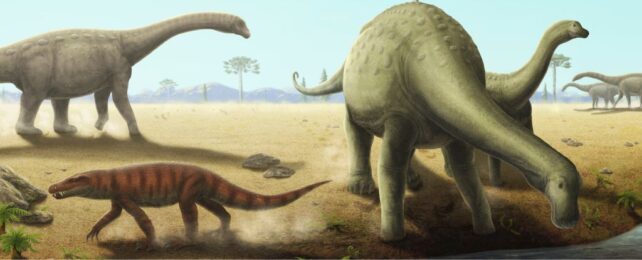
<div xmlns="http://www.w3.org/1999/xhtml"><p><img alt="Giant Dinosaurs Were Riddled With a Devastating Disease, Fossils Show" height="179" src="https://www.sciencealert.com/images/2025/09/SauropodBrazil-642x260.jpg" width="442" /></p>
<div class="w-full h-auto featured-image"><span class="img-caption w-full border-b border-gray-200 text-left font-normal text-gray-500 block py-0.5" style="font-size: 8pt;"><span class="ccfic-text">Baurusuchus and sauropods in Brazil&#39;s ancient, arid environment.</span>&#0160;<span class="ccfic-source">(Vitor Silva/Stocktrek Images/Getty Images)</span></span></div>
<p>Science Alert has a&#0160;<a href="https://www.sciencealert.com/giant-dinosaurs-were-riddled-with-a-devastating-disease-fossils-show">piece</a>&#0160;about dinosaurs… sauropods might not have been all that healthy. The animals that lived in what is now Brazil, might have suffered from bone infections caused by bacterium, fungus, virus, or parasite.</p>
<blockquote class="wp-block-quote is-layout-flow wp-block-quote-is-layout-flow">
<p>“There have been few findings of infectious diseases in sauropods, the first having been published recently,”&#0160;<a href="https://agencia.fapesp.br/deadly-bone-disease-wiped-out-long-necked-dinosaurs-in-what-is-now-the-interior-of-the-state-of-sao-paulo-brazil/55694">says</a>&#0160;lead author and paleontologist Tito Aureliano from the Regional University of Cariri (URCA) in Brazil.</p>
<p>“The bones we analyzed are very close to each other in time and from the same palaeontological site, which suggests that the region provided conditions for pathogens to infect many individuals during that period.”</p>
<p>The precious fossils of unspecified species were collected between 2006 and 2023 at the “Vaca Morta” site in the Brazilian state of Sao Paulo.</p>
<p>Because none of the bone lesions show evidence of healing, the infections were probably still active at the time of death. They may even have contributed.</p>
<p>Based on the disease pathology, Aureliano and colleagues argue that the bone infection advanced quickly. Unlike dinosaur bite marks, the bone lesions possess a “<a href="https://www.youtube.com/watch?v=hhMsNxo2_VA&amp;ab_channel=ColecionadoresdeOssos">chaotic architecture</a>“.</p>
</blockquote></div>
</content>


    </entry>
<entry>
        <title>Mazon Monday #286: There’s a Mother Lode of Fossils in Chicago’s Backyard, and It Could Hold Clues to the Evolution of Life on Earth #fossils #palrontology #MazonMonday #MazonCreek @FieldMuseum #FieldMuseum</title>
        <link rel="alternate" type="text/html" href="https://www.esconi.org/esconi_earth_science_club/2025/09/mazon-monday-286-theres-a-mother-lode-of-fossils-in-chicagos-backyard-and-it-could-hold-clues-to-the.html" />
        <link rel="replies" type="text/html" href="https://www.esconi.org/esconi_earth_science_club/2025/09/mazon-monday-286-theres-a-mother-lode-of-fossils-in-chicagos-backyard-and-it-could-hold-clues-to-the.html" thr:count="0" />
        <id>tag:typepad.com,2003:post-6a0105351bb26c970c03040269a4ec200d</id>
        <published>2025-09-08T08:00:00-05:00</published>
        <updated>2025-09-08T08:00:00-05:00</updated>
        <summary>This is Mazon Monday post #286. What’s your favorite Mazon Creek fossil? Tell us at email:esconi.info@gmail.com. -------------------------------------------------------------- Last week, Mazon Creek, the Field Museum, and ESCONI were back in the news! WTTW, Chicago’s public television station, ran an article highlighting...</summary>
        <author>
            <name>ESCONI</name>
        </author>
        <category term="Mazon Creek" />
        <category term="Mazon Monday" />
        
        
<content type="xhtml" xml:lang="en-US" xml:base="https://www.esconi.org/esconi_earth_science_club/">
<div xmlns="http://www.w3.org/1999/xhtml"><p>This is Mazon Monday post #286.&#0160; What’s your favorite Mazon Creek fossil?&#0160; Tell us at&#0160;<strong><a href="mailto:esconi.info@gmail.com">email:esconi.info@gmail.com</a>.</strong></p>
<p>--------------------------------------------------------------</p>
<p>Last week, Mazon Creek, the Field Museum, and ESCONI were back in the news! WTTW, Chicago’s public television station, ran an&#0160;<a href="https://news.wttw.com/2025/09/04/there-s-mother-lode-fossils-chicago-s-backyard-and-it-could-hold-clues-evolution-life">article</a>&#0160;highlighting Mazon Creek. The story is an excellent read, exploring the scientific importance and new research of the site along with the perspective of amateur fossil collectors.</p>
<h4 class="wp-block-heading"><strong><a href="https://news.wttw.com/2025/09/04/there-s-mother-lode-fossils-chicago-s-backyard-and-it-could-hold-clues-evolution-life">There’s a Mother Lode of Fossils in Chicago’s Backyard, and It Could Hold Clues to the Evolution of Life on Earth</a></strong></h4>
<p><strong><img height="226" src="https://i0.wp.com/esconiinfo-ehnsm.wpcomstaging.com/wp-content/uploads/2025/09/image-8.png?resize=1024%2C576&amp;ssl=1" width="401" /></strong></p>
<figure class="wp-block-image size-large">
<figcaption class="wp-element-caption"><span style="font-size: 8pt;">Jeremy Zimmerman (right) joined a Field Museum expedition to a Mazon Creek site in spring 2025. Fossils of 300-million-year-old plants and other organisms are buried in spoil piles left over from coal mining operations. (Courtesy of the Field Museum)</span></figcaption>
</figure>
<figure class="wp-block-image size-large">
<figcaption class="wp-element-caption"><span style="font-size: 8pt;">Jeremy Zimmerman (right) joined a Field Museum expedition to a Mazon Creek site in spring 2025. Fossils of 300-million-year-old plants and other organisms are buried in spoil piles left over from coal mining operations. (Courtesy of the Field Museum)</span></figcaption>
</figure>
<blockquote>
<p>When Arjan Mann joined the Field Museum as assistant curator of early tetrapods, it was with the intention of turning the institution’s gaze back onto the trove of fossils in its backyard.</p>
<p>“I think that the mother lode still is in the ground,” said Mann. “And more concretions than have been collected still reside in these piles, still reside in the dirt, and they’re just waiting for the next person to come and uncover them and uncover the next evolutionary mystery or solution, too.”</p>
<p>There’s more vertebrate material at the site than previously thought, he said. And advances in imaging technology, including electron microscopy, have yet to be applied to Mazon Creek fossils on a large scale.</p>
<p>So might there be more to existing specimens than meets the eye?</p>
<p>“Absolutely,” Mann said. “They might be more complete.”</p>
</blockquote>
<p><img height="226" src="https://i0.wp.com/esconiinfo-ehnsm.wpcomstaging.com/wp-content/uploads/2025/09/image-10.png?resize=1024%2C576&amp;ssl=1" width="402" /></p>
<div class="entry-content wp-block-post-content has-global-padding is-content-justification-center is-layout-constrained wp-container-core-post-content-is-layout-47709e2f wp-block-post-content-is-layout-constrained">
<figure class="wp-block-image size-large">
<figcaption class="wp-element-caption"><span style="font-size: 8pt;">Jeff Allen, Jeremy Zimmerman and Rich Holm show off their Mazon Creek finds during an August 2025 event at the Field Museum. (Patty Wetli / WTTW News)</span></figcaption>
</figure>
</div></div>
</content>


    </entry>
<entry>
        <title>Oldest Known Fossil of an Armored Ankylosaur Is ‘Far Weirder’ Than Paleontologists Expected #fossils #paleontology #dinosaurs #africa</title>
        <link rel="alternate" type="text/html" href="https://www.esconi.org/esconi_earth_science_club/2025/09/oldest-known-fossil-of-an-armored-ankylosaur-is-far-weirder-than-paleontologists-expected-fossils-pa.html" />
        <link rel="replies" type="text/html" href="https://www.esconi.org/esconi_earth_science_club/2025/09/oldest-known-fossil-of-an-armored-ankylosaur-is-far-weirder-than-paleontologists-expected-fossils-pa.html" thr:count="0" />
        <id>tag:typepad.com,2003:post-6a0105351bb26c970c030402699c1f200d</id>
        <published>2025-09-07T08:00:00-05:00</published>
        <updated>2025-09-07T08:00:00-05:00</updated>
        <summary>Smithsonian Magazine has an article about a weird ankylosaur. Its name is Spicomellus afer, and it lived about 165 million years ago during the Jurassic Period. It had three-foot-long spikes around its collar and plates down its shoulders…. great armor...</summary>
        <author>
            <name>ESCONI</name>
        </author>
        
        
<content type="xhtml" xml:lang="en-US" xml:base="https://www.esconi.org/esconi_earth_science_club/">
<div xmlns="http://www.w3.org/1999/xhtml"><p><img height="298" src="https://i0.wp.com/esconiinfo-ehnsm.wpcomstaging.com/wp-content/uploads/2025/09/image-7.png?resize=1024%2C683&amp;ssl=1" width="447" /></p>
<p>Smithsonian Magazine has an&#0160;<a href="https://www.smithsonianmag.com/smart-news/oldest-known-fossil-of-an-armored-ankylosaur-is-far-weirder-than-paleontologists-expected-180987258/">article</a>&#0160;about a weird ankylosaur. Its name is&#0160;<em>Spicomellus afer</em>, and it lived about 165 million years ago during the Jurassic Period. It had three-foot-long spikes around its collar and plates down its shoulders…. great armor against the predators that lived with it in the flood plains of what is now northern Africa. Read the full description in a&#0160;<a href="https://www.nature.com/articles/s41586-025-09453-6">paper</a>&#0160;in the journal Nature.</p>
<blockquote>
<p>“When we originally named&#0160;<em>Spicomellus</em>, there were doubts that it was an ankylosaur at all,” says&#0160;<a href="https://www.nhm.ac.uk/our-science/people/susannah-maidment.html" rel="noreferrer noopener" target="_blank">Susannah Maidment</a>, a paleontologist at London’s Natural History Museum, in a&#0160;<a href="https://www.nhm.ac.uk/discover/news/2025/august/bizarre-armoured-dinosaur-spicomellus-afer-rewrites-ankylosaur-evolution.html" rel="noreferrer noopener" target="_blank">statement</a>. “Now, not only can we confirm beyond a doubt that this interpretation was correct, but Africa’s only known ankylosaur is far weirder than anyone imagined.”</p>
<p>In 2019, Maidment came across a rib fossil from a dealer in Cambridge, England. The bone was unlike any vertebrate she had ever seen—it had protective spines directly fused into its surface. Based solely on that bone, scientists described&#0160;<em>Spicomellus afer</em>&#0160;as a new species&#0160;<a href="https://www.nature.com/articles/s41559-021-01553-6" rel="noreferrer noopener" target="_blank">in 2021</a>.</p>
<p>Still, Maidment and her colleagues wanted to learn more about the mysterious dinosaur the fossil belonged to, so they went searching in Morocco’s Middle Atlas Mountains. In 2023, they found a more complete skeleton from the same rocks as the 2019 specimen, Maidment writes in a research briefing for&#0160;<a href="https://www.nature.com/articles/d41586-025-02690-9" rel="noreferrer noopener" target="_blank"><em>Nature</em></a>.</p>
</blockquote></div>
</content>


    </entry>
<entry>
        <title>The geology that holds up the Himalayas is not what we thought, scientists discover #geology #himalayas #mountains #orogeny #asia #india #tibet</title>
        <link rel="alternate" type="text/html" href="https://www.esconi.org/esconi_earth_science_club/2025/09/the-geology-that-holds-up-the-himalayas-is-not-what-we-thought-scientists-discover-geology-himalayas.html" />
        <link rel="replies" type="text/html" href="https://www.esconi.org/esconi_earth_science_club/2025/09/the-geology-that-holds-up-the-himalayas-is-not-what-we-thought-scientists-discover-geology-himalayas.html" thr:count="0" />
        <id>tag:typepad.com,2003:post-6a0105351bb26c970c02c8d3dbf452200c</id>
        <published>2025-09-06T08:00:00-05:00</published>
        <updated>2025-09-06T08:00:00-05:00</updated>
        <summary>The Himalayas are the world’s highest mountain range and home to Mount Everest. (Image credit: Pakawat Thongcharoen/Getty Images) Live Science has a story about the what is holding up Himalayas and it’s it isn’t what we thought. Scientists had theorized...</summary>
        <author>
            <name>ESCONI</name>
        </author>
        
        
<content type="xhtml" xml:lang="en-US" xml:base="https://www.esconi.org/esconi_earth_science_club/">
<div xmlns="http://www.w3.org/1999/xhtml"><p><img height="218" src="https://i0.wp.com/esconiinfo-ehnsm.wpcomstaging.com/wp-content/uploads/2025/09/image-6.png?resize=650%2C366&amp;ssl=1" width="387" /></p>
<figure class="wp-block-image size-full is-resized">
<figcaption class="wp-element-caption"><span style="font-size: 8pt;">The Himalayas are the world’s highest mountain range and home to Mount Everest.&#0160;(Image credit: Pakawat Thongcharoen/Getty Images)</span></figcaption>
</figure>
<p>Live Science has a&#0160;<a href="https://www.livescience.com/planet-earth/geology/the-geology-that-holds-up-the-himalayas-is-not-what-we-thought-scientists-discover">story</a>&#0160;about the what is holding up Himalayas and it’s it isn’t what we thought. Scientists had theorized the crumpled region caused by the squeezing of Tibet by the tectonic forces of the Indian sub-continent colliding with the Asia had doubled the thickness of Earth’s crust beneath the Himalayas and Tibetan Plateau to the north. That extra thickness alone carries the weight of the mountain ranges. That theory was&#0160;<a href="https://planet-terre.ens-lyon.fr/objets/Images/Argand-tectonique-Asie/Argand-Tectonique-Asie-1924-OCR.pdf">published</a>&#0160;by Swiss geologist Émile Argand in 1924. It shows the Indian and Asian crusts stacked on top of each other, together stretching 45 to 50 miles (70 to 80 km) deep beneath Earth’s surface. Evidence had called the theory into question. Now, research&#0160;<a href="https://doi.org/10.1029/2025TC009057">published</a>&#0160;in the journal Tectonics found there is a piece of mantle sandwiched between the Asian and Indian crusts, which may explain why the Himalayas grew so tall.</p>
<blockquote>
<p>The mantle is the layer of Earth that sits directly beneath the crust. It is much denser than the crust and, therefore, doesn’t liquefy at the same temperatures. Meanwhile, the crust is so light and buoyant that it behaves similarly to an iceberg, lifting up higher above Earth’s surface the thicker it gets.</p>
<p>Sternai and his colleagues discovered the mantle insert by simulating the collision between the Asian and Indian continents on a computer. The model showed that as the Indian plate slipped beneath the Eurasian plate and started to liquify, blobs of it rose and attached themselves not to the bottom of the Asian crust, but to the base of the lithosphere, which is the rigid outer layer of the planet composed of the crust and upper mantle.</p>
<p>This is fundamental, Sternai said, because it means there is a rigid layer of mantle between the stacked crusts solidifying the whole structure beneath the Himalayas. The two crusts give enough buoyancy to keep the region lifted, while the mantle material provides resistance and mechanical strength. “You’ve got all the ingredients you need to uplift topography and sustain the weight of the Himalayas and Tibetan plateau,” he said.</p>
</blockquote></div>
</content>


    </entry>
<entry>
        <title>Fossil Friday #281: Dasyleptus sp. #fossils #paleontology #FossilFriday #MazonCreek #insects #monurans</title>
        <link rel="alternate" type="text/html" href="https://www.esconi.org/esconi_earth_science_club/2025/09/fossil-friday-281-dasyleptus-sp-fossils-paleontology-fossilfriday-mazoncreek-insects-monurans.html" />
        <link rel="replies" type="text/html" href="https://www.esconi.org/esconi_earth_science_club/2025/09/fossil-friday-281-dasyleptus-sp-fossils-paleontology-fossilfriday-mazoncreek-insects-monurans.html" thr:count="0" />
        <id>tag:typepad.com,2003:post-6a0105351bb26c970c03040269971d200d</id>
        <published>2025-09-05T08:00:00-05:00</published>
        <updated>2025-09-05T08:00:00-05:00</updated>
        <summary>This is the “Fossil Friday” post #280. Expect this to be a somewhat regular feature of the website. We will post any fossil pictures you send in to esconi.info@gmail.com. Please include a short description or story. Check the #FossilFriday Bluesky/Twitter...</summary>
        <author>
            <name>ESCONI</name>
        </author>
        <category term="Fossil Friday" />
        <category term="Mazon Creek" />
        
        
<content type="xhtml" xml:lang="en-US" xml:base="https://www.esconi.org/esconi_earth_science_club/">
<div xmlns="http://www.w3.org/1999/xhtml"><p>This is the “Fossil Friday” post #280.&#0160; Expect this to be a somewhat regular feature of the website.&#0160; We will post any fossil pictures you send in to&#0160;<strong><a href="mailto:esconi.info@gmail.com">esconi.info@gmail.com</a>.</strong>&#0160; Please include a short description or story.&#0160; Check the #FossilFriday Bluesky/Twitter hash tag for contributions from around the world!</p>
<hr class="wp-block-separator has-alpha-channel-opacity" />
<p><img src="https://i0.wp.com/esconiinfo-ehnsm.wpcomstaging.com/wp-content/uploads/2025/09/image-5.png?resize=346%2C146&amp;ssl=1" /></p>
<p><em>Dasyleptus</em>&#0160;is an extinct genus of monurian insect. They are known from the Mazon Creek biota, other Carboniferous localities, and have been found in later deposits that date to the Permian.&#0160; They get their name for the single tail spike.&#0160; Their closest living relative today is the Silverfish.&#0160; In fact, some recent research suggests they may even be silverfish, instead of a distinct order as they are today. The species Dasyleptus is somewhat rare in the Mazon Creek biota.&#0160; It was described in 1957 by&#0160;<a href="https://www.researchgate.net/figure/The-holotype-of-Dasyleptus-brongniarti-Sharov-1957-Photo-from-Carpenter-1992-figure_fig1_281409168">Sharov</a>.&#0160; It’s found in the more terrestrial localities, but might also be present in concretions from Pit 11. (see&#0160;<a href="https://esconiinfo-ehnsm.wpcomstaging.com/2021/01/25/mazon-monday-44-insects-part-2-monurans-mazoncreek-paleontology-fossils-mazonmonday-insects/">Mazon Monday #44</a>).</p>
<p>Chris Berg, who is currently the president of ESCONI, sent us in photos of a prime specimen. This fossil was collected from the Mazon River in 2025. Thanks for sharing this beautiful fossil, Chris!</p>
<p><img height="313" src="https://i0.wp.com/esconiinfo-ehnsm.wpcomstaging.com/wp-content/uploads/2025/09/IMG_5596.jpeg?resize=1024%2C768&amp;ssl=1" width="418" /></p>
<p><img height="314" src="https://i0.wp.com/esconiinfo-ehnsm.wpcomstaging.com/wp-content/uploads/2025/09/IMG_5599.jpeg?resize=1024%2C768&amp;ssl=1" width="419" /></p>
<p><img height="314" src="https://i0.wp.com/esconiinfo-ehnsm.wpcomstaging.com/wp-content/uploads/2025/09/IMG_5603.jpeg?resize=1024%2C768&amp;ssl=1" width="419" /></p></div>
</content>


    </entry>
<entry>
        <title>Throwback Thursday #281: Looking Back At ESCONI For September 2025 #history #TBT #ThrowbackThursday</title>
        <link rel="alternate" type="text/html" href="https://www.esconi.org/esconi_earth_science_club/2025/09/throwback-thursday-281-looking-back-at-esconi-for-september-2025-history-tbt-throwbackthursday.html" />
        <link rel="replies" type="text/html" href="https://www.esconi.org/esconi_earth_science_club/2025/09/throwback-thursday-281-looking-back-at-esconi-for-september-2025-history-tbt-throwbackthursday.html" thr:count="0" />
        <id>tag:typepad.com,2003:post-6a0105351bb26c970c02e860f29a9d200b</id>
        <published>2025-09-04T08:00:00-05:00</published>
        <updated>2025-09-04T08:00:00-05:00</updated>
        <summary>This is Throwback Thursday #281. In these, we look back into the past at ESCONI specifically and Earth Science in general. If you have any contributions, (science, pictures, stories, etc …), please send them to esconi.info@gmail.com. Thanks! email:esconi.info@gmail.com. —————————————————– 25...</summary>
        <author>
            <name>ESCONI</name>
        </author>
        <category term="Throwback Thursday" />
        
        
<content type="xhtml" xml:lang="en-US" xml:base="https://www.esconi.org/esconi_earth_science_club/">
<div xmlns="http://www.w3.org/1999/xhtml"><p>This is Throwback Thursday #281. In these, we look back into the past at ESCONI specifically and Earth Science in general. If you have any contributions, (science, pictures, stories, etc …), please send them to esconi.info@gmail.com. Thanks! <strong><a href="mailto:esconi.info@gmail.com">email:esconi.info@gmail.com</a>.</strong></p>
<p>—————————————————–</p>
<p><a class="asset-img-link" href="https://www.esconi.org/.a/6a0105351bb26c970c03040269811e200d-popup" onclick="window.open( this.href, &#39;_blank&#39;, &#39;width=640,height=480,scrollbars=no,resizable=no,toolbar=no,directories=no,location=no,menubar=no,status=no,left=0,top=0&#39; ); return false" style="display: inline;"><img alt="Brag Night September 1961" class="asset  asset-image at-xid-6a0105351bb26c970c03040269811e200d img-responsive" height="221" src="https://www.esconi.org/.a/6a0105351bb26c970c03040269811e200d-500wi" title="Brag Night September 1961" width="299" /></a></p>
<p><strong>25 Years Ago – September 2000</strong></p>
<ul>
<li>Stephen J. Gould did a lecture at the FIeld Museum and ESCONI and Irene Broede were there!</li>
<li>Dr. Meenakski Wadhwa from the Field Museum did a presentation at the General Meeting.</li>
<li>The Rockhound Flea Market and Auction was held at the College of DuPage</li>
<li>Karen&#39;s Korner had briefs about Paul Sereno, Florida fossils, and the Dino-Bird.</li>
<li>Mineralogy/Micromounts discussed the legendary Stewart Tourmaline mine near San Diego, California.</li>
<li>There was a field trip to the Braceville spoil pile... it was only a 1 day field trip back then.</li>
</ul>
<p><strong>50 Years Ago – September 1975</strong></p>
<ul>
<li>Most of the study groups were doing &quot;Brag Night&quot; to show off what you found during summer vacation.</li>
<li>ESCONI meetings moved to the Prospect Federal Savings &amp; Loan in Oakbrook, IL</li>
<li>There were a couple of field trips to Iowa, Pints Quarry in Raymond, IA and the Rockford Brick and Tile Co. in Rockford, IA.</li>
<li>There was a sale of holiday fruit cakes to support the Koster Expedition.&#0160; The Koster Expedition was an archaeological dig near Knapsville, IL that was dated to 6800 years ago.</li>
<li>The Lizzadro Museum of Lapidary Art had presentations on &quot;Reptiles&quot; and &quot;Jade&quot;.</li>
</ul>
<p><strong>70 Years Ago – September 1955</strong></p>
<ul>
<li>The newsletter had an announcement for the upcoming Downers Grove earth science classes for 1955... Basic Earth Science and Paleontology.&#0160; See <a href="https://www.esconi.org/esconi_earth_science_club/2023/01/throwback-thursday-144-geology-class-fall-1953-tbt-history-throwbackthursday-geology-school-nightsch.html">Throwback Thursday #144</a>.</li>
<li>There was a field trip to visit <a href="https://oprfmuseum.org/people/isabel-bassett-wasson">Isabel Wassen</a> at the Trailside Museum in River Forest, where she spoke of &quot;Lake Chicago&quot;.&#0160; Wassen was one of the first female petroleum geologists in the world.</li>
<li>Downers Grove held it&#39;s Fall Festival and ESCONI was there with an exhibit.&#0160; This event has been held for many years.</li>
<li>Dorothy Hoffman wrote &quot;A Mighty Waterfall&quot; for the newsletter.</li>
<li>A brand new pica-character typewriter was used to &quot;write&quot; the ESCONI newsletter.&#0160; Pica-pitch is a standard typewriter setting where there ar 10 characters printed within an inch of text.</li>
</ul></div>
</content>


    </entry>
<entry>
        <title>ESCONI Field Trip to Bellevue, MI Quarry on Saturday, September 27th, 2025 #fieldtrip #minerals #fossils #mississippian</title>
        <link rel="alternate" type="text/html" href="https://www.esconi.org/esconi_earth_science_club/2025/09/esconi-field-trip-to-bellevue-mi-quarry-on-saturday-september-27th-2025-fieldtrip-minerals-fossils-m.html" />
        <link rel="replies" type="text/html" href="https://www.esconi.org/esconi_earth_science_club/2025/09/esconi-field-trip-to-bellevue-mi-quarry-on-saturday-september-27th-2025-fieldtrip-minerals-fossils-m.html" thr:count="0" />
        <id>tag:typepad.com,2003:post-6a0105351bb26c970c02c8d3dbd9ab200c</id>
        <published>2025-09-03T22:19:37-05:00</published>
        <updated>2025-09-03T22:19:37-05:00</updated>
        <summary>A field trip to a quarry in Bellevue, MI is scheduled for Saturday, September 27th, 2025. This is a joint trip with the Kalamazoo Geological and Mineral Society (KGMS), and will be led by KGMS members. There is space for...</summary>
        <author>
            <name>ESCONI</name>
        </author>
        <category term="Field Trips" />
        
        
<content type="xhtml" xml:lang="en-US" xml:base="https://www.esconi.org/esconi_earth_science_club/">
<div xmlns="http://www.w3.org/1999/xhtml"><p>A field trip to a quarry in Bellevue, MI is scheduled for Saturday, September 27th, 2025. This is a joint trip with the Kalamazoo Geological and Mineral Society (KGMS), and will be led by KGMS members. There is space for 15 ESCONI members. The trip will be from 9 AM ET to 3 PM ET. <strong>Note the time change for those coming from Illinois!</strong></p>
<p>The quarry exposes the Bayport Limestone (Mississippian/Lower Carboniferous). Minerals (calcite, pyrite, chalcopyrite, etc.) and fossils (coral, brachiopods, shark teeth, etc.) can be found.</p>
<p><strong>You must register to go on this trip.</strong> See rule 8 below for instructions. <strong>This is the only way to register.</strong></p>
<ol class="wp-block-list">
<li>You and everyone in your group <strong>must</strong> be members of ESCONI. Registration opens on Thursday September 4th and ends on Saturday September 20th. <strong>No membership dues will be accepted at the field trip site.</strong> Have your membership status resolved before the trip, no later than September 20th. You can pay dues by mailing a check, or with a credit card using the PayPal link on the ESCONI website.</li>
<li>The minimum age to attend this trip is 12 years old.</li>
<li>Arrive at the quarry by 8:45AM ET. A car caravan will enter the quarry at 9AM ET. No one is to enter the quarry on their own.</li>
<li>Hard hats, safety vests, hard toed shoes and eye protection are required!</li>
<li>Hammers and chisels are allowed, but no power tools of any kind are allowed.</li>
<li>You may be required to sign a waiver from the quarry.</li>
<li>By attending, you agree to follow the ESCONI Code of Ethics and Conduct (available on the ESCONI website) and agree to the conditions set forth in the ESCONI Accident Waiver and Release of Liability Form (sent by email to those that register). You don’t need to print these out – just know what you’re agreeing to.</li>
<li>To register, send Connor an email at connorpuritz@gmail.com with the names of the ESCONI members attending. You will receive the address of the quarry once you register.</li>
</ol>
<p>This is a joint trip with KGMS. There will not be an ESCONI trip leader present. Follow any and all directions from the KGMS trip leader.</p>
<div class="sharedaddy sd-sharing-enabled">&#0160;</div></div>
</content>


    </entry>
<entry>
        <title>This Crocodile Relative Was One of Dinosaurs’ Most Fearsome Predators #fossils #paleontology #crocodile #argentina #cretaceous</title>
        <link rel="alternate" type="text/html" href="https://www.esconi.org/esconi_earth_science_club/2025/09/this-crocodile-relative-was-one-of-dinosaurs-most-fearsome-predators-fossils-paleontology-crocodile-.html" />
        <link rel="replies" type="text/html" href="https://www.esconi.org/esconi_earth_science_club/2025/09/this-crocodile-relative-was-one-of-dinosaurs-most-fearsome-predators-fossils-paleontology-crocodile-.html" thr:count="0" />
        <id>tag:typepad.com,2003:post-6a0105351bb26c970c030402696a41200d</id>
        <published>2025-09-03T08:00:00-05:00</published>
        <updated>2025-09-03T08:00:00-05:00</updated>
        <summary>The New York Times’ Trilobite column has an interesting story about a fierce crocodile that lived alongside the dinosaurs during the Cretaceous Period about 72 million years ago. Kostensuchus measured about 11½ feet long and weighed 551 pounds. The fossils...</summary>
        <author>
            <name>ESCONI</name>
        </author>
        
        
<content type="xhtml" xml:lang="en-US" xml:base="https://www.esconi.org/esconi_earth_science_club/">
<div xmlns="http://www.w3.org/1999/xhtml"><p><img height="301" src="https://i0.wp.com/esconiinfo-ehnsm.wpcomstaging.com/wp-content/uploads/2025/09/image-3.png?resize=1024%2C683&amp;ssl=1" width="451" /></p>
<p>The New York Times’ Trilobite column has an interesting <a href="https://www.nytimes.com/2025/08/27/science/land-crocodile-dinosaurs.html?unlocked_article_code=1.jE8.sWsg.LM1HgPrGmhGo&amp;smid=url-share">story</a> about a fierce crocodile that lived alongside the dinosaurs during the Cretaceous Period about 72 million years ago.&#0160;<em>Kostensuchus</em>&#0160;measured about 11½ feet long and weighed 551 pounds. The fossils were found in March 2020 in Santa Cruz, a province in Argentina. The animal was described in a&#0160;<a href="http://plos.io/47w520t">paper</a>&#0160;in the journal PLOS One.</p>
<blockquote class="wp-block-quote is-layout-flow wp-block-quote-is-layout-flow">
<p>While North America and Asia had their share of Cretaceous crocodiles, they were mostly from families&#0160;<a href="https://www.nytimes.com/2019/06/03/science/crocodiles-dinosaurs-metabolism.html">that had evolved a semiaquatic lifestyle</a>. But crocodiles took a different trajectory in South America and Africa, where several families walked with their limbs held under their bodies — like mammals and dinosaurs — rather than with the sprawling stance of their water-loving cousins.</p>
<p>The team’s analysis of Kostensuchus’s hips suggested that it held its legs in slightly more of a sprawl than some related land crocs, suggesting that, while it was a capable land predator, it and other pierosaurids might have been relatively comfortable in water.</p>
<p>That points to the possibility that different families of crocodilians might have independently evolved toward more aquatic lifestyles multiple times, Dr. Novas said.</p>
</blockquote></div>
</content>


    </entry>
<entry>
        <title>ESCONI Events for September 2025 #events #paleontology #geology #mineralogy #fieldtrip #MazonCreek</title>
        <link rel="alternate" type="text/html" href="https://www.esconi.org/esconi_earth_science_club/2025/09/esconi-events-for-september-2025-events-paleontology-geology-mineralogy-fieldtrip-mazoncreek.html" />
        <link rel="replies" type="text/html" href="https://www.esconi.org/esconi_earth_science_club/2025/09/esconi-events-for-september-2025-events-paleontology-geology-mineralogy-fieldtrip-mazoncreek.html" thr:count="0" />
        <id>tag:typepad.com,2003:post-6a0105351bb26c970c03040269610c200d</id>
        <published>2025-09-02T08:54:00-05:00</published>
        <updated>2025-09-17T21:29:16-05:00</updated>
        <summary>Sat, Sep 6th Sun, Sep 7th ESCONI Field Trip to Braceville, IL for Mazon Creek fossils - Both days are full! Details Fri, Sep 12th ESCONI General Meeting - 8:00 PM via Zoom - Dr. Angela Cooper will be presenting...</summary>
        <author>
            <name>ESCONI</name>
        </author>
        
        
<content type="xhtml" xml:lang="en-US" xml:base="https://www.esconi.org/esconi_earth_science_club/">
<div xmlns="http://www.w3.org/1999/xhtml"><table border="1" cellpadding="5" cellspacing="0" style="height: 50px; width: 474px;" width="476">
<tbody>
<tr>
<td style="width: 108px;">Sat, Sep 6th Sun, Sep 7th</td>
<td style="width: 366px;"><strong>ESCONI Field Trip to Braceville, IL for Mazon Creek fossils - Both days are full!<br /><br /></strong><a href="https://www.esconi.org/esconi_earth_science_club/2025/08/esconi-field-trip-to-braceville-il-for-mazon-creek-fossils-saturday-september-6th-and-sunday-septemb.html">Details</a></td>
</tr>
<tr style="height: 25px;">
<td style="vertical-align: top; width: 108px; height: 25px;">Fri, Sep 12th</td>
<td style="vertical-align: top; height: 25px; width: 366px;"><strong>ESCONI General Meeting - 8:00 PM via Zoom - Dr. Angela Cooper will be presenting “Cahokia Mounds State Historic Site.”<br /><br /></strong><a href="https://us02web.zoom.us/meetings/82239920130/invitations?signature=W7oUNXNCHF9FJ2yfO5BsyXGNKda1TZbkG_bsz_qYtM8">Zoom link</a></td>
</tr>
<tr style="height: 25px;">
<td style="vertical-align: top; width: 108px; height: 25px;">Sat, Sep 13th</td>
<td style="vertical-align: top; height: 25px; width: 366px;"><strong>ESCONI Junior Meeting - 6:30 PM (starts at 7:00 PM) at College of DuPage Room TEC 1038B - Topic: &quot;Rock , Mineral, and Fossil Identification&quot;<br /><br /></strong>Specifics of this meeting are available from Scott Galloway, 630-670-2591, gallowayscottf@gmail.com. The meeting will be in person at the<strong> College of DuPage Technical Education Center (TEC) Building –&#0160;Room 1038B&#0160;(<a href="https://goo.gl/maps/QdzxTU4sJZoASzbB8" rel="noreferrer noopener" target="_blank">Map</a><a href="https://www.esconi.org/esconi_earth_science_club/2025/06/esconi-rock-mineral-and-fossil-swap-august-23rd-2025-dupage-county-fairgrounds-rocks-minerals-fossil.html">).</a></strong></td>
</tr>
<tr style="height: 25px;">
<td style="vertical-align: top; width: 108px; height: 25px;">Sat, Sep 13th</td>
<td style="vertical-align: top; height: 25px; width: 366px;"><strong>ESCONI Field Trip to Mount Orab for Trilobites - Trip is full!<br /><br /></strong><a href="https://www.esconi.org/esconi_earth_science_club/2025/08/esconi-field-trip-to-mount-orab-for-trilobites-saturday-september-13th-2025-fossils-fossil-fieldtrip.html">Details</a></td>
</tr>
<tr style="height: 25px;">
<td style="vertical-align: top; width: 108px; height: 25px;">Sat, Sep 20th</td>
<td style="vertical-align: top; height: 25px; width: 366px;"><strong>ESCONI Paleontology Study Group&#0160; - 7:30 PM at <br />College of DuPage Technical Education Center (TEC) Building –&#0160;Room 1038B&#0160;(<a href="https://goo.gl/maps/QdzxTU4sJZoASzbB8" rel="noreferrer noopener" target="_blank">Map</a><a href="https://www.esconi.org/esconi_earth_science_club/2025/06/esconi-rock-mineral-and-fossil-swap-august-23rd-2025-dupage-county-fairgrounds-rocks-minerals-fossil.html" rel="noreferrer noopener" target="_blank">)</a> - Topic: &quot;Show and Tell&quot;<br /><br /></strong>Bring your cephalopods!&#0160;</td>
</tr>
<tr style="height: 25px;">
<td style="vertical-align: top; width: 108px; height: 25px;">Sat, Sep 27th</td>
<td style="vertical-align: top; height: 25px; width: 366px;"><strong>ESCONI Field Trip to Danville, IL for Carboniferous fossils<br /><br /></strong><a href="https://www.esconi.org/esconi_earth_science_club/2025/08/esconi-field-trip-to-danville-shale-pile-fossils-saturday-september-27th-2025-fossils-fossil-fieldtr.html">Details</a></td>
</tr>
<tr style="height: 25px;">
<td style="vertical-align: top; width: 108px; height: 25px;">Sat, Sep 27th</td>
<td style="vertical-align: top; height: 25px; width: 366px;"><strong>ESCONI Field Trip to Bellevue, MI for Minerals and Mississippi fossils (joint trip with KGMS)<br /><br /></strong><a href="https://www.esconi.org/esconi_earth_science_club/2025/09/esconi-field-trip-to-bellevue-mi-quarry-on-saturday-september-27th-2025-fieldtrip-minerals-fossils-m.html">Details</a></td>
</tr>
</tbody>
</table></div>
</content>


    </entry>
<entry>
        <title>2025 Mazon Creek Fossil Day, October 11th, 2025 at the Coal City Library #fossils #paleontology #MazonCreek #NationalFossilDay #CoalCity</title>
        <link rel="alternate" type="text/html" href="https://www.esconi.org/esconi_earth_science_club/2025/09/the-2025-mazon-creek-fossil-day-will-be-held-on-october-11th-2025-at-the-coal-city-library-from-10-am-to-3-pm-see-you-there.html" />
        <link rel="replies" type="text/html" href="https://www.esconi.org/esconi_earth_science_club/2025/09/the-2025-mazon-creek-fossil-day-will-be-held-on-october-11th-2025-at-the-coal-city-library-from-10-am-to-3-pm-see-you-there.html" thr:count="0" />
        <id>tag:typepad.com,2003:post-6a0105351bb26c970c02c8d3dbbfa5200c</id>
        <published>2025-09-02T08:38:03-05:00</published>
        <updated>2025-09-02T08:39:36-05:00</updated>
        <summary>The 2025 Mazon Creek Fossil Day will be held on October 11th, 2025 at the Coal City Library from 10 AM to 3 PM. See you there! Previous events October 16th, 2023 October 21st, 2024</summary>
        <author>
            <name>ESCONI</name>
        </author>
        <category term="Mazon Creek" />
        
        
<content type="xhtml" xml:lang="en-US" xml:base="https://www.esconi.org/esconi_earth_science_club/">
<div xmlns="http://www.w3.org/1999/xhtml"><p>The 2025 Mazon Creek Fossil Day will be held on October 11th, 2025 at the Coal City Library from 10 AM to 3 PM. See you there!</p>
<p><img height="645" src="https://i0.wp.com/esconiinfo-ehnsm.wpcomstaging.com/wp-content/uploads/2025/09/2025-MCFD-Flyer.png?resize=789%2C1024&amp;ssl=1" width="497" /></p>
<p>Previous events</p>
<ul class="wp-block-list">
<li><a href="https://esconiinfo-ehnsm.wpcomstaging.com/2023/10/16/mazon-monday-186-mazon-creek-fossil-day-fossil-paleontology-mazoncreek-mazonmonday-collectors-fossil/">October 16th, 2023</a></li>
<li><a href="https://esconiinfo-ehnsm.wpcomstaging.com/2024/10/21/mazon-monday-239-mazon-creek-fossil-day-report-fossils-paleontology-mazonmonday-mazoncreek/">October 21st, 2024</a></li>
</ul>
<p><img src="https://i0.wp.com/esconiinfo-ehnsm.wpcomstaging.com/wp-content/uploads/2025/09/image.png?resize=768%2C576&amp;ssl=1" /></p>
<p><img src="https://i0.wp.com/esconiinfo-ehnsm.wpcomstaging.com/wp-content/uploads/2025/09/image-1.png?resize=768%2C1020&amp;ssl=1" /></p>
<p><img src="https://i0.wp.com/esconiinfo-ehnsm.wpcomstaging.com/wp-content/uploads/2025/09/image-2.png?resize=768%2C1020&amp;ssl=1" /></p></div>
</content>


    </entry>
<entry>
        <title>Mazon Monday #285: Etacystis communis #fossils #paleontology #MazonMonday #MazonCreek #pennsylvanian #carboniferous</title>
        <link rel="alternate" type="text/html" href="https://www.esconi.org/esconi_earth_science_club/2025/09/mazon-monday-285-etacystis-communis-fossils-paleontology-mazonmonday-mazoncreek-pennsylvanian-carbon.html" />
        <link rel="replies" type="text/html" href="https://www.esconi.org/esconi_earth_science_club/2025/09/mazon-monday-285-etacystis-communis-fossils-paleontology-mazonmonday-mazoncreek-pennsylvanian-carbon.html" thr:count="0" />
        <id>tag:typepad.com,2003:post-6a0105351bb26c970c02e860f263cf200b</id>
        <published>2025-09-01T08:00:00-05:00</published>
        <updated>2025-09-01T08:00:00-05:00</updated>
        <summary>This is Mazon Monday post #285. What&#39;s your favorite Mazon Creek fossil? Tell us at email:esconi.info@gmail.com. ----------------------------------------------------- Etacystis communis Nitecki and Schram, 1976 One of the more problematic animals from Mazon Creek is Etacystis communis, known as the Aitch or...</summary>
        <author>
            <name>ESCONI</name>
        </author>
        <category term="Mazon Creek" />
        <category term="Mazon Monday" />
        
        
<content type="xhtml" xml:lang="en-US" xml:base="https://www.esconi.org/esconi_earth_science_club/">
<div xmlns="http://www.w3.org/1999/xhtml"><p>This is Mazon Monday post #285.&#0160; What&#39;s your favorite Mazon Creek fossil?&#0160; Tell us at <strong><a href="mailto:esconi.info@gmail.com">email:esconi.info@gmail.com</a>.</strong></p>
<p>-----------------------------------------------------</p>
<p><img height="349" src="https://i0.wp.com/esconiinfo-ehnsm.wpcomstaging.com/wp-content/uploads/2025/08/drawing-2.png?resize=489%2C544&amp;ssl=1" width="314" /></p>
<figure class="wp-block-image size-full is-resized">
<figcaption class="wp-element-caption"><em>Etacystis communis</em>&#0160;Nitecki and Schram, 1976</figcaption>
</figure>
<p></p>
<p>One of the more problematic animals from Mazon Creek is <em>Etacystis communis</em>, known as the Aitch or &quot;H&quot; animal by amateur collectors. It was described by Matthew Nitecki and Frederick Schram in &quot;Etacystis communis, a fossil of uncertain affinities from the Mazon Creek fauna (Pennsylvanian of Illinois)&quot;, which was published in the <em>Journal of Paleontology</em>. The authors did not assign it to a phylum. Researchers have suggested a&#0160;<a href="https://en.wikipedia.org/wiki/Hemichordate">hemichordate</a>&#0160;or&#0160;<a href="https://en.wikipedia.org/wiki/Hydrozoan">hydrozoan</a>&#0160;affinity, however the animal is missing a stomochord. <em>E. communis</em>, a soft-bodied animal, is only known from Mazon Creek.</p>
<p> </p>
<p>Matthew H. Nitecki was a long-time curator of fossil invertebrates at the Field Museum of Natural History. He is the editor of &quot;Mazon Creek Fossils&quot;, which was the proceedings of a Symposium on Mazon Creek fossils held at the University of Michigan in May, 1978.</p>
<p> </p>
<p>Frederick R. Schram is an American paleontologist known mostly for his work on crustacean biology, taxonomy, and systematics.</p>
<p></p>
<blockquote>
<p>From “Etacystis communis, a fossil of uncertain affinities from the Mazon Creek fauna (Pennsylvanian of Illinois)”</p>
<p><strong>ABSTRACT</strong>-Etacystis communis n gen, n. sp. is a strange organism preserved in the siderite concretions of the Middle Pennsylvanian Carbondale Formation. It has the shape of the letter “H” with a saclike structure connected to the cross bar, and ranges in size from 20 to 95 mm. There was apparently no coenoecium or mineralized covering.</p>
</blockquote>
<p>Jack Wittry addresses&#0160;<em>Etacystis communis</em>&#0160;on pages 155 and 156 of his book “The Fossil Fauna of Mazon Creek”.</p>
<blockquote>
<p><em>Etacystis communis</em> Nitecki and Schram, 1976</p>
<p><em>Etacystis communis</em> is commonly called the Aitch or “H” because fossilized remains seem to resemble this letter in a lop-sided form. This animal is large, possibly a hydrozoan in the phylum Coelenterata from the Pennsylvanian Essex Fauna. Due to the animal’s size, concretions often contain only incomplete remains. In more complete specimens, a heart-shaped sac is connected by a short stalk to a cross-bar, which connects to a longer leg-like appendage (stolen) that probably was flexible in life. E. communis may have been free-floating or perhaps anchored in the substrate by its stolen.</p>
<p><br />Some well-preserved examples show what has been interpreted as a mouth near the base of the sac. Wart-like papillations that are difficult to interpret cover the arms and sometimes the sac. These could be suckers or clumps of stinging cells, or possibly even bases for lost tentacles.</p>
</blockquote>
<p>E. communis appears twice in &quot;Richardson&#39;s Guide to the Fossil Fauna of Mazon Creek&quot; as a Cnidarian in Chapter 6 by Steven D. Sroka and again in Chapter 20 under &quot;Problematica&quot;.</p>
<blockquote>
<p>Chapter 6 - Cnidaria</p>
<p><em>Etacystis communis</em> Nitecki and Schram, 1976 Figures 6.14, 6.15</p>
<p>Known to collectors as &quot;the H,&quot; <em>Etacystis</em> is a relatively large unsymmetrical H-shaped fossil animal or part of an animal with two unequal arms and a sac connected to a crossbar (peduncle). The longest leg of the H, termed the stolon (Nitecki and Schram, 1976), was apparently flexible. This structure, which varies in length, almost always extends off the edge of the concretion. Within some specimens there is a ca-nallike area down the middle of the stolon (Nitecki and Schram, 1976; Foster, 1979). The stolon may have been both an anchoring organ and a device to connect adjoining animals, or a site of asexual budding (Nitecki and Schram, 1976). There is a heart-shaped saclike structure connected to the peduncle by a stalk with a small aperture located at the point where the stalk joins the sac. This aperture may represent the mouth (Nitecki and Schram, 1976).</p>
<p>Numerous specimens are found with papillations on the arms, peduncle, and sac. These papillations might be suckers, sticky pads, clumps of cnidocytes, remnants of lost tentacles, or even diagenetic alterations (Nitecki and Schram, 1976).</p>
<p>The natural affinities of <em>E. communis</em> have been debated since it was first described. Nitecki and Schram (1976), with some uncertainty, considered it to be similar to pterobranch hemichordates such as <em>Rhabdopleura</em>, which contains a pair of tentaculate lopho-phore arms. Foster (1979, p. 219) thought it possible that Etacystis is not related to hemichordates. He assigned <em>Etacystis</em> to the Hydrozoa (order Siphonophora) because of its planktic nature, its morphology, and its great range in size without appreciable change in form of the peduncle, sac, and arms.</p>
</blockquote>
<blockquote>
<p>Chapter 20 - Problematica</p>
<p>&quot;H&quot; Animal <em>Etacystis communis</em> Nitecki and Schram, 1976 See Figures 6.14, 6.15</p>
<p>Known to collectors as &quot;the H,&quot; <em>Etacystis</em> is a relatively large asymmetrical H-shaped animal or part of an animal with two unequal arms and a sac connected to a crossbar (peduncle). For a more detailed description of <em>E. communis</em>, see Chapter 6. Unfortunately, detailed internal morphology is largely lacking.</p>
<p>The affinities of <em>E. communis</em> have been debated since its discovery. Nitecki and Schram (1976), with some uncertainty, considered it to be similar to pterobranch hemichordates such as Rhabdopleura, which has paired tentaculate lophophore arms. Foster (1979b) assigned <em>Etacystis</em> to the Hydrozoa (order Siphonophora) because of its possible planktic nature, morphology, and the great range in size in specimens lacking appreciable variation in form of the peduncle, sac, and arms.</p>
<p>Alternatively, Schram (1991), using cladistic analysis, argued that Etacystis is closely allied with the Ectoprocta, Phoronida, and the higher deuterostome/lophophorates.</p>
</blockquote>
<p>Specimens</p>
<p>From Wittry</p>
<p><img height="502" src="https://i0.wp.com/esconiinfo-ehnsm.wpcomstaging.com/wp-content/uploads/2025/08/1756694391527-736fac47-3c91-4fb3-8615-dc9ffe924928.jpg?resize=768%2C1024&amp;ssl=1" width="376" /></p>
<p><img height="254" src="https://i0.wp.com/esconiinfo-ehnsm.wpcomstaging.com/wp-content/uploads/2025/08/1756694423269-1196d6db-d998-48ca-b54b-827a1edcf72e.jpg?resize=1024%2C683&amp;ssl=1" width="380" /></p>
<p><img height="253" src="https://i0.wp.com/esconiinfo-ehnsm.wpcomstaging.com/wp-content/uploads/2025/08/1756694445172-9bdcf892-8a2c-4e79-8b19-ebee7f96c1a5-1024x683.jpg?resize=1024%2C683&amp;ssl=1" width="379" /></p>
<p>ESCONI member</p>
<p><img height="281" src="https://i0.wp.com/esconiinfo-ehnsm.wpcomstaging.com/wp-content/uploads/2025/08/PXL_20250901_035859243.jpg?resize=1024%2C771&amp;ssl=1" width="373" /></p></div>
</content>


    </entry>
<entry>
        <title>Paleontologist Discovers First Known Silurian Horseshoe Crab #fossils #paleontology #horseshoecrab #crabs #silurian</title>
        <link rel="alternate" type="text/html" href="https://www.esconi.org/esconi_earth_science_club/2025/08/paleontologist-discovers-first-known-silurian-horseshoe-crab-fossils-paleontology-horseshoecrab-crab.html" />
        <link rel="replies" type="text/html" href="https://www.esconi.org/esconi_earth_science_club/2025/08/paleontologist-discovers-first-known-silurian-horseshoe-crab-fossils-paleontology-horseshoecrab-crab.html" thr:count="0" />
        <id>tag:typepad.com,2003:post-6a0105351bb26c970c02e860f25ae1200b</id>
        <published>2025-08-31T09:25:07-05:00</published>
        <updated>2025-08-31T09:26:47-05:00</updated>
        <summary>SciNews has an article about the discovery of a horseshoe crab fossil in the Silurian. Horseshoe crabs are known from the late Ordovician, but there was a gap of 80 million years from the Devonian. This animal, Ciurcalimulus discobolus, lived...</summary>
        <author>
            <name>ESCONI</name>
        </author>
        
        
<content type="xhtml" xml:lang="en-US" xml:base="https://www.esconi.org/esconi_earth_science_club/">
<div xmlns="http://www.w3.org/1999/xhtml"><p><img alt="Ciurcalimulus discobolus, holotype. Scale bars - 5 mm. Image credit: James C. Lamsdell, doi: 10.1098/rspb.2025.0874." src="https://cdn.sci.news/images/2025/08/image_14177-Ciurcalimulus-discobolus.jpg" /></p>
<p>SciNews has an <a href="https://www.sci.news/paleontology/ciurcalimulus-discobolus-14177.html">article</a> about the discovery of a horseshoe crab fossil in the Silurian.&#0160; Horseshoe crabs are known from the late Ordovician, but there was a gap of 80 million years from the Devonian.&#0160; This animal, <em>Ciurcalimulus discobolus</em>, lived about 424 million years ago.&#0160; It was collected by Samuel J. Ciurca in 1975 from the Kokomo Member of the Wabash Formation in Indiana.&#0160; The fossil was described by Dr. James Lamdell in &quot;The first Silurian horseshoe crab reveals details of the xiphosuran ground plan&quot;, which was <a href="https://royalsocietypublishing.org/doi/10.1098/rspb.2025.0874">published</a> in the journal <em>Proceedings of the Royal Society B</em>. In 2020, Mr. Lamdell did a <a href="https://www.esconi.org/esconi_earth_science_club/2020/12/the-big-hill-lagerst%C3%A4tte-ordovician-fossils-arthropods-michigan-jellyfish.html">presentation</a> for ESCONI about the Big Hill Lagerstatte known for its Ordovician arthropod fauna.</p>
<blockquote>
<p>“Horseshoe crabs (order&#0160;<a href="https://en.wikipedia.org/wiki/Xiphosura" rel="noopener" target="_blank">Xiphosura</a>) are aquatic chelicerate arthropods defined by the fusion of their body segments into a thoracetron,”&#0160;<a href="https://www.geo.wvu.edu/faculty-and-staff/james-lamsdell" rel="noopener" target="_blank">Dr. James Lamsdell</a>&#0160;of West Virginia University wrote in his new paper.</p>
<p>“Four living species are known and exhibit a disjunct geographical distribution, with one species occurring in the western Atlantic (ranging from the east coast of Canada to the Gulf of Mexico) and three in the western Pacific and northeast Indian Oceans (extending from the south of Japan to the east coast of India).”</p>
<p>“The group is famous as an example of an evolutionary conservative lineage and is considered to comprise archetypal ‘living fossils,’ although more recent work has demonstrated repeated ecological transitions within the group to be associated with the development of extreme morphologies.”</p>
<p>“Horseshoe crabs have a long evolutionary history stretching back to the Late Ordovician (450 million years ago) with two species described from North America and another, slightly older (Early Ordovician, 480 million years ago) species reported but awaiting formal description from Morocco.”</p>
<p>“The origins and early evolution of horseshoe crabs are poorly known, however, with an 80-million-year gap between these Ordovician species and the first record of Xiphosurida (horseshoe crabs that have reduced their postabdomen to a single segment) in the Late Devonian (370 million years ago).”</p>
<p>“This lack of a fossil record for horseshoe crabs in the Silurian, a time during which other aquatic chelicerate groups were rapidly diversifying, makes it difficult to determine the timing of the origin of xiphosurids and to what extent the end Ordovician mass extinction and Silurian ecosystem recovery influenced horseshoe crab evolution.”</p>
</blockquote></div>
</content>


    </entry>
<entry>
        <title>Field Museum: After the Age of Dinosaurs #fossils #paleontology #mammals #paleobotany #extinction</title>
        <link rel="alternate" type="text/html" href="https://www.esconi.org/esconi_earth_science_club/2025/08/field-museum-after-the-age-of-dinosaurs-fossils-paleontology-mammals-paleobotany-extinction.html" />
        <link rel="replies" type="text/html" href="https://www.esconi.org/esconi_earth_science_club/2025/08/field-museum-after-the-age-of-dinosaurs-fossils-paleontology-mammals-paleobotany-extinction.html" thr:count="0" />
        <id>tag:typepad.com,2003:post-6a0105351bb26c970c02c8d3db9503200c</id>
        <published>2025-08-30T09:40:01-05:00</published>
        <updated>2025-08-30T09:46:39-05:00</updated>
        <summary>The Field Museum has a new exhibit that looks at the time after the non-avian dinosaurs went extinct during the K-Pg Event about 66 million years ago. How did the world recover? And, how long did it take? Chicago-based illustrator...</summary>
        <author>
            <name>ESCONI</name>
        </author>
        
        
<content type="xhtml" xml:lang="en-US" xml:base="https://www.esconi.org/esconi_earth_science_club/">
<div xmlns="http://www.w3.org/1999/xhtml"><p>The Field Museum has a new <a href="https://www.fieldmuseum.org/exhibition/after-the-age-of-dinosaurs">exhibit</a> that looks at the time after the non-avian dinosaurs went extinct during the K-Pg Event about 66 million years ago.&#0160; How did the world recover?&#0160; And, how long did it take?</p>
<p class="asset-video"><iframe allow="accelerometer; autoplay; clipboard-write; encrypted-media; gyroscope; picture-in-picture; web-share" allowfullscreen="" frameborder="0" height="360" referrerpolicy="strict-origin-when-cross-origin" src="https://www.youtube.com/embed/VERJ9pzP2c0" title="After the Age of Dinosaurs" width="480"></iframe></p>
<p><img alt="An illustration with long necked-dinosaurs standing on greenery along a river. Tall trees can be seen throughout the landscape. The sky and river is glowing in shades of orange and pink, as if at sunrise or sunset." height="499" src="https://www.datocms-assets.com/44232/1755201152-atd_cretaceous_lowres-illustration-by-jay-ryan-field-museum.jpg" width="769" /></p>
<div class="WaaZC">
<div class="RJPOee EIJn2">
<div class="rPeykc uP58nb MNX06c" data-hveid="CAIQAQ" data-ved="2ahUKEwjflO7W4bKPAxXJCnkGHaETGugQo_EKegQIAhAB"><span data-huuid="11384297005283187074"><span aria-level="2" role="heading">Chicago-based illustrator Jay Ryan created original artwork for the Field Museum&#39;s &quot;After the Age of Dinosaurs&quot; exhibition.</span><span class="pjBG2e" data-cid="b0a85aec-5dd4-4f2c-92a5-fe873dbbbcfb"><span class="UV3uM">&#0160;</span></span></span></div>
</div>
</div>
<div class="WaaZC">
<div class="RJPOee EIJn2">
<ul data-hveid="CAgQAQ" data-ved="2ahUKEwjflO7W4bKPAxXJCnkGHaETGugQm_YKegQICBAB">
<li><span data-huuid="11384297005283188179">The exhibition explores the post-dinosaur world, focusing on the 15-million-year period following the asteroid impact that led to the extinction of dinosaurs.</span></li>
<li><span data-huuid="11384297005283186185">Ryan&#39;s screen prints, known for their playful and imaginative style, are also scientifically grounded, depicting a strange and vibrant Earth in recovery.</span></li>
<li><span data-huuid="11384297005283188287">The exhibition aims to fill a gap in public understanding of Earth&#39;s history between the Age of Dinosaurs and the Ice Age.</span></li>
</ul>
</div>
</div>
<p>&#0160;</p></div>
</content>


    </entry>
<entry>
        <title>ESCONI Field Trip to Danville Shale Pile Fossils - Saturday, September 27th, 2025 #fossils #fossil #FieldTrip #Carboniferous #Illinois #coal #fern #plants #MazonCreek</title>
        <link rel="alternate" type="text/html" href="https://www.esconi.org/esconi_earth_science_club/2025/08/esconi-field-trip-to-danville-shale-pile-fossils-saturday-september-27th-2025-fossils-fossil-fieldtr.html" />
        <link rel="replies" type="text/html" href="https://www.esconi.org/esconi_earth_science_club/2025/08/esconi-field-trip-to-danville-shale-pile-fossils-saturday-september-27th-2025-fossils-fossil-fieldtr.html" thr:count="0" />
        <id>tag:typepad.com,2003:post-6a0105351bb26c970c02c8d3db86bf200c</id>
        <published>2025-08-29T13:00:00-05:00</published>
        <updated>2025-08-29T13:56:55-05:00</updated>
        <summary>Danville Field Trip Rules for Saturday, September 27th, 2025 An ESCONI field trip to the Danville IL Shale Pile for Pennsylvanian fossils is scheduled for Saturday September 26, 2025 starting at 10 AM. This is on private property and there...</summary>
        <author>
            <name>ESCONI</name>
        </author>
        <category term="Calendar of Events" />
        <category term="Field Trips" />
        <category term="Mazon Creek" />
        
        
<content type="xhtml" xml:lang="en-US" xml:base="https://www.esconi.org/esconi_earth_science_club/">
<div xmlns="http://www.w3.org/1999/xhtml"><p><img alt="2D6766C6-A0C8-43AD-B0CA-78102D70CE26.thumb.jpeg.7e873ab3acbe07bccf894d99f0073a42" src="https://www.esconi.org/.a/6a0105351bb26c970c02c8d3bdeda6200b-500wi" /></p>
<p><strong>Danville Field Trip Rules for Saturday, September 27th, 2025</strong></p>
<p>An ESCONI field trip to the Danville IL Shale Pile for Pennsylvanian fossils is scheduled for Saturday September 26, 2025 starting at 10 AM. This is on private property and there is an attendance limit of 25 people. The gate will be secured once we are in and locked when we leave. Plan on being off the hill at 3 PM to give time for specimen identification and pictures.</p>
<p><strong>You must register to go on this trip.</strong>&#0160;See rule 6 below for instructions.&#0160;<u>This is the only way to register.</u></p>
<ol>
<li>The minimum age is 18 years old.&#0160;<strong>Registration opens on August 29th and ends on September 25th.</strong></li>
<li>You and everyone in your party&#0160;<u>must</u>&#0160;be members of ESCONI.&#0160;<strong>No membership dues will be accepted at the field trip site.</strong>&#0160;Have your membership status resolved&#0160;<u>before</u> the trip, no later than September 24th. You can pay dues by mailing a check, or with a credit card using the PayPal link on the ESCONI website.</li>
<li>You will be required to check-in at the collecting site. By attending, you agree to follow the ESCONI Code of Ethics and Conduct (available on the ESCONI website) and agree to the conditions set forth in the ESCONI Accident Waiver and Release of Liability Form (sent by email to those that register). You don’t need to print it out - just know what you’re agreeing to.</li>
<li>The pile is a mixture of “Red dog” shale (bisque-fired shale), gray shale, and black shale. You’ll be collecting from loose shale which can be hard and sharp. If you decide to dig for concretions, it is much like Braceville. Sturdy boots are highly recommended as are gloves. No tennis shoes or soft climbing footwear. Wear eye protection if using a hammer.</li>
<li>Parts of the pile are unstable.&#0160;<strong>You must not go into areas marked with flags/caution tape.</strong>&#0160;Anyone found beyond the markers will be asked to leave and may not be allowed to sign up for future field trips.</li>
<li>Sign up for the trip by sending Connor Puritz an email at&#0160;<a href="mailto:connorpuritz@gmail.com">connorpuritz AT gmail.com</a>&#0160;with your name and the number of members attending. If you don’t hear back within 24 hours, send another email.</li>
<li>If the trip is full there will be a waiting list in case there are cancellations.</li>
</ol>
<p><strong>If you are signed up and can’t make it, please let Connor know.</strong></p>
<p>Those that register will be sent a map and more information a few days before the trip. The driving distance is significant. Depending on where you live, it could take 2 to 4 hours to get there.</p></div>
</content>


    </entry>
<entry>
        <title>Fossil Friday #280: Mayomyzon pieckoensis #fossils #paleontology #FossilFriday #MazonCreek #fish #lamprey #fossilfish #pennsylvanian #carboniferous</title>
        <link rel="alternate" type="text/html" href="https://www.esconi.org/esconi_earth_science_club/2025/08/fossil-friday-280-mayomyzon-pieckoensis-fossils-paleontology-fossilfriday-mazoncreek-fish-lamprey-fo.html" />
        <link rel="replies" type="text/html" href="https://www.esconi.org/esconi_earth_science_club/2025/08/fossil-friday-280-mayomyzon-pieckoensis-fossils-paleontology-fossilfriday-mazoncreek-fish-lamprey-fo.html" thr:count="0" />
        <id>tag:typepad.com,2003:post-6a0105351bb26c970c02c8d3db8696200c</id>
        <published>2025-08-29T08:00:00-05:00</published>
        <updated>2025-08-29T08:00:00-05:00</updated>
        <summary>This is the &quot;Fossil Friday&quot; post #280. Expect this to be a somewhat regular feature of the website. We will post any fossil pictures you send in to esconi.info@gmail.com. Please include a short description or story. Check the #FossilFriday Twitter...</summary>
        <author>
            <name>ESCONI</name>
        </author>
        <category term="Fossil Friday" />
        <category term="Mazon Creek" />
        
        
<content type="xhtml" xml:lang="en-US" xml:base="https://www.esconi.org/esconi_earth_science_club/">
<div xmlns="http://www.w3.org/1999/xhtml"><p>This is the &quot;Fossil Friday&quot; post #280.&#0160; Expect this to be a somewhat regular feature of the website.&#0160; We will post any fossil pictures you send in to <strong><a href="mailto:esconi.info@gmail.com" title="Contact Us">esconi.info@gmail.com</a>.</strong>&#0160; Please include a short description or story.&#0160; Check the #FossilFriday Twitter hash tag for contributions from around the world!</p>
<p>-----------------------------------------------------</p>
<p><a class="asset-img-link" href="https://www.esconi.org/.a/6a0105351bb26c970c030402692480200d-popup" onclick="window.open( this.href, &#39;_blank&#39;, &#39;width=640,height=480,scrollbars=no,resizable=no,toolbar=no,directories=no,location=no,menubar=no,status=no,left=0,top=0&#39; ); return false" style="display: inline;"><img alt="Drawing" class="asset  asset-image at-xid-6a0105351bb26c970c030402692480200d img-responsive" height="101" src="https://www.esconi.org/.a/6a0105351bb26c970c030402692480200d-500wi" title="Drawing" width="270" /></a></p>
<p><em>Mayomyzon pieckoensis</em> is an extinct species of lamprey found only in the Mazon Creek fossil biota. It was described in &quot;<a href="https://www.science.org/doi/10.1126/science.162.3859.1265">First Fossil Lamprey: A Record from the Pennsylvanian of Illinois</a>&quot; by David Bardack and Rainer Zangerl. That paper was published in the jornal Science in 1968. <em>M. pieckoensis</em> was named for Ted and Helen Piecko.&#0160; Helen Piecko and her son Ted have no less than 6 species of Mazon animals named for them, including&#0160;<em>Pieckonia</em>&#0160;helemae and&#0160;&#0160;<em>Octomedusa pieckorum</em>.&#0160; The &quot;May&quot; in&#0160;<em>Mayomyzon</em> refers to Stephen LaMay.&#0160; For more information, see <a href="https://www.esconi.org/esconi_earth_science_club/2025/08/mazon-monday-284-mayomyzon-pieckoensis-fossils-paleontology-mazonmonday-mazoncreek-fish-lamprey-foss.html">Mazon Monday #284</a>.</p>
<p>Recently, Ralph Jewell showed us a gorgeous <em>Mayomyzon pieckoensis</em>.&#0160; He&#39;s always showing us drool-worthy fossils and for this one we just had to post it for Fossil Friday.&#0160; This specimen was collected from Pit 11.&#0160; Thanks for sharing, Ralph!</p>
<p><a class="asset-img-link" href="https://www.esconi.org/.a/6a0105351bb26c970c02c8d3db8689200c-popup" onclick="window.open( this.href, &#39;_blank&#39;, &#39;width=640,height=480,scrollbars=no,resizable=no,toolbar=no,directories=no,location=no,menubar=no,status=no,left=0,top=0&#39; ); return false" style="display: inline;"><img alt="Image" class="asset  asset-image at-xid-6a0105351bb26c970c02c8d3db8689200c img-responsive" src="https://www.esconi.org/.a/6a0105351bb26c970c02c8d3db8689200c-500wi" title="Image" /></a></p>
<p><a class="asset-img-link" href="https://www.esconi.org/.a/6a0105351bb26c970c02c8d3db8690200c-popup" onclick="window.open( this.href, &#39;_blank&#39;, &#39;width=640,height=480,scrollbars=no,resizable=no,toolbar=no,directories=no,location=no,menubar=no,status=no,left=0,top=0&#39; ); return false" style="display: inline;"><img alt="Image (1)" class="asset  asset-image at-xid-6a0105351bb26c970c02c8d3db8690200c img-responsive" src="https://www.esconi.org/.a/6a0105351bb26c970c02c8d3db8690200c-500wi" title="Image (1)" /></a></p>
<p><a class="asset-img-link" href="https://www.esconi.org/.a/6a0105351bb26c970c02c8d3db8694200c-popup" onclick="window.open( this.href, &#39;_blank&#39;, &#39;width=640,height=480,scrollbars=no,resizable=no,toolbar=no,directories=no,location=no,menubar=no,status=no,left=0,top=0&#39; ); return false" style="display: inline;"><img alt="Image (2)" class="asset  asset-image at-xid-6a0105351bb26c970c02c8d3db8694200c img-responsive" src="https://www.esconi.org/.a/6a0105351bb26c970c02c8d3db8694200c-500wi" title="Image (2)" /></a></p></div>
</content>


    </entry>
<entry>
        <title>Throwback Thursday #280: Braceville Trip 05/16/2009 #fossils #paleontology #MazonCreek #TBT #ThrowbackThursday #history #fossilcollecting #braceville</title>
        <link rel="alternate" type="text/html" href="https://www.esconi.org/esconi_earth_science_club/2025/08/throwback-thursday-280-braceville-trip-05162009-fossils-paleontology-mazoncreek-tbt-throwbackthursda.html" />
        <link rel="replies" type="text/html" href="https://www.esconi.org/esconi_earth_science_club/2025/08/throwback-thursday-280-braceville-trip-05162009-fossils-paleontology-mazoncreek-tbt-throwbackthursda.html" thr:count="0" />
        <id>tag:typepad.com,2003:post-6a0105351bb26c970c02c8d3db6fd0200c</id>
        <published>2025-08-28T08:00:00-05:00</published>
        <updated>2025-08-28T08:00:00-05:00</updated>
        <summary>This is Throwback Thursday #280. In these, we look back into the past at ESCONI specifically and Earth Science in general. If you have any contributions, (science, pictures, stories, etc ...), please sent them to esconi.info@gmail.com. Thanks! email:esconi.info@gmail.com. ----------------------------------------------------- Sometimes...</summary>
        <author>
            <name>ESCONI</name>
        </author>
        <category term="Mazon Creek" />
        <category term="Throwback Thursday" />
        
        
<content type="xhtml" xml:lang="en-US" xml:base="https://www.esconi.org/esconi_earth_science_club/">
<div xmlns="http://www.w3.org/1999/xhtml"><p>This is Throwback Thursday #280. In these, we look back into the past at ESCONI specifically and Earth Science in general. If you have any contributions, (science, pictures, stories, etc ...), please sent them to esconi.info@gmail.com. Thanks! <strong><a href="mailto:esconi.info@gmail.com">email:esconi.info@gmail.com</a>.</strong></p>
<p>-----------------------------------------------------</p>
<p>Sometimes referred to as &quot;Worm Hill&quot;, the Braceville spoil pile dates to at least the 1880s.&#0160; ESCONI hasn&#39;t been going here since then, but we do have a long history of visiting to collect Mazon Creek concretions.&#0160; It has provided many nice jellyfish, worms, shrimps, shark egg cases, cyclus, clams, and even the occasional plant fossil over the years.&#0160; &#0160;We have both spring and fall field trips.&#0160; September 6th and 7th is our fall trip to Braceville for 2025.&#0160; Hope to see you there!</p>
<p>Here&#39;s a great report from Andrew Young of the Braceville Field Trip on May 16th, 2009.&#0160; Notice that the spoil pile is much bigger!</p>
<p><img alt="IMG_8109" src="https://www.esconi.org/.a/6a0105351bb26c970c01156fb08f14970c-500wi" /></p>
<blockquote>
<p>&#0160;Anyone who’s traveled I-55 toward St. Louis, say, an hour or so outside of Chicago, has likely spotted a number of large, anomalous, volcano-like piles spread out on private property along old Rt. 66. Almost without vegetation, they are other-worldly and towering above the grain fields around them. The “spoil heap” of Braceville, Illinois, is no exception; in fact, it may be the most distinctive and alluring of these remnants from the shaft mining days over a hundred years ago.</p>
<p>&#0160;Braceville was a burgeoning coal mining settlement of the late 19th century, and once claimed 3,500 residents at its height in the 1870’s. High quality coal was discovered not far below the ground which supplied many localities in northeastern Illinois, including a rapidly growing (and energy needy) Chicago. Longwall mining systems employed in England were replicated in Will and Grundy counties, using an intricate lattice of wood-supported shafts, rail cars and mule teams to extract the coal. According to the records, the town sported six general merchandise stores, two banks, a hotel, two restaurants and 18 other retailers that thrived until the summer of 1910 when the miners of the Braceville Coal Company went on strike. Instead of negotiating with its employees, the ownership simply closed the operation and, within months, the town was all but abandoned, leaving behind an opera house, a large-frame school and many empty businesses.</p>
</blockquote>
<p><img alt="IMG_7987" src="https://www.esconi.org/.a/6a0105351bb26c970c011570a5e6a2970b-500wi" /></p>
<blockquote>
<p>A by-product of extracting anything from the earth is usually a disproportionate amount of waste material: usually stone, sometimes toxic. The undesirable rock – in this case, Francis Creek Shale – was conveyed into giant cone-shaped heaps and left to dissolve back to the earth. Aside from the unusual scale and placement of these “gob piles,” one would have little notion today that they were industrial at all, much less part of an important economic shift in the Midwest. Save for a few shards of wooden plank, rusted metal rings and spikes, and, of course, weathered-out chunks of coal, there is virtually no evidence of the great structures and process that transformed the region.&#0160;</p>
</blockquote>
<p><img alt="IMG_7985" src="https://www.esconi.org/.a/6a0105351bb26c970c011570a62f57970b-500wi" /></p>
<blockquote>
<p>For all of the coal mining days past and beyond, it’s been known that concretions containing fossils were a residue of the operation. More often a hazard to the miners (indicating weaker shaft ceilings), they were once harvested for the iron they contained. Imagine railroad cars full of concretions heading for smelting in the blast furnaces of Indiana and Missouri...Today, we scour these heaps looking for nodules and the treasures they might contain. It’s not only an inversion of value, but a race against time; a hundred years or more of exposure to the elements grants access both to the collector and to the acids of rain and decaying sulfurous coal, even lightning, in this case. Red, ochre, and black seams in the eroded sides of the pile indicate the presence of nodules, but also of oxidation – the enemy to any fair fossil preservation. On the discovery side, it’s a matter of who will get to the center of a stone first: the eager collector – who will employ the patience-testing freeze/thaw technique, or render an expedient, if not more risky, hammer blow – or Nature herself, with winter and water reducing a once-hard concretion to silt and sand, thus erasing any evidence of prehistoric life.&#0160;&#0160;&#0160;</p>
</blockquote>
<p><img alt="IMG_8045" src="https://www.esconi.org/.a/6a0105351bb26c970c01156fb09246970c-320wi" /></p>
<blockquote>
<p>A visit to the Braceville spoil pile last year through ESCONI granted me a couple of buckets full of rocks in various shapes and sizes. To be honest, I had no real idea of what I was looking for, save that a concretion, I knew, is harder than its surrounding matrix. Most were encrusted, and some even corrupted by oxidation all the way through. I heard that the more classically round or ovoid nodules typically contained jellies, and that very much proved to be the case. More spherical or flattened stones could yield other sorts of animals, or even a fern, but most of those were frustratingly blank and have been since relegated to the status of garden decoration.</p>
</blockquote>
<p><img alt="IMG_8101" src="https://www.esconi.org/.a/6a0105351bb26c970c01156fb0952c970c-320wi" /></p>
<blockquote>
<p>It is fascinating to consider the intensity with which we fossil “hunters” search for these elusive concretions. Some of us come equipped with picks and shovels similar to the very tools used when the material was moved the first time. Boots and hammers allow us to scramble up the slippery gullies; bags and buckets harbor the coveted finds for later investigation. Though fossiling appears in so many ways to be a solitary activity – competitive, almost protective – I heard many whispers among the muddied visitors this year as to high-value insects being found at Braceville: last year, a Tully Monster. People showed off their prizes to one another, even raised unopened stones for the power they must have. I truly understand this latter impulse, for I have a few large and “perfect” unopened concretions that I’ve decided will remain this way. Knowing that we must practically destroy the stone to get inside it and, in all likelihood, it is blank or “only” a jelly, I have thought to stay in that zone of mystery in the process:&#0160; the historic unearthing and casting as “waste,” the assault of the elements and reburial, the new value we place on the object, its discovery and removal. With all due respect to scholarship and the unrivaled specimens the concretions of Mazon Creek provide, the point of highest potential, intention, enigma and magic for me is the surviving concretion discovered, complete and in hand…300 million years in the waiting.&#0160; Some will have to hold their secrets just a little longer.</p>
</blockquote>
<p><img alt="IMG_8029" src="https://www.esconi.org/.a/6a0105351bb26c970c01156fb0929e970c-320wi" /></p>
<p><em>Note: The Braceville spoil pile is on private property and the owners have been generous to grant us limited group access for fossil collecting. Please respect this privilege and stay tuned for future field trips organized by ESCONI posted on this website.</em></p></div>
</content>


    </entry>
<entry>
        <title>2025 ESCONI Rock, Mineral, and Fossil Swap Report #rocks #minerals #fossils #swap #rockswap</title>
        <link rel="alternate" type="text/html" href="https://www.esconi.org/esconi_earth_science_club/2025/08/2025-esconi-rock-mineral-and-fossil-swap-report-rocks-minerals-fossils-swap-rockswap.html" />
        <link rel="replies" type="text/html" href="https://www.esconi.org/esconi_earth_science_club/2025/08/2025-esconi-rock-mineral-and-fossil-swap-report-rocks-minerals-fossils-swap-rockswap.html" thr:count="0" />
        <id>tag:typepad.com,2003:post-6a0105351bb26c970c03040268f873200d</id>
        <published>2025-08-27T08:00:00-05:00</published>
        <updated>2025-08-27T08:00:00-05:00</updated>
        <summary>Well, the 2025 ESCONI Rock, Mineral, and Fossil Swap is in the books. It was a huge success. This is the first time we have held this type event. Except for a little rain before setup, the weather was absolutely...</summary>
        <author>
            <name>ESCONI</name>
        </author>
        <category term="Calendar of Events" />
        
        
<content type="xhtml" xml:lang="en-US" xml:base="https://www.esconi.org/esconi_earth_science_club/">
<div xmlns="http://www.w3.org/1999/xhtml"><p>Well, the 2025 ESCONI Rock, Mineral, and Fossil Swap is in the books.&#0160; It was a huge success.&#0160; This is the first time we have held this type event.&#0160; Except for a little rain before setup, the weather was absolutely perfect... upper 70&#39;s and partly cloudy.</p>
<p>There were 19 swappers/seller... all were selling something.&#0160; We probably had a few hundred visitors thoughout the day.&#0160; Plenty of nice rocks, beautiful minerals, interesting trilobites, and... of course... Mazon Creek fossils were available.</p>
<p>Here are some photos from the event.&#0160; Setup...</p>
<p><a class="asset-img-link" href="https://www.esconi.org/.a/6a0105351bb26c970c02e860f211c5200b-popup" onclick="window.open( this.href, &#39;_blank&#39;, &#39;width=640,height=480,scrollbars=no,resizable=no,toolbar=no,directories=no,location=no,menubar=no,status=no,left=0,top=0&#39; ); return false" style="display: inline;"><img alt="PXL_20250823_121641024" class="asset  asset-image at-xid-6a0105351bb26c970c02e860f211c5200b img-responsive" src="https://www.esconi.org/.a/6a0105351bb26c970c02e860f211c5200b-500wi" title="PXL_20250823_121641024" /></a> <br /><a class="asset-img-link" href="https://www.esconi.org/.a/6a0105351bb26c970c02e860f211d3200b-popup" onclick="window.open( this.href, &#39;_blank&#39;, &#39;width=640,height=480,scrollbars=no,resizable=no,toolbar=no,directories=no,location=no,menubar=no,status=no,left=0,top=0&#39; ); return false" style="display: inline;"><img alt="PXL_20250823_121637425" class="asset  asset-image at-xid-6a0105351bb26c970c02e860f211d3200b img-responsive" src="https://www.esconi.org/.a/6a0105351bb26c970c02e860f211d3200b-500wi" title="PXL_20250823_121637425" /></a> <br /><a class="asset-img-link" href="https://www.esconi.org/.a/6a0105351bb26c970c02e860f211cd200b-popup" onclick="window.open( this.href, &#39;_blank&#39;, &#39;width=640,height=480,scrollbars=no,resizable=no,toolbar=no,directories=no,location=no,menubar=no,status=no,left=0,top=0&#39; ); return false" style="display: inline;"><img alt="PXL_20250823_121641024" class="asset  asset-image at-xid-6a0105351bb26c970c02e860f211cd200b img-responsive" src="https://www.esconi.org/.a/6a0105351bb26c970c02e860f211cd200b-500wi" title="PXL_20250823_121641024" /></a></p>
<p>The ESCONI Tables...</p>
<p><a class="asset-img-link" href="https://www.esconi.org/.a/6a0105351bb26c970c02c8d3db5981200c-popup" onclick="window.open( this.href, &#39;_blank&#39;, &#39;width=640,height=480,scrollbars=no,resizable=no,toolbar=no,directories=no,location=no,menubar=no,status=no,left=0,top=0&#39; ); return false" style="display: inline;"><img alt="PXL_20250823_171459788.MP" class="asset  asset-image at-xid-6a0105351bb26c970c02c8d3db5981200c img-responsive" src="https://www.esconi.org/.a/6a0105351bb26c970c02c8d3db5981200c-500wi" title="PXL_20250823_171459788.MP" /></a> <br /><a class="asset-img-link" href="https://www.esconi.org/.a/6a0105351bb26c970c02c8d3db5985200c-popup" onclick="window.open( this.href, &#39;_blank&#39;, &#39;width=640,height=480,scrollbars=no,resizable=no,toolbar=no,directories=no,location=no,menubar=no,status=no,left=0,top=0&#39; ); return false" style="display: inline;"><img alt="PXL_20250823_171459788.MP" class="asset  asset-image at-xid-6a0105351bb26c970c02c8d3db5985200c img-responsive" src="https://www.esconi.org/.a/6a0105351bb26c970c02c8d3db5985200c-500wi" title="PXL_20250823_171459788.MP" /></a></p>
<p>Lots of smiling faces...</p>
<p><a class="asset-img-link" href="https://www.esconi.org/.a/6a0105351bb26c970c03040268f7e8200d-popup" onclick="window.open( this.href, &#39;_blank&#39;, &#39;width=640,height=480,scrollbars=no,resizable=no,toolbar=no,directories=no,location=no,menubar=no,status=no,left=0,top=0&#39; ); return false" style="display: inline;"><img alt="PXL_20250823_171522950" class="asset  asset-image at-xid-6a0105351bb26c970c03040268f7e8200d img-responsive" src="https://www.esconi.org/.a/6a0105351bb26c970c03040268f7e8200d-500wi" title="PXL_20250823_171522950" /></a> <br /><a class="asset-img-link" href="https://www.esconi.org/.a/6a0105351bb26c970c03040268f7db200d-popup" onclick="window.open( this.href, &#39;_blank&#39;, &#39;width=640,height=480,scrollbars=no,resizable=no,toolbar=no,directories=no,location=no,menubar=no,status=no,left=0,top=0&#39; ); return false" style="display: inline;"><img alt="PXL_20250823_171522950" class="asset  asset-image at-xid-6a0105351bb26c970c03040268f7db200d img-responsive" src="https://www.esconi.org/.a/6a0105351bb26c970c03040268f7db200d-500wi" title="PXL_20250823_171522950" /></a> <br /><a class="asset-img-link" href="https://www.esconi.org/.a/6a0105351bb26c970c02c8d3db59a0200c-popup" onclick="window.open( this.href, &#39;_blank&#39;, &#39;width=640,height=480,scrollbars=no,resizable=no,toolbar=no,directories=no,location=no,menubar=no,status=no,left=0,top=0&#39; ); return false" style="display: inline;"><img alt="PXL_20250823_171549004" class="asset  asset-image at-xid-6a0105351bb26c970c02c8d3db59a0200c img-responsive" src="https://www.esconi.org/.a/6a0105351bb26c970c02c8d3db59a0200c-500wi" title="PXL_20250823_171549004" /></a> <br /><a class="asset-img-link" href="https://www.esconi.org/.a/6a0105351bb26c970c02c8d3db59c6200c-popup" onclick="window.open( this.href, &#39;_blank&#39;, &#39;width=640,height=480,scrollbars=no,resizable=no,toolbar=no,directories=no,location=no,menubar=no,status=no,left=0,top=0&#39; ); return false" style="display: inline;"><img alt="PXL_20250823_171657305.MP" class="asset  asset-image at-xid-6a0105351bb26c970c02c8d3db59c6200c img-responsive" src="https://www.esconi.org/.a/6a0105351bb26c970c02c8d3db59c6200c-500wi" title="PXL_20250823_171657305.MP" /></a> <br /><a class="asset-img-link" href="https://www.esconi.org/.a/6a0105351bb26c970c03040268f813200d-popup" onclick="window.open( this.href, &#39;_blank&#39;, &#39;width=640,height=480,scrollbars=no,resizable=no,toolbar=no,directories=no,location=no,menubar=no,status=no,left=0,top=0&#39; ); return false" style="display: inline;"><img alt="PXL_20250823_171708891" class="asset  asset-image at-xid-6a0105351bb26c970c03040268f813200d img-responsive" src="https://www.esconi.org/.a/6a0105351bb26c970c03040268f813200d-500wi" title="PXL_20250823_171708891" /></a> <br /><a class="asset-img-link" href="https://www.esconi.org/.a/6a0105351bb26c970c02c8d3db59e1200c-popup" onclick="window.open( this.href, &#39;_blank&#39;, &#39;width=640,height=480,scrollbars=no,resizable=no,toolbar=no,directories=no,location=no,menubar=no,status=no,left=0,top=0&#39; ); return false" style="display: inline;"><img alt="PXL_20250823_171708891" class="asset  asset-image at-xid-6a0105351bb26c970c02c8d3db59e1200c img-responsive" src="https://www.esconi.org/.a/6a0105351bb26c970c02c8d3db59e1200c-500wi" title="PXL_20250823_171708891" /></a> <br /><a class="asset-img-link" href="https://www.esconi.org/.a/6a0105351bb26c970c02c8d3db59ee200c-popup" onclick="window.open( this.href, &#39;_blank&#39;, &#39;width=640,height=480,scrollbars=no,resizable=no,toolbar=no,directories=no,location=no,menubar=no,status=no,left=0,top=0&#39; ); return false" style="display: inline;"><img alt="PXL_20250823_171857609.MP" class="asset  asset-image at-xid-6a0105351bb26c970c02c8d3db59ee200c img-responsive" src="https://www.esconi.org/.a/6a0105351bb26c970c02c8d3db59ee200c-500wi" title="PXL_20250823_171857609.MP" /></a> <br /><a class="asset-img-link" href="https://www.esconi.org/.a/6a0105351bb26c970c02e860f21275200b-popup" onclick="window.open( this.href, &#39;_blank&#39;, &#39;width=640,height=480,scrollbars=no,resizable=no,toolbar=no,directories=no,location=no,menubar=no,status=no,left=0,top=0&#39; ); return false" style="display: inline;"><img alt="PXL_20250823_143256235" class="asset  asset-image at-xid-6a0105351bb26c970c02e860f21275200b img-responsive" src="https://www.esconi.org/.a/6a0105351bb26c970c02e860f21275200b-500wi" title="PXL_20250823_143256235" /></a></p>
<p>Swapping...</p>
<p><a class="asset-img-link" href="https://www.esconi.org/.a/6a0105351bb26c970c02c8d3db5a12200c-popup" onclick="window.open( this.href, &#39;_blank&#39;, &#39;width=640,height=480,scrollbars=no,resizable=no,toolbar=no,directories=no,location=no,menubar=no,status=no,left=0,top=0&#39; ); return false" style="display: inline;"><img alt="PXL_20250823_130553563" class="asset  asset-image at-xid-6a0105351bb26c970c02c8d3db5a12200c img-responsive" src="https://www.esconi.org/.a/6a0105351bb26c970c02c8d3db5a12200c-500wi" title="PXL_20250823_130553563" /></a> <br /><a class="asset-img-link" href="https://www.esconi.org/.a/6a0105351bb26c970c03040268f838200d-popup" onclick="window.open( this.href, &#39;_blank&#39;, &#39;width=640,height=480,scrollbars=no,resizable=no,toolbar=no,directories=no,location=no,menubar=no,status=no,left=0,top=0&#39; ); return false" style="display: inline;"><img alt="PXL_20250823_143318385" class="asset  asset-image at-xid-6a0105351bb26c970c03040268f838200d img-responsive" src="https://www.esconi.org/.a/6a0105351bb26c970c03040268f838200d-500wi" title="PXL_20250823_143318385" /></a> <br /><a class="asset-img-link" href="https://www.esconi.org/.a/6a0105351bb26c970c03040268f852200d-popup" onclick="window.open( this.href, &#39;_blank&#39;, &#39;width=640,height=480,scrollbars=no,resizable=no,toolbar=no,directories=no,location=no,menubar=no,status=no,left=0,top=0&#39; ); return false" style="display: inline;"></a> <a class="asset-img-link" href="https://www.esconi.org/.a/6a0105351bb26c970c02c8d3db5a1a200c-popup" onclick="window.open( this.href, &#39;_blank&#39;, &#39;width=640,height=480,scrollbars=no,resizable=no,toolbar=no,directories=no,location=no,menubar=no,status=no,left=0,top=0&#39; ); return false" style="display: inline;"><img alt="PXL_20250823_143325937" class="asset  asset-image at-xid-6a0105351bb26c970c02c8d3db5a1a200c img-responsive" src="https://www.esconi.org/.a/6a0105351bb26c970c02c8d3db5a1a200c-500wi" title="PXL_20250823_143325937" /></a> <br /><a class="asset-img-link" href="https://www.esconi.org/.a/6a0105351bb26c970c02c8d3db5a27200c-popup" onclick="window.open( this.href, &#39;_blank&#39;, &#39;width=640,height=480,scrollbars=no,resizable=no,toolbar=no,directories=no,location=no,menubar=no,status=no,left=0,top=0&#39; ); return false" style="display: inline;"><img alt="PXL_20250823_143322447" class="asset  asset-image at-xid-6a0105351bb26c970c02c8d3db5a27200c img-responsive" src="https://www.esconi.org/.a/6a0105351bb26c970c02c8d3db5a27200c-500wi" title="PXL_20250823_143322447" /></a></p>
<p>What do you have over there, Ralph?</p>
<p><a class="asset-img-link" href="https://www.esconi.org/.a/6a0105351bb26c970c02e860f21241200b-popup" onclick="window.open( this.href, &#39;_blank&#39;, &#39;width=640,height=480,scrollbars=no,resizable=no,toolbar=no,directories=no,location=no,menubar=no,status=no,left=0,top=0&#39; ); return false" style="display: inline;"><img alt="PXL_20250823_171857609.MP" class="asset  asset-image at-xid-6a0105351bb26c970c02e860f21241200b img-responsive" src="https://www.esconi.org/.a/6a0105351bb26c970c02e860f21241200b-500wi" title="PXL_20250823_171857609.MP" /></a></p>
<p>Some sale items...</p>
<p><a class="asset-img-link" href="https://www.esconi.org/.a/6a0105351bb26c970c02e860f2124a200b-popup" onclick="window.open( this.href, &#39;_blank&#39;, &#39;width=640,height=480,scrollbars=no,resizable=no,toolbar=no,directories=no,location=no,menubar=no,status=no,left=0,top=0&#39; ); return false" style="display: inline;"></a><a class="asset-img-link" href="https://www.esconi.org/.a/6a0105351bb26c970c02e860f21256200b-popup" onclick="window.open( this.href, &#39;_blank&#39;, &#39;width=640,height=480,scrollbars=no,resizable=no,toolbar=no,directories=no,location=no,menubar=no,status=no,left=0,top=0&#39; ); return false" style="display: inline;"><img alt="PXL_20250823_180708905" class="asset  asset-image at-xid-6a0105351bb26c970c02e860f21256200b img-responsive" src="https://www.esconi.org/.a/6a0105351bb26c970c02e860f21256200b-500wi" title="PXL_20250823_180708905" /></a> <br /><a class="asset-img-link" href="https://www.esconi.org/.a/6a0105351bb26c970c03040268f82b200d-popup" onclick="window.open( this.href, &#39;_blank&#39;, &#39;width=640,height=480,scrollbars=no,resizable=no,toolbar=no,directories=no,location=no,menubar=no,status=no,left=0,top=0&#39; ); return false" style="display: inline;"><img alt="PXL_20250823_180728940" class="asset  asset-image at-xid-6a0105351bb26c970c03040268f82b200d img-responsive" src="https://www.esconi.org/.a/6a0105351bb26c970c03040268f82b200d-500wi" title="PXL_20250823_180728940" /></a> <br /><a class="asset-img-link" href="https://www.esconi.org/.a/6a0105351bb26c970c02c8d3db59fd200c-popup" onclick="window.open( this.href, &#39;_blank&#39;, &#39;width=640,height=480,scrollbars=no,resizable=no,toolbar=no,directories=no,location=no,menubar=no,status=no,left=0,top=0&#39; ); return false" style="display: inline;"><img alt="PXL_20250823_180637714" class="asset  asset-image at-xid-6a0105351bb26c970c02c8d3db59fd200c img-responsive" src="https://www.esconi.org/.a/6a0105351bb26c970c02c8d3db59fd200c-500wi" title="PXL_20250823_180637714" /></a> <br /><a class="asset-img-link" href="https://www.esconi.org/.a/6a0105351bb26c970c02c8d3db59ff200c-popup" onclick="window.open( this.href, &#39;_blank&#39;, &#39;width=640,height=480,scrollbars=no,resizable=no,toolbar=no,directories=no,location=no,menubar=no,status=no,left=0,top=0&#39; ); return false" style="display: inline;"><img alt="PXL_20250823_180637714" class="asset  asset-image at-xid-6a0105351bb26c970c02c8d3db59ff200c img-responsive" src="https://www.esconi.org/.a/6a0105351bb26c970c02c8d3db59ff200c-500wi" title="PXL_20250823_180637714" /></a> <br /><a class="asset-img-link" href="https://www.esconi.org/.a/6a0105351bb26c970c02e860f2126f200b-popup" onclick="window.open( this.href, &#39;_blank&#39;, &#39;width=640,height=480,scrollbars=no,resizable=no,toolbar=no,directories=no,location=no,menubar=no,status=no,left=0,top=0&#39; ); return false" style="display: inline;"><img alt="PXL_20250823_180708905" class="asset  asset-image at-xid-6a0105351bb26c970c02e860f2126f200b img-responsive" src="https://www.esconi.org/.a/6a0105351bb26c970c02e860f2126f200b-500wi" title="PXL_20250823_180708905" /></a> <br /><a class="asset-img-link" href="https://www.esconi.org/.a/6a0105351bb26c970c02e860f21271200b-popup" onclick="window.open( this.href, &#39;_blank&#39;, &#39;width=640,height=480,scrollbars=no,resizable=no,toolbar=no,directories=no,location=no,menubar=no,status=no,left=0,top=0&#39; ); return false" style="display: inline;"><img alt="PXL_20250823_180708905" class="asset  asset-image at-xid-6a0105351bb26c970c02e860f21271200b img-responsive" src="https://www.esconi.org/.a/6a0105351bb26c970c02e860f21271200b-500wi" title="PXL_20250823_180708905" /></a></p></div>
</content>


    </entry>
<entry>
        <title>This Tiny Dinosaur Wrist Bone Could Rewrite the Origins of Flight #fossils #paleontology #dinosaurs #oviraptor #evolution #flight #evolutionofflight</title>
        <link rel="alternate" type="text/html" href="https://www.esconi.org/esconi_earth_science_club/2025/08/this-tiny-dinosaur-wrist-bone-could-rewrite-the-origins-of-flight-fossils-paleontology-dinosaurs-ovi.html" />
        <link rel="replies" type="text/html" href="https://www.esconi.org/esconi_earth_science_club/2025/08/this-tiny-dinosaur-wrist-bone-could-rewrite-the-origins-of-flight-fossils-paleontology-dinosaurs-ovi.html" thr:count="0" />
        <id>tag:typepad.com,2003:post-6a0105351bb26c970c02e8610889b0200d</id>
        <published>2025-08-26T08:26:06-05:00</published>
        <updated>2025-08-26T08:26:06-05:00</updated>
        <summary>This is an illustration of an oviraptorid dinosaur called Citipati. The scene depicts Citipati being startled while resting on a sand dune. The creature raises its arms in a threat display, which reveals its wrists, highlighting the small migrated pisiform...</summary>
        <author>
            <name>ESCONI</name>
        </author>
        
        
<content type="xhtml" xml:lang="en-US" xml:base="https://www.esconi.org/esconi_earth_science_club/">
<div xmlns="http://www.w3.org/1999/xhtml"><p><img alt="Oviraptorid Dinosaur Called Citipati" height="579" src="https://scitechdaily.com/images/Oviraptorid-Dinosaur-Called-Citipati-777x1036.jpg" width="434" /></p>
<p><span style="font-size: 8pt;">This is an illustration of an oviraptorid dinosaur called <em>Citipati</em>. The scene depicts <em>Citipati</em> being startled while resting on a sand dune. The creature raises its arms in a threat display, which reveals its wrists, highlighting the small migrated pisiform carpal (blue X-ray view) bone. Credit: Henry S. Sharpe</span></p>
<p>SciTechDaily has a <a href="https://scitechdaily.com/this-tiny-dinosaur-wrist-bone-could-rewrite-the-origins-of-flight/">story</a> that highlights a new dinosaur discovery that might rewrite the evolution of flight.&#0160; New research by a team led by James Napoli, from the Department of Anatomical Sciences in the Renaissance School of Medicine at Stony Brook University, found that some theropod dinosaurs had a bird-like carpal bone, or pisiform.&#0160; The existance of this write bone might shift views on how flight evolved.&#0160;&#0160;The research was <a href="https://www.nature.com/articles/s41586-025-09232-3">published</a> in the journal <em>Nature</em>.</p>
<blockquote>
<p>For a long time, scientists were uncertain about the identity of a particular carpal bone in the bird wrist, until it was confirmed to be the pisiform. Originally a sesamoid bone, similar in nature to a kneecap, the pisiform had shifted from its initial location in the wrist to take the place of another carpal bone known as the ulnare. In living birds, this new position helps form a joint system that enables the wing to fold automatically when the elbow bends.</p>
<p>The pisiform’s distinctive V-shaped notch also plays a structural role, helping it grip the hand bones securely and prevent dislocation during flight. As a result, the pisiform is a key component of the bird forelimb and is vital for effective flight mechanics.</p>
<p>The dinosaur fossils examined in this study included a troodontid, a bird-like predator related to the Velociraptor, and an oviraptorid, an unusual omnivorous dinosaur with a long neck and a beak but no teeth.</p>
</blockquote></div>
</content>


    </entry>
<entry>
        <title>Mazon Monday #284: Mayomyzon pieckoensis #fossils #paleontology #MazonMonday #MazonCreek #fish #lamprey #fossilfish #pennsylvanian #carboniferous</title>
        <link rel="alternate" type="text/html" href="https://www.esconi.org/esconi_earth_science_club/2025/08/mazon-monday-284-mayomyzon-pieckoensis-fossils-paleontology-mazonmonday-mazoncreek-fish-lamprey-foss.html" />
        <link rel="replies" type="text/html" href="https://www.esconi.org/esconi_earth_science_club/2025/08/mazon-monday-284-mayomyzon-pieckoensis-fossils-paleontology-mazonmonday-mazoncreek-fish-lamprey-foss.html" thr:count="0" />
        <id>tag:typepad.com,2003:post-6a0105351bb26c970c0303d0a44768200d</id>
        <published>2025-08-25T17:19:40-05:00</published>
        <updated>2025-08-25T17:19:40-05:00</updated>
        <summary>This is Mazon Monday post #284. What&#39;s your favorite Mazon Creek fossil? Tell us at email:esconi.info@gmail.com. ----------------------------------------------------- By Nobu Tamura email:nobu.tamura@yahoo.com http://spinops.blogspot.com/ http://paleoexhibit.blogspot.com/ - Own work, CC BY-SA 4.0, https://commons.wikimedia.org/w/index.php?curid=49330688 Mayomyzon pieckoensis is an extinct species of lamprey found in...</summary>
        <author>
            <name>ESCONI</name>
        </author>
        <category term="Mazon Creek" />
        <category term="Mazon Monday" />
        
        
<content type="xhtml" xml:lang="en-US" xml:base="https://www.esconi.org/esconi_earth_science_club/">
<div xmlns="http://www.w3.org/1999/xhtml"><p>This is Mazon Monday post #284.&#0160; What&#39;s your favorite Mazon Creek fossil?&#0160; Tell us at <strong><a href="mailto:esconi.info@gmail.com">email:esconi.info@gmail.com</a>.</strong></p>
<p>-----------------------------------------------------</p>
<p><a class="asset-img-link" href="https://www.esconi.org/.a/6a0105351bb26c970c02c8d3db2e5d200c-popup" onclick="window.open( this.href, &#39;_blank&#39;, &#39;width=640,height=480,scrollbars=no,resizable=no,toolbar=no,directories=no,location=no,menubar=no,status=no,left=0,top=0&#39; ); return false" style="display: inline;"><img alt="Mayomyzon_NT_small" class="asset  asset-image at-xid-6a0105351bb26c970c02c8d3db2e5d200c img-responsive" height="149" src="https://www.esconi.org/.a/6a0105351bb26c970c02c8d3db2e5d200c-500wi" title="Mayomyzon_NT_small" width="199" /></a></p>
<p><span style="font-size: 8pt;">By Nobu Tamura email:nobu.tamura@yahoo.com http://spinops.blogspot.com/ http://paleoexhibit.blogspot.com/ - Own work, CC BY-SA 4.0, https://commons.wikimedia.org/w/index.php?curid=49330688</span></p>
<p><em>Mayomyzon pieckoensis</em> is&#0160;an extinct species of lamprey found in the Mazon Creek fossil biota. <em>Pipiscius zangerli</em> (see <a href="https://www.esconi.org/esconi_earth_science_club/2025/01/mazon-monday-253-pipiscius-zangerli-fossils-paleontology-mazoncreek-mazonmonday-fish-jawlessfish-agn.html">Mazon Monday #253</a>) is also a lamprey from Mazon Creek.&#0160; Lampreys are a group of jawless fish known for its funnel-like sucking mouth. There are about 38 modern species with maybe 7 extinct species currently classified.&#0160; Genetic evidence suggests that lampreys are related to hagfish, another group of modern (and fossil) jawless fish.&#0160; The earliest known lampreys date to the Late Devonian of South Africa about 360 million years ago.</p>
<p><em>Mayomyzon pieckoensis</em> was described in &quot;<a href="https://www.science.org/doi/10.1126/science.162.3859.1265">First Fossil Lamprey: A Record from the Pennsylvanian of Illinois</a>&quot; by David Bardack and Rainer Zangerl. That paper was published in the jornal Science in 1968. Bardack studied fish at the Department of Biological Sciences, University of Illinois at Chicago Circle, Chicago.&#0160; He described many of the fishes of the Mazon Creek biota, including early hagfish and lamprey. Why, Zangerl was a Swuss paleontologist was a curator of fossil reptiles and later the geology department&#39;s chair from 1945 until his retirement in 1974.&#0160; His specialty was fossil sharks.</p>
<p><em>Mayomyzon pieckoensis</em> was named for Ted and Helen Piecko.&#0160; Helen Piecko and her son Ted have no less than 6 species of Mazon animals named for them, including <em>Pieckonia</em> helemae and&#0160; <em>Octomedusa pieckorum</em>.&#0160; The &quot;May&quot; in <em>Mayomyzon</em> refers to Stephen LaMay.</p>
<p>Jack Wittry discusses <em>Mayomyzon pieckoensis</em> on page 125 of his &quot;The Fossil Fauna of Mazon Creek&quot;.</p>
<p><a class="asset-img-link" href="https://www.esconi.org/.a/6a0105351bb26c970c02e860f1dcfb200b-popup" onclick="window.open( this.href, &#39;_blank&#39;, &#39;width=640,height=480,scrollbars=no,resizable=no,toolbar=no,directories=no,location=no,menubar=no,status=no,left=0,top=0&#39; ); return false" style="display: inline;"><img alt="Drawing" class="asset  asset-image at-xid-6a0105351bb26c970c02e860f1dcfb200b img-responsive" height="119" src="https://www.esconi.org/.a/6a0105351bb26c970c02e860f1dcfb200b-500wi" title="Drawing" width="318" /></a></p>
<blockquote>
<p><strong><em>Mayomyzon pieckoensis</em> Bardack and Zangerl, 1968</strong></p>
<p>Lampreys are the most primitive of all chordates. These agnathan animals are characterized by having uncalcified skeletons with no bony tissue and jawless mouths. <em>Mayomyzon pieckoensis</em>, like all lampreys, is a long, very slender, eel-shaped fish, ranging in length from about 30 mm to 60 mm and approximately 6 mm in width. The mouth appears as a slanting line at the lower anterior of the body. In a lateral view, the large eye is a dark stain against a lighter body. The gill pouches are shown as stains in an area behind and below the eye. A few specimens have continuous dorsal, anal, and caudal fins. Cartilage is indicated by a lighter stain in the head region. A color differentiation in the body cavity outlines what is believed to be the heart and liver. The digestive tract forms a long dark line from the gill pouches to the dorsal fin.</p>
<p>When <em>M. pieckoensis</em> was described in 1968, it was the only lamprey in the fossil record. Since then, an older specimen from Bear Gulch, Montana, extends the range of the lamprey back to the Mississippian. The many similarities between modern and fossil lampreys suggest that they are a conservative group. They were likely bottom-dwellers capable of freely swimming. Their diet is unknown, though it is possible they were parasitic and may have also consumed small invertebrates or detritus. <em>M. pieckoensis</em> is found in the marine Essex Fauna of Pit 11.</p>
</blockquote>
<p>David Bardack wrote chapter 17 &quot;Fishes&quot; for the &quot;Richardson&#39;s Guide to the Fossil Fauna of Mazon Creek&quot;.</p>
<blockquote>
<p>Order Petromyzontiformes<br /><em>Mayomyzon pieckoensis</em> Bardack and Zangerl</p>
<p>This order includes the living lampreys (sometimes called &quot;lamprey eels&quot; but not related to true eels), some of which are confined to freshwater, while others spend part of their lives at sea before returning to freshwater for spawning These are elongate fishes, the adults of which show large round mouths containing horny teeth. There are a number of separate gill openings. The skeleton is cartilaginous. The fossils are generally similar to living lampreys but differ 1) in the apparent absence of a large buccal (mouth) funnel, 2) in the lack of dentition, 31 in the position of the otic (ear) capsule, which lies above the first and second gill pouches, 4) in the position of the gill pouches, which, when viewed from above, extend at nearly a right angle to the body axis, and 5) in the otic capsule&#39;s not being in contact with the braincase (Bardack and Zangerl, 1971; Bardack, 1979). More than two dozen specimens have been assigned to <em>M. pieckoensis</em>. All are small, measuring less than 8 cm in total length. Some of the differences between the fossils and living adult lampreys (e.g., items 1, 2, and 3 above) suggest that these fossils may be in a juvenile rather than adult stage of development. Typical adult characters, especially the buccal dentition so important in distinguishing living forms, may not be preserved, may be too small to recognize, or may form later in ontogenetic (individual) or phylogenetic (evolutionary) development. However, the large eyes, well-developed gill chambers, and large piston cartilage (part of the unique feeding feature of lampreys) implies an adult stage. All specimens are from the Essex fauna. However, it remains a possibility that these lampreys spent part of their life history in freshwater coal swamps or that these small, possibly late larval forms were swept into the brackish marine water area of the Mazonian delta from freshwater where eggs may have been laid and underwent early development as in the case of living sea lampreys. There is one other fossil lamprey (Janvier and Lund, 1983), which differs somewhat from <em>Mayomyzon</em> especially in the caudal fin. This fossil from the Mississippian marine sediments of the Bear Gulch Limestone of Montana is not as well preserved in the head region as <em>Mayomyzon</em>.</p>
</blockquote>
<p>Specimens</p>
<p>Field Museum <a href="https://collections-geology.fieldmuseum.org/catalogue/2408311">PF 5687</a>, which is the holotype.&#0160; Found in Pit 11</p>
<p><a class="asset-img-link" href="https://www.esconi.org/.a/6a0105351bb26c970c02e860f1dd2f200b-popup" onclick="window.open( this.href, &#39;_blank&#39;, &#39;width=640,height=480,scrollbars=no,resizable=no,toolbar=no,directories=no,location=no,menubar=no,status=no,left=0,top=0&#39; ); return false" style="display: inline;"><img alt="PF_5687_p" class="asset  asset-image at-xid-6a0105351bb26c970c02e860f1dd2f200b img-responsive" src="https://www.esconi.org/.a/6a0105351bb26c970c02e860f1dd2f200b-500wi" title="PF_5687_p" /></a></p>
<p>From Wittry&#39;s &quot;The Fossil Fauna of Mazon Creek&quot;</p>
<p><a class="asset-img-link" href="https://www.esconi.org/.a/6a0105351bb26c970c0303d0a44758200d-popup" onclick="window.open( this.href, &#39;_blank&#39;, &#39;width=640,height=480,scrollbars=no,resizable=no,toolbar=no,directories=no,location=no,menubar=no,status=no,left=0,top=0&#39; ); return false" style="display: inline;"><img alt="1756087836400-f66b21dd-8c07-4b73-ad14-e7dfbe263230" class="asset  asset-image at-xid-6a0105351bb26c970c0303d0a44758200d img-responsive" src="https://www.esconi.org/.a/6a0105351bb26c970c0303d0a44758200d-500wi" title="1756087836400-f66b21dd-8c07-4b73-ad14-e7dfbe263230" /></a></p>
<p><a class="asset-img-link" href="https://www.esconi.org/.a/6a0105351bb26c970c02c8d3db2ec0200c-popup" onclick="window.open( this.href, &#39;_blank&#39;, &#39;width=640,height=480,scrollbars=no,resizable=no,toolbar=no,directories=no,location=no,menubar=no,status=no,left=0,top=0&#39; ); return false" style="display: inline;"><img alt="Specimen 2" class="asset  asset-image at-xid-6a0105351bb26c970c02c8d3db2ec0200c img-responsive" src="https://www.esconi.org/.a/6a0105351bb26c970c02c8d3db2ec0200c-500wi" title="Specimen 2" /></a></p></div>
</content>


    </entry>
<entry>
        <title>Fossil Exhibit Transports Visitors To Prehistoric Will County #fossils #paleontology #history #willcounty #romeoville #museum</title>
        <link rel="alternate" type="text/html" href="https://www.esconi.org/esconi_earth_science_club/2025/08/fossil-exhibit-transports-visitors-to-prehistoric-will-county-fossils-paleontology-history-willcount.html" />
        <link rel="replies" type="text/html" href="https://www.esconi.org/esconi_earth_science_club/2025/08/fossil-exhibit-transports-visitors-to-prehistoric-will-county-fossils-paleontology-history-willcount.html" thr:count="0" />
        <id>tag:typepad.com,2003:post-6a0105351bb26c970c0303d0a43d04200d</id>
        <published>2025-08-24T08:00:00-05:00</published>
        <updated>2025-08-24T08:00:00-05:00</updated>
        <summary>Discover prehistoric life up close during the ‘Souvenirs From the Silurian Sea: Fossils of Will County’ exhibit opening Sept. 3 at Isle a la Cache Museum in Romeoville. The Isle a la Cache Museum in Romeoville, IL has a new...</summary>
        <author>
            <name>ESCONI</name>
        </author>
        
        
<content type="xhtml" xml:lang="en-US" xml:base="https://www.esconi.org/esconi_earth_science_club/">
<div xmlns="http://www.w3.org/1999/xhtml"><p><img alt="Fossil Exhibit Transports Visitors To Prehistoric Will County" height="301" src="https://www.wjol.com/wp-content/uploads/2025/08/Fossils-CoralFernNautilusShell-IslealaCacheMuseum-MalloryFischer-02-20-2017-640x400.jpg" width="482" /></p>
<p><span style="font-size: 8pt;">Discover prehistoric life up close during the ‘Souvenirs From the Silurian Sea: Fossils of Will County’ exhibit opening Sept. 3 at Isle a la Cache Museum in Romeoville.</span></p>
<p>The <a href="https://www.reconnectwithnature.org/preserves-trails/visitor-centers/isle-a-la-cache-museum/">Isle a la Cache Museum</a> in Romeoville, IL has a new exhibit &quot;Souvenirs From the Silurian Sea: Fossils of Will County&quot; opening on Wednesday, September 3rd, 2025.&#0160; It&#39;s a free exhibit that runs through November 30th, 2025.&#0160; The museum is open Wednesday through Sunday from 10 AM to 4 PM.&#0160; WJOL has a nice <a href="https://www.wjol.com/fossil-exhibit-transports-visitors-to-prehistoric-will-county/">announcement</a>.</p>
<blockquote>
<p>“This is a rare opportunity to see prehistoric life up close, not just in textbooks, but through real fossils found right here in Will County,” said Jen Guest, facility supervisor at Isle a la Cache. “It’s a surprising adventure for all ages.”</p>
<p>Visitors will discover the wildlife that called Will County home and view these creatures from the past through the souvenirs they left us&#0160;– fossils.</p>
<p>The exhibit will feature fossils from the museum’s collection that show how ancient sea creatures once thrived where today’s prairies and towns stand. Guest said the exhibit feels like “a vacation through deep time, complete with a chance to write your own postcard about your journey into the past.”</p>
<p>Along with fossil displays, the naturalist-created exhibit features hands-on activities. Guests can meet Paleontologist Willy to learn how fossils are discovered, then try their hand at interactive stations to unearth their own finds.</p>
<p>“Whether you’re a science lover or just curious about our ancient past, this exhibit will open your eyes to a world that existed hundreds of millions of years ago right beneath your feet,” Guest said.&#0160;“Our goal is to inspire wonder about the natural world and to connect visitors with the rich natural history of Will County, because every rock and fossil tells a story worth sharing.”</p>
</blockquote></div>
</content>


    </entry>
<entry>
        <title>From Warehouse to Stardom! #fossils #paleontology #dinosaurs #styracosaurus #model</title>
        <link rel="alternate" type="text/html" href="https://www.esconi.org/esconi_earth_science_club/2025/08/from-warehouse-to-stardom-fossils-paleontology-dinosaurs-styracosaurus-model.html" />
        <link rel="replies" type="text/html" href="https://www.esconi.org/esconi_earth_science_club/2025/08/from-warehouse-to-stardom-fossils-paleontology-dinosaurs-styracosaurus-model.html" thr:count="0" />
        <id>tag:typepad.com,2003:post-6a0105351bb26c970c02c8d3dafc69200c</id>
        <published>2025-08-23T08:00:00-05:00</published>
        <updated>2025-08-23T08:00:00-05:00</updated>
        <summary>From Warehouse to Stardom! by Katherine Howard and Jim Bigler Many years ago, Rusty Grenier, a member of ESCONI, built a Styracosaurus sculpture with his father. After his father died, Rusty donated the sculpture to ESCONI. It was stored at...</summary>
        <author>
            <name>ESCONI</name>
        </author>
        
        
<content type="xhtml" xml:lang="en-US" xml:base="https://www.esconi.org/esconi_earth_science_club/">
<div xmlns="http://www.w3.org/1999/xhtml"><div dir="auto" style="text-align: center;"><span style="font-size: 12pt;"><strong>From Warehouse to Stardom!</strong></span></div>
<div dir="auto" style="text-align: center;">by Katherine Howard&#0160; and Jim Bigler</div>
<div dir="auto" style="text-align: center;">&#0160;</div>
<div dir="auto">
<div dir="auto">Many years ago, Rusty Grenier, a member of ESCONI, built a Styracosaurus sculpture with his father.&#0160; After his father died, Rusty donated the sculpture to ESCONI. It was stored at the ESCONI warehouse with care...its future undecided.</div>
<div dir="auto">&#0160;</div>
<div dir="auto">
<div dir="auto">In March 2025, Katherine Howard and Jim Bigler, both beaming with excitement, made the announcement...a forever home had been found for the amazing dinosaur sculpture...at the Ranch View Elementary School.&#0160;&#0160;</div>
<div dir="auto">&#0160;</div>
<div dir="auto">Over the summer break, the sculpture was stored while a new addition was added to the school. On the first day of school, the students entered the remodeled library and saw the Styracosaurus. Everyone at the school was excited to have it displayed in their library. They are thinking of having a “Name the Dino” contest. The school will let us know which name wins!&#0160;&#0160;</div>
<div dir="auto">&#0160;</div>
<div dir="auto">
<div dir="auto">As expressed by Jessie Mougette,&#0160;</div>
<blockquote>
<div dir="auto">Ranch View STEM Robotics Coach, the school staff, teachers, and students at the Ranch View school appreciates the generous donation by ESCONI and Rusty Grenier and the efforts of Jim Bigler and the Chesney Family who orchestrated the transportation.&#0160;&#0160;</div>
</blockquote>
<div dir="auto">
<div dir="auto">[Note: Jim&#39;s grandson, Josh, future paleontologist, is standing in the center of the photograph]</div>
<div dir="auto">&#0160;</div>
<div dir="auto">[Additional Note: Styracosaurus is a relative of the Triceratops. It lived about 10 million years before its more famous relative. Though not as large as Triceratops, Styracosaurus had a row of long spikes around its frill. It also had a long horn between its eyes and nose. This plant-eater had the typical features of the ceratopsian dinosaurs - a beak that would have been used to cut the leaves from the plants and a row of densely packed teeth to chew them into pulp.</div>
<div dir="auto">&#0160;</div>
<div dir="auto">
<div dir="auto">The long spikes and horn would have made it difficult for the predators of that time, such as the early tyrannosaur, Albertosaurus, to take on an adult Styracosaurus.</div>
<div dir="auto">&#0160;</div>
<div dir="auto">
<div dir="auto">The Styracosaurus went extinct around 75 million years ago. ]&#0160;</div>
</div>
</div>
</div>
<div dir="auto">&#0160;</div>
<div dir="auto"><a class="asset-img-link" href="https://www.esconi.org/.a/6a0105351bb26c970c02c8d3dafc5f200c-popup" onclick="window.open( this.href, &#39;_blank&#39;, &#39;width=640,height=480,scrollbars=no,resizable=no,toolbar=no,directories=no,location=no,menubar=no,status=no,left=0,top=0&#39; ); return false" style="display: inline;"><img alt="1000011724" class="asset  asset-image at-xid-6a0105351bb26c970c02c8d3dafc5f200c img-responsive" src="https://www.esconi.org/.a/6a0105351bb26c970c02c8d3dafc5f200c-500wi" title="1000011724" /></a></div>
</div>
</div>
</div></div>
</content>


    </entry>
 
</feed>

<!-- ph=1 -->