GamesbriefThe Business of Games2026-07-10T15:35:24Zhttps://www.gamesbrief.com/feed/atom/WordPressNicholas Lovellhttp://www.nicholaslovell.com<![CDATA[Joe Ferencz’s analysis – how Roblox is eating Xbox’s lunch, and why Minecraft might be their best chance at fighting back]]>https://www.gamesbrief.com/?p=134832026-07-10T15:35:24Z2026-07-10T15:35:23ZIt’s been a terrible week for games employees at Microsoft, and like most of the analyst class, my heart goes out to all the people affected through no fault of their own. Over on LinkedIn, Joe Ferencz has convincingly argued that Xbox’s core market – US young adult gamers – have changed their behaviour of...
]]>It’s been a terrible week for games employees at Microsoft, and like most of the analyst class, my heart goes out to all the people affected through no fault of their own.
Over on LinkedIn, Joe Ferencz has convincingly argued that Xbox’s core market – US young adult gamers – have changed their behaviour of the past 6 years. No longer graduating from Roblox to Xbox, they are sticking with Roblox. Two killer statistics:
Per Circana, 18-to-24-year-olds now account for just 3% of US video game hardware purchases. Three years ago it was 10%.
The 17-24 cohort is now Roblox’s fastest growing age group – up more than 50% year over year last quarter. Users 13+ now account for roughly two-thirds of daily users and hours.
There is more analysis in his post. Together with a prescription for how Microsoft fights back. Hint: it starts with the 200 million MAU on Minecraft.
]]>0Nicholas Lovellhttp://www.nicholaslovell.com<![CDATA[When the Streisand Effect comes for Krafton – a cautionary tale]]>https://www.gamesbrief.com/?p=134422026-03-17T15:42:40Z2026-03-17T15:42:39ZYou may have heard that the CEO of Krafton tried to weasel out of a contract to pay the makers of Subnautica a $250 million earn out. Largely by firing the founders and claiming that they were dismissed for cause. The founders took Krafton to court, and Krafton just lost the first phase. The discovery...
]]>You may have heard that the CEO of Krafton tried to weasel out of a contract to pay the makers of Subnautica a $250 million earn out. Largely by firing the founders and claiming that they were dismissed for cause.
The founders took Krafton to court, and Krafton just lost the first phase.
Krafton bought Unknown Worlds Entertainment in 2021 for $500 million upfront plus up to $250 million in contingent earnout payments.
In mid 2025, it looked as if Subnautica 2 was on track for a successful launch in August of that year, triggering the earnout payment. According to the discovery document, this “immediately captured the attention of CEO Kim. Kim, who had personally led the acquisition of Unknown Worlds, felt that Krafton had overpaid. He feared that making an earnout payment would earn him a reputation as a ‘pushover’.”
Kim was warned by his own team that it would be hard to cancel the earnout. So he turned to ChatGPT, which also responded that the lawsuit would be “difficult to cancel”.
Kim ignored this advice, and followed a roadmap set out by ChatGPT.
The judge has concluded that Krafton broke the contract by firing the employees. She reinstated CEO Edward Gill, extended the timeline of the earnout by the duration of Gill’s “ouster” and stated “Krafton is enjoined from… impeding Gill’s authority over the early access launch of Subnautica 2.”
The second phase of the lawsuit “whether Krafton’s actions wrongfully impaired the earnout, and whether any resulting money damages are owed, are reserved for the second phase of this litigation.”
The whole judgement is worth a read, if only for insight into how large companies can work. To this uninformed outsider, it looks as if Krafton paid a high (but not insane) price for a business in 2021, regretted agreeing to the earnout when it looked as if it might be earned (which is, after all, the point of an earnout) and then tried strange (and, it turns out, uncontractual) mechanisms to avoid paying it.
All of which is messy. And doesn’t make Krafton come out of this whole experience very well.
]]>0Nicholas Lovellhttp://www.nicholaslovell.com<![CDATA[Trash Goblin is 124% funded, with 24 hours to go!]]>https://www.gamesbrief.com/?p=133672024-01-09T18:06:29Z2024-01-09T18:06:29ZI’m so excited that the Kickstarter I’m part of has funded. I’ve recently stepped up from a non-executive role at Spilt Milk to an executive one. I’m still part time (I hate you, long Covid), but I’m much more involved. And the biggest thing I’m involved in is Trash Goblin, a cosy trinket-cleaning game, Powerwash...
]]>I’m so excited that the Kickstarter I’m part of has funded.
I’ve recently stepped up from a non-executive role at Spilt Milk to an executive one. I’m still part time (I hate you, long Covid), but I’m much more involved.
And the biggest thing I’m involved in is Trash Goblin, a cosy trinket-cleaning game, Powerwash Simulator for the RPG crowd.
We funded just after New Year, and are currently 124% funded. It would be amazing if you could check it out on Kickstarter, wishlist us on Steam, and maybe, just maybe, get us over that magic £100,000.
]]>4Nicholas Lovellhttp://www.nicholaslovell.com<![CDATA[I’m back, and I’ve launched a Kickstarter!]]>https://www.gamesbrief.com/?p=133532023-12-07T16:06:20Z2023-12-07T16:06:20ZI’ve been very quiet at Gamesbrief for a while. As many of you may know, I caught Covid in May 2022, and I have had Long Covid ever since. In January 2023, I was lucky to be able to have a shower and eat three meals – the rest of my day was spent in...
]]>I’ve been very quiet at Gamesbrief for a while. As many of you may know, I caught Covid in May 2022, and I have had Long Covid ever since. In January 2023, I was lucky to be able to have a shower and eat three meals – the rest of my day was spent in bed with fatigue, brain fog and no ability to concentrate.
That gave me some time to reflect on what I want to do. And one of the main things I want to go is to make games.
So, as my health improves – and I’m maybe 40% on the road to recovery – I’m going to step up to help Andrew Smith at Spilt Milk Studios make great games. And our first game together will be Trash Goblin.
It’s a cozy, shopkeeping game where you clean, upcycle and sell trinkets in a wholesome fantasy world. And it’s live right now on Kickstarter.
We raised £10,000 in the first 24 hours, and it would be great if you could check it out, share the love far and wide and, if it appeals to you, back it.
In the meantime, I will go and have a bit more rest, and look forward to making games more next year.
]]>0Nicholas Lovellhttp://www.nicholaslovell.com<![CDATA[Is Microsoft buying Activision market share?]]>https://www.gamesbrief.com/?p=132832022-08-22T13:35:42Z2022-08-22T13:35:41ZI’m spending some time getting back up to speed on the major players in the games sector as part of my increased involvement in Hiro Capital, and this chart in the Activision Blizzard annual report leaped out at me: Microsoft was less than 10% of Activision Blizzard’s revenue. Sony was more, and the two main...
I’m spending some time getting back up to speed on the major players in the games sector as part of my increased involvement in Hiro Capital, and this chart in the Activision Blizzard annual report leaped out at me:
Microsoft was less than 10% of Activision Blizzard’s revenue. Sony was more, and the two main mobile platforms were about 1/3 of the total.
(As an aside, and looking at 2020, we see that the 4 main platforms of Apple, Google, Sony and Microsoft represent 57% of Activision’s revenue. That leaves 43% from… elsewhere. That would include Nintendo, advertising, Steam, platforms in other large territories such as China and direct-to-consumer offerings such as Blizzard’s World of Warcraft, Hearthstone and Overwatch. We know that Nintendo is less than 10% otherwise Activision Blizzard would have to declare it, so consoles (not including PC) are around 1/3 of the company’s revenue. How the world has changed.)
I’m trying to decide what this means strategically in the light of Microsoft’s acquisition plans. I guess the goal would be to get Xbox revenues up to the same level as PlayStation. The ongoing FTC anti-trust review seems likely to lead to the protection of the Sony revenue: under Lina Khan, the FTC is looking at a much wider definition of anti-trust harm than “does it lead to higher prices for consumers”, a stance that I am very much in agreement with.
Overall, I was surprised to learn how small a proportion of Activision Blizzard’s revenues come from consoles, and also that Microsoft revenues don’t even make up 10% of the company’s revenue. Sometimes, the platforms that we think are big… are not as big as we think.
]]>13Nicholas Lovellhttp://www.nicholaslovell.com<![CDATA[What does inflation mean for the games industry?]]>https://www.gamesbrief.com/?p=132782022-08-11T14:37:12Z2022-08-11T14:37:09ZI’ve recently been asked to think about what rising inflation (8.2% in the UK in June; 9.1% over the last 12 months in the US) means for the video game industry. There are three areas to think about: the impact on prices the impact on costs the effect of the wider political and economic situation...
]]>I’ve recently been asked to think about what rising inflation (8.2% in the UK in June; 9.1% over the last 12 months in the US) means for the video game industry. There are three areas to think about:
the impact on prices
the impact on costs
the effect of the wider political and economic situation
My current TL/DR is that prices for consumers will go up, but not enough to offset the increase in development costs (salaries, energy, and to a lesser extent physical distribution). This means that both consumers will be hurt (higher prices) and so will producers (thinner margins).
Photo credit: Barbara Reyes https://flic.kr/p/57xLqX
The impact of inflation on video game prices
There are three major ways that we, as consumers, spend money on video games:
We subscribe to services such as Gamepass, Apple Arcade or Netflix
We buy “boxed product” games, for example: AAA titles in physical boxes or indie games on Steam
We buy virtual currency or virtual items in free-to-play or service games
Subscriptions
Of the three, I think subscriptions are the most at risk. As the cost of living crisis hits, consumers will evaluate their discretionary spending carefully. Subscriptions are not “one-off impulse buys” that you can spend (and then either value or regret). They are ongoing commitments to spend monthly. As consumers trawl their bank statements looking for ways to save money to pay for energy, subscriptions will come under scrutiny (aided by a number of banks highlighting recurrent subscriptions and offering to cancel them on your behalf).
There are also more entertainment subscriptions than ever, as the great unbundling of cable continues, but subscription services exploding (Netflix, Disney+, Paramount+, CNN as well as all the game services). Consumers can (and will) cull a lot of these as the cost-of-living crisis deepens.
I suspect that the response from firms will be to increase the monthly cost. It’s a tricky balance between encouraging churn – an increase in prices is a reason to cancel – and increasing revenue by gaining an extra couple of dollars per subscriber per month.
Boxed products
Boxed products are already premium products. Gotham Knights from Warner Bros. Games is $69.99 as a pre-order on Xbox. With inflation running at nearly 10%, and prices having been stagnant for a while, can we imagine prices going up?
AAA boxed product pricing is not my area of expertise, but with such a continued background noise of “inflation is high” at the moment, I would imagine some companies will try to nudge the prices up. I think we will see the same on Steam. Indie purchases are price sensitive, but mainly to the discounts offered at launch and during sales. I could imagine a permanent increase in the “standard” price, possibly partnered with steeper launch and sales discounts to attract the price sensitive.
My prediction here is small price increases, but it will be against the background of consumer pain and the risk of being painted as taking advantage of people who can’t afford it. I think this one is harder to call.
F2P and service games
F2P and service games (i.e paid games with a meaningful revenue stream from in-app purchases) operate in a different economic model. Each F2P game is a monopoly: the stores of Apple and Steam and Microsoft and Sony are hyper-competitive, but once a player is inside a game, the only person who can sell anything to that person is the developer. They have a monopoly – and hence monopoly pricing power – within their own game.
That is why F2P games are perhaps less price sensitive. They can raise prices, as Eve Online and League of Legends have done (to be fair, it was Eve Online’s first price increase since 2004), and despite predictable public backlash, it may not affect sales.
Or it might. F2P is very complicated. Headline prices for virtual currencies can go up. If that squeezes conversion rates too much, total revenue would fall. Or studios will offer better value within the game for those virtual currencies as they convert to other desirable items, making a true understanding of the price increase hard to identify.
My prediction here is that F2P and service game bundle prices will visibly increase. I suspect that this WILL lead to increased revenue, but for some games, the corresponding drop in conversion rates means that they have just annoyed their customers without actually making more money overall.
(I saw that Eric Seufert wrote something about IAPs being “luxury goods” and hence likely to move in lockstep with disposable income two years go, so I may be being optimistic here.)
The impact of inflation on video game development and salaries
The most striking impact of inflation is likely to be on the cost side. The COVID pandemic accelerated the work-from-home capability such that I was able to lead a team of over 30 people as Game Director at Electric Square on Warped Kart Racers entirely remotely, starting in May 2020 (two months after the pandemic hit) and launching in May 2022. For the first year, I had not met many of the team in person. Running such a complex, creative endeavour entirely remotely would have been seen as close-to-impossible until necessity forced it.
The consequence of this is that the “staff retention moat” of having a nice office in a nice location near the places where people lived and sent their children to school has vanished. The team at Electric Square was distributed throughout Europe in the UK, Belgium, Spain, Malta and Switzerland. Well-paying US companies can poach UK staff, so UK teams poach from cheaper regions and so on. It has never been easier to switch jobs.
And now we have a cost-of-living crisis with inflation running at 10%. Pay demands will increase (possibly alongside unionisation) and the cost of making games will go up.
Factor in the increasing costs of energy (thanks to Putin’s war in Ukraine), rent (due to increasing interest rates in an attempt to tackle inflation) and other costs (thanks to the slowdown or even reversal of globalisation following the pandemic, the war and tensions with China) and costs for studios are going up.
The wider economic situation
When everything is going well, inequality often widens because if you are getting richer, it doesn’t bother you so much if someone else is getting MUCH richer. But when there is less to go around, like during a recession, the political battles for how that wealth is shared become much more intense. The Western world has had a benign 10 years, where much income inequality was masked by a combination of gig economy work (allowing people to say “get on your bike and work if you want more money”), continued benefits of globalisation reducing the cost of goods and the decline in unions meaning that the pendulum had swung convincingly away from those who sell their labour and towards those who make money by using their capital (homeowners, shareholders, business owners).
The pressing financial needs right now make it likely that labour unrest will be significant over the next several years. Calls from “fat cats” for pay restraint won’t be heeded. The political environment is not conducive to restrained wages, especially in a very tight labour market.
Games industry margins will fall
My conclusion is that prices for consumers will rise, but there may be a fall in conversion that means the overall revenue growth is muted. Salaries and other costs will continue to rise. The consequence is a fall in margins, meaning video games companies will be less profitable. Some might even go bust.
Of course, this is only a guess. I have shown my workings. I’d be interested in your thoughts.
]]>0Nicholas Lovellhttp://www.nicholaslovell.com<![CDATA[Why is the Microsoft Store so bad?]]>https://www.gamesbrief.com/?p=132752022-08-05T10:23:33Z2022-08-05T10:23:33ZI just saw a chart from Martin Nerurkar about the sales of his game Nowhere Prophet by platform. He followed up with this tweet: And if you’re wondering why the Microsoft Store isn’t on this graph, that’s because we haven’t made a single sale there in this entire time.— Martin making 💚 GOBLIN ERRANDS 💚...
And if you’re wondering why the Microsoft Store isn’t on this graph, that’s because we haven’t made a single sale there in this entire time.— Martin making GOBLIN ERRANDS (@mnerurkar) August 5, 2022
Martin isn’t sure, for many reasons, how many copies he’s sold: his data is by revenue. But he estimates about 20,000 copies, with not one copy purchased on the Microsoft Store – a store that is automatically included in a platform that has 1.4 billion Monthly Active Users.
That’s a poor showing by Microsoft. The Microsoft store is terrible. It can’t work out whether it is a retail store for $59.99 games or an appstore offering safe, free, quality-of-life apps for Windows. It’s trying to be both (and I suspect failing at both).
With a potential footfall of 1.4 billion users a month, how is Microsoft letting this opportunity pass it by so badly?
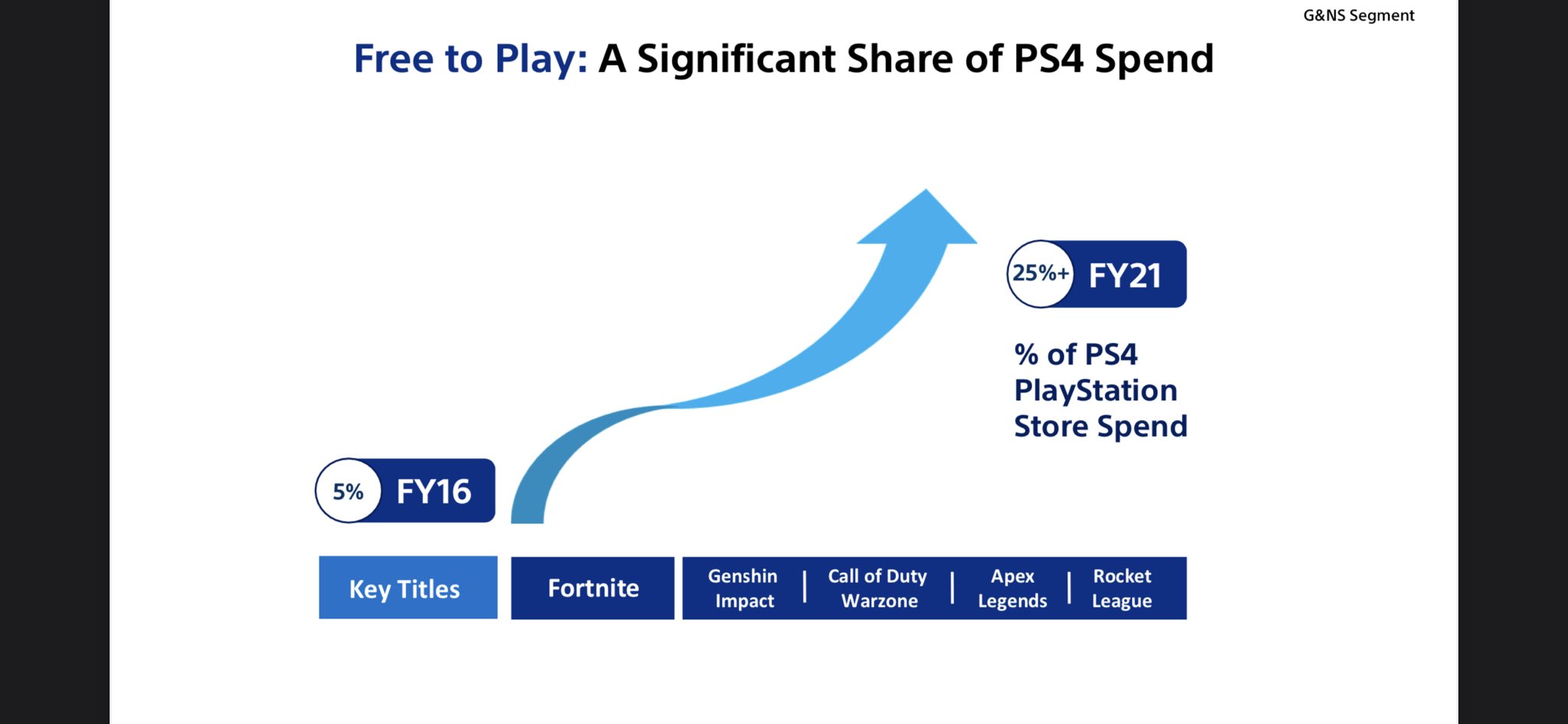
]]>0Nicholas Lovellhttp://www.nicholaslovell.com<![CDATA[Can consoles support large F2P games? They already do]]>https://www.gamesbrief.com/?p=132722022-05-27T16:51:00Z2022-05-27T09:02:33ZSony’s recent corporate presentation was heavily focused on F2P and live-service games. Piers Harding-Rolls has an excellent analysis thread on Twitter, and these 2 charts leaped out at me. That chart shows that more a quarter of PS4 revenue is now from F2P games: live service games from third party publishers that are keeping the...
That chart shows that more a quarter of PS4 revenue is now from F2P games: live service games from third party publishers that are keeping the platform thriving. It’s worth noting that none of the five highlighted games are platform exclusives. You don’t need to have a Sony platform to play them.
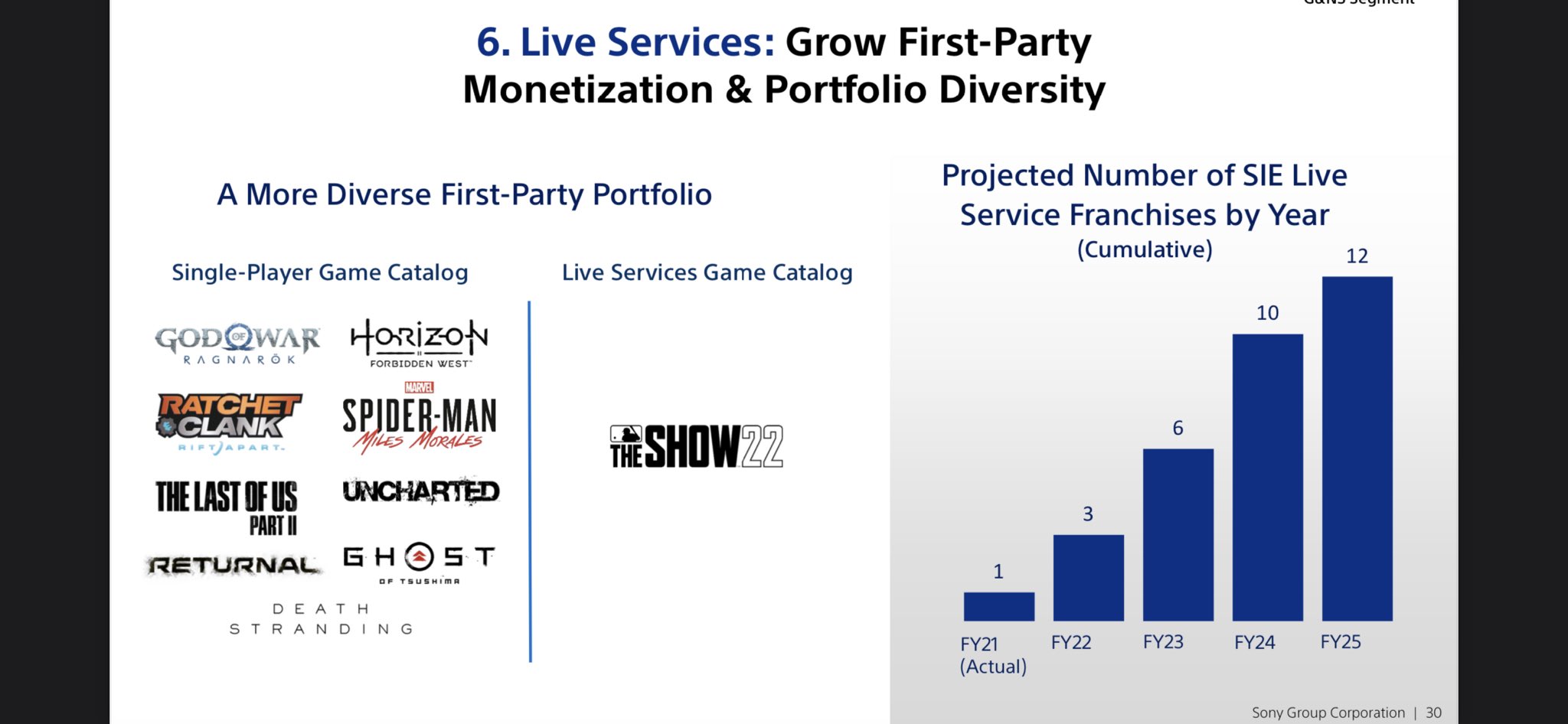
The next chart shows how Sony’s strategy is evolving in response to this data.
Sony currently has one “Live Services” Game as a first party publisher. By the financial year 2025, it intends to have 12 live service games.
This is going to be VERY interesting. Turning a “product”-led organisation into a “service-led” organisation is really hard. Development, marketing, publishing, financing, forcasting, operations, analytics and community management needs to change. It’s REALLY hard. I’ve had experience (both successful and abysmal failure) at trying to do it. Experiences like Eidos’ struggle to make Avengers into a Live Service game show that just throwing money at the issue is not enough.
Expect some high-profile failures on the way.
But don’t let anyone tell you that the console market is not big enough for F2P.
]]>0Nicholas Lovellhttp://www.nicholaslovell.com<![CDATA[Web 3.0: Crypto-currencies, the blockchain, NFTs and pay-to-earn]]>https://www.gamesbrief.com/?p=132602022-08-05T10:27:38Z2021-11-29T11:05:00ZCryptocurrencies, the blockchain, NFTs and pay-to-earn: 4 separate growth areas that promoters and shysters conflate, to the detriment of us all. The crypto/blockchain/NFT bubble continues apace. Compared to the dot com bubble that burst in 2000, it seems as if this bubble is inflating faster and bigger, driven not just by the promise of the...
Cryptocurrencies, the blockchain, NFTs and pay-to-earn: 4 separate growth areas that promoters and shysters conflate, to the detriment of us all.
The crypto/blockchain/NFT bubble continues apace. Compared to the dot com bubble that burst in 2000, it seems as if this bubble is inflating faster and bigger, driven not just by the promise of the new technologies, but a macroeconomic climate of low interest rates, huge amounts of investment wealth created during the pandemic and a desperate search for yield.
It seems to me that there are 4 different elements working together to create this perfect storm for shameless promoters. Each of them MAY have long term value (although I am deeply sceptical of pay-to-earn and nearly as sceptical of NFTs), but together, they create a Ponzi opportunity of epic proportions. In this post, I will look at crypto-currencies, the blockchain, NFTs and pay-to-earn, and identify what I think could be the opportunities and risks here. I think the only way to understand this bubble – and to identify whether there is real value to be had here – is to understand the components, and then evaluate each scheme, investment or idea based on whether it benefits from the underlying opportunities from these four concepts, or whether it is simply a confection of ideas with no true substance.
Cryptocurrencies
Starting at the basics, there is no innate reason why a cryptocurrency (as opposed to a currency) should be viable. A currency is simply a human agreement that something that is inherently valueless, such as a piece of shiny paper or some zeros and ones on a computer screen, has value. As Yuval Harari writes in Homo Sapiens, our unique ability, the one that separates humans from all other animals, is our ability to weave stories that have real, tangible power, such as the stories of “the corporation” which can own assets and take actions, or “government”, or “money”.
So a cryptocurrency is just a currency. Like all currencies, it has value because we all agree that it does. Most currencies are backed by governments, and that value can fluctuate based on our confidence that the government that stands behind the currency is strong, stable and will continue to protect that currency through economic policy, the rule of law and enforcement actions. This is why the “safest” currency, for more than a century, has been the US Dollar.
Cryptocurrencies have no one standing behind them. The transactions are recorded on the blockchain (more on that later), and that means they are susceptible to our combined belief in the accuracy, reliability and enforceability of the blockchain. The cryptocurrency movement is full of crypto-bros suddenly realising that things they took for granted – such as regulators to prevent mis-selling, enforcers to punish wrong-doers and standard-setters to confirm that things work as promised – do not exist in the “ultimate free market” of the Wild West of cryptocurrencies.
But the biggest problem with cryptocurrencies right now (which may pass) is that their promoters believe that they are three mutually-contradicting things:
A means of trade
An appreciating asset
A store of value
I won’t go through the history of money (you are all smart enough to get the point), but money originally emerged to enable humans to move beyond barter and into an exchange of value, to become a means of trade. “I will pay you 10 stone-age pebbles for your cow, and you can use them to buy whatever you want”. No more waiting for me to have something that you actually want in exchange for your cow.
For that to work, we need a currency to be trusted, stable, of certain value and with no likelihood of surprises. Right now, trying to understand whether you should accept Bitcoin, Ethereum, Dogecoin or Floki Inu means that cryptocurrencies are failing this test. That may pass (British people managed to deal with newfangled pounds and pence once we eliminated the ridiculous imperial system of pounds, shillings and pence), but it is currently an issue for widespread adoption.
So crypto-bros jump on the idea of cryptocurrencies as an appreciating asset. And why wouldn’t you. Early holders of Bitcoin are multimillionaires today. An early esport competition for Starcraft 2 in 2011 awarded a 1st prize of $500 and a prizes for players in positions 5-8 25 Bitcoin, worth about $25 then and roughly $1.4 million today.
Speculation in cryptocurrencies is very rewarding right now. At least until the music stops.
“I’m here to guess what the music might do a week, a month, a year from now. That’s it. Nothing more. And standing here tonight, I’m afraid that I don’t hear – a – thing.” Jeremy Irons as John Tuld, Margin Call.
If, and I mean if, cryptocurrencies are like commodities – scarce resources that ebb and flow with supply and demand like pork bellies, copper, oil and even gold – they run into an obvious problem. How can they be both an “appreciating asset” and also “a store of value”?
After all, most people want to know that if they put $100 in the bank, at the end of the year, that money is worth $100. Sure, they would like to earn a return above the rate of inflation. Everyone likes free money. But if the “value” of your $100 is highly variable, this introduces risk into the equation. And risk has a cost.
Basic economic theory teaches us that the more risk that we are taking on, the higher the return we demand for accepting it. Stuffing $100 under your mattress involves accepting two main risks: that someone will steal it, and that inflation will devalue it over time. (Inflation of 5% a year will reduce the spending value of your $100 to the equivalent of $57 over 10 years, although the $100 will still be worth $100. It’s just that everything else will have got more expensive around you.)
The current state of cryptocurrencies is not like this. No one can you tell what Bitcoin will be worth in a month’s time, let alone a year. Or ten. If I agreed to accept a monthly salary in Bitcoin from today onwards, I would genuinely have no idea if I could afford to pay my mortgage next year. Cryptocurrencies are not a store of value.
If they are not a store of value, they are not currencies.
Right now, cryptocurrencies are speculative assets, no different to investing in low-liquidity stocks on the public markets, meme-stocks like Gamestop or commodities. Until they stop being seen as investments, they can’t be currencies.
A sidebar on Gold
I put gold in my list of commodities above, and I expect people to argue that gold is indeed both “a speculative asset” and “a store of value”. Here’s why I think gold is different:
Gold has fundamental value. It not just a currency that only exists because we all agree it has value. It has industrial uses in electronics and manufacturing, and meaningful demand for decorative functions because it does not tarnish. This doesn’t explain the whole value of gold, but it puts a floor on the value of gold that is more than zero. Unlike cryptocurrencies which can genuinely go to zero.
No one claims that gold is a currency that will replace the modern economy of dollars, pounds, euros and yuan. It is considered to be a commodity that moves like commodities do, not a replacement for fiat currency.
If all the computers in all the world were suddenly destroyed, many currencies would have real trouble continuing to function. Gold would still work.
The low-tech, tangible nature of gold combined with the clear assumption that gold is NOT a currency in the modern sense makes it a very different proposition to cryptocurrencies.
Blockchain
The blockchain is a core technology that underpins the concepts of cryptocurrencies and NFTs. Essentially, it is an list of all the transactions that have ever been, that cannot be deleted or modified but is endlessly added to and HAS to be distributed widely as part of future transactions, so that you have complete trust in who owns what and when, without needing to trust a government, bank or other institution to confirm this.
But as Bruce Schneier has convincingly argued, this is bollocks. You always need to trust. The question is who do you trust and why.
Blockchain enthusiasts argue that the decentralised blockchain is more trustworthy than other systems for several reasons:
It is undeletable and unmodifiable, so you have a transparent history
It is not in the control of any one person or institution, which prevents fraudulent meddling with the data
It is decentralised, which means there are multiple copies in existence, so it can’t be lost.
Sceptics argue that what is the point of a list that claims you own something if you cannot enforce it (which is one of the roles of a government that backs a fiat currency). And that you always need to trust someone.
“What blockchain does is shift some of the trust in people and institutions to trust in technology. You need to trust the cryptography, the protocols, the software, the computers and the network. And you need to trust them absolutely, because they’re often single points of failure.
When that trust turns out to be misplaced, there is no recourse. If your bitcoin exchange gets hacked, you lose all of your money. If your bitcoin wallet gets hacked, you lose all of your money. If you forget your login credentials, you lose all of your money. If there’s a bug in the code of your smart contract, you lose all of your money. If someone successfully hacks the blockchain security, you lose all of your money. In many ways, trusting technology is harder than trusting people. Would you rather trust a human legal system or the details of some computer code you don’t have the expertise to audit?”
It feels to me that there is something significant in the blockchain. But I can’t yet see a circumstance where the blockchain is better than a database from a trusted partner. Maybe you can enlighten me in the comments.
NFTs
NFTs (non-fungible tokens) are the latest technology / product / fad * (delete as you see fit) to emerge built on the blockchain. The basic idea is that instead of owning a cryptocurrency, you own a digital asset – a piece of artwork, a digital Hot Wheels car, a sword in a game – that is registered to you on the blockchain.
It acts – or could act – in many ways like a copyright, where the owner of the copyright has the right to prevent unauthorised copying of an asset – provided that they are operating in a domain where there is a legal framework to support enforcement, regulatory agencies to do the enforcing and enough money to pursue the issue. There is a reason that big corporations own lots of copyrights and smaller artists find it harder: it is expensive to protect copyright from infringement.
NFTs don’t change any of this. In theory, you have a right to a thing. In practice, what is the enforcement? What regulatory system enforces it? Why is better than the existing copyright or intellectual ownership system?
In fact, I confess to being really rather unsure what “ownership of an NFT” means. Normally, the legal framework exists so you know what ownership means: if you own land, you can stand on it, and prevent other people from trespassing on it; you can build on it (subject to a panoply of regulations, permits and scrutiny); you can exploit the mineral resources in it if you are lucky enough to find any. With physical goods, you can use them, destroy them or sell them. Over the past 30 years, software has been on a journey from “something you own” to “something you licence but the big corporation can take it away from you whenever it likes for whatever reason.”
What is an NFT? As far as I can tell, it is confirmation that you, the buyer, own (as recorded in the blockchain) a specific digital representation of an idea. That’s it.
What can you do with it? Well, basically nothing.
In the world of video games, proponents of NFTs argue, “Imagine that you own a purple lightsaber as an NFT. You could take that weapon with you from a Lego Star Wars game into World of Warcraft, into Minecraft and Destiny and Overwatch and into Clash Royale and use it wherever you like.”
Well, you certainly can’t right now. But looking into the future, I am REALLY struggling why you ever would.
I make games for a living. I even make licensed games for a living. Getting any item into any game is a huge endeavour, and really hard. You need to make the asset in the style of the game. It needs to have animations. It must have purpose in the game, and stats which are balanced with other items in the game. It needs to be FUN, not just for the person who owns the asset, but for other people who might come into contact with the asset.
So I can’t see a world where it is easy, or cheap, or simple to get an NFT into a variety of games. Essentially, dozens of commercial organisations would need to feel a strong commercial incentive to implement an incredibly difficult technical issue for, as far as I can see, zero financial benefit.
So let’s imagine that you CAN implement this technology and your purple NFT lightsaber can appear seamlessly and logically in the kid-friendly Lego Star Wars, in voxel Minecraft, in FPS Overwatch and futuristic Destiny. Why would they?
Current service-based games are mini-monopolies. The games market is fiercely competitive, but once you have players in your game, YOU are the only person who can sell them anything. You have created a place where you control the value. If you are giving value to your players, they will stay (if they are free players) and pay (if you can offer enough value to justify this) and you have a business. The NFT promise is one that is MUCH harder to implement and a MUCH worse business model. So I am unclear why anyone would do it.
But what about the PLAYERS. Surely players will want this system where they can take their purple lightsaber from game to game, and make it their own. Again, I am unconvinced.
We play different games at different times for different reasons. To be immersed, for mastery and progression and social status and just to hang out with our friends. I am not yet convinced that persistence of assets – from game to game – is a meaningful consumer demand.
You could argue that the benefit of being able to sell something once you have finished with it has value. It worked in the boxed era of video games, where you could essentially “rent” a game by buying it and then selling it second hand at Gamestop when you were done. This practiced largely ended as software distribution when fully digital (and it doesn’t work with free-to-play), so would this be a good thing for consumers.
Maybe, is my answer. More likely is that players will use the fact that they COULD, in theory, sell the NFT to justify spending more money on them than they otherwise would, convincing themselves that it is an investment, or an appreciating asset, or at least will have resale value. Much like Magic the Gathering players convinced themselves that buying more cards was a sensible idea, but in the end the cards moulder in the attic, unsold and unvalued.
And all of this presupposes a fundamental shift in value. From game makers making items that make the game more fun and that they can sell to third-parties making NFTs and game makers having to design games that will incorporate these NFTs while working out how to commercialise this business with complete fungibility for other games. (Ha, non-fungible tokens will have to be fungible to work in games. Who’d’ve thunk it?)
So for me, for NFTs to make sense, we need to understand:
How they differ from copyright?
How they are enforceable?
What actual benefits you gain from owning a NFT?
How a games company can integrate an NFT into their own game in a way that benefits the NFT-owner, the other gamers and the company itself?
How fungible NFTs (!) can work in multiple games?
Perhaps all of these issues can be overcome. My purpose in separating them out is to give me the opportunity to look at each strand of value and disentangle it, so that I can evaluate if we are on a path to making this a viable business. I can’t see it yet. I see it – perhaps – as technological solution to how to track, implement and enforce the existing copyright system. But that is not “decentralised” and “free market” and “end of big government”. Quite the opposite. It would argue that NFTs are just a way to tokenise and make easier to track an existing regulatory system. Which is not as disruptive as people think it is.
Play-to-earn
The last theme in this series is Play To Earn.
Many commentators are identifying this theme as the big emerging idea from Web 3.0. That we are entering a creator economy where the people who toil away to add value to the games, economies and ecosystems they love online, they should earn money for it.
In effect, this is like the Etsy-fication of digital content, where people who make stuff have a way of turning their hobby into a business.
There is nothing wrong with that idea. Earning extra money, or even converting your hobby into a job, is one of the huge benefits that the Internet enabled, by allowing a producer of a specialist item to discover her potential customers anywhere in the world through the easy communications that the Web enabled.
The “Play to earn” idea suggests that by “using the blockchain” – whatever that means in this context – we can give people the long term right to benefit financially from their actions and activities.
Again, I support this idea. In the endless battle between capital and labour, giving “labour” a long-term piece of the fruits of their labour, particularly in a knowledge economy, sounds like a bit of a rebalance away from capital. (Although it still only benefits those people who work in the knowledge economy, not those in the caring, or manufacturing, or maintenance, or delivery economies).
But it has many problems. Some quick examples:
The Open Source movement has demonstrated how much better software that people “build because they care” can be software created by people who are just paid to do it.
The Overjustification effect, that when you start pay someone to do something they enjoy, they stop enjoying it.
Isn’t it just gold-farming, but gone legit?
I think where I really struggle is in the concept for “play” to earn.
The Misconception: There is nothing better in the world than getting paid to do what you love.
The Truth: Getting paid for doing what you already enjoy will sometimes cause your love for the task to wane because you attribute your motivation as coming from the reward, not your internal feelings.
There is some evidence that people are ALREADY chosing playing video games over poor-paying jobs. Economist Eric Hurst studied declining participation in the labour force amongst young men and concluded that because the alternative to not working, i.e. playing games, was fulfilling and gave them a sense of progress, achievement and autonomy, “these technological innovations have made leisure time more enjoyable. This acts like an increase in an individual’s reservation wage. For lower-skilled workers, with low market wages, it is now more attractive to take leisure.” (Quoted on page 37 of my book, The Pyramid of Game Design)
I can see that “Play to earn” could be a better system than goldfarming in sweat shops (although there is no reason to believe that it won’t still be in sweatshops for the capitalists). But I don’t yet see why it changes the fundamental paradigm.
In the end, we play for fun. Turning into a job makes it, well, a job. Is that what we really want for games?
Oh what a tangled web we weave
There is more to Web 3.0 than these four themes, but untangling them is key to understanding where we are going. I remain profoundly sceptical about the promises of the promoters. Pay to earn is the one I believe in least, and I have yet to see what blockchain will enable that will not still require large organisations (probably governments) to provide the regulatory and enforcement functions that societies need.
I feel I’ve made progress in advancing my understanding by untangling at least some of the threads that weave through Web 3.0. I hope that you feel the same.
And of course, I reserve the right to realise that these thoughts were profoundly wrong as I continue my journey.
]]>0Nicholas Lovellhttp://www.nicholaslovell.com<![CDATA[Web 3.0: from cynicism to evangelism]]>https://www.gamesbrief.com/?p=132682022-08-05T10:28:26Z2021-11-26T20:59:23ZI am continuing my quest to understand this third major transition in the technology / games markets in my career (first: the Internet; second: free-to-play; now: the blockchain). I feared that I didn’t or couldn’t understand. Spending time at the Develop conference helped me a lot. I had feared I was no longer smart. I’ve...
]]>I am continuing my quest to understand this third major transition in the technology / games markets in my career (first: the Internet; second: free-to-play; now: the blockchain). I feared that I didn’t or couldn’t understand.
Spending time at the Develop conference helped me a lot. I had feared I was no longer smart. I’ve realised I never was. You get smarter by spending time talking to smart, well-informed or just “in-the-market” people at conferences, meetings and events. I feel smarter after Develop.
David Amor of Playmint explained the journey of understanding the new paradigm as a form of the Kubler-Ross model of grief.
“First there is cynicism; next, confusion; then comprehension; and finally evangelism.”
David Amor, CEO, Playmint.
I am past cynicism. There is something here. I am 90% sure it is not what the promoters thing, but we don’t yet have a clear theory that explains its value (like “ridiculously-easy group forming” as Clay Shirky dubbed one of the major changes that the Internet would bring, for good or for ill; or my own Curve for how businesses all operate on a continuum from free to super-expensive these days.)
I am squarely in confusion. My next post will set out 4 different themes that I see at work here, and conflated by the promoters, hucksters and shysters, to the detriment of us all. If I can understand those, and figure out how they intersect, I am on the path to comprehension.
I find it unlikely that I will reach the stage of evangelism. This transition is not like the ones before. But who knows, maybe you can’t see the final step until you have made the first few. Much like Kubler-Ross argues that you can’t reach acceptance until you have been through denial, bargaining and anger.


 GOBLIN ERRANDS