<?xml version="1.0" encoding="UTF-8"?>
<?xml-stylesheet type="text/xsl" media="screen" href="/~d/styles/rss2full.xsl"?><?xml-stylesheet type="text/css" media="screen" href="http://feeds.feedburner.com/~d/styles/itemcontent.css"?><rss xmlns:content="http://purl.org/rss/1.0/modules/content/" xmlns:wfw="http://wellformedweb.org/CommentAPI/" xmlns:dc="http://purl.org/dc/elements/1.1/" xmlns:atom="http://www.w3.org/2005/Atom" xmlns:sy="http://purl.org/rss/1.0/modules/syndication/" xmlns:slash="http://purl.org/rss/1.0/modules/slash/" xmlns:harvard="http://news.harvard.edu/gazette/" xmlns:feedburner="http://rssnamespace.org/feedburner/ext/1.0" version="2.0">

<channel>
	<title>Harvard Gazette » National &amp; World Affairs</title>
	
	<link>http://news.harvard.edu/gazette</link>
	<description>University News, Faculty Research &amp; Campus Events</description>
	<lastBuildDate>Fri, 10 Feb 2012 21:45:10 +0000</lastBuildDate>
	<language>en</language>
	<sy:updatePeriod>hourly</sy:updatePeriod>
	<sy:updateFrequency>1</sy:updateFrequency>
	
		<generator>http://wordpress.org/?v=3.2.1</generator>
		
	<atom10:link xmlns:atom10="http://www.w3.org/2005/Atom" rel="self" type="application/rss+xml" href="http://feeds.feedburner.com/HarvardGazetteOnlineNationalWorldAffairs" /><feedburner:info uri="harvardgazetteonlinenationalworldaffairs" /><atom10:link xmlns:atom10="http://www.w3.org/2005/Atom" rel="hub" href="http://pubsubhubbub.appspot.com/" /><item>
		<title>A call to reverse security measures</title>
		<link>http://feedproxy.google.com/~r/HarvardGazetteOnlineNationalWorldAffairs/~3/QsPgw6WyDm0/</link>
		<pubDate>Fri, 10 Feb 2012 21:39:16 +0000</pubDate>
		<dc:creator />
				<category><![CDATA[Government & Politics]]></category>
		<category><![CDATA[National & World Affairs]]></category>
		<category><![CDATA[Barack Obama]]></category>
		<category><![CDATA[Bruce Fein]]></category>
		<category><![CDATA[George W. Bush]]></category>
		<category><![CDATA[Harvard Law Record]]></category>
		<category><![CDATA[Harvard Law School]]></category>
		<category><![CDATA[HLS Forum]]></category>
		<category><![CDATA[Jill Greenfield]]></category>
		<category><![CDATA[Ralph Nader]]></category>
		<category><![CDATA[Security]]></category>

		<guid isPermaLink="false">http://news.harvard.edu/gazette/?p=101990</guid>
		<description><![CDATA[Ralph Nader and Bruce Fein visited Harvard Law School for a talk sponsored by the HLS Forum and the Harvard Law Record. At the event, both men discussed what they called lawless and violent practices by the White House and its agencies that have become institutionalized by both political parties.]]></description>
			<content:encoded><![CDATA[<p>Ralph Nader, LL.B. ’58, and Bruce Fein, J.D. ’72, visited <a href="http://www.law.harvard.edu/index.html">Harvard Law School</a> (HLS) for a talk sponsored by the <a href="http://www.law.harvard.edu/students/orgs/forum/">HLS Forum</a> and the <a href="http://hlrecord.org/">Harvard Law Record</a>. At the event, both men discussed what they called lawless and violent practices by the White House and its agencies that have become institutionalized by both political parties.</p>
<p>Fein has held positions in the Department of Justice and has served as research director for Republicans on the Joint Congressional Committee on Covert Arms Sales to Iran and on the American Bar Association&#8217;s Committee on Presidential Signing Statements.</p>
<p>During the talk, which was called “America&#8217;s Lawless Empire: The Constitutional Crimes of Bush and Obama,” Fein gave examples of what he called constitutional crimes perpetrated under the Barack Obama and George W. Bush administrations, such as detaining enemy combatants indefinitely, diverting funds authorized for fighting terrorism to the wars in Afghanistan and Iraq, and using predator drones against persons never formally charged with crimes.</p>
<p>Nader, a consumer advocate, author, attorney, and five-time candidate for president, said the government and the American people have rationalized illegality because the country has gotten used to the military-industrial complex and the corporate state under which it has been operating for more than half a century.</p>
<p>He also argued that there are many national security threats on American soil that, because they don’t stem from foreign terrorists, are ignored by the government. Thousands of Americans die each year because of workplace accidents, preventable pollution, and lack of access to health insurance, he said, all under the apparent protection of government agencies. He said that the money spent on the war on terror should be diverted to child health care, advancement of education opportunities, public works, and environmental protection.</p>
<div id="attachment_102010" class="wp-caption alignnone" style="width: 510px"><a href="http://news.harvard.edu/gazette/wp-content/uploads/2012/02/020812_Nader_129.jpg"><img class="size-full wp-image-102010" title="Fein_500.jpg" src="http://news.harvard.edu/gazette/wp-content/uploads/2012/02/020812_Nader_129.jpg" alt="" width="500" height="334" /></a><p class="wp-caption-text">“I want to underscore that it is not an option in a democracy to be a spectator to politics, because it’s a collective endeavor,” Bruce Fein said. “We have a moral obligation to use our eyes and ears to check government abuses because, even if they don’t affect you, they could affect your neighbor.”</p></div>
<p>“The 300,000 Americans who die from preventable causes should reside under the definition of national security, but they aren’t the priority of any major party. Obama is more concerned with terrorists overseas than with the preventable deaths of these people directly under his authority and responsibility,” Nader said.</p>
<p>Both men took issue with the National Defense Authorization Act, which sets the budget and policies of the Department of Defense and has expanded the power of the government to fight the war on terror. The act permits, among other practices, the indefinite detention of terrorism suspects without trial. Fein encouraged those in attendance to contact their members of Congress about repealing it.</p>
<p>“I want to underscore that it is not an option in a democracy to be a spectator to politics, because it’s a collective endeavor,” Fein said. “We have a moral obligation to use our eyes and ears to check government abuses because, even if they don’t affect you, they could affect your neighbor.</p>
<p>Lawyers in particular have a duty to be more than spectators, Nader concluded. Rather than profiting from conflict, he said they should work to prevent conflict and act with moral urgency to demand answers and transparency from the government, particularly when it is involved in acts of war.</p>
<p>HLS Forum is a nonpartisan student organization dedicated to bringing open discussion of a range of legal, political, and social issues to the Law School. It was founded after World War II by 30 returning soldiers as a memorial to their fellow students who died in the conflict. The Harvard Law Record, published since 1946, is the oldest law school-affiliated newspaper in the nation.</p>
<img src="http://feeds.feedburner.com/~r/HarvardGazetteOnlineNationalWorldAffairs/~4/QsPgw6WyDm0" height="1" width="1"/>]]></content:encoded>
			<enclosure url="http://news.harvard.edu/gazette/wp-content/uploads/2012/02/020812_Nader_026.jpg" length="11947" type="image/jpg" />
    <harvard:WPID>101990</harvard:WPID>
    <harvard:author>Jill Greenfield</harvard:author>
    <harvard:affiliation>Harvard Law School Communications</harvard:affiliation>
    <harvard:featured>category</harvard:featured>
    <harvard:featured_photo>http://news.harvard.edu/gazette/wp-content/uploads/2012/02/Nader_605.jpg</harvard:featured_photo>

		<harvard:photo_223>http://news.harvard.edu/gazette/wp-content/uploads/2012/02/Nader_605-223x149.jpg</harvard:photo_223>
		<harvard:photo_280>http://news.harvard.edu/gazette/wp-content/uploads/2012/02/Nader_605-280x187.jpg</harvard:photo_280>
				<feedburner:origLink>http://news.harvard.edu/gazette/story/2012/02/nader_hls/</feedburner:origLink></item>
		
	<item>
		<title>In the end, Somali famine preventable</title>
		<link>http://feedproxy.google.com/~r/HarvardGazetteOnlineNationalWorldAffairs/~3/Ghn6Hag_PVs/</link>
		<pubDate>Tue, 07 Feb 2012 20:47:43 +0000</pubDate>
		<dc:creator />
				<category><![CDATA[International]]></category>
		<category><![CDATA[National & World Affairs]]></category>
		<category><![CDATA[Al-Shabaab]]></category>
		<category><![CDATA[Caroline Elkins]]></category>
		<category><![CDATA[Committee on African Studies]]></category>
		<category><![CDATA[Ethiopia]]></category>
		<category><![CDATA[Famine]]></category>
		<category><![CDATA[Harvard Medical School]]></category>
		<category><![CDATA[Harvard Undergraduate Council]]></category>
		<category><![CDATA[Horn of Africa]]></category>
		<category><![CDATA[Ken Menkhaus]]></category>
		<category><![CDATA[Kenya]]></category>
		<category><![CDATA[Michael Delaney]]></category>
		<category><![CDATA[Partners In Health]]></category>
		<category><![CDATA[Paul Farmer]]></category>
		<category><![CDATA[Program in Infectious Disease and Social Change]]></category>
		<category><![CDATA[Radcliffe Gym]]></category>
		<category><![CDATA[Robert Paarlberg]]></category>
		<category><![CDATA[Sahel]]></category>
		<category><![CDATA[Salmaan Keshavjee]]></category>
		<category><![CDATA[Somalia]]></category>
		<category><![CDATA[Weatherhead Center for International Affairs]]></category>
		<category><![CDATA[William Masters]]></category>

		<guid isPermaLink="false">http://news.harvard.edu/gazette/?p=101587</guid>
		<description><![CDATA[Despite historical links to natural disasters, the modern world’s global food web means that famines today are created more by man than by nature. Officials say a famine just ending in Somalia was caused by a failure of international early warning systems and the local Al-Shabaab militia blocking food aid.]]></description>
			<content:encoded><![CDATA[<p>The <a href="http://www.un.org/">United Nations</a> <a href="http://www.fao.org/news/story/en/item/122091/icode/">declared</a> last Friday that Somalia’s famine is over. But the official declaration means little to the millions of Somalis who are still hungry and waiting for their crops to grow, according to authorities gathered at Harvard University.</p>
<p>“The difference between famine versus not famine for most Somalis is a distinction without a difference,” said <a href="http://www.davidson.edu/academic/political/menkhaus.html">Ken Menkhaus</a>, professor of political science at <a href="http://www.davidson.edu/">Davidson College</a>, whose research focuses on Somalia and the Horn of Africa.</p>
<p>Menkhaus said it was profoundly disappointing to be discussing another Somali famine, after he worked in the country during the 1991-92 one. Each famine, he said, has distinct characteristics, and this one unfolded in slow motion over the past couple of years. That’s at least partly because the Somali diaspora sent money home that delayed the worst effects.</p>
<div id="attachment_101634" class="wp-caption alignnone" style="width: 510px"><a href="http://news.harvard.edu/gazette/wp-content/uploads/2012/02/020612_ElkFarm_006_500.jpg"><img class="size-full wp-image-101634" title="Farmer_Elkins_500MUST.jpg" src="http://news.harvard.edu/gazette/wp-content/uploads/2012/02/020612_ElkFarm_006_500.jpg" alt="" width="500" height="333" /></a><p class="wp-caption-text">Paul Farmer (left) speaks with Caroline Elkins prior to the opening remarks during the “Sound the Horn: Famine in the Horn of Africa” event.</p></div>
<p>Menkhaus was among four experts on Somalia and famine who spoke at the Radcliffe Gym Monday evening. The event, “Sound the Horn: Famine in the Horn of Africa,” was sponsored by the <a href="http://africa.harvard.edu/">Committee on African Studies</a>, <a href="http://www.hms.harvard.edu/">Harvard Medical School’s</a> <a href="http://ghsm.hms.harvard.edu/programs/pidsc/">Program in Infectious Disease and Social Change</a>, the <a href="http://www.wcfia.harvard.edu/">Weatherhead Center for International Affairs</a>, and the <a href="http://uc.fas.harvard.edu/">Harvard Undergraduate Council</a>.</p>
<p>The event was introduced by <a href="http://ghsm.hms.harvard.edu/people/faculty/farmer/">Paul Farmer</a>, Kolokotrones University Professor of Global Health and Social Medicine and co-founder of the nonprofit Partners In Health. It featured opening remarks by <a href="http://history.fas.harvard.edu/people/faculty/elkins.php">Caroline Elkins</a>, history professor and chair of the Committee on African Studies, and <a href="http://ghsm.hms.harvard.edu/people/faculty/keshavjee/">Salmaan Keshavjee</a>, assistant professor of medicine and director of the Program on Infectious Disease and Social Change.</p>
<p>Other speakers included <a href="http://www.oxfamamerica.org/whoweare/oxfam-experts/michael-delaney">Michael Delaney</a>, director of humanitarian response for <a href="http://www.oxfamamerica.org/">Oxfam America</a>, <a href="http://sites.tufts.edu/willmasters/">William Masters</a>, chair of the Department of Food and Nutrition Policy at <a href="http://www.tufts.edu/">Tufts University</a>, and <a href="http://www.wellesley.edu/PublicAffairs/Profile/mr/rpaarlberg.html">Robert Paarlberg</a>, adjunct professor of public policy at the <a href="http://www.hks.harvard.edu/">Harvard Kennedy School</a> and a political science professor at <a href="http://www.wellesley.edu/">Wellesley College</a>.</p>
<p>Elkins said the event was part of a University-wide effort to respond to the Somali disaster. Harvard President <a href="http://www.president.harvard.edu/">Drew Faust</a> sent a message that Elkins read to the audience. Faust said the crisis deserves the world’s attention in an era when it is easier than ever to be informed about any subject, but perhaps harder to be aware of what’s important.</p>
<p>Farmer drew on his experience treating malnourished people in Haiti, where he has worked for decades, and said the human and social context of hunger need as much attention as the patients do. A malnourished child is typically an indication of poverty at home, and aid to families should be part of treating the child, he said. Similarly, broader agricultural interventions and fair trade policies are needed to boost local agricultural economies.</p>
<p>Though famine is often thought of as a natural disaster, Monday’s speakers said that is a false impression. Though Somalia suffered through a severe drought, with today’s instant communications, transport systems can move massive amounts of food. Given today’s global food markets, famine is too often a failure of local government and international response.</p>
<p>“In today’s 21st-century world, just about everything about famine is man-made,” Paarlberg said. “We’re no longer in a world of man against nature.”</p>
<p>Paarlberg’s assertion echoed that of other speakers, who pointed out that several of the most deadly famines in history occurred because of government action or inaction.</p>
<div id="attachment_101633" class="wp-caption alignnone" style="width: 510px"><a href="http://news.harvard.edu/gazette/wp-content/uploads/2012/02/020612_ElkFarm_128_500.jpg"><img class="size-full wp-image-101633" title="Paarlberg_500.jpg" src="http://news.harvard.edu/gazette/wp-content/uploads/2012/02/020612_ElkFarm_128_500.jpg" alt="" width="500" height="333" /></a><p class="wp-caption-text">“In today’s 21st-century world, just about everything about famine is man-made. We’re no longer in a world of man against nature,” said Robert Paarlberg, adjunct professor of public policy at the Harvard Kennedy School.</p></div>
<p>Ethiopia, which was also affected by the recent drought, fared much better this time because of reforms implemented after the 2001 one. Likewise, Paarlberg said, northern and central Somalia, regions that fall outside of the influence of the Al-Shabaab militia, also fared better.</p>
<p>There were several man-made features of this famine, which affected more than 10 million people and killed between 50,000 and 100,000, half of them children under age 5.</p>
<p>The largest man-made feature was the role of the Al-Shabaab militia that rules the region and that kept food aid from reaching those in need. But the international community isn’t blameless. As early as November 2010, an international famine early warning system was predicting the failure of rains in the region, but the international community didn’t respond fully until an official famine was declared in July 2011. On top of that, U.S. anti-terrorism laws cut off food aid because Al-Shabaab, listed as a terrorist group, was taking some of it.</p>
<p>Though the United Nations has declared the famine over, that was based on statistical measures, such as the number of people dying each day and the number of children who are malnourished. Though the official famine may be over, both U.N. officials and Monday’s speakers said the crisis continues for the people of Somalia. Almost a third of the population remains dependent on humanitarian assistance, crops growing from recent rains will take months to reach maturity, and herds of cows, goats, and other animals were greatly reduced during the crisis.</p>
<p>Delaney warned that the world will have another chance to get its response right, because the warning signs are pointing to an impending famine in Africa’s Sahel, the arid, continent-spanning transition zone just below the Sahara Desert.</p>
<img src="http://feeds.feedburner.com/~r/HarvardGazetteOnlineNationalWorldAffairs/~4/Ghn6Hag_PVs" height="1" width="1"/>]]></content:encoded>
			<enclosure url="http://news.harvard.edu/gazette/wp-content/uploads/2012/02/020612_ElkFarm_065_140MAIN.jpg" length="9538" type="image/jpg" />
    <harvard:WPID>101587</harvard:WPID>
    <harvard:author>Alvin Powell</harvard:author>
    <harvard:affiliation>Harvard Staff Writer</harvard:affiliation>
    <harvard:featured>category</harvard:featured>
    <harvard:featured_photo>http://news.harvard.edu/gazette/wp-content/uploads/2012/02/020612_ElkFarm_163_605MAIN.jpg</harvard:featured_photo>

		<harvard:photo_223>http://news.harvard.edu/gazette/wp-content/uploads/2012/02/020612_ElkFarm_163_605MAIN-223x149.jpg</harvard:photo_223>
		<harvard:photo_280>http://news.harvard.edu/gazette/wp-content/uploads/2012/02/020612_ElkFarm_163_605MAIN-280x187.jpg</harvard:photo_280>
				<feedburner:origLink>http://news.harvard.edu/gazette/story/2012/02/in-the-end-somali-famine-preventable/</feedburner:origLink></item>
		
	<item>
		<title>Duncan urges experiments in education</title>
		<link>http://feedproxy.google.com/~r/HarvardGazetteOnlineNationalWorldAffairs/~3/nKqzABMPDPU/</link>
		<pubDate>Tue, 07 Feb 2012 19:08:19 +0000</pubDate>
		<dc:creator />
				<category><![CDATA[Education]]></category>
		<category><![CDATA[National & World Affairs]]></category>
		<category><![CDATA[Arne Duncan]]></category>
		<category><![CDATA[Colleen Walsh]]></category>
		<category><![CDATA[Education Reform]]></category>
		<category><![CDATA[Harvard Graduate School of Education]]></category>
		<category><![CDATA[No Child Left Behind]]></category>
		<category><![CDATA[Obama Administration]]></category>
		<category><![CDATA[Promise Neighborhoods]]></category>
		<category><![CDATA[Public Education]]></category>
		<category><![CDATA[Standardized testing]]></category>
		<category><![CDATA[Standardized tests]]></category>
		<category><![CDATA[“Fighting the Wrong Education Battles”]]></category>

		<guid isPermaLink="false">http://news.harvard.edu/gazette/?p=101579</guid>
		<description><![CDATA[U.S. Secretary of Education Arne Duncan called for large-scale educational reform during a talk at Harvard’s Graduate School of Education.]]></description>
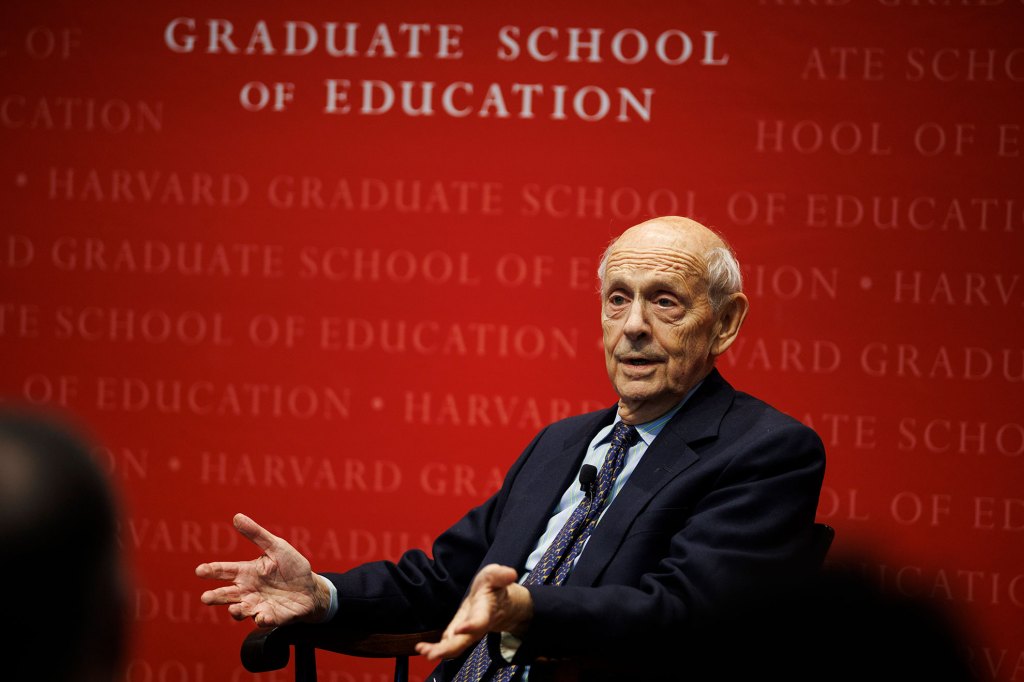
			<content:encoded><![CDATA[<p>U.S. Secretary of Education <a href="http://www2.ed.gov/news/staff/bios/duncan.html">Arne Duncan</a> would like to see reform of the nation’s public educational system, and he urged administrators, educators, politicians, and parents to work together to overcome the nation’s tough educational challenges.</p>
<p>“It’s a stain on our nation that today one in four American students fails to finish high school on time or drops out … that is absolutely morally unacceptable and economically unsustainable,” Duncan told a crowd Monday at the <a href="http://www.gse.harvard.edu/">Harvard Graduate School of Education</a>’s Longfellow Hall.</p>
<p>In an Askwith Forum talk titled “Fighting the Wrong Education Battles,” he said that too often “well-intentioned advocacy goes awry.” Frequently, decision-makers search for an ideal solution to educational reform instead of collaborating and compromising on “imperfect” but important initiatives that could bring lasting change.</p>
<p>“We shouldn’t be asking, ‘Is this the perfect solution?’ We should be asking, ‘Is this a much better solution? Can it help us challenge the status quo and accelerate student achievement?’”</p>
<p>Stakeholders must consider in- and out-of-school influences as part of that overall solution, said Duncan. While poverty greatly affects a child’s performance, great schools and teachers are the “most effective anti-poverty tool of all.” He suggested creating full-service community schools that can offer educational as well as health and social services to disadvantaged children, and pointed to the Obama administration’s <a href="http://www2.ed.gov/programs/promiseneighborhoods/index.html">Promise Neighborhoods</a>, an initiative that funds organizations that develop similar, inclusive school models.</p>
<p>Reform also involves developing rigorous assessments and college and career-ready academic standards like those created by the Massachusetts educational system, said Duncan. Boosting student achievement is not an “either/or solution,” he said. “Educators and the broader community should be attacking both in-school and out-of-school causes of low academic achievement.”</p>
<p>For Duncan, the argument over whether teacher evaluations should include measures of student achievement is another “false choice.”</p>
<p>Critics of standardized tests are right to complain that such tests are flawed can’t accurately gauge factors like “classroom management, teamwork, collaboration, and individualized instruction,” said Duncan. He acknowledged that teacher evaluations must never be based solely on test scores and should include principal observations, peer reviews, student work, and surveys.</p>
<p>“Still, the shortcomings of today’s tests,” he said, “doesn’t mean we should simply abandon the use of standardized testing.”</p>
<p>Another important part of education reform involves getting managers and labor leaders to work together to engage in “tough-minded collaboration and step outside of their comfort zones,” Duncan said.</p>
<p>He suggested that No Child Left Behind, the 2001 act that includes educational reforms that critics say place too much emphasis on testing and standardized measures, is “fundamentally broken.” Duncan said that states, districts, neighborhoods, and schools need to be held to rigorous standards, but simultaneously be given room to find their own means of meeting high benchmarks.</p>
<p>“In my mind, it’s tight on goals, being absolutely clear about goals, but give folks a lot more room to hit them.”</p>
<img src="http://feeds.feedburner.com/~r/HarvardGazetteOnlineNationalWorldAffairs/~4/nKqzABMPDPU" height="1" width="1"/>]]></content:encoded>
			<enclosure url="http://news.harvard.edu/gazette/wp-content/uploads/2012/02/020612_Duncan_100_140.jpg" length="9518" type="image/jpg" />
    <harvard:WPID>101579</harvard:WPID>
    <harvard:author>Colleen Walsh</harvard:author>
    <harvard:affiliation>Harvard Staff Writer</harvard:affiliation>
    <harvard:featured>category</harvard:featured>
    <harvard:featured_photo>http://news.harvard.edu/gazette/wp-content/uploads/2012/02/020612_Duncan_131_605.jpg</harvard:featured_photo>

		<harvard:photo_223>http://news.harvard.edu/gazette/wp-content/uploads/2012/02/020612_Duncan_131_605-223x149.jpg</harvard:photo_223>
		<harvard:photo_280>http://news.harvard.edu/gazette/wp-content/uploads/2012/02/020612_Duncan_131_605-280x187.jpg</harvard:photo_280>
				<feedburner:origLink>http://news.harvard.edu/gazette/story/2012/02/duncan-urges-experiments-in-education/</feedburner:origLink></item>
		
	<item>
		<title>Putting history on trial</title>
		<link>http://feedproxy.google.com/~r/HarvardGazetteOnlineNationalWorldAffairs/~3/g-DWVkgnEZI/</link>
		<pubDate>Tue, 07 Feb 2012 17:00:29 +0000</pubDate>
		<dc:creator />
				<category><![CDATA[International]]></category>
		<category><![CDATA[National & World Affairs]]></category>
		<category><![CDATA[British Army]]></category>
		<category><![CDATA[Caroline Elkins]]></category>
		<category><![CDATA[Corydon Ireland]]></category>
		<category><![CDATA[David Anderson]]></category>
		<category><![CDATA[East Africa]]></category>
		<category><![CDATA[High Court of Justice]]></category>
		<category><![CDATA[Huw C. Bennett]]></category>
		<category><![CDATA[Kenya]]></category>
		<category><![CDATA[Mau Mau]]></category>
		<category><![CDATA[W.E.B. Du Bois Institute for African and African American Research]]></category>
		<category><![CDATA[“Histories of the Hanged”]]></category>
		<category><![CDATA[“Imperial Reckoning: The Untold Story of Britain’s Gulag in Kenya”]]></category>
		<category><![CDATA[“the Emergency”]]></category>

		<guid isPermaLink="false">http://news.harvard.edu/gazette/?p=101465</guid>
		<description><![CDATA[Historians can prove useful in a courtroom, a case involving Kenyan abuse reveals, and they can learn a lot too. ]]></description>
			<content:encoded><![CDATA[<p>What can historians learn by being expert witnesses in court? They can learn to cooperate, to state the facts, and to leave their opinions and academic squabbles in the library.</p>
<p>“There’s no room for academic blather,” said <a href="http://history.fas.harvard.edu/people/faculty/elkins.php">Caroline Elkins</a>, a Harvard history professor who studies colonial rule in East Africa. In court, she said in a recent lecture, the judge is the “teacher” and the academics — famous for squabbling — have to give up their “sandbox.”</p>
<p>In 2008, Elkins was named the first of three “expert witnesses,” historians who were called upon to provide evidence to the <a href="http://www.justice.gov.uk/index.htm">High Court of Justice</a> in London. (She and the others are advisers to the British law firm Leigh Day.) At issue is <a href="http://www.nytimes.com/2011/07/22/world/europe/22briefs-Kenyans.html">a coming trial</a> that gives aging Kenyan <a href="http://www.bbc.co.uk/news/uk-12997138">Mau Mau</a> insurgents and sympathizers the opportunity to prove claims of rape, torture, murder, and other crimes that they allege happened in the waning days of British colonial rule in the East African country.</p>
<p>The Mau Mau led a 1952-1960 <a href="http://africanhistory.about.com/od/kenya/a/MauMauTimeline.htm">rebellion</a> that British officials at the time called “the Emergency.” In that era, 32 white civilians were killed. At least 11,000 — and perhaps as many as 50,000 — black Kenyans died, half of them children. About 80,000 were imprisoned, and up to 1.5 million were displaced and shuttled into what Elkins called a “pipeline” of prisons and forced settlements.</p>
<p>Elkins is author of the Pulitzer Prize-winning book “Imperial Reckoning: The Untold Story of Britain’s Gulag in Kenya” (2005). This month, she will send the third installment of her testimony to the court, a 75-page document. The two British historians who recently joined her as expert witnesses, are <a href="http://www.africanstudies.ox.ac.uk/resources/staff_a-z_directory/staff-africa/danderson">David Anderson</a>, whose book about Kenya, “Histories of the Hanged,” also appeared in 2005, and young defense studies scholar <a href="http://www.kcl.ac.uk/sspp/departments/dsd/people/academic/bennett.aspx">Huw C. Bennett</a>.</p>
<p>Elkins studies the civil side of the conflict: the Mau Mau era’s camps and prisons. Anderson studies capital cases from a time when due process was suspended and 800 insurgents were sent to the gallows. Bennett studies the role of the British Army in putting down the rebellion, including controversial interrogation and intelligence-gathering methods.</p>
<p>“We each have our own specialties,” said Elkins during a Jan. 25 lecture, the first in a weekly spring colloquium <a href="http://dubois.fas.harvard.edu/events/spring-colloquium-series-paul-kaplan">series</a> sponsored by the <a href="http://dubois.fas.harvard.edu/">W.E.B. Du Bois Institute</a>. But all of them are “revisionists” who challenge traditional interpretations of the war, including the usual assumption that British colonial abuses in Kenya were the exception and not the rule.</p>
<p>Collectively, said Elkins during her Thompson Room lecture, their scholarship provides what she called in a recent <a href="http://www.tandfonline.com/doi/abs/10.1080/03086534.2011.629084#preview">article</a> an “alchemy of evidence,” a portrait of “systematic violence over time” by colonial authorities against the Mau Mau.</p>
<p>On a screen behind her, she showed a chart of how the punitive British pipeline worked, circa 1954. “I had to reconstruct the logic of the pipeline itself,” she said, a task that took her five years in British and Kenyan archives. “This case rests on historical evidence,” said Elkins. Without it, Mau Mau plaintiffs never would have won the right to trial.</p>
<p>Contact with the courtroom offers a cautionary tale, she said. The intellectual tumult of historical debate in journals and in the press reveals fault lines, and scholars consider a little battering the price of doing business. (Elkins called such paper battles “a nerd-off.”) But the particulars of such scholarly debates will be used in court. If a book review criticized one of the historians on methodology, for instance, that contention becomes grist for a defense lawyer and is open to legal scrutiny. That’s what makes this case novel, said Elkins. “History is on trial.”</p>
<p>Her own use of African oral histories in “Imperial Reckoning” led some reviewers to call the book speculative and lightweight, she said, as if it were “some kind of fictive account of Mau Mau memory.” But if you look at the book carefully, Elkins said, there are 600 footnotes and fewer than 300 citations from oral histories.</p>
<p>At the same time, having to send documents to court gave historians lessons in compression. For her first expert testimony, Elkins said, she boiled down her book into a 100-page document. It contained just the facts, without shading, asides, or opinions. After all, objective reasoning is at the core of the legal system, said Elkins. But there can be a culture clash between the law and humanistic scholarship. In the law, she said, “there is none of the kind of indeterminacy that we like.”</p>
<p>From 2006 to 2009, critics waged a war of opinion over revised histories of the Mau Mau era. But in the end, the collective evidence of the case “is overwhelming,” said Elkins, and points to systematized British abuse of Kenyan civilians. “Like most things in the British Empire, this was very well thought out.”</p>
<p>Last year, more evidence came to light, when 300 boxes of British documents from the Mau Mau era (1,500 files) turned up in a secret repository in a village in Southeast England. It was a rare <a href="http://www.theaustralian.com.au/news/world/britain-reveals-its-quiet-sins-in-kenya/story-e6frg6so-1226035883200">find</a>. (Elkins estimated that from 1958 to 1963, up to 3.5 tons of documents were destroyed by the British in Kenya.)</p>
<p>The new papers are being digitized and assessed by what Elkins called her “Team Mau Mau” at Harvard, as well as by a team at the University of Oxford. The files reveal fresh evidence of torture and cover-up, and detail more than 450 cases of abuse.</p>
<p>Her role in the civil court case has shown that history can be a “complementary knowledge set” useful in litigation. At the same time, her involvement with the law provided a rare sort of satisfaction. “There’s nothing more satisfying,” said Elkins, “than doing this kind of work and having it matter.”</p>
<img src="http://feeds.feedburner.com/~r/HarvardGazetteOnlineNationalWorldAffairs/~4/g-DWVkgnEZI" height="1" width="1"/>]]></content:encoded>
			<enclosure url="http://news.harvard.edu/gazette/wp-content/uploads/2012/02/012512_Mau_045_140.jpg" length="11089" type="image/jpg" />
    <harvard:WPID>101465</harvard:WPID>
    <harvard:author>Corydon Ireland</harvard:author>
    <harvard:affiliation>Harvard Staff Writer</harvard:affiliation>
    <harvard:featured>category</harvard:featured>
    <harvard:featured_photo>http://news.harvard.edu/gazette/wp-content/uploads/2012/02/012512_Mau_045_605.jpg</harvard:featured_photo>

		<harvard:photo_223>http://news.harvard.edu/gazette/wp-content/uploads/2012/02/012512_Mau_045_605-223x149.jpg</harvard:photo_223>
		<harvard:photo_280>http://news.harvard.edu/gazette/wp-content/uploads/2012/02/012512_Mau_045_605-280x187.jpg</harvard:photo_280>
				<feedburner:origLink>http://news.harvard.edu/gazette/story/2012/02/putting-history-on-trial/</feedburner:origLink></item>
		
	<item>
		<title>New initiative for better teaching</title>
		<link>http://feedproxy.google.com/~r/HarvardGazetteOnlineNationalWorldAffairs/~3/KFp1Uv0q6Ao/</link>
		<pubDate>Mon, 06 Feb 2012 21:23:55 +0000</pubDate>
		<dc:creator />
				<category><![CDATA[Education]]></category>
		<category><![CDATA[National & World Affairs]]></category>
		<category><![CDATA[2012-13 Hauser Fund Grants]]></category>
		<category><![CDATA[Academic Technology Group]]></category>
		<category><![CDATA[Alan Garber]]></category>
		<category><![CDATA[Colleen Walsh]]></category>
		<category><![CDATA[Drew Faust]]></category>
		<category><![CDATA[Eric Mazur]]></category>
		<category><![CDATA[Faculty of Arts and Sciences]]></category>
		<category><![CDATA[Field Immersion Experiences for Leadership Development]]></category>
		<category><![CDATA[General Education]]></category>
		<category><![CDATA[Gustave M. Hauser]]></category>
		<category><![CDATA[Harvard Business School]]></category>
		<category><![CDATA[Harvard Initiative for Learning & Teaching]]></category>
		<category><![CDATA[Harvard Provost]]></category>
		<category><![CDATA[Michael D. Smith]]></category>
		<category><![CDATA[Rita E. Hauser]]></category>
		<category><![CDATA[Steven Pinker]]></category>
		<category><![CDATA[Tom Kelly]]></category>
		<category><![CDATA[Washington University in St. Louis]]></category>
		<category><![CDATA[Youngme Moon]]></category>

		<guid isPermaLink="false">http://news.harvard.edu/gazette/?p=101467</guid>
		<description><![CDATA[The Harvard Initiative for Learning &#038; Teaching sponsored a daylong conference that united experts and scholars from the University and beyond to debate, discuss, and share ideas on innovative pedagogy.]]></description>
			<content:encoded><![CDATA[<p>Harvard’s ambitious new initiative to spark innovative teaching and learning kicked off with a daylong conference on Friday that drew together authorities and scholars from the University and beyond to debate, discuss, and share ideas in the field.</p>
<p>The inaugural conference was part of the <a href="http://hilt.harvard.edu/">Harvard Initiative for Learning &amp; Teaching (HILT),</a> a University-wide presidential initiative launched through a $40 million gift from Rita E. and Gustave M. Hauser, aimed at catalyzing innovation in higher learning.</p>
<p>“What we hope to ask and answer with HILT is how can we fully embrace all the possibilities before us as teachers and learners, how can we make constant discovery and renewal a part of every teacher’s life, and, as we experiment, how can we best evaluate what is successful and then sustain and scale it?” said <a href="http://www.harvard.edu/president/">Harvard President Drew Faust</a> during opening remarks for the conference at the Northwest Science Building.</p>
<p>Other early initiative-supported projects include developing a consortium of staff from across Harvard that will provide instructional and technological support, as well as an infrastructure for capturing and archiving video for teaching and other purposes, in collaboration with Harvard’s <a href="http://atg.fas.harvard.edu/icb/icb.do">Academic Technology Group</a>.</p>
<p>The initiative also has established the <a href="http://hilt.harvard.edu/hauser-grants">2012-13 Hauser Fund Grants</a> program that issues awards between $5,000 and $50,000 for innovative proposals in teaching and learning. Currently, 255 letters of intent, submitted from faculty, staff, and students at every Harvard School, are being considered for final proposals.</p>
<p>A professor of psychology from <a href="http://wustl.edu/">Washington University in St. Louis</a> surprised some attendees of a morning session. Less studying and more testing enhances learning, suggested memory expert Roddy Roediger during a discussion on the science of learning. Roediger showed the audience how students who were frequently tested on a subject on the first day of an experiment in his lab performed better on the same tests two days later, compared with those who studied more but had fewer tests on the first day.</p>
<p>“What you really need to practice to be able to retrieve something two days later … [is] retrieving it.”</p>
<p>For <a href="http://pinker.wjh.harvard.edu/about/index.html">Steven Pinker</a>, Harvard’s Johnstone Family Professor of Psychology, teaching students to write well is a fundamental charge of a good university. But, he lamented, “we are not succeeding.” To write effectively, an author must remember that he or she likely knows much more about a particular subject than readers do, said Pinker. Placing yourself in the shoes of your audience, he argued, “might be the most important cognitive process in the crafting of clear prose.”</p>
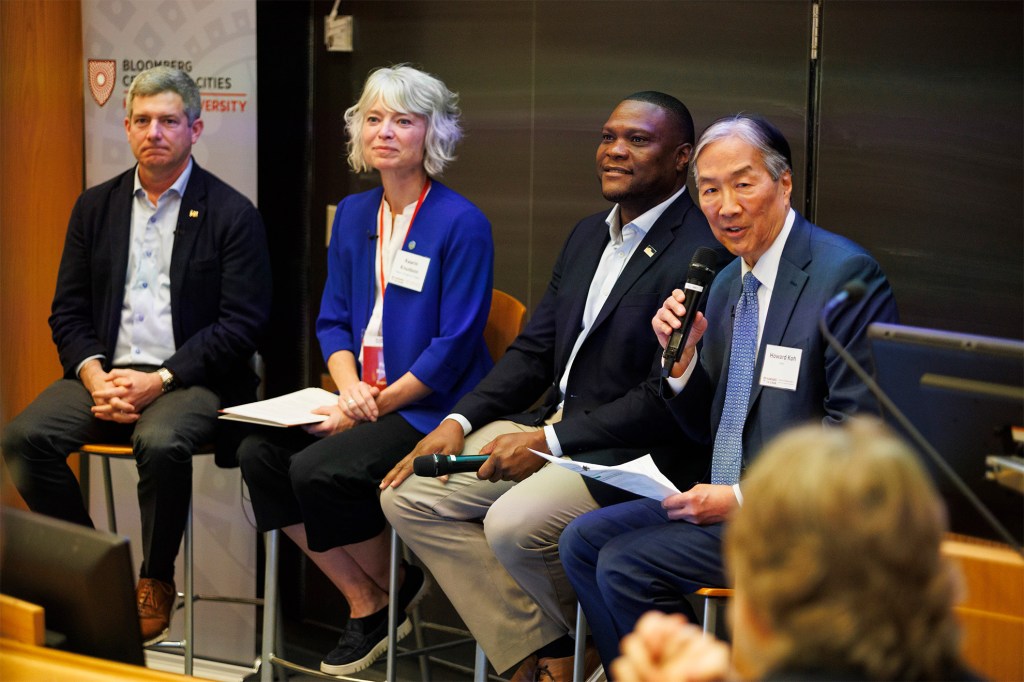
<div id="attachment_101544" class="wp-caption alignnone" style="width: 510px"><a href="http://news.harvard.edu/gazette/wp-content/uploads/2012/02/020312_Teach_Learn_086.jpg"><img class="size-full wp-image-101544" title="HILT 500" src="http://news.harvard.edu/gazette/wp-content/uploads/2012/02/020312_Teach_Learn_086.jpg" alt="" width="500" height="334" /></a><p class="wp-caption-text">“You should never underestimate the power of trying to do big, collective things as an organization,” said Youngme Moon (second from left), senior associate dean at Harvard Business School. Moon was joined in an afternoon panel by Harvard Provost Alan Garber (far left), Harvard Corporation member Lawrence S. Bacow, and Michael Sandel, the Anne T. and Robert M. Bass Professor of Government. Photo by Stephanie Mitchell/Harvard Staff Photographer</p></div>
<p>A series of interactive afternoon sessions gave a group of Harvard professors the chance to show their colleagues and contemporaries what goes on in their own classrooms.</p>
<p>Proving that the lecture format remains an effective teaching tool, <a href="http://www.fas.harvard.edu/%7Emusicdpt/faculty/tkelly.html">Tom Kelly</a> delivered a lively talk based on his popular General Education course, “First Nights,” in which he explores the performance premieres of five seminal works through a cultural, musical, and historical lens.</p>
<p>Waving his hands emphatically to the beat of accompanying audio and video clips, Kelly, Harvard’s Morton B. Knafel Professor of Music, carefully deconstructed Igor Stravinsky’s “The Rite of Spring.” Kelly’s presentation style, which during class often involves running to a piano to play an important chord or passage, offers students a new way of listening, and hopefully fosters in them a love for the subject matter.</p>
<p>I want them to know “how lucky they are to be alive on a planet like this that has music on it,” he said.</p>
<p><a href="http://www.physics.harvard.edu/people/facpages/mazur.html">Eric Mazur</a> was in his seventh year of teaching when he realized “my students were not learning; they were simple regurgitating back to me what I delivered to them, and then promptly forgetting it a few months later.” Effective teaching requires the assimilation or “sense-making” of that information, he said. And for that, the students themselves hold the key. In his classes, Mazur, the Balkanski Professor of Physics and Applied Physics, uses his popular and effective peer-instruction method, in which he asks questions of students and then has them try to convince each other of their own reasoning during class.</p>
<p>“It is absolutely essential,” Mazur said, “that we engage them.”</p>
<p>But developing sustainable methods of teaching and learning also requires an infrastructure and a culture of innovation, said <a href="http://drfd.hbs.edu/fit/public/facultyInfo.do?facInfo=ovr&amp;facId=6589">Youngme Moon</a>, Donald K. David Professor of Business Administration and senior associate dean at <a href="http://www.hbs.edu/research/">Harvard Business School</a> (HBS), during an afternoon panel that included <a href="http://www.provost.harvard.edu/">Harvard Provost Alan Garber</a>. She pointed to the School’s new experiential learning program as an example of innovative pedagogy. In January, 900 HBS students took field trips to a dozen locations around the world as part of the School’s <a href="http://www.hbs.edu/mba/academics/FIELD/globalpartner.html">Field Immersion Experiences for Leadership Development</a>, a new supplement to its traditional curriculum.</p>
<p>“You should never underestimate the power of trying to do big, collective things as an organization,” said Moon, adding, “the transformative nature of the [new HBS program] is palpable.”</p>
<p>The symposium’s attendees ranged from the deans of Harvard Schools and distinguished professors to staff, students, and participants from beyond the Harvard community who were eager to develop and share their thoughts on innovative teaching and learning.</p>
<p>“Getting all these great minds together from all across the University is a great thing,” said Harvard senior Senan Ebrahim, a neurobiology concentrator and former Undergraduate Council president, who helped to create a video for the conference that captured student perspectives on teaching and learning. “The opportunity for these experts to share what they do and explore how it can be applied to different disciplines is amazing.”</p>
<p><a href="http://www.fas.harvard.edu/home/content/deans-biography">Michael D. Smith</a>, dean of the <a href="http://www.fas.harvard.edu/home/">Faculty of Arts and Sciences</a> and a longtime proponent of innovative pedagogy and excellence in undergraduate teaching, was impressed by the symposium. “This has been tremendous. … I think the culture is already changing on campus, and this is an example of it,” Smith said.</p>
<p>The conference showed that the University is “on the cutting edge of great change in learning and teaching,” said Rita E. Hauser, who attended the symposium with her husband, Gustave M. Hauser. “Harvard 50 years from now will be very different from Harvard today; it’s inevitable.”</p>
<p>The event also featured a resource fair with representatives from the University’s teaching and learning centers, related interfaculty initiatives, academic technology resources, museums, and libraries.</p>
<img src="http://feeds.feedburner.com/~r/HarvardGazetteOnlineNationalWorldAffairs/~4/KFp1Uv0q6Ao" height="1" width="1"/>]]></content:encoded>
			<enclosure url="http://news.harvard.edu/gazette/wp-content/uploads/2012/02/020312_Teach_Learn_008_140.jpg" length="10951" type="image/jpg" />
    <harvard:WPID>101467</harvard:WPID>
    <harvard:author>Colleen Walsh</harvard:author>
    <harvard:affiliation>Harvard Staff Writer</harvard:affiliation>
    <harvard:featured>category</harvard:featured>
    <harvard:featured_photo>http://news.harvard.edu/gazette/wp-content/uploads/2012/02/HILT_Program_605.jpg</harvard:featured_photo>

		<harvard:photo_223>http://news.harvard.edu/gazette/wp-content/uploads/2012/02/HILT_Program_605-223x149.jpg</harvard:photo_223>
		<harvard:photo_280>http://news.harvard.edu/gazette/wp-content/uploads/2012/02/HILT_Program_605-280x187.jpg</harvard:photo_280>
				<feedburner:origLink>http://news.harvard.edu/gazette/story/2012/02/how-to-teach-better/</feedburner:origLink></item>
		
	<item>
		<title>The revolution continues</title>
		<link>http://feedproxy.google.com/~r/HarvardGazetteOnlineNationalWorldAffairs/~3/lhBjEaawUn8/</link>
		<pubDate>Mon, 06 Feb 2012 16:41:00 +0000</pubDate>
		<dc:creator />
				<category><![CDATA[International]]></category>
		<category><![CDATA[National & World Affairs]]></category>
		<category><![CDATA[Charles Sennott]]></category>
		<category><![CDATA[Democracy]]></category>
		<category><![CDATA[Egypt]]></category>
		<category><![CDATA[Harvard Kennedy School Forum]]></category>
		<category><![CDATA[Hosni Mubarek]]></category>
		<category><![CDATA[Journalism]]></category>
		<category><![CDATA[Mona Eltahawy]]></category>
		<category><![CDATA[Revolution]]></category>
		<category><![CDATA[Sexual Harassment]]></category>
		<category><![CDATA[Tarek Masoud]]></category>
		<category><![CDATA[Women]]></category>

		<guid isPermaLink="false">http://news.harvard.edu/gazette/?p=101346</guid>
		<description><![CDATA[In a conversation that ranged from the recent parliamentary elections to the ongoing sexual abuse of women to a new wave of journalists, panelists at the Feb. 2 Harvard Kennedy School Forum on Egypt expressed both fear and hope for a country still in the midst of a revolution.]]></description>
			<content:encoded><![CDATA[<p>In a conversation that ranged from the recent parliamentary elections to the ongoing sexual abuse of women to a new wave of journalists, panelists at the Feb. 2 Harvard Kennedy School Forum on Egypt expressed both fear and hope for a country still in the midst of a revolution.</p>
<p>“What we’ve got happening in Egypt right now is a transition, a transition from a dictatorship maybe to another dictatorship … maybe to a democracy,” said <a href="http://www.hks.harvard.edu/about/faculty-staff-directory/tarek-masoud">Tarek Masoud</a>, assistant professor of public policy at <a href="http://www.hks.harvard.edu/">Harvard Kennedy School</a>. “In transitions, they are inherently uncertain and you can’t judge them on a minute-by-minute basis. You really have to take a kind of long view.”</p>
<p>Masoud noted that a year after the revolution in Tahrir Square, Egypt is run by the military. “This is not what the people died in Tahrir Square for,” he said.  Additionally, the economy is worsening, and the country’s recent parliamentary election failed to produce a parliament reflective of the people’s ambitions for a more liberal and pluralistic country. Instead, he noted, the new parliament is dominated by Islamists who include not only the Muslim Brotherhood but the new, more radical and conservative Salafis.</p>
<p>“At the same time, ” Masoud said, “it was a freely elected parliament. This is the first time in Egypt’s modern history that you had a parliament that actually represents the will of the Egyptian people. If we compare where we are now to where we were in the dark days of Hosni Mubarak, “there are real reasons for us to be cautiously optimistic.”</p>
<p>Journalist Mona Eltahawy said that Egyptians finally have a chance to say “What we want, to go out and demonstrate when we want, and to acknowledge that these elections were not great, they were not free and fair, they were a mess. But they were our mess, and the next time around they will be a better mess. That’s our hope.”</p>
<p>Eltahawy condemned the gender-based violence against women that is on the rise at all levels of Egyptian society. It began in 2005, she said, with the government’s systematic campaign of sexually assaulting and intimidating female activists and journalists. “When the regime attacks women and holds no one accountable, it sends out a signal that women are fair game. When the street then attacks women and the police stand by and do nothing, that continues,” she said.</p>
<p>A columnist for the Toronto Star, The Jerusalem Report, and the Politiken, Eltahawy said a recent survey conducted by the Egyptian Center for Women’s Rights showed that more than 80 percent of Egyptian women face sexual harassment, groping, and unwanted sexual attention. With casts on both arms as a result of an attack she suffered last fall by security forces, an attack that included sexual assault, Eltahawy said this is a problem the Egyptian people must not hide from.</p>
<p>“This is an opportunity in Egypt now to say, ‘Look, women are attacked by the regime, women are attacked by the street, women are attacked.’ There is something about gender-based violence in Egypt that is horrific. We have to look it in the eye and we must speak out about it, not just when it is the regime that is doing it to us, but when it’s our fellow Egyptian men on the civilian level who are doing it to us.”</p>
<p>Charles Sennott, co-founder of GlobalPost, an online news company focusing on international news, and of Global Post’s-Open Hands, an initiative that brought together 16 reporting fellows from Egypt and the United States, noted that Egypt’s young journalists are making an important contribution to the country’s revolution.</p>
<p>“What we found are extraordinary young people who [are] part of this heroic movement,” he said. “I came away so hopeful about this generation of journalists.”</p>
<p>The event, co-sponsored by the Middle East Initiative, the Open Hands Initiative, and the Shorenstein Center on the Press, Politics and Public Policy, was moderated by Tina Brown, editor-in-chief of The Daily Beast and Newsweek.</p>
<img src="http://feeds.feedburner.com/~r/HarvardGazetteOnlineNationalWorldAffairs/~4/lhBjEaawUn8" height="1" width="1"/>]]></content:encoded>
			<enclosure url="http://news.harvard.edu/gazette/wp-content/uploads/2012/02/020212.EGYPT_.jc_.000021.jpg" length="30910" type="image/jpg" />
    <harvard:WPID>101346</harvard:WPID>
    <harvard:author>Sarah Abrams</harvard:author>
    <harvard:affiliation>Harvard Kennedy School Communications</harvard:affiliation>
    <harvard:featured>category</harvard:featured>
    <harvard:featured_photo>http://news.harvard.edu/gazette/wp-content/uploads/2012/02/020212.EGYPT_.jc_.jpg</harvard:featured_photo>

		<harvard:photo_223>http://news.harvard.edu/gazette/wp-content/uploads/2012/02/020212.EGYPT_.jc_-223x149.jpg</harvard:photo_223>
		<harvard:photo_280>http://news.harvard.edu/gazette/wp-content/uploads/2012/02/020212.EGYPT_.jc_-280x187.jpg</harvard:photo_280>
				<feedburner:origLink>http://news.harvard.edu/gazette/story/2012/02/the-revolution-continues/</feedburner:origLink></item>
		
	<item>
		<title>Experts assess impact of Citizens United</title>
		<link>http://feedproxy.google.com/~r/HarvardGazetteOnlineNationalWorldAffairs/~3/ChFIFVmHQXk/</link>
		<pubDate>Fri, 03 Feb 2012 19:43:35 +0000</pubDate>
		<dc:creator />
				<category><![CDATA[Law]]></category>
		<category><![CDATA[National & World Affairs]]></category>

		<guid isPermaLink="false">http://news.harvard.edu/gazette/?p=101236</guid>
		<description><![CDATA[At an event sponsored by the Harvard Law School (HLS) American Constitution Society on Tuesday, HLS Professor Lawrence Lessig, author of "Republic Lost,” and Jeff Clements, author of “Corporations Are Not People,” reviewed the impact that Citizens United has had on the political process.]]></description>
			<content:encoded><![CDATA[<p>Few recent Supreme Court cases have received as much attention — and drawn as much ire — as Citizens United v. Federal Election Commission. In a 5-4 decision, the court ruled that the First Amendment prohibits government from placing limits on independent spending for political purposes by corporations and unions. To proponents of campaign finance reform, <a href="http://www.citizensunited.org/">Citizens United</a> had the detrimental effect of inundating an already-broken campaign finance system with corporate influence. At an event sponsored by the <a href="http://www.law.harvard.edu/index.html">Harvard Law School</a> (HLS) American Constitution Society on Tuesday, HLS Professor <a href="http://www.law.harvard.edu/faculty/directory/index.html?id=888">Lawrence Lessig</a>, author of &#8220;<a href="http://twelvebooks.com/books/republic_lost.asp">Republic Lost</a>,” and Jeff Clements, author of “<a href="http://www.bkconnection.com/ProdDetails.asp?ID=9781609941055">Corporations Are Not People</a>,” reviewed the impact that Citizens United has had on the political process.</p>
<p>Clements said that the court’s decision exacerbates two problems that the American political and electoral system had already been facing — the large amount of campaign spending and the growing influence of corporate power on the political process. Clements said that both problems need to be fixed in order to restore democracy but that, rather than addressing these problems, the Citizens United decision instead requires that the American people fundamentally reframe their notion of corporations.</p>
<div id="attachment_101371" class="wp-caption alignnone" style="width: 510px"><a href="http://news.harvard.edu/gazette/wp-content/uploads/2012/02/013112_Citizens_131-1.jpg"><img class="size-full wp-image-101371" title="Clements_500.jpg" src="http://news.harvard.edu/gazette/wp-content/uploads/2012/02/013112_Citizens_131-1.jpg" alt="" width="500" height="334" /></a><p class="wp-caption-text">“We need to look at what Citizens United really asks us to do, which is to accept a lot,&quot; said Jeff Clements, author of “Corporations Are Not People.”</p></div>
<p>“We need to look at what Citizens United really asks us to do, which is to accept a lot. The court asks us to pretend that corporations are not massive creations of state, federal, and foreign laws. It asks us to pretend that they’re just like people, that they have voices, and that we’re not allowed to make separate rules for them,” he said.</p>
<p>Although some legal observers regard the decision as simply a bad day on the court, Clements said that Citizens United actually represents the culmination of a steady creation of a corporate rights doctrine that is radical in terms of American jurisprudence. He provided a history of the idea of corporate personhood and corporate speech, which began only in the 1970s under Chief Justice <a href="http://supreme.lp.findlaw.com/supreme_court/justices/rehnquist.html">William Rehnquist</a>. Lessig added that the system that has resulted is one in which elected officials must spend 30 to 50 percent of their time fundraising, and thus make decisions based not on what is best for their constituents, but on what their super PACS and other major donors want to see.</p>
<p>“We have a corrupt government, yet one that is perfectly legal,” said Lessig. “We’ve allowed a government to evolve in which Congress isn’t dependent on people alone, but is instead increasingly dependent on its funders. As you bend to the green, that corrupts the government.”</p>
<p>As a result, he said, members of Congress develop a sixth sense as to what will raise money, which has led them to bend government away from what the people want government to do and toward what their funders what government to do. To fix the problem, we need to produce a system where the funders and the people are one and the same. The solution, Lessig said, is a multipronged approach that includes a constitutional amendment explicitly stating that corporations are not people, as well as a movement to publicly fund elections and provide Congress with the power to limit independent expenditures.</p>
<p>Lessig is the Roy L. Furman Professor of Law at Harvard Law School, and director of the <a href="http://www.ethics.harvard.edu/">Edmond J. Safra Center for Ethics</a> at Harvard University. Clements is the co-founder and general counsel of Free Speech For People, which is a national nonpartisan campaign working to restore democracy to the people and to return corporations to their place as economic rather than political entities.</p>
<img src="http://feeds.feedburner.com/~r/HarvardGazetteOnlineNationalWorldAffairs/~4/ChFIFVmHQXk" height="1" width="1"/>]]></content:encoded>
			<enclosure url="http://news.harvard.edu/gazette/wp-content/uploads/2012/02/013112_Citizens_315-1.jpg" length="26043" type="image/jpg" />
    <harvard:WPID>101236</harvard:WPID>
    <harvard:author>Jill Greenfield</harvard:author>
    <harvard:affiliation>Harvad Law School Communications</harvard:affiliation>
    <harvard:featured>category</harvard:featured>
    <harvard:featured_photo>http://news.harvard.edu/gazette/wp-content/uploads/2012/02/013112_Citizens_237.jpg</harvard:featured_photo>

		<harvard:photo_223>http://news.harvard.edu/gazette/wp-content/uploads/2012/02/013112_Citizens_237-223x149.jpg</harvard:photo_223>
		<harvard:photo_280>http://news.harvard.edu/gazette/wp-content/uploads/2012/02/013112_Citizens_237-280x187.jpg</harvard:photo_280>
				<feedburner:origLink>http://news.harvard.edu/gazette/story/2012/02/experts-assess-impact-of-citizens-united/</feedburner:origLink></item>
		
	<item>
		<title>Up by his bootstraps</title>
		<link>http://feedproxy.google.com/~r/HarvardGazetteOnlineNationalWorldAffairs/~3/f559wjKc50s/</link>
		<pubDate>Thu, 02 Feb 2012 17:00:58 +0000</pubDate>
		<dc:creator />
				<category><![CDATA[International]]></category>
		<category><![CDATA[National & World Affairs]]></category>
		<category><![CDATA[Chamroeun University of Poly-Technology]]></category>
		<category><![CDATA[Corydon Ireland]]></category>
		<category><![CDATA[Harpswell Foundation]]></category>
		<category><![CDATA[Khmer Rouge]]></category>
		<category><![CDATA[Killing fields]]></category>
		<category><![CDATA[Office of the Provost]]></category>
		<category><![CDATA[Phnom Penh]]></category>
		<category><![CDATA[Royal University of Phnom Penh]]></category>
		<category><![CDATA[Scholar Rescue Fund]]></category>
		<category><![CDATA[Scholars at Risk]]></category>
		<category><![CDATA[Tararith Kho]]></category>

		<guid isPermaLink="false">http://news.harvard.edu/gazette/?p=97856</guid>
		<description><![CDATA[Cambodian writer Tararith Kho, who grew up amid war and pushed relentlessly to be educated, is now a Harvard Scholars at Risk fellow. His weapons are well-turned words.]]></description>
			<content:encoded><![CDATA[<p>As a child, <a href="http://www.globalconversation.org/2011/05/01/poetry-tararith-kho">Tararith Kho</a> spent many nights with his family in a cave dug into a hillside in the Samrong district of Cambodia. “We were under fire,” said Kho simply.</p>
<p>The boy who saw death early grew up to become a poet and short story writer and now a 2011-12 <a href="http://www.humanrights.harvard.edu/index.php?option=com_content&amp;view=article&amp;id=7&amp;Itemid=5">Scholars at Risk</a> fellow at Harvard. Wartime and the continuing tension of Cambodian politics still deeply inform his work. Talk with Rith, as he is called, and you will hear the mantra of a witness: “I have seen this.”</p>
<p>The onetime <a href="http://www.watsoninstitute.org/project_detail.cfm?id=54">international writing fellow</a> at Brown University has a literary blog, composes poems and essays in his native Khmer, and has written a dozen stories. One of them, “Red Print,” was about war and took him a decade to finish. “I’m not a political man,” he said recently. “I’m a writer, and I write what I have seen.”</p>
<p>Even as a newborn in 1974, Rith was immersed in war. That was the year before the <a href="http://www.cambodia.org/khmer_rouge/">Khmer Rouge</a> regime established the <a href="http://archives.cnn.com/2001/WORLD/asiapcf/southeast/08/08/cambodia.killingfields/">killing fields</a>, places of execution, starvation, and disease where a third of Cambodians died from 1975 to 1978. After that, civil wars flared and raged until 1991. These templates provided Rith with his childhood memories of firefights and artillery exchanges and the fatal detritus of war. Thousands of landmines are still buried in impoverished <a href="http://www.foodsecurityatlas.org/khm/country/provincial-Profile/Oddar-Meanchey">Oddar Meanchey Province</a>, where Rith grew up.</p>
<p>This hat-shaped region in northern Cambodia was the Khmer Rouge’s original redoubt. “On the street and in the forest, I witnessed fighting,” said Rith. “Sometimes I saw people die.”</p>
<p>His father was killed in 1975 while fighting the Khmer Rouge. He and his brother grew up with their mother, a primary school teacher and farmer. They lived in a wooden hut roofed with palm leaves, not far from their dugout shelter. They cooked outside over a wood fire, grew vegetables, picked fruit, snared rabbits in the forested <a href="http://www.britannica.com/EBchecked/topic/150936/Dangrek-Mountains">Dangrek Mountains</a>, and fished from a nearby stream. There were no books in the house, and newspapers arrived long after they were printed. “We lived in a valley,” Rith said, “and knew nothing.”</p>
<p>By comparison, Harvard for Rith is a paradise of safety and opportunity. “I heard people talk about places like Harvard, Brown, and universities in Europe,” said Rith of his childhood. “But I come from a poor place close to the Thai border. I never dreamed I would come here.”</p>
<p>His fellowship is supported by Harvard Scholars at Risk, a program sustained by contributions from the <a href="http://www.provost.harvard.edu/">Office of the Provost</a> and the Scholar Rescue Fund in New York, an arm of the Institute of International Education.</p>
<p>The road to Harvard was long and winding. Despite the chaos of war, Rith managed to attend primary school in his village before moving to high school in <a href="http://www.tourismcambodia.org/provincial_guide/index.php?view=detail&amp;prv=21">Siem Reap province</a>. That was less than three hours away by car, but for him three days away on foot. In 1991, Rith moved to <a href="http://www.canbypublications.com/phnompenh/ppintro.htm">Phnom Penh</a> to take preparatory courses for university. He worked as a builder, housecleaner, and motorcycle taxi driver before entering the <a href="http://www.rupp.edu.kh/">Royal University of Phnom Penh</a> on a scholarship.</p>
<p>By 1999, he had a bachelor’s degree, the next year a teaching certificate, and in 2004 a master’s degree in political science from the capital city’s <a href="http://www.cup.edu.kh/">Chamroeun University of Poly-Technology</a>. That same year, Rith married screenwriter Amara Chhaya, whom he had met in a writing class. (Today they have two children, ages 7 and 5.)</p>
<p>In Phnom Penh, writing was one of Rith’s desires; travel was another. He had already crossed many times into Thailand and Vietnam, a country he considers a refuge and second home. But starting in 2006, Rith traveled to France, Sweden, and the United States.</p>
<p>He still dreams of Cambodia, a land where, as one of his poems says, “happiness and suffering live side by side.” Still, he fears returning. His writing is nostalgic but increasingly political. That has earned him the enmity of authorities, whom he accuses of land theft and repression. “This beautiful island is gone,” one of his poems reads.</p>
<p><em>In history this island was Cambodia.</em><br />
<em>All generations of Khmer remember.</em><br />
<em>When the island will return to us</em><br />
<em>the long suffering will end;</em><br />
<em>our anger of the many years will be over.</em><br />
<em>We are waiting for that.</em></p>
<p>But Rith isn’t just waiting. For years, he has helped students from his remote province get university training through his self-supported Oddar Meanchey Students Association. With assistance from private donors and from Alan Lightman’s <a href="http://harpswellfoundation.org/">the Harpswell Foundation</a>, which is based in Cambridge, Rith provides 30 university students annually with housing, food, books, and computers. Sixteen live in his Phnom Penh apartment; 14 more live in his house there.</p>
<p>Some are aspiring writers. “Read and listen,” Rith tells them. “If we don’t read and don’t listen, we don’t know.”</p>
<img src="http://feeds.feedburner.com/~r/HarvardGazetteOnlineNationalWorldAffairs/~4/f559wjKc50s" height="1" width="1"/>]]></content:encoded>
			<enclosure url="http://news.harvard.edu/gazette/wp-content/uploads/2011/12/110911_Rith_076_140.jpg" length="8636" type="image/jpg" />
    <harvard:WPID>97856</harvard:WPID>
    <harvard:author>Corydon Ireland</harvard:author>
    <harvard:affiliation>Harvard Staff Writer</harvard:affiliation>
    <harvard:featured>category</harvard:featured>
    <harvard:featured_photo>http://news.harvard.edu/gazette/wp-content/uploads/2011/12/110911_Rith_135_605.jpg</harvard:featured_photo>

		<harvard:photo_223>http://news.harvard.edu/gazette/wp-content/uploads/2011/12/110911_Rith_135_605-223x149.jpg</harvard:photo_223>
		<harvard:photo_280>http://news.harvard.edu/gazette/wp-content/uploads/2011/12/110911_Rith_135_605-280x187.jpg</harvard:photo_280>
				<feedburner:origLink>http://news.harvard.edu/gazette/story/2012/02/up-by-his-bootstraps/</feedburner:origLink></item>
		
	<item>
		<title>Not your average road trip</title>
		<link>http://feedproxy.google.com/~r/HarvardGazetteOnlineNationalWorldAffairs/~3/aCrosM9lWXQ/</link>
		<pubDate>Wed, 01 Feb 2012 21:47:07 +0000</pubDate>
		<dc:creator />
				<category><![CDATA[Business]]></category>
		<category><![CDATA[National & World Affairs]]></category>
		<category><![CDATA[Barrie Altshuler]]></category>
		<category><![CDATA[Brazil]]></category>
		<category><![CDATA[Education]]></category>
		<category><![CDATA[Experiential Learning]]></category>
		<category><![CDATA[FIELD]]></category>
		<category><![CDATA[Field Immersion Experiences for Leadership Development]]></category>
		<category><![CDATA[Harvard Business School]]></category>
		<category><![CDATA[Immersion]]></category>
		<category><![CDATA[India]]></category>
		<category><![CDATA[Innovation]]></category>
		<category><![CDATA[Katie Koch]]></category>
		<category><![CDATA[Leadership]]></category>
		<category><![CDATA[M.B.A.]]></category>
		<category><![CDATA[Melody Koh]]></category>
		<category><![CDATA[Nitin Nohria]]></category>
		<category><![CDATA[Parker Woltz]]></category>
		<category><![CDATA[Srikant Datar]]></category>
		<category><![CDATA[Vietnam]]></category>
		<category><![CDATA[Yasmin Mandviwala]]></category>
		<category><![CDATA[Youngme Moon]]></category>

		<guid isPermaLink="false">http://news.harvard.edu/gazette/?p=101005</guid>
		<description><![CDATA[Harvard Business School just sent all 900 first-year M.B.A. students into the field to solve real-world problems in emerging markets from Buenos Aires to Mumbai, in the most ambitious element of an experimental new course. HBS, pioneer of the celebrated case-study method, is working to craft a business education model for the 21st century.]]></description>
			<content:encoded><![CDATA[<p>Until recently, January usually meant one thing at <a href="http://www.hbs.edu/">Harvard Business School</a>: a frenzy of summer internship interviews known affectionately as “Hell Week.” Like her fellow first-year M.B.A. students, Parker Woltz was prepared to spend her winter break handing out business cards.</p>
<p>Unlike her predecessors, however, Woltz found herself making those introductions not in New York or Boston, but in a conference room in Ho Chi Minh City.</p>
<p>Early last month, Woltz and five classmates found themselves lined up for a formal exchange of cards with their new Vietnamese associates. The students had read up on local customs: Start with the highest-ranking person in the room. Line up the cards you receive in front of you on the table. And, whatever you do, don’t pass out your card without using two hands. That’s rude.</p>
<p>“It took forever,” Woltz said. “It felt very ritualistic. But by the end of the week, they were taking us out for lunches.”</p>
<p>If the process was initially nerve-wracking, Woltz and her classmates could take heart in knowing that they were hardly alone. Their weeklong visit, during which they feverishly tackled a marketing project for a telecommunications company, was part of an ambitious new field-learning course now required of all first-year M.B.A. students.</p>
<p>The 900 students all took whirlwind trips to emerging market economies. In teams of six, the students fanned out across a dozen locations — from Cape Town and Mumbai, to Shanghai and Warsaw, to Istanbul and Buenos Aires  — to tackle business challenges with real companies. Each team received a proposal from its global partner for a new product or service and was asked to present a helpful plan by the end of the week.</p>
<p>The trips were the focal point of an experimental new supplement to HBS’s long-standing curriculum, called <a href="http://www.hbs.edu/mba/academics/FIELD/globalpartner.html">Field Immersion Experiences for Leadership Development</a>, or FIELD. The three-part project — carried out on campus and abroad over the academic year — has educational leaders and observers looking to HBS, standard-bearer of the celebrated case-study method, to create a strong business education model for the 21st century.</p>
<p>“FIELD reflects our understanding of what it means to be a leader in a global century,” said Nitin Nohria, dean of HBS. “We see FIELD as a powerful way of complementing the case method by putting students in real-world business scenarios, both here on campus and in emerging economies around the world.”</p>
<p>The project was announced a year ago to a flurry of media coverage and speculation. FIELD would be a test of how innovative an elite business school — known for pioneering the use of a rigorous, classroom-based teaching method, no less — could be while remaining true to its core principles. In the weeks leading up to the student trips, “Poets &amp; Quants,” the business-school rankings website, called FIELD “arguably the boldest experiment ever carried out in graduate business education.”</p>
<p><strong>The M.B.A. reconsidered</strong></p>
<p>FIELD was the result of several years of discussion at HBS, spurred by preparations for the School’s centennial celebration in 2008.</p>
<p>“It was a point at which we as an institution engaged in some deep reflection,” said <a href="http://drfd.hbs.edu/fit/public/facultyInfo.do?facInfo=ovr&amp;facId=6589">Youngme Moon</a>, Donald K. David Professor of Business Administration and senior associate dean. “HBS pioneered so much of the methodology of how business education is done around the world today. The question we asked ourselves was: 100 years from now, what will be our legacy, and how can we begin building it today?”</p>
<p><a href="http://drfd.hbs.edu/fit/public/facultyInfo.do?facInfo=ovr&amp;facId=6501">Jay Light</a>, then dean of HBS, commissioned a faculty panel to assess the state of the M.B.A. program and the readiness of its graduates to lead in a new century.</p>
<p>“This started in 2006-07, when everyone thought the [business] world couldn’t be going better than it was going,” said <a href="http://drfd.hbs.edu/fit/public/facultyInfo.do?facInfo=ovr&amp;facId=6443">Srikant Datar</a>, Arthur Lowes Dickinson Professor of Accounting. But as Datar and his colleagues started interviewing other school’s deans, business leaders, students, and recruiters, they heard serious concerns about the state of business education that prefigured the coming global economic crisis. It was clear that the need to reconfigure the M.B.A. extended well beyond HBS, and beyond the timeline of the 2008 anniversary.</p>
<p>In 2010, Datar and colleagues <a href="http://drfd.hbs.edu/fit/public/facultyInfo.do?facInfo=ovr&amp;facId=6459">David Garvin</a>, C. Roland Christensen Professor of Business Administration, and Patrick Cullen, then a research associate at HBS, published “<a href="http://hbr.org/product/rethinking-the-mba-business-education-at-a-crossro/an/14724-HBK-ENG">Rethinking the MBA: Business Education at a Crossroads</a>.” The book was more than a philosophical treatise. Containing reams of data and several case studies of top B-schools, it identified skills that were in desperately short supply, even in elite M.B.A. programs.</p>
<p>The book’s central theme urged business schools to teach ways of doing and being, rather than simply knowing. That idea became the basis for FIELD’s areas of focus: leadership (the being of business), global immersion (the doing of business), and the integration of that learning across the academic year.</p>
<p>“No matter how much we fill our students with knowledge, the fact of the matter is that when they encounter a problem, that knowledge is not going to be enough,” Datar said. “How do you train people to think about the inevitable gaps that are going to be in their knowledge, to be able to think through situations for which their knowledge is going to be incomplete? In those instances, critical thinking becomes fundamental.”</p>
<p>For Moon, who became chair of the M.B.A. Program after Nohria’s appointment as dean, the answer was to develop FIELD, with input from faculty across the School. In the fall, all 900 new students met for the first component of the course, which incorporated small group activities and projects meant to develop leadership. In October, students received their assignments for FIELD 2, the global immersion trips. This month, when students return for the spring semester, they’ll be assigned to new groups of six. Each team will be given $3,000 and charged with conceiving and developing a scalable business of its own.</p>
<p>“When you undergo a change this dramatic, it can only come from the bottom up,” Moon said. FIELD, she added, “is really just the tangible manifestation of a more conceptual commitment that the faculty has made to field-based learning, small-group learning, and experiential learning opportunities.”</p>
<p><strong>Flexing some new muscles</strong></p>
<p>Students, too, have shown an increasing interest in getting out into the field while in business school. The old M.B.A. stereotype — a young twenty-something sent to business school by a company hoping to put him on the management track — rarely applies today. Incoming M.B.A. students are now slightly older, more experienced, and less likely to have their way paid by an organization. Some students are hoping for a change of field after they graduate; many say they’d like to learn the tools to start and run their own businesses.</p>
<p>“The students we accept today are more business savvy than ever,” Moon said. “The standard for what we teach in our classrooms has gone up over time.”</p>
<p>Popular student clubs, such as the long-standing <a href="http://www.hbs.edu/mba/studentlife/clubs/entrepreneurship.html">Entrepreneurship Club</a> or the newer, consumer Internet-focused <a href="https://sites.google.com/site/startuptribe/">Startup Tribe</a>, coupled with University-driven initiatives such as HBS’s <a href="http://www.hbs.edu/entrepreneurship/">Arthur Rock Center for Entrepreneurship </a>and the <a href="http://i-lab.harvard.edu/">Harvard Innovation Lab</a>, have catalyzed that interest, giving M.B.A. students the space, funding, and social supports to tackle real-world challenges while juggling case readings and internship interviews.</p>
<p>“On one hand, you could say, ‘Why change?’ On the other, it’s our responsibility to have our antenna up on the extent to which the demands of the business environment are changing,” Moon said. “We’re operating in a context now in which the world of business and the world at large have become increasingly complex. It affects not just traditional business, but domains like education, government, health care, and social enterprise.”</p>
<p>The trips were also an experiment in HBS’s logistical capabilities. Sending 1,000 students, faculty, and support staff around the globe took the coordinated efforts of HBS Executive Education, external relations, legal and other administrators, and the School’s global research centers. While HBS prides itself on a robust alumni network, the task of finding enough global partners to help create 150 team trips required HBS to reach out and work with alumni on an unprecedented scale, Moon said.</p>
<p>“We’ve had to use muscles we’ve never really had to use before,” she said. “In the process, we’re developing some different kinds of flexibility we’re just beginning to tap into. We’re inspired.”</p>
<p><strong>The realities of global markets</strong></p>
<p>The FIELD trips represented a creative opportunity to train students in many of the critical skills identified in “Rethinking the M.B.A.” Those include developing a global perspective, implementing effectively in the face of organizational realities, responding creatively to problems, and — perhaps most important in the wake of the financial crisis — understanding the limits of the financial models and markets that students learn about in the classroom.</p>
<p>Nowhere are the models less certain than in rapidly developing markets like the ones just visited. Although HBS already boasts a student body that’s one-third international, and many more students who have worked abroad, Datar stressed the need to give students a leg up in tackling the unique challenges that American companies face overseas.</p>
<p>“A large number of companies are going to have to get connected with emerging markets in the coming years,” Datar said. “They’re very different [from the American market], and if you think about and approach them as if they’re the same, you won’t succeed.”</p>
<p>Melody Koh, a first-year student whose FIELD experience was in Chennai, India, found that despite her own global background — she grew up in Taiwan, before moving to the United States for college — tackling a new international market was still a challenge.</p>
<p>She was struck by the daily contrasts they saw between the upper classes and people with limited incomes. Their global partner&#8217;s product might sell to a prosperous middle-income market in America, but in India the middle class meant something else entirely.</p>
<p>That was an important realization for the team members, one they could only have learned on the ground. But it also spoke to a larger theme that emerged during the trip.<br />
“The income disparity is huge,” she said. “The living situation between a middle-class and an upper-middle-class family is very different. You think, ‘Oh, India is an emerging economy with 8 or 9 percent GDP growth,’ ” but that growth isn’t always visible in the field.</p>
<p>The experience broadened her understanding of what a rapidly developing market looks like, and how growth affects the people in those economies, sometimes unevenly.</p>
<p>“It’s easy to bucket these emerging countries in the same group, but they’re not the same,” she said.</p>
<p><strong>Supplementing the case method</strong></p>
<p>As the FIELD course heads into the final phase of its trial year, one thing is certain. The case method isn’t going anywhere, HBS leaders say. It remains the core of the required curriculum — 80 percent of the courses at the School employ it — as well as HBS’s international calling card among aspiring M.B.A.s and business leaders.</p>
<p>Barrie Altshuler, a first-year M.B.A. student, chose to attend HBS “mainly because of the case study method,” which she’d used in her undergraduate business education at the University of California, Berkeley. “It keeps you on your toes,” she said. “You just don’t have the chance to zone out.”</p>
<p>While Altshuler hadn’t heard the news about FIELD before deciding to attend HBS, the new course surpassed her expectations.</p>
<p>“I think it was really valuable just being on the ground, face-to-face with your client,” she said. “You’re diving deeper into the business, bouncing ideas off them, coming up with an actual solution, and getting live feedback. When you do a case, you discuss it, and that’s it.”</p>
<p>She and her teammates are now back in Boston. But officials from their partner company in Ho Chi Minh City, Vietnam, have promised to weigh the team’s suggestions and follow up with the steps they’ve chosen to take. Unlike a case, in which a business’s course of action can be rigorously argued but not truly affected, the results from the FIELD experience are still very much in play.</p>
<p>“It was cool to establish that, to have a relationship that’s going to continue in the future,” Altshuler said.</p>
<img src="http://feeds.feedburner.com/~r/HarvardGazetteOnlineNationalWorldAffairs/~4/aCrosM9lWXQ" height="1" width="1"/>]]></content:encoded>
			<enclosure url="http://news.harvard.edu/gazette/wp-content/uploads/2012/02/SilSign3001.jpg" length="94917" type="image/jpg" />
    <harvard:WPID>101005</harvard:WPID>
    <harvard:author>Katie Koch</harvard:author>
    <harvard:affiliation>Harvard Staff Writer</harvard:affiliation>
    <harvard:featured>category</harvard:featured>
    <harvard:featured_photo>http://news.harvard.edu/gazette/wp-content/uploads/2012/02/HBS_Market_5695.jpg</harvard:featured_photo>

		<harvard:photo_223>http://news.harvard.edu/gazette/wp-content/uploads/2012/02/HBS_Market_5695-223x149.jpg</harvard:photo_223>
		<harvard:photo_280>http://news.harvard.edu/gazette/wp-content/uploads/2012/02/HBS_Market_5695-280x187.jpg</harvard:photo_280>
				<feedburner:origLink>http://news.harvard.edu/gazette/story/2012/02/not-your-average-road-trip/</feedburner:origLink></item>
		
	<item>
		<title>Peace in our times?</title>
		<link>http://feedproxy.google.com/~r/HarvardGazetteOnlineNationalWorldAffairs/~3/AtInrdjIySI/</link>
		<pubDate>Wed, 01 Feb 2012 18:07:17 +0000</pubDate>
		<dc:creator />
				<category><![CDATA[International]]></category>
		<category><![CDATA[National & World Affairs]]></category>
		<category><![CDATA[Afghanistan]]></category>
		<category><![CDATA[American University]]></category>
		<category><![CDATA[Harvard Kennedy School]]></category>
		<category><![CDATA[Joseph Nye]]></category>
		<category><![CDATA[Joshua Goldstein]]></category>
		<category><![CDATA[Monica Toft]]></category>
		<category><![CDATA[Peace]]></category>
		<category><![CDATA[Stephen Walt]]></category>
		<category><![CDATA[Syria]]></category>
		<category><![CDATA[War]]></category>
		<category><![CDATA[“God’s Century: Resurgent Religion and Global Politics”]]></category>
		<category><![CDATA[“The Better Angels of Our Nature”]]></category>

		<guid isPermaLink="false">http://news.harvard.edu/gazette/?p=100992</guid>
		<description><![CDATA[A Harvard Kennedy School panel assembled to discuss “Is War on the Way Out?,” the oddly counterintuitive notion that violence, among both individuals and states, is on the wane, or at least on a downward trajectory.]]></description>
			<content:encoded><![CDATA[<p>A bloody uprising in Syria. A seemingly endless insurgency in Afghanistan. A savage civil war in Libya. A terrorist attack in Iraq. It is not difficult, University Distinguished Service Professor <a href="http://www.hks.harvard.edu/about/faculty-staff-directory/joseph-nye">Joseph Nye</a> said in introducing the John F. Kennedy Jr. Forum on Monday, to compile from the headlines a list of current wars and conflagrations.</p>
<p>But the panel, assembled under the title “Is War on the Way Out?,” was there to discuss the oddly counterintuitive notion that violence, among both individuals and states, is on the wane, or at least on a downward trajectory.</p>
<p>“It’s a property of the human mind that we estimate risk by memorable examples,” said <a href="http://pinker.wjh.harvard.edu/about/">Steven Pinker</a>, Johnstone Family Professor of Psychology at Harvard, panelist, and author of <a href="../story/2011/11/on-the-side-of-the-angels/">“The Better Angels of Our Nature.”</a> Bloody bulletins from the front lines of various conflicts are easily recalled by most of us.</p>
<p>But the data seem to show that humans are instead behaving better.</p>
<p>Both Pinker’s book and “Winning the War on War,” by fellow panelist Joshua Goldstein, professor <em>emeritus</em> at <a href="http://www.american.edu/">American University</a>, point to startling statistical evidence. The annual number of battle deaths worldwide has fallen from about 300 per 100,000 of population during World War II to the single digits during the 1970s and 1980s, to less than 1 per 100,000 in the first decade of this century. Other indicators of violence illustrate a similar trend.</p>
<p>While scholars now paint a picture of primitive man as warlike and aggressive, and much of human history is written around conflict, something seems to have happened to the way humans approach violence. The United Nations and its peacekeeping operations have helped, Goldstein argued. So have changing norms about the acceptability of institutionalized violence. And so has the fact that trade has replaced conquest as the basis of prosperity.</p>
<p>The arguments were lauded but also challenged by panelists <a href="http://www.hks.harvard.edu/about/faculty-staff-directory/monica-toft">Monica Toft</a>, associate professor of public policy, and <a href="http://www.hks.harvard.edu/about/faculty-staff-directory/stephen-walt">Stephen Walt</a>, Belfer Professor of International Affairs.</p>
<p>Toft, author of <a href="http://books.wwnorton.com/books/Gods-Century/">“God’s Century: Resurgent Religion and Global Politics,</a>” said Pinker and Goldstein provide important arguments on the “continuum of violence” from the personal to the state level. But she criticized a reliance on Eurocentric data as well as the presentation of the data.</p>
<p>Walt said it was important to separate out the reasons for a decline in violence and not confuse the cause for a decline in interpersonal violence (which could be attributed to states being better at policing societies, or on changing norms on the use of violence in society) with the cause for the decline in violence among states.</p>
<p>For example, Walt argued, the use of nuclear deterrence by the United States and the Soviet Union could be used as an explanation for the absence of major conflicts during the Cold War.</p>
<p>The panelists seemed to agree, however, that while encouraging data exists, it is no ground for complacency.</p>
<p>“We have it in us to be violent, to make war,” Goldstein said. “The idea that this is a recipe for complacency is exactly the opposite of the message I would ever want to give. The fact that we’re making progress means that we need to keep working.”</p>
<img src="http://feeds.feedburner.com/~r/HarvardGazetteOnlineNationalWorldAffairs/~4/AtInrdjIySI" height="1" width="1"/>]]></content:encoded>
			<enclosure url="http://news.harvard.edu/gazette/wp-content/uploads/2012/01/013012_HKS_FORUM_WAR_209_140.jpg" length="10598" type="image/jpg" />
    <harvard:WPID>100992</harvard:WPID>
    <harvard:author>Robert O'Neill</harvard:author>
    <harvard:affiliation>Harvard Kennedy School Communications</harvard:affiliation>
    <harvard:featured>category</harvard:featured>
    <harvard:featured_photo>http://news.harvard.edu/gazette/wp-content/uploads/2012/01/013012_HKS_FORUM_WAR_209_605MAIN.jpg</harvard:featured_photo>

		<harvard:photo_223>http://news.harvard.edu/gazette/wp-content/uploads/2012/01/013012_HKS_FORUM_WAR_209_605MAIN-223x149.jpg</harvard:photo_223>
		<harvard:photo_280>http://news.harvard.edu/gazette/wp-content/uploads/2012/01/013012_HKS_FORUM_WAR_209_605MAIN-280x187.jpg</harvard:photo_280>
				<feedburner:origLink>http://news.harvard.edu/gazette/story/2012/02/peace-in-our-times/</feedburner:origLink></item>
		
	<item>
		<title>Measuring effective teaching</title>
		<link>http://feedproxy.google.com/~r/HarvardGazetteOnlineNationalWorldAffairs/~3/k1XFoSp1Mrk/</link>
		<pubDate>Mon, 30 Jan 2012 21:11:44 +0000</pubDate>
		<dc:creator />
				<category><![CDATA[Education]]></category>
		<category><![CDATA[National & World Affairs]]></category>
		<category><![CDATA[Center for Education Policy Research]]></category>
		<category><![CDATA[Colleen Walsh]]></category>
		<category><![CDATA[Harvard Graduate School of Education]]></category>
		<category><![CDATA[Harvard Kennedy School]]></category>
		<category><![CDATA[Harvard’s Center for Education Policy Research]]></category>
		<category><![CDATA[Measures of Effective Teaching]]></category>
		<category><![CDATA[Ronald Ferguson]]></category>
		<category><![CDATA[Tom Kane]]></category>

		<guid isPermaLink="false">http://news.harvard.edu/gazette/?p=100788</guid>
		<description><![CDATA[Reports of an ongoing study examine the role of classroom observation in helping to determine effective teaching.]]></description>
			<content:encoded><![CDATA[<p><a href="http://www.gse.harvard.edu/directory/faculty/faculty-detail/?fc=71512&amp;flt=k&amp;sub=all">Tom Kane’s</a> 6-year-old son recently offered the <a href="http://www.gse.harvard.edu/">Harvard Graduate School of Education</a> (HGSE) professor insight into the tricky nuances of assessing complex educational data. The boy’s teaching tool: popular superheroes.</p>
<p>He showed me that “if you are going to have a team of superheroes, you don’t want three supermen, you want three people each with different superpowers.”</p>
<p>The lesson, Kane said, directly applies to his work aimed at measuring effective teaching. “You shouldn’t be looking for the most super of the supermen, you should be looking for different measures that have different strengths.”</p>
<p>The superman metaphor applies to classroom observations, student surveys of teachers, and student achievement on state tests, three measures that are core parts of the “<a href="http://www.metproject.org/">Measures of Effective Teaching</a>” project, an ongoing study aimed at finding out exactly what good teaching looks like. While each measure has its own strengths, none individually can fully predict teacher effectiveness. But combining them, said Kane, balances out their weaknesses, while capitalizing on their strengths.</p>
<p>Kane was at HGSE  for an Askwith Forum on Jan. 26 to discuss the most recent findings from the initiative. Launched in 2009, the project, backed by the Bill &amp; Melinda Gates Foundation and led by Kane, is the largest effort of its kind to collect video observations, student perceptions, and assessments of student achievement and teacher knowledge.</p>
<p>The recent findings focus largely on classroom observations.</p>
<p>Classroom observations have the “highest potential for diagnostic insights,” said Kane, HGSE professor of education and economics. For such observations to be successful, raters need to be given a clear set of standards of effective teaching and carefully trained to identify such standards. Teachers also need to be observed multiple times, Kane said, to help account for discrepancies in scoring that may be attributable to a certain rater’s judgment, a particular lesson, or even a certain group of students.</p>
<p>One important approach, said Kane, “is to get multiple observations” and average them.</p>
<p>The recent findings also reveal that the combination of the researchers’ three key measures did better than “master’s degrees and years of experience in predicting which teachers would have large gains with another group of students.”</p>
<p>The project includes 3,000 teachers from seven urban school districts: Charlotte, N.C.; Dallas; Denver; Memphis, Tenn.; New York City; Pittsburgh; and Hillsborough County, Fla.</p>
<p>Kane conducted his work with the help of Harvard’s <a href="http://www.gse.harvard.edu/%7Eppie/">Center for Education Policy Research</a>. Ronald Ferguson, a senior lecturer in education and public policy at HGSE and the <a href="http://www.hks.harvard.edu/">Harvard Kennedy School</a>, helped to develop the student questionnaires for the research.</p>
<p>&nbsp;</p>
<img src="http://feeds.feedburner.com/~r/HarvardGazetteOnlineNationalWorldAffairs/~4/k1XFoSp1Mrk" height="1" width="1"/>]]></content:encoded>
			<enclosure url="http://news.harvard.edu/gazette/wp-content/uploads/2012/01/012712_Teaching_013_140.jpg" length="10709" type="image/jpg" />
    <harvard:WPID>100788</harvard:WPID>
    <harvard:author>Colleen Walsh</harvard:author>
    <harvard:affiliation>Harvard Staff Writer</harvard:affiliation>
    <harvard:featured>category</harvard:featured>
    <harvard:featured_photo>http://news.harvard.edu/gazette/wp-content/uploads/2012/01/012712_Teaching_002_605.jpg</harvard:featured_photo>

		<harvard:photo_223>http://news.harvard.edu/gazette/wp-content/uploads/2012/01/012712_Teaching_002_605-223x149.jpg</harvard:photo_223>
		<harvard:photo_280>http://news.harvard.edu/gazette/wp-content/uploads/2012/01/012712_Teaching_002_605-280x187.jpg</harvard:photo_280>
				<feedburner:origLink>http://news.harvard.edu/gazette/story/2012/01/measuring-effective-teaching/</feedburner:origLink></item>
		
	<item>
		<title>Harvard’s ties to India</title>
		<link>http://feedproxy.google.com/~r/HarvardGazetteOnlineNationalWorldAffairs/~3/E-ORooW8N8Q/</link>
		<pubDate>Fri, 27 Jan 2012 18:00:58 +0000</pubDate>
		<dc:creator />
				<category><![CDATA[International]]></category>
		<category><![CDATA[National & World Affairs]]></category>
		<category><![CDATA[Drew Faust]]></category>
		<category><![CDATA[Harvard Business School]]></category>
		<category><![CDATA[India]]></category>
		<category><![CDATA[Pakistan]]></category>
		<category><![CDATA[South Asia]]></category>
		<category><![CDATA[South Asia Initiative]]></category>
		<category><![CDATA[South Asia without Borders]]></category>

		<guid isPermaLink="false">http://news.harvard.edu/gazette/?p=99127</guid>
		<description><![CDATA[Over the past several years, Harvard University has been ramping up its involvement in India and South Asia, a trend catalyzed by Harvard’s South Asia Initiative, which was founded in 2003 to foster the University’s engagement in the region. Harvard’s understanding of the region’s importance is highlighted by President Drew Faust’s January visit to India.]]></description>
			<content:encoded><![CDATA[<p>Over the past several years, Harvard University has been ramping up its involvement in India and South Asia, a trend catalyzed by Harvard’s <a href="http://southasiainitiative.harvard.edu/index.html">South Asia Initiative</a>, which was founded in 2003 to foster the University’s engagement in the region. Harvard’s understanding of the region’s importance is highlighted by President Drew Faust’s January visit to India.</p>
<p>The region contains a quarter of the world’s population and includes both India’s rising economic power and Pakistan’s strategic importance. Harvard Business School has opened a regional office in Mumbai, where the initiative shares space. The initiative has focused on five key interdisciplinary areas: urbanization, water, social enterprise, health and medicine, and “South Asia without Borders,” an umbrella effort focused on the arts, humanities, and social sciences.</p>
<p>India ranks fourth in the number of students it sends to Harvard, with 232  studying here this year. Harvard has about 1,500 alumni in India.</p>
<p>Following are snapshot moments from the visit to India by Faust, Harvard faculty, and staff members.<br />
<script type="text/javascript" src="http://storify.com/harvard/harvard-goes-to-india-1.js?header=false&amp;sharing=false"></script></p>
<p><noscript>[<a href="http://storify.com/harvard/harvard-goes-to-india-1" target="_blank">View the story "Harvard goes to India" on Storify</a>]</noscript></p>
<img src="http://feeds.feedburner.com/~r/HarvardGazetteOnlineNationalWorldAffairs/~4/E-ORooW8N8Q" height="1" width="1"/>]]></content:encoded>
			<enclosure url="http://news.harvard.edu/gazette/wp-content/uploads/2012/01/DGF_India_140.jpg" length="7289" type="image/jpg" />
    <harvard:WPID>99127</harvard:WPID>
    <harvard:author />
    <harvard:affiliation />
    <harvard:featured>category</harvard:featured>
    <harvard:featured_photo>http://news.harvard.edu/gazette/wp-content/uploads/2012/01/DGF-Harvard-students-Mumbai_605.jpg</harvard:featured_photo>

		<harvard:photo_223>http://news.harvard.edu/gazette/wp-content/uploads/2012/01/DGF-Harvard-students-Mumbai_605-223x149.jpg</harvard:photo_223>
		<harvard:photo_280>http://news.harvard.edu/gazette/wp-content/uploads/2012/01/DGF-Harvard-students-Mumbai_605-280x187.jpg</harvard:photo_280>
				<feedburner:origLink>http://news.harvard.edu/gazette/story/2012/01/harvards-ties-to-india/</feedburner:origLink></item>
		
	<item>
		<title>Education’s future, globally</title>
		<link>http://feedproxy.google.com/~r/HarvardGazetteOnlineNationalWorldAffairs/~3/IyNGMc6cYIU/</link>
		<pubDate>Thu, 26 Jan 2012 20:45:10 +0000</pubDate>
		<dc:creator />
				<category><![CDATA[Education]]></category>
		<category><![CDATA[National & World Affairs]]></category>
		<category><![CDATA[Colleen Walsh]]></category>
		<category><![CDATA[Fernando Reimers]]></category>
		<category><![CDATA[Global]]></category>
		<category><![CDATA[Harvard Graduate School of Education]]></category>
		<category><![CDATA[Higher-education institutions.]]></category>
		<category><![CDATA[International Educational Policy Program]]></category>
		<category><![CDATA[“Defining the Future of Global Education”]]></category>

		<guid isPermaLink="false">http://news.harvard.edu/gazette/?p=100668</guid>
		<description><![CDATA[Students in Harvard’s Graduate School of Education convened last week to examine how to address some of the world’s educational challenges.]]></description>
			<content:encoded><![CDATA[<p>Future generations of leaders in international education gathered at the <a href="http://www.gse.harvard.edu/">Harvard Graduate School of Education</a> (HGSE) last week to explore solutions to some of the world’s most pressing challenges in the field.</p>
<p>The conference, “Defining the Future of Global Education,” featured the presentations of final projects by close to 50 master’s students in the HGSE course “Education Policy Analysis and Research in Comparative Perspective,” taught by <a href="http://www.gse.harvard.edu/directory/faculty/faculty-detail/?fc=252&amp;flt=r&amp;sub=all">Fernando Reimers</a>, Ford Foundation Professor of International Education.</p>
<p>&#8220;The themes discussed during the conference and the commitment of presenters, discussants, and attendees gives me great hope,” said Reimers, “that during the next 10 and 20 years we are going to see even more progress in expanding the dream of providing quality and relevant education to all around the world.&#8221;</p>
<p>Topics ranged from reforming civic education in Saudi Arabia to increasing educational opportunities for female students in rural Lao PDR to teacher absenteeism in India to China’s college entrance examination to English language literacy in American Samoa.</p>
<p>Student Mark Huelsman cited persistent college attainment gaps between low- and high-income students during a talk on increasing access to higher education for low-income students in the United States.</p>
<p>To reverse the troubling trend, he suggested a number of policy reforms, including simplifying financial aid applications and delivering financial aid to students well before they reach high school. He also called for the reform of higher education tax credits. Such credits should be refundable, Huelsman said, and students should have the option of receiving them before they are in debt to higher-education institutions.</p>
<p>“I think these two policies could actually have the effect of engaging students early and promoting college-going behaviors.”</p>
<p>With her paper, Maria Vanya Anaya Antelo explored how to change negative attitudes toward immigrants in France through the use of culturally sensitive teaching practices and multicultural education strategies. Needed are components of culturally relevant teaching that include the development of active listening techniques, the presentation of multiple perspectives during class discussions, and the creation of an atmosphere of inclusion in the classroom, said Antelo.</p>
<p>“Every student in the classroom should feel that they can contribute to the learning community, [and] feel comfortable expressing their beliefs in a safe space.”</p>
<p>Audience members and moderators for the various sessions included education leaders from around the world, including Reyes Tamez Guerra, the former secretary of education of Mexico, Susan Durston, the director of education for the United Nations Children’s Fund, and Khattab Al-Hinai, a member of the Oman state council and the chair of its committee on education.</p>
<p>The oldest independent state in the Arab world, Oman is in the process of assessing and evaluating the country’s educational system, said Al-Hinai, who attended the Harvard conference to listen and learn.</p>
<p>“I need to learn everything, the financing of education, the quality of education … everything. We need to get it right.”</p>
<p>Also in the crowd was Manuel Gonzalez, a volunteer parent in the California school district that his five children attended, including his oldest son, now a Harvard sophomore.</p>
<p>“It’s not foolish to think of high aspirations, of educational reforms that are on the face feasible, like convincing our society of the value that undocumented students can represent if you open the gates of academic training,” said Gonzalez, referencing a morning session by HGSE students MaryAnn Celis and Megha Tanwar.</p>
<p>The pair, who discussed the use of programs to help improve college access for undocumented youths in the United States, said that each year 65,000 undocumented students put their college dreams on hold. Financial constraints are part of the problem, they said. Because of their undocumented status, illegal immigrants have to pay higher out-of-state tuition prices and are ineligible for work-study aid programs.</p>
<p>The research showed that when such students can pay in-state tuition, as is the case with 13 states, their enrollment rates increase and dropout rates decrease.</p>
<p>“Addressing the financial barrier would be to grant in-state tuition,” said Celis.</p>
<p>&nbsp;</p>
<img src="http://feeds.feedburner.com/~r/HarvardGazetteOnlineNationalWorldAffairs/~4/IyNGMc6cYIU" height="1" width="1"/>]]></content:encoded>
			<enclosure url="http://news.harvard.edu/gazette/wp-content/uploads/2012/01/012012_Edconference_009_140.jpg" length="12480" type="image/jpg" />
    <harvard:WPID>100668</harvard:WPID>
    <harvard:author>Colleen Walsh</harvard:author>
    <harvard:affiliation>Harvard Staff Writer</harvard:affiliation>
    <harvard:featured>category</harvard:featured>
    <harvard:featured_photo>http://news.harvard.edu/gazette/wp-content/uploads/2012/01/012012_Edconference_009_605.jpg</harvard:featured_photo>

		<harvard:photo_223>http://news.harvard.edu/gazette/wp-content/uploads/2012/01/012012_Edconference_009_605-223x149.jpg</harvard:photo_223>
		<harvard:photo_280>http://news.harvard.edu/gazette/wp-content/uploads/2012/01/012012_Edconference_009_605-280x187.jpg</harvard:photo_280>
				<feedburner:origLink>http://news.harvard.edu/gazette/story/2012/01/education%e2%80%99s-future-globally/</feedburner:origLink></item>
		
	<item>
		<title>North Korea: Country behind a curtain</title>
		<link>http://feedproxy.google.com/~r/HarvardGazetteOnlineNationalWorldAffairs/~3/AzG1vIwbhps/</link>
		<pubDate>Tue, 24 Jan 2012 21:48:11 +0000</pubDate>
		<dc:creator />
				<category><![CDATA[International]]></category>
		<category><![CDATA[National & World Affairs]]></category>
		<category><![CDATA[Alvin Powell]]></category>
		<category><![CDATA[Andrew Gordon]]></category>
		<category><![CDATA[Anthony Saich]]></category>
		<category><![CDATA[Ash Center for Democratic Governance and Innovation]]></category>
		<category><![CDATA[Asia Center]]></category>
		<category><![CDATA[Carter Eckert]]></category>
		<category><![CDATA[China]]></category>
		<category><![CDATA[Davis Center for Russian and Eurasian Studies]]></category>
		<category><![CDATA[Fairbank Center for Chinese Studies]]></category>
		<category><![CDATA[Kim Il-sung]]></category>
		<category><![CDATA[Kim Jong Il]]></category>
		<category><![CDATA[Kim Jong-un]]></category>
		<category><![CDATA[Kim Koo Forum on U.S.-Korea Relations]]></category>
		<category><![CDATA[Korea Institute]]></category>
		<category><![CDATA[Mark Kramer]]></category>
		<category><![CDATA[North Korea]]></category>
		<category><![CDATA[Program on U.S.-Japan Relations]]></category>
		<category><![CDATA[Reischauer Institute of Japanese Studies]]></category>
		<category><![CDATA[Russia]]></category>
		<category><![CDATA[Sun Joo Kim]]></category>
		<category><![CDATA[Weatherhead Center for International Affairs]]></category>

		<guid isPermaLink="false">http://news.harvard.edu/gazette/?p=100285</guid>
		<description><![CDATA[Many nations are watching the succession of Kim Jong-un to the leadership of North Korea, hoping a smooth transition will lead to economic reforms and opportunities to limit the further development of nuclear weapons, a Harvard panel said.]]></description>
			<content:encoded><![CDATA[<p>As the world watches the succession process unfold in North Korea, countries such as China, Japan, and Russia, whose interests diverge on many important global fronts, are unified in hoping the process goes smoothly for the perennially troubled, nuclear-armed nation.</p>
<p>“Everyone wants stability,” said <a href="http://www.fas.harvard.edu/%7Erijs/">Reischauer Institute of Japanese Studies</a> Director <a href="http://www.fas.harvard.edu/%7Erijs/people/faculty/a_gordon.html">Andrew Gordon</a>, summing up views from the neighboring states.</p>
<p>Harvard authorities on China and Russia said during a panel discussion Monday that although those nations’ relations with North Korea are better than the West’s are, even Beijing and Moscow are left confused when trying to figure out North Korea.</p>
<p>And when Russians — who know something about running a country that keeps outsiders guessing — describe a country as opaque, you know that clues are hard to come by, said Mark Kramer, program director of the <a href="http://www.fas.harvard.edu/%7Ehpcws/index2.htm">Project on Cold War Studies</a> at the <a href="http://daviscenter.fas.harvard.edu/">Davis Center for Russian and Eurasian Studies</a>.</p>
<p>The situation isn’t much better in China, which is North Korea’s major — and perhaps only — ally, according to <a href="http://www.hks.harvard.edu/about/faculty-staff-directory/anthony-saich">Anthony Saich</a>, the Daewoo Professor of International Affairs at <a href="http://www.hks.harvard.edu/">Harvard Kennedy School</a> and director of the <a href="http://www.ash.harvard.edu/">Ash Center for Democratic Governance and Innovation</a>.</p>
<p>“Most Chinese officials are just as baffled as we are by North Korea,” Saich said.</p>
<p>Saich, Kramer, and Gordon, together with <a href="http://korea.fas.harvard.edu/directory/carter-j-eckert">Carter Eckert</a>, the Yoon Se Young Professor of Korean History, aired their views on events in North Korea since the death of leader Kim Jong-il in December and the succession of his youngest son, Kim Jong-un, as “supreme leader.”</p>
<p>The program, “Succession in North Korea: Perspectives from Harvard,” filled the Center for Government and International Studies’ Tsai Auditorium. It featured Eckert, Kramer, and Saich, and was moderated by Gordon. Korea Institute Director <a href="http://korea.fas.harvard.edu/directory/sun-joo-kim">Sun Joo Kim</a> introduced the event, which was sponsored by seven Harvard organizations, including the Ash Center, the <a href="http://www.fas.harvard.edu/%7Easiactr/">Asia Center</a>, the Davis Center, the <a href="http://fairbank.fas.harvard.edu/">Fairbank Center for Chinese Studies</a>, the Kim Koo Forum on U.S.-Korea Relations at the <a href="http://korea.fas.harvard.edu/directory/carter-j-eckert">Korea Institute</a>, the Reischauer Institute, and the <a href="http://www.wcfia.harvard.edu/programs/us_japan">Program on U.S.-Japan Relations</a> at the Weatherhead Center for International Affairs.</p>
<p>China wants a stable North Korea because it may have more at stake than other nations with respect to that nation’s future. Bound to North Korea by treaties and trade, China could face major problems if destabilization leads to war, Saich said. Japan, meanwhile, sees itself as a likely target if destabilization occurred and led to a desperate search for a common enemy to unify the people behind a North Korean leader, Gordon said. Stability is critical because the north has nuclear weapons, the further development of which those nations would like to see limited.</p>
<p>While instability and war represent the darkest outcomes for a botched succession process, modernization and economic reform are possible positive outcomes, panelists said. China, which provides a large percentage of the country’s power and food, is hopeful that the north will undergo a Chinese-style economic awakening, Saich said. Russia is also hoping to see economic reforms, Kramer said.</p>
<p>All that is in the hands of the new regime, which Eckert said may have been better prepared for succession than some give it credit for. One fear voiced about the accession of Kim Jong-un to power is that he has not had a lot of time to consolidate his own clout, unlike his father, who was groomed as a successor to the nation’s founder, Kim Il-sung, for 20 years.</p>
<p>Though the process would have been invisible to outsiders, Eckert said that Kim Jong-il’s 2007 stroke may have sounded a warning that put preparations for succession in motion, meaning that Kim Jong-un may have a stronger grasp on power than it might appear.</p>
<p>“The rapidity with which the North Korean state has embraced Kim Jong-un suggests plans have been in place for some time,” Eckert said.</p>
<p>Eckert, who said the succession process seems to be proceeding well so far, also said that North Korea’s elite, who are taken care of by the regime, have a lot to lose if the government destabilizes.</p>
<p>Though it has communist roots and has been run as a dictatorship, North Korea may be best understood if thought of as a monarchy, Eckert said. A member of the Kim family has ruled the nation since its founding in 1948. In monarchical succession, if the bloodlines are right, it doesn’t matter how old the new ruler is or what he looks like. If the ruler is considered too young, a regent can be appointed to help run things. In North Korea’s case, Kim Jong-un, who is not yet 30, has a prominent uncle to help him.</p>
<p>Eckert warned, however, that North Korea remains such a closed country that all prognostications need to be taken with a large grain of salt.</p>
<p>“There’s a good need for some modesty and humility about what we can say,” Eckert said.</p>
<img src="http://feeds.feedburner.com/~r/HarvardGazetteOnlineNationalWorldAffairs/~4/AzG1vIwbhps" height="1" width="1"/>]]></content:encoded>
			<enclosure url="http://news.harvard.edu/gazette/wp-content/uploads/2012/01/012412_Korea_110_140.jpg" length="10852" type="image/jpg" />
    <harvard:WPID>100285</harvard:WPID>
    <harvard:author>Alvin Powell</harvard:author>
    <harvard:affiliation>Harvard Staff Writer</harvard:affiliation>
    <harvard:featured>category</harvard:featured>
    <harvard:featured_photo>http://news.harvard.edu/gazette/wp-content/uploads/2012/01/012412_Korea_172_605A.jpg</harvard:featured_photo>

		<harvard:photo_223>http://news.harvard.edu/gazette/wp-content/uploads/2012/01/012412_Korea_172_605A-223x149.jpg</harvard:photo_223>
		<harvard:photo_280>http://news.harvard.edu/gazette/wp-content/uploads/2012/01/012412_Korea_172_605A-280x187.jpg</harvard:photo_280>
				<feedburner:origLink>http://news.harvard.edu/gazette/story/2012/01/north-korea-country-behind-a-curtain/</feedburner:origLink></item>
		
	<item>
		<title>Choice management</title>
		<link>http://feedproxy.google.com/~r/HarvardGazetteOnlineNationalWorldAffairs/~3/Sx_zkYsJD_U/</link>
		<pubDate>Tue, 24 Jan 2012 18:02:02 +0000</pubDate>
		<dc:creator />
				<category><![CDATA[Economics]]></category>
		<category><![CDATA[National & World Affairs]]></category>
		<category><![CDATA[Brigitte Madrian]]></category>
		<category><![CDATA[David Laibson]]></category>
		<category><![CDATA[Employers]]></category>
		<category><![CDATA[Fees]]></category>
		<category><![CDATA[Financial security]]></category>
		<category><![CDATA[Harvard]]></category>
		<category><![CDATA[Index Funds]]></category>
		<category><![CDATA[Investing]]></category>
		<category><![CDATA[Investment Options]]></category>
		<category><![CDATA[Investment Returns]]></category>
		<category><![CDATA[Investments]]></category>
		<category><![CDATA[Investors]]></category>
		<category><![CDATA[James Choi]]></category>
		<category><![CDATA[John F. Kennedy School of Government]]></category>
		<category><![CDATA[Laibson]]></category>
		<category><![CDATA[Madrian]]></category>
		<category><![CDATA[Mutual Funds]]></category>
		<category><![CDATA[Retirement Funds]]></category>
		<category><![CDATA[Retirement Savings]]></category>
		<category><![CDATA[S&P]]></category>
		<category><![CDATA[TIAA-CREF Paul A. Samuelson Award]]></category>
		<category><![CDATA[Wharton]]></category>

		<guid isPermaLink="false">http://news.harvard.edu/gazette/?p=100237</guid>
		<description><![CDATA[In a paper published last year, Harvard professors David Laibson and Brigitte Madrian argued that employers should design investment menus for their employees that facilitate good choices, “rather than assuming that giving people every option under the sun will lead to the right decision." The report, co-authored with James Choi of Yale, was recently honored with the TIAA-CREF Paul A. Samuelson Award.]]></description>
			<content:encoded><![CDATA[<p>Trying to make sense of the breadth and complexity of the financial markets can be a Herculean task, one that frustrates even the most seasoned investors. Why, then, do many companies ask their employees to do just that?</p>
<p>They shouldn’t, according to <a href="http://www.hks.harvard.edu/about/faculty-staff-directory/brigitte-madrian">Brigitte Madrian</a>, Aetna Professor of Public Policy and Corporate Management at Harvard’s <a href="http://www.hks.harvard.edu/">John F. Kennedy School of Government</a>, and <a href="http://www.economics.harvard.edu/faculty/laibson">David Laibson</a>, the Robert I. Goldman Professor of Economics.</p>
<p>In a paper published last year, Madrian and Laibson argued that employers should strive to “design institutions that facilitate good choices, rather than assuming that giving people every option under the sun will lead to the right decision.”</p>
<p>The paper, co-authored with <a href="http://mba.yale.edu/faculty/profiles/choi.shtml">James Choi</a> ’98, associate professor of finance at the <a href="http://mba.yale.edu/">Yale School of Management</a>, was recently honored with the <a href="http://tiaa-cref.org/public/about/press/about_us/releases/pressrelease370.html">TIAA-CREF Paul A. Samuelson Award</a>. The annual award recognizes scholarly writing on lifelong financial security.</p>
<p>“The view I had when I started this study, and that I think a lot of economists have today, is that if you just make information salient, if you explain fees, people will understand what’s in their own self-interest and act accordingly,” Laibson said. “I’m no longer a believer in that story. My belief now is that if you give people bad options, even if you explain the characteristics that make them bad, many people will still choose those options.”</p>
<p>Understanding why people make bad choices, Laibson said, required an unusual experimental structure. Participants in the study were asked to allocate $10,000 across four <a href="http://www.standardandpoors.com/indices/sp-500/en/us/?indexId=spusa-500-usduf--p-us-l--">S&amp;P 500</a> <a href="http://www.investopedia.com/terms/i/indexfund.asp#axzz1iWluzmUG">index funds</a>, and were paid according to how their investments performed.</p>
<p>For most people, Laibson said, investments are based on two considerations — how funds perform and the suite of services offered by an investment company. In this study, however, researchers were able to eliminate both, the first because index funds — designed to replicate an index set by the S&amp;P — perform nearly identically, the second because the funds were administered by the researchers.</p>
<p>“Once you eliminate those two considerations all that’s left is what we wanted to focus on, and that’s fees,” Laibson said. “Given this experimental design, the ‘right’ answer is unambiguous; it’s the fund with the lowest fees.</p>
<p>&#8220;What we found is that the participants were, in essence, oblivious to fees,” Laibson continued. “A tiny fraction, less than 10 percent, did the thing that economists would say is the rational thing and put all the money in the lowest-fee fund. By comparison, the average fee that our participants paid was on par with — and in some participant populations well above — the fee they would have paid had they just thrown darts. Basically, they chased historical returns, they chased brand, and they ended up going for the funds that, by and large, had the highest fees.”</p>
<p>A variety of populations took part in the study, including Harvard staff members, Harvard undergrads, and students at the <a href="http://www.wharton.upenn.edu/">Wharton School of the University of Pennsylvania</a>. Each time, Laibson said, the results were the same.</p>
<p>“When I first saw those results, I thought it was because participants weren’t seeing the fees,” he said. “We gave them the prospectus for each fund, but the prospectus is 40 pages long. Maybe they’re not taking the time to find the page that describes the fees.”</p>
<p>Said Madrian: “This research shows that individuals aren’t using the right types of information in making mutual fund investment decisions. They place too much weight on past returns, and too little weight on potentially important factors like fees.”</p>
<p>In the study’s second arm, the experiment was repeated, but in addition to a full prospectus for each fund, participants were given a one-page sheet that detailed the fees for each fund.</p>
<p>“When we introduced intervention like this, we saw minuscule changes,” Laibson said. “There was a change in the right direction, but it was very, very small, and even after giving participants this clarifying information, they still did worse than they would have had they thrown darts. The same message keeps popping up, which is that people seem to not comprehend what fees imply and they don’t fully understand these assets that we would say are the bedrock foundation of a retirement savings portfolio.”</p>
<p>That lack of understanding could potentially have serious impacts later in investors’ lives. Over a lifetime of accumulation, Laibson said, an extra percentage point in fees will translate into balances that are 20 percent smaller.</p>
<p>“Employers have a choice,” he said. “They can do what they were doing in the ’90s, which was to give employees in retirement plans 400 investment options and say, ‘We’ve done our job.’ Or employers can recognize that many employees will choose poorly even if they have lots of information.  Inferior options, like high-fee funds, should simply not be on the menu.”</p>
<p>&nbsp;</p>
<img src="http://feeds.feedburner.com/~r/HarvardGazetteOnlineNationalWorldAffairs/~4/Sx_zkYsJD_U" height="1" width="1"/>]]></content:encoded>
			<enclosure url="http://news.harvard.edu/gazette/wp-content/uploads/2012/01/011212_Index_133_140.jpg" length="10538" type="image/jpg" />
    <harvard:WPID>100237</harvard:WPID>
    <harvard:author>Peter Reuell</harvard:author>
    <harvard:affiliation>Harvard Staff</harvard:affiliation>
    <harvard:featured>category</harvard:featured>
    <harvard:featured_photo>http://news.harvard.edu/gazette/wp-content/uploads/2012/01/011212_Index_087_605.jpg</harvard:featured_photo>

		<harvard:photo_223>http://news.harvard.edu/gazette/wp-content/uploads/2012/01/011212_Index_087_605-223x149.jpg</harvard:photo_223>
		<harvard:photo_280>http://news.harvard.edu/gazette/wp-content/uploads/2012/01/011212_Index_087_605-280x187.jpg</harvard:photo_280>
				<feedburner:origLink>http://news.harvard.edu/gazette/story/2012/01/choice-management/</feedburner:origLink></item>
		
	<item>
		<title>Your grandparents’ Tea Party</title>
		<link>http://feedproxy.google.com/~r/HarvardGazetteOnlineNationalWorldAffairs/~3/Ai3cC35cXdE/</link>
		<pubDate>Fri, 20 Jan 2012 22:24:25 +0000</pubDate>
		<dc:creator />
				<category><![CDATA[Government & Politics]]></category>
		<category><![CDATA[National & World Affairs]]></category>
		<category><![CDATA[Americans for Prosperity]]></category>
		<category><![CDATA[Book Talks]]></category>
		<category><![CDATA[Conservatism]]></category>
		<category><![CDATA[Electoral Politics]]></category>
		<category><![CDATA[Fox News]]></category>
		<category><![CDATA[Koch brothers]]></category>
		<category><![CDATA[Republican Party]]></category>
		<category><![CDATA[Tea Party]]></category>
		<category><![CDATA[Theda Skocpol]]></category>
		<category><![CDATA[Vanessa Williamson]]></category>
		<category><![CDATA[Winter Break]]></category>
		<category><![CDATA[Wintersession]]></category>

		<guid isPermaLink="false">http://news.harvard.edu/gazette/?p=100114</guid>
		<description><![CDATA[To conservatives, the Tea Partiers are patriots; to liberals, they’re a scourge on progress and civil society. Theda Skocpol, Victor S. Thomas Professor of Government and Sociology, used different terms to describe the activists to undergraduates: grandma and grandpa.]]></description>
			<content:encoded><![CDATA[<p>“<a href="http://youtu.be/zp-Jw-5Kx8k">The Rant</a>” took place on Feb. 19, 2009, less than a month after <a href="http://www.whitehouse.gov/administration/president-obama">President Barack Obama’s</a> inauguration. <a href="http://www.cnbc.com/id/15837966">CNBC</a> host <a href="http://www.cnbc.com/id/15837966">Rick Santelli</a> denounced the federal mortgage assistance program on the floor of the <a href="http://www.cmegroup.com/">Chicago Mercantile Exchange</a> as an effort to “subsidize the losers,” and thus was an affront to the nation’s founding principles.</p>
<p>Santelli called for “another tea party” like the one that helped to spur the American Revolution, and within days protesters took to the streets. By the fall, hundreds of <a href="http://www.teapartypatriots.org/">Tea Party</a> groups had sprung up across the country. A year later, the movement fostered a conservative surge in the 2010 congressional elections.</p>
<p>To conservatives, the Tea Partiers are patriots; to liberals, they’re a scourge on progress and civil society. <a href="http://www.wjh.harvard.edu/soc/faculty/skocpol/">Theda Skocpol</a>, Victor S. Thomas Professor of Government and Sociology, used different words to describe the activists to undergraduates gathered at Sever Hall Wednesday: grandma and grandpa.</p>
<p>“These are older men and women, almost all white, a little better educated than typical Americans,” she said. “Their homes are modest size, with pictures of the grandkids. They’re regular white, middle-class people.”</p>
<p>Skocpol’s remarks came during a lecture on her most recent book, “<a href="http://www.nytimes.com/2012/01/08/books/review/books-about-conservatism-and-the-tea-party.html?pagewanted=all">The Tea Party and the Remaking of Republican Conservatism</a>,” written with Harvard Ph.D. candidate and co-presenter <a href="http://www.hks.harvard.edu/socialpol/students/students.htm#williamson">Vanessa Williamson</a>. The discussion was one in a series of twice-daily book talks by Harvard faculty and alumni during <a href="http://www.college.harvard.edu/icb/icb.do?keyword=winterbreak&amp;tabgroupid=icb.tabgroup114776">Wintersession</a> programming. Although targeted primarily to undergraduates, the talks were open to the University community.</p>
<p>Skocpol and Williamson attended Tea Party meetings and interviewed scores of members in Massachusetts, Virginia, and Arizona. Their research indicated three main forces behind the movement’s success: grassroots activism, funding from wealthy conservative advocacy groups, and publicity from right-leaning broadcasters.</p>
<p>“The movement is partially from above, partially from below, and partially a product of right-wing media,” Skocpol said.</p>
<p>The Tea Party’s origins are legitimately grassroots, Skocpol said. Its members are passionate and well-informed. Many members have been involved in politics since the 1960s.</p>
<p>“These are ordinary men and women who teach themselves about issues and come up with ways to pressure lawmakers in districts and states,” she said. “They have been conservative-minded for their whole lives. Many first got involved in politics during the Goldwater era. Others have been active in the Republican Party on the conservative side, or Christian conservative groups.”</p>
<p>Tea Partiers hate “big government” and want to reduce government, she said. At the same time, most of the people Skocpol and Williamson interviewed received Social Security checks, were enrolled in Medicare, and/or collected veterans’ benefits. Skocpol said Tea Partiers knew that their benefits were expensive and, contrary to popular perception, thought that these federal programs were legitimate.</p>
<p>“They think that government spending is OK as long as it’s for people who’ve worked all their lives and earned the benefits,” she said. “They speak of themselves as hard-working Americans who deserve all they’re getting from society.”</p>
<p>Skocpol said that the activists saw “moochers” and the government programs that supported them as the source of the country’s problems. They often identified these “freeloaders” as lower-income people of color or young people. They saw <a href="http://www.ssa.gov/pubs/10101.html">food stamps</a>, <a href="http://www.medicaid.gov/">Medicaid</a>, and even <a href="http://www2.ed.gov/programs/fpg/index.html">Pell Grants</a> as unearned benefits sought by people who were unwilling to work. More than either of these groups, however, Tea Partiers directed their ire at immigrants.</p>
<p>“Illegal immigration looms very large in the minds of the grassroots Tea Party movement as a threat to America,” Skocpol said. “That’s true here in Massachusetts as well as in Arizona. It doesn’t seem to matter how many immigrants are actually there in the local area. Illegal immigrants are not resented because they take work from Americans; they’re resented because they use services like education and health care, and ‘real’ Americans like the Tea Partiers will have to pay taxes to cover those benefits.”</p>
<p>While the grassroots origins of the movement may be authentic, its expansion and success, Skocpol and Williamson said, are largely the product of funding from professionally run conservative advocacy groups and publicity from right-leaning media outlets. <a href="http://www.americansforprosperity.org/national-site">Americans for Prosperity</a>, funded by the wealthy <a href="http://www.kochind.com/">Koch brothers</a>, leveraged the Tea Party to promote an ultra-free market agenda and to assail Obama. Fox News got the word out about the location of rallies and provided information on how to contact organizers. Above all, conservative media gave a sense of solidarity and effectiveness to Tea Party groups dispersed across the country.</p>
<p>“Conservative political action committees saw a good thing erupt in 2009, and joined with right-wing media leaders in cheerleading, pushing, leveraging the grassroots protesters to effect change within the Republican Party,” Skocpol said. “Their goal was to move the GOP further to the right in policy terms, and to prevent moderates from getting elected, and from compromising with Democrats if they got there. The right-wing media helped to give scattered protesters and groups the sense that they were in something big together and could affect national politics.”</p>
<p>Although Republicans rode the Tea Party wave to electoral success in 2010 and may again in 2012, Skocpol and Williamson say that the movement creates major problems for the GOP long term. In the decades ahead, the American electorate is likely to include more of the people whose perceived interests the Tea Party appears to oppose most vehemently: the young, people of color, and immigrants. For now, though, conservative activists are well-organized, well-funded, and have the time and means to put enormous pressure on elected officials. Moreover, Skocpol said Tea Partiers could be a force in American politics for years.</p>
<p>“Many of these people are in their late 50s or early 60s,” she said. “They’re on Medicare. They’re going to be around for a while.”</p>
<p>After the talk, John Pulice ’15 said that he appreciated the chance to hear a member of the faculty talk about her work in a way somewhat different from a classroom, and added that the discussion taught him a lot about the Tea Party in his home state of Virginia.</p>
<p>“It was interesting to hear what the activists were saying in order to understand my own state better,” he said, “and to learn what the Tea Party is outside of our stereotypes of it.”</p>
<p>Freshman Sarah Coughlon agreed, saying, “The image of the TP is the guy in the Paul Revere outfit, and it’s not. It’s your grandma.”</p>
<img src="http://feeds.feedburner.com/~r/HarvardGazetteOnlineNationalWorldAffairs/~4/Ai3cC35cXdE" height="1" width="1"/>]]></content:encoded>
			<enclosure url="http://news.harvard.edu/gazette/wp-content/uploads/2012/01/skocpol_140.jpg" length="6872" type="image/jpg" />
    <harvard:WPID>100114</harvard:WPID>
    <harvard:author>Paul Massari</harvard:author>
    <harvard:affiliation>Harvard Staff Writer</harvard:affiliation>
    <harvard:featured>category</harvard:featured>
    <harvard:featured_photo>http://news.harvard.edu/gazette/wp-content/uploads/2012/01/011812_Skocpol_008_605A.jpg</harvard:featured_photo>

		<harvard:photo_223>http://news.harvard.edu/gazette/wp-content/uploads/2012/01/011812_Skocpol_008_605A-223x149.jpg</harvard:photo_223>
		<harvard:photo_280>http://news.harvard.edu/gazette/wp-content/uploads/2012/01/011812_Skocpol_008_605A-280x187.jpg</harvard:photo_280>
				<feedburner:origLink>http://news.harvard.edu/gazette/story/2012/01/your-grandparents%e2%80%99-tea-party/</feedburner:origLink></item>
		
	<item>
		<title>Putting yourself out there</title>
		<link>http://feedproxy.google.com/~r/HarvardGazetteOnlineNationalWorldAffairs/~3/3pLf6vltp6w/</link>
		<pubDate>Fri, 20 Jan 2012 19:18:59 +0000</pubDate>
		<dc:creator />
				<category><![CDATA[Business]]></category>
		<category><![CDATA[National & World Affairs]]></category>
		<category><![CDATA[Harvard Alumni Association]]></category>
		<category><![CDATA[Harvard Club of Boston]]></category>
		<category><![CDATA[Ken Ledeen]]></category>
		<category><![CDATA[Networking]]></category>
		<category><![CDATA[social media]]></category>
		<category><![CDATA[Stephanie Schorow]]></category>
		<category><![CDATA[Susanne Goldstein]]></category>
		<category><![CDATA[Trey Grayson]]></category>
		<category><![CDATA[“Networking NOW]]></category>
		<category><![CDATA[” Justin Lanning]]></category>

		<guid isPermaLink="false">http://news.harvard.edu/gazette/?p=100081</guid>
		<description><![CDATA[Sponsored by the Harvard Club of Boston and the Harvard Alumni Association, “Networking NOW: The Learn-How-to-Network Event” was a multifaceted event, underscoring how business networking is a skill that can be learned, practiced, honed, and perfected.]]></description>
			<content:encoded><![CDATA[<p>At first glance, the art of successful networking might seem embedded in the DNA of Harvard graduates. After all, the degree confers status, and Harvard alumni work among the top ranks in business, arts, politics, and other fields.</p>
<p>But the organizers of “Networking NOW: The Learn-How-to-Network Event,” held on Thursday, take a slightly different approach. This initial, multifaceted event, sponsored by the <a href="http://www.harvardclub.com/Club/Scripts/Home/home.asp">Harvard Club of Boston</a> and the <a href="http://alumni.harvard.edu/haa">Harvard Alumni Association</a>, underscored how networking is a skill that can be learned, practiced, honed, and perfected.</p>
<p>Harvard students may be brilliant, but too often at networking events, “You just stand in the corner with your drink and small desserts and talk to two people the whole night. And it’s a complete disaster, and that prevents you from wanting to go back to other events,” said Justin Lanning ’12, who moderated the panel discussion that kicked off the event.</p>
<p>Moreover, while the world is abuzz with the tools of social media, that new technology only goes so far, said Ken Ledeen ’67, chairman and chief executive officer of Nevo Technologies, during the panel discussion. Face-to-face encounters remain as important today as they were when Dale Carnegie published his influential book “How to Win Friends and Influence People” in 1936.</p>
<p>The chief component of a successful networking conversation is still listening, Ledeen said.</p>
<p>“Listening is such an unbelievable skill,” Ledeen said. “People love to talk about themselves. Just shut up and listen and let them talk. The fact you said nothing is probably to your advantage. You don’t need to impress them.”</p>
<p>But make no mistake, networking takes “being gutsy,” said panelist Susanne Goldstein, M.P.A. ’04, a businesswoman and author of “Carry a Paintbrush: How to Be the Artistic Director of Your Own Career.” Goldstein regaled the audience with stories of how her persistence and personality opened doors. She spoke of her “five from five” tactic of contacting five people and asking for five minutes of their time, during which she asked questions about them. “It was never about me,” she said.</p>
<p>Directly engaging the audience, she declared that those in the “sky seats” in the back got an “automatic F” because the point of networking is to get close and personal. With good humor, she gently chastised students who “came to a network event and did not bring a resume.” She practiced what she preached by handing out her business card at every opportunity.</p>
<p>Panelist <a href="http://www.iop.harvard.edu/About-Us/Director%27s-Bio">Trey Grayson</a> ’94, director of the <a href="http://www.iop.harvard.edu/">Institute of Politics</a> and a former secretary of state in Kentucky, discussed networking in politics, recounting how his connections helped him make the decision to plunge into a political race ahead of the pack and thus ensure he would have no primary opponents.</p>
<p>The key phrase to remember is “who do I know who knows somebody,” he said. Seek out key people for lunch or coffee, not with any specific goal in mind, but to establish long-term connections and relationships, he said. Cautiously, drop the “H-bomb,” i.e. mentioning Harvard; when he ran for senate, Grayson said, his commercials never mentioned that he went to Harvard.</p>
<p>Take advantage of new ways of staying in touch, Grayson said. “It is so much easier to get people’s contact information. Now it’s on your phone in your pocket.”</p>
<p>Ledeen, however, cautioned against the hype about social media. Rather, effective networking has two important ingredients, affiliation and reciprocity, he said.</p>
<p>Affiliation is not something achieved through Facebook, he said. He minimized the advantage of “six degrees of separation” services like LinkedIn “because the people who really do anything real for you are only one level away.”</p>
<p>For example, he has a friend who knows Bill Gates. If he wanted to contact Gates, that connection would help. Bill Gates knows Warren Buffett. But Gates is not going to help introduce him to Buffett. “The connections have to be personal … and you have to renew these relationships constantly,” Ledeen said.</p>
<p>Reciprocity is not just saying, “I’ll do something for you if you do something for me,” Ledeen said. Rather, “You have to make it clear that you are the kind of person who does do things for other people.”</p>
<p>After the panel discussion and skill workshops, the participants were able to put their skills to work during a student and alumni dinner and a “speed networking” exercise in which participants had but a few minutes to make a connection.</p>
<p>Freshman Jared Rosen came to the event to “test the waters” and was both excited and reassured by what he found. “The alumni came from a variety of fields and shared interesting/informative stories about how they got to where they are,” he said. “It was reassuring to hear that it took them a while to figure out what they wanted to do professionally, and that the college years are for exploration.”</p>
<p>The event emphasized that networking can happen anywhere — a party, a meeting, an elevator ride. Harvard graduates should reach out to alumni; people like helping other people, Ledeen said.</p>
<p>The difficulty, Goldstein noted, was that Harvard students are driven by goals but networking seems “goalless.” So, she said, approach networking in a Buddhist way: “Being open to everything, and being attached to nothing.”</p>
<p>But always carry a business card.</p>
<img src="http://feeds.feedburner.com/~r/HarvardGazetteOnlineNationalWorldAffairs/~4/3pLf6vltp6w" height="1" width="1"/>]]></content:encoded>
			<enclosure url="http://news.harvard.edu/gazette/wp-content/uploads/2012/01/networking_140.jpg" length="6669" type="image/jpg" />
    <harvard:WPID>100081</harvard:WPID>
    <harvard:author>Stephanie Schorow</harvard:author>
    <harvard:affiliation>Harvard Correspondent</harvard:affiliation>
    <harvard:featured>category</harvard:featured>
    <harvard:featured_photo>http://news.harvard.edu/gazette/wp-content/uploads/2012/01/012012_HAA_093_605.jpg</harvard:featured_photo>

		<harvard:photo_223>http://news.harvard.edu/gazette/wp-content/uploads/2012/01/012012_HAA_093_605-223x149.jpg</harvard:photo_223>
		<harvard:photo_280>http://news.harvard.edu/gazette/wp-content/uploads/2012/01/012012_HAA_093_605-280x187.jpg</harvard:photo_280>
				<feedburner:origLink>http://news.harvard.edu/gazette/story/2012/01/putting-yourself-out-there/</feedburner:origLink></item>
		
	<item>
		<title>A symposium on teaching, learning</title>
		<link>http://feedproxy.google.com/~r/HarvardGazetteOnlineNationalWorldAffairs/~3/yV-poQomISs/</link>
		<pubDate>Fri, 20 Jan 2012 16:20:20 +0000</pubDate>
		<dc:creator />
				<category><![CDATA[Education]]></category>
		<category><![CDATA[National & World Affairs]]></category>
		<category><![CDATA[Alan Garber]]></category>
		<category><![CDATA[Berkman Center for Internet and Society]]></category>
		<category><![CDATA[Colleen Walsh]]></category>
		<category><![CDATA[Drew Faust]]></category>
		<category><![CDATA[Gustave M. Hauser]]></category>
		<category><![CDATA[Harvard Initiative for Learning and Teaching]]></category>
		<category><![CDATA[John Palfrey]]></category>
		<category><![CDATA[Rita E. Hauser]]></category>
		<category><![CDATA[Steven Pinker]]></category>

		<guid isPermaLink="false">http://news.harvard.edu/gazette/?p=100036</guid>
		<description><![CDATA[The Harvard Initiative for Learning and Teaching, created with a $40 million gift from Rita E. and Gustave M. Hauser, will host a symposium to explore excellence and innovation in the field.]]></description>
			<content:encoded><![CDATA[<p>The Harvard Initiative for Learning and Teaching (HILT) is planning a University-wide symposium designed to engage faculty and students in dialogue and debate, while sharing ideas and information about pedagogical innovation.</p>
<p>The conference on Feb. 3 will bring together members of the Harvard community with leading scholars and teachers from both the University and beyond its gates to share their perspectives on teaching and learning in higher education. The session will be held in Harvard’s Northwest Science Building.</p>
<p>Developed as part of a $40 million gift from Rita E. and Gustave M. Hauser, the event aims to stimulate discussion around evidence-based innovation in education. Sessions will pose key questions and offer perspectives aimed at helping to inform future pedagogies; to showcase novel, inventive, or exceptional approaches to teaching; and to forge connections across the University and beyond. Organizers hope that participants will, in effect, become students during the daylong symposium, learning new teaching techniques and strategies that they can use in their classrooms and share with colleagues.</p>
<p>“We will provide the means and encouragement to faculty to teach in new, exciting ways,” said <a href="http://www.harvard.edu/president/">Harvard President Drew Faust</a>. “We will embrace opportunities to harness technology. We will support a cycle of creativity and renewal by evaluating methods and courses and programs, by experimenting and letting ourselves fail in some instances so that we can be bold enough to succeed in others.”</p>
<p>A series of interactive breakout sessions will highlight improved learning through innovation in practice. There will be three keynote discussions, including “The Science of Learning,” “Innovation in Higher Education,” and “Looking to the Future.”</p>
<p>Participants include <a href="http://pinker.wjh.harvard.edu/about/">Steven Pinker</a>, the Johnstone Family Professor of Psychology and Harvard College Professor; <a href="http://www.law.harvard.edu/faculty/directory/index.html?id=486">John Palfrey</a>, Henry N. Ess III Professor of Law and faculty co-director of <a href="http://cyber.law.harvard.edu/">Harvard’s Berkman Center for Internet &amp; Society</a>; and Harvard Provost <a href="http://www.provost.harvard.edu/">Alan Garber</a>.</p>
<p>Simultaneously, HILT will sponsor a resource fair open to the Harvard community. The fair, located in the Northwest Building’s garden level, will feature representatives from the University’s teaching and learning centers, related interfaculty initiatives, academic technology resources, museums, and libraries.</p>
<p>Seating for the event is limited. Faculty, students, and staff interested in attending can <a href="http://www.harvard.edu/president/hilt-symposium-2012">apply for tickets</a>. Segments of the symposium will also be <a href="www.harvard.edu/livestream">streamed live</a> from 8:15 to 10 a.m. and from 10:30 to noon at <a href="http://www.harvard.edu/livestream">www.harvard.edu/livestream</a>.</p>
<p>The Hausers’ gift launched the initiative in October and is meant to serve as a catalyst for transforming students’ educational experience. The fund enables the University to marshal its considerable intellectual resources to engage a new generation of students with pioneering teaching practices, building on the long history of educational reform at Harvard.</p>
<p><a href="../story/2011/10/education-and-innovation">See more information on the Hauser gift and the initiative</a>.</p>
<img src="http://feeds.feedburner.com/~r/HarvardGazetteOnlineNationalWorldAffairs/~4/yV-poQomISs" height="1" width="1"/>]]></content:encoded>
			<enclosure url="http://news.harvard.edu/gazette/wp-content/uploads/2012/01/HILT_140.jpg" length="9418" type="image/jpg" />
    <harvard:WPID>100036</harvard:WPID>
    <harvard:author>Colleen Walsh</harvard:author>
    <harvard:affiliation>Harvard Staff Writer</harvard:affiliation>
    <harvard:featured>category</harvard:featured>
    <harvard:featured_photo>http://news.harvard.edu/gazette/wp-content/uploads/2012/01/HILT_012710_Features_121_605.jpg</harvard:featured_photo>

		<harvard:photo_223>http://news.harvard.edu/gazette/wp-content/uploads/2012/01/HILT_012710_Features_121_605-223x149.jpg</harvard:photo_223>
		<harvard:photo_280>http://news.harvard.edu/gazette/wp-content/uploads/2012/01/HILT_012710_Features_121_605-280x187.jpg</harvard:photo_280>
				<feedburner:origLink>http://news.harvard.edu/gazette/story/2012/01/a-symposium-on-teaching-learning/</feedburner:origLink></item>
		
	<item>
		<title>India, front and center</title>
		<link>http://feedproxy.google.com/~r/HarvardGazetteOnlineNationalWorldAffairs/~3/SOm7YggHM0M/</link>
		<pubDate>Tue, 17 Jan 2012 21:20:38 +0000</pubDate>
		<dc:creator />
				<category><![CDATA[International]]></category>
		<category><![CDATA[National & World Affairs]]></category>
		<category><![CDATA[Alumni]]></category>
		<category><![CDATA[Alvin Powell]]></category>
		<category><![CDATA[Asia Center]]></category>
		<category><![CDATA[Bangladesh]]></category>
		<category><![CDATA[Center for Tropical Forest Science]]></category>
		<category><![CDATA[Department of South Asian Studies]]></category>
		<category><![CDATA[Drew Faust]]></category>
		<category><![CDATA[Harvard Business School]]></category>
		<category><![CDATA[Harvard’s 375th anniversary]]></category>
		<category><![CDATA[India]]></category>
		<category><![CDATA[India Research Center]]></category>
		<category><![CDATA[Islamic Heritage Project]]></category>
		<category><![CDATA[Mumbai]]></category>
		<category><![CDATA[New Delhi]]></category>
		<category><![CDATA[Pakistan]]></category>
		<category><![CDATA[South Asia]]></category>
		<category><![CDATA[South Asia Initiative]]></category>
		<category><![CDATA[Tarun Khanna]]></category>

		<guid isPermaLink="false">http://news.harvard.edu/gazette/?p=99356</guid>
		<description><![CDATA[Harvard is increasing its engagement in India and surrounding South Asian nations in an effort to better understand a part of the world that is growing in global importance. Harvard President Drew Faust visits India this month.]]></description>
			<content:encoded><![CDATA[<p>Over the past several years, Harvard University has been ramping up its involvement in India and South Asia, a trend exemplified by<strong> </strong>Harvard’s <a href="http://southasiainitiative.harvard.edu/index.html">South Asia Initiative</a>.</p>
<p>Tarun Khanna, the Jorge Paulo Lemann Professor at <a href="http://www.hbs.edu/">Harvard Business School</a> (HBS) and an authority on developing nations, said the initiative was founded in 2003 to foster the University’s engagement in South Asia, a region with varying definitions but centered on India, Pakistan, and<strong> </strong>Bangladesh.</p>
<p>The region contains roughly a quarter of the world’s population and includes both India’s rising economic power and Pakistan’s strategic importance. So Harvard leaders recognized that the University’s efforts in the region needed to be encouraged. Harvard Business School has opened a regional office in Mumbai, where the South Asia Initiative shares space. The initiative has focused its efforts on five key interdisciplinary areas: urbanization, water, social enterprise, health and medicine, and “South Asia without Borders,” which is an umbrella effort focused on the arts, humanities, and social sciences, including a country-specific effort focused on Pakistan.</p>
<p>Each of those programs is headed by a senior faculty member from one of Harvard’s Schools, Khanna said, making the effort truly University-wide.</p>
<p>India ranks fourth in the number of students it sends to Harvard, behind only China, Canada, and South Korea, with 232 students studying here this year. Harvard has about 1,500 alumni in India.</p>
<p>Harvard’s understanding of the region’s importance will be highlighted by <a href="http://www.president.harvard.edu/">President Drew Faust</a>’s visit to India in the middle of this month. Faust will address academic and other leaders at the University of Mumbai, will participate in an education symposium in New Delhi, and will host alumni events organized to mark Harvard’s 375th anniversary.</p>
<p>Faust is the latest Harvard leader to visit India. Charles Eliot traveled to India in 1911-12, though two years after stepping down as president. Sitting Harvard President Nathan Pusey visited India in 1961, delivering an address at the University of Delhi. Presidents Derek Bok and Lawrence Summers both visited India, in 1987 and 2006, respectively. Then-Provost Steven Hyman visited last April.</p>
<p>Harvard’s engagement in India has spanned decades and disciplines. Until recent years it has been guided mainly by the interests of individual researchers and programs, such as the Harvard Glee Club, which toured India in 1961, and the Radcliffe and Harvard College student groups that banded together in 1955 to sponsor efforts by University of Delhi students to improve rural development. Today, India presents the opportunity to study and learn about a range of critical issues, including the challenges of rapid urbanization, public health delivery in resource-poor settings, and water use.</p>
<p>More than 100 Harvard faculty members conduct research on South Asia on topics as diverse as the Indian fashion industry, development in India’s slums, health and aging, safe childbirth, the legacy of colonialism, and the Indian software industry.</p>
<p>There is an array of centers, programs, and courses focusing on the region, ranging from the Harvard Business School’s <a href="http://www.hbs.edu/global/research/southasia/center/">India Research Center</a> to the <a href="http://www.fas.harvard.edu/%7Easiactr/">Asia Center</a>. The <a href="http://www.ctfs.si.edu/">Center for Tropical Forest Science</a> is conducting research on the region’s forests, while the University-wide <a href="http://ocp.hul.harvard.edu/ihp/">Islamic Heritage Project</a> is conserving and digitizing Islamic manuscripts, maps, and published texts. The recently renamed <a href="http://www.fas.harvard.edu/%7Esanskrit/">Department of South Asian Studies</a>, formerly the Department of Sanskrit and Indian Studies, has a new undergraduate concentration in South Asian studies.</p>
<p>Harvard’s engagement in India and the region takes place in collaboration with local partners, researchers, and organizations, ensuring that there is two-way learning, with Indian scholars and fellows coming to Harvard to deliver lectures, conduct research, and engage with students.</p>
<p>At Harvard, engagement comes through student groups, lectures, conferences, and faculty research. In India, there are faculty research projects, student internships, and alumni activities, among others.</p>
<p>There has been a flurry of activity on the Harvard campus recently. A.P.J. Abdul Kalam, a renowned scientist who was India’s 11th president, visited to deliver the annual Mahindra Lecture. Khanna’s new Gen Ed course on South Asia’s long-term problems and their possible entrepreneurial solutions attracted students from across the University last semester.<strong></strong></p>
<p>Khanna said he expects the University’s involvement in the region to continue to increase “very dramatically.”</p>
<img src="http://feeds.feedburner.com/~r/HarvardGazetteOnlineNationalWorldAffairs/~4/SOm7YggHM0M" height="1" width="1"/>]]></content:encoded>
			<enclosure url="http://news.harvard.edu/gazette/wp-content/uploads/2012/01/102207_IndiaHealth_KS_261_140.jpg" length="12745" type="image/jpg" />
    <harvard:WPID>99356</harvard:WPID>
    <harvard:author>Alvin Powell</harvard:author>
    <harvard:affiliation>Harvard Staff Writer</harvard:affiliation>
    <harvard:featured>category</harvard:featured>
    <harvard:featured_photo>http://news.harvard.edu/gazette/wp-content/uploads/2012/01/021505_Khanna_Tarun_13_605.jpg</harvard:featured_photo>

		<harvard:photo_223>http://news.harvard.edu/gazette/wp-content/uploads/2012/01/021505_Khanna_Tarun_13_605-223x149.jpg</harvard:photo_223>
		<harvard:photo_280>http://news.harvard.edu/gazette/wp-content/uploads/2012/01/021505_Khanna_Tarun_13_605-280x187.jpg</harvard:photo_280>
				<feedburner:origLink>http://news.harvard.edu/gazette/story/2012/01/india-front-and-center/</feedburner:origLink></item>
		
	<item>
		<title>Women as peacemakers</title>
		<link>http://feedproxy.google.com/~r/HarvardGazetteOnlineNationalWorldAffairs/~3/hPc2C2wuNME/</link>
		<pubDate>Fri, 13 Jan 2012 19:46:52 +0000</pubDate>
		<dc:creator />
				<category><![CDATA[International]]></category>
		<category><![CDATA[National & World Affairs]]></category>
		<category><![CDATA[Afghanistan]]></category>
		<category><![CDATA[Carr Center for Human Rights Policy]]></category>
		<category><![CDATA[Center for Public Leadership]]></category>
		<category><![CDATA[Conflict]]></category>
		<category><![CDATA[Ellen Johnson Sirleaf]]></category>
		<category><![CDATA[Fadwah Shaer Khawaja]]></category>
		<category><![CDATA[Harvard Kennedy School]]></category>
		<category><![CDATA[Humanitarianism]]></category>
		<category><![CDATA[Institute of Politics]]></category>
		<category><![CDATA[international affairs]]></category>
		<category><![CDATA[Israel]]></category>
		<category><![CDATA[John F. Kennedy Jr. Forum]]></category>
		<category><![CDATA[Katie Koch]]></category>
		<category><![CDATA[Mossarat Qadeem]]></category>
		<category><![CDATA[Nobel Peace Prize]]></category>
		<category><![CDATA[Orit Adato]]></category>
		<category><![CDATA[Pakistan]]></category>
		<category><![CDATA[Palestine]]></category>
		<category><![CDATA[Peace]]></category>
		<category><![CDATA[Peacekeeping]]></category>
		<category><![CDATA[Politics]]></category>
		<category><![CDATA[Rebecca Joshua Okwaci]]></category>
		<category><![CDATA[Samira Hamidi]]></category>
		<category><![CDATA[South Sudan]]></category>
		<category><![CDATA[Sudan]]></category>
		<category><![CDATA[Swanee Hunt]]></category>
		<category><![CDATA[War]]></category>
		<category><![CDATA[Women]]></category>
		<category><![CDATA[Women and Public Policy Program]]></category>

		<guid isPermaLink="false">http://news.harvard.edu/gazette/?p=99628</guid>
		<description><![CDATA[Activists from across Africa and the Middle East drew from on-the-ground experience in a discussion of women's role in peace efforts at John F. Kennedy Jr. Forum.]]></description>
			<content:encoded><![CDATA[<p>When three women, including Liberian President Ellen Johnson Sirleaf, an alumna of <a href="http://www.hks.harvard.edu/">Harvard Kennedy School</a> (HKS), received the <a href="http://www.nobelprize.org/nobel_prizes/peace/">Nobel Peace Prize</a> in October, it was more than just a testament to their work. The prize was also a clear signal to the many unheralded women around the world that their peace building efforts were not only noble but necessary.</p>
<p>Several such women from across Africa and the Middle East gathered at the <a href="http://www.iop.harvard.edu/Programs/John-F.-Kennedy-Jr.-Forum">John F. Kennedy Jr. Forum</a> Wednesday to share their stories and convey a similar message. “Why Women Won the Nobel Prize,” hosted by the <a href="http://www.iop.harvard.edu/">Institute of Politics</a>, the <a href="http://www.centerforpublicleadership.org/">Center for Public Leadership</a>, the <a href="http://www.hks.harvard.edu/cchrp/">Carr Center for Human Rights Policy</a>, and the <a href="http://www.hks.harvard.edu/centers/wappp">Women and Public Policy Program</a> at HKS, testified to the influence of women in peace efforts around the world.</p>
<p>The Nobel was just another example of the ways women leaders, both at the highest reaches of government and at the ground level, are “changing the whole security paradigm,” said moderator Swanee Hunt, Eleanor Roosevelt Lecturer in Public Policy. “Right now, security, in most people’s minds, means bombs and bullets.”</p>
<p>Increasingly, however, leaders recognize a need for women’s participation throughout the entire peace process, from street-level protests to formal negotiations. President Obama, for example, recently signed an executive order on women, peace, and security that he hopes will provide “a comprehensive road map” to increasing female participation in peace building, Hunt noted.</p>
<p>Women bring “soft skills” to the negotiation table, said Orit Adato, a retired lieutenant general in the Israeli Defense Forces and former commissioner of the Israeli Prison Service. Those traits — “the ability to see the whole picture but at the same time to identify and give your attention to the details,” to contain situations and deal with them, and to balance priorities — are crucial to the peace process.</p>
<p>Samira Hamidi, director of the 5,000-member <a href="http://www.afghanwomennetwork.af/">Afghan Women’s Network</a>, noted that women, so often denied a role in peacemaking, are likely to show steadfast commitment to the process if given the chance — if only to prove to themselves and their families that their presence at the table is worthwhile.</p>
<p>In the summer of 2010, she recalled, at Afghanistan’s national peace <em>jirga</em>, three rockets hit just outside the tent where she and other delegates had gathered for an address by President Hamid Karzai. While many male delegates left to ensure their safety, the women remained on principle.</p>
<p>“Peace is too important,” Hamidi said. “It is dangerous, but we are proud of what we’re doing.”</p>
<p>Mossarat Qadeem, a Pakistani activist, discussed her work rehabilitating young men formerly of the Taliban and other radical militias. The work often involves getting the boys’ mothers to trust her to intervene.</p>
<p>“Those boys would dare not come to a woman like me,” she said. “The most difficult part is reintegration into their communities.”</p>
<p>In the world’s newest country, South Sudan, which gained its independence from Sudan in July after nearly 20 years of conflict, women leaders are hoping to turn “years of fear into opportunity and stability,” said Rebecca Joshua Okwaci, founder of <a href="http://www.suwepmovement.org/">Sudanese Women Empowerment for Peace</a>. Women recognize the importance of building up civil society and individual rights to create long-lasting peace, she said.</p>
<p>Her years as a “freedom fighter” for South Sudan’s independence confer not power but a great responsibility to her fellow citizens, said Okwaci, who is now deputy minister for general education and instruction. The new government must repay the sacrifices the South Sudanese made for so many years to support the war.</p>
<p>“The same way their eggs were taken from them [during the war], it is time now for us to give them peace,” Okwaci said. “Their chickens were taken from them — now it is time to give them stability. Their goats were taken from them — it is time to give them independence, give them recognition, and give them hope.”</p>
<p>The evening, which ended with a call-and-response performance of a traditional Arabic song and impromptu dancing led by Okwaci, seemed to inspire those in attendance.</p>
<p>Those who follow conflict for a living “flirt a lot with cynicism, and I didn’t hear a note of that tonight,” said Jina Moore, a human rights journalist, during the question-and-answer session. “Which reminds me that cynicism is a luxury for people who think about conflict and not for people who are forced into living with it. For me that was very powerful.”</p>
<p>Women activists from conflict regions have been coming to Cambridge since 1999 as part of an annual conference supported by the <a href="http://www.huntalternatives.org/pages/7_the_institute_for_inclusive_security.cfm">Institute for Inclusive Security</a>, a program of Hunt&#8217;s family foundation, Hunt Alternatives Fund.</p>
<p>&nbsp;</p>
<p>&nbsp;</p>
<img src="http://feeds.feedburner.com/~r/HarvardGazetteOnlineNationalWorldAffairs/~4/hPc2C2wuNME" height="1" width="1"/>]]></content:encoded>
			<enclosure url="http://news.harvard.edu/gazette/wp-content/uploads/2012/01/011112_Nobel_315_140.jpg" length="12379" type="image/jpg" />
    <harvard:WPID>99628</harvard:WPID>
    <harvard:author>Katie Koch</harvard:author>
    <harvard:affiliation>Harvard Staff Writer</harvard:affiliation>
    <harvard:featured>category</harvard:featured>
    <harvard:featured_photo>http://news.harvard.edu/gazette/wp-content/uploads/2012/01/011112_Nobel_265_605.jpg</harvard:featured_photo>

		<harvard:photo_223>http://news.harvard.edu/gazette/wp-content/uploads/2012/01/011112_Nobel_265_605-223x149.jpg</harvard:photo_223>
		<harvard:photo_280>http://news.harvard.edu/gazette/wp-content/uploads/2012/01/011112_Nobel_265_605-280x187.jpg</harvard:photo_280>
				<feedburner:origLink>http://news.harvard.edu/gazette/story/2012/01/women-as-peacemakers/</feedburner:origLink></item>
		
	<item>
		<title>India sees gains from gender quota</title>
		<link>http://feedproxy.google.com/~r/HarvardGazetteOnlineNationalWorldAffairs/~3/lmWxv6bdD8o/</link>
		<pubDate>Fri, 13 Jan 2012 17:25:43 +0000</pubDate>
		<dc:creator />
				<category><![CDATA[Government & Politics]]></category>
		<category><![CDATA[National & World Affairs]]></category>
		<category><![CDATA[Esther Duflo]]></category>
		<category><![CDATA[Gender quotas]]></category>
		<category><![CDATA[Harvard Kennedy School]]></category>
		<category><![CDATA[India]]></category>
		<category><![CDATA[International Monetary Fund]]></category>
		<category><![CDATA[Lori Beaman]]></category>
		<category><![CDATA[Northwestern University]]></category>
		<category><![CDATA[Petia Topalova]]></category>
		<category><![CDATA[Rohini Pande]]></category>
		<category><![CDATA[Science]]></category>
		<category><![CDATA[“Pradhan”]]></category>

		<guid isPermaLink="false">http://news.harvard.edu/gazette/?p=99684</guid>
		<description><![CDATA[A new research paper co-authored by Harvard Kennedy School Professor Rohini Pande finds that the system designating female leaders for selected village councils in India has resulted in substantive gains for girls in those villages — both in terms of aspirations and educational outcomes. ]]></description>
			<content:encoded><![CDATA[<p>The use of gender quotas to achieve equal opportunity is a controversial political strategy, but one that seems to be achieving positive results in India.  A new research paper co-authored by <a href="http://www.hks.harvard.edu/">Harvard Kennedy School</a> Professor <a href="http://www.hks.harvard.edu/about/faculty-staff-directory/rohini-pande">Rohini Pande</a> finds that the system designating female leaders for selected village councils in India has resulted in substantive gains for girls in those villages — both in terms of aspirations and educational outcomes.</p>
<p><a href="http://www.sciencemag.org/content/early/recent">&#8220;Female Leadership Raises Aspirations and Educational Attainment for Girls: A Policy Experiment in India&#8221;</a> is published in the Jan. 12 issue of the journal <a href="http://www.sciencemag.org/">Science</a>.</p>
<p>In their research the authors analyzed data gleaned from more than 8,000 surveys of adolescents and their parents in almost 500 villages, a third of which were randomly selected to reserve a seat for a female leader, called a “Pradhan,” on the village council.  The data showed that “compared to villages that were never reserved, the gender gap in aspirations closed by 25 percent in parents and 32 percent in adolescents in villages assigned to a female leader for two election cycles.”</p>
<p>The authors also conclude that girls raised in villages with a female Pradhan were more likely to score higher in school exams than girls from other villages, while test scores for boys remained roughly the same.</p>
<p>&#8220;These results show that laws can help create role models by opening opportunities that were previously unavailable to a group, and this increased opportunity does not diminish the aspirations of those outside the group,&#8221; the authors argue. &#8220;Our study shows that, in the Indian context, the positive effect of exposure to a female leader dominated any possible backlash, probably because it gave women a chance to demonstrate that they are capable leaders. And, perhaps most importantly, our study establishes that the role model effect reaches beyond the realm of aspirations into the concrete, with real educational and time-use impacts.&#8221;</p>
<p>The study is co-authored by Lori Beaman, Department of Economics, <a href="http://www.northwestern.edu/">Northwestern University</a>; Esther Duflo, Department of Economics, <a href="http://web.mit.edu/">Massachusetts Institute of Technology</a>; and Petia Topalova, <a href="http://www.imf.org/external/index.htm">International Monetary Fund</a>.</p>
<img src="http://feeds.feedburner.com/~r/HarvardGazetteOnlineNationalWorldAffairs/~4/lmWxv6bdD8o" height="1" width="1"/>]]></content:encoded>
			<enclosure url="http://news.harvard.edu/gazette/wp-content/uploads/2012/01/Gender_Rohini-Pande140.jpg" length="6240" type="image/jpg" />
    <harvard:WPID>99684</harvard:WPID>
    <harvard:author>Doug Gavel</harvard:author>
    <harvard:affiliation>Harvard Kennedy School Communications</harvard:affiliation>
    <harvard:featured>category</harvard:featured>
    <harvard:featured_photo>http://news.harvard.edu/gazette/wp-content/uploads/2012/01/Gender_girl-in-India-classroom.jpg</harvard:featured_photo>

		<harvard:photo_223>http://news.harvard.edu/gazette/wp-content/uploads/2012/01/Gender_girl-in-India-classroom-223x149.jpg</harvard:photo_223>
		<harvard:photo_280>http://news.harvard.edu/gazette/wp-content/uploads/2012/01/Gender_girl-in-India-classroom-280x187.jpg</harvard:photo_280>
				<feedburner:origLink>http://news.harvard.edu/gazette/story/2012/01/india-sees-gains-from-gender-quota/</feedburner:origLink></item>
		
	<item>
		<title>Harvard poll predicts Obama loss</title>
		<link>http://feedproxy.google.com/~r/HarvardGazetteOnlineNationalWorldAffairs/~3/ZWKjmQS3HIM/</link>
		<pubDate>Thu, 15 Dec 2011 19:27:16 +0000</pubDate>
		<dc:creator />
				<category><![CDATA[Government & Politics]]></category>
		<category><![CDATA[National & World Affairs]]></category>
		<category><![CDATA[Barack Obama]]></category>
		<category><![CDATA[Harvard Kennedy School]]></category>
		<category><![CDATA[Herman Cain]]></category>
		<category><![CDATA[Institute of Politics]]></category>
		<category><![CDATA[IOP]]></category>
		<category><![CDATA[Millennials]]></category>
		<category><![CDATA[Mitt Romney]]></category>
		<category><![CDATA[National Poll]]></category>
		<category><![CDATA[Newt Gingrich]]></category>
		<category><![CDATA[Occupy Wall Street]]></category>
		<category><![CDATA[President]]></category>
		<category><![CDATA[Republican primary]]></category>
		<category><![CDATA[Ron Paul]]></category>
		<category><![CDATA[Trey Grayson]]></category>
		<category><![CDATA[Web-enabled survey]]></category>

		<guid isPermaLink="false">http://news.harvard.edu/gazette/?p=98618</guid>
		<description><![CDATA[A new national poll of America’s 18- to 29-year-olds by the Institute of Politics (IOP) at the Harvard Kennedy School finds more millennials predict President Barack Obama will lose his bid for re-election (36 percent) than win (30 percent).]]></description>
			<content:encoded><![CDATA[<p>A new national poll of America’s 18- to 29-year-olds by the <a href="http://www.iop.harvard.edu/">Institute of Politics</a> (IOP) at the <a href="http://www.hks.harvard.edu/">Harvard Kennedy School</a> finds more millennials predict President Barack Obama will lose his bid for re-election (36 percent) than win (30 percent).</p>
<p>The new survey also shows former Massachusetts Gov. Mitt Romney fairing best among potential Republican challengers in a general election match-up against Obama, trailing the president by 11 percentage points (Obama: 37 percent, Romney: 26 percent).</p>
<p>Thirty-two percent of millennials say they are following the Occupy Wall Street demonstration. Six percent are following it very closely and 26 percent somewhat closely. Sixty-six percent are not following the demonstrations closely, according to the poll. Only 21 percent said they supported the movement. A detailed report on the poll’s findings is available on the IOP’s <a href="http://www.iop.harvard.edu/">homepage</a>.</p>
<p>“Our new polling data clearly shows millennials are growing more concerned over the direction of the country and effectiveness of Washington, D.C., to solve problems,” said IOP Director <a href="http://www.iop.harvard.edu/About-Us/Director%27s-Bio">Trey Grayson</a>. “The opportunity exists for all political parties and campaigns to re-engage this generation — those who do can maximize results in 2012.”</p>
<p>“While we are more than a year away, this survey may well serve as an ominous sign for Barack Obama&#8217;s 2012 chances and the political engagement of America’s largest generation,” said <a href="http://www.iop.harvard.edu/About-Us/Staff">John Della Volpe</a>, IOP polling director.</p>
<p>The Web-enabled survey of 2,028 18- to 29-year-old U.S. citizens had a margin of error of +/– 2.2 percentage points (95 percent confidence level) and was conducted with research partner Knowledge Networks for the IOP between Nov. 23 and Dec. 3. The findings follow:</p>
<p><strong>Plurality of millennials predict Obama will lose bid for re-election. </strong>Among all 18- 29-year-olds, more believe that Obama will lose re-election (36 percent) than win (30 percent), with almost a third (32 percent) not sure.</p>
<p><strong>Mitt Romney leads among young Republican primary and caucus-goers<em>. </em></strong>Among young Republican and Independents indicating they are at least somewhat likely (definitely, probably, or 50-50) to vote in their state&#8217;s primary or caucus, Romney leads the field with 23 percent, followed by Ron Paul, 16 percent, Herman Cain, 15 percent, and Newt Gingrich, 13 percent. Examination and allocation of Cain supporters&#8217; second-choice selections for president shows Romney would continue to lead (25 percent) among millennials with Cain out of the race, with Ron Paul (18 percent) and Newt Gingrich (17 percent) in a statistical tie for second place. (Herman Cain suspended his campaign on Dec. 3, the final day of the interviewing period for the IOP&#8217;s fall poll.)</p>
<p><strong>Job approval ratings continue to slide for Obama as well as Democrats and Republicans in Congress<em>. </em></strong>Obama&#8217;s job performance rating among America’s 18- to 29-year-olds is currently at the lowest point since IOP polling of the Obama administration began in the fall of 2009. Forty-six percent of millennials approve of the job Obama is doing as president — a decrease of 9 percentage points from February 2011 IOP polling (55 percent) — with 51 percent saying they disapprove. Obama&#8217;s job approval has also fallen among college students from 60 percent in February to 48 percent today. Views toward Democrats (33 percent approval; down from 45 percent in February) and Republicans in Congress (24 percent approval; down from 30 percent in February) have also slipped significantly over the same period.</p>
<p><strong>In 2012 preview, Barack Obama holds moderate lead over &#8220;generic&#8221; Republican, but ahead of potential Republican challengers by double digits. </strong>With the general election less than one year away, Obama leads a proposed match-up against the Republican Party’s candidate for president by 6 percentage points (35 percent-29 percent), a smaller margin than found in February IOP polling (12 percentage points — Obama: 38 percent-Republican: 26 percent). On college campuses, the match-up is a statistical dead-heat (Obama: 37 percent-Republican: 34 percent). When Obama is matched against specific candidates, he leads Mitt Romney by 11 percentage points (37 percent-26 percent) and Newt Gingrich and Rick Perry (39 percent-23 percent) by 16 percentage points.</p>
<p><strong>By a margin of more than 4-1, millennials believe U.S. is headed in wrong direction<em>. </em></strong>Only 12 percent of young Americans believe things are &#8220;headed in the right direction&#8221; with 52 percent saying things are &#8220;off on the wrong track,&#8221; a more pessimistic view than identified in February 2011 IOP polling (20 percent: &#8220;right direction,&#8221; 39 percent: &#8220;wrong track&#8221;). Importantly, less than one-third (32 percent) of 18- to 29-year-olds approve of the way that Obama is handling the economy, a 10 percentage-point drop since February IOP polling (42 percent).</p>
<p>For the full release, visit the <a href="http://www.iop.harvard.edu/Research-Publications/Survey/Fall-2011-Survey">IOP website</a>.</p>
<img src="http://feeds.feedburner.com/~r/HarvardGazetteOnlineNationalWorldAffairs/~4/ZWKjmQS3HIM" height="1" width="1"/>]]></content:encoded>
			<enclosure url="http://news.harvard.edu/gazette/wp-content/uploads/2011/12/111811_Gingrich_044.jpg" length="10648" type="image/jpg" />
    <harvard:WPID>98618</harvard:WPID>
    <harvard:author />
    <harvard:affiliation>Harvard Institute of Politics</harvard:affiliation>
    <harvard:featured>category</harvard:featured>
    <harvard:featured_photo>http://news.harvard.edu/gazette/wp-content/uploads/2011/12/Grayson.jpg</harvard:featured_photo>

		<harvard:photo_223>http://news.harvard.edu/gazette/wp-content/uploads/2011/12/Grayson-223x149.jpg</harvard:photo_223>
		<harvard:photo_280>http://news.harvard.edu/gazette/wp-content/uploads/2011/12/Grayson-280x187.jpg</harvard:photo_280>
				<feedburner:origLink>http://news.harvard.edu/gazette/story/2011/12/harvard-poll-predicts-obama-loss/</feedburner:origLink></item>
		
	<item>
		<title>Rethinking work, beyond the paycheck</title>
		<link>http://feedproxy.google.com/~r/HarvardGazetteOnlineNationalWorldAffairs/~3/r9zH_-7JTs8/</link>
		<pubDate>Thu, 15 Dec 2011 17:00:26 +0000</pubDate>
		<dc:creator />
				<category><![CDATA[Business]]></category>
		<category><![CDATA[National & World Affairs]]></category>
		<category><![CDATA[375th anniversary]]></category>
		<category><![CDATA[Chicago]]></category>
		<category><![CDATA[Elton Mayo]]></category>
		<category><![CDATA[Fritz Roethlisberger]]></category>
		<category><![CDATA[Harvard Business School]]></category>
		<category><![CDATA[Hawthorne Experiments]]></category>
		<category><![CDATA[Human Relations]]></category>
		<category><![CDATA[Human relations movement]]></category>
		<category><![CDATA[Jay Lorsch]]></category>
		<category><![CDATA[Katie Koch]]></category>
		<category><![CDATA[management]]></category>
		<category><![CDATA[Michel Anteby]]></category>
		<category><![CDATA[Organizational behavior]]></category>
		<category><![CDATA[Western Electric]]></category>
		<category><![CDATA[Work]]></category>
		<category><![CDATA[“Hawthorne effect"]]></category>

		<guid isPermaLink="false">http://news.harvard.edu/gazette/?p=98285</guid>
		<description><![CDATA[Eighty years ago, the idea that workers were purely rational beings motivated solely by money dominated American business. But a famous study known as the Hawthorne Experiments, led by two men at Harvard Business School, helped to found the human relations movement. ]]></description>
			<content:encoded><![CDATA[<p><em>As Harvard celebrates its 375th anniversary, the Gazette is examining key moments and developments over the University’s broad and compelling history.</em></p>
<p>If it’s true that man cannot live by bread alone, perhaps an office worker’s credo would follow: A man — or a woman — cannot work on a paycheck alone.</p>
<p>Often, perks both tangible and intangible make a job worth waking up for. A sense of accomplishment, pride in an organization, and the rare week off for the holidays (as most Harvard employees can attest) go a long way toward making workers more productive.</p>
<p>It seems intuitive now. But 80 years ago, the idea that workers were purely rational beings motivated solely by money dominated in business schools and corner offices across America. If not for a famous study known as the Hawthorne Experiments — and the two men at <a href="http://www.hbs.edu/">Harvard Business School</a> who led them — workers might still be seen as cogs in the machine.</p>
<p>From 1928 to 1933, Elton Mayo, a professor of industrial management at HBS, and his protégé, Fritz Roethlisberger, undertook a series of groundbreaking experiments at a Chicago factory that reshaped business research, reframed management education, and rewrote the gospel of work. Their novel approach to treating workers as complicated individuals, and in turn viewing organizations as complex social systems, laid the groundwork for the human relations movement.</p>
<div id="attachment_98581" class="wp-caption alignnone" style="width: 510px"><a href="http://news.harvard.edu/gazette/wp-content/uploads/2011/12/Hawthorne10.jpg"><img class="size-full wp-image-98581" title="Hawthorne10_500" src="http://news.harvard.edu/gazette/wp-content/uploads/2011/12/Hawthorne10.jpg" alt="" width="500" height="334" /></a><p class="wp-caption-text">Elton Mayo (left) with Fritz J Roethlisberger, ca. 1940.</p></div>
<p>The Hawthorne Experiments represented “a huge paradigm shift” in the nascent field of organizational behavior, said <a href="http://drfd.hbs.edu/fit/public/facultyInfo.do?facInfo=ovr&amp;facId=6502">Jay Lorsch</a>, Louis E. Kirstein Professor of Human Relations at HBS, who studied under Roethlisberger. Amid the crushing realities of the Great Depression, the study used empirical research to build a compelling case that a happy worker makes for a hard worker, and in turn for a more successful organization.</p>
<p>It all began at Western Electric Hawthorne Works, a Chicago complex that served as the manufacturing arm of AT&amp;T. The plant housed more than 40,000 workers who assembled and inspected countless telephones, cables, and other communications equipment.</p>
<p>In 1924, Western Electric began conducting experiments to test ways of improving workers’ productivity. Would brighter lights speed up production? Tests indicated not. Would rest periods, shorter hours, or a bonus for meeting quotas lead to higher output? Again, the company found no conclusive results.</p>
<p>Stumped, the Western Electric bosses turned to Mayo, who was already making a name for himself at HBS. A charismatic Australian, Mayo represented a new way of thinking about industry.</p>
<p>At the time, the theory of “scientific management” dominated business schools. Many of its proponents were industrial engineers or former military men, trained to think in terms of strict efficiency. An organization, these thinkers argued, could be laid out and studied as rationally as a machine blueprint or a battle plan.</p>
<p>Mayo, on the other hand, was well versed in Freud and Jung and sympathetic to the human sciences, from anthropology and psychology to medicine. In fact, Roethlisberger, then a graduate student in philosophy at Harvard, first sought out Mayo not to work with him but in the hopes of receiving some counseling, according to Lorsch. The two became collaborators on a study of worker fatigue.</p>
<p>When he arrived in Chicago in 1928, Mayo quickly realized that Western Electric’s lighting experiments were a dead end. Much richer data lay in the workers themselves. Soon, Mayo and Roethlisberger shifted the primary focus of the experiments to just six women who worked in the plant’s relay assembly test room.</p>
<p>Mayo and Roethlisberger “walked into the plant saying, ‘We don’t actually know anything, and therefore we need to record everything,’ ” said <a href="http://drfd.hbs.edu/fit/public/facultyInfo.do?facInfo=ovr&amp;facId=340838">Michel Anteby</a>, an associate professor of business administration and a Marvin Bower Fellow at HBS, who co-wrote an essay on Mayo and Roethlisberger’s work for a <a href="http://www.library.hbs.edu/hc/hawthorne/">2007 Baker Library exhibit</a> about the Hawthorne Experiments. “You could call it systematic. You could also call it compulsive.”</p>
<p>Indeed, Mayo and Roethlisberger oversaw more than 21,000 interviews with their test subjects between 1928 and 1930. Like many Chicago workers at the time, most of the young women came from Eastern European immigrant families.</p>
<p>“She’s the breadwinner of the family, housekeeper for her father and brothers, has brown hair, is vivacious,” read one entry. (The Baker Library has the records from the Hawthorne Experiments in its collections.) “Has been known to go directly from late-Saturday-night dance to Sunday-morning Mass.”</p>
<div id="attachment_98580" class="wp-caption alignnone" style="width: 510px"><a href="http://news.harvard.edu/gazette/wp-content/uploads/2011/12/Hawthorne3.jpg"><img class="size-full wp-image-98580 " title="Hawthorne3_500" src="http://news.harvard.edu/gazette/wp-content/uploads/2011/12/Hawthorne3.jpg" alt="" width="500" height="334" /></a><p class="wp-caption-text">In 1924, Western Electric began conducting experiments to test ways of improving workers’ productivity. This photo shows women in the relay assembly test room, ca. 1930. The experiments would eventually revolutionize the workplace.</p></div>
<p>From stacks of interview transcripts and reams of resulting data, Mayo and Roethlisberger concluded that the women were motivated by an array of factors, from a desire to support their families to a sense of camaraderie they felt with their co-workers. Employees found their personal relationships with one another “so satisfying that they often did all sorts of nonlogical things … in order to belong,” Roethlisberger wrote.</p>
<p>In 1933, amid economic turmoil and social unrest, Mayo published “The Human Problems of an Industrial Civilization,” but his manifesto did not immediately catch on. Six years later, Roethlisberger and William Dickson, another researcher on the Hawthorne project, wrote a summary of the experiments, “Management and the Worker,” that had more commercial success.</p>
<p>Even in the early 1950s, Lorsch recalled from his own education, many business schools were still teaching students “that motivation was all about money, the classic ideas of command and control.” But in the 1950s and ’60s, other scholars took up Mayo and Roethlisberger’s cause and succeeded in popularizing their ideas.</p>
<p>“The thing that was powerful and common in all of it was that human beings needed to be motivated,” Lorsch said. “They weren’t just working for money.”</p>
<p>Thanks to Mayo and Roethlisberger’s high methodological standards (then unusual in business research), the experiments had a broader impact on the social sciences. The “Hawthorne effect” — a term coined in the 1950s — describes the phenomenon of test subjects changing their performance on a test in response to being observed, as some Hawthorne employees did when they knew they were part of the study. Researchers now use randomized clinical trials, control groups in experiments, and other safeguards that attempt to weed out bias in studies.</p>
<p>The Hawthorne Experiments in major ways laid the foundation for the modern workplace. Human relations departments, employee engagement surveys, and hundreds of popular books on business psychology echo Mayo and Roethlisberger’s call to focus on the human side of industry.</p>
<p>“All research on work-life balance goes back to some of their insights,” Anteby said. “You wouldn’t carve out the workplace as a 9-to-5 environment that’s disconnected from the rest of your life.”</p>
<p>Not least of all, the Hawthorne Experiments can inspire anyone hoping to study organizational behavior, Anteby said.</p>
<p>“Almost 80 years later, you can go to [the Baker Library] and get a typed transcript of someone talking about her hopes, her life, coming to America, and how she’s trying to support her family,” he said. “It crystallizes what work is about, and the meaning of work.”</p>
<img src="http://feeds.feedburner.com/~r/HarvardGazetteOnlineNationalWorldAffairs/~4/r9zH_-7JTs8" height="1" width="1"/>]]></content:encoded>
			<enclosure url="http://news.harvard.edu/gazette/wp-content/uploads/2011/12/Hawthorne7_140.jpg" length="9066" type="image/jpg" />
    <harvard:WPID>98285</harvard:WPID>
    <harvard:author>Katie Koch</harvard:author>
    <harvard:affiliation>Harvard Staff Writer</harvard:affiliation>
    <harvard:featured>category</harvard:featured>
    <harvard:featured_photo>http://news.harvard.edu/gazette/wp-content/uploads/2011/12/Hawthorne4_605.jpg</harvard:featured_photo>

		<harvard:photo_223>http://news.harvard.edu/gazette/wp-content/uploads/2011/12/Hawthorne4_605-223x149.jpg</harvard:photo_223>
		<harvard:photo_280>http://news.harvard.edu/gazette/wp-content/uploads/2011/12/Hawthorne4_605-280x187.jpg</harvard:photo_280>
				<feedburner:origLink>http://news.harvard.edu/gazette/story/2011/12/rethinking-work-beyond-the-paycheck/</feedburner:origLink></item>
		
	<item>
		<title>Dateline: Classroom</title>
		<link>http://feedproxy.google.com/~r/HarvardGazetteOnlineNationalWorldAffairs/~3/4LQlconkk0U/</link>
		<pubDate>Thu, 15 Dec 2011 16:00:28 +0000</pubDate>
		<dc:creator />
				<category><![CDATA[International]]></category>
		<category><![CDATA[National & World Affairs]]></category>
		<category><![CDATA[Corydon Ireland]]></category>
		<category><![CDATA[Jane Unrue]]></category>
		<category><![CDATA[Madrasa]]></category>
		<category><![CDATA[Newsday]]></category>
		<category><![CDATA[Nieman Fellow]]></category>
		<category><![CDATA[Pir Zubair Shah]]></category>
		<category><![CDATA[Pulitzer Prize]]></category>
		<category><![CDATA[South Waziristan]]></category>
		<category><![CDATA[Urmari]]></category>

		<guid isPermaLink="false">http://news.harvard.edu/gazette/?p=97875</guid>
		<description><![CDATA[Pulitzer Prize-winning journalist, a Nieman Fellow, explains the dangers of his craft, and why he can’t return to Pakistan.]]></description>
			<content:encoded><![CDATA[<p><a href="http://en.vionto.com/show/me/Pir+Zubair+Shah">Pir Zubair Shah</a>, a Pakistani journalist who shared the <a href="http://www.pulitzer.org/citation/2009-International-Reporting">2009 Pulitzer Prize</a> for international reporting, is a <a href="http://nieman.harvard.edu/NiemanFoundation/NiemanFellowships/MeetTheFellows/CurrentFellows.aspx">Nieman Fellow</a> at Harvard this year. He has a Green Card in his pocket, has a master’s degree in foreign policy, and speaks seven languages, including Pashto, Punjabi, and Urmari, the language of his tribal boyhood. When Shah was a reporter for The New York Times, more than half of his stories appeared on the front page. And today (Dec. 15) is his 34th birthday. Life is good.</p>
<p>But things could have turned out differently.</p>
<p>In 2007, while reporting for Newsday, Shah set out for a village in his homeland of <a href="http://www.bbc.co.uk/news/world-south-asia-15149996">South Waziristan</a>, the mountainous region in northwest Pakistan famed for its volatility. (It borders Afghanistan and harbors its own Taliban fighters.) Before reaching the village, he got a warning: Turn back.</p>
<p>Shah drove away, but then saw someone emerge from the darkness, a bearded man carrying a walkie-talkie and an AK-47. They looked at each other — the trim cosmopolitan journalist and the Taliban fighter — with recognition and shock. “We used to play together,” said Shah of their shared village boyhood. “This guy had now become a commander. He had found a purpose.”</p>
<p>It was a familiar story of fateful divides and divergent worlds in tribal Pakistan. “That’s what you want as a young guy — a vehicle, a gun, and some status,” said Shah. “I could have been the same.”</p>
<p>Instead, Shah was drawn to journalism after preparing for a foreign-service career — convinced that his mission was to report on a part of the world that is little understood. “No one knows anything about our area,” he said of the Waziristan region, which has a fierce warrior ethic and rugged terrain. “It’s all stereotypes.”</p>
<p>Even Pakistanis fear to go there now, and foreign journalists are banned, he said, adding,  “No one had access. But I had access.” Shah slipped into the tribal areas to report on drone attacks, Taliban economic activity, police recruiting, Taliban terror campaigns in the Swat Valley, and the extrajudicial killings that he said followed a Pakistani military sweep of the same area.</p>
<p>Shah fled Pakistan last year, more afraid of reprisals from the government for his reporting than from the Taliban. “I can’t go back; it’s too dangerous,” he said. “You can’t protect yourself from the state. They’re everywhere. They go everywhere with impunity.”</p>
<p>In his years of reporting from Pakistan, Shah said the danger was continuous for reporters working along the fault lines of a politically volatile country. Fellow journalists and friends of his were tortured, he said, and one was killed. In 2008, he was held by the Taliban for five days, released unharmed, and then detained by Pakistani government interrogators for three more days.</p>
<p>With all that behind him, there is for now Harvard, a place he never dreamed of being. “When we first arrived,” said Shah of his Nieman class, “we were told Harvard is a candy shop. After some time, I realized it’s true,” and he is taking advantage of its offerings.</p>
<p>This semester, he is auditing classes at the Harvard Kennedy School on media and politics; human rights tools for practitioners; and American foreign policy decision-making in Iraq, Afghanistan, and Pakistan. He also is taking a course on narrative writing to sharpen his storytelling. “Every moment I reported has a story behind it,” he said, but “English is not my language. It takes time.” His plan for next semester is to explore courses in law, business, and divinity.</p>
<p>While he learns, Shah is also willing to share. In November, he was a guest in two successive morning sessions of “The Voice of Authority,” a freshman <a href="http://writingprogram.fas.harvard.edu/icb/icb.do">expository writing</a> class taught by novelist and veteran preceptor <a href="http://www.burningdeck.com/catalog/unrue2.htm">Jane Unrue</a>. She’s a member of Harvard’s <a href="http://www.humanrights.harvard.edu/index.php?option=com_content&amp;view=article&amp;id=16&amp;Itemid=18">Scholars at Risk Committee</a> and has a special interest in writers who face danger in their home countries.</p>
<p>“The questions were good,” said Shah, “what I would expect from real journalists.” Students asked him about trust, bias, competition, sources, social media, danger, and the personal costs of reporting from a country like Pakistan.</p>
<p>He was especially quick to answer the last: His reporting cost him access to his homeland. “I am paying the cost of being outside my country,” said Shah.</p>
<p>But he added, “what I do will have a big impact in the long term.” For the world, the cost of not reporting accurately from a capricious and nuclear-armed Pakistan is too high, said Shah. “The consequences are so dire. You need to be informed.”</p>
<p>And the quality of international journalism “depends on the quality of local reporters,” he said. You have to know the language, follow the customs, and look the look. Some days, Shah dressed up for an embassy reception, but later donned a <em>dastar</em> and <em>shalwar kameez</em> to visit a local madrasah. “You can’t go with a clean shave and a tie and a suit,” said Shah of Islamic religious schools. “No one will talk to you.”</p>
<p>As a boy in tribal South Waziristan, Shah watched firefights, carried a gun at the request of his village elder father, and witnessed the dancelike battle cry that is a Pashtun custom. As a reporter, he took late-night calls from intelligence agents, sorted through missile fragments at attack sites, counted bodies and graves, interviewed suspected suicide bombers, came under small-arms fire, and watched drones chatter 5,000 feet overhead. (“They sound like bees,” he said.)</p>
<p>But in the November writing class Shah was glad to meet students who are free to study, exchange ideas, and live in peace. He said later, “I wanted them to be as innocent as they are.”</p>
<p>&nbsp;</p>
<img src="http://feeds.feedburner.com/~r/HarvardGazetteOnlineNationalWorldAffairs/~4/4LQlconkk0U" height="1" width="1"/>]]></content:encoded>
			<enclosure url="http://news.harvard.edu/gazette/wp-content/uploads/2011/12/110911_Pir_015_140.jpg" length="11094" type="image/jpg" />
    <harvard:WPID>97875</harvard:WPID>
    <harvard:author>Corydon Ireland</harvard:author>
    <harvard:affiliation>Harvard Staff Writer</harvard:affiliation>
    <harvard:featured>category</harvard:featured>
    <harvard:featured_photo>http://news.harvard.edu/gazette/wp-content/uploads/2011/12/110911_Pir_015_605.jpg</harvard:featured_photo>

		<harvard:photo_223>http://news.harvard.edu/gazette/wp-content/uploads/2011/12/110911_Pir_015_605-223x149.jpg</harvard:photo_223>
		<harvard:photo_280>http://news.harvard.edu/gazette/wp-content/uploads/2011/12/110911_Pir_015_605-280x187.jpg</harvard:photo_280>
				<feedburner:origLink>http://news.harvard.edu/gazette/story/2011/12/dateline-classroom/</feedburner:origLink></item>
		
	<item>
		<title>When to help a patient die</title>
		<link>http://feedproxy.google.com/~r/HarvardGazetteOnlineNationalWorldAffairs/~3/FHlzR2LpIMI/</link>
		<pubDate>Sun, 11 Dec 2011 15:00:29 +0000</pubDate>
		<dc:creator />
				<category><![CDATA[Law]]></category>
		<category><![CDATA[National & World Affairs]]></category>
		<category><![CDATA[Alzheimer’s]]></category>
		<category><![CDATA[Assisted death]]></category>
		<category><![CDATA[Assisted suicide]]></category>
		<category><![CDATA[Barbara Coombs Lee]]></category>
		<category><![CDATA[Charles H. Baron]]></category>
		<category><![CDATA[George Annas]]></category>
		<category><![CDATA[Harvard Medical School]]></category>
		<category><![CDATA[Marcia Angell]]></category>
		<category><![CDATA[Martha Coakley]]></category>
		<category><![CDATA[Physician-assisted death]]></category>
		<category><![CDATA[Terminally ill]]></category>
		<category><![CDATA[U.S. Supreme Court]]></category>

		<guid isPermaLink="false">http://news.harvard.edu/gazette/?p=97959</guid>
		<description><![CDATA[Legal analysts at a Harvard Medical School forum differ over whether a law allowing death with dignity or assisted suicide for terminally ill patients is right for Massachusetts. But they agreed that similar laws in Oregon and Washington have not proven to be a “slippery slope” that endangered vulnerable patients.]]></description>
			<content:encoded><![CDATA[<p>Legal analysts at a <a href="http://hms.harvard.edu/hms/home.asp">Harvard Medical School</a> (HMS) forum differed during a discussion Thursday evening on whether a law allowing death with dignity or assisted suicide for terminally ill patients is right for Massachusetts. But they agreed that similar laws in Oregon and Washington have not proven to be a “slippery slope” that endangered vulnerable patients.</p>
<p>Massachusetts Attorney General Martha Coakley has certified a ballot initiative for next November that, if passed, would enable a physician to write a prescription for a lethal dose of medicine if a terminally ill adult who is mentally competent asks for it.</p>
<p>Proponents had until Dec. 7 to gather the needed 68,911 signatures in support of the measure to have it qualify for the state ballot.</p>
<p>Speaking at an HMS medical ethics forum, <a href="http://www.bc.edu/schools/law/fac-staff/deans-faculty/baronc.html">Boston College Law School Professor <em>Emeritus</em> Charles H. Baron</a> said that, in Massachusetts and many states, physicians are criminally liable if they accede to the wishes of a mentally competent patient for whom there is no hope of recovery. The proposed law would provide clear guidelines to medical professionals, would protect patients in advance rather than prosecute a caregiver who aids in a death after the fact, and would provide transparency through regulation.</p>
<p>“What has been the experience in Oregon and Washington? All of the horrors that were predicted have not come about,” said Baron, who helped write the friend-of-the-court brief for one of two 1997 U.S. Supreme Court cases that challenged the constitutionality of prohibitions against physician-assisted death.</p>
<p>A report is issued every year by a public health entity in Oregon, where the law has been on the books since 1994. Of 65 patients who died under the act in 2010, none was a minority, all were well-educated (42 percent had at least a bachelor’s degree), 97 percent died at home, and 93 percent were receiving hospice care, Baron said.</p>
<p>Former nurse Barbara Coombs Lee, who defended Montana’s 2007 statute before that state’s supreme court, said, “The lesson of Oregon is that it is not suicide.’’ In fact, she said, the law against assisted suicide is still on the books in Oregon, and it’s still a felony. In Montana, she said, “The Supreme Court repeatedly labeled the medical practice aid in dying, and declared it consistent with public policy.”</p>
<p>Coombs Lee said that in an overwhelming number of cases the patients feel much better just having the prescription and knowing that if their pain becomes unbearable, they have a way out. Doctors who write prescriptions do not intend to cause a suicide, she said. Their prescriptions may never be filled.</p>
<p>“One-third to half of the patients never take the prescription,” and those who do take it do so at the very last moment. “They don’t take it when they are walking around shopping. But it accomplishes comfort to have the prescription,” said Coombs Lee, president of Compassion &amp; Choices.</p>
<p>Statistics show that the vast majority of the patients who want to have the lethal prescriptions suffer from cancer, followed by Lou Gehrig’s disease, more formally known as Amyotrophic lateral sclerosis. None of the laws currently in effect allows a patient to sign a request in advance of contracting a terminal illness or a neurologically degenerative diagnosis such as Alzheimer’s.</p>
<p>Opposing the law was Boston University Law Professor George Annas, who helped to create the health care proxy law in Massachusetts. Annas said the problems he predicted in Oregon and Washington have not come to pass. But that does not mean the assisted-death law is a good idea for Massachusetts.</p>
<p>“I don’t think we should give doctors immunity,” Annas said. “But there’s nothing wrong with prescribing drugs that can relieve pain, or to sleep, and tell them how much they need to die.”</p>
<p>The forum’s moderator was HMS senior lecturer Marcia Angell, a past editor of the New England Journal of Medicine, who said physicians are helping the terminally ill die despite the personal risk.</p>
<p>“According to anonymous surveys, all doctors help even though the AMA [<a href="http://www.ama-assn.org/">American Medical Association</a>] and others say it’s illegal.”</p>
<img src="http://feeds.feedburner.com/~r/HarvardGazetteOnlineNationalWorldAffairs/~4/FHlzR2LpIMI" height="1" width="1"/>]]></content:encoded>
			<enclosure url="http://news.harvard.edu/gazette/wp-content/uploads/2011/12/120811_MedEthics_136.jpg" length="10424" type="image/jpg" />
    <harvard:WPID>97959</harvard:WPID>
    <harvard:author>Judy Rakowsky</harvard:author>
    <harvard:affiliation>Harvard Correspondent</harvard:affiliation>
    <harvard:featured>category</harvard:featured>
    <harvard:featured_photo>http://news.harvard.edu/gazette/wp-content/uploads/2011/12/120811_MedEthics_605.jpg</harvard:featured_photo>

		<harvard:photo_223>http://news.harvard.edu/gazette/wp-content/uploads/2011/12/120811_MedEthics_605-223x149.jpg</harvard:photo_223>
		<harvard:photo_280>http://news.harvard.edu/gazette/wp-content/uploads/2011/12/120811_MedEthics_605-280x187.jpg</harvard:photo_280>
				<feedburner:origLink>http://news.harvard.edu/gazette/story/2011/12/when-to-help-a-patient-die/</feedburner:origLink></item>
		
	<item>
		<title>The import of civic education</title>
		<link>http://feedproxy.google.com/~r/HarvardGazetteOnlineNationalWorldAffairs/~3/RvC3kCGrh-A/</link>
		<pubDate>Wed, 07 Dec 2011 21:51:49 +0000</pubDate>
		<dc:creator />
				<category><![CDATA[Government & Politics]]></category>
		<category><![CDATA[National & World Affairs]]></category>
		<category><![CDATA[Charles Nesson]]></category>
		<category><![CDATA[Civic Education]]></category>
		<category><![CDATA[Condliffe Lagemann]]></category>
		<category><![CDATA[Elizabeth Lynn]]></category>
		<category><![CDATA[Fred Friendly]]></category>
		<category><![CDATA[Harry Lewis]]></category>
		<category><![CDATA[Harvard Graduate School of Education]]></category>
		<category><![CDATA[Jonathan Zittrain]]></category>
		<category><![CDATA[Juan Carlos De Martin]]></category>
		<category><![CDATA[Peter Levine]]></category>

		<guid isPermaLink="false">http://news.harvard.edu/gazette/?p=97588</guid>
		<description><![CDATA[Civic education, an important element for democracy to flourish, has fallen to public schools, universities, and colleges to provide in recent years. A Harvard panel discussed what’s required for the citizenry to be educated to make informed decisions.
]]></description>
			<content:encoded><![CDATA[<p>In recent years, civic education, an important element for democracy to flourish, has fallen to the public schools, universities, and colleges to provide, said <a href="http://activecitizen.tufts.edu/?pid=218">Peter Levine</a>, director of the Center for Learning and Engagement and research director at <a href="http://www.tufts.edu/">Tufts University</a>’s <a href="http://activecitizen.tufts.edu/">Jonathan Tisch College of Citizenship and Public Service</a>.</p>
<p>“There used to be a lot of institutions — labor unions, political parties, churches — that recruited you without asking you to be civically educated,” Levine said. “All these have been shattered.” There is “nothing that has that same function that turns you into a citizen outside of schools.”</p>
<p>Levine was a panelist Monday for a seminar called <a href="http://cyber.law.harvard.edu/events/2011/12/civiceducation">“The Fate of Civic Education in a Connected World,”</a> a “Fred Friendly” session held in Austin Hall at <a href="http://www.law.harvard.edu/index.html">Harvard Law School</a>. Based on the PBS programs originated by the late broadcaster Friendly, the seminars engage audiences and panelists in public policy conversations. Monday’s event explored the importance of educating people to be good citizens.</p>
<p>So what is civic education?</p>
<p>“It’s aiming at the development of a citizen,” said Elizabeth Lynn, a senior research fellow at <a href="http://www.valpo.edu/">Valparaiso University</a>. “It’s the person on the school boards, community boards. It’s every person in civic life.”</p>
<p>People think of civic education as meaning dull time, with students trapped in a classroom. Getting people to act on ideals is a key to making such teaching relevant.</p>
<p>“If we get people out of the classroom and engaged, it’s much more fun, and people discover this much more quickly,” said <a href="http://www.bard.edu/academics/faculty/faculty.php?action=details&amp;id=2351">Ellen Condliffe Lagemann</a>, the Levy Research Professor at Bard College, former dean of the <a href="http://www.gse.harvard.edu/">Harvard Graduate School of Education</a> (HGSE), and co-editor of the book “What Is College For?” with Harvard’s <a href="http://people.seas.harvard.edu/%7Elewis/">Harry Lewis</a>, Gordon McKay Professor of Computer Science.</p>
<p>She said she admires doers such as the founders of MoveOn.org and the Occupy movement.</p>
<p>“Education is not about just how to study and reflect, but on how to take action,” Lagemann said.</p>
<p>Education can engage students through the powerful ideas behind their civic institutions, said <a href="http://demartin.polito.it/">Juan Carlos De Martin</a>, a Berkman Faculty Fellow and director of the NEXA Center for Internet &amp; Society at the <a href="http://www.polito.it/index.en.php">Politecnico Di Torino,</a> Torino, Italy. Such teaching is important for someone to be a full participant in a democratic society.</p>
<p>“If you know the facts, it allows you to ask deep questions about issues,” De Martin said. “We’ve seen in Italy someone like [recently resigned Prime Minister Silvio] Berlusconi come along and manipulate democracy.”</p>
<p>Attendee <a href="http://www.law.harvard.edu/faculty/directory/index.html?id=106">Jonathan Zittrain</a>, a professor at <a href="http://www.law.harvard.edu/index.html">Harvard Law School</a> (HLS), a professor of computer science at the <a href="http://seas.harvard.edu/">Harvard School of Engineering and Applied Sciences</a> (SEAS), and a co-founder of the <a href="http://cyber.law.harvard.edu/">Berkman Center for Internet &amp; Society</a>, proposed early and robust middle school training of students in civic education by arguing the merits of subjects like creationism, and then coming to a civil resolution where the losers are treated fairly — a goal in a democratic society.</p>
<p>“Civics is not something you learn,” Zittrain said. “It’s something you live.”</p>
<p>Lewis said that discussion around the Occupy movement&#8217;s message of income inequality was an opportunity to help prepare citizens to participate in a democratic society.</p>
<p><a href="http://cyber.law.harvard.edu/people/cnesson">Charles Nesson</a>, founder and faculty co-director of the Berkman Center, and William F. Weld Professor of Law at Harvard Law School, asked Lewis why civic education matters.</p>
<p>“The country needs it,” Lewis said. “As a nation, we’re in despair about taking any pride about the functioning of our government.” Lewis said Harvard has a particular “moral burden to pay attention” because it educates so many future government and corporate titans.</p>
<img src="http://feeds.feedburner.com/~r/HarvardGazetteOnlineNationalWorldAffairs/~4/RvC3kCGrh-A" height="1" width="1"/>]]></content:encoded>
			<enclosure url="http://news.harvard.edu/gazette/wp-content/uploads/2011/12/120511_Civic_Education_154_14.jpg" length="11431" type="image/jpg" />
    <harvard:WPID>97588</harvard:WPID>
    <harvard:author>Edward Mason</harvard:author>
    <harvard:affiliation>Harvard Correspondent</harvard:affiliation>
    <harvard:featured>category</harvard:featured>
    <harvard:featured_photo>http://news.harvard.edu/gazette/wp-content/uploads/2011/12/120511_Civic_Education_191_605.jpg</harvard:featured_photo>

		<harvard:photo_223>http://news.harvard.edu/gazette/wp-content/uploads/2011/12/120511_Civic_Education_191_605-223x149.jpg</harvard:photo_223>
		<harvard:photo_280>http://news.harvard.edu/gazette/wp-content/uploads/2011/12/120511_Civic_Education_191_605-280x187.jpg</harvard:photo_280>
				<feedburner:origLink>http://news.harvard.edu/gazette/story/2011/12/the-import-of-civic-education/</feedburner:origLink></item>
		
	<item>
		<title>Divinity School student in documentary</title>
		<link>http://feedproxy.google.com/~r/HarvardGazetteOnlineNationalWorldAffairs/~3/6gYVZLngcV8/</link>
		<pubDate>Wed, 07 Dec 2011 21:27:37 +0000</pubDate>
		<dc:creator />
				<category><![CDATA[National & World Affairs]]></category>
		<category><![CDATA[Public Service]]></category>
		<category><![CDATA[Alicia Keys]]></category>
		<category><![CDATA[documentary]]></category>
		<category><![CDATA[Harvard Divinity School]]></category>
		<category><![CDATA[India]]></category>
		<category><![CDATA[Orphans]]></category>
		<category><![CDATA[Showtime]]></category>
		<category><![CDATA[Sonya Soni]]></category>
		<category><![CDATA[South Africa]]></category>
		<category><![CDATA[“Keep a Child Alive with Alicia Keys”]]></category>

		<guid isPermaLink="false">http://news.harvard.edu/gazette/?p=97708</guid>
		<description><![CDATA[Sonya Soni, a Harvard Divinity School student, is featured in the documentary “Keep a Child Alive with Alicia Keys,” which airs throughout December on Showtime.]]></description>
			<content:encoded><![CDATA[<p><a href="http://onthemap.harvard.edu/user/1062">Sonya Soni</a>, a <a href="http://www.hds.harvard.edu/">Harvard Divinity School</a> student, is featured in the documentary <a href="http://keepachildalive.org/keepachildalivewithaliciakeys/">“Keep a Child Alive with Alicia Keys,”</a> which airs throughout December on Showtime.</p>
<p>Soni, who is studying the moral economy of global health and human rights for orphaned children in India, said it is the work being done in South Africa with the nonprofit organization <a href="http://keepachildalive.org/keepachildalivewithaliciakeys/">Keep a Child Alive</a>, that is the focus of the film.</p>
<p>“Keep a Child Alive” addresses the health and social needs of HIV-affected orphans in both India and South Africa. The documentary portrays the journey of five students, including Soni, and the organization&#8217;s co-founder, musical artist Alicia Keys, from the students’ school campuses to the villages of South Africa.</p>
<p>The students and Keys visited Keep a Child Alive-funded sites in Johannesburg and Durban.</p>
<p>The documentary airs today at 5:15 p.m. on Showtime, with additional viewings throughout December. For a complete list of dates and times, <a href="http://www.sho.com/site/movies/movie.do?seriesid=0&amp;seasonid=0&amp;episodeid=139877">visit the website</a>.</p>
<img src="http://feeds.feedburner.com/~r/HarvardGazetteOnlineNationalWorldAffairs/~4/6gYVZLngcV8" height="1" width="1"/>]]></content:encoded>
			<enclosure url="http://news.harvard.edu/gazette/wp-content/uploads/2011/12/Sonya.jpg" length="76271" type="image/jpg" />
    <harvard:WPID>97708</harvard:WPID>
    <harvard:author />
    <harvard:affiliation />
    <harvard:featured>category</harvard:featured>
    <harvard:featured_photo>http://news.harvard.edu/gazette/wp-content/uploads/2011/12/Sonya_CHILD.jpg</harvard:featured_photo>

		<harvard:photo_223>http://news.harvard.edu/gazette/wp-content/uploads/2011/12/Sonya_CHILD-223x149.jpg</harvard:photo_223>
		<harvard:photo_280>http://news.harvard.edu/gazette/wp-content/uploads/2011/12/Sonya_CHILD-280x187.jpg</harvard:photo_280>
				<feedburner:origLink>http://news.harvard.edu/gazette/story/2011/12/divinity-school-student-in-documentary/</feedburner:origLink></item>
		
	<item>
		<title>Germany, again a linchpin</title>
		<link>http://feedproxy.google.com/~r/HarvardGazetteOnlineNationalWorldAffairs/~3/cw_CI0H0byY/</link>
		<pubDate>Wed, 07 Dec 2011 00:23:02 +0000</pubDate>
		<dc:creator />
				<category><![CDATA[International]]></category>
		<category><![CDATA[National & World Affairs]]></category>
		<category><![CDATA[Alvin Powell]]></category>
		<category><![CDATA[Angela Merkel]]></category>
		<category><![CDATA[Debt]]></category>
		<category><![CDATA[Debt crisis]]></category>
		<category><![CDATA[Euro]]></category>
		<category><![CDATA[Euro Crisis]]></category>
		<category><![CDATA[European Union]]></category>
		<category><![CDATA[French President Nicolas Sarkozy]]></category>
		<category><![CDATA[German Chancellor Angela Merkel]]></category>
		<category><![CDATA[Germany]]></category>
		<category><![CDATA[Greece]]></category>
		<category><![CDATA[Guido Goldman]]></category>
		<category><![CDATA[Italy]]></category>
		<category><![CDATA[Karl Kaiser]]></category>
		<category><![CDATA[Minda de Gunzburg Center for European Studies]]></category>
		<category><![CDATA[Weatherhead Center for International Affairs]]></category>

		<guid isPermaLink="false">http://news.harvard.edu/gazette/?p=97581</guid>
		<description><![CDATA[For the third time in a century, Germany stands ready to change the fortunes of Europe — this time, analysts believe, for the better, said a founder of Harvard’s Minda de Gunzburg Center for European Studies.]]></description>
			<content:encoded><![CDATA[<p>European debt problems have ripple effects far beyond the continent and are really concerns affecting modern industrial societies that cannot afford all that their citizens want, a Harvard authority on Europe said Monday.</p>
<p>“The crisis that we face today in Europe is not a European crisis alone. It’s a crisis of modern industrial society, it’s a crisis of capitalism, and it has every likelihood of becoming a crisis of democracy,” said <a href="http://www.ces.fas.harvard.edu/people/p15.html">Guido Goldman</a>, co-founder of Harvard’s <a href="http://www.ces.fas.harvard.edu/">Minda de Gunzburg Center for European Studies</a> (CES) and director of German studies.</p>
<p>“Modern industrial society is too expensive for people to want to pay for. Therefore, all governments — including the U.S. government, the Japanese government — instead of taxing to pay as you go, borrow. And of course when you get to a certain point, you can’t borrow anymore,” Goldman said.</p>
<h6 style="text-align: left;">“We are at a turning point of Europe’s history, possibly of the world economy, and definitely of Germany’s role in Europe.&#8221; — Karl Kaiser</h6>
<p>He spoke at a meeting of the Study Group on the European Union, whose session focused on the European debt crisis and Germany’s part in solving it. That role is so central, according to Study Group organizer <a href="http://www.ces.fas.harvard.edu/people/p92.html">Karl Kaiser</a>, that some analysts believe that, for the third time in a century, the future of Europe lies in Germany’s hands.</p>
<p>“We are at a turning point of Europe’s history, possibly of the world economy, and definitely of Germany’s role in Europe,” said Kaiser, adjunct professor of public policy and director of the <a href="http://www.wcfia.harvard.edu/">Weatherhead Center for International Affairs’</a> Program on Transatlantic Relations. “We see a reference appearing in the public discourse that this is the third time that Germany has and can influence Europe’s fate — disastrously twice in the last century, and with an uncertain outcome in this century.”</p>
<p>In recent months, the world has watched as the European debt crisis hit first Greece and then Italy. On Monday, the bond rating agency Standard &amp; Poors warned that credit rating downgrades are possible for 15 European countries, which are linked through a common currency, the euro. Credit downgrades would raise the cost of borrowing for those nations, which include France and Germany. If those costs reach high enough, they can make it difficult for nations to make debt payments.</p>
<p>Germany, with the world’s fourth-largest economy behind the United States, China, and Japan, is seen as the key player in the effort to aid the struggling European economies. Though the German government also has substantial debt, the German people, who have suffered through repeated economic volatility and hardship in the last century, have high savings rates, and the German economy is growing, with unemployment at the lowest levels since World War II.</p>
<p>Germany has been urged to act to help stem the crisis, which threatens to break up the 17-nation bloc of countries that share the euro. Goldman said that in some ways, the roots of the current crisis were laid when the euro was adopted. In order to make the euro palatable for countries to give up their historic currencies, further steps to ensure national budget discipline across the eurozone were bypassed.</p>
<p>German Chancellor Angela Merkel and French President Nicolas Sarkozy have been spearheading negotiations over how to solve the crisis. It appears likely that an amended agreement among nations sharing the euro will include budgetary restrictions that, Goldman said, will create a Europe of nations with similar-looking budgets, rather than some with enormous debt and others with little.</p>
<p>Though German cooperation is key to resolving the crisis, Goldman said Merkel is facing political opposition at home. With their economy humming, Germans are not eager to get sucked into the middle of the issue, Goldman said. A key wrinkle, however, is that though Germans don’t support many initiatives floated to bail out Europe, such as issuing bonds backed by all the euro nations, Merkel’s popularity remains high.</p>
<p>A summit planned for Friday is expected to produce a proposal to resolve the crisis, but Goldman said whatever emerges will likely be a tough sell. Not only will the agreement have to be supported by all 17 nations that share the euro, it may also have to be approved by all the nations of the larger European Union — some of which, such as Great Britain, have retained their own currencies. Then politicians will have to sell the deal to their populations at home. The next 10 days and the responses of the global financial markets are critical, he said, and the next three months promise to be difficult.</p>
<p>Goldman said the changes likely to emerge will fall short of creating a full fiscal union among euro nations, but are ones that have been needed for some time. Though waiting has greatly increased the costs of resolving the crisis, it may be that the crisis was needed for the resolution to be politically palatable.</p>
<p>A problem lurking in the background, Goldman said, is the prospect of European bank insolvency. Several major banks are struggling and may need government help, even though those regimes will have fewer resources once the sovereign debt crisis is resolved. In addition, Goldman said, the underlying conditions that caused the debt in the first place will still be present, but nations will be cutting spending and raising taxes to lower their borrowing.</p>
<p>The bank solvency “issue comes on top of the other issues and could require a lot of capital,” Goldman said.</p>
<img src="http://feeds.feedburner.com/~r/HarvardGazetteOnlineNationalWorldAffairs/~4/cw_CI0H0byY" height="1" width="1"/>]]></content:encoded>
			<enclosure url="http://news.harvard.edu/gazette/wp-content/uploads/2011/12/120511_Euro_065_140.jpg" length="9267" type="image/jpg" />
    <harvard:WPID>97581</harvard:WPID>
    <harvard:author>Alvin Powell</harvard:author>
    <harvard:affiliation>Harvard Staff Writer</harvard:affiliation>
    <harvard:featured>category</harvard:featured>
    <harvard:featured_photo>http://news.harvard.edu/gazette/wp-content/uploads/2011/12/120511_Euro_159_605.jpg</harvard:featured_photo>

		<harvard:photo_223>http://news.harvard.edu/gazette/wp-content/uploads/2011/12/120511_Euro_159_605-223x149.jpg</harvard:photo_223>
		<harvard:photo_280>http://news.harvard.edu/gazette/wp-content/uploads/2011/12/120511_Euro_159_605-280x187.jpg</harvard:photo_280>
				<feedburner:origLink>http://news.harvard.edu/gazette/story/2011/12/germany-again-a-linchpin/</feedburner:origLink></item>
		
	<item>
		<title>Good works, and fine experience</title>
		<link>http://feedproxy.google.com/~r/HarvardGazetteOnlineNationalWorldAffairs/~3/JDKLn5ICH0s/</link>
		<pubDate>Mon, 05 Dec 2011 16:28:22 +0000</pubDate>
		<dc:creator />
				<category><![CDATA[National & World Affairs]]></category>
		<category><![CDATA[Public Service]]></category>
		<category><![CDATA[Boston Refugee Youth Enrichment Summer Program]]></category>
		<category><![CDATA[Colleen Walsh]]></category>
		<category><![CDATA[Drew Faust]]></category>
		<category><![CDATA[Harvard Law School]]></category>
		<category><![CDATA[Harvard School of Dental Medicine]]></category>
		<category><![CDATA[Phillips Brooks House Association]]></category>
		<category><![CDATA[Presidential Public Service Fellowships Program]]></category>

		<guid isPermaLink="false">http://news.harvard.edu/gazette/?p=97342</guid>
		<description><![CDATA[Harvard students made good use last summer of the Presidential Public Service Fellowship Program, a new initiative that supports good works through financial grants.]]></description>
			<content:encoded><![CDATA[<p>For people without adequate health care, a simple trip to the dentist can be life altering.</p>
<p>Lisa Simon found that out last summer while visiting underserved populations in western Massachusetts as part of a new University-wide program that supports public service. A student at the <a href="http://www.hsdm.harvard.edu/">Harvard School of Dental Medicine</a>, Simon shadowed workers in the dental department of the Holyoke Health Center, which provides dental services to people in need, including low-income residents, retired veterans, and prisoners in the county jail.</p>
<p>“Seeing the dramatic difference you can make in someone’s life when you are really addressing simple needs — needs that I think people who have access to dental care don’t appreciate — was really, really striking,” Simon said.</p>
<p>Simon, who is interested in the integration of dental and primary care and the use of health information technology in rural areas, also developed some recommendations on how to better address public health needs in the Holyoke community. The work offered her invaluable hands-on experience, she said, and helped her to reflect on her chosen path.</p>
<p>“Being exposed to just how great oral health care need can be in certain communities keeps reminding me why I chose dentistry. … It’s a place where one really passionate person can make a big difference.”</p>
<p>Making a difference is at the core of the Harvard initiative that she participated in, and that is currently accepting its next group of applicants. <a href="http://www.harvard.edu/president/">Harvard President Drew Faust</a> today launched the second year of the <a href="http://service.harvard.edu/presidential-fellowships/">Presidential Public Service Fellowship Program</a>, which supplies grants to Harvard students in public service during the summer.</p>
<div id="attachment_97447" class="wp-caption alignnone" style="width: 510px"><a href="http://news.harvard.edu/gazette/wp-content/uploads/2011/12/Faust_500.jpg"><img class="size-full wp-image-97447" title="Faust_500.jpg" src="http://news.harvard.edu/gazette/wp-content/uploads/2011/12/Faust_500.jpg" alt="" width="500" height="334" /></a><p class="wp-caption-text">The Presidential Public Service Fellowship Program, which supplies grants to Harvard students in public service during the summer, is accepting applications. At an April luncheon, President Drew Faust (left) spoke to the first round of fellowship recipients. File photo by Kris Snibbe/Harvard Staff Photographer</p></div>
<p>“It’s been remarkable for me to watch as every year more and more students transform their own lives by making a real difference in the lives of others through public service,” said Faust. “Harvard began as an institution for the public good, and our commitment to serving others is at the heart of our identity, and at the heart of our purpose as a research university.”</p>
<p>Established by Faust with the help of an anonymous donor, the program awards 10 fellowships to undergraduates and graduates who pursue a range of projects, including government and community service, nongovernmental organization and nonprofit work, and innovative efforts to serve the common good. The grants are for up to $5,000 for undergraduates and $8,000 for graduate students.</p>
<p>Last summer, Harvard junior Carolyn Chou helped recent immigrant youth to improve academically and have fun. Chou ran the <a href="http://community.harvard.edu/programs/boston-refugee-youth-enrichment-program-brye">Boston Refugee Youth Enrichment Summer Program</a> (BRYE), one of 12 summer camps coordinated by Harvard’s <a href="http://pbha.org/">Phillips Brooks House Association</a> (PBHA), with support from the fellowship program.</p>
<p>Chou, who has mentored young urban women through PBHA’s Athena and Leaders! programs, and has worked previously in a tutoring, mentoring, and summer programming capacity with BRYE, enjoyed taking a leadership role in the program.</p>
<p>“It was a really exciting opportunity to take ownership of a program and learn all of the things that go into running, in this case, a summer program, but I think any youth nonprofit program,” said Chou. She planned the camp’s curriculum, activities, and field trips. She recruited children and hired staff during the spring. While the camp was in session, she observed classes, offered teachers feedback, and took part in afternoon enrichment activities.</p>
<p>Running the camp gave her both a good balance of day-to-day administrative tasks, she said, and a sense of how to envision broader goals for the program, including “what it should look like, what skills it should impart to the kids, and what kind of environment I want to create.”</p>
<div id="attachment_97443" class="wp-caption alignnone" style="width: 510px"><a href="http://news.harvard.edu/gazette/wp-content/uploads/2011/12/042011_Fellow_500.jpg"><img class="size-full wp-image-97443" title="Fellows_500.jpg" src="http://news.harvard.edu/gazette/wp-content/uploads/2011/12/042011_Fellow_500.jpg" alt="" width="500" height="334" /></a><p class="wp-caption-text">Gene Corbin (from left), assistant dean of student life for public service, fellowship recipient Carolyn Chou &#39;13, and Catherine McLaughlin, executive director of the Institute of Politics, discuss public service during the spring luncheon. File photo by Kris Snibbe/Harvard Staff Photographer</p></div>
<p>Chou, who intends to continue with nonprofit or advocacy work after graduation, said the summer experience also kept her focused on a future career.</p>
<p>“It’s really important to have an experience like the one I had this summer to stay grounded and to understand what I would be fighting or advocating for down the line.”</p>
<p>For former police officer and current <a href="http://www.law.harvard.edu/index.html">Harvard Law School</a> student Sean Driscoll, investigating check fraud, money laundering, and insider trading were all part of his summer experience as an assistant in the U.S. Attorney’s Office for the Southern District of New York.</p>
<p>In addition to “mooting” — practicing opening and closing statements with attorneys — Driscoll conducted legal research, interviewed witnesses, and worked closely with the Federal Bureau of Investigation in preparing cases for trial.</p>
<p>The scholarship helped take the pressure off the need for a well-paying job during the summer, Driscoll said, and gave him critical experience in the field.</p>
<p>“I was able to do a job I really wanted to do and not be far behind financially, and be far ahead personally in terms of getting the experience I wanted.”</p>
<p>Participants agreed that connecting with similar-minded students in various service projects is another important aspect of the program.</p>
<p>“It creates a real community and the feeling that you are not alone in doing this type of work,” said Driscoll, who hopes the program eventually will create a vital network of Harvard alumni involved in public service, one that future Harvard students can then tap into.</p>
<p>The students praised the University for its support of public service work and the strong message it is sending with the fellowships.</p>
<p>Chou said the program signals that at Harvard “public service is important, and it’s present, and it’s something we are willing to invest in.”</p>
<p>Driscoll agreed, saying, “To have a Harvard-wide statement … that this is something that the President’s Office, that President Faust herself values … it’s sending a message.”</p>

	  <!-- start of Youtube Player -->
					<iframe
title="Video player" width="540" height="296" src="http://www.youtube.com/embed/zPUCmn_F7Ww?modestbranding=1&amp;title=&amp;autohide=1" frameborder="0" allowfullscreen></iframe><embed
itemprop="embedURL" type="application/x-shockwave-flash" src="http://www.youtube-nocookie.com/v/zPUCmn_F7Ww?rel=1&amp;showinfo=0" style="display:none;height:1px!important;"></embed><noframes><a
href="http://www.youtube.com/watch?v=zPUCmn_F7Ww" rel="nofollow" target="_blank"><img
src="http://img.youtube.com/vi/zPUCmn_F7Ww/0.jpg" alt="0"  title="How To Choose The Correct Channel Type For Your Video Content " /></a></noframes>
					<!-- end of Youtube Player -->
					
<img src="http://feeds.feedburner.com/~r/HarvardGazetteOnlineNationalWorldAffairs/~4/JDKLn5ICH0s" height="1" width="1"/>]]></content:encoded>
			<enclosure url="http://news.harvard.edu/gazette/wp-content/uploads/2011/12/Fellows_Children140.jpg" length="12065" type="image/jpg" />
    <harvard:WPID>97342</harvard:WPID>
    <harvard:author>Colleen Walsh</harvard:author>
    <harvard:affiliation>Harvard Staff Writer</harvard:affiliation>
    <harvard:featured>category</harvard:featured>
    <harvard:featured_photo>http://news.harvard.edu/gazette/wp-content/uploads/2011/12/Fellows_Children.jpg</harvard:featured_photo>

		<harvard:photo_223>http://news.harvard.edu/gazette/wp-content/uploads/2011/12/Fellows_Children-223x149.jpg</harvard:photo_223>
		<harvard:photo_280>http://news.harvard.edu/gazette/wp-content/uploads/2011/12/Fellows_Children-280x187.jpg</harvard:photo_280>
				<feedburner:origLink>http://news.harvard.edu/gazette/story/2011/12/presidential-fellowships/</feedburner:origLink></item>
		
	<item>
		<title>Dealing with inequality</title>
		<link>http://feedproxy.google.com/~r/HarvardGazetteOnlineNationalWorldAffairs/~3/X9pUo2k1Bx0/</link>
		<pubDate>Fri, 02 Dec 2011 20:52:53 +0000</pubDate>
		<dc:creator />
				<category><![CDATA[Economics]]></category>
		<category><![CDATA[National & World Affairs]]></category>
		<category><![CDATA[David T. Ellwood]]></category>
		<category><![CDATA[Harvard Kennedy School]]></category>
		<category><![CDATA[Inequality]]></category>
		<category><![CDATA[John F. Kennedy Jr. Forum]]></category>
		<category><![CDATA[Kathy Edin]]></category>
		<category><![CDATA[Lawrence F. Katz]]></category>
		<category><![CDATA[Stephanie Schorow]]></category>
		<category><![CDATA[William Julius Wilson]]></category>

		<guid isPermaLink="false">http://news.harvard.edu/gazette/?p=97348</guid>
		<description><![CDATA[A panel discusses “The Growing Challenge of Inequality,” an issue easily described and summarized, but difficult to solve, the speakers said, given the political and economic climate that currently dominates the United States.]]></description>
			<content:encoded><![CDATA[<p>Asking the simplest question amid a sea of statistics about income gaps and metaphors about rising tides and economic ladders, <a href="http://www.hks.harvard.edu/">Harvard Kennedy School</a> Dean <a href="http://www.hks.harvard.edu/about/faculty-staff-directory/david-ellwood">David T. Ellwood</a> stumped a session that was called to discuss “The Growing Challenge of Inequality.”</p>
<p>“What are we going to do about it?” Ellwood asked at the John F. Kennedy Jr. Forum on Thursday. Suppose, he said, a member of Occupy Wall Street came into the session and said, “ ‘I want to change inequality in America.’ What should we do?”</p>
<p>A moment of silence greeted the question, and then <a href="http://www.hks.harvard.edu/about/faculty-staff-directory/william-julius-wilson">William Julius Wilson</a>, the Lewis P. and Linda L. Geyser University Professor, took the plunge.</p>
<p>“The question is: What can we do realistically, given the present economic and political [reality],” he said. “I would love to strengthen the nation’s equalizing institutions … institutions that I think played major roles in the broadly rising economics in all groups.”</p>
<p>That includes quality public schools, minimal wage, and health care legislation, he said.</p>
<p>Wilson sounded a theme that was repeated through the discussion: that the period of 1947 through 1970 was a time of great equalization in income level, when it seemed that a rising tide did lift all boats. Unions were stronger, tax structures were different, and “there was a regular increase in the minimum wage,” Wilson said.</p>
<p><a href="http://www.economics.harvard.edu/faculty/katz">Lawrence F. Katz</a>, the Elisabeth Allison Professor of Economics, cited numerous statistics that underscored recent changes in the U.S. economic structure. “Any way you slice or dice data on income or earning, you’ve seen large inequalities of income in the last 30 years.”</p>
<p>The share of national income going to the upper 1 percent more than doubled from 1979 from about 10 percent to about 23.5 percent, he said.</p>
<p>“To put it in perspective: If magically, we could have kept a share of the top 1 percent income from where it was in 1979 and redistribute to all the incomes of the bottom 90 percent, everyone would have $9,000 more, or 27 percent higher income.”</p>
<p>Katz painted a picture of the widening gaps, saying that if you think of the economy as an apartment house, the penthouse is now more sumptuous, and the basement has been flooded and is full of cockroaches. What is more telling is that the elevator is not working, he said, impeding the ability of people to move up a floor, and the people at the top rarely move down.</p>
<p>Where a person is born and where he or she starts out is now a much bigger determinant of where he or she will end up than in recent decades, he said. Deregulation, tax cuts, and high executive compensation have all played a role in this, he said.</p>
<p>Pressed by Ellwood as to what is the norm of executive compensation, Katz noted that corporations are now larger, and decisions that are only 1 percent better may make a huge difference in billion-dollar companies.</p>
<p>Still, Katz said, huge incentives may not be needed for motivating good management: “Making $10 million more rather than $20 million more, you still try to make a good decision.”</p>
<p>Painting an ominous portrait of how family life is affected by economic inequality, Kathy Edin, professor of public policy and management, noted that the higher proportion of unstable and complicated family life (divorces, remarriages, mixed families) among lower-income groups may have “far-reaching and negative implications for kids’ well-being, especially for boys.” The divorce rate among people with upper-level income is now about that of the 1960s, whereas divorce rates are growing among lower levels.</p>
<p>“When you talk to unmarried parents at the hospital, they definitely want to stay together and raise their children together. What happens economically to them over the first five years of their child’s life matters a lot,” Edin said. “If you follow couples over time, you find that when they make even modest economic gain, their chances of marriage, and staying together, and raising their children together increase substantially.”</p>
<p>If education is a key to improving the economic status of the poor, the very system of funding public education by each city or town, which creates great disparities, has to change, said <a href="http://www.economics.harvard.edu/faculty/glaeser">Edward Glaeser</a>, the Fred and Eleanor Glimp Professor of Economics. He sounded a cynical note, by referring to American ethnic fragmentation and insular political institutions. “That combination is still very much in place,” he said.</p>
<p>But even if public education were to be magically transformed overnight, it would be 20 years before the youngest student would enter the job market, Ellwood said. “Can we wait 20 years?” he asked.</p>
<p>Tellingly, Ellwood also observed that panelists’ comments had “not focused on the top 1 percent, except as a source of revenue. You worked on a set of problems that were more at the bottom half.”</p>
<p>Wilson praised the Occupy Wall Street movement for raising the public awareness of inequality. Addressing that, however, the panelists acknowledged, is more difficult.</p>
<img src="http://feeds.feedburner.com/~r/HarvardGazetteOnlineNationalWorldAffairs/~4/X9pUo2k1Bx0" height="1" width="1"/>]]></content:encoded>
			<enclosure url="http://news.harvard.edu/gazette/wp-content/uploads/2011/12/HKS_Inequality_140_2.jpg" length="11930" type="image/jpg" />
    <harvard:WPID>97348</harvard:WPID>
    <harvard:author>Stephanie Schorow</harvard:author>
    <harvard:affiliation>Harvard Correspondent</harvard:affiliation>
    <harvard:featured>category</harvard:featured>
    <harvard:featured_photo>http://news.harvard.edu/gazette/wp-content/uploads/2011/12/HKS_Inequality_605A.jpg</harvard:featured_photo>

		<harvard:photo_223>http://news.harvard.edu/gazette/wp-content/uploads/2011/12/120111_HKS_Inequality_940-223x102.jpg</harvard:photo_223>
		<harvard:photo_280>http://news.harvard.edu/gazette/wp-content/uploads/2011/12/120111_HKS_Inequality_940-280x128.jpg</harvard:photo_280>
				<feedburner:origLink>http://news.harvard.edu/gazette/story/2011/12/dealing-with-inequality/</feedburner:origLink></item>
		
	<item>
		<title>How to teach students about truth</title>
		<link>http://feedproxy.google.com/~r/HarvardGazetteOnlineNationalWorldAffairs/~3/UHuYHOLh7jE/</link>
		<pubDate>Fri, 02 Dec 2011 20:04:31 +0000</pubDate>
		<dc:creator />
				<category><![CDATA[Education]]></category>
		<category><![CDATA[National & World Affairs]]></category>
		<category><![CDATA[Beauty]]></category>
		<category><![CDATA[Colleen Walsh]]></category>
		<category><![CDATA[Ethics]]></category>
		<category><![CDATA[Financial Times]]></category>
		<category><![CDATA[Goodness]]></category>
		<category><![CDATA[Harvard Graduate School of Education]]></category>
		<category><![CDATA[Howard Gardner]]></category>
		<category><![CDATA[Multiple Intelligences]]></category>
		<category><![CDATA[Truth]]></category>

		<guid isPermaLink="false">http://news.harvard.edu/gazette/?p=97346</guid>
		<description><![CDATA[Professor Howard Gardner explored how to teach students the primal concepts of truth, beauty, and goodness during a lecture based on his newest book.]]></description>
			<content:encoded><![CDATA[<p>When <a href="http://www.gse.harvard.edu/directory/faculty/faculty-detail/?fc=316&amp;flt=g&amp;sub=all">Howard Gardner</a>’s book “The Disciplined Mind: Beyond Facts and Standardized Tests, the K-12 Education that Every Child Deserves” was published in 2000, social networking services like Facebook and Twitter and the online resource Wikipedia were still off on the information superhighway’s horizon.</p>
<p>Since then, the Harvard professor and developmental psychologist has experienced the digital revolution himself and has spent time talking with and observing his children, as well as his students who are products of the hyper-connected age. As a result, Gardner said he realized he needed to revisit his original work, which argued for a kindergarten to 12th grade education that teaches students to understand the values of truth, beauty, and goodness.</p>
<p>So his latest book is called <a href="http://news.harvard.edu/gazette/story/2011/05/truth-beauty-goodness/">“Truth, Beauty, and Goodness Reframed.”</a> He discussed the new work on Thursday at the <a href="http://www.gse.harvard.edu/">Harvard Graduate School of Education</a> (HGSE). Tailoring his talk to the educators in the crowd, he explored how teachers can approach the three principles in an age when information overload and postmodern cynicism threaten good judgment and reason.</p>
<p>Gardner, who popularized the concept of multiple intelligences in learning with his previous work, said he cast the digital world as a villain in his new book because it challenges truth with its ever-changing information, tests the idea of beauty with programs like Photoshop, and confronts goodness with issues of ownership, authorship, copyright, privacy, identity, and trust. Postmodern and relative perspectives are also villains in his new work, he said, because they question the notion of who decides what is good and true, and they argue that “beauty is a thing of the past.”</p>
<p>But there is hope for these qualities yet, said the HGSE’s John H. and Elisabeth A. Hobbs Professor of Cognition and Education.<strong> </strong>By exploring how people reach conclusions, whether in the academic disciplines like science or history, or in the workplace, he said, one can get at the truth of a matter.<strong></strong></p>
<p>“What we really need to convey to students of any age is methods used in each discipline.”</p>
<p>He compared a reporter at the Financial Times, who is subject to rigorous controls and fact checking, to a blogger who can “say what he or she thinks” without any obligation toward research or reporting standards.</p>
<p>“More and more education needs to focus on the methods that people use in order to make the assertions that they do,” Gardner said.</p>
<p>The good news, he said, is that with the onrush of cyber information, “The chances of figuring out what’s true now are greater than any time in human history, if you are willing to spend the time to do it.”</p>
<p>For Gardner, the notion of beauty involves three important traits. While the quality can appear in many forms, like a work of art, a conversation, a trip, or a meal, something truly beautiful must grab your attention, it must be memorable, and it must be worth revisiting.</p>
<p>To nourish this notion of beauty, educators should encourage students to develop their own “portfolios,” he said, whether physical, virtual, or “in our heads,” that are made up of personal beautiful experiences and images. But, he cautioned, “What we like should not be completely unjustifiable … we have to be able to show that what we value is different from what we don’t value.”</p>
<p>According to Gardner, the principle of goodness can be broken down into the categories of “neighborly morality” and “the ethics of roles.” Neighborly morality “is about how we deal with people we see every day,” he said, embodied in the Ten Commandments and the Golden Rule.</p>
<p>His concept of the “ethics of roles” is more nuanced and involves “how we relate to people in a modern, complex, highly differentiated, division-of-labor kind of society.”</p>
<p>Unlike neighborly morality, which addresses the purely personal realm, he said the ethics of roles can be applied to good work and good citizenship. Good work, which he deemed technically excellent, personally engaging, and carried out in an ethical manner, also characterizes good citizenship.</p>
<p>“The good citizen doesn’t just ask, ‘What’s good for me?’ He or she asks, ‘What’s good for the polity?’ ”</p>
<p>Gardner tries to help young people develop “ethical muscles” by getting them to engage with examples of real ethical dilemmas and the means of working through them.</p>
<p>For educators, he suggested creating a “commons,” a place where students, teachers, and staff members can write about the ethical problems they’ve encountered and how they have tried to deal with them.</p>
<p>“Having people talk openly about the dilemmas they face and how they deal with them,” he said, “has potential.”</p>
<p>&nbsp;</p>
<img src="http://feeds.feedburner.com/~r/HarvardGazetteOnlineNationalWorldAffairs/~4/UHuYHOLh7jE" height="1" width="1"/>]]></content:encoded>
			<enclosure url="http://news.harvard.edu/gazette/wp-content/uploads/2011/12/Gardner_140_Main.jpg" length="22988" type="image/jpg" />
    <harvard:WPID>97346</harvard:WPID>
    <harvard:author>Colleen Walsh</harvard:author>
    <harvard:affiliation>Harvard Staff Writer</harvard:affiliation>
    <harvard:featured>category</harvard:featured>
    <harvard:featured_photo>http://news.harvard.edu/gazette/wp-content/uploads/2011/12/Gardner_605.jpg</harvard:featured_photo>

		<harvard:photo_223>http://news.harvard.edu/gazette/wp-content/uploads/2011/12/Gardner_605-223x149.jpg</harvard:photo_223>
		<harvard:photo_280>http://news.harvard.edu/gazette/wp-content/uploads/2011/12/Gardner_605-280x187.jpg</harvard:photo_280>
				<feedburner:origLink>http://news.harvard.edu/gazette/story/2011/12/truth-beauty-goodness-2/</feedburner:origLink></item>
		
	<item>
		<title>A spotlight on China</title>
		<link>http://feedproxy.google.com/~r/HarvardGazetteOnlineNationalWorldAffairs/~3/sWOCeu-kcU8/</link>
		<pubDate>Thu, 01 Dec 2011 15:00:12 +0000</pubDate>
		<dc:creator />
				<category><![CDATA[International]]></category>
		<category><![CDATA[National & World Affairs]]></category>
		<category><![CDATA[Alvin Powell]]></category>
		<category><![CDATA[China]]></category>
		<category><![CDATA[D-Lab at Massachusetts Institute of Technology]]></category>
		<category><![CDATA[Harvard Business School]]></category>
		<category><![CDATA[Harvard China Fund]]></category>
		<category><![CDATA[Harvard Law School Project on Disability]]></category>
		<category><![CDATA[Harvard Shanghai Center]]></category>
		<category><![CDATA[Internships]]></category>
		<category><![CDATA[Michael Stein]]></category>
		<category><![CDATA[Rachel Field]]></category>
		<category><![CDATA[Solar lantern]]></category>
		<category><![CDATA[William Alford]]></category>
		<category><![CDATA[William Kirby]]></category>

		<guid isPermaLink="false">http://news.harvard.edu/gazette/?p=96675</guid>
		<description><![CDATA[Fund supports Harvard programs in everything from student activities to faculty research in rising Asian giant.]]></description>
			<content:encoded><![CDATA[<p>It was a solar lantern headed for India, oddly enough, that brought Harvard senior Rachel Field to China last summer.</p>
<p>As part of an independent research project through the <a href="http://d-lab.mit.edu/">D-Lab at Massachusetts Institute of Technology</a>, Field helped to design a solar lantern that uses low-cost technology in the developing world. The project’s goal was to design a lamp that could be built and sold by a community group in the Himalayan mountains area of India. The project was successful, Field said, and piqued her curiosity about China after her partners kept inquiring whether they could build the lantern with Chinese parts, because of their low cost and the country’s extensive distribution network.</p>
<p>Field, an engineering concentrator, decided she wanted to know more about the giant Asian nation. So she turned to the <a href="http://www.fas.harvard.edu/%7Ehcf/">Harvard China Fund</a>. Last summer, Field was among a handful of students who had internships in China, aided by the fund in collaboration with companies there. Field wound up at Sealed Air, an American company that has a plant in Shanghai. Over the internship’s 10 weeks, she not only got a taste for life and work in China, she also designed two devices to be used on the assembly line.</p>
<p>“It was an amazing opportunity,” Field said. “They customized an internship to my interests. I reported to the head engineer.”</p>
<p>Established in 2006, the fund supports China-related programs across Harvard’s campuses and promotes everything from student activities to faculty research in China. Over the past four years, 157 students have traveled to China for <a href="http://www.fas.harvard.edu/%7Ehcf/internships_overview.html">internships</a> that were arranged and supported by the fund.</p>
<p>China Fund chairman <a href="http://www.fas.harvard.edu/%7Ehcf/admin.html">William Kirby</a>, the T.M. Chang Professor of China Studies and Spangler Family Professor of Business Administration, said the goal is to encourage faculty and student engagement with China and to maintain a Harvard presence there. The fund does that through programs that include <a href="http://www.fas.harvard.edu/%7Ehcf/grant_overview.html">grants</a> for faculty research — 17 have been awarded — support for student internships, efforts to bring Chinese fellows to Harvard, and sponsorship of activities on campus, such as a conference on public health planned for May.</p>
<p>In addition, together with <a href="http://www.hbs.edu/">Harvard Business School</a>, the fund runs the <a href="http://shanghaicenter.harvard.edu/">Harvard Shanghai Center</a>, providing a physical place for executive education classes, alumni functions, and for faculty, students, and researchers to work.</p>
<p>China is not only the world’s biggest country, it is also one of the globe’s fastest-growing and most dynamically changing places, making it not only an interesting nation in which to learn and conduct research, but also one that demands attention from any organization that considers itself an international institution.</p>
<p>“There’s a substantial feeling that [China’s global influence] will only grow,” Kirby said.</p>
<p>In 2007, when the <a href="http://hpod.org/">Harvard Law School Project on Disability</a> needed funding to begin a major project on disability in China, traditional sources were hard to find. The China Fund stepped in with a $160,000 grant. The project was seeking to raise awareness and increase programming for the disabled in China. Official estimates indicate there are 85 million disabled Chinese, but project co-founder Stimson Professor of Law <a href="http://hpod.org/about/who-we-are">William Alford</a> said the actual number could top 200 million, more than the entire population of the United Kingdom.</p>
<p>“There’s a large amount of work to be done,” Alford said.</p>
<p>In the intervening years, Alford and Harvard Disability Project Executive Director <a href="http://hpod.org/about/who-we-are">Michael Stein</a> have worked with Chinese government officials to draft laws and regulations. They worked with Chinese scholars to increase capacity around disability law and rights, establishing China’s first program on disability and the law at <a href="http://english.ruc.edu.cn/en/100209/">Renmin University</a>.</p>
<p>“This [funding] allowed us to go forward with these projects,” Stein said.</p>
<p>The money also brought scholars to Harvard and backed an annual seminar for three years. Stein and Alford also worked to infuse teaching and learning on China and disability into their regular course work.</p>
<p>Alford said the programming that resulted from the three-year grant has paid off 10-fold. In addition, as word has gotten out about their work, the fund has been inundated with requests.</p>
<p>“We’re very grateful to the China Fund,” Alford said. “I feel the initial trust and investment in us has really borne fruit.”</p>
<p>Kirby said the fund is looking to expand its internship program. Next summer, internships at companies in China will be augmented with 15 new, service-focused positions at nonprofit organizations and nongovernmental organizations. The fund’s leaders also want to think hard about the areas where Harvard can make a difference in China, and target the University’s efforts there.</p>
<img src="http://feeds.feedburner.com/~r/HarvardGazetteOnlineNationalWorldAffairs/~4/sWOCeu-kcU8" height="1" width="1"/>]]></content:encoded>
			<enclosure url="http://news.harvard.edu/gazette/wp-content/uploads/2011/12/031810_DGF_Asia_0017_140.jpg" length="12287" type="image/jpg" />
    <harvard:WPID>96675</harvard:WPID>
    <harvard:author>Alvin Powell</harvard:author>
    <harvard:affiliation>Harvard Staff Writer</harvard:affiliation>
    <harvard:featured>category</harvard:featured>
    <harvard:featured_photo>http://news.harvard.edu/gazette/wp-content/uploads/2011/12/031810_DGF_Asia_0005_605.jpg</harvard:featured_photo>

		<harvard:photo_223>http://news.harvard.edu/gazette/wp-content/uploads/2011/12/031810_DGF_Asia_0005_605-223x149.jpg</harvard:photo_223>
		<harvard:photo_280>http://news.harvard.edu/gazette/wp-content/uploads/2011/12/031810_DGF_Asia_0005_605-280x187.jpg</harvard:photo_280>
				<feedburner:origLink>http://news.harvard.edu/gazette/story/2011/12/a-spotlight-on-china/</feedburner:origLink></item>
		
	<item>
		<title>The ripple of fiscal problems</title>
		<link>http://feedproxy.google.com/~r/HarvardGazetteOnlineNationalWorldAffairs/~3/dcb6FFNLmR8/</link>
		<pubDate>Wed, 30 Nov 2011 22:19:19 +0000</pubDate>
		<dc:creator />
				<category><![CDATA[Economics]]></category>
		<category><![CDATA[National & World Affairs]]></category>
		<category><![CDATA[Eurozone]]></category>
		<category><![CDATA[Graham Allison]]></category>
		<category><![CDATA[Harvard Kennedy School]]></category>
		<category><![CDATA[John F. Kennedy Jr. Forum]]></category>
		<category><![CDATA[Robert McNamara]]></category>
		<category><![CDATA[Robert Zoellick]]></category>
		<category><![CDATA[World Bank]]></category>

		<guid isPermaLink="false">http://news.harvard.edu/gazette/?p=97111</guid>
		<description><![CDATA[Eurozone’s ongoing problems create a ripple effect in developing nations, says World Bank president.]]></description>
			<content:encoded><![CDATA[<p>World Bank President Robert Zoellick, M.P.P. ’81, J.D. ’81, spoke at the John F. Kennedy Jr. Forum Tuesday on a range of issues, from the role of his organization to emerging markets to the preservation of wildlife. Zoellick spoke candidly and thoughtfully about many of the challenges facing the world, including the current European financial crisis.</p>
<p>The spillover effects of the eurozone crisis on the stability of the developing world are a big concern, he told the audience at the forum, which is affiliated with the <a href="http://www.hks.harvard.edu/">Harvard Kennedy School</a> (HKS). Economic problems in Europe and the United States last August created a shock wave throughout the system. Equity markets in general dropped 20 percent, bond spreads (the interest rate differential between two bonds) started to increase, and currencies took a steep dive.</p>
<p>“What I’m most worried about, and remain worried about, is if the problem in consumer and business confidence in Europe and the U.S. spreads to emerging markets, then the domestic demand of these economies would also wither,” Zoellick said. “And keep in mind that over the past five years, two-thirds of the world’s global growth has come from emerging markets. So it’s not only bad for emerging markets, but it’s bad for the whole international system.”</p>
<p>The eurozone fiscal crisis has also prompted the banking sector to become conservative, affecting the finance trade throughout the developing world, including Africa, Eastern Europe, and the Middle East. The World Bank had created liquidity facilities (arrangements that provide <a href="http://www.msrb.org/msrb1/glossary/view_def.asp?param=LIQUIDITY">liquidity</a> to buy <a href="http://www.msrb.org/msrb1/glossary/view_def.asp?param=security">securities</a> that have been <a href="http://www.msrb.org/msrb1/glossary/view_def.asp?param=TENDER">tendered</a> to i<a href="http://www.msrb.org/msrb1/glossary/view_def.asp?param=ISSUER">ssuer</a>s but can’t be <a href="http://www.msrb.org/msrb1/glossary/view_def.asp?param=REMARKETING">re-marketed</a> immediately) when it had commercial banks to work with, “but now they’re pulling back,” Zoellick said.</p>
<p>“If you’re going to have loss of credit from European banks, that’s going to have an effect. So part of the message here is that while European and eurozone problems have to be dealt with primarily by Europe, we’ve got to be aware of the ripple effects of this,” Zoellick said. “The ripple effects could easily become wave effects.”</p>
<p>Zoellick praised the work of the late Robert McNamara, the secretary of defense and World Bank president for whom the evening’s lecture is named.</p>
<p>“McNamara’s influence on the bank was significant,” said Zoellick, referring particularly to his efforts as bank president in opening up relations with China.</p>
<p>Graham Allison, former HKS dean and current director of the <a href="http://belfercenter.ksg.harvard.edu/">Belfer Center for Science and International Affairs</a>, moderated the event.</p>
<img src="http://feeds.feedburner.com/~r/HarvardGazetteOnlineNationalWorldAffairs/~4/dcb6FFNLmR8" height="1" width="1"/>]]></content:encoded>
			<enclosure url="http://news.harvard.edu/gazette/wp-content/uploads/2011/11/113011_Zoellick_147-1.jpg" length="27681" type="image/jpg" />
    <harvard:WPID>97111</harvard:WPID>
    <harvard:author>Sarah Abrams </harvard:author>
    <harvard:affiliation>Harvard Kennedy School Communications</harvard:affiliation>
    <harvard:featured>category</harvard:featured>
    <harvard:featured_photo>http://news.harvard.edu/gazette/wp-content/uploads/2011/11/McNameraTalk_Zoellick_6-5_Main.jpg</harvard:featured_photo>

		<harvard:photo_223>http://news.harvard.edu/gazette/wp-content/uploads/2011/11/McNameraTalk_Zoellick_6-5_Main-223x149.jpg</harvard:photo_223>
		<harvard:photo_280>http://news.harvard.edu/gazette/wp-content/uploads/2011/11/McNameraTalk_Zoellick_6-5_Main-280x187.jpg</harvard:photo_280>
				<feedburner:origLink>http://news.harvard.edu/gazette/story/2011/11/the-ripple-of-fiscal-problems/</feedburner:origLink></item>
		
	<item>
		<title>Jobs wanted</title>
		<link>http://feedproxy.google.com/~r/HarvardGazetteOnlineNationalWorldAffairs/~3/WNJe-CHKetQ/</link>
		<pubDate>Wed, 30 Nov 2011 22:16:13 +0000</pubDate>
		<dc:creator />
				<category><![CDATA[Economics]]></category>
		<category><![CDATA[National & World Affairs]]></category>
		<category><![CDATA[Alexander Keyssar]]></category>
		<category><![CDATA[Dudley Rose]]></category>
		<category><![CDATA[Harvard Business School]]></category>
		<category><![CDATA[Harvard Divinity School]]></category>
		<category><![CDATA[Harvard Graduate School of Design]]></category>
		<category><![CDATA[Harvard Kennedy School]]></category>
		<category><![CDATA[Hauser Center for Nonprofit Organizations]]></category>
		<category><![CDATA[Jan Rivkin]]></category>
		<category><![CDATA[Jim Bildner]]></category>
		<category><![CDATA[Joint Center for Housing Studies]]></category>
		<category><![CDATA[Joseph Bower]]></category>
		<category><![CDATA[Kathryn Edin]]></category>
		<category><![CDATA[Kathy Edin]]></category>
		<category><![CDATA[Katie Koch]]></category>
		<category><![CDATA[Nicolas Retsinas]]></category>
		<category><![CDATA[Nitin Nohria]]></category>
		<category><![CDATA[U.S. Competitiveness Project]]></category>

		<guid isPermaLink="false">http://news.harvard.edu/gazette/?p=97095</guid>
		<description><![CDATA[Parts of the U.S. economy have been recovering for more than a year, but American jobs haven’t yet returned along with renewed profits. Harvard experts offer insights into what large-scale unemployment means for the nation, and what policymakers and others can do to fix a balky system.]]></description>
			<content:encoded><![CDATA[<p>December offers a built-in reprieve from the harsh economic buffeting of recent years. Stores slash prices, customers shop, and boom-time cheer returns. This holiday season, however, many Americans are still hoping for the basic gift of a job. For the third straight year, the nation is likely to ring in New Year’s Day with an unemployment rate above 9 percent.</p>
<p>A succession of federal bailouts — of large banks, financial services companies, and the auto industry — has shown that, in dire cases, the government will act as a bank of last resort. But for many American workers, an employer of last resort is hard to find.</p>
<p>“What if we thought of people as too big to fail?” asked <a href="http://www.hks.harvard.edu/about/faculty-staff-directory/alex-keyssar">Alexander Keyssar</a>, Matthew W. Stirling Jr. Professor of History and Social Policy at <a href="http://www.hks.harvard.edu/">Harvard Kennedy School</a> (HKS).</p>
<div id="attachment_97168" class="wp-caption alignnone" style="width: 510px"><a href="http://news.harvard.edu/gazette/wp-content/uploads/2011/11/Keyssar_500.jpg"><img class="size-full wp-image-97168" title="Keyssar_500" src="http://news.harvard.edu/gazette/wp-content/uploads/2011/11/Keyssar_500.jpg" alt="" width="500" height="333" /></a><p class="wp-caption-text">“What if we thought of people as too big to fail?” asked Harvard Kennedy School Professor Alexander Keyssar. Justin Ide/Harvard Staff Photographer</p></div>
<p>It’s a provocative question, and one that professors, researchers, and others at Harvard are working to address. But fixing America’s long job slump will require more than just government intervention, they say. Getting people back to work also will take creative solutions from business, nonprofit, and higher education leaders.</p>
<p>And Harvard analysts say that fixing the more insidious causes of lingering unemployment — everything from rising inequality to inadequate education to dwindling blue-collar jobs — will require attention beyond the 2012 election cycle, where the topic has become a dominant campaign issue.</p>
<p>Their innovative suggestions include guaranteeing the unemployed access to job-training programs; pushing business and academic initiatives to foster competitiveness and bypass political stalemate; planting deep geographic and educational roots in communities to spur creativity and stability; and jump-starting the huge but languishing housing market.</p>
<p><strong>Counting the uncounted</strong></p>
<p>The history of formally counting the unemployed began in Harvard’s home state in the 1870s. But the way that employment was then measured bears little resemblance to the monthly figures trumpeted in headlines now, said Keyssar, author of “Out of Work: The First Century of Unemployment in Massachusetts.”</p>
<p>The first surveys relied on federal and state census data to gauge the percentage of people unemployed at any point in the previous year. Between 1880 and 1930, about 20 to 35 percent of Americans were jobless for some period each year, according to Keyssar — a number that sounds catastrophically high to the modern ear. Even before the Great Depression, routine periods of unemployment were a fairly normal part of blue-collar workers’ lives.</p>
<p>“Those early numbers were actually more useful if you wanted to understand the impact of unemployment on a society or a labor force,” he suggested.</p>
<p>Because of the recent recession, the number of Americans who have been unemployed at some point in the past year is again near 20 percent, he estimated. One unsettling likely reality is that blue-collar workers may never again enjoy the job security and prosperity they had in the mid-20th century, when unions were strong and industry giants like American automakers reigned supreme.</p>
<p>But with the help of innovative policies, Keyssar believes, workers can bounce back into jobs more quickly.</p>
<p>Policies tying layoffs to guaranteed entry to job training programs would help less-skilled workers to transition, he said. (Of course, traditional education helps, too. The unemployment rate for workers with college degrees is half that of their non-degree-holding counterparts.) Stronger union protections would help to reverse the trend of declining benefits and job security in working-class occupations in service and manufacturing, he added.<strong></strong></p>
<p>The federal government should prioritize funding for unemployment benefits, which are worth much less in most states than they were decades ago, Keyssar said.</p>
<p><strong>Talking to the job creators</strong></p>
<p>Some American jobs are indeed lost for good. But a key to replacing them lies in understanding where the American economy is most competitive and where it can become more so. With that in mind, <a href="http://www.hbs.edu/">Harvard Business School (HBS)</a> Dean <a href="http://www.hbs.edu/dean/">Nitin Nohria</a> recently kicked off the U.S. Competitiveness Project, a yearlong initiative designed to take the pulse of America’s business leaders.</p>
<div id="attachment_97163" class="wp-caption alignnone" style="width: 510px"><a href="http://news.harvard.edu/gazette/wp-content/uploads/2011/11/033108_Rivkin_Jan_041_500.jpg"><img class="size-full wp-image-97163 " title="033108_Rivkin_500.jpg" src="http://news.harvard.edu/gazette/wp-content/uploads/2011/11/033108_Rivkin_Jan_041_500.jpg" alt="" width="500" height="334" /></a><p class="wp-caption-text">“The bad news is that answers are unlikely to come from Washington in the short term,” said Jan Rivkin, Bruce V. Rauner Professor of Business Administration at HBS. “The good news is, they don’t have to,” he added. Jon Chase/Harvard Staff Photographer</p></div>
<p>The goal isn’t just to study the issue, but to mobilize the business community, policymakers, and academics to promote the cause of competitiveness.</p>
<p>“Much of the public discourse is about what the government should do,” said <a href="http://drfd.hbs.edu/fit/public/facultyInfo.do?facInfo=ovr&amp;facId=6539">Jan Rivkin</a>, Bruce V. Rauner Professor of Business Administration at HBS, who is running the project with <a href="http://drfd.hbs.edu/fit/public/facultyInfo.do?facInfo=ovr&amp;facId=6532">Michael Porter</a>, Bishop William Lawrence University Professor. But as Congress and the president remain gridlocked on providing major economic fixes heading into the 2012 elections, Harvard’s business experts are taking their case directly to the community they study.</p>
<p>“We’re asking business leaders to reflect on what their roles and responsibilities are” for stimulating the economy and creating jobs, Rivkin said. “There’s also a role for the academy to generate new ideas for public debate.”<strong> </strong><strong></strong></p>
<p>“The bad news is that answers are unlikely to come from Washington in the short term,” Rivkin added. “The good news is, they don’t have to.”</p>
<p>In October, HBS sent a survey to its alumni to gauge their thoughts on America’s competitiveness and how to improve it; more than 10,000 responded, according to Rivkin. The project is now examining preliminary data from the survey, which it will make available to researchers around HBS and Harvard.</p>
<p>But thinking about competitiveness means more than just figuring out how to attract and grow companies. The hard part, Rivkin said, is doing that while maintaining wages and living standards for American workers.</p>
<p><strong>Invest in places, as well as people</strong></p>
<p>While it’s difficult to estimate the number of American jobs that have been offshored in recent years, a 2009 analysis by Rivkin and his students found that between 21 and 42 percent of U.S. work could be performed abroad. Nonetheless, Rivkin’s research has shed light on the importance and the benefits of investing in American workers.</p>
<p>“There’s been a tendency to underestimate the hidden costs of offshoring,” he said. In addition, U.S. companies often “underestimate the benefits of staying in one place and putting down roots.”</p>
<p>One example he cites often is Corning Inc., the scientific and industrial products manufacturer, and its eponymous hometown, Corning, N.Y. The city of 11,000 near the Pennsylvania border is now “one of the best places to make breakthrough products in the world,” Rivkin said, thanks to the company’s investment in the local school system, community colleges, and town infrastructure.</p>
<p>“Corning operates in something like 60 countries around the world, but it has managed to turn a small town into a hotbed of innovation,” Rivkin said. “If you just move from city to city to whatever town gives you the lowest labor cost, you’ll never develop that.”</p>
<p>American business should look to emulate such fruitful examples, said <a href="http://drfd.hbs.edu/fit/public/facultyInfo.do?facInfo=ovr&amp;facId=6426">Joseph Bower</a>, HBS’s Baker Foundation Professor and co-author (along with Harvard faculty Lynn Paine and Herman Leonard) of the new book “<a href="http://hbr.org/product/capitalism-at-risk-rethinking-the-role-of-business/an/13297-HBK-ENG">Capitalism at Risk: Rethinking the Role of Business</a>.”</p>
<p>Bower and his co-authors visited business leaders in Asia, Latin America, Europe, and the United States and found that, across the globe, companies worried about similar problems, including maintaining jobs and a healthy consumer economy as living standards rise. (An estimated 800 million people worldwide will join the ranks of the middle class by the year 2030.)</p>
<p>“In emerging nations, there are hundreds of millions of people who are in effect outside the system, and in some places companies have actually been very good at devising ways at getting people into the system,” Bower said.</p>
<p>U.S. companies could adopt those strategies at home, he added, by investing in solutions that target education deficits, environmental damage, and rising health care costs in the communities where they operate.</p>
<p>“You have to step up,” Bower said. “We’re not talking about corporate social responsibility here. We’re talking about companies devising ways of doing sustainable business.”</p>
<p><strong>Housing still counts</strong></p>
<p>One area that government could help to jump start, however, is the lagging housing market. At its pre-recession height, new home building accounted for roughly 17 percent of the country’s gross domestic product (GDP), according to <a href="http://www.jchs.harvard.edu/people/nic_retsinas.html">Nicolas Retsinas</a>, a senior lecturer at HBS, a lecturer at the Graduate School of Design (GSD), and director <em>emeritus </em>of the <a href="http://www.jchs.harvard.edu/index.htm">Joint Center for Housing Studies</a>. Housing now accounts for only 13 percent of GDP.</p>
<p>“For the past 50 years, we’ve been spoiled; housing has been considered the bedrock of society,” Retsinas said. “It’s still foundational, but now that foundation has cracks.”</p>
<p>Of the 800,000 foreclosed properties now on the market, only 300,000 are owned by the government, according to Retsinas. If the government agreed to sell more foreclosed homes to developers in bulk, the homes could be converted to rental properties — a good way to stimulate the remodeling and rental markets that have already shown a tendency to recover more quickly than the market for new homes.</p>
<p><strong>Focus on the family</strong></p>
<div id="attachment_97162" class="wp-caption alignnone" style="width: 510px"><a href="http://news.harvard.edu/gazette/wp-content/uploads/2011/11/New-Image-Edin_500.jpg"><img class="size-full wp-image-97162" title="New-Image-Edin_500" src="http://news.harvard.edu/gazette/wp-content/uploads/2011/11/New-Image-Edin_500.jpg" alt="" width="500" height="362" /></a><p class="wp-caption-text">As the United States copes with long-term unemployment, analysts said it’s also important to ramp up social supports. Unstable finances can create unstable families, said Kathy Edin, a professor of public policy and management at Harvard Kennedy School who studies marriage and family structure in low-income communities. Photo by Martha Stewart</p></div>
<p>As the United States copes with long-term unemployment, analysts said it’s also important to ramp up social supports. Unstable finances can create unstable families, said <a href="http://www.hks.harvard.edu/about/faculty-staff-directory/kathryn-edin">Kathy Edin</a>, a professor of public policy and management at HKS who studies marriage and family structure in low-income communities.</p>
<p>As blue-collar jobs vanish, white, working-class communities in particular have seen an increase in divorce rates, as have what Edin calls “fragile families” — cohabiting couples raising children outside of marriage, who face a higher probability of splitting up. Edin said that increasingly complex family structures can put financial pressures on families and on single parents, while creating emotional pressures on children, compounding the cycle of poverty.</p>
<p>“If you can’t give couples some foothold on economic stability, you’re just going to increase divorces,” Edin said. There is some evidence that “modest economic investments in couples’ economic lives can increase disadvantaged couples’ stability pretty dramatically,” Edin said.</p>
<p>Many low-income couples whom Edin has studied would rather raise their children in a two-parent family, she said, but are reluctant to marry if they’re not financially stable. “I think we can do a lot to help them do that — not by preaching, but by simply giving them the tools to stay together.”</p>
<p><strong>A role for nonprofits</strong></p>
<p>As the economic doldrums drag on for many, charitable donations and government supports sag. So nonprofit organizations — especially those helping the unemployed and the poor — are adjusting to “the new normal,” and in many cases have to do more with less.</p>
<p>“This isn’t a short-term crisis that [nonprofits have] to get used to,” said <a href="http://www.hks.harvard.edu/hauser/people/jim-bildner/">Jim Bildner</a>, a senior research fellow at the <a href="http://www.hks.harvard.edu/hauser/">Hauser Center for Nonprofit Organizations</a>. “It is a more profound strategic challenge,” exacerbated as nonprofits and foundations find themselves filling gaps in the societal safety net that historically were filled by government. Housing, shelters, food pantries, and other critical services are increasingly displaced to the nonprofit sector, he said.</p>
<p>To meet these challenges effectively, he added, many nonprofits are narrowing their focus and focus on their core functions. But they also have a role to play in helping the jobless to get back on their feet.</p>
<p>“Where nonprofits can be particularly effective is in helping change the conditions that surround the unemployed [by offering] job training and other supportive services that make future employment opportunities more likely,” he said<strong>. </strong></p>
<p>Traditional social service nonprofits aren’t the only organizations feeling the pinch to help the unemployed. Churches are stretched thin, too.</p>
<p>“Twenty years ago, people felt churches would be the kind of organizations that will pick up the slack when the safety net starts to have holes in it,” said <a href="http://www.hds.harvard.edu/people/faculty/dudley-c-rose">Dudley Rose</a>, lecturer and associate dean of ministry studies at <a href="http://www.hds.harvard.edu/">Harvard Divinity School</a>. “From the beginning we overestimated the resources that congregations have.”</p>
<p>Mainline Protestant churches have been declining in the United States for decades, Rose said. “The idea that churches are going to step in and pick up the social safety net is probably pie in the sky.”</p>
<p>What religious leaders can do, besides offering spiritual guidance and support, Rose said, is to organize the faithful around economic issues the way some groups have organized around social issues such as abortion in past decades.</p>
<p>“What we’ve seen in recent times is a much louder voice from the religious right,” he said. Churches that fall to the left may be ripe for a revival, Rose said.</p>
<p>Grassroots movements such as Occupy Wall Street and its local offshoots (including Occupy Harvard) have already attracted adherents who believe social and economic justice to be core tenets of their faiths’ good works. The <a href="http://www.gbio.org/">Greater Boston Interfaith Organization</a>, for example, has worked extensively with Occupy Boston.</p>
<p>“I think there’s a lot of room to claim moral high ground there and to become more active,” Rose said.</p>
<p><strong>“The sky has not fallen”</strong></p>
<p>Despite the dearth of jobs and the other persistent economic problems facing the nation, however, many Harvard experts still expressed optimism about the country’s long-term prospects.</p>
<p>“The economy retains enormous strength,” Rivkin said. “The sky has not fallen. There are pieces that are dangling.”</p>
<img src="http://feeds.feedburner.com/~r/HarvardGazetteOnlineNationalWorldAffairs/~4/WNJe-CHKetQ" height="1" width="1"/>]]></content:encoded>
			<enclosure url="http://news.harvard.edu/gazette/wp-content/uploads/2011/11/012110_-Keyssar_Alex_032_140.jpg" length="9969" type="image/jpg" />
    <harvard:WPID>97095</harvard:WPID>
    <harvard:author>Katie Koch</harvard:author>
    <harvard:affiliation>Harvard Staff Writer</harvard:affiliation>
    <harvard:featured>category</harvard:featured>
    <harvard:featured_photo>http://news.harvard.edu/gazette/wp-content/uploads/2011/11/cardboard_605.jpg</harvard:featured_photo>

		<harvard:photo_223>http://news.harvard.edu/gazette/wp-content/uploads/2011/11/cardboard_605-223x149.jpg</harvard:photo_223>
		<harvard:photo_280>http://news.harvard.edu/gazette/wp-content/uploads/2011/11/cardboard_605-280x187.jpg</harvard:photo_280>
				<feedburner:origLink>http://news.harvard.edu/gazette/story/2011/11/jobs-wanted/</feedburner:origLink></item>
		
	<item>
		<title>Gingrich opposes campaign limits</title>
		<link>http://feedproxy.google.com/~r/HarvardGazetteOnlineNationalWorldAffairs/~3/ao-UkZgD4N0/</link>
		<pubDate>Mon, 21 Nov 2011 20:35:25 +0000</pubDate>
		<dc:creator />
				<category><![CDATA[Government & Politics]]></category>
		<category><![CDATA[National & World Affairs]]></category>
		<category><![CDATA[Campaign spending]]></category>
		<category><![CDATA[Donald Trump]]></category>
		<category><![CDATA[Freddie Mac]]></category>
		<category><![CDATA[Gingrich Productions and Citizens United]]></category>
		<category><![CDATA[Harvard Business School]]></category>
		<category><![CDATA[Harvard Kennedy School]]></category>
		<category><![CDATA[Institute of Politics]]></category>
		<category><![CDATA[Michelle Bachmann]]></category>
		<category><![CDATA[Newt Gingrich]]></category>
		<category><![CDATA[President Barack Obama]]></category>
		<category><![CDATA[Republican presidential candidate]]></category>
		<category><![CDATA[Trey Grayson]]></category>

		<guid isPermaLink="false">http://news.harvard.edu/gazette/?p=96576</guid>
		<description><![CDATA[Republican presidential candidate Newt Gingrich, speaking at Harvard Kennedy School’s Institute of Politics, says the political system would run more smoothly if campaign donors could contribute what they wish.]]></description>
			<content:encoded><![CDATA[<p>Republican presidential candidate Newt Gingrich, riding high in recent GOP polls, suggested eliminating campaign spending limits and brushed off hecklers from Occupy Boston who disrupted his appearance on Friday at the <a href="http://www.hks.harvard.edu/">Harvard Kennedy School</a> (HKS).</p>
<p>“I think we are 100 percent. I think we are all Americans,” Gingrich said as officials directed security guards to eject the protesters, who sarcastically thanked the former House speaker for “standing up for corporations.”</p>
<p>Later, Gingrich distanced himself from the nearly $2 million in payments his consulting firm collected from mortgage giant Freddie Mac, which he has blamed for playing a major role in the national housing crisis.</p>
<p>“I didn’t take it,” Gingrich told reporters after the forum, saying the fees went to the Gingrich Group. “Freddie Mac paid Gingrich Group — which has a number of employees and a number of offices — a consulting fee just like you would pay any other consulting firm.” Gingrich said he is no longer affiliated with the company bearing his name and said he hopes the organization will release its earning numbers from Freddie Mac to the public. Gingrich has called on President Barack Obama to return campaign contributions received from Freddie Mac.</p>
<p>When fielding questions from the student audience earlier, Gingrich seemed to have conflicting feelings about the political consulting industry when a student asked how much time elected officials spend raising money for their next campaigns.</p>
<p>“Post-Watergate micro-democratization of financing is a spectacular disaster,” said Gingrich. “We’d be vastly better off if anyone could give as much as you want, and it would be reported every night on the Internet,” he said. “What’s happened is we’ve grown a consulting industry, so that instead of having the old-time, big-city machine bosses, we now have these consultants,” said Gingrich.</p>
<p>Gingrich’s appearance was booked months ago, and required him to slip away from campaigning in New Hampshire, which holds the nation’s first presidential primary, to address a student audience less likely to include supportive voters. The Georgia Republican, who served as House speaker from 1995 to 1999, accepted an invitation from Institute of Politics Director <a href="http://www.iop.harvard.edu/About-Us/Director%27s-Bio">Trey Grayson</a> to present a public policy film on American exceptionalism, “A City Upon a Hill,” which he narrates with his wife Callista, its co-host and executive producer.</p>
<p>The film is produced by <a href="http://www.gingrichproductions.com/video/">Gingrich Productions and Citizens United</a>, the Republican advocacy group that prevailed in a Supreme Court case recognizing the free-speech rights of corporations. Presidential candidate Michelle Bachmann and former candidate Donald Trump appear in the film to suggest the special supremacy of the United States and its citizens.</p>
<p>The film stresses the accessibility of economic success to all Americans, in contrast to European nations with historically rigid class systems and some monarchies. An HKS student took issue with Gingrich’s claim that former California governor Arnold Schwarzenegger never could have been elected in his native Austria and asked Gingrich, “Do you think Europe is still a dictatorship?”</p>
<p>Gingrich said he didn’t see significant change in Europe, where, he said, “the political systems are dramatically more closed than here. “Of the United States, he said, “This is the most open-to-talent system on the planet.”</p>
<p>During the student question-and-answer session, Christopher Lloyd, an M.B.A. student at <a href="http://www.hbs.edu/">Harvard Business School</a>, asked, “Given some of your public ethical lapses, how can we be sure you’ll be an ethical president?” In 1997, Gingrich became the first House speaker sanctioned for ethics violations when he was ordered to pay $300,000 for tax improprieties concerning the use of a tax-exempt college course for political purposes.</p>
<p>Gingrich brushed the question aside, instead embracing his longevity in Washington.</p>
<p>“I’ve spent 53 years trying to bring smaller government, lower taxes, and promote strong American nationalism,” Gingrich said.</p>
<p>&nbsp;</p>
<p>&nbsp;</p>
<img src="http://feeds.feedburner.com/~r/HarvardGazetteOnlineNationalWorldAffairs/~4/ao-UkZgD4N0" height="1" width="1"/>]]></content:encoded>
			<enclosure url="http://news.harvard.edu/gazette/wp-content/uploads/2011/11/111811_Gingrich_143_140.jpg" length="10889" type="image/jpg" />
    <harvard:WPID>96576</harvard:WPID>
    <harvard:author>Judy Rakowsky</harvard:author>
    <harvard:affiliation>Harvard Correspondent</harvard:affiliation>
    <harvard:featured>category</harvard:featured>
    <harvard:featured_photo>http://news.harvard.edu/gazette/wp-content/uploads/2011/11/111811_Gingrich_082_605.jpg</harvard:featured_photo>

		<harvard:photo_223>http://news.harvard.edu/gazette/wp-content/uploads/2011/11/111811_Gingrich_082_605-223x149.jpg</harvard:photo_223>
		<harvard:photo_280>http://news.harvard.edu/gazette/wp-content/uploads/2011/11/111811_Gingrich_082_605-280x187.jpg</harvard:photo_280>
				<feedburner:origLink>http://news.harvard.edu/gazette/story/2011/11/gingrich-opposes-campaign-limits/</feedburner:origLink></item>
		
	<item>
		<title>Anita Hill looks back, and ahead</title>
		<link>http://feedproxy.google.com/~r/HarvardGazetteOnlineNationalWorldAffairs/~3/GhVHRoVc2ho/</link>
		<pubDate>Mon, 21 Nov 2011 17:43:03 +0000</pubDate>
		<dc:creator />
				<category><![CDATA[National]]></category>
		<category><![CDATA[National & World Affairs]]></category>
		<category><![CDATA[and Finding Home”]]></category>
		<category><![CDATA[Anita Hill]]></category>
		<category><![CDATA[Brandeis University]]></category>
		<category><![CDATA[Civil Rights work]]></category>
		<category><![CDATA[Clarence Thomas]]></category>
		<category><![CDATA[Colleen Walsh]]></category>
		<category><![CDATA[Nancy Cott]]></category>
		<category><![CDATA[Race]]></category>
		<category><![CDATA[Radcliffe Institute for Advanced Study]]></category>
		<category><![CDATA[U.S. Supreme Court]]></category>
		<category><![CDATA[“Reimagining Equality: Stories of Gender]]></category>

		<guid isPermaLink="false">http://news.harvard.edu/gazette/?p=96333</guid>
		<description><![CDATA[Legal scholar Anita Hill discussed her experience during the 1991 confirmation hearings of Supreme Court Justice Clarence Thomas and the civil rights work that it inspired.]]></description>
			<content:encoded><![CDATA[<p>She was at Harvard to discuss the themes in her new book, but audience members couldn’t resist the chance to engage with the author about her time at the center of a national political firestorm.</p>
<p>Several thanked her for her efforts. One said she “spoke truth to power.”</p>
<p>When asked whether she would consider a position on the <a href="http://www.supremecourt.gov/">U.S. Supreme Court</a>, instead of sidestepping the question, <a href="http://heller.brandeis.edu/facguide/person.html?emplid=e69d2f368b67d963832f9d1d8a5b8a07c6e976d5">Anita Hill</a> offered a refreshingly candid response. “Wouldn’t <em>that</em> be awkward,” she told the full house at the Radcliffe Gymnasium on Nov. 17, later adding, “It would be hard for me to give up the opportunity to do the work I am doing now.”</p>
<p>During the confirmation hearings of Supreme Court nominee <a href="http://www.supremecourt.gov/about/biographies.aspx">Clarence Thomas</a> in 1991, Hill, a young law professor at the time, accused Thomas of sexual harassment. He eventually was confirmed to the office. But her testimony sparked a national dialogue, created a “new awareness of gender discrimination in the workplace,” and brought the topic “sensationally into the open,” said <a href="http://history.fas.harvard.edu/people/faculty/cott.php">Nancy Cott</a>, Carl and Lily Pforzheimer Foundation Director of the Schlesinger Library.</p>
<p>Now a professor of social policy, law, and women’s studies at <a href="http://www.brandeis.edu/">Brandeis University</a>, Hill said her current work has been largely shaped by what followed her earlier experience. In the years after the hearings, she received thousands of letters from people detailing their own experiences with discrimination or harassment. Those stories in large part encouraged her to redirect her approach to civil rights work “through the lens of people who had experienced profound inequality.”</p>
<p>Her new book, “Reimagining Equality: Stories of Gender, Race, and Finding Home,” does just that, probing the importance of the concept of home as a central element for the search for gender and racial equality through personal stories and anecdotes. In the work, she traces a 100-year search for the American Dream, beginning with her own family (her great-grandparents and her maternal grandfather were born into slavery), and ending with the subprime mortgage meltdown.</p>
<p>A dominant notion of freedom for African-American women in the late 19th century was embodied in their desire to have a physical home beyond the shadows of slavery — to move, Hill said, “from being property to owning property.”</p>
<p>That desire was later transferred to the developing urban areas of the 1930s, as African-American men and women pursued jobs, greater equality, and freedom within city limits. Later, the search for equality involved an attempt to move to the suburbs in the 1950s, and transitions into larger homes in the 1980s and beyond.</p>
<p>But along the way, policies and perceptions have hampered the search for true equality in the home, said Hill. Even as women were breaking the bonds of slavery, they were still unable to own property in their name. After migrating to cities, African Americans lived in cramped spaces referred to by author Isabel Wilkerson as “virtual slave cabins stacked on top of one another,” and many worked in service jobs in the upscale homes of whites. In the 1950s, most suburbs, said Hill, were racially restricted, in large part owing to government policies.</p>
<p>Popular culture of the 1980s began to symbolize equality through television shows like the sitcom ‘The Jeffersons,’ ” said Hill. But instead of offering a notion of equality as represented by a move toward community, a struggle to understand each others’ differences, and a final coming together — like the story told in Lorraine Hansberry’s famous play “A Raisin in the Sun,” about a black family’s experience in a subdivision of Chicago — “equality for the Jeffersons was achieving opulence. It was sort of setting yourself apart from others.”</p>
<p>Today, Hill argued, equality in the home requires a close examination of the decisions that need to be made to ensure people can enjoy a dwelling where they can “safely view the world … and enjoy all the opportunities that society has to offer,” including access to good schools, healthy food, and safe streets.</p>
<p>It also requires the type of public engagement that followed the explosive 1991 hearing.</p>
<p>“What moved things, what changed harassment in the workplace, was the public engagement with it and the public reaction,” Hill said. “If we begin to start to engage with some of these issues around home … then I believe we could start to change.”</p>
<p>Hill’s presentation was the <a href="http://www.radcliffe.edu/">Radcliffe Institute for Advanced Study</a>’s 2011–2012 Maurine and Robert Rothschild Lecture.</p>
<img src="http://feeds.feedburner.com/~r/HarvardGazetteOnlineNationalWorldAffairs/~4/GhVHRoVc2ho" height="1" width="1"/>]]></content:encoded>
			<enclosure url="http://news.harvard.edu/gazette/wp-content/uploads/2011/11/111711_Hill_Anita_035.jpg" length="25921" type="image/jpg" />
    <harvard:WPID>96333</harvard:WPID>
    <harvard:author>Colleen Walsh</harvard:author>
    <harvard:affiliation>Harvard Staff Writer</harvard:affiliation>
    <harvard:featured>category</harvard:featured>
    <harvard:featured_photo>http://news.harvard.edu/gazette/wp-content/uploads/2011/11/111711_Hill_Anita_605_MAIN.jpg</harvard:featured_photo>

		<harvard:photo_223>http://news.harvard.edu/gazette/wp-content/uploads/2011/11/111711_Hill_Anita_605_MAIN-223x149.jpg</harvard:photo_223>
		<harvard:photo_280>http://news.harvard.edu/gazette/wp-content/uploads/2011/11/111711_Hill_Anita_605_MAIN-280x187.jpg</harvard:photo_280>
				<feedburner:origLink>http://news.harvard.edu/gazette/story/2011/11/anita-hill-looks-back-and-ahead/</feedburner:origLink></item>
		
	<item>
		<title>Introducing the i-lab</title>
		<link>http://feedproxy.google.com/~r/HarvardGazetteOnlineNationalWorldAffairs/~3/q38L2bjUFpM/</link>
		<pubDate>Sat, 19 Nov 2011 00:03:01 +0000</pubDate>
		<dc:creator />
				<category><![CDATA[Business]]></category>
		<category><![CDATA[National & World Affairs]]></category>
		<category><![CDATA[Allston]]></category>
		<category><![CDATA[Community Affairs]]></category>
		<category><![CDATA[Drew Faust]]></category>
		<category><![CDATA[Entrepreneurship]]></category>
		<category><![CDATA[Gordon Jones]]></category>
		<category><![CDATA[Harvard Business School]]></category>
		<category><![CDATA[Harvard Innovation Lab]]></category>
		<category><![CDATA[i-lab]]></category>
		<category><![CDATA[Innovation]]></category>
		<category><![CDATA[Joseph Lassiter]]></category>
		<category><![CDATA[Katie Koch]]></category>
		<category><![CDATA[Nitin Nohria]]></category>
		<category><![CDATA[Thomas M. Menino]]></category>

		<guid isPermaLink="false">http://news.harvard.edu/gazette/?p=96326</guid>
		<description><![CDATA[The Harvard Innovation Lab officially opened to the public Nov. 18. The ribbon cutters included President Drew Faust and Boston Mayor Thomas M. Menino.]]></description>
			<content:encoded><![CDATA[<p>When Mark Zuckerberg returned to Harvard earlier this month to recruit for Facebook, there was one stop he added to his schedule — and it wasn’t his old Kirkland House dorm.</p>
<p>Rather, Zuckerberg made an unexpected detour to visit the new <a href="http://i-lab.harvard.edu/">Harvard Innovation Lab</a>, or i-lab.</p>
<p>On Friday, the concept that so intrigued America’s most famous social networker drew a crowd of hundreds to the official public opening of the lab, located at 125 Western Ave. Harvard President <a href="http://www.harvard.edu/president/">Drew Faust</a>, along with Boston Mayor Thomas M. Menino, <a href="http://www.hbs.edu/">Harvard Business School</a> Dean Nitin Nohria, and a host of University deans and administrators involved with the i-lab’s development, welcomed students, faculty, staff, and members of the Allston community for remarks, a ribbon cutting, and an afternoon of self-guided tours.</p>
<p>The event was the first communitywide celebration of the new space, which has been buzzing with entrepreneurial activity since September. (The building, previously empty, once housed WGBH.) The i-lab — which sprouted quickly after Menino’s January 2010 call for building an “innovation agenda” in Boston and its universities — is designed to foster team-based innovation at Harvard and deepen ties among students, faculty, and the Boston business community.</p>
<div id="attachment_96472" class="wp-caption alignnone" style="width: 510px"><a href="http://news.harvard.edu/gazette/wp-content/uploads/2011/11/111811_ilab_500A.jpg"><img class="size-full wp-image-96472" title="Faust_Menino_500A.jpg" src="http://news.harvard.edu/gazette/wp-content/uploads/2011/11/111811_ilab_500A.jpg" alt="" width="500" height="334" /></a><p class="wp-caption-text">Harvard President Drew Faust (left) and Boston Mayor Thomas M. Menino did the official ribbon cutting at the opening of the Harvard Innovation Lab in Allston.</p></div>
<p>“Before the i-lab, students like Mark connected and collaborated wherever they could find space,” Faust said. “Mentors mentored, and networks networked, and speakers spoke, and each of these things was happening. But now they can happen in one place.</p>
<p>“We are gathering great minds under a single roof so that they can become greater together,” she said.</p>
<p>The lab includes academic space, such as classrooms and meeting areas for both undergraduate and graduate students. It also provides public areas and meeting rooms designed to foster project work, as well as business development resources for Allston-Brighton and greater Boston — a population full of entrepreneurs that Harvard seeks to both help and tap into.</p>
<p>In January 2010, Menino called for “a new era of shared innovation fueled by Boston’s combination of ingenuity and perseverance.” His words seemed to spark unusually quick action. Already, the waterfront innovation district he envisioned has attracted 90 businesses that provide 3,000 jobs, he said.</p>
<p>“Boston is a place where big ideas are born, because we have the talent to make those ideas a reality,” Menino said. “Harvard’s new i-lab will play an essential role in fostering those new ideas.”</p>
<p>He called on the i-lab to build connections among local businesses and University researchers, students, faculty, and surrounding neighborhoods. The <a href="http://www.cweboston.org/">Center for Women &amp; Enterprise</a>, the <a href="http://www.msbdc.org/">Massachusetts Small Business Development Center Network</a>, and the <a href="http://www.sba.gov/">Small Business Administration</a> have already agreed to offer one-on-one coaching, workshops, and training sessions through the i-lab, according to Menino.</p>
<p>“I think this is a really exciting day for the Allston community, for the University and the entrepreneurs and innovators across the city of Boston,” Menino said. “The guys in Cambridge will need a passport to get here, but we’ll let them in every once in a while.”</p>
<div id="attachment_96473" class="wp-caption alignnone" style="width: 510px"><a href="http://news.harvard.edu/gazette/wp-content/uploads/2011/11/111811_ilab_500B.jpg"><img class="size-full wp-image-96473" title="Menino_Nohria_Lassister_500B.jpg" src="http://news.harvard.edu/gazette/wp-content/uploads/2011/11/111811_ilab_500B.jpg" alt="" width="500" height="334" /></a><p class="wp-caption-text">Menino (from left) talks with Harvard Business School Dean Nitin Nohria and Joseph Lassiter, professor of management practice, during the opening ceremonies.</p></div>
<p>The i-lab represents a promise not just to the rest of Boston, but to would-be innovators and entrepreneurs around Harvard looking to connect with like-minded collaborators, Nohria told the crowd.</p>
<p>“President Faust has been steadfast in her belief that Harvard acting as one University can achieve more than any student or faculty or School can achieve individually,” Nohria said. “The i-lab is in some ways the physical and tangible representation of that belief.”</p>
<p>He cited recent talks at the i-lab by renowned Spanish chef and entrepreneur Ferran Adrià, “Lean Startup” guru Eric Ries, and Peter Thiel, technology entrepreneur and the founder of PayPal. Hosting those lectures and other workshops and events, the i-lab welcomed more than 4,000 guests in September and October alone.</p>
<p>“The i-lab, indeed even the idea of the i-lab, has caused new things to happen within the University,” Nohria said. “More than anything, it represents a wonderful spirit of ‘Why not?’ and ‘How about?’ ”</p>
<p>That spirit was on full display in the i-lab’s main workspace, roped off behind a ceremonial red ribbon. After Faust and Menino cut the tape, guests poured in to tour the sunny, free-flowing space (Xbox gaming room and fully stocked snack fridge included) and to talk with student and alumni entrepreneurs who have been using the i-lab to work on their startups.</p>
<p>In one area, Advanced Leadership Initiative Fellow Laurent Adamowicz and his team of students and recent graduates explained their personalized mobile application for healthy eating, <a href="http://bon-app.com/">Bon’App</a>.  Around a corner, Lei Guo, a graduate student in statistics, and Vladimir Bok, a College sophomore studying computer science, explained <a href="http://cocovoice.com/">Coco Voice</a>, their iPhone app for sending quick, short voice messages (“like instant voicemail”).</p>
<p>“We just met last weekend,” Guo said, referring to the i-lab’s recent Startup Weekend, a 54-hour scramble where 120 students gathered to pitch their ideas and develop business plans. “I presented my concept and we figured out a marketing plan the next day. …We’ve been coming here every day since then, sometimes until 1 a.m.”</p>
<p><strong></strong>The i-lab demonstrates Harvard’s potential to bring disparate parts of the University together, said Provost Alan Garber, who arrived at Harvard in September.</p>
<div id="attachment_96474" class="wp-caption alignnone" style="width: 510px"><a href="http://news.harvard.edu/gazette/wp-content/uploads/2011/11/111811_ilab_500C.jpg"><img class="size-full wp-image-96474" title="Optional_Exterior_500C.jpg" src="http://news.harvard.edu/gazette/wp-content/uploads/2011/11/111811_ilab_500C.jpg" alt="" width="500" height="334" /></a><p class="wp-caption-text">The Harvard Innovation Lab in Allston held an open house on Friday to mark its official ribbon-cutting ceremony.</p></div>
<p>“My first reaction when I saw the i-lab was ‘I’ve come to the right place,’ ” Garber said as he toured the facilities. “A lot of people are interested in working more collaboratively across the boundaries of the University. … But that is much easier to do around something that’s concrete. What’s easier still is when you can see examples of success.”</p>
<p><a href="http://www.hbs.edu/news/releases/innovationlabdirector.html">Gordon Jones</a>, director of the i-lab, and the i-lab’s faculty chair, <a href="http://drfd.hbs.edu/fit/public/facultyInfo.do?facInfo=ovr&amp;facId=6498">Joseph Lassiter</a>, MBA Class of 1954 Professor of Management Practice at HBS, milled about answering questions for guests.</p>
<p>“Today is a day of celebration,” Jones said. “Tomorrow, we’ll hit the ground running.”</p>
<p>&nbsp;</p>
<p><iframe src="http://www.youtube.com/embed/5SJRly9c_qc" frameborder="0" width="640" height="360"></iframe></p>
<img src="http://feeds.feedburner.com/~r/HarvardGazetteOnlineNationalWorldAffairs/~4/q38L2bjUFpM" height="1" width="1"/>]]></content:encoded>
			<enclosure url="http://news.harvard.edu/gazette/wp-content/uploads/2011/11/111811_ilab_096.jpg" length="8428" type="image/jpg" />
    <harvard:WPID>96326</harvard:WPID>
    <harvard:author>Katie Koch</harvard:author>
    <harvard:affiliation>Harvard Staff Writer</harvard:affiliation>
    <harvard:featured>category</harvard:featured>
    <harvard:featured_photo>http://news.harvard.edu/gazette/wp-content/uploads/2011/11/111811_ilab_125.jpg</harvard:featured_photo>

		<harvard:photo_223>http://news.harvard.edu/gazette/wp-content/uploads/2011/11/111811_ilab_125-223x149.jpg</harvard:photo_223>
		<harvard:photo_280>http://news.harvard.edu/gazette/wp-content/uploads/2011/11/111811_ilab_125-280x187.jpg</harvard:photo_280>
				<feedburner:origLink>http://news.harvard.edu/gazette/story/2011/11/introducing-the-i-lab/</feedburner:origLink></item>
		
	<item>
		<title>Moot points, well made</title>
		<link>http://feedproxy.google.com/~r/HarvardGazetteOnlineNationalWorldAffairs/~3/Kg_8NyXzwg0/</link>
		<pubDate>Fri, 18 Nov 2011 18:12:10 +0000</pubDate>
		<dc:creator />
				<category><![CDATA[Law]]></category>
		<category><![CDATA[National & World Affairs]]></category>
		<category><![CDATA[Ames Moot Court Competition]]></category>
		<category><![CDATA[Elena Kagan]]></category>
		<category><![CDATA[First Amendment]]></category>
		<category><![CDATA[Harvard Law School]]></category>
		<category><![CDATA[Judy Rakowsky]]></category>
		<category><![CDATA[Peter Rubin]]></category>
		<category><![CDATA[Sonia Sotomayor]]></category>

		<guid isPermaLink="false">http://news.harvard.edu/gazette/?p=96331</guid>
		<description><![CDATA[The Harvard Law School teams in the showdown round of the Ames Moot Court Competition tried to persuade a panel headed by U.S. Supreme Court Justice Sonia Sotomayor to change the law of the land.]]></description>
			<content:encoded><![CDATA[<p>The experience of earlier moot court contests and many hours of rigorous study can seem to melt into the ether when surviving third-year <a href="http://www.law.harvard.edu/index.html">Harvard Law School</a> (HLS) students face not just any panel of esteemed judges but one led by a U.S. Supreme Court justice.</p>
<p>On Thursday, the teams in the showdown round of the <a href="http://www.law.harvard.edu/news/2011/11/17_ames-a-look-back-a-look-ahead.html?utm_campaign=socialflow&amp;utm_source=twitter&amp;utm_medium=social">Ames Moot Court Competition</a> tried to persuade a panel headed by U.S. Supreme Court Justice Sonia Sotomayor to change the law of the land.</p>
<p>That’s what student Jessica Palmer was trying to do when she argued that her fictional client was protected by the First Amendment even though he lied when claiming in an online dating profile that he was awarded the Navy Cross for service as a SEAL in the first Gulf War. Palmer’s client in the test case sampling thorny, unsettled legal issues was convicted of violating the Stolen Valor Act, which punishes lies about receiving military honors.</p>
<p>Under questioning from Sotomayor about why the Supreme Court couldn’t just apply recent rulings on First Amendment issues to this case, Palmer offered, “Madam Justice, you could find that.”</p>
<p>A broad smile spread across the Supreme Court justice’s face as she said, “We could do whatever we may.”</p>
<p>Sotomayor later acknowledged that she and her brethren are a tough crowd for petitioners when she addressed the Austin Hall audience that included many student contenders defeated in earlier moot court rounds: “For all you who think you could have done a better job, come up front and give us a try.”</p>
<p>“This is really hard. The hardest thing you could do as a lawyer is to argue before the Supreme Court,” said Sotomayor, who was the newest justice on the court until former HLS Dean Elena Kagan was confirmed last year. “You have learned your skills well. Your performance gives me hope for the profession.”</p>
<p>The panel — which included Chief Judge Frank H. Easterbrook of the U.S. Court of Appeals for the Seventh Circuit Court and Peter J. Rubin, J.D. ’88, of the Massachusetts Court of Appeals — did not decide the merits or the law of the case. But it ruled Matthew Greenfield of the prosecution team the best oralist, and Greenfield and Caroline Anderson the winners of the oral competition. The best brief award went to Palmer and to Adam Hallowell’s team, which included students Avis Bohlen, Yvonne Saadi, Matthew Scarola, and Benjamin Watson. The prosecution team also included Stephen Pezzi, Mitchell Reich, Stephanie Simon, and Noah Weiss.</p>
<div id="attachment_96372" class="wp-caption alignnone" style="width: 510px"><a href="http://news.harvard.edu/gazette/wp-content/uploads/2011/11/Amesoralists_500.jpg"><img class="size-full wp-image-96372 " title="ames_500" src="http://news.harvard.edu/gazette/wp-content/uploads/2011/11/Amesoralists_500.jpg" alt="" width="500" height="334" /></a><p class="wp-caption-text">Oralists Matthew Greenfield and Caroline Anderson were on the Belva Ann Lockwood Memorial Team.</p></div>
<p>In the case, a man named Otis Garfield had an online profile that boasted he’d twice climbed Mount Kilimanjaro, tracked lions in Botswana, and won the Navy Cross — even though his Gulf War experience inspired him to spread the message that “loving America means speaking out against — not fighting in — unnecessary wars.”</p>
<p>In the example, Garfield was prosecuted after a woman who dated him reported his false claims about the medal to law enforcement, and he received a prison term despite a trial judge’s error in failing to allow him to speak at his sentencing.</p>
<p>The questioning took an entertaining twist when Rubin challenged the student lawyers on the impact of Garfield’s lies. “Didn’t he lie to women asking them to rely on those lies in attempt to secure a date? I know my time is valuable, and I assume yours is. Why isn’t this fraud?”</p>
<p>Palmer said that she couldn’t invoke a fraud claim because the lower court did not make that finding, and there was no monetary loss to Garfield’s victims.</p>
<p>To reach the final round of the century-old Ames competition, students face off in three rounds over two years. In the beginning, there are 40 teams, but only two teams of six advance to the final competition.</p>
<p>In announcing the winners, Sotomayor might well have been referring to rulings on the high court as well: “You force us to make choices that are never easy, but we have to break the ties.”</p>
<img src="http://feeds.feedburner.com/~r/HarvardGazetteOnlineNationalWorldAffairs/~4/Kg_8NyXzwg0" height="1" width="1"/>]]></content:encoded>
			<enclosure url="http://news.harvard.edu/gazette/wp-content/uploads/2011/11/Amesjudges_3992124.jpg" length="25055" type="image/jpg" />
    <harvard:WPID>96331</harvard:WPID>
    <harvard:author>Judy Rakowsky</harvard:author>
    <harvard:affiliation>Harvard Correspondent</harvard:affiliation>
    <harvard:featured>category</harvard:featured>
    <harvard:featured_photo>http://news.harvard.edu/gazette/wp-content/uploads/2011/11/Ames_605_Main.jpg</harvard:featured_photo>

		<harvard:photo_223>http://news.harvard.edu/gazette/wp-content/uploads/2011/11/Ames_605_Main-223x149.jpg</harvard:photo_223>
		<harvard:photo_280>http://news.harvard.edu/gazette/wp-content/uploads/2011/11/Ames_605_Main-280x187.jpg</harvard:photo_280>
				<feedburner:origLink>http://news.harvard.edu/gazette/story/2011/11/moot-points-well-made/</feedburner:origLink></item>
		
	<item>
		<title>Conservatism is in ‘crisis’</title>
		<link>http://feedproxy.google.com/~r/HarvardGazetteOnlineNationalWorldAffairs/~3/F4D8ABRSb3I/</link>
		<pubDate>Fri, 18 Nov 2011 17:16:17 +0000</pubDate>
		<dc:creator />
				<category><![CDATA[Government & Politics]]></category>
		<category><![CDATA[National & World Affairs]]></category>
		<category><![CDATA["Conservatism and Its Discontents"]]></category>
		<category><![CDATA[Andrew Sullivan]]></category>
		<category><![CDATA[Conservatism]]></category>
		<category><![CDATA[David Nyhan Prize]]></category>
		<category><![CDATA[Political commentator]]></category>
		<category><![CDATA[Politics]]></category>
		<category><![CDATA[Republican Party]]></category>
		<category><![CDATA[The Daily Beast]]></category>
		<category><![CDATA[Theodore H. White Lecture on Press and Politics]]></category>
		<category><![CDATA[Thomas Frank]]></category>
		<category><![CDATA[“What's the Matter With Kansas?”]]></category>

		<guid isPermaLink="false">http://news.harvard.edu/gazette/?p=96341</guid>
		<description><![CDATA[Andrew Sullivan, political commentator and blogger with The Daily Beast, gave the 2011 Theodore H. White Lecture on Press and Politics at the John F. Kennedy Jr. Forum on Thursday.]]></description>
			<content:encoded><![CDATA[<p><a href="http://andrewsullivan.thedailybeast.com/">Andrew Sullivan</a>, political commentator and blogger with <a href="http://andrewsullivan.thedailybeast.com/">The Daily Beast</a>, gave the 2011 <a href="http://www.hks.harvard.edu/presspol/prizes_lectures/th_white_lecture/index.html">Theodore H. White Lecture on Press and Politics</a> at the John F. Kennedy Jr. Forum Thursday.</p>
<p>In his lecture, &#8220;Conservatism and Its Discontents,&#8221; Sullivan argued that conservatism today is in a &#8220;crisis&#8221; and is &#8220;unrecognizable&#8221; from its traditional heritage. Sullivan said that he &#8220;does not recognize the Republican Party as a conservative force.&#8221;</p>
<p>True conservatism, Sullivan said, is concerned with the &#8220;paradox of progress&#8221; and recognizes that &#8220;society is not a formula&#8221; and that &#8220;culture matters.&#8221; He went on to point out that the state is not the only danger to free society. “The accumulation of power by bankers and corporations is also a threat, and should be subject to conservative critique,” he told his forum audience.</p>
<p>Preceding the lecture, the seventh annual <a href="http://www.hks.harvard.edu/presspol/prizes_lectures/nyhan_prize/index.html">David Nyhan Prize</a> was awarded to <a href="http://www.tcfrank.com/">Thomas Frank</a>, author of “What&#8217;s the Matter With Kansas?” and a columnist for Harper&#8217;s Magazine. In his remarks upon receiving the award, Frank said, &#8220;We are living in an age of catastrophic intellectual malfunction.&#8221;</p>
<p>Recalling political policies over the past decade, he said, &#8220;The consensus was wrong all along,&#8221; but added, &#8220;my views were outside the consensus.&#8221;</p>
<div id="attachment_96344" class="wp-caption alignnone" style="width: 510px"><a href="http://news.harvard.edu/gazette/wp-content/uploads/2011/11/111611_Sullivan_500.jpg"><img class="size-full wp-image-96344" title="Frank500.jpg" src="http://news.harvard.edu/gazette/wp-content/uploads/2011/11/111611_Sullivan_500.jpg" alt="" width="500" height="334" /></a><p class="wp-caption-text">Thomas Frank was the winner of the 2011 David Nyan Prize. Frank is the author of &quot;What&#39;s the Matter With Kansas?&quot;</p></div>
<p><a href="http://www.hks.harvard.edu/presspol/news_events/archive/2011/th_white_sullivan_11-17-11.html">For more information and a link to the lecture’s video</a></p>
<p>&nbsp;</p>
<p>&nbsp;</p>
<img src="http://feeds.feedburner.com/~r/HarvardGazetteOnlineNationalWorldAffairs/~4/F4D8ABRSb3I" height="1" width="1"/>]]></content:encoded>
			<enclosure url="http://news.harvard.edu/gazette/wp-content/uploads/2011/11/111611_Sullivan_140.jpg" length="10330" type="image/jpg" />
    <harvard:WPID>96341</harvard:WPID>
    <harvard:author>Janell Sims</harvard:author>
    <harvard:affiliation>Shorenstein Center Communications</harvard:affiliation>
    <harvard:featured>category</harvard:featured>
    <harvard:featured_photo>http://news.harvard.edu/gazette/wp-content/uploads/2011/11/111611_Sullivan_067.jpg</harvard:featured_photo>

		<harvard:photo_223>http://news.harvard.edu/gazette/wp-content/uploads/2011/11/111611_Sullivan_067-223x149.jpg</harvard:photo_223>
		<harvard:photo_280>http://news.harvard.edu/gazette/wp-content/uploads/2011/11/111611_Sullivan_067-280x187.jpg</harvard:photo_280>
				<feedburner:origLink>http://news.harvard.edu/gazette/story/2011/11/conservatism-is-in-%e2%80%98crisis%e2%80%99/</feedburner:origLink></item>
		
	<item>
		<title>Rewarding nation’s problem-solvers</title>
		<link>http://feedproxy.google.com/~r/HarvardGazetteOnlineNationalWorldAffairs/~3/PKfD1x5pGOY/</link>
		<pubDate>Wed, 16 Nov 2011 22:13:15 +0000</pubDate>
		<dc:creator />
				<category><![CDATA[Government & Politics]]></category>
		<category><![CDATA[National & World Affairs]]></category>

		<guid isPermaLink="false">http://news.harvard.edu/gazette/?p=96103</guid>
		<description><![CDATA[Finalists for the Innovations in American Government Award presented their initiatives today at the Harvard Kennedy School (HKS) before the National Selection Committee, chaired by Anthony Williams, the former mayor of Washington, D.C.]]></description>
			<content:encoded><![CDATA[<p>From nurturing home-grown businesses to building a network of volunteers that can revitalize a community, Americans are coming together to create solutions to the nation’s most pressing problems.</p>
<p>Today, the finalists for the <a href="http://www.innovations.harvard.edu/">Innovations in American Government Award</a> presented their initiatives at the <a href="http://www.hks.harvard.edu/">Harvard Kennedy School</a> (HKS) before the National Selection Committee.</p>
<p>&#8220;The importance of the Innovations in American Government Award has never been greater,” said Anthony Williams, acting chair of the National Selection Committee. “Government is facing unprecedented challenges, and I think all of us are sanguine to know that there are leaders and programs out there — including these government finalists — that are working to serve and engage our people better.”</p>
<p>The finalists — <a href="http://www.bostonteacherresidency.org/">Boston Public Schools’ Teacher Residency</a>; <a href="http://growinglocaleconomies.com/economic_gardening">Littleton, Colorado’s Economic Gardening</a>; <a href="http://www.nyc.gov/html/ceo/html/home/home.shtml">New York City’s Center for Economic Opportunity</a> and <a href="http://www.nycservice.org/?utm_source=nycgov&amp;utm_medium=nycservice&amp;utm_campaign=redirect">NYC Service</a>; <a href="http://www.lcd.state.or.us/">Oregon’s Statewide Land Use Program</a>; and <a href="http://www.healthysanfrancisco.org/">San Francisco’s Healthy San Francisco</a> — were selected by public policy experts and practitioners from Harvard and other institutions around the country. The award winner will be announced in early 2012.</p>
<p>According to the <a href="http://ash.harvard.edu/">Ash Center for Democratic Governance and Innovation</a> at HKS, the six government initiatives demonstrate creative solutions to some of the nation’s most pressing issues: education, economic development, poverty, civic services, and health care.</p>
<p>“Some of our nation’s most notable products, services, and programs have been conceived during times of great economic challenge,” said Anthony Saich, director of the Ash Center. “These Innovations in American Government Award finalists demonstrate that many of our nation’s biggest obstacles can be solved through the creation of smart, innovative programs even when budgets are tight and resources are scarce.”</p>
<p>Members of the National Selection Committee included Carl Weisbrod, president of the Real Estate Division at Trinity Church; David Osborne, senior partner at The Public Strategies Group; Anthony Williams, HKS lecturer in public management; Kathleen Kennedy Townsend, adjunct professor at Georgetown University School of Public Policy; and William Clinger, a fellow in the Government Studies Department at Johns Hopkins University.</p>
<div id="attachment_96195" class="wp-caption alignnone" style="width: 510px"><a href="http://news.harvard.edu/gazette/wp-content/uploads/2011/11/111611_Innovate_205_500.jpg"><img class="size-full wp-image-96195" title="111611_Innovate_500.jpg" src="http://news.harvard.edu/gazette/wp-content/uploads/2011/11/111611_Innovate_205_500.jpg" alt="" width="500" height="333" /></a><p class="wp-caption-text">Jesse Solomon, (right) executive director of Boston Public Schools’ Teacher Residency program, and Lesley Ryan Miller (left), Boston Public Schools director of teacher development and advancement, discuss their initiative at the Harvard Kennedy School before the National Selection Committee.</p></div>
<h3><strong>The initiatives in detail</strong></h3>
<p><strong>NYC Service</strong> was launched in 2009 as a direct response to President Obama’s call for a “new era of service in America.” The program connects volunteers with a host of available “Impact Volunteer” service opportunities in the areas of education, health care, the environment, emergency preparedness, and neighborhood revitalization. From painting rooftops with reflective paint for increased energy efficiency to offering free exercise classes in disadvantaged neighborhoods, the program marks the nation’s first use of volunteer service to address civic problems. More than 1 million volunteers have been recruited since its inception.</p>
<p>Also in New York City, the <strong>Center for Economic Opportunity</strong> (CEO) works to design, implement, and evaluate anti-poverty programs. CEO has now implemented more than 40 programs in partnership with 20 city agencies and has introduced a new measure of poverty for New York City, based on the recommendations of the National Academy of Sciences. Unique programming includes SaveUSA, which encourages saving among low-income families by offering a 50 percent match to participants that save a portion of their tax refund. In addition, Jobs-Plus offers public housing residents aid in securing and retaining employment through job-search services and coaching, vocational training, and assistance with GED and ESL courses. CEO is now replicating five of its most promising programs in cities across the country through the federal Social Innovation Fund.</p>
<p><strong>Littleton, Colorado’s Economic Gardening</strong> program takes a different approach to economic development, focusing on enhancing the city’s home-grown industries to increase job growth and overall economic prosperity for the region. Launched in 1987, Economic Gardening gives <a href="http://smallbusinessinsight.com/sbi-emerging-businesses/">emerging-growth Stage 2 businesses</a> assistance in competitive market research, trade area analysis, social media, and Web marketing grounded in a host of scientific theories adapted to entrepreneurship. The program reports that since its creation, the city’s job base has nearly doubled (from 15,000 to 27,000) and sales tax revenue has tripled (from $6 million to $20 million), while the population has increased by 23 percent. Moreover, the city’s industry is now more diversified: from primarily oil and defense contracts previously to telecommunications, health care, engineering, software, and other industries.</p>
<p><strong>Oregon’s Statewide Land Use Program</strong> shares Economic Gardening’s philosophy of nurturing industries native to the region. Through property tax incentives, transferable development rights, and limited use requirements, the program protects and conserves farm and forest lands for agricultural and timber production. At the same time, the state establishes locally designated urban boundaries to both accommodate population and business growth while preventing urban sprawl onto rural lands. As a result, Oregon reports a high level of food and timber production. Its urban planning strategy incorporates public facility and public transportation plans, which the state notes are providing environmental benefits and cost savings by reducing reliance on automobiles.</p>
<p>Economic development takes another shape in <strong>Boston Public Schools’ Boston Teacher Residency</strong> program. The program attracts and retains a diverse group of high-quality teachers to drive up academic achievement in areas of Boston with the greatest need. Aspiring teachers, called residents, participate in a yearlong apprenticeship, working with experienced teachers and taking courses to earn a master’s degree. Graduates receive ongoing support for their first three years of teaching. Boston Teacher Residency reports an 80 percent three-year retention rate of its graduates compared with the district’s 53 percent district three-year teacher retention rate before the program’s inception in 2003. Academic achievement is also up: The program is part of a set of district initiatives contributing to a 7 percent increase in the student graduation rate since 2006. Boston Teacher Residency co-founded Urban Teacher Residency United, which has supported replication of the residency model in 14 cities around the country.</p>
<p>Like Boston Teacher Residency, <strong>Healthy San Francisco</strong> targets underserved and disadvantaged populations. As an initiative of the city and county of San Francisco, it provides health care to the region’s estimated 64,000 uninsured adult residents. Administered by the San Francisco Department of Public Health, Healthy San Francisco integrates existing public and private health care providers into a single, centralized system, whereby residents can enroll, select a primary care medical home, and gain access to services, information, and support. Since Healthy San Francisco’s launch in 2007, over 85 percent of uninsured residents have voluntarily enrolled in the initiative, particularly notable as 20 percent of enrollees had not accessed health care services at all in the previous two years. Independent evaluation data reveals that enrollees show steadily declining emergency department use over time and that 94 percent of enrollees have expressed satisfaction with the program.</p>
<p>The Innovations in American Government Award program was created by the Ford Foundation in 1985 in response to widespread pessimism and distrust in government’s effectiveness. Since its inception, nearly 500 government innovations across all jurisdiction levels have been recognized and have collectively received more than $20 million in grants to support dissemination efforts. Such models of good governance also inform research and academic study around key policy areas both at Harvard Kennedy School and at academic institutions worldwide. Past award winners have served as the basis of case studies taught in more than 450 Harvard courses and over 2,250 courses worldwide.</p>
<p>&nbsp;</p>
<p>&nbsp;</p>
<img src="http://feeds.feedburner.com/~r/HarvardGazetteOnlineNationalWorldAffairs/~4/PKfD1x5pGOY" height="1" width="1"/>]]></content:encoded>
			<enclosure url="http://news.harvard.edu/gazette/wp-content/uploads/2011/11/111611_Innovate_174_140.jpg" length="10132" type="image/jpg" />
    <harvard:WPID>96103</harvard:WPID>
    <harvard:author>Kate Hoagland</harvard:author>
    <harvard:affiliation>Ash Center Communications</harvard:affiliation>
    <harvard:featured>category</harvard:featured>
    <harvard:featured_photo>http://news.harvard.edu/gazette/wp-content/uploads/2011/11/111611_Innovate_033_605.jpg</harvard:featured_photo>

		<harvard:photo_223>http://news.harvard.edu/gazette/wp-content/uploads/2011/11/111611_Innovate_033_605-223x149.jpg</harvard:photo_223>
		<harvard:photo_280>http://news.harvard.edu/gazette/wp-content/uploads/2011/11/111611_Innovate_033_605-280x187.jpg</harvard:photo_280>
				<feedburner:origLink>http://news.harvard.edu/gazette/story/2011/11/rewarding-nation%e2%80%99s-problem-solvers/</feedburner:origLink></item>
		
	<item>
		<title>Obama’s narrative</title>
		<link>http://feedproxy.google.com/~r/HarvardGazetteOnlineNationalWorldAffairs/~3/iqLgjIlfmo8/</link>
		<pubDate>Wed, 16 Nov 2011 20:43:46 +0000</pubDate>
		<dc:creator />
				<category><![CDATA[Government & Politics]]></category>
		<category><![CDATA[National & World Affairs]]></category>
		<category><![CDATA[Barack Obama]]></category>
		<category><![CDATA[Charles Hamilton Houston Institute for Race and Justice]]></category>
		<category><![CDATA[Charles Ogletree Jr.]]></category>
		<category><![CDATA[Derrick Bell]]></category>
		<category><![CDATA[Henry Louis Gates Jr.]]></category>
		<category><![CDATA[The Audacity of Hope]]></category>
		<category><![CDATA[Understanding Obama]]></category>
		<category><![CDATA[W.E.B. Du Bois Institute for African and African American Research]]></category>

		<guid isPermaLink="false">http://news.harvard.edu/gazette/?p=96091</guid>
		<description><![CDATA[Mixing historical perspective, personal reminiscence, and psychological analysis, Harvard Law School Professor Charles J. Ogletree Jr. kicked off a three-part lecture series titled “Understanding Obama” Tuesday at the Barker Center as part of the Nathan I. Huggins Lecture Series. ]]></description>
			<content:encoded><![CDATA[<p>Mixing historical perspective, personal reminiscence, and psychological analysis, Harvard Law School Professor <a href="http://www.law.harvard.edu/faculty/directory/index.html?id=49">Charles J. Ogletree Jr.</a> kicked off a three-part lecture series titled “Understanding Obama” Tuesday at the Barker Center and sponsored by the <a href="http://dubois.fas.harvard.edu/">W.E.B. Du Bois Institute for African and African American Research.</a></p>
<p>“Barack Obama is a brilliant man — a really brilliant man — and sometimes that gets in the way of politics,” said Ogletree, the Jesse Climenko Professor of Law and director of the <a href="http://www.charleshamiltonhouston.org/Home.aspx">Charles Hamilton Houston Institute for Race and Justice</a>.</p>
<p>In Tuesday’s talk, “From Barry to Barack,” Ogletree focused on Obama’s childhood, schooling, and early career, tracing the role race and religion played in forming his character.</p>
<p>Ogletree covered what has become common knowledge about Obama’s upbringing, infusing the facts with fresh insight. The future president was born in Hawaii to a white American mother and a Kenyan father. “In each stage of his life, trying to understand race has become increasingly difficult,” Ogletree said.</p>
<p>Obama’s sense of racial identity came largely from his mother. “She was instrumental in telling him who he was,” Ogletree said. She told her son about his father’s struggles to improve his life; she brought home books on the civil rights movement. His father, whom Barack met only once, gave him his name, but called himself  “Barry,” as did young Obama until high school age. Ogletree showed a slide of the poignant inscription “King Obama,” drawn decades ago in a schoolyard’s wet cement by a youngster grappling with an absent father.</p>
<p>Ogletree described how Barry, now Barack, searched for a religious community in Chicago and found a connection in the church of the Rev. Jeremiah Wright. There he was brought to tears by a sermon on “The Audacity to Hope.” Obama changed the phrase for his book, “The Audacity of Hope.”</p>
<p>Ogletree, who knew both Obama and his wife, Michelle Obama, when they studied at Harvard, emphasized that Barack was an excellent student but had to be “pushed and pulled” to run for president of the Harvard Law Review.</p>
<p>“He was not always highly regarded by people when he was president,” Ogletree said.  “He believed then as I think he believes now that he can bring everybody together. And is that a benefit or is that a challenge in some respects? He allowed people of every political perspective to be editors on the law review and write what they wanted to write about. And some of the most conservative people respected him because he was smart and he had the judgment to say that what they wrote would be accepted because it was well-written even if he disagreed with it. He was deeply committed to bringing folks together.”</p>
<p>Ogletree played a video of a 1990 rally for Harvard Law Professor Derrick Bell, who announced he was taking an unpaid leave of absence to push the Law School for more diversity. The image was blurry and jumpy, but the voice of the young man who introduced Bell was unmistakably that of the future president. “Of course, we hid this during the 2008 campaign; I don’t care if they find it now,” Ogletree said.</p>
<p>A more significant development came after Obama graduated Harvard in 1991. He could have been a clerk for the Supreme Court; he could have easily gone to a big law firm with a big salary. He and Ogletree even talked about the options, and Obama said he wanted to go back to Chicago to be a community organizer.</p>
<p>“I thought about it and I said, ‘Barack, yes, you can,’ ” Ogletree said amid huge laughter. He added, to an even bigger laugh, “Barack has never given me credit at all.”</p>
<p>So Obama went back to Chicago, and eventually won a Senate seat. In 2004 in Boston, he gave a career-defining speech at the Democratic Convention, again sounding the theme of bringing people together. “It really was to be a defining speech about who was Barack Obama,” Ogletree said.</p>
<p>Audience members, however, questioned the effectiveness of the president’s efforts to unite people, and Ogletree acknowledged: “When you think about the stimulus package, health care, the jobs bill, there is something remarkable about watching other presidents do what they thought was right, even against congressional reaction, to put it in their face to get something done.”</p>
<p>He predicted, however, that the Supreme Court will uphold most of Obama’s health care plan and that the term “Obamacare” will become a positive not a pejorative description.</p>
<p>Asked, “What keeps him together? What is his core?” — or as <a href="http://www.fas.harvard.edu/%7Eamciv/faculty/gates.shtml">Henry Louis Gates Jr.</a>, Alphonse Fletcher University Professor, interjected, “What makes the brother tick?”— Ogletree cited Obama’s efforts every night in the White House to eat dinner with his family and to read about 20 of the thousands of letters he receives. “He is still really learning how to be a great president,” Ogletree said.</p>
<p><em>The second and third lectures in the series —“The Emergence of Race” and “The Conundrum of Race” — are scheduled for 4 to 5:30 p.m. today and Thursday at the Thompson Room, Barker Center, and are open to the public. </em></p>
<img src="http://feeds.feedburner.com/~r/HarvardGazetteOnlineNationalWorldAffairs/~4/iqLgjIlfmo8" height="1" width="1"/>]]></content:encoded>
			<enclosure url="http://news.harvard.edu/gazette/wp-content/uploads/2011/11/111511_Ogletree_037_605.jpg" length="9581" type="image/jpg" />
    <harvard:WPID>96091</harvard:WPID>
    <harvard:author>Stephanie Schorow</harvard:author>
    <harvard:affiliation>Harvard Correspondent</harvard:affiliation>
    <harvard:featured>category</harvard:featured>
    <harvard:featured_photo>http://news.harvard.edu/gazette/wp-content/uploads/2011/11/111511_Ogletree_044_605.jpg</harvard:featured_photo>

		<harvard:photo_223>http://news.harvard.edu/gazette/wp-content/uploads/2011/11/111511_Ogletree_044_605-223x149.jpg</harvard:photo_223>
		<harvard:photo_280>http://news.harvard.edu/gazette/wp-content/uploads/2011/11/111511_Ogletree_044_605-280x187.jpg</harvard:photo_280>
				<feedburner:origLink>http://news.harvard.edu/gazette/story/2011/11/obama%e2%80%99s-narrative/</feedburner:origLink></item>
		
	<item>
		<title>Harvard goes to war</title>
		<link>http://feedproxy.google.com/~r/HarvardGazetteOnlineNationalWorldAffairs/~3/zIX3AgHBsew/</link>
		<pubDate>Thu, 10 Nov 2011 15:02:55 +0000</pubDate>
		<dc:creator />
				<category><![CDATA[National]]></category>
		<category><![CDATA[National & World Affairs]]></category>
		<category><![CDATA[Corydon Ireland]]></category>
		<category><![CDATA[Franklin Roosevelt]]></category>
		<category><![CDATA[Fred Lawrence Whipple]]></category>
		<category><![CDATA[George B. Kistiakowsky]]></category>
		<category><![CDATA[Harvard Law School]]></category>
		<category><![CDATA[James Bryant Conant]]></category>
		<category><![CDATA[Louis Fieser]]></category>
		<category><![CDATA[Napalm]]></category>
		<category><![CDATA[Sonar]]></category>
		<category><![CDATA[World War II]]></category>
		<category><![CDATA[“Conant’s Arsenal]]></category>
		<category><![CDATA[” ROTC]]></category>

		<guid isPermaLink="false">http://news.harvard.edu/gazette/?p=95265</guid>
		<description><![CDATA[Harvard University’s expansive role in World War II, from research to recruits, helped the Allies to triumph.]]></description>
			<content:encoded><![CDATA[<p>This year will mark the 70th anniversary of the Japanese attack on Pearl Harbor on Dec. 7, 1941, the “day of infamy” that drew the United States into World War II.</p>
<p>And tomorrow (Nov. 11) is Veterans Day, the first at Harvard since the University reinstated a campus office for the Reserve Officers’ Training Corps. So what better time to recount Harvard’s role in World War II:</p>
<ul>
<li>On May 29, 1940, Harvard President James Bryant Conant, speaking as a private citizen, delivered a national radio broadcast urging aid to the Allies in preparation for war. “We must rearm at once,” he said, sentiments that earned him jeers from the isolationist community.</li>
<li>That same year, Harvard faculty members formed the American Defense-Harvard Group in support of aiding the Allies.</li>
<li> Early in 1941, Conant — an increasingly influential voice for the military draft, lend-lease programs, and other preparedness stances — led a mission to England on exchanging scientific information.</li>
<li>By 1941, Harvard scientists were mobilizing, and had started research on explosives, radio electronics, and military medicine.</li>
<li>The day after the Pearl Harbor attacks, Conant spoke to 1,200 students gathered in Sanders Theatre to hear the broadcast of President Franklin Roosevelt’s war message to Congress. Conant pledged to bend Harvard’s full resources to the war effort.</li>
<li>By 1942, with Harvard dubbed “Conant’s Arsenal,” researchers were at work on radar jamming, night vision, aerial photography, sonar, explosives, napalm, a protocomputer, blood plasma derivatives, synthesized quinine, anti-malarial drugs, and new treatments for burns and shock. Other researchers worked on code-breaking and atomic bomb research. By 1945, Harvard income from government contracts was $33.5 million, the third highest among U.S. universities.</li>
<li>Harvard redid its academic calendar to add a third (summer) semester, and for a time largely became a military training school. ROTC members drilled in Memorial Hall with WWI-era rifles. Drills in Harvard Yard scalped off the grass.</li>
<li>By May 1942, Army and Navy ROTC members at Harvard numbered 1,600.</li>
<li>Harvard’s curriculum was expanded to include aerial mapping, meteorology, camouflage, military geology, and accelerated programs A secret radio electronics detection course trained 2,000 Army, Navy, and Marine officers a year. An Army chaplains’ school, with non-Harvard faculty and 330 students per four-week session, met in the Germanic (now Busch-Reisinger) Museum.</li>
<li>By June 1942, all of Harvard was on a wartime footing. Secretary of War Henry L. Stimson spoke at Commencement, along with Secretary of the Navy Frank Knox. About 200 faculty members had already joined the service.</li>
<li>At the ceremony, Conant noted that war-related science was expanding so fast that it required space in Harvard Law School’s Austin Hall as well as the Hemenway Gymnasium. “Of what goes on behind those closed doors,” he added, “no word may now be told.”</li>
<li>By then, Conant was chairman of the National Research Defense Committee, which would issue nearly 900 contracts during the war. Harvard’s largest projects were the $16 million Radio Research Laboratory and the $8 million Underwater Sound Laboratory.</li>
<li>Chemistry Professor George B. Kistiakowsky tested new explosives and later led the Manhattan Project’s search for a way to trigger a nuclear bomb.</li>
<li>Professor of organic chemistry Louis Fieser invented napalm, lightweight incendiary grenades, and the M-1 firestarter used for sabotage — and known as the “Harvard candle.”</li>
<li>Harvard astronomer Fred Lawrence Whipple invented the strips of aluminum foil, or “chaff,” used to dupe enemy radar. Whipple was dubbed the “Air Corps chief of chaff.”</li>
<li>The Electro-Acoustic Laboratory on Oxford Street researched ways to quiet noise in long-range bombers. One discovery to come out of that lab was fiberglass.</li>
<li>In the Underwater Sound Laboratory in Hemenway, 450 employees (many of them women) worked on developing sonar. Some of the field testing was done at Spy Pond. The lab’s bearing-direction indicator for sonar and torpedo steering helped break the dominance of Nazi submarine wolf packs.</li>
<li>At the Business School, the Harvard Fatigue Laboratory helped set standards for clothing, nutrition, and survival gear in extreme environments.</li>
<li>The Harvard project that most influenced postwar science was the Mark I “automatic sequence-controlled calculator,” a protocomputer developed in the Computation Laboratory by Harold Aiken, Ph.D. ’39, in cooperation with IBM. Unveiled in the summer of 1944, it was 51 feet long, and contained 72 tiered adding machines and 500 miles of wire. It was used to calculate ballistic tables and for Manhattan Project calculations.</li>
<li>Harvard’s first cyclotron, a $55,000, 85-ton particle accelerator built in 1939 that was used in nuclear physics experiments, was shipped to Los Alamos, N.M., in 1943 for work on the first atomic bomb.</li>
<li>In September 1943, British Prime Minister Winston Churchill accepted the honorary degree he had been offered in May. “The empires of the future,” he said in a speech on Anglo-American unity, “are the empires of the mind.”</li>
<li>On June 29, 1944, with Harvard remaining a virtual military training facility, graduating seniors in the regular degree course numbered only 19, the smallest number since 1753.</li>
</ul>
<p>During World War II, almost 27,000 Harvard students, alumni, faculty members, and staff members served in the armed forces, and 697 die</p>
<img src="http://feeds.feedburner.com/~r/HarvardGazetteOnlineNationalWorldAffairs/~4/zIX3AgHBsew" height="1" width="1"/>]]></content:encoded>
			<enclosure url="http://news.harvard.edu/gazette/wp-content/uploads/2011/11/110411_Mill_025_140.jpg" length="11008" type="image/jpg" />
    <harvard:WPID>95265</harvard:WPID>
    <harvard:author>Corydon Ireland</harvard:author>
    <harvard:affiliation>Harvard Staff Writer</harvard:affiliation>
    <harvard:featured>category</harvard:featured>
    <harvard:featured_photo>http://news.harvard.edu/gazette/wp-content/uploads/2011/11/110411_Mill_078_6051.jpg</harvard:featured_photo>

		<harvard:photo_223>http://news.harvard.edu/gazette/wp-content/uploads/2011/11/110411_Mill_078_6051-223x149.jpg</harvard:photo_223>
		<harvard:photo_280>http://news.harvard.edu/gazette/wp-content/uploads/2011/11/110411_Mill_078_6051-280x187.jpg</harvard:photo_280>
				<feedburner:origLink>http://news.harvard.edu/gazette/story/2011/11/harvard-goes-to-war/</feedburner:origLink></item>
		
	<item>
		<title>To honor the living and the dead</title>
		<link>http://feedproxy.google.com/~r/HarvardGazetteOnlineNationalWorldAffairs/~3/70pHSUNed20/</link>
		<pubDate>Thu, 10 Nov 2011 15:02:34 +0000</pubDate>
		<dc:creator />
				<category><![CDATA[National]]></category>
		<category><![CDATA[National & World Affairs]]></category>
		<category><![CDATA[Advocates for Harvard ROTC]]></category>
		<category><![CDATA[Antietam]]></category>
		<category><![CDATA[Congressional Medal of Honor]]></category>
		<category><![CDATA[Corydon Ireland]]></category>
		<category><![CDATA[Drew Faust]]></category>
		<category><![CDATA[Harvard Veterans Alumni Organization]]></category>
		<category><![CDATA[John E. Hyten]]></category>
		<category><![CDATA[Memorial Church]]></category>
		<category><![CDATA[Paul E. Mawn]]></category>
		<category><![CDATA[Philip A. Keith]]></category>
		<category><![CDATA[Reserve Officers Training Corps]]></category>
		<category><![CDATA[Richard J. Curran]]></category>
		<category><![CDATA[Robert C. Murray]]></category>
		<category><![CDATA[Thomas Reardon]]></category>
		<category><![CDATA[Veterans Day]]></category>

		<guid isPermaLink="false">http://news.harvard.edu/gazette/?p=95064</guid>
		<description><![CDATA[A ceremony on 11/11/11 at the Memorial Church will dedicate a tablet honoring Harvard’s 17 Medal of Honor recipients and also will celebrate the return of an ROTC presence to campus. ]]></description>
			<content:encoded><![CDATA[<p>Veterans Day this year comes on the numerically memorable 11/11/11.</p>
<p>The holiday is especially significant for Harvard, since it’s the first Veterans Day in 40 years when there has been a Reserve Officers’ Training Corps (ROTC) office on campus.</p>
<p>“That means an awful lot to a lot of us,” said Thomas Reardon ’68, who was an Army infantry officer in Vietnam. He praised <a href="http://www.harvard.edu/president/">President Drew Faust</a> for her “great, bold, decisive moves” <a href="../story/2011/03/harvard-welcomes-back-rotc/">in bringing ROTC back</a>.</p>
<p>Reardon is president of the <a href="http://www.harvardveterans.org/">Harvard Veterans Alumni Organization</a>, a nonprofit that is sponsoring an 11 a.m. Veterans Day ceremony at the <a href="http://www.memorialchurch.harvard.edu/index.php">Memorial Church</a> and a luncheon afterward. The event will celebrate the return of ROTC, he said, and commemorate the more than 1,250 Harvard affiliates who lost their lives in America’s wars.</p>
<p>A new plaque will be unveiled at the Memorial Church, honoring the Harvard men who received the <a href="http://www.cmohs.org/">Congressional Medal of Honor</a>, the highest U.S. military decoration for bravery. Harvard claims 17 recipients of the medal, more than any university other than the service academies.</p>
<p>The Nov. 11 ceremony will bring attention to “the long Crimson line of service of Harvard alumni,” said retired Navy Capt. Paul E. Mawn ’63, a onetime ROTC midshipman. “These are people who should not be forgotten. Some gave all, and all gave some.”</p>
<p>Mawn is chairman of <a href="http://www.advocatesforrotc.org/harvard/index.html">Advocates for Harvard ROTC</a>, an organization with 2,600 members, three-quarters of them graduates of the College. The group’s website includes thumbnail sketches of Harvard’s Medal of Honor recipients.</p>
<p>The first was U.S. Army Maj. Richard J. Curran, M.D. 1859, one of seven graduates awarded the honor during the Civil War. He was commended for his bravery as a field surgeon at the Battle of Antietam in 1862. The last recipient was Army Staff Sgt. Robert C. Murray, who was killed in Vietnam in 1970. He dove on a grenade to save the lives of those around him. Murray, 23, was in the M.B.A. Class of 1970 at Harvard Business School, but joined the service before finishing his degree.</p>
<p>The Medal of Honor tablet is hand-engraved from a slab of Vermont slate and will replace a 10-name tablet installed in the church in 2009. Both were paid for by donations to the Harvard veterans group. The guest speaker will be U.S. Air Force Maj. Gen. John E. Hyten ’81, an ROTC graduate. He is director of space programs acquisitions for the Air Force.</p>
<p>During the 2009 plaque ceremony, Faust said that Harvard’s Medal of Honor recipients “remind us of the meaning of character.”</p>
<p>A buffet luncheon will follow at the Queen’s Head Pub. Among those invited are the 150 veterans and active military members currently studying at Harvard.</p>
<p>“Crimson Valor,” a new book on Harvard’s Medal of Honor winners, is available at Amazon.com. Its author is Philip A. Keith ’68, a Vietnam veteran.</p>
<img src="http://feeds.feedburner.com/~r/HarvardGazetteOnlineNationalWorldAffairs/~4/70pHSUNed20" height="1" width="1"/>]]></content:encoded>
			<enclosure url="http://news.harvard.edu/gazette/wp-content/uploads/2011/11/110411_Mill_122_140.jpg" length="9538" type="image/jpg" />
    <harvard:WPID>95064</harvard:WPID>
    <harvard:author>Corydon Ireland</harvard:author>
    <harvard:affiliation>Harvard Staff Writer</harvard:affiliation>
    <harvard:featured>category</harvard:featured>
    <harvard:featured_photo>http://news.harvard.edu/gazette/wp-content/uploads/2011/11/110411_Mill_036_605.jpg</harvard:featured_photo>

		<harvard:photo_223>http://news.harvard.edu/gazette/wp-content/uploads/2011/11/110411_Mill_036_605-223x149.jpg</harvard:photo_223>
		<harvard:photo_280>http://news.harvard.edu/gazette/wp-content/uploads/2011/11/110411_Mill_036_605-280x187.jpg</harvard:photo_280>
				<feedburner:origLink>http://news.harvard.edu/gazette/story/2011/11/to-honor-the-living-and-the-dead/</feedburner:origLink></item>
		
	<item>
		<title>Harvard’s startup upstart</title>
		<link>http://feedproxy.google.com/~r/HarvardGazetteOnlineNationalWorldAffairs/~3/PS7lDqXkOR8/</link>
		<pubDate>Thu, 10 Nov 2011 15:00:09 +0000</pubDate>
		<dc:creator />
				<category><![CDATA[Business]]></category>
		<category><![CDATA[National & World Affairs]]></category>
		<category><![CDATA[Allston]]></category>
		<category><![CDATA[CS 50]]></category>
		<category><![CDATA[CS50]]></category>
		<category><![CDATA[Doug Melton]]></category>
		<category><![CDATA[Entrepreneurship]]></category>
		<category><![CDATA[Faculty]]></category>
		<category><![CDATA[Gordon Jones]]></category>
		<category><![CDATA[Harvard Business School]]></category>
		<category><![CDATA[Harvard Innovation Lab]]></category>
		<category><![CDATA[Harvard Stem Cell Institute]]></category>
		<category><![CDATA[Harvard students]]></category>
		<category><![CDATA[i-lab]]></category>
		<category><![CDATA[Innovation]]></category>
		<category><![CDATA[Katie Koch]]></category>
		<category><![CDATA[Mark Zuckerberg]]></category>
		<category><![CDATA[Provost Alan M. Garber]]></category>

		<guid isPermaLink="false">http://news.harvard.edu/gazette/?p=95548</guid>
		<description><![CDATA[Gordon Jones, director of the new Harvard Innovation Lab, has ideas on how to foster an entrepreneurial mentality at the country’s oldest university. ]]></description>
			<content:encoded><![CDATA[<p>Entrepreneurs often put in long hours, and <a href="http://www.hbs.edu/news/releases/innovationlabdirector.html">Gordon Jones</a>, director of the new <a href="http://i-lab.harvard.edu/">Harvard Innovation Lab</a>, is no exception. But unlike the Mark Zuckerbergs of the world, Jones won’t be up late hunched over a laptop, perfecting code.</p>
<p>Instead, on a recent Monday afternoon, Jones was preparing to host 200 Harvard undergraduates for an evening session of CS 50, the enormously popular computer science course, at the i-lab.</p>
<p>“I’ll be here until midnight,” he said.</p>
<p>The i-lab, the University’s new initiative to foster team-based and entrepreneurial activity across campus and with Greater Boston’s business community, is a startup itself. No one understands that better than Jones, who took the job in May.</p>
<p>“It’s an experiment in ‘one Harvard,’” he said. And just like anyone hoping to launch a new venture, Jones will need vision to succeed.</p>
<p>“We’re not a program on innovation,” Jones said. “We’re more about encouraging you to take advantage of the resources Harvard has, at whatever stage you’re at” in a company’s development.</p>
<p>Jones doesn’t necessarily look the part of a slick M.B.A. Clad in a short-sleeve shirt and jeans, and sporting boyish red hair, he blends in easily with the Harvard students and recent graduates who currently populate the i-lab’s workspaces, brainstorming their new ventures. He has their energy, too.</p>
<div id="attachment_95555" class="wp-caption alignnone" style="width: 510px"><a href="http://news.harvard.edu/gazette/wp-content/uploads/2011/11/Zuckerberg_iLab_500.jpg"><img class="size-full wp-image-95555" title="Zuckerberg_iLab_500" src="http://news.harvard.edu/gazette/wp-content/uploads/2011/11/Zuckerberg_iLab_500.jpg" alt="" width="500" height="373" /></a><p class="wp-caption-text">Facebook founder Mark Zuckerberg (black sweatshirt) visited the i-lab during his Nov. 7 stop at Harvard. Photo/HPAC</p></div>
<p>Jones recognizes his role as a busy mix of the high-stakes and the hands-on. He might start the day hosting the i-lab’s board — an intimidating lineup of seven Harvard deans, <a href="http://www.provost.harvard.edu/people/">Provost Alan M. Garber</a>, and <a href="http://www.hsci.harvard.edu/">Stem Cell Institute</a> co-director Doug Melton — for a quarterly meeting and end it by making a snack run to restock the building’s fridge.</p>
<p>“It’s Diet Coke–fueled,” he said of his work at the i-lab, taking a gulp from his second can that hour. “I love this job. I get up every morning energized, and I go to bed exhausted — or at least very tired.”</p>
<p>Jones describes his background as “part entrepreneur, part intrapreneur, and part educator.” His career has given him both an “empathy for the entrepreneur” and a savvy for navigating large organizations, a prerequisite for his Harvard role.</p>
<p>The last credential is no afterthought. His first job was in education two decades ago. After graduating from Brown University in 1991, he moved to rural Arizona to teach math at a struggling school.</p>
<p>“It struck me as an opportunity to step into a leadership role without regard for my immediate qualifications,” he said. Like later forays into building products and companies, he said, “It was less about your pedigree and more about seeing what people can do.”</p>
<p>He then matriculated at Stanford Business School, earning his M.B.A. in 1996. From there he began a successful career in business, launching more than a dozen new products at several companies, from established giants to scrappy startups.</p>
<p>As senior vice president of marketing and sales for American Biophysics Corp., he helped take the company’s Mosquito Magnet trap to market; in 2003, the company was named the fastest-growing in America by Inc. Magazine.</p>
<p>Jones isn’t entirely new to Harvard. Since 2007, he has evaluated applicants for the <a href="http://www.hbs.edu/">Harvard Business School</a> (HBS) admissions office. The following year, he began teaching marketing as an adjunct lecturer at Bentley University. Just as the “entrepreneurial bug” once bit him, the higher education bug soon took hold.</p>
<p>“That educator in me is starting to come forward,” said Jones, 42, who has settled into a home in Needham with his wife, a physical therapist, and their three boys, ages 5, 3, and 1. “This is a wonderful opportunity for a second career.</p>
<p>Universities are full of “people who are looking to solve the big problems,” Jones said, and “Harvard students have a passion for big issues.”</p>
<p>The i-lab is more than just an ambitious idea — it’s a place. And Jones’ job is to get people to come to the HBS campus and see what the new lab, housed in the former WGBH building at 125 Western Ave., is all about.</p>
<p>Rather than having grand light fixtures hanging from the ceiling, power strips dangle from pulleys, ready to be pulled down at a moment’s notice for a laptop. Several walls were in the process of being coated in whiteboard paint, “so you’re never far from what you need to get your ideas down,” Jones explained.</p>
<p>“We want to be consistent with what innovation looks like,” he said. “But it’s not just looking the part.”</p>
<p>That means reaching out to the people with ideas, from faculty to students to the entrepreneurial community at large.</p>
<p>“We want to be student-centered, faculty-enabled,” he said. “If we make the mistake of … leaving students out of that process, we run the risk of not having a strong partnership with students, who are really our focus.”</p>
<p>Like any startup, the i-lab carries a degree of risk. As Jones noted, in the real world, 80 to 85 percent of new consumer products fail. Not every venture that gets its start in the i-lab can be the next Facebook, he said. But that’s not the point.</p>
<p>Failure is “going to happen, and it’s going to happen a lot when you innovate. It’s something for student entrepreneurs to get comfortable with and learn from.”</p>
<p>The real measure of the i-lab’s success, he said, will be the amount of learning and community engagement it fosters. The building officially <a href="http://i-lab.harvard.edu/launch-week">opens to the public</a> on Nov. 18.</p>
<p>Already, five courses are being taught in the building, Jones said. The i-lab will shortly host Harvard Startup Weekend, an “unconference” for 100 would-be entrepreneurs from Harvard and Massachusetts Institute of Technology.</p>
<p>For now, Jones’ job remains hectic, if exciting.</p>
<p>“It’s a full-on, pedal-to-the-floor, keep-building-the-car-while-it’s-moving approach,” he said. But as most entrepreneurs would attest, the journey can be just as rewarding as the destination.</p>
<img src="http://feeds.feedburner.com/~r/HarvardGazetteOnlineNationalWorldAffairs/~4/PS7lDqXkOR8" height="1" width="1"/>]]></content:encoded>
			<enclosure url="http://news.harvard.edu/gazette/wp-content/uploads/2011/11/102811_Jones_095_140.jpg" length="11729" type="image/jpg" />
    <harvard:WPID>95548</harvard:WPID>
    <harvard:author>Katie Koch</harvard:author>
    <harvard:affiliation>Harvard Staff Writer</harvard:affiliation>
    <harvard:featured>category</harvard:featured>
    <harvard:featured_photo>http://news.harvard.edu/gazette/wp-content/uploads/2011/11/102811_Jones_083_605.jpg</harvard:featured_photo>

		<harvard:photo_223>http://news.harvard.edu/gazette/wp-content/uploads/2011/11/102811_Jones_083_605-223x149.jpg</harvard:photo_223>
		<harvard:photo_280>http://news.harvard.edu/gazette/wp-content/uploads/2011/11/102811_Jones_083_605-280x187.jpg</harvard:photo_280>
				<feedburner:origLink>http://news.harvard.edu/gazette/story/2011/11/harvard%e2%80%99s-startup-upstart/</feedburner:origLink></item>
		
	<item>
		<title>Travel as its own education</title>
		<link>http://feedproxy.google.com/~r/HarvardGazetteOnlineNationalWorldAffairs/~3/dhueogzF72U/</link>
		<pubDate>Thu, 10 Nov 2011 14:04:43 +0000</pubDate>
		<dc:creator />
				<category><![CDATA[International]]></category>
		<category><![CDATA[National & World Affairs]]></category>
		<category><![CDATA[Ahoto Partnership for Ghana]]></category>
		<category><![CDATA[Harvard College]]></category>
		<category><![CDATA[MIT]]></category>
		<category><![CDATA[Mureji Fatunde '12]]></category>
		<category><![CDATA[Student Voice]]></category>
		<category><![CDATA[Travel]]></category>

		<guid isPermaLink="false">http://news.harvard.edu/gazette/?p=95060</guid>
		<description><![CDATA[A Harvard undergrad explains how visiting other lands has helped to shape her College experience.]]></description>
			<content:encoded><![CDATA[<p>“Now entering … London Bridge Station. Change here for the Northern Line and National Rail services.”</p>
<p>As the doors opened, I was thrust out in a tide of briefcases and stilettos. Bracing myself for the eight-minute walk to my next train, I stepped onto the escalator and began to soak in the surreal and quintessentially London scene<strong> </strong>before me: the captivating advertisements for musicals in the West End, a fleeting glimpse of a red double-decker bus on the street outside — until a deep cockney accent brought me out of my daze.</p>
<p>“Excuse me, miss — excuse me!”</p>
<p>I hopped to the right just in time to see a burly gentleman rush past me in a dark suit. Several others followed. Flustered, I turned to the man directly behind me. He shrugged and gestured ahead.</p>
<p>“Stand to the right. Walk to the left.” His bemused smirk told me it was obvious. He turned back to read the front page of the Metro.</p>
<p>Scanning the area, I realized that each of the seemingly mile-high escalators was identical, with a solid line of “standers” on the right and a parallel, steadily flowing stream of hurried passengers on the left. Somehow I had missed the memo. Reaching the ground level, I laughed it off and rushed to catch the 8:41 to Denmark Hill.</p>
<p>This embarrassing but otherwise inconsequential experience came back to me at key points during my time in London this past summer. I had trouble shaking the sense that I was disconnected from my surroundings. Furthermore, I became acutely aware that I was just another person among hundreds passing through the station that morning.</p>
<p>After some initial hesitance, I began to cling to that feeling for dear life. The result was a slight but certain shift in my mindset: Though I was in London to attend a seminar, my focus became not what I could learn or gain, but rather how I could engage and contribute.</p>
<p>Going forward, this new sense of anonymity gave me the freedom to interact with people, to ask questions, and to humiliate myself without fear of judgment. I was able to enjoy aspects of London beyond the superficial: the myriad opportunities available in the arts, the distinct, undiluted elements of foreign cultures, and the remnants of history that added a touch of majesty to every street corner.</p>
<p>This trip was not my only travel experience as a Harvard student. During the past year, I’ve been able to travel to Ghana with the Ahoto Partnership for Ghana (founded by Harvard alumni) and to Nicaragua as part of an MIT engineering course. I’ve developed a global outlook that motivates me to study languages as diverse as Spanish, Yoruba, and Urdu, and to explore other parts of the world.</p>
<p>The truth is, traveling the world doesn’t only allow us to see breathtaking sights or to exercise our fluency in foreign languages. More broadly, travel allows us to put our education in context. It demonstrates that we’re capable of having impact, but only if we enter the field and share what we’ve learned with others.</p>
<p>Most importantly, it unwraps the carefully packaged concept that we often develop of different cultures. Being shoved aside on an escalator in London, navigating cultural subtleties in Saudi Arabia, being interrogated while passing through the mountains in Nicaragua, constantly facing challenges to service provision in the slums of central Ghana — it’s these jarring experiences that have coupled my adventurous spirit with a grounding sense of humility, greeted me with the magnitude of my own ignorance, and left me starving for deeper engagements with other cultures.</p>
<p>Harvard’s undergraduate population comprises hundreds of driven students who will someday have global impact. But solving the world’s major issues requires a sense of understanding that comes only with seeking and listening to other perspectives. I’m grateful for these opportunities to complement the personality that has allowed me to thrive at Harvard with a more observant and introspective perspective.</p>
<p>As I returned to Boston for my senior year, it occurred to me that the gates of Harvard Yard and the comforting outline of the Charles River were never meant to be boundaries enclosing my Harvard experience. That brief moment of confusion on a London escalator, and the small reality checks I’ve been giving myself ever since, keep me aware that there’s a big world outside of the infamous Harvard “bubble” that is waiting to be noticed and engaged.</p>
<p>Looking out the window of my United Airlines flight, I felt as though I was simply taking a trip from one corner of my new, more expansive “home” to another. A small smile crept to the corners of my mouth — I knew I’d be back for more.</p>
<p><em>If you’re an undergraduate or graduate student and have an essay to share about life at Harvard, please email your ideas to Jim Concannon, the Gazette’s news editor, at Jim_Concannon@harvard.edu.</em></p>
<p>&nbsp;</p>
<img src="http://feeds.feedburner.com/~r/HarvardGazetteOnlineNationalWorldAffairs/~4/dhueogzF72U" height="1" width="1"/>]]></content:encoded>
			<enclosure url="http://news.harvard.edu/gazette/wp-content/uploads/2011/11/102611_StudentVoicesFatunde_94_140.jpg" length="10203" type="image/jpg" />
    <harvard:WPID>95060</harvard:WPID>
    <harvard:author>Mureji Fatunde '12</harvard:author>
    <harvard:affiliation />
    <harvard:featured>category</harvard:featured>
    <harvard:featured_photo>http://news.harvard.edu/gazette/wp-content/uploads/2011/11/102611_StudentVoicesFatunde_605.jpg</harvard:featured_photo>

		<harvard:photo_223>http://news.harvard.edu/gazette/wp-content/uploads/2011/11/102611_StudentVoicesFatunde_605-223x149.jpg</harvard:photo_223>
		<harvard:photo_280>http://news.harvard.edu/gazette/wp-content/uploads/2011/11/102611_StudentVoicesFatunde_605-280x187.jpg</harvard:photo_280>
				<feedburner:origLink>http://news.harvard.edu/gazette/story/2011/11/travel-as-its-own-education/</feedburner:origLink></item>
		
	<item>
		<title>‘One country, two systems’</title>
		<link>http://feedproxy.google.com/~r/HarvardGazetteOnlineNationalWorldAffairs/~3/n4sqwWaWBzA/</link>
		<pubDate>Wed, 09 Nov 2011 21:37:34 +0000</pubDate>
		<dc:creator />
				<category><![CDATA[Economics]]></category>
		<category><![CDATA[National & World Affairs]]></category>
		<category><![CDATA[Deng Xiaoping]]></category>
		<category><![CDATA[Donald Tsang]]></category>
		<category><![CDATA[Economy]]></category>
		<category><![CDATA[Harvard Kennedy School]]></category>
		<category><![CDATA[Hong Kong]]></category>
		<category><![CDATA[Jenny Li Fowler]]></category>
		<category><![CDATA[John F. Kennedy Jr. Forum]]></category>
		<category><![CDATA[two systems”]]></category>
		<category><![CDATA[“One country]]></category>

		<guid isPermaLink="false">http://news.harvard.edu/gazette/?p=95609</guid>
		<description><![CDATA[Hong Kong chief executive Donald Tsang touts onetime Chinese leader Deng Xiaoping’s “one country, two systems” philosophy for his area’s economic fortitude.
 ]]></description>
			<content:encoded><![CDATA[<p>Amid fears that the European debt crisis is spreading from Greece to Italy, and with the United States amid its own economic woes, Hong Kong’s chief executive touts onetime Chinese leader Deng Xiaoping’s “one country, two systems” philosophy for his region’s economic fortitude.</p>
<p>“In some ways Hong Kong has had an easier time over the past decade than many other economies,” said Donald Tsang, M.P.A. ’82. “Our freedom from public debt, our position beside China’s growing economy, our prudent banking supervision — these have all helped to cushion us from some of the shocks that have come our way.”</p>
<p>Tsang spoke Tuesday night at the John F. Kennedy Jr. Forum at <a href="http://www.hks.harvard.edu/">Harvard Kennedy School</a>. The chief executive, whose term is ending in June, focused his talk on the relationship between Hong Kong and China, and how it has worked in recent history. Once a British colony, Hong Kong now is a special administrative region of China.</p>
<p>“Standing counterpoint to the story of economic uncertainty over the past 14 years is the story of the continued growth of Hong Kong as a unique, remarkable society,” said Tsang. “National pride and unity demanded a resumption of sovereignty; magnanimity allowed the different way of life in Hong Kong to be taken as something of value to be preserved and allowed to flourish.”</p>
<p>Tsang also spoke about how Hong Kong is not impervious to financial crisis. “Our city is open to the rise and fall of financial markets and swirling changes of the global economy,” he said.</p>
<p>Many of the Chinese and Hong Kong native students in attendance were more interested in hearing about what the local government was planning to do about its current problems. During the question-and-answer session, students repeatedly asked about the housing market — stressing how there just aren’t any apartments available there that they can afford. Overcrowded hospitals and universities also seemed a sensitive subject.</p>
<p>While Tsang offered no details, he said, “I agree with you. There are a lot of things left to do,” and he encouraged the students to become part of the solution. “Perhaps some of you may even venture to Hong Kong to become part of our narrative. History has not ended.”</p>
<img src="http://feeds.feedburner.com/~r/HarvardGazetteOnlineNationalWorldAffairs/~4/n4sqwWaWBzA" height="1" width="1"/>]]></content:encoded>
			<enclosure url="http://news.harvard.edu/gazette/wp-content/uploads/2011/11/110811_Tsang_029_140.jpg" length="12308" type="image/jpg" />
    <harvard:WPID>95609</harvard:WPID>
    <harvard:author>Jenny Li Fowler</harvard:author>
    <harvard:affiliation>Harvard Kennedy School Communications</harvard:affiliation>
    <harvard:featured>category</harvard:featured>
    <harvard:featured_photo>http://news.harvard.edu/gazette/wp-content/uploads/2011/11/110811_Tsang_029_605.jpg</harvard:featured_photo>

		<harvard:photo_223>http://news.harvard.edu/gazette/wp-content/uploads/2011/11/110811_Tsang_029_605-223x149.jpg</harvard:photo_223>
		<harvard:photo_280>http://news.harvard.edu/gazette/wp-content/uploads/2011/11/110811_Tsang_029_605-280x187.jpg</harvard:photo_280>
				<feedburner:origLink>http://news.harvard.edu/gazette/story/2011/11/%e2%80%98one-country-two-systems%e2%80%99/</feedburner:origLink></item>
		
	<item>
		<title>Status quo blues</title>
		<link>http://feedproxy.google.com/~r/HarvardGazetteOnlineNationalWorldAffairs/~3/G0PE8_JhqW4/</link>
		<pubDate>Tue, 08 Nov 2011 21:34:14 +0000</pubDate>
		<dc:creator />
				<category><![CDATA[Government & Politics]]></category>
		<category><![CDATA[National & World Affairs]]></category>
		<category><![CDATA[Americans Elect]]></category>
		<category><![CDATA[Deval Patrick]]></category>
		<category><![CDATA[Edward Mason]]></category>
		<category><![CDATA[Harvard Kennedy School]]></category>
		<category><![CDATA[HKS]]></category>
		<category><![CDATA[Jeff Beatty]]></category>
		<category><![CDATA[Kahlil Byrd]]></category>
		<category><![CDATA[Karen Tumulty]]></category>
		<category><![CDATA[Mark McKinnon]]></category>
		<category><![CDATA[Tad Devine]]></category>
		<category><![CDATA[Third Party]]></category>
		<category><![CDATA[Trey Grayson]]></category>

		<guid isPermaLink="false">http://news.harvard.edu/gazette/?p=95372</guid>
		<description><![CDATA[Americans suffering through a fourth year of economic hardship and worried about the future are closer than ever to casting aside both major political parties in favor of a post-partisan ticket in the 2012 presidential race, a panel of political experts told an audience at Harvard Kennedy School.]]></description>
			<content:encoded><![CDATA[<p>Americans suffering through a fourth year of economic hardship and worried about the future are closer than ever to casting aside both major political parties in favor of a postpartisan ticket in the 2012 presidential race, a panel of political experts told an audience at <a href="http://www.hks.harvard.edu/">Harvard Kennedy School</a> (HKS).</p>
<p>“People always say a third party won’t happen,” said Mark McKinnon, a Reidy Fellow at the <a href="http://www.hks.harvard.edu/presspol/">Joan Shorenstein Center on the Press, Politics, and Public Policy</a> at HKS. “Just because it hasn’t happened doesn’t mean it won’t happen now.”</p>
<p>McKinnon spoke Monday at “Campaign 2012: How Americans Will Select Their Next President,” a forum moderated by <a href="http://www.iop.harvard.edu/About-Us/Director%27s-Bio">Trey Grayson</a>, director of the Institute of Politics. Grayson launched the panel by asking <a href="http://www.washingtonpost.com/">Washington Post</a> national political reporter Karen Tumulty what she’s seen out on the campaign trail.</p>
<p>Tumulty, MBA ’81, a veteran observer of presidential politics, said voters are angry and scared. Only in the election years of 1980 and 1992 has a president’s approval rating been as low as President Obama’s, according to Tumulty, and each time the incumbent lost.</p>
<p>“People have lost confidence in the future and in their lives,” Tumulty said. “If I were the Obama White House, those numbers would worry me like no other.”</p>
<p>There’s an opening for a postpartisan insurgency, Tumulty said.</p>
<p>“Voters are upset with Washington, and they’re not very patient,” Tumulty said. “It feels as if the center of gravity is moving away from political parties.”</p>
<p>Kahlil Byrd, MPA ’03, is CEO of <a href="http://www.americanselect.org/">Americans Elect</a>, a group proposing to create a nonpartisan presidential ticket that puts “people over party.”</p>
<p>People will vote for candidates via Internet and choose a nominee at a convention. The candidate will then select a running mate from the opposite party, according to the group’s website. The group is gathering signatures so the ticket will appear on a 50-state ballot for president in 2012.</p>
<p>“[It’s] their choice, a person on a nonpartisan ticket focused on their issues, who will actually be on the ballot in 2012,” said Byrd, whose Bay State bipartisan bona fides include working on Democratic Gov. Deval Patrick’s first campaign and Republican Jeff Beatty’s 2008 Senate bid.</p>
<p>Can a third-party candidate make it in a country that has never been able to count past two parties? McKinnon believes so.</p>
<p>“We are truly in uncharted waters,” said McKinnon, a Republican strategist, columnist for <a href="http://www.thedailybeast.com/">The Daily Beast</a>, and co-founder of the bipartisan group <a href="http://nolabels.org/">No Labels</a>. He said this could be the year a group like Byrd’s breaks through.</p>
<p>“The conditions have never been more fertile for something disruptive to happen,” McKinnon said.</p>
<p>McKinnon suggested several plausible bipartisan candidates for Byrd’s ticket, such as Jon Huntsman, the low-polling Republican billionaire whose role as Obama’s ambassador to China hasn’t endeared him to GOP voters, U.S. Sen. Joseph Lieberman (I-Conn.), and former NBC anchorman Tom Brokaw.</p>
<p>Democratic strategist Tad Devine, a fall 2011 IOP fellow, said polls show American dissatisfaction running closer to developing countries like Bolivia, Colombia, and Honduras — a staggering statement given the nation’s vast wealth.</p>
<p>“I’ve never seen an electorate with more anger, more anxiety,” said Devine, a senior strategist to Al Gore and Sen. John Kerry’s presidential campaigns. “To see the mood [here] like it is in a Third World country is really something.”</p>
<p>Devine added: “There’s a crowd ready to come in and it’s looking for an alternative. If an alternative is provided, it can be part of the equation.”</p>
<img src="http://feeds.feedburner.com/~r/HarvardGazetteOnlineNationalWorldAffairs/~4/G0PE8_JhqW4" height="1" width="1"/>]]></content:encoded>
			<enclosure url="http://news.harvard.edu/gazette/wp-content/uploads/2011/11/hks_panel.1401.jpg" length="29467" type="image/jpg" />
    <harvard:WPID>95372</harvard:WPID>
    <harvard:author>Edward Mason</harvard:author>
    <harvard:affiliation>Harvard Correspondent</harvard:affiliation>
    <harvard:featured>category</harvard:featured>
    <harvard:featured_photo>http://news.harvard.edu/gazette/wp-content/uploads/2011/11/hks.panel_.605.jpg</harvard:featured_photo>

		<harvard:photo_223>http://news.harvard.edu/gazette/wp-content/uploads/2011/11/hks.panel_.605-223x149.jpg</harvard:photo_223>
		<harvard:photo_280>http://news.harvard.edu/gazette/wp-content/uploads/2011/11/hks.panel_.605-280x187.jpg</harvard:photo_280>
				<feedburner:origLink>http://news.harvard.edu/gazette/story/2011/11/status-quo-blues/</feedburner:origLink></item>
		
	<item>
		<title>Legacy of an Indonesian tsunami</title>
		<link>http://feedproxy.google.com/~r/HarvardGazetteOnlineNationalWorldAffairs/~3/xLeuXBsYPqs/</link>
		<pubDate>Tue, 08 Nov 2011 19:14:16 +0000</pubDate>
		<dc:creator />
				<category><![CDATA[International]]></category>
		<category><![CDATA[National & World Affairs]]></category>
		<category><![CDATA[Alvin Powell]]></category>
		<category><![CDATA[Duke University]]></category>
		<category><![CDATA[Elizabeth Frankenberg]]></category>
		<category><![CDATA[Harvard Center for Population and Development Studies]]></category>
		<category><![CDATA[Harvard School of Public Health]]></category>
		<category><![CDATA[Indian Ocean]]></category>
		<category><![CDATA[Indonesia]]></category>
		<category><![CDATA[Lisa Berkman]]></category>
		<category><![CDATA[Orphans]]></category>
		<category><![CDATA[Tsunami]]></category>

		<guid isPermaLink="false">http://news.harvard.edu/gazette/?p=95369</guid>
		<description><![CDATA[A five-year follow-up study of children orphaned by the 2004 Indian Ocean tsunami says that older children and younger girls were most affected, with lower school achievement, higher rates of work outside the home for boys, and earlier marriage and work inside the home for girls.]]></description>
			<content:encoded><![CDATA[<p>The devastating Indian Ocean tsunami of 2004 created hundreds of orphans in one hard-hit region of Indonesia, forcing many teens to grow up quickly and leave school for work or marriage and many younger girls to forgo school to take up roles around the home.</p>
<p>The findings stemmed from five annual follow-up surveys of tsunami survivors by a team led by <a href="http://econ.duke.edu/people?Gurl=%2Faas%2FEconomics&amp;Uil=e.frankenberg&amp;subpage=profile">Elizabeth Frankenberg</a>, a professor of public policy and sociology at <a href="http://www.duke.edu/">Duke University</a>. Frankenberg presented the surveys’ results Monday at the <a href="http://134.174.190.199/centers-institutes/population-development/">Harvard Center for Population and Development Studies</a>. Frankenberg was introduced by center Director <a href="http://134.174.190.199/centers-institutes/population-development/people/director/index.html">Lisa Berkman</a>, the Thomas Cabot Professor of Public Policy and of Epidemiology at the <a href="http://www.hsph.harvard.edu/">Harvard School of Public Health</a>, who called Frankenberg’s work groundbreaking.</p>
<p>The tsunami was nearly 100 feet high in some areas, scouring the coastline and depositing enormous mounds of debris miles inland. The tsunami was spawned by the 9.3 magnitude Sumatra-Andaman earthquake, one of the largest known, which pushed the sea floor upward 30 to 50 feet along a 1,200-mile fault. The enormous waves hit Indonesia’s coast within 15 minutes, but also spread across the Indian Ocean basin, affecting 26 countries.</p>
<p>The tsunami killed 160,000 people in the study area alone, displaced 700,000, and caused an estimated $4.5 billion in property damage, Frankenberg said. Before the disaster, Frankenberg and colleagues had conducted a household survey of 39,000 people in 525 communities in the coastal Aceh and North Sumatra regions.</p>
<p>Researchers conducted the first post-tsunami survey between five and 17 months afterward and repeated the process annually four times to track the disaster’s impact on orphaned children.</p>
<p>Mortality was high, averaging 27 percent in hard-hit coastal regions. Mortality was highest for the young and the old. Adult men survived more often than adult women, likely because women in the traditional Muslim society were discouraged from learning to swim and were burdened by restrictive clothing, Frankenberg said. Though researchers thought they might find that there were significant deaths from disease and other causes in displaced-persons camps, they found instead that the vast majority of deaths came during the tsunami itself, mainly from drowning.</p>
<p>Researchers found that about 30 percent of 1,173 children between ages of 9 and 17 from the pre-tsunami survey had died. Of the survivors, researchers located and interviewed 86 percent and found that 17 percent of them had lost one or both parents.</p>
<p>It was striking how quickly after the tsunami most children returned to school, Frankenberg said, possibly because of the structure and stability offered by school in otherwise disrupted lives. Schools reopened within six to eight weeks and by a year after the disaster 83 percent of orphaned children were attending.</p>
<p>In examining results over five years, researchers broke their results down to older children 15 to 17 and those 9 to 14. Among the older group, Frankenberg said the teens appeared to fill the roles of missing parents, with boys dropping out of school to work, and girls less likely to be at school or work, but taking on more household chores and more likely to be married.</p>
<p>The girls were more likely to marry older men, as men who lost wives in the disaster quickly remarried. The result was that the average age gap between men and their wives in the area rose from about 6 years to 13 years.</p>
<p>“My interpretation [of the data] is that they basically got married and did housework,” Frankenberg said.</p>
<p>Among the younger children, girls hadn’t begun marrying during the survey period, but did see an increase in their housework load. Younger boys, however, didn’t see much impact during the survey period on work, household chores, or school attendance.</p>
<p>Overall, Frankenberg said, the traditional Muslim society in the region absorbed orphans into surviving households. Children lived with relatives, with a surviving parent who remarried, or even in households formed by older orphans. Only six orphans were found in institutions, she said.</p>
<p>Frankenberg said the survey results conflict with similar studies in Africa of children who lose one parent to AIDS. Those studies showed that children have worse outcomes if they lose their mother, while the post-tsunami surveys show that children fared worse if their father was killed.</p>
<p>Another lesson is that recovery from such a catastrophe takes years, not months. Criticism about how slow recovery is moving even a year after such an event is misplaced, she said. Recovery does occur, but slowly.</p>
<p>“You can’t look at a disaster and think of recovery in months,” Frankenberg said.</p>
<p>One area of success in Indonesia has involved housing, Frankenberg said. Before the tsunami, 79 percent of those surveyed lived in homes owned by a family member. In 2005-06, that had fallen to 47 percent as people lived in camps and struggled to rebuild destroyed homes. By 2009-10, however, that number was back up to 77 percent.</p>
<p>Still, Frankenberg said, some effects will be long lasting. Mental health status is poorly studied, and resources are hard to come by. Surveys after the tsunami showed high levels of post-traumatic shock among adults, but also showed the number of those affected falling over the intervening years. Despite that broader recovery, it’s likely that some people will continue to suffer, she said.</p>
<p>In addition, communities themselves are still recovering. Some lost 30 percent of their population. While cities such as Banda Aceh will likely come back relatively rapidly, some smaller rural communities may have difficulty recovering their population levels, Frankenberg said.</p>
<img src="http://feeds.feedburner.com/~r/HarvardGazetteOnlineNationalWorldAffairs/~4/xLeuXBsYPqs" height="1" width="1"/>]]></content:encoded>
			<enclosure url="http://news.harvard.edu/gazette/wp-content/uploads/2011/11/110711_tsunami_007_140.jpg" length="11151" type="image/jpg" />
    <harvard:WPID>95369</harvard:WPID>
    <harvard:author>Alvin Powell</harvard:author>
    <harvard:affiliation>Harvard Staff Writer</harvard:affiliation>
    <harvard:featured>category</harvard:featured>
    <harvard:featured_photo>http://news.harvard.edu/gazette/wp-content/uploads/2011/11/110711_tsunami_027_605.jpg</harvard:featured_photo>

		<harvard:photo_223>http://news.harvard.edu/gazette/wp-content/uploads/2011/11/110711_tsunami_027_605-223x149.jpg</harvard:photo_223>
		<harvard:photo_280>http://news.harvard.edu/gazette/wp-content/uploads/2011/11/110711_tsunami_027_605-280x187.jpg</harvard:photo_280>
				<feedburner:origLink>http://news.harvard.edu/gazette/story/2011/11/legacy-of-an-indonesian-tsunami/</feedburner:origLink></item>
	</channel>
</rss>