<?xml version="1.0" encoding="UTF-8"?>
<feed xml:lang="en" xmlns="http://www.w3.org/2005/Atom" xmlns:opensearch="http://a9.com/-/spec/opensearch/1.1/" xmlns:s="http://jadedpixel.com/-/spec/shopify">
  <id>https://www.howcork.com/blogs/news.atom</id>
  <link rel="alternate" type="text/html" href="https://www.howcork.com/blogs/news"/>
  <link rel="self" type="application/atom+xml" href="https://www.howcork.com/blogs/news.atom"/>
  <title>HowCork - News</title>
  <updated>2025-10-08T07:57:56-04:00</updated>
  <author>
    <name>HowCork</name>
  </author>
  <entry>
    <id>https://www.howcork.com/blogs/news/sustainable-being-hijacked-by-global-powers</id>
    <published>2025-10-08T07:57:56-04:00</published>
    <updated>2025-10-08T09:18:11-04:00</updated>
    <link rel="alternate" type="text/html" href="https://www.howcork.com/blogs/news/sustainable-being-hijacked-by-global-powers"/>
    <title>Has Sustainability Been Hijacked?</title>
    <author>
      <name>Lindsay Platzer</name>
    </author>
    <content type="html">
      <![CDATA[<p class="MsoNormal">Sustainability is a word that once meant local action, independence, and mindful stewardship of the environment. It once carried a simple promise: that what we take from the Earth should never outweigh what we give back. It implied responsibility, balance, and respect for the natural systems that sustain us.</p>
<p class="MsoNormal">Today, the term is everywhere. Corporations, policy groups, and global institutions frame sustainability as a goal, a metric, or a badge, but it is often detached from its original meaning. Labels get slapped on products. Reports are published. Conferences are held, many of which emphasize centralized control. The real connection to community, independence, and local ecosystems can feel lost. </p>
<p class="MsoNormal">At the heart of the question is this: who gets to define sustainability? When powerful global institutions set the narrative, local communities, artisans, and individual choices can be overshadowed - their voices drowned out by policy frameworks that may not account for real-world impacts.</p>
<p class="MsoNormal">We see a divide forming: centralized visions of “progress” and sustainability versus grassroots approaches that prioritize autonomy, transparency, and balance with nature.</p>
<p class="MsoNormal"><b>Carbon, Chemicals, and the Limits of Current Sustainability Approaches</b></p>
<p class="MsoNormal">Much of the climate discussion centers on carbon dioxide and top-down approaches such as global temperature targets. Carbon taxes and trading markets are commonly promoted to reduce emissions. Critics note that these markets can sometimes allow high-emitting industries to offset rather than reduce emissions, depending on enforcement and transparency. As <a href="https://climateandcapitalism.com/2008/09/29/carbon-trading-the-wrong-way-to-deal-with-global-warming/" target="_blank" title="Carbon Trading - The Wrong Way To Deal with Global Warming" rel="noopener">Larry Lohmann of the Corner House</a> explains, carbon trading can create incentives for companies to continue business largely as usual while appearing compliant.</p>
<p class="MsoNormal">Yet sustainability is more than carbon. Industrial chemicals, pesticides, herbicides, and synthetic compounds pose serious and persistent risks to ecosystems and human health. Substances like PFAS, formaldehyde, tanning chemicals, and synthetic dyes are often resistant to natural breakdown, accumulating in soil, water, and living organisms. Unlike CO₂, these substances cannot be sequestered naturally and remain hazardous for generations.</p>
<p class="MsoNormal">We can't simply "carbon trade" our way to a healthier planet. In fact, it could seem that pushing the discussion towards abstract concepts such as trading carbon is to distract from the current use of toxic chemicals that many industries are trying desperately to keep legal, despite evidence of their harm to health.<br></p>
<p class="MsoNormal">True sustainability must address <b>both greenhouse gases and chemical pollution</b> to create a truly healthy planet, starting from finding alternatives to harmful chemicals and cleaning up pollution in our air, waterways, and soil - tangible, local solutions that are more than a corporate metric.</p>
<p class="MsoNormal"><b>Centralization vs. Decentralization</b></p>
<p class="MsoNormal">A major divide in sustainability approaches is the question of centralization. Global institutions often set broad frameworks for sustainability. For example, initiatives and forums like the World Economic Forum convene unelected leaders and corporate representatives to discuss economic and environmental strategies at a planetary scale. These conversations are public and important, yet they often focus on centralized approaches - standardization, surveillance, and metrics over lived experience, community, and local ecosystems.</p>
<p class="MsoNormal">The World Economic Forum’s (WEF) <b>Great Reset</b> initiative outlines a vision for 2030 that emphasizes the shared use of resources, digital services, and circular economic models. Some observers summarize aspects of this vision as “you will own nothing and be happy,” reflecting a shift toward rental or shared access rather than personal ownership.</p>
<p class="MsoNormal">While the intentions may emphasize efficiency and environmental outcomes, this vision has raised questions about the balance between centralized systems and individual autonomy. Critics note that increased reliance on shared systems, digital tracking, or service-based access could reduce personal independence, local resilience, and control over essential resources.</p>
<p class="MsoNormal">From the perspective of <b>decentralized sustainability</b>, true resilience arises from empowering individuals and communities. This includes:</p>
<ul style="margin-top: 0in;" type="disc">
<li class="MsoNormal" style="mso-list: l0 level1 lfo1; tab-stops: list .5in;">Producing local food through community gardens and farms, vertical farming, and regenerative and organic agriculture</li>
<li class="MsoNormal" style="mso-list: l0 level1 lfo1; tab-stops: list .5in;">Generating clean energy at home or in local microgrids</li>
<li class="MsoNormal" style="mso-list: l0 level1 lfo1; tab-stops: list .5in;">Owning durable, long-lasting, artisan-made goods that can be maintained, repaired, and passed down</li>
<li style="mso-list: l0 level1 lfo1; tab-stops: list .5in;" class="MsoNormal">Local economies that empower artisans, farmers, and small businesses</li>
</ul>
<p class="MsoNormal">Ownership, in this context, is not about accumulation for its own sake. It is about accountability, care, and the ability to live independently of centralized control. When individuals maintain their own resources, they create systems that are more resilient, adaptable, and aligned with environmental and social health. Communities that grow their own food and produce their own energy are less vulnerable to centralized control or corporate monopolies.</p>
<p class="MsoNormal">By prioritizing <b>decentralized, human-centered solutions</b>, we reclaim the original purpose of sustainability - building communities and societies that are resilient, responsible, and free.</p>
<p class="MsoNormal"><b>Critical Perspective on Global Institutions</b></p>
<p class="MsoNormal">While philanthropy and international aid can have positive impacts, we must examine <b>who drives these initiatives</b>. Foundations and global institutions, including the Gates Foundation and other influential actors, shape agricultural and health policies worldwide.</p>
<p class="MsoNormal">The Gates Foundation is the largest charitable foundation in the world, distributing more aid than any government, and as a result, heavily influencing global development, especially regarding health and agriculture. According to a <a href="https://www.globaljustice.org.uk/sites/default/files/files/resources/gjn_gates_report_june_2016_web_final_version_2.pdf" title="Global Justice Report on the Gates Foundation" rel="noopener" target="_blank">report by Global Justice</a> on the Gates Foundation, we take the following quote: <em>"The world is being sold a myth that private philanthropy holds many of the solutions to the world’s problems, when in fact it is pushing the world in many wrong directions."</em></p>
<p class="MsoNormal">The Global Justice report highlights that the Gates Foundation's senior staff mostly come out of corporate America. The report concludes that the Gates Foundation has an ideological strategy that promotes corporate globalization and the technology this brings, such as GMOs, rather than traditional farming and artisanal methods. While intended to increase efficiency, these approaches foster dependence on multinational corporations and erode local autonomy and health. In fact, there is a long list of health and environmental concerns with GMOs:</p>
<ul type="disc" style="margin-top: 0in;">
<li style="mso-list: l0 level1 lfo1; tab-stops: list .5in;" class="MsoNormal">
<b>Cancer Risk:</b> Glyphosate, the primary herbicide used on many GMO crops, has been classified by the International Agency for Research on Cancer (IARC) as "probably carcinogenic to humans," with studies linking it to non-Hodgkin lymphoma and other cancers.</li>
<li style="mso-list: l0 level1 lfo1; tab-stops: list .5in;" class="MsoNormal">
<b>Reproductive and Developmental Effects:</b> Research in areas with widespread glyphosate use, such as Argentina and Paraguay, has reported increased birth defects and developmental disorders among local populations.</li>
<li style="mso-list: l0 level1 lfo1; tab-stops: list .5in;" class="MsoNormal">
<b>Endocrine Disruption:</b> Glyphosate has been identified as an endocrine disruptor, potentially affecting hormonal systems and contributing to reproductive and developmental issues.</li>
<li style="mso-list: l0 level1 lfo1; tab-stops: list .5in;" class="MsoNormal">
<b>Environmental Impacts:</b> Glyphosate use alters soil microbiota, reduces biodiversity, contaminates water sources, and can degrade soil fertility over time.</li>
<li style="mso-list: l0 level1 lfo1; tab-stops: list .5in;" class="MsoNormal">
<b>Worker Safety:</b> Agricultural workers exposed to glyphosate face elevated health risks, with studies showing higher levels of the chemical in their systems and correlated health problems.</li>
</ul>
<p class="MsoNormal">These issues underscore that sustainability is not simply about efficiency or yield; it must also prioritize <b>human health, ecological integrity, and local resilience</b>. True ethical sustainability supports <b>community-driven, traditional, and regenerative practices</b> rather than solutions that create corporate dependence or compromise public health.</p>
<p class="MsoNormal">We believe that a <strong>decentralized path toward</strong> <b>sustainable practices is the best way to protect people and the planet simultaneously</b>, allowing communities to thrive without sacrificing independence or health.</p>
<p class="MsoNormal">By producing and consuming food locally and without the use of pesticides, we reduce environmental impact, empower communities, and improve public health, rather than creating artificial dependence on centralized, industrialized systems.</p>
<p class="MsoNormal">We do not aim to demonize individuals, but <b>question the structure of power</b> and encourage citizens to assess who makes decisions that affect our communities, our environment, and our independence.</p>
<div class="MsoNormal" align="center" style="text-align: center;"><hr size="2" width="100%" align="center"></div>
<p class="MsoNormal"><b>Call to Action: Reclaiming Sustainability</b></p>
<p class="MsoNormal">Sustainability is not a top-down mandate. It is a <b>living practice,</b> cultivated where we live, work, and create. By reclaiming the true meaning of sustainability, we can shift from a model of control to one of independence, health, and ecological harmony. This begins with conscious, local, and empowered action:</p>
<ul type="disc" style="margin-top: 0in;">
<li style="mso-list: l0 level1 lfo1; tab-stops: list .5in;" class="MsoNormal">Support regenerative agriculture and community food projects</li>
<li style="mso-list: l0 level1 lfo1; tab-stops: list .5in;" class="MsoNormal">Buy goods from local artisans and ethical producers</li>
<li style="mso-list: l0 level1 lfo1; tab-stops: list .5in;" class="MsoNormal">Choose non-toxic materials in clothing, furniture, and household products</li>
<li style="mso-list: l0 level1 lfo1; tab-stops: list .5in;" class="MsoNormal">Participate in decentralized energy and water initiatives</li>
<li style="mso-list: l0 level1 lfo1; tab-stops: list .5in;" class="MsoNormal">Educate yourself and others about environmental and social impacts</li>
</ul>
<p class="MsoNormal">Sustainability is not a tool for centralization. It is a path to freedom, resilience, and thriving communities. It’s about thinking critically and asking: Who is making the rules? Who benefits? And how can we act locally to preserve balance and autonomy?</p>
<p class="MsoNormal">This can be summed up as a choice between a <b>Great Reset</b> of centralized control, dependence, and top-down mandates, or a <b>Great Awakening</b> of independence, empowerment, and local resilience.</p>
<p class="MsoNormal">The choice is ours to make. We can allow sustainability to be defined by distant institutions and global policies, or we can reclaim it through local production, ethical sourcing, regenerative agriculture, and mindful living. By focusing on autonomy, transparency, and harmony with nature, we can create a version of progress that truly benefits both people and planet.</p>]]>
    </content>
  </entry>
  <entry>
    <id>https://www.howcork.com/blogs/news/dont-be-fooled-by-the-elite-push-for-sustainability</id>
    <published>2025-08-28T07:58:04-04:00</published>
    <updated>2025-08-28T08:01:32-04:00</updated>
    <link rel="alternate" type="text/html" href="https://www.howcork.com/blogs/news/dont-be-fooled-by-the-elite-push-for-sustainability"/>
    <title>Waking Up to a Less Toxic World</title>
    <author>
      <name>Lindsay Platzer</name>
    </author>
    <content type="html">
      <![CDATA[<p>We need a less toxic world, without a shadow of a doubt. It’s what I’ve dedicated my life’s mission to for the past 15 years.</p>
<p>I got involved in the fight for environmental and public health justice when I was 18 (I’m 36 now). Back then, it wasn’t trendy. People weren’t ready to hear it. The world has come a long way since then, thankfully, in terms of awareness. But in those early days, I was driven by instinct to learn to separate truth from lies, to spot wolves in sheep’s clothing, and to ask the questions no one seemed willing to ask.</p>
<h2>The Moment That Opened My Eyes</h2>
<p>The honest truth is that it was cannabis that first woke me up, in more ways than one. When you realize that cannabis is both a life-saving medicine and a remarkable natural resource - yet treated as a criminal substance - you can’t help but start questioning everything. If the government would lie to me about that, what else have we been lied to about? What else aren’t we being told?</p>
<h2>Following the Money and Power</h2>
<p>As I dug deeper, I began to see the bigger picture. Powerful interests had been shaping the modern world for over a century. My research led me to the Rockefeller and Rothschild families - financial empires that profited from oil, chemicals, agribusiness, and pharmaceuticals. The more I learned, the clearer it became: <strong>the flood of toxic chemicals in our lives was not an accident, not an oversight - it was by design.</strong> A sick, dependent population is easier to control.</p>
<p>Rockefeller built Standard Oil, the original gasoline empire, and cut funding to Nikola Tesla when he realized Tesla’s free energy ideas couldn’t be monetized. He also reshaped medical education through the Flexner Report, shutting down schools that taught natural healing in favor of petrochemical pharmaceuticals. Around the same time, corporations like Dow Chemical pushed to outlaw cannabis and hemp to protect their synthetic fiber and plastics industries.</p>
<p><strong>Over and over, I saw the same pattern: suppress what is natural, promote what is toxic. Keep people in the dark. Keep them dependent.</strong></p>
<h2>Pulling Back the Veil</h2>
<p>Even more than a decade ago, I used to say: nothing about this society is “normal.” There’s a veil over our eyes. Most people never see the chain of production, or the hidden hands pulling the strings. It all looks so ordinary until you start pulling back the curtain, and suddenly, the pieces start falling into place.</p>
<p>Fast forward to the pandemic. The so-called “experts” and “leaders” spoke in perfect unison, silencing any dissent, enforcing identical “solutions” across the globe. In just weeks, “10 days to flatten the curve” morphed into “no job without a Green Pass.” The script was coordinated. Whose agenda were they really following?</p>
<h2>The Power of Choice</h2>
<p>And this is where we come full circle. The patterns are always the same: control the narrative, suppress alternatives, and keep us dependent. But here’s the good news - we are not powerless.</p>
<p><strong>We do have choices. We can pay attention to where our things come from, how they are made, and what impact they have on the world around us. Every purchase, every meal, every mindful moment is a quiet act of resistance against toxic systems that profit from our disconnection.</strong></p>
<h2>Clarity Over Fear</h2>
<p>The way forward is not fear, but clarity. It’s about seeing through the veil, refusing to play along with the illusions, and returning to what is natural, ethical, and truly life-giving. From the food we eat, to the medicine we trust, to the clothes and accessories we wear, we can align our lives with values that sustain us rather than poison us.</p>
<p>This is how we begin to create a less toxic world. Not by waiting for institutions to change, but by waking up, choosing wisely, and reclaiming our independence.</p>
<p>The curtain has already been pulled back; now it’s on us to live in that truth.</p>]]>
    </content>
  </entry>
  <entry>
    <id>https://www.howcork.com/blogs/news/cork-minimalism-and-mediterranean-living-sustainable-fashion-trends-in-2025</id>
    <published>2025-08-27T00:00:00-04:00</published>
    <updated>2025-08-28T09:19:12-04:00</updated>
    <link rel="alternate" type="text/html" href="https://www.howcork.com/blogs/news/cork-minimalism-and-mediterranean-living-sustainable-fashion-trends-in-2025"/>
    <title>Cork, Minimalism, and Mediterranean Living: Sustainable Fashion Trends in 2025</title>
    <author>
      <name>Lindsay Platzer</name>
    </author>
    <content type="html">
      <![CDATA[<p>In 2025, sustainable fashion continues to evolve, blending Mediterranean elegance, non-toxic living, and conscious consumerism. These trends aren’t just about style. They reflect a deeper awareness of the impact our choices have on our health and the planet. From footwear and bags to jewelry and clothing, here are the 8 trends set to shape a more mindful, circular, and vibrant approach to fashion.</p>
<h2><span id="e0c2a79d0c6d4626ad244174da7e9136">1. Natural &amp; Mediterranean-Inspired Materials</span></h2>
<p><span id="adf6e451d65d20685afad8bbd4869623">Eco-conscious fabrics like cork, pineapple leather, organic cotton, and recycled plastics remain central in 2025. Cork, in particular, embodies Mediterranean vibes - renewable, lightweight, and naturally antimicrobial - making it ideal for footwear, bags, and accessories. Moving away from synthetics, which create microplastics, aligns with a Mediterranean ethos of harmony with nature and supports a regenerative lifestyle.</span></p>
<div style="text-align: center;"><img src="https://cdn.shopify.com/s/files/1/1768/4013/products/bucket-backpack-navy-model-3_600x600.jpg?v=1647972630" style="margin-bottom: 16px; float: none;"></div>
<h2><span id="0fcb2ceb86454893f8b0155a2d2df4db">2. Upcycling: Transforming Waste into Beauty</span></h2>
<p>Upcycling continues to rise, turning “waste” materials into unique, stylish pieces. From repurposed fabrics to reclaimed cork, designers are creating items that are both beautiful and environmentally responsible.</p>
<div style="text-align: center;"><img src="https://cdn.shopify.com/s/files/1/1768/4013/products/BoxVesicaPiscis_c3019d6e-6609-4831-b4c7-9889c16a29d2_600x600.jpg?v=1643218561" style="margin-bottom: 16px; float: none;"></div>
<h2><span>3. Minimalism: Simple, Timeless, and Durable</span></h2>
<p>Minimalist design isn’t just a trend; it’s a lifestyle. Clean lines, versatile silhouettes, and durable pieces help consumers reduce clutter, invest in longevity, and embrace a slower, more thoughtful way of living.</p>
<div style="text-align: center;"><img src="https://cdn.shopify.com/s/files/1/1768/4013/files/Classy-model-side-BAG_AFFAIR_CORK_BUSINESS_BAG_-_SAC_EN_LIEGE_-_SAC_TRAVAIL_FEMME_f37843da-62d8-4c5e-90db-0cb970e8a4ef_600x600.png?v=1700131350" style="margin-bottom: 16px; float: none;"></div>
<h2><span id="68668d717428457a70bb2168b2d2807a"></span></h2>
<h2><span id="fdb1f7048e8f10d19b94ec12489aee4a">4. Handmade &amp; Artisanal</span></h2>
<p>People increasingly are seeking one-of-a-kind, artisan-made products. Handmade sandals, bags, and jewelry not only reduce environmental impact but also support small Mediterranean businesses and global artisans, fostering a sense of connection and authenticity.</p>
<div style="text-align: center;"><img src="https://cdn.shopify.com/s/files/1/1768/4013/files/Ulsto_Handmade_Bag_1000x1000_Tiny_600x600.jpg?v=1679003128" style="margin-bottom: 16px; float: none;"></div>
<p> </p>
<h2>5. Fair Trade &amp; Ethical Practices: Fashion with Integrity</h2>
<p>Conscious consumers are prioritizing brands that champion fair trade, ethical labor, and social responsibility. Supporting companies that care for people and the planet mirrors the values of slow, thoughtful living at the heart of Mediterranean culture.<span id="846f99c4533be8cef47f3bf5e9566c8d"> </span></p>
<div style="text-align: center;"><img src="https://cdn.shopify.com/s/files/1/1768/4013/products/CK256C_V1_600x600.jpg?v=1671827290" style="margin-bottom: 16px; float: none;"></div>
<h2>6. Multifunctional: Practical &amp; Sustainable<span style="font-size: 0.875rem;"></span>
</h2>
<p>Items that serve multiple purposes are gaining traction. Think reversible bags, versatile sandals, and adaptable jewelry. Sustainable solutions for a life that values quality, not quantity.</p>
<div style="text-align: center;"><img src="https://cdn.shopify.com/s/files/1/1768/4013/products/corkor-vegan-cork-wallet-long-15063949148231_5000x_6b775d15-4270-4139-a9c0-241f037edf62_600x600.jpg?v=1646260422" alt="" style="float: none;"></div>
<h2><span id="8db7693130083aa4dcc600ca1d753d96">7. Non-Toxic &amp; Chemical-Free</span></h2>
<p>Non-toxic fashion is no longer niche. Consumers are seeking products free from harmful chemicals, dyes, and glues, from shoes to handbags. Cork and other natural materials lead the way, offering safe, durable, and eco-friendly alternatives that support both personal health and environmental well-being.</p>
<div style="text-align: center;"><img src="https://cdn.shopify.com/s/files/1/1768/4013/files/BagAffair-Pochettebracelet-1_600x600.jpg?v=1679002205" alt="" style="float: none;"></div>
<p>Sustainable fashion in 2025 isn’t just about trends; it’s about making choices that nourish the planet, your health, and your lifestyle.</p>
<p>Luckily, you don’t have to look far: our store offers a curated selection of eco-friendly, Mediterranean-inspired, non-toxic footwear, bags, and jewelry that let you embrace style with purpose.</p>]]>
    </content>
  </entry>
  <entry>
    <id>https://www.howcork.com/blogs/news/ten-things-you-didnt-know-about-cork</id>
    <published>2023-04-07T11:45:13-04:00</published>
    <updated>2023-04-07T11:55:55-04:00</updated>
    <link rel="alternate" type="text/html" href="https://www.howcork.com/blogs/news/ten-things-you-didnt-know-about-cork"/>
    <title>10 Things You Didn&apos;t Know About Cork</title>
    <author>
      <name>La Prima Prova LLC Collaborator</name>
    </author>
    <content type="html">
      <![CDATA[<p>By now, 6 years after launching our store, we have written a lot about cork. But, most of what has been said by us and other cork connoisseurs out there usually hits on the same major points about cork - its unique characteristics and qualities, its contribution to biodiversity in the forests where the cork oak grows, and why it's great for many different applications. So we set out to find some interesting and little-known facts about cork that aren't always mentioned in the discussion. Some of them might surprise you! </p>
<h2>
<strong>1</strong> Cork harvesters are among the highest paid agricultural workers in the world</h2>
<p><span>The multi-generational families of skilled workers who harvest the cork oak by hand are some of the highest paid agricultural workers in the world, earning between 80 euros to 120 euros per day, plus insurance that provides wage replacement and medical benefits for the rare few who might get injured during the harvest. This is due to the high level of expertise necessary to harvest the cork without damaging this precious resource. The skill of hand-stripping the bark, which is passed down from parents to children, is necessary to prevent damage to the tree.</span></p>
<p><span face="Verdana" size="3">The workers are paid not on the amount of weight they harvest, but instead are paid based on a fixed daily wage, in order to assure that they perform their harvesting work slowly and with maximum attention to the health of the trees.</span></p>
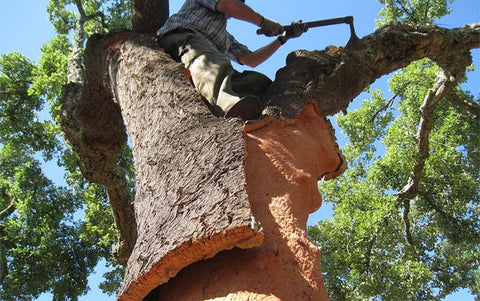
<p><span size="3">Cork harvesting is delicate work done entirely without machinery. The cork harvesters work in pairs, one person who climbs up the tree and one who stays on the ground. Together they begin to remove the dead layer of bark with their hand-axes, judging the bark's thickness by the sound resonating from the steel axe, and carve out rectangular cork planks. They know from experience just how much force to use when striking the tree with the axe to not cut too deeply. They make two types of cuts on the tree - one horizontal cut around the plant and several vertical cuts called rulers or openings. To free the cork from the tree, the extractor pushes the handle of the axe into the vertical openings.</span></p>
<p> </p>
<div style="text-align: left;"><img src="https://cdn.shopify.com/s/files/1/1768/4013/files/Cork_Harvesting_Tiny_600x600.jpg?v=1678879316" alt="Cork being stripped from a tree by hand with an ax" style="float: none; display: block; margin-left: auto; margin-right: auto;"></div>
<p style="text-align: center;">Worker stripping the cork oak of its bark. -- <em>Credit: Amorim.com</em></p>
<h2>
<strong>2</strong> Cork is used in train, airplane, and bus transportation systems</h2>
<p>Cork is being developed as a solution to replacing leather and synthetic materials in cars, busses, trains, and planes. In Portugal, Corticeira Amorim is working on many of these developments. LIFE is a project designing an innovative design concept for airplane interiors, integrating sustainable materials such as cork. Cork is incorporated into the airplane’s ceiling, lateral panels and seating in conjunction with advanced composite materials, including carbon fiber, which results in a significant overall reduction in weight, coupled with effective gains in terms of the thermal, acoustic and anti-vibration properties.</p>
<p>Another project is IBUS, which is working to develop cork based components for bus interiors. ECOTRAIN, as you might guess, is a project fitting cork into high-speed trains enabling a reduction in weight and thereby optimizing energy consumption levels. ISEAT is integrating cork into seats for trains and underground coaches, and PLASCORK is working to replace synthetic components with cork in car interiors.</p>
<p> </p>
<p><img src="https://cdn.shopify.com/s/files/1/1768/4013/files/cork-transportation-uses_600x600.png?v=1647990617" alt="" style="display: block; margin-left: auto; margin-right: auto;"></p>
<p style="text-align: center;">Interior train and bus components in cork. --<em> Credit: Amorim.com</em></p>
<h2></h2>
<h2>
<strong>3</strong> The cork oak is the only tree protected by law in Portugal</h2>
<p class="my-0.5">The cork oak is the only tree formally protected by law in Portugal. This is largely due to its importance to the country's economy, as a third of all global cork production comes from this region.</p>
<p class="my-0.5">The Portuguese government has recognized and legally protected the cork oak for its vital role in providing income and maintaining jobs for thousands of rural communities. As such, there are numerous regulations in place that prohibit deforestation of these trees and limit usage only to activities that maintain or improve their health and longevity.</p>
<p class="my-0.5">Furthermore, specific areas throughout Portugal have been marked as Natural Parks and Reserves to help ensure the survival and conservation of these trees. These measures help ensure that high-quality cork bark can continue to be produced in large quantities while also protecting natural habitats and providing sustainable sources of income for those living off the land.</p>
<p><span size="3">This extraordinary law was created in the 1970s in response to Portuguese cork producers outrage after 500,000 acres of cork had been replaced with eucalyptus for the pulp industry.</span></p>
<p><span size="3">The law states that without permission from the government, it’s illegal to cut down any cork oak in Portugal, dead or alive. A landowner caught clearing a montado pays a steep fine and is barred from using the land for 25 years. This is why standing dead oaks are not an uncommon sight in <em>montados</em>.</span></p>
<p> </p>
<div style="text-align: left;"><img src="https://cdn.shopify.com/s/files/1/1768/4013/files/Amorim_cork_forests_Tiny_600x600.jpg?v=1679083771" alt="Aerial view of cork forests in Portugal" style="display: block; margin-left: auto; margin-right: auto;"></div>
<p style="text-align: center;">View from above of a cork forest in Portugal. -- <em>Credit: Amorim.com</em> </p>
<h2>
<strong>4</strong> Cork oaks can grow with viable cork bark only in the Mediterranean region</h2>
<p class="my-0.5">Cork oaks can only grow viable cork bark suitable for the cork industry in the Mediterranean region. This is because there are a number of climatic and geographic conditions required for healthy cork oak trees to be able to produce good quality cork bark. These conditions include high temperatures, plenty of rainfall throughout the year, particular soil types, and an undisturbed habitat.</p>
<p class="my-0.5">Cork oaks are primarily found in Portugal, Spain and parts of North Africa that fit these criteria. In addition to meeting specific environmental requirements, cork oak forests also provide numerous benefits to the ecosystems in which they are grown. They help improve air quality by trapping dust particles and carbon dioxide, as well as providing a home for a range of wildlife species such as birds and lizards.</p>
<p class="my-0.5">Although it is possible to grow cork oaks outside of this region, their bark may not necessarily be suitable for use in the processing and production of traditional cork products such as wine stoppers or insulation material. Therefore, many countries look towards importing their raw materials from Portugal or Spain rather than trying to cultivate them domestically.</p>
<p>In the seven cork-producing countries of the Mediterranean, more than 100,000 people directly or indirectly depend on this sector, according to the WWF. In Portugal, the cork oak and forest systems represent 8.310 direct manufacturing jobs.</p>
<p> </p>
<div style="text-align: center;"><img src="https://cdn.shopify.com/s/files/1/1768/4013/files/cork_production_map_9973b010-0cf0-4bcb-9de2-20794f14d993_600x600.png?v=1538745993" alt="Map of Mediterranean region where cork oaks grow" style="margin-right: 27px; margin-left: 27px; float: none;"></div>
<div style="text-align: center;">Regions where cork oaks grow in the Mediterranean.</div>
<div style="text-align: center;"></div>
<div style="text-align: left;"></div>
<h2>
<strong>5</strong> Cork oak trees store more carbon than other trees in order to regenerate their bark</h2>
<p><span>As you probably know by now, cork is actually the bark of the cork oak tree and can be regenerated, making it a particularly sustainable and renewable resource. In fact, cork oaks are the only tree that regenerates with the removal of its bark. A harvested cork oak tree can absorb up to 5 times more carbon dioxide than than other trees of a similar size. After the cork bark is harvested, t</span>he tree quickly forms new layers of cork to restore its protective barrier. This sends it into "overdrive," storing more CO2 and producing more oxygen than it would otherwise.</p>
<p> <img src="https://cdn.shopify.com/s/files/1/1768/4013/files/cork_harvest_1920_Tiny_600x600.jpg?v=1679097149" alt="Cork trees after being harvested with cork planks on the ground" style="display: block; margin-left: auto; margin-right: auto;"></p>
<p style="text-align: center;">Cork bark removed from the trees. -- <em>Credit: Montedavida.com</em></p>
<h2>
<strong>6</strong> The number painted on a peeled cork oak refers to the year it was harvested</h2>
<p>After the harvest, the tree itself is carefully marked with a number, which is painted on using a white paint. This is done to keep track of the year when its most recent harvest took place, so others will know when it can be harvested again. Each particular tree needs nine to twelve years from the year of its last harvest before it is ready for the next removal of its bark. The numbers are written largely enough to be easy to read from a distance. You may see just one number painted on the tree, for example "9", which refers to the last number in the year, such as "2009".</p>
<p> </p>
<div style="text-align: center;"><img src="https://cdn.shopify.com/s/files/1/1768/4013/files/Cork_Tree_resized_Tiny_600x600.jpg?v=1679091144" alt="Cork oak tree with a white painted number" style="margin-right: 27px; margin-left: 27px; float: none;"></div>
<p style="text-align: center;"> Cork tree in Portugal with a white number painted on it. -- <em>Credit: Donald Scott Lee</em></p>
<h2><span><strong>7</strong> The cork oak forests of Portugal are Europe's Amazon forest</span></h2>
<p><span>Cork oak landscapes are one of the best examples of balanced conservation and development anywhere in the world.</span></p>
<p><span> The cork oak forests make up an ecosystem of unparalleled biological richness. The cork oak trees preserve the region's thin soils and scarce groundwater. The trees help conserve soil by protecting against wind erosion and increasing the rate at which rainwater is absorbed.  Without them, the area will quickly become a desert and uninhabitable for humans. It would also spell the end for the Iberian Lynx, which lives in many of Spain and Portugal's cork forests, and which has been declared the world's most endangered wild cat. </span><span>Plant diversity can reach 135 species every square meter, and many have aromatic, culinary, or medicinal value. Cork oak forests also host a rich diversity of fauna, including spiders, spadefoot toads, geckos, skinks, vipers, mongoose, wild cats, roe deer, boars, Barbary deer, and genets. </span></p>
<p><span size="3">A decline in demand for cork would be calamitous for the region's arid areas as well as spell disaster for rare wildlife. The cork oak forest is the basis of one of the 35 most important ecosystems in the world for preserving biodiversity, on par with the Amazon rainforest, the African Savanna and Borneo. "The cork oak forests of Portugal are Europe's Amazon forests - they support the greatest bio-diversity anywhere in Europe," said Jorge Paiva, a botanist at Coimbra University. </span></p>
<p> </p>
<div style="text-align: center;"><img src="https://cdn.shopify.com/s/files/1/1768/4013/files/iberian_lynx_and_cork_trees_Tiny_600x600.jpg?v=1679095285" alt="Iberian Lynx behind a cork tree" style="margin-right: 27px; margin-left: 27px; float: none;"></div>
<p style="text-align: center;">Lynx peeking out from behind a cork oak. -- <em>Credit: Unknown</em></p>
<h2><span><strong>8</strong> Only the third and subsequent harvests produce cork with an even structure good enough to be used for wine corks.</span></h2>
<p>The Portuguese call this cork that can be used for wine stoppers "<em>amadia</em>." The bark of the cork oak is stripped away every nine to ten years and it takes at least 25 years for a new tree to be ready to be harvested for the first time. But, t<span>he first and second harvests will produce cork that’s not uniform enough to be used as bottle stoppers.</span></p>
<p><span size="3">The first stripping produces cork (virgin cork - "<em>desbóia</em>") that is too hard to be easily handled because it has an irregular structure. It is used in products like flooring and insulation, or ground up and used in granulated cork products like bulletin boards and coasters. 9 to 12 years later a second harvest produces better material, but still not at a high enough quality for wine stoppers. Cork used to make accessories for fashion usually come from these first two harvests as well, although some cork products are made from recycled cork from wine corks that have been given a second life.</span></p>
<p> </p>
<div style="text-align: center;"><img src="https://cdn.shopify.com/s/files/1/1768/4013/files/Cork_vs_Leather_Blog_2_600x600.jpg?v=1679084744" alt="Numerous wine corks in a pile" style="margin-right: 27px; margin-left: 27px; float: none;"></div>
<div style="text-align: center;"></div>
<div style="text-align: left;"></div>
<h2><span size="3"><strong>9</strong> The ancient Greeks revered cork oak trees as a symbol of liberty and honor</span></h2>
<span size="3">In the 1st century CE, the Roman naturalist Pliny the Elder made frequent references to cork oaks in his writings in Natural History. He explained that in Greece the trees were adored as symbols of liberty and honor, and  for this reason only priests were allowed to cut them down. He also wrote that cork oaks were consecrated to the god of Olympus, Jupiter, and the leaves and branches of the cork oak were used to crown victorious athletes.</span>
<p> </p>
<div style="text-align: center;"><img src="https://cdn.shopify.com/s/files/1/1768/4013/files/ancient_cork_forest_Tiny_600x600.jpg?v=1679095819" alt="An ancient cork forest" style="float: none;"></div>
<p style="text-align: center;">Cork oaks in ancient forest. -- <em>Credit: Bonny Bonafilla </em></p>
<h2><span size="3"><strong>10</strong> The discovery of cells is thanks to cork</span></h2>
<p><span size="3">Cells were discovered in 1665 by Robert Hooke. On observing a sliver of cork under a rudimentary microscope, the English scientist discovered that it was made up of multifaceted cavities, which he called cells (from the Latin cellula, small room).</span></p>
<p><span size="3">In a world before microscopes, people had no way to look inside their own bodies or the bodies of other creatures to answer questions about life. But the discovery of cells by Robert Hooke in 1665 changed all that. Hooke was the first to observe the structure of cells, and living cells at that, and this contributed greatly to our understanding of biology and the life sciences. But how did he do it? The answer lies in cork. Cork is a light, spongy material, made from the outer layer of bark from cork oak trees. It is known for its unique ability to be impermeable to liquids, making it an ideal material for sealing bottles, jars, and many other containers. Hooke was able to use this property to his advantage. To observe cells, he collected pieces of cork and sliced them very thin, so thin in fact that he was able to see the individual cells within the cork. He then used a microscope to magnify the cork and observed the cells’ structure and shape. He was the first to do this, and his observations allowed him to identify and name the individual cell walls as “cellulae.”</span></p>
<p><span size="3">Hooke's discovery of cells laid the foundation for our current understanding of biology, and the contribution of cork to this discovery was significant. Cork allowed Hooke to make thin enough slices so that he could observe the individual cells. By observing these cells in cork, Hooke was able to provide a crucial definition of the structure and function of cells. Today, cork still plays an important role in research and education in the life sciences, providing a unique material for scientists to observe and study. We often take for granted the fact that cork was a crucial step in the discovery of cells, but without it, Hooke would not have been able to make his observations. Cork truly contributed to a turning point in science, one that continues to shape our understanding of life even today.</span></p>
<p> </p>
<div style="text-align: center;"><img src="https://cdn.shopify.com/s/files/1/1768/4013/files/cork_cells1920_Tiny_600x600.jpg?v=1679089273" alt="Cork cells under microscope" style="margin-right: 27px; margin-left: 27px; float: none;"></div>
<div style="text-align: center;">Cork cells under a microscope.</div>
<br> Did you learn something you didn't know about cork? Let us know!]]>
    </content>
  </entry>
  <entry>
    <id>https://www.howcork.com/blogs/news/the-fascinating-journey-of-cork-from-tree-to-your-home</id>
    <published>2023-03-15T07:42:53-04:00</published>
    <updated>2024-09-18T10:12:25-04:00</updated>
    <link rel="alternate" type="text/html" href="https://www.howcork.com/blogs/news/the-fascinating-journey-of-cork-from-tree-to-your-home"/>
    <title>Where Does Cork Come From? The Fascinating Journey From Tree to Your Home</title>
    <author>
      <name>Lindsay Platzer</name>
    </author>
    <content type="html">
      <![CDATA[<p>Have you ever wondered where cork comes from, how it's extracted, or why it's such an incredible material? If so, join us on a journey to explore the captivating world of cork. As more and more people are seeking to become responsible and ethical consumers, it's important to understand what goes on behind the scenes to make the products we choose for our daily lives. In this article we will delve into the humble origins of cork and how it becomes a part of so many products that surround us. By the end, you'll have gained new insights into this seemingly ordinary material - and perhaps a fresh appreciation for that wine cork the next time you pop one open.</p>
<p>Cork is a versatile, eco-friendly material that is used to create a wide range of products - from wine stoppers to floor tiles, and even fashion accessories. It's known for its durability, natural insulation properties, and unique texture, which has made it a popular choice for both practical and aesthetic applications.</p>
<div style="text-align: right;" data-mce-style="text-align: right;"></div>
<h2>The Magic Begins with the Cork Oak Tree</h2>
<p>The story of cork begins with the cork oak tree, also known as <em>Quercus Suber</em>. These trees predominantly grow in the Mediterranean region, which encompasses countries like Portugal, Spain, Algeria, Morocco, Italy, and France. Portugal leads the way as the biggest cork producer in the world, and together with Spain is responsible for almost 80% of the world's cork production. The Cork Oak tree is an evergreen species that can grow up to 20 meters tall, has a unique outer bark, and possesses high environmental value due to its vital role in preventing soil erosion and desertification.</p>
<p>Cork oak trees are an incredible species, capable of shedding their bark without damaging the tree itself, allowing cork to be harvested sustainably. In fact, cork oaks have a lifespan of up to 250 years, providing cork bark throughout their long life.</p>
<p>The cork oak forests are not just essential for cork production but also play a crucial role in preserving biodiversity and maintaining a delicate ecological balance. These forests, called <em>montados</em> in Portugal, are protected by law to ensure the sustainability of the cork oak population and their ecosystems.</p>
<div style="text-align: left;" data-mce-style="text-align: left;"></div>
<h2>Stripping Cork: An Age-Old Sustainable Harvesting Technique</h2>
<p>One of the most interesting aspects of cork is its<span style="color: #000000;" data-mce-style="color: #000000;"> harvesting pro</span>cess. Obtaining cork from the cork oak tree is done through a meticulous process called stripping, which involves  carefully removing the outer bark of the tree. This is an sustainable and non-invasive method of harvesting, as it doesn't involve cutting down the tree and causes no harm to the tree at all when done correctly. The extraction of cork requires great skill and is done only by specially trained workers with years of experience, called <em>descortiçadores. </em></p>
<p>The cork bark is carefully stripped away from the tree trunk by hand, using special axes t<span>hat minimize damage to the tree. Th</span>e bark is then removed in long sheets that seem to peel right off of the tree. This process usually takes place during the warmer months when the cork is easier to remove. Each cork oak is harvested only once every 9-12 years to allow the tree time to regenerate its protective bark layer as it continues to grow and thrive.</p>
<p>During its lifetime, a single cork oak can be harvested around 16 times. For this reason, the cork industry not only protects but supports the growth of these extraordinary trees. It goes without saying that cork harvesting does not harm any animals in its wake, but instead, protects animals and their habitat.</p>
<div style="text-align: left;" data-mce-style="text-align: left;">
<img style="display: block; margin-left: auto; margin-right: auto;" alt="Cork harvesting by hand with a special ax -- Credit: Amorim.com" src="https://cdn.shopify.com/s/files/1/1768/4013/files/Cork_Harvesting_Tiny_600x600.jpg?v=1678879316" data-mce-style="display: block; margin-left: auto; margin-right: auto;">Cork harvesting by hand with a special ax<em> -- Credit: Amorim.com</em>
</div>
<div style="text-align: left;" data-mce-style="text-align: left;"><em></em></div>
<div style="text-align: left;" data-mce-style="text-align: left;"></div>
<h2>The Process of Transformation</h2>
<p>Once the cork bark is harvested, it undergoes a thorough cleaning process before being left to air-dry for an extended period, usually up to six months. This helps eliminate any residual moisture and ensures the cork's quality. After the drying phase, the cork is boiled and steamed, which makes it more elastic and easy to work with. Then, the cork slabs are sorted into different grades and thicknesses to be used for various purposes.</p>
<p>Once dry, the cork is cut into thin sheets or ground into granules, depending on the desired end product. For cork stoppers, the sheets are punched into the desired shape and undergo further processing to ensure quality and durability. Meanwhile, waste material from this process is used to produce agglomerated cork or ground into granules for use in other products, ensuring minimal waste and a circular production model. For cork bags and wallets, cork is rolled out into sheets, thinly sliced, and backed with a thicker material such as cotton to create cork fabric or "leather".</p>
<p style="text-align: center;" data-mce-style="text-align: center;"><img alt="Cork Wallet made by Corkor, available at HowCork.com for US" src="https://cdn.shopify.com/s/files/1/1768/4013/files/Cork_Wallet_Blog_Tiny_600x600.jpg?v=1678879572"> </p>
<h2>From Bark to Products</h2>
<p>Cork can be transformed into a vast array of products with different forms and purposes. In some cases, granulated cork is combined with binding agents to form sheets or other shapes, while in others, it may be sliced directly from slabs. Cork's natural properties make it a practical and appealing material for various industries, including the wine industry, construction, interior design, and in creating sustainable fashion items.</p>
<p>The versatility of cork is one of its most impressive features. Of course, the majority of people are most familiar with cork's widespread use as bottle stoppers for wines and champagnes. However, cork's unique properties, such as its flexibility, natural insulation, and water resistance, make it a sought-after material for countless other applications. As a natural insulator, it has been used in construction for insulation and flooring, thanks to its ability to dampen sound and resist extreme temperature changes. It is also a valuable material used for gaskets as it maintains its strength and form over time.</p>
<p>The fashion industry has also embraced cork, using it as a sustainable alternative to leather in accessories, bags, wallets, and shoes. Designers are embracing this eco-friendly material for its aesthetic appeal, creating cork-based furniture or home décor items too - contributing to a growing interest in sustainable and ethical living. The yoga community has also turned to cork as a viable solution for yoga mats, blocks, and massage balls. Cork has even found its way into musical instruments, sports equipment, and aerospace technology.</p>
<p> <img style="display: block; margin-left: auto; margin-right: auto;" alt="People biking in cork forest - Credit: Portugalbike.com" src="https://cdn.shopify.com/s/files/1/1768/4013/files/Cork_Forests_Tiny_5_600x600.jpg?v=1678880056" data-mce-style="display: block; margin-left: auto; margin-right: auto;"></p>
<h2>Cork: A Symbol of Environmental Conservation</h2>
<p>Cork production isn't just about creating a functional and eco-friendly material for the consumer market. It's also a significant factor in environmental conservation. The cork oak forests play a crucial role in absorbing CO2 from the atmosphere, providing a habitat for various plant and animal species, and preventing soil erosion. As a result, supporting the cork industry indirectly impacts the preservation and protection of these vital ecosystems.</p>
<h2>Preserving Cork's Legacy</h2>
<p>Given the many incredible properties and benefits of cork, it's no wonder that sustainability initiatives and responsible management practices are in place to protect cork oak forests. In fact, many cork-producing areas are designated as protected territories. The Portuguese Cork Association, for instance, has implemented a series of actions to preserve the biodiversity of the cork oak forests to ensure future generations can continue to benefit from this unique and irreplaceable resource. Governments, organizations, and consumers play a vital role in supporting these efforts by recognizing and valuing cork's special qualities and its contributions to a greener world.</p>
<p>By understanding its origin and the care and responsibility involved in its production, we can confidently support cork products as an ethical choice. As consumers become increasingly concerned about the environmental impact of the products they purchase, the cork industry continues to thrive on its natural and sustainable approach.</p>
<p style="text-align: center;" data-mce-style="text-align: center;"><strong>. . .</strong></p>
<p>In our quest to become ethical and responsible consumers, understanding the origin of materials and their impact on the environment is essential. Cork stands out as an incredible example of an eco-friendly, renewable, and long-lasting material with numerous uses and applications. By choosing cork products, we not only contribute to sustainability and environmental conservation but also support the delicate balance in the Mediterranean cork oak forests. So, the next time you need a new everyday bag and are search of a responsible choice, remember the fascinating journey of cork from the cork oak tree to your home. And don't forget to check out our store, featuring an amazing selection of cork fashion and yoga accessories from over 15 brands from across the world.</p>
<p> </p>]]>
    </content>
  </entry>
  <entry>
    <id>https://www.howcork.com/blogs/news/we-stand-for-freedom</id>
    <published>2022-12-16T11:44:15-05:00</published>
    <updated>2025-09-28T17:59:55-04:00</updated>
    <link rel="alternate" type="text/html" href="https://www.howcork.com/blogs/news/we-stand-for-freedom"/>
    <title>We Stand for Liberty</title>
    <author>
      <name>Lindsay Platzer</name>
    </author>
    <content type="html">
      <![CDATA[<h6 style="color: black; font-size: 20px;"><em>Updated: September 28, 2025 </em></h6>
<p style="color: black; font-size: 20px;">We haven't written any articles regarding current events of the past years - until now. </p>
<p style="color: black; font-size: 20px;">We believe you should know who you're supporting when you shop.</p>
<p style="color: black; font-size: 20px;">So here it is - we stand for <strong>freedom</strong>, liberty, human rights, environmental stewardship, and respect for animals.</p>
<p style="color: black; font-size: 20px;">Nothing precludes all of us from inalienable rights, including the right to life, liberty, the pursuit of happiness, and property. Freedom of speech, freedom of belief, and freedom of movement. Freedom to live a life in peace and the right to exist in a natural state.</p>
<p style="color: black; font-size: 20px;">We believe in a bright future where people live in harmony with nature. We believe in treating others with kindness. We don't tolerate censorship. As the saying goes, <em>"I may not agree with what you say, but I will defend to the death your right to say it."</em></p>
<p style="color: black; font-size: 20px;">We imagine a world where we can all express what we think and have free and open discussions with others to solve the problems of our day. This is the only way that we will progress and find innovative solutions.</p>
<p style="color: black; font-size: 20px;">Unfortunately, we know that modern society makes so many people sick due to being extremely toxic. Just chock full of toxic exposures - toxic food, toxic clothes, toxic medicine, toxic institutions, toxic media. We support those who fight for removing poisons from common use and making our society healthy.</p>
<p style="color: black; font-size: 20px;">We've had enough of Big Agriculture, Big Tech, Big Pharma, Big Fashion, Big Food, Big Oil and Big Chemical. We hope to see an end to the revolving door of industry infiltration in regulatory agencies and their lobbyists in Congress.</p>
<p style="color: black; font-size: 20px;">Although it is just a very small part of addressing these issues that afflict humanity on a global scale, as always, we encourage you to shop from small businesses, especially those with shared values. </p>
<p style="color: black; font-size: 20px;">Let's stop buying into the status quo, and stop buying products from the "fast" and "big" if we can avoid it.  Instead, support artisans and stores that care about craftsmanship, ethical production, and eliminating toxins from products. A less toxic future is one that everybody really wants (even if not everyone realizes it).</p>
<p style="color: black; font-size: 20px;">We see the future of the Great Awakening. Natural materials, plant-based replacements for all petroleum-based chemicals, and clean energy, along with dignity and liberty for all. Less indoctrination to accept globalist agendas and corporate exploitation, and more asking questions about why things are the way they are and seeking solutions to how we can make things better. </p>
<p style="color: black; font-size: 20px;">So, that's where we stand. We ask you to help us raise the frequency. Let's make room for more curiosity and wonder, and more peace, love, and humanity. </p>]]>
    </content>
  </entry>
  <entry>
    <id>https://www.howcork.com/blogs/news/veganism-a-mindset-not-an-exclusive-club</id>
    <published>2022-03-01T11:58:28-05:00</published>
    <updated>2025-10-07T17:38:40-04:00</updated>
    <link rel="alternate" type="text/html" href="https://www.howcork.com/blogs/news/veganism-a-mindset-not-an-exclusive-club"/>
    <title>Veganism is a Peace Mindset</title>
    <author>
      <name>Lindsay Platzer</name>
    </author>
    <content type="html">
      <![CDATA[<div class="metricTitle_f15fvivp"><strong><em>Reading time: 7 minutes</em></strong></div>
<p style="color: black; font-size: 20px;"> </p>
<p style="color: black; font-size: 20px;"><span data-preserver-spaces="true">Is being vegan just a label or a stereotype? No - veganism (and vegetarianism) is a mindset and a shift in beliefs toward peace.</span></p>
<p style="color: black; font-size: 20px;"><span data-preserver-spaces="true">The Vegan Movement has a common creed - to do the least harm possible while doing the most good. And it </span><em><span data-preserver-spaces="true">has</span></em><span data-preserver-spaces="true"> done a world of good things. Many people have adopted a vegan lifestyle for personal health, animal welfare, and environmental conservation.</span></p>
<p style="color: black; font-size: 20px;"><span data-preserver-spaces="true">Veganism may begin as a dietary choice, but it is much more than that. It is a shift in perspective. We begin to see all animals the same way that we see dogs and cats, and the idea of eating a cow or pig becomes unthinkable. Vegans believe that animals - beings with a brain, heart, and central nervous system - have the inherent right to life. </span></p>
<p style="color: black; font-size: 20px;"><span data-preserver-spaces="true">But veganism is a mindset, not a club, and not a cult. Striving towards a clean vegan diet is our goal, but the vegan mindset is the most important internal change that we can make. For me, it even raises our energy on a vibrational level. </span></p>
<p style="color: black; font-size: 20px;"><span data-preserver-spaces="true">The original ideas of the Vegan Movement have a basis in altruism and respect for all animals.</span></p>
<p style="color: black; font-size: 20px; text-align: center;"><span data-preserver-spaces="true"><img src="https://cdn.shopify.com/s/files/1/1768/4013/files/pexels-alexandra-novitskaya-3178267_480x480.jpg?v=1646151585" alt=""></span></p>
<p style="color: black; font-size: 20px;"><span data-preserver-spaces="true"><a href="https://www.worldveganorganisation.org/History/WorldVeganism" title="World Vegan Organization: History of Veganism" rel="noopener noreferrer" target="_blank">Donald Watson was one of the earliest proponents of the vegan movement in 1924</a>. He became a vegetarian after witnessing that his uncle's farm was a "death row where every creature's days were numbered by the point at which it was no longer of service to human beings." He became involved with the Vegetarian Society in Leicester, England, and in 1943 started speaking out about vegetarians avoiding dairy products. He made the point that "the cow feels the loss of her calf in much the same way that a human mother would feel the loss of her child." </span></p>
<p style="color: black; font-size: 20px;"><span data-preserver-spaces="true">He helped to form the Vegan Society in 1947, which rejected the use of animals for any purpose, not only in the diet. Watson wrote, </span><em><span data-preserver-spaces="true">"The vegan renounces it as superstitious that human life depends upon the exploitation of these creatures whose feelings are much the same as our own." </span></em><span data-preserver-spaces="true">In 1951, the Vegan Society published its definition of veganism as "the doctrine that man should live without exploiting animals”.</span></p>
<p style="color: black; font-size: 20px;"><span data-preserver-spaces="true">Simply put, vegans believe that animals are not ours to exploit for food, fashion, or any other reason.</span></p>
<p style="color: black; font-size: 20px;"><span data-preserver-spaces="true">By now, it is common knowledge that animal factory farming is one of the top contributors to environmental devastation across the globe. There is a long list of problems inherent in industrial animal farming - from animal abuse to out-of-control water pollution to antibiotic resistance.</span><span data-preserver-spaces="true"></span></p>
<p style="color: black; font-size: 20px;"><span data-preserver-spaces="true"><img src="https://cdn.shopify.com/s/files/1/1768/4013/files/pexels-pixabay-460956_480x480.jpg?v=1646151651" alt="" style="display: block; margin-left: auto; margin-right: auto;"></span></p>
<p style="color: black; font-size: 20px;"><span data-preserver-spaces="true">The vegan mindset is a belief that goes above anything else and isn't null and void if we take a mistaken bite of food. Yes, of course, we should do our best to avoid animal products in food and fashion to align our values with our actions. But our values start with a shift in belief and perspective.</span></p>
<p style="color: black; font-size: 20px;"><span data-preserver-spaces="true">Recently, I came across the Instagram account of <a href="https://www.instagram.com/peacebyvegan/" title="Instagram: @peacebyvegan" rel="noopener noreferrer" target="_blank">Ryuji Chua</a>. He speaks about these topics in a way that opens the door for people of different perspectives to understand the vegan movement, with clarity and compassion. He explains many concepts about why animal activism is at the root of our values with a refreshing and philosophical take. His way of putting it is: <strong>Animals deserve to live, and from their point of view, they don't want to be killed. It's not about us and how people see us or what labels we base <em>our</em> identity on.</strong></span></p>
<p style="color: black; font-size: 20px;"><span data-preserver-spaces="true">First, he explains how often we find ourselves getting into arguments with those who say that the ethics of veganism are just a question of our viewpoint. That is to say, "your viewpoint is that eating animals is bad, mine is that eating animals is not bad, so there is no ethical dilemma as we both have different ideas of the ethics involved." But he explains that it's not about how </span><em><span data-preserver-spaces="true">we</span></em><span data-preserver-spaces="true"> feel about eating animals - it's about how the </span><em><span data-preserver-spaces="true">animal </span></em><span data-preserver-spaces="true">feels. It's about taking things from the perspective of an animal. Animals are sentient beings just like us. Animals have emotions; they feel joy, pain, and fear. No animal with an evolved brain to think and a heart just like ours to feel is a material item worth no more than being reduced to a meal on a plate, or a jacket, or a pair of shoes. Animals are our friends, and we wouldn't kill our friends for any of those things. Take it from the animal's viewpoint - no animal walks willingly into a slaughterhouse. No animal wants to lose their life. They, like us, just want to live with freedom and in peace. When we can see the soul in their eyes, and the fear that comes from what we are doing to them, we can start to see that this isn't about us, it's about them. We can start to see that we have a duty to do better.</span></p>
<p style="color: black; font-size: 20px; text-align: center;"><img src="https://cdn.shopify.com/s/files/1/1768/4013/files/pexels-pixabay-67236_480x480.jpg?v=1646152248" alt=""></p>
<p style="color: black; font-size: 20px;"><strong><span data-preserver-spaces="true">A shift in beliefs - animals as individuals </span></strong></p>
<p style="color: black; font-size: 20px;"><span data-preserver-spaces="true">Chua makes another interesting point - too many of us make being vegan a huge part of our identity, but is it superficial? What does "I'm vegan" really mean to us? Is it just because we buy soy or almond milk over cow's milk? Are we too focused on ourselves and our label identity as vegan? Just because we make certain dietary shifts doesn't necessarily mean that we have made the most important mental shift, which is to see animals as individuals deserving of life, not material products or commodities. Rather than making it known that we are vegan, the focus should be on making it known that we are fighting for the animals.</span></p>
<p style="color: black; font-size: 20px;"><strong><span data-preserver-spaces="true">"Choosing animals over humans"</span></strong></p>
<p style="color: black; font-size: 20px;"><span data-preserver-spaces="true">Another example that Chua gives is a question that he says was posed to him by an entire class of students in college. That question was, "Who would you save, a drowning human or a drowning dog?" I think this is meant to be a "got you!" question from non-vegans trying to poke holes in the vegan argument. But besides being a pointless question to debate from a vegan ethics standpoint, it's the wrong question to ask because veganism is not "choosing" animals over humans. Veganism holds that a human does not need to kill animals to be healthy or thrive, and <em>not</em> killing animals does not harm humans - it helps humans. It helps us in terms of reducing the negative effects of factory farming on our shared environment, and it helps us learn to eat a healthy, colorful, plant-filled diet and avoid health problems. It helps reduce the number of starving human children in the world, as the grain dedicated to feeding cows could instead be directly fed to humans, reducing the wealth gap between wealthy and poor countries. Veganism goes against </span><em><span data-preserver-spaces="true">both </span></em><span data-preserver-spaces="true">human and animal suffering. The real question is,</span><strong><span data-preserver-spaces="true"> "What would you do, kill an animal or save an animal if you had the choice?"</span></strong></p>
<p style="color: black; font-size: 20px;"><strong><span data-preserver-spaces="true">Show Them the Destination</span></strong></p>
<p style="color: black; font-size: 20px;"><span data-preserver-spaces="true">It's always "that annoying vegan" that people talk about, right? We have been stereotyped as "annoying and preachy." A</span><span data-preserver-spaces="true"> good way to avoid arguing with others would be to show them what the result looks and feels like, instead of shaming meat-eaters and debating ethics, or pushing veganism on those who are uninterested. Chua makes the analogy that it is like trying to convince someone to buy a plane or train ticket to go to a new destination, simply by telling them that they should. Instead, he suggests first showing some photos of the destination and how beautiful it is, making them </span><em><span data-preserver-spaces="true">want</span></em><span data-preserver-spaces="true"> to go, and </span><em><span data-preserver-spaces="true">then</span></em><span data-preserver-spaces="true"> showing them the way to get there, by buying the ticket. </span></p>
<p style="color: black; font-size: 20px;"><span data-preserver-spaces="true">We should lead by example and show others the peace we carry within ourselves. We should show them our health miracles and take our friends to experience animal rescue sanctuaries. We should inspire a love for nature and show how animals are part of that beauty.</span></p>
<p style="color: black; font-size: 20px;"><span data-preserver-spaces="true">We should emphasize the shift in belief to understand that animals deserve freedom from slavery and slaughter, without focusing on ourselves and creating guilt and shame, and without making people feel like they need to be perfect. </span></p>
<p style="color: black; font-size: 20px;"><span data-preserver-spaces="true">When we help people understand how peace begins on our plate, how violence towards animals creates a violent culture, and how animals are our friends and deserve better, we can start to help them envision a kinder world with us. With this vision in mind, it becomes easier to feed the fire in others to become vegan or reduce consumption of animal products.</span></p>
<p style="color: black; font-size: 20px; text-align: center;">-----</p>
<p style="color: black; font-size: 20px;"><span data-preserver-spaces="true">In summation, the point of this article is for us to remember that being vegan isn't about us, or about virtue signaling or claiming a moral high ground. It's about doing the most good that we can do, even if it isn't perfect, and even if it is small steps. </span><span data-preserver-spaces="true">It's about valuing all living creatures and advocating for the animals.</span></p>]]>
    </content>
  </entry>
  <entry>
    <id>https://www.howcork.com/blogs/news/ecocart-at-checkout-to-carbon-offset-shipping</id>
    <published>2022-02-06T12:24:40-05:00</published>
    <updated>2023-02-26T02:55:03-05:00</updated>
    <link rel="alternate" type="text/html" href="https://www.howcork.com/blogs/news/ecocart-at-checkout-to-carbon-offset-shipping"/>
    <title>Shipping that Helps the Forests</title>
    <author>
      <name>Lindsay Platzer</name>
    </author>
    <content type="html">
      <![CDATA[<div class="metricTitle_f15fvivp"><em><strong>Reading time: 2 min 47 sec</strong></em></div>
<br>
<div class="metricTitle_f15fvivp"><em><strong></strong></em></div>
<div class="metricTitle_f15fvivp"></div>
<p style="color: black; font-size: 20px;">The carbon footprint from shipping products can add up. As an online business that depends on sending our products to customers, we set out to lessen our impact from the emissions involved in postal delivery.</p>
<p style="color: black; font-size: 20px;">We were looking for a way to offset the environmental impact of shipping for quite some time, so we are glad to have recently added EcoCart to our checkout.</p>
<p style="color: black; font-size: 20px;">If you use Shopify Pay at our store, all orders are carbon offset. But when paying with other methods, we wanted another way to give customers this possibility. We chose EcoCart to provide an option at check out to offset the carbon emissions from shipping orders. </p>
<p style="color: black; font-size: 20px;">EcoCart has a measurably positive impact. It offset 26,937,210 pounds of carbon dioxide in 2021, which is the equivalent of saving 883,164 trees, and supported over 25 offsetting projects that positively impact the environment and communities. This carbon offset is made possible by online stores that use EcoCart in their checkout, giving the option to offset the carbon emissions associated with the shipping of each order, which usually is around one to two dollars.</p>
<p> <img src="https://cdn.shopify.com/s/files/1/1768/4013/files/EcoCart_2021_480x480.png?v=1643979077" alt="" style="display: block; margin-left: auto; margin-right: auto;"></p>
<p style="color: black; font-size: 20px;">Our store started using EcoCart in the middle of 2021. Below are the results of what we have offset in carbon emissions in the past year - 1,290 pounds of CO2 offset, which is the equivalent of 668 trees saved (or 58 lightbulbs powered, or 19 feet of arctic ice saved).</p>
<div style="text-align: left;"><img src="https://cdn.shopify.com/s/files/1/1768/4013/files/EcoCart-contributions-HowCork-2021-2022_600x600.png?v=1644158675" alt="" style="display: block; margin-left: auto; margin-right: auto;"></div>
<p> </p>
<p style="color: black; font-size: 20px;">The carbon-offsetting algorithm uses four factors to determine the cost to offset the carbon impact from any order. These factors are what the item purchased is made of, the weight of the items in the order, the distance the order will travel to the customer, and how the order will arrive at its destination (freight, truck, air, etc.).</p>
<p style="color: black; font-size: 20px;">We were wondering how EcoCart calculates the distance that the order will travel to the customer as it is an option that you can select in your cart before arriving at checkout (therefore no address has been added to the order at that point). I reached out to EcoCart to ask. </p>
<p style="color: black; font-size: 20px;"><span>EcoCart responded that their algorithm looks at IP address as a proxy for customer location (anonymized to approximately a 25 mile radius) given that they don’t have that specific information until the checkout flow. Plus, this method involves less sensitive data than pulling the exact shipping address, which they don’t need. The EcoCart</span><span> algorithm assumes a standard mix of travel that includes sea, air, and truck.</span></p>
<p style="color: black; font-size: 20px;"><span>We were glad to learn that EcoCart uses an anonymized approximate customer location to calculate shipping emissions from us to our customers as accurately as possible without collecting data that could infringe upon the privacy of those who shop at our store.</span></p>
<meta name="uuid" content="uuid06Wkh89fyRq8"><meta charset="utf-8">
<p style="color: black; font-size: 20px;"><strong><span data-preserver-spaces="true">What Projects does this Carbon Offset Effort Support? </span></strong></p>
<p style="color: black; font-size: 20px;">EcoCart offsets carbon by donating to several organizations that have undertaken projects including forest protection and restoration, solar and wind power, hydroelectric systems, wetland protection, water filtration, biogas digesters, fuel-efficient cookstoves, and composting. They donate to verified projects and work closely with project developers to ensure that each program is stable, transparent, and actively doing good for people and the planet. They keep track of the actions and results of each of the projects to provide full transparency and make sure our donations are making a real contribution. They share this information with customers and merchants to demonstrate the impact of our carbon offsetting.</p>
<p style="color: black; font-size: 20px;">The carbon offset that we generate is from our donation to the Amazon Rainforest Protection project in Acre, Brazil. The Amazon rainforest is the most biodiverse forest (with Mediterranean cork forests coming in second) and an important carbon sink but at risk of declining by 65% before 2030 at the current deforestation rates, due greatly to industrial animal agriculture producing beef and leather. As we already promote sustainable forestry with our focus on cork products and speak out often on the environmental damage caused by the leather industry, we thought this would be a fitting project to receive our donations.</p>
<p> <img src="https://cdn.shopify.com/s/files/1/1768/4013/files/amazon_rainforest_protection_480x480.jpg?v=1644163366" alt="" style="display: block; margin-left: auto; margin-right: auto;"></p>
<p> </p>
<p style="color: black; font-size: 20px;">The goal is to protect endangered species and vulnerable animals in the Amazon, with methods such as teaching locals how to grow native crops (like bananas, chickpeas, cassava, and corn) and how to restore depleted land, such as rotating cattle pastures. Their goal is to help make these sustainable agricultural activities profitable so that families that care for the land can remain. It also educates local communities about improved agricultural techniques while monitoring unsustainable uses of the forest to mitigate deforestation and protect the area’s rich biodiversity.</p>
<p style="color: black; font-size: 20px;">---</p>
<p style="color: black; font-size: 20px;">We do our best to be a radically eco online store and take part in the ethical fashion movement by selling products made from cork, one of the most environmentally beneficial materials in the world. We also pay attention to the materials we use in our shipping packages, using no plastic and as little recycled paper padding as possible. We are happy to now offer carbon-neutral shipping, with carbon offset donations going toward protecting the rainforest.</p>
<p style="color: black; font-size: 20px;">Are you more likely to order from companies that offer carbon offset shipping? Do you have other suggestions for how stores can reduce shipping emissions? Let us know below. </p>]]>
    </content>
  </entry>
  <entry>
    <id>https://www.howcork.com/blogs/news/why-you-should-choose-a-cork-yoga-mat</id>
    <published>2022-01-31T11:36:48-05:00</published>
    <updated>2022-12-16T12:03:57-05:00</updated>
    <link rel="alternate" type="text/html" href="https://www.howcork.com/blogs/news/why-you-should-choose-a-cork-yoga-mat"/>
    <title>Why You Should Choose a Cork Yoga Mat</title>
    <author>
      <name>Lindsay Platzer</name>
    </author>
    <content type="html">
      <![CDATA[<div class="metricTitle_f15fvivp"><em><strong>Reading time: 4 min 34 sec</strong></em></div>
<br>
<div class="metricTitle_f15fvivp"></div>
<p style="color: black; font-size: 22px;">Cork yoga mats come with a world of benefits. As far as we are concerned, cork is simply the ideal material for making yoga mats. It is an all-natural and non-toxic material with properties that make it perfect for yoga mats and accessories. Here's our list of reasons why.</p>
<h1 style="text-align: left;"><strong>1. Cork yoga mats maximize grip and are non-slip</strong></h1>
<p style="color: black; font-size: 22px;">A cork yoga mat is perfect for regular yoga as well as hot yoga. A common problem - especially in hot yoga - is sweating on the mat, and the mat becoming slippery and hard to grip. With yoga mats made from synthetic materials, this can also become a toxin soup of the release of chemicals from the mat combined with sweat. That'd be the last thing most of us are looking for when practicing yoga!</p>
<p style="color: black; font-size: 22px;">Fortunately, cork yoga mats are the solution. Cork becomes even more grippy when moisture hits the mat, so when you start to sweat, the more slip-resistant the mat becomes. In other words, as you exert yourself in practice, the mat changes with you to perfectly adapt to the grip you need.</p>
<div style="text-align: center;"><img src="https://cdn.shopify.com/s/files/1/1768/4013/files/Aviero-Cork-Yoga-Mat-500X500.jpg?v=1643642906" style="float: none;"></div>
<div style="text-align: center;"></div>
<h1><strong>2. They are naturally anti-microbial - with no need for frequent cleaning!</strong></h1>
<p style="color: black; font-size: 22px;">Cork is an anti-microbial material due to the waxy substance called Suberin that fills its cells. Although cork may seem spongy, it is water-repellent due to its waxy internal composition. Water damage is often what causes bacteria and mold to be able to enter into a material, but cork keeps water out of its cells, and microbes along with it. This means that your cork yoga mat won't start to harbor unpleasant odors and need to be cleaned after every use. Some say that cork yoga mats don't need to be cleaned at all, but others say that it is recommended to use a damp cloth or a natural spray for an occasional cleaning if the mat starts to appear dirty.</p>
<div style="text-align: left;"><img src="https://cdn.shopify.com/s/files/1/1768/4013/files/Scoria_World_Natural_Cork_Roller_4_500x500_58abd03d-0c1a-4d76-9048-d7904a052d3a.jpg?v=1643643216" style="float: none; display: block; margin-left: auto; margin-right: auto;"></div>
<div style="text-align: left;"></div>
<h1><strong>3. They contain no toxic materials or chemicals</strong></h1>
<p style="color: black; font-size: 22px;">There's no substitute for natural materials, especially when you are practicing yoga, which is incomplete without mindfulness, meditation, and grounding.</p>
<p style="color: black; font-size: 22px;">The most common toxic materials used in yoga mats are TPE and PVC. PVC is a highly toxic plastic and should be avoided in all products, especially when coming into direct contact with sweaty skin. PVC, or polyvinyl chloride, is among the least healthy and eco-friendly plastics around. It is not recyclable and releases toxic chemicals in its manufacturing. It can off-gas these same toxins and release them over time onto your skin when using and cleaning the mat. Along with the toxicity of PVC itself, it also contains phthalate plasticizers to give the material flexibility, which are associated with endocrine disruption, diabetes, obesity, and lowering immunity.</p>
<p style="color: black; font-size: 22px;">Some producers of yoga mats claim that TPE (<span>Thermal Plastic Elastomer)</span> is an environmentally friendly material, which is partially true due to its ability to be recycled. It is less toxic than PVC, but it isn't perfect. It is usually made from rubber mixed with plastic, but there are <a href="https://plasticranger.com/what-is-tpe-material/" target="_blank" title="What is TPE Material? | The Definitive Guide" rel="noopener noreferrer">various types of TPE</a> made from different types of plastics and the specific type used in yoga mats is not usually indicated. Although it is a much better choice over PVC and is said to contain small amounts of compounds that could migrate from the surface to the hands of the user, it still has a slight potential over time to off-gas or release chemical substances that were used in its production, especially with the combination of sweat and heat on the mat.</p>
<p style="color: black; font-size: 22px;">Cork is entirely non-toxic and natural, so you won't ever need to worry about plastic chemicals being absorbed into your skin!</p>
<p style="color: black; font-size: 22px;">At HowCork, we currently source cork yoga mats from two brands, Scoria World and Corc Yoga. Both of these brands make high-quality, eco-friendly, and all-natural yoga mats. Scoria World's mats are made from cork with a backing of natural rubber, and Corc Yoga mats are made from cork with a cotton backing.</p>
<div style="text-align: left;"><img src="https://cdn.shopify.com/s/files/1/1768/4013/files/Scoria_World_3_500x500_ea2ba6cf-d754-4bf4-8d25-d8f0183fc153.png?v=1643645521" alt="" style="display: block; margin-left: auto; margin-right: auto;"></div>
<div style="text-align: left;"></div>
<h1><strong>4. They're lightweight for taking on your travels</strong></h1>
<p style="color: black; font-size: 22px;">Cork yoga mats are surprisingly lightweight. This is due to cork's internal cellular structure. Cork is made up of cells filled with a waxy substance called Suberin, and these cells are surrounded by air pockets. It is these air pockets that cause cork material to be so lightweight despite its volume.</p>
<p style="color: black; font-size: 22px;">One of the downsides to 100% natural rubber yoga mats is the fact that they are usually heavier than synthetic mats. Although Scoria World's mats do contain natural rubber, their mats are still very lightweight as much less rubber is used than in 100% rubber mats. The natural latex rubber that they use comes from a small family farm in Vietnam, with whom they work closely. Both Scoria World and Corc Yoga use cork from Portugal. Corc Yoga mats do not contain natural latex at all to be suitable for those with a latex allergy.</p>
<p style="color: black; font-size: 22px;"><img src="https://cdn.shopify.com/s/files/1/1768/4013/files/Douro-Cork-Mat-Cork-Yoga_500x500_2d0d8e80-3dd9-4a4c-b6d7-e544480b5f74.jpg?v=1643645778" alt="" style="display: block; margin-left: auto; margin-right: auto;"></p>
<h1><strong>5. Cork yoga mats are more durable than other mats</strong></h1>
<p style="color: black; font-size: 22px;">Cork yoga mats are made to last at least 1-2 years with constant use, so you can be sure that they are some of the most durable yoga mats around.</p>
<p style="color: black; font-size: 22px;">Although this may not seem like much, most yoga mats made from PVC, TPE, or rubber alone only last around 8 months to a year at the most. Cork's waxy cellular structure is what gives it resistance against the elements (especially water damage) so that it maintains its characteristics with normal wear and tear longer than other materials used in standard yoga mats.</p>
<p style="color: black; font-size: 22px;">At the end of the mat's lifespan, cork can be recycled and is also biodegradable, and the same is true for the natural rubber used in Scoria World mats.</p>
<p><strong><br><img src="https://cdn.shopify.com/s/files/1/1768/4013/files/Kids_Align_Cork_Yoga_Mat_3_500x500_731c5847-5161-46dc-9c48-0c3ebf5489b0.png?v=1643645916" alt="" style="display: block; margin-left: auto; margin-right: auto;"><br></strong></p>
<h1><strong>6. Cork provides both comfort and support</strong></h1>
<p style="color: black; font-size: 22px;">Cork is flexible and soft to the touch and provides cushioning for your knees, hands, and shoulders while holding yoga positions. The shock absorbency of cork also contributes to the support that it provides your body when hitting the mat. Cork provides both the firmness needed for support and a smooth surface for comfort to enhance your yoga practice.</p>
<div style="text-align: center;"><img src="https://cdn.shopify.com/s/files/1/1768/4013/files/Aviero-Cork-Yoga-Mat-_500x500_8d3738e5-53b7-440b-8df8-2fa0bf082b0c.jpg?v=1643646123" alt=""></div>
<div style="text-align: center;"></div>
<h1><strong>7. Cork is bound to catch everyone's eye! </strong></h1>
<p style="color: black; font-size: 22px;">If you're going to a yoga studio or practicing in a group, don't be surprised if your yoga mat (and block) become the center of attention! The natural beauty of cork is stunning and unique, and if your friends haven't seen cork yoga products before, they're bound to be amazed! Of course, cork is always a great way to start the conversation about conscious and non-toxic living, environmentalism, veganism, and so much more. :) </p>
<div style="text-align: center;"><img src="https://cdn.shopify.com/s/files/1/1768/4013/files/Scoria_World_Cork_Massage_Balls_4_500x500_b577f954-b0af-4947-88ea-8e88f2ed0470.jpg?v=1643646389" alt=""></div>
<div style="text-align: center;"></div>
<h1><strong>8. Cork yoga accessories are great too!</strong></h1>
<p style="color: black; font-size: 22px;">Cork is the best solution for yoga mats, so why stop there? We love the cork block, cork roller, and cork massage ball accessories in our cork yoga products collection too. A cork block is great for stretching even further in your poses. The cork massage balls and roller help with trigger points, sore muscles, and tissue relief, as well as to increase blood circulation.</p>
<p style="color: black; font-size: 22px;">Are you convinced yet that you need a cork yoga mat in your life? If you are, you can jump to our cork yoga mat and accessories collection by clicking below! </p>
<h2 style="text-align: center;"><a href="https://www.howcork.com/collections/cork-yoga-mats" target="_blank" title="HowCork Cork Yoga Mats and Accessories Collection" rel="noopener noreferrer"><strong>Shop The Cork Yoga Mat and Accessories Collection</strong></a></h2>]]>
    </content>
  </entry>
  <entry>
    <id>https://www.howcork.com/blogs/news/some-plant-based-leathers-might-not-be-too-eco-friendly-after-all</id>
    <published>2022-01-22T06:43:43-05:00</published>
    <updated>2022-01-23T11:15:15-05:00</updated>
    <link rel="alternate" type="text/html" href="https://www.howcork.com/blogs/news/some-plant-based-leathers-might-not-be-too-eco-friendly-after-all"/>
    <title>Some Plant-Based Leathers Might Not Be So Eco-Friendly After All</title>
    <author>
      <name>Lindsay Platzer</name>
    </author>
    <content type="html">
      <![CDATA[<em>January 22, 2022</em> <br><em>Reading time: 6 min 49 sec</em>
<p class="metricTitle_f15fvivp"> </p>
<p class="metricTitle_f15fvivp"><strong><em>Are plant-based vegan leather manufacturers telling the whole truth about how their materials are made? We're discussing the most recent revelations of lab tests done on these materials, with some surprising discoveries about certain types of plant-based leathers.</em></strong></p>
<meta name="uuid" content="uuidfao5zwKy2vTe"><meta charset="utf-8">
<p><span data-preserver-spaces="true">As you may recall from our last article on plant-based leathers, we were very optimistic about the innovations in the field including Desserto cactus leather, apple leather, and Vegea wine leather. </span></p>
<p><span data-preserver-spaces="true">We think it's important to avoid purchasing new animal-skin leather out of respect for animals as sentient beings (we wouldn't wear a purse made of human skin either). We've often fought back against claims of animal leather's supposed sustainability due to the inherent cruelty and animal suffering involved in procuring the raw material, the ties of the leather industry with the industrial beef industry and to deforestation of the Amazon rainforest, and the list of toxic chemicals employed in the tanning process used by most producers of leather. </span></p>
<p><span data-preserver-spaces="true">We believe that there's room for a world of innovation in using plant materials to create alternatives to both animal-derived leather and petroleum-derived synthetic leathers. So we were beyond excited to discuss all of the new types of plant-based leathers coming to market.</span></p>
<p><span data-preserver-spaces="true">But, recent findings have shown that questionable substances are being used to bring these fabrics to life. Some of the vegan leathers that we spoke about in previous articles even have been found to contain toxic chemicals that are banned from use! Although this article may seem contradictory to our past articles, we think honesty is the most important thing, and that we need to admit the faults in our own field before anyone else without bias. It'd be ignoring emerging facts to not reveal this information. </span></p>
<p><strong><span data-preserver-spaces="true">Polyurethane Content</span></strong></p>
<p><span data-preserver-spaces="true">We knew that there was polyurethane used in many types of new vegan leathers. We specifically asked brands and producers about this and </span><a target="_blank" href="https://www.howcork.com/blogs/news/the-most-eco-friendly-plant-based-vegan-leathers" class="editor-rtfLink" rel="noopener noreferrer" title="HowCork Blog: The Most Eco-Friendly Types of Plant-Based Vegan Leather "><span data-preserver-spaces="true">revealed as much as we could find out to our readers.</span></a></p>
<p><span data-preserver-spaces="true">We thought that despite this, the materials showed promise.</span></p>
<p><span data-preserver-spaces="true">We still believe that plant-based leathers, or plant-plastic hybrid leathers, are an improvement compared to fully synthetic leather due to the reduced environmental impact of the raw materials used in production. Although they still use some plastic, it is less than what would be used to make 100% synthetic leather, and often the plant matter in these leathers would otherwise be considered a waste product and is therefore recovered from the waste stream and put to better use.</span></p>
<p><span data-preserver-spaces="true">We were especially excited about the stunning green opaque material called Desserto, which we thought contained a greater percentage of cactus than plastic polymer. </span></p>
<p><span data-preserver-spaces="true">Recently, however, information has come to light that has challenged our view on certain plant-hybrid leathers, specifically and quite unfortunately, Desserto.</span></p>
<p><span data-preserver-spaces="true">We had reached out to Desserto months ago asking for the full chemical component list of the final product. They were very kind in their response but told us that it was a proprietary secret, although only non-toxic chemicals were used, and the material is PVC-free.</span></p>
<p><span data-preserver-spaces="true">We imagined that the material contained some polyurethane or other types of plastic, hence the secrecy and lack of full transparency. But we have recently found out that the material is MAINLY polyurethane. The Circular Laboratory was able to find out that </span><a target="_blank" href="https://thecircularlaboratory.com/marketing-hype-why-plant-and-plastic-hybrids-are-the-worst-of-both-worlds" class="editor-rtfLink" rel="noopener noreferrer" title="The Circular Laboratory: Why Plant and Plastic Hybrids are the Worst of Both Worlds"><span data-preserver-spaces="true">the main ingredient in Desserto cactus leather is polyurethane</span></a><span data-preserver-spaces="true">, making up 65% of the final product, while cactus only makes up 30% of the material</span><strong><span data-preserver-spaces="true"> </span></strong><span data-preserver-spaces="true">by weight. They were able to find this information in a material database on Future Fabrics Virtual Expo's website, but it has since been removed.</span></p>
<div style="text-align: center;"><img src="https://cdn.shopify.com/s/files/1/1768/4013/files/Desserto_close_up_image_480x480.png?v=1642788494" alt="Desserto under microscope" style="margin-right: 27px; margin-left: 27px; float: none;" width="480x480" height="480x480"></div>
<p><em>Desserto under a microscope. (a) is the top polymeric coating, (b) is the foamed polymer and natural material layer and (c) is the synthetic textile backing. Credit: Coatings Journal</em></p>
<p>As eye-catching as the final product is, we don't think it is honest to hide (or refrain from mentioning) the real, entire chemical composition of materials from consumers, leading people to think they are buying a product that is more environmentally sustainable than it really is.</p>
<p><strong>Which Vegan Leathers Contain Undisclosed Toxins?</strong></p>
<p>While we had a pretty good idea about the polyurethane content in vegan leathers before, we were shocked to find out that four types of vegan plant-based leather that we had previously discussed (in a positive light) contain explicitly banned substances!</p>
<p>The FILK Freiberg Institute, an independent institute that specializes in the testing of leather and polymer composite materials, published <a href="https://www.mdpi.com/2079-6412/11/2/226/htm" target="_blank" title="Coatings: Comparison of the Technical Performance of Leather, Artificial Leather, and Trendy Alternatives" rel="noopener noreferrer">a peer-reviewed study in the journal Coatings</a>, which brought to light previously unknown information about these materials.</p>
<p>The study found that some vegan leather alternatives contained traces of banned chemicals, <strong>notably Desserto, Pellemela (Appleskin), Vegea, and Piñatex</strong>, which are part of a group of plastic-coated textile leathers. <strong>Desserto cactus leather was the worst offender,</strong> <strong>containing </strong><strong>five restricted substances including butanone oxime, toluene, free isocyanate, an organic pesticide called folpet, and traces of a phthalate plasticizer.</strong> In the other aforementioned textiles, toluene, plasticizers, and the solvent DMF were found. But, the article does not state the exact quantities of the banned chemicals which were found.</p>
<p>We were deeply saddened by this news, as we had been excited about the prospects of each of these materials. Although we love that Desserto uses cactus that is harvested without harming the plant, and the others use plant waste left behind from food production (including skins, stems, etc.) from apples, grapes, and pineapples, there's no reason to use banned chemical substances in a vegan product marketed as eco-friendly to health-conscious consumers. These substances could be transferred to our skin when touching the materials, and could therefore enter our bodies, just like with the tanning chemicals used in leather production. This could cause health problems or allergic reactions. That's far from what we want to be promoting to our customers!</p>
<p>We hope that the makers of these materials will acknowledge this problem and remove these chemicals from their products immediately. We'd love to be able to go back to promoting these products if they can be proven to not contain banned substances.</p>
<p><strong>Biodegradable or not?</strong></p>
<p>"Partially biodegradable" seems positive at first glance without really thinking about what it means in practice. I fell prey to this thinking too, imagining that the material would be able to break down in nature more quickly than if it were completely made from synthetic fabric. </p>
<p>Desserto told us back in 2020 that the material was partially biodegradable, and I relayed that information from them in our blog post on plant-based vegan leathers. But it has been pointed out that the polyurethane content in the material cannot be separated from the plant material, and therefore the entire material is unable to be composted without leaving behind a plastic residue.</p>
<p>If the idea of being "partially biodegradable" is greenwashing, then we need to take a step back rather than continuing to praise every new plant-based leather that comes to market containing petrochemicals and plastics.</p>
<p>If a product is truly biodegradable, there's no need to recycle the material as it can easily be broken down in nature. But if it isn't, we need transparency and honesty regarding its real end-of-life destiny. If it can't biodegrade or would be damaging to the soil, these brands could implement a send-back recycling program for their products. That way, their materials can continue to be reused rather than being landfilled.</p>
<p><strong>Microplastics</strong></p>
<p>There's also a concern regarding microplastics from the breakdown of synthetic and plant-plastic combination leathers. P<span>lastic-coated textile leathers can release microplastics</span>, which can crumble off of the material over time. </p>
<p><strong>What is the solution?</strong></p>
<p>Nowadays we are much more excited about the prospect of 100% plant leathers than plant-based leathers that incorporate plastic. Many people are disappointed to find that although new vegan leather options incorporate plants, they still have a high polyurethane and petrochemical content. We must admit that although vegan leathers have come a long way, many still have quite a way to go before they are completely beneficial for the environment. There's still a need for more innovation in the field. </p>
<p><span>On the bright side, there is ever-growing interest in cruelty-free and plant-based alternatives to leather, especially as veganism and sustainability are becoming priorities when making purchasing decisions. We are sure that in the future, manufacturers will rise to the occasion and work out how to replace the polyurethane and other petrochemical substances in the plant-based leathers currently on the market.</span></p>
<p>We will continue to sell only cork products for now, as cork itself doesn't require any chemicals for processing into leather sheets. It's among the most sustainable leather alternatives as it is a 100% natural product. <a href="https://amorimcorkcomposites.com/en-us/about-us/news/amorim-cork-composites-products-have-a-negative-carbon-balance-which-is-good-news-for-the-environment/" target="_blank" title="Amorim Cork Composites: Amorim Cork Composites’ products have a negative Carbon Balance – which is good news for the environment" rel="noopener noreferrer">It is carbon negative from harvest to disposal, and is biodegradable and recyclable.</a> It has unique properties due to its waxy cellular structure that can't be matched by any synthetic materials.</p>
<div style="text-align: center;"><img src="https://cdn.shopify.com/s/files/1/1768/4013/files/lca-cradle-to-gate_cork_600x600.jpg?v=1642789811" alt="Cork Cradle to Grate Analysis" style="float: none;" width="600x600" height="600x600"></div>
<p><em>The Life Cycle Assessment process of cork, in which all stages of the product's life were analyzed: spanning forest management activities, cork crushing, transportation, and the industrial process. Credit: Amorim Cork Composites</em></p>
<p>We do hope to branch out to more than just cork products eventually, with natural hemp bags at the top of our list. We also will be following up with more research into the mushroom leather Reishi, which is a 100% natural leather that rivals animal leather in its characteristics, as well as MIRUM from Natural Fiber Welding. <a href="https://blog.naturalfiberwelding.com/plant-based-leather?hsLang=en" target="_blank" title="Natural Fiber Welding: Vegan leather isn’t sustainable leather — but it could be" rel="noopener noreferrer">According to Natural Fiber Welding's founder</a>, MIRUM has the lowest resource and carbon footprint and the lowest ecological impact compared to all other leather-alternative textiles. It uses zero plastic: no PU, no PVC, no EVA, and no petrochemicals. MIRUM is made from virgin and recycled plant fiber, including cork powder and coconut husks! In March 2021, the first commercially-available collection of <a href="https://blog.naturalfiberwelding.com/first-collection-of-mirum-earns-usda-100-biobased-certification" target="_blank" title="Natural Fiber Welding: First collection of MIRUM® earns USDA 100% Biobased Certification." rel="noopener noreferrer">MIRUM received the USDA 100% Biobased certification</a>.</p>
<p> </p>
<div style="text-align: center;"><img src="https://cdn.shopify.com/s/files/1/1768/4013/files/mirum_graphic_240x240.png?v=1642851556" alt="Mirum USDA 100% Biobased" style="margin-right: 43px; margin-left: 43px; float: none;" width="240x240" height="240x240"></div>
<p> </p>
<p><em>MIRUM has been tested by the USDA, for biogenic/biobased carbon content, confirming that it contains no petrochemical ingredients. It is 100% biobased, meaning that it contains carbon derived only from plants (organic carbon derived from current day carbon cycles). Credit: Natural Fiber Welding</em></p>
<p><em>---</em></p>
<p><span>We will be sure to keep you posted on all the latest news in the field of plant-based leathers, even if the news isn't what we are happy to report. We think that we deserve to be told the whole truth in order to make informed decisions, whatever those decisions may be.</span></p>
<p><span>Let us know what you think about this article below! We'd love to hear your thoughts on the subject.</span></p>
<p><span>All the best,</span></p>
<p><span>Lindsay</span></p>]]>
    </content>
  </entry>
  <entry>
    <id>https://www.howcork.com/blogs/news/2022-new-years-resolutions</id>
    <published>2022-01-20T11:55:34-05:00</published>
    <updated>2022-01-21T06:23:39-05:00</updated>
    <link rel="alternate" type="text/html" href="https://www.howcork.com/blogs/news/2022-new-years-resolutions"/>
    <title>2022 Personal and Store Resolutions for the New Year</title>
    <author>
      <name>Lindsay Platzer</name>
    </author>
    <content type="html">
      <![CDATA[<meta name="uuid" content="uuidGsHW1aIR22d3">
<p><em>January 20, 2022</em><br><em>Reading time: 6 min 30 sec</em></p>
<p><em></em><span data-preserver-spaces="true">Hey everyone, it's 2022! We hope this year will be positive and inspiring (despite any current world events). We've been doing a lot of thinking about what it means to live in optimal health and live a vibrant life. </span></p>
<p><span data-preserver-spaces="true">Here are our 2022 resolutions, both personally and for our store. We hope they can also help motivate you to take action this year toward living your dreams.</span></p>
<p><strong><span data-preserver-spaces="true">Personal Resolutions:</span></strong></p>
<p><strong><span data-preserver-spaces="true">1. Drink Fresh Juice Every Day</span></strong></p>
<p><span data-preserver-spaces="true">We only sell vegan products in our store, but we think that whether you follow a 100% vegan diet or not, the most important thing that we can do for our health (and the planet) is to eat as many fruits and vegetables as possible. While it is important to eat lots of fruit, whole grains, leafy greens, a vast array of vegetables (both cooked and raw), beans, nuts, and seeds for a balanced plant-based diet, we can't emphasize enough the difference that juicing makes. Fresh juice is a micronutrient flood to the cells of the body, having the ability to give us an instant boost of natural energy. Juicing allows us to consume levels of phytochemicals, antioxidants, and enzymes that would be otherwise difficult to achieve. Juicing is something that we have done for years, and it gives us a sense of overall well-being with a burst of clean energy that is hard to match. You will need a juice extractor, but it doesn't need to cost a ton of money. Most of the newest models of slow juice extractors are in the $100-$200 range, but we recently found an older model juicer for just $30 (although it is a bit louder than the newer models). Fresh juicing is not even comparable to drinking store-bought pasteurized juices. It's another world of health benefits. </span></p>
<p><strong><span data-preserver-spaces="true">2. Exercise Every Day</span></strong></p>
<p><span data-preserver-spaces="true">It's the winter, which is always a difficult time to push ourselves to be active outdoors. But the difference in how we feel comparing a sedentary lifestyle and exercising even only 1 hour a day is astounding. Getting your heart rate up and developing muscle helps keep your metabolism active, your immune system functioning well, and your productivity high during the day. One thing that every medical, health, and fitness professional across the board can agree on is that exercise is vitally important to our health. Obesity is a major risk factor for all diseases. We think there's no real excuse not to exercise, and we will remember to keep reminding ourselves of this on days when it doesn't come easily.</span></p>
<p><strong><span data-preserver-spaces="true">3. Sun Every Day</span></strong></p>
<p><span data-preserver-spaces="true">Sunshine is quite literally the most powerful energy source that there is. Getting enough sunlight during the day is vital for raising our levels of vitamin D and aligning our Circadian rhythm and sleep cycles. We've made it a goal to get at least 30 minutes of sunlight onto our bodies a day, if not much more on sunny days. </span></p>
<p><strong><span data-preserver-spaces="true">4. Read More Books</span></strong></p>
<p><span data-preserver-spaces="true">While video is a wonderful form of communication and can be used to effectively teach and learn, it's also often easy to get sucked into scrolling endlessly through reels and videos. For certain subjects such as how-to videos or exercise routines, it can be productive to learn from watching videos. But reading does something for our brains that video can't do. It helps us to gain focus and concentration, and also to calm our minds. Sustainable and ethical living is about slowing down and thinking about our beliefs and actions, and reading helps us enter into that mindset. We've made it a goal to read more and scroll less this year.</span></p>
<p><strong><span data-preserver-spaces="true">5. Fine-Tune Conscious Habits</span></strong></p>
<p><span data-preserver-spaces="true">Living a clean lifestyle is what we are all about. We must pay attention to every single thing that we do in our daily lives. Every substance we use in our homes or on our bodies must be evaluated. Our diet, our wardrobe choices, our transportation choices are all part of our daily habits. Being conscious about our thoughts and actions is the foundation of positive change and developing habits that make us more aware of ourselves and our impact.</span></p>
<p><strong><span data-preserver-spaces="true">6. Frequency Sync</span></strong></p>
<p><span data-preserver-spaces="true">We have been paying a lot of attention to frequency and vibration lately. Music has a huge potential to help us change our thought patterns and bring abundance and happiness into our lives. We are making a point to listen to Solfeggio frequencies that help us overcome negative thoughts and tune in to a more elevated and enlightened vibrational energy.</span></p>
<p><strong><span data-preserver-spaces="true">7. Time Management</span></strong></p>
<p><span data-preserver-spaces="true">So often we tell ourselves that we don't have time to do things, even if they are things that we want to do. We realize that this is only an excuse to procrastinate, be lazy, or do comfortable, easy tasks and put off the more difficult ones. This can apply to all areas of our lives, for example, saying that you don't have time to cook and be in control of your health, or saying that you don't have time to turn a passion into a business. I fall prey to this too, often in the form of writer's block and choosing to do easier things instead of writing. Let's make this the year that we take control of our time and realize that we do have the time for things that matter, if only we make the time by choosing to eliminate distractions.</span></p>
<p><strong><span data-preserver-spaces="true">Store Resolutions for 2022:</span></strong></p>
<p><strong><span data-preserver-spaces="true">1. Always Timely Shipping</span></strong></p>
<p><span data-preserver-spaces="true">There's never been a more important time to support small stores and independent entrepreneurs. With the ever-continuing consolidation of global power in many forms, our purchases are either fueling the beast or helping keep small stores in business. We make it a point to ship within 24-48 hours so there's no excuse to shop on Amazon for cork products. (Please note, items on pre-order have a longer wait period).</span></p>
<p><strong><span data-preserver-spaces="true">2. Sustainable Packaging</span></strong></p>
<p><span data-preserver-spaces="true">We're always making a point to improve every aspect of our store. Packaging is no exception. A sustainable store must take a magnifying glass to every single detail that comes into play and packaging material can't be overlooked. We've always used recycled and unbleached paper for shipping padding rather than plastic, and we do our best to use as little material as possible while making sure that your item is protected in transit. We are transitioning the last of our old resources (namely poly-mailers) to entirely biodegradable materials as soon as we finish what we already have.</span></p>
<p><strong><span data-preserver-spaces="true">3. Personal Customer Service</span></strong></p>
<p><span data-preserver-spaces="true">We take customer service seriously. I worked for many years in brick-and-mortar retail and let me tell you, I've seen some pretty bad customer service interactions. From employees arguing with customers, blaming them for things, wording things in an aggressive manner, or just being vacant and rude, I've hidden my face and walked away shaking my head many times while overhearing these types of conversations. Suffice it to say, this is not how we treat people here. It can be easy to hide behind a computer screen in an online atmosphere and forget that you're talking to a real person on the other end. We not only do our best to respond to emails, calls, and messages as quickly as we can, but we also have a store ethos to always be kind and go out of our way to make our customers happy.</span></p>
<p><strong><span data-preserver-spaces="true">4. Full Transparency</span></strong></p>
<p><span data-preserver-spaces="true">We give credit where credit is due. We put our amazing brands in the spotlight and give full credit to them as the designers. Our store's mission was always to bring the absolute best quality cork products all to one place. We think the brands we source are doing incredible work, and each one brings something unique to our store. Each of our products clearly states who the maker is, where the product is made, and the material composition of each product. We also have created a page for each of our brands, where you can read their stories and ethical values. You can access these pages via our </span><a target="_blank" href="https://www.howcork.com/pages/brands-page" class="editor-rtfLink" rel="noopener noreferrer"><span data-preserver-spaces="true">Brands Page</span></a>.</p>
<p><strong><span data-preserver-spaces="true">5. Always Bringing the Best Vegan Cork Brands to You</span></strong></p>
<p><span data-preserver-spaces="true">This is what we are all about and why we exist as a store. We live between the US and Europe and speak multiple languages, giving us exposure to many different cultures and the ability to take the strong points from each. This is part of what gives us an eye for quality and design. We are always on the lookout for new brands to bring to our store to bring a more complete and expansive range of ethical, sustainable cork items to one place so that you can incorporate the incredible material that is cork into many aspects of your life. We especially take pride in bringing brands from Europe to the US that otherwise don't ship overseas or have little exposure to American audiences. We also aren't afraid to grow and recognize if older products don't meet our ever-evolving standards. We're hoping to be able to bring several new brands to our store this year!</span></p>
<p><strong><span data-preserver-spaces="true">6. Always Staying True to Our Store Values and Personal Values</span></strong></p>
<p><span data-preserver-spaces="true">Above all, we believe in valuing life on earth. That includes the environment, animals, and human rights. We think it is possible to put a stop to pollution, animal exploitation, the use of fossil fuels, and human suffering without sacrificing anything that we enjoy in modern society. We believe that the earth provides enough for every man's need, but not every man's greed. We respect nature and recognize ourselves as a part of nature. You can be sure that shopping at our store means supporting a business that promotes ethical commerce, circular material production, defending of human rights, a clean environment, and protecting the animals from the cruelty inherent in using them as products.</span></p>
<p><span data-preserver-spaces="true">---</span></p>
<p><span data-preserver-spaces="true">Here's to a high-energy year in 2022 and progress toward a more equal and just society and a cleaner, healthier planet. </span></p>
<p><span data-preserver-spaces="true">All the best,</span></p>
<p><span data-preserver-spaces="true">Lindsay</span></p>
<p> </p>]]>
    </content>
  </entry>
  <entry>
    <id>https://www.howcork.com/blogs/news/if-you-wouldnt-wear-fur-why-wear-leather</id>
    <published>2022-01-03T14:45:07-05:00</published>
    <updated>2022-12-16T15:35:01-05:00</updated>
    <link rel="alternate" type="text/html" href="https://www.howcork.com/blogs/news/if-you-wouldnt-wear-fur-why-wear-leather"/>
    <title>If You Wouldn&apos;t Wear Fur, Why Wear Leather?</title>
    <author>
      <name>Lindsay Platzer</name>
    </author>
    <content type="html">
      <![CDATA[<p>As it turns out, fur and leather have a lot in common.</p>
<p>In recent years, fur has gone <a href="https://www.businessoffashion.com/articles/intelligence/why-fashions-anti-fur-movement-is-winning" target="_blank" title="Fashion's Anti-Fur Movement is Winning- Business of Fashion" rel="noopener noreferrer">dramatically out of style</a>. Major designer brands who utilized fur in the past have joined the movement to kick fur to the curb, such as Gucci, Michael Kors, DVF, and Prada.</p>
<div style="text-align: left;"><img src="https://cdn.shopify.com/s/files/1/1768/4013/files/Rosita-Celentano-PETA-pellicce_833a5232-4632-4d73-814c-7aa93f07c0b0_480x480.jpg?v=1641239396" alt="Rosita Celentano PETA Protesting Fur" style="float: none; display: block; margin-left: auto; margin-right: auto;"></div>
<p><em>Above pictured Rosita Celentano with PETA for the elimination of fur from fashion: “This is what remains of your fur coat"</em></p>
<p>Although the fur industry claims that fur is an eco-friendly and natural way to stay warm by utilizing all parts of an animal, in reality, this is an inaccurate representation of fur's impact. The fur industry has a questionable future ahead, as it is being phased out in Northern European countries where it traditionally was produced, and many activist groups are calling for an end to fur farms internationally. </p>
<p>Fur is not a natural nor environmentally-friendly product, as it utilizes toxic chemicals in the manufacturing process to keep fur from breaking down on the wearer's back. Raising animals for livestock or any other industrial purpose takes a huge toll on the environment, as it is <a href="https://vegnews.com/2018/7/animal-agriculture-surpasses-oil-as-largest-polluter-in-the-world" target="_blank" title="Veg News - Animal Agriculture Surpasses Oil as Largest Polluter in the World" rel="noopener noreferrer">animal agriculture that is the single most polluting industry in the world</a>. Not to mention the inherent cruelty involved in killing an animal to wear their fur as a coat.</p>
<p>Upon giving some thought to the similarities and differences between fur and leather, I have realized that the two share many similar if not identical practices within their industries. The only differences I can think of are that the fur industry makes use of the hair of an animal and the leather industry makes use of the animal's hide and that different animals (minks and cows, respectively) are exploited. </p>
<p>Fur and leather production are both awful for the planet. Both products come from the body of an animal killed in the name of food or fashion. Both are cruelty-ridden industries that make use of toxic substances to keep the materials from biodegrading, posing risks to the health of those who wear them.</p>
<p>While public sentiment, governments, and many world-renowned brands have largely turned against fur in fashion, leather, on the other hand, is still considered fashionable by many and even promoted by some sustainable-minded bloggers and companies. <a href="https://ecocult.com/ive-decided-fur-eco-friendly-choice-wont-change-mind/" target="_blank" title="EcoCult: I've Decided Fur is Eco-Friendly and Won't Change My Mind" rel="noopener noreferrer">Some bloggers</a> have even gone as far as to say that if you wear (so-called "ethical") leather, you should wear fur too because there is really no difference between the two! </p>
<p>With this last part we can agree - there is no difference between wearing fur and leather. Either they are both okay to wear, or neither is okay to wear. It doesn't make sense that being such similar products, one is touted while the other shamed.</p>
<p>The truth is that neither fur nor leather is an environmentally-conscious fashion choice, and both lead to immense animal suffering as well as pollution. We imagine a future where humans live in harmony with nature and respect the rights of animals, and fur and leather embrace none of those things. But let's get into the article and let the facts speak for themselves.</p>
<h2>What Leather and Fur Production Have In Common</h2>
<h3>1. Toxic chemicals used such as formaldehyde and hexavalent chromium</h3>
<p>As pointed out by Sascha Camilli, writer of the book <em>Vegan Style</em> and PETA activist, "In order to keep from decomposing on the wearer's back, fur is often treated with chemicals such as formaldehyde and chromium, which are not only environmentally harmful, but also hazardous for human health." PETA has <a href="https://www.peta.org/issues/animals-used-for-clothing/animals-used-clothing-factsheets/wool-fur-leather-hazardous-environment/" target="_blank" title="PETA: Wool, Fur, and Leather: Hazardous to the Environment" rel="noopener noreferrer">spoken out</a> for years about the concerns of chemical contaminants in fur and leather, including damage to groundwater to air quality in areas where production takes place, not to mention the negative effects on humans exposed to these substances and the animals whose lives are sacrificed.</p>
<p>Formaldehyde and chromium are also two of the most prominent and toxic substances used to tan leather. We wrote an <a href="https://www.howcork.com/blogs/news/cork-versus-leather" target="_blank" title="Cork vs. Leather - HowCork Articles" rel="noopener noreferrer">extensive article</a> on how leather is made, highlighting the hazardous effects of exposure to chromium. And this is not just a slight exposure, we are talking about workers who are knee-deep in this slurry of toxic chemicals on a daily basis.</p>
<p>If you read what the <a href="https://furcommission.com/fur-processing-design/" target="_blank" title="Fur Commission USA Industry Public Outreach Website " rel="noopener noreferrer">fur industry</a> in the United States has to say about the chemicals they use, they will claim to use a list of "natural" substances including table salt and corn starch, and then say "a small amount of formaldehyde may be used as well," with a disclaimer that they "ensure there are no harmful effluents."</p>
<p>I'm personally a lot more inclined to believe the <a href="https://www.humanesociety.org/sites/default/files/docs/2009-toxic-fur-production-impact.pdf" target="_blank" title="Toxic Fur Production Impact - Humane Society of United States" rel="noopener noreferrer">research paper put out by the Humane Society of the United States</a> outlining pages of clearly sourced scientific research detailing the chemicals that are used in fur production, rather than the aforementioned industry-funded website. The Humane Society writes, "common methods for 'dressing' fur skins involve formaldehyde and chromium-chemicals that are listed as carcinogens and are otherwise toxic to humans. Other chemicals that may be used or emitted in the dressing and dyeing processes and that appear on one or more US government lists of toxic chemicals include aluminum, ammonia, chlorine, chlorobenzene, copper, ethylene glycol, lead, methanol, naphthalene, sulfuric acid, toluene and zinc." </p>
<p>Formaldehyde is no joke. Formaldehyde is an insidious chemical in many cosmetic products, and it is considered carcinogenic to humans. It is dangerous to be exposed to formaldehyde and many environmental consumer advocate groups are campaigning for its removal from personal care products. As the Humane Society's document lays out, formaldehyde is classified under Occupational Safety and Health Administration standards for carcinogens, the EPA Toxics Reporting Industry List of Reportable Toxic Chemicals, and the California Proposition 65 Super List of chemicals known to cause cancer.</p>
<p>These toxic substances are not just a problem for the producers of leather and fur and the communities where these factories are located. Residues remain on the final product and the user is directly exposed to them as well. These chemicals have been found on fur and leather when tested, and have the potential to be transferred onto and absorbed into our skin when wearing or handling these products.</p>
<h3>2. Animal captivity and inherent cruelty</h3>
<h4>"Origin Assured" or Cruelty Assured? </h4>
<p>I have heard some defend the use of fur by saying that fur is "origin assured" to denote where the fur pelts originally came from, so you can know that you are buying fur from producers who believe in animal welfare. However, <a href="http://features.peta.org.uk/origin-assured-fur/" target="_blank" title='Peta "Origin Assured" Fur' rel="noopener noreferrer">investigative research carried out by PETA</a> shows video evidence captured in Denmark, Finland, France, Italy, the Netherlands, Norway, Poland, Sweden, and the US showing devastating conditions on mink farms (since this video's publication, many of these countries have banned or restricted fur farming). This footage shows that even mink farms that are considered "origin assured" and claim to value the health and well-being of their animals often overlook blatant animal health considerations. PETA documented how confined animals brutally injure others, or self-mutilate, and are left with untreated gaping wounds in their cages. Dead animals are left to rot, and the other animals sometimes resort to eating the body. Animals are brutally electrocuted to death. PETA clarifies that although there may be animal welfare laws in existence in the countries that are considered "origin assured" producers, there is not enough oversight to ensure that these laws are actually followed. "Origin assured," they explain, "is simply a fur industry marketing label, that doesn't have any real oversight by anyone outside of the fur industry."</p>
<p>It is unnatural for animals to be kept in tight confinement for their entire lives, in the sense that it goes against species-appropriate behavior, and often, these animals become diseased or aggressive due to being forced to remain 24 hours a day in tiny cages against their instinct. And even if the animals in certain circumstances are kept in pristine conditions and cared for and loved, or even allowed to roam free, in the case of some sheep and goats, in the end, they are still killed in the name of fashion. Even if they are "gassed" or killed in more so-called "humane" methods, it is still cruel to kill any sentient being to use them as a material commodity to feed our desire to "feel luxurious."</p>
<p>The three largest fur producing countries currently are Denmark, China, and the Netherlands. Denmark is undergoing a crisis in this industry as farmers do not know if fur farming will even be legal in the future in their country. Although Denmark does have animal welfare regulations that are some of the strictest in the world, the <span>Society for the Prevention of Cruelty to Animals (</span><em>Dyrenes Beskyttelse</em><span>), a Danish animal rights group, </span>declined a continued collaboration with Kopenhagen Fur, as they did not believe the industry was willing to move forward in a direction that protected and cared for the animals involved in fur production to a far enough extent. According to an article entitled <a href="https://modernfarmer.com/2016/02/mink-fur-farming-denmark/" target="_blank" title="Mink on the Brink: The Troubles Facing Fur Farmers in Denmark" rel="noopener noreferrer">Mink on the Brink: The Troubles Facing Fur Farmers in Denmark</a>, <span>Birgitte Damm, who is the chief advisor of Dyrenes Beskyttelse, wrote in an email regarding this issue the following direct quote: “[we] pushed for the current legislation as a first step, but the agreement was that this should be accompanied by further work towards alternative extensive housing and production methods with better animal welfare: work that Kopenhagen Fur turned out to be unwilling to do, and a goal they were unwilling to pursue. Therefore collaboration stopped. Dyrenes Beskyttelse does not think that the current legislation provides good animal welfare, far from it.”</span> Their organization would like to see fur farming completely phased out in Denmark.</p>
<p>In the Netherlands, in fact, as of 2013, <a href="https://www.dutchnews.nl/news/2015/11/dutch-appeal-court-upholds-fur-farming-ban/" target="_blank" title="Fur Farming Banned in the Netherlands" rel="noopener noreferrer">fur farming has been effectively banned.</a> There was an 11-year grace period added to the law to allow current fur farmers time to transition away from fur.</p>
<p>This isn't the only place fur farming is banned. <a href="https://www.peta.org/features/fur-bans-fur-free-future/" target="_blank" title=" PETA Is Taking Down Fur, and These Fur Bans Are Helping Us Secure Victory" rel="noopener noreferrer">Breeding and killing animals for fur is banned</a> in Austria, Belgium, Bosnia and Herzegovina, Czech Republic, Estonia, Ireland, Italy, Croatia, Norway, Japan, Slovenia, UK, Luxembourg, Macedonia, Serbia, and Slovakia, and importation and sales bans are active in many US cities and other countries such as Israel and India. Other countries have enacted partial bans or stricter regulations, such as France, Denmark, Hungary, the Netherlands, Switzerland, Spain, New Zealand and Germany. It is plain to see that countries are recognizing that fur harvesting is a violation of animal rights, an environmental disaster, and that it is completely unnecessary. In 2021, many of the above countries banned fur farming due to coronavirus outbreaks on mink farms across Europe.</p>
<p>It appears that the only country where major fur production still continues unabated is in China, where ethical and environmental standards are notoriously lacking.</p>
<h4>What animals do fur and leather come from?</h4>
<p><img src="https://cdn.shopify.com/s/files/1/1768/4013/files/Jung-American-Mink-1024x535_480x480.jpg?v=1641234681" alt="Mink Image" style="display: block; margin-left: auto; margin-right: auto;"></p>
<p>Although some allege that anti-fur protesters are keen to protesting fur because it is made from "cute" and "fluffy" animals, I think quite the opposite is true. Most fur is made from mink, and most people have no idea what a mink even is, let alone what an intelligent and curious creature it is.</p>
<p>Some people who defend fur act as though minks are just inherently violent and vicious animals that serve no purpose. As most of us have probably never personally interacted with a mink, that might be easy enough to believe, especially if one wanted to keep wearing mink fur without any ethical qualms.</p>
<p>I highly recommend watching <a href="https://www.youtube.com/channel/UCaE309xZTS4XdecZSoaYzFg" target="_blank" title="Joseph Carter the Mink Man YouTube Channel" rel="noopener noreferrer">Joseph Carter the Mink Man's YouTube videos</a> so you can see mink in action for yourself. They are not only beautiful animals, but they are so interesting to watch. It is wonderful to see their progression with Joseph as they learn to trust humans. In the same family as the weasel, otter, and ferret, they are semi-aquatic mammals native to North America (there is also a European mink, but it is the North American mink that is usually used for fur farming, even in Europe). They are skilled hunters, which Joseph often employs along with hunting dogs to eradicate rat infestations. Joseph has rescued all of his numerous mink from mink farms, which as he clarifies, are <em>all</em> in the business of making fur. These terrified animals come to his mink sanctuary where he allows them to roam outdoors, and they are soon able to be tamed like a dog or a cat. It's a far cry from the aggressive and vicious behavior that they demonstrate on fur farms. Being allowed to embrace their natural survival instinct (in a somewhat domesticated setting, not just being let out into the wild), these animals become relaxed and rather friendly, like a larger, wilder ferret. Although a mink is an intense, high-energy animal that would be quite a challenge to domesticate as pets for the general public, mink can grow to have a close bond with humans, especially if that bond is formed at a young age. After watching these videos, I have a newfound love and appreciation for mink as unique and special creatures, as well as an ally of mankind.</p>
<p>Just a thought - maybe instead of <em>wearing</em> mink in the mink coat capital of the USA, New Yorkers should consider opening mink training schools to teach people how to train mink to hunt rats, in order to deal with the city's long-term rat infestation. </p>
<p>The <a href="https://www.theguardian.com/fashion/2016/mar/13/is-it-time-to-give-up-leather-animal-welfare-ethical-lucy-siegle" target="_blank" title="The Guardian, Lucy Siegle - Is It Time To Give Up Leather?" rel="noopener noreferrer">same story holds true with cows that are killed for leather</a>. Here, the majority of the world's leather production takes place in India and Bangladesh, where factories are known to use vast amounts of highly toxic chemicals that poison the workers and local waterways. These cows are brought from India into Bangladesh to be slaughtered, and endure hours and hours of abuse during torturous, unending travel, to ultimately be skinned, sometimes in front of each other. The cows are kept in confinement and unbearable living conditions throughout their lives, just like the animals who eventually are turned into fur coats. </p>
<p>This is a discussion about the rights of ALL animals, including cows, minks, rabbits, lambs, goats - it doesn't really matter - and treating them as sentient beings that deserve to live. Animals are living beings with a brain, a heart, and a central nervous system who do not want to die, and therefore should not be killed by our hand simply to satisfy our shallow tastes in fashion. All sentient beings have the right to live. An animal is not a material product created for humans to exploit for its skin, meat, fur, or anything else. </p>
<p><strong>The point is quite simple - if you care about <em>all</em> animals and do not want to contribute to industries built upon the suffering and slaughtering of animals in the name of fashion, it's time to rethink wearing leather or fur. </strong></p>
<h3>3. Heavy carbon footprint and heavy greenwashing</h3>
<p>Fur and leather both have a heavy carbon footprint. This is due to the animal manure and carcass waste produced by these industries, along with chemical pollution. Although synthetic alternatives are far from the solution, as they are made from fossil fuels, they still rank lower in terms of overall environmental impact. Fur isn't listed in the diagram below, but leather takes the top place for the most environmental impact of any of the compared materials in this chart.</p>
<p>The fur and leather industries both like to claim that fur and leather are natural, or only a by-product of the meat industry putting to use what would otherwise be waste. They both like to say that they are a more environmentally friendly option than synthetics and that they are biodegradable. But the argument from the industry doesn't hold up against the data. We hold our ground and say that all fur and leather industry claims of ethics are <a href="https://immaculatevegan.com/blogs/magazine/leather-industry-greenwashing-debunked" target="_blank" title="Leather Industry Greenwashing Debunked - Immaculate Vegan" rel="noopener noreferrer">pure greenwashing.</a> Fur and leather are both industries that do not rely on the "waste" of the meat industry, but kill animals specifically for fashion. Their products are loaded with toxins that prevent biodegradability and pollute the soil if composted. Both are destructive, dirty industries that put profit over everything else, with no regard for who or what falls in their wake.</p>
<div style="text-align: left;"><img src="https://cdn.shopify.com/s/files/1/1768/4013/files/material-enviro-impact_600x600.png?v=1641234016" alt="Higgs Material Impact Cradle to Gate" style="float: none; display: block; margin-left: auto; margin-right: auto;"></div>
<div style="text-align: left;"><em>Source: Higgs Materials Sustainability Index</em></div>
<h2></h2>
<h2></h2>
<h2>Looking Forward</h2>
<p>In conclusion, if you care about animals and the environment, I recommend staying away from fur and leather.</p>
<p>The time is now to say goodbye to fur and leather in fashion. Leather and fur production are both inherently cruel to animals and are detrimental to the environment and human health. It's time to look to the future of fashion. And if you ask me, the future is plant-based.</p>
<p>--------------------------------------------------------------------------------</p>
<p><em>Have something to add to the conversation? Let us know in the comments below.</em> </p>]]>
    </content>
  </entry>
  <entry>
    <id>https://www.howcork.com/blogs/news/is-sustainable-fashion-elitist-heres-why-we-dont-think-so</id>
    <published>2021-12-06T12:40:44-05:00</published>
    <updated>2022-12-16T12:30:15-05:00</updated>
    <link rel="alternate" type="text/html" href="https://www.howcork.com/blogs/news/is-sustainable-fashion-elitist-heres-why-we-dont-think-so"/>
    <title>Is Sustainable and Ethical Fashion Elitist? Here&apos;s Why We Don&apos;t Think So</title>
    <author>
      <name>Lindsay Platzer</name>
    </author>
    <summary type="html">
      <![CDATA[<div class="Polaris-Card__Section_1b1h1">
<div>
<p class="Sd8DF">I often come across conversation online about whether or not sustainable fashion is elitist. It isn't hard to see why at first glance - sustainable/ethical clothing and accessories often come with a high price tag. But digging deeper, we find that sustainable fashion is not at all elitist. Here are our reasons why.</p>
</div>
</div><p><a class="read-more" href="https://www.howcork.com/blogs/news/is-sustainable-fashion-elitist-heres-why-we-dont-think-so">More</a></p>]]>
    </summary>
    <content type="html">
      <![CDATA[<p>I often come across conversation online about whether or not sustainable fashion is elitist. It isn't hard to see why at first glance - sustainable/ethical clothing and accessories often come with a high price tag (or higher than what most people are accustomed to paying). They're often advertised using perfectly curated models posing in dream destinations. One might start to think that only rich people could afford to dress this way and show off such a luxurious lifestyle. Therefore, sustainable fashion is often written off as something that only first-world wealthy people with a ton of unchecked privilege can afford to partake in. </p>
<p>But digging deeper, we find that sustainable fashion is not at all elitist. We think that <span>everyone can truly take big steps toward a sustainable and ethical wardrobe and lifestyle, no matter what your budget is. </span>Here are our reasons why.</p>
<h2>1. Sustainable fashion brands are not the same as "luxury" brands.</h2>
<p>If you want to talk about "elitist" marketing, just think of luxury name brands like Prada and Gucci. There's nothing sustainable about most luxury brands - the high price tag is simply due to the image and prestige of the brand name, not due to sustainable practices or anything like that. Some sustainable brands are also luxury brands, but I think that the majority of sustainable brands are not aimed at being luxury brands. They're usually run by small groups of people or individuals who source materials that respect the planet and pay their makers or employees a living wage. They usually do their best to keep their prices as low as they can be without sacrificing material quality, craftsmanship, product durability, or fair wages for those behind the scenes. They don't artificially spike prices up just to add to the perceived glamour and lux of a brand name. There are hundreds, if not thousands, of sustainable/ethical brands out there that are reasonably priced (keeping in mind that they support fair labor and use quality materials, etc.) and are much more accessible to all.</p>
<h2>2. You can now pay over an increment of time for higher-priced items in most online stores.</h2>
<p>It's becoming incredibly common to be able to buy items and pay later (usually with 4 interest-free rates) online. With services such as Klarna (like we have used here at HowCork for some time), Afterpay, Shop Pay (a new service we use as well), and many others out there, it's more likely than not that a website with higher-priced items will offer some way to pay a quarter of the full price upfront, and pay the rest over the next few months. This helps to open the door to accessibility to higher-priced, well-made items and breaks down the argument of not being able to afford to shop ethically due to the upfront investment it requires.</p>
<h2>3. You are supporting artisan makers - that is, real people who care.</h2>
<p>Fast fashion brands love to show off how much they supposedly care about popular social issues, for example how they support women's rights by writing motivational feminist quotes on their clothing, or how they support sustainable fashion by creating a "greener" exclusive collection, or how they support LGBT movements by changing their profile photo on social media to rainbow colors.</p>
<p>But the truth is that it's a lot of talk and pretty words, but not a lot of real action. The reality is that these brands prey on women, children, and people living in poverty to outsource their manufacturing at dramatically reduced labor costs. Workers are paid wages that are not enough to live on and are worked to the bone, and people living in the community are left with contaminated natural resources. </p>
<p>It's a combination of runway-ready models in photos and bright lights mixed with a "socially responsible" message in storefronts of fast fashion brands, while behind the veil, those working in the fashion industry across the world are being exploited and forced to work in inhumane conditions. How can they claim to support women and minorities when taking advantage of those in their supply chain?</p>
<p>Overworked, underpaid, with deplorable workplace health and safety standards - that is the norm for the people who produce the clothing for the fast fashion houses. Clothes are made in record time and at a record-low price, and hold up long enough to take one photo and be tossed away. Pollution abounds in local waterways, soil, and air where production takes place, and workers and community members alike are exposed to dangerous toxins, such as dyes that turn rivers bright colors. These brands don't care about you or the social issues close to your heart, just like they don't care about those who manufacture their products. Their goal is to trick you into thinking they care so you feel good about shopping at their stores, while they continue business as usual.</p>
<p>On the other hand, real sustainable makers are usually small brands that provide well-paying, healthy jobs to the community where they are located, and if they do outsource, they take the time to ensure that fair worker conditions are being met and to be personally involved with their production. They aim to be fully transparent about their material sourcing and mindful of each step in the process of their manufacturing. They make things that you'll wear and love more with each passing year. They are artisans, often keeping traditional techniques alive or innovating new ones, and putting their heart and soul into their craft. They're promoting positive change in the world by creating handmade items, using ecological materials, and avoiding pollution.</p>
<p>What do you think seems more elitist when you really think about it - supporting big faceless corporations that offer a low price to customers, low wage to workers, and big bucks for the CEO, all at the cost of the environment and human rights - or supporting individual makers and small brands who are doing their best to care about the planet and people? </p>
<h2>4. Less haste, less waste.</h2>
<p>I think the creation of waste is also pretty elitist. Big fashion corporations create so much clothing that much of it goes unsold, and is often piled into landfills or shipped to poor countries, creating a problem of textile waste that doesn't biodegrade (usually these clothing items are made from polyester or other synthetic fibers). Luxury companies have also been caught destroying their own unsold products to keep prices high. Not to mention waste in the production process of toxic chemical residues. This passes on the real cost to the public who then needs to deal with the waste and clean up the mess.</p>
<p>It seems like a situation of the royal class dumping their rubbish on the common grounds for the peasants to have to clean up, with no liability or repercussions whatsoever for their actions. They will continue to be worshipped by the masses anyway. To me, this is a lot more elitist than small producers making clothing and accessories in a conscientious way, using materials that are good for the planet, valuing quality craftsmanship so they make things that are meant to last. Circular fashion means creating less waste in all phases of the process, from creation to biodegradation. This means slowing down and thinking critically about how we make things. </p>
<h2>5. Second-hand is sustainable fashion too.</h2>
<p>You don't have to endlessly buy new things that are ethically made to enter into a sustainable mindset. In fact, a big part of the mindset is buying less and taking care of what you already have. But if you do feel the need to change up your wardrobe and are on a tight budget, second-hand shopping is a great place to start.</p>
<p>Shopping second-hand helps to extend the life of clothing/accessory items that are already made. rather than encouraging fast fashion companies to continue to make new things as quickly as they possibly can (which is what we inadvertently are telling them when we continue to buy from them). Second-hand shopping is a great way to save money, and you can often find quality pieces at a much lower cost than buying new. I often find that clothes made ten years ago were generally made to higher standards than what we find in stores today, so it's not a sacrifice shopping second-hand, it's often an improvement.</p>
<h2>6. Getting back to our roots is the opposite of elitist.</h2>
<p>Fast fashion is a modern industry that has spiraled out of control. But just like with organic food or natural medicine, the corporations running the show want to make us feel like those who shop sustainable are "privileged" or "a goody-two-shoes" for standing up for what is right. How many times have you heard "organic food is a fad for rich people" or "you must think you're so special because you only use your expensive sustainable (insert item here)". "You think you're better than everyone else because you won't touch chemical products."</p>
<p>I've heard it all. But the truth is that the fast industries and chemical-filled lifestyles that purport themselves as "normal" are far from it. This way of living that we know today of throwing things away after one use, of everything being made of plastic, of clothing made so cheaply that it is practically disposable, chemical-intensive agriculture ("conventional" farming), and synthetically derived pharmaceuticals is only a relatively recent development that began in the early 1900s and proliferated after World War II. This is because tons of chemical weapons (think DDT) were produced for the war, and when it ended, the producers had no more use for the chemicals they had created. So, where did they go instead of toward chemical warfare? Toward creating "convenience-based" lifestyle products. Only at this point (in the 1950s) did we start to see chemical pesticides and fertilizers used in agriculture become commonplace. Only then did it become more affordable to produce plastic than almost any other material (from petroleum resources), and it did it become more profitable to outsource labor to foreign countries than to employ people at home.</p>
<p>Fast fashion is an industry so convoluted that many brands have no idea what takes place in their own supply chain. When things taking place in a far-away country lack transparency, it is often to hide the ugly truth of what is really going on behind the scenes.</p>
<p>Wearing clothes produced by people who are grossly underpaid and working in horrible conditions (and that are made from toxic materials) is supporting this supply chain that does nothing but exploit everyone and everything involved in it. To me, that is what is elitist. Thinking that we are better than the people who make our clothing, that is elitist. Being so separated from what goes on behind the veil of production so that we can live in ignorant bliss of shopping frenzies on sale days at the mall - that is elitist. It's a form of modern day colonization.</p>
<p>Historically, all agriculture was "organic" and all fashion was "sustainable" by default. Going back to our roots of local production, using natural materials, and paying those who produce goods fairly for their work, is really nothing new or innovative. It's the way things always were before the advent of "fast" lifestyles and all the "fast" and "big" industries that come along with them.</p>
<h2>7. Become a global citizen, not just a "consumer."</h2>
<p>Starting to care about the human rights issues and environmental issues of fast fashion production is anything but "privileged" or "elitist." It's taking a stance to support change. The low price that you pay for an item isn't to help you afford to be more fashionable - it is meant to keep you consistently drawn into buying more and more cheap clothing, creating a dependency on those feelings of excitement when buying new things. It creates a psychological frenzy of always needing more to feel satisfied or like you fit in. This is mindless consumption. In the case of fast fashion, it creates and perpetuates pollution and human/animal abuse across the world.</p>
<p>When we start to see the big picture and ask where a brand's production takes place and with what worker conditions, using what substances and materials, and so much more, we can start to understand the impact of our purchases. Being a global citizen doesn't mean embracing a more "globalized" economy, it means fighting against monopolistic multinational billionaire corporations in favor of supporting authentic, fair, organic, local, and ethical production. It simply means caring about people all over the world and recognizing all humans (and animals) as deserving to live in dignity. If we pollute in a foreign country halfway across the world to make our goods, it is a problem not only for the citizens of that country but for us too. Even if we don't see the pollution first-hand in our own country, it is still a concern on a global scale. The point is simple - we need to stop "consuming" unethically and immorally made goods because they're "convenient" or "inexpensive" or "on trend", and choose to support something better. We just can't ignore the effects of industrial fashion with a clear conscience. </p>
<p>---</p>
<p>To sum it up, we don't think it's elitist to care about the environment, animals, and people, and therefore to strive to live a sustainable lifestyle. We think it's a big part of the battle of our time and of our generation. It's time to tear back the curtain which hides the true mechanisms that make our current society function. It's time to understand the horror behind many of the industries that seem to make the world go round, like industrial agriculture, household chemical and beauty products, fossil-fuel reliant energy and transportation, and fashion. </p>
<p>It should be normal to wear clothing made with care, from natural and healthy materials, without thousands of toxic chemicals applied, without slave labor involved.</p>
<p>We need to get to the root of our industrial problems, namely, petroleum-based materials and substances. Petroleum is quite literally the fuel that keeps it all going. Meanwhile, governments and corporations continue pretending everything is okay and normal while hiding the real destruction and injustice away from the public eye. </p>
<p>This game of hiding the real consequences of our industrial pollution is slowly coming to an end, but only as we work to expose these realities and offer a solution. </p>
<p>I don't know about you, but I'm willing to buy less and pay the extra cost for what I do buy so that a small brand doing everything they can to make the world a better place can afford to continue its work and to feed their families. </p>
<p>---</p>
<p>Do you agree or disagree with the points made in this article? Let us know in the comments and let's keep the conversation going.</p>
<p>Best,</p>
<p>Lindsay, co-owner @ HowCork </p>]]>
    </content>
  </entry>
  <entry>
    <id>https://www.howcork.com/blogs/news/sustainable-ethical-vegan-cork-shoes-and-sandals-brands</id>
    <published>2021-09-25T12:02:17-04:00</published>
    <updated>2023-02-14T05:44:06-05:00</updated>
    <link rel="alternate" type="text/html" href="https://www.howcork.com/blogs/news/sustainable-ethical-vegan-cork-shoes-and-sandals-brands"/>
    <title>Four Vegan &amp; Ethical Cork Shoe Brands for Treading Lightly</title>
    <author>
      <name>Lindsay Platzer</name>
    </author>
    <summary type="html">
      <![CDATA[<span>Looking for cork shoes and sandals made ethically and made to last, using sustainable, natural, and vegan materials? We've taken the time over the past few years to seek out some of the highest quality cork shoes and sandals around - made by ethical, sustainable, and vegan brands. We're happy to announce that all of the brands in this article are either already available in our store, or on their way soon to our warehouse. Read on to discover the four brands of cork shoes and sandals that are making waves in the world of sustainable fashion and at HowCork!</span><p><a class="read-more" href="https://www.howcork.com/blogs/news/sustainable-ethical-vegan-cork-shoes-and-sandals-brands">More</a></p>]]>
    </summary>
    <content type="html">
      <![CDATA[<p>Looking for cork shoes and sandals made ethically and made to last, using sustainable, natural, and vegan materials? </p>
<p>We've taken the time over the past few years to seek out some of the highest quality cork shoes and sandals around - made by ethical, sustainable, and PETA Approved Vegan brands. We're happy to announce that all of the brands in this article are either already available in our store, or on their way soon to our warehouse.</p>
<p>In <a href="https://2b9d2684-4011-4489-92f3-e6d13e277770.filesusr.com/ugd/3d4d5d_6469c49a09af45a1a8f7774a76154150.pdf" target="_blank" title="Cork Footwear Applications" rel="noopener noreferrer">footwear applications</a>, cork materials are ideal for meeting the technical demands of the shoe industry and can be used in all parts of the shoe - insocks and insoles, heels, sole and bottom fillers, mid-soles, coverings, and footbeds. Cork insocks and soles are known for being comfortable on the feet. It's not only a question of comfort but true foot support - due to its properties as a material (wax-based internal structure with air pockets), cork provides excellent shock absorption, cushioning, ground insulation and impermeability.</p>
<p>Upon beginning our search for quality, ethically produced cork shoes and sandals, we found that it wasn't so simple. Many of the most commonly known shoe brands that use cork soles also incorporate animal leather in their products, which goes against our ethics as a vegan store. </p>
<p>Cheaply made shoes with a "cork look" are also very common to find. When examined in detail, usually these shoes are made with very little cork (and low quality cork to boot). They have just enough of a thin adhesive layer of cork on the exterior (usually on the heel) to give the shoe the "look" of cork, without much substance. These shoes don't provide the ergonomic benefits of cork mentioned above.</p>
<p>Finally, after years of searching, we're so excited to have found cork shoes and sandals from brands that not only share our values, but that make some of the most functional, well-made, and beautiful cork shoes and sandals currently on the market.</p>
<p>Read on to discover the four brands of cork shoes and sandals that are making waves in the world of sustainable fashion and at HowCork.</p>
<h2>1. ORIGINAL CORK</h2>
<p><img src="https://cdn.shopify.com/s/files/1/1768/4013/files/Original-Cork-Blog-Image_480x480.jpg?v=1632001087" alt=""></p>
<p><strong>Original Cork</strong> is a family-owned small brand from <span>Cascais, </span>Portugal, that locally manufactures their cork sandals using three distinct layers of different types of cork. The family was inspired by their son who brought to their attention the severe lack of availability of sandals made from sustainable materials back in 2011. They soon after were inspired by cork trees in their home of Alentejo - trees that had been recently stripped of their bark and were currently in their "nude" state. They realized that cork was the perfect material for making flip flops - it's flexible, water-resistant, and anti-bacterial, all things we look for in sandals. So, Original Cork got to work on creating an all-cork flip flip that was also completely natural and vegan. Their design<span> is a patented model using cork composites combination. </span></p>
<p><span>Original Cork</span> sandals sport a cork fabric strap and upper sole, a cork foot bed for foot support, and a sole made from cork mixed with rubber.</p>
<p>Original Cork has its brand ethics in the right place. Here is what they have to say as to why they chose cork:</p>
<p><em>"The best thing for the environment is to use what nature has given us, respectfully. We are much better off using the resources the earth has given us: plants and other materials from the earth, in moderation. And we should also buy smart. Buy fair trade, organic, and cruelty-free when you can."</em></p>
<p><span>Their sandals have a neutral cork base with a range of different colored cork straps. We have been wearing them every day for almost a year now, and they still show very few signs of wear and tear. Although they seem to have a hard sole at first, they truly mold to your feet and break in over time!</span></p>
<p><span>Original Cork uses the following materials in their shoes:</span></p>
<ul>
<li><span>Cork (used in all three layers in differing granule thickness)</span></li>
<li><span>Natural rubber (combined with cork to make the soles)</span></li>
<li>Cork fabric aka "Cork leather" for the foot bed and strap covering (on a cotton base)</li>
</ul>
<h2>2. TREEC SHOES</h2>
<h2><img src="https://cdn.shopify.com/s/files/1/1768/4013/files/Treec-Makers_480x480.jpg?v=1631831423" alt="Treec Footwear Creators"></h2>
<p><strong>Treec Shoes </strong>is a brand of vegan shoes made in Portugal by two brothers with a shoemaking background who decided to make the switch to ecological and animal-free materials. </p>
<p>Rui Silva, co-founder of Treec, explains the beginnings of the brand:</p>
<p><em>“It all started in S. João da Madeira, a small town near Porto, north of Portugal, worldwide recognized to be home of top quality shoe making. Me and my brother Filipe inherited all the shoemaking knowledge and interest of our community – but we wanted to do it slightly different.”</em><span> </span></p>
<p><strong>How does Treec do shoe production differently?</strong></p>
<p>The founders of Treec decided it was time to build a better future for people and planet. They already knew how to make shoes, so they started crafting footwear made with the help of their local community members and using sustainable materials.</p>
<div class="elementor-element elementor-element-2d7c9da elementor-widget elementor-widget-heading" data-id="2d7c9da" data-element_type="widget" data-widget_type="heading.default">
<div class="elementor-widget-container">
<p class="elementor-heading-title elementor-size-default">Treec Shoes are manufactured in Portugal where high standards of comfort, quality, and functionality are met.  As they are crafted by experienced shoe makers, they are made with care and made to last. </p>
</div>
</div>
<div class="elementor-element elementor-element-7dec61e elementor-widget elementor-widget-text-editor" data-id="7dec61e" data-element_type="widget" data-widget_type="text-editor.default">
<div class="elementor-widget-container">
<div class="elementor-text-editor elementor-clearfix">
<div class="elementor-element elementor-element-26cf906 elementor-widget elementor-widget-heading" data-id="26cf906" data-element_type="widget" data-widget_type="heading.default">
<div class="elementor-widget-container">
<p class="elementor-heading-title elementor-size-default">Treec proudly uses the best materials in the market to bring their creations to life. The cork leather used to make their shoes is certified with the Cork Mark Label® and sourced in Portugal. Their other eco-friendly fabrics are certified either with the Global Organic Textile Standard International or with Global Recycled Standard. These include organic cotton and Desserto cactus leather.</p>
<p class="elementor-heading-title elementor-size-default">Taking it a step beyond fabrics used in the upper part of the shoes, Treec doesn't ignore the material from which the soles are made either. Treec uses both recycled cork and coffee remains in the soles of their shoes - which is a noteworthy innovation in the shoemaking industry.</p>
</div>
</div>
<div class="elementor-element elementor-element-eb906b5 elementor-widget elementor-widget-text-editor" data-id="eb906b5" data-element_type="widget" data-widget_type="text-editor.default">
<div class="elementor-widget-container">
<div class="elementor-text-editor elementor-clearfix">
<div class="elementor-element elementor-element-1101b96 elementor-widget elementor-widget-heading" data-id="1101b96" data-element_type="widget" data-widget_type="heading.default">
<div class="elementor-widget-container">
<p class="elementor-heading-title elementor-size-default">Treec shoes are tested to the limit in the Portuguese Shoe Tech Center of S. João da Madeira. Performing these tests guarantees that they are in line with European quality standards and provide customers with a product that they can trust - meeting high standards of comfort and durability.</p>
<p class="elementor-heading-title elementor-size-default">The materials used in Treec Shoes are: </p>
<ul>
<li>Cork (certified with the Cork Mark Label)</li>
<li>Organic cotton</li>
<li>Desserto cactus leather</li>
<li>Coffee grounds (named "Cofsoles" by Treec)</li>
<li>Natural rubber (soles)</li>
<li>Recycled cork from wine stoppers (named "Stoppersoles" by Treec)</li>
</ul>
</div>
</div>
</div>
</div>
</div>
</div>
</div>
</div>
<h2>3. NAE VEGAN SHOES</h2>
<p> <img src="https://cdn.shopify.com/s/files/1/1768/4013/files/Lina_Cork_2_480x480.jpg?v=1632233229" alt=""></p>
<p><em>"Your choices belong to you. With a creative design and sustainable materials, we protect the environment step by step." </em>- NAE Vegan Shoes</p>
<div class="rdc-structuredText-description2">
<p class="nostyle contentTitles_description2"><strong>NAE</strong> stands for No Animal Exploitation. The name carries the brand's mission: to bring an animal-friendly and ecological alternative to the table against exploitation. Their shoes and accessories are manufactured in certified and ethical factories in Portugal. </p>
</div>
<div class="rdc-structuredText-description">
<p class="nostyle contentTitles_description"><span>The brand was founded in 2008, when NAE's founders were driven to start the brand due to feeling a personal duty to reduce the horrific impact that the food and clothing industries have on animal lives. </span></p>
<p class="nostyle contentTitles_description">They focus not only on the natural and ecological materials they use, but also on the design, style and quality that sets Portuguese footwear apart. The brand works daily to create a positive impact: to make the world into a more sustainable, animal-friendly, and free place. </p>
<p class="nostyle contentTitles_description"><span>Every NAE product is environmentally friendly. Their shoes and accessories are all made with ecological, sustainable, and recycled materials. For NAE, c</span>ruelty isn't an option - you won't find them using animal skin, fur or other meat by-products in any of their designs.</p>
<p class="nostyle contentTitles_description">NAE makes use of the following materials in their shoes:</p>
<ul>
<li>Piñatex</li>
<li>Cork</li>
<li>Organic cotton</li>
<li>Recycled PET</li>
<li>Proprietary "Vegan leather" made from a mixture of cotton, polyester, and nylon (which is recycled whenever possible)</li>
</ul>
</div>
<h2>4. VESICA PISCIS</h2>
<p> <img src="https://cdn.shopify.com/s/files/1/1768/4013/files/Blog-Image-Alanis-Yellow-Vesica-Piscis_480x480.jpg?v=1632237301" alt=""></p>
<p><em>"Never did Nature say one thing and Wisdom say another."</em> - Vesica Piscis</p>
<p><span><strong>Vesica Piscis</strong> is a brand from Elche, the birthplace of footwear in Spain, and come from a community of shoemakers by family tradition. Launched in 2015, the brand was created with the aim of offering a coherent and ethical footwear alternative, in line with values based on respect for nature. Circular economy and veganism, along with responsible consumption based on local production, are their pillars. The brand is currently close to achieving one of their most important objectives -to minimize their water and CO2 footprint as much as possible and to generate no waste by designing fully recyclable vegan footwear. </span></p>
<div class="elementor-section elementor-element elementor-element-6q2mqf2 elementor-top-section elementor-section-boxed elementor-section-height-default elementor-section-height-default" data-element_type="section">
<div class="elementor-container elementor-column-gap-default">
<div class="elementor-row">
<div class="elementor-column elementor-element elementor-element-j6mxejp elementor-col-100 elementor-top-column" data-element_type="column">
<div class="elementor-column-wrap elementor-element-populated">
<div class="elementor-widget-wrap">
<div class="elementor-widget elementor-element elementor-element-ho9agvr elementor-widget-heading" data-element_type="heading.default">
<div class="elementor-widget-container">
<p class="elementor-heading-title elementor-size-large"><strong>FIRST ETHICS THEN AESTHETICS</strong></p>
</div>
</div>
<div class="elementor-widget elementor-element elementor-element-xu1i444 elementor-widget-spacer" data-element_type="spacer.default">
<div class="elementor-widget-container">
<div class="elementor-spacer">
<p class="elementor-spacer-inner">Vesica Piscis makes it clear that ethics come first, then aesthetics. Design is based upon how to make sustainable materials work together in a way that has the least possible impact on the environment. They don't bow to the frenzy of fashion trends and they create their own "flow" by always complying with three premises: veganism, circular economy and minimalism. All of their shoes and sandals are respectful of animals and the planet. Their products take a stand against animal suffering while making use of the best raw materials of organic or recycled origin.</p>
</div>
</div>
</div>
</div>
</div>
</div>
</div>
</div>
</div>
<div class="elementor-section elementor-element elementor-element-6jxy4r2 elementor-top-section elementor-section-boxed elementor-section-height-default elementor-section-height-default" data-element_type="section">
<div class="elementor-container elementor-column-gap-default">
<div class="elementor-row">
<div class="elementor-column elementor-element elementor-element-3z5sdo5 elementor-col-50 elementor-top-column" data-element_type="column">
<div class="elementor-column-wrap elementor-element-populated">
<div class="elementor-widget-wrap">
<div class="elementor-widget elementor-element elementor-element-6kd7oq4 elementor-widget-text-editor" data-element_type="text-editor.default">
<div class="elementor-widget-container">
<div class="elementor-text-editor elementor-clearfix rte-content">
<p>The brand states, "<em>Our teacher is nature, from her we learn the guidelines to follow and the importance of cycles, that is why we design footwear based on circularity, making the most of each element, where everything is transformed and nothing is destroyed or becomes waste.</em>"</p>
<p>With a concept that values practicality and simplicity, Vesica Piscis designs are minimalistic, timeless and unisex. Their collection reflects a natural and comfortable style, and their shoes are designed for durability so that they are part of your style all year round. </p>
</div>
</div>
</div>
</div>
</div>
</div>
</div>
</div>
</div>
<p>Their brand logo is a geometric symbol that represents unity in diversity, or the union of two circumferences. This symbol embodies their brand concept - "despite all our diversity of thoughts and experiences, we find a meeting point shared among all of us: love and care for our planet."</p>
<p>The materials Vesica Piscis uses in their shoes are:</p>
<ul>
<li>Recycled cork from wine stoppers</li>
<li>Recycled cotton</li>
<li>Organic cotton</li>
<li>Recycled polyester</li>
<li>Natural rubber (soles)</li>
<li>Recycled EVA (soles)</li>
</ul>
<p style="text-align: center;">---</p>
<div class="elementor-section elementor-element elementor-element-13e5pgy elementor-top-section elementor-section-boxed elementor-section-height-default elementor-section-height-default" data-element_type="section">
<div class="elementor-container elementor-column-gap-default">
<div class="elementor-row">
<div class="elementor-column elementor-element elementor-element-0f3b5i2 elementor-col-50 elementor-top-column" data-element_type="column">
<div class="elementor-column-wrap elementor-element-populated">
<div class="elementor-widget-wrap">
<div class="elementor-widget elementor-element elementor-element-exkebzp elementor-widget-text-editor" data-element_type="text-editor.default">
<div class="elementor-widget-container">
<div class="elementor-text-editor elementor-clearfix rte-content">
<p dir="ltr">There you have it! That's our list of the cork shoe and sandal brands coming to HowCork that we think are among the top ethical, sustainable, and vegan shoe brands around.</p>
<p dir="ltr"><strong>Have any thoughts to share or additional brands that you would add to this list? Let us know below!</strong></p>
</div>
</div>
</div>
</div>
</div>
</div>
</div>
</div>
</div>]]>
    </content>
  </entry>
  <entry>
    <id>https://www.howcork.com/blogs/news/the-most-eco-friendly-plant-based-vegan-leathers</id>
    <published>2021-04-29T09:03:42-04:00</published>
    <updated>2021-12-13T11:38:58-05:00</updated>
    <link rel="alternate" type="text/html" href="https://www.howcork.com/blogs/news/the-most-eco-friendly-plant-based-vegan-leathers"/>
    <title>What Types of Plant-Based Leather Exist Today?</title>
    <author>
      <name>Lindsay Platzer</name>
    </author>
    <content type="html">
      <![CDATA[<p style="text-align: left;">Plant-based vegan leather is one of the hottest topics in sustainable fashion at the moment. We've been talking about vegan leather alternatives since we created our store in 2017. With so many new plant-based leathers coming onto the market, we dug deep to find out more.</p>
<h3 style="text-align: left;">Why choose a plant-based leather, and what are the options available today?</h3>
<p style="text-align: left;">We've spoken at length in the past about the <a rel="noopener noreferrer" title="Cork vs. Leather | HowCork Blog" target="_blank" href="https://www.howcork.com/blogs/news/cork-versus-leather">downfalls of animal leather</a> and synthetic leather. Animal leather is a toxic industry, relying on industrial cattle farming in the Brazilian Amazon, India, China, and Bangladesh for its cowhides, causing immense animal suffering, cruelty, and pollution, and then exposing the people involved in the tanning of leather to an untold amount of hazardous chemicals, including formaldehyde, arsenic, and chromium, which are highly carcinogenic. Underpaid and exploited workers wade knee-deep in these chemical slurries, which then end up in the local rivers and waterways, polluting the entire region and dramatically reducing the quality of life for its inhabitants. One message is clear: animal skin is not ours to wear, and the attempt to produce animal leather on an industrial scale to keep up with the demands of the fashion industry has disastrous consequences. </p>
<p>The next step in the conversation is <a rel="noopener noreferrer" title="What is Vegan Leather? | HowCork Blog" target="_blank" href="https://www.howcork.com/blogs/news/what-is-vegan-leather">synthetic vegan leather</a>, which is a 100% petroleum-based material. PVC was originally used to make synthetic leather, but given its now proven levels of high toxicity - even in the final product - it is being rapidly phased out by polyurethane. While polyurethane is much less toxic, it still involves a range of harsh chemicals and solvents to produce and is also a petrochemical-derived substance in its entirety.  </p>
<p>So we know animal leather and completely synthetic leather are both less than eco-friendly options, so what to do?</p>
<p>Some positive news is that there are many new plant-based vegan leather options that are now available on the market. These textiles are made from bark, leaves, cactus, fruit remains, and vegetable fibers - and the innovation is only just beginning. These fabrics make use of plant-derived material that would often otherwise be considered a waste product. </p>
<p>While they are free from animal product, we do also need to take into account that these vegan leather alternatives may contain plastic and other petrochemical derived ingredients. EDIT: New information has recently come out (December 2021) revealing that some of the materials listed below, previously thought to be a step in the right direction, may contain banned substances.</p>
<p>So, as worldwide demand for leather and leather alternatives increases, let's have a look at some of the plant-based leathers available today and discuss each of them - who makes them, how they were created, where they are produced, and brands who use them.</p>
<h1 style="text-align: left;">1. Cork</h1>
<p style="text-align: left;"><img alt="Cork Harvesting in Portugal | HowCork Blog" src="//cdn.shopify.com/s/files/1/1768/4013/files/Axing-Cork-_cork_forest_alliance_large.jpg?v=1552753598" style="float: none; display: block; margin-left: auto; margin-right: auto;"></p>
<p style="text-align: center;">Photo Credit: Instagram @amorimcork</p>
<ul>
<li>Considered the most sustainable type of forestry as trees are left unharmed when their bark is harvested</li>
<li>Harvesting of cork bark contributes to the health and maintenance of the cork forests, which are some of the most biodiverse forests on the planet</li>
<li>Helps prevent desertification of the cork forests</li>
<li>Hypoallergenic and water-resistant material</li>
</ul>
<p>Cork was the first of the plant-based leathers on this list to enter the world of sustainable fashion. Cork is the bark of the Cork Oak (Quercus suber), which grows only in the Mediterranean cork forests of Portugal (where the vast majority of cork oaks grow), Spain, Italy, France, Tunisia, Morocco, and Algeria. It is a material that has been valued for its wide array of uses since ancient times. Cork contains a wax called Suberin in its cells, and it retains air pockets between these cells. Suberin is what allows for the material to resist water and dirt entering into its cells, rendering the material hydrophobic and naturally hypoallergenic. The air pockets contribute to cork's ability to muffle sound as well as to its flexibility and ability to maintain its original shape. </p>
<p>It is a <a rel="noopener noreferrer" title="Myths About Cork Busted! | HowCork Blog" target="_blank" href="https://www.howcork.com/blogs/news/myths-about-cork-busted">myth</a> that cork is endangered or that harvesting cork harms the cork trees. What makes cork so amazing is that its bark is harvested by hand in a careful process without harming the tree in any way - that is, only the outer layer of bark is removed. This process is carried out every 9 years on each cork tree once the tree reaches 25 years of age. Harvesting cork means that the trees are pruned and cared for throughout the year, and the forests are therefore protected by these caretakers from abandon and disuse. The cork trees are incredibly important to the survival of the Mediterranean forests, as they create a network of roots that act as a watershed to the entire region. They also are home to thousands of unique plant and animal species that are found only in cork forests. Without cork trees as the foundation of the Mediterranean cork forests, these vast areas of green, one of the world's largest carbon sinks, would become a desert. </p>
<p>Harvesting cork, due to the care and precision of the process of bark-removal, is considered by the FSC to be the most sustainable agriculture in the world. Cork oaks were never actually endangered, but the Portuguese government in the early 1900s declared the forests endangered to protect the endangered animal species that call them home as well to protect the forests from deforestation. In Portugal, the cork oak is protected by law, and it is illegal to cut down a cork oak. </p>
<p>Cork is truly a one-of-a-kind natural material that synthetics have yet to even come close to replicating. Its applications include wall insulation, flooring, gaskets, wine corks, and cork leather for use in fashion, among a range of other uses. Cork of all different ages is utilized for each of these applications, the younger cork being used to make corrugated material and cork leather, and the oldest cork used to make wine stoppers. This means that all of the harvested bark is used for something, and no bark goes to waste. Cork bark is dried for months in the sun and then boiled in water, ground into small pieces, and rolled into sheets of different granule density and textures depending on its intended application. </p>
<p>There's not much to say regarding any downfalls of cork. Its unique texture revealing the patterns found in the bark is one of our favorite aspects of the material, although not everyone loves its natural look.</p>
<p>The actual cork fabric itself used to make cork leather does not contain polyurethane, but some cork leather is backed using a thin layer of polyurethane material. Cork leather is also commonly available with a cotton textile used as a backing for the cork instead of PU. There are also producers in Portugal who are now using recycled polyester as a backing for cork leather as well. </p>
<blockquote class="instagram-media" data-instgrm-permalink="https://www.instagram.com/p/BvRvOLOHM3Z/?utm_source=ig_embed&amp;utm_campaign=loading" data-instgrm-version="12" style="background: #FFF; border: 0; border-radius: 3px; box-shadow: 0 0 1px 0 rgba(0,0,0,0.5),0 1px 10px 0 rgba(0,0,0,0.15); margin: 1px; max-width: 540px; min-width: 326px; padding: 0; width: calc(100% - 2px);">
<div style="padding: 16px;">
<a href="https://www.instagram.com/p/BvRvOLOHM3Z/?utm_source=ig_embed&amp;utm_campaign=loading" style="background: #FFFFFF; line-height: 0; padding: 0 0; text-align: center; text-decoration: none; width: 100%;" target="_blank" rel="noopener noreferrer">
<div style="display: flex; flex-direction: row; align-items: center;">
<div style="background-color: #f4f4f4; border-radius: 50%; flex-grow: 0; height: 40px; margin-right: 14px; width: 40px;"></div>
<div style="display: flex; flex-direction: column; flex-grow: 1; justify-content: center;">
<div style="background-color: #f4f4f4; border-radius: 4px; flex-grow: 0; height: 14px; margin-bottom: 6px; width: 100px;"></div>
<div style="background-color: #f4f4f4; border-radius: 4px; flex-grow: 0; height: 14px; width: 60px;"></div>
</div>
</div>
<div style="padding: 19% 0;"></div>
<div style="display: block; height: 50px; margin: 0 auto 12px; width: 50px;"><svg width="50px" height="50px" viewbox="0 0 60 60" version="1.1" xmlns="https://www.w3.org/2000/svg" xmlns:xlink="https://www.w3.org/1999/xlink"><g stroke="none" stroke-width="1" fill="none" fill-rule="evenodd"><g transform="translate(-511.000000, -20.000000)" fill="#000000"><g><path d="M556.869,30.41 C554.814,30.41 553.148,32.076 553.148,34.131 C553.148,36.186 554.814,37.852 556.869,37.852 C558.924,37.852 560.59,36.186 560.59,34.131 C560.59,32.076 558.924,30.41 556.869,30.41 M541,60.657 C535.114,60.657 530.342,55.887 530.342,50 C530.342,44.114 535.114,39.342 541,39.342 C546.887,39.342 551.658,44.114 551.658,50 C551.658,55.887 546.887,60.657 541,60.657 M541,33.886 C532.1,33.886 524.886,41.1 524.886,50 C524.886,58.899 532.1,66.113 541,66.113 C549.9,66.113 557.115,58.899 557.115,50 C557.115,41.1 549.9,33.886 541,33.886 M565.378,62.101 C565.244,65.022 564.756,66.606 564.346,67.663 C563.803,69.06 563.154,70.057 562.106,71.106 C561.058,72.155 560.06,72.803 558.662,73.347 C557.607,73.757 556.021,74.244 553.102,74.378 C549.944,74.521 548.997,74.552 541,74.552 C533.003,74.552 532.056,74.521 528.898,74.378 C525.979,74.244 524.393,73.757 523.338,73.347 C521.94,72.803 520.942,72.155 519.894,71.106 C518.846,70.057 518.197,69.06 517.654,67.663 C517.244,66.606 516.755,65.022 516.623,62.101 C516.479,58.943 516.448,57.996 516.448,50 C516.448,42.003 516.479,41.056 516.623,37.899 C516.755,34.978 517.244,33.391 517.654,32.338 C518.197,30.938 518.846,29.942 519.894,28.894 C520.942,27.846 521.94,27.196 523.338,26.654 C524.393,26.244 525.979,25.756 528.898,25.623 C532.057,25.479 533.004,25.448 541,25.448 C548.997,25.448 549.943,25.479 553.102,25.623 C556.021,25.756 557.607,26.244 558.662,26.654 C560.06,27.196 561.058,27.846 562.106,28.894 C563.154,29.942 563.803,30.938 564.346,32.338 C564.756,33.391 565.244,34.978 565.378,37.899 C565.522,41.056 565.552,42.003 565.552,50 C565.552,57.996 565.522,58.943 565.378,62.101 M570.82,37.631 C570.674,34.438 570.167,32.258 569.425,30.349 C568.659,28.377 567.633,26.702 565.965,25.035 C564.297,23.368 562.623,22.342 560.652,21.575 C558.743,20.834 556.562,20.326 553.369,20.18 C550.169,20.033 549.148,20 541,20 C532.853,20 531.831,20.033 528.631,20.18 C525.438,20.326 523.257,20.834 521.349,21.575 C519.376,22.342 517.703,23.368 516.035,25.035 C514.368,26.702 513.342,28.377 512.574,30.349 C511.834,32.258 511.326,34.438 511.181,37.631 C511.035,40.831 511,41.851 511,50 C511,58.147 511.035,59.17 511.181,62.369 C511.326,65.562 511.834,67.743 512.574,69.651 C513.342,71.625 514.368,73.296 516.035,74.965 C517.703,76.634 519.376,77.658 521.349,78.425 C523.257,79.167 525.438,79.673 528.631,79.82 C531.831,79.965 532.853,80.001 541,80.001 C549.148,80.001 550.169,79.965 553.369,79.82 C556.562,79.673 558.743,79.167 560.652,78.425 C562.623,77.658 564.297,76.634 565.965,74.965 C567.633,73.296 568.659,71.625 569.425,69.651 C570.167,67.743 570.674,65.562 570.82,62.369 C570.966,59.17 571,58.147 571,50 C571,41.851 570.966,40.831 570.82,37.631"></path></g></g></g></svg></div>
<div style="padding-top: 8px;">
<div style="color: #3897f0; font-family: Arial,sans-serif; font-size: 14px; font-style: normal; font-weight: 550; line-height: 18px;">View this post on Instagram</div>
</div>
<div style="padding: 12.5% 0;"></div>
<div style="display: flex; flex-direction: row; margin-bottom: 14px; align-items: center;">
<div>
<div style="background-color: #f4f4f4; border-radius: 50%; height: 12.5px; width: 12.5px; transform: translateX(0px) translateY(7px);"></div>
<div style="background-color: #f4f4f4; height: 12.5px; transform: rotate(-45deg) translateX(3px) translateY(1px); width: 12.5px; flex-grow: 0; margin-right: 14px; margin-left: 2px;"></div>
<div style="background-color: #f4f4f4; border-radius: 50%; height: 12.5px; width: 12.5px; transform: translateX(9px) translateY(-18px);"></div>
</div>
<div style="margin-left: 8px;">
<div style="background-color: #f4f4f4; border-radius: 50%; flex-grow: 0; height: 20px; width: 20px;"></div>
<div style="width: 0; height: 0; border-top: 2px solid transparent; border-left: 6px solid #f4f4f4; border-bottom: 2px solid transparent; transform: translateX(16px) translateY(-4px) rotate(30deg);"></div>
</div>
<div style="margin-left: auto;">
<div style="width: 0px; border-top: 8px solid #F4F4F4; border-right: 8px solid transparent; transform: translateY(16px);"></div>
<div style="background-color: #f4f4f4; flex-grow: 0; height: 12px; width: 16px; transform: translateY(-4px);"></div>
<div style="width: 0; height: 0; border-top: 8px solid #F4F4F4; border-left: 8px solid transparent; transform: translateY(-4px) translateX(8px);"></div>
</div>
</div>
<div style="display: flex; flex-direction: column; flex-grow: 1; justify-content: center; margin-bottom: 24px;">
<div style="background-color: #f4f4f4; border-radius: 4px; flex-grow: 0; height: 14px; margin-bottom: 6px; width: 224px;"></div>
<div style="background-color: #f4f4f4; border-radius: 4px; flex-grow: 0; height: 14px; width: 144px;"></div>
</div>
</a>
<p style="color: #c9c8cd; font-family: Arial,sans-serif; font-size: 14px; line-height: 17px; margin-bottom: 0; margin-top: 8px; overflow: hidden; padding: 8px 0 7px; text-align: center; text-overflow: ellipsis; white-space: nowrap;"><a href="https://www.instagram.com/p/BvRvOLOHM3Z/?utm_source=ig_embed&amp;utm_campaign=loading" style="color: #c9c8cd; font-family: Arial,sans-serif; font-size: 14px; font-style: normal; font-weight: normal; line-height: 17px; text-decoration: none;" target="_blank" rel="noopener noreferrer">A post shared by HowCork | Cork Eco-Fashion 🌱 (@how.cork)</a> on <time style="font-family: Arial,sans-serif; font-size: 14px; line-height: 17px;" datetime="2019-03-21T16:31:29+00:00">Mar 21, 2019 at 9:31am PDT</time></p>
</div>
</blockquote>
<script async="" src="//www.instagram.com/embed.js"></script>
<p> </p>
<h1 style="text-align: left;"><span>2. Piñatex (Pineapple Leather)</span></h1>
<div style="text-align: left;"><img alt="Pinatex: Plant-Based Vegan Leather | HowCork Blog" src="//cdn.shopify.com/s/files/1/1768/4013/files/Pinatex_HowCork_Blog_1_large.jpg?v=1587508022" style="float: none; display: block; margin-left: auto; margin-right: auto;" width="315" height="315"></div>
<ul>
<li>Made from pineapple leaf fiber</li>
<li>Uses the inedible parts of a pineapple that would otherwise go to waste</li>
<li><span>Supports local economies of pineapple-producing farming communities and strengthens their exports.</span></li>
</ul>
<p><span>Piñatex</span> is an innovative pineapple-based textile created by a woman named Dr. Carmen Hijosa. She is the founder of the London-based startup <a rel="noopener noreferrer" title="Ananas Anam Official Website" target="_blank" href="https://www.ananas-anam.com/">Ananas Anam</a>, who manufactures and distributes this sustainably-sourced and cruelty-free material. Piñatex<span style="font-size: 12.5px;"> </span>was developed for use as a sustainable alternative to both mass-produced leather and polluting synthetic materials. In the last five years, <span>Piñatex has taken</span> the internet by storm, appearing in the products made by numerous ethical fashion brands, mainly in bags, wallets, and shoes.  </p>
<p>Dr. Hijosa spoke about her journey with Piñatex in <a rel="noopener noreferrer" title="Carmen Hijosa Speaks at TED Talk Madrid 2017" target="_blank" href="https://www.youtube.com/watch?v=LAMvu2Bddx0">a video of her TED Talk in Madrid</a> in 2017. She begins discussing her background, as she owned a company in the 1990s that manufactured leather products. While traveling to see her producers in Colombia and the Philippines, she had a moment of awakening as to the ecological problems surrounding leather and started to think differently and see things from a new perspective. She realized that the production of leather was incredibly harmful to the environment and the workers and people in the communities, and immediately decided that she would no longer take part in using leather. So, she began asking herself how she could best help the people of these countries to make use of resources that were already plentiful in these rich agricultural lands. </p>
<p><span>Piñatex was developed when t</span>he makers of the sustainable textile realized that in the harvesting and processing of pineapples, there is a sizable amount of waste left over from pineapple leaves that had no previous commercial use. Considered a<span> byproduct of the fruit industry, these leaves were traditionally discarded or burned. </span></p>
<p>Envisioning a solution to this problem of unused pineapple leaves, Ananas Anam created a way to transform these leaves and skins into a cruelty-free and plant-based vegan leather alternative to keep them from going to waste, inspired by a traditional Philippino textile called <a rel="noopener noreferrer" title="Wikipedia - History of Traditional Textile Pina" target="_blank" href="https://en.wikipedia.org/wiki/Pi%C3%B1a"><span>Piña</span></a>. The goal was for <span>Piñatex</span><span> </span>to not only have a low environmental impact but a high level of positive social impact. Making use of the leaves left behind from pineapples, Ananas Anam has added value to what was previously considered an unusable waste material and allowed pineapple farmers to create another income stream. Ananas Anam is currently working with pineapple farmers in the Philippines. These farmers otherwise rely on a seasonal harvest, so this allows for greater economic stability and growth of their communities. Ananas Anam <span>supports these rural communities by working directly with farming cooperatives.</span></p>
<p>Piñatex has been created with environmental stewardship at the heart of the project. As it is made from pineapple leaves naturally left behind from harvesting pineapples, no additional new resources are required to create the raw material. Ananas Anam states that no chemicals on the Cradle2cradle list of banned substances are used in the production of <span>Piñatex and that the non-woven mesh is biodegradable. </span></p>
<p><span>Piñatex is also a closed-loop</span> production, as residual leaf biomass left over after is used as natural fertilizer/biofuel as well.</p>
<p>So, how is <span>Piñatex made? Ananas Anam states that 480 pineapple leaves, the equivalent to 16 pineapple plants, create one square meter of Piñatex. We did some digging to find out the exact chemical composition of the material.</span></p>
<p><span>Piñatex is a non-woven textile, which is a fabric bonded together without knitting or weaving. It is made using the long fibers found in pineapple leaves. The fibers are extracted from the leaves using a process called decortication and hung to dry. The by-product of this decortication process is what is used to make biogas or organic fertilizer.</span></p>
<p><span>Then, these pineapple fibers undergo an industrial process to become a non-woven textile. So what does this industrial process entail exactly? We found that the extracted pineapple fibers are combined with poly-lactic acid (used to make biodegradable PLA plastic) and petroleum-based resin to create the final product. </span></p>
<p><span>The product is then finished in two factories in Barcelona before being exported to designers in countries across the world. </span></p>
<p><span>Piñatex</span> is a soft textile with a unique ribbed texture and an eye-catching, pleasing aesthetic. <span>Piñatex</span> deserves a lot of credit as one of the first materials to spark the idea of a now ever-growing list of textiles made from fruit and vegetable remains.</p>
<p>Any downside to <span>Piñatex? The only thing that we have found is, as stated above, that the material is currently coated with a non-biodegradable petroleum-based resin to prevent it from breaking down. This has benefits regarding the longevity of the product (so it doesn't break down after a few wears), but is contradictory to the otherwise eco-conscious ethics behind the material. It may pose a problem for the biodegradability of the product at its end-of-life. However, the creators of Piñatex have stated that they are working to find a biodegradable replacement for this resin.</span></p>
<p><span>There are numerous sustainable fashion brands and designers working with Piñatex fabrics to date. One of our favorite makers is Winge and Binge, located in Spain, who makes bags, waist pouches, wallets, and sunglasses cases with the material.</span></p>
<blockquote class="instagram-media" data-instgrm-permalink="https://www.instagram.com/p/B85-tFRlMZ6/?utm_source=ig_embed&amp;utm_campaign=loading" data-instgrm-version="12" style="background: #FFF; border: 0; border-radius: 3px; box-shadow: 0 0 1px 0 rgba(0,0,0,0.5),0 1px 10px 0 rgba(0,0,0,0.15); margin: 1px; max-width: 540px; min-width: 326px; padding: 0; width: calc(100% - 2px);">
<div style="padding: 16px;">
<a href="https://www.instagram.com/p/B85-tFRlMZ6/?utm_source=ig_embed&amp;utm_campaign=loading" style="background: #FFFFFF; line-height: 0; padding: 0 0; text-align: center; text-decoration: none; width: 100%;" target="_blank" rel="noopener noreferrer">
<div style="display: flex; flex-direction: row; align-items: center;">
<div style="background-color: #f4f4f4; border-radius: 50%; flex-grow: 0; height: 40px; margin-right: 14px; width: 40px;"></div>
<div style="display: flex; flex-direction: column; flex-grow: 1; justify-content: center;">
<div style="background-color: #f4f4f4; border-radius: 4px; flex-grow: 0; height: 14px; margin-bottom: 6px; width: 100px;"></div>
<div style="background-color: #f4f4f4; border-radius: 4px; flex-grow: 0; height: 14px; width: 60px;"></div>
</div>
</div>
<div style="padding: 19% 0;"></div>
<div style="display: block; height: 50px; margin: 0 auto 12px; width: 50px;"><svg width="50px" height="50px" viewbox="0 0 60 60" version="1.1" xmlns="https://www.w3.org/2000/svg" xmlns:xlink="https://www.w3.org/1999/xlink"><g stroke="none" stroke-width="1" fill="none" fill-rule="evenodd"><g transform="translate(-511.000000, -20.000000)" fill="#000000"><g><path d="M556.869,30.41 C554.814,30.41 553.148,32.076 553.148,34.131 C553.148,36.186 554.814,37.852 556.869,37.852 C558.924,37.852 560.59,36.186 560.59,34.131 C560.59,32.076 558.924,30.41 556.869,30.41 M541,60.657 C535.114,60.657 530.342,55.887 530.342,50 C530.342,44.114 535.114,39.342 541,39.342 C546.887,39.342 551.658,44.114 551.658,50 C551.658,55.887 546.887,60.657 541,60.657 M541,33.886 C532.1,33.886 524.886,41.1 524.886,50 C524.886,58.899 532.1,66.113 541,66.113 C549.9,66.113 557.115,58.899 557.115,50 C557.115,41.1 549.9,33.886 541,33.886 M565.378,62.101 C565.244,65.022 564.756,66.606 564.346,67.663 C563.803,69.06 563.154,70.057 562.106,71.106 C561.058,72.155 560.06,72.803 558.662,73.347 C557.607,73.757 556.021,74.244 553.102,74.378 C549.944,74.521 548.997,74.552 541,74.552 C533.003,74.552 532.056,74.521 528.898,74.378 C525.979,74.244 524.393,73.757 523.338,73.347 C521.94,72.803 520.942,72.155 519.894,71.106 C518.846,70.057 518.197,69.06 517.654,67.663 C517.244,66.606 516.755,65.022 516.623,62.101 C516.479,58.943 516.448,57.996 516.448,50 C516.448,42.003 516.479,41.056 516.623,37.899 C516.755,34.978 517.244,33.391 517.654,32.338 C518.197,30.938 518.846,29.942 519.894,28.894 C520.942,27.846 521.94,27.196 523.338,26.654 C524.393,26.244 525.979,25.756 528.898,25.623 C532.057,25.479 533.004,25.448 541,25.448 C548.997,25.448 549.943,25.479 553.102,25.623 C556.021,25.756 557.607,26.244 558.662,26.654 C560.06,27.196 561.058,27.846 562.106,28.894 C563.154,29.942 563.803,30.938 564.346,32.338 C564.756,33.391 565.244,34.978 565.378,37.899 C565.522,41.056 565.552,42.003 565.552,50 C565.552,57.996 565.522,58.943 565.378,62.101 M570.82,37.631 C570.674,34.438 570.167,32.258 569.425,30.349 C568.659,28.377 567.633,26.702 565.965,25.035 C564.297,23.368 562.623,22.342 560.652,21.575 C558.743,20.834 556.562,20.326 553.369,20.18 C550.169,20.033 549.148,20 541,20 C532.853,20 531.831,20.033 528.631,20.18 C525.438,20.326 523.257,20.834 521.349,21.575 C519.376,22.342 517.703,23.368 516.035,25.035 C514.368,26.702 513.342,28.377 512.574,30.349 C511.834,32.258 511.326,34.438 511.181,37.631 C511.035,40.831 511,41.851 511,50 C511,58.147 511.035,59.17 511.181,62.369 C511.326,65.562 511.834,67.743 512.574,69.651 C513.342,71.625 514.368,73.296 516.035,74.965 C517.703,76.634 519.376,77.658 521.349,78.425 C523.257,79.167 525.438,79.673 528.631,79.82 C531.831,79.965 532.853,80.001 541,80.001 C549.148,80.001 550.169,79.965 553.369,79.82 C556.562,79.673 558.743,79.167 560.652,78.425 C562.623,77.658 564.297,76.634 565.965,74.965 C567.633,73.296 568.659,71.625 569.425,69.651 C570.167,67.743 570.674,65.562 570.82,62.369 C570.966,59.17 571,58.147 571,50 C571,41.851 570.966,40.831 570.82,37.631"></path></g></g></g></svg></div>
<div style="padding-top: 8px;">
<div style="color: #3897f0; font-family: Arial,sans-serif; font-size: 14px; font-style: normal; font-weight: 550; line-height: 18px;">View this post on Instagram</div>
</div>
<div style="padding: 12.5% 0;"></div>
<div style="display: flex; flex-direction: row; margin-bottom: 14px; align-items: center;">
<div>
<div style="background-color: #f4f4f4; border-radius: 50%; height: 12.5px; width: 12.5px; transform: translateX(0px) translateY(7px);"></div>
<div style="background-color: #f4f4f4; height: 12.5px; transform: rotate(-45deg) translateX(3px) translateY(1px); width: 12.5px; flex-grow: 0; margin-right: 14px; margin-left: 2px;"></div>
<div style="background-color: #f4f4f4; border-radius: 50%; height: 12.5px; width: 12.5px; transform: translateX(9px) translateY(-18px);"></div>
</div>
<div style="margin-left: 8px;">
<div style="background-color: #f4f4f4; border-radius: 50%; flex-grow: 0; height: 20px; width: 20px;"></div>
<div style="width: 0; height: 0; border-top: 2px solid transparent; border-left: 6px solid #f4f4f4; border-bottom: 2px solid transparent; transform: translateX(16px) translateY(-4px) rotate(30deg);"></div>
</div>
<div style="margin-left: auto;">
<div style="width: 0px; border-top: 8px solid #F4F4F4; border-right: 8px solid transparent; transform: translateY(16px);"></div>
<div style="background-color: #f4f4f4; flex-grow: 0; height: 12px; width: 16px; transform: translateY(-4px);"></div>
<div style="width: 0; height: 0; border-top: 8px solid #F4F4F4; border-left: 8px solid transparent; transform: translateY(-4px) translateX(8px);"></div>
</div>
</div>
<div style="display: flex; flex-direction: column; flex-grow: 1; justify-content: center; margin-bottom: 24px;">
<div style="background-color: #f4f4f4; border-radius: 4px; flex-grow: 0; height: 14px; margin-bottom: 6px; width: 224px;"></div>
<div style="background-color: #f4f4f4; border-radius: 4px; flex-grow: 0; height: 14px; width: 144px;"></div>
</div>
</a>
<p style="color: #c9c8cd; font-family: Arial,sans-serif; font-size: 14px; line-height: 17px; margin-bottom: 0; margin-top: 8px; overflow: hidden; padding: 8px 0 7px; text-align: center; text-overflow: ellipsis; white-space: nowrap;"><a href="https://www.instagram.com/p/B85-tFRlMZ6/?utm_source=ig_embed&amp;utm_campaign=loading" style="color: #c9c8cd; font-family: Arial,sans-serif; font-size: 14px; font-style: normal; font-weight: normal; line-height: 17px; text-decoration: none;" target="_blank" rel="noopener noreferrer">A post shared by Binge on Sustainability (@wingeandbinge)</a> on <time style="font-family: Arial,sans-serif; font-size: 14px; line-height: 17px;" datetime="2020-02-23T10:24:31+00:00">Feb 23, 2020 at 2:24am PST</time></p>
</div>
</blockquote>
<script async="" src="//www.instagram.com/embed.js"></script>
<p>Credit: Instagram photo of <span>Piñatex waist pouch by </span>@wingeandbinge</p>
<p> </p>
<h3></h3>
<h1 style="text-align: left;">3. Mushroom Leather</h1>
<p><img src="//cdn.shopify.com/s/files/1/1768/4013/files/Mushroom_image_HowCork_Blog_1_large.jpg?v=1587552285" alt="Mushroom Leather | Vegan Plant-Based Leathers | HowCork Blog" style="display: block; margin-left: auto; margin-right: auto;" width="383" height="255"></p>
<ul>
<li>100% vegetable layer alternative to animal leather</li>
<li>Made from the fiber of mushrooms</li>
<li>Currently available for designers in small quantities</li>
</ul>
<p>There are a few producers of mushroom or mycelium-based leather, another innovative vegetable-based alternative to animal leather. These types of mushroom leather use a similar base material but are quite different in their final form.</p>
<p><span>Let's look more closely at a couple of producers working with the prime material.</span></p>
<p><strong><span>MuSkin by Grado Zero Innovation</span></strong></p>
<p>MuSkin mushroom leather was developed in Florence, Italy by Grado Zero Innovation and is sold by Life Materials EU in small quantities. <a rel="noopener noreferrer" title="Life Materials Official Website" target="_blank" href="https://lifematerials.eu/en/shop/muskin/">MuSkin mushroom leather</a> is a 100% vegetable layer that comes from the <em>Phellinus ellipsoideus</em>, a large parasitic fungus that grows in the wild and attacks the trees in subtropical forests. It has a soft surface and feels similar to suede-like products to the touch. Its texture can range from soft to slightly harder, much like cork. Mushroom leather is naturally free from toxic substances, which makes it ideal for use in close-to-skin applications such as fashion items. Also similarly to cork, its natural chemical composition limits the proliferation of bacteria.</p>
<p>However, mushroom leather does differ from cork in that the material<span> has the capacity to absorb moisture and then to release it in a short time. It is not waterproof in its natural form, but it can be treated with natural wax. </span><br><br>As this fungus-derived textile does not make use of any other additional fillers or fibers, it is a relatively thin and delicate material. Designers are recommended to couple or <span>laminate MuSkin </span><span>with other backing materials to </span><span>increase its mechanical strength.</span></p>
<p style="text-align: left;"><img alt="MuSkin Mushroom Leather Sample" src="//cdn.shopify.com/s/files/1/1768/4013/files/Muskin_layer_HowCork_Blog_1_large.jpg?v=1587552965" style="float: none;" width="369" height="246"></p>
<p style="text-align: left;">Photo Credit <em>Lifematerials.eu,</em> MuSkin mushroom leather sample </p>
<p><strong>Reishi by MycoWorks</strong></p>
<p><a rel="noopener noreferrer" title="MycoWorks Official Website" target="_blank" href="https://www.mycoworks.com/">MycoWorks</a> is a producer based in San Francisco, California who has created a textile made from both mushrooms and wood fiber. Just a few weeks ago, it was officially unveiled to the world for the first time at New York Fashion Week. Reishi is a thick fabric that is extremely similar to animal leather and does not need any additional backing. The creators of the material have studied the material for its strength (resistance to force), durability (how much use it can survive), and appearance (if the color or texture changes over time). They found that it matches animal leather in each of these categories. </p>
<p>The woven structure of Reishi is very similar to the tight "triple-helix" formation of collagen found in human and animal skin. The creators of Reishi state that skin is in fact what inspired their patented Fine Mycelium process, as skin is the biological barrier of nature. They take the durability of their product extremely seriously and have had Reishi rigorously tested over the last 2 years by Vartest, a renowned leather testing house. <span>They have recently published the test data (the first studies of its type on a biomaterial) which validated Reishi’s performance compared to cowhide leather. The mushroom-based textile matched or surpassed leather against all of the standard leather test criteria.</span></p>
<p><span>Reishi's production begins by growing the substrate in trays on plant biomass. The trays help Mycowork's proprietary fermentation process to function properly, as they enable mycelium cells to grow into a dense and intertwined structure that produces a strong and uniform sheet. The sheets are harvested by being cooked in an oven to stop the fungus from continuing to grow.</span></p>
<p><span>Reishi does make use of a tanning process, but they use a chrome-free process to produce various textures and finishes, while also excluding many other toxic chemicals from the tanning process as well that are typically used in leather production.</span></p>
<p><span>Due to the high level of structural similarity between Reishi and cowhide leather, Reishi can be crafted into goods using traditional hand tools used with leather, maintaining the admirable aspects of artisanal leather production, without animal cruelty and the use of hazardous tanning chemicals. </span></p>
<p> </p>
<blockquote class="instagram-media" data-instgrm-permalink="https://www.instagram.com/p/B8J_i9PJ_DI/?utm_source=ig_embed&amp;utm_campaign=loading" data-instgrm-version="12" style="background: #FFF; border: 0; border-radius: 3px; box-shadow: 0 0 1px 0 rgba(0,0,0,0.5),0 1px 10px 0 rgba(0,0,0,0.15); margin: 1px; max-width: 540px; min-width: 326px; padding: 0; width: calc(100% - 2px);">
<div style="padding: 16px;">
<a href="https://www.instagram.com/p/B8J_i9PJ_DI/?utm_source=ig_embed&amp;utm_campaign=loading" style="background: #FFFFFF; line-height: 0; padding: 0 0; text-align: center; text-decoration: none; width: 100%;" target="_blank" rel="noopener noreferrer">
<div style="display: flex; flex-direction: row; align-items: center;">
<div style="background-color: #f4f4f4; border-radius: 50%; flex-grow: 0; height: 40px; margin-right: 14px; width: 40px;"></div>
<div style="display: flex; flex-direction: column; flex-grow: 1; justify-content: center;">
<div style="background-color: #f4f4f4; border-radius: 4px; flex-grow: 0; height: 14px; margin-bottom: 6px; width: 100px;"></div>
<div style="background-color: #f4f4f4; border-radius: 4px; flex-grow: 0; height: 14px; width: 60px;"></div>
</div>
</div>
<div style="padding: 19% 0;"></div>
<div style="display: block; height: 50px; margin: 0 auto 12px; width: 50px;"><svg width="50px" height="50px" viewbox="0 0 60 60" version="1.1" xmlns="https://www.w3.org/2000/svg" xmlns:xlink="https://www.w3.org/1999/xlink"><g stroke="none" stroke-width="1" fill="none" fill-rule="evenodd"><g transform="translate(-511.000000, -20.000000)" fill="#000000"><g><path d="M556.869,30.41 C554.814,30.41 553.148,32.076 553.148,34.131 C553.148,36.186 554.814,37.852 556.869,37.852 C558.924,37.852 560.59,36.186 560.59,34.131 C560.59,32.076 558.924,30.41 556.869,30.41 M541,60.657 C535.114,60.657 530.342,55.887 530.342,50 C530.342,44.114 535.114,39.342 541,39.342 C546.887,39.342 551.658,44.114 551.658,50 C551.658,55.887 546.887,60.657 541,60.657 M541,33.886 C532.1,33.886 524.886,41.1 524.886,50 C524.886,58.899 532.1,66.113 541,66.113 C549.9,66.113 557.115,58.899 557.115,50 C557.115,41.1 549.9,33.886 541,33.886 M565.378,62.101 C565.244,65.022 564.756,66.606 564.346,67.663 C563.803,69.06 563.154,70.057 562.106,71.106 C561.058,72.155 560.06,72.803 558.662,73.347 C557.607,73.757 556.021,74.244 553.102,74.378 C549.944,74.521 548.997,74.552 541,74.552 C533.003,74.552 532.056,74.521 528.898,74.378 C525.979,74.244 524.393,73.757 523.338,73.347 C521.94,72.803 520.942,72.155 519.894,71.106 C518.846,70.057 518.197,69.06 517.654,67.663 C517.244,66.606 516.755,65.022 516.623,62.101 C516.479,58.943 516.448,57.996 516.448,50 C516.448,42.003 516.479,41.056 516.623,37.899 C516.755,34.978 517.244,33.391 517.654,32.338 C518.197,30.938 518.846,29.942 519.894,28.894 C520.942,27.846 521.94,27.196 523.338,26.654 C524.393,26.244 525.979,25.756 528.898,25.623 C532.057,25.479 533.004,25.448 541,25.448 C548.997,25.448 549.943,25.479 553.102,25.623 C556.021,25.756 557.607,26.244 558.662,26.654 C560.06,27.196 561.058,27.846 562.106,28.894 C563.154,29.942 563.803,30.938 564.346,32.338 C564.756,33.391 565.244,34.978 565.378,37.899 C565.522,41.056 565.552,42.003 565.552,50 C565.552,57.996 565.522,58.943 565.378,62.101 M570.82,37.631 C570.674,34.438 570.167,32.258 569.425,30.349 C568.659,28.377 567.633,26.702 565.965,25.035 C564.297,23.368 562.623,22.342 560.652,21.575 C558.743,20.834 556.562,20.326 553.369,20.18 C550.169,20.033 549.148,20 541,20 C532.853,20 531.831,20.033 528.631,20.18 C525.438,20.326 523.257,20.834 521.349,21.575 C519.376,22.342 517.703,23.368 516.035,25.035 C514.368,26.702 513.342,28.377 512.574,30.349 C511.834,32.258 511.326,34.438 511.181,37.631 C511.035,40.831 511,41.851 511,50 C511,58.147 511.035,59.17 511.181,62.369 C511.326,65.562 511.834,67.743 512.574,69.651 C513.342,71.625 514.368,73.296 516.035,74.965 C517.703,76.634 519.376,77.658 521.349,78.425 C523.257,79.167 525.438,79.673 528.631,79.82 C531.831,79.965 532.853,80.001 541,80.001 C549.148,80.001 550.169,79.965 553.369,79.82 C556.562,79.673 558.743,79.167 560.652,78.425 C562.623,77.658 564.297,76.634 565.965,74.965 C567.633,73.296 568.659,71.625 569.425,69.651 C570.167,67.743 570.674,65.562 570.82,62.369 C570.966,59.17 571,58.147 571,50 C571,41.851 570.966,40.831 570.82,37.631"></path></g></g></g></svg></div>
<div style="padding-top: 8px;">
<div style="color: #3897f0; font-family: Arial,sans-serif; font-size: 14px; font-style: normal; font-weight: 550; line-height: 18px;">View this post on Instagram</div>
</div>
<div style="padding: 12.5% 0;"></div>
<div style="display: flex; flex-direction: row; margin-bottom: 14px; align-items: center;">
<div>
<div style="background-color: #f4f4f4; border-radius: 50%; height: 12.5px; width: 12.5px; transform: translateX(0px) translateY(7px);"></div>
<div style="background-color: #f4f4f4; height: 12.5px; transform: rotate(-45deg) translateX(3px) translateY(1px); width: 12.5px; flex-grow: 0; margin-right: 14px; margin-left: 2px;"></div>
<div style="background-color: #f4f4f4; border-radius: 50%; height: 12.5px; width: 12.5px; transform: translateX(9px) translateY(-18px);"></div>
</div>
<div style="margin-left: 8px;">
<div style="background-color: #f4f4f4; border-radius: 50%; flex-grow: 0; height: 20px; width: 20px;"></div>
<div style="width: 0; height: 0; border-top: 2px solid transparent; border-left: 6px solid #f4f4f4; border-bottom: 2px solid transparent; transform: translateX(16px) translateY(-4px) rotate(30deg);"></div>
</div>
<div style="margin-left: auto;">
<div style="width: 0px; border-top: 8px solid #F4F4F4; border-right: 8px solid transparent; transform: translateY(16px);"></div>
<div style="background-color: #f4f4f4; flex-grow: 0; height: 12px; width: 16px; transform: translateY(-4px);"></div>
<div style="width: 0; height: 0; border-top: 8px solid #F4F4F4; border-left: 8px solid transparent; transform: translateY(-4px) translateX(8px);"></div>
</div>
</div>
<div style="display: flex; flex-direction: column; flex-grow: 1; justify-content: center; margin-bottom: 24px;">
<div style="background-color: #f4f4f4; border-radius: 4px; flex-grow: 0; height: 14px; margin-bottom: 6px; width: 224px;"></div>
<div style="background-color: #f4f4f4; border-radius: 4px; flex-grow: 0; height: 14px; width: 144px;"></div>
</div>
</a>
<p style="color: #c9c8cd; font-family: Arial,sans-serif; font-size: 14px; line-height: 17px; margin-bottom: 0; margin-top: 8px; overflow: hidden; padding: 8px 0 7px; text-align: center; text-overflow: ellipsis; white-space: nowrap;"><a href="https://www.instagram.com/p/B8J_i9PJ_DI/?utm_source=ig_embed&amp;utm_campaign=loading" style="color: #c9c8cd; font-family: Arial,sans-serif; font-size: 14px; font-style: normal; font-weight: normal; line-height: 17px; text-decoration: none;" target="_blank" rel="noopener noreferrer">A post shared by REISHI™️ (@madewithreishi)</a> on <time style="font-family: Arial,sans-serif; font-size: 14px; line-height: 17px;" datetime="2020-02-04T19:08:20+00:00">Feb 4, 2020 at 11:08am PST</time></p>
</div>
</blockquote>
<script async="" src="//www.instagram.com/embed.js"></script>
<p>Credit: Instagram photo of Reishi mushroom leather by @madewithreishi</p>
<p> </p>
<h1 style="text-align: left;">4. Pellemela (Apple Leather)</h1>
<p style="text-align: left;"><img src="//cdn.shopify.com/s/files/1/1768/4013/files/Apple_Leather_-_Vegan_Leather_Types_-_HowCork_Blog_1_large.jpg?v=1587569906" alt="Apple Leather: Types of Plant-Based Leathers | HowCork Blog" width="327" height="327" style="display: block; margin-left: auto; margin-right: auto;"></p>
<ul>
<li>Made from apple skins and cores that are created as waste by the apple juicing industry in Northern Italy</li>
<li>Strong, naturally UV resistant, breathable and hypoallergenic</li>
</ul>
<p>Apple leather is an innovative fruit-based leather that is made using the remaining apple skins and cores left behind from the apple juicing industry. It is a product created with the philosophy of zero-waste and a sustainable, circular economy in mind. Making use of the apple skins and cores that would otherwise be considered a waste product, the production of apple leather helps local apple industries to turn this waste into a valuable resource. This residual apple waste would otherwise go to landfill or be burned. </p>
<p>In 2008, an <a rel="noopener noreferrer" title="Frumat and Appleskin Pellemela, created by engineer Alberto Volcan" target="_blank" href="https://www.vagabondiinitalia.it/pellemela/">engineer from Alto Adige, Italy named Alberto Volcan</a> created a company called Frumat with the idea of transforming this industrial apple waste into a new raw material that, being plant-based, would also be highly sustainable. Naturally, seeing the apple waste left behind from the juicing industry in Bolzano and Trentino-Alto Adige, where over half of the production of apples in Italy takes place (among the highest quality apple production in Europe), Volcan realized that there was a necessity to find a way to repurpose this material. The residual skins and cores every year measured up to about 500,000 tons, a considerable amount of waste left without a dedicated use. What's more, in Italy this waste is considered a "special waste" that is costly to dispose of.</p>
<p>Volcan, using his engineering background, was determined to give new life to this apple waste in the form of paper, textiles, and vegetable-based eco-leather. </p>
<p>Frumat opened their laboratory in Bolzano, and from there, apple leather or "Pellemela" was born. Frumat strives to maintain a close relationship with the apple producers in the nearby regions, reinforcing the local economy and reducing the environmental impact of production as much as possible. </p>
<p>Volcan, who holds several other patents for his creations, had already discovered in the past that the apple peels and cores left behind as waste from the juicing industry could be dried and ground into a powder to be used to clean up oil spills in the ocean, as they absorb petroleum spills at a rate of virtually 100% efficiency, leaving the water behind filtered and purified. According to Volcan, one kilo of dried apple powder absorbs 5 liters of petroleum. </p>
<p>In the following years, Volcan innovated paper products such as facial tissues and toilet paper, as well as packaging, made from the cellulose derived from dried apple powder. This paper was also adopted by the province of Bolzano for writing official letters and documents!</p>
<p>Fast forward to 2015 and we arrive at the creation of apple leather, obtained by mixing dried apple powder from waste peels and cores with water and a binding material, which is then processed and rolled out into sheets using a machine similar to a large pasta maker. From this machine, a large sheet is obtained that measures around 6 millimeters in thickness and can be up to 3 meters wide and a practically infinite length (depending on how much material is rolled out). As the cores and skins of the apples are transformed into a powder using a treatment of dehydration, cooling, and grinding, this blocks the decaying or fermenting of the raw apple material, leaving unaltered its content of sugars and cellulose.</p>
<p>Our only remaining question focuses on the binding material mixed with the dried apple powder - what is it exactly? Sources differ in their explanation, but we have found that most sources state that the biopolymer Pellemela or Appleskin leather is <a rel="noopener noreferrer" title="Appleskin Composition - MyFoody.it" target="_blank" href="https://myfoody.it/bucce-torsoli-e-scarti-di-mela-diventano-pelle-appleskin/">currently a mixture of 50% apple waste and 50% polyurethane.</a> </p>
<p>Currently, a number of companies are using apple leather in their products, but the material itself is exclusively produced by Frumat. Some of these eco-fashion brands include Womsh, an Italian vegan shoe company, and Happy Genie, a vegan handbag company from Switzerland.</p>
<blockquote class="instagram-media" data-instgrm-permalink="https://www.instagram.com/p/B_FlR7_HjAX/?utm_source=ig_embed&amp;utm_campaign=loading" data-instgrm-version="12" style="background: #FFF; border: 0; border-radius: 3px; box-shadow: 0 0 1px 0 rgba(0,0,0,0.5),0 1px 10px 0 rgba(0,0,0,0.15); margin: 1px; max-width: 540px; min-width: 326px; padding: 0; width: calc(100% - 2px);">
<div style="padding: 16px;">
<a href="https://www.instagram.com/p/B_FlR7_HjAX/?utm_source=ig_embed&amp;utm_campaign=loading" style="background: #FFFFFF; line-height: 0; padding: 0 0; text-align: center; text-decoration: none; width: 100%;" target="_blank" rel="noopener noreferrer">
<div style="display: flex; flex-direction: row; align-items: center;">
<div style="background-color: #f4f4f4; border-radius: 50%; flex-grow: 0; height: 40px; margin-right: 14px; width: 40px;"></div>
<div style="display: flex; flex-direction: column; flex-grow: 1; justify-content: center;">
<div style="background-color: #f4f4f4; border-radius: 4px; flex-grow: 0; height: 14px; margin-bottom: 6px; width: 100px;"></div>
<div style="background-color: #f4f4f4; border-radius: 4px; flex-grow: 0; height: 14px; width: 60px;"></div>
</div>
</div>
<div style="padding: 19% 0;"></div>
<div style="display: block; height: 50px; margin: 0 auto 12px; width: 50px;"><svg width="50px" height="50px" viewbox="0 0 60 60" version="1.1" xmlns="https://www.w3.org/2000/svg" xmlns:xlink="https://www.w3.org/1999/xlink"><g stroke="none" stroke-width="1" fill="none" fill-rule="evenodd"><g transform="translate(-511.000000, -20.000000)" fill="#000000"><g><path d="M556.869,30.41 C554.814,30.41 553.148,32.076 553.148,34.131 C553.148,36.186 554.814,37.852 556.869,37.852 C558.924,37.852 560.59,36.186 560.59,34.131 C560.59,32.076 558.924,30.41 556.869,30.41 M541,60.657 C535.114,60.657 530.342,55.887 530.342,50 C530.342,44.114 535.114,39.342 541,39.342 C546.887,39.342 551.658,44.114 551.658,50 C551.658,55.887 546.887,60.657 541,60.657 M541,33.886 C532.1,33.886 524.886,41.1 524.886,50 C524.886,58.899 532.1,66.113 541,66.113 C549.9,66.113 557.115,58.899 557.115,50 C557.115,41.1 549.9,33.886 541,33.886 M565.378,62.101 C565.244,65.022 564.756,66.606 564.346,67.663 C563.803,69.06 563.154,70.057 562.106,71.106 C561.058,72.155 560.06,72.803 558.662,73.347 C557.607,73.757 556.021,74.244 553.102,74.378 C549.944,74.521 548.997,74.552 541,74.552 C533.003,74.552 532.056,74.521 528.898,74.378 C525.979,74.244 524.393,73.757 523.338,73.347 C521.94,72.803 520.942,72.155 519.894,71.106 C518.846,70.057 518.197,69.06 517.654,67.663 C517.244,66.606 516.755,65.022 516.623,62.101 C516.479,58.943 516.448,57.996 516.448,50 C516.448,42.003 516.479,41.056 516.623,37.899 C516.755,34.978 517.244,33.391 517.654,32.338 C518.197,30.938 518.846,29.942 519.894,28.894 C520.942,27.846 521.94,27.196 523.338,26.654 C524.393,26.244 525.979,25.756 528.898,25.623 C532.057,25.479 533.004,25.448 541,25.448 C548.997,25.448 549.943,25.479 553.102,25.623 C556.021,25.756 557.607,26.244 558.662,26.654 C560.06,27.196 561.058,27.846 562.106,28.894 C563.154,29.942 563.803,30.938 564.346,32.338 C564.756,33.391 565.244,34.978 565.378,37.899 C565.522,41.056 565.552,42.003 565.552,50 C565.552,57.996 565.522,58.943 565.378,62.101 M570.82,37.631 C570.674,34.438 570.167,32.258 569.425,30.349 C568.659,28.377 567.633,26.702 565.965,25.035 C564.297,23.368 562.623,22.342 560.652,21.575 C558.743,20.834 556.562,20.326 553.369,20.18 C550.169,20.033 549.148,20 541,20 C532.853,20 531.831,20.033 528.631,20.18 C525.438,20.326 523.257,20.834 521.349,21.575 C519.376,22.342 517.703,23.368 516.035,25.035 C514.368,26.702 513.342,28.377 512.574,30.349 C511.834,32.258 511.326,34.438 511.181,37.631 C511.035,40.831 511,41.851 511,50 C511,58.147 511.035,59.17 511.181,62.369 C511.326,65.562 511.834,67.743 512.574,69.651 C513.342,71.625 514.368,73.296 516.035,74.965 C517.703,76.634 519.376,77.658 521.349,78.425 C523.257,79.167 525.438,79.673 528.631,79.82 C531.831,79.965 532.853,80.001 541,80.001 C549.148,80.001 550.169,79.965 553.369,79.82 C556.562,79.673 558.743,79.167 560.652,78.425 C562.623,77.658 564.297,76.634 565.965,74.965 C567.633,73.296 568.659,71.625 569.425,69.651 C570.167,67.743 570.674,65.562 570.82,62.369 C570.966,59.17 571,58.147 571,50 C571,41.851 570.966,40.831 570.82,37.631"></path></g></g></g></svg></div>
<div style="padding-top: 8px;">
<div style="color: #3897f0; font-family: Arial,sans-serif; font-size: 14px; font-style: normal; font-weight: 550; line-height: 18px;">View this post on Instagram</div>
</div>
<div style="padding: 12.5% 0;"></div>
<div style="display: flex; flex-direction: row; margin-bottom: 14px; align-items: center;">
<div>
<div style="background-color: #f4f4f4; border-radius: 50%; height: 12.5px; width: 12.5px; transform: translateX(0px) translateY(7px);"></div>
<div style="background-color: #f4f4f4; height: 12.5px; transform: rotate(-45deg) translateX(3px) translateY(1px); width: 12.5px; flex-grow: 0; margin-right: 14px; margin-left: 2px;"></div>
<div style="background-color: #f4f4f4; border-radius: 50%; height: 12.5px; width: 12.5px; transform: translateX(9px) translateY(-18px);"></div>
</div>
<div style="margin-left: 8px;">
<div style="background-color: #f4f4f4; border-radius: 50%; flex-grow: 0; height: 20px; width: 20px;"></div>
<div style="width: 0; height: 0; border-top: 2px solid transparent; border-left: 6px solid #f4f4f4; border-bottom: 2px solid transparent; transform: translateX(16px) translateY(-4px) rotate(30deg);"></div>
</div>
<div style="margin-left: auto;">
<div style="width: 0px; border-top: 8px solid #F4F4F4; border-right: 8px solid transparent; transform: translateY(16px);"></div>
<div style="background-color: #f4f4f4; flex-grow: 0; height: 12px; width: 16px; transform: translateY(-4px);"></div>
<div style="width: 0; height: 0; border-top: 8px solid #F4F4F4; border-left: 8px solid transparent; transform: translateY(-4px) translateX(8px);"></div>
</div>
</div>
<div style="display: flex; flex-direction: column; flex-grow: 1; justify-content: center; margin-bottom: 24px;">
<div style="background-color: #f4f4f4; border-radius: 4px; flex-grow: 0; height: 14px; margin-bottom: 6px; width: 224px;"></div>
<div style="background-color: #f4f4f4; border-radius: 4px; flex-grow: 0; height: 14px; width: 144px;"></div>
</div>
</a>
<p style="color: #c9c8cd; font-family: Arial,sans-serif; font-size: 14px; line-height: 17px; margin-bottom: 0; margin-top: 8px; overflow: hidden; padding: 8px 0 7px; text-align: center; text-overflow: ellipsis; white-space: nowrap;"><a href="https://www.instagram.com/p/B_FlR7_HjAX/?utm_source=ig_embed&amp;utm_campaign=loading" style="color: #c9c8cd; font-family: Arial,sans-serif; font-size: 14px; font-style: normal; font-weight: normal; line-height: 17px; text-decoration: none;" target="_blank" rel="noopener noreferrer">A post shared by Womsh (@womsh.sneakers)</a> on <time style="font-family: Arial,sans-serif; font-size: 14px; line-height: 17px;" datetime="2020-04-17T15:36:02+00:00">Apr 17, 2020 at 8:36am PDT</time></p>
</div>
</blockquote>
<script async="" src="//www.instagram.com/embed.js"></script>
<p> Credit: Instagram photo of Womsh shoes made with apple leather by @womsh.sneakers</p>
<p> </p>
<h1 style="text-align: left;">5. Washable Paper</h1>
<p><img src="//cdn.shopify.com/s/files/1/1768/4013/files/Washable_Paper_HowCork_Blog_1500x1500_1_large.jpg?v=1587574301" alt="Washable Paper: Types of Plant-Based Leathers | HowCork Blog" width="299" height="299" style="display: block; margin-left: auto; margin-right: auto;"></p>
<ul>
<li>
<span>Made from different types of paper including cardboard and </span><em>washi,</em><span> a paper derived from the bark of the fast-growing Japanese Kozo tree</span>
</li>
<li><span>Lightweight, washable, cruelty-free and biodegradable</span></li>
</ul>
<p>Washable paper is another type of sustainable vegan leather that is almost entirely made from plant cellulose. We believe that it is an eco-warrior material that definitely deserves mention along with the other plant-based leathers in this list. </p>
<p>Washable paper is unique in that it looks like leather (or sort of like leather and paper combined), but it easily washes like fabric. It also is sometimes called paper leather. </p>
<p>Washable paper is made in Europe under FSC Certification and Oeko-Tex Standard 100, some of the most stringent certifications regarding sustainable forestry and organic, toxin-free textiles, respectively. It is made from the c<span>ellulose found in plants, which is the main component of the plant cell wall. This cellulose-derived material is naturally incredibly lightweight, making it ideal for use in handbags and wallets.</span></p>
<p>Washable paper is 90-95% natural cellulose fiber and is completely biodegradable, as it starts b<span>reaking down after only two weeks in the soil. </span>Of course, washable paper is a completely cruelty-free product like all of the other types of plant-based vegan leather on our list. This material is biodegradable yet resilient enough to last for years of use and many washings. It is recommended to wash items made with washable leather that have a structural shape by hand, but other items such as tote bags can even be washed on a low cycle in the washing machine and air-dried. The bag can also be steamed to bring it back to its original "crisp" look and feel.</p>
<p>Interestingly, washable paper resembles firm card stock before its first washing, which is ideal for creating products such as wallets and book covers, for example. But once the material is washed for the first time, it becomes a soft leather-like fabric that can be used to sew bags of all types. The more the fabric is washed, the softer it becomes, but it nevertheless remains durable enough to last for years. </p>
<p>There are a number of sustainable fashion brands currently working with the material. Of note, Pretty Simple Bags is a company out of Vietnam who has created a gorgeous handbag and wallet collection with paper leather, and Uashmama is a family-owned store based in Lucca, Italy that also uses the material to craft beautiful bags of all types.</p>
<blockquote class="instagram-media" data-instgrm-permalink="https://www.instagram.com/p/B-__XmWpK3O/?utm_source=ig_embed&amp;utm_campaign=loading" data-instgrm-version="12" style="background: #FFF; border: 0; border-radius: 3px; box-shadow: 0 0 1px 0 rgba(0,0,0,0.5),0 1px 10px 0 rgba(0,0,0,0.15); margin: 1px; max-width: 540px; min-width: 326px; padding: 0; width: calc(100% - 2px);">
<div style="padding: 16px;">
<a href="https://www.instagram.com/p/B-__XmWpK3O/?utm_source=ig_embed&amp;utm_campaign=loading" style="background: #FFFFFF; line-height: 0; padding: 0 0; text-align: center; text-decoration: none; width: 100%;" target="_blank" rel="noopener noreferrer">
<div style="display: flex; flex-direction: row; align-items: center;">
<div style="background-color: #f4f4f4; border-radius: 50%; flex-grow: 0; height: 40px; margin-right: 14px; width: 40px;"></div>
<div style="display: flex; flex-direction: column; flex-grow: 1; justify-content: center;">
<div style="background-color: #f4f4f4; border-radius: 4px; flex-grow: 0; height: 14px; margin-bottom: 6px; width: 100px;"></div>
<div style="background-color: #f4f4f4; border-radius: 4px; flex-grow: 0; height: 14px; width: 60px;"></div>
</div>
</div>
<div style="padding: 19% 0;"></div>
<div style="display: block; height: 50px; margin: 0 auto 12px; width: 50px;"><svg width="50px" height="50px" viewbox="0 0 60 60" version="1.1" xmlns="https://www.w3.org/2000/svg" xmlns:xlink="https://www.w3.org/1999/xlink"><g stroke="none" stroke-width="1" fill="none" fill-rule="evenodd"><g transform="translate(-511.000000, -20.000000)" fill="#000000"><g><path d="M556.869,30.41 C554.814,30.41 553.148,32.076 553.148,34.131 C553.148,36.186 554.814,37.852 556.869,37.852 C558.924,37.852 560.59,36.186 560.59,34.131 C560.59,32.076 558.924,30.41 556.869,30.41 M541,60.657 C535.114,60.657 530.342,55.887 530.342,50 C530.342,44.114 535.114,39.342 541,39.342 C546.887,39.342 551.658,44.114 551.658,50 C551.658,55.887 546.887,60.657 541,60.657 M541,33.886 C532.1,33.886 524.886,41.1 524.886,50 C524.886,58.899 532.1,66.113 541,66.113 C549.9,66.113 557.115,58.899 557.115,50 C557.115,41.1 549.9,33.886 541,33.886 M565.378,62.101 C565.244,65.022 564.756,66.606 564.346,67.663 C563.803,69.06 563.154,70.057 562.106,71.106 C561.058,72.155 560.06,72.803 558.662,73.347 C557.607,73.757 556.021,74.244 553.102,74.378 C549.944,74.521 548.997,74.552 541,74.552 C533.003,74.552 532.056,74.521 528.898,74.378 C525.979,74.244 524.393,73.757 523.338,73.347 C521.94,72.803 520.942,72.155 519.894,71.106 C518.846,70.057 518.197,69.06 517.654,67.663 C517.244,66.606 516.755,65.022 516.623,62.101 C516.479,58.943 516.448,57.996 516.448,50 C516.448,42.003 516.479,41.056 516.623,37.899 C516.755,34.978 517.244,33.391 517.654,32.338 C518.197,30.938 518.846,29.942 519.894,28.894 C520.942,27.846 521.94,27.196 523.338,26.654 C524.393,26.244 525.979,25.756 528.898,25.623 C532.057,25.479 533.004,25.448 541,25.448 C548.997,25.448 549.943,25.479 553.102,25.623 C556.021,25.756 557.607,26.244 558.662,26.654 C560.06,27.196 561.058,27.846 562.106,28.894 C563.154,29.942 563.803,30.938 564.346,32.338 C564.756,33.391 565.244,34.978 565.378,37.899 C565.522,41.056 565.552,42.003 565.552,50 C565.552,57.996 565.522,58.943 565.378,62.101 M570.82,37.631 C570.674,34.438 570.167,32.258 569.425,30.349 C568.659,28.377 567.633,26.702 565.965,25.035 C564.297,23.368 562.623,22.342 560.652,21.575 C558.743,20.834 556.562,20.326 553.369,20.18 C550.169,20.033 549.148,20 541,20 C532.853,20 531.831,20.033 528.631,20.18 C525.438,20.326 523.257,20.834 521.349,21.575 C519.376,22.342 517.703,23.368 516.035,25.035 C514.368,26.702 513.342,28.377 512.574,30.349 C511.834,32.258 511.326,34.438 511.181,37.631 C511.035,40.831 511,41.851 511,50 C511,58.147 511.035,59.17 511.181,62.369 C511.326,65.562 511.834,67.743 512.574,69.651 C513.342,71.625 514.368,73.296 516.035,74.965 C517.703,76.634 519.376,77.658 521.349,78.425 C523.257,79.167 525.438,79.673 528.631,79.82 C531.831,79.965 532.853,80.001 541,80.001 C549.148,80.001 550.169,79.965 553.369,79.82 C556.562,79.673 558.743,79.167 560.652,78.425 C562.623,77.658 564.297,76.634 565.965,74.965 C567.633,73.296 568.659,71.625 569.425,69.651 C570.167,67.743 570.674,65.562 570.82,62.369 C570.966,59.17 571,58.147 571,50 C571,41.851 570.966,40.831 570.82,37.631"></path></g></g></g></svg></div>
<div style="padding-top: 8px;">
<div style="color: #3897f0; font-family: Arial,sans-serif; font-size: 14px; font-style: normal; font-weight: 550; line-height: 18px;">View this post on Instagram</div>
</div>
<div style="padding: 12.5% 0;"></div>
<div style="display: flex; flex-direction: row; margin-bottom: 14px; align-items: center;">
<div>
<div style="background-color: #f4f4f4; border-radius: 50%; height: 12.5px; width: 12.5px; transform: translateX(0px) translateY(7px);"></div>
<div style="background-color: #f4f4f4; height: 12.5px; transform: rotate(-45deg) translateX(3px) translateY(1px); width: 12.5px; flex-grow: 0; margin-right: 14px; margin-left: 2px;"></div>
<div style="background-color: #f4f4f4; border-radius: 50%; height: 12.5px; width: 12.5px; transform: translateX(9px) translateY(-18px);"></div>
</div>
<div style="margin-left: 8px;">
<div style="background-color: #f4f4f4; border-radius: 50%; flex-grow: 0; height: 20px; width: 20px;"></div>
<div style="width: 0; height: 0; border-top: 2px solid transparent; border-left: 6px solid #f4f4f4; border-bottom: 2px solid transparent; transform: translateX(16px) translateY(-4px) rotate(30deg);"></div>
</div>
<div style="margin-left: auto;">
<div style="width: 0px; border-top: 8px solid #F4F4F4; border-right: 8px solid transparent; transform: translateY(16px);"></div>
<div style="background-color: #f4f4f4; flex-grow: 0; height: 12px; width: 16px; transform: translateY(-4px);"></div>
<div style="width: 0; height: 0; border-top: 8px solid #F4F4F4; border-left: 8px solid transparent; transform: translateY(-4px) translateX(8px);"></div>
</div>
</div>
<div style="display: flex; flex-direction: column; flex-grow: 1; justify-content: center; margin-bottom: 24px;">
<div style="background-color: #f4f4f4; border-radius: 4px; flex-grow: 0; height: 14px; margin-bottom: 6px; width: 224px;"></div>
<div style="background-color: #f4f4f4; border-radius: 4px; flex-grow: 0; height: 14px; width: 144px;"></div>
</div>
</a>
<p style="color: #c9c8cd; font-family: Arial,sans-serif; font-size: 14px; line-height: 17px; margin-bottom: 0; margin-top: 8px; overflow: hidden; padding: 8px 0 7px; text-align: center; text-overflow: ellipsis; white-space: nowrap;"><a href="https://www.instagram.com/p/B-__XmWpK3O/?utm_source=ig_embed&amp;utm_campaign=loading" style="color: #c9c8cd; font-family: Arial,sans-serif; font-size: 14px; font-style: normal; font-weight: normal; line-height: 17px; text-decoration: none;" target="_blank" rel="noopener noreferrer">A post shared by Pretty Simple Bags (@prettysimplebags)</a> on <time style="font-family: Arial,sans-serif; font-size: 14px; line-height: 17px;" datetime="2020-04-15T11:28:34+00:00">Apr 15, 2020 at 4:28am PDT</time></p>
</div>
</blockquote>
<script async="" src="//www.instagram.com/embed.js"></script>
<p> Credit: Instagram photo of washable paper bags by @prettysimplebags</p>
<p> </p>
<h1 style="text-align: left;">6. Teak Leaf Leather</h1>
<p><span style="color: #444444;"><img src="//cdn.shopify.com/s/files/1/1768/4013/files/Teak_Leaf_-_Vegan_Leather_Types_-_HowCork_Blog_1_large.jpg?v=1587593889" alt="Teak Leaves: Types of Plant-Based Leathers | HowCork Blog" style="display: block; margin-left: auto; margin-right: auto;" width="239" height="239"></span></p>
<ul>
<li>Layered material made from sustainably harvested Teak leaves</li>
<li>Made from Teak leaves and cotton</li>
<li>Developed and produced in Northern Thailand</li>
</ul>
<p>Next up on our list is a plant-based leather made from teak leaves in Northern Thailand, known as "Leaf Leather" or "Teak Leaf Leather." It appears that it was developed and created by a man known as Mr. Leaf in 2003 in <span>Chiang Mai, </span>Thailand. He directly supplies a number of small brands working with the material today, and he has served as the inspiration for most of the brands that have innovated their own process of creating teak leaf leather.</p>
<p>To make teak leather, teak leaves are laid flat and laminated together with a polymer to form a sheet that can be sewn into bags and wallets. Why teak leaves in particular? These leaves are abundant in Northern Thailand, where this form of art has its roots, and the teak leaves are that are collected are those that have already fallen from the trees (no trees are harmed in the process). The leaves, therefore, are a sustainable and plentiful resource. Teak leaves are naturally large and <span>strong, making them suitable to use in</span> the application of textile production. An added bonus is that the natural patterns of the leaves can be clearly seen in the final product, giving it a striking, one-of-a-kind natural touch. The leaves that are used have a variety of shapes and sizes, each one leaving its own unique imprint in the material. </p>
<p>Our next question - with what type of polymer are the teak leaves laminated together? According to one brand working with the material, the polymer in question is a layer of BOPP film to provide the strength and durability needed in the final product. </p>
<p>BOPP film is the abbreviated name for <a href="https://www.cosmofilms.com/blog/uses-and-attributes-of-bopp-films-its-pros-and-its-cons/" target="_blank" title="BOPP Film - Pros and Cons" rel="noopener noreferrer">Biaxially Oriented Polypropylene</a>. This is a type of plastic polymer, but it is less environmentally harmful than other similar lamination options. Less of it is needed compared to other films such as those made from polyester to cover the same amount of material. This layer helps to create a moisture-resistant barrier in the final product and helps the material to resist cracking. </p>
<p>Like the other plant-based leathers on this list, teak leaf leather is lightweight yet durable enough to withstand years of use. It can be cleaned with a wet cloth much in the same way as cork.</p>
<p>Some notable brands working with the material are Thamon and Nuvi Nomad.</p>
<p>We reached out to Thamon and asked them about their process too. They told us that they personally produce their leaf leather sheets and are now located in Bangkok, Thailand, where they have moved from their original London location. T<span>he harvested teak </span><span>leaves</span><span> are treated with an environmentally-friendly polymer (we were told it is not BOPP but it is a patented trademark) to restore and enhance the leaves' properties and n</span><span>o toxic treatments or dyes are applied. </span></p>
<p>Nuvi Nomad, designed in Germany, states on their website that they have produced their material with the great help of Pi Pow from<span> </span>Mr. Leaf's<span> </span>local team, and the material is refined by Nuvi Nomad's<span> </span>own innovative technique to create a durable product, which has taken years to perfect. Their teak leaf leather is 95% natural and PETA Approved Vegan. Nuvi Nomad also states that they will be producing an advanced leaf leather in Germany in the near future from a different raw material for reasons like sustainable harvesting, transport, and transparency.</p>
<blockquote class="instagram-media" data-instgrm-permalink="https://www.instagram.com/p/B65sCBeByIL/?utm_source=ig_embed&amp;utm_campaign=loading" data-instgrm-version="12" style="background: #FFF; border: 0; border-radius: 3px; box-shadow: 0 0 1px 0 rgba(0,0,0,0.5),0 1px 10px 0 rgba(0,0,0,0.15); margin: 1px; max-width: 540px; min-width: 326px; padding: 0; width: calc(100% - 2px);">
<div style="padding: 16px;">
<a href="https://www.instagram.com/p/B65sCBeByIL/?utm_source=ig_embed&amp;utm_campaign=loading" style="background: #FFFFFF; line-height: 0; padding: 0 0; text-align: center; text-decoration: none; width: 100%;" target="_blank" rel="noopener noreferrer">
<div style="display: flex; flex-direction: row; align-items: center;">
<div style="background-color: #f4f4f4; border-radius: 50%; flex-grow: 0; height: 40px; margin-right: 14px; width: 40px;"></div>
<div style="display: flex; flex-direction: column; flex-grow: 1; justify-content: center;">
<div style="background-color: #f4f4f4; border-radius: 4px; flex-grow: 0; height: 14px; margin-bottom: 6px; width: 100px;"></div>
<div style="background-color: #f4f4f4; border-radius: 4px; flex-grow: 0; height: 14px; width: 60px;"></div>
</div>
</div>
<div style="padding: 19% 0;"></div>
<div style="display: block; height: 50px; margin: 0 auto 12px; width: 50px;"><svg width="50px" height="50px" viewbox="0 0 60 60" version="1.1" xmlns="https://www.w3.org/2000/svg" xmlns:xlink="https://www.w3.org/1999/xlink"><g stroke="none" stroke-width="1" fill="none" fill-rule="evenodd"><g transform="translate(-511.000000, -20.000000)" fill="#000000"><g><path d="M556.869,30.41 C554.814,30.41 553.148,32.076 553.148,34.131 C553.148,36.186 554.814,37.852 556.869,37.852 C558.924,37.852 560.59,36.186 560.59,34.131 C560.59,32.076 558.924,30.41 556.869,30.41 M541,60.657 C535.114,60.657 530.342,55.887 530.342,50 C530.342,44.114 535.114,39.342 541,39.342 C546.887,39.342 551.658,44.114 551.658,50 C551.658,55.887 546.887,60.657 541,60.657 M541,33.886 C532.1,33.886 524.886,41.1 524.886,50 C524.886,58.899 532.1,66.113 541,66.113 C549.9,66.113 557.115,58.899 557.115,50 C557.115,41.1 549.9,33.886 541,33.886 M565.378,62.101 C565.244,65.022 564.756,66.606 564.346,67.663 C563.803,69.06 563.154,70.057 562.106,71.106 C561.058,72.155 560.06,72.803 558.662,73.347 C557.607,73.757 556.021,74.244 553.102,74.378 C549.944,74.521 548.997,74.552 541,74.552 C533.003,74.552 532.056,74.521 528.898,74.378 C525.979,74.244 524.393,73.757 523.338,73.347 C521.94,72.803 520.942,72.155 519.894,71.106 C518.846,70.057 518.197,69.06 517.654,67.663 C517.244,66.606 516.755,65.022 516.623,62.101 C516.479,58.943 516.448,57.996 516.448,50 C516.448,42.003 516.479,41.056 516.623,37.899 C516.755,34.978 517.244,33.391 517.654,32.338 C518.197,30.938 518.846,29.942 519.894,28.894 C520.942,27.846 521.94,27.196 523.338,26.654 C524.393,26.244 525.979,25.756 528.898,25.623 C532.057,25.479 533.004,25.448 541,25.448 C548.997,25.448 549.943,25.479 553.102,25.623 C556.021,25.756 557.607,26.244 558.662,26.654 C560.06,27.196 561.058,27.846 562.106,28.894 C563.154,29.942 563.803,30.938 564.346,32.338 C564.756,33.391 565.244,34.978 565.378,37.899 C565.522,41.056 565.552,42.003 565.552,50 C565.552,57.996 565.522,58.943 565.378,62.101 M570.82,37.631 C570.674,34.438 570.167,32.258 569.425,30.349 C568.659,28.377 567.633,26.702 565.965,25.035 C564.297,23.368 562.623,22.342 560.652,21.575 C558.743,20.834 556.562,20.326 553.369,20.18 C550.169,20.033 549.148,20 541,20 C532.853,20 531.831,20.033 528.631,20.18 C525.438,20.326 523.257,20.834 521.349,21.575 C519.376,22.342 517.703,23.368 516.035,25.035 C514.368,26.702 513.342,28.377 512.574,30.349 C511.834,32.258 511.326,34.438 511.181,37.631 C511.035,40.831 511,41.851 511,50 C511,58.147 511.035,59.17 511.181,62.369 C511.326,65.562 511.834,67.743 512.574,69.651 C513.342,71.625 514.368,73.296 516.035,74.965 C517.703,76.634 519.376,77.658 521.349,78.425 C523.257,79.167 525.438,79.673 528.631,79.82 C531.831,79.965 532.853,80.001 541,80.001 C549.148,80.001 550.169,79.965 553.369,79.82 C556.562,79.673 558.743,79.167 560.652,78.425 C562.623,77.658 564.297,76.634 565.965,74.965 C567.633,73.296 568.659,71.625 569.425,69.651 C570.167,67.743 570.674,65.562 570.82,62.369 C570.966,59.17 571,58.147 571,50 C571,41.851 570.966,40.831 570.82,37.631"></path></g></g></g></svg></div>
<div style="padding-top: 8px;">
<div style="color: #3897f0; font-family: Arial,sans-serif; font-size: 14px; font-style: normal; font-weight: 550; line-height: 18px;">View this post on Instagram</div>
</div>
<div style="padding: 12.5% 0;"></div>
<div style="display: flex; flex-direction: row; margin-bottom: 14px; align-items: center;">
<div>
<div style="background-color: #f4f4f4; border-radius: 50%; height: 12.5px; width: 12.5px; transform: translateX(0px) translateY(7px);"></div>
<div style="background-color: #f4f4f4; height: 12.5px; transform: rotate(-45deg) translateX(3px) translateY(1px); width: 12.5px; flex-grow: 0; margin-right: 14px; margin-left: 2px;"></div>
<div style="background-color: #f4f4f4; border-radius: 50%; height: 12.5px; width: 12.5px; transform: translateX(9px) translateY(-18px);"></div>
</div>
<div style="margin-left: 8px;">
<div style="background-color: #f4f4f4; border-radius: 50%; flex-grow: 0; height: 20px; width: 20px;"></div>
<div style="width: 0; height: 0; border-top: 2px solid transparent; border-left: 6px solid #f4f4f4; border-bottom: 2px solid transparent; transform: translateX(16px) translateY(-4px) rotate(30deg);"></div>
</div>
<div style="margin-left: auto;">
<div style="width: 0px; border-top: 8px solid #F4F4F4; border-right: 8px solid transparent; transform: translateY(16px);"></div>
<div style="background-color: #f4f4f4; flex-grow: 0; height: 12px; width: 16px; transform: translateY(-4px);"></div>
<div style="width: 0; height: 0; border-top: 8px solid #F4F4F4; border-left: 8px solid transparent; transform: translateY(-4px) translateX(8px);"></div>
</div>
</div>
<div style="display: flex; flex-direction: column; flex-grow: 1; justify-content: center; margin-bottom: 24px;">
<div style="background-color: #f4f4f4; border-radius: 4px; flex-grow: 0; height: 14px; margin-bottom: 6px; width: 224px;"></div>
<div style="background-color: #f4f4f4; border-radius: 4px; flex-grow: 0; height: 14px; width: 144px;"></div>
</div>
</a>
<p style="color: #c9c8cd; font-family: Arial,sans-serif; font-size: 14px; line-height: 17px; margin-bottom: 0; margin-top: 8px; overflow: hidden; padding: 8px 0 7px; text-align: center; text-overflow: ellipsis; white-space: nowrap;"><a href="https://www.instagram.com/p/B65sCBeByIL/?utm_source=ig_embed&amp;utm_campaign=loading" style="color: #c9c8cd; font-family: Arial,sans-serif; font-size: 14px; font-style: normal; font-weight: normal; line-height: 17px; text-decoration: none;" target="_blank" rel="noopener noreferrer">A post shared by Thamon - Leaves It To Fashion🌿 (@thamon.co)</a> on <time style="font-family: Arial,sans-serif; font-size: 14px; line-height: 17px;" datetime="2020-01-04T14:38:34+00:00">Jan 4, 2020 at 6:38am PST</time></p>
</div>
</blockquote>
<script async="" src="//www.instagram.com/embed.js"></script>
<p> <span> Credit: Instagram photo of teak leaf leather bags by @thamon.co</span></p>
<h3></h3>
<h1 style="text-align: left;">7. Cactus Leather "Desserto"</h1>
<p><img style="display: block; margin-left: auto; margin-right: auto;" alt="Desserto Cactus Leather | Plant-Based Vegan Leathers" src="//cdn.shopify.com/s/files/1/1768/4013/files/Desserto_vegan_cactus_leather_purse_large.jpeg?v=1584112995" width="326" height="217"></p>
<p style="text-align: center;">Photo Credit: Desserto official website</p>
<p>The most recent addition to the list of plant-based vegan leathers was introduced in November 2019, and a tidal wave of interest immediately surged around the material and its makers. This innovative newcomer is <a href="https://desserto.com.mx/" target="_blank" title="Desserto Official Website" rel="noopener noreferrer">cactus leather</a>, created by two entrepreneurs from Mexico, Adrián López Velarde and Marte Cázarez. Known by its trade name Desserto, it is the first vegan leather made entirely from the nopal or prickly-pear cactus that grows in Mexico. It was presented for the first time in Milan, Italy at the International Leather Fair Lineapelle 2019, and there are already a number of brands that have projects with the material in the works. The <a href="https://vegnews.com/2020/2/mexican-vegan-cactus-leather-nominated-for-german-eco-award" target="_blank" title="Mexican Vegan Cactus Leather Nominated for German Eco Award - VegNews.com" rel="noopener noreferrer">material is also nominated </a>for the German Green Product Award 2020 in the category of International Organic Products. </p>
<p><span>According to Desserto's website, the material has a high level of resistance and durability due to its strong molecular bonding inferred by the presence of cactus. As cactus is known for its thick skin, it naturally has an ideal texture to be used as a replacement for animal leather. It is resistant to abrasion, rubbing, and tearing. The material also is breathable and able to withstand humidity without cracking. Like cork, Desserto is resistant to bacteria and mildew, easy to clean with a wet cloth, fire resistant, and able to withstand extreme heat or cold. </span></p>
<p>Desserto also is similar to cork in the way that the cactus is harvested. The cactus, being the most common plant in Mexico, is not "killed," but only the largest pieces are removed from the plant, leaving the smaller leaves to continue to grow. The plant regrows back in a matter of months. According to <a href="https://www.youtube.com/watch?v=23jaXY8EEBs" target="_blank" title="Cactus Leather: They Make Vegan Leather by Mitch Summers" rel="noopener noreferrer">this video</a> filming their patented process, the largest leaves from the plant are cut off, cleaned, mashed, and dried for three days. Then, the mashed and dried cactus is mixed with non-toxic chemicals and then rolled out and shaped into any texture.</p>
<div data-ux="ContentText" data-aid="ABOUT_DESCRIPTION_RENDERED0" data-field-id="cards.description" data-field-route="/card/0" class="x-el x-el-p c1-1 c1-2 c1-22 c1-23 c1-47 c1-1c c1-1e c1-61 c1-62 c1-63 c1-64 c1-65 c1-66 c1-67 c1-68 c1-69 c1-6a c1-6b c1-6c c1-6d c1-6e c1-6f c1-6g c1-6h c1-6i c1-6j c1-6k c1-6l c1-6m c1-6n c1-6o c1-6p c1-6q c1-6r c1-6s c1-b c1-2y c1-c c1-3i c1-d c1-e c1-f c1-g x-d-ux x-d-aid x-d-field-id x-d-field-route x-rt">
<p>The producers of Desserto say that the material lasts up to ten years, and it is partially biodegradable. The brand's mission is to help the environment, phase animal leather out of fashion, and also create jobs working with the material in the production of shoes, bags, leather couches, and car interiors.</p>
<blockquote class="instagram-media" data-instgrm-captioned="" data-instgrm-permalink="https://www.instagram.com/p/B_IiaMDDH9-/?utm_source=ig_embed&amp;utm_campaign=loading" data-instgrm-version="12" style="background: #FFF; border: 0; border-radius: 3px; box-shadow: 0 0 1px 0 rgba(0,0,0,0.5),0 1px 10px 0 rgba(0,0,0,0.15); margin: 1px; max-width: 540px; min-width: 326px; padding: 0; width: calc(100% - 2px);">
<div style="padding: 16px;">
<a href="https://www.instagram.com/p/B_IiaMDDH9-/?utm_source=ig_embed&amp;utm_campaign=loading" style="background: #FFFFFF; line-height: 0; padding: 0 0; text-align: center; text-decoration: none; width: 100%;" target="_blank" rel="noopener noreferrer">
<div style="display: flex; flex-direction: row; align-items: center;">
<div style="background-color: #f4f4f4; border-radius: 50%; flex-grow: 0; height: 40px; margin-right: 14px; width: 40px;"></div>
<div style="display: flex; flex-direction: column; flex-grow: 1; justify-content: center;">
<div style="background-color: #f4f4f4; border-radius: 4px; flex-grow: 0; height: 14px; margin-bottom: 6px; width: 100px;"></div>
<div style="background-color: #f4f4f4; border-radius: 4px; flex-grow: 0; height: 14px; width: 60px;"></div>
</div>
</div>
<div style="padding: 19% 0;"></div>
<div style="display: block; height: 50px; margin: 0 auto 12px; width: 50px;"><svg width="50px" height="50px" viewbox="0 0 60 60" version="1.1" xmlns="https://www.w3.org/2000/svg" xmlns:xlink="https://www.w3.org/1999/xlink"><g stroke="none" stroke-width="1" fill="none" fill-rule="evenodd"><g transform="translate(-511.000000, -20.000000)" fill="#000000"><g><path d="M556.869,30.41 C554.814,30.41 553.148,32.076 553.148,34.131 C553.148,36.186 554.814,37.852 556.869,37.852 C558.924,37.852 560.59,36.186 560.59,34.131 C560.59,32.076 558.924,30.41 556.869,30.41 M541,60.657 C535.114,60.657 530.342,55.887 530.342,50 C530.342,44.114 535.114,39.342 541,39.342 C546.887,39.342 551.658,44.114 551.658,50 C551.658,55.887 546.887,60.657 541,60.657 M541,33.886 C532.1,33.886 524.886,41.1 524.886,50 C524.886,58.899 532.1,66.113 541,66.113 C549.9,66.113 557.115,58.899 557.115,50 C557.115,41.1 549.9,33.886 541,33.886 M565.378,62.101 C565.244,65.022 564.756,66.606 564.346,67.663 C563.803,69.06 563.154,70.057 562.106,71.106 C561.058,72.155 560.06,72.803 558.662,73.347 C557.607,73.757 556.021,74.244 553.102,74.378 C549.944,74.521 548.997,74.552 541,74.552 C533.003,74.552 532.056,74.521 528.898,74.378 C525.979,74.244 524.393,73.757 523.338,73.347 C521.94,72.803 520.942,72.155 519.894,71.106 C518.846,70.057 518.197,69.06 517.654,67.663 C517.244,66.606 516.755,65.022 516.623,62.101 C516.479,58.943 516.448,57.996 516.448,50 C516.448,42.003 516.479,41.056 516.623,37.899 C516.755,34.978 517.244,33.391 517.654,32.338 C518.197,30.938 518.846,29.942 519.894,28.894 C520.942,27.846 521.94,27.196 523.338,26.654 C524.393,26.244 525.979,25.756 528.898,25.623 C532.057,25.479 533.004,25.448 541,25.448 C548.997,25.448 549.943,25.479 553.102,25.623 C556.021,25.756 557.607,26.244 558.662,26.654 C560.06,27.196 561.058,27.846 562.106,28.894 C563.154,29.942 563.803,30.938 564.346,32.338 C564.756,33.391 565.244,34.978 565.378,37.899 C565.522,41.056 565.552,42.003 565.552,50 C565.552,57.996 565.522,58.943 565.378,62.101 M570.82,37.631 C570.674,34.438 570.167,32.258 569.425,30.349 C568.659,28.377 567.633,26.702 565.965,25.035 C564.297,23.368 562.623,22.342 560.652,21.575 C558.743,20.834 556.562,20.326 553.369,20.18 C550.169,20.033 549.148,20 541,20 C532.853,20 531.831,20.033 528.631,20.18 C525.438,20.326 523.257,20.834 521.349,21.575 C519.376,22.342 517.703,23.368 516.035,25.035 C514.368,26.702 513.342,28.377 512.574,30.349 C511.834,32.258 511.326,34.438 511.181,37.631 C511.035,40.831 511,41.851 511,50 C511,58.147 511.035,59.17 511.181,62.369 C511.326,65.562 511.834,67.743 512.574,69.651 C513.342,71.625 514.368,73.296 516.035,74.965 C517.703,76.634 519.376,77.658 521.349,78.425 C523.257,79.167 525.438,79.673 528.631,79.82 C531.831,79.965 532.853,80.001 541,80.001 C549.148,80.001 550.169,79.965 553.369,79.82 C556.562,79.673 558.743,79.167 560.652,78.425 C562.623,77.658 564.297,76.634 565.965,74.965 C567.633,73.296 568.659,71.625 569.425,69.651 C570.167,67.743 570.674,65.562 570.82,62.369 C570.966,59.17 571,58.147 571,50 C571,41.851 570.966,40.831 570.82,37.631"></path></g></g></g></svg></div>
<div style="padding-top: 8px;">
<div style="color: #3897f0; font-family: Arial,sans-serif; font-size: 14px; font-style: normal; font-weight: 550; line-height: 18px;">View this post on Instagram</div>
</div>
<div style="padding: 12.5% 0;"></div>
<div style="display: flex; flex-direction: row; margin-bottom: 14px; align-items: center;">
<div>
<div style="background-color: #f4f4f4; border-radius: 50%; height: 12.5px; width: 12.5px; transform: translateX(0px) translateY(7px);"></div>
<div style="background-color: #f4f4f4; height: 12.5px; transform: rotate(-45deg) translateX(3px) translateY(1px); width: 12.5px; flex-grow: 0; margin-right: 14px; margin-left: 2px;"></div>
<div style="background-color: #f4f4f4; border-radius: 50%; height: 12.5px; width: 12.5px; transform: translateX(9px) translateY(-18px);"></div>
</div>
<div style="margin-left: 8px;">
<div style="background-color: #f4f4f4; border-radius: 50%; flex-grow: 0; height: 20px; width: 20px;"></div>
<div style="width: 0; height: 0; border-top: 2px solid transparent; border-left: 6px solid #f4f4f4; border-bottom: 2px solid transparent; transform: translateX(16px) translateY(-4px) rotate(30deg);"></div>
</div>
<div style="margin-left: auto;">
<div style="width: 0px; border-top: 8px solid #F4F4F4; border-right: 8px solid transparent; transform: translateY(16px);"></div>
<div style="background-color: #f4f4f4; flex-grow: 0; height: 12px; width: 16px; transform: translateY(-4px);"></div>
<div style="width: 0; height: 0; border-top: 8px solid #F4F4F4; border-left: 8px solid transparent; transform: translateY(-4px) translateX(8px);"></div>
</div>
</div>
</a>
<p style="margin: 8px 0 0 0; padding: 0 4px;"><a href="https://www.instagram.com/p/B_IiaMDDH9-/?utm_source=ig_embed&amp;utm_campaign=loading" style="color: #000; font-family: Arial,sans-serif; font-size: 14px; font-style: normal; font-weight: normal; line-height: 17px; text-decoration: none; word-wrap: break-word;" target="_blank" rel="noopener noreferrer">🌵A COLLECTION INSPIRED IN THE DESERT🌵 10005 DESSERTO GREEN CACTUS www.desserto.com.mx</a></p>
<p style="color: #c9c8cd; font-family: Arial,sans-serif; font-size: 14px; line-height: 17px; margin-bottom: 0; margin-top: 8px; overflow: hidden; padding: 8px 0 7px; text-align: center; text-overflow: ellipsis; white-space: nowrap;">A post shared by <a href="https://www.instagram.com/desserto.pelle/?utm_source=ig_embed&amp;utm_campaign=loading" style="color: #c9c8cd; font-family: Arial,sans-serif; font-size: 14px; font-style: normal; font-weight: normal; line-height: 17px;" target="_blank" rel="noopener noreferrer"> DESSERTO</a> (@desserto.pelle) on <time style="font-family: Arial,sans-serif; font-size: 14px; line-height: 17px;" datetime="2020-04-18T19:08:40+00:00">Apr 18, 2020 at 12:08pm PDT</time></p>
</div>
</blockquote>
<script async="" src="//www.instagram.com/embed.js"></script>
<p> </p>
<p> <span> Credit: Instagram photo of Desserto cactus leather by @desserto.pelle</span></p>
</div>
<h1 style="text-align: left;">8. Mango Leather</h1>
<p><img src="//cdn.shopify.com/s/files/1/1768/4013/files/Mango_Image_800x600_1_large.jpg?v=1589538323" alt="Mango Leather | 10 Amazing Types of Vegan Leathers | HowCork Blog" style="display: block; margin-left: auto; margin-right: auto;"></p>
<p>Mango leather is a recently available vegan leather made by Fruitleather Rotterdam, a company out of the Netherlands. The company has experimented for years with creating leather from fruit remains, and are currently working with mangos as they have seen that mangos have rendered the best results compared to other fruits. Their vision from the start has been to show how waste can be used in a positive way to create new resources.</p>
<p><a href="https://fruitleather.nl/" target="_blank" title="Fruitleather Official Website" rel="noopener noreferrer">Fruitleather Rotterdam</a> specializes in the creation of the material itself, and work with brands and designers to bring products made with mango leather to life. They produce all of the material at their facility in Rotterdam, and they are the sole distributor and manufacturer of the material worldwide. They are currently producing 50-70 square meters per month of mango leather.</p>
<p>Is mango leather a 100% natural product? </p>
<p><span>In the production of the raw material, some additives derived from natural sources are used to make Fruitleather sheets. However, the mango-based material is created using different types of backings, one of which is a polyester-based textile.</span></p>
<p><span>We ordered some samples of the material to see in person, and it really does smell like mangos! It has a nice feel to it and is quite thick, with intricate patterns in the material from its mango content.</span></p>
<p>In this month of March 2020, the London-based brand Luxtra is premiering a line of vegan leather fashion items made with mango leather. </p>
<blockquote class="instagram-media" data-instgrm-permalink="https://www.instagram.com/p/B4NUnaQlzAz/?utm_source=ig_embed&amp;utm_campaign=loading" data-instgrm-version="12" style="background: #FFF; border: 0; border-radius: 3px; box-shadow: 0 0 1px 0 rgba(0,0,0,0.5),0 1px 10px 0 rgba(0,0,0,0.15); margin: 1px; max-width: 540px; min-width: 326px; padding: 0; width: calc(100% - 2px);">
<div style="padding: 16px;">
<a href="https://www.instagram.com/p/B4NUnaQlzAz/?utm_source=ig_embed&amp;utm_campaign=loading" style="background: #FFFFFF; line-height: 0; padding: 0 0; text-align: center; text-decoration: none; width: 100%;" target="_blank" rel="noopener noreferrer">
<div style="display: flex; flex-direction: row; align-items: center;">
<div style="background-color: #f4f4f4; border-radius: 50%; flex-grow: 0; height: 40px; margin-right: 14px; width: 40px;"></div>
<div style="display: flex; flex-direction: column; flex-grow: 1; justify-content: center;">
<div style="background-color: #f4f4f4; border-radius: 4px; flex-grow: 0; height: 14px; margin-bottom: 6px; width: 100px;"></div>
<div style="background-color: #f4f4f4; border-radius: 4px; flex-grow: 0; height: 14px; width: 60px;"></div>
</div>
</div>
<div style="padding: 19% 0;"></div>
<div style="display: block; height: 50px; margin: 0 auto 12px; width: 50px;"><svg width="50px" height="50px" viewbox="0 0 60 60" version="1.1" xmlns="https://www.w3.org/2000/svg" xmlns:xlink="https://www.w3.org/1999/xlink"><g stroke="none" stroke-width="1" fill="none" fill-rule="evenodd"><g transform="translate(-511.000000, -20.000000)" fill="#000000"><g><path d="M556.869,30.41 C554.814,30.41 553.148,32.076 553.148,34.131 C553.148,36.186 554.814,37.852 556.869,37.852 C558.924,37.852 560.59,36.186 560.59,34.131 C560.59,32.076 558.924,30.41 556.869,30.41 M541,60.657 C535.114,60.657 530.342,55.887 530.342,50 C530.342,44.114 535.114,39.342 541,39.342 C546.887,39.342 551.658,44.114 551.658,50 C551.658,55.887 546.887,60.657 541,60.657 M541,33.886 C532.1,33.886 524.886,41.1 524.886,50 C524.886,58.899 532.1,66.113 541,66.113 C549.9,66.113 557.115,58.899 557.115,50 C557.115,41.1 549.9,33.886 541,33.886 M565.378,62.101 C565.244,65.022 564.756,66.606 564.346,67.663 C563.803,69.06 563.154,70.057 562.106,71.106 C561.058,72.155 560.06,72.803 558.662,73.347 C557.607,73.757 556.021,74.244 553.102,74.378 C549.944,74.521 548.997,74.552 541,74.552 C533.003,74.552 532.056,74.521 528.898,74.378 C525.979,74.244 524.393,73.757 523.338,73.347 C521.94,72.803 520.942,72.155 519.894,71.106 C518.846,70.057 518.197,69.06 517.654,67.663 C517.244,66.606 516.755,65.022 516.623,62.101 C516.479,58.943 516.448,57.996 516.448,50 C516.448,42.003 516.479,41.056 516.623,37.899 C516.755,34.978 517.244,33.391 517.654,32.338 C518.197,30.938 518.846,29.942 519.894,28.894 C520.942,27.846 521.94,27.196 523.338,26.654 C524.393,26.244 525.979,25.756 528.898,25.623 C532.057,25.479 533.004,25.448 541,25.448 C548.997,25.448 549.943,25.479 553.102,25.623 C556.021,25.756 557.607,26.244 558.662,26.654 C560.06,27.196 561.058,27.846 562.106,28.894 C563.154,29.942 563.803,30.938 564.346,32.338 C564.756,33.391 565.244,34.978 565.378,37.899 C565.522,41.056 565.552,42.003 565.552,50 C565.552,57.996 565.522,58.943 565.378,62.101 M570.82,37.631 C570.674,34.438 570.167,32.258 569.425,30.349 C568.659,28.377 567.633,26.702 565.965,25.035 C564.297,23.368 562.623,22.342 560.652,21.575 C558.743,20.834 556.562,20.326 553.369,20.18 C550.169,20.033 549.148,20 541,20 C532.853,20 531.831,20.033 528.631,20.18 C525.438,20.326 523.257,20.834 521.349,21.575 C519.376,22.342 517.703,23.368 516.035,25.035 C514.368,26.702 513.342,28.377 512.574,30.349 C511.834,32.258 511.326,34.438 511.181,37.631 C511.035,40.831 511,41.851 511,50 C511,58.147 511.035,59.17 511.181,62.369 C511.326,65.562 511.834,67.743 512.574,69.651 C513.342,71.625 514.368,73.296 516.035,74.965 C517.703,76.634 519.376,77.658 521.349,78.425 C523.257,79.167 525.438,79.673 528.631,79.82 C531.831,79.965 532.853,80.001 541,80.001 C549.148,80.001 550.169,79.965 553.369,79.82 C556.562,79.673 558.743,79.167 560.652,78.425 C562.623,77.658 564.297,76.634 565.965,74.965 C567.633,73.296 568.659,71.625 569.425,69.651 C570.167,67.743 570.674,65.562 570.82,62.369 C570.966,59.17 571,58.147 571,50 C571,41.851 570.966,40.831 570.82,37.631"></path></g></g></g></svg></div>
<div style="padding-top: 8px;">
<div style="color: #3897f0; font-family: Arial,sans-serif; font-size: 14px; font-style: normal; font-weight: 550; line-height: 18px;">View this post on Instagram</div>
</div>
<div style="padding: 12.5% 0;"></div>
<div style="display: flex; flex-direction: row; margin-bottom: 14px; align-items: center;">
<div>
<div style="background-color: #f4f4f4; border-radius: 50%; height: 12.5px; width: 12.5px; transform: translateX(0px) translateY(7px);"></div>
<div style="background-color: #f4f4f4; height: 12.5px; transform: rotate(-45deg) translateX(3px) translateY(1px); width: 12.5px; flex-grow: 0; margin-right: 14px; margin-left: 2px;"></div>
<div style="background-color: #f4f4f4; border-radius: 50%; height: 12.5px; width: 12.5px; transform: translateX(9px) translateY(-18px);"></div>
</div>
<div style="margin-left: 8px;">
<div style="background-color: #f4f4f4; border-radius: 50%; flex-grow: 0; height: 20px; width: 20px;"></div>
<div style="width: 0; height: 0; border-top: 2px solid transparent; border-left: 6px solid #f4f4f4; border-bottom: 2px solid transparent; transform: translateX(16px) translateY(-4px) rotate(30deg);"></div>
</div>
<div style="margin-left: auto;">
<div style="width: 0px; border-top: 8px solid #F4F4F4; border-right: 8px solid transparent; transform: translateY(16px);"></div>
<div style="background-color: #f4f4f4; flex-grow: 0; height: 12px; width: 16px; transform: translateY(-4px);"></div>
<div style="width: 0; height: 0; border-top: 8px solid #F4F4F4; border-left: 8px solid transparent; transform: translateY(-4px) translateX(8px);"></div>
</div>
</div>
<div style="display: flex; flex-direction: column; flex-grow: 1; justify-content: center; margin-bottom: 24px;">
<div style="background-color: #f4f4f4; border-radius: 4px; flex-grow: 0; height: 14px; margin-bottom: 6px; width: 224px;"></div>
<div style="background-color: #f4f4f4; border-radius: 4px; flex-grow: 0; height: 14px; width: 144px;"></div>
</div>
</a>
<p style="color: #c9c8cd; font-family: Arial,sans-serif; font-size: 14px; line-height: 17px; margin-bottom: 0; margin-top: 8px; overflow: hidden; padding: 8px 0 7px; text-align: center; text-overflow: ellipsis; white-space: nowrap;"><a href="https://www.instagram.com/p/B4NUnaQlzAz/?utm_source=ig_embed&amp;utm_campaign=loading" style="color: #c9c8cd; font-family: Arial,sans-serif; font-size: 14px; font-style: normal; font-weight: normal; line-height: 17px; text-decoration: none;" target="_blank" rel="noopener noreferrer">A post shared by fruitleatherrotterdam (@fruitleatherrotterdam)</a> on <time style="font-family: Arial,sans-serif; font-size: 14px; line-height: 17px;" datetime="2019-10-29T16:04:35+00:00">Oct 29, 2019 at 9:04am PDT</time></p>
</div>
</blockquote>
<script async="" src="//www.instagram.com/embed.js"></script>
<p> <span> Credit: Instagram photo of mango leather by @fruitleatherrotterdam</span></p>
<h1 style="text-align: left;">9. Wine Leather</h1>
<p> <img src="https://cdn.shopify.com/s/files/1/1768/4013/files/Wine_Image_Blog_Types_of_Vegan_Leathers_1_480x480.jpg?v=1602083118" alt="Vegan Leather Made From Grapes From the Wine Industry | HowCork Blog" style="float: none; display: block; margin-left: auto; margin-right: auto;"></p>
<p>Italian start-up Vegea has recently created a new plant-based leather from something quite plentiful in Italy (as one might imagine) - grape remains left behind from wine-making! Putting these grape skins and pulp left behind by the industry to good use, Vegea has found a way to turn this waste product of wine production into vegan leather. </p>
<div class="heading-line">
<div>
<p>VEGEA company was founded in 2016 in Milan with the idea to promote the integration between chemistry and agriculture through the development of new eco-friendly and sustainable materials. By leveraging the use of renewable resources as an alternative to non-renewable fossil fuel resources, they use biomass vegetable raw materials to create their vegan leather from primarily grape remains.</p>
</div>
</div>
<div class="heading-line">
<p>The vegan leather that the company has created is also called simply VEGEA as a material. The name VEGEA comes from the combination of VEG (Vegan) and GEA (Mother Earth). It was chosen to represent the company's dedication to the creation of next generation alternative vegetable-based materials to totally oil-based and animal-derived ones.</p>
</div>
<div class="heading-line">
<p>Characterized by a high content of vegetable-based/recycled raw materials such as vegetable oils and natural fibers from agroindustry, the main fields of application for this vegan leather are fashion, furniture, packaging, automotive &amp; transportation, much in the same way that cork can be used across these industries.</p>
<p>All of VEGEA's textiles are compliant with the most stringent European regulations (REACH), they are solvent free, animal-friendly and Made in Italy.</p>
<p>VEGEA is currently produced in several versions which differ by technical and aesthetic properties. The thickness, elasticity, weight, finishing, texture, backing textile and bio-based content vary throughout these different versions of the material. </p>
<p>The vegan wine leather known as VEGEA is currently being produced for brands who are interested in using the material. We will keep you posted as to which brands start using the material in the future!</p>
</div>
<p> </p>
<blockquote class="instagram-media" data-instgrm-captioned="" data-instgrm-permalink="https://www.instagram.com/p/CM_69hVHtmN/?utm_source=ig_embed&amp;utm_campaign=loading" data-instgrm-version="13" style="background: #FFF; border: 0; border-radius: 3px; box-shadow: 0 0 1px 0 rgba(0,0,0,0.5),0 1px 10px 0 rgba(0,0,0,0.15); margin: 1px; max-width: 540px; min-width: 326px; padding: 0; width: calc(100% - 2px);">
<div style="padding: 16px;">
<a href="https://www.instagram.com/p/CM_69hVHtmN/?utm_source=ig_embed&amp;utm_campaign=loading" style="background: #FFFFFF; line-height: 0; padding: 0 0; text-align: center; text-decoration: none; width: 100%;" target="_blank" rel="noopener noreferrer">
<div style="display: flex; flex-direction: row; align-items: center;">
<div style="background-color: #f4f4f4; border-radius: 50%; flex-grow: 0; height: 40px; margin-right: 14px; width: 40px;"></div>
<div style="display: flex; flex-direction: column; flex-grow: 1; justify-content: center;">
<div style="background-color: #f4f4f4; border-radius: 4px; flex-grow: 0; height: 14px; margin-bottom: 6px; width: 100px;"></div>
<div style="background-color: #f4f4f4; border-radius: 4px; flex-grow: 0; height: 14px; width: 60px;"></div>
</div>
</div>
<div style="padding: 19% 0;"></div>
<div style="display: block; height: 50px; margin: 0 auto 12px; width: 50px;"><svg width="50px" height="50px" viewbox="0 0 60 60" version="1.1" xmlns="https://www.w3.org/2000/svg" xmlns:xlink="https://www.w3.org/1999/xlink"><g stroke="none" stroke-width="1" fill="none" fill-rule="evenodd"><g transform="translate(-511.000000, -20.000000)" fill="#000000"><g><path d="M556.869,30.41 C554.814,30.41 553.148,32.076 553.148,34.131 C553.148,36.186 554.814,37.852 556.869,37.852 C558.924,37.852 560.59,36.186 560.59,34.131 C560.59,32.076 558.924,30.41 556.869,30.41 M541,60.657 C535.114,60.657 530.342,55.887 530.342,50 C530.342,44.114 535.114,39.342 541,39.342 C546.887,39.342 551.658,44.114 551.658,50 C551.658,55.887 546.887,60.657 541,60.657 M541,33.886 C532.1,33.886 524.886,41.1 524.886,50 C524.886,58.899 532.1,66.113 541,66.113 C549.9,66.113 557.115,58.899 557.115,50 C557.115,41.1 549.9,33.886 541,33.886 M565.378,62.101 C565.244,65.022 564.756,66.606 564.346,67.663 C563.803,69.06 563.154,70.057 562.106,71.106 C561.058,72.155 560.06,72.803 558.662,73.347 C557.607,73.757 556.021,74.244 553.102,74.378 C549.944,74.521 548.997,74.552 541,74.552 C533.003,74.552 532.056,74.521 528.898,74.378 C525.979,74.244 524.393,73.757 523.338,73.347 C521.94,72.803 520.942,72.155 519.894,71.106 C518.846,70.057 518.197,69.06 517.654,67.663 C517.244,66.606 516.755,65.022 516.623,62.101 C516.479,58.943 516.448,57.996 516.448,50 C516.448,42.003 516.479,41.056 516.623,37.899 C516.755,34.978 517.244,33.391 517.654,32.338 C518.197,30.938 518.846,29.942 519.894,28.894 C520.942,27.846 521.94,27.196 523.338,26.654 C524.393,26.244 525.979,25.756 528.898,25.623 C532.057,25.479 533.004,25.448 541,25.448 C548.997,25.448 549.943,25.479 553.102,25.623 C556.021,25.756 557.607,26.244 558.662,26.654 C560.06,27.196 561.058,27.846 562.106,28.894 C563.154,29.942 563.803,30.938 564.346,32.338 C564.756,33.391 565.244,34.978 565.378,37.899 C565.522,41.056 565.552,42.003 565.552,50 C565.552,57.996 565.522,58.943 565.378,62.101 M570.82,37.631 C570.674,34.438 570.167,32.258 569.425,30.349 C568.659,28.377 567.633,26.702 565.965,25.035 C564.297,23.368 562.623,22.342 560.652,21.575 C558.743,20.834 556.562,20.326 553.369,20.18 C550.169,20.033 549.148,20 541,20 C532.853,20 531.831,20.033 528.631,20.18 C525.438,20.326 523.257,20.834 521.349,21.575 C519.376,22.342 517.703,23.368 516.035,25.035 C514.368,26.702 513.342,28.377 512.574,30.349 C511.834,32.258 511.326,34.438 511.181,37.631 C511.035,40.831 511,41.851 511,50 C511,58.147 511.035,59.17 511.181,62.369 C511.326,65.562 511.834,67.743 512.574,69.651 C513.342,71.625 514.368,73.296 516.035,74.965 C517.703,76.634 519.376,77.658 521.349,78.425 C523.257,79.167 525.438,79.673 528.631,79.82 C531.831,79.965 532.853,80.001 541,80.001 C549.148,80.001 550.169,79.965 553.369,79.82 C556.562,79.673 558.743,79.167 560.652,78.425 C562.623,77.658 564.297,76.634 565.965,74.965 C567.633,73.296 568.659,71.625 569.425,69.651 C570.167,67.743 570.674,65.562 570.82,62.369 C570.966,59.17 571,58.147 571,50 C571,41.851 570.966,40.831 570.82,37.631"></path></g></g></g></svg></div>
<div style="padding-top: 8px;">
<div style="color: #3897f0; font-family: Arial,sans-serif; font-size: 14px; font-style: normal; font-weight: 550; line-height: 18px;">View this post on Instagram</div>
</div>
<div style="padding: 12.5% 0;"></div>
<div style="display: flex; flex-direction: row; margin-bottom: 14px; align-items: center;">
<div>
<div style="background-color: #f4f4f4; border-radius: 50%; height: 12.5px; width: 12.5px; transform: translateX(0px) translateY(7px);"></div>
<div style="background-color: #f4f4f4; height: 12.5px; transform: rotate(-45deg) translateX(3px) translateY(1px); width: 12.5px; flex-grow: 0; margin-right: 14px; margin-left: 2px;"></div>
<div style="background-color: #f4f4f4; border-radius: 50%; height: 12.5px; width: 12.5px; transform: translateX(9px) translateY(-18px);"></div>
</div>
<div style="margin-left: 8px;">
<div style="background-color: #f4f4f4; border-radius: 50%; flex-grow: 0; height: 20px; width: 20px;"></div>
<div style="width: 0; height: 0; border-top: 2px solid transparent; border-left: 6px solid #f4f4f4; border-bottom: 2px solid transparent; transform: translateX(16px) translateY(-4px) rotate(30deg);"></div>
</div>
<div style="margin-left: auto;">
<div style="width: 0px; border-top: 8px solid #F4F4F4; border-right: 8px solid transparent; transform: translateY(16px);"></div>
<div style="background-color: #f4f4f4; flex-grow: 0; height: 12px; width: 16px; transform: translateY(-4px);"></div>
<div style="width: 0; height: 0; border-top: 8px solid #F4F4F4; border-left: 8px solid transparent; transform: translateY(-4px) translateX(8px);"></div>
</div>
</div>
<div style="display: flex; flex-direction: column; flex-grow: 1; justify-content: center; margin-bottom: 24px;">
<div style="background-color: #f4f4f4; border-radius: 4px; flex-grow: 0; height: 14px; margin-bottom: 6px; width: 224px;"></div>
<div style="background-color: #f4f4f4; border-radius: 4px; flex-grow: 0; height: 14px; width: 144px;"></div>
</div>
</a>
<p style="color: #c9c8cd; font-family: Arial,sans-serif; font-size: 14px; line-height: 17px; margin-bottom: 0; margin-top: 8px; overflow: hidden; padding: 8px 0 7px; text-align: center; text-overflow: ellipsis; white-space: nowrap;"><a href="https://www.instagram.com/p/CM_69hVHtmN/?utm_source=ig_embed&amp;utm_campaign=loading" style="color: #c9c8cd; font-family: Arial,sans-serif; font-size: 14px; font-style: normal; font-weight: normal; line-height: 17px; text-decoration: none;" target="_blank" rel="noopener noreferrer">A post shared by VEGEA (@vegeacompany)</a></p>
</div>
</blockquote>
<script async="" src="//www.instagram.com/embed.js"></script>
<p> <span> Credit: Instagram photo of Wineleather by @vegeacompany</span></p>
<p> </p>
<p>There are sure to be more additions to this list in the future! </p>
<p>Let us know your thoughts in the comments below.</p>
<h1 style="text-align: left;"></h1>]]>
    </content>
  </entry>
  <entry>
    <id>https://www.howcork.com/blogs/news/tips-for-staying-healthy-during-covid-19</id>
    <published>2020-04-14T13:54:00-04:00</published>
    <updated>2022-12-16T15:42:23-05:00</updated>
    <link rel="alternate" type="text/html" href="https://www.howcork.com/blogs/news/tips-for-staying-healthy-during-covid-19"/>
    <title>Tips for Living a Healthy Lifestyle</title>
    <author>
      <name>Lindsay Platzer</name>
    </author>
    <summary type="html">
      <![CDATA[<span>In the following article, I have compiled some tips to help everyone stay thriving during these days of heightened attention to our collective health, as well as in general after we can return to our normal lives. </span><p><a class="read-more" href="https://www.howcork.com/blogs/news/tips-for-staying-healthy-during-covid-19">More</a></p>]]>
    </summary>
    <content type="html">
      <![CDATA[<p style="color: black; font-size: 18px;">Hi everyone, I hope you are staying healthy! </p>
<p style="color: black; font-size: 18px;">If one lesson is clear from the global situation during the past year, it is that it is time to take our health and the health of our planet seriously like never before. There's no planet B, and there is nothing more important than protecting the environment along with human and animal health. Keeping our most important natural resources - air, water, and soil - clean and free of pollution and toxins, as well as halting the effects of climate change, has never been more important. Here at HowCork, we have always made sustainability, our health, and the wellbeing of our planet a priority. It's the reason why we do what we do.</p>
<p style="color: black; font-size: 18px;">I usually don't talk about my educational background here, but I've decided in light of what is happening in the world right now to share more about what I studied during my time at university. Before creating HowCork, I completed my bachelor's degree in Nutrition and Culinary Arts at Johnson &amp; Wales University in Providence, Rhode Island. This entailed many courses in chemistry, biology, dietetics, nutrition, and microbiology, as well as culinary arts. I have also been an avid student of natural medicine and a promoter of following a plant-based diet for as long as I can remember. This is what led me into the world of sustainable fashion, as plant-based eating habits and plant-based fashion go hand in hand. It all comes back to choosing plants over petroleum and respecting animal lives and the environment.</p>
<p style="color: black; font-size: 18px;">In the following article, I have compiled some tips to help everyone stay healthy and thriving.</p>
<p><img src="//cdn.shopify.com/s/files/1/1768/4013/files/HowCork_Blog_Eat_Fruits_and_Vegetables_1_large.jpg?v=1586822104" alt="Eat Fruits and Vegetables | HowCork Blog"></p>
<h2><strong>1. Eat LOTS of fruits and vegetables</strong></h2>
<p style="color: black; font-size: 18px;">The single most important aspect of maintaining our health is fortifying a strong immune system. And nothing could be more crucial in maintaining our immune system at its best than eating a healthy, balanced, and plant-based diet. What we eat directly affects the types of bacteria that live in our gut and the level of acidity or alkalinity of our cells.</p>
<p style="color: black; font-size: 18px;">The point is this: a diet high in fresh fruits and vegetables creates an alkaline environment on a cellular level, which plays a large role in the prevention of all types of diseases. As soon as our cells become acidic, they stop functioning "aerobically" (that is, they stop the normal processing of glucose to create energy using oxygen) and begin functioning "anaerobically," which means that rather than using oxygen and glucose to produce energy, the cell begins to ferment and produce acids to create energy. This paves the way for all types of diseases to take root in the body.</p>
<p style="color: black; font-size: 18px;">What's more, eating animal fat (such as butter and lard) and chemically-altered vegetable oils such as hydrogenated or partially-hydrogenated oils creates an atmosphere in which fat cells become dysfunctional and insulin resistant. Toxic chemicals are also stored in our fat cells and lead to cellular dysfunction, including pesticides, cleaning products, and petrochemicals in general. This is because all of these chemicals are <i>fat-soluble</i> and therefore are stored in our fat cells along with fat itself.</p>
<p style="color: black; font-size: 18px;">Once fat cells become dysfunctional, they are <em>unable to continue to store fat</em> due to improper cellular signaling and become insulin-resistant. This displaced fat that can no longer be properly stored in fat cells is therefore sent instead to other insulin-receptive cells such as muscle cells and liver cells. This is the precursor to both type 2 diabetes and cardiovascular disease.</p>
<p style="color: black; font-size: 18px;">So what does this have to do with our immune response? When we consume animal fat, toxic preservatives, or expose ourselves to other hazardous chemicals, we start a cytokine (a type of inflammatory cellular signaler) reaction in our bodies, stemming from fat cells (the cellular signaling mentioned above). Fat cells are not just sitting there dormant in our bodies, but they have a huge effect on our immune response via cytokines and other types of inflammatory signalers.</p>
<p style="color: black; font-size: 18px;">The take-home message is simple. The more we eat animal products and processed chemical-filled foods, the more we create acidic conditions in our cells and the more we create an inflammatory immune response on a systemic level stemming largely from our fat cells. This lowers our immune system's potential to respond to threats. </p>
<p style="color: black; font-size: 18px;">I did a thorough research project on this subject and presented my findings at the Academic Symposium of 2014 at Johnson &amp; Wales University. My research project was one of the few selected to be presented at this event. <a href="https://www.dropbox.com/s/j4zsab1l0ll0xxg/LAP%20JWU%20Academic%20Symposium%20Presentation.MOV?dl=0" title="JWU Academic Symposium 2014 Research on Cardiovascular Disease, Diabetes, and a Plant-Based Diet" target="_blank" rel="noopener noreferrer">Here is a video of the entire speech</a> (excuse the low-quality of the video) if you would like to have a watch.</p>
<p style="color: black; font-size: 18px;">The conclusion of my research is clear - a plant-based, "whole food" diet protects against disease and strengthens the immune system, as well as fortifies our gut health due to creating an environment of synergy with beneficial bacteria. Fruits and vegetables contain important micronutrients including vitamins, minerals, phytochemicals, and live enzymes that allow our bodies to function to their greatest potential and ward off bacteria, mold, and viruses.</p>
<p style="color: black; font-size: 18px;">Often people only think about macronutrients and calories, that is, protein, fat, and carbohydrates. But micronutrients play an often overlooked role in reaching optimal health. As <a rel="noopener noreferrer" title="Dr. Joel Fuhrman Nutritarian Diet" target="_blank" href="https://www.drfuhrman.com/get-started/quick-start">Dr. Joel Fuhrman explains</a>, Health = Micronutrients/Calories, meaning that in his words, "y<span>our long-term <strong></strong>health </span><span>is predicted by your nutrient </span><span>intake per calorie</span><span> eaten</span>." It's not just a question of "calories in, calories out." The more micronutrients you eat in a day, the more your general state of health will improve. The key is to eat foods with a high micronutrient to calorie ratio, such as dark leafy greens and fruits.</p>
<p style="color: black; font-size: 18px;">Some of the most beneficial fruits and vegetables to consume are:</p>
<ul>
<li>Dark leafy greens including kale, spinach, swiss chard, bok choy, collard greens</li>
<li>Cabbage, broccoli, Brussels sprouts, and other cruciferous vegetables</li>
<li>Lettuce, arugula, and other salad greens and microgreens</li>
<li>Tomatoes, peppers, eggplant, potatoes</li>
<li>Zucchini, cucumber, melon, carrots</li>
<li>Strawberries, blueberries, raspberries, blackberries</li>
<li>Kiwi, banana, apples, pomegranate</li>
<li>Oranges, lemons, limes, grapefruit</li>
<li>Avocado, sweet potatoes, corn</li>
<li>Olives, flax, coconut</li>
<li>Garlic, ginger, quality maple syrup</li>
<li>All nuts including but not limited to almonds, peanuts, walnuts, and cashews</li>
</ul>
<ul></ul>
<p style="color: black; font-size: 18px;">Again, ALL fruits and vegetables are beneficial to our health, not just the ones on this list! </p>
<p style="color: black; font-size: 18px;">I also recommend avoiding GMO foods at all costs. Keep in mind that GMOs are banned in most of Europe. Additionally, I suggest avoiding foods containing chemical preservatives, refined white sugar and flour, and hydrogenated oils. Many preservatives used in the United States are also illegal in the European Union along with GMOs. If you can, buy organic whenever possible or grow your food at home using natural techniques to avoid pests. Pesticides are incredibly dangerous toxic war chemicals (developed during WW2 for chemical warfare and then brought home for domestic use after the war), and it is an investment in our long term health to avoid them as much as we can.</p>
<p> <img src="//cdn.shopify.com/s/files/1/1768/4013/files/HowCork_Blog_Vitamin_C_1_large.jpg?v=1586822966" alt="Consume Enough Vitamin C | HowCork Blog"></p>
<h2><strong>2. Consume enough vitamin C</strong></h2>
<p style="color: black; font-size: 18px;">This goes hand in hand with the previous section, but I wanted to elaborate a little bit on what is so important about vitamin C. Vitamin C is found in citrus fruits such as oranges and lemons,  as well as other fruits such as strawberries and kiwi, and vegetables including bell peppers, spinach, broccoli, and kale. It is vitally important to strengthening our immune function. Citrus fruits are one of nature's most potent antibiotics (along with garlic, apple cider vinegar, and herbs such as oregano). </p>
<p style="color: black; font-size: 18px;">Vitamin C is a water-soluble vitamin that the human body does not naturally produce, and therefore we need to consume it daily. It is considered a powerful antioxidant that can strengthen your immune system and natural defenses. It fights against free radicals in the body and <a href="https://www.healthline.com/nutrition/vitamin-c-benefits" target="_blank" title="Vitamin C Benefits - Healthline.com" rel="noopener noreferrer">can raise the levels of protective antioxidants in the blood by up to 30%. </a></p>
<p style="color: black; font-size: 18px;">Vitamin C has been shown to lower blood pressure, reduce the uric acid content in the blood, prevent heart disease, help prevent iron deficiency (especially from plant-based non-heme iron sources), protect against dementia, and as mentioned above, boost immunity. <span>Vitamin C also plays an important role in the proper metabolism of many substances in the body, including the activation of the B vitamin folic acid, the conversion of cholesterol to bile acids and the conversion of the amino acid tryptophan to the neurotransmitter serotonin.</span></p>
<p style="color: black; font-size: 18px;">So how exactly does vitamin C boost immunity?<strong> </strong>Vitamin C, along with other micronutrients, <a rel="noopener noreferrer" title="Vitamin C in Disease Prevention and Cure: An Overview" target="_blank" href="https://www.ncbi.nlm.nih.gov/pmc/articles/PMC3783921/">helps in preventing and reversing damage caused by free radicals </a>at the cellular level. It also supports antibacterial activity and reduces the production of proinflammatory signalers known as cytokines. </p>
<p style="color: black; font-size: 18px;">Therefore, vitamin C plays a diverse role as both an antioxidant and an antibacterial substance to protect immune cells during an inflammatory response, for example to bacteria, viruses, or toxins. </p>
<p style="color: black; font-size: 18px;">Should you take a vitamin C supplement or eat foods containing naturally occurring vitamin C? While a supplement is certainly better than nothing at all, it is preferable to get vitamin C from food. <a href="https://www.health.harvard.edu/cold-and-flu/can-vitamin-c-prevent-a-cold" target="_blank" title="Can Vitamin C Prevent a Cold? - Harvardhealth.edu" rel="noopener noreferrer">According to Dr. Bistrian of Harvard Health Publishing</a>, <span>"It's better to get vitamin C from food because you also get other important nutrients. Eat the recommended five servings of fruits and vegetables per day for general health, and you'll get enough vitamin C."</span></p>
<p style="color: black; font-size: 18px;"><span>I recommend drinking fresh citrus juice once a day - that is freshly juiced, not pasteurized orange juice from a bottle, which does not contain the same live enzymes and nutritional value as fresh-squeezed juice. This does not mean that you need to go out and buy an expensive juicer. Just a simple manual citrus juicer and a little elbow grease will do the trick! </span></p>
<p><span><img src="//cdn.shopify.com/s/files/1/1768/4013/files/HowCork_Blog_Sunlight_Exposure_1_large.jpg?v=1586823239" alt="Get Enough Sunlight Exposure | HowCork Blog"></span></p>
<h2><strong>3. Get enough sunlight exposure</strong></h2>
<p style="color: black; font-size: 18px;">Spending time in the sun is incredibly important for our physical and mental wellbeing. Sun exposure allows our bodies to naturally produce vitamin D, which is extremely important for strengthening our immune system and avoiding illness. Lack of sun exposure is part of the reason why the flu and other illnesses proliferate in the winter more so than in the summer. </p>
<p style="color: black; font-size: 18px;">How exactly does our skin produce vitamin D from sun exposure? When our skin is exposed to the sun's rays, it synthesizes vitamin D3 from the cholesterol present in our skin cells. When the sun's ultraviolet B (UVB) rays hit cholesterol in the skin cells, it provides the energy for vitamin D synthesis to occur.</p>
<p style="color: black; font-size: 18px;"><a rel="noopener noreferrer" title="Getting Vitamin D From the Sun - Medical News Today" target="_blank" href="https://www.medicalnewstoday.com/articles/326167#getting-vitamin-d-from-the-sun">The sun is our best source of vitamin D</a>, and even spending just a short time in the sun a day can allow us to meet our needs for vitamin D. Even just 15 minutes in the sun can be enough for someone with pale skin, whereas a couple of hours can be enough for someone with darker skin. This difference is due to melanin levels in the skin (the more melanin you have, the darker your skin tone), which protects the skin from UVB rays. You don't need to "get a tan" or burn your skin (which obviously can have negative health effects) to get enough vitamin D from the sun. The more skin exposed to the sun, the more vitamin D your body will produce. The key to remember is that frequent and moderate exposure to the sun is health-promoting, whereas overexposure can be dangerous. The c<span>urrent advice is for people to stay in the sun for half as long as it takes their particular skin type to burn, as this should allow them to produce the vitamin D that they need to stay healthy without increasing the risk of developing skin cancer. Keep in mind that you need to have direct exposure to the sun to allow the skin to produce vitamin D - that is, sun exposure through a closed glass window will not allow your skin to produce vitamin D, as the glass blocks the sun's UVB rays from reaching your skin. Sunscreen also prevents the skin from creating vitamin D.</span></p>
<p style="color: black; font-size: 18px;">It is recommended to expose your skin to the sun around noon (or within the time frame of 11 am to 2 pm), as <a rel="noopener noreferrer" title="Vitamin D status and sun exposure in India - PubMed" target="_blank" href="https://www.ncbi.nlm.nih.gov/pubmed/24494046">studies show</a> that the body is most efficient at producing vitamin D around this time. At this time of day, the sun's UVB rays are most intense, so you need less time in the sun, decreasing your risk of burning your skin during sun exposure.</p>
<p> <img src="//cdn.shopify.com/s/files/1/1768/4013/files/HowCork_Blog_Grounding_1_large.jpg?v=1586851098" alt="Practice Grounding | HowCork Blog"></p>
<h2><strong>4. Practice grounding</strong></h2>
<p style="color: black; font-size: 18px;">You may be wondering just what "grounding" actually means. Well, it is just the simple act of placing our feet directly on the earth outdoors. Also known as "earthing," it just requires us to be in direct contact with the earth's surface. Our bodies are both electrical and chemical - it is electrical impulses that allow our nervous system and neurotransmitters to function. </p>
<p style="color: black; font-size: 18px;">The earth is also electromagnetic, with a current that flows through the planet referred to as Schumann Resonance. The process of grounding connects our bodies directly with the electrical energy of the earth through the bottom of our feet, much in the same way that we absorb Vitamin D from the sun through our skin.</p>
<p style="color: black; font-size: 18px;">There are <a href="https://www.shieldyourbody.com/2020/02/grounding-benefits/" target="_blank" title="Grounding Benefits - Shieldyourbody.com" rel="noopener noreferrer">many known benefits to grounding</a>, such as reducing cortisol levels (a cause of inflammation), improving circulation, reducing muscle damage after exercise and mood improvement. But most importantly, <span>it works against positively-charged free radicals in our bodies, which are reactive oxygen species that have lost the proper balance of electrons and become unstable. These free-radicals cause inflammation in our bodies as well as a toxic assault on our cells. Grounding can also counter the harmful effects of EMF (electromagnetic field) radiation, which creates positively-charged ions leading to the creation of these free radicals. </span></p>
<p style="color: black; font-size: 18px;">If this sounds like "hippy" thinking to you, <a href="https://www.hindawi.com/journals/jeph/2012/291541/" target="_blank" title="Earthing: Health Implications of Reconnecting the Human Body to the Earth's Surface Electrons" rel="noopener noreferrer">have a look at this article</a> from the <em>Journal of Environmental and Public Health </em>entitled "Earthing: Health Implications of Reconnecting the Human Body to the Earth's Surface Electrons," which states in the abstract:</p>
<p style="color: black; font-size: 18px;"><em>"Emerging scientific research has revealed a surprisingly positive and overlooked environmental factor on health: direct physical contact with the vast supply of electrons on the surface of the Earth. Modern lifestyle separates humans from such contact. The research suggests that this disconnect may be a major contributor to physiological dysfunction and unwellness. Reconnection with the Earth's electrons has been found to promote intriguing physiological changes and subjective reports of well-being. Earthing (or grounding) refers to the discovery of benefits—including better sleep and reduced pain—from walking barefoot outside ... connected to conductive systems that transfer the Earth's electrons from the ground into the body."</em></p>
<p style="color: black; font-size: 18px;">The idea of grounding is established science, and it is only gaining more traction and garnering more awareness as time goes on! </p>
<p><img src="//cdn.shopify.com/s/files/1/1768/4013/files/HowCork_Blog_Positive_Thoughts_and_Gratitude_1_large.jpg?v=1586851352" alt="Positive Thoughts and Gratitude | HowCork Blog"></p>
<h2><strong>5. Think positive thoughts and practice gratitude to reduce stress</strong></h2>
<p style="color: black; font-size: 18px;">Our thoughts have a direct effect on our mental and physical health. The mind-body connection is stronger than we may think, hence why the placebo effect exists, or why we can speed up our heart rate and flow of adrenaline just by thinking worrisome or exciting thoughts. Fear can weaken our immune system whereas positive thoughts can help us get through difficult times and help keep our minds and bodies strong. </p>
<p style="color: black; font-size: 18px;">Gratitude is one of the most important ways that we can deal with tough times. Reminding ourselves of all the things we have to be grateful for helps us to look past a negative turn of events and stay on a path toward our most profound goals, as well as reduce stress and anxiety. </p>
<p style="color: black; font-size: 18px;">Here are some positive affirmations that we can say to ourselves daily, especially in times like these. I have taken these affirmations from <a href="https://gansossalvajes.com/" target="_blank" title="Gansos Salvajes Magazine - Revista de Moda Sostenible y Autoestima" rel="noopener noreferrer">Gansos Salvajes</a>, a Spanish magazine that focuses on sustainable fashion and self-esteem. Translated from the original Spanish:  </p>
<ul>
<li>I am capable of facing and dealing with this or any situation</li>
<li>I have the resources that I need in each and every moment </li>
<li>My future is happy, luminous, and safe</li>
<li>Everything that happens is for my benefit</li>
<li>Life takes care of me</li>
<li>The number of capabilities and talents that I am developing surprises me</li>
<li> Inside of me is the intelligence of nature and I can always connect with it to know how what to do</li>
<li>I am safe and healthy</li>
<li>This is an opportunity for my growth</li>
<li>I always receive the help that I need</li>
<li>I am grateful for all of the good that there is in my life</li>
</ul>
<ul>
<ul></ul>
</ul>
<ul>
<ul></ul>
</ul>
<ul>
<ul></ul>
</ul>
<ul>
<ul></ul>
</ul>
<ul>
<ul></ul>
</ul>
<ul>
<ul></ul>
</ul>
<ul>
<ul></ul>
</ul>
<ul>
<ul></ul>
</ul>
<ul>
<ul></ul>
</ul>
<ul>
<ul></ul>
</ul>
<ul></ul>
<p><img src="//cdn.shopify.com/s/files/1/1768/4013/files/HowCork_Blog_Exercise_1_large.jpg?v=1586851553" alt="Exercise is Medicine | HowCork Blog"></p>
<h2><strong>6. Exercise daily </strong></h2>
<p style="color: black; font-size: 18px;">Partaking in regular exercise is one of the most important things that we can do to protect our health. Exercise and diet go hand in hand towards living a healthy lifestyle, and they have an equally important role to play. Obesity is one of the leading causes of cardiovascular diseases (hypertension, heart disease, and type 2 diabetes). As explained above, this is largely due to eating animal fats (including butter) which contain saturated fats that lead to the production of LDL cholesterol in our bodies, leading to vascular plaque and fat cell dysfunction. Exercise is vital to creating movement inside of our bodies that break down these fats, sending oxygen into our cells, and aiding in muscle development which increases our body's resting metabolic rate and ability to rid itself of toxins.</p>
<div class="intro" data-v-3fb36b39="" data-v-1e8b6f8e="">
<h2 class="title" data-v-1e8b6f8e=""></h2>
</div>
<div class="reader-body" data-v-3fb36b39="" data-v-f2a16408="">
<div data-lvl="1" id="sec_1" class="section">
<p style="color: black; font-size: 18px;">According to a peer-reviewed article by <span>Yati N. Boutcher entitled <a rel="noopener noreferrer" title="Exercise is Medicine: The Importance of Exercise as Preventative Medicine for a Disease‐Free Lifestyle" target="_blank" href="https://www.intechopen.com/books/fitness-medicine/exercise-is-medicine-the-importance-of-exercise-as-preventative-medicine-for-a-disease-free-lifestyl">Exercise is Medicine: The Importance of Exercise as Preventative Medicine for a Disease‐Free Lifestyle</a>, exercise is a "powerful stimulus" which can reduce or reverse the effects of diseases such as chronic heart failure, coronary heart disease, dyslipidemia, hypertension, insulin resistance, intermittent claudication, obesity, and type 2 diabetes. The effects of exercise on these conditions are considered "similar to many drug therapies" - where these drug therapies come with many adverse side effects, but exercise poses no risk of negative effects on our health. For those of us who are already healthy, exercise still presents numerous health benefits, such as improvement in balance, cognitive functioning, life expectancy, and overall quality of life. </span></p>
<p style="color: black; font-size: 18px;">This is why exercise is always important to reduce the harmful effect on our health of a sedentary lifestyle and for improving or maintaining our health. Exercise truly is preventative and restorative natural medicine!</p>
<p><img src="//cdn.shopify.com/s/files/1/1768/4013/files/HowCork_Blog_Wash_with_Soap_and_Water_1_large.jpg?v=1586851759" alt="Clean with Soap and Water or Alcohol | HowCork Blog"></p>
<h2><strong>7. Opt for alcohol or soap and water to disinfect rather than chlorine bleach if possible</strong></h2>
</div>
</div>
<p style="color: black; font-size: 18px;">Think toxic chemical cleaners are harmless? Think again. Toxic chemicals found in cleaning products can pose enormous health risks when inhaled or absorbed into the skin, and can also put our children and four-legged friends at risk. In these days of increased attention to hygiene and cleanliness, let us not forget that toxic chemical products reduce the ability of our bodies to ward off illness. Although chlorine bleach (common household bleach) is one of the recommended ways to disinfect against coronavirus, it can also pose great health risks to humans and animals. I'm not saying to forgo the use of bleach if it is the <em>only</em> option available to you during this time of crisis (please protect yourselves with gloves and a mask and work in a well-ventilated area if you absolutely must use bleach). But, health authorities clearly state that ethyl or isopropyl alcohol is just as effective at killing the virus on surfaces as bleach. This is also true for soap and water.</p>
<p style="color: black; font-size: 18px;">Alcohol or soap and water are much safer options for cleaning as they do not pose the same respiratory risks as bleach, and are equally effective. According to Richard Sachleben, an organic chemist and member of the American Chemical Society,<a href="https://www.consumerreports.org/cleaning/common-household-products-that-can-destroy-novel-coronavirus/" target="_blank" title="Common Products That Can Destroy Novel Coronavirus - Consumerreports.org" rel="noopener noreferrer"> just the friction from scrubbing with soap and water can break the coronavirus’s protective envelope</a>. “Scrub like you’ve got sticky stuff on the surface and you really need to get it off,” he says. <span>Alcohol solutions containing 70% alcohol are also effective against coronavirus on hard surfaces.</span></p>
<p style="color: black; font-size: 18px;">So what are the risks of using chlorine bleach? </p>
<p style="color: black; font-size: 18px;"><a href="https://wspehsu.ucsf.edu/wp-content/uploads/2015/10/FactSheet_Bleach.pdf" target="_blank" title="Fact Sheet: Bleach - California Department of Pesticide Regulation" rel="noopener noreferrer">According to the California Department of Pesticide Regulation</a>, research shows that exposure to bleach not only can make asthma worse in those who already are afflicted with this condition, but that workers who are exposed to bleach can actually <em>develop new</em> <em>asthma</em> from exposure to bleach over time. In 2012, the Association of Occupational and Environmental Clinics named bleach an "asthmagen," which means it can <em>cause</em> asthma, not just trigger an asthma attack in someone who is already asthmatic. Furthermore, children are at greater risk when inhaling bleach vapors because their lungs are still developing.</p>
<p style="color: black; font-size: 18px;">Bleach is a known irritant to the skin, mouth, and eyes, as well as to the lungs. Why would we want to disinfect (especially when COVID-19 especially attacks the lungs) with a chemical product known to cause irritation and damage to the lungs? Especially when there are much safer options readily available that are equally effective?</p>
<p style="color: black; font-size: 18px;">What's more, the disposal of bleach also has harmful consequences for the environment. Bleach disposal produces dioxin due to containing chlorine (sodium hypochlorite, the active ingredient in bleach, is derived from chlorine). Often, manufacturers of bleach and bleach products <a rel="noopener noreferrer" title="Cleaning With Bleach: 6 Reasons Why You Should Be Cautious" target="_blank" href="https://learn.compactappliance.com/cleaning-with-bleach/">release bleach-containing waste into bodies of water</a>. Bleach reacts with other chemicals in the water to form even more harmful substances, including (but not limited to) dioxins. <a rel="noopener noreferrer" title="Dioxins &amp; Furans: The Most Toxic Chemicals Known to Science" target="_blank" href="http://www.ejnet.org/dioxin/">Dioxin</a> is a chemical that is considered one of the absolute most toxic substances known to science. Bleach also puts wildlife at risk, as environmental toxins caused by bleach being released into waterways have lowered the populations of several species of birds and fish.</p>
<p><img src="//cdn.shopify.com/s/files/1/1768/4013/files/HowCork_Blog_Cook_with_Herbs_and_Spices_1_large.jpg?v=1586851892" alt="Incorporate Herbs and Spices in the Diet | HowCork Blog"></p>
<h2><strong>8. Incorporate herbs and spices in the diet</strong></h2>
<p style="color: black; font-size: 18px;">It is well established that culinary herbs and spices provide numerous health benefits. "<a rel="noopener noreferrer" title="5 Spices with Healthy Benefits" target="_blank" href="https://www.hopkinsmedicine.org/health/wellness-and-prevention/5-spices-with-healthy-benefits">Spices are concentrated sources of antioxidants,</a>” says Diane Vizthum, a research nutritionist for the Johns Hopkins University School of Medicine. Spices and herbs not only add additional flavor to our meals but also are a great source of antioxidants, micronutrients, and anti-inflammatory plant substances. </p>
<p style="color: black; font-size: 18px;">One of the most important spices to incorporate in our diet is turmeric. It is an anti-inflammatory spice, aiding in the prevention and reversal of arthritis and brain inflammation, as well as possible anti-cancer effects. It can be added to almost any dish, especially Indian-style curries. </p>
<p style="color: black; font-size: 18px;">Cayenne pepper is also a potent anti-inflammatory culinary spice. Due to its active molecule called capsaicin, cayenne pepper is not only a topically used anti-inflammatory but can reduce internal inflammation as well. It also has anti-bacterial properties that fight against the bacteria that cause stomach ulcers in particular. </p>
<p style="color: black; font-size: 18px;">All culinary spices have a range of diverse health benefits, including black pepper, cinnamon, cumin, coriander, cardamom, and cloves, as well as ginger and garlic (somewhat of a mix between vegetables and spices). There is <a rel="noopener noreferrer" title="Health Benefits of Culinary Herbs and Spices - PubMed" target="_blank" href="https://www.ncbi.nlm.nih.gov/pubmed/30651162">now ample evidence</a> that spices and herbs possess antioxidant, anti-inflammatory, anticarcinogenic, and glucose- and cholesterol-lowering activities as well as properties that affect cognition and mood. </p>
<p style="color: black; font-size: 18px;">All culinary herbs also provide a tasty as well as anti-inflammatory and anti-bacterial addition to our food. Mint, basil, parsley, cilantro, sage, rosemary, thyme, and oregano, to name some of the most commonly used culinary herbs, all have a place in our kitchen. Using herbs to add an extra touch to our favorite dishes is a win-win situation, as it makes our dishes look more inviting and professional, elevates the flavor profile of our food, and provides a long list of health benefits. </p>
<p style="color: black; font-size: 18px;">Tea, especially green tea, as well as herbal teas such as chamomile also provide benefits for our overall health and immune system. Keep in mind that green tea is a slight stimulant due to containing low levels of caffeine, and chamomile tea might make you feel a bit sleepy.</p>
<p><img src="//cdn.shopify.com/s/files/1/1768/4013/files/HowCork_Blog_Get_Enough_Sleep_1_large.jpg?v=1586852032" alt="Get Enough Sleep | HowCork Blog"></p>
<h2><strong>9. Get enough sleep</strong></h2>
<p style="color: black; font-size: 18px;">Sleep is our body's natural restoration system. Adults need 8 hours of sleep every night for our bodies to be able to stay healthy over the long term and keep our immune system in pristine condition. </p>
<p style="color: black; font-size: 18px;">As reported in an <a rel="noopener noreferrer" title="Why sleep is essential for health - Medical News Today" target="_blank" href="https://www.medicalnewstoday.com/articles/325353">article by Medical News Today</a> on the importance of sleep, a study in the <a rel="noopener noreferrer" title="Sleep, immunity and inflammation in gastrointestinal disorders - National Institute of Health" target="_blank" href="https://www.ncbi.nlm.nih.gov/pmc/articles/PMC3882397/">World Journal of Gastroenterology</a> suggests that there is a link between sleep deprivation and inflammatory bowel diseases, in which sleep deprivation leads to inflammatory bowel diseases and then, in turn, the presence of these bowel diseases makes it difficult to sleep. These diseases affect the gastrointestinal tract, which plays a large role in our immune system response and the type of bacteria that flourish in our gut. </p>
<p style="color: black; font-size: 18px;">The same article continues to explain how getting enough sleep helps us build a stronger immune system. Sleep helps the body to repair and regenerate on a cellular level. The immune system is especially revitalized during our hours of sleep. Although the exact mechanisms are not well understood, there is research being carried out that shows that increased quality of our sleep can help the body fight off infection. It is advised not to eat too soon before going to sleep because this prolongs the process of digestion, and the body should not be digesting food during sleep so that it can fully enter into the restorative processes of the immune system.</p>
<p style="color: black; font-size: 18px;">Sleep has also been shown in <a rel="noopener noreferrer" title="Sleep, Learning, and Memory - Harvard Medical School" target="_blank" href="http://healthysleep.med.harvard.edu/healthy/matters/benefits-of-sleep/learning-memory">research studies to be essential to our ability to both learn new information and use our memories to the fullest potential to access stored information.</a></p>
<p style="color: black; font-size: 18px;"><span>A sleep-deprived person has difficulty focusing attention to the same extent that they would be able to when fully rested. In this state, it becomes harder to assimilate new information. What's more, sleep itself plays a role in the consolidation of memory. Some research suggests that that memory consolidation takes place during sleep, and although much remains to be understood about this process, many believe that the various cycles of brainwaves during different stages of sleep play a role in the formation of long-term memory.</span></p>
<p style="color: black; font-size: 18px;"><span>Getting enough sleep becomes especially important when we need to be even more alert than normal in these times of COVID-19. We need to be able to quickly resolve problems that may present themselves in the home and be able to think on our toes. For example, we may look in the refrigerator and pantry and panic thinking that there is nothing left to eat. But a well-rested mind, rather than beginning to race, can think more creatively to concoct meals from what is on hand. Staying clear-minded is also important to not let feelings of fear and anxiety overtake us during this period where watching the news can send us into emotional overload. Not getting enough sleep can lead to overly emotional reactions even during the best of times, and during these difficult times, it is more important than ever to remain level-headed and not let our emotions get the best of us.</span></p>
<p style="color: black; font-size: 18px;"><span>Sleep is also important to maintaining high energy levels, which are necessary to accomplish our day-to-day tasks such as work, cooking, cleaning, and tending to children and animals, all with a smile on our face and positive energy! Productivity is heightened in all respects when we are well-rested, as well as our concentration and emotional reasoning and empathy. </span></p>
<p style="color: black; font-size: 18px;"><span>------------------------------------------------------------------------------------</span></p>
<p style="color: black; font-size: 18px;"><span>There you have it! These are my top 9 bits of natural health advice to keep in mind at all times! These tips are both preventative and restorative, to help maintain a state of constant health. Let us know if you have anything to add in the comments below! </span></p>]]>
    </content>
  </entry>
  <entry>
    <id>https://www.howcork.com/blogs/news/mens-plant-based-holiday-gift-guide</id>
    <published>2019-11-11T15:12:00-05:00</published>
    <updated>2021-12-06T20:02:42-05:00</updated>
    <link rel="alternate" type="text/html" href="https://www.howcork.com/blogs/news/mens-plant-based-holiday-gift-guide"/>
    <title>Plant-Based Holiday Gift Guide for Men</title>
    <author>
      <name>Lindsay Platzer</name>
    </author>
    <content type="html">
      <![CDATA[<div class="_7688344d-performance-metricTitle"><em>Read time: 4 min 5 sec</em></div>
<div class="_7688344d-performance-metricTitle"><em>EDITED DECEMBER 2021</em></div>
<br>
<div class="_7688344d-performance-metricTitle"><em></em></div>
<div class="_7688344d-performance-metricTitle"></div>
<p>For the sustainable guys out there, we put together a gift guide to showcase some suggestions for men's gifts. These items make great small gifts for those who would prefer a more ethical alternative to leather goods, and also to introduce plant-based fashion to those who may have never had a cork product before.</p>
<p>Here are some of our favorite items from our <a href="https://www.howcork.com/collections/mens-cork-collection-bags-wallets-accessories" target="_blank" title="Men's Cork Collection - HowCork" rel="noopener noreferrer">men's collection</a> that we'd like to highlight as thoughtful and sustainable gifts for the holiday season, including items under $50, under $100, and under $150.</p>
<p><img style="display: block; margin-left: auto; margin-right: auto;" alt="HowCork Plant-Based Gift Guide For Men" src="//cdn.shopify.com/s/files/1/1768/4013/files/plant-based_gift_guide_for_men_large.png?v=1573486726"></p>
<h3><strong>Cork Gifts for Men: Under $50</strong></h3>
<p><strong><a href="https://www.howcork.com/collections/mens-cork-collection-bags-wallets-accessories/products/bifold-credit-card-cork-wallet" target="_blank" title="Bifold Cork Wallet by Corkor at HowCork" rel="noopener noreferrer">Bifold Cork Wallet</a> - $39</strong></p>
<p> <img style="display: block; margin-left: auto; margin-right: auto;" alt="Bifold Men's Cork Wallet by Corkor at HowCork" src="//cdn.shopify.com/s/files/1/1768/4013/files/vegan-walet-men-natural-inside_large.jpg?v=1573137420"></p>
<p>The bifold cork wallet, both with and without a coin pocket, is one of our most popular items for men without question. Its appeal is plain to see, with a beautifully textured and soft aesthetic, a durable design, and straightforward simplicity. But it seems our customers have been the most impressed with just how lightweight the wallet is. Cork is a remarkably lightweight material, as its interior cells are surrounded by air pockets, taking up quite a bit of space inside cork's structure. These air pockets also allow for the flexibility of the material, which is what lends to its use in wallets as both a functional and aesthetically-pleasing material.</p>
<p>Cork wallets "break-in" as one might expect with genuine leather products, and can last for years of use. Cork leather has all the perks of animal leather in terms of longevity, with none of the cruelty. For the man in your life who is vegetarian, vegan, or open to learning more, a cork wallet is a great first step into plant-based. Available in natural, brown, and black cork.</p>
<p><strong> </strong></p>
<p><strong><a href="https://www.howcork.com/collections/bleed-clothing/products/bleed-6-panel-cork-organic-cotton-cap" target="_blank" title="Bleed Cork and Organic Cotton Cap" rel="noopener noreferrer">Bleed 6-Panel Cork &amp; Organic Cotton Cap</a> - $40.99</strong></p>
<div style="text-align: center;"><img src="https://cdn.shopify.com/s/files/1/1768/4013/files/bleed-clothing-1693-6-Panel-Cap-schwarz-kork_1_7878b8ef-ab3b-4569-a44d-b42e7872ad17_480x480.jpg?v=1638837611" alt="" style="float: none;"></div>
<p ecl="true">We love the robust organic cotton canvas and cork combination in the classic six-panel style cap from Bleed Clothing. This hat is adjustable and decorated with a small cork patch. The upper fabric is 100% Cork, base Material is 100% organic cotton, and interior is 75% Organic Cotton, 25% recycled PES. Vegan and and fairly produced in Germany with Portuguese cork. This hat is a step up from most other cork hats, and is soft and snug fitting on the head. A great small sustainable gift for any guy.</p>
<p ecl="true"> </p>
<p><strong><a href="https://www.howcork.com/collections/cork-wallets/products/cork-card-holder" target="_blank" title="Cork Card Holder by Corkor at HowCork" rel="noopener noreferrer">Cork Card Holder </a>- $29</strong></p>
<div style="text-align: center;"><img src="https://cdn.shopify.com/s/files/1/1768/4013/files/4_2_480x480.jpg?v=1638837505" alt="" style="float: none;"></div>
<p>For all the minimalist men out there who don't like carrying more than what is necessary, the cork cardholder is an extremely lightweight wallet for carrying cards and cash on the go. <span>This cork cardholder from Corkor is simple in design with RFID blocking capacity. It is slender, durable, and functional, with a clear window slot for in the back for holding an ID. It comes in blue, brown, and red cork.</span></p>
<p> </p>
<p><strong><a href="https://www.howcork.com/collections/cork-wallets/products/rfid-blocking-cork-wallet" target="_blank" title="RFID Blocking Cork Wallet by Corkor at HowCork" rel="noopener noreferrer">RFID Blocking Cork Wallet</a> - $30</strong></p>
<p style="text-align: left;"><img style="float: none; display: block; margin-left: auto; margin-right: auto;" src="//cdn.shopify.com/s/files/1/1768/4013/files/cork-wallet-slim-light-brown-cards_large.jpg?v=1573491762" alt="RFID Blocking Cork Wallet by Corkor | HowCork"></p>
<p>RFID blocking capabilities are becoming more sought-out than ever when searching to purchase a new wallet. We love that this wallet is lightweight, durable and highly functional, with two spots for keeping important cards in the front, and the ability to hold up to 10 cards which are stored in an inner tab that can be pulled out, as well as a pocket for storing bills. Not to mention, as its name gives away, it has an internal layer of RFID blocking material in between the layers of cork to keep your information safe. It comes in natural, brown, and black cork.</p>
<h3><strong>Cork Gifts for Men: Under $100</strong></h3>
<p><strong><a href="https://www.howcork.com/collections/mens-cork-collection-bags-wallets-accessories/products/cork-small-mens-tourism-travel-bag" target="_blank" title="Men's Cork Tourism Bag by Grow From Nature at HowCork" rel="noopener noreferrer">Cork Tourism Bag </a>- $89.99</strong></p>
<p style="text-align: left;"><img style="float: none; display: block; margin-left: auto; margin-right: auto;" src="//cdn.shopify.com/s/files/1/1768/4013/files/Franchetii_Squares_2_clipped_rev_1_720x_1b3ce85e-d788-4922-ab4a-ff7f206ad2e7_large.jpeg?v=1573065952" alt="Cork Men's Tourism Bag"></p>
<p>This small men's cork tourism bag from Grow From Nature is ideal for men who love traveling or going out on day-adventures on foot or bike. This small bag can comfortably hold a cell phone, passport, wallet, map, bus or train tickets, and other small items. With two inner pockets, a main zippered compartment, and two additional zippered pockets on the front of the bag, it is a cruelty-free and zero-pollution alternative to animal leather. </p>
<h3><strong>Cork Gifts for Men: Under $150</strong></h3>
<p><strong><a href="https://www.howcork.com/collections/mens-cork-collection-bags-wallets-accessories/products/cork-messenger-bag" target="_blank" title="Cork Messenger Bag by Corkor at HowCork" rel="noopener noreferrer">Cork Messenger Bag</a> - $149</strong></p>
<p><strong><img style="display: block; margin-left: auto; margin-right: auto;" alt="Cork Messenger Bag For Men by Corkor | HowCork" src="//cdn.shopify.com/s/files/1/1768/4013/files/messenger-bags-for-men-v-example-2_large.jpg?v=1573501004"></strong></p>
<p><span>This cork laptop case is professional and unique, made with the highest quality craftsmanship by hand in Portugal at Corkor. The use of cork renders this men's messenger bag lightweight, anti-shock, and resistant to drops, dust, and dirt. Cork is a natural heat insulator, so it will help protect your computer from overheating in hot temperatures. Cork is also water-resistant, which will prevent your electronic devices from getting wet if you happen to get caught in the rain. What's more, this bag comes with a comfortable, adjustable shoulder strap and also has an additional strap on the back for slipping onto the handle of a rolling suitcase when traveling. It is available in red or brown.</span></p>
<p><span>-------------------------------------------------------------------------------------------</span></p>
<p><span>Wishing everyone a happy holiday season! </span></p>
<!-- JSON-LD markup generated by Google Structured Data Markup Helper. -->
<script type="application/ld+json">// <![CDATA[
{
  "@context" : "http://schema.org",
  "@type" : "Article",
  "name" : "Plant-Based Holiday Gift Guide for Men",
  "author" : {
    "@type" : "Person",
    "name" : "La Prima Prova LLC Collaborator"
  },
  "datePublished" : "2019-11-11",
  "image" : "https://cdn.shopify.com/s/files/1/1768/4013/articles/cork-wallet-slim-light-brown-pocket_50x50.jpg?v=1573491839",
  "articleSection" : "Search Search Recent Post [f_article.image.alt] Tips for Staying Healthy During COVID-19 Apr 14, 2020 [f_article.image.alt] Article Rebuttal - Cork: The Best Vegan Leather Oct 10, 2019 [f_article.image.alt] 5 Benefits of Becoming a Minimalist Shopper Oct 09, 2019 [f_article.image.alt] HowCork visits Neonyt July 2019 Aug 13, 2019",
  "articleBody" : "Read time: 4 min 5 sec</EM></DIV>\n<BR/>\n\n\n<P>Scrolling through social media, we have taken notice that sustainable fashion imagery and publicity are usually directed exclusively toward women. While women may tend to be more vocal in promoting sustainable fashion and sustainable living, we know that there are a ton of men in this space who deserve to be recognized too.</P>\n<P>So, in honor of the men in the sustainable fashion movement, we put together a gift guide to showcase our must-have items for the ethical man. Or, if you&#39;re looking for a gift for a partner or friend who is just starting to open up to ideas of veganism and eco-friendly living, these items are a great way to introduce plant-based fashion to those who are just starting their journey.</P>\n<P>Here are some of our favorite items from our <A href=\"https://www.howcork.com/collections/mens-cork-collection-bags-wallets-accessories\" target=\"_blank\" title=\"Men&#39;s Cork Collection - HowCork\" rel=\"noopener noreferrer\">men&#39;s collection</A> that we&#39;d like to highlight as thoughtful and sustainable gifts for the holiday season, including items under $50, under $100, and under $150.</P>\n<P><IMG style=\"display: block; margin-left: auto; margin-right: auto;\" alt=\"HowCork Plant-Based Gift Guide For Men\" src=\"//cdn.shopify.com/s/files/1/1768/4013/files/plant-based_gift_guide_for_men_large.png?v=1573486726\"/></P>\n<H3><STRONG>Cork Gifts for Men: Under $50</STRONG></H3>\n<P><STRONG><A href=\"https://www.howcork.com/collections/mens-cork-collection-bags-wallets-accessories/products/bifold-credit-card-cork-wallet\" target=\"_blank\" title=\"Bifold Cork Wallet by Corkor at HowCork\" rel=\"noopener noreferrer\">Bifold Cork Wallet</A> - $39</STRONG></P>\n<P> <IMG style=\"display: block; margin-left: auto; margin-right: auto;\" alt=\"Bifold Men&#39;s Cork Wallet by Corkor at HowCork\" src=\"//cdn.shopify.com/s/files/1/1768/4013/files/vegan-walet-men-natural-inside_large.jpg?v=1573137420\"/></P>\n<P>The bifold cork wallet, both with and without a coin pocket, is one of our most popular items for men without question. Its appeal is plain to see, with a beautifully textured and soft aesthetic, a durable design, and straightforward simplicity. But it seems our customers have been the most impressed with just how lightweight the wallet is. Cork is a remarkably lightweight material, as its interior cells are surrounded by air pockets, taking up quite a bit of space inside cork&#39;s structure. These air pockets also allow for the flexibility of the material, which is what lends to its use in wallets as both a functional and aesthetically-pleasing material.</P>\n<P>Cork wallets &quot;break-in&quot; as one might expect with genuine leather products, and can last for years of use. Cork leather has all the perks of animal leather in terms of longevity, with none of the cruelty. For the man in your life who is vegetarian, vegan, or open to learning more, a cork wallet is a great first step into plant-based. Available in natural, brown, and black cork.</P>\n<P><STRONG><A href=\"https://www.howcork.com/collections/cork-phone-case\" target=\"_blank\" title=\"Cork Cell Phone Case at HowCork\" rel=\"noopener noreferrer\">Cork Cell Phone Case</A> - $35</STRONG></P>\n<P><STRONG><IMG style=\"display: block; margin-left: auto; margin-right: auto;\" alt=\"HowCork Cork Cell Phone Case\" src=\"//cdn.shopify.com/s/files/1/1768/4013/files/HowCork_Cork_iPhone_5_Case_Image_large.jpg?v=1573137764\"/></STRONG></P>\n<P>Another great first step into sustainable accessories, a cork cell phone case is a small gift that will more than likely get put to good use. If the sustainable man in your life has an iPhone 6+ or 7+, don&#39;t miss out on the chance to get one of our last cork cases for these models while we still have them available! </P>\n<P><STRONG><A href=\"https://www.howcork.com/collections/cork-hats-and-sunglasses-cases/products/cork-snapback-hat-ericeira\" target=\"_blank\" title=\"Cork Snapback Hat by Grow From Nature at HowCork\" rel=\"noopener noreferrer\">Grow From Nature Snapback Adjustable Hat</A> - $49</STRONG></P>\n<P><STRONG><IMG style=\"display: block; margin-left: auto; margin-right: auto;\" alt=\"Grow From Nature Snapback Hat\" src=\"//cdn.shopify.com/s/files/1/1768/4013/files/Grow_From_Nature_Cork_Hat_large.jpg?v=1573137913\"/></STRONG></P>\n<P>The Grow From Nature cork baseball cap is an iconic item that can suit a range of different styles and personality types, from the die-hard vegan to the open-minded artist to the sports-loving jock. The Grow snapback hat is designed by a man (the owner of Grow From Nature) to be an inclusive statement piece that can be rocked by anyone who puts it on, male or female. If the eco-aware guy on your list spends a lot of time outdoors in the sun, this hat is for him. It comes in two different cork patterns.</P>\n<P><STRONG><A href=\"https://www.howcork.com/collections/cork-wallets/products/cork-card-holder\" target=\"_blank\" title=\"Cork Card Holder by Corkor at HowCork\" rel=\"noopener noreferrer\">Cork Card Holder </A>- $29</STRONG></P>\n<P><STRONG><IMG style=\"display: block; margin-left: auto; margin-right: auto;\" alt=\"Cork Card Holder Wallet Red Back\" src=\"//cdn.shopify.com/s/files/1/1768/4013/files/Front-Pocket-Cork-_Wallet-Red-Back_large.jpg?v=1573138726\"/></STRONG></P>\n<P>For all the minimalist men out there who don&#39;t like carrying more than what is necessary, the cork cardholder is an extremely lightweight wallet for carrying cards and cash on the go. <SPAN>This cork cardholder from Corkor is simple in design with RFID blocking capacity. It is slender, durable, and functional, with a clear window slot for in the back for holding an ID. It comes in blue, brown, and red cork.</SPAN></P>\n<P><STRONG><A href=\"https://www.howcork.com/collections/cork-hats-and-sunglasses-cases/products/cork-bowtie\" target=\"_blank\" title=\"Cork Papillon at HowCork\" rel=\"noopener noreferrer\">Cork Papillon Bowtie</A> - $21</STRONG></P>\n<P> <IMG style=\"display: block; margin-left: auto; margin-right: auto;\" alt=\"Blue Cork Bowtie\" src=\"//cdn.shopify.com/s/files/1/1768/4013/files/blue_cork_bowtie_large.png?v=1573141805\"/></P>\n<P>This adorable cork bow-tie is a unique accessory that never goes out of style. It can be worn with formal attire, but due to its 100% cork composition, it also serves as a plant-based accent piece that can complement almost any outfit. Its sophisticated yet playful nature makes it incredibly versatile and it is suitable for both men and women. It comes in natural and blue cork.</P>\n<P><STRONG><A href=\"https://www.howcork.com/collections/cork-wallets/products/rfid-blocking-cork-wallet\" target=\"_blank\" title=\"RFID Blocking Cork Wallet by Corkor at HowCork\" rel=\"noopener noreferrer\">RFID Blocking Cork Wallet</A> - $30</STRONG></P>\n<P style=\"text-align: left;\"><IMG style=\"float: none; display: block; margin-left: auto; margin-right: auto;\" src=\"//cdn.shopify.com/s/files/1/1768/4013/files/cork-wallet-slim-light-brown-cards_large.jpg?v=1573491762\" alt=\"RFID Blocking Cork Wallet by Corkor | HowCork\"/></P>\n<P>In this age of technology and information, RFID blocking capabilities are becoming more sought-out than ever when searching to purchase a new wallet. We love that this wallet is lightweight, durable and highly functional, with two spots for keeping important cards in the front, and the ability to hold up to 10 cards which are stored in an inner tab that can be pulled out, as well as a pocket for storing bills. Not to mention, as its name gives away, it has an internal layer of RFID blocking material in between the layers of cork to keep your information safe. It comes in natural, brown, and black cork.</P>\n<H3><STRONG>Cork Gifts for Men: Under $100</STRONG></H3>\n<P><STRONG><A href=\"https://www.howcork.com/collections/mens-cork-collection-bags-wallets-accessories/products/cork-small-mens-tourism-travel-bag\" target=\"_blank\" title=\"Men&#39;s Cork Tourism Bag by Grow From Nature at HowCork\" rel=\"noopener noreferrer\">Cork Tourism Bag </A>- $89.99</STRONG></P>\n<P style=\"text-align: left;\"><IMG style=\"float: none; display: block; margin-left: auto; margin-right: auto;\" src=\"//cdn.shopify.com/s/files/1/1768/4013/files/Franchetii_Squares_2_clipped_rev_1_720x_1b3ce85e-d788-4922-ab4a-ff7f206ad2e7_large.jpeg?v=1573065952\" alt=\"Cork Men&#39;s Tourism Bag\"/></P>\n<P>This small men&#39;s cork tourism bag from Grow From Nature is ideal for men who love traveling or going out on day-adventures on foot or bike. This small bag can comfortably hold a cell phone, passport, wallet, map, bus or train tickets, and other small items. With two inner pockets, a main zippered compartment, and two additional zippered pockets on the front of the bag, it is a cruelty-free and zero-pollution alternative to animal leather. Even better, this small men&#39;s travel pouch is currently on sale for the holiday season at a discount of over 25% of its normal price! </P>\n<H3><STRONG>Cork Gifts for Men: Under $150</STRONG></H3>\n<P><STRONG><A href=\"https://www.howcork.com/collections/mens-cork-collection-bags-wallets-accessories/products/cork-messenger-bag\" target=\"_blank\" title=\"Cork Messenger Bag by Corkor at HowCork\" rel=\"noopener noreferrer\">Cork Messenger Bag</A> - $149</STRONG></P>\n<P><STRONG><IMG style=\"display: block; margin-left: auto; margin-right: auto;\" alt=\"Cork Messenger Bag For Men by Corkor | HowCork\" src=\"//cdn.shopify.com/s/files/1/1768/4013/files/messenger-bags-for-men-v-example-2_large.jpg?v=1573501004\"/></STRONG></P>\n<P><SPAN>This cork laptop case is professional and unique, made with the highest quality craftsmanship by hand in Portugal at Corkor. The use of cork renders this men&#39;s messenger bag lightweight, anti-shock, and resistant to drops, dust, and dirt. Cork is a natural heat insulator, so it will help protect your computer from overheating in hot temperatures. Cork is also water-resistant, which will prevent your electronic devices from getting wet if you happen to get caught in the rain. What&#39;s more, this bag comes with a comfortable, adjustable shoulder strap and also has an additional strap on the back for slipping onto the handle of a rolling suitcase when traveling. It is available in red or brown.</SPAN></P>\n<P><SPAN>-------------------------------------------------------------------------------------------</SPAN></P>\n<P><SPAN>Wishing all the men in the sustainable fashion movement a happy holiday season! </SPAN></P>\n<P><EM>Have something to say? Let us know in the comments!",
  "url" : "https://www.howcork.com/blogs/news/mens-plant-based-holiday-gift-guide",
  "publisher" : {
    "@type" : "Organization",
    "name" : "HowCork"
  }
}
// ]]]]><![CDATA[></script>]]>
    </content>
  </entry>
  <entry>
    <id>https://www.howcork.com/blogs/news/article-rebuttal-cork-is-actually-the-best-vegan-leather</id>
    <published>2019-10-10T18:53:00-04:00</published>
    <updated>2020-05-01T09:37:07-04:00</updated>
    <link rel="alternate" type="text/html" href="https://www.howcork.com/blogs/news/article-rebuttal-cork-is-actually-the-best-vegan-leather"/>
    <title>Article Rebuttal - Cork: The Best Vegan Leather</title>
    <author>
      <name>Lindsay Platzer</name>
    </author>
    <content type="html">
      <![CDATA[<p><em>Read time: 12 min 25 sec</em></p>
<div class="_44b20934-performance-metric"></div>
<p>There are some influential eco-bloggers out there that just seem to have something against cork! The article I will be discussing in this "rebuttal" post (which I will not mention by name) is far from the only influential voice I have heard not giving cork a fair chance, but reading this article in particular, I felt compelled to discuss the points that were made and provide another perspective. The article in question was published in February of 2019.</p>
<p>So why did I feel the need to write an entire rebuttal blog post to this article? Read on and I will explain exactly why I felt it necessary to speak out to give my take on the subject discussed in the article.</p>
<p>Let's have a look...</p>
<h2>Plant-Based Leather Options: Article Rebuttal</h2>
<p>The article discussed in this rebuttal was written to address the following: "<span><em>I’m looking into all the plant-based and synthetic vegan leather options, and asking the question: why aren’t more designers and brands using them?</em>" The answers to this question are</span> written in numbered paragraphs.</p>
<h3>"Doesn't Appeal to a lot of People"</h3>
<p>The first paragraph discusses the fact that many "fancy new vegan leathers" are not yet available and are still in test-phase, such as Muskin mushroom leather, fruit leather, and lab-grown leather. Okay, not sure I love the whole idea of natural vegan leather substitutes being called "fancy" in this sense, but yes, so far so good, this is true. </p>
<p>The second section is titled "Many leather alternatives don’t look as nice." </p>
<p>This is the title leading into the section where the author discusses cork. </p>
<p>In the first short paragraph about cork in this article, she states:</p>
<p><em>"Cork has a very specific look that doesn’t appeal to a lot of people. 'Even Portuguese don’t like cork accessories,' a Portuguese stylist told me this summer in Lisbon. This is a country where cork is a native tree, and cork accessories are pushed on all the tourists."</em></p>
<p>It seems strange to me that an ethical blogger would talk so badly about cork right off the bat, not even giving it a chance, just jumping on it as a bad idea from the first sentence. It's a completely negatively biased perspective regarding cork from the start, just basically saying in so many words, "<em>Cork, um, no</em>." </p>
<p>So let's analyze these assertions a bit further. "<em>Cork has a very specific look that doesn't appeal to a lot of people</em>." I don't see any sort of support behind this statement at all, and it serves no purpose other than to bash cork. There are certainly many people who cork both does and does not appeal to in this world, as I'd imagine is true for most things. This writing is an example of clear negative framing, stating, matter of factually, that cork has a "very specific" look (read: unattractive) that "doesn't appeal to <em>a lot</em> of people." Who exactly does it not appeal to? For what reasons? What about its "very specific" look do these tons and tons of supposed people not like? </p>
<p>Then, we read in the next sentence that "even the Portuguese don't like cork accessories." This was stated by a "Portuguese stylist in Lisbon" that the author spoke to, so I suppose being a Portuguese stylist makes her an authority on the subject of cork as well. This statement is far from true, although we have discussed the "strand of truth" in this statement in other articles. This is that Portuguese people love cork by and large, and it is something they often take for granted because it grows in Portugal and they've seen it all their lives. Some even say cork is a part of Portuguese DNA. But, they are not pleased with the upsurging trend of low-quality cork products made and sold at a low price point. There is a huge difference between low-quality cork products (as can be found in many places on the streets in Portugal and on the internet) and the extremely high-quality handmade cork products we carry in our store. This is why we started our store by personally going to Portugal to find the best designers to source our products from and witness their handmade high-quality production methods with our own eyes.</p>
<p>Then, we get to the part about cork accessories being "pushed on all the tourists," which I also find quite misleading. It makes it seem like those of us who love cork are just a bunch of naive, easily conned, ignorant "tourists" who got fooled by cork salesmen. Cork grows everywhere in Portugal and is an easily accessible raw material, so it isn't hard to imagine that lower quality, less expensive cork products would be sold in street markets in tourist-heavy areas. It's just the same as in Italy concerning animal leather. When you go walking down the streets of Florence, you are inundated with the amount of leather bags, wallets, and other products being sold in outdoor vendor markets in the street to tourists. Does this make leather also just something sold to silly tourists and discredited as a whole by this account? It would seem obvious that if you are buying a $10 cork purse or a $10 leather bag from a street vendor, the quality of craftsmanship and the material itself will likely be much lower than if you buy a handmade cork or a leather bag from an artisan designer. </p>
<p>It seems as though the end sentiment here is "You're an impressionable tourist if you like cork" or "us fashion authorities decided that cork simply isn't worth the discussion." </p>
<p>The next paragraph continues:</p>
<p><em>Personally, I have only found two brands that have beautiful cork accessories: UlStO does cork and felt, and Sydney Brown does cork on recycled synthetic vegan leather. (Cork often also has to be reinforced with another material.) I have not tested the former out, though I’ve seen it in person and the bags are indeed cute. I have tried shoes made with synthetic vegan leather from Sydney Brown (though not cork ones) and I’ve been disappointed with the fact that they do not break in the way leather shoes do. I ultimately donated them because of the consistent blisters they gave me."</em></p>
<p>We are happy to see that the author mentioned UlStO, one of the amazing brands that we sell at HowCork. But, on our website alone, we offer cork bags from 5 different incredible brands who work exclusively with cork. Besides the brands featured in our store, there are countless other brands and designers out there using cork in innovative ways. So, it is certainly not the case that there are only two brands that make beautiful cork accessories.</p>
<p>Regarding the bags from our wonderful friends at UlStO, the author says that she did not test out any of the bags personally, but she has seen them in person and they are indeed (begrudgingly) "cute." This is the nicest thing said about cork yet! We are extremely proud to have UlStO as part of the HowCork family, and their bags are certainly "cute," and so much more! </p>
<p>In the rest of the paragraph, the author continues that she did buy a pair of shoes made with synthetic vegan leather (though admittedly not made with any cork) from Sydney Brown. She continues to recount that she was disappointed with them, that they did not break in like leather shoes, and she donated them due to blisters she got from wearing them. All of this is well and good, but I'm not sure exactly how any of this relates to cork. What concerns me is that if someone is not reading this article very carefully, one might think that this part about <em>synthetic</em> vegan leather shoes being a disappointment is somehow related to cork. This would only be natural instinct seeing as how this is the final sentence in the two paragraphs dedicated to cork. </p>
<p>All of this undoubtedly would leave the reader thinking that cork is a sub-par material that is not considered attractive by anyone, not even the Portuguese. And it is "touristy" to boot! Then the discussion ends with the final thought that synthetic leather shoes from a randomly selected company that uses cork (although these particular shoes did not make use of cork in any way) were disappointing.</p>
<p>In conclusion, we have two paragraphs about cork that are based purely on personal opinion to make the case that cork "doesn't look as nice as leather," along with other derogatory statements to sway others against cork. No mention of cork's incredible natural properties, for example, that it is naturally water and mold resistant and just as durable as animal leather, or any mention of all of the environmental benefits derived from its use. Just that cork "doesn't look as nice as leather," and let's move on.</p>
<h3>Piñatex, the favored child</h3>
<p>So then, as I mentioned before, the article continues to discuss Piñatex.</p>
<p>The author is seemingly a slightly bigger fan of Piñatex than cork and refers to it in somewhat of a more positive light. But, she does not think it has a texture that is appealing to many people either. However, she does make a very interesting point about Pinatex, that the material uses a petroleum-derived resin coating as a finish. In contrast, cork does not use any petroleum resins or finishing substances at all, but this was not mentioned.</p>
<p>We are fans of Piñatex here at HowCork, as it is a plant-based product made from pineapple skins being put to use in fashion as a leather alternative. It is interesting to learn that Piñatex is working on replacing this petroleum-derived coating finish used on its products with a new bio-resin. But, I don't think this slight mishap should take away from the good behind Piñatex innovation, as they are working hard to improve the product.</p>
<p>However, cork, in our view, still currently outweighs Piñatex on the "eco-scale of fabrics" due to the fact that there is no petroleum coating used on the material, and due to the fact that it is more durable and water-resistant than pineapple skin (hence why cork does not necessitate the use of any resins on the final product), giving it a longer product lifespan. Also, the harvesting of cork oak directly contributes to the health of the entire Mediterranean forested region. Due to the increased amount of oxygen produced and CO2 taken in by cork oaks after being harvested, cork harvesting is viewed as having a negative carbon footprint (that is it does not add carbon but takes carbon out of the atmosphere). The harvesting of cork is vital to protect the health of an entire region of plants, forests, and endangered animal species. This is because when the cork bark is removed from the tree, the tree enters a regeneration process which accelerates the process of oxygen production and carbon dioxide absorption, and this "rebirth" extends the lifespan of the tree. </p>
<p>The final paragraph regarding Piñatex goes as such:</p>
<p><em>"Fair enough! But maybe this texture thing is actually good for Piñatex because I actually can see it becoming a vegan status symbol, a way for someone to tell you they’re vegan without ever opening their mouth. (That would actually be an amazing turn of events.) Still, it’s not the silver bullet for leather, due to questions about its longevity and the fact that it is finished with a synthetic coating."</em></p>
<p>So wait, this "texture thing," referring to the unique texture of Piñatex, will become a "vegan status symbol, a way for someone to tell you they're vegan without ever opening their mouth." But hold on a second, does cork not have this same unique textural and visual appeal that immediately lets you know that the person carrying it cares about the environment and animal welfare? First, cork is bashed because its unique look is said to be simply "unappealing," but Piñatex is praised because its uniqueness is now what will give it a "status symbol" among the vegan and conscious communities? Definitely a double standard. Who decided that Piñatex is "on-trend" but cork is not?</p>
<p>Now, we support all-natural plant-based textiles, not just limited to cork. But cork is our favorite by far for a plethora of reasons, including its environmental benefits and its amazing physical characteristics, not to mention that in our view, it is a gorgeous material.</p>
<p>The last sentence is also interesting, where it is concluded that "<em>Still, [Piñatex] is not the silver bullet for leather, due to questions about its longevity and the fact that it is finished with a synthetic coating."</em></p>
<p>Despite the praise toward Piñatex, the author states that it is not the "silver bullet" for replacing leather with plant-based textiles, due to questions about longevity and the petrochemical coating used on the fabric. But, cork lasts as long if not longer than leather, as a cork bag can last for 10-20 years if not more. Cork also does not use a petrochemical coating on the fabric. So hold on, why is cork not put in the spotlight here instead of Piñatex as the "silver bullet" and "vegan status symbol"? Cork is more durable and is a plant-based fabric with no petrochemical coating.</p>
<h3>Final Thoughts and Advice for Readers</h3>
<p>But let's not forget how the article ends, with the call to action paragraph headed:</p>
<p><em>"Should You Choose PU Vegan Leather, Piñatex, or Eco-Friendly Real Leather?"</em></p>
<p>So again, just want to be super clear, cork is not even an <em>option </em>on this list! The choice, according to this article, is between PU Faux Leather touted as "vegan", Piñatex, made with a petrochemical coating, or "eco-friendly" real leather (the leather industry is generally about as anti-"eco" as it gets, as you can read in our article <a rel="noopener noreferrer" title="Cork versus Leather" target="_blank" href="https://www.howcork.com/blogs/news/cork-versus-leather">Cork vs Leather</a>).</p>
<p>The next paragraph continues:</p>
<p><em>"After doing all this research and considering all sides (and materials), I would ultimately say that this decision is up to you and your own style, needs, and values. If you gag at the thought of wearing animal skin but want a classic look, go for sustainably-made PU vegan leather. If you are a proud vegan and environmentalist, then pick up something made with Piñatex. If you are a capsule wardrobe, #30wears, and/or vintage fashion gal, then get yourself some vegetable-tanned, artisan-made, or secondhand leather accessories."</em></p>
<p>I suppose this means "considering all sides and materials - except cork." Okay, so let me see if I follow. If you gag at the thought of wearing animal skin but want a "classic look," go for "sustainably made PU leather." I'm not quite clear on what is intended by "sustainably made" referring to polyurethane leather. Synthetic PVC and PU fabrics are made from toxic crude oil, and cannot be considered sustainable in any way (or truly vegan) due to environmental devastation caused by their production.</p>
<p>Or, if you are a "proud vegan and environmentalist," pick up something made of Piñatex, although it has a petrochemical coating. That's perfectly environmentally friendly, but again, <em>not</em> cork.</p>
<p>In reality, cork is the perfect material for a proud vegan and environmentalist for an endless list of reasons. It makes it to the top of the list for sustainability in forestry for its harmless harvesting techniques which leave the Cork Oak unharmed and thriving.</p>
<p>The list finishes with praise for eco-friendly leather that is vegetable-tanned and artisan-made. For comparison, cork is a plant-based textile that is also dyed with natural vegetable-based dyes and is also artisan-made using hand-machining techniques that are very similar to the artisan methods used to make leather bags and wallets. All of this without the need for a dead animal carcass. It is highly questionable if many "eco-friendly" producers of animal leather are cutting all chemicals out of their processes, and very few producers of leather are known to be using traditional or indigenous methods. The vast majority of the leather industry uses practices that are incredibly damaging to the environment and surrounding communities. And let's not forget, all leather comes from an animal killed in the name of food or fashion.</p>
<p>So, why does cork not make the cut? I think it is a real shame that all of the positive aspects of cork as a natural textile go unmentioned, even in the brief part of this article which speaks about cork. In my view, this article's one-sided view of cork is biased, unfair, and wholly inaccurate. </p>
<p>Cork has so much to offer the changing world of sustainable fashion, and I find articles like this discouraging to the movement towards plant-based fashion in general. Cork truly is one of the best natural vegan leather options currently available, and it is a great choice to use instead of animal leather and synthetic faux leather. Let's get beyond the prejudice that "cork is low quality, not durable, and not aesthetically pleasing." Handmade cork products made by artisans using high-quality cork are unique, elegant, and full of beautiful, intricate patterns found in the natural bark itself.</p>
<p>Cork is just as durable as leather and is a natural plant-based fabric, not animal derived or petrochemical-derived. Unfortunately, so many brands are touting faux PVC and PU leather as "vegan" and creating confusion on the subject, while cork falls to a mere afterthought in most articles about "vegan leather." Well, we are here to set the story straight, and not because we sell cork and want to push our products. We sell cork <em>because</em> we believe in cork's potential in fashion, as well as across the board in numerous other industries and applications, as an environmentally-supportive, beautiful replacement for earth-damaging products such as animal leather and synthetic PVC or PU leather. </p>
<p>So, let's bring cork to its rightful place in the conversation. Read our articles and do your own research, and let's remember to not let opinions from popular bloggers pose as the undisputed truth. </p>
<p>-------</p>
<p><em>What do you think about this article? Let us know below!</em></p>
<p> </p>
<!-- JSON-LD markup generated by Google Structured Data Markup Helper. -->
<script type="application/ld+json">
{
  "@context" : "http://schema.org",
  "@type" : "Article",
  "name" : "Article Rebuttal - Cork: The Best Vegan Leather",
  "author" : {
    "@type" : "Person",
    "name" : "Lindsay Platzer"
  },
  "datePublished" : "2019-10-10",
  "image" : "https://cdn.shopify.com/s/files/1/1768/4013/articles/cork-mini-bag-black-chain_50x50.jpg?v=1570588559",
  "articleSection" : "Read time: 12 min 25 sec There are some influential eco-bloggers out there that just seem to have something against cork! The article I will be discussing in this \"rebuttal\" post (which I will not mention by name) is far from the only influential voice I have heard not giving cork a fair chance, but reading this article in particular, I felt compelled to discuss the points that were made and provide another perspective. The article in question was published in February of 2019. So why did I feel the need to write an entire rebuttal blog post to this article? Read on and I will explain exactly why I felt it necessary to speak out to give my take on the subject discussed in the article. Let's have a look...",
  "articleBody" : "Plant-Based Leather Options: Article Rebuttal</H2>\n<P>The article discussed in this rebuttal was written to address the following: &quot;<SPAN><EM>I’m looking into all the plant-based and synthetic vegan leather options, and asking the question: why aren’t more designers and brands using them?</EM>&quot; The answers to this question are</SPAN> written in numbered paragraphs.</P>\n<H3>&quot;Doesn&#39;t Appeal to a lot of People&quot;</H3>\n<P>The first paragraph discusses the fact that many &quot;fancy new vegan leathers&quot; are not yet available and are still in test-phase, such as Muskin mushroom leather, fruit leather, and lab-grown leather. Okay, not sure I love the whole idea of natural vegan leather substitutes being called &quot;fancy&quot; in this sense, but yes, so far so good, this is true. </P>\n<P>The second section is titled &quot;Many leather alternatives don’t look as nice.&quot; </P>\n<P>This is the title leading into the section where the author discusses cork. </P>\n<P>In the first short paragraph about cork in this article, she states:</P>\n<P><EM>&quot;Cork has a very specific look that doesn’t appeal to a lot of people. &#39;Even Portuguese don’t like cork accessories,&#39; a Portuguese stylist told me this summer in Lisbon. This is a country where cork is a native tree, and cork accessories are pushed on all the tourists.&quot;</EM></P>\n<P>It seems strange to me that an ethical blogger would talk so badly about cork right off the bat, not even giving it a chance, just jumping on it as a bad idea from the first sentence. It&#39;s a completely negatively biased perspective regarding cork from the start, just basically saying in so many words, &quot;<EM>Cork, um, no</EM>.&quot; </P>\n<P>So let&#39;s analyze these assertions a bit further. &quot;<EM>Cork has a very specific look that doesn&#39;t appeal to a lot of people</EM>.&quot; I don&#39;t see any sort of support behind this statement at all, and it serves no purpose other than to bash cork. There are certainly many people who cork both does and does not appeal to in this world, as I&#39;d imagine is true for most things. This writing is an example of clear negative framing, stating, matter of factually, that cork has a &quot;very specific&quot; look (read: unattractive) that &quot;doesn&#39;t appeal to <EM>a lot</EM> of people.&quot; Who exactly does it not appeal to? For what reasons? What about its &quot;very specific&quot; look do these tons and tons of supposed people not like? </P>\n<P>Then, we read in the next sentence that &quot;even the Portuguese don&#39;t like cork accessories.&quot; This was stated by a &quot;Portuguese stylist in Lisbon&quot; that the author spoke to, so I suppose being a Portuguese stylist makes her an authority on the subject of cork as well. This statement is far from true, although we have discussed the &quot;strand of truth&quot; in this statement in other articles. This is that Portuguese people love cork by and large, and it is something they often take for granted because it grows in Portugal and they&#39;ve seen it all their lives. Some even say cork is a part of Portuguese DNA. But, they are not pleased with the upsurging trend of low-quality cork products made and sold at a low price point. There is a huge difference between low-quality cork products (as can be found in many places on the streets in Portugal and on the internet) and the extremely high-quality handmade cork products we carry in our store. This is why we started our store by personally going to Portugal to find the best designers to source our products from and witness their handmade high-quality production methods with our own eyes.</P>\n<P>Then, we get to the part about cork accessories being &quot;pushed on all the tourists,&quot; which I also find quite misleading. It makes it seem like those of us who love cork are just a bunch of naive, easily conned, ignorant &quot;tourists&quot; who got fooled by cork salesmen. Cork grows everywhere in Portugal and is an easily accessible raw material, so it isn&#39;t hard to imagine that lower quality, less expensive cork products would be sold in street markets in tourist-heavy areas. It&#39;s just the same as in Italy concerning animal leather. When you go walking down the streets of Florence, you are inundated with the amount of leather bags, wallets, and other products being sold in outdoor vendor markets in the street to tourists. Does this make leather also just something sold to silly tourists and discredited as a whole by this account? It would seem obvious that if you are buying a $10 cork purse or a $10 leather bag from a street vendor, the quality of craftsmanship and the material itself will likely be much lower than if you buy a handmade cork or a leather bag from an artisan designer. </P>\n<P>It seems as though the end sentiment here is &quot;You&#39;re an impressionable tourist if you like cork&quot; or &quot;us fashion authorities decided that cork simply isn&#39;t worth the discussion.&quot; </P>\n<P>The next paragraph continues:</P>\n<P><EM>Personally, I have only found two brands that have beautiful cork accessories: UlStO does cork and felt, and Sydney Brown does cork on recycled synthetic vegan leather. (Cork often also has to be reinforced with another material.) I have not tested the former out, though I’ve seen it in person and the bags are indeed cute. I have tried shoes made with synthetic vegan leather from Sydney Brown (though not cork ones) and I’ve been disappointed with the fact that they do not break in the way leather shoes do. I ultimately donated them because of the consistent blisters they gave me.&quot;</EM></P>\n<P>We are happy to see that the author mentioned UlStO, one of the amazing brands that we sell at HowCork. But, on our website alone, we offer cork bags from 5 different incredible brands who work exclusively with cork. Besides the brands featured in our store, there are countless other brands and designers out there using cork in innovative ways. So, it is certainly not the case that there are only two brands that make beautiful cork accessories.</P>\n<P>Regarding the bags from our wonderful friends at UlStO, the author says that she did not test out any of the bags personally, but she has seen them in person and they are indeed (begrudgingly) &quot;cute.&quot; This is the nicest thing said about cork yet! We are extremely proud to have UlStO as part of the HowCork family, and their bags are certainly &quot;cute,&quot; and so much more! </P>\n<P>In the rest of the paragraph, the author continues that she did buy a pair of shoes made with synthetic vegan leather (though admittedly not made with any cork) from Sydney Brown. She continues to recount that she was disappointed with them, that they did not break in like leather shoes, and she donated them due to blisters she got from wearing them. All of this is well and good, but I&#39;m not sure exactly how any of this relates to cork. What concerns me is that if someone is not reading this article very carefully, one might think that this part about <EM>synthetic</EM> vegan leather shoes being a disappointment is somehow related to cork. This would only be natural instinct seeing as how this is the final sentence in the two paragraphs dedicated to cork. </P>\n<P>All of this undoubtedly would leave the reader thinking that cork is a sub-par material that is not considered attractive by anyone, not even the Portuguese. And it is &quot;touristy&quot; to boot! Then the discussion ends with the final thought that synthetic leather shoes from a randomly selected company that uses cork (although these particular shoes did not make use of cork in any way) were disappointing.</P>\n<P>In conclusion, we have two paragraphs about cork that are based purely on personal opinion to make the case that cork &quot;doesn&#39;t look as nice as leather,&quot; along with other derogatory statements to sway others against cork. No mention of cork&#39;s incredible natural properties, for example, that it is naturally water and mold resistant and just as durable as animal leather, or any mention of all of the environmental benefits derived from its use. Just that cork &quot;doesn&#39;t look as nice as leather,&quot; and let&#39;s move on.</P>\n<H3>Piñatex, the favored child</H3>\n<P>So then, as I mentioned before, the article continues to discuss Piñatex.</P>\n<P>The author is seemingly a slightly bigger fan of Piñatex than cork and refers to it in somewhat of a more positive light. But, she does not think it has a texture that is appealing to many people either. However, she does make a very interesting point about Pinatex, that the material uses a petroleum-derived resin coating as a finish. In contrast, cork does not use any petroleum resins or finishing substances at all, but this was not mentioned.</P>\n<P>We are fans of Piñatex here at HowCork, as it is a plant-based product made from pineapple skins being put to use in fashion as a leather alternative. It is interesting to learn that Piñatex is working on replacing this petroleum-derived coating finish used on its products with a new bio-resin. But, I don&#39;t think this slight mishap should take away from the good behind Piñatex innovation, as they are working hard to improve the product.</P>\n<P>However, cork, in our view, still currently outweighs Piñatex on the &quot;eco-scale of fabrics&quot; due to the fact that there is no petroleum coating used on the material, and due to the fact that it is more durable and water-resistant than pineapple skin (hence why cork does not necessitate the use of any resins on the final product), giving it a longer product lifespan. Also, the harvesting of cork oak directly contributes to the health of the entire Mediterranean forested region. Due to the increased amount of oxygen produced and CO2 taken in by cork oaks after being harvested, cork harvesting is viewed as having a negative carbon footprint (that is it does not add carbon but takes carbon out of the atmosphere). The harvesting of cork is vital to protect the health of an entire region of plants, forests, and endangered animal species. This is because when the cork bark is removed from the tree, the tree enters a regeneration process which accelerates the process of oxygen production and carbon dioxide absorption, and this &quot;rebirth&quot; extends the lifespan of the tree. </P>\n<P>The final paragraph regarding Piñatex goes as such:</P>\n<P><EM>&quot;Fair enough! But maybe this texture thing is actually good for Piñatex because I actually can see it becoming a vegan status symbol, a way for someone to tell you they’re vegan without ever opening their mouth. (That would actually be an amazing turn of events.) Still, it’s not the silver bullet for leather, due to questions about its longevity and the fact that it is finished with a synthetic coating.&quot;</EM></P>\n<P>So wait, this &quot;texture thing,&quot; referring to the unique texture of Piñatex, will become a &quot;vegan status symbol, a way for someone to tell you they&#39;re vegan without ever opening their mouth.&quot; But hold on a second, does cork not have this same unique textural and visual appeal that immediately lets you know that the person carrying it cares about the environment and animal welfare? First, cork is bashed because its unique look is said to be simply &quot;unappealing,&quot; but Piñatex is praised because its uniqueness is now what will give it a &quot;status symbol&quot; among the vegan and conscious communities? Definitely a double standard. Who decided that Piñatex is &quot;on-trend&quot; but cork is not?</P>\n<P>Now, we support all-natural plant-based textiles, not just limited to cork. But cork is our favorite by far for a plethora of reasons, including its environmental benefits and its amazing physical characteristics, not to mention that in our view, it is a gorgeous material.</P>\n<P>The last sentence is also interesting, where it is concluded that &quot;<EM>Still,                   [Piñatex]      is not the silver bullet for leather, due to questions about its longevity and the fact that it is finished with a synthetic coating.&quot;</EM></P>\n<P>Despite the praise toward Piñatex, the author states that it is not the &quot;silver bullet&quot; for replacing leather with plant-based textiles, due to questions about longevity and the petrochemical coating used on the fabric. But, cork lasts as long if not longer than leather, as a cork bag can last for 10-20 years if not more. Cork also does not use a petrochemical coating on the fabric. So hold on, why is cork not put in the spotlight here instead of Piñatex as the &quot;silver bullet&quot; and &quot;vegan status symbol&quot;? Cork is more durable and is a plant-based fabric with no petrochemical coating.</P>\n<H3>Final Thoughts and Advice for Readers</H3>\n<P>But let&#39;s not forget how the article ends, with the call to action paragraph headed:</P>\n<P><EM>&quot;Should You Choose PU Vegan Leather, Piñatex, or Eco-Friendly Real Leather?&quot;</EM></P>\n<P>So again, just want to be super clear, cork is not even an <EM>option </EM>on this list! The choice, according to this article, is between PU Faux Leather touted as &quot;vegan&quot;, Piñatex, made with a petrochemical coating, or &quot;eco-friendly&quot; real leather (the leather industry is generally about as anti-&quot;eco&quot; as it gets, as you can read in our article <A rel=\"noopener noreferrer\" title=\"Cork versus Leather\" target=\"_blank\" href=\"https://www.howcork.com/blogs/news/cork-versus-leather\">Cork vs Leather</A>).</P>\n<P>The next paragraph continues:</P>\n<P><EM>&quot;After doing all this research and considering all sides (and materials), I would ultimately say that this decision is up to you and your own style, needs, and values. If you gag at the thought of wearing animal skin but want a classic look, go for sustainably-made PU vegan leather. If you are a proud vegan and environmentalist, then pick up something made with Piñatex. If you are a capsule wardrobe, #30wears, and/or vintage fashion gal, then get yourself some vegetable-tanned, artisan-made, or secondhand leather accessories.&quot;</EM></P>\n<P>I suppose this means &quot;considering all sides and materials - except cork.&quot; Okay, so let me see if I follow. If you gag at the thought of wearing animal skin but want a &quot;classic look,&quot; go for &quot;sustainably made PU leather.&quot; I&#39;m not quite clear on what is intended by &quot;sustainably made&quot; referring to polyurethane leather. Synthetic PVC and PU fabrics are made from toxic crude oil, and cannot be considered sustainable in any way (or truly vegan) due to environmental devastation caused by their production.</P>\n<P>Or, if you are a &quot;proud vegan and environmentalist,&quot; pick up something made of Piñatex, although it has a petrochemical coating. That&#39;s perfectly environmentally friendly, but again, <EM>not</EM> cork.</P>\n<P>In reality, cork is the perfect material for a proud vegan and environmentalist for an endless list of reasons. It makes it to the top of the list for sustainability in forestry for its harmless harvesting techniques which leave the Cork Oak unharmed and thriving.</P>\n<P>The list finishes with praise for eco-friendly leather that is vegetable-tanned and artisan-made. For comparison, cork is a plant-based textile that is also dyed with natural vegetable-based dyes and is also artisan-made using hand-machining techniques that are very similar to the artisan methods used to make leather bags and wallets. All of this without the need for a dead animal carcass. It is highly questionable if many &quot;eco-friendly&quot; producers of animal leather are cutting all chemicals out of their processes, and very few producers of leather are known to be using traditional or indigenous methods. The vast majority of the leather industry uses practices that are incredibly damaging to the environment and surrounding communities. And let&#39;s not forget, all leather comes from an animal killed in the name of food or fashion.</P>\n<P>So, why does cork not make the cut? I think it is a real shame that all of the positive aspects of cork as a natural textile go unmentioned, even in the brief part of this article which speaks about cork. In my view, this article&#39;s one-sided view of cork is biased, unfair, and wholly inaccurate. </P>\n<P>Cork has so much to offer the changing world of sustainable fashion, and I find articles like this discouraging to the movement towards plant-based fashion in general. Cork truly is one of the best natural vegan leather options currently available, and it is a great choice to use instead of animal leather and synthetic faux leather. Let&#39;s get beyond the prejudice that &quot;cork is low quality, not durable, and not aesthetically pleasing.&quot; Handmade cork products made by artisans using high-quality cork are unique, elegant, and full of beautiful, intricate patterns found in the natural bark itself.</P>\n<P>Cork is just as durable as leather and is a natural plant-based fabric, not animal derived or petrochemical-derived. Unfortunately, so many brands are touting faux PVC and PU leather as &quot;vegan&quot; and creating confusion on the subject, while cork falls to a mere afterthought in most articles about &quot;vegan leather.&quot; Well, we are here to set the story straight, and not because we sell cork and want to push our products. We sell cork <EM>because</EM> we believe in cork&#39;s potential in fashion, as well as across the board in numerous other industries and applications, as an environmentally-supportive, beautiful replacement for earth-damaging products such as animal leather and synthetic PVC or PU leather. </P>\n<P>So, let&#39;s bring cork to its rightful place in the conversation. Read our articles and do your own research, and let&#39;s remember to not let opinions from popular bloggers pose as the undisputed truth. </P>\n<P>-------</P>\n<P><EM>What do you think about this article? Let us know below!",
  "url" : "https://www.howcork.com/blogs/news/article-rebuttal-cork-is-actually-the-best-vegan-leather",
  "publisher" : {
    "@type" : "Organization",
    "name" : "HowCork"
  }
}
</script>]]>
    </content>
  </entry>
  <entry>
    <id>https://www.howcork.com/blogs/news/5-benefits-to-becoming-a-minimalist-shopper</id>
    <published>2019-10-09T09:13:00-04:00</published>
    <updated>2022-12-16T16:29:56-05:00</updated>
    <link rel="alternate" type="text/html" href="https://www.howcork.com/blogs/news/5-benefits-to-becoming-a-minimalist-shopper"/>
    <title>5 Benefits of Becoming a Minimalist Shopper</title>
    <author>
      <name>Lindsay Platzer</name>
    </author>
    <content type="html">
      <![CDATA[<div class="_7688344d-performance-metricTitle"><em>Read time: <span>4 min 16 sec</span></em></div>
<div class="_7688344d-performance-metricTitle"><em><span></span></em></div>
<p>Fast fashion is unfortunately everywhere we look. Consumerism is pushed on all of us at every turn, and advertisements aim to make us feel like the more we buy, the happier we will be. But we know that you, like us, don't buy into this toxic mindset. Over the years, we've learned that buying lots of things doesn't equate to happiness, but just the opposite. We think that shopping should not be treated as a fun activity that we indulge in whenever we are bored or need a pick-me-up. Endlessly shopping for trendy, inexpensive clothes and accessories made by fast fashion outlets contributes to developing a "throw-away" mentality towards our clothes. We end up supporting a destructive chain of toxic materials, exploited workers, and cheaply made clothing that will fall apart, just for the thrill of buying new things. </p>
<p>It might seem like the idea of "minimalist shopping" would go against the "interests" of an online store. But this is not our view, as our store is filled with sustainably made, handcrafted, and long-lasting items, just what a minimalist shopper should be looking for. Our definition of "minimalist shopping" is simply being mindful of what we purchase, and aiming to make carefully considered decisions of what is worthy of a place in our wardrobes for years to come. It is not deprivation, but discernment between what truly serves us and what is only a fleeting material desire. </p>
<p>So, what are the benefits of learning to shop like a minimalist? Here's our list of 5 good reasons to slow down your fashion consumption and step away from the fast-fashion sales rack.</p>
<p> <img style="display: block; margin-left: auto; margin-right: auto;" alt="Minimalist Fashion Curated Closet" src="//cdn.shopify.com/s/files/1/1768/4013/files/apparel-casual-wear-closet-2112636_large.jpg?v=1570571434"></p>
<p><strong>1. Create</strong><strong> a closet of loved items only</strong></p>
<p>It may be tempting to buy low-cost items on impulse, but these purchases often end up forgotten about in the back of the closet. Buying a lot of inexpensive items may feel like you're saving money in the short term, but in the end, you'll wind up with a bunch of things that you don't really care about, or perhaps even like at all, and depending on how much fast fashion you consume, you might even end up cumulatively spending just as much as you would have spent for fewer sustainable, quality-made items that you would love, wear, and repair for years.</p>
<p>It can feel overwhelming to have a ton of fast-fashion items that you don't want to wear, as remnants of past trends and so-called "good deals,<span>" mixed in with the clothes that you do actively wear.</span> It can feel difficult to start making headway through your clothes to donate the superfluous if you've had a long-term fast-fashion habit.</p>
<p>If you start to fill your closet with sustainable and timeless pieces, you won't feel the need to constantly buy new things, and you will have a much clearer vision of what you already own and which items you hold dear. </p>
<p>Instead of following the crowd and the latest trends, create a small but complete collection of unique, well-made pieces that highlight your style, and that you can easily mix and match in a variety of ways throughout the year. It will feel more rewarding to open your closet and see only things that you know you love to wear, instead of countless items that no longer serve your needs.</p>
<p><img style="display: block; margin-left: auto; margin-right: auto;" alt="Woman Buying Into Fast Fashion" src="//cdn.shopify.com/s/files/1/1768/4013/files/Woman_Buying_Into_Fast_Fashion_large.jpg?v=1570572358"></p>
<p><strong>2. Use less packaging</strong></p>
<p>Obvious as it may be, the less we buy, the less packaging materials we use in the process. Going shopping at the mall at fast-fashion retailers usually involves carrying home new items in countless plastic bags, not to mention the tags, labels, and other packaging materials that will need to be discarded. On the other hand, most ethical and sustainable brands and stores make a concerted effort to use as little packaging as possible, which is another perk of ditching fast fashion for buying sustainably made items. </p>
<p> <img style="display: block; margin-left: auto; margin-right: auto;" alt="Choosing Clothes in Minimalist Closet" src="//cdn.shopify.com/s/files/1/1768/4013/files/boutique-close-up-closet-2249248_large.jpg?v=1570585730"></p>
<p><strong>3. Save time getting ready</strong></p>
<p>Instead of staring at a closet full of junk and clutter, when you make room in plain sight for the pieces that make you feel good and that you truly enjoy wearing, getting ready also becomes much quicker and easier. Once you can clearly see what you have, you will save time making decisions and sorting through your closet when getting dressed in the morning. </p>
<p> </p>
<p><img style="display: block; margin-left: auto; margin-right: auto;" alt="UlStO Bag Girl" src="//cdn.shopify.com/s/files/1/1768/4013/files/UlStO-Handtaschen-Kork-Kuttler00017_large.jpg?v=1570585847"></p>
<p><strong>4. Buy less, buy better</strong></p>
<p>Minimalist shopping means making less frivolous and unnecessary purchases and buying quality items that are made to last, not fall apart. This may mean spending more on just one individual purchase, but making an educated and contemplated decision before buying. Do you need this item or is it something that you absolutely love? Is it sustainably and ethically made? Sustainable and fair trade items often have a higher price tag but are made with care and with the intent to last. The better quality the item, the more likely it is to serve you well throughout the years. You will need to replace it less frequently, and you will be more inclined to fix it if need be, rather than tossing it in the donation bin.</p>
<p> <img style="display: block; margin-left: auto; margin-right: auto;" alt="Clean Open Space" src="//cdn.shopify.com/s/files/1/1768/4013/files/bed-bedroom-bright-916337_large.jpg?v=1570585584"></p>
<p><strong>5. Create a more comfortable, open space</strong></p>
<p>Less clutter is always better - for staying organized, for clarity, for purposeful creation. When you buy only what you want, love, and need, you will start to create a smaller, more thoughtful, curated wardrobe. You will probably find yourself with more room in your closet and less clothing piled up on chairs and racks in your room. With less clothing clutter and more open space, your room will feel more like a place where you can fully relax and unwind. Instead of clothes lying around, you can add other decorative items to your space, such as books, plants, throw blankets, and candles.</p>
<p>________________________________________________________________</p>
<p>These are some of the many perks that come with learning to buy less in terms of quantity in exchange for higher quality, sustainably-made items. Instead of having an overflowing closet of items that you don't feel great about, choose fewer items that you intend to wear and care for over an extended period, that can be combined with other pieces in your wardrobe. Make room to focus on what is important by removing the distractions, which are in this case low-quality, poorly-made fast-fashion pieces. Consciously examining our habits of consumption and resolving to buy less but better is where slow fashion habits begin and fast-fashion addictions end. </p>
<p>Thoughts? Let us know below. </p>]]>
    </content>
  </entry>
  <entry>
    <id>https://www.howcork.com/blogs/news/howcork-visits-neonyt-july-2019</id>
    <published>2019-08-13T13:07:00-04:00</published>
    <updated>2022-12-17T11:19:29-05:00</updated>
    <link rel="alternate" type="text/html" href="https://www.howcork.com/blogs/news/howcork-visits-neonyt-july-2019"/>
    <title>HowCork visits Neonyt July 2019</title>
    <author>
      <name>Lindsay Platzer</name>
    </author>
    <content type="html">
      <![CDATA[<div class="_7688344d-performance-metricTitle"><em>Reading time: 5 minutes</em></div>
<br>
<div class="_7688344d-performance-metricTitle"><em></em></div>
<div class="_44b20934-performance-metric"></div>
<p>This July, we had the opportunity to attend Neonyt, a sustainable fashion event/trade show that takes place in Berlin twice a year. This year marked the tenth anniversary of the event, which is considered the global hub for fashion, sustainability, and innovation. Neonyt is the sustainable fashion branch of Berlin Fashion Week.</p>
<p style="text-align: left;">We found out about Neonyt through the sustainable fashion hashtags that we follow on our Instagram account. The tickets to attend were free, but the event is only open to those involved in the sustainable fashion industry, be it brands, stores, journalists, or influencers.</p>
<p>Upon receiving approval for a ticket in June, I was already pumped up with anticipation for the event. We started planning our road trip from where we currently live in Central Italy to Berlin, with a stop in Tirol, my favorite part of Austria, at the midway point. </p>
<p><img style="display: block; margin-left: auto; margin-right: auto;" alt="Neonyt Tickets" src="//cdn.shopify.com/s/files/1/1768/4013/files/Neonyt_Tickets_e54d5cdd-4a94-40a3-92a5-c908d7f4fe09_large.jpg?v=1565714207"></p>
<p>We went to the event as visitors, to seek out new connections in the sustainable fashion realm, gain inspiration from the brands participating, attend the talks held by the discussion panels, and develop our ideas for creating a line of products of our own. </p>
<p>It was our first time in Berlin, and it was a beautiful experience. From riding the metro, which is by far the most functional and accessible metro and bus system I have yet encountered, to enjoying the vegan food scene of downtown Kreuzberg, Berlin gave us the jolt of innovation, new ideas, and positive, youthful energy that we were looking for. </p>
<p><img style="display: block; margin-left: auto; margin-right: auto;" alt="Downtown Kreuzberg Berlin" src="//cdn.shopify.com/s/files/1/1768/4013/files/Downtown_Kreuzberg_Berlin_77aa63ef-4a6b-4c03-881b-f7abfbc95eae_large.jpg?v=1565714681"></p>
<p style="text-align: center;"><em>Passing through Downtown Kreuzberg</em></p>
<p>But our time at Neonyt was without a doubt the highlight of our trip to Berlin. From the second that we entered the building at Kraftwerk Berlin, which was a large warehouse with a raw and creative ambiance, we could feel the wave of the sustainable fashion movement rising. Over 100 sustainable brands were set up with tables and displays, with their incredible creators present to explain their brand missions and innovative products. </p>
<p><img style="display: block; margin-left: auto; margin-right: auto;" alt="Kraftwerk Berlin Neonyt" src="//cdn.shopify.com/s/files/1/1768/4013/files/MG_3739_large.jpg?v=1565712967"></p>
<p style="text-align: center;"><em>Bird's-eye view of Neonyt at Kraftwerk Berlin</em></p>
<p>While walking around the facility for the first time, within minutes upon entering we found ourselves immersed in riveting and insightful conversations with others who care about the health of our planet, innovation in fashion, and bringing sustainable, natural materials into the spotlight. It was great to meet some of the sustainable brands whose products we already personally wear and love, such as Hempage, a hemp-based clothing line, Mud Jeans, an ethical jeans producer combining recycled and organic denim, and Nae Vegan Shoes, whose Pinatex-based shoes I happened to be wearing at the event.</p>
<p> <img style="display: block; margin-left: auto; margin-right: auto;" alt="Mud Jeans Neonyt" src="//cdn.shopify.com/s/files/1/1768/4013/files/mud_jeans_neonyt_bcb7fb65-c0fa-4f4f-bdfc-73c9d9c569c5_large.jpg?v=1565714750"></p>
<div style="text-align: center;"><em>Mud Jeans shows how old denim jeans are recycled to make new jeans</em></div>
<br>
<div style="text-align: center;"><em></em></div>
<p>The discussion panel, called FASHIONSUSTAIN, focused this year on an extensive range of topics, from water used in textile production, the state of the denim industry as well as denim as a potential model for sustainability, artisan empowerment through craft and digitalization, purchasing with purpose, better packaging solutions, and so much more. </p>
<p><img style="display: block; margin-left: auto; margin-right: auto;" alt="FASHIONSUSTAIN Neonyt Panel Talks" src="//cdn.shopify.com/s/files/1/1768/4013/files/fashionsustain_neonyt_conference_6e7bf465-e080-4408-a019-4ce4cca590d9_large.jpg?v=1565714309"></p>
<p style="text-align: center;"><em>In between sessions at the FASHIONSUSTAIN Neonyt Conference</em></p>
<p>One of my absolute favorite talks was called "10 Years of Sustainability in Fashion, What's Next?" This panel included Orsola de Castro, the creator of the Fashion Revolution and "Who Made My Clothes" movement, which HowCork supports to the fullest. It was truly inspiring to hear her and the other panel members speak, and this discussion was charged with passion and drive on how to take tangible action and even bigger steps toward bringing sustainable fashion into the headlines, and making it the norm in the fashion industry. The speakers reinforced that while we've made a lot of progress in the last ten years, there is still so much left to be done in terms of policy changes and shifting the consumer mentality.</p>
<p><img style="display: block; margin-left: auto; margin-right: auto;" alt="Natural Fibers on Display at Neonyt" src="//cdn.shopify.com/s/files/1/1768/4013/files/natural_fibers_neonyt_large.jpg?v=1565714397"></p>
<p style="text-align: center;"><em>Recycled polyester, Lyocell-Tencel, Organic Cotton, EcoVero Viscose, and Recycled Thread on Display</em></p>
<p>But the most exciting and unexpected part of Neonyt was meeting new brands who we are now partnering with to bring their innovative cork designs to our marketplace! </p>
<p> <img src="//cdn.shopify.com/s/files/1/1768/4013/files/MG_3756-2_large.jpg?v=1565737128" alt="UlStO at Neonyt" style="display: block; margin-left: auto; margin-right: auto;"></p>
<p style="text-align: center;"><em>HowCork meets Ulrike of UlStO </em></p>
<p>Upon our first walk-through of the trade show, we met the designer behind the innovative brand UlStO, Ulrike Stolze. We immediately felt at ease talking with her, and right away we felt a great connection. We had the privilege of seeing all of her products up close, to see the quality and detail of each design. We were beyond impressed with her line of cork and felt bags, which utilizes high-quality cork from Portugal and Italian-made felt created from recycled plastic bottles. As she is located in Germany, her main focus is currently on the European market. This was perfect for our collaboration, as we are delighted to now be offering UlStO's products on our website for the United States market. </p>
<p><img src="//cdn.shopify.com/s/files/1/1768/4013/files/MG_3788_large.jpg?v=1565737189" alt="Bag Affair at Neonyt" style="display: block; margin-left: auto; margin-right: auto;"></p>
<p style="text-align: center;"><em>HowCork meets Taiseer and Ronja of Bag Affair</em></p>
<p>The next day, walking through the trade show, a young woman stopped me as I was walking past a booth. I turned my head and saw that it was none other than Bag Affair, another amazing cork designer from France! A moment of serendipity, I couldn't wait to share with them that I too own an online marketplace specializing in cork products. It was amazing meeting Ronja and Taiseer, the force behind the bold line of cork briefcases, bags, and laptop cases for the modern, chic and sustainable working woman in business. Bag Affair also focuses primarily on the European market, and we are thrilled to also be offering Bag Affair's products for the American market. </p>
<p><img style="display: block; margin-left: auto; margin-right: auto;" alt="UlStO Bags" src="//cdn.shopify.com/s/files/1/1768/4013/files/MG_3761_large.jpg?v=1565713878"></p>
<p style="text-align: center;"><em>UlStO Bag Designs﻿</em></p>
<p>Both UlStO and Bag Affair's products were so unique and innovative that we knew right away that starting a partnership with both brands was in order. Both brands have something completely new and different to add to our existing collections at HowCork, and we are honored to be able to carry their original designs in our store. UlStO brings natural and recycled fibers together to create a striking combination of textures and colors in their designs, and Bag Affair brings the message of gender equality to their stunning line of sustainable and chic women's cork briefcases. </p>
<p><img style="display: block; margin-left: auto; margin-right: auto;" alt="Bag Affair Bags" src="//cdn.shopify.com/s/files/1/1768/4013/files/MG_3784_large.jpg?v=1565713921"></p>
<p style="text-align: center;"><em>Bag Affair asks "Who made your bag?"</em></p>
<p>An experience like no other, Neonyt was a three-day culmination of ground-breaking innovation and ideas, meeting amazing people, and soaking up the inspiration to dismantle the status-quo of fast fashion and make sustainable fashion the industry norm, not just a niche. Neonyt was a highly educational, motivational, and personally touching event that we will not soon forget. We hope to visit Berlin and our friends at Neonyt again soon! </p>
<p><img style="display: block; margin-left: auto; margin-right: auto;" alt="Neonyt Change of Fashion is Now" src="//cdn.shopify.com/s/files/1/1768/4013/files/MG_3723_large.jpg?v=1565698731"></p>
<p> </p>]]>
    </content>
  </entry>
  <entry>
    <id>https://www.howcork.com/blogs/news/summer-sustainability-tips</id>
    <published>2019-07-30T12:46:00-04:00</published>
    <updated>2022-12-18T09:10:51-05:00</updated>
    <link rel="alternate" type="text/html" href="https://www.howcork.com/blogs/news/summer-sustainability-tips"/>
    <title>Summer Sustainability Tips</title>
    <author>
      <name>Lindsay Platzer</name>
    </author>
    <content type="html">
      <![CDATA[<p><em>Read time: <span>8 minutes</span></em></p>
<p>For many of us, spending time in the sun, diving into the ocean, and feeling a fresh breeze on our face is the idea of ultimate summer relaxation. Summer is a favorite time of year for spending time outdoors and taking long-awaited vacations.</p>
<p>But, without preserving a stable climate and a healthy environment, these small summer joys that we look forward to could become more difficult to come by. Being outdoors and immersing ourselves in nature, we often feel more connected to our natural world and we start to care more to protect it. We hope that respecting the environment now will mean that the next generations can experience the same natural wonders of our vibrant planet that we are so fortunate to witness today.</p>
<p>So, we thought that we would take a few minutes to talk about some basic summer sustainability tips to help keep your carbon footprint to a minimum and your peace of mind to the maximum this season. </p>
<p>Here you go, have a read of our list of top summer sustainability tips!</p>
<p><img src="//cdn.shopify.com/s/files/1/1768/4013/files/Open_Windows_Instead_of_Air_Conditioning_large.png?v=1564500909" alt="Open Windows For Cross Ventilation"></p>
<p>1. <strong>Keep your home or apartment cool without air conditioning: </strong>Although it may seem easy enough to just switch on an air-conditioning unit, air conditioning units are heavy hitting on the planet. Instead, practice opening windows at night to let in the fresh air, and closing the windows first thing in the morning when the sun comes out. Closing the curtains will also help to keep your house from getting too hot, especially when the sun is very bright or shining directly into the windows. If you have ceiling fans, use them making sure that the blades are facing down in "summer" mode to circulate and cool the air in a room. If you have windows that allow for cross-ventilation, open the windows when the sun goes down and let the cool air circulate.</p>
<p><img src="//cdn.shopify.com/s/files/1/1768/4013/files/Linen_Jumpsuit_Not_Perfect_Linen_large.png?v=1564501386" alt="Linen Jumpsuit from Not Perfect Linen"></p>
<p><em>Photo Credit: Not Perfect Linen / Instagram</em></p>
<p>2. <strong>Wear clothes made from lightweight, natural materials: </strong>Clothes made from lightweight, natural materials such as linen, lyocell-Tencel, hemp, and organic cotton are ideal for all seasons, and especially suited for the summer. These materials are made from plant fiber and are known to be able to "breathe," or let small amounts of air pass through. They also dry very quickly and are best washed in cold water. Unlike these natural fabrics, polyester and other petroleum-derived fibers do not allow air to pass through the material and can make your skin feel like it is being cooked underneath your clothing. These materials also retain odors and release micro-plastics when washed. </p>
<p><img src="//cdn.shopify.com/s/files/1/1768/4013/files/Clothes_Pins_on_Clothesline_large.png?v=1564500121" alt="Clothes Pins for Drying Clothes Naturally Outdoors"></p>
<p><strong>3. Wash with cold water and dry clothes outdoors in the sun: </strong>As mentioned above, a plus to wearing clothing made from natural fabrics is its ability to be cleaned in a way that uses very little energy. Unless you have extremely dirty laundry, we recommend running the washing machine at either 30 or 40 degrees (cold water) for all types of washes, especially when washing clothes made from natural fibers. This is an easy way to use less electric energy from heating water in your washing machine. While on the topic of laundry, let's just say that air conditioning units and clothes dryers can hang out together in the category of "majorly polluting appliances." In our opinion, the clothes dryer is an incredibly unnecessary machine. In Europe, they are practically non-existent in homes. Especially during the summer, there is no reason to rack up the CO2 by running an in-home clothes dryer instead of simply hanging clothes on outdoor hanging clotheslines or a clothes-rack to dry. If you use a foldable clothes-rack as we do, place it outdoors in a shady area out of direct sunlight to speed up the drying process. If you frequently dry your clothes outdoors, you may want to turn your clothes inside out to prevent the sun from bleaching your colored clothing.</p>
<p> <img src="//cdn.shopify.com/s/files/1/1768/4013/files/People_on_Beach_large.png?v=1564501869" alt="Avoid Dirty Sunscreens and Repellents"></p>
<p>4. <strong>Avoid toxic </strong><strong>sunscreens and mosquito repellent</strong>: If you choose to wear sunscreen or use a spray to ward off mosquitoes and other insects, <a rel="noopener noreferrer" title="Sunscreen Chemical Report Environmental Working Group" target="_blank" href="https://www.ewg.org/sunscreen/report/the-trouble-with-sunscreen-chemicals/">do your research</a> first. Many sunscreens contain questionable chemicals such as oxybenzone, which are considered toxic to our bodies (with <span>concern regarding absorption through the skin and hormone disruption) </span>as well as toxic to marine life and coral. Even if you are not directly entering the water with these chemicals applied to your skin, they can still enter the waterway when you take a shower. The best resource to find out more about how to choose a health-supporting and eco-friendly sunscreen is the Environmental Working Group's <a rel="noopener noreferrer" title="Environmental Working Group Guide to Sunscreens" target="_blank" href="https://www.ewg.org/sunscreen/">Guide to Sunscreens</a>. We agree with the EWG that sunscreen should be viewed as a "last resort" for protection from the sun, and instead, we should cover up by wearing hats and lightweight clothing, and plan time in the sun when it is lower in the sky in the early morning and late afternoon.</p>
<p>Mosquito repellent usually contains a <a rel="noopener noreferrer" title="Science Daily DEET Neurotoxicity Concerns in Mammals" target="_blank" href="https://www.sciencedaily.com/releases/2009/08/090804193230.htm">neurotoxic chemical</a> called DEET that is, for all intents and purposes, a pesticide that functions very similarly to other organophosphate pesticide chemicals. While the jury is still out over the risk to benefit ratio regarding DEET, it is not recommended for use in concentrations over 30%. We recommend trying out safer, plant-based options using diluted essential oils to keep insects away.</p>
<p><img alt="Travel Light" src="//cdn.shopify.com/s/files/1/1768/4013/files/Travel_Light_large.png?v=1564502343"></p>
<p>5. <strong>Travel Light: </strong>When traveling, keep your carbon footprint in mind. It may not always be possible to avoid air travel when traveling abroad, but if you can arrive by ground transportation to your destination, opt for the train or car. The train is the least polluting way to travel, followed by the car, and last, the airplane. Riding the train and other public transportation is always one of the most environmentally-friendly options, as you are simply riding in a means that is already going to your destination.</p>
<p>Also, minimalism regarding your luggage is key to traveling sustainably, as baggage adds weight to your car or other means of transport, and therefore increases fuel usage. Packing light is not only better for the environment in this sense, but it also helps relieve the stress of traveling with heavy bags and will allow for greater mobility and peace of mind on your journey.</p>
<p><img src="//cdn.shopify.com/s/files/1/1768/4013/files/20190126_195005_large.jpg?v=1564502720" alt="Reusable Bottles and Coffee Cup"></p>
<p>6. <strong>Carry Reusable Items: </strong>By now it is no secret that the ocean is in desperate need of our love and attention. Whether going on a day-outing or a longer vacation, reusable items deserve a place in your bag or suitcase. To lessen our environmental impact, reducing our everyday use of single-use plastic is key. Although it may require a bit of extra thought and preparation, it is easy and rewarding to carry and use reusable items such as water bottles, coffee cups, bamboo/metal silverware and straws, containers, and shopping bags. Although it may seem like a hassle at first, you will be glad to have a reusable bottle and bag on hand should you come across a water fountain while you are out, or need to make an unexpected grocery run. Not only will this small preparation save on plastic, but it will also save you money in the long run, as filling up a water bottle is free, but single-use bottles cost at least a couple of dollars. Often, stores will give a slight discount for bringing a reusable bag, and coffee shops will give a small discount for bringing a mug from home.</p>
<p><img src="//cdn.shopify.com/s/files/1/1768/4013/files/Eat_More_Vegetables_large.png?v=1564502877" alt="Eat More Fruit and Vegetables"></p>
<p><strong>7. Eat more vegetables</strong>: Following a vegan or vegetarian diet is especially suited for warm, summer weather. Whereas in the winter, you might have an urge for heavier foods, summer is perfect for eating light but satisfying plant-based meals. Eating fruits and vegetables with high water content as well as a high vitamin and mineral content is essential for keeping your energy up on hot days. Animal products can feel like they are weighing you down, especially during the summer. </p>
<p><img src="//cdn.shopify.com/s/files/1/1768/4013/files/Stay_Hydrated_large.png?v=1564503072" alt="Stay Hydrated During Summer with Cold Drinks"></p>
<p><strong>8. Stay hydrated without waste: </strong>Drinking enough water is always important for our physical health and well-being, and it is even more vital to stay hydrated with increased sun exposure and warmer temperatures. Drinking cold beverages such as water with ice, iced tea, lemonade, fruit-infused water, or freshly made juice and smoothies can not only keep you feeling more comfortable, but it can reduce the need to use electric fans and air conditioners. To refer back to point 6, remember to use glass or stainless steel bottles to store your drinks on the go rather than buying pre-made drinks packaged in plastic single-use containers.</p>
<p><img src="//cdn.shopify.com/s/files/1/1768/4013/files/Leave_No_Trace_large.png?v=1564503276" alt="Leave No Trace Behind on Vacation"></p>
<p><strong>9. Leave no trace: </strong>To return briefly to the topic of travel, remember not only to travel with minimal luggage but to cause no harm to the place where you are visiting on vacation. Leave your destination of choice better than you found it by not creating waste, littering, or using personal care products that may be harmful to local water systems, especially if traveling to a vulnerable area such as a nature reserve or a camping ground.</p>
<p><img src="//cdn.shopify.com/s/files/1/1768/4013/files/Unplug_large.png?v=1564503581" alt="Unplug from Technology During the Summer"></p>
<p><strong>10. Unplug: </strong>Whether speaking from a sustainability standpoint or a mental clarity (or even sanity) standpoint, unplugging from your devices seems almost intuitive during the summer. Yes, many of us use computers and social media as part of our jobs, and it is often hard to unplug completely because our work is dependent on technology and our online presence. But, during these months when outdoor adventure calls, sometimes taking a break, engaging in exercise or other activity, and meditating in nature can improve your productivity once you do return to your normal flow. Unplugging can also refer to all electronic devices and indoor lighting. Turn off the tech, turn off the lights, and spend time frequenting local parks, nature reserves, beaches, mountain hiking trails - whatever speaks to you. You will be reducing the electrical energy you use, and increasing your own physical and mental energy all at the same time. </p>
<p><img src="//cdn.shopify.com/s/files/1/1768/4013/files/Appreciate_the_Sun_large.png?v=1564503810" alt="Appreciate Time in the Sun"></p>
<p><strong>11. Appreciate the sun</strong>: Often we hear about sun exposure in a negative light. But, let's not forget that we are in essence "house-plants with more complicated feelings," to quote a phrase I've heard popularized lately. We may not rely on photosynthesis to create glucose like plants, but we do rely on the sun to naturally produce vitamin D, as well as keeping bad microbes at bay on our skin and in our bodies. Not to get too serious, but without the sun, life on earth would cease to exist entirely. So get out in the sun for at least a couple of hours each day during the summer (preferably during the early day and later afternoon) to fully appreciate the beauty of this active season. </p>
<p>On another note, take advantage of the sun's energy instead of using electricity. As mentioned before in point 3, drying clothes in the sun is one of the best methods for maintaining the freshness and longevity of your clothes and a great way to cut back on energy usage, if you are accustomed to using a clothes dryer. Also, use the sun to charge your electronic devices with solar panel chargers. This is a great way to stay connected without using electric energy from the grid that likely is obtained by fossil fuel sources. The sun is your ally, especially during the summer! </p>
<p><img src="//cdn.shopify.com/s/files/1/1768/4013/files/17458316_899948496775587_2910169354385346032_n_large.jpg?v=1509409593" alt="Solar Panel Charger at HowCork"></p>
<p><em>Solar Panel Charger at HowCork by Grow From Nature</em></p>
<p>--</p>
<p>Whether you are vacationing, working, taking it slow or kicking your ideas into gear, we hope that you have a relaxing and fulfilling summer season. With these tips in mind, make this your most sustainable summer yet, and experience the joy of mindful clarity while soaking up the warm weather. </p>
<p>.</p>
<p>.</p>
<p>.</p>
<p>Sources cited in article:</p>
<p><a href="https://www.ewg.org/sunscreen/">https://www.ewg.org/sunscreen/</a></p>
<p><a href="https://www.ewg.org/sunscreen/report/the-trouble-with-sunscreen-chemicals/">https://www.ewg.org/sunscreen/report/the-trouble-with-sunscreen-chemicals/</a></p>
<p><a href="https://www.sciencedaily.com/releases/2009/08/090804193230.htm">https://www.sciencedaily.com/releases/2009/08/090804193230.htm</a></p>]]>
    </content>
  </entry>
  <entry>
    <id>https://www.howcork.com/blogs/news/are-plant-textiles-the-future-of-fashion</id>
    <published>2019-06-13T10:37:00-04:00</published>
    <updated>2019-06-13T10:55:52-04:00</updated>
    <link rel="alternate" type="text/html" href="https://www.howcork.com/blogs/news/are-plant-textiles-the-future-of-fashion"/>
    <title>Are Plant Textiles the Future of Fashion?</title>
    <author>
      <name>Lindsay Platzer</name>
    </author>
    <content type="html">
      <![CDATA[<p>There is exciting news from this year's mainstream fashion scene. <a href="https://fashionweekdaily.com/sustainable-fashion-2019-trend/" target="_blank" title="Sustainable Fashion Among Biggest Trends of 2019" rel="noopener noreferrer">Sustainable fashion is becoming one of the biggest trends of 2019</a>, and a huge part of the conversation like never before. This discussion of sustainability and transparency in fashion is making headlines in major fashion publications such as Vogue, and are now reaching a larger audience than ever before.</p>
<p>What's more, according to a <a href="https://www.lyst.com/news/sustainable-ethical-fashion/#green-searches" target="_blank" title="Lyst Report on Sustainable Fashion Searches Rising" rel="noopener noreferrer">recently released report by Lyst</a>, there has been a 66% increase in sustainable searches for sustainable fashion so far in 2019 compared to 2018, and specifically, for our niche, searches are up 119% for vegan leather. Sustainable denim searches are up 187%, as well as an increase by 16% for searches for organic cotton.  The term “vegan fashion” has also had over 9.3 million social impressions.</p>
<p>Not only are searches up, but overall, people seem to be much more ready to hear the message that sustainable fashion brings to the table. Compared to a few years ago, there has been a major shift in thinking among the public. As climate change becomes more evident, more people are starting to realize that it is no longer a choice to care about the environment, but our duty.</p>
<p>In past years, <a href="sustainability.https://hypebeast.com/2019/4/fashion-sustainability-future" target="_blank" title="Past Views on Sustainability in Fashion Have Changed" rel="noopener noreferrer">sustainability was viewed as a trivial aspect of a brand</a>, and in fact, many consumers reacted negatively to messages about saving the environment, seeing it as "guilt marketing" that only was effective on people who already cared about the environment, but fell on mainly deaf ears of the majority of the population who didn't particularly seek to make eco-friendly purchases.  </p>
<p>According to designer Chris Raeburn, "we are at a pivotal time where the shift in mindsets is beginning to happen." He also feels people are becoming more interested in sustainability, and more educated and curious about the issues behind the sustainable fashion movement.</p>
<p><a href="https://www.unenvironment.org/news-and-stories/press-release/un-alliance-sustainable-fashion-addresses-damage-fast-fashion" target="_blank" title="UN Environment: Sustainable Fashion Is an Opportunity, Not a Limitation" rel="noopener noreferrer">H.E. Siim Kiisler, President of the UN Environment Assembly</a>, echoes this sentiment. He states, “By using fashion as a form of activism and empowerment, the UN Alliance for Sustainable Fashion doesn’t perceive sustainability as a limitation to fashion, but rather a trigger for bringing real creativity and passion into the industry.”</p>
<h2><strong>Plant Textiles and the Future of Fashion</strong></h2>
<p>With the launch of the new H&amp;M Conscious Collection on April 11, mainstream fashion writers have started addressing the issue of sustainable fabrics in fashion in a big way. </p>
<p>Specifically, the main point that has people talking is the innovative use of new plant-based textiles that H&amp;M has started to utilize in this new collection.</p>
<p>We have been supporters of H&amp;M for a long time, a company who, despite being a fast-fashion outlet that still has a lot of work to do to be fully sustainable, has been making huge strides in the industry. <a href="https://ecocult.com/i-will-continue-to-shop-at-hm/" target="_blank" title="EcoCult H&amp;M Better Than Other Fast Fashion Retailers" rel="noopener noreferrer">H&amp;M is leaps and bounds beyond any other fast fashion retailer</a>, and has already made many changes in its supply chain to address the problems with worker rights in Bangladesh, according to ground-level research done by Alden Wicker of EcoCult.  </p>
<p>In particular, the new Conscious Exclusive Collection of Spring 2019 has made use of three new materials never before used by H&amp;M. First, they have begun to use Piñatex, a textile made from pineapple skins, for the first time. We have written a bit about Piñatex before, and although we do not (yet) make use of it in our store, we are big fans and think it has huge potential as a material. They have also begun to use Orange Fiber, a silk-alternative fabric made from orange peels, which happens to be made right here in our home country of Italy! Last, they have made use of BLOOM Foam, which is a foam made from algae biomass. H&amp;M says that the use of these algae blooms "cleans the environment and reduces the risk of algal blooms while reducing our dependence on fossil fuels." In fact, all of these fabrics make use of what would be otherwise be considered waste material to be discarded, as a by-product of the harvest of pineapples, juicing of oranges, and algae in waterways. </p>
<p>In an <a href="https://www.vogue.com/article/hm-conscious-collection-sustainable-alternative-fabrics" target="_blank" title="Vogue Magazine H&amp;M Conscious Collection Exclusive" rel="noopener noreferrer">interview with Vogue Magazine</a>, <span>Ann-Sofie Johansson, H&amp;M’s creative advisor, says “It’s so incredible to have the opportunity to work with all of these truly beautiful materials that show that fashion and sustainability must go hand in hand.”</span></p>
<p>We couldn't agree more! Although perhaps still small on the grand scale, these are all amazing steps forward in the right direction! </p>
<p>We believe, without a doubt, that alternative, plant-based textiles will be the solution to the environmental crisis created by the years of mindless trend-following brought about by the fast-fashion industry. Seeing as how humans probably aren't going to stop wearing clothes any time soon, we need to address what materials our clothes are actually made from, and take a serious look at the raw materials used in textile production.</p>
<h3>Criticism of H&amp;M</h3>
<p>However, some people disagree that plant-based textiles are the solution to the fast-fashion crisis. </p>
<p>Some critics have voiced their concerns that this new use of fabrics like pineapple and orange peels are simply "gimmicks," or a way for big companies like H&amp;M to seem like they are making much more effort than they actually are toward real sustainability in their supply chain. There are two major concerns that have been voiced regarding these new, innovative eco-textiles.</p>
<p>The first is that these materials, to prevent them from readily biodegrading while being worn, are processed to extend their longevity. Some of these materials are coated with a non-biodegradable petroleum-based resin, which renders the materials themselves unable to naturally biodegrade, despite the fact that they are made from renewable textiles.</p>
<p>The second concern is there are not enough of these plant-based textiles that could actually be used on a large-scale to make a dent in the material production used in fashion. </p>
<p>Linda Greer, a fashion sustainability expert and former lead scientist at the Natural Resource Defense Council, <a href="https://www.globalcitizen.org/en/content/hm-orange-peels-pineapple-leaves/" target="_blank" title="Global Citizen Linda Greer Interview" rel="noopener noreferrer">told Global Citizen </a>"the use of organic materials like pineapple leaves and orange peels are sustainable in theory, but they fail to address the fundamental problems of the fashion industry. They just don’t grow that many pineapples for the leaves to be collected to go into this effort. So why are they spending their time and effort on something like this that isn’t scalable?”</p>
<p>However, she does support certain aspects of this effort, as she continues, “I would say that on the plus side, it’s great that they’re [H&amp;M] using a renewable resource, which is biological waste, so it doesn’t require the mowing down of forest to plant something new,” she said.</p>
<p><span>We completely understand Greer's points, and we admire her dedication to addressing this issue thoroughly and at all levels of production, and not being satisfied with just making slight, eye-catching efforts that aren't actually going to amount to widespread change in the fashion industry.</span></p>
<p>However, despite these criticisms, <span>we still support H&amp;M's efforts. We think that although perhaps plant-based textiles are only one piece of the puzzle, using these innovative textiles is still a huge step toward changing the fashion industry as a whole. </span></p>
<h2><strong>Innovative Plant-Based Thinking</strong></h2>
<p>I think the discussion of plant-based textiles in fashion can be likened to the conversation surrounding renewable energy.</p>
<p><span>Often, critics of renewable energy say that although it is an admirable initiative, we cannot create enough renewable energy to displace the petroleum fuels that are currently the global standard for powering our electrical infrastructure and our automobiles. </span></p>
<p><span>But, we don't subscribe to this belief. I feel that this is only still the case because large corporations and governments have not started to take these initiatives seriously enough yet. While perhaps in certain places it is true that there might not be enough sunlight to completely rely on solar energy, with the combination of all forms of renewable energy including wind, solar, and hydro-powered energy, I believe that it is already possible to transition the world off of fossil fuels. But, it would take a major effort on all parts to make this happen, including corporate and government initiatives, new laws, and loud public demand. If all forces united to make clean, renewable energy a global reality, using a combination of all of the existing renewable energy sources, we believe that it is possible to accomplish.</span></p>
<p><span>It is the same concept with plant-based textiles in fashion. Sure, there are still some kinks to work out. But the point is to first, raise awareness and demand, and then, bring together a new model for fashion that makes it possible to use a wide range of renewable textiles in innovative new combinations. This will take the true determination of the entire fashion industry, as well as turning to sustainable agriculture to make the raw material production a reality. Sure, there might not be enough discarded pineapple skins today to make Piñatex alone an industry-wide scalable solution. But, Piñatex is far from the only natural vegan leather alternative! With the combination of cork leather, mushroom leather, apple leather, banana peel leather, and many more, natural vegan textiles could easily be enough to provide for the world's fashion needs in place of animal-hide leather. </span></p>
<h3><span>Starting the Conversation</span></h3>
<p><a href="https://www.vogue.com/article/hm-conscious-collection-sustainable-alternative-fabrics" target="_blank" title="Vogue Article H&amp;M Conscious Collection and Sustainable Fabrics" rel="noopener noreferrer">Vogue Magazine</a> agrees that these innovative plant-based textiles are important for not only inspiring and innovating new fashion designers, but for initiating the conversation around sustainable fashion. The "element of surprise" is important as well, they say, as it helps to not only start the conversation around these new textiles, but also to help tell the brand's story. "If your dress is made from re-purposed orange peels, isn't that the first thing you'd tell someone?" they ask. These plant-based cutting-edge textiles are hitting the market at a perfect time, they add, as environmental concern is on everyone's mind and many people are asking more questions about the impact of our clothes and lifestyle choices. </p>
<p><span>Although we don't like to seem like we are simply promoting cork because we sell it, cork is the one vegan textile that does not use any coatings or petrochemical resins in its production. Cork production a huge part of the economy of Portugal, and a growing part of the economy in Spain and Italy. There is enough cork to meet global demand currently for the next 100 years, and more land is being dedicated to cork oak forests throughout the south of Portugal to be able to even exceed the current production levels of cork. </span></p>
<p><span>Also, Piñatex has made a statement on their website that they are actively working toward replacing the petroleum-based resin on their products with a biodegradable, non-toxic, natural resin. As Piñatex receives more support and more interest in their product, I have no doubt that there will be great improvements made to the material to reach complete sustainability.</span></p>
<p>But even if some natural vegan leathers such as Piñatex have a petrochemical resin, they still save untold amounts of fossil fuels from being used in raw material production. Currently, petrochemical fabrics make up a large part of the materials used in fashion, including polyester, lycra, spandex, nylon, and PVC and PU plastics (often used to make so-called <a href="https://www.howcork.com/blogs/news/what-is-vegan-leather" target="_blank" title="What is Vegan Leather? - HowCork Blog" rel="noopener noreferrer">synthetic "vegan leather</a>"). Diverting away from these materials toward natural resources is far more beneficial to the environment than continuing to use petroleum-derived fabrics as raw materials. It doesn't make sense to say, "Oh, well, natural fibers aren't yet perfect, so we should just remain with the status-quo." Switching to natural fabrics that do not pollute in the production/harvest stage is addressing the first step in replacing the current linear design model of fashion with a more circular model.</p>
<h3>Shift in Mentality</h3>
<p><span>Sustainable fashion also needs to recognize that our mentality surrounding fashion needs to change. There might not be enough plant-based textiles to meet the current needs of the fast-fashion machine, but this is also because fast-fashion retailers grossly overproduce clothing. They manufacture false demand based on new "trends" appearing every week and 50-100 "micro-seasons" every year, compared to the traditional two cycles of fashion seasons per year. that is , spring/summer and fall/winter styles. This overproduced clothing is intentionally made with low-quality standards and destined to fall apart in a short amount of time. </span></p>
<p><span>Due to these new fashion industry trends, the average person bought 60% more clothing and kept each article for half as long in 2014 than in 2000, <a href="https://www.wri.org/blog/2017/07/apparel-industrys-environmental-impact-6-graphics" class=" " rel="noopener noreferrer" target="_blank">according to the World Resources Institute</a>. This mentality of throw-away fast fashion needs to be the first thing that we address. Before attempting to simply replace the model that exists with sustainable fabric alternatives, we need to face the fact that we produce way too much clothing, which is made possible by paying workers slave wages in countries like Bangladesh, all the while creating multi-millionaires out of CEOs of faceless corporations severely lacking with regards to ethics and environmental accountability.</span></p>
<p>With all of this said, I firmly believe that plant-based textiles are the way forward to create a sustainable and environmentally beneficial fashion industry. We still have a long way to go, but innovation is on the horizon, and the future is looking bright for plant-based, sustainable brands!  </p>
<p> </p>
<p>Sources Linked in Article:</p>
<p><span>https://fashionweekdaily.com/sustainable-fashion-2019-trend/</span></p>
<p><span><a href="https://www.lyst.com/news/sustainable-ethical-fashion/#green-searches">https://www.lyst.com/news/sustainable-ethical-fashion/#green-searches</a></span></p>
<p><span><a href="https://hypebeast.com/2019/4/fashion-sustainability-future">https://hypebeast.com/2019/4/fashion-sustainability-future</a></span></p>
<p><span>https://www.unenvironment.org/news-and-stories/press-release/un-alliance-sustainable-fashion-addresses-damage-fast-fashion</span></p>
<p><span><a href="https://www.vogue.com/article/hm-conscious-collection-sustainable-alternative-fabrics">https://www.vogue.com/article/hm-conscious-collection-sustainable-alternative-fabrics</a></span></p>
<p> <a href="https://www.globalcitizen.org/en/content/hm-orange-peels-pineapple-leaves/">https://www.globalcitizen.org/en/content/hm-orange-peels-pineapple-leaves/</a></p>
<p><a href="https://inhabitat.com/hm-releases-sustainable-fashion-line-made-from-fruit-and-algae/">https://inhabitat.com/hm-releases-sustainable-fashion-line-made-from-fruit-and-algae/</a></p>
<p><a href="https://ecocult.com/i-will-continue-to-shop-at-hm/">https://ecocult.com/i-will-continue-to-shop-at-hm/</a></p>]]>
    </content>
  </entry>
  <entry>
    <id>https://www.howcork.com/blogs/news/what-is-vegan-leather</id>
    <published>2019-04-20T21:15:00-04:00</published>
    <updated>2022-12-16T14:08:22-05:00</updated>
    <link rel="alternate" type="text/html" href="https://www.howcork.com/blogs/news/what-is-vegan-leather"/>
    <title>What is Vegan Leather?</title>
    <author>
      <name>Lindsay Platzer</name>
    </author>
    <content type="html">
      <![CDATA[<div class="_7688344d-performance-metricTitle">
<div class="_7688344d-performance-metricTitle"></div>
<div class="_7688344d-performance-metricTitle">
<p style="color: black; font-size: 22px;"><em>For a leather substitute to be considered truly vegan, it must not only be free from animal products but also must be made from a natural, plant-based resource that does not pollute or otherwise damage the environment in its harvest, production, or disposal. </em></p>
</div>
<div class="_7688344d-performance-metricTitle"><strong><em></em></strong></div>
<div class="_7688344d-performance-metricTitle"><em></em></div>
</div>
<div class="_7688344d-performance-metricTitle"><em></em></div>
<div class="_7688344d-performance-metricTitle"><em>Read time: 12 minutes</em></div>
<br>
<div class="_7688344d-performance-metricTitle"><em></em></div>
<div class="_7688344d-performance-metricTitle"></div>
<div class="_7688344d-performance-metricTitle"><em></em></div>
<div class="_7688344d-performance-metricTitle"></div>
<p style="color: black; font-size: 22px;">Vegan leather - recently this term has come into vogue. We are happy to see<span> </span>that the conversation has begun around alternatives to animal leather, but we have noticed that there is a good amount of confusion and ambiguity behind this term. What<span> <em></em>exactly is</span><span> </span>vegan leather anyway? Are all types of vegan leather the same, and more importantly, is vegan leather eco-friendly? </p>
<p style="color: black; font-size: 22px;">Quite often as of late, we hear brands talking about the term "vegan leather," when they are referring to synthetic leather. Many articles talk about "vegan leather" as though it is just one type of material, and all different types of vegan leathers can all be lumped into one category.</p>
<p style="color: black; font-size: 22px;">I don’t think it is at all fair to indiscriminately deem all types of vegan leathers as equal because as I will explain in this article, they most certainly are not. There is, unfortunately, a lot of green-washing used the marketing of <em>synthetic</em> vegan leathers, promoting them as a more environmentally-friendly product than they truly are.</p>
<p style="color: black; font-size: 22px;">Due to the questionable methods and materials used to make synthetic leather, we believe that when looking for vegan leather that is kind to the environment and truly adherent to vegan ethics, natural textiles are the only way to go. Of these natural materials used to make vegan leather, cork is one of the most durable and most beneficial to the environment. Let's dive deeper in to find out why. </p>
<h3><strong>Why Choose a Vegan Leather Over Animal Leather? </strong></h3>
<p style="text-align: left;"><strong><img alt="Vegan Leather: Why Choose Vegan Leather over Animal Leather" src="//cdn.shopify.com/s/files/1/1768/4013/files/cork_vs_animal_leather_large.png?v=1552595970" style="display: block; margin-left: auto; margin-right: auto; float: none;"></strong></p>
<p style="color: black; font-size: 22px;">If you are reading this article, you probably already know that leather is an extremely toxic and destructive industry, due especially to its use of <a rel="noopener noreferrer" title="Cork vs. Leather - HowCork" target="_blank" href="https://www.howcork.com/blogs/news/cork-versus-leather">raw animal hide as raw material, chemical tanning procedures utilizing chromium, and the resultant run-off and water pollution caused by these factories that produce leather</a>. With the millions of people who continue to use leather daily, there is still a booming worldwide animal-hide leather industry, which is only growing. </p>
<p style="color: black; font-size: 22px;">So, kudos to anyone looking into switching to vegan leather and putting an end to personally supporting the cruelty of the animal leather industry. </p>
<p style="color: black; font-size: 22px;">But, once you've decided to look into vegan leathers, things can get even more confusing from there. So let's discuss some different types of materials that can be called "vegan leather," and what you need to know when seeking out vegan leather products.</p>
<h3><strong>Vegan Leather: Environmentally Friendly or Green-Washing?</strong></h3>
<p style="text-align: left;"><strong><img alt="Vegan Leather: Environmentally Friendly or Green-washing?" src="//cdn.shopify.com/s/files/1/1768/4013/files/beautiful-blooming-blur-1500523_large.jpg?v=1555687634" style="display: block; margin-left: auto; margin-right: auto; float: none;"></strong></p>
<p style="color: black; font-size: 22px;"><strong>Synthetic leather</strong> has been around for many years, and used to be referred to as "<strong>faux leather</strong>" or "<strong>pleather</strong>." Recently, with the rising popularity of veganism making its way into the public eye, this material has undergone a new "branding" as so-called "vegan leather." But this is highly misleading terminology that is simply a corporate make-over meant to put a fresh face on "faux," which has gained a rather negative connotation, to entice a whole new, fresh generation of vegan shoppers. This is done with the hope that by using the buzzword "vegan" in synthetic leather marketing, that those looking for vegan products will stop there and ask no further questions.</p>
<p style="color: black; font-size: 22px;">In reality, synthetic so-called "vegan" leather does not respect vegan ethics. One of the primary tenets of veganism is to not wear, eat, or cause harm to animals, but sustainability is also a major tenet of vegan ethics, although sometimes falling second to abstaining from using animal-derived products.</p>
<div class="_1665V undefined">
<p style="color: black; font-size: 22px;">In <a rel="noopener noreferrer" title="Interview with Sydney Morning Herald- Sustainability poor second to animal-free" target="_blank" href="https://www.smh.com.au/opinion/the-dark-side-to-vegan-leather-is-far-from-ethical-20170314-guxkn4.html">an interview with the Sydney Morning Herald</a>, Bonnie Murthy, co-director of one of the most well-known ethical retailers in Australia, echoes this sentiment. She states, "The majority of the vegan market is still caught up in seasonal fashion which almost by definition is unsustainable, for example, built-in obsolescence, seduction of new more 'fashionable' looks, short product life, etc." She continues, "<strong>While sustainability is central to the true vegan philosophy, in practice it often runs a poor second to the animal-free element</strong>". (4)</p>
<p style="color: black; font-size: 22px;">Synthetic "vegan leather," although often touted as being a cruelty-free option, is not an environmentally-friendly product in any way. Although it does not directly utilize any animal product, it causes environmental destruction, heavy pollution, and harm to humans and animals alike. In an article entitled "Vegan Leather Isn't As Ethical As You Think," the authors explain that <strong>synthetic leather is usually made from two materials -</strong> <strong>PVC and polyurethane. </strong></p>
<p style="color: black; font-size: 22px;">Both PVC and polyurethane are petrochemical products, meaning they are made from chemical derivatives of petroleum, that is, crude oil. Petroleum extraction requires drilling for oil using oil rigs, which are increasingly dangerous and risky, and run the risk of spilling crude oil into our ocean. PVC and polyurethane are, in essence, two types of plastic. Polyvinyl chloride (PVC) was often used in the past to make hard plastic pipes, and polyurethane (PU) is known for its use in cushions and mattress foam. Both are highly toxic materials, which we will look more into in just a second.</p>
</div>
<p style="color: black; font-size: 22px;">We believe that the vegan mindset means doing our best to do the <em>least harm possible</em> to our planet and all living beings. This includes avoiding animal agriculture and the use of petroleum and its derived materials, which both cause heavy levels of pollution and health problems, not to mention <a rel="noopener noreferrer" title="Primary Causes of Climate Change: Petroleum and Animal Agriculture" target="_blank" href="https://www.independent.co.uk/environment/meat-dairy-industry-greenhouse-gas-emissions-fossil-fuels-oil-pollution-iatp-grain-a8451871.html">are primary causes of climate change</a>. Using petroleum-based synthetic leathers to replace animal leather may not be doing the environment any favors, considering the toll on the environment caused by petroleum refinement and transformation into PVC and PU.</p>
<p style="color: black; font-size: 22px;">Therefore, we feel it is nothing more than green-washing to advertise PVC and PU leather products as "vegan," because there is nothing environmentally friendly about petroleum products.</p>
<h3><strong>Synthetic Vegan Leather Materials: What Exactly Are PVC and PU?</strong></h3>
<p style="text-align: left;"><img alt="Vegan Leather Materials: What are PVC and PU?" src="//cdn.shopify.com/s/files/1/1768/4013/files/bath-ducks-bathroom-bathtub-226597_large.jpg?v=1555687909" style="display: block; margin-left: auto; margin-right: auto; float: none;"></p>
<p style="color: black; font-size: 22px;">PVC was used extensively in past years to make synthetic leathers, but now PU is being more commonly used. This is due to chemical toxicity hazards that have led to a demand for the phase-out of PVC.</p>
<p style="color: black; font-size: 22px;">According to Greenpeace, <a rel="noopener noreferrer" target="_blank" title="PVC is the most poisonous plastic that exists" href="https://www.greenpeace.org/usa/wp-content/uploads/legacy/Global/usa/report/2009/4/pvc-the-poison-plastic.html">PVC is the most hazardous plastic that exists</a>. This is not new information, as their article, <em>PVC: The Poison Plastic</em>, which is still used commonly as a reference in other current articles, actually dates back to 2003. This comprehensive article outlines the dangers of PVC plastic and why it is so important to immediately replace PVC in consumer products.</p>
<p style="color: black; font-size: 22px;">PVC is made from a long chain consisting of Vinyl Chloride Monomer, hence its name of <i>polyvinyl chloride</i> (poly meaning "more than one"). The chlorine molecule in the vinyl chloride monomer is part of what renders PVC so hazardous (pure <a rel="noopener noreferrer" target="_blank" title="PVC is 57% chlorine" href="http://www.eco-novice.com/2013/09/whats-so-bad-about-vinyl-plastic-pvc.html">PVC plastic is 57% chlorine</a>) and the production of PVC accounts for 40% of the chlorine used in the United States. In the creation of PVC material, a process using chlorine-based chemicals, the highly toxic chemical known as dioxin (and other similar compounds) are produced. Dioxin is considered one of the most toxic substances ever created by man. Greenpeace states that the evidence suggests, throughout its entire lifecycle, PVC is responsible for a greater share of the US annual dioxin burden than<em> any other industrial product. </em>(3)</p>
<p style="color: black; font-size: 22px;"><span>So, we have chlorine and dioxin, but it doesn't stop there! Phthalates are also used in the production of PVC, and these chemicals certainly hold a place on the list of the top 3 extreme toxins found in PVC. </span></p>
<p style="color: black; font-size: 22px;">Phthalates are a group of chemicals used to treat PVC and other plastics to render them more flexible. PVC is a type of hard plastic, so it must be treated with these "plasticizing" chemicals to make it pliable and suitable for use in bags, jackets, and other fashion applications. (1) </p>
<p style="color: black; font-size: 22px;">Phthalates are coming under heavy scrutiny as cancer-causing chemicals, and have been found to <a rel="noopener noreferrer" target="_blank" title="Synthetic leathers leach chemicals from bags" href="https://www.vocativ.com/news/281599/vegan-leather-isnt-as-ethical-as-you-think/index.html">leach from clothing and bags</a>, especially when exposed to sunlight. According to Greenpeace, <span>these additives are not chemically bound to the PVC, and therefore any PVC product can be "<em>immediately dangerous</em> to the consumer." </span><span>(3) This means that yes, wearing jackets and pants made from PVC faux leather, or touching a bag in continuation that is made from PVC, is a health risk, as the chemicals used to make PVC can easily pass from the material itself onto the skin and be absorbed into the body. As strange as the concept may seem to some, the clothes we wear and the accessories we carry can have a direct effect on our health. </span></p>
<p style="color: black; font-size: 22px;">PU, the newer replacement for PVC in synthetic leather manufacturing, is likely almost as bad for the environment and human health as the PVC that it is aiming to substitute. PU synthetic leather is made by "painting" polyurethane in liquid form onto a fabric backing. This transformation of PU from a solid into a liquid requires highly toxic chemical solvents, which are incredibly damaging to the environment and can leach out of the finished material. (1) </p>
<p style="color: black; font-size: 22px;">Besides the risks inherent in using PVC and PU products, these petrochemical substances, considered types of plastics, do not break down naturally in the environment. They are made from petroleum, a non-renewable resource, and they take hundreds of years to biodegrade, like any plastic. This means these materials will eventually build up in landfills and our ocean. They are also some of the most difficult plastics to recycle, due to their chemical toxicity. </p>
<h3><strong>Vegan Leathers Are Not All The Same </strong></h3>
<p style="text-align: left;"><strong><img alt="Not All Vegan Leathers Are The Same" src="//cdn.shopify.com/s/files/1/1768/4013/files/citric-citrus-color-997725_large.jpg?v=1555688701" style="display: block; margin-left: auto; margin-right: auto; float: none;"></strong></p>
<p style="color: black; font-size: 22px;">In an article featured in Eluxe Magazine by Jody McCutcheon, she starts the article off with the subtitle: "<a rel="noopener noreferrer" target="_blank" title="Eluxe Magazine- What the heck is Vegan Leather?" href="https://eluxemagazine.com/magazine/what-the-heck-is-vegan-leather/">Why I'd Just Say No To Vegan Leather</a>."</p>
<p style="color: black; font-size: 22px;">She begins by telling the story of what made her ask more questions about what vegan leather is in terms of specific materials used. Her sister was excited about having found "vegan leather" made by designer brands like Stella McCartney. But upon more research, McCutcheon was appalled to discover that the majority of what is touted as "vegan leather" is just the same "faux leather" that has been around forever, and is made from PVC and polyurethane. She states, "generally speaking, 'vegan leather' reeks, literally and figuratively, of petroleum." When it comes to synthetic PVC and PU leather being referred to as "vegan leather," I couldn't agree more! However, <strong>it makes no sense to put natural vegan leathers like cork in this same category.</strong></p>
<p style="color: black; font-size: 22px;">In this article, as well as in many other articles on the subject of "vegan leather," the mention of cork is just briefly found in one single sentence, stating that while a few types of vegan leathers are made from natural materials such as cork or kelp, the majority of faux leather is petrochemical-derived. Then these articles continue to focus heavily, if not entirely, on synthetic faux leather made from PU and PVC for the remainder of the writing. These articles conclude similarly by basically saying "vegan leather is the same as faux leather which is bad for the environment." If regarding only PU and PVC synthetic leathers, this would be a true statement. However, the brief mention of cork in one short phrase in these articles about "vegan leather" falls flat, and only the most discerning readers would even think to look more into it. <strong>These blanket statements about "vegan leathers" - when "synthetic leather" is intended - do no justice to natural vegan leathers and simply discredit them by putting them in the same group as synthetic leathers. </strong></p>
<p style="color: black; font-size: 22px;">Now, I appreciate greatly that these articles take the time to denounce synthetic, or faux, "vegan leather" as the toxic, petroleum-made fabrics that they are. But, one could read these articles and easily walk away thinking that this conclusion to stay away from synthetics refers to ALL "vegan leather," including cork, thinking that all types of vegan leathers are equal. But, this is simply not the case. <strong>Cork, and other types of natural, plant-based vegan leathers, should not be put in the same category with PU and PVC faux leather.</strong> Cork is a 100% natural, renewable, and incredibly sustainable textile, and it is certainly not fair to lump it in with the overshadowing synthetic "vegan leather" impostors. The "faux leather" industry has hijacked the terminology of the eco-fashion movement, which is a classic green-washing technique. <strong>They are taking away from the credibility of the move toward <em>natural and sustainable</em> vegan textiles used to substitute leather in fashion, by muddying the waters about what "vegan leather" is and isn't. </strong></p>
<p style="color: black; font-size: 22px;">Again, the use of petroleum, although not an animal-derived substance, is one of the single most important causal factors behind climate change. Exposure to petroleum and petrochemicals causes cancer and an increase in all types of diseases. Its continued use is leading to unprecedented global destruction, including that of wildlife habitats. <strong>Using petroleum products is in no way in accordance with vegan ethics, and therefore calling PVC or PU "vegan" is pure green-washing.</strong> It is simply a strategy to capitalize on the growing popularity of the term "vegan" and take advantage of those who haven't done their chemistry homework.</p>
<h3><strong>Cork: The Most Natural, Durable Vegan Leather On The Market</strong></h3>
<p style="text-align: left;"><strong><img alt="Cork: The Plant-Based Vegan Leather" src="//cdn.shopify.com/s/files/1/1768/4013/files/Cork_Minimalist_Wallet_large.jpg?v=1535933018" style="display: block; margin-left: auto; margin-right: auto; float: none;"></strong></p>
<p style="color: black; font-size: 22px;">In our store, you can find bags, wallets, jewelry, and other accessories made from cork, which is an entirely natural fiber made from the bark of the Cork Oak, which grows exclusively in the Mediterranean. Cork bark is renewable, biodegradable, and recyclable, and the harvesting of this bark does not cause any harm to the tree. The cork bark layer is simply removed from the tree with a sharp ax by skilled professionals. This removal of the bark is beneficial to the tree and starts a "regeneration" process in which the tree begins to take in more carbon dioxide and produce more oxygen than before its harvest. The stripping of the bark also extends the lifespan of each tree. Cork harvesting is <a rel="noopener noreferrer" target="_blank" title="Cork is the world's most environmentally sustainable forestry" href="http://www.corkforest.org/wordpress/wp-content/uploads/2015/02/CFCA-8pp-Broch.pdf">considered the world's most sustainable forestry practice</a>, and cork forests in Portugal, Spain, and Italy are certified by the Forest Stewardship Council (FSC). What's more, harvesting cork prevents the cork forests in the Mediterranean from becoming desert, and this protects the habitats of hundreds of animals that would be otherwise extinct without the cork forests to call home. </p>
<p style="color: black; font-size: 22px;">Cork leather is produced by boiling the raw cork bark in water, pressing and rolling the boiled bark into sheets, and thinly slicing layers of cork off of the rolled sheets. Quality cork leather is an incredibly durable material, which develops character over time, much like animal leather. Cork "breaks in" and becomes even more flexible with age, but does not lose its initial shape in the process. A cork bag can last for 10-20 years, if not longer, as long as it is properly taken care of. A synthetic leather bag, on the other hand, usually starts to fall apart within about a year of use.</p>
<p style="color: black; font-size: 22px;">Although we love the natural, raw look of cork, we have heard some people say that they don't want their accessories to seem too "obviously made of cork." The good news is that there is now quite a variety of cork bags, wallets, and accessories available that can be considered both elegant and casual, featuring a range of styles to provide something for all tastes, including but not limited to those of us who go for a more natural look. Cork leather is colored with natural, plant-based dyes, and these water-based colors still allow for the vibrant patterns found in cork material to shine through. There are many black and brown cork bags, wallets, and accessories that do not seem made of tree bark, although we think that the unique look of cork is a positive trait, not a negative one. Each cork product is one of a kind, as no two pieces of cork are alike.</p>
<p style="color: black; font-size: 22px;">Other than cork, there are a lot of up-and-coming natural vegan leather textiles that are being developed, such as mushroom leather and banana leather. But, there is only one other vegan leather contender that we think is almost on the level of cork that is currently available on the market. This is Piñatex, a fabric made from the skin of pineapples, created to give new life to discarded pineapple skins. Piñatex is a beautiful fabric that utilizes what would otherwise be considered waste and is made from an entirely natural material, so we are fans of its growing use in ethical fashion. The only current issue with Piñatex is the fact that <a rel="noopener noreferrer" title="Pinatex currently coated with petroleum resin" target="_blank" href="https://www.ananas-anam.com/faqs/">the material is currently coated with a petroleum-based resin</a>, rendering the product non-biodegradable. But, Piñatex states on their website that they are working on substituting this resin with "a bio-based coating" to help bring their product to the front of the sustainability movement. </p>
<h3><strong>Sustainable Plant-Based Vegan Leather: The Best Choice</strong></h3>
<p style="text-align: left;"><img alt="Vegan Leather Products: Cork Wallets and Bracelets" src="//cdn.shopify.com/s/files/1/1768/4013/files/MG_2603_large.jpg?v=1555689157" style="display: block; margin-left: auto; margin-right: auto; float: none;"></p>
<p style="color: black; font-size: 22px;"><span>In conclusion, for a leather substitute to be considered truly vegan, it must <strong>not only be free from animal products, but it also must be made from a natural, sustainable resource that does not pollute the environment</strong> in its production or disposal. Natural vegan leather such as cork does not pose health risks due to the transfer of toxins onto our skin as does synthetic leather or chromium-tanned animal leather. It is a plant-based product that has a net-beneficial effect on the environment and follows a circular design model. No petroleum-derived material can be considered vegan, due to the environmental damage and health hazards caused by the use of petroleum. </span></p>
<p style="color: black; font-size: 22px;">We believe<strong> cork is the most durable and beautiful vegan, sustainable, plant-based, all-natural leather substitute available today</strong>. But, we are very supportive of all-natural vegan leathers, and we love to see innovation sprouting out from the range of different vegetable fibers that are being researched and produced. We think that any product that is made from a natural resource, does not pollute at any point in its life cycle, and has a beneficial effect on the planet should be praised.</p>
<p style="color: black; font-size: 22px;">With so many natural, truly vegan leather options making their way onto the market, with cork as the forerunner, it is easier than ever to turn down both animal leather and the toxic, petroleum-based synthetic leathers masquerading as "vegan." </p>
<p style="color: black; font-size: 22px;"><em>Join the conversation! Let us know what you think by leaving a comment below.</em></p>
<p>-----------</p>]]>
    </content>
  </entry>
  <entry>
    <id>https://www.howcork.com/blogs/news/myths-about-cork-busted</id>
    <published>2019-03-19T06:25:00-04:00</published>
    <updated>2022-12-18T09:22:31-05:00</updated>
    <link rel="alternate" type="text/html" href="https://www.howcork.com/blogs/news/myths-about-cork-busted"/>
    <title>Myths About Cork - Exposed!</title>
    <author>
      <name>La Prima Prova LLC Collaborator</name>
    </author>
    <content type="html">
      <![CDATA[<h1 style="text-align: center;">3 CORK MYTHS - EXPOSED</h1>
<p>In our journey creating our store, we've had the chance to talk to a lot of people about cork. Cork is still a rather misunderstood material outside of Portugal, where most cork grows and where cork is part of the country's culture. Most people's experience with cork is limited to cork stoppers in wine bottles and perhaps bulletin boards and coasters used underneath cold beverages. There are a lot of misconceptions that we have come across about what cork is and what goes into its harvest and its processing into cork products.</p>
<p>Education on raw textile materials is an imperative when it comes to pushing for a more sustainable global fashion industry, so I decided to take a few minutes today to address some of the major myths that surround cork in order to clear up any confusion. Let's dive in!</p>
<p><strong>MYTH #1 - The Cork Oak is an endangered species, so by using cork, you're contributing to the decline of the cork forests.</strong></p>
<p>This myth I have heard time and time again. In fact, one time when I was excited to see shoes in a store that were made with a cork sole, the salesperson advised me against buying them with a grave warning that cork was endangered.</p>
<p>Many people, in fact, think that there is a cork shortage, or cork is endangered and at risk of extinction.</p>
<p>The truth is that cork is not endangered in any way. However, this myth is so pervasive that some think that there is an effort to purposely spread this misinformation. It is possible that this is a myth created by the wine industry in order to convince wine drinkers that there are benefits to using screw caps instead of cork stoppers to seal wine bottles. Perhaps their thinking is that if they can convince customers that cork is endangered, more people might be willing to choose wine sealed with a screw cap. In reality, the only benefit to not using cork is to the profit margins of the wineries themselves, as authentic, quality cork stoppers cost more to use than plastic screw caps. But, naturally corked wine is still considered by most wine connoisseurs to be the best option, despite the propagation of this myth.  </p>
<p>Perhaps the myth came from the fact that in 1923, the Portuguese government began to protect the cork tree by law from improper or out of season harvest. They did this because they were afraid that the cork forests would become prey to developers who would clear out the land for building. The government, in its mission to stop this from happening, named the cork oak as endangered.  But, they were only able to call the tree “endangered” due to the over 200 species of wildlife that live in and depend on the cork oak forests for survival, many of which are endangered species themselves. (1)  </p>
<p>According to Amorim, one of the largest cork manufacturers in the world, a recent estimate predicts that in Portugal alone, the country with the largest area of cork forests, that there is enough harvestable cork to meet the demands of the market for the next 100 years. (2)</p>
<p>What's more, harvesting of cork is a process that is carried out by skilled workers (some of the highest paid agricultural workers in the world) who carefully remove only the bark from the tree, leaving the tree healthy and intact. Harvesting the cork bark from the tree actually initiates a regeneration process of the tree, where it takes in more CO2 and produces more oxygen than normal. This process also extends the lifespan of the tree. It is the cork industry that maintains these forests by tending to the trees and stripping the bark every 9 years from each tree.</p>
<p>Cork harvesting, due to the above mentioned care involved in the process, is considered by the <span>Forest Stewardship Council (</span>FSC) to be one of the most sustainable forestry practices on the planet. In Portugal, 912 hectares of cork land in the Alentejo region are now FSC-certified, as well as 11.9 hectares in Andalucía, Spain, and 66 hectares in Sardinia, Italy. According to the World Wildlife Fund, “Cork oak landscapes are one of the best examples of balanced conservation and development anywhere in the world. They also play a key role in ecological processes such as water retention, soil conservation, and carbon storage.” (3)  </p>
<p><strong>MYTH EXPOSED:</strong> <strong>Cork is NOT endangered, and there is actually enough cork to meet market demand for the next hundred years.</strong></p>
<p><strong>MYTH #2: Cork products are low quality and have a "cheap" look to them.</strong></p>
<p>When I started working with a respected social media blogger, the first thing that she told me was that she was honestly surprised by the quality of the cork products in our store when she saw them in person for the first time. This is no accident - we traveled through Portugal for months in order to do our research on cork fabric and to find the cork designers that are producing the highest quality bags and accessories out there. We have also seen a lot of cork products that do not match up to the quality of the bags and accessories made by the brands we carry in our store. They are made from a cork fabric of lower quality utilizing glues and fillers, with cheaper metal accents. </p>
<p>In addition, a discussion with one of our suppliers revealed that many people in Portugal have become disillusioned by the amount of cheaply made cork products out there, and even in Portugal people are surprised by the quality difference from one cork product to another. </p>
<p>We chose to work with the three brands whose products we carry in our store due to their impeccable standards and ethics in all steps of manufacturing. First off, they use cork that is extremely high quality, soft to the touch, and durable, in order to be sure that their products will last for years. They use hand-machining techniques so that each product is made by hand by an individual, with attention in every stitch. They also use only natural dyes to create colored cork options.</p>
<p><strong>MYTH EXPOSED:</strong> <strong>The hand-made, in-house designs and artisan manufacturing techniques used by the brands we showcase in our store make all the difference and put our cork products in a league of their own.</strong></p>
<p><strong>MYTH #3: Cork cannot stand the test of time like leather</strong></p>
<p>This myth seems to stem from simply the fact that most people at some point have owned a leather product such as a wallet or jacket, or at the very least probably seen or touched a leather product - leather is commonplace and people are accustomed to using it for clothing and accessories. On the other hand, cork is an innovative material in fashion that is new to many people. Most people have probably never seen a cork wallet or bag in person. Sometimes even if we don't realize it, habits can narrow our thinking patterns and make us cling to the old and reject the new simply because we are attached to the "old" and transitioning to the "new" can seem overwhelming or uncomfortable. In the case of cork the finished product is durable and long-lasting, with many of the same characteristics that can one would expect to find in animal leather. The great part about cork is that it holds up for many years like leather, looks just as aesthetically appealing (if not more, we think), and is made from renewable tree bark instead of animal hide. Working with cork does not pollute at any point in the circular zero-waste process going from raw material to finished product. Leather manufacturing on the other hand pollutes at practically every step of the process, and the water, air, and land become heavily contaminated in areas where it is produced.</p>
<p>Cork products stand the test of time due to the waxy interior substance found inside of cork's cellular structure. This waxy substance is called Suberin, and it makes cork material water-repellent and resistant to absorbing water into the core of the material. This means that cork does not allow moisture into its cells, which could cause degradation of the material, along with mold or mildew. It also allows for cork to be incredibly flexible, malleable, and durable. If cork leather becomes dirty on the surface, it can be quickly cleaned with a wet cloth and regains its original shine. Cork, like leather, builds character over time, and as it is used, it "breaks in" and becomes even more supple to the touch. We think each piece truly gains a personality of its own. Cork products, when properly cared for, can last 10-20 years, just like a leather bag or wallet. </p>
<p><strong>MYTH EXPOSED:</strong> <strong>Cork leather holds up for the same average lifespan of an animal leather product without the need for destructive practices like those seen in the leather industry.</strong></p>
<p>There you have it! Three cork myths - debunked. Are there any other myths about cork that you've heard? Let us know in the comments below.</p>
<p>Sources:</p>
<ol>
<li>“Cork Shortage- The Myth.” August 8 2017. <a href="https://queork.com/blogs/the-truth-about-cork/cork-shortage-the-myth">https://queork.com/blogs/the-truth-about-cork/cork-shortage-the-myth</a>
</li>
<li>“Cork Myths and Facts” Amorim. <a href="https://www.amorim.com/en/why-cork/myths-and-facts/Is-cork-an-endangered-natural-resource/108/117/#collapse117">https://www.amorim.com/en/why-cork/myths-and-facts/Is-cork-an-endangered-natural-resource/108/117/#collapse117</a>
</li>
<li>“Mediterranean Cork Forests Receive First Ever FSC Certification” <a href="http://wwf.panda.org/?21691/Mediterranean-cork-forests-receive-first-ever-FSC-certification">http://wwf.panda.org/?21691/Mediterranean-cork-forests-receive-first-ever-FSC-certification</a>
</li>
</ol>
<p> Photo credit: Cork Conservation Alliance</p>]]>
    </content>
  </entry>
  <entry>
    <id>https://www.howcork.com/blogs/news/what-does-ethical-sustainable-fashion-mean</id>
    <published>2019-01-22T12:41:00-05:00</published>
    <updated>2019-10-08T17:44:59-04:00</updated>
    <link rel="alternate" type="text/html" href="https://www.howcork.com/blogs/news/what-does-ethical-sustainable-fashion-mean"/>
    <title>What Is Ethical and Sustainable Fashion?</title>
    <author>
      <name>La Prima Prova LLC Collaborator</name>
    </author>
    <summary type="html">
      <![CDATA[What does ethical and sustainable fashion really mean? In this article, we will dive deeper and discuss how brands are embracing ethical production and sustainable materials,  as well as small steps that we can all take towards creating a more purposeful, curated closet.<p><a class="read-more" href="https://www.howcork.com/blogs/news/what-does-ethical-sustainable-fashion-mean">More</a></p>]]>
    </summary>
    <content type="html">
      <![CDATA[<p>Many times we hear talk about ethical and sustainable fashion, but what is sustainable fashion really? Let's dive a little deeper and discuss some contributing factors that help stores and brands embrace ethical and sustainable fashion practices, as well as small steps that we can all take towards creating a closet with intention this year.</p>
<h2>Ethical fashion or just jargon?</h2>
<p>It's exciting to see that more companies are starting to acknowledge consumer demand for more eco-friendly, ethical, and sustainable options. But, with these terms becoming "buzz-words" that are easy enough to strap on a product label, how is one to know if a company is serious, or just looking to tap into a market niche?</p>
<p><span>First, I think that "ethical" is definitely seen in tangible action, but I also think that intention counts. How important a role sustainability and ethical production plays in a company's main vision tells a lot, that is, whether it was a central idea behind the conception of the business or brand, or whether it was an afterthought.</span></p>
<p><span>In an interview with the Sustainable Fashion Forum, Whitney Bauck, assistant editor at Fashionista.com, was asked about this subject. Her response was, "No company is perfect and the most sustainable option would simply be to not shop. Genuinely ethical brands will almost always acknowledge that, rather than trying to pretend that they’re 100% sustainable. For me personally, 'ethical fashion' refers to apparel or footwear made by brands that are taking whatever measures they can to ensure that people and the planet are being treated well in the process of making their pieces."</span></p>
<p><span>We fully agree with her thoughts on this subject. It is true that often the most sustainable option would simply be not to shop, although this would hinder supporting those who are creating new ethical brands or creating new jobs for artisans. We believe that there's always a balance, and that the key is buying new things that are benefiting those who created them, those who are selling them, and those who will be using them, and that do not pollute in their production, use or disposal, and only items that you truly want or need. When possible, we also encourage trading clothing/accessory pieces, shopping second-hand, and repairing what you already have, in order to make use of already produced textiles rather than condemning them to a landfill.</span></p>
<p><span>It's not easy to be 100% sustainable as a business, and we know firsthand that there are so many different factors that need to be examined in order to even scratch the surface. Whether it's a discussion of product material and fair worker compensation, shipping logistics and packaging materials, or giving back to charitable organizations, there's a lot to think about at every turn. I agree again with Bauck that "ethical" means making the greatest possible effort to examine every detail and consciously choose the best possible solution at the current time to minimize harm and maximize benefit to the planet, animals, and humans (including the people involved at all levels of production) when making all decisions behind the scenes.</span></p>
<p><span>With that said, we support and applaud any and all companies and brands that are making an effort to make decisions that put planet and people before profit. However, we also advise going beyond the surface to read as much information as possible about products. It is always a good idea to read product labels, check what materials are used, and ask questions about where these fabrics came from and who made them. Most brands that are making a true effort to operate in an ethical manner will go into great detail explaining every step of their processes, as this is something that they are (and should be) proud of. </span></p>
<h2>What can I look for when shopping ethical or sustainable fashion?</h2>
<h3>Sustainable Fashion Materials<strong> </strong>
</h3>
<p>I consider sustainable and ethical materials to be those that do <strong>not</strong> contribute to:</p>
<p>1. Animal cruelty or suffering</p>
<p>2. Exploiting land to cultivate or collect raw materials</p>
<p>3. Polluting territories (including local rivers, lakes, and streams) and harming human/animal health where production takes place.</p>
<p>We promote <strong>plant-based (vegan)</strong> materials that do not use pesticides/toxic chemicals to grow or involve planting mass amounts of a crop where it does not naturally thrive. We also support those who utilize recycled materials such as plastics, that otherwise would be considered waste, in making new and useful products.</p>
<h3>Worker Rights and Health (Fair Trade Fashion)<strong> </strong>
</h3>
<p>Who makes the product in question? Is it made by a factory in a country with weak labor laws, or is it made by artisans and artists who are able to sell their work to earn a fair living? Does the product contribute to local pollution where it is made, or does it benefit the people's lives, health, and community? What is the quality, not only of the material in question, but of the person's life who made a fashion piece in question? These are all valid questions to ask when determining whether a product can be considered ethical in terms of trading ethics. </p>
<h3>Ethical Fashion Details</h3>
<p>I think the more details that a brand or company aims to address in the quest toward sustainability, the more it shows true devotion to be part of the global solution to environmental destruction caused by the fashion industry. With a careful eye with regard to all factors that go into creating a brand or store, there are so many ways that companies can go the extra distance to contribute towards social responsibility.</p>
<h2>Creating an Ethical Closet - Inspiration and Intention</h2>
<p>What can you do to make steps this year towards revamping your wardrobe with your values in mind? </p>
<p>1. <strong>Keep what you really use and take care of it </strong>- Be honest with yourself about what you really care about and wear, and what is excess filler just taking up room in your closet. If you have pieces that you haven't used in years, it may be helpful to move them out of your space by donating or selling them so that you can focus on taking care of the pieces that you really do care about. </p>
<p>2. <strong>Enjoy the journey </strong>- Rather than trying to get rid of all of your old clothes and accessories from before the transition to an ethical wardrobe, slow down and enjoy the process, rather than trying to rush to change everything at once. Keep the old that you use and wear, and bring in new things that are meaningful and will be able to be worn or used for a long period of time. This may mean that it is quality-made to last, or that it is something that can fit your style well enough to use on a constant basis.</p>
<p>3. <strong>Balance between new and old </strong>- Shopping second-hand and buying new can both play a role in ethical and sustainable shopping. Who benefits from the purchase? How much use will you get from the item? What is it made of? Do you really need it or truly love it, or do you think you might change your mind? These are all things to keep in mind. It's not just about buying new pieces from companies whose values that we share, or keeping clothes out of the waste stream, although these are important aspects of ethical fashion. It's also about taking the time to analyze our purchasing habits, consciously examining what we have, need, and truly want, and taking care of what we have. </p>
<p>- - -</p>
<p>Everything that I've talked about here is important, but it is just the tip of the iceberg. What else does "ethical and sustainable" fashion and shopping mean to you? Let us know below in the comments. Looking forward to making waves in 2019!</p>]]>
    </content>
  </entry>
  <entry>
    <id>https://www.howcork.com/blogs/news/7-natural-fabrics-increasingly-used-in-sustainable-fashion</id>
    <published>2019-01-20T10:47:00-05:00</published>
    <updated>2022-12-18T14:41:23-05:00</updated>
    <link rel="alternate" type="text/html" href="https://www.howcork.com/blogs/news/7-natural-fabrics-increasingly-used-in-sustainable-fashion"/>
    <title>7 Natural Fabrics Used in Sustainable Fashion</title>
    <author>
      <name>La Prima Prova LLC Collaborator</name>
    </author>
    <content type="html">
      <![CDATA[<p>So you probably guessed, cork is one of our absolute favorite raw materials on the planet. We sell exclusively cork products in our marketplace, but we wanted to take a minute to talk about all of our favorite natural fabrics that are finding their way into the world of sustainable and ethical fashion. Many new brands are rethinking the way that we dress and accessorize, and we just wanted to highlight some of our favorite innovative materials. There are so many amazing fabric combinations just waiting to be experimented with together, like cork, hemp, linen, mushroom fiber, and pineapple skin. Imagine the possibilities!</p>
<h2 style="text-align: center;">Our 7 Favorite Natural Fabrics in Sustainable Fashion</h2>
<p><strong>Cork:</strong> Of course, we have to start the list with cork, or what type of cork marketplace would we be? Cork is a natural tree bark that is removed from the Cork Oak without harming the tree in any way and benefits the long-term health of the tree. This is because the cork oak enters a regeneration process when it is harvested, and it produces more oxygen and absorbs more CO2 than it does in periods when the bark is not harvested. Cork is an unmatched creation of mother nature that man has yet to replicate. It has unique and incredible properties, due to its waxy interior structure and air pockets between its cells, which allow it to be resistant to the elements (fire, water, dirt, wind abrasion). As it does not absorb water and dirt into its cells, it is a hypoallergenic material that does not allow for mold growth. It is also sound, shock, and thermal resistant, making it not only ideal for replacing animal leather in fashion, but for walls, flooring, and acoustic padding. Cork is also FSC certified, and cork harvesting is considered one of the most sustainable forestry practices on the planet.</p>
<p><strong>Hemp: </strong>Hemp, or Cannabis Sativa, is a plant that is one of the oldest known cultivated plants known to man, that has been at our side since the beginning of recorded agriculture. Hemp can be used to do just about anything, from fiber to plastic to cement, and it requires no pesticides to grow. Hemp fiber is incredibly strong (hemp was used historically to make ropes for ships and sacks for storing potatoes, grains, etc.). It is also soft and gets softer with age, and hypo-allergenic. We hope to work with hemp and cork combinations in the future without a doubt. </p>
<p><strong>Linen: </strong>We love linen. It is entirely natural and so elegant and classic. <span>Linen fabric is made from the cellulose fibers from inside of the stalks of the flax plant, </span><span>which, like hemp, is one of the </span>oldest cultivated plants<span> in human history. Side note, both hemp and flax seed are incredibly nutritious :) </span></p>
<p><strong>Pineapple: </strong>Pineapple leather is also a new, up-and-coming vegan and natural fiber making waves in the eco-fashion scene. Pinatex is the company leading the way with pineapple fiber. They are designing and creating innovative bags and wallets from a beautifully patterned pineapple-based material made from the fibrous part of pineapple skin.</p>
<p><strong>Mushroom: </strong>Another creative plant-based fiber is mushroom leather, which is available as a product called MuSkin made by Life Materials.eu and Zero Grado Innovation. MuSkin mushroom fiber, like cork and pineapple, is endowed with intricate natural patterns that remain in the final product, rendering each piece a unique work of nature. The only downside to mushroom leather is that it is quite thin and supple, so it needs to be used along with a thicker, more durable fiber as a backing. But on the positive side, it is a 100% natural material, with no polyurethane used as a stabilizer. </p>
<p><strong>Lyocell-Tincel: </strong>Lyocell-Tincel is also a completely natural fabric that is very similar to linen, in that it is made from plant cellulose. It is making its way into many sustainable collections by big (higher end and also less expensive fast-fashion) fashion names, which we think is great. It was used often in elegant clothing in the 1980s, but it has recently started to make an appearance again in trends.</p>
<p><strong>Banana: </strong>﻿Last on the list is banana paper, used for making bags and wallets. It has a very natural and rugged look to it, almost like a wrinkled brown paper bag, but in the best way possible. Banana fabric is a stunning way to make use of otherwise wasted banana plant fibers and is providing a new way for many communities in South America to create prosperity.</p>]]>
    </content>
  </entry>
  <entry>
    <id>https://www.howcork.com/blogs/news/5-tips-for-green-living-at-home</id>
    <published>2018-09-28T09:51:00-04:00</published>
    <updated>2022-12-16T10:43:46-05:00</updated>
    <link rel="alternate" type="text/html" href="https://www.howcork.com/blogs/news/5-tips-for-green-living-at-home"/>
    <title>5 Tips for Green Living at Home</title>
    <author>
      <name>La Prima Prova LLC Collaborator</name>
    </author>
    <content type="html">
      <![CDATA[<p>It's no secret that <strong>ethical, sustainable, and green living</strong> is one of our priorities. One of our main goals is to promote the use of natural, renewable materials such as cork and other plant-derived fabrics in fashion.</p>
<p>But, living in accordance with nature takes many forms. So, we decided to take a few minutes today to talk about some other important ways (beyond our normal discussion of ethical fashion) that we can make small efforts to live greener on a daily basis.</p>
<p>Here are five tips that we practice personally to create a green, healthy home, that with little effort, you can implement in your home too.</p>
<p><strong>1. Choose Natural Cleaning Ingredients</strong></p>
<p>For many people, one of the hardest old habits to kick is that of using harsh, toxic cleaning chemicals and personal hygiene products. Today, we have been conditioned to believe that it is necessary to use a different type of "soap" for everything, for example, body soap, hand soap, dish soap, laundry detergent, floor cleaner, etc. In reality, most of our different "soaps" are actually better termed as "detergents," which are usually made from a base of sodium laurel sulfate, which acts as a surfactant. <a href="https://www.chemicalsafetyfacts.org/surfactants/" target="_blank" title="Chemical Safety Facts - Surfactants Definition" rel="noopener noreferrer"><strong>Surfactant</strong></a> is a term that refers to a substance that lowers the surface tension of water, making molecules of dirt more slippery and easier to remove. However, these synthetic cleaning products usually are mildly to extremely toxic (often with added carcinogenic preservatives), and can cause health problems upon consistent exposure (and have difficulty biodegrading in the environment, leading to groundwater and soil contamination).</p>
<p>The truth is that most household cleaning can be done with a simple, natural soap containing few ingredients. Traditional soap differs from detergent-based cleaners in that it is <strong>completely biodegradable, entirely natural, and non-irritating</strong> to the skin and eyes. We recommend <strong>Dr. Bronner's soap. </strong>We aren't connected with Dr. Bronner's in any way, we just love the brand so much that we couldn't help but mention them.</p>
<p>Natural soap such as Dr. B's is made following the traditional soap-making method of combining natural oils and sodium or potassium hydroxide, also known as lye. Historically, lye was derived from ashes of leaves and wood. The sodium or potassium hydroxide (used to make bar soaps and liquid soaps, respectively) completely breaks down in the process of transforming oils into soaps, and leaves behind a fatty-chain with a polar head (and glycerin as a by-product), which attracts dirt to the fatty part of the soap molecule and attracts water to the polar head of the molecule, thereby removing dirt. We personally use Dr. Bronner's soap in our daily lives for everything, including hand-washing, dish-washing, mopping the floors, and even on our clothes in the washing machine. We use the bar soap for hand-washing and the liquid soap for dishes and for the washing machine. Dr. Bronner's soap uses essential oils to make their range of scented varieties.</p>
<p>Besides naturally-produced Castille/Marseille soaps such as Dr. Bronner's, other green cleaning ingredients include <strong>baking soda, white or apple cider vinegar, ethyl alcohol, lemons, herbal essential oils, and citric acid.</strong>  </p>
<p><strong>2. Go Reusable</strong></p>
<p>Although it is true that the majority of ocean pollution actually comes from discarded fishing nets and other fishing-related debris, a huge part of the plastic waste found in the oceans and landfills can be attributed to single-use plastics. Plastic water bottles, shopping bags, straws, silverware, food packaging and take-away containers, for example, are huge culprits in the wide-spread environmental plastic pollution problem.</p>
<p>It may seem like nowadays we live in an extremely wasteful culture, especially in America, but it hasn't always been this way. After World War II in America, there was a culture of reusing, re-purposing, and making things last, due to the scarcity during the Great Depression. In fact, in the 1960s and 1970s, <strong>a "public relations" campaign by the US government and the plastic industry was created to, in essence, "teach" people that it is okay to use plastics once and then throw them away. </strong>This, of course, was in direct contrast to the previously resourceful mentality of fixing what is broken. In order to take the public eye away from production of plastic in the first place as being problematic, these campaigns, such as "Keep America Beautiful," which seemingly promoted a message of environmental stewardship, focused on "littering" of plastics as the main problem. Basically, the end game was to convince the public that as long as single-use plastics are placed in the designated waste receptacles, that plastic does not pose an environmental problem at all.</p>
<p>In reality, even at this point in time, the chemical manufacturing companies producing plastics knew that this was not the case. Plastic takes hundreds if not thousands of years to biodegrade, and certain types of plastic, such as plastic wrap, are not even able to be recycled. Of course we shouldn't litter, but not littering doesn't even remotely solve the problem of massive amounts of plastic being sent to landfill and winding up in our oceans every day. </p>
<p>Perhaps some people think that it's silly to preoccupy ourselves with not using plastic straws when the plastics industry is still pumping out new single-use plastics every day. And we agree that it shouldn't be on the shoulders of the individual consumer to remedy a problem that needs to be addressed at a level of global production. Plastic producers (and the chemical industry in general) should be held accountable for cleaning up their waste, and severely penalized for the extreme levels of pollution that they have knowingly created. </p>
<p>However, that is not to say that our everyday choices don't matter on the grand scale. It may seem like just one water bottle, just one straw, or just one bag, and sure, we all have days where we forget our reusables behind. But with a little preparation, we can make everyday choices that don't weigh so heavy on the planet.</p>
<p>We believe in striving toward a zero-waste lifestyle as much as possible, whether at home or when out. At home, we can do our best to avoid disposables by simply not buying them, and always using ceramic plates, metal silverware, and glass cups, for example, rather than paper or plastic disposable items. Also, when going out for the day, by taking the extra few minutes to grab our reusable items before leaving the house, such as a reusable water bottle, coffee cup, cloth bag, straw, or food container, we can make a huge difference in the amount of plastic that we use on a daily basis and bring into our home, and therefore lower the amount of waste that we create on a personal level. In this way, we also make our voices heard as consumers, that we do not approve of the way that the planet is being exploited for resources, and we will no longer continue to support polluting industries.</p>
<p><strong>3. Pay Attention to Household Appliances</strong></p>
<p>Of course, we are all aware that home appliances use electrical energy to operate and can be taxing on the environment. As a disclaimer, I'll be the first person to say that I love my washing machine and my dishwasher. Home appliances can make life much easier and make it so that tasks such as washing clothes and dishes take much less time. There are certain home appliances that can actually have a beneficial effect on the environment, and others that are best avoided. </p>
<p>As I said before, the washing machine and dishwasher are two home appliances that I greatly appreciate. When buying appliances, the first thing to check for is the Energy Star rating, to be sure that when buying new, you are purchasing the most energy-efficient appliance possible. Both of these appliances actually take cold water from your home water system and heat the water inside of the machine, rather than using hot water directly from the pipes. The best practice is to not run either machine unless it is completely full. For clothes, it is best to only wash things that are actually dirty, rather than just throwing everything indiscriminately into the dirty clothes hamper after one usage. For dishes, if there are only a few items in the dishwasher, wash them by hand or leave them until there is enough to run the machine. </p>
<p>In fact, some sources state that <strong>using a washing machine and a dishwasher actually can save water</strong>, with respect to washing clothes and dishes entirely by hand. As long as a natural, biodegradable soap is used in the machines, and energy-efficient appliances are purchased, these electro-domestics can have a very low energy usage and help us to save water, while not contributing to waste water runoff. </p>
<p>However, there are some home appliances that are best avoided if you are looking to reduce your environmental impact and create a healthy home environment. <strong>The top 2 appliances that we recommend avoiding are the clothes dryer and the air-conditioner. </strong></p>
<p>In our home, we actually do not even own a dryer or an air-conditioner. In Europe, it is extremely rare to find a dryer in a person's home. Really, the usage of clothes dryers doesn't even make a lot of sense. Clothes dry naturally when hung on a rack or a clothes line within 24-48 hours, and although this might be longer than it would take in a dryer, it is a much better practice for the sake of the planet, and is actually quite rewarding. Dryers pollute - the exhaust from a dryer has to be routed to be released outside of the house. When "scented laundry freshener" chemicals are heated from wet clothes inside of a dryer, the exhaust released from dryer vents can potentially contain a myriad of hazardous air pollutants. An <a href="https://www.ncbi.nlm.nih.gov/pmc/articles/PMC3226517/" target="_blank" title="Environmental Health Perspectives: Dryer Vents: An Overlooked Source of Pollution?" rel="noopener noreferrer">article from the Journal of Environmental Health Perspectives</a> recognizes that dryer vents are an overlooked source of pollution, and that research into this topic is severely lacking. </p>
<p>The air-conditioning unit is also an energy-intensive home appliance that not only  consumes large amounts of electrical energy during its use, but is also a potential source of indoor and outdoor air pollution. Air conditioning units contain a variety of chemical components, such as but not limited to Freon, that are damaging to the environment and potentially damaging to health if inhaled, in the case that an air-conditioning unit is not functioning properly. Also, air conditioning units can harbor mold and bacteria, due to the condensation created inside the unit while running. If the condensation does not drain, the vents inside the unit can grow mold, which can lead to respiratory as well as other health problems for the people breathing the air being passed through the vents of your home. Besides the risks of airborne mold and chemical pollutants, <a href="https://www.huffingtonpost.com/eva-m-selhub-md/air-conditioning-health_b_7233810.html?guccounter=1" target="_blank" title="Is Your AC Making You Sick? 5 Things You Need to Know" rel="noopener noreferrer">living in an air-conditioned environment can make it harder for your body to adjust to outdoor temperatures</a> and make your body predisposed to catching a cold.</p>
<p>Understandably, using an air-conditioning unit at times can be almost necessary if you live in an extremely hot environment, such as South Florida. If you absolutely have to use an air-conditioner to prevent heat stroke, we simply recommend using the unit only when it is truly necessary, rather than keeping it running 24 hours a day. If there is a breeze outside, turn off the AC and open your windows to create natural cross-ventilation. Remember that for the best energy efficiency and for your health, don't keep your air-conditioner running at a temperature that is too cold compared to outdoor temperatures. During warm months, indoor ambient temperature should be set to 78 degrees F, and during cool months, indoor temperature should be 68 degrees F. </p>
<p><strong>4. Compost</strong></p>
<p>Reducing food waste that goes to landfill is incredibly important. Food waste, as well as paper towels and yard scraps, are entirely biodegradable, yet often mixed in with non-biodegradable items in the trash. The problem is, not only are we adding to the material going to landfill by throwing our food waste in the trash can, but this food waste actually can be a large contributor to methane gas in landfills. Shockingly, it has been found that more food goes into landfills than any other single material in municipal waste. Even though food waste is completely biodegradable, it cannot properly biodegrade when it is buried in a landfill. <a href="https://renergy.com/dont-throw-organic-waste-landfills/" target="_blank" title="Don't Throw Organic Waste Into Landfills" rel="noopener noreferrer">It remains untreated and can create a slew of chemical run-off</a> and fumes when combined with other hazardous materials in the trash.</p>
<p>Even if we do our best to not throw uneaten food in the trash, it is nearly impossible not to create any food waste when cooking at home, such as potato and cucumber peels, tomato skins, or melon rinds, for example. Sometimes it can be hard to not use paper towels, for example, to clean up oily kitchen spills, where a regular kitchen towel might be destroyed in the process. </p>
<p>So what to do? The answer is simple - start composting! </p>
<p>Composting is a beneficial activity from all perspectives. First off, adding your food scraps and paper towels to a compost bin allows them to fully biodegrade naturally into dirt. In a healthy compost, food biodegrades without creating mold in the process, as worms naturally begin to eat the food. This is called vermi-composting, and it allows for full aerobic respiration of your compost bin. Some composting bins can be turned upside down to facilitate movement and respiration and prevent mold growth. </p>
<p>Besides the important fact that composting diverts otherwise biodegradable waste from going to landfill where it adds to the problem of waste sludge, creating a compost bin has rewarding benefits also on the home-front. Having a compost bin allows you to personally create living, nutrient and enzyme rich soil at home, which can be used to naturally fertilize your garden. When turning the soil before planting a garden, your freshly-composted soil can be spread on the ground where you intend to plant. </p>
<p>Composting can help you if you want to start living according to "zero-waste" principles. Not mixing in food with your other non-recyclable trash can help you visualize better what actually is making up the bulk of your waste production. If your trash is filled with food and paper towels, you might not realize that, for example, its actually wrappers from processed foods and plastic food wrap packaging that is filling up your trash bin. With time, it will become natural to bring your food scraps outside rather than tossing them in the trash.</p>
<p>When composting, keep in mind that you should never add "sick" or moldy foods to your bin, or toxic substances such as motor oil. It is also recommended to not add citrus peels to a compost bin if they are not organic, as pesticide residues can harm the growth of a healthy compost. </p>
<p><strong>5. Grow an Organic Garden</strong></p>
<p>Continuing from the idea of creating a compost bin, an incredibly beneficial activity for your health and sustainable living is gardening. Starting a garden may seem complicated, but it can be as simple as planting a couple of rows of seeds, small plants, or small trees. Not only can gardening relieve stress and be a good form of exercise, but planting a seed and watching it grow is an experience that allows us to connect with nature on a new level. Cultivating food is a form of meditation that facilitates a greater respect for the earth and a greater understanding of the cycles of nature and the seasons. </p>
<p>Beyond the benefits to our health inherit in being outside and putting our hands in the dirt, growing your own food is a great way to reduce energy and material usage. For example, let's say you need to go to the grocery store to buy all of your food for the week. You will probably need to use a car to transport a large food purchase home, which requires the gasoline to drive to the store and back. When buying food, sometimes it is hard to find fruits or vegetables without plastic packaging, especially if buying organic in a grocery store that is not specifically designed for organic produce. If the entire produce department is sprayed with pesticides, organic food is required by law to be placed inside of plastic packaging. From one thing to another, buying food usually means bringing some form of packaging into your home. When harvesting food from your own garden, no plastic packaging and no driving is necessary! </p>
<p><em>On a side note, in order to reduce food packaging when shopping in a supermarket, the best bet is to buy everything that you can from bulk dispensers and carry your own reusable produce bags. Most stores that sell in bulk allow you to bring your own jars and refill them with beans, nuts, grains, etc. in order to reduce packaging and allow you to buy only what you need. </em></p>
<p>Another benefit to starting your own garden is that you will know exactly what is going on your plate. Buying organic can be expensive, but not buying organic can be detrimental to your health. Conventional fruits and vegetables in the US have been found to contain up to 20 different pesticide residues in a single batch tested. The US Department of Agriculture found in an analysis that <a href="http://time.com/5234787/dirty-dozen-pesticides/" target="_blank" title="Strawberries Top the 'Dirty Dozen' List of Fruits and Vegetables With the Most Pesticides" rel="noopener noreferrer">conventionally-grown strawberries and spinach contained the highest amount of pesticides</a>.</p>
<p>With these frightening statistics, it is more important than ever to take control of our food quality at home. By growing your own food, you will be able to rest assured that it is grown organically (granted that you have not sprayed any pesticides or used any chemical fertilizers), and that the food that you are serving your family is full of nutrients, not toxic substances meant to kill insects. No longer will you have to choose between expensive organics and inexpensive vegetables inundated in toxins. You will save money by simply going outside to harvest your own food to cook, rather than having to buy all of your food. Food grown locally, especially in your own backyard, tastes completely different than food grown with pesticides or transported from halfway across the world. If you have never experienced the joy of harvesting and preserving your own food, we couldn't recommend it more. It is truly a feeling that can only be fully appreciated first-hand.</p>
<p>These are our most important five tips for green living at home, but this is only the tip of the iceberg. If you have something to add to the conversation, feel free to leave a comment below!</p>]]>
    </content>
  </entry>
  <entry>
    <id>https://www.howcork.com/blogs/news/why-you-should-feel-good-about-shopping-at-howcork</id>
    <published>2017-11-22T23:45:00-05:00</published>
    <updated>2022-12-18T15:00:03-05:00</updated>
    <link rel="alternate" type="text/html" href="https://www.howcork.com/blogs/news/why-you-should-feel-good-about-shopping-at-howcork"/>
    <title>Why You Should Feel Good About Shopping at HowCork</title>
    <author>
      <name>La Prima Prova LLC Collaborator</name>
    </author>
    <content type="html">
      <![CDATA[<p>At HowCork, we are always working hard to be as sustainable and ethical as possible. We believe that style is more than just about beauty on the surface. What counts for us is everything behind the curtain. For example, when buying new items, we ask ourselves many questions. What materials are used, where is the production, by whom is it produced, and in what working conditions? What is the full life cycle of the product? What happens when it is disposed of, is it recyclable or biodegradable?</p>
<p>These are all questions that inspired our journey with cork. So we wanted to take a second to share with you some of what makes us a green, ethical business, and how we strive to keep our footprint as small as it can be, and always continue to improve.</p>
<p><strong>1. Natural, Renewable Plant Product</strong></p>
<p>Cork is simply the bark of the Cork Oak, a vital part of the Mediterranean ecosystem, and it is removed without harming the tree. It is then boiled in water and rolled into sheets to be used in countless applications. Cork is completely natural and vegan, and all of our products have been certified to be vegan by PETA. It is a renewable raw material, as the bark grows back in 9 years, and its harvest and use makes a positive impact on the environment. Cork is durable and develops character over time, has a long life span, and is a material that can be recycled over and over. Skip the animal leather with toxic tanning chemicals, and skip the petroleum-based synthetic so-called "vegan" leather.</p>
<p><strong>2. Benefits Local Communities in Portugal</strong></p>
<p>Cork is an integral part of Portuguese culture. Cork grows in the south of Portugal, specifically in Algarve and Alentejo. Cork plays a huge role in Portugal's vibrant, creative artisanal production and natural lifestyle. As we mentioned, cork oaks are an important part of the forests throughout the entire Mediterranean. This is because cork oaks act as a watershed and store water underground, provide shelter for many animal species, and absorb thousands of tons of CO2 from the atmosphere. When cork is harvested, the tree begins to regenerate, and its capacity to produce oxygen and absorb CO2 is even greater. </p>
<p>The companies that we source our cork products from are all small businesses, owned and operated by people who love what they do, and who employ local people in the community. Our producers are true artisans, with a vision for the future that respects the environment and lives in tune with nature. They create their own unique designs, and turn their ideas into reality. At Corkor, one person will make one bag or wallet from start to finish, rather than an "assembly line" style method where one person only does one thing over and over again. This way, as explained by the owners of Corkor, an employee can feel the true gratification of having created something with his or her own hands from scratch. This also contributes to the uniqueness of every product. We were told that the cork artisans can usually tell who has made what. That's true passion for what you do!</p>
<p><strong>3. Recycled Material for Packaging </strong></p>
<p>We do our best to not overlook the details every step of the way. For this reason, we decided to use cardboard boxes, 100% recycled (and biodegradable) dye-free kraft paper for wrapping gifts and adding cushion to our boxes, and 100% recycled crinkle paper for filling material. You won't find any styrofoam here!</p>
<meta charset="utf-8">
<p>We also created our business cards and promotional materials with an eco-friendly printing company, and we were able to print our cards on recycled paper using soy ink, which is much less toxic than conventional petroleum-based inks, due to containing less volatile organic compounds (VOCs). Our cards were also printed at the facility closest to us, in order to reduce the shipping distance and dramatically lower fossil fuel emissions.</p>
<p><strong>4. Shipping Considerations</strong></p>
<p>We do not currently have a brick and mortar store, so shipping is required for our products. But, we do our best to keep our shipping as green as possible. When we ship a product to a customer, we choose the smallest box possible that we can fit your items in, as reducing the size and volume of packaging takes up less space, weighs less, and uses less materials, which all contribute to a smaller carbon footprint.</p>
<p>We decided to use USPS for our deliveries not only because they generally offer the least expensive shipping rates, but also because mail delivery trucks are already out making their daily deliveries, instead of sending another truck from a private courier out on the road. </p>
<p>Along the same lines, we have arranged for the postal service to pick up our packages daily from us, rather than driving to the post office. This is an eco-friendly choice because delivery trucks, again, are already out on the road, and most of their routes are optimized to be fuel-efficient. They simply stop by our location when completing their route. The post office has even created a "Skip the Trip" savings calculator to show how much fuel is saved by using package pickups. </p>
<p>This year, instead of voting with your dollar for the same old system of exploitation and pollution in the textile and leather industries, choose sustainable fashion. Make this holiday special with natural, unique cork gifts that you can feel proud of.</p>]]>
    </content>
  </entry>
  <entry>
    <id>https://www.howcork.com/blogs/news/cork-versus-leather</id>
    <published>2017-04-13T05:56:00-04:00</published>
    <updated>2022-12-17T11:54:56-05:00</updated>
    <link rel="alternate" type="text/html" href="https://www.howcork.com/blogs/news/cork-versus-leather"/>
    <title>Cork Versus Leather: An Honest Comparison</title>
    <author>
      <name>Lindsay Platzer</name>
    </author>
    <content type="html">
      <![CDATA[<h2 class="p1"><span class="s1">Cork or Leather, Which is Better?</span></h2>
<p class="p1" style="text-align: left;">Leather is everywhere in today’s world, and it is widely used in fashion to make all types of clothes and accessories - jackets, belts, wallets, pants - you name it. Now, I understand what people like about leather. Leather has physical characteristics that can make it appealing from an aesthetics standpoint, such as its smooth feel and shiny, polished look. Leather is also widely praised for the longevity and durability of the material. Besides, people are accustomed to using leather - often leather substitutes are viewed as "embarking into unknown territory," which can feel intimidating to decipher. However, although leather is still viewed as a luxury, chic product, it is not without its downside. And the more I’ve learned about the modern production of leather, the more I see just how great that downside is.</p>
<p class="p1" style="text-align: left;">Cork, on the other hand, is much less widely known, and sometimes a bit misunderstood. But, it is the plant-based equivalent of leather in terms of its material characteristics, with none of the animal cruelty involved in the production of leather.</p>
<p class="p1" style="text-align: left;">So let's break it down and examine leather and cork for comparison's sake. Rather than beginning with talking about the finished products of cork and leather and their qualities and characteristics, let's begin at the raw material stage and work our way through their production to discussion of the end products. </p>
<p class="p1" style="text-align: left;">Starting at the source, where do leather and cork come from, and how are they made?</p>
<p class="p1"><strong>Modern Leather - A Natural Product?</strong></p>
<p class="p1">In the traditional, small-scale leather making of the past, natural processes were used in which the leather was tanned and dyed with natural plant barks, such as oak bark. Small numbers of animal hides would be turned into leather in order to utilize the whole of an animal, and not let its parts be wasted.</p>
<p class="p1">Many people rationalize the modern use of leather thinking that this still how leather is made on an industrial scale. But the truth is, only very few leather producers are using these traditional methods of leather production nowadays.</p>
<p class="p1">Unfortunately, the methods used by today’s industrial modern leather industry are far removed from the natural processes of their predecessors. Industrial leather production is rife with animal waste run off, chemical pollution, and dangerous working conditions. </p>
<p class="p1">So let's have a look at the behind-the-scenes of most modern leather production.</p>
<p class="p1"><strong>Leather Production: Animal Product and Chemical Waste</strong></p>
<p class="p1">Leather is not just a by-product of the meat and dairy industry, but due to the ever-increasing Western demand for leather products, animals are killed just to produce leather.</p>
<p class="p1">Leather facilities create air pollution from organic solvents (VOCs) used in processing the animal carcasses, solid waste in terms of what is referred to as <em>rawhide waste</em>, and water pollution from the wastewater released from the facilities. Rawhide, or “raw animal hide” waste, consists of animal body parts unable to be used for leather production that are disposed of as waste. These animal organs, skins, and the accompanying blood often are disposed of in local waterways around leather production facilities, contributing to the wastewater produced by the facility. </p>
<p class="p1"><strong>Chromium Tanning</strong></p>
<p class="p1">One of the most concerning aspects of the modern chemical tanning process of leather is that it makes use of a heavy metal called chromium, which is highly bio-accumulative and toxic.</p>
<p class="p1" style="text-align: center;"><img alt="Potassium Chromate Image | HowCork - The Cork Marketplace" src="//cdn.shopify.com/s/files/1/1768/4013/files/potassium-JB-chromate_large.jpg?v=1492075654" style="float: none;"></p>
<p class="p1" style="text-align: center;"><em>Potassium Chromate</em></p>
<p class="p1" style="text-align: left;">Chromium is not something you want to mess around with. <a href="http://gizmodo.com/how-leather-is-slowly-killing-the-people-and-places-tha-1572678618" target="_blank" title="How Leather Is Slowly Killing The People and Places That Make It - Gizmodo.com" rel="noopener noreferrer">It is considered an extremely hazardous substance, and exposure causes diseases in leather factory workers exposed to it.</a> Dermatitis can also occur upon contact with the skin when working with the metal or even when wearing a chromium-tanned garment. It also has been linked to asthma, bronchitis, other respiratory problems, and cancer. It is a potent water pollutant, creating hazardous runoff into waterways that is difficult to clean up.</p>
<p class="p1" style="text-align: left;">Some people defend the use of chromium in industrial leather tanning with the caveat that it is not the highly toxic chromium (VI) used in leather tanning processes, but the less toxic chromium (III).</p>
<p class="p1" style="text-align: left;">Although the main compound used for leather tanning is chromium (III) hydroxide sulphate, chromium (III) can easily be oxidized to chromium (VI). <a href="http://www.fitreach.eu/sites/default/files/editor/Images/publiacations/Case%20story_Chromium_III.pdf" target="_blank" title="Case Study Chromium " rel="noopener noreferrer">According to research out of Denmark and Germany,</a> 30% of all tested leather contained chromium (VI) in levels higher than 3 mg/kg. Denmark conducted a risk assessment and determined that this poses a serious health risk for consumers.</p>
<p class="p1" style="text-align: left;"><strong>Nonexistent Worker Health and Safety Protections</strong></p>
<p class="p1">Leather tanneries think nothing of poisoning their workers as well as the entire communities where they are located with their pollution and waste. Waterways in these areas quickly become unusable, and people who attempt to use these waterways for washing or swimming develop blisters and lesions within minutes upon contact with the water.</p>
<p class="p1" style="text-align: center;"><img alt="Effects of leather production factories on workers and local communities in Bangladesh" src="//cdn.shopify.com/s/files/1/1768/4013/files/cork_vs_animal_leather_1024x1024.png?v=1552595970" style="display: block; float: none; margin-left: auto; margin-right: auto;"></p>
<p class="p1" style="text-align: center;"><em>Effects of leather factories on workers and local communities in Bangladesh</em></p>
<p class="p1">All of this toxic pollution has untold effects on the people living in the surrounding areas where these factories are located, which are usually in China, Bangladesh, and other developing countries with little to no environmental regulations or worker’s occupational health and safety rights.</p>
<p class="p1">Major leather producers take advantage of this lack of preventative legislation, and exploit these communities to feed the insatiable appetite for leather of the voracious Western countries.</p>
<h2 class="p1"><span class="s1">Cork - An Ethical Vegan Alternative to Leather</span></h2>
<p>What if we could replace leather with a plant material that didn't hurt the environment, but that had all of the same aesthetic qualities of leather, and maybe even more? </p>
<p class="p1">Cork is a natural material that has been used since the beginning of recorded history, and is widely known for its usage in wine bottles, bulletin boards, and coasters. But only in recent years have people begun to start thinking about how to use cork in more innovative ways. Cork has innumerable uses, from green building insulation material and flooring to cork leather, used to make bags, wallets, and accessories in fashion.</p>
<p class="p1"><strong>Where Does Cork Come From?</strong></p>
<p class="p1">Cork leather comes from the bark of the Cork Oak tree, and is considered one of the most sustainable forestry practices on the planet. Harvesting cork does not harm the Cork Oak in any way, but instead, helps it to enter a regeneration process, which extends its lifespan in the long-term. Cork leather is not only the most natural and durable "vegan leather" currently on the market, but it has all of the benefits of animal leather, and none of the cruelty and pollution.</p>
<p class="p1">Cork grows in the countries surrounding the Mediterranean Sea, which are Portugal, Spain, Italy, France, Algeria, Tunisia, and Morocco, and enriches the soil and livelihood of all of these countries. Cork forests absorb thousands of tons of CO2 on a daily basis, provide a watershed and roots that provide nutrients for the soil, produce oxygen, and are home to untold plant and animal species that are often endangered or exist nowhere else in the world. Cork forests contribute to the natural beauty and purity of the Mediterranean.</p>
<p class="p1">Unlike with leather production, the communities that grow and manufacture cork benefit greatly from cork forests and from making and using cork products.</p>
<div class="p1"><img alt="The Cork Oak, found in Portugal and throughout the Mediterranean ! HowCork - The Cork Marketplace" src="//cdn.shopify.com/s/files/1/1768/4013/files/quercus-suber-JPEG-BASSA-1920x1280_large.jpg?v=1516997408" style="display: block; margin-left: auto; margin-right: auto;"></div>
<div class="p1" style="text-align: center;"><em>The Cork Oak, found in Portugal and throughout the Mediterranean</em></div>
<div class="p1" style="text-align: center;"><em></em></div>
<p class="p2"><strong>Cork Production Methods</strong></p>
<p class="p2">But, when it comes to production, cork and leather couldn’t be more opposite. Cork is a tree bark, the only type of bark that it can be extracted without hurting the tree or having to cut it down. In fact, it benefits the health of the tree to extract the cork from its outer layer. Cork produces no waste in its extraction, processing or production, creates no water or air pollution, and does not include a tanning process.</p>
<p class="p1">Cork is simply boiled in water and then flattened and molded into cork fabric sheets in order to make it suitable for turning into “cork leather” products. The cork is then shaved off of the cork rolled fabric in sheets as thin as paper, and sewn onto a cotton or polyester backing. Sometimes, natural green, brown, and blue plant-based dyes are used to make colored cork leather.</p>
<p class="p1"><img alt="Cork earrings, ring, and bracelets | HowCork - The Cork Marketplace" src="//cdn.shopify.com/s/files/1/1768/4013/files/gioielli_large.jpg?v=1539167775" width="401" height="301" style="display: block; margin-left: auto; margin-right: auto;"></p>
<h3 class="p1"><strong>To sum it up...</strong></h3>
<h4 class="p1"><b>Cork Leather</b></h4>
<ul>
<li>Comes from the bark of the Cork Oak and is harvested without causing harm to the tree</li>
<li>100% plant-based vegan textile</li>
<li>Produces no waste in extraction, processing, or production</li>
<li>No additives, tanning, or finishing substances used whatsoever to process raw cork into cork leather</li>
<li>Completely recyclable; can be ground and made into new material</li>
<li>Benefits the soil and air quality in and around cork forests</li>
<li>Cork forests sequester 14.7 tons of CO2 per hectare</li>
<li>Creates a home for thousands of rare/endangered plant and animal species</li>
<li>Grows in Mediterranean countries, primarily Portugal</li>
<li>Workers love what they do; No risks to health and safety of workers or members of community</li>
</ul>
<h4 class="p1"><b>Animal Hide Leather</b></h4>
<ul>
<li>Comes from the skin of a cow that has been killed for meat/directly for use in leather industry</li>
<li>Produces waste in terms of raw hides, wastewater, and air pollution</li>
<li>Tanning process utilizes chromium, a highly toxic heavy metal</li>
<li>Finishing substances create air pollution due to containing volatile organic compounds (VOCs)</li>
<li>Difficult to recycle</li>
<li>Tanneries poison local rivers and streams</li>
<li>Factories cause surrounding waterways to become unusable</li>
<li>Produced in countries with few environmental regulations, primarily Bangladesh</li>
<li>Workers become extremely sick due to workplace chemical exposures</li>
</ul>
<h3 class="p1"><strong>Characteristics of Leather vs. Cork in the Final Product</strong></h3>
<p class="p1">Both leather and cork are highly durable materials, that will last for many years of use. They are both soft to the touch, and with a smooth and shiny finish. Another characteristic unique to leather and cork is that these materials actually improve over time. As they are worn in, they are both said to "develop character" and become more flexible, but not lose any of their physical properties. Both materials can be used in the making of bags and purses, wallets and cardholders, belts, shoes, jackets and jewelry. Many of the same artisan sewing techniques are applied to transform both cork and leather fabrics into the final product. Cork is the plant equivalent to leather in terms of all of the positive qualities of the materials.</p>
<p class="p1">Unlike leather, cork is water-resistant and flame resistant, as well as a hypoallergenic material. It does not have to be treated with any special waxes or chemical sprays, but it can be easily cleaned with nothing but a dishcloth, water, and a couple of drops of soap if desired. Being that cork is made entirely from tree bark without the use of chemicals at any point in the transformation process from bark to bag, there are no residues on the material that could cause irritation to the skin to those with sensitive skin. Its ability to repel water also contributes to the hypo-allergenic qualities of the material for those with allergies to dust and mold. Leather, on the other hand, can contain chemical residues that are used in the process of preserving animal hide and transforming it into leather. Specifically, as mentioned previously, the chromium used in the tanning process can remain in the final product, causing exposure risk to the consumer to this hazardous substance. </p>
<h3 class="p1">Cork vs. Leather - The Choice is Yours</h3>
<p><span class="s1"><img alt="Selection of cork wallets made by one of our featured brands, Corkor ! HowCork - The Cork Marketplace" src="//cdn.shopify.com/s/files/1/1768/4013/files/HowCork---The-Cork-Market-Place-Homepage-Image-On-Green-3_large.jpg?v=1547908246" style="display: block; margin-left: auto; margin-right: auto;" width="443" height="295"></span></p>
<p class="p1">While animal leather does have a long life span and appealing aesthetic qualities, someone, somewhere is paying the price for our continued love affair with leather. Leather production causes animal cruelty, extreme pollution, and takes advantage of workers who are often underpaid and suffering due to dangerous working conditions. Cork is just as durable as leather, has the same estimated lifespan, and has very similar aesthetic qualities, such as its smooth, shiny, and soft texture. </p>
<p class="p2">So free the chains of the past - let's look beyond leather. Cork is a material for the future, and the momentum is just picking up. Cork, with its intricate natural patterns, soft texture, and water-resistant structure, is only becoming more widely appreciated as people around the world become aware of it.</p>
<p class="p2">By purchasing a product made of cork you help make a positive impact on the planet and in your own life. Making environmentally-conscious choices is a contagious act, and not only will start to change the way you think about your daily habits in every facet of your life, but will also lead by example and have a positive influence on others.</p>
<p class="p2">Wearing and using cork is a great conversation-starter if you are trying to spread the word about how to live in a sustainable way. Cork can be a great opener to lead into discussions about sustainable fashion in the larger scheme of things. This can help plant seeds in the minds of others towards rethinking how we live and making more ethical decisions that support the future of the planet and everything on it.</p>
<p class="p2">Whether you come from a standpoint of environmental awareness and sustainability, or whether you are simply looking for beautiful, high-quality, durable, long-lasting bags, wallets, and accessories, cork is nature's solution. You can look your best while knowing that you are making a decision that will help create a better future. Cork is not only physically lightweight, but it helps to lighten our carbon-footprint as well.</p>
<p class="p2" style="text-align: center;">- - -</p>
<p class="p2" style="text-align: center;"><strong><em>So what do you say? The next time you are presented with the option, what will you choose, cork or leather?  Let us know what you think in the comments below!</em></strong></p>
<div id="product-component-fe5d9f7236b"></div>
<script type="text/javascript">// <![CDATA[
(function () {
  var scriptURL = 'https://sdks.shopifycdn.com/buy-button/latest/buy-button-storefront.min.js';
  if (window.ShopifyBuy) {
    if (window.ShopifyBuy.UI) {
      ShopifyBuyInit();
    } else {
      loadScript();
    }
  } else {
    loadScript();
  }
  function loadScript() {
    var script = document.createElement('script');
    script.async = true;
    script.src = scriptURL;
    (document.getElementsByTagName('head')[0] || document.getElementsByTagName('body')[0]).appendChild(script);
    script.onload = ShopifyBuyInit;
  }
  function ShopifyBuyInit() {
    var client = ShopifyBuy.buildClient({
      domain: 'how-cork.myshopify.com',
      apiKey: '9d953308942591c89f5bd73fdbcd2ca5',
      appId: '6',
    });
    ShopifyBuy.UI.onReady(client).then(function (ui) {
      ui.createComponent('product', {
        id: [8102864011],
        node: document.getElementById('product-component-fe5d9f7236b'),
        moneyFormat: '%24%7B%7Bamount%7D%7D',
        options: {
  "product": {
    "layout": "horizontal",
    "variantId": "all",
    "width": "100%",
    "contents": {
      "img": false,
      "imgWithCarousel": true,
      "variantTitle": false,
      "description": true,
      "buttonWithQuantity": false,
      "quantity": false
    },
    "styles": {
      "product": {
        "@media (min-width: 601px)": {
          "max-width": "100%",
          "margin-left": "0",
          "margin-bottom": "50px"
        }
      },
      "variantTitle": {
        "color": "#1c1d1d"
      },
      "title": {
        "font-size": "26px",
        "color": "#1c1d1d"
      },
      "description": {
        "color": "#1c1d1d"
      },
      "price": {
        "font-size": "18px",
        "color": "#659d32"
      },
      "compareAt": {
        "font-size": "15px",
        "color": "#659d32"
      }
    }
  },
  "cart": {
    "contents": {
      "button": true
    },
    "styles": {
      "cart": {
        "background-color": "#f8f8f8"
      },
      "title": {
        "color": "#1c1d1d"
      },
      "footer": {
        "background-color": "#f8f8f8"
      },
      "header": {
        "color": "#1c1d1d"
      },
      "lineItems": {
        "color": "#1c1d1d"
      },
      "subtotalText": {
        "color": "#1c1d1d"
      },
      "subtotal": {
        "color": "#1c1d1d"
      },
      "notice": {
        "color": "#1c1d1d"
      },
      "currency": {
        "color": "#1c1d1d"
      },
      "close": {
        ":hover": {
          "color": "#1c1d1d"
        },
        "color": "#1c1d1d"
      },
      "emptyCart": {
        "color": "#1c1d1d"
      }
    }
  },
  "modalProduct": {
    "contents": {
      "img": false,
      "imgWithCarousel": true,
      "variantTitle": false,
      "buttonWithQuantity": true,
      "button": false,
      "quantity": false
    },
    "styles": {
      "product": {
        "@media (min-width: 601px)": {
          "max-width": "100%",
          "margin-left": "0px",
          "margin-bottom": "0px"
        }
      }
    }
  },
  "toggle": {
    "styles": {
      "count": {
        "color": "#ffffff",
        ":hover": {
          "color": "#ffffff"
        }
      },
      "iconPath": {
        "fill": "#ffffff"
      }
    }
  },
  "productSet": {
    "styles": {
      "products": {
        "@media (min-width: 601px)": {
          "margin-left": "-20px"
        }
      }
    }
  },
  "lineItem": {
    "styles": {
      "variantTitle": {
        "color": "#1c1d1d"
      },
      "title": {
        "color": "#1c1d1d"
      },
      "price": {
        "color": "#1c1d1d"
      },
      "quantity": {
        "color": "#1c1d1d"
      },
      "quantityIncrement": {
        "color": "#1c1d1d",
        "border-color": "#1c1d1d"
      },
      "quantityDecrement": {
        "color": "#1c1d1d",
        "border-color": "#1c1d1d"
      },
      "quantityInput": {
        "color": "#1c1d1d",
        "border-color": "#1c1d1d"
      }
    }
  }
}
      });
    });
  }
})();
// ]]]]><![CDATA[></script>
<p class="p2" style="text-align: left;">Citations:</p>
<p class="p2" style="text-align: left;">1.<a href="http://gizmodo.com/how-leather-is-slowly-killing-the-people-and-places-tha-1572678618" target="_blank" title="How Leather Is Slowly Killing The People And Places That Make It" rel="noopener noreferrer">http://gizmodo.com/how-leather-is-slowly-killing-the-people-and-places-tha-1572678618</a></p>
<p class="p2" style="text-align: left;">2.<a href="http://www.fitreach.eu/sites/default/files/editor/Images/publiacations/Case%20story_Chromium_III.pdf" target="_blank" title="Read More About Chromium" rel="noopener noreferrer">http://www.fitreach.eu/sites/default/files/editor/Images/publiacations/Case%20story_Chromium_III.pdf</a></p>]]>
    </content>
  </entry>
  <entry>
    <id>https://www.howcork.com/blogs/news/the-story-of-how-cork</id>
    <published>2017-04-05T15:02:00-04:00</published>
    <updated>2022-12-16T16:56:35-05:00</updated>
    <link rel="alternate" type="text/html" href="https://www.howcork.com/blogs/news/the-story-of-how-cork"/>
    <title>How We Discovered Cork</title>
    <author>
      <name>La Prima Prova LLC Collaborator</name>
    </author>
    <content type="html">
      <![CDATA[<p style="text-align: left;">A long time ago, I started to become conscious of the effect that our shortsighted, fast-paced lifestyles were having on the planet, on animals, and on our own health. I decided to dedicate myself in every possible way to lowering my personal carbon footprint, and began looking for ways to help other people do so as well.</p>
<p style="text-align: left;">When I visited Portugal for the first time, I quickly came across all sorts of things made from cork - bags, wallets, jewelry, umbrellas, you name it. I couldn’t believe what a beautiful material it was, and how natural and elegant these cork items were.</p>
<p style="text-align: center;"><img alt="Wine Corks Image" src="//cdn.shopify.com/s/files/1/1768/4013/files/corks-image-JB_grande.jpg?v=1491415856" style="float: none;"></p>
<p style="text-align: left;">At this point, I became interested in learning about cork. How do they make cork fabric, floorboards, and wine stoppers? Where does it come from? What gives it its natural properties that lend to its use in so many different things, properties that are unique to natural cork?</p>
<p style="text-align: left;">I soon started doing research, and learned that there was so much more to cork than I’d ever realized. <strong>Cork is truly one of man’s best friends in the plant kingdom, and always has been. </strong></p>
<p style="text-align: left;">Cork is a rather paradoxical substance, as nature is always the best chemist. Due to its cellular make-up, it is able to store air molecules outside of its cells in an intricate structure, comparable to a honey comb, in a way that retains enough moisture to keep it supple, but is resistant to water infiltration. It is able to store heat and act as an insulator, while being fire-resistant.</p>
<p style="text-align: left;"><strong>These qualities are all possible because of Suberin, the naturally occurring substance stored inside of cork cells.</strong> Suberin is a wax, which makes it hydrophobic like a fat, but a solid, malleable, rubbery structure at ambient temperature. A wax doesn’t melt at high temperatures or freeze at cold temperatures. But, it repels water and is insoluble in water.</p>
<p style="text-align: center;"><img alt="Cork Forests Full European Map" src="//cdn.shopify.com/s/files/1/1768/4013/files/cork-full-JB-map_grande.jpg?v=1491416265" style="float: none;"></p>
<p style="text-align: left;">I learned that <strong>cork forests are not endangered because of the use of cork, but on the contrary, could become endangered due to not using enough cork!</strong> Cork oaks can only grow in the soil and climate of the Mediterranean, and it is one of the most important trees for preventing desertification, as it retains water within its roots and acts as a watershed. Cork forests are home to a vibrant eco-system of plants and animals, many of which are rare or endangered. Cork bark must be harvested from the cork oaks, which keeps the trees alive and thriving. When cork bark is harvested, the trees begin to produce more oxygen and absorb more CO2, and this extends the lifespan of the trees as well.</p>
<p style="text-align: left;">This was the spark that created HowCork. My partner and I realized, while spending time in both Europe and America, that cork products were nearly unheard of in America, and very difficult to find. <strong>So, we decided to take action and open HowCork, sourcing beautiful cork accessories from ethical brands around the world (mainly in Portugal) to help spread the word about the importance of using cork material in new and innovative ways.</strong></p>
<p style="text-align: left;">People have begun to take notice of cork, as designers look for new ways to replace unsustainable, polluting materials such as leather and synthetic petrochemical fabrics. Slow Fashion is taking hold, and we are only at the very beginning of the move toward renewable resources in the textile industry. Cork has been used since ancient times, and cork has a huge role to play in the world that we create moving forward. </p>]]>
    </content>
  </entry>
</feed>