<?xml version="1.0" encoding="UTF-8"?>
<feed xml:lang="en-US" xmlns="http://www.w3.org/2005/Atom" xmlns:opensearch="http://a9.com/-/spec/opensearch/1.1/" xmlns:s="http://jadedpixel.com/-/spec/shopify">
  <id>https://www.india1001.com/blogs/news.atom</id>
  <link rel="alternate" type="text/html" href="https://www.india1001.com/blogs/news"/>
  <link rel="self" type="application/atom+xml" href="https://www.india1001.com/blogs/news.atom"/>
  <title>India1001.com - India1001 Blog</title>
  <updated>2016-12-15T10:02:00+05:30</updated>
  <author>
    <name>India1001.com</name>
  </author>
  <entry>
    <id>https://www.india1001.com/blogs/news/decoding-the-love-for-kanjeevaram</id>
    <published>2016-12-15T10:02:00+05:30</published>
    <updated>2017-01-06T23:02:37+05:30</updated>
    <link rel="alternate" type="text/html" href="https://www.india1001.com/blogs/news/decoding-the-love-for-kanjeevaram"/>
    <title>Decoding the love for Kanjeevaram</title>
    <author>
      <name>Arvind Rajkumar</name>
    </author>
    <summary type="html">
      <![CDATA[According to the Geographical Indication Description, India, an original Kanjivaram should be in the lustrous three-ply silk (called <em class="markup--em markup--p-em">murukku pattu</em>), real zari (thread made of gold or silver), with contrast borders (<em class="markup--em markup--p-em">karai</em>) in Korvai (an interlocking weaving technique by hand), and the pallu (<em class="markup--em markup--p-em">thalaippu</em>) in contrast to the body of the sari, joined by a technique called Petni. The Kanchipuram Silk Saree is hand-woven with dyed silk yarn woven from pure mulberry silk, with interleaved designs made with ‘<strong class="markup--strong markup--p-strong">Zari</strong>‘ that is made of<strong class="markup--strong markup--p-strong"> </strong>gold or silver.<p><a class="read-more" href="https://www.india1001.com/blogs/news/decoding-the-love-for-kanjeevaram">More</a></p>]]>
    </summary>
    <content type="html">
      <![CDATA[<p name="349e" class="graf graf--p">Ever wondered why many consider Kanjeevaram ( aka., Kancheevaram, Kanchipuram) as the queen of Silks?</p>
<p name="a2ee" class="graf graf--p">According to the Geographical Indication Description, India, an original Kanjivaram should be in the lustrous three-ply silk (called <em class="markup--em markup--p-em">murukku pattu</em>), real zari (thread made of gold or silver), with contrast borders (<em class="markup--em markup--p-em">karai</em>) in Korvai (an interlocking weaving technique by hand), and the pallu (<em class="markup--em markup--p-em">thalaippu</em>) in contrast to the body of the sari, joined by a technique called Petni. The Kanchipuram Silk Saree is hand-woven with dyed silk yarn woven from pure mulberry silk, with interleaved designs made with ‘<strong class="markup--strong markup--p-strong">Zari</strong>‘ that is made of<strong class="markup--strong markup--p-strong"> </strong>gold or silver. The silk thread is twisted with silver and then gilded with Gold. Kancheevaram sarees have an enviable reputation for texture, lustre, durability and finish.The saree, as a traditional wear, is unaltered for years, the only change is in the way it is draped from region to region. The discernible features in technique, design, colour and fabric quality that sets the Kanjeevaram apart.</p>
<p name="5a32" class="graf graf--p"><strong class="markup--strong markup--p-strong">A bit of History :</strong></p>
<p name="a2ba" class="graf graf--p">These sarees are woven in Kanchipuram, a small city close to Chennai, Tamil Nadu. This minuscule town has more than 129 finely crafted temples.</p>
<p name="00e1" class="graf graf--p">This city was built by the great Pallavas, as a place of intense worship and learning (called <em class="markup--em markup--p-em">ghatiksthalam</em> in the Tamil language). Kanchipuram soon came to be known as the temple city. The Pallavas worshipped Shiva — the simple ascetic God — not known for needing grand ceremonial robes. His simplicity required nothing more than a white cotton <em class="markup--em markup--p-em">veshti </em>as an offering. This <em class="markup--em markup--p-em">veshti</em> was woven by the finest weavers of that land, from the finest cotton that grew in that region.</p>
<figure name="d028" class="graf graf--figure" style="text-align: center;"><img alt="" src="https://cdn-images-1.medium.com/max/800/1*PRbSxZH8Nc8GMgXdkskwPg.jpeg" style="float: none;">
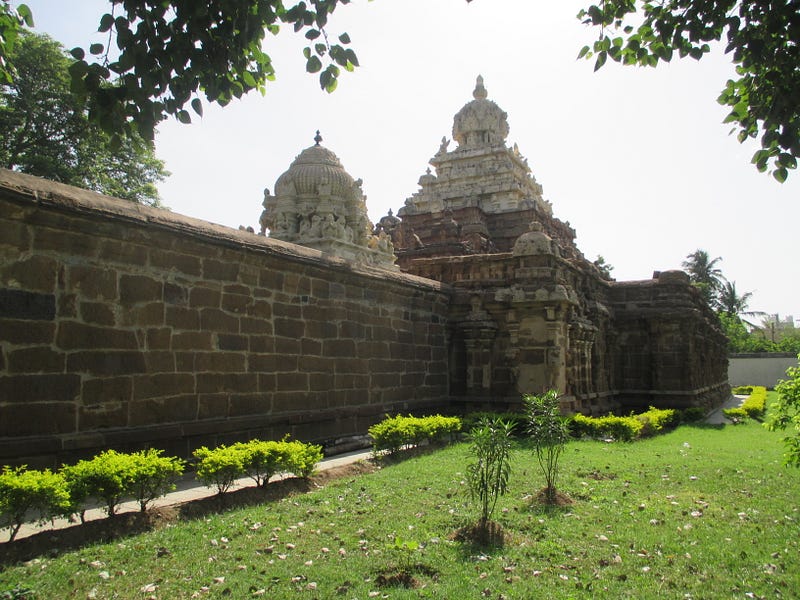
<figcaption class="imageCaption">Sri Vaikuntha Perumal Temple Kanchipuram</figcaption>
</figure>
<p name="b83c" class="graf graf--p">Under the Cholas more temples were built making Kanchipuram a place of religious and spiritual nirvana. Now, the Cholas were Vishnu worshippers. Vishnu, the flamboyant lord, needed, flamboyant robes. The cotton <em class="markup--em markup--p-em">veshti</em> had to undergo a change. First, the only change that was made to it was to attach a brightly coloured silk border embellished with a little gold. This little innovation was done by the expert master weavers of Saurashtra who, after fleeing their own land due Mohammed Ghazni’s invasion, had settled in Kanchipuram because of the huge demand for fine woven fabric. And thus the <em class="markup--em markup--p-em">korvai </em>technique was born. Gradually the cotton <em class="markup--em markup--p-em">veshti</em> was replaced with silk because silk was considered to be pure and hence necessary for worship.</p>
<p name="1bf1" class="graf graf--p">Around the 13th century when the reign of the great Cholas ended, Kanchipuram came under the rule of the Vijayangar kings. It was the great king Krishna Deva Raya who commissioned saree creation for women of the palace to wear for religious ceremonies, weddings and other festivities. The craft actually picked up when the two weaving communities — the Devangas and the Saligars who were reputed for their weaving skills, mass migrated and that’s when Kancheepuram rose to eminence.</p>
<p name="bb0e" class="graf graf--p"><strong class="markup--strong markup--p-strong">Design and Technique :</strong></p>
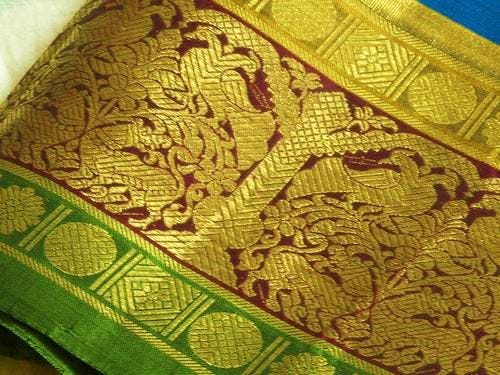
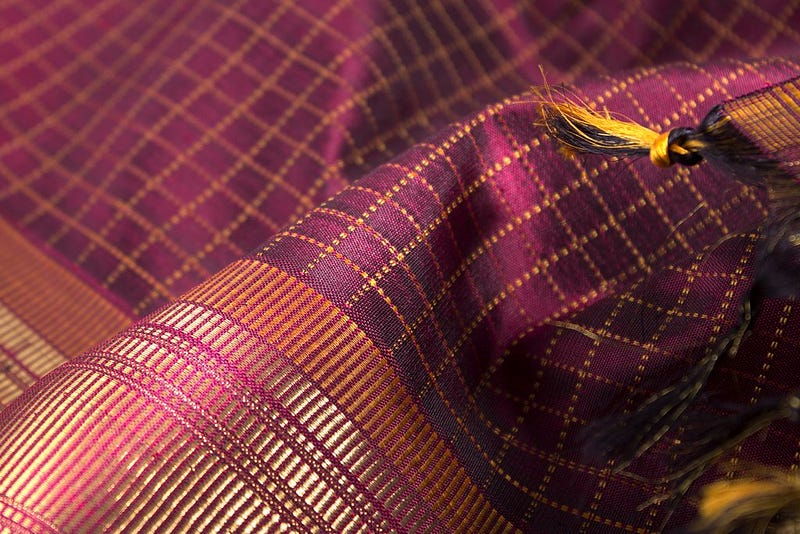
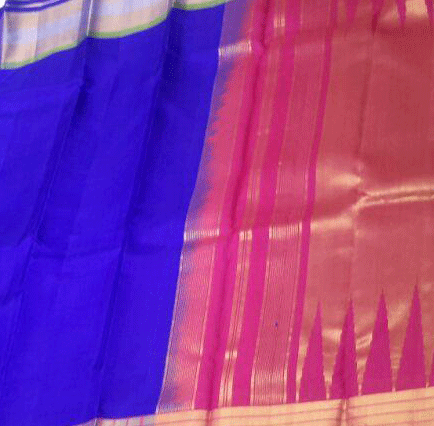
<p name="3a40" class="graf graf--p">The most distinguishing feature of a Kanjeevaram Silk saree is the heavily contrasted border and pallu. This contrast defines Kanjeevaram sarees in ways you cannot imagine. The border and pallu are both quite distinctive and are usually heavily embellished with gold or zari depicting traditional motifs like the lotus, parrots or peacocks; highly celebrated but rare motifs. And sometimes simple geometric patterns are used to add a subtle dash of glamour .</p>
<figure name="f6a0" class="graf graf--figure" style="text-align: center;"><img alt="" src="https://cdn-images-1.medium.com/max/800/1*HsFOTHfE84A1tf4Eu5d56w.jpeg" style="float: none;"></figure>
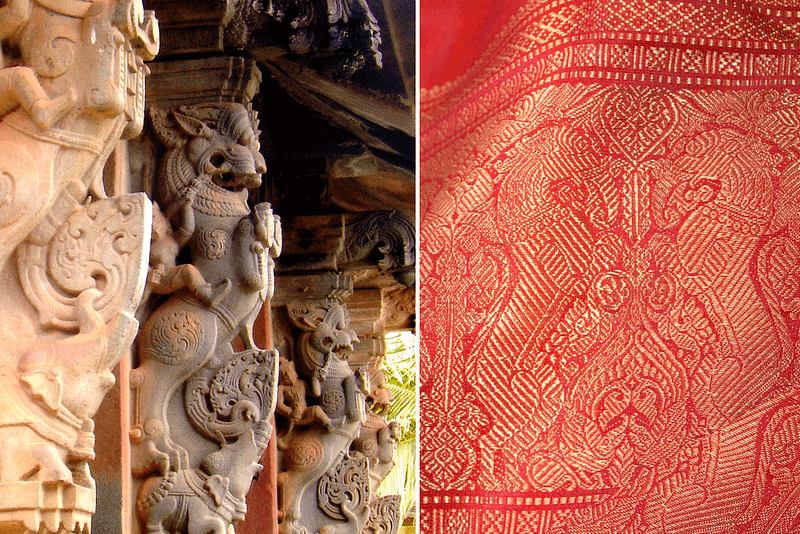
<p name="fa1d" class="graf graf--p">If we delve into the history of the Kanjivaram sari, it becomes apparent that the motifs and designs are closely interrelated to the temples of Kanchipuram. For instance, the lions and yalis (mythical creature), the mango motif from the Ekambareshwarar temple, the classic temple borders from South Indian temples, the rudraksham (holy beads), hamsam (swan) chiselled on the walls and pillars came alive in weave.</p>
<figure name="4b29" class="graf graf--figure" style="text-align: center;"><img alt="" src="https://cdn-images-1.medium.com/max/800/1*rdk6snQyLdpJVMGDCCqQ2w.png" style="float: none;">
<figcaption class="imageCaption">Yali (Yazhi) is a mythical creature seen in many Hindu temples, often sculpted onto the pillars.</figcaption>
</figure>
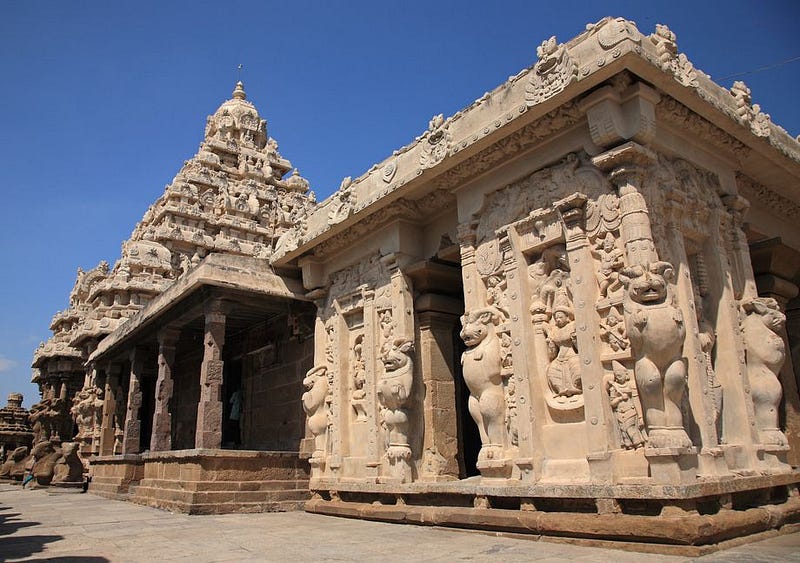
<p name="278e" class="graf graf--p">Kanchi’s ancient temples are an eternal font of inspiration. Motifs of flowers, vines, animals, birds and yalis are sourced from the intricate carvings on the pillars, walls and vimanas of the Kailasanatha, Ekambreswara, Varadaraja Perumal and Vaikunta Perumal temples.</p>
<figure name="8684" class="graf graf--figure" style="text-align: center;"><img alt="" src="https://cdn-images-1.medium.com/max/800/1*yGsZh1UDY2g7q51tDiYX7Q.jpeg" style="float: none;">
<figcaption class="imageCaption"><a href="https://www.flickr.com/photos/kukkaibkk/5409757776" data-href="https://www.flickr.com/photos/kukkaibkk/5409757776" class="markup--anchor markup--figure-anchor" rel="noopener" target="_blank">Kailasanathar Temple, Kanchipuram</a></figcaption>
</figure>
<p name="5223" class="graf graf--p">Only in the Kanjivaram, one can find delightful local names for the colours used — <em class="markup--em markup--p-em">vadamalli</em> (bachelor’s button flower),<em class="markup--em markup--p-em"> kathiripoo</em> (brinjal flower), <em class="markup--em markup--p-em">elumichai </em>(lemon), <em class="markup--em markup--p-em">aanatha</em> (bliss) blue,<em class="markup--em markup--p-em"> elaikai</em> (cardamom), <em class="markup--em markup--p-em">kesari</em> (saffron), <em class="markup--em markup--p-em">naval pazham</em> (java plum), <em class="markup--em markup--p-em">pon vandu</em> (golden beetle), <em class="markup--em markup--p-em">srichurnam</em> (traditional yellow/red line drawn in the middle of a man’s forehead), <em class="markup--em markup--p-em">manthulir</em> (violet with green: a shot colour of tender mango leaves), <em class="markup--em markup--p-em">ennai arakku</em> (a shot colour of violet and brown). These colours, no wonder, have a visual and emotional impact — both on the garment and the person wearing it.</p>
<p name="c9ae" class="graf graf--p">The patterns in the body of the sari may sport buttas or motifs. <em class="markup--em markup--p-em">Malli moggu</em> or the jasmine bud design, coin butta, mango or paisley are amongst the vintage ones. The stripes and checks, the <em class="markup--em markup--p-em">veldhari</em> (representing the spear of Lord Murugan), <em class="markup--em markup--p-em">neli</em> (a type of finger ring), <em class="markup--em markup--p-em">aathi vazhai</em> (horizontal stripes); the different kind of multi-coloured checks, ranging from <em class="markup--em markup--p-em">kottadi</em> or small zari checks, <em class="markup--em markup--p-em">vaira oosi</em> (diamond needles), and <em class="markup--em markup--p-em">muthu kattam</em> to larger checks called papli are very special designs. The geometric precision of a Kanjivaram can be seen in a muppagam or arai pagam sari; <em class="markup--em markup--p-em">muppagam</em>, means three parts and <em class="markup--em markup--p-em">arai pagam</em> means two parts.</p>
<figure name="ccef" class="graf graf--figure" style="text-align: center;"><img alt="" src="https://cdn-images-1.medium.com/max/800/1*pYhk7xc_QxFgdqetIeEAww.jpeg" style="float: none;">
<figcaption class="imageCaption"><em class="markup--em markup--figure-em">Muthu kattam with rettai</em> <em class="markup--em markup--figure-em">pettu </em>(double row) <em class="markup--em markup--figure-em">Border. Image Courtesy www.</em>kanakavalli.com</figcaption>
</figure>
<p name="35ba" class="graf graf--p"><strong class="markup--strong markup--p-strong">The Kanjeevaram connection to Weddings :</strong></p>
<p name="1d5b" class="graf graf--p">Many communities from Karnataka, even today, insist that the <em class="markup--em markup--p-em">muhurtam</em> sari should carry a <em class="markup--em markup--p-em">rettai pettu</em> (double row) border to signify auspiciousness, with a preference for vermilion, green and yellow hues. For some, the <em class="markup--em markup--p-em">kottadi</em> checks are a must-have. “The <em class="markup--em markup--p-em">muthu kattam</em> checks, resembling evenly spaced pearls, represent the harmonious relationship between the bride and groom. Similarly, the nine-yard <em class="markup--em markup--p-em">koorai pudavai</em> features the <em class="markup--em markup--p-em">arai maadam</em> (half-diamond, wall lamp niche ) <em class="markup--em markup--p-em">pettu</em> which appears uniform in front and reverse, representing the equality of husband and wife.</p>
<p name="cf1f" class="graf graf--p"><strong class="markup--strong markup--p-strong">How to identify a Genuine Kanjeevaram :</strong></p>
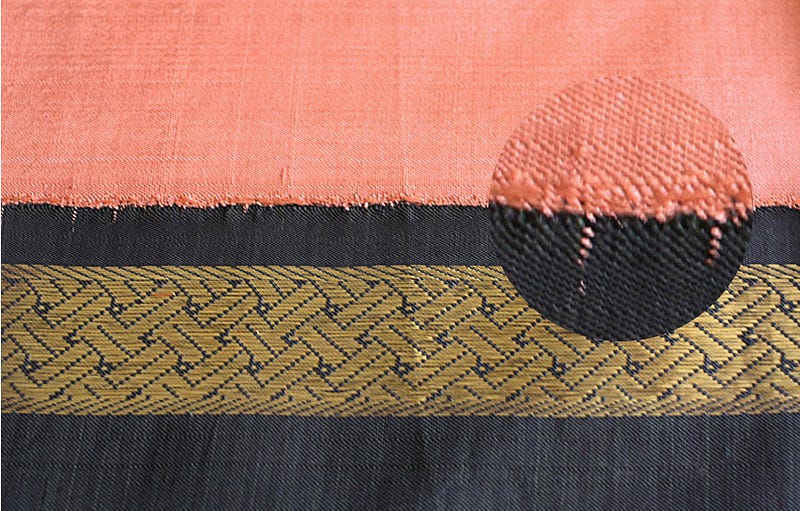
<p name="d18a" class="graf graf--p">The USP of Kanchi handlooms is the <em class="markup--em markup--p-em">korvai</em> technique. It involves the joining of two different colours when the body ( <em class="markup--em markup--p-em">udal</em>) meets the two borders. The second border can be attached only by an extra helper, in a painstaking, labour-intensive process. Kanjeevaram silks are therefore sometimes also referred to as <em class="markup--em markup--p-em">korvai pattu </em>or the saree with ‘attached border’.</p>
<figure name="a6c4" class="graf graf--figure" style="text-align: center;"><img alt="" src="https://cdn-images-1.medium.com/max/800/1*o6wLe1VkgbKPhFSi8jXELw.jpeg" style="float: none;">
<figcaption class="imageCaption">Korvai Joint Image. Courtesy sareepevaaree.wordpress.com</figcaption>
</figure>
<p name="f1fb" class="graf graf--p"><iframe src="https://www.youtube.com/embed/2mEZZ0TmHqo" allowfullscreen="" height="315" frameborder="0" width="560"></iframe></p>
<p name="f1fb" class="graf graf--p">At the point where the <em class="markup--em markup--p-em">udal</em> (Body) is joined with the <em class="markup--em markup--p-em">munthi</em> ( <em class="markup--em markup--p-em">pallu</em>) which carries a contrast colour, a technique called petni is used to create a narrow strip of double thickness, within which warp and weft colours merge to assume a shot hue.</p>
<figure name="bcc1" class="graf graf--figure" style="text-align: center;"><img alt="" src="https://cdn-images-1.medium.com/max/800/1*_jsExhq00oSQAnoKCDJ7aw.png" style="float: none;">
<figcaption class="imageCaption">Petni Technique</figcaption>
</figure>
<p name="2f22" class="graf graf--p">When you think of Kanjeevaram, think of <em class="markup--em markup--p-em">korvai</em> and <em class="markup--em markup--p-em">petni</em> and how it binds generations of cultural evolution that is tightly woven in tradition. These traditional techniques are so deep-rooted in the Kanchipuram culture, that any saree made in Kanchipuram will always have these ‘birthmarks’.</p>
<p name="66c2" class="graf graf--p">And when you own a Kanjeevaram, you own one of the most enduring legacies of myth, history and culture.</p>
<p name="fe88" class="graf graf--p"><strong class="markup--strong markup--p-strong">Here is a video of the Making of a Kanjeevaram Saree :</strong></p>
<p name="fe88" class="graf graf--p"> <iframe src="https://www.youtube.com/embed/O2hGxdgULiU" allowfullscreen="" height="315" frameborder="0" width="560"></iframe></p>
<p name="dbed" class="graf graf--p"><a href="https://kancheepuramsilksarees.blogspot.in/" data-href="https://kancheepuramsilksarees.blogspot.in/" class="markup--anchor markup--p-anchor" target="_blank"><em class="markup--em markup--p-em">kancheepuramsilksarees.blogspot.in</em></a></p>
<p name="695d" class="graf graf--p"><a href="https://sareepevaaree.wordpress.com/2015/01/29/k-for-kanjeevaram/" data-href="https://sareepevaaree.wordpress.com/2015/01/29/k-for-kanjeevaram/" class="markup--anchor markup--p-anchor" target="_blank"><em class="markup--em markup--p-em">sareepevaaree.wordpress.com</em></a></p>
<p name="dc2a" class="graf graf--p"><a href="https://kanakavalli.com/blogs/journal-november-edition/roots-the-kanjivaram-unravelled-by-sreemathy-mohan-1" data-href="https://kanakavalli.com/blogs/journal-november-edition/roots-the-kanjivaram-unravelled-by-sreemathy-mohan-1" class="markup--anchor markup--p-anchor" target="_blank"><em class="markup--em markup--p-em">https://kanakavalli.com</em></a></p>
<p name="ec4e" class="graf graf--p"><a href="http://readingcloth.blogspot.in/2013/08/threads-of-gold.html" data-href="http://readingcloth.blogspot.in/2013/08/threads-of-gold.html" class="markup--anchor markup--p-anchor" target="_blank"><em class="markup--em markup--p-em">readingcloth.blogspot.in</em></a></p>]]>
    </content>
  </entry>
  <entry>
    <id>https://www.india1001.com/blogs/news/59695621-the-patola-weaves-of-gujarat</id>
    <published>2015-10-22T12:27:00+05:30</published>
    <updated>2017-01-10T15:52:37+05:30</updated>
    <link rel="alternate" type="text/html" href="https://www.india1001.com/blogs/news/59695621-the-patola-weaves-of-gujarat"/>
    <title>The Patola weaves of Gujarat</title>
    <author>
      <name>Ruchi Makhija</name>
    </author>
    <summary type="html">
      <![CDATA[Patola saris are a double ikat woven sari, usually made from silk, made in Patan, Gujarat, India. The word Patola is the plural form—The singular is patulu.  Patola-weaving is a closely guarded family tradition. There are three families left in Patan that weave these highly prized double ikat saris. It can take six months to one year to make one sari. The craft of weaving them rests exclusively with the Salvi family in Patan who manufacture Patolas for royalty and aristocracy.<p><a class="read-more" href="https://www.india1001.com/blogs/news/59695621-the-patola-weaves-of-gujarat">More</a></p>]]>
    </summary>
    <content type="html">
      <![CDATA[<p> Patola saris are a double ikat woven sari, usually made from silk, made in Patan, Gujarat, India. The word Patola is the plural form—The singular is patulu. They are very expensive, once worn only by royalty and the aristocracy, they are popular and in demand from those whocan afford them. Velvet patola styles are also made in Surat. Patola-weaving is a closely guarded family tradition. There are three families left in Patan that weave these highly prized double ikat saris. It can take six months to one year to make one sari. The craft of weaving them rests exclusively with the Salvi family in Patan who manufacture Patolas for royalty and aristocracy.</p>
<p style="text-align: left;">In Double ikat both warp &amp; weft is dyed before the weaving begins. This requires expertise and pin-point accuracy as displacement of even one thread may result in a deformed pattern on the cloth.<br><img style="display: block; margin-left: auto; margin-right: auto;" src="//cdn.shopify.com/s/files/1/0163/4952/files/17_large.jpg?10669498720215937077" alt=""><br>They are so unique that they are the geographical indication tags for Gujarat as Patan Patolas and Andhra Pradesh as Bhoodan Pochampally.</p>
<p>History :</p>
<p>Patola has a royal history. Silk weavers of the salvi caste from the states of Karnataka and Maharashtra chose Gujarat as the home for their renowned patola fabric. It is believed that salvis went to Gujurat in the 12th century with the intention of acquiring the patronage of the Solanki Rajputs, who ruled all of Gujarat and parts of Malva and south Rajasthan at the time, with Anahiwad Patan as the capital.</p>
<p><img style="display: block; margin-left: auto; margin-right: auto;" src="//cdn.shopify.com/s/files/1/0163/4952/files/13_large.jpg?10669498720215937077" alt=""></p>
<p>Legend says that over seven hundred patola weavers came to the palace of Raja Kumarapala. At that time the ruler used to dress in patola silk himself on special occasions. After the decline of the Solanki empire, the salvis founded a rich trade in Gujarat. Patola saris quickly became a sign of social status among Gujarati women and girls, especially as part of stridhan, items that a woman can claim as her own property within a marital household.</p>
<p>Features of Patan Patola :</p>
<p>1. Equal design and wearable on both sides. Even weavers can’t identify which is the front or back once the weaving is over. <br>2. Only 3 families in Pattan make them today, out of the original 700 families.<br>3. Around 3 people take 4 to 6 months to weave one saree which is 5.5 meters long and 48 inches wide.<br>4. No computers or power looms are used. Mental calculations, deep concentration, patience, undivided attention and a lot of hard work are the skill sets that make one saree.<br>5. The measurement tapes used by the weavers (which can measure up to 100th part of an inch) are the same which were invented 1000 years ago.<br>6. Made only in silk (patt is short for ‘Pattakalam’ which means silk in Sanskrit) as it lasts 80 to 100 years. They consider making it in cotton a waste of their time as it will tear in 40 to 50 years. <br>7. Their cheapest saree starts at 1.5 lac rupees and takes 1.5 to 2 years for delivery. For people who do not want to spend that much they have options of Dupattas (40 to 50,000/- rupees) or handkerchiefs (3 to 4,000/- rupees). A good Patola costs Rs. 3 lacs.<br>8. Colours last for over 300 years. <br>9. They do use chemicals to dye for their lower end sarees but also use pure vegetable dyes for patrons who do not mind the escalated cost.</p>]]>
    </content>
  </entry>
  <entry>
    <id>https://www.india1001.com/blogs/news/48329541-organic-cotton-facts-myths-and-faqs</id>
    <published>2015-08-24T17:27:00+05:30</published>
    <updated>2017-01-10T15:50:09+05:30</updated>
    <link rel="alternate" type="text/html" href="https://www.india1001.com/blogs/news/48329541-organic-cotton-facts-myths-and-faqs"/>
    <title>Organic Cotton.. Facts, myths and FAQs</title>
    <author>
      <name>Arvind Rajkumar</name>
    </author>
    <summary type="html">
      <![CDATA[Like organic foods 20­ years ago, the idea of organic cotton is confusing to many of us. It’s taken a little longer to catch on because the correlation isn’t as direct­. We don’t eat cotton fiber (at least we hope you don’t!) However, more people are becoming knowledgeable as to how the organic cotton movement is just as powerful and important as that of organic foods.<p><a class="read-more" href="https://www.india1001.com/blogs/news/48329541-organic-cotton-facts-myths-and-faqs">More</a></p>]]>
    </summary>
    <content type="html">
      <![CDATA[<p>Like organic foods 20­ years ago, the idea of organic cotton is confusing to many of us. It’s taken a little longer to catch on because the correlation isn’t as direct­. We don’t eat cotton fiber (at least we hope you don’t!) However, more people are becoming knowledgeable as to how the organic cotton movement is just as powerful and important as that of organic foods.<br><br>In addition to being one of the most widely grown crops in the world, growing conventional cotton is also one of the most chemical-­intensive. These chemicals have tremendous impact on the earth’s air, water, soil, and the health of people in cotton-growing areas. They are among the most toxic chemicals as classified by the Environmental Protection Agency.<br><br>The problem is even worse in developing countries with uninformed consumers, and lack of stable institutions and property rights. In addition to destroying the land, thousands of farmers die from exposure to these chemicals every year.<br><br>So, we’ve decided to put together a little information to help spread the word. Check out our questions and answers below.</p>
<p><span style="color: #cc0000;">How do I know if it's organic?</span></p>
Unlike food, textile products don’t have to be certified in order to be described as organic. A product claiming to be organic might only contain a small percentage of organic cotton or may be made of organic cotton but dyed using toxic chemicals which would never be allowed in certified organic products.<br><br>The use of any organic cotton is a great first step, but in order to be sure a product really is organic from field to finished product, look out for either the Global Organic Textile Standard (GOTS) symbol, the Soil Association symbol or the Organic Exchange symbol. See below for details of what these symbols mean:<br>
<table style="color: #444444; font-family: Arial, Helvetica, sans-serif; font-size: 12px; font-style: normal; font-variant: normal; font-weight: normal; letter-spacing: normal; line-height: 18px; orphans: auto; text-align: start; text-indent: 0px; text-transform: none; white-space: normal; widows: 1; word-spacing: 0px; -webkit-text-stroke-width: 0px; width: 940px; background-color: #ffffff;" cellpadding="5">
<colgroup> <col> <col> </colgroup>
<tbody>
<tr>
<td valign="top">
<p style="margin: 10px 0px 20px 22px; padding: 0px; border: 0px; font-family: Arial, georgia, 'times new roman', serif; font-size: 1.3em; font-style: inherit; font-variant: inherit; font-weight: inherit; font-stretch: inherit; line-height: inherit; vertical-align: baseline;"><img src="http://www.cottonedon.org/portals/1/logos/gots_50.jpg" alt="GOTS logo" style="margin: 0px 0px 0px 5px; padding: 0px; border: 0px; font-family: inherit; font-size: inherit; font-style: inherit; font-variant: inherit; font-weight: inherit; font-stretch: inherit; line-height: inherit; vertical-align: middle;" align="right"></p>
</td>
<td>
<p style="margin: 10px 0px 20px 22px; padding: 0px; border: 0px; font-family: Arial, georgia, 'times new roman', serif; font-size: 1.3em; font-style: inherit; font-variant: inherit; font-weight: inherit; font-stretch: inherit; line-height: inherit; vertical-align: baseline;">GOTS symbol: Product grown and processed to organic standards. Products carrying the GOTS symbol are made from organic fibres, have met strict environmental and social criteria during processing and have been certified by an independent, third party along the whole supply chain.<span class="Apple-converted-space"> </span><br><a href="http://www.cottonedon.org/globalorganictextilestandard" style="margin: 0px; padding: 0px; border: 0px; font-family: inherit; font-size: inherit; font-style: inherit; font-variant: inherit; font-weight: bold; font-stretch: inherit; line-height: inherit; vertical-align: baseline; color: #000000; text-decoration: none; outline: 0px;">Find out more about GOTS...</a></p>
</td>
</tr>
<tr>
<td valign="top">
<p style="margin: 10px 0px 20px 22px; padding: 0px; border: 0px; font-family: Arial, georgia, 'times new roman', serif; font-size: 1.3em; font-style: inherit; font-variant: inherit; font-weight: inherit; font-stretch: inherit; line-height: inherit; vertical-align: baseline;"><img src="http://www.cottonedon.org/portals/1/logos/sa_50.jpg" alt="Soil Association symbol" style="margin: 0px 0px 0px 5px; padding: 0px; border: 0px; font-family: inherit; font-size: inherit; font-style: inherit; font-variant: inherit; font-weight: inherit; font-stretch: inherit; line-height: inherit; vertical-align: middle;" align="right"></p>
</td>
<td>
<p style="margin: 10px 0px 20px 22px; padding: 0px; border: 0px; font-family: Arial, georgia, 'times new roman', serif; font-size: 1.3em; font-style: inherit; font-variant: inherit; font-weight: inherit; font-stretch: inherit; line-height: inherit; vertical-align: baseline;">Soil Association symbol: Product certified to the Global Organic Textile Standard by Soil Association Certification Ltd. The Soil Association was a founder member of GOTS and is a quarter owner of Global Standard GmbH which manages the GOTS.<span class="Apple-converted-space"> </span><br><a href="http://www.cottonedon.org/soilassociation" style="margin: 0px; padding: 0px; border: 0px; font-family: inherit; font-size: inherit; font-style: inherit; font-variant: inherit; font-weight: bold; font-stretch: inherit; line-height: inherit; vertical-align: baseline; color: #000000; text-decoration: none; outline: 0px;">Find out more about the Soil Association...</a></p>
</td>
</tr>
<tr>
<td valign="top">
<p style="margin: 10px 0px 20px 22px; padding: 0px; border: 0px; font-family: Arial, georgia, 'times new roman', serif; font-size: 1.3em; font-style: inherit; font-variant: inherit; font-weight: inherit; font-stretch: inherit; line-height: inherit; vertical-align: baseline;"><img alt="OE100 symbol" src="http://www.cottonedon.org/portals/1/logos/OE100_50.gif" style="margin: 0px 0px 0px 5px; padding: 0px; border: 0px; font-family: inherit; font-size: inherit; font-style: inherit; font-variant: inherit; font-weight: inherit; font-stretch: inherit; line-height: inherit; vertical-align: middle;" align="right"></p>
</td>
<td>
<p style="margin: 10px 0px 20px 22px; padding: 0px; border: 0px; font-family: Arial, georgia, 'times new roman', serif; font-size: 1.3em; font-style: inherit; font-variant: inherit; font-weight: inherit; font-stretch: inherit; line-height: inherit; vertical-align: baseline;">OE100 symbol: Cotton in the product grown to organic standards. Product has been tracked and traced along the supply chain by an independent, third party. Contains 100% certified organic cotton fibre, but hasn’t necessarily been processed to organic standards.</p>
</td>
</tr>
<tr>
<td>
<p style="margin: 10px 0px 20px 22px; padding: 0px; border: 0px; font-family: Arial, georgia, 'times new roman', serif; font-size: 1.3em; font-style: inherit; font-variant: inherit; font-weight: inherit; font-stretch: inherit; line-height: inherit; vertical-align: baseline;"><img alt="OE blended symbol" src="http://www.cottonedon.org/portals/1/logos/OEBlended_50.gif" style="margin: 0px 0px 0px 5px; padding: 0px; border: 0px; font-family: inherit; font-size: inherit; font-style: inherit; font-variant: inherit; font-weight: inherit; font-stretch: inherit; line-height: inherit; vertical-align: middle;" align="right"></p>
</td>
<td style="text-align: left; vertical-align: top;">
<p style="margin: 10px 0px 20px 22px; padding: 0px; border: 0px; font-family: Arial, georgia, 'times new roman', serif; font-size: 1.3em; font-style: inherit; font-variant: inherit; font-weight: inherit; font-stretch: inherit; line-height: inherit; vertical-align: baseline;">OE blended symbol: Product contains a minimum 5% of organic cotton fibre.</p>
</td>
</tr>
</tbody>
</table>
<p> </p>
<p><span style="color: #cc0000;">Is organic cotton sustainable?</span><br><br>To sustain a method of production in the long term (and thus make it sustainable), healthy and climate change resilient soils must be maintained, biodiversity of seeds and wildlife must be promoted and the livelihoods of farmers protected. Organic agriculture is based on this approach.<br><br>The system can’t be reliant on non-renewable resources, such as synthetic fertilisers and pesticides. Any kind of mono-crop production utilising non-renewable synthetic fertilisers and pesticides and Bt Genetically Modified seeds cannot be considered environmentally sustainable by any reasonable definition. Sustainability is often described as a journey of small manageable steps. But it is important to keep the end goal in mind.</p>
<p><span style="color: #cc0000;">How can I be sure my clothes haven't been, dyed, treated or processed with risky chemicals?</span><br><br>The impacts of producing our clothes are felt beyond the cotton fields. Greenpeace's Dirty Laundry campaign brought to light the toxic water pollution resulting from the release of hazardous chemicals used by the textile industry. These practices are posing serious and immediate threats to our precious ecosystems and human health. 20% of freshwater pollution comes from textile treatment and dyeing.<br><br>However, cotton carrying the GOTS or the Soil Association symbol has not only been grown organically, it has been processed organically too. This means that inputs such as dyes and inks have met strict biodegradability and toxicity rules and waste water is treated before it's let out into the environment - protecting local ecosystems and communities.</p>
<p><span style="color: #cc0000;">What's the difference between Fairtrade and organic cotton?</span><br><br>Fairtrade cotton farmers receive a premium price which they can use to cover production costs and fund community development projects, such as drilling wells and building schools.  Some Fairtrade farmers still use pesticides (although only from a restricted list), but 19% of all Fairtrade cotton is also organically produced. <br><br>Organic farming recognizes that we live in a world which operates as a complex system and that every action has direct and indirect impacts on other people and the environment. Organic cotton farmers aim to minimise negative impacts and promote positive ones. For example, they concentrate on natural ways of building soil fertility to increase productivity, rather than using synthetic chemicals which might cause short term yield increases but have long term impacts on the surrounding environment. For more information, download the briefing.<br><br>Cotton which is 'dual certified' organic and Fairtrade is considered the 'gold standard' for sustainable cotton.<br><br><span style="color: #cc0000;">Is organic cotton good quality?</span><br><br>Organic produces great quality cotton. As Mariusz Stochaj from Continental Clothing puts it “…when compared like-for-like, organic fibres consistently produce better quality yarns than conventional cotton.”<br><br><span style="color: #cc0000;">Does organic cotton cost more?</span><br><br>The trend towards fast and cheap fashion often means someone or something else is paying the price. When it comes to cotton, this can be the farmers - 99% of whom live on the breadline in developing countries, or the environment - degraded and poisoned by pesticides and fertilisers. <br><br>The price of organic includes investments made by farmers who are protecting the environment, maintaining soil fertility, preserving biodiversity and conserving water. This means organic cotton sometimes (but not always) is more expensive because the costs aren’t hidden.<br><br>By letting your favourite brands and retailers know you want organic cotton (by buying it or asking them for it), you can encourage them to build relationships with suppliers. Committing to purchase in advance benefits everyone; it secures farmers’ incomes, helps them plan ahead and improve their farming practices, which in turn reduces the price of producing organic cotton, meaning a lower price all round.</p>
<p><span style="color: #cc0000;">Have you got a question?</span><br><br>If you've got a question about organic cotton, let us know and we'll answer it here - email us on india1001.com@gmaiil.com</p>
<p><span style="color: #741b47;"><span style="color: #0000ff;"><span style="color: #cc0000;">Our Conclusion</span> :</span> Sustainable farming without use of chemical based fertilizers and insecticides is important for all trades related to agricultural produce. Having said that, It is important that norms are followed, and certifications are met.. and displayed on the products. An organically made yarn that is printed with chemicals on the screen printing table is not organic cotton. Only when the process is followed all though.. will it qualify to be an Organic Cotton product. Also watch out for non-organic produce .. claiming to be Organic.. based on regional, intermediate processes, or just nothing.. just to make you pay a premium. Please exercise your judgement wisely.</span></p>
<p> </p>]]>
    </content>
  </entry>
  <entry>
    <id>https://www.india1001.com/blogs/news/15012541-the-mughals-had-designs-on-us</id>
    <published>2014-08-01T16:01:00+05:30</published>
    <updated>2017-01-10T15:48:02+05:30</updated>
    <link rel="alternate" type="text/html" href="https://www.india1001.com/blogs/news/15012541-the-mughals-had-designs-on-us"/>
    <title>The Mughals had Designs on us..</title>
    <author>
      <name>Arvind Rajkumar</name>
    </author>
    <summary type="html">
      <![CDATA[<span>Chikankari - the process of chikan - was basically invented in Lucknow. The origin of Chikankari is initiated by the influence of intricate carving patterns of Mughal architecture during their period. The Chikan work in Lucknow is older than 200 years and later it is patronized by Nawabs.</span><p><a class="read-more" href="https://www.india1001.com/blogs/news/15012541-the-mughals-had-designs-on-us">More</a></p>]]>
    </summary>
    <content type="html">
      <![CDATA[<p>Chikan  is a traditional embroidery style from Lucknow, India. Literally translated, the word means embroidery. Believed to have been introduced by Nur Jehan, Mughal emperor Jahangir's wife, it is one of Lucknow's most famous textile decoration styles.</p>
<p>There are several theories about the origin of Chikankari. Chikankari - the process of chikan - was basically invented in Lucknow. The origin of Chikankari is initiated by the influence of intricate carving patterns of Mughal architecture during their period. The Chikan work in Lucknow is older than 200 years and later it is patronized by Nawabs. There are 5000 families involved in Chikankari embroidery in and around villages of Lucknow. The artisans belong to local Muslim community. Nearly 90% of Chikankari work is done by women professionally. Lucknow grew into an international market for its renowned Chikankari work. There are references to Indian Chikan work as early as 3rd century BC by Megasthenes, who mentioned the use of flowered muslins by Indians. The name Chikan has been derived from the Persian word Chakin or Chikeen meaning a cloth wrought with needlework</p>
<div style="text-align: left;"><img src="//cdn.shopify.com/s/files/1/0163/4952/files/4_large.jpg?36617"></div>
<div style="text-align: left;"><strong><em>The magnificent look of Hathkati, jaali and phanda stiches.</em></strong></div>
<div style="text-align: left;"><strong><em><img src="//cdn.shopify.com/s/files/1/0163/4952/files/5_large.jpg?36617"></em></strong></div>
<div style="text-align: left;"> </div>
<div style="text-align: left;"><em><strong>Eye captivating Phanda knots, Bhakia shadows and Bijli flowers.</strong></em></div>
<div style="text-align: left;"><em><strong><img src="//cdn.shopify.com/s/files/1/0163/4952/files/1_1_large.jpg?36617"></strong></em></div>
<div style="text-align: left;"> </div>
<div style="text-align: left;"><em><strong>Kairi- mango motif with fine Phanda, Jaali and Hathkati work.</strong></em></div>
<div style="text-align: left;"><img src="//cdn.shopify.com/s/files/1/0163/4952/files/10_large.jpg?36617"></div>
<div style="text-align: left;"><em><strong>Shadow and Phanda work. </strong></em></div>
<p> </p>
<p>Chikankari Stitches :</p>
<p>The basic stitches are six in number and all except one are common to other forms of embroidery.</p>
<p>1) Tepchi is a long running or darning stitch worked with six strands on the right side of the fabric taken over four threads and picking up one. Thus, a line is formed. It is used principally as a basis for further stitchery and occasionally to form a simple shape.</p>
<p>2) Bakhiya, double back or shadow stitch in chikan work is done from the wrong side of the fabric and the design is rendered in the herringbone style. The shadow of the thread is seen through the cloth on the right side.</p>
<p>3) Hool is a fine detached eyelet stitch. Herein, a hole is punched in the fabric and the threads are teased apart. It is then held by small straight stitches all round and worked with one thread on the right side of the fabric. It can be worked with six threads and often forms the center of a flower.</p>
<p>4) Zanzeera is a small chain stitch worked with one thread on the right side of the fabric. Being extremely fine, it is used to finally outline the leaf or petal shapes after one or more outlines have already been worked.</p>
<p>5) Rahet is a stem stitch worked with six threads on the wrong side of the fabric. It forms a solid line of back stitch on the right side of the fabric and is rarely used in its simple form but is common in the double form of dohra bakhiya as an outlining stitch.</p>
<p>6) Banarsi stitch has no European equivalent and is a twisted stitch worked with six threads on the right side of the fabric. Working from the right across about five threads a small stitch is taken over about two threads vertically. The needle is reinserted halfway along and below the horizontal stitch formed and is taken out about two threads vertically on the right above the previous stitch.</p>
<p>7) Khatau is similar to Bakhia, but finer and is a form of applique. In Khatau, the design is prepared on calico material. That is placed over the surface of the final fabric and then paisley and floral patterns are stitched on to it.</p>
<p>8) Phanda and Murri are the forms of stitches used to embroider the centre of the flowers in ordinary chikan work motifs. They are typically French knots, with murri being rice-shaped and phanda millet-shaped.</p>
<p>9) Jali stitch is the one where the thread is never drawn through the fabric, ensuring that the back portion of the garment looks as impeccable as the front. The warp and weft threads are carefully drawn apart and minute buttonhole stitches are inserted into the cloth.</p>
<p>10) Turpai and Darzdari are also significant stitches in chikan work. Turpai should have an effect of a thin thread. Darzdari have several varieties, the popular ones are Kohidarz, Kamal darz, Shankarpara darz, Muchii and Singbhada darz.</p>
<p>11) The various other types of legendary chikankari stitches are: Pechani, Bijli, Ghaspatti, Makra, Kauri, Hathkadi, Banjkali, Sazi, Karan, Kapkapi, Madrazi, Bulbul-chasm, Taj Mahal, Janjeera, Kangan, Dhania- patti, Rozan, Meharki, Chanapatti, Baalda, Jora, Keel kangan, bulbul, sidhaul, ghas ki patti etc.</p>
<p>Drifting apart from the original pristine setting, the tone-on-tone embroidery is in vogue these days. The significant use of beads, sequin and mokaish (white flat silver strip embroidery) have gained wide acceptance.</p>
<div style="text-align: left;"></div>
<div style="text-align: left;"><object width="560" height="315"><param name="movie" value="//www.youtube.com/v/oEXuktYWafk?hl=en_US&amp;version=3">
<param name="allowFullScreen" value="true">
<param name="allowscriptaccess" value="always">
<embed src="//www.youtube.com/v/oEXuktYWafk?hl=en_US&amp;version=3" type="application/x-shockwave-flash" allowscriptaccess="always" allowfullscreen="allowfullscreen" width="560" height="315"></embed></object></div>
<div style="text-align: left;">Video of Chikan artists at work..</div>
<div style="text-align: left;"></div>
<p> </p>
<h5>References</h5>
<p><a href="http://www.dsource.in" target="_blank">http://www.dsource.in</a>  Documented by Dr. Bibhudutta Baral, Mr. J. Antony William and Ms. Anushree Kumar , NID R&amp;D Campus, Bangalore</p>
<p><a href="#temp_created_link">http://www.hand-embroidery.com/</a></p>
<p>For Embroidery enthusiasts <a href="http://pgarya.blogspot.in/2013/12/talk-on-chikankari-stitches.html" target="_blank">here</a> is a nice write up on how to create a design using various stitches written by <a href="http://pgarya.blogspot.in/2013/12/talk-on-chikankari-stitches.html" target="_blank">Preethi</a></p>]]>
    </content>
  </entry>
  <entry>
    <id>https://www.india1001.com/blogs/news/10703197-ajrak-printing-the-story-of-ajrakpur</id>
    <published>2013-12-09T14:55:39+05:30</published>
    <updated>2013-12-09T17:36:53+05:30</updated>
    <link rel="alternate" type="text/html" href="https://www.india1001.com/blogs/news/10703197-ajrak-printing-the-story-of-ajrakpur"/>
    <title>Ajrak Printing - The Story of Ajrakpur</title>
    <author>
      <name>Arvind Rajkumar</name>
    </author>
    <summary type="html">
      <![CDATA[<span>Ajrak is said to signify the Universe. Because of the use of color palate. Color red for earth, black for darkness, white for clouds and blue for Universe itself. Think moonless, think midnight, think darkness… the star spangled sky, against a stark blue-black background. This is what ajrakh (aka ajrak), meaning blue in Arabic, is likened to.</span><p><a class="read-more" href="https://www.india1001.com/blogs/news/10703197-ajrak-printing-the-story-of-ajrakpur">More</a></p>]]>
    </summary>
    <content type="html">
      <![CDATA[<p> </p>
<p><strong>The Story of Ajrakpur</strong></p>
<p>The ajrakh makers claim that their craft dates back to early medieval times. Scraps of printed fragments which were believed to originate from Western India, were unearthed at Fostat near Cairo. The ajrak craft was practised by the khatri community, living in the banks of river Sindh (Indus in present day Pakistan). These families migrated to Kutch from Sindh in the 16th century, when the King of Kutch recognized the craft and invited them to settle in the barren uninhabited land, along with dyers, printers, potters and embroiderers. The dyers were Khatri Brahmins. Two generations later they converted to Islam and settled in Dhamadka for its close proximity to a river in which they washed their fabric.</p>
<p><img src="//cdn.shopify.com/s/files/1/0163/4952/files/ajrakpur-bhuj2_large.jpg?35881" style="display: block; margin-left: auto; margin-right: auto;" /></p>
<p>But after 400 years of use, in 1989, the river dried, and water levels from wells and tanks continued to fall. After a massive earthquake in Kutch in 2001, the block printers were forced to relocate. They settled in Ajrakpur, a village built in coordination with relief NGOs. There are over one hundred families living in Ajrakpur, and 30 official block printing workshops; almost all of the families in Ajrakpur generate their primary income from Ajrak.</p>
<p>Today the ajrak traditions are maintained in Kutch, and in Khavda, Dhamadka and Barmer in Rajasthan.</p>
<p><img src="//cdn.shopify.com/s/files/1/0163/4952/files/IMG_1768-940x627_large.jpg?35886" style="display: block; margin-left: auto; margin-right: auto;" /></p>
<p><strong>Ajrak (Ajrakh)</strong></p>
<p>Ajrak is a block-printed textile that is resist-dyed using natural dyes. including indigo and madder. It is made by Khatris community in Kutch, Gujarat and is distinguished by its color- blue with red - and its complex geometric &amp; floral patterns. It's name is derived from 'azarak', 'blue' in Arabic &amp;  Persian. Ajrak is a legacy of text.  It takes skill &amp; patience to make Ajrak. There are between 14-16 different stages of dyeing &amp; printing, which take 14-21 days to complete. The resulting cloth is soft against the skin and jewel-like in appearance, pleasing to touch &amp; appealing to the eye.</p>
<table width="100%">
<tbody>
<tr>
<td><span style="color: #351c75;"><em><strong> Ajrak is said to signify the Universe. Because of the use of color palate. Color red for earth, black for darkness, white for clouds and blue for Universe itself. Think moonless, think midnight, think darkness… the star spangled sky, against a stark blue-black background. This is what ajrakh (aka ajrak), meaning blue in Arabic, is likened to.</strong></em></span></td>
</tr>
</tbody>
</table>
<p>Nature plays an important role in the making of Ajrak. The craftsmen work in total harmony with their environment, where the sun, river, animals, trees and mud are all part of its making.</p>
<p><img src="//cdn.shopify.com/s/files/1/0163/4952/files/dupatta_large.jpg?35882" style="display: block; margin-left: auto; margin-right: auto;" /></p>
<p>It is the synergy between handloom textiles and vegetable dyes that creates magic. The introduction of chemical dyes led to the decline of natural dyes towards the end of the nineteenth century. Ajrakh printing, using natural dyes is one of the oldest techniques of resist printing in India and is one of the most complex and sophisticated methods of printing.</p>
<p>Ajrakh printed cotton is traditionally worn by the pastoral Maldhari community. Apart from pagdis and lungis the women wear printed skirts, and use the ajrakh fabric as bed covers to line cradles for babies. Every colour tells a story and the design images the status. The Khatris have developed a feel for the contemporary market and now ajrakh yardage, kurta sets, furnishings, scarves can be bought.</p>
<p>A remarkable feature of ajrakh printing is that on a single fabric, using the same design, resist printing is combined with other printing and dyeing techniques. The whole process is repeated on both sides of the fabric in perfect cohesion, which calls for unsurpassed skill. Ajrakh uses mud-resist in the various stages and another unique feature is that the dyeing and printing is repeated twice on the fabric to ensure brilliance of colour. Superimposing the repeats is done so perfectly that the clarity is sharpened.</p>
<p>To identify ajrakh one needs to look for fabric with a background of red or blue (though other vegetable dye colours like yellow and green have been introduced) Traditionally four colours were used red (alizarin), blue (indigo), black (iron acetate) white (resist). The ajrakh makers believe that the printed fabric has warm and cool colours which steady the body temperature… blue is cooling and red is warm.</p>
<p><strong>Intricacies</strong></p>
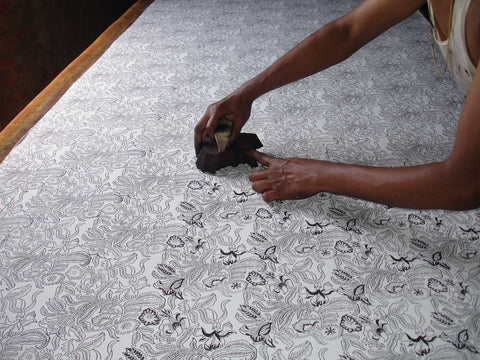
<p>Block printing is a laborious effort of precision. First, cloth is stretched and pinned onto a table. The printers smother wooden blocks with resist and hover them over the cloth to ensure a symmetrical application. Once they are aligned, the block is pounded on the cloth with a heavy-forced whack. This same motion is performed hundreds of times until the cloth is completely covered with the block’s outline in three different resist bases. The cloth is then dyed in a base color and laid under the sun to dry, rinsed and dyed again until the cloth is transformed into a crowded mural of colors and motifs.</p>
<p><img src="//cdn.shopify.com/s/files/1/0163/4952/files/IMG_8250-940x1410_large.jpg?35884" style="display: block; margin-left: auto; margin-right: auto;" /></p>
<p>The white cotton cloth is placed in a copper container with water and soda ash, then steamed to soften it and washed in running water preferably in a river. Soap is applied to it as it is spread over a large cauldron of water. It is then dipped in a mixture of oils, squeezed out and kept overnight. The fabric is washed out the next day and soaked in a mixture of powdered sakun seeds and oil and dried again after which it acquires a dull beige colour. The specially designed blocks are used to print the fabric in gum using an outline block. The second line of printing which is kat printing gives a black colour using a solution of ferrous sulphate and ground seeds. When it is dyed in alizarine it turns black. After the third printing with a resist made of natural elements the fabric is dyed in indigo. The fabric is washed, and dyed in alizarine which produces the red colour in the areas which were covered initially by resist. The second dyeing is in indigo to produce another shade of blue. After this the final wash consists of successive washing in soda ash then in water where detergent is added and then in running water which results in a luminous and beautiful product.</p>
<p><strong>The Blocks</strong></p>
<p><img src="//cdn.shopify.com/s/files/1/0163/4952/files/9e411c4bc8f1e02b6576fec96e6bfee0_large.jpg?35883" style="display: block; margin-left: auto; margin-right: auto;" /></p>
<p>The printing blocks have to be very finely chiselled and by experts in the field. A set of three blocks create a dovetailing effect which finally results in the design. They are carved from the Acacia Arabica trees, indigenous to the Sindh region. The repeat pattern, which gives the design its character, is determined by a grid system. The pattern is first transferred to the block and then carved with great precision by the block-maker, who uses very simple tools. The blocks are carved in pairs that can register an exact inverted image on the other side. Today, there is only one surviving member of a family of block-makers whose forefathers were skilled in this craft.</p>
<p> </p>
<div style="text-align: center;">The Ajrak Printing Process Video</div>
<div style="text-align: center;"><object width="420" height="315"><param name="movie" value="//www.youtube.com/v/gonhCjPhb8E?hl=en_US&amp;version=3"><param name="allowFullScreen" value="true"><param name="allowscriptaccess" value="always"><embed src="//www.youtube.com/v/gonhCjPhb8E?hl=en_US&amp;version=3" type="application/x-shockwave-flash" width="420" height="315" allowscriptaccess="always" allowfullscreen="true"></object></div>
<div style="text-align: center;">Khatri Jabbar Mohammad explains how he and his family have been printing textiles in this way for 9 generations. He tells us what he uses to produce his masterpieces.</div>
<div style="text-align: left;"><span style="line-height: 1.2; font-size: 14px;"></span></div>
<div style="text-align: left;"></div>
<br /> <br />
<div style="text-align: left;"><span style="line-height: 1.2; font-size: 12px;">References :</span></div>
<p><a href="http://matadornetwork.com/abroad/photo-essay-the-artisans-of-kutch-india/?x=1&amp;utm_expid=8247293-3.YKhh2ExPQWqWFkefUNnluA.1">http://matadornetwork.com</a></p>
<p><a href="http://onceuponateatime.blogspot.in/2012/07/of-ajrak-prints-and-gota-work-and-many.html">http://onceuponateatime.blogspot.in</a></p>
<p><a href="http://www.pinterest.com/heileen/block-printing-impression-%C3%A0-la-planche/">http://www.pinterest.com/heileen</a></p>
<p> </p>]]>
    </content>
  </entry>
  <entry>
    <id>https://www.india1001.com/blogs/news/6862520-the-stone-pottery-of-longpi</id>
    <published>2012-11-09T00:43:05+05:30</published>
    <updated>2013-01-20T23:59:34+05:30</updated>
    <link rel="alternate" type="text/html" href="https://www.india1001.com/blogs/news/6862520-the-stone-pottery-of-longpi"/>
    <title>The Stone Pottery of Longpi</title>
    <author>
      <name>Arvind Rajkumar</name>
    </author>
    <summary type="html">
      <![CDATA[<p>&nbsp;Longpi Pottery or Stone pottery is a traditional craft from Manipur. Longpi derives its name from the village Longpi in Manipur, India. Thankul Naga tribes practice this exceptional pottery style. A single village of 400 houses in the district Ukhrul of North - East Manipur, with perhaps just 200 artisans plying the craft, is the nerve center of Longpi earthernware.</p>
<p><a class="read-more" href="https://www.india1001.com/blogs/news/6862520-the-stone-pottery-of-longpi">More</a></p>]]>
    </summary>
    <content type="html">
      <![CDATA[<p>&nbsp;Longpi Pottery or Stone pottery is a traditional craft from
Manipur. Longpi derives its name from the village Longpi in Manipur, India.
Thankul Naga tribes practice this exceptional pottery style. A single village
of 400 houses in the district Ukhrul of North - East Manipur, with perhaps just
200 artisans plying the craft, is the nerve center of Longpi earthernware.

</p>
<p style="text-align: center;">&nbsp;<img src="//cdn.shopify.com/s/files/1/0163/4952/files/DSC_0032-500x500.JPG?874" /></p>

<p>Longpi Pottery is traditionally known as Longpi Ham, informs
the publicity literature of Tribes India. &nbsp; These giant sized potteries
are also called ‘royal pottery’ because only the royalty and the rich of
Manipur could afford it.</p>

<p style="text-align: center;">&nbsp;<object width="560" height="315"><param name="movie" value="http://www.youtube.com/v/IWQAXn_UGAM?version=3&amp;hl=en_US"><param name="allowFullScreen" value="true"><param name="allowscriptaccess" value="always"><embed src="http://www.youtube.com/v/IWQAXn_UGAM?version=3&amp;hl=en_US" type="application/x-shockwave-flash" width="560" height="315" allowscriptaccess="always" allowfullscreen="true"></object></p>

<p>The origins of the technique of making Longpi Pottery are
attributed to Goddess Panthobi. &nbsp;The inhabitants of Ukhrul district of
Manipur region credit the Goddess as the mother of artifact-making that
includes pottery making. &nbsp;It represents a process towards our creation is
what they believe. That is why Longpi Pottery is necessarily used in performing
rituals on festive occasions like childbirth and marriage. &nbsp;Specially
designed for specific purposes, Longpi Pottery is used both for cooking and
storing foodstuff.</p>

<p style="text-align: center;">&nbsp;<img src="//cdn.shopify.com/s/files/1/0163/4952/files/wIwhyiUXnFPZVA0MsM3tKkbpHTiAEYL6pasptJwNN5ajcZz9LgdKTcixXa0s4HEAIFZmFgRh9h6XHF0CquDp6xISsPPHaMH5_dRINM5m3AYMiC1Mjw_large.jpg?874" alt="" style="" /></p>

<p>The material used in Longpi is made from a mixture of Black
serpentite stone and weathered rock which are mixed in a three to one ratio.
The strength is provided by the Serpentite rock and the weathered rock acts as
a binding agent.&nbsp;</p>
<p style="text-align: center;"><img src="//cdn.shopify.com/s/files/1/0163/4952/files/serpentine-rock.jpg?4707" /><br />
</p>
<p>The paste formed from these is then rolled by hand into
desired shapes. The structures of saucer cups, kettle, frying pan, fruit bowls,
cooking pot etc are put in a kiln and set on fire for around five to nine hours
till it reaches 900 C. After which it is polished with local leaves called
pasania pachiphylla (‘Chiro Na’ in local lingo) which provides the luster to
its surface. There is no use of chemicals, machines or wheel in the making of
this pottery and hence its very hygienic. Its also known to prevent morning
sickness for pregnant women.</p>

<p>Besides its medicinal values it holds an elite status in
Manipur and is used during major occasions like marriage and Luira festival.</p>

<p style="text-align: center;">&nbsp;<img src="//cdn.shopify.com/s/files/1/0163/4952/files/DSC_0400-500x500.JPG?876" /></p>

<p>Unlike most pottery, Longpi does not resort to the potter's
wheel. All shaping is done with the hand and with the help of moulds. Manipuri
pottery is unique in style and technique. Unlike in other parts of India, the
craft is practised both by men and women. The potters of this area do not use a
wheel and, instead, use the coiled method of making pots. The pots are
functional and, more often than not, black in colour, a result of the process
followed and of the smoke stains while firing.&nbsp;</p>
<p>Manipuri pottery is made with a
mixture of clay and powdered stone. After a thorough kneading, a large slab is
rolled out and shaped into a cylinder. The cylinder is placed on a circular
board, which, in turn, is placed on a stool. The potter then actually moves
around the clay himself, shaping and forming the pot. The pot is supported from
the inside with a rounded stone and beaten to the desired shape and thickness.
Great dexterity is required as the internal pressure and external movement must
be well co-ordinated to produce a perfect pot. The pot is usually finished by
rubbing the surface with the reddish-brown seed of a wild creeper and finally
with bees wax.</p>

<p>The characteristic gray - black cooking pots, the stout
kettles, quaint bowls, mugs and nut trays, at times with a pacing of fine cane
are trademarks of Longpi but now fresh design elements are being introduced
both to extend the product range as well as to embellish the existing pottery.
The ensemble now encompasses, table lamps, candlestick holders and office
collectibles.</p>

<p>With a black background and few motifs, this art form
expunges the "great divide" of practicality and ethnicity. An
absolute must for eco - friendly enthusiasts!</p>

<p>&nbsp;</p>

<p><span>Note</span></p>

<p><span>The Naga tribe
referred to is spelled as ‘Thankhul’ by Tribes India publicity material, but
Ukhrul District Administration spells it as ‘Tangkhul’ in their official
website.</span></p>

<p>&nbsp;</p>
]]>
    </content>
  </entry>
  <entry>
    <id>https://www.india1001.com/blogs/news/6568211-the-traditional-art-of-bandhini-and-leheriya</id>
    <published>2012-09-14T02:59:00+05:30</published>
    <updated>2016-11-11T19:50:12+05:30</updated>
    <link rel="alternate" type="text/html" href="https://www.india1001.com/blogs/news/6568211-the-traditional-art-of-bandhini-and-leheriya"/>
    <title>The Traditional art of Bandhini and Leheriya</title>
    <author>
      <name>Arvind Rajkumar</name>
    </author>
    <summary type="html">
      <![CDATA[<p> <b>Leheriya</b> (or leheriya, Lehariya) is a traditional style of tie dye practiced in Rajasthan, India that results in brightly colored cloth with distinctive patterns. The technique gets its name from the Rajasthani word for wave because the dyeing technique is often used to produce complex wave patterns</p><p><a class="read-more" href="https://www.india1001.com/blogs/news/6568211-the-traditional-art-of-bandhini-and-leheriya">More</a></p>]]>
    </summary>
    <content type="html">
      <![CDATA[<p>There is a magical quality about <b>Bandhini</b>: vibrant colours, arresting combinations, dramatic swirls and twirls… </p>
<p>“Bandhini” derives its name from the Hindi word Bandhan which means ties, relation and therefore tying up. Bandhani is an ancient art practiced mainly in Western India.</p>
<p style="text-align: center;"><a href="https://flic.kr/p/bHBSqp"><img src="//cdn.shopify.com/s/files/1/0163/4952/files/7034542551_5236d666a0_b_large.jpg?4556"></a></p>
<p style="text-align: center;"><img src="//cdn.shopify.com/s/files/1/0163/4952/files/tech03_large.jpg?4568"></p>
<p>Bandhini is the Rajasthani art of tying small dots on fabric with a continuous thread and dyeing it. The result is a vibrant and irregular mix of vermillion and saffron, emerald and sapphire or aqua and yellow. Interestingly, the art of tying involves the use of a long finger nail, which is used to pick that portion of the fabric which has to be tied.</p>
<p style="text-align: center;"><img src="//cdn.shopify.com/s/files/1/0163/4952/files/bandhini01_large.jpg?4558"></p>
<p>Some of the finished clothing in the form of turbans, dupattas, and sarees come with embroidered borders sprinkled with glistening mirror work, others come with appliqué and patchwork borders or designs created with Bandhini and Lehariya. The kurtas come with dramatic yokes whilst some dupattas come with borders or tassels. The overall effect is very contemporary, even though the technique used may be traditionally old.</p>
<p><b>Leheriya</b> (or leheriya, Lehariya) is a traditional style of tie dye practiced in Rajasthan, India that results in brightly colored cloth with distinctive patterns. The technique gets its name from the Rajasthani word for wave because the dyeing technique is often used to produce complex wave patterns</p>
<p style="text-align: center;">.<img src="//cdn.shopify.com/s/files/1/0163/4952/files/IMG_0103_large.jpg?4560" alt=""></p>
<p>Lehariya is distinguished by the natural, ripple effect in mesmerizing colours, using a colour resist dyeing technique. The wavy, diagonal stripes created through this technique look bewitching in brilliant colour combinations.</p>
<p>The leheriya was patronized in the nineteenth and early twentieth century by the local traders and merchants who wore turbans of bright Leheriya fabric.</p>
<p>These are harmoniously arranged diagonal stripes, which were originally, dyed in the auspicious colors of yellow and red. Dyeing is accomplished by the tie-resist method in Lehariya where the patterns are made up of innumerable waves respectively.</p>
<p style="text-align: center;"><img src="//cdn.shopify.com/s/files/1/0163/4952/files/IMG_0102_large.jpg?4562" alt=""></p>
<p>The material is rolled diagonally and certain portions resisted by lightly binding threads at a short distance from one another before the cloth is dyed. If the distance is shorter, then greater skill is required in preventing one colour from spilling into the other. The process of dyeing is repeated until the requisite number of colours is obtained.</p>
<p>The Leheriya is a visual invocation of the flow of water.. creating a calm and restful coastal feel. Especially in Indigo it shows the wonderfully varying depths of colour after multiple mud-resistant and dyeing processes. No small wonder that the blues in leheriya attract the eyes instinctively.</p>
<p> </p>
<table cellpadding="0" cellspacing="0" width="100%">
<tbody>
<tr>
<td style="text-align: center;"><img src="//cdn.shopify.com/s/files/1/0163/4952/files/tech01_large.jpg?4564" alt=""></td>
</tr>
<tr>
<td>
<h6 style="text-align: center;">One of the most tedious elements of shibori is picking out the stitching. </h6>
<h6 style="text-align: center;">It does have to be done carefully to avoid cutting the fabric (easy to do).</h6>
</td>
</tr>
</tbody>
</table>
<br>
<p> </p>
<p>Writing about textile crafts for <i>The Hindu</i>, Mita Kapur asserts: "The famous leheriya (zigzag pattern of irregular colour stripes) is a visual invocation of the flow of water at the same time painstakingly showing the depths of indigo after multiple mud-resistant and dyeing processes. No small wonder that the blues in leheriya attract the eyes instinctively."</p>
<p>Leheriya dyeing is done on thin cotton or silk cloth, usually in lengths appropriate for turbans or saris. According to <i>World Textiles: A Visual Guide to Traditional Techniques</i>, the fabric is "rolled diagonally from one corner to the opposite selvedge, and then tied at the required intervals and dyed". Wave patterns result from fanlike folds made before dyeing. Traditional leheriya employs natural dyes and multiple washes and uses indigo or alizarin during the final stage of preparation.</p>
<p style="text-align: center;"><iframe src="//www.youtube.com/embed/G07mSsqhI9M" allowfullscreen="" frameborder="0" height="360" width="480"></iframe></p>
<p><b>Mothara</b></p>
<p>An additional dyeing using the leheriya technique produces mothara. In the making of mothara, the original resists are removed and the fabric is re-rolled and tied along the opposite diagonal. This results in a checkered pattern with small undyed areas occurring at regular intervals. The undyed areas are about the size of a lentil, hence the name mothara (moth means lentil in Hindi).</p>
<p><b>Use</b></p>
<p>Leheriya turbans were a standard part of male business attire in Rajasthan during the nineteenth and early twentieth centuries. Leheriya is still produced in Jodhpur, Jaipur, Udaipur, and Nathdwara. It is offered for sale with most of its resist ties still in place as proof of authenticity, with a small portion of fabric unrolled to display its pattern.</p>
<p style="text-align: center;"><img src="//cdn.shopify.com/s/files/1/0163/4952/files/IMG_0247_grande.jpg?4566"></p>
<p>An ancient and ever popular technique, tie-dye is a process of resist dyeing textiles typically using bright colors. While there are several variations in technique, the method basically involves patterns of color by folding, tying, stitching, crumpling the fabric to inhibit the flow of the dye into the folds of the fabric. The pattern of the folds and where the colors are squirted determines the final design.</p>
<p>Several variations of the tie-dye technique are evident the world over, from the Shibori in Japan, the Hausa technique in West Africa, Plangi and Tritik in Indonesia to the beautiful Bandhani, Ikat and Leheriya patterns of India.</p>
<p> </p>
<p>References</p>
<h5><a href="http://en.wikipedia.org/wiki/Leheria">http://en.wikipedia.org/wiki/Leheria</a></h5>
<h5><a href="http://blog.craftsvilla.com/the-unique-artwork-of-lehariya/">http://blog.craftsvilla.com/the-unique-artwork-of-lehariya/</a></h5>]]>
    </content>
  </entry>
  <entry>
    <id>https://www.india1001.com/blogs/news/6381040-block-prints-of-sanganer</id>
    <published>2012-08-06T02:34:07+05:30</published>
    <updated>2013-06-13T15:34:51+05:30</updated>
    <link rel="alternate" type="text/html" href="https://www.india1001.com/blogs/news/6381040-block-prints-of-sanganer"/>
    <title>Block Prints of Sanganer</title>
    <author>
      <name>Arvind Rajkumar</name>
    </author>
    <summary type="html">
      <![CDATA[<p><font color="#999999">&nbsp;The village of Sanganer near Jaipur has been a major centre for very 
fine block-cutting and printing. Almost 500 years' old, Sanganeri 
printing gained high popularity in the 16th and 17th centuries in all 
European countries with its Calico prints and became one of the major 
exports of the East India Company.</font></p>
<p><a class="read-more" href="https://www.india1001.com/blogs/news/6381040-block-prints-of-sanganer">More</a></p>]]>
    </summary>
    <content type="html">
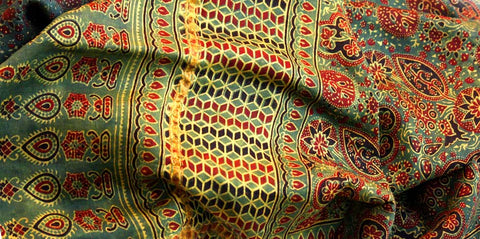
      <![CDATA[<p><font color="#999999">Each village in Rajasthan boasts of the Chhipa caste engaging in block printing- be it mud resist or discharge or wax resist process. This stable tradition is still very much in fashion, despite the accessibility of modern techniques like screen-printing. The Chhipas hand over their craft skills down the generations, from parent to child, the expertise remains within the family.</font></p>
<p style="text-align: center;"><font color="#999999" style="text-align: center;"><img src="//cdn.shopify.com/s/files/1/0163/4952/files/fabric_collection_large.jpg?14346" alt="" style="" /><i>&nbsp;</i></font></p>
<p><i><font color="#999999">Image Courtesy http://www.rikshawdesign.com</font></i></p>

<p><font color="#999999">The beauty of the block print is heavily reliant on water sources; thus the commercial activities sprung near water resources- like Sanganer, Bagru, Akola, Barmer, Jodhpur, etc.</font></p>
<p><font color="#999999">Over time, each centre for block printing in Rajasthan has developed its distinguished design style and techniques.</font></p>
<p><font color="#999999">&nbsp;</font></p>
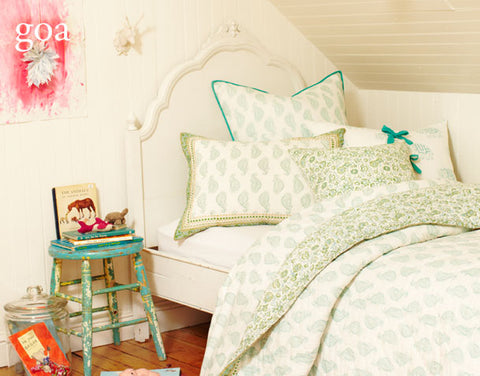
<p style="text-align: center;"><font color="#999999" style="text-align: center;"><img src="//cdn.shopify.com/s/files/1/0163/4952/files/goa_collection_large.jpg?14346" alt="" style="" /></font></p>
<p><i><font color="#999999">Goa collection from http://www.rikshawdesign.com</font></i></p>

<p><font color="#999999">Sober, low toned colors and delicate lines, creating finer designs like the poppy, rose and lotus, usually against a white background, are well known characteristic of fabrics that are printed at Sanganer. While the motifs are conventionally big and bold in Bagru, with the dabu (resist-printing) and the dyeing process producing a reddish black shade- with wild flowers, buds and foliage providing inspiration to the printers of Bagru. In Jaisalmer, the printers use wax resists and create a dramatic wedding odhna called jajar bhat in red and black.</font></p>
<p><font color="#999999">&nbsp;</font></p>
<p><strong><font color="#999999">Sanganer</font></strong></p>
<p><font color="#999999">The village of Sanganer near Jaipur has been a major centre for very fine block-cutting and printing. Almost 500 years' old, Sanganeri printing gained high popularity in the 16th and 17th centuries in all European countries with its Calico prints and became one of the major exports of the East India Company.</font></p>
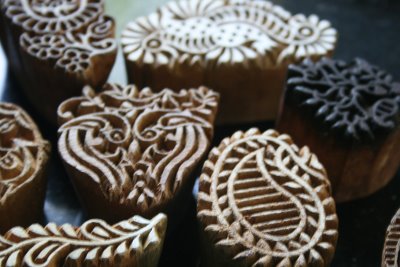
<p style="text-align: center;"><font color="#999999"><img src="//cdn.shopify.com/s/files/1/0163/4952/files/450px-Textildruckmodel_-_Indien_um_1900.jpg?14348" /></font></p>
<p><i><font color="#999999">Woodblock for textile printing, India, about 1900, 22 x 17 x 8 cm http://Wikipedia.com</font></i></p>

<p><font color="#999999">&nbsp;Legend has it that it was probably towards the end of the 17th century that this art form developed here. Thanks to the constant wars with the Mughals and Marathas, many printers migrated from Gujarat to Rajasthan. Under the royal patronage, by the end of the 18th century this industry was fully developed in Sanganer.</font></p>

<p><font color="#999999">&nbsp;The United Nations Industrial Development Organisation (UNIDO) in its report on the Jaipur hand block printed textile cluster, has mentioned, "Shades of black come out best after washing the cloth in the waters of Sanganer. Sanganer motifs are mostly floral based. Fine lines and intricate detailing are specialties of the Sanganeri style."</font></p>
<p style="text-align: center;"><font color="#999999"><img src="//cdn.shopify.com/s/files/1/0163/4952/files/18741.jpeg?14354" /><br />
</font></p>

<p style="text-align: center;"><font color="#999999"></font></p>

<p><font color="#999999">&nbsp;Dyeing of Sanganeri Printed Cloth is by use of natural colors (vegetable colors) as such, the finished cloth often emits very pleasant odour. Sanganer is famous for its Calico printed bed covers, quilts and saris. In Calico printing, the outlines are first printed, and then the color is filled in. Bold patterns and colors are popular. They are printed repeatedly in diagonal rows. Doo Rookhi printing is also famous here. In this technique, artists print on both sides of the cloth. Sanganeri prints are famous for their delicate floral sprigs.</font></p>

<p><font color="#999999">&nbsp;This Tehsil of population 5,73,171 is one of the most prosperous amongst twelve Tehsils of Jaipur District. Sanganer town is well known world over due to its colourful block printed textiles and hand made paper. It is also in the excursion route for tourist. At present more than 315 Micro, Small and Medium size Sanganeri Printing units are operating at Sanganer. Total numbers of artisans vary between 1800 to 3000. More than 1200 families are directly dependent on these units. In addition, more than 3000 persons are indirectly involved in the business of Sanganeri Prints by providing supporting services like supply of raw materials, sale of finished products, production of blocks, designing of prints, garment making, packaging transportation and handling of exports. It is estimated that 25% population of Sanganer is directly or indirectly dependent on Sanganeri Print Industries for their livelihood.</font></p>
<p><font color="#999999">The dyers and block makers came from Sindh and Punjab and settled here. The Chhipas, all Hindus, are followers of the renowned Marathi Saint Namdev. Almost every member of the ‘Chhipa’ family is involved in the washing, dyeing and printing of clothes. While, the printers are predominantly Hindus, majority of dyers and block makers are Muslims.</font></p>

<p><font color="#999999">&nbsp;Water of the Saraswati River that used to flow graciously through Sanganer, was known for its special quality that used to bring out radiance from the natural dyed fabric.</font></p>

<p><font color="#999999">&nbsp;<strong>Products</strong></font></p>
<p><font color="#999999">The principal items printed here include sarees, dupattas, salwar-kameez, bed cover, curtains, scarves, and printed yardages (running cloth material), etc. Both local and imported cloth material are used. At present,’ mulmul’ (cotton voile), ‘latha’ (sheeting fabrics) and cambric etc. are sourced from Jaipur.</font></p>

<p><font color="#999999">&nbsp;<strong>Motifs</strong></font></p>
<p><font color="#999999">This elaborate work needs expertly cut mirror images blocks to print the usually asymmetrical Mughal style designs. Although Sanganer is well known for producing fine block printed textiles on off white or pastel backgrounds, today a wide range of textiles are produced with both dark and pale grounds.</font></p>
<p style="text-align: center;"><font color="#999999">&nbsp;<img src="//cdn.shopify.com/s/files/1/0163/4952/files/IMG_3649.JPG?14352" /></font></p>
<p style="text-align: center;"><font color="#999999"></font></p>

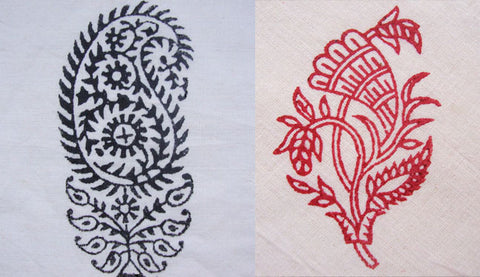
<p><font color="#999999">&nbsp;A strong Mughal aesthetic dominates the region's printed sari designs. Borders and end pieces consist of repeated bands of undulated twines (bel) of various sizes. Fields are often covered with a repeat design varying from small simple dots or geometric shape to large complex buta and kalga.</font></p>

<p><font color="#999999">&nbsp;Usually, a motif that is a blend of flower, bud and leaves or other forms such as keri (mango), pan (betel leaf), katar (dagger) or jhumka (ear-ring) is created. Interestingly, never was an animal used on these fabrics meant for costumes. Patronized by royalty, exclusive and fine printing in subdued colors, are a characteristic of the Sanganeri Print.</font></p>
<p><font color="#999999">&nbsp;</font></p>
<p style="text-align: center;"><font color="#999999" style="text-align: center;"><img src="//cdn.shopify.com/s/files/1/0163/4952/files/sanganer_blockprint6_large.jpg?14356" alt="" style="" /></font></p>
<p><font color="#999999">&nbsp;</font></p>
<p><font color="#999999">The Sanganeri Print is visible from small flower motifs like stylized sunflowers, narcissuses, roses, and other flowers of luxuriant foliage like daturas, rudrakshas, and arkas. On Sanganeri ‘chintz’ (printed cloth) usually, yellow, green blue (with different tones) are used as the background.</font></p>
<p><font color="#999999">Various floral designs, geometrical and God figures are included in its prints. Sometimes, folk designs are also found. Finesse in flowers-petal designs, curves and delicacy are the prime specialties of Sanganer prints.</font></p>
<p><font color="#999999">&nbsp;</font></p>
<p style="text-align: center;"><font color="#999999" style="text-align: center;"><img src="//cdn.shopify.com/s/files/1/0163/4952/files/sanganer-handblock-printing_large.jpg?14360" alt="" style="" /></font></p>
<p><font color="#999999">&nbsp;</font></p>
<p><font color="#999999">The curvature of flowers in the ’bootas’ is generally shown on the right side. Different types of flowers and plants are displayed in the form of ‘bel’ (a border) and ‘boota’ very naturally and in a really attractive manner. Some of the flowers used in the prints are roses, rosettes, lotuses, lotus bud, sunflower, lily, ‘champa’ ‘canna’ ‘nargis’, marigold etc.</font></p>

<p><font color="#999999">Various other flower creations are also found in old Sanganeri prints. Other flowers used are locally known as ‘sosan’, ‘gainda’, ‘gulmehendi’, ‘javakusum’, ‘guldaudi’, ‘kachnar’, ‘jatadari lily’, ‘kaner’, ‘kanna’, ‘gullalla’, etc.</font></p>

<p style="text-align: center;"><font color="#999999" style="text-align: center;"><img src="//cdn.shopify.com/s/files/1/0163/4952/files/lot_of_three_block_printed_sanganeri_bedspreads_kz06_large.jpg?14358" alt="" style="" /></font></p>

<p><font color="#999999">&nbsp;Apart from flowers, fruit trees of banana, dates, grapes pomegranate etc. have also been recreated in a very attractive manner. In some old prints figures of parrots and fish are also seen. In the traditional Sanganeri prints, the ground is in white or pastel shades with floral cones and sprays scattered with in symmetrical borders. Cloth printing blocks are usually made of 'teak' or 'seesum'. These dyes are printed on a textile by means of a relief covered block( a different block for each color). In India, the blocks are usually 23-30 cm (9-12") square in size.</font></p>

<p><strong><font color="#999999">Present Situation</font></strong></p>
<p><font color="#999999">In earlier times, the royal family of Jaipur was the chief patron of the craft. After Independence, the craft almost died till it was revived in the 70s owing to the patronage of prominent exponents like Kamala Devi Chattopadhyay, the person behind the cottage industry movement, Prabha Shah, Laila Tyabji, Pupul Jayakar and Faith and John Singh of Anokhi.</font></p>
<p><font color="#999999">But faces still look grim. Faced with pollution charges and that too, only because of the screen printing industry, life is still dark.</font></p>
<p><font color="#999999">The good news is that, because of the persistent efforts, Under Geographical Indication of Goods Registration and Protection Act.1999,&nbsp;&nbsp; Sanganeri Hand Block Textiles and Furnishings have been recognized to have a unique identity in manufacturing and in belonging to the area of Sanganer. Consequently sale of hand block or screen printed product from any other area as Sanganeri will be punishable under the law, thereby giving a new e trade and some 1500 artisans and about 5000 families indirectly or directly dependent on block printing.</font></p>
]]>
    </content>
  </entry>
  <entry>
    <id>https://www.india1001.com/blogs/news/6380038-the-famous-chanderi-fabric</id>
    <published>2012-08-05T20:16:00+05:30</published>
    <updated>2016-12-15T09:51:10+05:30</updated>
    <link rel="alternate" type="text/html" href="https://www.india1001.com/blogs/news/6380038-the-famous-chanderi-fabric"/>
    <title>The Famous Chanderi Fabric</title>
    <author>
      <name>Ruchi Makhija</name>
    </author>
    <summary type="html">
      <![CDATA[<p><span style="color: #666666;" color="#666666"> </span><span style="color: #999999;" color="#999999">Chanderi, which is amongst the best known handloom clusters, occupies a special place because of its centuries old weaving specialty of producing finely textured fabrics of silk and cotton embellished with zari woven work, and more specifically because of its saris that have been patronized by royalty.</span></p><p><a class="read-more" href="https://www.india1001.com/blogs/news/6380038-the-famous-chanderi-fabric">More</a></p>]]>
    </summary>
    <content type="html">
      <![CDATA[<p><span style="color: #999999;" color="#999999"> Chanderi, which is amongst the best known handloom clusters, occupies a special place because of its centuries old weaving specialty of producing finely textured fabrics of silk and cotton embellished with zari woven work, and more specifically because of its saris that have been patronized by royalty. Chanderi is known to have its origin back in the Vedic Period, and is believed to have founded by Lord Krishna’s cousin, Shishupal. The Chanderi produces three kinds of fabrics: Pure Silk, Chanderi Cotton and Silk Cotton. The motifs have come a long way from the traditional coin, floral and peacocks to the geometrics. Chanderi Saree, a product intricately woven by hand interspersed with the delicacy of the extra weft motifs that has for times immemorial satisfied the refined tastes of the royalty.</span></p>
<div style="text-align: center;"><span style="color: #999999;" color="#999999"> <iframe marginheight="0" marginwidth="0" src="https://maps.google.co.in/maps?f=q&amp;source=s_q&amp;hl=en&amp;geocode=&amp;q=chanderi&amp;aq=&amp;sll=12.953997,77.63094&amp;sspn=1.112143,2.113495&amp;ie=UTF8&amp;hq=&amp;hnear=Chanderi,+Madhya+Pradesh&amp;t=m&amp;ll=24.706915,78.134766&amp;spn=6.983019,13.183594&amp;z=6&amp;iwloc=A&amp;output=embed" scrolling="no" height="350" frameborder="0" width="600"></iframe> </span></div>
<div style="text-align: center;"></div>
<div style="text-align: center;"><small><a href="https://maps.google.co.in/maps?f=q&amp;source=embed&amp;hl=en&amp;geocode=&amp;q=chanderi&amp;aq=&amp;sll=12.953997,77.63094&amp;sspn=1.112143,2.113495&amp;ie=UTF8&amp;hq=&amp;hnear=Chanderi,+Madhya+Pradesh&amp;t=m&amp;ll=24.706915,78.134766&amp;spn=6.983019,13.183594&amp;z=6&amp;iwloc=A" style="text-align: left;"><span style="color: #999999;" color="#999999">View Larger Map</span></a></small></div>
<div style="text-align: center;"><span style="color: #999999;" color="#999999"><br> </span></div>
<div><span style="color: #999999;" color="#999999">Situated between the hills of Vindhyachal in the state of Madhya Pradesh in the Ashok Nagar district, North of Madhya Pradesh (MP), evolution of Chanderi began in 1890’s when the weavers changed from handspun yarn to mill made yarn. In the year 1910, the royal family of Scindia brought the Chanderi saree under their patronage and during that period gold thread motif made its presence in the main body of the cotton muslin saree for the first time. It further led to the introduction of the silk yarn and over the years dobby and jacquard use came into existence. Keeping in view the changing demand scenario, in 1970’s, the cluster went forward to weave yet another variety of fabric which combined a silk warp with a cotton weft. Some of the various beautifully striking motifs include ‘Nalferma, ‘Dandidar, ‘Chatai’, ‘Jangla’, Mehndi wale haath’ etc. With around 3,500 looms in working condition, 18,000 people are directly or indirectly dependent on the industry for their living.</span></div>
<p style="text-align: center;"><span style="color: #999999;" color="#999999"> <img src="//cdn.shopify.com/s/files/1/0163/4952/files/chanderi-4-1024x682_grande.jpg?v=1481775390" alt="Chanderi Fort"></span></p>
<h6 style="text-align: center;"><span style="color: #999999;" color="#999999">Chanderi Town Seen from the Fort Image courtesy MP Tourism</span></h6>
<p><span style="color: #999999;" color="#999999">Today, blessed with a mix or traditional and modern techniques and deft skills of weavers honed by institutional supports, Chanderi stands out as excellence in every sense.</span></p>
<p><span style="color: #999999;" color="#999999"></span><span style="color: #999999;" color="#999999">The Chanderi fabrics are known for their sheer texture, light weight and a glossy transparency that sets them apart from textiles produced en masse in factories. Traditionally, the fabric was woven using very fine hand spun yarn, which accounted for its delicate texture. So its quality, designs colors and motifs would be appropriate to cater the demands of an elite class family.</span></p>
<p><span style="color: #999999;" color="#999999">Chanderi was always woven using handspun cotton warps and wefts. It was spun as fine as 300 counts, and was as prized amongst cotton fabrics as the famed muslins of Dhaka. However, the Industrial Revolution sounded the first death knell on this beautiful textile. The British imported cheaper 120 to 200 count cotton from Manchester, which greatly eroded the market for the more expensive Chanderi cloth.</span></p>
<p style="text-align: center;"><span style="color: #999999;" color="#999999"><img src="//cdn.shopify.com/s/files/1/0163/4952/files/DSC_2142_grande.JPG?v=1481775444" alt=""></span></p>
<p><span style="color: #999999;" color="#999999"> </span><span style="color: #999999;" color="#999999">In the 1930s, Chanderi weavers discovered Japanese silk. They began substituting this in the warps in cotton sarees, and also developed a silk-by-silk variety in which their profit margins were higher. As a result, today, it is difficult to find a genuine cotton-by-cotton Chanderi saree in retail establishments. The problem of sourcing authentic Chanderi has been exacerbated by the development of many look-alikes available at cheaper rates.</span></p>
<p><span style="color: #999999;" color="#999999"></span><strong><span style="color: #999999;" color="#999999">Chanderi Sarees</span></strong></p>
<p><span style="color: #999999;" color="#999999">Chanderi is a renowned centre for traditional weavers of sarees. The Chanderi sarees have unmatched sophistication and are popular among the Indian upper middle class saree wearers. The chanderi saree, woven of silk and cotton is a fairly recent product of the area and began being produced only in the second half of the twentieth century.</span></p>
<p><span style="color: #999999;" color="#999999"> <img src="//cdn.shopify.com/s/files/1/0163/4952/files/11_6cabfda1-4d21-4868-ad90-6f1365ee3554_grande.jpg?v=1481775246" alt="" style="display: block; margin-left: auto; margin-right: auto;"></span></p>
<p><span style="color: #999999;" color="#999999">Buttis / Butta "Motifs”:</span></p>
<p><span style="color: #999999;" color="#999999">Since the inception of the Chanderi fabric and primarily ladies Sarees, the buttis on the Fabric are hand-woven on Handloom. There is no use of any other process of manufacturing and it is Gold coated, Silver coated and as well as Copper coated. Now a days Tested Zari Butti are also common and in use. The Tested Zari is made with the use of Synthetic yarn. The Buttis are made by use of Needles. Number of Needles used depends upon the number of Buttis and its size. For each Butti/Butta separate Needles are used. All the weavers involved in this process are experts in it since they have been doing this for long. time. The most popular and traditional kind of Butti is Asharfi Butti, which is in shape of Asharfi (woven in pure gold and silver Zari and now a day it is also woven in Tested Zari). This kind of Butti was in use in past only by the Royal families because it is very expensive as genuine Gold and Silver is used. The Butti which is big is size is popularly called as Butta with all other specifications.</span></p>
<p style="text-align: center;"><span style="color: #999999;" color="#999999"> <img src="//cdn.shopify.com/s/files/1/0163/4952/files/chanderi_grande.jpg?v=1481775569" alt=""></span></p>
<p><span style="color: #999999;" color="#999999">The weavers involved in this process are long standing in trade and are well experienced. The Govt. from time to time also spends money and conduct workshops to train and educate them about the latest design and its quality control. The handmade Buttis are permanent in its nature and existence as well, interlaced and its original shape and structure always remain the same even after its long use. Whereas in comparison the Buttis created with the use of Power loom are not permanent and losses its shape and structure after some time. The thread used at Chanderi is of fine quality and even after long use its thread never comes out and its original shape and appearance is retained forever. It has no comparison anywhere else in the country or for that reasons in whole of the world.</span></p>
<p><span style="color: #999999;" color="#999999"></span><span style="color: #999999;" color="#999999">It is easily distinguishable from the Buttis made outside Chanderi even with naked eye because of the process of manufacture and this itself is requisite ingredient for legal protection and for exclusive recognition.</span></p>
<p><span style="color: #999999;" color="#999999"></span><strong><span style="color: #999999;" color="#999999">Transparency</span></strong></p>
<p><span style="color: #999999;" color="#999999">The Chanderi Fabric is also well known for its transparency and sheer texture. The transparency is a unique feature, which is not commonly or found in any of the textile products all over the country. The transparency in Chanderi Fabric products is the consequence of Single Flature quality of yarn used. Flature yarn is the quality of yarn when the Glue of the raw yarn is not taken out. The none - degumming of the raw yearn gives shine and transparency to the finished fabric. This quality is not found in any other Fabric of the country and it is exclusive to the Chandari Fabric. The special transparent yarn is used both in warp and weft of different varieties and configurations. The transparent yarn is cotton and as well as silk also.</span></p>
<p><span style="color: #999999;" color="#999999"><img src="//cdn.shopify.com/s/files/1/0163/4952/files/4b_a40e91f3-3410-4768-bc08-73b68c9a028c_grande.jpg?v=1481775319" alt="" style="display: block; margin-left: auto; margin-right: auto;"></span></p>
<p><span style="color: #999999;" color="#999999">The silk yarn used of 20/21s, 2/100's and 16/18 denier. The term Denier connotes the fineness of yarn. The cotton uses in Chanderi Fabric is 2/120's, 2/100's (plain yarn) and 2/120 and 2/100 mercerized yarns. The yarn used in Chanderi fabric is of high quality and extra fine. Because of non-degumining of the raw yarn, the finished fabric produced is extremely transparent and which in consequence result into sheer texture.</span></p>
<p><span style="color: #999999;" color="#999999"></span><span style="color: #999999;" color="#999999">This quality of the Chanderi Fabric is in existence since Moghul times and found mention if the Govt. gazetteer and various other history books written on Chanderi. This type of Fabric produced is family business in Chanderi and all the family members are involved in this process irrespective of caste and creed.</span></p>
<p><span style="color: #999999;" color="#999999"></span><strong><span style="color: #999999;" color="#999999">Geographic Indication status for Chanderi Sarees:</span></strong></p>
<p><span style="color: #999999;" color="#999999">The production of Chanderi has been protected by India as a Geographic Indication (GI). This is a sign used on products with a specific geographical origin, which have certain qualities because of the place they have originated from. As a WTO member country, India passed the Geographical Indications of Goods (Registration and protection) Act in 1999, which enables the registration and better protection of GIs relating to products. India has petitioned the World Trade Organization for the recognition of Chanderi as a GI product at the international level as well</span></p>
<div><i><span style="color: #999999;" color="#999999">References and Extracts</span></i></div>
<div><span style="color: #999999;" color="#999999">http://en.wikipedia.org/wiki/Chanderi</span></div>
<div><span style="color: #999999;" color="#999999">http://sutracrafts.in</span></div>
<div><span style="color: #999999;" color="#999999">http://www.chanderigi.com</span></div>
<span style="color: #274e13;" color="#274e13"><br> </span>]]>
    </content>
  </entry>
  <entry>
    <id>https://www.india1001.com/blogs/news/6309954-the-famous-grass-mats-of-pattamadai</id>
    <published>2012-07-22T00:39:55+05:30</published>
    <updated>2017-01-05T13:23:09+05:30</updated>
    <link rel="alternate" type="text/html" href="https://www.india1001.com/blogs/news/6309954-the-famous-grass-mats-of-pattamadai"/>
    <title>The Famous Grass Mats of Pattamadai</title>
    <author>
      <name>Ruchi Makhija</name>
    </author>
    <summary type="html">
      <![CDATA[<p><font color="#999999"> Pattamadai is the neighbour village to Cheranmahadevi, ranges about 3 Kilometers from Cheranmahadevi and 20 Kilometers from Tirunelveli in Tamilnadu ..India. Patamadai resides along the banks of the river Tamaraparani. It is world famous for its silken mats woven from grass.</font></p>
<p><a class="read-more" href="https://www.india1001.com/blogs/news/6309954-the-famous-grass-mats-of-pattamadai">More</a></p>]]>
    </summary>
    <content type="html">
      <![CDATA[<p><font color="#999999"> Silk mat / Pattu paai / Pattamadai Pai (mat) is a beautifully crafted floor mat.Every tamil family would be familiar with the pattu paai and may have had one at home.</font></p>
<p><font color="#999999"><span>Pattamadai is the neighbour village to Cheranmahadevi, ranges about 3 Kilometers from Cheranmahadevi and 20 Kilometers from <span>Tirunelveli in Tamilnadu ..India</span>. Patamadai resides along the banks of the river Tamaraparani. It is world famous for its silken mats woven from grass.</span><br>
</font></p>
<p><span><font color="#999999"><span><b><i>About The Mats (Pai) :</i></b></span><span> </span></font></span></p>
<p><span><font color="#999999"><span>The majority of mats made in here have cotton warps and korai wefts. Korai belongs to the sedge family of plants, Cyperaceae. Korai mats may be broadly divided into three categories. Coarse mats are rough in texture, relatively quick to weave and may be made using either a handloom or powerloom. Higher quality handloom mats are finer in texture. The highest quality have a texture akin to silk. To make such mats the korai is soaked in running water for up to a week until it begins to rot, the central pith is then scraped off and each stem split into fine strands, dried and dyed. The finer the mat desired, the longer the korai needs to soak and the thinner the weft strands will be. The number of warp threads also increases with finer mats.</span><br>
</font></span></p>
<div><font color="#999999">
Apart from the regular weaves and patterns, Pattamadai paais are made to order for wedding ceremonies. The bride and the groom's names and the wedding date are woven in to the mat make the occasion memorable. This particular handicraft is original to Pattamaadai, a small village in Thirunelveli district of Tamil Naadu, and hence its name. It is also called Korai or Gorai paai as it is made of a special kind of grass called "Korai/Gorai".<br>
</font></div>
<div><font color="#999999"><br>
</font></div>
<div>
  <div><font color="#999999"><i><b>The Weaving :</b></i><br>
  </font></div>
  <div><font color="#999999"><br>
  </font></div>
  <div style="text-align: center;"><font color="#999999">The process of mat weaving is time consuming and painstaking. The art and craft of weaving and blending intricate designs of Pattamadai mats are considered unique to this region. "Korai' grass grows in swampy lands and riverbeds.</font></div>
  <div style="text-align: center;"><font color="#999999"><br>
  </font></div>
  <div style="text-align: center;"><font color="#999999">
    <iframe width="700" height="525" src="//www.youtube.com/embed/Zaa7M0uMpXk" frameborder="0" allowfullscreen=""></iframe>
  <br>
  </font></div>
  <div>
    <div><i><b><font color="#999999">Processing the Korai grass :</font></b></i></div>
    <div><font color="#999999"><b><i><br>
    </i></b>Conventional method of mat making involves lengthy processes of drying, soaking, splitting and dyeing the grass. The harvest season fall during the months of September/ October and February/March . The grass  is cut while it is still green. Strips of grass are sun-dried and are not to exposed to humidity as they tend to turn black with the exposure. As the dried grass strips turn a yellowish green, they are boiled in a pot of water and then dried again. Bundles of  dried grass are then soaked in running water and kept below the surface of the water for three to seven days. This process makes the grass to swell up to three times its original size. After it is then dried again and then taken to a floor loom.  Finally a woven mat is dried in the sun for a short time before being polished.<br>
    <br>
    There are three different categories of the silk mat available in the market and the classification depends on the weave: <i>Coarse weave, medium and the fine weave</i>. The outer skins of the grass is stripped to bring out the fine strand from within for weaving the finer variety.<br>
    </font></div>
    <div><font color="#999999"><br>
    </font></div>
    <div><font color="#999999">The loom which consists of a warp supported by the <i>mukali</i> <i>(means a tripod - in tamil )</i>(a bamboo tripod). The weft of korai strands is inserted in the needle and made to pass over and under the warp of starched cotton threads according to the design, very similar to the process of weaving fabric. Water is used to soften the grass throughout the process.<br>
    <br>
    In the picture below, you can see the supportive mukali and the mat (a work-in-progress) on the floor.<br>
    </font></div>
    <div><font color="#999999"><br>
    </font></div>
    <div style="text-align: center;"><font color="#999999"><img src="//cdn.shopify.com/s/files/1/0163/4952/files/strawruglum.jpg.w300h225.jpg?1438"><br>
    </font></div>
    <div>
<font color="#999999"><a href="http://www.sadashivan.com/sitebuildercontent/sitebuilderpictures/.pond/strawruglum.jpg.w300h225.jpg" imageanchor="1"></a><br>
    </font>
      <div style="text-align: center;"><a href="http://www.flickr.com/photos/10792142@N05/1407502166/" title="IMGP1453 by ropeindia, on Flickr"><font color="#999999"><img src="//farm2.staticflickr.com/1223/1407502166_87e8d518e9.jpg" width="360" height="480" alt="IMGP1453"></font></a></div>
    </div>
    <div>
      <div><font color="#999999"><i><b>Motifs and patterns :</b></i><br>
      </font></div>
      <div><font color="#999999"><br>
      </font></div>
      <div><font color="#999999">Traditional colours include rich "Indian" colours : black , brown and red as these are the colours derived from sappan tree.  Dyed grass strands are woven into bold stripe patterns with a thick set of streaks on both ends to make conventional looking mats. Beautiful traditional motifs and designs bring out the luxurious look of these mats. I prefer the natural scent of these mats to the stinky plastic odor any day!<br>
      </font></div>
      <div><font color="#999999"><br>
      </font></div>
      <div><font color="#999999">Over the years, traditional designs are giving way to contemporary patterns, designs and custom motifs.Traditional colours have been replaced by use of synthetic dyes which provide a wider colour choice (<i>I am in favour of natural dyes)</i>.These paais are ideal for hot and humid climates and most importantly are eco-friendly (with natural dyes),</font></div>
      <div><font color="#999999"><br>
      </font></div>
      <div style="text-align: center;"><font color="#999999"><img src="//cdn.shopify.com/s/files/1/0163/4952/files/983725605_29906a2308_z_large.jpg?1440"><br>
      </font></div>
    </div>
    <div><font color="#999999"><br>
    </font></div>
    <div><font color="#999999">Traditionally, woven on hand-looms, these mats are now mass produced on power looms to meet domestic and international demand.These beautiful mats are weaved using cotton or silk in the weft. Predominant use of silk (pattu) thread for weaving gave it its other name - Silk mat or pattu paai. Use of silk thread gives a royal sheen and definite appeal to the mat. Look at the beautiful custom silk border in this mat !</font></div>
    <div style="text-align: center;"><font color="#999999"><img src="//cdn.shopify.com/s/files/1/0163/4952/files/korai-silk-mat-blue-andrew.jpg?1442"><br>
    </font></div>
  <font color="#999999"><br>
  </font>
</div>
  <div><font color="#999999"><i><b>Industry Overview :</b></i><br>
  </font></div>
  <div><font color="#999999"><br>
  </font></div>
  <div><font color="#999999">The mat industry has gone through a cycle of transition from being most coveted to the most ignored and then back in demand. Efforts by a few organizations to promote this handicraft led to an influx of commercial interests. This cycle doesn't benefit any craft/art form, and the same applies to the Pattamadai mats industry as well.<br>
  </font></div>
  <div><font color="#999999"><br>
  </font></div>
  <div><font color="#999999">Commercial weaving over the years have led to increased use of pure cotton and nylon threads instead of silk thread.<span>Increased domestic and international Demand and supply imbalance eventually led to increased use of synthetic dyes, shorter product life cycles, and lesser focus on long term benefits for the weaver and the industry as a whole.</span></font></div>
  <div><font color="#999999"><br>
  </font></div>
  <div><span><font color="#999999">
    <div>Off late, eco-conservationist organizations have taken interest in this matter and a few of these production houses are reverting back to traditional methods of dyeing and processing of the Korai grass. Efforts are being made by organizations in promoting use of natural dyes and motivating weavers.</div>
  </font></span></div>
  <div><font color="#999999"><br>
  </font></div>
</div>
<div><font color="#999999"><i><b>You have a Choice :</b></i><br>
</font></div>
<div><font color="#999999"><br>
</font></div>
<div><span><font color="#999999">Life is all about making right choices. One as simple as buying your yoga mat can make a difference on your carbon footprint. Do you know that a standard mat sold as being suitable for yoga is made of soft PVC (Poly Vinyl Chloride) a non earth friendly non bio degradable material. You must have noticed a strange stinky odour emanating out of a plastic mat, slipper or a bag for that matter. Imagine all the fumes this mat may be releasing into the air and its impact on air quality with in your house.Why live that way when you can make smart eco-friendly choices?</font></span></div>
<div>
  <div style="text-align: center;"><font color="#999999"><img src="//cdn.shopify.com/s/files/1/0163/4952/files/983725571_a0043a40f8_large.jpg?1444"></font></div>

<font color="#999999"><br>
<span>Yogis and Sages in India were known to have used straw mats for meditation. In fact, using a </span><a href="http://www.ramanuja.org/sv/bhakti/archives/jun95/0032.html">Dharba</a><span> grass mat is considered auspicious in hindu homes. With major changes in lifestyle and the increased need for a cushy support for our bottoms, yoga mats have become a must have. Off late, people seem to "need"  Yoga pants and  yoga mat for their sessions. Kudos to all the ad gurus!</span><br>
<br>
<span>Keeping in tune with the current trend, the best we could do is to make earth friendly choices. Opt for a grass, straw, Palmyra leaf, cane, sea grass or a banana fiber mat. Buying these you would not only make a green choice, you would also be promoting local handicrafts depending on where you live. Because, every culture has something to which is local to that region. For example, we have at least 20 different grass or straw mat varieties available in India alone.</span></font>
</div>
<div><span><font color="#999999"><br>
</font></span></div>
<div><span><i><font color="#999999">References and Extracts</font></i></span></div>
<div>
  <h5><span><a href="http://adesignenthusiast.blogspot.in/2009/10/silk-floor-mats-from-thirunalveli_30.html"><font color="#999999">http://adesignenthusiast.blogspot.in/2009/10/silk-floor-mats-from-thirunalveli_30.html</font></a></span></h5>
  <h5><a href="http://www.flickr.com/photos/10792142@N05/page6/"><font color="#999999">http://www.flickr.com/photos/10792142@N05/page6/</font></a></h5>
  <h5><a href="http://sudhasrinath.blogspot.in/2009/11/river-grass-mats-for-your-yoga-sessions.html"><font color="#999999">http://sudhasrinath.blogspot.in/2009/11/river-grass-mats-for-your-yoga-sessions.html</font></a></h5>
  <h5><a href="http://www.cheranmahadevi.com/2010/03/pattamadai.html"><font color="#999999">http://www.cheranmahadevi.com/2010/03/pattamadai.html</font></a></h5>
  <h5><font color="#999999"><a href="http://members.tripod.com/sadashivan_nair/handmaderugscarpetsprocess/id19.html">http://members.tripod.com/sadashivan_nair/handmaderugscarpetsprocess/id19.html</a><br>
  </font></h5>
<span><font color="#999999"><br>
</font>

</span><br>
</div>
]]>
    </content>
  </entry>
</feed>