<?xml version="1.0" encoding="UTF-8"?>
<feed xmlns="https://www.w3.org/2005/Atom">
    <title>IPFM Blog</title>
    <link rel="alternate" type="text/html" href="https://fissilematerials.org/blog/" />
    <link rel="self" type="application/atom+xml" href="https://fissilematerials.org/blog/atom.xml" />
    <id>tag:fissilematerials.org,2016-07-28:/blog//3</id>
    <updated>2025-03-07T15:26:26Z</updated>
    
    <generator uri="https://www.sixapart.com/movabletype/">Movable Type Pro 6.3.6</generator>

<entry>
    <title>Civilian plutonium declarations for 2023</title>
    <link rel="alternate" type="text/html" href="https://fissilematerials.org/blog/2025/03/civilian_plutonium_declar.html" />
    <id>tag:fissilematerials.org,2025:/blog//3.1207</id>

    <published>2025-03-07T15:22:17Z</published>
    <updated>2025-03-07T15:26:26Z</updated>

    <summary>This post contains a summary of INFCIRC/549 reports by the countries that submit annual civilian plutonium declarations that reflect the status of civilian plutonium stocks as of 31 December 2023. The total amount of plutonium declared as civilian was about...</summary>
    <author>
        <name>Admin</name>
        
    </author>
    
        <category term="Civilian nuclear industry" scheme="https://www.sixapart.com/ns/types#category" />
    
        <category term="HEU minimization" scheme="https://www.sixapart.com/ns/types#category" />
    
        <category term="Spent fuel management" scheme="https://www.sixapart.com/ns/types#category" />
    
    <category term="belgium" label="Belgium" scheme="https://www.sixapart.com/ns/types#tag" />
    <category term="china" label="China" scheme="https://www.sixapart.com/ns/types#tag" />
    <category term="france" label="France" scheme="https://www.sixapart.com/ns/types#tag" />
    <category term="germany" label="Germany" scheme="https://www.sixapart.com/ns/types#tag" />
    <category term="heu" label="HEU" scheme="https://www.sixapart.com/ns/types#tag" />
    <category term="iaea" label="IAEA" scheme="https://www.sixapart.com/ns/types#tag" />
    <category term="infcirc549" label="INFCIRC/549" scheme="https://www.sixapart.com/ns/types#tag" />
    <category term="japan" label="Japan" scheme="https://www.sixapart.com/ns/types#tag" />
    <category term="reactorgradeplutonium" label="reactor-grade plutonium" scheme="https://www.sixapart.com/ns/types#tag" />
    <category term="researchreactors" label="research reactors" scheme="https://www.sixapart.com/ns/types#tag" />
    <category term="russia" label="Russia" scheme="https://www.sixapart.com/ns/types#tag" />
    <category term="switzerland" label="Switzerland" scheme="https://www.sixapart.com/ns/types#tag" />
    <category term="unitedkingdom" label="United Kingdom" scheme="https://www.sixapart.com/ns/types#tag" />
    <category term="unitedstates" label="United States" scheme="https://www.sixapart.com/ns/types#tag" />
    
    <content type="html" xml:lang="en-us" xml:base="https://fissilematerials.org/blog/">
        <![CDATA[<p>This post contains a summary of INFCIRC/549 reports by the countries that submit annual civilian plutonium declarations that reflect the status of civilian plutonium stocks as of 31 December 2023. The total amount of plutonium declared as civilian was about 374 tonnes, an increase of about 4 tonnes since <a href="https://fissilematerials.org/blog/2024/03/2022_civilian_plutonium_d.html">the end of 2022</a>. Only about 144 tons of this material are under international (IAEA or Euratom) safeguards. The other 230 tonnes are not safeguarded, but are covered by various obligations not to use the material for military purposes.</p>

<p>Japan (<a href="https://www.iaea.org/sites/default/files/publications/documents/infcircs/1998/infcirc549a1-27.pdf">INFCIRC/549/Add.1-27</a>) reported owning the total of 44.5 tons of plutonium, 8.7 tons of which is in Japan (the numbers in 2022 were 45.1 tons and 9.2 tons respectively). According to the <a href="https://www.aec.go.jp/bunya/04/plutonium/20240716_e.pdf">Status Report on Plutonium Management in Japan - 2023</a> released <a href="https://fissilematerials.org/blog/2024/07/status_of_plutonium_manag_7.html">in July 2024</a>, out of the 35.8 tons of plutonium abroad, 21.735 tons are in the United Kingdom and 14.097 tons are in France.</p>

<p>Germany (<a href="https://www.iaea.org/sites/default/files/publications/documents/infcircs/1998/infcirc549a2-27.pdf">INFCIRC/549/Add.2-27</a>) reported having no separated plutonium in the country for the fourth year in a row. Germany does not report separated plutonium outside of the country. It is believed to be less than 1 ton.</p>

<p>Belgium (<a href="https://www.iaea.org/sites/default/files/publications/documents/infcircs/1998/infcirc549a3-23.pdf">INFCIRC/549/Add.3-23</a>) declared no separated plutonium in storage or at reprocessing plants and "not zero, but less than 50 kg" of separated plutonium in other categories. It reported that it had no foreign plutonium as of 31 December 2023.</p>

<p>Switzerland (<a href="https://www.iaea.org/sites/default/files/publications/documents/infcircs/1998/infcirc549a4-28.pdf">INFCIRC/549/Add.4-28</a>) reported having less than 2 kg of plutonium in the country (in the "located elsewhere" category). The number has not changed since 2016 (it was "less than 50 kg" in 2015).</p>

<p>France (<a href="https://www.iaea.org/sites/default/files/publications/documents/infcircs/1998/infcirc549a5-28.pdf">INFCIRC/549/Add.5-28</a>) reported having 110.7 tons of separated unirradiated plutonium in its custody. Of this amount, 14.45 tons belongs to foreign countries (a small increase from 14.33 tonnes in 2022). Almost all that plutonium - 14,097 kg - belongs to Japan. The amount of plutonium owned by France is 96.25 tons, an increase of 4.38 tons from previous year (91.87 tons).</p>

<p>The United States has not submitted its 2023 report as of 7 March 2025. It is likely that the numbers have not changed since 2022 and as a temporary measure these numbers are used to calculate the totals.</p>

<p>China has not has not submitted its 2017-2023 reports as of 7 March 2025. The last INFCIRC/549 report submitted to the IAEA showed 40.9 kg of separated plutonium as of 31 December 2016.</p>

<p>The United Kingdom has not submitted its 2023 report to the IAEA as of 7 March 2025. However, it <a href="https://www.onr.org.uk/publications/regulatory-reports/safeguards/annual-civil-plutonium-figures/2023-annual-figures-for-holdings-of-civil-unirradiated-plutonium/">released</a> the information about civilian plutonium in the INFCIRC/549 format at the Office for Nuclear Regulation web site. According to these data, the United Kingdom owned 116.8 tons of separated plutonium, a small increase (or adjustment) from 116.4 in 2022. In addition to that, the United Kingdom stores 24.1 tons of foreign plutonium (of which 21.735 tons is owned by Japan and 1.58 tons by Italy).</p>

<p>Russia (<a href="https://www.iaea.org/sites/default/files/publications/documents/infcircs/1998/infcirc549a9-26.pdf">INFCIRC/549/Add.9-26</a>) reported owning 64.9 tons of civilian plutonium, a small increase of 0.4 ton from 2022.</p>

<p>In addition to reporting plutonium stocks, some countries also submit data on their civilian HEU:</p>

<p>Germany reported 0.39 tonnes of HEU in research reactor fuel (0.35 tonnes in 2022), 0.94 tonnes of HEU in irradiated research reactor fuel, and 0.01 tonnes in the category "HEU held elsewhere."</p>

<p>France declared 5369 kg of HEU (5312 kg in 2022), of which 3801 kg (3761 kg) is unirradiated material - 573 kg (506 kg) of HEU at fuel fabrication or reprocessing plants, 51 kg (78 kg) at civil reactor sites, 3177 kg (3177 kg) at various research facilities. Also declared are 1551 kg (1533 kg) of irradiated HEU - 40 kg (62 kg) at civil reactor sites and 1528 kg (1511 kg) in other locations.</p>

<p>The United Kingdom reported having 691 kg of HEU (734 kg in 2022). Of this amount, 499 kg is unirradiated HEU (554 in 2022): less than 1 kg of unirradiated HEU is stored at the enrichment plants, less than 1 kg is at civil reactor sites, 412 kg - at fuel fabrication facilities, and 87 kg - at other sites (440 kg and 114 kg respectively in 2022). Irradiated HEU is located at civil reactor sites (5 kg) and other sites (132 kg).</p>
]]>
        
    </content>
</entry>

<entry>
    <title>UK takes ownership of Italian separated plutonium</title>
    <link rel="alternate" type="text/html" href="https://fissilematerials.org/blog/2025/02/uk_takes_ownership_of_ita.html" />
    <id>tag:fissilematerials.org,2025:/blog//3.1206</id>

    <published>2025-02-26T11:08:06Z</published>
    <updated>2025-03-07T11:09:24Z</updated>

    <summary>The United Kingdom announced that the Nuclear Decommissioning Authority has taken ownership of &quot;approximately 1.58 tonnes of separated civil plutonium&quot; and &quot;of approximately 700 tonnes of reprocessed uranium&quot; that was previously owned by Italy. All this materials was already in...</summary>
    <author>
        <name>Admin</name>
        
    </author>
    
        <category term="Civilian nuclear industry" scheme="https://www.sixapart.com/ns/types#category" />
    
    <category term="italy" label="Italy" scheme="https://www.sixapart.com/ns/types#tag" />
    <category term="nucleardecommissioningauthority" label="Nuclear Decommissioning Authority" scheme="https://www.sixapart.com/ns/types#tag" />
    <category term="plutonium" label="plutonium" scheme="https://www.sixapart.com/ns/types#tag" />
    <category term="reactorgradeplutonium" label="reactor-grade plutonium" scheme="https://www.sixapart.com/ns/types#tag" />
    <category term="unitedkingdom" label="United Kingdom" scheme="https://www.sixapart.com/ns/types#tag" />
    <category term="uranium" label="uranium" scheme="https://www.sixapart.com/ns/types#tag" />
    
    <content type="html" xml:lang="en-us" xml:base="https://fissilematerials.org/blog/">
        <![CDATA[<p>The United Kingdom <a href="https://hansard.parliament.uk/Commons/2025-02-26/debates/25022636000009/ManagementOfItalianNuclearMaterialsInTheUK">announced</a> that the Nuclear Decommissioning Authority has taken ownership of "approximately 1.58 tonnes of separated civil plutonium" and "of approximately 700 tonnes of reprocessed uranium" that was previously owned by Italy. All this materials was already in the United Kingdom.</p>
]]>
        
    </content>
</entry>

<entry>
    <title>Small quantity of HEU to be exported to Japan</title>
    <link rel="alternate" type="text/html" href="https://fissilematerials.org/blog/2025/02/small_quantity_of_heu_to_.html" />
    <id>tag:fissilematerials.org,2025:/blog//3.1204</id>

    <published>2025-02-11T09:26:23Z</published>
    <updated>2025-03-07T09:27:25Z</updated>

    <summary>US Department of Energy filed a request with the Nuclear Regulatory Commission for the export license XSNM3847 to provide 100 g of 99% enriched HEU to Japan. The recipient is Japan Nuclear Fuel Limited (JNFL)....</summary>
    <author>
        <name>Admin</name>
        
    </author>
    
        <category term="HEU minimization" scheme="https://www.sixapart.com/ns/types#category" />
    
    <category term="heu" label="HEU" scheme="https://www.sixapart.com/ns/types#tag" />
    <category term="japan" label="Japan" scheme="https://www.sixapart.com/ns/types#tag" />
    <category term="japannuclearfuelltd" label="Japan Nuclear Fuel Ltd" scheme="https://www.sixapart.com/ns/types#tag" />
    <category term="unitedstates" label="United States" scheme="https://www.sixapart.com/ns/types#tag" />
    
    <content type="html" xml:lang="en-us" xml:base="https://fissilematerials.org/blog/">
        <![CDATA[<p>US Department of Energy filed a request with the Nuclear Regulatory Commission for the export license <a href="https://adamswebsearch2.nrc.gov/webSearch2/view?AccessionNumber=ML25042A426">XSNM3847</a> to provide 100 g of 99% enriched HEU to Japan. The recipient is Japan Nuclear Fuel Limited (JNFL).</p>
]]>
        
    </content>
</entry>

<entry>
    <title>United Kingdom plans to immobilize civilian plutonium </title>
    <link rel="alternate" type="text/html" href="https://fissilematerials.org/blog/2025/01/united_kingdom_plans_to_i.html" />
    <id>tag:fissilematerials.org,2025:/blog//3.1208</id>

    <published>2025-01-25T16:26:03Z</published>
    <updated>2025-03-09T15:25:53Z</updated>

    <summary>In a statement released by the UK government on 24 January 2025, the Department for Energy Security and Net Zero announced that it &quot;will work with the Nuclear Decommissioning Authority (NDA) to immobilise the UK-owned civil separated plutonium inventory at...</summary>
    <author>
        <name>Admin</name>
        
    </author>
    
        <category term="Civilian nuclear industry" scheme="https://www.sixapart.com/ns/types#category" />
    
        <category term="Spent fuel management" scheme="https://www.sixapart.com/ns/types#category" />
    
    <category term="nda" label="NDA" scheme="https://www.sixapart.com/ns/types#tag" />
    <category term="plutonium" label="plutonium" scheme="https://www.sixapart.com/ns/types#tag" />
    <category term="plutoniumdisposition" label="plutonium disposition" scheme="https://www.sixapart.com/ns/types#tag" />
    <category term="reactorgradeplutonium" label="reactor-grade plutonium" scheme="https://www.sixapart.com/ns/types#tag" />
    <category term="sellafield" label="Sellafield" scheme="https://www.sixapart.com/ns/types#tag" />
    <category term="unitedkingdom" label="United Kingdom" scheme="https://www.sixapart.com/ns/types#tag" />
    
    <content type="html" xml:lang="en-us" xml:base="https://fissilematerials.org/blog/">
        <![CDATA[<p>In a <a href="https://questions-statements.parliament.uk/written-statements/detail/2025-01-24/hcws388">statement</a> released by the UK government on 24 January 2025, the Department for Energy Security and Net Zero announced that it "will work with the Nuclear Decommissioning Authority (NDA) to immobilise the UK-owned civil separated plutonium inventory at Sellafield."</p>

<p>This announcement marked a shift in the UK approach to plutonium disposition. In 2011, the government made a preliminary decision to use the plutonium in MOX fuel, but also stated that it is open to other options. Immobilization was under consideration in 2015 (see the <a href="https://fissilematerials.org/blog/2015/06/plutonium_disposition_in_.html">IPFM post</a>), but no decision was made at the time.</p>

<p>As of the end of 2023, the United Kingdom had 140.9 tonnes of separated plutonium in its custody. Of this material, 24.1 tonnes belonged to other states, most of it - 21.735 tonnes - to Japan. The United Kingdom shut down the THORP plant that was reprocessing oxide-based fuel <a href="https://fissilematerials.org/blog/2018/11/sellafields_thorp_reproce.html">in 2018</a> and the Magnox plant <a href="https://fissilematerials.org/blog/2022/07/magnox_reprocessing_plant.html">in 2022</a>.</p>
]]>
        
    </content>
</entry>

<entry>
    <title>New EU regulations on Euratom safeguards</title>
    <link rel="alternate" type="text/html" href="https://fissilematerials.org/blog/2025/01/new_eu_regulations_on_eur.html" />
    <id>tag:fissilematerials.org,2025:/blog//3.1205</id>

    <published>2025-01-25T09:52:08Z</published>
    <updated>2025-03-07T09:55:22Z</updated>

    <summary>On 25 January 2025 the European Council approved a new version of Commission regulation on the application of Euratom safeguards. According to the EU, the changes will clarify and simplify the rules and also aligg the regulation &quot;with technological progress...</summary>
    <author>
        <name>Admin</name>
        
    </author>
    
        <category term="Civilian nuclear industry" scheme="https://www.sixapart.com/ns/types#category" />
    
    <category term="euratom" label="Euratom" scheme="https://www.sixapart.com/ns/types#tag" />
    <category term="europeanunion" label="European Union" scheme="https://www.sixapart.com/ns/types#tag" />
    <category term="safeguards" label="safeguards" scheme="https://www.sixapart.com/ns/types#tag" />
    
    <content type="html" xml:lang="en-us" xml:base="https://fissilematerials.org/blog/">
        <![CDATA[<p>On 25 January 2025 the European Council <a href="https://www.consilium.europa.eu/en/press/press-releases/2025/02/18/nuclear-materials-eu-updates-rules-for-a-better-supervisory-system/">approved</a> a new version of <a href="https://data.consilium.europa.eu/doc/document/ST-11949-2024-INIT/en/pdf">Commission regulation on the application of Euratom safeguards</a>.</p>

<p>According to the EU, the changes will clarify and simplify the rules and also aligg the regulation "with technological progress and developments in the nuclear sector."</p>
]]>
        
    </content>
</entry>

<entry>
    <title>NNSA to ask for risk assessment of weapons usability of High-Assay Low Enriched Uranium fuels</title>
    <link rel="alternate" type="text/html" href="https://fissilematerials.org/blog/2025/01/nnsa_to_ask_for_risk_asse.html" />
    <id>tag:fissilematerials.org,2025:/blog//3.1203</id>

    <published>2025-01-20T15:05:04Z</published>
    <updated>2025-01-21T07:48:50Z</updated>

    <summary>On 2 January 2025, NNSA Administrator Jill Hruby announced that the agency was &quot;finalizing plans&quot; to commission a National Academies report on proliferation risks of HALEU fuel. Hruby noted that &quot;reactor type, fuel enrichment level, fuel quantity, and fuel form...</summary>
    <author>
        <name>Admin</name>
        
    </author>
    
        <category term="HEU minimization" scheme="https://www.sixapart.com/ns/types#category" />
    
    <category term="haleu" label="HALEU" scheme="https://www.sixapart.com/ns/types#tag" />
    <category term="heu" label="HEU" scheme="https://www.sixapart.com/ns/types#tag" />
    <category term="nnsa" label="NNSA" scheme="https://www.sixapart.com/ns/types#tag" />
    <category term="unitedstates" label="United States" scheme="https://www.sixapart.com/ns/types#tag" />
    
    <content type="html" xml:lang="en-us" xml:base="https://fissilematerials.org/blog/">
        <![CDATA[<p>On 2 January 2025, NNSA Administrator Jill Hruby <a href="https://www.energy.gov/nnsa/articles/nnsa-administrator-jill-hruby-issues-statement-understanding-and-assessing-risks">announced</a> that the agency was "finalizing plans" to commission a National Academies report on proliferation risks of HALEU fuel. Hruby noted that "reactor type, fuel enrichment level, fuel quantity, and fuel form are important factors in evaluating proliferation risks." HALEU (high-assay low-enriched uranium) is uranium enriched to between 10 and 20 percent uranium-235 and is the fuel of choice in many proposed "small modular reactors," concepts, some of which plan to use HALEU to sustain their chain reactions. Current light-water power reactors use fuel with enrichments levels below 5 percent.  </p>

<p>Hruby's announcement stems from the article published in Science in June 2024 "<a href="https://www.science.org/doi/10.1126/science.ado8693">The weapons potential of high-assay low-enriched uranium</a>" by Scott Kemp, Ed Lyman, Mark Deinert, Richard Garwin, and IPFM co-founder Frank von Hippel. It suggests that HALEU enriched above about 12 percent uranium-235 could be used to make a practical weapon. Quantities ranging from several hundred kilograms to about 1000 kg of 19.75 percent HALEU could produce explosive yields similar to or greater than that of the 15 kilotons of the Hiroshima bomb.</p>

<p>The article argued that plans for the use of HALEU have not carefully considered the potential proliferation and terrorism risks that the wide adoption of this fuel creates. It called for an assessment of the practicality of making nuclear explosives with HALEU by experts at DOE's nuclear-weapon design laboratories. Given that DOE would be reviewing its own promotion of HALEU as a power-reactor fuel, they also recommended an independent review of the laboratories' conclusions. </p>

<p>With the change of Administration in the United State, whether Hruby's successor will be as open to considering this issue remains to be seen, but indications are that the National Academies study is expected to go forward.</p>

<p><strong>Enrichment and bombs</strong></p>

<p>When uranium is enriched to above about 6 percent uranium-235, it can sustain an explosive fast-neutron chain reaction such as occurred in the Hiroshima bomb. The technical and policy question is what is the minimum enrichment required to make a practical bomb.</p>

<p>This question arose in 1954 when, following President Eisenhower's "Atoms for Peace" speech at the United Nations, the U.S. began to export research reactors. Research reactors produce surplus neutrons for various purposes including the production of short-lived radioactive isotopes to trace biological molecules. The higher the enrichment, the more compact a core can be and the higher the neutron flux available in or adjacent to the core at a given power. The incentive, therefore, was to pick as high an enrichment as possible without spreading the bomb.</p>

<p>The U.S. Atomic Energy Commission had the matter analyzed and Lawrence Hafstad, its director of research development, <a href="https://scienceandglobalsecurity.org/archive/2016/05/on_the_origins_and_significanc.html">reported</a> back that:</p>

<blockquote>
  <p>Information from Los Alamos indicates that 10 percent enriched uranium is not suitable for any practical weapon... For higher concentrations [enrichment] it would be possible to prevent assembly of a weapon by restricting the total amount of material issued of any given assay. </p>
</blockquote>

<p>Hafstad recommended that fuel enriched to more than 20 percent not be exported but </p>

<blockquote>
  <p>enriched uranium of assay between 10 percent and 20 percent U<sup>235</sup> be regarded as not of weapons significance provided the total quantity held by any one country does not exceed that given by the formula, kg total U = 2/C<sup>1.7</sup>.</p>
</blockquote>

<p>Here, C is the enrichment. At an enrichment of 10 percent (C =0.1) the maximum amount of enriched uranium that could be exported to a single country would 100 kg and at 20 percent it would be 31 kg.</p>

<p>Initial U.S. exports under the Atoms for Peace Program complied with Hafstad's recommendation. The quantitative limit was abandoned later, however, and, for safeguarding purposes, "low-enriched uranium" enriched to less than 20 percent uranium-235 was <a href="https://www-pub.iaea.org/MTCD/Publications/PDF/PUB2003_web.pdf">defined</a> by the International Atomic Energy Agency as "indirect use material," requiring further enrichment to become weapons usable. </p>

<p>In addition, during the Cold War, the U.S. and Soviet Union, using the provision of research reactors as a tool for alliance building, ignored the 20 percent enrichment limit and exported research reactors fueled with "weapon-grade" uranium, i.e. uranium enriched to greater than 90 percent uranium-235, to about forty non-nuclear weapon states (see the IPFM report <a href="https://fissilematerials.org/library/rr15.pdf"><em>Banning the Production of Highly Enriched Uranium</em></a>). </p>

<p>Nuclear-weapon proliferation became an issue again, however, after India's first nuclear test in 1974. The 20 percent limit was revived for new reactor exports and, after the September 11, 2001 Al Qaeda attacks on the U.S., concerns about the possibility of nuclear terrorism incentivized the U.S. and Russia to launch a joint effort to convert the highly-enriched-uranium-fueled research reactors they had exported to 19.75 percent enriched uranium.</p>

<p>With the decline in the economic competitiveness of conventional nuclear power reactors, however, governments recently have been encouraging reactor designers to explore the possibilities of "small modular reactors," some of which - especially fast-neutron reactors - require HALEU. In 2024, the US Congress <a href="https://www.energy.gov/articles/biden-harris-administration-announces-four-contracts-boost-domestic-haleu-supply-and">provided</a> the Department of Energy $2.7 billion in the Inflation Reduction Act to fund the startup of HALEU production.</p>
]]>
        
    </content>
</entry>

<entry>
    <title>China starts construction of a third demonstration reprocessing plant</title>
    <link rel="alternate" type="text/html" href="https://fissilematerials.org/blog/2024/12/china_starts_construction_2.html" />
    <id>tag:fissilematerials.org,2024:/blog//3.1202</id>

    <published>2024-12-24T09:59:20Z</published>
    <updated>2024-12-24T22:34:54Z</updated>

    <summary>Hui Zhang Satellite images, along with commercial bidding and purchase documents and other accounts suggest that in 2023 China started construction of a third demonstration reprocessing plant at the same site as its first two 200 MT/year demonstration reprocessing plants,...</summary>
    <author>
        <name>Admin</name>
        
    </author>
    
        <category term="Civilian nuclear industry" scheme="https://www.sixapart.com/ns/types#category" />
    
        <category term="Reprocessing" scheme="https://www.sixapart.com/ns/types#category" />
    
        <category term="Spent fuel management" scheme="https://www.sixapart.com/ns/types#category" />
    
    <category term="china" label="China" scheme="https://www.sixapart.com/ns/types#tag" />
    <category term="cnnc" label="CNNC" scheme="https://www.sixapart.com/ns/types#tag" />
    <category term="cnpe" label="CNPE" scheme="https://www.sixapart.com/ns/types#tag" />
    <category term="jinta" label="Jinta" scheme="https://www.sixapart.com/ns/types#tag" />
    <category term="mox" label="MOX" scheme="https://www.sixapart.com/ns/types#tag" />
    <category term="reprocessing" label="reprocessing" scheme="https://www.sixapart.com/ns/types#tag" />
    
    <content type="html" xml:lang="en-us" xml:base="https://fissilematerials.org/blog/">
        <![CDATA[<p><em>Hui Zhang</em></p>

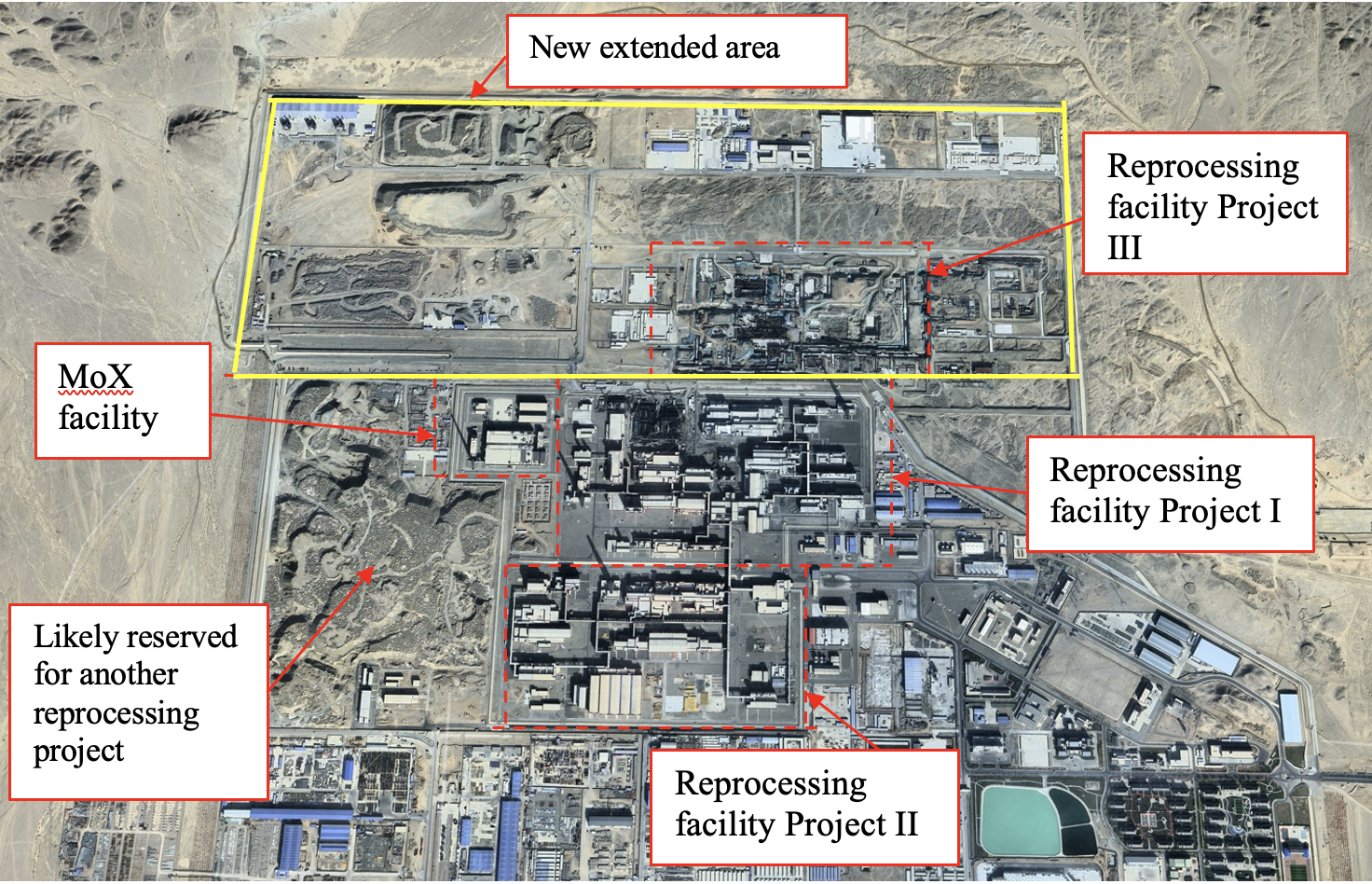
<p>Satellite images, along with commercial bidding and purchase documents and other accounts suggest that in 2023 China started construction of a third demonstration reprocessing plant at the same site as its <a href="https://fissilematerials.org/blog/2021/03/china_starts_construction.html">first two 200 MT/year demonstration reprocessing plants</a>, the CNNC Gansu Nuclear Technology Industrial Park in Jinta, Gansu province.</p>

<p><a href="https://fissilematerials.org/blog/20241224-Jinta-1.png"><img alt="20241224-Jinta-1.png" src="https://fissilematerials.org/blog/assets_c/2024/12/20241224-Jinta-1-thumb-720xauto-188.png" width="720" height="464" class="mt-image-center" style="text-align: center; display: block; margin: 0 auto 20px;" /></a><strong>Figure 1.</strong> The demonstration reprocessing and MOX facilities at Jinta, Gansu. Satellite image from November 11, 2024 (Coordinates: <a href="https://goo.gl/maps/JUtLpuCgzWTYPSY86">40.333750, 98.494167</a>). Credit: Google Earth, Airbus. </p>

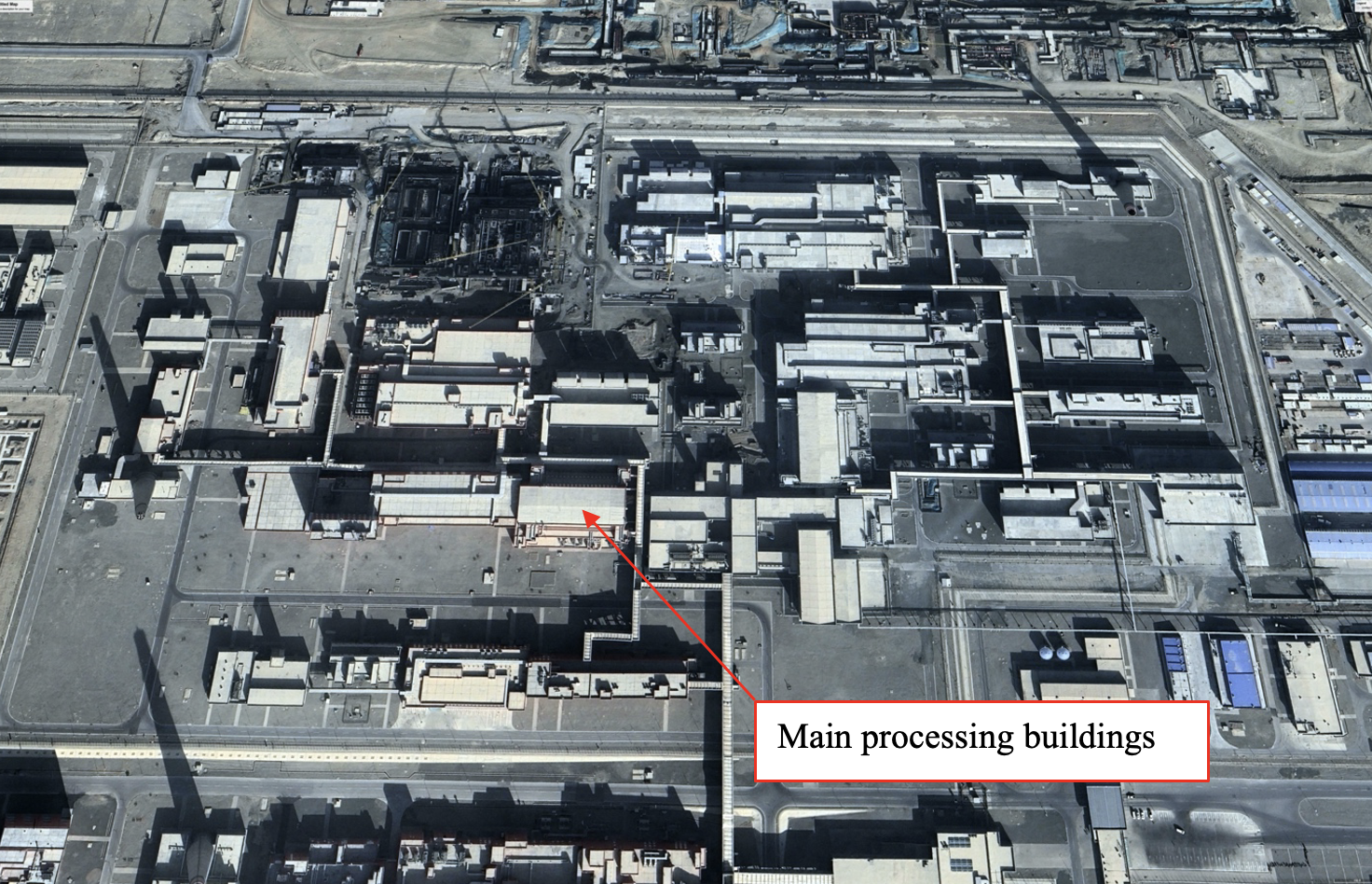
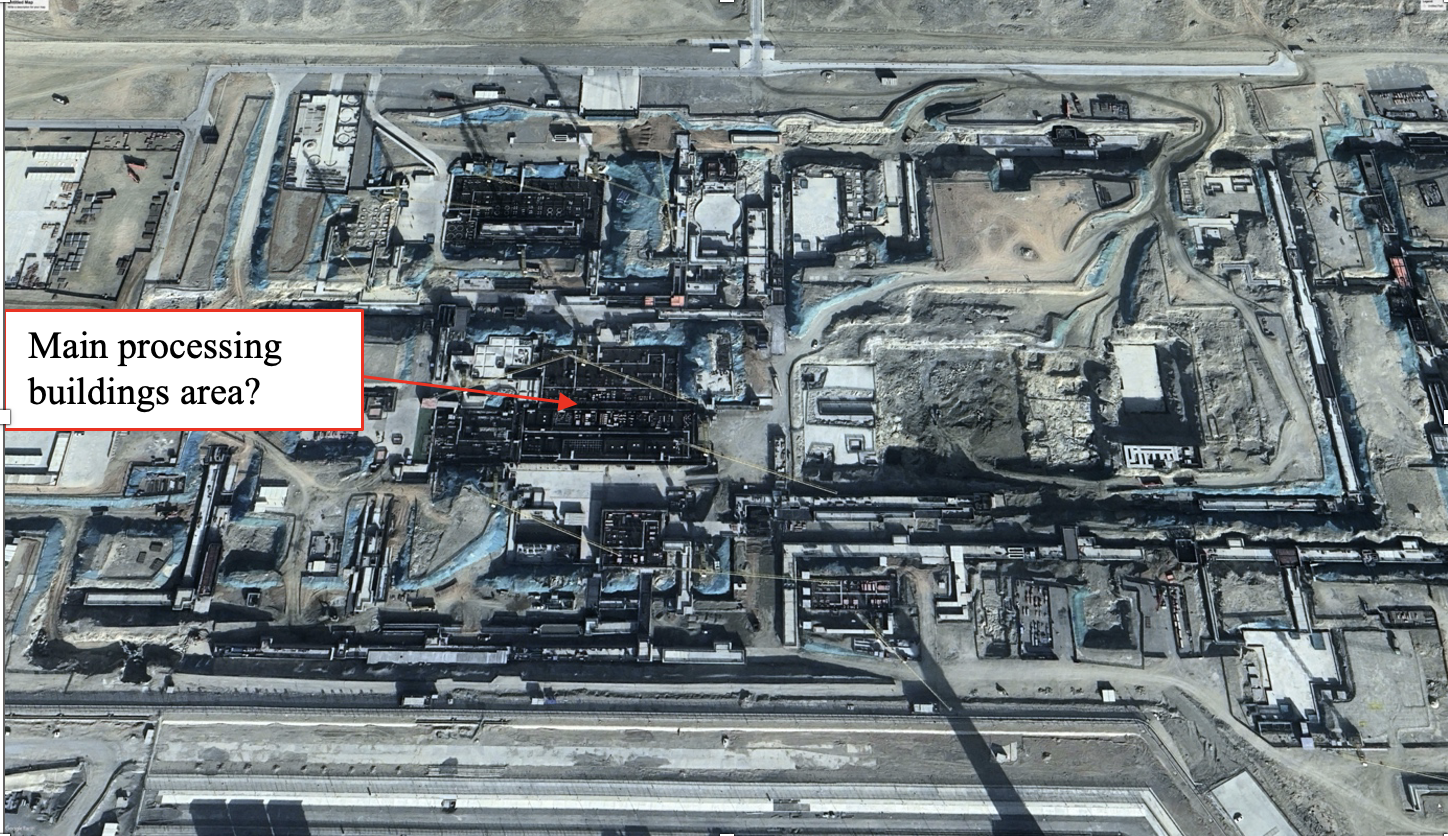
<p>China <a href="https://thebulletin.org/2020/05/pinpointing-chinas-new-plutonium-reprocessing-plant/">started the construction</a> of its first 200 tons/year demonstration reprocessing plant (Project I) for spent light-water reactor fuel <a href="https://fissilematerials.org/blog/2015/09/china_is_said_to_be_build.html">in 2015</a>.  As satellite images show, all the major construction including the main processing builds had been completed by November 2024 (see Figure 2). Moreover, since about 2020 the company has started equipment purchase and installment for the reprocessing lines. Project I is expected to be operational in 2025.</p>

<p><a href="https://fissilematerials.org/blog/20241224-Jinta-2.png"><img alt="20241224-Jinta-2.png" src="https://fissilematerials.org/blog/assets_c/2024/12/20241224-Jinta-2-thumb-720xauto-190.png" width="720" height="464" class="mt-image-center" style="text-align: center; display: block; margin: 0 auto 20px;" /></a><strong>Figure 2.</strong> Zoom of the Project I demonstration reprocessing facility shown in Figure 1. The main processing buildings have been completed.</p>

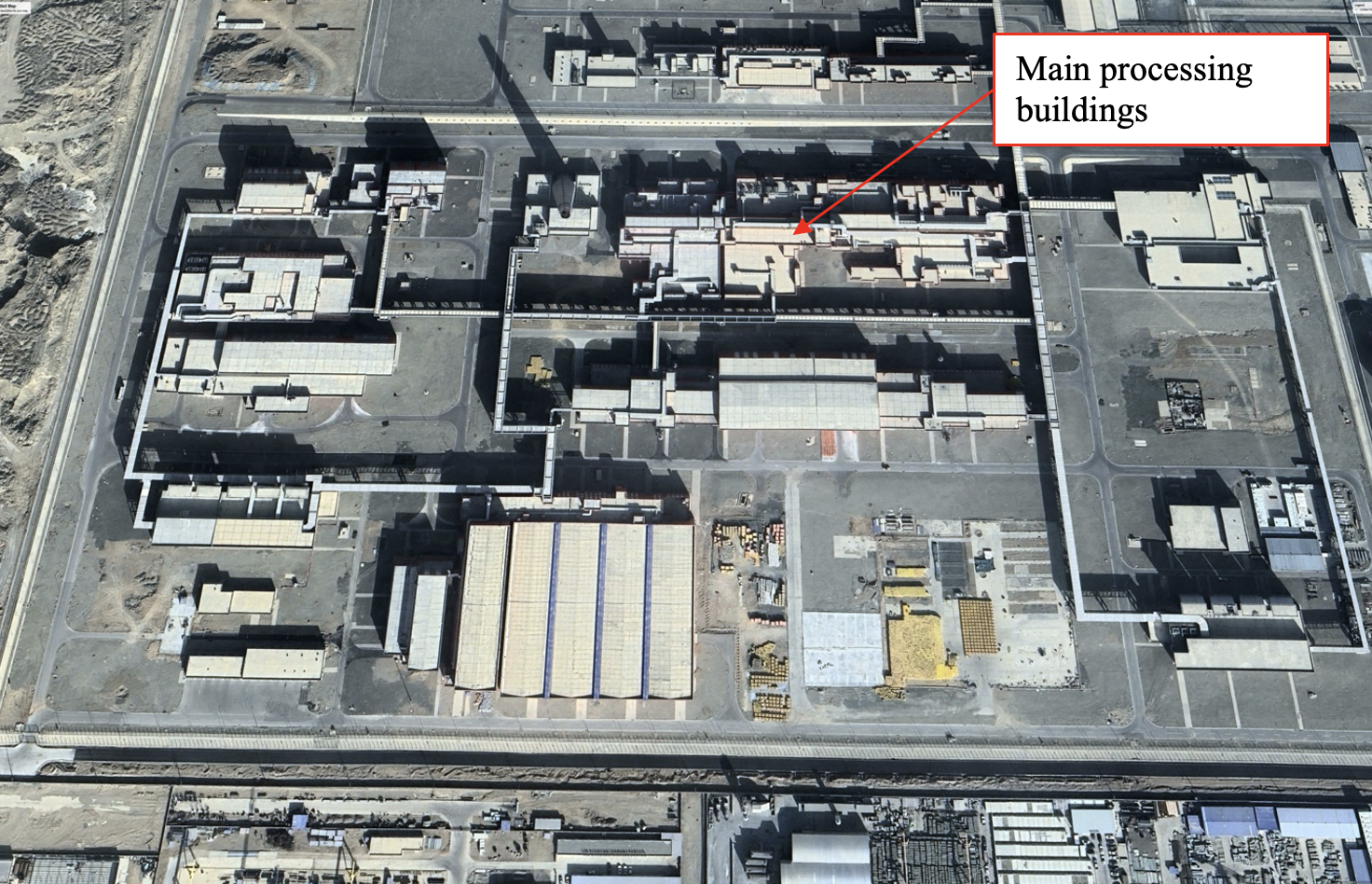
<p>Satellite images and commercial bidding and purchase documents also show that in 2020 China started the construction of its second 200 tons/year demonstration reprocessing plant (Project II) for spent light-water reactor fuel. It should be noted that <a href="https://fissilematerials.org/blog/2021/03/china_starts_construction.html">the 2021 post</a> incorrectly placed Project II to the west of Project I (the actual location is shown in Figure 1). However, this larger place could be planned and reserved for another reprocessing project. </p>

<p>Although Project II construction began later than Project I, satellite images from November 2024 (Figure 3) show that major construction, including the main processing buildings, was completed at the same time as Project I. It seems CNNC has sped up those reprocessing projects. This suggests that Project II could be commissioned earlier than the previous expectation of 2030.</p>

<p><a href="https://fissilematerials.org/blog/20241224-Jinta-3.png"><img alt="20241224-Jinta-3.png" src="https://fissilematerials.org/blog/assets_c/2024/12/20241224-Jinta-3-thumb-720xauto-192.png" width="720" height="464" class="mt-image-center" style="text-align: center; display: block; margin: 0 auto 20px;" /></a><strong>Figure 3.</strong> Zoom of the Project II demonstration reprocessing facility shown in Figure 1. The main processing buildings have been completed.</p>

<p>New commercial bidding and purchase documents further show China started the construction of a third demonstration reprocessing plant, often referred to as "spent fuel demonstration reprocessing plant Project III (R3)," in 2023. ("R3" would represent Project III reprocessing plant, similar to the "R1" designation for the Project I plant used in some Chinese documents.) </p>

<p>As the case of Project II, there have been no official statements or news coverage so far concerning this new facility. There have been a number of announcements, however, including bid requests for relevant equipment for "spent fuel demonstration reprocessing plant project III (R3)." Some examples are as follows: </p>

<ul>
<li>Hangzhou Jingye Zhineng (<a href="http://www.boomy.cn/col.jsp?id=103">Boomy Intelligent</a>), a company engaged in nuclear industry intelligent equipment, on November 23, 2023 <a href="https://stock.hexun.com/2023-11-23/211249565.html">responded to a bidder request</a> regarding the information on the annual reprocessing capacity of the demonstration spent fuel reprocessing plant Project III (R3).</li>
<li><a href="https://m.dlzb.com/23-0-28720355-1.html">A bid for the heat exchange station equipment for Project III</a> with a bidding period of 11 January 2023 to 17 January 2023, and the equipment be delivered by 30 May 2024.</li>
<li><a href="https://www.bidcenter.com.cn/news-269277761-1.html">A bid for the liquid waste storage tank project for Project III</a>, with the completion date of 23 February 2024.</li>
</ul>

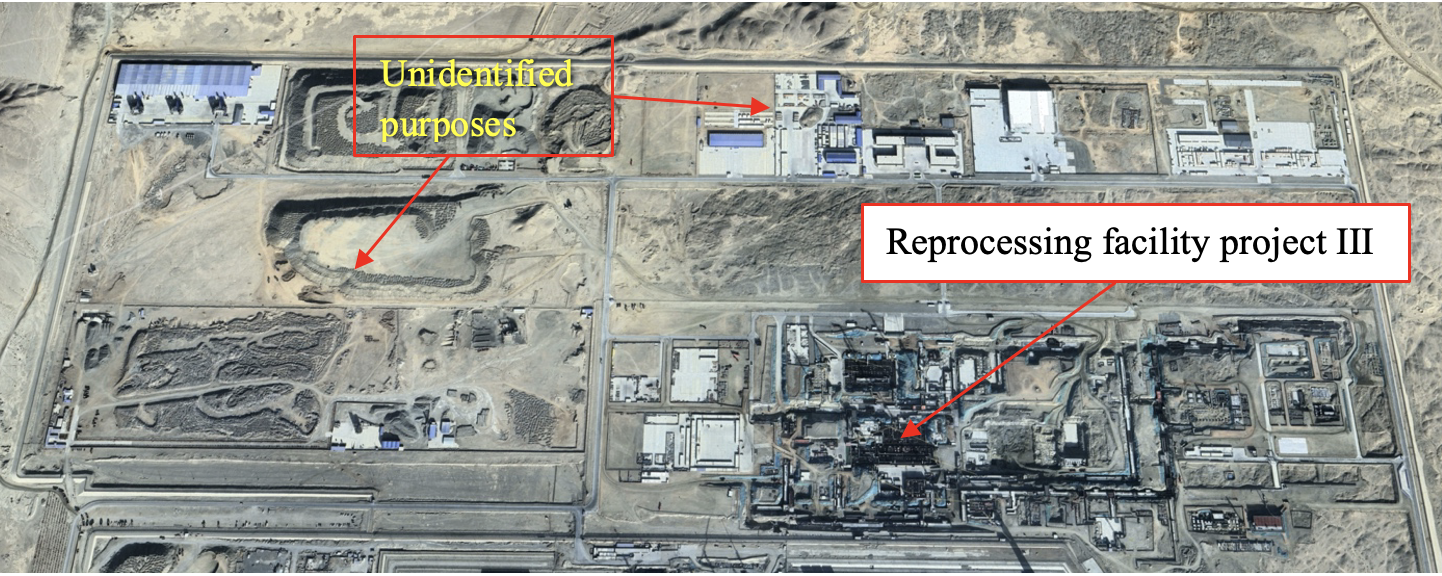
<p>Analysis of satellite images suggests that Project III is likely located at the new extended area as shown in Figure 1 (zoom in Figure 4). Signs of construction activities at the new extended area appeared in early 2023, but the main processing buildings sites had not shown activity until May 2023. However, images in May 2024 showed the main processing building was under construction. The November 2024 image shows the intensified construction activities in the extended area including the possible reprocessing plant project III and other unidentified facilities. The start of work on the third reprocessing plant (Project III) around 2023 suggests that it could be commissioned before 2033.</p>

<p><a href="https://fissilematerials.org/blog/20241224-Jinta-4.png"><img alt="20241224-Jinta-4.png" src="https://fissilematerials.org/blog/assets_c/2024/12/20241224-Jinta-4-thumb-720xauto-194.png" width="720" height="288" class="mt-image-center" style="text-align: center; display: block; margin: 0 auto 20px;" /></a><strong>Figure 4.</strong> Zoom of the new extended area shown in Figure 1. Besides the Project III reprocessing facility, there are several constructions with unidentified purposes. </p>
<p><a href="https://fissilematerials.org/blog/20241224-Jinta-5.png"><img alt="20241224-Jinta-5.png" src="https://fissilematerials.org/blog/assets_c/2024/12/20241224-Jinta-5-thumb-720xauto-196.png" width="720" height="416" class="mt-image-center" style="text-align: center; display: block; margin: 0 auto 20px;" /></a><strong>Figure 5.</strong> Zoom of the Project III demonstration reprocessing facility shown in Figure 1. There are intensified construction activities at the site by November 2024. </p>

<p>So far, there are no available sources specifying the purpose and capacity of Project III. Some Chinese accounts mentioned that following Project I China would build Project II and Project III to reduce the burden of spent fuel storage at (PWR) reactors sites. Also, some nuclear experts suggested CNNC can build more demonstration reprocessing plants using a modular approach. Thus, as Project I and II, Project III is likely with a capacity of 200 tons/year for spent light-water reactor fuel. However, currently one cannot exclude the possibility of the new facility being constructed to reprocess spent fuel of fast breeder reactors (even though there are no available sources to show CNNC currently plans to build this kind of facility soon). </p>
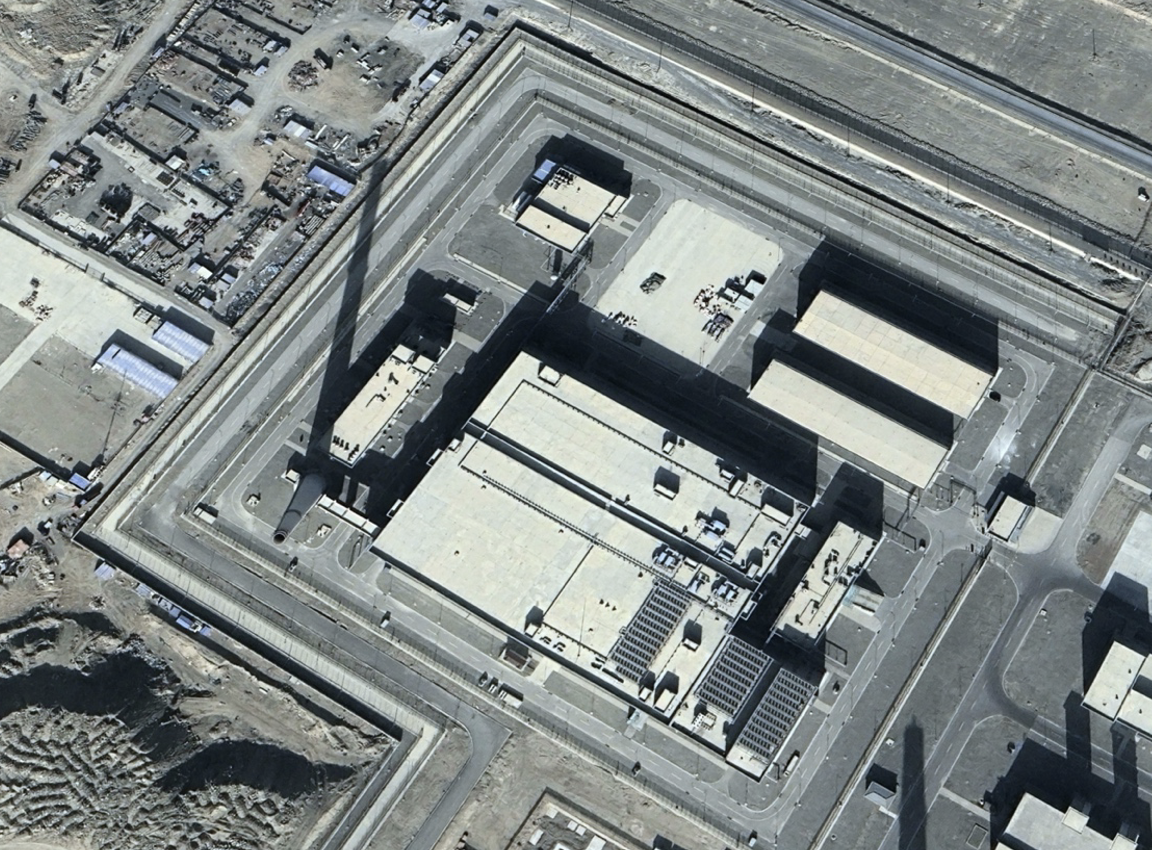
<p><a href="https://fissilematerials.org/blog/20241224-Jinta-6.png"><img alt="20241224-Jinta-6.png" src="https://fissilematerials.org/blog/assets_c/2024/12/20241224-Jinta-6-thumb-720xauto-198.png" width="720" height="531" class="mt-image-center" style="text-align: center; display: block; margin: 0 auto 20px;" /></a><strong>Figure 6.</strong> Zoom of the MOX facility shown in Figure 1. </p>
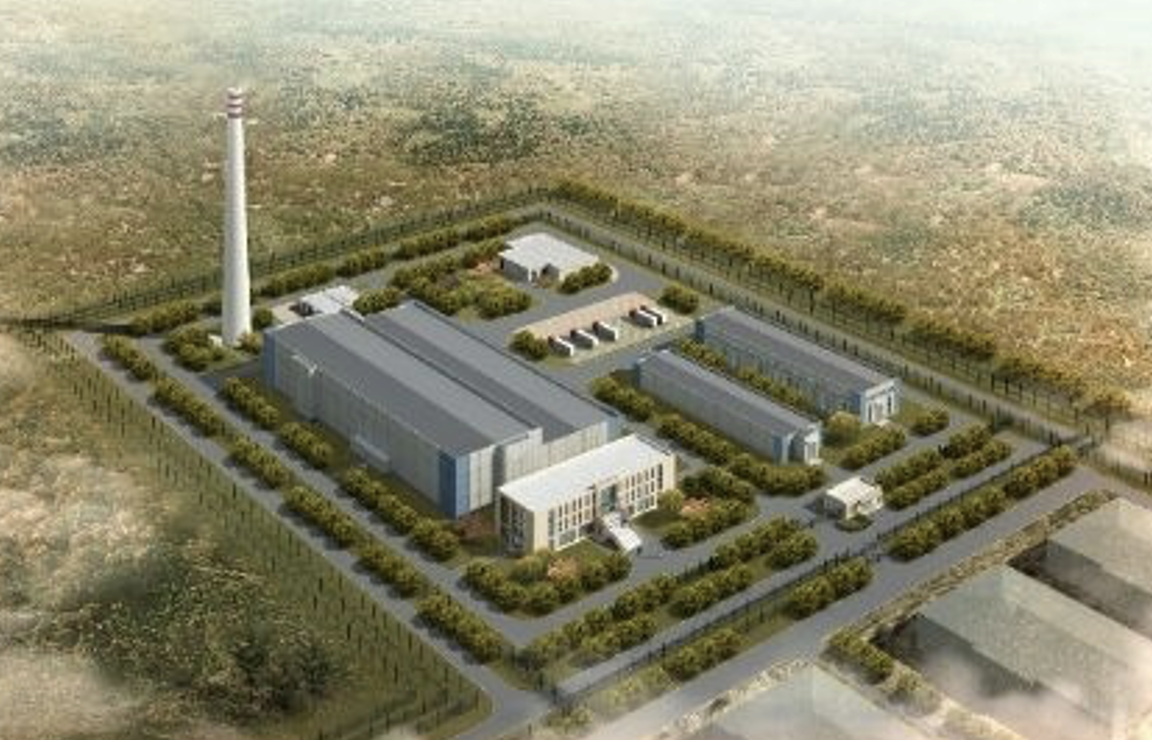
<p><a href="https://fissilematerials.org/blog/20241224-Jinta-7.png"><img alt="20241224-Jinta-7.png" src="https://fissilematerials.org/blog/assets_c/2024/12/20241224-Jinta-7-thumb-720xauto-200.png" width="720" height="464" class="mt-image-center" style="text-align: center; display: block; margin: 0 auto 20px;" /></a><strong>Figure 7.</strong> Schematic diagram of a proposed MOX project, <a href="https://www.cnpe.cc/cnpe/jyw/hrl/640043/index.html">posted by CNPE in May 2018</a>.</p>

<p>Since 2018 CNNC has also been building a demonstration mixed uranium-plutonium oxide (MOX) fuel fabrication line with a capacity of 20 tons/year near the demonstration reprocessing plant. As shown in satellite image (Figure 6), the construction had been completed by November 2024. Figure 7 is a schematic diagram of the <a href="https://www.cnpe.cc/cnpe/jyw/hrl/640043/index.html">MOX project proposed by China Nuclear Power Engineering</a> (CNPE, a subsidiary of CNNC), which is responsible for the design of the facility. A comparison of the satellite image with the diagram shows that all the buildings have been completed as designed. Since 2019, the company has started ordering equipment for the MOX fabrication line. It is expected to be commissioned by 2025.</p>

<p>This MOX facility is believed to supply the fuel for China's second CFR-600 breeder reactor, <a href="https://fissilematerials.org/blog/2020/12/china_starts_construction_1.html">which is under construction since 2020</a> and expected to become operational in 2026. <a href="https://fissilematerials.org/blog/2024/07/russia_to_supply_mox_fuel.html">Russia supplies the lifetime fuel</a> (first HEU or later MOX) for China's first CFR-600, which <a href="https://fissilematerials.org/blog/2023/12/china_started_operation_o.html">started operation in 2023</a>.</p>
]]>
        
    </content>
</entry>

<entry>
    <title>Russia begins decommissioning ADE-2 plutonium production reactor</title>
    <link rel="alternate" type="text/html" href="https://fissilematerials.org/blog/2024/12/russia_begins_decommissio.html" />
    <id>tag:fissilematerials.org,2024:/blog//3.1201</id>

    <published>2024-12-13T09:02:18Z</published>
    <updated>2024-12-16T09:04:14Z</updated>

    <summary>The Russian State Corporation Rosatom announced the beginning of decommissioning of the ADE-2 plutonium production reactor (original Russian report). The reactor, part of the Mining and Chemical Combine in Zheleznogorsk, was shut down in April 2010. Fuel from the reactor...</summary>
    <author>
        <name>Admin</name>
        
    </author>
    
        <category term="Weapons complex" scheme="https://www.sixapart.com/ns/types#category" />
    
    <category term="adereactors" label="ADE reactors" scheme="https://www.sixapart.com/ns/types#tag" />
    <category term="miningandchemicalcombine" label="Mining and Chemical Combine" scheme="https://www.sixapart.com/ns/types#tag" />
    <category term="productionreactors" label="production reactors" scheme="https://www.sixapart.com/ns/types#tag" />
    <category term="russia" label="Russia" scheme="https://www.sixapart.com/ns/types#tag" />
    <category term="zheleznogorsk" label="Zheleznogorsk" scheme="https://www.sixapart.com/ns/types#tag" />
    
    <content type="html" xml:lang="en-us" xml:base="https://fissilematerials.org/blog/">
        <![CDATA[<p>The Russian State Corporation Rosatom <a href="https://world-nuclear-news.org/articles/russia-starts-decommissioning-plutonium-producing-reactor">announced</a> the beginning of decommissioning of the ADE-2 plutonium production reactor (<a href="https://sibghk.ru/news/view?id=377&amp;pathToBack=news/index?id_category=4">original Russian report</a>). The reactor, part of the Mining and Chemical Combine in Zheleznogorsk, was shut down <a href="https://fissilematerials.org/blog/2010/04/last_russian_plutonium_pr.html">in April 2010</a>. Fuel from the reactor has been removed, and the reactor was transferred to 'permanent shutdown' mode.</p>

<p>The plutonium production facilities of the Mining and Chemical Combine in Zheleznogorsk are located underground. After the removal of the equipment, the halls of the ADE-2 reactor will be used for a research molten-salt reactor.</p>
]]>
        
    </content>
</entry>

<entry>
    <title>Russia removed all HEU spent fuel from naval base in Gremikha</title>
    <link rel="alternate" type="text/html" href="https://fissilematerials.org/blog/2024/12/russia_removed_all_heu_sp.html" />
    <id>tag:fissilematerials.org,2024:/blog//3.1200</id>

    <published>2024-12-02T07:59:30Z</published>
    <updated>2024-12-11T08:02:47Z</updated>

    <summary>In November 2024 Rosatom completed the removal of all spent fuel of naval reactors from the Gremikha base at the Northern Fleet. According to the report, the final, eleventh, spent fuel assembly, belonged to the OK-550KM prototype reactor that was...</summary>
    <author>
        <name>Admin</name>
        
    </author>
    
        <category term="HEU minimization" scheme="https://www.sixapart.com/ns/types#category" />
    
        <category term="Spent fuel management" scheme="https://www.sixapart.com/ns/types#category" />
    
    <category term="heu" label="HEU" scheme="https://www.sixapart.com/ns/types#tag" />
    <category term="heucleanout" label="HEU cleanout" scheme="https://www.sixapart.com/ns/types#tag" />
    <category term="navalreactors" label="naval reactors" scheme="https://www.sixapart.com/ns/types#tag" />
    <category term="niti" label="NITI" scheme="https://www.sixapart.com/ns/types#tag" />
    <category term="russia" label="Russia" scheme="https://www.sixapart.com/ns/types#tag" />
    <category term="russiannavy" label="Russian Navy" scheme="https://www.sixapart.com/ns/types#tag" />
    
    <content type="html" xml:lang="en-us" xml:base="https://fissilematerials.org/blog/">
        <![CDATA[<p>In November 2024 Rosatom <a href="https://atommedia.online/2024/12/02/zavershen-vyvoz-otrabotavshego-yaderno/">completed the removal</a> of all spent fuel of naval reactors from the Gremikha base at the Northern Fleet. According to the report, the final, eleventh, spent fuel assembly, belonged to the OK-550KM prototype reactor that was delivered to Gremikha in 2017 from the Scientific Research Technological Institute (NITI) in Sosnovy Bor, where it was <a href="https://fissilematerials.org/blog/2017/04/russia_decommissioned_one.html">deployed as part of the KM-1 facility</a>. Reactors in question are liquid-metal cooled fast neutron reactors that used uranium-beryllium fuel with the enrichment of more than 90%. The removal of spent fuel assemblies <a href="https://strana-rosatom.ru/2024/12/05/gremiha-opustela-s-bazy-vmf-vyvezli/">began in 2014</a>. The spent fuel was transferred to the Mayak Plant where it will be reprocessed.</p>
]]>
        
    </content>
</entry>

<entry>
    <title>Launch of the second reprocessing line in Zheleznogorsk</title>
    <link rel="alternate" type="text/html" href="https://fissilematerials.org/blog/2024/11/launch_of_the_second_repr.html" />
    <id>tag:fissilematerials.org,2024:/blog//3.1199</id>

    <published>2024-11-18T10:57:46Z</published>
    <updated>2024-12-19T09:57:44Z</updated>

    <summary>The Mining and Chemical Combine in Zheleznogorsk opened the second pilot reprocessing line. Unlike the fist line, which was first tested in 2018 and was described as a &quot;chain of hot cells,&quot; the second one appears to be an industrial-scale...</summary>
    <author>
        <name>Admin</name>
        
    </author>
    
        <category term="Civilian nuclear industry" scheme="https://www.sixapart.com/ns/types#category" />
    
        <category term="Reprocessing" scheme="https://www.sixapart.com/ns/types#category" />
    
        <category term="Spent fuel management" scheme="https://www.sixapart.com/ns/types#category" />
    
    <category term="miningandchemicalcombine" label="Mining and Chemical Combine" scheme="https://www.sixapart.com/ns/types#tag" />
    <category term="pilotdemonstrationcenter" label="Pilot Demonstration Center" scheme="https://www.sixapart.com/ns/types#tag" />
    <category term="reprocessing" label="reprocessing" scheme="https://www.sixapart.com/ns/types#tag" />
    <category term="rt2" label="RT-2" scheme="https://www.sixapart.com/ns/types#tag" />
    <category term="russia" label="Russia" scheme="https://www.sixapart.com/ns/types#tag" />
    <category term="zheleznogorsk" label="Zheleznogorsk" scheme="https://www.sixapart.com/ns/types#tag" />
    
    <content type="html" xml:lang="en-us" xml:base="https://fissilematerials.org/blog/">
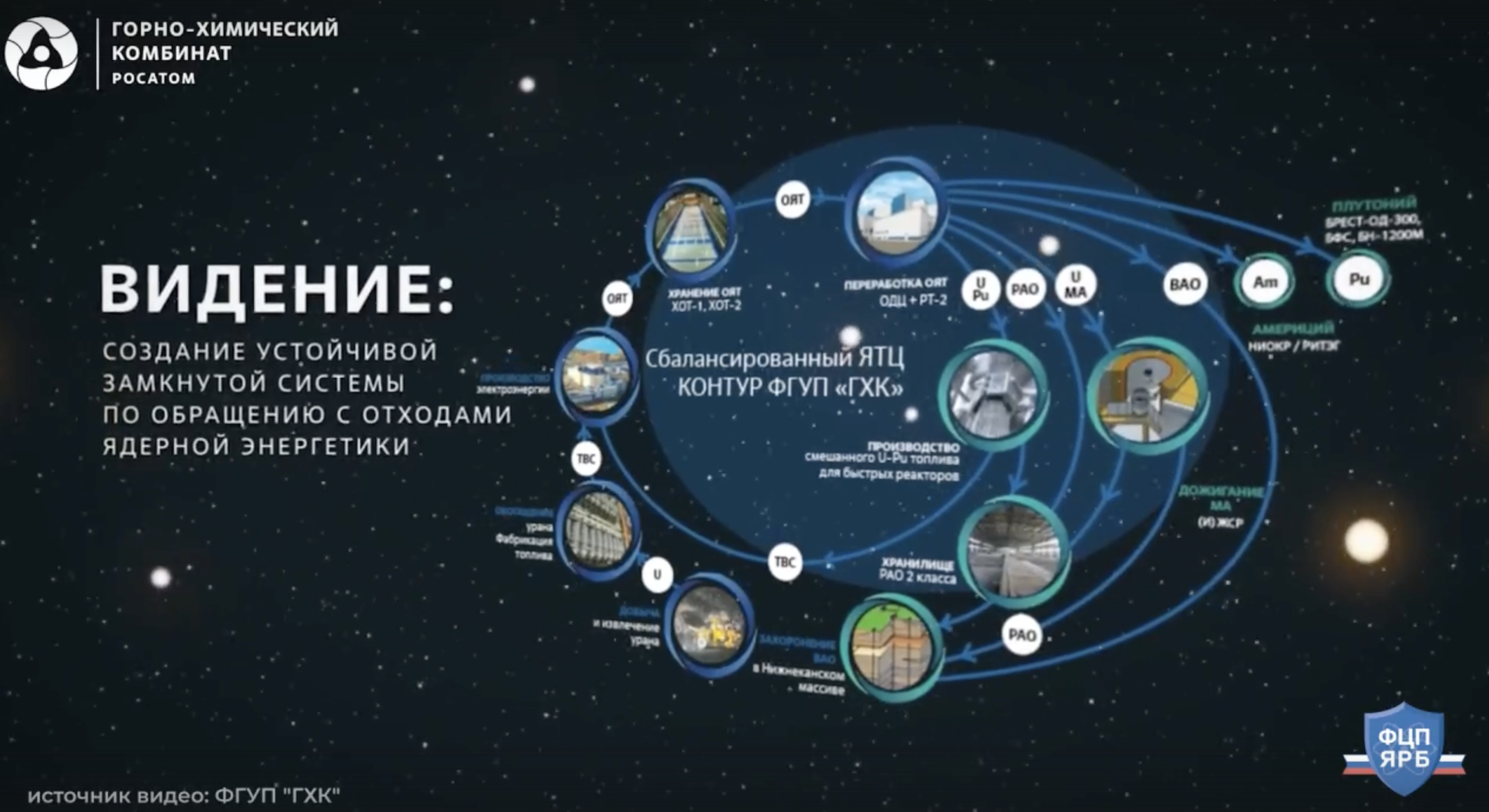
        <![CDATA[<p><a href="https://fissilematerials.org/blog/2024-11-18%20PDC.png"><img alt="2024-11-18 PDC.png" src="https://fissilematerials.org/blog/assets_c/2024/12/2024-11-18%20PDC-thumb-720xauto-186.png" width="720" height="393" class="mt-image-center" style="text-align: center; display: block; margin: 0 auto 20px;" /></a>The Mining and Chemical Combine in Zheleznogorsk <a href="https://www.atomic-energy.ru/news/2024/11/18/151299">opened</a> the second pilot reprocessing line. Unlike the fist line, which was <a href="https://fissilematerials.org/blog/2018/06/test_run_of_a_new_reproce.html">first tested in 2018</a> and was described as a "chain of hot cells," the second one appears to be an industrial-scale facility that will further test the reprocessing technologies.</p>

<p>According to <a href="https://fissilematerials.org/blog/2018/06/second_pilot_reprocessing.html">the initial plan</a>, the second line was supposed to begin operations in 2020. The construction of the reprocessing facilities is part of the <a href="https://fissilematerials.org/blog/2008/09/rosatom_plans_for_zheleznogors.html">program to build the Pilot Demonstration Center</a> at Zheleznogorsk.</p>

<p>The industry report <a href="https://xn----btb4bfrm9d.xn--p1ai/society/news/opytno-demonstratsionnyy-tsentr-gotovitsya-k-pererabotke-oyat/">suggests</a> that the Pilot Demonstration Center will have the capacity to reprocess 220 tonnes of VVER-1000 fuel annually. The plant is expected to reach this capacity in 2026. The technologies of the PDC will be used to build a larger reprocessing facility at Zheleznogorsk, RT-2. The image shows the plan of developing a closed nuclear cycle from this <a href="https://vkvideo.ru/video-164885043_456239044?ref_domain=xn----btb4bfrm9d.xn--p1ai">video account of the event</a>.</p>
]]>
        
    </content>
</entry>

<entry>
    <title>United Kingdom announced a plan to produce fissile materials for defense</title>
    <link rel="alternate" type="text/html" href="https://fissilematerials.org/blog/2024/11/united_kingdom_announced_.html" />
    <id>tag:fissilematerials.org,2024:/blog//3.1198</id>

    <published>2024-11-12T20:00:48Z</published>
    <updated>2024-11-12T20:02:08Z</updated>

    <summary>UK Defence Secretary is quoted by UK Defence Journal as saying that &quot;The UK is exploring options to re-establish a nuclear-fuel cycle for reactor fuel for defence purposes&quot; as part of the modernization of the UK Defence Nuclear Enterprise. The...</summary>
    <author>
        <name>Admin</name>
        
    </author>
    
        <category term="Weapons complex" scheme="https://www.sixapart.com/ns/types#category" />
    
    <category term="heu" label="HEU" scheme="https://www.sixapart.com/ns/types#tag" />
    <category term="navalreactors" label="naval reactors" scheme="https://www.sixapart.com/ns/types#tag" />
    <category term="unitedkingdom" label="United Kingdom" scheme="https://www.sixapart.com/ns/types#tag" />
    
    <content type="html" xml:lang="en-us" xml:base="https://fissilematerials.org/blog/">
        <![CDATA[<p>UK Defence Secretary is <a href="https://ukdefencejournal.org.uk/britain-to-revive-nuclear-fuel-production-for-defence/">quoted by UK Defence Journal</a> as saying that "The UK is exploring options to re-establish a nuclear-fuel cycle for reactor fuel for defence purposes" as part of the modernization of the UK Defence Nuclear Enterprise. The Secretary clarified that the project would respect the voluntary moratorium on the production of fissile material for nuclear weapons that is currently in place.</p>

<p>The United Kingdom currently has no facilities that can produce HEU for naval reactors. The material for this purposes has been provided by the United States. </p>
]]>
        
    </content>
</entry>

<entry>
    <title>Rosatom plans to build new BN-type reactors</title>
    <link rel="alternate" type="text/html" href="https://fissilematerials.org/blog/2024/11/rosatom_plans_to_build_ne.html" />
    <id>tag:fissilematerials.org,2024:/blog//3.1197</id>

    <published>2024-11-05T09:34:06Z</published>
    <updated>2025-01-20T16:07:52Z</updated>

    <summary>UPDATE: The Russian government approved the long-term development plan on 30 December 2024. The final version of the document updates the earlier plan as noted below. Rosatom plans regarding the construction of sodium-cooled fast neutron reactors remain uncertain. After the...</summary>
    <author>
        <name>Admin</name>
        
    </author>
    
        <category term="Civilian nuclear industry" scheme="https://www.sixapart.com/ns/types#category" />
    
        <category term="Fast breeder reactors" scheme="https://www.sixapart.com/ns/types#category" />
    
    <category term="bn1200" label="BN-1200" scheme="https://www.sixapart.com/ns/types#tag" />
    <category term="br1200" label="BR-1200" scheme="https://www.sixapart.com/ns/types#tag" />
    <category term="brestreactor" label="Brest reactor" scheme="https://www.sixapart.com/ns/types#tag" />
    <category term="fastreactors" label="fast reactors" scheme="https://www.sixapart.com/ns/types#tag" />
    <category term="russia" label="Russia" scheme="https://www.sixapart.com/ns/types#tag" />
    
    <content type="html" xml:lang="en-us" xml:base="https://fissilematerials.org/blog/">
        <![CDATA[<p>UPDATE: The Russian government <a href="http://atominfo.ru/newsz08/a0090.htm">approved</a> the long-term development plan on 30 December 2024. The <a href="http://atominfo.ru/newsz08/a0090.pdf">final version of the document</a> updates the earlier plan as noted below.</p>

<p>Rosatom plans regarding the construction of sodium-cooled fast neutron reactors remain uncertain. After the government <a href="https://fissilematerials.org/blog/2019/08/the_construction_of_the_b.html">postponed the work on BN-1200 reactor in 2018</a>, the developers <a href="https://youtu.be/UHpWOhI0RFY?si=958jpt8kFx7qm7Ar">updated the design</a> to make the reactor more competitive. The new design is known as BN-1200M. The first BN-1200M unit is expected to be deployed at the Beloyarsk NPP in the Urals, which operates BN-600 and BN-800 reactors. <a href="https://youtu.be/UHpWOhI0RFY?si=nWlNqz0VO_jiZA_m&amp;t=1139">The developers</a>, as well as <a href="https://www.atomic-energy.ru/news/2024/10/24/150656">the regional authorities</a> hope that the construction will begin in 2027 and that the reactor will begin operations in 2034.</p>

<p><a href="https://www.so-ups.ru/future-planning/public-discussion-genshema/2042/">Rosatom's long-term plan</a>, however, assumes that a new fast-neutron reactor of an unspecified type will not begin operations at Beloyarsk NPP until 2038 (with one more unit added in 2040). [UPDATE: In the final version of the plan these two units are to be built as part of the South-Urals NPP in Metlino, Chelyabinsk region, near PO Mayak.] The plan includes new fast-neutron reactors (again, of an unspecified type) that are expected to begin operations in Seversk in 2037-2039 (two reactors) and at a new Sibirskaya NPP in a not-yet-selected site in the Irkutsk region in 2041-2042 (two reactors). All these reactors are expected to have a power of 1255 MWt, suggesting that they will be the BN-1200M or a similar design. It is possible, however, that these will be lead-cooled reactors, based on the Brest-OD-300 design. Some Rosatom materials mention a <a href="http://atominfo.ru/newsz07/a0986.htm">lead-cooled BR-1200 reactor</a>. The construction of Brest-OD-300 is underway in Seversk and it is expected to begin operations in 2028. </p>

<p>The uncertainty with the reactor type seems to suggest that despite the modifications, Rosatom still has questions about the viability of the BN-1200M design. Another sign of this is the cancellation of the Krasnoyarskaya NPP project, which called for the construction of four BN-1200M units in 2037-2042.</p>

<p>UPDATE: The final version of the plan includes one RBN unit built at a new Reftinskaya site in 2041. The site currently hosts a coal-fired power plant.</p>
]]>
        
    </content>
</entry>

<entry>
    <title>ASP Isotopes to provide HALEU to TerraPower</title>
    <link rel="alternate" type="text/html" href="https://fissilematerials.org/blog/2024/10/asp_isotopes_to_provide_h.html" />
    <id>tag:fissilematerials.org,2024:/blog//3.1196</id>

    <published>2024-10-30T10:42:42Z</published>
    <updated>2024-12-29T22:39:05Z</updated>

    <summary>TerraPower and ASP Isotopes signed a term sheet for the construction of a uranium enrichment facility in South Africa. The facility is expected to provide HALEU for TerraPower&apos;s Natrium reactor. The announcement does not mention specific dates for the construction...</summary>
    <author>
        <name>Admin</name>
        
    </author>
    
        <category term="Civilian nuclear industry" scheme="https://www.sixapart.com/ns/types#category" />
    
        <category term="HEU minimization" scheme="https://www.sixapart.com/ns/types#category" />
    
    <category term="aspisotopes" label="ASP Isotopes" scheme="https://www.sixapart.com/ns/types#tag" />
    <category term="haleu" label="HALEU" scheme="https://www.sixapart.com/ns/types#tag" />
    <category term="southafrica" label="South Africa" scheme="https://www.sixapart.com/ns/types#tag" />
    <category term="terrapower" label="TerraPower" scheme="https://www.sixapart.com/ns/types#tag" />
    
    <content type="html" xml:lang="en-us" xml:base="https://fissilematerials.org/blog/">
        <![CDATA[<p>TerraPower and ASP Isotopes <a href="https://www.terrapower.com/terraPower-announces-strategic-agreement">signed a term sheet</a> for the construction of a uranium enrichment facility in South Africa. The facility is expected to provide HALEU for TerraPower's Natrium reactor.</p>

<p>The announcement does not mention specific dates for the construction of the plant. Given that ASP Isotopes has no experience in producing HALEU in the quantities required for the Natrium reactor operations, the process could take considerable time. Natrium would require about 15-20 tonnes of HALEU for the startup core and 3.6 tonnes of HALEU annually (see <a href="https://www.ucsusa.org/sites/default/files/2021-05/ucs-rpt-AR-3.21-web_Mayrev.pdf">Edwin Lyman's report</a>, p. 67). It should also be noted that South Africa <a href="https://x.com/NucSafetyUCS/status/1852041249546502497">has no 123 nuclear cooperation agreement</a> with the United States.</p>

<p>In July 2023, TerraPower <a href="https://fissilematerials.org/blog/2023/07/terrapower_and_centrus_to.html">signed an MOU with US-based Centrus</a> to secure supply of HALEU.</p>

<p>UPDATE: On 26 November 2024, a market research company Fuzzy Panda Research issued a <a href="https://fuzzypandaresearch.com/aspi-honig-stetson-paid-stock-promotion/">report critical of ASP Isotopes</a>. ASP Isotopes <a href="https://ir.aspisotopes.com/news-events/press-releases/detail/51/asp-isotopes-inc-responds-to-short-seller-report">responded to the criticism</a> on 13 December 2024. </p>
]]>
        
    </content>
</entry>

<entry>
    <title>US Department of Energy selected companies to work on HALEU enrichment</title>
    <link rel="alternate" type="text/html" href="https://fissilematerials.org/blog/2024/10/us_department_of_energy_s_4.html" />
    <id>tag:fissilematerials.org,2024:/blog//3.1192</id>

    <published>2024-10-17T07:45:15Z</published>
    <updated>2024-10-19T09:36:44Z</updated>

    <summary>The Department of Energy selected four companies to provide enrichment services to help establish a U.S. supply of high-assay low-enriched uranium (HALEU). The selected companies are Louisiana Energy Services (which operates the Urenco USA enrichment plant in Eunice, NM), Orano...</summary>
    <author>
        <name>Admin</name>
        
    </author>
    
        <category term="Civilian nuclear industry" scheme="https://www.sixapart.com/ns/types#category" />
    
    <category term="centrus" label="Centrus" scheme="https://www.sixapart.com/ns/types#tag" />
    <category term="doe" label="DoE" scheme="https://www.sixapart.com/ns/types#tag" />
    <category term="enrichment" label="enrichment" scheme="https://www.sixapart.com/ns/types#tag" />
    <category term="enrichmentservices" label="enrichment services" scheme="https://www.sixapart.com/ns/types#tag" />
    <category term="generalmatters" label="General Matters" scheme="https://www.sixapart.com/ns/types#tag" />
    <category term="haleu" label="HALEU" scheme="https://www.sixapart.com/ns/types#tag" />
    <category term="les" label="LES" scheme="https://www.sixapart.com/ns/types#tag" />
    <category term="orano" label="Orano" scheme="https://www.sixapart.com/ns/types#tag" />
    <category term="unitedstates" label="United States" scheme="https://www.sixapart.com/ns/types#tag" />
    <category term="urenco" label="URENCO" scheme="https://www.sixapart.com/ns/types#tag" />
    
    <content type="html" xml:lang="en-us" xml:base="https://fissilematerials.org/blog/">
        <![CDATA[<p>The Department of Energy <a href="https://www.energy.gov/articles/biden-harris-administration-announces-four-contracts-boost-domestic-haleu-supply-and">selected</a> four companies to provide enrichment services to help establish a U.S. supply of high-assay low-enriched uranium (HALEU). The selected companies are Louisiana Energy Services (which operates the Urenco USA enrichment plant in Eunice, NM), Orano Federal Services (a subsidiary of Orano USA), General Matter (appears to be a recently formed company), and Centrus (operator of the American Centrifuge Plant in Piketon, OH). </p>

<p>According to DoE, "the contracts will allow the companies to bid on work for enrichment services, a key piece of the high-assay low-enriched uranium (HALEU) supply chain." These contracts are part of the <a href="https://fissilematerials.org/blog/2024/06/united_states_seeks_to_bo.html">program</a> to establish domestic enrichment capacity in the United States.</p>

<p>UPDATE: World Nuclear News <a href="https://world-nuclear-news.org/articles/doe-selects-haleu-enrichment-providers">reports</a> that </p>

<blockquote>
  <p>According to publicly available information, General Matter Inc is a company that was registered in California earlier this year, with Scott Nolan named as its CEO. Nolan, a former SpaceX employee, is a partner at venture capital firm Founders Fund which was co-founded by billionaire investor Peter Thiel.</p>
</blockquote>
]]>
        
    </content>
</entry>

<entry>
    <title>Urenco started expansion of the US enrichment plant</title>
    <link rel="alternate" type="text/html" href="https://fissilematerials.org/blog/2024/10/urenco_started_expansion_.html" />
    <id>tag:fissilematerials.org,2024:/blog//3.1190</id>

    <published>2024-10-10T13:29:54Z</published>
    <updated>2024-10-16T13:31:24Z</updated>

    <summary>Urenco USA installed first centrifuges as part of the project to expand the capacity of the enrichment plant in Eunice, NM. The company confirmed that the the current phase of expansion will increase the capacity of the plant by 700...</summary>
    <author>
        <name>Admin</name>
        
    </author>
    
        <category term="Civilian nuclear industry" scheme="https://www.sixapart.com/ns/types#category" />
    
    <category term="enrichment" label="enrichment" scheme="https://www.sixapart.com/ns/types#tag" />
    <category term="enrichmentservices" label="enrichment services" scheme="https://www.sixapart.com/ns/types#tag" />
    <category term="eunice" label="Eunice" scheme="https://www.sixapart.com/ns/types#tag" />
    <category term="unitedstates" label="United States" scheme="https://www.sixapart.com/ns/types#tag" />
    <category term="urenco" label="URENCO" scheme="https://www.sixapart.com/ns/types#tag" />
    
    <content type="html" xml:lang="en-us" xml:base="https://fissilematerials.org/blog/">
        <![CDATA[<p>Urenco USA <a href="https://urencousa.com/news/sustainability/2024/urenco-marks-installation-of-new-us-enrichment-capacity">installed</a> first centrifuges as part of the <a href="https://fissilematerials.org/blog/2023/07/urenco_to_expand_its_enri.html">project to expand the capacity</a> of the enrichment plant in Eunice, NM. The company confirmed that the the current phase of expansion will increase the capacity of the plant by 700 tonnes of SWU per year and that the cascades will become operational in 2025. The Eunice site "has the physical space and license to further expand its annual production up to 10 million SWU." The facility began operations <a href="https://fissilematerials.org/blog/2010/06/urenco_begins_enrichment_.html">in 2010</a>.</p>

<p>The expansion is intended to take advantage of the Department of Energy <a href="https://fissilematerials.org/blog/2024/06/united_states_seeks_to_bo.html">program</a> aimed at boosting the production of enriched uranium in the United States.</p>
]]>
        
    </content>
</entry>

</feed>