<?xml version="1.0" encoding="UTF-8"?>
<feed xml:lang="en" xmlns="http://www.w3.org/2005/Atom" xmlns:opensearch="http://a9.com/-/spec/opensearch/1.1/" xmlns:s="http://jadedpixel.com/-/spec/shopify">
  <id>https://www.japaneseknifeimports.com/blogs/news.atom</id>
  <link rel="alternate" type="text/html" href="https://www.japaneseknifeimports.com/blogs/news"/>
  <link rel="self" type="application/atom+xml" href="https://www.japaneseknifeimports.com/blogs/news.atom"/>
  <title>Japanese Knife Imports - News</title>
  <updated>2025-04-22T13:36:10-07:00</updated>
  <author>
    <name>Japanese Knife Imports</name>
  </author>
  <entry>
    <id>https://www.japaneseknifeimports.com/blogs/news/all-of-the-sharpening-images-from-our-youtube-videos</id>
    <published>2025-04-22T13:36:10-07:00</published>
    <updated>2025-04-22T13:36:21-07:00</updated>
    <link rel="alternate" type="text/html" href="https://www.japaneseknifeimports.com/blogs/news/all-of-the-sharpening-images-from-our-youtube-videos"/>
    <title>All of the sharpening images from our YouTube Videos</title>
    <author>
      <name>Jonathan Broida</name>
    </author>
    <content type="html">
      <![CDATA[<p>These are the images we use in our knife sharpening videos on YouTube.  The first 4 images are the double bevel ones, the second 4 are the single bevel ones, and the last one is the Sharpie technique sheet.  Feel free to reach out with any questions you have about any of these.</p>
<p><img src="https://cdn.shopify.com/s/files/1/0994/0120/files/DB_1.jpg?v=1745352827" alt=""></p>
<p><img src="https://cdn.shopify.com/s/files/1/0994/0120/files/DB_2.jpg?v=1745352827" alt=""></p>
<p><img src="https://cdn.shopify.com/s/files/1/0994/0120/files/DB_3.jpg?v=1745352827" alt=""></p>
<p><img src="https://cdn.shopify.com/s/files/1/0994/0120/files/DB_4.jpg?v=1745352827" alt=""></p>
<p><img src="https://cdn.shopify.com/s/files/1/0994/0120/files/SB_1.jpg?v=1745352827" alt=""></p>
<p><img src="https://cdn.shopify.com/s/files/1/0994/0120/files/SB_2.jpg?v=1745352827" alt=""></p>
<p><img src="https://cdn.shopify.com/s/files/1/0994/0120/files/SB_3.jpg?v=1745352827" alt=""></p>
<p><img src="https://cdn.shopify.com/s/files/1/0994/0120/files/SB_4.jpg?v=1745352827" alt=""></p>
<p><img src="https://cdn.shopify.com/s/files/1/0994/0120/files/sharpie_trick_images_4e20e2b4-f47e-49cb-b5f5-e0d02a7f4677.png?v=1745352826" alt=""></p>]]>
    </content>
  </entry>
  <entry>
    <id>https://www.japaneseknifeimports.com/blogs/news/double-bevel-sharpening-class-imaages</id>
    <published>2023-02-27T10:35:57-08:00</published>
    <updated>2023-02-27T10:35:57-08:00</updated>
    <link rel="alternate" type="text/html" href="https://www.japaneseknifeimports.com/blogs/news/double-bevel-sharpening-class-imaages"/>
    <title>Double Bevel Sharpening Class Imaages</title>
    <author>
      <name>Jonathan Broida</name>
    </author>
    <content type="html">
      <![CDATA[<p><img src="https://cdn.shopify.com/s/files/1/0994/0120/files/resized_SCN_0003_1024x1024.jpg?v=1470175435" alt="Image #1"></p>
<p> </p>
<p><img src="https://cdn.shopify.com/s/files/1/0994/0120/files/resized_SCN_0009_1024x1024.jpg?v=1470175435" alt="Image #2"></p>
<p> </p>
<p><img src="https://cdn.shopify.com/s/files/1/0994/0120/files/resized_SCN_0002_1024x1024.jpg?v=1470175435" alt="Image #3"></p>
<p> </p>
<p><img src="https://cdn.shopify.com/s/files/1/0994/0120/files/resized_SCN_0001_1024x1024.jpg?v=1470175435" alt="Image #4"></p>
<p> </p>
<p><img src="https://cdn.shopify.com/s/files/1/0994/0120/files/sharpie_trick_images_1024x1024.png?v=1677522931" alt="Image #5"></p>]]>
    </content>
  </entry>
  <entry>
    <id>https://www.japaneseknifeimports.com/blogs/news/interview-with-jon-broida-on-knifeplanet</id>
    <published>2017-01-29T12:32:00-08:00</published>
    <updated>2017-01-29T12:32:46-08:00</updated>
    <link rel="alternate" type="text/html" href="https://www.japaneseknifeimports.com/blogs/news/interview-with-jon-broida-on-knifeplanet"/>
    <title>Interview with Jon Broida on KnifePlanet</title>
    <author>
      <name>Jonathan Broida</name>
    </author>
    <content type="html">
      <![CDATA[<p>KnifePlanet (www.KnifePlanet.net) had asked to interview me a few days back.  The interview is now up on their site here:</p>
<p><a href="http://www.knifeplanet.net/japanese-knife-imports-jon-broida-interview/" target="_blank" title="Knife Planet Interview with Jon Broida">http://www.knifeplanet.net/japanese-knife-imports-jon-broida-interview/</a></p>
<p><a href="http://www.knifeplanet.net/japanese-knife-imports-jon-broida-interview/" target="_blank" title="Know your knife sharpener"><img src="//cdn.shopify.com/s/files/1/0994/0120/files/featured-on-knifeplanet_480x480.jpg?v=1485721754" alt=""></a></p>
<p>Hope you guys enjoy it.</p>]]>
    </content>
  </entry>
  <entry>
    <id>https://www.japaneseknifeimports.com/blogs/news/some-thoughts-on-sharpening-stones-and-cutting-speed</id>
    <published>2016-10-28T20:29:00-07:00</published>
    <updated>2016-10-29T03:02:58-07:00</updated>
    <link rel="alternate" type="text/html" href="https://www.japaneseknifeimports.com/blogs/news/some-thoughts-on-sharpening-stones-and-cutting-speed"/>
    <title>Some Thoughts on Sharpening Stones and Cutting Speed</title>
    <author>
      <name>Jonathan Broida</name>
    </author>
    <content type="html">
      <![CDATA[<meta charset="utf-8">
<div>I often get asked about sharpening stones, and one of the main things people are looking for are faster cutting stones that don't dish.  While there are things like this, they often aren't what people are expecting.  Recently, I was answering a customer e-mail and ended up writing an explanation that I thought might be worth sharing more publicly, to help people better understand sharpening stones and the options that are available.  Anyways, here is a slightly edited version of what I wrote:</div>
<div></div>
<div>Let's talk about the determining factors of speed for a second.  First would be grit size... this is the size of the abrasive.  One of the important limiting factors here is how big the abrasive particles are.  Depending on the size, there is a limit to how big the scratches will be.  The size (and depth of the scratches) determines the amount of metal that can be removed.  In addition to the abrasive size would be abrasive density (how much abrasive is used).  If there is too little, the scratch pattern is a bit too wide and metal will not be removed as quickly.  If there is too much, the abrasives don't have the space to cut in. The abrasive needs space to be able to dig in, though, in reality the space needed is not so great. I bring this up to address the idea that more is better when it come to abrasive.  Often times, people ask why we don't just put more abrasive in the stones to help them cut more quickly.  Let me say that we've tried this in the development of some of our stones.  We found that adding too much abrasive actually slows the cutting speed, and so the previous explanation was given to us by a stone manufacturer when asking about why this happened in our prototypes.  Also, too much abrasive will cause problems with the next point, which is the dulling of abrasive particles and the release of fresh abrasive.  If there is too much abrasive, it limits the way fresh abrasive is released.  As the abrasive particles cut into the steel, they dull.  Eventually, they do not cut in the same way (or at all), and thus need to be discarded.  The way this works is through the wearing through of the binding agent.  As the binding agent wears away, the old abrasive is washed away and the fresh abrasive underneath is exposed.  This helps the stone continue to cut.  So there are quite a few things that need to be balanced for this to work well.</div>
<div></div>
<div>Lets consider a few things here... if we want to get our stone to cut faster we have a few different options:</div>
<div>
<ul>
<li>Use a coarser abrasive- This will help cut faster, but will also leave deeper scratches.  Also, because coarser abrasives are larger, the stones wear more quickly as the abrasive is discarded.</li>
<li>Use a softer binding agent- This will help release more fresh abrasive, which helps the keep the abrasives cutting in an aggressive way.  However, this also means the stone will wear more quickly, and thus need more flattening.</li>
<li>Find the right balance of abrasive density in the binder- Finding the right fit for an abrasive in a binding agent assures that the abrasive is cutting well for as long as it can, and then discarded at the right time.  It also means that just enough space is given for the abrasive to work, while keeping the scratch pattern as dense as possible, which will, in turn, help maximize cutting speed.</li>
<li>Use an abrasive that stays sharp longer- By using an abrasive that doesn't dull as quickly, the amount of cutting each particle can do is increased, which helps cut a bit more quickly, and can also allow for a harder binding agent and reduce stone wear.</li>
<li>Increase surface area- More surface contact equals more cutting, but can be limited by potential sharpening stroke length, knife size, etc.</li>
<li>Increase speed- Faster equals more cutting, but is limited by the potential physical movement of the end user, and can hamper angle consistency.  Also, if the speed is too great (i.e. a machine), heat can become a factor (but this is not likely an issue for the purposes of this conversation).</li>
</ul>
<div>For these reasons, and a few others, many people choose one of the following options:</div>
</div>
<div>
<ul>
<li>Coarser stones that dish more quickly- They cut MUCH faster, but require more flattening.  An example of this would be the Gesshin 220 stone.</li>
<li>More aggressive abrasives (like diamond, but not necessarily limited to diamond)- When talking about diamond stones (not diamond plates), they can cut a bit faster than traditional stones, and the scratches can be easily removed in subsequent steps, but are not as deep as diamond plates.  They also don't need to be flattened as often.  When talking about traditional abrasives, silicon carbide and alumina oxide are the main two abrasives used.  Silicon carbide is more aggressive initially, but dulls or fractures more quickly, while alumina oxide stays sharp longer.  There are also variations of each (i.e. Black SiC, Green SiC, Alumina, White Alumina, Alumina Zirconia, etc.).  </li>
<li>Diamond plates- They cut much faster, but don't last as long (they dull and new abrasive is not released).  The scratches also tend to be deeper, as the abrasives are not embedded in a binder, but rather sitting on top of a mounting surface.  This means the whole abrasive particle is exposed in the cutting process, resulting in deeper cuts, which require more time to remove later on.</li>
<li>Powered options- An example would be the water wheel I use at work (but options are not limited to this). They increase speed and surface area (and are often coarser), but the potential for damage is MUCH greater, as is the expense of such a machine.  Also, heat can become a factor, so cooling might also be necessary.</li>
</ul>
<p>I hope this discourse helps you out as you consider various stone options.  Much of this knowledge is the result of being involved in the making of custom stones for our own series.  Having gone through extensive prototyping and having in-depth discussions with the stone manufacturers, I've come to know quite a bit about them.  It also doesn't hurt that I own and use quite a few (we've got metro racks for my stones at work ;)  ).</p>
<p> </p>
<p>-Jon</p>
<p> </p>
<p><img src="//cdn.shopify.com/s/files/1/0994/0120/files/stones_large.jpg?v=1477712229" alt="stone manufacturing"></p>
</div>]]>
    </content>
  </entry>
  <entry>
    <id>https://www.japaneseknifeimports.com/blogs/news/japanese-butchery-knives-shapes-and-functions</id>
    <published>2016-07-25T11:35:00-07:00</published>
    <updated>2016-07-25T11:35:23-07:00</updated>
    <link rel="alternate" type="text/html" href="https://www.japaneseknifeimports.com/blogs/news/japanese-butchery-knives-shapes-and-functions"/>
    <title>Japanese Butchery Knives- Shapes and Functions</title>
    <author>
      <name>Joshua Melara</name>
    </author>
    <content type="html">
      <![CDATA[<p>Hi, my name is Josh Melara. I started working here at JKI back in February. You might have seen me in the back or I might have even helped you out in the shop if you’ve come in since then. I come from a butchering background, having butchered for supermarkets, restaurants, and butcher shops in LA.</p>
<p> </p>
<p>I’ll be writing the blog entries from time to time. I hope you enjoy them.</p>
<p><br> Japanese Butchery Knives: Shapes and Functions</p>
<p> </p>
<p>In the world of Japanese knives, each blade shape fills a specific purpose. Interestingly, many of them revolve around the butchering of either seafood or livestock. Whereas most kitchen knives are made to be thinner in order to achieve higher cutting performance, butchery knives are usually thicker at the spine and behind the edge. This serves the function of making the blades more tough and durable, being that they will be making contact with bone from time to time.</p>
<p>Deba - Exclusively used to fillet fish. Hefty and very thick at the spine, they need to hold up to contact with fish bones. Single bevel.</p>
<p><img src="//cdn.shopify.com/s/files/1/0994/0120/files/FU9A4668_large.jpg?8902782771630171498" alt="deba"></p>
<p> </p>
<p>Yanagiba - Used to slice fish.  270mm to 300mm is the usual blade length. The longer the blade, the easier it is to complete a slice in a single stroke. Single bevel.</p>
<p><img src="//cdn.shopify.com/s/files/1/0994/0120/files/FU9A4669-2_large.jpg?8902782771630171498" alt="yanagiba"></p>
<p> </p>
<p>Gyuto - Generally used as a chef’s knife. Some makers use a more tough and durable steel when creating gyuto for butchery series (the can also be called Hirakiri in butchery series). They usually have a taller profile than a sujihiki. Double bevel.</p>
<p><img src="//cdn.shopify.com/s/files/1/0994/0120/files/FU9A4670_large.jpg?8902782771630171498" alt="gyuto/hirakiri"></p>
<p> </p>
<p>Sujihiki - General meat slicer.  It has a less tall profile than a gyuto and a shape that is very similar to a yanagiba. Double bevel.</p>
<p><img src="//cdn.shopify.com/s/files/1/0994/0120/files/FU9A4671_large.jpg?8902782771630171498" alt="sujihiki"></p>
<p> </p>
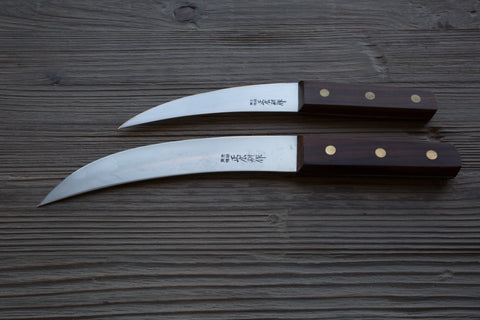
<p>Hankotsu - Breaking/boning knife for livestock. The last third of the knife, by the handle, is unsharpened in order to scrape against bone without sacrificing the edge on the sharpened portion. This knife can also be called honesuki maru or Nishigata hankotsu. Double bevel, but highly asymmetrical.</p>
<p><img src="//cdn.shopify.com/s/files/1/0994/0120/files/FU9A4672_large.jpg?8902782771630171498" alt="hankotsu"></p>
<p> </p>
<p>Honesuki - Breaking/boning knife specifically for poultry. The triangular shape is tailored to breaking down and deboning an entire chicken carcass. Videos on youtube show just how well designed and effective these knives are. Double bevel, but highly asymmetrical.</p>
<p><img src="//cdn.shopify.com/s/files/1/0994/0120/files/FU9A4673_large.jpg?8902782771630171498" alt="honesuki"></p>
<p> <iframe width="420" height="315" src="https://www.youtube.com/embed/-gf5QUFh3L8" frameborder="0" allowfullscreen=""></iframe></p>
<p> </p>
<p><iframe width="420" height="315" src="https://www.youtube.com/embed/2raI04WFJ4k" frameborder="0" allowfullscreen=""></iframe></p>
<p> </p>
<p><iframe width="420" height="315" src="https://www.youtube.com/embed/78IFzqczrDk" frameborder="0" allowfullscreen=""></iframe></p>
<p> </p>
<p>Kawahagi - Skinning knife for larger livestock animals. Double bevel.</p>
<p><img src="//cdn.shopify.com/s/files/1/0994/0120/files/FU9A4674-2_large.jpg?8902782771630171498" alt="kawahagi"></p>
<p><br> Atamatori - Long, curved knife for beheading larger livestock animals (lambs, pigs, cows). Also comes in smaller sizes, sometimes used for chicken.  The smaller one is sometimes called kashiratori. Double bevel.</p>
<p><img src="//cdn.shopify.com/s/files/1/0994/0120/files/FU9A4675_large.jpg?8902782771630171498" alt="atamatori"></p>]]>
    </content>
  </entry>
  <entry>
    <id>https://www.japaneseknifeimports.com/blogs/news/introducing-josh-hes-going-to-be-taking-over-the-blog-for-a-bit</id>
    <published>2016-07-24T15:21:00-07:00</published>
    <updated>2016-07-24T19:22:45-07:00</updated>
    <link rel="alternate" type="text/html" href="https://www.japaneseknifeimports.com/blogs/news/introducing-josh-hes-going-to-be-taking-over-the-blog-for-a-bit"/>
    <title>Introducing Josh... He&apos;s going to be taking over the blog for a bit</title>
    <author>
      <name>Jonathan Broida</name>
    </author>
    <content type="html">
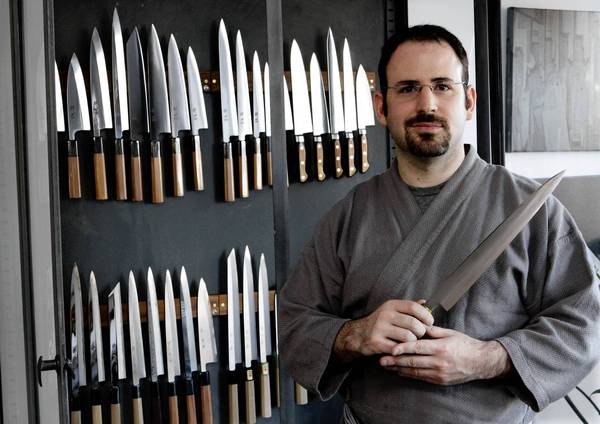
      <![CDATA[<p>Josh started working for us a few months ago, and as he's going through a lot of training right now, we thought it might be fun to have him share a bit about the things he's learning about, struggles, areas of interest, etc., as a lot of this is new to him like it is to many of our customers.  Before working with us, Josh worked as a butcher for a couple of high end butchery shops nearby.  He also has experience with various aspects of fabricating, welding, woodworking, etc.  Currently, he helps out with shipping out online orders, helping people in the store, answering the phones and e-mails, following up with customers, etc.  We are also working on getting him up to speed with knife sharpening and repairs, though that admittedly takes a bit longer.</p>
<p> </p>
<p>Anyways, we've given him free reign with the blog here... Looking forward to hearing what he has to say.  Here's Josh...</p>
<p style="text-align: left;"><img src="//cdn.shopify.com/s/files/1/0994/0120/files/FU9A4666_a5d59614-ee04-4552-969e-945abbe8ab5e_large.jpg?16898630856489202692" alt="Josh"></p>]]>
    </content>
  </entry>
  <entry>
    <id>https://www.japaneseknifeimports.com/blogs/news/expected-price-raises-across-japan-for-knives</id>
    <published>2016-07-18T14:48:00-07:00</published>
    <updated>2016-07-25T21:58:24-07:00</updated>
    <link rel="alternate" type="text/html" href="https://www.japaneseknifeimports.com/blogs/news/expected-price-raises-across-japan-for-knives"/>
    <title>Expected Price Raises Across Japan for Knives</title>
    <author>
      <name>Jonathan Broida</name>
    </author>
    <content type="html">
      <![CDATA[<meta charset="utf-8"><span>Just a heads up for everyone... a number of knife maker associations across japan have agreed upon price raises for products made by their members. It seems this is occurring in multiple regions, and even those outside of these associations will be raising prices. In many cases, we expect to see 20% increases (though we have been told that some will be more). We have been told that these changes will begin in the fall, but people are going about it differently. Some have already started, while others will take a bit longer. Some will be raising prices on knives ordered from that point on, while others will be raising prices on everything (including items that have already been on order, but have not yet been paid for or shipped). This is not in every single region for knife making, but we have heard this from many of them, and expect others to follow suit.</span><br><br><span>We have not seen so much of this as of yet, but we expect this to start effecting us (and everyone else) shortly.</span>]]>
    </content>
  </entry>
  <entry>
    <id>https://www.japaneseknifeimports.com/blogs/news/69573317-welcome-to-our-new-website</id>
    <published>2015-11-25T21:07:00-08:00</published>
    <updated>2015-11-25T21:07:12-08:00</updated>
    <link rel="alternate" type="text/html" href="https://www.japaneseknifeimports.com/blogs/news/69573317-welcome-to-our-new-website"/>
    <title>Welcome to our new website</title>
    <author>
      <name>Jonathan Broida</name>
    </author>
    <content type="html">
      <![CDATA[<p>After a lot of work, and a bit of a wait, we were finally able to launch the newest version of Japanese Knife Imports today.</p>
<p><img src="//cdn.shopify.com/s/files/1/0994/0120/files/Screenshot_large.jpg?17852334115957950586" alt=""></p>
<p>Though the website looks similar, there are a number of huge changes we have made with this new version.  We have been listening to what our customers have been asking for, and, in this newest version, we have tried to implement as many of those requests as possible.  Here's a brief rundown of some of the new things you can expect:</p>
<ul>
<li>Mobile and Tablet friendly sites- the site should work well whether it be on your desktop, laptop, tablet, or phone</li>
<li>Pay by credit card on our site... no more pay pal or third party systems (well, aside from what we are using for this now, which maintains industry standard high levels of security)</li>
<li>Improved search functionality- it just works now</li>
<li>Improved menu design- no more mouseover issues</li>
<li>No product mouseover necessary to see product info</li>
<li>Improved product description layout- tabs with information clearly laid out</li>
<li>Improved product photo handling- mouseover zoom feature and click to enlarge</li>
<li>International orders can now be processed directly through the website... no more having to ask for quotes or deal with direct invoices</li>
<li>Shipping quotes are available on the shopping cart page- Just put the necessary info in, and we will provide quotes for all available shipping methods to your location</li>
<li>View in-stock items only- we created a special link in the main menu to filter out all out-of-stock items</li>
<li>By Brand, By Type, Sharpening Supplies, and Other Items pages- see all menu options clearly laid out in a grid by clicking these links in the menu</li>
<li>Product Filtering on Collection pages- say you want to view Gesshin Ginga knives, but only Gyutos... you can do that now.  Only want to see things under $100?  Thats possible too.</li>
<li>Improved sort options on collection pages... order by price, date added, name, best selling, etc.</li>
<li>Our contact page form really works... you can send us messages through the website</li>
<li>Improved social media integration</li>
<li>Significantly improved Back-In-Stock feature... just put your e-mail in and we take care of the rest</li>
<li>Track your orders from within our website- also get e-mail updates as your order is processed and ships</li>
<li>See the number of items in inventory for any item... its right there on each product page</li>
<li>We've added a quick view option so you can see important product info without having to go all the way to the product page</li>
<li>New live chat feature... when we're around, you can chat with us right on the website.  When we're not around, leave us a message and we'll get back to you.</li>
<li>General improved customer experience... we just made it all easier to use</li>
<li>Gift cards... coming soon :)</li>
</ul>
<p>Anyways, we hope you enjoy the new website.  If you have any questions, feedback, or trouble with the website for any reason, please don't hesitate to contact us by phone at 310-399-0300 or by e-mail at Jon@JapaneseKnifeImports.com.</p>
<p>-Jon</p>]]>
    </content>
  </entry>
  <entry>
    <id>https://www.japaneseknifeimports.com/blogs/news/64519109-a-note-on-the-subject-of-microbevels</id>
    <published>2014-07-17T15:07:00-07:00</published>
    <updated>2015-11-19T16:47:54-08:00</updated>
    <link rel="alternate" type="text/html" href="https://www.japaneseknifeimports.com/blogs/news/64519109-a-note-on-the-subject-of-microbevels"/>
    <title>A note on the subject of microbevels</title>
    <author>
      <name>Jonathan Broida</name>
    </author>
    <content type="html">
      <![CDATA[<meta charset="utf-8">
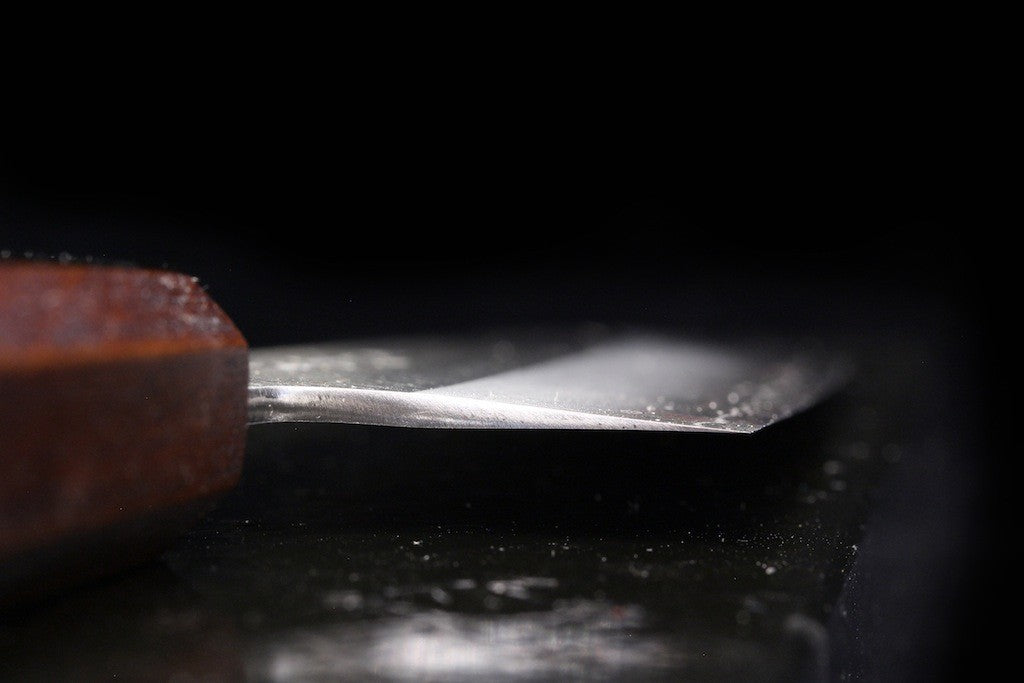
<p>I had a discussion about this on another forum and i thought it might be useful here... i think people misunderstand microbevels (and also have no clue what thin behind the edge actually looks like with regard to thinning)...</p>
<p>microbevels are intended to achieve the following things (not necessarily all of them, but at least one, if not a combination of a couple or more):</p>
<p>-maintaining extremely thin geometry on a knife that could not otherwise handle it -reduce chipping in super hard steels -increase stability in larger carbide steels (especially at low sharpening angles) -improve edge retention at the cost of maximum potential sharpness</p>
<p>Here is an example of very thin behind the edge:</p>
<p><img src="https://cdn.shopify.com/s/files/1/0994/0120/files/img_0125_1.jpg?10935927544236862122" alt=""></p>]]>
    </content>
  </entry>
  <entry>
    <id>https://www.japaneseknifeimports.com/blogs/news/64519621-rethinking-how-restaurants-hire-the-hiring-process-at-3-star-michelin-ryugin</id>
    <published>2014-05-10T15:09:00-07:00</published>
    <updated>2015-11-19T16:47:54-08:00</updated>
    <link rel="alternate" type="text/html" href="https://www.japaneseknifeimports.com/blogs/news/64519621-rethinking-how-restaurants-hire-the-hiring-process-at-3-star-michelin-ryugin"/>
    <title>Rethinking How Restaurants Hire - The Hiring Process at 3-Star Michelin RyuGin</title>
    <author>
      <name>Jonathan Broida</name>
    </author>
    <content type="html">
      <![CDATA[<meta charset="utf-8">
<p>Here, at Japanese Knife Imports, we have been expanding our library of books and magazines.  One of the magazines we get is essentially the equivalent of Art Culinaire in Japan.  Unlike Art Culinaire, however, there is a greater emphasis on professional chefs sharing information about how they run their businesses.  In the most recent issue, there was a very interesting article by Seiji Yamamoto, the chef and owner of 3-michelin-star RyuGin restaurant in Tokyo.  He discussed his hiring process in depth.  As we have been hiring lately, and as our job board has grown, we have thought a lot about this ourselves.  His process was extremely interesting to me.  I asked Sara to summarize his article.  Here is what she wrote:</p>
<p>-Job Interview-</p>
<p>Seiji Yamamoto wrote the process and philosophy behind how he and Ryugin conduct job interviews. Ryugin, as a leading restaurant for nihon ryori (traditional Japanese cuisine), their work ethic and level of performance as a team directly correlates to the world standard (as Japan is the standard for the world's nihon ryori).</p>
<p>According to Yamamoto, there's an unanimous consent - for any kind of job, not just restaurants'- that when someone becomes an employee, this person is to join the "team" and thus has to share the same vision and same level of commitment. This was a challenge that everyone from the current team of 18 had to overcome to be a part of Ryugin</p>
<p>Yamamoto always follows the four steps for a job interview:</p>
<ol>
<li>Apply for a position from Ryugin Website</li>
<li>Dine at Ryugin as a customer</li>
<li>Writing exam on a questionnaire form</li>
<li>Interview in person with Seiji Yamamoto</li>
</ol>
<p>Based on the first application from the website, some promising candidates will be called for dining at Ryugin. Its purpose is to have an established fact that all the remaining candidates have an experience of being a customer at Ryugin.</p>
<p>Most unique and valuable process is step 3. As of March 2015, candidates will be asked to answer 86 questions (28 pages long) - on average people spend more than 3 hours to finish the form. Some questions in the form are: how did you learn about Ryugin; what kind of pay do you expect to receive and why (How can you justify it? Do you think you and what you can do for the company are worth for the money?); what kind of dining experience do you have; why did you choose nihon ryori; what kind of books/magazines do you read; who do you respect the most as a chef; how long can you commit to work for Ryugin; what kind of influential restaurants abroad are you aware of; what do you know about Ryugin Group?</p>
<p>This wide-ranging questionnaire not only help Ryugin clarify the kind of questions new employees will be asked, but also find candidates who share similar visions with Ryugin, as oppose to trying to make people something that they are not.</p>
<p>For Yamamoto, the most important quality that he look into from candidates are skill set, contribution to the company, and lastly but most importantly trustworthiness. This questionnaire is, of course, exhausting to answer, but also the same for the team Ryugin to make and read answers. But because it is such an extensive form, people with a sense of commitment and passion naturally come across strongly.</p>
<p>When candidates make it to the interview with Yamamoto, because all the questions are answered on the questionnaire, it will be candidates' turn to ask questions if any. There will be an explanation about how he/she is no longer looking at Ryugin from outside, but is going to show Ryugin. Lastly, Yamamoto will tell the candidates that Ryugin is not begging or asking for them to work for Ryugin, but it is them who have to be wanting to work for Ryugin on their free will - if there is any question, hesitance, unwillingness, or disagreement, please do not come back.</p>
<p>The remaining candidates will formally sign the contract before starting 3 months trial period. This contract is also unique and wide-ranging, assuming every possible problem there can be (more than 90 statements). It clearly states regulations such as follows:</p>
<ul>
<li>Ban on any SNS, such as instagram, face book, twitter etc</li>
<li>Ban on going into any service oriented business (ie restaurants) pretending that you are not from the industry, or hide identity (such behavior must be considered shameful).</li>
</ul>
<p>They are expected to follow the rules to details. Yamamoto's philosophy is that once someone decide to be the best of something, it entails a strict training of mind everyday without any excuse. People who has the same level of commitment for learning and for nihon ryori as the team Ryugin will not have any problem or a second of hesitance to agree to these.</p>
<p>I found this to be very interesting.  I think this kind of format, though time consuming and over the top, might be a cool way to help create a better kitchen culture in our kitchens here in the US.  Over the last few years, we have seen a problem across Los Angeles and other US cities... chefs feel like there are no good line cooks out there anymore, and hiring good staff has become exceedingly difficult.  In fact, as I mentioned above, our Job Board has gotten out of control lately.  The list is getting longer and longer, and I hear from our chef friends and customers every day about how hard it is for them to find good staff.  Maybe this is a time for us to re-think the way we go about our hiring process.  What do you think?</p>
<p>*Source: Senmon Ryori Issue 4, April 2015- Shibata Shoten Ltd.</p>]]>
    </content>
  </entry>
  <entry>
    <id>https://www.japaneseknifeimports.com/blogs/news/64518853-steel-type-vs-blacksmith</id>
    <published>2014-01-14T15:06:00-08:00</published>
    <updated>2015-11-19T16:47:54-08:00</updated>
    <link rel="alternate" type="text/html" href="https://www.japaneseknifeimports.com/blogs/news/64518853-steel-type-vs-blacksmith"/>
    <title>Steel Type Vs. Blacksmith</title>
    <author>
      <name>Jonathan Broida</name>
    </author>
    <content type="html">
      <![CDATA[<meta charset="utf-8">
<p>I had an interesting question from a customer today and wanted to post about it here, since i thought it was a great question and i'm sure many of you probably were thinking about the same thing...</p>
<p>Question- Is it true that white steel #1 is considered the top of the line steel since it is so clean and offers a blacksmith a "white canvas" more than the blue steels that have additional alloys?</p>
<p>Answer- I don't believe that any steel can be called top of the line... all of the steels require different skill sets to heat treat well. Even though blue steel is technically more forgiving in the HT process, it doesn't mean that a very skilled craftsman couldn't bring out the best in it through great finesse. White #1 is a very simple, very pure, and very high carbon steel, so it does require great skill to work with well, but there are a number of blacksmiths who i do not consider to be so great who often work with white #1 and get so-so results, so just seeing white #1 is not an indication of a high quality knife. Obviously, there is great potential with white #1 for a skilled craftsman to showcase his technique, there are only a few ways to know this for yourself with any certainty. First, try for yourself and see- this also means that you have to know enough to be able to assess the steel well. Second, rely on reputation- this only works when the people describing the steel know what they are talking about. Or third, find a retailer whom you can trust and who has experience using and sharpening the steel so that he/she can talk about it effectively- the only works if the retailer knows what they are talking about and has the experience and training to validate their opinion.</p>
<p>Anyways, the gist of this is that just knowing a steel type doesn't tell you if that steel has been forged and heat treated well. Even steels that seem simple and nothing special on paper can be amazing when skillfully forged and heat treated (aeb-l is a great example of this... when its great, it can be really great, but without a good heat treatment, its really nothing special).</p>
<p>Hope you guys enjoy this quick read.</p>]]>
    </content>
  </entry>
  <entry>
    <id>https://www.japaneseknifeimports.com/blogs/news/64519237-on-single-bevel-sharpening-hamaguri-and-beta-togi</id>
    <published>2013-07-30T15:08:00-07:00</published>
    <updated>2015-11-19T16:47:54-08:00</updated>
    <link rel="alternate" type="text/html" href="https://www.japaneseknifeimports.com/blogs/news/64519237-on-single-bevel-sharpening-hamaguri-and-beta-togi"/>
    <title>On single bevel sharpening- Hamaguri and Beta Togi</title>
    <author>
      <name>Jonathan Broida</name>
    </author>
    <content type="html">
      <![CDATA[<meta charset="utf-8">
<p>Recently, a customer/friend asked me a question about how single bevel knives are properly sharpened and if the concavity from the large wheels the knives are made on has any functional purpose. Here was my answer:</p>
<p>The concave part of the blade road is a function of how the knives are made. Often, they go from a wheel to a buffer and are finished with minimal stone contact, so the low spot in the center of the blade road remains. As a rule of thumb (though not always 100% accurate), the more expensive knives have less of this and to less of a degree than less expensive knives. Knives that have had honbadzuke performed (by either the knifemaker or retailer) should not have this, though sharpeners in Japan are less uptight about this than most customers in the west are. Honbadzuke and regular sharpening are designed to remove these low spots (and high spots for that matter) over time.</p>
<p>In terms of correct single bevel sharpening, there are really two ways people go about things. The first is generally regarded as the most technically correct and best for performance, while the second is easier to do, and still correct. The first type of sharpening is hamaguri sharpening. In doing this, the blade road is sharpened in 2 parts and then blended together. The first sharpening is from the shinogi line down about 1/2 way or 2/3 the way down the blade road. In this first sharpening, the shinogi line should be moved up the same amount of height you intend to remove from the edge of the knife. The second sharpening is of the edge and the area just behind the edge. During this sharpening, you remove metal from the edge and form a burr. The two angles of these first and second sharpening are almost the same, so the difference comes mainly from finger placement and pressure, rather than lifting up the edge. These two bevels are then blended together to create a hamaguri edge. The curvature should be very subtle.</p>
<p>The second kind of sharpening is often referred to as beta togi. This is the kind of sharpening where the blade road is entirely flat, and, when sharpened, is laid flat on the stone. Compared to hamaguri, this kind of sharpening is less time consuming and easier to do. It yields a thinner edge, with slightly better cutting performance, but lacks in edge retention, toughness, and food release when compared to hamaguri edges. Even in this kind of sharpening, the high and low spots are removed over time, which indicates proper sharpening.</p>]]>
    </content>
  </entry>
  <entry>
    <id>https://www.japaneseknifeimports.com/blogs/news/64518725-a-series-of-notes-on-various-subjects</id>
    <published>2013-07-19T15:03:00-07:00</published>
    <updated>2015-11-19T16:47:54-08:00</updated>
    <link rel="alternate" type="text/html" href="https://www.japaneseknifeimports.com/blogs/news/64518725-a-series-of-notes-on-various-subjects"/>
    <title>A Series of Notes on Various Subjects</title>
    <author>
      <name>Jonathan Broida</name>
    </author>
    <content type="html">
      <![CDATA[<meta charset="utf-8">
<p><span>Here are some notes on various aspects of kitchen knives and knife repair that i have shared with customers recently. I hope many of you will find them useful.</span></p>
<hr>
<meta charset="utf-8">
<p><span>Up First, a bit about sharpening single bevel knives, angles, geometry, and asymmetry-</span><br><br><br></p>
<div>An answer to a question posted on youtube... thought it might be helpful to some...<br><br>question: What angle will you recommend on the primary and secondary edge on a yanagiba?<br><br>answer: The exact angle will depend on the knife/maker/etc. However, these things can be quite easy to follow from initial sharpening. The angle doesnt change much between the two angles... its mostly pressure that changes. The main part is you know where you need to sharpen and you are trying to keep the distance from the shinogi line to the edge the same so as to maintain geometry. Hope this makes sense and helps.<br><br>question: Hello. Okay I will try to replicate the sharpening angle used before. It seems like it is about 11 deg at the primary edge.<br><br>answer: are you using a guided device for this? You may find that the angle changes a bit from heel to tip as well. This can make using a guided device a bit more tricky.<br><br>question: I do not use a guided device. Only freehand But I did not know that the angle is changing from heel to tip. Is it because it is impossible to keep a constant angle when freehanding or do the knife makers do it on purpose? Another question: On the sharpening video on the old channel you are sharpening a Aristugu A-Type Gyuto. What type of bevel do this knife have, single?, 30/70? Is this knife possible to buy?<br><br>answer: not all makers do it this way, but those that do have explained to me that the tip is thinner for more delicate work relative to the heel. On the A-Type sharpening, i actually dont recommend that kind of sharpening. It was just to show what i was doing to one of my knives at the time. That knife is still being sold at some places. The sides are asymmetrical, as well as the bevel. Probably somewhere close to 70/30, but numbers like this are over-simplifications.<br><br>in reality when talking about symmetry, people rarely use specific and exact angles. Likewise for the sides of the knives. These kinds of explanations are general over-simplifications japanese knife-retailers/wholesalers and sometimes makers use to help people who dont know japanese knives better understand one of the ways in which they are different. In fact, i just had this conversation with many of the makers no more than a few days ago.</div>
<hr>
<meta charset="utf-8">
<p><span>Up next, a bit on machi gaps and Japanese Knives-</span><br><br><br><span>A quick note on machi gaps...</span><br><br><span>I know that many on here do not like them, so i thought i would take some time to explain a bit about them. First, the biggest thing to know is that there are regional differences in aesthetics. Kanto tends to like large gaps, while kansai does not. However, most knife makers/retailers/wholesalers in japan will still leave them if it makes more sense to than not. However, on request from many us retailers, many wholesalers in japan have started installing the handles flush with the handle. So, the question becomes "why leave a gap?"</span><br><br><span>There are a few reasons the gaps are left... here are some of the top ones</span><br><br><span>-When the neck of the knife is short (which can happen for a variety of reasons or sometimes none at all), the spacing between the choil and the handle becomes important. This space should be large enough to fit about 80% of your middle finger when holding the knife in a pinch grip. Smaller than this will be too small and is uncomfortable to hold. Larger than this will be too loose and can make rotary control of the knife more difficult than it should be. 80% or so gives enough space for the finger to fit, but is tight enough that the finger is still in contact with the handle for rotational stability. Also, what i have just said is based on what one would expect for a gyuto. Ideal sizes will be different based on knife types, expected grips, intended customers, etc.</span><br><br><span>-Handle installation... This is not only for ease of installing handles in the traditional japanese way (which is easier than using epoxy, allows for easier handle replacement, and removal of handles for maintenance), but also allows for knife placement relative to the handle. Knives with no machi will have a spine that is significantly lower than the top of the handle for example. On significantly harder woods (like ebony), the tang with the machi makes installation significantly easier with less chance of the wood cracking (which can be a problem with ebony).</span><br><br><span>Here are the top reasons i hear for people not wanting machi gaps...</span><br><br><span>-Food gets stuck. I've used knives with machi gaps for many years, both at home and in professional kitchens. This area is almost always covered with your hand and is not generally at risk for food getting stuck. If food does get in there, its a long way from being stuck, and comes out with general knife cleaning. If you find food accumulating, the chances are you may not be taking care of your knife well enough in my opinion. I've seen a wide number of knives from a wide number of people. I see just as many very dirty knives with no machi as i do dirty ones with a machi. I would venture to say, a dirty knife is more a function of the user than the knife design.</span><br><br><span>-It catches on your finger. I've found this to be the case with very large machi gaps or on some lower end knives that have machis that extend beyond the handle in width (or height depending on how you think about it). However, after significant testing, i've found that on knives with normal sized machi gaps, if this turns into a problem, it is most often the result of the use of an improper grip. When knives are held properly, your fingers dont really make contact with this area in a way than can catch.</span><br><br><span>-And of course, some people just dont like the way it looks... actually, this one is the reason i understand best.</span><br><br><span>The reason i say this, is that sometimes i ask makers to reduce or remove the machi gaps based on customer requests. However, i have a stipulation i have discussed with them. I would prefer that if and when they reduce the gap, they do it to an extent that does not sacrifice the ability to grip and use the knife well.</span><br><br><span>Anyways, hope this helps make sense of this to some of you.</span><br><br><span>A short while later, someone posted this in response to my above statement.  I thought it was very interesting, so i'm quoting the post and response here:</span><br><br><span>Poster with Question:</span><br><span>I do not want to seem augmentative, so take these comments as the devils advocate if you please-</span><br><i><br></i><i>"When the neck of the knife is short (which can happen for a variety of reasons or sometimes none at all), the spacing between the choil and the handle becomes important. This space should be large enough to fit about 80% of your middle finger when holding the knife in a pinch grip. Smaller than this will be too small and is uncomfortable to hold. Larger than this will be too loose and can make rotary control of the knife more difficult than it should be. 80% or so gives enough space for the finger to fit, but is tight enough that the finger is still in contact with the handle for rotational stability.Also, what i have just said is based on what one would expect for a gyuto. Ideal sizes will be different based on knife types, expected grips, intended customers, etc."</i><br><br><span>This statement could be read as to be more about adapting the handle to a knife that was not made correctly. I have never seen this gap with any of our local knife makers here at the KKF. Is it a case of just get them out the door?</span><br><br><i>"Handle installation... This is not only for ease of installing handles in the traditional japanese way (which is easier than using epoxy, allows for easier handle replacement, and removal of handles for maintenance), but also allows for knife placement relative to the handle. Knives with no machi will have a spine that is significantly lower than the top of the handle for example. On significantly harder woods (like ebony), the tang with the machi makes installation significantly easier with less chance of the wood cracking (which can be a problem with ebony)."</i><br><i><br></i><span>Again, it seems like a case of expediency rather than quality here. Adjusting the installation to the tech rather than the end user seems back asswards.</span><br><br><span>My Response:</span><br><span>Often times i have seen many US custom makers not think about this spacing, and only concern themselves with not leaving gaps. Some, however, do consider the spacing and adjust the neck of the knife to the size they need to install the handle. However, once the handle in installed, it can not be removed for maintenance (in most cases i have seen). Therefore, i could not repolish an entire blade perfectly... there would always be that little area near the handle that wouldnt be correct. Likewise for thinning a blade perfectly. This same area will be missed, therefore creating a high spot in that area. Its not often a problem in food release or cutting, but will change the look of the knife over time. By installing the handle with a little room for play, the handle can be removed when refinishing is necessary... same for thinning. On handles i've seen that use pins to keep the handle in place, the handles can be installed flush with the machi, but as the handle is removed and replaced overtime, the fit becomes looser. By being able to put it back on a tiny bit further each time, this problem is minimized with the japanese way of installing handles.</span><br><br><span>On the subject of handles, the choice of handles actually has great thought behind it, as well as the way it is installed. Here, we tend to have different ways of doing things, but in japan there are certain things a chef does that makes the need to replace his handles from time to time greater than what we see here. Ho wood was picked as a handle material due to its resistance to cracking in extreme climate environments or environmental changes. Other woods do not have this same strength. For example, ebony is one of the woods i see the most cracking problems with. It also happens on ichii and rosewood from time to time. Stabilized woods are not popular either, due to not being able to be installed the same way. The handles are installed in this way to allow for easier removal and replacement, as i previously mentioned. This is because most japanese chefs at higher end restaurants will sand down their handles a bit from time to time to keep them clean looking. This is very important to the way the think about their work environment, as well as the customer perspective in Japan. This means that handles wear significantly more quickly there. Being able to replace them easily is more of a necessity than anything else. And being able to do it inexpensively is a plus as well. Ho wood is also liked due to the lightness, which relates to the balance of the blade. When ebony handles are used, the end user understands that he/she will need to care for the wood significantly more so as to not have it crack. Likewise, it will change the balance of the knife significantly... especially on lighter knives (wa-gyutos, etc.). Traditionally, you see this most often on higher end single bevel knives, where the knives are forward balanced enough that the ebony handle doesnt change the balance in a really negative way.</span><br><br><span>Hope this makes sense in relation to your comments above.</span><br><br><span>Also, because many of the makers now know that americans dont like the look of machi gaps, the knives they make for export dont have them.</span><br><br><span>I think its also important to keep in mind we are buying knives that are designed with the japanese chef in mind (that's their history)... not the american chef. So often times the knives will adhere more to japanese chef's values than american, as in the case of handle replacement here.</span></p>
<hr>
<meta charset="utf-8">
<div>And lastly, a note on checking for knife straightness-<br><br>
</div>
<div>Checking for Knife Straightness- A Quick Note<br><br>I recently have had a number of questions on and/or about this subject and i thought it might be nice to clarify a few things. Checking a knife for straightness can be very useful and is a very important part of knife sharpening. Here are a few notes on the subject-<br><br>-There are two knives of straightness one needs to be concerned with... warping from side to side and torsional twisting. Torsional twisting can sometimes be a problem and sometimes not (depends on the type of knife, grind type, and severity). Side to side twisting is almost always a problem (i say almost always because there may be a time when it is not... i just cant think of one off the top of my head).<br><br>-Checking for straightness is best done using your eyes, sighting down the blade in a variety of ways and from a variety of angles. However, it does take time to train your eyes to be able to see this well. Severe problems will be easy to see, but less severe problems can sometimes be very difficult to see. You will often sight down the blade spine from handle to tip and tip to handle, as well as the same with the edge side. It can also be a good idea to take a more straight on look down at the spine and edge. It can also help to look at the knife from the spine and edge, while holding it parallel to the ground with the tip facing to the right or left and the handle the opposite.<br><br>-It is not usually a good idea to test by laying the blade on something flat. This is for a few reasons. Most flat looking things are not flat. However, moreover, the grind on the sides of the knives will effect how this blade appears. For example, asymmetric knives may appear to be flat on one side while on the other the tip may appear to be bent upwards. This is an optical illusion and is a function of the grind and they way it lays on the flat surface.<br><br>-Slight warping on single bevel knives is sometimes seen. I had many discussions about this with very well respected professional chefs as well as knifemakers (sharpeners and blacksmiths). Server warping can be a problem in use and sharpening. Slight warping can be corrected through sharpening and does not need to be twisted back by hand (which i highly recommend not trying yourself... it is very difficult to do well and can potentially cause significant damage to the knife, not to mention you). Chefs and craftsmen agree that slight twisting does not effect performance in cutting and is best fixed by sharpening. More severe warping can be fixed by one of two ways... one will require refinishing the knife, but is the better solution. The other is more difficult and dangerous, doesnt provide as good of results, but can be done without refinishing the blade. I do not plan to share these on here, as when things like this have been shared in the past, many people attempt to do it and i end up seeing a lot of major problems that i need to fix. Sorry guys.<br><br>-Bending from left to right is often fixed with a tool used to bend the knife back. However, its not quite as simple as just picking the bent spot and bending it back. Like i mentioned above, when things like this have been shared in the past, many people attempt to do it and i end up seeing a lot of major problems that i need to fix. So i dont plan on explaining this in more detail to try to minimize this kind of problem. However, for those that have been to my shop, you can see me do this on a somewhat regular basis. This also requires great skill and experience to see well, and it has been my experience that fixing this kind of warping well also requires training and practice. I cant tell you how many knives i see for repair that people have tried to fix at home. Even when things seem to be fixed, there are often problems that the owner cant see. Anyways, this kind of repair is necessary to do before attempting sharpening. Sharpening a bent knife will cause issues with the bevel, profile, and geometry of the knife.<br><br>Again, i highly recommend not attempting this at home. Not only are the fixing processes potentially dangerous, but the chances of causing more damage than good are very high. I have spent a long time training in Japan to be able to do this well... not only in the actual repair process, but also in assessing the problems through visual inspection.<br><br>Hope this helps.<br><br>-Jon</div>]]>
    </content>
  </entry>
  <entry>
    <id>https://www.japaneseknifeimports.com/blogs/news/64518341-kanto-vs-kansai-knife-shapes-a-lesson-in-history</id>
    <published>2013-07-09T15:02:00-07:00</published>
    <updated>2015-11-19T16:47:54-08:00</updated>
    <link rel="alternate" type="text/html" href="https://www.japaneseknifeimports.com/blogs/news/64518341-kanto-vs-kansai-knife-shapes-a-lesson-in-history"/>
    <title>Kanto Vs Kansai Knife Shapes - A Lesson In History</title>
    <author>
      <name>Jonathan Broida</name>
    </author>
    <content type="html">
      <![CDATA[<meta charset="utf-8">
<p>Someone asked this question the other day, so i thought it might be nice to copy and paste some of that conversation here:<br><br><br>"The history of the shapes is a bit different, as is the way the used to be used. Because of the tip on the kamagata usuba, chefs can use it for regular usuba work and mukimono (design work), and tend to do so. In kanto, chefs that do mukimono tend to use a mukimono bocho as well. Of course, at the best restaurants and with the most skilled chefs, they still tend to use the most task specific knife (but, not always).<br><br>There's a bit more history to it than just that... i'm in a rush right now, but if i can remember tonight, i will explain in more depth. It will also clear up the difference between takobiki and yanagiba."</p>
<div></div>
<div>and later, i was able to post this:</div>
<div></div>
<p>"So here we go... in the kanto region, back in the day they used to sit while cutting, making their cutting boards higher relative to their bodies. This necessitated the use of flater edged knives (takobiki, higashi-gata usuba, etc), as well as the lack of a sharp tip, which would be useless and problematic from this position. In the Kansai region, chefs stood while cutting, this making the curved profile of yanagiba more useful than takobiki. Likewise, the tip of the kamagata usuba is easier to use from a standing position than a sitting position. Moreover, the home of kaiseki ryori is kyoto. In this kind of cuisine, mukimono (decorative cutting technique) is often seen. The tip of the kamagata usuba is very useful when doing this kind of detail-oriented cutting. Mukimono bocho is also sometimes used, but it seems to be a bit more common in the kanto region, as the higashigata-usuba doesnt have a functional tip for this kind of thing.<br><br>Hope this helps you guys better understand these knives."</p>]]>
    </content>
  </entry>
  <entry>
    <id>https://www.japaneseknifeimports.com/blogs/news/64518021-japan-trip-2013</id>
    <published>2013-06-14T15:00:00-07:00</published>
    <updated>2015-11-19T16:47:54-08:00</updated>
    <link rel="alternate" type="text/html" href="https://www.japaneseknifeimports.com/blogs/news/64518021-japan-trip-2013"/>
    <title>Japan Trip 2013</title>
    <author>
      <name>Jonathan Broida</name>
    </author>
    <content type="html">
      <![CDATA[<meta charset="utf-8">
<div><b>Out of Town Notice</b></div>
<div>July 1st - July 21st</div>
<p> </p>
<p>(Updated June 14th, 2013)<br><br>Once again, it's time for our anual Japan trip. This year we're changing a few things. Normally, Sara and I both head to Japan for about a month in the fall. During this time, I train under a few different master craftsmen. This year, however, Sara will be staying here to run the store and process shipments, while I head to Japan for about 3 weeks. My Japan training trip will take place from July 1st to July 21st. Our store will resume normal hours again on July 22nd. During my time in Japan, I will be learning under amazing master craftsmen like Hinoura-san and the Gesshin Hide craftsmen.<br><br>Unlike previous years, this year, all shipping will continue as normal (handled by Sara). Also, sara will be opening the store during this time... see the schedule below for our store hours during this time:<br><br>July 3rd (Wed)- Noon-5pm<br>July 5th (Fri)- Noon-5pm<br>July 8th (Mon)- Noon-5pm<br>July 10th (Wed)- Noon-5pm<br>July 12th (Fri)- Noon-5pm<br>July 14th (Sun)- Noon-5pm<br><br>Also, all sharpening services will be on hold from June 25th until July 21st.</p>
<meta charset="utf-8">
<p><span>If you need to contact us while we are out of town, we will be checking our e-mail regularly. For Jon, please send e-mails to </span><a href="mailto:Jon@JapaneseKnifeImports.com">Jon@JapaneseKnifeImports.com</a><span> and for Sara, please send e-mails to </span><a href="mailto:Sara@JapaneseKnifeImports.com">Sara@JapaneseKnifeImports.com</a><span>.</span></p>
<meta charset="utf-8">
<p><span><span>Thank you so much for your patience and understanding.</span></span></p>
<p> </p>
<meta charset="utf-8">
<p><span>-Jon</span></p>]]>
    </content>
  </entry>
  <entry>
    <id>https://www.japaneseknifeimports.com/blogs/news/64517509-japanese-knife-imports-in-the-la-times</id>
    <published>2013-03-09T14:59:00-08:00</published>
    <updated>2015-11-19T16:47:54-08:00</updated>
    <link rel="alternate" type="text/html" href="https://www.japaneseknifeimports.com/blogs/news/64517509-japanese-knife-imports-in-the-la-times"/>
    <title>Japanese Knife Imports in the LA Times</title>
    <author>
      <name>Jonathan Broida</name>
    </author>
    <content type="html">
      <![CDATA[<meta charset="utf-8">
<p><span>How cool is this?  We are so excited and thankful for S. Irene Virbila for taking the time to come out and meet us.  Here's the article:</span></p>
<p><img src="https://cdn.shopify.com/s/files/1/0994/0120/files/la-1376242-fo-0227-virbila3-ac-jpg-20130308.jpg?950605284520345408" alt=""></p>
<meta charset="utf-8">
<div><a href="http://www.latimes.com/features/food/la-fo-0309-virbila-20130309,0,4165448.story" target="_blank">Across the Table: Knife expert hopes to sharpen up chefs</a></div>
<div></div>
<div>They also did a followup sidebar article, which you can find here:</div>
<div></div>
<div><a href="http://www.latimes.com/features/food/la-fo-0309-virbila-sidebar1-20130309,0,3281314.story" target="_blank">Finding a knife that cuts to the heart</a></div>]]>
    </content>
  </entry>
  <entry>
    <id>https://www.japaneseknifeimports.com/blogs/news/64517445-closed-for-a-few-days-in-march</id>
    <published>2013-03-01T14:58:00-08:00</published>
    <updated>2015-11-19T16:47:54-08:00</updated>
    <link rel="alternate" type="text/html" href="https://www.japaneseknifeimports.com/blogs/news/64517445-closed-for-a-few-days-in-march"/>
    <title>Closed for a few days in March</title>
    <author>
      <name>Jonathan Broida</name>
    </author>
    <content type="html">
      <![CDATA[<meta charset="utf-8">
<p><span>A friendly reminder... We will be closed from March 2nd, reopening on March 8th. Click the link below for more info...</span><br><br><a href="http://www.japaneseknifeimports.com/out-of-town">http://www.japaneseknifeimports.com/out-of-town</a></p>]]>
    </content>
  </entry>
  <entry>
    <id>https://www.japaneseknifeimports.com/blogs/news/64517381-the-world-of-hocho</id>
    <published>2012-12-12T14:57:00-08:00</published>
    <updated>2015-11-19T16:47:54-08:00</updated>
    <link rel="alternate" type="text/html" href="https://www.japaneseknifeimports.com/blogs/news/64517381-the-world-of-hocho"/>
    <title>The World of Hocho</title>
    <author>
      <name>Jonathan Broida</name>
    </author>
    <content type="html">
      <![CDATA[<meta charset="utf-8"><span>By Sara Motomura-Broida</span><br><br><span>We started JKI in March, 2010. For Jon, kitchen knives were something Jon always felt strongly about and was passionate about. To me, this world of hocho was something very new and, in a lot of ways, unknown. </span><br><br><span>The word "shokunin" is most commonly used to describe craftsmen for kitchen knives. Some of them are qualified by the national crafts center and are referred to as "kogeishi" (master of crafts) or “dentokogeshi” (for example, the stickers on our Gesshin Hide knives certify that all of the work done on those knives was done by dentokogeshi in the traditional manner). In Japan, the world of craft and art are two different things, and so are craftsmen and artist. I was more connected to the world where artists live because of my parents (they are artists making traditional yakimono, or pottery) and their crazy artist friends. </span><br><br><span>Initially when we started JKI, I really wasn't fully aware of what I was getting myself into. I had no clue what my future looked like with this new company - the hours, troubles, emotional up and downs, and also the happy rewards. </span><br><br><span>We met a lot of "kakkoii" (Japanese for “cool”) shokunin-san through our business. I found the beauty in their philosophy of making tools. Sometimes they make tools (knives, sharpening tools, or whatever they may be) that are so beautiful and artistic, but at the end of the day, they are all functional tools. This was something so new to my eyes. It was so refreshing as was the idea that one can't know how "great" knives are unless they use them. </span><br><br><span>A lot of our hocho craftsmen told us that "sharp" is not a good enough measurement for kitchen knives, because that's what they are supposed to be as a minimum requirement. It's a regular assumption people have that a knife cuts well, but the real judgment comes with ease of sharpening, edge retention, and the "taste" of cutting (how well it cuts or performs, called kireaji in japanese). Also, most of them say that they are never completely satisfied with their knives because they are always striving for better, and at the end of the day, what is "good" is totally up to the end user. If the knife wasn't the best fit for a user, this knife clearly isn't a "good" knife, not mentioning the "best" knife (not to say it’s not an objectively good knife or not, but that the concept of objectively good has little meaning when it comes to these things). </span><br><br><span>I thought this mentality is somewhat selfless - of course not in a bad way, but almost in an altruistic way. Maybe this is what differentiated artists from craftsmen? I can't be 100% sure why I thought the two terms feel different and are used in different ways... but I felt that could be it. I find beauty in both crafts and art though. </span><br><br><span>I decided to write this down and share what I see from the world of Japanese kitchen knives. My view will change with time, but I wanted to share what I see at this particular time... This kind of thing seems not to be online so much, but in the spirit of appreciating our tools, I feel this is something important for me to say.</span><br><br><span>What we bring from Japan is very inspiring and each thing carries bits and pieces of each craftsman with it...</span>]]>
    </content>
  </entry>
  <entry>
    <id>https://www.japaneseknifeimports.com/blogs/news/64517189-have-you-ever-wondered-about-carbon-steel-knives</id>
    <published>2012-12-10T14:56:00-08:00</published>
    <updated>2015-11-19T16:47:54-08:00</updated>
    <link rel="alternate" type="text/html" href="https://www.japaneseknifeimports.com/blogs/news/64517189-have-you-ever-wondered-about-carbon-steel-knives"/>
    <title>Have you ever wondered about Carbon Steel Knives?</title>
    <author>
      <name>Jonathan Broida</name>
    </author>
    <content type="html">
      <![CDATA[<meta charset="utf-8">
<p><span>If so, we've got a video for you ;)</span></p>
<meta charset="utf-8">
<p><span><span>Hope you like is.  Let us know if you have any questions.</span><br><br><span>-Jon</span></span></p>]]>
    </content>
  </entry>
  <entry>
    <id>https://www.japaneseknifeimports.com/blogs/news/64517061-a-bunch-of-new-sharpening-videos</id>
    <published>2012-11-23T14:56:00-08:00</published>
    <updated>2015-11-19T16:47:54-08:00</updated>
    <link rel="alternate" type="text/html" href="https://www.japaneseknifeimports.com/blogs/news/64517061-a-bunch-of-new-sharpening-videos"/>
    <title>A bunch of new sharpening videos</title>
    <author>
      <name>Jonathan Broida</name>
    </author>
    <content type="html">
      <![CDATA[<meta charset="utf-8"><span>This morning, we shot a few new videos on various aspects of knife sharpening/care.  Here they are... hope you guys like them...</span>]]>
    </content>
  </entry>
  <entry>
    <id>https://www.japaneseknifeimports.com/blogs/news/64516933-using-carbon-steel-knives</id>
    <published>2012-11-06T14:55:00-08:00</published>
    <updated>2015-11-19T16:47:54-08:00</updated>
    <link rel="alternate" type="text/html" href="https://www.japaneseknifeimports.com/blogs/news/64516933-using-carbon-steel-knives"/>
    <title>Using Carbon Steel Knives</title>
    <author>
      <name>Jonathan Broida</name>
    </author>
    <content type="html">
      <![CDATA[<meta charset="utf-8">
<p><span>So, have you ever used carbon steel knives before? It takes a little bit of getting used to, but its not so difficult. A lot of what goes into using carbon steel knives is just common sense and learning how to work clean and be well organized. Carbon steel can be reactive when cutting acidic elements. This tends to be the biggest problem for people getting used to working with carbon steel knives. Learning how to deal with this is pretty simple. One very important thing to do is to keep a damp towel folded up in the corner of your cutting board (right corner if you are right-handed or left corner if you are left-handed). This towel will be used to wipe off the sides of your knife from time to time. This helps reduce food/juice buildup on the sides of the blade. When you cut more highly acidic foods, wipe off the sides more often. Also, the moisture from wiping helps to reduce friction while cutting. The damp towel can also be used to wire off your cutting board from time to time. Its also important to keep a clean dry towel nearby as well. I usually keep it near the top of my cutting board. Every time i am done using my knife, i wipe it clean with the damp towel and dry it off with the dry towel. This way i can make sure i am never leaving it wet or dirty.</span></p>
<meta charset="utf-8">
<p><span><span>If you are planning on storing your blade for some time, you may also want to consider giving it a light coat of tsubaki oil or mineral oil (no food oils... they go rancid... also no oils you wouldnt want to eat... i.e. gun oils, etc.). Carbon steel is also prone to forming a patina (a safe form of oxidation unlike rust, which is a harmful form of oxidation). Some people like patinas and that is fine. Just make sure its a patina and not rust (red/orange are bad colors to see). If you dont like patinas, you can clean your blade with a number of tools... anything from rust erasers (we sell these, but they arent on our website... just ask if you are interested), to non-bleach powdered cleansers, to various metal polish (flitz, adams, etc.). If you do notice some rust, clean it up and be a bit more careful in the future. Thats about it.</span></span></p>]]>
    </content>
  </entry>
  <entry>
    <id>https://www.japaneseknifeimports.com/blogs/news/64516741-some-cool-forging-videos-from-our-2012-japan-trip</id>
    <published>2012-11-04T14:54:00-08:00</published>
    <updated>2015-11-19T16:47:54-08:00</updated>
    <link rel="alternate" type="text/html" href="https://www.japaneseknifeimports.com/blogs/news/64516741-some-cool-forging-videos-from-our-2012-japan-trip"/>
    <title>Some Cool Forging Videos from our 2012 Japan Trip</title>
    <author>
      <name>Jonathan Broida</name>
    </author>
    <content type="html">
      <![CDATA[<meta charset="utf-8">
<p><span>Thought you guys might enjoy these videos...</span><br><br><span>The first one is the forgewelding of the hagane and jigane (hard and soft steels).  This is the first process in making clad single bevel knives:</span></p>
<meta charset="utf-8">
<p><span>The second video shows some cold forging.  This is a process done after the forging to shape, but before the heat treatment.</span></p>]]>
    </content>
  </entry>
  <entry>
    <id>https://www.japaneseknifeimports.com/blogs/news/64516357-japan-trip-updates</id>
    <published>2012-09-22T14:53:00-07:00</published>
    <updated>2015-11-19T16:47:54-08:00</updated>
    <link rel="alternate" type="text/html" href="https://www.japaneseknifeimports.com/blogs/news/64516357-japan-trip-updates"/>
    <title>Japan Trip Updates</title>
    <author>
      <name>Jonathan Broida</name>
    </author>
    <content type="html">
      <![CDATA[<meta charset="utf-8"><span>We've been doing our best to post as much of our trip as possible.  So far, the bulk of it has gone to our facebook page here:</span><br><a href="http://www.facebook.com/JapaneseKnifeImports">http://www.facebook.com/JapaneseKnifeImports</a><br><br><span>I think we also updated some stuff on youtube.</span><br><br><span>We'll keep the pictures and videos coming as best we can.</span><br><br><span>-Jon and Sara</span>]]>
    </content>
  </entry>
  <entry>
    <id>https://www.japaneseknifeimports.com/blogs/news/64515909-japan-trip-2012</id>
    <published>2012-09-16T14:52:00-07:00</published>
    <updated>2015-11-19T16:47:54-08:00</updated>
    <link rel="alternate" type="text/html" href="https://www.japaneseknifeimports.com/blogs/news/64515909-japan-trip-2012"/>
    <title>Japan Trip 2012</title>
    <author>
      <name>Jonathan Broida</name>
    </author>
    <content type="html">
      <![CDATA[<meta charset="utf-8">
<h2>Our Annual Japan Trip</h2>
<p><img src="https://cdn.shopify.com/s/files/1/0994/0120/files/japan-trip-_12-animation.gif?18309721268319457007" alt=""></p>
<meta charset="utf-8">
<p><span>When Sara and I first started Japanese Knife Imports, we decided that every year we would head back to Japan to spend time with the craftsmen we work with- working on new projects, training and learning about sharpening and blacksmithing, traveling to new areas and meeting new craftsmen, and so on.  Because we work directly with most of the craftsmen we deal with, this personal connection is a very important part of our business.  This trip also gives us an opportunity to improve our skills in sharpening and our understanding of knives (through the study of blacksmithing, handle making, saya making, etc.).</span><br><br><span>This year we will be traveling to Japan from September 19</span><sup>th</sup><span> 2012 to October 20</span><sup>th</sup><span>2012.  During this time, our store will be closed and we will not be shipping out orders.  However, you are more than welcome to place orders through our website during this time.  All orders placed during this time will be shipped out when we return from Japan (most likely on October 22</span><sup>nd</sup><span> 2012… the first weekday after we return).  Orders placed before 3pm PDT on September 18</span><sup>th</sup><span> 2012 will be shipped out before we leave for Japan.</span><br><br><span>While in Japan, we will be traveling to various cities and meeting with a number of craftsmen.  We will do our best to post updates to our blog, facebook, twitter, instagram, and whatever else we can.  You can find our blog at</span><a href="http://www.blogger.com/blog.japaneseknifeimports.com">blog.japaneseknifeimports.com</a><span>, follow us on twitter @JKnifeImports, or search us out on facebook at </span><a href="http://www.facebook.com/JapaneseKnifeImports">http://www.facebook.com/JapaneseKnifeImports</a><span>.</span><br><br><span>If you need to reach us at japan, we will be checking e-mails regularly (though our response may be a bit delayed).  Please send e-mails to either</span><a href="mailto:Jon@JapaneseKnifeImports.com">Jon@JapaneseKnifeImports.com</a><span> or </span><a href="mailto:Sara@JapaneseKnifeImports.com">Sara@JapaneseKnifeImports.com</a><span>.  You can also reach us via skype (username- JBroida) or by calling (310)594-7802 (our skype number).  We will also do our best to check voicemail at the store whenever possible.</span><br><br><span>Thank you so much for your patience and understanding… see you guys when we get back.  I promise to take lots of pictures and video again this year.</span><br><br><span>-Jon and Sara</span></p>]]>
    </content>
  </entry>
  <entry>
    <id>https://www.japaneseknifeimports.com/blogs/news/64515653-annual-japan-trip-sept-19th-oct-20</id>
    <published>2012-08-27T14:50:00-07:00</published>
    <updated>2015-11-19T16:47:54-08:00</updated>
    <link rel="alternate" type="text/html" href="https://www.japaneseknifeimports.com/blogs/news/64515653-annual-japan-trip-sept-19th-oct-20"/>
    <title>Annual Japan Trip (Sept 19th - Oct 20)</title>
    <author>
      <name>Jonathan Broida</name>
    </author>
    <content type="html">
      <![CDATA[<meta charset="utf-8"><span>Its coming close to that time again for us. Every year, we close down for a bit so we can go back to Japan and i can train with the craftsmen in sharpening and blacksmithing. We also meet with most of the knife makers we work with and a few new ones too. This year, we will be going from September 19th to October 20th. As usual, we will not be shipping during this time. However, that does not mean you can not place orders. All orders will be shipped upon our return (as fast as we can get them out). Also, during this time, we will be checking e-mail (and responding when possible) and will also be on skype when we can.</span><br><br><span>Anyways, if you're waiting to place an order right now, our last day of shipments will be september 18th.</span><br><br><span>Sorry for any inconveniences this may cause. These trips are important to us to be able to train, but also so we can work on bringing you cool new things (and new educational materials). Thanks for your patience and understanding.</span><br><br><span>-Jon (and Sara)</span>]]>
    </content>
  </entry>
  <entry>
    <id>https://www.japaneseknifeimports.com/blogs/news/64515397-a-bunch-of-new-product-videos</id>
    <published>2012-08-23T14:50:00-07:00</published>
    <updated>2015-11-19T16:47:54-08:00</updated>
    <link rel="alternate" type="text/html" href="https://www.japaneseknifeimports.com/blogs/news/64515397-a-bunch-of-new-product-videos"/>
    <title>A Bunch Of New Product Videos</title>
    <author>
      <name>Jonathan Broida</name>
    </author>
    <content type="html">
      <![CDATA[<p>In response to our last blog post, we have begun working on your suggestions. Here are a bunch of new product videos we shot last night:</p>
<p>And for those of you who want to see all of the product videos we have, they are organized into a nice little playlist here:</p>]]>
    </content>
  </entry>
  <entry>
    <id>https://www.japaneseknifeimports.com/blogs/news/64515141-we-need-your-help-read-opinion</id>
    <published>2012-08-22T14:48:00-07:00</published>
    <updated>2015-11-19T16:47:54-08:00</updated>
    <link rel="alternate" type="text/html" href="https://www.japaneseknifeimports.com/blogs/news/64515141-we-need-your-help-read-opinion"/>
    <title>We need your help (read:opinion)</title>
    <author>
      <name>Jonathan Broida</name>
    </author>
    <content type="html">
      <![CDATA[<meta charset="utf-8"><span>I was hoping you guys could help us out... here are a few questions i have for everyone here...</span><br><br><span>First... on the subject of videos</span><br><br><b>What, if any, subjects do you guys think we are missing in our youtube video series?</b><br><span>I've got a list of things i want to get around to as soon as i have time, but its always helpful to hear from you guys since i dont always run into the same problems anymore.</span><br><br><span>And second, on our product lineup</span><br><br><b>We constantly have new product lines in various stages of development and testing.  I have some interesting things i'm currently working on, but i was wondering what gaps you guys see in our product lineup?  What kinds of things would you like to see in the future from us?</b><br><span>We cant promise anything, but most of the time we do our best to make things like this happen.  Our product development tends to take a bit longer than some of our competitors, but this is because i spend so much time testing and revising before i'm happy with what we have.  For anyone that's been here to our store, i'm sure you've seen all of the prototypes we have here... both knives and stones.  Again, we're constantly going through this process, but i was hoping you all might have some more insight into what would be interesting/fun/useful.</span><br><br><span>Thanks so much.</span><br><br><span>-Jon</span>]]>
    </content>
  </entry>
  <entry>
    <id>https://www.japaneseknifeimports.com/blogs/news/64514693-sharpening-japanese-knives</id>
    <published>2012-08-19T14:45:00-07:00</published>
    <updated>2015-11-19T16:47:54-08:00</updated>
    <link rel="alternate" type="text/html" href="https://www.japaneseknifeimports.com/blogs/news/64514693-sharpening-japanese-knives"/>
    <title>Sharpening Japanese Knives</title>
    <author>
      <name>Jonathan Broida</name>
    </author>
    <content type="html">
      <![CDATA[<meta charset="utf-8">
<p><span>Do you sharpen your own knives?</span><span>  </span><span>I do.</span><span>  </span><span>In fact, I’m kind of obsessed with it.</span><span>  </span><span>I firmly believe that everyone should learn how to sharpen their own knives.</span><span>  </span><span>You can’t really get the best out of your knives until you really understand sharpening.</span><span>  </span><span>Once you have it down, you can change your knives to better suit your style (or even just the task at hand).</span><span>  </span><span>If you are rough with knives, you can increase the angle of your bevel to create a more robust edge.</span><span>  </span><span>If you have a delicate touch and like the feeling of your knife literally falling through food, you can decrease that angle.</span><span>  </span><span>You can thin your knife, change asymmetrical bevels, or put on micro-bevels.</span><span>  </span><span>Learning how to really sharpen is the ONLY way you will get the most out of your knives in the long run.</span></p>
<meta charset="utf-8">
<p><span><span>However, I know that there are some of you that have absolutely no interest in sharpening knives, but still want to own and use Japanese knives.</span><span>  </span><span>That’s ok.</span><span>  </span><span>I get it.</span><span>  </span><span>I don’t judge (well… I do.</span><span>  </span><span>But just a little).</span><span>  We also have a knife sharpening service... you can read more about it here:</span><br><a href="http://www.japaneseknifeimports.com/about-knife-sharpening#1">http://www.japaneseknifeimports.com/about-knife-sharpening#1</a></span></p>
<p> </p>
<meta charset="utf-8">
<div>Here’s the short list of what I am using in my day to day sharpening:</div>
<ul>
<li>JKI Diamond Flattening Plate</li>
<li>Gesshin 400</li>
<li>Gesshin 2000</li>
<li>Gesshin 4000 and/or Gesshin 5000 and/or Gesshin 6000</li>
<li>Gesshin 8000</li>
<li>Monzento</li>
<li>Takashima Awasedo</li>
<li>Shobudani Suita</li>
<li>A number of other custom and/or prototype stones ;)</li>
</ul>
<meta charset="utf-8">
<p><span>Let me tell you why I like each of these items so much.</span></p>
<meta charset="utf-8">
<p><span><span>The JKI Diamond Flattening Plate.</span><span>  </span><span>This is the stone flattener i am currently using and have been using for quite some time now.  Its pretty coarse at 150 grit and has a nice surface texture to reduce sticking.</span><span>  </span><span>“Stone flattener?” you say.</span><span>  </span><span>Yes.</span><span>  </span><span>Water stones need to be flat in order to sharpen well on them.</span><span>  </span><span>Over time they will dish, or become concave in the parts most used. </span><span> </span><span>This is bad.</span><span>  </span><span>It needs to be fixed.</span><span>  </span><span>The JKI Diamond Flattening Plate is a great way to do this.</span></span></p>
<meta charset="utf-8">
<p><span>Gesshin 400- Every sharpening kit needs a stone for fixing really bad chips or setting an initial angle.</span><span>  </span><span>The Japanese call this an Ara-toishi, or coarse stone.</span><span>  This is hands down the best coarse stone in this grit range i have used (that doesnt cost $400... there's always an exception ;)  ).  It is VERY fast cutting, works well on all steel types, leaves an even finish, has great tactile feedback, and is just a general joy to use.  It does dish in use, so it will need to be flattened from time to time (or you can learn to use the whole surface of the stone more effectively).  Really, I cant express how much I love this stone.</span></p>
<meta charset="utf-8">
<div>Gesshin 2000- This is my medium grit stone.  Just like all kits need a coarse stone, a medium grit stone is there to do your day to day work, remove minor chips and nicks, and leave you with an edge that is more than adequate for all kitchen use.  Medium grit stones generally range from about 800 grit to 2000 grit.  The main reason I love this stone so much is that is cuts faster than almost any 1000 grit stone i have used (including the bester, chocera, etc), and leaves a nicer finish.  It resists dishing very well, works on all kinds of steel (including very wear resistant steels), has great tactile feedback, and feels great when sharpening.  This stone makes a great follow up to the gesshin 400.</div>
<div></div>
<div>Gesshin 4000- I find myself using this stone more and more as time goes on.  Its one of the fastest cutting stones in this grit range I have ever used (really, I cant think of a faster stone off the top of my head).  Its on the harder side, which makes it great for uraoshi sharpening and koba (or microbevels).  It also resists dishing very well.  Like the previously mentioned Gesshin stones, it works well on all kinds of steel, from white #2 to ZDP-189.  It leaves an edge that has a great feeling to it and is perfect for all kitchen tasks.</div>
<div></div>
<div>Gesshin 5000- This is a funny little stone.  It took some time to grow on me while i was testing it originally.  However, once i got the hang of it, it quickly found a place in my daily lineup.  Its not the fastest cutting stone out there, but it gets the job done pretty quickly.  I often use this after the Gesshin 4000, as it is a bit softer and leaves a much smoother and even looking finish... damn near mirror finish.  This stone also makes the work of cleaning up the edge a lot easier.  In fact, i find that this stone gives me some of the cleanest edges of any of the stones i have.  It is great at removing burrs and wire edges.  Being on the softer side (not really soft, but softer than the gesshin 4000), it is not the best for microbevels unless you have very steady hands and good angle and pressure control.</div>
<div></div>
<div>Gesshin 6000- This stone is a more recent addition to our lineup.  Its a bit harder than the Gesshin 5000, but softer than the Gesshin 4000.  Its also much faster cutting than the 5000, but not quite as fast as the 4000.  I find myself using this a lot for uraoshi sharpening and microbevels on single bevel knives.  Also, i use this stone for when people are looking for a more refined edge on their gyutos or sujihikis.  It leaves a very nice mirror finish and has very good tactile feedback considering its a splash and go stone.</div>
<div></div>
<div>Gesshin 8000- This is my synthetic finishing stone for most slicing knives and a lot of single bevel knives.  Its softer and very muddy.  It leaves a very refined edge (but still with enough bite for kitchen use).  It also leaves an exceptionally smooth looking finish... mirror on hagane and misty on jigane.  Like the 400, 2000, and 4000, it works well on all types of steel and is just plain fun to use.</div>
<div></div>
<div>Monzento- This is the natural stone I use for single bevel knives as a medium grit stone.  Its very soft and muddy, which allows for a very even and smooth finish.  It also spans a grit range from about 2000 grit to 5000 grit, which allows it to do my medium work and get me ready for a finishing stone.  It also leaves a very nice contrast between hagane and jigane, making it great for awase bocho (kasumi and hon-kasumi blades).  It works best on carbon steels.<br><br>Takashima Awasedo- This is a natural stone we sell as a finishing stone that can be used on almost any kitchen knife.  With the exception of very hard, wear resistant stainless steels and powdered steels, this stone cuts very quickly.  It is also moderately muddy and leaves a more refined looking finish than the monzento (but similar in look).  Its a toothy yet refined edge that works on all kitchen knife styles.  Its also a great natural stone to learn on due to its forgiving nature, tactile feedback, and general feeling of sharpening.<br><br>Shobudani Suita- This is my holy grail of finishing stones.  I waited a long time to find a stone like this and its just great.  It leaves one of the nicest looking (and most even) finishes of any natural finishing stone i have used.  It has great tactile feedback, is muddy, not too hard or soft, and always fun to use.  I generally finish yanagiba and usuba on this stone.<br><br>Prototypes- We are always working on developing new stones for our gesshin lineup, and i am continually testing natural stones.  Its hard work but someone has to do it ;)<br><br>Anyways, for those of you interested in sharpening, we now have a Knife Sharpening Playlist on YouTube that goes over all of the things one might need to know to sharpen kitchen knives... you can find it here:<br><a href="https://www.youtube.com/playlist?list=PLEBF55079F53216AB&amp;feature=view_all" target="_blank">Japanese Knife Imports Knife Sharpening Playlist</a>
</div>]]>
    </content>
  </entry>
  <entry>
    <id>https://www.japaneseknifeimports.com/blogs/news/64514373-introducing-gesshin-kagero</id>
    <published>2012-08-10T14:44:00-07:00</published>
    <updated>2015-11-19T16:47:54-08:00</updated>
    <link rel="alternate" type="text/html" href="https://www.japaneseknifeimports.com/blogs/news/64514373-introducing-gesshin-kagero"/>
    <title>Introducing Gesshin Kagero</title>
    <author>
      <name>Jonathan Broida</name>
    </author>
    <content type="html">
      <![CDATA[<meta charset="utf-8">
<p><span>Introducing Gesshin Kagero... the first powdered steel knife in the Japanese Knife Imports lineup. Check out the sweet knife cases these guys come with.</span><br><a href="http://www.japaneseknifeimports.com/gesshin-1/gesshin-kagero.html">http://www.japaneseknifeimports.com/...in-kagero.html</a></p>
<meta charset="utf-8">
<p><span>From the Product Description:</span><br><span>"Gesshin Kagero knives are constructed with a stainless powdered steel core and softer stainless cladding. They have very good edge retention and take a very good edge. These knives have a really nice distal taper, rounded spine and choil, and good edge geometry. They are not as brittle as some other powdered steels, such as SG1 or SG2, but have equal (and sometimes better edge retention). They are also pretty easy to sharpen.</span><br><br><span>Each Gesshin Kagero knife comes with a padded knife case for you to store and transport your knife. Please use some kind of edge guard or sheath inside of the padded knife case."</span><br><br><span>You can also buy the padded knife cases separately here:</span><br><a href="http://www.japaneseknifeimports.com/other-items/knife-cases-bags.html">http://www.japaneseknifeimports.com/...ases-bags.html</a></p>]]>
    </content>
  </entry>
  <entry>
    <id>https://www.japaneseknifeimports.com/blogs/news/64514117-a-quick-summary-of-hitachi-carbon-steels-common-in-knives</id>
    <published>2012-08-08T14:43:00-07:00</published>
    <updated>2015-11-19T16:47:54-08:00</updated>
    <link rel="alternate" type="text/html" href="https://www.japaneseknifeimports.com/blogs/news/64514117-a-quick-summary-of-hitachi-carbon-steels-common-in-knives"/>
    <title>A Quick Summary of Hitachi Carbon Steels Common in Knives</title>
    <author>
      <name>Jonathan Broida</name>
    </author>
    <content type="html">
      <![CDATA[<meta charset="utf-8"><span>Hitachi makes a number of carbon steels. Here are the common ones found in knives.</span><br><br><span>SK Steels (sk5, sk4, sk3)- the least expensive of the carbon steels and the lowest carbon content (#5 has the least carbon, #3 the most). This steel has higher amounts of phosphorus and sulfur than the other steels i'm about to mention. This steel tends to be tough (due to the lower carbon content and thus lower hardness). It also tends to be more reactive.</span><br><br><span>Yellow Steel (yellow 3, yellow 2)- This steel is more pure (less phosphorus and sulfur than the SK Steels). It also has higher carbon content (#3 has less carbon than #2 in this case as well). This steel is commonly found in saws and wood working tools. It is also sometimes found in knives.</span><br><br><span>White Steel (White 3, white 2, white #1)- This steel is even more pure than yellow steel (which is relatively pure). Once again, the lower the number, the higher the carbon content, so white #1 has the most carbon and white #3 has the least. The higher carbon (and hardness) leads to white #1 having the best edge retention of the white steels and also the best ability to hold an acute angle. White #3 has the best toughness.</span><br><br><span>Blue Steel (Blue #2 and Blue #1... i'll talk about blue super later)- Blue steel is white steel with chromium and tungsten added to it. Blue #2 has the same amount of carbon as white #2 but has the added elements. Same for blue #1 and white #1. The added elements lead to better corrosion resistance and edge retention (as well as deeper hardening). This also comes at the cost of being more difficult to sharpen and not taking quite as keen of an edge. Blue steel also tends to be more brittle (ever so slight).</span><br><br><span>Blue Super- Blue super is blue #1 with even more carbon, chromium, and tungsten added to it. Its the best of the hitachi carbon steels with regard to edge retention and ability to hold an acute angle (due to the higher carbon/hardness and added elements). This comes at the cost of being more difficult to sharpen, not getting quite as sharp, and being the most brittle of the bunch.</span><br><br><span>So, in conclusion, the white steels take the best edge (#1 holding the most acute angle and #3 being the toughest), while the blue steels hold the best edge (Blue super being the best at this while blue #2 and #1 have better toughness).</span>]]>
    </content>
  </entry>
</feed>