KarateMart Martial Arts Blog
https://www.karatemart.com/blog
The KarateMart martial arts blog is where you can read up on industry related events as well as company news and information.en-usCopyright 2026 karatemart.com2026-06-30T13:45:30+01:00service@karatemart.comMartial Artskaratemart.com logohttps://www.karatemart.com/images/site_images/karatemart.jpg
https://www.karatemart.com
<![CDATA[Why the Ka-Bar Became America's Most Famous Military Knife]]>
https://www.karatemart.com/blog/why-the-ka-bar-became-americas-most-famous-military-knife
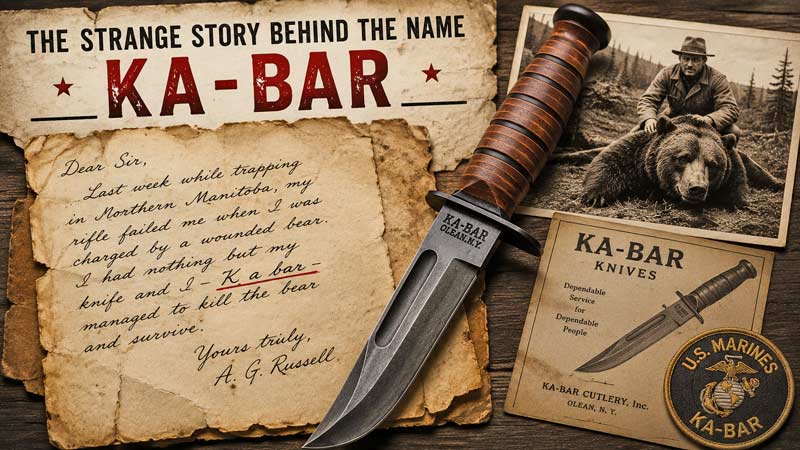
The Strange Story Behind the Name "KA-BAR"
One of the most recognizable names in knife history almost never existed. Unlike many military products that received simple model numbers or official designations, the KA-BAR earned a name with a story behind it. According to company history, a trapper once wrote a letter explaining how he had survived an attack by a wounded bear after his rifle malfunctioned. The handwritten letter was badly damaged, but one phrase could still be made out: "K a bar," believed to be part of the words "kill a bear." The unusual phrase stuck, and the company eventually adopted KA-BAR as its brand name.
Whether every detail of the story is perfectly accurate has been debated for years, but there's no question that the name helped set the knife apart. It sounded rugged, memorable, and distinctly American. By the time World War II began, KA-BAR had become closely associated with dependable working knives, making it a natural choice when the U.S. military sought a stronger replacement for the aging Mark I trench knife.
The timing couldn't have been better. Thousands of Marines quickly came to rely on the knife for everything from cutting rope and opening ammunition crates to preparing meals and building shelters. Its reputation grew not because of advertising, but because soldiers repeatedly proved its value under the harshest possible conditions.
Today, the name KA-BAR is almost synonymous with military knives, yet few people realize it originated from a partially legible letter and a story that has become part of American knife folklore. Like many legendary weapons, its greatest strength wasn't just the steel itself, but the stories that followed it from one generation to the next.
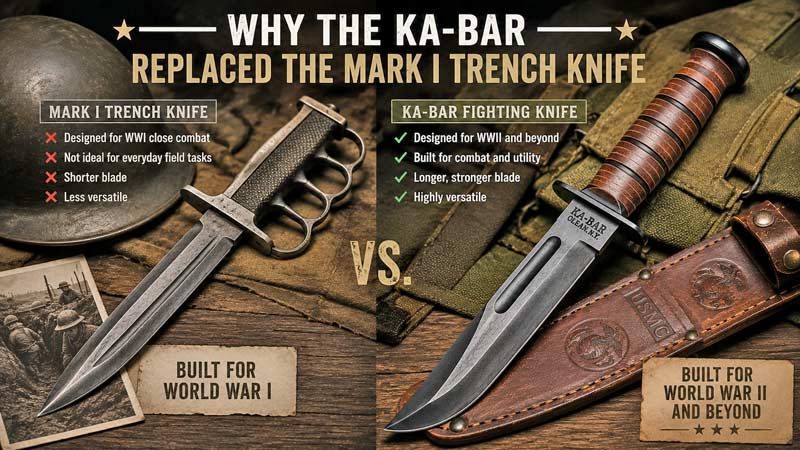
Why the KA-BAR Replaced the Mark I Trench Knife
When the United States entered World War II, the military quickly discovered that many of its existing combat knives were no longer suited to the realities of modern warfare. The Mark I trench knife, while effective in close combat, had been designed with World War I in mind. It excelled as a fighting weapon but wasn't particularly useful for the countless everyday tasks soldiers faced in the field. Troops needed something far more versatile.
The answer was a stronger, more practical fixed-blade knife that could handle almost anything. In 1942, the U.S. Marine Corps adopted what would become known as the KA-BAR fighting knife. Its seven-inch clip-point blade was long enough for combat but equally capable of cutting rope, opening supply crates, preparing food, clearing brush, and building shelters. Instead of carrying separate tools, Marines suddenly had one dependable knife that could do nearly everything.
Much of the KA-BAR's success came from its balanced design. Drawing inspiration from classic frontier blades, particularly the iconic Bowie knife, it combined a strong clip-point blade, stacked leather handle, and sturdy crossguard into a package that felt equally at home on the battlefield or around camp. It wasn't simply replacing an older military knife. It was redefining what a military knife could be.
That shift had a lasting impact on knife design. Many of today's fixed blade knives still follow the same philosophy established by the KA-BAR: build one rugged tool that performs reliably in almost any situation. More than eighty years later, that approach remains just as practical as it was when Marines first carried the knife into battle.
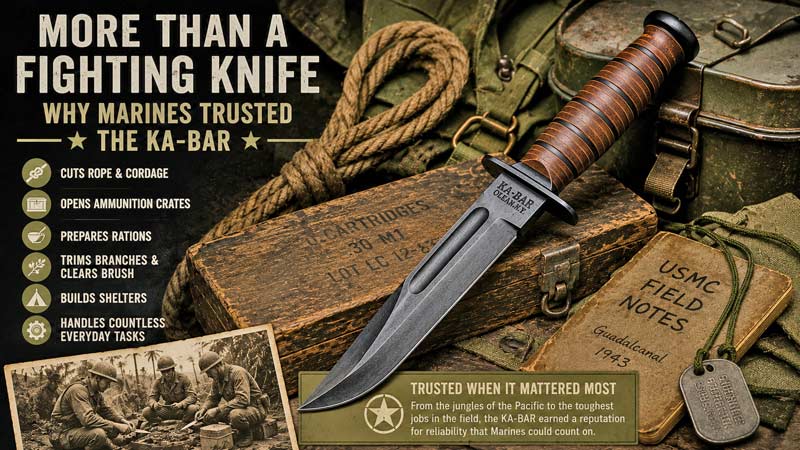
More Than a Fighting Knife: Why Marines Trusted the KA-BAR
Although the KA-BAR earned its reputation as a combat knife, most Marines relied on it for far more than fighting. In the Pacific Theater, where dense jungles, tropical weather, and long supply lines created constant challenges, the knife became an indispensable all-purpose tool. It cut rope, opened ammunition crates, prepared rations, trimmed branches, built shelters, and handled countless daily jobs that never appeared in official battle reports.
That versatility helped separate the KA-BAR from many earlier military knives. Instead of carrying a blade designed for a single purpose, Marines had one dependable tool that could adapt to almost any situation. The knife was strong enough for demanding field work while remaining well-balanced and easy to control, making it valuable whether a soldier was clearing a campsite or facing an emergency.
Stories from World War II veterans repeatedly highlight this practical reliability. While rifles and other equipment occasionally failed under harsh conditions, the KA-BAR developed a reputation for simply getting the job done. It became one of those rare pieces of military gear that soldiers genuinely wanted to keep long after their service ended, a testament to the confidence it inspired in the field.
That lasting reputation explains why the KA-BAR remains one of the most recognizable military knives ever produced. Even many modern military survival knives still follow the same philosophy: create one rugged blade that excels as both a field tool and a dependable combat knife. The technology has evolved, but the idea behind the KA-BAR continues to influence military blade design more than eighty years later.
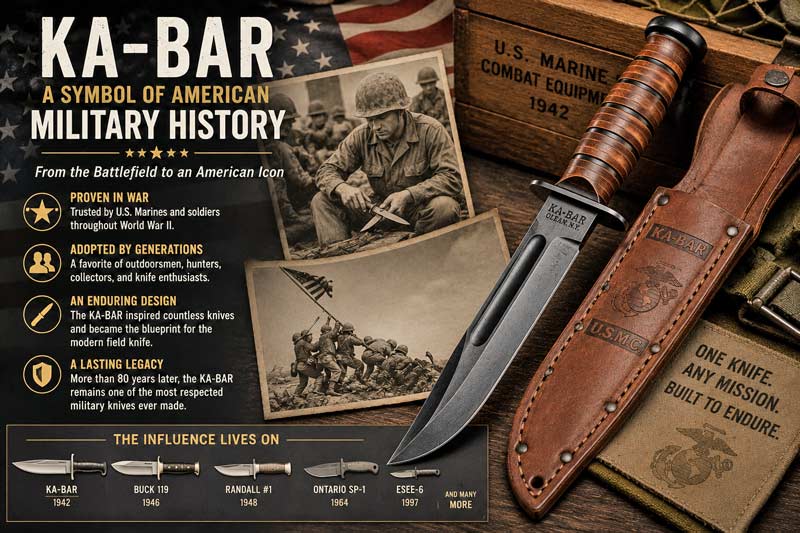
How the KA-BAR Became a Symbol of American Military History
By the end of World War II, the KA-BAR had become much more than standard military equipment. It represented the resourcefulness and determination of the Marines and soldiers who carried it across the Pacific and into some of the war's most demanding campaigns. Long after the fighting ended, veterans continued to tell stories about the knife's reliability, helping transform it from a battlefield tool into an American icon.
Unlike many pieces of military equipment that disappeared once newer technology arrived, the KA-BAR never truly went out of style. Hunters, campers, outdoorsmen, collectors, and knife enthusiasts all embraced the design, appreciating the same balance of strength and versatility that made it successful during the war. Even people who know very little about military history can often recognize the distinctive stacked leather handle and clip-point blade at a glance.
Its influence extends far beyond a single manufacturer. Countless companies have produced knives inspired by the original design, borrowing its proportions, blade profile, and rugged simplicity. In many ways, the KA-BAR became the blueprint for the modern field knife, much like the Bowie knife shaped an earlier generation of American blades. If you're interested in other historic military designs that helped pave the way for today's combat knives, our article on forgotten combat knives that shaped modern warfare explores several fascinating examples that deserve far more recognition.
More than eighty years after its adoption, the KA-BAR continues to symbolize a timeless principle of good design: build one dependable tool, build it well, and let its performance speak for itself. That's why the knife remains one of the most respected military blades ever created, and why its story continues to be told generation after generation.
Why the KA-BAR Still Matters More Than 80 Years Later
Military equipment is constantly evolving. New materials replace old ones, manufacturing techniques improve, and battlefield requirements change with every generation. Yet despite decades of innovation, the KA-BAR has remained remarkably relevant. That kind of longevity is rare, especially for a tool originally designed during World War II.
The reason is surprisingly simple: the KA-BAR was never built to excel at just one job. It was designed to solve real problems faced by soldiers in the field. A blade that could cut, chop, pry, dig, prepare food, and still serve as a dependable last line of defense proved far more valuable than a knife optimized for a single purpose. That philosophy continues to shape many of today's military and outdoor blades.
Its enduring popularity also reflects something deeper than good engineering. The KA-BAR represents an era when equipment earned its reputation through performance rather than advertising. Veterans trusted it because it consistently delivered under difficult conditions, and that reputation has been passed from one generation to the next. Few military tools have become symbols of both American history and practical design in quite the same way.
Whether you're interested in military history, knife design, or the stories behind iconic equipment, the KA-BAR remains one of the best examples of how a well-built tool can outlive the conflict it was created for. More than eight decades after it first entered service, it still stands as the benchmark against which countless military knives are measured.
Why Do So Many Military Knives Have a Clip-Point Blade?
The clip-point blade became popular because it offers an excellent balance of strength, control, and versatility. Its distinctive curved tip creates a finer point than a standard straight-back blade, making it easier to perform precise cutting tasks while still maintaining enough durability for demanding field use. That combination proved especially valuable for soldiers who needed one knife capable of handling a wide variety of jobs.
The KA-BAR helped cement the clip-point design as a military standard, but the concept dates back even further to the famous Bowie knife. Today, countless military, survival, and outdoor knives still use some variation of the clip-point because it remains one of the most practical blade shapes ever developed. More than a century after it first gained widespread recognition, its effectiveness has stood the test of time.
Did the KA-BAR Replace Every Military Knife?
No. While the KA-BAR became the standard fighting and utility knife for the U.S. Marine Corps during World War II and was widely used by other branches of the military, it never replaced every knife in military service. Specialized units often carried mission-specific blades, and different countries continued developing their own combat knives to meet unique operational needs.
Even today, there is no single "official" military knife used by every soldier. Modern armed forces issue a variety of blades depending on the mission, environment, and branch of service. What makes the KA-BAR remarkable isn't that it replaced every military knife, but that its rugged, multi-purpose design became the benchmark that countless later combat and survival knives would follow.
Is the KA-BAR Still Used by the U.S. Military Today?
Yes, although its role has evolved over the years. The original World War II-era KA-BAR is no longer issued universally across every branch of the U.S. military, but modern versions continue to be used by certain service members, and the knife remains closely associated with the U.S. Marine Corps. Many military personnel also choose to carry commercially purchased KA-BAR knives because of their proven durability and long-standing reputation.
Perhaps more importantly, the KA-BAR's legacy lives on in the countless military and survival knives it inspired. Its emphasis on strength, versatility, and reliability established a design philosophy that continues to influence modern combat blades. More than eighty years after it first entered service, the KA-BAR remains one of the most recognizable and respected military knives ever made.
]]>2026-06-30T13:45:30+01:00https://www.karatemart.com/blog/why-the-ka-bar-became-americas-most-famous-military-knife<![CDATA[The Forgotten Combat Knives That Shaped Modern Warfare]]>
https://www.karatemart.com/blog/the-forgotten-combat-knives-that-shaped-modern-warfare
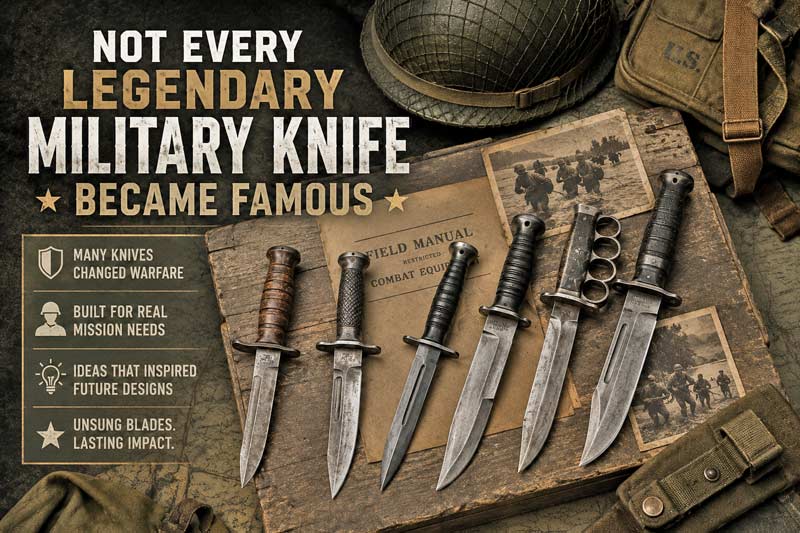
Not Every Legendary Military Knife Became Famous
When people think of military knives, a handful of famous names usually come to mind. The Bowie knife, the KA-BAR, and a few modern tactical designs have earned their place in history books and Hollywood alike. Yet many of the blades that quietly changed military tactics, influenced future designs, or gave soldiers a critical advantage have faded into obscurity. Some were issued to elite commandos. Others were experimental tools that introduced ideas still found on modern knives decades later.
Military history is full of innovations that never became household names. A knife didn't have to be carried by millions of troops to leave a lasting mark. Sometimes a blade designed for one specialized mission would inspire generations of military equipment, while another earned a legendary reputation among the soldiers who depended on it, even if the general public never heard its story.
Today's collectors often focus on rarity or appearance, but battlefield success was measured very differently. Soldiers valued reliability, simplicity, and the ability to perform under impossible conditions. Many of these forgotten knives were designed as practical tools first and weapons second, an approach that continues to influence many of today's fixed blade knives and modern tactical knives.
In the sections ahead, we'll look at several overlooked combat knives whose influence reached far beyond the conflicts in which they served. While they may not enjoy the same recognition as history's most iconic blades, their impact on modern warfare is impossible to ignore.
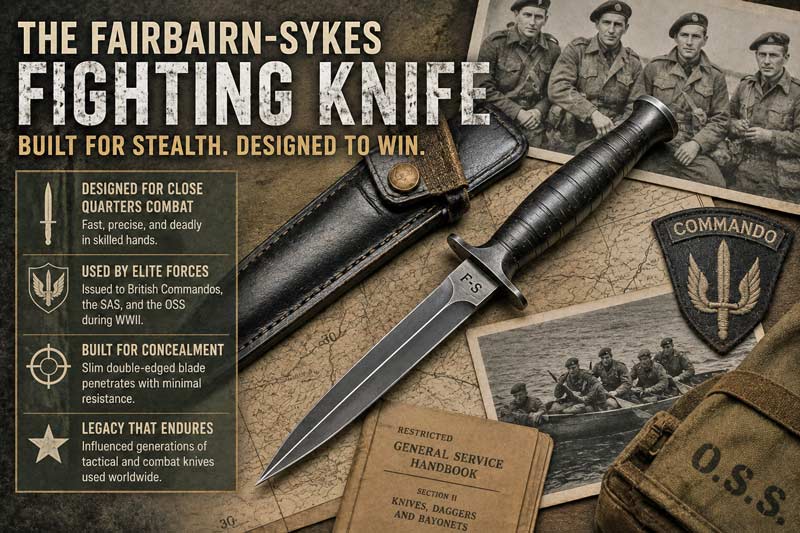
The Fairbairn-Sykes Fighting Knife Changed Special Operations Forever
If one knife deserves far more recognition than it receives, it's the Fairbairn-Sykes fighting knife. Developed during the early years of World War II by British officers William E. Fairbairn and Eric A. Sykes, the slender double-edged dagger wasn't designed as a general-purpose tool. It had one purpose: giving commandos an advantage in close-quarters combat when stealth mattered more than brute force.
Unlike the larger military knives of its era, the Fairbairn-Sykes emphasized speed, precision, and concealment. Its narrow blade could slip through heavy clothing with minimal resistance, while its balanced design made it fast in the hand. British Commandos, the Special Air Service, and later the American Office of Strategic Services all issued versions of the knife to troops carrying out dangerous raids behind enemy lines.
Its greatest legacy wasn't measured by the number of knives produced, but by the philosophy it introduced. The Fairbairn-Sykes demonstrated that specialized missions required specialized equipment. That idea would eventually influence countless military blades, from covert fighting knives to modern tactical designs carried by special operations forces around the world.
Many of today's purpose-built combat knives still reflect lessons first popularized by the Fairbairn-Sykes. Even though modern soldiers often rely on more versatile field knives, its emphasis on mission-specific design continues to shape the evolution of military blades. It's one of the clearest examples of how an overlooked weapon quietly changed history without becoming a household name.
Readers interested in how military knife design continued to evolve into the modern era may also enjoy our look at the defining characteristics of military survival knives, where many of these battlefield lessons can still be seen today.
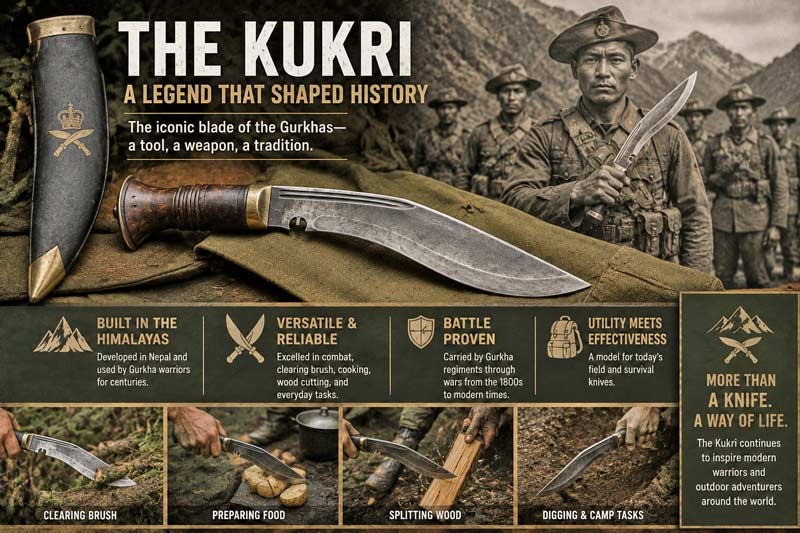
The Kukri Earned Its Reputation Long Before Modern Warfare
Few military knives have a history as remarkable as the kukri. Long before firearms dominated the battlefield, the distinctive forward-curving blade was already proving itself as both a practical tool and an effective weapon in the mountains of Nepal. When the British Army began recruiting Gurkha soldiers during the early 1800s, they quickly discovered that the kukri was far more than a cultural symbol. It was an indispensable part of a soldier's daily life.
Unlike many combat knives that were designed solely for fighting, the kukri excelled at almost everything. Soldiers used it to clear brush, prepare food, split firewood, dig defensive positions, and perform countless camp tasks before ever drawing it in combat. That versatility made it especially valuable in remote environments where carrying multiple specialized tools simply wasn't practical.
The blade's battlefield reputation grew during conflicts ranging from the World Wars to the Falklands and beyond. Stories of Gurkha bravery became legendary, and while some accounts were undoubtedly exaggerated over time, the kukri's effectiveness was never seriously questioned. Its weight-forward design delivered tremendous chopping power while remaining compact enough to carry comfortably throughout long campaigns.
Perhaps the kukri's greatest contribution to military history was demonstrating that a combat knife didn't have to sacrifice utility for effectiveness. Many of today's heavy-duty field and survival knives follow the same philosophy, blending rugged durability with the ability to handle demanding everyday tasks. If you're interested in modern blades built with that same practical mindset, explore our selection of fixed blade knives and dependable survival gear designed for challenging environments.
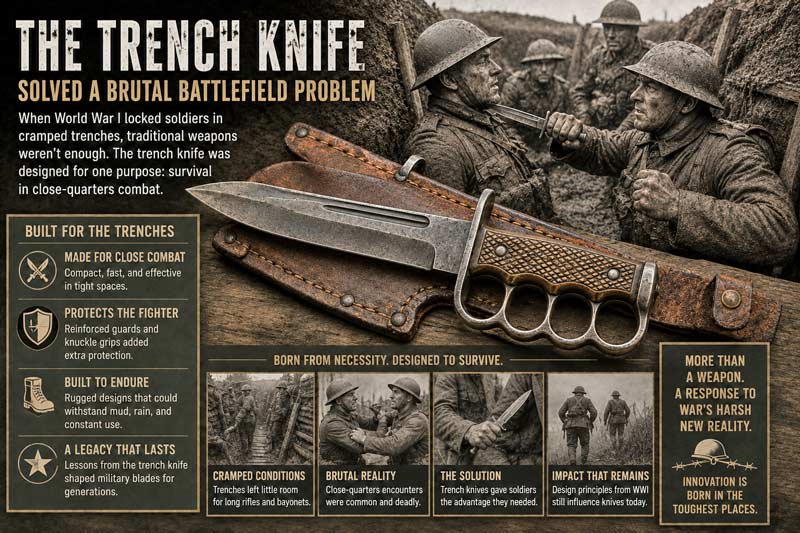
The Trench Knife Solved a Brutal Battlefield Problem
World War I introduced a kind of combat unlike anything armies had experienced before. Soldiers spent weeks or even months living in narrow trenches separated by only a few yards of mud, barbed wire, and constant danger. Long rifles with fixed bayonets were excellent for open battlefields, but they were awkward inside cramped trenches where every movement was restricted. Military planners quickly realized they needed a weapon designed specifically for brutal close-range encounters.
The answer came in the form of the trench knife. These compact fighting knives often featured reinforced guards, aggressive blade profiles, and, in some cases, distinctive knuckle-style grips that provided extra protection during hand-to-hand combat. They weren't elegant weapons. They were purpose-built for one of the harshest environments soldiers had ever faced.
Although trench warfare eventually faded, the lessons learned from these knives continued to influence military equipment for decades. Designers recognized the importance of compact, durable blades that could be drawn quickly and controlled in confined spaces. Many of those ideas carried over into later combat knives issued during World War II and beyond, helping shape the evolution of modern battlefield blades.
The trench knife also reminds us that military equipment often evolves in response to very specific challenges. Just as these specialized blades emerged from the realities of trench warfare, countless other weapons throughout history were created to solve unique battlefield problems. You can explore more examples in our article on the most famous combat weapons, which highlights many of the innovations that changed the course of military history.
The Randall Fighting Knife Became a Soldier's Most Trusted Companion
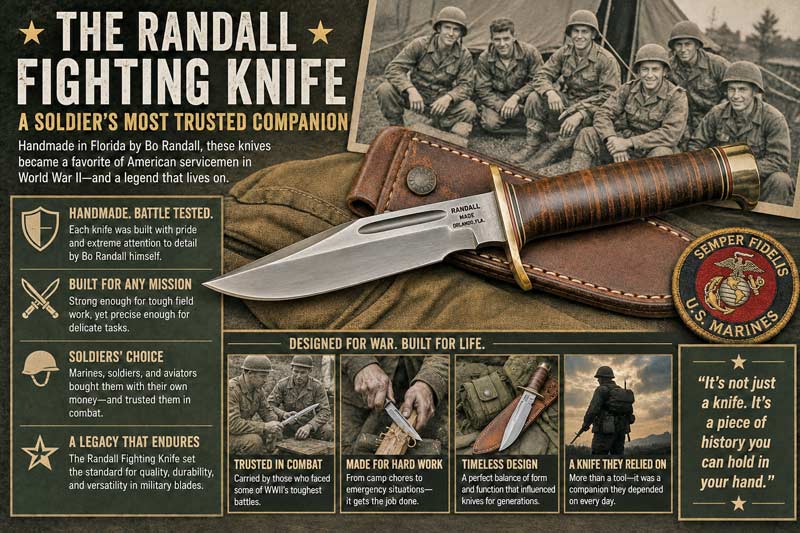
Unlike many military knives that were designed through government contracts, the Randall Fighting Knife earned its reputation the hard way. Handmade by Bo Randall in Florida, these knives became highly sought after by American servicemen during World War II because of their exceptional craftsmanship and reliability. Soldiers often purchased them with their own money before deploying, trusting them enough to carry them into some of the war's toughest battles.
Randall's designs struck a balance that many military-issued knives struggled to achieve. They were strong enough for demanding field work yet refined enough to perform delicate cutting tasks. Marines, soldiers, aviators, and special operations personnel all found uses for them, and stories of Randall knives surviving years of combat helped cement their legendary status among those who served.
Perhaps the knife's greatest influence was proving that durability and versatility could coexist in a single blade. Later generations of military and outdoor knives borrowed heavily from that philosophy, favoring practical designs capable of handling everything from camp chores to emergency survival situations. Many of today's premium field knives still follow principles that Randall popularized more than 80 years ago.
Even though the Randall Fighting Knife never became as universally recognized as the KA-BAR, its legacy continues to shape modern blade design. If you're interested in how these classic military patterns influenced today's outdoor and combat blades, our guide to everyday carry knives shows how many timeless design ideas continue to appear in the knives people rely on every day.
The Bowie Knife Inspired Generations of Military Blades
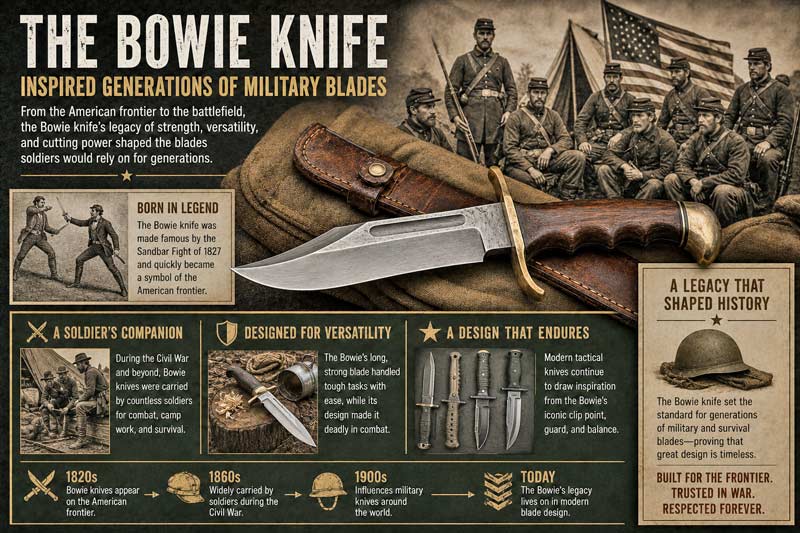
The Bowie knife wasn't created as military equipment, yet few blades have had a greater influence on combat knife design. Originally made famous by the legendary Sandbar Fight of 1827, the Bowie quickly earned a reputation for strength, reach, and versatility on the American frontier. By the time the United States entered the Civil War, countless soldiers were carrying Bowie-style knives alongside their standard weapons.
Its popularity continued well into the twentieth century. Military designers recognized that the Bowie offered something many smaller fighting knives could not: a blade capable of handling demanding camp chores while remaining formidable in combat. That balance between utility and fighting performance helped shape the philosophy behind many military field knives that followed, including some of the most respected survival and combat blades ever produced.
The Bowie also changed public expectations of what a military knife should look like. Long clip-point blades, sturdy crossguards, and substantial handles became defining characteristics that influenced generations of knife makers around the world. Even modern tactical knives often borrow elements first popularized by the Bowie nearly two centuries ago.
Its story serves as a reminder that not every influential military knife began life on a battlefield. Some of history's greatest designs earned their reputation through everyday use before proving themselves in war. If you'd like to learn more about how this iconic blade evolved into an American legend, read our article on the evolution of the Bowie knife, or browse our collection of classic Bowie knives inspired by that enduring design.
How These Forgotten Knives Still Influence Modern Combat Blades
Although warfare has changed dramatically over the past century, many of the principles behind today's combat knives can be traced directly to these overlooked designs. Modern military blades are expected to serve as survival tools, utility knives, emergency rescue equipment, and last-resort defensive weapons all at once. That philosophy didn't appear overnight. It evolved through decades of lessons learned by soldiers carrying the very knives we've explored throughout this article.
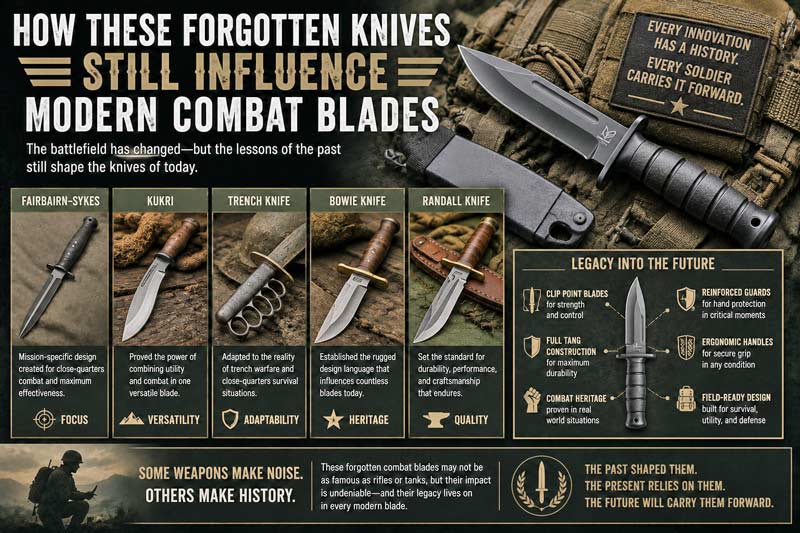
The Fairbairn-Sykes proved that mission-specific equipment could dramatically improve a soldier's effectiveness. The kukri demonstrated the value of combining utility with fighting capability. Trench knives showed how equipment adapts to unique battlefield conditions, while the Bowie established a rugged design language that still appears in countless modern blades. Even premium custom knives like the Randall helped set expectations for durability and craftsmanship that manufacturers continue to pursue today.
Walk through almost any collection of modern knives and you'll notice echoes of these historic designs. Clip-point blades, full tang construction, reinforced guards, ergonomic handles, and versatile field-ready profiles all owe something to the innovations of the past. The names may have changed, but many of the ideas remain remarkably familiar.
History tends to celebrate the loudest weapons and the biggest battles, yet some of the most important military innovations arrived quietly, one knife at a time. These forgotten combat blades may never receive the recognition of famous rifles or tanks, but their influence continues to live on every time a modern soldier straps a dependable field knife to their gear.
History Doesn't Always Remember the Most Important Knives
History has a way of celebrating the loudest stories while overlooking the tools that quietly changed the world. Rifles, tanks, and aircraft often dominate discussions of military innovation, yet countless soldiers depended just as much on the knife hanging from their belt. Whether clearing obstacles, preparing food, surviving behind enemy lines, or serving as a last line of defense, these blades earned their place through reliability rather than publicity.
The Fairbairn-Sykes, kukri, trench knife, Randall Fighting Knife, and Bowie each solved different problems for different generations of warriors. Some introduced new design philosophies. Others proved that versatility could be just as valuable as fighting ability. Together, they laid the foundation for many of the combat and field knives still trusted by military personnel, outdoorsmen, and collectors today.
If there's one lesson these forgotten blades teach us, it's that true influence isn't always measured by fame. The most important military knives aren't necessarily the ones that appeared in the most movies or became the biggest collectors' items. They're the ones whose ideas lived on, quietly shaping the next generation of blades long after the original designs left the battlefield.
What Military Knife Has Been Used the Longest?
One of the longest-serving military knives in history is the kukri, which has been carried by Nepalese Gurkha soldiers for more than 200 years. First gaining international attention during the Anglo-Nepalese War in the early 1800s, the distinctive forward-curving blade became an official part of Gurkha military tradition after Britain began recruiting Gurkha regiments. Remarkably, the kukri remains in service today, making it one of the oldest military knife designs still actively carried by soldiers.
Its longevity comes down to versatility. The kukri functions as a combat weapon, camp tool, brush-clearing blade, and survival knife all in one. While countless military knife designs have appeared and disappeared over the centuries, the kukri has changed very little because its original design proved so effective. Few military tools can claim such a long and uninterrupted history of practical service.
Why Are So Many Military Knives Fixed Blades Instead of Folding Knives?
Military knives are expected to perform in some of the harshest conditions imaginable, and that's where fixed blades have a clear advantage. Without a hinge or locking mechanism, they are generally stronger, more durable, and less likely to fail when used for demanding tasks like chopping, prying, digging, or cutting through thick materials. In combat or survival situations, reliability often matters more than convenience.
A fixed blade is also faster to deploy and easier to maintain in harsh environments. Mud, sand, ice, and debris can interfere with a folding knife's moving parts, while a solid one-piece design is easier to clean and ready for use at a moment's notice. Although folding knives are popular for everyday carry, militaries around the world continue to favor fixed blades whenever strength and dependability are the top priorities.
Which Military Knife Inspired the Most Modern Designs?
There isn't a single military knife that influenced every modern design, but a few stand above the rest. The Bowie knife popularized the versatile clip-point blade, the Fairbairn-Sykes fighting knife shaped the development of specialized combat daggers, and the kukri demonstrated how a field knife could excel as both a weapon and a practical tool. Each introduced ideas that knife makers continue to build upon today.
Modern combat knives often combine features borrowed from several historic designs rather than copying just one. A contemporary military knife may feature the strength and utility of a Bowie-inspired blade, the ergonomics of a Randall fighting knife, and the mission-focused philosophy pioneered by the Fairbairn-Sykes. That blending of proven concepts is one of the reasons today's military knives are more versatile than ever before.
]]>2026-06-29T15:48:55+01:00https://www.karatemart.com/blog/the-forgotten-combat-knives-that-shaped-modern-warfare<![CDATA[The Most Intimidating Weapons in History (And Whether They Deserved Their Reputation)]]>
https://www.karatemart.com/blog/the-most-intimidating-weapons-in-history
What makes this topic especially interesting is that intimidation and effectiveness are not always the same thing. Some terrifying-looking weapons were surprisingly practical and deadly. Others looked like something from a nightmare but were less useful than their reputation suggests. The weapons people feared most were not always the weapons that actually dominated battlefields.
In this guide, we are looking at some of the most intimidating weapons ever created, what made them so frightening, and whether they truly deserved the fear they inspired.
The Greatsword: Intimidating Beyond Reason
Few weapons in history created the same immediate reaction as the greatsword. Standing far taller than a typical sword and often requiring two hands to wield effectively, these massive blades looked less like weapons and more like something pulled from a legend. Even today, people who see a true greatsword for the first time are often surprised by its size.
Part of the weapon's reputation came from pure visual impact. On a battlefield filled with spears, shields, and ordinary swords, a warrior carrying an enormous blade naturally attracted attention. The weapon projected confidence, strength, and aggression before a fight even started. In many ways, the greatsword was one of history's most effective psychological weapons.
Unlike many exaggerated movie portrayals, however, real greatswords were not simply oversized swords designed to look impressive. Skilled users trained extensively to handle them, using leverage, momentum, and reach to create openings against multiple opponents. Some historical accounts suggest they were particularly useful for disrupting formations, defending narrow positions, or creating space in crowded battles.
That said, the greatsword's reputation sometimes exceeds its practical battlefield role. It was intimidating, but it was never the dominant weapon of warfare. Armies still relied far more heavily on spears, polearms, and other weapons that could be produced and deployed on a larger scale. As we explored in our article on weapons that often outperformed swords throughout history, battlefield effectiveness and battlefield fame are not always the same thing.
Even so, few weapons have ever matched the greatsword's ability to command attention. Whether carried by elite soldiers, bodyguards, or warriors seeking to make an impression, the weapon succeeded in one area almost better than anything else on this list: making opponents think twice before getting closer.
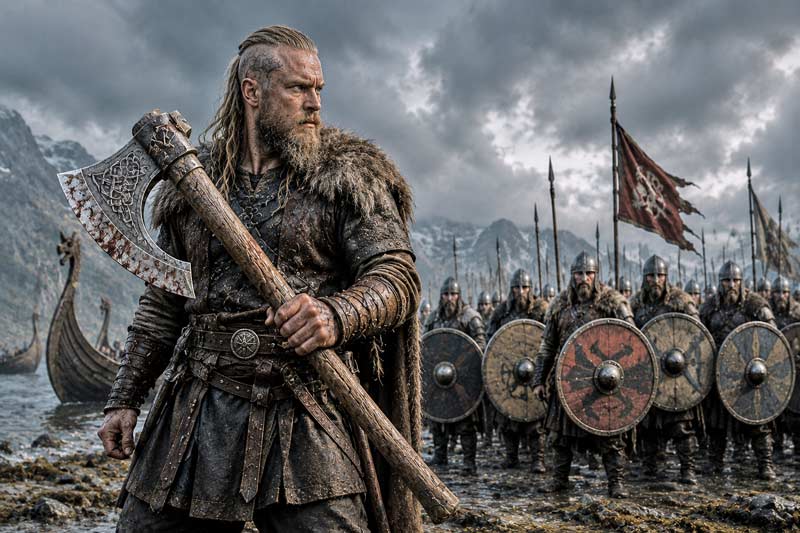
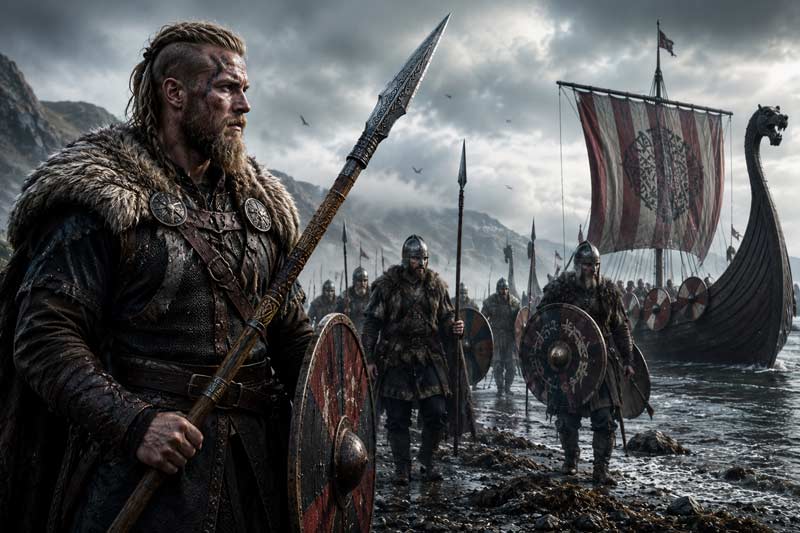
The Viking Axe: A Weapon That Looked as Brutal as It Was
If the greatsword intimidated people through sheer size, the Viking axe did it through raw aggression. Few weapons in history project the same sense of violence at first glance. A broad cutting edge mounted on a long wooden handle sends a very clear message, and that message has remained powerful enough to survive a thousand years of storytelling.
Unlike some weapons whose fearsome reputations grew larger than reality, the Viking axe largely earned its place on this list. Well-made axes could deliver devastating cutting power, and their design allowed warriors to generate tremendous force without carrying the weight of a massive sword. They were effective, relatively affordable, and practical enough to be used by warriors across different social classes.
The psychological impact was significant. Facing an opponent armed with a weapon capable of delivering crushing chops to shields, armor, and limbs was unnerving enough. Watching an entire line of warriors carrying them was something else entirely. Even today, the silhouette of a Viking axe remains one of the most recognizable and intimidating weapon designs ever created.
Another reason axes inspired fear was unpredictability. A sword generally attacks with the blade. An axe can hook, pull, chop, and strike with different parts of the head. Larger two-handed axes extended that threat even further, creating reach and power that could overwhelm opponents who underestimated them.
Of course, popular culture sometimes exaggerates the image. Not every Viking charged into battle swinging a giant axe overhead. Many warriors carried spears more often than axes, and battlefield success still depended on training, tactics, and discipline. But when it comes to weapons that genuinely looked terrifying and remained highly effective, the axe is one of the strongest candidates on this entire list.
Modern collections of throwing hatchets and axes help explain why the design has remained popular for centuries. There is something timeless about a weapon built around simple, devastating efficiency.
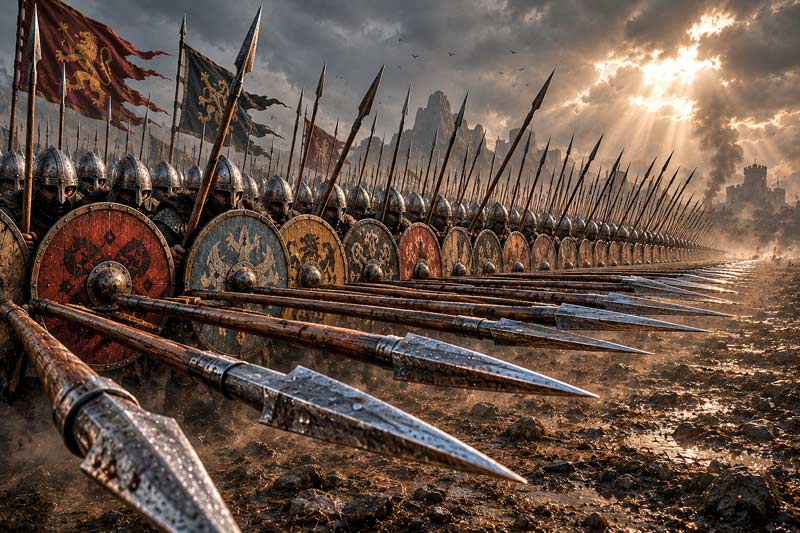
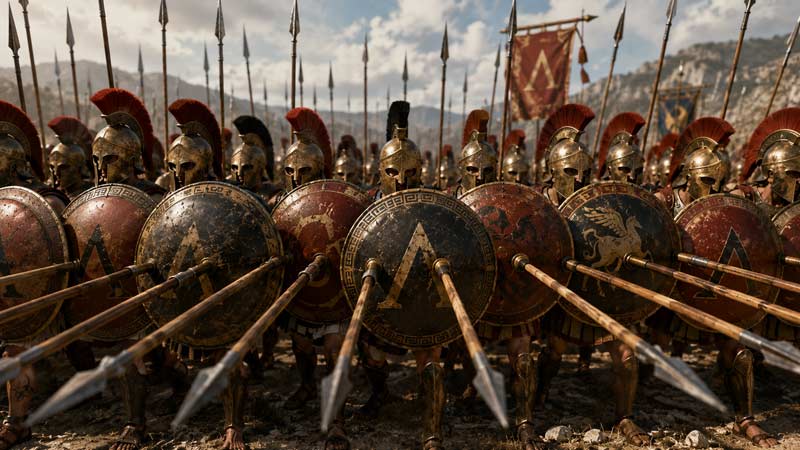
The Spear Wall: The Weapon That Turned Fear Into a Formation
Some weapons intimidated people because of their size. Others did it through brutal design. The spear wall was terrifying for a different reason: it transformed dozens or even hundreds of ordinary soldiers into a single deadly obstacle.
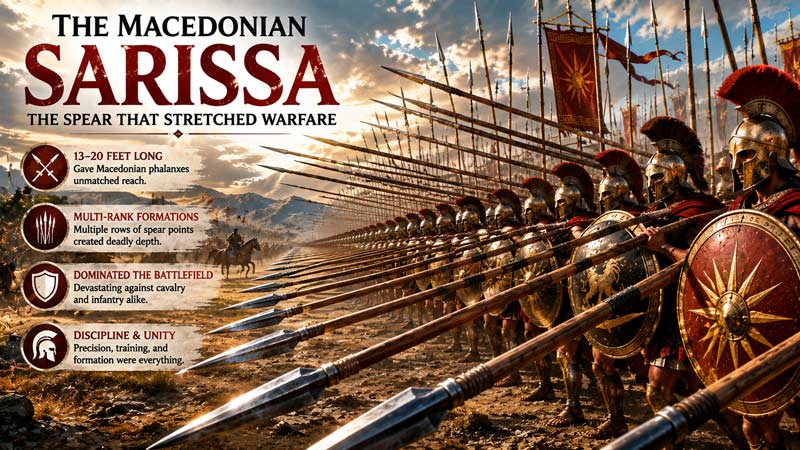
Imagine advancing toward a line of warriors and seeing not one weapon pointed at you, but an entire forest of spear tips. Every step forward meant entering a zone where multiple opponents could strike before you ever reached them. Unlike a duel against a single fighter, there was no obvious opening and no easy way to isolate one target. The formation itself became the weapon.
History repeatedly shows how effective this approach was. Greek phalanxes, Viking shield walls, medieval infantry formations, and countless other armies relied on long weapons working together rather than individual heroics. The psychological impact was enormous. Many battles were influenced as much by discipline and cohesion as by actual casualties.
What made spear walls especially frightening was their ability to stop things people assumed were unstoppable. Charging cavalry, elite warriors, and heavily armored opponents often found themselves facing a problem that courage alone could not solve. Reaching the enemy meant surviving a gauntlet of spear points first.
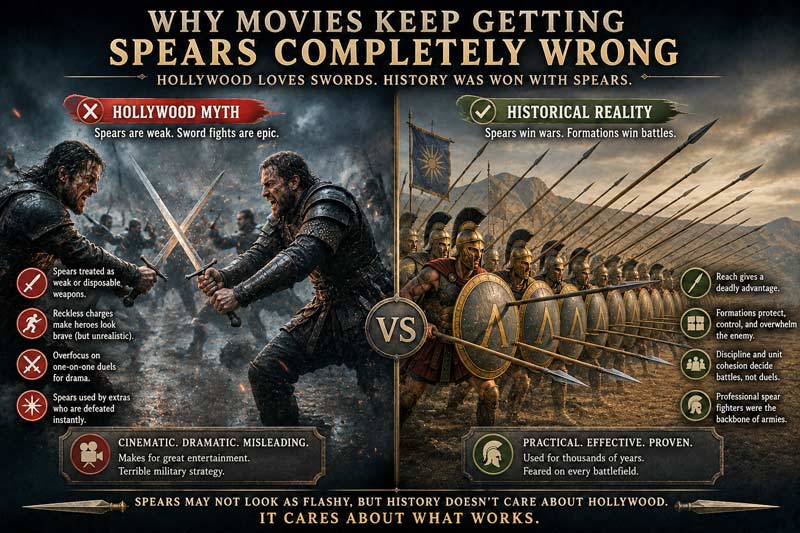
The irony is that spears rarely receive the same attention as swords in popular culture. Yet for much of military history, they were among the most important weapons ever created. We explored this idea in our article on why certain weapons often outperformed swords on the battlefield, where reach and formation fighting repeatedly proved decisive.
Even today, the image of a spear wall remains intimidating because it represents something larger than a weapon. It represents coordination, discipline, and the realization that one person is no longer fighting another person. They are fighting an entire formation.
For a broader look at how weapons evolved across different cultures, our guide to history's most famous combat weapons highlights just how often long-reach weapons shaped the outcome of battles.
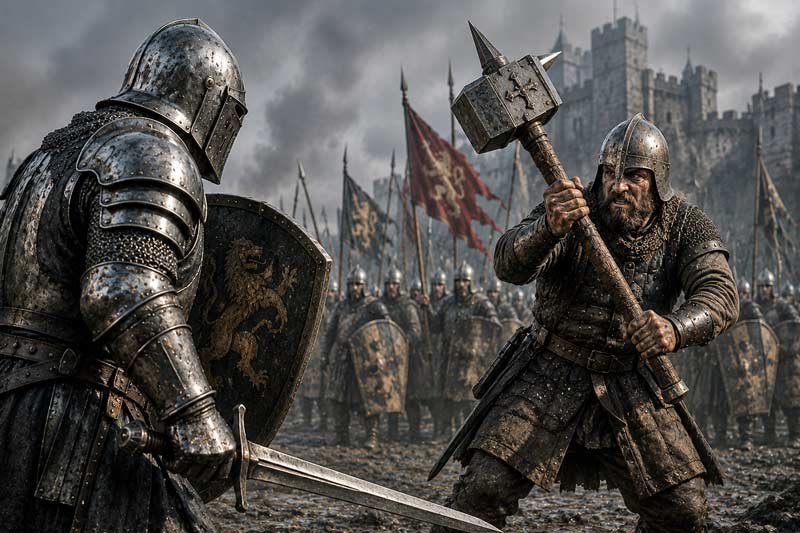
The War Hammer: The Weapon Built to Ruin a Knight's Day
Few weapons looked more intimidating than the war hammer, and unlike some weapons on this list, its terrifying appearance was not just for show. The war hammer existed for one reason: to deal with opponents who had become too well protected for conventional weapons to handle efficiently.
As armor improved throughout the medieval period, swords faced a growing problem. A sharp blade is incredibly effective against unarmored targets, but heavy armor can dramatically reduce the effectiveness of cutting attacks. The war hammer approached the problem differently. Instead of trying to slice through armor, it focused on delivering concentrated force to crush, dent, fracture, or exploit weak points.
The result was a weapon that inspired genuine fear among armored warriors. A knight facing a sword might trust his armor to absorb or deflect the blow. Facing a war hammer was another matter entirely. Even if the armor prevented penetration, the force of the impact could still cause serious injury. In some cases, simply surviving the strike did not mean escaping unharmed.
The hammer's appearance contributed to its reputation as well. Many featured heavy striking heads, spikes, or beaks designed to focus tremendous energy into a small area. Unlike elegant swords, war hammers looked brutally practical. They seemed purpose-built for destruction, and in many ways, they were.
What makes the weapon especially interesting is that it represents a recurring pattern throughout military history: whenever defenses improve, weapons evolve to overcome them. The war hammer was not designed to look impressive. It was designed to solve a problem. That practical focus made it one of the most intimidating weapons ever carried onto a battlefield.
Ironically, the weapon's fearsome reputation is probably one of the rare cases where reality and appearance matched remarkably well. If an armored knight had the choice between facing a sword or a skilled opponent carrying a war hammer, many would have preferred the sword.
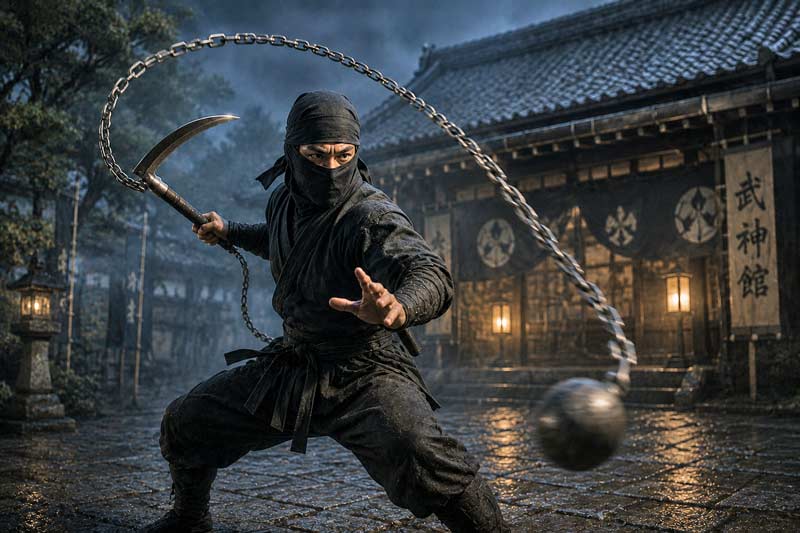
The Kusarigama: The Weapon That Looked Impossible to Defend Against
Few weapons on this list create the same immediate reaction as the kusarigama. Even people with little knowledge of martial arts tend to look at it and think the same thing: "How would anyone fight against that?" Combining a sickle with a weighted chain, the weapon looks less like a practical combat tool and more like something designed to appear in a nightmare.
Part of what made the kusarigama so intimidating was unpredictability. Most weapons attack from fairly obvious directions. A sword swings along a blade path. A spear thrusts forward. The kusarigama could strike from multiple distances and angles, forcing opponents to track both the blade and the spinning weight at the same time.
The chain was often the real source of fear. A skilled user could swing the weighted end to distract, entangle, or disrupt an opponent before closing in with the sickle. Even if the weapon never made contact, the constant movement created uncertainty. And uncertainty has always been one of the most powerful psychological weapons in combat.
That said, the kusarigama's reputation sometimes grows larger than reality. It required significant training to use effectively and could be difficult to manage in crowded battlefields. Like many highly specialized weapons, it was not necessarily the most practical option in every situation. But intimidation was never its problem.
Weapons like this help explain why so many people remain fascinated by unusual martial arts designs. Looking at a traditional kusarigama and chain weapon, it is easy to understand why opponents might hesitate before engaging someone carrying one.
The weapon also fits perfectly into a larger pattern we explored in our breakdown of ninja weapon myths and realities. Some weapons became legendary because of how effective they were. Others became legendary because they seemed to break the normal rules of combat. The kusarigama managed to do both.
Hook Swords: The Weapon That Looked Like It Was Designed by a Villain
If intimidation were based on appearance alone, Chinese hook swords might rank near the top of this entire list. Almost every part of the weapon seems designed to make people uncomfortable. The blades curve into hooks, the handguards form additional crescent-shaped blades, and even the pommels can be used as striking surfaces. At first glance, they look less like weapons and more like a collection of sharp edges somehow fused into a single design.
That unusual appearance is exactly why hook swords have fascinated martial artists for generations. Unlike conventional swords, they were capable of trapping, hooking, redirecting, and controlling an opponent's weapon in ways that seem almost impossible until you see them demonstrated. Skilled practitioners could even connect two hook swords together to extend their reach, creating attack angles most opponents would never expect.
The intimidation factor came from uncertainty. Most people understand what a sword does. The purpose of a spear is obvious. Hook swords create questions. Which edge is the main blade? What happens if the hooks catch a weapon? Why are there blades protecting the hands? Opponents facing unfamiliar weapons often become hesitant, and hesitation can be a serious disadvantage.
Of course, their fearsome appearance sometimes leads people to overestimate their battlefield importance. Hook swords were highly specialized weapons that required significant training to master. They were never as common as spears, polearms, or standard swords. But rarity does not diminish their ability to command attention.
Today, they remain some of the most visually striking examples of traditional Chinese weapon design. Looking at a pair of Chinese hook swords, it is easy to understand why they continue to appear in martial arts demonstrations, movies, and weapon collections around the world.
Many of the most intimidating weapons in history shared a common trait: they looked completely different from anything an opponent expected. Hook swords fit that description perfectly. They may not have dominated battlefields, but they certainly dominated first impressions.
For those interested in other unusual designs, collections of traditional Kung Fu weapons showcase just how creative weapon development became throughout Chinese martial arts history.
The Three-Section Staff: Chaos You Could Not Predict
Some intimidating weapons inspire fear because they are large. Others do it because they look brutal. The three-section staff earned its reputation for a different reason entirely: nobody was quite sure where the next strike was coming from.
At first glance, the weapon appears confusing. Consisting of three wooden staffs connected by chains or ropes, it can function like a long staff one moment and a flexible weapon the next. To an opponent unfamiliar with its mechanics, that unpredictability can be deeply unsettling. A weapon that behaves differently from what you expect forces you to hesitate, and hesitation is often dangerous.
The intimidation factor becomes even clearer when the weapon is in motion. Sections can swing, wrap, redirect, and accelerate from unexpected angles. Unlike a sword or spear, which generally attack along obvious lines, the three-section staff can create attacks that seem to appear from nowhere. Even experienced martial artists often develop a healthy respect for the weapon after seeing it used properly.
Of course, there is a reason it never became a common battlefield weapon. Mastering a three-section staff requires enormous amounts of training. Beginners quickly discover that the weapon can be just as dangerous to its user as to an opponent. The complexity that makes it intimidating is the same complexity that makes it difficult to control.
Yet that difficulty is part of the weapon's mystique. Watching a skilled practitioner use one effectively feels almost unreal. The weapon appears to bend the normal rules that govern staffs, spears, and swords, creating a style that seems chaotic while remaining highly controlled.
For anyone interested in exploring one of martial arts history's most unusual designs, the three-section staff remains one of the most visually impressive weapons ever developed. It also helps explain why flexible weapons have fascinated practitioners for centuries.
We took a deeper look at the mechanics behind the weapon in our article explaining how the three-section staff actually works. Once you understand what it is capable of, its intimidating reputation makes perfect sense.
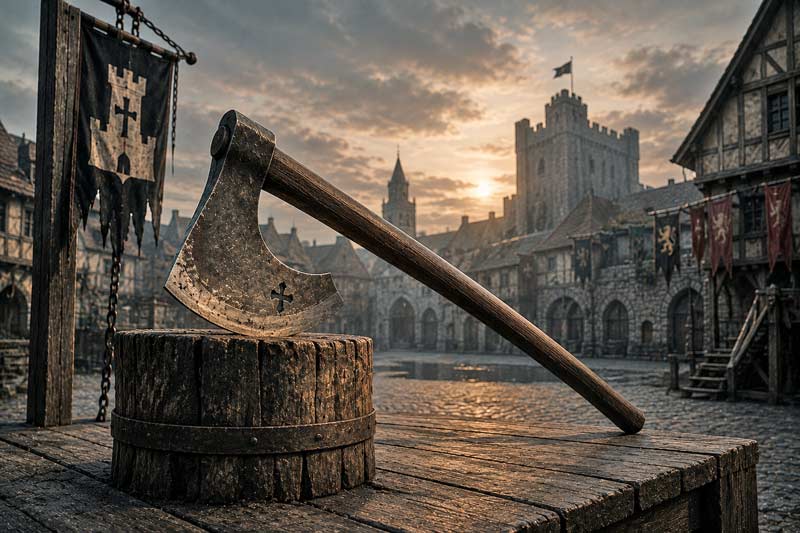
The Executioner's Axe: A Weapon Designed to Inspire Fear
Most weapons on this list earned their intimidating reputations through combat. The executioner's axe was different. Its purpose was psychological from the very beginning. It was not primarily a battlefield weapon. It was a symbol of authority, punishment, and consequences.
Throughout history, public executions served as both legal proceedings and public spectacles. Crowds gathered to witness them, and the executioner's axe became one of the most recognizable symbols of state power. Unlike weapons carried into battle, its reputation was built on certainty. Everyone knew exactly what it was for.
That certainty created a unique kind of fear. A spear might miss. A sword fight might be survived. The executioner's axe represented a predetermined outcome. Once it appeared, the story was usually already over. That psychological weight helped elevate the weapon far beyond its practical design.
Visually, the weapon contributed to its own legend. Large axe heads, broad cutting edges, and imposing proportions made it immediately recognizable. Artists, writers, and storytellers reinforced that image for centuries, turning the executioner's axe into one of history's most enduring symbols of fear and judgment.
Ironically, despite its fearsome reputation, the executioner's axe was often a specialized tool rather than a combat weapon. Many battlefield axes were more versatile and arguably more dangerous in actual fighting. Yet few weapons have ever achieved the same cultural impact.
The weapon's legacy also explains why axes remain among the most intimidating designs ever created. Whether used in battle or ceremony, the silhouette alone tends to trigger a strong emotional reaction. Modern collections of axes and hatchets still capture some of that timeless appeal, even when used for sport, training, or collection purposes.
In terms of raw combat effectiveness, many weapons on this list were more dangerous. In terms of psychological impact, however, the executioner's axe belongs near the very top. Fear was not simply a side effect of the weapon. Fear was the entire point.
Which Weapon Actually Deserved Its Reputation the Most?
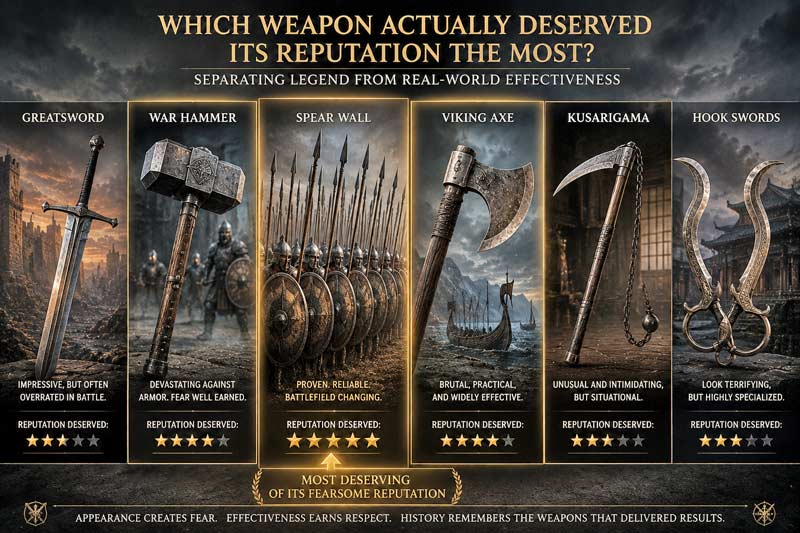
By this point, it is clear that many intimidating weapons earned at least part of their reputation through appearance alone. A giant sword, a bizarre chain weapon, or a blade covered in hooks naturally captures attention. But if we strip away the legends and focus purely on whether the fear was justified, a few weapons begin to separate themselves from the rest.
The greatsword was impressive, but its fame often exceeded its battlefield importance. Hook swords looked terrifying, yet they remained highly specialized weapons. The executioner's axe inspired enormous fear, though much of that fear came from symbolism rather than combat performance. Even the kusarigama's reputation is amplified by its unusual appearance and association with martial arts folklore.
The strongest candidates are arguably the weapons that combined intimidation with proven battlefield effectiveness. The war hammer genuinely threatened heavily armored opponents. The Viking axe delivered devastating power while remaining practical and widely used. Most of all, the spear wall repeatedly changed the outcome of battles across centuries of military history. Unlike some legendary weapons, these did not merely look frightening. They consistently produced results.
There is a reason so many armies trusted long weapons and disciplined formations. Fear is useful, but effectiveness is what keeps a weapon in service generation after generation. Throughout history, the most successful weapons were usually the ones that solved real problems rather than simply creating dramatic stories.
That conclusion may sound less exciting than crowning the strangest or most intimidating design. But history rarely rewards appearances alone. Again and again, the weapons that truly deserved their reputations were the ones warriors relied upon when their lives depended on the outcome.
Looking across many of history's most famous Asian weapons and other legendary designs, the same pattern appears repeatedly: the weapons people remembered were not always the weapons they feared most, and the weapons they feared most were not always the ones that won the most battles.
Fear Is a Weapon Too
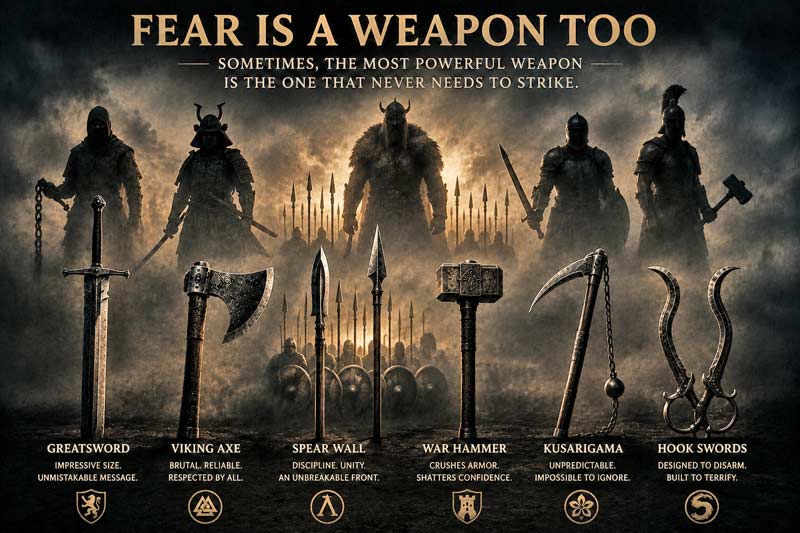
One of the most interesting lessons from history is that weapons do not need to be used to be effective. Sometimes, simply seeing a weapon was enough to influence decisions, lower morale, or convince an opponent to think twice about fighting in the first place.
Military leaders have understood this for thousands of years. A towering warrior carrying a greatsword, a line of soldiers standing behind a spear wall, or a fighter spinning a chain weapon all create uncertainty. And uncertainty is dangerous. People perform differently when they are afraid, especially when facing something they do not fully understand.
This is one reason intimidating weapons appear throughout so many cultures. The goal was not always to create the most efficient killing tool possible. Sometimes the goal was to project strength, confidence, and authority. A weapon that made enemies hesitate could create advantages before the first blow was ever thrown.
That psychological effect still exists today. Many of history's most intimidating weapons remain popular not because people expect to use them in battle, but because they symbolize power, skill, and martial tradition. Their reputations survived because they left lasting impressions on the people who saw them.
In fact, some of the most memorable weapons ever created became famous largely because of the stories surrounding them. Looking back at history's most famous Asian weapons, it becomes clear that reputation often spreads far beyond the battlefield itself.
Whether a weapon truly deserved its fearsome reputation or not, the impact was often real. Fear influences judgment. Fear changes behavior. And throughout history, some weapons became legendary because they were capable of weaponizing fear itself.
The Weapons Soldiers Feared Most Were Not Always the Ones We Remember
Ask most people to name a terrifying historical weapon and they will usually mention something dramatic: a giant sword, a Viking axe, or perhaps a weapon from a movie. But if you could travel back in time and ask actual soldiers what they feared most, the answers might be very different.
Many warriors feared formations more than individual weapons. A disciplined spear wall, a cavalry charge timed perfectly, or a rain of arrows from a distant hill could be far more dangerous than a duel against a famous weapon. The things that inspired the most fear were often the things that removed control from the situation.
This helps explain why some of history's most influential weapons are not always the most famous. The weapons that shaped battlefields were frequently practical, efficient, and designed to work as part of a larger system. Individual heroics made for great stories, but organized tactics won wars.
That does not mean the legendary weapons on this list were overrated. Most earned their reputations for a reason. The greatsword projected power. The war hammer threatened armored opponents. The kusarigama created uncertainty. The three-section staff seemed almost impossible to predict. Each weapon carried a psychological impact that extended beyond its physical capabilities.
Yet the deeper lesson is that fear itself has always been a battlefield resource. The most successful commanders understood that intimidating an opponent could be almost as valuable as defeating them. Weapons, formations, and tactics all contributed to that goal in different ways.
When you examine many of history's most famous combat weapons, a pattern emerges. The weapons that survive in popular memory are often the ones that combined effectiveness, symbolism, and fear into a single unforgettable package.
Some deserved every bit of their reputation. Others became legends because people believed they deserved it. Either way, centuries later, we are still talking about them.
Intimidation Only Matters If It Changes Behavior
Looking back at history's most intimidating weapons, one thing becomes clear: fear and effectiveness are related, but they are not the same thing. Some weapons earned terrifying reputations because they repeatedly proved themselves in battle. Others became legendary because they looked frightening, appeared unusual, or captured people's imagination long after their practical use had faded.
The weapons that truly stood out were the ones that combined both qualities. A Viking axe was intimidating because it looked dangerous and was dangerous. A war hammer earned fear through its ability to threaten heavily armored opponents. A spear wall terrified enemies because it transformed individual soldiers into a nearly impenetrable obstacle. In each case, the reputation was backed by real-world results.
At the same time, history reminds us that appearances can be deceiving. Some of the most famous weapons ever created were not necessarily the most effective, while some of the most effective weapons were never celebrated in stories, movies, or legends. Fear often follows perception rather than reality.
That is part of what makes martial arts and weapons history so fascinating. Every culture developed tools that reflected its unique challenges, tactics, and beliefs. Some became symbols of power. Some became symbols of fear. A select few managed to become both.
Whether it was a giant sword, a spinning chain weapon, a wall of spear points, or a simple axe, the most intimidating weapons in history all shared one important trait: they made people think differently before the fight even began.
And in many cases, that was exactly the point.
What Is the Most Intimidating Weapon Ever Invented?
There is no universally accepted answer, but a strong case can be made for the spear wall rather than any individual weapon. Throughout history, countless soldiers faced swords, axes, and hammers. Far fewer willingly charged into a disciplined formation of hundreds of spear points.
What made the spear wall so frightening was not just the weapon itself. It was the realization that you were facing an organized system rather than a single opponent. Even elite warriors often struggled against formations that maintained discipline and reach.
If we are judging purely by appearance, however, weapons like the greatsword, war hammer, and hook swords are usually among the most intimidating designs ever created. They project danger in a way that few weapons can match.
Did Any Weapons Win Battles Through Fear Alone?
Rarely. Fear by itself almost never wins a battle. However, fear can absolutely influence the outcome of one. Throughout history, armies have routed, surrendered, broken formation, or retreated because they believed they were facing an overwhelming threat.
That is why intimidating weapons mattered. A giant greatsword, a charging line of axe-wielding warriors, or an unfamiliar weapon like a kusarigama could create hesitation and uncertainty. If that hesitation spread through a formation, it could become a serious tactical problem.
Military leaders have long understood that perception matters. The goal is not necessarily to make enemies run away at the sight of a weapon. The goal is to make them slower, less confident, and more likely to make mistakes.
The most successful weapons combined psychological impact with genuine effectiveness. Fear worked best when opponents knew there was a very good reason to be afraid.
What Weapon Would Be the Scariest to Face One-on-One?
That depends on the situation, but many historians and martial artists would argue that long-reach weapons deserve serious consideration. A spear, polearm, or staff allows an opponent to attack while staying farther away, which creates immediate problems for anyone carrying a shorter weapon.
From a purely psychological perspective, however, unusual weapons often generate the strongest reactions. Weapons like the kusarigama, three-section staff, or hook swords can be intimidating because most people have little idea how they work. Unfamiliarity creates uncertainty, and uncertainty tends to amplify fear.
Interestingly, some of the weapons that look the most terrifying are not necessarily the ones experienced fighters fear most. Many seasoned warriors throughout history worried more about practical weapons with proven battlefield records than exotic weapons that simply looked dangerous.
In other words, the scariest weapon to face is often not the one that looks the deadliest. It is the one that gives you the fewest good options for defending yourself.
]]>2026-06-18T14:21:50+01:00https://www.karatemart.com/blog/the-most-intimidating-weapons-in-history<![CDATA[The Weapons That Were Far More Effective Than Swords (And Why History Forgot)]]>
https://www.karatemart.com/blog/the-weapons-that-were-far-more-effective-than-swords
For much of human warfare, swords were often backup weapons rather than battlefield superstars. The weapons that actually dominated combat were frequently longer, cheaper, faster, harder to defend against, or simply more practical in real fighting. Spears stopped cavalry. Polearms shattered armor. Staves controlled distance. Even simple blunt weapons sometimes proved deadlier than beautifully crafted blades.
That does not mean swords were ineffective. Far from it. A good sword was versatile, reliable, and devastating in the right hands. But if survival was the only thing that mattered, many warriors throughout history would have chosen something else entirely.
In this guide, we are looking at the weapons that often outperformed swords in real combat, why they worked so well, and how history somehow convinced us that swords were always the ultimate weapon anyway.
Why Swords Became Famous Even When They Were Not Always the Best Weapon
Before we start ranking weapons against swords, it is worth asking an uncomfortable question: if swords were not always the most effective battlefield weapon, why did they become so legendary?
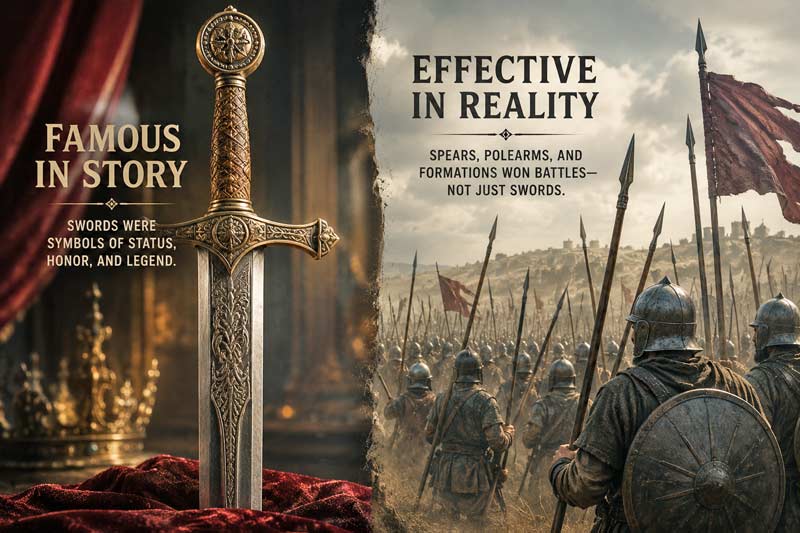
Part of the answer comes down to status. In many cultures, swords were expensive to produce and often carried by nobles, officers, or elite warriors. A spear could be handed to thousands of soldiers. A sword, by contrast, often became a symbol of rank, wealth, and prestige. Over time, people started associating swords with heroes rather than practicality.
Storytelling also played a huge role. A duel between two sword fighters is dramatic. It feels personal. Spears, polearms, and formations may have won wars, but they do not always create the same kind of cinematic moment. That is one reason movies and games often exaggerate sword combat while downplaying weapons that were arguably more effective in real life.
Even historically, swords were frequently secondary weapons. Many warriors carried them only after their primary weapon failed, broke, or became impractical in close quarters. Knights carried swords alongside lances and polearms. Roman soldiers relied on spears before drawing blades. Samurai often fought with polearms or bows long before reaching for swords.
That does not mean swords were overrated. A good sword was versatile, portable, and deadly. But history tends to remember symbols more than practicality, and swords became one of the most powerful symbols warfare ever produced.
If you look through collections of traditional swords and bladed weapons, it is easy to see why people became fascinated with them. Few weapons carry the same mix of craftsmanship, mythology, and visual appeal, even if battlefield history was often more complicated.
Why Spears Often Beat Swords in Real Combat
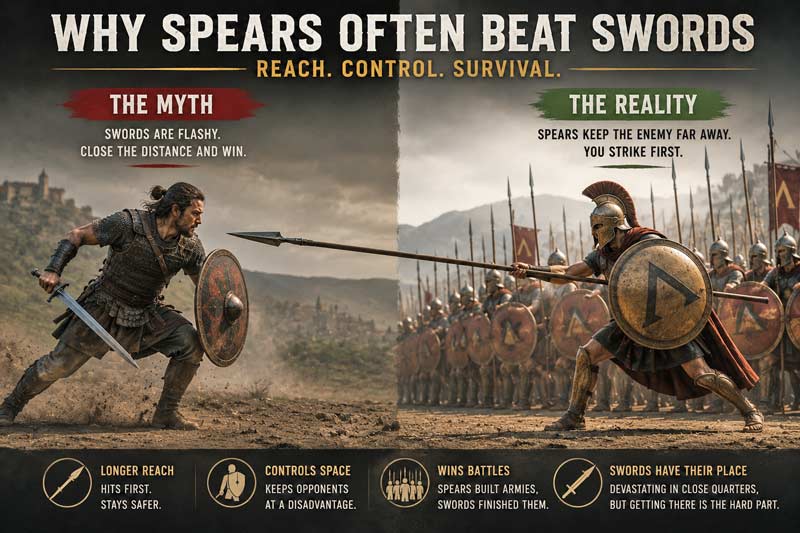
If there is one weapon that repeatedly outperformed swords throughout history, it was the spear. That may sound surprising considering how legendary swords became, but on actual battlefields, reach mattered more than style. And few weapons gave fighters a bigger advantage than putting a sharp point several feet farther away from danger.
A spear fighter usually got the first opportunity to strike. Before a swordsman could even get close enough to attack, they first had to survive the dangerous process of getting past the spear tip. In practical terms, that often meant facing multiple thrusts while trying to close distance against someone who could hit you first.
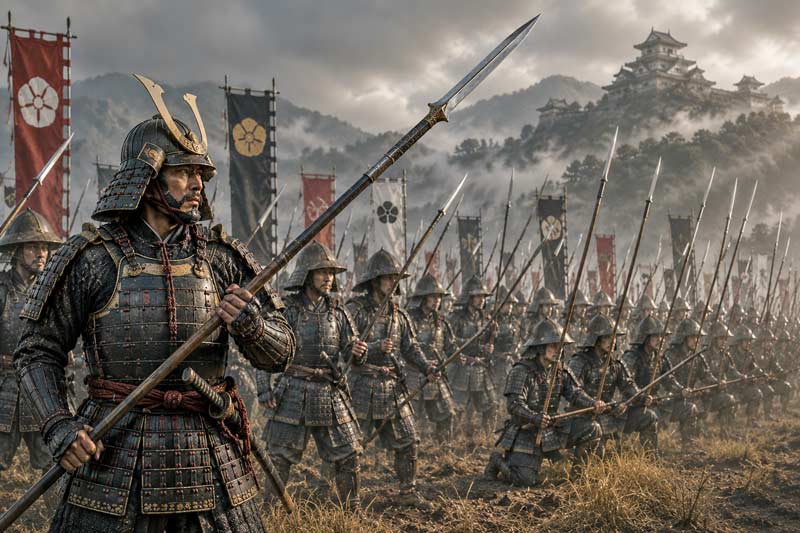
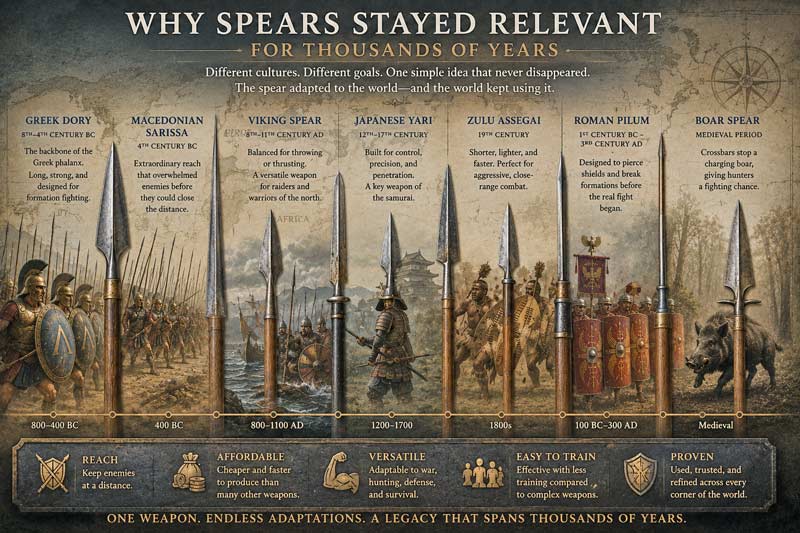
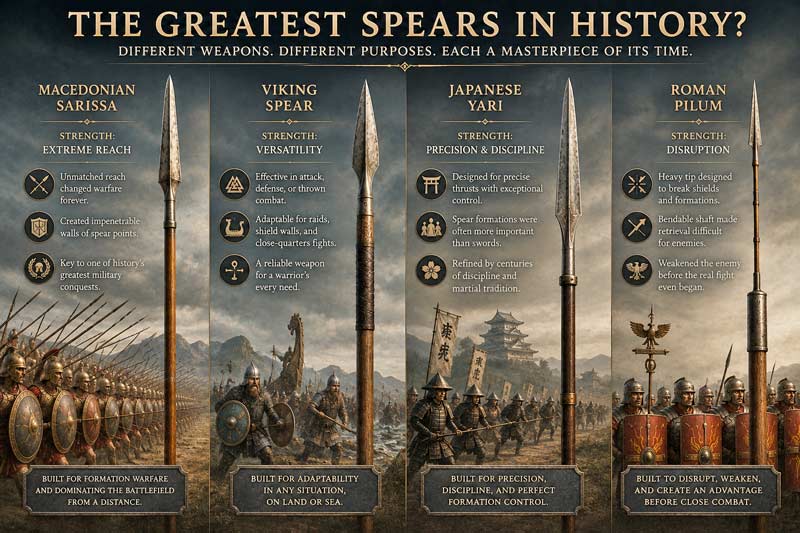
This advantage is one reason so many civilizations independently arrived at nearly the same conclusion. Greeks built phalanxes around spears. Vikings carried them more often than swords. Samurai armies relied heavily on yari. Medieval infantry used long pole weapons to stop cavalry and control space. Entire military systems repeatedly prioritized reach over prestige.
Even modern martial arts experiments and historical combat demonstrations often show how difficult it can be for shorter weapons to consistently overcome longer ones when skill levels are comparable. That does not mean swords were useless, but they frequently worked best as secondary weapons once the spear had broken, been dropped, or combat moved into tighter spaces.
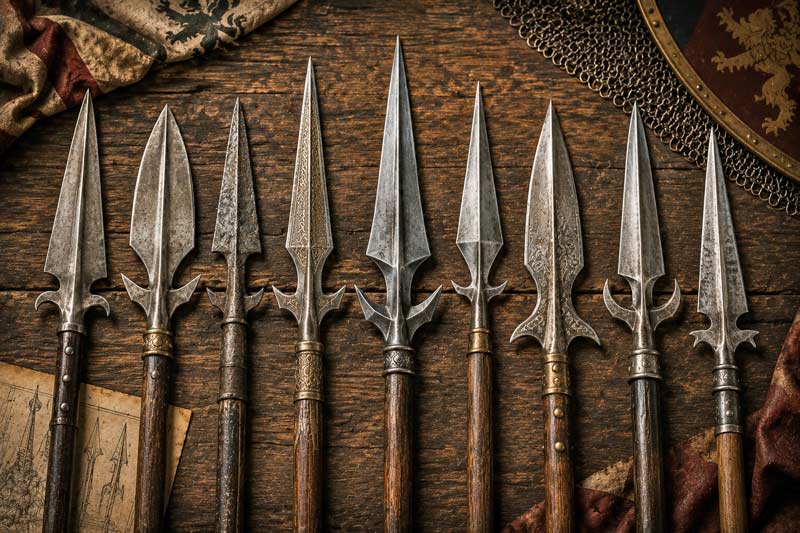
We recently explored this idea in more depth in our guide to the different types of spears used throughout history, where one thing became clear very quickly: civilizations kept reinventing spears because they worked astonishingly well.
The Staff: The Weapon Almost Nobody Wants to Fight
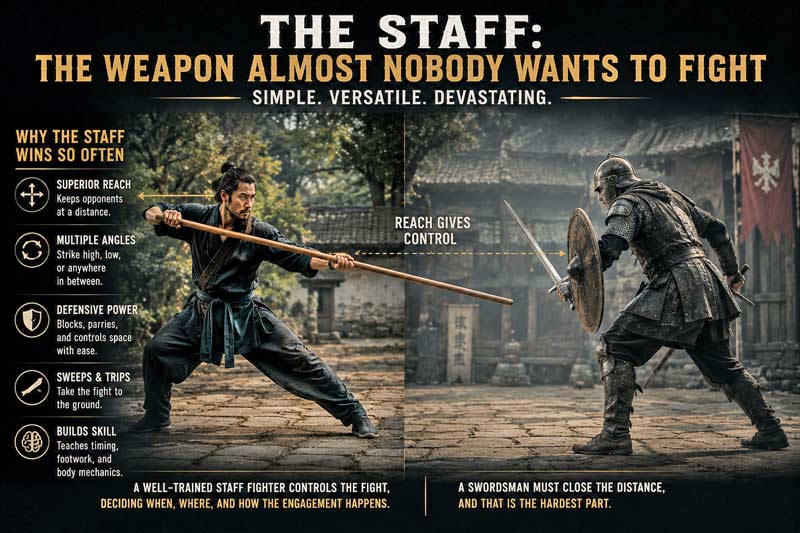
If swords had a quiet rival throughout history, it might be the humble staff. Simple, inexpensive, and found in cultures all over the world, the staff earned a reputation for something many flashy weapons struggled to deliver consistently: control.
A good staff fighter could strike from multiple angles, control distance, sweep legs, jab, block, and generate enormous power through leverage and momentum. Unlike swords, staffs also carried far less risk of becoming damaged in combat, and because of their reach, opponents often struggled to get close enough to attack effectively.
That reach advantage mattered more than many people realize. A trained fighter with a long staff could pressure an opponent constantly, forcing them to react instead of attack. Even heavily armed opponents sometimes found themselves struggling against someone wielding what looked like "just a stick." History repeatedly reminds us that simple does not mean ineffective.
Many martial arts systems turned staff fighting into highly refined disciplines. Japanese bojutsu, Chinese gun techniques, and Filipino long-weapon systems all recognized the same reality: controlling range often matters more than carrying the sharpest weapon. In some traditions, staff training even became the foundation for learning other weapons because it teaches timing, body mechanics, and positioning so effectively.
Modern martial artists still explore long-range fighting through collections of bo staffs and traditional staff weapons, many of which preserve training methods rooted in centuries of martial history.
Interestingly, staff weapons also evolved into stranger and more specialized designs over time. Flexible and segmented weapons like the three-section staff pushed range and unpredictability even further, though they required dramatically more skill to control.
Polearms: The Weapons That Made Knights Nervous
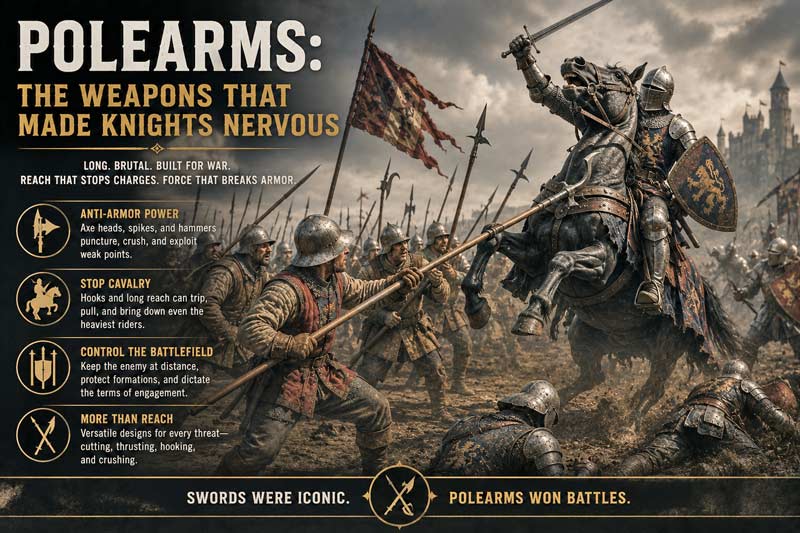
If swords had one category of weapon that consistently caused problems on battlefields, it was polearms. Long, brutal, and purpose-built for war, polearms combined the reach of a spear with heavier striking power, making them some of the most feared anti-armor weapons in history.
Weapons like halberds, glaives, bills, and poleaxes were designed to solve a very specific battlefield problem: heavily armored opponents. Swords could struggle against plate armor, especially when facing mounted knights or disciplined infantry. Polearms, however, attacked from farther away and often included axe heads, hooks, spikes, or hammer-like striking surfaces capable of pulling riders from horses, piercing weak points, or delivering crushing force.
In many medieval battles, infantry carrying polearms became one of the biggest threats to mounted warriors. A charging knight looked terrifying, but long weapons gave soldiers ways to stop cavalry before impact or drag armored fighters into vulnerable positions. Reach mattered, but versatility mattered too.
This is also where swords began losing one of their biggest advantages. A sword is adaptable, but many polearms were specialized for battlefield dominance. Against armor, range, and formations, the fighter holding a longer weapon often dictated the terms of the engagement.
Ironically, some of the deadliest battlefield weapons in history looked awkward compared to elegant swords. But history has a funny habit of rewarding effectiveness over aesthetics.
For people fascinated by unusual historical designs, collections of rare and exotic weapons offer a glimpse into how strange, creative, and specialized combat tools became across different cultures.
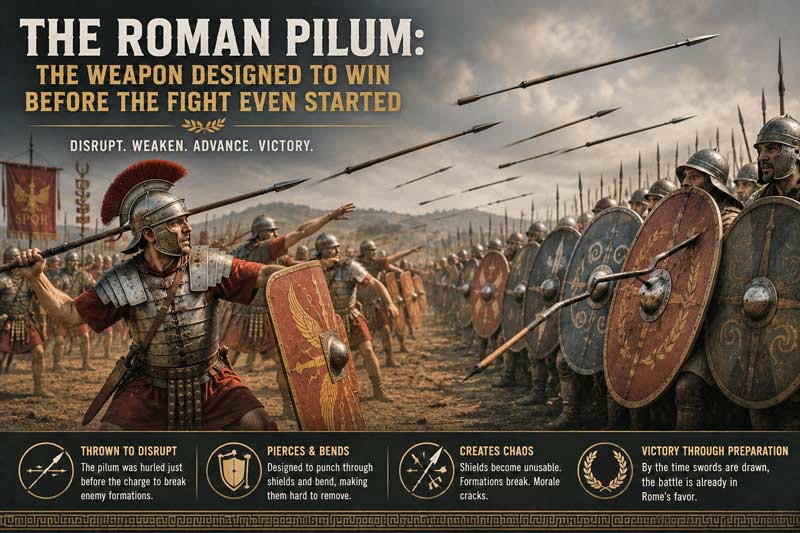
The Roman Pilum: The Weapon Designed to Win Before the Fight Even Started
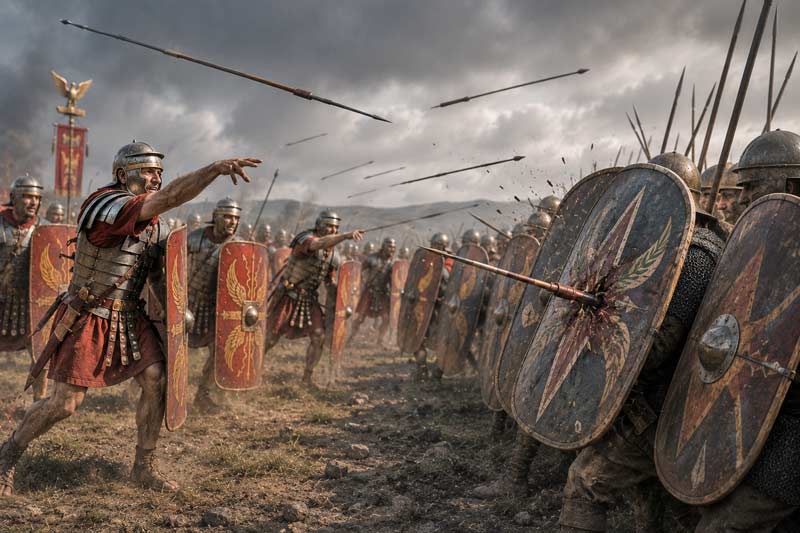
Most people picture Roman soldiers fighting with short swords, but that image leaves out one of the smartest battlefield weapons Rome ever created. Before swords came into play, Roman legionaries often relied on the pilum, a heavy throwing spear designed to make enemy soldiers miserable seconds before close combat even began.
Unlike a traditional spear built for repeated thrusting, the pilum was designed for disruption. Roman soldiers hurled them just before charging, aiming directly at enemy shield walls. The long metal shank could punch through shields, and in many cases, bend after impact. Suddenly, an enemy fighter was stuck carrying a heavy shield with a spear dangling awkwardly from it, or forced to throw the shield away entirely.
That small tactical advantage created chaos. Formations broke apart. Defenses weakened. Panic spread. By the time Roman soldiers closed distance with swords, opponents were often already disorganized and vulnerable. In many battles, the real damage had already started before the sword fighting even began.
This is one reason weapons comparisons become more complicated than "which one wins in a duel?" Battlefield effectiveness often came down to teamwork, timing, and strategy. A sword might look more impressive, but weapons like the pilum solved bigger military problems.
History is full of examples where preparation mattered more than flash. Even among collections of historical martial arts weapons, many of the most effective designs were created to control the fight before an opponent even had a chance to react.
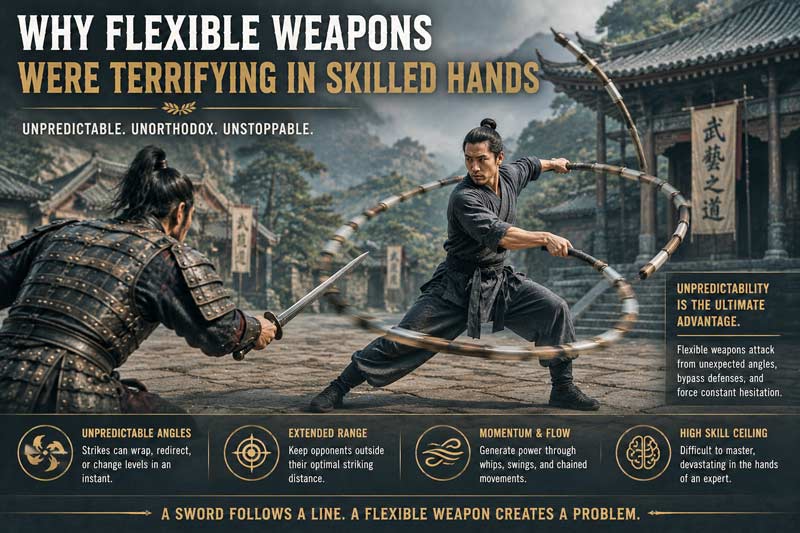
Why Flexible Weapons Were Terrifying in Skilled Hands
Some weapons beat swords through reach. Others won through armor-breaking power. Flexible weapons created problems in a completely different way: unpredictability. Against a skilled user, they could attack from strange angles, bypass defenses, and force opponents into constant hesitation.
Weapons like chain whips, rope darts, flails, and segmented staffs often looked chaotic to inexperienced fighters, but that unpredictability was part of the danger. A sword swings in fairly predictable lines. Flexible weapons could wrap, rebound, redirect, or strike around guards in ways that made conventional defenses far less reliable.
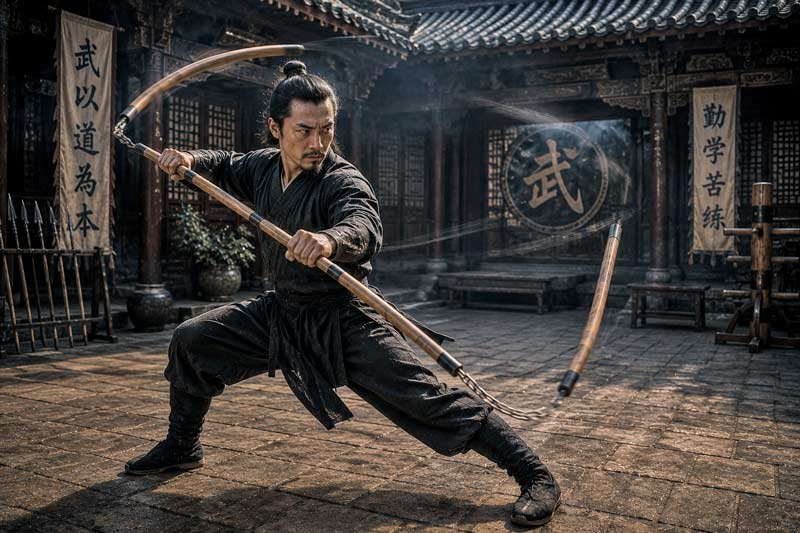
The three-section staff is one of the best examples. Combining aspects of both a staff and a flexible weapon, it could strike at long range, shift directions quickly, and generate enormous momentum. In the hands of a beginner, it could feel almost impossible to control. In the hands of an expert, it became something opponents struggled to predict.
Of course, these weapons came with tradeoffs. They were often harder to master than swords and carried a steeper learning curve. Timing mistakes could punish the user just as much as an opponent. That complexity is probably one reason many flexible weapons became associated with highly trained martial artists rather than ordinary soldiers.
We explored this idea more deeply in our guide to how the three-section staff actually works, because few historical weapons better demonstrate how range, momentum, and unpredictability can completely change a fight.
For people interested in unusual martial arts designs, training with a three-section staff offers a glimpse into one of history's most demanding weapon systems.
Sai and Tonfa: The Weapons Built to Control, Trap, and Disarm
Not every weapon tried to overpower a sword through reach or brute force. Some were designed to make swords less useful altogether. Weapons like the sai and tonfa approached combat differently by emphasizing control, defense, and redirection rather than pure cutting power.
The sai is a perfect example of a weapon people often misunderstand. Thanks to movies and pop culture, many assume it was mainly a stabbing weapon. In reality, one of its biggest strengths came from trapping and controlling an opponent's blade. The side prongs could help catch weapons, redirect attacks, and create openings without needing a long blade of its own.
Tonfa worked differently but solved a similar problem. Their unique side handles allowed users to shift quickly between defensive blocking and close-range strikes. Against bladed weapons, they offered protection while remaining fast enough to counterattack almost immediately. In close quarters, that balance of defense and offense could become incredibly difficult to deal with.
These weapons also highlight an important truth about historical combat: "better" depended on the situation. A sword may dominate in open space, but in tight environments or defensive encounters, weapons designed around control and speed could become surprisingly effective.
Many traditional martial arts still preserve these systems today. Training with traditional sai weapons or practicing with martial arts tonfa offers a glimpse into combat philosophies built around timing, control, and precision rather than raw force alone.
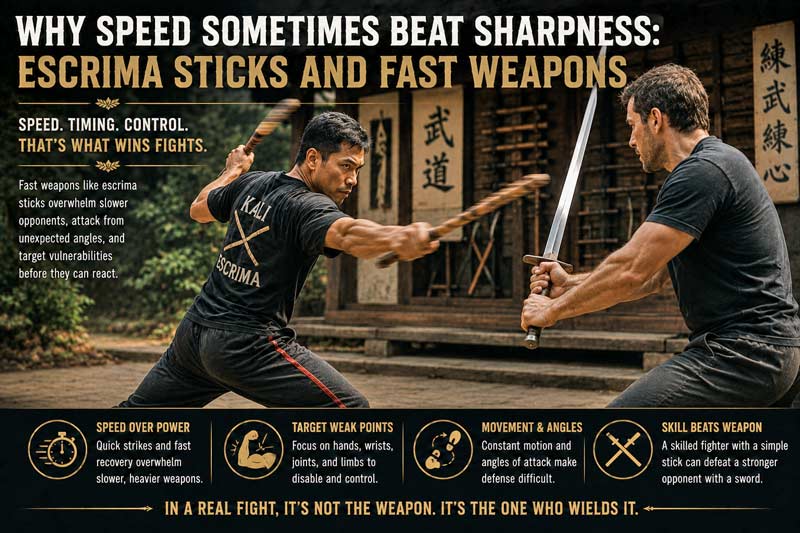
Why Speed Sometimes Beat Sharpness: Escrima Sticks and Fast Weapons
One of the biggest myths about combat is that sharper automatically means deadlier. In reality, speed, timing, and control often mattered just as much. That is one reason fast impact weapons like escrima sticks earned such a serious reputation in martial arts systems built around real-world fighting.
Unlike swords, sticks could move incredibly quickly, recover faster between strikes, and attack from angles that overwhelmed slower opponents. A skilled practitioner could target hands, wrists, joints, and limbs before an opponent had time to react. In practical terms, disabling someone's ability to hold a weapon could end a fight long before a decisive strike became necessary.
Filipino martial arts systems such as Kali and Escrima built entire combat philosophies around movement, timing, and adaptability. Practitioners often trained with sticks first because the mechanics translated naturally to knives, blades, and improvised weapons. Instead of relying on brute force, the emphasis stayed on precision and speed.
This also highlights an uncomfortable truth about swords: carrying a blade does not automatically guarantee an advantage. A slower fighter with a longer or sharper weapon can still struggle against someone faster, more mobile, and better at controlling angles and distance.
Interestingly, many of these same principles show up in other underestimated martial arts weapons too. We touched on that in our guide to some of Asia's most famous historical weapons, where effectiveness often came from skill and adaptability rather than appearance.
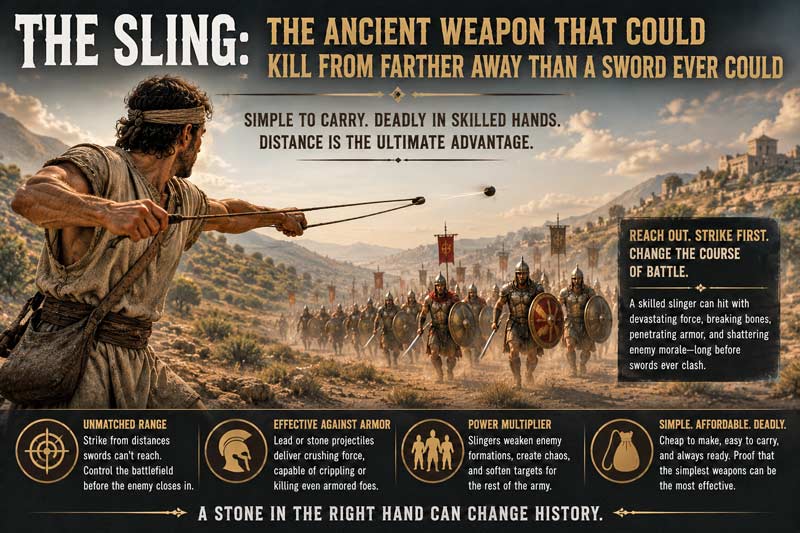
The Sling: The Ancient Weapon That Could Kill From Farther Away Than a Sword Ever Could
If this list proves anything, it is that effectiveness and popularity are not always the same thing. Few weapons show that better than the humble sling, a weapon many people dismiss because it looks too simple to be dangerous. History strongly disagrees.
Long before firearms existed, skilled sling users could hurl stones or lead projectiles at frightening speeds from distances swords could never hope to reach. Ancient armies trained slingers to disrupt formations, injure armored opponents, and weaken enemy morale before close combat even started. In some cases, sling bullets hit with enough force to fracture bones or penetrate vulnerable areas of armor.
The biggest advantage was obvious: distance. A sword becomes incredibly effective once someone gets close. The sling tried to make sure that never happened. Against a disciplined ranged unit, heavily armed soldiers often found themselves taking damage long before they had a chance to fight back.
The sling also reminds us of an important historical truth: expensive did not always mean better. A beautifully crafted sword could symbolize status, but a simple weapon made from cord and stone sometimes proved more useful on an actual battlefield. Effectiveness often came down to context, training, and tactics rather than appearance.
History is full of overlooked weapons that quietly changed combat while flashier weapons stole the spotlight. That same pattern appears throughout our breakdown of history's most famous combat weapons, where battlefield reality and pop culture rarely tell the same story.
Why Swords Still Became Legendary Anyway
By now, it probably sounds like swords never deserved their reputation. That is not really the lesson history teaches. Swords absolutely earned their place. The interesting part is understanding why they became legendary even when many other weapons often performed better in real combat.
Part of the answer is versatility. Unlike spears, polearms, or ranged weapons that excelled in specific situations, swords adapted well to many environments. They worked indoors, outdoors, on foot, in close quarters, and as reliable sidearms once formations broke apart. When battles became messy and chaotic, versatility mattered.
There was also the status factor. Across many civilizations, swords became symbols of wealth, discipline, and military prestige. Knights carried them. Samurai elevated them into cultural icons. Nobles wore them publicly as signs of authority. A spear may have won battles, but a sword often represented the warrior class itself.
Storytelling pushed things even further. A hero standing alone with a sword feels dramatic. It is personal. A duel creates tension in ways formations and battlefield tactics rarely do. Over time, books, legends, films, and games helped turn swords into symbols of courage and mastery while quieter battlefield weapons faded into the background.
That disconnect between myth and reality shows up repeatedly throughout martial arts history. We explored some of those misconceptions in our breakdown of the biggest myths about samurai swords, where popular culture and historical practicality do not always align.
If there is one takeaway from this entire discussion, it is probably this: the most famous weapon is not always the most effective weapon. History cared about survival. Stories cared about heroes. Those are not always the same thing.
The Best Weapon Was Usually the One That Solved the Right Problem
History has a funny way of simplifying things. Over time, we remember the dramatic duel, the legendary sword, and the heroic warrior standing alone against impossible odds. What we forget is that real combat rarely cared about symbolism. Survival usually belonged to whatever weapon solved the problem most effectively.
Sometimes that meant reach. Spears and polearms controlled distance and punished opponents before they could get close. Sometimes it meant speed, as seen with escrima systems and fast impact weapons. Other times it meant disruption, defense, unpredictability, or simply attacking from farther away than a sword ever could.
That does not make swords overrated. If anything, their reputation survived because they were adaptable enough to stay useful almost everywhere. But battlefield dominance and cultural fame are not always the same thing. The weapons that shaped history most often were practical, efficient, and sometimes surprisingly unglamorous.
The bigger lesson may be this: humans have always been obsessed with finding better ways to control distance, gain leverage, and survive dangerous situations. Whether it was a spear wall, a sling stone, a three-section staff, or a pair of sai, the most effective weapons were usually designed around solving specific problems rather than looking impressive.
That is also what makes martial arts history so fascinating. Once you stop viewing swords as the automatic answer to every fight, you start noticing how creative civilizations became in designing tools for completely different situations. History gets a lot more interesting once the "best weapon" debate becomes more complicated.
And maybe that is the real takeaway here: the most legendary weapon is not always the one people feared most.
Could a Spear Really Beat a Sword in a Fair Fight?
In many cases, yes. If both fighters had similar skill levels and enough room to move, a spear often held a major advantage over a sword for one simple reason: reach. The spear user could attack first while forcing the swordsman to survive the dangerous process of closing distance.
That does not mean swords automatically lost. Tight spaces, broken formations, obstacles, or an opponent successfully getting past the spear point could completely change the fight. Once combat moved into close quarters, swords often became much more effective.
This is one reason so many warriors historically carried both. A spear or polearm controlled the battlefield at range, while a sword worked as a reliable backup once things became chaotic. Real combat rarely depended on a single "best" weapon.
What Weapon Did Soldiers Fear More Than Swords?
If historical accounts are any indication, many soldiers feared formations and reach-based weapons far more than swords. A sword fight might feel dramatic, but standing in front of a wall of spears, pikes, or polearms was often far more terrifying in real combat.
Why? Because those weapons made it incredibly difficult to even reach the enemy. Cavalry charges could collapse against disciplined spear formations. Infantry advancing toward polearms had to survive multiple attack angles before getting close enough to fight back. In many battles, fear came from helplessness as much as danger.
Ranged weapons also earned serious respect. Skilled archers and slingers could injure or kill from distances where swords were completely useless. By the time close combat started, entire formations could already be weakened, exhausted, or demoralized.
The interesting thing is that history repeatedly rewarded whatever weapon controlled distance best. Sometimes that meant a spear. Sometimes a bow. Sometimes a polearm. The weapon soldiers feared most was usually the one that prevented them from fighting on equal terms.
What Was the Most Effective Weapon in History?
That depends on the time period and what problem the weapon needed to solve. If we are talking about battlefield effectiveness across all of history, firearms probably deserve the top spot. Once guns became reliable, they dramatically changed warfare by allowing soldiers to injure or kill from greater distances with less training than many traditional weapons required. Entire military systems built around swords, cavalry, and armor eventually became obsolete because of firearms.
Before firearms dominated battlefields, however, spears and polearms have a very strong argument for being history's most effective weapons. They controlled distance, stopped cavalry, worked in formations, and remained relevant across thousands of years and countless civilizations. Few weapons matched their combination of reach, practicality, and battlefield influence.
If armor penetration mattered most, weapons like war hammers, maces, and poleaxes became incredibly effective against heavily protected opponents. Against plate armor, blunt force often mattered more than cutting power.
Swords still deserve credit for versatility. They adapted to many environments and remained useful long after primary weapons became impractical. But history repeatedly shows that the most famous weapon was not always the one armies relied on most.
The real answer is that effectiveness depended on context. A spear on an open battlefield, a sling at range, a firearm in organized warfare, or a sword in close quarters could each become the "best" weapon depending on the situation.
]]>2026-06-15T15:23:59+01:00https://www.karatemart.com/blog/the-weapons-that-were-far-more-effective-than-swords<![CDATA[The Different Types of Spears Used in History (And What Made Each One Deadly)]]>
https://www.karatemart.com/blog/the-different-types-of-spears-used-in-history
What makes spears especially fascinating is how universal they became. Nearly every civilization developed its own version, often independently, because the basic concept worked so well. Spears were cheaper to make than swords, easier to train with, and surprisingly versatile in combat. In many cases, they were the weapon that actually won wars while swords got most of the glory in stories and movies.
In this guide, we're exploring the different types of spears used throughout history, what made each one unique, and why certain designs proved so deadly that they changed warfare itself.
Why the Spear Became the World's Most Universal Weapon
The spear may not look complicated, but that simplicity is exactly why it became one of the most successful weapons in human history. A spear gave the person holding it something every fighter wanted: distance. Before armor, training, or brute strength mattered, reach could decide who survived the first few seconds of a fight.
That advantage made spears useful almost everywhere. Hunters used them to keep dangerous animals away from their bodies. Guards used them to control narrow entrances. Soldiers used them in tight formations where one person's weapon protected the man beside him. Even in cultures famous for swords, axes, or bows, the spear was often the practical battlefield workhorse.
Spears were also easier to produce than many other weapons. A good sword required skilled metalwork, careful balance, and a lot of material. A spear could be made with a smaller metal head attached to a long wooden shaft, making it more affordable for armies that needed to equip thousands of fighters. That is one reason spears show up again and again across ancient, medieval, and tribal warfare.
What changed from culture to culture was not the basic idea, but the problem each spear was designed to solve. Some were built for throwing. Some were built for stopping cavalry. Some were built for fighting in dense formations. Others were made short, fast, and brutal for close-range encounters. Once you understand that, the different types of spears start to look less like random variations and more like specialized tools shaped by battlefield pressure.
For readers interested in the broader world of martial arts and historical weapon designs, KarateMart's weapons collection shows how many traditional weapon concepts still survive today in training, display, and martial arts culture.
The Spear That Dominated the Ancient World: The Greek Dory
When people think about ancient warfare, they often imagine swords clashing in dramatic one-on-one duels. In reality, much of the ancient world was controlled by disciplined groups of soldiers carrying spears. One of the most influential examples was the Greek dory, the primary weapon of the hoplite soldier.
The dory was not especially flashy. It typically measured between seven and nine feet long and featured a leaf-shaped spearhead designed for thrusting. What made it dangerous was how it was used. Greek hoplites fought shoulder to shoulder in tightly packed formations called phalanxes, creating rows of overlapping shields and spear points that were incredibly difficult to break through.
This formation turned individual fighters into something much more intimidating: a moving wall of sharp points. Enemies often had to survive multiple spear thrusts before they could even reach the front line. In many battles, organization mattered more than individual fighting skill, and the dory helped make Greek armies some of the most feared military forces of their time.
The influence of Greek spear combat spread far beyond Greece itself. Variations of long battlefield spears would later shape military tactics across Europe, Asia, and the Middle East. In many ways, the spear established the blueprint for organized warfare long before swords became symbols of status and heroism.
Many traditional martial systems still preserve the idea of long-range weapon control. Some modern practitioners interested in historical or long-reach weapon styles explore related training tools through collections of kung fu weapons, where staff-based training still plays an important role.
The Spear That Stretched Warfare: The Macedonian Sarissa
If the Greek dory helped define organized spear combat, the Macedonian sarissa took the idea to an entirely different level. Used by the armies of Alexander the Great, the sarissa was not just long. It was enormous. Some versions stretched between 13 and 20 feet, making it one of the most intimidating battlefield weapons of the ancient world.
Unlike shorter spears designed for flexibility, the sarissa existed for one purpose: domination through reach. Macedonian soldiers stood in massive formations called phalanxes, often several ranks deep, with multiple rows of spear points extending far beyond the front line. Enemies were sometimes forced to deal with five layers of spear tips before they could even reach a soldier.
The psychological effect alone was brutal. Imagine charging toward what looked like a moving forest of sharpened poles, all aimed directly at you. Cavalry struggled against it. Infantry struggled against it. Entire armies found themselves overwhelmed before they could get close enough to fight effectively.
The tradeoff, however, was mobility. Sarissa formations worked best on open terrain and required extraordinary discipline to maintain. If formations broke apart or enemies attacked from the sides, these giant spears became much harder to manage. Even so, the weapon helped Alexander build one of the largest empires the ancient world had ever seen.
The sarissa also shows something important about spear evolution: sometimes bigger really was better. While many civilizations focused on versatility, Macedonian military strategy doubled down on overwhelming range and battlefield control.
For martial artists fascinated by unusual or historically inspired weapon designs, collections of exotic weapons can offer a glimpse into how dramatically weapon styles evolved across cultures and eras.
The Viking Spear: The Weapon Warriors Actually Relied On
Ask someone to picture a Viking weapon and they will probably imagine a massive axe or a legendary sword. In reality, the spear was often the weapon Vikings trusted most. It was cheaper than a sword, easier to carry, and deadly in both close combat and at a distance.
Viking spears came in many forms, ranging from simple battlefield tools to highly decorated weapons carried by elite warriors. Some featured broad cutting blades designed to slash, while others had narrow points made for deep thrusting. Many could also be thrown, giving fighters a dangerous ranged option before hand-to-hand combat even began.
Part of what made the Viking spear so effective was its versatility. A warrior could stab from behind a shield, strike at enemies on foot, defend against cavalry, or hurl the weapon when the timing felt right. Unlike giant battlefield spears such as the sarissa, Viking spears balanced reach with mobility, making them practical for raids, ship combat, and chaotic skirmishes.
The spear also held symbolic value in Norse culture. According to mythology, the god Odin carried a legendary spear called Gungnir, said to never miss its target. That cultural importance helped make spears feel like more than just battlefield tools. They became symbols of status, skill, and warrior identity.
The Japanese Yari: The Spear That Changed Samurai Warfare
When most people think of samurai weapons, they picture the katana. Yet for long stretches of Japanese history, one of the most important battlefield weapons was not the sword at all. It was the yari, a spear that transformed how samurai armies fought and helped shape warfare in feudal Japan.
Unlike many European spears, the yari often featured a straight, symmetrical blade designed for precise thrusting. Some yari were relatively simple, while others developed elaborate side blades or specialized shapes for hooking, cutting, or disarming opponents. Lengths varied dramatically depending on battlefield role, ranging from shorter personal fighting weapons to extremely long versions used in mass formations.
As warfare in Japan evolved, samurai armies increasingly relied on disciplined groups of spear fighters called ashigaru. During major battles, long yari formations could overwhelm charging enemies and disrupt cavalry attacks in ways that looked surprisingly similar to ancient Greek and Macedonian spear tactics. In some eras, spears became even more important than swords on the battlefield.
The katana may have earned the fame, but the yari often did the real military work. That pattern appears repeatedly throughout history. The weapon celebrated in stories is not always the one soldiers relied on most when survival mattered.
The Zulu Assegai: The Short Spear That Changed Combat
Not every civilization believed bigger was better when it came to spears. In southern Africa, the Zulu kingdom developed a weapon that moved in the exact opposite direction. Instead of relying on long reach, the Zulu assegai evolved into a shorter, faster spear designed for brutal close-range fighting.
Originally, many African spears were lightweight throwing weapons meant to wound enemies from a distance. But in the early 1800s, the Zulu king Shaka revolutionized warfare by redesigning the spear into something far more aggressive. His version featured a shorter shaft and a broader blade built for stabbing rather than throwing. Warriors closed distance quickly and fought hand-to-hand with terrifying speed.
This shift completely changed Zulu battlefield tactics. Rather than standing back and exchanging thrown weapons, warriors used disciplined formations to surround enemies and force close combat. One famous strategy became known as the "horns of the buffalo," where flanking groups swept around opponents while central fighters locked them into direct engagement.
The assegai proves an important point about spear evolution: effectiveness depended on context. While Macedonians dominated through overwhelming reach, the Zulu military prioritized mobility, aggression, and speed. Two spear cultures arrived at completely different solutions, and both changed history.
The story of the assegai is also a reminder that military innovation is not always about building bigger weapons. Sometimes the most effective change comes from making a weapon faster, simpler, and better suited to the realities of how people actually fight.
The Medieval Lance: The Spear Built for Horseback Warfare
Some spears were designed for infantry formations. Others were built to strike with overwhelming force from horseback. That is where the medieval lance enters the story. While technically a type of spear, the lance evolved into a specialized battlefield weapon made for mounted warriors who could turn speed and momentum into devastating power.
Unlike shorter combat spears, lances were typically longer and heavier, allowing mounted knights to attack enemies from farther away while staying protected by armor and shields. During a cavalry charge, the rider often tucked the lance under the arm and aimed straight ahead, transforming horse and rider into what was essentially a moving missile.
The effect could be terrifying. A disciplined cavalry charge with lowered lances had enormous psychological power before impact even happened. Rows of mounted soldiers thundered across open ground toward infantry lines, forcing enemies to either stand firm or panic. Battles were often decided by who broke formation first.
Of course, the lance had limitations. Dense spear formations, rough terrain, and disciplined infantry could neutralize cavalry advantages. Weapons like the Macedonian sarissa or tightly packed pike formations later proved that long infantry spears could sometimes stop mounted charges cold. Warfare constantly became a contest between offense and countermeasure.
The lance also highlights how adaptable spear concepts became across history. One civilization used spears to create immovable defensive formations, while another reshaped them into high-speed offensive weapons capable of crashing into enemy lines with shocking force.
The Roman Pilum: The Spear Designed to Ruin Your Day
The Romans approached spear design differently from many civilizations. Instead of focusing entirely on long-range fighting or formation dominance, they created a weapon specifically designed to disrupt enemy defenses before close combat even began. That weapon was the pilum, a heavy throwing spear used by Roman legionaries.
At first glance, the pilum looked unusual. It featured a long, narrow metal shank attached to a wooden shaft, ending in a hardened point built to punch through shields. Roman soldiers typically carried one or two pila and hurled them just before engaging the enemy with swords.
What made the pilum especially clever was its destructive design. After piercing a shield, the long metal shaft often bent or became difficult to remove, leaving enemies burdened with heavy, awkward shields they could no longer use effectively. In some cases, soldiers abandoned their shields entirely, suddenly becoming far more vulnerable in combat.
This gave Roman infantry an enormous tactical advantage. Enemy formations could fall apart seconds before the Romans closed distance. By the time swords came out, opponents were often already disorganized, exposed, and struggling to recover from the disruption.
The pilum is a great example of how spears evolved beyond simple stabbing weapons. Some civilizations used them for reach. Others prioritized speed or cavalry warfare. The Romans turned the spear into a battlefield problem-solving tool designed to weaken enemies before the real fighting even started.
The Boar Spear: Built for One of History's Most Dangerous Hunts
Not all spears were designed for war. Some evolved to solve a very different problem: surviving an encounter with an animal powerful enough to kill a human in seconds. Few examples show this better than the boar spear, a specialized weapon designed for hunting wild boars across medieval Europe and parts of Asia.
At first glance, a boar spear looked similar to a battlefield spear, but one unusual feature immediately stood out. Many versions included a pair of metal lugs or crossbars just below the blade. These were not decorative. They served a very specific purpose: stopping an enraged boar from continuing to charge up the shaft after being struck.
Wild boars were incredibly dangerous prey. Large males could weigh hundreds of pounds, move surprisingly fast, and slash with razor-sharp tusks capable of causing devastating injuries. Hunters often had only one chance to brace their spear and absorb the impact. Without the crossbar design, the animal could continue driving forward and reach the person holding the weapon.
Boar spears reveal something fascinating about weapon evolution. Spears were not just battlefield tools. They adapted to completely different threats depending on environment and survival needs. A weapon built for cavalry charges would make little sense in a dense forest facing an aggressive animal at close range.
In many ways, the boar spear reflects a broader truth about spear history: these weapons survived for thousands of years because they were endlessly adaptable. Whether used against armies, mounted knights, or dangerous animals, people kept reshaping the same basic concept to solve entirely different problems.
The Winged Spearheads of Europe: When Spears Became Multi-Purpose Weapons
As spears evolved, many cultures started experimenting with designs that could do more than simply stab. One of the most interesting examples appeared across medieval Europe in the form of winged spearheads, weapons featuring small protruding lugs or "wings" near the base of the blade.
At first glance, the wings look decorative, but they served several practical purposes. In battle, they could help trap or deflect an opponent's weapon, making it harder for enemies to push past the spear's reach advantage. Some historians also believe they prevented the spear from penetrating too deeply, allowing soldiers to pull the weapon back more quickly in crowded combat situations.
These designs blurred the line between spear and polearm. Over time, many long weapons began evolving into highly specialized battlefield tools with hooks, blades, spikes, and reinforced shafts tailored for specific enemies or tactics. Armored knights, cavalry, and tighter battlefield formations all pushed weapon makers to keep adapting.
This period highlights something fascinating about spear history: once people realized how effective long weapons could be, innovation exploded. Spears stopped being simple sharpened sticks and became increasingly sophisticated tools built for survival in constantly changing warfare.
Even though swords dominate movies and fantasy stories, many historians argue that long weapons like spears and polearms were often far more important in actual combat. They were practical, adaptable, and brutally effective in the hands of disciplined fighters.
Why Spears Stayed Relevant for Thousands of Years
By this point, a pattern probably stands out: civilizations kept inventing wildly different kinds of spears, yet the basic idea almost never disappeared. While swords changed dramatically, armor evolved, and military tactics shifted, the spear somehow kept surviving. There is a simple reason for that. It worked.
Spears offered something few weapons could match: reach, versatility, and efficiency. A trained fighter with a spear could often keep opponents at a distance, strike first, and fight effectively without years of expensive training. For armies trying to equip thousands of soldiers, that mattered. A spear was usually cheaper and faster to produce than a sword while remaining brutally effective in battle.
Different cultures simply adapted the same idea to fit their needs. The Greeks built disciplined walls of spear points. Macedonians stretched reach to extremes. Vikings prioritized mobility. Samurai refined precision. Zulu warriors shortened spears for speed and aggression. Roman soldiers transformed them into battlefield disruption tools. Even hunters redesigned spears to survive dangerous encounters with wild animals.
That flexibility is probably why the spear became humanity's most universal weapon. Nearly every civilization developed some version of it independently, often arriving at similar solutions despite being separated by oceans and centuries. Few tools in history adapted so successfully to so many completely different problems.
Ironically, the spear rarely gets the same attention as swords in movies, games, or pop culture. Yet if history teaches us anything, it is that the most famous weapon is not always the one that mattered most. Again and again, when survival was on the line, people trusted the spear.
What Weapon Do Historians Consider the Greatest Spear Ever Made?
Choosing the "best" spear in history is a little like arguing over the greatest military strategy ever invented. The answer depends entirely on what problem the weapon was designed to solve. A spear that dominated cavalry combat might fail in a dense forest. A weapon perfect for hunting could be nearly useless against armored soldiers.
If the goal was battlefield reach and formation warfare, many historians point to the Macedonian sarissa. Few weapons reshaped military tactics so dramatically or helped fuel conquest on such a massive scale. Entire armies struggled to deal with walls of spear points extending impossibly far into the battlefield.
If versatility mattered most, the Viking spear deserves serious consideration. It worked in raids, ship combat, skirmishes, shield walls, and even as a thrown weapon. For cultures that needed adaptability more than specialization, it offered remarkable balance.
For precision and military discipline, the Japanese yari stands out. During key periods of Japanese warfare, disciplined spear formations often mattered far more than the legendary swords most people associate with samurai combat.
And if innovation is the deciding factor, the Roman pilum deserves recognition for turning a spear into something closer to battlefield sabotage. Few weapons were designed so specifically to disrupt enemy defenses before the real fighting even started.
The reality is that the "greatest" spear may simply be the one that best matched the battlefield it was created for. That adaptability is probably why humanity kept reinventing the spear for thousands of years instead of abandoning it for something else.
Could Spears Still Be Effective Today?
It sounds like a strange question in a world of firearms, drones, and advanced military technology, but spears have never completely disappeared. In fact, many of the principles that made them effective thousands of years ago still show up in modern tools, military tactics, and self-defense concepts.
At the most basic level, the spear solved a timeless problem: how do you create distance between yourself and danger? Reach still matters. Whether it is riot-control equipment, long-handled defensive tools, hunting gear, or martial arts weapons, the idea of keeping threats farther away remains surprisingly relevant.
Spears also continue to survive in martial arts traditions around the world. Systems rooted in Chinese kung fu, Japanese martial arts, and other historical disciplines still teach spear and polearm techniques to develop timing, range control, coordination, and body mechanics. Many practitioners consider spear training one of the most difficult and rewarding weapon disciplines to learn.
Of course, no one is marching into modern combat carrying a Macedonian sarissa or Viking spear. Technology changed warfare too dramatically for that. But the underlying concept behind the spear never really vanished. Humans still build tools that prioritize reach, leverage, control, and force multiplication. The shape changes, but the idea survives.
That may be the most impressive thing about spear history. Across thousands of years, countless civilizations independently arrived at nearly the same conclusion: putting distance between yourself and danger is usually a very good idea.
Why Movies Keep Getting Spears Completely Wrong
For a weapon that dominated battlefields for thousands of years, spears get surprisingly little respect in movies and television. Heroes almost always grab swords, villains swing giant axes, and spear fighters somehow end up losing despite holding one of history's most practical weapons.
Hollywood tends to treat spears like disposable background weapons. Soldiers carrying them are often defeated within seconds so the camera can focus on flashy sword fights. In reality, charging recklessly toward a trained spear fighter would have been an extremely dangerous decision. Reach matters, and history repeatedly showed that people holding sharp objects from farther away usually had an advantage.
Movies also tend to ignore formations. Greek phalanxes, Macedonian sarissa lines, Roman tactics, and disciplined spear units worked because fighters stayed organized. Battlefields were rarely a series of dramatic one-on-one duels. More often, survival depended on teamwork, positioning, and discipline.
That is probably one reason swords became more legendary in storytelling. A duel between two fighters looks dramatic. A wall of soldiers standing in formation with long spears looks effective, but not always cinematic. History and entertainment often reward very different things.
Ironically, if someone from the ancient world had to bet on surviving a battle, they may have trusted the soldier carrying a spear more than the hero carrying an expensive sword. Spears were practical, deadly, and proven. They just never got the same marketing department.
The Weapon Humanity Could Never Quite Replace
Across thousands of years of warfare, hunting, survival, and martial training, civilizations kept reinventing the spear for one simple reason: it solved problems better than almost anything else. Whether it was the impossible reach of the Macedonian sarissa, the versatility of a Viking spear, the discipline of the Japanese yari, or the brutal efficiency of the Zulu assegai, every culture shaped the same basic idea to fit its own needs.
That adaptability may be the spear's greatest achievement. Few weapons worked effectively in so many different environments for so long. Spears defended cities, stopped cavalry, hunted dangerous animals, protected soldiers in formation, and gave ordinary fighters a better chance of survival against stronger opponents.
Modern pop culture may continue giving swords most of the attention, but history tells a very different story. If you trace the weapons that actually shaped civilizations, controlled battlefields, and repeatedly proved themselves under pressure, the spear keeps showing up again and again.
In many ways, the spear might be the closest thing humanity ever created to a universal weapon. Different shapes, different lengths, different purposes, yet always solving the same ancient problem: how to stay alive while keeping danger just far enough away.
And perhaps that is what makes spear history so fascinating. Long before modern engineering, countless civilizations independently arrived at almost the exact same conclusion. Sometimes the simplest idea really is the hardest to improve upon.
Why Did Spears Eventually Lose to Swords in Popular Culture?
In real history, spears often mattered more than swords. So why do swords get all the glory? A big reason is storytelling. Swords are easier to romanticize. They feel personal, heroic, and dramatic in one-on-one fights, which makes them perfect for books, movies, and legends.
Spears, on the other hand, were usually weapons of formations and teamwork. They worked best in disciplined groups rather than flashy duels. A wall of soldiers holding long spears may have been terrifying in real life, but it is harder to turn into a dramatic hero moment on screen.
There is also the status factor. In many cultures, swords were expensive and often associated with nobility, officers, or elite warriors. Spears were practical tools used by ordinary soldiers, even though those soldiers frequently decided the outcome of battles.
Ironically, the weapon that history relied on most became overshadowed by the weapon that simply looked cooler in stories.
Did Spears Really Beat Swords in Actual Combat?
In many situations, yes. If skill levels were relatively equal and space allowed for movement, a spear often had a major advantage over a sword. The reason is simple: reach. A spear fighter could strike from farther away, forcing a swordsman to survive the dangerous process of getting inside striking distance first.
Historical fighting manuals, military records, and even modern sparring experiments repeatedly show how difficult it can be for shorter weapons to overcome a trained opponent with longer reach. That is one reason so many armies trusted spears for thousands of years instead of handing everyone swords.
Of course, context mattered. Tight spaces, broken formations, rough terrain, or close-quarters fighting could reduce a spear's advantages. Once someone got past the spear point, swords, daggers, or shorter weapons often became more practical.
That is why many cultures paired spears with backup weapons rather than replacing one with the other entirely. Spears often started the fight. Swords helped finish it.
What Was the Deadliest Spear in History?
That depends entirely on how you define "deadliest." If you mean battlefield impact, many historians point to the Macedonian sarissa because it helped transform warfare and supported one of the largest military expansions in the ancient world under Alexander the Great.
If versatility matters most, the Viking spear deserves serious consideration. It worked in shield walls, raids, ship combat, and could even be thrown when needed. For everyday survival and warfare, it may have been one of the most practical spear designs ever created.
Some military historians also argue for the Roman pilum because it disrupted enemy formations before combat even began. A weapon that could disable shields and throw armies into chaos had enormous tactical value.
The interesting thing is that no single spear dominated every situation. Spears evolved to solve different problems, which is exactly why so many civilizations independently invented their own versions. The "deadliest" spear was usually the one perfectly matched to the battlefield where it was used.
]]>2026-06-15T14:23:17+01:00https://www.karatemart.com/blog/the-different-types-of-spears-used-in-history<![CDATA[The Martial Arts Shoe Debate: Why Some Schools Ban Them and Others Love Them]]>
https://www.karatemart.com/blog/the-martial-arts-shoe-debate
This is one of those surprisingly heated martial arts debates that outsiders rarely know exists. Some practitioners believe shoes ruin balance, weaken technique, and disconnect students from proper movement. Others argue barefoot training is outdated, unsanitary, and unnecessarily hard on the body.And depending on the martial art, both sides think they are completely right.
From karate and taekwondo to kung fu, MMA, and ninja training, the rules around footwear can vary wildly. Some schools ban shoes completely. Others require them. A few martial arts even developed specialized footwear designed to improve grip, speed, or movement.
So why do some martial artists refuse to wear shoes while others swear by them? The answer turns out to be part history, part psychology, part tradition, and surprisingly personal.
Why Most Martial Arts Train Barefoot in the First Place
If you have ever walked into a karate or taekwondo school for the first time, you probably noticed something immediately: everyone takes their shoes off.
To outsiders, that can feel strange. In most sports, shoes are non-negotiable. Basketball players wear basketball shoes. Wrestlers wear wrestling shoes. Runners wear running shoes. So why do so many martial artists train barefoot?
Part of the answer is tradition.
Many martial arts developed in cultures where training indoors meant removing footwear as a sign of cleanliness and respect. Japanese and Korean dojos often treated training spaces almost like sacred environments. Bringing outdoor dirt onto mats or wooden floors was considered disrespectful, which is one reason removing shoes became deeply tied to martial arts etiquette.
But there is also a practical reason many instructors still prefer barefoot training today: connection to the ground. Training barefoot can improve balance, foot awareness, grip, and movement mechanics. Many martial artists believe shoes slightly disconnect students from learning proper foot placement, especially during kicking, pivoting, and stance work.
That does not mean everyone agrees, though.
Critics argue barefoot training can be rough on joints, hard on aging feet, and not ideal for every surface. Hygiene concerns also come up, especially in busy schools with shared mats. That is one reason some students eventually look into specialized martial arts shoes, especially if they train on harder flooring or want more support.
Interestingly, even schools that strongly prefer barefoot training sometimes make exceptions for injuries, outdoor training, or style-specific footwear traditions.
In other words, barefoot training is not just some random martial arts habit. There are real historical and practical reasons behind it, even if not everyone agrees they still make sense today.
Why Some Martial Arts Actually Require Shoes
While many martial arts schools strongly prefer barefoot training, others look at shoes and think, "Why would you train without them?"
This usually comes down to environment, style, and purpose.
For example, some forms of kung fu traditionally used footwear because practitioners often trained outdoors or on harder surfaces. Lightweight shoes helped with grip, foot protection, and movement without sacrificing agility. That is one reason minimalist styles of footwear, including cotton sole kung fu shoes and rubber sole kung fu shoes, are still popular with certain practitioners today.
Taekwondo is another interesting example. While many schools train barefoot indoors, some students wear specialized shoes during demonstrations, outdoor practice, or specific training environments. Lightweight options like martial arts training shoes are often designed to stay flexible while adding grip and protection.
Then there are martial arts styles tied closely to historical footwear traditions. Ninja-inspired training sometimes incorporates split-toe footwear like tabi boots, which were originally valued for mobility, stealth, and flexibility across uneven terrain.
The interesting part is that shoes in martial arts are rarely about fashion. Most people using them are chasing something practical: better traction, safer training, foot support, or simply adapting to the surface they train on.
That is why the "shoes vs barefoot" debate gets so complicated. One school may train on soft puzzle mats inside a climate-controlled dojo. Another may practice on hardwood floors, concrete, or outdoor spaces where barefoot training becomes much less appealing.
In other words, martial arts shoes are not necessarily breaking tradition. Sometimes, they are tradition.
Do Shoes Actually Improve Martial Arts Performance?
This is where the martial arts shoe debate gets surprisingly heated.
Ask someone who trains barefoot and you will often hear the same argument: shoes weaken foot awareness. Many traditional practitioners believe training barefoot improves balance, grip, mobility, and overall connection to movement. Without shoes, students can feel subtle weight shifts during stances, pivots, and kicks in ways that are harder to notice with extra material under the foot.
But ask someone who trains in shoes and the answer sounds completely different.
Supporters of martial arts footwear often argue that the right shoes improve performance, not hurt it. Better traction can mean safer pivots. More support can reduce foot fatigue during long sessions. On rougher surfaces, shoes may help students move more confidently without constantly adjusting for discomfort.
This becomes especially noticeable in arts that involve lots of footwork. Certain kung fu practitioners prefer lightweight shoes because they allow fast movement while still protecting the foot. Some taekwondo students also prefer specialized footwear during demonstrations or outdoor practice where grip matters more.
Interestingly, some martial artists change their opinion over time. Younger students often love barefoot training because they feel quicker and lighter. Older practitioners dealing with joint pain, plantar fasciitis, or years of wear-and-tear sometimes become much more open to supportive footwear.
There is also a simple reality people do not always mention: training surface matters. Bare feet feel great on clean mats. Hard concrete, cold floors, or outdoor terrain can change the conversation very quickly.
So do shoes improve martial arts performance?
For some people, absolutely. For others, barefoot still feels better. That is probably why this debate never really goes away.
Why Some Martial Artists Think Shoes Ruin Technique
Now for the other side of the argument, because some martial artists feel very strongly about this.
To many traditional practitioners, shoes are not just unnecessary. They are a problem.
One of the biggest complaints is reduced foot awareness. Martial arts relies heavily on subtle balance shifts, pivots, and weight distribution. Some instructors believe even lightweight shoes dull the feedback students receive from the floor, making movement feel less precise.
There is also the argument that shoes can hide bad habits.
Barefoot training forces students to strengthen the feet naturally and pay closer attention to posture, stance, and mechanics. If balance feels off, students notice quickly. Some instructors argue supportive footwear can mask weaknesses instead of helping students fix them.
Kicking is another surprisingly controversial topic. Certain practitioners believe shoes slightly change striking mechanics or make students less mindful of proper foot positioning during kicks. In styles that emphasize precision, that matters.
Then there is the tradition argument.
For many schools, barefoot training is simply part of martial arts culture. Shoes indoors can feel strange or even disrespectful depending on the school. In some dojos, removing footwear is tied closely to etiquette, discipline, and respect for the training space itself.
Interestingly, even martial artists who occasionally wear shoes often still prefer barefoot training for technical drills or rank testing. The idea is simple: if technique works barefoot, it will usually transfer well everywhere else.
Of course, critics of this mindset think some schools are being overly stubborn and clinging to tradition for tradition's sake.
Which explains why this debate somehow becomes way more passionate than outsiders would ever expect.
Why MMA Quietly Changed the Martial Arts Shoe Debate
If you want to understand why opinions around martial arts shoes started shifting, MMA deserves a lot of credit.
For decades, many traditional martial arts treated barefoot training as the default. Then mixed martial arts exploded in popularity and suddenly people started paying much more attention to what actually worked across different environments, surfaces, and fighting styles.
Interestingly, MMA itself mostly stayed barefoot. Fighters compete without shoes, train on mats, and rely heavily on grip, mobility, and foot sensitivity. But MMA also made something else more acceptable: adapting training to the situation instead of blindly following tradition.
Suddenly, conversations around recovery, injury prevention, mobility, and performance became much more common. Martial artists who once would have ignored footwear started asking practical questions.
Would shoes help during outdoor conditioning?
Do older students benefit from extra support?
What about hardwood floors, concrete garages, or colder training environments?
That shift quietly opened the door for more students to experiment with footwear without feeling like they were somehow "breaking the rules." Today, it is not unusual to see practitioners train barefoot for technical drills but switch to shoes during conditioning, weapons work, outdoor sessions, or specific styles of movement.
You can even see this crossover in martial arts fashion and training culture. Lightweight training shoes, minimalist soles, and traditional-inspired footwear all started becoming more common once martial artists became less rigid about a one-size-fits-all approach.
Ironically, MMA did not necessarily convince martial artists to wear shoes. It just convinced many people to stop treating the topic like there was only one correct answer.
Why Hygiene and Training Surfaces Changed the Conversation
There is one part of the martial arts shoe debate people rarely talk about openly, but almost everyone thinks about eventually: hygiene.
Traditional barefoot training makes perfect sense on clean mats that are regularly disinfected. But not every training environment is ideal. Some schools train on older surfaces, shared mats, hardwood floors, garage gyms, or mixed-use spaces where "barefoot only" starts feeling less appealing to certain students.
Then there is the surface problem.
Training barefoot on soft puzzle mats feels completely different than training on hardwood, concrete, cold garage flooring, or outdoor terrain. What feels natural in one dojo can feel miserable somewhere else.
This is one reason opinions around footwear often shift over time. A younger student training indoors on padded mats may love barefoot practice. Someone recovering from foot pain, dealing with cold floors, or training outdoors may suddenly start appreciating extra support and protection a lot more.
Certain styles also naturally adapted to different environments. Traditional kung fu practitioners sometimes trained outdoors or on harder surfaces, which is one reason lightweight footwear became more common. Even historical Japanese footwear, including simple options like zori sandals, evolved around practicality rather than comfort alone.
What makes the debate funny is that many martial artists quietly compromise already. Plenty of people train barefoot during technical drills but switch to shoes for conditioning, weapons training, or colder environments.
In other words, the shoe debate is not always about tradition versus modern thinking. Sometimes it is just about what floor you are standing on.
Why Some Martial Artists Secretly Switch Sides Over Time
Here is something funny about the martial arts shoe debate: a lot of people end up changing their minds.
The hardcore barefoot student who once thought shoes were unnecessary suddenly develops knee pain after years of training and starts looking for more support. The person who swore by shoes realizes they move better barefoot on mats and quietly stops wearing them indoors.
Age plays a role.
So does injury history, training environment, and even the style someone practices. What works perfectly in your twenties on padded dojo mats may feel very different after years of impact, cold garage workouts, or outdoor conditioning sessions.
This is one reason many experienced martial artists become surprisingly flexible about the topic. Instead of treating it like a philosophical argument, they start asking practical questions.
What surface am I training on?
What am I working on today?
Do I need support, grip, or mobility?
That is often when students begin experimenting with different options. Some keep barefoot training for forms and technical drills but switch to shoes for conditioning or weapons work. Others rotate depending on weather or training location. Minimalist footwear becomes popular because it offers some protection without feeling overly restrictive.
Ironically, many longtime martial artists eventually land somewhere in the middle: barefoot when it makes sense, shoes when they help.
That may be why this debate never really gets settled. Most experienced practitioners eventually realize the "best" answer depends less on ideology and more on context.
Why People Get Weirdly Opinionated About Martial Arts Shoes
For something as simple as footwear, martial artists can get surprisingly intense about this topic.
Mention shoes in the wrong dojo and suddenly everyone has an opinion.
One person insists barefoot training is the only "real" way to practice. Another argues shoes are smarter, safer, and more practical. Someone else says it depends entirely on the martial art. Before long, what started as a simple question somehow turns into a philosophy debate.
Part of the reason is identity.
Martial arts are full of traditions, habits, and rituals that people become emotionally attached to. If someone has trained barefoot for twenty years, shoes can feel unnecessary or even wrong. Meanwhile, someone who trains outdoors, deals with foot pain, or grew up in styles that used footwear may see barefoot-only training as outdated.
There is also a funny psychological effect happening here. People naturally assume whatever worked for them must be the "correct" answer. If barefoot training improved balance and movement, they credit the lack of shoes. If footwear reduced pain and helped training consistency, shoes suddenly become essential.
The reality is much less dramatic.
Most experienced martial artists eventually realize there is no universal answer. Different styles train differently. Different bodies move differently. Different floors matter. Different goals matter.
Ironically, many practitioners who argue the loudest eventually end up quietly breaking their own rules anyway. The barefoot purist wears shoes for outdoor conditioning. The shoe advocate goes barefoot for forms or technical drills.
Which may explain why this debate never ends: both sides are usually at least a little right.
So... Should Martial Artists Wear Shoes or Not?
After all the debates, traditions, strong opinions, and surprisingly passionate arguments, the answer turns out to be much less dramatic than people expect.
Sometimes yes. Sometimes no.
If you train on clean mats in a traditional dojo, barefoot training may feel completely natural and make perfect sense. If you train outdoors, on hard floors, in cold environments, or deal with foot pain or injuries, shoes may genuinely improve comfort, support, and consistency.
The martial art matters. The school matters. The training surface matters. Your body matters.
What works for a young taekwondo student doing barefoot drills may not feel ideal for someone practicing kung fu outdoors or a longtime martial artist trying to protect aging joints. Some practitioners even switch back and forth depending on what they are working on that day.
That is probably the biggest takeaway from this entire debate: there is no universal answer.
Despite how intensely people argue about it, most experienced martial artists eventually land in the same place. Use what helps you train better, move better, and stay healthy enough to keep showing up.
Ironically, the people with the strongest opinions often become much more flexible after enough years of training.
Because whether you train barefoot or wear shoes, the thing that matters most is not what is on your feet.
It is whether you keep training.
The Real Answer to the Martial Arts Shoe Debate
After all the arguments, traditions, strong opinions, and decades of dojo debates, the answer ends up being surprisingly simple.
Most martial artists are not actually arguing about shoes.
They are arguing about values.
Tradition versus practicality. Precision versus comfort. Barefoot connection versus extra support. Old-school habits versus adapting to modern training environments.
And the funny part is that both sides usually have a point.
Barefoot training can absolutely improve balance, awareness, and movement mechanics. The right shoes can also reduce discomfort, improve grip, and make training easier on certain surfaces or aging joints.
That is why the best answer usually comes down to context.
What martial art do you train?
What surface are you standing on?
What feels best for your body?
The martial artists who stay around long enough usually stop treating this like a battle between "right" and "wrong." Instead, they focus on something much more practical: what helps them train consistently and safely for the long run.
Because barefoot or not, the goal is still the same.
Keep showing up.
FAQ: Are Martial Arts Shoes Allowed in Tournaments?
Sometimes yes, sometimes absolutely not.
Tournament rules vary a lot depending on the martial art, organization, and type of competition.
In many traditional karate, taekwondo, and judo tournaments, competitors are expected to compete barefoot. Shoes are often not allowed because organizers want consistency, safety, and adherence to traditional standards. Bare feet also make it easier for judges to evaluate foot positioning and technique.
But there are exceptions.
Certain kung fu events, weapons competitions, demonstrations, and specialty divisions may allow or even expect footwear, especially if the style traditionally trained in shoes. Outdoor events or performances on rough surfaces sometimes make exceptions as well.
Health concerns can also change the rules. Some organizations allow medical footwear or special accommodations for injuries if approved beforehand.
The safest move? Always check tournament regulations before showing up. Nothing feels worse than getting comfortable training in shoes only to find out competition rules require you to leave them at the edge of the mat.
Ironically, this is one reason many martial artists train both ways. Barefoot for tournament preparation, shoes for specific training environments or personal comfort.
FAQ: Do Martial Arts Shoes Make Kicks Weaker?
Not necessarily, but they can feel different.
This is one of those topics where martial artists love to argue because the answer depends heavily on the person, the shoe, and the style being practiced.
Critics of martial arts shoes often argue that footwear slightly changes balance, foot positioning, and sensitivity during kicking. Some practitioners feel shoes reduce the natural connection to the floor, which can affect precision, especially for styles that rely heavily on pivots, chambering, and technical kicking mechanics.
On the other hand, supporters argue the right shoes can actually improve performance in certain situations. Better grip may help with stability. Extra support can reduce discomfort during long training sessions. Outdoor training or harder surfaces can also make shoes feel much more practical.
Interestingly, most people who regularly train in martial arts shoes adapt pretty quickly. After enough repetition, kicks often feel completely natural again.
The bigger question is probably not whether shoes make kicks weaker. It is whether they help or hurt your movement in the environment you actually train in.
That is why many martial artists eventually stop treating this like a right-versus-wrong argument and start treating it like a tool choice instead.
FAQ: Why Do Some Martial Arts Use Split-Toe Shoes?
Split-toe shoes, often called tabi, were originally designed for movement, flexibility, and grip rather than style.
Historically associated with Japan, tabi footwear separated the big toe from the others to improve balance and help wearers move more naturally across uneven terrain. The design also worked well with traditional sandals and offered better traction than many people expect.
In martial arts culture, split-toe footwear became especially connected with ninja history and certain traditional training styles. Today, many practitioners wear tabi boots for ninja-themed training, weapons work, outdoor practice, or simply because they prefer the lightweight feel and mobility.
Some martial artists swear split-toe shoes improve foot control and movement awareness. Others think the difference is minimal and mostly comes down to personal preference.
The funny part? People who have never worn them often assume they look strange, right up until they try a pair and realize they are surprisingly comfortable.
Like most things in martial arts, whether tabi shoes feel useful depends heavily on the style, training surface, and what feels right for your body.
]]>2026-06-15T13:03:54+01:00https://www.karatemart.com/blog/the-martial-arts-shoe-debate<![CDATA[How Long Does It REALLY Take to Get a Black Belt? (The Answer Surprises Most People)]]>
https://www.karatemart.com/blog/how-long-does-it-really-take-to-get-a-black-belt
Some people think it takes a year. Others assume a black belt means someone has spent decades mastering martial arts. Movies certainly have not helped, making it seem like a determined hero can go from beginner to expert after a dramatic training montage and a few motivational speeches.Reality is much stranger.
Depending on the martial art, the school, your age, how often you train, and even where you live, earning a black belt might take two years, five years, ten years, or much longer. In some styles, black belt means mastery. In others, it is considered the moment real learning finally begins.
So how long does a black belt actually take? The answer is more complicated than most people expect, and it says a lot about how martial arts really work.
Why Movies Completely Confused People About Black Belts
If you think a black belt takes a year or two to earn, there is a good chance Hollywood helped shape that idea.
For decades, martial arts movies have made black belts look almost mythical. A determined underdog trains for a few months, survives an inspirational montage, defeats the villain, and suddenly becomes a martial arts master. It makes for great entertainment. It just does not reflect reality very well.
In real martial arts schools, progress usually moves much slower. Learning techniques is only part of the process. Students also have to build timing, coordination, discipline, conditioning, muscle memory, and the ability to perform under pressure. That takes repetition. A lot of repetition.
And here is something many beginners do not realize: earning a black belt does not automatically mean someone is an expert fighter. In many martial arts, black belt simply means you have mastered the fundamentals well enough to move into more advanced learning. Some instructors even joke that black belt is "where real training finally begins."
Movies also tend to blur the differences between martial arts styles. A black belt in karate does not follow the same timeline as Brazilian jiu-jitsu. A taekwondo student may test differently than a judo practitioner. Even within the same martial art, schools can have wildly different expectations for rank progression and belt testing. If you are unfamiliar with how ranking works, it helps to understand the role of colored martial arts belts and how they mark progress over time.
That is one reason asking, "How long does it take to get a black belt?" can be surprisingly misleading. The better question is usually: "In which martial art, and under what kind of school?"
Why Some Black Belts Take 2 Years and Others Take 12
Here is where things get confusing fast: there is no universal black belt timeline.
A black belt in one martial art may take two or three years of consistent training. In another, it could realistically take ten years or more. Even within the same martial art, schools often have completely different expectations for promotion.
For example, many traditional karate and taekwondo schools often place black belt somewhere in the range of three to five years for dedicated students training consistently. Judo may take longer depending on competition requirements and technical standards. Brazilian jiu-jitsu is famous for being one of the slowest paths, with many students spending eight to twelve years earning a black belt.
But style is only part of the equation.
How often you train matters just as much. Someone attending class four or five times per week will usually progress much faster than someone training once every weekend. Consistency tends to beat talent over time, which surprises a lot of beginners who assume athletic ability alone determines rank.
School philosophy matters, too. Some schools move students through colored rank belts quickly to keep motivation high. Others intentionally slow things down, requiring strict technical standards, sparring ability, conditioning, and deep knowledge before promotion. Some martial artists even criticize overly fast programs as "belt factories."
That is why asking "How long does it take to get a black belt?" without naming the martial art is a little like asking, "How long does it take to become good at sports?" The answer depends entirely on what you are doing, how often you practice, and what standards you are being measured against.
One thing is consistent almost everywhere, though: nobody accidentally earns a black belt. It usually takes years of showing up, failing, improving, and coming back again.
Why Training Frequency Matters More Than Natural Talent
A lot of beginners assume black belts are mostly built through talent.
Maybe some people are naturally athletic. Maybe they learn techniques faster. Maybe they have great balance, flexibility, or coordination from day one. But ask enough instructors what predicts success long term, and you will hear the same answer over and over: consistency beats talent.
The student who shows up three or four times every week usually progresses much faster than the gifted student who disappears for weeks at a time. Martial arts are heavily based on repetition. Timing, reflexes, muscle memory, sparring instincts, and confidence all improve slowly through thousands of small corrections over time.
That is one reason training frequency matters so much when people ask how long a black belt takes. Someone training once a week may need years longer than someone practicing several days each week. Students who drill outside class, stay active, and work on conditioning often progress even faster.
There is also a mental side that people rarely talk about. Many students do not quit because they are bad at martial arts. They quit because progress feels slow. After the excitement of the first few belts fades, training becomes less about motivation and more about discipline.
That is where many future black belts quietly separate themselves from everyone else. They keep showing up.
Training outside class matters, too. Sparring, conditioning, and repetition all help build skills over time, which is one reason many students eventually invest in their own sparring gear to get more comfortable practicing consistently.
The uncomfortable truth? Most people who could have earned a black belt never do. Not because they lacked talent, but because they stopped before the long process finally paid off.
Why "Belt Factories" Make This Question So Complicated
At some point in almost every black belt conversation, someone eventually brings up the phrase "belt factory."
If you have never heard the term before, it usually refers to schools that critics believe promote students too quickly. The idea is simple: if belts come too easily, the rank starts feeling less meaningful.
Now, to be fair, this topic gets controversial fast.
Some schools intentionally move students through ranks more quickly because they believe steady progress keeps beginners motivated, especially kids. Others follow stricter, more traditional systems where earning each belt may require months or even years of technical improvement, sparring, conditioning, and testing.
This is one reason two students in the same city can have completely different black belt timelines. One school may award a black belt in three years with consistent attendance. Another might require six years or more for the same rank level.
Parents sometimes notice this quickly when comparing schools. One child may test every few months, while another spends much longer preparing for each promotion. Neither approach is automatically right or wrong, but it does explain why the question "How long should a black belt take?" often turns into a debate.
What matters most is whether progress actually reflects growth. Are students improving? Learning discipline? Developing real skills? Training consistently? The color around someone's waist only tells part of the story.
Ironically, many experienced martial artists eventually care less about rank altogether. Belts matter, of course, and traditions around martial arts belts are important, but long-term practitioners often become more focused on improvement than promotion.
That is probably the biggest reason black belt timelines vary so much: some schools are measuring attendance, others are measuring technical mastery, and most are somewhere in the middle.
Why Many Instructors Say Black Belt Is Actually the Beginning
Here is one of the strangest things about martial arts: after years of hard work, many instructors will hand someone a black belt and basically say, "Congratulations. Now the real learning starts."
For beginners, that sounds completely backwards.
Isn't black belt supposed to mean mastery?
Sometimes, but not always.
In many martial arts systems, earning a black belt means you have finally built a strong foundation. You understand the basics. You know the techniques, terminology, etiquette, and core movements well enough to begin refining them at a much deeper level. Instead of learning what to do, training shifts toward understanding why techniques work and when to apply them.
That mindset surprises a lot of people because movies and pop culture turned black belts into the finish line. In reality, many long-term martial artists see it more like graduating from beginner school.
That is also one reason black belts often keep training for decades. The goal stops being promotion and becomes improvement. Timing gets sharper. Techniques become more efficient. Teaching opportunities open up. Students often start helping lower ranks, reinforcing what they have learned along the way.
Interestingly, this is often when people become more invested in the traditions of martial arts, too. Learning about ranking systems, belt meaning, etiquette, and even the history behind uniforms becomes more important. If you missed our article on why martial arts uniforms are called a gi, it is a surprisingly strange rabbit hole.
The funny part? Many experienced martial artists will quietly tell you they felt more nervous testing for black belt than any belt before it. Not because training was ending, but because expectations were suddenly getting much higher.
So yes, a black belt is a major accomplishment. But in many schools, it is also the moment training starts becoming much more serious.
What Martial Art Takes the Longest to Earn a Black Belt?
If your goal is earning a black belt as quickly as possible, some martial arts are definitely more patient than others.
Brazilian jiu-jitsu has become famous for having one of the longest black belt timelines in martial arts. While there are exceptions, many students spend somewhere between eight and twelve years earning a black belt. Some take even longer. That slow progression is one reason BJJ black belts tend to carry a certain reputation inside martial arts culture.
Judo can also take a long time depending on the school and competition expectations. In some programs, students are expected to compete regularly, demonstrate technical precision, and build deep experience before advancing to higher ranks.
Karate and taekwondo are often faster by comparison, but "fast" is relative. Dedicated students training consistently may earn a black belt in three to five years at many schools, though traditional dojos sometimes take much longer. Kids programs may also work differently than adult programs, with junior black belt systems designed around age and development.
The interesting part is that longer does not automatically mean "better." Faster does not automatically mean worse either. Different martial arts simply prioritize different things. Some emphasize technical repetition and competition. Others prioritize long-term refinement, discipline, or curriculum depth.
Ironically, the people who actually stay in martial arts long enough to earn a black belt usually stop worrying about speed at all. Somewhere along the way, the goal quietly shifts from "How fast can I get there?" to "How much can I improve?"
That shift is usually a pretty good sign someone is sticking around for the long haul.
Why Most People Never Actually Reach Black Belt
Here is an uncomfortable reality most martial arts schools quietly understand: far more people start martial arts than finish the journey to black belt.
And surprisingly, it usually has very little to do with talent.
Most people do not quit because they are terrible at martial arts. They quit because life gets busy. Work changes. Kids happen. Motivation fades. Training starts feeling repetitive. Progress slows down. The excitement of earning the first few colored belts eventually turns into something less exciting but much more important: consistency.
There is a phase in martial arts that many instructors quietly recognize. The beginner excitement wears off, improvement becomes harder to notice, and students start wondering if they are progressing at all. This is often where people disappear.
Ironically, future black belts usually do not look dramatically different from everyone else during this stage. They are not always the fastest, strongest, or naturally gifted students in the room. More often, they are simply the ones who kept showing up after everyone else stopped.
That is also why earning a black belt tends to feel so meaningful. It represents years of repetition, setbacks, awkward learning phases, failed tests, tough classes, sore muscles, and the decision to keep training anyway.
In many ways, black belt is less about talent and more about proof. Proof that someone stayed committed long enough to become something different than when they started.
That may be the biggest surprise of all: the people most likely to earn a black belt are often not the most talented students. They are the most stubborn.
What Actually Matters More Than Belt Color?
Martial arts beginners tend to obsess over belts. White belt. Yellow belt. Green belt. Brown belt. Black belt. The next promotion can start feeling like the entire point of training.
Then something funny happens after enough time in martial arts: many experienced students stop caring nearly as much about rank.
That does not mean belts are meaningless. Far from it. Belt systems help track progress, reward consistency, and give students milestones to work toward. They also create structure, especially for beginners learning unfamiliar techniques and traditions. If you have ever wondered how ranking systems evolved, even the history behind martial arts belts is stranger than most people realize.
But instructors often notice something important. The students who improve the most are not always the ones chasing promotions. They are the ones quietly getting better at the fundamentals. Better timing. Better balance. Better control. Better discipline.
Someone with incredible technique and years of sparring experience may outperform a higher-ranked student who rushed through promotions. That is part of why rank alone never tells the full story.
Training habits matter more. Consistency matters more. Attitude matters more. Even preparation matters more. Students who regularly train, practice outside class, and spend time sparring often improve faster over the long term, which is one reason many serious students eventually invest in their own sparring gear for extra practice and confidence.
The irony is hard to miss: the people most likely to earn a black belt are often the ones who stop obsessing about black belt altogether.
They focus on improving, and the belt eventually catches up.
So... How Long Does It REALLY Take to Get a Black Belt?
After all the myths, timelines, debates, and movie confusion, we can finally answer the question: how long does it actually take to get a black belt?
The honest answer is frustratingly simple: it depends.
For some martial artists, black belt may happen in three to five years of consistent training. Others spend a decade or more getting there. The martial art matters. The school matters. Your training schedule matters. Your mindset matters even more.
But there is one pattern that shows up almost everywhere.
The people who eventually earn a black belt are rarely the ones obsessing over how fast they can get there. They are usually the students who quietly keep showing up, even after progress slows down, life gets busy, or training stops feeling exciting.
That may be the biggest misconception of all. A black belt is not usually proof someone was naturally gifted. More often, it is proof they stayed committed long enough to become skilled.
Belts matter, traditions matter, and promotions matter. But long-term martial artists eventually realize something important: the real goal is not the color around your waist. It is who you become during the process.
Whether it takes three years or twelve, the people who reach black belt almost always share one thing in common: they kept showing up when most people stopped.
And strangely enough, that lesson may matter a lot more than the belt itself.
The Real Secret to Earning a Black Belt
After everything we covered, the answer to the black belt question feels surprisingly simple.
Most people assume black belts belong to the most talented students in the room. The fastest learners. The strongest athletes. The people who seem naturally gifted from day one.
But martial arts schools quietly see something different happen over and over again.
The people who eventually earn black belts are usually not the most naturally talented. They are the people who kept showing up after motivation faded. After progress slowed. After life got busy. After training stopped feeling exciting and started feeling like work.
That is why asking, "How long does it take to get a black belt?" is only partly the right question.
A better question might be: "Can I stay consistent long enough to earn one?"
Because whether it takes three years or twelve, the biggest predictor of success is surprisingly boring: consistency.
The irony is hard to miss. Most future black belts stop chasing the belt itself somewhere along the way. They focus on improving, training, and showing up. Then one day, after enough repetitions, failures, and small victories, the belt quietly arrives.
And maybe that is the real lesson martial arts tries to teach in the first place.
FAQ: Can You Really Get a Black Belt in One Year?
Technically, yes. But whether it actually means much depends heavily on the school and the martial art.
In most traditional martial arts systems, earning a black belt in one year would be considered extremely unusual. Many schools expect years of consistent training, technical development, sparring, conditioning, and testing before promoting someone to black belt.
That said, there are exceptions. Some accelerated programs, private instruction systems, or highly intensive training environments can move students much faster. Certain schools also award junior black belts, provisional black belts, or beginner-level black belt ranks that represent a different standard than long-term advanced practitioners.
This is also where the "belt factory" debate usually starts. Critics argue that extremely fast promotions can weaken the meaning of rank if students have not developed enough skill or experience. Supporters argue that faster progress can keep students motivated and engaged.
The better question is probably not, "Can I get a black belt in one year?" It is: "Will I actually deserve the skills that come with it?"
Most experienced martial artists would rather train under someone who spent years building real ability than someone who rushed to the finish line.
FAQ: What Martial Art Is the Hardest to Earn a Black Belt In?
There is no universal answer, but Brazilian jiu-jitsu is probably the martial art most people point to first.
In BJJ, earning a black belt commonly takes eight to twelve years, and sometimes much longer. Progress tends to move slowly because students are expected to apply techniques against resisting opponents through live sparring, often called "rolling." Many practitioners see the slow promotion system as part of what makes the rank so respected.
Judo can also be surprisingly demanding depending on the school. Some programs require competition experience, technical precision, and years of consistent mat time before advancing. Traditional karate schools can be very strict as well, especially those focused heavily on discipline, kata, sparring, and technical detail.
But "hardest" depends on what you mean.
Hardest physically? Some arts are brutally demanding on conditioning and endurance. Hardest mentally? Styles with long promotion timelines can test patience and consistency. Hardest technically? Grappling-heavy systems often require years of refinement before techniques become instinctive.
Ironically, most experienced martial artists eventually stop comparing timelines altogether. After enough training, many realize the hardest black belt to earn is simply the one you personally stick with long enough to finish.
FAQ: Is a Kids Black Belt the Same as an Adult Black Belt?
Usually, no. In many martial arts schools, kids black belts and adult black belts follow different expectations.
Because children are still developing physically and emotionally, many schools use junior black belt systems or age-based black belt rankings. A child may earn a version of black belt that recognizes hard work, discipline, and technical progress, while still leaving room for more advanced requirements later in life.
That does not mean kids black belts are meaningless. Far from it. Earning any black belt as a child usually takes years of consistency, practice, and commitment. Most young students still have to learn techniques, memorize forms, attend classes regularly, and demonstrate focus under pressure.
The difference is usually about expectations. Adult black belt testing often includes higher standards for strength, sparring, endurance, technical detail, leadership, or teaching ability. Many schools eventually require junior black belts to re-test or continue progressing before transitioning into adult ranks.
This is one reason comparing black belts across different schools can get surprisingly complicated. Age, school philosophy, training standards, and testing requirements all matter more than people expect.
The bigger takeaway? Whether someone earns a black belt at 12 or 42, the accomplishment usually represents the same core thing: years of showing up and sticking with something difficult.
]]>2026-06-12T15:06:50+01:00https://www.karatemart.com/blog/how-long-does-it-really-take-to-get-a-black-belt<![CDATA[Why Is It Called a 'Gi'? The Strange History of Martial Arts Uniforms]]>
https://www.karatemart.com/blog/why-is-it-called-a-gi
What Does "Gi" Actually Mean?
Here is where things start getting weird: the word "gi" is not actually the full name of the uniform.
In Japanese, gi simply means "wear" or "clothing." The full term is usually based on the martial art itself. A karate uniform is technically called a karategi. A judo uniform is a judogi. In Brazilian jiu-jitsu, practitioners often still call it a gi, even though the sport evolved in Brazil rather than Japan.
Some martial artists use the word "gi" as a catch-all term for nearly every training uniform, but traditionalists sometimes cringe at that idea. Why? Because not every martial art uniform is built the same, and some styles do not technically wear a gi at all.
For example, many karate uniforms use lighter fabrics designed for speed and snapping techniques, while judo uniforms are famously thick and reinforced because they need to survive constant grabbing and throwing. Brazilian jiu-jitsu uniforms are often even heavier, which is one reason people constantly compare the differences between a judo gi and a BJJ gi.
Then things get even more confusing with taekwondo. Many practitioners call their uniform a "gi," but the proper Korean term is actually dobok. If you have ever wondered why some taekwondo uniforms pull over the head instead of wrapping across the chest, there is a reason for that. We covered some of those differences in our guide to TKD uniforms vs karate gis.
In other words, calling everything a "gi" is a little like calling every soft drink "Coke." Plenty of people do it, but it is not always technically correct.
Did Samurai Invent the Martial Arts Uniform?
This is where martial arts history starts to get surprisingly messy.
A lot of people assume the modern gi came directly from samurai armor or ancient Japanese warriors. That sounds cool, but it is not exactly true. Samurai did influence martial arts culture, especially in Japan, but the uniform most people recognize today is actually much newer than many expect.
Before modern uniforms existed, martial artists often trained in everyday clothing. Okinawan karate practitioners sometimes trained in simple work clothes, loose garments, or whatever they happened to own. Training was usually practical and private, not something designed for spectators or tournaments.
The uniform started becoming more standardized in the late 1800s and early 1900s, largely because of judo founder Jigoro Kano. Kano wanted a durable outfit that could survive throwing, grabbing, and constant training. He adapted elements of traditional Japanese clothing and created a thicker practice uniform that eventually became known as the judogi.
That design quietly changed martial arts history. As karate spread from Okinawa to mainland Japan, many schools adopted a similar style uniform because it looked disciplined, unified, and practical for training. Over time, different arts modified the formula. Karate uniforms became lighter for speed and striking. Taekwondo uniforms evolved into lighter, often pullover-style tops. Judo uniforms stayed heavy and reinforced for grappling, while jiu-jitsu uniforms became even more specialized for ground fighting.
So, did samurai invent the gi? Not really. But they definitely helped shape the culture of discipline, ritual, and appearance that made martial arts uniforms feel important in the first place.
Why Do Some Martial Arts Uniforms Look Completely Different?
Once you know that not every uniform is technically the same kind of gi, another question naturally comes up: why do they look so different in the first place?
If you line up martial artists from different styles, the differences become obvious fast. A karate practitioner may wear a lightweight uniform with shorter sleeves for speed and snapping movements. A judoka usually trains in a thick, reinforced jacket designed to survive endless grabbing and throwing. A taekwondo student may wear a V-neck pullover top, while kung fu practitioners often train in uniforms with frog-button closures that look completely different from Japanese styles.
The reason is surprisingly simple: uniforms evolved around the needs of the martial art.
For example, kung fu uniforms prioritize flowing movement and flexibility, often reflecting centuries of Chinese tradition. kendo uniforms are designed around armor and sword movement, which is why they look dramatically different from what most people picture when they hear the word "gi." Even within Japanese arts, differences matter. We recently broke down some of the biggest contrasts in our guide to the difference between a judo gi and a jiu-jitsu gi.
Then there are ninja uniforms, which may be the most misunderstood of all. The all-black "movie ninja" look is mostly Hollywood mythology. Historically, many covert fighters blended into ordinary clothing instead of dressing like someone trying very hard to look like a ninja. Modern ninja uniforms are largely inspired by pop culture, stage performances, and martial arts schools rather than historical battlefield clothing.
In other words, martial arts uniforms are not random fashion choices. They are tools. Every collar, sleeve, fabric weight, and design choice usually exists for a reason tied to how that style actually fights, trains, or moves.
Why Are Karate Uniforms Usually White?
If martial arts uniforms evolved for practical reasons, another question naturally comes up: why are so many of them white?
Most people assume white uniforms symbolize peace, discipline, or purity. That explanation gets repeated constantly in martial arts schools, and while there is some truth to it, the real reason is actually much more practical.
When early judo and karate uniforms became standardized in Japan, white cotton was simply affordable, easy to clean, and widely available. White fabric also made it obvious when a uniform was dirty, which mattered in dojo culture where cleanliness and presentation were considered signs of discipline and respect.
Over time, the color picked up symbolic meaning. A crisp white uniform started representing humility, dedication, and the idea that students entered training as beginners ready to learn. That symbolism stuck, especially in traditional schools where ritual and etiquette became deeply tied to martial arts culture.
Of course, modern martial arts changed the rules a bit. Today, you can find black, blue, red, camouflage, and even custom-colored uniforms depending on the style or school. Some Brazilian jiu-jitsu competitions allow multiple colors, and many modern schools embrace personal expression. Still, traditional practitioners sometimes push back, arguing that flashy uniforms miss the point of martial arts training.
If you have ever wondered why some schools are strict about uniform color while others encourage variety, a lot of it comes down to tradition versus modern identity. We explored some of that history in our article about why karate uniforms are white.
Interestingly, uniform color can also affect confidence and perception. Studies in sports psychology have suggested that clothing can influence how people feel and even how intimidating they appear to others. Maybe that helps explain why black uniforms suddenly became so popular in martial arts movies and commercial schools.
When Did Martial Arts Uniforms Become a Status Symbol?
Today, most people think of a martial arts uniform as standard equipment. You show up, put it on, tie your belt, and train. But for a long time, simply owning a proper uniform said something important about who you were and how serious you were about martial arts.
In the early days of organized training, uniforms helped create a sense of equality inside the dojo. Rich or poor, beginner or advanced student, everyone trained in roughly the same clothing. At least in theory. In reality, the quality of your uniform could quietly signal experience, commitment, or status.
A heavily worn uniform with faded stitching often meant years of training. A crisp, heavyweight gi suggested serious dedication. Even today, experienced martial artists sometimes notice details beginners overlook, like reinforced collars, sleeve length, fabric weight, or how a belt is tied. If you have ever struggled with that last part, our guide on how to tie a karate belt breaks it down step by step.
Belts also changed everything. Once ranking systems became standardized, uniforms stopped being just clothing and started becoming visual proof of progress. Suddenly, the same white uniform looked completely different depending on the color wrapped around the waist. A white belt represented the beginning. A black belt represented years of consistency, discipline, and repetition. At least, ideally.
That idea became so powerful that uniforms eventually turned into symbols far outside the dojo. Movies, television, and pop culture transformed the gi into instant visual shorthand for discipline, skill, and self-control. Put someone in a martial arts uniform and most people immediately assume they know how to fight, even if they have only taken three classes.
And yes, uniform quality still matters. Students often upgrade as they progress, moving from lightweight beginner uniforms to heavier options built for harder training. If you are trying to figure out where to start, our guide on choosing your first martial arts uniform can help make sense of the options.
Not Every Martial Arts Uniform Is Technically a "Gi"
By this point, you may have noticed something strange: people casually call almost every martial arts uniform a "gi," even when that is not technically correct.
That confusion mostly comes from how martial arts spread around the world. Japanese martial arts had a massive influence on early Western martial arts culture, so terms like dojo, sensei, and gi stuck, even when students trained in styles from completely different countries.
Take taekwondo, for example. Many students still say "TKD gi," but the correct Korean term is dobok. The same thing happens in kendo, where practitioners wear a very different uniform built around armor and sword movement. Chinese martial arts often use completely different styles of training clothing altogether, which is why many kung fu uniforms look dramatically different from Japanese martial arts attire.
Even within Japanese arts, the word can get surprisingly specific. A judo practitioner wears a judogi. A karate practitioner wears a karategi. Brazilian jiu-jitsu borrowed much of its early structure from judo, which is why practitioners still commonly say "BJJ gi," even though the sport developed in Brazil.
Then there are arts that barely resemble the classic image most people picture. Modern kendo uniforms involve layered garments and protective armor. Ninja uniforms are heavily shaped by modern media and martial arts schools. Some schools even train in athletic wear or compression gear rather than traditional uniforms at all.
So, is every martial arts uniform a gi? Not exactly. But language evolves, and in everyday conversation, most people still understand what you mean when you say it.
That said, if you ever call a taekwondo instructor's dobok a karate gi, there is at least a small chance they will correct you immediately.
What Should You Look for in a Good Martial Arts Uniform?
Once people learn that martial arts uniforms evolved for different purposes, another question usually follows: what actually makes a good one?
The answer depends heavily on what style you train and how often you practice. A beginner taking one or two classes a week probably does not need the same heavyweight uniform as someone training four or five days a week or preparing for competition.
For striking arts like karate and taekwondo, many students prefer lighter uniforms that breathe well and allow fast movement. Lightweight fabric creates that sharp "snap" sound during techniques, which many practitioners love. Grappling arts are the opposite. Judo and jiu-jitsu uniforms tend to be thicker and more reinforced because they need to survive constant pulling, gripping, and friction.
Fit matters more than most beginners expect, too. Sleeves that are too long can get in the way. Pants that are too short can feel awkward during kicks or stances. Some students prefer traditional cuts, while others want athletic fits or extra room for comfort. That is one reason plus-size martial arts uniforms and style-specific options have become more popular over time.
Then there is the beginner mistake almost everyone makes: buying the wrong uniform for the wrong art. A karate gi is not necessarily ideal for taekwondo. A lightweight karate uniform may not survive judo training for very long. If you are still figuring out what makes sense, our guides on choosing the right karate uniform and buying a martial arts uniform for beginners can help narrow things down.
In other words, the "best" martial arts uniform is usually the one designed for your actual training, not just the one that looks coolest online.
So... Does It Really Matter What You Call It?
After all this history, terminology, and martial arts debate, you might be wondering something completely reasonable: does it actually matter whether you call it a gi, dobok, or something else?
For most people, not really.
If you walk into a martial arts school and say, "I need a gi," chances are everyone will know what you mean. Language changes over time, and martial arts culture is no exception. The word "gi" has become a kind of universal shorthand in many places, especially outside Asia.
That said, learning the proper terminology can still show respect for the art you practice. Calling a taekwondo uniform a dobok, understanding the difference between a judogi and a karategi, or recognizing why a kung fu uniform looks completely different can help you appreciate the history behind what you are wearing.
It also helps you avoid beginner mistakes when shopping. Someone training in karate will usually want something very different from a judo student or a kung fu practitioner. If you are still trying to figure out what works best for your style, browsing different martial arts uniforms side-by-side can make those differences a lot easier to spot.
In the end, the uniform matters less than what happens while wearing it. Whether you call it a gi, dobok, or training uniform, the real purpose stays the same: showing up, learning, improving, and putting in the work.
Maybe that is why martial arts uniforms have survived for so long. They are not just clothes. They quietly remind people that training starts the moment you put one on.
The Real Meaning of the Martial Arts Uniform
For something that seems so simple, the martial arts uniform carries a surprising amount of history.
What started as practical training clothing slowly evolved into something much bigger. A karate gi, taekwondo dobok, judo uniform, or kung fu outfit is not just fabric stitched together for movement. It reflects tradition, discipline, identity, and sometimes even a little controversy.
And despite all the debates about terminology, color, fit, or tradition, most martial artists eventually discover the same thing: the uniform matters far less than the effort inside it.
You can train in a heavyweight gi, a lightweight dobok, a kung fu uniform, or something more modern, but the purpose stays remarkably consistent. Show up. Learn. Improve. Repeat.
So, why is it called a "gi"? The short answer is because language evolved and martial arts evolved with it. The longer answer is much stranger, tied to Japanese history, dojo culture, changing traditions, and how martial arts spread around the world.
The next time you tie your belt or put on your uniform, you may see it a little differently. Not just as training gear, but as part of a tradition that has quietly connected generations of martial artists for more than a century.
FAQ: Is a Taekwondo Uniform Called a Gi?
Technically, no. The proper Korean term for a taekwondo uniform is a dobok, not a gi.
That said, many people casually call it a "TKD gi," especially outside Korea. The confusion mostly comes from the fact that Japanese martial arts terms became widely popular in Western martial arts culture, so words like dojo, sensei, and gi often get used as catch-all terms.
There are also real design differences. Many taekwondo uniforms use a pullover V-neck design instead of the wraparound jacket common in karate. They are also usually lighter and designed to support speed, flexibility, and high kicking movements.
So, if you call a taekwondo uniform a gi, most people will understand what you mean. But if you want to be technically correct, dobok is the right term.
FAQ: Why Are Some Martial Arts Uniforms Black Instead of White?
Black martial arts uniforms are mostly a modern trend, but there are a few different reasons they became popular.
For some schools, black uniforms are about identity and rank. Instructors or advanced students may wear them to stand out from beginners. Certain arts and organizations also use black uniforms to create a stronger visual style or team culture.
Pop culture played a huge role, too. Movies, martial arts demonstrations, and ninja mythology helped make black uniforms look more intimidating and dramatic. Over time, many schools adopted them simply because students liked the look.
Traditional schools sometimes prefer white uniforms because they emphasize humility, discipline, and uniformity. White also makes it easier to spot dirt and wear, which historically reinforced the idea that a clean uniform reflected respect for training.
In the end, neither color automatically makes someone more skilled. A black uniform may look impressive, but most instructors would probably agree that consistency in training matters a lot more than what color you wear.
FAQ: What Is the Difference Between a Karate Gi and a Judo Gi?
At first glance, they can look pretty similar. Both are usually white, both use belts, and both trace part of their history back to Japan. But once you put them side-by-side, the differences become obvious fast.
A karate gi is usually lighter and designed for speed, striking, and freedom of movement. Many karate students prefer lighter fabrics because they allow fast kicks and punches and often create that satisfying "snap" sound during techniques.
A judo gi, on the other hand, is built to take punishment. Because judo involves constant gripping, throwing, and pulling, the fabric is usually much thicker with reinforced collars and stronger stitching to survive intense grappling.
Brazilian jiu-jitsu uniforms took things even further, often adding heavier fabric and tighter fits designed for ground fighting and grip battles. If you want a deeper breakdown, we compared the details in our guide to judo gi vs jiu-jitsu gi.
The short version? Karate uniforms are generally built for movement and striking. Judo uniforms are built for grabbing and durability. Choosing the wrong one for your art can make training a lot less comfortable.
]]>2026-06-12T14:04:52+01:00https://www.karatemart.com/blog/why-is-it-called-a-gi<![CDATA[The Martial Arts Training Methods That Seem Insane Today]]>
https://www.karatemart.com/blog/the-martial-arts-training-methods-that-seem-insane-today
Heavy sparring. Endless drills. Conditioning workouts that leave people sore for days. But compared to some of the training methods martial artists used in the past, today's classes can look surprisingly tame. For centuries, practitioners around the world punched trees, struck sand and gravel, kicked hard surfaces to toughen their legs, balanced on narrow poles, practiced finger pushups, and followed training routines that would probably make most beginners question their life choices.The strange part is that many of these methods were not random acts of punishment or martial arts mythology. Some were designed to build precision, endurance, body conditioning, mental discipline, or pain tolerance. Others blurred the line between brilliant training and absolute insanity. Either way, they left behind some of the strangest practices martial arts history has ever seen.
So, which martial arts training methods actually existed, and which ones seem completely unbelievable today?
Tree Punching and Makiwara Training: Yes, Martial Artists Really Hit Trees
If you have ever seen an old martial arts movie where someone repeatedly punches a tree, there is a decent chance you assumed it was exaggerated for dramatic effect.
Surprisingly, it was not.
For generations, martial artists in different styles used forms of impact conditioning to toughen their hands, improve striking accuracy, and build body conditioning. One of the most famous examples comes from Okinawan karate training through something called the makiwara, a padded striking post designed to help practitioners practice punches with proper alignment and focus.
The idea was not simply to hit something hard for no reason.
At least in theory.
The goal was to improve technique, wrist alignment, precision, and controlled power while gradually conditioning the hands over time. Traditional practitioners believed this helped make strikes more effective while reinforcing good mechanics.
That said, some training methods pushed things much further.
In some systems, practitioners reportedly struck trees, wooden poles, bundles of bamboo, or rough surfaces repeatedly to toughen knuckles and forearms. Today, that sounds somewhere between "old-school dedication" and "absolutely terrible idea."
Modern martial artists are understandably divided on whether these methods were brilliant conditioning or unnecessary damage waiting to happen. Many instructors now prefer heavy bags, pads, focus mitts, and controlled conditioning exercises that are easier on joints while still building power and accuracy.
Still, it is hard not to respect the commitment of people who looked at a tree and thought:
"Yes... I should definitely punch that every day."
Karate training still includes many traditional striking principles today, although thankfully, beginners usually start with equipment designed to be a little more forgiving than hardwood.
Iron Palm Training: Repeatedly Striking Sand, Beans, and Gravel
If punching trees sounds extreme, martial artists also spent centuries intentionally hitting bags filled with things that sound more like landscaping supplies than training equipment.
Welcome to the strange world of iron palm training.
Traditional iron palm methods, found in some Chinese martial arts systems, were designed to strengthen the hands and improve striking power through gradual conditioning. The process often involved repeatedly striking bags filled with materials that became progressively harder over time.
Training might start with something relatively forgiving, like rice or dried beans.
Then things got weird.
Eventually, practitioners sometimes moved on to gravel, sand, iron shot, steel pellets, or even rocks depending on the school and training philosophy. The idea was to condition bones, toughen skin, improve precision, and supposedly increase striking force.
To modern ears, this sounds suspiciously close to:
"What if we slowly destroyed our hands on purpose?"
But supporters argued there was more structure to it than people realize.
Traditional systems often emphasized gradual progression, recovery methods, herbal liniments, and proper technique to reduce injuries. In theory, this was not supposed to be reckless smashing. It was controlled conditioning over long periods of time.
That said, modern martial artists remain divided.
Some see iron palm as a fascinating piece of martial arts history with potential conditioning benefits when done responsibly. Others see it as unnecessary wear and tear in a world full of safer training tools.
Fortunately, nobody needs to start punching gravel in the garage to appreciate the history. Modern martial arts conditioning equipment offers far safer ways to explore controlled body conditioning, while traditional tools like an iron palm training bag still exist for practitioners interested in historical training methods.
Either way, you have to admire the confidence of someone who looked at a sack of rocks and thought:
"This will definitely improve my martial arts."
Shin Conditioning: Kicking Things Until Your Legs Stopped Complaining
If you have ever watched Muay Thai fighters casually absorb leg kicks like it is no big deal, you may have wondered:
"How are their legs not completely destroyed?"
Part of the answer comes from one of the more painful-looking training traditions in martial arts history:
shin conditioning.
For decades, fighters in striking arts, especially Muay Thai, experimented with ways to toughen their shins and improve kicking power. Stories spread about martial artists kicking banana trees, smashing heavy bags endlessly, rolling glass bottles across their legs, or repeatedly striking hard surfaces to "deadening" nerves and condition the body.
Some of those stories are exaggerated.
Some are not.
Traditional Muay Thai training really did involve an incredible amount of repetitive kicking, especially on heavy bags and pads. Over time, this helped athletes develop conditioning, technique, and tolerance to impact. But the idea that every serious fighter was casually destroying banana trees every afternoon is probably a little more mythology than reality.
Still, compared to modern fitness routines, the mentality can seem wild.
The philosophy was simple:
If you want stronger kicks, your body has to adapt to impact.
Fortunately, most modern instructors prefer methods that are a bit less brutal. Controlled bag work, pads, drills, and structured martial arts conditioning equipment can help build durability without turning training into a contest of who can tolerate the most pain.
And yes, people still debate whether old-school shin conditioning methods were effective, unnecessary suffering, or somewhere in between.
Either way, the fact that anyone looked at a tree trunk and thought:
"I should kick that repeatedly."
is objectively impressive.
If nothing else, it makes skipping leg day feel a little less embarrassing.
Finger Pushups: Because Regular Pushups Apparently Were Not Hard Enough
Most people struggle with normal pushups.
Some martial artists looked at that challenge and somehow decided:
"What if we did them on our fingertips instead?"
Finger pushups have appeared in different martial arts traditions for decades, especially in styles that emphasized grip strength, hand conditioning, wrist stability, and striking control. Practitioners believed strengthening the fingers and hands could improve punching precision, grappling ability, weapon control, and overall upper-body endurance.
And yes, they are exactly what they sound like.
Instead of supporting body weight with palms, practitioners balanced on their fingertips, sometimes progressing from multiple fingers down to just two or three depending on skill level and how much they apparently enjoyed suffering.
To be fair, there was some logic behind it.
Grip strength matters in many martial arts. Strong hands can improve grappling, weapon handling, and wrist stability. Controlled finger exercises may even help strengthen smaller muscles often ignored during traditional workouts.
Still, some of the stories surrounding finger pushups sound completely ridiculous by modern standards. Martial arts myths often featured masters supposedly doing endless repetitions on rocks, balancing on tiny ledges, or supporting themselves with only a couple fingers like it was somehow a reasonable weekend hobby.
Modern training tends to be a little less dramatic.
Today, athletes usually build grip and forearm strength with safer exercises, controlled bodyweight training, resistance tools, and specialized martial arts training equipment instead of immediately risking finger injuries trying to imitate movie scenes.
Still, there is something undeniably impressive about someone who mastered finger pushups.
Mostly because the average person looks at that idea and immediately thinks:
"Absolutely not."
Balancing on Poles: Martial Arts Training With Real "Fall and Learn" Consequences
Before balance boards, agility ladders, and fancy gym equipment, some martial artists trained balance the hard way:
By standing on narrow wooden poles high enough to make failure feel very motivating.
Yes, this actually happened.
In some traditional Chinese martial arts systems, practitioners trained on raised wooden stakes, sometimes called pole training, to improve balance, footwork, coordination, and lower-body control. You have probably seen exaggerated versions of this in martial arts movies where fighters leap effortlessly across giant rows of poles while somehow never falling.
Hollywood definitely made it look cooler.
But the real concept was rooted in something practical.
Many martial arts styles place enormous emphasis on foot positioning, stability, and body control. Practicing movement on narrow or unstable surfaces forced students to become more aware of balance, posture, and precision. In theory, if you could move confidently on a tiny platform, normal footwork would feel much easier.
Of course, modern readers are probably thinking the obvious question:
"Could we maybe just practice this on the ground?"
And honestly... fair point.
Today, balance and agility training usually involve drills, footwork patterns, stability exercises, and controlled martial arts training equipment instead of risking an accidental face-first meeting with the dirt.
Still, there is something undeniably impressive about old-school practitioners who willingly trained on elevated poles with what appears to be absolute confidence and very questionable risk management.
At the very least, it makes modern balance drills feel a lot less dramatic.
Body Hardening: Letting People Hit You on Purpose
For some martial artists, training was not just about learning how to hit harder.
It was also about learning how to get hit.
Enter one of the strangest old-school conditioning methods in martial arts history:
body hardening.
In different martial arts systems, practitioners experimented with ways to toughen muscles, improve pain tolerance, and reduce fear of impact. Sometimes this meant repeatedly striking their own bodies with controlled drills. Other times, training partners literally hit each other as part of conditioning practice.
Yes.
People willingly signed up for this.
Traditional exercises could include controlled punches to the stomach, forearm clashes, shin conditioning, partner body taps, stick drills, or repetitive contact meant to help the body gradually adapt to impact. The idea was not supposed to be random punishment.
At least in theory.
The goal was to build confidence, composure under pressure, and physical resilience over time. Martial artists believed that becoming more familiar with impact made panic less likely during sparring or real confrontations.
To modern audiences, some of these methods look absolutely wild.
Watching two people calmly hit each other in the ribs for "conditioning" tends to raise at least a few questions about decision-making.
Still, there is a practical idea hidden underneath all of it:
The body adapts to stress when training is gradual and controlled.
Fortunately, modern martial arts training usually emphasizes safer progression. Controlled partner drills, pads, sparring, and structured conditioning tools help athletes build durability without turning every class into a medieval endurance test.
That said, there is something oddly admirable about old-school practitioners whose training philosophy basically boiled down to:
"Eventually, this will stop hurting."
Horse Stance Training: Sitting in Invisible Chairs for Ridiculous Amounts of Time
At some point in martial arts history, someone apparently decided that standing normally was just not difficult enough.
So instead, students were told to squat halfway to the ground and stay there.
For a very long time.
Welcome to the legendary misery known as the horse stance.
Found in many traditional martial arts systems, especially kung fu and karate, horse stance training involved holding a wide, low stance for extended periods to build leg strength, endurance, balance, posture, and mental discipline.
On paper, it sounds simple.
In reality, it feels like your legs are filing a formal complaint against you.
The logic behind it was actually pretty solid.
Strong lower-body stability matters in martial arts. A powerful stance can improve striking, balance, movement, and body control. Traditional instructors believed spending time in uncomfortable positions built both physical endurance and mental toughness.
Some schools took this to impressive extremes.
Stories exist of students holding horse stance for what felt like endless stretches of time while instructors corrected posture, placed objects on thighs to maintain depth, or expected students to simply tolerate discomfort without complaining.
Modern athletes may not train exactly the same way, but versions of stance endurance still exist. Many martial artists continue using controlled leg conditioning, balance work, and structured training equipment to improve lower-body stability without making people question every life choice they have ever made.
Still, if you have ever held a deep squat for more than thirty seconds, you already understand why horse stance training has earned legendary status.
Because eventually, every student reaches the exact same thought:
"Surely this cannot still be helping..."
Stone Locks and Giant Weights: Strength Training Before Gyms Existed
Long before barbells, cable machines, or motivational gym mirrors, martial artists still had one very important problem to solve:
How do you get stronger?
Their answer was often surprisingly simple:
Lift extremely awkward, heavy things.
In different martial arts traditions, practitioners trained with strange-looking strength tools like giant stone locks, weighted jars, oversized rings, heavy clubs, sandbags, and massive iron weights that looked more like something stolen from an ancient blacksmith than exercise equipment.
Some of these tools were brutally practical.
Stone locks, for example, were used in Chinese martial arts to develop grip strength, explosive power, coordination, and whole-body movement. Unlike modern dumbbells, their uneven shape forced practitioners to control awkward weight distribution, making exercises feel much less predictable.
Imagine trying to do a workout while holding something specifically designed to be inconvenient.
That was basically the idea.
Martial artists also lifted heavy jars to build grip endurance, swung weighted implements to strengthen shoulders and wrists, and carried odd objects to improve balance and functional strength for striking, grappling, or weapons training.
Oddly enough, modern fitness has kind of come full circle.
Today, strongman training, kettlebells, sandbags, mace training, and functional fitness often look surprisingly similar to old-school martial arts conditioning methods. Apparently, people eventually realized:
"Maybe lifting weird heavy things actually works."
Fortunately, modern practitioners have access to safer, more structured martial arts training equipment instead of trying to casually deadlift rocks in the backyard.
Still, there is something undeniably impressive about people who got incredibly strong without a gym membership, air conditioning, or a playlist to complain about.
Wooden Dummy Training: Practicing Fights Against a Very Uncooperative Opponent
Most martial artists train with partners.
Some trained with something that looked suspiciously like an angry coat rack.
Welcome to the world of the wooden dummy.
Most famously associated with Wing Chun kung fu, wooden dummy training involved practicing strikes, blocks, angles, positioning, and body movement against a stationary wooden apparatus fitted with protruding arms and a leg.
At first glance, it looks slightly ridiculous.
A person repeatedly hitting and maneuvering around a wooden object with stick arms tends to raise at least a few questions.
But there was actually a lot of logic behind it.
Unlike sparring, a wooden dummy allowed practitioners to repeat movements endlessly without needing a training partner who eventually got tired of being punched. Students could practice timing, precision, positioning, footwork, and defensive reactions while building muscle memory through repetition.
The dummy also forced martial artists to pay attention to angles and structure. Poor positioning could quickly make techniques awkward, while good mechanics felt much smoother. In theory, it was less about brute force and more about body control and efficiency.
Still, to modern eyes, the whole thing looks wonderfully strange.
There is something undeniably funny about centuries of martial artists looking at a chunk of wood with arms and collectively agreeing:
"Yes. This seems like a reasonable training partner."
Oddly enough, versions of wooden dummy training still exist today, although modern martial artists often combine traditional drills with pads, sparring, and other martial arts training tools for a more balanced approach.
And honestly, compared to punching trees or kicking bamboo, fighting a wooden mannequin suddenly feels surprisingly reasonable.
Breathing, Meditation, and Standing Completely Still for Long Periods
Not every strange martial arts training method involved pain, bruises, or punching random objects.
Some of them looked surprisingly boring.
In certain traditional systems, martial artists spent serious amounts of time doing something modern beginners often underestimate:
Standing still.
Really still.
Practices like standing meditation, breathing drills, and posture training appeared in different Chinese, Japanese, and internal martial arts traditions. Students sometimes held static positions for long periods while focusing on breathing, alignment, relaxation, balance, or mental focus.
To outsiders, this often looked completely ridiculous.
Imagine walking into a training hall and seeing someone standing in the same position for twenty straight minutes while everybody acts like this is perfectly normal.
The obvious reaction is:
"Are we sure this counts as exercise?"
But supporters believed these methods helped develop body awareness, posture, endurance, calmness under pressure, breathing control, and mental discipline. Internal styles especially emphasized the idea that good martial arts required not just strength or speed, but efficient movement and composure.
Oddly enough, modern sports science may give some of these methods more credit than people expect. Breath control, nervous system regulation, posture work, visualization, and mindfulness now show up in athletics far beyond martial arts.
In other words:
Some martial artists accidentally became early stress-management experts.
Of course, this still does not make it look any less strange to explain to someone that part of training involved standing motionless while trying to breathe better.
Still, compared to punching gravel or kicking trees, quietly standing around suddenly sounds surprisingly reasonable.
So... Were These Training Methods Brilliant or Completely Insane?
After looking at centuries of martial artists punching trees, striking gravel, balancing on poles, kicking hard objects, standing motionless for suspiciously long periods, and voluntarily getting hit for "conditioning," one question naturally comes up:
Did any of this actually work?
The honest answer is:
Probably some of it.
Many old-school training methods were built around ideas that still matter today, balance, conditioning, grip strength, precision, posture, endurance, pain tolerance, mental discipline, and repetition. In some cases, modern sports science has quietly backed up the core concepts even if the original methods seem a little dramatic.
At the same time, there is also a reason modern training evolved.
Today, martial artists have access to safer equipment, better recovery knowledge, structured coaching, and training methods designed to build skill without unnecessary wear and tear. Pads replaced tree trunks. Modern training gear replaced improvised suffering. And thankfully, most people no longer feel the need to test their knuckles against hardwood to prove dedication.
Still, it would be unfair to dismiss old-school martial artists completely.
These people were experimenting long before sports science existed. They were trying to solve real problems:
How do you hit harder? How do you stay balanced? How do you become mentally tougher? How do you prepare for impact?
Sometimes their solutions were brilliant.
Sometimes they looked slightly unhinged.
Usually, they were somewhere in the middle.
And honestly, that may be part of what makes martial arts history so fascinating.
Because even if you never plan to punch a tree, practice fingertip pushups, or stand in horse stance until your legs start negotiating terms, it is hard not to admire the commitment of people who genuinely believed:
"This terrible idea might actually make me better."
Frequently Asked Questions
Did Martial Artists Really Punch Trees?
Yes... although movies have probably exaggerated it a little.
Some traditional martial artists really did strike trees, wooden posts, bamboo, or wrapped training surfaces as part of conditioning and striking practice. In Okinawan karate, for example, practitioners commonly used a makiwara, a padded striking post designed to help improve punching accuracy, structure, and power.
The goal was not supposed to be mindless self-destruction.
At least in theory.
Traditional systems believed gradual conditioning could help strengthen hands, improve alignment, and build confidence in striking mechanics over time. That said, modern martial artists are divided on how necessary or safe these methods actually were.
Fortunately, most people interested in traditional striking practice today use safer tools like a canvas makiwara or makiwara training bag instead of repeatedly punching hardwood in the backyard.
Either way, the answer is yes:
People really did look at trees and think:
"This seems like useful training."
Is Iron Palm Training Actually Real?
Yes, iron palm training is absolutely real, although it often sounds like something invented for a martial arts movie.
Traditional iron palm methods have existed for centuries in some Chinese martial arts systems. Practitioners used repeated striking drills against bags filled with materials like rice, beans, sand, gravel, or iron shot to gradually condition the hands and supposedly improve striking power.
The key word is:
gradually.
Traditional schools that practiced iron palm usually emphasized slow progression, recovery time, technique, and herbal liniments designed to help reduce strain. The idea was never supposed to be:
"Just punch rocks until your hands stop hurting."
Though from the outside, it definitely looked that way sometimes.
Modern martial artists are split on whether iron palm training is useful, outdated, or unnecessarily hard on the body. Some still practice controlled hand conditioning for historical or technical reasons, while others prefer safer training methods focused on pads, bags, and controlled striking drills.
Yes, it was real. Whether it was genius or madness depends on who you ask.
Do Martial Artists Still Train Like This Today?
Sometimes, yes, but usually in much more controlled ways.
Many traditional martial arts training methods still exist, although modern instructors tend to adapt them to be safer and more practical.
For example, some practitioners still use makiwara boards, wooden dummies, stance training, body conditioning, grip work, and controlled hand conditioning. But most schools now combine those traditions with safer equipment, better coaching, and modern recovery knowledge.
In other words:
Martial artists still train hard. They just try not to destroy their joints in the process.
Heavy bags replaced tree trunks. Pads replaced unnecessary impact. Structured drills replaced a lot of the more extreme "just suffer through it" mentality that existed in some traditional systems.
That said, some old-school methods never completely disappeared.
Traditional schools, especially in karate, kung fu, Muay Thai, and certain conditioning-heavy systems, may still include versions of stance endurance, shin conditioning, striking drills, breathing exercises, or controlled body conditioning.
Fortunately, modern martial arts training gear and conditioning equipment make it much easier to build strength, coordination, and durability without turning every workout into an accidental injury experiment.
So yes, many of these training ideas still exist today.
Thankfully, most people no longer feel obligated to prove dedication by punching random objects in nature.
Why Did Martial Artists Use Such Extreme Training Methods?
Because they were trying to solve real problems, often without modern equipment, sports science, or much understanding of long-term recovery.
For centuries, martial artists wanted answers to questions like:
How do I hit harder? How do I become tougher? How do I improve balance? How do I stay calm under pressure? How do I prepare my body for impact?
Without gyms, modern coaching systems, or specialized equipment, many practitioners experimented with whatever methods they believed might work. That sometimes meant striking hard surfaces, holding painful stances, carrying awkward weights, balancing on poles, or doing repetitive drills that looked completely unreasonable to outsiders.
Some of those methods probably offered real benefits.
Repetition builds skill. Conditioning builds tolerance. Balance training improves coordination. Grip work improves control. Breath training can improve focus and composure.
The strange part is that many of the core ideas behind these methods still exist today, even if the execution looks very different.
Modern athletes still train balance, endurance, grip strength, posture, coordination, and mental toughness. They just usually do it with safer drills and better equipment instead of voluntarily punching gravel or standing in painful positions until their legs stopped working.
In hindsight, some of these methods seem brilliant.
Others feel like someone accidentally confused determination with suffering.
Usually, the truth is somewhere in between.
Are Any of These Old Martial Arts Training Methods Safe?
Some are.
Some definitely deserve a little caution.
The truth is that many traditional martial arts methods exist on a spectrum between:
"Surprisingly smart training idea"
and:
"Maybe we should not do that anymore."
Exercises focused on balance, posture, breathing, controlled stance work, grip strength, coordination, and repetition can still be very useful today. Many modern martial artists continue practicing versions of these methods because they build discipline, body awareness, and technical skill.
The risk usually comes from extreme impact conditioning or overdoing things too quickly.
Repeatedly punching hard surfaces, aggressive body hardening, excessive shin conditioning, or attempting advanced hand-conditioning methods without proper progression can increase the risk of joint issues, bruising, inflammation, or long-term wear and tear.
That does not automatically make traditional training "bad."
It just means context matters.
Good instructors usually emphasize gradual progression, technique, recovery, and realistic expectations rather than trying to prove toughness through pain alone. Many traditional ideas have evolved into safer modern approaches using structured conditioning tools and martial arts training equipment designed to reduce unnecessary injuries.
A good rule of thumb is simple:
If a training method sounds like something that could permanently damage your hands, knees, or spine if done recklessly, it is probably worth getting guidance before trying it.
Because while martial arts history is fascinating...
Nobody wants to explain to a doctor that they injured themselves trying to imitate a 300-year-old training method they saw online.
]]>2026-06-08T14:53:51+01:00https://www.karatemart.com/blog/the-martial-arts-training-methods-that-seem-insane-today<![CDATA[How to Tell if a Martial Arts School Is Actually Good]]>
https://www.karatemart.com/blog/how-to-tell-if-a-martial-arts-school-is-actually-good
One dojo feels welcoming the moment you walk in. Students seem happy, the instructor is approachable, and the atmosphere somehow just feels right. Then you visit another school and something feels off, even if you cannot immediately explain why. Maybe the instructor seems overly aggressive. Maybe students look uncomfortable. Maybe the place feels more like a sales pitch than a place people genuinely enjoy training.The tricky part is that beginners usually do not know what they are supposed to be looking for. Is strictness normal? Should sparring feel intimidating? Are fast black belts a red flag? And how can you tell the difference between a school that pushes students to improve and one that simply has bad vibes?
The good news is that great martial arts schools usually leave clues. So do bad ones. Once you know what to watch for, it becomes much easier to tell if a martial arts school is actually good, or just good at marketing.
The First Five Minutes Tell You a Lot
Most people think they need weeks or months to figure out if a martial arts school is good.
Honestly, you can usually learn a surprising amount in the first five minutes.
Before anyone teaches a punch, ties a belt, or talks about contracts, pay attention to the atmosphere. Does the school feel welcoming? Do students seem relaxed and comfortable, or tense and nervous? Does the instructor acknowledge new visitors, or are you standing awkwardly in the corner wondering if anyone noticed you walked in?
Good schools usually make beginners feel comfortable without making them feel pressured. Staff members answer questions without acting annoyed. Students seem genuinely happy to be there. Instructors talk to people like human beings instead of trying to immediately impress everyone with how dangerous or important they are.
And yes, vibes matter.
That feeling you get when something feels slightly "off" is worth paying attention to. Maybe nobody smiles. Maybe the instructor talks more about championships than helping students improve. Maybe every conversation somehow turns into signing up for expensive memberships before you even understand what classes are like.
A healthy martial arts school usually feels structured without feeling intimidating. Respect matters, discipline matters, and standards matter, but beginners should still feel welcomed rather than judged. A good school wants students to improve, not feel embarrassed for not already knowing what they are doing.
You can often spot this most clearly in how schools handle etiquette and beginner mistakes. Great instructors explain expectations instead of making newcomers feel awkward for not automatically understanding dojo customs. If martial arts etiquette feels completely unfamiliar, this guide to karate etiquette gives a helpful overview of what respectful training environments often look like.
The funny thing is that people often know when a school feels right before they can explain why. The challenge is learning to trust those instincts while also knowing what signs actually matter.
Great Martial Arts Schools Usually Feel Welcoming, Not Intimidating
There is a difference between a school being disciplined and a school being intimidating.
Good martial arts schools usually strike a balance. They take training seriously, maintain structure, and set clear expectations, but they also make beginners feel like they belong. You should not feel embarrassed for asking questions, showing up out of shape, or not knowing how to bow, stand, or tie your belt on day one.
In fact, most great instructors expect beginners to feel awkward at first.
That is part of the process.
A healthy school culture usually feels encouraging rather than ego-driven. More experienced students help newer students instead of showing off. Instructors correct mistakes without humiliating people. The overall atmosphere feels focused, but still supportive.
One surprisingly good sign is how the school treats nervous beginners. Do instructors explain things patiently? Do students seem welcoming? Or does everyone act like you are supposed to magically know what you are doing the moment you walk in?
Etiquette matters in martial arts, but good schools teach it instead of expecting newcomers to already understand everything. If you are completely new to martial arts culture, this guide to karate etiquette can help explain some of the traditions and expectations beginners often encounter during their first few classes.
Another green flag is honesty about gear and expectations. Great schools usually help beginners understand what they actually need rather than immediately pushing expensive upgrades. If you are not sure what equipment or uniform makes sense for your first class, this guide on choosing your first martial arts uniform is a helpful place to start.
Ironically, the best martial arts schools are often confident enough that they do not need to intimidate anyone. They focus on helping students improve, trusting that a positive training environment speaks for itself.
Red Flag: The Instructor Seems More Interested in Ego Than Teaching
Confidence is good in a martial arts instructor.
Ego is something else entirely.
One of the biggest warning signs beginners miss is when an instructor seems more focused on impressing people than actually helping students improve. Maybe every conversation turns into stories about how dangerous they are. Maybe they constantly talk about how nobody could survive against them. Maybe the school atmosphere feels built around fear, intimidation, or worshipping the instructor rather than learning.
Martial arts naturally involve authority and respect, so this can sometimes be tricky to spot at first. A structured environment is normal. Discipline is normal. High standards are normal.
But there is a difference between:
"We take training seriously."
and:
"You should feel lucky to even be in my presence."
Great instructors usually make students feel more confident, not smaller.
They answer questions without acting annoyed. They care about helping people improve at different skill levels. They correct mistakes without humiliation. And perhaps most importantly, they seem genuinely invested in student progress rather than protecting their own image.
Another subtle clue is how instructors talk about other martial arts. Healthy schools can acknowledge strengths and weaknesses across styles without acting like they alone possess secret knowledge. If an instructor constantly claims every other martial art is fake, ineffective, or inferior while promising "real" techniques nobody else understands, that is usually worth paying attention to.
Ironically, the most respected instructors are often the least interested in acting like action movie characters. They let the quality of their teaching speak for itself.
Some of these exaggerated claims overlap with common misconceptions people already have about martial arts. As we covered in the biggest martial arts myths that refuse to die, flashy promises and reality are not always the same thing.
Red Flag: Unsafe Sparring or a "Tough It Out" Mentality
Martial arts training should challenge you.
It should not make you feel reckless, pressured, or genuinely unsafe.
One of the clearest signs of a bad martial arts school is when the culture treats unnecessary injuries like some kind of badge of honor. If beginners are getting thrown into intense sparring with experienced students, pressured to "prove themselves," or made to feel weak for wanting basic safety, that is worth paying attention to.
Good schools understand something important:
Getting hurt does not automatically mean you are training hard.
In fact, the best schools usually train smarter, not just harder.
Experienced instructors know how to scale intensity. Beginners are introduced to sparring gradually. Protective equipment is encouraged when appropriate. More advanced students are expected to help newer students improve, not use them as punching bags.
One surprisingly revealing thing to watch is how experienced students spar with beginners. Are they controlled and respectful? Or are they trying to dominate the room and impress people? A healthy school culture usually prioritizes learning over ego.
This is especially important for parents evaluating schools for kids. A good instructor knows how to challenge students without making classes feel unsafe, humiliating, or chaotic. Structure matters, but so does emotional safety and confidence-building.
If a school offers sparring, it also helps to understand what equipment is normally used and why. This beginner guide to sparring gear explains the basics of staying protected during training, while proper martial arts sparring gear can make a major difference in safety and confidence.
The reality is that martial arts should help people become more confident, not more afraid to show up to class. Tough training and smart training are not opposites. Great schools usually understand how to do both.
Red Flag: Black Belts That Come Suspiciously Fast
Everyone likes progress.
But if a martial arts school is promising a black belt in record time, that should probably raise some questions.
One of the oldest red flags in martial arts is the so-called "belt factory" mentality, schools that seem more focused on moving students through rank systems than helping them genuinely improve. Sometimes the sales pitch sounds amazing at first:
"You could be a black belt in just a year!"
For beginners, that can sound exciting.
The problem is that martial arts skill usually does not work on a fast-food timeline.
While rank progression varies by style, reputable schools tend to focus more on consistent growth than guaranteed timelines. Good instructors understand that every student learns differently. Some people progress quickly. Others need more time. What matters is whether someone is actually developing skill, discipline, confidence, and understanding, not simply collecting belts.
That does not mean testing fees or rank systems are automatically bad. Belts can be incredibly motivating, especially for kids and beginners. A structured progression system gives students goals to work toward and helps celebrate improvement over time.
The issue is when advancement feels automatic.
If everyone gets promoted regardless of effort, if testing seems designed mainly to generate money, or if the school constantly pressures students into expensive upgrade programs tied to rank, it is worth paying closer attention.
A good question to ask yourself is:
"Do students here actually seem skilled for their level?"
That answer often tells you more than the color of someone's belt.
And if you are completely new to martial arts rankings, understanding how belts work can make the process feel much less confusing. Even something simple like learning how to tie a karate belt can help beginners feel more comfortable during those first few classes.
The best schools usually care less about getting you to black belt quickly and more about helping you still enjoy training years later.
Red Flag: High-Pressure Sales Tactics and Expensive "Upgrade" Programs
Martial arts schools are businesses.
There is nothing wrong with that.
Instructors deserve to make a living, schools have rent to pay, and quality programs cost money to run. But there is a big difference between a school operating professionally and one making you feel like you accidentally walked into a timeshare presentation.
One of the biggest warning signs beginners overlook is pressure.
Maybe you came in for a trial class and somehow, before you even know if you like training, someone is pushing a long contract, expensive equipment package, "exclusive" leadership program, or premium upgrade you supposedly need right away.
That should at least make you pause.
Good martial arts schools usually give people time to decide if the environment feels right. They answer questions, explain pricing clearly, and help beginners understand what they actually need without making them feel guilty or pressured.
A surprisingly common green flag is honesty.
Great schools are usually upfront about costs, expectations, testing fees, uniforms, and equipment. If you are brand new, they often recommend starting simple rather than trying to sell everything at once. In many cases, beginners need far less gear than they expect. This guide to martial arts gear for beginners explains what is actually worth buying early on versus what can wait.
The same goes for uniforms. A good school should explain what makes sense for your training instead of making you feel pressured into buying the most expensive option immediately. If you are unsure where to start, this guide on choosing your first martial arts uniform can help simplify things.
The funny thing is that schools confident in their training rarely need hard sales tactics. They trust that students who enjoy the atmosphere and instruction will want to stay on their own.
If the school feels more focused on your credit card than your progress, that feeling is probably worth paying attention to.
Green Flag: Students Actually Seem Happy to Be There
This one sounds obvious.
But it is surprisingly easy to overlook.
When you visit a martial arts school, pay attention to the students, not just the instructor. Are people smiling between drills? Do students seem comfortable talking to one another? Do higher-ranked students help beginners without acting annoyed or superior?
Or does everyone seem tense?
A good school culture usually shows itself in small moments. Students greet each other. More experienced members encourage beginners. Kids seem excited instead of anxious. Even when training is serious, there is usually an underlying sense that people genuinely enjoy showing up.
One of the best signs of a healthy martial arts school is when students stay for years, not because they feel trapped, but because they actually want to be there.
That sense of community matters more than many beginners realize.
Martial arts are hard. Everyone struggles at some point. There will be awkward first classes, techniques that feel impossible, and days where progress feels slow. A supportive environment makes those moments much easier to push through.
This is especially important for parents evaluating schools for children. A great kids program balances discipline with encouragement. Students should be challenged, but they should also feel safe, respected, and excited to keep coming back. If you are helping a child get started, this parent's guide to martial arts uniforms also covers some helpful beginner expectations for families.
Ironically, some of the best schools are not necessarily the fanciest ones. They are simply the places where students seem to enjoy training, trust the instructors, and genuinely care about each other's progress.
Because at the end of the day, people rarely stick with martial arts if they hate the environment.
Red Flag: Nobody Can Clearly Explain What You Are Learning
Martial arts can feel confusing when you first start.
That part is normal.
What is not normal is spending months in class while still feeling like nobody can explain why you are doing what you are doing.
A good martial arts school should be able to clearly explain training goals, techniques, and progression in ways beginners can actually understand. You do not need a three-hour lecture every class, but you should eventually understand questions like:
Why are we practicing this? How does this help me improve? What skill am I building right now?
Great instructors usually know how to adapt their teaching to different experience levels. Beginners need patience and clarity. Advanced students may want deeper technical details. Either way, students should feel like they are learning something meaningful rather than simply copying movements without context.
This becomes especially important when schools make huge claims.
If everything sounds like "secret techniques," "too deadly for competition," or vague promises about becoming unstoppable without realistic explanations or pressure testing, it is reasonable to ask questions. Confidence-building is great. Magical thinking is something else.
That does not mean every school must train the exact same way. Traditional schools, sport schools, self-defense schools, and fitness-focused programs can all be excellent for different reasons. What matters is whether the school is honest about what it teaches and whether instructors can clearly explain the purpose behind training.
Ironically, some of the best schools make difficult things feel understandable. They break techniques into manageable steps, encourage questions, and help students understand why progress takes time.
The goal should not be to feel confused forever.
The goal should be to slowly feel more capable every time you walk into class.
Green Flag: The School Helps Beginners Feel Comfortable, Not Embarrassed
Everyone feels awkward during their first martial arts class.
Seriously, everyone.
You will probably stand in the wrong place at least once, forget how to bow, mess up techniques, and spend at least a few minutes wondering if everyone else somehow knows exactly what they are doing.
A good martial arts school understands this.
One of the strongest green flags is when instructors and experienced students go out of their way to help beginners feel comfortable instead of making them feel embarrassed. Questions are encouraged. Mistakes are treated like part of learning. Nobody expects perfection from someone showing up for their very first class.
This often shows up in surprisingly small ways. Maybe an instructor quietly helps you line up correctly instead of calling attention to mistakes in front of everyone. Maybe another student offers help tying your belt. Maybe someone explains class etiquette without making you feel clueless.
Good schools usually understand something important:
People stick with martial arts when they feel encouraged, not judged.
That supportive environment matters even more for kids and nervous beginners. Confidence takes time to build, and schools that understand this usually create better long-term students because people actually enjoy learning instead of constantly worrying about messing up.
If you are completely new to uniforms and expectations, figuring out what to wear can also remove a lot of first-day anxiety. This guide on choosing the right karate uniform for training can help beginners feel more prepared before walking into class.
The funny thing is that the best schools are often filled with people who remember exactly what it felt like to be new. Instead of acting superior, they help make sure beginners feel like they belong.
Red Flag: The School Tries to Be Everything for Everyone
This one can be surprisingly tricky to spot.
At first glance, schools offering everything often seem impressive.
Self-defense. Fitness. MMA. Weapons. Competition teams. Leadership programs. Kids classes. Anti-bullying. Cardio kickboxing. "Elite warrior training." Somehow all under one roof.
Now, to be fair, variety is not automatically a bad thing.
Some excellent martial arts schools genuinely offer multiple programs and do it really well.
The red flag is when everything feels vague.
Can anyone clearly explain what the school actually specializes in? Is there a clear path for students? Or does every answer sound suspiciously like marketing?
Good schools usually know who they are.
Maybe they focus on traditional karate. Maybe they emphasize competition. Maybe they are especially strong with kids, self-defense, or beginner fitness. Even schools with multiple programs usually have a clear philosophy and structure behind what they teach.
Confusing schools often feel different.
Every class is advertised as life-changing. Every program is supposedly perfect for everyone. Nobody can clearly explain how training progresses, what skills are being developed, or why certain classes exist beyond sounding impressive.
A good question to ask yourself is:
"Could I explain what this school actually teaches after my visit?"
If the answer is no, that is worth thinking about.
This is also why choosing a style that matches your goals matters. Someone looking for fitness may want something completely different than someone interested in competition, discipline for kids, or practical self-defense. Great schools are usually honest about what they do best instead of pretending to be the perfect fit for literally everyone.
Ironically, the schools that try hardest to sound impressive are sometimes the hardest to understand once you look closer.
Green Flag: The School's Values Match What You Want From Martial Arts
One of the biggest mistakes beginners make is assuming there is one "correct" kind of martial arts school.
There is not.
A school can be excellent and still not be the right fit for you.
Some schools are highly traditional. They emphasize discipline, etiquette, structure, and long-term growth. Others focus heavily on competition and sparring. Some prioritize fitness, confidence, and beginner accessibility. Others lean harder into practical self-defense.
None of those approaches are automatically better.
What matters is whether the school is honest about what it offers and whether that aligns with your goals.
If you are looking for a relaxed fitness environment, a hardcore competition gym might feel overwhelming. If you want intense sparring and competition, a very casual school may feel frustrating. Parents may care more about confidence, discipline, and a healthy environment for their kids than tournament success.
This is where a lot of beginners accidentally end up disappointed.
Not because the school was bad, but because the expectations never matched.
A good instructor should be able to clearly explain:
"Here is what we focus on." "Here is who tends to enjoy training here." "Here is what your experience will probably look like."
That kind of honesty is usually a very good sign.
Even practical things like uniforms can sometimes reveal what a school prioritizes. Traditional schools may care more about etiquette and appearance, while sport-focused gyms may emphasize function and comfort. If you are still figuring out what makes sense for your goals, this guide on choosing the right martial arts uniform can help simplify the differences.
Ironically, the best martial arts school is often not the one with the flashiest marketing or biggest promises.
It is the one that makes you excited to come back next week.
Final Thoughts: Trust Your Instincts, But Ask Questions Too
Choosing a martial arts school is a little like choosing a gym, coach, teacher, and community all at once.
That is a big decision.
The good news is that truly good martial arts schools usually reveal themselves pretty quickly. Students seem happy. Instructors care about progress. Questions are welcomed. Training feels challenging without feeling reckless. The environment pushes people to improve without making them feel embarrassed for being beginners.
Bad schools tend to leave clues too.
Maybe everything feels overly sales-focused. Maybe promotions happen suspiciously fast. Maybe the instructor seems more interested in ego than teaching. Or maybe something just feels off, even if you cannot immediately explain why.
And honestly, it is okay to trust that feeling.
You are not just choosing a place to work out. You are choosing where you will spend time, build confidence, learn new skills, and potentially stay for years. A school can look impressive online and still be the wrong fit in person.
That is why visiting matters.
Ask questions. Watch how students interact. Pay attention to the atmosphere. Notice whether beginners are encouraged or ignored. See if instructors explain things clearly. Most importantly, ask yourself one simple question:
"Can I actually picture myself wanting to come back here?"
Because the best martial arts school is rarely the one with the flashiest marketing, the biggest promises, or the most trophies on the wall.
It is usually the place where you feel challenged, supported, respected, and genuinely excited to keep showing up.
Frequently Asked Questions
How Many Martial Arts Schools Should I Visit Before Choosing One?
Ideally, visit at least two or three schools before making a decision.
Even if the first school seems good, seeing a few different environments gives you a better sense of what feels normal, what feels welcoming, and what feels off. One school may be more traditional. Another may be more competition-focused. Another may be better for kids, beginners, or adults looking for fitness and confidence.
A good trial class or observation visit can tell you a lot. Pay attention to how instructors treat beginners, how students interact, whether pricing is explained clearly, and whether you feel pressured to sign up immediately.
If one school clearly feels right, that matters. But if something feels strange, rushed, or overly sales-focused, it is worth visiting another school before committing.
Is It Normal to Feel Nervous During Your First Martial Arts Class?
Completely normal.
In fact, most people are far more nervous than they expect to be.
Martial arts can feel intimidating at first because everything is unfamiliar. New environment. New terminology. Different etiquette. People wearing uniforms and seeming like they already know what they are doing. It is easy to feel like you are the only awkward person in the room.
The reality is that almost everyone felt that way during their first class, including the confident black belts who now make everything look effortless.
Good martial arts schools understand this. Instructors usually expect beginners to feel nervous and should help make the experience feel welcoming instead of overwhelming. Students may help explain where to stand, how class works, or even something simple like how to wear or tie a uniform correctly.
If a school makes you feel embarrassed for being new, that is worth paying attention to. Feeling nervous is normal. Feeling humiliated is not.
Most people find that the hardest part is simply walking through the door the first time. After a class or two, things usually start feeling much more comfortable.
How Do I Know if a Martial Arts Instructor Is Legitimate?
This is one of the most common questions beginners ask, and honestly, it is a smart one.
The good news is that you usually do not need to investigate someone's entire martial arts history to spot a quality instructor.
Start by paying attention to how they teach.
Do they explain techniques clearly? Are they patient with beginners? Do students seem to respect them in a healthy way, or just fear them? Great instructors usually focus more on helping students improve than proving how tough or impressive they are.
You should also look for consistency between what they say and what you actually see. If an instructor talks endlessly about discipline, confidence, and safety, do students actually seem confident and supported? If they claim to teach self-defense, does training look realistic and controlled?
Credentials matter, but they are not everything. Martial arts backgrounds vary widely between styles, and a legitimate instructor is not always the loudest or flashiest person in the room. In fact, many of the best teachers are surprisingly humble.
A small warning sign is when everything sounds overly dramatic.
If someone constantly claims they teach "secret techniques," talks about being unbeatable, or insists every other martial art is fake, it is okay to be skeptical. Healthy instructors usually speak honestly about strengths, weaknesses, and realistic expectations.
At the end of the day, a legitimate instructor should make you feel like you are learning, improving, and becoming more confident, not pressured or intimidated.
Should Kids and Adults Look for Different Things in a Martial Arts School?
Usually, yes.
While many of the same green flags apply to everyone, things like respectful instruction, a welcoming atmosphere, and clear communication, kids and adults often have very different goals.
For adults, the right school may depend on whether you care most about fitness, self-defense, competition, confidence, stress relief, or simply learning something new. Some adults love highly structured traditional environments, while others prefer more casual or fitness-focused training.
For kids, the priorities are often a little different.
Parents should pay close attention to how instructors interact with children. Are kids encouraged without being humiliated? Is discipline balanced with patience? Do classes feel organized and safe? Good kids programs usually build confidence, focus, respect, and self-control without making children feel embarrassed for making mistakes.
One simple thing to watch is how students behave before and after class. Do kids seem excited to be there? Are parents comfortable? Does the instructor seem patient and genuinely invested in helping students improve?
Practical things matter too. For example, beginners, especially kids, often do not need the fanciest equipment right away. If your child is starting martial arts for the first time, this parent's guide to martial arts uniforms can help simplify what is actually worth buying.
At the end of the day, the best martial arts school is usually the one that matches the student's goals, personality, and comfort level, whether they are six years old or sixty.
What Is a McDojo?
"McDojo" is a nickname martial artists sometimes use for schools that seem more focused on making money than teaching quality martial arts.
Not every expensive school is a McDojo.
Not every commercial-looking school is a McDojo either.
The term usually refers to places that rely heavily on things like:
Unrealistically fast black belts Constant upselling and expensive "elite" programs Guaranteed rank advancement High-pressure contracts Poor instruction hidden behind flashy marketing "Secret" or exaggerated claims about being unbeatable
That said, the term gets overused sometimes.
A school charging reasonable fees, having structured belt testing, or offering kids programs does not automatically make it a McDojo. Great schools still need to pay rent, instructors, insurance, and equipment costs.
The better question to ask is:
"Does this school genuinely seem focused on helping students improve?"
If students look happy, training feels safe, instructors explain things clearly, and progress feels earned rather than sold, that is usually a very good sign.
Ironically, some of the best martial arts schools look surprisingly simple from the outside, while some of the flashiest schools are mostly good at marketing. That is one reason visiting in person matters so much.
]]>2026-06-08T13:55:07+01:00https://www.karatemart.com/blog/how-to-tell-if-a-martial-arts-school-is-actually-good<![CDATA[Whatever Happened to These Martial Arts?]]>
https://www.karatemart.com/blog/whatever-happened-to-these-martial-arts
Whatever Happened to Kendo?
For a while, kendo looked like it might become far more popular in America than it is today.
With its armored uniforms, bamboo swords, and unmistakable intensity, kendo has always been one of the most visually recognizable Japanese martial arts. It feels traditional, disciplined, and dramatic all at once, almost like stepping into a living piece of samurai history. Yet despite its strong cultural identity, kendo never quite broke into the American mainstream the way karate, taekwondo, or Brazilian Jiu-Jitsu eventually did.
Part of the challenge may have been accessibility. Compared to many martial arts, kendo can feel intimidating for beginners. The equipment is specialized, training often emphasizes strict etiquette and repetition, and finding a school is not always easy depending on where someone lives. While karate schools exploded into suburbs during the 1980s, kendo generally remained more niche and community-based.
There is also the reality that kendo appeals to a very specific kind of student. Unlike martial arts built heavily around self-defense or MMA-style realism, kendo focuses on timing, discipline, precision, mental composure, and highly structured sparring. For the right person, that is incredibly rewarding. For someone expecting movie-style sword fighting, it can be a surprise.
Ironically, some of the things that kept kendo from becoming mainstream are exactly what helped preserve it. The art never watered itself down to chase trends. It remained deeply connected to Japanese tradition, etiquette, and ritual in a way many martial arts slowly moved away from over time.
Today, kendo still has a loyal following in the United States, even if it quietly exists outside the spotlight. In many ways, it feels less like a forgotten martial art and more like a hidden one. If you are curious about its history, training, and culture, this guide on what kendo is offers a deeper look.
Whatever Happened to Hapkido?
For a while, hapkido looked like it had all the ingredients to become huge in America.
It had flashy joint locks, powerful kicks, throws, self-defense techniques, and an unmistakable connection to Korean martial arts during the same period taekwondo was exploding in popularity. In theory, it seemed like the perfect complement to America's growing martial arts obsession in the 1980s and 1990s.
But while taekwondo became a household name, hapkido quietly stayed in the shadows.
Part of the reason may have been timing. Taekwondo had strong Olympic momentum, family-friendly schools, and clear sports appeal. Hapkido, by contrast, leaned harder into practical self-defense, joint manipulation, and close-range control. That made it fascinating to dedicated practitioners, but harder to package for mainstream audiences looking for tournaments, kids' programs, and recognizable competition formats.
Another challenge was branding. To the average American beginner, hapkido often looked similar to taekwondo at first glance, despite being very different in philosophy and training. Without a massive competitive spotlight or pop culture push, many people simply never learned what made it unique.
Ironically, some martial artists argue that hapkido was ahead of its time. Long before cross-training became common, it blended striking, grappling, throws, and self-defense concepts into one system. In today's MMA-influenced world, that versatility feels far more familiar than it did decades ago.
Hapkido never completely disappeared, of course. Schools still exist across the country, and many practitioners remain deeply loyal to the art. But compared to the explosive popularity of karate or taekwondo, hapkido feels like one of those martial arts that somehow almost became mainstream, then quietly drifted off most people's radar.
Whatever Happened to Kung Fu?
There was a time when kung fu felt impossible to escape in America.
Bruce Lee films helped ignite the fascination in the 1970s. Then came Jackie Chan, Jet Li, kung fu movies on late-night television, and entire generations growing up convinced they might secretly become martial arts masters after enough training montages. For years, Chinese martial arts carried an almost mythical reputation.
So why does kung fu feel so much less visible today?
One reason is that "kung fu" was never really one thing. Unlike karate or taekwondo, kung fu includes hundreds of systems, styles, philosophies, and training approaches. Wing Chun, Hung Gar, Northern Shaolin, Southern Praying Mantis, Tai Chi, Choy Li Fut, and countless others all fall under the kung fu umbrella. That diversity gave kung fu tremendous depth, but it also made it harder to unify into a mainstream identity Americans could easily understand.
The rise of MMA also changed public perception. As combat sports grew more mainstream, many people shifted toward martial arts that emphasized regular sparring and direct competition. Fair or not, some kung fu schools developed reputations for forms-heavy training that felt disconnected from modern fighting expectations. At the same time, viral internet videos sometimes unfairly painted all traditional Chinese martial arts with the same brush.
Yet kung fu never truly disappeared. It simply became more niche. Schools still exist across the country, dedicated communities continue preserving traditional systems, and Chinese martial arts still influence everything from choreography to movement training. Even many traditional training tools and weapons remain popular among enthusiasts exploring deeper martial arts history. For people curious about traditional Chinese equipment, collections of kung fu weapons still reflect just how broad and fascinating those systems can be.
In some ways, kung fu may have suffered from its own mystique. It became so tied to movie expectations and larger-than-life legends that real training could feel very different than what newcomers imagined. But for practitioners who stuck with it, that depth and tradition are exactly what kept it meaningful.
Interestingly, many of the misconceptions surrounding traditional kung fu overlap with broader martial arts misunderstandings. As we covered in the biggest martial arts myths that refuse to die, internet debates rarely tell the full story.
Whatever Happened to Savate?
At one point, savate looked like it had a chance to become one of the more unique striking arts in America.
Often called "French kickboxing," savate blends punches and kicks into a highly technical striking system that developed in France during the 1800s. Unlike many martial arts, practitioners traditionally wear shoes during training and competition, giving savate a very different look and feel than barefoot systems like karate or taekwondo.
And honestly, it is kind of surprising more people do not know about it.
Savate has speed, precision, practical striking, real competition, and a long history. On paper, it checks many of the same boxes that helped arts like kickboxing and Muay Thai grow in popularity. Yet somehow, savate never quite broke into the American mainstream in a meaningful way.
Part of the issue may have been visibility. Savate lacked the pop culture momentum that helped karate explode in the 1980s or the UFC spotlight that boosted Brazilian Jiu-Jitsu and MMA. It also competed for attention in an increasingly crowded striking world filled with boxing, kickboxing, Muay Thai, taekwondo, and karate schools.
Another challenge is that savate can feel difficult to categorize for beginners. Is it kickboxing? A traditional martial art? A sport? Self-defense? The answer is a little bit of all of those, which may have unintentionally made it harder to market to mainstream audiences looking for something simple to understand.
Still, savate quietly survives through dedicated schools and practitioners who appreciate its technical style and unusual history. In a different timeline, it feels like the kind of martial art that easily could have become far more popular than it ever did in America.
Whatever Happened to Catch Wrestling?
Long before MMA made grappling mainstream, catch wrestling was already doing many of the same things people now associate with modern combat sports.
In fact, for a while, catch wrestling was everywhere.
Developed from a blend of wrestling styles in the late 1800s, catch-as-catch-can wrestling emphasized takedowns, control, submissions, and rough, highly competitive matches. Unlike some traditional systems built around forms or structured techniques, catch wrestling developed through pressure, resistance, and real competition. The goal was simple: control your opponent and force a finish.
So why does it feel like hardly anyone talks about it today?
Part of the answer is fragmentation. As amateur wrestling, collegiate wrestling, Olympic freestyle, professional wrestling entertainment, and Brazilian Jiu-Jitsu all grew in different directions, catch wrestling slowly lost its mainstream identity. Some of its techniques survived and evolved, but the art itself stopped being the thing people recognized.
Ironically, many martial artists today train techniques influenced by catch wrestling without even realizing it. Submission grappling, MMA, no-gi grappling, and even some professional fighters still borrow heavily from concepts that catch wrestlers were using generations ago.
There is also a branding problem. "Catch wrestling" sounds old-fashioned to modern audiences, especially compared to polished terms like MMA or Brazilian Jiu-Jitsu. Without strong marketing, celebrity champions, or massive school networks, the style quietly drifted into niche territory despite its influence remaining everywhere.
In some ways, catch wrestling may be one of the strangest examples on this list. It did not completely disappear. It just quietly became part of other martial arts while losing its own spotlight.
Whatever Happened to Bartitsu?
If the name "bartitsu" sounds vaguely familiar, there is a strange reason for that.
You may have heard of it without realizing it.
Bartitsu is often connected to Sherlock Holmes because Arthur Conan Doyle referenced "baritsu" in one of the detective stories, famously helping explain how Holmes survived what looked like certain death at Reichenbach Falls. The funny part is that the real martial art was actually called bartitsu, and for a brief moment, it looked surprisingly ahead of its time.
Developed in England around the late 1800s, bartitsu blended techniques from multiple fighting systems into one practical self-defense method. It combined boxing, wrestling, cane fighting, jujutsu, and striking into something that almost resembles a Victorian version of mixed martial arts.
In some ways, it feels shockingly modern.
Long before cross-training became common, bartitsu instructors recognized something many martial artists now take for granted: no single fighting system had every answer. Instead of forcing students into one style, they pulled useful techniques from different disciplines and adapted them for real-world self-defense situations.
So why did it disappear?
Timing may have played a big role. Bartitsu struggled to survive after its founder's London academy closed, and without major organizations, tournaments, or widespread schools, the system slowly faded into obscurity. By the time martial arts booms arrived decades later, karate, judo, taekwondo, and kung fu had captured public attention instead.
Ironically, bartitsu may have simply arrived too early. Today's MMA culture, self-defense training, and hybrid martial arts philosophy feel surprisingly close to ideas it was already exploring more than a century ago.
And while bartitsu never became mainstream, its fascination with practical tools still feels strangely relevant. Traditional self-defense systems often included walking sticks, canes, and improvised weapons, a reminder that martial arts history has always been broader than empty-hand fighting alone. Even modern collections of exotic martial arts weapons hint at just how varied those traditions became across different cultures.
Whatever Happened to Shuai Jiao?
If you have never heard of shuai jiao, you are definitely not alone.
That is surprising, because this Chinese grappling art has been around for centuries and arguably should be much more well known than it is.
Often described as one of the oldest forms of wrestling in the world, shuai jiao focuses on throws, balance disruption, trips, takedowns, and fast stand-up grappling. In some ways, it feels like a fascinating middle ground between judo, wrestling, and traditional Chinese martial arts.
And honestly, in today's MMA era, it seems like the kind of martial art Americans would love.
So why did it never really take off?
Part of the answer may be visibility. Unlike karate, taekwondo, or kung fu, shuai jiao never had a major movie boom, Olympic spotlight, or nationwide school expansion in America. Even many martial arts enthusiasts have never encountered a dedicated shuai jiao school in person.
Another issue is branding. Chinese martial arts in America often became grouped together under the broad label of "kung fu," even when systems were dramatically different. As a result, grappling-focused styles like shuai jiao sometimes got overshadowed by the more visually recognizable striking styles people associated with kung fu films and demonstrations.
Ironically, shuai jiao may have become more relevant at the exact moment people stopped hearing about it. As MMA made takedowns, clinch work, and grappling more respected, many of the skills shuai jiao emphasized suddenly looked very modern. It just happened without the art itself getting much credit.
For martial arts fans who enjoy exploring overlooked training systems, shuai jiao feels like one of those rare examples where people's first reaction is usually:
"Wait... how have I never heard of this before?"
Whatever Happened to Kyudo?
Most Americans recognize archery immediately.
Kyudo feels completely different.
Often called "the way of the bow," kyudo is a traditional Japanese martial art centered around archery, but reducing it to simply shooting arrows misses the point entirely. In kyudo, posture, breathing, focus, ritual, and mental discipline matter just as much as accuracy. In some schools, how the shot is performed is considered every bit as important as whether the target is hit.
And honestly, that may be part of why kyudo never really became mainstream in America.
Compared to martial arts built around sparring, competition, self-defense, or physical intensity, kyudo can feel quiet and highly meditative. Training emphasizes patience, repetition, and precision over adrenaline. For students looking for action-packed combat or fast progression, it may not immediately grab attention the same way karate, kickboxing, or Brazilian Jiu-Jitsu often does.
Accessibility likely played a role too. Specialized equipment, fewer schools, and the need for proper space made kyudo harder to spread than martial arts that could easily open inside suburban strip malls. During America's martial arts boom, flashy kicks and sparring simply attracted bigger audiences.
Yet for practitioners who stayed with it, that calm, ritualistic structure is exactly the appeal. Kyudo feels less like learning to fight and more like learning to master yourself. The goal is often described not as defeating an opponent, but refining focus, discipline, and intention through years of practice.
In a strange way, kyudo may have been too patient for modern culture. While faster, louder martial arts grabbed attention, kyudo quietly remained what it always was: deeply traditional, highly disciplined, and intentionally slow-moving.
Whatever Happened to American Kenpo?
For a while, American Kenpo looked like it might become one of the biggest martial arts in the country.
Fast hand combinations. Practical self-defense. Strong personality-driven instruction. A uniquely American identity. During the martial arts boom of the 1970s and 1980s, American Kenpo developed a loyal following and earned a reputation for blending traditional martial arts with street-oriented self-defense concepts.
And yet, compared to karate, taekwondo, or Brazilian Jiu-Jitsu, it feels far less visible today.
Part of the reason may be that American Kenpo became heavily tied to specific instructors and organizations. Unlike arts with massive Olympic exposure or standardized global systems, Kenpo schools often developed around individual teaching lineages. That created passionate communities, but it also made nationwide growth more fragmented.
The rise of MMA likely played a role too. As combat sports shifted attention toward sparring-heavy systems, some traditional self-defense arts struggled with perception problems online. Fair or not, many people began judging every martial art through an MMA lens, even systems designed around broader self-defense situations rather than sport competition.
There is also a branding challenge. To outsiders, American Kenpo sometimes gets lumped into the general "karate" category, despite having its own philosophy, striking combinations, and self-defense emphasis. That confusion may have made it harder to stand apart in an already crowded martial arts landscape.
Still, American Kenpo never disappeared. Dedicated schools continue teaching it across the country, and many practitioners remain fiercely loyal to the art. In some ways, Kenpo feels less forgotten than quietly overshadowed, especially as newer martial arts trends pulled attention elsewhere.
Interestingly, American Kenpo's rise and decline mirrors broader shifts in martial arts popularity throughout the country. As we explored in the rise and fall of martial arts in America, many once-dominant systems experienced similar changes as trends evolved.
Whatever Happened to Sambo?
For a martial art that produces incredibly tough fighters, sambo remains surprisingly unknown in America.
That is especially strange when you consider how effective it looks on paper.
Developed in the Soviet Union during the early 1900s, sambo blended wrestling, judo, grappling, throws, and practical combat training into one system designed to create highly capable fighters. Depending on the style, sambo can focus on sport grappling, self-defense, or combat applications that include striking and takedowns.
And yet, despite producing world-class athletes and influencing modern MMA, most Americans could probably walk past a sambo school without recognizing what it is.
Part of the issue may be timing and geography. During America's major martial arts booms, karate, taekwondo, kung fu, and later Brazilian Jiu-Jitsu dominated public attention. Sambo arrived without the same Hollywood exposure, Olympic familiarity, or cultural momentum that helped other arts grow.
There is also a visibility problem. Sambo tends to live in the shadow of wrestling, judo, and MMA. To casual observers, it can look like some combination of all three. Without instantly recognizable uniforms or mainstream media attention, it often struggles to stand out despite being highly respected among serious grapplers and fighters.
Ironically, many martial artists who love practical fighting systems would probably enjoy sambo if they ever tried it. It emphasizes takedowns, balance, aggression, submissions, and adaptability, many of the same qualities people now admire in MMA fighters.
In some ways, sambo feels like one of martial arts' best-kept secrets. It never completely disappeared. Most people just never realized it was there in the first place.
Traditional grappling arts like sambo also remind us how broad martial arts training really is. Long before modern gyms standardized equipment, practitioners often relied on specialized drills, partner work, and simple tools to build skill, something still reflected in modern martial arts training gear and practice methods today.
Whatever Happened to Aikijujutsu?
If aikijujutsu sounds familiar, there is a good chance you are thinking of aikido.
That makes sense, because aikijujutsu is often considered one of the older systems that heavily influenced what eventually became aikido. But unlike its more widely recognized descendant, aikijujutsu never came close to mainstream popularity in America.
And honestly, it feels like one of the easiest martial arts to overlook.
Traditional aikijujutsu focuses heavily on joint locks, throws, balance disruption, leverage, and controlling an opponent with timing and positioning rather than brute force. The philosophy often emphasizes redirecting force instead of meeting it head-on, which makes it feel very different from striking-heavy systems like karate or kickboxing.
So why did it stay so niche?
One reason may be complexity. Aikijujutsu can feel subtle, technical, and difficult for beginners to understand quickly. Unlike flashy kicks or obvious sparring exchanges, many of its movements look small or even unimpressive to outsiders, especially in an era shaped by highlight reels and knockout clips.
There is also the reality that aikido largely absorbed much of the public attention. As aikido schools spread internationally and became associated with philosophy, discipline, and non-aggressive training, aikijujutsu remained more fragmented and less visible to mainstream audiences.
Critics online sometimes dismiss arts built around leverage and control because they do not always look dramatic in demonstrations. But supporters argue that much of the value lies in body mechanics, timing, and learning how to control difficult situations without relying entirely on size or strength.
In some ways, aikijujutsu feels like a martial art that became overshadowed by its own family tree. It never disappeared entirely. It just quietly remained in the background while more recognizable systems took center stage.
Whatever Happened to Kuk Sool Won?
For a while, Kuk Sool Won looked like it had a real shot at becoming one of America's major martial arts systems.
It had something a lot of other schools struggled to offer: variety.
Kicks. Joint locks. forms. Weapons. Throws. Self-defense. Traditional Korean culture. Kuk Sool Won positioned itself as a comprehensive martial art that blended many aspects of Korean fighting traditions into one structured system. For students who wanted a little bit of everything, it could feel incredibly appealing.
So why does it feel far less visible today than taekwondo?
Part of the answer may simply be competition. Kuk Sool Won grew during the same decades that taekwondo was exploding across America. But taekwondo had a huge advantage: Olympic recognition, widespread school expansion, easy-to-understand branding, and strong family appeal. To many parents, taekwondo became the obvious Korean martial art choice before they even knew alternatives existed.
Kuk Sool Won also remained more centralized and structured than many martial arts organizations. That consistency helped preserve standards and identity, but it may have limited how quickly the art spread compared to looser systems that multiplied rapidly through independent schools and affiliations.
Ironically, Kuk Sool Won checks many of the boxes modern martial artists now appreciate. Cross-training? It already blended different skill sets. Weapons? Built in. Self-defense? A major focus. Traditional structure? Absolutely. In some ways, it feels like a martial art that quietly anticipated trends before they became mainstream.
And for students drawn to traditional training tools, Kuk Sool Won's emphasis on weapons and structured practice still stands out. Systems like it helped preserve interest in historical training methods that continue today through modern martial arts training weapons and traditional practice equipment.
Kuk Sool Won never completely disappeared. It simply remained in the shadow of a much bigger martial arts giant while quietly keeping its own loyal following.
Why Some Martial Arts Survived While Others Quietly Faded
By now, a pattern is probably starting to emerge.
Most martial arts did not disappear because they suddenly stopped working.
They disappeared, or at least faded from mainstream attention, because culture changed.
Timing mattered. Marketing mattered. Movies mattered. Competition mattered. Olympic recognition mattered. Sometimes, a martial art simply arrived at the wrong moment or got overshadowed by something easier for the public to understand.
Karate exploded because it arrived during the perfect cultural moment. Taekwondo benefited from Olympic visibility and family-friendly schools. Brazilian Jiu-Jitsu gained momentum through the UFC. MMA reshaped how many people thought about fighting entirely. Other systems, even effective or deeply respected ones, quietly slipped into smaller communities simply because they lacked that same spotlight.
Accessibility played a role too. Martial arts with widespread schools, simple branding, and beginner-friendly programs naturally spread faster. Compare that to systems requiring specialized equipment, hard-to-find instructors, or highly traditional training environments, and it becomes easier to understand why some remained niche.
There is also an uncomfortable truth martial arts enthusiasts sometimes forget: most beginners are not choosing styles based on historical accuracy or technical nuance. They are choosing based on convenience, reputation, confidence, fitness goals, movie influence, or what school happens to be five minutes from home.
That does not mean forgotten martial arts failed.
In many cases, they simply stayed smaller, more specialized, or more traditional while bigger systems adapted to mainstream culture. Some quietly preserved their identity rather than watering themselves down for mass appeal. Others evolved into pieces of modern martial arts without keeping the spotlight for themselves.
Interestingly, many of the misunderstandings surrounding these lesser-known systems mirror broader misconceptions about martial arts in general. As we covered in the biggest martial arts myths that refuse to die, popularity and effectiveness are rarely the same thing.
Forgotten Does Not Mean Useless
If this list proves anything, it is that martial arts popularity has never been entirely about effectiveness.
Some systems exploded because they arrived at exactly the right moment. Others benefited from movies, Olympic exposure, strong marketing, or massive school networks. A few simply became easier for the public to understand.
Meanwhile, many deeply respected martial arts quietly drifted into smaller communities, not because they stopped working, but because culture moved in a different direction.
That is what makes forgotten martial arts so interesting.
Many of them still exist. Schools are still teaching them. Dedicated students are still training. In some cases, these arts quietly influenced modern martial arts without getting much recognition for it. Catch wrestling shaped grappling. Shuai jiao emphasized takedowns long before MMA made them mainstream. Systems like bartitsu explored cross-training decades before mixed martial arts even existed.
And sometimes, smaller can be a good thing.
Martial arts that stayed niche often preserved traditions, discipline, and training methods that bigger systems slowly adapted or simplified for mass audiences. That does not make one approach better than the other. It simply makes martial arts history much more complicated, and much more interesting, than most people realize.
The funny thing is that many of these forgotten systems are only one curious search away from finding new students again. The next great martial arts trend may already exist. Most people just have not discovered it yet.
If nothing else, hopefully this list leaves you with one thought:
How many fascinating martial arts are still out there that most of us have never even heard of?
]]>2026-06-05T15:14:28+01:00https://www.karatemart.com/blog/whatever-happened-to-these-martial-arts<![CDATA[The Biggest Martial Arts Myths That Refuse to Die]]>
https://www.karatemart.com/blog/the-biggest-martial-arts-myths-that-refuse-to-die
Myth #1: Black Belts Are Unbeatable Fighters
The black belt might be the most misunderstood symbol in martial arts. To the general public, it often represents mastery, toughness, and near-superhuman fighting ability. In movies, the black belt is usually the person who can defeat a room full of attackers without breaking a sweat.
In real life, a black belt usually means something more specific. It represents commitment, consistency, discipline, and a strong understanding of a particular system. That is impressive, but it does not automatically mean someone is unbeatable, dangerous, or prepared for every possible fighting situation.
Different schools also use different standards. In some traditional programs, earning a black belt can take many years of serious training. In other schools, especially weaker ones, the path may be much faster and less demanding. That is one reason the phrase "black belt" can mean very different things depending on the instructor, style, and school culture.
A black belt in karate, taekwondo, judo, Brazilian Jiu-Jitsu, or kung fu may also represent very different skill sets. One person may be excellent at forms and traditional technique. Another may be highly experienced in sparring. Another may specialize in throws, submissions, or competition strategy. The belt color alone does not tell the whole story.
The real value of a black belt is not that it makes someone invincible. It is that it marks a serious stage in a longer journey. In many schools, black belt is not the finish line at all. It is the point where deeper training really begins.
Myth #2: Martial Artists Have to Register Their Hands as Weapons
This might be the most famous martial arts myth of all time. Someone knows a guy, who knew a guy, who supposedly had to register his hands with the police because he was a black belt. It sounds dramatic, which is probably why the story has survived for so long.
But it is not true.
There is no general law in the United States requiring martial artists, boxers, black belts, or professional fighters to register their hands as deadly weapons. A trained fighter can certainly face serious legal consequences for assault, just like anyone else, but that is very different from having their hands officially listed as weapons by the government.
The myth probably survives because it plays into something people already want to believe: that martial arts training turns the human body into a kind of legal weapon. There is a tiny grain of truth in the sense that training can make someone more capable of causing harm, and courts may consider someone's training in certain legal situations. But that still does not mean their hands are "registered."
The better lesson is simple. Martial arts training comes with responsibility. A skilled martial artist should have more self-control, not less. The goal is not to become someone who is looking for excuses to fight. The goal is to build enough discipline and awareness to avoid violence whenever possible.
Myth #3: Ninjas Really Dressed in All Black
If movies taught us anything about ninjas, it is this: they always wear black, move through the shadows, and somehow disappear into smoke after throwing a handful of ninja stars.
The reality is a lot less dramatic and far more interesting.
Historically, real ninjas, often called shinobi, were spies, scouts, and intelligence gatherers in feudal Japan. Their entire job depended on blending in, not standing out. Walking around in a head-to-toe black outfit would have made someone incredibly easy to spot, especially in villages, marketplaces, or enemy territory.
In many cases, people believed to be shinobi likely dressed like ordinary farmers, merchants, laborers, or even samurai depending on the situation. Disguise was part of survival. Looking forgettable was often far more useful than looking intimidating.
So where did the all-black ninja image come from? Much of it traces back to Japanese theater. Stagehands traditionally wore black because audiences were trained to ignore them, treating them almost like invisible helpers. Over time, theatrical productions began using black-clad figures to represent stealthy assassins and spies. Movies, comic books, and television eventually turned that image into the ninja stereotype most people recognize today.
That does not mean traditional ninja weapons and training are entirely fictional. Historical martial arts included tools like staffs, chain weapons, blades, and concealment tactics, although Hollywood tends to exaggerate how they were used. Modern martial arts enthusiasts still practice with traditional training weapons like bo staffs, nunchaku, and sai, though not usually while sneaking across rooftops at midnight.
The funny part is that ninjas became more visually recognizable than they ever would have wanted to be in real life. A truly effective ninja probably would have looked completely ordinary.
Myth #4: Breaking Boards Proves Someone Can Fight
Few martial arts demonstrations look more impressive than someone smashing through a stack of boards with a punch, kick, elbow, or palm strike. To people outside the martial arts world, board breaking can seem like proof that someone is a dangerous fighter with incredible power.
The truth is more complicated.
Board breaking, often called breaking or "tameshiwari" in some styles, is real training in the sense that it can help build focus, precision, confidence, commitment, and technique. Successfully breaking something requires proper timing, body mechanics, accuracy, and follow-through. It is not completely fake, and anyone who has failed a board break can tell you it definitely still hurts.
What board breaking does not prove is whether someone can actually fight. Fighting involves timing, distance management, reactions, stress, unpredictability, and dealing with a resisting opponent who is trying very hard not to cooperate. Someone might be excellent at demonstrations but struggle under pressure. Meanwhile, another person with little interest in flashy techniques may perform extremely well in sparring or competition.
Hollywood probably deserves part of the blame for the confusion. Movies spent decades using dramatic breaking scenes as shortcuts for toughness. If someone could punch through wood or smash bricks, audiences instantly understood:
This person is dangerous.
In reality, most experienced instructors see board breaking more as a teaching tool than a fighting measurement. It can build confidence and showcase technique, but it is only one small piece of a much bigger skill set.
Ironically, many skilled martial artists care far less about breaking boards than they do about consistency in training, sparring, and developing solid fundamentals over time.
Myth #5: Martial Arts Do Not Work in Real Fights
This myth usually shows up after someone watches a bad demonstration online or sees a viral clip of unrealistic techniques.
A person throws five slow punches into the air, someone dramatically flips through a table, and the internet immediately decides:
"See? Martial arts do not work."
The truth is far more nuanced.
Martial arts absolutely can work in real fights, but not all training is created equal. Effectiveness often depends on the style, the school, the instructor, and most importantly, how someone trains. A person who regularly spars, pressure tests techniques, and practices against resisting opponents is usually developing a very different skill set than someone who only memorizes choreographed movements.
That does not mean traditional martial arts are useless either, despite what online arguments sometimes suggest. Karate, judo, wrestling, Muay Thai, boxing, Brazilian Jiu-Jitsu, taekwondo, and many other systems have all produced effective fighters. The difference often comes down to realism in training rather than the name of the style on the front door.
In fact, many of today's strongest martial artists cross-train. A student might practice striking from karate or kickboxing while learning grappling through jiu-jitsu or wrestling. That hybrid approach became far more common after MMA exposed both the strengths and limitations of individual systems.
There is also an uncomfortable truth people sometimes ignore: real fights are messy, unpredictable, and dangerous. No martial art turns someone into an action movie hero. Training improves confidence, reactions, awareness, and physical ability, but avoiding violence is still usually the smartest outcome.
Perhaps the better question is not whether martial arts "work," but what someone expects them to do. Build confidence? Improve fitness? Help with self-defense? Teach discipline? For millions of people, martial arts have already proven their value in all of those areas.
Myth #6: You Are Too Old to Start Martial Arts
A surprising number of adults believe they missed their chance to start martial arts somewhere around age twelve.
Maybe they picture elite athletes flipping through the air, lifelong black belts sparring at full speed, or twenty-year-olds training six days a week. Compared to that image, starting at 35, 45, or even 60 can feel intimidating.
But this myth falls apart the moment you walk into most martial arts schools.
Many programs today are filled with beginners who started as adults. Some show up for fitness. Others want confidence, stress relief, self-defense, or simply something more interesting than another treadmill workout. Plenty of parents even start training after bringing their kids to class and realizing they want to try it themselves.
The key is finding the right environment. Not every school focuses on hard competition or intense sparring. Some programs prioritize traditional discipline and steady progress. Others emphasize fitness, flexibility, or beginner-friendly self-defense. A good instructor knows how to adapt training for different ages, goals, and physical abilities.
In fact, many adults have advantages younger students do not. Patience. Consistency. Discipline. A clearer understanding of why they are training. Someone who trains two or three times a week consistently for years often progresses much farther than the person chasing quick results for a few months.
There is also a misconception that martial arts only matter if someone becomes an expert fighter. In reality, many students never compete and still get tremendous value from training. Better fitness. Improved confidence. Stress relief. Flexibility. Focus. Community. Those benefits do not suddenly disappear because someone started later in life.
The truth is simple: the best age to start martial arts was probably years ago. The second-best time is today.
Myth #7: MMA Proved Traditional Martial Arts Are Fake
This argument shows up constantly online.
Someone watches a UFC fight, sees a wrestler or Brazilian Jiu-Jitsu practitioner dominate, and immediately declares:
"Traditional martial arts do not work."
Like most sweeping internet opinions, the truth is much more complicated.
What MMA really exposed was not that traditional martial arts were fake. It revealed that training methods matter. A school focused entirely on choreographed movements with no sparring or resistance training may struggle to prepare someone for a chaotic fight. But a traditional school that includes realistic sparring, timing, pressure testing, and practical application can produce highly capable martial artists.
There is also an important detail people often overlook: MMA itself is built on traditional martial arts. Boxing, wrestling, judo, Muay Thai, karate, Brazilian Jiu-Jitsu, and taekwondo have all influenced modern mixed martial arts in different ways. Fighters did not invent techniques out of thin air. They borrowed, adapted, and combined systems that already existed.
In fact, many successful MMA fighters have traditional martial arts backgrounds. Fighters like Lyoto Machida famously used karate-based movement and timing. Others brought taekwondo kicks, judo throws, or traditional striking principles into competition. What changed was not necessarily the techniques. It was how they were tested and combined.
The stronger takeaway is this: martial arts are tools. Some tools work better in certain situations than others. A hammer is useful, but not for every job. The same goes for fighting systems. No single style solves every problem, which is one reason so many serious practitioners eventually cross-train.
MMA did not prove traditional martial arts were fake. If anything, it proved that training realistically matters more than arguing about style names.
Myth #8: More Belts Always Mean More Skill
For many people outside martial arts, belts seem like a simple scoreboard.
Higher belt equals better fighter.
More stripes equals more skill.
Easy, right?
Not exactly.
Belts can absolutely represent experience, consistency, and achievement. In many schools, earning rank requires years of practice, technical growth, discipline, and testing. Progression systems exist for a reason. They help students stay motivated and provide visible milestones along the way.
The problem is that not every school measures progress the same way. A black belt earned through years of hard sparring, competition, and demanding testing may represent something very different than one earned through minimal resistance training or unusually fast promotions. That is part of why experienced martial artists often say:
"The school matters as much as the belt."
There is also another misconception hiding underneath this myth. Rank and fighting ability are not always the same thing. A person might be highly technical, disciplined, and deeply knowledgeable about forms or traditional training but have little interest in competitive sparring. Meanwhile, a lower-ranked student who trains aggressively under pressure might perform better in certain fighting situations.
That does not mean belts are meaningless. Far from it. For many students, they represent hard work, perseverance, and long-term commitment. Learning how to tie a belt for the first time often marks the beginning of a journey that lasts years. Over time, those colors become reminders of progress, setbacks, and persistence, not just status. For beginners, even understanding how to tie a karate belt becomes part of stepping into martial arts culture.
In the best schools, belts are not treated like trophies. They are treated like milestones. Important milestones, but still just part of a much longer journey.
Myth #9: You Need to Be Naturally Tough or Athletic to Succeed in Martial Arts
Watch enough action movies and it starts to seem like every successful martial artist was born with perfect balance, incredible speed, and movie-star confidence.
Reality tends to look very different.
Most people who stick with martial arts start out awkward.
The first punches feel unnatural. Kicks feel clumsy. Footwork feels confusing. Sparring feels intimidating. Even basic things, like learning stance, timing, or coordination, can take far longer than beginners expect.
That is completely normal.
In fact, many experienced instructors will tell you that natural athletic ability matters far less than consistency. The student who trains twice a week for several years almost always outperforms the person relying only on talent. Martial arts reward repetition, patience, and persistence more than raw physical gifts.
Some of the best students are not naturally aggressive at all. They are people who slowly build confidence over time. Someone may start class feeling nervous, shy, or completely out of shape and gradually develop coordination, discipline, and self-belief through regular practice.
There is also a misconception that martial arts are only for highly competitive personalities. Plenty of students train simply because they enjoy learning, want stress relief, or like having a structured way to improve themselves. Success does not always mean winning tournaments or becoming the toughest person in the room.
The funny thing about martial arts is that the people who seem naturally talented are often just the ones who quietly kept showing up for years while everyone else assumed they were gifted from the start.
Myth #10: Martial Arts Are Mostly About Fighting
Ask someone who has never trained what martial arts are about and you will usually hear the same answer:
"Learning how to fight."
That is understandable. Movies, UFC highlights, self-defense videos, and tournament clips all tend to focus on combat. Fighting is the part people notice most.
But for many long-term students, fighting ends up becoming only a small piece of the experience.
Walk into enough martial arts schools and you start hearing very different reasons people train. One person wants confidence after a difficult period in life. Another is trying to manage stress. Some parents enroll their children to improve focus or discipline. Others simply want a healthier routine that feels more engaging than a traditional gym membership.
Even schools known for sparring and competition often emphasize things outsiders rarely think about: consistency, humility, emotional control, patience, and respect. Students learn how to stay calm under pressure, work through frustration, and improve slowly over time. Ironically, people who train for years often become less interested in proving toughness and more interested in personal growth.
That does not mean fighting skills are irrelevant. Martial arts can absolutely improve self-defense, timing, awareness, and confidence in difficult situations. But reducing martial arts to fighting alone misses a huge part of why millions of people keep training long after the novelty wears off.
For many students, the real transformation happens outside the dojo. Better discipline. More confidence. Less stress. Improved health. Strong friendships. A greater sense of progress. Those benefits tend to stick around far longer than any sparring session.
The biggest surprise for many beginners is this: martial arts may start as something physical, but for a lot of people, they eventually become something much bigger.
Why These Martial Arts Myths Refuse to Die
By this point, you may have noticed a pattern.
Most martial arts myths survive because they contain a tiny piece of truth wrapped inside a much bigger exaggeration.
Yes, martial arts can make someone more dangerous, but nobody registers their hands as weapons. Yes, board breaking takes skill, but it does not automatically prove fighting ability. Yes, black belts matter, but they do not guarantee someone is unbeatable. Most myths survive because they sound believable enough to repeat without questioning.
Hollywood deserves some of the blame too. Movies gave us silent ninjas dressed head-to-toe in black, masters who become unstoppable after earning a black belt, and heroes who defeat impossible odds after one training montage. Those stories are entertaining, but they shaped how millions of people think martial arts actually work.
The internet only accelerated things. Today, one unrealistic demonstration can go viral and suddenly become "proof" that all martial arts are fake. Meanwhile, a single UFC knockout becomes evidence that one style somehow invalidates every other system. Nuance rarely spreads as quickly as dramatic opinions.
Ironically, people who actually train tend to become less extreme in their views over time. Experienced martial artists often recognize that nearly every system has strengths, weaknesses, and contexts where it works best. They stop arguing so much about style names and start paying closer attention to training quality, instructors, and consistency.
Maybe that is the biggest myth of all: the idea that martial arts can be reduced to simple answers. In reality, they are messy, complicated, personal, and constantly evolving, which is probably why people are still debating them decades later.
The Truth About Martial Arts Is More Interesting Than the Myths
Martial arts myths probably are not disappearing anytime soon.
People will still talk about registered hands, unstoppable black belts, invincible ninjas, and magical fighting techniques that somehow work against anyone. Those stories are fun, dramatic, and easy to repeat, which is exactly why they have survived for so long.
But the reality of martial arts tends to be far more interesting than the myths.
Real martial arts are not about shortcuts or movie moments. They are about repetition. Patience. Failure. Progress. Learning how to stay calm under pressure. Building confidence one uncomfortable class at a time. Improving slowly enough that most people barely notice until they suddenly realize they have changed.
That change looks different for everyone. Some people train for self-defense. Others want fitness, confidence, discipline, stress relief, competition, or simply a community they enjoy being part of. The longer many students train, the more they realize martial arts are rarely about becoming unbeatable. They are about becoming better than they were yesterday.
And maybe that is why these myths keep surviving. Martial arts have always carried a little mystery around them. For outsiders, the stories are entertaining. For people who actually train, the truth ends up being more rewarding anyway.
If there is one takeaway worth remembering, it is this: you do not have to believe the myths to appreciate martial arts. You just have to step onto the mat and experience them for yourself.
For beginners curious about getting started, learning about the best martial arts gear for beginners can make that first step feel a whole lot easier.
Frequently Asked Questions
Is There Really a "Best" Martial Art?
Probably not, although people love arguing about it.
The idea of a single "best" martial art sounds appealing, but it usually ignores an important reality: different systems are designed for different goals. A style that works well for competition may not be ideal for someone focused on fitness or confidence. A martial art built around self-defense may feel very different than one centered on tradition, sport, or personal discipline.
For example, Brazilian Jiu-Jitsu is often praised for grappling and ground control. Boxing and Muay Thai are known for striking. Wrestling develops balance, pressure, and control. Karate and taekwondo often emphasize discipline, structure, and striking fundamentals, though schools vary widely in training style.
The quality of the instructor and school usually matters more than the style itself. A great coach teaching a style you enjoy will almost always outperform chasing the "perfect" martial art you never stick with.
In reality, the best martial art is often the one that matches your goals and keeps you training consistently. The person who trains for years in a solid school generally develops far more skill than the person endlessly debating styles online without ever stepping onto the mat.
Do Martial Arts Actually Help in Self-Defense?
Yes, but probably not in the way movies make people imagine.
Martial arts can absolutely improve self-defense by building awareness, confidence, timing, reactions, and the ability to stay calmer under pressure. Many styles also teach practical techniques for striking, grappling, escaping holds, or creating distance during dangerous situations.
That said, not all martial arts schools train for self-defense in the same way. Some focus heavily on competition. Others prioritize forms, tradition, fitness, or personal growth. Schools that regularly include realistic sparring, pressure testing, and scenario-based training often provide a very different experience than programs built entirely around choreographed movements.
There is also an important misconception worth clearing up: self-defense is not just about fighting ability. Many experienced instructors will tell you that awareness, confidence, and avoiding dangerous situations are often more valuable than throwing the perfect punch. De-escalation, good judgment, and staying calm matter just as much as physical techniques.
No martial art turns someone into an unstoppable fighter, and real confrontations are always unpredictable. But for many people, martial arts can absolutely improve confidence and preparedness while teaching skills that may help if a situation ever becomes unavoidable.
Why Do Martial Arts Schools Have So Many Belts?
For beginners, martial arts belts can feel a little confusing.
Why are there so many colors?
Why do some schools have stripes while others do not?
And why does one black belt sometimes seem completely different from another?
The answer is that belt systems were designed to track progress, motivate students, and create clear milestones along the training journey. Instead of feeling like one endless road to mastery, students can see visible improvement over time through rank advancement.
Different martial arts handle this differently. Karate, taekwondo, judo, Brazilian Jiu-Jitsu, and other systems often have their own belt structures, testing standards, and expectations. Even within the same martial art, schools may organize rank progression differently depending on the instructor or organization.
Belts are also more modern than many people realize. Contrary to popular belief, ancient martial artists were not walking around with rainbow-colored belt systems. The structured ranking approach became much more common through martial arts like judo and later spread into karate, taekwondo, and other styles as training expanded around the world.
At their best, belts give students motivation and structure. They provide goals, celebrate progress, and reward consistency. Learning simple traditions, even something like how to tie a karate belt, becomes part of feeling connected to the culture and discipline of martial arts.
The healthiest schools tend to treat belts as milestones rather than trophies. Helpful, meaningful milestones, but still only one part of a much longer journey.
Is It Too Late to Start Martial Arts as an Adult?
Not even close.
One of the biggest misconceptions about martial arts is that everyone starts as a kid and spends decades training before becoming good. In reality, many schools are filled with adults who started in their 30s, 40s, 50s, or even later.
People begin training for all kinds of reasons. Some want better fitness. Others are looking for confidence, stress relief, self-defense, discipline, or simply a hobby that feels more rewarding than a standard gym routine. Plenty of parents even start classes after watching their kids train and deciding to give it a try themselves.
The biggest factor is finding the right school for your goals. Not every program is built around intense sparring or competition. Some focus heavily on beginner-friendly instruction, traditional training, flexibility, fitness, or practical self-defense. A good instructor will know how to scale training to different ages, abilities, and experience levels.
Adults often bring strengths younger students do not have. Patience. Consistency. Better focus. A clearer reason for training. Many long-term students succeed not because they were naturally gifted, but because they simply kept showing up.
The hardest part for most adults is not training itself. It is walking through the door for the first time. Once that happens, many people quickly realize they were worried far more than necessary.
The truth is simple: if you are healthy enough to move and willing to learn, it is almost never too late to start martial arts.
]]>2026-06-05T14:23:04+01:00https://www.karatemart.com/blog/the-biggest-martial-arts-myths-that-refuse-to-die<![CDATA[The Rise and Fall of Martial Arts in America]]>
https://www.karatemart.com/blog/the-rise-and-fall-of-martial-arts-in-america
The 1980s Karate Boom
In the 1980s, karate was not just another martial art in America. For a lot of families, it was the martial art. Strip malls filled with karate schools, kids begged their parents for lessons, and the black belt became one of the clearest symbols of discipline, toughness, and personal achievement.
A big part of that boom came from pop culture. Martial arts movies had been gaining attention for years, but the 1980s turned karate into something more familiar and family-friendly. It was no longer just mysterious fighting from faraway places. It became after-school activity, self-defense training, character development, and childhood fantasy all wrapped into one.
That is what made the karate boom so powerful. Parents saw structure. Kids saw confidence. School owners saw demand. A good dojo could promise focus, respect, fitness, and self-defense without feeling too aggressive or too intimidating. Karate fit perfectly into suburban America because it looked disciplined, exciting, and safe enough for children.
But the same thing that helped karate explode also made it vulnerable. As more schools opened, the quality started to vary. Some dojos preserved serious training. Others leaned harder into trophies, belt promotions, birthday parties, and kid-friendly programs. By the end of the boom, karate was everywhere, but it no longer meant exactly the same thing everywhere.
The Taekwondo Explosion of the 1990s
As karate settled into American suburbia, another martial art quietly began taking over. By the 1990s, taekwondo schools were opening at an incredible pace, especially for children. In many cities, families suddenly had options. The karate dojo down the street was now competing with brightly lit taekwondo academies promising discipline, confidence, and exciting high-flying kicks.
Part of taekwondo's rise came down to timing. The sport gained enormous visibility after becoming an official Olympic event in 2000, but even before that, its momentum had been building throughout the 1990s. Schools embraced structured curriculums, clear belt progression, and highly organized youth programs. For parents, it often felt approachable and family-friendly. For kids, spinning kicks and fast-paced drills looked exciting in a way traditional training sometimes did not.
Taekwondo also benefited from something many people overlook today: accessibility. In the 80s, martial arts still carried a bit of mystery. By the 90s, parents were actively searching for activities that built confidence and discipline without requiring kids to play traditional team sports. Martial arts schools stepped into that space, and taekwondo, in particular, became one of the biggest beneficiaries.
At the same time, kung fu remained popular thanks to movies and television, but it often struggled to scale in the same way. Many schools leaned more heavily into traditional instruction, which appealed deeply to dedicated students but sometimes felt less structured for casual families looking for after-school activities.
By the end of the decade, the martial arts landscape in America looked very different than it had just ten years earlier. Karate was still everywhere, but taekwondo had firmly established itself as one of the country's dominant styles, especially among younger students.
When the UFC Changed Everything
For decades, most Americans experienced martial arts in carefully structured environments. Classes focused on forms, discipline, point sparring, and controlled techniques. Then, in the 1990s, something arrived that completely changed the conversation: mixed martial arts.
When the UFC first appeared in 1993, it looked chaotic, controversial, and unlike anything mainstream audiences had seen before. Early events asked a question people had quietly argued about for years:
Which martial art actually works in a real fight?
Suddenly, styles were not being judged by movie scenes, trophies, or dojo reputation. They were being tested against resisting opponents in front of millions of viewers. Some martial arts looked incredibly effective. Others struggled badly under pressure.
Perhaps the biggest surprise for casual fans was the rise of Brazilian Jiu-Jitsu. At a time when many Americans associated fighting with punching and kicking, Royce Gracie stepped into the cage and consistently defeated much larger opponents using leverage, submissions, and ground control. For many people, it felt like watching the rules of fighting get rewritten in real time.
That moment changed martial arts culture permanently. Schools across America started adapting. Traditional striking arts remained popular, but students increasingly wanted practical sparring, grappling, and realistic self-defense training. Even karate and taekwondo schools began evolving, adding kickboxing drills, grappling exposure, or more modern approaches to sparring.
The UFC did not kill traditional martial arts the way some people claim. But it absolutely changed expectations. Americans became more interested in what worked under pressure, and that shift reshaped martial arts training for the next three decades.
The BJJ Revolution and the Rise of MMA Gyms
If the UFC planted the seed of change, Brazilian Jiu-Jitsu helped it spread across America. By the early 2000s, a growing number of students were walking into martial arts schools asking a very different question than they had twenty years earlier.
Not:
"How fast can I get my black belt?"
But:
"Will this actually work?"
That shift changed everything.
For decades, many traditional martial arts schools emphasized forms, repetition, discipline, and point-based sparring. Those things still mattered to plenty of students, but the success of grapplers in early MMA events created enormous curiosity around practical fighting systems. Brazilian Jiu-Jitsu, in particular, gained a reputation for helping smaller people control larger opponents through leverage, positioning, and submissions rather than brute strength.
Suddenly, a new kind of gym began appearing across America. Instead of mirrors, trophies, and rows of students practicing synchronized techniques, many MMA academies focused heavily on live sparring, pad work, conditioning, and pressure testing. Boxing, wrestling, Muay Thai, and jiu-jitsu were no longer separate worlds. They were being blended together under one roof.
This also changed the gear people trained with. Students who once focused mostly on uniforms and belts were now buying shin guards, MMA gloves, and protective equipment designed for more contact-heavy training. Even many traditional schools adapted, incorporating realistic drills and better protective equipment into classes. For beginners trying to understand modern equipment, choosing the right sparring gear became part of the learning process, especially as contact training became more common.
That does not mean traditional schools disappeared. Far from it. Karate, taekwondo, kung fu, and other arts still attracted millions of students. But MMA changed the definition of what many Americans expected from training. Discipline and tradition still mattered, yet practical application suddenly mattered a whole lot more.
Why Some Traditional Martial Arts Struggled to Keep Up
Not every martial art adapted to America's changing tastes at the same speed. As MMA grew and practical self-defense became a bigger priority, some traditional schools found themselves facing uncomfortable questions from new students.
Parents still wanted discipline and confidence-building for their children, but older teens and adults increasingly wanted realism. They wanted to spar harder, pressure test techniques, and understand how a martial art might actually work against resistance. For schools built around forms, light-contact tournaments, or highly traditional teaching methods, that cultural shift created real challenges.
Kung fu schools were hit especially hard in some areas. For years, kung fu had benefited from movie culture and the mystique surrounding traditional Chinese martial arts. But as audiences became more focused on practicality, some students viewed flashy techniques or highly choreographed demonstrations differently than previous generations had. That did not make these arts ineffective or unimportant, but public perception was changing.
Karate also faced a strange identity problem. In some cities, schools doubled down on traditional training and maintained loyal student bases. In others, "McDojo" criticism started to grow, especially online. Fast promotions, expensive testing fees, and watered-down instruction became common complaints, fair or not. At the same time, many excellent schools quietly continued producing disciplined, skilled students while adapting their training to modern expectations.
Interestingly, the schools that often thrived were the ones willing to evolve without abandoning their identity. Some karate schools introduced more realistic sparring. Others modernized training while preserving traditional values like discipline, etiquette, and structured progression. For students exploring different styles, even something as simple as understanding the difference between a taekwondo uniform and a karate gi became part of navigating America's increasingly crowded martial arts landscape. If you have ever wondered about those differences, this guide on TKD uniforms vs. karate gis breaks it down well.
In hindsight, martial arts in America did not really split into "old" versus "new." They split into schools that adapted and schools that resisted change. And that distinction still matters today.
The Cobra Kai Effect and the Return of Traditional Martial Arts
Just when it seemed like traditional martial arts might slowly fade into the background, something unexpected happened.
Nostalgia stepped into the ring.
When Cobra Kai debuted in 2018, it did more than revive an old movie franchise. It reintroduced karate to an entirely new generation while reigniting interest among adults who had trained decades earlier. Suddenly, people who had not tied a belt since childhood found themselves thinking about classes again. Parents who grew up watching martial arts movies started enrolling their own kids in local dojos.
This was not the first time pop culture shaped martial arts in America, but it might have been one of the clearest examples. In the 1980s, movies helped fuel karate's original explosion. Four decades later, streaming television gave it another unexpected boost.
Many schools reported renewed curiosity around traditional training, especially among beginners looking for structure, discipline, and confidence rather than full-contact fighting. For families, martial arts still offered something valuable that many sports struggled to match: individual growth, respect, goal setting, and visible progress through rank systems. Even simple milestones like learning how to tie a belt properly became part of the experience, especially for younger students earning promotions for the first time. For new students, guides like how to tie a karate belt suddenly became surprisingly relevant again.
At the same time, modern students entered martial arts with different expectations than previous generations. Some wanted traditional values. Others wanted practical self-defense. Many wanted both. That balance helped create a new kind of martial arts culture where old-school discipline and modern training methods increasingly existed side by side.
Karate did not fully return to its 1980s dominance, but it also never disappeared the way some people predicted. Instead, it adapted, evolving into something that still felt traditional while making room for a new generation of students.
What Martial Arts Look Like in America Today
Walk into a martial arts school in America today and you will probably notice something very different than what existed forty years ago. The lines between styles have blurred. A student might train karate twice a week, attend jiu-jitsu classes on weekends, and still hit kickboxing pads for conditioning. What once felt divided into separate worlds has become far more interconnected.
For beginners, this is arguably the best time in history to start training. There are more styles, more teaching philosophies, and more specialized schools than ever before. Some people want traditional discipline and structured progression. Others care mostly about self-defense, competition, or fitness. Increasingly, students are choosing schools based less on the style itself and more on the quality of instruction and overall culture.
There has also been a noticeable shift in why people train. In the 1980s, martial arts often centered around self-defense and achievement. Today, people show up for all kinds of reasons: confidence, stress relief, weight loss, discipline, competition, anti-bullying programs for kids, or simply wanting a healthier hobby that feels more engaging than a traditional gym.
The equipment students use has evolved too. Modern schools often combine traditional uniforms with practical training gear depending on the style and level of contact. Someone beginning karate may still start with a classic gi, while kickboxing or MMA-style classes often introduce protective equipment much earlier. Beginners trying to figure out what they actually need often benefit from guides like best martial arts gear for beginners or learning more about what sparring gear is before stepping onto the mat.
Perhaps the biggest surprise is that America never really chose one "winning" martial art. Karate survived. Taekwondo remained massive. Brazilian Jiu-Jitsu exploded. MMA reshaped expectations. Wrestling gained respect. Traditional weapons training still exists in many schools through disciplines that use bo staffs, nunchaku, and sai as part of their curriculum.
In some ways, martial arts in America did not rise and fall at all. They evolved. Some styles surged. Others adapted. But the deeper idea behind martial arts, learning discipline, confidence, and control through training, managed to stick around through every generation.
What the Future of Martial Arts in America Might Look Like
If the last forty years taught us anything, it is that martial arts in America rarely stay still for very long. Trends shift. Pop culture changes. New fighting systems emerge. Yet somehow, martial arts continue finding ways to reinvent themselves for each new generation.
One of the biggest shifts already happening is flexibility. Many schools no longer define themselves by a single style alone. It is becoming increasingly common to see karate schools offering kickboxing classes, jiu-jitsu academies adding wrestling instruction, or traditional dojos blending modern self-defense concepts into long-established curriculums.
Technology is changing things too. Students today can watch breakdowns from world champions on YouTube, study techniques online, or compare training philosophies before ever stepping into a school. That kind of access simply did not exist during the karate boom of the 1980s. In some ways, martial arts education has become far more open and interconnected.
At the same time, the fundamentals people want from training have stayed surprisingly consistent. Parents still want confidence and discipline for their kids. Adults still want fitness, self-defense, stress relief, and a sense of progress. The details may evolve, but the core reasons people train have remained remarkably stable across generations.
There is also a good chance traditional martial arts continue benefiting from something many people underestimated for years: authenticity. In a world dominated by screens and short attention spans, structured training, real-world mentorship, and visible progress can feel refreshing. Earning a belt still means something to a lot of people, especially when the journey requires patience and consistency.
The next chapter of martial arts in America probably will not belong to one single style. More likely, it will belong to schools that can balance tradition with practicality, discipline with fun, and history with modern expectations. That may be the biggest lesson from the rise and fall of martial arts in America: the styles that survive are usually the ones willing to evolve.
Martial Arts Never Really Disappeared
Looking back, the story of martial arts in America is not really about one style winning and another losing. It is about adaptation.
Karate exploded in the 1980s. Taekwondo surged through the 1990s. The UFC changed how people thought about fighting. Brazilian Jiu-Jitsu reshaped expectations. MMA gyms introduced a new training philosophy. Then, unexpectedly, traditional martial arts found new life again through nostalgia, family programs, and renewed appreciation for discipline and structure.
What changed most was not necessarily the martial arts themselves. It was what Americans wanted from them. One generation chased trophies and black belts. Another wanted realism and pressure testing. Today, many students want a combination of both, practical skills alongside confidence, discipline, fitness, and personal growth.
That is probably why martial arts have endured for so long. They continue evolving without losing what made them meaningful in the first place. Whether someone walks into a traditional karate dojo, a taekwondo academy, a jiu-jitsu gym, or a modern MMA facility, the deeper appeal often stays the same: self-improvement through consistent effort.
For someone thinking about starting martial arts today, there has arguably never been a better time. There are more styles, more specialized schools, and more training approaches than ever before. If you are not sure where to begin, resources like this guide to the best martial arts gear for beginners can help make those first steps a little less intimidating.
The rise and fall of martial arts in America may sound dramatic, but maybe "evolution" is the better word. Some styles faded. Others exploded. Most adapted. And the story is still unfolding.
Frequently Asked Questions
Why Did Karate Become So Popular in America in the 1980s?
Karate exploded in popularity during the 1980s because several trends collided at exactly the right time. Martial arts movies had already introduced audiences to fighting styles from around the world, but films like The Karate Kid helped make karate feel approachable for everyday families. Suddenly, martial arts were not just about action heroes. They became associated with discipline, confidence, respect, and personal growth.
At the same time, suburban America was expanding, and martial arts schools began opening in shopping centers across the country. Parents liked the structure and goal setting that came with belt systems, while kids loved the excitement of uniforms, sparring, and earning ranks. For many families, karate became an alternative to traditional youth sports, offering something that felt both practical and character-building.
That momentum created the dojo boom many people still remember today. In some communities, karate schools seemed to appear almost overnight, helping shape an entire generation's perception of martial arts.
Did the UFC Really Hurt Traditional Martial Arts?
The short answer is yes and no.
When the UFC first exploded in popularity during the 1990s, it definitely changed how many Americans viewed martial arts. For years, styles had often been judged by demonstrations, tournaments, or movie influence. Suddenly, audiences were watching fighters from different backgrounds test their skills against fully resisting opponents in real competition. That shift led many people to question whether certain traditional training methods were practical in real-world situations.
Some schools struggled during this period, especially those unwilling to evolve. Critics began using terms like "McDojo" to describe programs that emphasized quick belt promotions or avoided realistic sparring altogether. As interest in MMA and Brazilian Jiu-Jitsu grew, some traditional schools saw enrollment drop, particularly among adults looking for practical self-defense training.
But saying the UFC "hurt" traditional martial arts only tells part of the story. In many ways, it pushed schools to improve. Karate, taekwondo, and kung fu schools across America began modernizing training, introducing better sparring methods, more realistic drills, and updated protective equipment. Many traditional schools that adapted continued thriving while still preserving the discipline, etiquette, and structure that made them valuable in the first place.
Ironically, the UFC may have helped traditional martial arts survive by forcing them to evolve. Today, it is common to see schools blending old-school values with modern training expectations rather than treating them like opposing ideas.
Why Did Brazilian Jiu-Jitsu Become So Popular So Quickly?
Brazilian Jiu-Jitsu exploded in popularity because it solved a problem many people suddenly cared about:
What actually works in a real fight?
When the UFC debuted in the 1990s, casual fans were shocked to see smaller fighters defeat much larger opponents using grappling, positioning, and submissions instead of punches or flashy kicks. Royce Gracie's early dominance introduced millions of Americans to the idea that technique and leverage could sometimes overcome size and strength.
That message spread fast. People who had never considered grappling suddenly became curious about ground fighting, self-defense, and practical combat training. Brazilian Jiu-Jitsu schools began opening across the country, especially as MMA grew more mainstream throughout the 2000s.
Another reason for BJJ's growth was how training felt different from many traditional arts. Most schools emphasized live sparring, often called "rolling," where students regularly tested techniques against resisting opponents. For many people, that hands-on, practical approach felt more realistic and measurable than purely choreographed drills.
At the same time, Brazilian Jiu-Jitsu benefited from something many martial arts struggled with: adaptability. Kids trained it. Adults trained it. Law enforcement embraced it. MMA fighters relied on it. Even people with no interest in competition often joined simply for fitness, confidence, or self-defense.
Today, Brazilian Jiu-Jitsu has become one of the fastest-growing martial arts in America, and its influence can be seen almost everywhere, including in schools that do not technically teach BJJ at all.
Is Taekwondo Still Popular in America?
Yes, although it looks a little different than it did during its biggest boom years.
Taekwondo became one of America's fastest-growing martial arts during the 1990s and early 2000s, especially among children and families. Its structured curriculum, clear belt system, and emphasis on discipline made it especially appealing to parents looking for activities that built confidence and focus. The sport also gained additional credibility after becoming an official Olympic event, helping push it even further into the mainstream.
Today, taekwondo remains one of the most widely practiced martial arts in the United States, particularly for younger students. Many schools continue thriving by focusing on youth development, fitness, goal setting, and structured progression through ranks. For beginners, part of the appeal is that training feels approachable while still teaching real athletic skills like balance, flexibility, timing, and coordination.
That said, taekwondo has evolved alongside the broader martial arts world. Some schools lean heavily into Olympic-style sport sparring, while others place more emphasis on practical self-defense or traditional training. In many communities, students now cross-train in multiple styles, meaning someone might practice taekwondo while also exploring kickboxing, jiu-jitsu, or karate.
Even visually, the differences between styles can sometimes surprise beginners. While they may look similar at first glance, there are meaningful differences between uniforms, training methods, and overall culture. If you are curious, this comparison of taekwondo uniforms vs. karate gis explains some of those distinctions.
Taekwondo may not dominate pop culture the way it once did, but calling it "declining" would miss the bigger picture. In many parts of America, it remains one of the most accessible and popular ways for kids and beginners to get started in martial arts.
Are Traditional Martial Arts Making a Comeback?
In some ways, yes.
For years, many people assumed traditional martial arts like karate and taekwondo would slowly fade as MMA and Brazilian Jiu-Jitsu became more popular. But that prediction never fully came true. Instead, traditional styles adapted, and in some cases, found entirely new audiences.
One major reason has been nostalgia. Shows like Cobra Kai introduced karate to younger viewers while reconnecting adults with the martial arts experiences they remembered from childhood. Parents who grew up watching martial arts movies or training in local dojos often started enrolling their own kids, creating a surprising second wave of interest in traditional training.
At the same time, many students today are looking for something different than full-contact fighting. Not everyone wants to compete in MMA or spend every class grappling. Traditional martial arts still offer structure, discipline, confidence-building, etiquette, and clear progression through belt systems, all things that continue to appeal to families and beginners.
Another factor is evolution. The schools thriving today are often the ones blending tradition with practicality. Some karate schools include more realistic sparring. Some taekwondo programs place greater emphasis on self-defense alongside sport training. Others focus heavily on personal growth and youth development. Rather than disappearing, many traditional arts have simply adjusted to modern expectations.
Traditional martial arts may never fully recreate the massive boom of the 1980s and 1990s, but they also never vanished. If anything, they seem to be settling into a new role, one where discipline, confidence, and personal growth matter just as much as fighting ability.
What Is the Most Popular Martial Art in America Today?
That depends on how you define "popular."
If we are talking about total participation, styles like karate and taekwondo still have enormous reach, especially among children and families. Thousands of schools across the country continue teaching traditional striking arts, and many parents still see martial arts as a way to build confidence, discipline, and focus outside of team sports.
But when it comes to growth and adult interest, Brazilian Jiu-Jitsu and MMA-inspired training have seen some of the biggest momentum over the last two decades. Many adults are drawn to practical self-defense, fitness, and live sparring, while younger athletes increasingly cross-train across multiple styles instead of committing to just one system.
Wrestling and kickboxing have also gained more respect within the broader martial arts conversation, largely because of their effectiveness in mixed martial arts competition. Meanwhile, traditional arts continue evolving by blending older training methods with more modern approaches to sparring and conditioning.
In truth, America never really settled on a single "best" or "most popular" martial art. Different styles thrive for different reasons. Karate and taekwondo remain incredibly accessible for beginners and kids. Brazilian Jiu-Jitsu attracts students interested in practical grappling. MMA gyms appeal to people who want a mix of striking and ground training. And traditional schools continue drawing students who value discipline, structure, and personal development.
The biggest trend today may actually be variety. More Americans than ever are mixing styles, exploring different training philosophies, and choosing schools based on culture and instruction rather than loyalty to one specific martial art.
Why Do Some Martial Arts Schools Succeed While Others Close?
Martial arts schools close for a lot of reasons, but one of the biggest is failing to adapt to what students actually want.
In the 1980s and 1990s, many schools could thrive simply because demand for martial arts was booming. Families were eager to sign kids up, pop culture helped fuel interest, and competition between schools was often limited. Today, students have far more options and much higher expectations.
Successful schools tend to understand their audience. Some focus heavily on traditional values like discipline and structured progression. Others lean into self-defense, competition, or fitness. Many of the strongest programs find ways to balance multiple goals, helping students feel challenged while still creating a welcoming environment for beginners.
Instructor quality matters too. Students often stay because of strong teaching, positive culture, and consistent progress, not necessarily because of the specific martial art being taught. In many cases, people choose the school more than the style itself.
The schools that struggle are often the ones that resist change entirely or lose sight of what students value. Martial arts in America have constantly evolved, and the schools that survive tend to evolve with them.
]]>2026-06-05T13:45:30+01:00https://www.karatemart.com/blog/the-rise-and-fall-of-martial-arts-in-america<![CDATA[Did Samurai Really Test Their Swords On People?]]>
https://www.karatemart.com/blog/did-samurai-really-test-their-swords-on-people
Where Did The Story Come From?
The idea that samurai tested swords on people usually comes from the historical practice of tameshigiri, which means test cutting. Today, that term is often associated with cutting rolled straw mats or other safe practice targets, but historically, sword testing could involve much darker methods. In some periods, blades were tested on bodies to judge how well they cut.
That does not mean every samurai was casually testing swords on people, and it does not mean every Japanese sword was proven this way. Like many parts of samurai history, the truth depends on the time period, the person involved, and the specific situation. Some sword testing was formalized, while other stories have likely been exaggerated over time.
Part of the confusion comes from the way samurai history gets retold. Movies and legends often focus on the most shocking details because they are memorable. A sword being tested on a criminal sounds far more dramatic than a blade being evaluated for balance, craftsmanship, or cutting ability. That is why the story has lasted so long, even when the full reality is more complicated.
This is similar to many other myths about samurai swords. There is often a real historical detail at the center, but the version people repeat today is usually simplified, exaggerated, or missing important context.
Did Samurai Really Test Swords On People?
The uncomfortable answer is: sometimes, yes. Historical evidence suggests that certain swords were tested on human bodies during parts of feudal Japanese history. This practice is usually connected to tameshigiri, or test cutting, where blades were evaluated for sharpness, durability, and cutting ability. However, the reality was much more structured and limited than the shocking stories people often imagine.
In many cases, the bodies used for testing were reportedly those of executed criminals or deceased individuals rather than random people chosen by samurai. Historical records even describe official testers whose job was to evaluate sword performance. Some blades were carefully documented based on how many bodies they could cut through in a single strike, and particularly impressive results were sometimes engraved onto the sword tang, the hidden part of the blade inside the handle.
That said, not every samurai participated in this practice, and not every sword was tested this way. Much of what people imagine today comes from dramatic retellings that blur the line between rare historical practices and exaggerated legend. The idea of samurai casually testing swords on innocent people walking down the road is far closer to fiction than reality.
If anything, these stories reveal how seriously sword quality was taken in feudal Japan. Samurai depended heavily on their weapons, and a poorly made blade could have life-or-death consequences. Understanding that historical context helps explain why sword testing became part of samurai history, even if some of the darker stories have grown more dramatic over time.
What Was Tameshigiri?
The practice most often connected to samurai sword testing is called tameshigiri, which roughly translates to "test cutting." Today, tameshigiri is a respected martial arts practice where practitioners test cutting ability on rolled straw mats, bamboo, or specially designed targets. It is often used to evaluate technique, blade sharpness, and control in a safe environment. But historically, the practice had much darker origins.
During certain periods of feudal Japan, tameshigiri could involve testing swords on human bodies, usually those of executed criminals or the deceased. The goal was to evaluate how effectively a blade cut and whether it could perform reliably in combat. Swordsmiths, samurai, and official testers sometimes treated this process seriously because a poorly made weapon could fail when someone's life depended on it.
Some historical records even describe formal testing methods. Particularly impressive cuts might be documented and engraved onto the sword tang, the hidden metal portion inside the handle. A sword that could reportedly cut through multiple bodies with a single strike might earn a reputation for exceptional craftsmanship, although stories about extreme results have likely been exaggerated over time.
Understanding tameshigiri helps explain why samurai swords gained such legendary reputations. Samurai placed enormous value on reliable weapons, especially high-quality blades like traditional samurai swords, because failure in battle could mean death. The testing methods may feel shocking today, but in historical context, they reflected how seriously sword performance was taken.
Were Criminals Actually Used For Sword Testing?
In some historical cases, yes. Records suggest that executed criminals were sometimes used during tameshigiri to evaluate how effectively a sword could cut. This is one of the darker parts of samurai history and a major reason the topic still sparks so much curiosity today. However, the reality was far more regulated and limited than the dramatic stories people often imagine.
Importantly, historians generally believe these tests were performed on people who had already been executed rather than living prisoners chosen at random. Official sword testers, known for evaluating blade performance, sometimes documented how well a sword cut through different parts of the body. In some cases, especially impressive results were engraved onto the sword tang, almost like a historical performance record.
That said, many of the more extreme stories have likely grown through retelling. Tales of samurai randomly testing swords on innocent people, sometimes called tsujigiri, did exist in historical accounts, but these actions were illegal and widely condemned rather than accepted practice. Over time, the line between rare crimes, formal sword testing, and legend became blurred.
Understanding this distinction matters because it separates historical reality from sensational myth. Samurai culture placed enormous value on sword quality, but that does not mean casual violence was normal or accepted. Much of what people picture today comes from dramatic retellings that combine fact, rumor, and Hollywood storytelling into one shocking narrative.
How Samurai Tested Sword Quality
Sword testing in feudal Japan was not only about sharpness. Samurai and sword testers cared about durability, balance, craftsmanship, and whether a blade could perform reliably under pressure. A sword that chipped, bent, or failed during combat could cost someone their life, so quality mattered enormously. This is one reason Japanese swordsmithing became so respected and why certain blades gained legendary reputations.
In some cases, formal testers evaluated how cleanly a sword cut through specific targets. Historically, this might include rolled materials, bamboo, armor, or, in certain periods, human bodies during tameshigiri. Particularly impressive results were sometimes engraved onto the sword tang as proof of performance, almost like a historical quality certification hidden inside the handle.
Different sword styles may also have influenced performance depending on the situation. Longer blades such as the odachi were designed differently than shorter companion swords like the wakizashi. Even earlier designs such as the tachi sword evolved over time as combat styles changed.
Today, people are still fascinated by sword quality, although for very different reasons. Collectors and martial artists often compare blade construction, steel types, and intended use when looking at real vs decorative samurai swords. While modern buyers are obviously not testing swords the way feudal Japan sometimes did, the obsession with performance and craftsmanship has never fully disappeared.
Hollywood Vs Historical Reality
When most people picture samurai sword testing, they imagine something brutal and dramatic straight out of a movie. A wandering samurai pulls out a newly forged blade and tests it on an unlucky stranger to see if the sword is sharp enough. Scenes like this have appeared in films, video games, and television for decades, which is a big reason the story still feels believable today. But Hollywood tends to blur together very different parts of samurai history.
The reality is more complicated. Formal sword testing, or tameshigiri, did exist and in some historical cases involved executed criminals or deceased bodies. However, stories about samurai randomly attacking innocent people are often tied to a separate concept called tsujigiri, which referred to violent acts that were illegal and widely condemned. Over time, these very different ideas became mixed together, making the historical truth harder to separate from legend.
This is similar to many misconceptions surrounding Japanese swords in general. Pop culture often exaggerates how swords were made, used, and tested, which is one reason we previously explored some of the biggest myths about samurai swords. The real history is often less dramatic than the movies, but far more interesting once you understand the details.
Even today, movies continue shaping how people think about Japanese swords. Questions about blade quality, craftsmanship, and performance still fascinate collectors and martial artists, whether someone is comparing a samurai sword vs katana or simply learning more about how these legendary weapons were used.
Why The Story Still Fascinates People
So why are people still so fascinated by the idea of samurai testing swords on people? Part of it is simple curiosity. The story feels shocking, brutal, and almost unbelievable, which makes it hard to ignore. Few historical topics sit at the intersection of craftsmanship, warfare, honor, and controversy quite like samurai swords.
Another reason is that samurai weapons continue to hold a special place in popular culture. Japanese swords are often seen as symbols of discipline, precision, and legendary craftsmanship. Whether someone is learning about ancient sword testing or simply comparing different blade styles, the mystery surrounding these weapons keeps drawing people in. Even debates about the difference between a katana and earlier designs still spark interest today, which is why topics like the samurai sword vs katana continue to fascinate collectors and history fans alike.
The truth behind sword testing may be less dramatic than Hollywood suggests, but it is still undeniably interesting. Historical tameshigiri was real, sword performance mattered deeply, and some dark practices did exist. At the same time, many of the most extreme stories have been exaggerated over centuries of retelling.
Whether you are interested in history, martial arts, or collecting modern swords, understanding the real story helps separate historical fact from myth. And in many ways, the truth about samurai sword testing may be even more fascinating than the legend itself.
The Real Truth About Samurai Sword Testing
So, did samurai really test their swords on people? The uncomfortable but honest answer is: sometimes, yes. Historical evidence shows that certain forms of tameshigiri involved testing blades on human bodies, usually executed criminals or the deceased. However, the reality was far more structured, limited, and regulated than the shocking versions often repeated online or shown in movies.
The biggest misconception is that samurai regularly walked around testing new swords on random strangers. While stories of unlawful violence, sometimes associated with tsujigiri, did exist, those acts were illegal and widely condemned rather than accepted samurai behavior. Formal sword testing was more about evaluating craftsmanship, sharpness, and reliability than casual brutality.
In many ways, the story says just as much about sword craftsmanship as it does about samurai culture. Japanese blades were deeply respected, and performance mattered because failure in combat could mean death. Whether someone is fascinated by history, craftsmanship, or simply enjoys learning about legendary weapons, the story of samurai sword testing continues to spark curiosity centuries later.
If this topic has made you more curious about Japanese blades, it is worth exploring the different styles of traditional samurai swords and learning what separates historical weapons from modern interpretations. Sometimes, the truth behind the legend turns out to be even more interesting than the myth itself.
Did Samurai Really Test Swords On Living People?
Usually no, at least not in the way movies often portray. Historical tameshigiri most commonly involved executed criminals or deceased bodies rather than random living people. The goal was to evaluate how well a blade performed, not casual violence. Sword testing was typically formal, documented, and tied to craftsmanship rather than cruelty.
That said, historical accounts of unlawful violence, sometimes associated with tsujigiri, do exist. These stories involved individuals reportedly attacking people to test a weapon, but such actions were illegal and widely condemned rather than accepted samurai behavior. Over time, movies and legends blurred together formal sword testing and criminal acts, which is why the myth remains so confusing today.
Did Samurai Really Engrave Test Results On Their Swords?
Sometimes, yes. In certain historical cases, especially impressive sword-testing results were engraved onto the sword tang, also called the nakago, which is the hidden metal portion inside the handle. These inscriptions could describe how well a blade performed during tameshigiri, including claims about how many bodies a sword reportedly cut through in a single strike.
These engravings were often treated almost like historical proof of performance and craftsmanship. A blade with documented cutting results could gain prestige and be seen as especially reliable or valuable. However, historians also caution that some inscriptions and stories may have been exaggerated over time, especially as legendary swords became more famous.
Today, surviving examples of engraved sword tangs remain fascinating to historians and collectors because they offer a rare glimpse into how seriously sword quality was taken in feudal Japan. They are also one reason samurai swords continue to carry such an air of mystery and reputation centuries later.
Was Tameshigiri Only Used For Samurai Swords?
Mostly, but not exclusively. Tameshigiri is most closely associated with Japanese swords used by samurai, especially blades designed for combat where reliability mattered greatly. Since samurai depended heavily on their weapons, testing a blade's sharpness, durability, and cutting ability made practical sense. A sword that failed in battle could have deadly consequences.
That said, not every samurai sword was tested this way, and different sword styles may have been evaluated differently depending on their intended use. Longer weapons, companion swords, and earlier blade designs all served different purposes throughout Japanese history. Even the debate around what separates a katana from earlier sword styles still sparks interest today, which is one reason topics like the samurai sword vs katana continue to fascinate collectors and history enthusiasts.
Modern tameshigiri, of course, looks very different. Today it is primarily a martial arts practice focused on precision, technique, and control using safe cutting targets such as rolled tatami mats or bamboo rather than historical methods.
Were Samurai Swords Really Sharp Enough To Cut Through Multiple People?
In some historical accounts, yes, although the stories are often exaggerated. Certain tameshigiri records describe swords reportedly cutting through multiple bodies in a single strike, and some of those results were even engraved onto the sword tang. These stories helped build the legendary reputation of Japanese blades and reinforced the idea that certain swords were exceptionally well made.
However, context matters. These tests were highly specific, involved controlled conditions, and often used deceased bodies placed in certain positions. The idea of samurai effortlessly slicing through multiple armored opponents in battle like a movie scene is far less realistic. Even excellent swords had limits, and real combat was unpredictable.
What these stories do show is how seriously sword performance was taken in feudal Japan. Samurai valued blades that were reliable, durable, and capable of cutting effectively because their lives could depend on them. While some legends have almost certainly grown over time, the craftsmanship behind high-quality Japanese swords was very real.
Did Samurai Sword Testing Make A Blade More Valuable?
Sometimes, yes. A sword with documented tameshigiri results could gain prestige because it offered proof, or at least historical claims, about how well the blade performed. In some cases, successful cutting results were engraved onto the sword tang, which could increase a blade's reputation and make it more desirable to samurai, collectors, or wealthy owners of the time.
That said, value was not based only on cutting performance. Craftsmanship, the reputation of the swordsmith, materials, historical significance, and the condition of the blade all played major roles in determining worth. A beautifully made sword from a respected smith could still be highly prized even without documented testing results.
Today, collectors are often fascinated by swords connected to historical testing because they offer a glimpse into how seriously sword performance was taken in feudal Japan. However, authenticated history and provenance usually matter far more than dramatic legends alone.
Did Samurai Ever Test Swords On Armor?
Yes, in some cases. While tameshigiri is most famously associated with cutting bodies, swords could also be tested against armor, bamboo, rolled materials, or other tough targets to evaluate durability and cutting performance. Samurai needed weapons that could withstand real combat conditions, so understanding how a blade handled resistance mattered.
That said, there is a common misconception that samurai swords were designed to slice effortlessly through armor. In reality, Japanese armor was specifically made to offer protection, and even high-quality blades had limits. Combat was usually more about targeting vulnerable areas, technique, and timing rather than simply cutting through metal or armor plating.
Testing against difficult materials helped swordsmiths and warriors better understand a blade's strengths and weaknesses. Like many parts of samurai history, the reality was practical rather than magical, even if movies sometimes make legendary swords seem unstoppable.
Did Samurai Practice Sword Testing The Way Martial Artists Do Today?
Not exactly. Modern tameshigiri is very different from historical sword testing. Today, martial artists typically practice cutting using rolled tatami mats, bamboo, or specially designed targets to improve precision, technique, control, and understanding of blade movement. The focus is on skill development and safe training rather than evaluating a sword through harsh real-world conditions.
Historically, sword testing was often more focused on the blade itself. Samurai and official testers wanted to know whether a weapon could cut effectively and hold up under pressure because combat reliability mattered enormously. In some periods, that included much darker testing methods that would obviously be unacceptable today.
Modern practitioners still value sharpness and proper cutting technique, but the purpose has changed dramatically. Today, tameshigiri is generally about discipline, craftsmanship, and martial arts practice rather than proving whether a sword could survive battlefield use.
Were Samurai Swords Tested Before Battle?
Sometimes, yes, especially if the sword was newly made, recently repaired, or particularly valuable. Samurai depended heavily on reliable weapons, so making sure a blade was sharp, balanced, and structurally sound could be extremely important. A sword failure during combat could have life-or-death consequences, which is one reason Japanese sword craftsmanship became so respected.
That said, formal tameshigiri was not something every samurai necessarily performed before every battle. Much depended on the sword, the owner, and the time period. Experienced warriors were likely already familiar with how their weapon handled through training and regular use.
In many cases, swordsmith reputation, prior testing, and battlefield experience probably mattered just as much as fresh testing. Like many parts of samurai history, practicality played a major role. Samurai needed weapons they trusted, not just weapons with dramatic stories attached to them.
Did Samurai Ever Kill Someone Just To Test A New Sword?
There are historical stories suggesting this happened, but it was not considered normal or acceptable behavior. Some accounts describe acts called tsujigiri, where a person reportedly attacked strangers to test a newly acquired weapon. However, these incidents were illegal and widely condemned, not an accepted samurai tradition.
This is one reason the topic gets so confusing. Over time, people began blending together criminal acts, formal tameshigiri, and dramatic legends into one story. Historical sword testing did sometimes happen, but the idea of samurai casually killing random people to break in a new sword is far more myth than accepted reality.
What Was The Most Famous Sword Test In Samurai History?
One of the most famous examples involves blades tested during formal tameshigiri that reportedly cut through multiple bodies in a single strike. In some cases, the results were engraved directly onto the sword tang, creating a lasting historical record of how the blade supposedly performed. These inscriptions helped build the legendary reputation of certain swords and swordsmiths.
Among collectors and historians, swords connected to famous smiths such as Masamune or Muramasa often inspire the most discussion, although separating historical fact from legend can be difficult. Many famous stories surrounding sword performance have likely grown more dramatic through centuries of retelling.
Did Samurai Really Believe Some Swords Were Cursed?
In some cases, yes. Certain swords developed reputations for being cursed, unlucky, or connected to violence. One of the most famous examples involves blades made by the legendary swordsmith Muramasa, whose weapons became associated with bloodshed and misfortune in Japanese folklore. Stories claimed that Muramasa swords somehow encouraged violence or brought tragedy to their owners.
Whether people genuinely believed the swords were cursed depended on the time period and the individual. Some stories were likely shaped by politics, superstition, and reputation as much as reality. Still, the idea of cursed samurai swords remains one of the most fascinating parts of Japanese sword history and continues to inspire movies, books, and collectors today.
Could A Samurai Sword Really Cut Through A Body In One Strike?
In certain circumstances, yes. High-quality Japanese swords were designed to cut efficiently, and historical tameshigiri records suggest some blades were capable of making extremely clean cuts. A sharp sword, skilled user, and favorable conditions could potentially result in a devastating strike.
However, movies often exaggerate what that looked like. Real combat was unpredictable, and cutting performance depended on technique, blade condition, resistance, and the situation. The idea of effortlessly slicing through multiple armored enemies with no resistance is much more fantasy than history. Like many samurai stories, the truth is impressive enough without Hollywood exaggeration.
Were Some Samurai Swords Considered Too Dangerous To Use?
Sometimes, at least according to legend. Certain blades became feared because of their reputation for sharpness, violence, or bad luck. Muramasa swords, in particular, developed a reputation for being dangerous, with stories claiming they encouraged reckless behavior or brought tragedy to the people who carried them.
In reality, a sword being "too dangerous" often had more to do with reputation than the blade itself. A weapon known for exceptional sharpness or connected to violent historical events could earn an almost mythical status over time. Whether the danger came from superstition or genuine fear, some swords clearly inspired more caution and fascination than others.
Did Samurai Really Name Their Swords?
Sometimes, yes, especially famous or highly respected blades. Certain swords earned names because of their craftsmanship, battlefield history, unusual characteristics, or legendary stories connected to them. A sword might become known for surviving famous battles, belonging to an important samurai, or achieving an impressive reputation during testing.
That said, not every samurai walked around carrying a dramatically named weapon like something from a movie or anime. Many swords were practical tools used for combat and everyday life. The idea that every blade had a legendary personality or title is mostly a modern exaggeration, although some named swords truly became part of Japanese history.
What Was The Deadliest Samurai Sword Ever Made?
There is no single, universally accepted answer, but several legendary swords are often mentioned. Blades made by famous swordsmiths such as Masamune and Muramasa are among the most discussed in Japanese history. Masamune swords are often praised for craftsmanship and balance, while Muramasa blades gained a darker reputation tied to violence and bloodshed.
In reality, the "deadliest" sword usually depended more on the person using it than the weapon itself. Training, skill, timing, and circumstance mattered far more than simply owning a famous blade. Still, the legends surrounding certain swords continue to fascinate collectors and history fans centuries later.
]]>2026-06-02T14:33:46+01:00https://www.karatemart.com/blog/did-samurai-really-test-their-swords-on-people<![CDATA[The Truth About Ninja Weapons: 7 Myths Debunked]]>
https://www.karatemart.com/blog/the-truth-about-ninja-weapons
shinobi, likely relied on adaptability, stealth, and using whatever tools fit the situation rather than carrying one standard set of exotic weapons. Some famous ninja weapons were absolutely real, while others have been exaggerated, misunderstood, or heavily romanticized over time.
In this guide, we are breaking down some of the biggest myths about ninja weapons, where these ideas came from, and what history actually tells us about the tools ninjas may have used.
Myth #1: Ninjas Only Used Throwing Stars
When most people think of ninja weapons, throwing stars are usually the first thing that comes to mind. They are one of the most recognizable symbols of the ninja, and movies often show them being thrown with perfect accuracy as if they were the main weapon every ninja carried. That image is dramatic, but it leaves out a lot of important context.
Throwing stars, also known as shuriken, were real, but they were only one part of a much larger toolbox. They were not usually meant to replace swords, staffs, blades, or other practical tools. In many cases, shuriken were more useful for distraction, harassment, or creating an opening than for ending a fight instantly.
There were also different styles of shuriken, including flat star-shaped blades and straight throwing spikes. If you want a deeper look at the different designs, we covered the different types of ninja stars in another guide. You can also browse our selection of ninja throwing stars if you want to see how much variety exists within the category.
The truth is that ninjas were not defined by one weapon. Throwing stars became famous because they look cool and are easy to recognize, but real ninja tools were probably chosen based on the mission, environment, and need for stealth rather than popularity.
Myth #2: Every Ninja Carried A Straight Ninja Sword
Thanks to movies and video games, many people imagine every ninja carrying a perfectly straight sword strapped across their back. It has become one of the most recognizable parts of the ninja image. The problem is that there is very little historical evidence suggesting real ninjas commonly carried a unique, standardized "ninja sword" that looked dramatically different from what samurai used.
In reality, ninjas likely used whatever weapons were practical and available. That may have included many of the same blades used by samurai, including curved Japanese swords. Since ninjas often relied on stealth and disguise, carrying an unusual-looking weapon that immediately stood out may not have been the smartest choice. A weapon that blended in with everyday life would have been far more useful than something overly dramatic.
The famous straight-bladed ninja sword most people recognize today was likely popularized through movies, television, and martial arts culture rather than historical records. That does not mean straight ninja swords never existed, but historians generally agree the Hollywood version has been heavily romanticized over time. If you want to explore different styles of ninja swords, it is interesting to compare modern interpretations with historical designs.
The truth is that ninjas were probably far more practical than pop culture gives them credit for. Like many parts of ninja history, the weapon myths are often more dramatic than reality.
Myth #3: Ninja Weapons Were Designed To Kill Instantly
Movies often make ninja weapons seem brutally efficient, as if every tool was designed for one purpose: taking someone out as quickly as possible. From poison darts to razor-sharp blades, pop culture tends to portray ninjas as assassins carrying only deadly weapons. While some ninja tools were certainly dangerous, the reality was often much more practical.
Many ninja weapons likely served multiple purposes beyond combat. Some tools could be used for distraction, escape, climbing, intimidation, or creating opportunities rather than direct attacks. A smoke device, a thrown object, or even a simple distraction could sometimes be more useful than fighting at all. Since ninjas often relied on stealth and avoiding detection, escaping unnoticed may have been more valuable than confrontation.
For example, tools like blowguns could potentially be used quietly and from a distance, while chain weapons like the kusarigama offered flexibility in both combat and control. If you are curious about the history behind one of the stranger weapons associated with ninjas, we explored the history of the kusarigama in another article. You can also browse modern blowguns to see why lightweight, portable tools have remained fascinating for centuries.
The truth is that ninja weapons were probably chosen for usefulness rather than drama. Real ninjas were more likely to value flexibility, stealth, and adaptability than flashy, overpowered weapons designed for movie scenes.
Myth #4: Ninjas Used The Same Weapons Everywhere
Movies often portray ninjas as carrying the exact same set of weapons no matter the mission. A sword on the back, throwing stars in every pocket, and a handful of secret gadgets ready for anything. It makes for an easy visual, but real ninjas were likely far more adaptable than that.
In reality, ninjas probably chose tools based on the situation. A stealth mission inside a crowded town may have called for smaller, concealable weapons or tools that helped someone blend in. Traveling through rough terrain or guarding against open conflict might have required something entirely different. Since ninjas were often associated with espionage, sabotage, and gathering information, avoiding attention was usually more important than carrying flashy weapons.
That adaptability may explain why so many different tools became associated with ninjas over time. Weapons such as sai weapons, compact blades, chains, and even longer-range tools like bo staffs could have been useful depending on the environment and goal. Even footwear may have changed depending on the mission, which is one reason we explored why ninjas wore split-toe shoes in another article.
The truth is that ninjas were probably less focused on having signature weapons and more focused on using whatever gave them the best chance of success. Adaptability was likely one of the most important skills a ninja could have, and that mindset probably mattered far more than carrying a fixed set of gear.
Myth #5: Nunchucks Were A Common Ninja Weapon
Thanks to martial arts movies and pop culture, many people assume nunchucks were one of the most common weapons carried by ninjas. It is easy to see why. They are fast, flashy, and instantly recognizable. But historically, the connection between ninjas and nunchucks is probably much weaker than most people realize.
Nunchucks are more closely associated with Okinawan martial arts than with feudal Japanese ninjas. While it is certainly possible that some ninjas may have used them at some point, there is very little historical evidence suggesting nunchaku were a standard or especially common ninja weapon. In fact, many of the weapons commonly linked to ninjas today became popular largely because of martial arts films and modern entertainment.
That does not make nunchucks any less fascinating. They remain one of the most recognizable martial arts weapons in the world and are still widely used for training, demonstrations, and collecting. If you want to explore modern nunchucks, there are many styles available today ranging from traditional wood designs to foam training versions.
The truth is that ninjas probably valued practicality over flashy weapons. If nunchucks served a purpose for a specific situation, they may have been used, but they were likely far from the signature ninja weapon movies often make them out to be.
Myth #6: Ninja Claws Were Used Like Wolverine Weapons
Thanks to movies, comics, and martial arts demonstrations, many people picture ninja claws as terrifying weapons used for slashing through enemies in dramatic fights. Tools like tekko kagi, sometimes called ninja hand claws, are often portrayed as deadly weapons used in nonstop combat. While they certainly looked intimidating, the reality was probably much more practical and far less cinematic.
Historically, claw-like tools may have served several purposes beyond fighting. Some designs could potentially help with gripping surfaces, climbing, or trapping and redirecting an opponent's weapon. Others may have been used for defense or intimidation rather than aggressive attacks. Like many tools associated with ninjas, their usefulness likely depended on the mission and environment rather than one dramatic purpose.
Hollywood often exaggerates ninja claws by turning them into superhuman weapons capable of slicing through armor or effortlessly scaling walls. In reality, real ninjas probably relied far more on skill, planning, and stealth than on dramatic gear. A useful tool was only valuable if it actually helped complete the mission.
The truth is that ninja claws were likely more about versatility than fantasy. They may have had practical uses, but they were not magical weapons that turned ninjas into unstoppable fighters. Like many parts of ninja history, entertainment tends to exaggerate what was probably a much more realistic tool.
Myth #7: Ninjas Had Endless Hidden Gadgets
Movies love to portray ninjas as carrying an unlimited supply of hidden gadgets. Smoke bombs, tiny darts, concealed blades, grappling hooks, hidden compartments, and mysterious tools that somehow appear exactly when needed. While some specialized ninja tools absolutely existed, Hollywood often turns them into something closer to a superhero utility belt than historical reality.
Real ninjas likely carried only what made sense for the mission. Since stealth and mobility were important, carrying too much gear could actually become a disadvantage. Small, practical tools that helped with climbing, distraction, communication, escape, or self-defense were probably far more useful than hauling around an entire arsenal of dramatic gadgets.
That does not mean ninja equipment was boring. Historical records and legends mention all kinds of interesting tools, from climbing devices to hidden weapons and flexible chain weapons. Many unusual tools became associated with ninjas over time, which is part of why traditional ninja weapons remain so fascinating today. Even figures like female ninjas, known as kunoichi, were often associated more with intelligence gathering and subtle methods than flashy weapons.
The truth is that ninjas were probably problem-solvers first and fighters second. The best tools were not necessarily the most dramatic ones. They were the tools that helped someone stay unnoticed, adapt to the situation, and complete the mission successfully.
Why Ninja Weapon Myths Still Exist
If many of the popular stories about ninja weapons are exaggerated, why do people still believe them? A big reason is entertainment. Movies, comic books, video games, and martial arts films have spent decades turning ninjas into larger-than-life characters with impossible skills and dramatic weapons. A ninja throwing endless stars or pulling hidden gadgets from nowhere makes for a much better action scene than someone quietly blending into a crowd and avoiding attention.
Over time, those fictional versions started to blur together with real history. A weapon that may have only been used occasionally suddenly became a ninja "signature weapon," while practical tools transformed into legendary devices with almost magical abilities. Even today, pop culture still shapes how most people imagine ninjas, from black outfits to straight swords and acrobatic rooftop chases.
That said, the myths are part of what makes ninja history so interesting. Even when Hollywood gets things wrong, it keeps people curious about what real ninjas may have actually carried and how they operated. The truth is often more practical than fiction, but it is also more fascinating once you understand how adaptable ninjas really were.
Whether you are interested in history, martial arts, or simply enjoy the mystery surrounding ninjas, there is no denying their weapons continue to capture attention centuries later. From unusual tools to iconic blades, ninja myths may never fully disappear, and honestly, that is part of the fun.
The Real Truth About Ninja Weapons
So what is the biggest myth of all when it comes to ninja weapons? Probably the idea that ninjas relied on dramatic, exotic tools to succeed. Movies often portray ninjas as unstoppable fighters armed with endless gadgets, signature weapons, and near-superhuman skills. In reality, real ninjas were likely much more practical, adaptable, and focused on avoiding attention whenever possible.
The truth is that ninja weapons were probably chosen based on usefulness rather than style. A simple blade, climbing tool, distraction device, or concealable weapon may have been far more valuable than something flashy or intimidating. The best tool was the one that helped complete the mission safely and quietly. Flexibility, planning, and stealth likely mattered far more than any single weapon.
That does not make ninja weapons any less fascinating. In many ways, understanding the real history makes them even more interesting. From throwing stars and swords to unusual chain weapons and hidden tools, ninja gear continues to capture people's imagination because it sits somewhere between history and legend.
Whether you are interested in collecting, martial arts, or simply learning more about Japanese history, ninja weapons still hold a unique place in pop culture. And while Hollywood may have gotten plenty wrong, the mystery surrounding ninjas is probably part of why we are still talking about them today.
Did Ninjas Really Use Throwing Stars?
Yes, throwing stars, also called shuriken, were real weapons associated with ninjas and some samurai. However, movies often exaggerate how they were used. Instead of being a ninja's primary weapon, shuriken were likely used more for distraction, slowing pursuers, creating openings, or forcing someone to react rather than ending fights instantly.
There were also different types of throwing weapons, including flat star-shaped designs and straight throwing spikes. Real ninjas probably viewed them as one useful tool among many rather than the signature weapon Hollywood often makes them out to be.
Did Ninjas Really Carry Swords On Their Backs?
Probably not in the dramatic way movies often show. The image of a ninja carrying a perfectly straight sword across their back has become iconic, but there is very little historical evidence suggesting this was common practice. In reality, carrying a sword on the back could make it harder to draw quickly and might not have been the most practical option in tight spaces or crowded environments.
Real ninjas likely prioritized practicality and disguise over style. If a weapon stood out too much or slowed movement, it probably was not ideal for stealth missions. Like many ninja weapon myths, the famous back-carried sword became popular largely through movies, martial arts films, and video games rather than strong historical records.
Were Ninja Weapons Illegal In Feudal Japan?
Not necessarily, but it depended on the weapon, the time period, and who was carrying it. Many tools associated with ninjas were not unique "ninja weapons" at all. Swords, knives, staffs, farming tools, and even chains were commonly used throughout Japan in different ways. What mattered more was how the item was being used and whether someone attracted suspicion.
Since ninjas often relied on disguise and blending into everyday life, carrying ordinary-looking tools may have been more practical than carrying something exotic or obviously dangerous. A weapon or tool that could pass as something normal would likely attract less attention and be easier to explain if questioned. Like many parts of ninja history, practicality usually mattered more than drama.
Did Ninjas Only Use Traditional Japanese Weapons?
Not at all. While ninjas are often associated with iconic weapons like throwing stars, swords, and chain weapons, real ninjas likely used whatever tools made sense for the mission. Practicality was probably far more important than tradition. If an ordinary tool worked well for climbing, self-defense, disguise, or escape, it may have been used regardless of whether it looked like a "ninja weapon."
Many tools associated with ninjas may have started as everyday items, farming equipment, or weapons already common in Japan. Since ninjas often relied on stealth and avoiding suspicion, carrying something that blended into daily life could be much smarter than carrying an unusual weapon that attracted attention. The image of ninjas carrying only exotic, specialized weapons is mostly a Hollywood simplification of what was likely a much more practical approach.
Did Ninjas Really Use Poisoned Weapons?
Possibly, although movies tend to exaggerate how common it was. Historical stories and legends sometimes mention poison being used in espionage, sabotage, or assassination attempts, which fits with the secretive reputation of ninjas. However, there is limited historical evidence showing that poisoned weapons were a standard or everyday part of ninja operations.
In reality, ninjas likely valued whatever gave them a practical advantage, and that may have included poisons in certain situations. But like many ninja myths, Hollywood often turns occasional tactics into something that happened all the time. The image of every ninja carrying poisoned blades or darts is probably far more dramatic than what actually happened in history.
Were Female Ninjas Trained To Use Different Weapons?
In some cases, probably yes. Female ninjas, often referred to as kunoichi, were believed to have played different roles than male operatives, especially when it came to espionage, infiltration, and gathering information. Because women could sometimes move through certain social spaces more easily without attracting suspicion, they may have relied more on concealment, deception, and subtle tools rather than large or highly visible weapons.
Historical accounts and legends sometimes mention smaller concealed weapons, hidden blades, hairpin weapons, or ordinary-looking objects adapted for self-defense. However, like many parts of ninja history, separating fact from exaggeration can be difficult. Some stories have likely been romanticized over time, while others may contain elements of truth.
What seems most likely is that female ninjas, like male ninjas, adapted their tools based on the mission. Stealth and practicality probably mattered more than following a strict set of "official" ninja weapons. If you are curious about the role women may have played in espionage and covert operations, we explored the topic further in our article on female ninjas.
Did Ninjas Really Use Smoke Bombs?
Something similar, possibly yes, although Hollywood tends to exaggerate how dramatic they were. The classic movie scene where a ninja instantly disappears in a giant cloud of smoke is probably more fiction than reality. However, historical accounts and legends do suggest that ninjas may have used powders, fire, or simple distraction devices to create confusion, hide movement, or help escape dangerous situations.
In practical terms, even a small distraction could be useful during stealth operations. A burst of smoke, loud noise, or temporary confusion might buy enough time to avoid detection or slip away unnoticed. Like many ninja tools, the goal was likely practicality rather than spectacle. Real ninjas were probably more interested in avoiding conflict than creating dramatic action scenes.
Did Ninjas Really Use Blowguns?
Possibly, although their role may have been more limited than movies suggest. Blowguns are often associated with silent attacks and poison darts in ninja stories, and there is some historical evidence that similar tools existed in parts of Asia. However, historians debate how commonly ninjas actually relied on blowguns during real missions.
What makes blowguns interesting is their simplicity. They are lightweight, quiet, and easy to carry, which fits the practical mindset often associated with ninjas. While Hollywood tends to portray them as perfect long-range assassination tools, they were likely far more limited in range and effectiveness than fiction suggests. Accuracy, distance, and the situation would have mattered a lot.
Today, many people still find them fascinating because of their stealthy reputation and unusual design. If you want to see modern versions, you can browse different styles of blowguns and accessories to get a better idea of how they work.
Were Ninja Weapons Easy To Hide?
Some were, which was likely part of the appeal. Since ninjas often relied on stealth, disguise, and avoiding attention, smaller or concealable tools would have made a lot of sense. Compact blades, throwing spikes, hidden tools, rope devices, and ordinary-looking objects could be carried more discreetly than large, highly visible weapons.
That said, not every weapon associated with ninjas was small or easy to conceal. Longer weapons like staffs, chain weapons, or swords would have been harder to hide and may have only been practical in certain situations. Real ninjas likely chose weapons based on the environment and mission rather than carrying the same gear all the time. As with many ninja myths, the truth was probably much more practical than the Hollywood version.
Did Ninjas Really Use Grappling Hooks?
Possibly, although probably not in the dramatic way movies often show. Grappling hooks are commonly associated with ninjas climbing castle walls or escaping across rooftops, and historical accounts do mention rope and climbing tools being used in feudal Japan. However, the idea of ninjas constantly swinging between buildings like action heroes is likely more fantasy than fact.
In reality, a grappling tool could have been useful for practical tasks such as climbing obstacles, scaling walls, crossing gaps, or moving equipment. Since ninjas often relied on stealth and avoiding direct conflict, any tool that helped them move quietly or escape danger may have been valuable. Like many ninja weapon myths, the truth was probably much more practical and less dramatic than Hollywood makes it seem.
Did Ninjas Really Use Disguises?
Yes, probably far more often than dramatic weapons. One of the biggest misconceptions about ninjas is that they spent all their time dressed in black sneaking across rooftops. In reality, many historians believe ninjas relied heavily on disguise because blending in was often more valuable than standing out.
A ninja trying to gather information or move unnoticed through a town may have dressed like a merchant, traveler, farmer, monk, or laborer depending on the situation. Looking ordinary could make it easier to avoid suspicion and move through areas without attracting attention. In many cases, stealth likely depended more on acting normal than hiding in shadows.
That practical mindset probably influenced weapons too. Carrying simple or ordinary-looking tools may have made more sense than carrying dramatic gear that immediately identified someone as suspicious. Like many ninja myths, the truth is often more strategic and much less theatrical than what movies usually show.
Did Ninjas Really Train With Their Weapons?
Almost certainly, yes. Like any skilled fighter or operative, ninjas would have needed practice to use tools effectively. Movies sometimes make ninja weapons look effortless, as if someone could instantly master throwing stars, swords, or chain weapons without training. In reality, using even simple tools accurately and safely would have required repetition, coordination, and discipline.
That said, training was probably focused on practicality rather than flashy techniques. Since ninjas often relied on stealth, adaptability, and survival, weapon training may have included escaping danger, creating distractions, moving quietly, and using whatever tools were available rather than mastering dramatic combat styles alone. The goal was likely effectiveness, not showmanship.
Like many parts of ninja history, Hollywood tends to exaggerate the action while overlooking the preparation behind it. Real skill almost certainly came from patience, planning, and practice rather than movie-style acrobatics.
Did Ninjas Really Invent Their Own Weapons?
Probably not as often as people think. Movies sometimes portray ninjas as inventors of strange, one-of-a-kind weapons that nobody else used. In reality, many tools associated with ninjas were likely adapted from weapons, farming tools, or everyday objects that already existed in feudal Japan. Ninjas were probably more focused on practicality than inventing dramatic new gear.
For example, staffs, blades, chains, climbing tools, and throwing weapons were often already part of Japanese culture in one form or another. A ninja may have modified an item or used it creatively for stealth, disguise, or escape, but that does not necessarily mean the weapon was uniquely "ninja-made." In many cases, the smartest tool may have simply been one that blended in and did not attract attention.
Like many ninja myths, the truth is probably more about adaptation than invention. Real ninjas likely cared less about having unique weapons and more about using familiar tools in clever ways that helped complete the mission.
Did Ninjas Really Use Poison Darts?
Possibly, although Hollywood usually exaggerates how common and effective they were. Poison darts are often shown in movies as silent, instant knockout weapons fired from blowguns with perfect accuracy. Historical stories and legends sometimes mention poison being used in espionage or covert operations, but there is limited evidence suggesting poison darts were an everyday ninja tool.
In reality, if poison was used, it was probably situational and far less dramatic than movies portray. Creating reliable poisons, delivering them effectively, and avoiding accidental exposure would have required planning and knowledge. Real ninjas likely relied more on stealth, timing, and avoiding conflict than on dramatic movie-style weapons.
Like many ninja myths, poison darts probably existed somewhere between fact and exaggeration. The idea fits the mysterious image of ninjas, but the Hollywood version tends to be much more dramatic than what history can actually confirm.
What Weapon Were Ninjas Actually Most Likely To Use?
There probably was not one single "most common" ninja weapon because ninjas likely chose tools based on the mission, environment, and need for stealth. That said, practical weapons such as short blades, utility knives, staffs, swords, and throwing spikes may have been more useful than the dramatic weapons movies often focus on. A simple tool that blended in and worked reliably would likely have been more valuable than something flashy.
Many historians believe ninjas prioritized adaptability over carrying signature weapons. A sword may have been useful in one situation, while a staff, climbing tool, or concealable blade made more sense somewhere else. Since stealth and avoiding attention were often important, ordinary-looking tools may have been preferred over anything that immediately stood out as a "ninja weapon."
Did Ninjas Really Carry Hidden Weapons?
Probably, although Hollywood tends to exaggerate how dramatic they were. Since ninjas often relied on stealth, disguise, and blending into everyday life, concealable tools could have been useful in certain situations. Small blades, hidden compartments, disguised tools, or ordinary objects adapted for self-defense may have offered advantages without attracting attention.
That said, real ninjas were probably more practical than mysterious. The idea of someone carrying dozens of secret weapons hidden all over their clothing is likely more fiction than fact. A concealed tool only mattered if it was useful, reliable, and did not make someone stand out.
Did Ninjas Really Fight Samurai?
Sometimes, possibly, but probably not as often as movies suggest. Ninjas and samurai lived during overlapping periods of Japanese history, and their roles occasionally intersected. However, ninjas were often more focused on espionage, sabotage, gathering intelligence, and avoiding direct confrontation than engaging in dramatic one-on-one sword fights.
In some cases, samurai even hired ninjas for covert work, which makes the relationship more complicated than the classic "ninja versus samurai" rivalry shown in entertainment. Large cinematic battles between rival warriors may be fun to imagine, but real ninjas likely preferred strategy, stealth, and avoiding open combat whenever possible.
Were Ninja Weapons Designed For Stealth?
In many cases, yes, although probably not in the exaggerated way movies portray. Since ninjas often relied on secrecy, disguise, and avoiding attention, tools that were quiet, portable, easy to conceal, or useful in multiple situations would have made sense. Smaller blades, throwing spikes, ropes, climbing tools, and distraction devices may have been more practical than large or flashy weapons that attracted attention.
That said, stealth was not only about the weapon itself. Timing, patience, planning, and blending into the environment likely mattered far more. A quiet tool could still be useless if someone used it carelessly. Like many parts of ninja history, practicality probably mattered much more than dramatic gear.
Why Are Ninja Weapons So Different From Samurai Weapons?
The difference mostly comes down to purpose. Samurai were warriors who often fought openly in battles and served military or political roles, while ninjas were more commonly associated with espionage, infiltration, sabotage, and gathering information. Because of that, the tools associated with ninjas were often smaller, easier to conceal, or chosen for flexibility rather than battlefield combat.
That said, the difference is sometimes exaggerated. Ninjas and samurai lived during overlapping periods of Japanese history, and they likely used many of the same weapons depending on the situation. Swords, staffs, knives, and chain weapons were not exclusive to one group or the other. The biggest difference was probably how the tools were used rather than the weapons themselves.
Did Ninjas Really Use Chain Weapons?
Possibly, yes. Chain weapons are often associated with ninjas because of tools like the kusarigama, which combines a sickle with a weighted chain. These weapons could potentially offer flexibility in combat by allowing someone to strike, trap, or control distance in ways a simple blade could not.
However, Hollywood often exaggerates how common or easy they were to use. Chain weapons require timing, coordination, and training to handle effectively. Real ninjas were unlikely to carry complicated weapons unless they offered a clear advantage for the mission. Like many ninja tools, practicality probably mattered more than looking dramatic.
Did Ninjas Really Use Bo Staffs?
Possibly, although probably not as a signature ninja weapon in the way movies sometimes suggest. Staff weapons have been used throughout Japanese martial arts and everyday life for centuries, and a walking staff or wooden pole could be both practical and less suspicious than carrying a sword. That practicality may have made them useful in certain situations.
One advantage of a staff is versatility. It can be used for defense, distance control, balance, travel, or even disguised as an ordinary walking tool. Since ninjas often relied on blending in, carrying something that looked normal may have been smarter than carrying a dramatic or highly recognizable weapon.
Did Ninjas Really Throw Ninja Stars Accurately?
Probably more accurately than the average person, but not with the superhuman precision movies often show. Throwing stars, or shuriken, take practice to use effectively. A trained person may have been able to throw them with decent control at short distances, but the idea of hitting tiny moving targets perfectly every time is mostly Hollywood fantasy.
In reality, ninja stars may have been more useful for distraction, creating hesitation, or forcing someone to react rather than acting as flawless precision weapons. Even skilled users would have been affected by distance, movement, lighting, and the environment. Like many ninja myths, the truth was likely more practical than cinematic.