Kombativ Blog
https://www.kombativ.com/blog
Learn about the Kombativ company and the martial arts products we manufacture in the United States.en-usCopyright 2026 kombativ.com2026-06-30T14:34:09+01:00service@kombativ.comMartial Artskombativ.com logohttps://www.kombativ.com/images/site_images/Print-Banner.gif
https://www.kombativ.com
<![CDATA[The Incredible Story Behind the Gravity Knife]]>
https://www.kombativ.com/blog/the-incredible-story-behind-the-gravity-knife
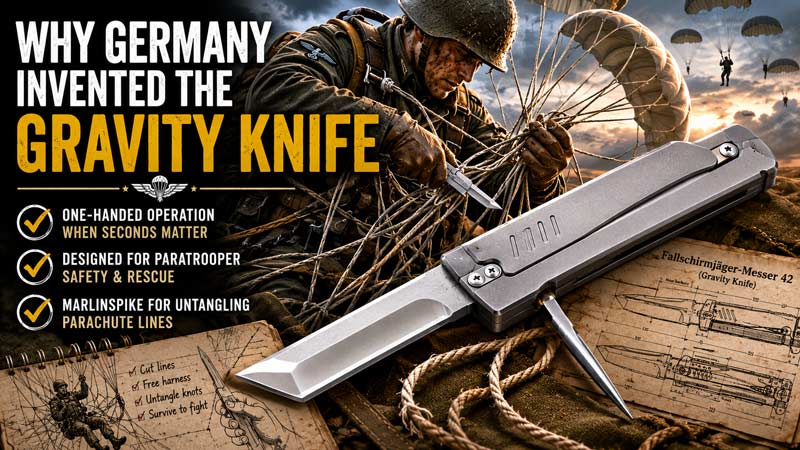
Why Germany Invented the Gravity Knife
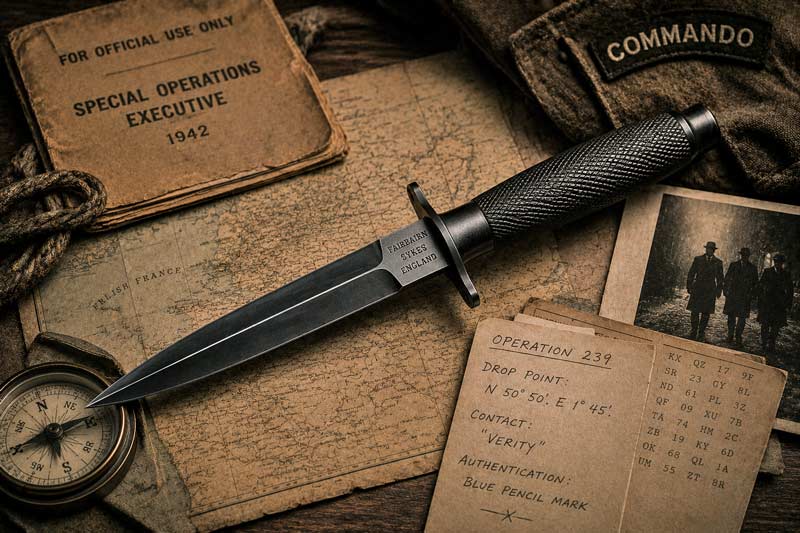
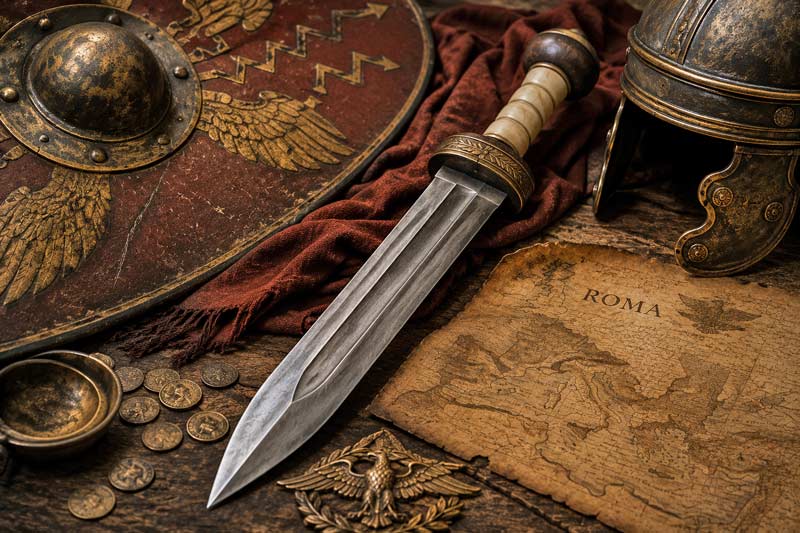
The gravity knife wasn't created for soldiers charging across the battlefield. It was invented to solve a dangerous problem faced by German paratroopers during World War II. After landing, parachute lines could become tangled around a soldier's harness or snag on trees, buildings, or other obstacles. In those situations, every second mattered. A knife that could be opened quickly with one hand could mean the difference between escaping safely and remaining trapped in a vulnerable position.
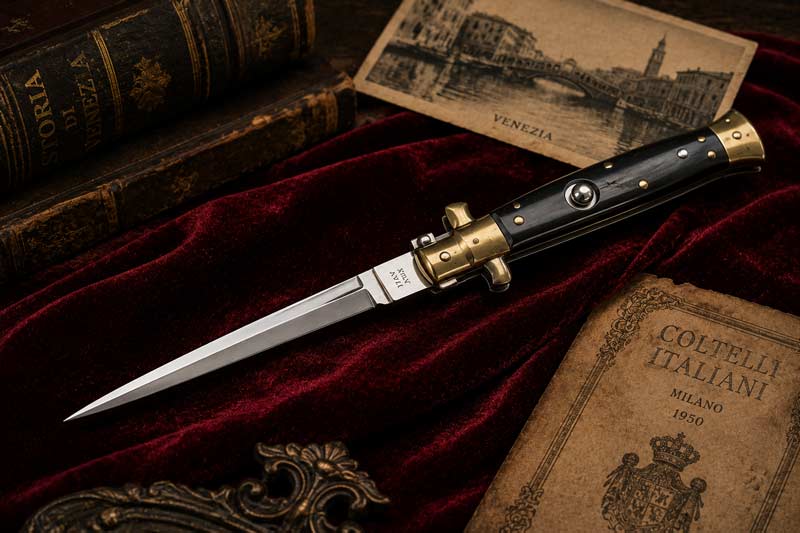
Traditional folding knives were often difficult to open while wearing gloves or when one hand was occupied holding parachute lines. Fixed blade knives solved that problem but were bulkier to carry and could become hazardous during airborne operations. German engineers instead developed a knife whose blade could slide straight out of the front of the handle using gravity after releasing a locking mechanism. The design was simple, dependable, and fast to operate, even under stressful conditions.
Another feature set the original Fallschirmjagermesser apart from almost every other military knife of its era: a folding marlinspike. While it looked unusual, the pointed tool wasn't intended for fighting. It allowed paratroopers to untie stubborn knots in wet parachute cord, separate tangled lines, and perform equipment repairs without damaging the rope. That practical detail perfectly reflected the knife's original purpose as a rescue and utility tool rather than a dedicated combat weapon.
Ironically, one of history's most misunderstood knives began life as a specialized piece of lifesaving equipment. Its military origins are rarely discussed today, overshadowed by decades of myths and confusion. Readers interested in other remarkable stories behind famous blades may also enjoy our article on the world's most famous knives and the stories behind them, where several other iconic designs have equally surprising beginnings.
It Was Never Designed as a Fighting Knife
One of the biggest misconceptions about the gravity knife is that it was created as a close-quarters combat weapon. In reality, the original Fallschirmjagermesser was designed primarily as a rescue and utility tool. Its one-handed operation wasn't intended to give soldiers an advantage in a fight. It allowed paratroopers to free themselves from tangled parachute lines while the other hand steadied their body or held onto nearby equipment.
That practical purpose influenced nearly every aspect of the knife's design. The blade slid out of the front of the handle using gravity rather than a spring, making the mechanism relatively simple and dependable. The integrated marlinspike was equally important, giving soldiers a way to loosen tight knots, separate cords, and repair gear without cutting valuable parachute lines. Everything about the knife reflected function over intimidation.
Ironically, many people today assume the gravity knife belongs in the same category as switchblades or other rapid-deployment weapons. While all of these knives can be opened quickly, they operate very differently. A true gravity knife relies on the force of gravity to deploy its blade, unlike an automatic knife that uses a spring-powered mechanism. If you're curious about how those systems compare, our guide explaining how automatic knives actually work breaks down the engineering behind modern automatic designs.
Understanding the gravity knife's original purpose changes the way its history is viewed. Rather than being invented to fight wars, it was created to help soldiers survive them. That distinction is one of the biggest reasons the knife remains so misunderstood today.
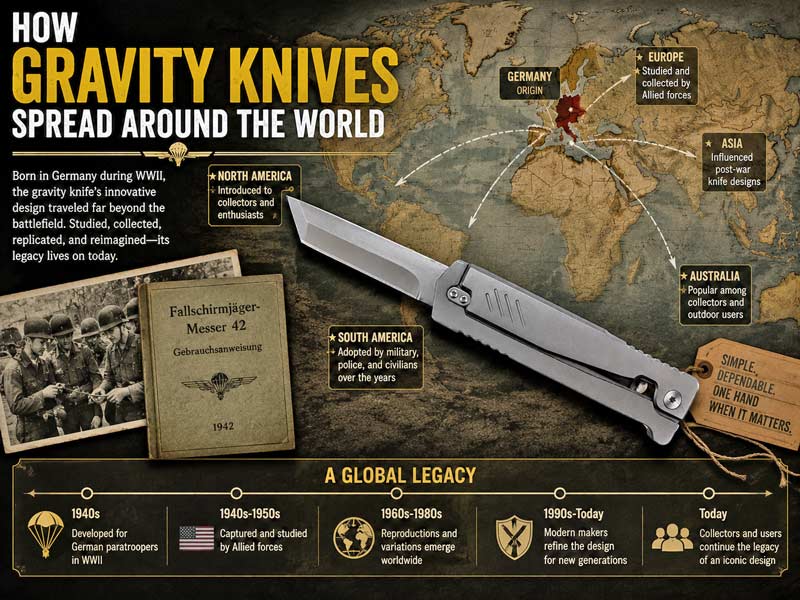
How Gravity Knives Spread Around the World
Although the gravity knife was developed for German paratroopers during World War II, its influence didn't end with the war. Allied forces carefully studied captured military equipment, and the gravity knife quickly earned a reputation as an ingenious solution to a very specific problem. While relatively few countries adopted the design as standard military equipment, it became well known among collectors, survival enthusiasts, and knife makers fascinated by its unusual deployment system.
As the decades passed, manufacturers experimented with their own interpretations of the concept. Some stayed remarkably close to the original Fallschirmjagermesser, while others introduced modern materials, revised locking mechanisms, and updated blade shapes. These newer designs helped introduce the gravity knife to people who had little knowledge of its military origins but appreciated its distinctive engineering and one-handed operation.
Along the way, the gravity knife also became tangled in a web of mistaken identities. Many people assumed any knife with a blade that emerged from the front of the handle must be a gravity knife, even when it actually used a spring-assisted or automatic mechanism. That confusion persists today, despite important mechanical differences between gravity knives and modern out-the-front designs. If you've ever wondered how those front-opening knives differ, our guide explaining what an OTF knife is explores the unique engineering behind true out-the-front automatic knives.
Today, authentic gravity knives remain a fascinating chapter in knife history, while modern interpretations continue to attract collectors who appreciate both their historical significance and their distinctive mechanics. Even a contemporary gravity knife still reflects the same core idea that inspired the original design more than eighty years ago: simple, dependable operation when one hand isn't enough.
How Gravity Knives Became Confused with Switchblades
For years, the gravity knife was viewed as a specialized military tool with a fairly limited audience. That began to change as more one-handed opening knives appeared on the civilian market during the second half of the twentieth century. To the average person, any knife that opened quickly looked similar, even though the mechanisms behind them were often completely different.
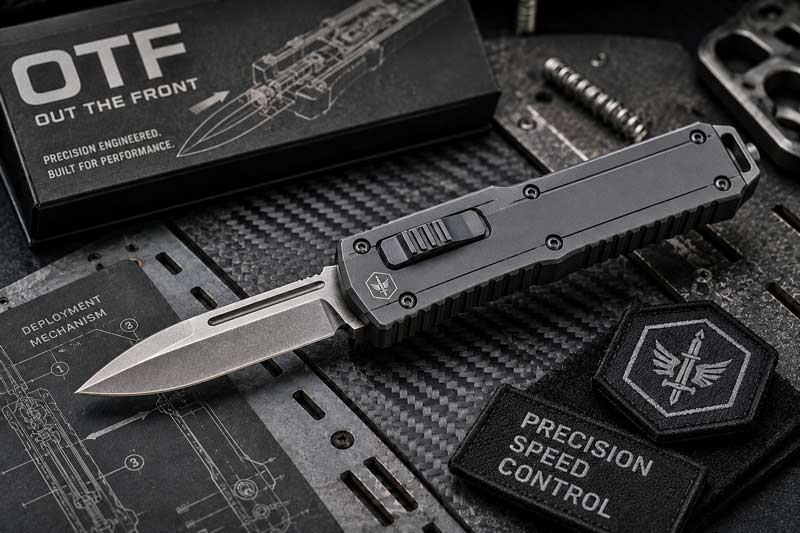
The confusion largely came from appearances rather than engineering. A true gravity knife depends on the weight of its blade to deploy after a locking mechanism is released. A switchblade, on the other hand, uses a spring to propel the blade open at the push of a button or lever. Modern out-the-front knives rely on yet another system, using an internal spring and track to extend and retract the blade. While these knives may seem alike at first glance, their internal mechanics are fundamentally different.
As public awareness faded, those distinctions became increasingly blurred. News reports, television programs, and even legal discussions frequently used the terms interchangeably, reinforcing the misconception that all rapidly opening knives belonged to the same category. Before long, many people had never even heard of the gravity knife's military origins, assuming it was simply another version of a switchblade.
That misunderstanding still exists today. Although gravity knives, automatic knives, and other specialized designs each have their own history and engineering, they continue to be grouped together by people unfamiliar with the differences. If you're interested in how one of those misconceptions developed, our article on how switchblades became the most feared knives in America explores how media attention shaped public opinion for an entirely different type of knife.
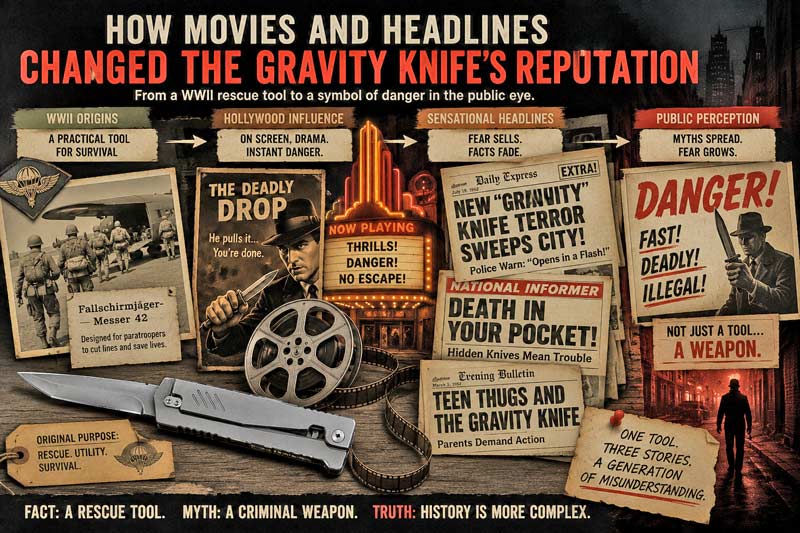
How Movies and Headlines Changed the Gravity Knife's Reputation
For much of its early history, the gravity knife remained a relatively obscure military tool. That changed as movies, television, and sensational news stories began portraying fast-opening knives as symbols of crime and danger. To audiences unfamiliar with knife mechanics, the distinction between a gravity knife, a switchblade, and an automatic knife simply didn't matter. They all became part of the same cultural image.
Hollywood helped reinforce that perception. Villains were frequently shown producing knives with dramatic one-handed openings, while newspapers often used broad terms that lumped multiple knife designs together. Over time, the gravity knife inherited a reputation that had little to do with its original purpose. A rescue tool designed for airborne troops was gradually transformed into something many people associated with criminal activity.
This shift in public perception demonstrates how easily a tool's history can be overshadowed by popular culture. The gravity knife itself had changed very little since World War II, but the story surrounding it had changed dramatically. As generations passed, the myths became far more widely known than the facts.
Today, historians and knife enthusiasts often find themselves correcting misconceptions that have circulated for decades. Understanding the gravity knife means looking beyond its reputation and examining why it was created in the first place. Once that original story is understood, it's much easier to see how one of history's most practical military tools became one of its most misunderstood knives.
Why the Gravity Knife Is Still Misunderstood Today
Despite decades of research and countless articles explaining its history, the gravity knife continues to be one of the most misunderstood knife designs ever created. Much of that confusion comes from the fact that relatively few people have handled an authentic gravity knife, while movies and television have exposed millions of viewers to fictional portrayals of fast-opening blades. As a result, myths have often spread faster than facts.
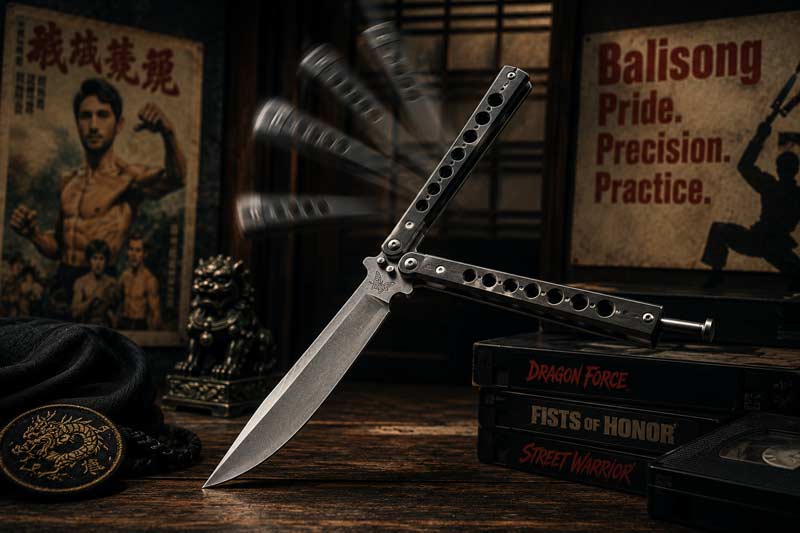
Adding to the confusion is the wide variety of modern knife designs now available. Gravity knives, automatic knives, out-the-front knives, and even some manual-opening designs are frequently grouped together simply because they can all be opened quickly. In reality, each uses a different operating mechanism and was developed to solve different problems. Understanding those differences is one of the easiest ways to appreciate the unique place the gravity knife occupies in knife history. Readers interested in comparing other unconventional designs may also enjoy our article explaining what a balisong is, another knife that has inspired its share of myths over the years.
Modern manufacturers have also helped preserve the gravity knife's legacy by producing updated versions using improved steels, tighter machining, and more refined construction techniques. While these knives retain the distinctive front-deploying design that made the original famous, they benefit from advances in manufacturing that simply weren't available during World War II. The materials may have changed, but the underlying concept remains remarkably faithful to the original.
Perhaps that's the gravity knife's greatest legacy. It reminds us that history is often more complicated than popular culture suggests. What began as a practical rescue tool for paratroopers eventually became the subject of myths, confusion, and debate. Yet beneath all of those stories lies an ingenious piece of engineering whose real history is every bit as fascinating as the legends that grew around it.
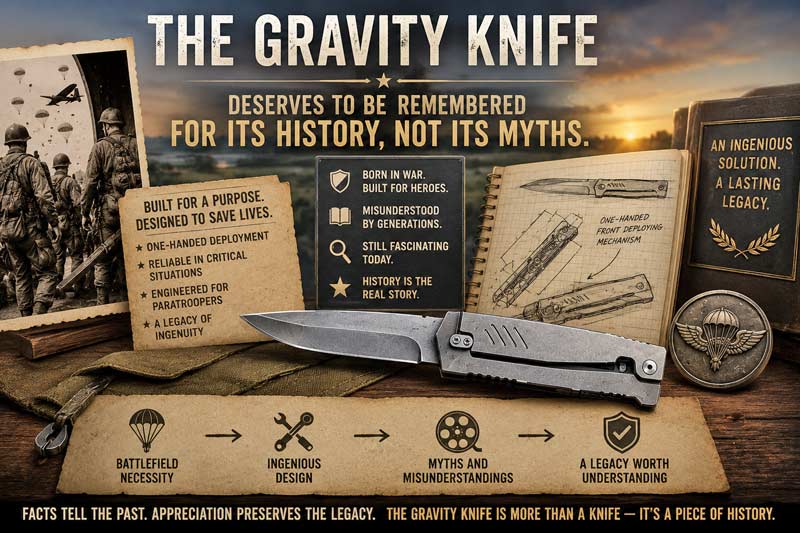
The Gravity Knife Deserves to Be Remembered for Its History, Not Its Myths
Few knives have traveled a stranger path through history than the gravity knife. Designed as a practical solution for German paratroopers, it gradually evolved from a specialized rescue tool into one of the most misunderstood knives ever created. Along the way, its true purpose became overshadowed by Hollywood portrayals, sensational headlines, and decades of mistaken identity.
Yet the gravity knife's real legacy has nothing to do with fear or controversy. It represents a clever engineering solution to a genuine battlefield problem, demonstrating how necessity often drives innovation. Its simple, one-handed deployment system and practical design continue to fascinate historians, collectors, and knife enthusiasts more than eighty years after it first appeared.
Whether you're interested in military history or simply appreciate unusual knife designs, the gravity knife offers a reminder that the stories behind famous blades are often far more interesting than the myths surrounding them. If you'd like to explore more unique designs, browse our collection of knives, where history and modern craftsmanship continue to meet in fascinating ways.
Are Gravity Knives and Switchblades the Same Thing?
No. Although they're often confused with one another, gravity knives and switchblades use completely different opening mechanisms. A true gravity knife relies on gravity to extend the blade after a locking mechanism is released, while a switchblade uses a spring that automatically propels the blade open with the press of a button or lever. Their similar speed of deployment has caused decades of misunderstanding, but mechanically they are very different designs.
The confusion became even greater as modern out-the-front knives entered the market. Because all three designs can deploy a blade from the front or open quickly with one hand, many people assume they're variations of the same knife. In reality, each was developed for different purposes and uses a distinct operating system. Understanding those differences is one of the keys to appreciating the gravity knife's unique place in knife history.
Do Modern Gravity Knives Still Work Like the Original WWII Versions?
Yes, the basic concept remains remarkably similar. Modern gravity knives still deploy the blade by releasing a locking mechanism and allowing gravity to extend it from the front of the handle before locking it into place. While today's versions often feature improved machining, tighter tolerances, and higher-quality materials, the underlying operating principle has changed very little since the original Fallschirmjagermesser was developed for German paratroopers during World War II.
The biggest differences are found in manufacturing rather than function. Modern steels offer better edge retention and corrosion resistance, while precision machining creates smoother operation and more consistent lockup. Even so, the gravity knife remains one of the few knife designs whose original engineering was so effective that it has required surprisingly few changes over the decades, a testament to the ingenuity of its original designers.
Why Did the Gravity Knife Become So Controversial?
The gravity knife became controversial largely because it was repeatedly confused with other fast-opening knives. As public concern over switchblades and similar designs grew during the mid-twentieth century, gravity knives were often grouped into the same conversations despite having a different history and operating mechanism. Over time, the distinctions between these knives became blurred in popular culture, leading many people to believe they were essentially the same thing.
Ironically, the original gravity knife was never designed as a weapon of intimidation or crime. It was created as a practical rescue tool for military paratroopers who needed a dependable one-handed knife in emergency situations. That contrast between its intended purpose and its later public reputation is one of the reasons the gravity knife remains such a fascinating piece of knife history. Understanding where it came from helps separate decades of myth from the remarkably practical engineering that inspired its creation.
]]>2026-06-30T14:34:09+01:00https://www.kombativ.com/blog/the-incredible-story-behind-the-gravity-knife<![CDATA[The Most Famous Knife Fight in American History]]>
https://www.kombativ.com/blog/the-most-famous-knife-fight-in-american-history
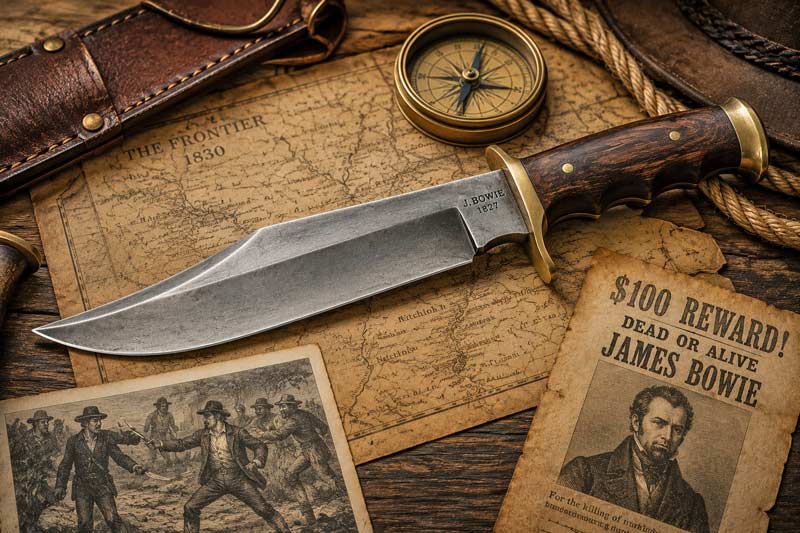
By the time the violence ended, multiple men had been wounded, several were dead, and one survivor had become a national sensation. That survivor was Jim Bowie. The weapon associated with him would soon become one of the most legendary knives in American history.
To understand how the Bowie knife earned its reputation, we have to go back to a time when personal honor carried enormous weight and a disagreement could escalate into a deadly encounter on a lonely stretch of riverbank.
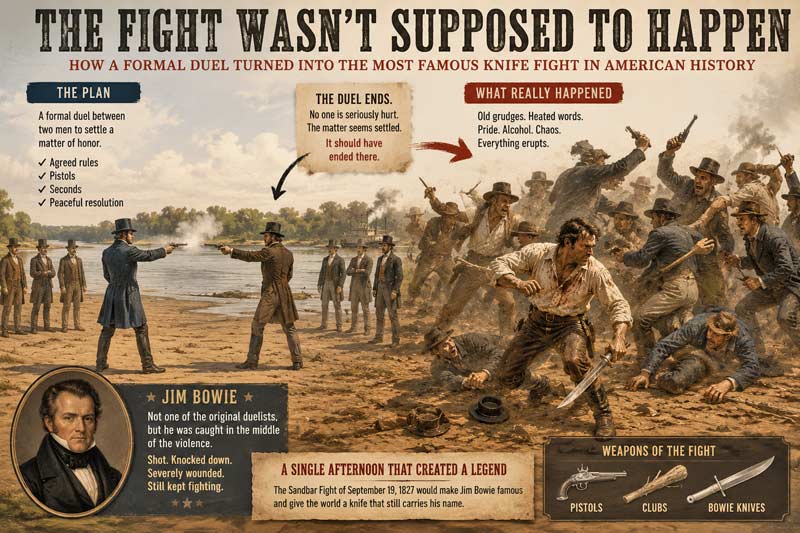
The Fight Wasn't Supposed to Happen
One of the strangest parts of the Sandbar Fight is that the famous knife battle wasn't actually the main event. It began as a formal duel between two other men who had been involved in a long-running dispute. In the early 1800s, dueling was technically illegal in many places, but it remained a common way for gentlemen to settle matters of honor.
On September 19, 1827, the two rivals met on a sandbar in the Mississippi River near Natchez. Their seconds, friends, and supporters accompanied them to witness the duel and ensure the agreed-upon rules were followed. After exchanging gunfire, neither duelist suffered a serious injury, and the dispute appeared to be settled peacefully.
By all accounts, that should have been the end of the story.
Instead, old grudges among the spectators suddenly erupted. Arguments broke out. Insults were exchanged. Within moments, the gathering descended into chaos. Men who had come to watch the duel began drawing pistols, clubs, and knives. What had started as a controlled affair quickly turned into a free-for-all involving multiple combatants.
Jim Bowie was not one of the original duelists, but he soon found himself in the middle of the violence. During the melee, he was shot, knocked down, and severely wounded. Most people in his position would have been finished. Instead, Bowie continued fighting under circumstances that would soon become the stuff of frontier legend.
The violence that followed transformed a relatively obscure land speculator into one of the most talked-about men in America. More importantly, it would introduce the country to a large fighting knife that soon became synonymous with his name. Today, the Bowie knife remains one of the most recognizable examples of a fixed-blade knife, but at the time, few people had ever seen anything quite like it.
What happened next is the reason the Sandbar Fight is still remembered nearly two hundred years later.
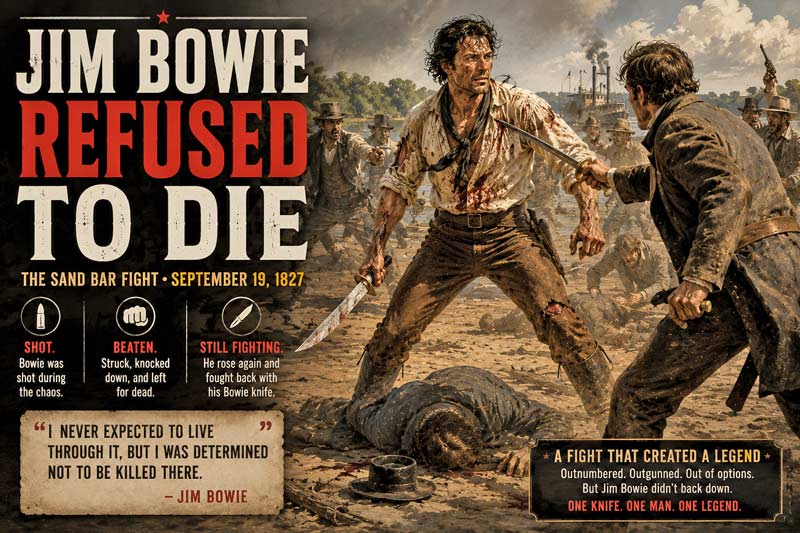
Jim Bowie Refused to Die
If the Sandbar Fight had ended with Jim Bowie lying wounded on the ground, history might have forgotten the entire event. What transformed the fight into legend was what happened after Bowie was already supposed to be out of the fight.
During the chaos, Bowie suffered a series of devastating injuries. He was shot, struck, and reportedly knocked to the ground. Accounts vary depending on the source, but nearly every version agrees on one thing: Bowie absorbed an extraordinary amount of punishment and somehow kept fighting.
At one point, one of his opponents charged him with a sword cane. The blade reportedly struck Bowie with tremendous force, causing a serious wound. Instead of collapsing, Bowie seized the opportunity to counterattack with his large fighting knife. The encounter became the defining moment of the Sandbar Fight and the incident that newspapers across the country would soon sensationalize.
Frontier America loved stories of toughness, courage, and survival against impossible odds. Whether every detail was reported accurately hardly mattered. The public quickly became fascinated with Bowie. His reputation grew with each retelling of the story, and the knife associated with him became almost as famous as the man himself.
Newspapers eagerly published dramatic accounts of the fight, often emphasizing Bowie's ability to continue fighting despite severe injuries. In an era before radio, television, or the internet, these stories spread surprisingly fast. Readers who had never met Bowie suddenly knew his name, and many wanted to know more about the unusual knife he carried.
This was the moment the Bowie knife stopped being just a weapon and started becoming a legend. As discussed in our article on the world's most famous knives and the stories behind them, some blades become famous because of their design. Others become famous because of the stories attached to them. The Bowie knife became famous because it had both.
By the time the dust settled, Jim Bowie had survived, his enemies had not fared nearly as well, and one violent afternoon on a Mississippi sandbar had launched one of the most enduring legends in American knife history.
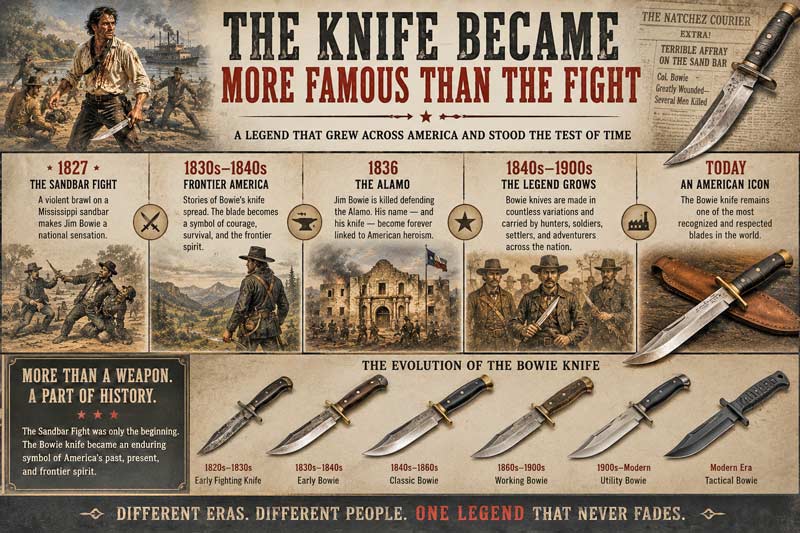
The Knife Became More Famous Than the Fight
The Sandbar Fight was sensational news in 1827, but what happened afterward was even more remarkable. Over time, the fight itself gradually faded from public memory while the knife associated with it became increasingly famous. Today, many people recognize the term "Bowie knife" without knowing anything about the violent riverbank brawl that helped launch its reputation.
Part of the reason was that the knife perfectly matched the image Americans had of the frontier. It was large, rugged, practical, and capable of serving as both a tool and a weapon. In an era defined by expansion, exploration, and self-reliance, the Bowie knife embodied qualities that many people admired.
As stories of Jim Bowie's survival spread, knife makers began producing their own versions of the famous blade. Demand grew rapidly. Before long, countless variations appeared across the country. Some were elegant and highly decorated. Others were simple working tools carried by frontiersmen, soldiers, hunters, and travelers.
The knife's popularity continued long after Jim Bowie himself was gone. His death at the Alamo only added to the legend. Suddenly, the Bowie knife wasn't just connected to the Sandbar Fight. It was connected to one of the most famous battles in American history. The combination of those two stories helped cement its place in popular culture.
Few knives have benefited from such powerful storytelling. As explored in our article on how different cultures shaped the world's most famous knives, legendary blades often become symbols of the people and eras that created them. The Bowie knife may be one of the best examples ever produced in America.
Even today, modern Bowie knives retain many of the characteristics that made the original design famous. The blade profile remains instantly recognizable, serving as a reminder of a story that began nearly two centuries ago on a lonely Mississippi sandbar.
In a strange way, the Sandbar Fight accomplished something that few historical events ever achieve. It transformed an object into an icon. Long after the names of most participants were forgotten, the Bowie knife continued to grow in fame.
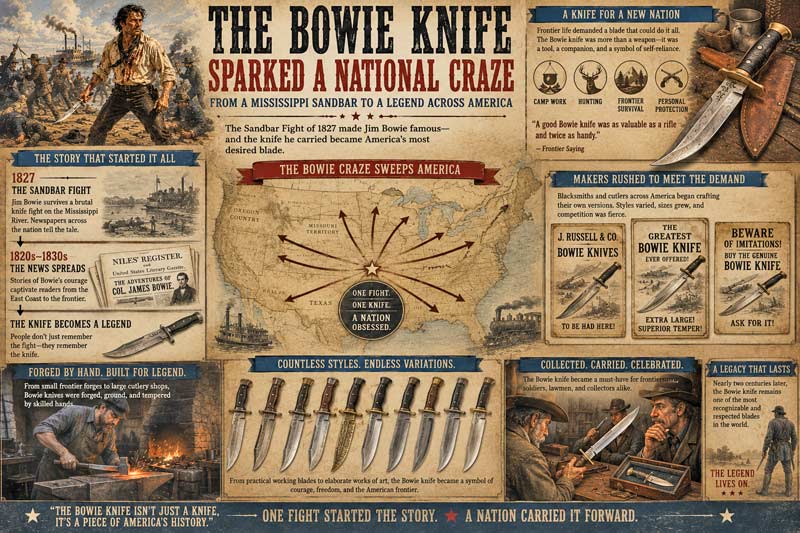
The Bowie Knife Sparked a National Craze
The Sandbar Fight made Jim Bowie famous, but it also triggered something few people could have predicted: a nationwide fascination with large fighting knives. In the years that followed, demand for Bowie knives exploded. Blacksmiths across America began producing their own versions, each claiming to make a blade worthy of the growing legend.
Part of the appeal was practical. Frontier life was unpredictable, and people valued tools that could handle a wide variety of tasks. A large fixed blade could be used for camp chores, hunting, wilderness travel, and personal protection. For many Americans moving westward, versatility mattered more than specialization.
But practicality alone doesn't explain the Bowie knife's popularity. Plenty of useful knives existed during the same period. What set the Bowie apart was the story attached to it. People weren't just buying a knife. They were buying a piece of frontier mythology. Carrying a Bowie knife connected a person to one of the most famous survival stories of the era.
Manufacturers quickly recognized the opportunity. Some Bowie knives grew larger and more elaborate than anything Jim Bowie likely carried himself. Ornate guards, decorative handles, engraved blades, and oversized profiles became common. The knife had evolved from a fighting tool into a cultural phenomenon.
This pattern appears repeatedly throughout knife history. A blade gains attention through a famous event, a legendary owner, or a dramatic story. Eventually, the story becomes part of the product itself. As we explored in 12 fixed-blade knives you should know about, many iconic designs achieved lasting success because they represented something larger than their physical characteristics alone.
By the mid-1800s, the Bowie knife had become one of the most recognizable blade styles in America. It appeared in newspapers, advertisements, military camps, frontier settlements, and countless personal collections. The fight that made it famous had lasted only minutes, but the craze it inspired would last generations.
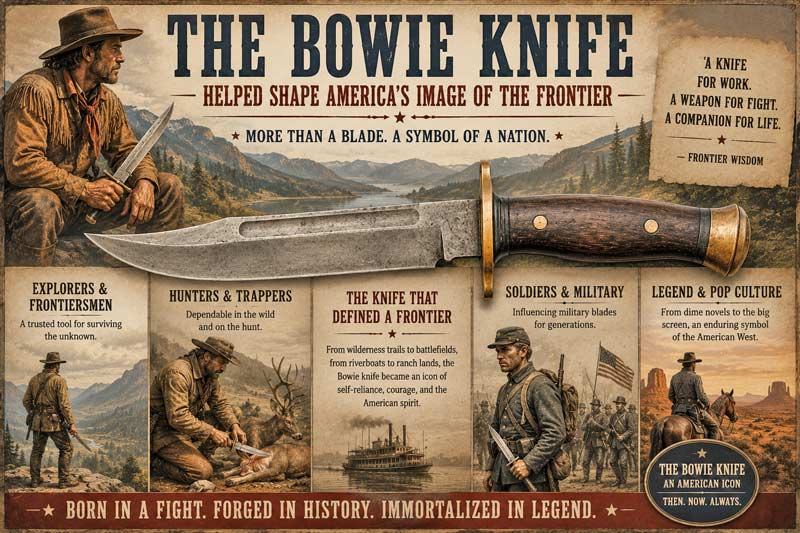
The Bowie Knife Helped Shape America's Image of the Frontier
By the mid-1800s, the Bowie knife had become more than a popular blade. It had become a symbol of the American frontier itself. Stories of explorers, hunters, soldiers, riverboat gamblers, and adventurers often featured Bowie knives as essential equipment. Whether those stories were completely true was almost beside the point. The knife had become part of the mythology of the era.
The timing was perfect. America was expanding westward, and the public was fascinated by tales of rugged individuals surviving in harsh and unpredictable environments. The Bowie knife fit neatly into that narrative. It represented self-reliance, toughness, and the ability to handle whatever challenges the frontier might present.
Books, newspapers, and later films helped reinforce the image. The Bowie knife frequently appeared alongside other symbols of the American West, becoming just as recognizable as the cowboy hat or six-shooter. Even people who had never seen one in person knew exactly what a Bowie knife was supposed to represent.
Military use also contributed to the knife's reputation. Large fighting knives influenced numerous military blade designs over the years, and the Bowie knife's impact can still be seen in some of the most respected combat and utility knives ever produced. As discussed in our article on the most popular military knives of all time, many later military blades borrowed concepts that helped make the Bowie knife successful.
What makes the Bowie knife unique is that it managed to bridge multiple worlds at once. It was a working tool, a fighting knife, a collector's item, and a cultural symbol. Few knife designs have achieved that level of versatility or lasting influence.
Even today, when people picture a classic American knife, the image that often comes to mind resembles a Bowie. That's an extraordinary legacy for a blade whose fame can be traced back to a single chaotic fight on a Mississippi River sandbar nearly two hundred years ago.
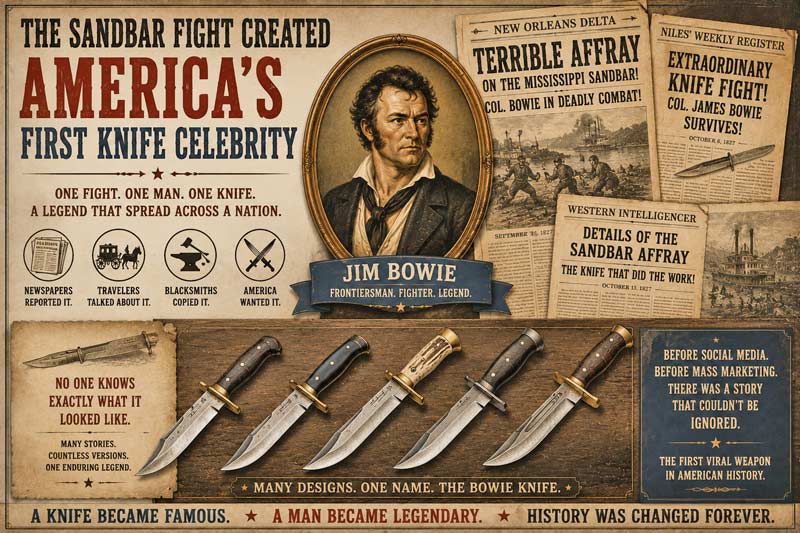
The Sandbar Fight Created America's First Knife Celebrity
Today, we're used to famous weapons. Movies, video games, and social media have made certain firearms, swords, and knives instantly recognizable around the world. In 1827, however, that concept barely existed. The Sandbar Fight helped change that by turning the Bowie knife into something remarkably modern: a weapon with a national reputation.
Before the fight, the knife was simply one of many large blades carried on the frontier. After the fight, people wanted to know what kind of knife Jim Bowie had used. Newspapers discussed it. Travelers talked about it. Blacksmiths copied it. The blade itself became a subject of fascination.
In many ways, Bowie became America's first knife influencer, although he probably would have laughed at the term. His reputation and the reputation of his knife became inseparable. Every retelling of the Sandbar Fight strengthened both legends at the same time.
What's especially fascinating is that nobody can say with complete certainty exactly what Bowie's famous knife looked like. Numerous versions of the story emerged over the years, and knife makers produced countless interpretations. Some featured clip points. Others had different blade shapes and dimensions. The legend grew faster than the historical record could keep up with it.
That uncertainty may have actually helped the Bowie knife spread. Instead of one exact design, it became an idea. Knife makers across America could create their own versions while still claiming a connection to the famous frontier blade. The result was an entire category of knives that shared common traits while varying dramatically in appearance.
Few blades have ever achieved that level of cultural recognition. As explored in our article on Bowie knife vs. hunting knife, the Bowie remains instantly recognizable even today despite the enormous variety of designs that fall under the name.
Long before celebrity endorsements, viral marketing, or mass media advertising, one violent encounter on a Mississippi sandbar turned a knife into a household name. That's a level of fame most weapons never achieve.
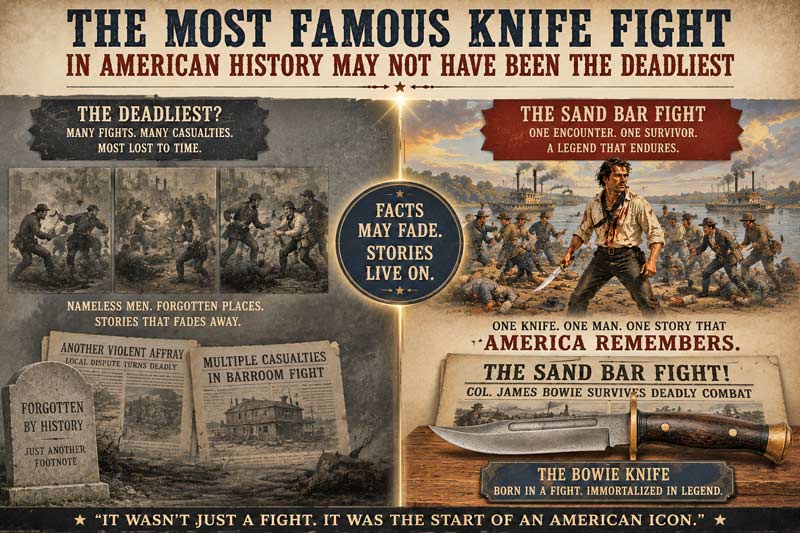
The Most Famous Knife Fight in American History May Not Have Been the Deadliest
One reason the Sandbar Fight remains so fascinating is that it wasn't necessarily the largest, bloodiest, or deadliest knife fight ever recorded. History contains plenty of violent encounters that resulted in more casualties. Yet very few are remembered today.
The difference is that the Sandbar Fight produced a story people couldn't stop telling. It had all the elements of a great legend: a formal duel, a chaotic brawl, a seemingly unstoppable survivor, a unique weapon, and a larger-than-life central character. The fight was dramatic enough to capture attention and memorable enough to survive long after the participants were gone.
Many historical events fade because they lack a compelling narrative. The Sandbar Fight had the opposite problem. Every retelling made it bigger. Newspapers emphasized different details. Witnesses offered conflicting accounts. Storytellers added their own flourishes. Over time, the line between history and legend became increasingly blurred.
That process helped elevate the Bowie knife into the same category as some of the world's most famous blades. As explored in our article on how different cultures shaped the world's most famous knives, many legendary weapons owe their fame not just to performance, but to the stories that surround them.
The Sandbar Fight also demonstrates something important about how people remember history. Facts matter, but stories travel farther. Most Americans couldn't name the duelists who started the conflict. Few could identify every participant. Yet millions recognize the name Bowie knife because the story attached to it proved impossible to forget.
In a way, that's what makes the Sandbar Fight so unique. It wasn't simply a knife fight. It became the origin story of an American icon. The fight created a legend, and that legend proved far more durable than the violence that inspired it.
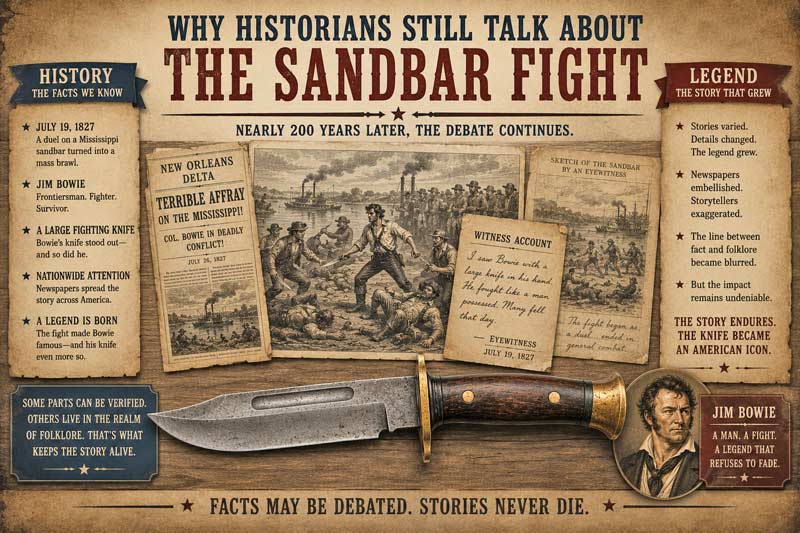
Why Historians Still Talk About the Sandbar Fight
Most frontier brawls disappeared into history. Records were lost, witnesses moved on, and the details faded with time. The Sandbar Fight is different. Nearly two centuries later, historians are still debating exactly what happened on that Mississippi River sandbar and separating documented facts from the legends that followed.
Part of the challenge is that many accounts were written after the event, and witnesses often disagreed with one another. Some reports emphasized certain moments while downplaying others. Newspaper stories occasionally contradicted firsthand testimony. As the tale spread across the country, it evolved with each retelling.
Yet despite those uncertainties, historians generally agree on the broader significance of the fight. The event dramatically increased Jim Bowie's fame, introduced a wider audience to the large fighting knife associated with him, and helped create one of the most enduring legends in American weapons history.
What's particularly fascinating is that the Sandbar Fight sits at the intersection of history and folklore. Some parts can be verified through documents and eyewitness accounts. Other details have been repeated so many times that it is difficult to determine where the historical record ends and the storytelling begins. That tension is part of what keeps people interested in the event today.
The same phenomenon can be seen throughout the history of famous weapons. Legendary blades often become surrounded by stories that grow larger than the original events themselves. As explored in our article on the world's most famous knives and the stories behind them, some knives achieve immortality not because of what they did, but because of the stories people continue telling about them.
In that sense, the Sandbar Fight accomplished something remarkably rare. It survived. Not just as a historical event, but as a story. Long after the riverboat spectators, duelists, and witnesses were gone, the tale continued to spread. And every time someone asks why the Bowie knife became famous, the story begins all over again.
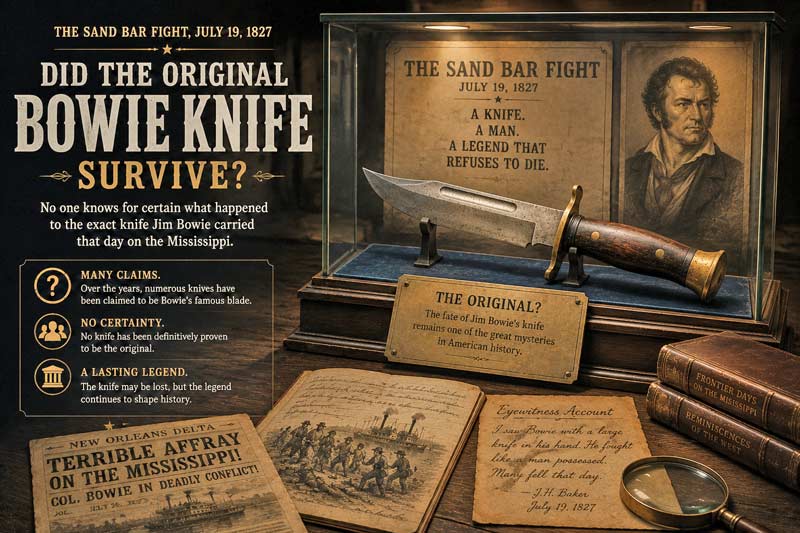
Did the Original Bowie Knife Survive?
One of the biggest mysteries surrounding the Sandbar Fight is surprisingly simple: nobody knows for certain what happened to the exact knife Jim Bowie carried that day.
Unlike many famous historical artifacts, the original Sandbar Fight knife was never definitively preserved, authenticated, and displayed for future generations. Over the years, numerous knives have been claimed to be Bowie's famous blade, but historians continue to debate which, if any, can be directly connected to the fight itself.
Part of the problem is that Bowie became famous so quickly. As his reputation grew, countless stories emerged about the knife's design, dimensions, and appearance. Different witnesses described different features. Knife makers began producing their own versions. Before long, separating fact from folklore became nearly impossible.
This uncertainty has created one of the most fascinating mysteries in American weapons history. The Bowie knife became one of the most famous blades ever made, yet the exact knife that launched the legend may be lost forever. In a strange way, that mystery only adds to its appeal.
Today, collectors and historians continue searching for clues. Museums display knives believed to have connections to Bowie, while researchers compare documents, family histories, and period descriptions in an effort to identify the most likely candidates. The debate remains active nearly two centuries after the fight itself.
Ironically, the disappearance of the original knife may have helped strengthen the legend. If the knife had survived, it would simply be an artifact behind glass. Instead, it became something larger: a symbol. Modern knives can still trace part of their heritage to the design that emerged from the Bowie legend, even if the original blade itself remains a mystery.
The Sandbar Fight created a famous knife. The disappearance of that knife helped create an enduring myth.
Did Jim Bowie Actually Invent the Bowie Knife?
Not exactly. Historians generally believe that Jim Bowie helped make the knife famous, but there is still debate about who designed the original version. Many accounts credit his brother, Rezin Bowie, with creating or commissioning the blade. What is certain is that Jim Bowie's actions during the Sandbar Fight transformed the knife from a regional design into a national sensation.
How Big Was Jim Bowie's Famous Knife?
No one knows for certain because the exact knife used during the Sandbar Fight has never been definitively identified. However, contemporary descriptions suggest it was substantially larger than the typical pocketknives of the era. The blade was large enough to attract attention and unusual enough that newspaper accounts frequently mentioned it when describing the fight.
Was the Sandbar Fight Really the Most Famous Knife Fight in American History?
Most historians would argue yes. While other knife fights may have been larger or deadlier, none had the same long-term cultural impact. The Sandbar Fight launched the legend of Jim Bowie, helped popularize the Bowie knife across America, and continues to be discussed nearly two hundred years later. Few other knife fights can claim to have influenced American culture to the same degree.
]]>2026-06-22T14:26:24+01:00https://www.kombativ.com/blog/the-most-famous-knife-fight-in-american-history<![CDATA[How Switchblades Became the Most Feared Knives in America]]>
https://www.kombativ.com/blog/how-switchblades-became-the-most-feared-knives-in-america
So how did a simple automatic knife become one of the most feared blades in the country? The answer involves a fascinating mix of crime panics, Hollywood influence, sensational headlines, political pressure, and a public eager for something to blame. To understand why switchblades earned such a notorious reputation, we have to go back to the beginning of a fear that still lingers today.
The Switchblade Was Never Originally a Criminal's Weapon
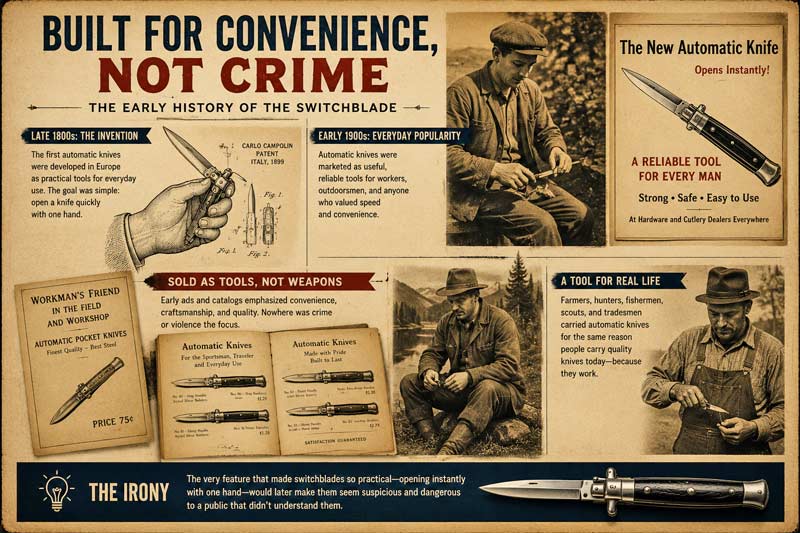
One of the biggest misconceptions about switchblades is that they were invented for violence. In reality, automatic knives began as practical tools designed to solve a simple problem: opening a knife with one hand. Long before they became associated with crime, switchblades were valued for convenience.
Early automatic knives appeared in Europe during the late 1800s and quickly gained popularity among workers, outdoorsmen, and anyone who needed fast access to a cutting tool. The mechanism itself was the innovation. With the press of a button, the blade could deploy instantly without requiring two hands. Today, that same concept remains popular in many modern automatic knives, although the designs and materials have evolved considerably over the years.
By the early twentieth century, switchblades were being imported into the United States and sold alongside countless other pocketknives. They were often marketed as useful tools rather than weapons. Advertisements emphasized convenience, craftsmanship, and ease of use, not criminal activity.
The irony is that the very feature that made switchblades practical also made them seem suspicious to some observers. A knife that opened instantly looked more dangerous than a knife that required manual effort, even if both blades were equally capable once open. That perception would eventually play a major role in shaping public opinion.
As explored in our article on the evolution of automatic knives, the switchblade's transformation from everyday tool to cultural villain did not happen overnight. It was the result of decades of changing attitudes, media coverage, and growing public anxiety.
The Media Turned Switchblades Into a National Threat
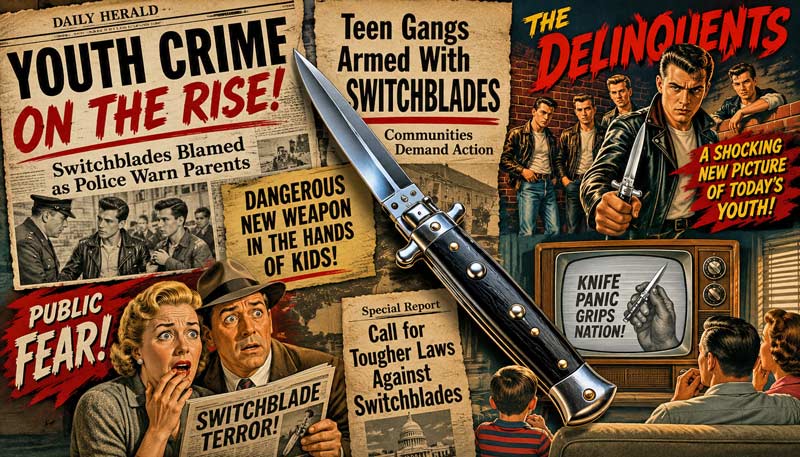
If switchblades had remained simple pocketknives, most Americans probably would have never given them a second thought. The turning point came when newspapers, magazines, and politicians began linking the knives to a growing fear that was spreading across the country: juvenile delinquency.
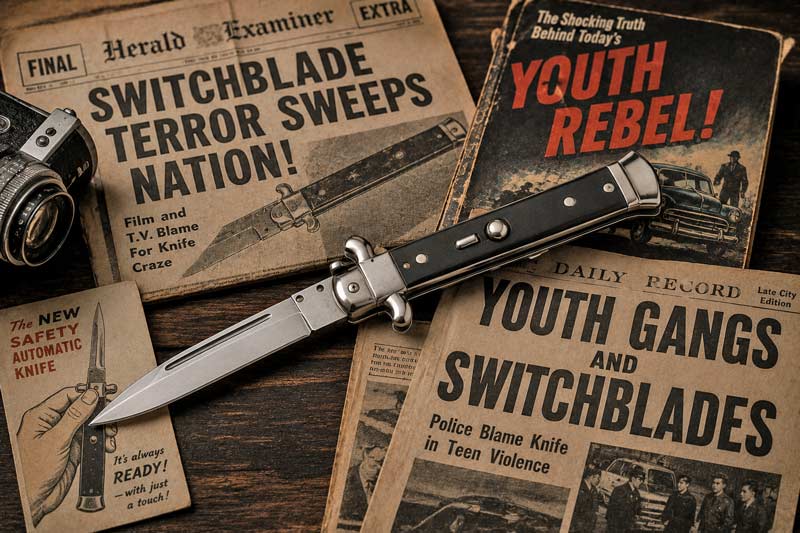
During the 1940s and 1950s, America became increasingly concerned about rising youth crime. Stories about teenage gangs attracted enormous attention, and reporters were eager for symbols that could represent the perceived threat. The switchblade proved to be a perfect villain. It was easy to conceal, dramatic to deploy, and unfamiliar enough to seem dangerous to the average reader.
Newspaper headlines often portrayed switchblades as the weapon of choice for violent gangs, even though there was little evidence that they were significantly more dangerous than other knives. Fear sells newspapers, and the switchblade became an ideal subject for sensational reporting. The knife itself was transformed from a tool into a cultural symbol.
Hollywood quickly amplified the trend. Films frequently placed switchblades in the hands of gang members and troublemakers, reinforcing the idea that carrying one was inherently suspicious. Many of the myths created during that era survived for decades, much like the misconceptions explored in our article on weapon myths Hollywood got completely wrong.
What made this fear especially powerful was that it fed on itself. The more newspapers covered switchblades, the more movies featured them. The more movies featured them, the more the public associated them with crime. Before long, many Americans viewed the switchblade not as a knife, but as a warning sign of social disorder.
The irony is that the knife's reputation was growing much faster than its actual role in crime. Yet perception often matters more than reality, especially when fear enters the equation.
Hollywood Made the Switchblade a Cultural Villain
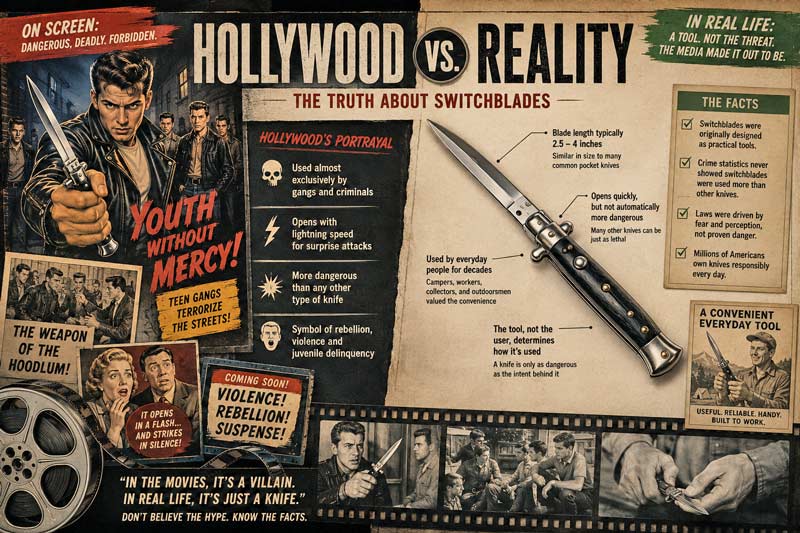
If newspapers laid the foundation for America's fear of switchblades, Hollywood poured gasoline on the fire. By the 1950s, filmmakers had discovered that the switchblade was the perfect visual shortcut for danger. A character didn't need to say he was a criminal. He simply had to pull out a switchblade, and audiences instantly understood the message.
This was partly because switchblades looked dramatic on screen. A revolver could remain hidden in a pocket. A kitchen knife looked ordinary. But a switchblade created a moment. The blade snapped open with speed and sound, making it ideal for movies that wanted to create tension. Directors quickly realized that the knife could become a character in its own right.
Films featuring teenage gangs and street crime often portrayed switchblades as the weapon of choice for rebellious youth. As these movies reached millions of viewers, they reinforced the idea that automatic knives were uniquely dangerous. The public wasn't just reading about switchblades anymore. They were watching them appear in dramatic confrontations on movie screens across the country.
The fascinating part is that many of these portrayals had little connection to reality. Hollywood has a long history of exaggerating weapons for dramatic effect, something we explored in our article about weapon myths Hollywood got completely wrong. The switchblade became another victim of that process. It wasn't necessarily more dangerous than countless other knives, but it was certainly more cinematic.
As the years passed, the image became deeply ingrained in American culture. Even people who had never handled a switchblade often associated it with gangs, crime, and violence. The knife's reputation had effectively become self-sustaining. Once a cultural symbol takes hold, facts often struggle to catch up.
By the time lawmakers began discussing restrictions on switchblades, many Americans already viewed them as a public threat. Hollywood didn't create the fear by itself, but it helped transform a practical tool into one of the most recognizable symbols of danger in modern American history.
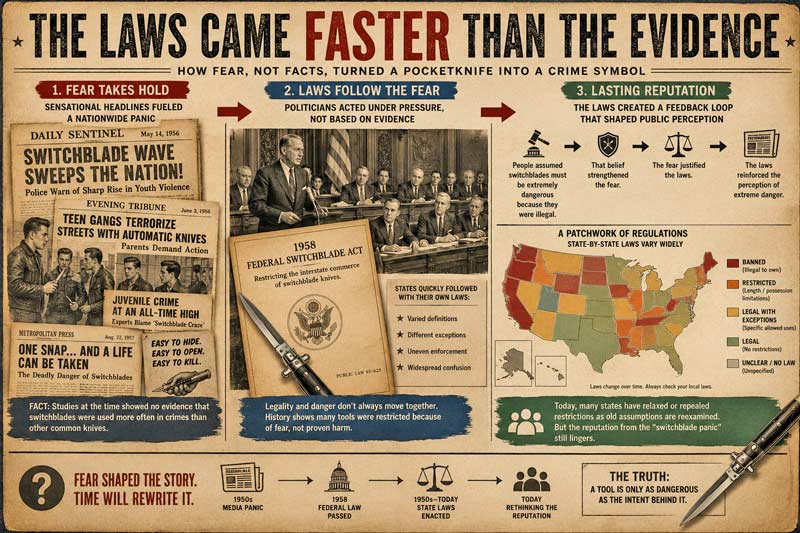
The Laws Came Faster Than the Evidence
As fear surrounding switchblades grew, politicians faced increasing pressure to take action. By the 1950s, many lawmakers were convinced that automatic knives were contributing to a growing crime problem, particularly among young people. The problem was that public concern was advancing much faster than the available evidence.
Throughout American history, periods of social anxiety have often led to restrictions on objects that become symbols of a broader fear. Sometimes those fears focus on books, music, or new technology. In this case, the switchblade found itself at the center of a national conversation about crime, juvenile delinquency, and changing cultural values.
In 1958, Congress passed the Federal Switchblade Act, restricting the interstate commerce of switchblades. Many states followed with their own laws, creating a patchwork of regulations that varied widely across the country. Almost overnight, the switchblade's reputation as a dangerous weapon became reinforced by the fact that it was now heavily regulated.
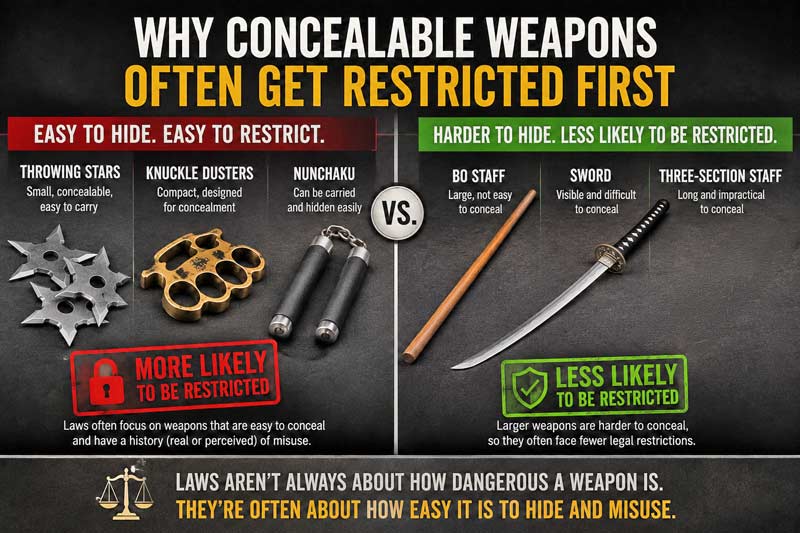
What's interesting is that legality and danger do not always move in lockstep. History is filled with examples of tools and weapons that became restricted not necessarily because they were more dangerous than alternatives, but because they became associated with public fears. We explored a similar pattern in our article on why some martial arts weapons are illegal in certain places.
The restrictions created a feedback loop. People assumed switchblades must be exceptionally dangerous because they were illegal. That belief strengthened the fear. The fear justified the laws. And the existence of the laws reinforced the perception that the knives were uniquely threatening.
Decades later, many of those assumptions are being reexamined. Numerous states have relaxed or repealed restrictions on automatic knives, reflecting a growing recognition that the old fears may have been influenced as much by perception as by reality. Yet the reputation established during the switchblade panic continues to linger long after the original headlines faded away.
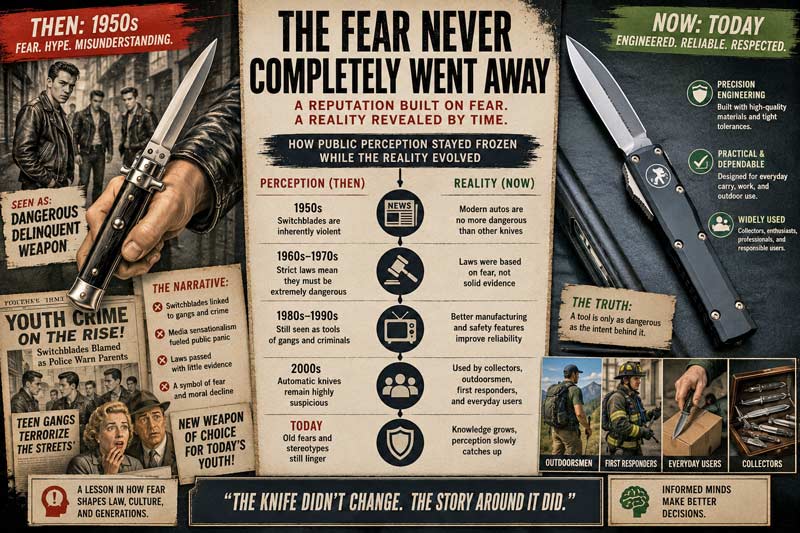
The Fear Never Completely Went Away
More than half a century after the height of the switchblade panic, many people still react to automatic knives differently than they react to other knives. Someone can see a traditional folding knife and think "tool." They see a switchblade and think "weapon." That distinction is one of the most lasting effects of the fear campaign that began decades ago.
Part of the reason is that cultural reputations are remarkably difficult to change. Most Americans have never read the Federal Switchblade Act. They have never researched crime statistics involving automatic knives. Yet many have absorbed decades of movies, television shows, news stories, and secondhand assumptions that painted switchblades as uniquely dangerous.
Ironically, modern automatic knives are often better engineered and more reliable than the switchblades that originally sparked the controversy. Manufacturing improvements have transformed them into precision tools used by collectors, outdoorsmen, first responders, and everyday knife enthusiasts. As we discussed in our article on how automatic knives actually work, the mechanism itself is far less mysterious than many people imagine.
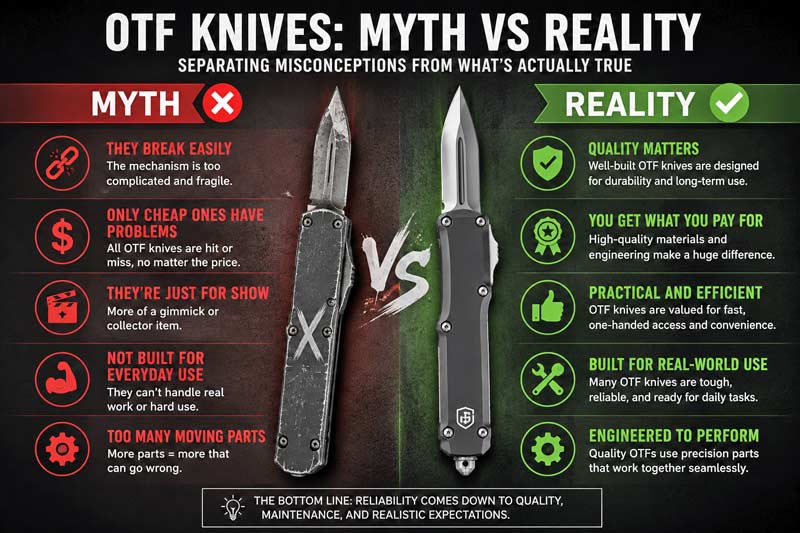
The rise of OTF knives has also helped introduce a new generation of people to automatic knife technology. Yet even today, discussions about automatic knives often focus on perception rather than function. Questions about reliability, legality, and safety continue to surface because the old reputation remains surprisingly influential. We explored some of those misconceptions in our article on whether OTF knives are actually reliable or just cool.
What's fascinating is that the switchblade's story has become bigger than the knife itself. It is now a case study in how public fears are created, amplified, and sustained. The knife became a symbol, and symbols often outlive the events that created them.
Today, many people who own automatic knives view them as practical tools, collectible pieces of engineering, or simply interesting examples of knife design. Yet the fact that the switchblade still carries such a powerful reputation proves just how successful the fear campaign of the twentieth century really was.
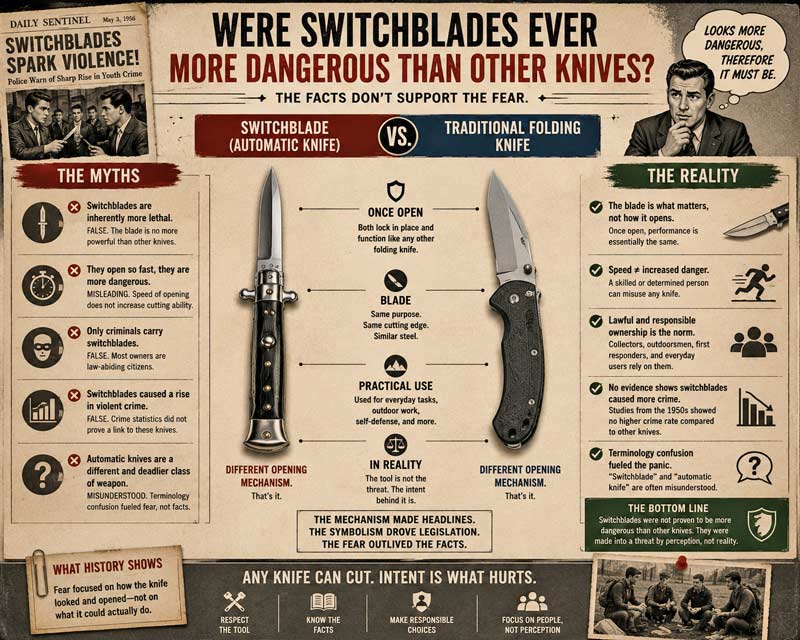
Were Switchblades Ever More Dangerous Than Other Knives?
At the heart of the switchblade controversy is a question that surprisingly few people stop to ask: were switchblades ever actually more dangerous than other knives? The answer depends on what you mean by dangerous, but from a purely practical standpoint, the blade itself was rarely the issue.
A switchblade's defining feature is how quickly it opens. Once the blade is locked in place, however, it functions much like countless other folding knives. The cutting edge is not inherently more powerful. The steel is not inherently more lethal. What made the switchblade different was the mechanism, not the blade.
That distinction often got lost during the height of the switchblade panic. Many people assumed that because the knife opened automatically, it must also be significantly more dangerous than a conventional pocketknife. In reality, a determined person could misuse almost any knife. The switchblade simply looked more dramatic while doing it.
This misunderstanding still creates confusion today. Many people use the terms "switchblade" and "automatic knife" interchangeably, while others assume they refer to entirely different categories of knives. As we explained in our article on switchblade vs. automatic knife, the terminology can be surprisingly confusing even among knife enthusiasts.
What the historical record suggests is that fear often focused on the speed of deployment rather than actual differences in capability. A knife that appears more threatening can generate stronger emotional reactions, even if its practical advantages are relatively modest. The public wasn't just reacting to a tool. They were reacting to what the tool represented.
That doesn't mean switchblades are harmless, just as it doesn't mean any knife is harmless. It means that much of their reputation was built around perception. The mechanism made headlines. The symbolism drove legislation. And the fear became attached to the knife long after people stopped asking whether the facts supported it.
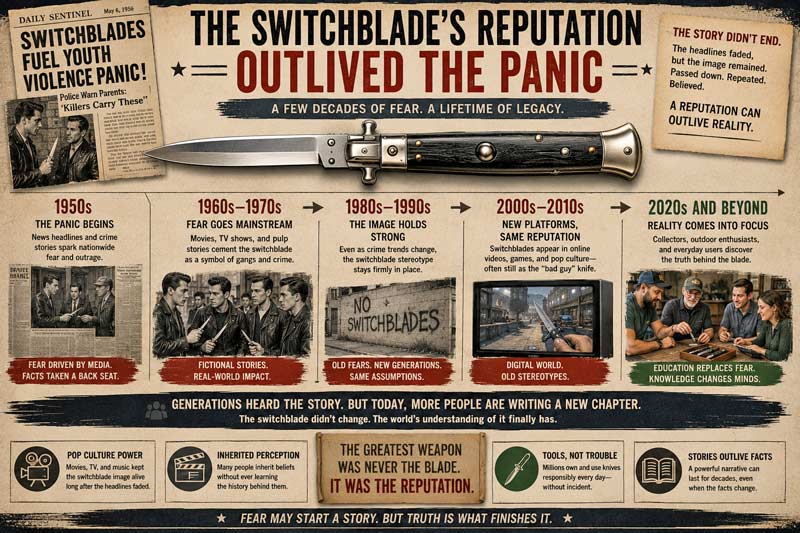
The Switchblade's Reputation Outlived the Panic
Most moral panics eventually fade. The headlines disappear, the public moves on, and the object at the center of the controversy is largely forgotten. The switchblade followed a different path. While the panic itself peaked decades ago, the reputation it created proved remarkably durable.
Many Americans today still associate switchblades with gangs, crime, and delinquency, even if they couldn't explain exactly why. The image has been passed down through generations of movies, television shows, news stories, and cultural references. In many ways, people inherited the fear without inheriting the history behind it.
What's particularly interesting is that younger generations often encounter switchblades through entirely different channels. Instead of newspaper headlines and crime dramas, they may first see them in online videos, collecting communities, or discussions about knife mechanisms. As a result, many people are discovering that the reality is far more mundane than the reputation suggests.
The same pattern has occurred with other knives throughout history. Certain designs become famous not because they were uniquely dangerous, but because they captured the public imagination. As discussed in our article on the world's most famous knives and the stories behind them, the stories surrounding a knife often become more influential than the knife itself.
Today, millions of people own and use knives responsibly without attracting any attention whatsoever. Yet mention the word "switchblade" and many people immediately picture gang fights, back alleys, and crime movies from the 1950s. That reaction is a testament to how powerful a cultural narrative can become once it takes root.
In the end, the switchblade's greatest weapon was never its blade. It was its reputation. Long after the original fears lost their momentum, the story continued to spread. And for a knife that began life as a practical tool, that may be the most fascinating twist of all.
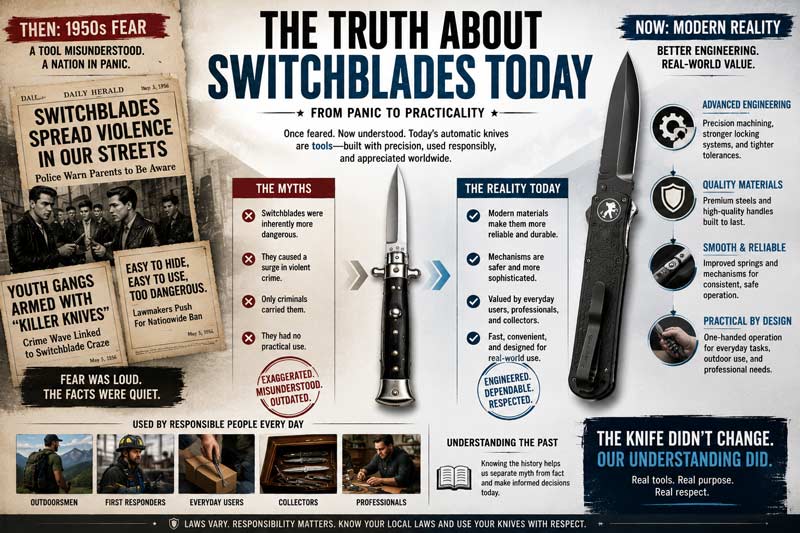
The Truth About Switchblades Today
If someone were introduced to switchblades for the first time today without any knowledge of their history, they would probably be surprised to learn how controversial these knives once were. Modern automatic knives are no longer viewed solely through the lens of 1950s crime panics. Instead, they are increasingly appreciated for what they actually are: tools with a unique and convenient opening mechanism.
Advances in manufacturing have dramatically improved reliability, safety, and durability. Modern automatic knives are built with better steels, tighter tolerances, stronger locking systems, and more sophisticated designs than the switchblades that fueled headlines decades ago. Many users choose them simply because they are fast, convenient, and easy to operate with one hand.
The technology itself is no longer mysterious. In fact, many people are surprised to discover that the mechanism is far simpler than the myths surrounding it. If you're curious about what actually happens inside the handle, our article on how automatic knives work breaks down the mechanics in detail.
Perhaps the biggest change is that today's knife enthusiasts tend to judge automatic knives based on performance rather than reputation. Collectors appreciate the engineering. Outdoorsmen appreciate the convenience. Everyday users appreciate the speed and ease of deployment. The conversation has gradually shifted away from fear and toward functionality.
That doesn't mean the switchblade's history should be forgotten. Quite the opposite. The story remains one of the most fascinating examples of how a tool can become a cultural symbol. Understanding that history helps explain why automatic knives still generate strong reactions today, even among people who have never handled one.
For all the headlines, laws, movies, and myths, the switchblade ultimately survived because people continued to find value in it. The panic faded. The reputation evolved. But the knife itself remained. Today, modern knives come in countless designs and configurations, yet the switchblade remains one of the most recognizable examples of how perception and reality can take very different paths.
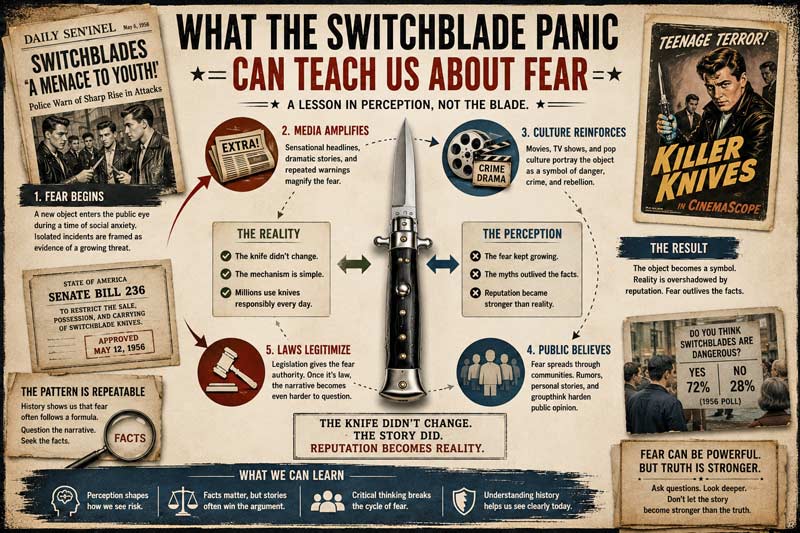
What the Switchblade Panic Can Teach Us About Fear
The story of the switchblade is ultimately about much more than a knife. It is a reminder of how easily public perception can shape reality. Once enough people believe an object is dangerous, the fear itself can become more influential than the facts.
Throughout history, societies have repeatedly singled out certain objects as symbols of larger concerns. Sometimes those concerns involve crime. Sometimes they involve changing cultural values, new technology, or younger generations behaving differently than expected. The switchblade happened to arrive at the perfect moment to become a symbol of all those anxieties at once.
What makes the story so fascinating is that the knife never changed. The blade didn't become more dangerous. The mechanism didn't suddenly evolve into something more threatening. What changed was the narrative surrounding it. Newspapers amplified the fear. Hollywood reinforced it. Laws legitimized it. Eventually, the reputation became stronger than the reality.
That pattern helps explain why people often react emotionally to certain weapons and tools. In our article on the weapons people fear most, we explored how public fears are often influenced as much by symbolism as by practical danger. The switchblade may be one of the clearest examples of that phenomenon in modern American history.
Today, the knife serves as a fascinating case study in how myths are created, how reputations spread, and how difficult they can be to reverse. Long after the original panic faded, the story continued to shape public opinion. In many ways, the switchblade became famous not because of what it was, but because of what people believed it represented.
And that may be the most surprising part of all. One of America's most feared knives earned its reputation less through its blade than through the stories told about it.
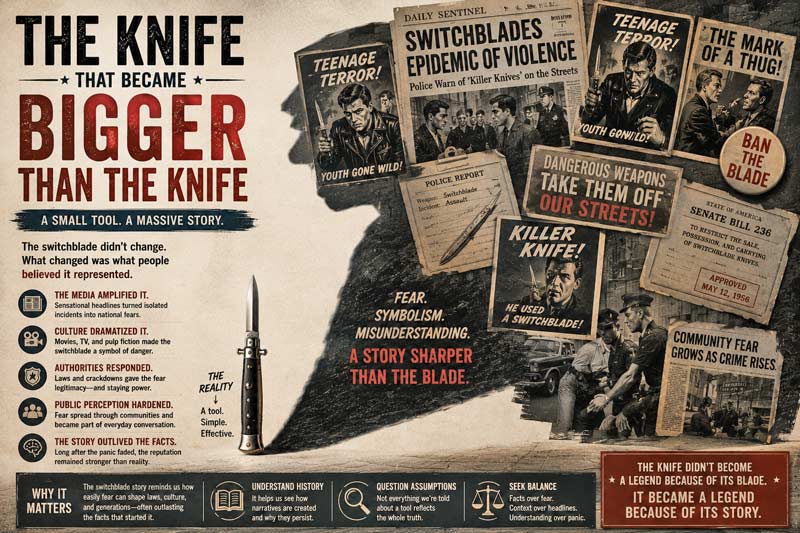
The Knife That Became Bigger Than the Knife
Very few tools ever become cultural symbols. Most remain exactly what they were designed to be. Hammers stay hammers. Wrenches stay wrenches. Even most knives remain simple cutting tools. The switchblade was different. Over time, it became something much larger than the object itself.
By the peak of the switchblade panic, the knife had come to represent fears about crime, rebellious youth, changing social norms, and the loss of control that many Americans felt during a rapidly changing era. The blade itself almost became secondary. What mattered was what people believed it symbolized.
That transformation helps explain why the switchblade became so much more controversial than many other knife designs. Plenty of knives were capable of causing harm. Some were larger, stronger, and more practical than switchblades. Yet few attracted the same level of attention because they lacked the powerful narrative that had developed around automatic knives.
History is full of objects that followed a similar path. A tool becomes associated with a particular group, event, or social concern. Media coverage amplifies the connection. Public perception hardens. Eventually, the story becomes difficult to separate from the object itself. The switchblade may be one of the clearest examples of that process in American history.
Today, many knife enthusiasts are surprised when they learn how much of the switchblade's reputation was shaped by fear, symbolism, and media influence rather than by the knife's actual capabilities. Understanding that history doesn't require people to love switchblades or even carry them. It simply provides important context for why this particular knife occupies such a unique place in American culture.
More than seventy years after the panic began, the switchblade remains one of the most recognizable knife designs in the world. Not because it was the most dangerous. Not because it was the most common. But because few knives have ever accumulated such a powerful story around them. In many ways, that story became sharper than the blade itself.
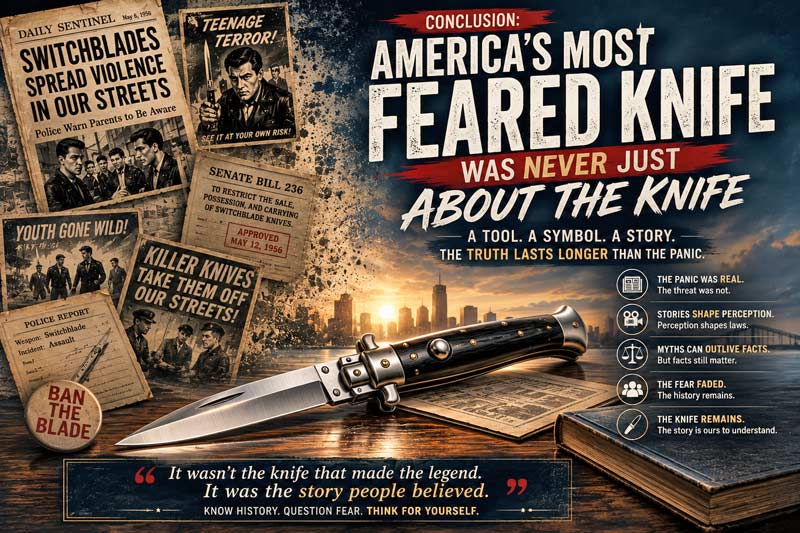
Conclusion: America's Most Feared Knife Was Never Just About the Knife
The story of the switchblade isn't really the story of a knife. It's the story of how fear spreads, how symbols are created, and how public perception can sometimes become more powerful than reality.
For decades, switchblades were portrayed as the ultimate criminal weapon. Newspapers warned about them. Movies turned them into icons of rebellion. Lawmakers rushed to regulate them. By the time the panic reached its peak, many Americans had come to see the switchblade as a threat unlike any other knife.
Yet when we look back at the history, a different picture emerges. The switchblade began as a practical tool. Its defining feature was convenience, not violence. While the knife became the focus of a national panic, much of its reputation was built on symbolism, sensationalism, and cultural fears that extended far beyond the blade itself.
Today, the switchblade remains one of the most recognizable knives in America. Not because it proved to be the most dangerous, but because it became one of the most talked about. Few knives have ever accumulated so much history, controversy, and mythology around a single mechanism.
Perhaps that's the ultimate lesson of the switchblade panic. Sometimes the most powerful thing about a weapon isn't what it can do. It's what people believe it can do. And in the case of the switchblade, that belief helped create one of the most enduring reputations in American knife history.
Did Criminals Actually Prefer Switchblades?
Despite decades of headlines suggesting otherwise, there is little evidence that criminals overwhelmingly preferred switchblades over other types of knives. Much of the knife's reputation came from media coverage and popular culture rather than clear proof that it was uniquely favored by criminals. The switchblade became a symbol of crime long before it became a statistically significant factor in crime itself.
Why Were Switchblades Banned Before Many Other Knives?
Switchblades were banned or restricted in many places because they became associated with youth crime, gangs, and public disorder during the mid-twentieth century. Lawmakers often respond to public fears, and the switchblade happened to become one of the most visible symbols of those fears. In many cases, the regulations reflected cultural concerns as much as the practical characteristics of the knife itself.
Are Switchblades Still Illegal in the United States?
The answer depends on where you live. Knife laws vary significantly between states, and many restrictions that once applied to switchblades have been relaxed or repealed over the years. However, some locations still regulate automatic knives differently than other knife types. Anyone considering ownership should always check the current laws in their state and local jurisdiction.
]]>2026-06-19T14:58:07+01:00https://www.kombativ.com/blog/how-switchblades-became-the-most-feared-knives-in-america<![CDATA[Are Karambits Actually Practical or Just an Overhyped Knife?]]>
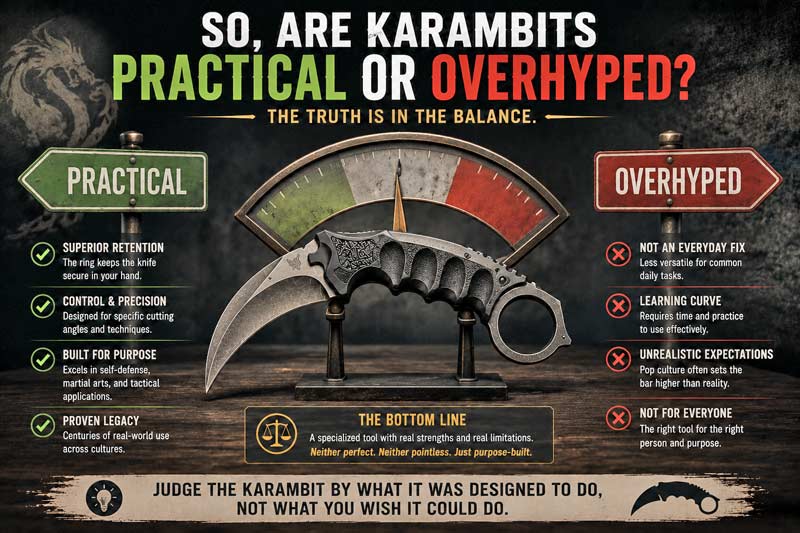
https://www.kombativ.com/blog/are-karambits-actually-practical-or-just-an-overhyped-knife
To separate fact from hype, it's worth looking beyond the dramatic appearance and examining what karambits were originally designed to do, where they shine today, and where their limitations become impossible to ignore.
What Most People Mean When They Say a Knife Is "Practical"
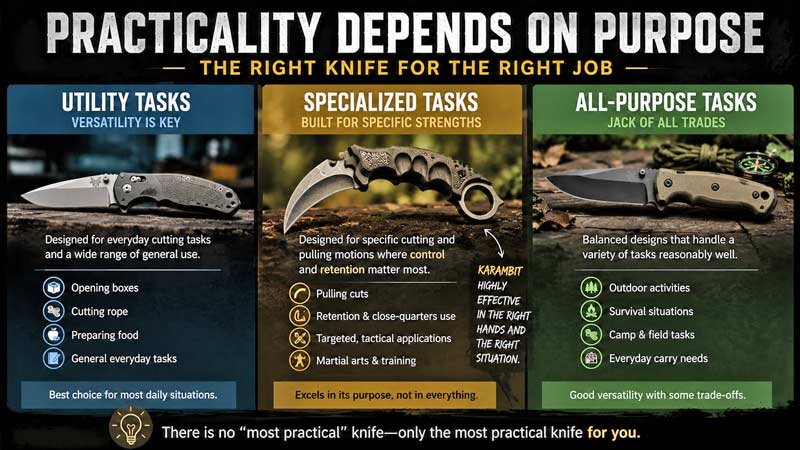
One reason the karambit debate never seems to end is that people often use the word "practical" to mean completely different things. For some knife owners, practicality means having a tool that can handle a wide variety of everyday cutting tasks. For others, it means comfort, retention, portability, or confidence in the hand. A knife that scores highly in one category may perform poorly in another.
If your definition of practicality is opening boxes, cutting rope, slicing food, and handling general utility tasks, a traditional folding knife will usually be the more versatile option. Straight blades and drop-point designs tend to excel at the broadest range of everyday jobs. That is one reason they remain so popular among people looking for a single knife to carry every day.
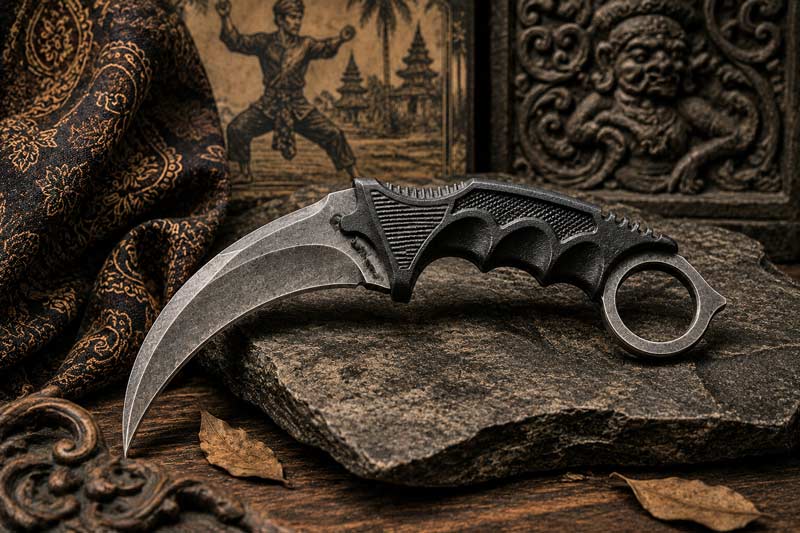
The karambit was never designed to be a general-purpose utility knife. Its roots can be traced back to Southeast Asia, where its curved shape evolved for specific cutting and pulling motions. As we explored in our article on why karambit knives are curved, the blade shape wasn't created to look intimidating. It was created to perform certain tasks exceptionally well.
That distinction matters because specialized tools are often judged unfairly against tools built for entirely different purposes. Nobody criticizes a chef's knife for being difficult to carry in a pocket, and nobody expects a pocketknife to replace a machete. Yet people frequently evaluate karambits as if they were intended to do everything a standard everyday carry knife can do.
A better question might be this: does the karambit perform the jobs it was designed for better than most alternatives? Once you start looking at the knife through that lens, the conversation becomes much more interesting.
Where Karambits Shine in the Real World
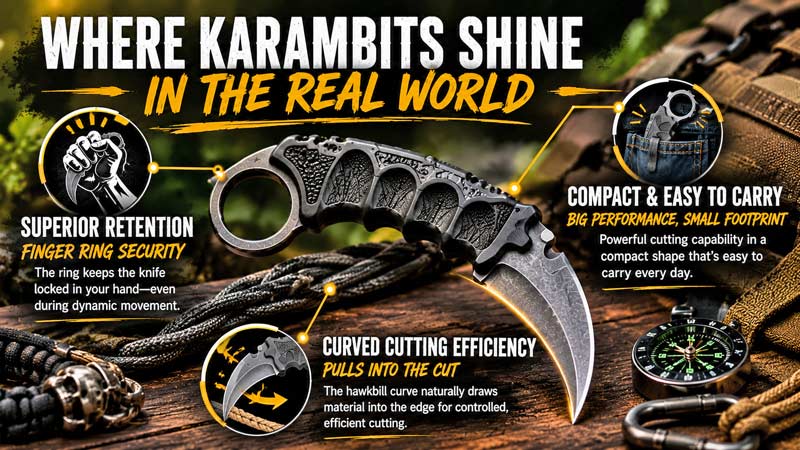
If the goal is to determine whether karambits are practical, it's important to start with the situations where they genuinely excel. While they are not designed to replace every type of knife, there are several characteristics that have helped the design remain relevant for generations.
One of the biggest advantages is retention. The finger ring provides a level of security that many traditional knife designs simply cannot match. Even if the user's grip shifts during movement, the knife remains connected to the hand. That feature is so important that we dedicated an entire article to explaining what the ring on a karambit knife is for. Far from being decorative, it serves a very practical purpose.
The curved blade is another strength. Rather than relying primarily on straight slicing motions, a karambit naturally pulls material into the edge during a cut. This can make certain cutting tasks feel surprisingly efficient. It is one reason the design has remained popular among martial artists and knife enthusiasts who appreciate specialized tools.
Many owners also find that the compact shape makes a karambit easier to carry than larger fixed-blade knives. Despite the aggressive appearance, the cutting edge is often packaged into a relatively small footprint. For people who value compact gear, that can be a meaningful advantage.
These strengths help explain why karambits continue to attract dedicated followers. As discussed in our article on why karambit knives are so effective, the design offers capabilities that many conventional knives do not. The question is whether those advantages outweigh the tradeoffs, and that's where the debate usually begins.
Where the Karambit Falls Short
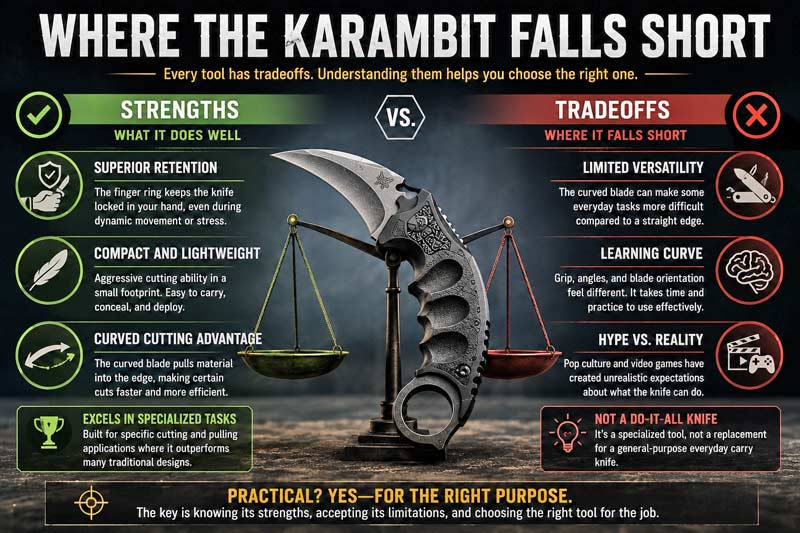
A fair evaluation of the karambit has to include its weaknesses. This is where many enthusiasts and critics tend to talk past each other. Supporters focus on what the design does exceptionally well, while detractors focus on the situations where it struggles. Both sides have valid points.
The biggest limitation is versatility. If someone wants a knife that can handle everything from opening packages to preparing food at a campsite, a traditional folding knife will usually be the more practical choice. The curved blade that gives a karambit its unique strengths can also make certain everyday tasks more awkward than they would be with a straight edge.
There is also a learning curve. Most people can pick up a conventional pocketknife and immediately understand how to use it. A karambit feels different. The grip, cutting angles, and blade orientation often require an adjustment period. That doesn't mean the knife is difficult to use, but it does mean the design rewards familiarity more than some alternatives.
Another challenge is expectation. Thanks to movies, social media clips, and video games, many people assume a karambit is some kind of ultimate knife that outperforms every other design. That expectation sets the knife up for criticism because no knife excels at everything. As we discussed in our article about why karambit knives became so popular in video games, much of the knife's modern fame comes from its appearance rather than its utility.
This doesn't make the karambit overhyped. It simply means that hype and practicality are not the same thing. A specialized tool can be extremely effective while still being the wrong choice for many people's daily needs. Understanding that distinction is the key to judging the design fairly.
Why Karambits Have Such a Loyal Following
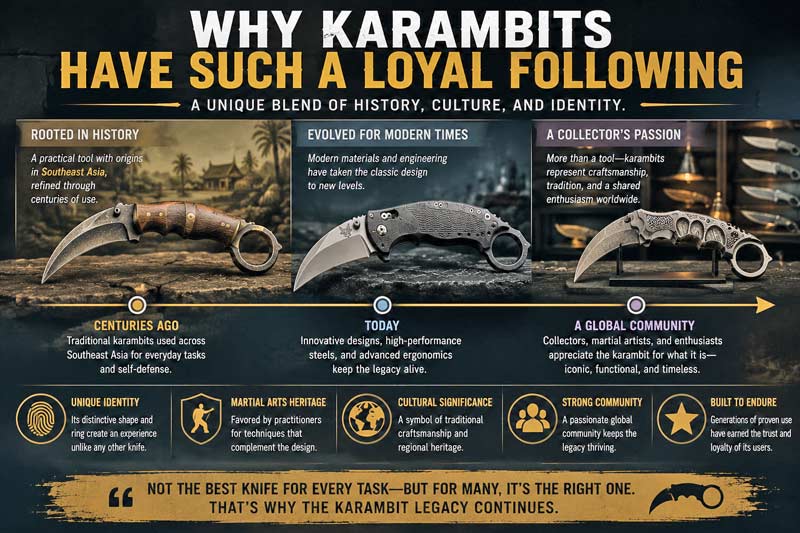
If karambits have obvious limitations, why do so many people continue to carry, collect, and train with them? The answer goes beyond performance alone. Few knife designs create the same combination of function, history, and identity.
Part of the appeal comes from the fact that a karambit feels different from almost every other knife. The ring, the curved blade, and the distinctive grip create an experience that stands apart from a standard pocketknife. For enthusiasts, that uniqueness is part of the attraction. Owning a karambit feels less like owning another tool and more like owning a piece of a long tradition.
Its history also contributes to its popularity. Unlike many modern knife designs, the karambit has roots that stretch back centuries. The design evolved through practical use long before it became known to collectors and enthusiasts around the world. If you're interested in that journey, our article on what a karambit knife is explores the origins of the design in greater detail.
The knife's reputation has also been reinforced by martial arts. Many practitioners appreciate the way the design complements certain movements and techniques. In that respect, the karambit belongs to the same category as several other tools that are often misunderstood because people only see their appearance rather than their intended purpose. We touched on that idea in our article about the most misunderstood martial arts weapons.
Perhaps most importantly, people tend to form strong attachments to tools that do something exceptionally well. Even if a karambit is not the best knife for every task, many owners value its strengths enough that they are willing to accept its weaknesses. That tradeoff helps explain why the design has survived for centuries while countless other knife styles have come and gone.
So, Are Karambits Practical or Overhyped?
The most accurate answer is that karambits are practical for the people and purposes they were designed for, but they are often overhyped by people who expect them to be something they were never meant to be.
A karambit is not the ultimate everyday knife. If someone needs a single blade for opening packages, preparing food, outdoor chores, and general utility work, there are plenty of designs that offer greater versatility. Judged by that standard alone, a traditional pocketknife will usually come out ahead.
However, practicality is not the same as versatility. Many of the world's most respected tools are highly specialized. A chainsaw is less versatile than a pocketknife, yet nobody would call it impractical. The same principle applies here. The karambit was built around retention, control, and a distinctive cutting style, and it continues to perform those functions remarkably well centuries after its creation.
That is one reason the design has remained relevant despite changing trends. Whether you're examining the knife's origins, its unique blade geometry, or its modern popularity, the same conclusion keeps appearing: the karambit exists because it solves certain problems effectively. As discussed in our article on the history and evolution of the karambit knife, designs that survive for centuries usually do so for a reason.
Perhaps the biggest misconception is that a knife must either be perfect or overrated. In reality, most successful tools live somewhere in the middle. The karambit has genuine strengths, genuine limitations, and a devoted following because many people find those strengths worth the tradeoffs. That doesn't make it the right knife for everyone. It simply makes it a knife that deserves to be judged on what it was designed to do, rather than on what people imagine it should do.
For those who appreciate specialized designs, there's a reason karambits continue to stand out among the many options available in today's knife market. You can explore a variety of modern designs in our collection of karambit knives and decide for yourself whether the design lives up to the hype.
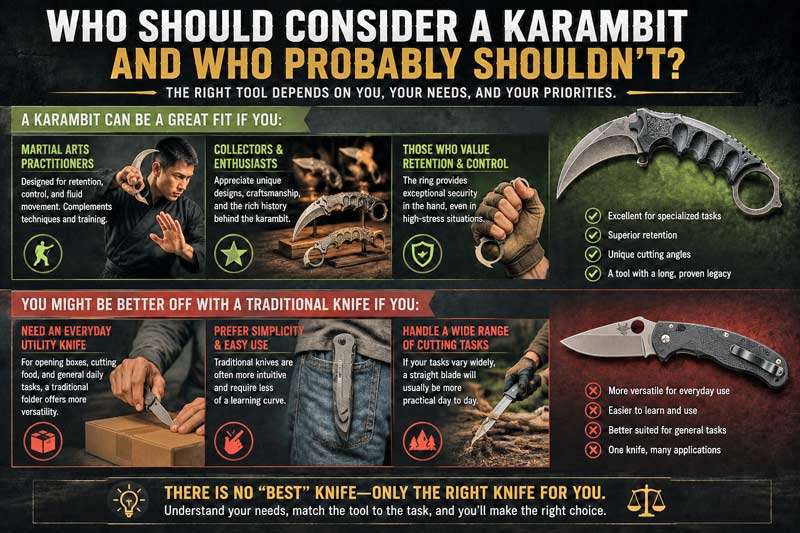
Who Should Consider a Karambit and Who Probably Shouldn't?
One of the easiest ways to determine whether a karambit is practical is to stop asking whether it's a good knife and start asking whether it's a good knife for you. That distinction matters because the answer can vary dramatically from one person to the next.
People who appreciate specialized tools often find a lot to like about the karambit. Martial arts practitioners, knife collectors, enthusiasts of unusual designs, and those who value the knife's unique retention features are often drawn to it for good reason. The design offers capabilities that few other knives can replicate in quite the same way.
On the other hand, someone looking for a simple everyday utility knife may be happier with a more conventional design. If your primary tasks involve opening packages, cutting food, performing outdoor chores, and handling a wide range of general cutting jobs, a traditional folder will usually provide more flexibility. In that sense, the karambit occupies a different niche than many of the knives featured in our guide to 12 fixed-blade knives you should know about.
That doesn't make one type of knife better than another. It simply highlights an important truth that applies to almost every tool. The best choice depends on the job, the user, and the priorities involved. A knife can be highly practical for one person and completely unnecessary for someone else.
Perhaps that's why the debate continues. The karambit is neither the miracle tool its biggest fans sometimes claim nor the gimmick its harshest critics describe. It is a specialized design with a long history, a loyal following, and a set of strengths that continue to earn respect from people who understand what it was built to do.
Do People Actually Carry Karambits Every Day?
Yes, although they represent a relatively small portion of everyday knife users. Most people who carry a karambit daily do so because they specifically appreciate its retention, compact size, or distinctive handling characteristics. While traditional pocketknives remain more common, there are plenty of enthusiasts who prefer a karambit's unique combination of control and portability. As with most tools, personal preference plays a major role in what people choose to carry.
Why Didn't Karambits Replace Traditional Pocket Knives?
If karambits are so effective at certain tasks, why didn't they become the dominant knife design? The answer is versatility. Most people need a knife that can handle a wide variety of everyday jobs, and traditional pocketknives tend to perform well across the broadest range of tasks. Karambits survived for centuries because they excel in specific situations, not because they were designed to replace every other knife. Their continued popularity proves that specialization still has value, even in a world that often favors all-purpose tools.
Would a Beginner Be Better Off With a Karambit or a Traditional Knife?
For most beginners, a traditional folding knife is the easier starting point. The blade shape is generally more versatile, the handling feels familiar, and there is very little learning curve. Karambits tend to appeal more to enthusiasts who are specifically interested in the design, history, or handling characteristics. That doesn't mean a beginner can't enjoy a karambit, but someone looking for their first everyday knife will usually find a traditional folder easier to adapt to.
]]>2026-06-19T13:33:26+01:00https://www.kombativ.com/blog/are-karambits-actually-practical-or-just-an-overhyped-knife<![CDATA[The Weapons People Fear Most (And Whether the Fear Makes Sense)]]>
https://www.kombativ.com/blog/the-weapons-people-fear-most
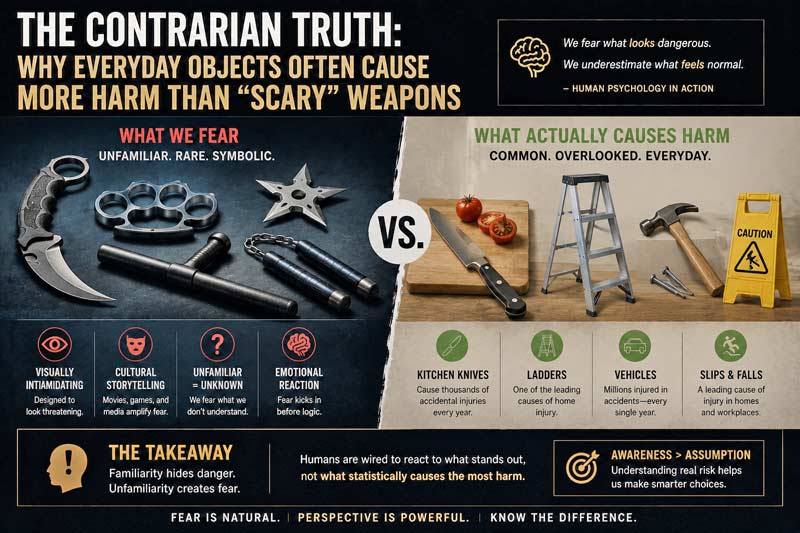
Throughout history, certain weapons became symbols of danger far beyond their actual use, often because of media, crime stories, movies, or cultural panic. Meanwhile, some everyday objects cause far more harm statistically but barely register in the public imagination at all. The result is a strange mix of psychology, perception, and myth that shapes how people react to different tools long before they understand them.
In this guide, we are exploring some of the weapons people fear most, why those fears developed, and whether the reputation actually makes sense once you separate emotion from reality.
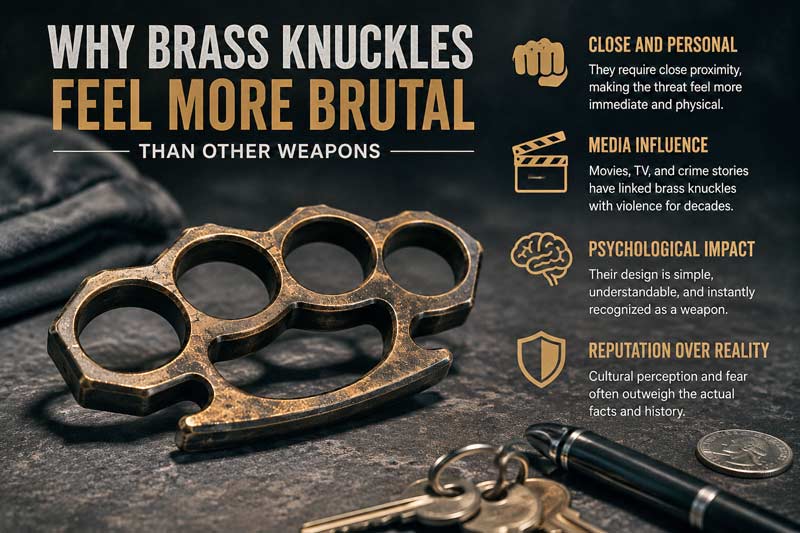
Why Brass Knuckles Feel More Brutal Than Other Weapons
Few weapons trigger an immediate emotional reaction quite like brass knuckles. Even people who know almost nothing about self-defense tools usually recognize them instantly, and for many, the reaction is immediate: dangerous, aggressive, and deeply intimidating.
Part of that fear comes from psychology.
Unlike many weapons that create distance, brass knuckles feel intensely personal. They are associated with punching, close proximity, and direct physical confrontation. There is something uniquely unsettling about a weapon that requires someone to be standing only inches away. That closeness makes the threat feel more visceral than something perceived as distant or detached.
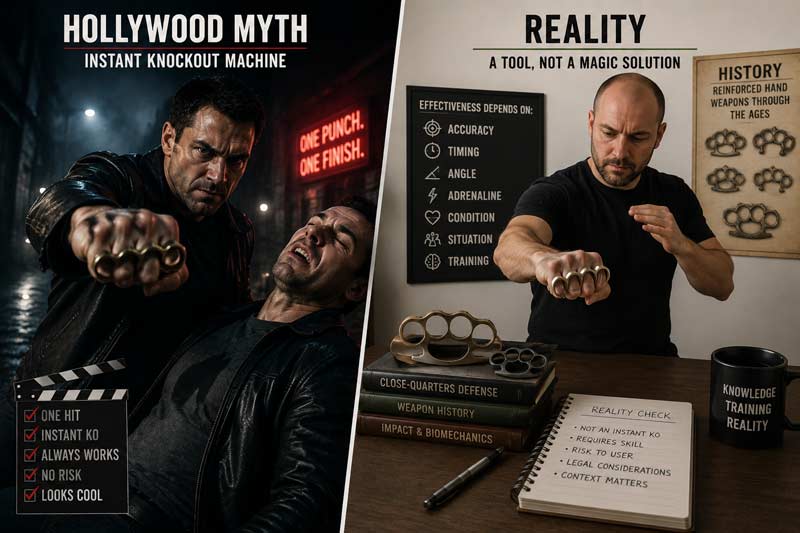
Movies and pop culture helped amplify the reputation too. For decades, brass knuckles appeared in crime films, gang stories, and underground fight scenes, usually associated with brutality rather than self-defense. That repeated imagery shaped how many people view them today, even if they have never actually seen a pair in real life.
Interestingly, the fear often outweighs historical context. Versions of reinforced hand weapons have existed for centuries and evolved for practical close-quarters use rather than dramatic intimidation. We explore that history further in the real history of brass knuckles and how their reputation changed over time.
Does the fear make sense?
To some extent, yes. Brass knuckles are designed for close physical force, which naturally feels threatening to most people. But their cultural reputation has also been exaggerated by decades of movies and media, turning them into something larger than reality in the public imagination.
If you want a closer look at how they actually work and why they became so recognizable, we also break down what brass knuckles are and why compact impact tools developed such an outsized reputation. You can also browse modern styles of knuckle dusters here.
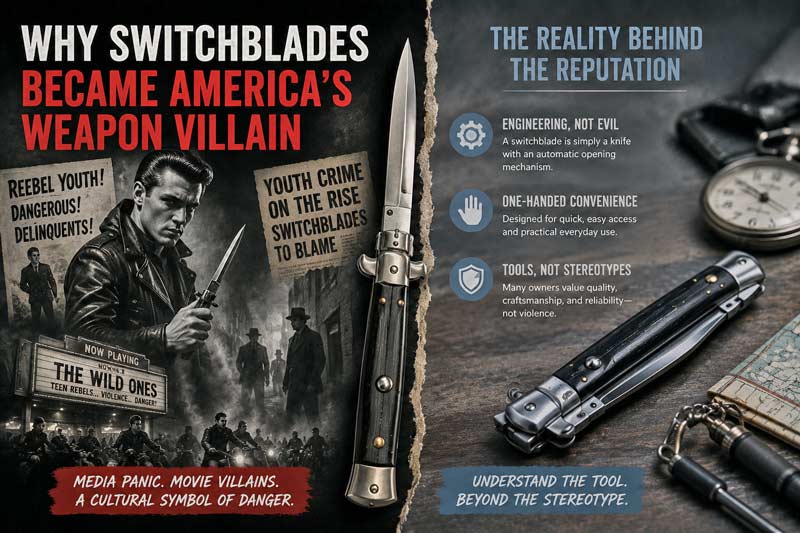
Why Switchblades Became America's Weapon Villain
Few weapons carry a reputation as dramatic as the switchblade. Even today, simply hearing the word can make people picture leather jackets, alley fights, gang movies, or dramatic "click" sounds before trouble starts. For decades, switchblades became one of the most feared weapons in American pop culture despite being, at their core, simply knives with a faster opening mechanism.
So where did that fear come from?
Much of it traces back to media and moral panic in the mid-1900s. News stories increasingly connected switchblades to youth crime, gang violence, and juvenile delinquency. Movies amplified the image even further, especially after films and musicals portrayed young criminals flipping knives open dramatically before fights. Over time, the switchblade transformed from a tool into a cultural symbol of danger.
Hollywood deserves a lot of credit for cementing the image. Filmmakers quickly realized that automatic knives created instant tension on screen. The dramatic deployment looked intimidating, sounded memorable, and visually communicated danger in a split second. Few weapons became so tightly linked to movie villains and rebellious characters.
Interestingly, much of the fear had less to do with how dangerous the knife actually was and more to do with symbolism. An automatic knife opens quickly, but mechanically, it is still just another knife design. In many ways, the fear centered around appearance, speed, and what the weapon represented culturally rather than a dramatic difference in function.
Does the fear make sense?
Partially. Quick deployment can feel intimidating, and media associations matter. But decades of movies and headlines arguably turned switchblades into cultural villains far beyond what the mechanism itself justified. In reality, many people simply appreciate them for convenience, one-handed access, and engineering. We explain more in our guide to how automatic knives actually work and why the mechanics are often more practical than dramatic.
If you want to explore how these designs evolved beyond the stereotypes, you can browse different styles of automatic knives here and see why they remain so recognizable today.
Why Curved Knives Feel More Dangerous Than Straight Blades
Some weapons trigger fear before people even understand what they are, and curved knives are one of the best examples. Show someone a standard folding knife and they may barely react. Show them a sharply curved karambit, and suddenly the response feels very different: aggressive, intimidating, even predatory.
Part of that reaction comes from psychology and visual instinct.
Humans naturally react to shapes that feel unfamiliar or animal-like, and curved blades often trigger associations with claws, hooks, or tearing motion. A karambit especially feels different because it does not resemble the "normal knife" most people expect. The curved profile and finger ring instantly stand out, making the design seem more threatening even to people who know nothing about knives.
Movies, video games, and internet culture amplified that perception even further. Over the last two decades, karambits became especially recognizable in gaming communities, action content, and tactical media, often portrayed as elite or unusually dangerous weapons. That visibility helped transform them from a niche regional design into one of the most recognizable "intimidating-looking" knives in modern culture. We explore that trend further in why karambit knives became so popular in video games and how media shaped perception.
Interestingly, the original design was shaped more by function than fear. The curved blade evolved for control, retention, and specific cutting motions, not because someone wanted to invent the world's scariest-looking knife. We explain more in why karambit knives are curved and how the shape developed over time.
Does the fear make sense?
Somewhat. Curved blades genuinely look more intimidating to many people because of instinctive visual cues and unfamiliarity. But much of the modern fear surrounding karambits has been amplified by pop culture, gaming, and dramatic presentation rather than everyday reality.
Why Hidden Weapons Make People Deeply Uncomfortable
Few things make people more uneasy than the idea of a weapon they cannot immediately see. A visible object feels predictable. A hidden one creates uncertainty, and uncertainty tends to trigger strong psychological reactions.
That discomfort shows up everywhere in human behavior. People are often less afraid of something obvious than something unknown. A visible knife on a kitchen counter may barely register, while the idea of a hidden blade or disguised self-defense tool can feel unsettling long before anyone understands how it actually works.
Part of the fear comes from psychology.
Humans naturally dislike unpredictability. A concealed tool feels more threatening because it removes visual information. If people do not know what someone is carrying, when it might appear, or how it works, the imagination often fills in the blanks. In many cases, fear grows larger than reality simply because uncertainty feels uncomfortable.
Movies and spy culture amplified this reaction even further. Hidden blades, cane swords, disguised tools, and secret gadgets became staples of espionage films, action movies, and comic-book style storytelling. The idea of something dangerous hiding in plain sight taps into a very old fear of deception and surprise.
Interestingly, many concealed tools originally evolved for practicality rather than mystery. Compact or discreet designs often existed because of travel, urban environments, legal restrictions, portability, or simple convenience. We explore that further in our breakdown of hidden blades and discreet tools and why subtle carry concepts developed over time.
Does the fear make sense?
To a degree, yes. Hidden objects naturally feel harder to assess, which makes people uneasy. But much of the emotional reaction also comes from movies, spy fiction, and the psychological discomfort of uncertainty itself rather than direct experience. In many cases, what people imagine feels scarier than the reality.
If you are curious how concealed designs evolved, you can explore different styles of hidden knives and other hidden weapons here to better understand why discreet tools became so culturally fascinating.
Why Electricity Feels More Frightening Than Physical Force
Even people who are not especially afraid of knives or impact tools often react very differently to electricity. A stun device sparks once, makes that loud snapping sound, and suddenly the emotional reaction changes. For many people, electricity feels uniquely unsettling in a way punches, blades, or blunt force sometimes do not.
Part of that fear comes from how unfamiliar electricity feels.
Most people understand physical force intuitively. A punch, a fall, or a cut makes sense because we can picture what happens. Electricity feels different because most people cannot easily visualize how it works inside the body. That uncertainty makes it feel unpredictable, and unpredictability tends to amplify fear.
The sound and visuals matter too. Loud crackling, visible electrical arcs, and sudden movement create an immediate emotional response. Even harmless static electricity can surprise people. A self-defense stun device naturally feels more intimidating because it combines unfamiliarity with dramatic sensory cues.
Movies amplified the fear even further. Films often portray stun devices as instant "off switches," where one quick contact knocks someone unconscious for several convenient minutes. In reality, outcomes are far less predictable, and many devices are designed more around interruption, deterrence, or creating an opportunity to escape than movie-style certainty. We explain more about that difference in our guide to pepper spray vs stun guns and how these tools are actually used.
Interestingly, people are often less emotionally afraid of pepper spray even though it can be extremely effective. Part of that may be because spray feels familiar. We understand irritation, pain, and distance better than electrical sensation. That difference in perception says a lot about how fear works psychologically.
Does the fear make sense?
To a degree, yes. Electricity feels unpredictable and visually intense, which naturally makes people uncomfortable. But media, movie myths, and unfamiliarity likely amplified the fear far beyond what most people realistically understand about modern self-defense devices.
If you want to learn more about how these tools compare, we also break down how stun guns actually work and when people choose them versus pepper spray for everyday carry.
Why Ninja Weapons Still Feel Threatening Decades Later
Few categories of weapons trigger instant curiosity and discomfort quite like ninja weapons. Show someone a throwing star, nunchucks, or a mysterious-looking blade, and chances are they immediately associate it with stealth, secrecy, and danger. Even people with no martial arts background often react strongly to the idea of "ninja weapons."
That reaction did not happen by accident.
Movies, television, comic books, and video games spent decades turning ninjas into near-supernatural figures. Silent assassins moving through shadows, disappearing without warning, and carrying strange unfamiliar tools became one of pop culture's most recognizable archetypes. Over time, the weapons themselves inherited some of that fear and mystery.
Part of the discomfort comes from unfamiliarity too. Most people immediately understand what a kitchen knife or baseball bat does. A throwing star or pair of nunchucks feels different because many people have little real-world exposure to them. Unfamiliar tools naturally seem more intimidating, especially when movies frame them as exotic or unusually dangerous.
Interestingly, the reality behind many ninja weapons is often far less dramatic than pop culture suggests. Throwing stars, for example, were not magical one-hit tools flying perfectly across rooftops, and nunchucks require far more skill and patience than movies make them seem. We break down what a shuriken actually is, explore why nunchucks were invented, and take a closer look at how these tools evolved outside of Hollywood fantasy.
Does the fear make sense?
Partially. Unfamiliar designs naturally trigger curiosity and caution, especially when they look visually different from everyday objects. But much of the fear surrounding ninja weapons likely comes from decades of exaggerated portrayals rather than everyday reality. In many ways, people may be reacting more to the mythology of ninjas than the tools themselves.
If you want to explore the broader category, you can browse different styles of ninja weapons here and see how historical tools evolved far beyond movie stereotypes. You can also explore modern throwing stars and nunchaku to better understand why these designs became so recognizable.
The Contrarian Truth: Why Everyday Objects Often Cause More Harm Than "Scary" Weapons
Here is where the conversation gets interesting.
Many of the weapons people fear most are not actually the things that cause the most injuries in everyday life. In fact, humans are often surprisingly bad at judging risk. We tend to fear objects that look dangerous, feel unfamiliar, or have dramatic cultural reputations while overlooking ordinary things we interact with every day.
Psychologists sometimes call this the "availability effect." Dramatic stories stick in our memory more easily than ordinary reality. A sensational movie scene involving brass knuckles or a hidden blade feels emotionally memorable. Slipping in the bathroom, tripping on stairs, or getting hurt by common household tools usually does not.
Take kitchen knives as an example. Most people barely think twice about them because they are familiar, even though knives designed for cooking are involved in far more everyday accidents than many of the "intimidating" weapons people instinctively fear. The same idea applies to tools, ladders, vehicles, sports equipment, and countless other ordinary objects.
Part of the difference comes down to visibility and symbolism. A karambit looks intimidating. Brass knuckles feel aggressive. A throwing star feels mysterious. Those designs trigger emotional reactions before logic has a chance to step in. Meanwhile, everyday risks become invisible because familiarity makes them feel safe.
Does that mean fear of unusual weapons is irrational?
Not necessarily. Humans evolved to react cautiously to unfamiliar or potentially dangerous things, and that instinct exists for a reason. But it does suggest that fear is often shaped just as much by psychology, media, and symbolism as by real-world likelihood.
In many ways, what we fear says just as much about human psychology as it does about the object itself.
The strange reality is that people often fear what looks dangerous while underestimating what feels normal.
Does the Fear Actually Make Sense?
After looking at all these examples, the answer turns out to be more complicated than a simple yes or no.
In many cases, the fear people feel is understandable. Brass knuckles feel personal because they require close physical contact. Hidden weapons create uncertainty. Electricity feels unpredictable. Unfamiliar designs like karambits or throwing stars naturally trigger caution because humans are wired to pay attention to things that feel unusual or potentially dangerous.
At the same time, culture plays an enormous role in shaping fear.
Movies turned switchblades into symbols of rebellion. Ninja weapons became wrapped in mystery and exaggeration. Crime stories amplified the reputation of brass knuckles. Spy fiction made concealed tools feel more sinister than practical. Over time, the emotional story surrounding a weapon often became bigger than the object itself.
That does not mean the fear is irrational. Fear exists for a reason. Humans evolved to notice risk, especially when something feels unfamiliar, visually intimidating, or hard to predict. But understanding where those reactions come from can make it easier to separate instinct from reality.
Interestingly, many of the things people fear most are not necessarily the things most likely to cause harm in everyday life. Familiarity often hides risk, while unfamiliarity amplifies it. A dramatic-looking weapon stands out immediately. An ordinary object blends into the background, even if it creates far more accidents over time.
In the end, the question is probably not whether people should fear certain weapons. It is whether the fear matches reality.
Sometimes it does.
Sometimes movies, headlines, and imagination quietly fill in the gaps.
If there is one takeaway from all of this, it is that understanding usually reduces fear. The more we understand where certain tools came from, how they actually work, and why people react to them emotionally, the easier it becomes to separate myth from reality.
If you want to explore the history, psychology, and real-world context behind many of these tools, you can browse more educational guides throughout the Kombativ blog and see how perception often differs from reality.
FAQ: What Weapon Do People Fear the Most?
There is no universal answer, because fear tends to be shaped by psychology, culture, and personal experience more than logic alone. In general, people often fear weapons that feel unfamiliar, visually intimidating, unpredictable, or strongly tied to media stories.
For some people, hidden weapons feel the most unsettling because uncertainty naturally creates anxiety. Others react strongly to electricity-based tools like stun devices because the effects feel unfamiliar and hard to predict. Curved knives such as karambits can feel especially intimidating because they look aggressive and unusual, while brass knuckles often trigger strong reactions because they feel personal and close-range.
Interestingly, movies and headlines play a huge role in shaping what people fear. Switchblades became cultural villains through decades of films and moral panic. Ninja weapons gained mystery through pop culture. Hidden blades became symbols of espionage and secrecy. In many cases, the emotional reputation of a weapon becomes larger than the reality.
The strange truth is that what people fear most often says as much about psychology as it does about the object itself. Humans naturally pay more attention to things that feel dramatic, unfamiliar, or visually threatening, even when everyday risks are statistically more common.
FAQ: Are Hidden Weapons More Dangerous Than Visible Ones?
Not necessarily, but they often feel more dangerous.
Much of the discomfort surrounding hidden weapons comes from uncertainty. A visible object feels easier to assess because people can immediately understand what is there. Hidden tools create unanswered questions, and the unknown naturally feels more threatening to most people.
Psychologists sometimes refer to this as uncertainty bias. Humans tend to feel more anxious about risks they cannot clearly see or predict. That is part of why concealed tools, hidden blades, and disguised self-defense items have such a strong psychological effect in movies and real life.
At the same time, visibility alone does not determine danger. Context, training, intent, and circumstance matter far more than whether something is obvious or concealed. In many cases, the fear surrounding hidden weapons comes from imagination filling in the blanks rather than direct experience.
That fear is understandable, though. Humans are naturally cautious about things they cannot immediately identify, which may explain why hidden weapons continue to feel so psychologically powerful even decades after spy movies popularized them.
]]>2026-06-12T12:41:12+01:00https://www.kombativ.com/blog/the-weapons-people-fear-most<![CDATA[10 Weapon Myths Hollywood Got Completely Wrong]]>
https://www.kombativ.com/blog/10-weapon-myths-hollywood-got-completely-wrong
In reality, many of the weapons movies made famous work very differently than most people expect. Some are harder to use than Hollywood suggests. Some are less effective than their reputation implies. And a few are actually more interesting once you understand how they really work.
In this guide, we are breaking down some of the biggest weapon myths movies still get wrong, from throwing stars and butterfly knives to batons, brass knuckles, stun guns, and more.
Myth #1: Silencers Make Guns Whisper Quiet
If Hollywood has convinced people of one weapon myth more than almost any other, it is this: attach a suppressor to a firearm and suddenly it sounds like a stapler in a quiet office. A villain fires three shots across a room, nobody notices, and nearby people somehow keep having normal conversations.
Real life works very differently.
Despite the nickname "silencer," firearm suppressors are not actually silent. They reduce noise, but they do not magically erase it. Most suppressed firearms still produce loud gunshots, often comparable to a jackhammer, motorcycle, or thunderclap depending on the caliber and ammunition being used. In many cases, you would absolutely notice one being fired nearby.
Part of the confusion comes from older movies where exaggerated sound effects made suppressors seem nearly invisible to the ear. The tiny "pfft" sound became so common in action films that people started assuming it reflected reality. In truth, suppressors mainly exist to reduce hearing damage, improve control, and slightly lower noise signatures, not to create movie-style stealth weapons.
There are some exceptions. Certain firearm setups using specialized subsonic ammunition can become significantly quieter than standard shots, which is partly where the myth comes from. But even then, "silent" is usually far from accurate.
Hollywood loves this myth because quiet guns make scenes feel dramatic and suspenseful. The reality is much less cinematic. If movies portrayed suppressors accurately, many stealth scenes would sound a lot louder and a lot less cool.
Interestingly, this pattern shows up again and again with weapons in movies. The more visually dramatic something feels on screen, the more reality usually gets bent to make the scene work.
Myth #2: Throwing Knives Almost Never Work Like Movies
Hollywood makes throwing knives look ridiculously easy. A character casually flicks their wrist from across the room, the knife spins once, lands perfectly tip-first, and instantly stops the bad guy with impossible accuracy.
Real throwing knife use is nowhere near that simple.
The biggest problem is distance. Throwing knives usually require a very specific amount of rotation depending on how far the target is. Move just a few feet closer or farther away and suddenly the knife may rotate too much, not enough, or bounce harmlessly off the target altogether. Skilled throwers spend years practicing consistency, distance control, grip, and timing.
Movies also tend to ignore accuracy under pressure. Hitting a stationary wooden target in practice is one thing. Accurately striking a moving target during a stressful situation is something entirely different. That is one reason throwing knives are more commonly treated as sport, hobby, or entertainment than realistic defensive tools.
That does not mean throwing knives are fake or ineffective. Dedicated throwing designs are carefully balanced for predictable flight, and in skilled hands they can be impressively accurate. But the idea that someone can effortlessly land precision throws in unpredictable real-world situations mostly belongs to Hollywood fantasy.
The same exaggeration shows up with ninja weapons too, especially throwing stars, which movies often portray as impossibly deadly and perfectly accurate. We will get to that myth next.
If you are curious how purpose-built throwing designs actually differ from ordinary knives, you can explore modern throwing knives and see why balance matters so much for repeatable throws.
Myth #3: Throwing Stars Were Never the Deadly Ninja Super Weapons Movies Made Them Seem
Few weapons have been exaggerated by movies quite like the throwing star. In Hollywood, ninjas casually toss razor-sharp stars across long distances with perfect accuracy, instantly taking down enemies without missing a throw. If action movies were accurate, ninjas apparently never needed backup plans.
The real history of throwing stars, also known as shuriken, is much more interesting and a lot less dramatic.
Historically, shuriken were usually secondary tools rather than primary battlefield weapons. Depending on the time period and region, they could be used for distraction, disruption, slowing pursuit, or creating openings rather than functioning as magical one-hit knockout tools. In many cases, their role was more about strategy than raw stopping power.
Movies also tend to exaggerate their accuracy and range. Throwing any object consistently takes practice, and shuriken are no exception. Distance, spin, angle, and target movement all matter far more than films suggest. The idea that someone could effortlessly land pinpoint throws while running across rooftops belongs firmly in fantasy territory.
That does not make throwing stars fake or useless. Modern enthusiasts still enjoy them for recreational target throwing, martial arts training, and historical interest. Designs vary considerably too, from traditional multi-point stars to straight throwing spikes, each behaving differently in flight. If you want a closer look at the history behind them, we break down what a shuriken actually is and how these tools evolved over time.
Hollywood probably loves the myth because throwing stars look cool on camera. A spinning metal star flying dramatically through the air is simply more cinematic than showing how much skill and practice real throwing requires. Like many weapon myths, entertainment usually wins over realism.
Myth #4: Butterfly Knives Are Not Magical Fighting Weapons
Thanks to movies, martial arts scenes, and internet videos, butterfly knives somehow developed a reputation as superhuman weapons that instantly make someone faster, more dangerous, and nearly impossible to defend against. Hollywood especially loves the dramatic flipping scenes, where a character spins a knife through their fingers for ten seconds before effortlessly winning a fight.
Reality is a lot less cinematic.
The butterfly knife, also called a balisong, was originally valued for portability and compact everyday carry, not flashy tricks. While flipping can absolutely take skill and coordination, most of the dramatic movements people associate with butterfly knives are demonstrations or hobbies rather than practical fighting techniques. In real-world situations, complicated flipping often creates unnecessary risk and wasted movement.
Movies also exaggerate how quickly someone becomes proficient. Skilled manipulation takes time, repetition, and plenty of accidental finger nicks along the way. The smooth, effortless movements seen on screen usually reflect hours or years of practice, not something someone magically masters overnight.
That does not mean butterfly knives are gimmicks. Enthusiasts appreciate them for craftsmanship, mechanics, collecting, and flipping culture, while others simply enjoy the compact design. But the idea that a butterfly knife instantly turns someone into an unstoppable martial arts expert mostly belongs to action movies and video game animations.
Part of what makes the myth so persistent is visual appeal. Few weapons look cooler on camera. A dramatic flip instantly adds tension to a scene, which explains why filmmakers keep using them. In reality, the knife is much more interesting once you separate history and mechanics from Hollywood exaggeration.
If you want to understand how the design actually works, we break down what a balisong really is and how the knife evolved. You can also browse different styles of butterfly knives to see why the design continues to attract collectors and enthusiasts today.
Myth #5: Nunchucks Do Not Automatically Make You a Martial Arts Master
Few weapons owe more of their reputation to movies than nunchucks. For decades, action films have portrayed them as almost unstoppable fighting tools capable of overwhelming opponents through sheer speed and flashy movement. One dramatic spinning sequence later and suddenly the hero looks nearly unbeatable.
The reality is a little more humbling.
Nunchucks require far more control and coordination than movies make them seem. Beginners usually discover this very quickly, often after accidentally hitting themselves in the arm, shoulder, knee, or head during practice. Smooth movement takes repetition, timing, body control, and patience, not just confidence and dramatic music.
Hollywood also tends to exaggerate how practical nunchucks are in every situation. While they can absolutely be effective in trained hands, they are not magical fight-ending tools, nor are they ideal for every environment. Tight spaces, obstacles, and lack of training can make them far harder to use than films suggest.
Interestingly, the history behind nunchucks is much more fascinating than the movie myth. Contrary to popular belief, historians still debate exactly how they evolved, and some of the common stories about them being simple farming tools may be oversimplified. We explore that deeper in our breakdown of why nunchucks were actually invented and the real history behind the weapon.
Part of what keeps the myth alive is visual appeal. Few weapons look more impressive on camera than perfectly controlled spinning movements. Martial arts legends and movie choreography helped cement nunchucks into pop culture, making them feel larger than reality. But behind the dramatic scenes sits something much simpler: a skill-based tool that rewards patience and practice far more than movie magic.
If you want to understand how different styles and materials affect handling, our complete guide to nunchucks breaks down what matters most for beginners and experienced users alike. You can also browse different styles of nunchaku here to see how modern designs vary.
Myth #6: Batons Do Not End Fights With One Hit
Movies love to portray batons as instant problem-solvers. A security guard lands one dramatic strike, the bad guy collapses immediately, and the scene moves on without much effort. Whether it is police dramas, spy thrillers, or action movies, expandable batons often get treated like guaranteed fight-ending tools.
Reality is far less predictable.
Batons can absolutely be effective tools, but they require training, control, and realistic expectations. In real situations, factors like adrenaline, movement, clothing, pain tolerance, and accuracy all matter. One strike does not automatically stop someone, and real-world encounters rarely unfold with movie-level simplicity.
Hollywood also tends to skip over how difficult baton use can be under pressure. Distance management matters. Timing matters. Targeting matters. Someone standing still for a perfectly choreographed hit is very different from a chaotic real-world encounter. That is one reason security professionals and trained users emphasize technique and preparedness rather than relying on the fantasy of a single dramatic moment.
Interestingly, expandable batons became popular because of practicality, not movie theatrics. Their compact design makes them easier to carry than traditional fixed batons, while still offering reach and control advantages. That practicality is a big reason many professionals still rely on them today. We cover that in more detail in our breakdown of why security professionals still trust expandable batons and how these tools actually get used.
Part of the Hollywood myth comes from pacing. Movies want quick, clean resolutions, not messy unpredictability. But in reality, most self-defense or security tools are exactly that, tools. Their effectiveness depends heavily on training, circumstances, and expectations, not cinematic certainty.
Myth #7: Brass Knuckles Are Not Instant Knockout Machines
If movies are to be believed, brass knuckles work like an instant off-switch. One punch lands, the other person drops immediately, and the scene ends with almost supernatural efficiency. Action films especially love portraying them as tiny weapons with almost unlimited stopping power.
Reality is much messier.
Brass knuckles, also called knuckle dusters, can absolutely increase impact concentration by reinforcing the hand during strikes, but Hollywood dramatically exaggerates what that actually means. Real-world outcomes depend on countless variables including accuracy, adrenaline, body position, movement, physical condition, and pure unpredictability. There is no guarantee of instant results, no matter what movies suggest.
Another thing films rarely show is risk to the person using them. Poor technique, awkward angles, or unrealistic expectations can create problems of their own. Like many impact tools, effectiveness depends heavily on circumstance, skill, and assumptions about what the tool can realistically do.
Interestingly, the history behind brass knuckles is often more fascinating than their movie reputation. Versions of reinforced hand weapons have appeared in different cultures for centuries, evolving around close-quarters practicality rather than Hollywood drama. We explore that deeper in the real history of brass knuckles and how these compact tools became so recognizable.
Part of the myth survives because movies need fast pacing. A dramatic one-hit scene moves the story forward quickly, while realistic outcomes tend to be unpredictable and complicated. Hollywood prefers certainty. Reality usually does not cooperate.
If you are curious about the mechanics and history behind the design, we also break down what brass knuckles actually are and why their reputation became so exaggerated. You can also browse modern styles of knuckle dusters here.
Myth #8: Stun Guns Do Not Instantly Knock People Unconscious
Hollywood absolutely loves this one. A character presses a stun gun against someone for half a second, sparks fly, and the person instantly collapses unconscious for several convenient minutes while the hero casually walks away.
That is not usually how stun devices work in real life.
One of the biggest misconceptions comes from movies blending different devices together. People often confuse conducted electrical weapons used by law enforcement with consumer self-defense stun devices, even though they work very differently. In films, the distinction usually disappears because realism would slow down the plot.
Most civilian stun devices are designed around pain compliance, startle response, and creating an opportunity to escape rather than functioning like an instant off-switch. Reactions can vary dramatically depending on factors like clothing, contact quality, movement, adrenaline, and individual response. There is no guaranteed "movie outcome" button.
Hollywood also exaggerates recovery time. Movies love scenes where someone wakes up several minutes later confused and conveniently harmless. Reality tends to be far less predictable. Responses vary widely, and situations rarely unfold with cinematic certainty.
Interestingly, stun devices became popular because they offered a non-lethal self-defense option that was portable and accessible. Practicality, portability, and deterrence mattered far more than dramatic movie moments. We explain more about that in our guide to how stun guns actually work and what people should realistically expect from them.
Part of what keeps the myth alive is visual drama. Loud electrical sounds, sparks, and instant reactions simply make for good entertainment. But like many Hollywood weapon myths, what looks exciting on screen often leaves out the messy unpredictability of reality.
If you want a deeper breakdown of how modern designs differ, we also cover high-voltage stun devices and how people typically choose one for everyday carry. You can also browse modern stun weapons here.
Myth #9: Blackjacks and Slapjacks Were Never "Instant Sleep Buttons"
Movies have a strange obsession with blackjacks and slapjacks. A character sneaks up behind someone, gives a quick tap to the head, and the person instantly collapses unconscious for exactly as long as the plot needs. No complications. No unpredictability. Just a perfectly convenient movie nap.
Reality is far less predictable and far less cinematic.
Blackjacks and slapjacks, also called sap weapons, were historically valued because they were compact, portable impact tools, not because they guaranteed instant unconsciousness. Like many close-quarters tools, outcomes depended heavily on countless variables including force, angle, physical condition, movement, adrenaline, and pure circumstance. Hollywood tends to ignore all of that because realism would complicate the story.
Another thing movies rarely show is the unpredictability of real-world outcomes. Human physiology does not follow movie scripts. A dramatic one-hit knockout is not something anyone can reliably expect, which is part of why older law enforcement and security communities focused so heavily on training, control, and situational judgment when these tools were historically carried.
Interestingly, blackjacks became popular because of practicality. Their weighted design made them compact enough to carry while still delivering concentrated force when needed. For a long time, they quietly served as part of law enforcement history before gradually fading from mainstream use. We explore that history further in the police weapon most people forgot ever existed and how sap weapons evolved over time.
Hollywood probably loves this myth because it solves storytelling problems instantly. A quick scene, no mess, no long struggle, and the story keeps moving. But like most weapon myths, reality tends to be more complicated than the movies suggest.
Myth #10: OTF Knives Are Not Secret Agent Super Weapons
Movies absolutely love OTF knives. A secret agent presses a button, the blade fires out dramatically, and suddenly the character becomes ten times more intimidating. Action films often portray automatic knives as futuristic, ultra-deadly gadgets designed for elite operatives or villains with unlimited resources.
The reality is much less dramatic and a lot more practical.
OTF stands for "out-the-front," meaning the blade deploys straight out of the handle rather than folding open like a traditional pocket knife. While the mechanism looks impressive, most people who carry them appreciate convenience more than movie-style theatrics. Quick one-handed access, compact carry, and mechanical simplicity are usually the bigger selling points.
Hollywood also exaggerates how powerful automatic deployment actually is. Movies often make it seem like the blade launches with incredible force or somehow changes what the knife is capable of. In reality, automatic opening mainly saves time and effort. It does not magically transform a knife into something fundamentally different.
Another myth comes from pop culture reputation. Because switchblades were heavily associated with crime films and rebellious characters during the mid-1900s, many people still assume automatic knives are exotic or unusually dangerous. In practice, they are simply another style of knife mechanism with strengths and tradeoffs like any other design.
Ironically, understanding how OTF knives actually work often makes them more interesting than the movie version. The internal engineering, spring systems, and locking mechanisms are part of why enthusiasts enjoy them. We explain more in our guide to how automatic knives actually work and why the mechanics are more practical than dramatic.
Part of the myth survives because movies love visual flair. A dramatic button press simply looks cooler on camera than slowly opening a normal pocket knife. But like many Hollywood weapon myths, the real story turns out to be more practical than mysterious.
If you want to explore how different styles evolved, you can browse modern automatic knives here and see how designs have changed far beyond the movie stereotypes.
Why Hollywood Keeps Getting Weapons Wrong
After looking at all these myths, a pattern starts to emerge. Movies are not usually trying to teach realism. They are trying to tell entertaining stories as quickly and dramatically as possible.
A perfectly accurate weapon scene is often slower, messier, and less exciting than audiences expect. Real throwing knives miss. Nunchucks take years of practice. Batons are unpredictable. Stun devices do not work like instant off-switches. And many of the "deadly" movie weapons people fear are often much more complicated in real life than their reputation suggests.
That does not mean Hollywood gets everything wrong. Movies helped introduce millions of people to butterfly knives, nunchucks, throwing stars, OTF knives, and countless other tools they might never have seen otherwise. In many cases, films turned obscure regional weapons into global cultural icons. The problem is that entertainment tends to exaggerate what those tools can realistically do.
Interestingly, reality is often more fascinating than the myth. Once you understand the real history behind a weapon, why it was invented, how people actually used it, and what problems it solved, it becomes much easier to appreciate the design without the movie magic attached.
The next time a movie character silently takes down three people with throwing stars or instantly knocks someone unconscious with a stun gun, you will probably notice the exaggeration. Then again, maybe that is part of the fun.
Hollywood loves spectacle. Reality just happens to be a little more complicated.
If you are curious about the real history and mechanics behind many of these tools, you can explore more guides and modern designs throughout our Kombativ blog and see how these famous weapons actually evolved beyond the myths.
]]>2026-06-11T15:49:29+01:00https://www.kombativ.com/blog/10-weapon-myths-hollywood-got-completely-wrong<![CDATA[How Different Cultures Shaped the World's Most Famous Knives]]>
https://www.kombativ.com/blog/how-different-cultures-shaped-the-worlds-most-famous-knives
In this guide, we are exploring how geography, culture, warfare, and everyday life helped shape some of the world's most famous knives, and why a blade from one part of the world can look completely different from one made somewhere else.
Why Geography Shapes Knife Design More Than Most People Realize
If you laid knives from different parts of the world side by side without knowing where they came from, the differences would seem almost random. Some are curved. Some are straight. Some prioritize chopping power, while others focus on precision. But once geography enters the conversation, many of those differences suddenly start making sense.
People historically designed knives around the environments they lived in. A blade built for clearing thick vegetation in mountainous or jungle terrain naturally evolved differently than one meant for open landscapes, cold climates, or densely populated cities. Materials mattered too. Communities often worked with the steel, wood, bone, or natural resources available nearby, which influenced both appearance and function.
Take the kukri, for example. Nepal's mountainous terrain and rugged daily life helped shape a blade that emphasized chopping power and versatility. In contrast, Scandinavian regions developed compact utility knives designed for woodworking, hunting, and survival in colder climates. Mediterranean knife traditions often leaned toward slimmer blades suited for personal carry and urban life.
Climate even influenced how knives were carried and maintained. In wet environments, durable construction mattered. In harsher climates, practical utility often outweighed decorative details. Some cultures needed knives for food preparation and farming first, while others emphasized close-quarters combat or battlefield efficiency.
This is part of what makes knives so fascinating historically. They are not just tools. In many ways, they are snapshots of how people lived. A blade often reveals what challenges mattered most to a culture long before written records explain it.
Before we look at specific knife styles from around the world, it helps to understand one thing: famous knives rarely evolved by accident. Most were shaped by geography, survival, and everyday necessity long before they became collectible or iconic.
Nepal: Why the Kukri Evolved Into One of the World's Most Recognizable Blades
Few knives show the influence of geography and daily life more clearly than the kukri. At first glance, the blade looks unusual, even slightly exaggerated. The dramatic forward curve almost makes it seem decorative or ceremonial. In reality, every part of the design evolved for practical reasons.
Nepal's mountainous terrain played a major role in shaping the kukri. For centuries, people living in rugged environments needed a blade that could handle demanding outdoor work without requiring multiple tools. A kukri could clear brush, chop wood, prepare food, process materials, and still function as a defensive weapon if necessary. That kind of versatility mattered in regions where carrying a full set of specialized tools was not always practical.
The shape itself solves a problem. Because the blade carries more weight toward the front, it generates powerful chopping force while remaining compact enough for controlled work. In many ways, the kukri sits somewhere between a knife and a hatchet, combining cutting precision with surprising power.
Over time, the blade became deeply associated with Gurkha soldiers, whose battlefield reputation helped turn the kukri into an international icon. Stories of courage and military effectiveness spread far beyond Nepal, giving the knife a reputation that eventually reached movies, military history books, and collectors around the world. Yet despite all the mythology surrounding it, the kukri remained rooted in practicality first.
That balance between utility and cultural identity is part of what makes the knife so fascinating. The kukri was not designed to look intimidating or unusual. It evolved because people living in a demanding environment genuinely needed something that worked.
If you want a deeper look at how the blade functions and why the shape matters, we break down what a kukri knife is and what it is used for, including why its unusual curve makes more sense than many people first assume.
Japan: Why Precision and Philosophy Shaped Japanese Knife Design
If Nepal's kukri evolved around rugged utility and chopping power, Japanese knives followed a very different path. In Japan, blade design became closely tied to precision, craftsmanship, and an almost philosophical approach to making tools.
Much of that influence traces back to the country's long history of swordsmithing. Techniques originally developed for crafting samurai blades eventually influenced smaller knives and utility tools as well. Rather than emphasizing brute force, many Japanese blade styles focused on control, edge retention, balance, and incredibly sharp cutting performance.
The tanto is one of the clearest examples. Originally carried by samurai as a compact side blade, the tanto emphasized strength and piercing ability through its reinforced point and angular design. Unlike heavily curved blades meant for chopping, traditional tantos reflected Japan's preference for precision and intentional craftsmanship. Even modern tactical knives still borrow heavily from the tanto profile because of its distinctive tip geometry and durable design.
Japanese knife culture also developed around everyday life, especially food preparation. Over centuries, specialized kitchen knives evolved for highly specific purposes, some designed for fish, others for vegetables, and some for delicate slicing work where precision mattered more than force. Few cultures embraced specialization in blade design to the same degree.
What makes Japanese knives especially fascinating is how much cultural philosophy shaped them. Simplicity, balance, discipline, and craftsmanship often mattered just as much as function itself. Many blades were designed not only to work well, but to reflect skill and intention in how they were made and used.
The result is a knife tradition that feels dramatically different from many Western designs. Where some cultures built blades for survival and rugged versatility, Japanese knife design often focused on refinement. Neither approach is better, just different responses to different environments and priorities.
Southeast Asia: Why the Karambit Evolved Into a Curved Blade Unlike Anything Else
If Japanese knives emphasized precision and Nepalese blades prioritized rugged versatility, Southeast Asia developed something completely different. The karambit almost looks like it belongs in another category entirely. With its curved blade and finger ring, it stands apart from nearly every traditional knife shape in the world.
The karambit is widely associated with Indonesia, Malaysia, and the Philippines, where early versions likely evolved from agricultural tools used for harvesting roots, cutting vegetation, and handling smaller precision tasks. In regions filled with dense plant life and demanding outdoor environments, a compact curved blade made practical sense. The hooked shape gave users control during repetitive cutting motions while keeping the knife compact and maneuverable.
Over time, martial arts traditions helped transform the karambit into something much more recognizable. Systems like Silat incorporated curved blades into close-quarters movement and defensive techniques, which helped shape the knife's reputation throughout Southeast Asia. Rather than relying on brute force, many techniques emphasized fluid movement, leverage, and control.
What makes the karambit especially interesting is how dramatically its environment influenced the design. In jungle-heavy regions, compact tools often worked better than large blades. A knife built for agility and controlled cutting simply made more sense than something oversized or heavy.
Today, the karambit has become one of the most visually recognizable knives in the world, helped along by martial arts demonstrations, gaming culture, and modern tactical designs. Yet underneath the dramatic appearance, the blade still reflects something very old: a tool shaped by geography, daily life, and the realities of the environment where it evolved.
If you want to understand why the shape feels so different from most knives, we take a deeper look into what a karambit knife is and how the design evolved over time.
Italy: Why Elegance and Urban Life Shaped the Stiletto
If the kukri was shaped by mountains and the karambit by dense tropical environments, Italy produced a knife that reflected something entirely different: crowded cities, personal carry, and style.
The stiletto, which traces its roots back to Renaissance Italy, developed around a very different set of priorities than many rugged outdoor blades. Rather than chopping wood or handling heavy camp work, early stilettos emphasized concealability, precision, and personal defense. Their long, narrow shape made them compact enough to carry while still effective in close-range situations common in urban environments of the time.
Italian culture also played a role in the knife's appearance. Unlike more utilitarian designs built purely around hard labor, stilettos often reflected craftsmanship and visual refinement. Decorative handles, polished finishes, and sleek silhouettes became part of the appeal. In many ways, the stiletto felt less like a rugged survival tool and more like a carefully crafted object meant to balance form and function.
Geography mattered here too. Italy's dense trade routes, bustling cities, and political tensions created demand for compact personal carry tools rather than oversized blades built for wilderness survival. A smaller, easily carried knife simply made more sense for daily life in crowded urban settings.
Centuries later, the stiletto experienced a second wave of fame when Italian switchblades exploded in popularity during the 20th century. Suddenly, a blade rooted in Renaissance history became tied to movies, rebellion, and pop culture, helping turn the stiletto into one of the world's most recognizable knife shapes.
What makes the stiletto fascinating is how clearly it reflects its origins. Where some cultures designed knives around harsh terrain or military utility, Italy helped shape a blade influenced by craftsmanship, portability, and aesthetics. The result feels unmistakably Italian even centuries later.
The American Frontier: Why the Bowie Knife Became Bigger, Tougher, and More Versatile
While Japan refined blades for precision and Italy leaned toward elegant concealability, the American frontier demanded something far more rugged. Life on the frontier was unpredictable, harsh, and often dangerous, which helped shape one of the world's most recognizable knife styles: the Bowie knife.
The Bowie knife emerged during the early 1800s and became closely tied to frontiersman Jim Bowie, whose reputation and larger-than-life stories helped cement the blade into American folklore. Whether every legend surrounding Bowie is true hardly matters at this point. What mattered was the image: a strong, dependable knife built for survival in rough environments.
Unlike smaller personal carry blades common in European cities, the Bowie knife evolved around versatility. On the frontier, one tool often needed to do everything. Hunting, food preparation, clearing brush, camp work, protection, and general survival all demanded a blade capable of handling hard use. That reality naturally pushed designs toward thicker spines, broader blades, and more cutting power.
Geography played a role too. Wide-open wilderness and long travel distances meant reliability mattered more than refinement. People moving through forests, mountains, rivers, and unsettled land needed something durable rather than specialized. In many ways, the Bowie knife reflects the independent, practical mindset often associated with early American life.
The knife also became larger because of the culture surrounding it. During the frontier era, bigger blades carried status and confidence. Knife fighting was unfortunately more common than many people realize, and the Bowie knife developed a reputation as something formidable enough to handle difficult situations if needed.
Today, the Bowie knife still feels unmistakably American. Bold, practical, oversized, and deeply tied to frontier mythology, it reflects a culture shaped by exploration, survival, and self-reliance. If you want to understand how it compares to other outdoor blades, we break down the differences in our guide to Bowie knife vs hunting knife and why the designs evolved differently.
Scandinavia: Why Simplicity and Survival Shaped the Puukko
Some knife designs became famous because they looked dramatic. Others gained reputations through warfare or cultural symbolism. The Scandinavian puukko took a quieter path. It became respected because it simply worked.
Common throughout countries like Finland and Sweden, the puukko evolved around survival in harsh northern climates. In regions where long winters, dense forests, hunting, fishing, and woodworking shaped daily life, people needed a knife that could handle constant use without unnecessary complexity. The result was a compact, highly practical blade built for precision and reliability.
At first glance, the puukko can seem surprisingly simple. Most designs feature a straight or slightly curved blade, a comfortable handle, and minimal decorative features. But that simplicity is intentional. Scandinavian cultures often emphasized practicality over ornamentation, and the puukko reflects that mindset perfectly. Rather than trying to do everything, it focused on doing everyday tasks extremely well.
The environment mattered here as much as culture. In cold climates, gloves and freezing temperatures influenced usability. A comfortable grip mattered. Reliable steel mattered. A knife needed to work for carving wood, preparing food, processing game, repairing gear, and daily camp tasks without failing in difficult conditions.
Unlike oversized frontier blades or ornate European knives, the puukko evolved into something compact and dependable. In many ways, it reflects Scandinavian ideas about self-reliance and efficiency. Good tools did not need to be flashy. They simply needed to work every single day.
Even now, the influence of the puukko can be seen in countless modern outdoor and bushcraft knives. Clean lines, practical ergonomics, and durable performance all trace back to a design philosophy shaped by survival in one of the world's toughest climates.
The Philippines: How the Butterfly Knife Grew From Practical Tool to Cultural Symbol
Few knives are as instantly recognizable as the butterfly knife. Also known as a balisong, its split-handle design and flipping motion make it stand out immediately. But despite the flashy reputation it has today, the knife's origins were far more practical than most people realize.
The butterfly knife is closely associated with the Philippines, particularly the Batangas region, where many believe the design evolved as a compact everyday utility knife. Fishermen, tradesmen, and workers valued tools that could be carried easily and opened quickly using one hand. In environments where practicality mattered, a folding knife that stayed compact while remaining durable made a lot of sense.
Over time, the balisong became deeply tied to Filipino identity and craftsmanship. Traditional makers developed local techniques and distinctive handle materials, helping transform the knife into more than just a practical tool. In some communities, carrying a balisong reflected cultural pride as much as everyday usefulness.
Then pop culture changed everything.
Martial arts films, action movies, and internet flipping culture helped turn the butterfly knife into something far more dramatic than its working origins. Suddenly, people around the world associated it with speed, skill, and flashy tricks. In reality, much of that reputation came from entertainment rather than everyday use, which is part of why the knife remains so misunderstood today.
Interestingly, the butterfly knife perfectly reflects the theme of this article. Geography and daily life may have shaped the original design, but culture transformed how the rest of the world saw it. What started as a practical regional knife eventually became one of the most recognizable blades on Earth.
If you want to explore the history and myths surrounding the design, we go deeper into what a balisong actually is and how it evolved beyond its origins. You can also browse modern butterfly knives to see how the design continues to evolve today.
Switzerland: Why Practicality Turned the Swiss Army Knife Into a Global Icon
Not every famous knife evolved around war, survival, or harsh terrain. Switzerland took a very different approach. Instead of creating a blade specialized for one task, Swiss designers leaned into versatility and portability, eventually giving the world one of the most recognizable tools ever made: the Swiss Army knife.
The idea made perfect sense for Switzerland's culture and geography. In a country known for precision manufacturing, rugged alpine terrain, and mandatory military service, people often valued tools that could handle many jobs without taking up much space. Rather than carrying several separate items, why not combine them into one compact tool?
The result was a knife built around convenience. Blades shared space with screwdrivers, can openers, scissors, corkscrews, and dozens of other tools depending on the model. Instead of focusing on combat or intimidation, the Swiss Army knife reflected something much more practical: preparedness for everyday problems.
That practical mindset helped the knife spread far beyond Switzerland. Hikers packed them. Travelers carried them. Campers trusted them. Families tossed them into kitchen drawers, glove compartments, and backpacks. Few knife designs crossed so naturally into everyday life across completely different cultures.
Interestingly, the Swiss Army knife became famous precisely because it was not dramatic. While other blades earned reputations through military history or mythology, this one quietly built trust by being useful. Over time, the phrase "Swiss Army knife" even became shorthand for anything versatile enough to do many jobs at once.
In many ways, the knife perfectly reflects Swiss culture itself: precise, reliable, efficient, and thoughtfully engineered. It may not look as intimidating as a Bowie knife or as visually unique as a karambit, but few knives have influenced modern everyday carry more.
How War Changes Knife Design Faster Than Almost Anything Else
While geography shaped many of the knives we have covered so far, warfare often accelerated knife evolution in ways everyday life never could. When survival depends on tools working under extreme conditions, designs change quickly.
Military environments force brutal practicality. A knife carried in combat cannot afford unnecessary complexity. It needs to be durable, reliable, easy to maintain, and useful for more than one purpose. That pressure helped shape famous designs across completely different cultures and time periods.
The kukri gained worldwide recognition partly through Gurkha military service. Japan's blade-making traditions evolved through centuries of warfare among samurai clans. America's Ka-Bar became legendary because soldiers needed a tool that could handle field tasks as easily as combat. Even compact trench knives and daggers emerged because soldiers fighting in close quarters faced entirely different problems than civilians back home.
Interestingly, war rarely creates knife designs from scratch. More often, it refines existing ideas. Practical tools become tougher. Blade shapes change to match new environments. Handles improve for grip under stress. Weak points disappear quickly because failure in the field has real consequences.
This is one reason famous military knives often outlast trends. Many earned their reputations through performance rather than marketing. When a design proves itself under difficult conditions, people tend to keep trusting it long after the war ends.
In some ways, military knives tell the story of adaptation. Different cultures may start with different priorities, but when survival enters the equation, knife design almost always moves toward durability, simplicity, and reliability.
Why Some Knife Designs Spread Across the World While Others Stayed Regional
Not every knife design stays tied to the place where it began. Some remain deeply regional for centuries, while others somehow spread across the globe and become universally recognized. The difference usually comes down to one thing: adaptability.
Knives that solve broad everyday problems tend to travel well. The Swiss Army knife is a perfect example. Almost anyone, regardless of country or culture, can appreciate a compact multi-tool that handles practical tasks. The Bowie knife also spread beyond the American frontier because a large, durable outdoor knife appeals to hunters, campers, and survival enthusiasts almost anywhere.
Other designs stayed more closely connected to their origins because they evolved around very specific needs. The puukko makes perfect sense in Scandinavia's cold, outdoors-focused culture, but historically had less reason to spread into warmer regions where daily tasks looked different. The same can be said for agricultural tools that evolved into regional blades throughout Southeast Asia and Africa.
Military service changed this pattern dramatically. Wars, trade routes, and global travel helped move knife designs far beyond their original borders. Soldiers brought preferred tools home. Travelers carried ideas between cultures. Manufacturers adapted traditional designs for modern audiences. Over time, regional knives slowly became international ones.
Pop culture accelerated things even more. Movies helped popularize switchblades and butterfly knives. Martial arts exposure boosted interest in karambits. Survival television revived interest in larger outdoor blades. Suddenly, knives designed for one culture or environment became objects of curiosity around the world.
Today, it is easier than ever to own knives inspired by places you have never visited. But underneath the modern materials and updated designs, most famous knives still carry traces of the culture, geography, and problems that originally shaped them.
Why Hidden and Concealed Knives Evolved in Crowded Cities and Unpredictable Times
Not every culture shaped knives around wilderness survival or open battlefields. In many parts of the world, especially densely populated cities or politically unstable regions, smaller concealed blades evolved for entirely different reasons.
When people lived in crowded urban environments, carrying a large outdoor knife often made little sense. Compact blades that could be hidden inside clothing, boots, belts, or everyday objects became more practical. In places where travel routes were dangerous, laws changed unpredictably, or personal disputes were common, discreet carry often mattered more than raw cutting power.
Italy's stiletto is one example, but concealed knives appeared throughout history in many different forms. Push daggers, sleeve knives, boot knives, and hidden blades evolved because people wanted something compact, accessible, and easy to carry without drawing attention. Some prioritized personal defense, while others reflected espionage, military use, or simple practicality.
Culture shaped these designs just as much as geography did. In some societies, carrying a hidden blade reflected social status or personal preparedness. In others, concealment happened because laws restricted openly carrying larger weapons. Sometimes fashion even influenced design, with smaller knives made to fit naturally into clothing styles of the era.
Modern fascination with concealed blades probably comes from the same thing that made them interesting historically: mystery. A hidden knife feels different from a camp blade or hunting tool because it suggests strategy, portability, and ingenuity. That curiosity is one reason concealed designs remain popular today, whether someone is interested in history or simply appreciates compact engineering. If you are curious how modern versions compare, you can browse different styles of hidden knives and see how the concept continues to evolve.
This section also highlights something bigger about knife history. The same question kept getting asked across cultures: what problem are people trying to solve? The answer changed depending on where they lived and what daily life demanded.
Modern Knife Design: Why So Many Cultures Eventually Started Borrowing From Each Other
For most of history, knife designs evolved slowly and stayed closely tied to the cultures that created them. A blade in Nepal looked different from one in Italy because people rarely exchanged ideas quickly. Geography, trade routes, and local needs kept designs relatively isolated for centuries.
That changed dramatically in the modern era.
As global trade expanded and travel became easier, knife makers began borrowing ideas from completely different parts of the world. Suddenly, an American outdoor knife might feature a Japanese tanto tip. A tactical folding knife could borrow the curved profile of a Southeast Asian karambit. European craftsmanship blended with modern materials like G10, titanium, and advanced steels that earlier generations could never have imagined.
Military service accelerated this exchange even further. Soldiers exposed to foreign equipment often brought preferences home, while manufacturers adapted designs for broader audiences. What began as region-specific tools slowly turned into international inspirations. The line between "American knife" or "Asian knife" started becoming less clear as styles mixed together.
You can see this influence almost everywhere today. Modern tactical knives often borrow from Japanese blade geometry. Curved karambit-inspired shapes appear in everyday carry designs. Compact hidden knives continue evolving from older concealment concepts. Even automatic knives now combine traditional profiles with completely modern mechanisms. If you are curious how newer opening systems evolved, we break down how automatic knives actually work and why modern mechanisms feel very different from older designs.
Ironically, globalization made knife design more diverse, not less. Instead of replacing traditional blades, modern makers started blending ideas from many cultures at once. The result is a world where a single knife can quietly carry influences from places separated by thousands of miles and hundreds of years.
That may be the most fascinating part of knife history. Even modern designs still tell stories about geography, culture, survival, and craftsmanship. You just have to know where to look.
What Famous Knives Reveal About the People Who Created Them
After looking at knife designs from around the world, one thing becomes clear: famous blades are rarely random. They reflect the environments, challenges, priorities, and values of the people who created them.
The kukri tells the story of rugged mountain life and hard daily work in Nepal. The puukko reflects Scandinavian practicality and survival in harsh winters. Japanese blades reveal a culture deeply connected to craftsmanship and precision, while the Bowie knife captures something unmistakably tied to the independence and unpredictability of the American frontier.
Even knives that seem wildly different often share the same origin story underneath. People needed tools that solved real problems. Dense jungle environments encouraged compact curved blades. Open wilderness favored larger, more versatile knives. Crowded cities influenced smaller concealed designs. Over time, practicality shaped appearance, and appearance eventually became cultural identity.
That is probably why famous knives remain fascinating centuries later. They are not just pieces of sharpened steel. They are snapshots of history. Every curve, blade length, handle shape, and design choice usually started with a problem someone needed to solve.
Modern knife enthusiasts often focus on materials, edge retention, or opening mechanisms, but the history behind a blade can be just as interesting as the knife itself. Once you understand why different cultures designed knives the way they did, it becomes hard to look at them the same way again.
Whether it is a kukri shaped by mountain life, a karambit influenced by jungle environments, or a Swiss Army knife built around practicality, the world's most famous knives all carry pieces of the cultures that created them. In many ways, that is what makes them memorable long after the original need for them has changed.
If you want to explore more modern versions inspired by these historical designs, you can browse different styles of knives here and see how centuries of cultural influence still shape blades today.
]]>2026-06-11T14:26:35+01:00https://www.kombativ.com/blog/how-different-cultures-shaped-the-worlds-most-famous-knives<![CDATA[The World's Most Famous Knives and the Stories Behind Them]]>
https://www.kombativ.com/blog/the-worlds-most-famous-knives-and-the-stories-behind-them
Over time, a handful of blades have managed to build reputations that stretch far beyond their original purpose. Some earned legendary status on battlefields. Others became symbols of survival, self-defense, rebellion, or craftsmanship. A few gained worldwide fame through movies, military history, or stories so dramatic that separating fact from myth has become almost impossible.From the massive Bowie knife carried on the American frontier to the curved kukri associated with Gurkha warriors, famous knives often tell us just as much about the people who carried them as the blades themselves. Even modern designs like automatic and OTF knives have developed loyal followings and larger-than-life reputations, sometimes helped along by pop culture and plenty of misconceptions.
In this guide, we're looking at some of the world's most famous knives, how they became iconic, and the stories that turned simple blades into legends.
Why Certain Knives Become Famous While Others Are Forgotten
Thousands of knife designs have existed throughout history, yet only a small number become household names. Most disappear into obscurity, remembered only by collectors or historians. The knives people still recognize decades or even centuries later usually earned their reputations through something much bigger than cutting ability alone.
Sometimes a knife becomes famous because it changed warfare. The Roman gladius helped shape an empire. The kukri became closely associated with the fearsome reputation of Gurkha soldiers. Military knives often gain legendary status because of the stories carried home by the people who depended on them in life-or-death situations.
Other blades rise to fame through culture and mythology. The Bowie knife became a symbol of the American frontier long before modern knives existed. Butterfly knives gained an almost rebellious mystique thanks to movies, martial arts culture, and endless rumors about their speed and danger. Even modern designs like automatic knives and OTF knives owe part of their popularity to public fascination, curiosity, and more than a little misunderstanding. If you have ever wondered what an OTF knife actually is or how they became so iconic, their story is surprisingly complicated.
As we go through this list, one thing becomes clear: the world's most famous knives are rarely just tools. They become symbols of survival, power, craftsmanship, military service, or sometimes pure myth. And no knife may represent that better than the blade that helped define the American frontier.
The Bowie Knife: The Blade That Became an American Legend
Few knives carry the kind of reputation attached to the Bowie knife. Even people with little interest in knives have usually heard the name. That kind of recognition is rare, especially for a design that dates back nearly 200 years.
The Bowie knife traces its origins to the early 1800s and the famously larger-than-life frontiersman Jim Bowie. While historians still debate the exact details of who designed the original knife, one thing is clear: Bowie's reputation exploded after the infamous Sandbar Fight in 1827, a violent duel-turned-brawl in Mississippi where he reportedly survived multiple gunshots and stab wounds while fighting back with a massive blade. Newspapers turned the event into legend, and suddenly people across America wanted a "Bowie knife."
That popularity quickly transformed the knife into something bigger than a weapon. During the American frontier era, a Bowie knife represented self-reliance. Hunters carried them. Travelers packed them for protection. Soldiers brought them into combat. Blacksmiths began crafting wildly different versions, from oversized fighting knives to practical camp blades.
Part of what makes Bowie knives so fascinating is that there has never been one exact definition. Some have clip points, some are enormous, and others resemble oversized hunting knives. The common thread is a large fixed blade built for serious use. Today, the debate about what truly counts as a Bowie knife is still alive, especially when comparing them to traditional hunting knives. We actually break down some of those differences in our guide to Bowie knife vs. hunting knife.
Despite being nearly two centuries old, Bowie knives remain incredibly popular. In fact, many modern knife enthusiasts still collect and carry them because they combine history, rugged utility, and unmistakable style in a way few blades can match. If you want to see how the design evolved over time, you can browse modern Bowie knives here and see just how many interpretations of the classic blade now exist.
The Kukri: The Knife That Earned a Fearsome Reputation
Some knives become famous because of movies. Others earn their reputation through centuries of real-world use. The kukri falls firmly into the second category.
Recognizable almost instantly by its forward-curving blade, the kukri has long been associated with the Gurkhas of Nepal, elite soldiers whose battlefield reputation borders on legendary. Stories about Gurkha fighters spread throughout the 19th and 20th centuries, especially during British military campaigns, where tales of courage, toughness, and brutal close-quarters combat made the kukri nearly as famous as the soldiers who carried it.
What makes the kukri so fascinating is that it was never designed as a dedicated fighting knife. In Nepal, it served as an everyday tool long before becoming a military icon. Farmers used it for clearing brush, chopping wood, preparing food, and general work around villages. That practical design turned out to be surprisingly effective in combat. The blade's forward weight gives it chopping power that feels almost closer to a hatchet than a traditional knife.
Over time, stories about the kukri took on an almost mythical quality. One rumor you still hear today claims that a kukri cannot be returned to its sheath without drawing blood. While dramatic, historians generally view that idea as folklore rather than military reality. Still, myths like that helped build the blade's intimidating reputation.
Today, kukris remain popular among collectors, outdoors enthusiasts, and people who appreciate blades with real historical roots. If you have ever wondered why the shape looks so different from most knives, we take a deeper look at what a kukri knife is and what it is used for, including why its unusual curve makes more sense than it first appears.
The kukri is proof that some legendary knives are not famous because they looked impressive. They became famous because people trusted them in situations where failure was not an option.
The Butterfly Knife: From Utility Tool to Pop Culture Legend
Few knives have a reputation quite like the butterfly knife. Also known as a balisong, it somehow managed to become equal parts martial arts icon, movie prop, collector's item, and subject of public controversy. Even people who know very little about knives usually recognize one the moment they see the handles flipping around a blade.
The butterfly knife traces its roots back to the Philippines, although exactly where the design originated is still debated. Some historians believe early versions were used as practical utility tools, while others argue that much of the popular origin story has been exaggerated over time. Like many famous knives, separating fact from folklore is part of what makes the history so interesting.
Its modern reputation, however, came from somewhere else entirely: speed and spectacle. The balisong's split-handle design allows users to quickly rotate the blade into position using flipping motions that look almost theatrical when done well. Movies, martial arts culture, and internet videos only amplified that mystique. Before long, butterfly knives developed a reputation as something unusually dangerous, even though many knife enthusiasts would argue they are no more inherently threatening than many other folding knives.
That reputation also helped fuel decades of legal restrictions. In some places, butterfly knives became heavily regulated or banned entirely, often grouped together with switchblades and other knives associated with criminal stereotypes. Ironically, many modern enthusiasts are drawn to them less for self-defense and more because they appreciate the skill involved in learning flipping techniques or simply enjoy the engineering behind the design.
If you have ever wondered what technically makes a knife a balisong, or why people use the terms interchangeably, we take a deeper look at what a balisong actually is. And if you want to see how modern designs compare to older styles, you can browse a wide range of butterfly knives here.
For a knife that started as a relatively simple design, the butterfly knife has built one of the biggest personalities in the blade world. Love them or hate them, few knives have left a bigger mark on pop culture.
The Ka-Bar: The Military Knife That Refused to Fade Away
Some famous knives become symbols of a specific era and quietly disappear. The Ka-Bar did the opposite.
Originally adopted by the United States Marine Corps during World War II, the Ka-Bar quickly earned a reputation as one of the toughest combat knives soldiers could carry. Built with a fixed blade, stacked leather handle, and practical clip point design, it was rugged enough for combat while still being useful for the endless day-to-day tasks soldiers faced in the field.
That versatility turned out to be one of the biggest reasons for its staying power. Veterans often described using their Ka-Bar for everything from opening crates and cutting rope to digging, cooking, and survival situations. While officially designed as a fighting knife, it quickly proved itself as an all-purpose field companion.
The knife also benefited from timing. World War II created an entire generation of veterans who came home with stories about the gear they trusted, and the Ka-Bar became deeply tied to the image of American military toughness. Few knives have such a strong connection to a specific branch of service while still remaining instantly recognizable decades later.
Even today, the Ka-Bar still influences countless modern survival and combat knives. If you look at many fixed-blade designs on the market, traces of its DNA are easy to spot. That is one reason military collectors, outdoors enthusiasts, and knife fans still seek them out nearly 80 years after they first gained fame.
Interestingly, the Ka-Bar also highlights a pattern you see with many legendary knives: practical tools often outlast flashy designs. Knives that become trusted in difficult situations tend to build reputations that survive long after trends disappear.
The Karambit: From Farming Tool to Martial Arts Icon
At first glance, the karambit hardly looks practical. The curved blade resembles a claw more than a traditional knife, and the finger ring at the handle makes it look almost futuristic. Yet despite its unusual appearance, the karambit has roots stretching back centuries.
The knife is believed to have originated in Southeast Asia, particularly Indonesia and the Philippines, where early versions were reportedly inspired by the shape and movement of animal claws. Before becoming associated with self-defense or martial arts, the karambit likely served as an agricultural tool used for cutting roots, harvesting crops, and handling smaller precision tasks.
Its reputation changed dramatically once martial arts entered the picture. Systems like Silat helped popularize the karambit as a close-quarters defensive tool, emphasizing controlled movement, retention, and precision. Unlike larger knives designed for chopping or brute force, the karambit became known for maneuverability. The curved blade naturally lends itself to hooking motions, while the finger ring can improve grip retention during fast movement.
Over the last few decades, the karambit has exploded in popularity, helped along by martial arts demonstrations, tactical training, video games, and modern knife culture. Suddenly, a blade that many people had never heard of became instantly recognizable. Today, it sits in an unusual category where historical roots, practical use, and pop culture all overlap.
Of course, popularity also created plenty of myths. Some people assume karambits are purely tactical weapons, while others think they are only useful for martial arts enthusiasts. In reality, like many knife designs, their usefulness depends heavily on context and training. If you are curious about how they evolved and what makes them unique, we go deeper into what a karambit knife actually is and why the shape is so different from most blades.
Whether you see them as functional tools, martial arts equipment, or collectible designs, there is no denying that karambits stand out. Few knives have managed to look this distinctive while still building such a loyal following. You can even see how the design has evolved by browsing modern karambit knives, many of which blend traditional inspiration with modern materials.
The Switchblade: The Knife That Sparked a Moral Panic
Few knives have experienced a reputation swing quite as dramatic as the switchblade. Depending on who you ask, it is either a practical one-handed tool or one of the most misunderstood knives in modern history.
Automatic knives, often called switchblades, have been around far longer than many people realize. Early spring-assisted designs appeared in Europe during the 1700s, and by the early 20th century, automatic knives were being marketed as useful tools for workers, outdoorsmen, and even people with limited hand mobility who needed easier one-handed opening.
Everything changed in the 1950s.
Suddenly, switchblades became villains in headlines, television, and Hollywood. Sensational stories linked them to youth violence and street gangs, even though the actual connection was often exaggerated. Movies and media turned the knife into a symbol of rebellion, danger, and delinquency. That public fear eventually helped fuel laws restricting switchblades across much of the United States, many of which still influence knife regulations today.
Ironically, modern automatic knives are often appreciated for reasons that have nothing to do with their reputation. Many people simply like the convenience of fast one-handed deployment, especially for everyday tasks. Others enjoy the mechanical precision behind the opening system. If you have ever been curious about the mechanics behind them, we break down how automatic knives actually work and why the spring system is more interesting than many people expect.
The switchblade also helped pave the way for growing interest in modern automatic and OTF knives. While some people still picture outdated stereotypes from old crime dramas, knife enthusiasts tend to see something entirely different: engineering, convenience, and craftsmanship. You can even explore how modern designs evolved by browsing today's automatic knives, many of which look very different from the knives that once caused public panic.
Few blades demonstrate the power of public perception quite like the switchblade. In many ways, its story says just as much about fear and culture as it does about knives themselves.
The Fairbairn-Sykes Fighting Knife: The Blade Built for Secret Missions
Some famous knives became legends through battlefield survival. Others gained fame because they felt almost mysterious from the beginning. The Fairbairn-Sykes fighting knife belongs firmly in the second category.
Designed during World War II by British military officers William Fairbairn and Eric Sykes, the knife was created with one goal in mind: close-quarters combat. Unlike rugged utility blades such as the Ka-Bar, the Fairbairn-Sykes knife was purpose-built as a fighting weapon. Its slim double-edged blade, narrow profile, and balanced shape were intended for speed and precision rather than chopping or field work.
The knife quickly became associated with elite military units and covert operations. British commandos, special forces, and intelligence operatives carried versions of it during dangerous missions behind enemy lines. Over time, the knife became deeply tied to the image of wartime espionage, sabotage, and secret operations. Even today, it still looks like something pulled straight from a spy novel.
Part of what made the Fairbairn-Sykes knife so memorable was its unmistakable silhouette. Few knives are instantly recognizable from across a room, but the narrow stiletto-like profile helped separate it from the broader survival knives most people picture when they think of military gear. Its design later influenced countless combat daggers and tactical knives that followed.
Interestingly, the knife also highlights an important distinction between famous blades: some are remembered because they were practical tools, while others are remembered because they represented a specific moment in history. The Fairbairn-Sykes knife may not be the most versatile blade ever made, but its connection to wartime strategy and covert operations helped secure its legendary status.
The knife's influence can still be seen in many modern dagger-style blades, especially designs built more for precision than utility. It is proof that sometimes a knife becomes iconic not because millions of people owned one, but because the people who carried it had stories worth remembering.
The OTF Knife: A Modern Blade Surrounded by Curiosity
Few knives spark curiosity quite like an OTF knife. Even people who have never handled one usually stop and ask the same question the first time they see it: "How does that even work?"
Short for "out the front," an OTF knife deploys its blade straight out of the handle rather than swinging open like a traditional folding knife. That alone gives it an almost futuristic feel, which is probably one reason it has become one of the most talked-about knife styles in modern times.
Like switchblades before them, OTF knives gained a reputation that often outpaced reality. Movies and television helped turn them into symbols of secret agents, criminals, and tactical professionals, giving many people the impression that they were fragile gimmicks or overly dramatic weapons. In reality, modern OTF knives are often engineered with surprising precision.
One of the biggest misconceptions surrounding OTF knives is reliability. Critics sometimes assume the mechanism makes them too delicate for real-world use, while enthusiasts argue the opposite. The truth falls somewhere in the middle and depends heavily on quality, maintenance, and intended purpose. We take a much deeper look at that debate in our breakdown of whether OTF knives are actually reliable or just cool.
Part of what keeps OTF knives so fascinating is the engineering itself. Springs, locking systems, deployment tracks, and safety mechanisms all work together inside a surprisingly compact space. For many collectors, the appeal has as much to do with the mechanics as the blade itself. If you have ever wondered exactly what separates them from traditional automatics, our guide on what an OTF knife is explains how the design works and why it feels so different from other knives.
The OTF knife may not have centuries of battlefield history behind it like a kukri or Bowie knife, but that has not stopped it from becoming one of the most recognizable blades of the modern era. Sometimes fame comes from history. Sometimes it comes from innovation.
The Push Dagger: Small Blade, Big Reputation
Some knives became famous because armies carried them. Others became symbols of survival or frontier life. The push dagger earned its reputation for a completely different reason: concealment.
Unlike traditional knives, a push dagger is designed with a T-shaped handle that sits in the palm while the blade extends outward between the fingers. It looks unusual at first, especially to people who have never handled one, but the design is intentional. Rather than emphasizing reach or chopping power, push daggers prioritize compactness, retention, and close-range control.
Historically, versions of push daggers gained popularity during the 1800s, particularly in urban settings where compact defensive tools were valued. Small enough to conceal in a pocket or vest, they became associated with personal protection, gamblers, riverboat culture, and occasionally the rougher side of frontier life. That reputation helped fuel both fascination and controversy around the design.
The knife also developed a reputation for practicality in tight spaces. Unlike larger fixed blades, push daggers are compact and difficult to knock from the hand because of the grip position. That design still attracts modern collectors and self-defense enthusiasts today, although opinions about their usefulness vary widely depending on intended purpose and training.
Because they look so different from traditional knives, push daggers often spark curiosity. People tend to either immediately understand the appeal or wonder why anyone would want one in the first place. If you have ever been curious about their design and history, we take a deeper look at what a push dagger actually is and why the unusual handle exists.
The push dagger may never have achieved the mainstream recognition of the Bowie knife or switchblade, but among famous specialty knives, few have built such a distinctive identity. You know one the moment you see it. And that alone says something about how memorable the design became.
The Throwing Knife: A Weapon Surrounded by Myth
If movies are to be believed, throwing knives are impossibly accurate weapons that can hit targets from across a room with almost supernatural precision. One quick flick of the wrist and somehow the blade lands perfectly every time.
Reality is a little less cinematic.
Throwing knives have existed for centuries in different forms, with historical examples appearing in Africa, Asia, and Europe. Some were designed specifically for throwing, while others doubled as fighting tools. What separates a true throwing knife from an ordinary blade is balance. Most dedicated throwing knives are designed to rotate predictably in flight, giving skilled users a better chance at consistent accuracy.
That word, however, matters: skilled.
Unlike firearms or even traditional knives, throwing knives require repetition, distance control, and patience. Factors like grip, spin, target material, and throwing style all affect whether the blade sticks or harmlessly bounces away. Most beginners discover pretty quickly that real throwing is much harder than Hollywood makes it look.
Even so, throwing knives developed a loyal following because they combine sport, skill, and visual appeal in a way few other blades do. Competitive throwing events exist around the world, and many enthusiasts simply enjoy the challenge of improving accuracy over time. Modern knife throwers often treat it less like combat training and more like a technical hobby similar to archery or axe throwing.
The popularity of ninja culture and action movies also gave throwing knives a huge boost in public awareness. Along the way, many people began lumping all small throwing blades together, including kunai, even though traditional kunai were not originally designed as dedicated throwing weapons. We cover that distinction in our guide to what a kunai actually is and why pop culture changed the way people view them.
For a knife category built around precision, throwing knives have probably suffered more exaggeration than almost any blade on this list. Still, the fascination never really went away. You can see why the hobby continues to attract people by checking out modern throwing knives, many of which are designed specifically for balance and repeatable performance.
The Hidden Knife: Why Concealed Blades Never Lost Their Appeal
Some knives became famous because soldiers carried them into battle. Others gained popularity through movies or survival culture. Hidden knives occupy a different category entirely. Their reputation comes from mystery.
For centuries, people have found creative ways to conceal blades in plain sight. Small knives hidden in boots, canes, belt buckles, sleeves, necklaces, and even everyday objects have appeared throughout history. In some cases, concealment was practical. Travelers, merchants, and people moving through dangerous areas often wanted a discreet way to protect themselves without carrying an obvious weapon.
Naturally, secrecy helped create fascination. A knife hidden where nobody expects it feels inherently cinematic, which explains why concealed blades became recurring elements in spy stories, martial arts films, and action movies. Whether realistic or exaggerated, the idea of an unexpected defensive tool has always sparked curiosity.
At the same time, hidden knives also picked up a reputation for controversy. Critics often associate them with deception, while collectors tend to appreciate the unusual engineering and creative design involved. The truth, as with many famous knives, depends largely on perspective. Some are novelty pieces, others are practical backup tools, and many simply appeal to people who enjoy unconventional designs.
Modern concealed knives come in countless forms, from compact boot knives to disguised tools built around portability and discretion. If you are curious how creative some of these designs have become, you can browse different styles of hidden knives here and see why the category continues to attract attention.
Hidden knives may never have the battlefield history of a kukri or the cultural recognition of the switchblade, but they tap into something equally powerful: intrigue. Few knife categories make people immediately stop and say, "Wait...that's a knife?"
The Swiss Army Knife: The Blade That Became a Global Icon
Not every famous knife earned its reputation through war, mystery, or intimidation. Some became legendary because they were simply useful. Few examples prove that better than the Swiss Army knife.
First developed in the late 1800s for Swiss soldiers, the original idea was surprisingly practical. Military recruits needed a compact tool that could help maintain rifles, open food tins, and handle basic camp tasks without carrying a pouch full of separate gear. Instead of creating a specialized fighting knife, designers built something versatile enough for everyday life.
That decision turned out to be brilliant.
Over time, the Swiss Army knife became far more than military equipment. Campers packed them into backpacks. Travelers carried them in luggage. Parents gave them as milestone gifts. Entire generations grew up treating them as a first introduction to knives and basic preparedness. Somewhere along the way, the little red pocketknife stopped being just a tool and became a symbol of resourcefulness.
Its reputation also benefited from something many knives on this list never achieved: universal recognition. Even people who have never owned one understand the phrase "Swiss Army knife" as shorthand for versatility. In fact, people now use the term to describe almost anything that can do multiple jobs, from software to survival gear.
Of course, part of what makes the Swiss Army knife so enduring is that it never tried to be flashy. While many famous blades gained reputations through combat or controversy, this one succeeded because it quietly solved problems. Corkscrew, scissors, screwdriver, blade, tweezers, bottle opener, file, somehow it all worked together in something small enough to fit in your pocket.
In a list filled with intimidating military knives and dramatic stories, the Swiss Army knife stands out for a different reason. It became famous by being dependable, approachable, and endlessly practical. Sometimes legendary status comes from surviving battles. Sometimes it comes from helping people open cans on camping trips for more than a century.
The Roman Gladius: The Knife That Helped Build an Empire
Long before tactical knives, survival blades, or automatic mechanisms existed, one of history's most influential edged weapons was already shaping the world. The Roman gladius may technically fall somewhere between a sword and a very large knife, but its influence is impossible to ignore when talking about famous blades.
Used by Roman soldiers for centuries, the gladius became one of the defining weapons of the Roman Empire. Unlike the long slashing swords many people imagine from movies, the gladius was relatively short and designed for efficiency in close combat. Roman soldiers fought in disciplined formations, often standing shoulder to shoulder behind shields, where shorter blades worked surprisingly well in tight quarters.
What made the gladius so effective was simplicity. Roman fighters were trained to thrust rather than wildly swing, conserving energy while maximizing precision. Historians often credit Roman battlefield discipline as much as the weapon itself, but there is little doubt the gladius played a major role in helping Rome expand across Europe, North Africa, and parts of the Middle East.
The knife also helped establish something that still exists in blade design today: practicality often wins. While enemies sometimes carried larger or more intimidating weapons, the gladius was reliable, compact, and efficient. In many ways, it reflects the same idea behind modern tactical knives, build something dependable that works when conditions are difficult.
Its cultural impact lasted far beyond the battlefield. The gladius became symbolic of Roman military strength, appearing in statues, artwork, films, museums, and historical reenactments for centuries afterward. Even people who know little about Roman history usually recognize the silhouette of a short double-edged blade paired with a shield-bearing soldier.
The Roman gladius reminds us that some famous knives are remembered not because they looked dramatic, but because entire civilizations trusted them. Few blades can claim they helped shape the rise of an empire.
The Stiletto Knife: The Blade That Became a Symbol of Style and Suspicion
Few knives have managed to look elegant and intimidating at the same time quite like the stiletto. Long, narrow, and sharply pointed, the design feels almost theatrical compared to many of the more rugged utility knives on this list. Yet despite its sleek appearance, the stiletto carries centuries of history and more controversy than most people realize.
The stiletto traces its roots back to Renaissance Italy, where early versions were built primarily for thrusting rather than cutting. Unlike broader utility blades meant for chopping or camp tasks, stilettos emphasized penetration through a slim, needle-like profile. They became associated with duels, personal defense, and political intrigue, particularly during periods when concealed weapons were common in crowded cities.
That dramatic history helped the knife build an almost mythical reputation. By the mid-20th century, stilettos experienced another surge in popularity, especially in automatic form. Italian switchblades with long stiletto blades became symbols of rebellion in movies, newspapers, and pop culture. Suddenly, a knife with centuries-old roots became tied to modern fears about gangs and street crime, helping fuel the same moral panic that surrounded switchblades during the 1950s.
Ironically, much of the stiletto's fame comes from appearance as much as practicality. Knife enthusiasts often admire the sleek profile, traditional craftsmanship, and unmistakable silhouette, while critics sometimes view the design as intimidating or overly dramatic. Few knives trigger such strong reactions before someone even picks one up.
The stiletto also highlights something interesting about famous knives: some become iconic because of function, while others become symbols. Whether appearing in vintage films, collector showcases, or classic Italian knife catalogs, the stiletto developed a personality larger than the blade itself.
For all the controversy surrounding it, the stiletto remains instantly recognizable. In a world full of practical knives, sometimes a blade becomes famous simply because nobody forgets what it looks like.
The Kunai: The Knife Hollywood Completely Reinvented
Few blades have been reshaped by pop culture quite like the kunai. Mention the word today and many people immediately picture masked ninjas throwing sleek black daggers with perfect accuracy. The problem is, much of that image has very little to do with the tool's original purpose.
Historically, the kunai was likely much closer to a utility tool than a specialized weapon. Early versions in Japan were simple iron implements used for digging, prying, scraping, and general work. Some historians even compare them to a heavy-duty garden or masonry tool more than a traditional knife. Their blunt practicality is a long way from the dramatic ninja weapon many people imagine today.
That does not mean kunai never had martial applications. Like many everyday tools throughout history, they could certainly be adapted when needed. Their compact size, durable construction, and ringed pommel made them useful in different ways, but the idea that ninjas commonly ran around throwing kunai with pinpoint precision owes much more to movies, comics, and video games than historical evidence.
In fact, modern entertainment probably did more to popularize the kunai than centuries of actual history. Action films, martial arts culture, anime, and gaming transformed a relatively obscure tool into one of the world's most recognizable blade silhouettes. Today, even people with no interest in knives often recognize the distinctive shape immediately.
That gap between myth and reality is part of what makes the kunai so fascinating. Few famous blades highlight the difference between historical use and modern imagination quite as clearly. We actually break down that distinction in more detail in our guide to what a kunai actually is and how it became associated with ninja culture.
The kunai may not have started as the dramatic weapon people picture today, but it still earned a place among famous knives for one simple reason: almost nobody forgets the shape once they have seen it.
Why Certain Knives Become Legends While Others Disappear
After looking at centuries of famous blades, a pattern starts to emerge. The knives people remember are rarely the flashiest or most complicated. More often, they become legendary because they solved a problem, survived history, or developed stories too interesting to forget.
The Bowie knife became tied to the rugged mythology of the American frontier. The kukri earned respect through generations of military use. The Swiss Army knife quietly became one of the most recognizable tools on Earth by simply being useful. Even knives surrounded by controversy, like switchblades and OTF knives, gained fame because public fascination proved stronger than criticism.
Pop culture also plays a surprisingly large role. Movies, television, martial arts, and video games helped transform knives like the butterfly knife, kunai, and karambit into instantly recognizable symbols. In some cases, entertainment amplified reality. In others, it completely reinvented it. Either way, once a blade enters the public imagination, it tends to stay there.
What is especially interesting is how many famous knives balance myth and practicality at the same time. Some designs genuinely earned their reputation through reliability or military use. Others became famous largely because people could not stop telling stories about them. The truth usually lives somewhere in the middle.
And while knife trends come and go, the fascination itself never really disappears. People are naturally drawn to objects with history, craftsmanship, and mystery behind them. That is probably why interest in blades continues to evolve, whether someone is fascinated by historical weapons, practical tools, or modern innovations. If you are curious to explore more styles, you can browse a wide range of modern knives here and see how centuries of blade design still influence what people carry today.
In the end, the world's most famous knives all have one thing in common: they became memorable for reasons bigger than steel. Some shaped empires. Some survived wars. Some inspired movies. And a few became legends simply because nobody ever stopped talking about them.
FAQ: Why Are Some Knives Illegal While Others Are Not?
One of the biggest reasons certain knives become restricted has less to do with how dangerous they actually are and more to do with public perception, historical events, and politics.
Throughout history, knives associated with crime waves, gangs, or sensational media coverage often faced legal scrutiny. Switchblades are probably the best example. During the 1950s, movies, newspapers, and public fear helped turn automatic knives into symbols of youth violence, leading to restrictions in many states even though other knives remained legal.
Design also plays a role. Some lawmakers focus on features like automatic opening mechanisms, concealed carry potential, blade length, or double-edged designs. That is why a perfectly legal folding knife in one state may be restricted somewhere else, while a much larger fixed blade remains completely legal under different circumstances.
The confusing part is that knife laws rarely follow simple logic. Regulations vary dramatically depending on where you live, which means legality often depends more on local laws than the knife itself. A butterfly knife, push dagger, or automatic knife might be legal in one state and heavily restricted in another.
In many cases, famous knives become controversial precisely because they became famous. Once a blade develops a reputation, whether deserved or exaggerated, lawmakers often take notice.
FAQ: What Is the Most Famous Knife in History?
That depends on how you define "famous," but a handful of knives consistently rise to the top.
The Bowie knife is arguably one of the most famous in American history because of its connection to the frontier and Jim Bowie. The Swiss Army knife might be the most universally recognized worldwide thanks to its everyday usefulness and iconic design. From a military perspective, the Ka-Bar became legendary through its connection to World War II and the United States Marine Corps.
Then there are knives famous because of culture rather than battlefield history. The butterfly knife became instantly recognizable through martial arts, movies, and flipping culture. The switchblade built notoriety through decades of headlines and Hollywood portrayals, while the kukri gained worldwide respect through the reputation of Gurkha soldiers.
In truth, there probably is not one definitive answer. The world's most famous knife often depends on whether someone values history, military use, practicality, craftsmanship, or cultural impact most.
One thing is clear, though: the knives people remember tend to have stories attached to them. Famous blades rarely become legendary by accident.
FAQ: Are Movie Knives Usually Real Designs?
Sometimes yes, but Hollywood often takes creative liberties.
Many famous movie knives are based on real designs that already existed long before cameras got involved. Bowie knives, switchblades, butterfly knives, trench knives, stilettos, and military combat knives all appeared in films because they already carried strong visual identities and cultural reputations.
At the same time, movies frequently exaggerate what knives can realistically do. Oversized survival blades become nearly indestructible. Throwing knives land perfectly every time. Automatic knives open with dramatic sound effects that somehow seem louder than reality. In some cases, filmmakers even combine features from multiple real knives to create something more visually memorable for audiences.
Interestingly, movies can dramatically change public perception. The butterfly knife is a great example. Its appearance in martial arts films and action movies helped transform it from a relatively niche design into one of the most recognizable knives in the world. The same thing happened with switchblades during the mid-20th century, when Hollywood helped fuel public fear around them.
In other words, movies rarely invent knife fame from scratch. More often, they take an existing blade and amplify the legend until it becomes part of pop culture.
FAQ: Why Do Military Knives Become So Famous?
Military knives tend to become famous for one simple reason: stories.
When soldiers rely on a specific blade during difficult conditions, whether in war zones, survival situations, or everyday field use, those experiences tend to follow the knife long after the conflict ends. Veterans share stories, collectors preserve history, and over time the knife develops a reputation that feels bigger than the object itself.
The Ka-Bar is a perfect example. It became closely tied to World War II and the U.S. Marine Corps because so many servicemembers depended on it for daily tasks in the field. The kukri gained worldwide recognition through the reputation of Gurkha soldiers, whose battlefield effectiveness helped turn the blade into something almost mythical. Even the Fairbairn-Sykes fighting knife became legendary because of its association with commandos and covert wartime operations.
Practicality matters too. Military knives often become famous because they proved useful under pressure. Flashy designs tend to fade over time, while dependable tools develop loyal followings. A knife trusted in dangerous situations naturally earns credibility that is hard to manufacture through marketing alone.
In many ways, military knives become famous for the same reason historical artifacts do. People are drawn to tools that played a role in real events, especially when those events helped shape history.
FAQ: What Knife Has the Most Myths Surrounding It?
There are several strong contenders, but the butterfly knife, kukri, and switchblade probably top the list.
The butterfly knife, also called a balisong, is surrounded by myths about speed, danger, and criminal use. Movies and martial arts culture often made it seem like an unstoppable weapon, while internet debates still argue about its true historical origins and whether many of the common stories are even accurate.
The kukri has its share of legends too. One of the most repeated claims is that a kukri must draw blood before being returned to its sheath. It is a dramatic story, but historians generally view it as folklore rather than a real rule followed by Gurkha soldiers.
Then there is the switchblade, which spent decades portrayed as the preferred weapon of gangs and criminals in movies and headlines. While public fear helped shape knife laws, many enthusiasts argue that much of the panic was exaggerated and driven more by culture than reality.
Interestingly, the knives that develop the most myths are usually the ones people find most fascinating. Once a blade becomes tied to mystery, military history, crime stories, or pop culture, separating fact from fiction gets much harder. In some ways, the myths become part of what keeps the knife famous in the first place.
]]>2026-06-10T15:45:45+01:00https://www.kombativ.com/blog/the-worlds-most-famous-knives-and-the-stories-behind-them<![CDATA[Why Some Martial Arts Weapons Are Illegal in Certain Places]]>
https://www.kombativ.com/blog/why-some-martial-arts-weapons-are-illegal-in-certain-places
In some places, you can legally own a full-size sword but get into trouble for carrying a small throwing star. Nunchaku might be restricted in one state, completely legal in another, and barely regulated somewhere else. Meanwhile, certain compact self-defense tools are banned in places where larger weapons are perfectly acceptable.It seems inconsistent because, honestly, sometimes it is.
But there are usually reasons behind these laws, even when they seem strange from the outside. Concerns about concealability, public fear, media influence, injury risk, criminal misuse, and even old political reactions have all played a role in why certain martial arts weapons became restricted over time.
The interesting part is that many of these laws have less to do with how dangerous a weapon actually is and more to do with how lawmakers and the public perceived it at a particular moment in history.
So why are some martial arts weapons illegal in certain places while others are not? The answer turns out to be much stranger than most people expect.
Why Concealable Weapons Often Get Restricted First
If you look at weapon laws closely, one pattern shows up again and again: governments tend to get nervous about small weapons that are easy to hide.
That might sound strange at first. After all, a full-size sword or long staff can look far more intimidating than something small enough to fit in a pocket.
But lawmakers do not always focus on what looks most dangerous.
They often focus on what feels easiest to misuse.
This is one reason compact martial arts weapons frequently attract legal attention. Throwing stars, knuckle dusters, compact batons, and similar tools are easier to conceal, easier to carry unnoticed, and historically have been associated, fairly or unfairly, with criminal use. Once a weapon develops that reputation, restrictions often follow.
Brass knuckles are probably one of the clearest examples. In many places, laws became stricter because officials viewed them as weapons designed almost entirely for close-range violence and concealment. Whether that reputation is completely fair is still debated, but perception matters more than people realize when laws get written. If you are curious about how these tools evolved, our breakdown of the real history of brass knuckles explains how they developed over time. You can also learn what brass knuckles actually are and why opinions around them remain so divided.
Interestingly, this logic can create laws that feel inconsistent from the outside. A larger weapon may technically be legal because carrying it discreetly is impractical, while a much smaller object ends up restricted because it can disappear into a pocket.
That is part of why martial arts weapon laws sometimes feel confusing. They are not always built around raw danger. Sometimes they are built around concealability, public perception, and fear of misuse.
The Bigger Pattern
When a weapon is compact, concealable, and easy for lawmakers to associate with criminal behavior, restrictions often become much more likely.
Why Throwing Stars Became So Controversial
Few martial arts weapons have had a stranger public reputation than throwing stars.
On paper, they are relatively small pieces of metal. In movies, though, they somehow transformed into silent, impossibly accurate weapons capable of ending a fight instantly from across the room. Over time, that image stuck.
And once public perception shifts, laws often follow.
This is one reason throwing stars, also known as shuriken, became restricted in certain places despite not necessarily being the most dangerous weapon available. The concern was often not just injury potential. It was concealability, media attention, and the growing association with crime or sensationalized violence.
Ironically, many larger martial arts weapons attracted less concern simply because they looked harder to hide or less likely to be carried casually. A sword might appear more intimidating, but few people are slipping one into a jacket pocket. Throwing stars, fairly or unfairly, ended up caught in a different category of public fear.
There is also an important historical detail movies usually ignore: "shuriken" does not only mean the classic star shape most people imagine. Traditional designs varied widely, and many were far less dramatic than Hollywood made them seem. If you want a deeper look, our guide explaining what a shuriken actually is breaks down how these weapons were traditionally understood. You can also explore the evolution of the shuriken and whether throwing stars are actually effective weapons to better understand how perception and reality often drifted apart.
The funny thing is that controversy sometimes makes a weapon more famous. Restrictions and movie myths helped turn ninja stars into cultural icons, even if most people's understanding of them became heavily exaggerated in the process.
For readers curious about the broader world of traditional throwing stars and related ninja weapons, history tends to be much more nuanced than movies suggest.
The Bigger Pattern
Weapons that become culturally associated with fear, crime, or media panic often attract restrictions faster, even when they are not necessarily the most dangerous option available.
The Surprisingly Strange History of Nunchaku Restrictions
Of all martial arts weapons that ended up restricted in certain places, nunchaku might have one of the strangest stories.
Because for a long time, the debate was not really about crime statistics or historical use.
It was about fear.
More specifically, fear fueled by visibility.
In the 1970s and 1980s, martial arts exploded in popularity. Movies, television, and pop culture suddenly made nunchaku impossible to ignore. A huge part of that came from Bruce Lee, whose incredible speed and charisma turned the weapon into something iconic almost overnight.
The problem was that popularity made lawmakers nervous.
In some places, concerns grew that nunchaku were becoming fashionable among young people or associated with street violence, even when evidence for widespread misuse was often debated. Media attention amplified those fears, and several governments responded with restrictions or outright bans. Interestingly, some of those laws were later challenged or overturned after courts questioned whether the restrictions actually made sense.
What makes the story strange is that nunchaku are not especially easy weapons to use well. Movies make them look intuitive, but beginners usually discover quickly that timing and control matter a lot more than confidence. In many ways, public perception shaped restrictions just as much as actual risk.
If you want to understand where the weapon really came from, our guide on the real history of nunchaku explores how it evolved long before movies transformed it into a pop culture symbol. You can also browse different styles of nunchaku to see how training versions vary from what Hollywood often portrays.
Ironically, attempts to restrict nunchaku may have made them even more famous. Few things spark curiosity faster than telling people something suddenly feels dangerous or forbidden.
The Bigger Pattern
Sometimes martial arts weapon laws are shaped less by historical danger and more by cultural moments, media attention, and public anxiety.
Why Some Self-Defense Weapons Stay Legal While Others Don't
One of the strangest things about weapon laws is how inconsistent they can feel from the outside.
In some places, you can legally carry pepper spray but get into legal trouble for carrying brass knuckles. A collapsible baton may be restricted, while another self-defense tool is perfectly acceptable. At first glance, the logic can seem completely random.
Usually, though, lawmakers are weighing a few specific questions.
How easily can the weapon be concealed? How likely is it to be viewed as purely offensive? Does it have an obvious defensive purpose? Is accidental misuse less likely? Fair or not, these questions often shape laws more than raw effectiveness alone.
Pepper spray is a good example of this logic. In many places, it remains legal because it is generally viewed as a defensive tool with a non-lethal purpose. It creates distance, helps someone escape danger, and is less likely to cause permanent injury compared to many impact weapons. That does not mean laws are always consistent, but public perception matters.
Compact striking tools tend to face a different challenge. Weapons like brass knuckles or batons are often viewed through the lens of concealability and offensive potential, even when someone intends them for personal protection. Once a weapon becomes culturally associated with crime, restrictions tend to follow much faster.
This debate is also part of a larger question that has existed for decades: where should society draw the line between self-defense and public safety? Our article on whether self-defense weapons should be legal explores some of the arguments on both sides. You can also browse different categories of self-defense weapons or learn more about defensive options like pepper spray to see how different tools are viewed and regulated.
Ironically, the legal line is not always based on what seems most dangerous. Sometimes it comes down to perception, historical panic, and how easy lawmakers think something is to misuse.
The Bigger Pattern
Weapons viewed as defensive or non-lethal often face fewer restrictions, while compact tools associated with concealment or criminal misuse tend to attract more legal scrutiny.
Why Bigger Weapons Are Sometimes Legal While Smaller Ones Are Not
This is the part that confuses people the most.
How can a full-size sword be legal in one place while something small enough to fit in your pocket gets banned?
At first glance, it feels backwards.
After all, larger weapons often look more intimidating.
But intimidation and legality are not always the same thing.
In many cases, lawmakers worry more about practicality than appearance. A large sword, bo staff, or oversized training weapon may technically be dangerous, but they are difficult to conceal, awkward to carry casually, and far less likely to appear in everyday public situations. That alone changes how laws often treat them.
Smaller martial arts weapons face a different problem. Throwing stars, compact batons, knuckle dusters, and similar tools can disappear into a pocket or bag. Whether fair or not, lawmakers often see concealability as increasing the chance of misuse. Once a weapon becomes associated with surprise attacks, criminal behavior, or public fear, restrictions tend to follow much faster.
This creates one of the strangest contradictions in weapon laws: something objectively larger or potentially more damaging may remain legal simply because it is impractical to carry discreetly, while something smaller becomes heavily regulated because it feels easier to misuse.
You can see similar patterns across many traditional ninja weapons, compact striking tools like knuckle dusters, and even expandable batons, where concealability often plays a larger role than raw power.
The weird part is that laws often end up reflecting what people fear carrying in public more than what looks most dangerous in theory.
The Bigger Pattern
Martial arts weapon laws are often shaped by visibility and concealability. Larger weapons may look scarier, but smaller weapons are frequently restricted because they are easier to hide and easier for lawmakers to associate with misuse.
What Actually Causes a Martial Arts Weapon to Become Illegal?
After looking at throwing stars, nunchaku, brass knuckles, and compact self-defense tools, a pattern starts to emerge.
Most martial arts weapon laws are not based on one single factor.
There is usually a combination of things happening at once.
A weapon becomes highly visible in pop culture. News coverage creates fear. Lawmakers worry about concealability. A few high-profile incidents happen, whether common or rare, and suddenly pressure builds to "do something." Before long, restrictions appear, even if the weapon itself has existed for generations without major attention.
This is partly why martial arts weapon laws can feel inconsistent. One weapon becomes politically controversial while another, arguably just as dangerous, attracts almost no attention. Public perception often moves faster than careful analysis.
There is also an uncomfortable truth here: legality does not always equal danger level.
Some restricted weapons are relatively difficult to use effectively. Others remain legal largely because they are impractical to conceal or unlikely to appear in everyday situations. In many cases, laws end up reflecting cultural fear, historical timing, and public visibility as much as actual risk.
That does not mean restrictions are always unreasonable. Some laws were created in response to genuine safety concerns or criminal misuse. The point is simply that weapon legality tends to be more complicated and sometimes stranger than people expect.
If you want to explore the broader debate, our article on whether self-defense weapons should be legal takes a deeper look at where people disagree on balancing personal safety and public concern.
Ironically, the more you learn about martial arts weapon laws, the less random they seem, even if they still occasionally feel contradictory.
The Big Takeaway
Martial arts weapons usually become restricted because of a mix of concealability, public fear, media influence, criminal association, and historical timing, not simply because they are the most dangerous tools available.
Why Weapon Laws Still Feel So Inconsistent
Even after understanding the logic behind many restrictions, there is one frustrating truth people keep running into:
Martial arts weapon laws can still feel wildly inconsistent.
In one place, carrying pepper spray might be perfectly acceptable while nunchaku are restricted. Somewhere else, throwing stars are banned but swords remain legal. Move to a different city, state, or country, and the rules can change all over again.
Part of that inconsistency comes from timing.
Many weapon laws were created decades apart, often in response to completely different concerns. Some were written during spikes in public fear. Others followed media attention or isolated criminal incidents. A few restrictions were heavily influenced by cultural trends that no longer exist, but the laws remained anyway.
There is also a practical problem lawmakers face: weapons do not fit neatly into categories. Is something primarily a martial arts training tool? A collector's item? A self-defense tool? A concealed weapon? Depending on how a government answers those questions, the legal outcome can look very different.
This is one reason people are often surprised to discover that laws surrounding traditional ninja weapons, compact striking tools, or even self-defense weapons vary so dramatically from one location to another. The legal system is often responding to history, politics, perception, and practicality all at once.
The strange part is that inconsistency does not necessarily mean there is no logic. It usually means different places prioritized different fears at different times.
If there is one lesson here, it is probably this: before assuming a martial arts weapon is legal or illegal everywhere, it is worth checking local laws carefully. Assumptions are where people tend to get themselves into trouble.
The Big Takeaway
Martial arts weapon laws often feel inconsistent because they were shaped by different fears, cultural moments, and priorities depending on where and when the laws were created.
The Real Reason Martial Arts Weapon Laws Feel So Strange
After looking at throwing stars, nunchaku, brass knuckles, batons, and other martial arts weapons, one thing becomes pretty clear:
These laws are rarely just about danger.
If they were, the legal line would probably look much more straightforward. Instead, martial arts weapon restrictions are often shaped by a strange mix of history, public fear, concealability, politics, media attention, and timing. A weapon becomes popular at the wrong moment, gets tied to public anxiety, or develops a reputation lawmakers dislike, and suddenly restrictions start appearing.
That does not necessarily make every law unreasonable. Some rules came from genuine safety concerns or real criminal misuse. But it does explain why weapon laws can sometimes feel contradictory from the outside. A large sword may remain legal while a much smaller object becomes heavily restricted. A martial arts tool that existed quietly for generations suddenly becomes controversial after a burst of pop culture attention.
In many ways, martial arts weapon laws tell us just as much about public perception as they do about the weapons themselves.
The strange part is that once you understand the history behind these laws, they stop feeling completely random, even if they still occasionally leave you scratching your head.
Frequently Asked Questions
Why are throwing stars illegal in some places but swords are legal?
This usually comes down to concealability and public perception rather than size alone. A sword may look more intimidating, but it is difficult to hide and impractical to carry casually. Throwing stars, on the other hand, are compact, easy to conceal, and became heavily associated with crime and pop culture fear over time. Whether fair or not, lawmakers often treat smaller weapons differently because they are viewed as easier to misuse.
If you want to understand the history behind the controversy, our guide on what a shuriken actually is explains how throwing stars were traditionally understood and why Hollywood changed public perception so dramatically.
Why were nunchaku illegal in some places?
Nunchaku restrictions were often influenced by cultural fear as much as actual misuse. During the martial arts boom of the 1970s and 1980s, movies and television made nunchaku incredibly popular. As visibility increased, some lawmakers worried they were becoming associated with violence or criminal behavior, particularly among younger audiences. In several places, those concerns led to restrictions or outright bans, even though debates continued over whether the laws were truly justified.
Interestingly, some of those restrictions were later challenged or overturned after courts questioned whether nunchaku deserved special treatment compared to other martial arts training tools. If you want to understand where the weapon actually came from, our guide on the real history of nunchaku explores how its story became much more complicated than most people realize.
Are brass knuckles illegal everywhere?
No, and this is where weapon laws start getting especially confusing.
Brass knuckles are legal in some places, restricted in others, and completely prohibited elsewhere. Much of that variation comes down to how governments classify them. Because they are compact, easy to conceal, and often viewed as tools designed primarily for close-range force, lawmakers tend to scrutinize them more heavily than larger martial arts weapons.
Public perception also plays a major role. Over time, brass knuckles became culturally associated with street violence and criminal activity, whether that reputation is always fair or not. Once a weapon develops that kind of image, restrictions often become much more likely.
Can you legally carry martial arts weapons for self-defense?
Sometimes, but it depends heavily on where you live and what specific weapon you are talking about.
Some self-defense tools, like pepper spray, are widely legal because they are generally viewed as defensive and non-lethal. Others, especially compact striking weapons or concealed tools, may face restrictions even if someone intends to carry them purely for personal protection. Local laws often focus on concealability, intended use, and how a weapon is classified legally.
This is one reason assumptions can get people into trouble. Something that is perfectly legal in one state or country may be restricted somewhere else. If you are exploring personal protection options, it is worth understanding how different self-defense weapons are viewed and why tools like pepper spray are often regulated differently from impact weapons or concealed martial arts tools.
Why do martial arts weapon laws vary so much from place to place?
Because most weapon laws were created at different times, under different political pressures, and in response to different fears.
One city or state may have passed restrictions after a period of public concern, while another never saw the same issue as a priority. Some laws were influenced by media attention, crime fears, or cultural trends that have long since faded, while others stayed on the books simply because nobody revisited them later.
There is also the problem of classification. One government may view something as a martial arts training tool, while another sees the same object as a concealed weapon or public safety risk. That difference alone can dramatically change whether something is legal, restricted, or outright banned.
The strange part is that once you start comparing laws side by side, you quickly realize there is rarely one universal standard. Martial arts weapon legality often says just as much about local history and politics as it does about the weapon itself.
What martial arts weapons are most commonly restricted?
There is no universal list because laws vary so much, but certain weapons tend to face restrictions more often than others.
Compact, easily concealed weapons usually attract the most scrutiny. Throwing stars, brass knuckles, expandable batons, switchblades, and certain chain-based weapons are common examples. In many cases, the concern is not simply how dangerous the weapon is, but how easy it is to hide, carry discreetly, or associate with criminal misuse.
Interestingly, larger martial arts weapons like staffs or swords are sometimes treated more leniently despite looking more intimidating. That often comes down to practicality. A long weapon is harder to conceal and less likely to appear in everyday situations, which changes how lawmakers think about risk.
The confusing part is that a weapon restricted in one place may be completely legal somewhere else. That is why it is always worth checking local laws before assuming something is legal based on what you saw online or in another state.
Why do lawmakers sometimes ban small weapons but allow larger ones?
This usually comes down to concealability and perceived misuse.
A weapon that fits in a pocket often raises more legal concern than something large and obvious to carry in public. Even if a larger weapon could theoretically cause more harm, lawmakers frequently focus on what feels easier to hide, easier to carry discreetly, or more likely to be used unexpectedly.
That is why laws can sometimes feel backwards. A large sword or training staff may remain legal while compact tools like throwing stars, brass knuckles, or expandable batons face restrictions. In many cases, the law is responding less to raw danger and more to practicality, public fear, and historical reputation.
The weird part is that once a weapon develops a certain image, whether through crime reports, movies, or public anxiety, restrictions often become much more likely, even if the actual risk is more complicated than people assume.
Are martial arts weapons illegal because they are more dangerous than regular weapons?
Not always, and this is where things become surprisingly complicated.
Many martial arts weapons are restricted less because they are objectively more dangerous and more because of how they are perceived. Concealability, cultural reputation, media attention, and historical panic often influence laws just as much as raw effectiveness. In some cases, a weapon became controversial simply because lawmakers believed it could be misused easily or associated it with criminal activity.
There are also practical considerations. A weapon designed primarily for training may be treated differently than one viewed as having little purpose outside of combat or self-defense. Public visibility matters too. Weapons that became popular through movies or news coverage sometimes attracted legal attention much faster than older, less visible tools.
Ironically, some martial arts weapons that look intimidating are perfectly legal in many places, while smaller tools with less obvious power face tighter restrictions. That contradiction is exactly why martial arts weapon laws often feel confusing from the outside.
Why do some martial arts weapon laws change over time?
Because laws often reflect the fears and priorities of a particular moment in history.
A weapon that sparked public concern decades ago may not carry the same reputation today. In some cases, restrictions were introduced during periods of media panic, rising crime concerns, or cultural trends that made certain weapons suddenly seem threatening. Years later, courts or lawmakers sometimes revisit those laws and decide they no longer make sense.
Nunchaku are one of the better-known examples. In several places, restrictions were later challenged after people argued the laws unfairly targeted martial arts training tools rather than addressing real public safety concerns. Other weapons have followed similar patterns as attitudes shifted and legal systems reexamined older rules.
The interesting part is that weapon laws rarely stay frozen forever. Public perception changes, court rulings happen, and what seemed controversial decades ago can eventually start looking outdated.
What should you do before buying or carrying a martial arts weapon?
The safest answer is simple: check your local laws first.
One of the biggest mistakes people make is assuming that if a weapon is legal somewhere else, it must also be legal where they live. Martial arts weapon laws can vary dramatically between states, cities, and countries, sometimes in ways that feel completely unexpected.
It is also worth thinking about intended use. A training tool kept at home, a collector's item, and something carried for self-defense may be treated very differently depending on local regulations. Even how a weapon is transported or stored can matter in some places.
If you are exploring different options, understanding the background and intended purpose of traditional ninja weapons, compact tools like knuckle dusters, or broader categories of self-defense weapons can make the legal landscape feel a lot less confusing.
At the end of the day, spending a few minutes checking the law is a lot easier than accidentally finding out you misunderstood it later.
]]>2026-06-10T14:09:25+01:00https://www.kombativ.com/blog/why-some-martial-arts-weapons-are-illegal-in-certain-places<![CDATA[The Biggest Lies Movies Told You About Martial Arts Weapons]]>
https://www.kombativ.com/blog/the-biggest-lies-movies-told-you-about-martial-arts-weapons
Martial arts weapons in movies are usually exaggerated, oversimplified, or completely misunderstood. Weapons fly farther than they should, hit harder than reality allows, and somehow end up in perfectly choreographed one-on-one duels where nobody seems concerned about physics. In real martial arts, things are usually much messier, much harder, and far more interesting.
Some movie myths are harmless fun. Others have completely changed how people think certain weapons were actually used. So, let's separate movie fantasy from reality and look at some of the biggest lies films told us about martial arts weapons.
Lie #1: Nunchaku Were Just Constant Spinning
If movies taught us anything about nunchaku, it is that they are apparently supposed to spin nonstop.
According to Hollywood logic, a skilled martial artist spends every second twirling nunchucks like helicopter blades before instantly knocking out an entire room of attackers. The weapon never slows down, never gets tangled, and somehow always looks effortless.
It makes for great entertainment.
It just is not how nunchaku actually work.
In real martial arts training, experienced practitioners are not constantly spinning nunchaku for dramatic effect. Most movements are far more controlled, deliberate, and practical. Spinning certainly exists, but it usually serves a purpose: maintaining momentum, transitioning between positions, setting up strikes, or recovering after movement. Endless flashy rotations are often more about performance than effectiveness.
This is also one of the biggest reasons beginners get frustrated. Movies make nunchaku look intuitive, when in reality they require timing, rhythm, and patience. Most people quickly discover the weapon has very little sympathy for bad timing. Miss a transition and the nunchaku immediately remind you that physics is in charge.
Ironically, the more skilled someone becomes with nunchaku, the less exaggerated their movements often look. Experienced practitioners focus on control rather than chaos. What appears effortless on screen usually took years of repetition to make look smooth in real life.
Nunchaku are not about nonstop spinning. Real skill comes from timing, control, transitions, and understanding momentum, not looking like an action movie scene.
Lie #2: Ninja Stars Were Deadly One-Hit Weapons
Movies love to portray ninja stars as tiny weapons of instant destruction.
A villain appears, a few throwing stars fly through the air, and somehow they land with impossible accuracy and fight-ending power. In Hollywood, a shuriken often behaves like a miniature throwing knife with supernatural precision.
Reality is a lot less dramatic.
Historically, shuriken were not usually the instant knockout weapons movies turned them into. In many cases, they were used more for distraction, harassment, slowing an opponent down, or creating openings rather than ending a fight immediately. A well-placed throw could certainly injure someone, but real-world use was far more nuanced than movies suggest.
Part of the confusion comes from the fact that "shuriken" does not always mean the classic star shape people picture. The word can refer to different styles of concealed throwing weapons, some of which looked more like spikes or flat blades than what Hollywood popularized. Over time, movies simplified everything into the iconic ninja star image because, frankly, it looked cooler on screen.
There is also a practical problem movies tend to ignore: accuracy is hard.
Throwing any weapon consistently takes skill, repetition, distance control, and patience. Real practitioners spend considerable time learning rotation, grip, timing, and spacing. It is not the kind of thing someone suddenly becomes an expert at after a dramatic training montage.
Ironically, Hollywood made ninja stars more famous than they ever would have been otherwise, even if the version most people recognize is heavily exaggerated. If you want to dive deeper, our guide explaining what a shuriken actually is breaks down the weapon in more detail. You can also explore the evolution of the shuriken and whether throwing stars are actually effective weapons if you are curious how much movie fiction shaped modern perceptions.
For readers interested in traditional styles, there are also many different types of throwing stars and broader categories of ninja weapons that rarely get accurate representation in movies.
Reality Check
Ninja stars were real weapons, but Hollywood greatly exaggerated how deadly and easy to use they actually were.
Lie #3: Bo Staff Fighting Is Just Fancy Spinning
If movies are to be believed, bo staff fighting mostly consists of spinning a long stick as fast as possible while somehow defeating multiple opponents at once.
The choreography usually looks incredible. A character twirls the staff nonstop, blocks everything effortlessly, and moves with the kind of precision that suggests they mastered the weapon sometime between scenes.
It looks cool.
It is also wildly misleading.
In real martial arts, the bo staff is far more about control than spectacle. Skilled practitioners focus on timing, leverage, footwork, positioning, and distance management. Spinning exists, but like nunchaku, it usually serves a purpose. It helps maintain movement, create transitions, or generate momentum rather than simply looking impressive.
One of the biggest movie myths is that spinning automatically equals skill. In reality, someone can learn flashy staff movements fairly quickly and still struggle with basic fundamentals like targeting, stance, recovery, or controlling range under pressure.
This is partly why beginners are often surprised by how technical staff training becomes. At first, the weapon feels approachable because it is balanced and relatively intuitive to hold. Then the details start piling up. Hand placement matters. Timing matters. Footwork matters. Suddenly, what looked simple in movies starts feeling much more complicated.
Another thing Hollywood rarely shows is how important staff length can be. The wrong size bo staff can make training awkward and frustrating, especially when trying to develop proper mechanics. If you are unsure where to start, our guide on what size bo staff you should use explains how to choose one based on height and experience level. You can also explore what a bo staff actually is or dive deeper into different martial arts staffs and how they are traditionally used.
Ironically, the more experienced someone becomes with a bo staff, the less dramatic their movements often look. Efficiency tends to replace flashy spinning.
Reality Check
Bo staff fighting is not about endless spinning. Real skill comes from timing, leverage, footwork, positioning, and learning how to control distance.
Lie #4: Martial Arts Weapons Were Mostly Used in One-on-One Duels
Movies love a good duel.
Two skilled fighters face each other in dramatic silence. Nobody interrupts. Nobody runs. Nobody uses the environment. The fight becomes a perfectly choreographed contest of honor where each person patiently waits their turn to attack.
It makes for great storytelling.
Historically, it was often nothing like reality.
Many martial arts weapons developed in environments that were chaotic, unpredictable, and practical. Battlefields were messy. Ambushes happened. Multiple attackers were common. Weapons were often chosen because they were accessible, concealable, adaptable, or useful in tight spaces, not because they looked impressive in a cinematic showdown.
This is one reason ninja weapons are so misunderstood. Movies often portray them as magical tools designed for dramatic fights, when many were valued because they were practical, versatile, or useful for distraction and escape. A weapon like a shuriken, for example, was not necessarily about instantly defeating an opponent. In many cases, it could be used to create openings, disrupt movement, or buy time.
The same idea applies to many traditional weapons that look unusual today. Chained weapons, compact striking tools, and staff weapons often evolved around practicality and adaptability rather than theatrical combat. Real martial arts history is usually far less glamorous than movies, but arguably much more interesting.
If you want to explore the broader world of traditional ninja weapons, it becomes clear pretty quickly that movies simplified many of them into dramatic stereotypes. You can also browse different types of chained weapons to see how unusual some historical weapon systems actually became over time.
Ironically, one of the biggest myths movies created is the idea that martial arts weapons existed mainly for dramatic one-on-one fights. In reality, survival and practicality usually mattered far more than style.
Reality Check
Martial arts weapons were not designed for perfectly choreographed duels. Many evolved for practicality, unpredictability, multiple opponents, or survival in chaotic situations.
Lie #5: Tonfa Were Designed as Offensive Weapons
Movies tend to treat tonfa like miniature clubs.
A character grabs them, starts swinging wildly, and suddenly turns into an unstoppable striking machine. On screen, tonfa are often portrayed as purely offensive weapons meant for aggressive attacks and dramatic spinning combinations.
Reality is a little more complicated.
Historically, tonfa were valued as much for defense and control as they were for striking. Their unique side handle design made them especially useful for blocking, redirecting force, protecting the forearm, and controlling distance. Yes, they could absolutely be used offensively, but reducing them to "just hitting weapons" misses a big part of what made them effective.
This is also one reason tonfa can feel awkward for beginners. Movies make them look intuitive, but traditional handling often feels unnatural at first. Many people instinctively want to swing them like short batons when real technique involves positioning, wrist control, defensive movement, and smooth transitions between grips.
Ironically, the more someone understands tonfa, the less flashy their movements often become. Experienced practitioners usually rely on efficiency and control rather than dramatic spinning. In many cases, subtle positioning matters more than speed.
Tonfa also have a much more interesting background than movies usually acknowledge. If you want to dive deeper, our guide on what a tonfa weapon is and how it was originally used explains how this traditional tool evolved over time. You can also browse different styles of tonfa to see how training versions vary in design and handling.
The funny thing is that Hollywood accidentally made tonfa look easier than they really are. In reality, clean technique often takes much longer to develop than movies would have you believe.
Reality Check
Tonfa were not just offensive striking weapons. Much of their effectiveness came from defense, positioning, control, and smart movement.
Lie #6: Chained Weapons Work Like Movies
Movies have a strange relationship with chained weapons.
On screen, they seem almost magical. A fighter swings a chain weapon around effortlessly, wraps up opponents with impossible precision, changes direction instantly, and somehow never gets tangled in the process. Whether it is a kusarigama, rope dart, chain whip, or another flexible weapon, Hollywood usually makes them look wildly easy to control.
Reality tends to be much less graceful at first.
Flexible weapons are notoriously difficult because momentum does not forgive mistakes. Unlike rigid weapons that move predictably, chained weapons are constantly shifting direction and speed. Timing matters. Positioning matters. Rhythm matters. One small mistake can quickly turn smooth movement into chaos.
This is one reason so many martial artists consider flexible weapons among the hardest to learn. They demand coordination that movies rarely show. Beginners are not just learning techniques. They are learning how momentum behaves, how to recover when things go wrong, and occasionally how to avoid accidentally hitting themselves in the process.
The funny thing is that movies accidentally create unrealistic expectations. Someone watches a character effortlessly spinning a chain weapon and assumes it will feel natural after a few practice sessions. Then reality arrives very quickly.
If you have ever wondered why these weapons feel so difficult, our breakdown of the hardest martial arts weapon to master explains why momentum-based weapons often rank near the top. You can also explore different styles of chained weapons to see just how varied and technically demanding they can be.
Ironically, this is one area where movies actually make martial artists look superhuman. A skilled practitioner can absolutely make chained weapons look effortless, but getting to that point usually takes far more time and frustration than a training montage would suggest.
Reality Check
Chained weapons are not easy to control. Real skill comes from timing, coordination, rhythm, and learning how to manage momentum without losing control.
Lie #7: The Three-Section Staff Is Easy Once You Learn a Few Tricks
Movies love a good training montage.
A character struggles for about thirty seconds, gets frustrated once, then suddenly starts moving with impossible confidence while spinning a complicated weapon like they have been training for years. Few weapons get this treatment more than the three-section staff.
On screen, it usually looks intimidating at first and effortless shortly after.
Reality is much less forgiving.
The three-section staff is widely considered one of the hardest martial arts weapons to actually learn well because it combines the challenges of both rigid and flexible weapons into one system. It moves unpredictably, changes direction quickly, and demands timing that most beginners simply have not developed yet.
What movies rarely show is how frustrating the early learning phase can be. Small timing mistakes compound quickly. A movement that feels smooth in theory suddenly falls apart once momentum enters the equation. Many beginners spend more time recovering from mistakes than executing techniques cleanly.
There is also a mental challenge that movies completely skip over. Hesitation becomes a problem. The moment someone gets tense, movement becomes stiff. Stiffness disrupts rhythm, and disrupted rhythm makes the weapon harder to control. It is one of those martial arts weapons that tends to humble people quickly.
Ironically, that difficulty is part of what makes the weapon so impressive when someone truly masters it. A skilled practitioner makes the three-section staff look smooth, fluid, and almost effortless, which is probably why movies exaggerate it in the first place.
If this weapon caught your attention, you can explore different styles of three-section staffs or read our breakdown of the hardest martial arts weapon to master to see why this weapon consistently lands near the top of the difficulty conversation. For a broader look at traditional staff weapons, our guide to martial arts staffs goes much deeper into training styles and weapon variations.
The funny thing is that Hollywood accidentally creates impossible expectations. People see a few dramatic scenes and assume mastery happens quickly, when in reality even basic control can take considerable patience.
Reality Check
The three-section staff is not a weapon most people master quickly. Real proficiency takes timing, coordination, rhythm, patience, and a lot more practice than movies suggest.
Why Hollywood Keeps Getting Martial Arts Weapons Wrong
To be fair, movies are not trying to be documentaries.
A perfectly realistic martial arts weapon scene would probably frustrate audiences. Real training is repetitive. Mistakes happen constantly. Even highly skilled practitioners spend years refining timing, control, and movement before things start looking smooth.
That does not always translate into exciting entertainment.
Hollywood tends to exaggerate martial arts weapons for one simple reason: spectacle. Endless nunchaku spinning looks exciting. Ninja stars with perfect accuracy feel dramatic. A three-section staff mastered after one short montage keeps the story moving.
The problem is that these exaggerations slowly become accepted as fact. Over time, people start assuming ninja stars were magical weapons, bo staffs were mostly about spinning, or chained weapons somehow behave like obedient extensions of the body from day one.
Ironically, the truth is often much more interesting than the movie version.
Real martial arts weapons come with history, practical design, steep learning curves, and surprising details that movies usually ignore. A tonfa is more defensive than many people realize. Shuriken were often used differently than Hollywood suggests. And weapons like the three-section staff are far harder to control than movies make them look.
If there is one takeaway from all of this, it is that martial arts weapons are usually much more technical, frustrating, and fascinating than fiction gives them credit for. The cool part is that learning the truth often makes them even more interesting.
Frequently Asked Questions
Did ninjas really use throwing stars?
Yes, although probably not in the way movies make it seem. Shuriken were real weapons, but historical use was often more practical and nuanced than Hollywood suggests. Rather than acting like magical one-hit weapons, they could be used to distract, slow movement, create openings, or disrupt an opponent. If you want a deeper breakdown, our guide on what a shuriken actually is explains how they were traditionally understood.
Are nunchaku really as hard to use as movies make them look?
In some ways, they are actually harder. Movies often make nunchaku seem intuitive, but real skill takes timing, rhythm, and patience. Beginners usually discover quickly that momentum is unforgiving. The difference is that real practitioners rely more on control and efficiency than nonstop spinning.
What martial arts weapon do movies exaggerate the most?
Ninja stars are probably near the top of the list. Movies often portray them as perfectly accurate, instant knockout weapons, when historical reality was far more nuanced. Chained weapons and the three-section staff are also frequently exaggerated because films make them look much easier to control than they actually are.
Why do martial arts movies make weapons look easier than they are?
Mostly because realism is not always entertaining. Real martial arts training involves repetition, mistakes, frustration, and years of practice. Movies condense that process into dramatic scenes that are visually exciting and easier for audiences to follow.
What is the hardest martial arts weapon to actually master?
Many practitioners consider the three-section staff one of the hardest because it combines the challenges of both rigid and flexible weapons. Timing, coordination, rhythm, and momentum all have to work together. Our breakdown of the hardest martial arts weapon to master explores why it consistently ranks near the top.
Are martial arts weapons more practical than movies suggest?
In many cases, yes, just not always in the dramatic way films portray them. Traditional martial arts weapons often evolved for practical purposes like defense, control, reach, adaptability, or creating openings. Real effectiveness usually came from skill and context rather than flashy techniques.
]]>2026-06-10T13:18:45+01:00https://www.kombativ.com/blog/the-biggest-lies-movies-told-you-about-martial-arts-weapons<![CDATA[What Is the Hardest Martial Arts Weapon to Master? We Ranked Them]]>
https://www.kombativ.com/blog/what-is-the-hardest-martial-arts-weapon-to-master
Not all martial arts weapons are equally difficult to learn, and mastering one is about far more than memorizing flashy movements. Coordination, timing, footwork, range control, injury risk, and even mental focus all play a role. Some weapons reward practice quickly. Others seem determined to humble you for months before anything finally clicks.
So which martial arts weapon is actually the hardest to master?
We ranked some of the most iconic martial arts weapons based on learning curve, coordination, difficulty of control, and just how unforgiving they can be when things go wrong. Some of the answers may surprise you.
Before We Rank Them: What Actually Makes a Martial Arts Weapon Hard to Master?
People often assume the hardest martial arts weapon is simply the one that looks the most intimidating. That is usually not how it works.
In reality, difficulty comes down to several factors that are easy to overlook when you are watching an expert demonstrate a weapon. Coordination matters. Timing matters. Range control matters. Some weapons are physically demanding, while others are mentally exhausting because one small mistake can throw off your rhythm entirely.
There is also a major difference between learning a few basic movements and actually becoming proficient. Almost anyone can spin a bo staff after a few sessions. That does not mean they can spar effectively with one, transition smoothly between techniques, or recover when something goes wrong in motion.
Some weapons are forgiving. Miss your timing slightly, and you can recover without much trouble. Others punish mistakes immediately, sometimes painfully. If you have ever accidentally clipped yourself with nunchaku, tangled a flexible weapon, or lost control of a spinning staff, you already know what that feels like.
For this ranking, we looked at several factors: coordination, injury risk, learning curve, control, speed, and how difficult it is to use the weapon effectively under pressure. Flashy tricks alone did not earn a weapon a higher spot. We focused on what it actually takes to become legitimately skilled with one.
#8: Sai (Easier Than They Look, Harder Than You Think)
At first glance, sai often look intimidating. Sharp metal prongs, dramatic movie appearances, and a reputation for speed can make them seem like an advanced weapon reserved for experts. In reality, sai are usually more approachable than many flexible or momentum-based weapons.
That does not mean they are easy to master.
The reason sai land lower on this list has less to do with complexity and more to do with forgiveness. Unlike a weapon that swings unpredictably or rebounds into your face when your timing is off, sai are relatively stable in the hands. They are rigid, compact, and generally easier to control once you learn proper grip transitions and defensive positioning.
Where beginners often struggle is fluidity. Spinning sai looks effortless when an experienced practitioner does it, but clean transitions between grips take repetition. The weapon is also deceptively technical because much of its effectiveness comes from trapping, redirecting, and controlling an opponent's weapon rather than simply striking with force.
In other words, sai reward precision more than athleticism. You are less likely to hurt yourself learning them than you are with nunchaku or a three-section staff, but true mastery still takes time.
That is why sai start our ranking. Difficult? Absolutely. Brutal for beginners? Not compared to what is coming next.
#7: Escrima Sticks (Simple in Theory, Fast in Practice)
A lot of martial arts weapons look difficult the moment you pick them up. Escrima sticks are the opposite.
At first glance, they seem straightforward. They are just sticks, right? No chains to tangle, no spinning sections, no complicated moving parts. Compared to weapons like nunchaku or a rope dart, many beginners assume escrima is one of the easier systems to learn.
That assumption lasts until training speeds up.
The challenge with escrima is not the weapon itself. It is the speed, timing, and precision required to use it effectively. Once combinations begin flowing, many beginners discover they are struggling to coordinate angles, footwork, blocks, counters, and transitions all at once. The movements can look simple from the outside, but there is a lot happening under the surface.
Unlike some traditional weapons that rely on dramatic spins or large motions, escrima often emphasizes efficiency. Small mistakes matter. A slight timing error can leave openings. Poor positioning becomes obvious quickly. Because training frequently focuses on rhythm and reaction time, practitioners often find themselves mentally overwhelmed before they are physically tired.
Another thing that makes escrima deceptively difficult is how quickly the pace escalates. At slow speed, techniques can feel manageable. Under pressure, everything changes. Reaction time suddenly matters more than memory, and clean technique becomes much harder to maintain.
That said, escrima sticks are still more forgiving than many weapons higher on this list. They are relatively intuitive to hold, easier to control than flexible weapons, and less likely to punish mistakes with immediate self-inflicted pain.
If you are curious about the roots of Filipino stick fighting, our guide on the difference between Arnis, Eskrima, and Kali explains how these arts evolved and why they are often grouped together. You can also dive deeper into the real history of escrima sticks and how they developed from battlefield tools into modern martial arts training weapons.
Why It Ranked Here
Escrima sticks are harder than they look, especially at speed, but they are still far more approachable than the weapons waiting higher on this list.
#6: Bo Staff (Simple to Start, Surprisingly Hard to Master)
The bo staff has a reputation for being one of the most beginner-friendly martial arts weapons, and to be fair, there is some truth to that. Compared to chain weapons or flexible weapons, it feels more intuitive right away. It is balanced, predictable, and easier to control than something that swings unpredictably.
That early confidence can be misleading.
A lot of beginners discover they can learn a few spins within days and suddenly assume they are making fast progress. Then reality sets in. Clean transitions become harder. Footwork starts mattering. Range control becomes important. And once speed enters the equation, everything becomes less forgiving.
One reason the bo staff ranks higher than sai or escrima sticks is because of the amount of full-body coordination involved. Unlike smaller weapons that rely heavily on wrist movement, a staff demands engagement from almost everything: shoulders, hips, stance, timing, grip changes, positioning, and spatial awareness.
There is also a huge gap between looking good and being effective.
Spinning a staff can be visually impressive, but actually controlling distance, generating power, and maintaining accuracy takes far longer than many people expect. A skilled practitioner makes it look effortless because they understand leverage, momentum, and timing at a level most beginners simply have not developed yet.
That is also why staff length matters more than people realize. Choosing the wrong size can make training unnecessarily frustrating, especially for beginners. If you are unsure where to start, our guide on what size bo staff you should use breaks down how to choose one based on height and experience level. For a deeper overview, we also put together a complete guide to martial arts staffs and a beginner-friendly explanation of what a bo staff actually is.
Bo staffs are still approachable compared to the weapons higher on this list. They are forgiving enough to build confidence early, but difficult enough that genuine mastery can take years.
Why It Ranked Here
The bo staff is easier to start learning than most martial arts weapons, but true proficiency is much harder than beginners expect.
#5: Tonfa (Awkward at First, Technical for Life)
Tonfa are one of those weapons that look deceptively manageable until you actually try to use them.
At first glance, they seem simple enough. They are rigid, compact, and do not swing unpredictably like flexible weapons. Compared to nunchaku or a rope dart, many beginners assume tonfa should be relatively easy to learn.
Then they try moving with them.
The biggest challenge with tonfa is that they feel unnatural at first. Most people instinctively want to hold them like short clubs, but traditional tonfa movement relies heavily on rotation, positioning, wrist control, and defensive mechanics that can feel awkward in the beginning. Even basic strikes often require relearning body mechanics.
What makes tonfa difficult is not chaos. It is precision.
Unlike weapons that rely on spinning momentum, tonfa demand clean technique. Small positioning mistakes become obvious quickly. Defensive blocks need proper angles. Rotational strikes require timing. Transitions between grips can feel clumsy for months before they finally become fluid.
There is also a mental challenge to tonfa training that many people underestimate. Because the movements are more compact, progress can feel slower. You may not get the instant visual payoff that comes with spinning a staff or landing flashy nunchaku combinations. Instead, improvement often shows up quietly through better control, cleaner mechanics, and smoother timing.
Interestingly, tonfa also have one of the more fascinating origin stories in martial arts. If you want to dive deeper, our breakdown of what a tonfa weapon is and how it was originally used explores how this traditional weapon evolved over time. You can also browse different styles of tonfa to see how training versions vary in design and handling.
Tonfa land in the middle of this list because they are less punishing than the weapons ahead, but significantly more technical than they first appear.
Why It Ranked Here
Tonfa are physically manageable for beginners, but mastering control, precision, and fluid movement takes far longer than most people expect.
#4: Nunchaku (The Weapon That Punishes Bad Timing Instantly)
If this list were based purely on bruises, nunchaku might rank even higher.
Few martial arts weapons have a bigger gap between how fun they look and how frustrating they can feel at first. Movies made nunchaku famous for fast spins, flashy strikes, and impossible-looking speed, which is probably why so many beginners underestimate them.
Then reality shows up, usually in the form of a smack to the forearm, shoulder, or head.
The difficulty of nunchaku comes from momentum and timing. Unlike rigid weapons, nunchaku are constantly moving. Stop paying attention for even a second and the weapon immediately reminds you that physics is in charge. Timing mistakes are not subtle. You feel them instantly.
What makes nunchaku especially challenging is that beginners often fight the weapon instead of learning to work with it. Trying to muscle through movements usually backfires. Good nunchaku control comes from rhythm, flow, and understanding how momentum naturally carries the weapon through transitions.
There is also an uncomfortable truth many people discover early: learning flashy spins is not the same thing as becoming skilled. Plenty of beginners can imitate cool movements after watching videos online, but smooth transitions, clean recovery, accuracy, and actual control take much longer to develop.
Ironically, nunchaku became famous partly because they look chaotic, but experienced practitioners know the opposite is true. At a high level, the weapon is all about control.
That steep learning curve is exactly why nunchaku rank this high. They are incredibly rewarding once things start clicking, but getting there usually involves a lot of mistakes, a few bruises, and more patience than most beginners expect.
Nunchaku punish bad timing immediately, require strong coordination, and have one of the steepest beginner learning curves in martial arts weapons training.
There is difficult, and then there is trying to manage two completely different weapons at the same time.
The kusarigama is one of the strangest and most intimidating traditional martial arts weapons ever created. Part sickle, part weighted chain, it demands something many other weapons do not: divided attention. One hand controls a rigid blade while the other manages a swinging weighted chain that is constantly moving through space.
That combination is exactly what makes it so hard.
Most martial arts weapons ask you to focus on timing, positioning, and control. The kusarigama asks you to do all of that while also keeping track of momentum, distance, angles, and where a weighted object is flying at any given moment. Beginners often discover very quickly that their brain feels overloaded before their body catches up.
Flexible weapons are already difficult because momentum has a mind of its own. Add a blade into the mix and mistakes suddenly feel much less forgiving. Even experienced martial artists often find kusarigama training humbling because success depends heavily on rhythm and coordination rather than raw athletic ability.
The strange thing is that when someone truly understands the weapon, it starts looking effortless. The chain flows naturally, transitions appear smooth, and the sickle suddenly feels like an extension of the body. Getting to that point, however, is where most people struggle.
Kusarigama also happens to be one of the most fascinating weapons in martial arts history. If you want to see how traditional versions evolved, take a look at different kusarigama designs and how the weapon blends striking, trapping, and timing in a way few others do.
This is where our ranking shifts from "challenging" to genuinely difficult. From here on out, every weapon demands an unusually high level of coordination and patience.
Why It Ranked Here
The kusarigama combines two difficult weapon systems into one, forcing practitioners to manage timing, distance, momentum, and coordination simultaneously.
#2: Rope Dart (The Weapon That Seems to Ignore Physics)
Watching someone skilled with a rope dart almost does not look real.
The weapon moves at strange angles. It disappears behind the body and suddenly reappears somewhere else. Momentum shifts constantly. Timing looks impossibly precise. To beginners, it can feel less like learning a martial arts weapon and more like trying to control chaos.
That feeling is not entirely wrong.
The rope dart is notoriously difficult because nearly everything about it works against beginner instincts. Most people naturally want to stop momentum or force movements into predictable patterns. A rope dart does not cooperate with that approach. The moment tension changes or timing slips, the weapon can tangle, lose energy, or swing somewhere completely unexpected.
Unlike rigid weapons, where mistakes are often easier to recover from, rope dart errors tend to compound quickly. A poorly timed movement can throw off the next transition, which affects the next movement after that. Before long, what was supposed to feel smooth suddenly feels impossible.
What makes the rope dart especially brutal to learn is the amount of body coordination involved. Arms, shoulders, hips, footwork, timing, rhythm, and spatial awareness all have to work together. There is very little room for hesitation. You are not just controlling a weapon. You are constantly reacting to momentum in real time.
Ironically, this is also why experienced rope dart practitioners make it look so mesmerizing. When the weapon finally starts flowing correctly, movements feel almost effortless. That smoothness hides how much technical skill is happening underneath.
If you read our breakdown of the fastest weapon in martial arts, you have probably already seen why flexible, momentum-based weapons tend to dominate discussions around speed and reaction time. Rope dart sits firmly in that category.
Rope dart ranks near the top because it combines nearly everything that makes a martial arts weapon difficult: timing, momentum, coordination, unpredictability, and an unusually unforgiving learning curve.
Why It Ranked Here
Few martial arts weapons demand more coordination, timing, and spatial awareness than the rope dart, making it one of the hardest weapons in the world to learn well.
#1: Three-Section Staff (The Weapon That Humiliates Almost Everyone)
If you guessed the three-section staff would land near the top of this list, congratulations. You have probably either trained with one or watched somebody else struggle through the experience.
For most beginners, the first few sessions are not graceful. They are confusing, frustrating, and occasionally painful.
The reason the three-section staff ranks at number one is simple: it combines many of the hardest elements of multiple weapons into one brutally unforgiving system.
Part staff weapon, part flexible weapon, and part coordination test, the three-section staff demands timing, rhythm, body awareness, spatial control, and confidence all at once. It swings, folds, rebounds, and changes direction constantly. Beginners are not just learning movements. They are learning how to predict momentum before it punishes mistakes.
And mistakes happen a lot.
Unlike a traditional bo staff, which is relatively stable, the three-section staff introduces movement between segments that can quickly spiral out of control if your timing slips. What feels smooth in theory often turns chaotic in practice. A transition that looks simple during a demonstration suddenly becomes much harder when momentum enters the equation.
There is also a psychological side to why this weapon feels so difficult. Many beginners tense up. That hesitation creates stiffness, stiffness disrupts rhythm, and disrupted rhythm makes the weapon harder to control. It becomes a frustrating cycle that causes a lot of people to give up too early.
Yet that same difficulty is also why experienced practitioners love it.
Few martial arts weapons look more impressive when mastered. When someone truly understands a three-section staff, movements feel fluid, transitions seem effortless, and the weapon almost appears alive in motion. The problem is getting to that point requires a level of patience most people underestimate.
If this weapon caught your attention, our guide to martial arts staffs dives deeper into different staff weapons and training styles. You can also explore traditional three-section staffs to see how different lengths and materials affect handling and control.
Why It Ranked Here
The three-section staff combines momentum, flexibility, timing, coordination, and unpredictability into one weapon system, making it arguably the hardest martial arts weapon to truly master.
So, What Is the Hardest Martial Arts Weapon to Master?
There is no perfect answer because difficulty depends partly on the person training. Someone with exceptional coordination may struggle less with flexible weapons. Someone with strong timing might adapt to momentum-based systems faster than expected.
Still, if you ask experienced practitioners which weapon humbles beginners the fastest, the three-section staff appears near the top of the conversation again and again.
That does not mean other weapons are easy. Nunchaku punish mistakes instantly. Rope dart feels almost impossible at first. Kusarigama demands divided attention in a way few weapons do. Even seemingly approachable weapons like tonfa or escrima sticks become surprisingly technical once speed and pressure enter the equation.
The interesting part is that difficulty is often what makes these weapons rewarding. Nobody remembers the weapon they mastered immediately. They remember the one that frustrated them, forced them to improve, and finally clicked after months of practice.
In other words, the hardest martial arts weapon to master might also be the most satisfying one to stick with.
Why the Hardest Weapons Are Often the Most Rewarding
There is an interesting pattern in martial arts: the weapons people struggle with the most are often the ones they end up loving.
That sounds backwards at first.
You would think frustration would make people quit. Sometimes it does. But difficult weapons also create a strange kind of satisfaction because progress feels earned. The first time you stop hitting yourself with nunchaku, land a smooth transition with a three-section staff, or finally control the rhythm of a rope dart, it feels memorable in a way easier weapons rarely do.
Part of that comes down to challenge. Weapons that demand timing, coordination, and patience force people to improve in ways they did not expect. You are not just learning movements. You are learning control, body awareness, rhythm, and how to stay calm while things feel chaotic.
It is also why experienced practitioners tend to respect difficult weapons so much. They know how much frustration hides behind movements that now look effortless.
That said, harder is not always better. Some people naturally connect with weapons that others find frustrating. A weapon that feels impossible at first may suddenly click after a few months of practice. Others may never feel intuitive, no matter how much time you spend with them.
If there is one takeaway from this list, it is this: the hardest martial arts weapon to master is often the one that teaches you the most in the process.
Frequently Asked Questions
Are nunchaku harder to learn than a bo staff?
For most beginners, yes. A bo staff is usually easier to control because it is rigid and predictable. Nunchaku rely heavily on timing and momentum, which means mistakes tend to show up immediately, often painfully. That said, some people naturally pick up rhythm-based weapons faster than others.
Why is the three-section staff considered so difficult?
The three-section staff combines several challenges into one weapon. It has the reach of a staff but the unpredictability of a flexible weapon. Because the sections move independently, timing mistakes can quickly spiral into lost control. Many practitioners consider it one of the hardest martial arts weapons to truly master because it demands rhythm, coordination, and constant awareness.
What martial arts weapon hurts beginners the most?
Nunchaku probably win this category. Many beginners accidentally hit themselves while learning timing and control. The three-section staff also has a reputation for humbling newcomers quickly. In most cases, the bruises are less about danger and more about learning how momentum actually works.
Is the rope dart harder than nunchaku?
For most people, yes. Nunchaku are difficult, but the rope dart adds even more complexity because of its length, momentum, and constantly changing angles. Small timing mistakes are harder to recover from, which is why rope dart usually ranks near the top of difficulty discussions.
What is the easiest martial arts weapon to learn?
That depends on what you mean by "learn." Many beginners find the bo staff approachable because it feels intuitive and stable. Escrima sticks are also often beginner-friendly because the movements are straightforward at slower speeds. Mastery, however, is a completely different conversation.
Are difficult martial arts weapons worth learning?
For many practitioners, absolutely. Harder weapons often feel more rewarding because progress feels earned. The learning process builds coordination, patience, timing, and body awareness in ways easier weapons sometimes do not. Many martial artists end up appreciating the weapons that challenged them the most.
]]>2026-06-08T15:59:15+01:00https://www.kombativ.com/blog/what-is-the-hardest-martial-arts-weapon-to-master<![CDATA[Are OTF Knives Actually Reliable, or Just Cool?]]>
https://www.kombativ.com/blog/are-otf-knives-actually-reliable-or-just-cool
Why OTF Knives Get a Reputation for Being Unreliable
One of the biggest criticisms people make about OTF knives is reliability. The moment many people see a blade shoot out with the push of a button, they immediately assume the mechanism must be fragile or prone to failure. Compared to a traditional folding knife with fewer moving parts, the design can definitely look more complicated at first glance.
Part of that reputation comes from cheap OTF knives flooding the market over the years. Low-quality versions often develop blade play, weak springs, inconsistent deployment, or mechanical problems that reinforce the idea that all OTF knives are unreliable. For someone whose only experience comes from a bargain-bin automatic knife, it is easy to assume the entire category works the same way.
Movies and internet videos have not helped either. OTF knives often get treated like flashy gadgets or "cool factor" collectibles rather than practical tools. That creates the impression they are mostly novelty items, even though many people carry them for everyday tasks because they value fast one-handed access and convenience.
The reality is more nuanced. Like most gear, reliability often depends heavily on build quality, expectations, and how someone actually uses the tool. A well-built OTF knife designed for everyday use tends to feel very different than a cheap imitation built primarily to look impressive.
That raises a more interesting question: are OTF knives actually less reliable than traditional folders, or do they simply get judged more harshly because the mechanism looks more complicated?
Cheap OTF Knives Are Usually the Reason People Think They Are Unreliable
If someone believes OTF knives are unreliable, there is a decent chance their opinion came from using a cheap one. Over the years, low-quality OTF knives flooded the market, and many of them developed the same problems repeatedly: inconsistent deployment, weak springs, blade wiggle, lockup issues, or mechanisms that stopped feeling smooth after only limited use. Experiences like that naturally shape how people view the entire category.
The problem is that many people assume all OTF knives are built the same way. They are not. Material quality, internal tolerances, spring systems, machining, and overall construction vary dramatically between budget models and better-built designs. A poorly made OTF knife may feel unreliable very quickly, while a well-built one often feels much more solid and consistent in everyday use.
This is not unique to OTF knives either. Most gear categories work the same way. Cheap flashlights fail more often than quality ones. Cheap folding knives develop problems faster than premium designs. Even traditional manual knives vary significantly depending on materials and construction. OTF knives simply tend to get judged more harshly because the mechanism looks more complicated from the outside.
Another thing people overlook is intended use. Most OTF knives are designed for everyday cutting tasks, convenience, and one-handed accessibility, not unrealistic abuse tests seen online. When expectations stay realistic and build quality improves, reliability conversations tend to look very different.
That raises another interesting question: are OTF knives actually less durable than traditional folding knives, or is that another assumption people make because of how the mechanism looks?
Are OTF Knives Actually Less Durable Than Folding Knives?
This is probably one of the biggest questions people have about OTF knives. Since the blade deploys through the front and relies on an internal mechanism, many people automatically assume a traditional folding knife must be tougher. On the surface, that assumption sounds reasonable. More moving parts usually sounds like more opportunities for something to go wrong.
The reality is more nuanced. Traditional folding knives absolutely have strengths, especially when it comes to heavy-duty use and mechanical simplicity. But many people underestimate how durable well-built OTF knives can be for normal everyday carry tasks. Opening packages, cutting rope, handling utility work, and general daily use usually fall well within what quality OTF knives are designed to handle.
Part of the confusion comes from unrealistic comparisons. People sometimes judge OTF knives by extreme internet tests involving abuse, prying, or impacts that most people will never encounter in normal life. But everyday carry tools are usually judged by how practical and reliable they feel during everyday situations, not by whether they survive intentionally destructive stress tests.
That does not mean OTF knives replace every folding knife. Someone doing demanding outdoor work or heavy-duty cutting may still prefer a manual folder depending on the task. But for convenience, one-handed deployment, accessibility, and daily utility, many people find quality OTF knives surprisingly dependable.
If you are curious how they compare side by side, this breakdown of OTF vs folding knives goes much deeper into the tradeoffs people consider when choosing between them.
How OTF Knife Mechanisms Actually Work, and Why That Matters for Reliability
Part of the reason people question OTF reliability is simple: most do not really understand how the mechanism works. Since the blade slides out of the front instead of rotating open like a traditional folder, many assume there must be delicate springs constantly under tension or complicated internal parts waiting to fail. The reality is usually much less dramatic than people imagine.
Most OTF knives rely on an internal spring and track system designed to deploy and retract the blade with the push of a switch. Many modern designs also include safety features that stop the blade if it encounters resistance during deployment. That means if something interrupts the blade path, the knife often disengages rather than forcing the mechanism forward. For many users, that actually adds confidence rather than reducing it.
Another thing people misunderstand is maintenance. Some assume OTF knives require constant upkeep to stay functional, but many quality models simply benefit from occasional cleaning and keeping debris out of the mechanism. Like any tool, dirt, pocket lint, or neglect can affect performance over time, but that does not automatically make the design unreliable.
Understanding how the mechanism actually works often changes people's opinion quickly. What initially looks fragile or overly complicated tends to feel much more practical once someone understands the design intention behind it. For people curious about the mechanics, this guide explaining how automatic knives actually work gives a more detailed breakdown of what happens inside the mechanism.
In many ways, reliability conversations improve once expectations become realistic. OTF knives are not magic, but they are also not nearly as fragile as internet myths sometimes make them sound.
Most OTF Knife Failures Happen Because of Unrealistic Expectations
Sometimes the biggest problem with OTF knife reliability is not the knife at all. It is expectations. Many people unconsciously expect an OTF knife to behave like a heavy-duty fixed blade, survival tool, pry bar, and everyday utility knife all at once. When the knife struggles under unrealistic use, people often blame the mechanism instead of the mismatch between expectations and intended purpose.
At the end of the day, most OTF knives are designed for convenience, accessibility, and everyday cutting tasks. Opening packages, cutting cord, utility work, quick one-handed access, and daily carry are where many quality OTF knives tend to shine. They were never really intended to replace specialized tools for extreme abuse or heavy prying.
The internet sometimes makes this confusion worse. Videos showing people stabbing through metal, prying open objects, hammering on blades, or intentionally trying to break knives create an unrealistic benchmark for reliability. Those tests may be entertaining, but they rarely reflect how most people actually use knives during everyday life.
This is also why many OTF owners end up becoming surprisingly loyal to them. Once people stop treating them like movie props and start viewing them as practical everyday tools, reliability conversations tend to shift quickly. For many users, fast one-handed deployment and convenience become hard to give up after carrying one regularly.
If you are curious why so many people end up carrying them daily, this article on why automatic knives belong in your EDC explains why automatic designs continue growing in popularity for everyday carry.
Why Many People End Up Trusting OTF Knives More Than They Expected
One interesting thing happens once people start carrying a quality OTF knife regularly: many end up trusting it far more than they expected. People often go into the experience assuming the mechanism will feel gimmicky, fragile, or unreliable. Then everyday use starts changing that perception. Quick one-handed access, convenience, and consistent deployment tend to matter more than many first-time owners anticipate.
Part of that trust comes from repetition. The more someone uses an OTF knife for normal daily tasks, the more confidence they build in how the mechanism feels. Opening packages, cutting rope, handling utility work, or using the knife around the house starts reinforcing a simple reality: a well-built tool often feels much different than internet assumptions suggest.
Another reason perceptions shift is because many people compare OTF knives to exaggerated myths rather than actual experience. Before carrying one, some expect constant failures or delicate internals. But once they understand what the knife is designed for, and what it is not, reliability conversations usually become much more realistic.
This does not mean OTF knives are perfect for everyone. Some people will still prefer traditional folders because of simplicity, familiarity, or heavier-duty preferences. But for users who prioritize speed, accessibility, and everyday convenience, many find OTF knives surprisingly practical after spending time with one.
For people still learning the basics, understanding what an OTF knife actually is often helps clear up many of the misconceptions surrounding reliability in the first place.
Why Fast One-Handed Access Is a Bigger Advantage Than Most People Expect
One reason many people become loyal to OTF knives has very little to do with "cool factor." It comes down to convenience. Once someone gets used to fast, one-handed deployment, it can be surprisingly difficult to go back. Everyday situations often involve one hand already being occupied, carrying boxes, holding tools, managing gear, or simply needing quick access without awkward repositioning.
That practicality is one reason automatic designs have stayed popular for everyday carry despite misconceptions about reliability. For many users, the appeal is not about speed for the sake of speed. It is about simplicity. Push the switch, use the knife, retract it, and move on. That smooth process becomes especially noticeable during repetitive everyday tasks.
Another thing people underestimate is accessibility. Traditional folding knives can absolutely be excellent tools, but some require two hands or more deliberate movement depending on the opening style. Many OTF users simply appreciate the consistency and convenience that comes with quick deployment, especially when multitasking or working with limited hand availability.
Of course, practicality depends on expectations. Someone looking for a heavy-duty outdoor knife may prioritize different features than someone focused on everyday utility. But for people interested in convenience and quick access, many find OTF knives surprisingly practical after regular use.
If you are curious why so many people include automatic knives in their daily setup, this guide on why automatic knives belong in your EDC explains why fast access and convenience matter more than many people expect.
Do OTF Knives Require More Maintenance Than People Think?
Another reason people sometimes question OTF reliability comes down to maintenance. Since the blade deploys through the front of the handle and uses an internal mechanism, many assume OTF knives must require constant cleaning or complicated upkeep to stay functional. In reality, maintenance is usually much simpler than people expect.
Like any everyday carry tool, OTF knives benefit from occasional attention. Pocket lint, dust, dirt, and debris can gradually work their way into the mechanism over time, especially for people who carry one daily. But for many owners, maintenance is often as simple as basic cleaning and occasional lubrication depending on how heavily the knife gets used.
Part of the misconception comes from people expecting perfection. If an OTF knife occasionally misfires after collecting lint or debris for months, some assume the design itself is flawed. But most everyday tools become less reliable when neglected. Flashlights need batteries. Folding knives need occasional cleaning. Even manual tools work better with basic upkeep.
Interestingly, many modern OTF designs are built with reliability in mind, including safety features that help prevent internal damage if deployment is interrupted. That engineering is one reason many users find quality OTF knives much more dependable than they expected before actually carrying one.
For people curious about what is happening inside the mechanism, learning how automatic knives work often helps explain why maintenance tends to be much less intimidating than people imagine.
Why OTF Knives Are Not Just "Fancy Switchblades"
Another reason people question OTF knife reliability is because of confusion around terminology. Many people hear the words "automatic knife," "switchblade," and "OTF knife" and assume they all mean exactly the same thing. That misunderstanding often creates unrealistic assumptions before someone even handles one.
Technically, OTF knives fall under the broader category of automatic knives because the blade deploys using a spring-assisted mechanism activated by a switch. But not every automatic knife is an OTF knife. Traditional side-opening automatic knives deploy more like a folding knife, while OTF knives slide the blade straight out of the front of the handle. That difference in design changes how they feel, carry, and function during everyday use.
Part of why this matters for reliability is expectations. Someone imagining an OTF knife as a movie-style gimmick or exaggerated "switchblade" may go into the experience assuming it will feel fragile or overly dramatic. In reality, many people end up treating them more like practical everyday utility tools once they understand how the mechanism actually works.
This is also one reason OTF knives continue growing in popularity among everyday carry enthusiasts. Once people separate movie myths from real-world function, conversations tend to shift from "Are these gimmicks?" to "Why did I wait so long to try one?"
If you are still unclear about terminology, understanding the difference between a switchblade vs automatic knife helps explain why OTF knives often get misunderstood in the first place.
So, Are OTF Knives Actually Reliable, or Just Cool?
After all the myths, debates, and internet opinions, the answer is probably less dramatic than many people expect: OTF knives can absolutely be reliable, but quality and expectations matter. Cheap versions often create bad first impressions, while better-built models tend to feel much more dependable during normal everyday use. Like most tools, reliability usually comes down to construction, maintenance, and understanding what the tool is actually designed to do.
Part of the confusion comes from appearance. Since OTF knives look more mechanical and futuristic than traditional folders, many people automatically assume they must be fragile. But once people start carrying a quality OTF knife for everyday tasks, opinions often change quickly. Convenience, fast one-handed access, and practical daily use tend to matter more than people expect beforehand.
That does not mean OTF knives are perfect for everyone. Someone needing a heavy-duty outdoor knife or extreme-use tool may prefer a fixed blade or traditional folder depending on the situation. But for everyday carry, utility work, accessibility, and convenience, many people find OTF knives surprisingly practical once they spend real time using one.
In many ways, OTF knives suffer from the same problem as many misunderstood tools: people judge them based on movies, cheap knockoffs, or assumptions instead of actual experience. Once expectations become realistic, reliability conversations tend to become much more balanced.
If you are curious about exploring different styles, learning more about automatic knives or browsing different everyday carry knives can help clarify what feels most practical for your needs.
OTF Knives Are More Practical Than Most People Expect
OTF knives definitely have a strong cool factor. There is no getting around that. Fast deployment, sleek design, and the way the blade slides out of the handle naturally grab attention. But reducing them to flashy gadgets misses a much bigger point. For many people, the appeal comes down to convenience, accessibility, and everyday practicality far more than novelty.
The truth is that OTF knife reliability depends heavily on quality and expectations. Cheap models often reinforce stereotypes about weak mechanisms or inconsistent deployment, while better-built knives tend to feel much more dependable during normal everyday carry tasks. Like most tools, understanding intended use matters. OTF knives are usually designed for convenience and utility, not unrealistic abuse tests or internet stunts.
What surprises many first-time owners is how quickly the mechanism starts feeling normal. Fast one-handed access, smooth deployment, and practicality often become more important than the "cool factor" people originally focused on. Once expectations shift from movie myths to real-world use, reliability conversations usually become much more balanced.
That does not mean OTF knives are automatically the best choice for everyone. Some people will still prefer traditional folders, fixed blades, or simpler manual designs depending on how they actually use a knife day to day. But for many everyday carry enthusiasts, OTF knives end up being far more practical, and far more reliable, than they expected.
Do OTF Knives Break More Easily Than Regular Knives?
This is probably the biggest concern people have before buying an OTF knife. Since the blade deploys through the front of the handle using an internal mechanism, many assume they must be more fragile than traditional folding knives. The reality is more nuanced than most people expect.
A quality OTF knife designed for everyday carry can be surprisingly dependable for normal daily tasks like opening packages, cutting rope, utility work, and general use. Where people sometimes run into problems is expecting an OTF knife to behave like a heavy-duty fixed blade or survive unrealistic abuse tests they saw online. Like most tools, reliability usually depends on matching expectations to intended use.
Another reason this misconception exists is because many people's first experience comes from cheaper OTF knives. Low-quality models often develop blade play, inconsistent deployment, or spring issues, which unfairly shapes opinions about the entire category. A well-built OTF knife tends to feel dramatically different in terms of consistency and confidence.
In many ways, OTF knives are judged more harshly simply because the mechanism looks more complicated. Once people actually carry a quality model and use it regularly, reliability concerns often become much less dramatic than expected.
Do OTF Knives Misfire More Than People Realize?
Sometimes, but usually not for the reasons people expect. One thing that surprises new OTF owners is that occasional deployment interruptions are not always a sign the knife is broken. Many OTF knives are intentionally designed with safety mechanisms that stop the blade if it encounters resistance during deployment. That feature helps protect the internal mechanism instead of forcing the knife open aggressively.
In everyday life, small things like pocket lint, dirt, debris, or even accidentally blocking the blade path can sometimes affect deployment. For someone unfamiliar with OTF knives, that moment can feel like a mechanical failure when it is often a quick reset rather than a serious problem.
Build quality matters here too. Cheaper OTF knives tend to misfire more often because of weaker springs, looser tolerances, or lower-quality internals. Better-built models usually feel far more consistent during regular everyday carry and utility tasks.
The good news is that many minor interruptions are easy to correct, and understanding how the mechanism works tends to remove a lot of unnecessary concern. For many users, what initially feels intimidating becomes surprisingly normal after carrying one for a while.
Are OTF Knives Legal to Carry Everywhere?
This is one area where things can get confusing quickly. Many people assume OTF knives follow the same rules everywhere, but laws can vary depending on location. Some places treat OTF knives similarly to other automatic knives, while others have restrictions related to blade length, concealed carry, ownership, or how the knife is classified under local law.
Part of the confusion comes from terminology. Some people casually call all automatic knives "switchblades," while laws sometimes define things differently depending on wording and location. That can create misunderstandings for people researching what is actually allowed where they live or travel.
The good news is that automatic knife laws have become more relaxed in many areas over time. Still, legality is one topic where assumptions can cause problems, especially for people traveling between states or relying on outdated information they found online years ago.
Because laws change and vary significantly depending on location, it is always smart to check current local regulations before carrying any automatic knife. A knife that is perfectly legal somewhere else may be treated differently depending on where you are.
If you are still learning how these knives fit into the broader category, understanding switchblade vs automatic knife terminology often clears up a lot of confusion around how people talk about OTF designs.
Why Do OTF Knives Have Blade Play, and Is That a Problem?
One thing that surprises first-time OTF owners is blade play. Someone opens the knife, wiggles the blade slightly, and immediately assumes something must be wrong. But small amounts of movement are actually very common in many OTF designs, even on higher-quality knives.
The reason comes down to mechanics. Since the blade slides in and out of the handle instead of locking the same way a traditional folding knife does, a tiny amount of movement often helps the mechanism function smoothly and reliably. In many cases, a knife with absolutely zero movement would actually create more friction and potentially reduce deployment consistency over time.
That said, there is a difference between normal movement and poor construction. Excessive looseness, rattling, weak lockup, or inconsistent deployment may point to lower build quality. But small blade play by itself is usually much more normal than many people expect, especially for people new to OTF knives.
For many owners, this ends up being one of those things that feels concerning at first but quickly stops mattering during everyday use. Once people understand how the mechanism works, what initially seemed like a flaw often starts feeling completely normal.
Are OTF Knives Actually Good for Everyday Carry?
For a lot of people, yes, and that is one reason OTF knives have become so popular in everyday carry communities. While some people first notice the "cool factor," many long-term owners end up sticking with OTF knives for a much simpler reason: convenience. Fast one-handed access tends to feel surprisingly useful once someone starts carrying one regularly.
Everyday carry usually comes down to practicality. Opening packages, cutting cord, handling quick utility tasks, or needing a knife while one hand is occupied are situations where many people appreciate automatic deployment. What initially feels like a novelty often starts feeling genuinely convenient after repeated daily use.
That said, the best everyday carry knife still depends on the person. Someone doing heavy outdoor work or demanding cutting tasks may prefer a traditional folder or fixed blade. Others prioritize speed, accessibility, and pocket convenience, which is where OTF knives often stand out.
For many owners, the biggest surprise is how quickly the knife becomes part of a routine. Once fast deployment and easy access become normal, some people find it surprisingly hard to go back. If you are curious why so many enthusiasts carry them daily, this guide on why automatic knives belong in your EDC explains why they continue growing in popularity.
Can Dirt or Pocket Lint Really Affect an OTF Knife?
Surprisingly, yes, though usually not in the dramatic way people imagine. Since OTF knives deploy through the front of the handle, everyday carry naturally exposes the mechanism to things like pocket lint, dust, dirt, and debris over time. For someone carrying an OTF knife daily, that buildup can occasionally affect how smooth the mechanism feels if ignored long enough.
The good news is that this usually is not a major problem. In many cases, occasional cleaning and basic upkeep are enough to keep a quality OTF knife working consistently. People sometimes assume OTF knives require complicated maintenance schedules, but many owners find upkeep much simpler than expected.
This is also one reason build quality matters. Better-built OTF knives tend to handle everyday use and wear much more consistently than cheap versions with weaker internals or looser tolerances. A small amount of maintenance usually goes a long way toward reliability.
For many owners, this ends up being one of those concerns that sounds bigger online than it feels in real life. Once someone carries an OTF knife for a while, occasional upkeep tends to feel pretty normal, no different than cleaning a flashlight, sharpening a blade, or maintaining any other everyday carry tool.
Do Movies Make OTF Knives Look More Dangerous Than They Really Are?
Honestly, yes. Movies love dramatic knife scenes, and OTF knives often get cast as futuristic, intimidating "bad guy" tools because the blade deploys quickly and looks visually dramatic. That reputation creates a lot of assumptions before people ever handle one in real life.
The reality is usually much less dramatic. For many owners, an OTF knife functions like any other everyday utility knife. Opening packages, cutting cord, handling small daily tasks, and convenience tend to matter much more than the movie-style image surrounding them.
In many ways, OTF knives suffer from a branding problem. People often judge them based on appearance rather than everyday practicality, which helps explain why opinions tend to shift so quickly once someone actually carries one.
]]>2026-06-04T15:51:13+01:00https://www.kombativ.com/blog/are-otf-knives-actually-reliable-or-just-cool<![CDATA[Why Pepper Spray Fails More Often Than People Realize]]>
https://www.kombativ.com/blog/why-pepper-spray-fails-more-often-than-people-realize
The Biggest Reason Pepper Spray Fails: People Assume It Works Like the Movies
One of the biggest misconceptions about pepper spray comes from movies and television. People often picture a quick spray instantly stopping someone in their tracks, followed by an immediate dramatic reaction. Real life is usually much messier. Pepper spray can be extremely effective, but it does not always work instantly, perfectly, or the way people expect under stress.
Part of the problem is timing. In real-world situations, an aggressive person may still keep moving for several seconds after exposure, especially if adrenaline is high. That delay surprises many people because they expect immediate results. Under stress, even a few seconds can feel much longer than they actually are.
Another issue is unrealistic expectations. Some people mistakenly think pepper spray guarantees the threat stops immediately, but no self defense tool works perfectly every time. Awareness, distance, decision-making, and having a plan still matter. Defensive tools work best when people understand both their strengths and limitations.
Stress also changes everything. Fine motor skills tend to get worse during adrenaline-heavy situations, which can make aiming, deploying, and reacting more difficult than people imagine beforehand. Something that feels simple in theory may feel very different in a high-pressure moment.
That does not mean pepper spray is ineffective. In fact, many people consider it one of the best non-lethal self defense options available. But understanding what it can realistically do, and what it cannot, may be one of the most important parts of carrying it responsibly.
Wind Is One of the Biggest Reasons Pepper Spray Fails
People often picture pepper spray working perfectly no matter the situation, but weather can completely change the outcome. Wind, in particular, is one of the biggest reasons pepper spray does not work the way people expect. A quick gust in the wrong direction can reduce effectiveness, shift the spray off target, or in some situations even send part of it back toward the person using it.
That problem becomes even more important outdoors. Parking lots, sidewalks, hiking trails, apartment complexes, and open spaces all create conditions where wind can behave unpredictably. What feels like a calm day can still include enough airflow to affect where spray actually travels, especially in stressful situations where precise aim becomes harder.
Distance matters too. If someone is too far away, the spray may disperse before reaching the intended target effectively. Too close, and deployment becomes harder to manage under pressure. This is one reason people who carry pepper spray benefit from understanding realistic range expectations instead of assuming it works instantly from any distance.
Another thing many people overlook is movement. Real-world encounters rarely happen with everyone standing still. Stress, adrenaline, movement, poor lighting, and split-second decision-making can make even simple defensive tools harder to use than people imagine ahead of time.
None of this means pepper spray is unreliable. It simply means environment matters. Understanding how wind, weather, and distance affect performance can help people make better decisions and avoid unrealistic expectations about what any self defense tool can guarantee.
Many People Carry Pepper Spray but Never Practice Using It
One of the most overlooked reasons pepper spray fails has nothing to do with the spray itself. It comes down to familiarity. Many people buy pepper spray, clip it to a keychain or bag, and never think about it again. Then, in a stressful moment, they suddenly expect themselves to use it perfectly under pressure.
The problem is that adrenaline changes everything. Fine motor skills tend to get worse in high-stress situations, and even simple tasks can suddenly feel harder than expected. Finding the safety, aiming correctly, maintaining distance, and reacting quickly may sound easy in theory, but reality tends to feel much different when emotions spike and time feels compressed.
Another issue is accessibility. Pepper spray that lives at the bottom of a purse, buried in a backpack, or clipped somewhere awkward may not be nearly as useful in a fast-moving situation. Many people assume they will have time to calmly retrieve it, but stressful encounters rarely happen on a convenient timeline.
Even basic familiarity can make a difference. Understanding how your specific spray deploys, what the safety feels like, realistic range expectations, and how quickly it can be accessed may help reduce hesitation if a stressful moment ever happens. Like most defensive tools, confidence often comes from familiarity, not assumptions.
This is also why many people underestimate self defense in general. Carrying a tool is one thing. Understanding how it works under pressure is something completely different.
Choosing the Wrong Type of Pepper Spray Causes More Problems Than People Expect
Another reason pepper spray sometimes fails has nothing to do with the person carrying it. It comes down to choosing the wrong type. Many people assume all pepper spray works the same way, but different formulas and delivery styles can behave very differently depending on the situation.
For example, some sprays prioritize wider coverage while others focus more on precision. That tradeoff matters more than many people realize. A wider spray pattern may feel easier to aim under stress, while a more focused stream can offer better range and potentially reduce environmental spread. The "best" option often depends on where someone plans to carry it and what situations they are most concerned about.
This becomes especially important when people think about everyday carry. Someone walking through windy parking lots, apartment complexes, or outdoor spaces may have different priorities than someone mostly concerned about indoor environments. Environmental factors can change what feels practical very quickly.
Another common mistake is buying the cheapest option without understanding how it deploys. Range, spray pattern, accessibility, and ease of use often matter much more than flashy marketing claims. Carrying pepper spray you understand usually matters more than simply carrying whatever happened to be available.
If you are not sure which style makes the most sense, understanding the difference between stream vs gel pepper spray can help clarify which option may feel more practical depending on your environment and comfort level.
Even the Best Pepper Spray Can Fail If You Wait Too Long to Use It
One thing many people do not think about is timing. In stressful situations, hesitation can quietly become one of the biggest reasons pepper spray fails. People often imagine they will immediately recognize danger and respond confidently, but real-life situations rarely feel that clear in the moment. Confusion, second-guessing, and adrenaline can slow decision-making more than most people expect.
Part of the challenge is that threatening situations often escalate gradually instead of all at once. Someone may act strange, invade personal space, ignore boundaries, or make a situation feel uncomfortable long before it becomes obviously dangerous. During those moments, people sometimes hesitate because they worry about overreacting or misreading the situation.
That hesitation matters because defensive tools tend to work best when there is still space and time to react. Waiting until someone is already too close may reduce options, make deployment harder, or increase stress dramatically. Distance, awareness, and preparation often matter just as much as the tool itself.
This is also why many self defense experts emphasize awareness over equipment. Pepper spray is helpful, but no tool replaces paying attention to surroundings, recognizing warning signs, and avoiding bad situations when possible. In many ways, prevention is still the most effective form of self defense.
For people exploring broader personal safety options, understanding different self defense weapons and tools can also help create a more realistic mindset around preparedness. The goal is rarely one perfect solution. It is understanding what works best for different situations.
People Often Forget Pepper Spray Has an Expiration Date
One surprisingly common reason pepper spray fails is simple: people forget it gets old. Many assume that once pepper spray is purchased, it will work forever sitting in a purse, glove box, keychain, or nightstand. But like many safety products, pepper spray has a shelf life, and performance can become less reliable over time.
Part of the issue comes down to pressure. Pepper spray relies on a pressurized canister to deploy properly, and older products may not spray as strongly or consistently as expected. Exposure to heat, freezing temperatures, or long-term storage inside vehicles can also affect reliability. A canister that has been forgotten for years may not perform the way someone assumes during an emergency.
Another overlooked factor is familiarity. Many people never check expiration dates, test accessibility, or even confirm where their pepper spray is located after buying it. Something meant to improve safety can quietly become less dependable without anyone noticing.
This does not mean people should become paranoid about expiration dates, but it does highlight an important reality: self defense tools work best when maintained and periodically checked. A little preparation often matters more than people realize.
If you are carrying pepper spray regularly, learning the basics through a guide like Pepper Spray 101 can help answer common questions about storage, usage, and what to realistically expect from different products.
Pepper Spray Fails More Indoors Than Many People Expect
Most people worry about wind ruining pepper spray outdoors, but indoor environments can create problems too. Hallways, apartments, elevators, cars, stairwells, offices, and small rooms can all change how pepper spray behaves. In confined spaces, the spray has less room to dissipate, which sometimes means the person using it may experience some effects as well.
That surprises many people because pepper spray often gets marketed as a simple point-and-spray solution. But enclosed spaces change the equation. Air circulation, ventilation, distance, and movement all affect what happens after deployment. Even if someone uses pepper spray successfully, lingering particles in tight areas may still make the environment uncomfortable for everyone nearby.
This is also one reason different pepper spray formulas matter. Stream, fogger, foam, and gel styles all behave differently depending on the environment. Some prioritize coverage, while others aim to reduce environmental spread or improve control. Understanding those differences may matter more than people realize, especially for people who spend more time indoors than outdoors.
Choosing the right type becomes especially important for everyday carry. Someone primarily concerned about parking garages and outdoor walking paths may prioritize different features than someone who lives in an apartment complex or works indoors. If you are still deciding what style makes the most sense, this guide on stream vs gel pepper spray explains how different options behave in real-world situations.
The bigger lesson is simple: environment matters. Pepper spray can be highly effective, but understanding where you are, what type you carry, and how surroundings affect performance may be just as important as carrying it in the first place.
Many People Expect Pepper Spray to Solve Every Problem
Another reason pepper spray sometimes fails comes down to expectations. Many people unintentionally treat it like a guaranteed solution instead of what it really is: one tool within a much larger personal safety strategy. That misunderstanding can create a false sense of confidence, especially for people who assume carrying pepper spray automatically makes them prepared for any situation.
The reality is that no self defense tool works perfectly every time. Distance, timing, awareness, environment, adrenaline, and decision-making all affect outcomes. Pepper spray may work extremely well in one situation and feel much harder to use effectively in another. That unpredictability is not unique to pepper spray. It is true for almost every defensive option people carry.
This is one reason experienced self defense instructors often emphasize avoidance, awareness, and preparation before equipment. Paying attention to surroundings, recognizing warning signs, creating distance early, and trusting instincts often matter far more than relying on any single tool to magically solve a dangerous situation.
That also explains why some people compare pepper spray with other defensive options depending on comfort level, environment, and personal preferences. For example, some prefer compact sprays while others explore electronic options depending on where they live or what feels practical for daily carry. If you are weighing the differences, this comparison of pepper spray vs stun gun breaks down some of the pros and tradeoffs people consider.
Pepper spray can absolutely be a smart tool to carry. But understanding both its strengths and limitations may ultimately matter more than assuming any self defense product guarantees a perfect outcome.
Some People Carry Pepper Spray in Places They Cannot Access Quickly
One surprisingly common mistake has nothing to do with the pepper spray itself. It comes down to where people carry it. Pepper spray buried at the bottom of a purse, packed inside a backpack, tossed into a center console, or clipped somewhere awkward may not be nearly as useful as people imagine during a stressful moment.
The problem is that dangerous situations rarely happen on a convenient timeline. People often picture themselves calmly reaching for pepper spray with plenty of warning, but real-life encounters tend to move quickly. Stress changes reaction time, fine motor skills become less reliable, and hesitation becomes much more common when adrenaline kicks in.
Accessibility matters because defensive tools tend to work best when there is still distance and time to react. If someone has to dig through a bag, search pockets, or reposition awkwardly before deploying pepper spray, valuable seconds may disappear quickly. In some situations, simply having easier access may matter more than carrying the most expensive spray available.
This is one reason everyday carry matters so much. Small differences in placement can completely change how practical a defensive tool feels during real-world situations. Some people prefer keychain options, while others want something easier to grip or quicker to retrieve depending on daily routines. If you are thinking about what makes sense for everyday carry, this guide on choosing the best pepper spray for everyday carry breaks down some important considerations.
At the end of the day, preparedness is often less about buying the "best" tool and more about carrying something you can realistically access, understand, and feel comfortable using under pressure.
Why Pepper Spray Sometimes Fails Against Highly Determined People
One uncomfortable reality many people do not realize is that pepper spray does not affect everyone exactly the same way. While many individuals experience immediate pain, disorientation, coughing, and difficulty keeping their eyes open, determined or highly adrenalized people may still continue moving or acting aggressively for a short period of time after exposure. That delay surprises people who expect an instant stop the moment spray is deployed.
Adrenaline plays a major role here. During high-stress situations, people sometimes push through pain or discomfort far longer than expected. Intoxication, emotional distress, panic, or mental state can also affect how someone reacts. That does not mean pepper spray is ineffective. It simply means real-world outcomes can look messier than the dramatic instant reactions people often imagine.
This is one reason awareness and distance matter so much. Defensive tools tend to work best when they create time and space rather than being treated like a guaranteed instant solution. Pepper spray can be extremely useful, but many people misunderstand its purpose. The goal is often creating an opportunity to escape, create distance, or improve safety, not standing still and assuming the situation is completely over.
Understanding realistic expectations may actually make pepper spray more effective, not less. People who know what to expect are often better prepared mentally and less likely to freeze if someone continues moving for several seconds after exposure. That kind of preparedness often matters more than people realize.
For people learning the basics, guides like Pepper Spray 101 can help build a more realistic understanding of how pepper spray works and what to expect in real-world situations.
Pepper Spray Works Best When Expectations Match Reality
Pepper spray remains one of the most popular self defense tools for a reason. It is compact, widely available, easy to carry, and often practical for everyday situations. But one of the biggest misunderstandings people have is assuming it works like a magic solution. Real life tends to be more complicated. Wind matters. Distance matters. Accessibility matters. Timing matters. And stress changes far more than people expect.
That does not mean pepper spray is unreliable or ineffective. In many situations, it can be an incredibly useful tool for creating distance and buying time. The problem usually is not the pepper spray itself. More often, problems happen because people misunderstand what it can realistically do, choose the wrong type, fail to maintain it, or assume simply carrying it automatically means they are prepared.
The good news is that most of these problems are preventable. Understanding realistic range expectations, thinking about accessibility, choosing the right style, and learning the basics can dramatically improve confidence and preparedness. Sometimes small details matter far more than people realize.
Most importantly, pepper spray works best as part of a bigger safety mindset. Awareness, preparation, distance, and good judgment still matter more than any single tool. Pepper spray can absolutely be a smart everyday carry option, but understanding both its strengths and limitations may ultimately be what makes it most effective.
If you are still comparing options or trying to understand what makes the most sense for your situation, exploring different pepper spray products and learning the basics through Pepper Spray 101 can help build more realistic expectations.
Does Pepper Spray Work Better Than a Stun Gun?
This is one of the most common questions people ask, and the honest answer is that it depends on the situation. Pepper spray and stun guns solve different problems. Pepper spray is designed to help create distance, while stun devices generally require much closer proximity to work effectively. That difference alone changes how many people think about personal safety and everyday carry.
One advantage of pepper spray is range. In many situations, people feel more comfortable having an option that can potentially help before someone gets too close. That extra space may create more time to react, move away, or avoid physical contact altogether. For everyday carry, portability and ease of access are also major reasons many people choose pepper spray.
That said, stun devices have advantages too. Some people prefer them because they do not rely on wind conditions or spray patterns. Others simply feel more confident carrying one depending on where they live, what feels practical, or what they are comfortable using under pressure.
The bigger takeaway is that no self defense tool works perfectly for every person or every situation. Environment, comfort level, accessibility, and realistic expectations matter much more than internet debates about which option is "best." If you are comparing both, this guide on pepper spray vs stun gun breaks down some of the biggest differences people consider.
What Type of Pepper Spray Is Best for Everyday Carry?
The "best" pepper spray for everyday carry depends a lot more on lifestyle and environment than most people expect. Many people assume there is one perfect option, but someone walking through windy parking lots may prioritize different features than someone mostly concerned about indoor spaces, apartment hallways, or daily commuting.
One of the biggest decisions comes down to spray type. Stream, gel, fogger, and foam formulas all behave differently. Some prioritize wider coverage while others focus more on precision, reduced environmental spread, or longer range. That is one reason people sometimes end up disappointed with pepper spray. They choose something without fully understanding how it behaves in real-world conditions.
Accessibility matters too. A pepper spray canister buried in a purse or tucked somewhere difficult to reach may not feel nearly as practical during a stressful moment. For many people, comfort, portability, and quick access matter just as much as strength or marketing claims.
The good news is that there is no single "right" answer. The best option is usually the one that feels practical for your daily routine and environment. If you are trying to compare different styles, this guide on choosing the best pepper spray for everyday carry breaks down some important things to consider.
Can Pepper Spray Expire or Stop Working Over Time?
Yes, and many people are surprised to learn that pepper spray does not last forever. Like many safety products, most pepper spray canisters have expiration dates because pressure, propellants, and performance can gradually change over time. A canister that has been sitting untouched for years may not deploy as strongly or consistently as someone expects during an emergency.
Storage conditions matter too. Leaving pepper spray in a hot car, exposing it to freezing temperatures, or forgetting it at the bottom of a bag for years can all affect reliability. Even if the canister looks fine on the outside, age and environmental conditions may still reduce performance.
The good news is that staying prepared is usually simple. Periodically checking expiration dates, confirming where your spray is stored, and replacing older canisters when needed can go a long way toward improving confidence and reliability.
This is one reason people who carry pepper spray regularly often treat it like any other preparedness item. A quick check every now and then matters much more than assuming it will automatically work forever.
Can Pepper Spray Accidentally Affect the Person Using It?
Unfortunately, yes, and this surprises a lot of people. One of the biggest misconceptions about pepper spray is assuming it only affects the intended target. In reality, wind, confined spaces, movement, poor aim, or environmental conditions can sometimes cause at least some exposure to the person using it as well.
This tends to happen more often in places like cars, elevators, hallways, stairwells, or small rooms where airflow is limited. Outdoors, wind can create similar problems if conditions shift unexpectedly. That does not mean pepper spray is unsafe or ineffective. It simply means environment matters more than many people realize.
The good news is that understanding realistic expectations usually helps people make better decisions. Choosing the right type of spray, understanding range, and thinking about surroundings ahead of time can reduce surprises considerably. Small details often matter much more than people expect when stress enters the equation.
For people still learning the basics, resources like Pepper Spray 101 can help answer common questions about how pepper spray behaves in real-world situations.
Does Stronger Pepper Spray Always Work Better?
Not necessarily. One of the biggest misconceptions people have is assuming the strongest pepper spray automatically means the best pepper spray. In reality, effectiveness often depends much more on things like accessibility, spray pattern, range, confidence, and understanding how the product actually behaves under stress.
For example, someone carrying an extremely powerful spray that is difficult to access or uncomfortable to carry every day may be less prepared than someone carrying a practical option they understand well. Environmental conditions matter too. Wind, indoor spaces, and distance can all affect how useful pepper spray feels in real-world situations.
Another thing many people overlook is that different formulas and delivery methods exist for a reason. Stream, gel, fogger, and foam options all come with tradeoffs depending on lifestyle and surroundings. Sometimes choosing the right type matters far more than chasing the highest numbers or strongest marketing claims.
In many ways, the best pepper spray is usually the one you feel comfortable carrying, can access quickly, and understand how to use realistically. Preparation and familiarity tend to matter more than assumptions about "strongest equals best."
What Happens If Pepper Spray Does Not Stop Someone Immediately?
This is one of the biggest misunderstandings people have about pepper spray. Many expect instant results the second someone is sprayed, mostly because movies make it look immediate. In reality, people do not always react the same way. Some feel effects almost instantly, while others may still move, yell, or continue acting aggressively for several seconds before the effects fully kick in.
That delay surprises people, but it is one reason many self defense conversations focus on creating distance rather than expecting a perfect instant stop. Pepper spray is often most useful for buying time, creating space, and improving opportunities to leave a situation safely. Thinking of it as a tool that creates options tends to be more realistic than assuming the problem immediately disappears.
This is also why awareness and preparation matter so much. Knowing ahead of time that someone may still be moving or reacting for a short period can help reduce panic if a situation does not play out exactly the way someone imagined.
Can You Legally Carry Pepper Spray Everywhere?
Many people assume pepper spray is legal everywhere, but rules can vary depending on location. Some places restrict canister size, strength, shipping rules, age requirements, or where pepper spray can be carried. Even when ownership is legal, specific environments such as schools, airports, or government buildings may have separate restrictions.
Part of the confusion comes from how common pepper spray feels compared to other self defense tools. Because it is widely available, many people assume laws are universal when they are not. That misunderstanding sometimes leads people to carry something without fully understanding local rules.
The good news is that pepper spray remains one of the more widely accepted self defense tools in many places. Still, checking local laws before carrying anything for personal safety is always smart because rules can change depending on where someone lives or travels.
]]>2026-06-04T14:52:21+01:00https://www.kombativ.com/blog/why-pepper-spray-fails-more-often-than-people-realize<![CDATA[The Police Weapon Most People Forgot Ever Existed]]>
https://www.kombativ.com/blog/the-police-weapon-most-people-forgot-ever-existed
What Exactly Was the Police Weapon Most People Forgot?
Before tasers, pepper spray, and many of the defensive tools people recognize today, countless police officers relied on something much simpler: the blackjack. Also called a slapjack, sap, sap glove, or sap weapon depending on the design, this compact tool quietly became one of the most recognizable pieces of law enforcement gear for decades. Yet today, many people have never even heard of it.
A traditional blackjack was usually small enough to fit into a pocket or rest comfortably on a duty belt. Most versions featured a weighted end, often wrapped in leather, which gave the tool surprising stopping power despite its compact size. Unlike large police batons or nightsticks, blackjacks were designed for close-range situations where portability and quick access mattered.
Part of what made blackjacks so popular with police was practicality. Officers working foot patrols or navigating crowded urban environments often valued equipment that was easy to carry without getting in the way. A smaller defensive tool could feel more convenient than carrying a long baton everywhere, especially in tighter spaces or fast-moving situations.
The strange part is how quickly blackjacks faded from public awareness. For decades, they were common enough to be recognized almost instantly by police officers and criminals alike. Today, most people only stumble across them in old detective movies, vintage police collections, or historical conversations about forgotten self defense tools.
That raises an interesting question: if blackjacks were trusted by police for so long, why did they gradually disappear from mainstream law enforcement? The answer turns out to be much more complicated than most people expect.
Why Police Trusted Blackjacks for So Long
If blackjacks seem unusual by modern standards, it raises an obvious question: why did so many police officers trust them for decades? The answer comes down to practicality. Long before modern defensive tools became common, police officers often needed something compact, quick to access, and effective in close-range encounters. Blackjacks quietly filled that role for generations.
One reason officers liked blackjacks was portability. Compared to long nightsticks or batons, a blackjack was easier to carry while walking foot patrols, navigating tight spaces, or working crowded city environments. Officers could keep one close at hand without feeling weighed down by bulky equipment. In an era where many police officers spent far more time on foot than in patrol cars, convenience mattered.
Another factor was simplicity. There were no moving parts, electronics, batteries, or complicated mechanisms to worry about. Police officers valued gear that worked reliably under pressure, especially in situations that unfolded quickly. Blackjacks were compact, durable, and easy to keep accessible during unpredictable shifts.
Blackjacks also fit naturally into a time when policing looked very different than it does today. Officers often worked alone, handled disputes face to face, and relied heavily on physical presence and practical tools rather than technology. Radios were limited, backup was not always nearby, and many situations required quick decisions in close quarters. In that environment, compact defensive tools earned trust quickly.
Interestingly, many people today do not even realize how common blackjacks once were. For years, they quietly existed as standard law enforcement equipment before gradually fading into history. If you are curious how these tools evolved or what people mean when they say "slapjack" versus "blackjack," this breakdown of slapjack vs blackjack differences explains the terminology in more detail.
But if police officers trusted blackjacks so much, why did they eventually disappear from mainstream law enforcement? That is where the story starts getting much more interesting.
Why Blackjacks Eventually Disappeared From Police Work
If blackjacks were trusted by police for so many years, why did they eventually disappear? The answer was not one single event. Instead, policing gradually changed, public expectations shifted, and newer defensive tools started replacing older methods. Over time, the compact blackjack quietly faded from duty belts across much of law enforcement.
One major reason involved changing standards around use of force. As policing became more structured and departments adopted stricter policies, many agencies started rethinking which tools officers carried and how they were expected to respond to confrontations. Defensive equipment that had once been common began facing greater scrutiny, especially as public perception around police tactics evolved.
Another factor was the rise of alternatives. Expandable batons became more common because they offered greater reach and visibility. Chemical sprays gained popularity in some departments, and eventually electronic defensive tools entered the conversation as well. As officers gained more options, compact impact tools like blackjacks gradually became less standard issue.
There was also a practical side to the shift. Police departments increasingly emphasized de-escalation, accountability, documentation, and visible command presence. Larger batons were often easier to see, easier to justify as defensive tools, and more aligned with changing expectations around policing. Blackjacks, despite their long history, started feeling more like relics of an earlier era.
Yet despite disappearing from mainstream police work, blackjacks never fully vanished. They continued showing up in historical collections, private security discussions, martial arts circles, and among people interested in traditional self defense tools. In some ways, their disappearance only made them more interesting. Forgotten tools tend to create curiosity, especially when people realize how common they once were.
If you want to explore some of the modern versions inspired by these classic designs, browsing traditional sap weapons and blackjacks shows just how much these tools still influence self defense gear today.
Why Blackjacks Earned a Reputation That Criminals Actually Feared
Part of what makes the history of blackjacks so interesting is the reputation they developed over time. Long before modern tasers or pepper spray existed, blackjacks gained a reputation for being one of the more intimidating tools police officers carried. In many cities, criminals knew exactly what a blackjack was, even if most people today have never heard of one.
A lot of that reputation came from unpredictability and proximity. Unlike larger nightsticks, blackjacks were compact, easy to carry, and often appeared with very little warning. Officers could keep them accessible during close-range encounters, making them feel practical for crowded sidewalks, alleyways, bars, train stations, and other environments where space was limited. In an era when police officers frequently worked foot patrols, close-quarters tools mattered much more than they do today.
Another reason blackjacks stood out was psychological presence. Sometimes the reputation of a tool matters almost as much as the tool itself. Over time, blackjacks became associated with old-school policing and tough enforcement styles. Whether that reputation was always deserved is debatable, but there is no question these tools became deeply tied to the public image of law enforcement in many cities throughout the early and mid-1900s.
Interestingly, blackjacks were not all exactly the same. Depending on the era or manufacturer, people might refer to them as blackjacks, slapjacks, saps, or sap gloves. Some were shorter and more compact, while others emphasized flexibility or weight distribution differently. If you want a closer look at how these classic tools compare, this guide explaining what a slap jack is gives a deeper historical breakdown.
Despite their reputation, blackjacks eventually became less common as policing changed. But their history still raises an interesting question: if they disappeared from mainstream police work, are blackjacks completely gone today, or do people still use them in some form?
Are Blackjacks Still Used Today, or Did They Completely Disappear?
Even though blackjacks disappeared from most mainstream police departments, they never completely vanished. In fact, versions of these classic tools still exist today, though they are far less common than they once were. Interest in blackjacks tends to come from a mix of collectors, martial arts enthusiasts, self defense historians, private citizens, and people curious about forgotten law enforcement gear.
Part of what keeps blackjacks relevant is simplicity. Unlike modern defensive equipment that may involve electronics, charging, or moving parts, traditional sap-style tools remain straightforward by design. Some people appreciate the compact size, durability, and historical connection to older forms of law enforcement and personal protection. Others simply find the history fascinating.
Modern versions have also evolved in different ways. Some are built to resemble traditional leather police blackjacks, while others take inspiration from sap weapons or slapjack designs with updated materials and construction. If you are curious what modern versions look like, browsing classic police-style blackjacks or traditional slapjacks shows how these forgotten tools still exist in modern form.
Of course, legality is one of the biggest reasons blackjacks stayed niche. Rules vary widely depending on location, and many areas restrict or regulate sap weapons differently than other self defense tools. That inconsistency has made them much less mainstream than pepper spray, alarms, or modern expandable batons.
Still, the fact that people continue searching for blackjacks decades after police departments moved away from them says something interesting. Forgotten tools have a way of creating curiosity, especially when they once played such a major role in law enforcement history. For many people, blackjacks are less about everyday carry and more about understanding a fascinating piece of policing history.
What Is the Difference Between a Blackjack, Slapjack, and Sap?
One reason forgotten police weapons feel confusing today is that people often use names like blackjack, slapjack, and sap interchangeably. Depending on who you ask, the same tool might be called three different things. But while these terms overlap, there are actually some small differences that help explain why they developed distinct names over time.
A traditional blackjack was usually compact, leather-covered, and featured a weighted end designed to make the tool small but substantial. Police officers often liked blackjacks because they were easy to carry and practical for close-range situations. Many of the classic "old-school police weapon" references people hear about are talking about blackjacks specifically.
A slapjack, on the other hand, often featured a flatter, more flexible design. Instead of a rounded shape, some versions looked almost paddle-like, with a weighted striking area and more give throughout the body. That flexibility changed how the tool moved and contributed to the different terminology that still exists today.
Then there are sap weapons, which is more of an umbrella term. Historically, "sap" could refer to several compact weighted defensive tools, including blackjacks, slapjacks, and other variations that changed shape depending on the era or intended use. In many ways, sap weapons were a broader category rather than one exact design.
Part of why the terminology gets confusing is because manufacturers, police departments, collectors, and enthusiasts often used different language over the years. A tool called a "blackjack" in one city might be called a "sap" somewhere else. If you want a more detailed breakdown, this guide comparing slapjack vs blackjack differences goes much deeper into how these classic tools compare.
Understanding those differences also helps explain why these tools developed such a strong reputation in law enforcement history. Even though styles changed, the underlying idea stayed surprisingly consistent: compact, portable defensive tools that officers trusted in close-range situations.
Why Forgotten Police Weapons Still Fascinate People Today
There is something oddly fascinating about forgotten police equipment. Even people with no background in law enforcement often become curious when they discover tools that were once considered standard but have almost disappeared from public awareness. Blackjacks fall squarely into that category. They feel like something pulled out of an old detective novel, yet for decades they were very real pieces of everyday police gear.
Part of the fascination comes from history. Blackjacks offer a glimpse into a very different era of policing, one where officers spent far more time walking neighborhoods, working foot patrols, and handling disputes face to face. Police gear looked different, expectations were different, and officers often relied on simpler tools than the technology-heavy equipment people associate with modern policing today.
There is also a mystery factor. Forgotten tools naturally create curiosity because they feel hidden from mainstream conversation. Most people have heard of batons or pepper spray, but far fewer know what a blackjack or slapjack actually is. That unfamiliarity makes people want to learn more, especially when they realize these tools were once common enough to be instantly recognized by police officers and criminals alike.
For some people, the interest is historical. Others are drawn to craftsmanship, traditional self defense tools, or the evolution of law enforcement gear. That curiosity helps explain why blackjacks and sap weapons still show up in collections, historical discussions, martial arts communities, and among people interested in older forms of personal protection. Exploring different self defense weapons throughout history often reveals just how many forgotten tools quietly shaped the way people approached personal safety over time.
In some ways, blackjacks became more interesting precisely because they disappeared. Once something fades from everyday use, it often becomes more intriguing. People start asking questions: Why was this trusted for so long? Why did it vanish? And could something like it ever make a comeback?
That final question turns out to be more complicated than it sounds.
Could Forgotten Police Weapons Like Blackjacks Ever Make a Comeback?
Whenever people learn about forgotten police tools, one question almost always comes up: could something like the blackjack ever become popular again? The answer is complicated. While blackjacks never completely disappeared, modern policing, public expectations, and self defense trends have changed dramatically since their peak popularity.
One reason a full comeback seems unlikely is that law enforcement priorities evolved. Today, departments often emphasize visibility, accountability, de-escalation, documentation, and layered defensive options. Officers typically have access to radios, body cameras, pepper spray, expandable batons, and other tools that did not exist-or were far less common-during the era when blackjacks dominated police gear.
At the same time, forgotten tools have a way of sticking around in niche communities. Historical enthusiasts, collectors, martial artists, and people interested in traditional self defense still continue exploring classic sap-style designs. In some ways, blackjacks shifted from mainstream police equipment into something more specialized and historically appreciated.
There is also the simple reality that compact, durable tools still appeal to people. Even when technology changes, many individuals continue valuing equipment that feels practical, reliable, and straightforward. That is one reason modern sap weapons and blackjacks still attract interest today, even if they no longer occupy the same place they once held in law enforcement culture.
Maybe the biggest takeaway is this: forgotten police weapons are rarely forgotten because they stopped being interesting. More often, they fade because the world around them changes. Blackjacks may no longer be standard issue, but their history still says something important about how law enforcement evolved, and why some tools leave a lasting impression long after they disappear from duty belts.
Final Thoughts: The Police Weapon Most People Forgot Ever Existed
Blackjacks may no longer be standard police equipment, but their history says a lot about how law enforcement evolved over time. Long before tasers, expandable batons, and modern defensive gear became common, officers often relied on simpler tools that fit the realities of the job. For decades, the blackjack quietly earned a reputation as a compact, practical option for close-range situations, even if most people today barely recognize the name.
Part of what makes blackjacks so interesting is how quickly they disappeared from mainstream awareness. A tool that was once instantly recognizable slowly faded into detective movies, police history books, private collections, and niche conversations about forgotten self defense equipment. Yet the curiosity around them never really disappeared. People still ask the same questions: Why did police trust them? Why did they vanish? And what made them so effective for so long?
The truth is that forgotten tools tend to tell bigger stories. In the case of blackjacks, the story is really about changing police work, evolving technology, shifting expectations, and how self defense equipment adapts over time. Some tools disappear because they stop working. Others disappear because the world around them changes. Blackjacks seem to fall firmly into the second category.
If nothing else, the blackjack proves that history is full of surprisingly effective tools most people completely forgot existed. And once you learn how common they once were, it becomes much easier to understand why so many people still find them fascinating today.
Why Did Police Stop Carrying Blackjacks?
If blackjacks were trusted by police officers for decades, why did they eventually disappear? The short answer is that policing changed. Over time, departments adopted different defensive tools, use-of-force policies evolved, and public expectations around law enforcement shifted. Equipment that once felt practical for foot patrol officers gradually became less common as policing modernized.
Another reason involved alternatives. Expandable batons offered greater reach and visibility, while pepper spray and other defensive options became more widely available. Departments increasingly emphasized tools that aligned with newer training standards, accountability practices, and changing expectations around de-escalation and officer conduct.
There was also a perception factor. Blackjacks became closely associated with older styles of policing, especially during eras where law enforcement practices faced increasing scrutiny. As departments updated policies and equipment, many quietly moved away from compact impact tools that felt tied to an earlier generation of police work.
That said, blackjacks never completely disappeared. While they faded from mainstream law enforcement, they continued attracting interest from collectors, historians, martial artists, and people curious about forgotten self defense tools. In some ways, disappearing only made them more fascinating.
Were Blackjacks Actually Effective, or Just Intimidating?
One reason blackjacks earned such a strong reputation is that they combined something many defensive tools rely on: practicality and psychological presence. In close-range situations, officers valued tools that were compact, easy to access, and simple to carry during long shifts. A blackjack fit naturally into that role, especially during an era when many officers worked foot patrol and regularly handled situations face to face.
At the same time, reputation mattered. Over decades, blackjacks became closely associated with old-school policing, which gave them a level of intimidation beyond the tool itself. In many cities, criminals knew exactly what a blackjack was, even if most people today have never heard of one. Sometimes the fear attached to a tool can influence behavior almost as much as the tool itself.
That said, no defensive tool works perfectly in every situation. Effectiveness has always depended on training, judgment, context, and how a tool is used. Police officers historically relied on far more than equipment alone. Awareness, communication, physical presence, and decision-making usually mattered just as much as whatever was carried on a duty belt.
What makes blackjacks interesting today is that they were trusted for so long despite being so simple. Long before modern technology entered policing, compact tools that worked reliably in real-world situations often earned lasting trust for a reason.
What Is the Difference Between a Blackjack and a Slapjack?
People often use the words "blackjack" and "slapjack" like they mean exactly the same thing, but there are actually some subtle differences depending on the design and historical context. That confusion is part of the reason many people struggle to figure out what these forgotten police tools even looked like in the first place.
Traditionally, a blackjack was often more compact and rounded, with a weighted striking end wrapped in leather. Many police officers valued blackjacks because they were small enough to carry comfortably while still feeling substantial in close-range situations. Their portability helped make them popular during eras when officers spent long hours on foot patrol.
A slapjack, on the other hand, often had a flatter and slightly more flexible profile. Some designs looked more paddle-like, which changed how the tool moved and handled. While the terms sometimes overlap depending on who is using them, enthusiasts and collectors often recognize small differences in shape, flexibility, and weight distribution between classic blackjack and slapjack styles.
Part of the confusion comes from history itself. Different police departments, manufacturers, and regions used different names over the years. Something called a "sap" in one place might be called a blackjack somewhere else. That inconsistent terminology stuck around, which is why conversations about these tools can still feel confusing today.
If you want a deeper breakdown of how the designs compare, this guide on slapjack vs blackjack differences explains the details in much more depth.
Were Blackjacks Legal for Police but Illegal for Civilians?
In many cases, yes, but the answer depends heavily on the time period and location. Historically, police officers often carried blackjacks as part of standard duty equipment, while civilian possession or carry rules varied widely depending on local laws. Some areas treated blackjacks like ordinary defensive tools, while others viewed them more like restricted impact weapons.
Part of what makes the legal history confusing is that laws changed over time. A blackjack that was perfectly legal to own in one state or city might have been restricted somewhere else. As public attitudes toward self defense tools shifted and policing evolved, some jurisdictions updated how they classified sap weapons, slapjacks, and blackjacks.
Even today, laws surrounding blackjacks, slapjacks, and sap weapons still vary significantly. Some places allow ownership but restrict concealed carry, while others regulate them more heavily or prohibit them altogether. That legal inconsistency is one reason these tools never stayed as mainstream as pepper spray or other modern self defense options.
Because rules can vary so much, and change over time, it is always a good idea to check local regulations before purchasing or carrying any traditional impact tool. What was once common police equipment may be treated very differently depending on where you live today.
Did Police Officers Actually Carry Blackjacks Every Day?
For many officers, yes. During the years when blackjacks were most popular, they were often treated as standard duty equipment, especially among officers working foot patrol in cities. Long before modern defensive tools became common, police officers frequently relied on compact gear that was practical, easy to carry, and quick to access during close-range situations.
Part of what made blackjacks appealing was convenience. Unlike larger nightsticks or batons, they were small enough to carry comfortably throughout an entire shift without constantly getting in the way. Officers working crowded sidewalks, bars, train stations, or busy urban neighborhoods often appreciated tools that stayed accessible without adding unnecessary bulk.
That said, not every department handled equipment the same way. Policies varied depending on location, leadership, time period, and policing style. Some officers preferred traditional batons, while others favored compact tools like blackjacks or saps depending on the situations they encountered most often.
Over time, as policing standards evolved and newer defensive options became available, blackjacks slowly became less common on duty belts. But for decades, they were common enough that many criminals immediately recognized them, even if most people today have never seen one in person.
Could a Blackjack Ever Replace Modern Police Gear?
Probably not, at least not in the way police once relied on them. Modern law enforcement works very differently than it did during the era when blackjacks were common. Officers today typically carry radios, body cameras, expandable batons, pepper spray, and other tools designed around modern policies, accountability, and de-escalation standards.
That said, blackjacks still reveal something interesting about policing history. The fact that officers trusted such a compact, simple tool for so long says a lot about the realities of police work at the time. Foot patrols were more common, officers often worked alone, and quick access to compact equipment mattered more than many people realize.
In other words, blackjacks probably are not coming back to mainstream policing, but they still tell an interesting story about how police equipment evolved and why some forgotten tools continue fascinating people decades later.
Did Criminals Really Fear Blackjacks More Than Batons?
In some places and time periods, yes. Part of the blackjack's reputation came from how unpredictable and compact it felt compared to larger nightsticks. Criminals often recognized blackjacks immediately because they were associated with close-range encounters and old-school policing styles. Over time, the reputation of the tool became almost as powerful as the tool itself.
That said, reputation is hard to separate from reality. Stories around police blackjacks grew over decades, especially in cities where officers worked heavy foot patrols. Whether every story was deserved is debatable, but there is no question blackjacks developed a reputation that made people take them seriously.
In many ways, the fear factor reflected something bigger: blackjacks became symbols of a very different era of law enforcement, one where police presence looked and felt dramatically different than it does today.
Did Detective Movies Get Blackjacks Completely Wrong?
Old detective movies love showing mysterious police tools, but blackjacks are one area where Hollywood sometimes mixed reality with exaggeration. Yes, police officers really did carry them for decades. But films often turned them into dramatic props, making them seem more mysterious or exaggerated than the everyday tools many officers actually carried on shift.
In reality, blackjacks were often valued for something much less dramatic: convenience. They were compact, easy to carry, and practical for officers working crowded streets or close-range situations. Hollywood made them feel larger than life, but for many officers, they were simply another piece of standard gear.
That mix of truth and myth is part of why blackjacks still feel so fascinating today. People recognize them from old crime stories without always realizing how common they once were in real life.
Why Did Police Carry Blackjacks Instead of Guns for Some Situations?
This is probably the most surprising thing for many people: police officers often viewed blackjacks as tools for situations where using a firearm would have been unnecessary or inappropriate. Officers working crowded streets, bars, train stations, or close-quarters environments sometimes needed options that fit situations short of deadly force.
That helps explain why compact defensive tools mattered so much during the height of blackjack popularity. Police officers often handled disputes face to face, worked alone, and relied heavily on physical presence and practical equipment. In that world, having different levels of response mattered just as much as carrying a firearm.
As policing evolved, departments expanded the range of defensive tools officers carried, which gradually reduced the role compact impact tools once played.
]]>2026-06-04T14:02:51+01:00https://www.kombativ.com/blog/the-police-weapon-most-people-forgot-ever-existed<![CDATA[Why Security Professionals Still Trust Expandable Batons]]>
https://www.kombativ.com/blog/why-security-professionals-still-trust-expandable-batons
Why Security Professionals Choose Expandable Batons Over Other Self Defense Tools
Security professionals have more defensive options than ever before. Pepper spray, flashlights, alarms, stun devices, and protective gear all have their place. So why do expandable batons continue showing up on duty belts? For many professionals, it comes down to one thing: control. Expandable batons create distance, offer visible deterrence, and give trained users a practical tool for managing unpredictable situations without relying on close physical contact.
Unlike some self defense tools that only work in very specific circumstances, expandable batons are often valued for their versatility. A baton can act as a deterrent, help maintain distance, and provide a physical barrier between a security professional and a threat. In many situations, the simple visual presence of a deployed baton may be enough to de-escalate a confrontation before it becomes physical.
Another reason security professionals trust expandable batons is reliability. There are no batteries to fail, no electronics to charge, and very few moving parts that can malfunction when properly maintained. For people working long shifts in unpredictable environments, simplicity matters. That reliability is one reason expandable batons have remained one of the most trusted self defense tools for personal protection for decades.
Of course, no defensive tool is perfect for every situation. But when security professionals need something durable, practical, and immediately accessible, the expandable baton continues earning its place on the belt.
Why Expandable Batons Give Security Professionals More Control
One reason expandable batons remain popular in security work is simple: they help create space. Security professionals are often expected to manage tense situations without escalating them, and distance can make a huge difference. Unlike tools that require extremely close contact, a baton allows trained users to maintain a safer reactionary gap while still staying engaged with the situation.
That extra reach can matter in unpredictable environments like parking lots, retail stores, concerts, apartment complexes, or overnight patrols. Security personnel often deal with intoxicated individuals, aggressive behavior, trespassing, or emotionally charged confrontations where staying out of arm's reach can improve both safety and control. A baton gives professionals another option between verbal commands and physical grappling.
Another reason batons are valued is visibility. A deployed expandable baton tends to get noticed immediately. In some situations, simply seeing that a security professional is equipped and prepared can help discourage escalation before anything physical happens. That deterrent factor is one reason many professionals still prefer batons over lower-visibility tools.
Of course, training matters. A baton is not magic, and it is not meant to replace awareness, communication, or sound judgment. But for professionals who need a practical option that offers reach, durability, and quick accessibility, there is a reason expandable batons continue showing up on duty belts. If you want a deeper look at how these tools function, this guide explaining how telescoping batons work breaks it down in more detail.
Why Reliability Matters More Than Flashy Features
When security professionals choose equipment, reliability usually matters more than novelty. A defensive tool does not need to be flashy if it works when needed. That practical mindset is one reason expandable batons have stayed relevant for so long. They are simple, durable, and designed to be quickly deployed without depending on batteries, charging, or electronics.
Compare that to some other defensive tools that may have limitations depending on the environment. Pepper spray can be affected by wind or confined spaces. Electronic devices rely on batteries and proper contact. Flashlights are useful, but they are not designed specifically for defensive control. Expandable batons offer something different: a straightforward tool built around reach, visibility, and durability.
That simplicity is a major advantage for people working long shifts. Security professionals often spend hours walking properties, responding to disturbances, checking buildings, or managing crowds. Equipment gets bumped, dropped, exposed to weather, and carried daily. A tool that can handle rough use without much maintenance tends to earn trust over time.
That does not mean expandable batons are automatically the best option for everyone. Different situations call for different tools, and training always matters. But there is a reason many professionals continue carrying them after trying other options. If you want a deeper look at the practical advantages, this guide on the benefits of carrying an expandable baton covers several of the reasons people keep coming back to them.
Why Expandable Batons Still Matter in a World Full of Modern Self Defense Tools
With so many modern defensive tools available, some people assume expandable batons are outdated. After all, there are stun devices, pepper spray, personal alarms, tactical flashlights, and all kinds of newer gear marketed for protection. So why do expandable batons continue showing up on duty belts year after year? For many security professionals, the answer comes down to practicality.
Expandable batons fill a unique middle ground that many other tools do not. They are highly visible, easy to carry, quick to access, and do not rely on electronics or environmental conditions to function. Unlike spray products that may be affected by wind or tools that require batteries, a baton stays simple. When someone works long shifts in unpredictable environments, that simplicity becomes a major advantage.
Another factor is versatility. Security work often involves more than preparing for worst-case scenarios. Professionals may need to direct crowds, establish personal space, discourage aggressive behavior, or respond quickly when situations become tense. A baton offers visibility and presence in ways that smaller, less noticeable tools often cannot.
That does not mean expandable batons are automatically the best option for every person or every situation. Different jobs call for different tools. But there is a reason many professionals still consider them one of the most dependable choices available. If you are curious whether they make sense outside professional use, this guide on whether batons are good for self defense takes a deeper look at the pros and limitations.
Why Expandable Batons Have Stayed Relevant for Decades
Security equipment has changed a lot over the years. New defensive tools appear constantly, technology keeps evolving, and professionals have more options than ever. Yet expandable batons continue holding their place. That staying power is not an accident. Tools tend to disappear when they stop being practical, and expandable batons have remained useful because they solve a very specific problem: helping people create space and maintain control in unpredictable situations.
Part of that longevity comes from adaptability. Expandable batons work in a wide range of environments, from apartment complexes and parking structures to concerts, retail spaces, office buildings, and event venues. Security professionals often deal with tense situations that change quickly, and a tool that is easy to carry, quick to access, and highly visible still has value in modern security work.
Another reason they have lasted so long is familiarity. Many professionals already understand how batons work, how they are carried, and when they are appropriate to use. While baton designs have evolved, the basic concept has stayed remarkably consistent. That reliability and familiarity build trust over time, especially for people whose job requires practical decision-making under pressure.
It is also worth remembering that expandable batons are only one part of a much larger history of defensive tools. If you are curious how they compare to traditional police batons, nightsticks, and side-handle designs, this guide explaining the differences between tonfa batons, police batons, and nightsticks gives a helpful breakdown.
Why Expandable Batons Feel More Professional Than Other Self Defense Tools
There is also a reason expandable batons tend to feel more professional in security environments than many other self defense tools: perception matters. Security professionals are often expected to maintain order, project authority, and de-escalate problems before they turn physical. The equipment they carry becomes part of that professional image.
An expandable baton creates a visible presence without feeling overly aggressive. Compared to tools that may appear more intimidating or harder to explain in a professional setting, batons are widely recognized and generally understood. For many security teams, they represent preparedness and control rather than escalation.
Another advantage is accessibility. Expandable batons are compact enough to carry comfortably during long shifts while still being quick to deploy when needed. That balance between portability and visibility is one reason many professionals prefer them over larger or more specialized equipment.
Of course, batons are rarely used in isolation. Most professionals rely on communication skills, awareness, training, and layered defensive options depending on the environment. Expandable batons simply tend to fit naturally into that broader toolkit. For people exploring different options, browsing modern expandable batons for professional use can give a better sense of the different styles and features available today.
Are Expandable Batons Actually Effective, or Just Intimidating?
A fair question some people ask is whether expandable batons are actually effective or whether they mainly work because they look intimidating. The answer is probably somewhere in the middle. The visual presence of a baton can absolutely discourage bad behavior in some situations, but security professionals generally do not carry them just for appearance. They carry them because distance and control matter.
One advantage of expandable batons is that they give trained users more space to react. In tense situations, even a few extra feet can make a meaningful difference. Security professionals often prefer tools that help avoid close physical contact whenever possible, especially when dealing with unpredictable or emotionally charged situations.
Another factor is practicality. Expandable batons are compact, quick to access, and straightforward to use with proper training. Unlike some defensive tools that rely on electronics or environmental conditions, batons remain simple and dependable. That combination of reach, visibility, and reliability is one reason they continue earning trust across many professional settings.
Of course, no defensive tool works in every situation, and training matters far more than equipment alone. Awareness, communication, and judgment are still the most important skills. But for people wondering whether expandable batons are more than just visual deterrents, there is a reason they continue appearing in professional security environments year after year. If you want a deeper breakdown, this article on whether batons are effective for self defense explores the topic in more detail.
Why Security Professionals Rarely Rely on Just One Defensive Tool
One thing people sometimes misunderstand about security work is the idea that professionals rely on one perfect self defense tool. In reality, most experienced security personnel think in layers. Communication, awareness, positioning, training, and defensive equipment all work together. Expandable batons are popular not because they solve every problem, but because they fit naturally into a broader safety strategy.
For example, a security professional may spend most of a shift using communication and observation skills instead of defensive equipment. De-escalation is often the first goal. Spotting problems early, maintaining distance, staying calm, and using verbal commands can prevent many situations from becoming physical in the first place. A baton is usually there as a backup option, not the first step.
That layered mindset is one reason expandable batons continue earning trust. They are compact, dependable, and easy to carry alongside other equipment. Instead of replacing every other option, they complement a professional toolkit that may also include radios, flashlights, protective gear, alarms, and other self defense tools for different situations.
This is also why training matters so much. The most effective professionals are usually not the ones with the most equipment. They are the ones who know how to stay aware, communicate clearly, and choose the right response for the situation in front of them. Expandable batons simply tend to be one practical piece of that larger puzzle.
Why Security Professionals Value Distance More Than Force
One of the biggest misconceptions people have about defensive tools is assuming they are all about force. In reality, many security professionals care far more about distance and control than physical confrontation. The goal is usually to prevent problems from escalating, not to turn every tense situation into a hands-on encounter. That is one reason expandable batons continue earning trust in professional environments.
Distance matters because it creates options. When a security professional has more space to react, they have more time to assess the situation, give verbal commands, reposition, or de-escalate before things become physical. Staying out of arm's reach can reduce risk, especially when dealing with intoxicated individuals, emotional confrontations, trespassing incidents, or unpredictable behavior.
Expandable batons fit naturally into that mindset because they help reinforce boundaries. Even without physical contact, the visible presence of a baton may encourage people to reconsider aggressive behavior or respect personal space. In many situations, creating a safer reactionary gap is far more valuable than relying on force alone.
That is also part of why experienced professionals often think differently than beginners. The best security personnel are usually trying to avoid physical conflict whenever possible. Awareness, positioning, communication, and distance management often matter far more than any single tool on a belt. Expandable batons simply tend to support that broader strategy of staying safe while staying in control.
Why Security Professionals Prefer Tools That Can Help De-Escalate Situations
When most people think about self defense tools, they imagine worst-case scenarios. But for security professionals, the goal is often the opposite. The best outcome is usually the one where nothing physical happens at all. That is one reason expandable batons continue earning trust. In many situations, they can help reinforce authority and create boundaries before things spiral out of control.
Security work often involves dealing with people who are emotional, intoxicated, frustrated, confused, or simply refusing to cooperate. In those moments, having a visible tool that helps establish personal space can sometimes reduce tension rather than increase it. A professional presence, clear communication, and visible preparedness may be enough to convince someone that escalating the situation is not worth it.
That deterrent factor matters more than many people realize. Unlike tools that stay hidden until the last moment, expandable batons are highly visible when deployed. In some situations, simply signaling that a professional is prepared and maintaining boundaries can prevent unnecessary confrontation from happening at all.
Of course, de-escalation always depends on judgment, communication, and training. No tool guarantees cooperation. But experienced professionals often understand that preventing problems is better than winning confrontations. Expandable batons tend to fit naturally into that mindset because they support visibility, distance, and control instead of requiring immediate physical contact.
Why Security Professionals Care About Simplicity More Than Gadgets
Modern security gear can get surprisingly complicated. Rechargeable devices, apps, specialty features, battery indicators, and multiple operating modes all sound impressive on paper. But when people work long shifts in unpredictable environments, many professionals end up caring less about extra features and more about whether something works consistently when needed. That practical mindset is one reason expandable batons continue staying relevant.
In security work, simplicity can be a real advantage. A tool that is easy to carry, quick to access, and straightforward to understand often feels more dependable than something with extra steps or more points of failure. Security professionals may work overnight shifts, deal with bad weather, respond to stressful situations, or spend hours on patrol. In those environments, reliability usually matters more than novelty.
Expandable batons appeal to many professionals because the concept is simple. Compact when carried, quick to deploy, and highly visible when needed, they offer a straightforward way to create space and reinforce control without relying on batteries or electronics. That does not automatically make them the right tool for everyone, but it does explain why they continue showing up in professional settings decade after decade.
This also reflects a broader mindset among experienced security personnel. The goal is not to collect the newest gear. It is to choose equipment that supports good judgment, communication, awareness, and practical decision-making. In many cases, the most trusted tools are the ones that quietly do their job without overcomplicating things.
Why Expandable Batons Are Still One of the Most Trusted Self Defense Tools for Security Work
If expandable batons were outdated or ineffective, security professionals probably would have moved on by now. The reality is that most people working long shifts in unpredictable environments tend to favor tools that are practical, dependable, and easy to trust under pressure. That is a big reason expandable batons continue showing up on duty belts despite all the newer defensive products on the market.
Part of that trust comes from consistency. Security professionals often work in situations where there is no time to second-guess equipment. Parking garages, apartment communities, retail stores, concerts, overnight patrols, and access control jobs all come with uncertainty. Tools that are simple, durable, and quick to access naturally earn more confidence over time than gear that feels complicated or unreliable.
Another reason batons continue staying relevant is flexibility. They fit into many different security environments and can support a broader professional mindset focused on awareness, communication, positioning, and de-escalation. The best professionals rarely depend on force. They depend on preparation, good judgment, and maintaining control before situations spiral out of hand.
That does not mean expandable batons are perfect or right for every person. But there is a reason so many security professionals continue trusting them decade after decade. In a profession where reliability matters, simple tools that consistently do their job tend to stick around for a reason.
Why Security Professionals Often Choose Presence Over Physical Confrontation
One thing movies tend to get wrong about security work is the idea that professionals are constantly dealing with physical confrontations. In reality, many experienced security personnel would rather prevent problems than physically handle them. A calm, professional presence often solves more problems than force ever does. That mindset is one reason expandable batons continue fitting naturally into professional security work.
In many situations, simply appearing prepared can change how people behave. Security professionals are often responsible for setting boundaries, controlling access, calming tense situations, or discouraging bad decisions before they turn into bigger problems. A professional appearance, clear communication, and visible preparedness can influence behavior long before physical intervention becomes necessary.
Expandable batons support that approach because they are highly visible without requiring immediate action. Unlike tools that stay hidden until a situation escalates, a baton can reinforce authority and help establish personal space early. In some cases, that visibility alone may encourage cooperation or make someone rethink escalating a confrontation.
That does not mean presence always works. Some situations still become unpredictable, emotional, or dangerous. But experienced professionals often understand that the safest outcome is preventing problems from becoming physical in the first place. Tools that support distance, communication, and control tend to align naturally with that professional mindset.
Why Expandable Batons Continue Showing Up in So Many Security Jobs
If expandable batons only worked in one type of environment, they probably would not still be so common. But one reason security professionals continue trusting them is versatility. From apartment communities and parking garages to concerts, retail stores, overnight patrols, and access control jobs, expandable batons continue fitting into a surprisingly wide range of professional environments.
That flexibility matters because security work is rarely predictable. One shift may involve helping lost visitors, checking doors, and monitoring cameras. Another may involve handling trespassing complaints, intoxicated individuals, crowd control, or emotionally charged situations. Professionals often prefer equipment that adapts to changing environments instead of feeling overly specialized for one narrow purpose.
Expandable batons also fit well into different styles of security work because they are compact enough to carry comfortably while remaining highly visible when needed. Professionals who spend long hours walking properties or responding quickly to issues often appreciate tools that feel practical without slowing them down. That balance between portability and visibility helps explain why batons continue earning trust across so many different job types.
Of course, no single tool works for every role or every person. Hospitals, schools, retail spaces, and private patrol services may all have different policies, expectations, and equipment standards. But across many industries, expandable batons continue showing up for a simple reason: professionals tend to keep using tools that consistently make their jobs easier, safer, and more manageable.
Why Expandable Batons Keep Showing Up Even as Security Gear Changes
Security equipment has changed dramatically over the years. New gadgets appear constantly, defensive technology keeps evolving, and companies are always marketing the next must-have piece of gear. Yet despite all those changes, expandable batons continue showing up on duty belts. That says something important. Professionals tend to stop carrying tools that do not work, and expandable batons have managed to stay relevant for a reason.
Part of that staying power comes from practicality. Security professionals often work in unpredictable situations where simplicity matters. Equipment may get dropped, exposed to weather, carried for long shifts, or needed quickly under stress. Tools that are durable, compact, and easy to access tend to earn trust over time, especially when there is little room for mistakes.
Another reason batons continue sticking around is that they fit naturally into modern security work without replacing everything else. Security professionals today rely on communication, awareness, cameras, radios, access control systems, and layered safety strategies. Expandable batons simply remain one dependable option that supports distance, visibility, and control when situations become unpredictable.
In a way, their long-term popularity says something bigger about professional gear in general. The best tools are not always the newest or most complicated. Often, the tools that last are the ones professionals quietly trust because they consistently help them do the job safely, confidently, and effectively.
What Security Professionals Know That Most People Do Not About Self Defense Tools
One interesting thing about security work is that experienced professionals often think very differently about self defense tools than the average person. Most people imagine dramatic worst-case scenarios or focus on which tool seems the most powerful. Security professionals usually think more practically. They tend to ask different questions: Is it reliable? Can I carry it comfortably all shift? Does it help me stay in control? Will it work under pressure?
That mindset is one reason expandable batons continue earning trust. For many professionals, the goal is not finding the most intimidating or high-tech option. The goal is finding equipment that fits naturally into real-world situations. Long shifts, unpredictable encounters, crowded environments, bad weather, stressful moments, and fast decision-making all change what matters in practice versus what sounds impressive online.
Another thing experienced professionals understand is that tools rarely solve problems by themselves. Communication, awareness, positioning, and good judgment usually matter more than anything hanging from a belt. Defensive equipment simply supports those skills. A baton is not there to replace training or decision-making. It is there to help reinforce control when situations become difficult.
That difference in mindset is part of why expandable batons continue staying relevant. Security professionals are not usually choosing tools based on hype. They are choosing tools that help them do the job safely, consistently, and professionally over the long run.
Why Expandable Batons Continue Earning Trust in Security Work
Security professionals have more equipment choices than ever before, yet expandable batons continue showing up in a wide range of environments. That staying power probably says more than any marketing claim ever could. Professionals who work long shifts, deal with unpredictable situations, and depend on reliable equipment tend to keep using tools that consistently help them stay prepared and in control.
Part of what makes expandable batons so trusted is that they support a broader professional mindset. Security work is rarely about force. More often, it is about awareness, communication, positioning, distance, and preventing situations from escalating. Expandable batons simply tend to fit naturally into that approach because they are visible, practical, compact, and dependable.
Of course, no self defense tool works perfectly in every situation, and training always matters. But when you look at why security professionals continue trusting expandable batons decade after decade, the reasons become pretty clear: simplicity, reliability, visibility, and real-world practicality still matter. If you want to explore different options or learn more, browsing modern expandable batons for self defense and professional use is a good place to start.
Why Do Security Guards Carry Expandable Batons Instead of Pepper Spray?
Pepper spray can be useful, but many security professionals prefer having options that work in a wider range of environments. One challenge with pepper spray is that wind, enclosed spaces, or crowded areas can make it less predictable. A security guard working inside an apartment complex, retail store, hotel, or event venue may not want a defensive tool that could accidentally affect bystanders or nearby coworkers.
Expandable batons offer something different. They help create distance, reinforce personal space, and provide a visible deterrent without relying on chemicals or environmental conditions. In some situations, the visible presence of a baton may help discourage escalation before anything physical happens at all.
Another reason security professionals often carry batons is reliability. Pepper spray eventually expires, canisters can fail, and environmental conditions matter. Expandable batons are simple, durable, and easy to access quickly during long shifts. For professionals working unpredictable jobs, that simplicity can matter a lot.
That does not necessarily mean one tool is always better than the other. Many professionals prefer layered approaches and may carry multiple options depending on the environment, company policy, and level of training. The best choice often depends on the specific job and situation.
Are Expandable Batons Actually Effective for Self Defense?
Many people consider expandable batons effective for self defense because they offer something that matters in stressful situations: distance. Creating space between yourself and a threat can give you more time to react, reposition, or avoid close physical contact. That extra reach is one reason batons continue staying popular with security professionals and some self defense enthusiasts.
Another advantage is visibility. Unlike smaller tools that stay hidden until the last moment, a baton creates an obvious visual presence when deployed. In some situations, that alone may discourage aggressive behavior or help de-escalate a confrontation before anything physical happens. A visible deterrent can sometimes be just as valuable as physical capability.
That said, no self defense tool works perfectly in every situation. Effectiveness depends on training, awareness, judgment, and the specific circumstances. Someone who understands distance, positioning, and de-escalation will usually have an advantage over someone relying on equipment alone. A baton is a tool, not a guarantee.
This is also why many professionals think in layers rather than depending on one perfect solution. Awareness, communication, positioning, and defensive tools all tend to work together. For a deeper breakdown of the strengths and limitations, this guide on whether batons are good for self defense takes a closer look.
Do Security Professionals Need Training to Carry an Expandable Baton?
In most cases, yes. Security professionals are often expected to receive some level of training before carrying an expandable baton, especially if it is being used as part of a professional security role. Training typically focuses on safety, legal considerations, company policy, situational awareness, de-escalation, and understanding when defensive tools are appropriate.
One reason training matters is that expandable batons are not just about physical technique. Experienced professionals spend a lot of time learning communication, positioning, distance management, and conflict prevention. In many situations, the goal is avoiding physical confrontation entirely. A baton is usually viewed as one piece of a much larger professional toolkit, not the first response to every problem.
Training also helps people understand judgment under pressure. Security work can involve emotionally charged situations, intoxicated individuals, trespassing incidents, crowd management, or unpredictable behavior. Knowing how to stay calm, maintain boundaries, and respond appropriately is often far more important than the equipment itself.
Requirements vary depending on location, employer policies, and local laws, so expectations are not always the same everywhere. But one thing most experienced professionals agree on is this: training and good decision-making matter far more than simply carrying equipment.
Why Are Expandable Batons So Popular With Security Guards?
Expandable batons remain popular with security guards because they check a lot of important boxes at once. They are compact enough to carry comfortably during long shifts, visible enough to reinforce professional presence, and simple enough to rely on without worrying about batteries or electronics. For people working unpredictable environments, that combination is hard to ignore.
Another reason comes down to versatility. Security guards work in all kinds of environments, including apartment complexes, retail stores, parking structures, office buildings, concerts, hotels, and event venues. Many professionals prefer tools that adapt well across different situations instead of feeling overly specialized for one specific scenario.
There is also the deterrent factor. In some situations, the visible presence of an expandable baton may help establish boundaries or discourage escalation before things become physical. Security work is often more about prevention than confrontation, and professionals tend to value tools that support distance, visibility, and control.
Most importantly, expandable batons have built trust over time. Security professionals tend to keep using equipment that proves dependable in real-world environments. The fact that expandable batons continue showing up on duty belts decade after decade says a lot about why so many people still rely on them.
Are Expandable Batons Better Than Stun Guns for Security Work?
That depends on the environment and what a security professional needs the tool to do. Expandable batons and stun guns solve different problems, which is one reason many professionals think in terms of options rather than trying to find one perfect solution. A baton emphasizes distance, visibility, and control, while a stun device is usually designed for very close-range situations.
One reason some security professionals prefer expandable batons is reach. A baton helps maintain a safer reactionary gap and can reinforce personal space before someone gets too close. In crowded environments, apartment complexes, parking garages, retail settings, or event security, that visibility and distance can feel especially useful.
Stun devices have advantages too, particularly because they are compact and may feel less intimidating in some situations. But they also rely on batteries, close contact, and proper functioning under stress. Like any tool, they come with tradeoffs depending on the environment and training level of the person carrying them.
That is why many experienced professionals focus less on "better" and more on "appropriate." The best tool often depends on the job, company policy, surroundings, and personal comfort level. Most importantly, good judgment, awareness, and communication still matter far more than the equipment itself.
What Is the Difference Between a Police Baton and an Expandable Baton?
A lot of people use the terms interchangeably, but police batons and expandable batons are not always the same thing. Traditionally, police officers often carried fixed batons, sometimes called nightsticks, which were usually made from wood or hard rubber and stayed at full length all the time. These designs were durable and straightforward, but not always the easiest to carry comfortably for long shifts.
Expandable batons work differently. Also called collapsible or telescoping batons, they stay compact while carried and extend when needed. That smaller size makes them easier to wear on a belt, transport, and move around with during long periods of standing, walking, or patrol work. For many security professionals, that portability is a major advantage.
There are also other baton styles that people sometimes confuse with expandable models, including side-handle batons like tonfa designs. Each style has different handling characteristics, training methods, and intended uses depending on the environment and professional role.
Can Civilians Carry Expandable Batons for Self Defense?
This depends heavily on where someone lives. Expandable baton laws can vary widely depending on the state, city, or country, and rules sometimes change over time. In some places, civilians may legally carry collapsible batons for self defense, while other areas restrict possession, concealed carry, or use altogether.
That is one reason security professionals and civilians often approach expandable batons differently. A licensed security guard working under company policy may have different rules than someone looking for a personal self defense tool. Local laws, training expectations, and intended use can all affect what is allowed.
It is also important to remember that legality is only part of the conversation. Responsible self defense always involves understanding local laws, situational awareness, and when defensive tools are appropriate. Good judgment and prevention are usually more valuable than relying on any piece of equipment alone.
Because laws change and vary so much, it is always smart to check your local regulations before purchasing or carrying an expandable baton. What is perfectly legal in one place may be restricted somewhere else.
Why Do Security Professionals Prefer Expandable Batons Over Larger Fixed Batons?
One of the biggest reasons security professionals prefer expandable batons is portability. Traditional fixed batons or nightsticks stay full size all the time, which can make them more awkward to carry during long shifts. Security professionals may spend hours walking properties, standing posts, checking buildings, or moving through crowded environments, so comfort and convenience matter more than many people realize.
Expandable batons solve part of that problem by staying compact while carried and extending only when needed. That smaller profile makes them easier to wear on a belt without constantly getting in the way. For professionals who already carry radios, flashlights, keys, gloves, and other gear, reducing bulk can make a real difference over time.
Another reason comes down to practicality. Security work often requires balancing visibility with professionalism. Expandable batons are easy to keep accessible while still maintaining a cleaner, lower-profile appearance during normal duties. Then, if a situation becomes tense, they can be deployed quickly when appropriate.
That does not mean fixed batons disappeared for no reason. Some professionals still prefer traditional designs depending on training, policy, or job requirements. But for many modern security environments, the balance between portability, accessibility, and convenience helps explain why expandable batons became so widely adopted.
Do Expandable Batons Require a Lot of Maintenance?
Not really, which is another reason many security professionals like them. Compared to tools that require batteries, charging, replacement cartridges, or regular electronic testing, expandable batons tend to be fairly low maintenance. Most professionals simply want equipment that works consistently without adding extra hassle to already long shifts.
That said, like any piece of gear, expandable batons still benefit from basic care. Dirt, moisture, or repeated heavy use can affect how smoothly a baton opens and closes over time. Periodically checking for wear, keeping the mechanism clean, and storing it properly can help maintain reliability and performance.
Professionals also tend to appreciate that batons are mechanically simple. There are fewer things that can fail unexpectedly compared to electronic devices or gear with more moving parts. For people working overnight patrols, parking lots, apartment communities, or event security, that simplicity can feel reassuring.
Of course, quality matters too. Better-built expandable batons generally hold up better to repeated use and everyday carry. Like most professional gear, reliability often comes down to choosing equipment designed to handle real-world conditions instead of cutting corners.
Could Expandable Batons Become More Popular for Civilian Self Defense?
Expandable batons have traditionally been associated with law enforcement, security professionals, and private patrol work, but interest among civilians has grown over the years. Part of that comes from people looking for self defense tools that feel practical, durable, and less dependent on electronics or environmental conditions. Others simply like the idea of having something compact that can help create distance in unpredictable situations.
That said, expandable batons are unlikely to become as mainstream as pepper spray or personal alarms anytime soon. Laws vary widely depending on location, public perception differs, and many people still associate batons more with professional security than everyday carry. For some civilians, portability and simplicity make them appealing. For others, legality and training requirements make different tools feel more practical.
Another thing that shapes popularity is education. Many people still do not fully understand how expandable batons work, when they are legal, or why professionals continue using them. As more conversations around preparedness, personal safety, and practical self defense continue growing, it would not be surprising to see more civilians at least exploring them as an option.
Of course, the "best" self defense tool always depends on the person, environment, comfort level, and local laws. What works well for a security professional may not automatically be the right fit for everyone else. But the continued interest in expandable batons suggests they are not disappearing anytime soon.