<?xml version="1.0" encoding="UTF-8"?>
<?xml-stylesheet type="text/xsl" media="screen" href="/~d/styles/rss2full.xsl"?><?xml-stylesheet type="text/css" media="screen" href="http://feeds.feedburner.com/~d/styles/itemcontent.css"?><rss xmlns:content="http://purl.org/rss/1.0/modules/content/" xmlns:wfw="http://wellformedweb.org/CommentAPI/" xmlns:dc="http://purl.org/dc/elements/1.1/" xmlns:atom="http://www.w3.org/2005/Atom" xmlns:sy="http://purl.org/rss/1.0/modules/syndication/" xmlns:slash="http://purl.org/rss/1.0/modules/slash/" version="2.0">

<channel>
	<title>Piano Blog, Play Piano Techniques, Piano Tips</title>
	
	<link>http://playpianotips.com/blog</link>
	<description />
	<lastBuildDate>Fri, 16 Jul 2010 06:26:00 +0000</lastBuildDate>
	<generator>http://wordpress.org/?v=2.8.4</generator>
	<language>en</language>
	<sy:updatePeriod>hourly</sy:updatePeriod>
	<sy:updateFrequency>1</sy:updateFrequency>
			<atom10:link xmlns:atom10="http://www.w3.org/2005/Atom" rel="self" type="application/rss+xml" href="http://feeds.feedburner.com/LearnPianoPlayPiano" /><feedburner:info xmlns:feedburner="http://rssnamespace.org/feedburner/ext/1.0" uri="learnpianoplaypiano" /><atom10:link xmlns:atom10="http://www.w3.org/2005/Atom" rel="hub" href="http://pubsubhubbub.appspot.com/" /><item>
		<title>How To Play The Piano By Ear</title>
		<link>http://playpianotips.com/blog/how-to-play-the-piano-by-ear/</link>
		<comments>http://playpianotips.com/blog/how-to-play-the-piano-by-ear/#comments</comments>
		<pubDate>Fri, 16 Jul 2010 06:26:00 +0000</pubDate>
		<dc:creator>Administrator</dc:creator>
				<category><![CDATA[Uncategorized]]></category>

		<guid isPermaLink="false">http://playpianotips.com/blog/?p=137</guid>
		<description><![CDATA[Learning to play the piano by ear can be extremely exciting and it’s a lot easier than you think. Even if you’ve never had a formal lesson in your life you can look forward to playing the piano in no time, if you follow some simple techniques, are willing to practice a lot and have [...]]]></description>
			<content:encoded><![CDATA[<p>Learning to play the piano by ear can be extremely exciting and it’s a lot easier than you think. Even if you’ve never had a formal lesson in your life you can look forward to playing the piano in no time, if you follow some simple techniques, are willing to practice a lot and have a bit of patience.</p>
<p>When you learn how to play the piano by ear, you’re not learning traditional methods. There are no chord progressions to memorize and you don’t even have to know how to read music. In fact, a lot of professional musicians can’t read music and simply play by ear.</p>
<p>Because you don’t have to memorize every chord progression or do endless exercises, you’re more likely to experiment and improvise like the pros do, too. As such, you can add new twists to your favorite songs, because you’ve learned how to play the piano by ear instead of sticking to the music as written.</p>
<p>Of course, you will make mistakes. Lots of them. But that’s really what music is all about and most of the music we enjoy today was created through trial and error. It’s one of the things that make music so fun. There are some basics to know, but otherwise, it’s a playground for creativity.</p>
<p>If you want to learn how to play the piano by ear, start with a very simple song, such as <em>Mary Had a Little Lamb</em>. Begin by humming it to yourself, and then match the notes you hum with the keys on the piano. After a few tries, it should begin to sound like the song. Got it? Congratulations! You just played the piano by ear and have started on the road to learning your favorite songs the same way.</p>
<p>Songs have two main parts to them – the chords (also known as the harmony) and the melody. On the piano, chords are played by the left hand and the melody by the right hand. Even if you’re left handed and just want to play some melodies, use your right hand right from the start. It will save you time later as you wont have to relearn everything once you add chords.</p>
<p>For the purposes here, let’s use a basic chord, which is three notes. This is where a chording chart can come in handy, so you can see where your fingers go on the piano. When learning to play piano by ear, you can start out with a simple song you enjoy. Select it on your iPod or stereo and try to find a chord that matches one in the song. Once you find the first chord, the others are easier to determine because chords come in sets. For example, C, F and G are a common set of chords. So are G, C and D. A lot of songs from the 1950s use C, Am, F and G. Most songs stick to one set of chords for the verses and another one for the chorus. </p>
<p>When learning how to play piano by ear, remember that if it sounds right, it probably is. If it sounds off, choose another note or chord until it sounds right. Trial and error is key when learning how to play piano by ear, so don’t become too discouraged, especially in the beginning.</p>
<p>One of the great things about learning how to play piano by ear is that once you master the technique, you can play all your favorite songs, whether they are current hits or a golden oldie. And best of all, you can experiment and improvise, making them your very own.</p>
]]></content:encoded>
			<wfw:commentRss>http://playpianotips.com/blog/how-to-play-the-piano-by-ear/feed/</wfw:commentRss>
		<slash:comments>0</slash:comments>
		</item>
		<item>
		<title>Beyond Marching Band: The Modern Wind Ensemble</title>
		<link>http://playpianotips.com/blog/beyond-marching-band-the-modern-wind-ensemble/</link>
		<comments>http://playpianotips.com/blog/beyond-marching-band-the-modern-wind-ensemble/#comments</comments>
		<pubDate>Thu, 10 Sep 2009 14:41:56 +0000</pubDate>
		<dc:creator>Administrator</dc:creator>
				<category><![CDATA[Uncategorized]]></category>
		<category><![CDATA[bands]]></category>
		<category><![CDATA[ensembles]]></category>
		<category><![CDATA[instruments]]></category>
		<category><![CDATA[keyboards]]></category>
		<category><![CDATA[learning piano]]></category>
		<category><![CDATA[music]]></category>
		<category><![CDATA[musical instruments]]></category>
		<category><![CDATA[percussion]]></category>
		<category><![CDATA[percussion instruments]]></category>
		<category><![CDATA[piano lessons]]></category>
		<category><![CDATA[piano students]]></category>
		<category><![CDATA[pianos]]></category>
		<category><![CDATA[studying piano]]></category>
		<category><![CDATA[wind ensembles]]></category>
		<category><![CDATA[wind instruments]]></category>

		<guid isPermaLink="false">http://playpianotips.com/blog/beyond-marching-band-the-modern-wind-ensemble/</guid>
		<description><![CDATA[Don’t get me wrong, I love a good Sousa march.  And watching a good marching band makes me marvel at the coordination, concentration, and effort the members are putting in.  
Isn’t it difficult enough to play a musical instrument, without getting into a large group and doing it together, while moving around in [...]]]></description>
			<content:encoded><![CDATA[<p>Don’t get me wrong, I love a good Sousa march.  And watching a good marching band makes me marvel at the coordination, concentration, and effort the members are putting in.  </p>
<p>Isn’t it difficult enough to play a musical instrument, without getting into a large group and doing it together, while moving around in complicated patterns?  It’s pretty amazing, the kind of coordinated effort that people are capable of when they really try.  </p>
<p>But if that’s all you think of when you hear the word “band” or “wind ensemble,” then you’re missing out on an awful lot.  </p>
<p>It’s true that the band or wind ensemble evolved from military bands whose original goal was to keep an army moving briskly along in step.  Eventually, when we had fewer marching armies, and began playing sports on large grassy fields, the bands changed venues.  </p>
<p>Nowadays, when we think of marching bands (in America, at least), we think of football.  Pre-game shows and half-time shows on the football field, to entertain the crowd while waiting for the football teams to leave the locker room.  That’s what marching bands are all about these days, with maybe a parade or two thrown in here and there.  </p>
<p>But a funny thing happened on the way from the battlefield to the football field.  Some bands took a detour, came in out of the weather, and sat down.  And thus was born the concert band, or wind ensemble.  </p>
<p>Today, wind ensembles play repertoire that would be impossible to perform on a football field, using instruments that would have left the old military bandmasters scratching their heads in befuddlement.</p>
<p>The modern wind ensemble has been around for at least 100 years.  In 1909, British composer Gustav Holst created what is arguably the first serious concert work for wind ensemble, the “First Suite in E-flat.”  This classic of band literature is still performed with gusto by concert bands today.  </p>
<p>Holst’s innovative “First Suite” was quickly followed by numerous other works for concert band, by composers from Britain, Canada, the U.S., and Australia.  In addition to Holst, famous composers such as Percy Aldridge Grainger and Ralph Vaughan-Williams produced thrilling, challenging, and much-beloved works for wind ensembles.  </p>
<p>In the mid-1900’s, colorful band leaders such as Frederick Fennell of the Eastman School of Music, and William Revelli of the University of Michigan, continued to shape and evolve the wind ensemble, concert band, and marching band.  They, and their successors, also pushed for the commissioning of new high-quality works for wind ensembles.  Much of the concert band repertoire today is as complex and worthy of respect as any written for the symphony orchestra.  </p>
<p>As the name implies, the wind ensemble includes primarily “wind” instruments, whose sounds are produced by blowing air across or into the instrument.  The wind ensemble also includes percussion, but no strings.  Typical instrumentation includes woodwinds such as flute, piccolo, clarinet, bass clarinet, oboe, bassoon, and saxophone; and brass, such as trumpet and/or cornet, French horn, trombone, euphonium, and tuba.  There is also usually a full range of percussion parts, from bass drum to tympani to xylophone to chimes.</p>
<p>As a pianist, why should you care?  Well, because a number of works for concert band call for piano parts.  Some of them even call for piano (or at any rate, keyboard) solos.  For example, a concert band arrangement of the “Polka and Fugue, from Schwanda the Bagpiper” (sorry, it’s a goofy name, but it’s from a respected opera) features a substantial solo part for pipe organ.  </p>
<p>Typically, when a piece for concert band calls for a piano part, it’s covered by someone from the percussion section.  But as I discussed in an <a href="http://playpianotips.com/blog/is-the-piano-a-percussion-instrument/">earlier post</a>, not all percussionists play piano.  If that is the case, then a pianist will be found to cover the part.  And, who knows?  Maybe that pianist will be you.  </p>
]]></content:encoded>
			<wfw:commentRss>http://playpianotips.com/blog/beyond-marching-band-the-modern-wind-ensemble/feed/</wfw:commentRss>
		<slash:comments>0</slash:comments>
		</item>
		<item>
		<title>Electronic Keyboards:  Pros and Cons</title>
		<link>http://playpianotips.com/blog/electronic-keyboards-pros-and-cons/</link>
		<comments>http://playpianotips.com/blog/electronic-keyboards-pros-and-cons/#comments</comments>
		<pubDate>Tue, 08 Sep 2009 16:51:31 +0000</pubDate>
		<dc:creator>Administrator</dc:creator>
				<category><![CDATA[Uncategorized]]></category>
		<category><![CDATA[acoustic piano]]></category>
		<category><![CDATA[clavinova]]></category>
		<category><![CDATA[electronic keyboards]]></category>
		<category><![CDATA[instruments]]></category>
		<category><![CDATA[keyboards]]></category>
		<category><![CDATA[learning piano]]></category>
		<category><![CDATA[music]]></category>
		<category><![CDATA[musical instruments]]></category>
		<category><![CDATA[piano]]></category>
		<category><![CDATA[piano lessons]]></category>
		<category><![CDATA[piano students]]></category>
		<category><![CDATA[studying piano]]></category>

		<guid isPermaLink="false">http://playpianotips.com/blog/electronic-keyboards-pros-and-cons/</guid>
		<description><![CDATA[Electronic keyboards.  Some piano teachers swear by them; others, at them.  
Certainly the electronic keyboard is different from the acoustic piano.  But, overall, do their differences add up to a lesser, or a better, instrument?
Pros of an electronic keyboard, compared to an acoustic (wood and wire) piano:
•	Generally, much less expensive. 
The top-end [...]]]></description>
			<content:encoded><![CDATA[<p>Electronic keyboards.  Some piano teachers swear by them; others, at them.  </p>
<p>Certainly the electronic keyboard is different from the acoustic piano.  But, overall, do their differences add up to a lesser, or a better, instrument?</p>
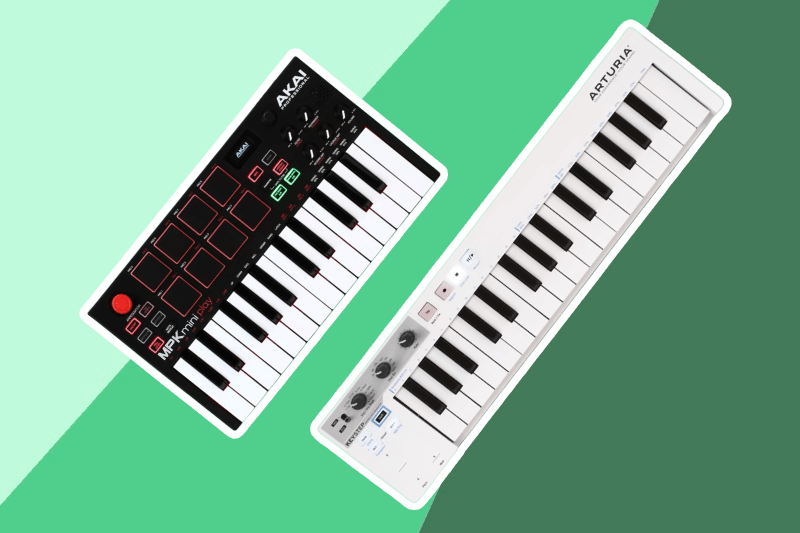
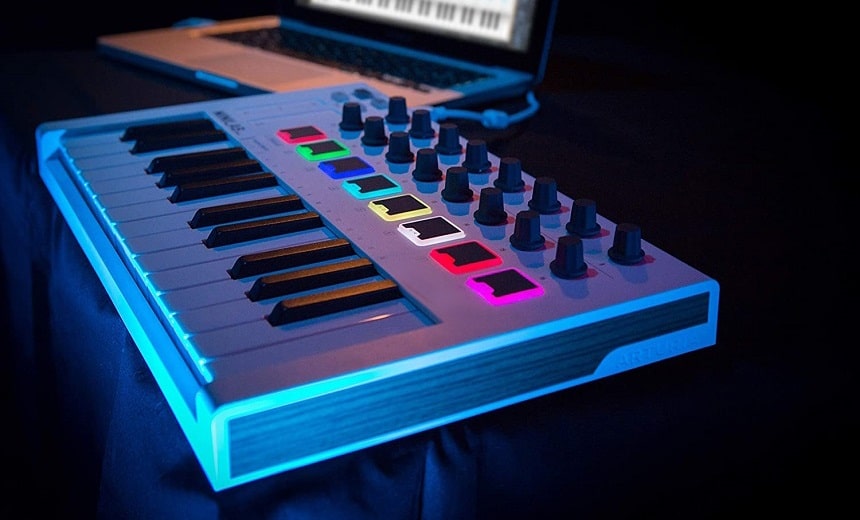
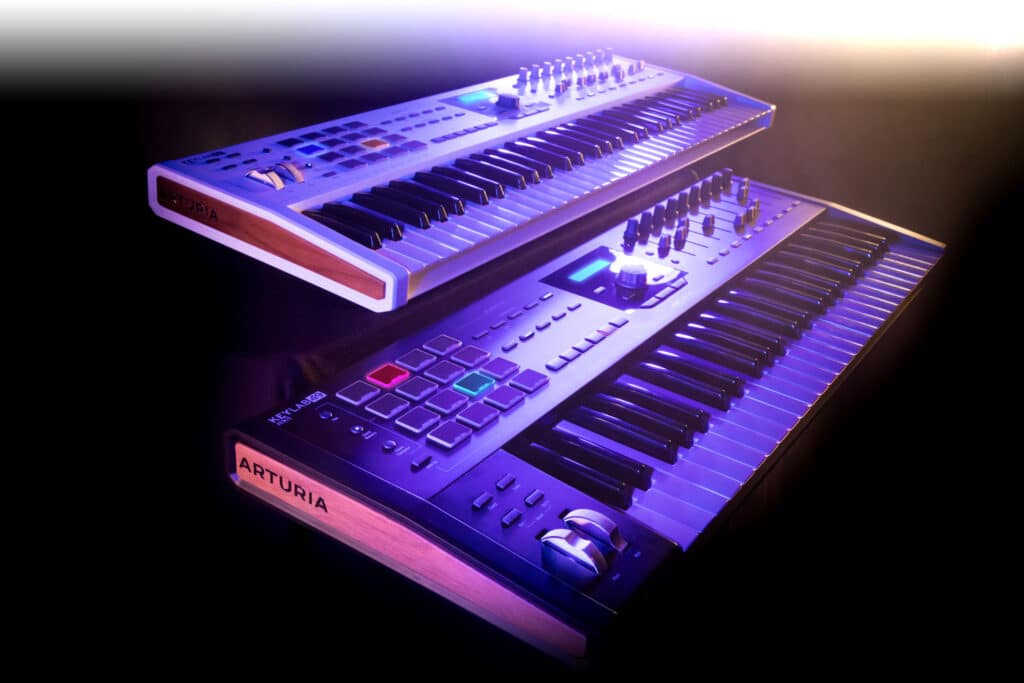
<p><strong>Pros</strong> of an electronic keyboard, compared to an acoustic (wood and wire) piano:<br />
<em>•	Generally, much less expensive. </em><br />
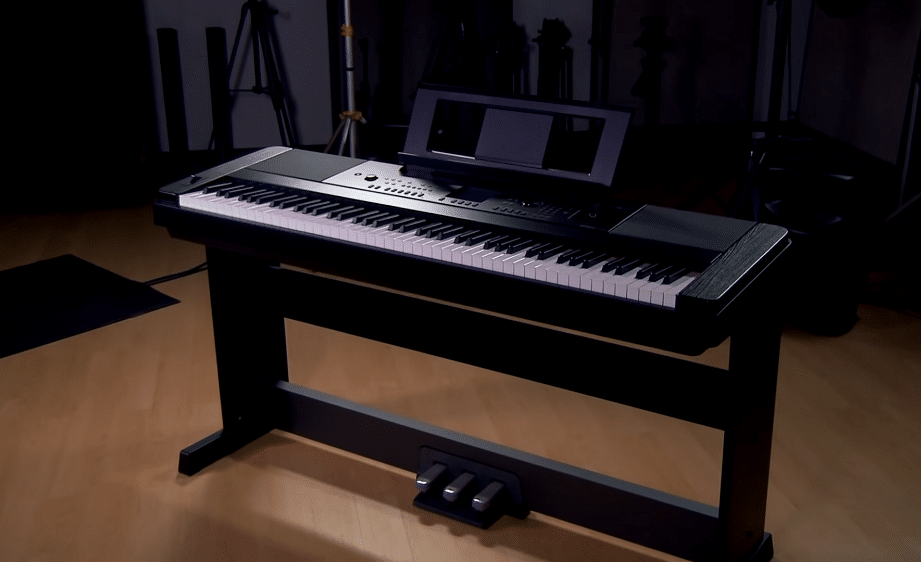
The top-end electronic keyboards, like the Clavinova, are still quite expensive, however.</p>
<p><em>•	Smaller, lighter, easier to store and move.  </em><br />
Again, some of the top-end keyboards are not exactly what you’d call “portable,” and certainly wouldn’t fit in a closet; but are still smaller and lighter than even upright pianos.  </p>
<p><em>•	Not as sensitive to environmental conditions.</em><br />
You don’t have to be as picky about where you place it.  Temperature, humidity, heating &#038; cooling vents, outside walls…  No need to be concerned about these when deciding where to put your electronic keyboard.</p>
<p><em>•	Less expensive to own, going forward.</em><br />
Does not need to be tuned, adjusted, or otherwise <a href="http://playpianotips.com/blog/piano-tlc-protect-your-investment/">maintained by a technician </a>on a regular basis.  </p>
<p><em>•	Less bothersome to people other than the pianist.</em><br />
Can be played in “silent” mode, so as not to disturb the neighbors.  (Usually, the player wears headphones to hear herself practice.)</p>
<p><em>•	Versatile in the sounds it can produce. </em><br />
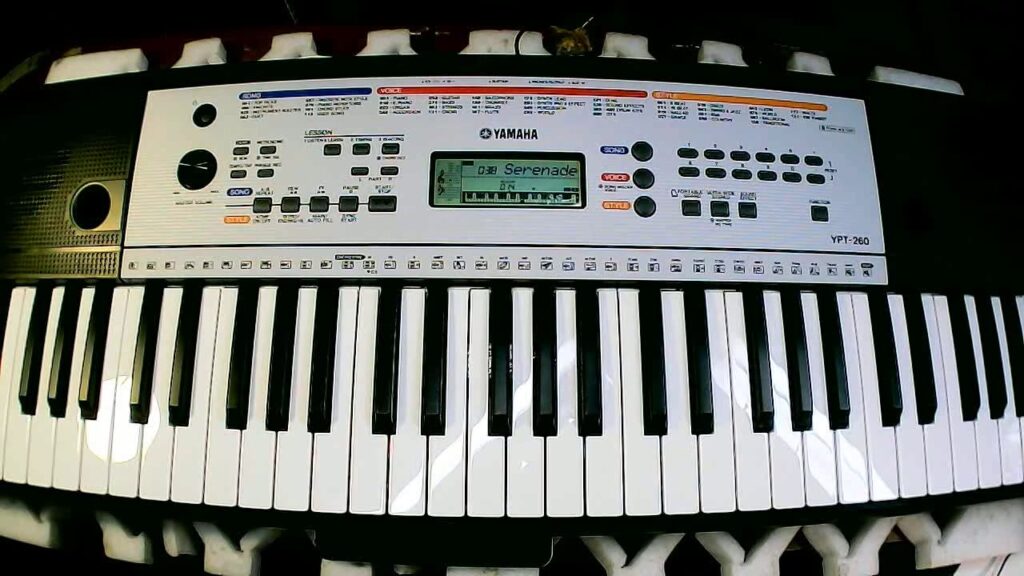
Can reproduce the sound of a wide range of instruments, not just the piano.  This can come in handy in an ensemble.</p>
<p><em>•	Recordable.  </em><br />
The top-end keyboards can be programmed to “remember” a performance and replay it at the touch of a button.  This can be helpful, for example, if you want to accompany yourself singing, but are not quite sure you’re ready to sing and play at the same time. </p>
<p>Why do some piano teachers consider electronic keyboards inferior to acoustic pianos?  </p>
<p>Here are some of the <strong>Cons</strong> that make them say so:<br />
<em>•	Lesser sound quality.  </em><br />
While the sound quality on high-end, modern machines is much improved from earlier efforts, it’s still an electronic tone.  The richness, depth, and harmonic overtones produced by the acoustic piano’s physical wires vibrating cannot really be reproduced by electronic means.     </p>
<p><em>•	Less realistic “touch.”  </em><br />
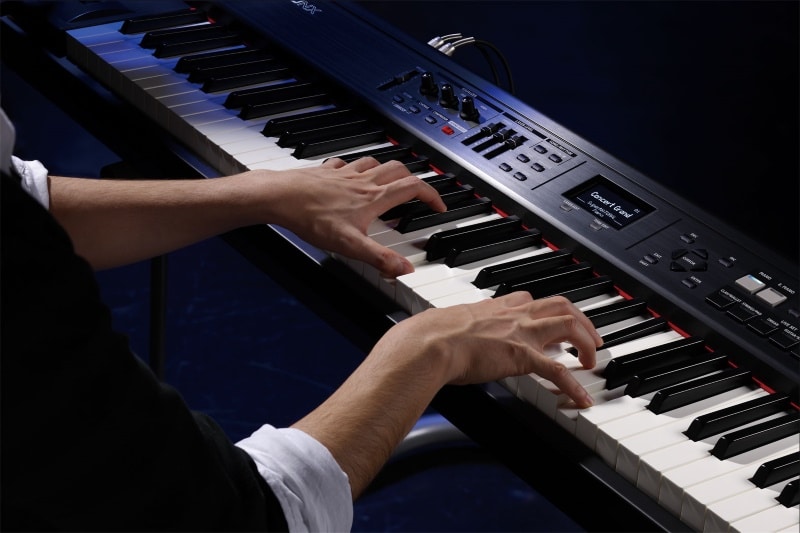
This is the quality of the feedback the keys give to your fingers when you’re playing an acoustic piano.  In an acoustic piano, there is in fact a direct mechanical linkage between your finger’s motion and the production of a note.  It’s a subtle feeling, but a real one.  Again, the electronic keyboards, while much improved, still cannot fully reproduce this experience.    </p>
<p>Do these things really matter?  To some piano teachers, they do.  I know one piano teacher who insists that her students obtain a “real” piano for home practice, and won’t accept them as students if they plan to use an electronic one.  </p>
<p>For many beginning students, the subtleties of tone and touch will be lost on them.  And, for students who want to move on to contemporary music, such as a rock band, the electronic keyboard is quite well accepted in these genres.  Later, if you end up performing in places where you don’t know if the venue will have a piano, or what condition or tuning it will be in, you might like to have a more movable instrument, so you can take it with you.  You can’t exactly schlep an acoustic piano around in the back of your minivan. </p>
<p>On the other hand, if you really stick with your piano studies, eventually these issues of tone and touch <em>will</em> matter to you.  When that happens, are you going to want to purchase a second instrument?  </p>
<p>All of these issues need to be considered before you make your purchase.  In the end, only you – in consultation with your own piano teacher – can decide which instrument to buy in order to reach your goals as a pianist.</p>
]]></content:encoded>
			<wfw:commentRss>http://playpianotips.com/blog/electronic-keyboards-pros-and-cons/feed/</wfw:commentRss>
		<slash:comments>0</slash:comments>
		</item>
		<item>
		<title>test</title>
		<link>http://playpianotips.com/blog/test/</link>
		<comments>http://playpianotips.com/blog/test/#comments</comments>
		<pubDate>Fri, 04 Sep 2009 05:05:36 +0000</pubDate>
		<dc:creator>Administrator</dc:creator>
				<category><![CDATA[Uncategorized]]></category>

		<guid isPermaLink="false">http://playpianotips.com/blog/test/</guid>
		<description><![CDATA[test
]]></description>
			<content:encoded><![CDATA[<p>test</p>
]]></content:encoded>
			<wfw:commentRss>http://playpianotips.com/blog/test/feed/</wfw:commentRss>
		<slash:comments>0</slash:comments>
		</item>
		<item>
		<title>The Piano in Pop, Rock, and Country</title>
		<link>http://playpianotips.com/blog/the-piano-in-pop-rock-and-country/</link>
		<comments>http://playpianotips.com/blog/the-piano-in-pop-rock-and-country/#comments</comments>
		<pubDate>Thu, 03 Sep 2009 17:30:44 +0000</pubDate>
		<dc:creator>Administrator</dc:creator>
				<category><![CDATA[Uncategorized]]></category>
		<category><![CDATA[blues]]></category>
		<category><![CDATA[contemporary]]></category>
		<category><![CDATA[contemporary music]]></category>
		<category><![CDATA[country]]></category>
		<category><![CDATA[country and western]]></category>
		<category><![CDATA[country music]]></category>
		<category><![CDATA[gospel]]></category>
		<category><![CDATA[instrument]]></category>
		<category><![CDATA[jazz]]></category>
		<category><![CDATA[keyboards]]></category>
		<category><![CDATA[learning piano]]></category>
		<category><![CDATA[music]]></category>
		<category><![CDATA[musical instruments]]></category>
		<category><![CDATA[piano]]></category>
		<category><![CDATA[piano lessons]]></category>
		<category><![CDATA[piano students]]></category>
		<category><![CDATA[pop]]></category>
		<category><![CDATA[popular music]]></category>
		<category><![CDATA[R&B]]></category>
		<category><![CDATA[rhythm & blues]]></category>
		<category><![CDATA[rhythm and blues]]></category>
		<category><![CDATA[rock]]></category>
		<category><![CDATA[rock music]]></category>
		<category><![CDATA[studying piano]]></category>

		<guid isPermaLink="false">http://playpianotips.com/blog/the-piano-in-pop-rock-and-country/</guid>
		<description><![CDATA[Up to this point in your piano career, you’ve probably studied classical music.  With any luck, you’ve learned to read music and play your scales.  You’ve learned some etudes, a sonatina or two, maybe Fur Elise.  So far, so good.  
But isn’t there some little part of you –  maybe [...]]]></description>
			<content:encoded><![CDATA[<p>Up to this point in your piano career, you’ve probably studied classical music.  With any luck, you’ve learned to read music and play your scales.  You’ve learned some etudes, a sonatina or two, maybe Fur Elise.  So far, so good.  </p>
<p>But isn’t there some little part of you –  maybe deep inside, maybe right out on the surface – that wants to play in a rock band?  Or some other contemporary ensemble?  Now how do you make that happen? </p>
<p>The fact is, you’re not going to walk up to a local jazz club, whip out your Scarlatti, and sit down and play a sonatina.  Let’s just say, that’s not in keeping with the style expected by the patrons there.  </p>
<p>Contemporary music – jazz, rock, pop, country, and so on – is a discipline all its own.  It has its own rules, its own conventions.  And to be an effective pianist in a contemporary ensemble, you’ll need to learn a few new tricks.  </p>
<p>For example, you’ll need to learn to read lead sheets (discussed in <a href="http://playpianotips.com/blog/accompany-yourself-on-the-piano/">my previous post</a>), and how to play in the chord piano style – that is, where you play the chords while another member of the ensemble has the melody.   At first you’ll just play the chords as written on your lead sheet.  But soon you’ll learn how to build an effective “chord progression” – that is, changing from one chord to another, in support of the melody – out of your own musical imagination.  And that will lead you straight to <a href="http://playpianotips.com/blog/wp-admin/post.php?action=edit&#038;post=123">improv</a>.  </p>
<p>You see, chord piano, chord progressions, accompaniment, and improv are all related skills.  And, they all build on the basic knowledge of keys, scales, chords, and theory.  (That’s why your teacher wanted you to practice all that “boring” stuff!)</p>
<p>Now chord piano sounds fairly simple when I describe it here, or in my previous post.  You just play the chords as you see them come up on the lead sheet.  And it is simple to learn the basic principles.  It’s one of those things where it’s simple to learn the basics, but it takes a lifetime to master.  There are always more embellishments you can learn to add.  And each contemporary style of music has its own favorite chords and chord progressions.  </p>
<p>For example, blues uses “blue notes” in its scales and chords.  The same is true of the many contemporary musical genres that grew out of the blues – R&#038;B, jazz, swing, rock, and so on.  Country has its own style and favored chord progressions.  So chord piano is not something you learn once and then move on.  There’s always something new to learn.</p>
<p>And, to play in a contemporary band of any sort, you’ll also need to learn good ensemble manners.  You’ll need to learn when to lead, when to follow, and when to get out of the way – and perform equally well in each of these roles.  Remember, in a contemporary band, it’s not so much about you.  It’s about the whole group.  </p>
<p>And chances are, it’s the vocalist who will be in the spotlight much of the time.  You’ll need to learn how to be a good accompanist, because you’ll often be playing an accompanying role.  Sometimes you’ll be accompanying the vocalist, and sometimes one of the other instruments will be playing a short solo.</p>
<p>So, to succeed as a pianist in contemporary music, you’ll need to be able to…<br />
•	Read lead sheets<br />
•	Play chord piano<br />
•	Fit into the ensemble<br />
•	Play an accompanying role<br />
•	Improvise</p>
<p>Anything else you’ll need?  </p>
<p>Enthusiasm!  Confidence!  You’ll need to love the music you’re getting into, and let that joy come out in your playing.   And once you can do that, the rest will fall into line.</p>
]]></content:encoded>
			<wfw:commentRss>http://playpianotips.com/blog/the-piano-in-pop-rock-and-country/feed/</wfw:commentRss>
		<slash:comments>0</slash:comments>
		</item>
		<item>
		<title>Accompany Yourself on the Piano</title>
		<link>http://playpianotips.com/blog/accompany-yourself-on-the-piano/</link>
		<comments>http://playpianotips.com/blog/accompany-yourself-on-the-piano/#comments</comments>
		<pubDate>Mon, 31 Aug 2009 15:33:15 +0000</pubDate>
		<dc:creator>Administrator</dc:creator>
				<category><![CDATA[Uncategorized]]></category>
		<category><![CDATA[accompanist]]></category>
		<category><![CDATA[accompany]]></category>
		<category><![CDATA[accompany yourself]]></category>
		<category><![CDATA[accompanying]]></category>
		<category><![CDATA[chord style]]></category>
		<category><![CDATA[chords]]></category>
		<category><![CDATA[instrument]]></category>
		<category><![CDATA[keyboards]]></category>
		<category><![CDATA[learning piano]]></category>
		<category><![CDATA[music]]></category>
		<category><![CDATA[musical instruments]]></category>
		<category><![CDATA[piano]]></category>
		<category><![CDATA[piano lessons]]></category>
		<category><![CDATA[piano students]]></category>
		<category><![CDATA[singing]]></category>
		<category><![CDATA[studying piano]]></category>
		<category><![CDATA[vocalists]]></category>

		<guid isPermaLink="false">http://playpianotips.com/blog/accompany-yourself-on-the-piano/</guid>
		<description><![CDATA[Have you ever wanted to accompany yourself or others while singing?  The desire to do so is one of the key motivations for a surprising number of piano students.  Yet so many students feel intimidated by this idea.  Some days, it seems hard enough to play the piano piece by itself.  [...]]]></description>
			<content:encoded><![CDATA[<p>Have you ever wanted to accompany yourself or others while singing?  The desire to do so is one of the key motivations for a surprising number of piano students.  Yet so many students feel intimidated by this idea.  Some days, it seems hard enough to play the piano piece by itself.  How will you ever learn to sing at the same time – and carry a tune?  </p>
<p>Don’t give up!  The ability to accompany yourself on the piano while singing is a skill like any other.  And like any skill, it can be taught.  (Didn’t I say the same thing about <a href="http://playpianotips.com/blog/piano-lessons-whos-afraid-of-improvisation/">improvisation</a> not too long ago?)  </p>
<p>If you already have a good grounding in piano basics, such as knowing the notes, knowing your scales, reading music – great!  You have a very firm foundation for learning how to accompany yourself.  Now you can learn to read a “lead sheet,” which is a kind of musical shorthand.  (Don’t worry, if you’ve already learned to read traditional music, you’ll find this a piece of cake.) </p>
<p>A lot of pop, rock, country, and other contemporary music is noted down in this non-classical format.  These lead sheets are collected in books called “fake books.”  In its simplest form, the lead sheet consists of a single line of notes that pick out the melody, accompanied by chord notations above.  </p>
<p>In accompanying yourself or others using a lead sheet approach, the vocalist takes the melody, and the accompanist plays the chords.  Pretty simple, really.  </p>
<p>But wait, you say, don’t you have to pick out the melody with the right hand, while singing it too?  Actually – and this is the big secret of accompanying yourself – you don’t.  In fact, it sounds better if you don’t.  </p>
<p>Remember, the goal of an accompanist – even when accompanying himself – should be to get out of the way of the vocalist.  The singer has the melody, the voice has the spotlight.  If the piano is plunking out the melody underneath, it pulls attention away from the voice.  </p>
<p>If you want to sound great when you’re accompanying yourself, you’ll need to try something called “chord piano.”  This is, as the name implies, a style of playing in which the piano plays primarily chords, and leaves the melody to the vocalists, or perhaps another instrument.  </p>
<p>Here’s what you need to do to accompany yourself and sound great doing it: </p>
<p>•	Learn to sing the melody (if you can’t do this, what’s the point?)<br />
•	Play the chords, as noted in the lead sheet, with your right hand<br />
•	With your left hand, play the roots – your left hand takes on the role of the string bass in a jazz trio</p>
<p>Not only will your music sound better this way, but it’s easier too!  All you have to do is look ahead on the lead sheet to the next chord that’s coming up, and pick out a bass line with your left hand.    </p>
<p>With a bit of practice and some guidance from your teacher, you too can learn to accompany yourself on the piano.</p>
]]></content:encoded>
			<wfw:commentRss>http://playpianotips.com/blog/accompany-yourself-on-the-piano/feed/</wfw:commentRss>
		<slash:comments>1</slash:comments>
		</item>
		<item>
		<title>Gershwin’s Rhapsody in Blue:  A Jazz Classic for Piano</title>
		<link>http://playpianotips.com/blog/gershwin%e2%80%99s-rhapsody-in-blue-a-jazz-classic-for-piano/</link>
		<comments>http://playpianotips.com/blog/gershwin%e2%80%99s-rhapsody-in-blue-a-jazz-classic-for-piano/#comments</comments>
		<pubDate>Wed, 26 Aug 2009 15:47:06 +0000</pubDate>
		<dc:creator>Administrator</dc:creator>
				<category><![CDATA[Uncategorized]]></category>
		<category><![CDATA[American]]></category>
		<category><![CDATA[blues]]></category>
		<category><![CDATA[classical]]></category>
		<category><![CDATA[concerto]]></category>
		<category><![CDATA[George Gershwin]]></category>
		<category><![CDATA[Gershwin]]></category>
		<category><![CDATA[jazz]]></category>
		<category><![CDATA[learning piano]]></category>
		<category><![CDATA[music]]></category>
		<category><![CDATA[piano]]></category>
		<category><![CDATA[piano concerto]]></category>
		<category><![CDATA[piano lessons]]></category>
		<category><![CDATA[piano repertoire]]></category>
		<category><![CDATA[piano rhapsody]]></category>
		<category><![CDATA[piano students]]></category>
		<category><![CDATA[rhapsody]]></category>
		<category><![CDATA[Rhapsody in Blue]]></category>
		<category><![CDATA[studying piano]]></category>

		<guid isPermaLink="false">http://playpianotips.com/blog/gershwin%e2%80%99s-rhapsody-in-blue-a-jazz-classic-for-piano/</guid>
		<description><![CDATA[In 1924, pianist and composer George Gershwin produced what has proven to be one of the most enduringly popular works of the piano repertoire:  The Rhapsody in Blue.  
It is somehow fitting that Gershwin, this child of immigrants, rising from humble beginnings, should have written what he himself described as a “musical kaleidoscope [...]]]></description>
			<content:encoded><![CDATA[<p>In 1924, pianist and composer George Gershwin produced what has proven to be one of the most enduringly popular works of the piano repertoire:  The <em>Rhapsody in Blue</em>.  </p>
<p>It is somehow fitting that Gershwin, this child of immigrants, rising from humble beginnings, should have written what he himself described as a “musical kaleidoscope of America.”  </p>
<p>The work is boisterous, exuberant – it defies classification.  Is it jazz?  Is it classical?  It’s a concerto, it’s a melting pot mishmash of folk tunes and jazz elements – and it’s absolutely brilliant.  What could exemplify the best of America better than this composer, and this work?  </p>
<p>Later critics, including no less a luminary than Leonard Bernstein, would criticize <em>Rhapsody in Blue </em>for what they saw as the chunkiness and clunkiness of the work.  &#8220;It has no overarching theme,&#8221; they said; &#8220;It’s just a slapdash collection of various individual themes jostling up against one another.&#8221;  </p>
<p>But that was Gershwin’s whole point.  That’s what this nation of immigrants is like.  In the space of five minutes in a large city, you could bump up against Jewish culture, Chinese culture, Irish culture, African-American culture – and somehow it all worked together to create a harmonious, even beautiful whole.  The same is true today.  Even those who don’t live in a big city bump into all those pieces of the whole in movies, radio, TV, and the internet.    </p>
<p>As I mentioned in my <a href="http://playpianotips.com/blog/george-gershwin-an-american-original/">previous post</a>, Gershwin wrote this amazing piece in only 5 weeks, at the request of his friend, the band leader Paul Whiteman.  Whiteman was organizing a concert of jazz and jazz-influenced music which he intended to call <em>An Experiment in Modern Music</em>.  He asked Gershwin to compose a concerto-like jazz piano work for the event.     </p>
<p>At first, Gershwin thought that he couldn’t produce such a major work in the short amount of time left before the concert.  But then, in a newspaper article about the upcoming concert of “experimental” music, Whiteman was quoted as saying, “George Gershwin is at work on a jazz concerto.”  Seeing this, Gershwin felt he had to deliver.  </p>
<p>Fortunately, during a train journey to Boston, Gershwin found inspiration in the rhythmic sounds of the train.  By the time he arrived in Boston, Gershwin had most of the piece composed in his head.  Working feverishly, he managed to finish it in time.   </p>
<p>The concert was held on February 12, 1924.  <em>Rhapsody in Blue </em>was second-to-last on the lengthy program, and the audience was quite restless by then.  But Gershwin’s work held them spellbound.</p>
<p>Much else that was premiered that day has long since been forgotten.  But generations of pianists – and concertgoers – have enjoyed the <em>Rhapsody in Blue </em>right up to the present day. </p>
<p>From the opening glissando of the clarinet to the glorious finale, the piece contains 5 distinct themes and a sixth “tag.”  All of the themes are written in some form of the “blues scale,” with its lowered sevenths and prevalent use of thirds, both major and minor.  Each theme is presented in various styles and with the frequent use of rubato, and is handled by both the solo piano and the orchestra at different times. </p>
<p>Gershwin’s respect for jazz and other popular music of his day is evident from his use of “blue notes,” his use of syncopation, and the inclusion of “vernacular” instruments such as banjo and saxophone.  He also presented various popular piano styles of the day, including stride piano, novelty piano, and comic or vaudeville piano, as well as the style of the song-plugger, which is where he got his professional start.  </p>
<p>Any pianist who can perform the <em>Rhapsody in Blue </em>demonstrates mastery of the instrument, in both classical and jazz styles.</p>
]]></content:encoded>
			<wfw:commentRss>http://playpianotips.com/blog/gershwin%e2%80%99s-rhapsody-in-blue-a-jazz-classic-for-piano/feed/</wfw:commentRss>
		<slash:comments>0</slash:comments>
		</item>
		<item>
		<title>George Gershwin: An American Original</title>
		<link>http://playpianotips.com/blog/george-gershwin-an-american-original/</link>
		<comments>http://playpianotips.com/blog/george-gershwin-an-american-original/#comments</comments>
		<pubDate>Tue, 25 Aug 2009 03:22:24 +0000</pubDate>
		<dc:creator>Administrator</dc:creator>
				<category><![CDATA[Uncategorized]]></category>
		<category><![CDATA[classical]]></category>
		<category><![CDATA[classics]]></category>
		<category><![CDATA[compositions]]></category>
		<category><![CDATA[concertos]]></category>
		<category><![CDATA[George Gershwin]]></category>
		<category><![CDATA[jazz]]></category>
		<category><![CDATA[jazz piano]]></category>
		<category><![CDATA[learning piano]]></category>
		<category><![CDATA[masterpieces]]></category>
		<category><![CDATA[music]]></category>
		<category><![CDATA[piano]]></category>
		<category><![CDATA[piano classics]]></category>
		<category><![CDATA[piano concertos]]></category>
		<category><![CDATA[piano lessons]]></category>
		<category><![CDATA[piano masterpieces]]></category>
		<category><![CDATA[piano music]]></category>
		<category><![CDATA[piano students]]></category>
		<category><![CDATA[Rhapsody in Blue]]></category>
		<category><![CDATA[studying piano]]></category>

		<guid isPermaLink="false">http://playpianotips.com/blog/george-gershwin-an-american-original/</guid>
		<description><![CDATA[Composer George Gershwin is among the best-known composers.  His style was uniquely American:  Big, boisterous, and an energetic fusion of old and new.  He typified the “melting pot” that was the America of his day.  
Born Jacob Gershovitz in 1898 to Russian Jewish immigrant parents, the boy who later became George [...]]]></description>
			<content:encoded><![CDATA[<p>Composer George Gershwin is among the best-known composers.  His style was uniquely American:  Big, boisterous, and an energetic fusion of old and new.  He typified the “melting pot” that was the America of his day.  </p>
<p>Born Jacob Gershovitz in 1898 to Russian Jewish immigrant parents, the boy who later became George Gershwin was no Mozart-like child prodigy.  He was inspired to begin music lessons after attending the violin recital of a young friend of his – at the ripe old age of 10.  </p>
<p>So much for the idea that you can’t amount to much, musically, unless you start piano before your feet can reach the pedals.</p>
<p>George’s parents had bought a piano for his older brother Ira, and at his request, allowed the younger boy to begin lessons.  Five years later, George Gershwin was ready to quit school and begin playing piano professionally.  </p>
<p>Command performances for the royalty of Europe?  Um, no.  Again, in contrast to Mozart, Gershwin began his professional career as a lowly “song plugger” – a pianist hired by a music company to demonstrate the latest songs available on sheet music.  In this way, perhaps, he developed an ear for popular music that would serve him well later.  </p>
<p>In 1916, when he was just 17 years old, Gershwin published his first song for the princely fee of $5.  Also in 1916, Gershwin began work for the Aeolian Company and Standard Music Rolls in New York City, making recordings, arranging, and composing under his own and assumed names.  </p>
<p>By 1920, Gershwin had begun to see commercial success for his compositions.  In 1924, he collaborated with older brother Ira on a musical called <em>Lady Be Good</em>, the first of many productive collaborations between the two brothers.  George handled the musical composition, while Ira wrote the dialogue and lyrics (the “book”).  </p>
<p>Also in 1924, George Gershwin wrote what is perhaps his most famous major piano work, the<em> Rhapsody in Blue</em>.  It is an American composition:  A 15-minute concerto for piano and full orchestra – containing clear elements of jazz, popular, and folk music woven into the very fabric of the piece.  Gershwin himself thought of it as &#8220;a kaleidoscope of America.&#8221;  </p>
<p>Gershwin wrote this amazing piece in only 5 weeks, and only reluctantly at that.  His friend, band leader Paul Whiteman, had requested a concerto-like jazz piano piece for a concert he wanted to put on called <em>An Experiment in Modern Music</em>.  The concert was held on February 12, 1924.   </p>
<p>Initially Gershwin refused, thinking that he couldn’t produce such a major work in the short amount of time allotted.  But after seeing a report in the newspaper that quoted Whiteman as saying, “George Gershwin is at work on a jazz concerto,” he felt he had to deliver.  And deliver he did.  </p>
<p>1924 was a busy year for young George.  This was also the year in which he traveled to Paris, seeking to study under master composers of the day.  Maurice Ravel, an admirer, famously refused to take him on as a student, fearing it would ruin the jazz influence that made Gershwin so unique.  While in Paris, Gershwin wrote another piece that has proved enduringly popular, the symphonic work <em>An American In Paris</em>.  </p>
<p>In 1935, Gershwin produced his most ambitious work, which he called a “folk opera,” <em>Porgy and Bess</em>.  This was based on the novel <em>Porgy</em>, by DuBose Heyward.  Heyward, with his wife, had previously adapted the novel to play form, and collaborated with Ira Gershwin to adapt the play to the operatic form.  </p>
<p>In 1937, Gershwin, then only 38 years old, began to experience blinding headaches.  Later in the year, he was diagnosed as having brain cancer, although the diagnosis of the exact kind of cancer since been questioned.  Following surgery for his tumor, George Gershwin died on July 11, 1937.  </p>
<p>Here Gershwin finally comes to resemble Mozart.  Not a child prodigy, not a performer for royalty.  Yet still a prolific composer of wildly popular music &#8212; and Gershwin, like Mozart, died too young.  </p>
]]></content:encoded>
			<wfw:commentRss>http://playpianotips.com/blog/george-gershwin-an-american-original/feed/</wfw:commentRss>
		<slash:comments>0</slash:comments>
		</item>
		<item>
		<title>Piano Lessons:  How to Improve Your Improvisation Skills</title>
		<link>http://playpianotips.com/blog/piano-lessons-how-to-improve-your-improvisation-skills/</link>
		<comments>http://playpianotips.com/blog/piano-lessons-how-to-improve-your-improvisation-skills/#comments</comments>
		<pubDate>Thu, 20 Aug 2009 15:28:06 +0000</pubDate>
		<dc:creator>Administrator</dc:creator>
				<category><![CDATA[Uncategorized]]></category>
		<category><![CDATA[improv]]></category>
		<category><![CDATA[improvisation]]></category>
		<category><![CDATA[improvise]]></category>
		<category><![CDATA[learn to improvise]]></category>
		<category><![CDATA[learning improv]]></category>
		<category><![CDATA[learning piano]]></category>
		<category><![CDATA[music]]></category>
		<category><![CDATA[piano]]></category>
		<category><![CDATA[piano improv]]></category>
		<category><![CDATA[piano lessons]]></category>
		<category><![CDATA[piano students]]></category>
		<category><![CDATA[studying piano]]></category>

		<guid isPermaLink="false">http://playpianotips.com/blog/piano-lessons-how-to-improve-your-improvisation-skills/</guid>
		<description><![CDATA[In my last post, I told you that you could learn to improvise at the piano.  I even shared with you some of my own story that explains why a pianist should learn improv.  
Now, I’ll be honest with you.  There’s only so much you can learn by reading what someone has [...]]]></description>
			<content:encoded><![CDATA[<p>In <a href="http://playpianotips.com/blog/piano-lessons-whos-afraid-of-improvisation/">my last post</a>, I told you that you could learn to improvise at the piano.  I even shared with you some of my own story that explains <em>why </em>a pianist should learn improv.  </p>
<p>Now, I’ll be honest with you.  There’s only so much you can learn by reading what someone has written about improvising at the piano.  You really need to watch and listen, and follow the example of a mentor who has been through it before.  That’s why I created <a href="http://www.playpianotips.com/">my homestudy course </a>with DVDs that demonstrate and explain more fully what you need to do.  </p>
<p>But here, I’ll share with you a few of the principles that I teach at greater depth in my course.  </p>
<p><strong>(1) Practice, practice, practice!</strong>  </p>
<p>I’m sure you’ve heard this before!  But it’s true of improv just as much as any other skill:  You’ll only improve if you practice.  </p>
<p><strong>(2) A solid grasp of the basics will help you learn to improvise much more quickly and effectively.</strong>  </p>
<p>This is because improv is really your own combination of the musical elements you’ve mastered.  The basic piano technique skills are like the words of your vocabulary; improv is like having a conversation.  </p>
<p>It’s free-flowing, and authentic to what you’re thinking and feeling at the moment.  But if you had never learned the words in the first place, you couldn’t express yourself in a conversation, could you?  And the more “words” you add to your musical vocabulary, the better able you’ll be to express yourself.  </p>
<p>For example:  Suppose you wanted to say “The man walked across the road.”  Great; you’ve expressed a basic concept.  But now suppose instead of the word <em>walked</em>, you used a word like <em>ambled</em>, or <em>sauntered</em>, or <em>plodded</em>, or <em>staggered</em>.  These words all mean some form of <em>walked</em>, but they each give the sentence a whole new meaning. </p>
<p>Improv on the piano is like that.  The more skills and techniques you know, the more meanings and emotions you’ll be able to put into your improvisation.  </p>
<p><strong>(3) So learn your scales!  Learn your chords.  Learn your theory. </strong> </p>
<p>You’ll put it all to work in your improv.  (Sorry if you thought improv meant you didn’t have to do all that!)</p>
<p>In my course, I’ll teach you all about how to use chords effectively in improv.  I’ll show you how knowing the key of a piece (that is, the scale) can help you improvise a great harmony for an existing melody, or even a pleasing melody itself.</p>
<p><strong>(4) You’ll also want to learn solfege, or the art of sight-singing.</strong>  </p>
<p>What does singing have to do with improvising at the piano, you ask?  </p>
<p>Well, solfege (sight-singing) will help you tremendously in learning to “play by ear.”  This ability is an important component of improvisation.  You’ll want to be able to “pick up” a tune and improvise around it.  In order to do this, you’ll need to know not only how to play chords and chord progressions on the piano, but also how to recognize them when you hear them.  You’ll need to learn to recognize chords and the intervals that make up arpeggiated chords.  And solfege helps you do this.  </p>
<p><strong>(5) Don’t forget to have fun!</strong>  </p>
<p>Take some of your piano practice time, and shut your music.  Just play around with some of your “musical vocabulary.”  Let your fingers express what you’re thinking and feeling.  And enjoy yourself.</p>
<p>You <em>can </em>learn to improvise.  Good luck!  </p>
]]></content:encoded>
			<wfw:commentRss>http://playpianotips.com/blog/piano-lessons-how-to-improve-your-improvisation-skills/feed/</wfw:commentRss>
		<slash:comments>0</slash:comments>
		</item>
		<item>
		<title>Piano Lessons: Who’s Afraid of Improvisation?</title>
		<link>http://playpianotips.com/blog/piano-lessons-whos-afraid-of-improvisation/</link>
		<comments>http://playpianotips.com/blog/piano-lessons-whos-afraid-of-improvisation/#comments</comments>
		<pubDate>Tue, 18 Aug 2009 03:17:50 +0000</pubDate>
		<dc:creator>Administrator</dc:creator>
				<category><![CDATA[Uncategorized]]></category>
		<category><![CDATA[improv]]></category>
		<category><![CDATA[improvisation]]></category>
		<category><![CDATA[improvising on the piano]]></category>
		<category><![CDATA[jazz]]></category>
		<category><![CDATA[jazz improv]]></category>
		<category><![CDATA[learning piano]]></category>
		<category><![CDATA[music]]></category>
		<category><![CDATA[musical instruments]]></category>
		<category><![CDATA[piano]]></category>
		<category><![CDATA[piano improv]]></category>
		<category><![CDATA[piano improvisation]]></category>
		<category><![CDATA[piano lessons]]></category>
		<category><![CDATA[piano students]]></category>
		<category><![CDATA[studying piano]]></category>

		<guid isPermaLink="false">http://playpianotips.com/blog/piano-lessons-whos-afraid-of-improvisation/</guid>
		<description><![CDATA[Want to know a secret about piano improvisation?  
Here it is:  The ability to improvise at the piano is a skill like any other – and like any other skill, it can be taught!  
The big question is, why do so many musicians think with regard to improvisation, “You’ve either got it [...]]]></description>
			<content:encoded><![CDATA[<p>Want to know a secret about piano improvisation?  </p>
<p>Here it is:  The ability to improvise at the piano is a skill like any other – and like any other skill, it can be taught!  </p>
<p>The big question is, why do so many musicians think with regard to improvisation, “You’ve either got it or you don’t”?  Why are so few pianists taught this skill during the many, many years they may have taken piano lessons?  </p>
<p>Have you taken many years of lessons?  Have you mastered a respectable amount of repertoire – yet you still feel paralyzed with fear if you do not have your music handy?  If friends make impromptu requests for you to play, do you lack confidence? </p>
<p>Believe it or not, I understand!  I had exactly the same experience.  I was so embarrassed at one such request that my mind went blank and I froze at the piano.  Eventually I told my friends I didn’t feel well and slunk off.  I was so upset after this, I vowed I would not let it happen again.  I started on my quest to learn improvisation skills.  </p>
<p>Now, I can play for my friends on request – I can even play in front of the entire congregation of my church!  Now, I have added improv skills to the lesson plan for all my students.  And, I developed a home study course to enable literally any pianist to learn this skill.  </p>
<p>I recommend <a href="http://www.playpianotips.com/">my course</a>, and not just to make a sale; I really want to help people learn a skill that, deep down, nearly all pianists wish they had.  That’s why I went into piano teaching in the first place – to help others learn.  The great thing about the internet, and digital technology in general, is that now I can teach people who can’t make it to my studio in person.    </p>
<p>The skill of improvisation is best taught by an example that you can watch and hear – whether a lesson in a studio, or on the DVDs that come with my study course.  But although what I can teach you from just written words is somewhat limited, I’ll mention a few of the principles here, and in my next post.</p>
<p>The main thing you need to know in order to improvise is that improvisation is not completely spontaneous!  It builds on tiny pieces of musical repertoire that you can learn – beginning with chords and scales.  (Ah-hah!  A good reason to practice your scales!)</p>
<p>So, knowing that, the first few steps to improvisation are…<br />
1. Know your scales.  If you don’t know them yet, learn them!<br />
2. Learn about chords.  Start with triad chords (chords that contain 3 notes).<br />
3. Spend some creative time at the piano &#8212; without music in front of you.  Play around with the notes and your technical skills.</p>
<p>Just like when you&#8217;re learning a language, you need to spend time on writing essays and composing sentences with vocabulary learned. Set aside some practice time during which you set aside your sheet music.  At first, you will probably find it difficult and awkward, maybe even boring.  But if you push through the challenge and keep practicing anyway, it will become natural and even fun.  You&#8217;ll be improvising!</p>
<p>Once you learn the principles of improv, you can explore jazz playing.  But you can also add flair to popular music, hymns, and so on.  If you learn the skill of improvisation at the piano, it will enhance your own enjoyment as a musician – and will make you the life of any party!</p>
]]></content:encoded>
			<wfw:commentRss>http://playpianotips.com/blog/piano-lessons-whos-afraid-of-improvisation/feed/</wfw:commentRss>
		<slash:comments>1</slash:comments>
		</item>
	</channel>
</rss><!-- Dynamic Page Served (once) in 0.511 seconds -->