<?xml version="1.0" encoding="UTF-8"?>
<feed xml:lang="en" xmlns="http://www.w3.org/2005/Atom" xmlns:opensearch="http://a9.com/-/spec/opensearch/1.1/" xmlns:s="http://jadedpixel.com/-/spec/shopify">
  <id>https://l2draw.com/blogs/news.atom</id>
  <link rel="alternate" type="text/html" href="https://l2draw.com/blogs/news"/>
  <link rel="self" type="application/atom+xml" href="https://l2draw.com/blogs/news.atom"/>
  <title>Learn to Draw Books - Learn to Draw</title>
  <updated>2019-03-25T02:48:00-06:00</updated>
  <author>
    <name>Learn to Draw Books</name>
  </author>
  <entry>
    <id>https://l2draw.com/blogs/news/how-to-draw-a-blue-eyed-darner-dragonfly-easily</id>
    <published>2019-03-25T02:48:00-06:00</published>
    <updated>2019-03-25T02:49:59-06:00</updated>
    <link rel="alternate" type="text/html" href="https://l2draw.com/blogs/news/how-to-draw-a-blue-eyed-darner-dragonfly-easily"/>
    <title>How to Draw a Blue-eyed Darner Dragonfly Easily</title>
    <author>
      <name>Adrian Sanqui</name>
    </author>
    <content type="html">
      <![CDATA[<p><img src="//cdn.shopify.com/s/files/1/0113/3209/1963/files/bd1_large.jpg?v=1553502723" alt=""></p>
<ul>
<li>Make reference lines in shape of a ‘t’.</li>
</ul>
<p>Draw a vertical line to define the length of the body, and then draw two slanted lines on both side from the upper area of the vertical line, forming a broken ‘t’. The slanted lines would represent the length of the forewings.</p>
<p><img src="//cdn.shopify.com/s/files/1/0113/3209/1963/files/bd2_large.jpg?v=1553502731" alt=""></p>
<ul>
<li>Use ovals of different length and sizes to define the body figure.</li>
</ul>
<p>The thickest part of the body should be the thorax/chest. Use a grain shaped oval for the thorax, and a thin oblong significantly longer than the thorax for the tail/abdomen. Add a half of a circle at the top for the head.</p>
<p><img src="//cdn.shopify.com/s/files/1/0113/3209/1963/files/bd3_large.jpg?v=1553502738" alt=""></p>
<ul>
<li>Draw the wings.</li>
</ul>
<p>The lower outlines of a dragonfly’s wings are usually rounder or more sloped than the upper outlines. the forewings are like a grain shaped oval split in half. Make two sloped lines coming from the upper center of the thorax and connect them to the tip of the diagonal lines. The hindwings are relatively thicker than the forewings. Start by drawing another pair of diagonal lines right below the previous ones. Unlike the forewings’ shape, the hindwings are more like quarter slices of apple with the thicker half of them resided at the center. Add the appendages or curved spikes at the tip of the abdomen while you’re at it.</p>
<p><img src="//cdn.shopify.com/s/files/1/0113/3209/1963/files/bd4_large.jpg?v=1553502745" alt=""></p>
<ul>
<li>Properly define the main outline of the dragonfly.</li>
</ul>
<p>Add some slight curves to the upper outlines of the wings. Connect each parts to obtain the proper outline of the dragonfly’s figure. Add the segments of the abdomen as well. These segments would create some ridges to the outline of the abdomen.</p>
<p> <img src="//cdn.shopify.com/s/files/1/0113/3209/1963/files/bd5_large.jpg?v=1553502752" alt=""></p>
<ul>
<li>Once the main outline of the dragonfly’s figure is made, erase the reference line marks.</li>
</ul>
<p>You need the figure clean so you could place the details neatly. Keep in mind that the division of the big eyes and other head features are also established by the vertical reference line. Add one more curve line on each segments of the abdomen, like rings tucked tightly around it.</p>
<p><img src="//cdn.shopify.com/s/files/1/0113/3209/1963/files/bd6_large.jpg?v=1553502759" alt=""></p>
<ul>
<li>Draw the inner details of the dragonfly.</li>
</ul>
<p>The details of a blue-eyed darners are intricate. Like most dragonflies, the veins on the from median –flexion line (upper portion of the wings) up to the upper margins are closer to one another. The veins don’t spread much and all leads to the tip of the wings, while the veins starting from the middle and across the rest of the wings are arced and spread downwards. The thorax has small spots and patches uniform on both sides. Smaller dots are aligned at the center and longer markings are near the sides.</p>
<p>Each sections of the segmented abdomen mostly has three markings. It is ringed with  bars outlining the segments, and the bars meet at the center of each segments like intersecting spikes and arcs. the abdomen also has a thin marking that intersects each segments. The last 3 sections could have a different mark formations. The third of the last sections has more like a heart-shaped form instead of rings, while the second and last sections could have semi-triangular bars.</p>
<p><img src="//cdn.shopify.com/s/files/1/0113/3209/1963/files/bd7_large.jpg?v=1553502769" alt=""></p>
<ul>
<li>Once you are satisfied with the line work, retrace them using a pen.</li>
</ul>
<p>Replace the outlines using a permanent marker. The outlines defining the shape of the dragonfly should be thicker, while the inner outlines of the details and prints should be retraced by thinner and finer line marks.</p>
<p><img src="//cdn.shopify.com/s/files/1/0113/3209/1963/files/bd8_large.jpg?v=1553502778" alt=""></p>
<ul>
<li>Color some of the rings on the segments of the tail with black, and shade the other black sections as well while you’re at it.</li>
</ul>
<p>Beginning from the tip of he thorax, blacken the intersecting rings on each segments of the abdomen. Take note that not all the rings would intersect (like the second segment) and not all have the same thickness. Darken the mouth and define the dark bar on the upper margin of the wings (pterostigma) .</p>
<p><img src="//cdn.shopify.com/s/files/1/0113/3209/1963/files/bd9_large.jpg?v=1553502789" alt=""></p>
<ul>
<li>Apply the blue color of the blue-eyed darner.</li>
</ul>
<p>Remember that the wings are transparent, so you would color across it. Use two shades of blue to convey the dimensions of the dragonfly. Use something like sky blue or azure for the brighter tone, and steel blue for a darker value. Color the small markings and the lowest section of the thorax, so as the lower sections of the abdomen segments. The mouth should also be blue. Fill these sections with the bright blue, and then overlap the round edges with the darker blue value.</p>
<p><img src="//cdn.shopify.com/s/files/1/0113/3209/1963/files/bd10_large.jpg?v=1553502796" alt=""></p>
<ul>
<li>Color the eyes and some portions across the body.</li>
</ul>
<p>The eyes have a different shade of blue compared to the body. Use royal blue as a base color, then shade the edges with a darker tone like steel blue. Add some shimmer on the eyes using cerulean blue.  Use pale blue on the small areas rowed the abdomen as well.</p>
<p><img src="//cdn.shopify.com/s/files/1/0113/3209/1963/files/bd11_large.jpg?v=1553502803" alt=""></p>
<ul>
<li>Fill the remaining areas of the body with brown.</li>
</ul>
<p>Color the rest of the remaining areas of the body with brown. Use a value like umber brown.</p>
<p><img src="//cdn.shopify.com/s/files/1/0113/3209/1963/files/bd12_large.jpg?v=1553502809" alt=""></p>
<ul>
<li>Add darker values on the brown areas to convey the contour shape of the body.</li>
</ul>
<p>Overlap the edges of the brown areas using a darker tone like umber brown. The thorax has ridges and shallow slopes. This can be contour by applying the dark brown below the inner outlines of the details. The brown areas would look better if it has a warmer mid tone. apply a faint layer of caramel brown where the darker and brighter brown meet, especially on the segments of the abdomen.</p>
<p><img src="//cdn.shopify.com/s/files/1/0113/3209/1963/files/bd13_large.jpg?v=1553502816" alt=""></p>
<ul>
<li>Finally, finish the drawing by adding faint shades.</li>
</ul>
<p>With a very light hand stroke, apply some shades to the wings by following the veins to section them out. apply some finished shades on the body as well, especially on the edges of next to the main outlines. And you are done drawing a blue-eyed darner.</p>
<p><img src="//cdn.shopify.com/s/files/1/0113/3209/1963/files/bdarner_large.jpg?v=1553502846" alt=""></p>
<p>More step-by-step drawing tutorials are available in our books <a href="https://l2draw.com/collections/drawing-for-beginners">https://l2draw.com/collections/drawing-for-beginners</a>. Each book is categorized by different subjects for drawing, all explained in a way that non-experienced individuals could easily follow and learn to draw.</p>]]>
    </content>
  </entry>
  <entry>
    <id>https://l2draw.com/blogs/news/how-to-draw-a-monarch-butterfly-easily</id>
    <published>2019-03-25T01:21:00-06:00</published>
    <updated>2019-03-25T01:21:16-06:00</updated>
    <link rel="alternate" type="text/html" href="https://l2draw.com/blogs/news/how-to-draw-a-monarch-butterfly-easily"/>
    <title>How to Draw a Monarch Butterfly Easily</title>
    <author>
      <name>Adrian Sanqui</name>
    </author>
    <content type="html">
      <![CDATA[<div><img src="//cdn.shopify.com/s/files/1/0113/3209/1963/files/mb1_large.JPG?v=1553497582" alt=""></div>
<ul>
<li>Draw a vertical line with a round pinhead.</li>
</ul>
<p>The vertical line defines the body length of the butterfly, and the pinhead is the size of its head.</p>
<p> <img src="//cdn.shopify.com/s/files/1/0113/3209/1963/files/mb2_large.JPG?v=1553497587" alt=""></p>
<ul>
<li>Define the outline of the forewings and the thickness of the body.</li>
</ul>
<p>From the upper center of the vertical line, draw an inverted ‘V’. Extend  this outline with a pair of diagonal outlines, making a wide spread ‘W’ symbol. This would be the lower outline of the butterfly’s forewings. Complete the outline of the forewings by Making two curves coming from below the head  extending to the ends of the ‘W’.  Define the thickness of the body while making a shallow curve that separates the upper body to the lower body, like two intersecting grains.</p>
<p><img src="//cdn.shopify.com/s/files/1/0113/3209/1963/files/mb3_large.JPG?v=1553497594" alt=""></p>
<ul>
<li>Define the hindwings.</li>
</ul>
<p> Draw two curved lines coming from the sides of the body like halves of ovals. The length should be longer than the tail/abdomen of the butterfly by a little.  Extend the slopes to the outer sides of the forewings’ lower center (nearly at the center tip of the ‘W’ figure). now you have the shape of the forewings. Draw the linings of the abdomen and apply the head features of the butterfly as well.</p>
<p><img src="//cdn.shopify.com/s/files/1/0113/3209/1963/files/mb4_large.JPG?v=1553497600" alt=""></p>
<ul>
<li>Draw the details of the wings.</li>
</ul>
<p>The details of the monarch butterfly’s wings are very ornate and the contrast in colors make the each parts very recognizable. the sections or cells of the wings are round edged bars divided by the veins. There are at least three distinguishable cells surrounding the center cell or the discal cell on the forewings, and more but shorter ones at the hindwings. (the ones nearest to the area that connects to the body). The costal margins or the edges of the wings have small random patches.</p>
<p>To easily establish the details of the wings, draw the discal cells in tear drop shapes, and make at least five divisions with curved lines spreading outwards to the edges of the wings.</p>
<p><img src="//cdn.shopify.com/s/files/1/0113/3209/1963/files/mb5_large.JPG?v=1553497606" alt=""></p>
<ul>
<li>Retrace the outlines with a permanent marks.</li>
</ul>
<p>Once you are satisfied with the main outlines and the details, redefine the markings using a pen or any permanent marker. Use thicker lines for the main outlines of the figure, and thinner line marks for the inner details. And then erase all the pencil markings to prepare for coloring.</p>
<p><img src="//cdn.shopify.com/s/files/1/0113/3209/1963/files/mb6_large.JPG?v=1553497611" alt=""></p>
<ul>
<li>Apply the first base color of the monarch butterfly.</li>
</ul>
<p>Using a dull charcoal black, color all the areas excluding the cells and the spots. Keep in mind the you will darken some small areas later, so the dark value you use should not be the darkest.</p>
<p><img src="//cdn.shopify.com/s/files/1/0113/3209/1963/files/mb7_large.JPG?v=1553497617" alt=""></p>
<ul>
<li>Color the cells with the second base color.</li>
</ul>
<p>The cells of the monarch butterfly’s wings are basically orange. Use a slightly brighter tone of orange like apricot and fill all the cells including the larger patches on the apex of the forewings (the 3 bars nearest to the upper edge of the wings).</p>
<p><img src="//cdn.shopify.com/s/files/1/0113/3209/1963/files/mb8_large.JPG?v=1553497625" alt=""></p>
<ul>
<li>Make some shadows.</li>
</ul>
<p>Using a darker shade of black, apply some shadows on the overlapped areas beneath the lower edges of the forewings and the sides of the body.</p>
<p><img src="//cdn.shopify.com/s/files/1/0113/3209/1963/files/mb9_large.JPG?v=1553497631" alt=""></p>
<ul>
<li>Apply a brighter orange tone.</li>
</ul>
<p>The orange color of the monarch butterfly near the body on the hindwings are usually brighter. Using an orange color with a paler or brighter value, brighten the upper sides of some of the cells on the hindwings.</p>
<p><img src="//cdn.shopify.com/s/files/1/0113/3209/1963/files/mb10_large.JPG?v=1553497637" alt=""></p>
<ul>
<li>Apply a stronger tone of orange and finish the drawing.</li>
</ul>
<p>Use a warmer tone of orange, like red orange, to darken the edges of the orange areas.  Make your final retouches, and you’re done drawing a monarch butterfly.</p>
<p><img src="//cdn.shopify.com/s/files/1/0113/3209/1963/files/monarch_large.jpg?v=1553497643" alt=""></p>
<p>If you are interested in other drawing tutorials about several topics, take a look at our books. <a href="https://l2draw.com/collections/drawing-for-beginners">https://l2draw.com/collections/drawing-for-beginners</a>. All the books are meant to teach and guide individuals who have no experience in drawing. The tutorials are explained thoroughly so anyone could easily follow through and  learn draw different subjects.</p>]]>
    </content>
  </entry>
  <entry>
    <id>https://l2draw.com/blogs/news/how-to-draw-a-red-capped-manakin</id>
    <published>2019-03-25T01:02:00-06:00</published>
    <updated>2019-03-25T01:02:56-06:00</updated>
    <link rel="alternate" type="text/html" href="https://l2draw.com/blogs/news/how-to-draw-a-red-capped-manakin"/>
    <title>How to Draw a Red-capped Manakin</title>
    <author>
      <name>Adrian Sanqui</name>
    </author>
    <content type="html">
      <![CDATA[<p>The adorable red-capped manakin, also called ceratopipra mentalis, mostly eat fruits. Red-capped manakins are sheltered within the ranges of Mexico, and to the rain forests of Ecuador. Females are could grow relatively larger than males. Aside from the silky black coat and, as the name suggests, a red head, there are those who also have portions of yellow feathers covering the thighs and a small patch under the  chin. There are also those with faint stripes of white on their wings.</p>
<p>Now, let's draw a red-capped manakin.</p>
<p><img src="//cdn.shopify.com/s/files/1/0113/3209/1963/files/rcm1_large.jpg?v=1553496096" alt=""></p>
<ul>
<li>Begin by establishing the size of the body and the head.</li>
</ul>
<p>Draw an oval to convey the size of the bird’s body. once the size of the body is defined, add half of a sphere to represent the head. make a cross reference mark on the head to establish the direction where the head should be facing.</p>
<p><img src="//cdn.shopify.com/s/files/1/0113/3209/1963/files/rcm2_large.jpg?v=1553496103" alt=""></p>
<ul>
<li>Draw the wings and the facial features of the bird.</li>
</ul>
<p>The beak is basically triangular shape with a slope the connects to the head while the other half sticks out. The upper half of the beak should be positions right on the upper half of the cross reference line’s very center. The eye which is exposed is just horizontally aligned to it.</p>
<p>The wings are basically a half of an oval, overlapping more than half of the body. due to the angle, you only need to draw one, while only a small portion of the other wing could be seen. Add the feet of the bird with simple lines for now.</p>
<p><img src="//cdn.shopify.com/s/files/1/0113/3209/1963/files/rcm3_large.jpg?v=1553496115" alt=""></p>
<ul>
<li>Establish the layers of the wings and the thickness of the legs.</li>
</ul>
<p>The wings of a red-capped manakin is covered with two feather textures; the ones which are visually definitive  feather shaped and a thick layer of fur-like strands which also covers the rest of the body. the furry texture covers the upper portion of the wings which connects to the body.</p>
<p>To easily place the feathers of the wings, make three curved reference lines in rows.  The first lines which represents the furry feathers should slope inwards, overlapping the second reference line which represents the coverts. Make a bunch of slanted lines on the last row to represent the layer of primary and secondary wing feathers. Define the thickness of the legs. </p>
<p><img src="//cdn.shopify.com/s/files/1/0113/3209/1963/files/rcm4_large.jpg?v=1553496124" alt=""></p>
<ul>
<li>Draw the feathers and add texture to the main outlines.</li>
</ul>
<p>Follow to the reference line you have made to easily draw the rowed layers of feathers. Replace the main outlines of the figure with slightly jagged lines to portray a feathery texture.</p>
<p><img src="//cdn.shopify.com/s/files/1/0113/3209/1963/files/rcm5_large.jpg?v=1553496128" alt=""></p>
<ul>
<li>Erase the sketch marks and other unnecessary markings.</li>
</ul>
<p>prepare the drawing for inking. If you are already confident with your main outlines, you can already proceed to the next step. If not, just do this step first by redefining the outlines with finer line strokes. Clean up the drawing by erasing all the unnecessary markings such as the reference marks and the base forms. You should only be left with the main outlines. this is the final stage which you can make any adjustments that you need. Apply a few short thin lines on the back to portray  the texture.</p>
<p><img src="//cdn.shopify.com/s/files/1/0113/3209/1963/files/rcm6_large.jpg?v=1553496135" alt=""></p>
<ul>
<li>Re-do the main outline using permanent line marks.</li>
</ul>
<p>Carefully retrace the main outlines with a pen or any fine-point permanent marker. The lines should be smooth and clean. Now you can proceed to coloring.</p>
<p><img src="//cdn.shopify.com/s/files/1/0113/3209/1963/files/rcm7_large.jpg?v=1553496141" alt=""></p>
<ul>
<li>Apply the base color of the body.</li>
</ul>
<p>Excluding the head, carefully fill up the body with a very deep gray tone (dim gray).</p>
<p><img src="//cdn.shopify.com/s/files/1/0113/3209/1963/files/rcm8_large.jpg?v=1553496150" alt=""></p>
<ul>
<li>Apply the base color of the head.</li>
</ul>
<p>For the head, use the very basic red color.</p>
<p><img src="//cdn.shopify.com/s/files/1/0113/3209/1963/files/rcm9_large.jpg?v=1553496156" alt=""></p>
<p>With the two base colors in place, you will use different tones or grades on each of them to convey the dimensions and texture of the bird. At this point, you will only use very light hand strokes as you color over the base colors.</p>
<ul>
<li>Add a darker tone to the head.</li>
</ul>
<p>Use a slightly darker shade of red, which could be a crimson red or firebrick red,  to portray the texture of the head. Apply very light strokes coming from the beak and curving outwards. Add a few short strokes to the back of the head as well in a same manner.</p>
<p><img src="//cdn.shopify.com/s/files/1/0113/3209/1963/files/rcm10_large.jpg?v=1553496161" alt=""></p>
<ul>
<li>Add a darker tone to the body.</li>
</ul>
<p>To depict the shadows cast by the overlapping portions of the feathers and the soft texture of the body, you will use a darker tone that is darker than dim gray which is already dark. In this case, you will need something like charcoal gray (also called charcoal black) which is a bit duller and subtly brighter than an ordinary black tone.</p>
<p><img src="//cdn.shopify.com/s/files/1/0113/3209/1963/files/rcm11_large.jpg?v=1553496167" alt=""></p>
<ul>
<li>Color the smaller portions.</li>
</ul>
<p>The legs of a red-capped manakin is basically wood brown with taints of cedar brown, while the beak could be a pale peanut brown or grayish brown.</p>
<ul>
<li>Apply the darkest tone of the red area.</li>
</ul>
<p>Create more depth to the dimensions of the figure by adding another darker tone of red (on the head), with multiple thin line strokes coming from the beak but not reaching the forehead nor the cheek.</p>
<p><img src="//cdn.shopify.com/s/files/1/0113/3209/1963/files/rcm12_large.jpg?v=1553496172" alt=""></p>
<ul>
<li>Elaborate the texture by adding the darkest tones of the body and a few line strokes of a brighter tone.</li>
</ul>
<p>Lastly, use black to darken the areas that should appear darker, such as the cast shadows under the wing and under the beak. </p>
<p><img src="//cdn.shopify.com/s/files/1/0113/3209/1963/files/rcm13_large.jpg?v=1553496177" alt=""></p>
<p><img src="//cdn.shopify.com/s/files/1/0113/3209/1963/files/rcm14_large.jpg?v=1553496185" alt=""></p>
<p>Add a few very thin strokes of cool gray or bluish gray on the edges of the few wing feathers, and also make some short fur lines at the back. And you’re done drawing a red-capped manakin.</p>
<p><img src="//cdn.shopify.com/s/files/1/0113/3209/1963/files/rcm_large.jpg?v=1553496194" alt=""></p>
<p>More examples for drawing birds of different kinds are available in the book "How to Draw Birds for Kids" . </p>
<p><a href="https://l2draw.com/products/how-to-draw-birds-for-kids"><img src="//cdn.shopify.com/s/files/1/0113/3209/1963/files/Drawing_Birds_cover_1024x1024_2x_7ce96b37-dd41-496d-9b9c-621517874fbf_large.jpg?v=1553497234" alt=""></a></p>
<p> </p>]]>
    </content>
  </entry>
  <entry>
    <id>https://l2draw.com/blogs/news/how-to-draw-a-bulldog</id>
    <published>2019-03-03T17:39:00-07:00</published>
    <updated>2019-03-05T10:19:55-07:00</updated>
    <link rel="alternate" type="text/html" href="https://l2draw.com/blogs/news/how-to-draw-a-bulldog"/>
    <title>How to Draw a Bulldog</title>
    <author>
      <name>Adrian Sanqui</name>
    </author>
    <content type="html">
      <![CDATA[<p>One of the most recognized kind of dog is the bulldog. You don’t even have to like dogs to know what this one looks like.  If you watched the cartoon Tom and Jerry, you probably remember the father and son characters Spike and Tyke. Spike, also referred to as Butch, is the big and muscular bulldog with the red studded collar who often beats up Tom. And his son, Tyke, was often underestimated by the cat and always end up being beaten by his Dad. It is usually portrayed as a strong bulky character in movies or cartoons, and there is a pretty good reason for it.</p>
<p>Here's an example of how to draw a bulldog.</p>
<p><img src="//cdn.shopify.com/s/files/1/0113/3209/1963/files/bulldog1_large.jpg?v=1551658766" alt=""></p>
<ul>
<li>Draw an oval for the base of the body and a sphere for the head.</li>
</ul>
<p>This unique-looking bulldog has a relatively thick body and a wide head. the thickness of its body makes up for its relatively short height. To start, draw an oval for the body and a sphere with reference lines for the head. Due to the position of the dog, the sphere should slightly overlap the oval (foreshortening the neck).</p>
<p><img src="//cdn.shopify.com/s/files/1/0113/3209/1963/files/bulldog2_large.jpg?v=1551658777" alt=""></p>
<ul>
<li>Draw the short yet thick legs of the bulldog.</li>
</ul>
<p>Due to its thick body, the legs are widely separated from each other. The front legs are usually slightly slanted so its short legs could support its heavy body. Add four oblongs to represent the four legs. Position each oblong accordingly, without any one of them being in contact of each other (specially in this angle).</p>
<ul>
<li>Draw the face.</li>
</ul>
<p>The facial features of a bulldog are quite distinct. The loose skin on its short muzzle turns it into somewhat an inverted heart shape or simply a triangular sphere with a slope at the lower side. Use the reference lines as a guide for positioning the facial features. The mouth is cast downwards like an inverted ‘U’. because of the angle and the short muzzle, the nose would appear closer to the eyes. The ears diagonally aligned to the eyes are usually either crumpled or folded.</p>
<p><img src="//cdn.shopify.com/s/files/1/0113/3209/1963/files/bulldog3_large.jpg?v=1551658781" alt=""></p>
<ul>
<li>Draw a slanted line from the back of the dog and to back of the head, this would thicken the neck. Define the outline properly once all parts are placed (including the very short tail which is barely seen in this angle.)</li>
</ul>
<p><img src="//cdn.shopify.com/s/files/1/0113/3209/1963/files/bulldog4_large.jpg?v=1551659213" alt=""></p>
<ul>
<li>Add some details portraying the loose skin of the bulldog.</li>
</ul>
<p>Put a few thin lines to convey the ridges and folds of the body, especially on the face. The skin fold on top of the bulldog’s nose is what gives the muzzle its shape. Define the thick brow line that gives the face a bit of a frowned expression. Add a few more short lines on the forehead as wrinkles, and some on the chest as well.</p>
<p><img src="//cdn.shopify.com/s/files/1/0113/3209/1963/files/bulldog5_large.jpg?v=1551658788" alt=""></p>
<ul>
<li>Retrace your pencil outlines.</li>
</ul>
<p>Re-define the main outlines of the dog’s figure with a pen or any fine point marker. Remember that you should only use thin line marks for the inner outlines of the body (the wrinkles and the skin folds).</p>
<p><img src="//cdn.shopify.com/s/files/1/0113/3209/1963/files/bulldog6_large.jpg?v=1551658794" alt=""></p>
<p>Once you are done inking, erase all the pencil markings so you'll be left with only the important outlines.</p>
<p><img src="//cdn.shopify.com/s/files/1/0113/3209/1963/files/bulldog7_large.jpg?v=1551658802" alt=""></p>
<ul>
<li>Add some shades to the body to define its dimensions.</li>
</ul>
<p>Use a gray color to add shades on the inner edges of the figure’s outline, and also on the overshadowed portions such as the farther legs. </p>
<p><img src="//cdn.shopify.com/s/files/1/0113/3209/1963/files/bulldog8_large.jpg?v=1551658808" alt=""></p>
<p>And then add a very thin layer of shading to the body to convey the dimensions. Basically, the shades should lighten until it diminishes when it reaches the areas that should be brighter due to its curved surface (central area of the body and legs). On the head, remember that the folds and the ridges should have a brighter tone from the face to emphasize it.</p>
<p><img src="//cdn.shopify.com/s/files/1/0113/3209/1963/files/bulldog9_large.jpg?v=1551658814" alt=""></p>
<ul>
<li>Apply the body details.</li>
</ul>
<p>Bulldogs varies in different colors and color patterns. The colors are different shades and distributions of red (which is basically brownish orange), black and white. They could have two to three colors on their body, and there are also those that are solid or single toned. the color patterns also vary from two to three colors of brindled colors (combination of two colors) and face markings or piebald patterns (patches of a different color on a base color). The most common color pattern is a two toned bulldog with a base color of white and large patches of a different color.</p>
<p><img src="//cdn.shopify.com/s/files/1/0113/3209/1963/files/bulldog10_large.jpg?v=1551658820" alt=""></p>
<p> </p>
<p>Since you already applied shades on the body, it can already be considered as a white base color and you only need to apply the patches next.</p>
<p>Start with a light tone of a second color. For a brown tone, you can use something like a cedar brown. Use this to place where you want the patches to be. For the mid tone, apply something like a mocha brown. To establish the curves or dimensions of the areas that the patches are covering, apply a darker tone like umber brown coming from the outlines of the figure.</p>
<p><img src="//cdn.shopify.com/s/files/1/0113/3209/1963/files/bulldog11_large.jpg?v=1551658826" alt=""></p>
<p> </p>
<ul>
<li>Make your finishing touches and color the other small portions that are left, such as the facial features, and you’re done drawing a bulldog.</li>
</ul>
<p><img src="//cdn.shopify.com/s/files/1/0113/3209/1963/files/bulldog12_large.jpg?v=1551658832" alt=""></p>
<p>More examples are available in the book "How to Draw Dogs for Kids".</p>
<p><span>This book contains several examples about drawing different kinds of dogs, with each little step carefully explained so the young reader could easily follow through. From composing the figure using a combination of simple shapes, and up to applying the colors. The steps are designed in a way that can be applied to either digital drawing (drawing on a tablet) or traditionally (drawing on a paper). </span></p>
<p><a href="https://l2draw.com/products/copy-of-how-to-draw-dogs-for-the-absolute-beginner"><span><img src="//cdn.shopify.com/s/files/1/0113/3209/1963/files/How_to_Draw_Dogs_for_Kids_cover_1024x1024_2x_a77a2e77-b614-423e-a8ae-66948e6d647a_large.jpg?v=1551659858" alt=""></span></a></p>
<p> </p>
<p> </p>]]>
    </content>
  </entry>
  <entry>
    <id>https://l2draw.com/blogs/news/how-to-draw-a-german-shepherd</id>
    <published>2019-03-03T17:14:00-07:00</published>
    <updated>2019-03-05T10:20:48-07:00</updated>
    <link rel="alternate" type="text/html" href="https://l2draw.com/blogs/news/how-to-draw-a-german-shepherd"/>
    <title>How to Draw a German Shepherd</title>
    <author>
      <name>Adrian Sanqui</name>
    </author>
    <content type="html">
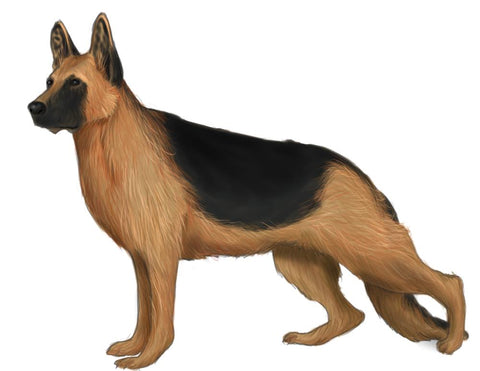
      <![CDATA[<p>. The German shepherd, as the name suggests, is a breed of dog that is local to Germany and was trained to herd sheep. It was bred for a simple task at first, but people realized that this dog’s potential and intelligence could be applied to far more difficult tasks. It was also referred to as Alsatian, or the Alsatian wolf dog  (as a dog from Alsace) in Ireland and great Britain.</p>
<p>Now, here's an example of how to draw one.</p>
<p><img src="//cdn.shopify.com/s/files/1/0113/3209/1963/files/ger1_large.jpg?v=1551657003" alt=""></p>
<ul>
<li>Initially establish the body proportions.</li>
</ul>
<p>The lower body of a German shepherd is observably lower than the front, this makes the outline of his back slanted than arced (like other dogs’). The body is relatively wide on the front then narrows down noticeably. In this kind of body structure, the semi-conical oval representing the oval must be slightly tilted while the top of the sphere representing the lower body levels with it, creating a slanted alignment. The sphere for the head is relatively small. Set the cross reference line a bit higher than the center.</p>
<p><img src="//cdn.shopify.com/s/files/1/0113/3209/1963/files/ger2_large.jpg?v=1551657010" alt=""></p>
<ul>
<li>Establish the length of the limbs and position the facial features.</li>
</ul>
<p>Position the limbs. The standing position of a German shepherd usually looks like it's almost in a squat position, and this makes the hind legs appear in a broken ‘L’ position with the hock strongly protruding on the back. Initially establish the folds and length of the limbs including the tail.</p>
<p>Place the facial feature using the cross reference lines as a guide. The muzzle is relatively thick on the base and then narrows down as it sticks out. the eyes are aligned with the bridge of the muzzle, and the erected triangular ears are diagonally aligned with the eyes.</p>
<p><img src="//cdn.shopify.com/s/files/1/0113/3209/1963/files/ger3_large.jpg?v=1551657020" alt=""></p>
<ul>
<li>Draw the main outline of the figure.</li>
</ul>
<p>Using the base figure, establish the main outline of the dog while conveying texture. Apply a few subtle ridges, especially on the lower sides and the tail. define the prominent cheekbones and subtle fluffs outlining the neck.</p>
<p><img src="//cdn.shopify.com/s/files/1/0113/3209/1963/files/ger4_large.jpg?v=1551657027" alt=""></p>
<ul>
<li>Clean up the drawing.</li>
</ul>
<p>Remove the base figures and all the other line markings you no longer need to prepare for coloring.</p>
<p><img src="//cdn.shopify.com/s/files/1/0113/3209/1963/files/ger5_large.jpg?v=1551657033" alt=""></p>
<ul>
<li>Fill the figure with its base color.</li>
</ul>
<p>The most known bi-colored kind of a German shepherd is the black and tan, with the tan fur covering the most of the body and combined with black markings. Use a light shade of brown like cream brown or dark tan.</p>
<p><img src="//cdn.shopify.com/s/files/1/0113/3209/1963/files/ger6_large.jpg?v=1551657039" alt=""></p>
<ul>
<li>Convey the dimensions using a darker value.</li>
</ul>
<p>Add a faint layer of shades on the on the edges of the outlines a tone like light bronze. Also apply this shade on the overlapped areas such as the farther legs, farther ear and portions of the tail. convey the contour of the head by applying a shade under the cheek, sides of the muzzle and eye sockets.</p>
<p><img src="//cdn.shopify.com/s/files/1/0113/3209/1963/files/ger7_large.jpg?v=1551657046" alt=""></p>
<ul>
<li>Apply the body markings.</li>
</ul>
<p>Using a dull kind of black, (charcoal black), make a big saddle-shaped mark on the back that extends far on the side part of the body. This might also extend on the upper part of the tail. the ears and the face is also usually black. Apply a thin layer of black from the outline of the brows and to the entire muzzle, and also behind the ears.</p>
<p><img src="//cdn.shopify.com/s/files/1/0113/3209/1963/files/ger8_large.jpg?v=1551657054" alt=""></p>
<ul>
<li>Apply the small details of the facial features and begin to convey the furry texture starting with the head.</li>
</ul>
<p>Darken the inner sides of the ears with the deepest shade coming from the ear canal. Use it to describe the concave dimensions and ripples on the ear flaps.</p>
<p>German shepherds have dense fur coat made of thick short strands. To portray this easily, you will use finer lighter hand strokes to make thin short lines. The strands are cast downwards, but make sure that you flow with the contour shape of the dog. Use stronger tones with finer and sharper lines. apply strands of rust brown to a reddish amber brown on the cream brown/tan surface.</p>
<p><img src="//cdn.shopify.com/s/files/1/0113/3209/1963/files/ger9_large.jpg?v=1551657060" alt=""></p>
<ul>
<li>Use lighter and darker values with stronger strokes and finer lines.</li>
</ul>
<p>For a lighter value, use a paler tone like sandy brown or anything with a hint of lighter cream tone. In contrast to the lighter strands, apply strands using a basic brown tone.</p>
<p><img src="//cdn.shopify.com/s/files/1/0113/3209/1963/files/ger10_large.jpg?v=1551657067" alt=""></p>
<ul>
<li>Elaborate the fur texture even further.</li>
</ul>
<p>Keep on adding more strands while adjusting the values a bit more. Add longer lines to make the coating appear more natural. Slightly overlap the black areas with the strands of brown tones.</p>
<p><img src="//cdn.shopify.com/s/files/1/0113/3209/1963/files/ger11_large.jpg?v=1551657076" alt=""></p>
<ul>
<li>Add more values of darker and lighter tones on the texture.</li>
</ul>
<p>Apply a very faint strands of a brighter tone with a leans towards a lighter cream tone, something like a brownish flesh tone or a brownish peach. Add strands of coffee brown, mostly on the areas that already has a darker shade (shadowed areas).</p>
<p><img src="//cdn.shopify.com/s/files/1/0113/3209/1963/files/ger12_large.jpg?v=1551657083" alt=""></p>
<ul>
<li>Add your final retouches and apply another layer of shading.</li>
</ul>
<p>Reinforce the dimensions of the figure by re-darkening the areas that should appear darker. This would blend all the textures and tones of the drawing with the shape more effectively.</p>
<p><img src="//cdn.shopify.com/s/files/1/0113/3209/1963/files/ger13_large.jpg?v=1551657089" alt=""></p>
<p>And you're done illustrating a German shepherd.</p>
<p>More examples and tips are available in the book "How to Draw Dogs for the Absolute Beginner". All the steps in each examples are thoroughly explained, so a non-experienced person could easily follow and learn to draw. </p>
<p><a href="https://l2draw.com/products/copy-of-how-to-draw-birds-for-kids"><img src="//cdn.shopify.com/s/files/1/0113/3209/1963/files/How_to_Draw_Dogs_cover_1024x1024_2x_446e88ea-32a4-403e-bb8d-2b06d8b35c4a_large.jpg?v=1551658294" alt=""></a></p>
<p>For other drawing books about drawing, visit the entire books collection <a href="https://l2draw.com/collections">https://l2draw.com/collections</a></p>
<p> </p>]]>
    </content>
  </entry>
  <entry>
    <id>https://l2draw.com/blogs/news/how-to-draw-a-stegosaurus</id>
    <published>2019-02-28T20:12:00-07:00</published>
    <updated>2019-02-28T20:14:21-07:00</updated>
    <link rel="alternate" type="text/html" href="https://l2draw.com/blogs/news/how-to-draw-a-stegosaurus"/>
    <title>How to Draw a Stegosaurus</title>
    <author>
      <name>Adrian Sanqui</name>
    </author>
    <content type="html">
      <![CDATA[<p>The family of stegosaurs are heavy dinosaurs with wide and relatively long Bodies. Their backs/spines are arced or observably rounded which makes the shapes of their trunks either leaf-shaped or a perfect half of a circle. Their head shapes are usually oval with slender snouts and are small, almost seemingly disproportionate to their large bodies.</p>
<p><img src="//cdn.shopify.com/s/files/1/0113/3209/1963/files/stegosaurs_large.jpg?v=1551409004" alt=""></p>
<p>The most well-known of their kind is the stegosaurus, and here's a simple process of how to draw one.</p>
<p><img src="//cdn.shopify.com/s/files/1/0113/3209/1963/files/stg1_large.jpg?v=1551409010" alt=""></p>
<ul>
<li>Establish the mass.</li>
</ul>
<p>Create a base to easily establish the mass and proportions of the subject. The body of a stegosaurus is pretty much like in a shape of a teardrop with the thicker side on the rear. use a combination of spheres to easily establish the proportions of the leg, with the back legs being observably larger than the front legs. Being thicker and longer, the back legs should be leveled higher than the front legs. In comparison, the sphere representing the knee of the back leg is almost just as big as the sphere of the front leg’s thickest portion.  The base of the head could be just a quarter of an oval, held by a relatively long neck. The length of the tail is relatively the same length of the base/trunk (I decided to curve it down, although the tails are usually held above the level of the head).</p>
<p><img src="//cdn.shopify.com/s/files/1/0113/3209/1963/files/stg2_large.jpg?v=1551409016" alt=""></p>
<p>Once you established the size and proportions of the body, sketch the bony plates and the spikes of the tail. The biggest plates are often portrayed at the middle of the spine/back and then they rapidly decrease in size as both sides reach the neck and the tail.</p>
<p><img src="//cdn.shopify.com/s/files/1/0113/3209/1963/files/stg3_large.jpg?v=1551409022" alt=""></p>
<p> </p>
<ul>
<li>Properly establish the main outline and clean up the drawing.</li>
</ul>
<p>Redefine the main outline of the figure and erase the sketch marks and the base forms that you used. You need the figure clean, regardless of whether you will remove it later or not, so you can properly apply the primary shades (since most of them would be close to the edges).</p>
<p><img src="//cdn.shopify.com/s/files/1/0113/3209/1963/files/stg4_large.jpg?v=1551409027" alt=""></p>
<ul>
<li>Apply the primary shades.</li>
</ul>
<p>Convey the dimensions and the subtle details of the subject via shades. portray the subtle traces of the rib cage and muscle linings of the body using faint mid-tone shading with very light hand strokes. Apply some shades on the edges of the main outline to depict its contour shape somehow, and then shade the farther sides and overlapped portions for the shadows. If you are drawing traditionally, make sure that you smear the shades smoothly and evenly (you should always smear and even out the primary shading).</p>
<p><img src="//cdn.shopify.com/s/files/1/0113/3209/1963/files/stg5_large.jpg?v=1551409034" alt=""></p>
<ul>
<li>Start applying the primary colors. Choose the main color/colors that you want for your dinosaur and start applying the first layer of coloring. remember to adjust the brightness/darkness value depending on the area you are applying it to.</li>
</ul>
<p>Convey the shallow slopes and any subtly receded areas of the figure through the values of the main color (the middle section of the trunk being lighter then gets darker as it goes up to the back, the subtle shift of dark to light values around and over the thigh and shoulder, etc.). And of course, the farther and overlapped portions should appear darker. Just use your primary shading as a guide to how dark the farther portions should be. Remember that the overlapped areas should have the darkest values of the color among the rest, as they should have shadows on the sides of the farther plates and the upper areas of the farther limbs right below the trunk).</p>
<p><img src="//cdn.shopify.com/s/files/1/0113/3209/1963/files/stg6_large.jpg?v=1551409038" alt=""></p>
<ul>
<li>Add the other details.</li>
</ul>
<p>Once you are satisfied if the toning of your primary color, you could now add in any body prints or patterns. Just makes sure that you blend or flow these patterns with the contour shape of your subject.</p>
<p><img src="//cdn.shopify.com/s/files/1/0113/3209/1963/files/stg7_large.jpg?v=1551409044" alt=""></p>
<ul>
<li>Darken the value and elaborate the details.</li>
</ul>
<p>Generally decrease the brightness of each values. If you are drawing traditionally, a very light run of a used cotton or whatever you used for smudging/smearing (assuming that it is stained enough). Applying these murky and thin layer of shade is ideal with gray soft charcoal, as it won’t overpower the colors (best-suited for colored pencils or even an already dried water-coloring) and you could always regain the tones using a kneaded eraser. But if you are drawing digitally, just simply make another layer over all the previous layers and drop down the opacity of the layer or the brush to low.</p>
<p><img src="//cdn.shopify.com/s/files/1/0113/3209/1963/files/stg8_large.jpg?v=1551409050" alt=""></p>
<ul>
<li>Add a few more subtle (darker) tones to serve as an accent and finalize the drawing.</li>
</ul>
<p>By darkening the tones, it would be easier to elaborate the wrinkles of the skin and any other details of its texture (since you somehow gained back a brighter value). Use a kneaded eraser (or even the brighter tone of the primary color) to create or re-create the wrinkles and skin folds, and use a darken color close to the primary color to add in a few more deeper folds and complementing subtle shadows for the previous ones.</p>
<p> </p>
<p>If you wish to see more examples with more detailed guides of how to draw dinosaurs, grab a copy of "Drawing Dinosaurs - How to Draw Dinosaurs for Absolute Beginners". <a href="https://l2draw.com/products/drawing-dinosaurs-how-to-draw-dinosaurs-for-absolute-beginners">https://l2draw.com/products/drawing-dinosaurs-how-to-draw-dinosaurs-for-absolute-beginners</a></p>
<p><img src="//cdn.shopify.com/s/files/1/0113/3209/1963/files/Drawing_Dinosaurs_Cover_1024x1024_2x_eb802465-d0c1-4795-a0ec-451b1949481b_large.jpg?v=1551409811" alt=""></p>]]>
    </content>
  </entry>
  <entry>
    <id>https://l2draw.com/blogs/news/how-to-draw-a-cartoon-velociraptor</id>
    <published>2019-02-28T19:53:00-07:00</published>
    <updated>2019-02-28T19:53:33-07:00</updated>
    <link rel="alternate" type="text/html" href="https://l2draw.com/blogs/news/how-to-draw-a-cartoon-velociraptor"/>
    <title>How to Draw a Cartoon Velociraptor</title>
    <author>
      <name>Adrian Sanqui</name>
    </author>
    <content type="html">
      <![CDATA[<p>Compared to its bigger brothers, the velociraptor has a slender head. the arms are long and proportionate to its body (unlike the t-rex’s), and its often folded like a bird wing. Its tail is long (slightly longer than the trunk) and is stiff. The non-flexibility of the tail helps it to balance its weight. the neck is comparatively longer than a t-rex’s. just like most dinosaurs of this kind, its body is leaned forward when it stands to even out its weight.</p>
<p><img src="//cdn.shopify.com/s/files/1/0113/3209/1963/files/ve1_large.jpg?v=1551407561" alt=""></p>
<ul>
<li>Draw an oval for the base of the body, and then a smaller oval for the head.</li>
</ul>
<p>Use simple straight lines for lengths and folds of the legs, tail and arms. The legs should have three folds, from thigh to knee and from heel to toes. The arms also have three folds, from shoulder to elbow and wrist to fingers. Take note that a raptor is in a slightly crouched position.</p>
<p><img src="//cdn.shopify.com/s/files/1/0113/3209/1963/files/ve2_large.jpg?v=1551407569" alt=""></p>
<ul>
<li>Start defining the thickness of the legs and the arms.</li>
</ul>
<p>Just follow the folds of the lines you drew earlier so you’ll know when to change thickness. The calves of the legs are rounded and a bit muscular but the thighs should obviously be thicker. The toes of a raptor are thick and spread apart from each other. the arms are fairly slender.</p>
<p> </p>
<p><img src="//cdn.shopify.com/s/files/1/0113/3209/1963/files/ve3_large.jpg?v=1551407574" alt=""></p>
<ul>
<li>Complete the outlines of the raptor by drawing the upper portions.</li>
</ul>
<p>Add more thickness to the head and the facial features. the oval base (for the head) should only occupy the muzzle and the eyes (with the side of the lower curve as the jaw line). The neck is thinner from the shoulder then widens as it connects to the head. the tail is pointed and stiff. And then add the sharp claws of the feet.</p>
<p><img src="//cdn.shopify.com/s/files/1/0113/3209/1963/files/ve4_large.jpg?v=1551407579" alt=""></p>
<ul>
<li>Erase the base (ovals and first line marks) so you’d be left with only a clean outline of the dinosaur’s shape.</li>
</ul>
<p><img src="//cdn.shopify.com/s/files/1/0113/3209/1963/files/ve5_large.jpg?v=1551407587" alt=""></p>
<ul>
<li>Add the feathers of the raptor.</li>
</ul>
<p>Put some feather lining to the top of the head and below the tail. Make some layers of feathers sticking out from the back of the arm. They should only be short and few (not an entire wing).</p>
<p><img src="//cdn.shopify.com/s/files/1/0113/3209/1963/files/ve6_large.jpg?v=1551407594" alt=""></p>
<ul>
<li>Once you are done with the pencil outlines, start re-tracing them with pen or a marker. Start with the main shape of the raptor using thick/solid lines, and then use fine lines for inking the feathers.</li>
</ul>
<p><img src="//cdn.shopify.com/s/files/1/0113/3209/1963/files/ve7_large.jpg?v=1551407600" alt=""></p>
<ul>
<li>Add some more feathery texture.</li>
</ul>
<p>Now we are going to create the body prints differently since the raptor is feathered. To portray this kind of texture, you would need to make the print outlines with thin continual lines also known as “hatches” in drawing. Short thin lines that are tightly close to one another and changes in angle to make a turn. Just simply start with a row of horizontal lines and the gradually turn the line horizontally as you get closer to the edge. These hatches would replace the fine outlines for the body marks/prints.</p>
<p><img src="//cdn.shopify.com/s/files/1/0113/3209/1963/files/ve8_large.jpg?v=1551407606" alt=""></p>
<p>When you are finally done with the inking, apply the darkest tone of the main color to the edges of the outlines. Remember the division of each areas carefully, this could be a little tricky since they are divided differently.</p>
<p><img src="//cdn.shopify.com/s/files/1/0113/3209/1963/files/ve9_large.jpg?v=1551407610" alt=""></p>
<ul>
<li>When you are done applying the dark tone of the main color to the edges, fill these respective areas with a brighter tone of the same color.</li>
</ul>
<p>Now we are going to use two tone of the same color once again. This time, it would be for the color of the legs (from knee to toe). I would also apply this second color to the belly area of the raptor.</p>
<p><img src="//cdn.shopify.com/s/files/1/0113/3209/1963/files/ve10_large.jpg?v=1551407617" alt=""></p>
<ul>
<li>Apply thee dark tone of the second color to the side edges of the legs’ outlines and also at the sides of the belly.</li>
</ul>
<p><img src="//cdn.shopify.com/s/files/1/0113/3209/1963/files/ve11_large.jpg?v=1551407623" alt=""></p>
<ul>
<li>Now fill these areas with the second color’s brighter tone. They should be the middle areas of the legs and the upper portion of the belly.</li>
</ul>
<p>The area of the belly is almost hidden by the feathers of the arms, be careful not to exceed from the outline.</p>
<p><img src="//cdn.shopify.com/s/files/1/0113/3209/1963/files/ve12_large.jpg?v=1551407629" alt=""></p>
<ul>
<li>Choose a third color and apply them on two parts of the body prints. You can also choose different colors on each if you like. I wanted mine to have one color for each paired areas of the bordered sections.</li>
</ul>
<p><img src="//cdn.shopify.com/s/files/1/0113/3209/1963/files/ve13_large.jpg?v=1551407635" alt=""></p>
<p>Just continue the coloring process for the body prints on a same manner. Choose a pair of areas and apply the colors.</p>
<ul>
<li>Apply your third chosen color to another pair of the bordered sections. Take note that when you are coloring areas that are bordered by hatches(continuous thin short lines)  then you should also apply colors to the borders as well because they have little gaps in between the short lines.</li>
</ul>
<p><img src="//cdn.shopify.com/s/files/1/0113/3209/1963/files/ve14_large.jpg?v=1551407640" alt=""></p>
<ul>
<li>Finally, finish the coloring by applying your fourth chosen color (for the last pair of bordered sections and for the feathers of the raptor. Just simply color the long curved claws with dark gray and you’re done.</li>
</ul>
<p>You can put some background to your drawing if you wish, as long as your main drawing is completely colored already.</p>
<p><img src="//cdn.shopify.com/s/files/1/0113/3209/1963/files/ve15_large.jpg?v=1551407651" alt=""></p>
<p>For more examples of how to draw cartoon dinosaurs, grab a copy of "Drawing Dinosaurs for Kids"  <a href="https://l2draw.com/products/drawing-dinosaurs-for-kids-a-step-by-step-dinosaur-drawing-guide-for-kids">https://l2draw.com/products/drawing-dinosaurs-for-kids-a-step-by-step-dinosaur-drawing-guide-for-kids</a></p>
<p><img src="//cdn.shopify.com/s/files/1/0113/3209/1963/files/Drawing_Dino_for_Kids_cover_1024x1024_2x_e424571e-d633-42aa-907b-f38036a0c59f_large.jpg?v=1551408688" alt=""></p>
<p> </p>]]>
    </content>
  </entry>
  <entry>
    <id>https://l2draw.com/blogs/news/how-to-draw-fan-shape-pavements</id>
    <published>2019-02-26T23:11:00-07:00</published>
    <updated>2019-02-26T23:11:20-07:00</updated>
    <link rel="alternate" type="text/html" href="https://l2draw.com/blogs/news/how-to-draw-fan-shape-pavements"/>
    <title>How to Draw Fan-shape Pavements</title>
    <author>
      <name>Adrian Sanqui</name>
    </author>
    <content type="html">
      <![CDATA[<p>Fan-shaped tiles are often seen on parks, in combination to setts and cobbles. Drawing it could be a bit tricky since these are curved quarter of circles made of square tiles. The trick is to understand the layout.The evenness of each fan shape can be made by starting with circles rowed properly.</p>
<p>Basically, the quarter half of a circle should be overlapped by the quarter halves of the other circles. </p>
<p><img src="//cdn.shopify.com/s/files/1/0113/3209/1963/files/pf1_5f095800-e345-482f-9703-9ac0b685ffc1_large.jpg?v=1551245870" alt=""></p>
<ul>
<li>Divide the area into three rows (or more, depending on the number of fans you will make).</li>
<li>Make a row of circles. Find the center (of the circles) and make a reference line.</li>
</ul>
<p><img src="//cdn.shopify.com/s/files/1/0113/3209/1963/files/pf2_6e58af42-d239-4c4a-bbca-5a31e3cac8bc_large.jpg?v=1551245876" alt=""></p>
<ul>
<li>The second row of circles will start from below or above the reference line you made (the center line of the first row of circles), and then mark a reference line on the lower half of the first row. (the upper half of the second row) This will be the center of the third row of the circles that will alternate the column of the first and second row. This reference line can be located easily by marking an ‘X’ on the columns created by the reference line (center line) of the first and second row. The intersections of the ‘X’s would be the center of the circles’ halves.</li>
</ul>
<p><img src="//cdn.shopify.com/s/files/1/0113/3209/1963/files/pf3_3a7d8637-852c-43cc-9bae-ecabc913ff09_large.jpg?v=1551245884" alt=""></p>
<ul>
<li>Create another column of circles from the alternating row (third row of circles). And again, find the center of the upper half of the first column (this should be the top of the third row of circles).</li>
</ul>
<p> </p>
<p><img src="//cdn.shopify.com/s/files/1/0113/3209/1963/files/pf5_9f39b509-d6f6-4880-83c9-3f817cc2f31f_large.jpg?v=1551245900" alt=""></p>
<ul>
<li>With the last reference line you made, make two rows of circles above and below it.</li>
</ul>
<p><img src="//cdn.shopify.com/s/files/1/0113/3209/1963/files/pf6_02e04358-256c-4bd5-b085-6f19041985ca_large.jpg?v=1551245908" alt=""></p>
<ul>
<li>With those set of circles, you can find the fan shape at the upper division of each circles created by the other two circles overlapping it. Mark these fan shapes with borders of cubes or tiles.</li>
</ul>
<p><img src="//cdn.shopify.com/s/files/1/0113/3209/1963/files/pf7_14c37d76-a0f9-4eb4-8054-99a3c61c31ed_large.jpg?v=1551245917" alt=""></p>
<ul>
<li>Fill up each fan with tiles.</li>
</ul>
<p><img src="//cdn.shopify.com/s/files/1/0113/3209/1963/files/pf8_large.jpg?v=1551245925" alt=""></p>
<ul>
<li>Clean up the drawing. Now you have your fan shaped tiles.</li>
</ul>
<p>To make a fan-shape tiles as a pavement, apply the same method with the reference lines following a vanishing point.</p>
<p><img src="//cdn.shopify.com/s/files/1/0113/3209/1963/files/Screenshot_66_large.png?v=1551246759" alt=""></p>
<ul>
<li>Depending on the number of fans you want to make, divide the areas evenly. From these reference marks (indention of the evenly divided space), draw the vanishing lines going to a single vanishing point.</li>
<li>Draw your first horizontal reference line. By this line, you now have your first row where you should place your first circle.</li>
<li>Draw another set of vanishing lines coming from a vanishing point on a farther side of the horizon line. Use the intersections of your first and second sets of vanishing lines to find where the next horizontal reference lines should be. These intersections created by your vanishing lines will effectively adjust to the perspective of your plane.</li>
<li>To establish the other rows on the farther part of the plane, draw diagonal lines coming at the sides of the other rows you previously made.</li>
</ul>
<p>To know if you did the steps correctly, the vanishing lines coming at the far side of the horizon line (the ones you used to establish the first rows) and the diagonal lines that you made (to further establish the other rows) should have converged on the boxes and produce cross (X) reference lines establishing the center of each box.</p>
<p><img src="//cdn.shopify.com/s/files/1/0113/3209/1963/files/pfb11_large.jpg?v=1551246998" alt=""></p>
<p> </p>
<p>A more detailed discussion and guides are included in the book "<span>Manual Drawing Volume 2 For the Beginner".  The book contains tips about various topics, explained in a way that a non-experienced individual could easily follow and learn to draw.</span></p>
<p><a href="https://l2draw.com/collections/drawing-for-beginners/products/manual-drawing-volume-2-for-the-beginner"><span>https://l2draw.com/collections/drawing-for-beginners/products/manual-drawing-volume-2-for-the-beginner</span></a></p>
<p><span><img src="//cdn.shopify.com/s/files/1/0113/3209/1963/files/Drawing_for_the_Absolute_Beginner_Vol2_1024x1024_2x_f4167316-6c23-40ee-9069-31f08f7863be_large.jpg?v=1551247648" alt=""></span></p>
<p><span>Check out the other books about drawing various subjects as well.</span></p>
<p><a href="https://l2draw.com/collections/drawing-for-beginners?page=1"><span>https://l2draw.com/collections/drawing-for-beginners?page=1</span></a></p>
<p> </p>]]>
    </content>
  </entry>
  <entry>
    <id>https://l2draw.com/blogs/news/the-basics-of-drawing-a-face-using-pencil</id>
    <published>2019-02-24T23:51:00-07:00</published>
    <updated>2019-02-24T23:51:46-07:00</updated>
    <link rel="alternate" type="text/html" href="https://l2draw.com/blogs/news/the-basics-of-drawing-a-face-using-pencil"/>
    <title>The Basics of Drawing a Face Using Pencil</title>
    <author>
      <name>Adrian Sanqui</name>
    </author>
    <content type="html">
      <![CDATA[<p>The first challenge you will encounter when drawing the head of your character/subject is placing the facial features properly.</p>
<p>Even if the features are very detailed and shaded with proper values accordingly it would still not look realistic (or worse, it may not look pleasing at all), if they are not placed appropriately.</p>
<p> The key is to use reference lines to properly locate the placements of the facial features.</p>
<p><img src="//cdn.shopify.com/s/files/1/0113/3209/1963/files/f1_large.jpg?v=1551076643" alt=""></p>
<p>The reference lines that forms a cross mark are used to locate each facial features accordingly to their respective places. These lines serve as a guide to avoid misalignments and unusual distances between each feature.</p>
<p> </p>
<ul>
<li>two parallel lines on the upper portion is used to align the eyes.</li>
<li>a short line is used to align the nose wings.</li>
<li>another short line is used for the mouth to establish  how wide it should be.</li>
<li>The vertical line across the four parallel lines is used to locate the center of the head which is where the nose ball should be.</li>
</ul>
<p>The distance of the forehead to the level of the eyes (usually the lower eye outline) is equal to the distance of the eyes from the chin. The location of the eyes is usually the center of the face (either the upper eye outline which is the eyelids, or the lower outline).</p>
<p><img src="//cdn.shopify.com/s/files/1/0113/3209/1963/files/f2_large.jpg?v=1551076648" alt=""></p>
<p>The distance of the forehead to the level of the eyes (usually the lower eye outline) is equal to the distance of the eyes from the chin. The location of the eyes is usually the center of the face (either the upper eye outline which is the eyelids, or the lower outline).</p>
<ul>
<li>The gap between the eyes is usually equal to the length of one eye.</li>
<li>The length of the mouth is usually aligned to the center of each eye.</li>
</ul>
<p><img src="//cdn.shopify.com/s/files/1/0113/3209/1963/files/f3_large.jpg?v=1551076653" alt=""></p>
<ul>
<li>The level of the ears is closely similar to the level of the eyes and ends to the level of the tip of nose.</li>
</ul>
<p>Use these identical alignments and distances to easily construct a face of your own. Here's an example.</p>
<p><img src="//cdn.shopify.com/s/files/1/0113/3209/1963/files/f4_large.jpg?v=1551076659" alt=""></p>
<p>Place the reference lines on the constructed shape of the head.</p>
<p><img src="//cdn.shopify.com/s/files/1/0113/3209/1963/files/f5_large.jpg?v=1551076664" alt=""></p>
<p>Use the reference lines to properly positions each facial features.</p>
<p><img src="//cdn.shopify.com/s/files/1/0113/3209/1963/files/f6_large.jpg?v=1551076670" alt=""></p>
<p>Erase the reference lines and any other primary markings once you have all the features in place. Complete the figure by adding the hair.</p>
<p><img src="//cdn.shopify.com/s/files/1/0113/3209/1963/files/f7_large.jpg?v=1551076675" alt=""></p>
<p>Depict the contour of the face using shades.</p>
<p><img src="//cdn.shopify.com/s/files/1/0113/3209/1963/files/f8_large.jpg?v=1551076682" alt=""></p>
<p>Elaborate the gradations to depict the head's dimensions.</p>
<p>This topic along more tips are included in the book "<span>Learn How to Draw Human Figures - For the Absolute Beginner". The very basics of drawing human figures along with common elements accompanying it are carefully explained and shown, in a manner that an absolute beginner in drawing could easily follow and understand.</span></p>
<p><a href="https://l2draw.com/products/learn-how-to-draw-human-figures-for-the-absolute-beginner">https://l2draw.com/products/learn-how-to-draw-human-figures-for-the-absolute-beginner</a></p>
<p><img src="//cdn.shopify.com/s/files/1/0113/3209/1963/files/Human_Figures_1024x1024_2x_ec4bc9c5-ef14-42cf-8faf-121a498e2a3c_large.jpg?v=1551076313" alt=""></p>
<p> </p>]]>
    </content>
  </entry>
  <entry>
    <id>https://l2draw.com/blogs/news/the-basics-of-drawing-clothes-using-pencil</id>
    <published>2019-02-24T23:34:00-07:00</published>
    <updated>2019-02-24T23:34:18-07:00</updated>
    <link rel="alternate" type="text/html" href="https://l2draw.com/blogs/news/the-basics-of-drawing-clothes-using-pencil"/>
    <title>The Basics of Drawing Clothes Using Pencil</title>
    <author>
      <name>Adrian Sanqui</name>
    </author>
    <content type="html">
      <![CDATA[<p>Clothes are naturally a vital part when drawing people. A subject is usually wearing something to show his certain status or a desired lifestyle. This element becomes more important if your drawing should have a sense of fashion or to portray an artistic flair of the character. </p>
<p> </p>
<p>In close-fitting leathers or any kind of clothes that naturally bends tightly to the body shape, the illustrated clothing should seem as if the clothes are actually a part that defines the contour shape of the subject.<img src="//cdn.shopify.com/s/files/1/0113/3209/1963/files/c7_b7d7c955-e6c0-478d-aa04-ef5e9c04ffc4_large.jpg?v=1551074891" alt=""></p>
<p>A gloss is used to show the contour shape of the body figure. Highlights are blended to a contradicting shade value to portray a reflection of an implied light source.</p>
<p>Aside from the body figure, the texture of the clothing depends on the manner a body is positioned. Due to the natural shape of clothes and the softness of the cloth, any kind of movements made by the subject creates a certain change on the its form.The important factor when drawing clothes is how the natural form of any clothing is affected by the contour shape (body) of the subject.</p>
<p><img src="//cdn.shopify.com/s/files/1/0113/3209/1963/files/c1_966945d3-4e07-4c20-a3e3-78d90f08803e_large.jpg?v=1551074904" alt=""></p>
<p>There are three things you should consider when illustrating clothes, especially the loose ones such as couture dresses or slack pants, the <em>tension</em>, the <em>stretch</em> and <em>ripples</em>.</p>
<p>As the body moves, a certain tension to the clothing is made, most especially to the parts of the joints and the cuts of the dress, shirt or pants that tightly encloses the body figure (like the part of the hips and crotch).</p>
<ul>
<li>Locate the point of the tension created by the body gesture.</li>
</ul>
<p>Observe how the clothes are laid to the body and see how each portion tightens as you move. If the subject is wearing a pants and he/she folds his/her legs, then a tension is produced to the knee as the cloth forces to flow with the subject’s body shape and his/her movement.</p>
<ul>
<li>Whenever there is a tension-point, the stretch lines follow.</li>
</ul>
<p>You need to illustrate the stretch lines to impose the location of the tension point.</p>
<p>The stretch lines depends on how the cloth is pulled to a certain portion (tension point) or where the natural tightened parts are, such as the joined edges of the seams or layers of the clothing (like the part of the crotch, underarms or the seams of a tight pants’ bottom).</p>
<ul>
<li>Tensions made to the clothing naturally produce ripples.</li>
</ul>
<p>Depending on the body motion, a tension produces a loose portion since the clothing is stretched. Ripples and crumples shows up due to the change in the clothes’ natural form. Ripples depend on each tension-point and it usually follows the stretch line, it is commonly seen on the opposite side of the tension point.</p>
<p>Here's an example.</p>
<p><img src="//cdn.shopify.com/s/files/1/0113/3209/1963/files/c2_fa46db11-5883-476f-bf42-a634ec8dafc8_large.jpg?v=1551074910" alt=""></p>
<p>Even if the clothes would influence the main outlines of the illustration, you should always draw the body of the subject first so you could easily figure out how the clothes' shape should be manipulated properly.</p>
<p><img src="//cdn.shopify.com/s/files/1/0113/3209/1963/files/c3_0c5b489b-2974-4928-9f6c-0cbdecbbb987_large.jpg?v=1551074916" alt=""></p>
<p>Define the tensions, the ripples and stretches based on the portrayed pose or gesture of the body.</p>
<p><img src="//cdn.shopify.com/s/files/1/0113/3209/1963/files/c4_3de1a4a2-500b-45c9-9a53-6d9accd1a7b6_large.jpg?v=1551074924" alt=""></p>
<p>Darken the tight spots to depict the folds and tensions more accurately. The folds and crumples on the clothing are best represented by smudged shades. The depth of each ridges are easily portrayed by using the different tone values that follows the dimensions including the narrow ones according to a certain light source.</p>
<p><img src="//cdn.shopify.com/s/files/1/0113/3209/1963/files/c5_655a4561-177a-4114-b7ea-0ee987ac6e3e_large.jpg?v=1551074939" alt=""> </p>
<p>Softer texture is easily depicted by soft shadows and less tight dark spots.</p>
<p><img src="//cdn.shopify.com/s/files/1/0113/3209/1963/files/c6_ff1c7938-1841-4a49-83ff-ead50080f538_large.jpg?v=1551074946" alt=""></p>
<p>These are the basics of drawing clothes. This topic along more tips are included in the book "<span>Learn How to Draw Human Figures - For the Absolute Beginner". The very basics of drawing human figures along with common elements accompanying it are carefully explained and shown, in a manner that an absolute beginner in drawing could easily follow and understand.</span></p>
<p><a href="https://l2draw.com/products/learn-how-to-draw-human-figures-for-the-absolute-beginner">https://l2draw.com/products/learn-how-to-draw-human-figures-for-the-absolute-beginner</a></p>
<p><img src="//cdn.shopify.com/s/files/1/0113/3209/1963/files/Human_Figures_1024x1024_2x_ec4bc9c5-ef14-42cf-8faf-121a498e2a3c_large.jpg?v=1551076313" alt=""></p>]]>
    </content>
  </entry>
  <entry>
    <id>https://l2draw.com/blogs/news/how-to-draw-a-long-tailed-skipper-using-color-pencils</id>
    <published>2019-02-24T12:19:00-07:00</published>
    <updated>2019-02-24T12:20:27-07:00</updated>
    <link rel="alternate" type="text/html" href="https://l2draw.com/blogs/news/how-to-draw-a-long-tailed-skipper-using-color-pencils"/>
    <title>How to Draw a Long-tailed Skipper Using Color Pencils</title>
    <author>
      <name>Adrian Sanqui</name>
    </author>
    <content type="html">
      <![CDATA[<p>The long-tailed skipper is a small type of butterfly that has an intriguing appearance. Its body is covered with colorful fur and its head is quite big compared to most butterflies. Due to its body size and small wings, its flying pattern is linear (unlike others that seem to float around and move in arcs or curved patterns) and it can quickly cut through the air in short distances, skipping (as the name says) from one plant another.</p>
<p>Now, let's draw one.</p>
<p><img src="//cdn.shopify.com/s/files/1/0113/3209/1963/files/exb043_large.jpg?v=1551034536" alt=""></p>
<ul>
<li>Establish the size of the long-tailed skipper by using simple shapes.</li>
</ul>
<p>A long-tailed skipper has an angular shape because of its wings. In this case, a triangle a half circle can be used as a basis to easily establish its length and height (and mass).</p>
<p>Use a triangle to establish the span of the forewings. To make both sides even, use a cross mark as a reference line (horizontal line as the lower edge of the forewing). Mark the center of the horizontal line to locate the position of the base (thorax and abdomen), and then make the diagonal lines of the triangle meet on that center line to evenly divide the triangle into half.</p>
<p>The tip of the triangle would be the position of the butterfly's head, and the abdomen should stick out from the triangle's area. Base on the tip of the abdomen to define the half-circle that would establish the span of the hindwings.</p>
<p><img src="//cdn.shopify.com/s/files/1/0113/3209/1963/files/exb105_large.jpg?v=1551034018" alt=""></p>
<ul>
<li>Define the forewings' inner margins and the wingtails.</li>
</ul>
<p>Simply make two vertical (with the upper tip slight leaning/curving to meet the thorax) lines to establish the inner margins of the forewings. The length of the wingtails could be longer or equal to the length of the abdomen (never shorter).</p>
<p> <img src="//cdn.shopify.com/s/files/1/0113/3209/1963/files/exb106_large.jpg?v=1551034024" alt=""></p>
<ul>
<li>Once you have defined the basic shape, Modify the outlines  and erase the unnecessary markings. </li>
</ul>
<p><img src="//cdn.shopify.com/s/files/1/0113/3209/1963/files/exb107_large.jpg?v=1551034031" alt=""></p>
<ul>
<li>Sketch the outlines of the butterfly's primary details.</li>
</ul>
<p>Establish the cells and interspaces of the butterfly's wings. Draw the parts of the head, such as the antennae and proboscis. Only a portion of the abdomen is exposed since it is almost covered with the thick wingtails.</p>
<p><img src="//cdn.shopify.com/s/files/1/0113/3209/1963/files/exb108_large.jpg?v=1551034037" alt=""></p>
<ul>
<li>Apply the texture and the markings of the wings.</li>
</ul>
<p>Roughly describe the furs of the body. Replace the outlines of the thorax and the wing tails with short signatory lines.</p>
<p>Due to the texture and the iridescent nature of the long-tailed skipper, the different colors and tone values must be applied carefully and layer by layer (per different tone value).</p>
<p><img src="//cdn.shopify.com/s/files/1/0113/3209/1963/files/exb109_large.jpg?v=1551034047" alt=""></p>
<ul>
<li>Make short hatches (short signatory lines) with blue.</li>
</ul>
<p>Start applying the color of the butterfly. Start with the blue strands of fur. Color the wingtails with thin and short blue lines; leave a space in the middle for the brighter value of blue. Establish the portions of the forewings (near the base) that are partially covered in fur as well.</p>
<p><img src="//cdn.shopify.com/s/files/1/0113/3209/1963/files/exb110_large.jpg?v=1551034061" alt=""></p>
<ul>
<li>Apply the brighter blue.</li>
</ul>
<p>Fill the other areas of the body with strands of brighter blue. Slightly overlay some of the blue lines you placed earlier, especially the outlines of the thorax. Keep on making and overlaying the areas with the brighter value of blue until you almost cover the entire area (especially the wingtails), but leave some subtle space at the mid-portion of the head and the thorax (for the green strands).</p>
<p><img src="//cdn.shopify.com/s/files/1/0113/3209/1963/files/exb111_large.jpg?v=1551034066" alt=""></p>
<ul>
<li>Use violet for a darker value of blue.</li>
</ul>
<p>Apply some strands of violet, especially on the far edges. Only apply a small amount of violet strands and do it with light hand strokes.</p>
<ul>
<li>Color the hindwings.</li>
</ul>
<p>Most of the long-tailed skippers have forewings that are also covered with their blue coating. So, establish this texture with the same process and color layering that you did for the body. Overlap the linings of the interspaces by hatching on a different direction per interspace. Also leave some linings of violet (to margin the interspaces).</p>
<p><img src="//cdn.shopify.com/s/files/1/0113/3209/1963/files/exb112_large.jpg?v=1551034073" alt=""></p>
<ul>
<li>Apply the green tone. Place some few green lines on the furred areas of the forewings.</li>
</ul>
<p><img src="//cdn.shopify.com/s/files/1/0113/3209/1963/files/exb067_large.jpg?v=1551034097" alt=""></p>
<ul>
<li>Apply the subtle tones of green (the head's crown and mid-area of thorax). Make some strands of brighter green first and then overlap it with few strands of a darker green.</li>
</ul>
<p><img src="//cdn.shopify.com/s/files/1/0113/3209/1963/files/exb068_large.jpg?v=1551034104" alt=""></p>
<ul>
<li>Apply the faint colors of the forewing.</li>
</ul>
<p>The forewing has a subtle color of faint brown or copper. A bright flesh-tone can make up for these faint colors. Apply the color on the costal area and few interspaces, with fairly light hatches.</p>
<p><img src="//cdn.shopify.com/s/files/1/0113/3209/1963/files/exb069_large.jpg?v=1551034113" alt=""></p>
<p>Use brown for a darker value of flesh. Also make some faint line strokes of brown on the other interspaces of the forewing.</p>
<p><img src="//cdn.shopify.com/s/files/1/0113/3209/1963/files/exb072_large.jpg?v=1551034126" alt=""></p>
<ul>
<li>Fill the forewing with its dark tone.</li>
</ul>
<p>You can either use a black colored pencil or a charcoal pencil for applying the blackness of the forewings (I suggest you use a charcoal pencil, so you can further describe the texture of the wings).</p>
<p><img src="//cdn.shopify.com/s/files/1/0113/3209/1963/files/exb097_large.jpg?v=1551034143" alt=""></p>
<p>Overlap the faint brown tones on the interspaces with thin but heavy line strokes. And then fill the remaining areas. Take note of the marks on the forewings and avoid shading them.</p>
<p><img src="//cdn.shopify.com/s/files/1/0113/3209/1963/files/exb101_large.jpg?v=1551034152" alt=""></p>
<ul>
<li>Color the markings of the forewings.</li>
</ul>
<p>The marks on the wings are brownish yellow to copper. Apply a thin layer of brown and then burnish it with yellow.</p>
<p><img src="//cdn.shopify.com/s/files/1/0113/3209/1963/files/exb103_large.jpg?v=1551034159" alt=""></p>
<ul>
<li>Shade the areas that should appear darker.</li>
</ul>
<p>Apply another layer of shading on the portions that should appear deeper. Darken the upper corners of the interspaces and thicken the linings. Darken the black margins of the lower edges of the hindwings and the sides of the wingtails.</p>
<p><img src="//cdn.shopify.com/s/files/1/0113/3209/1963/files/exb104_large.jpg?v=1551034200" alt=""></p>
<ul>
<li>Finalize the drawing. Redefine the main outlines and then create a shadow by applying a faint gray margin.</li>
</ul>
<p>More drawing tutorials about butterflies are available in the books "Drawing Butterflies - How to Draw Butterflies For the Beginner"  (<a href="https://l2draw.com/products/drawing-butterflies-how-to-draw-butterflies-for-the-beginner">https://l2draw.com/products/drawing-butterflies-how-to-draw-butterflies-for-the-beginner</a>) and "Drawing Butterflies Volume 2 - How to Draw Butterflies For the Beginner" (<a href="https://l2draw.com/products/drawing-butterflies-volume-2-how-to-draw-butterflies-for-the-beginner">https://l2draw.com/products/drawing-butterflies-volume-2-how-to-draw-butterflies-for-the-beginner</a>).</p>
<p><span>How to Draw books for Absolute beginners about various subjects are available in <a href="https://l2draw.com/collections/drawing-for-beginners">https://l2draw.com/collections/drawing-for-beginners</a></span></p>]]>
    </content>
  </entry>
  <entry>
    <id>https://l2draw.com/blogs/news/how-to-draw-a-maine-coon-using-color-pencils</id>
    <published>2019-02-22T19:15:00-07:00</published>
    <updated>2019-02-22T19:16:03-07:00</updated>
    <link rel="alternate" type="text/html" href="https://l2draw.com/blogs/news/how-to-draw-a-maine-coon-using-color-pencils"/>
    <title>How to Draw a Maine Coon Using Color Pencils</title>
    <author>
      <name>Adrian Sanqui</name>
    </author>
    <content type="html">
      <![CDATA[<p>The Maine coon is one of the biggest domestic cat and was also recorded by the Guinness World Records as the longest cat. Specifically, the Maine coon from Nevada named ‘Stewie’ which was measured with a length of forty-nine inches.</p>
<p>Here's as example of how to draw a Maine Coon's face.</p>
<p><img src="//cdn.shopify.com/s/files/1/0113/3209/1963/files/c1_85173c2d-6ad6-4d0a-a232-93cdcafea91a_large.jpg?v=1550887236" alt=""></p>
<ul>
<li>Establish the primary outlines.</li>
</ul>
<p>The Maine coon is known for its pointed ears and long fur coat (especially around its neck). The ear furs are also long there’s also a section of long furs right above the brow line. But other than that, the face and forehead is covered with short furs. Its eyes are round and big. Due it thick coating, the heads may look angular. The muzzle is thick but doesn’t protrude much from its base (surface of the head).</p>
<p><img src="//cdn.shopify.com/s/files/1/0113/3209/1963/files/c2_1cf7edb2-cd97-48e0-b2b3-acf0b691fe33_large.jpg?v=1550887242" alt=""></p>
<ul>
<li>Convey the short furs with short thin lines using light and single strokes for each. The pattern or flow of the short lines should depict the dimensions of the planes (surface of the head/face).</li>
</ul>
<p>Point the lines sideways, from the center of the forehead and going to the ears (this means that the direction of the lines depending on the area it covers are opposing), but the center lines flowing to the farther side of the crown (top of the head) and to the back should point upwards and bend/angle with the convexity of the head. Apply an ‘M’ shaped marking right on the brow area at both sides.</p>
<p><img src="//cdn.shopify.com/s/files/1/0113/3209/1963/files/c3_bca15399-5772-40c6-8048-249f0a681724_large.jpg?v=1550887248" alt=""></p>
<ul>
<li>Apply some brown color.</li>
</ul>
<p>Use brown for the areas that should have a darker tone. Apply short strands of lines on the brow line and the area surrounding the eyes, the short furs covering the nose, and a few more lines along the area to make strands of fur with a darker tone.</p>
<p><img src="//cdn.shopify.com/s/files/1/0113/3209/1963/files/c4_54b3804f-1167-4073-a668-ceb8279bba72_large.jpg?v=1550887263" alt=""></p>
<ul>
<li>Use orange to further define the fur.</li>
</ul>
<p>Establish the strands of fur with orange color. Apply a number of thin curved lines to convey the long furs on the neck area. Portray several layers of fur by using a series of short and long lines in a single row, then add another different of row underneath the first row. Arc or bend the lines according to the row it follows, then use brown to further establish the layers by making a lining of shadow on the edge of each layer.</p>
<p><img src="//cdn.shopify.com/s/files/1/0113/3209/1963/files/c5_large.jpg?v=1550887270" alt=""></p>
<ul>
<li>Add a tone to the muzzle.</li>
</ul>
<p>Color the nose red, and then apply a thin layer of orange and reddish brown around the marginal edge of the muzzle. You only need a faint coloring in this section, so apply the color with very light hand strokes using scribbling pattern (circular hand strokes with the side of the color pencil would not leave a visible linear marking).</p>
<p><img src="//cdn.shopify.com/s/files/1/0113/3209/1963/files/c6_large.jpg?v=1550887275" alt=""></p>
<ul>
<li>Darken the short furs of black and complete the short fur coat on the upper side of the head, and then draw the markings on the face.</li>
</ul>
<p>Use a black tone with a deep pitch (I’m using a finely sharpened 8b charcoal pencil for this step) to have a good depth of blackness that can effectively go with the strong color tones of the drawing.</p>
<p><img src="//cdn.shopify.com/s/files/1/0113/3209/1963/files/c7_large.jpg?v=1550887281" alt=""></p>
<p>Put some faint dot marks on the white eyes to make it look more realistic, and then darken the pupil even more. Apply a faint shading on the inner edges of the eyes before you apply the color.</p>
<p><img src="//cdn.shopify.com/s/files/1/0113/3209/1963/files/c8_77efc5c0-7214-46e5-9e6e-5aa151fa26ca_large.jpg?v=1550887288" alt=""></p>
<ul>
<li>Define the color of the eyes.</li>
</ul>
<p>The eye color of a Maine coon is yellow. Remember to leave a highlight to make the eyes look glossy and more natural.</p>
<p><img src="//cdn.shopify.com/s/files/1/0113/3209/1963/files/c9_large.jpg?v=1550887294" alt=""></p>
<ul>
<li>Elaborate the color value of the fur even further.</li>
</ul>
<p>Add a couple of more dark (brown) strands to give more accent and depth in color tones of the fur. Darken the overlapped layers of fur a bit further and also darken the areas that should appear farther. Add more strands of furs spiking outward on the upper side of the head (long strands of fur on the brow line and the ear furs). Make a couple of more brown and orange lines to fill up the gapes you unintentionally left when defining the furry texture.</p>
<p><img src="//cdn.shopify.com/s/files/1/0113/3209/1963/files/c10_large.jpg?v=1550887300" alt=""></p>
<ul>
<li>Re-darken the face marking and the farther sides and add more depth to the farther sides.</li>
</ul>
<p>Darken the corners (the edge of the actual head crossed by the stripes subsiding to the fur layers) and apply a very faint shadow to the farther sides of the layered furs and the inner sections of the ears.</p>
<p><img src="//cdn.shopify.com/s/files/1/0113/3209/1963/files/c11_large.jpg?v=1550887317" alt=""></p>
<p>Make you final fills and retouches to finalize your illustration by applying a few more strands of orange and brown lines once again. Add more tone to the muzzle and a faint shade on the lower mandible. And you are done drawing a Maine coon.</p>
<p>More drawing tutorials about various subjects are available in our books. Each drawing tutorial compilations are carefully discussed in a manner that even a non-experienced individual could easily learn how to draw. </p>
<p>Follow the link <a href="https://l2draw.com/collections/drawing-for-beginners">https://l2draw.com/collections/drawing-for-beginners</a></p>
<p> </p>]]>
    </content>
  </entry>
  <entry>
    <id>https://l2draw.com/blogs/news/how-to-draw-a-macaw</id>
    <published>2019-02-22T18:51:00-07:00</published>
    <updated>2019-02-22T18:51:50-07:00</updated>
    <link rel="alternate" type="text/html" href="https://l2draw.com/blogs/news/how-to-draw-a-macaw"/>
    <title>How to Draw a Macaw</title>
    <author>
      <name>Adrian Sanqui</name>
    </author>
    <content type="html">
      <![CDATA[<div>The large and brightly colorful bird Macaw belongs to the family of parrots (also includes parakeets, cockatoos, etc). Based on its looks alone, you would know that they are all relatives since they share a few distinctive features.</div>
<div></div>
<div></div>
<div>Here's an example of how you could draw them.</div>
<div></div>
<div><img src="//cdn.shopify.com/s/files/1/0113/3209/1963/files/mcw1_large.jpg?v=1550885377" alt=""></div>
<ul>
<li>Define the length of the wings and the size of the body.</li>
</ul>
<p>The wingspan of a macaw is quite wide, with each of the wings being longer than the body. it would even look longer when the body is a bit foreshortened (angled in a way that it would look shorter). To begin, establish the slightly foreshortened body using an oval. Draw a smaller one to establish the size and angle of the head. once the size of the body is established, draw two arcs on each side, with each being significantly longer than the oval (body).</p>
<p><img src="//cdn.shopify.com/s/files/1/0113/3209/1963/files/mcw2_large.jpg?v=1550885383" alt=""></p>
<ul>
<li>Complete the base figure of the macaw.</li>
</ul>
<p>The position of the bird is a bit more tilted on the right side. In this case, the outlines that form the shapes of the wings would be slightly different. The right side is spread wider sideways, while the half of the left wing is angled and raised. Make a reference line for the division of the wings’ portions. Aside from the wide wingspan. A macaw also has long tail feathers. They spread like a fan when in flight.</p>
<p><img src="//cdn.shopify.com/s/files/1/0113/3209/1963/files/mcw3_large.jpg?v=1550885390" alt=""></p>
<ul>
<li>Start drawing the feathers.</li>
</ul>
<p>Define the shorter wing feathers by following the division you’ve made. Draw the tail feathers as well. Add some texture to the outlines of the tail feathers by creating some  toothed or jagged edges when you make them.</p>
<p><img src="//cdn.shopify.com/s/files/1/0113/3209/1963/files/mcw4_large.jpg?v=1550885395" alt=""></p>
<ul>
<li>Complete the details.</li>
</ul>
<p>Draw the rest of the wings to finish your work with the outlines. Thicken the legs and draw the undertail coverts (the set of short feathers at the base of the tail).  make a visible division of the bird’s feather colors. A macaw usually has a patch on his throat which sometimes look like a short beard. Specifically, this would be a gold and blue macaw. As the name suggest, it has two base colors. the undersides of this birds is goldish yellow while the topside is bright blue.</p>
<p><img src="//cdn.shopify.com/s/files/1/0113/3209/1963/files/mcw5_large.jpg?v=1550885400" alt=""></p>
<ul>
<li>Retrace the outlines with ink.</li>
</ul>
<p>Once you have defined all the important outlines, retrace your line work with a pen or any fine point marker. Remember to only use thin lines for the inner outlines (like the outline division of the colors, from the top of the head and extending on the topside of the wings).</p>
<p><img src="//cdn.shopify.com/s/files/1/0113/3209/1963/files/mcw6_large.jpg?v=1550885406" alt=""></p>
<ul>
<li>When you are done retracing, erase all the pencil markings to prepare it for coloring.Add the distinct face print around the eyes as well. </li>
</ul>
<p><strong><img src="//cdn.shopify.com/s/files/1/0113/3209/1963/files/mcw7_large.jpg?v=1550885414" alt=""></strong></p>
<p> </p>
<ul>
<li>Apply the first base color of the macaw.</li>
</ul>
<p>Due to the position of the bird, it would be composed of mostly its underside’s color. Use a yellow base that has a hint of copper tone. it could be gold (as the name suggest) or fire yellow.</p>
<p><img src="//cdn.shopify.com/s/files/1/0113/3209/1963/files/mcw8_large.jpg?v=1550885419" alt=""></p>
<ul>
<li>Apply the second base color.</li>
</ul>
<p>The topside including the undertail coverts would have the second base color. Use a bright grade of blue with a hint of mint green which could be azure or cyan blue.</p>
<p><img src="//cdn.shopify.com/s/files/1/0113/3209/1963/files/mcw9_large.jpg?v=1550885425" alt=""></p>
<ul>
<li>Color the head and the legs.</li>
</ul>
<p>Apply the colors of the facial features. The bill is basically gray (steel).a gold and yellow macaw usually has a bright lime green cap/forehead, a white face and the black throat. The legs are basically umber brown in color.</p>
<p><img src="//cdn.shopify.com/s/files/1/0113/3209/1963/files/mcw10_large.jpg?v=1550885432" alt=""></p>
<p>Once all the base colors are set, start elaborating the tones to portray texture and dimensions.</p>
<ul>
<li>Add a brighter and darker value the yellow areas.</li>
</ul>
<p>With light hand strokes of rowed lines, apply a darker value with a yellowish orange tone (like fire orange) to the farther side of the body (back portion of the underside). Use the same tone to portray the shadows cast of each overlapping portions (below the neck, the curve of the chest, underneath each wing feathers). Add a  faint row of a brighter yellow tone to the side of the neck as a highlight (basic yellow).</p>
<p><img src="//cdn.shopify.com/s/files/1/0113/3209/1963/files/mcw11_large.jpg?v=1550885441" alt=""></p>
<p> </p>
<p> </p>
<ul>
<li>Add a brighter and darker value the yellow areas.</li>
</ul>
<p>With light hand strokes of rowed lines, apply a darker value with a yellowish orange tone (like fire orange) to the farther side of the body (back portion of the underside). Use the same tone to portray the shadows cast of each overlapping portions (below the neck, the curve of the chest, underneath each wing feathers). Add a  faint row of a brighter yellow tone to the side of the neck as a highlight (basic yellow).</p>
<p>Add more values to the smaller areas as well.</p>
<p><img src="//cdn.shopify.com/s/files/1/0113/3209/1963/files/mcw12_large.jpg?v=1550885446" alt=""></p>
<ul>
<li>Add an even darker value to the blue and yellow areas.</li>
</ul>
<p>Apply apricot orange to the farthest portions of the yellow areas. Use denim blue to cast shadows to the blue areas.</p>
<ul>
<li>Elaborate the values of the colors even further.</li>
</ul>
<p>Keep on adjusting the tones until the dimensions and textures are portrayed properly. use copper as a darkest tone of yellow, right underneath the tight overlapping edges of the tail and wing feathers. Darken the sides of the beak as well, so as the edges of the green accent of the head and the undersides of the white face.</p>
<p><img src="//cdn.shopify.com/s/files/1/0113/3209/1963/files/mcw_large.jpg?v=1550885454" alt=""></p>
<p>More step-by-step drawing tutorials like this are available in our books. Each book contains several examples of carefully explained instructions, in a way that every beginner with no experience in drawing could easily follow and learn. </p>
<p><a href="https://l2draw.com/collections/drawing-for-beginners">https://l2draw.com/collections/drawing-for-beginners</a></p>
<p> </p>]]>
    </content>
  </entry>
  <entry>
    <id>https://l2draw.com/blogs/news/how-to-draw-a-growling-lion</id>
    <published>2019-02-22T18:24:00-07:00</published>
    <updated>2019-02-22T18:24:41-07:00</updated>
    <link rel="alternate" type="text/html" href="https://l2draw.com/blogs/news/how-to-draw-a-growling-lion"/>
    <title>How to Draw a Growling Lion</title>
    <author>
      <name>Adrian Sanqui</name>
    </author>
    <content type="html">
      <![CDATA[<p>When drawing a head of a big cat in profile, the process of creating the base would be slightly different. The cross reference lines on a sphere may not be as useful as drawing a head facing the front, but we also need it to know where to begin.</p>
<ul>
<li>Make a somewhat shoe-shaped angular cone extension from the base. Remember that different big cats have different head profiles. In this case, a lion’s muzzle is thick, combined with a very muscular prominent jaw.</li>
</ul>
<p><img src="//cdn.shopify.com/s/files/1/0113/3209/1963/files/lh1_large.jpg?v=1550883160" alt=""></p>
<ul>
<li>The extension of the base should be at least more than half of the thickness of the sphere, extending from above and below.</li>
<li>Use the cross reference mark to identify the center of the sphere, and use that to level the eyes from the muzzle accordingly.</li>
<li>In this case, the exposed ear would appear larger because it is closer in view. And still, it is diagonally aligned with the eye (in this case, with the nose as well).</li>
<li>Like before, the mouth opening would start from the lower edge of the muzzle’s base, and extending downwards with the lower jaw’s outline connected to the sphere.</li>
</ul>
<p><img src="//cdn.shopify.com/s/files/1/0113/3209/1963/files/lh2_large.jpg?v=1550883165" alt=""></p>
<ul>
<li>Once all the features are set in place, define it properly and add more details (such as the brow line and the ripples of a stretched mouth.</li>
</ul>
<p><img src="//cdn.shopify.com/s/files/1/0113/3209/1963/files/lh3_large.jpg?v=1550883177" alt=""></p>
<ul>
<li>Proceed to the inking process when you are satisfied with your sketch.</li>
</ul>
<p><img src="//cdn.shopify.com/s/files/1/0113/3209/1963/files/lh4_large.jpg?v=1550883184" alt=""></p>
<ul>
<li>Erase the pencil marks and begin applying the mid tone. The cheek and a portion of the front of the muzzle should appear brighter.</li>
</ul>
<p><img src="//cdn.shopify.com/s/files/1/0113/3209/1963/files/lh5_large.jpg?v=1550883189" alt=""></p>
<ul>
<li>The thick skin of a lion would naturally create ripples when stretched in such a manner, this would also create a different detail in shading. Darken these small sections and apply a mid-lighter tone to the ripples.</li>
</ul>
<p><img src="//cdn.shopify.com/s/files/1/0113/3209/1963/files/lh6_large.jpg?v=1550883195" alt=""></p>
<p>Keep on elaborating the gradation as you apply the brighter and darker tones accordingly. </p>
<ul>
<li>The nose, the eyelids and the inner portions of the mouth would have the darkest tones.</li>
</ul>
<p><img src="//cdn.shopify.com/s/files/1/0113/3209/1963/files/lh7_large.jpg?v=1550883202" alt=""></p>
<ul>
<li>The lining on the portion of the cheek, the front of the muzzle, and a portion of the forehead would have brighter tones.</li>
</ul>
<p><img src="//cdn.shopify.com/s/files/1/0113/3209/1963/files/lh8_large.jpg?v=1550883208" alt=""></p>
<ul>
<li>Convey a texture by applying a faint grainy layer of shading to the skin. This could be easily done by a cotton if you are drawing traditionally, or a certain kind of brush for those working digitally.</li>
</ul>
<p><img src="//cdn.shopify.com/s/files/1/0113/3209/1963/files/lh9_large.jpg?v=1550883214" alt=""></p>
<ul>
<li>Cast the shadows. The inner section of the mouth, the recessed area of the eyes and the farther areas of the face should have a faint dark shading on them.</li>
</ul>
<p><img src="//cdn.shopify.com/s/files/1/0113/3209/1963/files/lh10_large.jpg?v=1550883226" alt=""></p>
<p>Work on the mane of the lion. This could be quite a tiresome process and should be done properly. Do not simply fill the areas with short and long strokes in any direction.</p>
<p><img src="//cdn.shopify.com/s/files/1/0113/3209/1963/files/lh11_large.jpg?v=1550883301" alt=""></p>
<p>Follow the layers of the fur and make all the thin line strokes flow with it. The ends of the each layers would create a couple of spikes.</p>
<p><img src="//cdn.shopify.com/s/files/1/0113/3209/1963/files/lh12_large.jpg?v=1550883309" alt=""></p>
<ul>
<li>Keep on thickening the mane. Cast shadows on each next layer that is overlapped by the spikes.</li>
</ul>
<p><img src="//cdn.shopify.com/s/files/1/0113/3209/1963/files/lh13_large.jpg?v=1550883317" alt=""></p>
<ul>
<li>Finally, apply a final layer of shade including on the mane, and make some finishing retouches.</li>
</ul>
<p><img src="//cdn.shopify.com/s/files/1/0113/3209/1963/files/lh14_large.jpg?v=1550883325" alt=""></p>
<p>This is one of the examples included in the book "How to Draw Big Cats for Absolute Beginners" <a href="https://l2draw.com/products/how-to-draw-big-cats-for-absolute-beginners">https://l2draw.com/products/how-to-draw-big-cats-for-absolute-beginners</a> </p>
<p>If you wish to see more books About drawing, visit <a href="https://l2draw.com/collections/drawing-for-beginners">https://l2draw.com/collections/drawing-for-beginners </a></p>]]>
    </content>
  </entry>
  <entry>
    <id>https://l2draw.com/blogs/news/how-to-draw-a-growling-bear</id>
    <published>2019-02-21T18:10:00-07:00</published>
    <updated>2019-02-21T18:17:57-07:00</updated>
    <link rel="alternate" type="text/html" href="https://l2draw.com/blogs/news/how-to-draw-a-growling-bear"/>
    <title>How to Draw a Growling Bear Using Pencil</title>
    <author>
      <name>Adrian Sanqui</name>
    </author>
    <content type="html">
      <![CDATA[<p>The only difficulty when drawing a growling bear is expressing the perspective/angle of its head and features properly. Open the mouth of the bear widely so the bear can show its powerful fangs; show the gums and the thick tongue. It is much easier if you are going to base on an image so you can easily observe if there is something missing in your drawing.</p>
<p><img src="//cdn.shopify.com/s/files/1/0113/3209/1963/files/h1_large.jpg?v=1550795935" alt=""></p>
<p>Start with a sphere/circle, and then establish the angle of the head by identifying the center with a cross reference mark.</p>
<p><img src="//cdn.shopify.com/s/files/1/0113/3209/1963/files/h2_large.jpg?v=1550795941" alt=""></p>
<p>Use the circle to easily establish the shape of the head. Use the reference mark to properly establish the position of the eyes, nose and the upper lip. Use the upper lip to properly establish the outline of the lower lip.</p>
<p><img src="//cdn.shopify.com/s/files/1/0113/3209/1963/files/h3_large.jpg?v=1550795948" alt=""></p>
<ul>
<li>Add the other facial features.</li>
</ul>
<p>the Half of the sphere is only occupied by the forehead of the bear, while the eyes are just below the horizontal reference mark. Use the vertical mark to properly position the nose at the center tip of the muzzle.</p>
<p><img src="//cdn.shopify.com/s/files/1/0113/3209/1963/files/h4_large.jpg?v=1550795956" alt=""></p>
<p> </p>
<p> </p>
<ul>
<li>Draw the details of the mouth.</li>
</ul>
<p>Start with the details of the upper portion; the underside of the upper lip is partially exposed. The gum and the teeth are of the upper area are basically arced.  Needless to say, the lower teeth should be in a 'U' shape formation. Find the center of the upper set of teeth and the middle lining of the tongue using the vertical reference mark.</p>
<p><img src="//cdn.shopify.com/s/files/1/0113/3209/1963/files/h5_large.jpg?v=1550795961" alt=""></p>
<p>Once the main outlines are established, erase all the unnecessary markings.</p>
<p><img src="//cdn.shopify.com/s/files/1/0113/3209/1963/files/h6_large.jpg?v=1550795967" alt=""></p>
<ul>
<li>Start applying the shades.</li>
</ul>
<p>The top area of the nose should have the darkest value for this part. The shades should be coming from the sides. Apply a few stippling to define the texture of the nose.</p>
<p>Take note of the tone values (level of brightness and darkness) you apply to each sections. The underside of the upper lip should be second darkest value of the mouth gradation; it should not be as dark as the farther/inner areas of the mouth, but it should not be as light as the tone of the gums.</p>
<p><img src="//cdn.shopify.com/s/files/1/0113/3209/1963/files/h7_large.jpg?v=1550795973" alt=""></p>
<p>Be careful when you apply the shading, use small scribbling strokes so you can easily control what portions should have a lighter tone to define the detailing, such as the stretch of the flesh and the linings of the gums. Use light hand strokes to shade the small areas with darker tones; right under the upper lip and underneath the lower gum and the tongue.</p>
<p><img src="//cdn.shopify.com/s/files/1/0113/3209/1963/files/h8_large.jpg?v=1550795980" alt=""></p>
<p>The subtle details on the gums can be conveyed with highlights, and the faint linings on the exposed inner side of the mouth can be established with subtle marks (for the slopes of the tongue) and the side of the mouth.</p>
<p><img src="//cdn.shopify.com/s/files/1/0113/3209/1963/files/h9_large.jpg?v=1550795991" alt=""></p>
<ul>
<li>Portray the small amount of fur on the muzzle.</li>
</ul>
<p>The muzzle does not have long strands of fur aside from the few whiskers which are barely observable. This can be easily done with hatches of different weight and length.</p>
<p><img src="//cdn.shopify.com/s/files/1/0113/3209/1963/files/h12_large.jpg?v=1550795999" alt=""></p>
<p>For the direction of each hatch lines, remember that each should point backwards from the nearer side it occupies.</p>
<p>As the faint hatches go around the curve of the muzzle, it should gradually point downwards (like a vertical hatch gradually sliding diagonally). The fur covering nearest portion/curve of the muzzle where the whiskers reside are faintly darker, but the fur lines barely strike outwards from the base/surface. To convey the surface of this area, use faint line marks, shades and highlights to establish the fur line. Use a combination of light smearing and a combination of small scribbling shades.</p>
<p><img src="//cdn.shopify.com/s/files/1/0113/3209/1963/files/h13_large.jpg?v=1550796007" alt=""></p>
<ul>
<li>Use some slightly curved hatches to establish the fur on the face.</li>
</ul>
<p>The hatches that establishes each fur lines should be curved outwards. But this direction is not as simple due to the contour shape of the head.</p>
<p>Aside from the slopes and sudden changes in plane on the structure of the face, the hatch lines have a pattern that you could follow to properly portray the fur coat.</p>
<p>I would list down the pattern as much as i can while showing it to you.</p>
<p><img src="//cdn.shopify.com/s/files/1/0113/3209/1963/files/h14_large.jpg?v=1550796014" alt=""></p>
<ul>
<li>The 'V' pattern of the fur from the area of the eyebrows and up across the ears, following the curved hatches establishing the slope of the eyehole.</li>
</ul>
<p><img src="//cdn.shopify.com/s/files/1/0113/3209/1963/files/h15_large.jpg?v=1550796023" alt=""></p>
<ul>
<li>The hatches flowing and pointing backwards to cover the forehead and the top of the head.</li>
<li>The hatches coming from at the sides of the muzzle, positioned downwards and slightly curving its lower end sideways, as the lines reach the lower area of the face, the vertical lines would slant and turn diagonally (following the flow of the arcing hatches).</li>
</ul>
<p><img src="//cdn.shopify.com/s/files/1/0113/3209/1963/files/h16_large.jpg?v=1550796030" alt=""></p>
<ul>
<li>The hatches at the near edge of the face are pointing outwards, thus, most of them are positioned horizontally.</li>
</ul>
<p><img src="//cdn.shopify.com/s/files/1/0113/3209/1963/files/h17_large.jpg?v=1550796037" alt=""></p>
<ul>
<li>All of the remaining fur lines on other sections simply bend and flow with the direction of the other fur lines they are joined with.</li>
</ul>
<p><img src="//cdn.shopify.com/s/files/1/0113/3209/1963/files/h18_07c4f01a-dd49-4db1-b43d-756a12f39415_large.jpg?v=1550796043" alt=""></p>
<p>Darken the other areas that should appear darker, such as the side of the head with the longest fur lines, the inner areas of the ear, and the bordering outline of the head from the neck. And that's about it for drawing a growling bear.</p>
<p>This example is included in the book "How to Draw Bears for the Absolute Beginner, along with other examples that are also carefully discussed step by step. <a href="https://l2draw.com/products/drawing-bears-how-to-draw-bears-for-the-beginner">https://l2draw.com/products/drawing-bears-how-to-draw-bears-for-the-beginner</a></p>
<p>More book tutorials about drawing various subjects are available in <a href="https://l2draw.com/collections/drawing-for-beginners">https://l2draw.com/collections/drawing-for-beginners</a>. Each book is designed to teach a non-experienced individual so they could easily construct their desired subject for drawings from scratch to finish.</p>
<p> </p>
<p> </p>
<p> </p>]]>
    </content>
  </entry>
  <entry>
    <id>https://l2draw.com/blogs/news/how-to-draw-a-sword-nosed-bat</id>
    <published>2019-02-21T17:35:00-07:00</published>
    <updated>2019-02-21T17:35:41-07:00</updated>
    <link rel="alternate" type="text/html" href="https://l2draw.com/blogs/news/how-to-draw-a-sword-nosed-bat"/>
    <title>How to Draw a Sword-nosed Bat</title>
    <author>
      <name>Adrian Sanqui</name>
    </author>
    <content type="html">
      <![CDATA[<ul>
<li>Define the basic shape of the head.</li>
</ul>
<p> To easily convey the proportions of the head, create a sphere a base and then add the two long ears. You could also easily place the stout muzzle by using the cross reference mark (with it being right below the half of the sphere). In this way, you could then establish the view angle of the head.</p>
<p><img src="//cdn.shopify.com/s/files/1/0113/3209/1963/files/sn1_large.jpg?v=1550794818" alt=""></p>
<ul>
<li>Once the base form is complete, use it to sketch the actual shape/primary outlines of the bat’s head.</li>
</ul>
<p> Define the facial features properly. draw the distinct details of the nose; the nostrils facing sideways with the with small flaps right below it, and the unique sword-shaped protuberance right above (blocking some portions of the face). The sides of its long ears are slightly folding inwards, and the tragus is also significantly long (reaching half of the pinna’s’ length).</p>
<p><img src="//cdn.shopify.com/s/files/1/0113/3209/1963/files/sn2_large.jpg?v=1550794828" alt=""></p>
<ul>
<li>Redefine the main outlines with more visible lines.</li>
</ul>
<p>Retrace the sketch you’ve made with finer line work to properly define the main outlines of the head, and then erase the unnecessary sketch marks.</p>
<p><img src="//cdn.shopify.com/s/files/1/0113/3209/1963/files/sn3_large.jpg?v=1550794834" alt=""></p>
<ul>
<li>Apply the primary colors.</li>
</ul>
<p>Aside from the nose having a faint pinkish flesh tone (excluding the nose leaf), a sword-nosed bat basically has a brownish orange fur coat and a deep grayish brown skin tone. So, use orange and brown to apply the primary color value of the bat.</p>
<p><img src="//cdn.shopify.com/s/files/1/0113/3209/1963/files/sn4_large.jpg?v=1550794839" alt=""></p>
<ul>
<li>Convey the darker and lighter values of the primary colors.</li>
</ul>
<p>Overlay the primary colors with the same color of a different value. Basically, you put another layer of color over the first one on the areas with a darker or lighter tone (depending on the area) to convey the dimensions of the figure, just depict the values as how you would when you apply the shades to describe the contour shape (farther sides deeper areas being darker as the nearest planes of the figure gets brighter). Darken the inner edges of the ears to signify the fold and its concave shape, and also darken the far edges of its subtle ridges on the upper side of the pinna.  Darken the inner portion of the nose leaf, including the curved edges of the nose.</p>
<p><img src="//cdn.shopify.com/s/files/1/0113/3209/1963/files/sn5_large.jpg?v=1550794846" alt=""></p>
<ul>
<li>Once you are satisfied with the tone values of the base, convey the fur texture of the bat with short soft lines (once again, with different values). Use different values of the brownish orange, from bright orange to light brown.</li>
</ul>
<p><img src="//cdn.shopify.com/s/files/1/0113/3209/1963/files/sn6_large.jpg?v=1550794855" alt=""></p>
<p>And when you are done depicting the fur, finalize the drawing with a faint (either dark gray or black with a very low opacity/very light strokes) shading to cast shadows and to amplify the dark and light values.</p>
<p><img src="//cdn.shopify.com/s/files/1/0113/3209/1963/files/sn7_large.jpg?v=1550794863" alt=""></p>
<p>If you want to learn more about how to draw bats, grab a copy of "How to Draw Bats for the Absolute Beginner".</p>
<p><a href="https://l2draw.com/products/drawing-bats-how-to-draw-bats-for-the-absolute-beginner">https://l2draw.com/products/drawing-bats-how-to-draw-bats-for-the-absolute-beginner</a></p>
<p> More drawing tutorial books about a variety of topics are available here.</p>
<p><a href="https://l2draw.com/collections/drawing-for-beginners">https://l2draw.com/collections/drawing-for-beginners</a></p>
<p>Each drawing steps are thoroughly discussed so even a person with no experience in drawing could easily create a fine piece of artwork.</p>
<p> </p>]]>
    </content>
  </entry>
  <entry>
    <id>https://l2draw.com/blogs/news/drawing-autumn-flowers-how-to-draw-autumn-flowers-for-the-beginner</id>
    <published>2019-02-21T17:14:00-07:00</published>
    <updated>2019-02-21T17:15:14-07:00</updated>
    <link rel="alternate" type="text/html" href="https://l2draw.com/blogs/news/drawing-autumn-flowers-how-to-draw-autumn-flowers-for-the-beginner"/>
    <title>Drawing Autumn Flowers - How to Draw Autumn Flowers For the Beginner</title>
    <author>
      <name>Adrian Sanqui</name>
    </author>
    <content type="html">
      <![CDATA[<p>The autumn season is when the forest floor is filled with fallen leaves that  gives a beautiful view of copper and brown. However, this is also the season which some of the most colorful flowers bloom, and they stand out quite nicely. This make these plants an interesting subject to draw. one of which is the beautiful chrysanthemum.</p>
<p>Mums are actually a collection of little flowers that create a false flower called inflorescence. The number of petals (ray florets) varies on its kind; the ones with more petals are double flowers that are developed through hybridization. The wild flower mums usually contain an average number of ray florets compared to double flower mums such as the ‘pompon’ where the disk florets are no longer visible due to the thick rows of ray florets that reaches a thousand or more pieces. It has a green stem that is fairly thick, growing from three to four feet tall that holds on one inflorescence. </p>
<p>Now, I'll show you a brief process of drawing one using color pencils.</p>
<ul>
<li>Start by drawing two circles for a base.</li>
</ul>
<p>Create a base to establish the size of your chrysanthemum. Draw a big circle for the base of the ray florets or the petals and then draw a smaller circle at the center for the disk.</p>
<p><img src="//cdn.shopify.com/s/files/1/0113/3209/1963/files/mum1_large.JPG?v=1550793275" alt=""></p>
<ul>
<li>Lay out the petals layer by layer.</li>
</ul>
<p>Sketch the petals. Start with the first row of the ray florets (tear-shaped) surrounding the disk, try to make it look more natural by slightly overlapping the side edges of one or two petals to the one next to it, while other have small gaps in between.</p>
<p>Add some more rows of ray florets at the back of the first layer. Let other petals be a little longer than the other, and others a little shorter. Draw at least three more rows, the number of petals doesn’t matter, you don’t have to put the same amount of petals on the front layer nor even count it; all you need is to portray that the flower has a numerous amount of ray florets.</p>
<p><img src="//cdn.shopify.com/s/files/1/0113/3209/1963/files/mum2_large.JPG?v=1550793281" alt=""></p>
<ul>
<li>Draw the disk florets.</li>
</ul>
<p>Define the disk florets by drawing small circles on (like a bunch of little beads) the disk.</p>
<ul>
<li>Erase the base and replace/trace the outline.</li>
</ul>
<p>Once you think that the sketch is as good as it should be, erase the base (the two circles) and re-outline your sketch with better and smoother outlines.</p>
<p><img src="//cdn.shopify.com/s/files/1/0113/3209/1963/files/mum3_large.JPG?v=1550793288" alt=""></p>
<ul>
<li>Put some shades on the petals/ray florets.</li>
</ul>
<p>Add the proper gradation of your flower using contour hatches. Darken the spaces in between the petals on the front row to signify depth. Create some shadows under the petals especially the ones on the lower portion of the flower.</p>
<ul>
<li>Darken the portions that should have the darkest/strongest shade value.</li>
</ul>
<p>Amplify the light and dark value by re-darkening the areas that should have the darkest shade tones (especially the areas/petals on the front that has folds, the small spaces in between and the shadows underneath the front row of ray florets).</p>
<p><img src="//cdn.shopify.com/s/files/1/0113/3209/1963/files/mum4_large.JPG?v=1550793295" alt=""></p>
<p> </p>
<ul>
<li>Color the center and redefine the beads.</li>
</ul>
<p>Apply the yellow color of the disk/disk florets. The outlines of the bead-like disk florets will blur out so you have to re-outline them after applying the color.</p>
<p><img src="//cdn.shopify.com/s/files/1/0113/3209/1963/files/mum5_large.JPG?v=1550793302" alt=""></p>
<ul>
<li>Color the tips of the petals with white.</li>
</ul>
<p>Apply a highlight at the ends of each petal to effectively convey the contrasting bright highlights of the tips from the general strong red tone of the flower.</p>
<p>I used a white bermatograph for this step (I often use bermatograph for color pencil drawings) because it is slightly resistant to color pencils.</p>
<p><img src="//cdn.shopify.com/s/files/1/0113/3209/1963/files/mum6_large.JPG?v=1550793310" alt=""></p>
<ul>
<li>Apply the colors of the petals.</li>
</ul>
<p>Start filling up the petals/ray florets with its red color. Use a stronger hand pressure when applying your line strokes on the dark areas, and use a fairly light pressure with circular (scribbling) strokes on the portions of the petals that should appear brighter.</p>
<p>Simply follow your previous shade tones to easily figure out where you should apply heavy strokes and light hand strokes. The pencil shades will help for making the tones darker, and those areas without or with faint shades would instantly have a brighter value.</p>
<p><img src="//cdn.shopify.com/s/files/1/0113/3209/1963/files/mum7_large.JPG?v=1550793317" alt=""></p>
<ul>
<li>Burnish the petals with pink.</li>
</ul>
<p> To make the strong tone of the red a little softer (to turn it into a pinkish-red) overlap the red color with a shade of bright pink. This will diminish the natural texture produced by the line strokes of red; it would become duller and less crisp, making a shinier and smoother texture.</p>
<p><img src="//cdn.shopify.com/s/files/1/0113/3209/1963/files/mum9_large.JPG?v=1550793331" alt=""></p>
<p>To regain and amplify the dark tones further, use a black color pencil and apply light hand strokes on these areas (do not overdo the shading because the black color pencil can easily overlap the other colors).</p>
<p><img src="//cdn.shopify.com/s/files/1/0113/3209/1963/files/mum10_large.JPG?v=1550793341" alt=""></p>
<p>Regain the highlights on the tips of the petals by re-applying the white color.</p>
<p><img src="//cdn.shopify.com/s/files/1/0113/3209/1963/files/mum_large.JPG?v=1550793348" alt=""></p>
<ul>
<li>
<p>Place a dot of orange at the center of the disk (signature detail of an Orinoco center). Re-outline the shape of the mum and then color the stem to finalize the drawing.</p>
</li>
</ul>
<p> </p>
<p>More examples and steps to draw each of them are discussed in the book "Drawing Autumn Flowers - How to Draw Autumn Flowers For the Beginner"</p>
<p><a href="https://l2draw.com/products/drawing-autumn-flowers-how-to-draw-autumn-flowers-for-the-beginner">https://l2draw.com/products/drawing-autumn-flowers-how-to-draw-autumn-flowers-for-the-beginner</a></p>
<p><img src="//cdn.shopify.com/s/files/1/0113/3209/1963/files/Drawing_Autumn_Flowers_1024x1024_2x_6865e8ac-c3e5-4f15-8333-b17384d47aa7_large.jpg?v=1550794128" alt=""></p>
<p> </p>]]>
    </content>
  </entry>
  <entry>
    <id>https://l2draw.com/blogs/news/how-to-draw-a-ladybird-spider-using-color-pencils</id>
    <published>2019-02-20T18:50:00-07:00</published>
    <updated>2019-02-20T18:53:51-07:00</updated>
    <link rel="alternate" type="text/html" href="https://l2draw.com/blogs/news/how-to-draw-a-ladybird-spider-using-color-pencils"/>
    <title>How to Draw a Ladybird Spider Using Color Pencils</title>
    <author>
      <name>Adrian Sanqui</name>
    </author>
    <content type="html">
      <![CDATA[<p>Ladybird spiders are small black spiders with a vibrant red to deep orange color on its abdomen and four black dots at the center (dorsal view). Hence, the name 'ladybird spider'. It has white stripes on its limbs and few short white hairs, contrasting the general black body. A very good subject for drawing, especially if you like spiders.<img src="//cdn.shopify.com/s/files/1/0113/3209/1963/files/lb1_3f04bf94-1d2b-45e1-b31d-58536e457dac_large.jpg?v=1550712234" alt=""></p>
<ul>
<li>Establish the Position and shape of the spider.</li>
</ul>
<p>Draw a semi-disk shaped oval for the abdomen, and an irregularly shaped oval for the upper body. In this angle (side of mid-aerial view), the side connecting to the abdomen should be flat, and the upper area should be protruding (the area of the head).</p>
<p><img src="//cdn.shopify.com/s/files/1/0113/3209/1963/files/lb2_f9f6c6fb-da5a-4483-92c1-4d23b18bbc8a_large.jpg?v=1550712242" alt=""></p>
<ul>
<li>Define the legs.</li>
</ul>
<p>Establish the proportion of the legs properly. Define the outline dimensions of each leg according to their angles. Due to the spider's viewpoint, some portions of the limbs need to be foreshortened. The nearer legs are folded in a manner which their true lengths are not shown. The length and shape of the femur segments should be modified. The femur segment of the second leg is completely hidden, while the others only show a small portion of it since this segment is pointed forward towards the viewpoint.</p>
<p><img src="//cdn.shopify.com/s/files/1/0113/3209/1963/files/lb3_0a2fe2ea-1601-452a-9663-d1053790b7ac_large.jpg?v=1550712251" alt=""></p>
<ul>
<li>Place the details.</li>
</ul>
<p>Once the shape of the spider is defined, draw the details of its body. The unique feature of the ladybird's spider is its four black spots on its abdomen; use reference lines to properly lay out the four black spots. Draw the bars of stripes on the limbs. There are four horizontal white stripes on each limb, it begins above the knees/patella, and three more on the way down. These stripes would help depict the mass and cylindrical shape of the legs.</p>
<p><img src="//cdn.shopify.com/s/files/1/0113/3209/1963/files/lb4_2ed6d934-0a88-4fc6-b8ec-5b6dc313c5a4_large.jpg?v=1550712257" alt=""></p>
<ul>
<li>Convey the texture and shade of the limbs.</li>
</ul>
<p>The legs are covered in fairly thick black fur, paling down as it reaches the tip/tarsus. The furs are sectioned between each stripe, as if the stripes are bandages around the furry coating.</p>
<p><img src="//cdn.shopify.com/s/files/1/0113/3209/1963/files/lb5_07f6e629-3fb0-464f-8b83-e33ac3e1a006_large.jpg?v=1550712263" alt=""></p>
<p>Adjust the pressure on your line strokes depending on the section of the limb. Use dark and fairly thick lines on the inner areas and thin lines on the far edges of the leg segments near the base/body. Gradually adjust the pitch/darkness as you get to the tip.</p>
<p><img src="//cdn.shopify.com/s/files/1/0113/3209/1963/files/lb6_c7f8f1b0-f3a8-428e-9d18-34773e8e7bd5_large.jpg?v=1550712268" alt=""></p>
<p>The pedipalps and its thick chelicerae contain the same furry texture as the legs’ with the palps having two white stripes each.</p>
<p><img src="//cdn.shopify.com/s/files/1/0113/3209/1963/files/lb7_b1597b4a-cf0c-410d-ad79-fb5b0d0a59dd_large.jpg?v=1550712286" alt=""></p>
<ul>
<li>Shade the upper body of the spider.</li>
</ul>
<p>The carapace is generally black, with few thick white short hairs contrasting its surface. Shade the entire area with thick line strokes while leaving subtle highlights.</p>
<p><img src="//cdn.shopify.com/s/files/1/0113/3209/1963/files/lb8_a551bc91-3678-4ea8-994e-84e4fccd704d_large.jpg?v=1550712297" alt=""></p>
<ul>
<li>Start coloring the abdomen.</li>
</ul>
<p>The fur of the abdomen is basically reddish-orange. To obtain this color value and texture, use three different colors that could effectively portray a darker tone of orange. Take note of the small portion of the upper body that also has this color value.</p>
<p>To effectively depict the texture, fill up the area with thin and short lines with multiple layers of different color. Use light brown, orange and red.</p>
<p>Use brown as a darker tone of the orange color. Make some few short lines with light hand strokes around the contour shape of the abdomen.</p>
<p><img src="//cdn.shopify.com/s/files/1/0113/3209/1963/files/lb9_929909c8-1a46-4d79-aa12-e479c744a6f2_large.jpg?v=1550712320" alt=""></p>
<p>Fill up the area with orange short lines. Keep on following the contour shape of the surface and fill it with short lines having different thickness/thinness and line weight (pressure on hand strokes).</p>
<p><img src="//cdn.shopify.com/s/files/1/0113/3209/1963/files/lb10_large.jpg?v=1550712332" alt=""></p>
<ul>
<li>
<p>Make some few short lines for the darkest orange value using red color.</p>
</li>
</ul>
<p>The red would also help depict the texture and the dimensions of the surface as it serves as a shade.</p>
<p><img src="//cdn.shopify.com/s/files/1/0113/3209/1963/files/lb11_large.jpg?v=1550712341" alt=""></p>
<ul>
<li>Evenly smear the shade with a smudge stick (or with anything, you prefer).</li>
</ul>
<p> The shade on the robust area should be a little lighter compared to the downward slope near the abdomen. You should also darken the farther areas of the carapace to depict its dimension values</p>
<p><img src="//cdn.shopify.com/s/files/1/0113/3209/1963/files/lb12b_large.jpg?v=1550712350" alt=""></p>
<p>retrieve some of the highlights using a pointed eraser. Add your final touches and you're done drawing a ladybird spider.</p>
<p>This is just one of the examples included in the book "Drawing Spiders Vol 2 - How to Draw Spiders for the Beginner"</p>
<p><a href="https://l2draw.com/products/drawing-spiders-volume-2-how-to-draw-spiders-for-the-beginner">https://l2draw.com/products/drawing-spiders-volume-2-how-to-draw-spiders-for-the-beginner</a></p>
<p>Also check out Volume 1 here<a href="https://l2draw.com/products/drawing-spiders-volume-1-how-to-draw-spiders-for-the-beginner"> https://l2draw.com/products/drawing-spiders-volume-1-how-to-draw-spiders-for-the-beginner</a></p>
<p>These book are meant to guide absolute beginners for drawing. Steps are explained in a way that even those without any drawing experience could easily follow and learn. If you wish to see more, drawing tutorial books about various subjects are available in <a href="https://l2draw.com/collections/drawing-for-beginners">https://l2draw.com/collections/drawing-for-beginners</a></p>
<h1></h1>
<p> </p>]]>
    </content>
  </entry>
  <entry>
    <id>https://l2draw.com/blogs/news/drawing-a-portrait-in-a-quarter-angle-using-pencil</id>
    <published>2019-02-19T22:28:00-07:00</published>
    <updated>2019-02-19T22:30:30-07:00</updated>
    <link rel="alternate" type="text/html" href="https://l2draw.com/blogs/news/drawing-a-portrait-in-a-quarter-angle-using-pencil"/>
    <title>Drawing a Portrait in a Quarter Angle Using Pencil</title>
    <author>
      <name>Adrian Sanqui</name>
    </author>
    <content type="html">
      <![CDATA[<p>Most artists prefer to draw a face in a quarter angle view because it exposes the shape of the nose bridge and the jaw line. It also gives a better definition of the ridges (cheekbone, forehead and eye socket) of the plane (face) on the farther side of the head.</p>
<p>An easy way to draw a head in a quarter view is to start with a quarter-angled box. </p>
<p>To approximate the distances and the gradual change in size of the facial features, use reference lines in perspective.</p>
<p><img src="//cdn.shopify.com/s/files/1/0113/3209/1963/files/f_ex2_large.jpg?v=1550637865" alt=""></p>
<p>Lines in perspective are reference lines that begin or end in a spot called vanishing points, the vanishing point represents the certain spot in which a horizon ( person’s sight) outlines the farthest space a human’s eyes can see. Every perspective lines need a vanishing point to base upon. Thus, the position of the vanishing point is very important before marking any perspective lines.</p>
<ul>
<li>Use 2 vanishing points</li>
</ul>
<p>The first vanishing point will serve as a guide for aligning the facial features perfectly; the other vanishing point is to establish the mass of the head and the placement of the ear.</p>
<ul>
<li>Observe how the head is angled, if it is evenly aligned or if it is slightly tilted or vice-versa.</li>
</ul>
<p><img src="//cdn.shopify.com/s/files/1/0113/3209/1963/files/f_ex_large.jpg?v=1550637858" alt=""></p>
<p>I will use the image below as an example of the process. </p>
<p>Since the portrait only shows the face and not the head as a whole, we only need to make sure that the facial features are properly placed according the certain angle of the head.</p>
<p><img src="//cdn.shopify.com/s/files/1/0113/3209/1963/files/p_large.jpg?v=1550638166" alt=""></p>
<ul>
<li>Observe what parts of the facial ridges are aligned and use it as a base. </li>
</ul>
<p>In this case, the brow bridge and the cheek bone is aligned.</p>
<p>Using a base line will easily discern how the facial features should be positioned, even without establishing the certain diminishing point that it follows.</p>
<p><img src="//cdn.shopify.com/s/files/1/0113/3209/1963/files/p1_5d475a0d-9b64-4775-98bc-ed30fd1fe7f3_large.jpg?v=1550638173" alt=""></p>
<ul>
<li>Start with the head’s outline, establish the edge of the jaw line and then the head’s thickness/mass</li>
<li>Take note of the alignment of the lip’s nearer end and the center of the nearer eye.</li>
</ul>
<p><img src="//cdn.shopify.com/s/files/1/0113/3209/1963/files/p2_e3756f9a-dd19-403b-98b3-7ec7478c91be_large.jpg?v=1550638180" alt=""></p>
<ul>
<li>Define the details of each facial features using a pencil with a darker lead or with a higher B grade (like 4b or 6b), at least darker than the one you are going to use for shading.</li>
</ul>
<p><img src="//cdn.shopify.com/s/files/1/0113/3209/1963/files/p3_87cd0178-ba11-4596-a1c1-6758f7628b81_large.jpg?v=1550638187" alt=""></p>
<ul>
<li> remove the reference lines and start shading on the left side (or right side if you are left handed).</li>
</ul>
<p>it is much easier to start with the obvious shades which are the darker ones if the skin tone is bright. These shades will be blurred later on and will serve as the one to base upon for the other tone values (to even out the general skin tone).</p>
<p><img src="//cdn.shopify.com/s/files/1/0113/3209/1963/files/p4_724d9343-51f1-41ac-be13-08e8b589e8b1_large.jpg?v=1550638192" alt=""></p>
<ul>
<li>Blend it gently and even out the dark shade, then use the same blending medium on the other areas with a brighter shade.</li>
</ul>
<p><img src="//cdn.shopify.com/s/files/1/0113/3209/1963/files/p5_162c2b70-414e-44ac-bde8-14eb15957fd1_large.jpg?v=1550638198" alt=""></p>
<ul>
<li>Redefine the tight corners.</li>
</ul>
<p><img src="//cdn.shopify.com/s/files/1/0113/3209/1963/files/p6_653045a3-7c29-422c-9c51-f01cc6bc69af_large.jpg?v=1550638208" alt=""></p>
<p> </p>
<ul>
<li>Keep on smearing the shades until it evens out. Keep in mind what parts should be brighter and what parts should look darker.</li>
</ul>
<p>Smear the dark shades to make it blend with the other dark tones by using the stained or used smudge tool.(either the cotton you previously used or a smudge stick) Use the same tool to create a mid tone with light hand strokes.</p>
<p><img src="//cdn.shopify.com/s/files/1/0113/3209/1963/files/p7_f1048e98-0cf3-420b-9d68-914dbd40b698_large.jpg?v=1550638217" alt=""></p>
<ul>
<li>Once all of the shade values of the skin tone are conveyed, start contouring the hair style of the model.</li>
</ul>
<p>Our model has a black layered hair. In this case, you only have to convey the layers and how it flows on the side down to her shoulder (not shown).</p>
<p><img src="//cdn.shopify.com/s/files/1/0113/3209/1963/files/p8_large.jpg?v=1550638228" alt=""></p>
<ul>
<li>Establish the flow of her hair, and then use a darker lead or charcoal to establish the darkest areas.</li>
<li>Some portions of her hair highlights are better left barely marked, which means that the highlights would be a line of bright-gray lines.</li>
</ul>
<p><img src="//cdn.shopify.com/s/files/1/0113/3209/1963/files/p9_142d3479-c169-4f43-bbe1-7078864a5bca_large.jpg?v=1550638236" alt=""></p>
<ul>
<li>To leave the hair highlights as thin as possible, use a mechanical pencil to define the hair flow as a whole.</li>
</ul>
<p> Overlap the dark shades you have made before by defining the hair flow once again with the mechanical pencil, to make it appear like the dark shades are just shadows of the hair’s dimension values (to establish the hair layers).</p>
<p><img src="//cdn.shopify.com/s/files/1/0113/3209/1963/files/p10_1f6bdea8-f438-4197-bfb9-d29dc6868608_large.jpg?v=1550638243" alt=""></p>
<ul>
<li>Do the same process for the other side of the head. Make your final retouches and you're done.</li>
</ul>
<p>If you wish to see more examples of drawing portraits, grab a copy of "<span>Learn to Draw - Faces and Portraits - For the Absolute Beginner". Each facial feature and how to draw them are covered; how to easily establish the outlines and how to construct the shapes. The very basics of drawing portraits are discussed step-by-step so even a beginner with no experience at all can easily follow and learn to draw.</span></p>
<p><a href="https://l2draw.com/collections/drawing-for-beginners/products/learn-how-to-draw-faces-and-portraits-for-the-absolute-beginner"><span>https://l2draw.com/collections/drawing-for-beginners/products/learn-how-to-draw-faces-and-portraits-for-the-absolute-beginner</span></a></p>
<p><span><img src="//cdn.shopify.com/s/files/1/0113/3209/1963/files/faces_and_portraits_1024x1024_2x_595b2f0e-f53b-4a40-97c2-63628f04ae8c_large.jpg?v=1550640087" alt=""></span></p>
<p> </p>
<p> </p>
<p> </p>
<p> </p>
<p> </p>]]>
    </content>
  </entry>
  <entry>
    <id>https://l2draw.com/blogs/news/how-to-draw-a-penguin-using-pencil</id>
    <published>2019-02-19T21:27:00-07:00</published>
    <updated>2019-02-19T21:27:39-07:00</updated>
    <link rel="alternate" type="text/html" href="https://l2draw.com/blogs/news/how-to-draw-a-penguin-using-pencil"/>
    <title>How to draw a penguin using pencil</title>
    <author>
      <name>Adrian Sanqui</name>
    </author>
    <content type="html">
      <![CDATA[<ul>
<li>Sketch the shape to establish a rough outline of the penguin.</li>
</ul>
<p>Convey the mass of the figure with light and thin lines. Take note of the position and angle of the subject you are working on. Penguins have a robust body with short legs, and the flippers are long enough to cover the sides.</p>
<p><img src="//cdn.shopify.com/s/files/1/0113/3209/1963/files/p1_47b93327-16cf-4e03-929c-a1898511c2d0_large.jpg?v=1550634670" alt=""></p>
<p> </p>
<ul>
<li>Thicken the main outline to properly establish the figure of your subject.</li>
</ul>
<p>Establish the final outline with clean and definite line strokes. Use thick and visible, but not hard-pressed line. This outline will later on be overlapped by texture contour and shading.</p>
<p><img src="//cdn.shopify.com/s/files/1/0113/3209/1963/files/p2_7a6d3f58-0ef8-497d-8315-3998d055ed3c_large.jpg?v=1550635120" alt=""></p>
<ul>
<li>Begin the shading starting with the black portions of the head.</li>
</ul>
<p>It is much better to use a pencil with a softer lead to apply the shades. If you don't have one, just gradually darken the tone by applying more than one layer. Do not put too much weight on your strokes to achieve a darker tone. apply the first one, then smudge it, and apply another.</p>
<p><img src="//cdn.shopify.com/s/files/1/0113/3209/1963/files/p3_9197bc4c-b7ec-4c68-a49e-da5ce872f7cf_large.jpg?v=1550634685" alt=""></p>
<ul>
<li>Complete the shade of the dark areas and then proceed to establish the texture.</li>
</ul>
<p>Using very faint and thin short lines, make a few rows on the back of the head to convey a dense furry texture. These are implied contour hatches that should signify the surface of the area it covers.</p>
<p><img src="//cdn.shopify.com/s/files/1/0113/3209/1963/files/p4_66ed3808-8d5c-45b1-9230-d912590fdfb2_large.jpg?v=1550634699" alt=""></p>
<ul>
<li>Convey the texture of the body.</li>
</ul>
<p>do the same thing on the far edges of the body (under the belly and inner sides of the legs. The trick is in the gaps of each rows of short lines to effectively convey the tone or shade of an area that is basically white.</p>
<p><img src="//cdn.shopify.com/s/files/1/0113/3209/1963/files/p5_large.jpg?v=1550634704" alt=""></p>
<p>Do the same thing the the edges of the entire body to depict its round shape. Overlap the main outline with overlapping short lines (feathering strokes) to depict the texture. Apply shading to the feet.</p>
<p><img src="//cdn.shopify.com/s/files/1/0113/3209/1963/files/p6_a9232985-fc16-4c58-86c3-ca7844964ff7_large.jpg?v=1550634712" alt=""></p>
<p>Add more texture to the body to finalize your drawing, particularly on the sides. You don't have to entirely fill the body with the texture because this would make the image appear darker. the depiction  should just be enough to visually imply a textured white surface.</p>
<p><img src="//cdn.shopify.com/s/files/1/0113/3209/1963/files/p7_9bc592a9-555f-4154-941a-6bef8bf8242f_large.jpg?v=1550634662" alt=""></p>
<p>This tutorial is one of the given examples in the book "<span>Drawing Birds for Beginners - </span><span>Step by Step Guide to Drawing Birds". </span></p>
<p><a href="https://l2draw.com/collections/drawing-for-beginners/products/drawing-birds-for-beginners-step-by-step-guide-to-drawing-birds"><span>https://l2draw.com/collections/drawing-for-beginners/products/drawing-birds-for-beginners-step-by-step-guide-to-drawing-birds</span></a></p>
<p>For more tutorial books about other subjects, visit  <a href="https://l2draw.com/collections/drawing-for-beginners">https://l2draw.com/collections/drawing-for-beginners</a></p>
<p> </p>]]>
    </content>
  </entry>
  <entry>
    <id>https://l2draw.com/blogs/news/how-to-draw-cats-with-pencil-for-the-absolute-beginner</id>
    <published>2019-01-22T12:07:00-07:00</published>
    <updated>2019-01-27T19:49:58-07:00</updated>
    <link rel="alternate" type="text/html" href="https://l2draw.com/blogs/news/how-to-draw-cats-with-pencil-for-the-absolute-beginner"/>
    <title>How to Draw Cats with Pencil for the Absolute Beginner</title>
    <author>
      <name>Adrian Sanqui</name>
    </author>
    <content type="html">
      <![CDATA[<p><strong>Common Gestures of a Cat</strong></p>
<p>Cats are known for their flexibility and athleticism. This is one of the reason why they are fun to draw and may also be the reason why illustrating them in action could be a challenge. Observe the figure below and see how they change their form when captured in a certain motion. Use these frames/outlines as a basis if you want to draw the cats in these manners.</p>
<p><strong>Running cycle</strong></p>
<p><img src="//cdn.shopify.com/s/files/1/0113/3209/1963/files/catrun_large.jpg?v=1548181741" alt=""></p>
<p><strong>Stretching</strong></p>
<p><strong><img src="//cdn.shopify.com/s/files/1/0113/3209/1963/files/catstretch_large.jpg?v=1548181759" alt=""></strong></p>
<p>When drawing the head, reference lines can be used as a guide for properly placing the facial features and checking if the proportion is right.</p>
<p><img src="//cdn.shopify.com/s/files/1/0113/3209/1963/files/cats1_large.jpg?v=1548181764" alt=""></p>
<p>Little modifications are required depending on the kind of cat you wish to draw. Aside from the shape, the fur of the cat is also depicted differently depending on the kind. </p>
<p>Here's an example of the process for drawing a head of the cat, particularly the selkirk rex.</p>
<ul>
<li>Establish the angle of the head and the face features with the help of cross reference lines.</li>
</ul>
<p><img src="//cdn.shopify.com/s/files/1/0113/3209/1963/files/sr1_large.jpg?v=1548182455" alt=""></p>
<ul>
<li>Convey the fur with long and broken hatches that flows with the contour shape of the head. This will be your guide for the layers of the fur coat. Keep in mind that the selkirk rex has wavy (and a bit unruly). Curve the lines almost randomly but don’t lose the ordered rows of the fur.</li>
</ul>
<p><img src="//cdn.shopify.com/s/files/1/0113/3209/1963/files/sr2_large.jpg?v=1548182465" alt=""></p>
<ul>
<li>The fur should flow outwards from the tip of the muzzle and to the edges of the main outline.</li>
</ul>
<p>To be able to properly express the fur coating, the lines should wave naturally to the contour form of the spherical surface of the head. As the line flows with the shape, it should also slant downward as you reach the main/outer outline of the head.</p>
<p><img src="//cdn.shopify.com/s/files/1/0113/3209/1963/files/sr3_large.jpg?v=1548182472" alt=""></p>
<ul>
<li>Establish the shade of the eyes. Re-establish the eyes with darker outlines and darken the pupil. <img src="//cdn.shopify.com/s/files/1/0113/3209/1963/files/sr4_large.jpg?v=1548182480" alt="">
</li>
<li>
<li>Put some shade on the white portion of the eyes from the inner edges of the lids, and then smear it.</li>
</ul>
<p><img src="//cdn.shopify.com/s/files/1/0113/3209/1963/files/sr5_large.jpg?v=1548182487" alt=""></p>
<ul>
<li>Darken the nose with scribbled shading and re-outline the mouth.</li>
</ul>
<p><img src="//cdn.shopify.com/s/files/1/0113/3209/1963/files/sr7_large.jpg?v=1548182502" alt=""></p>
<ul>
<li>Elaborate the thickness and waved form of the fur to establish its layers further. Use the loose sketch you previously made as a guide. with a light source imposed coming at the front,  the farther portion of the head should be slightly darker.</li>
</ul>
<p>The layers of the fur can be portrayed effectively by shading the lower area of each row and leaving some fur stands with observably brighter value. This step may take a little time to initiate but you have to go through this to effectively portray the texture.</p>
<p><img src="//cdn.shopify.com/s/files/1/0113/3209/1963/files/sr8_large.jpg?v=1548182511" alt=""></p>
<ul>
<li>Start from the darker portion (farther side of the head) and use heavy (but thin) line strokes. The flow of the fur (and how you apply the shade on it) should further describe the contour shape of the cat’s head.</li>
</ul>
<p><img src="//cdn.shopify.com/s/files/1/0113/3209/1963/files/sr9_large.jpg?v=1548182521" alt=""></p>
<p>The shade on the muzzle has a brighter value. Use subtle linear shading on it then slightly smear/smudge the lines. Darken the inner edges of the portion of the fur that outlines the muzzle, but remember that the eyes, nose and the outline of the mouth should have the darkest value.</p>
<p><img src="//cdn.shopify.com/s/files/1/0113/3209/1963/files/sr_large.jpg?v=1548182539" alt=""></p>
<ul>
<li>Make your final retouches (re-darkening the darker portions and retrieving subtle grey outlines with a fine-point eraser or kneaded eraser). The layered effect on the fur becomes visually effective if the tones (lighter or darker) of the overlapping rows are in contrast.</li>
</ul>
<p>This is an example of the contents inside our drawing manuals for absolute beginners. If you wish to see more instructions in drawing like this, visit the page <a href="https://l2draw.com/collections/drawing-for-beginners">https://l2draw.com/collections/drawing-for-beginners</a> and grab a copy of the topics you wish to learn how to draw. Several examples are shown in each book with step-by-step instructions.  The processes are thoroughly discussed and broken down in a way that a non-experienced artist could easily follow and learn. </p>
<p> </p>
<p> </p>
<p> </p>
<p> </p>
<p> </p>]]>
    </content>
  </entry>
  <entry>
    <id>https://l2draw.com/blogs/news/drawing-snakes-and-lizards-how-to-draw-reptiles-for-the-beginner</id>
    <published>2019-01-22T11:23:00-07:00</published>
    <updated>2019-01-22T11:24:48-07:00</updated>
    <link rel="alternate" type="text/html" href="https://l2draw.com/blogs/news/drawing-snakes-and-lizards-how-to-draw-reptiles-for-the-beginner"/>
    <title>Drawing Snakes and Lizards - How to Draw Reptiles For the Beginner</title>
    <author>
      <name>Adrian Sanqui</name>
    </author>
    <content type="html">
      <![CDATA[<div>Drawing snakes or lizards could be tricky because of the details in their bodies and their unique forms. The key is to start with the simplest form as an initial depiction of the subject and just gradually modify the shape along the way. Applying color tones and shades help for portraying the dimensions of the body, including the subtle ridges, spines and scales. </div>
<div></div>
<div>One good example is the Armadillo girdled lizard. Here's how it's done.</div>
<ul>
<li>Convey the basic shape of the armadillo girdled lizard.</li>
</ul>
<p>Draw a basic sketch of the subject’s shape to establish its mass and figure proportions.</p>
<p><img src="//cdn.shopify.com/s/files/1/0113/3209/1963/files/ar1_large.jpg?v=1548179264" alt=""></p>
<ul>
<li>Draw the texture outline.</li>
</ul>
<p>An armadillo’s body is cover with a thick armor, segmented from its neck and down to its tail. Establish the segments of the armor and how it spikes out of your primary outline sketch. The head of the subject is also armored, with short spikes at back of its head forming a crown. </p>
<p><img src="//cdn.shopify.com/s/files/1/0113/3209/1963/files/ar2_large.jpg?v=1548179272" alt=""></p>
<ul>
<li>Apply shading to the sides of the figure to portray the dimensions.</li>
</ul>
<p>Place some shades on the certain portions of the figure (at the sides of its body, right beneath each segments and at the back of its crown). This will produce a darker value when you overlap it with a color pencil.</p>
<p><img src="//cdn.shopify.com/s/files/1/0113/3209/1963/files/ar4_large.jpg?v=1548179327" alt=""></p>
<ul>
<li>Apply the first layer of the chosen color.</li>
</ul>
<p>Further establish the contour shape of the subject by applying the first layer of its color. I am aiming for a brownish tone. Since the general color of the subject would be a shade of mahogany brown, the first layer would be a dark auburn brown.</p>
<p><img src="//cdn.shopify.com/s/files/1/0113/3209/1963/files/ar5_large.jpg?v=1548179337" alt=""></p>
<p>The first layer of a single color with multiple values is usually the darkest of its shade. Overlapping a darker value is much easier and more visually natural compared to overlapping the lighter shade with a darker tone which often results to a diminished tone of the brighter value.</p>
<p><img src="//cdn.shopify.com/s/files/1/0113/3209/1963/files/ar6_large.jpg?v=1548179350" alt=""></p>
<ul>
<li>Overlap the first color layer with the general skin tone of your subject.</li>
</ul>
<p>For the general brown shade of the subject, use scribbling hand strokes to fill up the figure.</p>
<p><img src="//cdn.shopify.com/s/files/1/0113/3209/1963/files/ar7_large.jpg?v=1548179359" alt=""></p>
<ul>
<li>Fill up/ burnish the colored areas with the lightest color value.</li>
</ul>
<p>To obtain the lightest value of the color, overlap the previous color layers and certain highlighted areas with yellow. And you're done.</p>
<p><img src="//cdn.shopify.com/s/files/1/0113/3209/1963/files/ar8_large.jpg?v=1548179369" alt=""></p>
<p> </p>
<p>If you wish to see more examples and tips, grab a copy of "Drawing Snakes and Lizards - How to Draw Reptiles For the Beginner". The book contains several examples of drawing snakes and lizards with easy to follow instructions. If you are a beginner in search for a guide on how to draw these interesting creatures, then this is the book for you.</p>
<p><a href="https://l2draw.com/collections/drawing-for-beginners/products/drawing-snakes-and-lizards-how-to-draw-reptiles-for-the-beginner">https://l2draw.com/collections/drawing-for-beginners/products/drawing-snakes-and-lizards-how-to-draw-reptiles-for-the-beginner</a></p>
<p><img src="//cdn.shopify.com/s/files/1/0113/3209/1963/files/Draw_snakes_and_lizards_1024x1024_2x_0a373e2e-e844-451d-81a9-a35e15a3e667_large.jpg?v=1548181184" alt=""></p>
<p> </p>
<p> </p>]]>
    </content>
  </entry>
  <entry>
    <id>https://l2draw.com/blogs/news/learn-how-to-draw-aquatic-animals-for-the-absolute-beginner</id>
    <published>2019-01-22T10:23:00-07:00</published>
    <updated>2019-01-22T10:24:24-07:00</updated>
    <link rel="alternate" type="text/html" href="https://l2draw.com/blogs/news/learn-how-to-draw-aquatic-animals-for-the-absolute-beginner"/>
    <title>Learn How to Draw Aquatic Animals - For the Absolute Beginner</title>
    <author>
      <name>Adrian Sanqui</name>
    </author>
    <content type="html">
      <![CDATA[<p>Like any other subject for drawing, the most important elements in drawing aquatic animals are the outlines, depiction of the dimensions of the shape via lines or shades, and the details that  properly flow with the contour of the figure.</p>
<p>in order to properly define the dimensions of a subject, you have to identify the planes that constructs the figure as a whole. These planes would be your guide   when you apply gradations.</p>
<p><img src="//cdn.shopify.com/s/files/1/0113/3209/1963/files/Screenshot_62_large.png?v=1547873281" alt=""></p>
<p>Depicting dimensions is also done by adjusting the details properly. I will show you the process using a siamese fighting fish as an example.</p>
<p>The fins of a Siamese fighting fish are long and graceful. They can be portrayed with a set of thin curved lines. Draw the outlines of the fins as if they are flowing lightly in the water, and then bend the lining details to the contour shape of the fins’ outline. </p>
<p><img src="//cdn.shopify.com/s/files/1/0113/3209/1963/files/sf1_851ad414-5eaf-421d-9ad5-9709324470f0_large.jpg?v=1548176041" alt=""></p>
<p> </p>
<ul>
<li>The lines should bend with the flow of the fins’ outlines.</li>
<li>The ends of the fins are better portrayed as soft spikes.</li>
</ul>
<p><img src="//cdn.shopify.com/s/files/1/0113/3209/1963/files/sf2_73ee0c77-5e05-40db-910f-a82006f68bc8_large.jpg?v=1548176048" alt=""></p>
<p>Take note of the portions of the fins that should appear nearer, these portions should contain a highlight to depict its difference in dimension. Convey the linings in different line weights (from light to dark) to portray a texture that would visually appear as a soft and lightly flowing figure.</p>
<p><img src="//cdn.shopify.com/s/files/1/0113/3209/1963/files/sf3_ffc776c8-1f07-40f5-8667-454b610293e0_large.jpg?v=1548176053" alt=""></p>
<p>The most common texture applied to fishes is the scales. Their individual shapes are usually small arcs or diamonds. They overlap each other in an ordered manner and bends across the whole figure.</p>
<ul>
<li>The scales should depict the dimensions of the figure properly. Identify the planes to easily apply the changes on the shape and direction of the scales.</li>
</ul>
<p><img src="//cdn.shopify.com/s/files/1/0113/3209/1963/files/sf4_06954cc4-b72b-4ba1-a98e-b0e55b694356_large.jpg?v=1548176062" alt=""></p>
<p>There is no other way to portray the scales with visually obvious shapes but to draw it one by one. Do not portray the texture by simply drawing a set of continuous arcs with a continuous hand stroke. Draw the scales one after another to properly convey the scales in appropriate look and order.</p>
<p><img src="//cdn.shopify.com/s/files/1/0113/3209/1963/files/sf5_7ae4c158-c8ee-451a-a5d8-f25fed55b6ae_large.jpg?v=1548176072" alt=""></p>
<p>There are certain types of aquatic animals with shapes that are very different from others. Aside from the small details, texture or body prints, some have body figures that are far from the common forms.</p>
<p>The seahorse has intricate details in its body. Its prominent ridges go around its entire shape, affecting the texture of the planes and changes the way how the figure should be outlined.</p>
<p><img src="//cdn.shopify.com/s/files/1/0113/3209/1963/files/sh1_ff91bb34-5657-45dc-a794-1295c0329000_large.jpg?v=1548176803" alt=""><img src="//cdn.shopify.com/s/files/1/0113/3209/1963/files/sh2_d8a11ea4-69b0-4477-bdf0-2e00f568d861_large.jpg?v=1548176809" alt=""></p>
<p>Establish the contour by placing a darker shade on the sides of the figure right next to the outlines, and place a thin line of shades underneath and above the ridges to leave the ridges with the brightest value to make it appear elevated.</p>
<p><img src="//cdn.shopify.com/s/files/1/0113/3209/1963/files/sh3_0df45331-707e-47dd-b8b9-90af29720d5b_large.jpg?v=1548176815" alt=""></p>
<p>There are several more tips and tricks on how to draw aquatic animals using pencils. These are available in " Learn How to Draw Aquatic Animals - For the Absolute Beginner". The book contains several more examples and simple guides to show a beginner the process of creating illustrations of different aquatic animals. From constructing the outlines, establishing dimensions, applying details and adding shades, these are carefully explained in a way that a non-experienced person could easily understand and learn.</p>
<p><a href="https://l2draw.com/collections/drawing-for-beginners/products/learn-how-to-draw-aquatic-animals-for-the-absolute-beginner">https://l2draw.com/collections/drawing-for-beginners/products/learn-how-to-draw-aquatic-animals-for-the-absolute-beginner</a></p>
<p><img src="//cdn.shopify.com/s/files/1/0113/3209/1963/files/Drawing_Aguatic_Animals_1024x1024_2x_4683a21d-1a99-47a1-9510-ac118543a6e0_large.jpg?v=1548177388" alt=""></p>
<p> </p>
<p> </p>]]>
    </content>
  </entry>
  <entry>
    <id>https://l2draw.com/blogs/news/manual-drawing-volume-2-for-the-beginner</id>
    <published>2019-01-18T22:17:00-07:00</published>
    <updated>2019-01-18T22:21:49-07:00</updated>
    <link rel="alternate" type="text/html" href="https://l2draw.com/blogs/news/manual-drawing-volume-2-for-the-beginner"/>
    <title>Manual Drawing Volume 2 For the Beginner</title>
    <author>
      <name>Adrian Sanqui</name>
    </author>
    <content type="html">
      <![CDATA[<p>The idea behind this Drawing Manual (including the first one) is to teach you how to draw mainly from your imagination and creativity, channeled on an adequate skills and knowledge for illustrating, and a capacity to manifest a thing, a place, or a world of your own. The technical aspects of drawing are easy to obtain, it is up to you how you use it move on ahead.</p>
<p>The easiest way to start drawing any subject is by making a base. Establish the mass of the subject by combining different basic shapes and then convey the length of any extending parts (such as legs for animals) with a simple straight or curve lines.</p>
<p><img src="//cdn.shopify.com/s/files/1/0113/3209/1963/files/base_fig_large.jpg?v=1547872073" alt=""></p>
<p>Reference lines are combined with basic shapes to make sure that the base is constructed properly. Lines are used as guides for outlines (and certain portions) that should be aligned. The curves and slants on the main outline can be easily adjusted if there is an equally aligned base to refer upon.</p>
<p><img src="//cdn.shopify.com/s/files/1/0113/3209/1963/files/ref_l_large.jpg?v=1547871982" alt=""></p>
<p>If there is any pattern that is observable on the subject you want to draw then you can use reference lines to establish the details easily. </p>
<p>In this case, the reference lines are used as a guide for the pattern of the snake’s scales. The arrangement of the snake’s skin is filled with diamond shaped scales, this creates a grid-like pattern contoured to the semi-cylindrical dimensions of the snake’s figure.</p>
<p><img src="//cdn.shopify.com/s/files/1/0113/3209/1963/files/Screenshot_61_large.png?v=1547872432" alt=""></p>
<p>The changes in dimensions are expressed easily by using constructive planes. The form is then expressed with different tones depending on its angle and perspective. The lines expresses the position of the plane. Leveled horizontal lines across the plane would describe if the plane changes in angle, while curved lines depicts sloped or recessed areas.</p>
<p><img src="//cdn.shopify.com/s/files/1/0113/3209/1963/files/Screenshot_62_large.png?v=1547873281" alt=""></p>
<p>To establish the planes of a subject in perspective, you need vanishing lines coming on both sides of the horizon line, thus, requires two vanishing points on the edges of the horizon line.</p>
<p><img src="//cdn.shopify.com/s/files/1/0113/3209/1963/files/2p_large.jpg?v=1547873468" alt=""></p>
<p>It is better (and easier) to establish a subject (or a place) having a great height or depth if it is viewed from afar, either in an angle above (bird’s view) or from below (ant’s view). To easily establish this kind of perspective, you need a vanishing point coming from above or below.</p>
<p><img src="//cdn.shopify.com/s/files/1/0113/3209/1963/files/3p5_large.jpg?v=1547873564" alt=""></p>
<p>A third vanishing point is added on top or below aside from the other two vanishing points on the sides of the horizon.</p>
<p><img src="//cdn.shopify.com/s/files/1/0113/3209/1963/files/3p_large.jpg?v=1547873537" alt=""></p>
<p>Point perspectives also come very handy when you want to draw a room, a passageway, or anything with a solid structure. </p>
<p><img src="//cdn.shopify.com/s/files/1/0113/3209/1963/files/Screenshot_64_large.png?v=1547873794" alt=""></p>
<p>But not all of the things have solid forms. Things with free-shape nature such as fire and water don’t have definite planes on its shape. This becomes an issue when you try to draw them, aside from a water being transparent and fire being too bright for solid outlines. </p>
<p>If you are going to draw a fire as an element or a part of a drawing, remember to keep the outlines as subtle and thin as necessary. This is to establish that it is not an object that can be held and it does not have a fixed shape. Depending on how the fire is angled, the peak of the form is often pointed or spiking. Curvy lines are always present to portray an element with a free-shaped nature.</p>
<p><img src="//cdn.shopify.com/s/files/1/0113/3209/1963/files/Screenshot_63_large.png?v=1547873868" alt=""></p>
<p>On a black and white drawing (by charcoal, pencil or pen) brightness may require a certain visual density, affecting the fire’s semi-transparent nature. A thin layer of highlights often created with an eraser is also effective, but a strong and bright flame may look weak if the fire is drawn with an eraser entirely.</p>
<p><img src="//cdn.shopify.com/s/files/1/0113/3209/1963/files/t5_large.jpg?v=1547874200" alt=""></p>
<p>If you wish to see more examples, guides and tips, grab a copy of  "Manual Drawing Volume 2 For the Beginner".  Step by step instructions are thoroughly explained in details. This book is centered on teaching you how to construct the shapes of your subjects properly.  Know how to put your drawings in their proper proportions and in perspective. Learn the essentials of making proper outlines of any subject or scenery from the very start and how to finish.  If you are an absolute beginner, this book is perfect for you.</p>
<p><a href="https://l2draw.com/collections/drawing-for-beginners/products/manual-drawing-volume-2-for-the-beginner">https://l2draw.com/collections/drawing-for-beginners/products/manual-drawing-volume-2-for-the-beginner</a></p>
<p><img src="//cdn.shopify.com/s/files/1/0113/3209/1963/files/Drawing_for_the_Absolute_Beginner_Vol2_1024x1024_2x_5f3fbe32-5da5-4ac7-97ef-785b4e386040_large.jpg?v=1547874678" alt=""></p>
<p> </p>
<p> </p>]]>
    </content>
  </entry>
  <entry>
    <id>https://l2draw.com/blogs/news/drawing-frogs-volume-2-how-to-draw-frogs-for-the-beginner</id>
    <published>2019-01-18T21:07:00-07:00</published>
    <updated>2019-01-18T21:10:11-07:00</updated>
    <link rel="alternate" type="text/html" href="https://l2draw.com/blogs/news/drawing-frogs-volume-2-how-to-draw-frogs-for-the-beginner"/>
    <title>Drawing Frogs Volume 2 - How to Draw Frogs For the Beginner</title>
    <author>
      <name>Adrian Sanqui</name>
    </author>
    <content type="html">
      <![CDATA[<p>Just like any other subject for drawing, the easiest way to establish the form or figure of any kind of frog you wish to draw is by using the simplest shape you can think of that can represent its mass and structure. Think of objects such as fruits, triangles, or any shape that you can easily render with ease (like a pear or a peanut, a right triangle or any simple polygons).</p>
<p><img src="//cdn.shopify.com/s/files/1/0113/3209/1963/files/cf3_large.jpg?v=1547869085" alt=""></p>
<p>The difference in length of the fore legs and hind legs becomes apparent when the frog jumps. It would stretch its hind legs widely during and at the moment of leaping, and then quickly reverts to its natural crouching position as it lands.</p>
<p><img src="//cdn.shopify.com/s/files/1/0113/3209/1963/files/hop_large.jpg?v=1547869244" alt=""></p>
<p>The outlines define the figure and form as the shades portray the dimensions. this basic idea is the any subject you wish to draw. The light and dark values are also applied to colored illustrations. This is initiated by using different color values on a single base color. the transition between light and dark can also be done by using different drawing tools, like using a charcoal based pencil to apply the shades and then applying the colors.</p>
<p>To show you the process, here's an example of drawing a purple fluorescent frog.</p>
<ul>
<li>Establish the main outline of the frog.</li>
</ul>
<p><img src="//cdn.shopify.com/s/files/1/0113/3209/1963/files/pf_large.jpg?v=1547869781" alt=""></p>
<p>Define the contour shape of the frog's figure. Establish the folds of the limbs and see what portions are overlapped. The curves and subtle projections of a frog's body shape outline is well-shown when it is viewed in an upper-side view angle; the robust eyes, the slight protuberance of the lining on the trunk, and the round belly.</p>
<p><img src="//cdn.shopify.com/s/files/1/0113/3209/1963/files/pf1_large.jpg?v=1547869789" alt=""></p>
<p>When the proportions are properly defined, refine the outlines with smoother and darker lines.</p>
<p><img src="//cdn.shopify.com/s/files/1/0113/3209/1963/files/pf2_large.jpg?v=1547869798" alt=""></p>
<ul>
<li>Define the body markings with purple.</li>
</ul>
<p>The body of a fluorescent frog is marked with irregular purple rings. The marking are more apparent on the limbs, wrapping each leg and down to the toes. There is also a purple band starting right below the eyes and down to the frog's ventral side. Use a purple (pencil) color directly when establishing the markings, or a violet with a light/bright value.</p>
<p><img src="//cdn.shopify.com/s/files/1/0113/3209/1963/files/pf3_large.jpg?v=1547869810" alt=""></p>
<ul>
<li>Apply some linear shading.</li>
</ul>
<p>The violet color of the frog's body is dark; in this case, you need to apply a preliminary shading to darken the tone value of the color you are going to apply later.</p>
<p><img src="//cdn.shopify.com/s/files/1/0113/3209/1963/files/pf4_large.jpg?v=1547869822" alt=""></p>
<ul>
<li>Smear the shades.</li>
</ul>
<p>Carefully smudge the linear shades with light scribbling hand strokes. Keep the highlights clean and simply even out the shades to loosen the edges created by the hatches.</p>
<p><img src="//cdn.shopify.com/s/files/1/0113/3209/1963/files/pf5_large.jpg?v=1547869831" alt=""></p>
<ul>
<li>Apply the violet color of the body.</li>
</ul>
<p>Fill up the areas with the frog's dark violet body color. Control the weight of your hand strokes; the pressure you apply on the (color) pencil depends on the area you are coloring. Use light hand strokes on the edges of the body and the middle area of the legs. Use heavy hand strokes to overlap the darkened areas.</p>
<p><img src="//cdn.shopify.com/s/files/1/0113/3209/1963/files/pf6_large.jpg?v=1547869839" alt=""></p>
<p>Finalize the drawing by darkening the eyes (take note of the subtle gloss at the center) and cast a shadow. Redefine the main outline and clean up the outer areas.</p>
<p><img src="//cdn.shopify.com/s/files/1/0113/3209/1963/files/pf7_large.jpg?v=1547869848" alt=""></p>
<p>More colored examples and detailed instructions are available in "Drawing Frogs Volume 2 - How to Draw Frogs For the Beginner" . The book is a follow up for the  "<span>Drawing Frogs Volume 1" which discusses how to draw with pencils. Just like the first one, t</span>he steps are broken down carefully so even a non-experienced artist could easily follow, and more.</p>
<p><a href="https://l2draw.com/collections/drawing-for-beginners/products/drawing-frogs-volume-2-how-to-draw-frogs-for-the-beginner">https://l2draw.com/collections/drawing-for-beginners/products/drawing-frogs-volume-2-how-to-draw-frogs-for-the-beginner</a></p>
<p><img src="//cdn.shopify.com/s/files/1/0113/3209/1963/files/Drawing_Frogs_vol2_1024x1024_2x_4cabdcfa-cdab-4eb4-a02f-93199c01affb_large.jpg?v=1547870647" alt=""></p>
<p>  </p>
<p> </p>]]>
    </content>
  </entry>
  <entry>
    <id>https://l2draw.com/blogs/news/drawing-butterflies-volume-2-how-to-draw-butterflies-for-the-beginner-learn-to-draw-series</id>
    <published>2019-01-18T07:22:00-07:00</published>
    <updated>2019-01-18T07:57:21-07:00</updated>
    <link rel="alternate" type="text/html" href="https://l2draw.com/blogs/news/drawing-butterflies-volume-2-how-to-draw-butterflies-for-the-beginner-learn-to-draw-series"/>
    <title>Drawing Butterflies Volume 2 How to Draw Butterflies For the Beginner Learn to Draw Series</title>
    <author>
      <name>John Davidson</name>
    </author>
    <content type="html">
      <![CDATA[<div><img src="//cdn.shopify.com/s/files/1/0113/3209/1963/files/drawing_butterfly_1_large.jpg?v=1547821539" alt="learn to draw books" style="display: block; margin-left: auto; margin-right: auto;"></div>
<div>
<strong>Parts of a Butterfly</strong><br>It is better if you recognize the parts of a butterfly. In this way, you will know what parts you should<br>include to properly construct/draw a butterfly. Some parts can be disregarded, but some should always<br>be included.<br><img src="//cdn.shopify.com/s/files/1/0113/3209/1963/files/drawing_butterfly_2_large.jpg?v=1547821720" alt="learn to draw books">
</div>
<div>The visibility and obviousness of some certain parts of a butterfly depends on its angle or position and<br>colors/shades.<br>The lines on the wings should be curved, especially on the tips where it connects to the side edges of<br>the wings. The counts of the interspaces are usually 8 to 12. This can be adjusted if you are going to<br>draw a butterfly, to avoid the struggle of properly placing and distributing the curved lines (just<br>remember that it should be at least 8).<br>The segments and lines of the costal area are often disregarded, since it usually contains a dark (usually<br>black) color and it is hardly distinguished on most butterflies.<br>The discal cell is always present to any butterfly, but there are cases in which it is hardly seen (in rare<br>case, completely hidden due to the folds of the wings, such as the long-tailed skipper's wings). But if<br>the discal cell is visible, it usually occupies a quarter half of the wing (halfway across the wing).</div>
<div></div>
<div><strong>Atrophaneura Semperi</strong></div>
<div><strong><img src="//cdn.shopify.com/s/files/1/0113/3209/1963/files/drawing_butterfly_3_large.jpg?v=1547822070" alt="learn to draw books"></strong></div>
<div>This black butterfly is an uncommon sight for butterfly collectors and breeders. Atrophaneura semperi<br>usually lives in thick forests of continents with fairly hot and rainy climates (lands with tropical<br>climates). It belongs to the family of papilionidae, and this butterfly is rarely seen in butterfly gardens<br>and galleries but can be found in Indonesia, Philippines and other parts of Asia. They are commonly<br>referred as batwing butterflies.<br>The primary colors of this butterfly are a combination of black and red. Their bodies are covered in red<br>fur with parallel sections of black on the abdomen which is a good combination for its black legs and<br>long black antennae. There are spots of black on the sides of its body that are aligned with black<br>segments at the underside of its abdomen. The wings of athrophaneura semperis are mostly black.<br>Some have white detailing/sections on their forewings, and their hindwings contain some short broken<br>sections of red markings. The hindwings of females have a faint color of pink prints instead of red. The<br>edges of their hindwings are ruffled in an organized manner. Some of their kind contains color<br>markings on the underside of their wings only, and just plain black on the upper side.</div>
<div><img src="//cdn.shopify.com/s/files/1/0113/3209/1963/files/drawing_butterfly_4_large.jpg?v=1547822218" alt="learn to draw books"></div>
<div>• Make a rough sketch of the butterfly.<br>Establish the position and the sizes of the parts of the butterfly. Just simply sketch the body and the<br>angle of the wings without its wavy edges.<br>The hindwing should overlap the forewing since you are drawing the view of the underwing.<br>• Refine the outlines of the shape of the butterfly and establish the details.<br>Re-outline the shape with better and smoother outlines. Establish the soft ridges on the lower edges of<br>the hindwing including the short wingtail. Draw the print on the batwing's hindwing, and make an<br>outline of the abdomen's markings.<br>The marking on the butterfly’s forewing is like a contour outline of the wing's curvy edge. There is a<br>continuous curvy marking that resembles the waves of the lower edge, with its spikes/ tips filling the<br>spaces of the wing's protruding tips including the wingtail.<br>The wing print of the forewing has two (connected) rows, occupying the lower half of the forewing. On<br>the first three interspaces (coming from the inner margin), the tips of the first (upper) row are<br>connected to the lower row, then the print breaks (the upper row breaks first) into irregular mark/dots<br>(one mark on each interspace).</div>
<div><img src="//cdn.shopify.com/s/files/1/0113/3209/1963/files/drawing_butterfly_5_large.jpg?v=1547822419" alt="learn to draw books "></div>
<div>• Color the design of the wings.<br>The wing prints on the forewing is orange-red, so is the body/base. To be able to portray this properly,<br>use colors that can be a brighter and lighter value of red.<br>Use brown as the dark tone of red. Apply brown color to the sides and portions that should be darker.<br>Color the edges of the interspaces (occupied by the wing print).<br>Fill the area (wing print) with red. Apply more pressure to your hand strokes as you color the darker<br>areas, and lighten your hand strokes on the areas that should be brighter (mid-portions of the<br>interspaces).<br>Burnish the entire wing print with orange. Overlap the red (and brown) with heavy strokes of orange.</div>
<div><img src="//cdn.shopify.com/s/files/1/0113/3209/1963/files/drawing_butterfly_6_large.jpg?v=1547822671" alt="learn to draw books"></div>
<div>• Apply the same rendition of red value to the body.<br>Use short signatory line strokes to contour the texture of the body. Apply brown on the farther sides<br>and fill the rest (overlapping the brown) with red short lines. And just like what you did with the red<br>wing print, burnish the entire body with orange.<br>• Define the primary parts and darken the black marks of the body.<br>Establish the black bar marks at the segments of the abdomen's lower area and mark the black spots in<br>each segment (one spot per segment) on the side. The head features (antennae, proboscis and<br>compound eyes) are also black.</div>
<div><img src="//cdn.shopify.com/s/files/1/0113/3209/1963/files/drawing_butterfly_7_large.jpg?v=1547822839" alt="learn to draw books"></div>
<div>• The color of the prints of the farther wing should be darker.<br>This can be done by applying more brown before coloring the area with red (exclude the orange).<br>• Shade the other wing and the remaining portions of the hindwing.<br>The remaining areas of hindwings and the forewings are black. The discal cell on the hindwing has line<br>marks that are continuations of the linings dividing the wing interspaces. Each interspace contains a<br>white bar, starting at the lower lining of the discal cell and half-way to the edge of the forewing. The<br>lining on each interspace (parallel to the line divisions) become visible because of the white bar.<br>Define the other lines included in the forewing and thicken the outlines of the interspaces, shade the<br>near surrounding areas of the lines and the up to the far edge of the forewing, leaving the middle area<br>of each interspace as is (to define the bars).<br>• Smear the shading.<br>Carefully distribute the shades on their respective areas. Slightly smear some of the shades to the edges<br>of the white bars.</div>
<div><img src="//cdn.shopify.com/s/files/1/0113/3209/1963/files/drawing_butterfly_8_large.jpg?v=1547823015" alt="learn to draw books"></div>
<div>• Darken the areas of the wing that should appear deeper.<br>Apply another layer of shade to the farther and deeper areas (conveying the contour shape/perspective)<br>of the wings.<br>• Do the same process to the other (farther) forewing.<br>The shade of the farther wing should be darker. After smearing the first layer of shading, re-darken the<br>areas with another thick layer of graphite/charcoal (whichever medium you used). Smear a thin layer of<br>shade to the white bars of the farther wing (using the stain of the smudge stick only).<br>• Make the final retouches to finalize your drawing of the batwing butterfly.<br>Re-define the main outline and cast a shadow with the used smudge stick (to produce a fair gray<br>shade).</div>
<div>
<img src="//cdn.shopify.com/s/files/1/0113/3209/1963/files/drawing_butterfly_9_large.jpg?v=1547823146" alt="learn to draw books"> </div>
<div>Download the complete copy of this book.</div>
<div>Click here&gt;&gt;&gt; <a href="https://l2draw.com/products/drawing-butterflies-volume-2-how-to-draw-butterflies-for-the-beginner" title="learn to draw books">https://l2draw.com/products/drawing-butterflies-volume-2-how-to-draw-butterflies-for-the-beginner</a>
</div>
<div><img src="//cdn.shopify.com/s/files/1/0113/3209/1963/files/drawing_butterflies_volume_2_large.jpg?v=1547823382" alt="learn to draw books"></div>]]>
    </content>
  </entry>
  <entry>
    <id>https://l2draw.com/blogs/news/secrets-to-drawing-video-course</id>
    <published>2019-01-17T22:25:00-07:00</published>
    <updated>2019-01-22T10:47:15-07:00</updated>
    <link rel="alternate" type="text/html" href="https://l2draw.com/blogs/news/secrets-to-drawing-video-course"/>
    <title>The Secrets to Drawing Video Course</title>
    <author>
      <name>John Davidson</name>
    </author>
    <summary type="html">
      <![CDATA[<span>Click the Picture to find out more. It is an excellent course that we really recommend. Watch some of the Videos! It has been downloaded more than 50,000 times.</span><p><a class="read-more" href="https://l2draw.com/blogs/news/secrets-to-drawing-video-course">More</a></p>]]>
    </summary>
    <content type="html">
      <![CDATA[<p style="text-align: center;"><a href="https://22e2a7sdfl4xasckqq1piesp90.hop.clickbank.net/?tid=L2DRAW" title="Secrets of Drawing Video Course" target="_blank" rel="noopener noreferrer"><img alt="" src="//cdn.shopify.com/s/files/1/0113/3209/1963/files/728x90secretsgray_grande.gif?v=1547788514" style="float: none;"></a></p>
<p style="text-align: left;"><img alt="" src="//cdn.shopify.com/s/files/1/0113/3209/1963/files/l2_vid_5_1024x1024.png?v=1547839936" style="float: none; display: block; margin-left: auto; margin-right: auto;"></p>
<p style="text-align: center;"><img alt="" src="//cdn.shopify.com/s/files/1/0113/3209/1963/files/l2_vid_3_grande.png?v=1547839823" style="float: none;"></p>
<div class=" et_pb_row et_pb_row_7">
<div class="et_pb_column et_pb_column_4_4  et_pb_column_11">
<div class="et_pb_text et_pb_module et_pb_bg_layout_light et_pb_text_align_left  et_pb_text_7">
<h2>COURSE MODULES</h2>
<p><strong>Here's what you can expect to learn in this course...</strong></p>
</div>
</div>
</div>
<div class=" et_pb_row et_pb_row_8">
<div class="et_pb_column et_pb_column_1_2  et_pb_column_12">
<div class="et_pb_text et_pb_module et_pb_bg_layout_light et_pb_text_align_left  et_pb_text_8">
<p>MODULE 1 – “Introduction”- An introduction to “The Secrets to Drawing” video series.</p>
<p>MODULE 2 – “Line” – A look at the element of art, line and its relationship to drawing. Concepts covered include contour, blind contour, line quality, and cross contour lines.</p>
<p>MODULE 3 – “Shape” – A look at how shapes can be used to draw anything. Concepts covered include geometric and organic shapes, using shapes to draw objects.</p>
<p>MODULE 4 – “Form” – A look at how to create the illusion of form on a 2-Dimensional surface. Concepts covered include turning shapes into forms, using shadow to further the illusion.</p>
<p>MODULE 5 – “Value” – This video takes a look at the element of art, value and its relationship with drawing. Concepts explored include tints, shades, highlights and shadows, and creating the illusion of a light source.</p>
<p>MODULE 6 – “Space” – This video takes a look at how to create the illusion of space on a 2-Dimensional surface. Concepts covered include overlapping, size, value/color, detail, placement on the paper, and linear perspective.</p>
<p>MODULE 7 – “One Point Perspective” – Space is explored further in this video through one point perspective. Concepts covered include horizon line, vanishing point, one point perspective.</p>
<p>MODULE 8 – “Two Point Perspective” – A look at how to use two point perspective to create the illusion of space in a drawing. Concepts covered include horizon line, vanishing points, two-point perspective.</p>
<p>MODULE 9 – “Three Point Perspective” – A look at creating the illusion of space through three-point perspective. Concepts covered include vanishing points, horizon line, steps to three-point perspective.</p>
<p>MODULE 10 – “Drawing Techniques” – A look at basic drawing techniques and suggested media. Concepts covered include medium, hatching, cross-hatching, blending, rendering, random lines, and stippling.</p>
<p>MODULE 11 – “Drawing from Life” – Tips on drawing from life. Concepts covered include still life lighting, using a viewfinder, and sighting techniques.</p>
<p>MODULE 12 – “Drawing from Photos” – How to draw realistic drawings from photographs. Concepts covered include cropping photos, editing photos, creating a grid, drawing with the aid of the grid.</p>
<p>MODULE 13 – “Composition” – How to create successful compositions in drawings. Concepts covered include sketching thumbnails, positive and negative space, Plato’s Rule, The Rule of Thirds, The Golden Mean, eye movement, and how to create focal points.</p>
<p>MODULE 14 – “Graphite” – A description and characteristics of the drawing medium, graphite. Concepts explored include graphite grades, characteristics, forms, and techniques.</p>
</div>
</div>
<div class="et_pb_column et_pb_column_1_2  et_pb_column_13">
<div class="et_pb_text et_pb_module et_pb_bg_layout_light et_pb_text_align_left  et_pb_text_9">
<p>MODULE 15 – “Charcoal” – A look at the drawing medium, charcoal. Concepts covered include charcoal forms and applications.</p>
<p>MODULE 16 – “Drawing with Ink” – An exploration of the drawing medium of ink. Concepts covered include ink wash, choosing the right ink, pen and ink applications with a nib pen.</p>
<p>MODULE 17 – “Color” – A look at the three parts of the color theory and how it influences color choices in our drawings. Concepts covered include: the color wheel, primary, secondary, tertiary, color values, color intensity, psychological effects of color, color schemes, monochromatic, complementary, color triads, color tetrads, analogous, warm, cool, split complementary.</p>
<p>MODULE 18 – “Colored Pencils” – How to use colored pencils. Concepts covered include layering, mixing, building up colors, burnishing, and adding details.</p>
<p>MODULE 19 – “Oil Pastels” – An exploration into the drawing medium of oil pastels. Concepts covered include layering, mixing, and landscape drawing with oil pastels.</p>
<p>MODULE 20 – “Soft Pastels” – An in-depth look at the use of soft pastels in the creation of a seascape. Concepts covered include proper use of soft pastels including smudging and layering colors.</p>
<p>MODULE 21 – “Facial Proportions” – A look at basic facial proportions from the front and profile views. Concepts covered include general locations of facial features and placement relationships.</p>
<p>MODULE 22 – “The Eye” – An in-depth look at drawing a human eye.</p>
<p>MODULE 23 – “The Nose and the Mouth” – A look at drawing the nose and the mouth.</p>
<p>MODULE 24 – “The Ear” – A look at drawing the human ear with graphite.</p>
<p>MODULE 25 – “Hair” – A look at drawing hair with graphite.</p>
<p>MODULE 26 – “Basic Figure Drawing” – A basic introduction to figure drawing including a simple four-step method for drawing a figure.</p>
<p>MODULE 27 – “Foreshortening” – Drawing the figure in perspective.</p>
<p>MODULE 28 – “Conclusion” – A review of the course and a plan for moving forward.</p>
<p style="text-align: left;"><a href="https://22e2a7sdfl4xasckqq1piesp90.hop.clickbank.net/?tid=L2DRAW" target="_blank" rel="noopener noreferrer"><img alt="" src="//cdn.shopify.com/s/files/1/0113/3209/1963/files/l2_vid_1024x1024.png?v=1547839892" style="float: none; display: block; margin-left: auto; margin-right: auto;"></a></p>
</div>
</div>
</div>
<p style="text-align: center;"><iframe width="560" height="315" src="https://www.youtube.com/embed/8TFKxYgC6To" frameborder="0" allow="accelerometer; autoplay; encrypted-media; gyroscope; picture-in-picture" allowfullscreen=""></iframe></p>
<p style="text-align: center;"> Click the Picture Below to find out more.</p>
<p style="text-align: center;">It is an affiliate link and we will get a small commission if you purchase. It is an excellent course that we really recommend.</p>
<p style="text-align: center;">Watch some of Matt's Videos!</p>
<p style="text-align: center;"><a href="https://22e2a7sdfl4xasckqq1piesp90.hop.clickbank.net/?tid=L2DRAW" target="_blank" rel="noopener noreferrer"><img src="//cdn.shopify.com/s/files/1/0113/3209/1963/files/video_2_large.PNG?v=1547832230" alt=""></a></p>
<p style="text-align: center;">It has been downloaded more than 50,000 times.</p>
<p><a href="https://22e2a7sdfl4xasckqq1piesp90.hop.clickbank.net/?tid=L2DRAW" title="Secrets to Drawing Video Course" target="_blank" rel="noopener noreferrer"><img src="//cdn.shopify.com/s/files/1/0113/3209/1963/files/secrets336x280_large.jpg?v=1547788649" alt="Secrets of Drawing Video Course" style="display: block; margin-left: auto; margin-right: auto;"></a></p>
<p style="text-align: center;"><img alt="" src="//cdn.shopify.com/s/files/1/0113/3209/1963/files/l2_vid_6_1024x1024.png?v=1547840157" style="float: none;"></p>
<p style="text-align: center;"><img src="//cdn.shopify.com/s/files/1/0113/3209/1963/files/l2_vid_2_grande.png?v=1547840190" alt=""></p>
<p style="text-align: center;"><a href="https://22e2a7sdfl4xasckqq1piesp90.hop.clickbank.net/?tid=L2DRAW" target="_blank" rel="noopener noreferrer"><img src="//cdn.shopify.com/s/files/1/0113/3209/1963/files/clickbankbutton_large.png?v=1547840223" alt=""></a></p>]]>
    </content>
  </entry>
  <entry>
    <id>https://l2draw.com/blogs/news/learn-how-to-paint-with-airbrush-for-beginners-tangerines-fruit-basket</id>
    <published>2019-01-17T01:38:00-07:00</published>
    <updated>2019-01-17T01:43:18-07:00</updated>
    <link rel="alternate" type="text/html" href="https://l2draw.com/blogs/news/learn-how-to-paint-with-airbrush-for-beginners-tangerines-fruit-basket"/>
    <title>Learn How to Paint with Airbrush For Beginners (Tangerines Fruit Basket)</title>
    <author>
      <name>John Davidson</name>
    </author>
    <content type="html">
      <![CDATA[<div style="text-align: center;"><img alt="learn-to-draw-books" src="//cdn.shopify.com/s/files/1/0113/3209/1963/files/learn_how_to_paint_with_airbrush_1_large.jpg?v=1547710175"></div>
<div style="text-align: left;"></div>
<div style="text-align: left;">First of all thank you for picking this book, as it prove your sincere interest of the subject about<br>Airbrushing, Second is that I’m here to guide you to prove that it’s easy to learn, as what other<br>misconceptions surround it from what you heard before, that you have to be a real artist to use it, well<br>as everyone who started it, begins as self-taught, reading books and doing it trial- and- error, until they<br>comes to a point, they are really doing the same thing over and over and Boom. They’re good in<br>Airbrushing, Third remember that proper skills and right techniques give a large percentage for<br>individual success in airbrushing, so stick with me, I will be introducing you to airbrushing and things<br>you need to learn, including the right materials and other tools, to make you’re art a real piece of<br>Masterpiece.<br>So Read this eBook carefully and understand, practice the exercises especially for your trigger control<br>every day, for your very own benefits, then work the Airbrush exercises next, so Good Luck and have<br>fun.</div>
<div style="text-align: left;"></div>
<div style="text-align: left;"><strong>Exercise: </strong></div>
<div style="text-align: left;"></div>
<div style="text-align: left;">
<strong>Tangerines Fruit Basket</strong><br>For this exercise we will airbrushing a still life, like a real painting, and yes we will render using a<br>Gouache paint. So prepare you’re tools and materials.</div>
<div style="text-align: left;"></div>
<div style="text-align: left;"><img alt="learn-to-draw-books-airbrush" src="//cdn.shopify.com/s/files/1/0113/3209/1963/files/learn_how_to_paint_with_airbrush_2_large.jpg?v=1547710383"></div>
<div style="text-align: left;">Transfer this image to your working board and paper, and take note of the details and the shaded parts<br>and areas, include that also when drawing your outline by marking it lightly.</div>
<div style="text-align: left;"><img alt="learn how to draw" src="//cdn.shopify.com/s/files/1/0113/3209/1963/files/learn_how_to_paint_with_airbrush_3_large.jpg?v=1547710463"></div>
<div style="text-align: left;">
<strong>Steps:</strong><br>1. Prepare your Gouache paint for the background, mix a Yellow Ochre in a small amount of<br>water to thin it, begin by painting the background, don’t worry about the even tones, since we area after<br>the its texture.</div>
<div style="text-align: left;"><img alt="learn how to draw books" src="//cdn.shopify.com/s/files/1/0113/3209/1963/files/learn_how_to_paint_with_airbrush_4_large.jpg?v=1547710600"></div>
<div style="text-align: left;">-Including the foreground area below, but with a light strokes.</div>
<div style="text-align: left;"><img alt="learn to draw books" src="//cdn.shopify.com/s/files/1/0113/3209/1963/files/learn_how_to_paint_with_airbrush_5_large.jpg?v=1547710683"></div>
<div style="text-align: left;">-This serves as the under layer of our work.</div>
<div style="text-align: left;"><img alt="learn to draw books" src="//cdn.shopify.com/s/files/1/0113/3209/1963/files/learn_how_to_paint_with_airbrush_6_large.jpg?v=1547710741"></div>
<div style="text-align: left;">2. Lightly spray some areas on the background with Dark Green .</div>
<div style="text-align: left;"><img alt="learn to draw books" src="//cdn.shopify.com/s/files/1/0113/3209/1963/files/learn_how_to_paint_with_airbrush_7_large.jpg?v=1547710805"></div>
<div style="text-align: left;">3. Let it dry, and then soften the area with kneaded eraser.</div>
<div style="text-align: left;"><img alt="learn to draw books" src="//cdn.shopify.com/s/files/1/0113/3209/1963/files/learn_how_to_paint_with_airbrush_8_large.jpg?v=1547710871"></div>
<div style="text-align: left;">4. Add another color for the background with Burnt Umber 90% + Black 10%= , again with light<br>strokes, spray it on the left side and some on the right, note that the light is on the left side, so dark<br>areas are evident on the left than the right side, and let me remind you not to cover the whole area.<br>-Erase any over spray using your Abrasive Pencil Eraser, and be very careful not to ruin the paper.</div>
<div style="text-align: left;"><img alt="learn-to-draw-books" src="//cdn.shopify.com/s/files/1/0113/3209/1963/files/learn_how_to_paint_with_airbrush_9_large.jpg?v=1547710942"></div>
<div style="text-align: left;">5. Spray a Burnt Sienna color on the light areas.</div>
<div style="text-align: left;"><img alt="learn to draw books" src="//cdn.shopify.com/s/files/1/0113/3209/1963/files/learn_how_to_paint_with_airbrush_10_large.jpg?v=1547711761"></div>
<div style="text-align: left;">This is how it looks like after the spray.</div>
<div style="text-align: left;"><span style="text-decoration: underline;"><img alt="learn to draw books" src="//cdn.shopify.com/s/files/1/0113/3209/1963/files/learn_how_to_paint_with_airbrush_11_large.jpg?v=1547711831"></span></div>
<div style="text-align: left;">6. Paint the Tangerines with Yellow color with your Paint Brush, take note of shaded tone, and<br>imagine that this is the only color we will be using.</div>
<div style="text-align: left;"><img alt="learn to draw books" src="//cdn.shopify.com/s/files/1/0113/3209/1963/files/learn_how_to_paint_with_airbrush_12_large.jpg?v=1547713190"></div>
<div style="text-align: left;">7. Next paint the leaves with Leaf Green color.</div>
<div style="text-align: left;"><img alt="learn to draw books " src="//cdn.shopify.com/s/files/1/0113/3209/1963/files/learn_how_to_paint_with_airbrush_13_large.jpg?v=1547713258"></div>
<div style="text-align: left;">8. Add highlights on the Tangerines using the Electric Eraser.</div>
<div style="text-align: left;"><img alt="learn to draw books" src="//cdn.shopify.com/s/files/1/0113/3209/1963/files/learn_how_to_paint_with_airbrush_14_large.jpg?v=1547713333"></div>
<div style="text-align: left;">9. Paint another color for the Tangerines, using Orange color, this time use your airbrush, since<br>you will be spraying close to the surface, and decrease the pressure in the air regulator, and don’t forget<br>to apply masking fluid on the basket to avoid the overspray.</div>
<div style="text-align: left;"><img alt="learn to draw books" src="//cdn.shopify.com/s/files/1/0113/3209/1963/files/learn_how_to_paint_with_airbrush_15_large.jpg?v=1547713424"></div>
<div style="text-align: left;">-Use the picture below as your guide.</div>
<div style="text-align: left;"><img alt="learn to draw books" src="//cdn.shopify.com/s/files/1/0113/3209/1963/files/learn_how_to_paint_with_airbrush_16_large.jpg?v=1547713502"></div>
<div style="text-align: left;">10. Have an early correction on your work, as you see below, some background paint seems to looks<br>darker when dry, so I paint the area with White to lighten the mistakes.</div>
<div style="text-align: left;"><img alt="learn to draw books" src="//cdn.shopify.com/s/files/1/0113/3209/1963/files/learn_how_to_paint_with_airbrush_17_large.jpg?v=1547713589"></div>
<div style="text-align: left;">-Also I lighten some areas on the leaf using the Abrasive Pencil Eraser.</div>
<div style="text-align: left;"><img alt="learn to draw books" src="//cdn.shopify.com/s/files/1/0113/3209/1963/files/learn_how_to_paint_with_airbrush_18_large.jpg?v=1547713657"></div>
<div style="text-align: left;">-After some minor corrections, see our painting in progress.</div>
<div style="text-align: left;"><img alt="learn to draw books" src="//cdn.shopify.com/s/files/1/0113/3209/1963/files/learn_how_to_paint_with_airbrush_19_large.jpg?v=1547713717"></div>
<div style="text-align: left;">11. Finished some details on the leaves, and the fruits, using Green Variant and Yellow Watercolor<br>Pencils.</div>
<div style="text-align: left;"><img alt="learn to draw books" src="//cdn.shopify.com/s/files/1/0113/3209/1963/files/learn_how_to_paint_with_airbrush_20_large.jpg?v=1547713800"></div>
<div style="text-align: left;">12. Next is to add details in the basket, by painting it with browns such as Burnt Umber and Burnt<br>Sienna with Paint Brush, notice below I mist some water over it, to prolong it’s moisture.</div>
<div style="text-align: left;"><img alt="learn to draw books" src="//cdn.shopify.com/s/files/1/0113/3209/1963/files/learn_how_to_paint_with_airbrush_21_large.jpg?v=1547713942"></div>
<div style="text-align: left;">13. After that, mask the area above including background, basket, leaf and the Tangerine on the right<br>side, spray the surface with Burnt Umber color, notice I used a tracing paper for this to see the<br>contrast, also I place a half size index card for my test spray.</div>
<div style="text-align: left;"><img alt="learn to draw books" src="//cdn.shopify.com/s/files/1/0113/3209/1963/files/learn_how_to_paint_with_airbrush_22_large.jpg?v=1547714023"></div>
<div style="text-align: left;">14. Lighten the area with Abrasive Pencil Eraser, with horizontal strokes.</div>
<div style="text-align: left;"><img alt="learn to draw books" src="//cdn.shopify.com/s/files/1/0113/3209/1963/files/learn_how_to_paint_with_airbrush_23_large.jpg?v=1547714093"></div>
<div style="text-align: left;">15. Then add the cast shadows, by spraying with this mixture- Burnt Umber 85% + Orange 10% +<br>Green 5% (note that proportions may differ since, since some brands of Gouache paint differ, so make<br>some necessary adjustment when mixing ), spray it on the Basket and also on right side for its shadow,<br>same thing for the Tangerines and leaves (including the right tangerine and left leaves cast shadows).</div>
<div style="text-align: left;"><img alt="learn to draw books" src="//cdn.shopify.com/s/files/1/0113/3209/1963/files/learn_how_to_paint_with_airbrush_24_large.jpg?v=1547714152"></div>
<div style="text-align: left;">16. Now add some details on the foreground below, first draw a small dot, then create highlight, using<br>the X-Acto scratch below it.</div>
<div style="text-align: left;">17. Add more details such as highlights: using the White paint spray the highlights for the tangerines,<br>also leaves and the long horizontal line below the foreground, add another light spray of color for the<br>background with Blue Green 90%+ Gray 10% color, and don’t forget to draw the cracks using your<br>Dark Brown Watercolor Pencil, and some thin lines with White Watercolor Pencil.</div>
<div style="text-align: left;"><img alt="learn to draw books" src="//cdn.shopify.com/s/files/1/0113/3209/1963/files/learn_how_to_paint_with_airbrush_25_large.jpg?v=1547714243"></div>
<div style="text-align: left;">-Check your work, and when you’re done take a break and be ready for the last exercise and this will<br>be in watercolor, so prepare your materials and get ready for the finale.</div>
<div style="text-align: left;"></div>
<div style="text-align: left;">Download a complete copy of this book.</div>
<div style="text-align: left;">Click here&gt;&gt;&gt; <a title="learn to draw books" href="https://l2draw.com/products/learn-how-to-paint-with-airbrush-for-beginners">https://l2draw.com/products/learn-how-to-paint-with-airbrush-for-beginners</a>
</div>
<div style="text-align: left;"><img alt="learn to draw books" src="//cdn.shopify.com/s/files/1/0113/3209/1963/files/learn_how_to_paint_with_airbrush_large.jpg?v=1547714547"></div>
<div style="text-align: left;"></div>
<div style="text-align: left;"></div>]]>
    </content>
  </entry>
  <entry>
    <id>https://l2draw.com/blogs/news/drawing-spiders-volume-1-how-to-draw-spiders-for-the-beginner</id>
    <published>2019-01-16T00:14:00-07:00</published>
    <updated>2019-01-17T00:14:19-07:00</updated>
    <link rel="alternate" type="text/html" href="https://l2draw.com/blogs/news/drawing-spiders-volume-1-how-to-draw-spiders-for-the-beginner"/>
    <title>Drawing Spiders Volume 1 - How to Draw Spiders For the Beginner</title>
    <author>
      <name>John Davidson</name>
    </author>
    <content type="html">
      <![CDATA[<div style="text-align: center;"><img alt="learn-to-draw-books-spiders" src="//cdn.shopify.com/s/files/1/0113/3209/1963/files/drawing_spiders_1_5dbae9d3-aa25-41e7-a79a-bce8379ed358_large.jpg?v=1547706763"></div>
<div style="text-align: left;"><strong></strong></div>
<div style="text-align: left;"><strong>Drawing Peacock Spider</strong></div>
<div style="text-align: left;"><strong></strong></div>
<div style="text-align: left;"><img alt="learn to draw books" src="//cdn.shopify.com/s/files/1/0113/3209/1963/files/drawing_spiders_2_482c4f14-7a80-4656-8bda-12f2ae891376_large.jpg?v=1547707115"></div>
<div style="text-align: left;">There are a many colorful spiders, but the peacock spider is probably one of the most colorful<br>and fashionable kind, not just on their order of family species, but to the entire family of spiders<br>in general. Or if they are not (one of the most colorful kinds), a few of them will be, because<br>being as colorful and as groovy as they could be are their means of survival. Peacock spiders,<br>also known as gliding spiders or the maratus volans, is a small type of spider that uses its<br>stunning colors to attract their potential mate (female).<br>The abdomen of a peacock spider is covered in an artistic combination of different colors. It<br>contains a feature that seems like extending flaps wrapped around it, which could extend to form<br>a disk-shaped colorful embellishment or insignia. This unique feature which has a variety of<br>appearance from one to another is used by male peacock spiders to impress or court female<br>peacock spiders that they choose to mate with. The male raises its abdomen, then spread and<br>brag its colors to the female. And in addition to this, it dances (yes, it actually dances, not just by<br>wobbling randomly, but also with a certain beat and patterned jiggling steps). In combination to<br>its raised abdomen displaying its colors, it sticks a pair of its limb and clap with the beat of its<br>groove.<br>The embellishment on a peacock spider's abdomen varies in different styles and colors. From<br>red, green, yellow, blue, orange, purple, of different shade values. This significant coloration is<br>arranged in different kinds of pattern, and few others containing an iridescent characteristic. Its<br>body is partially covered in short white fur coating, with a portion of red to brown furs on its<br>limbs and head ( which usually is in stripes or the color of the entire head) with few stripes of<br>black (which compliments the white and red fur). Its eyes contain an iridescent color of blue and<br>green.</div>
<div style="text-align: left;"><img alt="learn-to-draw-books-spiders" src="//cdn.shopify.com/s/files/1/0113/3209/1963/files/drawing_spiders_3_2232f41c-54f3-4e8f-9c3a-1fe9bbd02cbc_large.jpg?v=1547707279"></div>
<div style="text-align: left;">
<strong>• Begin with the shape outline.</strong><br>Start with the spherical head of the peacock spider. Draw some lines across the sphere to create a<br>reference line for properly placing the head features (eyes and palps).<br>Establish the length and thickness of the limbs. You can start with one line per limb to easily<br>convey each of its folds and position. And then define the entire shape of the limbs including the and position of each leg are correct, and if they are folded or stretched properly.</div>
<div style="text-align: left;">
<br><strong>• Begin portraying the fur.</strong><br>The body of a peacock spider is covered in thin short fur and there's hardly a pattern that can be<br>followed (if not for the subtle brown color). Conveying the fur should be done with more than<br>one layer of texture contour.<br>Make a stripe on the legs with several rows of short contour hatches. Start with short thin lines<br>spiking downward from the surface (area it covers) if the leg is positioned downward, and short<br>lines spiking upwards for the raised pair of limbs. Do the same thing on the palps but the lines<br>should spike wider.<br>Cover the head with the same kind of short line strokes. The lines should flow or bend with the<br>head's spherical contour shape.<br>Thicken the fur coating by applying another layer of short contour hatches. This time, make<br>some few short lines that are slightly thicker than the first ones. Add some more wild strands of<br>fur spiking outwards from the legs. At this point, the stripe pattern you made on the limbs should<br>be barely noticeable.</div>
<div style="text-align: left;">
<br><strong>• Apply the brownish color value of the body.</strong><br>Depict the dark-brown color of the body. Apply the color in the same manner you applied the<br>furry texture. Create few short lines of brown following the stripe pattern of the limbs you<br>previously diminished (do not extend the line strokes outside of the base).<br>The raised pair of limbs is browner in tone compared to the other limbs, but do not color this<br>portion with long thick line strokes. Make a tight layer of short line strokes on the farther<br>segments of the limb (from the tibia to metatarsus of the legs' segments), with the ends of each<br>row overlapping the next one.</div>
<div style="text-align: left;">
<br><strong>• Thicken the fur.</strong><br>Once the subtle brown value of the body is conveyed, apply another layer of contour hatches one<br>last time. Put some darker lines striking upwards on the brown area of the raised limbs. Darken<br>the portions that should appear darker (using thicker and darker contour hatches), such as the<br>lower areas of the head (on the sides and the portion beneath the palps) and the lower and farther<br>portions of the limbs.</div>
<div style="text-align: left;">
<br><strong>• Apply the stripes on the head.</strong><br>The top of the head contains diagonal line marks, having a brighter value of brown (brownishorange).<br>This color value can be obtained by overlapping some thin lines of brown layer with an<br>orange color.</div>
<div style="text-align: left;"><img alt="learn-to-draw-books-spiders" src="//cdn.shopify.com/s/files/1/0113/3209/1963/files/drawing_spiders_4_a0b67729-38c3-45ee-b2ee-a57467c2f839_large.jpg?v=1547707517"></div>
<div style="text-align: left;">• Define the colors of the abdomen.<br>The abdominal fan-like embellishment usually contains three to four different colors. The<br>common print that is usually seen contains a red marking that seems to form a smiley face, on a<br>blue surface.</div>
<div style="text-align: left;"><img alt="learn-to-draw-books-spiders" src="//cdn.shopify.com/s/files/1/0113/3209/1963/files/drawing_spiders_5_58dca89a-d16b-438a-8a36-2261f9e0df97_large.jpg?v=1547707672"></div>
<div style="text-align: left;">Use scribbling line strokes to create a subtle flaky/scaly texture. For a reddish-orange color of<br>the markings, apply a thin layer of red, and then burnish it with orange. For a bright blue color of<br>the entire surface, use two values of blue. Apply a bright blue color on the nearer side with<br>strong circling line strokes, leaving some subtle portions open, and then fill up the entire surface<br>with a darker blue. When the coloring is done, fill the outer areas with thin long line strokes all<br>heading towards the top.</div>
<div style="text-align: left;">
<br><strong>• Make some final touches.</strong><br>If an area is too darkened, retrieve the brightness using a kneaded eraser. When the portrayal of<br>its body texture is effectively conveyed, the figure would be defined with the contour hatches<br>and not with a solid and smooth outline. Layering the linear hatches and combining it with<br>texture contour is vital for these kinds of illustrations.</div>
<div style="text-align: left;"><img alt="learn-to-draw-books-spiders" src="//cdn.shopify.com/s/files/1/0113/3209/1963/files/drawing_spiders_6_large.jpg?v=1547707830"></div>
<div style="text-align: left;"><strong>Our next exercises:</strong></div>
<div style="text-align: left;"><strong></strong></div>
<div style="text-align: left;"><strong>Gasteracantha Arcuata</strong></div>
<div style="text-align: left;"><strong><img alt="learn-to-draw-books-spiders" src="//cdn.shopify.com/s/files/1/0113/3209/1963/files/drawing_spiders_7_f029685e-90ac-4186-a5c8-23f215147f59_large.jpg?v=1547708067"></strong></div>
<div style="text-align: left;"><strong>Brazilian Pinkbloom Tarantula</strong></div>
<div style="text-align: left;"><strong><img alt="learn-to-draw-books-spiders" src="//cdn.shopify.com/s/files/1/0113/3209/1963/files/drawing_spiders_78_large.jpg?v=1547708120"></strong></div>
<div style="text-align: left;"><strong>Black Widow</strong></div>
<div style="text-align: left;"><strong><img alt="learn-to-draw-books-spiders" src="//cdn.shopify.com/s/files/1/0113/3209/1963/files/drawing_spiders_9_f1ad2c81-5145-4e8c-8f7d-790b42a48dc8_large.jpg?v=1547708168"></strong></div>
<div style="text-align: left;"><strong></strong></div>
<div style="text-align: left;"><strong>Download the complete copy of this book.</strong></div>
<div style="text-align: left;"><strong>Click here&gt;&gt;&gt; <a title="learn to draw books" href="https://l2draw.com/products/drawing-spiders-volume-1-how-to-draw-spiders-for-the-beginner">https://l2draw.com/products/drawing-spiders-volume-1-how-to-draw-spiders-for-the-beginner</a></strong></div>
<div style="text-align: left;"><strong><img alt="learn-to-draw-books-spiders" src="//cdn.shopify.com/s/files/1/0113/3209/1963/files/drawing_spiders_large.jpg?v=1547708456"></strong></div>
<div style="text-align: left;"></div>]]>
    </content>
  </entry>
  <entry>
    <id>https://l2draw.com/blogs/news/learn-how-to-draw-and-paint-horses-for-beginners</id>
    <published>2019-01-15T02:29:00-07:00</published>
    <updated>2019-01-15T02:40:00-07:00</updated>
    <link rel="alternate" type="text/html" href="https://l2draw.com/blogs/news/learn-how-to-draw-and-paint-horses-for-beginners"/>
    <title>Learn How to Draw and Paint Horses for Beginners</title>
    <author>
      <name>John Davidson</name>
    </author>
    <content type="html">
      <![CDATA[<h3 style="text-align: center;">Step By Step Guide to Drawing Horses with Pencil, Charcoal, Pastels, Airbrush,<br>Watercolors and Cartoons</h3>
<p><br><img style="margin-right: auto; margin-left: auto; display: block;" alt="learn to draw-horses" src="//cdn.shopify.com/s/files/1/0113/3209/1963/files/learn_how_to_draw_horses_1_large.jpg?v=1547542544"><br>Horses are fascinating creatures. They are great and beautiful, with an analogy of haste, and they<br>are fast and strong. Even in old paintings, you can see how an artist paints horses on his canvas.<br>So, why not learn and also feel how to render horses by following the instruction in this eBook.<br>It will be as if we are like back in time as we follow the old artist footprints and later on see if we<br>will become “A Great Horse Painter”, after you learn how to paint horses with various media.<br>I’m sure you’re excited to learn how to draw and paint horses, and I’m sure you won’t regret<br>learning. I’ll teach you the basics of how to render horses using your pencil, but that’s not all,<br>you will also learn more as you move along from one medium to another. So bear with me as we<br>tackle different types of media while rendering horses. All you need to do is give your time and<br>dedication in your horse paintings, and remember to have fun. Let’s accept the fact that painting<br>is now part of your life.</p>
<p><strong>How to Draw a Horse</strong></p>
<p>Below is a picture of the horse that we are going to draw.</p>
<p><img alt="learn to draw books-horses" src="//cdn.shopify.com/s/files/1/0113/3209/1963/files/learn_how_to_draw_horses_2_large.jpg?v=1547543331"></p>
<p>So, take your HB pencil, and let’s draw this horse step-by-step.<br>Steps:<br>1. See thru the basic shapes: Sphere, Cube, Cone, and Cylinder on the horse.<br><img alt="learn to draw-horses" src="//cdn.shopify.com/s/files/1/0113/3209/1963/files/learn_how_to_draw_horses_3_large.jpg?v=1547543471"></p>
<p>Legend: =Cone =Sphere =Cube/Rectangle<br>2. Now, draw these shapes on your paper.</p>
<p><img alt="learn to draw-horses" src="//cdn.shopify.com/s/files/1/0113/3209/1963/files/learn_how_to_draw_horses_4_large.jpg?v=1547543579"></p>
<p>This will serve as the framework when you are building the parts of the horse.<br>3. Draw lines that will connect the shape to other shapes, just like drawing a line when<br>connecting dots.</p>
<p><img alt="learn to draw-horses" src="//cdn.shopify.com/s/files/1/0113/3209/1963/files/learn_how_to_draw_horses_6_large.jpg?v=1547543965"></p>
<p>4. Erase the excess of unwanted lines and shapes in your drawing, and continue to refine the<br>outline of the horse.</p>
<p><img alt="learn to draw-horses" src="//cdn.shopify.com/s/files/1/0113/3209/1963/files/learn_how_to_draw_horses_7_large.jpg?v=1547544074"></p>
<p>5. Add the important details in the features such as the mane, the contour of the muscles, and the<br>bit collar or head harness.</p>
<p><img alt="learn to draw-horses" src="//cdn.shopify.com/s/files/1/0113/3209/1963/files/learn_how_to_draw_horses_8_large.jpg?v=1547544143"></p>
<p>If you find this hard, just keep on practicing, and takes note of the angle of the lines, and the size<br>of the shapes in relation to the other shapes, in order to have a good proportion.</p>
<p><br><strong>Drawing Horses in Different Poses</strong><br>The steps are the same as what we did above:<br>(a.) Find the basic shapes and draw them as the base for your framework.</p>
<p><br>(b.) Flesh out your drawing by connecting the lines from one shape to another. </p>
<p>(c.) Erase the lines and shapes that are not needed, and then add more details to your drawing.<br>Also consider shading the shadow.</p>
<p><img alt="learn to draw-horses" src="//cdn.shopify.com/s/files/1/0113/3209/1963/files/learn_how_to_draw_horses_9_large.jpg?v=1547545158"></p>
<p>Have a complete copy of this book.</p>
<p>Click here &gt;&gt;&gt; <a title="learn to draw-books-paint-art-artist-horses" href="https://l2draw.com/products/learn-how-to-draw-and-paint-horses-for-beginners">https://l2draw.com/products/learn-how-to-draw-and-paint-horses-for-beginners </a></p>
<p><img alt="learn to draw-horses" src="//cdn.shopify.com/s/files/1/0113/3209/1963/files/learn_how_to_draw_and_paint_horses_for_the_beginner_large.jpg?v=1547544367"></p>
<p> </p>
<p> </p>]]>
    </content>
  </entry>
</feed>