<br />
<b>Deprecated</b>:  Creation of dynamic property thesis::$environment is deprecated in <b>/home1/wab3ds0abdue/public_html/wp-content/themes/thesis/thesis.php</b> on line <b>21</b><br />
<br />
<b>Deprecated</b>:  Creation of dynamic property thesis::$wp_customize is deprecated in <b>/home1/wab3ds0abdue/public_html/wp-content/themes/thesis/thesis.php</b> on line <b>99</b><br />
<br />
<b>Deprecated</b>:  Creation of dynamic property thesis::$caching is deprecated in <b>/home1/wab3ds0abdue/public_html/wp-content/themes/thesis/thesis.php</b> on line <b>100</b><br />
<br />
<b>Deprecated</b>:  Creation of dynamic property thesis::$wpseo is deprecated in <b>/home1/wab3ds0abdue/public_html/wp-content/themes/thesis/thesis.php</b> on line <b>101</b><br />
<br />
<b>Deprecated</b>:  Creation of dynamic property thesis_api::$options is deprecated in <b>/home1/wab3ds0abdue/public_html/wp-content/themes/thesis/lib/core/api.php</b> on line <b>22</b><br />
<br />
<b>Deprecated</b>:  Creation of dynamic property thesis_api::$base is deprecated in <b>/home1/wab3ds0abdue/public_html/wp-content/themes/thesis/lib/core/api.php</b> on line <b>895</b><br />
<br />
<b>Deprecated</b>:  Creation of dynamic property thesis_api::$strings is deprecated in <b>/home1/wab3ds0abdue/public_html/wp-content/themes/thesis/lib/core/api.php</b> on line <b>23</b><br />
<br />
<b>Deprecated</b>:  Creation of dynamic property thesis_api::$form is deprecated in <b>/home1/wab3ds0abdue/public_html/wp-content/themes/thesis/lib/core/api.php</b> on line <b>24</b><br />
<br />
<b>Deprecated</b>:  Creation of dynamic property thesis_api::$schema is deprecated in <b>/home1/wab3ds0abdue/public_html/wp-content/themes/thesis/lib/core/api.php</b> on line <b>25</b><br />
<br />
<b>Deprecated</b>:  Creation of dynamic property thesis_api::$colors is deprecated in <b>/home1/wab3ds0abdue/public_html/wp-content/themes/thesis/lib/core/api.php</b> on line <b>30</b><br />
<br />
<b>Deprecated</b>:  Creation of dynamic property thesis_api::$fonts is deprecated in <b>/home1/wab3ds0abdue/public_html/wp-content/themes/thesis/lib/core/api.php</b> on line <b>31</b><br />
<br />
<b>Deprecated</b>:  Creation of dynamic property thesis_typography::$phi is deprecated in <b>/home1/wab3ds0abdue/public_html/wp-content/themes/thesis/lib/core/api/typography.php</b> on line <b>13</b><br />
<br />
<b>Deprecated</b>:  Creation of dynamic property thesis_api::$typography is deprecated in <b>/home1/wab3ds0abdue/public_html/wp-content/themes/thesis/lib/core/api.php</b> on line <b>32</b><br />
<br />
<b>Deprecated</b>:  Creation of dynamic property thesis_api::$css is deprecated in <b>/home1/wab3ds0abdue/public_html/wp-content/themes/thesis/lib/core/api.php</b> on line <b>33</b><br />
<br />
<b>Deprecated</b>:  Creation of dynamic property thesis::$api is deprecated in <b>/home1/wab3ds0abdue/public_html/wp-content/themes/thesis/thesis.php</b> on line <b>75</b><br />
<br />
<b>Deprecated</b>:  Creation of dynamic property thesis::$wp is deprecated in <b>/home1/wab3ds0abdue/public_html/wp-content/themes/thesis/thesis.php</b> on line <b>76</b><br />
<br />
<b>Deprecated</b>:  Creation of dynamic property thesis::$skins is deprecated in <b>/home1/wab3ds0abdue/public_html/wp-content/themes/thesis/thesis.php</b> on line <b>82</b><br />
<br />
<b>Deprecated</b>:  Creation of dynamic property thesis::$skin is deprecated in <b>/home1/wab3ds0abdue/public_html/wp-content/themes/thesis/thesis.php</b> on line <b>87</b><br />
<br />
<b>Deprecated</b>:  Creation of dynamic property thesis_api::$home_seo is deprecated in <b>/home1/wab3ds0abdue/public_html/wp-content/themes/thesis/lib/core/api.php</b> on line <b>47</b><br />
<br />
<b>Deprecated</b>:  Creation of dynamic property thesis_wp::$terms is deprecated in <b>/home1/wab3ds0abdue/public_html/wp-content/themes/thesis/lib/wp/wp.php</b> on line <b>117</b><br />
<br />
<b>Deprecated</b>:  Creation of dynamic property thesis_favicon::$tooltip is deprecated in <b>/home1/wab3ds0abdue/public_html/wp-content/themes/thesis/lib/core/skin/boxes.php</b> on line <b>543</b><br />
<br />
<b>Deprecated</b>:  Creation of dynamic property thesis_post_box::$_dependents is deprecated in <b>/home1/wab3ds0abdue/public_html/wp-content/themes/thesis/lib/core/skin/skin_boxes.php</b> on line <b>86</b><br />
<br />
<b>Deprecated</b>:  Creation of dynamic property thesis_post_box::$_startup is deprecated in <b>/home1/wab3ds0abdue/public_html/wp-content/themes/thesis/lib/core/skin/skin_boxes.php</b> on line <b>88</b><br />
<br />
<b>Deprecated</b>:  Creation of dynamic property thesis_post_edit::$edit is deprecated in <b>/home1/wab3ds0abdue/public_html/wp-content/themes/thesis/lib/core/skin/boxes.php</b> on line <b>1335</b><br />
<br />
<b>Deprecated</b>:  Creation of dynamic property thesis_post_content::$custom is deprecated in <b>/home1/wab3ds0abdue/public_html/wp-content/themes/thesis/lib/core/skin/boxes.php</b> on line <b>1354</b><br />
<br />
<b>Deprecated</b>:  Creation of dynamic property thesis_post_content::$read_more is deprecated in <b>/home1/wab3ds0abdue/public_html/wp-content/themes/thesis/lib/core/skin/boxes.php</b> on line <b>1355</b><br />
<br />
<b>Deprecated</b>:  Creation of dynamic property thesis_post_excerpt::$read_more is deprecated in <b>/home1/wab3ds0abdue/public_html/wp-content/themes/thesis/lib/core/skin/boxes.php</b> on line <b>1411</b><br />
<br />
<b>Deprecated</b>:  Creation of dynamic property thesis_post_num_comments::$singular is deprecated in <b>/home1/wab3ds0abdue/public_html/wp-content/themes/thesis/lib/core/skin/boxes.php</b> on line <b>1505</b><br />
<br />
<b>Deprecated</b>:  Creation of dynamic property thesis_post_num_comments::$plural is deprecated in <b>/home1/wab3ds0abdue/public_html/wp-content/themes/thesis/lib/core/skin/boxes.php</b> on line <b>1506</b><br />
<br />
<b>Deprecated</b>:  Creation of dynamic property thesis_post_image::$image_type is deprecated in <b>/home1/wab3ds0abdue/public_html/wp-content/themes/thesis/lib/core/skin/boxes.php</b> on line <b>1659</b><br />
<br />
<b>Deprecated</b>:  Creation of dynamic property thesis_post_thumbnail::$image_type is deprecated in <b>/home1/wab3ds0abdue/public_html/wp-content/themes/thesis/lib/core/skin/boxes.php</b> on line <b>1791</b><br />
<br />
<b>Deprecated</b>:  Creation of dynamic property thesis::$_wp_featured_image_rss is deprecated in <b>/home1/wab3ds0abdue/public_html/wp-content/themes/thesis/lib/wp/boxes.php</b> on line <b>323</b><br />
<br />
<b>Deprecated</b>:  Creation of dynamic property thesis_post_box::$_dependents is deprecated in <b>/home1/wab3ds0abdue/public_html/wp-content/themes/thesis/lib/core/skin/skin_boxes.php</b> on line <b>86</b><br />
<br />
<b>Deprecated</b>:  Creation of dynamic property thesis_post_box::$_startup is deprecated in <b>/home1/wab3ds0abdue/public_html/wp-content/themes/thesis/lib/core/skin/skin_boxes.php</b> on line <b>88</b><br />
<br />
<b>Deprecated</b>:  Creation of dynamic property thesis_post_edit::$edit is deprecated in <b>/home1/wab3ds0abdue/public_html/wp-content/themes/thesis/lib/core/skin/boxes.php</b> on line <b>1335</b><br />
<br />
<b>Deprecated</b>:  Creation of dynamic property thesis_post_content::$custom is deprecated in <b>/home1/wab3ds0abdue/public_html/wp-content/themes/thesis/lib/core/skin/boxes.php</b> on line <b>1354</b><br />
<br />
<b>Deprecated</b>:  Creation of dynamic property thesis_post_content::$read_more is deprecated in <b>/home1/wab3ds0abdue/public_html/wp-content/themes/thesis/lib/core/skin/boxes.php</b> on line <b>1355</b><br />
<br />
<b>Deprecated</b>:  Creation of dynamic property thesis_post_excerpt::$read_more is deprecated in <b>/home1/wab3ds0abdue/public_html/wp-content/themes/thesis/lib/core/skin/boxes.php</b> on line <b>1411</b><br />
<br />
<b>Deprecated</b>:  Creation of dynamic property thesis_post_num_comments::$singular is deprecated in <b>/home1/wab3ds0abdue/public_html/wp-content/themes/thesis/lib/core/skin/boxes.php</b> on line <b>1505</b><br />
<br />
<b>Deprecated</b>:  Creation of dynamic property thesis_post_num_comments::$plural is deprecated in <b>/home1/wab3ds0abdue/public_html/wp-content/themes/thesis/lib/core/skin/boxes.php</b> on line <b>1506</b><br />
<br />
<b>Deprecated</b>:  Creation of dynamic property thesis_post_image::$image_type is deprecated in <b>/home1/wab3ds0abdue/public_html/wp-content/themes/thesis/lib/core/skin/boxes.php</b> on line <b>1659</b><br />
<br />
<b>Deprecated</b>:  Creation of dynamic property thesis_post_thumbnail::$image_type is deprecated in <b>/home1/wab3ds0abdue/public_html/wp-content/themes/thesis/lib/core/skin/boxes.php</b> on line <b>1791</b><br />
<br />
<b>Deprecated</b>:  Creation of dynamic property thesis_wp_nav_menu::$control is deprecated in <b>/home1/wab3ds0abdue/public_html/wp-content/themes/thesis/lib/wp/boxes.php</b> on line <b>71</b><br />
<br />
<b>Deprecated</b>:  Creation of dynamic property thesis_comments_intro::$singular is deprecated in <b>/home1/wab3ds0abdue/public_html/wp-content/themes/thesis/lib/wp/boxes.php</b> on line <b>370</b><br />
<br />
<b>Deprecated</b>:  Creation of dynamic property thesis_comments_intro::$plural is deprecated in <b>/home1/wab3ds0abdue/public_html/wp-content/themes/thesis/lib/wp/boxes.php</b> on line <b>371</b><br />
<br />
<b>Deprecated</b>:  Creation of dynamic property thesis_comments::$_dependents is deprecated in <b>/home1/wab3ds0abdue/public_html/wp-content/themes/thesis/lib/core/skin/skin_boxes.php</b> on line <b>86</b><br />
<br />
<b>Deprecated</b>:  Creation of dynamic property thesis_comments::$_startup is deprecated in <b>/home1/wab3ds0abdue/public_html/wp-content/themes/thesis/lib/core/skin/skin_boxes.php</b> on line <b>88</b><br />
<br />
<b>Deprecated</b>:  Creation of dynamic property thesis_comment_permalink::$link is deprecated in <b>/home1/wab3ds0abdue/public_html/wp-content/themes/thesis/lib/wp/boxes.php</b> on line <b>605</b><br />
<br />
<b>Deprecated</b>:  Creation of dynamic property thesis_comment_reply::$text is deprecated in <b>/home1/wab3ds0abdue/public_html/wp-content/themes/thesis/lib/wp/boxes.php</b> on line <b>677</b><br />
<br />
<b>Deprecated</b>:  Creation of dynamic property thesis_comments::$_dependents is deprecated in <b>/home1/wab3ds0abdue/public_html/wp-content/themes/thesis/lib/core/skin/skin_boxes.php</b> on line <b>86</b><br />
<br />
<b>Deprecated</b>:  Creation of dynamic property thesis_comments::$_startup is deprecated in <b>/home1/wab3ds0abdue/public_html/wp-content/themes/thesis/lib/core/skin/skin_boxes.php</b> on line <b>88</b><br />
<br />
<b>Deprecated</b>:  Creation of dynamic property thesis_comment_permalink::$link is deprecated in <b>/home1/wab3ds0abdue/public_html/wp-content/themes/thesis/lib/wp/boxes.php</b> on line <b>605</b><br />
<br />
<b>Deprecated</b>:  Creation of dynamic property thesis_comment_reply::$text is deprecated in <b>/home1/wab3ds0abdue/public_html/wp-content/themes/thesis/lib/wp/boxes.php</b> on line <b>677</b><br />
<br />
<b>Deprecated</b>:  Creation of dynamic property thesis_comments::$_dependents is deprecated in <b>/home1/wab3ds0abdue/public_html/wp-content/themes/thesis/lib/core/skin/skin_boxes.php</b> on line <b>86</b><br />
<br />
<b>Deprecated</b>:  Creation of dynamic property thesis_comments::$_startup is deprecated in <b>/home1/wab3ds0abdue/public_html/wp-content/themes/thesis/lib/core/skin/skin_boxes.php</b> on line <b>88</b><br />
<br />
<b>Deprecated</b>:  Creation of dynamic property thesis_comment_permalink::$link is deprecated in <b>/home1/wab3ds0abdue/public_html/wp-content/themes/thesis/lib/wp/boxes.php</b> on line <b>605</b><br />
<br />
<b>Deprecated</b>:  Creation of dynamic property thesis_comment_reply::$text is deprecated in <b>/home1/wab3ds0abdue/public_html/wp-content/themes/thesis/lib/wp/boxes.php</b> on line <b>677</b><br />
<br />
<b>Deprecated</b>:  Creation of dynamic property thesis_comments_nav::$previous is deprecated in <b>/home1/wab3ds0abdue/public_html/wp-content/themes/thesis/lib/wp/boxes.php</b> on line <b>703</b><br />
<br />
<b>Deprecated</b>:  Creation of dynamic property thesis_comments_nav::$next is deprecated in <b>/home1/wab3ds0abdue/public_html/wp-content/themes/thesis/lib/wp/boxes.php</b> on line <b>704</b><br />
<br />
<b>Deprecated</b>:  Creation of dynamic property thesis_comments_nav::$previous is deprecated in <b>/home1/wab3ds0abdue/public_html/wp-content/themes/thesis/lib/wp/boxes.php</b> on line <b>703</b><br />
<br />
<b>Deprecated</b>:  Creation of dynamic property thesis_comments_nav::$next is deprecated in <b>/home1/wab3ds0abdue/public_html/wp-content/themes/thesis/lib/wp/boxes.php</b> on line <b>704</b><br />
<br />
<b>Deprecated</b>:  Creation of dynamic property thesis_comment_form_title::$leave is deprecated in <b>/home1/wab3ds0abdue/public_html/wp-content/themes/thesis/lib/wp/boxes.php</b> on line <b>814</b><br />
<br />
<b>Deprecated</b>:  Creation of dynamic property thesis_comment_form::$_dependents is deprecated in <b>/home1/wab3ds0abdue/public_html/wp-content/themes/thesis/lib/core/skin/skin_boxes.php</b> on line <b>86</b><br />
<br />
<b>Deprecated</b>:  Creation of dynamic property thesis_comment_form::$_startup is deprecated in <b>/home1/wab3ds0abdue/public_html/wp-content/themes/thesis/lib/core/skin/skin_boxes.php</b> on line <b>88</b><br />
<br />
<b>Deprecated</b>:  Creation of dynamic property thesis_comment_form_cancel::$cancel is deprecated in <b>/home1/wab3ds0abdue/public_html/wp-content/themes/thesis/lib/wp/boxes.php</b> on line <b>1007</b><br />
<br />
<b>Deprecated</b>:  Creation of dynamic property thesis_comment_form_title::$leave is deprecated in <b>/home1/wab3ds0abdue/public_html/wp-content/themes/thesis/lib/wp/boxes.php</b> on line <b>814</b><br />
<br />
<b>Deprecated</b>:  Creation of dynamic property thesis_comment_form::$_dependents is deprecated in <b>/home1/wab3ds0abdue/public_html/wp-content/themes/thesis/lib/core/skin/skin_boxes.php</b> on line <b>86</b><br />
<br />
<b>Deprecated</b>:  Creation of dynamic property thesis_comment_form::$_startup is deprecated in <b>/home1/wab3ds0abdue/public_html/wp-content/themes/thesis/lib/core/skin/skin_boxes.php</b> on line <b>88</b><br />
<br />
<b>Deprecated</b>:  Creation of dynamic property thesis_comment_form_cancel::$cancel is deprecated in <b>/home1/wab3ds0abdue/public_html/wp-content/themes/thesis/lib/wp/boxes.php</b> on line <b>1007</b><br />
<br />
<b>Deprecated</b>:  Creation of dynamic property thesis_previous_posts_link::$previous is deprecated in <b>/home1/wab3ds0abdue/public_html/wp-content/themes/thesis/lib/wp/boxes.php</b> on line <b>1154</b><br />
<br />
<b>Deprecated</b>:  Creation of dynamic property thesis_next_posts_link::$next is deprecated in <b>/home1/wab3ds0abdue/public_html/wp-content/themes/thesis/lib/wp/boxes.php</b> on line <b>1196</b><br />
<br />
<b>Deprecated</b>:  Creation of dynamic property thesis_classic_r::$grt is deprecated in <b>/home1/wab3ds0abdue/public_html/wp-content/themes/thesis/lib/core/skin.php</b> on line <b>156</b><br />
<br />
<b>Deprecated</b>:  Creation of dynamic property thesis_fonts::$list is deprecated in <b>/home1/wab3ds0abdue/public_html/wp-content/themes/thesis/lib/core/api/fonts.php</b> on line <b>17</b><br />
<br />
<b>Deprecated</b>:  Creation of dynamic property thesis_fonts::$select is deprecated in <b>/home1/wab3ds0abdue/public_html/wp-content/themes/thesis/lib/core/api/fonts.php</b> on line <b>100</b><br />
<br />
<b>Deprecated</b>:  Creation of dynamic property thesis_skin_fonts::$list is deprecated in <b>/home1/wab3ds0abdue/public_html/wp-content/themes/thesis/lib/core/skin/api/fonts.php</b> on line <b>18</b><br />
<br />
<b>Deprecated</b>:  Creation of dynamic property thesis_skin_fonts::$select is deprecated in <b>/home1/wab3ds0abdue/public_html/wp-content/themes/thesis/lib/core/skin/api/fonts.php</b> on line <b>129</b><br />
<br />
<b>Deprecated</b>:  Creation of dynamic property thesis_css_api::$strings is deprecated in <b>/home1/wab3ds0abdue/public_html/wp-content/themes/thesis/lib/core/api/css.php</b> on line <b>17</b><br />
<br />
<b>Deprecated</b>:  Creation of dynamic property thesis_css_api::$properties is deprecated in <b>/home1/wab3ds0abdue/public_html/wp-content/themes/thesis/lib/core/api/css.php</b> on line <b>18</b><br />
<br />
<b>Deprecated</b>:  Creation of dynamic property thesis_css_api::$options is deprecated in <b>/home1/wab3ds0abdue/public_html/wp-content/themes/thesis/lib/core/api/css.php</b> on line <b>19</b><br />
<?xml version="1.0" encoding="UTF-8"?><rss version="2.0"
	xmlns:content="http://purl.org/rss/1.0/modules/content/"
	xmlns:wfw="http://wellformedweb.org/CommentAPI/"
	xmlns:dc="http://purl.org/dc/elements/1.1/"
	xmlns:atom="http://www.w3.org/2005/Atom"
	xmlns:sy="http://purl.org/rss/1.0/modules/syndication/"
	xmlns:slash="http://purl.org/rss/1.0/modules/slash/"
	>

<channel>
	<title>Legal Writing Editor</title>
	<atom:link href="https://legalwritingeditor.com/feed/" rel="self" type="application/rss+xml" />
	<link>https://legalwritingeditor.com/</link>
	<description></description>
	<lastBuildDate>Thu, 07 Mar 2019 01:08:50 +0000</lastBuildDate>
	<language>en-US</language>
	<sy:updatePeriod>
	hourly	</sy:updatePeriod>
	<sy:updateFrequency>
	1	</sy:updateFrequency>
	<generator>https://wordpress.org/?v=7.0</generator>

<image>
	<url>https://legalwritingeditor.com/wp-content/uploads/2019/02/cropped-legal-writing-editor1-32x32.png</url>
	<title>Legal Writing Editor</title>
	<link>https://legalwritingeditor.com/</link>
	<width>32</width>
	<height>32</height>
</image> 
	<item>
		<title>Observations on the Oxford comma</title>
		<link>https://legalwritingeditor.com/2017/03/22/observations-on-the-oxford-comma/</link>
					<comments>https://legalwritingeditor.com/2017/03/22/observations-on-the-oxford-comma/#comments</comments>
		
		<dc:creator><![CDATA[John Hightower]]></dc:creator>
		<pubDate>Wed, 22 Mar 2017 11:09:05 +0000</pubDate>
				<category><![CDATA[General]]></category>
		<category><![CDATA[legal writing]]></category>
		<category><![CDATA[punctuation]]></category>
		<guid isPermaLink="false">http://legalwritingeditor.com/?p=2098</guid>

					<description><![CDATA[<p>Last week, the United States Court of Appeals for the First Circuit decided a case that addressed the Oxford comma and how omitting it from a sentence can create ambiguity. For those who are unfamiliar with the “Oxford” or “serial” comma, it refers to the punctuation convention of inserting a comma before the conjunction in [&#8230;]</p>
<p>The post <a href="https://legalwritingeditor.com/2017/03/22/observations-on-the-oxford-comma/">Observations on the Oxford comma</a> appeared first on <a href="https://legalwritingeditor.com">Legal Writing Editor</a>.</p>
]]></description>
										<content:encoded><![CDATA[<p><img decoding="async" class="alignright wp-image-2019" src="http://legalwritingeditor.com/wp-content/uploads/2017/03/comma-e1490101072644.jpg" alt="comma" width="236" height="171" />Last week, the United States Court of Appeals for the First Circuit decided a <a href="https://docs.google.com/viewer?url=http%3A%2F%2Fmedia.ca1.uscourts.gov%2Fpdf.opinions%2F16-1901P-01A.pdf" target="_blank">case</a> that addressed the Oxford comma and how omitting it from a sentence can create ambiguity.</p>
<p>For those who are unfamiliar with the “Oxford” or “serial” comma, it refers to the punctuation convention of inserting a comma before the conjunction in a series of three or more items—A, B, and C. Most U.S. newspapers omit the last comma in a series—A, B and C. The Associated Press style guide canonizes this omit-the-last-comma convention. But the AP’s rule isn’t as simple as just omitting the comma before an <em>and</em> or an <em>or</em>.</p>
<p>Instead, the AP hedges: It tells writers to omit the last comma <em>unless</em> omitting it would create confusion or ambiguity.</p>
<p>There are several problems with the AP’s rule.<span id="more-2098"></span></p>
<p>First, the AP rule requires the <em>writer</em> to scrutinize every list of three or more items to determine whether omitting the last comma before the conjunction may be confusing or ambiguous to readers. If writers follow the AP’s subjective rule, they will invariably spend more time writing, editing, and proofreading their work. The vastly easier—and less risky approach—is to always insert the comma before the conjunction. A Murphy’s Law of Ambiguity applies to these situations: Writers will seldom recognize when a sentence is ambiguous because they subjectively know what the sentence means. Why go through all the work when the fix is so easy?</p>
<p>Second, writers who follow the AP rule may also appear to readers to be inconsistent, at best, and sloppy, at worst, with their punctuation. In some sentences that contain a list of three or more items, writers may insert the comma because the sentence would be ambiguous without it; in other sentences, they won’t because they subjectively believe that there’s no ambiguity. This haphazard punctuation style may give close readers the justified impression that the writer is careless with punctuation.</p>
<p>Furthermore, the inconsistency that comes with following the AP style can give opposing counsel good reason to argue—and for courts to find—that the writer intended different meanings by omitting the comma in one list of items, but not in another list—in other words, that the drafter was doing or intending something other than simply following the AP’s subjective rule.</p>
<p>Finally, the AP rule doesn’t have much regard for readers. If the writer omits the last comma, both sophisticated and ordinary readers must often read a sentence two or three times to determine where the next-to-the-last item ends and the last item begins, especially when the items are long or complex. If fact, I’ve never read an edition of a newspaper that follows the AP rule without having to reread at least one sentence to understand what the writer intended. The Oxford comma <em>always</em> makes for easier reading; it never confuses.</p>
<p>It’s true that advocates of the AP rule have cherry-picked examples where inserting the Oxford comma changed the intended meaning of a sentence. But they ignore that the AP rule creates more unclear sentences and that simply including the Oxford comma in these sentences is an easy fix.</p>
<p>These advocates also ignore the cardinal rule of clear written communication: Punctuation should not be used as first aid for ailing sentences. In those cases where an Oxford comma arguably changes the meaning of the sentence, it’s the writer’s job to rewrite the sentence to make the meaning clear. If a sentence that includes the Oxford comma winds up being unclear or ambiguous, it’s the writer’s fault, not the comma’s.</p>
<p><strong><a href="https://www.linkedin.com/in/john-hightower-a9748013/">John Hightower</a> is the law librarian for the Lanier Ford law firm in Huntsville, Alabama, and has taught writing to professionals for more than 40 years. He received his J.D. from the University of Mississippi in 1975.</strong></p>
<p>(<a href="https://flic.kr/p/d76jM" target="_blank">Photo</a> by <a href="https://www.flickr.com/photos/debaird/" target="_blank">debaird</a> / <a href="https://creativecommons.org/licenses/by-sa/2.0/" target="_blank">CC BY 2.0</a>)</p>
<p>The post <a href="https://legalwritingeditor.com/2017/03/22/observations-on-the-oxford-comma/">Observations on the Oxford comma</a> appeared first on <a href="https://legalwritingeditor.com">Legal Writing Editor</a>.</p>
]]></content:encoded>
					
					<wfw:commentRss>https://legalwritingeditor.com/2017/03/22/observations-on-the-oxford-comma/feed/</wfw:commentRss>
			<slash:comments>1</slash:comments>
		
		
		<post-id xmlns="com-wordpress:feed-additions:1">2098</post-id>	</item>
		<item>
		<title>Is Pleading Style Really a Matter of Taste?</title>
		<link>https://legalwritingeditor.com/2014/12/09/pleading-style-really-matter-taste/</link>
					<comments>https://legalwritingeditor.com/2014/12/09/pleading-style-really-matter-taste/#respond</comments>
		
		<dc:creator><![CDATA[Mark Cooney]]></dc:creator>
		<pubDate>Tue, 09 Dec 2014 16:29:07 +0000</pubDate>
				<category><![CDATA[General]]></category>
		<category><![CDATA[legal writing]]></category>
		<category><![CDATA[plain language]]></category>
		<category><![CDATA[writing]]></category>
		<guid isPermaLink="false">http://legalwritingeditor.com/?p=1962</guid>

					<description><![CDATA[<p>The Federal Rules of Civil Procedure are “part of the supreme law of the land.” 1Laker Airways Ltd. v. Pan Am. World Airways, 103 F.R.D. 42, 49 (D. D.C. 1984).  Thus, federal law—not plain-language advocates or well-meaning academics or a faction of forward-thinking lawyers, but federal law—dictates that a complaint “must” contain a “short and [&#8230;]</p>
<p>The post <a href="https://legalwritingeditor.com/2014/12/09/pleading-style-really-matter-taste/">Is Pleading Style Really a Matter of Taste?</a> appeared first on <a href="https://legalwritingeditor.com">Legal Writing Editor</a>.</p>
]]></description>
										<content:encoded><![CDATA[<p><img fetchpriority="high" decoding="async" class="size-medium wp-image-2019 alignright" src="http://legalwritingeditor.com/wp-content/uploads/2016/04/tasting-2-300x218.jpg" alt="tasting-2" width="300" height="218" srcset="https://legalwritingeditor.com/wp-content/uploads/2016/04/tasting-2-300x218.jpg 300w, https://legalwritingeditor.com/wp-content/uploads/2016/04/tasting-2.jpg 320w" sizes="(max-width: 300px) 100vw, 300px" />The Federal Rules of Civil Procedure are “part of the supreme law of the land.” <span class="footnote_referrer"><a role="button" tabindex="0" onclick="footnote_moveToReference_1962_4('footnote_plugin_reference_1962_4_1');" onkeypress="footnote_moveToReference_1962_4('footnote_plugin_reference_1962_4_1');" ><sup id="footnote_plugin_tooltip_1962_4_1" class="footnote_plugin_tooltip_text">1</sup></a><span id="footnote_plugin_tooltip_text_1962_4_1" class="footnote_tooltip"><a href="http://scholar.google.com/scholar_case?case=5113352670603834943&amp;q=Laker+Airways+Ltd.+v.+Pan+Am.+World+Airways&amp;hl=en&amp;as_sdt=6,24&amp;as_vis=1" target="_blank"><em>Laker Airways Ltd. v. Pan Am. World Airways</em></a>, 103 F.R.D. 42, 49 (D. D.C. 1984). </span></span><script type="text/javascript"> jQuery('#footnote_plugin_tooltip_1962_4_1').tooltip({ tip: '#footnote_plugin_tooltip_text_1962_4_1', tipClass: 'footnote_tooltip', effect: 'fade', predelay: 0, fadeInSpeed: 200, delay: 400, fadeOutSpeed: 200, position: 'bottom right', relative: true, offset: [0, 0], });</script> Thus, federal law—not plain-language advocates or well-meaning academics or a faction of forward-thinking lawyers, but federal law—dictates that a complaint “must” contain a “short and plain statement of the claim.” Rule 8’s mandatory <em>must</em> is conspicuously not a discretionary <em>may</em>. No wonder federal courts hang the “requirement” tag on Rule 8’s call for plain language. <span class="footnote_referrer"><a role="button" tabindex="0" onclick="footnote_moveToReference_1962_4('footnote_plugin_reference_1962_4_2');" onkeypress="footnote_moveToReference_1962_4('footnote_plugin_reference_1962_4_2');" ><sup id="footnote_plugin_tooltip_1962_4_2" class="footnote_plugin_tooltip_text">2</sup></a><span id="footnote_plugin_tooltip_text_1962_4_2" class="footnote_tooltip"><em>See, e.g.</em>, <a href="http://scholar.google.com/scholar_case?case=8393611273268235342&amp;q=Ong+v.+Park+Manor+(Middletown+Park)+Rehab.+%26+Healthcare+Ctr.&amp;hl=en&amp;as_sdt=6,24&amp;as_vis=1" target="_blank"><em>Ong v. Park Manor (Middletown Park) Rehab. &amp; Healthcare Ctr</em><em>.</em></a>, ___ F. Supp. 3d ___, 2014 WL 5011047 at *20 (S.D. N.Y. Sept. 29, 2014).</span></span><script type="text/javascript"> jQuery('#footnote_plugin_tooltip_1962_4_2').tooltip({ tip: '#footnote_plugin_tooltip_text_1962_4_2', tipClass: 'footnote_tooltip', effect: 'fade', predelay: 0, fadeInSpeed: 200, delay: 400, fadeOutSpeed: 200, position: 'bottom right', relative: true, offset: [0, 0], });</script></p>
<p>Every state court rule I’ve checked sings the same tune. Alabama, for instance, mandates that pleadings “shall” be “plain.” New Jersey requires “simple, concise and direct” allegations. Michigan says that allegations “must be clear, concise, and direct.” And the beat goes on . . .</p>
<p>So I’m always perplexed when I hear a lawyer announce, “I prefer the traditional style for my pleadings.” Of course, “traditional” style is the common euphemism for turgid and painfully <em>un</em>plain lawyerspeak.</p>
<p>A choice? A matter of personal taste?<span id="more-1962"></span></p>
<p>Let’s push the rewind button: the law requires a plain, direct writing style for pleadings. Where does personal preference enter this “must” picture?</p>
<p>Do the lawyers who hold fast to their stilted style also make the style choice to omit Rule 8’s mandatory statement of jurisdiction? Is it their style to file the complaint two days after the statute of limitations has expired? Do we lawyers get to pick and choose which laws we follow? Do we get to skip the rules we don’t like?</p>
<p>True, I’m comparing some black-and-white concepts—such as a filing deadline—with the more fluid concept of linguistic plainness. And skeptics may scoff given the admittedly remote prospect of having their overblown pleadings tossed for prose style alone.</p>
<p>Yet the truth is still plain: lawyers who inflate their diction—who consciously refuse to draft pleadings in a plainer style—are doing it wrong. I don’t say so. The law says so. And can any lawyer claim excellence while flouting the law?</p>
<p><strong>Mark Cooney teaches legal writing at Western Michigan University Cooley Law School. His articles have appeared in <a href="http://www.scribes.org/scribes-journal-legal-writing" target="_blank"><em>The Scribes Journal of Legal Writing</em></a>, <a href="http://www.americanbar.org/publications/student_lawyer/2014-15/december.html" target="_blank"><em>Student Lawyer</em></a>, the <em>Michigan Bar Journal</em>, and <a href="https://www.justice.org/what-we-do/enhance-practice-law/publications/trial-magazine" target="_blank"><em>Trial</em></a> magazine. He is the author of <a href="http://www.amazon.com/Sketches-Legal-Style-Mark-Cooney/dp/1611634156" target="_blank"><em>Sketches on Legal Style</em></a>, a collection of short humor pieces and essays on legal writing, many of which originally appeared in the <em>Michigan Bar Journal</em>’s <a href="http://www.michbar.org/generalinfo/plainenglish/" target="_blank">Plain Language column</a>. He is editor in chief of the <em>Scribes Journal</em> and has served as a plain-language consultant on the Michigan Bar’s and Michigan Supreme Court’s committees on standard criminal jury instructions. He has also chaired the Michigan Bar’s Appellate Practice Section. Before teaching, he was a civil litigator for ten years.</strong></p>
<p>(<a href="https://flic.kr/p/bozm1t" target="_blank">Photo</a> by <a href="https://www.flickr.com/photos/demandaj/" target="_blank">Amanda Tipton</a> / <a href="http://creativecommons.org/licenses/by-nc-sa/4.0/" target="_blank">CC BY 4.0</a>)</p>
<div class="speaker-mute footnotes_reference_container"> <div class="footnote_container_prepare"><p><span role="button" tabindex="0" class="footnote_reference_container_label pointer" onclick="footnote_expand_collapse_reference_container_1962_4();">References</span><span role="button" tabindex="0" class="footnote_reference_container_collapse_button" style="display: none;" onclick="footnote_expand_collapse_reference_container_1962_4();">[<a id="footnote_reference_container_collapse_button_1962_4">+</a>]</span></p></div> <div id="footnote_references_container_1962_4" style=""><table class="footnotes_table footnote-reference-container"><caption class="accessibility">References</caption> <tbody> 

<tr class="footnotes_plugin_reference_row"> <th scope="row" class="footnote_plugin_index_combi pointer"  onclick="footnote_moveToAnchor_1962_4('footnote_plugin_tooltip_1962_4_1');"><a id="footnote_plugin_reference_1962_4_1" class="footnote_backlink"><span class="footnote_index_arrow">&#8593;</span>1</a></th> <td class="footnote_plugin_text"><a href="http://scholar.google.com/scholar_case?case=5113352670603834943&amp;q=Laker+Airways+Ltd.+v.+Pan+Am.+World+Airways&amp;hl=en&amp;as_sdt=6,24&amp;as_vis=1" target="_blank"><em>Laker Airways Ltd. v. Pan Am. World Airways</em></a>, 103 F.R.D. 42, 49 (D. D.C. 1984). </td></tr>

<tr class="footnotes_plugin_reference_row"> <th scope="row" class="footnote_plugin_index_combi pointer"  onclick="footnote_moveToAnchor_1962_4('footnote_plugin_tooltip_1962_4_2');"><a id="footnote_plugin_reference_1962_4_2" class="footnote_backlink"><span class="footnote_index_arrow">&#8593;</span>2</a></th> <td class="footnote_plugin_text"><em>See, e.g.</em>, <a href="http://scholar.google.com/scholar_case?case=8393611273268235342&amp;q=Ong+v.+Park+Manor+(Middletown+Park)+Rehab.+%26+Healthcare+Ctr.&amp;hl=en&amp;as_sdt=6,24&amp;as_vis=1" target="_blank"><em>Ong v. Park Manor (Middletown Park) Rehab. &amp; Healthcare Ctr</em><em>.</em></a>, ___ F. Supp. 3d ___, 2014 WL 5011047 at *20 (S.D. N.Y. Sept. 29, 2014).</td></tr>

 </tbody> </table> </div></div><script type="text/javascript"> function footnote_expand_reference_container_1962_4() { jQuery('#footnote_references_container_1962_4').show(); jQuery('#footnote_reference_container_collapse_button_1962_4').text('−'); } function footnote_collapse_reference_container_1962_4() { jQuery('#footnote_references_container_1962_4').hide(); jQuery('#footnote_reference_container_collapse_button_1962_4').text('+'); } function footnote_expand_collapse_reference_container_1962_4() { if (jQuery('#footnote_references_container_1962_4').is(':hidden')) { footnote_expand_reference_container_1962_4(); } else { footnote_collapse_reference_container_1962_4(); } } function footnote_moveToReference_1962_4(p_str_TargetID) { footnote_expand_reference_container_1962_4(); var l_obj_Target = jQuery('#' + p_str_TargetID); if (l_obj_Target.length) { jQuery( 'html, body' ).delay( 0 ); jQuery('html, body').animate({ scrollTop: l_obj_Target.offset().top - window.innerHeight * 0.2 }, 380); } } function footnote_moveToAnchor_1962_4(p_str_TargetID) { footnote_expand_reference_container_1962_4(); var l_obj_Target = jQuery('#' + p_str_TargetID); if (l_obj_Target.length) { jQuery( 'html, body' ).delay( 0 ); jQuery('html, body').animate({ scrollTop: l_obj_Target.offset().top - window.innerHeight * 0.2 }, 380); } }</script><p>The post <a href="https://legalwritingeditor.com/2014/12/09/pleading-style-really-matter-taste/">Is Pleading Style Really a Matter of Taste?</a> appeared first on <a href="https://legalwritingeditor.com">Legal Writing Editor</a>.</p>
]]></content:encoded>
					
					<wfw:commentRss>https://legalwritingeditor.com/2014/12/09/pleading-style-really-matter-taste/feed/</wfw:commentRss>
			<slash:comments>0</slash:comments>
		
		
		<post-id xmlns="com-wordpress:feed-additions:1">1962</post-id>	</item>
		<item>
		<title>Keep Your Eye on the Ball! (A Legal-Writing Exercise)</title>
		<link>https://legalwritingeditor.com/2014/04/07/keep-eye-ball/</link>
					<comments>https://legalwritingeditor.com/2014/04/07/keep-eye-ball/#comments</comments>
		
		<dc:creator><![CDATA[Andy Mergendahl]]></dc:creator>
		<pubDate>Mon, 07 Apr 2014 12:12:52 +0000</pubDate>
				<category><![CDATA[General]]></category>
		<category><![CDATA[legal writing]]></category>
		<category><![CDATA[legalese]]></category>
		<category><![CDATA[plain language]]></category>
		<category><![CDATA[writing]]></category>
		<guid isPermaLink="false">http://legalwritingeditor.com/?p=1388</guid>

					<description><![CDATA[<p>It’s been a long, cold winter here in Minnesota. But signs of spring are everywhere. One of my favorites is baseball’s return. This got me thinking about some rather awful legal writing I came across last summer while taking in a Twins game. It occurred to me that I might use it as a real-life [&#8230;]</p>
<p>The post <a href="https://legalwritingeditor.com/2014/04/07/keep-eye-ball/">Keep Your Eye on the Ball! (A Legal-Writing Exercise)</a> appeared first on <a href="https://legalwritingeditor.com">Legal Writing Editor</a>.</p>
]]></description>
										<content:encoded><![CDATA[<p><img decoding="async" class="alignright size-medium wp-image-1995" src="http://legalwritingeditor.com/wp-content/uploads/2016/04/foul-balls-225x300.jpg" alt="foul-balls" width="225" height="300" srcset="https://legalwritingeditor.com/wp-content/uploads/2016/04/foul-balls-225x300.jpg 225w, https://legalwritingeditor.com/wp-content/uploads/2016/04/foul-balls.jpg 375w" sizes="(max-width: 225px) 100vw, 225px" />It’s been a long, cold winter here in Minnesota. But signs of spring are everywhere. One of my favorites is baseball’s return. This got me thinking about some rather awful legal writing I came across last summer while taking in a Twins game. It occurred to me that I might use it as a real-life example of how to fix bad writing, instead of just ranting about bad writing. Please comment below on whether (and why) I struck out, or at least put the ball in play. (I don’t hit too many home runs.)</p>
<p>If you look at the back of a ticket to a baseball game, you’ll usually find a waiver. It purports to advise you that by deciding to come to the game, you agree to waive your right to sue the league, team, or league employees if you get hurt at the game from a typical baseball event—e.g., a foul ball or a bat flying from a batter’s hands.</p>
<p>But here’s the problem: case law involving waivers tells us that it’s important that a waiver be clear in describing just what rights a person is giving up—one must make an informed choice to waive one’s rights. If the waiver isn’t understandable to a layperson, some courts have held that the rights are not in fact waived. Unlike a lot of legalese, this stuff matters.<span id="more-1388"></span></p>
<p>Here’s one part of the waiver on the back of my Twins ticket:</p>
<blockquote><p>User [the ticket holder] assumes, for him/herself as well as each minor in the charge of such User (“Minors”), all risk and danger incidental to the game of baseball, whether occurring prior to, during, or subsequent to the playing of the game, including but not limited to the risk of injury by thrown or broken bats or fragments thereof, thrown or batted balls, or items thrown or injuries otherwise caused by other spectators, and other hazardous or potentially harmful activities incident to a sports event. User further agrees, for him/herself and Minors, that [list of all legal entities and their agents, etc., that one might sue] are not liable for injuries or loss of/damage to property resulting from such causes.</p></blockquote>
<p>Okay, time to swing away.</p>
<p>“User” is hardly the best noun one could choose to describe the ticket holder. The first time I heard “User” was in middle school. It was a broad pejorative for someone whose romantic intentions were, um, opaque. Whenever I see it now, I’m momentarily cast back into middle-school drama. Even without that connotation, “User” still comes up short. What is the fan at the game using, exactly? Is there a better alternative to “User”? Let’s see . . . oh, yes: “You.”</p>
<p>“For him/herself” is pretty brutal too. And it’s not even needed if we replace “User” with “You.” Sometimes when you fix one legal-writing problem, another one magically disappears.</p>
<p>“Each minor in the charge of such User.” I’m fond of the antiquated phrase “in the charge of.” But shouldn’t our pursuit of clarity lead us to a simpler verb? That would allow the active voice, and get rid of that awful “such” at the same time. As many <a href="http://lawyerist.com/faux-words-precision-part-1/" target="_blank">others have pointed out</a>, “such,” as a pointing word, could easily be replaced with “the”.</p>
<p>Next, we are confronted with a long, flabby passage that, in classic form, tries to ensure that it doesn’t exclude anything important by trying to list every possibility. Besides making your writing nearly unreadable, I’ve always thought that lists that try to cover everything by their nature wind up leaving something out.</p>
<p>First, “risk” is a recognized legal term, but is “danger”? Not so much. Does including “danger” help at all? I think not.</p>
<p>“Incidental to the game of baseball” is classic legalese, and most folks won’t understand what that means. When’s the last time you heard someone say that phrase, “incidental to”? Have you seen it in the paper lately? Me neither.</p>
<p>Instead of the awful “prior to, during, subsequent to,” why not just simply describe the period of time when the waiver is effective?</p>
<p>I’ve always disliked “including but not limited to,” partly because when I see it I know a list is coming, but also because it’s clunky and confusing to a layperson. Why not just use “for example” or “e.g.”, neither of which suggest that what follows is an exclusive list.</p>
<p>Let’s also get rid of “fragments thereof.” One should jump at any chance to eliminate “<a href="http://lawyerist.com/legal-writing-ditch-here-and-there-words/" target="_blank">here-and-there</a>” words (“<a href="http://lawyerist.com/faux-words-precision-part-1/" target="_blank">herein</a>, thereafter,” etc.) that add nothing but confusion. “Broken bats” makes sense to a layperson—“fragments thereof” doesn’t.</p>
<p>Finally, assumption of risk and agreeing that the other party is not liable for the risk are not exactly the same, but they lead to the same legal status for the person at the game. Does it make sense to list both? Why not choose the one that a layperson is most likely to understand?</p>
<p>So, here’s my revised version:</p>
<blockquote><p>While you are at the ballpark, you, (an adult ticket holder) and any children you bring to the game, agree to give up the right to sue MLB, the Twins, and their employees (“us”) for any loss or injuries that you or the children might suffer that relate directly to baseball, for example, flying balls, broken or thrown bats, or players entering the seating area during play. You also give up your right to sue us for the actions of other fans.</p></blockquote>
<p>This revised version is not only easier to read, it’s much easier to write. Ticket holders who read it would understand what it means—including what legal rights they are giving up by attending the game. If you’re MLB or the Twins, isn’t that what you were trying to accomplish with the waiver in the first place?</p>
<p><strong>Andy Mergendahl is a privacy officer at a large commercial bank. He’s also been a contracts negotiator, a solo practitioner, and a judicial law clerk. You can read more of his posts on legal-writing and other topics at <a href="http://lawyerist.com/author/andymergendahl/" target="_blank">lawyerist.com/author/andymergendahl</a></strong></p>
<p>(<a href="https://www.flickr.com/photos/daralibrarian/2455350821" target="_blank">Photo</a> by <a href="https://www.flickr.com/photos/daralibrarian/" target="_blank">Dara Gocheski</a> / <a href="http://creativecommons.org/licenses/by-nc-sa/4.0/" target="_blank">CC BY 4.0</a>)</p>
<p>The post <a href="https://legalwritingeditor.com/2014/04/07/keep-eye-ball/">Keep Your Eye on the Ball! (A Legal-Writing Exercise)</a> appeared first on <a href="https://legalwritingeditor.com">Legal Writing Editor</a>.</p>
]]></content:encoded>
					
					<wfw:commentRss>https://legalwritingeditor.com/2014/04/07/keep-eye-ball/feed/</wfw:commentRss>
			<slash:comments>2</slash:comments>
		
		
		<post-id xmlns="com-wordpress:feed-additions:1">1388</post-id>	</item>
		<item>
		<title>Lawyerly Communication Doesn&#8217;t Work</title>
		<link>https://legalwritingeditor.com/2014/01/14/lawyerly-communication-doesnt-work/</link>
					<comments>https://legalwritingeditor.com/2014/01/14/lawyerly-communication-doesnt-work/#respond</comments>
		
		<dc:creator><![CDATA[Cheryl Stephens]]></dc:creator>
		<pubDate>Tue, 14 Jan 2014 13:30:11 +0000</pubDate>
				<category><![CDATA[General]]></category>
		<category><![CDATA[plain language]]></category>
		<category><![CDATA[writing]]></category>
		<guid isPermaLink="false">http://legalwritingeditor.com/?p=1367</guid>

					<description><![CDATA[<p>I recently agreed to speak to a local MeetUp group on the topic “Plain Language is a right.” MeetUp is an online organizer of local meetings for people with similar interests. I’ve been promoting plain language and the rights of readers for almost 25 years—beginning with a stint in continuing legal education where I designed [&#8230;]</p>
<p>The post <a href="https://legalwritingeditor.com/2014/01/14/lawyerly-communication-doesnt-work/">Lawyerly Communication Doesn&#8217;t Work</a> appeared first on <a href="https://legalwritingeditor.com">Legal Writing Editor</a>.</p>
]]></description>
										<content:encoded><![CDATA[<p><img loading="lazy" decoding="async" class="alignright size-medium wp-image-1990" src="http://legalwritingeditor.com/wp-content/uploads/2016/04/confused-medium-174x300.jpg" alt="confused-medium" width="174" height="300" srcset="https://legalwritingeditor.com/wp-content/uploads/2016/04/confused-medium-174x300.jpg 174w, https://legalwritingeditor.com/wp-content/uploads/2016/04/confused-medium.jpg 278w" sizes="auto, (max-width: 174px) 100vw, 174px" />I recently agreed to speak to a local <a href="http://www.meetup.com/" target="_blank">MeetUp</a> group on the topic “Plain Language is a right.” MeetUp is an online organizer of local meetings for people with similar interests.</p>
<p>I’ve been promoting plain language and the rights of readers for almost 25 years—beginning with a stint in continuing legal education where I designed a plain-language course for lawyers. In preparing for the talk, though, I caught myself reverting to the lawyer-like mode of presentation that I had learned long ago to reject. I thought, what am I doing?</p>
<p>Here’s a little history and an explanation.<span id="more-1367"></span></p>
<p>Years ago, I produced scripts for audio recordings made by a public legal-information service. I sometimes did the research when preparing the scripts, but public-service-minded lawyers often provided research memos.</p>
<p>Most of the lawyers would write something that read like an introductory law-school course: The small-claims court was created in ____, its jurisdiction is ____, there are ____ judges on the court, the important rules of the court are ____, a person can start a claim by ____, the relevant statute of limitations is ____, and so forth.</p>
<p>Scripts in that style would bore the average person. You see, the recordings could be no more than 7 minutes long because testing had shown us that listeners tended to hang up the phone after 7 minutes.</p>
<p>Because plain language focuses on the needs of the user, I took a different tack when creating my scripts. I learned to create an effective public-service script by starting with an investigation of the target users. So, for example, I would call or visit the court and ask the counter staff, “What are the six most common questions that the public asks you.” Then, I could base the script on the answers to those questions. This method turned out to be effective.</p>
<p>But back to what I did to prepare my talk before the MeetUp group.</p>
<p>I had taken two courses on international law—one as an undergraduate and another in law school—and more than one on human rights. So I felt that, with a little research to update my knowledge, I had good footing to talk about a right to plain language in customary international law.</p>
<p>So I began preparing my remarks by outlining the relationships between rights at common law, in international law, and by national legislation. Then I started delving into the enshrined rights and the implicit rights—and so on—until I thought that I could express what it means to say that Plain Language is a right. But after going through this exercise, my daily reading interrupted my unconscious lawyer-like approach to preparation.</p>
<p>You see, I have two grandsons and I don’t want to get in trouble with their parents so I follow some sources of online advice about how to talk to children about sensitive topics like sex. One lesson was to answer only the questions they asked, given the child’s knowledge or context for the question. On the topic of sex, for example, what a person shouldn’t do is draw an elaborate, detailed map of the entire process and its effects.</p>
<p>This basic approach applies equally to adult education: the teacher must respect the adult’s life experience and existing knowledge.</p>
<p>So I changed my approach. When the meeting began, I asked the participants what meaning they drew from the statement “Plain Language is a right,” and what questions they had about it. Getting that out at the beginning of the meeting both respected their existing knowledge and informed their specific questions, which I answered.</p>
<p>I share this experience—and my many years of similar experiences doing plain-language work—with you because one day you, too, will have to prepare for a similar communication challenge. You should focus on the topic from the perspective of the reader or listener. This rule applies whether it’s a client seminar, a public presentation, some marketing event, or, most importantly, a critical legal brief or oral argument that could decide your client’s case.</p>
<h3>My lesson</h3>
<p>Don’t waste your time preparing an introductory law-school course on a chosen topic that bludgeons your audience with unnecessary information. Instead, take enough time beforehand to understand and appreciate what your audience <em>really</em> needs and wants to know. If you do that, you might just end up informing and persuading, not alienating, them.</p>
<p><strong><a href="http://www.linkedin.com/in/plainlanguage" target="_blank">Cheryl Stephens</a> is a former lawyer who in 1990 turned her talents towards improving communication between professionals and the public. She has developed plain-language documents for government, legal associations, <a style="text-decoration: none;" href="http://mesotheliomalawyers.strikingly.com/"><span style="text-decoration: none; color: #3d3d3d;">law firms</span></a>, insurance companies, the health industry, and social-welfare organizations. Cheryl has written several books, including <a href="http://www.lulu.com/spotlight/email1058" target="_blank">Plain Language Legal Writing</a> and <a href="http://www.lulu.com/spotlight/email1058" target="_blank">Plain Language in Plain English</a>, and hosts several LinkedIn groups. Her <a href="http://www.linkedin.com/groups/Plain-Language-Advocates-158634" target="_blank">Plain Language Advocates</a> group has nearly 5,700 international members and is the central forum for online discussions about plain language. Cheryl blogs at <a href="http://plainlanguagewizardry.blogspot.com/" target="_blank">PlainLanguageWizardry.com</a> and tweets <a href="https://twitter.com/CherylStephens" target="_blank">@CherylStephens</a>. You can contact her at email@cherylstephens.com. She would like to hear from you, swearing your allegiance to plain language, because occasionally she is asked to recommend a lawyer who uses plain language.</strong></p>
<p><small>(<a href="http://www.flickr.com/photos/kristiand/3223044657/in/photolist-5UNWTt-5WksQ6-65MDht-6b1xYn-6eBt8y-6oLFCW-6tyzJw-6w3EcN-6zHzY7-6DTbAF-6Evw1v-6GZBiq-6HS2Zx-6MFx9i-6VBzb4-78dGBU-7afzD4-7kvGF1-7nzkbN-7o37h4-7oWvyM-7rYJ5k-gfe4fU-eoKTfj-cEJMpW-a5iPKr-cRJ1MJ-8xyJRL-dF2kfy-834Wbd-db22FM-8xyLpw-8xvKge-dpHVtD-8xvJik-8xyKpN-a9Wnir-fBN5Ud-a3eRUW-eH3fnT-gGpe5r-dXLS7X-dXLRTB-eH9kFq-7MaJ83-7A8Nn4-aneSWm-hBMUP5-behDo2-9btpV5-cdx6N3/" target="_blank">Photo</a> by <a href="http://www.flickr.com/photos/kristiand/" target="_blank">Guudmorning!</a> / <a href="http://creativecommons.org/licenses/by-nc-sa/4.0/" target="_blank">CC BY 4.0</a>)</small></p>
<p>The post <a href="https://legalwritingeditor.com/2014/01/14/lawyerly-communication-doesnt-work/">Lawyerly Communication Doesn&#8217;t Work</a> appeared first on <a href="https://legalwritingeditor.com">Legal Writing Editor</a>.</p>
]]></content:encoded>
					
					<wfw:commentRss>https://legalwritingeditor.com/2014/01/14/lawyerly-communication-doesnt-work/feed/</wfw:commentRss>
			<slash:comments>0</slash:comments>
		
		
		<post-id xmlns="com-wordpress:feed-additions:1">1367</post-id>	</item>
		<item>
		<title>Choosing the Best Cases: Five Reminders for New Lawyers</title>
		<link>https://legalwritingeditor.com/2013/12/04/choosing-best-cases-five-rules-new-lawyers/</link>
					<comments>https://legalwritingeditor.com/2013/12/04/choosing-best-cases-five-rules-new-lawyers/#comments</comments>
		
		<dc:creator><![CDATA[Eric Voigt]]></dc:creator>
		<pubDate>Wed, 04 Dec 2013 17:35:44 +0000</pubDate>
				<category><![CDATA[General]]></category>
		<category><![CDATA[legal writing]]></category>
		<guid isPermaLink="false">http://legalwritingeditor.com/?p=1327</guid>

					<description><![CDATA[<p>To persuade judges, each legal rule in your motions and briefs must be supported with the best authority. Without citations, judges might think that the stated rules and arguments are merely your opinions—which are irrelevant. (It was a hard lesson for me to learn.) As a new lawyer, your primary job is to find the [&#8230;]</p>
<p>The post <a href="https://legalwritingeditor.com/2013/12/04/choosing-best-cases-five-rules-new-lawyers/">Choosing the Best Cases: Five Reminders for New Lawyers</a> appeared first on <a href="https://legalwritingeditor.com">Legal Writing Editor</a>.</p>
]]></description>
										<content:encoded><![CDATA[<p><img loading="lazy" decoding="async" class="alignright size-medium wp-image-2032" src="http://legalwritingeditor.com/wp-content/uploads/2013/12/lawbooks-2-300x200.jpg" alt="lawbooks-2" width="300" height="200" srcset="https://legalwritingeditor.com/wp-content/uploads/2013/12/lawbooks-2-300x200.jpg 300w, https://legalwritingeditor.com/wp-content/uploads/2013/12/lawbooks-2.jpg 640w" sizes="auto, (max-width: 300px) 100vw, 300px" />To persuade judges, each legal rule in your motions and briefs must be supported with the best authority. Without citations, judges might think that the stated rules and arguments are merely <em>your</em> opinions—which are irrelevant. (It was a hard lesson for me to learn.)</p>
<p>As a new lawyer, your primary job is to find the legal authority that best supports your case. Partners rarely have time to redo your research. You don&#8217;t just find the best cases on the first page of your search results on LexisNexis or Westlaw. You want judges to know—or at least believe—that you have thoughtfully chosen the cases that support your case.</p>
<p>Generally, you should focus your research on four types of cases, and you should cite unpublished opinions only when published decisions don&#8217;t exist for the issue.<span id="more-1327"></span></p>
<p><strong>1.  Identify binding cases</strong>. Binding authority for a particular legal issue may surprise you. For instance, if you’re litigating a federal issue in a state appellate court, only United States Supreme Court opinions are binding. <span class="footnote_referrer"><a role="button" tabindex="0" onclick="footnote_moveToReference_1327_10('footnote_plugin_reference_1327_10_1');" onkeypress="footnote_moveToReference_1327_10('footnote_plugin_reference_1327_10_1');" ><sup id="footnote_plugin_tooltip_1327_10_1" class="footnote_plugin_tooltip_text">1</sup></a><span id="footnote_plugin_tooltip_text_1327_10_1" class="footnote_tooltip"><em>See Commonwealth v. Jones</em>, 951 A.2d 294, 301 (Pa. 2008) (“[T]his Court is not bound by decisions of federal courts inferior to the United States Supreme Court.”) </span></span><script type="text/javascript"> jQuery('#footnote_plugin_tooltip_1327_10_1').tooltip({ tip: '#footnote_plugin_tooltip_text_1327_10_1', tipClass: 'footnote_tooltip', effect: 'fade', predelay: 0, fadeInSpeed: 200, delay: 400, fadeOutSpeed: 200, position: 'bottom right', relative: true, offset: [0, 0], });</script> If you’re in federal court litigating a state-law issue, only decisions from the state’s highest court are binding. <span class="footnote_referrer"><a role="button" tabindex="0" onclick="footnote_moveToReference_1327_10('footnote_plugin_reference_1327_10_2');" onkeypress="footnote_moveToReference_1327_10('footnote_plugin_reference_1327_10_2');" ><sup id="footnote_plugin_tooltip_1327_10_2" class="footnote_plugin_tooltip_text">2</sup></a><span id="footnote_plugin_tooltip_text_1327_10_2" class="footnote_tooltip"><em>See Johnson v. Fankell</em>, 520 U.S. 911, 916 (1997) (“Neither this Court nor any other federal tribunal has any authority to place a construction on a state statute different from the one rendered by the highest court of the State.”) </span></span><script type="text/javascript"> jQuery('#footnote_plugin_tooltip_1327_10_2').tooltip({ tip: '#footnote_plugin_tooltip_text_1327_10_2', tipClass: 'footnote_tooltip', effect: 'fade', predelay: 0, fadeInSpeed: 200, delay: 400, fadeOutSpeed: 200, position: 'bottom right', relative: true, offset: [0, 0], });</script> And if you’re appealing a state issue in a jurisdiction such as Ohio where an opinion from one appellate district is merely persuasive to appellate panels in other geographic districts, only opinions from that particular district or the state’s highest court are binding. <span class="footnote_referrer"><a role="button" tabindex="0" onclick="footnote_moveToReference_1327_10('footnote_plugin_reference_1327_10_3');" onkeypress="footnote_moveToReference_1327_10('footnote_plugin_reference_1327_10_3');" ><sup id="footnote_plugin_tooltip_1327_10_3" class="footnote_plugin_tooltip_text">3</sup></a><span id="footnote_plugin_tooltip_text_1327_10_3" class="footnote_tooltip"><em>See State v. Thompson</em>, 950 N.E.2d 1022, 1025 (Ohio Ct. App. 2011) (“[D]ecisions of other appellate districts are not controlling authority for this court.”) </span></span><script type="text/javascript"> jQuery('#footnote_plugin_tooltip_1327_10_3').tooltip({ tip: '#footnote_plugin_tooltip_text_1327_10_3', tipClass: 'footnote_tooltip', effect: 'fade', predelay: 0, fadeInSpeed: 200, delay: 400, fadeOutSpeed: 200, position: 'bottom right', relative: true, offset: [0, 0], });</script></p>
<p><strong>2.  Select favorable holdings</strong>. Don’t simply pluck rules from the first cases listed in your search results. A court “holds” on issues that are actually disputed; a court’s restatement of a rule from a prior case is not a holding. Thus, the best cases are those that have applied the relevant rule to similar facts and held in a way that favors your client.</p>
<p><strong>3.  Choose cases with persuasive outcomes</strong>. As Justice Scalia and Bryan Garner explain in <a href="http://www.amazon.com/Making-Your-Case-Persuading-Judges/dp/0314184716" target="_blank">Making Your Case: The Art of Persuading Judges</a>, the persuasive weight of a case depends on its outcome and procedural posture. For example, an appellate decision upholding a jury verdict under a deferential standard of review is less persuasive than an opinion affirming summary judgment under de novo review. A highly persuasive case is where an appellate court ruled that a lower court abused its discretion by doing the same thing that your opponent is asking your court to do. An appellate decision is also persuasive if the court affirmed a lower court’s decision under de novo review based on facts similar to your client’s case.</p>
<p><strong>4.  Highlight the judge’s prior opinions</strong>. If your judge has tackled the subject matter of your brief, you won’t need to convince the judge that the prior opinion is well reasoned. And by citing a decision favorable to your client, you’ll force the opposing party to take the awkward and uncomfortable position of arguing that your judge was wrong. One way to make sure the judge’s clerk knows that the judge wrote the cited opinion is to state the judge’s name in a parenthetical at the end of the citation, like this: <em>Palmer v. Ill. Farmers Ins. Co.</em>, 666 F.3d 1081 (8th Cir. 2012) (Murphy, J.).</p>
<p><strong>5.  Cite unpublished opinions sparingly</strong>. In federal court, unpublished opinions—those not published in a printed reporter—aren’t binding authority. <span class="footnote_referrer"><a role="button" tabindex="0" onclick="footnote_moveToReference_1327_10('footnote_plugin_reference_1327_10_4');" onkeypress="footnote_moveToReference_1327_10('footnote_plugin_reference_1327_10_4');" ><sup id="footnote_plugin_tooltip_1327_10_4" class="footnote_plugin_tooltip_text">4</sup></a><span id="footnote_plugin_tooltip_text_1327_10_4" class="footnote_tooltip"><em>United States v. Izurieta</em>, 710 F.3d 1176, 1179 (11th Cir. 2013) (“Unpublished opinions are not binding precedent.”) </span></span><script type="text/javascript"> jQuery('#footnote_plugin_tooltip_1327_10_4').tooltip({ tip: '#footnote_plugin_tooltip_text_1327_10_4', tipClass: 'footnote_tooltip', effect: 'fade', predelay: 0, fadeInSpeed: 200, delay: 400, fadeOutSpeed: 200, position: 'bottom right', relative: true, offset: [0, 0], });</script> Most state courts follow the same rule. <span class="footnote_referrer"><a role="button" tabindex="0" onclick="footnote_moveToReference_1327_10('footnote_plugin_reference_1327_10_5');" onkeypress="footnote_moveToReference_1327_10('footnote_plugin_reference_1327_10_5');" ><sup id="footnote_plugin_tooltip_1327_10_5" class="footnote_plugin_tooltip_text">5</sup></a><span id="footnote_plugin_tooltip_text_1327_10_5" class="footnote_tooltip"> <em>See, e.g.</em>, Minn. Stat. Ann. § 480A.08, subdiv. 3(c) (West, WestlawNext through 2013 First Spec. Sess.) (“Unpublished opinions of the Court of Appeals are not precedential.”) </span></span><script type="text/javascript"> jQuery('#footnote_plugin_tooltip_1327_10_5').tooltip({ tip: '#footnote_plugin_tooltip_text_1327_10_5', tipClass: 'footnote_tooltip', effect: 'fade', predelay: 0, fadeInSpeed: 200, delay: 400, fadeOutSpeed: 200, position: 'bottom right', relative: true, offset: [0, 0], });</script> Although most unpublished opinions are only persuasive authority, most federal and state courts permit attorneys to cite them. Several states, though, allow attorneys to cite unpublished opinions for only specific reasons (<em>e.g.</em>, claim or issue preclusion) or require them to give copies of the unpublished decisions to opposing counsel (<em>e.g.</em>, Minnesota).<strong><br />
</strong></p>
<h3>Ignore these rules at your peril</h3>
<p>Following these basic rules will help you cite the best legal authority and give you the best chance of winning your case. But if you want a sure-fire way to lose, consider following the <a href="http://papers.ssrn.com/sol3/papers.cfm?abstract_id=1612304" target="_blank">sarcastic advice</a> of New York City Civil Court Judge Gerald Lebovits: When researching cases, be “lame and weak”; don’t bother to “cite binding cases from your jurisdiction” and “quote only from dissenting and concurring opinions.”</p>
<p><strong>Eric Voigt teaches legal research and writing at Faulkner University, Jones School of Law. As the founder of <a href="http://rwlegalconsultants.com/" target="_blank">R+W Legal Consultants</a>, he presents interactive CLE seminars on advanced legal research and <a href="http://rwlegalconsultants.com/seminars/" target="_blank">publishes materials</a> on researching effectively and efficiently. Eric also <a href="http://rwlegalconsultants.com/blog" target="_blank">blogs</a> on how to write persuasive motions and briefs.</strong></p>
<p><small>(<a href="http://www.flickr.com/photos/hermida/4659501119/" target="_blank">Photo</a> by <a href="http://www.flickr.com/photos/hermida/" target="_blank">Alfred Hermida</a> / <a href="http://creativecommons.org/licenses/by-nc-sa/4.0/" target="_blank">CC BY 4.0</a>)</small></p>
<div class="speaker-mute footnotes_reference_container"> <div class="footnote_container_prepare"><p><span role="button" tabindex="0" class="footnote_reference_container_label pointer" onclick="footnote_expand_collapse_reference_container_1327_10();">References</span><span role="button" tabindex="0" class="footnote_reference_container_collapse_button" style="display: none;" onclick="footnote_expand_collapse_reference_container_1327_10();">[<a id="footnote_reference_container_collapse_button_1327_10">+</a>]</span></p></div> <div id="footnote_references_container_1327_10" style=""><table class="footnotes_table footnote-reference-container"><caption class="accessibility">References</caption> <tbody> 

<tr class="footnotes_plugin_reference_row"> <th scope="row" class="footnote_plugin_index_combi pointer"  onclick="footnote_moveToAnchor_1327_10('footnote_plugin_tooltip_1327_10_1');"><a id="footnote_plugin_reference_1327_10_1" class="footnote_backlink"><span class="footnote_index_arrow">&#8593;</span>1</a></th> <td class="footnote_plugin_text"><em>See Commonwealth v. Jones</em>, 951 A.2d 294, 301 (Pa. 2008) (“[T]his Court is not bound by decisions of federal courts inferior to the United States Supreme Court.”) </td></tr>

<tr class="footnotes_plugin_reference_row"> <th scope="row" class="footnote_plugin_index_combi pointer"  onclick="footnote_moveToAnchor_1327_10('footnote_plugin_tooltip_1327_10_2');"><a id="footnote_plugin_reference_1327_10_2" class="footnote_backlink"><span class="footnote_index_arrow">&#8593;</span>2</a></th> <td class="footnote_plugin_text"><em>See Johnson v. Fankell</em>, 520 U.S. 911, 916 (1997) (“Neither this Court nor any other federal tribunal has any authority to place a construction on a state statute different from the one rendered by the highest court of the State.”) </td></tr>

<tr class="footnotes_plugin_reference_row"> <th scope="row" class="footnote_plugin_index_combi pointer"  onclick="footnote_moveToAnchor_1327_10('footnote_plugin_tooltip_1327_10_3');"><a id="footnote_plugin_reference_1327_10_3" class="footnote_backlink"><span class="footnote_index_arrow">&#8593;</span>3</a></th> <td class="footnote_plugin_text"><em>See State v. Thompson</em>, 950 N.E.2d 1022, 1025 (Ohio Ct. App. 2011) (“[D]ecisions of other appellate districts are not controlling authority for this court.”) </td></tr>

<tr class="footnotes_plugin_reference_row"> <th scope="row" class="footnote_plugin_index_combi pointer"  onclick="footnote_moveToAnchor_1327_10('footnote_plugin_tooltip_1327_10_4');"><a id="footnote_plugin_reference_1327_10_4" class="footnote_backlink"><span class="footnote_index_arrow">&#8593;</span>4</a></th> <td class="footnote_plugin_text"><em>United States v. Izurieta</em>, 710 F.3d 1176, 1179 (11th Cir. 2013) (“Unpublished opinions are not binding precedent.”) </td></tr>

<tr class="footnotes_plugin_reference_row"> <th scope="row" class="footnote_plugin_index_combi pointer"  onclick="footnote_moveToAnchor_1327_10('footnote_plugin_tooltip_1327_10_5');"><a id="footnote_plugin_reference_1327_10_5" class="footnote_backlink"><span class="footnote_index_arrow">&#8593;</span>5</a></th> <td class="footnote_plugin_text"> <em>See, e.g.</em>, Minn. Stat. Ann. § 480A.08, subdiv. 3(c) (West, WestlawNext through 2013 First Spec. Sess.) (“Unpublished opinions of the Court of Appeals are not precedential.”) </td></tr>

 </tbody> </table> </div></div><script type="text/javascript"> function footnote_expand_reference_container_1327_10() { jQuery('#footnote_references_container_1327_10').show(); jQuery('#footnote_reference_container_collapse_button_1327_10').text('−'); } function footnote_collapse_reference_container_1327_10() { jQuery('#footnote_references_container_1327_10').hide(); jQuery('#footnote_reference_container_collapse_button_1327_10').text('+'); } function footnote_expand_collapse_reference_container_1327_10() { if (jQuery('#footnote_references_container_1327_10').is(':hidden')) { footnote_expand_reference_container_1327_10(); } else { footnote_collapse_reference_container_1327_10(); } } function footnote_moveToReference_1327_10(p_str_TargetID) { footnote_expand_reference_container_1327_10(); var l_obj_Target = jQuery('#' + p_str_TargetID); if (l_obj_Target.length) { jQuery( 'html, body' ).delay( 0 ); jQuery('html, body').animate({ scrollTop: l_obj_Target.offset().top - window.innerHeight * 0.2 }, 380); } } function footnote_moveToAnchor_1327_10(p_str_TargetID) { footnote_expand_reference_container_1327_10(); var l_obj_Target = jQuery('#' + p_str_TargetID); if (l_obj_Target.length) { jQuery( 'html, body' ).delay( 0 ); jQuery('html, body').animate({ scrollTop: l_obj_Target.offset().top - window.innerHeight * 0.2 }, 380); } }</script><p>The post <a href="https://legalwritingeditor.com/2013/12/04/choosing-best-cases-five-rules-new-lawyers/">Choosing the Best Cases: Five Reminders for New Lawyers</a> appeared first on <a href="https://legalwritingeditor.com">Legal Writing Editor</a>.</p>
]]></content:encoded>
					
					<wfw:commentRss>https://legalwritingeditor.com/2013/12/04/choosing-best-cases-five-rules-new-lawyers/feed/</wfw:commentRss>
			<slash:comments>7</slash:comments>
		
		
		<post-id xmlns="com-wordpress:feed-additions:1">1327</post-id>	</item>
		<item>
		<title>You Think the Law Requires Legalese?</title>
		<link>https://legalwritingeditor.com/2013/10/21/think-law-requires-legalese/</link>
					<comments>https://legalwritingeditor.com/2013/10/21/think-law-requires-legalese/#comments</comments>
		
		<dc:creator><![CDATA[Joe Kimble]]></dc:creator>
		<pubDate>Mon, 21 Oct 2013 12:00:10 +0000</pubDate>
				<category><![CDATA[General]]></category>
		<category><![CDATA[legal writing]]></category>
		<category><![CDATA[legalese]]></category>
		<category><![CDATA[plain language]]></category>
		<category><![CDATA[usage]]></category>
		<guid isPermaLink="false">http://legalwritingeditor.com/?p=1277</guid>

					<description><![CDATA[<p>There’s a sign that, in some configuration, appears on every gas pump in Michigan, although most drivers probably don’t even notice it anymore. You can see one in the photo to the right. Let’s put aside the all-capitals, which are notoriously hard to read. And never mind that the first and second items aren’t exactly [&#8230;]</p>
<p>The post <a href="https://legalwritingeditor.com/2013/10/21/think-law-requires-legalese/">You Think the Law Requires Legalese?</a> appeared first on <a href="https://legalwritingeditor.com">Legal Writing Editor</a>.</p>
]]></description>
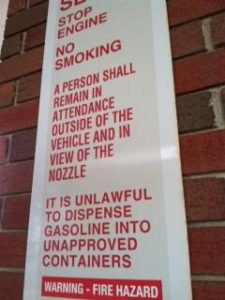
										<content:encoded><![CDATA[<p>There’s a sign that, in some configuration, appears on every gas pump in Michigan, although most drivers probably don’t even notice it anymore. You can see one in the photo to the right.</p>
<img loading="lazy" decoding="async" class="alignright size-medium wp-image-1996" src="http://legalwritingeditor.com/wp-content/uploads/2016/04/Gasoline-Picture-225x300.jpeg" alt="Gasoline-Picture" width="225" height="300" srcset="https://legalwritingeditor.com/wp-content/uploads/2016/04/Gasoline-Picture-225x300.jpeg 225w, https://legalwritingeditor.com/wp-content/uploads/2016/04/Gasoline-Picture.jpeg 240w" sizes="auto, (max-width: 225px) 100vw, 225px" />
<p>Let’s put aside the all-capitals, which are notoriously hard to read. And never mind that the first and second items aren’t exactly parallel. (&#8220;Stop engine. Don’t smoke.&#8221;) The trouble — linguistically, stylistically, semantically — shows up in the third item.</p>
<p>Look at that little sentence. We get an explicit subject, <em>A person</em>, which really throws off the parallelism. The lawyer’s <em>shall</em> — now corrupted and ambiguous from misuse — does not belong even in statutes or regulations, let alone on a gas pump. <em>Remain in attendance</em>? Oh, please. The first <em>of</em> is unnecessary. And for the big comedic finish, we’re seemingly told that the nozzle must be able to see the person.</p>
<p>The fix isn’t hard: &#8220;You must stay outside your vehicle and be able to see the nozzle.&#8221; Or for parallelism with the first two items: &#8220;Stay outside your vehicle, and make sure you can see the nozzle.&#8221;</p>
<p>Now, are people likely to misunderstand the pump version? No. Is this the worst public writing on the planet? Obviously not. But by tracing this mundane example to its source, anyone who cares about clarity in legal and official documents can learn a set of critical lessons.<span id="more-1277"></span></p>
<h3>The limited force of statutes and regulations</h3>
<p>Our gas-pump example has its origins in a Michigan regulation, Mich. Admin. Code R. 29.5325, § 9.2.5.4:</p>
<blockquote><p>Warning signs shall be conspicuously posted in the dispensing area and shall incorporate the following <strong>or equivalent </strong>wording: &#8220;WARNING. It is unlawful and dangerous to dispense gasoline into unapproved containers. No smoking. Stop motor. No filling of portable containers in or on a motor vehicle. The person shall remain in attendance outside of the vehicle and in view of the nozzle.&#8221;</p></blockquote>
<p>The order of the items here is different from our sign, there’s an additional item about not filling portable containers, and a few words have changed — probably because the regulation has been amended over time. But that doesn’t matter. The point is that the sign essentially uses the regulatory language — even though it didn’t have to. Note the language that I bolded above: the gas station could have used something <em>equivalent to</em> &#8220;A person shall remain in attendance outside of the vehicle and in view of the nozzle.&#8221; The station could have written it simpler and shorter.</p>
<p>Now imagine a scenario, however unlikely, between some inquisitive station owner and an attorney for the Michigan Petroleum Association:</p>
<blockquote><p><strong>Owner</strong>: You know those signs we have to have on our pumps — about not smoking and standing outside when somebody pumps gas?</p>
<p><strong>Attorney</strong>: Yup. You mean those standard warning signs that everybody buys from Signs-R-Us?</p>
<p><strong>Owner</strong>: Right. The other day, some customer was jagging me about the weird language — nozzles with eyes, or something.</p>
<p><strong>Attorney</strong>: Well, it may be weird, but it’s required by law. No choice. I think there’s a state regulation that spells it out.</p>
<p><strong>Owner</strong>: Wouldn’t you know? Okay. Just wondering. I certainly wasn’t going to order a new sign. Good thing the grammar police aren’t licensed to give tickets.</p></blockquote>
<p>This scenario has never happened and never will. But a variation on it happens all the time. I hear about it regularly from colleagues involved in plain language, I read about it, I’ve experienced it myself, and I’ve written about one typical instance — a project &#8220;derailed&#8221; by the legal team of New York City’s Department of Transportation because &#8220;the revision did not use the same legal language as the original.&#8221; <span class="footnote_referrer"><a role="button" tabindex="0" onclick="footnote_moveToReference_1277_12('footnote_plugin_reference_1277_12_1');" onkeypress="footnote_moveToReference_1277_12('footnote_plugin_reference_1277_12_1');" ><sup id="footnote_plugin_tooltip_1277_12_1" class="footnote_plugin_tooltip_text">1</sup></a><span id="footnote_plugin_tooltip_text_1277_12_1" class="footnote_tooltip"><em>Writing for Dollars, Writing to Please: The Case for Plain Language in Business, Government, and Law</em> 34 (Carolina Academic Press 2012).</span></span><script type="text/javascript"> jQuery('#footnote_plugin_tooltip_1277_12_1').tooltip({ tip: '#footnote_plugin_tooltip_text_1277_12_1', tipClass: 'footnote_tooltip', effect: 'fade', predelay: 0, fadeInSpeed: 200, delay: 400, fadeOutSpeed: 200, position: 'bottom right', relative: true, offset: [0, 0], });</script> All too often, legal departments either mistake what the law requires or can’t be bothered with matters of &#8220;mere style.&#8221;</p>
<p>And there’s a third impediment to clarity that falls somewhere in between: lawyers’ reluctance to depart from statutory or regulatory language even when they know they can. That is, even those <a style="text-decoration: none;" href="http://www.statmanharris.com/"> <span style="text-decoration: none; color: #000000;">real estate lawyer</span></a> who are generally receptive to plain language may balk when they perceive that statutes or regulations are hovering around. For instance, one blemish on the restyled Federal Rules of Criminal Procedure is the repeated use of <em>the attorney for the government</em> instead of <em>the government attorney</em>. Why? Because federal statutes use the former. As if there were the slightest risk in changing . . . At one point during the restyling of the Civil Rules, I changed <em>Acts of Congress</em> to <em>federal statutes</em> (for consistency with other rules, no less), and an influential voice commented: &#8220;Although 28 U.S.C. § 2071 says ‘Acts of Congress,’ I will give you this one without protest.&#8221; What a concession. If you want one setting where this attitude would be a disaster, look no further than jury instructions. <span class="footnote_referrer"><a role="button" tabindex="0" onclick="footnote_moveToReference_1277_12('footnote_plugin_reference_1277_12_2');" onkeypress="footnote_moveToReference_1277_12('footnote_plugin_reference_1277_12_2');" ><sup id="footnote_plugin_tooltip_1277_12_2" class="footnote_plugin_tooltip_text">2</sup></a><span id="footnote_plugin_tooltip_text_1277_12_2" class="footnote_tooltip"><em>See</em> Joseph Kimble, <em>How to Mangle Court Rules and Jury Instructions</em>, in<em> Lifting the Fog of Legalese: Essays on Plain Language</em> 105, 115–16 (Carolina Academic Press 2006) (giving examples of statutes converted to plain jury instructions).</span></span><script type="text/javascript"> jQuery('#footnote_plugin_tooltip_1277_12_2').tooltip({ tip: '#footnote_plugin_tooltip_text_1277_12_2', tipClass: 'footnote_tooltip', effect: 'fade', predelay: 0, fadeInSpeed: 200, delay: 400, fadeOutSpeed: 200, position: 'bottom right', relative: true, offset: [0, 0], });</script></p>
<p>I don’t mean to suggest that the language of statutes and regulations is never mandatory. Michigan&#8217;s Landlord–Tenant Relationship Act requires that the parties complete an inventory checklist, which &#8220;shall contain the following notice.&#8221; <span class="footnote_referrer"><a role="button" tabindex="0" onclick="footnote_moveToReference_1277_12('footnote_plugin_reference_1277_12_3');" onkeypress="footnote_moveToReference_1277_12('footnote_plugin_reference_1277_12_3');" ><sup id="footnote_plugin_tooltip_1277_12_3" class="footnote_plugin_tooltip_text">3</sup></a><span id="footnote_plugin_tooltip_text_1277_12_3" class="footnote_tooltip">Mich. Comp. Laws Ann. § 554.608(4) (West 2005).</span></span><script type="text/javascript"> jQuery('#footnote_plugin_tooltip_1277_12_3').tooltip({ tip: '#footnote_plugin_tooltip_text_1277_12_3', tipClass: 'footnote_tooltip', effect: 'fade', predelay: 0, fadeInSpeed: 200, delay: 400, fadeOutSpeed: 200, position: 'bottom right', relative: true, offset: [0, 0], });</script> There’s no getting around the language that appears in quotes after <em>notice</em>.</p>
<p>But I’m willing to bet, without having done any kind of survey, that it would turn up at least as many statutes and regulations with language like this:</p>
<ul>
<li><em>shall incorporate the following or equivalent language</em> (our gas-pump regulation)</li>
<li><em>shall state . . . a notice in substantially the following form</em> <span class="footnote_referrer"><a role="button" tabindex="0" onclick="footnote_moveToReference_1277_12('footnote_plugin_reference_1277_12_4');" onkeypress="footnote_moveToReference_1277_12('footnote_plugin_reference_1277_12_4');" ><sup id="footnote_plugin_tooltip_1277_12_4" class="footnote_plugin_tooltip_text">4</sup></a><span id="footnote_plugin_tooltip_text_1277_12_4" class="footnote_tooltip"><em>Id</em>. § 554.634(2).</span></span><script type="text/javascript"> jQuery('#footnote_plugin_tooltip_1277_12_4').tooltip({ tip: '#footnote_plugin_tooltip_text_1277_12_4', tipClass: 'footnote_tooltip', effect: 'fade', predelay: 0, fadeInSpeed: 200, delay: 400, fadeOutSpeed: 200, position: 'bottom right', relative: true, offset: [0, 0], });</script></li>
<li><em>The statement shall be in a form similar to the following</em> <span class="footnote_referrer"><a role="button" tabindex="0" onclick="footnote_moveToReference_1277_12('footnote_plugin_reference_1277_12_5');" onkeypress="footnote_moveToReference_1277_12('footnote_plugin_reference_1277_12_5');" ><sup id="footnote_plugin_tooltip_1277_12_5" class="footnote_plugin_tooltip_text">5</sup></a><span id="footnote_plugin_tooltip_text_1277_12_5" class="footnote_tooltip">21 C.F.R. § 1304.40 (b)(2)(2012).</span></span><script type="text/javascript"> jQuery('#footnote_plugin_tooltip_1277_12_5').tooltip({ tip: '#footnote_plugin_tooltip_text_1277_12_5', tipClass: 'footnote_tooltip', effect: 'fade', predelay: 0, fadeInSpeed: 200, delay: 400, fadeOutSpeed: 200, position: 'bottom right', relative: true, offset: [0, 0], });</script></li>
<li><em>a statement substantially similar to Model Form G–4</em> <span class="footnote_referrer"><a role="button" tabindex="0" onclick="footnote_moveToReference_1277_12('footnote_plugin_reference_1277_12_6');" onkeypress="footnote_moveToReference_1277_12('footnote_plugin_reference_1277_12_6');" ><sup id="footnote_plugin_tooltip_1277_12_6" class="footnote_plugin_tooltip_text">6</sup></a><span id="footnote_plugin_tooltip_text_1277_12_6" class="footnote_tooltip">12 C.F.R. § 226.9(a)(2) (2012).</span></span><script type="text/javascript"> jQuery('#footnote_plugin_tooltip_1277_12_6').tooltip({ tip: '#footnote_plugin_tooltip_text_1277_12_6', tipClass: 'footnote_tooltip', effect: 'fade', predelay: 0, fadeInSpeed: 200, delay: 400, fadeOutSpeed: 200, position: 'bottom right', relative: true, offset: [0, 0], });</script></li>
<li><em>a written notice containing all of the following information</em> <span class="footnote_referrer"><a role="button" tabindex="0" onclick="footnote_moveToReference_1277_12('footnote_plugin_reference_1277_12_7');" onkeypress="footnote_moveToReference_1277_12('footnote_plugin_reference_1277_12_7');" ><sup id="footnote_plugin_tooltip_1277_12_7" class="footnote_plugin_tooltip_text">7</sup></a><span id="footnote_plugin_tooltip_text_1277_12_7" class="footnote_tooltip">Mich. Comp. Laws Ann. § 339.918(1) (West 2004).</span></span><script type="text/javascript"> jQuery('#footnote_plugin_tooltip_1277_12_7').tooltip({ tip: '#footnote_plugin_tooltip_text_1277_12_7', tipClass: 'footnote_tooltip', effect: 'fade', predelay: 0, fadeInSpeed: 200, delay: 400, fadeOutSpeed: 200, position: 'bottom right', relative: true, offset: [0, 0], });</script></li>
<li><em>a statement specifying that</em> <span class="footnote_referrer"><a role="button" tabindex="0" onclick="footnote_moveToReference_1277_12('footnote_plugin_reference_1277_12_8');" onkeypress="footnote_moveToReference_1277_12('footnote_plugin_reference_1277_12_8');" ><sup id="footnote_plugin_tooltip_1277_12_8" class="footnote_plugin_tooltip_text">8</sup></a><span id="footnote_plugin_tooltip_text_1277_12_8" class="footnote_tooltip"><em>Id</em>. § 339.918(1)(d).</span></span><script type="text/javascript"> jQuery('#footnote_plugin_tooltip_1277_12_8').tooltip({ tip: '#footnote_plugin_tooltip_text_1277_12_8', tipClass: 'footnote_tooltip', effect: 'fade', predelay: 0, fadeInSpeed: 200, delay: 400, fadeOutSpeed: 200, position: 'bottom right', relative: true, offset: [0, 0], });</script></li>
<li><em>shall contain language that</em> <span class="footnote_referrer"><a role="button" tabindex="0" onclick="footnote_moveToReference_1277_12('footnote_plugin_reference_1277_12_9');" onkeypress="footnote_moveToReference_1277_12('footnote_plugin_reference_1277_12_9');" ><sup id="footnote_plugin_tooltip_1277_12_9" class="footnote_plugin_tooltip_text">9</sup></a><span id="footnote_plugin_tooltip_text_1277_12_9" class="footnote_tooltip"><em>Id</em>. § 339.2515(1).</span></span><script type="text/javascript"> jQuery('#footnote_plugin_tooltip_1277_12_9').tooltip({ tip: '#footnote_plugin_tooltip_text_1277_12_9', tipClass: 'footnote_tooltip', effect: 'fade', predelay: 0, fadeInSpeed: 200, delay: 400, fadeOutSpeed: 200, position: 'bottom right', relative: true, offset: [0, 0], });</script></li>
</ul>
<p>None of these formulations says to &#8220;use these words.&#8221;</p>
<p>So what are the lessons to be drawn from all this? They number five. First, codified language will often get copied or at least cause second-guessing — so draft in plain language to begin with. Second, lawyers tend to greatly exaggerate the extent to which the law requires specific, unalterable wording in legal and official documents. Third, if you’re told that certain unplain language is legally necessary, you should kindly ask for a citation, a reference. (Nonlawyers, do it!) Fourth, if you don’t get one, the lawyer is either at a loss or indifferent. Finally, if you do get one, check it out. Nonlawyers can usually get any needed help from law-school or university libraries. And when you find the cited law, look for the kind of language in the bullet points above — meaning that legalese is not required.</p>
<h3>The minimal and manageable force of terms of art</h3>
<p>Another potent myth, or half-truth, or quarter-truth, commonly invades any discussion of legal writing: lawyers must use terms of art. Woe is them. Their hands are tied.</p>
<p>Once again, much exaggerated. I’ll just briefly review points I’ve made elsewhere.</p>
<p>Even if we take the broad view that any term ever litigated is a term of art, they would count for a tiny part of most legal documents. (Obviously, this view is overinclusive: the term <em>herein</em> has been litigated many times, and it’s hardly a term of art.) In one empirical study using a real-estate sales contract, researchers found that less than 3% of the words had significant legal meaning based on precedent. <span class="footnote_referrer"><a role="button" tabindex="0" onclick="footnote_moveToReference_1277_12('footnote_plugin_reference_1277_12_10');" onkeypress="footnote_moveToReference_1277_12('footnote_plugin_reference_1277_12_10');" ><sup id="footnote_plugin_tooltip_1277_12_10" class="footnote_plugin_tooltip_text">10</sup></a><span id="footnote_plugin_tooltip_text_1277_12_10" class="footnote_tooltip">Benson Barr et al., <em>Legalese and the Myth of Case Precedent</em>, 64 Mich. B.J. 1136, 1137 (Oct. 1985) (<em>available at</em> <span class="footnote_url_wrap">http://www.michbar.org/generalinfo/plainenglish/PDFs/85_oct.pdf).</span></span></span><script type="text/javascript"> jQuery('#footnote_plugin_tooltip_1277_12_10').tooltip({ tip: '#footnote_plugin_tooltip_text_1277_12_10', tipClass: 'footnote_tooltip', effect: 'fade', predelay: 0, fadeInSpeed: 200, delay: 400, fadeOutSpeed: 200, position: 'bottom right', relative: true, offset: [0, 0], });</script></p>
<p>Now consider the tiny fraction of words that <em>have</em> been litigated. Can we say that they have been honed by precedent and are thus irreplaceable? That question prompts others. How many cases does it take before a term is well honed? Why couldn’t we conclude that the more times a term has been litigated, the more troublesome it is? What do we do about inconsistent interpretations? Do drafters generally operate more from considered, thoughtful choice or from habit and imitation?</p>
<p>At any rate, we again have research that helps inform this discussion. In 1995, the Centre for Plain Legal Language at Sydney University’s Faculty of Law published <em>Law Words: 30 Essays on Legal Words &#038; Phrases</em>. <span class="footnote_referrer"><a role="button" tabindex="0" onclick="footnote_moveToReference_1277_12('footnote_plugin_reference_1277_12_11');" onkeypress="footnote_moveToReference_1277_12('footnote_plugin_reference_1277_12_11');" ><sup id="footnote_plugin_tooltip_1277_12_11" class="footnote_plugin_tooltip_text">11</sup></a><span id="footnote_plugin_tooltip_text_1277_12_11" class="footnote_tooltip"><span class="footnote_url_wrap">http://www.clarity-international.net/downloads/law_words.pdf.</span></span></span><script type="text/javascript"> jQuery('#footnote_plugin_tooltip_1277_12_11').tooltip({ tip: '#footnote_plugin_tooltip_text_1277_12_11', tipClass: 'footnote_tooltip', effect: 'fade', predelay: 0, fadeInSpeed: 200, delay: 400, fadeOutSpeed: 200, position: 'bottom right', relative: true, offset: [0, 0], });</script> As the title suggests, the contributors carefully researched 30 terms that many lawyers would classify as terms of art. And for almost every one, the research showed that the term was unnecessary, troublesome, best used together with a plainer term, or replaceable with a plain equivalent. For example: <em>give</em>, not <em>give</em>,<em> devise</em>,<em> and bequeath</em>; <em>interest</em>, not <em>right</em>,<em> title</em>,<em> and interest</em>; <em>together and individually</em>, not <em>jointly and severally</em>. Surely, research in the U.S. on these terms — and many more that we might pluck from <em>Words &#038; Phrases</em> — would produce the same conclusions about their value and need in this country.</p>
<p>In fact, to take another example, how about the word <em>indemnify</em>? Isn’t that a term of art — if anything is? Well, check out the Plain Language column in the September <em>Michigan Bar Journal</em>. <span class="footnote_referrer"><a role="button" tabindex="0" onclick="footnote_moveToReference_1277_12('footnote_plugin_reference_1277_12_12');" onkeypress="footnote_moveToReference_1277_12('footnote_plugin_reference_1277_12_12');" ><sup id="footnote_plugin_tooltip_1277_12_12" class="footnote_plugin_tooltip_text">12</sup></a><span id="footnote_plugin_tooltip_text_1277_12_12" class="footnote_tooltip"><em>See</em> Jeffrey S. Ammon, <em>Indemnification: Banish the Word! And Rebuild Your Indemnity Clause from Scratch</em>, 92 Mich. B.J. 52 (Sept. 2013) (<em>available at</em> <span class="footnote_url_wrap">http://www.michbar.org/journal/pdf/pdf4article2252.pdf).</span></span></span><script type="text/javascript"> jQuery('#footnote_plugin_tooltip_1277_12_12').tooltip({ tip: '#footnote_plugin_tooltip_text_1277_12_12', tipClass: 'footnote_tooltip', effect: 'fade', predelay: 0, fadeInSpeed: 200, delay: 400, fadeOutSpeed: 200, position: 'bottom right', relative: true, offset: [0, 0], });</script> A seasoned commercial lawyer says otherwise.</p>
<p>One point in closing. If you’re uncomfortable with abandoning the traditional term entirely, you can usually still find a way to pair it with plain words or an explanation the first time you use it: &#8220;attached items (called ‘fixtures’)&#8221;; &#8220;I release, or give up, any legal claims&#8221;; &#8220;a default judgment — which means that the court will give the plaintiff what he is asking for.&#8221; Then try to stick with the plain term in any later uses. And don’t be surprised if clients — especially consumers — sing your praises for helping them understand. <span class="footnote_referrer"><a role="button" tabindex="0" onclick="footnote_moveToReference_1277_12('footnote_plugin_reference_1277_12_13');" onkeypress="footnote_moveToReference_1277_12('footnote_plugin_reference_1277_12_13');" ><sup id="footnote_plugin_tooltip_1277_12_13" class="footnote_plugin_tooltip_text">13</sup></a><span id="footnote_plugin_tooltip_text_1277_12_13" class="footnote_tooltip"><em>See</em> Christopher R. Trudeau, <em>The Public Speaks: An Empirical Study of Legal Communication</em>, 14 Scribes J. Legal Writing 121, 149–50 (2011–2012) (reporting on a survey in which, for one question, the public overwhelmingly preferred that legal terms be accompanied by an explanation).</span></span><script type="text/javascript"> jQuery('#footnote_plugin_tooltip_1277_12_13').tooltip({ tip: '#footnote_plugin_tooltip_text_1277_12_13', tipClass: 'footnote_tooltip', effect: 'fade', predelay: 0, fadeInSpeed: 200, delay: 400, fadeOutSpeed: 200, position: 'bottom right', relative: true, offset: [0, 0], });</script></p>
<p>Terms of art are more rare and more replaceable than lawyers like to think. But even when a drafter can’t bear to part with a legal term, it need not stand alone, unclarified, and may often be dispensed with after a single use. So even a cautious drafter requires only an occasional speck of legalese — explained in plain language.</p>
<p>The law is no serious obstacle to writing clearly and plainly.</p>
<p><strong>Joseph Kimble has taught legal writing for 30 years at Thomas Cooley Law School. He is the author of <a href="http://www.amazon.com/Lifting-Fog-Legalese-Essays-Language/dp/1594602123" target="_blank"><em>Lifting the Fog of Legalese: Essays on Plain Language</em></a> and <a href="http://www.amazon.com/Writing-Dollars-Please-Language-Government/dp/1611631912/ref=sr_1_1?s=books&#038;ie=UTF8&#038;qid=1381165370&#038;sr=1-1&#038;keywords=Writing+for+Dollars%2C+Writing+to+Please%3A+The+Case+for+Plain+Language+in+Business%2C+Government%2C+and+Law" target="_blank"><em>Writing for Dollars</em>,<em> Writing to Please: The Case for Plain Language in Business</em>,<em> Government</em>,<em> and Law</em></a>. He is also senior editor of <a href="http://www.scribes.org/scribes-journal-legal-writing" target="_blank"><em>The Scribes Journal of Legal Writing</em></a>, the longtime editor of the <a href="http://www.michbar.org/generalinfo/plainenglish/" target="_blank">Plain Language column</a> in the <em>Michigan Bar Journal</em>, a founding director of the Center for Plain Language, and the drafting consultant on all federal court rules. He led the work of redrafting the Federal Rules of Civil Procedure and the Federal Rules of Evidence. </strong><strong>You can follow him on Twitter <a href="https://twitter.com/ProfJoeKimble" target="_blank">@ProfJoeKimble</a>. His website is <a href="http://kimblewritingseminars.com/" target="_blank">kimblewritingseminars.com</a>.</strong></p>
<p><small>(photo: Joe Kimble)</small></p>
<div class="speaker-mute footnotes_reference_container"> <div class="footnote_container_prepare"><p><span role="button" tabindex="0" class="footnote_reference_container_label pointer" onclick="footnote_expand_collapse_reference_container_1277_12();">References</span><span role="button" tabindex="0" class="footnote_reference_container_collapse_button" style="display: none;" onclick="footnote_expand_collapse_reference_container_1277_12();">[<a id="footnote_reference_container_collapse_button_1277_12">+</a>]</span></p></div> <div id="footnote_references_container_1277_12" style=""><table class="footnotes_table footnote-reference-container"><caption class="accessibility">References</caption> <tbody> 

<tr class="footnotes_plugin_reference_row"> <th scope="row" class="footnote_plugin_index_combi pointer"  onclick="footnote_moveToAnchor_1277_12('footnote_plugin_tooltip_1277_12_1');"><a id="footnote_plugin_reference_1277_12_1" class="footnote_backlink"><span class="footnote_index_arrow">&#8593;</span>1</a></th> <td class="footnote_plugin_text"><em>Writing for Dollars, Writing to Please: The Case for Plain Language in Business, Government, and Law</em> 34 (Carolina Academic Press 2012).</td></tr>

<tr class="footnotes_plugin_reference_row"> <th scope="row" class="footnote_plugin_index_combi pointer"  onclick="footnote_moveToAnchor_1277_12('footnote_plugin_tooltip_1277_12_2');"><a id="footnote_plugin_reference_1277_12_2" class="footnote_backlink"><span class="footnote_index_arrow">&#8593;</span>2</a></th> <td class="footnote_plugin_text"><em>See</em> Joseph Kimble, <em>How to Mangle Court Rules and Jury Instructions</em>, in<em> Lifting the Fog of Legalese: Essays on Plain Language</em> 105, 115–16 (Carolina Academic Press 2006) (giving examples of statutes converted to plain jury instructions).</td></tr>

<tr class="footnotes_plugin_reference_row"> <th scope="row" class="footnote_plugin_index_combi pointer"  onclick="footnote_moveToAnchor_1277_12('footnote_plugin_tooltip_1277_12_3');"><a id="footnote_plugin_reference_1277_12_3" class="footnote_backlink"><span class="footnote_index_arrow">&#8593;</span>3</a></th> <td class="footnote_plugin_text">Mich. Comp. Laws Ann. § 554.608(4) (West 2005).</td></tr>

<tr class="footnotes_plugin_reference_row"> <th scope="row" class="footnote_plugin_index_combi pointer"  onclick="footnote_moveToAnchor_1277_12('footnote_plugin_tooltip_1277_12_4');"><a id="footnote_plugin_reference_1277_12_4" class="footnote_backlink"><span class="footnote_index_arrow">&#8593;</span>4</a></th> <td class="footnote_plugin_text"><em>Id</em>. § 554.634(2).</td></tr>

<tr class="footnotes_plugin_reference_row"> <th scope="row" class="footnote_plugin_index_combi pointer"  onclick="footnote_moveToAnchor_1277_12('footnote_plugin_tooltip_1277_12_5');"><a id="footnote_plugin_reference_1277_12_5" class="footnote_backlink"><span class="footnote_index_arrow">&#8593;</span>5</a></th> <td class="footnote_plugin_text">21 C.F.R. § 1304.40 (b)(2)(2012).</td></tr>

<tr class="footnotes_plugin_reference_row"> <th scope="row" class="footnote_plugin_index_combi pointer"  onclick="footnote_moveToAnchor_1277_12('footnote_plugin_tooltip_1277_12_6');"><a id="footnote_plugin_reference_1277_12_6" class="footnote_backlink"><span class="footnote_index_arrow">&#8593;</span>6</a></th> <td class="footnote_plugin_text">12 C.F.R. § 226.9(a)(2) (2012).</td></tr>

<tr class="footnotes_plugin_reference_row"> <th scope="row" class="footnote_plugin_index_combi pointer"  onclick="footnote_moveToAnchor_1277_12('footnote_plugin_tooltip_1277_12_7');"><a id="footnote_plugin_reference_1277_12_7" class="footnote_backlink"><span class="footnote_index_arrow">&#8593;</span>7</a></th> <td class="footnote_plugin_text">Mich. Comp. Laws Ann. § 339.918(1) (West 2004).</td></tr>

<tr class="footnotes_plugin_reference_row"> <th scope="row" class="footnote_plugin_index_combi pointer"  onclick="footnote_moveToAnchor_1277_12('footnote_plugin_tooltip_1277_12_8');"><a id="footnote_plugin_reference_1277_12_8" class="footnote_backlink"><span class="footnote_index_arrow">&#8593;</span>8</a></th> <td class="footnote_plugin_text"><em>Id</em>. § 339.918(1)(d).</td></tr>

<tr class="footnotes_plugin_reference_row"> <th scope="row" class="footnote_plugin_index_combi pointer"  onclick="footnote_moveToAnchor_1277_12('footnote_plugin_tooltip_1277_12_9');"><a id="footnote_plugin_reference_1277_12_9" class="footnote_backlink"><span class="footnote_index_arrow">&#8593;</span>9</a></th> <td class="footnote_plugin_text"><em>Id</em>. § 339.2515(1).</td></tr>

<tr class="footnotes_plugin_reference_row"> <th scope="row" class="footnote_plugin_index_combi pointer"  onclick="footnote_moveToAnchor_1277_12('footnote_plugin_tooltip_1277_12_10');"><a id="footnote_plugin_reference_1277_12_10" class="footnote_backlink"><span class="footnote_index_arrow">&#8593;</span>10</a></th> <td class="footnote_plugin_text">Benson Barr et al., <em>Legalese and the Myth of Case Precedent</em>, 64 Mich. B.J. 1136, 1137 (Oct. 1985) (<em>available at</em> <span class="footnote_url_wrap">http://www.michbar.org/generalinfo/plainenglish/PDFs/85_oct.pdf).</span></td></tr>

<tr class="footnotes_plugin_reference_row"> <th scope="row" class="footnote_plugin_index_combi pointer"  onclick="footnote_moveToAnchor_1277_12('footnote_plugin_tooltip_1277_12_11');"><a id="footnote_plugin_reference_1277_12_11" class="footnote_backlink"><span class="footnote_index_arrow">&#8593;</span>11</a></th> <td class="footnote_plugin_text"><span class="footnote_url_wrap">http://www.clarity-international.net/downloads/law_words.pdf.</span></td></tr>

<tr class="footnotes_plugin_reference_row"> <th scope="row" class="footnote_plugin_index_combi pointer"  onclick="footnote_moveToAnchor_1277_12('footnote_plugin_tooltip_1277_12_12');"><a id="footnote_plugin_reference_1277_12_12" class="footnote_backlink"><span class="footnote_index_arrow">&#8593;</span>12</a></th> <td class="footnote_plugin_text"><em>See</em> Jeffrey S. Ammon, <em>Indemnification: Banish the Word! And Rebuild Your Indemnity Clause from Scratch</em>, 92 Mich. B.J. 52 (Sept. 2013) (<em>available at</em> <span class="footnote_url_wrap">http://www.michbar.org/journal/pdf/pdf4article2252.pdf).</span></td></tr>

<tr class="footnotes_plugin_reference_row"> <th scope="row" class="footnote_plugin_index_combi pointer"  onclick="footnote_moveToAnchor_1277_12('footnote_plugin_tooltip_1277_12_13');"><a id="footnote_plugin_reference_1277_12_13" class="footnote_backlink"><span class="footnote_index_arrow">&#8593;</span>13</a></th> <td class="footnote_plugin_text"><em>See</em> Christopher R. Trudeau, <em>The Public Speaks: An Empirical Study of Legal Communication</em>, 14 Scribes J. Legal Writing 121, 149–50 (2011–2012) (reporting on a survey in which, for one question, the public overwhelmingly preferred that legal terms be accompanied by an explanation).</td></tr>

 </tbody> </table> </div></div><script type="text/javascript"> function footnote_expand_reference_container_1277_12() { jQuery('#footnote_references_container_1277_12').show(); jQuery('#footnote_reference_container_collapse_button_1277_12').text('−'); } function footnote_collapse_reference_container_1277_12() { jQuery('#footnote_references_container_1277_12').hide(); jQuery('#footnote_reference_container_collapse_button_1277_12').text('+'); } function footnote_expand_collapse_reference_container_1277_12() { if (jQuery('#footnote_references_container_1277_12').is(':hidden')) { footnote_expand_reference_container_1277_12(); } else { footnote_collapse_reference_container_1277_12(); } } function footnote_moveToReference_1277_12(p_str_TargetID) { footnote_expand_reference_container_1277_12(); var l_obj_Target = jQuery('#' + p_str_TargetID); if (l_obj_Target.length) { jQuery( 'html, body' ).delay( 0 ); jQuery('html, body').animate({ scrollTop: l_obj_Target.offset().top - window.innerHeight * 0.2 }, 380); } } function footnote_moveToAnchor_1277_12(p_str_TargetID) { footnote_expand_reference_container_1277_12(); var l_obj_Target = jQuery('#' + p_str_TargetID); if (l_obj_Target.length) { jQuery( 'html, body' ).delay( 0 ); jQuery('html, body').animate({ scrollTop: l_obj_Target.offset().top - window.innerHeight * 0.2 }, 380); } }</script><p>The post <a href="https://legalwritingeditor.com/2013/10/21/think-law-requires-legalese/">You Think the Law Requires Legalese?</a> appeared first on <a href="https://legalwritingeditor.com">Legal Writing Editor</a>.</p>
]]></content:encoded>
					
					<wfw:commentRss>https://legalwritingeditor.com/2013/10/21/think-law-requires-legalese/feed/</wfw:commentRss>
			<slash:comments>4</slash:comments>
		
		
		<post-id xmlns="com-wordpress:feed-additions:1">1277</post-id>	</item>
		<item>
		<title>You Think Anybody Likes Legalese?</title>
		<link>https://legalwritingeditor.com/2013/07/12/you-think-anybody-likes-legalese/</link>
					<comments>https://legalwritingeditor.com/2013/07/12/you-think-anybody-likes-legalese/#comments</comments>
		
		<dc:creator><![CDATA[Joe Kimble]]></dc:creator>
		<pubDate>Fri, 12 Jul 2013 12:15:01 +0000</pubDate>
				<category><![CDATA[General]]></category>
		<category><![CDATA[legal writing]]></category>
		<category><![CDATA[legalese]]></category>
		<category><![CDATA[plain language]]></category>
		<category><![CDATA[writing]]></category>
		<guid isPermaLink="false">http://legalwritingeditor.com/?p=1203</guid>

					<description><![CDATA[<p>I was an early convert to plain language — or plain English as it was called then — when it began to make headway in the 1970s. From the start, I was convinced that plain language is a just cause: right in its strong criticisms of traditional legal style, right in its call for reform, and [&#8230;]</p>
<p>The post <a href="https://legalwritingeditor.com/2013/07/12/you-think-anybody-likes-legalese/">You Think Anybody Likes Legalese?</a> appeared first on <a href="https://legalwritingeditor.com">Legal Writing Editor</a>.</p>
]]></description>
										<content:encoded><![CDATA[<p><img loading="lazy" decoding="async" class="alignright size-medium wp-image-1998" src="http://legalwritingeditor.com/wp-content/uploads/2016/04/Haystack-Kimble-300x165.jpg" alt="Haystack-Kimble" width="300" height="165" srcset="https://legalwritingeditor.com/wp-content/uploads/2016/04/Haystack-Kimble-300x165.jpg 300w, https://legalwritingeditor.com/wp-content/uploads/2016/04/Haystack-Kimble.jpg 500w" sizes="auto, (max-width: 300px) 100vw, 300px" />I was an early convert to plain language — or plain English as it was called then — when it began to make headway in the 1970s. From the start, I was convinced that plain language is a just cause: right in its strong criticisms of traditional legal style, right in its call for reform, and right in its general prescriptions. Of course, my understanding of it has evolved and broadened over the years, but it remains for me a passion — a life’s work. And the work will need to go on long after I’ve gone on. A reformer, someone once told me, needs a geologist’s sense of time.<span id="more-1203"></span></p>
<p>I started teaching legal writing at Thomas Cooley Law School as an adjunct in 1982, and that turned into a full-time position in 1984. Naturally, I brought with me a commitment to teaching a clear and plain style. Those first years are still vivid — the classrooms, students’ names, even who sat where. Like any other teacher, I remember the hits and misses, the good moves and the blunders, and the intensity of it all. (Almost from the start, I used live grading: I read a student’s paper and graded it with the student sitting next to me.) I especially remember a couple of early challenges to my spiel and instructions on plain writing.</p>
<h3>Two of the many myths about plain language</h3>
<p>One night a student waltzed into class with a tray of food. At the break after the first hour, I caught his attention and privately reminded him about the school’s policy against food in the classroom. Maybe that put him in the mood to take issue. At any rate, during the next hour, he raised his hand and asserted: “A client wants to see you driving a Cadillac, not a little Honda. [This was 1984.] Why wouldn’t he want to see you using big, impressive words?” I said something about the questionable analogy between size and value in cars, on the one hand, and words, on the other. I said that trying to keep people dumb about the emptiness of legalese does us no credit and will eventually lead to disrespect. And I must have said — I hope I said — something about writing to communicate. But that question was telling — as a version of the common myth that plain words are pedestrian, dull, uninspiring; they are beneath the dignity of professional writers.</p>
<p>This myth, like a vampire, will probably never die, although I tried again to bury it in part 2 of my book <a href="http://www.amazon.com/Writing-Dollars-Please-Language-Government/dp/1611631912" target="_blank">Writing for Dollars, Writing to Please</a>. It will continue to spook insecure writers, drain strength from their prose, and fill it with pretension. And the myth will not easily give way to reason and argument and evidence because it preys on a vague, undeveloped sense of literary quality.</p>
<p>But another myth will — or should — yield to evidence in the form of hard numbers. And that brings me to the second challenge that students raised in those early years of my teaching plain writing.</p>
<p>Too many times to ignore, I heard different versions of essentially the same question: How do we know that plain language is acceptable in the real world outside law school? What do judges say? What’s the attitude among lawyers? Will I please or displease my readers? Maybe plain language is too newfangled for comfort. How do we know? Of course, I had no good answer — so a student and I decided to conduct a survey of Michigan judges and lawyers.</p>
<p>This was 26 years ago, in 1987, and I’ve since reported on the survey many times. No need to do it again here, except to say that given six pairs of passages from different legal documents — one written in plain language and the other in traditional style — 425 Michigan judges and lawyers preferred the plain versions by margins running from 80% to 85%. And the same survey was repeated in three other states, with strikingly similar results.</p>
<p>What I haven’t mentioned until now is my high anxiety while waiting for the results. As I remember, we gave the judges and lawyers about a month to respond. My student colleague was collecting the results, and I didn’t ask for updates. I had no idea what to expect. (O ye of little faith.) What if my students — some of them, anyway — were right to be dubious or at least uncertain? Maybe traditional style is so entrenched that most legal readers won’t see it as inferior. But they did. It was one happy, affirming day when I got the news.</p>
<p>That study was published the same year as another study (which I didn’t know about at the time) testing legalese versus plain English in appellate briefs. Guess which style was rated “substantially weaker and less persuasive” and led readers to infer that the writers who used it came from less prestigious firms?</p>
<p>I’m deliberately avoiding detail and citations because I don’t want you to dwell on those early studies alone. I’d like you to appreciate the full weight of the evidence against legalese. And for that, you need to see the complete picture.</p>
<h3>What the evidence shows</h3>
<p>In <a href="http://www.amazon.com/Writing-Dollars-Please-Language-Government/dp/1611631912" target="_blank">Writing for Dollars, Writing to Please</a>, I cite and summarize 50 studies of business, government, and legal documents. Of the 50, no less than 18 involved legal documents. And the documents were of all kinds: statutes, administrative regulations, judicial opinions, briefs and other lawsuit papers (complaints, motions), jury instructions, court forms, class-action notices, contracts, and client letters. The readers, too, were of all kinds: judges, lawyers, administrators, clients, and other members of the public. So the evidence could hardly be more complete — or more compelling.</p>
<p>Do you think anybody likes legalese? No. Nobody. Or I should say no body — not judges or lawyers or the public at large. All those groups strongly prefer plain language and find it more effective and persuasive. Besides that, they understand it better and faster, perform more accurately when they have to deal with it, and are more likely to read it in the first place. Please, purveyors and defenders of legalese, just look at the studies of your readers.</p>
<p>Now, I can hear the objections. “But clients expect legalese.” If they do, we should be ashamed of having conditioned them to expect it because they certainly don’t like it. “But my boss likes it the old way.” Then either try gentle persuasion or wincingly do what your boss wants, bide your time until you can decide, and know that your boss’s attitude and style are retrograde. “But most lawyers are still churning out legalese.” That’s the great disconnect: they forget as writers what they prefer as readers. (Not to mention the sheer force of habit and inertia.) “But plain language isn’t accurate, isn’t precise — isn’t safe.” The biggest myth of all — the Goliath myth. I’ve flung a few stones at it before, arguing that plain language is actually more precise than traditional style. <span class="footnote_referrer"><a role="button" tabindex="0" onclick="footnote_moveToReference_1203_14('footnote_plugin_reference_1203_14_1');" onkeypress="footnote_moveToReference_1203_14('footnote_plugin_reference_1203_14_1');" ><sup id="footnote_plugin_tooltip_1203_14_1" class="footnote_plugin_tooltip_text">1</sup></a><span id="footnote_plugin_tooltip_text_1203_14_1" class="footnote_tooltip"><em>See </em><a href="http://www.amazon.com/Writing-Dollars-Please-Language-Government/dp/1611631912" target="_blank"><em>Writing for Dollars, Writing to Please: The Case for Plain Language in Business, Government, and Law</em></a> 37–43 (Carolina Academic Press 2013); <em>The Great Myth That Plain Language Is Not Precise</em>, in <a href="http://www.amazon.com/dp/1594602123" target="_blank"><em>Lifting the Fog of Legalese: Essays on Plain Language</em></a> 37 (Carolina Academic Press 2006); <a href="https://docs.google.com/file/d/0B91pJtj_681lWVJLRVdmUnFiR1E/edit" target="_blank"><em>Wrong — Again — About Plain Language</em></a>, 69 Clarity 31 (Jan. 2013).</span></span><script type="text/javascript"> jQuery('#footnote_plugin_tooltip_1203_14_1').tooltip({ tip: '#footnote_plugin_tooltip_text_1203_14_1', tipClass: 'footnote_tooltip', effect: 'fade', predelay: 0, fadeInSpeed: 200, delay: 400, fadeOutSpeed: 200, position: 'bottom right', relative: true, offset: [0, 0], });</script><strong><br />
</strong></p>
<p>The case for plain language is altogether solid. All the myths and misconceptions about it have been debunked. What remains is for lawyers to summon the will and develop the skill to do it. Their readers have spoken.</p>
<p><strong>Joseph Kimble has taught legal writing for 30 years at Thomas Cooley Law School. He is the author of <em>Lifting the Fog of Legalese: Essays on Plain Language</em> and <em>Writing for Dollars</em>,<em> Writing to Please: The Case for Plain Language in Business</em>,<em> Government</em>,<em> and Law</em>. He is also senior editor of <em>The Scribes Journal of Legal Writing</em>, the longtime editor of the Plain Language column in the <em>Michigan Bar Journal</em>, a founding director of the Center for Plain Language, and the drafting consultant on all federal court rules. He led the work of redrafting the Federal Rules of Civil Procedure and the Federal Rules of Evidence. </strong><strong>You can follow him on Twitter <a href="https://twitter.com/ProfJoeKimble" target="_blank">@ProfJoeKimble</a>. His website is <a href="http://kimblewritingseminars.com/" target="_blank">kimblewritingseminars.com</a>.</strong></p>
<p><small>(photo: http://www.flickr.com/photos/hikingartist/3981259048/)</small></p>
<div class="speaker-mute footnotes_reference_container"> <div class="footnote_container_prepare"><p><span role="button" tabindex="0" class="footnote_reference_container_label pointer" onclick="footnote_expand_collapse_reference_container_1203_14();">References</span><span role="button" tabindex="0" class="footnote_reference_container_collapse_button" style="display: none;" onclick="footnote_expand_collapse_reference_container_1203_14();">[<a id="footnote_reference_container_collapse_button_1203_14">+</a>]</span></p></div> <div id="footnote_references_container_1203_14" style=""><table class="footnotes_table footnote-reference-container"><caption class="accessibility">References</caption> <tbody> 

<tr class="footnotes_plugin_reference_row"> <th scope="row" class="footnote_plugin_index_combi pointer"  onclick="footnote_moveToAnchor_1203_14('footnote_plugin_tooltip_1203_14_1');"><a id="footnote_plugin_reference_1203_14_1" class="footnote_backlink"><span class="footnote_index_arrow">&#8593;</span>1</a></th> <td class="footnote_plugin_text"><em>See </em><a href="http://www.amazon.com/Writing-Dollars-Please-Language-Government/dp/1611631912" target="_blank"><em>Writing for Dollars, Writing to Please: The Case for Plain Language in Business, Government, and Law</em></a> 37–43 (Carolina Academic Press 2013); <em>The Great Myth That Plain Language Is Not Precise</em>, in <a href="http://www.amazon.com/dp/1594602123" target="_blank"><em>Lifting the Fog of Legalese: Essays on Plain Language</em></a> 37 (Carolina Academic Press 2006); <a href="https://docs.google.com/file/d/0B91pJtj_681lWVJLRVdmUnFiR1E/edit" target="_blank"><em>Wrong — Again — About Plain Language</em></a>, 69 Clarity 31 (Jan. 2013).</td></tr>

 </tbody> </table> </div></div><script type="text/javascript"> function footnote_expand_reference_container_1203_14() { jQuery('#footnote_references_container_1203_14').show(); jQuery('#footnote_reference_container_collapse_button_1203_14').text('−'); } function footnote_collapse_reference_container_1203_14() { jQuery('#footnote_references_container_1203_14').hide(); jQuery('#footnote_reference_container_collapse_button_1203_14').text('+'); } function footnote_expand_collapse_reference_container_1203_14() { if (jQuery('#footnote_references_container_1203_14').is(':hidden')) { footnote_expand_reference_container_1203_14(); } else { footnote_collapse_reference_container_1203_14(); } } function footnote_moveToReference_1203_14(p_str_TargetID) { footnote_expand_reference_container_1203_14(); var l_obj_Target = jQuery('#' + p_str_TargetID); if (l_obj_Target.length) { jQuery( 'html, body' ).delay( 0 ); jQuery('html, body').animate({ scrollTop: l_obj_Target.offset().top - window.innerHeight * 0.2 }, 380); } } function footnote_moveToAnchor_1203_14(p_str_TargetID) { footnote_expand_reference_container_1203_14(); var l_obj_Target = jQuery('#' + p_str_TargetID); if (l_obj_Target.length) { jQuery( 'html, body' ).delay( 0 ); jQuery('html, body').animate({ scrollTop: l_obj_Target.offset().top - window.innerHeight * 0.2 }, 380); } }</script><p>The post <a href="https://legalwritingeditor.com/2013/07/12/you-think-anybody-likes-legalese/">You Think Anybody Likes Legalese?</a> appeared first on <a href="https://legalwritingeditor.com">Legal Writing Editor</a>.</p>
]]></content:encoded>
					
					<wfw:commentRss>https://legalwritingeditor.com/2013/07/12/you-think-anybody-likes-legalese/feed/</wfw:commentRss>
			<slash:comments>5</slash:comments>
		
		
		<post-id xmlns="com-wordpress:feed-additions:1">1203</post-id>	</item>
		<item>
		<title>Can Legalese Tank Business Deals?</title>
		<link>https://legalwritingeditor.com/2013/07/01/can-legalese-tank-business-deals/</link>
					<comments>https://legalwritingeditor.com/2013/07/01/can-legalese-tank-business-deals/#comments</comments>
		
		<dc:creator><![CDATA[Matthew Salzwedel]]></dc:creator>
		<pubDate>Mon, 01 Jul 2013 11:01:09 +0000</pubDate>
				<category><![CDATA[General]]></category>
		<category><![CDATA[legal writing]]></category>
		<category><![CDATA[legalese]]></category>
		<category><![CDATA[plain language]]></category>
		<guid isPermaLink="false">http://legalwritingeditor.com/?p=1153</guid>

					<description><![CDATA[<p>In response to my May 1, 2013 column Simple Legal Writing Isn&#8217;t Baby-Talk, I received a comment on LinkedIn from Lyn Boxall, a management consultant who works in Singapore. Before doing consulting work, she was an in-house lawyer for Visa International and GE Capital Australia. Ms. Boxall recounts her experience with the plain-language movement in Asia and [&#8230;]</p>
<p>The post <a href="https://legalwritingeditor.com/2013/07/01/can-legalese-tank-business-deals/">Can Legalese Tank Business Deals?</a> appeared first on <a href="https://legalwritingeditor.com">Legal Writing Editor</a>.</p>
]]></description>
										<content:encoded><![CDATA[<p><img loading="lazy" decoding="async" class="alignright size-medium wp-image-1989" src="http://legalwritingeditor.com/wp-content/uploads/2016/04/China-e1372648528187-300x200.jpg" alt="China-e1372648528187" width="300" height="200" srcset="https://legalwritingeditor.com/wp-content/uploads/2016/04/China-e1372648528187-300x200.jpg 300w, https://legalwritingeditor.com/wp-content/uploads/2016/04/China-e1372648528187.jpg 500w" sizes="auto, (max-width: 300px) 100vw, 300px" />In response to my May 1, 2013 column <a title="Simple Legal Writing Isn’t Baby-Talk" href="http://legalwritingeditor.com/2013/05/01/simple-legal-writing-isnt-baby-talk/" target="_blank">Simple Legal Writing Isn&#8217;t Baby-Talk</a>, I received a comment on LinkedIn from <a href="http://www.linkedin.com/profile/view?id=54277277&amp;locale=en_US&amp;trk=tyah" target="_blank">Lyn Boxall</a>, a management consultant who works in Singapore. Before doing consulting work, she was an in-house lawyer for Visa International and GE Capital Australia.</p>
<p>Ms. Boxall recounts her experience with the plain-language movement in Asia and Australia. She points out that, compared to some other countries, the plain-language movement in the United States is fairly new. She also has lessons for those people who still believe that plain language is a strictly academic pursuit. In her experience,</p>
<ul>
<li>Plain-language consumer agreements can result in fewer consumer disputes.</li>
<li>In Asia, if a party drafts a contract containing dense legalese, the other party will consider it a sign of distrust.</li>
</ul>
<p>With her permission, I&#8217;ve reproduced her comment below (with minor editing and formatting to conform it to house style). If you do business in the Asia Pacific region, or are asked by a client to negotiate and draft contracts with another party located there, it would behoove you to read her entire comment:<span id="more-1153"></span></p>
<blockquote><p>I find it interesting that plain English documents haven&#8217;t been adopted in the U.S. to any great extent visible to me. Perhaps it&#8217;s because of the overly litigious culture.</p>
<p>The plain English &#8220;movement'&#8221;was adopted by Australian lawyers around 20 years ago. Drafting in plain English is difficult at first. It takes practice. It also requires a thorough understanding of the law in order to avoid mis-steps such as replacing a technical word that has been interpreted thoroughly by the courts with a word that doesn&#8217;t have the benefit of detailed consideration by the courts.</p>
<p>One of my early projects was redrafting all the lending security documents for a major Australian bank. It was prompted to have its documents redrafted after a court criticised an opening sentence in a guarantee. The sentence consisted of 1879 words. It had probably started off sensibly, but over a century or more words had been added here and there to deal with particular situations or court decisions. When I took the sentence apart, it was very clear that even apart from lengthiness it could not be understood because it had several internal inconsistencies.</p>
<p>In those early days, I found that &#8220;translating&#8221; legal documents from legalese into plain English took two or three iterations typically.</p>
<ul>
<li>Step 1: Start with the legalistic document and redraft it in plain English.</li>
<li>Step 2: Look at the redraft a couple of weeks later and find, with the benefit of some time having elapsed, that the redraft is much better than the original but still not very plain.</li>
<li>Step 3: Redraft the plain English version into plainer English. Etc.</li>
<li>Final step: Ask one of the non-legally trained staff in the office to read the document and tell me if they can understand it or not.</li>
</ul>
<p>I redrafted a motor vehicle operating lease and a guarantee into plain English for a finance company. Their initial feedback [from the original version] was that it was causing too many problems because some potential clients were reading the documents before signing them and asking questions as well as complaining about some clauses.</p>
<p>Longer term feedback [for the revised version] was that the finance company was having fewer disputes with its customers. There were two reasons.</p>
<ul>
<li>First, customers who read the documents before they signed them knew what they were signing up to and didn&#8217;t complain about it later.</li>
<li>Second, customers who didn&#8217;t read the documents upfront would read them when they were unhappy and ready to dispute something and find then that the position was clearly stated and that either there was no point in arguing about it or that they could point to the relevant clause to prevail in any dispute with the company.</li>
</ul>
<p>Working in Asia with many colleagues who do not have English as their first language, I find plain English to be exceedingly important. I draft according to client instructions and then insist on the client reading the document and telling me if there is any place where what it says is different from what the client wants in the deal. There is no element of &#8220;trust me to know that I&#8217;ve drafted what you want.&#8221; There is ownership of the document by the client, rather than by the lawyer. There is a sold business understanding of the document between my client and the business person on the &#8220;other side.&#8221;</p>
<p>I&#8217;ve drafted documents in Asia that have been reviewed by U.S. lawyers whose first response has been a polite equivalent to &#8220;are you mad and this isn&#8217;t a proper legal document.&#8221; (I am, by the way, qualified in several jurisdictions, including New York.) Several days later, I&#8217;ve received a further response where they&#8217;ve rather reluctantly said something like &#8220;actually this does cover everything after all.&#8221;</p>
<p>. . . .</p>
<p>The additional thing that I find with U.S. style legal documents is that they can mar a good business relationship almost before it has started in China and elsewhere in Asia. This happens where there has been a business deal agreed to and perhaps even a Letter of Intent or Memorandum of Understanding signed. <strong>The arrival of many, many pages of dense legalese to document the deal, particularly where the counterparty can&#8217;t begin to understand it, is interpreted as lack of trust. </strong>(<em>Ed</em>. emphasis added). Of course the deal needs to be properly documented, but use of plain English and/or preparation ahead of time to flag that there will be a very detailed definitive agreement to be signed would assist in achieving a good outcome.</p></blockquote>
<p>In <a href="http://lawyerist.com/face-it-bad-legal-writing-wastes-money/" target="_blank">Face It—Bad Legal Writing Wastes Money</a>, I discussed the many studies collected by Joe Kimble in <a href="http://www.amazon.com/Writing-Dollars-Please-Language-Government/dp/1611631912/ref=sr_1_1?ie=UTF8&amp;qid=1372644445&amp;sr=8-1&amp;keywords=Writing+for+Dollars%2C+Writing+to+Please" target="_blank">Writing for Dollars, Writing to Please</a> that have found how plain language can save lawyers and businesses time and money.</p>
<p>Now, I suppose, we can add the risk of failed business deals to the wages of legalese.</p>
<p><small>(photo: http://www.flickr.com/photos/c-j-b/4365234078/)</small></p>
<p>The post <a href="https://legalwritingeditor.com/2013/07/01/can-legalese-tank-business-deals/">Can Legalese Tank Business Deals?</a> appeared first on <a href="https://legalwritingeditor.com">Legal Writing Editor</a>.</p>
]]></content:encoded>
					
					<wfw:commentRss>https://legalwritingeditor.com/2013/07/01/can-legalese-tank-business-deals/feed/</wfw:commentRss>
			<slash:comments>3</slash:comments>
		
		
		<post-id xmlns="com-wordpress:feed-additions:1">1153</post-id>	</item>
		<item>
		<title>Plain-English Style Transcends Ideology</title>
		<link>https://legalwritingeditor.com/2013/06/26/plain-english-reform-transcends-ideology/</link>
					<comments>https://legalwritingeditor.com/2013/06/26/plain-english-reform-transcends-ideology/#comments</comments>
		
		<dc:creator><![CDATA[Matthew Salzwedel]]></dc:creator>
		<pubDate>Wed, 26 Jun 2013 11:00:35 +0000</pubDate>
				<category><![CDATA[General]]></category>
		<category><![CDATA[legal writing]]></category>
		<category><![CDATA[usage]]></category>
		<category><![CDATA[writing]]></category>
		<guid isPermaLink="false">http://legalwritingeditor.com/?p=1118</guid>

					<description><![CDATA[<p>At the end of his career, Thomas Jefferson reflected on the style of early American statutes: [I]t would be useful . . . to reform the style of [statutes] which, from their verbosity, their endless tautologies, . . . and their multiplied efforts at certainty, by saids and aforesaids, by ors and by ands, to [&#8230;]</p>
<p>The post <a href="https://legalwritingeditor.com/2013/06/26/plain-english-reform-transcends-ideology/">Plain-English Style Transcends Ideology</a> appeared first on <a href="https://legalwritingeditor.com">Legal Writing Editor</a>.</p>
]]></description>
										<content:encoded><![CDATA[<p><img loading="lazy" decoding="async" class="alignright size-medium wp-image-1970" src="http://legalwritingeditor.com/wp-content/uploads/2016/04/7490361998_366f84defb-300x260.jpg" alt="7490361998_366f84defb" width="300" height="260" srcset="https://legalwritingeditor.com/wp-content/uploads/2016/04/7490361998_366f84defb-300x260.jpg 300w, https://legalwritingeditor.com/wp-content/uploads/2016/04/7490361998_366f84defb.jpg 500w" sizes="auto, (max-width: 300px) 100vw, 300px" />At the end of his career, <a href="http://press-pubs.uchicago.edu/founders/documents/v1ch4s7.html" target="_blank" rel="noopener noreferrer">Thomas Jefferson reflected</a> on the style of early American statutes:</p>
<blockquote><p>[I]t would be useful . . . to reform the style of [statutes] which, from their verbosity, their endless tautologies, . . . and their multiplied efforts at certainty, by <em>saids</em> and <em>aforesaids</em>, by <em>ors</em> and by <em>ands</em>, to make them more plain, do really render them more perplexed and incomprehensible, not only to common readers, but to the lawyers themselves.</p></blockquote>
<p>We might excuse the early American drafters’ poor legal writing; after all, they&#8217;d inherited a legal language that was hardly a model of clarity. But what excuse remains for the modern defenders of the traditional style of legal writing? Despite decades of studies showing otherwise, the old guard still claims that it’s not possible to make legal writing comprehensible to ordinary people without sacrificing precision.</p>
<p>The traditional style of legal writing is an accident of history, which the legal profession has perpetuated through inertia and self-interest for one-thousand years. If the bar is serious about empowering citizens by making the law more accessible, it must demand <em>without exception</em> plain English as its legal language. Our time, perhaps more than any other, demands it.<span id="more-1118"></span></p>
<h3>Early Latin and French influences on legal language</h3>
<p>Before 1066, English legal language was rudimentary <a href="http://public.oed.com/aspects-of-english/english-in-time/old-english-in-the-oed/" target="_blank" rel="noopener noreferrer">Old English</a>. But that changed in 1066 when <a href="http://www.spartacus.schoolnet.co.uk/MEDwilliam1.htm" target="_blank" rel="noopener noreferrer">William the Conqueror</a> invaded England from northern France. William brought his clergy, nobles, and royal courts with him, and this upper-crust of <a href="http://catdir.loc.gov/catdir/samples/cam031/96043682.pdf" target="_blank" rel="noopener noreferrer">Norman society</a> wrote and spoke in either Latin or a northern-France dialect called Norman French.</p>
<p>David Mellinkoff explains in <a href="http://www.amazon.com/The-Language-Law-David-Mellinkoff/dp/1592446906" target="_blank" rel="noopener noreferrer">The Language of the Law</a>&nbsp;that Norman French didn’t initially become the language of English law. William had promised no major changes to the local (secular) courts, and he kept his word. English statutes were, at first, written in either English or Latin, and, later, only in Latin. The English peasantry and lower classes (about 90% of the population), however, continued to speak Old English.</p>
<p>Over time, the spoken language of the local courts probably became trilingual: English, Latin, and French. But the courts primarily used law French (a French variant used by only lawyers) and law Latin (a mixture of Latin, French, and English). According to Mellinkoff, though, after 1250 French began to replace Latin in the statutes, and “at least through the Middle English period [roughly 1150–1500], French predominate[d] as the language of [English] law.”</p>
<h3>Law French: An elitist lawyer-protection device</h3>
<p>By the mid-13th century, English had become the population’s primary spoken language, partly because of Norman–English intermarriage. But as Peter Tiersma explains in <a href="http://www.amazon.com/Legal-Language-Peter-M-Tiersma/dp/0226803031/ref=sr_1_1?s=books&amp;ie=UTF8&amp;qid=1372177578&amp;sr=1-1&amp;keywords=Legal+Language" target="_blank" rel="noopener noreferrer">Legal Language</a>, mid-13th century efforts to make English the official legal language failed because: (a) law French was thought to be more precise than English; (b) the bar and courts feared that ordinary people would attempt to read legal documents without lawyers’ guidance; and (c) lawyers wanted to maintain their monopoly over providing legal services.</p>
<p>Mellinkoff contends that self-interest and inertia caused the local courts to perpetuate law French. As English became more generally popular, “French became the mark of the noble and the wealthy. . . . Like other medieval arts organized into guilds, the law was a mystery. And there is no reason to believe that the ruling cliques of England were eager to share the legal mysteries with plebeians. What better way of preserving a professional monopoly than by locking up your trade secrets in the safe of an unknown tongue?”</p>
<h3>Early legal English: Genesis of legalese</h3>
<p><a href="http://legalwritingeditor.com/files/2013/06/6150657756_2829258158_n.jpg"><img loading="lazy" decoding="async" class="size-medium wp-image-1125 alignleft" src="http://legalwritingeditor.com/files/2013/06/6150657756_2829258158_n-250x172.jpg" alt="6150657756_2829258158_n" width="250" height="172"></a>English ultimately became the primary language of the local English courts. But there were problems with it as a legal language, too. Besides preserving some long-familiar law-French and law-Latin words, Mellinkoff says that in the 15th and 16th centuries legal “[d]ocuments were peppered with the trivia of language, the <em>where</em> and <em>where as</em> and <em>wherefore</em>, <em>forseid</em> and <em>above-seid</em>. The French of an earlier day gave way to an English stockpile of formalized piety and lament that has distinguished the language of the law ever since.”</p>
<p>Because French and Latin still influenced the local courts’ legal language, scribes (who were paid by the word) and lawyers could choose from English, French, or Latin words that meant the same thing. But in the name of precision, they often didn’t choose. That’s partly why traditional legal writing is riddled with <a href="http://grammar.about.com/od/d/g/doubletterm.htm" target="_blank" rel="noopener noreferrer">doublets and triplets</a> such as “For my last <em>will</em> (English) and <em>testament</em> (French), I hereby <em>give</em> (English), <em>devise</em> (French), and <em>bequeath</em> (English) my <em>property</em> (French), <em>goods</em> (English) and <em>chattels</em> (French) to my wife.”</p>
<h3>Old elitism dies hard</h3>
<p>Some lawyers today doubtless would be comfortable practicing law in Norman England.</p>
<p>Consider the example of <em>give</em>, <em>devise</em>, and <em>bequeath</em>. Are all three words required to convey property? Not according to <a href="http://www.amazon.com/Garners-Dictionary-Legal-Usage-Garner/dp/0195384202/ref=sr_1_1?s=books&amp;ie=UTF8&amp;qid=1372177862&amp;sr=1-1&amp;keywords=Garner%E2%80%99s+Dictionary+of+Legal+Usage" target="_blank" rel="noopener noreferrer">Garner’s Dictionary of Legal Usage</a>, which cites two authorities on the law of wills and trusts, one of which says that <em>give</em> alone “will effectively transfer any kind of property, and no fly-specking lawyer can ever fault you for using the wrong verb.”</p>
<p>Or how about <em>shall</em>? Ordinary people rarely use <em>shall</em>, yet it’s still a favorite word of authority for contract drafters and legislatures (more than 17,000 sections of the Minnesota statutes, for example, use it). <em>Shall</em> technically means “has a duty to.” But it’s not precise; <em>Garner’s Dictionary of Legal Usage</em> lists eight possible senses for <em>shall</em>, and the treatise <em>Words and Phrases</em> dedicates more than 90 pages and 1,200 cases to explaining its multiple interpretations.</p>
<p>Finally, consider this super-precise sentence, which is an example of the precision school run amok: “[Party] exclusively owns all right, title and interest in and to [X] in perpetuity throughout the Universe.” Arguably only the French word <em>interest</em> is necessary to reserve ownership of X, because <em>interest</em> encompasses the Old English words <em>title</em> and <em>right</em>. And did the drafter really need to account for future space colonies by including the modifier <em>in perpetuity throughout the Universe</em>?</p>
<h3>A time for choosing</h3>
<p>Lawyers have made some progress in rejecting the arcane, verbose style of traditional legal writing. But in many respects the legal profession remains, as <a href="http://www.literaturepage.com/read/gulliverstravels-210.html" target="_blank" rel="noopener noreferrer">Jonathan Swift once described it</a>, a society of lawyers with “a peculiar Cant and Jargon of [its] own, that no other Mortal can understand.” Perhaps more than any other needed law reform, the plain-English movement offers the profession a cause that can transcend our often-divisive ideology and politics.</p>
<p>One-thousand years after the Normans, the legal profession still faces a stark choice. Will it continue under the guise of faux precision to perpetuate an arcane legal language that’s more an accident of history, inertia, and self-interest than of intentional, well-thought-out design? Or will it demand full adoption of plain English, which, although not infallible, offers both necessary precision and accessibility to the greatest number of citizens?</p>
<p><strong><em>This column is&nbsp;adapted&nbsp;from an article originally published in the</em> <a href="http://minnlawyer.com/" target="_blank" rel="noopener noreferrer">Minnesota Lawyer</a> <em>on June 3, 2013</em>.</strong></p>
<p><small>(photo: http://www.flickr.com/photos/circasassy/7490361998/)</small><br />
<small>(photo: http://www.flickr.com/photos/caliorg/6150657756/)</small></p>
<p>The post <a href="https://legalwritingeditor.com/2013/06/26/plain-english-reform-transcends-ideology/">Plain-English Style Transcends Ideology</a> appeared first on <a href="https://legalwritingeditor.com">Legal Writing Editor</a>.</p>
]]></content:encoded>
					
					<wfw:commentRss>https://legalwritingeditor.com/2013/06/26/plain-english-reform-transcends-ideology/feed/</wfw:commentRss>
			<slash:comments>3</slash:comments>
		
		
		<post-id xmlns="com-wordpress:feed-additions:1">1118</post-id>	</item>
		<item>
		<title>Simple Legal Writing Isn&#8217;t Baby-Talk</title>
		<link>https://legalwritingeditor.com/2013/05/01/simple-legal-writing-isnt-baby-talk/</link>
					<comments>https://legalwritingeditor.com/2013/05/01/simple-legal-writing-isnt-baby-talk/#comments</comments>
		
		<dc:creator><![CDATA[Matthew Salzwedel]]></dc:creator>
		<pubDate>Wed, 01 May 2013 21:00:26 +0000</pubDate>
				<category><![CDATA[General]]></category>
		<category><![CDATA[legal writing]]></category>
		<category><![CDATA[usage]]></category>
		<category><![CDATA[writing]]></category>
		<guid isPermaLink="false">http://legalwritingeditor.com/?p=1067</guid>

					<description><![CDATA[<p>Last week at Lawyerist I republished my April Minnesota Lawyer column titled Use 5-Cent Words for 10-Dollar Ideas. The column expanded on a previous Lawyerist column I wrote called Simple Legal Writing a Newfangled Idea? Hardly. Both columns point out that legal writing in plain English isn&#8217;t something that Bryan Garner dreamed up in law school and decided to [&#8230;]</p>
<p>The post <a href="https://legalwritingeditor.com/2013/05/01/simple-legal-writing-isnt-baby-talk/">Simple Legal Writing Isn&#8217;t Baby-Talk</a> appeared first on <a href="https://legalwritingeditor.com">Legal Writing Editor</a>.</p>
]]></description>
										<content:encoded><![CDATA[<p><img loading="lazy" decoding="async" class="alignright size-medium wp-image-2016" src="http://legalwritingeditor.com/wp-content/uploads/2016/04/seminar-photo-300x199.jpg" alt="seminar-photo" width="300" height="199" srcset="https://legalwritingeditor.com/wp-content/uploads/2016/04/seminar-photo-300x199.jpg 300w, https://legalwritingeditor.com/wp-content/uploads/2016/04/seminar-photo.jpg 500w" sizes="auto, (max-width: 300px) 100vw, 300px" />Last week at <a href="http://lawyerist.com/author/mattsalzwedel/" target="_blank">Lawyerist</a> I republished my April <a href="http://minnlawyer.com/" target="_blank">Minnesota Lawyer</a> column titled <a href="http://lawyerist.com/use-5-cent-words-for-10-dollar-ideas/" target="_blank">Use 5-Cent Words for 10-Dollar Ideas</a>. The column expanded on a previous Lawyerist column I wrote called <a href="http://lawyerist.com/simple-legal-writing-a-newfangled-idea-hardly/" target="_blank">Simple Legal Writing a Newfangled Idea? Hardly</a>.</p>
<p>Both columns point out that legal writing in plain English isn&#8217;t something that Bryan Garner dreamed up in law school and decided to foist on the legal profession. To the contrary, for hundreds of years writers have produced great works by writing simply, plainly, and directly.</p>
<p>Despite its impressive pedigree, however, some critics still charge that plain English is uneducated baby-talk unfit for the practice of law. Plain-language critic Jack Stark, for example, has called plain-English writing &#8220;<a href="http://www.ncsl.org/legislative-staff/lsss/lsss-wrong-again-about-plain-language.aspx" target="_blank">dumb-downed</a>.&#8221;<span id="more-1067"></span></p>
<p>In <a href="http://www.amazon.com/Writing-Dollars-Please-Language-Government/dp/1611631912" target="_blank">Writing for Dollars, Writing to Please</a>, Professor <a href="http://www.kimblewritingseminars.com/aboutKimble.htm" target="_blank">Joseph Kimble</a> calls this type of criticism the first myth of plain English:</p>
<blockquote><p>Plain English is the style of Abraham Lincoln, and Walt Whitman, and Mark Twain, and Justice Holmes, and George Orwell, and Winston Churchill, and E.B. White. Plain words are eternally fresh and fit. More than that, they are capable of great power and dignity . . . .</p>
<p>Why would we ever think that a profusion of fancy-sounding words in any way equates with wit, wisdom, depth, vitality, importance, usefulness, or reliability? How can we be so blind or indifferent to the manifold failings of legal and official style — in all their clotted, confounding verbosity?</p></blockquote>
<p>As Kimble points out,&#8221;[a]nyone can complicate matters; it&#8217;s much harder to simplify without oversimplifying, and only the best minds and best writers can hit the mark.&#8221;</p>
<p>Sophisticated clients and judges know all too well that the gibberish being produced by the legal profession today isn&#8217;t written in plain English. No, the gibberish is being produced by novices who for whatever reason haven&#8217;t evolved beyond copying the convoluted, archaic writing style found in law-school casebooks.</p>
<p>So I&#8217;ll continue to cast my lot with Lincoln, Whitman, Twain, Hemingway, Thoreau, Justice Holmes, Justice Robert H. Jackson, Orwell, Churchill, White, and Ayn Rand. Only a <a href="http://lawyerist.com/use-5-cent-words-for-10-dollar-ideas/" target="_blank">Faulkner</a> wannabee would describe their prose style as baby-talk. And history, of course, has treated them just fine.</p>
<p><small>(photo: http://www.flickr.com/photos/moonboots/139356235/)</small></p>
<p>The post <a href="https://legalwritingeditor.com/2013/05/01/simple-legal-writing-isnt-baby-talk/">Simple Legal Writing Isn&#8217;t Baby-Talk</a> appeared first on <a href="https://legalwritingeditor.com">Legal Writing Editor</a>.</p>
]]></content:encoded>
					
					<wfw:commentRss>https://legalwritingeditor.com/2013/05/01/simple-legal-writing-isnt-baby-talk/feed/</wfw:commentRss>
			<slash:comments>3</slash:comments>
		
		
		<post-id xmlns="com-wordpress:feed-additions:1">1067</post-id>	</item>
	</channel>
</rss>