<?xml version="1.0" encoding="UTF-8"?>
<?xml-stylesheet type="text/xsl" media="screen" href="/~d/styles/rss2full.xsl"?><?xml-stylesheet type="text/css" media="screen" href="http://feeds.feedburner.com/~d/styles/itemcontent.css"?><rss xmlns:content="http://purl.org/rss/1.0/modules/content/" xmlns:wfw="http://wellformedweb.org/CommentAPI/" xmlns:dc="http://purl.org/dc/elements/1.1/" xmlns:atom="http://www.w3.org/2005/Atom" xmlns:sy="http://purl.org/rss/1.0/modules/syndication/" xmlns:slash="http://purl.org/rss/1.0/modules/slash/" xmlns:feedburner="http://rssnamespace.org/feedburner/ext/1.0" version="2.0">

<channel>
	<title>Lehrblogger</title>
	
	<link>http://lehrblogger.com</link>
	<description>lehrburger (at) gmail (dot) com</description>
	<lastBuildDate>Mon, 26 Jul 2010 17:31:59 +0000</lastBuildDate>
	<language>en</language>
	<sy:updatePeriod>hourly</sy:updatePeriod>
	<sy:updateFrequency>1</sy:updateFrequency>
	<generator>http://wordpress.org/?v=3.0</generator>
		<atom10:link xmlns:atom10="http://www.w3.org/2005/Atom" rel="self" type="application/rss+xml" href="http://feeds.feedburner.com/Lehrblogger" /><feedburner:info uri="lehrblogger" /><atom10:link xmlns:atom10="http://www.w3.org/2005/Atom" rel="hub" href="http://pubsubhubbub.appspot.com/" /><item>
		<title>Saving the World with Games</title>
		<link>http://feedproxy.google.com/~r/Lehrblogger/~3/p9WOsxVbpEs/</link>
		<comments>http://lehrblogger.com/2010/07/09/saving-the-world-with-games/#comments</comments>
		<pubDate>Fri, 09 Jul 2010 20:01:01 +0000</pubDate>
		<dc:creator>Lehrblogger</dc:creator>
				<category><![CDATA[ITP]]></category>
		<category><![CDATA[commentary]]></category>
		<category><![CDATA[`````]]></category>

		<guid isPermaLink="false">http://lehrblogger.com/?p=1842</guid>
		<description><![CDATA[People love to play games. They&#8217;re fun, of course, but they also teach us valuable real-world skills. Chess teaches pattern-matching and strategy, Dungeons &#38; Dragons teaches exploration and collaboration, Olympic sports teach physical coordination, and others such as soccer and Halo teach many types of skills simultaneously. In all cases, games provide safe environments for [...]]]></description>
			<content:encoded><![CDATA[<p>People love to play games. They&#8217;re fun, of course, but they also teach us valuable real-world skills. Chess teaches pattern-matching and strategy, <a href="http://en.wikipedia.org/wiki/Dungeons_%26_Dragons">Dungeons &amp; Dragons</a> teaches exploration and collaboration, Olympic sports teach physical coordination, and others such as soccer and <a href="http://en.wikipedia.org/wiki/Halo_%28series%29">Halo</a> teach many types of skills simultaneously. In all cases, games provide safe environments for learning as well as clear criteria for success. It&#8217;s better to learn to run fast when you&#8217;re on a field because you want to win a game, and not when you&#8217;re running from a <a href="http://healthemoney.files.wordpress.com/2009/02/10_000_bc-2.jpg">sabre-toothed tiger</a> because you don&#8217;t want to get eaten. Games create artificial environments and structure incentives in ways that make us better equipped to prosper in reality. </p>
<p><strong>As technology allows us to measure things that were previously unknowable, we will design new games that improve our ability to live in this increasingly complex world.</strong></p>
<p><a href="http://twitter.com/jesseschell">Jesse Schell</a> gave an excellent talk at the 2010 <a href="http://www.dicesummit.org/">DICE Summit</a>:<br />
(I&#8217;ll quote/paraphrase the applicable parts of both talks, so feel free to keep reading and watch them later.)</p>
<blockquote><p><object id="VideoPlayerLg44277" classid="clsid:d27cdb6e-ae6d-11cf-96b8-444553540000" width="480" height="418" codebase="http://download.macromedia.com/pub/shockwave/cabs/flash/swflash.cab#version=6,0,40,0"><param name="allowScriptAccess" value="always" /><param name="allowFullScreen" value="true" /><param name="src" value="http://g4tv.com/lv3/44277" /><param name="name" value="VideoPlayer" /><param name="allowfullscreen" value="true" /><embed id="VideoPlayerLg44277" type="application/x-shockwave-flash" width="480" height="418" src="http://g4tv.com/lv3/44277" name="VideoPlayer" allowfullscreen="true" allowscriptaccess="always"></embed></object></p></blockquote>
<p>Schell observes that many of the unexpectedly wildly popular games from the past couple of years (such as Farmville and Guitar Hero) &#8220;are all busting through to reality.&#8221; He predicts that increasingly inexpensive data sensors will become ubiquitous, and will record where we go as well as the things we buy, read, eat, drink and talk about. This data will enable corporations and governments to reward our behaviors with game-like &#8216;points&#8217;, when really those points are just a way to trick us into paying more attention to advertisements, and we will consent to this because we will be able to redeem those points for discounts and tax incentives. Schell concludes: </p>
<blockquote><p>The sensors that we&#8217;re going to have on us and all around us and everywhere are going to be tracking and watching what we&#8217;re doing <em>forever</em>, [...] and you get to thinking about how, wow, is it possible maybe that, since all this stuff is being watched and measured and judged, that maybe, I should change my behavior a little bit and be a little better than I would have been? And so it could be that these systems are just all crass commercialization and it&#8217;s terrible, but it&#8217;s possible that they&#8217;ll inspire us to be better people <em>if</em> the game systems are designed right.</p></blockquote>
<p><a href="http://twitter.com/avantgame">Jane McGonigal</a> recently gave a compelling talk at <a href="http://www.ted.com/">TED</a> that approaches similar ideas about how gaming can save the world:</p>
<blockquote><p><object width="446" height="326"><param name="movie" value="http://video.ted.com/assets/player/swf/EmbedPlayer.swf"></param><param name="allowFullScreen" value="true" /><param name="allowScriptAccess" value="always"/><param name="wmode" value="transparent"></param><param name="bgColor" value="#ffffff"></param><param name="flashvars" value="vu=http://video.ted.com/talks/dynamic/JaneMcGonigal_2010-medium.flv&#038;su=http://images.ted.com/images/ted/tedindex/embed-posters/JaneMcGonigal-2010.embed_thumbnail.jpg&#038;vw=432&#038;vh=240&#038;ap=0&#038;ti=799&#038;introDuration=15330&#038;adDuration=4000&#038;postAdDuration=830&#038;adKeys=talk=jane_mcgonigal_gaming_can_make_a_better_world;year=2010;theme=design_like_you_give_a_damn;theme=media_that_matters;theme=what_s_next_in_tech;theme=art_unusual;theme=the_rise_of_collaboration;theme=a_taste_of_ted2010;event=TED2010;&#038;preAdTag=tconf.ted/embed;tile=1;sz=512x288;" /><embed src="http://video.ted.com/assets/player/swf/EmbedPlayer.swf" pluginspace="http://www.macromedia.com/go/getflashplayer" type="application/x-shockwave-flash" wmode="transparent" bgColor="#ffffff" width="446" height="326" allowFullScreen="true" allowScriptAccess="always" flashvars="vu=http://video.ted.com/talks/dynamic/JaneMcGonigal_2010-medium.flv&#038;su=http://images.ted.com/images/ted/tedindex/embed-posters/JaneMcGonigal-2010.embed_thumbnail.jpg&#038;vw=432&#038;vh=240&#038;ap=0&#038;ti=799&#038;introDuration=15330&#038;adDuration=4000&#038;postAdDuration=830&#038;adKeys=talk=jane_mcgonigal_gaming_can_make_a_better_world;year=2010;theme=design_like_you_give_a_damn;theme=media_that_matters;theme=what_s_next_in_tech;theme=art_unusual;theme=the_rise_of_collaboration;theme=a_taste_of_ted2010;event=TED2010;"></embed></object></p></blockquote>
<p>McGonigal observes that games, and especially immersive massively multiplayer online role-playing games such as World of Warcraft,  always offer quests that are perfectly tailored so as to be both challenging and possible. She offers four useful descriptive terms for these activities:</p>
<ol>
<li><strong>urgent optimism</strong> &#8211; gamers tackle obstacles without hesitation, and they expect to succeed</li>
<li><strong>social fabric</strong> &#8211; games require trust and collaboration, and as a result the players develop strong relationships</li>
<li><strong>blissful productivity</strong> &#8211; gamers work hard when playing because they enjoy it</li>
<li><strong>epic meaning</strong> &#8211; game narratives make it easy for the players to see the big picture</li>
</ol>
<p>These are part of a larger argument that gamers can save the world if they play games that are designed to have positive effects outside of the <a href="http://en.wikipedia.org/wiki/Magic_Circle_%28synthetic_worlds%29">magic circles</a> of the games. McGonigal cites an example from Herodotus in which the ancient Lydians survived a famine by distracting themselves from hunger with dice games, and she makes an argument that we can similarly use contemporary games to solve contemporary problems. That example breaks down, however, because we don&#8217;t need games that distract us from our problems like the Lydians did &#8211; we need games that enable/encourage us to face our problems and overcome them.</p>
<p>She goes on to describe an example of a game she worked on at the <a href="http://www.iftf.org/">Institute For The Future</a> called <em>World Without Oil</em>, which was &#8220;an online game in which you tried to survive an oil shortage.&#8221; The game provides online content to the players that presents a fictional oil crisis as real, and the game is intended to get people thinking about that problem and how they might solve it. But just as the first example is missing the direct applicability of the game to the real world, this one is missing the application of the data from the real world to the game, and both directions of influence are important.</p>
<p>When the ubiquitous sensors described by Schell are combined with McGonigal&#8217;s vision of games designed explicitly to save the world, <strong>the content surrounding the games</strong> (that presents real-world crises as &#8216;quests&#8217;) <strong>will no longer be fictional, and can instead be based on real-world data</strong>. The games will provide frameworks for understanding and leveraging all of this new data about the world. They will motivate us to act for the greater good through both monetary rewards such as tax incentives and social rewards that play to our instinctive desire for the esteem of our peers. Some games might make the model of the real world immersive, so that we as players can ignore distractions and concentrate; others might be similar to the <a href="http://www.youtube.com/watch?v=JFVwyg26v-w">digital tree</a> that grows inside the dashboard of the Ford Fusion Hybrid, and will provide subtle yet constant feedback for our behavior.</p>
<p>We live in a world in which &#8216;all models are wrong but some models are useful,&#8217; and as that world becomes increasingly interconnected and complex, <strong>the games will provide us with the data collection tools and data processing shortcuts that enable us to act intelligently</strong>. In this future we will design game-like incentives that teach and encourage us to make wise long-term decisions, so that we can outrun that tiger and save this planet. Which is important, because we only get one shot at each.</p>

<p>&#8212;</p>
<p><em>Note: the remainder of this post contains </em>spoilers<em> of the novel <a href="http://www.amazon.com/Enders-Game-Ender-Book-1/dp/0812550706/">Ender&#8217;s Game</a> by Orson Scott Card.</em></p>
<p>&#8212;</p>
<p>In the book, Card&#8217;s characters play war games that they do not know are actually quite real. The protagonist Ender, who is just a child, excels at the games <em>because he thinks they are games</em>. He uses ruthless tactics to win, unaware that he is actually committing those atrocities in the real world. Ender, unburdened by the extreme pressure resulting from real-world consequences, believes that he is merely playing a game and is thus able to save humanity from an alien threat.</p>
<p>Of course the games of our future need not be so ethically questionable, but the point &#8211; that games can simplify the world to enhance our focus and remove our hesitation if we are less sure that they are actually real &#8211; is still important.</p>
<p>&#8212;</p>
<p><em>Sup dawg, we heard you like games, so we wrapped a game around your game so you can save the world while you save the world.</em></p>
<img src="http://feeds.feedburner.com/~r/Lehrblogger/~4/p9WOsxVbpEs" height="1" width="1"/>]]></content:encoded>
			<wfw:commentRss>http://lehrblogger.com/2010/07/09/saving-the-world-with-games/feed/</wfw:commentRss>
		<slash:comments>2</slash:comments>
		<feedburner:origLink>http://lehrblogger.com/2010/07/09/saving-the-world-with-games/</feedburner:origLink></item>
		<item>
		<title>Paul Adams on the Real Life Social Network</title>
		<link>http://feedproxy.google.com/~r/Lehrblogger/~3/VtVTXcOwDyQ/</link>
		<comments>http://lehrblogger.com/2010/07/03/paul-adams-on-the-real-life-social-network/#comments</comments>
		<pubDate>Sat, 03 Jul 2010 08:28:12 +0000</pubDate>
		<dc:creator>Lehrblogger</dc:creator>
				<category><![CDATA[ITP]]></category>
		<category><![CDATA[Wanderli.st]]></category>
		<category><![CDATA[commentary]]></category>
		<category><![CDATA[thesis]]></category>

		<guid isPermaLink="false">http://lehrblogger.com/?p=1940</guid>
		<description><![CDATA[Paul Adams, a member of the user experience team at Google and the user research lead for social, recently gave the below presentation at the Voices That Matter: Web Design Conference: It&#8217;s worth reading through the entire thing, but there were a few groups of slides I found particularly clear/insightful/interesting (you can jump to a [...]]]></description>
			<content:encoded><![CDATA[<p><a href="http://twitter.com/padday">Paul Adams</a>, a member of the user experience team at Google and the user research lead for social, recently gave the below presentation at the <a href="http://www.voicesthatmatter.com/webdesign2010/">Voices That Matter: Web Design Conference</a>:</p>
<p><object id="__sse4656436" width="640" height="742"><param name="movie" value="http://static.slidesharecdn.com/swf/doc_player.swf?doc=vtm2010-100701010846-phpapp01&#038;rel=0&#038;stripped_title=the-real-life-social-network-v2" /><param name="allowFullScreen" value="true"/><param name="allowScriptAccess" value="always"/><embed name="__sse4656436" src="http://static.slidesharecdn.com/swf/doc_player.swf?doc=vtm2010-100701010846-phpapp01&#038;rel=0&#038;stripped_title=the-real-life-social-network-v2" type="application/x-shockwave-flash" allowscriptaccess="always" allowfullscreen="true" width="640" height="742"></embed></object></p>
<p>It&#8217;s worth reading through the entire thing, but there were a few groups of slides I found particularly clear/insightful/interesting (you can jump to a particular slide from the bottom toolbar) &#8211;
<ul>
<li>social contexts: 15, 58, 71, 83, 181, 212</li>
<li>evolution of the web: 19</li>
<li>status updates: 145, 179</li>
<li>memory and information: 150, 152</li>
<li>influence: 158, 159, 171, 172</li>
<li>privacy: 193, 198, 199, 204</li>
</ul>
<p><a name="latent_ties"></a>There are lots of other useful ideas in there, but there&#8217;s one in particular on which I want to expand. Adams discusses the categorization of our relationships into <em>strong ties</em> and <em>weak ties</em>, saying that, &#8220;Strong ties are the people you care about most. Your best friends. Your family. People often refer to strong ties as their “circle of trust.&#8217; [...] Weak ties are people you know, but don&#8217;t care much about. Your friends&#8217; friends. Some people you met recently. Typically, we communicate with weak ties infrequently.&#8221; Adams then goes on to define a new type of relationship online, the <em>temporary tie</em>, for &#8220;people that you have no recognized relationship with, but that you temporarily interact with,&#8221; such as strangers in public online social spaces.</p>


<p>He also discusses the cognitive limitations of the human brain that make us unable to stay up-to-date with more than 150 weak ties at a time (see <a href="http://en.wikipedia.org/wiki/Dunbars_number">Dunbar&#8217;s number</a>). Given that we now have social tools for keeping track of many more people than that &#8211; Facebook &#8216;friendship&#8217; seems to be for &#8220;everyone I know and don&#8217;t actively dislike&#8221;* &#8211; I wanted one additional term to help me think about the portion of my 859 Facebook friends with whom I wasn&#8217;t keeping up at all and had some sort of tie that was weaker than a weak tie.</p>
<p><strong><em>Latent ties</em></strong> seems to work nicely here, for those people with whom I&#8217;m not at all in touch but also have not forgotten, and who could potentially become a bigger part of my life and replace one of my weak ties. This is a new type of tie &#8211; it used to be possible to have no way to contact someone I once knew but hadn&#8217;t heard from in years, and these new tools will prevent this from ever again being the case. I think it&#8217;s especially important to design for these latent relationships on Facebook/other websites where there are social stigmas around friending and unfriending that make it difficult for the user to keep her &#8216;friends list&#8217; as an accurate representation of only her current strong and/or weak ties.</p>
<p>* <em>Who was it that first said this? Please let me know if you have a source for that quote.</em></p>
<img src="http://feeds.feedburner.com/~r/Lehrblogger/~4/VtVTXcOwDyQ" height="1" width="1"/>]]></content:encoded>
			<wfw:commentRss>http://lehrblogger.com/2010/07/03/paul-adams-on-the-real-life-social-network/feed/</wfw:commentRss>
		<slash:comments>0</slash:comments>
		<feedburner:origLink>http://lehrblogger.com/2010/07/03/paul-adams-on-the-real-life-social-network/</feedburner:origLink></item>
		<item>
		<title>Where Do You Go at the NY Quantified Self Meetup Group</title>
		<link>http://feedproxy.google.com/~r/Lehrblogger/~3/voyvn-x9-XY/</link>
		<comments>http://lehrblogger.com/2010/07/02/where-do-you-go-at-the-ny-quantified-self-meetup-group/#comments</comments>
		<pubDate>Fri, 02 Jul 2010 06:37:39 +0000</pubDate>
		<dc:creator>Lehrblogger</dc:creator>
				<category><![CDATA[ITP]]></category>
		<category><![CDATA[events]]></category>
		<category><![CDATA[lifehacks]]></category>
		<category><![CDATA[presentations]]></category>
		<category><![CDATA[projects]]></category>

		<guid isPermaLink="false">http://lehrblogger.com/?p=1926</guid>
		<description><![CDATA[Several weeks ago I presented my project Where Do You Go at the NY Quantified Self Meetup Group&#8216;s seventh Show &#038; Tell at ITP. Evan Creem recorded and edited together videos of the presentations, and mine is below: If you&#8217;re interested in self-quantification in general, The NYT Magazine recently ran a good article titled The [...]]]></description>
			<content:encoded><![CDATA[<p>Several weeks ago I presented my project <a href="http://www.wheredoyougo.net/">Where Do You Go</a> at the <a href="http://www.meetup.com/NYQuantifiedSelf/">NY Quantified Self Meetup Group</a>&#8216;s seventh <a href="http://www.meetup.com/NYQuantifiedSelf/calendar/13199990/">Show &#038; Tell</a> at ITP. Evan Creem recorded and edited together videos of the presentations, and mine is below:</p>
<p><object width="640" height="360"><param name="allowfullscreen" value="true" /><param name="allowscriptaccess" value="always" /><param name="movie" value="http://vimeo.com/moogaloop.swf?clip_id=12727748&amp;server=vimeo.com&amp;show_title=0&amp;show_byline=0&amp;show_portrait=0&amp;color=00adef&amp;fullscreen=1&amp;group_id=" /><embed src="http://vimeo.com/moogaloop.swf?clip_id=12727748&amp;server=vimeo.com&amp;show_title=0&amp;show_byline=0&amp;show_portrait=0&amp;color=00adef&amp;fullscreen=1&amp;group_id=" type="application/x-shockwave-flash" allowfullscreen="true" allowscriptaccess="always" width="640" height="360"></embed></object></p>
<p>If you&#8217;re interested in self-quantification in general, The NYT Magazine recently ran a good article titled <a href="http://www.nytimes.com/2010/05/02/magazine/02self-measurement-t.html?pagewanted=all">The Data-Driven Life</a>. About a month ago I received my <a href="http://www.fitbit.com/">Fitbit</a>, one of the devices mentioned in the article, and you can see the public data I have collected so far <a href="http://www.fitbit.com/user/228B4M">here</a>. I&#8217;ve been using it primarily to get a sense of how much I actually walk and how little I actually sleep &#8211; two things about which it&#8217;s slightly too tedious to make daily notes but which still might be interesting to examine in the aggregate.</p>
<img src="http://feeds.feedburner.com/~r/Lehrblogger/~4/voyvn-x9-XY" height="1" width="1"/>]]></content:encoded>
			<wfw:commentRss>http://lehrblogger.com/2010/07/02/where-do-you-go-at-the-ny-quantified-self-meetup-group/feed/</wfw:commentRss>
		<slash:comments>0</slash:comments>
		<feedburner:origLink>http://lehrblogger.com/2010/07/02/where-do-you-go-at-the-ny-quantified-self-meetup-group/</feedburner:origLink></item>
		<item>
		<title>“Code is Law”</title>
		<link>http://feedproxy.google.com/~r/Lehrblogger/~3/WORycnaeDUY/</link>
		<comments>http://lehrblogger.com/2010/06/20/code-is-law/#comments</comments>
		<pubDate>Sun, 20 Jun 2010 20:08:35 +0000</pubDate>
		<dc:creator>Lehrblogger</dc:creator>
				<category><![CDATA[commentary]]></category>

		<guid isPermaLink="false">http://lehrblogger.com/?p=1919</guid>
		<description><![CDATA[Lawrence Lessig has a book titled Code: And Other Laws of Cyberspace that I have not yet read, but my friend Jorge Ortiz was telling me about it, and I think his explanation was worth sharing: He argues that there are several kinds of &#8220;code&#8221; that can shape human behavior. So, for any given problem [...]]]></description>
			<content:encoded><![CDATA[<p><a href="http://en.wikipedia.org/wiki/Lawrence_Lessig">Lawrence Lessig</a> has a book titled <a href="http://codev2.cc/"><em>Code: And Other Laws of Cyberspace</em></a> that I have not yet read, but my friend <a href="http://twitter.com/jorgeortiz85">Jorge Ortiz</a> was telling me about it, and I think his explanation was worth sharing:</p>
<blockquote><p>He argues that there are several kinds of &#8220;code&#8221; that can shape human behavior. So, for any given problem (e.g., speeding in a residential neighborhood) there are several codes at work trying to prevent you from committing it. There&#8217;s a moral/social/ethical code (e.g., you diswant the disapproval of your neighbors who have small children), there&#8217;s legal code (e.g., if you speed you&#8217;ll get a ticket, maybe lose your license, go to jail), and there&#8217;s physical/reality code (e.g., a speed bump that physically prevents you from going too fast). The premise of the book is that there&#8217;s increasingly a new kind of code, computer code, that is stronger than laws and social norms, almost on par with reality (e.g., if your car has software that prevents it from going faster than a certain speed, perhaps tied to GPS to track what street you&#8217;re on and what the speed limit is).</p></blockquote>
<img src="http://feeds.feedburner.com/~r/Lehrblogger/~4/WORycnaeDUY" height="1" width="1"/>]]></content:encoded>
			<wfw:commentRss>http://lehrblogger.com/2010/06/20/code-is-law/feed/</wfw:commentRss>
		<slash:comments>0</slash:comments>
		<feedburner:origLink>http://lehrblogger.com/2010/06/20/code-is-law/</feedburner:origLink></item>
		<item>
		<title>This is your brain. / This is your brain on the Internet.</title>
		<link>http://feedproxy.google.com/~r/Lehrblogger/~3/r51KHadqAjg/</link>
		<comments>http://lehrblogger.com/2010/06/12/this-is-your-brain-this-is-your-brain-on-the-internet/#comments</comments>
		<pubDate>Sat, 12 Jun 2010 06:30:38 +0000</pubDate>
		<dc:creator>Lehrblogger</dc:creator>
				<category><![CDATA[commentary]]></category>

		<guid isPermaLink="false">http://lehrblogger.com/?p=1883</guid>
		<description><![CDATA[I&#8217;ve now read/heard several pieces arguing for and against the catastrophic affects of the Internet on our brains and our ability to think well: Is Google Making Us Stupid? from The Atlantic, by Nicholas Carr Your Brain on Computers &#8211; Attached to Technology and Paying a Price from the New York Times, by Matt Richtel [...]]]></description>
			<content:encoded><![CDATA[<p>I&#8217;ve now read/heard several pieces arguing for and against the catastrophic affects of the Internet on our brains and our ability to think well:</p>
<ul>
<li><a href="http://www.theatlantic.com/magazine/archive/2008/07/is-google-making-us-stupid/6868/">Is Google Making Us Stupid?</a> from The Atlantic, by Nicholas Carr</li>
<li><a href="http://www.nytimes.com/2010/06/07/technology/07brain.html?pagewanted=all">Your Brain on Computers &#8211; Attached to Technology and Paying a Price</a> from the New York Times, by Matt Richtel</li>
<li><a href="http://www.onpointradio.org/2010/06/digital-tech-and-your-brai">Wired Life and Your Brain</a> from the On Point radio show, with Nicholas Carr and Nick Bilton</li>
<li><a href="http://online.wsj.com/article/SB10001424052748704025304575284981644790098.html">Does the Internet Make You Dumber?</a> from the Wall Street Journal, by Nicholas Carr</li>
<li><a href="http://online.wsj.com/article/SB10001424052748704025304575284973472694334.html">Does the Internet Make You Smarter?</a> from the Wall Street Journal, by Clay Shirky</li>
</ul>
<p>The arguments range widely in their responsible citation of academic research, reliance on anecdotal evidence, and general quality. While I agree more with Shirky and Bilton than with Carr and Richtel, I don&#8217;t see that any of them have examined the issue from the perspective that I find most interesting: It should not be a question of whether or not the Internet is making us better or worse at thinking. Instead, it should be a question of whether we are better at thinking <em>now that we have the Internet</em> than we were without it.</p>
<p>We, as humans, are unique in that we modify the things in our environment into tools that extend our natural abilities. Consider, for example, our ability to run. Running is useful for both catching trains when we&#8217;re late and for escaping sabre-toothed tigers when we don&#8217;t want to be eaten. Thousands of years ago, when we were more likely to be worried about the latter situation, we had thick calluses on our feet to protect them from the uneven and unpredictable surfaces on which we might have to run. Now, we have shoes that we have engineered to serve that same purpose and to provide additional support, making us even faster than before. If we were to be caught by a tiger without our shoes then we woud not be able to run as well as our ancestors could have, since the calluses and muscles in our feet have adapted themselves to the shoes and are no longer optimized for running barefoot. But that is practically never the case &#8211; we always have our shoes, so they always augment our natural abilities, and we&#8217;re always better runners than we could otherwise be.</p>
<p><strong>The Internet does for our thinking what shoes do for our running.</strong> My thought processes have developed in a world in which I am always connected to the vast resources of the Internet for both seeking information and communicating with others. The Internet exposes us constantly to additional pieces of information (in-line hyperlinks, emails, tweets, etc.), and while Carr sees these things as distractions that make it difficult to focus on the task at hand, I experience them as sources to be synthesized into the broader thought to which I am devoting my energy. The multiplicity of inputs enhances the output.</p>
<p>Of course not all of these &#8216;distractions&#8217; are relevant to the task at hand, and we must make intelligent decisions about what it is to which we are connected at any given time. It would be silly to try to read a book while at a noisy bar with friends, and it would be foolish to blame the book if the reader found it difficult to focus in that physical environment. Similarly, it would be silly to try to read a PDF at my computer while receiving constant notifications of new tweets, and it is foolish to blame the Internet if the reader found it difficult to focus in that digital environment. When Carr cites the study in which students using Internet-connected laptops during a lecture retained less information than those who did not, he should be blaming the students for not paying attention, not the Internet for making distractions available.</p>
<p>There are many other specific statements made in the articles that I&#8217;d like to discuss, but I don&#8217;t have time to go through them point by point. For now, I&#8217;d like to draw attention to the illustration by <a href="http://www.tsevis.com/">Charis Tsevis</a> in the last article linked above, in which the connected devices are plugged directly into the Internet-augmented thinker.</p>
<p style="text-align: center;"><img class="size-full wp-image-1884    aligncenter" title="Charis Tsevis' Wired Brain" src="http://lehrblogger.com/wp-content/uploads/2010/06/PT-AO835_CovJum_G_20100604152914.jpg" alt="Charis Tsevis' illustration of the connections from one's brain to one's gadgets." width="553" height="369" /></p>
<p>As we become increasingly connected to the Internet through an ever widening array of devices, our ways of thinking will adjust further to take advantage of the increased access to the Internet&#8217;s vast resources. Those that feel that the Internet is making them dumber should re-examine the ways in which they are using it. Tools must be used properly in order to be effective &#8211; running shoes work best when the laces are tied &#8211; and I feel that I&#8217;ve found ways to use the Internet that make me smarter than it was possible for me to be before.</p>
<img src="http://feeds.feedburner.com/~r/Lehrblogger/~4/r51KHadqAjg" height="1" width="1"/>]]></content:encoded>
			<wfw:commentRss>http://lehrblogger.com/2010/06/12/this-is-your-brain-this-is-your-brain-on-the-internet/feed/</wfw:commentRss>
		<slash:comments>1</slash:comments>
		<feedburner:origLink>http://lehrblogger.com/2010/06/12/this-is-your-brain-this-is-your-brain-on-the-internet/</feedburner:origLink></item>
		<item>
		<title>Wanderli.st – Thesis Presentation</title>
		<link>http://feedproxy.google.com/~r/Lehrblogger/~3/No8BvTIpC-0/</link>
		<comments>http://lehrblogger.com/2010/05/23/wanderlist-thesis-presentation/#comments</comments>
		<pubDate>Sun, 23 May 2010 20:32:11 +0000</pubDate>
		<dc:creator>Lehrblogger</dc:creator>
				<category><![CDATA[ITP]]></category>
		<category><![CDATA[Wanderli.st]]></category>
		<category><![CDATA[assignments]]></category>
		<category><![CDATA[presentations]]></category>
		<category><![CDATA[projects]]></category>
		<category><![CDATA[thesis]]></category>

		<guid isPermaLink="false">http://lehrblogger.com/?p=1859</guid>
		<description><![CDATA[A couple weeks ago I presented Wanderli.st during Thesis Week at NYU&#8217;s Interactive Telecommunications Program. The list of all of the presentations is here, and ITP has a copy of the video hosted here, but I&#8217;ve also embedded it below. Some of the slides are difficult to read in the video, so they are embedded [...]]]></description>
			<content:encoded><![CDATA[<p>A couple weeks ago I presented Wanderli.st during Thesis Week at NYU&#8217;s Interactive Telecommunications Program. The list of all of the presentations is <a href="http://itp.nyu.edu/shows/thesis2010/">here</a>, and ITP has a copy of the video hosted <a href="http://itp.nyu.edu/shows/thesis2010/wp-content/themes/itpthesis2010/stream/simple_ondemand_player.php?url=http://itp.nyu.edu/thesis/spring2010_archives/StevenLehrburger_ITPThesis2010_Small.mp4">here</a>, but I&#8217;ve also embedded it below. Some of the slides are difficult to read in the video, so they are embedded as well. If you&#8217;re in a hurry and think you can read faster than I was talking (hah!), the notes on which the talk was based are below each slide.</p>
<p><object width="640" height="360"><param name="allowfullscreen" value="true" /><param name="allowscriptaccess" value="always" /><param name="movie" value="http://vimeo.com/moogaloop.swf?clip_id=11970364&amp;server=vimeo.com&amp;show_title=0&amp;show_byline=0&amp;show_portrait=0&amp;color=00adef&amp;fullscreen=1" /><embed src="http://vimeo.com/moogaloop.swf?clip_id=11970364&amp;server=vimeo.com&amp;show_title=0&amp;show_byline=0&amp;show_portrait=0&amp;color=00adef&amp;fullscreen=1" type="application/x-shockwave-flash" allowfullscreen="true" allowscriptaccess="always" width="640" height="360"></embed></object></p>
<p><object id="__sse4254669" width="640" height="742"><param name="movie" value="http://static.slidesharecdn.com/swf/doc_player.swf?doc=presentationfinalslideshare-100523144539-phpapp02&#038;stripped_title=wanderlist-thesis-presentation" /><param name="allowFullScreen" value="true"/><param name="allowScriptAccess" value="always"/><embed name="__sse4254669" src="http://static.slidesharecdn.com/swf/doc_player.swf?doc=presentationfinalslideshare-100523144539-phpapp02&#038;stripped_title=wanderlist-thesis-presentation" type="application/x-shockwave-flash" allowscriptaccess="always" allowfullscreen="true" width="640" height="742"></embed></object></p>
<p>I&#8217;ve been thinking a lot the best way to continue this work now that I am free from academia, and about how Wanderli.st fits with other proposals such as <a href="http://www.joindiaspora.com/">Diaspora</a> (which has gotten <a href="http://www.kickstarter.com/projects/196017994/diaspora-the-personally-controlled-do-it-all-distr">incredible support</a>). I&#8217;ll continue to publish updates here, and let me know if you have any ideas you&#8217;d like to discuss!</p>
<p><em>Note: I had originally wanted to synchronize the PDF of the slides with the video, but I couldn&#8217;t find a good tool to help me with this &#8211; <a href="http://www.omnisio.com/">Omnisio</a> has disabled the ability to create new presentations since they were acquired by Google, and the <a href="http://www.zentation.com/index.php">Zentation</a> player was simply <a href="http://www.zentation.com/viewer/index.php?passcode=HVbjvbZxuv">too ugly</a> (despite their much prettier main website). Let me know if you can recommend something!</em></p>
<img src="http://feeds.feedburner.com/~r/Lehrblogger/~4/No8BvTIpC-0" height="1" width="1"/>]]></content:encoded>
			<wfw:commentRss>http://lehrblogger.com/2010/05/23/wanderlist-thesis-presentation/feed/</wfw:commentRss>
		<slash:comments>0</slash:comments>
		<feedburner:origLink>http://lehrblogger.com/2010/05/23/wanderlist-thesis-presentation/</feedburner:origLink></item>
		<item>
		<title>Wanderli.st – Pitch Presentation</title>
		<link>http://feedproxy.google.com/~r/Lehrblogger/~3/SvBEZAY0RgU/</link>
		<comments>http://lehrblogger.com/2010/03/29/wanderli-st-pitch-presentation/#comments</comments>
		<pubDate>Mon, 29 Mar 2010 07:40:52 +0000</pubDate>
		<dc:creator>Lehrblogger</dc:creator>
				<category><![CDATA[ITP]]></category>
		<category><![CDATA[Wanderli.st]]></category>
		<category><![CDATA[presentations]]></category>
		<category><![CDATA[projects]]></category>
		<category><![CDATA[thesis]]></category>

		<guid isPermaLink="false">http://lehrblogger.com/?p=1815</guid>
		<description><![CDATA[I gave this five-minute presentation at ITP on Saturday as part of the Startup Talk/Pitch Fest organized by faculty member Nancy Hechinger. Ron Conway and his partners at SV Angel, Dennis Crowley of Foursquare, Tom Cohen, and other members of the ITP community were in the audience. I got some good feedback and people were [...]]]></description>
			<content:encoded><![CDATA[<p>I gave this five-minute presentation at ITP on Saturday as part of the Startup Talk/Pitch Fest organized by faculty member Nancy Hechinger. Ron Conway and his partners at SV Angel, Dennis Crowley of Foursquare, Tom Cohen, and other members of the ITP community were in the audience. I got some good feedback and people were interested in the idea.</p>
<p>A PDF of the one-page handout I passed around is <a href="http://lehrblogger.com/nyu/projects/thesis/wanderlist_pitch_web.pdf">here</a>. I&#8217;ve included the notes that I followed roughly during the presentation below the fold, since Google makes it hard to find them otherwise. The presentation can be conveniently accessed at <a href="http://bit.ly/wanderlist-20100327">http://bit.ly/wanderlist-20100327</a>.</p>
<p><iframe src="http://docs.google.com/present/embed?id=dhh97gc8_639hnh6tdw&#038;size=m" frameborder="0" width="555" height="451"></iframe><br />
<span id="more-1815"></span><br />
Slide #
<ol>
<li>Hi!
<p>My name is Steven Lehrburger.</p>
<p>I&#8217;m in my last semester at ITP and I code part time at bit.ly.</p>
<p>For my thesis I&#8217;m building an alpha version of Wanderli.st,<br/></li>
<li>So that people can wander the Internet, and bring their friends.<br />
<br/></li>
<li>Wanderli.st will enable us to socialize within online contexts that are like the offline contexts we are so used to.<br />
<br/></li>
<li>It will be an online tool for managing and synchronizing relationships across social web sites.<br />
<br/></li>
<li>This xkcd map of online communities suggests a parallel between offline and online social spaces.
<p>Physical space is an essential part of our social interactions &#8211; only the people in this room can hear me now, and I&#8217;m able (and expected!) to act differently in different social contexts &#8211; say, if I&#8217;m with my family around the dinner table or at a bar with my friends.</p>
<p>(comic from http://xkcd.com/256/)<br/></li>
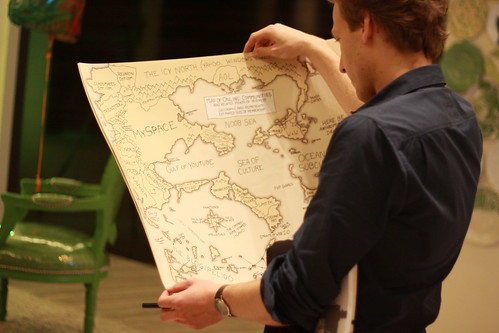
<li>I was looking at this map and thinking about how, on the Internet, we have different websites instead of different spaces.
<p>I have accounts on Facebook and Twitter and Foursquare and Flickr and GitHub and each of them could be for sharing a different sort of thing with a different group of people, just like I get to do with physical space in the real world..</p>
<p>But instead, I have only the vaguest of ideas about what my Internet-wide social graph looks like, across web sites. </p>
<p>I have hundreds more &#8220;friends&#8221; on Facebook than I actually do in real life, so that graph is hopelessly over-saturated.</p>
<p>On the other hand, there are many websites where I&#8217;ve only bothered to add a handful of friends. </p>
<p>My real-world social contexts don&#8217;t currently map very well to my online social contexts, and it&#8217;s too much work to fix.</p>
<p>I don&#8217;t know know who I&#8217;m friends with on which sites, and I don&#8217;t even know who has accounts on those sites. </p>
<p>I don&#8217;t know who can see which of the things I share, and I certainly don&#8217;t have a single place I can go to understand and manage my tangled social graph.</p>
<p>I&#8217;m building Wanderli.st to solve this problem.</p>
<p>(photo from http://www.flickr.com/photos/insunlight/3946559430/)<br/></li>
<li>So how is this going to work?<br />
<br/></li>
<li>On one side we have various ways of accessing a user&#8217;s address book, and Google Contacts is one with a nice API.
<p>On the other side we have the aforementioned social web sites that also have APIs.<br/></li>
<li>Wanderli.st will act as a layer between the two, using the APIs on both sides to read in information about a user&#8217;s social data.
<p>Google essentially has all the email addresses I&#8217;ve ever used, and these web sites have APIs that let you search for a user based on email address.</p>
<p>(And this is essentially how their address book import tools work, but those don&#8217;t scale when you have to make a decision about hundreds of people for each additional website.)</p>
<p>Wanderli.st could then show me  visualizations of the people I know, which sites they use, and where I am friends with them. Which will be pretty cool.</p>
<p>But there&#8217;s more!<br/></li>
<li>What if I could organize my contacts into groups, based on the real-world contexts in which I actually know them?
<p>These are some of the ones I might use, I&#8217;d have others as well, and each person could have different contexts.</p>
<p>And many of these web sites have *write* APIs for their social data in addition to read APIs.</li>
<li>So Wanderli.st could then modify relationships on these other web sites, based on these custom groups, adding and removing other people as friends accordingly.
<p>For example, my classmates at ITP and my coworkers at bit.ly can be my friends on Foursquare and know where I am, but I my ex-girlfriends, not so much.<br/></li>
<li>To summarize, this is cool because users get to understand their social lives in a way they couldn&#8217;t before.
<p>Users can maintain a single list of their friends and contacts</p>
<p>And if they want to join a new site, they can just select the appropriate groups, and this lowers the activation cost of trying new sites.</p>
<p>This is a better way for users to manage their privacy. Rather than deal with confusing settings within an account, users can simply restrict content to be viewable only by their friends, and manage those connections accordingly.</p>
<p>And everything can sync! If you meet someone new it&#8217;s easy to add them to the places you want and not anywhere else.</p>
<p>When people can move from one web site to another and take their friends with them, they can go to the places want to be, and have a better social experience on the Internet.<br/></li>
<li>So that&#8217;s Wanderli.st.
<p>Moving forward, I&#8217;m looking primarily for a software developer to build this with me, and for a business person to help me run this as a company. </p>
<p>I&#8217;d love to hear your feedback, and thank you for listening!<br />
<br/></li>
</ol>
<img src="http://feeds.feedburner.com/~r/Lehrblogger/~4/SvBEZAY0RgU" height="1" width="1"/>]]></content:encoded>
			<wfw:commentRss>http://lehrblogger.com/2010/03/29/wanderli-st-pitch-presentation/feed/</wfw:commentRss>
		<slash:comments>0</slash:comments>
		<feedburner:origLink>http://lehrblogger.com/2010/03/29/wanderli-st-pitch-presentation/</feedburner:origLink></item>
		<item>
		<title>Where Do You Go</title>
		<link>http://feedproxy.google.com/~r/Lehrblogger/~3/AxquE2BA-f4/</link>
		<comments>http://lehrblogger.com/2010/03/19/where-do-you-go/#comments</comments>
		<pubDate>Fri, 19 Mar 2010 08:50:14 +0000</pubDate>
		<dc:creator>Lehrblogger</dc:creator>
				<category><![CDATA[ITP]]></category>
		<category><![CDATA[projects]]></category>
		<category><![CDATA[web ideas]]></category>

		<guid isPermaLink="false">http://lehrblogger.com/?p=1747</guid>
		<description><![CDATA[A WDYG post at last! Where Do You Go provides Foursquare users with a dynamic heat map of the places they have visited on top of a standard Google Maps interface. Users can create snapshots of their maps and hotlink them as static URLs on their personal webpages, or they can use the simple WDYG [...]]]></description>
			<content:encoded><![CDATA[<p><em>A WDYG post at last!</em>	 </p>
<p><strong><a href="http://wheredoyougo.net">Where Do You Go</a></strong> provides <a href="http://foursquare.com/">Foursquare</a> users with a dynamic <a href="http://en.wikipedia.org/wiki/Heat_map">heat map</a> of the places they have visited on top of a standard Google Maps interface. Users can create snapshots of their maps and <a href="http://en.wikipedia.org/wiki/Hotlink">hotlink</a> them as static URLs on their personal webpages, or they can use the simple WDYG wrapper pages to share their maps on Twitter. The maps will self-update automatically in the background as users continue to visit new places and checkin with Foursquare.</p>
<p>The idea initially came out of the difficulty I experienced in explaining to people the areas I tend to frequent in this expansive metropolis &#8211; &#8220;south of 14th Street and north of Delancey&#8221; is somewhat accurate, but really misses many of the nuances in my habits. It would have been relatively straightforward to make a static image of just my own checkins, but I wanted something that updated over time as I went to more places, and I wanted something that was also usable by other people.</p>
<p>WDYG was a project for the <a href="http://webremix.org/">Mashups</a> class I took last Fall, and I launched it on December 18th, just before I exhibited it at <a href="http://itp.nyu.edu/shows/winter2009/">ITP&#8217;s Winter Show</a>. Many people used the built-in &#8220;tweet this&#8221; button to share their maps with their friends, and then those friends saw those maps and wanted to create and share their own maps, and so on&#8230; this viral distribution contributed to much of the non-trivial amount of traffic the site has gotten, but I also got <a href="http://gizmodo.com/5430760/foursquare-as-seen-by-the-predator">some</a> <a href="http://en.wikipedia.org/w/index.php?title=Foursquare_%28service%29&#038;action=historysubmit&#038;diff=340237182&#038;oldid=339845837">decent</a> <a href="http://twitter.com/foursquare/status/6802095824">press</a>.	 </p>
<p>Below are two maps I made of my checkins in Manhattan and one from my trip last summer to Amsterdam (which was coincidentally one of the early Foursquare cities, although now you can check in anywhere), and there&#8217;s a fourth heat map embedded in the sidebar. You can click the maps to visit the shareable page that each one has. The heat maps will update in the background as I check into new places, but it will skip checkins from the past 12 hours to protect my privacy, and the coloring is sufficiently vague as to make it ambiguous which places it is to which I am actually going.	 </p>
<div style="background-image:url('http://maps.google.com/maps/api/staticmap?center=40.74270505658412%2C-73.98880004882812&#038;format=png&#038;zoom=13&#038;key=ABQIAAAAwA6oEsCLgzz6I150wm3ELBSujOi3smKLcjzph36ZE8UXngM_5BTs-xHblsuwK8V9g8bZ_PTfOWR1Fg&#038;sensor=false&#038;size=640x640'); background-repeat:no-repeat; background-position: 2px 2px;" >
<a href="http://www.wheredoyougo.net/public/ag93aGVyZS1kby15b3UtZ29yEAsSCE1hcEltYWdlGM2LRgw.html"><img src="http://www.wheredoyougo.net/map/ag93aGVyZS1kby15b3UtZ29yEAsSCE1hcEltYWdlGM2LRgw.png" alt="memento85"/></a>
</div>
<div style="background-image:url('http://maps.google.com/maps/api/staticmap?center=40.73200685067638%2C-73.99480819702148&#038;format=png&#038;zoom=15&#038;key=ABQIAAAAwA6oEsCLgzz6I150wm3ELBSujOi3smKLcjzph36ZE8UXngM_5BTs-xHblsuwK8V9g8bZ_PTfOWR1Fg&#038;sensor=false&#038;size=640x640'); background-repeat:no-repeat; background-position: 2px 2px;" >
<a href="http://www.wheredoyougo.net/public/ag93aGVyZS1kby15b3UtZ29yEAsSCE1hcEltYWdlGKWCRAw.html"><img src="http://www.wheredoyougo.net/map/ag93aGVyZS1kby15b3UtZ29yEAsSCE1hcEltYWdlGKWCRAw.png" alt="memento85a2"/></a>
</div>
<div style="background-image:url('http://maps.google.com/maps/api/staticmap?center=52.36868208115476%2C4.886941909790039&#038;format=png&#038;zoom=14&#038;key=ABQIAAAAwA6oEsCLgzz6I150wm3ELBSujOi3smKLcjzph36ZE8UXngM_5BTs-xHblsuwK8V9g8bZ_PTfOWR1Fg&#038;sensor=false&#038;size=640x500'); background-repeat:no-repeat; background-position: 2px 2px;" >
<a href="http://www.wheredoyougo.net/public/ag93aGVyZS1kby15b3UtZ29yEAsSCE1hcEltYWdlGIaeRQw.html"><img src="http://www.wheredoyougo.net/map/ag93aGVyZS1kby15b3UtZ29yEAsSCE1hcEltYWdlGIaeRQw.png" alt="memento85s"/></a>
</div>
<p>Users are given a variety of options for customizing their maps before sharing them: they can adjust their maps to make them &#8216;hotter&#8217; or &#8216;colder&#8217; if there is either too little or too much coloring, they can easily jump to another city, they can select from a variety of color schemes, they can adjust the size of the map image, and they can select from one of several zoom levels. A user can then create a &#8216;snapshot&#8217; of his/her customized dynamic JavaScript Google maps that will have a static URL, and the user can then embed that .png elsewhere on the Internet or tweet the corresponding wrapper page (that has a conveniently auto-shortened <a href="http://bit.ly/">bit.ly</a> URL).</p>
<p>The Python code for the entire project is available on <a href="http://github.com/lehrblogger/where-do-you-go/">GitHub</a> and the application runs on <a href="http://appengine.google.com/">Google App Engine</a>, a framework that abstracts away challenges related to server administration and scaling (i.e. worrying about getting and configuring more computers to run your application when you suddenly get a lot of traffic). It uses <a href="http://groups.google.com/group/foursquare-api">Foursquare&#8217;s API</a> and <a href="http://github.com/wiseman/foursquare-python/">John Wiseman&#8217;s wrapper library</a> for it as well as the <a href="http://code.google.com/p/bitly-api/">bit.ly API</a>, the <a href="http://code.google.com/apis/maps/">Google Maps API</a>, <a href="http://jquery.com/">jQuery</a>, and <a href="http://www.blueprintcss.org/">Blueprint CSS</a>. </p>
<p>The heat maps are created using a heavily modified version of the <a href="http://code.google.com/p/gheat-ae/">gheat-ae</a> Google Code project, which is a port of the <a href="http://code.google.com/p/gheat/">gheat</a> Google Code project, without which I wouldn&#8217;t have known where to start (although it was mostly non-functional and un-documented when I found it). There are a few interesting things I&#8217;m doing to make the heat maps consistently attractive, so I&#8217;ll dive into the technical details a little.</p>
<p>Google serves their maps in pre-generated 256&#215;256 pixel tiles, and they provide functionality in their JavaScript API for the client to overlay custom tiles on top of their map tiles. To display each overlay tile I query the App Engine datastore for the venues within that tile (and just outside of it, at a distance based on the zoom level, so that I get coloring from venues that are not within the tile but still bleed into it). Checkins are stored with the venue at which they occurred, so each venue has a latitude and a longitude and a number of checkins that the user has there (if two users check in to the same place, they each get a separate copy of the venue in the datastore). A heat map tile to be displayed on top of a Google maps tile might look like this:</p>
<p><img src="http://lehrblogger.com/nyu/projects/wdyg/tile.png"></p>
<p>The checkins are plotted on the map conceptually as dots that are darkest in the center and fade out towards the edges, and they&#8217;re drawn mostly independently of each other (i.e. I&#8217;m not doing any expensive distance calculations between the venues). To draw the tiles the application adds all the geo-located dots together to get a &#8216;darkness&#8217; value for each of the pixels in the 256&#215;256 pixel tile. I wanted a smooth gradient from the center to the edge of the dots, even if there were lots checkins at the same venue. I used the OS X application Grapher to experiment with functions that might create the desired effect and minimize hard edges of the stacked dots. I went with something similar to the highlighted equation below and implemented it in the <code>calc_point</code> function in the <a href="http://github.com/lehrblogger/where-do-you-go/blob/master/gheatae/tile.py">tile generation code</a> &#8211; here <strong>x</strong> is the distance from the center of the pixel and <strong>y</strong> is the how dark that point will be when mapped to a pixel. </p>
<p><img src="http://lehrblogger.com/nyu/projects/wdyg/dotgraphs.png"></p>
<p>Next I needed to specify the actual color chosen from the color schemes for each pixel in the tile. The pixels correspond to a color that is a certain height up or down one of the below color scheme images (the cyan-red color scheme isn&#8217;t generated from an image, but we won&#8217;t worry about that here). Both the range and rate-of-change of the colors affects the appearance of the maps.</p>
<p><img src="http://lehrblogger.com/nyu/projects/wdyg/classic.png"><img src="http://lehrblogger.com/nyu/projects/wdyg/classic2.png"><img src="http://lehrblogger.com/nyu/projects/wdyg/fire.png"><img src="http://lehrblogger.com/nyu/projects/wdyg/omg.png"><img src="http://lehrblogger.com/nyu/projects/wdyg/pbj.png"><img src="http://lehrblogger.com/nyu/projects/wdyg/pgaitch.png"><img src="http://lehrblogger.com/nyu/projects/wdyg/pgaitch2.png"><img  src="http://lehrblogger.com/nyu/projects/wdyg/water.png"></p>
<p>As described above, I needed to map the array of &#8216;darkness&#8217; values for each of the 256&#215;256 pixels in a tile to a height up or down one of these color schemes. I wanted the &#8216;darkest&#8217; point on any map to correspond to the &#8216;hottest&#8217; point in the color scheme (at the top of the image), and I estimated what that maximum level should be (at which the color scheme becomes &#8216;over-heated&#8217; or &#8216;blown out&#8217; or &#8216;over-exposed&#8217;) by calculating the total number of checkins and the total number of venues currently visible on the entire map. Then I needed a way to scale each darkness value so that it would always show some color for a checkin (in case a user had only one checkin somewhere away from his/her other checkins) but would be slow to reach the maximum level (i.e. the &#8216;hot&#8217; end of the color scheme). I experimented with log functions in Grapher and settled on the formula in the <code>scale_value</code> function in that same <a href="http://github.com/lehrblogger/where-do-you-go/blob/master/gheatae/tile.py">tile generation code</a> &#8211; here <strong>x</strong> is the value of the pixel resulting from the stacked dots and <strong>y</strong> is the level which will be mapped to a point on the selected color scheme.</p>
<p><img src="http://lehrblogger.com/nyu/projects/wdyg/scaling.png"></p>
<p>Please let me know if you are interested in explanations of other aspects of the tile generation or the code in general &#8211; I think the above tricks are particularly cool, but there&#8217;s lots of interesting stuff going on within the application that I&#8217;d love to talk about.</p>
<p>And last but not least, the inspiration for the name of the project (finding a good name is, of course, always the hardest part of anything) &#8211; thanks to <a href="http://uncountablymany.com/">Jorge</a> for the suggestion!</p>
<p><object width="480" height="385"><param name="movie" value="http://www.youtube.com/v/Uc0moUPBJnM&#038;hl=en_US&#038;fs=1&#038;"></param><param name="allowFullScreen" value="true"></param><param name="allowscriptaccess" value="always"></param><embed src="http://www.youtube.com/v/Uc0moUPBJnM&#038;hl=en_US&#038;fs=1&#038;" type="application/x-shockwave-flash" allowscriptaccess="always" allowfullscreen="true" width="480" height="385"></embed></object></p>
<img src="http://feeds.feedburner.com/~r/Lehrblogger/~4/AxquE2BA-f4" height="1" width="1"/>]]></content:encoded>
			<wfw:commentRss>http://lehrblogger.com/2010/03/19/where-do-you-go/feed/</wfw:commentRss>
		<slash:comments>8</slash:comments>
		<feedburner:origLink>http://lehrblogger.com/2010/03/19/where-do-you-go/</feedburner:origLink></item>
		<item>
		<title>Wanderli.st – Midterm Presentation</title>
		<link>http://feedproxy.google.com/~r/Lehrblogger/~3/AszUmMNA4ls/</link>
		<comments>http://lehrblogger.com/2010/03/07/wanderli-st-midterm-presentation/#comments</comments>
		<pubDate>Mon, 08 Mar 2010 04:24:52 +0000</pubDate>
		<dc:creator>Lehrblogger</dc:creator>
				<category><![CDATA[ITP]]></category>
		<category><![CDATA[Wanderli.st]]></category>
		<category><![CDATA[presentations]]></category>
		<category><![CDATA[projects]]></category>
		<category><![CDATA[thesis]]></category>

		<guid isPermaLink="false">http://lehrblogger.com/?p=1743</guid>
		<description><![CDATA[Update: there&#8217;s an improved version of this presentation in this more recent post.]]></description>
			<content:encoded><![CDATA[<p><em>Update: there&#8217;s an improved version of this presentation in <a href="http://lehrblogger.com/2010/03/29/wanderli-st-pitch-presentation">this</a> more recent post.</em></p>
<p><iframe src="http://docs.google.com/present/embed?id=dhh97gc8_52ff737dt7&#038;size=m" frameborder="0" width="555" height="451"></iframe></p>
<img src="http://feeds.feedburner.com/~r/Lehrblogger/~4/AszUmMNA4ls" height="1" width="1"/>]]></content:encoded>
			<wfw:commentRss>http://lehrblogger.com/2010/03/07/wanderli-st-midterm-presentation/feed/</wfw:commentRss>
		<slash:comments>0</slash:comments>
		<feedburner:origLink>http://lehrblogger.com/2010/03/07/wanderli-st-midterm-presentation/</feedburner:origLink></item>
		<item>
		<title>Wanderli.st – Project Proposal</title>
		<link>http://feedproxy.google.com/~r/Lehrblogger/~3/MLux5BYPflA/</link>
		<comments>http://lehrblogger.com/2010/02/15/wanderli-st-project-proposal/#comments</comments>
		<pubDate>Tue, 16 Feb 2010 02:03:03 +0000</pubDate>
		<dc:creator>Lehrblogger</dc:creator>
				<category><![CDATA[ITP]]></category>
		<category><![CDATA[Wanderli.st]]></category>
		<category><![CDATA[projects]]></category>
		<category><![CDATA[thesis]]></category>

		<guid isPermaLink="false">http://lehrblogger.com/?p=1699</guid>
		<description><![CDATA[http://wanderli.st &#8211; wander the internet, bring your friends I propose to design and build Wanderli.st, a new tool that will enable people to manage their contacts across social web services. Wanderli.st will be a web-based contact management application that synchronizes a user&#8217;s friend lists on both new and familiar web sites. It will serve as [...]]]></description>
			<content:encoded><![CDATA[<h5 style="text-align: center;"><strong><a href="http://wanderli.st">http://wanderli.st</a> &#8211; wander the <a href="http://xkcd.com/256/">internet</a>, bring your <a href="http://www.facebook.com/home.php#/friends/">f</a><a href="http://twitter.com/following">r</a><a href="http://foursquare.com/manage_friends">i</a><a href="http://www.flickr.com/photos/friends/">e</a><a href="http://www.google.com/contacts">n</a><a href="http://www.linkedin.com/connections?trk=hb_side_cnts%20is">d</a><a href="https://github.com/">s</a></strong></h5>
<p><br/></p>
<p>I propose to design and build Wanderli.st, a new tool that will enable people to manage their contacts across social web services. Wanderli.st will be a web-based contact management application that synchronizes a user&#8217;s friend lists on both new and familiar web sites. It will serve as a layer between currently-unconnected applications on the social web, linking existing online contact management tools (such as <a href="http://www.google.com/contacts">Google Contacts</a>) with the myriad sites on which people share content (such as <a href="http://twitter.com/">Twitter</a>, <a href="http://vimeo.com/">Vimeo</a>, <a href="http://foursquare.com/">Foursquare</a>, and <a href="http://github.com/">GitHub</a>). </p>
<p>Wanderli.st will provide users with an improved interface for organizing their existing contacts (which can number in the hundreds or thousands) into a set of manageable, custom groups. Google Contacts currently provides only a rudimentary user interface for those wishing to organize their contacts in this way, so I will create improved tools to make this initial set-up step as fast and easy as possible.</p>
<p>Once a user has organized her contacts into groups, the user will then authenticate her Wanderli.st account with those third-party web services on which she wants to manage her contacts. The user will make selections from her custom groups and assign them to the different services using <a href="http://en.wikipedia.org/wiki/Set_%28mathematics%29#Basic_operations">basic set operations</a>; Foursquare, for example, might be assigned everyone who is in either the &#8216;school&#8217; or &#8216;family&#8217; groups except those people who are also in either the &#8216;coworkers&#8217; or &#8216;ex-boyfriend&#8217; groups. Wanderli.st will then search for user accounts on each of those web services using the names and/or email addresses of only that set of contacts that they&#8217;ve been assigned, and it will then automatically send friend requests to (or, on sites with asymmetric social networks, simply follow) those users. </p>
<p>Later, if the user makes a change to one of her groups, either by adding a new person she recently met or moving someone from one group to another, Wanderli.st will automatically synchronize that change on each service to which that group has been assigned. In this way Wanderli.st will both lower the barrier to entry that a user faces when trying out a new web service, and will decrease the thought and effort required to keep one&#8217;s social graph up-to-date across services. </p>
<p>By making it easy for the user to understand and manage her contacts, Wanderli.st will enable the user to share content that is either very private or simply not &#8220;for&#8221; everyone with comfort and certainty about which of the people she knows can see each different piece of content. It will also benefit the third-party web services themselves because their users will more actively share content with the users&#8217; more complete and easily-managed list of friends.</p>
<p>I plan to write Wanderli.st in <a href="http://www.scala-lang.org/">Scala</a> using the <a href="http://liftweb.net/">Lift web framework</a>, and I&#8217;ll host it on the <a href="http://www.stax.net/">Stax Networks</a> elastic application platform.</p>
<p>Note: I acknowledge that Facebook offers some of this functionality with Facebook Connect, and that in the future it might allow users to leverage Facebook&#8217;s Friend Lists to selectively export their social network to other sites; Wanderli.st, however, will differ in several critical ways. First, third-party services will only be required to provide a read/write API for users to add and remove contacts, and they will not need to write custom code as they would for Facebook Connect. Second, Wanderli.st will actually duplicate (and then synchronize) the user&#8217;s social graph on the third-party service, and this is to the advantage of those services because they will then own their social data, rather than rely on Facebook for continued access to the social graph. Finally, because Wanderli.st will only be a collection of spokes (social connections) without a hub (personal profile data, photos, and other content), users can feel confident about connecting Wanderli.st to third party sites, as there will be no private data that users will risk exposing.</p>
<img src="http://feeds.feedburner.com/~r/Lehrblogger/~4/MLux5BYPflA" height="1" width="1"/>]]></content:encoded>
			<wfw:commentRss>http://lehrblogger.com/2010/02/15/wanderli-st-project-proposal/feed/</wfw:commentRss>
		<slash:comments>0</slash:comments>
		<feedburner:origLink>http://lehrblogger.com/2010/02/15/wanderli-st-project-proposal/</feedburner:origLink></item>
	</channel>
</rss><!-- Dynamic Page Served (once) in 0.771 seconds --><!-- Cached page served by WP-Cache -->