Liberty Street Economics2026-10-15T12:26:12Zhttps://libertystreeteconomics.newyorkfed.org/feed/atom/WordPress<![CDATA[Revenue per Worker Is Up. Are Firms Getting a Larger Share?]]>https://libertystreeteconomics.newyorkfed.org/?p=462392026-10-15T12:26:12Z2026-10-15T11:00:00Zslowdown in the growth of revenue per worker among public firms. However, since 2019, growth has picked up to twice the 2010s rate, around 2 percent. In this post, I use data from firms’ 10-K filings to unpack this recent acceleration. I first show that the acceleration appears in public firms’ revenue per worker, then document how the gains went into profit margins, and finally, what firm characteristics predicted significant profit margin increases. The increase in profit margins is consistent with ongoing declines in the labor share of output.]]>
Jeremy Pearce
From the Great Recession until 2019, U.S. labor productivity growth disappointed. Nonfarm-business output per hour grew about 1 percent a year from 2010 to 2019, down from 3 percent in the late 1990s. This slowdown was especially pronounced in manufacturing, and it coincided with a slowdown in the growth of revenue per worker among public firms. However, since 2019, growth has picked up to twice the 2010s rate, around 2 percent. In this post, I use data from firms’ 10-K filings to unpack this recent acceleration. I first show that the acceleration appears in public firms’ revenue per worker, then document how the gains went into profit margins, and finally, what firm characteristics predicted significant profit margin increases. The increase in profit margins is consistent with ongoing declines in the labor share of output.
Firm Productivity, 2019–2025
This piece studies U.S. Compustat firms across both manufacturing and services over 2010–2025, broken into two periods: 2010–2019 and 2019–2025. I drop agriculture, utilities, finance, real estate, and public administration, due to the known challenges of productivity measurement in those industries.
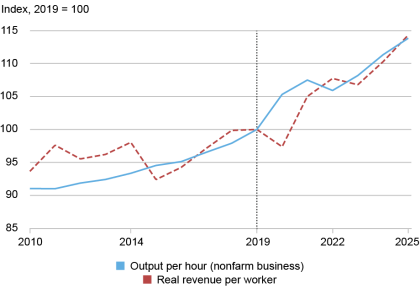
Nonfarm-business output per hour grew 1.0 percent a year from 2010 to 2019 and 2.2 percent a year from 2019 to 2025. In Compustat, I find a similar qualitative growth acceleration. Real revenue per worker—sales deflated by industry output prices, divided by employment—traces the same turn, from 0.7 percent to 2.2 percent a year over the same time periods.
The chart below illustrates this trend, showing that both revenue per worker among public firms and output per hour are accelerating in the recent period. Across all datasets, the labor productivity uptick is real.
Labor Productivity and Firm Revenue Per Worker Accelerated Together in 2019-2025
Sources: Bureau of Labor Statistics (BLS); Compustat. Notes: Labor productivity, indexed to 2019 = 100: Chart shows BLS nonfarm-business output per hour and Compustat real revenue per worker.
Higher revenue per worker at the firm level does not indicate who gains from this increased revenue. The additional revenue may go to workers, as firms compete for labor through higher wages, or accrue to firms in profit margins. Firm-level data let me measure how firms’ profit margins changed over time. I explore how profit margins changed between 2019 and 2025 and what firm characteristics predicted markup gains.
Firm Profit Margins
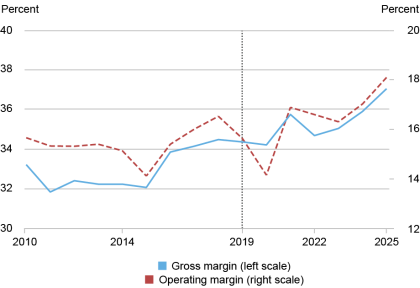
A profit margin is profit divided by sales: the share of each sales dollar the firm keeps after paying its costs. The gross margin subtracts the direct cost of production (cost of goods sold), while the operating margin also subtracts overhead (selling, general, and administrative expense, which in Compustat typically includes R&D). If productivity gains were flowing to firms’ profits, margins should show it. Through the 2010s margins were flat: gross margins grew about 0.4 percent a year from 2010 to 2019, and operating margins were roughly flat. Both then turned up: on average, gross margins went from about 34 percent of sales in 2019 to 37 percent in 2025 (1.3 percent growth per year), and operating margins from 16 percent to 18 percent (2.4 percent growth per year).
Gross and Operating Profit Margins Increased in 2019-2025
Source: Compustat. Notes: Compustat gross margin (COGS) and operating margin (OPEX), 2010–2025, sales-weighted; gross on the left scale, operating on the right scale.
Which Firms Saw the Largest Gains?
Lastly, I ask whether firms that invest in intangibles (e.g., research and development, or R&D) experienced the largest gains. In earlier work, we showed that while productivity growth in manufacturing slowed in the 2010s, R&D intensity in manufacturing continued to rise. Does R&D intensity predict higher profit margins in the recent era?
Firms that entered the period with higher R&D expenditure relative to sales saw larger subsequent gains: firms with 10 percent more R&D expenditure relative to sales in 2019 saw about 0.7 percent higher operating-markup growth over 2019–2025, and 0.5 percent over 2022–2025. Firms with higher capital intensity did not see such a significant pattern. This pattern is consistent with returns to intangible intensity rather than capital intensity. This suggests a potentially important role for investments in technology and intangibles in driving markups.
Measured productivity has risen since 2019 in both aggregate and firm data, ending more than a decade of slow growth. Part of the gains surfaced with wider profit margins: on a reasonable baseline, the operating margin rose over 2 percent a year from 2019 to 2025. R&D intensity appears to be an important predictor of margin growth for firms, consistent with the rising returns to high-tech firms and firms that have invested in intangibles since COVID. Whether these rising margins are returns to significant investment in intangibles or purely a windfall for firms is a topic to explore in future work.
Jeremy Pearce is a research economist in the Federal Reserve Bank of New York’s Research and Statistics Group.
How to cite this post:
Jeremy Pearce, “Revenue per Worker Is Up. Are Firms Getting a Larger Share?,” Federal Reserve Bank of New York Liberty Street Economics, October 15, 2026, https://doi.org/10.59576/lse.20261015BibTeX: View |
@article{Pearce2026,
    author={Pearce, Jeremy},
    title={Revenue per Worker Is Up. Are Firms Getting a Larger Share?},
    journal={Liberty Street Economics},
    note={Liberty Street Economics Blog},
    number={October 15},
    year={2026},
    url={https://doi.org/10.59576/lse.20261015}
}
Disclaimer The views expressed in this post are those of the author(s) and do not necessarily reflect the position of the Federal Reserve Bank of New York or the Federal Reserve System. Any errors or omissions are the responsibility of the author(s).
]]>0Julian di Giovanni<![CDATA[Has the AI Boom Impacted the U.S. Current Account?]]>https://libertystreeteconomics.newyorkfed.org/?p=461012026-10-08T20:12:48Z2026-10-14T11:00:00Z
Julian di Giovanni
The AI boom is showing up in different corners of the U.S. economy, including international trade. Imports of semiconductors, servers, and computing equipment have climbed sharply yet the U.S. current account deficit has been largely unchanged. To better understand how the AI boom has not substantially affected the trade balance, consider that the current account is dictated by the gap between domestic saving and investment spending. It turns out that aggregate saving and investment spending have not changed much during the AI boom. Aggregate investment has not risen due to weakness outside the AI sector and business saving has remained robust.
Gross Flows versus Net Positions
Recent work has shown that AI-related imports accounted for a nontrivial share of U.S. imports in the past few years. In fact, it reached a high of 23 percent in 2025. However, a country can import a great deal of capital equipment or attract a great deal of foreign capital without necessarily running a larger external deficit, provided it saves enough to pay for the investment spending itself. This idea can be formalized by noting that the current account is a net concept, where the balance equals a country’s gross saving less its gross domestic investment. A recent LibertyStreetEconomics post provides an in-depth explanation linking the trade balance to the savings and investment balance via national accounting.
For the AI boom to widen the deficit, it must raise investment without a matching rise in saving. Two channels can depress private saving: a wealth effect, where equity gains lift household consumption, or a fall in business saving. Both were at work during the dot-com era, when the two channels moved together.
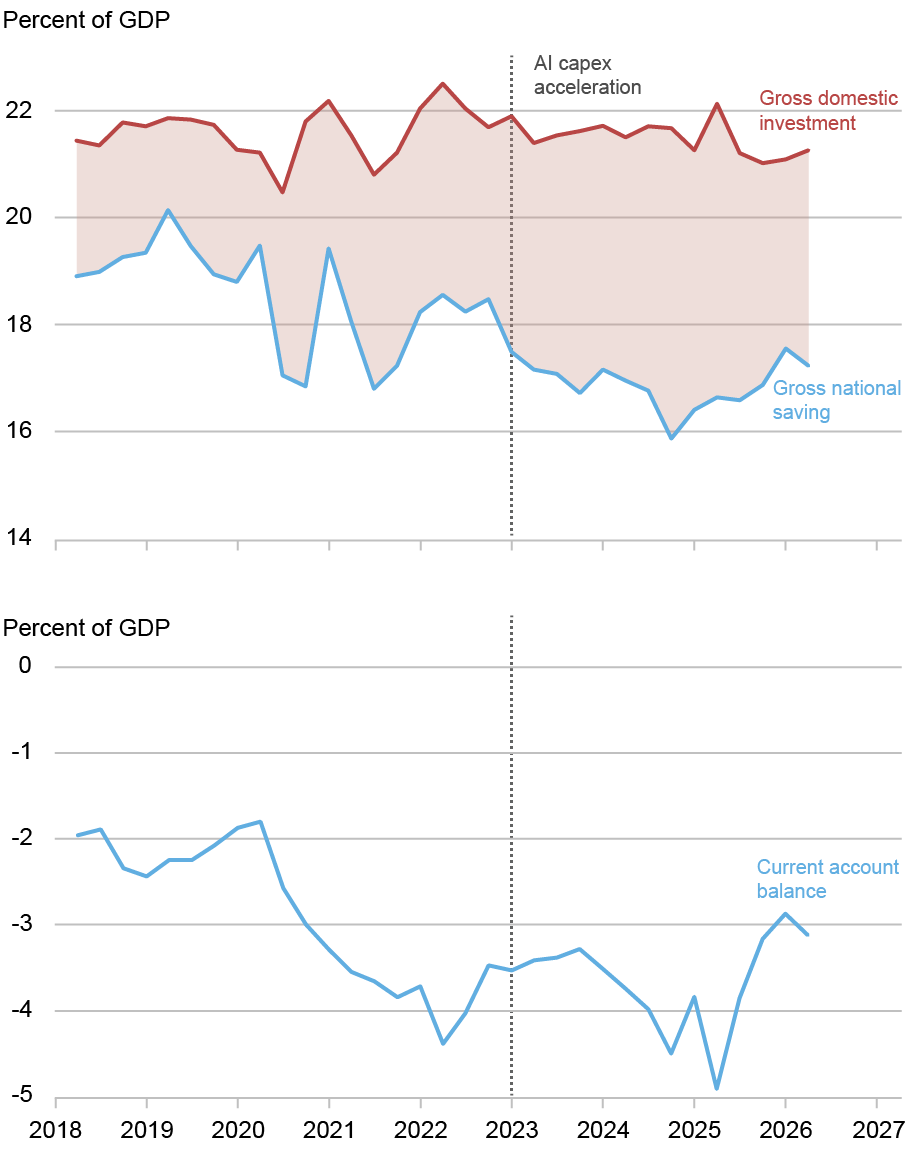
The top panel of chart below plots the savings-to-GDP and investment spending-to-GDP ratios since 2018, while the bottom panel plots the current account-to-GDP ratio. The current account deficit widened over this period, from roughly 2.2 percent of GDP on average in 2015–19 to about 3.7 percent since 2023. Notice, however, that the widening comes almost entirely from the saving side. Investment as a share of GDP has been remarkably steady, especially since 2023 when the AI capex buildout started in earnest.
Saving, Investment, and the Current Account
Sources: Bureau of Economic Analysis, NIPA Tables 1.1.5 and 5.1; authors’ calculations.
Investment Has Been Reallocated, Not Expanded
Gross domestic investment averaged 21.3 percent of GDP in the five years before the pandemic. Over 2023–2026:Q1 (the period spanning the AI capex acceleration), it averaged 21.5 percent, and over the past four quarters, 21.1 percent. The AI boom is thus not visible in the aggregate investment rate at all.
To better understand why the AI boom has not had a tangible impact on aggregate investment, it is useful to look at how investment has varied across sectors of the U.S. economy. As the chart below shows, the AI contribution to nonresidential investment has not been small and has been rising in recent years, but it has coincided with weakness in other sectors of the economy. For example, the surge in factory construction that followed the 2022 industrial policy legislation has faded, and investment in structures and equipment outside the technology complex has been soft. Data centers and information-processing equipment have helped take up the slack, but not to such an extent as to raise aggregate investment relative to national savings. Further, residential investment has been declining recently.
Composition of Nonresidential Investment
Percent of GDP
Sources: Bureau of Economic Analysis; authors’ calculations.
Consumption Has Also Not Adjusted
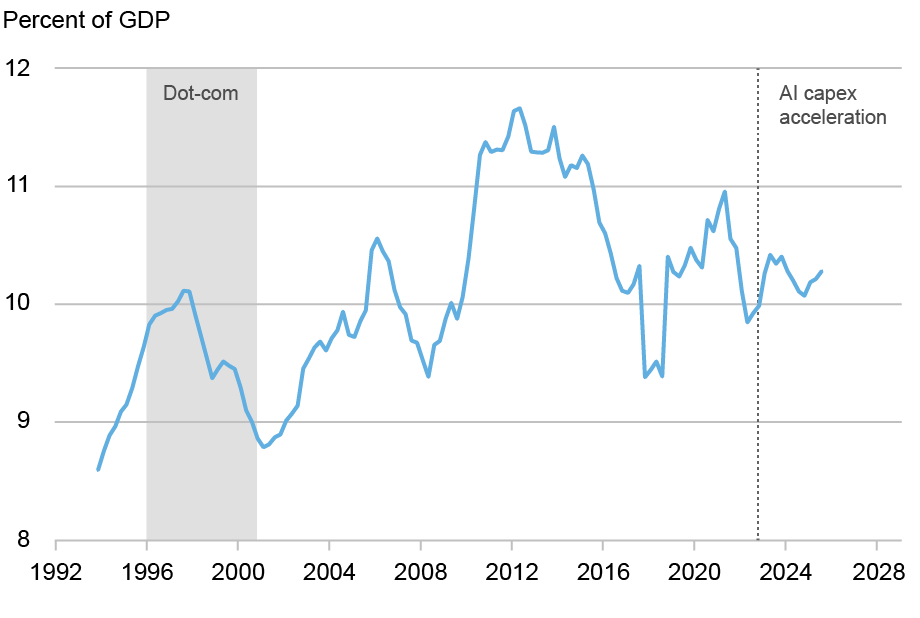
It is interesting to contrast how savings have adjusted during the AI boom thus far relative to the dot-com era, which is often highlighted as a period of elevated equity values. During the dot-com expansion, private saving fell by nearly 3 percentage points of GDP between 1995 and 2000 as households spent out of rising equity wealth. Nothing comparable is happening today. Private saving has averaged 20.8 percent of GDP since 2023, down from 21.3 percent before the pandemic—a difference of half a percentage point, and one that can be attributed as much to the post-pandemic unwinding of accumulated savings as to anything AI-related.
Business Sector Saving Has Not Fallen
Let’s turn to business saving, defined as revenue minus expenses excluding investment spending. The salient difference between the dot-com and AI episodes is not the scale of the investment but the cash position of the firms doing it. The dot-com buildout was concentrated in young telecom and equipment producers with thin or negative operating cash flow; as profits compressed late in the boom while dividends remained sticky, retained earnings and with them business gross saving fell. Business saving was thus a drag on private saving at precisely the moment investment was peaking. The AI buildout, by contrast, is concentrated in the most cash-generative firms in the economy, and business saving has thus far held up through the capex surge rather than eroding against it.
The chart below illustrates these points by plotting the business sector’s savings rate over time. Business saving has averaged 10.9 percent of GDP over the past four quarters, in line with the roughly 10.5 percent averaged before the pandemic, and above the dot-com trough of roughly 8.8 percent of GDP in late 2000/early 2001.
Business Sector Saving
Sources: Federal Reserve Board, Financial Accounts of the United States, Table F.103; authors’ calculations.
Government Saving Has Moved in the Opposite Direction
Government saving offers the sharpest contrast between the two episodes, and it runs in the opposite direction from private saving. During the dot-com expansion, government saving rose by nearly 5 percentage points of GDP, swinging from a deficit of about 1 percent of GDP in 1995 to a surplus of roughly 4 percent in 2000 as capital-gains-driven tax receipts flooded federal coffers. That fiscal windfall offset much of the pickup in private dissaving, which is one reason the current account deficit widened by “only” 2.5 percentage points even as households drew down saving so aggressively.
Today the fiscal position is doing the opposite work. Government saving has fallen from about –2.2 percent of GDP in 2015–19 to about –4.0 percent since 2023, a deterioration of roughly 1.75 percentage points.
Decomposing the Contributions to the Current Account Balance
Putting the above pieces together, the external balance can be decomposed into its three sources relative to a pre-pandemic baseline (that is, relative to 2019:Q4). Of the roughly 2.4 percentage point widening in the saving–investment gap, government dissaving accounts for about 1.75 percentage points, lower private saving for about half a point, and higher investment for essentially nothing. Therefore, changes in fiscal policy have been the major driver of current account dynamics, with a smaller role played by private saving, and no discernible investment channel.
Caveat and Why Things Could Change
There is an important caveat to note before drawing conclusions on the AI’s impact on the current account going forward. The announced capital spending plans of the major technology firms for 2026 and 2027 are considerably larger than what has already been built, while the offsetting weakness in residential and nontechnology investment will not persist indefinitely. So, while the AI boom has not yet been large enough relative to the rest of the economy to move the U.S. external balance, if the current drags on other investment fade as AI capex accelerates, both the higher investment spending and less business saving will work to increase the current account deficit.
Julian di Giovanni is an economic research advisor in the Federal Reserve Bank of New York’s Research and Statistics Group.
How to cite this post:
Julian di Giovanni, “Has the AI Boom Impacted the U.S. Current Account?,” Federal Reserve Bank of New York Liberty Street Economics, October 14, 2026, https://doi.org/10.59576/lse.20261014BibTeX: View |
@article{JuliandiGiovanni2026,
    author={Julian di Giovanni},
    title={Has the AI Boom Impacted the U.S. Current Account?},
    journal={Liberty Street Economics},
    note={Liberty Street Economics Blog},
    number={October 14},
    year={2026},
    url={https://doi.org/10.59576/lse.20261014}
}
Disclaimer The views expressed in this post are those of the author(s) and do not necessarily reflect the position of the Federal Reserve Bank of New York or the Federal Reserve System. Any errors or omissions are the responsibility of the author(s).
]]>0<![CDATA[Prices, Prices, Prices: Overall Inflation and the Costs You Care About]]>https://libertystreeteconomics.newyorkfed.org/?p=462142026-10-09T19:13:30Z2026-10-09T11:00:00Z
Kartik B. Athreya
As fall starts to show itself in cooler weather, I want to discuss a topic that usually raises temperatures: inflation. Like a budget-conscious consumer, the Federal Reserve is highly attuned to changes in the price of goods and services; minimizing such swings is one of the Fed’s primary duties, after all. But how does the Fed’s view of prices differ from that of a consumer? And how does the Fed go about stabilizing prices writ large when it lacks the ability to set prices directly? In this post, I explore that apparent paradox from the perspective of a central banker (though I remain a budget-conscious consumer when off duty).
Price Gauging
Inflation is an average of price changes across the full range of goods and services that we as consumers spend our money on. Moreover, it’s an average that weights those items by the share of our budgets that we devote to them. Pumpkin products, an example we will shortly return to, make up an infinitesimally small share of the average U.S. household’s spending. By contrast, food as a whole takes up a much larger share of the budget—closer to 10 percent for the typical household.
We at the Fed have been tasked by Congress with managing inflation—or promoting price stability per the language of our mandate. The Fed’s preferred measure of inflation—the personal consumption expenditures (PCE) index—tracks prices on a huge number of consumer goods: jams and jeans, kites and kitty litter, cars and camping stoves, and on and on (at last count, the PCE accounts for more than 300 categories of goods and services).
Given our mandate, researchers at the New York Fed are naturally quite attentive to the measurement and prediction of inflation. Here’s a non-exhaustive (but maybe exhausting!) rundown of relevant data and analysis from the New York Fed’s Research team:
While the Fed has the means to collect and analyze vast amounts of information about inflation and related factors, it does not directly set the level or growth rate of the prices that consumers face—we certainly don’t set prices for jams, jeans, kites, or kitty litter (or even for crucial fall staples like bratwurst, football helmets, or flannel shirts). As Chairman Warsh clearly acknowledged at the FOMC’s September press conference, “we cannot affect any individual price, whether it be oil prices, whether it be foodstuffs at the grocery store.” So how does the Fed support the price stability part of its mandate?
The resolution of this apparent paradox is that our role at the Fed is a narrower one than managing prices of specific items. Rather, it is to ensure that the typical change in prices will be small from month to month or year to year.
To see this, let’s think first of a world where not a lot of unexpected shocks are happening (a stretch, I know, but bear with me). In that world, there is little reason for prices to change much from day to day, so we can expect the average change in prices to be small (barring unilateral action from a central bank like the Fed).
Price Shocks
In reality, of course, economic shocks hit us all the time: droughts and floods hit our ag states, oil prices spike because of war, and so on. What the Fed wants to do is to ensure that the markets most directly affected by such shifts can respond in a narrow way.
Now back to pumpkins. Let’s imagine that the world’s appetite for pumpkin pies has inexplicably spiked to an unprecedented level (news that arrives just in time for fall!). Barring a big change in our ability to grow pumpkins, we suspect that pumpkin prices will be under a lot of pressure to grow persistently faster than they have in the past. After all, if they don’t, things would not be tenable—the shelves will soon be bare for sellers that don’t hike prices.
Yet, is this really a big deal? After all, when the shock hits just one item, like pumpkins, that represents a tiny share of most peoples’ budgets; it won’t change overall inflation, the average change in prices across a vast range of goods and services. On top of that, prices of other items could be hit by offsetting shocks—not a bad presumption in an economy as complex as ours. So, a first answer to the question of how the Fed deals with real shocks to certain sectors is that “It doesn’t have to!”
But now consider a shock that is more widespread—a realization that fertilizer demand will likely increase much more rapidly (due, say, to faster growth in Africa or Asia) than our capacity to produce more fertilizer. This means that prices for all food items, a good bit of the typical household’s budget, are going to face persistent upward pressure compared to non-food prices. This development clearly can’t be ignored in the hope that all of these price increases will get washed out by price declines in other market segments.
In the short run, the shock will run its course; if those unaffected by the shock carry on as usual, barring very strong action by the Fed that might well increase the unemployment rate, inflation will now be at least temporarily higher than it was before.
Over a longer period of time, however, things are not so grim. As long as the Fed’s policies lead people and business to expect overall inflation to stay low and stable in the wake of these shocks, they can be taken in stride without inflation being anything more than temporarily high. That is, the aim is to reassure consumers and businesses that the prices of other goods and services, the ones unaffected by shocks, will not persistently grow faster than their “usual” low rate. Which then allows those affected more directly—here, fertilizer users—to hike prices in order to manage the very specific shock that has hit them, with the assurance that prices in the rest of the economy won’t move a lot.
So, how does the Fed work to dispel expectations for a broader wave of price hikes? That mechanism is a bit more subtle, but it basically comes down to this: being clear about its goal of keeping inflation low, then following through by ensuring that the short-term interest rate is set at an appropriate level relative to a “neutral rate.” That allows businesses to change their prices minimally to deal with the very real and pressing shocks they face, rather than to partly overcome or offset a larger or more uncertain general rise in all prices.
Street Level Observations: Keeping Shocks Contained
The Fed cannot directly undo shocks to specific parts of the economy. So there will be times when prices in some sectors move up (or down) rapidly compared to those in other sectors. Indeed, such differential price growth is how the economy responds to a genuine change in the scarcity of some items relative to others.
Practically speaking, then, shocks might cause inflation to accelerate. The Fed’s task is to ensure that this acceleration doesn’t last. And this requires that those who are unaffected by shocks do not view a temporary, narrow rise in inflation as a broader, long-term phenomenon. In turn, overall price growth—inflation—can be contained, eventually reverting to mandate-consistent levels.
In other words, rising pumpkin prices would have a negligible effect on the overall cost of a Thanksgiving dinner, but the same cannot be said of rising fertilizer prices. Yet, as long as monetary policy gives consumers confidence that inflation will remain stable, neither type of shock would have much effect on the prices of the many goods we rush out to buy on Black Friday.
Kartik B. Athreya is the director of research and head of the Research and Statistics Group at the Federal Reserve Bank of New York.
How to cite this post:
Kartik B. Athreya, “Prices, Prices, Prices: Overall Inflation and the Costs You Care About,” Street Level, Federal Reserve Bank of New York Liberty Street Economics, October 9, 2026, https://libertystreeteconomics.newyorkfed.org/2026/10/prices-prices-prices-overall-inflation-and-the-costs-you-care-about/
BibTeX: View |
@article{Athreya2026,
    author={Athreya, Kartik B.},
    title={Prices, Prices, Prices: Overall Inflation and the Costs You Care About},
    journal={Liberty Street Economics},
    note={Liberty Street Economics Blog},
    number={October 9},
    year={2026},
    url={https://libertystreeteconomics.newyorkfed.org/2026/10/prices-prices-prices-overall-inflation-and-the-costs-you-care-about/}
}
Disclaimer The views expressed in this post are those of the author(s) and do not necessarily reflect the position of the Federal Reserve Bank of New York or the Federal Reserve System. Any errors or omissions are the responsibility of the author(s).
]]>0<![CDATA[AI Adoption and Employment Expectations: Evidence from a Survey of Small Business Owners]]>https://libertystreeteconomics.newyorkfed.org/?p=461682026-10-07T17:30:13Z2026-10-08T11:00:00Zhave moved little even as AI adoption has spread rapidly, yet narrower measures document declining hiring for workers at the start of their careers or in AI-exposed occupations. In this post, we revisit this topic for U.S. small businesses. We use data from the 2025 Small Business Credit Survey (SBCS) to examine the twelve-month-forward employment and revenue expectations of AI users. We find that firms currently using AI are significantly more likely than non-users to expect increased employment and revenues over the next year, even after accounting for firm and owner characteristics and location. Revenue expectations are most optimistic for AI users that report facing operational challenges in utilizing technology.]]>
Will Aarons and Asani Sarkar
There is little consensus on the effect of AI adoption on employment. Economy-wide measures of pay and headcount have moved little even as AI adoption has spread rapidly, yet narrower measures document declining hiring for workers at the start of their careers or in AI-exposed occupations. In this post, we revisit this topic for U.S. small businesses. We use data from the 2025 Small Business Credit Survey (SBCS) to examine the twelve-month-forward employment and revenue expectations of AI users. We find that firms currently using AI are significantly more likely than non-users to expect increased employment and revenues over the next year, even after accounting for firm and owner characteristics and location. Revenue expectations are most optimistic for AI users that report facing operational challenges in utilizing technology.
AI Use by Large and Small Businesses
Unlike larger firms, which develop their own AI infrastructure, small businesses may lack staff capacity, technical expertise, and resources to decide how best to apply AI tools. On the flip side, smaller firms may be less likely than larger firms to face coordination challenges when integrating AI. Indeed, the concurrent surge in national business startups with the growing adoption of AI suggests that these tools may be a positive force for small businesses.
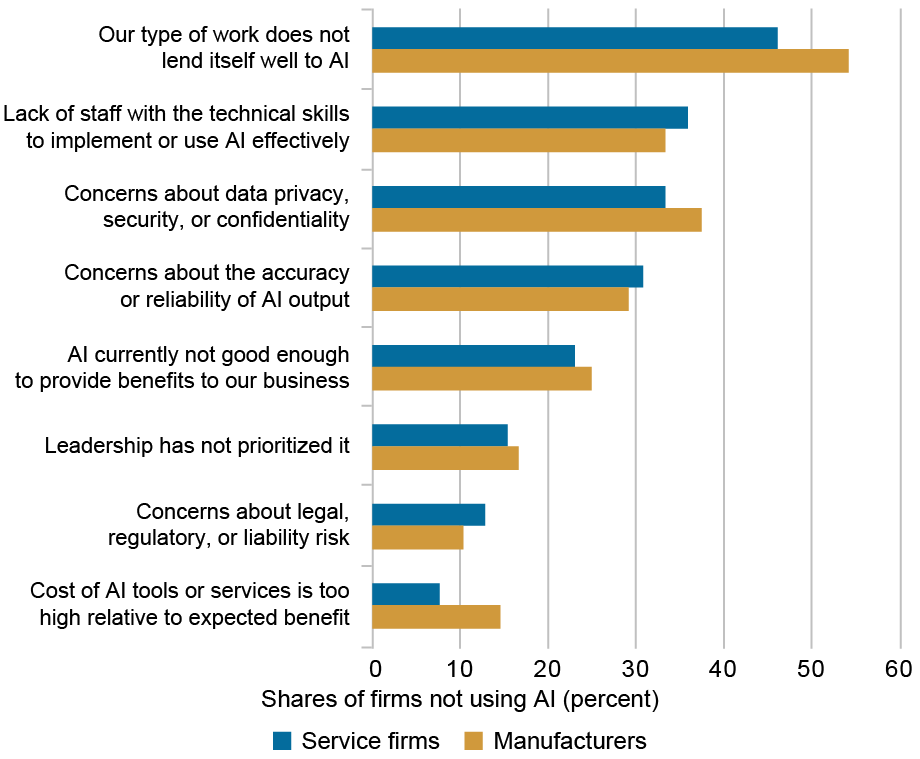
In the SBCS report on findings from the 2025 survey, 46 percent of firms with at least one employee stated that their business or employees were using AI tools, with another 15 percent planning to adopt them in the next twelve months. Furthermore, among AI users, 63 percent said that AI was somewhat or very important to production and 51 percent had integrated AI partially or fully in their business processes.
AI Adopters More Optimistic on Revenue and Employment Growth Than Non-Adopters
Source: Federal Reserve Banks, 2025 Small Business Credit Survey. Notes: The chart shows the employment and revenue expectations of AI adopters and non-adopters. The vertical axis shows the diffusion indexes (percentage expecting an increase minus percentage expecting a decrease) of responses to this question in the AI module: “How does your business expect its [revenue/number of employees] to change over the next twelve months?” Module responses are weighted on a variety of firm characteristics in order to match the national population of employer firms. The survey was fielded between September and November of 2025. Total number of employer firms in the AI module: 5,248.
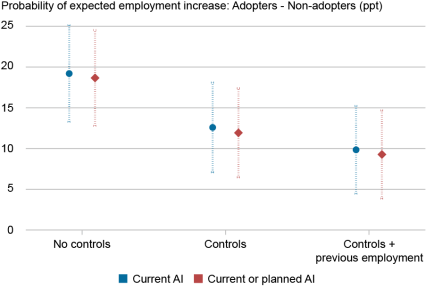
In the SBCS survey, 77 percent of respondents reported no change in their firm’s current labor costs from the use of AI. Respondents also reported their expectations for employment generation for the twelve months following the survey. Among firms with at least one employee, those who currently use AI had a 33 percentage point net expectation of higher employment in the next twelve months, while non-users had only a 15 percentage point net expectation (see chart above). When we consider owners either using or planning to use AI, we obtain a similar difference and establish its statistical significance (see “No controls” in the chart below).
AI Adopters More Optimistic on Employment Growth Than Non-Adopters Even After Accounting for Owner and Firm Characteristics
Source: Federal Reserve Banks, 2025 Small Business Credit Survey. Notes: The chart shows the net probability of expected employment growth of AI adopters relative to non-adopters. The filled markers are estimates from a regression of AI use on firms’ expected employment growth, while the dotted lines show 95 percent confidence intervals. Estimates are in percentage points and measure differences in the probability of an expected increase minus the probability of an expected decrease, relative to firms who did not report using AI. AI module responses are weighted on a variety of firm characteristics in order to match the national population of employer firms. The survey was fielded between September and November of 2025. Number of employer firms in the controlled sample: 4,769.
Firm expectations could be explained by firm characteristics instead of AI use—for example, younger owners may be more optimistic. Indeed, we find that younger and more profitable firms—and those with more than ten employees—are likelier to have more optimistic employment expectations. But even after including these additional demographic and location variables, the net probability of expected employment growth remains higher for AI users than for non-users (by 13 percentage points; see “Controls” in the chart above).
Perhaps owners with positive past outcomes harbor optimistic expectations about future outcomes, independent of AI use. Indeed, we find that actual changes in employment in the past twelve months are correlated with the expected changes in the next twelve months. However, even after we include past employment changes in the analysis, the gap in expected employment growth between AI users and non-users remains positive (at 10 percentage points; see “Controls + previous employment” in the chart above).
Could owners who are optimistic about their current financial condition be more likely to use AI and to have positive employment expectations? To address this question, we use the firm’s description of its current financial condition as either “good or better” or “fair or poor” as a proxy measure for optimism. If the former group shows a greater association between AI use and employment optimism, then it may indicate a spurious correlation between these characteristics. But we find the opposite to be true: In the sample of owners who report fair or poor current financial conditions, the net probability of expected employment growth is 21 percentage points higher for AI users than for non-users, while the difference is only 10 percentage points among owners reporting good or better conditions.
Among AI users, those who report that AI is fully or partially integrated and those who regard AI as somewhat or very important to production are equally likely to expect higher relative to lower employment compared to those who are experimenting with AI, after we account for firm and owner characteristics.
AI Use and Revenue Expectations of Small Businesses
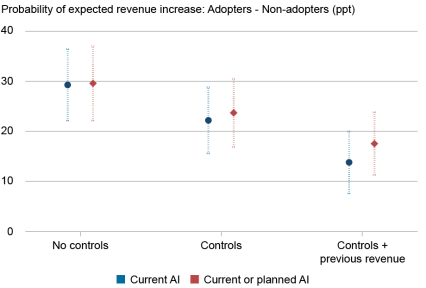
Only 31 percent of survey respondents reported increased sales from their firm’s use of AI. Respondents also reported their expectations for revenue performance for the twelve months following the survey. We find that among employer firms that currently use AI, the share expecting revenues to increase exceeded the share expecting them to decrease by 48 percentage points, compared with only 21 percentage points among non-users (see the bar chart above). When we consider owners either using or planning to use AI, we obtain an almost identical difference (see “No controls” in the chart below).
AI Adopters More Optimistic on Revenue Growth Than Non-Adopters Even After Accounting for Owner and Firm Characteristics
Source: Federal Reserve Banks, 2025 Small Business Credit Survey. Notes: The chart shows the net probability of expected revenue growth of AI adopters relative to non-adopters. The filled markers are estimates from a regression of AI use on firms’ expected revenue growth, while the dotted lines show 95 percent confidence intervals. Estimates are in percentage points and measure differences in the probability of an expected increase minus the probability of an expected decrease, relative to firms who did not report using AI. AI module responses are weighted on a variety of firm characteristics in order to match the national population of employer firms. The survey was fielded between September and November of 2025. Number of employer firms in the controlled sample: 4,698.
After we account for firm and owner characteristics and past-twelve-month revenue changes, AI users still have a 14 percentage point advantage over non-users in net expected revenue growth (see “Controls + previous revenue” in the chart above). Of owners reporting fair or poor current financial conditions, the difference in net expected revenue growth between AI users and non-users is 24 percentage points, compared with just 15 percentage points for those reporting good conditions, and these differences are statistically significant. In other words, it seems unlikely that the association between AI use and positive revenue expectations is spurious.
Why Do AI Users Have Optimistic Expectations?
AI may be particularly helpful for small firms in dealing with operational challenges such as hiring, marketing, and technology-related issues. The SBCS asks respondents whether they faced any operational challenges “utilizing technology (e.g., website, social media, ecommerce, cybersecurity).” We find that among AI users, those currently facing technology challenges have a 16 percentage point higher net expectation of revenue growth than those who do not report being so challenged. These results suggest that AI may improve revenue expectations by helping firms overcome internal technological constraints that would otherwise limit growth.
Summing Up
AI use is associated with more optimistic expectations about future employment and revenue growth, even after accounting for firm and owner characteristics. This result is not due to optimistic owners being more likely to use AI and having positive expectations. The association between AI adoption and revenue expectations is especially strong among firms in weaker financial condition and among firms that report challenges utilizing technology. This suggests that AI may be helping some small businesses overcome specific operational or technical constraints that limit revenue generation, rather than simply reflecting broad-based optimism or expectations of expansion through hiring. Whether AI-adopting firms actually experience the stronger revenue and employment outcomes they anticipate is a subject for future research.
Will Aarons is a research analyst in the Federal Reserve Bank of New York’s Research and Statistics Group.
Asani Sarkar is a financial research advisor in the Federal Reserve Bank of New York’s Research and Statistics Group.
How to cite this post:
Will Aarons and Asani Sarkar, “AI Adoption and Employment Expectations: Evidence from a Survey of Small Business Owners,” Federal Reserve Bank of New York Liberty Street Economics, October 8, 2026, https://doi.org/10.59576/lse.20261008BibTeX: View |
@article{AaronsSarkar2026,
    author={Aarons, Will and Sarkar, Asani},
    title={AI Adoption and Employment Expectations: Evidence from a Survey of Small Business Owners},
    journal={Liberty Street Economics},
    note={Liberty Street Economics Blog},
    number={October 8},
    year={2026},
    url={https://doi.org/10.59576/lse.20261008}
}
Disclaimer The views expressed in this post are those of the author(s) and do not necessarily reflect the position of the Federal Reserve Bank of New York or the Federal Reserve System. Any errors or omissions are the responsibility of the author(s).
]]>0<![CDATA[Firm Heterogeneity and the Response of Investment to Monetary Policy]]>https://libertystreeteconomics.newyorkfed.org/?p=457532026-10-06T13:28:24Z2026-10-07T13:00:00ZStaff Report, we explore how investment responsiveness to monetary policy changes across firms and over time. We find that investment by most firms in most time periods responds little to monetary policy. For some firms in some periods, however, investment is very responsive to changes in interest rates. While these instances of strong sensitivity correlate with several firm traits, there is substantial variation that cannot easily be linked to specific characteristics of firms. Our findings therefore underscore the importance of considering the entire distribution of investment responses rather than focusing on the average effect.]]>
Thomas Drechsel, Daniel Lewis, Davide Melcangi, and Laura Pilossoph
It is well known that monetary policy affects firms’ investment decisions. But which firms are the most responsive to changes in interest rates? And does this responsiveness vary over time? The literature has given diverse answers to this question, focusing on characteristics such as firm size, age, and financial position, and mostly studying these traits in isolation. In this post based on a recent Staff Report, we explore how investment responsiveness to monetary policy changes across firms and over time. We find that investment by most firms in most time periods responds little to monetary policy. For some firms in some periods, however, investment is very responsive to changes in interest rates. While these instances of strong sensitivity correlate with several firm traits, there is substantial variation that cannot easily be linked to specific characteristics of firms. Our findings therefore underscore the importance of considering the entire distribution of investment responses rather than focusing on the average effect.
How Firms’ Investment Responds to Changes in Monetary Policy
Our analysis revisits a burgeoning literature that estimates how firm-level investment responds to monetary policy surprises. In particular, we build on influential work by Ottonello and Winberry (2020). Monetary policy surprises are measured as changes in the federal funds rate implied by federal funds futures in a narrow window around monetary policy announcements. Investment is the growth rate in the capital stock measured at a quarterly frequency for each publicly listed firm in Compustat. The literature has typically studied heterogeneity in investment responses by interacting monetary surprises in a regression framework with a chosen firm characteristic, such as size, age, or a particular financial variable.
We follow a different approach. Instead of selecting a given possible driver of heterogeneity ex ante, we seek to characterize the entire unconditional distribution of responses of investment to monetary policy (which we abbreviate as RIMP). Importantly, this approach is agnostic to what drives the RIMP, although we go on to explore the relative importance of several drivers after estimating the RIMP. In practice, we estimate a clustering regression framework that optimally groups each firm in each time period as a high or low responder based on how its investment responds to monetary policy. Details of the procedure can be found in our Staff Report.
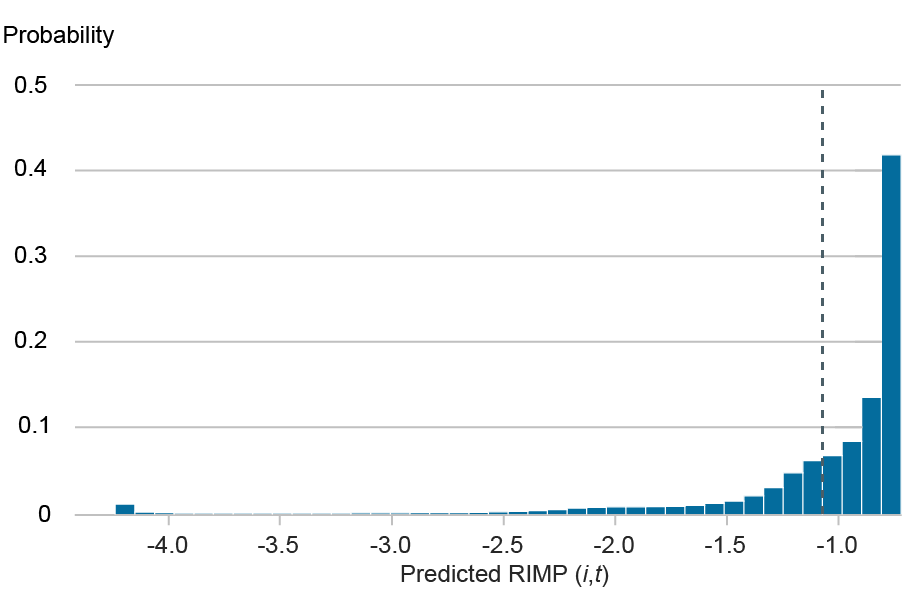
Our estimates deliver a RIMP distribution, which we plot in the chart below. In the vast majority of quarters and for most firms, investment responds little to changes in monetary policy. This sensitivity, however, is not zero. Indeed, all firms still cut investment when interest rates increase, as witnessed by the negative values in the horizontal axis of the chart. In a few instances, investment drops significantly in the face of an interest rate hike. For about 5 percent of all firms and quarters, a monetary shock that raises the federal funds rate by 1 percentage point induces a 4 percentage point drop in the growth rate of capital.
Most Firms in Most Time Periods Respond Little to Monetary Policy Changes; Some Respond Strongly
Source: Compustat; authors’ calculations. Notes: The chart plots the predicted response of investment to monetary policy (RIMP) at the firm-quarter level. The vertical dashed line marks the homogeneous RIMP.
Which Firms Respond the Most?
Having estimated the RIMP distribution, we can dig deeper into what makes a firm’s, or a given quarter’s, investment very responsive to monetary shocks. We decompose the variance of responses into three components: (permanent) firm variation, aggregate time variation, and firm-specific time variation. As we show in the chart below, very little of the overall variation in the RIMP is common to all firms. A larger, but still limited, share is explained by permanent differences across firms. It follows that most of the variation in the RIMP is within firms over time. This means that a specific firm’s investment can respond substantially to a monetary shock in a given quarter, but that same firm can be relatively unresponsive for several quarters thereafter.
Most of the Variation in Firms’ Sensitivity to Interest-Rate Surprises Is Within Firms over Time
Share of RIMP variation (percent)
Source: Compustat; authors’ calculations. Note: The chart decomposes the response of investment to monetary policy (RIMP) into permanent differences across firms, aggregate variation over time, and within-firm variation over time.
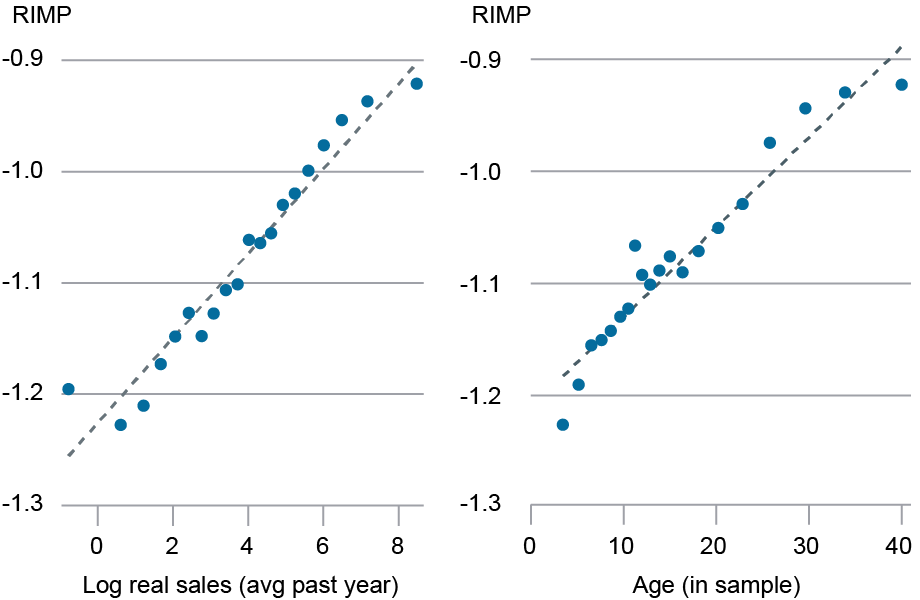
Our approach also allows us to investigate which firm characteristics are the most important determinants of the investment responsiveness to monetary shocks. For instance, Gertler and Gilchrist (1994) find that small firms are more responsive, whereas Cloyne et al. (2024) point at young firms. In the chart below, we project our estimated RIMP on each of these two characteristics and confirm both findings. In fact, we also find that the characteristics interact, as we show in the paper: small and young firms have the most negative RIMP (in other words, they cut investment the most when faced with a monetary tightening).
Small Firms and Young Firms Cut Investment the Most When Faced with an Interest Rate Hike
Sources: Compustat; authors’ calculations. Notes: The chart presents binscatter plots in which the predicted response of investment to monetary policy (RIMP) is plotted against size (left panel, the log of average real sales over the past four quarters) and age (right panel, defined as years in the sample). Dashed lines indicate fitted linear regressions.
In the Staff Report, we explore several other drivers studied in the literature. For instance, we find that firms with shorter debt maturity are more sensitive to monetary policy. We also highlight other drivers that might indicate the importance of behavioral mechanisms. For example, perceptions of discount rates and the cost of capital are correlated with the RIMP. Moreover, firms that report being more optimistic cut investment less in response to an interest rate hike.
Importantly, all of these characteristics may affect investment responsiveness jointly and will likely interact. Our approach allows us to study this multidimensionality directly. While we find that several characteristics predict investment responses, much of the overall variation in the RIMP remains unexplained.
Conclusion
We have provided new empirical evidence on how investment responds to changes in monetary policy. While all firms cut investment when faced with an interest rate hike, most adjust little whereas a few firms respond a lot. This high sensitivity appears to be transient: a given firm is responsive to a monetary surprise in a given quarter, but then responds little thereafter. Several firm characteristics predict investment responses. For instance, small and young firms appear to be the most sensitive to monetary policy changes. Our approach allows us to study this heterogeneity in a comprehensive manner: we find that several firm drivers matter concurrently and that much of the investment responsiveness is driven by unobservable factors.
Thomas Drechsel is an associate research professor in the Economics Department at Johns Hopkins University.
Daniel Lewis is an associate professor in the Department of Economics at University College London.1
Davide Melcangi is an economic research advisor in the Federal Reserve Bank of New York’s Research and Statistics Group.
Laura Pilossoph is an associate professor of economics at Duke University.
1 Disclosure statement for Daniel Lewis: During the past three years, I received consultancy fees exceeding the disclosure threshold under the AEA Disclosure Policy from Banque de France, a potentially interested party with respect to the subject matter of this article. The consultancy relationship did not affect the design, analysis, interpretation, or reporting of the research. The interested party had no right to review this research.
How to cite this post:
Thomas Drechsel, Daniel Lewis, Davide Melcangi, and Laura Pilossoph, “Firm Heterogeneity and the Response of Investment to Monetary Policy,” Federal Reserve Bank of New York Liberty Street Economics, October 7, 2026, https://doi.org/10.59576/lse.20261007BibTeX: View |
@article{DrechselLewisMelcangiPilossoph2026,
    author={Drechsel, Thomas and Lewis, Daniel and Melcangi, Davide and Pilossoph, Laura},
    title={Firm Heterogeneity and the Response of Investment to Monetary Policy},
    journal={Liberty Street Economics},
    note={Liberty Street Economics Blog},
    number={October 7},
    year={2026},
    url={https://doi.org/10.59576/lse.20261007}
}
Disclaimer The views expressed in this post are those of the author(s) and do not necessarily reflect the position of the Federal Reserve Bank of New York or the Federal Reserve System. Any errors or omissions are the responsibility of the author(s).
]]>0Mary Amiti, Sebastian Heise, and David E. Weinstein<![CDATA[How Fast Do Tariffs Pass Through into Consumer Prices?]]>https://libertystreeteconomics.newyorkfed.org/?p=459142026-10-09T18:17:58Z2026-10-06T11:00:00Z2021, 2025). In this post, we present results from our new research paper that estimates the effects of the 2025-26 tariffs on retail consumer prices. We find that for every percentage point increase in average tariffs, consumer goods prices increase by about a quarter of a percent after one year. Roughly two-thirds of the effect arises because tariffs raise the prices of imported consumer goods. The remaining third arises indirectly: tariffs increase the prices of goods made in the U.S. because producers pay more for imported parts and materials, and because producers raise their markups when competing imports cost more. The effects differ in their timing. Prices of imported goods respond quickly to tariffs, while prices of U.S.-made goods adjust over six to twelve months as higher costs move through the supply chain.]]>
Mary Amiti, Sebastian Heise, and David E. Weinstein
There has been a lot of interest in how tariffs affect consumer prices (for example, Cavallo et al. 2021, 2025). In this post, we present results from our new research paper that estimates the effects of the 2025-26 tariffs on retail consumer prices. We find that for every percentage point increase in average tariffs, consumer goods prices increase by about a quarter of a percent after one year. Roughly two-thirds of the effect arises because tariffs raise the prices of imported consumer goods. The remaining third arises indirectly: tariffs increase the prices of goods made in the U.S. because producers pay more for imported parts and materials, and because producers raise their markups when competing imports cost more. The effects differ in their timing. Prices of imported goods respond quickly to tariffs, while prices of U.S.-made goods adjust over six to twelve months as higher costs move through the supply chain.
The Direct Effect: Tariffs Raise Import Prices Nearly One for One
A tariff raises the price a U.S. importer (which could be a firm or a consumer) pays for a foreign good, unless the foreign exporter cuts its price to absorb some of the cost. In a previous post, we found that foreign exporters lowered their prices very little, so that nearly 90 percent of the 2025 tariffs were passed through to U.S. import prices. We find the same result here using data through February 2026. The effect is immediate: import prices rise almost one for one with tariffs in the first month after a tariff is raised. Our conclusion is unchanged when we account for exchange-rate movements: the dollar depreciated over this period, which also raised import prices, but we still estimate a tariff pass-through of around 90 percent.
The Indirect Effect: Higher Domestic Producer Prices
Tariffs also affect the prices of goods made in the U.S. This happens in two ways. First, many U.S. producers rely on imported parts and materials, so tariffs raise their cost of production. For example, a tariff on steel makes it more expensive to build a car in the U.S. We refer to this effect as the marginal cost channel. Second, when tariffs make imported goods more expensive, U.S. producers of competing goods face less pressure to keep their own prices down. We refer to this effect as the strategic complementarity channel. We find evidence that U.S. producers increased their prices at the factory gate because of both channels, and the marginal cost effect is the larger of the two.
Unlike the response of import prices, the tariffs’ effect on U.S. producer prices takes time. In the first six months after a tariff is raised, U.S. producer prices rise only a little. The response then builds, roughly doubling over the following six months.
Pass-Through from Producer and Import Prices into Retail Prices Is about 50 Percent
The effects of tariffs on import and producer prices capture only what happens before goods reach the retail stage. Consumers pay the retail price, which must also cover distribution costs such as transportation, wholesaling, and retailing. These distribution margins account for about half of what consumers pay for goods. We next estimate how tariff-induced changes in import and domestic producer prices pass through to retail prices. We find that a 10 percent increase in import and producer prices due to tariffs raises consumer retail prices by 5.6 percent.
To understand this result, suppose a good retails for $100, of which $50 is the price at the border or factory gate and $50 is the distribution margin. If a tariff raises the producer price by 10 percent, to $55, and the distribution margin remains unchanged, the retail price rises to $105, an increase of 5 percent, close to the 5.6 percent we estimate.
The Total Effect: Higher Consumer Prices
To illustrate how the three results combine, we consider a scenario in which a 10 percent tariff is imposed on all imports. We estimate that in this case consumer goods prices would be 2.6 percent higher after twelve months, or about a quarter of the tariff increase. About two-thirds of this effect is direct, driven by higher prices of imported consumer goods. The remaining third is the indirect effect from U.S.-made goods, most of it from the marginal cost channel.
This consumer price increase does not arrive all at once. The direct effect of higher import prices comes through quickly: about half is in place after three months and all of it by six months, as retailers take a few months to pass on higher costs. In contrast, the indirect tariff effects from higher domestic producer prices take longer to appear. The size of the indirect effect on retail prices more than doubles between six and twelve months as U.S. producers raise their prices. The full effect on consumer prices is reached only after about a year.
The 2025-26 Tariffs and Consumer Goods Prices
Using our estimated tariff pass-through rates, we can gauge the size of the price pressures operating through the three channels described above. Our estimates compare price changes across non-oil consumer goods with higher and lower tariff exposure. The sample excludes services, which account for about two-thirds of the consumer basket. These comparisons help separate tariff-related price increases from broader movements in prices, but cannot establish how much of those broader movements was itself caused by tariffs. We therefore calculate what consumer goods price inflation would have been without these tariff effects, holding fixed economy-wide factors, such as exchange rates, wages, consumer demand, and monetary policy. Tariffs may also affect these economy-wide factors in ways that amplify or offset the price pressures we estimate.
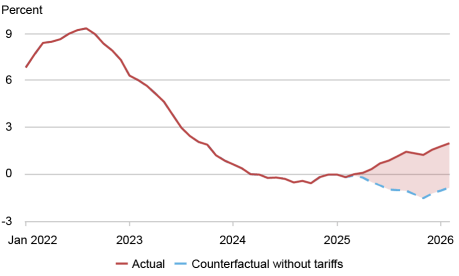
In the chart below, the solid line shows the twelve-month change in consumer goods prices, and the dashed line shows the counterfactual without tariffs. Goods price inflation was back near its slightly negative pre-COVID average for most of 2024 and began to edge up late that year, before the new tariffs were introduced. It then picked up through 2025. Our estimates attribute this increase to the tariffs: by February 2026, tariffs had contributed 2.9 percentage points to goods price inflation, and without them goods prices would have fallen slightly.
Tariffs Raised Consumer Goods Price Inflation
Sources: U.S. Bureau of Labor Statistics; U.S. Census Bureau, Foreign Trade Statistics; U.S. International Trade Commission (USITC); U.S. Bureau of Economic Analysis; authors’ calculations. Notes: The solid line is the twelve-month change in consumer prices for the sixty-seven non-oil goods categories in our sample, weighted by 2022 consumer expenditure. The dashed line subtracts our estimate of the contribution of tariffs, shown by the shaded area. The estimates compare goods that were more exposed to tariffs with goods that were less exposed, holding economy-wide factors fixed.
The Tariff Effect on Consumer Goods Inflation Has Peaked, but the Price Level Stays Higher
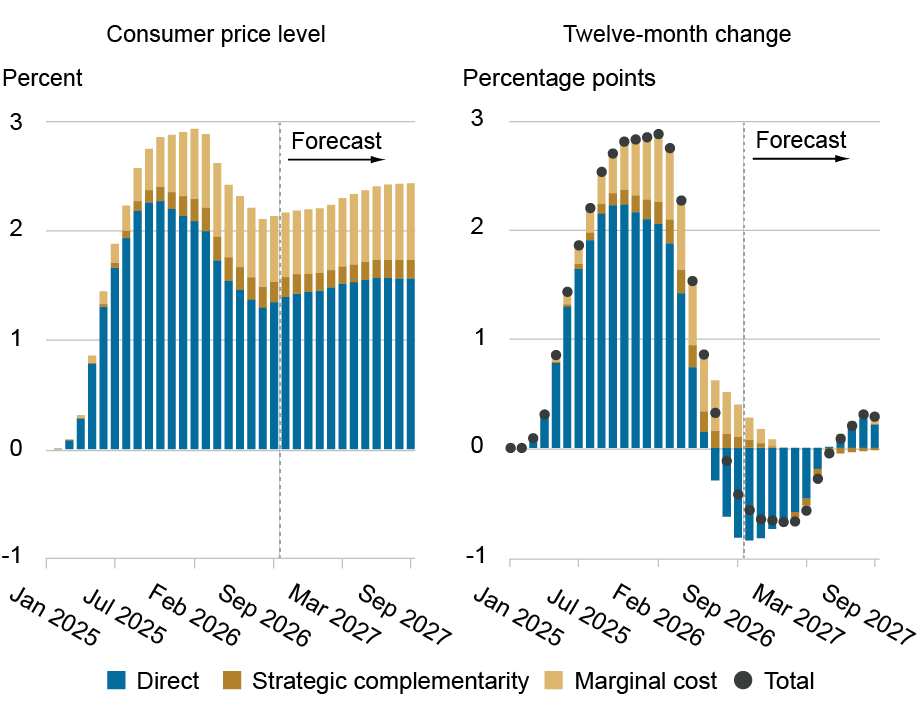
Next, we provide a forecast beyond our sample, extending through September 2027, twelve months after our latest tariff data. We assume tariffs remain at their end-of-September 2026 levels, except for the announced January 2027 tariff increase on Canadian cars, trucks, and auto parts. The chart below shows the effect of tariffs on the level of consumer goods prices in the left panel and on their twelve-month change in the right panel, split into the direct effect (blue), the marginal cost effect (lighter gold), and strategic complementarity (darker gold).
Tariff Effects on Consumer Goods Prices Peaked in February 2026
Sources: U.S. Bureau of Labor Statistics; U.S. Census Bureau, Foreign Trade Statistics; U.S. International Trade Commission (USITC); U.S. Bureau of Economic Analysis; authors’ calculations. Notes: The left panel shows the estimated effect of the tariffs imposed since January 2025 on the level of consumer goods prices, and the right panel shows their contribution to the twelve-month change. Each bar is split into the direct effect, the marginal cost effect, and strategic complementarity. The analysis uses actual tariffs through September 2026, marked by the dashed line. The forecast starts in October 2026. It holds tariffs at their end-of-September 2026 levels, apart from the announced January 2027 tariff increase on Canadian cars, trucks, and auto parts. The black round dot in the right panel depicts the total predicted twelve-month change.
The left panel shows that the tariff effect on the consumer goods price level peaked near 3 percent in February 2026. Most of the initial price effect came from the direct channel, with the marginal cost and strategic complementarity channels taking more time to build. By February 2026, the indirect effect accounted for about 30 percent of the total price effect.
Our forecast shows the tariff effect on the goods price level easing to about 2 percent by August 2026. The easing reflects a cut in tariffs in early 2026, when a U.S. Supreme Court ruling ended the tariffs imposed under emergency powers and a lower 10 percent surcharge replaced them. Most of the decline is in the direct effect, while the indirect effect is more persistent because U.S. producer prices adjust slowly. After August 2026, the tariff effect on the price level edges up again. About half of that rise comes from tariff changes already in place, mainly the August 2026 tariffs on Canadian goods, which are still passing through. The rest reflects the tariff increase on Canadian autos announced for January 2027.
The right panel shows what this means for twelve-month changes in consumer goods prices. The contribution of tariffs peaked in February 2026, at 2.9 percentage points, and is forecast to fall to around zero by August 2026. It then turns negative as the large tariff increases of 2025 drop out of the twelve-month comparison, before turning slightly positive by mid-2027 as the Canadian tariffs pass through. Taken together, the two panels show that tariffs have left consumer goods price levels higher, while their effect on inflation fades.
In sum, we estimate that about a quarter of a tariff increase is passed through to consumer goods prices. Importantly, tariffs also raise the prices of goods that are not directly taxed: goods made in the U.S. account for about a third of the total effect. This indirect effect takes longer to materialize than the direct effect on imported goods, so the full effect of a tariff takes about a year to appear.
Mary Amiti is head of Labor and Product Markets in the Federal Reserve Bank of New York’s Research and Statistics Group.
Sebastian Heise is a research economist in the Federal Reserve Bank of New York’s Research and Statistics Group.
David E. Weinstein is an economics professor at Columbia University.
This post will be co-published, with minor changes, on VoxEU.org.
How to cite this post:
Mary Amiti, Sebastian Heise, and David E. Weinstein, “How Fast Do Tariffs Pass Through into Consumer Prices?,” Federal Reserve Bank of New York Liberty Street Economics, October 6, 2026, https://doi.org/10.59576/lse.20261006BibTeX: View |
@article{MaryAmiti,SebastianHeise,andDavidE.Weinstein2026,
    author={Mary Amiti, Sebastian Heise, and David E. Weinstein},
    title={How Fast Do Tariffs Pass Through into Consumer Prices?},
    journal={Liberty Street Economics},
    note={Liberty Street Economics Blog},
    number={October 6},
    year={2026},
    url={https://doi.org/10.59576/lse.20261006}
}
Disclaimer The views expressed in this post are those of the author(s) and do not necessarily reflect the position of the Federal Reserve Bank of New York or the Federal Reserve System. Any errors or omissions are the responsibility of the author(s).
]]>1<![CDATA[Insured, but Still on the Hook: Who Bears the Most Risk in Homeowner’s Insurance?]]>https://libertystreeteconomics.newyorkfed.org/?p=460532026-10-05T12:12:17Z2026-10-05T11:00:00ZApril post, using millions of homeowners' insurance contracts matched with property-level exposure and disaster risk, we showed that although households are insured, they are still "on the hook” because deductibles and coverage limits leave homeowners responsible for part of a loss. Because insurers cannot perfectly observe how well homeowners maintain or protect their properties (a problem known as “moral hazard”), contract terms such as deductibles can play an important role in balancing risk sharing and incentives. By requiring homeowners to bear part of a loss, insurers can preserve incentives for policyholders to take actions that reduce damage risk. In this post, we quantify the cost of keeping homeowners on the hook. How costly is moral hazard in homeowner's insurance? How much risk must households retain to preserve these incentives? And, importantly, who ultimately bears that residual risk? The short answer is that keeping homeowners on the hook costs insurers relatively little, but it leaves households with substantial risk, especially those least able to absorb a large loss.]]>
Hyeyoon Jung and Jaehoon (Kyle) Jung
In an April post, using millions of homeowners’ insurance contracts matched with property-level exposure and disaster risk, we showed that although households are insured, they are still “on the hook” because deductibles and coverage limits leave homeowners responsible for part of a loss. Because insurers cannot perfectly observe how well homeowners maintain or protect their properties (a problem known as “moral hazard”), contract terms such as deductibles can play an important role in balancing risk sharing and incentives. By requiring homeowners to bear part of a loss, insurers can preserve incentives for policyholders to take actions that reduce damage risk. In this post, we quantify the cost of keeping homeowners on the hook. How costly is moral hazard in homeowner’s insurance? How much risk must households retain to preserve these incentives? And, importantly, who ultimately bears that residual risk? The short answer is that keeping homeowners on the hook costs insurers relatively little, but it leaves households with substantial risk, especially those least able to absorb a large loss.
How Do We Estimate Moral Hazard?
We build and estimate a model of insurance contract design, drawing on the classic moral-hazard framework of Holmström. Moral hazard is inherently difficult to measure because the underlying actions are unobservable, and quantifying it also requires distinguishing a property’s underlying risk from the incentives created by its insurance contract. Our data and our model allow us to do this at the contract level: for millions of homes, we observe key contract terms, detailed measures of underlying property risk, and rich borrower and property characteristics. Combining these data with the model, we estimate how much households value protection from risk, the cost associated with moral hazard, and how much risk homeowners ultimately retain. We leave the technical details of the model and estimation to our paper and focus here on the economic intuition and main findings.
What Do the Estimated Results Tell Us?
The estimates reveal a meaningful trade-off between risk sharing and incentives. Households appear willing to pay substantially to transfer property risk to insurers, and this willingness to pay increases with both their risk aversion and the underlying riskiness of their properties. At the same time, the estimated direct cost associated with moral hazard is relatively modest. The reason is that insurers can limit moral hazard through contract terms such as deductibles and coverage limits, and leave households to bear some of the risk themselves and preserve incentives to protect the property. The economic consequences of moral hazard therefore show up not only in its direct cost to insurers, but also in the amount of risk that remains with homeowners. We estimate that this residual exposure is substantial: deductibles and coverage limits leave households exposed to 29 percent of expected losses, even though the direct estimated cost of moral hazard is small.
Who Is More on the Hook?
Financially Constrained Households
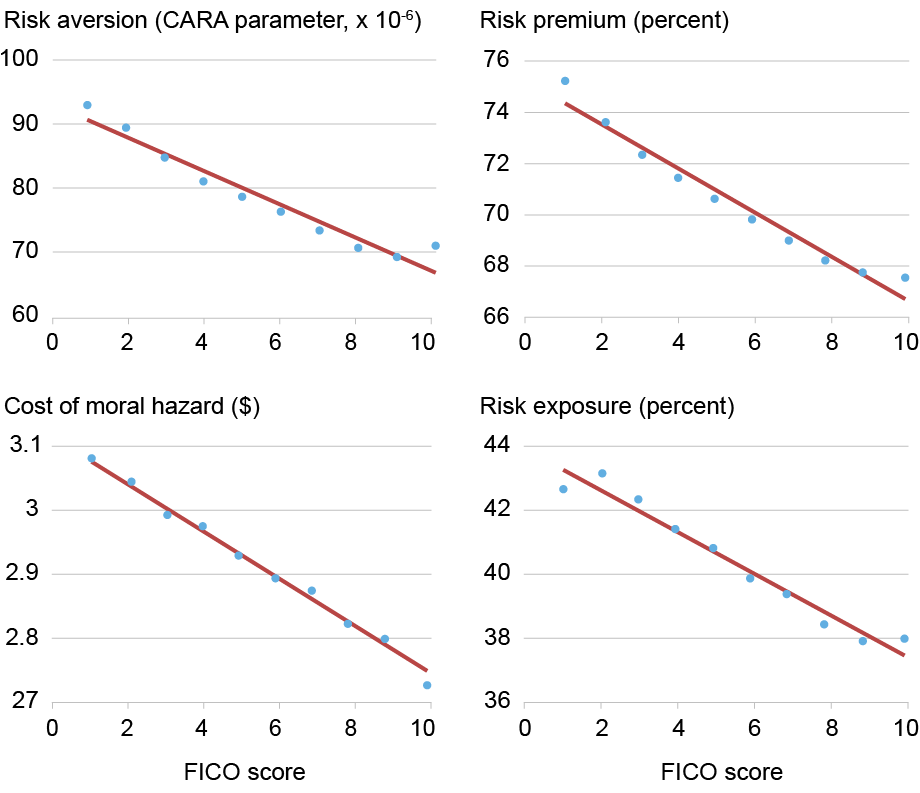
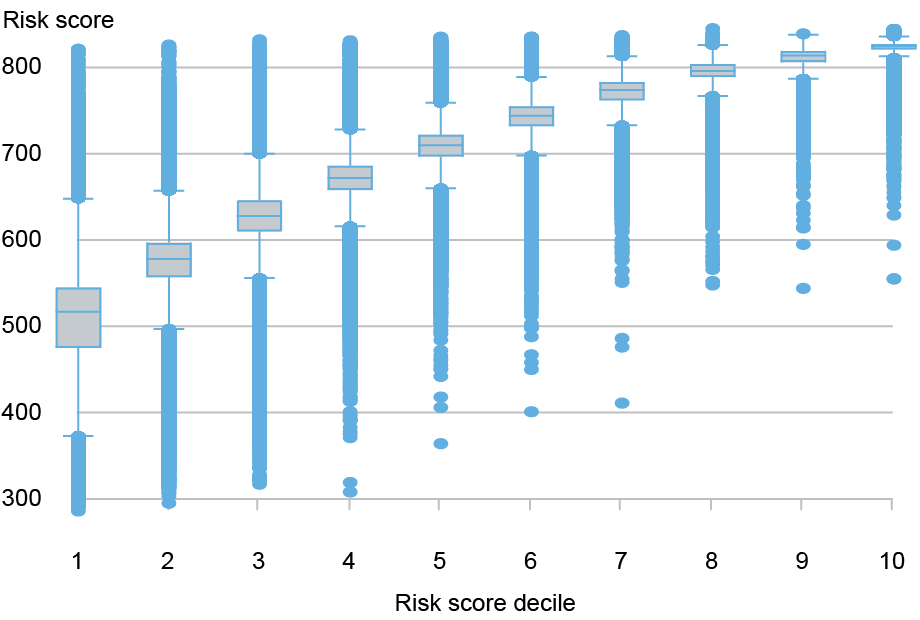
The contract-level estimates, which already account for property value, reveal substantial differences across households. Lower-FICO policyholders are estimated to be more risk averse, pay higher risk premia, face higher costs associated with moral hazard, and retain more uninsured exposure. The chart below plots the average estimate by FICO score decile. All four measures decline steadily as FICO scores rise.
Lower-FICO Households Are More Risk Averse, Pay More for Protection, and Keep More Risk.
Source: Authors’ calculations based on McDash and CoreLogic datasets. Note: Each panel plots the average estimated value by FICO score decile (1 = lowest scores, 10 = highest), with a linear fit.
One interpretation is that households with more limited financial resources absorb larger unexpected loss because they place greater value on transferring property risk to an insurer. Yet the contracts held by these households also leave them with more residual risk. Thus, paradoxically, the households that may have the greatest difficulty absorbing a disaster-related loss are also those whose insurance contracts leave them most exposed to one. These patterns are correlations, not causal estimates, and could also reflect other factors correlated with FICO scores, not financial constraint alone. The pattern is nonetheless informative about where residual risk concentrates.
Properties Facing Greater Tail Risk
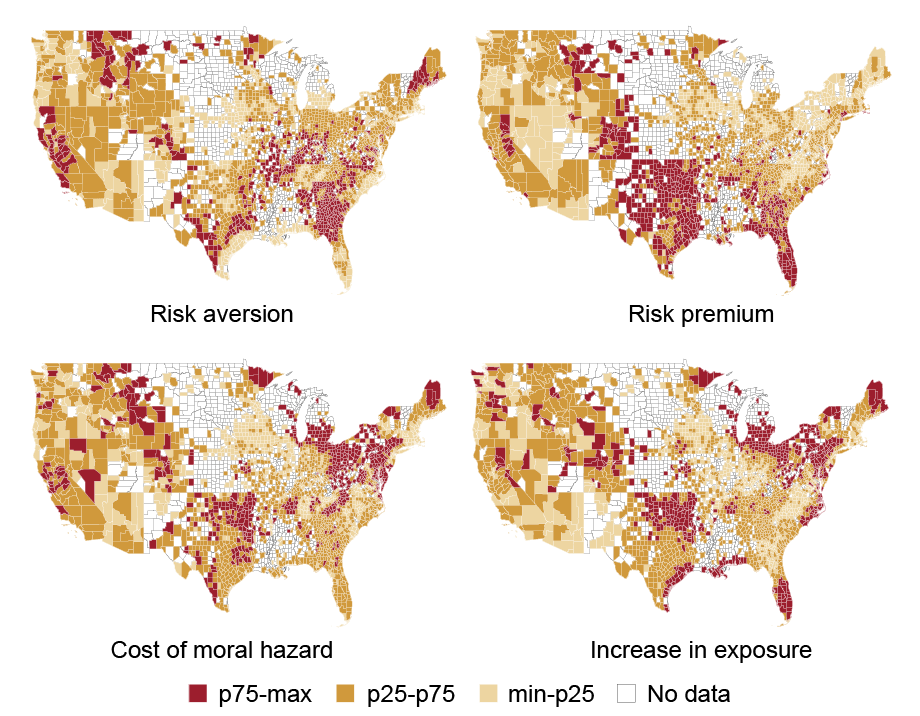
Residual exposure is also higher for properties facing greater tail disaster risk. As shown in the bottom-right panel of the chart below, areas with greater exposure to severe disaster losses tend to be places where homeowners retain more risk through their insurance contracts.
Spatial Distribution of Risk Aversion, Risk Premia, Moral Hazard Costs, and Residual Exposure.
Source: Authors’ calculations based on McDash and CoreLogic datasets. Note: Each panel shows the average estimate by county, grouped into quartiles. Red shading indicates higher values; white areas have no data.
More broadly, the maps show substantial geographic variation in estimated risk aversion, risk premia, moral-hazard costs, and residual exposure. These patterns reflect sharp differences in underlying property risk across locations, as well as differences in the households and insurers participating in these markets, among others.
Insurer Financial Conditions Also Matter
We also examine how the estimated quantities (risk aversion, risk premium, cost of moral hazard, and increase in exposure) vary with insurers’ financial conditions. More financially constrained insurers, measured using their risk-based capital ratios, tend to insure riskier properties and collect higher dollar risk premia. However, the risk premium as a share of the total premium is roughly flat across insurer financial constraints. In other words, higher premiums charged by more constrained insurers do not appear simply to reflect higher margins. Rather, these insurers tend to be matched with riskier properties and different types of policyholders. The results therefore suggest that insurer financial conditions are related not only to pricing but also to which risks insurers ultimately hold. More broadly, they point to the importance of accounting for the endogenous matching of households, properties, and insurers when studying the property insurance market.
Are We Really Estimating Moral Hazard?
Because moral hazard itself is not directly observable, we perform several validation exercises designed to test whether the estimated measure behaves in ways consistent with economic intuition.
We examine homeowners’ “skin in the game.” A household with a lower loan-to-value ratio has more equity invested in the property and therefore has stronger incentives to maintain it and limit avoidable damage. Consistent with this intuition, the estimated cost of moral hazard is lower among homeowners with lower loan-to-value ratios, even after controlling for borrower and property characteristics.
We use differences in insurance regulation across states. Some states impose inspection or verification requirements that can reduce information asymmetry on how the property has been managed between insurers and homeowners. The estimated cost of moral hazard is lower in states with these types of requirements. These exercises are not intended to establish causal effects of leverage or regulation. Instead, they provide external checks that the model-based estimates move in directions consistent with the underlying economic mechanism.
Takeaways
Our estimates reveal a fundamental trade-off at the heart of homeowner’s insurance. The direct cost of moral hazard appears to be small, in part because insurers can mitigate moral hazard through contract terms that leave households bearing more of the risk. Crucially, this burden is not evenly distributed: lower-FICO households and homes facing the most severe tail risk retain more of that exposure. In other words, moral hazard may be relatively inexpensive for insurers to manage, but doing so can leave households, particularly more vulnerable households, carrying substantial residual disaster risk.
These findings are robust to a range of adjustments. Flood exposure, which is typically excluded from standard homeowners insurance policies, has little effect on the results when removed. We also account for non-disaster claims by comparing modeled damages with realized claims data; this adjustment also does not change the takeaway.
We are also testing the robustness of these estimates by extending the model to features such as competition among insurers and institutional details, including that mortgage lenders typically require borrowers to carry homeowners insurance. Across these extensions, the patterns across households, locations, and insurers hold.
Looking Ahead
The results raise a natural policy question: If deductibles and other contract features leave households exposed to property risk, particularly households with fewer financial resources, why not simply require insurers to provide more complete coverage? The answer is not obvious, because the same contract features that leave households exposed also help preserve incentives to maintain and protect the property. In a final companion post, we will use the model to examine this trade-off directly and ask what would happen if insurers were required to offer full insurance.
Hyeyoon Jung is a financial research economist in the Federal Reserve Bank of New York’s Research and Statistics Group.
Jaehoon (Kyle) Jung is an assistant professor at the NYU Stern School of Business.
How to cite this post:
Hyeyoon Jung and Jaehoon (Kyle) Jung, “Insured, but Still on the Hook: Who Bears the Most Risk in Homeowner’s Insurance?,” Federal Reserve Bank of New York Liberty Street Economics, October 5, 2026, https://doi.org/10.59576/lse.20261005BibTeX: View |
@article{JungJung2026,
    author={Jung, Hyeyoon and Jung, Jaehoon (Kyle)},
    title={Insured, but Still on the Hook: Who Bears the Most Risk in Homeowner’s Insurance?},
    journal={Liberty Street Economics},
    note={Liberty Street Economics Blog},
    number={October 5},
    year={2026},
    url={https://doi.org/10.59576/lse.20261005}
}
Disclaimer The views expressed in this post are those of the author(s) and do not necessarily reflect the position of the Federal Reserve Bank of New York or the Federal Reserve System. Any errors or omissions are the responsibility of the author(s).
]]>0<![CDATA[Navigating Geoeconomic Risk in the U.S. Stock Market]]>https://libertystreeteconomics.newyorkfed.org/?p=451652026-10-01T12:32:17Z2026-10-01T11:00:00Zfirst-order concern for investors. In this post, based on our recent Staff Report, we document that domestic U.S. stocks expose investors to substantial geoeconomic risk through firms' global supply-chain relationships, affecting investors' returns and portfolio allocation. We also find that investors are compensated for bearing geoeconomic risk through higher risk premia.]]>
Matteo Crosignani, Lina Han, and Marco Macchiavelli
Geoeconomic risk—the risk that firms incur valuation losses when countries deploy economic, trade, or financial leverage for geopolitical aims—has become a first-order concern for investors. In this post, based on our recent Staff Report, we document that domestic U.S. stocks expose investors to substantial geoeconomic risk through firms’ global supply-chain relationships, affecting investors’ returns and portfolio allocation. We also find that investors are compensated for bearing geoeconomic risk through higher risk premia.
Export Controls as Geoeconomic Shocks
Investors do not need to own foreign stocks to be exposed to geoeconomic risk. Domestic stocks can embed foreign exposures when U.S. firms sell to overseas customers or rely on global supply chains. These links mean that a foreign policy shock can reduce the value of U.S.-listed firms and transmit geoeconomic risk to domestic portfolios. These global links can help investors diversify their portfolios when shocks are country- or –market-specific, but they offer less protection when policy shocks affect the same international relationships across many U.S. firms. Geoeconomic shocks are therefore difficult to diversify away because they can affect multiple domestic stocks through a common foreign exposure.
We study this risk through the imposition of U.S. export controls by the Bureau of Industry and Security. This agency of the Department of Commerce can restrict U.S. firms from selling certain technologies to specific foreign entities deemed to be a risk to U.S. national security. Since 2014, these restrictions have been leveraged frequently in the U.S.-China technological rivalry, especially in industries such as semiconductors, telecommunications, artificial intelligence, and advanced computing. We interpret the addition of a foreign firm to the export control list as a manifestation of geoeconomic risk for its U.S. suppliers.
This setting lets us trace geoeconomic risk from targeted Chinese firms to U.S. investors. We hand-collect Chinese entities added to U.S. export-control lists and use FactSet Revere supply-chain data to identify the U.S. suppliers connected to these directly targeted Chinese customers. We then match those affected U.S. suppliers to the holdings of U.S. domestic equity mutual funds from the CRSP Mutual Fund Database, covering more than 5,000 funds from 2010 to 2023. We focus on mutual funds because they are major investors in U.S. equity markets: long-term mutual funds held around a fifth of U.S. corporate equity in 2025. In addition, thanks to their monthly portfolio holdings, we observe which funds owned U.S. suppliers to newly targeted Chinese firms when export controls are announced, and to track how managers rebalance their portfolios afterward.
Geoeconomic Risk in Domestic Portfolios
Despite their ostensible focus, domestic equity funds have significant exposure to the U.S.-China geoeconomic competition. On average, 20.3 percent of fund assets are invested in U.S. firms with at least one Chinese customer. The chart below shows that this exposure is especially high for investment styles tied to growth and technology. For example, science and technology funds invest 43.3 percent of their portfolios in domestic firms that are connected to Chinese customers. Within these China-connected portfolios, U.S. suppliers to Chinese customers newly targeted by export controls account for 8.4 percent of assets.
Domestic Funds Differ Widely in Their Exposure to the U.S.-China Competition
Growth Funds
China exposure (percentage of fund assets)
Science & Technology Funds
China exposure (percentage of fund assets)
Industrial Funds
China exposure (percentage of fund assets)
Mid/Small – Cap Funds
China exposure (percentage of fund assets)
Sources: CRSP Mutual Fund Database; FactSet Revere. Note: This chart shows the share of U.S. domestic equity mutual fund portfolios that are invested in U.S. firms with Chinese customers, by investment style.
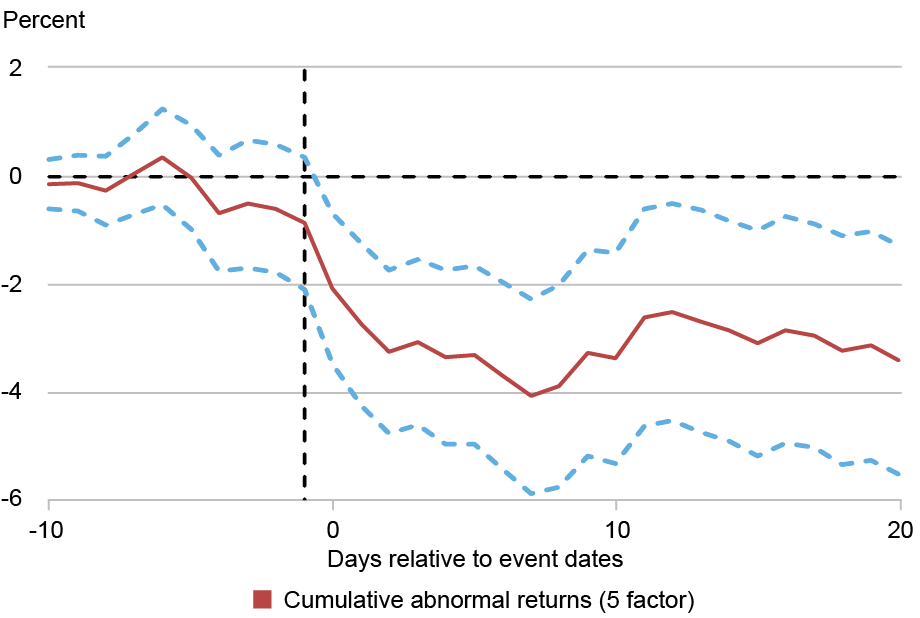
Although export controls directly target Chinese firms, they also reduce the value of those firms’ U.S. suppliers. The chart below shows that, in our data, U.S. suppliers experience a cumulative abnormal stock return of −3.6 percent right after the announcement that export controls target one or more of their Chinese customers, with most of the decline occurring during the first five trading days.
Stocks of U.S. Suppliers Fall when Their Chinese Customers Are Added to the Export Control List
Sources: CRSP; FactSet Revere; Code of Federal Regulations. Notes: The chart shows cumulative abnormal returns for stocks issued by U.S. firms that supply directly targeted Chinese customers around the announcement that those customers are added to a U.S. export-control list. The chart is based on the Fama-French five-factor model.
These price movements extend to the mutual funds holding these stocks. We measure a fund’s exposure to new export controls as the share of its portfolio invested in affected U.S. suppliers in that month. We then compare funds with higher and lower exposure to export controls within the same investment style and month, while controlling for fund characteristics. Funds holding stocks of affected U.S. suppliers experience higher volatility and lower (raw and factor-adjusted) returns following the imposition of export controls. Conditional on an export control event, a one standard deviation increase in exposure (2.5 percent) is associated with a 22-basis-point decline in monthly returns.
Mutual Funds Respond by Rebalancing Away from Geoeconomic Risk
Active managers reduce holdings of affected U.S. suppliers and also sell other China-linked U.S. firms not affected by the current announcement. The selling of affected U.S. suppliers, still visible three months after the export controls, suggests that managers do not generally treat the price decline as a purely temporary idiosyncratic shock. This broader selling suggests that investors learn that geoeconomic risk may be embedded in complex supply-chain links that were not fully priced or understood before the shock. In sum, export controls might serve as a wake-up call, prompting investors to learn more about a portfolio’s indirect exposure to China and to the possibility of future restrictions.
This portfolio rebalancing is driven entirely by active funds, consistent with passive funds simply tracking benchmark indices. For a one standard deviation increase in exposure, passive funds experience a 31-basis-point decline in monthly returns, compared with 22 basis points for active funds. In the following month, passive funds also experience outflows equivalent to about 0.35 percent of assets, while the outflows from active funds are statistically insignificant.
Active managers therefore appear to partially insulate fund performance from geoeconomic shocks, but this insulation comes with higher risk-taking. Specifically, exposed active funds subsequently hold more concentrated portfolios and tilt toward “lottery-like” stocks, suggesting that some managers respond to performance shortfalls by taking on additional risk to limit future outflows.
Specialist managers and higher-fee funds experience smaller performance declines after export control shocks, while traditional market-timing and stock-picking skills do not predict better outcomes. In sum, the management of geoeconomic risk might require the ability to map potential policy shocks onto firms’ positions in global value chains.
Is Geoeconomic Risk Priced In?
Consistent with the portfolio evidence, investors seem to require compensation for bearing geoeconomic risk. We sort stocks based on prior exposure to export controls and compare future returns of high-exposure and low-exposure firms. A long-short portfolio that buys firms previously exposed to export controls and shorts unexposed firms earns about 1 percent per month in abnormal returns after adjusting for standard risk factors. In other words, the market appears to treat geoeconomic exposure not as a one-time news event, but as a priced risk for which investors demand compensation.
Summing Up
As economic policy becomes more closely tied to national security, firms’ supply-chain links can become a channel through which geoeconomic shocks affect investors’ portfolios. For investors, the relevant question is therefore not only where a stock is listed, but where the firm earns revenues and how exposed those relationships are to geopolitical policy shocks. Diversification across domestic stocks may not fully mitigate this risk when many firms share similar global exposures. In this environment, understanding the global linkages of portfolio firms becomes increasingly important for understanding portfolio risk.
Matteo Crosignani is a financial research advisor in the Federal Reserve Bank of New York’s Research and Statistics Group.
Lina Han is an assistant professor of finance at the University of Massachusetts Amherst.
Marco Macchiavelli is an assistant professor of finance at the University of Massachusetts Amherst.
This post has been published simultaneously, with minor changes, on VoxEU.org.
How to cite this post:
Matteo Crosignani, Lina Han, and Marco Macchiavelli, “Navigating Geoeconomic Risk in the U.S. Stock Market,” Federal Reserve Bank of New York Liberty Street Economics, October 1, 2026, https://doi.org/10.59576/lse.20261001BibTeX: View |
@article{CrosignaniHanMacchiavelli2026,
    author={Crosignani, Matteo and Han, Lina and Macchiavelli, Marco},
    title={Navigating Geoeconomic Risk in the U.S. Stock Market},
    journal={Liberty Street Economics},
    note={Liberty Street Economics Blog},
    number={October 1},
    year={2026},
    url={https://doi.org/10.59576/lse.20261001}
}
Disclaimer The views expressed in this post are those of the author(s) and do not necessarily reflect the position of the Federal Reserve Bank of New York or the Federal Reserve System. Any errors or omissions are the responsibility of the author(s).
]]>0Gara Afonso, Jun-Davinci Choi, Gonzalo Cisternas, and Will Riordan<![CDATA[The Role of Repos in Monetary Policy Implementation]]>https://libertystreeteconomics.newyorkfed.org/?p=441672026-10-01T14:37:15Z2026-09-30T11:00:00Z
Gara Afonso, Jun-Davinci Choi, Gonzalo Cisternas, and Will Riordan
In the first two posts of this three-part series, we discussed private market participants that are active in repo markets for profit-making motives. Central banks are also active repo market participants, but their reasons often differ from those of private participants. In today’s post, we discuss how central banks use repos to manage liquidity in the financial system and implement monetary policy.
What Are Central Bank Repos and How Are They Used?
Central banks across the globe rely on repos to implement monetary policy and support market functioning. Market convention often defines central bank or “public” repo (and reverse repos) from the perspective of the private counterparty. For example, in the private repo market, the counterparty receiving cash and providing securities is said to be executing a repo. In contrast, when the Federal Reserve receives cash and provides securities, it is said to be executing a reverse repo.
Central banks inject liquidity into the banking system via repos by purchasing securities from financial institutions (typically commercial banks or dealers) and paying with (newly created) reserves. As the diagram below shows, repos result in an expansion of the balance sheet of the central bank and an increase in reserves in the banking system. Repos only provide liquidity while the transactions are outstanding. At the maturity date, the central bank returns the securities and receives the reserves back, draining liquidity and shrinking its balance sheet.
Repos Inject Liquidity
Source: Authors’ illustration.
Conversely, central banks drain liquidity via reverse repos by selling securities from their portfolios to financial institutions. The central bank converts the reserves received as payment for the securities to a repo payable on its balance sheet, changing the composition of the liabilities on its balance sheet but not the size. The flows are reversed at the maturity date, restoring liquidity.
Reverse Repos Drain Liquidity
Source: Authors’ illustration.
Like private repo market participants, central banks also face choices about eligible collateral, counterparties, rate, and settlement process for their repo and reverse repo transactions.
How Does the Federal Reserve Use Repos and Reverse Repos?
The Fed conducts repo and reverse repo transactions every business day to support its control over short-term interest rates. Since 2021, when repos transitioned into overnight standing repo operations (SRPs), the Federal Reserve has conducted daily repos with primary dealers and eligible banks to supply liquidity and dampen upward pressure on short-term rates. The SRP rate—set by the Federal Open Market Committee (FOMC)—provides a ceiling on overnight rates, as it offers eligible counterparties a source of funding that reduces their incentives to borrow at market rates above the SRP rate. Currently, these operations take place twice daily, against high-quality collateral—Treasury, agency debt, and agency mortgage-backed securities—and settle on the same day through the tri-party repo platform.
The chart below, which includes a scrollable bar for detailed inspection, displays the volume of outstanding Fed repos from 1918 to 2026, showing how repos have adjusted to the liquidity needs of the banking system. Since the global financial crisis, the use of repos has been concentrated during three episodes when the banking system needed additional liquidity: in September 2019, after a substantial reduction of the Fed balance sheet and amid market dislocations and upward pressure on money market rates; in March of 2020, in response to the COVID-19 pandemic and the dash for cash episode; and, more recently, in late 2025 following almost two and a half years of balance sheet reduction.
As noted above, in addition to repos, the Fed also uses reverse repos to drain liquidity from the banking system. In December 2015, reverse repo operations with primary dealers evolved into standing Overnight Reserve Repo (ON RRP) operations. Since then, the Fed has conducted daily reverse repos at a rate set by the FOMC. The ON RRP rate places a floor under overnight market rates by offering eligible counterparties an overnight investment opportunity that reduces their incentives to lend at rates below the ON RRP rate. Unlike earlier reverse repos, which were executed just with primary dealers, the ON RRP is offered to a broader set of counterparties, including money market funds, banks, and government-sponsored enterprises. Similarly to repo, ON RRP operations involve high-quality collateral and settle on the same day through the tri-party repo platform.
Historically, reverse repos have been used less frequently than repos because the Fed has traditionally structured its asset holdings to regularly add balances (via repo) rather than drain reserves with reverse repos (or by reducing the permanent portfolio). Their first use dates to the 1960s, half a century after the Fed conducted its first repos (see chart below). The early precursors of reverse repos, known as matched-sale purchases, were introduced in 1966, and were officially replaced by reverse repos in December 2002. One notable exception to the modest use of reverse repos occurred during the period that started in March 2021. As liquidity in the banking system grew from pandemic-related policies, reverse repos steadily increased, peaking at around $2.5 trillion in early 2023. Usage then declined steadily as the Fed reduced its balance sheet.
The Federal Reserve Starts Using Matched-Sale Purchases in 1966 and Reverse Repos in 2002
Billions of U.S. dollars
Sources: For 1968–2002 data: FRASER, H.4.1; For 2002-present data: Federal Reserve Bank of St. Louis FRED database, WLRRAFOIAL, WLRRAOL, and WLRRAL.
How Have Federal Reserve Repos Evolved?
The origins of the Fed using repos go back to November 1917, when the Fed first authorized the use of repos as an alternative to collateralized loans, known as advances. At the time, a stamp tax imposed by the War Revenue Act raised banks’ short-term borrowing costs and limited the Fed’s ability to provide liquidity to banks and support war finance activities of the U.S. government during World War I. Federal Reserve Banks created the conditions to circumvent the stamp tax by using repos rather than short-term advances that required physical tax stamps. The use of repos became very popular at the time and Fed repo holdings briefly exceeded $1 billion, which represented around 30 percent of Fed assets in 1918.
Over time, the types of institutions authorized to engage in repo transactions with the Fed have changed in response to shifting policy objectives and transformations in the financial system. When repos were first introduced as an alternative to bank advances, participation was restricted to member banks transacting with their respective regional Federal Reserve Banks (Murau et al. 2025). Subsequently, during the late 1940s and 1950s, as the purpose of repos shifted from providing bank liquidity to ensuring adequate funding in money markets and preventing short-term market disruptions, the eligible counterparties pivoted to primary dealers exclusively (Garbade 2016). Currently, the Fed conducts repo operations with both primary dealers and qualifying banks.
Rates on Federal Reserve repo operations have undergone a similar evolution alongside changes in counterparty eligibility. The rates of the initial repo operations were linked to the discount rate, reflecting the primary objective of facilitating bank borrowing. During the 1950s, as repos evolved into a mechanism for supplying markets with additional reserves to address temporary shortages and avoid short-lived strain, the repo rate became tied to a market rate—specifically, that of Treasury bills (Garbade 2016). Currently, the rate of Fed repos is determined by the FOMC and serves as a tool for influencing short-term money market rates.
Two additional critical features of Fed repo operations are the types of collateral accepted and the settlement mechanism used. The collateral accepted in early repo operations included commercial paper, Treasury certificates of indebtedness (coupon-bearing Treasury securities with maturities not exceeding one year), and Liberty Bonds, which were special war bonds issued to finance U.S. participation in World War I. This collateral composition reflected the two primary objectives of early repo operations: facilitating bank borrowing and supporting wartime financing activities. Thereafter, Treasury securities became the main acceptable collateral, initially restricted to issues with a yield of not more than the issuing rate for one-year Treasury obligations. This maturity constraint was gradually relaxed and eventually eliminated in 1966.
A major shift in both collateral and settlement practices occurred in 1999. Anticipating potential financial market disruptions stemming from Y2K-related liquidity concerns and a constrained supply of Treasury securities, the Fed expanded its eligible collateral to include agency debt and mortgage-backed securities. However, the Fed lacked the custody infrastructure and valuation expertise to manage these new securities at the time. To expand the pool of collateral, it established its first tri-party custodian arrangements with the two major clearing banks operating at the time—Chase and Bank of New York—and conducted its first tri-party repo operation in October. This approach proved successful, and by 2000, all Fed repos settled through the tri-party arrangements.
To Sum Up
Fed repo operations have evolved significantly since their inception in 1917, adapting to changing economic conditions and policy objectives. Today, repos and reverse repos serve as essential tools for implementing monetary policy and managing liquidity in the financial system.
Gara Afonso is a financial research advisor in the Federal Reserve Bank of New York’s Research and Statistics Group.
Jun-Davinci Choi is a research analyst in the Federal Reserve Bank of New York’s Research and Statistics Group.
Gonzalo Cisternas is a financial research advisor in the Federal Reserve Bank of New York’s Research and Statistics Group.
Will Riordan is a capital markets trading advisor in the Federal Reserve Bank of New York’s Markets Group.
How to cite this post:
Gara Afonso, Jun-Davinci Choi, Gonzalo Cisternas, and Will Riordan, “The Role of Repos in Monetary Policy Implementation,” Federal Reserve Bank of New York Liberty Street Economics, September 30, 2026, https://doi.org/10.59576/lse.20260930BibTeX: View |
@article{GaraAfonso,Jun-DavinciChoi,GonzaloCisternas,andWillRiordan2026,
    author={Gara Afonso, Jun-Davinci Choi, Gonzalo Cisternas, and Will Riordan},
    title={The Role of Repos in Monetary Policy Implementation},
    journal={Liberty Street Economics},
    note={Liberty Street Economics Blog},
    number={September 30},
    year={2026},
    url={https://doi.org/10.59576/lse.20260930}
}
Disclaimer The views expressed in this post are those of the author(s) and do not necessarily reflect the position of the Federal Reserve Bank of New York or the Federal Reserve System. Any errors or omissions are the responsibility of the author(s).
]]>0Gara Afonso, Jun-Davinci Choi, Gonzalo Cisternas, and Will Riordan<![CDATA[Follow the Cash! Microstructure of Repo Markets]]>https://libertystreeteconomics.newyorkfed.org/?p=441742026-09-30T14:02:23Z2026-09-29T11:00:00Z ]]>
Gara Afonso, Jun-Davinci Choi, Gonzalo Cisternas, and Will Riordan
The repo market in the U.S. is a mosaic of segments with distinct participants and various settlement and clearing practices. Why do large cash lenders typically settle their trades through a third-party agent? Why does the interdealer market clear through a central counterparty? Why do levered investors favor bilateral trades? In the second post of this series, we follow the cash as it navigates through repo markets to better understand the costs and benefits that shape the existing market structures.
What’s Unique about Repos?
In a repurchase agreement or repo, one party sells a security (frequently U.S. Treasuries) in exchange for cash with the promise to repurchase the security at a later date (usually the next business day). As we discussed in yesterday’s post, participants often use repos to invest cash and earn a return, similarly to federal funds or Eurodollar contracts. However, repo markets are significantly larger than other short-term money markets: For example, daily total volume across the federal funds, Eurodollar, and selected deposit markets hovers around $200 billion, while recent estimates of the size of repo markets in the U.S. exceed $13 trillion. What makes repo contracts distinctive?
The role of collateral is a key feature distinguishing repos from many other money market transactions. The presence of collateral expands the motives for entering repo transactions, attracting a broader set of participants. For instance, hedge funds may enter a repo to secure specific securities, while money market funds (MMFs) see the securities as a means to reduce the risk of their investment.
Taken together, the richness of counterparties and motives incentivizes customization in the execution, clearing, and settlement of repo contracts. Concretely, participants not only evaluate the terms of the transaction itself (for example, the rate, maturity, type of collateral, and haircut), they also assess the processes involved in the verification of the trade details (clearing) and the final transfer of the ownership of securities from the seller to the buyer in exchange for cash, including valuation, margining, and custody services (settlement). These processes involve costs arising from operational, legal, and counterparty risks. As participants deal with these costs differently, several repo segments have emerged, in reflection of how various entities evaluate these trade-offs. We describe these market arrangements next.
Intermediation Is Key in Repo Markets
How do borrowers and lenders find suitable counterparties in an over-the-counter market with many distinct sets of participants and trading motives? Repo markets have addressed this question through the emergence of dealers who act as intermediaries between the ultimate borrowers and lenders. Dealers are the hubs through which repo markets flow: they create value by intermediating cash and collateral in exchange for compensation for counterparty, collateral, and, to a lesser extent, maturity transformation risk (OFR 2024). For instance, as the stylized diagram below shows, a dealer may enter a repo—borrowing cash—with a more creditworthy counterparty (for example, a government MMF) and enter a reverse repo—lending cash—with a riskier one (for example, a levered hedge fund), earning the difference in rates (a 10 basis-point spread in this example) for intermediating between the ultimate borrower and lender.
Dealers Play a Crucial Role in Intermediating Cash and Securities
Source: Authors’ calculations.
Dealers also make markets for collateral by supplying securities counterparties are seeking and by accepting securities counterparties want to borrow cash against. Their importance cannot be understated: recent estimates calculate that in late 2024 dealers borrowed and lent $3.7 trillion and $3.4 trillion per day (Hempel, Kahn, and Shephard 2025).
To manage short-term liquidity, redistribute and source collateral, and finance security inventories, dealers also actively transact among themselves in an interdealer market. Most interdealer trades clear through a central counterparty which becomes the counterparty to every trade. In the U.S., the Fixed Income Clearing Corporation (FICC) currently guarantees most Treasury repo trades in the interdealer market. A key benefit of central clearing is the greater opportunity for netting of positions, which reduces balance sheet costs and expands dealer intermediation capacity. In addition, central clearing provides dealers with anonymity on their trades and reduces counterparty risk. These benefits, however, do not come for free, as they require contributing to a default fund and higher margining (see Neal 2024 and Copeland and Kahn 2024). By June 2027, the Securities and Exchange Commission (SEC) will require central clearing of U.S. Treasury-collateralized repos where at least one counterparty is a direct member of a registered clearing agency (2023 SEC rule).
Follow the Cash
Cash typically enters repo markets through cash-rich investors such as MMFs looking for a short-term secured investment. Dealers intermediate the funds, directly or through the interdealer market, and lend to cash borrowers, often hedge funds seeking to lever their investment strategies. Having discussed the interdealer segment, we next focus on the market structures of the segments where the funds originate and end in their journey from cash lenders to ultimate borrowers.
From Lenders to Dealers
The main cash lenders in repo are MMFs. Repos offer MMFs a flexible investment to manage client redemptions that also meets regulatory requirements on asset composition: SEC Rule 2a-7 restricts MMF investments to holdings of high-quality, short-term debt securities. Government MMFs, which account for over 80 percent of total U.S. MMF assets as of March 2026, are further limited to investing in cash, U.S. government securities, and repos backed by U.S. government securities. Currently, most transactions between MMFs and dealers are not centrally cleared. Dealers are more willing to forgo the benefits of central clearing for these transactions because MMFs offer a competitive, deep, reliable source of funding.
The settlement of repo transactions entails several tasks including collateral valuation, margining, collateral management, and custodial services. As MMFs are not interested in taking possession of specific collateral, they typically invest in general collateral repos and rely on a clearing bank (currently, Bank of New York Mellon) to settle transactions on its books instead of bearing the costs of setting up back offices for collateral management. This segment of the market, where the parties outsource to an agent the collateral management to settle repo, is known as the tri-party repo market. In contrast to the centrally cleared interdealer market, tri-party repo does not transform the counterparty risk between the buyer and seller, because Bank of New York Mellon acts solely as an agent and not as a counterparty (see TMPG 2022).
While this lender-to-dealer segment historically has not been centrally cleared, MMF lending in the centrally cleared segment has increased sharply over the past three years, reaching almost 40 percent of MMF repo activity in 2026:Q1 (see chart below). This migration is consistent with the benefits of central clearing outweighing the additional costs for dealers.
Rapid Growth of Centrally Cleared Lender-to-Dealer Repo
Billions of U.S. dollars
Source: SEC Form N-MFP. Note: The chart shows MMFs’ private repo volume by type of clearing.
From Dealers to Borrowers
As discussed in yesterday’s post, repo is an essential tool for hedge funds to boost their returns. Dealers are the main cash lenders to hedge funds in the repo market, with hedge funds’ outstanding repo volume reaching $3 trillion in 2025:Q4. In this segment, specific securities play a crucial role and repos settle bilaterally, in contrast to the lender-to-dealer segment that largely settles through a third party.
A key consideration behind the bilateral choice is that hedge funds employ highly levered fixed-income strategies (such as the cash-futures basis trade). As such, these strategies require both flexible access to collateral and cost efficiency to profitably exploit small price differentials. The bilateral segment provides hedge funds more flexibility along the first dimension relative to the tri-party segment, where the collateral stays with the clearing bank. Regarding the second, haircuts are typically lower in this segment: 75 percent of all Treasury repo trades in the bilateral segment that are non-centrally cleared have a zero haircut (OFR 2023). Dealers can still find attractive the non-centrally cleared market because there could be opportunities for freeing balance sheet space through so-called “netted packages.” For example, another type of hedge fund strategy involves the use of a reverse repo to purchase a cheap “off-the-run” security and a repo to source an “on-the-run” security for a short position. This combination of a repo and a reverse repo with the same counterparty and tenor and similar collateral could be eligible for balance sheet netting without the involvement of a central counterparty and therefore is well-suited to be executed via a netted package.
Consistent with the trend towards central clearing, the next chart illustrates that an increasing volume of repo between hedge funds and dealers has centrally cleared over the past three years, from 8 percent in early 2021 to 30 percent in late 2025. Recent analysis shows that this activity tends to increase on quarter-ends when dealers’ balance sheets are more constrained (OFR 2026).
Substantial Increase in Centrally Cleared Dealer-to-Borrower Repo
Billions of U.S. dollars
Sources: OFR; SEC Form PF. Note: The chart shows the total private repo volume and the centrally cleared volume in the dealer-to-borrower segment.
To Sum Up
The various microstructures of repo segments observed in the U.S. reflect how a heterogeneous set of participants evaluate the trade-offs involved in repo transactions differently. Costs related to the settlement of securities led to the emergence of tri-party repo; balance sheet costs favor central clearing; meanwhile, creative contracting—such as netted packages—mitigates costs in bilateral, non-centrally cleared repos.
Gara Afonso is a financial research advisor in the Federal Reserve Bank of New York’s Research and Statistics Group.
Jun-Davinci Choi is a research analyst in the Federal Reserve Bank of New York’s Research and Statistics Group.
Gonzalo Cisternas is a financial research advisor in the Federal Reserve Bank of New York’s Research and Statistics Group.
Will Riordan is a capital markets trading advisor in the Federal Reserve Bank of New York’s Markets Group.
How to cite this post:
Gara Afonso, Jun-Davinci Choi, Gonzalo Cisternas, and Will Riordan, “Follow the Cash! Microstructure of Repo Markets,” Federal Reserve Bank of New York Liberty Street Economics, September 29, 2026, https://doi.org/10.59576/lse.20260929BibTeX: View |
@article{GaraAfonso,Jun-DavinciChoi,GonzaloCisternas,andWillRiordan2026,
    author={Gara Afonso, Jun-Davinci Choi, Gonzalo Cisternas, and Will Riordan},
    title={Follow the Cash! Microstructure of Repo Markets},
    journal={Liberty Street Economics},
    note={Liberty Street Economics Blog},
    number={September 29},
    year={2026},
    url={https://doi.org/10.59576/lse.20260929}
}
Disclaimer The views expressed in this post are those of the author(s) and do not necessarily reflect the position of the Federal Reserve Bank of New York or the Federal Reserve System. Any errors or omissions are the responsibility of the author(s).
]]>0Gara Afonso, Jun-Davinci Choi, Gonzalo Cisternas, and Will Riordan<![CDATA[Who’s Borrowing and Lending in Repo Markets?]]>https://libertystreeteconomics.newyorkfed.org/?p=453252026-09-30T14:00:23Z2026-09-28T11:00:00Z
Gara Afonso, Jun-Davinci Choi, Gonzalo Cisternas, and Will Riordan
Repo markets play a vital role in the U.S. financial system. In this three-part series, we examine who participates in these markets, what trade-offs influence how different repo segments are structured, and why repos matter for monetary policy. Today’s post introduces repo transactions, focusing on the major private-sector participants and why they engage in these markets.
What’s a Repo?
A repurchase agreement or repo is a financial transaction in which one party sells a security in exchange for cash, with the commitment to repurchase the same (or a closely related) security for a prespecified price on a future date. (From the perspective of the party buying the security and later reselling it, this transaction is called a reverse repo.) Repos are an essential component of the U.S. financial system, acting both as a source of funding and short-term investment for many financial institutions, as well as a marketplace for obtaining specific securities. Recent estimates assess the daily amount of outstanding agreements in the U.S. at around $13.5 trillion or 40 percent of U.S. GDP (see OFR 2026).
The time between the initial sale and the repurchase, along with the price difference, determines the interest rate, known as the repo rate. Repo rates vary depending on a variety of factors, most notably the type of collateral accepted (the securities sold), maturity (the length of time between the initial sale and repurchase), counterparty, the size of the haircut (the difference between the value of the securities sold and cash delivered), and clearing (the process between the execution and final settlement of a transaction). Around 70 percent of repos are collateralized by U.S. Treasury securities and most have an overnight maturity. In terms of clearing, around 60 percent of repos are cleared through a central counterparty (35 percent) or through a third party (25 percent), while 40 percent are directly cleared between the buyer and seller (OFR 2025).
As an illustration, the diagram below shows a stylized representation of a repo market. Many different types of transactions take place in repo markets. For example, a dealer—acting as an intermediary—can purchase securities from levered investors like hedge funds (a reverse repo from the dealer’s perspective), and also enter into a repo with other dealers or with cash lenders such as money market funds (MMFs) to sell the securities, thus ultimately channeling funds from cash lenders to cash borrowers. In tomorrow’s post, we delve deeper into the microstructure of various segments of repo markets.
A Stylized Representation of a Repo Market
Source: Authors’ illustration.
Repos can be traced back to the early 20th century. Repo market size and contracting conventions changed markedly in the 1980s following the failure of several dealers, amid a rising level and volatility of interest rates and growing supply of Treasury debt (see Garbade 2006). An important convention that has contributed to the liquidity and growth of repo markets is that repos involving Treasury and federal agency securities are exempt from the automatic stay under the U.S. Bankruptcy Code that, as the name suggests, comes into effect when a company files for bankruptcy and stays creditors from taking certain actions on account of their claims against the company. This means that if the cash borrower defaults during the life of the repo, the cash lender can generally terminate its repo contracts with the defaulting counterparty, sell the securities promptly, and avoid the delay and uncertainty of the bankruptcy process.
What Are Repos Used for?
In a repo, the party selling the security is interested in borrowing cash. The counterparty, however, may enter the repo transaction for one of two reasons: to invest cash and earn a return, or to obtain a specific security. The first motive makes a repo economically similar to other short-term money market instruments such as federal funds, Eurodollars, or commercial paper. Unlike in these markets, the transaction is collateralized: from the perspective of the cash lender, the securities reduce the risk of the trade.
A “general collateral repo” (or GC repo) is a good example of a repo transaction in which the cash lender is not interested in the specific securities it receives. In GC repo, the cash lender agrees to receive any security that meets a specified criteria (for example, Treasury securities with less than ten years to maturity) rather than a specific security. This makes GC repo a funding market both for cash borrowers seeking to finance a basket of securities and for cash lenders looking to invest cash at a competitive rate. The diagram below shows an illustration of a repo used as a funding instrument. In this example, a MMF is looking to invest $98 million in cash overnight and lends to a repo dealer against a basket of Treasury securities including a haircut of 2 percent. The following day, the MMF receives $98,009,800 (at a return of 3.6 percent in annual terms) and returns the securities.
An Example of a Repo Transaction
Source: Authors’ calculations.
Participants may also engage in repo to acquire a specific security. In the specific issue market, the securities used to settle the transaction are identified at the outset of the trade. When a particular security is in high demand relative to available supply, it has scarcity value and is known as a “special,” and typically trades at a lower rate relative to the prevailing GC rate: the cash lender, seeking to obtain a specific, scarce asset is willing to forgo some return (Duffie 1996). From this perspective, repos are like a security lending transaction against cash collateral rather than a collateralized loan. There are two important differences: first, repo mainly uses fixed-income instruments as collateral and, second, repo typically does not grant the lender the right of early recall of the securities.
Repos also play a key role in monetary policy implementation. In today’s post we focus on private repos, returning to their use in central banks’ toolkits in the third post of this series.
Who Participates in Repo Markets?
Relative to the federal funds and Eurodollar and selected deposits markets, the landscape of private repo participants is more complex for two main reasons. First, there is a broader and more diverse set of ultimate borrowers and lenders. Second, dealers are instrumental intermediaries in repo markets. In the remainder of this post, we shed light on the first category, describing the key role of dealers in tomorrow’s post.
The Borrowers
The top cash borrowers in private repo markets are hedge funds. Hedge funds rely on repo markets for leverage to boost their returns. An example of a hedge fund strategy that uses repo is the so-called “Treasury cash-futures basis trade.” In this strategy, a hedge fund purchases a Treasury security and sells a Treasury futures contract, which enables it to profit from the price differential. To amplify the return on the basis trade, hedge funds finance the purchase of the Treasury securities with cash borrowed in a repo that uses those securities as collateral. As the chart below shows, hedge fund borrowing in repo markets tripled over 2013-23, from $400 billion to $1.5 trillion; and then it doubled again in the following two years, reaching $3 trillion in late 2025.
Hedge Funds Are the Main Cash Borrowers in Private Repo Markets
Billions of U.S. dollars
Sources: OFR; FFIEC 002; FFIEC 031/041/051; Federal Reserve Bank of St. Louis, FRED database. Notes: The chart shows private repo cash borrowing volume by various participant types. FBOs are U.S. branches and agencies of foreign banks, HFs are hedge funds, USDIs are U.S. depository institutions, and REITs are real estate investment trusts.
The next three largest borrowers in repo markets today are U.S. branches and agencies of foreign banks (FBOs), U.S. depository institutions (USDIs), and real estate investment trusts (REITs). Jointly, their outstanding borrowing in repo has ranged between $800 billion and $1.3 trillion since 2013.
The Lenders
The main cash lenders in repo are MMFs. As the next chart shows, between January 2013 and January 2021, MMF lending increased by 90 percent, from under $600 billion to $1 trillion. In the following five years, MMF lending almost tripled, reaching $3 trillion in January 2026. Repo markets offer MMFs a short-term investment that meets their regulatory requirements on maturity and asset composition while providing flexibility to help manage investor redemptions.
The second largest lenders in repo are hedge funds. Although hedge funds are net cash borrowers in repo, they also lend to manage cash and liquidity and for collateral transformation. In late 2025, hedge funds lent around $1.3 trillion, a steady increase from $350 billion in early 2013. The next three largest lenders—government-sponsored enterprises (GSEs), U.S. branches and agencies of foreign banks, and U.S. depository institutions—are key players in the federal funds, Eurodollar, and selected deposits markets, and jointly lent $0.6-$1.5 trillion in repo over the 2013-25 period.
MMFs Are the Main Cash Lenders in Repo Markets
Billions of U.S. dollars
Sources: OFR; FFIEC 002; FFIEC 031/041/051; Federal Reserve Bank of St. Louis, FRED database. Notes: The chart shows private repo cash lending volume by various participant types. FBOs are U.S. branches and agencies of foreign banks, HFs are hedge funds, USDIs are U.S. depository institutions, GSEs are government-sponsored enterprises, and MMFs are money market funds.
In Sum
Repo markets are the venue where financial institutions lend and borrow money in a collateralized manner, usually short term. While borrowers in this market obtain cash, lenders may seek short-term investments or a specific security of interest. As a marketplace in the trillions of dollars, repo markets host a wide variety of participants. In the next posts in this series, we will examine the microstructure of various segments of this market, and the market’s importance for monetary policy implementation.
Gara Afonso is a financial research advisor in the Federal Reserve Bank of New York’s Research and Statistics Group.
Jun-Davinci Choi is a research analyst in the Federal Reserve Bank of New York’s Research and Statistics Group.
Gonzalo Cisternas is a financial research advisor in the Federal Reserve Bank of New York’s Research and Statistics Group.
Will Riordan is a capital markets trading advisor in the Federal Reserve Bank of New York’s Markets Group.
How to cite this post:
Gara Afonso, Jun-Davinci Choi, Gonzalo Cisternas, and Will Riordan, “Who’s Borrowing and Lending in Repo Markets?,” Federal Reserve Bank of New York Liberty Street Economics, September 28, 2026, https://doi.org/10.59576/lse.20260928BibTeX: View |
@article{GaraAfonso,Jun-DavinciChoi,GonzaloCisternas,andWillRiordan2026,
    author={Gara Afonso, Jun-Davinci Choi, Gonzalo Cisternas, and Will Riordan},
    title={Who’s Borrowing and Lending in Repo Markets?},
    journal={Liberty Street Economics},
    note={Liberty Street Economics Blog},
    number={September 28},
    year={2026},
    url={https://doi.org/10.59576/lse.20260928}
}
Disclaimer The views expressed in this post are those of the author(s) and do not necessarily reflect the position of the Federal Reserve Bank of New York or the Federal Reserve System. Any errors or omissions are the responsibility of the author(s).
]]>2<![CDATA[Treasury Trading at the Close]]>https://libertystreeteconomics.newyorkfed.org/?p=455522026-09-25T13:00:38Z2026-09-22T11:00:00Zpast work, we showed that trading in U.S. Treasury securities is becoming increasingly concentrated on the last trading day of each month. In this post, we show that trading is also becoming more concentrated around the designated pricing, or “strike,” times for fixed-income indexes. The concentration is especially pronounced on month-end trading days. We also document a marked shift in trading activity from around 3 p.m. (ET) to around 4 p.m. after a major fixed-income index provider moved its strike time from 3 p.m. to 4 p.m. in January 2021.]]>
Henry Dyer, Michael J. Fleming, and Or Shachar
In past work, we showed that trading in U.S. Treasury securities is becoming increasingly concentrated on the last trading day of each month. In this post, we show that trading is also becoming more concentrated around the designated pricing, or “strike,” times for fixed-income indexes. The concentration is especially pronounced on month-end trading days. We also document a marked shift in trading activity from around 3 p.m. (ET) to around 4 p.m. after a major fixed-income index provider moved its strike time from 3 p.m. to 4 p.m. in January 2021.
End-of-Month Trading, Index Rebalancing, and Index Strike Times
In an earlier LSE post, we found that overall Treasury security trading volume is about 58 percent higher on the last trading day of the month than on other days. We showed in a related post that this concentration of activity has increased sharply over the past decade or so and is associated with improved market liquidity. We conjecture that the increased concentration of activity may reflect the growth of assets managed relative to fixed-income indexes, many of which are rebalanced at month-end.
Unlike the equity market, the Treasury market is over-the-counter and has no exchange-mandated closing time. Instead, index providers have discretion as to what time of day to set their closing prices. Historically, 3 p.m. was the industry standard (among other reasons, open-outcry trading for Treasury futures ended at 3 p.m. and the 3 p.m. strike time allowed for a lead time before mutual funds’ net asset value production time of 4 p.m.). On January 14, 2021, Bloomberg Barclays—one of the largest providers of fixed-income indexes (and now called Bloomberg Fixed Income Indices)—changed the strike time for its U.S. dollar-denominated indexes from 3 p.m. to 4 p.m. Some reports suggest that one reason for the change was to reduce tracking error for funds that are required to price portfolios using 4 p.m. prices.
Empirical Approach
We measure the share of each day’s trading volume executed in the ten-minute windows around the 3 p.m. and 4 p.m. index strikes and track those shares over time. We do this for all days as a group and for end-of-month days when fixed-income indexes are rebalanced. We also compare intraday trading patterns before and after Bloomberg changed its strike time. Our analysis covers trading activity in the most recently auctioned (that is, on-the-run) notes and bonds in the interdealer market.
Trading Increasingly Concentrates at the Close
The chart below shows that the share of daily trading volume in the ten minutes around 3 p.m. increased from an average of 2.3 percent in 2016 to 3.4 percent in 2020. When Bloomberg’s strike time changed from 3 p.m. to 4 p.m. in January 2021, the share of activity around 3 p.m. plunged, and the share of activity around 4 p.m. (which had also been increasing from 2016 to 2020) surged. The share of activity around 4 p.m. has since increased from an average of 2.5 percent in 2021 to 3.5 percent in 2025.
Trading Now Concentrates Around the 4 P.M. Closing Strike
Source: Authors’ calculations, based on data from BrokerTec. Note: The chart plots the average share of daily trading volume in the most recently auctioned Treasury notes and bonds from 2:55-3:05 p.m. and from 3:55-4:05 p.m. for each month from January 2016 to December 2025 (excluding days with an early market close and months in which the last trading day has an early close).
Effects More Pronounced on the Last Day of the Month
As shown in the next chart, trading volume is even more concentrated around the day-end strike times on the last trading day of each month, when indexes are rebalanced. The share of activity around 3 p.m. on such days increased from an average of 8.1 percent in 2016 to 12.1 percent in 2020. When Bloomberg’s strike time changed in January 2021, the share of activity around 3 p.m. plunged, and the share of activity around 4 p.m. (which had also been increasing from 2016 to 2020) surged. The share of activity around 4 p.m. has since increased from an average of 11.6 percent in 2021 to 20.4 percent in 2025.
End-of-Day Trading Is More Pronounced on the Last Day of the Month
Source: Authors’ calculations, based on data from BrokerTec. Note: The chart plots the share of daily trading volume in the most recently auctioned Treasury notes and bonds from 2:55-3:05 p.m. and from 3:55-4:05 p.m. on the last trading day of each month from January 2016 to December 2025 (excluding days with an early market close).
Effects Are Changing the Intraday Pattern of Activity
The increasing share of day-end trading and the increased importance of the 4 p.m. strike time are reflected in changes in the intraday pattern of trading activity. The next chart plots the average share of daily trading volume in each five-minute interval from 7 a.m. to 5:30 p.m. in 2016 and 2025. In 2016, trading volume spiked at the 8:30 and 10 a.m. release times of macroeconomic announcements, when auction results were released shortly after 1 p.m., and around the 3 p.m. strike time. There were much smaller spikes around 4 p.m. and 5 p.m.
Trading Activity Spikes at the Day-End Strike Times
Percent
Source: Authors’ calculations, based on data from BrokerTec. Notes: The chart plots the average share of daily trading volume in the most recently auctioned Treasury notes and bonds for each five-minute interval from 7 a.m. to 5:30 p.m. in 2016 and 2025 (excluding days with an early market close). Gray bars denote overlap in shares between 2016 (blue) and 2025 (gold). Times indicate interval starting times.
In 2025, the pattern is mostly similar, but the 4 p.m. spike is much more pronounced. Interestingly, the 3 p.m. spike is of similar magnitude across the two years, but volume shares are then higher in 2025 for every interval from 3:10 p.m. to 5:05 p.m., and especially in the ten minutes around 4 p.m.
Our last chart compares the intraday patterns on month-end days in 2016 and 2025. We find much larger day-end spikes on these days, especially in 2025, consistent with our earlier results. The half-hour interval between 3:45 and 4:15 p.m. thus accounts for more than one quarter of total daily activity on month-end days in 2025, on average, with about half of that between 3:55 and 4:00 p.m. alone. These are unusually high trading volume days to begin with, as explained earlier.
End-of-Day Trading Activity Spikes Much More on the Last Day of the Month
Percent
Source: Authors’ calculations, based on data from BrokerTec. Notes: The chart plots the average share of daily trading volume in the most recently auctioned Treasury notes and bonds for each five-minute interval from 7 a.m. to 5:30 p.m. on the last trading day of each month in 2016 and 2025 (excluding days with an early market close). Gray bars denote overlap in shares between 2016 (blue) and 2025 (gold). Times indicate interval starting times.
A general note about our intraday analysis is that there is round-the-clock trading in the market—as discussed in this article. We choose to plot the patterns for 7 a.m. – 5:30 p.m. only because such hours account for the overwhelming share of daily trading volume and because U.S. macroeconomic announcements and other important events (including U.S. Treasury auctions and end-of-day strike times) occur during these hours.
Summing Up
We find that trading activity in the U.S. Treasury market is increasingly concentrated around the end-of-day index strike times. This is especially true on the last trading day of each month when indexes are rebalanced, complementing our earlier findings of sharply increased trading on those days more generally. We further find a marked redistribution of trading activity from around 3 p.m. to around 4 p.m. when a major fixed-income index provider moved its strike time from 3 p.m. to 4 p.m. These results provide strong evidence that index pricing conventions materially shape when Treasury trading occurs.
Henry Dyer, a former research analyst in the Federal Reserve Bank of New York’s Research and Statistics Group, is pursuing a master’s in finance at the MIT Sloan School of Management.
Michael J. Fleming is head of Capital Markets in the Federal Reserve Bank of New York’s Research and Statistics Group.
Or Shachar is a financial research advisor in the Federal Reserve Bank of New York’s Research and Statistics Group.
How to cite this post:
Henry Dyer, Michael J. Fleming, and Or Shachar, “Treasury Trading at the Close,” Federal Reserve Bank of New York Liberty Street Economics, September 22, 2026, https://doi.org/10.59576/lse.20260922BibTeX: View |
@article{DyerFlemingShachar2026,
    author={Dyer, Henry and Fleming, Michael J. and Shachar, Or},
    title={Treasury Trading at the Close},
    journal={Liberty Street Economics},
    note={Liberty Street Economics Blog},
    number={September 22},
    year={2026},
    url={https://doi.org/10.59576/lse.20260922}
}
Disclaimer The views expressed in this post are those of the author(s) and do not necessarily reflect the position of the Federal Reserve Bank of New York or the Federal Reserve System. Any errors or omissions are the responsibility of the author(s).
]]>0<![CDATA[The New York Fed DSGE Model Forecast—September 2026]]>https://libertystreeteconomics.newyorkfed.org/?p=456302026-09-17T13:03:14Z2026-09-18T13:00:00ZJune 2026. The New York Fed DSGE model expects similar growth, and slightly more persistent inflation, compared to its forecasts in June. r* forecasts are slightly lower for 2026 but higher for the remainder of the forecast horizon.]]>
Marco Del Negro, Keshav Dogra, Elena Elbarmi, Donggyu Lee, Michael Pham, and Elizabeth Wright
This post presents an update of the economic forecasts generated by the Federal Reserve Bank of New York’s dynamic stochastic general equilibrium (DSGE) model. We describe very briefly our forecast and its change since June 2026. The New York Fed DSGE model expects similar growth, and slightly more persistent inflation, compared to its forecasts in June. r* forecasts are slightly lower for 2026 but higher for the remainder of the forecast horizon.
Note: The DSGE model forecast is not an official New York Fed forecast, but only an input to the Research staff’s overall forecasting process. For more information about the model and variables discussed here, see our DSGE model Q & A.
The forecasts are obtained using data released through 2026:Q2, augmented for 2026:Q3 with the median forecasts for real GDP growth and core PCE inflation, and short-run inflation expectations from the August release of the Philadelphia Fed Survey of Professional Forecasters (SPF), expectations of the future level of the federal funds rate from the July release of the New York Fed Survey of Market Expectations, as well as the yields on 10-year Treasury securities and Baa-rated corporate bonds.
The model remains pessimistic on growth, and keeps being surprised when the economy turns out to be stronger than it expected. In particular, the SPF projects GDP growth in 2026:Q3 to be more than 1 percent higher in annualized terms than the DSGE model expected in June. The model attributes this likely forecast miss (under the assumption that the SPF projection will be correct) to more buoyant financial conditions than expected and to the positive growth effect of the AI-related boom in investment, as captured by MEI (marginal efficiency of investment) shocks. The model’s growth forecasts for 2026 remained at 1.2 percent, as in June. The DSGE forecasts remain rather pessimistic on growth for the remainder of the forecast horizon, in part because the model expects monetary policy to be more restrictive than it did in June, and in part because it revised downward its expectations for total factor productivity (TFP) growth. The GDP growth projections for 2027, 2028, and 2029 are 0.1, 0.5, and 1.2 percent, respectively, compared to 0.2, 0.7, and 1.5 in June.
For core inflation, the SPF projections for 2026:Q3 were broadly in line with the DSGE forecast in June. Still, the model now expects inflation to revert toward the FOMC’s long-run goal of 2 percent more slowly than it did in June, in part because lower TFP growth results in higher inflation. The projections for 2026, 2027, 2028, and 2029 are 3.3, 2.1, 1.8, and 1.8 percent, compared to 3.1, 1.8, 1.6, and 1.7 percent in June, respectively.
The model’s prediction for the short-run real natural rate of interest (r*) is 1.9 percent annualized for 2026, down from 2.0 percent in June. The r* forecasts are slightly higher than in June for the remainder of the forecast horizon, however (1.8, 1.4, and 1.2 percent for 2027, 2028, and 2029, compared to 1.7, 1.3, and 1.1 percent in June, respectively).
Forecast Comparison
Forecast Period
2026
2027
2028
2029
Date of Forecast
Sep26
Jun26
Sep26
Jun26
Sep26
Jun26
Sep26
Jun26
GDP growth (Q4/Q4)
1.2 (-0.8, 3.1)
1.2 (-2.2, 4.5)
0.1 (-5.2, 5.5)
0.2 (-5.0, 5.2)
0.5 (-4.9, 5.9)
0.7 (-4.8, 6.0)
1.2 (-4.4, 6.8)
1.5 (-4.1, 6.9)
Core PCE inflation (Q4/Q4)
3.3 (3.0, 3.7)
3.1 (2.5, 3.7)
2.1 (1.0, 3.2)
1.8 (0.7, 3.0)
1.8 (0.6, 3.0)
1.6 (0.4, 2.9)
1.8 (0.5, 3.1)
1.7 (0.4, 3.0)
Real natural rate of interest (Q4)
1.9 (0.7, 3.1)
2.0 (0.7, 3.3)
1.8 (0.4, 3.3)
1.7 (0.2, 3.1)
1.4 (-0.1, 3.0)
1.3 (-0.3, 2.9)
1.2 (-0.5, 2.8)
1.1 (-0.5, 2.8)
Source: Authors’ calculations. Notes: This table lists the forecasts of output growth, core PCE inflation, and the real natural rate of interest from the September 2026 and June 2026 forecasts. The numbers outside parentheses are the mean forecasts, and the numbers in parentheses are the 68 percent bands.
Forecasts of Output Growth
Source: Authors’ calculations. Notes: These two panels depict output growth. In the top panel, the black line indicates actual data and the red line shows the model forecasts. The shaded areas mark the uncertainty associated with our forecasts at 50, 60, 70, 80, and 90 percent probability intervals. In the bottom panel, the blue line shows the current forecast (quarter-to-quarter, annualized), and the gray line shows the June 2026 forecast.
Forecasts of Inflation
Source: Authors’ calculations. Notes: These two panels depict core personal consumption expenditures (PCE) inflation. In the top panel, the black line indicates actual data and the red line shows the model forecasts. The shaded areas mark the uncertainty associated with our forecasts at 50, 60, 70, 80, and 90 percent probability intervals. In the bottom panel, the blue line shows the current forecast (quarter-to-quarter, annualized), and the gray line shows the June 2026 forecast.
Real Natural Rate of Interest
Source: Authors’ calculations. Notes: The black line shows the model’s mean estimate of the real natural rate of interest; the red line shows the model forecast of the real natural rate. The shaded area marks the uncertainty associated with the forecasts at 50, 60, 70, 80, and 90 percent probability intervals.
Marco Del Negro is an economic research advisor in the Federal Reserve Bank of New York’s Research and Statistics Group.
Keshav Dogra is an economic research advisor in the Federal Reserve Bank of New York’s Research and Statistics Group.
Elena Elbarmi is a research analyst in the Federal Reserve Bank of New York’s Research and Statistics Group.
Donggyu Lee is a research economist in the Federal Reserve Bank of New York’s Research and Statistics Group.
Michael Pham is a research analyst in the Federal Reserve Bank of New York’s Research and Statistics Group.
Elizabeth Wright is a research analyst in the Federal Reserve Bank of New York’s Research and Statistics Group.
How to cite this post:
Marco Del Negro, Keshav Dogra, Elena Elbarmi, Donggyu Lee, Michael Pham, and Elizabeth Wright, “The New York Fed DSGE Model Forecast—September 2026,” Federal Reserve Bank of New York Liberty Street Economics, September 18, 2026, https://libertystreeteconomics.newyorkfed.org/2026/09/the-new-york-fed-dsge-model-forecast-september-2026/
BibTeX: View |
@article{DelNegroDograElbarmiLeePhamWright2026,
    author={Del Negro, Marco and Dogra, Keshav and Elbarmi, Elena and Lee, Donggyu and Pham, Michael and Wright, Elizabeth},
    title={The New York Fed DSGE Model Forecast—September 2026},
    journal={Liberty Street Economics},
    note={Liberty Street Economics Blog},
    number={September 18},
    year={2026},
    url={https://libertystreeteconomics.newyorkfed.org/2026/09/the-new-york-fed-dsge-model-forecast-september-2026/}
}
Disclaimer The views expressed in this post are those of the author(s) and do not necessarily reflect the position of the Federal Reserve Bank of New York or the Federal Reserve System. Any errors or omissions are the responsibility of the author(s).
]]>0<![CDATA[Jackson Hole: Exploring the Financial Frontier]]>https://libertystreeteconomics.newyorkfed.org/?p=454712026-09-21T19:27:21Z2026-09-03T11:00:00ZStreet Level. The main theme of this year’s Kansas City Fed symposium was financial innovation in the payments space—a fast-evolving topic with major implications for consumers and central bankers alike. In this post, I’ll share some general takeaways from those Jackson Hole talks and highlight related New York Fed research on payments and financial intermediation.]]>
Kartik B. Athreya
After two days of heady discussions with academics and policymakers from around the world in high-altitude Jackson Hole, Wyoming, I’m now decompressing back at Street Level. The main theme of this year’s Kansas City Fed symposium was financial innovation in the payments space—a fast-evolving topic with major implications for consumers and central bankers alike. In this post, I’ll share some general takeaways from those Jackson Hole talks and highlight related New York Fed research on payments and financial intermediation.
Econ in the Tetons
Much of the conversation at Jackson Hole centered around technological innovations that are creating new possibilities for payments to be made directly between parties without the use of a traditional hub to coordinate those transactions. Central banks have long helped provide that hub and the “rails” on which many payments run. So naturally, we at the Fed are interested in how these changes should be supported, what we can expect as payments processors ourselves, and what risks these innovations pose to both the payments system narrowly and the financial system more broadly.
Conference participants demonstrated how some aspects of blockchain technology surely must be welcomed, as they open the door to what are known as “smart contracts”—richer kinds of payment arrangements that can be made contingent on circumstances relevant to the parties paying one another. That said, some of the papers presented were more cautionary in assessing the implications of such innovations for both banks and other entities who do “bank-like” things—so-called “non-bank financial institutions” (NBFIs)—and for consumer well-being. I won’t go into detail about the presentations made at the conference, but the links are available here if you’re curious.
What I want to focus on instead is the work that we at the New York Fed have done in the broad area of what economists call “financial intermediation”—work that is fundamental to understanding the questions raised at Jackson Hole.
From Basic Banking…
When evaluating new payment technologies, it’s useful to recall the basic purpose of the financial system: to enable participants in our economy to concentrate their purchasing power on desired goods and services at specific times and under specific circumstances. Ultimately, this is what all borrowing, lending, and insurance contracts facilitate.
The “circumstances” noted above very much include instances where someone has an innovative idea and now needs the resources to bring it to fruition—things like loans, venture capital, and equity issuances are the means to make this happen.
Vitally, every single one of these desired functions relies in the end on payment systems for their delivery. Perhaps obviously, then, any financial system that doesn’t do this well is not fully delivering for society.
Financial institutions—banks and, increasingly, NBFIs—have traditionally carried out those functions through financial intermediation: gathering deposits from savers and lending those funds out to borrowers. As intermediators, these institutions naturally amass a great deal of information with respect to credit risks, economic conditions, and financial markets. Ideally, this vantage enables them to direct available credit to where it is most needed.
Payments are a natural adjunct to this primary activity—if two people have accounts at the same bank or NBFI, it’s easy to see how they can pay each other through that institution. Even if they don’t share a bank or NBFI, those entities can set up a network to move claims around to let us make payments as consumers.
…To the Blockchain
Blockchain technology has the potential to revolutionize banking, with distributed digital ledgers and tokenized deposits replacing traditional databases. Advocates say that blockchain-based banking could offer a variety of benefits, most notably real-time transactions, higher security, and lower operational costs.
The nature of the information needed by market participants to engineer safe payments to one another is also evolving. At present, a great deal of information is exchanged before payments are effected and finalized. These steps take time, effort, and resources. To what extent can emerging payment technologies enable us to reduce these burdens?
Of course, the transition to blockchain-based banking and payments is not without risk. Just as banks can be destabilized by depositor flight, our researchers have documented that digital assets can also be subject to runs and shocks.
Stablecoins—blockchain-based crypto assets whose value is pegged to that of a fiat currency, usually the U.S. dollar—have seen rapid adoption as a payment instrument in recent years, accelerated by the passage of the 2025 GENIUS Act. Though their name implies a high degree of security, stablecoins are not fully immune from instability.
Zooming out, since stablecoins’ value is based on that of other assets, what does this dynamic mean for the stability of the overall financial system? One practical example is the effect that stablecoins might have on banks. What if many of us simply shift our bank deposits into stablecoins, thus hampering banks’ capacity to gather the information and capital necessary to lend to those who need credit? Some observers worry about this scenario, as the effects on the banking system might have far-reaching reverberations.
Recently, our economists have been examining the ties between stablecoins and financial stability more broadly. My colleague Pablo Azar and his coauthor have a new piece that analyzes an innovation to stablecoins themselves. Instead of being linked to a traditional fiat currency (the U.S. dollar), some newer stablecoins are linked to… other crypto assets. The authors argue that this can create risks within the crypto ecosystem itself, and thereby more broadly.
This wave of innovations has led economists to revisit a classic banking-sector question: is it really essential for the same institution that offers consumers easy-to-withdraw deposits to also issue hard-to-liquidate loans? In this paper, the New York Fed’s Todd Keister explores one possible alternative: a so-called “narrow bank” that offers payment and withdrawal services, leveraging the advantages of new technologies while leaving some traditional lending to others, like finance companies.
Street Level Observations: Will Payment Innovations Pay Off?
As new protocols, platforms, and instruments enter the payments space, it’s important to keep things in perspective by subjecting these technologies to a couple of tests.
First, do these tools facilitate new types of transactions that weren’t feasible before? Alternatively, do they allow for cheaper transactions, freeing up resources for use elsewhere in society?
Second, to what extent do innovations in payments change the risks facing all parties within the financial system, and in turn the broader economy? Stablecoins, for example, are typically promoted as aiding cheap cross-border payments, while tokenization of safe assets like U.S. Treasury securities is promoted as helpful for making those assets easier to buy and sell. These same properties might arguably create risks for those presently providing payments—banks, most obviously.
All these claims may have merit, and each must be examined carefully. Moreover, both banking and payments are parts of our economy where taxpayer support has been used to prevent problems from getting worse. Given this risk, more research and a sharp eye toward avoiding the transference of risks to the public are both going to be important.
Kartik B. Athreya is the director of research and head of the Research and Statistics Group at the Federal Reserve Bank of New York.
How to cite this post:
Kartik B. Athreya, “Jackson Hole: Exploring the Financial Frontier,” Street Level, Federal Reserve Bank of New York Liberty Street Economics, September 3, 2026, https://libertystreeteconomics.newyorkfed.org/2026/09/jackson-hole-exploring-the-financial-frontier/
BibTeX: View |
@article{Athreya2026,
    author={Athreya, Kartik B.},
    title={Jackson Hole: Exploring the Financial Frontier},
    journal={Liberty Street Economics},
    note={Liberty Street Economics Blog},
    number={September 3},
    year={2026},
    url={https://libertystreeteconomics.newyorkfed.org/2026/09/jackson-hole-exploring-the-financial-frontier/}
}
Disclaimer The views expressed in this post are those of the author(s) and do not necessarily reflect the position of the Federal Reserve Bank of New York or the Federal Reserve System. Any errors or omissions are the responsibility of the author(s).
]]>Linda S. Goldberg, Oliver Hannaoui, and Sneha Parthasarathy<![CDATA[Are Central Banks Moving Out of Dollar Assets?]]>https://libertystreeteconomics.newyorkfed.org/?p=449242026-09-02T13:28:42Z2026-09-02T14:00:00Z
Linda S. Goldberg, Oliver Hannaoui, and Sneha Parthasarathy
The dollar’s share of global official foreign exchange reserves fell from 64 percent in 2015 to 56 percent in 2025. This downward trajectory is sometimes read as evidence that the dollar’s role in international financial markets is eroding. However, aggregate statistics obscure the composition of changes occurring at the country level. In this post, we show that the aggregate decline is not a systematic global shift away from dollar assets. Rather, the aggregate decline reflects the actions of a handful of large reserve holders, changing either their currency preferences or the size of their reserve portfolio. From the perspective of the cross section of countries holding dollar assets, the dollar’s status in official portfolios is largely intact.
Understanding the Aggregate Dollar Shares of Reserves
When economists calculate the dollar share of worldwide official foreign exchange reserves, countries with larger reserve holdings naturally exert disproportionate influence on the final number. As Goldberg and Hannaoui (2026) show, this seemingly straightforward calculation can mask two fundamentally different phenomena. Countries can actively reallocate their existing portfolios away from dollar assets and toward other currencies, which we term the “preferences channel.” Alternatively, countries can accumulate or decumulate new foreign exchange reserves at dollar shares different from the global average, which we call the “reserve change channel.” When a country with below-average dollar holdings expands its reserves, it mechanically pulls down the global aggregate, even without reducing its own allocation to dollars. From this lens, we can interpret the evolution observed in the chart below, showing the currency composition of global foreign exchange reserves as reported by the International Monetary Fund (IMF).
Shares of Dollars and Big Four Currencies in Global Foreign Exchange Reserves Have Declined
Global share of FX reserves, percent
Global share of FX reserves, percent
Source: IMF Currency Composition of Official Foreign Exchange Reserves (COFER) year-end values. Note: Big four currencies are USD, JPY, EUR, and GBP.
Two distinct periods, selected for availability of data on individual country composition of foreign exchange reserves, illustrate what drives the aggregates. From 2015 to 2019, the dollar share fell by 3 percentage points. From 2019 to 2023, the decline moderated to 2 percentage points. The central question is whether these aggregate movements reflect a large set of countries systematically reallocating away from the dollar, or whether they stem from the actions of a few large reserve holders making choices specific to their own circumstances.
Consider the most basic indicator: are countries moving dollar shares of reserves in the same direction? If the aggregate decline reflected a broad-based global shift away from the dollar, most countries would reduce their dollar allocations over these periods. Instead, examining directional changes in dollar share across countries during both four-year windows, we find that roughly equal numbers of countries increased and decreased their dollar holdings. This balance suggests no dominant cross-sectional shift away from dollars. Instead, examining directional changes in dollar share across countries during both four-year windows, we find that roughly equal numbers of countries increased and decreased their dollar holdings, as illustrated in the chart below.
There Are Similar Counts of Countries with Increased and Decreased Dollar Shares Over 4-Year Windows
If Countries Are Not All Moving Away from the Dollar, What Explains the Aggregate Decline?
During the 2015-19 period, we examine the reserve portfolios of seventy-nine countries, of which seventy-six have complete data for the beginning and end of the period. For these seventy-six countries, the aggregate decline was split almost evenly between the preferences and reserve change channels, which accounted for 1.2 and 1.5 percentage points of the decline, respectively, as seen in the chart below. These figures represent the net sum of positive and negative country-level contributions within each channel. Examining those underlying contributions reveals that the aggregate picture masks a high degree of concentration.
Changes in Preferences for USD Assets and in the Size of Official Reserves Drive Decline in USD Share from 2015-19
Preferences Channel
Reserve Change Channel
Source: Authors’ construction using data from the IMF International Financial Statistics and Chinn and Ito (2020), Arslanalp, Eichengreen, and Simpson-Bell (2022), and Laser, Mihailov, and Weidner (2024). Notes: The top five largest positive and negative contributors to each channel are presented under a hypothetical change corresponding to the observed 2.8 percentage point IMF COFER decline from 2015 to 2019. The preferences channel (top panel) reflects each country’s change in USD share weighted by its 2015 reserve level. The reserve change channel (bottom panel) reflects each country’s change in reserve holdings weighted by the difference between its 2015 USD share and the 2015 average for the seventy-nine-country sample. The contributions to the aggregate USD share change are in percentage points (ppt).
The preferences channel captures active reallocation decisions, such that a large reserve holder shifting away from dollars influences the global aggregate. During the 2015-19 period, China and Russia dominated this channel, accounting for most of the 1.2 percentage point decline attributed to active portfolio reallocation away from the dollar. Turkey, Peru, and Spain also contributed downward pressure, though their magnitudes were much smaller, at around negative 0.2 percentage point each, while Sweden and Switzerland increased their dollar portfolio shares.
The reserve change channel shows a similar degree of concentration. Switzerland emerged as the largest negative mechanical contributor to the dollar share of reserves through this channel over this specific period. Because Switzerland’s dollar share was below the global average at the start of the period, its large-scale reserve accumulation over 2015-19 mechanically dragged down the cross-country aggregate dollar share, even as Switzerland simultaneously increased its own dollar allocation! The Czech Republic and Russia also contributed negatively through reserve accumulation at below-average dollar shares. Hong Kong and China, by contrast, contributed positively to this channel, with China’s positive contribution reflecting reserve drawdowns over the period.
These results illustrate that the same country can contribute through opposing channels simultaneously, as was the case for China and Switzerland. Without our decomposition framework, the aggregate decline would appear to be a uniform phenomenon, when in reality it reflects potentially offsetting forces and possibly a small number of large players.
What Do Available Data Show for Recent Years?
Our data coverage for the 2019 to 2023 period presents both challenges and insights. Complete dollar-share data are available for sixty-two countries, but several major reserve holders that reported in 2019 did not disclose their 2023 dollar allocations. Among these countries with missing 2023 data, China, Russia, Mexico, and Morocco are the largest reserve holders. The omission of these four countries is highly consequential as they collectively hold reserves roughly equal in size to the entire remaining sixty-two-country sample combined. To address this data limitation, we consolidate China, Russia, Mexico, and Morocco into a single group and characterize their collective contribution under assumptions consistent with the observed aggregate decline of 2.3 percentage points in the IMF’s Currency Composition of Official Foreign Exchange Reserves (COFER) data. This approach allows us to understand what role this group must have played to generate the observed aggregate movement, given the behavior of the sixty-two countries with complete data.
For the sixty-two countries for which we have complete data, the preferences channel is actually slightly positive at 0.3 percentage point, meaning these countries collectively increased their dollar allocations over the period. The reserve change channel contributes a modest negative of 0.5 percentage point. Taken together, the known country sample contributes very little to the aggregate decline in dollar share. The picture changes dramatically when we consider the four countries for which we do not have complete data. Under assumptions matching the observed COFER decline, their implied contribution to the preferences channel is large and negative at 2.0 percentage points. This suggests that the aggregate dollar share decline over 2019 to 2023 is almost entirely attributable to the preferences of these four countries.
The contributions of individual countries reinforce this story of concentration (see chart below). Among countries with complete data, Brazil and Hong Kong reduced their dollar allocations, but their contributions are small in magnitude relative to the group for which we have incomplete data. Switzerland contributes positively to both channels in this period, a reversal from the earlier period that reflects a contraction in reserves. On the reserve change channel, Denmark emerges as the largest negative contributor to the overall 0.5 percentage point decline, followed by Bulgaria, Romania, and Poland, all of which expanded reserves from a below-average dollar share. Croatia and the United Kingdom contributed positively through reserve contraction. The slower pace of dollar-share decline reflects in part the absence of large-scale reserve accumulation over the 2015 to 2019 period.
Changes in Preferences for US Dollars Concentrated Among a Few Countries Drive The Decline in USD Share from 2019-23
Preferences Channel
Reserve Change Channel
Source: Authors’ construction using data from the IMF International Financial Statistics and Chinn and Ito (2020), Arslanalp, Eichengreen, and Simpson-Bell (2022), and Laser, Mihailov, and Weidner (2024). Notes: The top five largest positive and negative contributors to each channel are presented under a hypothetical scenario corresponding to the observed 2.3 percentage point IMF COFER decline from 2019 to 2023. CN+RU+MX+MA refers to the aggregate contribution of China, Russia, Mexico, and Morocco, which are missing 2023 USD share data. The preferences channel (top panel) reflects each country’s change in USD share weighted by its 2019 reserve level. The reserve change channel (bottom panel) reflects each country’s change in reserve holdings weighted by the difference between its 2019 USD share and the 2019 average for the sixty-six-country sample. The contributions to the aggregate USD share change are in percentage points (ppt).
What Will the Future Hold for Dollar Shares in Official Reserves?
The decline in the dollar’s share of foreign exchange reserves after 2019 was not a broad-based phenomenon reflecting widespread international reallocation away from dollar assets. Among the vast majority of countries we observe, contributions to both channels cluster around zero. The aggregate decline is instead driven by a small number of large reserve holders, with China and Russia leading through reduced portfolio allocations to dollars. The reserve change channel reflects a rotating group of countries responding to idiosyncratic reserve management needs rather than systematic dollar avoidance. Official reserve holdings traditionally are driven by country needs for dollar liquidity, currency management needs, and insurance against both funding shocks. These drivers still retain their strength.
For policymakers and market participants, our analysis indicates that there is little evidence of a widespread official diversification away from dollars, despite the decline in the dollar share of aggregate official reserves. Aggregate statistics can create misleading impressions of broad trends when they actually reflect the concentrated actions of a few large players. Understanding this concentration is essential for accurately interpreting the dollar’s continued importance in international financial markets.
Linda S. Goldberg is a financial research advisor in the Federal Reserve Bank of New York’s Research and Statistics Group.
Oliver Hannaoui is a former research analyst in the Federal Reserve Bank of New York’s Research and Statistics Group.
Sneha Parthasarathy is a research analyst in the Federal Reserve Bank of New York’s Research and Statistics Group.
How to cite this post:
Linda S. Goldberg, Oliver Hannaoui, and Sneha Parthasarathy, “Are Central Banks Moving Out of Dollar Assets?,” Federal Reserve Bank of New York Liberty Street Economics, September 2, 2026, https://doi.org/10.59576/lse.20260902BibTeX: View |
@article{LindaS.Goldberg,OliverHannaoui,andSnehaParthasarathy2026,
    author={Linda S. Goldberg, Oliver Hannaoui, and Sneha Parthasarathy},
    title={Are Central Banks Moving Out of Dollar Assets?},
    journal={Liberty Street Economics},
    note={Liberty Street Economics Blog},
    number={September 2},
    year={2026},
    url={https://doi.org/10.59576/lse.20260902}
}
Disclaimer The views expressed in this post are those of the author(s) and do not necessarily reflect the position of the Federal Reserve Bank of New York or the Federal Reserve System. Any errors or omissions are the responsibility of the author(s).
]]>Jaison R. Abel, Richard Deitz, Natalia Emanuel, and Nick Montalbano<![CDATA[Businesses Are Using AI to Transform Work, Not Cut Jobs]]>https://libertystreeteconomics.newyorkfed.org/?p=451452026-08-31T14:26:52Z2026-09-01T11:00:00Z
Jaison R. Abel, Richard Deitz, Natalia Emanuel, and Nick Montalbano
The ongoing advancement and adoption of artificial intelligence continues to raise concerns about widespread job losses. Over the past three years, our regional business surveys have asked firms about their AI adoption and its effects on their workforces. This year, we found that AI use among regional businesses has continued to rise sharply, with more than 60 percent of service firms and about half of manufacturers now using AI—a notable increase from 40 percent and 26 percent, respectively, reported in 2025. Despite this rapid adoption, regional firms’ investments in AI are generally modest, usage tends to be concentrated among a small share of workers within firms, and layoffs have remained uncommon. And, while some firms have scaled back hiring due to AI, others have added workers to help them use it. Retraining employees in response to AI remains the primary way firms are adjusting their workforces.
AI Adoption Has Become Much More Widespread in the Workplace
Our August businesssurveys asked firms in the New York and Northern New Jersey region whether they used AI as part of their business processes in the past six months, questions we have asked each year since 2024. AI adoption in the workplace has continued to increase sharply and has now become widespread. As shown in the chart below, 61 percent of service firms reported using AI this year, up from 40 percent last year and 25 percent in 2024. Businesses in knowledge-intensive sectors, such as information, business services, and finance, had the highest usage rates. Among manufacturers, 51 percent reported using AI as part of their business processes, roughly double the 26 percent from last year and triple the 16 percent in 2024. These shares are toward the high end of the range of existingstudies of AI use in the workplace.
AI Adoption Has Continued to Increase
Percent
Source: Federal Reserve Bank of New York, Regional Business Surveys, August 2024, 2025, 2026. Note: Firms using AI exclusively as an information search tool but nothing else were not counted as AI users.
While AI adoption has become widespread, most firms have made only limited investments in the technology. Three-quarters of service firms and more than 90 percent of manufacturers characterize their AI investments as minimal to modest, ranging from use of free AI tools to allocating a small share of overall spending to AI tools or services. Meanwhile, just 15 percent of service firms—but no manufacturers—indicate they have committed significant resources to AI adoption, with only about 5 percent of service firms characterizing AI adoption as a major strategic investment. Among AI adopters, the median share of workers using it was just 17 percent for service firms and 7 percent for manufacturers. In short, AI adoption in the workplace is now fairly broad but investments and worker usage remain limited.
With AI use in the workplace now widespread, why have some businesses refrained from adopting it? As shown in the chart below, cost does not seem to be the main deterrent—it was among the least cited reasons by non-adopters. About half of non-adopters said the type of work they do does not lend itself to AI, while roughly a quarter indicated AI is currently not good enough to provide benefits to their business. There were also some concerns about using AI. More than a third of non-adopters were concerned about data privacy, security, or confidentiality, and a similar share expressed concerns about accuracy or reliability. Further, roughly a third indicated they currently lack staff with the technical skills to use it effectively.
Why Businesses Have Not Adopted AI
Source: Federal Reserve Bank of New York, Regional Business Surveys, August 2026.
Retraining Remains Common, Layoffs Limited
As in past years, we asked firms if they were making any changes to their workforces as a result of AI adoption, as shown in the chart below. Only 4 percent of service firms reported laying off workers in response to AI over the past six months, compared to just 1 percent in last year’s survey, while no manufacturers reported layoffs this year or last year. About 15 percent of service firms said they had hired fewer workers than they would have if not for AI use, similar to the 12 percent reported last year. A handful of manufacturers reported hiring fewer workers due to AI, compared to none last year.
However, offsetting these reductions in hiring, some firms added workers to help them leverage AI. About 13 percent of service firms said they had hired more workers due to AI, similar to last year’s findings, though no manufacturers increased hiring due to AI this year.
Ways Service Firms Are Adjusting Their Workforces
Share of AI users (percent)
Ways Manufacturers Are Adjusting Their Workforces
Share of AI users (percent)
Source: Federal Reserve Bank of New York, Regional Business Surveys, August 2024, 2025, 2026. Note: Firms were not asked whether they hired fewer workers in 2024.
Consistent with our earlier surveys, existing workers are much more likely to be retrained than replaced by AI. Among businesses that use AI, just over a third of service firms and more than 20 percent of manufacturing firms report retraining workers in response to AI. Firms report retraining workers across the educational spectrum, though somewhat more of those with college degrees.
These findings align with the broaderresearchliterature, which also tends to find limited labor market effects from AI adoption so far in terms of layoffs or reduced hiring. However, one recent study suggests entry-level workers may be affected significantly, as AI can substitute for routine tasks often performed by newer employees, potentially creating barriers to workforce entry even as it enhances productivity for experienced workers.
How Are Businesses Retraining Workers?
Given the importance of retraining workers to use AI, we asked businesses about the kinds of retraining they have provided. Responses indicate that most firms are focused on helping employees do their current jobs more effectively rather than preparing them for entirely new roles. Training falls into several key categories: basic AI literacy and tool-specific instruction (such as learning to use chatbots, AI assistants, or other generative AI tools), how to automate repetitive or routine tasks, prompt engineering to get better results from AI systems, and using AI applications tailored to specific job functions. For example, some firms are training employees to use AI for marketing and creating social media content, while one firm had implemented AI for accounts payable and receivable with “human-in-the-loop” oversight.
Notably, many companies emphasized the importance of training employees on responsible AI use, including teaching them how to verify AI outputs, understand potential biases, follow data security protocols, and avoid over-reliance on the technology. Delivery methods varied widely, from formal workshops and external consultants to informal show-and-tell sessions and peer learning, with many organizations encouraging experimentation and hands-on practice.
Looking Ahead
Three years of data from our regional business surveys suggest firms are continuing to adapt and change due to AI use, but not by eliminating vast numbers of jobs. Instead, this new technology is reshaping work itself, with firms investing in their existing workforces rather than replacing large swaths of people. As AI adoption becomes the norm rather than the exception, retraining has only gained in importance. Evidence from our surveys so far confirms what many studies are showing: that AI has been more likely to augment workers than replace them. That said, AI technology and its applications are still evolving rapidly, and these patterns could shift as adoption matures.
Jaison R. Abel is head of Microeconomics in the Federal Reserve Bank of New York’s Research and Statistics Group.
Richard Deitz is an economic policy advisor in the Federal Reserve Bank of New York’s Research and Statistics Group.
Natalia Emanuel is a research economist in the Federal Reserve Bank of New York’s Research and Statistics Group.
Nick Montalbano is a data analytics specialist in the Federal Reserve Bank of New York’s Research and Statistics Group.
How to cite this post:
Jaison R. Abel, Richard Deitz, Natalia Emanuel, and Nick Montalbano, “Businesses Are Using AI to Transform Work, Not Cut Jobs,” Federal Reserve Bank of New York Liberty Street Economics, September 1, 2026, https://doi.org/10.59576/lse.20260901BibTeX: View |
@article{JaisonR.Abel,RichardDeitz,NataliaEmanuel,andNickMontalbano2026,
    author={Jaison R. Abel, Richard Deitz, Natalia Emanuel, and Nick Montalbano},
    title={Businesses Are Using AI to Transform Work, Not Cut Jobs},
    journal={Liberty Street Economics},
    note={Liberty Street Economics Blog},
    number={September 1},
    year={2026},
    url={https://doi.org/10.59576/lse.20260901}
}
Disclaimer The views expressed in this post are those of the author(s) and do not necessarily reflect the position of the Federal Reserve Bank of New York or the Federal Reserve System. Any errors or omissions are the responsibility of the author(s).
]]>Juan M. Morelli<![CDATA[Has Broader Stock Market Participation Changed How Interest Rates Affect the Economy?]]>https://libertystreeteconomics.newyorkfed.org/?p=446472026-08-18T17:16:37Z2026-08-19T11:00:00Z
Juan M. Morelli
Stock market participation in the U.S. has changed dramatically over the past four decades. In the mid-1980s, fewer than 30 percent of households held equity. By the early 2000s, more than half of U.S. households owned equity, either directly or through mutual funds, 401(k)s, and IRAs. As participation widened, the way stock market fluctuations passed through to household spending may have changed, with potential implications for how the broader economy behaves. An argument can be made that the rise in equity market participation has dampened the response of output to interest rate changes as stock market fluctuations are now spread across a larger share of households, moderating movements in consumer spending, asset prices, and investment spending.
Why Does Participation Matter?
Before turning to the data, it helps to set out the mechanisms at work. I develop a model in which households differ in their access to financial markets: participants trade both bonds and equity, while nonparticipants hold only bonds. Participants finance their equity positions with debt, giving them leveraged exposure to a procyclical asset. As a result, they bear more aggregate risk than nonparticipants, and their consumption is more responsive to interest rate changes. When rates rise, equity prices fall and participants’ financing costs increase. Both forces push participants to cut consumption by more than nonparticipants.
As participation rises, the same changes in aggregate equity market value are spread across a larger pool of households. Each participant holds a smaller per-capita equity position and takes on less leverage. Consequently, the wealth effect of a given stock-price movement and the financing pressures created by higher interest rates are both weaker. Participants’ consumption becomes less responsive to interest rate changes, and their valuation of future firm profits also becomes less sensitive, reflecting both smoother consumption and milder financing conditions. The response of stock prices is therefore more muted.
It may seem counterintuitive that adding more households from the group that is more responsive to interest rate changes can produce a smaller aggregate consumption response. Two opposing effects are at work. A larger share of participants, by itself, would make aggregate consumption more responsive. But as participation rises, each participant responds by less. In the model, this reduction in individual responsiveness more than offsets the effect of having more participants.
This matters for the real economy because stock prices help determine firms’ incentives to invest. When stock prices fall, the market value of installed capital declines relative to the cost of building new capital, making investment projects less attractive. Smaller movements in stock prices therefore translate into smaller adjustments in investment spending. The more muted investment response also dampens movements in output and labor income, further reducing households’ consumption responses.
The model is calibrated to match the empirical responses of equity prices and investment spending to unexpected interest rate changes, as well as business-cycle and asset-pricing moments. Under the parameterization, comparing a low-participation economy, at 25 percent, with a high-participation one, at 55 percent, the output response to an unexpected interest rate increase is 20 percent smaller.
Stockholders and Nonstockholders Respond Differently
With this mechanism in mind, one can examine whether the household-level patterns predicted by the model appear in the data. Using household-level nondurable consumption data from the U.S. Bureau of Labor Statistics’s Consumer Expenditure Survey for the period 1990–2007, I estimate how the differential consumption response between participants and nonparticipants evolved over time following unanticipated interest rate increases.
Two patterns stand out. First, participants cut consumption by more than nonparticipants following an unexpected increase in interest rates. Second, this gap has narrowed considerably as participation has risen. The chart below shows the differential response between the two groups, estimated over rolling fifteen-year windows: it is large and negative in the mid-1990s but moves toward zero by the mid-2000s, in line with the rise in participation documented in the Federal Reserve Board’s Survey of Consumer Finances.
Participants’ Extra Consumption Response Has Narrowed Over Time
Differential log consumption response (P vs. NP, ppt)
Sources: U.S. Bureau of Labor Statistics Consumer Expenditure Survey; Wieland and Yang (2020); and author’s calculations. Notes: The chart shows the differential consumption response between stock market participants (P) and nonparticipants (NP), estimated over rolling fifteen-year windows. The response is measured as the average difference between one and three years after an unanticipated interest rate increase. Negative values indicate that participants cut consumption more than nonparticipants.
The Aggregate Output Response Has Weakened
The model predicts that broader equity market participation dampens the response of aggregate output to interest rate changes. To assess this prediction, I examine how the response of industrial production evolved as participation rose.
Using twenty-year rolling-window local projections of monthly industrial production onto unanticipated interest rate changes, it is evident that the response of output has weakened alongside the secular rise in participation (see chart below). This pattern holds for both the peak response and the average response over the two-to-three-year horizon following a shock.
Output Responses to Interest Rate Changes Weakened as Participation Rose
Response of log IP
Participation rate (ppt)
Sources: Board of Governors of the Federal Reserve System, Survey of Consumer Finances; Wieland and Yang (2020); and author’s calculations. Notes: The chart plots the peak (blue) and average (red) responses of log industrial production (IP) to an unanticipated interest rate increase, estimated using twenty-year rolling windows at monthly frequency. The responses are measured over horizons of 2 to 2.5 years after the shock. The gold line, plotted on the right axis, shows the equity market participation rate.
Additional evidence comes from analysis that shows states with lower equity market participation exhibit larger consumption responses to interest rate changes, even after accounting for differences in demographics, income, and industry composition.
Conclusion
Taken together, these results suggest that changes in household portfolio composition can alter how strongly the economy responds to interest rate changes over time. When relatively few households own equity, stock market risk is concentrated among a smaller group of investors, amplifying movements in spending, asset prices, and investment following shocks. As participation broadens, that risk is spread across a larger share of the population, reducing the average exposure across participants to any given change in equity market capitalization and easing the financing pressures associated with interest rate changes. Household spending and asset valuations therefore become less responsive, leading firms to make smaller adjustments in investment spending.
The rise in participation coincided with other structural changes in the economy, so these findings should be interpreted with caution. Nevertheless, the evidence from household consumption, aggregate output, and cross-state comparisons (conducted using this model, but not discussed here) points in the same direction and is consistent with the mechanism described above. Shifts in household portfolio composition therefore appear to be a meaningful determinant of how interest rate changes pass through to the real economy.
Juan M. Morelli is a research economist in the Federal Reserve Bank of New York’s Research and Statistics Group.
How to cite this post:
Juan M. Morelli, “Has Broader Stock Market Participation Changed How Interest Rates Affect the Economy?,” Federal Reserve Bank of New York Liberty Street Economics, August 19, 2026, https://doi.org/10.59576/lse.20260819BibTeX: View |
@article{JuanM.Morelli2026,
    author={Juan M. Morelli},
    title={Has Broader Stock Market Participation Changed How Interest Rates Affect the Economy?},
    journal={Liberty Street Economics},
    note={Liberty Street Economics Blog},
    number={August 19},
    year={2026},
    url={https://doi.org/10.59576/lse.20260819}
}
Disclaimer The views expressed in this post are those of the author(s) and do not necessarily reflect the position of the Federal Reserve Bank of New York or the Federal Reserve System. Any errors or omissions are the responsibility of the author(s).
]]><![CDATA[Does the Equity Term Structure Respond to Monetary Policy Shocks? ]]>https://libertystreeteconomics.newyorkfed.org/?p=436092026-08-12T15:16:17Z2026-08-12T11:00:00ZGiglio, Kelly, and Kozak (2024) model.]]>
Henry Dyer and Tomas Jankauskas
A long-standing body of research, inspired by Bernanke and Kuttner (2005), has documented the effects of Fed interest rate surprises on stock markets. While stock markets provide valuable information about the investor risk premium and dividend growth expectations, researchers have only recently developed more comprehensive tools to estimate the term structure of equity risk premia and dividend growth expectations across a broad range of maturities. In this post, we investigate the impact of monetary policy surprises (or shocks) on short- and long-term estimates of risk premia and growth expectations through the lens of the Giglio, Kelly, and Kozak (2024) model.
Pinning Down Monetary Policy Shocks
Measuring monetary policy shocks is challenging, but most current frameworks rely on the high-frequency identification approach of Kuttner (2003) and Bernanke and Kuttner (2005). At their core, monetary policy surprises (MPS) are constructed by examining price changes in interest rate-linked futures contracts within a narrow window around FOMC announcements. Positive (negative) MPS values correspond to hawkish (dovish) policy surprises. The Federal Reserve Bank of San Francisco’s Monetary Policy Surprise dataset extracts these shocks from different maturity Eurodollar futures and aggregates them into a monthly series. The chart below displays the dynamics of these shocks over the last three decades.
Time Series of Monetary Policy Surprises
Percent
Source: Federal Reserve Bank of San Francisco. Notes: The chart presents the raw monetary policy surprise measure from Bauer and Swanson (2023) from February 1988 until December 2023. Grey regions denote recessions as defined by the NBER.
Since the series represents surprises relative to prevailing interest rate expectations it does not necessarily align with broader economic cycles, except at the onsets of economic business cycles. The average value of the surprises in the sample is close to zero, with a slight negative mean in NBER recessions and slight positive mean otherwise. For simplicity, we classify economic episodes into three subsamples: periods with positive MPS (hawkish surprises), negative MPS (dovish surprises), and no change (no FOMC meeting). This allows us to test whether the news per se or its directional change is associated with movements in risk premia.
Connection with Equity Term Structure
While the MPS mechanically move the term structure of government bond interest rates, that is not the only channel driving asset prices. Equity risk premia and dividend growth expectations are two fundamental inputs in present value calculations, yet they are difficult to disentangle using stock prices alone. This is particularly true when considering the entire term structure of risk premia and growth expectations, which summarize the expected path of these variables across maturities, analogous to the term structure of interest rates. To illustrate the relationship between these components, one can express the value of a stock or index as the discounted present value of future dividends:
where denotes expected future dividends embedding growth rate expectations, is the market value of a stock or index, and is the -maturity zero-coupon discount rate. While it is customary to assume that the discount rate is constant across maturities, economic models (such as habit formation and long-run risk) suggest that investors dislike long-duration cash flows more than short-duration cash flows because of their greater exposure to risk and uncertainty. More generally, the discount rate therefore can be decomposed into a risk-free rate () component and a maturity-matched risk premium ():
The object of this post is to investigate how the entire term structure of risk premia and expected growth rates respond to different monetary policy shocks.
Measuring Risk Premia
We leverage the recent model of Giglio, Kelly, and Kozak (2024), which allows us to disentangle risk premia and dividend growth rates (in excess the of risk-free rate). The model estimates risk parameters by fitting the cross-sectional and time-series dynamics of stock market and fifty-one anomaly portfolio returns over the 1973-2020 period. The paper seeks to identify risk factors (principal components of anomaly returns and their valuation ratios) that drive investors’ expectations of the future evolution of stock prices. The estimation produces monthly series of dividend growth rates and risk premia for a wide range of maturities.
The full sample (1988-2020) estimates of risk premia and dividend growth rates are plotted in the chart below. As we can see, expected dividend growth rates are relatively stable at around three percent. This is intuitive since short-term dividend growth rates should, over time, converge toward the long-run growth rate if expectations are internally consistent and the sample is well-balanced. More interesting insights emerge from the term structure of risk premia. In line with classical asset pricing models, the term structure is upward sloping, starting slightly negative for the shortest maturities and converging towards 3.6 percent at the fifteen-year horizon. The term structure indicates that investors dislike long-term risk and hence apply substantially higher risk premia when discounting long-term equity cash flows.
Upward Sloping Term Structure of Risk Premia
Percent
Source: Authors’ calculations. Notes: The chart presents the term structure of the risk premia and expected dividend growth components (net of the risk-free rate) based on the model of Giglio et al. (2024). The chart averages the time series variation over 1988-2020 (the overlapping sample with the MPS series).
Are Monetary Policy Shocks Good or Bad News?
The monetary policy information channel is one of the leading hypotheses used to explain stock market reactions to monetary policy surprises. All else equal, one might expect that sudden cuts in interest rates signal private information about a weakening economy, which should in turn affect both risk premia and expected dividend growth rates. To test this idea, we estimate the average term structure across different MPS subsamples (charts below).
Based on the estimates, there is some support for the information channel of MPS. Negative surprises are associated with, on average, a 25-basis-point increase in the average risk premium. This effect is uniform across different maturities and indicates a parallel upward shift in the level of the risk premium. On the other hand, we observe similar movements following positive monetary policy surprises, potentially suggesting that rapid rate hikes often signal similar bad news about the economy (for instance, supply side inflationary pressures). The effects of both negative and positive surprises are not very large in economic magnitude and are statistically insignificant, but this may be explained by the fact that, at most FOMC meetings, these surprises are very small.
Lastly, expected dividend growth rates appear to co-move only with dovish surprises. There is an over 50-basis-point drop for the shortest maturities and a 20-basis-point decrease for the longest maturities. This is an intuitive result, given that large rate cuts typically occur around the onset of economic distress and therefore signal deteriorating growth prospects. Interestingly, the same pattern is not observed for hawkish surprises. This may suggest that interest rate hikes often reflect strong demand conditions or inflationary pressures, which do not necessarily reduce nominal economic growth.
Monetary Policy Shocks Have a Small Impact on Risk Premia
Risk premium (percent)
Sources: Federal Reserve Bank of San Francisco, authors’ calculations. Notes: The chart presents the term structure of risk premia decomposed into regimes corresponding to positive, negative, and zero monetary policy shocks (MPS) as measured by Bauer and Swanson (2023). The term structure estimation is based on structural model of Giglio et al. (2024). Sample: 1988-2020.
Sources: Federal Reserve Bank of San Francisco, authors’ calculations. Notes: The chart presents the term structure of expected dividend growth rates (net of the risk-free rate) decomposed into regimes corresponding to positive, negative, and zero monetary policy shocks (MPS) as measured by Bauer and Swanson (2023). The term structure estimation is based on structural model of Giglio et al. (2024). Sample: 1988-2020.
Conclusions
Estimation of the equity term structure and its interplay with monetary policy remains an active and important area of research. In this post, we extend a recent model of Giglio et al. (2024) and investigate the effects of FOMC monetary policy surprises on equity risk premia and dividend growth expectation across a wide range of maturities. Our findings suggest that large interest rate shocks induce a parallel increase in the level of equity risk premium. On the other hand, only negative monetary policy surprises lower dividend growth expectations.
Henry Dyer, a former research analyst in the Federal Reserve Bank of New York’s Research and Statistics Group, is pursuing a master’s in finance at the MIT Sloan School of Management.
Tomas Jankauskas is a financial research economist in the Federal Reserve Bank of New York’s Research and Statistics Group.
How to cite this post:
Henry Dyer and Tomas Jankauskas, “Does the Equity Term Structure Respond to Monetary Policy Shocks? ,” Federal Reserve Bank of New York Liberty Street Economics, August 12, 2026, https://doi.org/10.59576/lse.20260812BibTeX: View |
@article{DyerJankauskas2026,
    author={Dyer, Henry and Jankauskas, Tomas},
    title={Does the Equity Term Structure Respond to Monetary Policy Shocks? },
    journal={Liberty Street Economics},
    note={Liberty Street Economics Blog},
    number={August 12},
    year={2026},
    url={https://doi.org/10.59576/lse.20260812}
}
Disclaimer The views expressed in this post are those of the author(s) and do not necessarily reflect the position of the Federal Reserve Bank of New York or the Federal Reserve System. Any errors or omissions are the responsibility of the author(s).
]]><![CDATA[How Distressed Are Consumers? Reconciling Diverging Credit Card Delinquency Measures]]>https://libertystreeteconomics.newyorkfed.org/?p=446792026-10-01T19:53:40Z2026-08-11T15:00:00ZQuarterly Report on Household Debt and Credit from the New York Fed’s Center for Microeconomic Data. Mortgage and student loan balances saw a small decline, while there were increases across other debt products. Delinquency rates across most products remained fairly stable. Still, between 2022:Q3 and 2026:Q1, the percentage of credit card balances 90+ days delinquent rose from 7.6 percent to 12.8 percent, prompting concerns that Americans are falling behind on their debt payments at rates not seen since the Great Recession. Yet the flow delinquency rate—which captures the rate of new delinquencies—has remained relatively stable for almost two years. In this post, we use data from the New York Fed Consumer Credit Panel (CCP) to better understand the state of the consumer, and to explain the difference between our two measures of delinquency. We find that the stock delinquency rate is rising because of a pool of stale, charged-off debts that lenders have been reporting for longer durations, rather than a fundamental worsening in the incidence of delinquency.]]>
Donghoon Lee, Daniel Mangrum, Joelle W. Scally, Tejas Sinha, and Wilbert van der Klaauw
Total debt balances declined slightly by $13 billion in the second quarter of 2026, according to the latest Quarterly Report on Household Debt and Credit from the New York Fed’s Center for Microeconomic Data. Mortgage and student loan balances saw a small decline, while there were increases across other debt products. Delinquency rates across most products remained fairly stable. Still, between 2022:Q3 and 2026:Q1, the percentage of credit card balances 90+ days delinquent rose from 7.6 percent to 12.8 percent, prompting concerns that Americans are falling behind on their debt payments at rates not seen since the Great Recession. Yet the flow delinquency rate—which captures the rate of new delinquencies—has remained relatively stable for almost two years. In this post, we use data from the New York Fed Consumer Credit Panel (CCP) to better understand the state of the consumer, and to explain the difference between our two measures of delinquency. We find that the stock delinquency rate is rising because of a pool of stale, charged-off debts that lenders have been reporting for longer durations, rather than a fundamental worsening in the incidence of delinquency.
Diverging Stories of Loan Performance
The chart below presents three different delinquency measures: two delinquency time series from the Quarterly Report, contrasted with a delinquency rate aggregated from Call Reports and published by the Board of Governors. The blue line (“stock” delinquency rate) is computed as the share of outstanding balance actively reported on credit reports that is 90+ days past due, while the Board’s delinquency rate is calculated as the share of outstanding balance on lenders’ balance sheets that is 30+ days past due.
We additionally overlay the flow into 90+ days past due from our Quarterly Report (also known as new transitions into delinquency). This figure is calculated as the balance on loans that became 90+ days past due in the present quarter divided by the balance of loans that were less than 90 days past due in the previous quarter, annualized using a four-quarter moving sum. The trends in the Call Report series, in gold, and the flow series, in red, are very similar, as both have leveled off recently, while the blue line, depicting stock delinquency, has been rising steadily since about 2023.
The Stock Delinquency Rate on Credit Reports Continued Rising Post-2024 While Flow Delinquency Aligns More Closely with Lender Reports
Percent of balance
Sources: New York Fed Consumer Credit Panel/Equifax, Board of Governors of the Federal Reserve System Call Reports. Notes: The blue line plots the stock delinquency rate, computed as the sum of balances in the CCP 90+ days past due divided by the sum of all outstanding balances. The red line plots the flow delinquency rate, computed as the sum of balances in the CCP each quarter that newly became 90+ days past due divided by the total balance that was less than 90 days past due or current in the previous quarter. The flow delinquency rate is annualized using a four-quarter moving sum. The gold line shows the share of non-charged-off balances 30+ days past due from the Board of Governors Call Reports.
It may seem surprising that the CCP stock delinquency rate is consistently higher than the Board’s delinquency rate, which includes even early-stage delinquent loans (30-89 days past due). This difference comes down to what happens after a loan becomes very delinquent. In lender-reported figures, when a loan is charged-off—typically between 120 and 180 days past due—the balance comes off the lenders’ books, exiting both the numerator and the denominator. The charge-off registers once, in the period it occurs, and then it is gone. However, borrowers generally still owe these debts, and lenders may continue to pursue them and update the credit bureaus accordingly. We include these debts in our stock delinquency rate as they remain part of the borrower’s debt burden.
This distinction also explains why the stock and flow delinquency rates have moved differently. The dynamics of the stock delinquency rate are driven by three factors: (1) the pace at which new debts become delinquent, which the flow rate captures; (2) the rate at which existing delinquent debts cure back to current; and (3) the length of time that older charged off debts remain in the data. During the post-pandemic period, new delinquencies accelerated, pushing the stock and flow rates up together. However, when the pace of new delinquencies stabilized in early 2024, the stock kept rising as charged-off debts accumulated. To illustrate this, we disaggregate the stock delinquency rate in the chart below into its three underlying delinquency buckets, and find that the recent rise has been driven almost entirely by a growing pool of severely derogatory (charged off) balances.
The Rise in the Stock Delinquency Rate Has BeenDriven by Severely Derogatory Balances
Source: New York Fed Consumer Credit Panel/Equifax. Note: “Severely derogatory” corresponds largely to balances associated with credit card accounts that lenders have noted as charged-off.
Part of the reason these charged-off balances have accumulated is that lenders are actively reporting them to credit bureaus for longer than they used to. Between 2004 and 2012, only about 40 percent of borrowers’ charged-off debts were still being reported one year later; by 2024, this figure had doubled to 80 percent. One possible explanation is that lenders are having less success collecting on these debts, leaving more of them outstanding—though recovery rates reported by the CFPB have only changed slightly, suggesting that this is unlikely to be an important factor. Alternatively, lender reporting practices may have changed in a way that is uncorrelated with debt performance.
Below, we remove the charged-off (severely derogatory) balances from our stock delinquency rate. When we do this, the stock delinquency rate falls in line with both our flow delinquency rate and the Call Report delinquency rate.
Reconciling the Divergence: After Dropping Charged-Off Debt, All Measures of Credit Card Delinquency Remain Stable After 2024
Percent of balance
Sources: New York Fed Consumer Credit Panel/Equifax, Board of Governors of the Federal Reserve System Call Reports. Note: The red line shows the flow delinquency rate, which is calculated as the total balance in the CCP each quarter that newly became 90+ days past due divided by the total balance that was less than 90 days past due or current from the previous quarter. The flow delinquency rate is annualized using a four-quarter moving sum. The gold line shows the share of non-charged-off balances 30+ days past due from the Board of Governors Call Reports. The blue line shows the sum of balances in the CCP 90+ days past due divided by the sum of all outstanding balances, with severely derogatory (charged off) debts excluded from both the numerator and denominator.
In this post, we revisit our previous work which explained differences in delinquency rates and has become of greater interest due to the recent growing divergence between the stock and flow delinquency rates. The stock delinquency rate remains useful for gauging how much debt is owed to lenders and how much is delinquent—and it is especially relevant for the more than 23 million Americans still carrying charged-off credit card balances on their credit reports. However, when the question is “how are households doing right now?” the flow delinquency rates—shown on pages 13 and 14 of the Quarterly Report–provide a more accurate view of current consumer repayment behavior. By those measures, we find that the pace of credit card delinquency is elevated but has been largely stable since 2024. We will continue to monitor the health of the consumer balance sheet in the coming months.
Donghoon Lee is an economic research advisor in the Federal Reserve Bank of New York’s Research and Statistics Group.
Daniel Mangrum is a research economist in the Federal Reserve Bank of New York’s Research and Statistics Group.
Joelle Scally is an economic policy advisor in the Federal Reserve Bank of New York’s Research and Statistics Group.
Tejas Sinha is a research analyst in the Federal Reserve Bank of New York’s Research and Statistics Group.
Wilbert van der Klaauw is an economic research advisor in the Federal Reserve Bank of New York’s Research and Statistics Group.
How to cite this post:
Donghoon Lee, Daniel Mangrum, Joelle W. Scally, Tejas Sinha, and Wilbert van der Klaauw, “How Distressed Are Consumers? Reconciling Diverging Credit Card Delinquency Measures,” Federal Reserve Bank of New York Liberty Street Economics, August 11, 2026, https://doi.org/10.59576/lse.20260811BibTeX: View |
@article{LeeMangrumScallySinhavanderKlaauw2026,
    author={Lee, Donghoon and Mangrum, Daniel and Scally, Joelle W. and Sinha, Tejas and van der Klaauw, Wilbert},
    title={How Distressed Are Consumers? Reconciling Diverging Credit Card Delinquency Measures},
    journal={Liberty Street Economics},
    note={Liberty Street Economics Blog},
    number={August 11},
    year={2026},
    url={https://doi.org/10.59576/lse.20260811}
}
Disclaimer The views expressed in this post are those of the author(s) and do not necessarily reflect the position of the Federal Reserve Bank of New York or the Federal Reserve System. Any errors or omissions are the responsibility of the author(s).
]]>2<![CDATA[Stripping STRIPs Trading Activity]]>https://libertystreeteconomics.newyorkfed.org/?p=432662026-08-10T12:59:49Z2026-08-10T11:00:00Z
Michael J. Fleming and Or Shachar
In March 2020, the Financial Industry Regulatory Authority (FINRA) began reporting aggregate trading volume for securities issued by the U.S. Treasury Department. The public data do not, however, include information about the trading activity of Separate Trading of Registered Interest and Principal of Securities (STRIPS). STRIPS are created from existing Treasury securities and offer risk management benefits, yield curve insights, and investment opportunities for a diverse range of market participants. In this post, we provide the first detailed analysis of STRIPS trading activity using FINRA’s Trade Reporting and Compliance Engine (TRACE) transactions data.
What are STRIPS?
STRIPS are zero-coupon securities created from the separation of cash flows on a Treasury security into the underlying coupon and principal components. The twenty semi-annual coupon payments on a newly issued 10-year note, for example, can be stripped (or separated) from the principal payment and one another, resulting in twenty-one individual securities. Each security receives its own CUSIP number and can be traded and registered separately, while remaining a direct obligation of the U.S. government. Securities created from the coupon payments are commonly called coupon STRIPS and those created from principal payments, principal STRIPS.
As STRIPS have known cash values at a wide range of specific future dates, they enable investors to closely match their liabilities with Treasury cash flows and are thus popular with liability-driven investors, such as pension funds and insurance companies. The flexibility to customize investments, and the high duration of long maturity STRIPS, also make them popular with speculators. In addition, the simple structure of STRIPS facilitates an effective reading of the yield curve, as discussed in “Using Treasury STRIPS to Measure the Yield Curve.”
Note that components of a stripped Treasury security can be reassembled into their fully constituted form. That is, just as a holder of a Treasury security can request that it be stripped into its individual cash flow components, it can also gather the principal component and remaining interest components of a given issued security and request that they be reconstituted. Reconstitution may occur because demand for a reconstituted security increases its price above that of its stripped components.
Which Securities are Stripped?
As of the end of June 2025, $560 billion in U.S. Treasury securities were held in stripped form, accounting for 2.5 percent of the $22.2 trillion in marketable notes, bonds, and Treasury Inflation-Protected Securities (TIPS) outstanding. Note that bills and floating rate notes are not eligible for stripping. Most stripped securities are long maturity bonds, as shown in the chart below, reflecting demand from liability-driven investors seeking long-duration instruments. In fact, bonds account for 98.1 percent of Treasuries held in stripped form, notes 1.9 percent, and (TIPS) 0.002 percent.
Most Stripped Securities are Long Maturity Bonds
Billions of U.S. dollars
Source: Authors’ calculations, based on data from the Treasury Department’s Monthly Statement of the Public Debt. Notes: The chart plots the amount of U.S. Treasury notes, bonds, and Treasury Inflation Protected Securities (TIPS) held in stripped form by security type and remaining years to maturity as of June 30, 2025.
The flow of securities stripped by sector, shown in the next chart, is highly correlated with the stock of securities that are stripped, shown above. The chart also illustrates that there is substantial reconstitution of securities from STRIPS, so that on average, $1,827 million in Treasuries were stripped each day from July 2024 to June 2025 and $1,567 million reconstituted.
Stripping and Reconstitution also Concentrate in the Long End of the Curve
Millions of U.S. dollars
Source: Authors’ calculations, based on data from the Treasury Department’s Monthly Statement of the Public Debt. Notes: The chart plots the average daily amount of U.S. Treasury notes and bonds stripped and reconstituted from July 2024 to June 2025 by remaining years to maturity. Stripped flow is first calculated for each security and month as the end-of-month stripped amount minus the previous month’s end-of-month stripped amount plus the month’s reconstitution amount. We then sum the stripped flow and reconstitution amounts across the 12 months in our sample and the maturity buckets (based on each security’s remaining years to maturity at the start of each month) and divide by 251 trading days to get the daily averages.
The prevalence of stripped securities by sector masks considerable variation across securities. As of the end of June 2025, the most recently issued bond in the 25-30 year sector was only 7 percent stripped, the least of any bond in that sector. In contrast, the bond maturing on May 15, 2053 was 36 percent stripped, the most of any Treasury security. In the 15-20 year sector, six bonds were not stripped at all, all of which were originally issued as 20-year bonds.
How Much Do STRIPS Trade?
Daily trading volume of STRIPS averaged $5.6 billion from July 2024 to June 2025, with coupon STRIPS accounting for 32 percent ($1,784 million) and principal STRIPS 68 percent ($3,856 million). For comparison, Treasury notes, bonds, and TIPS traded $739 billion per day on average from July 2024 to June 2025. Consistent with stripping activity, trading volume of principal STRIPS is concentrated in longer maturities, as shown in the chart below. By comparison, the volume of coupon STRIPS is more evenly distributed. The more even distribution of trading activity for coupon STRIPS reflects the more even distribution of coupon STRIPS outstanding, as the stripping process creates semi-annual coupon STRIPS from the present to the stripped security’s final maturity, but principal STRIPS with only the stripped security’s final maturity.
Trading Concentrates in Long Maturity Principal STRIPS
Coupon STRIPS
Millions of U.S. dollars
Principal STRIPS
Millions of U.S. dollars
Source: Authors’ calculations, based on data from FINRA TRACE. Notes: The chart plots the average daily trading volume of STRIPS from July 2024 to June 2025 by STRIPS type and remaining years to maturity. DTC = dealer-to-client; DTD = dealer-to-dealer; IDB = interdealer broker.
Breaking down trading activity by venue: about 73 percent of daily volume of coupon STRIPS trade in the dealer-to-client (DTC) market (averaging $1,309 million), 19 percent in the dealer-to-dealer (DTD; $338 million), and 8 percent through interdealer broker (IDBs; $137 million). The volumes of principal STRIPS are even more concentrated in the DTC segment with 88 percent of daily volume (averaging $3,396 million). The high share of DTC activity likely reflects the value that end-users such as pension funds and insurance companies ascribe to these single-payment securities.
The coupon vs. principal STRIPS activity gap is also apparent in average trade size, as shown in the table below. Coupon STRIPS trade with an average size of about $850 thousand, whereas principal STRIPS trade with an average trade size of about $7 million. Trade sizes are also larger in the DTC market, and especially for principal STRIPS.
Trade Sizes are Larger for Principal STRIPS and in the Dealer-to-Client Market
DTC
DTD
IDB
All
Coupon STRIPS
1.42
0.42
0.36
0.85
Principal STRIPS
10.47
2.57
1.09
7.26
Source: Authors’ calculations, based on data from FINRA TRACE. Notes: The table reports the average trade size of STRIPS from July 2024 to June 2025 by STRIPS type and trading venue in millions of U.S. dollars. Averages are first calculated for each day, STRIPS type, and venue and then averaged across days. DTC = dealer-to-client; DTD = dealer-to-dealer; IDB = interdealer broker.
Longer maturity STRIPS also trade with much larger trade sizes and this is especially true for principal STRIPS, as shown in the next chart. Trade sizes in the 25-30 year sector are thus about 4 times larger than those in the 10-15 year sector for principal STRIPS ($12.3 million vs. $2.8 million), but only about 2.5 times as large for coupon STRIPS ($2.5 million vs. $1.0 million).
Trade Sizes are Larger for Longer Maturity STRIPS
Millions of U.S. dollars
Source: Authors’ calculations, based on data from FINRA TRACE. Notes: The chart plots the average trade size of STRIPS from July 2024 to June 2025 by STRIPS type and remaining years to maturity. Averages are first calculated for each day, STRIPS type, and maturity bucket and then averaged across days.
Lastly, we explore trading frequency in the chart below. Interestingly, the 0-5 year maturity bucket is most frequently traded, with roughly the same number of DTC and DTD trades each trading day. As the securities’ maturities extend, the average daily number of trades generally decreases for coupon STRIPS. However, for principal STRIPS the average daily number of trades first decreases but then increases as securities’ maturities extend beyond 10-15 years.
STRIPS Trade Frequently in the 0-5 Year Sector
Coupon STRIPS
Number of trades
Principal STRIPS
Number of trades
Source: Authors’ calculations, based on data from FINRA TRACE. Notes: The chart plots the average daily trading frequency of STRIPS from July 2024 to June 2025 by STRIPS type and remaining years to maturity. DTC = dealer-to-client; DTD = dealer-to-dealer; IDB = interdealer broker.
Summing Up
Our preliminary analysis shows that trading activity concentrates in long-maturity principal STRIPS, aligning with the preferences of liability-driven investors such as pension funds and insurance companies for long-duration instruments. Principal STRIPS also tend to trade with higher prices than coupon STRIPS of the same maturity (as shown in “Using Treasury STRIPS to Measure the Yield Curve,” for example). An interesting area for future analysis is the extent to which the higher trading volume of principal STRIPS is associated with higher liquidity and whether liquidity differences in the STRIPS market can help explain the pricing differences.
Michael J. Fleming is head of Capital Markets in the Federal Reserve Bank of New York’s Research and Statistics Group.
Or Shachar is a financial research advisor in the Federal Reserve Bank of New York’s Research and Statistics Group.
How to cite this post:
Michael J. Fleming and Or Shachar, “Stripping STRIPs Trading Activity,” Federal Reserve Bank of New York Liberty Street Economics, August 10, 2026, https://doi.org/10.59576/lse.20260810BibTeX: View |
@article{FlemingShachar2026,
    author={Fleming, Michael J. and Shachar, Or},
    title={Stripping STRIPs Trading Activity},
    journal={Liberty Street Economics},
    note={Liberty Street Economics Blog},
    number={August 10},
    year={2026},
    url={https://doi.org/10.59576/lse.20260810}
}
Disclaimer The views expressed in this post are those of the author(s) and do not necessarily reflect the position of the Federal Reserve Bank of New York or the Federal Reserve System. Any errors or omissions are the responsibility of the author(s).
]]><![CDATA[Why Do Fewer Renters Expect to Move?]]>https://libertystreeteconomics.newyorkfed.org/?p=443582026-08-05T12:54:51Z2026-08-06T11:00:00ZMoving rates have declined steadily for decades, falling from close to 20 percent annually in the mid-1980s to below 10 percent by 2019. This decline has persisted through business cycles and has been evident across all regions, and has affected a broad range of demographic groups. Falling mobility matters because moving helps households access job opportunities, adjust to changing circumstances, and improve their housing situations. In this post, we show that the decline in mobility also holds for renters, with growing challenges to owning a home being an important contributing factor. We use data from the annual New York Fed SCE Housing Survey to study renters’ expected mobility and the factors that shape it. Renter mobility is important as renters account for roughly a third of U.S. households and, unlike homeowners, are not subject to mortgage rate lock-in. Since expected mobility predicts actual moving behavior, it provides an early signal of where residential mobility is headed before moves occur.]]>
Christopher Gresh, Andrew F. Haughwout, Eungik Lee, and Wilbert van der Klaauw
Americans are moving less than they used to. Moving rates have declined steadily for decades, falling from close to 20 percent annually in the mid-1980s to below 10 percent by 2019. This decline has persisted through business cycles and has been evident across all regions, and has affected a broad range of demographic groups. Falling mobility matters because moving helps households access job opportunities, adjust to changing circumstances, and improve their housing situations. In this post, we show that the decline in mobility also holds for renters, with growing challenges to owning a home being an important contributing factor. We use data from the annual New York Fed SCE Housing Survey to study renters’ expected mobility and the factors that shape it. Renter mobility is important as renters account for roughly a third of U.S. households and, unlike homeowners, are not subject to mortgage rate lock-in. Since expected mobility predicts actual moving behavior, it provides an early signal of where residential mobility is headed before moves occur.
Renters’ Expected 3-Year Mobility Fell 20 Percentage Points in the Last 12 Years
Probability, percent
Source: Survey of Consumer Expectations Housing Surveys, February 2014 through February 2026. Notes: The chart shows the mean percent chance of moving to a different primary residence within the next three years, by owner/renter status.
The chart above shows the mean three-year probability of moving to a different primary residence for homeowners and renters over time. Both groups have seen a steady decline in expected mobility, with some acceleration in the decline after the pandemic. The mean three-year moving probability for renters fell from roughly 57 percent in 2014 to about 37 percent in 2026, while homeowners’ mean moving probability fell from about 21 percent to 14 percent over the same period. Relative to their initial levels, expected mobility declined somewhat more for renters than for homeowners.
Renters Are Less Likely to Expect Future Homeownership
For renters, moving can be closely associated with the decision to become a homeowner. In the SCE, we measure this by asking renters for the percent chance that they will ever own a home.
Renters Less Optimistic About Ever Owning a Home
Probability, percent
Source: Survey of Consumer Expectations Housing Surveys, February 2014 through February 2026. Notes: The chart shows renters’ average reported percent chance of ever owning a home.
As shown in the above chart, renters’ average probability of ever owning a home declined from roughly 52 percent in 2015 to about 35 percent by 2025, with the decline especially sharp after 2021.
In the next chart, we show that the renters with reduced expectations about future homeownership are precisely the ones who do not expect to move in the near future. Renters who report a low probability of ever owning a home (0–20 percent chance) have a mean three-year moving probability of about 25 percent. This figure compared with about 76 percent among those who are nearly certain they will own (81–100 percent)—a difference of more than 50 percentage points across the distribution.
Renters Who Don’t Expect to Move Also Don’t Expect to Ever Own a Home
Probability of moving: 3-year, percent
Source: Survey of Consumer Expectations Housing Surveys, February 2014 through February 2026. Notes: The chart shows the correlation between the reported probability of ever owning a home and the probability of moving within three years.
These patterns raise a natural question: what is driving renters’ declining expectations of ever owning a home? Two explanations suggest themselves. First, renters may increasingly find homeownership unaffordable, due to perceptions of higher mortgage rates, home prices, and associated costs. Second, renters may simply no longer want to own a home as much as they once did—a shift in preferences rather than affordability. We examine each in turn.
Renters View Mortgages as Less Affordable
One key factor in renters’ path to homeownership is whether they can obtain a mortgage at an affordable rate. In the SCE, we ask renters how difficult they expect it would be to obtain a mortgage and what rate they expect to receive if they applied today. The next chart shows both measures over time.
Renters Perceive Mortgages as Increasingly Difficult to Afford as Interest Rates Increase
Proportion of getting mortgage would be very difficult, percent
Mortgage rate they would receive, percent
Source: Survey of Consumer Expectations Housing Surveys, February 2014 through February 2026. Notes: The left panel shows the share of renters who report that obtaining a mortgage would be very difficult. The right panel shows the median mortgage rate that renters believe they would receive if they applied today.
Both measures suggest that mortgage access has felt more difficult and more costly for renters in recent years. The share who report that obtaining a mortgage would be very difficult hovered around 27 percent in 2021 but rose sharply to over 45 percent by 2024. At the same time, the median mortgage rate renters expect to receive if they applied today increased from about 3.3 percent in 2021 to nearly 6.8 percent by 2024—more than doubling over three years.
We next examine how renters’ expected mobility varies with their perceptions of mortgage affordability. The chart below shows that renters who view mortgage access as more difficult or expect higher mortgage rates tend to report lower expected mobility.
Renters Who Expect High Mortgage Rates Are Less Likely to Move
Source: Survey of Consumer Expectations Housing Surveys, February 2014 through February 2026. Notes: The left panel shows the mean three-year probability of moving by renters’ perceived ease of obtaining a mortgage. The right panel shows a binned scatterplot of the three-year probability of moving against renters’ expected mortgage rate if they applied for a mortgage today. Each point represents the mean probability of moving within three years for a given quintile of the perceived mortgage rate for self today distribution; the solid line displays a linear line of best fit.
In the left panel, renters who say obtaining a mortgage would be very easy report a mean three-year moving probability of about 66 percent, compared with about 42 percent among those who say it would be very difficult. The right panel shows a similar pattern for expected mortgage rates. Renters expecting higher mortgage rates report lower moving probabilities, with the mean moving probability falling from about 60 percent among those expecting a rate near 3 percent to about 54 percent among those expecting a rate near 8 percent. Although these comparisons do not control for differences across renters, such as credit scores, or for changes in economic conditions over time, they suggest that affordability perceptions are closely related to renters’ moving plans.
Renters Still Prefer to Own a Home
Another possible explanation for renters’ declining expected mobility is that they no longer want to own a home as much as they once did. To examine this, we ask renters whether they would prefer to own a home if they had the financial resources to do so—a hypothetical question that separates preferences from affordability—and whether they view homeownership as a good investment.
These measures have been broadly stable since 2015. The share of renters who say they would prefer or strongly prefer to own a home if they had the financial resources has fluctuated narrowly between 65 and 74 percent since 2015, standing at about 65 percent in 2026. The share who view homeownership as a good or very good investment has similarly remained in the 51 to 68 percent range since 2015. These patterns suggest that renters’ growing pessimism about ever owning a home—and their lower expected mobility—reflects affordability constraints rather than a weakening desire for homeownership.
What These Patterns Suggest
The decline in renters’ expected mobility coincides with a growing share of renters believing that homeownership is increasingly out of reach. Renters increasingly report that obtaining a mortgage would be very difficult and expect higher rates if they applied for a mortgage today. These affordability perceptions are associated with renters’ moving plans, although they are only one contributing factor shaping expected mobility. More broadly, our results highlight that housing affordability may be one factor behind declining expected mobility among renters.
Christopher Gresh, a former research analyst in the Federal Reserve Bank of New York’s Research and Statistics Group, is a Ph.D. candidate at Princeton University.
Andrew F. Haughwout is a research advisor emeritus in the Federal Reserve Bank of New York’s Research and Statistics Group.
Eungik Lee is a research economist in the Federal Reserve Bank of New York’s Research and Statistics Group.
Wilbert van der Klaauw is an economic research advisor in the Federal Reserve Bank of New York’s Research and Statistics Group.
How to cite this post:
Christopher Gresh, Andrew F. Haughwout, Eungik Lee, and Wilbert van der Klaauw, “Why Do Fewer Renters Expect to Move?,” Federal Reserve Bank of New York Liberty Street Economics, August 6, 2026, https://doi.org/10.59576/lse.20260806BibTeX: View |
@article{GreshHaughwoutLeevanderKlaauw2026,
    author={Gresh, Christopher and Haughwout, Andrew F. and Lee, Eungik and van der Klaauw, Wilbert},
    title={Why Do Fewer Renters Expect to Move?},
    journal={Liberty Street Economics},
    note={Liberty Street Economics Blog},
    number={August 6},
    year={2026},
    url={ https://doi.org/10.59576/lse.20260806}
}
Disclaimer The views expressed in this post are those of the author(s) and do not necessarily reflect the position of the Federal Reserve Bank of New York or the Federal Reserve System. Any errors or omissions are the responsibility of the author(s).
]]>1<![CDATA[AI’s Impact on Labor and Hiring]]>https://libertystreeteconomics.newyorkfed.org/?p=441982026-09-21T19:20:29Z2026-08-05T11:00:00ZStreet Level, my new series on Liberty Street Economics. As research director, I try to keep track of the wide range of work that the economists at the New York Fed produce. My goal for this series is to periodically offer some thematic discussion of that work, highlighting recent analysis by Research staff and adding my own observations on the issue at hand. In this inaugural post, I’ll focus on perhaps the hottest topic going: How artificial intelligence is changing the labor market and hiring behaviors.]]>
Kartik B. Athreya
Welcome to Street Level, my new series on Liberty Street Economics. As research director, I try to keep track of the wide range of work that the economists at the New York Fed produce. My goal for this series is to periodically offer some thematic discussion of that work, highlighting recent analysis by Research staff and adding my own observations on the issue at hand. In this inaugural post, I’ll focus on perhaps the hottest topic going: How artificial intelligence is changing the labor market and hiring behaviors.
About Street Level
“Serving the public means being understood by the public.”
Kartik Athreya, Research Director
AI Anxieties
In addition to price stability, the Fed has a mandate to conduct policy in a manner consistent with “maximum employment.” So it’s important for researchers at the Fed to understand how AI is likely to affect the economy overall, and labor markets in particular–a topic that’s top of mind for almost everyone in the workforce today.
Indeed, as our team found back in October 2024 (fairly early in the still-nascent AI revolution), individuals who had been exposed to generative AI tools appeared to be left with bleaker expectations for job availability and income inequality.
Labor Market Realities
Businesses seem less sure about that bleak outlook. In a September 2025 post, our regional survey team observed that while AI adoption is rising quickly across industries, firms report very few AI-driven layoffs. Instead, AI is reshaping hiring and skill needs, though firms do anticipate more reductions in hiring plans going forward—especially for college-educated workers.
Rapid Adoption of AI Across Industries
Share Using AI
Service Firms
Manufacturers
In 2024
25
16
In 2025
40
26
In next six months
44
33
Source: Federal Reserve Bank of New York, Regional Business Surveys, August 2025.
Moreover, recruiting patterns are shifting: some firms are reducing hiring because AI automates tasks, while others are increasing hiring for AI-proficient workers.
The data, then, indicate that AI’s labor-market impact has more to do with changing skill requirements than eliminating jobs—at least so far. These general findings are echoed in a couple of recent LSE posts that analyze AI’s imprint on job postings and the implications of remote work for entry-level college graduates.
Adaptation and Diffusion
As firms incorporate AI into established processes, it’s useful to think about each job as encompassing a “bundle of tasks” rather than a single function. This is an approach taken in recent work by Luis Garicano and coauthors, who argue that while some tasks will be taken over by AI, that transition opens the door for teams to work on other areas of production and, moreover, respond to changing demands as well. This seems like a positive aspect of AI disruption; we need not assume, as some have speculated, that AI adoption will only spare jobs that focus on physical tasks and personal care.
Of course, if workers are to adapt to this new world, some retraining will be in order. With that in mind, our team asked firms about their AI-related plans a bit more directly. The results, partly presented in the chart below, indicate that firms overwhelmingly intend to retrain workers rather than fire them as they adopt AI. (Data from our Survey of Consumer Expectations show that many workers also place significant value on AI training.) This evidence reinforces the theme that AI’s short-run effects might be more evolutionary than disruptive, with firms preparing workers for new tasks rather than replacing them. The matter of slow “absorption” or “diffusion” of a new technology is also not a new one. A classic example is that of the long duration between the invention of steam power and its replacement with modern propulsion on American rivers.
Businesses Expect Growth in Share of Workers Retraining for AI Use
Service Firms Share of AI users (in percent)
Manufacturers Share of AI users (in percent)
Source: Federal Reserve Bank of New York, Regional Business Surveys, August 2024.
Street Level Observations: AI Risks to Watch
I’ll close with a couple of thoughts on how we might frame AI in our economy.
First, certain occupations may be more at risk than others. Specialization and trade are fundamental to how we work today. Each of us typically delivers only a narrow set of services/tasks/outputs. We may be economists, or florists, or architects, or welders. If we had to do everything ourselves, as would be the case if we were marooned on a desert isle, we’d welcome AI with open arms. So the real friction is that our specialization leaves us vulnerable to a sudden collapse in the value of the only skills we may have.
This is a serious risk. Finding ways to smartly insure against such effects is a worthwhile task and one that can allow the productive potential of AI to be shared in the way that, as Robinson Crusoes, we would welcome. The public debate recognizes this in its focus on retraining, a thicker safety net, universal basic income (UBI), and so on. Each of these responses could carry unintended consequences, the importance of which requires better understanding. Given the centrality of the labor market in these proposals, it will no doubt continue to be in focus for New York Fed researchers.
Second, it’s also crucial to account for AI-driven changes on the demand side of the economy. AI will likely render many goods and services far cheaper than at present, making us effectively richer. More speculatively, as AI-enabled algorithms supercharge social media platforms, our spending habits could tilt toward things whose value is more relative in nature—the types of products and experiences that “influencers” devote their careers to promoting.
Although an AI-enhanced social media marketplace can drive a certain amount of growth and employment, there’s a potential problem with this business model. A world in which our consumption patterns become less about need-based absolutes (“how much food did you eat?”) than status-driven comparisons (“how much cooler was your meal than mine?”) is a world where outcomes—as economists see them—will almost certainly be wasteful. Constantly chasing those outcomes would also be a zero-sum game, since there can only be a few “best” meal experiences; if some are best, then all others are worse.
While we don’t focus much on this aspect of what the plentitude of AI may bring us, I wonder whether—given the largely smooth absorption of technology into the supply side of the economy that we have for so long experienced—this demand-side effect might actually be the most profound in the long run.
Ending where we began, we can say that while AI is in the air and on our minds, the evidence on adoption suggests more muted effects on labor and hiring so far, but anxiety remains just the same.
Kartik B. Athreya is the director of research and head of the Research and Statistics Group at the Federal Reserve Bank of New York.
Disclaimer The views expressed in this post are those of the author(s) and do not necessarily reflect the position of the Federal Reserve Bank of New York or the Federal Reserve System. Any errors or omissions are the responsibility of the author(s).
]]>2<![CDATA[A Window into Bond Investors’ Uncertainty About R‑Star]]>https://libertystreeteconomics.newyorkfed.org/?p=443082026-08-04T15:25:56Z2026-08-04T11:00:00Zrecent Staff Report, we explore what the term structure of interest rates can teach us about r-star and its perception by investors.]]>
Guillaume Roussellet
Monetary policymakers closely monitor the term structure of sovereign bond yields to uncover market participants’ beliefs about the future monetary policy stance, inflation, and activity. A particular object of interest is the natural real rate of return, or “r-star,” which acts as a guide for monetary policy decisions. Numerous papers have questioned how much information investors possess, and how precisely they know r-star. In this post based on a recent Staff Report, we explore what the term structure of interest rates can teach us about r-star and its perception by investors.
Deciphering Long- and Short-Term Fluctuations in Aggregate Macroeconomic Variables
To study this problem, we develop a bond pricing framework that considers a particular kind of incomplete information. We assume that aggregate macroeconomic variables are driven by long-run trends and shorter-lived cyclical movements, which cannot be disentangled by investors in real time. Instead, based on all aggregate macroeconomic variables and some private information, investors infer a decomposition of the aggregates into perceived long- and short-run components.
For instance, suppose investors observe the short-term interest rate at 5 percent. They also observe aggregate inflation and growth, along with the path that led the economy there, and infer a decomposition into 2 percent trend and 3 percent cycle. This decomposition is imperfect in the sense that the true economic states may not match investors’ beliefs, but it is optimal given the information that investors possess.
One general mechanism emerges from this framework. When investors are pricing the term structure of interest rates, they rely on their subjective assessment of the trend and cycle components of the short-term interest rate rather than the true states, unobservable to them. As a result, bond yields reflect the perceived trend and cycle components and policymakers can learn from them as long as investors possess different information than the policymakers. In other words, the term structure of interest rates can only reveal the information that investors can see. In addition, taking the model to the data reveals estimates of the uncertainty that investors encounter about the current state of the economy, notably about r-star.
A Bond Pricing Model in Incomplete Information
We bring this mechanism to a realistic empirical bond pricing model, where investors observe three aggregate macroeconomic variables—namely the interest rate, inflation, and growth—but not their decomposition into short- and long-run components. In line with the macrofinance literature, we consider a finance-based measure of r-star as the spread between the nominal interest rate trend and the inflation trend. In addition, we assume that investors possess some private information that informs them about where the economy is heading in the long run, represented by a factor that is unobserved by the econometrician.
Backing Out Investors’ Uncertainty
Estimated on quarterly yield curve and macroeconomic U.S. data from the 1960s, the model reveals several key features. First, the interest rate, inflation, and growth trends as perceived by investors are slow-moving, but their confidence bands are quite large. Our estimation produces 95 percent confidence bands, which are estimated at ±225 basis points for the nominal interest rate trend i-star, ±125 basis points for the inflation trend pi-star, and ±80 basis points for the growth trend. For instance, at the end of our sample in 2022, i-star is estimated at 3.75 percent by investors, with a 95 percent confidence band of [1.55 percent, 5.95 percent]. This emphasizes the degree of uncertainty that investors meet for estimating the “stars” driving the economy.
What About R-Star?
With the previous time series and parameters, we obtain both subjective investors’ time series of r-star and their uncertainty estimates by looking at the spread between i-star and pi-star. We present the perceived r-star trend in the gold line in the chart below, which shows a remarkably stable path from the 1960s to 2022 between 0 percent and 2.5 percent.
Our estimates are in line with Bauer and Rudebusch 2020 (represented by the green line in the chart), as they are both based on yield curve data. Our trend estimates are also smoother and less volatile than those produced by Laubach and Williams 2003, which are available on the New York Fed’s website and represented in blue in the chart below. However, we also estimate investors’ 95 percent confidence bands of r-star at ±170 basis points, and the Laubach-Williams r-star is within these bands from the 1970s onward.
Investors’ Subjective R-Star Estimates Show Remarkably Low Quarterly Volatility, Large Persistence, and High Uncertainty
Source: Author’s calculations based on model estimation using U.S. zero-coupon yield curve data, CPI inflation, real output growth, and surveys of professional forecasters sampled at the quarterly frequency between 1961:Q3 and 2022:Q4. Note: Shaded areas indicate periods designated as recessions by the National Bureau of Economic Research.
Beyond parameters that are estimated on the whole sample (we are assuming that investors know these parameters perfectly), our estimates of perceived r-star are real-time in the sense that investors only rely on information up to time t to produce r-star at time t. We can therefore compare them to other real-time estimates. Due to the nature of our model and the uncertainty that investors are facing, the increase in r-star at the end of our sample is more modest and gradual than what other financial-based estimates and term structure models suggest (see this post for instance) and also casts doubt on the death of the low r-star era.
Last, we complement this analysis by computing the two-sided investors’ r-star estimates, presented in green in the chart below. Two features emerge from the picture. First, uncertainty bands are still as wide as ±130 basis points, reflecting the high degree of uncertainty surrounding r-star even with look-ahead bias. Second, investors’ estimated r-star during the great moderation is lower ex post than in real time, reflecting an ex post evaluation of the monetary policy stance as being more restrictive than perceived at the time.
Investors’ Estimates of R-Star with Knowledge of the Full History from 1960 to 2022 (Two-Sided) Show Little Uncertainty Reduction Compared to Their Real-Time Estimates (One-Sided)
Source: Author’s calculations based on model estimation using U.S. zero-coupon yield curve data, CPI inflation, real output growth, and surveys of professional forecasters sampled at the quarterly frequency between 1961:Q3 and 2022:Q4. Notes: Both series are based on the imperfect information (II) model. Shaded areas indicate periods designated as recessions by the National Bureau of Economic Research.
Conclusion
The yield curve can reveal valuable information about r-star as perceived by investors, even if investors lack perfect knowledge about the state of the economy in real time. Investors are faced with a large degree of uncertainty that does not disappear over time, which implies that policymakers should consider financial-based estimates of r-star with accompanying uncertainty measures.
Guillaume Roussellet is a financial research economist in the Federal Reserve Bank of New York’s Research and Statistics Group.
How to cite this post:
Guillaume Roussellet, “A Window into Bond Investors’ Uncertainty About R‑Star,” Federal Reserve Bank of New York Liberty Street Economics, August 4, 2026, https://doi.org/10.59576/lse.20260804BibTeX: View |
@article{Roussellet2026,
    author={Roussellet, Guillaume},
    title={A Window into Bond Investors’ Uncertainty About R‑Star},
    journal={Liberty Street Economics},
    note={Liberty Street Economics Blog},
    number={August 4},
    year={2026},
    url={https://doi.org/10.59576/lse.20260804}
}
Disclaimer The views expressed in this post are those of the author(s) and do not necessarily reflect the position of the Federal Reserve Bank of New York or the Federal Reserve System. Any errors or omissions are the responsibility of the author(s).
]]><![CDATA[Stablecoins and (Non)Crypto Shocks: A 2026 Update]]>https://libertystreeteconomics.newyorkfed.org/?p=442642026-07-31T13:31:44Z2026-07-31T11:00:00Zblog post, we described the rapid growth of stablecoins through early 2025, highlighted changes in stablecoins’ reserve-asset composition, and examined their reactions to Bitcoin price shocks. In this post, we document the growth of stablecoins since our last post. Then, we examine how shocks from outside the crypto industry can impact the composition of stablecoins’ reserve assets. For our case study, we use the 2023 failure of Silicon Valley Bank (SVB) and its impact on USD Coin (USDC, issued by Circle), the second-largest stablecoin by market capitalization.]]>
Kenechukwu Anadu, Pablo D. Azar, Sean Baker, Marco Cipriani, Thomas M. Eisenbach, Mattia Landoni, Gabriele La Spada, Marco Macchiavelli, and J. Christina Wang
Stablecoins are digital assets whose value is pegged to that of a fiat currency, typically the U.S. dollar at a peg of $1.00 per token. In a previous blog post, we described the rapid growth of stablecoins through early 2025, highlighted changes in stablecoins’ reserve-asset composition, and examined their reactions to Bitcoin price shocks. In this post, we document the growth of stablecoins since our last post. Then, we examine how shocks from outside the crypto industry can impact the composition of stablecoins’ reserve assets. For our case study, we use the 2023 failure of Silicon Valley Bank (SVB) and its impact on USD Coin (USDC, issued by Circle), the second-largest stablecoin by market capitalization.
Recent Growth of Stablecoins
Since our last post in April 2025, the market capitalization of U.S. dollar stablecoins has increased by $71 billion (30 percent) to about $308 billion recently, as shown in the chart below. This period coincides with the passage of the GENIUS Act in July 2025, which established the first federal regulatory framework for payment stablecoins.
Stablecoin Market Capitalization
Source: CoinGecko. Note: The vertical lines indicate, respectively, SVB’s failure in March 2023 and the passage of the GENIUS Act in July 2025.
The stablecoin industry remains highly concentrated, with the two largest issuers, Tether (USDT) and USDC, accounting for over 80 percent of industry assets. The reserve composition of these stablecoins differs significantly: USDC’s attested reserves consist primarily of cash and short-term U.S. government securities. In contrast, corporate bonds, gold bars, Bitcoin, secured loans, and “other investments” accounted for nearly 24 percent of USDT’s attested reserves as of December 2025.
Reserve-Asset Composition and External Shocks
In prior posts, we examined the impact of positive and negative crypto price shocks on net flows into stablecoins. Here we study a complementary question: how do non-crypto shocks affect net flows into stablecoins and the composition of their reserve assets? This question is important given stablecoins’ increasing interconnectedness with traditional financial markets. To answer it, we document the changes in USDC’s reserve assets following SVB’s failure in March 2023.
On March 11, 2023, Circle reported that approximately 8 percent of USDC’s reserves were held at SVB, which had been placed into FDIC receivership the previous day. Following Circle’s announcement, USDC’s secondary market price dropped considerably below $1.00, and it experienced notable net outflows. In addition to these effects, the composition of the Circle Reserve Fund (CRF), a money market mutual fund (MMF) whose shares can only be purchased by Circle, changed significantly. (The CRF accounts for approximately 86 percent of USDC’s reserve assets as of March 2026.)
The chart below reports the weighted average maturity (WAM)—a measure of interest-rate sensitivity—for the CRF versus the median U.S. Treasury-only (TO) MMF. Prior to SVB’s collapse, the CRF’s WAM exceeded that of the median TO MMF. Following SVB’s failure, the CRF’s WAM fell below that of the median TO fund and has remained below the 5th percentile of the WAM distribution of TO MMFs. Thus, following SVB’s failure, the CRF reduced its interest-rate risk exposure, on balance.
Weighted Average Maturity: Circle Reserve Fund vs. Treasury-Only MMFs
Sources: iMoneyNet; authors’ calculations. Notes: The data are at a monthly frequency. “TO MMF”: Treasury-Only MMF. “CRF”: Circle Reserve Fund (inception date is November 2022). The light-blue shaded area denotes the 5th to the 95th percentile range of the WAM distribution among TO MMFs. The vertical line indicates when SVB failed in March 2023.
Turning to portfolio composition, the charts below show that, following SVB’s collapse, the CRF’s holdings of repurchase agreements (repos) spiked from zero to over 90 percent of its net assets. This share has since retreated some but still stands at 69 percent, above the distribution of TO MMFs’ repo holdings as a share of net assets. Thus, following the SVB shock, the CRF reduced its interest-rate risk exposure and substantially restructured its counterparty risk exposure.
Repo Holdings: Circle Reserve Fund vs. Treasury-Only MMFs
Sources: iMoneyNet; authors’ calculations. Notes: The data are at a monthly frequency. “TO MMF”: Treasury-Only MMF. “CRF”: Circle Reserve Fund (inception date is November 2022). The light-blue shaded area denotes the 5th to the 95th percentile range of repo holdings as a percentage of net assets among TO MMFs. The vertical line indicates when SVB failed in March 2023.
Circle Reserve Fund’s Repo Holdings by Counterparty Type
Sources: Crane data; authors’ calculations. Notes: The data are at a quarterly frequency. “FICC”: Fixed Income Clearing Corporation.
Examining the CRF’s repo counterparty composition more closely, we observe a rapid shift starting in late 2024: The share of Fixed Income Clearing Corporation (FICC)-sponsored repos, whose ultimate counterparties are generally entities with a net demand for funding, such as hedge funds, grew rapidly and reached 77 percent by 2025:Q4 (see the chart above).
Next, we turn to USDC’s reserve assets held outside of the CRF, which have averaged 12 percent of total reserves since the start of 2023. How has the composition of these non-CRF reserves evolved since SVB’s failure? The chart below depicts the fraction of USDC’s reserves held as bank deposits. USDC’s bank deposits rose briefly after SVB’s failure but have since remained below the levels that prevailed before SVB’s failure.
Also, the types of banks holding USDC’s cash changed markedly, shifting from a combination of Global Systemically Important Banks (GSIBs) and non-GSIBs (including SVB and Signature Bank) in February 2023 to predominantly GSIBs by April 2023—with Circle reporting “in excess of 90% of cash” held at GSIBs. In other words, after SVB’s collapse, USDC’s bank deposits became, and have remained, concentrated in GSIBs.
Following SVB’s failure in March 2023, the composition of USDC’s primary reserve asset, held in an MMF, changed notably: the average maturity of its reserve assets declined significantly; its repo holdings surged and became concentrated in FICC in recent years. In addition, its direct deposits with banks shifted from a combination of GSIBs and non-GSIBs to GSIBs. Overall, the SVB event triggered a change in the type of risk held by one of the largest stablecoin issuers, away from interest-rate risk and toward counterparty risk. These changes highlight the growing interconnectedness between traditional finance and new, emerging financial technologies.
Kenechukwu Anadu is a vice president of the Federal Reserve Bank of Boston’s Supervision, Regulation, and Credit Department.
Pablo Azar is a financial research economist in the Federal Reserve Bank of New York’s Research and Statistics Group.
Sean Baker is a risk analyst in the Federal Reserve Bank of Boston’s Supervision, Regulation, and Credit Department.
Marco Cipriani is head of Money and Payments Studies in the Federal Reserve Bank of New York’s Research and Statistics Group.
Thomas M. Eisenbach is a financial research advisor in the Federal Reserve Bank of New York’s Research and Statistics Group.
Mattia Landoni is an associate professor of finance at China Europe International Business School (CEIBS).
Gabriele La Spada is a financial research advisor in the Federal Reserve Bank of New York’s Research and Statistics Group.
Marco Macchiavelli is an assistant professor of Finance at the University of Massachusetts, Amherst.
J. Christina Wang is a principal economist and policy advisor in the macroeconomic/financial markets section of the Federal Reserve Bank of Boston.
How to cite this post:
Kenechukwu Anadu, Pablo D. Azar, Sean Baker, Marco Cipriani, Thomas M. Eisenbach, Mattia Landoni, Gabriele La Spada, Marco Macchiavelli, and J. Christina Wang, “Stablecoins and (Non)Crypto Shocks: A 2026 Update,” Federal Reserve Bank of New York Liberty Street Economics, July 31, 2026, https://doi.org/10.59576/lse.20260731BibTeX: View |
@article{AnaduAzarBakerCiprianiEisenbachLandoniLaSpadaMacchiavelliWang2026,
    author={Anadu, Kenechukwu and Azar, Pablo D. and Baker, Sean and Cipriani, Marco and Eisenbach, Thomas M. and Landoni, Mattia and La Spada, Gabriele and Macchiavelli, Marco and Wang, J. Christina},
    title={Stablecoins and (Non)Crypto Shocks: A 2026 Update},
    journal={Liberty Street Economics},
    note={Liberty Street Economics Blog},
    number={July 31},
    year={2026},
    url={https://doi.org/10.59576/lse.20260731}
}
Disclaimer The views expressed in this post are those of the author(s) and do not necessarily reflect the position of the Federal Reserve Bank of New York or the Federal Reserve System. Any errors or omissions are the responsibility of the author(s).
]]><![CDATA[Nonbank Subsidiaries and the Hidden Fragility of Internal Capital Markets Reallocation]]>https://libertystreeteconomics.newyorkfed.org/?p=437622026-07-17T19:11:15Z2026-07-17T11:00:00ZThis post concludes a three-part series on how bank regulation interacts with the organizational structure of banking firms. The firstpost documented the equity-rich nonbank subsidiaries inside bank holding companies (BHCs); the second post showed that BHCs met Basel III by reallocating capital internally, moving equity from nonbank affiliates to bank subsidiaries rather than raising new external capital. Here we ask what that reallocation meant for financial stability.The series draws on the authors' recent Staff Report, "Regulatory Arbitrage Within the Firm." ]]>
Nicola Cetorelli and Shohini Kundu
This post concludes a three-part series on how bank regulation interacts with the organizational structure of banking firms. The firstpost documented the equity-rich nonbank subsidiaries inside bank holding companies (BHCs); the second post showed that BHCs met Basel III by reallocating capital internally, moving equity from nonbank affiliates to bank subsidiaries rather than raising new external capital. Here we ask what that reallocation meant for financial stability.The series draws on the authors’ recent Staff Report, “Regulatory Arbitrage Within the Firm.”
Banks became safer after Basel III. Whether it made the broader organization safer is less clear. We document that bank subsidiaries accumulated capital, improved asset quality, and reduced risk. But holding companies built that capital largely by drawing on their nonbank affiliates. Did the reallocation reduce risk for the organization as a whole or merely move it to a less visible part of the firm? Our evidence points to the latter: the same internal capital markets that helped banks meet tighter requirements left nonbank affiliates with thinner buffers and riskier business models, and a greater capacity to transmit distress back to the organizations that own them.
What Happened to the Banks?
On its own terms, capital regulation looks like a success. Banks become safer by nearly every conventional measure. Capital ratios rise, charge-offs fall, and asset quality improves. Just as important is what does not happen. A standard concern about higher capital requirements is that banks rebuild return on equity by taking on more risk; we find the opposite. Banks reduce risk-weighted assets relative to total assets and tilt their portfolios toward securities and cash, while leverage is essentially unchanged and the return on the marginal injected dollar of equity shows no effect. The additional capital is associated with stronger balance sheets and lower measured risk. Judged at the level of the bank alone, Basel III did exactly what it was designed to do.
What Happened to the Nonbanks?
The nonbank affiliates that supply capital to the banks move in the opposite direction. Event-study estimates show sharp breaks beginning in 2015:Q1, the same quarter Basel III’s requirements became binding for banks. Nonbank equity-to-asset ratios fall, dividends paid upstream to the parent rise, and net balances owed to parents and affiliated entities increase, as shown in the chart below.
Nonbank Event Study Around Basel III Implementation
Source: FR Y-9C, FR Y-9LP, FR Y-11, and BHC Organizational Structure Database. Notes: The chart presents event study estimates of nonbank outcomes relative to 2014 baseline. Panel (a) shows net balances to parent and other subsidiaries, Panel (b) shows equity-to-assets ratios, Panel (c) shows dividends/equity, Panel (d) shows loan shares, Panel (e) shows past-due and nonaccrual loans, and Panel (f) shows return on equity. Coefficients estimated from specification including nonbank subsidiary fixed effects, industry-quarter-year fixed effects, and BHC controls (top 200 BHC indicator, log assets, leverage, deposits/assets, asset growth, subsidiary count measured 2013:Q1) interacted with post-2015 indicator. Standard errors clustered at BHC level. Error bars indicate 90 percent confidence intervals.
These are not merely accounting adjustments. They accompany a substantial shift in what nonbanks do. As equity becomes scarcer, nonbanks retreat from equity-intensive activities such as trading, advisory services, and venture capital and expand into more leveraged lending, particularly consumer credit, even as lending at affiliated banks remains roughly flat. The organizational structure itself adapts. BHCs add nonbank lending subsidiaries and shed more capital-intensive insurance affiliates. Credit intermediation, in other words, migrates within the firm, from the regulated bank to less-regulated affiliates operating outside the traditional banking safety net.
The costs surface quickly. Delinquent loans and loss provisions rise, earnings become more volatile, and distance-to-default measures deteriorate. The subsidiaries that supply capital to the bank become materially more fragile.
Does Nonbank Fragility Reach the Bank?
None of this would matter for the bank if nonbank affiliates were fully ring-fenced. They are not, for two reasons.
First, even nominally implicit support is effectively nondiscretionary. Market participants treat parental backstops as credible commitments, and withdrawing support during distress would trigger the counterparty flight, funding disruptions, and rating downgrades that amplify losses for the entire organization. Rating agencies price it explicitly: major broker-dealer subsidiaries routinely receive credit ratings two to three notches above their parent holding companies, on the expectation that the parent would step in.
Second, banks and parents hold direct claims on their nonbank affiliates through loans, receivables, and committed funding lines that lose value when those affiliates weaken, regardless of any decision to recapitalize. The historical record offers repeated examples, from Citigroup’s reabsorption of off-balance-sheet vehicle assets in 2007‑08 to HSBC’s years of capital support for its subprime consumer-lending subsidiary, HSBC Finance, before beginning to wind the business down in 2009. The capital transferred into the bank, in short, is not insulated from problems on the nonbank side of the organization. Indeed, the reallocation itself replaces extracted equity with intra-family credit, enlarging the very claims through which distress can travel back, consistent with the rise in net balances to affiliates shown above.
To quantify this exposure, we conduct a series of stress tests using subsidiary-level balance sheets. We simulate losses ranging from 1 to 15 percent of nonbank assets and calculate how much capital a parent would need to inject to restore affected subsidiaries to plausible capitalization targets. Under our baseline scenario of a 5 percent loss on nonbank assets and a recapitalization target of 40 percent equity-to-assets, the average BHC would need to deploy roughly 18 percent of its excess capital to support its nonbank affiliates, as shown in the chart below. At the ninety-fifth percentile, recapitalization needs approach 100 percent of available excess capital, and more than 4 percent of BHCs would exhaust their buffers entirely. Under more severe scenarios, recapitalization needs exceed available capital for a meaningful share of institutions.
Nonbank Stress Tests: Recapitalization Needs and Buffer Exhaustion
Percent
Percent
Source: FR Y-11 and FR Y-9C. Notes: The chart presents the nonbank stress test results. Left panel shows the percentage of BHC excess capital required for recapitalization. Blue line: mean across BHCs. Red line: 95th percentile (tail risk). Gold line at 100 percent indicates potential parent insolvency. Right panel shows percentage of BHCs with completely depleted capital buffers (recapitalization needs exceed available excess capital). Both panels assume nonbank subsidiaries target 40 percent capital ratio following asset shocks.
Once support costs are netted against the bank’s capital gain, the picture changes. How much depends on the share of the nonbank shortfall the parent covers, a parameter we do not estimate but vary from zero to full support. For the typical BHC, the gain survives at every level of support: recapitalization costs erode about 20 percent of the bank’s capital gain at partial support, and just under 40 percent even in the most conservative case of full support. For the most exposed institutions, the arithmetic inverts. At even partial support, costs consume more than 70 percent of the gain, and at full support these BHCs end up worse off than before the reallocation. That is, the cost of standing behind their nonbanks exceeds everything the bank gained. Banks became safer in part because risk-bearing capacity was transferred away from affiliated nonbanks. At the level of the consolidated organization, that transfer is not the same as a reduction in risk.
What This Means for Regulatory Design
The lesson of this series is that organizational structure shapes how regulation works. Basel III achieved its immediate objective: bank subsidiaries became better capitalized and less risky. But because capital requirements applied asymmetrically across subsidiaries within the same organization, they also activated an internal reallocation mechanism. Equity flowed from lightly regulated nonbanks to regulated banks, while lending activity and risk migrated in the opposite direction.
The familiar narrative holds that tighter bank regulation pushes activity from banks to nonbanks. Our findings suggest that much of this migration occurs within the boundaries of the same holding company, and that distinction matters, because the risk does not leave the organization. It remains connected to the bank through ownership, funding relationships, and implicit support commitments. Understanding financial stability therefore requires looking beyond the regulated bank itself to how capital and risk are distributed across the broader organization. In banking, as in many regulated industries, the boundaries of the firm help determine the ultimate effects of regulation.
Nicola Cetorelli is head of Financial Intermediation in the Federal Reserve Bank of New York’s Research and Statistics Group.
Shohini Kundu is an assistant professor of finance at the UCLA Anderson School of Management and an assistant professor of law (by courtesy) at the UCLA School of Law.
How to cite this post:
Nicola Cetorelli and Shohini Kundu, “Nonbank Subsidiaries and the Hidden Fragility of Internal Capital Markets Reallocation,” Federal Reserve Bank of New York Liberty Street Economics, July 17, 2026, https://doi.org/10.59576/lse.20260717BibTeX: View |
@article{CetorelliKundu2026,
    author={Cetorelli, Nicola and Kundu, Shohini},
    title={Nonbank Subsidiaries and the Hidden Fragility of Internal Capital Markets Reallocation},
    journal={Liberty Street Economics},
    note={Liberty Street Economics Blog},
    number={July 17},
    year={2026},
    url={https://doi.org/10.59576/lse.20260717}
}
Disclaimer The views expressed in this post are those of the author(s) and do not necessarily reflect the position of the Federal Reserve Bank of New York or the Federal Reserve System. Any errors or omissions are the responsibility of the author(s).
]]>1<![CDATA[How Basel III Changes Where Capital Sits: Nonbank Subsidiaries as Equity Reservoirs]]>https://libertystreeteconomics.newyorkfed.org/?p=437402026-07-17T19:10:30Z2026-07-16T13:00:00ZThis post is the second in a three-part series on how bank regulation interacts with the organizational structure of banking firms. The firstpost documented that nonbank subsidiaries inside bank holding companies (BHCs) are large, equity-rich "reservoirs," and that bank-level capital diverged sharply from consolidated capital after BaselIII took effect in 2015. This post asks why, and traces the answer through the internal plumbing of the holding company.The series draws on the authors' recent Staff Report, "Regulatory Arbitrage Within the Firm."]]>
Nicola Cetorelli and Shohini Kundu
This post is the second in a three-part series on how bank regulation interacts with the organizational structure of banking firms. The firstpost documented that nonbank subsidiaries inside bank holding companies (BHCs) are large, equity-rich “reservoirs,” and that bank-level capital diverged sharply from consolidated capital after BaselIII took effect in 2015. This post asks why, and traces the answer through the internal plumbing of the holding company.The series draws on the authors’ recent Staff Report, “Regulatory Arbitrage Within the Firm.”
When Basel III’s binding capital minimums took effect for U.S. banks in January 2015, a bank holding company (BHC) whose depository subsidiary fell short of the new standards had two options. It could raise fresh equity in external markets, a costly option. Or, if it owned equity-rich nonbank affiliates, it could simply move capital from one subsidiary to another. The second route satisfies the regulator, avoids issuance costs, and leaves consolidated equity exactly where it was. In this second post of our series, we show that this is precisely what organizationally complex BHCs did in response to higher capital requirements.
More Capital at the Bank, None at the Holding Company
To identify differences in organizational complexity that predate Basel III, we exploit historical variation in interstate banking deregulation. States removed restrictions on interstate banking at different times during the 1970s, 1980s, and early 1990s. BHCs headquartered in states that deregulated earlier had more time to expand and build complex multi-subsidiary organizations before interstate banking restrictions were harmonized nationally in 1994. Those historical differences strongly predict organizational complexity decades later (as shown in the chart below), yet they are unlikely to be related to Basel III implementation three decades on. Consistent with this, early- and late-deregulating states show no divergence in nonbank activity before deregulation; the gap opens only afterward.
Deregulation Timing as an Instrument for Organizational Complexity
Source: BHC Organizational Structure Database. Notes: The chart shows the trends in nonbank financial subsidiary share from 1986–1994, between BHCs headquartered in early-deregulating states and late-deregulating states. Early deregulators are defined as states with median interstate deregulation year before 1986.
Using this variation, we find that banks in BHCs headquartered in states that deregulated one year earlier accumulate about three-quarters of a percentage point more excess capital after 2015. Given the roughly seven-year difference between early and late deregulators in our sample, this translates to about 5 percentage points more excess capital at the bank level. At the consolidated BHC level, the corresponding estimate is essentially zero. Consolidated assets, lending, and leverage are likewise unchanged.
A large bank-level effect paired with a null consolidated effect helps rule out the external-issuance story; new equity raised in markets would have lifted consolidated capital too. But we can also see the issuance margin directly. BHCs with greater deregulation exposure significantly reduce external equity issuance after 2015. Rather than tap markets to meet tighter requirements, complex BHCs reduce their reliance on outside investors. That is only possible if capital is available from elsewhere inside the organization.
Following the Money, Step by Step
The holding company’s own unconsolidated filings let us observe equity flows between parent and subsidiaries directly, and they reveal a clean three-step reallocation among BHCs with meaningful nonbank operations.
Step 1: The parent shifts equity toward banks. After 2015, parent equity investments in bank subsidiaries rise by 2.28 percentage points of total BHC equity per year of deregulation exposure, while investments in nonbank subsidiaries fall by a nearly identical 2.64 percentage points. Total parent investments across all subsidiaries are unchanged. The parent does not inject more capital into the organization; it changes where existing capital sits within it.
Step 2: The nonbanks supply the cash. Where do the funds for those equity injections come from? The answer appears in subsidiary dividend flows, shown in the table below. Following Basel III, dividends flowing from nonbank subsidiaries to the parent increase sharply. Dividends from bank subsidiaries, by contrast, show little change. The parent effectively draws resources from the less-regulated side of the organization while leaving the regulated bank side largely untouched.
Internal Equity Reallocation: Parent Investments and Subsidiary Dividends
Parent Equity Investments
Dividends/ Equity
Bank Share (1)
Nonbank Share (2)
Total Share (3)
Bank Div./ Equity (4)
Nonbank Div./Equity (5)
Years from deregulation x post
0.0228**
-0.0264**
0.0045
0.0000
0.0947**
(0.0093)
(0.0114)
(0.0104)
(0.0005)
(0.0459)
Observations
1,334
1,334
1,334
1,334
1,334
R2
0.810
0.669
0.912
0.164
0.070
BHC fixed effects
Quarter-year fixed effects
Controls x post
Source: FR Y-9LP. Notes: The table presents reduced-form estimates of internal equity reallocation within BHCs. The dependent variable in column 1 is equity investments in bank subsidiaries divided by total BHC equity. Column 2 is equity investments in nonbank subsidiaries divided by BHC equity. Column 3 is total equity investments in all subsidiaries divided by BHC equity. Equity investments include common stock, preferred stock, goodwill, and other intangibles. Column 4 is quarterly dividends received by parent from bank subsidiaries divided by lagged equity investment in banks. Column 5 is dividends from nonbank subsidiaries divided by lagged equity investment in nonbanks. Years from deregulation measures years between BHC headquarters state’s interstate branching deregulation and 1994 Riegle-Neal Act. Post indicates 2015:Q1 and later. All specifications include BHC fixed effects and quarter-year fixed effects. BHC controls include top 200 BHC indicator, log assets, leverage, ROA, deposits/assets, asset growth, and subsidiary count, all measured as of 2013:Q1 and interacted with post. Standard errors clustered at BHC level. Sample restricted to BHCs with nonbank asset share exceeding 1 percent. *p<0.1, **p<0.05, ***p<0.01.
Step 3: Banks retain more earnings. Rather than distributing earnings upstream to the parent, banks increasingly retain them. Among BHCs with nonbank subsidiaries, retained earnings at bank subsidiaries rise substantially after 2015. Banks without access to nonbank affiliates show no comparable change.
Together, parent equity injections and increased earnings retention account for the bank capital buildup documented above, even as the flow of new capital into the consolidated organization declines. The money never enters the organization from outside; it moves within.
The Importance of the Equity Reservoir
The first post in this series introduced the idea that nonbank subsidiaries act as “equity reservoirs” because they hold a disproportionately large share of organizational equity relative to their assets. The size of that reservoir is captured by the equity multiplier: the nonbank share of consolidated equity relative to its share of assets, with larger values indicating more redeployable equity to draw on.
If those reservoirs are what make internal reallocation possible, then the response to Basel III should scale with the multiplier: among BHCs that operate both bank and nonbank subsidiaries, those with larger reservoirs should shift more equity toward their banks. That is exactly what we find. Each additional unit of the 2013 equity multiplier is associated with a 1.71 percentage point larger post-2015 increase in the share of consolidated equity invested in banks, and a 1.12 percentage point larger decline in the share invested in nonbanks.
The chart below shows the same relationship as a simple cross section. Each point is one BHC’s change in invested-equity share from before 2015 to after 2015, plotted against its 2013 equity multiplier. BHCs with larger reservoirs shift equity investment more sharply toward banks (left panel) and away from nonbanks (right panel). The availability of redeployable nonbank equity, not organizational complexity alone, determines how a BHC responds to tighter capital requirements.
Equity Reallocation Heterogeneity: Role of the Equity Multiplier
Source: FR Y-9LP and FR Y-11. Notes: The chart plots each BHC’s pre-post mean difference in the outcome variable against the BHC’s 2013:Q1 equity multiplier. The left panel shows the change in parent equity invested in bank subsidiaries as a share of consolidated BHC equity. The right panel shows the change in equity invested in nonbank subsidiaries as a share of consolidated BHC equity. Both outcomes are expressed in percentage points. The sample consists of BHCs with at least 1 percent nonbank asset share in 2013:Q1. For visual clarity, the scatter is restricted to BHCs whose pre-post change is within +/- 20 percentage points; the fitted line and the slope reported in each panel are simple OLS estimates on this restricted cross section. The vertical dotted line marks the median equity multiplier across BHCs. *p<0.1, **p<0.05, ***p<0.01.
Capital Moves. Does Risk Move Too?
From the parent’s perspective, redistributing funds via its internal capital market is privately optimal. On the consolidated balance sheet, returns on assets and equity rise after Basel III while charge-offs fall, with no shift toward riskier assets. BHCs are not taking more risk in aggregate. Instead, they are reallocating capital across subsidiaries in response to differences in how those subsidiaries are regulated. But “no more risk in aggregate” does not mean no change in where risk sits.
In the final post of this series, we turn to the nonbank subsidiaries that supply this capital. We show that the same reallocation that strengthens banks weakens nonbank affiliates, shifts their activity toward riskier forms of lending, and creates a channel through which distress on the nonbank side of the organization can spill back onto the bank itself.
Nicola Cetorelli is head of Financial Intermediation in the Federal Reserve Bank of New York’s Research and Statistics Group.
Shohini Kundu is an assistant professor of finance at the UCLA Anderson School of Management and an assistant professor of law (by courtesy) at the UCLA School of Law.
How to cite this post:
Nicola Cetorelli and Shohini Kundu, “How Basel III Changes Where Capital Sits: Nonbank Subsidiaries as Equity Reservoirs,” Federal Reserve Bank of New York Liberty Street Economics, July 16, 2026, https://doi.org/10.59576/lse.20260716BibTeX: View |
@article{CetorelliKundu2026,
    author={Cetorelli, Nicola and Kundu, Shohini},
    title={How Basel III Changes Where Capital Sits: Nonbank Subsidiaries as Equity Reservoirs},
    journal={Liberty Street Economics},
    note={Liberty Street Economics Blog},
    number={July 16},
    year={2026},
    url={https://doi.org/10.59576/lse.20260716}
}
Disclaimer The views expressed in this post are those of the author(s) and do not necessarily reflect the position of the Federal Reserve Bank of New York or the Federal Reserve System. Any errors or omissions are the responsibility of the author(s).
]]><![CDATA[Capitalizing on Nonbanks: Regulatory Arbitrage Within Bank Holding Companies]]>https://libertystreeteconomics.newyorkfed.org/?p=437022026-07-17T19:06:23Z2026-07-15T17:00:00ZThis post is the first in a three-part series on how bank regulation interacts with the organizational structure of banking firms. The series draws on the authors' recent Staff Report, "Regulatory Arbitrage Within the Firm."]]>
Nicola Cetorelli and Shohini Kundu
This post is the first in a three-part series on how bank regulation interacts with the organizational structure of banking firms. The series draws on the authors’ recent Staff Report, “Regulatory Arbitrage Within the Firm.”
When economists and policymakers talk about nonbank finance, they usually have in mind activity that takes place outside the banking system in institutions that compete with banks for the provision of financial intermediation services, such as fintech lenders, money market funds, private credit vehicles, insurers, and broker-dealers. A substantial share of U.S. nonbank financial activity, however, takes place inside bank holding companies (BHCs), conducted by nonbank subsidiaries that operate alongside regulated commercial banks under common ownership and integrated management. In this first post of our three-part series, we document the scale of nonbank activity within BHCs and describe the balance-sheet features that, as the remainder of the series shows, make these subsidiaries a vehicle for regulatory arbitrage.
BHCs Account for One in Four Dollars of Nonbank Intermediation
The modern BHC is a complex organization comprising dozens, in some cases hundreds, of legally separate subsidiaries, including depository institutions but also a wide range of nonbank financial entities. Using regulatory filings linked through a comprehensive database of BHC organizational structure, we estimate that nonbank subsidiaries account for roughly 20 to 30 percent of consolidated BHC assets in the post-2010 period, with broker-dealers making up the largest single component (see the chart below). From the perspective of the aggregate U.S. nonbank sector, roughly one in four dollars of nonbank financial intermediation today is conducted by an entity whose parent owns a regulated bank, a share that has grown steadily over the years.
Nonbank Activity Within and Across the BHC Sector
Nonbank Subsidiaries of BHCs as a Share of Aggregate U.S. Nonbank Financial Assets
Percent
Source: FR Y-9C, FR Y-9LP, and the Financial Accounts of the United States. Notes: The top panel shows the size of nonbank business lines as a share of consolidated BHC assets from 1995 to 2025. The black line plots the ratio of total nonbank assets to BHC assets, with stacked colored areas decomposing this aggregate into broker-dealers, insurers, finance companies, and other nonbank business lines. The bottom panel presents the percentage of aggregate nonbank assets attributable to BHC subsidiaries from 2005-25. This measure is constructed as the ratio of BHC-affiliated nonbank assets (from the FR Y-9LP) to aggregate nonbank assets (from the Financial Accounts of the United States). The denominator is constructed using asset-level proxies for broker-dealers, ABS, equity REITs, finance companies, life insurers, mortgage REITs, other financial business, P&C insurers, and closed-end funds. Mutual fund and ETF assets under management are excluded from industry totals as they are not included in the FR Y-9LP numerator.
The spike around the financial crisis reflects the conversion of Goldman Sachs and Morgan Stanley to BHC status in 2008. But even absent that episode, the broader trend is unmistakable: nonbank activity has become increasingly embedded within banking organizations. While the largest dollar volumes are concentrated in the biggest and most complex BHCs, roughly two-thirds of BHCs with between $1 billion and $10 billion in consolidated assets operate at least one nonbank subsidiary. In other words, having a nonbank footprint is a feature of the modern bank holding company more broadly.
These subsidiaries operate under direct parental control. As shown in the chart below, 73 percent of nonbank subsidiary-quarters in our sample are wholly owned by the parent BHC, and an additional 17 percent are majority-owned, so that 90 percent of nonbank subsidiaries fall under direct parental control.
BHC Ownership of Nonbank Subsidiaries
Percent
Source: FR-Y-10. Notes: This chart shows the share of direct nonbank subsidiaries that are wholly owned by their parent bank holding company (BHC) and the share that are majority owned by their parent BHC. The sample period is 2010-24. Only nonbanks in the BHC’s direct ownership chain are considered. Subsidiary types are classified by NAICS code: Broker (523), Nonbank Lender (5222-5223), Insurer (524), Fund (525), and REIT (531).
This ownership structure gives the parent effective authority over subsidiary capital allocation, dividend policy, and financing decisions, the margins through which, as our next post shows, capital is reallocated across the organization.
The Capital Is Not Where the Assets Are
Prudential banking regulation is centered on capital requirements that apply to the depository institution and to the consolidated holding company, but not to nonbank subsidiaries individually. A bank must hold common equity above specified minimums relative to its risk-weighted assets. Many nonbank affiliates within the same organization face substantially lighter capital regulation. As a result, different subsidiaries operating under the same parent can face very different capital constraints.
This regulatory asymmetry coincides with an equally striking asymmetry in how the two types of subsidiaries are financed. Banks are highly leveraged institutions. Access to insured deposits allows them to fund a large share of their balance sheets with debt, so equity ratios tend to be relatively low and often cluster near regulatory requirements. The median bank subsidiary holds equity equal to roughly 10 percent of assets. Nonbank affiliates, by contrast, lack access to insured deposits and rely more heavily on equity funding. The median nonbank subsidiary has an equity-to-asset ratio of 69 percent.
As a result, equity within the organization is distributed quite differently from assets, creating what we call the “equity multiplier,” defined as the nonbank share of consolidated equity divided by the nonbank share of consolidated assets. The median nonbank subsidiary accounts for a little under 2 1/2 percent of consolidated assets but nearly 16 percent of consolidated equity, for a multiplier of 6.5. The ratio is highest for funds and asset managers; even nonbank lenders, the most leveraged category, carry a multiplier near 5 (see chart below). Nonbank affiliates function as equity reservoirs: small balance sheets holding a disproportionate share of the organization's redeployable capital.
Equity Multiplier Varies by Nonbank Subsidiary Type
Source: Authors’ calculations using the FR Y-11. Notes: The chart presents the mean equity multiplier by nonbank subsidiary type with 95 percent confidence intervals. Equity multiplier is constructed as the ratio of subsidiary equity share to subsidiary asset share within bank holding company (BHC), measuring capital intensity. Error bars show 95 percent confidence intervals
How Capital Moves Within the Firm
Whether this stock of nonbank equity matters for the rest of the organization depends on how resources move within BHCs. A growing literature has shown that BHCs actively reallocate liquidity across subsidiaries through internal capital markets, using intra-firm loans, deposits, and other funding arrangements to respond to shocks and funding pressures. Recent work has emphasized how these internal liquidity networks connect banks and nonbank affiliates within the same organization.
Our evidence points to an additional channel. Alongside liquidity reallocation, equity reallocation is a quantitatively dominant margin within these organizations. Decomposing parent investments in bank subsidiaries, we find that equity positions exceed non-equity positions by an order of magnitude (see chart below). Parent equity investments in banks average 10–11 percent of bank assets over 2005–24, while non-equity investments such as loans and receivables total just 1–2 percent, and net borrowing among affiliates remains close to zero throughout the sample.
Parent Investments in Bank Subsidiaries: Equity vs. Non-Equity
Source: Authors’ calculations using the FR Y-9LP. Notes: This chart shows parent BHC equity and nonequity investments in bank subsidiaries, as well as net intra-company borrowing, scaled by bank subsidiary assets. Equity investments in bank subsidiaries are defined as the sum of BHC equity investments in common stock, goodwill, and other intangibles. Nonequity investments in bank subsidiaries are defined as the sum of BHC investments in loans and other receivables and net balances due from subsidiaries (balances due from bank subsidiaries minus balances due to bank subsidiaries). Net borrowing from related banks and nonbanks is defined as balances held by subsidiary banks due to related banks and nonbanks minus balances held by subsidiary banks due from related banks and nonbanks. Variables are aggregated across all BHCs in the sample using value-weighted averages.
These patterns suggest that when regulation operates through capital requirements, equity transfers become an especially important organizational margin of adjustment.
A Divergence Emerges in 2015
These facts raise a natural question: if nonbank subsidiaries hold a disproportionate share of organizational equity, and equity is the operative internal channel, how do BHCs respond when capital requirements on their bank subsidiaries tighten? The answer begins to emerge in 2015, when Basel III's minimum capital requirements became binding for U.S. banks.
Before 2015, excess capital—capital above all binding regulatory minimums—evolves in parallel for banks inside BHCs with nonbank subsidiaries and banks inside BHCs without them, albeit at different levels. Beginning in 2015, the two series diverge sharply: banks affiliated with nonbank subsidiaries accumulate substantially larger capital buffers, with the gap widening to 8–10 percentage points by 2020. At the consolidated holding company level, by contrast, no comparable divergence appears; excess capital for BHCs both with and without nonbank subsidiaries declines gradually as the new requirements phase in.
Excess Capital: Banks vs BHCs
Percent
Percent
Source: Authors' calculations using FR Y-9C, FR Y-9LP, and Call Reports. Notes: The chart compares average excess bank and bank holding company (BHC) capital for BHCs with nonbank exposure and those without exposure. The left panel compares average excess bank capital from 2010-24 for BHCs with nonbank exposure to BHCs without nonbank exposure, based on 2005 exposure status, which ensures the classification is pre-determined relative to both the 2013:Q1 baseline used in regressions and the 2015:Q1 treatment date. The right panel presents the corresponding event-study estimates for excess BHC capital over the same period.
Banks become better capitalized; the organizations that own them do not. Where does the additional bank capital come from?
In our next post, we show that the answer lies inside the firm itself. Using historical variation in interstate banking deregulation to identify differences in organizational complexity, we trace how holding companies reallocated capital across subsidiaries after Basel III and show that much of the increase in bank capital came from the equity reservoirs inside the organization and not from outside investors.
Nicola Cetorelli is head of Financial Intermediation in the Federal Reserve Bank of New York’s Research and Statistics Group.
Shohini Kundu is an assistant professor of finance at the UCLA Anderson School of Management and an assistant professor of law (by courtesy) at the UCLA School of Law.
How to cite this post:
Nicola Cetorelli and Shohini Kundu, "Capitalizing on Nonbanks: Regulatory Arbitrage Within Bank Holding Companies," Federal Reserve Bank of New York Liberty Street Economics, July 15, 2026, https://doi.org/10.59576/lse.20260715BibTeX: View |
@article{CetorelliKundu2026,
    author={Cetorelli, Nicola and Kundu, Shohini},
    title={Capitalizing on Nonbanks: Regulatory Arbitrage Within Bank Holding Companies},
    journal={Liberty Street Economics},
    note={Liberty Street Economics Blog},
    number={July 15},
    year={2026},
    url={https://doi.org/10.59576/lse.20260715}
}
Disclaimer The views expressed in this post are those of the author(s) and do not necessarily reflect the position of the Federal Reserve Bank of New York or the Federal Reserve System. Any errors or omissions are the responsibility of the author(s).
]]>Will Aarons and Asani Sarkar<![CDATA[Effect of Tariffs on U.S. Small Businesses]]>https://libertystreeteconomics.newyorkfed.org/?p=436342026-07-07T18:09:15Z2026-07-09T11:00:00ZLiberty Street Economics post, we use data from the 2025 edition of the Small Business Credit Survey (SBCS) to explore this question for businesses nationally and in the Second District (defined, for the purpose of this study, as New York, New Jersey, and Connecticut). We find that the majority of national firms in the goods and retail sectors reported experiencing financial challenges due to tariffs in 2025, with even larger shares of regional firms doing so. In response, about 80 percent of national and regional firms passed on at least some of the higher costs of imported inputs to customers, while about 60 percent absorbed some of the costs, as many firms did some of both. Firms that faced greater tariff challenges in 2025 were more pessimistic about employment and revenues in 2026.]]>
Will Aarons and Asani Sarkar
How has the recent implementation of tariffs affected small businesses? Due to lack of data, little is known about this issue. In this Liberty Street Economics post, we use data from the 2025 edition of the Small Business Credit Survey (SBCS) to explore this question for businesses nationally and in the Second District (defined, for the purpose of this study, as New York, New Jersey, and Connecticut). We find that the majority of national firms in the goods and retail sectors reported experiencing financial challenges due to tariffs in 2025, with even larger shares of regional firms doing so. In response, about 80 percent of national and regional firms passed on at least some of the higher costs of imported inputs to customers, while about 60 percent absorbed some of the costs, as many firms did some of both. Firms that faced greater tariff challenges in 2025 were more pessimistic about employment and revenues in 2026.
Exposure of U.S. Small Businesses to Imported Input Prices
While the largest 1 percent of U.S. firms account for 90 percent of international trade by value, the majority of exporting firms are small; the role of small businesses is even larger if we account for indirect exports (for example, small firms selling via online intermediaries). Among SBCS survey participants nationally, only about 30 percent of U.S. goods firms and 20 percent of retail firms reported sales to international customers in 2024. In contrast, about 70 percent of goods firms and 80 percent of retail firms reported using at least some inputs sourced from outside the U.S. in 2024, while just 40 percent of services firms did so. Regional firm surveys indicate that 90 percent of manufacturers and 75 percent of services firms import some goods. Thus, U.S. small businesses in the goods and retail sectors have a meaningful exposure to higher costs of imported inputs from higher tariff rates, even though they are far less reliant on selling to foreign customers. This point is important as input tariffs were shown to have larger effects on productivity than output tariffs.
Incidence of Tariff-Related Costs on Small Businesses
Survey participants in the 2025 SBCS edition were asked whether “increased costs associated with tariffs” and “increased cost of goods, services, and/or wages (inflation)” constituted financial challenges over the past twelve months. The chart below shows that a substantial share of small businesses reported tariff-related costs as a challenge in 2025. Nationally, the share of firms reporting tariff-related challenges was 55 percent in the goods sector, 67 percent in the retail sector and 34 percent in the services sector; for regional firms, the corresponding shares were 62 percent, 72 percent, and 44 percent, respectively.
Small Businesses Faced Substantial Tariff-Related Challenges in 2025
Percent
Source: Federal Reserve Banks, 2025 Small Business Credit Survey. Notes: The chart plots the weighted percentages of respondents from employer firms in goods, retail and services sectors selecting “Increased costs associated with tariffs” as a financial challenge experienced over the last twelve months. Responses are weighted on a variety of firm characteristics in order to match the national population of employer firms. The survey was fielded between September and November of 2025. Total number of respondents: 6,500. Total number of respondents in the Second District: 976.
Across all sectors, 80 percent or more of businesses reported challenges due to general cost increases, raising the concern that respondents may have potentially misattributed broad inflation effects to tariffs. Consequently, we compare answers to the tariff and inflation questions to better identify tariff-related cost pressures. In addition, we compare responses of firms in the goods and retail sectors to those in the services sector, since the former are more exposed to tariff-related costs, as shown in the section above. The chart below shows that, relative to the services sector, firms in the goods and retail sectors were more likely to be challenged by tariff- than non-tariff-related costs, indicating that respondents correctly identified tariff-related challenges.
Small Businesses in Goods and Retail Sectors Were Relatively More Challenged by Tariffs than Non-Tariff Costs in 2025
Source: Federal Reserve Banks, 2025 Small Business Credit Survey. Notes: The chart plots the weighted percentages of respondents from employer firms in goods and retail sectors, relative to those in the services sector, selecting “Increased costs associated with tariffs” and “Increased cost of goods, services, and/or wages (inflation)” as financial challenges experienced over the last twelve months. Responses are weighted on a variety of firm characteristics in order to match the national population of employer firms. The survey was fielded between September and November of 2025. Total number of respondents: 6,500. Total number of respondents in the Second District: 976.
Did tariff-related challenges result in higher imported input costs? About 80 percent of firms nationally reported that their imported input prices increased in 2025 relative to 2024. Regression results show that reporting tariff-related challenges has a high and statistically significant association with experiencing higher prices of inputs sourced outside the U.S. but reporting broad inflation challenges does not. In other words, firms with tariff-related challenges likely paid higher imported input prices in 2025. Our findings align with research showing that mid-sized firms (those with 50-499 employees) paid sharply higher tariffs in 2025.
Responding to Higher Imported Input Costs
The SBCS asked firms what actions (if any) they took in response to higher imported input prices: pass on to customers, absorb costs or take other mitigating actions (for example, change suppliers or timing of purchases or relocate production to U.S.). About 80 percent of goods and retail firms, nationally and regionally, reported passing on at least some of the costs to customers. Consistent with partial pass-through of tariff costs, about 60 percent of these firms reported absorbing at least some of the cost increases internally. Thirty-six percent of goods firms and 43 percent of retail firms nationally reported combining both approaches, while a smaller share of regional firms did so as well.
Large firms may mitigate the incidence of higher input prices from tariffs by legal means and, more generally, have greater ability to maintain price markups. Smaller, less profitable firms with fewer resources are less able to do so. Regression results show that older and more profitable small firms were more inclined to pass on costs and less inclined to absorb costs. Older firms, by virtue of having survived the early bankruptcies typical of other small firms, may have more pricing power, just as profitable firms do. Consistent with this idea, we find that older and more profitable firms were also more able to increase prices in response to weak sales.
Firms Mostly Passed on Higher Imported Input Costs to Customers
Source: Federal Reserve Banks, 2025 Small Business Credit Survey. Notes: The chart plots the weighted percentages of respondents from employer firms in goods and retail sectors selecting “Passed higher costs on to customers” and “Absorbed cost increases internally” as actions taken in response to increased input costs. Responses are weighted on a variety of firm characteristics in order to match the national population of employer firms. The survey was fielded between September and November of 2025. Total number of respondents: 2,006. Total number of respondents in the Second District: 293.
How Did Tariff Challenges Affect Expectations of Firms’ Prospects in 2026?
Research shows that larger declines in stock prices on tariff-announcement days in 2018-19 were associated with lower profits, employment, and labor productivity in the following two years. What were firms’ expectations about their performances following higher tariffs in 2025? In the SBCS survey, firms reported their expectations for employment generation and revenue performance in 2026. We have shown previously that regional small businesses were unusually pessimistic about their 2026 prospects. We now find that national firms reporting tariff-related challenges were less likely to expect either increased revenues or employment, even after accounting for a variety of firm characteristics such as their age, revenues, profitability, and locations. In contrast, broad inflation concerns were unrelated to employment and revenue expectations. While firms’ revenue expectations relate to both domestic and export sales, small businesses report separately that, by a large margin, they expect their export sales to decrease rather than increase in 2026.
Summing Up
Small businesses in the nation and in the region are vulnerable to higher prices of imported inputs. Using survey data, we show that small businesses were particularly challenged by higher tariffs in 2025 to which they mostly responded by passing on higher tariff costs to their customers. Tariff-related challenges are associated with higher imported input costs and greater pessimism about generating employment and revenues in 2026.
Will Aarons is a research analyst in the Federal Reserve Bank of New York’s Research and Statistics Group.
Asani Sarkar is a financial research advisor in the Federal Reserve Bank of New York’s Research and Statistics Group.
How to cite this post:
Will Aarons and Asani Sarkar, “Effect of Tariffs on U.S. Small Businesses,” Federal Reserve Bank of New York Liberty Street Economics, July 9, 2026, https://doi.org/10.59576/lse.20260709BibTeX: View |
@article{WillAaronsandAsaniSarkar2026,
    author={Will Aarons and Asani Sarkar},
    title={Effect of Tariffs on U.S. Small Businesses},
    journal={Liberty Street Economics},
    note={Liberty Street Economics Blog},
    number={July 9},
    year={2026},
    url={ https://doi.org/10.59576/lse.20260709}
}
Disclaimer The views expressed in this post are those of the author(s) and do not necessarily reflect the position of the Federal Reserve Bank of New York or the Federal Reserve System. Any errors or omissions are the responsibility of the author(s).
]]><![CDATA[More Tariff Pass‑Through Is in the Pipeline]]>https://libertystreeteconomics.newyorkfed.org/?p=435452026-07-07T17:19:30Z2026-07-08T11:00:00Zsweeping new tariffs, as well as a Supreme Court decision that further reshaped the tariff landscape. Many businesses saw their costs increase significantly and faced complex decisions about whether to absorb the tariffs through lower profit margins, raise their prices to recover the higher costs, or some combination of the two. Last year, we found that most businesses had passed on at least some of these higher costs to their customers through higher prices. Now, over a year later, have businesses finished adjusting prices, or do further tariff-induced price increases lie ahead? Our latest regional business surveys reveal that nearly half of firms that have paid tariffs still plan additional price increases to offset these costs, with some expecting to raise prices six months or more in the future. ]]>
Jaison R. Abel, Mary Amiti, Richard Deitz, Sebastian Heise, and Nick Montalbano
The past year brought dramatic changes to U.S. trade policy, including sweeping new tariffs, as well as a Supreme Court decision that further reshaped the tariff landscape. Many businesses saw their costs increase significantly and faced complex decisions about whether to absorb the tariffs through lower profit margins, raise their prices to recover the higher costs, or some combination of the two. Last year, we found that most businesses had passed on at least some of these higher costs to their customers through higher prices. Now, over a year later, have businesses finished adjusting prices, or do further tariff-induced price increases lie ahead? Our latest regional business surveys reveal that nearly half of firms that have paid tariffs still plan additional price increases to offset these costs, with some expecting to raise prices six months or more in the future.
Many Businesses Are Not Finished Raising Prices to Offset Tariffs
Tariffs are taxes on imports that can raise the cost of inputs used to produce domestic goods and services. Indeed, recent research has shown that nearly 90 percent of the economic burden of tariffs has fallen on U.S. firms and consumers. Two-thirds of service firms and almost all manufacturers responding to our surveys import at least some of their inputs. Among these importing firms, 40 percent of service firms and 70 percent of manufacturers said they directly paid tariffs over the past twelve months, though many others faced higher costs on imported inputs from their suppliers who paid the tariffs and charged higher prices to their customers.
The chart below tracks tariff pass-through behavior by those businesses that paid tariffs directly. A small share of these businesses reported that tariffs had an insignificant impact on their costs—3 percent of service firms and 8 percent of manufacturers—shown by the bottom dark blue bars. Roughly 30 percent of service providers and 20 percent of manufacturers reported that they had fully passed through tariffs to customers by raising prices, meaning they have no need for further adjustments to cover tariffs. Another 20 percent of service firms and 30 percent of manufacturers do not plan additional price hikes in the future, regardless of tariffs they have already paid. Collectively, businesses in these three categories—shown in shades of blue in the chart and representing just over half of tariff-paying firms—indicated they have no plans for further price increases to recoup tariff expenses.
More Price Increases Are Coming from Businesses That Paid Tariffs
Source: Federal Reserve Bank of New York, Regional Business Surveys, May 2026. Note: Figures represent the shares of businesses that directly paid tariffs over the last twelve months.
That leaves 47 percent of service firms and 44 percent of manufacturers that paid tariffs directly saying they have more tariff-induced price increases to come—shown by the two shades of gold bars in the chart. Among tariff-paying service firms, roughly 30 percent plan additional cost increases within the next six months, as do nearly 40 percent of tariff-paying manufacturers. Notably, 16 percent of service firms and 7 percent of manufacturers plan tariff-induced price increases more than six months from now.
These results suggest that many businesses are still adjusting their prices, more than a year after tariffs were first introduced. It is not clear whether firms are responding to a single round of tariffs or to the sequence of increases that has unfolded over the past year or more. What is clear is that the adjustment has been gradual, in line with a growing body of research showing that tariffs pass through to consumer prices incrementally, building over the better part of a year rather than all at once.
Why Businesses Are Planning Future Price Increases
In our surveys, businesses cited two main reasons for planning price increases so far into the future.
First, some businesses operate under contracts with fixed selling prices and are unable to raise prices until such contracts expire, forcing them to absorb cost increases in the meantime. Indeed, research has found that long-term contracts can impede businesses from passing through cost increases.
Second, some businesses reported taking a “trickle up” approach to price increases, where they gradually raise prices over time rather than immediately raising prices to fully cover tariffs. This pricing strategy allows firms to avoid shocking their customers with sharp price increases while retaining the ability to accelerate price increases if input costs continue to rise. Moreover, uncertainty surrounding future tariff policies—including potential rate changes, exemptions, or tariff responses from other countries—may be causing some firms to adopt cautious, incremental pricing strategies rather than making large, discrete adjustments. This behavior extends the period over which tariff-related price pressures work their way through the economy.
Pricing Pressures May Be Persistent
While economists and policymakers often expect that price increases due to tariffs will constitute a one-time price-level adjustment, what “one-time” means in practice may be a drawn-out affair, especially when the tariffs change frequently. Our business surveys suggest that, in an ever-changing tariff environment, many firms are spreading price increases across extended periods—meaning that inflationary pressures due to tariffs may well last for some time to come.
Jaison R. Abel is head of Microeconomics in the Federal Reserve Bank of New York’s Research and Statistics Group.
Mary Amiti is head of Labor and Product Markets in the Federal Reserve Bank of New York’s Research and Statistics Group.
Richard Deitz is an economic policy advisor in the Federal Reserve Bank of New York’s Research and Statistics Group.
Sebastian Heise is a research economist in the Federal Reserve Bank of New York’s Research and Statistics Group.
Nick Montalbano is a data analytics specialist in the Federal Reserve Bank of New York’s Research and Statistics Group.
How to cite this post:
Jaison R. Abel, Mary Amiti, Richard Deitz, Sebastian Heise, and Nick Montalbano, “More Tariff Pass‑Through Is in the Pipeline,” Federal Reserve Bank of New York Liberty Street Economics, July 8, 2026, https://doi.org/10.59576/lse.20260708BibTeX: View |
@article{AbelAmitiDeitzHeiseMontalbano2026,
    author={Abel, Jaison R. and Amiti, Mary and Deitz, Richard and Heise, Sebastian and Montalbano, Nick},
    title={More Tariff Pass‑Through Is in the Pipeline},
    journal={Liberty Street Economics},
    note={Liberty Street Economics Blog},
    number={July 8},
    year={2026},
    url={https://doi.org/10.59576/lse.20260708}
}
Disclaimer The views expressed in this post are those of the author(s) and do not necessarily reflect the position of the Federal Reserve Bank of New York or the Federal Reserve System. Any errors or omissions are the responsibility of the author(s).
]]><![CDATA[What Do Over 3,000 Bank Runs Teach Us About Banking Crises?]]>https://libertystreeteconomics.newyorkfed.org/?p=436862026-08-07T16:22:54Z2026-07-07T14:01:00Zcompanion post) to show that poor fundamentals are central to explaining both when runs occur and when they have severe economic effects. We argue that this evidence tempers the view that small shocks can have outsized real effects through self-fulfilling run dynamics. ]]>
Sergio Correia, Stephan Luck, and Emil Verner
Runs on financial institutions are one of the salient markers of financial crises. But the role of runs in crises is a topic of longstanding debate. Runs can be seen as the key turning point, whereby even small shocks can generate severe crises with widespread bank failures. Another view is that runs are mainly a symptom of deeper rot in the financial system, exacerbating crises rather than being their primary cause. Understanding this debate has first order implications for how to think about financial crises and the appropriate policy responses. In this post, we use a new database of more than 3,000 bank runs (introduced in our companion post) to show that poor fundamentals are central to explaining both when runs occur and when they have severe economic effects. We argue that this evidence tempers the view that small shocks can have outsized real effects through self-fulfilling run dynamics.
Author Brief
We used large language models to create the most comprehensive database of bank runs in U.S. history.
— Stephan Luck, coauthor
The Historical Bank Run Database
A key challenge for understanding the causes and consequences of bank runs is the absence of systematic microdata on the occurrence of bank runs. As we detailed in our previous post, we overcome this gap by studying the near-universe of runs in the U.S. banking system from 1863 to 1934 as recorded in contemporary newspapers. We combine this new data on bank runs with data on bank balance sheets, macroeconomic conditions, and local business failures and manufacturing activity.
The historical U.S. banking system provides an appealing environment to study runs. Our sample covers the numerous panics of the National Banking Era and the Great Depression. This contrasts with the contemporary banking system, where runs are much less common due to a variety of government interventions that affect depositor behavior, such as deposit insurance and lending of last resort.
Finding #1: Runs Are Considerably More Likely in Weak Banks but Can Also Occur in Strong Banks.
We first document that runs are substantially more likely in banks with weak observable fundamentals. To establish this finding, we construct a simple summary measure of bank health (“fundamentals”) based on variables measuring a bank’s capitalization, profitability, and ability to finance itself with cheap deposits relative to expensive noncore funding. Existing research shows that these metrics capture bank health and failure risk (Correia, Luck and Verner, 2025).
The chart below provides a visualization of the relationship between bank fundamentals and the likelihood of a run, a run with failure, and a run without failure across deciles of our proxy for fundamentals. The gold line shows that runs are more likely in banks with weak fundamentals. A bank in the lowest decile of fundamentals has a nearly 100 basis point probability of being exposed to a run in a given year, whereas the probability is only about 25 basis points for banks with strong observable fundamentals. Thus, runs on strong banks are less common, but they can occur. Moreover, the absolute probability of a run for weak banks is relatively low.
Probability of Bank Runs by Bank Fundamentals
Source: Office of the Comptroller of the Currency and Authors’ calculations. Notes: This chart plots the probability of a bank run, a bank run that does not result in failure, and a bank run that does not result in failure across deciles of a proxy of bank-specific fundamentals (see text for definition).
Finding #2: Runs Typically Only Result in Failure for Banks with Weak Fundamentals.
How common is it for runs to result in bank failure? We find that a bank has a 38 percent probability of failing if it is subject to a run. This is a high conditional probability of failure, given that the annual unconditional probability of bank failure is 0.85 percent. At the same time, it also implies that a run is not a death sentence. There are more runs without bank failure than runs with failure, highlighting a key novel insight from our approach.
We further establish that whether a run results in failure depends crucially on a bank’s financial health. The chart above decomposes runs into those where the bank fails and those where it survives. It shows that runs are significantly more likely to result in failure for banks with weak fundamentals. In our paper, we estimate that conditional on a run, a bank with very weak fundamentals—defined as being in the lowest decile of our preferred metric that summarizes a bank’s financial health—has a 63 percent probability of failing. In contrast, the strongest banks, measured as being in the top decile of the same metric, essentially never fail when subject to a run. Thus, weak bank fundamentals are necessary for a run to be associated with bank failure.
How Do Strong Banks Survive Runs?
Banks with strong fundamentals typically do not fail when subject to a run. This raises the question: How do strong banks survive runs? What measures do banks take to fend off runs? To better understand how banks with sound fundamentals are able to survive runs, we analyze how newspapers describe banks’ responses to runs. We identify seven common responses discussed in newspapers. The chart below shows the share of run episodes mentioning each of these responses, distinguishing between runs that result in failure and runs where the bank survives.
The first step banks take in response to runs is to accommodate withdrawals and attempt to signal strength to depositors, such as delivering a “truckload of cash” to the bank. To obtain additional cash, bank owners would sometimes inject additional equity into the bank or borrow from other banks. To conserve liquidity and cool the run, banks would often partially suspend convertibility, invoking 30-/60-day notice rules for savings deposits. In extreme runs, banks fully suspend convertibility. Suspension was often coupled with examinations by state supervisors, federal examiners, or the local clearinghouse to evaluate if the bank was solvent. When these banks are deemed to be insolvent, they are closed. Finally, in about 10 percent of runs, newspapers explicitly mention the involvement of clearinghouses, either through the provision of a loan, examination, or other measure. These measures enabled solvent banks to survive runs, severing the link between illiquidity and insolvency.
Bank Responses to Runs Discussed in Newspapers
Source: Authors’ calculations. Notes: This chart plots the share of episodes involving a bank run in which the newspapers mention one of the listed actions. The shares are reported separately for runs without and with failures.
Finding #3: Runs on Weak Banks Lead to Substantially Larger Local Declines in Deposits, Lending, and Manufacturing Activity than Runs on Strong Banks.
To study the real economic effects of runs at the local city level, we use data on historical local economic activity constructed from issues of Bradstreet’s from 1917 to 1935. Bradstreet’s was a business journal that provided, among other things, summaries of economic conditions at a weekly frequency in major cities for various sectors, including manufacturing, retail trade, and wholesale trade.
The chart below reveals that runs in which the bank fails predict substantially worse declines in local economic activity than runs without failure. Runs without failure do not result in significantly lower manufacturing activity within the next eighteen months. In contrast, runs with failure predict a decline in manufacturing activity of over 5 percent. This evidence argues against the view that runs that originate as pure liquidity events can generate severe disruptions in local credit markets and real activity. Runs on strong banks carry limited adverse effects beyond the affected banks. Instead, the evidence indicates that poor fundamentals are necessary for runs to generate severe local financial disruptions.
The Effect of Bank Runs on Local Manufacturing Activity
Source: Bradstreet’s “Trade At a Glance,” Office of the Comptroller of the Currency, and Author’ calculations.
Wrapping Up
Our findings lend little support to the view that small shocks by themselves can result in widespread banking panics that cause major economic downturns. In contrast, our findings suggest that poor bank fundamentals are necessary for bank runs to translate into failure and for bank distress to generate severe economic distress. Although runs can occur in both weak and strong banks, poor fundamentals are necessary for runs to result in bank failures. Runs should thus be seen as a trigger for bank failures and crises, but insolvent banks are necessary for this trigger to devastate the banking system and the economy.
Sergio Correia is a senior economist at the Federal Reserve Bank of Richmond.
Stephan Luck is a financial research advisor in the Federal Reserve Bank of New York’s Research and Statistics Group.
Emil Verner is the Lemelson Professor of Management and Financial Economics and a professor of finance at MIT Sloan School of Management.
How to cite this post:
Sergio Correia, Stephan Luck, and Emil Verner, “What Do Over 3,000 Bank Runs Teach Us About Banking Crises?,” Federal Reserve Bank of New York Liberty Street Economics, July 7, 2026, https://doi.org/10.59576/lse.20260707bBibTeX: View |
@article{CorreiaLuckVerner2026,
    author={Correia, Sergio and Luck, Stephan and Verner, Emil},
    title={What Do Over 3,000 Bank Runs Teach Us About Banking Crises?},
    journal={Liberty Street Economics},
    note={Liberty Street Economics Blog},
    number={July 7},
    year={2026},
    url={https://doi.org/10.59576/lse.20260707b}
}
Disclaimer The views expressed in this post are those of the author(s) and do not necessarily reflect the position of the Federal Reserve Bank of New York or the Federal Reserve System. Any errors or omissions are the responsibility of the author(s).
]]>1<![CDATA[Using AI to Let History Speak About Bank Runs]]>https://libertystreeteconomics.newyorkfed.org/?p=437272026-08-07T16:06:00Z2026-07-07T14:00:00Znew paper, we use large language models (LLMs) to extract information on bank runs from millions of digitized historical newspaper pages, creating the most comprehensive database of bank runs in U.S. history. Every bank run episode that we identify is documented on a companion website where users can browse and examine individual episodes, and read the original newspaper articles. In this post, we describe how we built this dataset and discuss what its basic features reveal.]]>
Sergio Correia, Stephan Luck, and Emil Verner
Banking crises are commonly associated with bank runs and banking panics, yet our empirical understanding of bank runs is constrained by a lack of bank-level data. In a new paper, we use large language models (LLMs) to extract information on bank runs from millions of digitized historical newspaper pages, creating the most comprehensive database of bank runs in U.S. history. Every bank run episode that we identify is documented on a companion website where users can browse and examine individual episodes, and read the original newspaper articles. In this post, we describe how we built this dataset and discuss what its basic features reveal.
Author Brief
We used large language models to create the most comprehensive database of bank runs in U.S. history.
— Stephan Luck, coauthor
How Newspapers Can Help Us to Understand Bank Runs
Until the end of the acute phase of the Great Depression in 1933, bank runs were a recurring feature of American economic life. However, they left few traces in official records. Historical regulatory filings, such as those from the Office of the Comptroller of the Currency, document when a bank closed its doors. But such records do not indicate whether a run occurred before failure. Similarly, there are no systematic records that document episodes when a bank was subject to a run but nevertheless continued operating and thus never appeared in any regulatory list of bank closures.
In our new paper, we attempt to overcome this challenge by extracting information on bank distress events from historical newspapers. We exploit that the Library of Congress’s Chronicling America project has digitized tens of millions of historical newspaper articles. This archive is a treasure trove for economic historians and contains an enormous amount of information. Although its sheer scale presents a challenge, advances in large language models and computing power have made such historical records accessible to researchers. In the following, we describe how we make this vast database speak to us about bank runs.
Letting the Newspapers Speak
For our analysis, we start with a body of more than 374 million newspaper articles (Dell et al., 2023). To arrive at a structured dataset that enables us to analyze the information content of the newspaper articles systematically, we build a data extraction pipeline. We first search the digitized newspaper archives for articles mentioning specific banks in conjunction with a variety of keywords suggesting financial distress like “bank run,” “deposit withdrawals,” “suspended,” and “closed its doors.” This initial keyword search reduces the set of 374 million articles to a smaller set of about a million “candidate articles.”
Then we feed each candidate article to various LLMs and prompt these models to extract structured information: Which bank is described? What happened? Was there a depositor run, a suspension of payments, a closure, a reopening? When did each event occur? We also ask the models to classify how the bank responded to the run, if one occurred. Did the bank receive help from a clearinghouse? Did it make a public display of solvency? Did shareholders inject new capital? What caused the run in the first place? Was it driven by macroeconomic news, bank-specific adverse information, or rumors?
Crucially, the LLMs allow us to do more than simple keyword matching. Nineteenth-century newspaper prose is rich and varied; reporters described the same phenomena in dozens of different ways. An article might describe depositors “clamoring for their money” without ever using the word “run.” False positives can occur when articles describe how “a ship runs into a riverbank” or the owner of a bank “runs for office.” The language model can understand these descriptions in context, something that rigid keyword-based approaches would miss. The LLM also helps us understand whether the same event is described in multiple articles.
To ensure high data quality, we use multiple LLMs in order to reduce chances of incorrect results and pay special attention to cases in which different models provide different answer to our questions posed above. We further validate our LLM classifications against hand-coded samples and find high agreement, giving us confidence that the automated approach produces reliable data at scale.
The complete database is publicly available at www.finhist.com/bank-runs, where every episode is browsable by state, city, year, or bank type. Each episode links to the original newspaper articles. Below, see two examples of how newspapers reported about bank runs. We invite researchers and the public to explore the data—to read the newspaper accounts firsthand, to trace individual episodes, and to see what history, with a little help from AI, can tell us about the dynamics of financial instability.
Source: Historical Financial Data. Notes: Left panel: Coverage of Peoples National Bank, Middletown, Delaware, Dec. 15, 1928. Right panel: Coverage of Peoples Bank, Mobile, Alabama, June 10, 1927.
Bank Runs versus Bank Failures
We consider three types of distress events: bank runs, suspensions, and failures. Different combinations of events can characterize different types of distress episodes. For instance, there can be bank runs that involve bank failure and permanent bank closure. There can also be distress episodes with a bank run but no bank failure, distinguishing between those resolved with and without suspension. Finally, there can be episodes in which a bank fails but there is no record of a run. Note that by construction a bank must suspend before or at failure. Thus, any failure will also be a suspension.
The figure below shows a Venn diagram with counts of the three types of distress episodes. Each observation represents an episode of bank distress for a particular bank, with the same bank possibly being subject to distress at different points in time over the sample period. During the 1863-1934 period, our dataset contains more than 3,000 bank run episodes. A first major insight from our data is that the majority of bank runs do not involve failure. We find 1,906 runs without failure and 1,515 runs with failure. We also find 13,069 episodes involving a suspension, and 10,330 episodes involving a failure. Thus, the majority of distress episodes recorded in newspapers involve a bank failure.
The Intersection of Bank Runs, Bank Suspensions, and Bank Failures
Source: Authors’ calculations.
Bank Runs from 1863-1935
The chart below shows the rate of runs in the time series by plotting the number of runs as a fraction of the total number of banks in each year. We focus on national banks so that we can calculate rates relative to the total number of banks. The rate of runs spikes during the major crises years: 1873, 1884, 1893, 1907 (to a lesser extent), and the Great Depression. This incidence of runs confirms prominent narratives of crises in the pre-FDIC era (e.g., Calomiris and Gorton, 1991; Wicker, 1996, 2006).
Bank Runs With and Without Failure from 1863 through 1934
Source: Authors’ calculations. Note: Based on a sample of national banks.
The chart also distinguishes between bank runs with and without failure. Runs without failure are especially pronounced during major banking crises, especially during the panics of the national banking era. For example, the Panic of 1893 featured a particularly large number of runs without failure (but with temporary suspensions). Runs with failure spiked during the Panic of 1893 and the Great Depression.
The Geography of Bank Runs
The animated map below shows how bank runs ripple across the country over time. Each episode appears as a glowing dot at its geographic location on its recorded date, fading over the course of the following year.
The dynamics of bank runs from 1863 through 1934 illustrate several patterns immediately. First, the geographic center of gravity of bank distress shifts over the decades. Early episodes are concentrated along the Eastern Seaboard: New York, Philadelphia, and the major commercial cities. As the country expands westward, so does banking distress. By the 1890s, runs are appearing in the Great Plains, the Mountain West, and the Pacific Coast, reflecting the expansion of the banking system into new agricultural and mining frontiers.
Second, the systemic crises show up as nationwide waves. During the Panic of 1873, for instance, dots first cluster in New York City, the epicenter of the financial system, and then radiate outward to Chicago, St. Louis, New Orleans, and smaller cities across the interior. The 1893 crisis, in contrast to the other panics of the National Banking Era, originated in the interior and saw more runs in the West and South, consistent with distress in railroads, silver mines, and agriculture in that panic. In 1907, the crisis again starts in New York but spreads rapidly through the national correspondent banking network.
Third, the map reveals the regional character of many episodes that do not rise to the level of a national panic. The U.S. banking system of the time contained thousands of small, under-diversified banks. Local economic downturns, crop failures, or exposure to commodity price declines could generate bank runs and failures without necessarily showing up in the national narrative. The 1920s, often remembered as a decade of prosperity, are marked on the map by a steady stream of bank failures in the agricultural Midwest and South, foreshadowing the surge in bank failures during the Great Depression.
What Comes Next
This new database on bank runs opens the door to answering a range of questions that were previously difficult to study. In our companion post, we show how we use the data to investigate when and why runs have historically led to bank failure, and discuss how these insights affect policy discussions.
Sergio Correia is a senior economist at the Federal Reserve Bank of Richmond.
Stephan Luck is a financial research advisor in the Federal Reserve Bank of New York’s Research and Statistics Group.
Emil Verner is the Lemelson Professor of Management and Financial Economics and a professor of finance at MIT Sloan School of Management.
How to cite this post:
Sergio Correia, Stephan Luck, and Emil Verner, “Using AI to Let History Speak About Bank Runs,” Federal Reserve Bank of New York Liberty Street Economics, July 7, 2026, https://doi.org/10.59576/lse.20260707aBibTeX: View |
@article{CorreiaLuckVerner2026,
    author={Correia, Sergio and Luck, Stephan and Verner, Emil},
    title={Using AI to Let History Speak About Bank Runs},
    journal={Liberty Street Economics},
    note={Liberty Street Economics Blog},
    number={July 7},
    year={2026},
    url={https://doi.org/10.59576/lse.20260707a}
}
Disclaimer The views expressed in this post are those of the author(s) and do not necessarily reflect the position of the Federal Reserve Bank of New York or the Federal Reserve System. Any errors or omissions are the responsibility of the author(s).
]]>Nina Boyarchenko, Lars C. Larsen, and Paul Whelan<![CDATA[The Disappearing Overnight Drift]]>https://libertystreeteconomics.newyorkfed.org/?p=432612026-07-07T18:28:14Z2026-07-01T11:00:00Z2021 Liberty Street Economics post, we documented the “overnight drift”—a large, persistent return to holding U.S. equity futures in the narrow window between 2:00 and 3:00 a.m. Eastern time, when European equity markets open. Five additional years of data later, that pattern appears to have faded: the 2:00–3:00 window that previously generated roughly 3.7 percent per annum has averaged close to zero since 2021. In this post, we revisit the overnight drift in light of the post-publication sample and use our inventory-risk framework to ask which of three observable channels—the dispersion of closing order imbalances, the level of return variance, or the risk-bearing capacity of liquidity providers—accounts for the change.]]>
Nina Boyarchenko, Lars C. Larsen, and Paul Whelan
In a 2021 Liberty Street Economics post, we documented the “overnight drift”—a large, persistent return to holding U.S. equity futures in the narrow window between 2:00 and 3:00 a.m. Eastern time, when European equity markets open. Five additional years of data later, that pattern appears to have faded: the 2:00–3:00 window that previously generated roughly 3.7 percent per annum has averaged close to zero since 2021. In this post, we revisit the overnight drift in light of the post-publication sample and use our inventory-risk framework to ask which of three observable channels—the dispersion of closing order imbalances, the level of return variance, or the risk-bearing capacity of liquidity providers—accounts for the change.
The Overnight Drift in One Equation
In our earlier work, we argued that the overnight drift is compensation earned by liquidity providers (LPs)—the participants who post resting limit orders and absorb the residual buy or sell pressure at the end of the U.S. trading day. When institutional flows tilt heavily to one side in the final hour of trading, LPs step in as buyers of last resort and carry the resulting inventory overnight. That inventory is risky: overnight markets are thin, prices can move against the LPs before they can offload, and internal risk limits tighten when volatility is high. To absorb the imbalance at all, LPs demand a discount at the close. As overseas buyers arrive a few hours later—most notably at the Frankfurt and London open—prices rebound, and the LPs earn back their discount. Because overnight markets are thin, even modest incoming order flow moves prices substantially, amplifying the rebound. That rebound is the overnight drift.
As we derive in our paper, in equilibrium, the expected overnight return is the product of three factors:
Each factor is observable: closing order imbalances (Channel 1), return variance (Channel 2), and LPs’ risk-bearing capacity (Channel 3). The drift fades if any one of the three collapses.
Has the Drift Faded in the Post-Publication Sample?
The chart below reproduces the signature pattern over the 1998–2020 sample: a sharp acceleration in cumulative returns between 2:00 and 3:00 a.m. Eastern time, around the European open.
Returns Were Large and Positive Around the European Open from 1998 to 2020
Sources: LSEG DataScope Select, CME; authors’ calculations. Notes: Sample: S&P 500 E-mini futures, 1998–2020 (5,691 trading days). The bars are average annualized hourly log returns across all trading days in the sample; the solid blue line is the average cumulative 5-minute log return over the trading day. The CME trading day starts at 18:00 ET, so the horizontal axis runs from close to close (18:00 to 18:00). Times are U.S. Eastern. The equation calculating the overnight return is derived in Boyarchenko, Larsen, and Whelan, “The Overnight Drift,” The Review of Financial Studies, Vol. 36, Issue 9, September 2023, Pages 3502–47.
The next chart repeats the exercise for January 2021 through December 2025. The 2:00–3:00 window—previously responsible for more than 60 percent of the contract’s 5.9 percent annualized close-to-close return—is flat. The same pattern holds in the E-mini Nasdaq-100 (NQ) and E-mini Dow Jones (YM) contracts.
But Returns Have Been Flat at the European Open in the 2021-25 Period
Source: LSEG DataScope Select, CME; authors’ calculations. Notes: Sample: S&P 500 E-mini futures, January 2021–December 2025 (1,245 trading days). The bars are average annualized hourly log returns across all trading days in the sample; the solid blue line is the average cumulative 5-minute log return over the trading day. The CME trading day starts at 18:00 ET, so the horizontal axis runs from close to close (18:00 to 18:00). Times are U.S. Eastern.
An episode from an asset management company is illustrative. In June 2022, NightShares launched two ETFs—NSPY and NIWM—designed to capture overnight equity returns by going on long index futures at the U.S. close and selling at the U.S. open; the prospectus cited our inventory-risk mechanism. Both funds were closed fourteen months later, consistent with the weakened pattern over this sample (though ETF-specific costs likely also contributed).
Why Has Overnight Drift Declined?
We now examine how the three channels that lead to the overnight drift—the dispersion of closing order imbalances, the level of return variance, and the risk-bearing capacity of liquidity providers—have evolved since 2020.
The first channel is the magnitude of end-of-day order imbalance. Following our paper, we measure relative signed volume (RSV) during the final hour of U.S. trading (15:15–16:15 ET). RSV is the net buyer-initiated share of last-hour volume, bounded between −1 and +1; it is large and negative on heavy sell-off closes and near zero on balanced days.
The chart below plots the rolling 252-day standard deviation of end-of-day RSV from 1999 through 2025. RSV dispersion trended downward over most of the original sample, and the decline has continued through the post-publication period. Comparing full-sample averages, the standard deviation of end-of-day RSV fell from 6.5 percent to 2.9 percent—a compression of more than half. Extreme closing-imbalance days, which the inventory-risk framework identifies as a source of overnight pricing pressure, have become markedly rarer.
Dispersion of End-of-Day Order Imbalance Has Halved
Sources: LSEG DataScope Select, CME; authors’ calculations. Notes: Rolling 252-day standard deviation of end-of-day relative signed volume (RSV) for the S&P 500 E-mini contract, 1999–2025. RSV is computed over the 15:15–16:15 ET window. Dashed horizontal lines mark period means. The shaded region indicates the post-publication sample (2021–25).
The compression shows up in the predictive relationship between closing imbalances and overnight returns. The next chart sorts days into bins by end-of-day signed volume and traces cumulative next-day returns. In 2007–20 (top panel), large negative closing imbalances are followed by positive overnight returns while large positive imbalances are followed by flat or negative returns—a wide spread concentrated in the overnight window. In 2021–25 (bottom panel), the spread is much narrower, consistent with a weaker predictive link in the post-publication sample.
The Order-Imbalance–Overnight-Return Relationship Has Broken Down
Sources: LSEG DataScope Select, CME; authors’ calculations. Notes: Cumulative next-day log returns are sorted into four bins by end-of-day signed volume. Shaded regions mark the overnight drift window (2:00–3:00 ET) and the opening reversal (8:30–10:00 ET). Top: 2007–20. Bottom: 2021–25.
Volatility and Liquidity Have Barely Moved
If the compression in closing imbalances accounts for the fade in the drift, our proxies for the other two channels should not themselves have shifted much. Indeed, both appear to be roughly unchanged across samples.
The VIX, a standard proxy for return variance, is little changed: its mean fell only modestly from 20.4 in the original sample to 19.4 in the post-publication period, with median values of 18.6 and 18.2. Overnight liquidity has remained similar in the pre-2020 and post-2020 samples as well—the overnight share of total E-mini volume has edged up only modestly, from 15 percent to 16 percent. On the measures available then, the compression in end-of-day imbalance dispersion is the only input to the pricing equation that has shifted substantially over this period.
What Changed Between the Two Samples?
Our decomposition attributes the bulk of the decline to one input to the pricing equation—the compression in end-of-day imbalance dispersion, while our measures for volatility and overnight liquidity are little changed.
In ongoing work, we find that limit orders posted at the close have become smaller in the post-publication sample, consistent with algorithmic liquidity providers slicing flow more finely and transmitting less residual inventory onto end-of-day counterparties.
Our framework yields a falsifiable prediction: if order-imbalance dispersion widens back toward its pre-2020 range, the overnight drift should reappear in the same 2:00–3:00 window, with the same cross-contract signature. Testing this directly requires a future period of elevated closing-imbalance dispersion, which the current sample does not contain.
Nina Boyarchenko is a financial research advisor in the Federal Reserve Bank of New York’s Research and Statistics Group.
Lars C. Larsen is an assistant professor at Copenhagen Business School.
Paul Whelan is an associate professor at The Chinese University of Hong Kong (CUHK) Business School.
How to cite this post:
Nina Boyarchenko, Lars C. Larsen, and Paul Whelan, “The Disappearing Overnight Drift,” Federal Reserve Bank of New York Liberty Street Economics, July 1, 2026, https://doi.org/10.59576/lse.20260701BibTeX: View |
@article{NinaBoyarchenko,LarsC.Larsen,andPaulWhelan2026,
    author={Nina Boyarchenko, Lars C. Larsen, and Paul Whelan},
    title={The Disappearing Overnight Drift},
    journal={Liberty Street Economics},
    note={Liberty Street Economics Blog},
    number={July 1},
    year={2026},
    url={https://doi.org/10.59576/lse.20260701}
}
Disclaimer The views expressed in this post are those of the author(s) and do not necessarily reflect the position of the Federal Reserve Bank of New York or the Federal Reserve System. Any errors or omissions are the responsibility of the author(s).
]]>Alain Chaboud, Ellen Correia Golay, Michael J. Fleming, Yesol Huh, Frank M. Keane, and Or Shachar<![CDATA[Liquidity Fades as Treasuries Age]]>https://libertystreeteconomics.newyorkfed.org/?p=433842026-06-29T17:05:21Z2026-06-30T11:00:00Zour paper that uses transaction-level Treasury TRACE data to study how trading activity and liquidity evolve as securities move from on-the-run to off-the-run. We show three main patterns. First, off-the-run notes and bonds rely much more on dealer-to-customer intermediation than benchmark securities. Second, trading activity falls sharply and transaction costs increase as securities age. Third, securities that are cheapest to deliver into Treasury futures are an important exception: they trade more actively than other off-the-run bonds of similar age.]]>
Alain Chaboud, Ellen Correia Golay, Michael J. Fleming, Yesol Huh, Frank M. Keane, and Or Shachar
More than $30 trillion U.S. Treasury debt is outstanding. Less than 4 percent of this amount, which is associated with the most recently issued Treasuries, called on-the-run securities, accounts for 65 percent of average daily trading volume. The remaining portion of the amount outstanding is accounted for by seasoned issues that have been replaced by newer benchmarks, which are referred to as off-the-run securities. In this post, we review the key results in our paper that uses transaction-level Treasury TRACE data to study how trading activity and liquidity evolve as securities move from on-the-run to off-the-run. We show three main patterns. First, off-the-run notes and bonds rely much more on dealer-to-customer intermediation than benchmark securities. Second, trading activity falls sharply and transaction costs increase as securities age. Third, securities that are cheapest to deliver into Treasury futures are an important exception: they trade more actively than other off-the-run bonds of similar age.
Off-the-Run Trading Takes Place in a Different Part of the Market
We rely on Treasury TRACE transactions data to track how trading activity and liquidity change as individual securities season. Such data have been collected since July 2017 and are analyzed in past Liberty Street Economics posts examining the market’s structure, the market for securities that have been announced for auction but not yet issued, and the concentration of trading volume on the last day of each month. In what follows, we mainly focus on 2-year nominal coupon securities, but the results generally carry over to other sectors, including the 5-, 10-, and 30-year nominal coupon securities that are covered in the paper. One limitation is that the data provides us with executed trades, but not quotes or other pre-trade information, and so some of our liquidity measures are biased toward securities that trade sufficiently to allow us to calculate such measures.
The Treasury cash market is split between dealer-to-customer trading and interdealer trading. On-the-run securities dominate the interdealer segment, especially on electronic platforms. Off-the-run securities, by contrast, depend much more on dealer-to-customer activity. From January through June 2024, on-the-run notes and bonds averaged about $262.9 billion per day in alternative trading system (ATS) and interdealer trading, versus $174.8 billion in dealer-to-customer trading (see table below). Off-the-run notes and bonds looked very different: only $51.3 billion per day traded in ATS and interdealer venues, compared with $103.3 billion in dealer-to-customer markets. In other words, when a Treasury goes off-the-run, its trading activity shifts toward a different trading venue, in addition to becoming less active than its benchmark version.
On-the-Run Trading Is Concentrated in the Interdealer Market, While Off-the-Run Notes and Bonds Rely More on Dealer-to-Customer Activity
On-the-Run
Off-the-Run
Security Type
ATS and Interdealer
Dealer to Costumer
ATS and Interdealer
Dealer to Customer
Total
Notes and bonds
262.9
174.8
51.3
103.3
592.3
Bills
25.6
39.1
33.4
76.2
174.3
TIPS
2.8
5.9
1.3
6.2
16.2
FRNs
0.2
0.5
0.3
1.6
2.6
Total
291.5
220.2
86.2
187.4
785.3
Source: Authors’ calculations, based on data from FINRA TRACE. Notes: This table reports average daily trading volume of U.S. Treasury securities in billions of dollars between January 1, 2024, and June 30, 2024. Trades of when-issued securities and STRIPs are excluded. While depository institutions started reporting trades to TRACE in September 2022, we exclude trades in which a depository institution is a reporter (but include trades in which a depository institution is a counterparty and count those as customer trades) so as to have a consistent dataset for later analyses that use data starting in July 2017. ATS is alternative trading system, TIPS are Treasury Inflation Protected Securities, and FRNs are floating rate notes.
One reason for this change is that off-the-run securities are harder to match directly. Chaboud et al. (2025) find that only 18 percent of customer trading activity in off-the-run securities had offsetting activity in the same security within the same fifteen-minute interval. This implies that it is difficult to pair buyers and sellers without a dealer taking inventory, which helps explain why off-the-run trading relies more heavily on dealer intermediation.
Trading Volume Declines Once a Security Goes Off-the-Run
The data show that trading volume declines substantially once a security moves off the run. In the 2-year sector, the on-the-run note averages $56.3 billion in daily volume, while the first off-the-run (the second newest issue) averages $5.5 billion and the second off-the-run (the third newest issue) averages $1.6 billion (see charts below). The same pattern appears in other maturities.
Trading Volume Falls Sharply as Securities Move Off-the-Run
Average daily volume ($bn)
Source: Authors’ calculations, based on data from FINRA TRACE. Notes: The chart reports the average daily trading volume in billions of dollars from July 2017 to June 2024, for the 2-year sector. The 2-year sector includes the on-the-run (OTR), 2-year note and off-the-run (OFR) notes and bonds with 1 to 2 years remaining to maturity. For the further OFR buckets, which contain multiple securities, we first calculate average daily volume at the security level and then calculate the average across securities.
The decline in trading frequency is similarly large. The on-the-run, 5-year note averages about 37,900 trades per day, compared with 465 for the first off-the-run. In the 10-year sector, the on-the-run averages about 37,523 trades per day, compared with 661 for the first off-the-run. These differences suggest that the transition to off-the-run status is associated with a meaningful change in how these securities trade.
Trade Frequency Drops as Securities Move Off-the-Run
Average daily number of trades
Source: Authors’ calculations, based on data from FINRA TRACE. Notes: The chart reports the average daily number of trades from July 2017 to June 2024, for the 2-year sector. The 2-year sector includes the on-the-run (OTR), 2-year note and off-the-run (OFR) notes and bonds with 1 to 2 years remaining to maturity. For the further OFR buckets, which contain multiple securities, we first calculate average daily number of trades at the security level and then calculate the average across securities.
Changes in the average trade size are also consistent with trading shifting away from high-frequency interdealer platforms and toward dealer-to-customer channels, where larger transactions are more common. In particular, in the 5-year sector, average trade size rises from about $3 million for the on-the-run to $16 million for the first off-the-run. In the 10-year sector, it rises from about $2 million to $10 million, and in the 2-year sector from about $4 million to $11 million.
Average Trade Size Initially Rises as Securities Move Off-the-Run
Average trade size ($mn)
Source: Authors’ calculations, based on data from FINRA TRACE. Notes: The chart reports the average trade size in millions of dollars from July 2017 to June 2024, for the 2-year sector. The 2-year sector includes the on-the-run (OTR), 2-year note and off-the-run (OFR) notes and bonds with 1 to 2 years remaining to maturity.
The results also show that activity in the off-the-run segment is not uniform. Off-the-run securities account for about 30 percent of overall coupon trading volume, with the first and second off-the-runs making up about 15 percent of all coupon activity and deeper off-the-runs accounting for the remaining 15 percent. So, the first few off-the-runs are still an important part of the market, but they nevertheless trade very differently from the securities that replaced them as benchmark securities.
Lower Trading Activity Is Matched by Wider Effective Bid-Ask Spreads as Securities Age
We measure trading costs by calculating effective bid-ask spreads as the difference between the average price of customer buy trades and the average price of customer sell trades divided by the midpoint between the average customer buy and sell prices. Lower effective spreads indicate higher liquidity. We find a clear pattern across maturities: on-the-run securities are the most liquid, first off-the-runs are less liquid, and deeper off-the-runs are less liquid still. In the 2-year sector, the average effective spread rises from 0.66 basis points for the on-the-run to 1.22 basis points for the first off-the-run and 2.23 basis points for the second off-the-run. This pattern is generally similar for the other sectors. In several sectors, the move from on-the-run to first off-the-run roughly doubles the effective bid-ask spread. Thus, these changes are economically meaningful. Reduced liquidity of a security after losing its benchmark status mirrors the decline in its traded quantity.
The liquidity pattern becomes even more pronounced in stressed conditions. In March 2020, for example, the average effective spread for the 2-year on-the-run rose from 0.66 basis points in the full sample to 1.38 basis points. The first off-the-run rose from 1.22 to 4.23 basis points, and the second off-the-run from 2.23 to 7.45 basis points. These widenings suggest that the market’s capacity to absorb selling pressure weakens more for seasoned securities at times of stress.
There is one important caveat when interpreting the results for very deep off-the-runs. Because the effective spread measure is based on executed trades, it can understate illiquidity when securities simply do not trade very often. Some deep off-the-run securities show somewhat narrower effective spreads in March 2020 than in the full sample, but that likely reflects the limits of using transaction-based measures when activity becomes extremely sparse. Infrequent trading is itself often a sign of poor liquidity.
Cheapest-to-Deliver Securities Are an Important Exception
Some off-the-run securities become the cheapest to deliver into Treasury futures contracts. Those bonds matter for hedging, futures delivery, and basis trading, so they should attract more trading interest than otherwise similar off-the-run securities. By regressing daily trading volume at the CUSIP-day level on each bond’s on-the-run/off-the-run status and on a dummy variable that identifies whether a bond is the cheapest-to-deliver (CTD) for the associated Treasury futures contract, we show that being the cheapest to deliver is associated with about $1.31 billion in additional daily trading volume in the 5-year sector. In the 10-year sector, the CTD effect is about an additional $0.75 billion in trading volume, and in the 2-year sector it is about $0.51 billion. The 5-year effect is especially broad-based, showing up across dealer-to-customer, interdealer, and interdealer broker (IDB) activity.
This exception matters because it shows that off-the-run securities do not become less liquid only because they are older. They become less liquid because the uses investors have for them change, the trading venue they rely on changes, and/or the degree of natural two-way trading flow changes.
Summing Up
Market conditions change notably when Treasury securities go off-the-run. Trading shifts away from the interdealer market segment and toward dealer-to-customer intermediation. Volumes and trade frequency fall sharply, while effective bid-ask spreads widen. These patterns appear as soon as a bond loses benchmark status and become more pronounced as the bond seasons further. At the same time, the results for how cheapest-to-deliver status affects trading activity show that this process is not inevitable: when a seasoned bond remains central to hedging and futures delivery, it can retain much stronger trading activity than its age alone would predict.
Alain Chaboud is a former principal economist at the Federal Reserve Board of Governors.
Ellen Correia Golay is a capital markets trading advisor in the Federal Reserve Bank of New York’s Markets Group.
Michael J. Fleming is head of Capital Markets in the Federal Reserve Bank of New York’s Research and Statistics Group.
Yesol Huh is a former principal economist at the Federal Reserve Board of Governors.
Frank Keane is a former policy and market-monitoring advisor in the Federal Reserve Bank of New York’s Markets Group.
Or Shachar is a financial research advisor in the Federal Reserve Bank of New York’s Research and Statistics Group.
How to cite this post:
Alain Chaboud, Ellen Correia Golay, Michael J. Fleming, Yesol Huh, Frank M. Keane, and Or Shachar, “Liquidity Fades as Treasuries Age,” Federal Reserve Bank of New York Liberty Street Economics, June 30, 2026, https://doi.org/10.59576/lse.20260630BibTeX: View |
@article{AlainChaboud,EllenCorreiaGolay,MichaelJ.Fleming,YesolHuh,FrankM.Keane,andOrShachar2026,
    author={Alain Chaboud, Ellen Correia Golay, Michael J. Fleming, Yesol Huh, Frank M. Keane, and Or Shachar},
    title={Liquidity Fades as Treasuries Age},
    journal={Liberty Street Economics},
    note={Liberty Street Economics Blog},
    number={June 30},
    year={2026},
    url={https://doi.org/10.59576/lse.20260630}
}
Disclaimer The views expressed in this post are those of the author(s) and do not necessarily reflect the position of the Federal Reserve Bank of New York or the Federal Reserve System. Any errors or omissions are the responsibility of the author(s).
]]>Shaghil Ahmed, Ozge Akinci, and Albert Queralto<![CDATA[How Resilient Were Emerging Market Economies Through the 2022‑23 U.S. Monetary Tightening Cycle?]]>https://libertystreeteconomics.newyorkfed.org/?p=432962026-06-26T16:54:22Z2026-06-26T11:00:00Z
Shaghil Ahmed, Ozge Akinci, and Albert Queralto
The cross-border spillover effects of shifts in U.S. monetary policy have long been a focus of academics and policymakers alike. A common finding in the literature is that changes in the stance of U.S. monetary policy have sizable effects on economic activity and financial markets in emerging market economies (EMEs). In this post, we analyze one specific aspect of these spillovers: how EMEs fared through the U.S. monetary policy tightening cycle of 2022-23 relative to the predictions of a model, which was calibrated to capture empirically relevant features of these economies based on historical data. We find that more vulnerable EMEs fared better in both financial market and growth outcomes than would be expected from our model, while the relatively less vulnerable fared a bit better than the model predictions for financial outcomes but substantially worse for growth outcomes.
The Shift to Tighter U.S. Monetary Policy
As shown in the left panel of the chart below, the recent tightening cycle was unprecedented in both magnitude and speed, with a cumulative rise in the federal funds rate not seen in the previous thirty years. The right panel of the chart shows that market expectations of the fed funds rate path shifted upwards by 4 percentage points between late 2021 and late 2023, with the bulk of the moves occurring in 2022. Given the history of large spillovers to EMEs, it is important to know how resilient these economies have been to this recent aggressive U.S. tightening and the accompanying rise in market expectations of the U.S. policy rate.
Market Expectations of the Federal Funds Rate Path Shifted Upwards by 4 Percentage Points Between Late 2021 and Late 2023
Source: Bloomberg. Notes: The left panel shows the level of the federal funds rate. The right panel shows market expectations of the future path of the fed funds rate implied by overnight interest swaps at each of the months indicated in the legend.
Model-Inferred Mix of Growth and Monetary Shocks
Our baseline framework is a two-country New Keynesian model consisting of a home country (a small EME) and the foreign economy (the United States). Here we present only a brief overview of our model—full details can be found in our recent research.
Two of the sources of EME vulnerability play a particularly important role in our analysis. The first is the presence of foreign currency-denominated debt in firms’ balance sheets, which leads to adverse financial consequences from domestic currency depreciation that, in principle, can more than offset the positive effects through net exports of such depreciation (modeled as in our earlier research). The second is the imperfect anchoring of inflation expectations—a property typical of EMEs with histories of high-inflation episodes and earlier absence of inflation targeting frameworks. In the model, we incorporate this feature by postulating that firms rely on past inflation surprises to guide their price-setting decisions rather than being entirely forward-looking as in the case of well-anchored long-term inflation expectations. This is a simple way to capture the idea that in some EMEs the central banks’ inflation targets lack full credibility.
Previous research argued that monetary tightening has less adverse consequences when reacting to strong aggregate demand (growth shocks) than heightened inflation pressures (monetary shocks). This feature reflects that U.S. aggregate demand shocks have positive spillovers to other countries that would offset some of the adverse effects from higher U.S. interest rates.
We use our model to infer a specific mix of positive growth and adverse monetary shocks driving the U.S. tightening, assuming that these two shocks were the only shocks driving the dynamics of the fed funds rate and U.S. GDP. Here we use the feature that these two shocks would drive U.S. GDP in opposite directions. Using a measure of the shift in market participants’ expectations of U.S. growth, along with the shifts in the expected path of the fed funds rate shown earlier, we can infer from the model the specific combination of growth and monetary shocks that drove the tightening.
The chart below shows the evolution of a survey-based measures of U.S. quarterly real GDP growth expectations of financial analysts, obtained from the Blue Chip Economic Indicators. It shows progressive markdowns to expected growth through almost all of 2022 that occurred while expectations of the fed funds rate (shown earlier) were being revised up. This suggests that over this period inflation concerns were the dominant factor driving monetary policy, even though starting in December 2022, growth expectations started to be revised upward.
U.S. Real GDP Expectations Were Marked Down over Much of 2022
Sources: Blue Chip Economic Indicators; Authors’ calculations.
Predicted vs. Realized Effects on Financial Markets and Real Activity
Next, we turn to the question of how the actual evolution of financial variables and real activity in less and more vulnerable emerging economies over this tightening period compares with the model’s predictions for the inferred combination of growth and monetary shocks. EMEs are divided into less vulnerable and more vulnerable groups based on a methodology that compares a cross-country vulnerability index presented in this research.
The panel chart below shows the evolution of EME corporate borrowing spreads (top row) and EME nominal exchange rates (bottom row) for less and more vulnerable EMEs (left and right columns, respectively). The light blue lines show the model’s predictions when the U.S. tightening is completely growth-driven while the red lines show the case when it is completely monetary-driven. The dashed green lines show the predictions of the model from the model-inferred combination of growth and monetary shocks. The model-implied paths are constructed by assuming that absent shocks, spreads and exchange rates would have remained constant at their 2021:Q4 levels. The actual data are shown by the dark blue lines.
Financial Spillovers During the Recent U.S. Tightening Cycle Matched Predictions for Less Vulnerable EMEs but Were Smaller Than Expected for More Vulnerable Ones
Sources: Authors’ calculations. Notes: Corporate borrowing spreads are five-year triple-B corporate bond spreads issued by corporations in Asian EMEs proxying less vulnerable EMEs and by corporations in Latin American EMEs proxying for more vulnerable EMEs. The exchange rate aggregate for the less vulnerable EMEs draws on data for China, Indonesia, Israel, Malaysia, South Korea, Taiwan, Thailand, and Vietnam and for the more vulnerable EMEs on Argentina, Brazil, Chile, Colombia, India, Mexico, Philippines, and Russia. Values are weighted using GDP purchasing power parity weights.
For the less vulnerable EMEs, exchange rates (bottom left panel) behaved largely as the model predicted, showing significant depreciations consistent with historical patterns. In these same economies, the level of corporate spreads was lower than what was suggested by the identified combination of shocks through the lens of our model, and close to the path implied by assuming growth shocks only. In contrast, for the more vulnerable economies, the level of financial stress since early 2022 was considerably lower than suggested by the growth-monetary shock combination through the lens of our model, and close to the path implied by assuming growth shocks only—a condition that indicates they fared better than expected.
Turning to real activity, the message is roughly the same when looking at the behavior of real GDP levels, as shown in the chart below. Here the predicted outcomes are generated by assuming that absent shocks GDP paths of EMEs would have followed the path indicated by private sector forecasts as of 2021:Q4, shown by the dashed-dotted lines. The more vulnerable EMEs (right panel) displayed remarkable resilience, with GDP levels considerably higher than the model-implied path from the growth-monetary shock combination. In contrast, the less vulnerable EMEs (left panel) saw GDP outcomes well below those predicted from the growth-monetary shock combination and very close to those implied by assuming monetary-driven tightening only.
More Vulnerable EMEs Showed GDP Resilience While Less Vulnerable Ones Underperformed During the Recent U.S. Tightening Cycle
Sources: Blue Chip Economic Indicators; Authors’ calculations. Note: Less and more vulnerable groups are made up of the same countries as in the exchange rate aggregates above.
Overall, our evidence suggests that both groups of EMEs fared better in financial markets than the model predicted, with more vulnerable economies outperforming by an especially large margin. The picture for economic activity was more mixed: more vulnerable economies did considerably better than predicted, while less vulnerable economies did substantially worse.
What Might Explain These Divergent Outcomes?
One possible interpretation of the divergence in outcomes is that developments outside of the United States—such as movements in global commodity prices and China’s growth prospects—affected more-vulnerable and less-vulnerable EMEs differently, yet these factors are not incorporated in our model. Alternatively, more vulnerable EMEs may have strengthened their monetary and other policy frameworks in ways not yet reflected in the vulnerability index variables.
Shaghil Ahmed is deputy director in the Federal Reserve Board’s Division of International Finance.
Ozge Akinci is head of International Studies in the Federal Reserve Bank of New York’s Research and Statistics Group.
Albert Queralto is chief of the Global Modeling Studies Section in the Federal Reserve Board’s Division of International Finance.
How to cite this post:
Shaghil Ahmed, Ozge Akinci, and Albert Queralto, “How Resilient Were Emerging Market Economies Through the 2022‑23 U.S. Monetary Tightening Cycle?,” Federal Reserve Bank of New York Liberty Street Economics, June 26, 2026, https://doi.org/10.59576/lse.20260626BibTeX: View |
@article{ShaghilAhmed,OzgeAkinci,andAlbertQueralto2026,
    author={Shaghil Ahmed, Ozge Akinci, and Albert Queralto},
    title={How Resilient Were Emerging Market Economies Through the 2022‑23 U.S. Monetary Tightening Cycle?},
    journal={Liberty Street Economics},
    note={Liberty Street Economics Blog},
    number={June 26},
    year={2026},
    url={https://doi.org/10.59576/lse.20260626}
}
Disclaimer The views expressed in this post are those of the author(s) and do not necessarily reflect the position of the Federal Reserve Bank of New York or the Federal Reserve System. Any errors or omissions are the responsibility of the author(s).
]]><![CDATA[The Post‑COVID Decline in the Labor Share]]>https://libertystreeteconomics.newyorkfed.org/?p=425782026-09-04T13:52:40Z2026-06-24T11:00:00Z
Richard Audoly, Miles Guerin, Srinidhi Narayanan, and Rachel Schuh
The labor share of income in the U.S. is currently at its lowest-ever level in the post-war period. The labor share measures the fraction of economic output paid to workers as wages and salaries. As such, it is a useful benchmark for wage growth: when the labor share falls, it means that productivity, prices, or both are growing faster than wages. After much-studied drops in the 2000s, the labor share fell sharply again after the COVID pandemic. In this post, we compare the dynamics of the labor share post-COVID to earlier periods to understand whether the recent decline represents the continuation of a trend or a new and distinct phenomenon. We find that both the cyclicality of the labor share and the contribution of reallocation to the labor share post-COVID are similar to earlier periods.
Author Brief
“A declining labor share means that even when the economy grows, workers aren’t seeing that growth in their paychecks. The money is going somewhere else.”
Research Economist Rachel Schuh
The Evolution of the Labor Share
To contextualize the post-COVID decline in the labor share, we first describe its long-run evolution, illustrated in the chart below. For much of the post-war period, the labor share was remarkably stable, hovering around 63 percent through the late 20th century. Starting in the early 2000s, however, it entered a sustained decline, with a particularly sharp drop during the global financial crisis (GFC). The labor share is a core object of interest in the academic and public debate—it measures the share of aggregate income going to workers as opposed to capital—and a large academic literature discusses the long-run forces behind this downward trend, including technological change, the rise of “superstar” firms, and increasing markups.
The Labor Share Has Declined Since the 2000s
Source: U.S. Bureau of Labor Statistics. Note: Shaded regions indicate U.S. recessions.
In this post, we zoom in on the post-COVID decline in the labor share. After stabilizing in the 2010s, the labor share declined again during the post-COVID period, ultimately falling 1.6 percentage points below its pre-pandemic level. The labor share now stands at an all-time low in the post-war period. Given that the labor share declined in the two most recent recessions, how does the post-COVID decline compare to earlier recessionary episodes?
Is the Post-COVID Decline Typical Across U.S. Recessions?
In the next chart, we study the path of the labor share around various recession–expansion periods, tracing its trajectory from the onset of a downturn. We then assess whether the post-COVID decline mimics the dynamics of the labor share across earlier cycles.
The Post-COVID Evolution of the Labor Share Aligns with Pre-2000 Recessions
Sources: U.S. Bureau of Labor Statistics; Federal Reserve Bank of St. Louis, FRED database; authors’ calculations.
Most pre-2000 periods follow a similar pattern: the labor share increases during a recession, declines through recovery, and then rises again later in the expansion. While we restrict attention to the two most recent pre-2000 recession–expansion periods (1979-1989 and 1989-2000) and omit earlier episodes for clarity, we find broadly similar dynamics across these cycles.
This behavior changes in the 2000s. Following both the dotcom recession and the GFC, the decline in the labor share during expansion is steeper than in earlier cycles. Moreover, unlike in pre-2000 episodes, the labor share does not meaningfully rebound later in the expansion.
The dynamics of the labor share at the onset of the COVID pandemic actually appear more similar to pre-2000 recessions: the labor share increases sharply followed by a modest decline before flattening out. Judging by past recessions, we would need a longer expansion to see the labor share rise again.
Another source of difference across recession–expansion episodes is the degree of reallocation in economic activity. As businesses and households adjusted to pandemic restrictions, economic activity may have shifted substantially across sectors. This raises the question of whether these shifts contributed to the recent decline in the aggregate labor share.
Did Sectoral Reallocation Drive the Post-COVID Decline in the LaborShare?
Some industries have higher labor shares because they rely more heavily on human labor and skills. For instance, healthcare and education tend to have higher labor shares because output relies primarily on workers’ time and expertise, while manufacturing and agriculture have lower labor shares because machinery and automation play a larger role in output. If, in the post-COVID years, a larger share of output came from low labor share industries, the aggregate labor share could decline even if labor shares within industries remained constant.
To see if COVID stands out in terms of reallocation compared to earlier recessions, we construct a reallocation index, defined as the aggregate of absolute changes in sectoral output shares across periods. The chart below plots this index across the three most recent recession episodes: 1999-2004, 2007-2012, and 2019-2024. We find that although sectoral reallocation spiked at the onset of the COVID pandemic, it then moderated and stabilized at a lower level. In contrast, earlier recessions exhibited more persistent and increasing reallocation.
COVID Led To a Spike in Economic Reallocation That Quickly Subsided
Sources: U.S. Bureau of Economic Analysis; authors’ calculations. Notes: The chart shows the sectoral reallocation index, which measures how much output has shifted across fourteen major sectors. For each year, the index measures the total change in sectoral shares of value added relative to the base year for that period. Higher values indicate that a larger fraction of economic activity has been redistributed across sectors, while lower values imply that changes in aggregate output primarily reflect a relatively uniform change across industries. An index value of zero means that sectoral shares are identical to the reference year.
However, the overall amount of reallocation does not by itself determine the effect on the aggregate labor share. Even modest shifts in economic activity could reduce the aggregate labor share if they move output toward industries with lower labor intensities. To evaluate this channel, we implement a standard “shift-share” decomposition of the payroll share, which measures labor income excluding nonwage compensation. We decompose the change in the aggregate payroll share into two parts: changes happening within industries (“shift”) and changes due to economic activity moving between industries (“share,” or reallocation). The chart below presents this decomposition for the same recession episodes as before.
The red bars show the total change in the aggregate payroll share between the first and last year of each period. The gold bars capture how much of that change in the payroll share was caused by shifts within industries—for instance, changes in how much retail pays workers relative to its own output. The blue bars show how much of the change is due to economic activity moving between industries—for instance, whether output shifted toward sectors that generally have higher or lower payroll shares.
Within-Industry Declines, Not Between-Industry Reallocation, Drove the Fall in the Aggregate Payroll Share
Sources: U.S. Bureau of Economic Analysis; authors’ calculations. Notes: For each period, the change in the aggregate payroll share is decomposed into (1) a shift component, reflecting changes in within-sector payroll shares, and (2) a share component, reflecting changes in sectoral composition. The shift and share component sum to the change in the payroll share across the period.
From this shift–share decomposition, we find that declines in the aggregate payroll share during COVID, and the previous two recessions, were entirely driven by changes within industries rather than shifts across industries. Across all three recession periods, we find that movements in output across sectors contribute nothing or very little to the change in the aggregate payroll share.
Conclusion
This post documents a persistent drop in the labor share following the COVID pandemic. Is this decline a distinct change from the recent behavior of the labor share in the U.S.? Along the two key dimensions we investigate, our answer is no. First, the labor share’s trajectory post-COVID broadly follows the cyclical patterns observed in earlier recessions, with a decline during the recovery phase that mirrors historical dynamics. Second, the decline in the labor share since COVID is driven primarily by within-industry changes rather than shifts in economic activity across sectors. Taken together, these results suggest that the post-COVID decline follows the same cyclical patterns as earlier recessions and is driven by the same within-industry forces, and they provide little evidence that it will evolve differently from past episodes.
Richard Audoly is a research economist in the Federal Reserve Bank of New York’s Research and Statistics Group.
Miles Guerin is a research analyst in the Federal Reserve Bank of New York’s Research and Statistics Group.
Srinidhi Narayanan is a research analyst in the Federal Reserve Bank of New York’s Research and Statistics Group.
Rachel Schuh is a research economist in the Federal Reserve Bank of New York’s Research and Statistics Group.
How to cite this post:
Richard Audoly, Miles Guerin, Srinidhi Narayanan, and Rachel Schuh, “The Post‑COVID Decline in the Labor Share,” Federal Reserve Bank of New York Liberty Street Economics, June 24, 2026, https://doi.org/10.59576/lse.20260624BibTeX: View |
@article{AudolyGuerinNarayananSchuh2026,
    author={Audoly, Richard and Guerin, Miles and Narayanan, Srinidhi and Schuh, Rachel},
    title={The Post‑COVID Decline in the Labor Share},
    journal={Liberty Street Economics},
    note={Liberty Street Economics Blog},
    number={June 24},
    year={2026},
    url={https://doi.org/10.59576/lse.20260624}
}
Disclaimer The views expressed in this post are those of the author(s) and do not necessarily reflect the position of the Federal Reserve Bank of New York or the Federal Reserve System. Any errors or omissions are the responsibility of the author(s).
]]>2<![CDATA[Synthetic Stablecoins and Financial Stability]]>https://libertystreeteconomics.newyorkfed.org/?p=432142026-07-24T16:33:48Z2026-06-23T11:00:00Z
Pablo D. Azar and Jeff Garofano
On October 10, 2025, the announcement of a potential additional 100 percent tariff on Chinese goods drove risk-off moves across equities, Treasuries, credit spreads, and digital assets. Digital asset prices fell sharply, trading volumes surged, and liquidity vanished from key exchanges. In this post, we show how the price shock in digital assets was transmitted and amplified through a class of instruments called synthetic stablecoins—crypto assets whose structural design turned an external shock into a self-reinforcing deleveraging spiral within the crypto ecosystem.
Synthetic Stablecoins and Perpetual Futures
Synthetic stablecoins differ fundamentally from fiat-asset-backed stablecoins like Circle’s USDC, which are backed by reserves of dollar-equivalents such as Treasury bills, Treasury-backed reverse repurchase agreements, and bank deposits. Instead, synthetic stablecoins like Ethena (USDe) target their dollar peg through financial engineering: they combine a long position in cryptocurrency (typically ether staked in a staking pool like Lido) with an offsetting short position in perpetual futures contracts. Lido pools together ether deposits, earns yield for participating in Ethereum’s proof of stake protocol, and returns depositors a liquid token called staked ether (stETH) that can then be used again as collateral in other DeFi protocols such as Ethena. This structure creates a “synthetic” dollar position without requiring actual dollar reserves.
Perpetual futures are the backbone of synthetic stablecoins. They are contracts without an expiry date, designed to track the spot price of an asset through a recurring funding rate (that is, a basis payment between long and short positions that keeps prices aligned). When the perpetual future trades above spot, investors with long futures positions pay those with short futures positions; when it trades below spot, shorts pay longs. These funding flows create a bridge between leveraged traders and arbitrageurs, ensuring that derivatives stay close to their underlying assets. The mechanics of this trade are similar to those of the cash-futures basis trade in the Treasury relative value space.
Synthetic stablecoins rely on this structure to maintain their peg. Each minted coin represents a matched position: long staked ether (ETH) and short perpetual futures. The Ethena DeFi protocol earns the sum of staking rewards and any funding rate income from the short position. When funding rates remain positive and stable, this design delivers attractive returns with minimal price exposure, drawing new capital into the system. The key fragility, however, is that the hedge depends on continuous liquidity in derivatives markets and a consistently positive funding rate. If funding turns negative or margin costs rise, the synthetic dollar becomes expensive to maintain and redemptions begin.
Ethena’s Minting and Unwinding Mechanism
The stablecoin USDe, which is issued by Ethena, illustrates this mechanism in practice. New coins are minted when investors deposit ether or staked ether as collateral. Ethena’s programmatic smart contracts open a short position in ether perpetual futures, neutralizing price risk and locking in a yield given by the sum of the ether staking yield and the futures position’s funding rate. As long as that sum remains positive, issuance grows rapidly. Between early 2024 and mid‑2025, Ethena’s total supply expanded to nearly $15 billion, reflecting strong inflows of collateral and speculative demand for the high yields. By August 2025, Ethena had become the third-largest stablecoin by market capitalization (albeit a distant third after Tether’s USDT and Circle’s USDC).
When market conditions change, this process reverses. Falling funding rates in ether perpetual futures markets reduce income from short positions, while higher margin costs compress the yield advantage, making the positions unattractive. Even worse, funding rates could turn negative, with short futures holders having to pay long futures holders. Investors redeem USDe for the underlying ether, forcing Ethena’s smart contract to close its short futures position and release collateral. This closing sequence requires buying back futures and selling ether, putting pressure on both derivatives and spot markets. The result is a self-reinforcing unwind: lower prices reduce collateral values, which in turn trigger more redemptions.
A Simple Example
Consider an investor who wants to purchase $100,000 worth of synthetic stablecoins. They deposit $100,000 worth of staked ether as collateral, which earns a 3.5 percent annual staking yield. The protocol simultaneously opens a $100,000 short position in ether perpetual futures. If the funding rate is positive—say, 10 percent annualized—shorts receive payments from longs, generating additional yield. The investor’s total return would be approximately 13.5 percent (3.5 percent staking + 10 percent funding), while maintaining dollar-denominated exposure since the long ether and short futures positions offset each other.
But if the funding rate turns negative to –5 percent annualized, the dynamics reverse. The investor must pay 5 percent annually to maintain the short position while earning just 3.5 percent from staking—a net loss of 1.5 percent. This leads investors to close positions by buying back futures—and selling spot ether. As investors redeem en masse, these forced transactions amplify the original decline in rates.
Deleveraging and the October 10 Event
The dynamics of this deleveraging are visible in the chart below, which tracks the volume, yields, and spreads of USDe and its yield-paying analogue, staked USDe (sUSDe), between June 2024 and October 2025. The upper panels show the sharp expansion of USDe supply through the passage of the GENIUS Act in mid-2025, followed by a sudden contraction beginning in October. The lower panels plot the USDe yield and the ether staking yield. On October 10, the spread between them turned negative, meaning the cost of maintaining the short futures exceeded the return from staking. Once the yield turned negative, the incentive to hold USDe vanished, and investors began to unwind their positions.
USDe and Staked USDe Dynamics: Scale, Yields, and Spreads (June 2024 – October 2025)
Source: Authors’ calculations. Notes: Panel (a) shows the ether price; panel (b) the total market capitalization of Ethena (USDe) and the total staked value of Staked Ethena (sUSDe); panel (c) the sUSDe annual percentage yield (APY); panel (d) the ether staking yield; and panel (e) the yield spread between sUSDe and ETH staking. The vertical red line marks October 10, 2025, the date of the U.S. announcement of potential additional tariffs on Chinese goods.
The decline in market capitalization in panel b reflects this unwinding: collateral was released, futures short positions were closed, and liquidity drained from both markets. The system that had grown on the promise of a high carry became a forced seller, deepening the downturn. The episode underscores how delta-hedged stablecoins transmit funding shocks into the spot market for native cryptocurrencies such as ether. When the yield spread flips sign, redemptions accelerate, and leverage across the crypto ecosystem contracts as traders close leveraged ether positions and reduce exposure to derivatives. This closing of positions leads to lower ether prices and more closing of leveraged positions, an on-chain version of a margin spiral.
As a result of this unwinding, USDe’s market capitalization contracted by more than 13 percent following a sharp funding-rate reversal, as the spread between its yield and ether staking turned negative and investors raced for the exits. As redemptions flowed, the protocol closed its perpetual-futures shorts and released ether collateral, generating buy pressure in futures markets and sell pressure in spot markets almost simultaneously. The mechanics mirror traditional deleveraging spirals: leveraged positions unwind, forced sales hit the spot market, liquidity evaporates, and the original collateral asset value spirals downward.
The timing of these flows mattered. As liquidity thinned and funding rates worsened, the ability for arbitrageurs to convert USDe back into ETH or dollar equivalents slowed markedly. On the centralized exchange Binance, where USDe trading was thinner, prices briefly fell to US $0.65 despite on-chain peg integrity elsewhere. According to CoinDesk, this was because Binance’s price oracle referenced its own price feed, creating a procyclical effect that kept the price de-pegged for a few hours.
The combination of funding losses, collateral outflows, and liquidity strain pushed ether into a deeper decline. The result was a reinforcing loop: lower ether prices reduced the value of the posted collateral, triggering additional redemptions or liquidations, which in turn further depressed prices and funding rates. In short, the synthetic-dollar unwind became a transmission channel from the stablecoin system into crypto-asset prices.
Final Words
The deleveraging of USDe did not occur in isolation: it took place amid a broader funding squeeze and falling asset prices in native cryptocurrencies and other risky asset markets. But the magnitude of USDe’s declines and its design suggest it played a material role in amplifying the decline in ether prices.
Of note, the market-leading, asset-backed stablecoins of Tether’s USDT and Circle’s USDC did not de-anchor from their fiat dollar targets during the October 10 Ethena deleveraging episode. Circle’s USDC lost $280 million in market cap that day and Tether’s USDT gained a nearly equivalent $282 million, while both maintained their dollar targets.
These types of crises are increasingly relevant to policymakers, since stablecoins, tokenized money-market funds, stocks, and exchange-traded funds are creating growing links between traditional and blockchain-based financial markets. The total market capitalization of U.S. Bitcoin, Ether, and Solana ETFs is now around $95 billion. Tokenized Treasury funds bring short-term government debt directly onto public blockchains, allowing investors to move easily between DeFi and dollar assets. Major intermediaries continue to expand into this space. As the connections between crypto and the traditional financial system deepen, crises such as the one involving synthetic stablecoins have the potential to transmit volatility to traditional financial markets.
Pablo Azar is a financial research economist in the Federal Reserve Bank of New York’s Research and Statistics Group.
Jeff Garofano is a capital markets trading associate in the Federal Reserve Bank of New York’s Markets Group.
How to cite this post:
Pablo D. Azar and Jeff Garofano, “Synthetic Stablecoins and Financial Stability,” Federal Reserve Bank of New York Liberty Street Economics, June 23, 2026, https://doi.org/10.59576/lse.20260623BibTeX: View |
@article{AzarGarofano2026,
    author={Azar, Pablo D. and Garofano, Jeff},
    title={Synthetic Stablecoins and Financial Stability},
    journal={Liberty Street Economics},
    note={Liberty Street Economics Blog},
    number={June 23},
    year={2026},
    url={https://doi.org/10.59576/lse.20260623}
}
Disclaimer The views expressed in this post are those of the author(s) and do not necessarily reflect the position of the Federal Reserve Bank of New York or the Federal Reserve System. Any errors or omissions are the responsibility of the author(s).
]]>1<![CDATA[The New York Fed DSGE Model Forecast—June 2026]]>https://libertystreeteconomics.newyorkfed.org/?p=433182026-06-22T14:49:21Z2026-06-22T13:00:00ZMarch 2026. To summarize, inflation forecasts are higher in 2026 than predicted in March. Projections for the short-run real natural rate of interest (r*) increased slightly relative to March.]]>
Marco Del Negro, Keshav Dogra, Elena Elbarmi, Donggyu Lee, and Michael Pham
This post presents an update of the economic forecasts generated by the Federal Reserve Bank of New York’s dynamic stochastic general equilibrium (DSGE) model. We describe very briefly our forecast and its change since March 2026. To summarize, inflation forecasts are higher in 2026 than predicted in March. Projections for the short-run real natural rate of interest (r*) increased slightly relative to March.
Note: The DSGE model forecast is not an official New York Fed forecast, but only an input to the Research staff’s overall forecasting process. For more information about the model and variables discussed here, see our DSGE model Q & A.
The New York Fed DSGE model forecasts use data released through 2026:Q1, augmented for 2026:Q2 with median forecasts for real GDP growth and core PCE inflation from the May release of the Philadelphia Fed Survey of Professional Forecasters (SPF), as well as the yields on 10-year Treasury securities and Baa corporate bonds based on 2026:Q2 averages up to May 27. Starting in 2021:Q4, the expected federal funds rate (FFR) between one and six quarters into the future is restricted to equal the corresponding median point forecast from the latest available Survey of Market Expectations (SME) in the corresponding quarter. For the current projection, this is the April SME.
The SPF expects core inflation in 2026:Q2 to be more than 1 percent higher in annualized terms than the DSGE model expected in March. In light of this forecast miss (if the SPF turns out to be correct), the model revised its inflation forecasts upward in 2026, from 2.4 to 3.1 percent. The DSGE attributes the forecast error to mark-up shocks, which may capture the effects of both tariff and energy shocks. The model views the impact of these shocks as vanishing by the end of the year and hence the inflation forecasts are largely unchanged throughout the rest of the forecast horizon.
On the output front, the DSGE is more upbeat than it was in March, although its projections remain somewhat pessimistic. The model does see the positive growth effect of the AI-related boom in investment—positive MEI (marginal efficiency of investment) shocks push output up, especially in 2026—but also believes that the adverse markup shocks will push down growth in the future.
The model’s predictions for the short-run real natural rate of interest (r*) increased by 0.1 percentage point relative to March (2.0, 1.7, and 1.3 percent for 2026, 2027, and 2028, versus 1.9, 1.6, and 1.3 percent), partly reflecting higher total factor productivity (TFP).
Forecast Comparison
Forecast Period
2026
2027
2028
2029
Date of Forecast
Jun26
Mar26
Jun26
Mar26
Jun26
Mar26
Jun26
Mar26
GDP growth (Q4/Q4)
1.2 (-2.2, 4.5)
1.0 (-3.4, 5.6)
0.2 (-5.0, 5.2)
0.2 (-5.1, 5.4)
0.7 (-4.8, 6.0)
0.8 (-4.7, 6.3)
1.5 (-4.1, 6.9)
1.3 (-4.4, 6.9)
Core PCE inflation (Q4/Q4)
3.1 (2.5, 3.7)
2.5 (1.6, 3.3)
1.8 (0.7, 3.0)
2.0 (0.8, 3.2)
1.6 (0.4, 2.9)
1.9 (0.6, 3.2)
1.7 (0.4, 3.0)
2.0 (0.6, 3.3)
Real natural rate of interest (Q4)
2.0 (0.7, 3.3)
1.9 (0.6, 3.3)
1.7 (0.2, 3.1)
1.6 (0.0, 3.1)
1.3 (-0.3, 2.9)
1.2 (-0.4, 2.8)
1.1 (-0.5, 2.8)
1.0 (-0.6, 2.7)
Source: Authors’ calculations. Notes: This table lists the forecasts of output growth, core PCE inflation, and the real natural rate of interest from the June 2026 and March 2026 forecasts. The numbers outside parentheses are the mean forecasts, and the numbers in parentheses are the 68 percent bands.
Forecasts of Output Growth
Source: Authors’ calculations. Notes: These two panels depict output growth. In the top panel, the black line indicates actual data and the red line shows the model forecasts. The shaded areas mark the uncertainty associated with our forecasts at 50, 60, 70, 80, and 90 percent probability intervals. In the bottom panel, the blue line shows the current forecast (quarter-to-quarter, annualized), and the gray line shows the March 2026 forecast.
Forecasts of Inflation
Source: Authors’ calculations. Notes: These two panels depict core personal consumption expenditures (PCE) inflation. In the top panel, the black line indicates actual data and the red line shows the model forecasts. The shaded areas mark the uncertainty associated with our forecasts at 50, 60, 70, 80, and 90 percent probability intervals. In the bottom panel, the blue line shows the current forecast (quarter-to-quarter, annualized), and the gray line shows the March 2026 forecast.
Real Natural Rate of Interest
Source: Authors’ calculations. Notes: The black line shows the model’s mean estimate of the real natural rate of interest; the red line shows the model forecast of the real natural rate. The shaded area marks the uncertainty associated with the forecasts at 50, 60, 70, 80, and 90 percent probability intervals.
Marco Del Negro is an economic research advisor in the Federal Reserve Bank of New York’s Research and Statistics Group.
Keshav Dogra is an economic research advisor in the Federal Reserve Bank of New York’s Research and Statistics Group.
Elena Elbarmi is a research analyst in the Federal Reserve Bank of New York’s Research and Statistics Group.
Donggyu Lee is a research economist in the Federal Reserve Bank of New York’s Research and Statistics Group.
Michael Pham is a research analyst in the Federal Reserve Bank of New York’s Research and Statistics Group.
How to cite this post:
Marco Del Negro, Keshav Dogra, Elena Elbarmi, Donggyu Lee, and Michael Pham, “The New York Fed DSGE Model Forecast—June 2026,” Federal Reserve Bank of New York Liberty Street Economics, June 22, 2026, https://libertystreeteconomics.newyorkfed.org/2026/06/the-new-york-fed-dsge-model-forecast-june-2026/
BibTeX: View |
@article{DelNegroDograElbarmiLeePham2026,
    author={Del Negro, Marco and Dogra, Keshav and Elbarmi, Elena and Lee, Donggyu and Pham, Michael},
    title={The New York Fed DSGE Model Forecast—June 2026},
    journal={Liberty Street Economics},
    note={Liberty Street Economics Blog},
    number={June 22},
    year={2026},
    url={https://libertystreeteconomics.newyorkfed.org/2026/06/the-new-york-fed-dsge-model-forecast-june-2026/}
}
Disclaimer The views expressed in this post are those of the author(s) and do not necessarily reflect the position of the Federal Reserve Bank of New York or the Federal Reserve System. Any errors or omissions are the responsibility of the author(s).
]]><![CDATA[The Unintended Effects of Interest Rate Caps: Credit Reallocation to Safer Borrowers]]>https://libertystreeteconomics.newyorkfed.org/?p=427232026-06-03T18:03:28Z2026-06-03T11:01:00ZStaff Report, we study how these interventions have played out in three states. In our first post about that study, we showed that rate caps lead riskier borrowers to face rationing in the credit market. One question that naturally arises is what lenders do with the credit they used to provide to high-risk borrowers before the caps were imposed. Lenders that lend exclusively to high-risk borrowers (at rates above the cap) may decide to stop lending to high-risk borrowers in that state. Others, however, may try to change their “credit box” by lending more to somewhat safer borrowers. In this post, we will try to understand how lenders reallocate credit after usury limits are implemented.]]>
Rajashri Chakrabarti, Gabriel Leonard, Donald P. Morgan, Thu Pham, and Lee Seltzer
Several states have recently capped consumer loan rates with the stated purpose of protecting borrowers. In a recent Staff Report, we study how these interventions have played out in three states. In our first post about that study, we showed that rate caps lead riskier borrowers to face rationing in the credit market. One question that naturally arises is what lenders do with the credit they used to provide to high-risk borrowers before the caps were imposed. Lenders that lend exclusively to high-risk borrowers (at rates above the cap) may decide to stop lending to high-risk borrowers in that state. Others, however, may try to change their “credit box” by lending more to somewhat safer borrowers. In this post, we will try to understand how lenders reallocate credit after usury limits are implemented.
Rationing versus Re-allocation
While credit rationing under usury limits is clearly predicted by textbook economic theory, reallocation is less obvious. After all, if lending more to safer borrowers is profitable with a rate cap, why not do so without a cap? Based on the simple model provided in the last post, rate caps on high-risk borrowers should not affect borrowers with higher risk scores that have access to traditional credit markets. However, lenders may not be able to lend to both high-risk and low-risk borrowers due to limited access to capital, and some will find it more profitable to concentrate on high-risk borrowers. When the usury limits are put in place, lenders who had previously chosen to focus on high-risk borrowers may reallocate their capital to safer borrowers.
Some existing theoretical work supports this view. For instance, an early analysis by Blitz and Lang (1965) shows that under certain conditions, lenders will reallocate credit to moderate-risk borrowers when facing a usury limit: “it is the less risky borrowers…who are most likely to benefit from usury limits.” Indeed, Adam Smith, of all people, favored usury limits so more credit would flow from “prodigals and projectors” toward more “sober” borrowers.
There is empirical evidence of credit reallocation as well. Hodenborn finds usury limits in the 19th century led banks to favor safer borrowers “to the detriment of small, subprime borrowers.” A study of usury limits in Peru found that banks made fewer small loans and more medium-sized ones, “favoring incumbent firms at the expense of new borrowers.” Our paper looks for evidence of credit reallocation in the context of a modern usury limit in the U.S.
Our Study
We examined how credit changed in three states that enacted 36 percent rate caps sometime between 2016 and 2022 (Illinois, South Dakota, and North Dakota). Our credit data are from the New York Fed Consumer Credit Panel/Equifax (CCP). The CCP tracks quarterly credit profiles for an anonymized random sample of 5 percent of households covered by the Equifax credit bureau. The sample comprises over 35 million borrowers. We measure borrower creditworthiness with the Equifax Risk Score 3.0; scores range between 350 and 800 and increase with creditworthiness.
The chart below displays the distribution of risk scores for the three states that enacted a usury limit between 2016 and 2022. Specifically, the chart shows the breakdown of borrowers within each risk score decile, showing the detailed distribution of risk scores within each decile. The risk score deciles are defined based on risk scores in the year before the usury limit passed (see our Staff Report for details). The median risk score in the lowest decile is about 518.
Risk Scores in the Lowest Decile Are About 150 Points Below Prime on Average
Sources: New York Fed Consumer Credit Panel/Equifax; authors’ calculations. Notes: This chart shows the distribution of risk scores by risk score decile for households in Illinois, North Dakota, and South Dakota; households with the lowest scores are in the first decile. Risk scores are as of the year before usury limits took effect. The center line in each box represents the median score in that decile. The top and bottom of each box represent the 25th and 75th percentiles of risk scores, respectively, in that decile. The interquartile range is the difference between the 75th and 25th quartiles.
In the absence of interest rate caps, high-cost lenders specialize in extending credit to higher-risk (low risk score) borrowers that are generally avoided by traditional, more risk-averse lenders such as banks and credit unions. In the presence of usury limits, these lenders may instead choose to lend more to slightly more creditworthy borrowers, for whom the usury limit does not bind. For instance, the median risk score in the third decile is around 620, which is the traditional cutoff for whether a borrower is subprime or prime. Lenders may extend newly available credit to prime borrowers after usury limits make lending to subprime borrowers unprofitable.
The chart below shows the increase in borrowing over time for the third risk score decile relative to all higher deciles. Similar increases in borrowing are observed in the fourth and fifth risk score deciles relative to all higher deciles. The results from these graphical analyses are consistent with lenders reallocating credit to relatively more creditworthy borrowers after the imposition of usury limits. Further consistent with this view, in the Staff Report we show that while borrowing declines substantially for borrowers in the lowest risk score decile, only a marginal decline is observed in the aggregate. This indicates that the increase in lending to borrowers in the third through fifth risk score deciles mostly offsets the decline in lending to borrowers in the second risk score decile.
Borrowers in the Middle of the Risk Score Distribution See Increased Lending after Rate Caps Relative to Control States
Sources: New York Fed Consumer Credit Panel/Equifax; authors’ calculations. Note: This chart shows how debt balances changed for borrowers in the third risk decile in Illinois, North Dakota, and South Dakota relative to their counterparts in control states.
Conclusion
In the previous post, we found that lenders reduce credit to the least creditworthy borrowers after usury limits are imposed. In this post, we show evidence that lenders simultaneously increase credit to marginally more creditworthy borrowers. Whether this reallocation was an intention of the proposer of the limits is unclear. In any case, our results imply that there may be tradeoffs involved in enacting usury limits, with some borrowers facing more adverse outcomes as others benefit.
Rajashri Chakrabarti is an economic research advisor in the Federal Reserve Bank of New York’s Research and Statistics Group.
Gabriel Leonard is a research analyst in the Federal Reserve Bank of New York’s Research and Statistics Group.
At the time this post was written, Donald P, Morgan was a financial research advisor in the Federal Reserve Bank of New York’s Research and Statistics Group. He is now retired.
Thu Pham is a research analyst in the Federal Reserve Bank of New York’s Research and Statistics Group.
Lee Seltzer is a financial research economist in the Federal Reserve Bank of New York’s Research and Statistics Group.
How to cite this post:
Rajashri Chakrabarti, Gabriel Leonard, Donald P. Morgan, Thu Pham, and Lee Seltzer, “The Unintended Effects of Interest Rate Caps: Credit Reallocation to Safer Borrowers,” Federal Reserve Bank of New York Liberty Street Economics, June 3, 2026, https://doi.org/10.59576/lse.20260603bBibTeX: View |
@article{ChakrabartiLeonardMorganPhamSeltzer2026,
    author={Chakrabarti, Rajashri and Leonard, Gabriel and Morgan, Donald P. and Pham, Thu and Seltzer, Lee},
    title={The Unintended Effects of Interest Rate Caps: Credit Reallocation to Safer Borrowers},
    journal={Liberty Street Economics},
    note={Liberty Street Economics Blog},
    number={June 3},
    year={2026},
    url={https://doi.org/10.59576/lse.20260603b}
}
Disclaimer The views expressed in this post are those of the author(s) and do not necessarily reflect the position of the Federal Reserve Bank of New York or the Federal Reserve System. Any errors or omissions are the responsibility of the author(s).
]]><![CDATA[The Unintended Effects of Interest Rate Caps: Credit Rationing for Risky Borrowers]]>https://libertystreeteconomics.newyorkfed.org/?p=427082026-06-25T20:32:41Z2026-06-03T11:00:00Zlight cane.” (Rockoff 2003) Centuries later, many U.S. states are imposing the same cap (without corporal penalties) on alternative credit providers, such as payday, installment, and auto-title lenders, with the goal of lowering credit costs and delinquency for the high-risk borrowers that rely on these funding sources. A concern, however, is that lenders will simply refuse to lend to these borrowers at lower interest rates. Our recent Staff Report studies how interest rate caps have played out in several states that recently adopted them. Using household-level data from a major credit bureau, we find that loan balances for the riskiest borrowers declined substantially relative to counterparts in states without caps. Despite taking on less debt, these borrowers did not experience an improvement in delinquencies.]]>
Rajashri Chakrabarti, Gabriel Leonard, Donald P. Morgan, Thu Pham, and Lee Seltzer
In imperial China, 3 percent was the maximum legal monthly loan rate; charging more was punishable by 40 to 100 blows with the “light cane.” (Rockoff 2003) Centuries later, many U.S. states are imposing the same cap (without corporal penalties) on alternative credit providers, such as payday, installment, and auto-title lenders, with the goal of lowering credit costs and delinquency for the high-risk borrowers that rely on these funding sources. A concern, however, is that lenders will simply refuse to lend to these borrowers at lower interest rates. Our recent Staff Report studies how interest rate caps have played out in several states that recently adopted them. Using household-level data from a major credit bureau, we find that loan balances for the riskiest borrowers declined substantially relative to counterparts in states without caps. Despite taking on less debt, these borrowers did not experience an improvement in delinquencies.
The Resurgence of Usury Limits
Usury limits have waned over the centuries in the U.S, but their recent resurgence on the consumer side was triggered by payday lenders’ entry into the small dollar loan market in the mid-1990s (Rockoff 2003). In 2007, rates on loans to military staff were capped at 36 percent—marking the first-ever national usury limit in the U.S. A bill currently before Congress, the Predatory Loan Elimination Act, would extend the 36 percent cap across the entire U.S.
Saunders (2021) traces the 36 percent standard back to credit reform in the early 20th century. Concerned that prevailing usury limits were too low, the Russell Sage Foundation promulgated a Uniform Small Loan Law recommending a higher cap of 3.5 percent per month. Thirty-four states raised caps to between 36 and 42 percent over the next few decades (Anderson et al. 2015).
Cheaper Credit…or Less Credit?
Opponents of rate caps predict that they will lower the supply of credit for riskier borrowers rather than drive down the cost of credit. The textbook credit model below illustrates this effect. In this model, lenders separately provide credit for high-risk borrowers (sH) and low-risk borrowers (sL). At market equilibrium, lenders charge high-risk borrowers i*, which is higher than what they would charge low-risk borrowers; lenders charge high-risk borrowers a higher interest rate to compensate for higher expected loan losses. However, a usury cap requires lenders to charge no higher than icap for interest, which is lower than the equilibrium rate i*. As a result, lenders contract the quantity of loans supplied, as shown. In fact, if profits from loans to high-risk borrowers don’t cover the fixed cost of providing them, lenders may entirely refuse to make any loans to high-risk borrowers, which is referred to as credit rationing. This is particularly likely as less creditworthy borrowers are also typically more likely to take out relatively small loans.
Note that icap is higher than the equilibrium interest rate for low-risk borrowers, and under standard model assumptions, lending to lower-risk borrowers does not change. However, under certain conditions, the rate cap could also have implications for low-risk borrowers, a situation we examine in the next post in this series.
Rate Caps May Contract Credit to Riskier Borrowers
Source: Authors’ rendering. Notes: This chart shows a simple model of consumer lending and illustrates how a usury cap would affect the market. There are two types of borrowers—high-risk and low-risk—and supply of credit is separately determined for high- (sH) and low-risk borrowers (sL). At equilibrium, high-risk borrowers are able to borrow L* dollars of loans, at an interest rate of i*. Under the usury cap, lenders can only charge icap, and as a result reduce the quantity of loans supplied to Lcap.
Our Study
We examined how credit changed in three states that enacted 36 percent rate caps sometime between 2016 and 2022 (Illinois, South Dakota, and North Dakota). Only alternative lenders’ loan rates are capped; banks and credit unions are exempt. Our data are from the New York Fed Consumer Credit Panel/Equifax (CCP), which tracks quarterly debt and delinquency for an anonymized, random subset of households covered by the Equifax credit bureau. Comprising 5 percent of Equifax-monitored households, the sample includes over 35 million borrowers.
Since rate caps are more likely to bind for riskier borrowers, we sorted households into ten equal-sized groups (deciles) based on their credit scores (Equifax Risk Score 3.0), with the lowest-scoring borrowers in the first decile. The average loan delinquency rate for this group was over six times higher than the average across the other deciles.
To get a sense of the data, the chart below shows average loan balances for borrowers in the states with usury limits (excluding mortgages and student loans) for each risk decile. Predictably, households with the lowest and highest scores owe less. More relevant is that balances declined by about 8 percent for the first (riskiest) decile after rates were capped; balances for safer borrowers were little changed overall.
Loan Balances for the Riskiest Borrowers Declined After Rate Caps
Sources: New York Fed Consumer Credit Panel/Equifax; authors’ calculations. Notes: This chart shows how average loan balances for households in Illinois, North Dakota, and South Dakota changed after loan rates were capped in those states. Households are stratified by credit score decile, with decile 1 containing those with the lowest scores. Mortgage and student loans are excluded.
Lower debt balances might be salutary if they reflect that riskier borrowers are avoiding “debt traps.” Yet rate caps did not lead to fewer delinquencies for those borrowers, as the chart below shows. Their share of delinquent accounts (90+ days overdue) was essentially unchanged, while delinquency for somewhat lower-risk households tended to fall.
Loan Delinquency Among the Riskiest Borrowers Did Not Decline After Usury Limits
Sources: New York Fed Consumer Credit Panel/Equifax; authors’ calculations. Notes: This chart shows how delinquency rates for households in Illinois, North Dakota, and South Dakota changed after loan rates were capped in those states. Households are stratified by credit score decile, with decile 1 containing those with the lowest scores. Delinquency is measured by the share of accounts that are 90+ days overdue. Delinquencies on all types of debt are included in the chart.
Cross-State Comparison
The charts above only show changes in credit for borrowers in the states that capped rates. In our main analysis, we compare borrowers in those states to counterparts in a set of control states that did not cap rates over the study period. Using regression analysis, we estimate how credit for high-risk borrowers in the treated states changed relative to counterparts after rate caps took effect, where high-risk borrowers are defined as those who were in the lowest decile of risk scores before the usury limit. In particular, we estimate an event-study regression to examine how credit market outcomes changed for high-risk borrowers in states with usury limits, relative to control with no usury limit. Importantly, these regressions allow us to control for changes over time happening in each state that are unrelated to the usury limit, and for differences between borrowers unrelated to the usury limit.
The estimates for loan balances are plotted below, along with confidence intervals. Relative to control state levels, the average loan balances of the riskiest borrowers in rate-cap states were not significantly different before those caps took effect, which indicates that the control groups used in this study offer a reasonable point of comparison. However, they declined significantly afterward. The effect is substantial. Specifically, as of five quarters after rates are capped, debt balances of the riskiest borrowers in those states fall by around $2,000, relative to the balances of the riskiest borrowers in control-states.
Balances for the Riskiest Borrowers Decline After Rate Caps Relative to Control States
Sources: New York Fed Consumer Credit Panel/Equifax; authors’ calculations. Note: This chart shows how the debt balances of high-risk borrowers in Illinois, North Dakota, and South Dakota changed after the implementation of usury limits in those states, relative to the debt balances of their counterparts in control states.
The next chart shows how relative delinquencies evolved. These estimates are less precise (as reflected in the wide confidence bands), but they certainly do not point to a decline in delinquencies. Overall, it seems that there was no change in delinquencies for the riskiest borrowers in states with usury limits relative to those in control states after the usury limits were passed.
Delinquency Rates of Riskiest Borrowers Hold Steady Relative to Control States
Sources: New York Fed Consumer Credit Panel/Equifax; authors’ calculations. Note: This chart shows how the probability of having a delinquent loan changed for high-risk borrowers in Illinois, North Dakota, and South Dakota after the implementation of usury limits in those states, relative to delinquency rates for their counterparts in control states.
Summing Up
Usury limits, an ancient type of financial regulation, are resurgent in the U.S. Advocates expect rate caps to lower borrowing costs for high-risk borrowers while opponents predict that the result will be less credit for these borrowers. Our findings square better with the latter view, calling into question the benefits of these laws for high-risk borrowers. In our next post, we examine whether lenders reallocate credit to somewhat lower-risk borrowers in response to rate caps.
Rajashri Chakrabarti is an economic research advisor in the Federal Reserve Bank of New York’s Research and Statistics Group.
Gabriel Leonard is a research analyst in the Federal Reserve Bank of New York’s Research and Statistics Group.
At the time this post was written, Donald P, Morgan was a financial research advisor in the Federal Reserve Bank of New York’s Research and Statistics Group. He is now retired.
Thu Pham is a research analyst in the Federal Reserve Bank of New York’s Research and Statistics Group.
Lee Seltzer is a financial research economist in the Federal Reserve Bank of New York’s Research and Statistics Group.
How to cite this post:
Rajashri Chakrabarti, Gabriel Leonard, Donald P. Morgan, Thu Pham, and Lee Seltzer, “The Unintended Effects of Interest Rate Caps: Credit Rationing for Risky Borrowers,” Federal Reserve Bank of New York Liberty Street Economics, June 3, 2026, https://doi.org/10.59576/lse.20260603aBibTeX: View |
@article{ChakrabartiLeonardMorganPhamSeltzer2026,
    author={Chakrabarti, Rajashri and Leonard, Gabriel and Morgan, Donald P. and Pham, Thu and Seltzer, Lee},
    title={The Unintended Effects of Interest Rate Caps: Credit Rationing for Risky Borrowers},
    journal={Liberty Street Economics},
    note={Liberty Street Economics Blog},
    number={June 3},
    year={2026},
    url={https://doi.org/10.59576/lse.20260603a}
}
Disclaimer The views expressed in this post are those of the author(s) and do not necessarily reflect the position of the Federal Reserve Bank of New York or the Federal Reserve System. Any errors or omissions are the responsibility of the author(s).
]]><![CDATA[Struggling Regional Small Businesses Deeply Pessimistic About 2026 Prospects]]>https://libertystreeteconomics.newyorkfed.org/?p=429442026-06-02T18:24:41Z2026-06-02T11:00:00Zsuite of indicators describing the performance of small businesses in the Second District (defined, for the purpose of this study, as New York, New Jersey, and Connecticut) and nationally with data from the 2025 edition of the Small Business Credit Survey (SBCS). In this post, we find that regional small businesses reported severe declines in employment and revenue growth in 2025 and became more pessimistic about growth in 2026. In contrast, small firms in the rest of the nation enjoyed stable revenues and employment in 2025 and, while they also had lower expectations of future growth, the decline was smaller in magnitude. Given the importance of small businesses in employment generation, analyzing such data helps to inform the design of effective monetary policy and to understand trends in the regional economy.]]>
Will Aarons and Asani Sarkar
We recently updated the suite of indicators describing the performance of small businesses in the Second District (defined, for the purpose of this study, as New York, New Jersey, and Connecticut) and nationally with data from the 2025 edition of the Small Business Credit Survey (SBCS). In this post, we find that regional small businesses reported severe declines in employment and revenue growth in 2025 and became more pessimistic about growth in 2026. In contrast, small firms in the rest of the nation enjoyed stable revenues and employment in 2025 and, while they also had lower expectations of future growth, the decline was smaller in magnitude. Given the importance of small businesses in employment generation, analyzing such data helps to inform the design of effective monetary policy and to understand trends in the regional economy.
What Is New and Relevant About Small Business Indicators?
The New York Fed small business indicators leverage data from the Small Business Credit Survey (SBCS), an annual survey of business owners with fewer than 500 employees by the twelve Federal Reserve Banks. We focus on employer firms—that is, firms with at least one employee other than the owner. In addition to reviewing performance indicators for small businesses nationally (also provided in the SBCS 2026 report), we show how these indicators vary by firm size and compare indicators for small businesses in the Second District with their national counterparts.
Profitability, Revenues, and Costs
Revenue performance in 2025 was worse for regional firms as compared to national firms. Relative to 2024, revenues in 2025 were similar for national firms but worsened by more than 8 percentage points for regional firms. Moreover, lower revenues in 2025 were driven by the smallest firms (with fewer than ten employees) nationally but by firms of all sizes regionally.
Revenue expectations for 2026 were notably pessimistic (see chart below). Revenue expectations for all size groups declined by 6 percentage points year-over-year for national firms, and an astounding 20 to 30 percentage points for regional firms. These numbers are the worst recorded in the survey since 2020 both at the national and regional levels.
Expected Change in Revenues for 2026 Declined Sharply for Regional Small Businesses
Percent
Sources: Federal Reserve Banks, 2019-2025 Small Business Credit Surveys. Notes: The chart plots the diffusion index (percentage expecting an increase minus percentage expecting a decrease) of responses to the question: “How does your business expect its revenue to change over the next 12 months?” The total number of respondents by year was: 2019, 4,967; 2020, 9,616; 2021, 10,692; 2022, 7,674; 2023, 5,945; 2024, 7,456; 2025, 6,389.
Profitability numbers in the survey are more backward looking, as they are a snapshot of conditions in December 2024. National firms reported profits 13 percentage points more often than losses while regional firms did so 8 percentage points more often. Thus, in contrast to revenues, profitability increased for firms of all sizes, perhaps reflecting better conditions for small businesses in 2024 than 2025. Despite the improvements, profitability remains far below the pre-pandemic differential of 46 percentage points for national firms and 41 percentage points for regional firms in December 2019.
As in the prior year’s survey, fewer firms in the national sample reported higher input and wage costs as a financial challenge in recent years.
Employment
Like their poorer revenue conditions, the employment performance of regional firms was also worse than that of national firms in 2025. Year-over-year employment growth held steady for all national firms except for the larger ones (with ten or more employees), which have exhibited weakening employment recovery after 2022. In contrast, employment growth fell for regional firms of all sizes in 2025, decreasing by 9 percentage points overall.
Mirroring pessimistic revenue expectations, a lower share of firms of all sizes expected higher employment growth in 2026 relative to recent years. However, the magnitude of declining expectations was markedly higher for regional as compared to national firms. Thus, the net share of firms expecting to generate employment in 2026, relative to 2025, declined by 16 percentage points for regional firms but less than 4 percentage points for national firms (see chart below). Indeed, for the first time in the survey, large regional firms expected negative employment growth. These results are part of an ongoing pattern whereby firms in the region have struggled to generate employment since the pandemic.
Expected Change in Employment for 2026 Declined Sharply for Regional Small Businesses
Percent
Sources: Federal Reserve Banks, 2019-2025 Small Business Credit Surveys. Notes: The chart plots the diffusion index (percentage expecting an increase minus percentage expecting a decrease) of responses to the question: “How does your business expect its employment to change over the next 12 months?” The total number of respondents by year was: 2019, 4,967; 2020, 9,616; 2021, 10,692; 2022, 7,674; 2023, 5,945; 2024, 7,456; 2025, 6,389.
Indebtedness
Debt (defined as the mid-point of the range reported by respondents) in 2025 was about $67,000 per employee for national firms, similar to 2024, and $81,000 per employee for regional firms, a small increase from 2024. Similar shares of firms received less than the full amount of credit that they applied for and reported that they did not apply for credit because they did not need funds as in 2024, suggesting that credit supply was typically not a major constraint in 2025.
Technology and Supply Chain
In the region, more firms of all sizes reported difficulties with utilizing technology while the share of firms reporting supply chain issues continued to decline both nationally and regionally.
Summing Up
Using annual survey data, we report on national and Second District trends in small business performance from 2019 to 2025. We find that Second District firms continued to struggle to generate revenues and employment and were deeply pessimistic of their prospects in 2026. In no other major U.S. state were small business expectations for 2026 so downbeat (other than revenue expectations in Massachusetts). While national firms also lowered their expectations of employment and revenue growth in 2026, the decline was smaller in magnitude than that of regional firms.
Will Aarons is a research analyst in the Federal Reserve Bank of New York’s Research and Statistics Group.
Asani Sarkar is a financial research advisor in the Federal Reserve Bank of New York’s Research and Statistics Group.
How to cite this post:
Will Aarons and Asani Sarkar, “Struggling Regional Small Businesses Deeply Pessimistic About 2026 Prospects,” Federal Reserve Bank of New York Liberty Street Economics, June 2, 2026, https://doi.org/10.59576/lse.20260602BibTeX: View |
@article{AaronsSarkar2026,
    author={Aarons, Will and Sarkar, Asani},
    title={Struggling Regional Small Businesses Deeply Pessimistic About 2026 Prospects},
    journal={Liberty Street Economics},
    note={Liberty Street Economics Blog},
    number={June 2},
    year={2026},
    url={https://doi.org/10.59576/lse.20260602}
}
Disclaimer The views expressed in this post are those of the author(s) and do not necessarily reflect the position of the Federal Reserve Bank of New York or the Federal Reserve System. Any errors or omissions are the responsibility of the author(s).
]]><![CDATA[Remote Work Leaves Younger Workers Sidelined]]>https://libertystreeteconomics.newyorkfed.org/?p=428622026-08-11T20:40:05Z2026-06-01T14:30:00Z
Natalia Emanuel, Emma Harrington, and Amanda Pallais
Youth unemployment has risen dramatically since the pandemic—as has the prevalence of remote work. Our analysis suggests that these trends are related, with remote work making it more difficult for managers to train and mentor new employees. Accordingly, companies may be reluctant to hire less-experienced workers in distributed work arrangements. We estimate that remote work can explain 64 percent of the recent increase in unemployment among young college graduates. Further, the timing of this surge suggests that remote work—not generative AI—explains the bulk of the rise in youth unemployment.
Author Brief
“We estimate that remote work can explain 64 percent of the increase in unemployment among young college graduates.”
-Natalia Emanuel, coauthor
(Not) Working from Home
Unemployment among young college graduates has risen significantly since the pandemic, a topic much discussed by scholars and the popular press. While unemployment among those under 29 was 3.1 percent on average in 2017-19, it rose by 20 percent to 3.7 percent in 2022-25.
The unemployment dynamics for young graduates particularly stand out given that the unemployment rate for more experienced college graduates actually dipped from 1.9 percent in 2017-19 to 1.8 percent in 2022-25. The chart below shows how unemployment evolved for college-educated workers of varying ages.
Unemployment among Young College Graduates Surges Above That of Experienced Workers
Percentage points
Source: Authors’ calculations from CPS data. Notes: Gray shading denotes the early pandemic period. Series show change in unemployment rates by age group relative to 2019 levels.
The high unemployment rates of young college graduates are particularly concerning because early-career experiences can have lasting consequences. For example, entering the labor market in a recession can scar a person’s career. Research finds that individuals who began looking for jobs in slacker labor markets tend to have lower earnings and slower career progression relative to comparable peers who began their job search in better market conditions.
Remote Job Prospects
We document that one factor contributing to youth unemployment is the four-fold rise in remote work since the pandemic. Employers may not want to hire fresh graduates onto distributed teams because it is more difficult to teach them the requisite skills from afar.
We compare unemployment rates among people working in “remotable” jobs—such as software engineering—to those in “non-remotable” jobs—such as mechanical engineering. To categorize an occupation as remotable or non-remotable, we use a commonly used index of how easily the tasks required for a given job can be done remotely. We then compare the unemployment rates of younger individuals in remotable and non-remotable jobs to those of more experienced workers.
The aggregate increase in the unemployment rate for young college graduates can be traced to remotable occupations, where young people’s unemployment rate increased by almost 1 percentage point between 2017-19 and 2022-24. By contrast, the unemployment rate of older workers in remotable sectors marginally declined over that period. As a result, the age gap in unemployment between younger and older workers significantly increased in remotable occupations. This relative increase in young people’s unemployment coincided with the pandemic and has remained elevated since then, as have rates of remote work.
By contrast, in non-remotable jobs, young graduates’ relative unemployment rate ticked up in 2020 but returned to baseline soon afterward. This divergence is illustrated in the chart below.
Unemployment Age Gap for College Graduates Driven by Job Remotability
Source: Authors’ calculations from CPS data. Notes: Gray shading denotes the early pandemic period. Series show the age gap (18-28 versus 29+) in unemployment rates by occupation category relative to 2019 levels.
Since so many young college graduates are in remotable occupations, our back-of-the-envelope calculation indicates that remote work can explain 64 percent of the increase in unemployment for all young college graduates between 2017−19 and 2022−24.
The AI Factor
Many analysts have attributed the recent labor market challenges of young college graduates to generative AI, among other factors. But the uptick in youth unemployment rates predates the rapid diffusion of AI. Moreover, even when we hold occupations’ exposure to AI constant, we find that the differences between younger and older workers persist in both remotable and non-remotable jobs.
Of course, generative AI and other factors may play a more primary role in determining the employment patterns of younger workers going forward. Nonetheless, the evidence to date suggests that the rise of remote work has meaningfully contributed to the recent challenges facing young college graduates.
Patterns at the Firm Level
Working with proprietary data from a Fortune 500 company, we are able to shed light on the underlying reasons for these labor market changes. We show that when people work next to their colleagues, they receive more feedback on their output and more mentorship. When they are separated even by a short distance, that feedback tapers off dramatically. The loss in feedback is more pronounced for younger workers, who miss out on constructive comments that spur their development.
The negative effects of operating remotely from one’s colleagues show up in work quality as well. When all employees functioned in isolation, those who had previously worked side-by-side with teammates, and consequently received more mentorship from their colleagues, produced better-quality output than those who had spent more time working at a distance from their teammates. Further, when we analyze the firm’s return-to-office (RTO) mandates, we find that workers on co-located teams, who experienced a more meaningful change in their proximity to colleagues, likewise showed greater improvements in their work quality.
The firm’s hiring patterns suggest that it understood the pitfalls of distance for worker development. When its offices were closed due to the pandemic, the firm hired fewer inexperienced workers and more experienced workers, who might need less mentorship to do their jobs well. Once its offices reopened, the company shifted back to hiring younger workers. However, there is a twist: for positions on distributed teams, the firm consistently hired more experienced workers, even after reopening. This divergence suggests that the firm’s hiring decisions were influenced by the complications of remote work rather than other macroeconomic trends. Overall, the firm’s hiring patterns suggest that it is willing to teach junior workers when proximity is feasible but shies away from employing inexperienced workers if distance creates barriers to training and development.
RTO and Job Opportunities
Consistent with our findings, many firms’ RTO mandates have cited the importance of colocation for mentorship and learning. The firm we study had a stricter RTO policy than other tech firms, which enabled it to mentor in-person and therefore hire young workers post-pandemic.
These dynamics suggest that remote work has weakened incentives to hire young workers by impeding on-the-job training. Ironically, when jobs are scarce, it becomes even harder for young workers to secure the training they need.
Natalia Emanuel is a research economist in the Federal Reserve Bank of New York’s Research and Statistics Group.
Emma Harrington is an assistant professor of economics at the University of Virginia.
Amanda Pallais is a professor of economics at Harvard University.
How to cite this post:
Natalia Emanuel, Emma Harrington, and Amanda Pallais, “Remote Work Leaves Younger Workers Sidelined,” Federal Reserve Bank of New York Liberty Street Economics, June 1, 2026, https://doi.org/10.59576/lse.20260601BibTeX: View |
@article{EmanuelHarringtonPallais2026,
    author={Emanuel, Natalia and Harrington, Emma and Pallais, Amanda},
    title={Remote Work Leaves Younger Workers Sidelined},
    journal={Liberty Street Economics},
    note={Liberty Street Economics Blog},
    number={June 1},
    year={2026},
    url={https://doi.org/10.59576/lse.20260601}
}
Disclaimer The views expressed in this post are those of the author(s) and do not necessarily reflect the position of the Federal Reserve Bank of New York or the Federal Reserve System. Any errors or omissions are the responsibility of the author(s).
]]>3<![CDATA[The Regional Side of the Story: K‑Shaped Pattern in Region, Wider Gap in Gas Spending]]>https://libertystreeteconomics.newyorkfed.org/?p=428572026-05-28T13:09:19Z2026-05-28T14:00:00Zwe documented earlier. We find similar K‑shaped patterns in both retail and gas spending in our region as we do in the nation, with the K‑shaped pattern in gasoline in response to the recent gas price shock being more pronounced in the region.]]>
Rajashri Chakrabarti, Thu Pham, Beck Pierce, and Maxim L. Pinkovskiy
In this post, we use the inaugural release of our regional consumer spending indicators to ask whether these patterns hold for a significant portion of the Second District, and how regional spending patterns by income have been similar to or different from the national patterns we documented earlier. We find similar K‑shaped patterns in both retail and gas spending in our region as we do in the nation, with the K‑shaped pattern in gasoline in response to the recent gas price shock being more pronounced in the region.
Introducing the Regional Consumer Spending EHIs
This post accompanies the release of the Economic Heterogeneity Indicators (EHIs) through April 2026, which for the first time feature regional consumer spending indicators based on microdata from the market research firm Numerator. These indicators demonstrate our commitment to understanding how economic trends affect different segments of society not just in the nation, but in this region.
To create the regional consumer spending EHIs, we narrow the panel to participants in Numerator’s sample who live in zip codes within a significant portion of the Second District (New York State, northern New Jersey, and Fairfield County, CT. The Numerator panel does not cover Puerto Rico or the Virgin Islands). We verify the demographics of the panel participants to closely match the demographics of the Second District in the American Community Survey (ACS). We also verify that aggregate growth rates of retail spending excluding autos and excluding nonstore spending using the Numerator data for New York State and New Jersey closely match the corresponding growth rates in the Advance Monthly Retail Trade Survey (MARTS ). We are therefore confident that our Second District consumer spending indicators can be trusted to give us accurate trends for different demographic groups within the Second District.
To obtain real Second District spending growth rates, we deflate retail and gas spending by goods-specific demographic prices based on city-level goods-specific CPIs, and goods-specific spending shares for high, middle, and low-income households.
Similar K-Shaped Retail Spending Pattern in the Second District and in the Nation
National nominal cumulative growth (indexed to 2023)
Percent change
Regional nominal cumulative growth (indexed to 2023)
Percent change
National real cumulative growth (January 2023 = 100%)
Percent change
Regional real cumulative growth (January 2023 = 100%)
Percent change
Sources: Numerator Consumer Spending Data, Consumer Price Index from the Bureau of Labor Statistics via Haver Analytics, and authors’ calculations. Regional charts use three-month moving averages. Notes: Real spending uses corresponding demographic retail prices. Income denotes annual household income.
The above chart shows nominal and real retail spending ex auto from the EHIs at the national level and for the Second District for high (earning $125,000+ a year), middle ($40,000-$125,000) and low-income (less than $40,000) households, in gold, red, and blue respectively. The high-income households represent approximately one third of all households. Retail spending ex auto in the nation includes nonstore (online) purchases while retail spending ex auto in the Second District excludes nonstore purchases to match the analogous concept in MARTS. Both nominal and real retail spending growth in the Second District show a K-shaped pattern that is very similar to the national trend. In every month, cumulative spending growth since 2023 for high-income households exceeds that for middle-income households, while in almost every month, cumulative spending growth for middle-income households exceeds cumulative spending growth for low-income households.
By April 2026, real retail ex auto ex nonstore spending has grown by 4.7 percent relative to January 2023 for the high-income households in the region, but only by 1.8 percent for the middle-income households and has actually shrunk by 0.6 percent for the low-income households. The difference in real spending growth rates between high and low-income groups in the region is almost the same as it is in the nation.
Nominal Gas Spending Decreased in the Nation but Increased in the Region until February 2026
National nominal cumulative growth (indexed to 2023)
Percent change
Regional nominal cumulative growth (indexed to 2023)
Percent change
National real cumulative growth (January 2023 = 100%)
Percent change
Regional real cumulative growth (January 2023 = 100%)
Percent change
Sources: Numerator Consumer Spending Data, Consumer Price Index from the Bureau of Labor Statistics via Haver Analytics, and authors’ calculations. Regional charts use three-month moving averages. Notes: Real spending uses corresponding demographic gas prices. Income denotes annual household income.
We now turn to trends in gasoline consumption in the nation and in the region. The above chart shows nominal and real gas station spending in both the nation and the region for high-, middle-, and low-income households. As we are looking at spending in physical gas stations, the exclusion of nonstore spending in the regional data is no longer an issue and the two sets of series are directly comparable. We see that up until February 2026, the gas spending trends in the nation and in the region have been different—nominal gas spending in the region had approximately held steady and real spending, on average, increased by about 10 percent of the January 2023 level, while nominal gas spending in the nation, on average, had actually declined by 10 percent, and real spending had increased by 5 percent.
K-Shaped Dynamics of Real Gas Consumption Even More Pronounced in Region
National real cumulative growth (February 2026 = 100%)
Percent change
Regional real cumulative growth (February 2026 = 100%)
Percent change
Sources: Numerator Consumer Spending Data, Consumer Price Index from the Bureau of Labor Statistics via Haver Analytics, and authors’ calculations. Notes: Real spending uses corresponding demographic gas prices. Income denotes annual household income.
We now zoom into the last three months of the data to look at real gas consumption trends by income group following the March 2026 gas price shock. To do this, in the chart above, we present the last three months of the data, indexing each series to 100 in February 2026 to better see how real gas consumption by income group differentially evolved relative to the month before gas prices rose. We see that a similar K-shaped pattern opened up in the region and in the nation. High-income households in the region barely decreased real gas spending (0.5 percent between February and April 2026), while low-income households decreased their gas spending by 9.4 percent, with middle-income households in between. In contrast, low-income households in the nation decreased real gas spending by only 3.2 percent, while high-income households marginally increased real gas spending (by 0.4 percent).
It is notable that the K-shaped pattern is actually even more extreme in the region than it is in the nation, a nearly 9 percentage point difference in real spending changes between high- and low-income households in the region, when such differences in the nation are closer to 4 percentage points. The extreme K-shaped dynamics in the Second District may partially be explained by the greater presence of public transportation, enabling commuters to more easily substitute between driving and taking public transit to work.
Looking Ahead
Having taken a regional view of consumer spending, we conclude that the Second District shares many of the same economic trends that have been affecting consumption in the nation, but with its own unique twist. While K-shaped dynamics have been very similar in the nation and the region over the past three years, the region’s gasoline consumption trends following the March 2026 gas price shock have seen an even greater bifurcation between high- and low-income households, with larger reductions in real gas consumption by lower-income groups. This may be a result of the greater development of public transportation in the Second District. We will continue to monitor how consumer spending evolves for different segments of our society both in the region and in the nation in subsequent releases of the EHIs.
Rajashri Chakrabarti is an economic research advisor in the Federal Reserve Bank of New York’s Research and Statistics Group.
Thu Pham is a research analyst in the Federal Reserve Bank of New York’s Research and Statistics Group.
Beck Pierce is a research analyst in the Federal Reserve Bank of New York’s Research and Statistics Group.
Maxim L. Pinkovskiy is an economic research advisor in the Federal Reserve Bank of New York’s Research and Statistics Group.
How to cite this post:
Rajashri Chakrabarti, Thu Pham, Beck Pierce, and Maxim L. Pinkovskiy, "The Regional Side of the Story: K‑Shaped Pattern in Region, Wider Gap in Gas Spending," Federal Reserve Bank of New York Liberty Street Economics, May 28, 2026, https://doi.org/10.59576/lse.20260528BibTeX: View |
@article{ChakrabartiPhamPiercePinkovskiy2026,
    author={Chakrabarti, Rajashri and Pham, Thu and Pierce, Beck and Pinkovskiy, Maxim L.},
    title={The Regional Side of the Story: K‑Shaped Pattern in Region, Wider Gap in Gas Spending},
    journal={Liberty Street Economics},
    note={Liberty Street Economics Blog},
    number={May 28},
    year={2026},
    url={https://doi.org/10.59576/lse.20260528}
}
Disclaimer The views expressed in this post are those of the author(s) and do not necessarily reflect the position of the Federal Reserve Bank of New York or the Federal Reserve System. Any errors or omissions are the responsibility of the author(s).
]]><![CDATA[Food Insecurity and Consumer Pessimism]]>https://libertystreeteconomics.newyorkfed.org/?p=427152026-06-30T13:44:04Z2026-05-27T14:30:00Zour 2020 analysis of disproportionate financial hardship experienced during the early pandemic and to investigate recent changes in food insecurity and broader economic strains. We then examine how food insecurity relates to the increase in consumer pessimism. We find a remarkable increase in food insecurity, particularly among lower-educated and lower-income households and households with young children. We document a contemporaneous increase in pessimism among the same groups, along with a sharp decline in job-finding expectations. ]]>
Gizem Kosar, Ishva Mehta, and Wilbert van der Klaauw
Current discussions regarding a bifurcated U.S. economy highlight the increasing economic divide between lower- and higher-income Americans in spending and earnings growth and wealth accumulation. While many households are doing fine and economic activity overall has been expanding at a solid pace, large segments of the population are facing high levels of economic insecurity and financial strain, and consumer sentiment on the whole has dropped to low levels. In this post, we use newly collected data from the Survey of Consumer Expectations (SCE) to update our 2020 analysis of disproportionate financial hardship experienced during the early pandemic and to investigate recent changes in food insecurity and broader economic strains. We then examine how food insecurity relates to the increase in consumer pessimism. We find a remarkable increase in food insecurity, particularly among lower-educated and lower-income households and households with young children. We document a contemporaneous increase in pessimism among the same groups, along with a sharp decline in job-finding expectations.
Author Brief
“[Consumer sentiment] is really at some of the lowest levels we’ve seen in the U.S. in years.”
-Wilbert van der Klaauw, coauthor
Declining Consumer Sentiment in a K-Shaped Economy
Despite solid economic fundamentals (low unemployment, historically high household net wealth, and resilient consumer spending), consumers overall have been pessimistic about their own financial circumstances and outlook. Current levels of consumer sentiment, capturing how optimistic consumers are about their personal finances and the overall economy, have fallen near or below the low levels seen during the Great Recession and pandemic.
These macroeconomic indicators mask significant heterogeneity across households, supporting the notion of a “K-shaped” economy, in which consumption growth in recent years has been driven largely by higher-income and college-educated households while lower-income households have seen fewer gains. The top of the K-shape reflects high and growing levels of net wealth, fueled by rising stock prices, near-peak home equity levels, and reductions in mortgage payments following the 2020-21 refinance boom. The bottom of the K-shape represents a significant share of the middle- and lower-income population experiencing elevated levels of economic uncertainty and financial hardship. Such financial stress is reflected in concerns about affordability due to the high cost of living, persistent inflation, and high interest rates, and in high delinquency rates for credit cards and auto and student loans.
Lower- and middle-income households generally have experienced higher effective inflation rates, with a greater share of their spending allocated to goods that have seen prices soar since the pandemic, such as housing, groceries, and utilities, causing them to cut back on groceries. The greater financial strain due to the high cost of living, combined with the expiration of pandemic-era aid (such as expanded SNAP benefits), have led to renewed concerns about food insecurity among those at the bottom of the K-shape.
New Evidence from the Survey of Consumer Expectations
To provide further recent evidence on financial and food insecurity, we draw on the SCE. The SCE is a monthly internet-based survey that has been conducted by the Federal Reserve Bank of New York since June 2013. It is based on a twelve-month rotating panel of roughly 1,200 nationally representative U.S. household heads. As part of its May and June 2020, October 2025, and February 2026 surveys, the SCE included a set of targeted questions to study household financial stress and food insufficiency, as well as households’ expectations about their financial situation a year from now.
Specifically, we asked household heads whether they (or someone in their household) experienced any of the following four events over the prior three months: dipped into savings or emergency accounts to cover expenses; had trouble finding enough food to eat or had kids who missed meals; received food donations from family, friends, or food banks; or received aid through SNAP. Note that eligibility for SNAP benefits is based on household income and size, and is an imperfect proxy for food insecurity. In our analysis, we pool data from the two 2020 surveys and refer to it as the June 2020 survey.
As shown in the charts below, since May/June 2020, and also between October 2025 and February 2026, there have been meaningful increases in the shares of households reporting that they’d experienced the four situations described above. The increases were mostly broad-based across race, age, income, and education groups, but were generally larger for non-whites, lower-income and lower-educated households, and households with children, as detailed in the chart.
Broad-Based Increases in Food Insecurity and Broader Economic Strains Since 2020
Source: Survey of Consumer Expectations, May and June 2020, October 2025, and February 2026 surveys. Notes: The chart shows the shares of respondents in the four surveys (May 2020 and June 2020 results are grouped as June 2020) who reported that over the previous three months they (or someone in their household) had dipped into savings and emergency accounts to cover expenses; had trouble finding enough food to eat or had kids who missed meals; received food donations from family, friends, or food banks; or received aid through SNAP.
While related, our measures differ from the U.S. Department of Agriculture’s (USDA) official survey measure of food insecurity, which aims to capture “the limited or uncertain availability of nutritionally adequate and safe foods, or limited or uncertain ability to acquire acceptable foods in socially acceptable ways.” The USDA’s measure of food insecurity for 2024, its most recent survey, stood at 13.7 percent of households (18.4 percent among households with children). The rate is the highest since reaching a post-2001 low of 10.2 percent in 2021 but remains below its post-2001 high of 14.9 percent attained in 2011. Food insecurity is associated with poor health outcomes as well as lower educational attainment, worker productivity, and lifetime earnings.
Increased Food Insecurity Is Also Associated with Declining Consumer Sentiment
In addition to the increasing trend in these shares, we find that among those reporting incidents of food insufficiency (not enough food, received food donations) and SNAP receipt, there is a lower, and more rapidly declining, net share of respondents expecting to be better versus worse off financially a year from now (as shown in the table below). This means that an increase in the incidence of food insecurity is associated with a deterioration in consumer sentiment. However, the increase in food insecurity clearly is not the only factor that matters—even among those not reporting these incidents of food insecurity we find a sizable decline between 2020 and October 2025 in the net share of respondents expecting to be better versus worse off a year from now, though this decline was followed by partial reversal from October 2025 to February 2026.
Food Insecure Households Report Greater Pessimism on the Economy, Labor Market, and Debt
Household expectations
May/June 2020
October 2025
February 2026
Net share better/worse off
8.0
-4.2
–0.6
– Not enough food/skipped meals
-10.2
-22.1
-32.5
– Received food donations
0.8
-14.8
-22.7
– Received SNAP benefits
0.4
-0.2
-11.7
Average job-finding probability, if were to lose job
48.0
46.8
44.0
– Not enough food/skipped meals
48.8
37.2
41.4
– Received food donations
48.6
37.0
39.4
– Received SNAP benefits
50.1
36.7
33.7
Average debt delinquency probability
11.2
13.1
11.6
– Not enough food/skipped meals
41.4
41.8
32.3
– Received food donations
23.4
30.1
23.4
– Received SNAP benefits
19.6
31.1
20.3
Source: Survey of Consumer Expectations, May and June 2020, October 2025, and February 2026 surveys. Notes: The top panel of the table shows the net share of respondents expecting their household to be financially better versus worse off twelve months from now, overall and for those reporting food need and assistance, in the May/June 2020, October 2025, and February 2026 surveys. The middle panel shows, for each subgroup and survey wave, the average reported percentage chance of finding a job within the following three months, if one’s job were to be lost today. The bottom panel shows the average reported probability of, over the next three months, not being able to make a minimum debt payment. See the SCE questionnaire for the exact question wordings.
Interestingly, we also find considerably larger reductions in the expected job-finding rate (measured as the probability of finding a job in the next three months if one’s current job is lost) for those reporting food needs or SNAP receipt. In contrast, we see little movement over the period in debt delinquency expectations, which measures the probability of missing a minimum debt payment within the next three months—although it’s worth noting that respondents who experience food insecurity have significantly higher debt delinquency expectations. Overall, these trends point to a deterioration in sentiment or an increased pessimism among those who report food insecurity and SNAP receipt.
While not necessarily causal, the observed positive association between food insecurity and overall consumer pessimism, together with the increase in the incidence of food insecurity, especially among households at the bottom of the K-shape, point to a potential explanation for the unusually low recent levels of consumer sentiment at a time when the hard economic data paint a more positive picture.
Gizem Kosar is an economic research advisor in the Federal Reserve Bank of New York’s Research and Statistics Group.
Ishva Mehta is a research analyst in the Federal Reserve Bank of New York’s Research and Statistics Group.
Wilbert van der Klaauw is an economic research advisor in the Federal Reserve Bank of New York’s Research and Statistics Group.
How to cite this post:
Gizem Kosar, Ishva Mehta, and Wilbert van der Klaauw, “Food Insecurity and Consumer Pessimism,” Federal Reserve Bank of New York Liberty Street Economics, May 27, 2026, https://doi.org/10.59576/lse.20260527BibTeX: View |
@article{KosarMehtavanderKlaauw2026,
    author={Kosar, Gizem and Mehta, Ishva and van der Klaauw, Wilbert},
    title={Food Insecurity and Consumer Pessimism},
    journal={Liberty Street Economics},
    note={Liberty Street Economics Blog},
    number={May 27},
    year={2026},
    url={https://doi.org/10.59576/lse.20260527}
}
Disclaimer The views expressed in this post are those of the author(s) and do not necessarily reflect the position of the Federal Reserve Bank of New York or the Federal Reserve System. Any errors or omissions are the responsibility of the author(s).
]]><![CDATA[Assessing the Current State of Wage Inflation]]>https://libertystreeteconomics.newyorkfed.org/?p=427042026-09-30T19:25:41Z2026-05-26T11:00:00Z]]>
Martin Almuzara, Richard Audoly, and Davide Melcangi
Economists often look at nominal wage growth to gauge labor market imbalances, price pressures, and households’ spending ability. But to use wage growth for these purposes, it is important to look through short-run fluctuations and retrieve underlying wage inflation. In this post, we use our own measure of wage growth persistence—called Trend Wage Inflation (TWIn in short)—to summarize what we learned from wage growth behavior in the past years and draw conclusions for what may lie ahead. Since peaking in late 2021, TWIn has been on a steady decline, reaching levels near those of the 2017-19 period. In the past few months, however, this decline seems to have lost momentum. Our analysis shows that most of the decline in TWIn between 2022 and 2025 was common across industries. Recently, however, a few sectors have shown a decoupling of wage growth dynamics.
Measuring Trend Wage Inflation
To recover the persistent (“trend”) component of wage inflation, we rely on a framework that combines worker-level data with time series filtering techniques. We have described the methodology in previousposts and in this paper. We estimate a model that decomposes wage growth in each industry into a persistent component and a noise term capturing transitory variation and measurement error. Each component is further split into a common and an industry-specific term. The chart below shows our estimated trend (TWIn, blue line), together with the realized twelve-month wage growth (red line). The shaded area around the trend is a 68 percent confidence band that captures the uncertainty associated with the estimates.
Trend Wage Inflation May Have Steadied After a Prolonged Period of Moderation
Sources: Bureau of Labor Statistics; Current Population Survey; authors’ estimates. Note: The gap in the wage growth line reflects the absence of October 2025 wage data due to the U.S. government shutdown.
Since its peak toward the end of 2021, TWIn has been steadily declining, with the exception of the second half of 2023: that plateau, which we discussed in an earlier post, turned out to be transient. Looking closer at the recent months, TWIn appears to have leveled off again, this time near the 2017-19 average. This recent flattening is consistent with other signs of labor market stabilization. The unemployment rate has changed little since the end of last summer. And the HPW Labor Market Tightness Index, despite some ups and downs, has hovered near zero for several months, a value reflecting broadly balanced labor market conditions. This behavior therefore confirms our earlier analysis that TWIn moves in tandem with measures of labor market tightness.
Note that compared to the second half of the 2010s, the gap between TWIn and measures of trend price inflation, like the Multivariate Core Trend (MCT) inflation, is narrower, suggesting that households’ earnings have been growing more slowly in real terms.
Looking Under the Hood of Trend Wage Dynamics
Our methodology also allows us to investigate whether specific industries have disproportionately contributed to the dynamics of trend wage inflation. As a first step, in the chart below, we decompose the cumulative change in TWIn since its 2017-19 average into changes that are common across industries and changes that are industry-specific. The decline in TWIn since its peak was widespread across the economy. In other words, the common force that pushed up wage inflation in 2021 subsided thereafter.
Most of the TWIn Dynamics Have Been Common Across Industries
Sources: Bureau of Labor Statistics; Current Population Survey; authors’ estimates.
While quantitatively less sizable, sector-specific components of trend wage inflation have also retracted. As we discuss in the paper, these components typically tend to capture lower-frequency movements in trend wage inflation. In some instances, however, they can signal that trend wage dynamics in an industry are decoupling from the rest of the economy.
In this context, our analysis highlights two industries worth discussing. First, wage inflation of public administration workers has followed delayed dynamics with respect to the rest of the economy. This is not surprising: our analysis over a long time period shows that this industry always displays a strong idiosyncratic component.
Another industry in which wage inflation has remained higher than the rest of the economy is construction and mining. Our analysis suggests that these dynamics may be idiosyncratic to that industry, rather than a reflection of different sensitivities to a common factor. In the chart below, we show trend wage inflation in construction and mining (in red), in public administration (in gold), and in the aggregate (in blue).
Most but Not All Industries Have Seen a Synchronized Decline in Wage Growth
Trend wage inflation (percent)
Sources: Bureau of Labor Statistics; Current Population Survey; authors’ estimates.
The idiosyncratic trend specific to the construction and mining industry has risen since 2022, in contrast with economy-wide downward pressures to wage growth. As a result, wage growth in this industry has been consistently and persistently stronger than in the rest of the economy. This pattern could be related to construction of AI data centers, with sustained labor demand fueling wage inflation. Recent reductions in net immigration could work in the same direction, especially since the construction industry tends to rely on immigrant workers.
In summary, our measure of persistent nominal wage growth, TWIn, provides an indication of underlying wage inflation. After a prolonged period of moderation, the easing in our TWIn measure appears to have slowed. This stabilization, at levels near those seen in the second half of the 2010s, is consistent with a broadly balanced labor market. Looking ahead, considerable uncertainty remains. On the one hand, specific industries such as construction may continue to put some upward pressure on wage inflation, as they have done in recent months. On the other hand, any deterioration of labor market conditions could result in renewed downward pressure on wage inflation.
Martín Almuzara is a research economist in the Federal Reserve Bank of New York’s Research and Statistics Group.
Richard Audoly is a research economist in the Federal Reserve Bank of New York’s Research and Statistics Group.
Davide Melcangi is an economic research advisor in the Federal Reserve Bank of New York’s Research and Statistics Group.
How to cite this post:
Martin Almuzara, Richard Audoly, and Davide Melcangi, “Assessing the Current State of Wage Inflation,” Federal Reserve Bank of New York Liberty Street Economics, May 26, 2026, https://doi.org/10.59576/lse.20260526BibTeX: View |
@article{AlmuzaraAudolyMelcangi2026,
    author={Almuzara, Martin and Audoly, Richard and Melcangi, Davide},
    title={Assessing the Current State of Wage Inflation},
    journal={Liberty Street Economics},
    note={Liberty Street Economics Blog},
    number={May 26},
    year={2026},
    url={https://doi.org/10.59576/lse.20260526}
}
Disclaimer The views expressed in this post are those of the author(s) and do not necessarily reflect the position of the Federal Reserve Bank of New York or the Federal Reserve System. Any errors or omissions are the responsibility of the author(s).
]]>1<![CDATA[AI’s Macroeconomic Challenges and Promises]]>https://libertystreeteconomics.newyorkfed.org/?p=422772026-06-02T15:12:45Z2026-05-20T11:00:00Z
Simone Lenzu
In the third quarter of 2025, America’s largest tech firms for the first time spent more on capital investment than they earned from operations. The implication is that AI, a technology with the potential to make the economy more productive, is, for now, absorbing resources faster than it is generating returns. This post discusses how the tension between AI’s long-run promise and its short-run costs affects the outlooks for inflation, real activity, and financial stability.
Three Channels, One Framework
Drawing on my research, I describe three interrelated channels—inflation dynamics, structural transition, and financial stability—through which AI bears on the economy (see figure below).
Three Channels Through Which Diffusion of AI Can Affect the Economy
Source: Author’s illustration.
Inflation Dynamics
In the short run, the diffusion of AI can reshape how interest rates influence inflation and real activity. A widely held view is that AI, by raising productivity, will be a powerful disinflationary force. This view may ultimately prove correct, but it skips a crucial step. What matters for inflation is not whether AI raises productivity, but whether it raises productivity faster than it increases the costs of adopting it.
During the transition, firms divert substantial resources toward reorganization, data infrastructure, and integration, which can temporarily raise production costs even as the technological frontier expands. This is the so-called “productivity J-curve,” depicted in the figure below.
Measured Productivity Can Fall During the Adoption Phase
Source: Stylized illustration based on Brynjolfsson, Rock, and Syverson (2021).
The effects on prices, on the other hand, are already visible in input markets. In 2025, the major AI firms (Google, OpenAI, Anthropic, Meta, Amazon, Oracle) committed roughly $300 billion to capital investment across semiconductor supply chains, power grids, and specialized labor. Aggressive investment spending continued into the first quarter of 2026 and is projected to rise further, adding to cost pressures across the economy.
Recent data suggest that AI-driven demand has been pushing prices up over the past two years, and those costs are now passing through to prices of consumer electronics. For example, the prices for memory chips are up substantially. A recent report indicates that energy consumption and prices are also being affected.
Structural Transition over the Long Run
AI may shift the economy’s fundamentals: the level of potential output and the natural rate of interest. The critical question is whether AI generates a one-time level shift in productive capacity or a sustained acceleration in growth (see figure below). A level shift temporarily raises the natural interest rate during the transition before growth reverts to baseline, while a growth acceleration raises it permanently.
Faster AI Adoption Can Signal Either That the Economy Is Overheating or That It’s Catching Up to Its AI-Lifted Potential
Source: Author’s illustration.
To date, estimates of the productivity impact span both scenarios, from modest gains of a few percentage points of GDP over a decade to considerably larger effects if AI augments the innovation process itself. The range is wide and the uncertainty is compounded by countervailing forces, including a possible increase in market concentration and shifts in household saving and spending.
Concentration matters because AI adoption tends to be skewed toward large firms: if rents accrue to a handful of incumbents, the investment boom that lifts the neutral rate may prove narrower than aggregate figures suggest, and winner-take-all dynamics may also slow the diversity of research that sustains long-run growth. On the household side, the fall in consumption among workers whose tasks AI displaces may be only partially offset by the gains of those it complements. If the latter tend to save a higher share of their earnings, aggregate consumption may be weaker than productivity figures alone would suggest.
Financial Stability
AI is rewiring the financial system. Until recently, the major AI companies funded capital investment almost entirely from retained earnings, insulating the AI buildout from credit-market conditions.
That changed in late 2025: capital expenditures began to exceed operating cash flows, and the firms raised over $100 billion of new debt. Beneath those headline bond issues lies a more intricate layer—off-balance-sheet project finance vehicles funding data center construction, securitizations backed by lease cash flows, and hundreds of billions in forward lease commitments that will not appear on balance sheets for years. Much of this debt is predicated on AI productivity returns that have not yet materialized. If expectations shift, the correction could travel quickly and widely: the same institutions—insurers, asset managers, pension funds—hold overlapping exposures across corporate bonds, securitizations, and private placements, so a broad repricing would hit them from multiple directions at once.
Putting AI in Perspective
1. AI’s Centrifugal Bind
The three channels described above do not operate independently, and their interaction creates a challenge in tracking the economy. Consider the following scenario. AI adoption initially raises costs without raising productivity (the J-curve), while firms, consumers, and markets already expect solid gains ahead. Inflationary pressure builds from the supply side: firms’ production costs rise as input markets tighten due to, for example, higher prices for memory chips and energy. Demand-side pressure builds too: expectations of future productivity sustain elevated asset valuations and support spending today, before the productivity gains arrive. And the financial system is exposed: a wave of capital expenditures financed with debt is predicated on returns that have not yet materialized.
The result is what physicists would call a centrifugal bind: forces pulling outward in opposite directions. Higher inflation could puncture asset valuations built on real but distant productivity gains, triggering financial stress precisely when the supply-side payoff has yet to arrive. Efforts to protect financial stability enable the cost and demand pressures to compound. Both forces are real and trace back to the same underlying gap between what AI is expected eventually to deliver and what it is actually delivering now.
2. Rethinking “Long and Variable Lags”
Milton Friedman observed that policy works with “long and variable lags”—that when a central bank adjusts rates, the effects on inflation and activity take months or even years to materialize, and the timing shifts unpredictably across episodes. His point was not just that the real effects of policy are slow, but that they are slow in ways that cannot be reliably anticipated. AI unsettles this tenet in two ways.
First, AI may reshape which lags are long and which are short. Some lags may compress: faster information flows, algorithmic pricing, and more elastic expectations speed up transmission. Other lags may lengthen: reorganization costs and factor market frictions mean supply-side adjustments can take years and move in the wrong direction first. The result is not a uniform shortening but a reshaping of timing and direction, unlike anything historical models were built to handle.
Second, even if the lags themselves don’t change, the rapid diffusion of AI complicates the distinction between cyclical fluctuations and structural shifts. During a major technological transition, it becomes genuinely hard to tell whether output is rising because demand is overheating or because the economy’s speed limit is expanding. The trouble is that the data look identical under both interpretations, often for years.
3. A Cautionary Tale from the Dot-Com Era
The IT revolution of the 1900s offers a cautionary precedent. In the 1990s, Fed Chairman Alan Greenspan resisted calls to tighten prematurely, betting that IT was expanding the economy’s productive capacity. He was right. But the dot-com crash that followed showed that even when the supply-side narrative is broadly correct, expectations can generate asset-price dynamics that create independent financial stability risks. Getting the trend right did not protect against the bubble.
Today’s AI cycle features some of the same tensions as that episode—uncertain productivity effects, difficulty distinguishing supply from demand, and expectations-driven asset dynamics. But it is unfolding within a layered and leveraged financial system. As a result, the path toward an AI-driven high-productivity economy might prove to be a bumpy one.
Simone Lenzu is a financial research economist in the Federal Reserve Bank of New York’s Research and Statistics Group.
How to cite this post:
Simone Lenzu, “AI’s Macroeconomic Challenges and Promises,” Federal Reserve Bank of New York Liberty Street Economics, May 20, 2026, https://doi.org/10.59576/lse.20260520BibTeX: View |
@article{Lenzu2026,
    author={Lenzu, Simone},
    title={AI’s Macroeconomic Challenges and Promises},
    journal={Liberty Street Economics},
    note={Liberty Street Economics Blog},
    number={May 20},
    year={2026},
    url={https://doi.org/10.59576/lse.20260520}
}
Disclaimer The views expressed in this post are those of the author(s) and do not necessarily reflect the position of the Federal Reserve Bank of New York or the Federal Reserve System. Any errors or omissions are the responsibility of the author(s).
]]><![CDATA[The Global Credit Cycle in Corporate Bond Returns]]>https://libertystreeteconomics.newyorkfed.org/?p=421372026-05-27T18:39:25Z2026-05-19T12:14:00Z
Nina Boyarchenko and Leonardo Elias
The global corporate nonfinancial bond market is both a large investment asset class and a vital source of funding for nonfinancial firms. With $19 trillion outstanding at the end of 2024, a broad portfolio of corporate bonds would be expected to be well diversified. Yet, in 37 percent of months between 1998 and 2024, more than 80 percent of bonds in the ICE Global Bond Indices—a portfolio with over 10,000 constituents spanning diverse industries, credit ratings, and regions—moved in the same direction, suggesting a large degree of synchronization. In this post, we introduce the global credit factor, which proxies for the global price of risk in international corporate bond markets. The global credit factor creates a global credit cycle in bond risk premia and generates predictable comovement in bond prices.
Measuring the Global Credit Cycle
Is there a global credit cycle in global corporate bond returns? To answer that question, we construct a proxy for a global component of credit risk pricing, which we dub the global credit factor. Our approach, described in detail in our Staff Report, is motivated by the literature on intermediary asset pricing, which argues that risk prices reflect balance sheet constraints of financial intermediaries. Because the tightness of balance sheet constraints fluctuates over time, so do risk prices.
We implement this idea in our setting by estimating a nonlinear predictive relationship between returns on portfolios of corporate bonds and observable predictors. We sort bonds into portfolios by credit rating—AAA/AA, A, BBB, and high yield—so that the global credit factor uses information both from the overall time-series variation in returns and from the differential fluctuation in returns across bonds with different levels of credit risk. Focusing on the predictive relationship between predictors and returns allows us to estimate how risk attitudes translate into expected, rather than realized, returns; that is, into the price of credit risk.
The observable predictors proxy for the tightness of balance sheet constraints. In particular, we use the average default-risk-adjusted spread for U.S. bonds, also called the excess bond premium (EBP), and the Chicago Board Options Exchange’s CBOE Volatility Index, or VIX. While Gilchrist and Zakrajsek (2012) argue that the EBP is a quantitative proxy of the risk attitude of financial intermediaries in fixed income markets, the price of global credit risk is likely to also reflect the risk attitudes of a broader set of intermediaries. For this reason, we also allow the factor to depend on the VIX, a commonly used proxy for the tightness of constraints faced by a broader set of institutions.
The next chart shows the time series of the estimated global credit factor, together with some of the largest events identified by peaks in the measure. The global credit factor tightens when both the EBP and the VIX are high, such as during the COVID-19 pandemic (March 2020) and in the aftermath of the Lehman Brothers liquidation (Fall 2008). The factor is instead historically low—attitudes towards global credit risk are particularly benign—in advance of large tightenings of the global credit factor, such as in the run-up to the Asian crisis and the global financial crisis.
The Global Credit Factor over Time
Sources: Lehman-Warga Fixed Income Database; ICE Global Indices; authors’ calculations. Note: The chart shows the time series of the global credit factor, together with some notable events in the time series.
We examine the relationship between the global credit factor and the VIX, conditional on the level of credit spreads, in the next chart. The chart shows that the estimated relationship between the global price of credit risk and the VIX is highly nonlinear. For levels of the VIX below the historical median of 18, the global credit factor is to a large extent flat as a function of the VIX, regardless of the level of credit spreads. When the VIX is above the median, however, the slope of the global credit factor with respect to the VIX increases as the level of credit spreads increases. In other words, the factor is more sensitive to increases in the VIX at higher levels of credit spreads, highlighting the importance of interactions between credit spreads and volatility in determining the global price of credit risk.
A Nonlinear Relationship Between the Global Credit Factor and the VIX
Sources: Lehman-Warga Fixed Income Database; ICE Global Indices; authors’ calculations. Notes: The chart shows the relationship between the global credit factor and the VIX, conditional on three levels of the credit spread: the historical tenth percentile (EBP=-0.65), the historical median (EBP=-0.19), and the historical ninetieth percentile (EBP=0.51). EBP is excess bond premium.
Considering the relationship between the global credit factor and the EBP, instead, a similar picture emerges. The sensitivity of the global credit factor to the EBP is similar for low and intermediate levels of the VIX. For high levels of the VIX, the factor is considerably more sensitive to changes in credit spreads.
A Nonlinear Relationship Between the Global Credit Factor and the EBP
Sources: Lehman-Warga Fixed Income Database; ICE Global Indices; authors’ calculations. Notes: The chart shows the relationship between the global credit factor and the excess bond premium (EBP), conditional on three levels of the VIX: the historical tenth percentile (VIX=12), the historical median (VIX=18), and the historical ninetieth percentile (VIX=29).
Is the Factor Truly Global?
We construct the global credit factor to target returns on bonds of firms in advanced economies, using U.S.-based variables as predictors. Does the credit factor truly capture global conditions? To answer that question, we conduct two exercises. In the first exercise, we keep the same predictors—the U.S. EBP and the VIX—and examine how the estimate of the global credit factor changes as we change the set of target returns. The next chart shows that the estimated time series of global credit risk are similar regardless of whether we use the original advanced economy portfolios, portfolios of bonds of U.S. firms only, portfolios of bonds of firms in the rest of advanced economies, or, indeed, portfolios of bonds of firms in emerging markets. This finding is particularly remarkable since our data on returns on non-U.S. bonds only starts in 1998, so that the relationship between the factor and predictors is stable even outside of the data used for estimation.
Factors Constructed to Target Alternative Portfolios Are Similar to the Baseline
Sources: Lehman-Warga Fixed Income Database: ICE Global Indices; authors’ calculations. Notes: The chart shows the time series of the global credit factor, together with factors constructed to fit three alternative sets of portfolios: portfolios of U.S. corporate bonds only, portfolios of advanced economy (AE) bonds excluding the U.S., and portfolios of emerging market (EM) corporate bonds. All factors are rescaled to have a mean 0 and a standard deviation 1 for comparability.
In the second exercise, we consider how the estimated global credit factor changes when we use European predictors instead of U.S.-based predictors. In particular, in the chart below, we use the Euro Stoxx 50 Volatility, or VSTOXX, instead of the VIX and the weighted average default adjusted spread across eight major European countries instead of the U.S. EBP. The chart below shows that the factor constructed using European predictors is similar to our global credit factor, albeit each factor reflects some local events. For the factor constructed using European predictors, the European debt crisis is a significantly larger event than for the baseline global credit factor. Similarly, the baseline credit factor tightens during the U.S. stock market crash in December 2018, while the credit factor built with European predictors identifies the same period as an episode of loose credit conditions. Thus, while the price of credit risk is indeed global, the locality of predictors used may influence individual observations.
Factors Constructed Using U.S. and European Predictors Are Similar
Sources: Lehman-Warga Fixed Income Database; ICE Global Indices; authors’ calculations. Notes: The chart shows the time series of the global credit factor, together with the global credit factor constructed using the Euro Stoxx 50 Volatility (VSTOXX) instead of the VIX, and the weighted average excess bond premium (EBP) across eight European countries instead of the U.S. EBP.
Wrapping Up
Global credit markets are deeply interconnected. In this blog post, we have argued that there is a common component to global corporate bond returns. In our Staff Report, we show that high levels of the factor predict high corporate bond returns and deteriorations in local credit conditions, and are associated with outflows from global bond funds. Taken together, our results are consistent with the factor proxying for a common, time-varying global price of credit risk.
Nina Boyarchenko is a financial research advisor in the Federal Reserve Bank of New York’s Research and Statistics Group.
Leonardo Elias is a financial research economist in the Federal Reserve Bank of New York’s Research and Statistics Group.
How to cite this post:
Nina Boyarchenko and Leonardo Elias, “The Global Credit Cycle in Corporate Bond Returns,” Federal Reserve Bank of New York Liberty Street Economics, May 19, 2026, https://doi.org/10.59576/lse.20260519BibTeX: View |
@article{BoyarchenkoElias2026,
    author={Boyarchenko, Nina and Elias, Leonardo},
    title={The Global Credit Cycle in Corporate Bond Returns},
    journal={Liberty Street Economics},
    note={Liberty Street Economics Blog},
    number={May 19},
    year={2026},
    url={https://doi.org/10.59576/lse.20260519}
}
Disclaimer The views expressed in this post are those of the author(s) and do not necessarily reflect the position of the Federal Reserve Bank of New York or the Federal Reserve System. Any errors or omissions are the responsibility of the author(s).
]]><![CDATA[Honey, Who Shrunk the U.S. Income Surplus?]]>https://libertystreeteconomics.newyorkfed.org/?p=415732026-05-15T17:22:34Z2026-05-18T11:00:00Z
Matthew Higgins and Thomas Klitgaard
Foreign holdings of U.S. financial assets are immense, with official estimates putting their current market value at $69 trillion. U.S. holdings of foreign assets are also impressive but much smaller, at $41 trillion. The shortfall in U.S. foreign assets relative to foreign liabilities has been mounting for decades. Yet U.S. investment income receipts—in profits, dividends, and interest—comfortably exceeded income payments until recently. We show that the fading of the net investment income surplus stems from the upward shift in interest rates in the aftermath of the pandemic along with the continued net sales of U.S. assets to foreign investors.
The U.S. International Balance Sheet
The U.S. international investment position can be summarized via a balance sheet, with foreign assets held by U.S. investors on the asset side, and U.S. assets held by foreign investors on the liability side. The table below, drawn from data compiled by the U.S. Bureau of Economic Analysis, details these claims by asset type. Figures are estimated market values at the end of last year.
U.S. Foreign Assets and Liabilities in 2025
Trillions of U.S. dollars, year-end
Assets
Liabilities
Net Assets
Total
41.0
68.5
-27.5
Foreign direct investment
13.9
20.3
-6.4
Portfolio equity shares
15.1
22.3
-7.2
Interest-bearing assets
10.8
25.9
-15.1
Fixed-income securities *
4.1
15.9
-11.8
Other lending **
6.7
10.0
-3.2
Gold held as reserves
1.1
NA
1.1
Source: U.S. Bureau of Economic Analysis. Notes: All figures are estimated market values. Total assets and liabilities exclude the gross notional value of derivative positions; these have a net value of roughly zero. * Includes securities held as foreign exchange reserves. ** Largely bank loans, bank deposits, and trade credit.
Total U.S. holdings of foreign assets amounted to $41 trillion. Foreign direct investment (U.S. multinationals’ foreign affiliates and large minority stakes in foreign companies) accounted for roughly one-third of these holdings. Portfolio equity holdings accounted for another third. Most of the rest was held in interest-bearing assets, including foreign fixed-income securities, foreign deposits, and cross-border bank loans.
Foreign assets in the U.S. amounted to almost $69 trillion. Of this sum, $20 trillion went to foreign direct investment (FDI) claims, more than $22 trillion was invested in the U.S. stock market, and $26 trillion was held in interest-bearing claims, with Treasuries and other U.S. fixed income securities representing the largest part of this total.
The net U.S. international investment position is simply the difference between U.S. foreign assets and foreign holdings here: -$28 trillion at the end of 2025, or 90 percent of U.S. GDP. Note that U.S. assets fell short of U.S. liabilities in every major category.
The Balance Sheet, Financial Flows, and Valuation Changes
The evolution of the U.S. net investment position is closely connected to the current account balance, the broadest measure of the trade balance. In international commerce, you only get what you pay for. When U.S. exports fall short of imports, the balance must be covered by selling off domestic assets. If the United States runs a current account deficit and purchases foreign assets, still larger asset sales are required to balance the books.
U.S. assets and liabilities are also affected by asset price changes. For example, higher foreign stock prices boost estimated values for U.S. portfolio equity and FDI holdings. Movements in the dollar also play a role, by changing the value of U.S. foreign currency assets when translated into dollar terms. There is no meaningful impact on U.S. liabilities, given that they are denominated almost exclusively in dollar terms.
The solid red line in the chart below shows the evolution of the U.S. international investment position over the past two decades. (We’ll discuss the dotted blue line in the next section.) Note that the net position turned more negative by $16 trillion since the end of 2019, from -$12 trillion to -$28 trillion.
Huge Net Liabilities, but Net Income Still Slightly Positive
Source: U.S. Bureau of Economic Analysis. Notes: Net asset position is at market value. Net income is measured as a four-quarter rolling sum.
Financial flows accounted for -$5.5 trillion of this deterioration, with U.S. purchases of foreign assets at almost $6 trillion but foreign purchases of U.S. assets totaling more than $11 trillion. Aside from the small statistical discrepancy, the -$5.5 billion in net asset purchases matches the cumulated U.S. current account deficit over the period, in line with the “You only get what you pay for” principle described above.
Valuation changes have subtracted $10 trillion from the U.S. net position since 2019, adding $6 trillion to U.S. assets but a massive $16 trillion to U.S. liabilities. Most of the gain on both sides of the ledger reflects the impact of higher stock prices on estimated portfolio equity and FDI holdings. (The larger gain on the liability side owes to a booming U.S. stock market.) There was little net impact from exchange rate changes.
The Income Surplus Puzzle
While U.S. net liabilities have continued to mount, the U.S. income balance has seemed to defy gravity. To be sure, the income balance has fallen in recent years, from a surplus $260 billion in 2019 to near zero in 2024 and 2025. (See the dotted blue line in the chart above.) But it remains far out of line with the massive U.S. liability position. What explains this disconnect?
A breakdown of net income flows by asset type provides important clues. The chart below shows flows beginning in 2008, broken down into FDI income (profits), portfolio equity income (dividends), and interest income.
Growing Interest Deficit Weighs on Net Income Balance
Source: U.S. Bureau of Economic Analysis. Note: Figures show four-quarter sums for income receipts less income payments.
The U.S. FDI position has generated a consistent net income surplus, dipping as low as $250 billion during the height of the pandemic, but rebounding to $360 billion more recently. The U.S. portfolio equity position has also generated a consistent surplus, at roughly $70 billion to $120 billion since 2019. The combination of income surpluses and position deficits in these asset categories comes with a clear implication: U.S. assets earn higher rates of return than similar liabilities.
The U.S. position in interest-bearing assets, in contrast, has generated large income deficits since prior to the 2008 financial crisis. Net interest payments have swelled since the pandemic, with the interest balance reaching -$450 billion last year. This increase in interest payments accounts for the shrinking of the U.S. income surplus.
The U.S. Rate of Return Advantage
Rates of return on foreign assets can be measured by the ratio of income receipts to market value. Income on FDI assets includes dividends remitted to the parent company plus reinvested earnings. Income on portfolio equity consists of dividends. Income on interest-bearings assets includes coupon and other interest receipts.
The chart below shows rates of return for U.S. FDI assets and liabilities, with far higher returns for U.S. investment abroad. The returns gap explains how a positive FDI income balance can exist alongside a negative net asset position. (To take the latest figures, a profit rate of 5.6 percent on $14 trillion in assets easily exceeds a rate of 1.8 percent on $20 trillion in liabilities.) The FDI income surplus, in turn, has been the main factor keeping the overall U.S. income balance in positive territory.
Persistent Superior Returns for U.S. FDI Assets
Source: U.S. Bureau of Economic Analysis. Note: Returns are measured as income-receipts or payments of the past four quarters divided by estimated market values.
The U.S. advantage in FDI profitability has attracted considerable skepticism, with some observers arguing that it represents a statistical illusion, perhaps from corporate tax arbitrage strategies. This debate has been ongoing for more than three decades—see our earlier work—and we do not propose to settle it here.
The U.S. also enjoys a longstanding rate of return advantage on portfolio equity investments. Although this gap is less stark than for FDI, it remains more than enough to outweigh the large shortfall in U.S. assets relative to liabilities. The portfolio income surplus has been a supporting factor in keeping the aggregate income balance in positive territory.
Finally, the chart below shows rates of return for interest-bearing assets and liabilities. Historically, these rates have tended to move together, partly because both assets and liabilities are denominated largely in dollars. A second reason is that central banks in the U.S. and abroad often face common global shocks.
Similar Returns on Interest-Bearing Assets and Liabilities
Source: U.S. Bureau of Economic Analysis. Note: Returns are measured as income-receipts or payments over the past four quarters divided by estimated market values.
Note the sharp rise in U.S. and foreign rates in 2022 and 2023, during the post-pandemic recovery. Given the large U.S. net liability position in interest-bearing assets, higher rates translate into a significant drag on net income. According to our calculations, some $170 billion of the $240 billion increase in net payouts since 2021 owes to higher interest rates. The remainder owes to ongoing growth in U.S. net liabilities. Notably, only the partial retracement in market rates since 2024 has prevented the interest deficit from growing even more sharply.
Conclusion
Payments on U.S. assets owned by foreign investors represent a servicing burden for the U.S. economy. Profits, dividends, and interest payments that would otherwise accrue to domestic investors instead flow abroad. Given the need to sell U.S. assets to finance ongoing trade deficits, this servicing burden seems likely to mount.
The related buildup in the U.S. net liability position in interest-bearing assets will also make the income balance more sensitive to swings in interest rates. This increased sensitivity is already in evidence. At present, with the asset-liability gap at -$15 trillion, a 1 percentage point increase in U.S. and foreign interest rates would subtract $150 billion from the U.S. net income balance. (A 1 percentage point fall in rates would result in a similar improvement.) Only five years ago, a 1 percentage point rise in rates would have subtracted $100 billion.
Matthew Higgins is an economic policy advisor in the Federal Reserve Bank of New York’s Research and Statistics Group.
Thomas Klitgaard is an economic policy advisor in the Federal Reserve Bank of New York’s Research and Statistics Group.
How to cite this post:
Matthew Higgins and Thomas Klitgaard, “Honey, Who Shrunk the U.S. Income Surplus?,” Federal Reserve Bank of New York Liberty Street Economics, May 18, 2026, https://doi.org/10.59576/lse.20260518BibTeX: View |
@article{HigginsKlitgaard2026,
    author={Higgins, Matthew and Klitgaard, Thomas},
    title={Honey, Who Shrunk the U.S. Income Surplus?},
    journal={Liberty Street Economics},
    note={Liberty Street Economics Blog},
    number={May 18},
    year={2026},
    url={https://doi.org/10.59576/lse.20260518}
}
Disclaimer The views expressed in this post are those of the author(s) and do not necessarily reflect the position of the Federal Reserve Bank of New York or the Federal Reserve System. Any errors or omissions are the responsibility of the author(s).
]]><![CDATA[Do Job Postings Show Early Labor‑Market Effects of AI?]]>https://libertystreeteconomics.newyorkfed.org/?p=422572026-06-02T15:12:45Z2026-05-14T11:00:00Z
Richard Audoly, Miles Guerin, and Giorgio Topa
As generative AI tools become more widely used, a key issue is the technology’s impact on labor demand. Where might we find evidence of that impact? In this post, we examine whether early evidence of AI’s effect on the labor market appears in firms’ job postings. We combine an occupational measure of AI exposure with detailed U.S. job-posting data from Lightcast, which aggregates listings from company career pages, national and local job boards, and job-listing aggregators. Using this data, we test whether postings for AI-exposed occupations declined disproportionately since the release of ChatGPT in late 2022. We find that, while overall hiring has slowed since then, the evidence from job postings provides little indication of a distinct AI-driven decline in labor demand.
Measuring a Job’s Exposure to AI
To measure how exposed different jobs are to AI, we use a task-level AI exposure metric developed by Anthropic that combines detailed task descriptions from O*NET with observed AI usage. O*NET breaks each occupation into a set of specific activities that workers regularly perform. For example, a copywriter may edit or rewrite marketing text, while a web developer may write supporting code for websites and web applications. The Anthropic measure evaluates each task and assigns it an AI exposure score based on three factors: whether the task could theoretically be mostly completed by AI; whether the task actually appears in a sample of AI usage data; and whether AI is used to automate the task rather than augment it.
Tasks receive a higher AI exposure score if most of the observed usage is used to automate, rather than augment, work. These task-level scores are then aggregated to the occupation level using information on how much time workers spend on each task, producing an occupation-level measure of exposure to AI on a scale from 0 to 1.
Using this measure of an occupation’s exposure to AI, the chart below compares the distribution of AI exposure across occupations in employment (blue) and in job postings (gold). Each bar shows the share of workers or vacancies in occupations within a given range of AI exposure. Moving right along the x-axis corresponds to occupations with higher exposure, while the y-axis reports the share of employment or postings in those exposure bins.
AI Exposure Remains Limited in Both Employment and Vacancies
Sources: Anthropic; Lightcast; U.S. Bureau of Labor Statistics Occupational Employment and Wage Statistics (OEWS); authors’ calculations. Notes: Bars show the share of total employment in 2024 (blue) and vacancies from January 2026 (gold) across occupations grouped by ranges of AI exposure. (The dark green is where the two overlap.) The x-axis reports bins of AI exposure, and the y-axis reports the share of employment or vacancies within each bin.
The chart highlights that AI exposure remains relatively limited. Only a small share of employment or vacancies is concentrated in occupations with high AI exposure—less than 10 percent of workers and vacancies are in occupations with an AI exposure of at least 0.4—and 40 percent of workers are in jobs with zero measured AI exposure. Given this limited exposure, do we see any impact of AI when we look at the change in job postings over time?
To examine whether AI is affecting labor demand, we conduct an event study that compares how job postings evolve for occupations with relatively high versus low AI exposure around the release of ChatGPT in late 2022. Here, we define high-exposure occupations as those with an AI exposure of at least 0.2; the results are similar under alternative cutoff values.
The chart below plots the estimated difference in job postings between these high-exposure occupations and less-exposed occupations for each quarter relative to the last period prior to the release of ChatGPT (the difference in 2022:Q3 is zero by construction). The blue line in the chart shows how much more (or less) hiring occurred in high-exposure occupations compared with low-exposure occupations at each point in time, relative to the quarter before ChatGPT was released. The shaded area depicts statistical uncertainty around those estimates. This event study also accounts for persistent differences across occupations (since some jobs consistently have more postings than others) and economy-wide changes in hiring over time, allowing us to focus on differences in hiring by AI exposure.
Declines in Vacancies for AI-Exposed Occupations Began Before the Release of ChatGPT in Late 2022
Sources: Anthropic; Lightcast; authors’ calculations. Notes: Occupations are classified as “high exposure” if they have a job-level exposure of at least 0.2. Occupation weights are derived from the number of vacancies for that occupation in 2019. The vertical red line indicates the quarter of ChatGPT’s first public release. Shaded regions indicate 95 percent confidence intervals.
If AI had had a significant causal effect on employment, we would expect the employment difference between exposed and less exposed occupations to behave in the following two ways. First, prior to ChatGPT’s release, hiring trends in high- and low-exposure occupations would move similarly. This would suggest that, in the absence of AI, the two groups would have continued evolving similarly. In the chart, this would correspond to estimates being statistically indistinguishable from zero in all quarters prior to 2022:Q3. Second, a sustained divergence between high- and low-exposure occupations should emerge at some point after ChatGPT’s release. A gap that opens up—and especially one that grows over time—would be consistent with AI affecting labor demand.
While the chart shows a relative decline in postings for occupations with higher AI exposure, the event study indicates that this trend predates the release of ChatGPT. The divergence between high- and low-exposure occupations began before 2022 and does not show a clear additional break in trajectory after 2022. Besides, the gap in labor demand between high- and low-exposure jobs stabilizes after 2023, at odds with AI gradually displacing exposed occupations. This makes it difficult to interpret the relative decline in hiring in AI-exposed occupations as a direct consequence of AI adoption.
Is AI Reducing Demand for Entry-Level Jobs?
Much of the early discussion about AI’s labor-market effects has focused on younger and entry-level workers. Research on the employment impact of AI has found a larger decline in the number of younger workers in occupations with high AI exposure after the release of ChatGPT. At the same time, related work using job postings finds that demand for junior and senior roles in these occupations declined at roughly the same time and by similar magnitudes beginning in 2022.
We conduct another event study to measure the difference in postings between junior and senior roles within occupations with high AI exposure, relative to late 2022 (shown in the chart below). Values above zero indicate that postings for junior roles increased relative to those for senior roles within the same high-AI-exposure occupation, while values below zero indicate the opposite. For example, if the line remained consistently above the horizontal axis after 2022, it would suggest that labor demand for junior positions in high-AI-exposure occupations had grown relative to hiring for senior roles in those same occupations.
No Clear Divergence in Labor Demand Between Junior and Senior Positions in Occupations with High AI Exposure
Sources: Anthropic; Lightcast; authors’ calculations. Notes: Occupations are classified as “high exposure” if they have a job-level exposure of at least 0.2. Job postings are categorized as either “junior” or “senior” level by Lightcast based on information in the posting. Occupation weights are derived from the number of vacancies for that occupation in 2019. The vertical red line indicates the quarter of ChatGPT’s first public release. Shaded regions indicate 95 percent confidence intervals.
If AI were disproportionately reducing demand for entry-level work, we would expect the line to move downward after 2022, indicating a relative decline in postings for junior roles. Instead, the line fluctuates, without a clear upward or downward trend. This suggests that labor demand for junior and senior roles within highly exposed occupations is moving broadly in parallel, and that the slowdown in postings is not concentrated specifically in entry-level highly exposed jobs.
Conclusion
Overall hiring has slowed since 2022, and unemployment has increased among young workers and recent college graduates. The evidence from job postings suggests that while AI may be contributing to recent labor market developments, it is not the main driver of the slowdown in hiring. In line with this interpretation, the New York Fed’s business surveys indicate that, so far, firms intend to incorporate AI mainly via retraining, with limited effects on hiring. While job postings show a relative decline in vacancies in occupations with greater exposure to AI, that divergence began before the release of ChatGPT in late 2022. Moreover, we do not observe a divergence in labor demand between junior and senior positions within highly exposed occupations. These patterns make it difficult to attribute the recent slowdown in entry-level hiring to AI alone.
Richard Audoly is a research economist in the Federal Reserve Bank of New York’s Research and Statistics Group.
Miles Guerin is a research analyst in the Federal Reserve Bank of New York’s Research and Statistics Group.
Giorgio Topa is an economic research advisor in the Federal Reserve Bank of New York’s Research and Statistics Group.
How to cite this post:
Richard Audoly, Miles Guerin, and Giorgio Topa, “Do Job Postings Show Early Labor‑Market Effects of AI?,” Federal Reserve Bank of New York Liberty Street Economics, May 14, 2026, https://doi.org/10.59576/lse.20260514BibTeX: View |
@article{AudolyGuerinTopa2026,
    author={Audoly, Richard and Guerin, Miles and Topa, Giorgio},
    title={Do Job Postings Show Early Labor‑Market Effects of AI?},
    journal={Liberty Street Economics},
    note={Liberty Street Economics Blog},
    number={May 14},
    year={2026},
    url={https://doi.org/10.59576/lse.20260514}
}
Disclaimer The views expressed in this post are those of the author(s) and do not necessarily reflect the position of the Federal Reserve Bank of New York or the Federal Reserve System. Any errors or omissions are the responsibility of the author(s).
]]><![CDATA[Federal Student Loan Defaults Return After Pandemic Pause]]>https://libertystreeteconomics.newyorkfed.org/?p=423782026-05-12T12:50:30Z2026-05-12T15:00:00ZQuarterly Report on Household Debt and Credit from the New York Fed’s Center for Microeconomic Data. Amid upticks in mortgage, HELOC, and auto balances and a seasonal decline in credit card balances, student loan balances remained unchanged. However, the share of student loan balances past due increased, nearing pre-pandemic levels at just over 10 percent. In this post, we focus on which borrowers entered default on their federal student loans over the past two quarters. We find that the average borrower entering default is nearly 40 years old, was not past due on their student loans prior to the pandemic, and is more likely to live in the South. While defaulted borrowers are more likely to be past due on other forms of debt, the overall scope of student loan defaults is still relatively low, suggesting that fears of broader contagion to other credit products are premature.]]>
Zara Jacob, Donghoon Lee, Daniel Mangrum, Joelle W. Scally, and Wilbert van der Klaauw
During 2026:Q1, household debt balances increased slightly, by $18 billion, to reach $18.8 trillion, according to the latest Quarterly Report on Household Debt and Credit from the New York Fed’s Center for Microeconomic Data. Amid upticks in mortgage, HELOC, and auto balances and a seasonal decline in credit card balances, student loan balances remained unchanged. However, the share of student loan balances past due increased, nearing pre-pandemic levels at just over 10 percent. In this post, we focus on which borrowers entered default on their federal student loans over the past two quarters. We find that the average borrower entering default is nearly 40 years old, was not past due on their student loans prior to the pandemic, and is more likely to live in the South. While defaulted borrowers are more likely to be past due on other forms of debt, the overall scope of student loan defaults is still relatively low, suggesting that fears of broader contagion to other credit products are premature.
Methodology Note: This quarter’s report also introduces a change in the credit score measure we use in several of our charts. Starting with this report, the figures and analysis that depend on credit scores will shift to using VantageScore 4.0, instead of Equifax Risk Score 3.0. We provide some context on how this shift will impact the observed population with credit scores and our analysis in this technical paper.
The (Gradual) Return to Repayment
At the onset of the pandemic, student loan payments were paused, and interest rates were set to zero percent. Due to many extensions of the payment pause, borrowers were not required to make payments for over three years. The pause officially ended in September 2023, when payments resumed and interest began accruing again. Most borrowers were expected to make their first payment in October 2023. While payments were required, during a 12-month “on-ramp” period through October 2024, missed payments were not reported to credit bureaus.
As we noted in our previous post, the first student loan delinquencies were reported on credit reports during 2025:Q1. Since then, over 17 percent of student loan borrowers have fallen at least 90 days past due on their payments at least once. As it takes 270 days of missed payments to enter federal student loan default, 2025:Q4 was the first quarter when new defaults began appearing on credit reports. We estimate that roughly 1 million federal student loan borrowers defaulted during 2025:Q4, with an additional 2.6 million borrowers defaulting during 2026:Q1. Note that borrowers in the now-defunct SAVE repayment plan entered repayment, but were put into a forbearance during the on-ramp due to litigation. Very few have re-entered repayment since missed payments were reported to credit bureaus. This delay means that a second wave of defaults might emerge as these 7 million borrowers reach the nine-month mark in the repayment period.
Who Is Entering Default?
We begin our exploration by examining the age distribution of newly defaulted student loan borrowers. In the chart below, we plot the age distribution of student loan borrowers who entered default between 2018:Q2 and 2019:Q4 (the dashed gold line) against those who newly defaulted over the last two quarters (the solid red line). Additionally, we plot the means of both groups with vertical lines.
Borrowers who recently defaulted are 2.5 years older on average than those in default prior to the pandemic (38.9 years compared to 36.4 years). Of course, this increase in average age could be an artifact of the four-year pause on delinquency reporting rather than a genuine shift in the profile of a borrower in default—someone who might have otherwise defaulted in 2021 would instead default in 2025, now four years older. However, comparing the full distribution of pre-pause and post-pause defaulters suggests that there is also a shift across the age demographic of borrowers at risk of default. The chart shows that the curve has not merely shifted four years older. Instead, there is uniformly more mass among older borrowers, especially those 50 and older. The flattening in the 25-30 age range and the increased mass in the 50+ age range is further evidence that older student loan borrowers are struggling with payments at a higher rate than before the pause on payments.
The Age Distribution of Defaulted Borrowers Has Shifted
Source: New York Fed Consumer Credit Panel/Equifax Notes: The chart plots the age distribution of borrowers who defaulted in 2025:Q4 or 2026:Q1 (bolded red line) and borrowers who defaulted between 2018:Q2 and 2019:Q4 (dotted gold line). The corresponding vertical lines show the means for each group.
Were These Borrowers Already Struggling with Payments?
To see whether newly defaulted borrowers had struggled with payments before the pandemic, we look back at the 2019 payment status of those borrowers who recently defaulted. The chart below shows that most recent defaulters were not past due before the pause. Nearly 30 percent were current on their loans and making payments, while nearly half either had not yet taken out student loans or had no payment due yet (due to grace periods, deferment, or $0 payments under income-driven repayment plans). About 20 percent were past due but not yet in default, and about 4 percent were already in default before the pause. So roughly one in four recently defaulted borrowers were already past due before the pandemic but were given a reprieve during the payment pause, then ultimately fell into default after payments resumed.
Among those who did have payments due in 2019, the majority were current on their loans at that time. Overall, these patterns suggest that the borrowers who defaulted over the past two quarters were not concentrated among those who were struggling with payments before the pandemic—more than three-quarters were current or did not have a student loan payment due in 2019.
Most of the Newly Defaulted Were Not Past Due on Their Student Loans before the Pause
Percent
Source: New York Fed Consumer Credit Panel/Equifax. Notes: The chart shows the 2019 payment status for borrowers who newly entered default during 2025:Q4 or 2026:Q1.
The map below shows the share of student loan borrowers in each state who have newly defaulted on their student loans. States in the South have the largest share of newly defaulted borrowers, with at least 10 percent of borrowers defaulting in Louisiana, Mississippi, Alabama, Georgia, and South Carolina. However, no state was immune from the wave of defaults. Even the states with the lowest concentration have a non-trivial share, at least 4 percent, of student loan borrowers in default.
New Student Loan Defaults Are Concentrated in the South
Source: New York Fed Consumer Credit Panel/Equifax. Notes: This map presents the share of student loan borrowers in each state who defaulted on their federal student loans in 2025:Q4 or 2026:Q1.
Implications for Defaulted Borrowers and Other Credit Products
What now for these 3.6 million defaulted borrowers? The primary consequence of default is garnishment of wages, Social Security, and tax returns. However, collection efforts for defaulted federal student loan borrowers are currently suspended with no clear timeline for resumption. Another consequence is deteriorated credit access. On average, credit scores for defaulted borrowers dropped 91 points between 2024:Q3 and 2025:Q4 (from 567 to 476; credit scores are Equifax Risk Score 3.0). While many of these borrowers already had subprime credit scores before missed student loan payments further reduced their scores, most will be cut off from accessing traditional credit while the default remains on their credit record, which typically lasts for seven years.
But what about their existing credit? The chart below shows delinquency rates for post-pandemic defaulted borrowers on other credit products in 2019:Q4, in 2020:Q3, and in 2026:Q1. These borrowers saw modest declines in delinquency rates during the pandemic, consistent with the trend across the broader population. But they now have very high delinquency rates across all credit products: nearly 40 percent of those with auto loans are past due, 56 percent of those with at least one credit card are past due, and 20 percent with a mortgage are past due. These high rates suggest that their payment struggles extend beyond student loans—and are likely to worsen when collection efforts resume.
Newly Defaulted Student Loan Borrowers Also Tend to Be Behind on Other Debts
Delinquency rate (percent)
Source: New York Fed Consumer Credit Panel/Equifax Notes: This chart presents the share of newly defaulted borrowers that are delinquent on auto loans (blue), credit cards (gold), and mortgages (gray) in 2019:Q4, 2020:Q3, and 2026:Q1. Each share is computed conditional on borrowers holding that debt type.
What does this mean for the broader household credit space? Delinquent and newly defaulted borrowers make up only 2 percent of the credit population and, given their troubled credit records, generally do not have extensive debt portfolios; spillover from the recent wave of defaults and delinquencies to broader credit markets is likely to be limited. Balances held by defaulted or delinquent student loan borrowers represent 2.7 percent of auto loans, 2 percent of credit cards, and 1 percent of mortgages. Further, Chart 14 in the Quarterly Report on Household Debt & Credit shows a decline in new flows into student loan delinquency, suggesting that the initial wave has crested.
Though delinquencies may increase again when borrowers on the sunsetting SAVE plan transition back into repayment this year, we believe that the largest wave of student loan defaults has passed. But the ripples from this wave may continue to reverberate through the credit space if the financial struggles from defaulted loans spill over into family members’ credit profiles, and when collections on defaulted loans eventually resume. We will continue to monitor student loan delinquencies and potential spillovers in the coming quarters.
Zara Jacob is a research analyst in the Federal Reserve Bank of New York’s Research and Statistics Group.
Donghoon Lee is an economic research advisor in the Federal Reserve Bank of New York’s Research and Statistics Group.
Daniel Mangrum is a research economist in the Federal Reserve Bank of New York’s Research and Statistics Group.
Joelle Scally is an economic policy advisor in the Federal Reserve Bank of New York’s Research and Statistics Group.
Wilbert van der Klaauw is an economic research advisor in the Federal Reserve Bank of New York’s Research and Statistics Group.
How to cite this post:
Zara Jacob, Donghoon Lee, Daniel Mangrum, Joelle W. Scally, and Wilbert van der Klaauw, “Federal Student Loan Defaults Return After Pandemic Pause,” Federal Reserve Bank of New York Liberty Street Economics, May 12, 2026, https://doi.org/10.59576/lse.20260512BibTeX: View |
@article{JacobLeeMangrumScallyvanderKlaauw2026,
    author={Jacob, Zara and Lee, Donghoon and Mangrum, Daniel and Scally, Joelle W. and van der Klaauw, Wilbert},
    title={Federal Student Loan Defaults Return After Pandemic Pause},
    journal={Liberty Street Economics},
    note={Liberty Street Economics Blog},
    number={May 12},
    year={2026},
    url={https://doi.org/10.59576/lse.20260512}
}
Disclaimer The views expressed in this post are those of the author(s) and do not necessarily reflect the position of the Federal Reserve Bank of New York or the Federal Reserve System. Any errors or omissions are the responsibility of the author(s).
]]><![CDATA[Will Mounting Supply Chain Strains Hamstring the AI Investment Boom?]]>https://libertystreeteconomics.newyorkfed.org/?p=423312026-06-02T15:12:46Z2026-05-11T11:00:00Zand physical shortages of goods. A critical conduit for spillovers through these channels is via Asian supply chains, especially from middle- to lower-middle income countries in southeast Asia, which are key suppliers for goods needed for the AI infrastructure build-out in the U.S. These countries are also heavily reliant on Middle East energy imports. This post examines key factors related to these Asian supply chain vulnerabilities.]]>
Hunter L. Clark, Jeffrey B. Dawson, and Shad Turney
Editor’s Note: The original version of the post included an inaccurate statement about the last chart. The chart itself is correct. The text has been removed. May 14, 3:22pm.
The conflict in the Middle East has precipitated a global supply shock—the third in six years following the pandemic in 2020 and Russia’s invasion of Ukraine in 2022. The current shock raises the specter of spillovers to the U.S. through both prices and physical shortages of goods. A critical conduit for spillovers through these channels is via Asian supply chains, especially from middle- to lower-middle income countries in southeast Asia, which are key suppliers for goods needed for the AI infrastructure build-out in the U.S. These countries are also heavily reliant on Middle East energy imports. This post examines key factors related to these Asian supply chain vulnerabilities.
How Large Are Supply Strains Thus Far?
The Middle East conflict has caused the virtual closure of the Strait of Hormuz (SOH). While the closure has had major implications for global energy markets—prior to the onset of hostilities, shipments through the SOH account for approximately one-fifth of global crude oil and a quarter of liquified natural gas (LNG) exports—the effects on global supply chains are much broader. This is illustrated in the chart below of the New York Fed’s Global Supply Chain Pressure Index (GSCPI). Over the two months since the conflict began, the index rose by 1.3 points, to 1.8 standard deviations above its average value.
The GSCPI extracts the supply signal from survey data on manufacturing industry delivery times, order backlogs, and inventory stocks as well as shipping costs for ocean and airfreight. The index had been gradually climbing even before the conflict began, likely in part reflecting strains from the boom in artificial intelligence investment. Within the GSCPI model, the increases in the index have been driven predominantly by lengthening delivery times and growing order backlogs.
Global Supply Chain Pressure Index
Source: Federal Reserve Bank of New York.
The increase in the GSCPI has exceeded the level of the Fukushima nuclear crisis in 2011 but remains well below the peaks reached during the COVID-19 pandemic. Nonetheless, the abruptness of the increase has been among the largest experienced outside of the pandemic and the index itself may not be capturing the nuances of the geographic and industry-specific supply pressures that are currently being experienced, and are the focus of this post. Moreover, research suggests that supply-inflation dynamics can be nonlinear at levels of the GSCPI below pandemic peaks.
As implied by the large increase in the GSCPI, recent geopolitical events have much broader supply implications than the oil market alone. Indeed, the petrochemical industry plays a key role in a wide range of goods and services. The world’s food supply, for example, relies on fertilizers that are a byproduct of LNG production in the Middle East. The petrochemical industry produces fuels for aircraft, ocean shipping, and cooking as well as plastics, rubber, fibers, and helium—all critical inputs for both low- and high-tech manufacturing, including investment in artificial intelligence.
These broader strains are readily apparent in prices for industrial inputs. The first chart below shows selected petrochemical-related prices—fertilizer, feedstocks and products for plastics (ethylene and polyethylene), and naphtha (a hydrocarbon product with a wide range of fuel and industrial uses). These prices have all skyrocketed, with recent attention focused on the “plastic shock.” The second chart shows that even before the conflict, surging demand for AI-related investment was already straining the high-tech supply chain: computer memory prices had skyrocketed, while U.S. producer prices for computer-related goods were on a steepening upward trend. Semiconductor manufacturing could face additional strains if helium falls into short supply as about a third of the world’s supply passes through the SOH.
Middle East Conflict Is Driving Petrochemical Higher
Source: Bloomberg LP. Note: Prices shown are averages of spot or near-future indices for Asia, North America, and Europe, where available.
High Tech Prices Are Surging on AI Investment Boom
Sources: Bloomberg LP and BLS via Haver Analytics. Notes: PPI shows PPI for final demand of electronic computers and computer equipment. PPI data are monthly and memory prices are daily.
Asia Supply Chain Vulnerabilities
Although the supply shock so far has manifested mostly in prices, there is a risk of physical shortages similar to those during the pandemic. Manufacturing supply chains in Asia would be a particularly salient vector for disruptions as the region is highly reliant on Middle Eastern suppliers and plays a central role in high-tech and AI investment.
As the table below shows, Asia is highly dependent on petroleum products from the Middle East, and these supply disruptions threaten the region’s manufacturing supply chains through several channels. In countries reliant on imported LNG for a meaningful share of power generation (for example, Thailand), electricity shortages in a severe shortfall scenario could reduce factory operating hours. Reduced supply of diesel and jet fuel are already increasing the cost of road, rail, water, and air transport—both for inputs heading to factories and final goods headed to ports.
Asia Faces Significant Energy Exposure to the Middle East
Share of Imports From Middle East (Percent)
Share of Imports From Middle East (Percent)
Imported Energy Dependence*
Crude Oil
Liquified Natural Gas
ASEAN
Thailand
58
60
27
Philippines
54
97
8
Vietnam
34
72
26
`
Malaysia
0
72
0
Indonesia
0
18
0
Northeast (high-income) Asia
Taiwan
94
69
38
Japan
87
94
10
South Korea
85
66
19
China
24
41
30
Sources: U.S. Energy Information Administration, World Bank, S&P Global Trade Atlas Databasde. * Net energy imports as a percent of total energy use.
The Strait of Hormuz closure has also curtailed the supplies and raised the price of the petrochemical naphtha, a key feedstock for polymers used in a wide spectrum of manufacturing goods including plastics, rubber, fibers, and industrial gases. These are critical inputs for Asian manufacturers from low value-added footwear to auto parts to integrated circuits and other high value-added electronics.
Petroleum stockpiles vary significantly across countries in Asia, meaning differences in the timing and severity of some of the SOH disruption’s effects on manufacturing supply chains. According to U.S. Energy Information Administration data, China is estimated to hold the largest petroleum reserves in the world of 1.4 billion barrels of crude, enough to cover at least nine months of lost net oil imports from the Persian Gulf. High income economies Japan and South Korea are reported by the International Energy Agency (IEA) to have roughly six months of total net import coverage. Based on public comments from government officials, Taiwan appears to hold the equivalent of about five months of crude oil imports (although Taiwan is more vulnerable to LNG shortages due to minimal stockpiles).
By contrast, government statements and press reports indicate ASEAN countries (Association of Southeast Asian Nations, comprising 11 member states including Indonesia, Malaysia, the Philippines, Thailand, and Vietnam) hold relatively lower petroleum stockpiles, ranging from the equivalent of around three months of middle eastern crude oil imports in Thailand to around a month in Vietnam. The government of the Philippines recently reported the country holds petroleum inventories equal to roughly three months of imports from the Middle East.
How Exposed Is the U.S. to Supply Disruptions in Asia?
The high inventories in China and high-income Asian economies provide some runway before shortages reach the U.S.—but there is nonetheless risk that spillovers will materialize more quickly through the “weakest links” in ASEAN. The reason is straightforward: ASEAN has become tightly integrated into the Asia manufacturing supply chain. Since the beginning of 2024, U.S. reported imports from ASEAN have increased by about 46 percent, including a nearly 30 percent growth rate last year. Imports from the high-income countries grew by a similar amount, while those from China have plunged. Total U.S. imports from these three groups of countries have grown strongly. Based on analysis in a previous post, ASEAN has become a key supplier of goods like networking equipment (for example, switching and routing apparatuses) that are crucial inputs for the build-out of AI-related data centers in the U.S.
The chart below shows that supply pressures are rapidly building in Asia outside of China. This chart shows purchasing manager survey indices of supplier delivery times for China, high-income northeast Asia (Japan, Korea, and Taiwan) and the three largest exporters to the U.S. from ASEAN (Vietnam, Malaysia, and Thailand), with the two regions weighted by U.S. import shares. An increase in these indices signifies a lengthening in delivery times, and the effects of changes in demand have been removed from the delivery times by regressing new orders on the latter. The weighted average of both regions has already exceeded two standard deviations above historical averages and are among the highest recorded outside of the pandemic. Only China has been relatively unscathed so far, reflecting its relatively greater resilience.
Asia ex-China Supply Chains are Strained
Source: S&P Global. Notes: Individual country supplier delivery time indices are adjusted for demand influence, set to mean zero and unit standard deviation, and weighted by rolling three year U.S. import. High income NE Asia is Japan, Korea, and Taiwan. ASEAN-3 is Malaysia, Thailand, and Vietnam.
The charts below give some perspective on the role that the economies in ASEAN play relative to the much larger economies of northeast Asia. The top chart shows exports to the U.S. of a range of goods—mostly intermediate inputs to industrial processes—that are directly impacted by the SOH closure. ASEAN’s exports of these goods are comparable in size to those from northeast Asia and substantially larger than from China. The bottom chart gives a sense of the importance of the ASEAN region in supplying goods needed for AI and high-tech investment. The increase in ASEAN’s importance for the U.S. has been dramatic and has coincided with a sharp decline in China’s share.
Asia’s Integral Trade Linkages to the U.S., Particularly for AI Investment
Exports to the U.S. of Goods Vulnerable to Supply Shock
Source: S&P Global Trade Atlas. Note: Exports from partner reporter to the U.S. of approximately 60 goods at the HS 6 digit level believed to be particularly vulnerable to supply disruptions in the Strait of Hormuz.
Exports to U.S. of Goods Critical for AI Investment
Source: S&P Global Trade Atlas. Note: Exports from partner reporter to the U.S. of approximately 36 goods at the HS 4 digit level that play key roles in AI and data center investment.
Watchpoints Abound
Because U.S. imports of both consumer electronics and AI-infrastructure components have shifted substantially into ASEAN, energy and petrochemical price shocks from the Strait of Hormuz disruption could pass through via higher input and transport costs and, in severe cases, physical shortages. For this reason, ASEAN energy vulnerabilities and specific product flows (laptops, memory, networking equipment and related components) bear close monitoring for anticipating potential near-term U.S. price and supply chain risks.
Hunter L. Clark is an economic policy advisor in the Federal Reserve Bank of New York’s Research and Statistics Group.
Jeffrey B. Dawson is an economic policy advisor in the Federal Reserve Bank of New York’s Research and Statistics Group.
Shad Turney is an international policy and strategy analysis principal in the Federal Reserve Bank of New York’s Markets Group.
How to cite this post:
Hunter L. Clark, Jeffrey B. Dawson, and Shad Turney, “Will Mounting Supply Chain Strains Hamstring the AI Investment Boom?,” Federal Reserve Bank of New York Liberty Street Economics, May 11, 2026, https://doi.org/10.59576/lse.20260511BibTeX: View |
@article{ClarkDawsonTurney2026,
    author={Clark, Hunter L. and Dawson, Jeffrey B. and Turney, Shad},
    title={Will Mounting Supply Chain Strains Hamstring the AI Investment Boom?},
    journal={Liberty Street Economics},
    note={Liberty Street Economics Blog},
    number={May 11},
    year={2026},
    url={https://doi.org/10.59576/lse.20260511}
}
Disclaimer The views expressed in this post are those of the author(s) and do not necessarily reflect the position of the Federal Reserve Bank of New York or the Federal Reserve System. Any errors or omissions are the responsibility of the author(s).
]]><![CDATA[Stress and Strain from NBFIs to Banks]]>https://libertystreeteconomics.newyorkfed.org/?p=421962026-05-08T14:08:07Z2026-05-08T11:00:00Zsome stress and strain” for banks and that policymakers are “watching carefully” for exposure across banks. In a series of previous posts, we showed that shocks to nonbank financial institutions (NBFIs) directly impact banks that have exposures to NBFIs. In this post, we show that bank stocks have been directly impacted by NBFIs yet again. In short, NBFI troubles do result in “stress and strain” for banks.]]>
Viral V. Acharya, Nicola Cetorelli, and Bruce Tuckman
Do the recent stresses in the NBFI space—notably the bankruptcies of Tricolor and First Brands, and the decision of Blue Owl Capital Corp II (OBDC II) to end its redemption program and return capital through a wind-down of the fund—create distress for banks? The general sentiment is that the recent stresses are unlikely to amount to systemic concerns, although it does not mean there might not be “some stress and strain” for banks and that policymakers are “watching carefully” for exposure across banks. In a series of previous posts, we showed that shocks to nonbank financial institutions (NBFIs) directly impact banks that have exposures to NBFIs. In this post, we show that bank stocks have been directly impacted by NBFIs yet again. In short, NBFI troubles do result in “stress and strain” for banks.
The Bank-NBFI Interaction
NBFIs have grown rapidly since the financial crisis of 2007-09 and now constitute more than 50 percent of total global financial assets. In addition, in the U.S., bank lending to NBFIs seems to have accounted for all of the bank lending growth in 2025. Indeed, banks’ credit exposures to the broader NBFI sector are quite large and diffuse. From publicly available regulatory filings as of year-end 2025, there were about fifty bank holding companies with total credit exposures (that is, on-balance sheet loans and undrawn commitments) to NBFI obligors that exceeded 100 percent of their Tier 1 equity capital, with the more extreme exposures being 4 to 6 times as much. Notably, many of these institutions are regional banks (that is, they have assets of $10-100 billion).
We have argued in several pieces, from April 2024 to more recently, that NBFI growth should be viewed not as migrations of intermediation activities from banks to NBFIs, but as transformations of activities. The transformations are at least in part motivated by regulatory arbitrage, in which NBFIs retain junior credit exposure to borrowers while banks extend senior loans and contingent credit lines to NBFIs. Furthermore, we have shown empirically that the NBFI and bank sectors have become more intertwined since the financial crisis, and that shocks to NBFIs do spill over to banks, particularly through the NBFI drawdowns of bank credit lines.
Turbulence in both the NBFI and banking sectors over the last several quarters provides an opportunity to revisit our analysis. Most notably, in September 2025, several NBFIs (for example, collateralized loan obligations; asset-backed securities; trade finance funds; warehouse lenders; business development companies (BDCs); and other private credit funds) were shaken by the Tricolor and First Brands bankruptcies. These bankruptcies raised broad concerns about credit quality throughout the sector and, more narrowly, drove listed BDCs to trade at a discount and sparked significant and widely publicized redemption requests from some non-traded BDCs. And, at the end of January 2026, Anthropic’s launch of artificial intelligence (AI) automation tools for legal and related business tasks intensified concerns about the credit quality of software-sector loans. Over the same period, bank stocks fluctuated in a wide range.
To what extent did shocks to NBFIs spill over to banks with exposures to NBFIs, despite the seniority of bank claims and credit lines? The chart below compares the cumulative return in asset-weighted average stock prices of banks that have high exposures to NBFIs with those that have low exposures. The returns are normalized to zero on February 17, 2026, the day before OBDC II’s announcement mentioned earlier, a negative news event in the NBFI space. The average stock returns for the more exposed banks are below those with low exposure, and the gap seems persistent over many days. This evidence supports the idea that banks with greater exposure to NBFIs were more adversely affected by these credit market stresses.
Stock Prices for Banks Based on NBFI Exposure After February 17, 2026
Cumulative change in stock price, percent
Sources: Bank returns data from Center for Research in Security Prices (CRSP); Bank NBFI Exposure and Assets data from FR Y-9C regulatory filings. Notes: The chart plots cumulative percentage changes (relative to February 17, 2026) in asset-weighted average bank stock prices for banks with high and low NBFI exposure. Banks are classified according to whether NBFI exposure (NBFI loans + unused commitments) / assets is above or below the 75th percentile of all banks in a given quarter. Within each NBFI Exposure group, stock prices are averaged using bank assets as weights.
Of course, correlation does not necessarily imply causation. It may be that the banks with high exposures to NBFIs and the NBFIs themselves are exposed to a common set of risk factors that induce a correlation between bank returns and NBFI distress.
To lend better support to the proposition that NBFI distress might be causing bank distress, we do the following.
First, we focus on NBFI and bank distress around multiple recent events: the sudden bankruptcy filing of Tricolor on September 10, 2025; the bankruptcy filing of First Brands, with word spreading around September 22, 2025; and the event used in the chart above, Blue Owl’s announcement about its OBDC II fund on February 18,2026.
Second, we regress each bank’s stock return on the S&P 500 return index.
Third, we calculate each bank’s daily, abnormal return—that is, the difference between the stock return and the predicted return from the above market regression. Note that, by construction, these abnormal returns are after accounting for any market-wide, common factors driving the performance of both banks and NBFIs.
Fourth, we calculate cumulative abnormal returns (CAR) for each bank as the sum of its abnormal returns from five days before to five days after each of the three event dates we consider.
Finally, we estimate cross-sectional regressions of these CARs on our metric of banks’ NBFI exposure, controlling for bank-specific characteristics, such as their total asset size and Tier 1 ratio, as reported by banks at the end of the quarter before each event date.
We report the results of these regressions in the table below. The first three columns provide the estimates for each of the three events, while the fourth column shows the results of a regression where we pooled the three events together.
Bank Cumulative Abnormal Returns Around Three NBFI-related Stress Events
Bank CAR
Sept 10 (1)
Sept 22 (2)
Feb 18 (3)
Pooled (4)
NBFI Exposure / Assets
-0.072***
-0.078**
-0.071***
-0.078***
(0.025)
(0.032)
(0.026)
(0.024)
Log Total Assets
0.003**
0.006***
-0.006***
-0.001
(0.001)
(0.001)
(0.001)
(0.001)
Tier 1 Capital Ratio
-0.001
0.001
-0.001
-0.000
(0.001)
(0.001)
(0.001)
(0.000)
Constant
-0.072***
-0.134***
0.082***
-0.045***
(0.019)
(0.021)
(0.021)
(0.016)
Number of Banks
211
211
203
211
Observations
211
211
203
625
Adjusted R2
0.039
0.096
0.219
0.033
Standard errors in parentheses (clustered by Bank in column 4). * p<0.10, ** p<0.05, *** p<0.01
Sources: Bank returns data from Center for Research in Security Prices (CRSP); Bank NBFI Exposure, Assets, and Tier 1 Capital data from FR Y-9C regulatory filings. Notes: Bank cumulative abnormal returns (CAR) is calculated by summing abnormal returns five days before and five days after event date specified in column title. NBFI expsoure is loans + unused commitments to NBFIs. Loans, unused commitments, assets and Tier 1 capital are lagged one quarter. “Pooled” indicates CAR regression estimated over September 10, 2025; September 22, 2025; and February 18, 2026 in one regression.
These results suggest that banks with greater exposure to NBFIs experience worse abnormal returns over periods of distress in the NBFI sector. Furthermore, the estimates are economically significant. For instance, from the estimated coefficient from the pooled regression (fourth column in the table), increasing NBFI exposures by 2 standard deviations (approximately 15 percent) decreases cumulative abnormal returns of banks around the three events by about 1.2 percent (0.078 x 15 percent). This is a sizable effect, considering that the mean CAR calculated across all banks over rolling 10-day windows since January 2025 is about 0.04 percent.
Summing Up
Why do exposure to NBFIs drive bank stress? A relatively benign possibility is that NBFI difficulties foreshadow reduced bank earnings. As mentioned earlier, bank lending to NBFIs has grown substantially and loans to NBFIs are particularly profitable. Because of their seniority these loans receive favored capital treatment. Another possibility is that NBFI drawdowns on credit lines are likely to be correlated with each other and with broader demands on bank liquidity, which could stress bank resources, including bank capital against drawn down balances. Finally, the most worrisome possibility is that NBFI losses in extreme scenarios result in actual bank losses on loans and credit lines, despite their seniority, either directly or through markdowns of assets falling in value due to fire sales or impairment.
Although the precise mechanism by which NBFI distress spills over to banks is a subject for future research, the resulting “stress and strain” for banks seems to be an empirical regularity that should be of interest to investors and regulators.
Viral V. Acharya is a professor of finance at New York University Stern School of Business.
Nicola Cetorelli is head of Financial Intermediation in the Federal Reserve Bank of New York’s Research and Statistics Group.
Bruce Tuckman is a professor of finance at New York University Stern School of Business.
How to cite this post:
Viral V. Acharya, Nicola Cetorelli, and Bruce Tuckman, “Stress and Strain from NBFIs to Banks,” Federal Reserve Bank of New York Liberty Street Economics, May 8, 2026, https://doi.org/10.59576/lse.20260508BibTeX: View |
@article{AcharyaCetorelliTuckman2026,
    author={Acharya, Viral V. and Cetorelli, Nicola and Tuckman, Bruce},
    title={Stress and Strain from NBFIs to Banks},
    journal={Liberty Street Economics},
    note={Liberty Street Economics Blog},
    number={May 8},
    year={2026},
    url={https://doi.org/10.59576/lse.20260508}
}
Disclaimer The views expressed in this post are those of the author(s) and do not necessarily reflect the position of the Federal Reserve Bank of New York or the Federal Reserve System. Any errors or omissions are the responsibility of the author(s).
]]>Rajashri Chakrabarti, Thu Pham, Beck Pierce, and Maxim Pinkovskiy<![CDATA[Same Shock, Different Roads? A K‑Shaped Pattern at the Pump]]>https://libertystreeteconomics.newyorkfed.org/?p=418552026-05-06T19:29:54Z2026-05-06T15:30:00ZLiberty Street Economics post, we use the new consumer spending module of the Economic Heterogeneity Indicators to analyze recent changes in nominal and real gas consumption across different income groups. We find that households had very different experiences with gasoline spending: in March, high-income households increased nominal spending the most and kept real consumption essentially unchanged, while low-income households decreased real consumption of gasoline but still saw sharply increased nominal spending because of the rise in gas prices. Therefore, with the sharp increases in gasoline prices in March, a K-shaped pattern in gasoline consumption emerged—showing faster consumption growth for high-income households relative to low-income households. These gasoline consumption patterns qualitatively match those following the increase in energy prices at the beginning of the Russia-Ukraine war in spring 2022, even though the gap in consumption trends during the current episode is quantitatively larger.]]>
Rajashri Chakrabarti, Thu Pham, Beck Pierce, and Maxim Pinkovskiy
In March 2026, energy prices surged to a four-year high, driven by the Iranian closure of the Strait of Hormuz amid the ongoing conflict in the Middle East. In this Liberty Street Economics post, we use the new consumer spending module of the Economic Heterogeneity Indicators to analyze recent changes in nominal and real gas consumption across different income groups. We find that households had very different experiences with gasoline spending: in March, high-income households increased nominal spending the most and kept real consumption essentially unchanged, while low-income households decreased real consumption of gasoline but still saw sharply increased nominal spending because of the rise in gas prices. Therefore, with the sharp increases in gasoline prices in March, a K-shaped pattern in gasoline consumption emerged—showing faster consumption growth for high-income households relative to low-income households. These gasoline consumption patterns qualitatively match those following the increase in energy prices at the beginning of the Russia-Ukraine war in spring 2022, even though the gap in consumption trends during the current episode is quantitatively larger.
Spending on Gas
To understand how different income groups responded to the increase in energy prices in March 2026, we use a panel of 200,000 respondents from the analytics firm Numerator. We focus on spending at gas stations, which we take as a close proxy for spending on gasoline. As the chart below shows, the cumulative growth in gasoline station spending since January 2023 in Numerator closely tracks cumulative growth in aggregate gasoline station spending in Monthly Retail Sales from the Advance Monthly Retail Trade Survey (MARTS) data. We are therefore reasonably confident that the Numerator data provide reliable information on gasoline spending by income group.
The left panel of the chart below shows nominal gasoline spending rose by over 15 percent in Numerator in March 2026, going from being 10 percent below the 2023 level to being 5.5 percent above. This increase was driven by the rising price of gasoline as real gasoline consumption fell 3 percent (right panel). MARTS recorded a similar increase in gasoline station spending for March 2026 (14.5 percent).
Real Spending on Gasoline Fell Overall in March
Nominal cumulative growth (January 2023 = 100%)
Real cumulative growth (January 2023 = 100%)
Sources: Numerator Consumer Spending Data; Advance Monthly Sales for Retail and Food Services (from MARTS); Consumer Price Index (CPI) via Haver Analytics; Authors’ calculations. Note: Real spending uses headline gasoline CPI.
We now consider how these aggregate moves were distributed across three income categories. We divide all households into low-income (earning less than $40,000 a year) households, middle-income (earning between $40,000 and $125,000) households, and high-income (earning over $125,000) households, as we have done in previous blogs on the divergence in retail spending growth by income level and potential explanations. The high-income households represent approximately a third of all households. In the panel chart below, we present how the rises and falls in spending and consumption varied for the three income types. We deflate gas station spending for each income group using a demographic-specific gasoline price deflator.
Recent Gasoline Price Increases Are Associated with a K-Shaped Pattern in Gasoline Consumption
Nominal cumulative growth (January 2023 = 100%)
Real cumulative growth (January 2023 = 100%)
Sources: Numerator Consumer Spending Data; Consumer Price Index (CPI) via Haver Analytics; Authors’ calculations. Note: Real spending uses corresponding demographic-specific gasoline prices.
We see that the three income categories had very different experiences during the March 2026 energy price shock. Low-income households increased their nominal gas spending by the least (12 percent). However, this was accomplished because they cut their real gas consumption the most (7 percent). On the other hand, high-income households increased their nominal gas spending by the most (19 percent) in a large part because they reduced their real gas consumption the least (1 percent). Middle-income households had intermediate increases in nominal spending and decreases in real consumption at gas stations. Thus, the K-shaped consumption pattern in both nominal and real gasoline spending was strongly evident in March 2026.
A Similar Episode
These divergences in the response to an energy price shock are not unique to the month. Four years ago, energy prices rose and remained elevated during the spring and summer of 2022 when the Russia-Ukraine war disrupted energy markets. The magnitude of the initial Russia-Ukraine gasoline price shock was broadly similar to the current one, but it lasted longer to date and ramped up over time. As we see from the panel chart below, between January and July 2022, nominal gas spending rose more for high- and middle-income households than it did for low-income households, while real gas consumption declined less for high-income households than it did for middle-income and low-income households. Notably though, while directionally similar, the magnitudes of the gaps (both for nominal and real spending) were noticeably smaller than the corresponding gaps we see in March 2026. Nominal and real spending rebounded to their pre-shock levels after energy prices declined in late 2022.
Smaller Spending Gap, Same Direction Seen in the 2022 Price-Shock Episode
Nominal cumulative growth (January 2020 = 100%)
Real cumulative growth (January 2020 = 100%)
Sources: Numerator Consumer Spending Data; Consumer Price Index (CPI) via Haver Analytics; Authors’ calculations. Notes: Shaded region indicates the COVID-19 recession. Real spending uses corresponding demographic-specific gasoline prices.
With the current energy price shock, a K-shaped pattern in gasoline consumption has opened up much more than before. Higher-income households have reduced real gas consumption only modestly and increased gasoline spending considerably compared with 2023. In contrast, lower-income households increased spending by much less and decreased real consumption by much more, potentially by carpooling or substituting to public transit where available. In subsequent releases of the EHIs, we will continue monitoring the consequences of the current energy price shock on different segments of our society.
Rajashri Chakrabarti is an economic research advisor in the Federal Reserve Bank of New York’s Research and Statistics Group.
Thu Pham is a research analyst in the Federal Reserve Bank of New York’s Research and Statistics Group.
Beck Pierce is a research analyst in the Federal Reserve Bank of New York’s Research and Statistics Group.
Maxim L. Pinkovskiy is an economic research advisor in the Federal Reserve Bank of New York’s Research and Statistics Group.
How to cite this post:
Rajashri Chakrabarti, Thu Pham, Beck Pierce, and Maxim Pinkovskiy, "Same Shock, Different Roads? A K‑Shaped Pattern at the Pump," Federal Reserve Bank of New York Liberty Street Economics, May 6, 2026, https://doi.org/10.59576/lse.20260506BibTeX: View |
@article{RajashriChakrabarti,ThuPham,BeckPierce,andMaximPinkovskiy2026,
    author={Rajashri Chakrabarti, Thu Pham, Beck Pierce, and Maxim Pinkovskiy},
    title={Same Shock, Different Roads? A K‑Shaped Pattern at the Pump},
    journal={Liberty Street Economics},
    note={Liberty Street Economics Blog},
    number={May 6},
    year={2026},
    url={https://doi.org/10.59576/lse.20260506}
}
Disclaimer The views expressed in this post are those of the author(s) and do not necessarily reflect the position of the Federal Reserve Bank of New York or the Federal Reserve System. Any errors or omissions are the responsibility of the author(s).
]]>1<![CDATA[In What Ways Has U.S. Trade with China Changed?]]>https://libertystreeteconomics.newyorkfed.org/?p=414142026-06-02T15:49:05Z2026-05-04T11:00:00Z
Hunter L. Clark and Gregory Simitian
Over the past year, U.S. trade policy with China has undergone enormous changes, but with surprisingly little effect on overall trade balances. In fact, the U.S.’s twelve-month trade deficit, while highly volatile due to import front-running early in the year, ended 2025 at $1.2 trillion, almost unchanged from 2024. At the same time, China’s trade surplus with the world actually increased from $1 trillion to $1.2 trillion. However, when looking at changes between individual countries, one sees large shifts in bilateral balances. In this post, we will focus on changing trade flows between the U.S., China, and southeast Asia.
What Has Happened with U.S.–China Trade?
The charts below plot several views of the trade balances between the U.S., China, and countries in the Association of Southeast Asian Nations (ASEAN). The top panel shows the U.S.’s reported trade deficit with China and China’s reported trade surplus with the U.S. Both measures broadly agree that the bilateral trade imbalance decreased. The middle panel shows a similar set of plots for the trade imbalances between the U.S. and ASEAN. Both agree that the U.S.’s trade deficit with ASEAN increased significantly. Among the countries within ASEAN, Vietnam was the single largest driver of the deficit increase. Finally, the bottom panel shows the bilateral balances vis-à-vis China and ASEAN. These data agree that there was a large increase in China’s surplus with ASEAN. Taken as a whole, these charts provide evidence that, last year, China’s trade with the U.S. increasingly rerouted—one way or another—through ASEAN.
Trade Patterns Between U.S., China, and ASEAN
U.S. Trade Deficit with China Shrinks
Billions of dollars
Billions of dollars
U.S. Trade Deficit with ASEAN Increases
Billions of dollars
Billions of dollars
China’s Trade Surplus with ASEAN Increases
Billions of dollars
Billions of dollars
Sources: U.S. Census Bureau; China National Bureau of Statistics via CEIC.
Some of the Changes in U.S. Deficits Reflected Statistical Anomalies
Digging a bit deeper into changes in these bilateral trade flows, we see first that there are clear discrepancies in the data that the U.S. and foreign statistical agencies report about trade with each other. As discussed in 2021 and 2025, these discrepancies in part reflect underreporting of U.S. imports from China. The chart below illustrates this phenomenon. The solid red line shows the discrepancy between what the U.S. says it imports from China and what China says it exports to the U.S. The dashed red line shows the average of this discrepancy in the period before the first trade war in 2018, while the dotted line shows the average during 2021 to 2024. The “missing import” gap with China has ballooned since the first trade war, including an additional $25 billion last year alone. Notably, a similar, but smaller, discrepancy has emerged in U.S. trade with Vietnam (and ASEAN more broadly), but in the opposite direction, so that U.S. imports appear to be overstated.
The U.S.’s “Missing” Imports with China Have Increased
Sources: U.S. Census Bureau; China National Bureau of Statistics; Vietnam General Statistics Office via CEIC. Note: The discrepancy is defined as the U.S.’s reported imports from the partner country minus the partner country’s reported exports to the U.S.
The direction of these discrepancies makes sense, as the realized effective tariff rate last year—calculated tariff duties divided by imports subject to duties—on U.S. imports from China is much higher than from ASEAN (34 percent versus 25 percent), and about half of ASEAN trade was not even dutiable. Against this backdrop, part of the change last year in the U.S.’s trade balances with China and ASEAN appears to have been “artificial” in the sense that U.S. import flows appear to have been distorted by tariff minimization strategies.
A Look into the Tech Sector…
However, there have clearly been major shifts in true trade flows, and those will be the focus of the rest of this post. The charts below dig deeper by showing the five largest changes in the U.S. trade balances with China and ASEAN at the Harmonized System Code (HS code) two-digit level. By far the largest are in HS codes 84 and 85, which are the categories for high-tech computer- and networking-related goods. For example, the U.S.’s deficit with China in HS 84 and 85 declined by about $70 billion, and increased by a rather similar amount, $80 billion, for ASEAN. China’s own balance with ASEAN shows a nearly $70 billion increase in its surplus in HS 85.
Changes in Trade Are Visible in Machinery and Electronics
Billions of dollars
Source: Global Trade Atlas via S&P Global. Note: U.S. values show changes in deficit; China values show changes in surplus.
What are some examples of goods in these categories? We’ll start with consumer-facing products in HS 84, where laptops and tablets (HS 847130) illustrate the rerouting most vividly. These devices experienced very significant shifts in trade flows last year. Specifically, the U.S. trade deficit with ASEAN in laptops and tablets surged by $21 billion, accounting for half of the overall $43 billion increase in the deficit within HS 84. Conversely, the U.S. deficit with China in this subcategory has decreased by $24 billion out of a $29 billion total drop in HS 84. These changes are shown in the chart below.
The U.S. Deficit in Laptops Has Risen from ASEAN and Has Fallen from China
Billions of dollars
Source: Global Trade Atlas via S&P Global. Note: The chart plots the U.S. deficit in Laptops and Tablets (HS 847130).
This pattern aligns with corporate strategies to diversify manufacturing amid U.S.-China trade tensions. For instance, Lenovo has shifted production outside of China, including to India and ASEAN. Similarly, Apple has expanded operations in Vietnam for iPad production, while Dell and HP began relocating portions of their notebook manufacturing to Southeast Asia as early as 2023. These changes point to a redirection of final assembly from China to ASEAN nations, reducing direct U.S. exposure to Chinese exports. Moreover, only about 1 percent of goods under HS 84 face an import tariff when coming from ASEAN, versus nearly 90 percent for China.
This rerouting doesn’t require a complete overhaul of supply chains, thanks to their inherent flexibility. Companies can relocate final assembly stages (like putting together laptops in Vietnam or Thailand) while continuing to source upstream components from established Chinese suppliers, preserving efficiency even as trade patterns shift to avoid direct U.S.-China exposure. Looking more closely at some of these upstream components, it becomes clear that Chinese inputs have found new inroads into ASEAN. These inputs, like processors, memories, displays, parts of transmission devices, and integrated circuits (HS 854231, 854232, 852491, 851779, 854239), make up $47 billion of the previously mentioned nearly $70 billion increase in China’s trade surplus with ASEAN in HS 85.
From Small Devices to Surging Data Centers
The sheer scale of these shifts, far exceeding what consumer products alone could absorb, points to larger structural forces. Specifically, the explosive buildout of digital infrastructure to support AI training, inference, cloud services, and data storage is driving massive demand for some of these components. Indeed, forecasts for investment in AI infrastructure and equipment vary widely, but some sources estimate that spending on computing hardware—including semiconductors and networking equipment— will reach roughly $550 billion in 2026 alone.
The flows into ASEAN are also supplying the components needed for digital infrastructure in the United States. The data centers powering technology companies’ AI needs rely heavily on servers, high-speed networking, and supporting electronics. One subcategory that stands out in our analyses is networking equipment, broadly defined as switching and routing apparatuses (HS 851762). Routers direct packets of data between different networks while switches handle the massive flow of information between servers within the same network. The U.S. import surge in this category reveals where the supply chain is actually shifting. Networking equipment has contributed $24 billion to the U.S.’s increasing deficit with ASEAN, representing nearly two-thirds of the $37 billion total rise in HS 85 deficits from the region. Meanwhile, the U.S.-China deficit in this category has continued to fall steadily, down by $2.2 billion this year. At the same time, China’s trade balance with ASEAN in networking equipment has flipped from a surplus to a deficit, showing a net inflow of just under half a billion dollars of such equipment into China. Although the net ASEAN-China flows in the category are small, we believe that it is a good example of how ASEAN is becoming more central in the supply chain of data center inputs.
Overall, the picture points to one in which trade policy uncertainty and geopolitical tensions are driving geographical diversification, with ASEAN both absorbing and rerouting flows that previously moved directly from China to the U.S.
Closing Thoughts
The shift in U.S. trade away from China is real, but the full picture is more complicated. Tariff-driven distortions obscure the headline numbers, and Chinese inputs continue to flow through ASEAN supply chains. Both consumer electronics and AI infrastructure are now driving U.S. imports from ASEAN, reflecting the expanding footprint of the region. Tariff tensions and the outlook on the AI industry will be critical drivers of supply chain reorientation in this region, and tracking trade flows will be essential to understanding how the various pressures shape the future geography of technology production.
Hunter L. Clark is an economic policy advisor in the Federal Reserve Bank of New York’s Research and Statistics Group.
Gregory Simitian is a research analyst in the Federal Reserve Bank of New York’s Research and Statistics Group.
How to cite this post:
Hunter L. Clark and Gregory Simitian, “In What Ways Has U.S. Trade with China Changed?,” Federal Reserve Bank of New York Liberty Street Economics, May 4, 2026, https://doi.org/10.59576/lse.20260504BibTeX: View |
@article{ClarkSimitian2026,
    author={Clark, Hunter L. and Simitian, Gregory},
    title={In What Ways Has U.S. Trade with China Changed?},
    journal={Liberty Street Economics},
    note={Liberty Street Economics Blog},
    number={May 4},
    year={2026},
    url={https://doi.org/10.59576/lse.20260504}
}
Disclaimer The views expressed in this post are those of the author(s) and do not necessarily reflect the position of the Federal Reserve Bank of New York or the Federal Reserve System. Any errors or omissions are the responsibility of the author(s).
]]>2<![CDATA[Explaining the K‑Shaped Economy: What’s Behind the Divide?]]>https://libertystreeteconomics.newyorkfed.org/?p=415402026-06-03T15:42:43Z2026-05-01T14:01:00Z Economic Heterogeneity Indicators (EHIs) to shed light on how recent retail spending growth has been driven by high-income households. This fact is consistent with the popular press’s idea of a “K-shaped economy” in which higher-income households experience faster growth in spending than lower-income households. In this post, we dive deeper into the reasons behind this divergence by analyzing for which goods this trend holds true and ask whether it can be explained by changes in wages, inflation, or wealth. We find that, since 2023, wealth has increased the most for high-income households, while inflation has risen the most for low-income households, with both factors helping explain the fact that real retail spending rose the most for high-income households. In contrast, earnings display a more mixed pattern, though earnings of the highest earners have grown more rapidly than earnings of the lowest earners.]]>
Rajashri Chakrabarti, Thu Pham, Beck Pierce, and Maxim L. Pinkovskiy
In our companion post, we used a new module of our Economic Heterogeneity Indicators (EHIs) to shed light on how recent retail spending growth has been driven by high-income households. This fact is consistent with the popular press’s idea of a “K-shaped economy” in which higher-income households experience faster growth in spending than lower-income households. In this post, we dive deeper into the reasons behind this divergence by analyzing for which goods this trend holds true and ask whether it can be explained by changes in wages, inflation, or wealth. We find that, since 2023, wealth has increased the most for high-income households, while inflation has risen the most for low-income households, with both factors helping explain the fact that real retail spending rose the most for high-income households. In contrast, earnings display a more mixed pattern, though earnings of the highest earners have grown more rapidly than earnings of the lowest earners.
Author Brief
“The recent growth in consumption has not been broad based. Rather, it has been driven by the high-income households.”
—Raji Chakrabarti, coauthor
Who Is Buying What?
We first exploit our consumption data to examine the types of goods that contributed the most to the divergent patterns across income groups. In the chart below, we present real cumulative spending growth for two types of goods: necessities (food and gas, top panel) and luxuries (retail spending less autos, food and gas, bottom panel). We see that real spending on luxuries increased cumulatively since 2023 for all three income groups and spending on necessities declined for most groups. Notably, the growth in retail spending has been driven by the growth in luxury spending. We also see that growth of both necessity and luxury spending by income group displayed the same K‑shaped pattern as seen in total retail spending.
K-Shaped Pattern Evident for Both Necessity and Luxury Spending
Real food cumulative growth (Jan 2023 = 100%)
Real gas cumulative growth (Jan 2023 = 100%)
Real luxuries cumulative growth (Jan 2023 = 100%)
Sources: Numerator Consumer Spending Data, Consumer Price Index via Haver Analytics, and authors’ calculations. Note: Real spending uses corresponding demographic food, gas, and luxuries prices.
What’s Driving the Divergence?
Next we consider whether differences across income in wages, real wealth, and inflation have been important contributors to this divergence. Using the Federal Reserve Bank of Atlanta’s Wage Growth Tracker, we examine workers’ wage growth by their wage quartile. The Atlanta Fed observes a panel of individuals and are thus able to define growth as the median percent change in the hourly wages of individuals observed twelve months apart.
In the chart below, although the lowest wage quartile has experienced the lowest wage growth in the past year, we see that this has not always been the case. In fact, in some periods of 2023 and 2024, this group experienced the highest growth out of all the quartiles. Given that the K-shaped spending growth appeared in late 2023 and has persisted since, we suggest that there are other factors besides wages that may explain the K-shaped spending pattern starting in late 2023.
Wage Growth Cannot Fully Explain the K-Shaped Spending Pattern
Wage Growth Tracker by wage level
Sources: Current Population Survey, Bureau of Labor Statistics, and calculations from the Federal Reserve Bank of Atlanta. Notes: Twelve-month moving averages. October 2025 data not collected by the Bureau of Labor Statistics.
We turn to our EHIs to explore whether differential inflation by income group may be playing a part in this K-shaped economy. In the chart below, we examine differences between each income group (the bottom 40 percent, middle 40 percent, and top 20 percent of the income distribution) and the national average. We see that beginning in late 2022, low-income households consistently faced higher inflation than middle- and high-income households did. Specifically, the lowest-income households have experienced inflation above the national average, restraining their spending, whereas the middle 40 percent and top 20 percent of the income distribution have experienced inflation below or near the national average.
Low-Income Households Experience Higher Than Average Inflation
Source: BLS Consumer Expenditure Survey microdata; BLS Consumer Price Indexes. Notes: Shaded region indicates the COVID-19 recession. Demographic inflation gaps are calculated as demographic inflation less overall inflation. Three-month moving averages.
Finally, using data from the Board of Governors’ Distributional Financial Accounts (DFA) we note that there have also been K-shaped growth patterns in household wealth. The left panel below shows cumulative growth in real wealth (where we define wealth as net worth or assets less liabilities) for the bottom 20 percent, the middle 40 percent (the third and fourth 20 percent), the second to top quintile, the top quintile excluding the top percentile, and finally the top percentile by nominal household income. Once again, we deflate nominal net worth using our income-specific deflators. We see that, like retail spending, real net worth has displayed a K-shaped pattern since 2023, with higher income groups experiencing higher cumulative wealth growth, relative to the first quarter of 2023, than lower income groups in nearly every quarter. The bottom quintile was an exception as its net worth grew slightly faster than that of the middle 40 percent. Thus, real net worth of the top percentile grew by more than 25 percent, while that of the middle 40 percent grew by less than 10 percent. This growth in net worth has been driven by large increases in financial assets for higher-income groups and especially the top percentile (right panel below). Given these wealth patterns, it is not surprising that higher income groups also increased their retail spending by more than lower income groups.
K-Shaped Patterns Exist in Wealth and Financial Assets Growth
Real net worth (2023:Q1 = 100%)
Real financial assets (2023:Q1 = 100%)
Sources: Distributional Financial Accounts via Federal Reserve, Consumer Price Index via Haver Analytics, and authors’ calculations. Notes: Real spending uses corresponding demographic prices.
Looking Ahead
In this post, we have seen that the K-shaped recovery characterizing real retail spending is mirrored to an extent in earnings, but more notably in inflation and especially in wealth accumulation, especially of financial assets. The substantial role played by financial assets raises questions regarding the potential vulnerability of retail spending to a financial market correction. We will continue monitoring differential trends in spending across demographics, as well as their potential explanations, in subsequent releases of the Economic Heterogeneity Indicators.
Rajashri Chakrabarti is an economic research advisor in the Federal Reserve Bank of New York’s Research and Statistics Group.
Thu Pham is a research analyst in the Federal Reserve Bank of New York’s Research and Statistics Group.
Beck Pierce is a research analyst in the Federal Reserve Bank of New York’s Research and Statistics Group.
Maxim L. Pinkovskiy is an economic research advisor in the Federal Reserve Bank of New York’s Research and Statistics Group.
How to cite this post:
Rajashri Chakrabarti, Thu Pham, Beck Pierce, and Maxim L. Pinkovskiy, “Explaining the K‑Shaped Economy: What’s Behind the Divide?,” Federal Reserve Bank of New York Liberty Street Economics, May 1, 2026, https://doi.org/10.59576/lse.20260501bBibTeX: View |
@article{ChakrabartiPhamPiercePinkovskiy2026,
    author={Chakrabarti, Rajashri and Pham, Thu and Pierce, Beck and Pinkovskiy, Maxim L.},
    title={Explaining the K‑Shaped Economy: What’s Behind the Divide?},
    journal={Liberty Street Economics},
    note={Liberty Street Economics Blog},
    number={May 1},
    year={2026},
    url={https://doi.org/10.59576/lse.20260501b}
}
Disclaimer The views expressed in this post are those of the author(s) and do not necessarily reflect the position of the Federal Reserve Bank of New York or the Federal Reserve System. Any errors or omissions are the responsibility of the author(s).
]]><![CDATA[Tracking the K‑Shaped Economy: Who’s Driving Spending?]]>https://libertystreeteconomics.newyorkfed.org/?p=415842026-06-03T15:50:16Z2026-05-01T14:00:00ZEconomic Heterogeneity Indicators (EHIs) and find that retail spending growth has been driven by high-income households—those earning more than $125,000 per year. In the popular press, the phenomenon of higher-income households growing at a faster rate than lower-income households has been referred to as the K-shaped economy. We find that consumption has exhibited a K-shaped economy since 2023, although not in the pre-COVID period or during the post-COVID recovery. ]]>
Rajashri Chakrabarti, Thu Pham, Beck Pierce, and Maxim L. Pinkovskiy
Editors’ Note: The title of the second chart in this post has been corrected. May 1, 10:40 am.
Aggregate real consumer spending has risen solidly since 2023. However, it is less clear how widely shared this improvement has been across all segments of society. This is important because systematic heterogeneity may mask the dependence of aggregate growth on a relatively small group of households and thus conceal macroeconomic risks. In this post, we use consumer spending data recently added to the Economic Heterogeneity Indicators (EHIs) and find that retail spending growth has been driven by high-income households—those earning more than $125,000 per year. In the popular press, the phenomenon of higher-income households growing at a faster rate than lower-income households has been referred to as the K-shaped economy. We find that consumption has exhibited a K-shaped economy since 2023, although not in the pre-COVID period or during the post-COVID recovery.
Author Brief
“The recent growth in consumption has not been broad based. Rather, it has been driven by the high-income households.”
—Raji Chakrabarti, coauthor
Our Data
To look at consumer spending by income, we use a panel of 200,000 respondents from the analytics firm Numerator. For the remainder of this discussion, we analyze retail sales excluding automobiles (ex auto), which is typical in this literature because of the high volatility of auto sales. We start by benchmarking the Numerator data against the widely used Advance Monthly Retail Trade Survey (MARTS ) from the Census Bureau. As the chart below shows, the cumulative growth of overall retail spending from Numerator (in red) relative to January 2023 has tracked MARTS (in blue) closely. We are therefore reasonably confident that the Numerator data provide reliable information about retail spending for individual groups, such as by income.
Numerator/EHI Consumer Spending Data Tracks Census Data
Nominal cumulative growth (Jan 2023 = 100%)
Sources: Numerator Consumer Spending Data, Advance Monthly Sales for Retail and Food Services (from MARTS), Consumer Price Index via Haver Analytics, and authors’ calculations.
In the next chart, we use Numerator data to investigate spending growth across income groups. Each line displays cumulative growth in average retail spending ex auto relative to January 2023 for households with nominal annual household income falling into the three groups: 1) low income (less than $40,000), 2) middle income ($40,000-$125,000), and 3) high income (more than $125,000). As seen in the left panel of the chart, although nominal retail sales growth was positive for all three groups, it was most elevated for the high-income group, followed by the middle-income group and then the low-income group.
In the right panel, we compute retail sales growth in real terms for all three income groups. To do so, we compute income-specific retail price deflators —that is price indices that reflect the different spending patterns of each income group for retail goods. For this purpose, we combine information from the CPI on city-level price changes of components of retail (such as food, apparel, gas, household furnishings, educational commodities) with data from the Consumer Expenditure Survey (CEX) on the city-level consumption share of these goods categories by different income groups. Specifically, to compute income-specific retail price deflators, we calculate city-level weighted averages of inflation for the various goods within retail where the weights are the income specific expenditure shares of those goods. The intuition here is that if a certain income group has a higher share of a certain component of retail that also faces higher inflationary pressure, then that income group will also face higher inflationary pressure. Using these income-specific retail price deflators, we are able to deflate nominal retail sales growth for all three income groups to obtain real retail sales growth.
We see that growth over this period has been K-shaped, with much of the divergence taking place in 2023, shortly after many of the pandemic-era subsidies for low- and middle-income households expired. Only the high-income group consistently displayed real spending growth over this period. By contrast, real spending declined over part of the period for low-income households, and regained its January 2023 level only in mid-2024, while the real spending of middle-income households stalled for most of 2023 and grew only after early 2023.
Spending by Income Groups
Nominal cumulative growth (Jan 2023 = 100%)
Real cumulative growth (Jan 2023 = 100%)
Sources: Numerator Consumer Spending Data, Consumer Price Index via Haver Analytics, and authors’ calculations. Notes: Real spending uses corresponding demographic retail prices.
Next, we examine in more detail the spending of high-income consumers. The chart below shows nominal and real retail spending cumulative growth for subdivisions of the $125,000+ income bracket. We see that for each of these brackets, retail sales relative to the January 2023 level are higher than for the bracket below it. The exception is the highest income bracket of households earning $250,000+, who, based on the CEX, spend a disproportionately large share of consumption (relative to the next highest bracket) on services that are aren’t comprehensively covered by Numerator, such as high-end restaurants, entertainment fees and admissions, education and insurance.
High-Income Households Have Experienced Faster Nominal and Real Spending Growth
Nominal cumulative growth (Jan 2023 = 100%)
Real cumulative growth (Jan 2023 = 100%)
Sources: Numerator Consumer Spending Data, Consumer Price Index via Haver Analytics, and authors’ calculations. Notes: Real spending uses corresponding demographic retail prices.
It is notable that other recent periods did not experience similar K‑shaped spending growth patterns. For example, most of the period between 2018 and early 2022 saw higher spending growth by lower-income groups. In the post-COVID period, earnings of lower-income groups rose rapidly, aided by pandemic relief and a strong labor market at the bottom of the wage distribution, helping to fuel greater consumption growth (see the chart below).
No K-Shaped Spending Dynamics During Pre-COVID or COVID Period
Cumulative growth (Jan 2018 = 100%)
Cumulative growth (Jan 2018 = 100%)
Sources: Numerator Consumer Spending Data, Consumer Price Index via Haver Analytics, and authors’ calculations. Notes: Real spending uses corresponding demographic retail prices.
In recent years, people with higher incomes have increased their spending more than those with lower incomes and the recent growth in retail spending has been mostly due to the high-income households. This pattern extends to incomes within the top of the income distribution as well. This phenomenon is also specific to recent years, not occurring during the pandemic or immediate pre-pandemic period. Reliance on a single segment of the economy has important implications for spending growth and its fragility, as well as for economic vulnerability and policy. Our companion post discusses the mechanisms underlying this trend with the goal of better understanding what has been driving this heterogeneity in retail spending.
Rajashri Chakrabarti is an economic research advisor in the Federal Reserve Bank of New York’s Research and Statistics Group.
Thu Pham is a research analyst in the Federal Reserve Bank of New York’s Research and Statistics Group.
Beck Pierce is a research analyst in the Federal Reserve Bank of New York’s Research and Statistics Group.
Maxim L. Pinkovskiy is an economic research advisor in the Federal Reserve Bank of New York’s Research and Statistics Group.
How to cite this post:
Rajashri Chakrabarti, Thu Pham, Beck Pierce, and Maxim L. Pinkovskiy, "Tracking the K‑Shaped Economy: Who’s Driving Spending?," Federal Reserve Bank of New York Liberty Street Economics, May 1, 2026, https://doi.org/10.59576/lse.20260501aBibTeX: View |
@article{ChakrabartiPhamPiercePinkovskiy2026,
    author={Chakrabarti, Rajashri and Pham, Thu and Pierce, Beck and Pinkovskiy, Maxim L.},
    title={Tracking the K‑Shaped Economy: Who’s Driving Spending?},
    journal={Liberty Street Economics},
    note={Liberty Street Economics Blog},
    number={May 1},
    year={2026},
    url={https://doi.org/10.59576/lse.20260501a}
}
Disclaimer The views expressed in this post are those of the author(s) and do not necessarily reflect the position of the Federal Reserve Bank of New York or the Federal Reserve System. Any errors or omissions are the responsibility of the author(s).
]]>3Sergio Correia, Stephan Luck, and Emil Verner<![CDATA[Bank Failures: The Roles of Solvency and Liquidity]]>https://libertystreeteconomics.newyorkfed.org/?p=412992026-04-15T20:49:04Z2026-04-16T14:00:00Z
Sergio Correia, Stephan Luck, and Emil Verner
Do banks fail because of runs or because they become insolvent? Answering this question is central to understanding financial crises and designing effective financial stability policies. Long-run historical evidence reveals that the root cause of bank failures is usually insolvency. The importance of bank runs is somewhat overstated. Runs matter, but in most cases they trigger or accelerate failure at already weak banks, rather than cause otherwise sound banks to fail.
Why Bank Failures Matter
Bank failures are a key feature of banking crises that impose large real economic costs (Bernanke, 1983). The United States has experienced repeated waves of bank failures (see chart below). Each crisis revives a longstanding debate: Are bank failures caused by runs? Or are they mainly caused by deeper solvency problems, which may in turn trigger runs?
The answers to these questions have first-order implications for policy. If runs are the main cause of bank distress, deposit insurance and central bank emergency lending may suffice to prevent costly failures. For instance, after the failure of Silicon Valley Bank and other regional U.S. banks in March 2023, many observers argued for improvements in lender-of-last-resort policy and expanded deposit insurance. If instead insolvency is the deeper problem, emphasis must shift toward bank capital, supervision, and risk management.
In a recent paper, we survey the research on the causes of bank failures (Correia, Luck, and Verner, 2026a). We draw on the long-run history of bank failures, considering evidence from both before and after the introduction of deposit insurance. We argue that fundamental insolvency is usually a necessary condition for bank failure. Runs are rarely a plausible standalone cause of failure for otherwise solvent banks, but they can be an important trigger of failure at already insolvent banks.
Bank Failures in the United States, 1863–2024
Source: “Bank Failures: The Roles of Solvency and Liquidity,” Correia, Luck, and Verner (2026a).
Bank Failures: The Theory
Bank failures can stem from two related but distinct sources. Under the liquidity view, a sudden wave of withdrawals forces a bank to liquidate assets at fire-sale discounts, rendering it insolvent. Runs can thus trigger the failure of otherwise healthy banks (Diamond and Dybvig, 1983) or of weak but still solvent banks (Goldstein and Pauzner, 2005).
Under the solvency view, losses on loans or investments erode a bank’s equity. Once bank assets are not worth enough to fully repay depositors, the bank is fundamentally insolvent. A run may then be the final trigger that forces closure. The run can determine when and how the bank fails, but it is not the root cause of the problem.
Bank Failures: The Evidence
Finding 1: Bank failures are always and everywhere related to weak bank fundamentals.
The debate over whether bank failures are caused by insolvency or illiquidity has a long history. In A Monetary History of the United States, Friedman and Schwartz (1963) argued that many bank failures during the Great Depression resulted from “self-justifying” runs on solvent banks. However, subsequent empirical work has placed more emphasis on poor economic and bank-level fundamentals. Studies using regional and bank-level data find that banks that failed during the Depression were more exposed to declining local economic conditions, were less well capitalized, held more illiquid assets, and relied more on wholesale funding than surviving banks (White 1984, Calomiris and Mason 2003).
The crucial role of poor bank fundamentals extends well beyond the Great Depression. In a recent paper, we extend these findings across 160 years of U.S. banking data, covering over 5,000 bank failures (Correia, Luck, and Verner, 2026b). Failing banks consistently exhibit declining income and capitalization, rising asset losses, and growing reliance on expensive funding in the years before failure. A common precursor to failure is rapid asset growth, usually from aggressive lending. These patterns hold for bank failures with and without runs. They also hold across institutional regimes with and without deposit insurance or a public lender of last resort. As a result, bank failures are substantially predictable based on weak bank fundamentals. More broadly, crises in which many banks fail are often a predictable consequence of deteriorating fundamentals.
Finding 2: Recovery rates suggest most, but not all, failed banks subject to runs were fundamentally insolvent.
Are most failures caused by runs on weak-but-solvent banks or on fundamentally insolvent bank? Recovery rates on failed bank assets provide new insights into this question. Before the introduction of federal deposit insurance in 1934, overall creditors recovered, on average, only 75 cents on the dollar, while unsecured depositors recovered only 66 cents on the dollar (Correia, Luck, and Verner 2026a, 2026b). This means that failed bank assets fell substantially short of covering debt claims, indicating that most failed banks were fundamentally insolvent. Runs on weak-but-solvent banks therefore accounted for only a modest share of national bank failures, unless one assumes that receivership itself destroyed substantial value. While runs were an important trigger of failure at insolvent banks, low recovery rates suggest they were less often the cause of failure for otherwise solvent banks.
Finding 3: Bank examiners emphasize poor asset quality and rarely attribute failures to runs.
What do bank examiners say about the condition of failed banks and the causes of bank failure? In the pre-deposit-insurance U.S. banking system, OCC examiners’ assessments indicate that most failed banks held assets exposed to substantial losses. On average, examiners classified only 36 percent of failed bank assets as “good,” while 47 percent were considered “doubtful” and 18 percent “worthless.”
Furthermore, U.S. bank examiners historically classified the cause of death for banks. In the OCC’s bank-specific cause-of-failure reports, the most common causes were poor local economic conditions, asset losses, and fraud. Runs and liquidity issues were cited in fewer than 20 out of over 2,000 cases.
The Great Depression is a partial exception. Federal Reserve Board’s classifications of Depression-era suspensions suggest that liquidity issues played a larger role than in other periods (Richardson 2007). But even then, examiners’ assessments remained pessimistic about asset quality. As a 1936 Federal Reserve report put it, “In our long, failure-studded history of banking, most of the institutions which suspended business were subsequently proved to be insolvent.”
Finding 4: Strong banks usually survive runs through various mechanisms, including interbank cooperation, suspension, and examination.
Why don’t runs cause solvent banks to fail? Part of the answer is that runs are more common at weak banks. But strong banks do sometimes experience runs (Correia, Luck, and Verner 2026c). These runs rarely lead to failure because strong banks can employ several mechanisms to avoid costly failure.
First, in some cases, owners would provide cash to credibly signal confidence in their bank, much like how George Bailey stops the run in It’s a Wonderful Life. Second, interbank lending can provide needed liquidity, as banks are often better informed about a peer’s true condition (Blickle, Brunnermeier, and Luck 2024). Third, in the historical U.S. banking system, clearinghouses acted as quasi-central banks, issuing loan certificates to provide liquidity. Finally, during severe runs, banks would temporarily suspend convertibility, both to cool panics and to allow examiners to audit their financial statements and assess solvency. Together, these mechanisms reduce the scope for runs to force healthy banks into costly failure.
Policy Implications
The finding that most bank failures stem from solvency problems has important implications for financial stability policy.
Deposit insurance, introduced at the federal level with the creation of the FDIC in 1933, sharply reduced failures with runs. However, because pre-FDIC failures were rarely caused by runs on healthy banks, deposit insurance has not eradicated waves of bank failures altogether. What it did change was the way banks fail. In the absence of depositor discipline, bank failure is now more often the result of supervisory interventions (Correia, Luck, and Verner 2025). This framework reduces the occurrence of potentially costly runs, but it also reduces the ex post discipline that runs impose on insolvent banks. Without this discipline, there is more onus on supervisors to identify potential insolvent banks and then to mitigate the associated losses over time.
Lender-of-last-resort policy can also help solvent banks survive panics. A natural experiment from the Depression, comparing the Atlanta Fed’s generous lending with the St. Louis Fed’s more restrictive approach, shows that liquidity support can reduce failures (Richardson and Troost, 2009). But liquidity provision cannot fix insolvency. International evidence shows that even banking distress without bank runs can produce severe contractions in credit and output (Baron, Verner, and Xiong, 2021). Likewise, targeted liquidity interventions in the 21st century have never resolved bank distress on their own; balance-sheet restructuring was always required (Kelly et al., 2025).
If most bank failures are ultimately driven by insolvency, then higher equity capital plays a key role in making the banking system more resilient (Admati and Hellwig 2014). Better capitalization reduces both the likelihood of failure and the scope for runs to cause damage. Effective supervision also plays a central role by ensuring that banks recognize losses and by identifying when recapitalization is needed. In crises rooted in weak solvency, recapitalization is arguably the most effective way to restore confidence in the banking system.
Summing Up
The long-run evidence on bank failures points in one direction: Bank failures usually begin with bad assets, weak earnings, and deteriorating solvency. Runs can accelerate failure and worsen the damage, but by the time depositors head for the exit, the deeper problem is usually baked into bank balance sheets. History has shown that ensuring banks are funded with adequate capital and avoiding reckless lending booms are the most reliable ways to prevent failures from reaching that stage.
Sergio Correia is a senior economist at the Federal Reserve Bank of Richmond.
Stephan Luck is a financial research advisor in the Federal Reserve Bank of New York’s Research and Statistics Group.
Emil Verner is the Lemelson Professor of Management and Financial Economics and a professor of finance at MIT Sloan School of Management.
How to cite this post:
Sergio Correia, Stephan Luck, and Emil Verner, “Bank Failures: The Roles of Solvency and Liquidity,” Federal Reserve Bank of New York Liberty Street Economics, April 16, 2026, https://doi.org/10.59576/lse.20260416BibTeX: View |
@article{SergioCorreia,StephanLuck,andEmilVerner2026,
    author={Sergio Correia, Stephan Luck, and Emil Verner},
    title={Bank Failures: The Roles of Solvency and Liquidity},
    journal={Liberty Street Economics},
    note={Liberty Street Economics Blog},
    number={April 16},
    year={2026},
    url={ https://doi.org/10.59576/lse.20260416}
}
Disclaimer The views expressed in this post are those of the author(s) and do not necessarily reflect the position of the Federal Reserve Bank of New York or the Federal Reserve System. Any errors or omissions are the responsibility of the author(s).
]]>Sophia Cho and John C. Williams<![CDATA[The R*–Labor Share Nexus]]>https://libertystreeteconomics.newyorkfed.org/?p=411552026-04-14T20:05:45Z2026-04-15T11:00:00Z
Sophia Cho and John C. Williams
Over the past quarter century, the U.S. economy has experienced significant declines in both the labor share of income and the natural rate of interest, referred to as R*. Existing research has largely analyzed these two developments in isolation. In this post, we provide a simple model that captures the joint evolution of the labor share and R*, which we call the R*–labor share nexus. Our key finding is that structural changes affecting R* also influence the evolution of the labor share, and thereby wages and prices. This highlights a potentially important channel, absent from many macroeconomic models, through which the factors that determine R* also affect the labor share and, in turn, broader macroeconomic developments, with implications for monetary policy.
Common Trends
The declines in the labor share and R* over the past twenty-five years are evident in the chart below. The labor share is “the fraction of economic output that accrues to workers as compensation in exchange for their labor” (Giandrea and Sprague 2017). The blue line shows the labor share in the U.S. nonfarm business sector, which fluctuated between 60 and 65 percent from 1970 to 2000, then declined to about 55 percent in recent years. A similar pattern is observed across alternative measures of the labor share. R* is “the real interest rate consistent with output equaling its natural rate and stable inflation” (Laubach and Williams 2003). The red line shows estimates of U.S. R* from the Holston–Laubach–Williams (HLW) model (Holston et al. 2017; Holston et al. 2023), which fluctuated between 2½ and 4 percent from 1970 to 2000, then declined to about 1 percent in recent years.
Parallel Movement of the Labor Share and R*
Percent
Percent
Sources: Haver Analytics; authors’ calculations. Note: This chart plots the labor share of income in the U.S. nonfarm business sector and estimates of the U.S. natural rate of interest, R*, from the Holston–Laubach–Williams (HLW) model, from 1970:Q1 to 2025:Q4.
A striking feature of the above chart is the close parallel movement of the labor share and R* over time. However, this visual similarity should be interpreted with caution. Many unrelated data series exhibit similar trends over stretches of time, so the finding that two series look alike may merely reflect random chance. In addition, one should heed the adage that “correlation does not imply causation”: the labor share and R* may not be directly connected, but rather jointly influenced by other factors. To address these issues, researchers turn to economic theory and statistical methods to better understand the sources and nature of correlations over time.
Taken together, these two literatures suggest that common factors may affect the labor share and R* in the same direction, providing a potential theoretical link between the two. For example, the model of Grossman et al. (2021) predicts that the labor share is positively related to the rate of productivity growth and negatively related to life expectancy. This positive longer-run relationship between growth and the labor share is supported by evidence in Charpe et al. (2020). The literature on R* yields the same qualitative predictions for how growth and life expectancy affect R*. At the same time, one should not expect the correlation between the labor share and R* to be exact, as each may be affected by additional idiosyncratic factors. These considerations guide the empirical analysis that follows.
From Theory to Evidence
Building on economic theory, we hypothesize that the labor share and R* are jointly determined, while allowing for idiosyncratic factors that affect each separately. Throughout the empirical analysis, we use the natural logarithm of the nonfarm business labor share index from the Bureau of Labor Statistics. We measure R* using HLW estimates as of 2025:Q4. Note that HLW estimates of R* consist of two components: the estimated trend growth rate of the economy and an unobserved variable that reflects influences on R* beyond trend growth.
We begin by testing for a longer-run relationship between the labor share and R* using cointegration, a standard statistical method for analyzing relationships between nonstationary variables—that is, variables that do not revert to a constant mean over time. The results indicate strong evidence of a cointegrating relationship between the labor share and R*, implying that a linear combination of these two time series exhibits a stable and bounded longer-run relationship. Next, we test for a longer-run relationship between the labor share and only the trend growth component of R*, but we do not find similarly strong evidence. This suggests that the other component of R*, which reflects influences beyond trend growth, also plays an important role in explaining the strong relationship between the labor share and R*.
Based on this statistical analysis, we posit a simple model of the labor share, in which the trend labor share depends on R* and a constant, and the actual labor share adjusts toward this trend value over time. Specifically, the trend labor share, denoted S*, is given by S* = αR* + θ. Each quarter, the labor share closes a portion ρ of the gap between its actual and trend values.
The first column of the table below reports the model’s parameter estimates for the sample 1970–2025, which we refer to as the baseline specification. The estimate of α implies that a 1 percentage point increase in R* is associated with a 0.044 increase in the (log) trend labor share. Evaluated at the sample average labor share of 60 percent, this corresponds to approximately a 2½ percentage point increase in the trend labor share. The estimate of ρ implies that it takes about three quarters for half of the gap between the actual and trend labor share to close.
Labor Share Model Parameter Estimates
Sample
Parameter
1970–2025
1970–2025 with time trend
1970–2005
1970–2015
1965–2025
α
0.044 (0.003)
0.038 (0.005)
0.038 (0.007)
0.040 (0.002)
0.040 (0.004)
θ
4.549 (0.007)
4.565 (0.013)
4.568 (0.022)
4.562 (0.008)
4.555 (0.011)
ρ
0.222 (0.034)
0.240 (0.037)
0.216 (0.042)
0.269 (0.038)
0.143 (0.027)
τ
–
0.000 (0.000)
–
–
–
S.E. of regression
0.009
0.009
0.008
0.009
0.009
Source: Authors’ calculations. Notes: This table reports parameter estimates from several specifications of our labor share model, in which the trend labor share is given by S* = αR* + θ, and each quarter, the labor share closes a portion ρ of the gap between its actual and trend values. The first column reports estimates for the sample 1970–2025 (baseline specification). The second column reports estimates for the sample 1970–2025 including a time trend with parameter τ. The third through fifth columns report estimates for alternative samples 1970–2005, 1970–2015, and 1965–2025. Standard errors are in parentheses. The bottom row reports the standard error of each regression.
The chart below shows that the model’s dynamic forecast of the labor share (red line)—based solely on R* and the model’s parameter estimates—tracks the actual labor share (blue line) well, capturing both longer-run trends and short-term fluctuations.
Dynamic Forecasts of the Labor Share
Log labor share index
Sources: Haver Analytics; authors’ calculations. Notes: This chart plots the natural logarithm of the nonfarm business labor share index and our model’s dynamic forecasts of the labor share under the baseline (constant θ) and time-varying θ specifications, from 1970:Q1 to 2025:Q4. The forecasts are based on R*, the model’s parameter estimates, and—under the time-varying θ specification—the estimated path of θ.
These results are robust to modifications in the model specification, such as including a time trend and using alternative samples, providing further support that the relationship between the labor share and R* is not spurious. The second column of the above table reports parameter estimates from a specification that includes a time trend in the trend labor share. The estimated parameter on the time trend, denoted τ, is statistically insignificant, and the estimate of α—which measures the strength of the relationship between R* and the trend labor share—is only modestly smaller than in the baseline specification. This indicates that the relationship between the labor share and R* is not merely the result of both having downward trends over the sample. The third through fifth columns of the above table report parameter estimates for alternative samples. The estimates of α are quite similar across samples, regardless of whether they include the period of sharp decline in the labor share following the 2007–2009 recession.
Up to this point, by assuming that θ is constant, we have effectively assumed that R* is the only factor influencing the trend labor share. We now relax this assumption by allowing θ to vary over time, capturing additional influences on the trend labor share beyond R*. We let θ follow a random walk and estimate it using the Kalman filter. The gold line in the above chart shows the model’s dynamic forecast of the labor share under this time-varying θ specification. Allowing for time-varying θ only modestly improves the model’s fit to the data relative to the baseline (constant θ) specification, and the resulting forecast does not differ meaningfully from the baseline forecast. This suggests that once the relationship between R* and the labor share is accounted for, other factors have had relatively little net effect on the labor share over the sample.
Monetary Policy Implications
Our results indicate that much of the variation in the labor share can be accounted for by movements in R*. This R*–labor share nexus suggests that structural changes in the economic environment that affect R*—such as shifts in productivity growth or demographics—may have broader implications for wages and prices than is typically assumed in macroeconomic models that treat the labor share as constant. Accordingly, one should take into account the joint determination of R* and the labor share when analyzing the macroeconomic effects and monetary policy implications of changes in the factors that influence R*. For example, future periods of very low R* are likely to be accompanied by low levels of the labor share, while increases in the trend growth rate of the economy may boost both R* and the labor share.
Sophia Cho is a research analyst in the Federal Reserve Bank of New York’s Research and Statistics Group.
John C. Williams is the president and chief executive officer of the Federal Reserve Bank of New York.
How to cite this post:
Sophia Cho and John C. Williams, “The R*–Labor Share Nexus,” Federal Reserve Bank of New York Liberty Street Economics, April 15, 2026, https://doi.org/10.59576/lse.20260415BibTeX: View |
@article{SophiaChoandJohnC.Williams2026,
    author={Sophia Cho and John C. Williams},
    title={The R*–Labor Share Nexus},
    journal={Liberty Street Economics},
    note={Liberty Street Economics Blog},
    number={April 15},
    year={2026},
    url={https://doi.org/10.59576/lse.20260415}
}
Disclaimer The views expressed in this post are those of the author(s) and do not necessarily reflect the position of the Federal Reserve Bank of New York or the Federal Reserve System. Any errors or omissions are the responsibility of the author(s).
]]>1<![CDATA[Use of Gen AI in the Workplace and the Value of Access to Training]]>https://libertystreeteconomics.newyorkfed.org/?p=412052026-06-02T15:12:46Z2026-04-14T14:30:00Z
Ali Hashim, Gizem Kosar, and Wilbert van der Klaauw
The rapid spread of generative AI (AI) tools is reshaping the workplace at a remarkable rate. Yet relatively little is known about whether workers have access to these tools, how the tools affect workers’ daily productivity, and how much workers value the training needed to use the tools effectively. In this post, we shed light on these issues by drawing on supplemental questions in the November 2025 Survey of Consumer Expectations (SCE), fielded to a representative sample of the U.S. population. We find that adoption of AI tools at work is heterogeneous, that a sizable share of workers see AI training as important, and that a significant share of employers are nonetheless not yet providing access to AI tools or training on how to use them.
Who Is Using AI at Work?
Among currently employed respondents, 39 percent report that they are either using AI tools in their current job or have used AI tools in their jobs in the last twelve months. This statistic, however, masks wide variation across demographic groups. As shown in the chart below, college graduates are more than twice as likely to have used AI tools at work in the past twelve months as those without a college degree (58.7 percent versus 22.9 percent). The usage difference across income groups is equally pronounced: AI adoption rises from 15.9 percent among workers earning under $50,000 to 66.3 percent among those earning over $200,000 annually. And full-time workers are considerably more likely to use AI than part-time workers (42.7 percent versus 24.7 percent). Taken together, these patterns suggest that AI adoption at work currently favors higher-income, higher-educated, and full-time workers. This finding raises questions about whether AI may widen rather than narrow existing labor market inequalities.
AI Use in the Workplace Is Concentrated Among Higher-Income, Higher-Educated, and Full-Time Workers
Source: November 2025 Survey of Consumer Expectations. Notes: The chart shows the share of respondents reporting AI use in their current jobs in the past twelve months. The differences in AI usage shares across groups are tested against the first group for each category. The significance levels are denoted as follows: * 10 percent, ** 5 percent, *** 1 percent.
When we focus on workers who have used AI tools in the past twelve months in their current workplace, about 66 percent report that these tools increase their own personal productivity. Looking specifically at how using AI tools is related to their own productivity, 40 percent said that the tools help them finish tasks faster and 22 percent report that the tools enable them to complete more tasks overall. At the same time, 19 percent report that they are still learning to use AI and, therefore, tasks actually take longer. However, barriers to adoption also remain significant, as 37 percent of employed respondents say their workplace does not offer AI tools, and an additional 11 percent say their employer actively prohibits their use.
Are Workers Ready to Use AI Tools at Work?
Although most workers with access to AI tools recognize the productivity-enhancing impacts of AI, training in AI tools is not available to all of them. Around 38 percent of employed respondents said that having training in how to use AI tools is important to them, yet only 15.9 percent report that their employer currently offers any AI training.
Employed respondents who value training in using AI tools are particularly likely to emphasize near-term on-the-job benefits as reasons why they find such training useful: 68.0 percent cite making their job easier and 56.7 percent cite increased productivity, as shown in the chart below. Furthermore, 39.2 percent cite that there won’t be many jobs that don’t use AI in the future. Among the roughly 60 percent of employed respondents who do not consider AI training important, the most common reason is simply that they do not expect to use AI in their jobs (48.5 percent). Other commonly cited reasons include not thinking AI will change their industry (21.1 percent) and not thinking training is required or useful for using AI tools at work (19.6 percent).
Workers Find Training in Using AI Tools Important for Near-Term On-The-Job Benefits
Source: November 2025 Survey of Consumer Expectations. Notes: The chart shows the share of respondents choosing each reason for why they find training in AI tools important. The sample for the chart only includes respondents who stated they find training in AI tools useful.
What Is the Worth of AI Training?
To elicit the monetary value that workers attach to having access to training in AI tools, we asked workers without access to employer-provided AI training what percentage of their salary they would be willing to give up for an otherwise identical job that offers extensive AI training. Workers who already have access to employer-sponsored training were asked the reverse: what salary increase they would require to accept an otherwise identical job that offers no AI training.
Among workers who currently lack access to training, the average willingness to pay (WTP) for gaining this access is 11.4 percent of current salary. However, the distribution is highly skewed: the median response is 0, meaning that a large share of workers are unwilling to accept any pay cut for training (see left panel of chart below). Around 61 percent of respondents who lack access to AI training have 0 WTP for training in AI tools. Yet, among those who do assign positive value, the amounts are often substantial. Around 20 percent of workers who lack access to training have a WTP between 0 and 10 percent of their current salaries, and 19 percent have a WTP larger than 10 percent.
Workers’ Who Have Access to AI Training Value It More Than Workers Who Don’t
Source: November 2025 Survey of Consumer Expectations.
The picture is notably different for workers who already have access to training. On average, these workers report that they would require a 24.2 percent salary increase to accept an otherwise identical job that doesn’t offer access to any AI training, with a median of 15 percent (see chart above, right panel). Around 26 percent of workers with access to AI training do not need any salary increase, 21 percent need between 0 and 10 percent additional salary, and 53 percent need more than 10 percent to move to a similar job without employer-provided AI training. (Note that the fact that their employers provide access to AI training does not necessarily mean that these workers have already received AI training or that they are confident in their skills to use AI tools.)
The large gap between the average compensation needed to give up access to training (24.2 percent) and the average WTP to gain access (11.4 percent) may also reflect patterns of loss aversion: once a benefit is part of an existing job package, people demand considerably more to surrender it than they would be willing to pay to obtain it. This is consistent with findings on the willingness to pay for workplace benefits in general, suggesting that workers sort into jobs based on their preferences for non-wage workplace benefits.
This difference in WTPs may also reflect selection: AI tools are considered more valuable in jobs or industries that provide training in how to use them effectively.
Workers’ WTP for access to training in the use of AI tools varies across worker characteristics. In particular, younger workers, non-white workers, those without a college degree, and those with less than one year of job tenure express significantly higher willingness to pay for having access to training in AI skills. On the other side of the trade-off, full-time workers and those without a college degree require a significantly larger salary premium to accept a job that does not offer access to training in AI tools.
Expectations About AI’s Effects on the Labor Market
Our data also capture respondents’ expectations on how access to AI tools will alter the labor market. Around 62 percent of all respondents believe the unemployment rate will increase over the next twelve months due to AI, while around 11.6 percent expect it will decrease due to AI.
Wrapping Up
The November 2025 SCE results document that AI tools are already in meaningful workplace use, but that adoption is heavily concentrated among higher-income, higher-educated, and full-time workers. A sizable share of workers value having training in how to use AI tools. However, employer provision of training remains limited. Crucially, some of the workers who place the highest value on AI training, such as those without a college degree, are also those with the lowest rates of AI usage and the lowest share of access to employer-provided training in how to use AI tools. Closing this gap may be essential to reaching the productivity gains from having generative AI tools in the workplace.
Ali Hashim is a research analyst in the Federal Reserve Bank of New York’s Research and Statistics Group.
Gizem Kosar is an economic research advisor in the Federal Reserve Bank of New York’s Research and Statistics Group.
Wilbert van der Klaauw is an economic research advisor in the Federal Reserve Bank of New York’s Research and Statistics Group.
How to cite this post:
Ali Hashim, Gizem Kosar, and Wilbert van der Klaauw, “Use of Gen AI in the Workplace and the Value of Access to Training,” Federal Reserve Bank of New York Liberty Street Economics, April 14, 2026, https://doi.org/10.59576/lse.20260414BibTeX: View |
@article{HashimKosarvanderKlaauw2026,
    author={Hashim, Ali and Kosar, Gizem and van der Klaauw, Wilbert},
    title={Use of Gen AI in the Workplace and the Value of Access to Training},
    journal={Liberty Street Economics},
    note={Liberty Street Economics Blog},
    number={April 14},
    year={2026},
    url={https://doi.org/10.59576/lse.20260414}
}
Disclaimer The views expressed in this post are those of the author(s) and do not necessarily reflect the position of the Federal Reserve Bank of New York or the Federal Reserve System. Any errors or omissions are the responsibility of the author(s).
]]><![CDATA[What Millions of Homeowner’s Insurance Contracts Reveal About Risk Sharing]]>https://libertystreeteconomics.newyorkfed.org/?p=411202026-04-10T20:00:07Z2026-04-13T11:00:00Z“Economics of Property Insurance,” we examine how homeowner’s insurance contracts are structured in practice. Using a new granular dataset covering millions of homeowner’s insurance policies, we document four striking patterns about coverage limits, deductibles, insurance pricing, and the distribution of property losses.]]>
Hyeyoon Jung and Jaehoon (Kyle) Jung
Housing is the largest component of assets held by households in the United States, totaling $48 trillion in 2025. When natural disasters strike, the resulting damage to homes can be large relative to households’ liquid savings. Homeowner’s insurance is the primary financial tool households use to protect themselves against property risk. Despite the economic importance of homeowner’s insurance, we know surprisingly little about how insurance contracts are actually designed with respect to property risk. In this post, which is based on our new paper, “Economics of Property Insurance,” we examine how homeowner’s insurance contracts are structured in practice. Using a new granular dataset covering millions of homeowner’s insurance policies, we document four striking patterns about coverage limits, deductibles, insurance pricing, and the distribution of property losses.
The Basic Structure of Homeowner’s Insurance Contracts
A homeowner’s insurance contract transfers the financial consequences of property damage from the household to the insurer in exchange for a monthly premium. The three main terms in the contract are: the premium, the coverage limit, and the deductible. The premium is the price households pay for insurance. The coverage limit sets the maximum amount the insurer will pay if a loss occurs. The deductible is the portion of the loss the household must pay before the insurer begins covering damages. Together, these contract terms determine how much risk is transferred to the insurer and how much remains with the household.
Why do these terms exist? Economic theory highlights the role of frictions due to information asymmetries between insurers and policyholders. In a frictionless setting, theory predicts that full insurance would be optimal, meaning that losses would be fully covered. In practice, however, frictions exist because insurers cannot perfectly observe how well homeowners maintain or protect their properties. Deductibles and coverage limits help address these frictions. By exposing households to part of the loss, these contract features can mitigate moral hazard by encouraging policyholders to maintain their homes and reduce damage risk.
We analyze millions of homeowner’s insurance contracts from 2021 using ICE McDash—contract-level data from residential mortgage servicers—merged with property-level disaster risk metrics from CoreLogic. ICE McDash captures each insurance policy’s premium, deductible, coverage limit, insurer, and associated mortgage loan. CoreLogic provides average annual loss and tail risk metrics for each property. By merging these datasets, we observe each policyholder’s insurance policy details and the disaster risk their home faces.
Fact 1: Coverage Limits Rarely Bind
Damages rarely approach the coverage limit. The median coverage limit equals 77 percent of the home’s recovery value (the cost to fully rebuild the property). Yet even in a severe one-in-one-hundred year event, losses for the median policy are only 1.4 percent of recovery value. This implies that realized losses almost never approach the coverage limit. As a result, reducing coverage limits would have little effect on expected insurer payouts.
Instead, the economically important margin of the contract is the deductible. Deductibles determine whether any payout occurs at all and therefore play a central role in shaping both household risk exposure and incentives for property maintenance.
This pattern has implications for how we interpret insurance prices. Measures such as premium divided by coverage limit are often used as proxies for the price of insurance. However, because coverage limits rarely bind, such measures may not be informative about the effective price of insurance. Expected payouts depend crucially on the deductible and the distribution of losses relative to it, not simply on the nominal coverage limit.
Fact 2: Deductibles Are Small Relative to Property Value but Large Relative to Expected Loss
Deductibles are typically offered in discrete, round-number increments, such as $500, $1,000, $1,500, $2,000, $2,500, or $5,000, with $1,000 being the most common choice. Therefore, compared to property value, deductibles appear small: the median deductible is about 0.3 percent of the home’s recovery value.
However, expected losses are even smaller. The median annual expected loss is only 0.09 percent of property recovery value, well below the median deductible. Even after adjusting expected losses to account for non-disaster-related components, we find that deductibles are large relative to expected losses. Because a sizable portion of losses occurs in the range of losses where the deductible applies, deductibles play a central role in determining household risk retention and in incentivizing owners to take due care of their properties.
Premiums are much larger than the expected claims they pay out. The median ratio of annual expected loss to premium is 28 percent, indicating that expected claim costs account for only a portion of the premium households pay.
This pattern is robust to several adjustments. Excluding the flood component slightly reduces the ratio to 26 percent, while adjusting for theft and liability shares increases it to 32 percent. Even under an aggressive assumption where CoreLogic captures only catastrophe events rather than the full loss distribution, the ratio reaches 43 percent—still implying that premiums substantially exceed expected losses. This pattern is consistent with risk-aversion of policyholders. Households are willing to pay more than the expected claim payout in order to transfer disaster risk off their balance sheets, generating a risk premium in insurance prices.
The chart below illustrates how premiums relate to other contract terms. The top panel shows that premiums increase with coverage after controlling for expected loss, property value, deductible, and insurer and state fixed effects. This reflects the fact that higher coverage shifts more potential losses to the insurer. The middle panel shows that premiums decrease as deductibles rise, holding coverage and risk constant, consistent with households retaining more of the initial loss. The bottom panel shows that deductibles tend to increase with coverage after controlling for premiums and the same set of variables.
Relationship Between Premiums, Coverage, and Deductibles
Source: Authors’ calculations based on the ICE McDash 2021 data.
Fact 4: Damage Risk Is Low on Average But Skewed to the Right
Property losses are small on average but can be much larger in the tail of the distribution. The median expected annual loss rate is only 0.09 percent of property value. However, losses in rare events are much larger: the median 98th percentile loss rate is 0.8 percent, and the 99th percentile loss rate is 1.4 percent. In other words, although the expected annual loss is less than 0.1 percent of property recovery value, a one-hundred-year event is roughly sixteen times larger. This combination of a very small average loss and occasional large shocks implies that the distribution of property damages is highly right-skewed, with substantial mass near zero but a heavy upper tail.
Takeaways
Our analysis reveals four key patterns. Deductibles, not the nominal coverage limit, are the main economic determinants of homeowner’s insurance contracts. Coverage limits rarely bind, while deductibles frequently do. Premiums substantially exceed expected losses, reflecting the value households place on transferring rare but severe risks. And the underlying distribution of property losses is highly skewed, with small average damages but occasional large shocks.
These findings are robust across adjustments. Flood exposure, typically excluded from standard homeowner’s insurance policies, has minimal impact on results when removed. We also adjust for non-disaster claims, such as theft and liability claims, by comparing modeled damages with realized claims data. This adjustment modestly increases estimated losses but does not change the takeaway.
Looking Ahead
Several questions remain. How are premiums, deductibles, and coverage limits jointly determined? How much risk is ultimately retained by households? Does risk retention vary systematically across household types and insurers? And how severe and pervasive is moral hazard in homeowner’s insurance? In a future post, we will introduce a structural model of property insurance contracts that links household risk preferences, disaster risk, and optimal contract design.
Hyeyoon Jung is a financial research economist in the Federal Reserve Bank of New York’s Research and Statistics Group.
Jaehoon (Kyle) Jung is an assistant professor at the NYU Stern School of Business.
How to cite this post:
Hyeyoon Jung and Jaehoon (Kyle) Jung, “What Millions of Homeowner’s Insurance Contracts Reveal About Risk Sharing,” Federal Reserve Bank of New York Liberty Street Economics, April 13, 2026, https://doi.org/10.59576/lse.20260413BibTeX: View |
@article{JungJung2026,
    author={Jung, Hyeyoon and Jung, Jaehoon (Kyle)},
    title={What Millions of Homeowner’s Insurance Contracts Reveal About Risk Sharing},
    journal={Liberty Street Economics},
    note={Liberty Street Economics Blog},
    number={April 13},
    year={2026},
    url={https://doi.org/10.59576/lse.20260413}
}
Disclaimer The views expressed in this post are those of the author(s) and do not necessarily reflect the position of the Federal Reserve Bank of New York or the Federal Reserve System. Any errors or omissions are the responsibility of the author(s).
]]><![CDATA[A Closer Look at Emerging Market Resilience During Recent Shocks]]>https://libertystreeteconomics.newyorkfed.org/?p=410272026-04-08T20:59:55Z2026-04-09T11:00:00Zattention on the improved economic and financial resilience of emerging market economies. For some of these economies, this assessment is well-founded and highlights the fruits of deep, structural economic reforms since the 1990s. However, for a much larger universe of countries, the ability to weather shocks is still mixed and many remain vulnerable. In this post, we explore the divide between the two sets of countries and focus on the effects of recent economic shocks, including the ongoing conflict in the Middle East.]]>
Hunter L. Clark, Jeffrey B. Dawson, and Julian Gonzalez-Murphy
A succession of shocks to the global economy in recent years has focused attention on the improved economic and financial resilience of emerging market economies. For some of these economies, this assessment is well-founded and highlights the fruits of deep, structural economic reforms since the 1990s. However, for a much larger universe of countries, the ability to weather shocks is still mixed and many remain vulnerable. In this post, we explore the divide between the two sets of countries and focus on the effects of recent economic shocks, including the ongoing conflict in the Middle East.
Defining Emerging Markets
There is no official definition of what constitutes an emerging market (EM) economy, but the term is often associated with a country’s level of per capita income, exports of goods and services, and integration into the global financial system. It is also a financial market convention used for asset allocation, risk assessment, and index inclusion. A common market reference, the MSCI Emerging Market Index, includes twenty-four mostly middle-income economies with liquid bond and equity markets, but excludes the much larger swath of developing countries that represent a significant share of the world’s population, including a disproportionate share of the world’s poorest countries.
For comparison, we segment emerging markets into two groupings. We consider “Core” emerging markets to be those countries included in the MSCI Index (excluding advanced economies South Korea and Taiwan). More broadly, our “Periphery” emerging markets comprise ninety-two countries that fall outside the MSCI Index. The latter group excludes both countries that are in sustained large-scale armed conflict and small island states that lack access to international sovereign bond markets.
As highlighted in the table below, Core EMs have more than doubled their share of the world economy over the past twenty-five years, with much of that growth attributable to China’s remarkable (albeit uneven) development. Over the same period, Periphery EMs’ share of global GDP has remained stagnant, while their share of world population has grown, widening the wealth gap in per capita terms. Excluding China and India, the Periphery countries have a substantially larger share of the world’s population than the Core countries.
Stark Differences Between Core and Periphery Emerging Markets
Core EMs
Periphery EMs
22 countries
Ex. China & India
92 countries
Share of global:
2000
2025
2000
2025
2000
2025
GDP
14%
33%
9%
13%
6%
6%
Gov’t debt
7%
26%
5%
7%
2%
7%
Population
55%
52%
17%
17%
22%
27%
Sources: IMF; UN; J.P. Morgan; MSCI; Uppsala Conflict Data Program (UCDP); authors’ calculations. Notes: Core EMs include Brazil, Chile, China, Colombia, Hungary, India, Indonesia, Kuwait, Malaysia, Mexico, Morocco, Peru, Philippines, Poland, Qatar, Romania, Saudi Arabia, South Africa, Thailand, Turkey, U.A.E., and Vietnam. Periphery EMs exclude countries that meet the UCDP definition of being at “war” and UN-defined small island developing states that are not in the JP Morgan EMBI Index.
How Core EMs Built Resilience
The improved resilience of Core EM economies reflects the sustained period of macroeconomic and institutional reform that began after the crises of the 1990s. At that time, many governments faced high exposure to foreign currency liabilities, limited foreign exchange reserves, and weak monetary policy frameworks, leaving them vulnerable to capital flow reversals. Over subsequent decades, Core EMs implemented reforms aimed at reducing these vulnerabilities and strengthening policy credibility.
A central reform has been the reduction in reliance on foreign currency borrowing. Historically, EMs had little option but to issue debt primarily in U.S. dollars (i.e., “original sin”), exposing their public finances to exchange rate movements. Core EMs gradually expanded their domestic capital markets and broadened their local investor base, enabling governments to issue a larger share of debt in domestic currency. As shown in the upper left panel of the chart below, while foreign currency debt exposure fluctuated, it declined on net for Core EMs over the past twenty years and remained at relatively low levels compared to Periphery economies, where exposure remained significantly elevated.
Core EMs also strengthened external buffers through sustained foreign exchange reserve accumulation. Their median reserve buffers have risen significantly in recent decades, providing greater capacity to absorb external shocks and allowing exchange rates to adjust. The upper right panel of the chart below illustrates this widening gap: Core EMs entered recent global shocks with substantially higher reserve coverage than Periphery economies.
Institutional reforms reinforced macroeconomic improvements. Core EMs enhanced central bank independence and clarified policy mandates, contributing to better anchored inflation expectations. As shown in the bottom left panel of the chart below, Core EMs experienced a smaller inflation spike and a faster return toward pre-pandemic levels. This performance contrasts with Periphery economies, where inflation remained elevated for longer.
Finally, financial markets reflected these differences through sovereign borrowing costs. The bottom right panel of the chart below shows a lower cost of sovereign borrowing for Core EMs even in the aftermath of recent global shocks (e.g., the pandemic and global monetary tightening), while Periphery EM sovereign credit spreads (above U.S. Treasury securities) remained elevated.
Core EMs’ Larger Buffers Lead to Better Outcomes Compared to Periphery EMs
Sources: Bloomberg L.P.; J.P. Morgan; IMF; central banks; World Bank; IIF; authors’ calculations. Notes: Sovereign spreads are measured by U.S. dollar-denominated debt over U.S. Treasuries. Periphery borrowing costs and foreign currency share of government debt may be understated due to limited international market access and data availability.
The Policy Dilemma Facing Periphery Economies
Many Periphery economies still borrow predominantly in foreign currencies, hold lower levels of foreign exchange reserve buffers, and have central banks that investors view as less credible. When global risk appetite shifts, capital outflows from emerging markets typically lead to currency depreciations. In economies with significant reliance on foreign currency borrowing, this depreciation tightens financial conditions by straining government and private-sector balance sheets and raising debt servicing costs. For many Periphery EMs, policymakers are still unable to react to a shock with countercyclical policy (i.e., monetary policy easing or fiscal expansion) due to concerns over inflation and financial stability. Often authorities in these countries tighten policies or sell foreign exchange reserves to defend the currency, often worsening output losses (i.e., “fear of floating”).
Comparing Emerging Market Resilience During and After the Pandemic
Recent global shocks highlight the divergence in resilience between Core and Periphery EMs. We focus on the respective sovereign borrowing costs during risk-off periods around COVID and the ensuing global monetary tightening and supply shocks of 2022. The upper left panel of the chart below illustrates substantially larger increases in borrowing costs (as measured by changes in median sovereign bond spreads over U.S. Treasury securities) among Periphery EMs during both shocks.
In the upper right panel, we also consider changes in sovereign borrowing costs since the onset of the most recent conflict in the Middle East. The median sovereign spread across Periphery EMs has increased by 45 bps from February 27 to 332 bps, whereas the median spread on Core EM debt has increased by only 4 bps over the same period.
Sovereign credit ratings tell a similar story. These ratings measure the default probability of government borrowers by considering a country’s economic, policy, and institutional strengths, making them a natural barometer of structural resilience. In the chart below, the lower panel shows Periphery EMs with larger and more widespread credit rating downgrades relative to their Core counterparts and slower, less pronounced upgrades since 2023. Sovereign borrowing costs and credit ratings matter because they directly affect market access and refinancing risks. Higher spreads and downgrades raise the cost of rolling over existing debt and can limit access to external financing when funding needs are greatest.
Periphery EMs Faced Larger Borrowing Cost Spikes and Steeper Credit Rating Downgrades in Recent Shocks
Sources: J.P. Morgan; Bloomberg L.P.; authors’ calculations. Notes: The upper left panel shows the median spread change (in basis points) from the day before each of two shocks. The COVID shock has a baseline date of January 22, 2020 (the day before the Wuhan shutdown) and spans January 23-April 30, 2020. The 2022 shock has a baseline date of February 23, 2022 (the day before Russia’s invasion of Ukraine) and spans February 24-May 31, 2022. Bars show the median change in sovereign spreads (episode median minus baseline day); error bars show the interquartile range (25th-75th percentile). The upper right panel shows median sovereign spreads since February 27, 2026 (the day before the outbreak of the Iran conflict). Countries in the midst of debt restructuring at the time of each episode are excluded from the relevant panels. The lower panel shows the change in mean sovereign credit ratings from a January 2020 baseline; shifts higher reflect upgrades.
The Role—and Limits—of the Global Financial Safety Net
The global financial safety net has played an important role in shaping emerging market outcomes, with Core emerging markets engaged with IMF facilities on a precautionary basis, thus reinforcing market confidence and preserving policy flexibility. By contrast, Periphery economies have more often relied on IMF support under conditions of acute stress, typically alongside rising borrowing costs and loss of market access.
These differences reflect constraints imposed by the global financial cycle and the limited ability of external financing to offset shifts in global risk appetite. Nearly half of Periphery economies accessed IMF distress financing between 2020 and 2023, often amid sharp increases in sovereign spreads and widespread credit rating downgrades. Repeated program use has been common; of the Periphery countries that have entered IMF programs since 2000, 70 percent have had to seek three or more such arrangements.
While IMF support has helped stabilize conditions during periods of stress, it has not consistently restored durable market access. This pattern is consistent with earlier evidence on IMF-supported programs and market access showing that official financing can contain crises without fully resolving underlying vulnerabilities. Since 2005, Periphery economies have recorded thirty-two sovereign defaults across seventeen countries (Argentina, Belize, and El Salvador have defaulted at least three times each), while no Core emerging market has defaulted over the same period.
Looking Forward
Recent shocks have reinforced the divide between emerging markets that have strengthened their policy frameworks and those that remain more exposed to external volatility. Core EMs have been better positioned to absorb shocks and maintain market access, while many Periphery economies continue to face difficult tradeoffs when global conditions tighten. Bridging this gap will require sustained progress in domestic policy credibility, macroeconomic stability, and shock absorption capacity. External support can ease adjustment during periods of stress, but durable resilience ultimately depends on reforms implemented at home.
Hunter L. Clark is an economic policy advisor in the Federal Reserve Bank of New York’s Research and Statistics Group.
Jeffrey B. Dawson is an economic policy advisor in the Federal Reserve Bank of New York’s Research and Statistics Group.
Julian Gonzalez-Murphy is a country risk associate in the Federal Reserve Bank of New York’s Markets Group.
How to cite this post:
Hunter L. Clark, Jeffrey B. Dawson, and Julian Gonzalez-Murphy, “A Closer Look at Emerging Market Resilience During Recent Shocks,” Federal Reserve Bank of New York Liberty Street Economics, April 9, 2026, https://doi.org/10.59576/lse.20260409BibTeX: View |
@article{ClarkDawsonGonzalez-Murphy2026,
    author={Clark, Hunter L. and Dawson, Jeffrey B. and Gonzalez-Murphy, Julian},
    title={A Closer Look at Emerging Market Resilience During Recent Shocks},
    journal={Liberty Street Economics},
    note={Liberty Street Economics Blog},
    number={April 9},
    year={2026},
    url={https://doi.org/10.59576/lse.20260409}
}
Disclaimer The views expressed in this post are those of the author(s) and do not necessarily reflect the position of the Federal Reserve Bank of New York or the Federal Reserve System. Any errors or omissions are the responsibility of the author(s).
]]>Adam Copeland and Owen Engbretson <![CDATA[The Fed Has Two Tools to Influence Money Market Conditions ]]>https://libertystreeteconomics.newyorkfed.org/?p=409592026-04-06T12:51:17Z2026-04-06T12:51:00ZStaff Report that explores how these tools affect money market conditions. Using confidential trade-level data, we find that both tools have significant effects on the pricing of funds sourced through repo. These results suggest that the Fed can manage how financing conditions are affected even as it influences economic conditions. For example, the Fed can lower its administrative rates to loosen economic conditions, while shrinking its balance sheet to maintain financing conditions in the money markets. ]]>
Adam Copeland and Owen Engbretson
The Federal Reserve’s 2022-23 tightening cycle involved the use of two monetary policy tools: changes in administrative rates and changes in the size of its balance sheet. This post highlights the results of a recent Staff Report that explores how these tools affect money market conditions. Using confidential trade-level data, we find that both tools have significant effects on the pricing of funds sourced through repo. These results suggest that the Fed can manage how financing conditions are affected even as it influences economic conditions. For example, the Fed can lower its administrative rates to loosen economic conditions, while shrinking its balance sheet to maintain financing conditions in the money markets.
Background
Our analysis focuses on Treasury repurchase agreements (repo), a critical financial market used to secure funding and provide liquidity, with an estimated size of over $5 trillion outstanding in the first half of 2024 (see the appendix of this white paper). Secured funding trades in the U.S. are often documented as repos, and within repo, trades involving Treasury securities are the dominant type. Using data on Treasury repo, then, provides a representative look at secured funding conditions in the U.S.
Dealers are the main intermediaries in secured funding markets, borrowing from cash-rich investors such as money market mutual funds and lending to levered clients such as hedge funds (see this comprehensive report on dealers’ intermediary activities). The OFR data allow for the construction of the spreads charged by dealers to intermediate funds, as we observe the repo rate dealers’ charge to lend funds to levered clients as well as the rates paid to borrow funds from mutual funds. The chart below shows the distribution of those spreads for overnight Treasury repo for each quarter from 2020 to 2024.
Distribution of Spreads Charged by Dealers, by Quarter
Sources: OFR centrally cleared repo data collection; authors’ calculations. Notes: This chart is a box-and-whisker plot of the average daily spreads charged by dealers to intermediate funding among clients by quarter. Spreads are computed as the rate charged by dealers to lend funds to clients in an overnight Treasury repo minus the rate paid by dealers to borrow funds from clients in an overnight Treasury repo. The three lines of the box represent the 25th, 50th, and 75th percentiles of the average daily spread. The lower whisker is equal to the 25th percentile minus 1.5 times the interquartile range (75th minus 25th percentiles). The upper whisker is similarly defined. The plot excludes outside values.
These statistics suggest that dealers charged wider spreads to intermediate funding with the tightening of monetary policy, which began in March 2022. The chart below displays the changes to monetary policy, both in terms of changes to the Fed’s administrative rate of interest on reserve balances (IORB) and to the Fed’s balance sheet (our measure is the amount of reserves that banks hold at Federal Reserve Banks plus the amount of cash placed at the Federal Reserve overnight reverse repo facility, hereafter Fed liabilities). Over the sample period, IORB increased from 15 to 540 basis points, with large steps up in 2022. At the end of the sample, in the last half of 2024, there are three decreases in IORB. Fed liabilities are hump-shaped: Starting at about $4 trillion, they rise steeply in 2021 to almost $6 trillion. They then stay roughly flat through the beginning of 2023, before steadily falling through 2024, reaching $3.5 trillion by December 2024.
Monetary Policy Changes over the Sample Period
Sources: Federal Reserve Bank of New York; authors’ calculations. Notes: This chart displays the evolution of IORB and the size of Federal Reserve liabilities as measured by the amount of reserves that banks hold at Federal Reserve Banks plus the amount of cash placed at the Federal Reserve overnight reverse repo facility.
Analysis
Our analysis focuses on how monetary policy affects the cost to dealers to intermediate funding among clients. As intermediaries, dealers face risks, even for short-term trades where funding is secured by high-quality collateral (see this Treasury Market Practices Group white paper for a distillation of these risks). To mitigate these risks, dealers often hold a buffer of liquid securities, where the cost of holding this buffer should be reflected in the spread charged by the dealer.
We term this cost the liquidity risk premium and note that this premium should vary with the opportunity cost of holding cash. Changes in monetary policy, both in terms of IORB and Fed liabilities, change the opportunity cost of holding cash. Our main empirical exercise, then, is to estimate how changes in both IORB and Fed liabilities influence the spreads charged by dealers to intermediate funds. The identifying assumption of this analysis is that the decision to change rates or Fed liabilities is exogenous to the spreads charged by dealers, a plausible assumption for this period of analysis when the Fed wanted to move from abundant to ample reserves.
Our main results are that both an increase in IORB or a decrease in Fed liabilities raises the liquidity risk premium, driving up the cost of intermediating funding. The estimates imply that a one standard deviation increase in IORB, or 226 basis points, drives up the liquidity risk premium by 2.1 to 3.5 basis points. A one standard deviation increase in Fed liabilities ($750 billion) drives down the premium by 1.6 to 2.5 basis points. These are economically significant effects, as evidenced by the fact that the average spread dealers charge clients to intermediate funding in the sample period is 7.5 basis points.
The cumulative impact of each monetary policy tool on the liquidity risk premium is illustrated in the chart below. The estimated cumulative effects naturally mirror their respective monetary policy tools, although the magnitudes slightly differ because of the estimated nonlinear effects. For example, a $1 billion change in Fed liabilities has a larger estimated effect on the liquidity risk premium when IORB is low compared to when IORB is high.
Estimated Cumulative Effect of Monetary Policy on the Liquidity Risk Premium
Source: OFR centrally cleared repo data collection; author’s calculations. Notes: This chart displays the cumulative effect of monetary policy on the liquidity risk premium as implied from the estimated results, where the cumulative effect is set to zero at the beginning of the sample. A decomposition is also provided, separately showing the effect of changes to IORB and Fed liabilities on the liquidity risk premium.
Takeaway
Over the last monetary tightening period, the Fed’s increase in IORB and decrease in Fed liabilities both drove up the opportunity cost of money, pushing up the liquidity risk premium. A key insight from the results is the possibility of a wider range of outcomes on how the Fed impacts the money markets. For example, in a hypothetical situation where the economy needs support and the level of financial sector leverage is concerning, the Fed has tools available to offset both issues: lowering interest rates and decreasing its liabilities. Lowering rates would bolster the economy through the usual channels, and a large enough decrease in Fed liabilities would result in a widening of the spread dealers charge clients to intermediate funds, dampening overall financial sector leverage. We can quantify those effects on the liquidity risk premium. Using the values of rates and Fed liabilities at the end of the sample period, our results imply that a 100-basis-point decrease in IORB and a $400 billion decrease in Fed liabilities would have largely offsetting effects on the liquidity risk premium.
Adam Copeland is a financial research advisor in the Federal Reserve Bank of New York’s Research and Statistics Group.
Owen Engbretson is a research analyst in the Federal Reserve Bank of New York’s Research and Statistics Group.
How to cite this post:
Adam Copeland and Owen Engbretson , “The Fed Has Two Tools to Influence Money Market Conditions ,” Federal Reserve Bank of New York Liberty Street Economics, April 6, 2026, https://doi.org/10.59576/lse.20260406BibTeX: View |
@article{AdamCopelandandOwenEngbretson 2026,
    author={Adam Copeland and Owen Engbretson },
    title={The Fed Has Two Tools to Influence Money Market Conditions },
    journal={Liberty Street Economics},
    note={Liberty Street Economics Blog},
    number={April 6},
    year={2026},
    url={ https://doi.org/10.59576/lse.20260406}
}
Disclaimer The views expressed in this post are those of the author(s) and do not necessarily reflect the position of the Federal Reserve Bank of New York or the Federal Reserve System. Any errors or omissions are the responsibility of the author(s).
]]><![CDATA[Treasury Market Liquidity Since April 2025]]>https://libertystreeteconomics.newyorkfed.org/?p=409652026-04-17T15:32:22Z2026-04-02T11:00:00Z
Henry Dyer and Michael J. Fleming
In this post, we examine the evolution of U.S. Treasury market liquidity over the past year, which has witnessed myriad economic and political developments. Liquidity worsened markedly one year ago as volatility increased following the announcement of higher-than-expected tariffs. Liquidity quickly improved when the tariff increases were partially rolled back and then remained fairly stable thereafter (through the end of our sample in February 2026), including after the recent Supreme Court decision striking down the emergency tariffs and the subsequent announcement of new tariffs.
Why Treasury Market Liquidity Matters
The U.S. Treasury market is the largest securities market in the world, with more than $30 trillion in marketable debt outstanding as of February 28. The market is used by the Treasury Department to finance the U.S. government, by the Federal Reserve to implement monetary policy, and by financial institutions to manage interest rate risk and value other securities. Liquidity is essential to all of these uses and is therefore followed closely by market participants and policymakers.
How We Measure Treasury Market Liquidity
We define market liquidity as the cost of quickly converting an asset into cash (or vice versa). As in our past Staff Report, we look at three liquidity measures, estimated using high-frequency data from the interdealer market: the bid-ask spread, order book depth, and price impact. The measures are calculated for the most recently auctioned (on-the-run) two-, five-, and ten-year notes over New York trading hours (defined as 7:30 a.m. to 5 p.m., Eastern time).
Volatility and News over the Past Year
Because volatility is tightly linked to Treasury market liquidity (see this LSE post, for example), we first assess price volatility around important news events since April 2025. Volatility reflects the uncertainty that often emanates from economic and political developments. We measure so-called realized volatility (volatility based on actual price variation) at a daily level for the same securities—and using the same data—employed for our liquidity measures.
The chart below shows that volatility rose sharply after the April 2, 2025 tariff announcement, peaking between April 7 and April 9. Treasury yields initially declined following the April 2 announcement (perhaps due to flight-to-safety behavior by investors), with the 10‑year yield declining from about 4.2 percent to as low as 3.9 percent on April 4 before closing the day at about 4.0 percent (see the slide deck accompanying this May speech by Roberto Perli, manager of the System Open Market Account).
Volatility Trended Down after April 2025 Spike
Source: Authors’ calculations, based on data from BrokerTec. Notes: The chart plots five-day moving averages of price volatility for the on-the-run two-, five-, and ten-year notes in the interdealer market from January 2, 2020 to February 27, 2026. Price volatility is calculated for each day by summing squared one-minute returns (log changes in midpoint prices) from 7:30 a.m. to 5 p.m., annualizing by multiplying by 252, and then taking the square root. It is reported in percent. Drop lines flag the peaks in the five-day moving average for the ten-year note, which are centered around March 11, 2020, March 14, 2023, and April 8, 2025.
At the start of the next trading week, the ten-year yield opened lower than Friday’s close but rose rapidly, from about 3.9 percent to 4.5 percent, or roughly 60 basis points, between 8 p.m. on April 6 and midnight two days later. Some analyses suggest the unwinding of swap spread trades contributed to the rise in yields while others point to foreigners’ decreased willingness to hold Treasuries. On April 9, President Trump announced that most of the new country-specific tariffs were being postponed for 90 days. The ten-year yield declined sharply that day, later ending the week about 20 basis points higher than its level at the time of the April 2 announcement.
After April 9, volatility quickly declined to more normal levels and continued trending down in subsequent months as additional tariff-related news was announced: the implementation of the reciprocal tariffs, the Supreme Court decision striking down the tariffs, and the immediate imposition of new temporary tariffs. There was a blip up in volatility in February 2026 around the releases of the employment report (February 11) and consumer price index (February 13) but not around the Supreme Court decision (February 20). Note that our analysis ends with the last trading day of February 2026 and hence does not reflect effects from the conflict with Iran, which started the next day.
Market Liquidity over the Past Year
The bid-ask spread is the difference between the lowest ask price and highest bid price for a security, with a wider spread suggesting worse liquidity. Bid-ask spreads, shown in the chart below, widened markedly after the April 2 tariff announcement, albeit much less than in March 2020 and even somewhat less than during the March 2023 regional banking turmoil. Bid-ask spreads narrowed after the April 9 announcement that the new tariffs were mostly being postponed and since then have been similar to levels typically observed in recent years.
Bid-Ask Spreads Were Relatively Stable after April 2025 Widening
Source: Authors’ calculations, based on data from BrokerTec. Notes: The chart plots five-day moving averages of average daily bid-ask spreads for the on-the-run two-, five-, and ten-year notes in the interdealer market from January 2, 2020 to February 27, 2026. Spreads are measured in 32nds of a point, where a point equals one percent of par. Drop lines flag the peaks in the five-day moving average for the ten-year note, which are centered around March 16, 2020, March 15, 2023, and April 9, 2025.
Order book depth is measured as the average quantity of securities posted for purchase or sale at the best bid and offer prices. Lower depth implies worse liquidity. This metric also points to relatively poor liquidity in April 2025, when available depth declined to the lowest levels since March 2023 (see chart below). Depth quickly recovered and by late summer 2025 was at levels similar to, if not better than, any time since the Fed’s post-COVID tightening cycle started in March 2022. Depth continued trending higher through February 2026.
Order Book Depth Increased Steadily after April 2025 Decline
Source: Authors’ calculations, based on data from BrokerTec. Notes: The chart plots five-day moving averages of average daily depth for the on-the-run two-, five-, and ten-year notes in the interdealer market from January 2, 2020 to February 27, 2026. Data are for order book depth at the inside tier, averaged across the bid and offer sides. Depth is measured in millions of U.S. dollars par and plotted on a logarithmic scale. Drop lines flag the low points in the five-day moving average for the ten-year note, which are centered around March 16, 2020, March 15, 2023, and April 9, 2025.
Measures of the price impact of trades also suggest a sharp deterioration of liquidity in April 2025, a quick rebound, and steady improvement thereafter. The next chart plots the estimated price impact per $100 million in net order flow (defined as buyer-initiated trading volume less seller-initiated trading volume). A higher price impact suggests reduced liquidity. Price impact rose abruptly on April 2, but then quickly reverted. By early 2026, price impact had become as low as at any time since 2021.
Price Impact Trended Down after April 2025 Increase
Source: Authors’ calculations, based on data from BrokerTec. Notes: The chart plots five-day moving averages of slope coefficients from daily regressions of one-minute price changes on one-minute net order flow (buyer-initiated trading volume less seller-initiated trading volume) for the on-the-run two-, five-, and ten-year notes in the interdealer market from January 2, 2020 to February 27, 2026. Price impact is measured in 32nds of a point per $100 million, where a point equals one percent of par. Drop lines flag the peaks in the five-day moving average for the ten-year note, which are centered around March 17, 2020, March 16, 2023, and April 9, 2025.
Summing Up
Treasury market liquidity over the past year was marked by a sudden but brief worsening after the April 2, 2025 tariff announcement, followed by quick improvement when the proposed tariffs were partially rolled back. Liquidity steadily improved thereafter, reaching its best level since 2021 in early 2026. Economic uncertainty and interest rate volatility have increased since the end of our sample period—given the conflict with Iran and its repercussions—underlining the view that Treasury market liquidity warrants continued close watching.
Henry Dyer is a research analyst in the Federal Reserve Bank of New York’s Research and Statistics Group.
Michael J. Fleming is head of Capital Markets in the Federal Reserve Bank of New York’s Research and Statistics Group.
How to cite this post:
Henry Dyer and Michael J. Fleming, “Treasury Market Liquidity Since April 2025,” Federal Reserve Bank of New York Liberty Street Economics, April 2, 2026, https://doi.org/10.59576/lse.20260402BibTeX: View |
@article{DyerFleming2026,
    author={Dyer, Henry and Fleming, Michael J.},
    title={Treasury Market Liquidity Since April 2025},
    journal={Liberty Street Economics},
    note={Liberty Street Economics Blog},
    number={April 2},
    year={2026},
    url={https://doi.org/10.59576/lse.20260402}
}
Disclaimer The views expressed in this post are those of the author(s) and do not necessarily reflect the position of the Federal Reserve Bank of New York or the Federal Reserve System. Any errors or omissions are the responsibility of the author(s).
]]><![CDATA[Behind the ATM: Exploring the Structure of Bank Holding Companies]]>https://libertystreeteconomics.newyorkfed.org/?p=408262026-04-27T19:43:39Z2026-03-31T13:00:00Z
Lily Gordon and Lee Seltzer
Editor’s note: The fifth and sixteenth paragraphs have been revised for technical accuracy. April 8, 2026, 5:00 p.m.
Many modern banking organizations are highly complex. A “bank” is often a larger structure made up of distinct entities, each subject to different regulatory, supervisory, and reporting requirements. For researchers and policymakers, understanding how these institutions are structured and how they have evolved over time is essential. In this post, we illustrate what a modern financial holding company looks like in practice, document how banks’ organizational structures have changed over time, and explain why these details matter for conducting accurate analyses of the financial system.
Note: As of March 2026, the New York Fed will discontinue the Quarterly Trends for Consolidated U.S. Banking Organizations report. In its place, staff economists will begin producing periodic blog posts that highlight evolutions and developments in the banking sector; this marks the first post in that series.
Inside a Financial Holding Company
To illustrate the structure of a holding company in practical terms, we present a stylized example: the fictional “Central Point Corporation.”
Central Point Corporation’s Organizational Hierarchy
Source: Authors’ rendering. Note: The relevant regulatory filing is indicated for each entity type.
At the top of the organizational structure is the parent, or top-tier, holding company. This is Central Point Corporation (blue box).
The most common type of holding company is a bank holding company (BHC) which is Central Point Holdings LLC (grey box) in our diagram, which files an FR Y-9LP. These are holding companies that own or control one or more commercial banks or other BHCs. The BHC structure was first established by the Bank Holding Company Act of 1956.
The top-tier holding company, Central Point Corporation, however, is classified as a financial holding company (FHC), and these submit FR Y-9C and FR Y-9LP filings. Financial holding companies were introduced as part of the Gramm-Leach Bliley Act (GLBA) of 1999 as a special type of holding company that can engage in a broader range of financial activities beyond traditional banking, such as insurance and securities underwriting. As you can see from our example, though, an FHC may itself hold a BHC.
Holding companies can have many types of subsidiaries. Some of these are domestic commercial banks, such as national banks and state-chartered member banks (which both file an FFIEC 031). Central Point Corporation owns a national bank (Central Point Bank, N.A.) and a state-chartered member bank (Central Point Bank, New York). Holding companies can also contain nonbank financial institutions (NBFIs, which file an FR Y-11 if domestic, and an FR 2314 if international), firms that engage in financial activities besides banking. For example, CP Capital, Inc. and Central Investments, Inc. are NBFIs.
Other subsidiaries may be foreign. These subsidiaries may be placed in an edge corporation (which files an FR 2886b) that is allowed by its charter to engage in foreign business. In our example, Central Point Corporation owns an edge corporation (Central Point International), which in turn holds a foreign bank (Central Point France (FR)) and a foreign nonbank (Global Market Capital Ltd). This organizational structure has direct implications for how institutions are observed in the data. Different entities within the same holding company are subject to different reporting requirements, file different regulatory forms, and may appear (or not appear) in commonly used datasets. To support research on these institutions, the table below (full version available for download) summarizes several commonly used U.S. regulatory forms and the types of entities required to file them. While not exhaustive, it provides a strong starting point for navigating the regulatory reporting landscape and identifying appropriate sources for given research questions.
Preview: U.S. Regulatory Forms and Corresponding Entities
Notes: Filings used exclusively by the Federal Reserve are prefixed with “FR”, while filings used by other agencies in addition to the Federal Reserve are prefixed with “FFIEC.” DOWNLOAD FULL TABLE
The Evolution of Financial Institutions
Banking organizations were not always as complex as Central Point, and in fact were previously all organized as BHCs. How did banking organizations change over time? And what were the regulatory developments associated with these changes?
Next, we conduct an analysis to show how the composition of holding company types has evolved over time. In addition to FHCs and BHCs, we will also discuss the development of savings and loan holding companies (SLHCs) and intermediate holding companies (IHCs), which have developed as alternative holding company structures in recent decades. SLHCs own or control one or more savings associations or other SLHCs, while IHCs are established by large foreign banking organizations to hold all of their U.S. non-branch subsidiaries. Throughout our analysis, we will describe how these holding company types differ from one another, and the regulatory developments that have encouraged their growth.
The chart below shows both the number and share of holding company types (BHCs, FHCs, SLHCs, and IHCs) from 1990 to 2024.
Evolution of U.S. Holding Company Types
Sources: FR Y-9C; FR Y-10. Notes: The chart shows the evolution of U.S. Holding Company types from 1990 to 2024 at the annual frequency. The top panel shows the count of institutions by entity type for bank holding companies (BHC, dark grey), financial holding companies (FHC, blue), savings and loan holding companies (SLHC, brown), and intermediate holding companies (IHC, red). The light grey shaded area shows the total across all holding company types. The bottom panel shows consolidated assets of top-tier holding companies that file the FR Y-9C, in trillions of 2024 U.S. dollars, using the same colors for each group. Vertical lines represent key regulatory milestone: the GLBA of 1999 (creation of FHCs), the 2012 transfer of SLHC supervision to the Federal Reserve under Dodd-Frank, and the 2016 implementation of the IHC requirement for certain foreign banking organizations.
Two patterns stand out. First, the total number of holding companies declined substantially from 6,307 in 1990 to 3,801 in 2024, reflecting consolidation in the banking sector. Despite this decline, BHCs remain the most prevalent holding company type, accounting for roughly 80 percent of all regulated holding companies.
Second, changes in holding company types have been closely tied to regulatory developments. The introduction of the FHC following the GLBA of 1999 allowed BHCs to expand into a broader range of financial activities. While FHCs represent less than 20 percent of all regulated holding companies, the bottom panel of the chart above shows that they hold a disproportionately large share of total assets.
SLHCs have remained relatively small in count, falling from 459 in 2012 (when they were first incorporated into the Federal Reserve reporting framework) to 190 in 2024. IHCs are few in number (only 11 as of 2024), but account for a meaningful volume of assets given the size of their parent organizations.
To understand shifts in the composition of holding company types, the chart below tracks changes in holding companies’ designations over time.
Entity-Type Switches by Year
Sources: FR Y-9C; FR Y-10. Notes: The chart shows the number of holding-company-type switches from 2000 to 2024 at the annual frequency. The top panel reports switches between bank holding companies (BHC) and financial holding companies (FHC). The middle panel reports switches between BHCs and savings and loan holding companies (SLHC). The bottom panel reports switches involving intermediate holding companies (IHC), including switches from BHCs and FHCs. Vertical lines represent key regulatory milestone: the GLBA of 1999 (creation of FHCs), the 2012 transfer of SLHC supervision to the Federal Reserve under Dodd-Frank, and the 2016 implementation of the IHC requirement for certain foreign banking organizations.
The most common switch is from BHC to FHC, as shown in the top panel. 518 conversions occurred immediately upon the passage of the GLBA in 2000. Another 123 firms converted in 2001, after which the pace of conversions slowed considerably. After the global financial crisis (GFC) in 2008, BHC-to-FHC conversions dipped while FHC-to-BHC reversions spiked. One reason for these conversions may be that Dodd-Frank increased the regulatory requirements and reporting burdens for large FHCs, making it relatively more costly to have this structure.
The middle panel shows switches between BHCs and SLHCs, and the bottom panel shows conversions into IHCs. While the conversions to SLHCs and IHCs occurred after the introduction of the respective holding company types in 2011 and 2016, these switches are less frequent than those between BHCs and FHCs. One driving force behind the shifts between BHCs and SLHCs is the transfer of supervisory authority over SLHCs from the Office of Thrift Supervision (OTS) to the Federal Reserve in 2012, which made such switches easier. The switches from BHCs to IHCs occurred once the IHC structure was first mandated under the 2016 intermediate holding company rule, which requires any FBO with more than $50 billion in total global consolidated assets and at least $50 billion in U.S. non-branch assets to establish an IHC to house its U.S. subsidiaries.
Why This Matters
The organizational structure of financial organizations is critical for researchers and other analysts to understand, as it shapes both what banks do and what we observe in the data. Ignoring this information can lead to mismeasurement, sample selection errors, and misleading conclusions.
For example, consider a researcher trying to understand differences between banking and non-banking activities of holding companies using FR Y-9C filings. In our stylized example, the top-tier entity, Central Point Corporation, files the FR Y-9C but is designated a financial holding company rather than a bank holding company. If the researcher identifies banking activities as only those related to BHCs, they may inadvertently underestimate the amount of banking activities performed by Central Point Corporation and other economically relevant institutions. Because these firms tend to be the largest and most complex, such misclassifications can systematically bias results.
As a second example, consider an analyst tracking the activities of a single organization over time. Suppose Central Point Corporation initially operated as a BHC and later reclassified itself as an FHC. Such a change would expand the range of activities that the organization is able to conduct, thus altering how it appears in regulatory data. The analyst might observe abrupt changes in reporting variables that reflect reclassification rather than true changes in behavior. Without accounting for organizational transitions, these reporting shifts can be misinterpreted as behavioral effects. We would encourage researchers to use the National Information Center database to confirm the structure of holding companies in their data, which could prevent the misclassifications described here.
Summing Up
In this blog post, we described the structure of modern financial institutions with the help of a stylized example, documented how holding company types and designations have evolved, and explained why this knowledge is important for banking analysis. Understanding these organizational choices clarifies how institutions fit within the broader regulatory framework and is essential for researchers involved in banking analysis.
Lily Gordon is a research analyst in the Federal Reserve Bank of New York’s Research and Statistics Group.
Lee Seltzer is a financial research economist in the Federal Reserve Bank of New York’s Research and Statistics Group.
How to cite this post:
Lily Gordon and Lee Seltzer, “Behind the ATM: Exploring the Structure of Bank Holding Companies,” Federal Reserve Bank of New York Liberty Street Economics, March 31, 2026, https://doi.org/10.59576/lse.20260331BibTeX: View |
@article{GordonSeltzer2026,
    author={Gordon, Lily and Seltzer, Lee},
    title={Behind the ATM: Exploring the Structure of Bank Holding Companies},
    journal={Liberty Street Economics},
    note={Liberty Street Economics Blog},
    number={March 31},
    year={2026},
    url={https://doi.org/10.59576/lse.20260331}
}
Disclaimer The views expressed in this post are those of the author(s) and do not necessarily reflect the position of the Federal Reserve Bank of New York or the Federal Reserve System. Any errors or omissions are the responsibility of the author(s).
]]>Jacob Goss and Daniel Mangrum<![CDATA[Sports Betting Is Everywhere, Especially on Credit Reports]]>https://libertystreeteconomics.newyorkfed.org/?p=407902026-08-10T19:45:35Z2026-03-25T11:00:00ZStaff Report, we examine how legalized sports betting affects household financial health by comparing betting activity and consumer credit outcomes between states that legalized to those that have not. We find that legalization increases spending at online sportsbooks roughly tenfold, but betting does not stop at state boundaries. Nearby areas where betting is not legal still experience roughly 15 percent the increase of counties where it is legal. At the same time, consumer financial health suffers. Our analysis finds rising delinquencies in participating states, with spillover effects across state lines. What is more, even though the share of people taking up sports betting after legalization is small (roughly 3 percent of the population), overall credit delinquency rises by about 0.3 percentage points. Our findings suggest that sports betting can have dramatic implications for household financial stability.]]>
Jacob Goss and Daniel Mangrum
Editor’s Note: The chart notes for the first chart have been updated to correct errors in how we labeled the trend line colors. (March25,2026)
Since 2018, more than thirty states have legalized mobile sports betting, leading to more than a half trillion dollars in wagers. In our recent Staff Report, we examine how legalized sports betting affects household financial health by comparing betting activity and consumer credit outcomes between states that legalized to those that have not. We find that legalization increases spending at online sportsbooks roughly tenfold, but betting does not stop at state boundaries. Nearby areas where betting is not legal still experience roughly 15 percent the increase of counties where it is legal. At the same time, consumer financial health suffers. Our analysis finds rising delinquencies in participating states, with spillover effects across state lines. What is more, even though the share of people taking up sports betting after legalization is small (roughly 3 percent of the population), overall credit delinquency rises by about 0.3 percentage points. Our findings suggest that sports betting can have dramatic implications for household financial stability.
Author Brief
[S]tate policies don’t always stop at state lines. When people cross borders to place bets, they bring those financial difficulties back home.”
– Research Economist Daniel Mangrum
Legalization Leads to High Spending that Continues to Rise
Using anonymized transaction-level consumer spending data, we aggregate online sportsbook deposits at a county-quarter level to compare counties in legal states to those in not-legal states before and after legalization. The chart below plots two measures of average online sportsbook deposits within legal states over time. The red line (measured by the left axis), presents average deposits per adult. We see that spending grew dramatically after mid-2020, exhibits seasonal patterns consistent with the National Football League season, and continues to grow through the end of 2025.
The blue line (measured on the right axis) shows the total deposits divided by the number of individuals with at least one online sportsbook deposit each quarter. In contrast to average deposits in the population, average deposits per bettor have leveled since 2022. We conclude that long-run growth in total betting is driven less by rising deposits among existing bettors and more by broader participation and continued market expansion.
Average Deposits at Sportsbooks Rise Steeply After Mid-2020
Sources: Earnest Analytics; authors’ calculations. Notes: The chart plots quarterly average deposits at sportsbooks per adult (left axis, red) and per bettor (right axis, blue) in counties with legal mobile sports betting. Both series are unweighted averages across all counties in states where mobile betting is legal in that quarter.
Betting Across Borders
An interesting wrinkle to sports betting access is that potential bettors do not have to be residents of a legal state to place a wager. Since they only need to be physically present in a legal state at the time they make a bet, those living near legal states have relatively easy access to legal sports betting. To account for spillovers across borders in our analysis, we split our sample into three mutually exclusive groups in each quarter: a direct treatment group of counties within a legal state, a spillover group of counties near a legal state but in still-illegal states (within fifteen miles), and a control group of counties farther away from any legal states (at least sixty miles from a legal state). We then compare the evolution of online betting in each quarter relative to the first quarter of legal access (own legalization for the legal counties or nearby legalization for the spillover counties).
The chart below plots the estimated effect of legalization on average deposits at sportsbooks separately for the direct effect and the spillover effect in each quarter relative to the first quarter of legal access. We find a large increase in spending within state lines (blue line) with a similarly sharp but smaller increase in nearby spillover counties (gold line). On average, online betting deposits per adult increase by roughly $30 per quarter in the first few quarters after legalization and grow to around $40 after three years. Most striking is the magnitude of spillovers: for nearby counties that are not legal, the impact is roughly 15 percent the size of the direct effect, representing significant spending coming from across state lines.
Sportsbook Deposits Grow Dramatically After Legalization in Legal Counties and in Nearby Illegal Counties
Sources: Earnest Analytics; authors’ calculations. Notes: The chart plots estimates (in circles and squares) and 95 percent confidence intervals (in shaded regions) for the change in average sportsbook deposits per adult in quarters relative to the first quarter of legal access. Legal access is defined as own-state legalization for counties in legal states (blue line) and nearby legalization for counties in spillover states (gold line). The full empirical specification can be found in Goss and Mangrum (2026).
Implications for Consumer Credit
Next, we examine credit delinquencies using the New York Fed Consumer Credit Panel (CCP), a nationally representative 5 percent sample of anonymized Equifax credit reports, with the same geographic approach as above. The chart below shows the impact of legalization on the share of the county population with any account ninety or more days past due, with the blue line showing the direct effect and the gold line showing the spillover effect. Following legalization, delinquency rose steadily in legal counties and surpassed half a percentage point three years after legalization, representing a noticeable deterioration in repayment performance from a baseline of 10.7 percent. Spillover counties follow a similar pattern with a smaller magnitude increase in delinquencies, suggesting that, as with betting activity, the financial consequences extend across state lines. In our Staff Report, we show that the overall increase in delinquency is driven by borrowers under the age of 40. Following legalization, the share of under-40 borrowers who are delinquent rises by 1.02 percentage points for credit cards and 0.55 percentage point for auto loans.
Our consumer credit analysis explores the overall impact of sports betting on the full population without differentiating between those that gamble and those that do not. However, the spending analysis shows that only around 3 percent of the population newly takes up sports betting after legalization. If we instead focus on only the 3 percent of people who newly take up sports betting after legalization, the implied increase in delinquency rate conditional on take-up is 10 percentage points, roughly a doubling from the baseline rate.
Credit Delinquencies Increase Steadily After Sports Betting Legalization
Sources: New York Fed Consumer Credit Panel/Equifax; authors’ calculations. Notes: The chart plots estimates (in circles and squares) and 95 percent confidence intervals (in shaded regions) for the change in credit delinquency rates in quarters relative to the first quarter of legal access. Legal access is defined as own-state legalization for counties in legal states (blue line) and nearby legalization for counties in spillover states (gold line). The full empirical specification can be found in Goss and Mangrum (2026).
Implications for Not-Yet-Legal States
In our Staff Report, we find that following the legalization of sports betting in a state, credit delinquencies increase, driven by those under 40 years old. In addition, betting activity, and the resulting consumer credit distress, do not stop at state boundaries. Some who live in not-yet-legal states near legal states travel across state lines to wager and delinquencies rise in these not-legal areas as well. In legal states, tax revenue from sports betting can help offset some of the negative impacts of legalized sports betting (states collected nearly $3 billion in such tax revenue in 2024 alone), but states that are not legal themselves bear negative consequences of sports betting without the tax revenue to offset these costs. As we show in the Staff Report, the negative consequences without compensating tax revenue may create incentives for states to legalize, particularly those with population centers near legal states.
Jacob Goss is a former research analyst in the Federal Reserve Bank of New York’s Research and Statistics Group and a current graduate student at the University of Wisconsin—Madison.
Daniel Mangrum is a research economist in the Federal Reserve Bank of New York’s Research and Statistics Group.
How to cite this post:
Jacob Goss and Daniel Mangrum, “Sports Betting Is Everywhere, Especially on Credit Reports,” Federal Reserve Bank of New York Liberty Street Economics, March 25, 2026, https://doi.org/10.59576/lse.20260325BibTeX: View |
@article{JacobGossandDanielMangrum2026,
    author={Jacob Goss and Daniel Mangrum},
    title={Sports Betting Is Everywhere, Especially on Credit Reports},
    journal={Liberty Street Economics},
    note={Liberty Street Economics Blog},
    number={March 25},
    year={2026},
    url={https://doi.org/10.59576/lse.20260325}
}
Disclaimer The views expressed in this post are those of the author(s) and do not necessarily reflect the position of the Federal Reserve Bank of New York or the Federal Reserve System. Any errors or omissions are the responsibility of the author(s).
]]><![CDATA[China’s Electric Trade]]>https://libertystreeteconomics.newyorkfed.org/?p=402912026-03-20T16:30:34Z2026-03-23T11:00:00Z
Thomas Klitgaard
China has spent considerable government resources to develop advanced electric technology industries, such as those that produce electric vehicles, lithium batteries, and solar panels. These efforts have spilled over to international trade as improvements in price and quality have increased the global demand for these goods. One consequence is that passenger cars and batteries have been disproportionately large contributors to the rise in the country’s trade surplus in recent years. This has not been the case, though, for solar panels, as falling prices due to a supply glut pulled down export revenues despite higher volumes.
Industrial Policies
The use of industrial policies to promote advanced electric technology started in response to concerns about pollution and then transitioned into being part of China’s efforts to be at the vanguard of new technologies. The Five-Year Plan approved in 2011 committed to increasing the share of electricity provided by non-fossil fuels. The 2016 Plan focused on promoting environmental technology industries, specifically mentioning electric vehicles and renewable energy, and the 2021 Plan set a goal of half of all passenger cars sold in China being battery powered by 2035.
The various policies used have been expensive, but the efforts have led to rapid growth in these technologies. Plug-in cars (battery electric and plug-in hybrid) represented 54 percent of passenger cars sold in China in 2025, up from 28 percent in 2022, while China added 360 gigawatts (GW) of solar power capacity in 2024, compared to the 100 GW added in 2022.
One consequence of this rapid growth is that some of the new capacity has gone to satisfy foreign demand.
Motor Vehicles
Meeting the 50 percent goal ten years early illustrates how unexpectedly fast the plug-in passenger car industry has grown. The numbers are impressive. Battery electric vehicle production increased from 1 million units in 2020 to 9.5 million units in 2025, and the output of plug-in hybrids increased from 200,000 units to over 4.5 million units.
China has historically not exported passenger cars to global markets, so pouring money into the development of plug-in vehicles was a chance to leapfrog established auto firms. Exports of plug-ins, which totaled $3 billion in 2020, rose to $23 billion in 2022 and $59 billion in 2025, as shown in the chart below, despite tariffs closing off the U.S. market. (The data are twelve-month rolling sums, meaning each data point represents sales over the past twelve months.) Trade flows were also affected on the import side as increased demand for domestically produced plug-ins helped cause imports of passenger cars to fall from $52 billion in 2022 to $23 billion last year.
China’s Electric Passenger Car Exports Have Soared
Source: China General Administration of Customs via Haver.
In terms of the trade balance’s composition, the rise in plug-in car exports and the decline in passenger car imports, both representing very small shares of total trade flows, contributed $65 billion to the $270 billion increase in China’s trade surplus from 2022 to 2025.
Lithium-Ion Batteries
Progress in producing better and cheaper lithium-ion batteries has been the key factor behind the rise of electric vehicles. One implication is that plug-ins assembled elsewhere often use batteries made in China. Foreign demand is also coming from the need to manage the world’s growing reliance on solar and wind power.
The chart below shows the upward trend in battery exports, albeit with a pause in 2024 after surging the previous year, putting 2025 foreign sales 50 percent higher than they were in 2022 ($51 billion to $77 billion). Imports during this period were negligible, so batteries also made a disproportionately large contribution to China’s higher trade surplus.
China’s Battery Exports Are Trending Higher
Source: China General Administration of Customs via Haver.
The global dominance of Chinese firms is evident in import data reported by other countries. The United States and the European Union (EU) both bought around $25 billion worth of lithium-ion batteries in 2024 (HS commodity code 850760), with China supplying 70 percent of U.S. imports and 86 percent of the EU’s purchases. The shares were similarly high for other importers such as India (91 percent), Pakistan (99 percent), Brazil (80 percent), and Saudi Arabia (98 percent).
Solar Panels
The rest of the world has been investing in solar power, with estimates that capacity additions went from 150 GW in 2022 to 250 GW in 2024. Despite more investment spending abroad, though, China’s solar panel export revenues fell 40 percent between 2022 and 2025, from $46 billion to $28 billion.
The chart below compares export revenues with export volumes, measured by weight, with both series set to equal 100 in 2022. Driving the co-movement of these lines are changes in prices. For example, if the price per pound is unchanged, then the two lines move together, as is the case from 2022 through the first half of 2023. (Trade data limitations prevent using the standard price per watt measure.) Alternatively, when prices fall, in this case from a supply glut that intensified competitive pressures, then revenues fall even though volumes are rising, as seen in the second half of 2023 and in 2024. Prices stabilized somewhat in 2025, so the value and the weight measures both moved higher.
Solar Panel Export Revenues Are Down While Weight Volumes Are Up
Source: China General Administration of Customs via Haver.
Falling prices have been a drag on revenues, but the aggressive cost competitiveness has allowed China to maintain almost total dominance in international trade in solar panels. In 2024, Chinese panels (HS commodity code 854143) accounted for almost all of the EU’s imports, with similarly high percentages recorded in India (80 percent), Pakistan (100 percent), Brazil (100 percent), and Saudi Arabia (100 percent).
High trade barriers mean the United States does not import panels from China, though U.S. panel imports were still substantial in 2024 at $15 billion versus $12 billion by the EU, with the bulk coming from other East Asian countries. The 2025 tariff hikes then caused imports to collapse, with the U.S. managing the cutoff by adding solar power capacity at a slower pace and by increasing the domestic production of assembled solar panels.
Outlook
Advanced electric technology products are enjoying growing demand around the world as China’s policies have helped lower prices and improve the quality of these goods. China’s dominance in global trade in electric technologies seems likely to be sustained in the near term, with competition at this point largely from other East Asian economies. The issue is complicated for governments that want to challenge China’s dominance as they will have to consider the costs and benefits of fostering domestic alternatives.
Thomas Klitgaard is an economic policy advisor in the Federal Reserve Bank of New York’s Research and Statistics Group.
How to cite this post:
Thomas Klitgaard, “China’s Electric Trade,” Federal Reserve Bank of New York Liberty Street Economics, March 23, 2026, https://doi.org/10.59576/lse.20260323BibTeX: View |
@article{Klitgaard2026,
    author={Klitgaard, Thomas},
    title={China’s Electric Trade},
    journal={Liberty Street Economics},
    note={Liberty Street Economics Blog},
    number={March 23},
    year={2026},
    url={ https://doi.org/10.59576/lse.20260323}
}
Disclaimer The views expressed in this post are those of the author(s) and do not necessarily reflect the position of the Federal Reserve Bank of New York or the Federal Reserve System. Any errors or omissions are the responsibility of the author(s).
]]><![CDATA[The New York Fed DSGE Model Forecast—March 2026]]>https://libertystreeteconomics.newyorkfed.org/?p=407322026-03-19T13:45:13Z2026-03-20T13:00:00ZDecember 2025. To summarize, growth in 2026 is expected to be more robust, and inflation more persistent, than predicted in December. Stronger investment is the main driver for higher growth, while cost-push shocks, possibly capturing the effects of tariffs, are the key factors behind higher inflation. Projections for the short-run real natural rate of interest (r*) are the same as in December.]]>
Marco Del Negro, Ibrahima Diagne, Keshav Dogra, Elena Elbarmi, Donggyu Lee, and Michael Pham
This post presents an update of the economic forecasts generated by the Federal Reserve Bank of New York’s dynamic stochastic general equilibrium (DSGE) model. We describe very briefly our forecast and its change since December 2025. To summarize, growth in 2026 is expected to be more robust, and inflation more persistent, than predicted in December. Stronger investment is the main driver for higher growth, while cost-push shocks, possibly capturing the effects of tariffs, are the key factors behind higher inflation. Projections for the short-run real natural rate of interest (r*) are the same as in December.
Note: The DSGE model forecast is not an official New York Fed forecast, but only an input to the Research staff’s overall forecasting process. For more information about the model and variables discussed here, see our DSGE model Q & A.
The New York Fed DSGE model forecasts use data released through 2025:Q4, augmented for 2026:Q1 with median forecasts for real GDP growth and core PCE inflation from the March release of the Philadelphia Fed Survey of Professional Forecasters (SPF), as well as the yields on 10-year Treasury securities and Baa-rated corporate bonds based on 2026:Q1 averages up to February 25. Starting in 2021:Q4, the expected federal funds rate (FFR) between one and six quarters into the future is restricted to equal the corresponding median point forecast from the latest available Survey of Market Expectations (SME) in the corresponding quarter. For the current projection, this is the January SME. Note that the DSGE forecasts were produced before the start of the Iran war and therefore do not incorporate its economic impact.
Once again, the economy turned out to be more resilient, and inflation more persistent, than the DSGE model had predicted in December. GDP growth in 2025:Q3 turned out to be about 1.5 percentage points higher than anticipated in the November SPF (which the December DSGE forecast used as a nowcast for 2025:Q3, as the Q3 GDP data were not available at the time due to the government shutdown). Moreover, growth in 2026:Q1, at least according to the current nowcast, is also more than one percentage point higher than the model predicted in December. The model attributes these upside surprises mainly to shocks that drive up investment. These shocks, which in the DSGE lingo are known as MEI (marginal efficiency of investment) shocks, arguably capture the strength of AI-related investment in the second half of 2025 and the beginning of 2026.
In light of the forecast misses, the model revised upward its projections for growth in 2026 by nearly half a percentage point (1.0 versus 0.6 percent). GDP growth projections are lower than they were in December for the remainder of the forecast horizon, as the level effects of the shocks on output fade (2027, 2028, and 2029 GDP growth forecasts are 0.2, 0.9, and 1.3 percent in March versus 0.8, 1.3, and 1.8 percent, respectively, in the December forecasts). The probability of a recession, defined as four-quarter output growth falling below -1.0 percent over the next four quarters, is 35.8 percent, lower than in December (37.5 percent).
Core PCE inflation in 2025:Q4 was slightly lower than expected, but the nowcast for 2026:Q1 inflation is almost half a percentage point higher than the model predicted in December. The DSGE attributes this forecast error to cost-push shocks, which possibly capture the effects of tariffs, as well as other idiosyncratic factors affecting inflation. As a consequence of this forecast error, the model revised upward its projections for core PCE inflation (2.4, 1.9, 1.9, and 2.0 percent for 2026, 2027, 2028, and 2029, versus 1.9, 1.6, 1.7, and 1.8 percent, respectively, in December).
The model’s predictions for the short-run real natural rate of interest (r*) are essentially the same as in December (1.9, 1.6, 1.3, and 1.1 percent for 2026, 2027, 2028, and 2029, versus 2.0, 1.6, 1.3, and 1.2 percent, respectively, in December). Since projections for the path of the nominal FFR are also unchanged relative to December, but inflation projections are higher, the model views the current path of policy as slightly more accommodative than it was in December.
Forecast Comparison
Forecast Period
2026
2027
2028
2029
Date of Forecast
Mar26
Dec25
Mar26
Dec25
Mar26
Dec25
Mar26
Dec25
GDP growth (Q4/Q4)
1.0 (-3.4, 5.5)
0.6 (-4.6, 5.9)
0.2 (-5.0, 5.4)
0.8 (-4.5, 6.0)
0.9 (-4.7, 6.4)
1.3 (-4.3, 6.8)
1.3 (-4.3, 7.0)
1.8 (-3.9, 7.6)
Core PCE inflation (Q4/Q4)
2.4 (1.6, 3.2)
1.9 (0.8, 3.0)
1.9 (0.8, 3.1)
1.6 (0.4, 2.8)
1.9 (0.6, 3.2)
1.7 (0.4, 3.0)
2.0 (0.6, 3.3)
1.8 (0.4, 3.2)
Real natural rate of interest (Q4)
1.9 (0.6, 3.3)
2.0 (0.6, 3.4)
1.6 (0.0, 3.1)
1.6 (0.0, 3.1)
1.3 (-0.4, 2.9)
1.3 (-0.3, 2.9)
1.1 (-0.6, 2.7)
1.2 (-0.5, 2.9)
Source: Authors’ calculations. Notes: This table lists the forecasts of output growth, core PCE inflation, and the real natural rate of interest from the March 2026 and December 2025 forecasts. The numbers outside parentheses are the mean forecasts, and the numbers in parentheses are the 68 percent bands.
Forecasts of Output Growth
Source: Authors’ calculations. Notes: These two panels depict output growth. In the top panel, the black line indicates actual data and the red line shows the model forecasts. The shaded areas mark the uncertainty associated with our forecasts at 50, 60, 70, 80, and 90 percent probability intervals. In the bottom panel, the blue line shows the current forecast (quarter-to-quarter, annualized), and the gray line shows the December 2025 forecast.
Forecasts of Inflation
Source: Authors’ calculations. Notes: These two panels depict core personal consumption expenditures (PCE) inflation. In the top panel, the black line indicates actual data and the red line shows the model forecasts. The shaded areas mark the uncertainty associated with our forecasts at 50, 60, 70, 80, and 90 percent probability intervals. In the bottom panel, the blue line shows the current forecast (quarter-to-quarter, annualized), and the gray line shows the December 2025 forecast.
Real Natural Rate of Interest
Source: Authors’ calculations. Notes: The black line shows the model’s mean estimate of the real natural rate of interest; the red line shows the model forecast of the real natural rate. The shaded area marks the uncertainty associated with the forecasts at 50, 60, 70, 80, and 90 percent probability intervals.
Marco Del Negro is an economic research advisor in the Federal Reserve Bank of New York’s Research and Statistics Group.
Ibrahima Diagne is a research analyst in the Federal Reserve Bank of New York’s Research and Statistics Group.
Keshav Dogra is an economic research advisor in the Federal Reserve Bank of New York’s Research and Statistics Group.
Elena Elbarmi is a research analyst in the Federal Reserve Bank of New York’s Research and Statistics Group.
Donggyu Lee is a research economist in the Federal Reserve Bank of New York’s Research and Statistics Group.
Michael Pham is a research analyst in the Federal Reserve Bank of New York’s Research and Statistics Group.
How to cite this post:
Marco Del Negro, Ibrahima Diagne, Keshav Dogra, Elena Elbarmi, Donggyu Lee, and Michael Pham, “The New York Fed DSGE Model Forecast—March 2026,” Federal Reserve Bank of New York Liberty Street Economics, March 20, 2026, https://libertystreeteconomics.newyorkfed.org/2026/03/the-new-york-fed-dsge-model-forecast-march-2026/
BibTeX: View |
@article{DelNegroDiagneDograElbarmiLeePham2026,
    author={Del Negro, Marco and Diagne, Ibrahima and Dogra, Keshav and Elbarmi, Elena and Lee, Donggyu and Pham, Michael},
    title={The New York Fed DSGE Model Forecast—March 2026},
    journal={Liberty Street Economics},
    note={Liberty Street Economics Blog},
    number={March 20},
    year={2026},
    url={https://libertystreeteconomics.newyorkfed.org/2026/03/the-new-york-fed-dsge-model-forecast-march-2026/}
}
Disclaimer The views expressed in this post are those of the author(s) and do not necessarily reflect the position of the Federal Reserve Bank of New York or the Federal Reserve System. Any errors or omissions are the responsibility of the author(s).
]]><![CDATA[Firms’ Inflation Expectations Return to 2024 Levels]]>https://libertystreeteconomics.newyorkfed.org/?p=403752026-03-03T17:28:26Z2026-03-04T15:02:00Zcost pressures in 2025 as the cost of insurance and utilities rose sharply, while an increase in tariffs contributed to rising goods and materials costs. This post examines how firms in the New York-Northern New Jersey region adjusted their prices in response to these cost pressures and describes their expectations for future price increases and inflation. Survey results show an acceleration in firms’ price increases in 2025, with an especially sharp increase in the manufacturing sector. While both cost and price increases intensified last year, our surveys reveal that these do not contribute to firms believing that inflation will be on the rise in the short or longer term. In fact, firms’ inflation expectations have moderated compared to what was expected a year ago. Firms now anticipate inflation of 3 percent in the year ahead, lower than what was expected last year at this time. Importantly, like last year, longer-term inflation expectations also remain well anchored.]]>
Jaison R. Abel, Richard Deitz, and Nick Montalbano
Businesses experienced substantial cost pressures in 2025 as the cost of insurance and utilities rose sharply, while an increase in tariffs contributed to rising goods and materials costs. This post examines how firms in the New York-Northern New Jersey region adjusted their prices in response to these cost pressures and describes their expectations for future price increases and inflation. Survey results show an acceleration in firms’ price increases in 2025, with an especially sharp increase in the manufacturing sector. While both cost and price increases intensified last year, our surveys reveal that these do not contribute to firms believing that inflation will be on the rise in the short or longer term. In fact, firms’ inflation expectations have moderated compared to what was expected a year ago. Firms now anticipate inflation of 3 percent in the year ahead, lower than what was expected last year at this time. Importantly, like last year, longer-term inflation expectations also remain well anchored.
Price Increases Picked Up Last Year
According to our surveys, on the heels of sharp price hikes during the post-pandemic inflationary period, firms’ price increases had moderated in 2023 and 2024, but the pace picked back up again in 2025. Service sector firms increased their prices by an average of 5.0 percent in 2025, up from 4.1 percent in 2024, as shown in the chart below, which plots average price increases among firms in our surveys. The increase in prices was even more pronounced in the manufacturing sector, where firms raised prices by 6.0 percent in 2025 on average, nearly double the 3.3 percent pace reported in 2024.
Price Increases Picked Up in 2025, But Are Expected to Moderate
Source: New York Fed, Regional Business Surveys, December 2025, February 2025, February 2024, December 2022. Note: These averages represent a trimmed mean; the highest 5 percent and the lowest 5 percent of responses are excluded.
These realized price increases in 2025 were fairly close to what was expected by service firms when they were surveyed last year, but were somewhat higher than the 5.4 percent increase manufacturing firms had anticipated. Looking ahead to 2026, firms expect price increases to moderate somewhat, but to remain elevated at just over 4 percent. This expected pace of price increases represents a deceleration from 2025 levels but remains above price increases reported in 2024 when inflationary pressures were subsiding.
Year-Ahead Inflation Expectations Move Down
Despite a year of elevated cost and price increases, firms’ median year-ahead inflation expectations fell to 3.0 percent, returning to where expectations were in 2024, as shown in the chart below. This represents a moderation compared to last year, when service firms expected 4.0 percent inflation for 2025 and manufacturers expected 3.5 percent. These figures are consistent with the year-ahead inflation expectations of consumers, which also fell to around 3 percent in early 2026. This stability in inflation expectations could be partially attributed to firms interpreting tariff-induced cost increases in 2025 as a temporary, one-time adjustment rather than the beginning of sustained inflationary pressure. Firms may also be extrapolating from their own planned pricing behavior and expected future costs, as firms expect to raise prices and experience cost growth at a slower pace in 2026 than in 2025.
Firms’ Inflation Expectations Are Well Anchored
Source: New York Fed Regional Business Surveys, February 2026, February 2025, February 2024, May 2022. Note: Figures represent medians.
Like the expectations of households, firms’ longer-term inflation expectations at three- and five-year horizons remain anchored at 3.0 percent, meaning shorter-term expectations have come back down to the same level as longer-term expectations. This anchoring of inflation expectations is important. Firms’ expectations about future inflation can shape how they set wages and prices—in other words, expectations about the path of future inflation can affect how current inflation will evolve. If businesses and consumers expect inflation to be high in the future because it is elevated today, they may change their behavior accordingly, which can make inflation even more persistent. All in all, the fact that year-ahead expectations have moved lower and longer-term expectations have held steady despite the significant cost and price pressures firms faced last year suggests that firms’ behavior is less likely to induce more persistent inflation pressures going forward.
Jaison R. Abel is head of Microeconomics in the Federal Reserve Bank of New York’s Research and Statistics Group.
Richard Deitz is an economic policy advisor in the Federal Reserve Bank of New York’s Research and Statistics Group.
Nick Montalbano is a data analytics specialist in the Federal Reserve Bank of New York’s Research and Statistics Group.
How to cite this post:
Jaison R. Abel, Richard Deitz, and Nick Montalbano, “Firms’ Inflation Expectations Return to 2024 Levels,” Federal Reserve Bank of New York Liberty Street Economics, March 4, 2026, https://doi.org/10.59576/lse.20260304cBibTeX: View |
@article{AbelDeitzMontalbano2026,
    author={Abel, Jaison R. and Deitz, Richard and Montalbano, Nick},
    title={Firms’ Inflation Expectations Return to 2024 Levels},
    journal={Liberty Street Economics},
    note={Liberty Street Economics Blog},
    number={March 4},
    year={2026},
    url={https://doi.org/10.59576/lse.20260304c}
}
Disclaimer The views expressed in this post are those of the author(s) and do not necessarily reflect the position of the Federal Reserve Bank of New York or the Federal Reserve System. Any errors or omissions are the responsibility of the author(s).
]]><![CDATA[Are Rising Employee Health Insurance Costs Dampening Wage Growth?]]>https://libertystreeteconomics.newyorkfed.org/?p=403322026-03-04T15:17:46Z2026-03-04T15:01:00Zclimbed by close to 20 percent over the past five years. Indeed, the average annual premium for employer-sponsored family health insurance coverage was about $27,000 in 2025—roughly equivalent to the wage of a full-time worker paid $15 per hour. Our February regional business surveys asked firms whether their wage setting decisions were influenced by the rising cost of employee health insurance. As we showed in our companion post, respondents reported an average increase in such costs of more than 13 percent this year. Businesses providing insurance to their workers indicated that absent these cost increases, they would have raised wages by roughly an additional percentage point, on average, suggesting that rising health insurance costs resulted in a drag on wage growth for workers at these firms.]]>
Jaison R. Abel, Richard Deitz, and Nick Montalbano
Employer-sponsored health insurance represents a substantial component of total compensation paid by firms to many workers in the United States. Such costs have climbed by close to 20 percent over the past five years. Indeed, the average annual premium for employer-sponsored family health insurance coverage was about $27,000 in 2025—roughly equivalent to the wage of a full-time worker paid $15 per hour. Our February regional business surveys asked firms whether their wage setting decisions were influenced by the rising cost of employee health insurance. As we showed in our companion post, respondents reported an average increase in such costs of more than 13 percent this year. Businesses providing insurance to their workers indicated that absent these cost increases, they would have raised wages by roughly an additional percentage point, on average, suggesting that rising health insurance costs resulted in a drag on wage growth for workers at these firms.
Wage Growth Continues to Slow
Our February regional business surveys asked firms in the New York-Northern New Jersey region about past and expected changes in their wages, questions which we asked in prior years. As shown in the chart below, wage growth has slowed every year since 2022, likely reflecting the effects from lower inflation pressures and a cooling of the labor market over the last few years. Among service firms, the average wage increase slowed from 5.6 percent in 2022 to 3.4 percent in 2025, and among manufacturers, from 6.3 percent in 2022 to 3.4 percent in 2025. Wage growth is expected to slow further to 2.9 percent among service firms and to 3.2 percent among manufacturers in the year ahead.
Wage Growth Has Slowed, And Is Expected to Slow Further
Source: New York Fed, Regional Business Surveys, February 2026, February 2025, February 2024, February 2023. Note: These averages represent a trimmed mean; the highest 5 percent and the lowest 5 percent of responses are excluded.
Rising Employee Health Insurance Costs Dampening Wage Growth
Though wage growth has slowed in recent years, wages are only one part of total labor costs. About three-quarters of service firms in our surveys and 90 percent of manufacturers provide health insurance to their workers. And while wage growth has been slowing since 2022, health insurance costs have been rising sharply. According to the Kaiser Family Foundation, health insurance costs increased by about 6percent in 2025, and were projected to rise by 11 percent in 2026, similar to the more than 13 percent increase businesses in our surveys reported as their policies renewed. Based on information provided by insurers, these higher insurance costs have been driven in large part by the increased cost of hospitalization and physician care, as well as the high cost of providing GLP-1 and other prescription drugs.
How have firms managed these substantial cost increases? Some firms reported that they passed a portion of the cost increases on to their customers by raising prices, while others absorbed them through reduced profit margins. A number of firms reported that they had offset at least some of the increased costs by reducing health insurance coverage to workers or by increasing employee contributions. However, many firms responded to these higher costs by reducing the wage increases they gave to their workers.
In order to better understand the relationship between rising health insurance costs and wages, we asked businesses who saw health insurance cost increases what wage growth would have been in a world where, hypothetically, such costs hadn’t gone up. Though this hypothetical likely does not represent a realistic counterfactual given existing healthcare cost trends, it helps illuminate the extent to which some firms are managing cost pressures by modifying wages in response to higher health insurance costs. Results of this counterfactual are shown in the chart below.
Wage Increases Would Be Higher Absent Rising Employee Health Insurance Costs
Source: New York Fed, Regional Business Surveys, February 2026 Notes: These averages represent a trimmed mean; the highest 5 percent and the lowest 5 percent of responses are excluded. Figures are based on firms reporting an increase in employee health insurance costs over the past year.
Among those businesses experiencing an increase in employee health insurance costs, the average wage increase over the past year was 3.8 percent for both service firms and manufacturers, slightly higher than the 3.4 percent reported among all firms in the surveys. However, these firms reported that the average wage increase they would have given to their workers if health insurance costs had not gone up was about 4.7 percent. Thus, wage growth for workers at these service and manufacturing firms would have been about one percentage point higher, on average, if health insurance costs had held steady—the equivalent of a 20 percent drag on wage growth. As such, there does appear to be a connection between rising health insurance costs and wage growth among many firms.
Labor Costs Are Rising Faster Than Wage Increases Suggest
Since health insurance expenditures represent a significant portion of total labor compensation for many firms, the true cost of employing workers at these firms has been climbing faster than wage increases alone suggest, potentially squeezing profit margins and making labor more expensive than it appears from the wage bill alone. While not every firm provides health insurance to its workers, it appears that rising employee health insurance costs are increasing cost pressures for some businesses, limiting wage growth for many workers.
Jaison R. Abel is head of Microeconomics in the Federal Reserve Bank of New York’s Research and Statistics Group.
Richard Deitz is an economic policy advisor in the Federal Reserve Bank of New York’s Research and Statistics Group.
Nick Montalbano is a data analytics specialist in the Federal Reserve Bank of New York’s Research and Statistics Group.
How to cite this post:
Jaison R. Abel, Richard Deitz, and Nick Montalbano, “Are Rising Employee Health Insurance Costs Dampening Wage Growth?,” Federal Reserve Bank of New York Liberty Street Economics, March 4, 2026, https://doi.org/10.59576/lse.20260304bBibTeX: View |
@article{AbelDeitzMontalbano2026,
    author={Abel, Jaison R. and Deitz, Richard and Montalbano, Nick},
    title={Are Rising Employee Health Insurance Costs Dampening Wage Growth?},
    journal={Liberty Street Economics},
    note={Liberty Street Economics Blog},
    number={March 4},
    year={2026},
    url={https://doi.org/10.59576/lse.20260304b}
}
Disclaimer The views expressed in this post are those of the author(s) and do not necessarily reflect the position of the Federal Reserve Bank of New York or the Federal Reserve System. Any errors or omissions are the responsibility of the author(s).
]]>Jaison R. Abel, Richard Deitz, and Nick Montalbano<![CDATA[What’s Driving Rising Business Costs?]]>https://libertystreeteconomics.newyorkfed.org/?p=403162026-03-03T17:25:52Z2026-03-04T15:00:00Ztariffs played a role in driving up the costs of many inputs—especially among manufacturers—they represent only part of the story. Indeed, firms grappled with substantial cost increases across many categories in the past year. This post is the first in a three-part series analyzing cost and price dynamics among businesses in the New York-Northern New Jersey region based on data collected through our regional businesssurveys. Firms reported that the sharpest cost increases over the past year were for employee health insurance and utilities, followed by business insurance, and goods and materials inputs. Firms expect cost growth to moderate in 2026. Our second post will examine the sharp increase in employee health insurance costs in more detail and show that such rising costs dampened wage growth for some workers. The third post will analyze firms’ pricing behavior in light of these cost pressures, as well as firms’ inflation expectations.]]>
Jaison R. Abel, Richard Deitz, and Nick Montalbano
After a period of moderating cost increases, businesses faced mounting cost pressures in 2025. While tariffs played a role in driving up the costs of many inputs—especially among manufacturers—they represent only part of the story. Indeed, firms grappled with substantial cost increases across many categories in the past year. This post is the first in a three-part series analyzing cost and price dynamics among businesses in the New York-Northern New Jersey region based on data collected through our regional businesssurveys. Firms reported that the sharpest cost increases over the past year were for employee health insurance and utilities, followed by business insurance, and goods and materials inputs. Firms expect cost growth to moderate in 2026. Our second post will examine the sharp increase in employee health insurance costs in more detail and show that such rising costs dampened wage growth for some workers. The third post will analyze firms’ pricing behavior in light of these cost pressures, as well as firms’ inflation expectations.
After Slowing, Cost Increases Picked Up Noticeably Last Year
As shown in the chart below, businesses reported that the pace of cost increases picked up significantly in 2025 compared to the previous two years, especially among manufacturers. Indeed, cost increases were reported to be about 5 percent in 2024, on average, among both types of firms in our surveys. However, costs rose by about 7 percent among service firms in 2025—an increase of 1.7 percentage points—and by 8.5 percent among manufacturers—an increase of 3.6 percentage points. These increases were meaningfully higher than what was expected last year, when service firms predicted 2025 would bring a nearly 6 percent increase and manufacturers expected about a 7 percent increase.
Cost Increases Picked Up Noticeably in 2025, But Are Expected to Moderate
Source: New York Fed Regional Business Surveys: December 2025, February 2025, February 2024, December 2022. Note: These averages represent a trimmed mean; the highest 5 percent and the lowest 5 percent of responses are excluded.
Sharp Increases in the Cost of Insurance and Utilities
We asked firms for their estimates of cost increases for several categories of inputs over the past twelve months, with average increases shown in the chart below. Notably, cost increases were generally larger among manufacturers than service firms. The largest increase by a wide margin was for employee health insurance, which saw an average increase of 14.2 percent among manufacturers and 12.9 percent for service firms. Though not common, some firms reported increases of between 25 percent and 50 percent when they renewed their coverage.
The next largest cost increase was for utilities, which climbed by 8.5 percent over the past year for both types of firms, with about 15 percent of all respondents reporting increases of 20 percent or more. Indeed, sharply rising utilities costs in some areas have been tied to the explosive growth of AI-related data centers. Business insurance—which includes liability, property, auto, and workers’ compensation, among other things—climbed by about 7 percent, on average, for service firms and by 7.5 percent for manufacturers. Here too, a significant number of firms reported large increases—close to one in ten reported business insurance hikes of 20 percent or more. At the other end of the spectrum, wage increases came in at a more modest 3.4 percent and rent increases were relatively small, at around 2 percent.
Insurance and Utilities Saw Largest Cost Increase over Past Year
Source: New York Fed, Regional Business Surveys, February 2026. Note: These averages represent a trimmed mean; the highest 5 percent and the lowest 5 percent of responses are excluded.
Of note, goods and materials costs climbed by 8 percent, on average, among manufacturers, but rose by a more modest yet still significant 5.5 percent among service firms. A greater exposure to tariffs may be part of the reason manufacturing firms faced a sharper increase in goods and materials costs. Indeed, a number of firms in our surveys have told us about significant increases in the costs of tariffed inputs over the past year, on products such as aluminum, steel, equipment, electrical supplies, auto parts, coffee, and cocoa, among others.
Although the chart above shows which cost categories increased the most, the impact of such increases can vary depending on the nature of the firm. For example, utilities and materials inputs would represent a larger share of costs for manufacturers compared to, say, a consulting firm, where labor costs would have more of an impact. Thus, cost increases for any category could have more of an effect on some firms than others.
Looking Ahead
As shown in the first chart, cost increases are expected to slow to 5.4 percent for service firms and 4.8 percent for manufacturers in 2026—a decline from 2025, and a pace similar to what was reported in 2024. Still, these are significant cost increases for many businesses to manage. Our second post will examine the sharp rise in employee health insurance costs and the effects it has had on the wages firms pay, and our third post will analyze firms’ pricing behavior and inflation expectations.
Jaison R. Abel is head of Microeconomics in the Federal Reserve Bank of New York’s Research and Statistics Group.
Richard Deitz is an economic policy advisor in the Federal Reserve Bank of New York’s Research and Statistics Group.
Nick Montalbano is a data analytics specialist in the Federal Reserve Bank of New York’s Research and Statistics Group.
How to cite this post:
Jaison R. Abel, Richard Deitz, and Nick Montalbano, “What’s Driving Rising Business Costs?,” Federal Reserve Bank of New York Liberty Street Economics, March 4, 2026, https://doi.org/10.59576/lse.20260304aBibTeX: View |
@article{JaisonR.Abel,RichardDeitz,andNickMontalbano2026,
    author={Jaison R. Abel, Richard Deitz, and Nick Montalbano},
    title={What’s Driving Rising Business Costs?},
    journal={Liberty Street Economics},
    note={Liberty Street Economics Blog},
    number={March 4},
    year={2026},
    url={https://doi.org/10.59576/lse.20260304a}
}
Disclaimer The views expressed in this post are those of the author(s) and do not necessarily reflect the position of the Federal Reserve Bank of New York or the Federal Reserve System. Any errors or omissions are the responsibility of the author(s).
]]>2<![CDATA[The Post‑Pandemic Global R*]]>https://libertystreeteconomics.newyorkfed.org/?p=402302026-02-24T22:24:08Z2026-02-25T12:00:00Z“Global Trends in Interest Rates” (Del Negro, Giannone, Giannoni, and Tambalotti). After declining significantly from the 1990s to before the COVID-19 pandemic, global r* has risen but remains well below its pre-1990s level. These conclusions are based on an econometric model called “trendy VAR” that extracts common trends across a multitude of variables. Specifically, the common trend in real rates across all the countries in the sample is what we call global r*. The post is based on the discussion of an insightful paper by Lukasz Rachel on the drivers of r* presented at the Brookings Papers on Economic Activity Fall 2025 conference.]]>
Marco Del Negro, Elena Elbarmi, and Michael Pham
In this post we provide a measure of “global” r* using data on short- and long-term yields and inflation for several countries with the approach developed in “Global Trends in Interest Rates” (Del Negro, Giannone, Giannoni, and Tambalotti). After declining significantly from the 1990s to before the COVID-19 pandemic, global r* has risen but remains well below its pre-1990s level. These conclusions are based on an econometric model called “trendy VAR” that extracts common trends across a multitude of variables. Specifically, the common trend in real rates across all the countries in the sample is what we call global r*. The post is based on the discussion of an insightful paper by Lukasz Rachel on the drivers of r* presented at the Brookings Papers on Economic Activity Fall 2025 conference.
Is There a Global R*? Cross-Country Convergence in R*
The chart below plots estimates of r* using macroeconomic data for the eighteen developed countries included in the Jordà-Schularick-Taylor Macrohistory database. It shows that before the 1980s there is a lot of dispersion in r* across countries. But after the late 1980s this dispersion disappears all of a sudden, arguably as a result of financial market integration. Therefore, after the late 1980s, we can actually talk of a global r*, since the trends in real rates are one and the same across advanced countries. The important implication of this finding, which was first documented in “Global Trends in Interest Rates,” is that both the decline in r* from the 1990s to before COVID and the post-COVID rise that is evident from the chart are global phenomena.
The Decline, and Recent Rise, in the Global (and U.S.) R*
The dashed black line in the chart below shows the posterior median of global r* with the shaded areas showing the 68 and 95 percent posterior coverage intervals. The dotted black line shows the posterior median of U.S. r*. According to the model, global r* fell from about 3 percent in the early 1990s to below 0 percent after the financial crisis. It continued declining in the 2010s and then rose by about 1 percentage point after COVID. By and large, the U.S. r* has tracked global r* since the late 1980s, except that it declined comparatively more in the aftermath of the financial crisis. By 2024, the end of the sample, the median posterior estimates of both global and U.S. r* are around 0.5 percent (more precisely, 0.31 and 0.46). This figure is broadly consistent with “the GDP-weighted average of estimates of r-star for … Canada, the Euro Area, the United Kingdom, and the United States,” according to a recent presentation by New York Fed President and CEO John C. Williams, although the U.S. r* point estimate is a bit below current estimates of U.S. r* from the well-known Laubach-Williams and Holston-Laubach-Williams models, which are about 1 percent. However, the large posterior coverage intervals shown in the chart are there to remind us that extracting trend from cycle is a difficult task, and that one should take point estimates with more than a grain of salt. The 68 percent posterior coverage intervals for both global and U.S. r* range from about -0.5 to above 1 percent, while the 95 percent intervals range from about -1.5 to above 2 percent.
Even if the level of r* is very uncertain, the model is able to detect changes in r* over time with greater statistical confidence. The first row of the table below reports the decline in global and U.S. r* from 1990 to 2019, by our calculations. The median estimate of the decline is about 3.5 percentage points for both the world and the U.S. Although the width of the 95 percent posterior coverage intervals (in parentheses) indicate that the exact magnitude of the decline is uncertain, there is no question statistically that such a decline in r* has taken place from the 1990s to before COVID: the posterior probability that the change is less than zero is greater than 97.5 percent, as indicated by the three stars next to each number.
Both the table and the charts above also point to a statistically significant rise in both global and U.S. r* in the post-COVID period: of about 0.8 percentage point for the global r* and a little more than 1 percentage point for the U.S. r*. It is important to remark that the magnitude of the increase is smaller than that of the pre-COVID decline, hence r* remains well below what it was in the 1990s. To the extent that one believes the model’s message of a post-COVID increase in r*, it begs the question of what is driving it. Since the increase is not just a U.S. phenomenon but global—the first chart in the post shows that r* rose in pretty much all developed countries—its drivers better be global as well. Purely country-specific explanations for the increase in r* may not be the whole story.
In previous research, some of us have argued that an increase in the global convenience yield—that is, the convenience for safety and liquidity that applies to all advanced economies’ government bonds—is an important driver of the pre-COVID decline in r*. In other words, investors’ appetite for safety (and liquidity) drove government bond yields across advanced economies down between 1990 and 2019. To what extent did a sudden decline in the convenience yield between 2019 and 2024 drive r* up?
The bottom panel of the table above decomposes changes in r* into a component attributable to the convenience yield (“cy”) and a component attributable to other drivers (“Other”). The table shows that indeed the increase in the convenience yield explains about one-third of the decline in r* both for the U.S. and the world between 1990 and 2019. The decline in the convenience yield for government bonds also explains one-third to one-half of the post-COVID rise in r*, although it is not precisely estimated. This decline, which in the U.S. is reflected in a compression of corporate bond spreads, reflects the fact that for a variety of reasons, possibly including the surge in government debt across advanced economies, the appeal of government bonds in the U.S. and around the world in terms of safety and liquidity has declined. At the same time, the table shows that this decline is clearly not the entire story: the change in the remainder is larger and statistically more significant than the change in “cy.”
If not the convenience yield, what explains the post-COVID rise in r*? Two plausible candidates are: a forthcoming artificial-intelligence-driven uptick in productivity growth and future surges in debt-to-GDP, possibly driven by a perceived unwillingness on the part of governments in advanced economies to raise taxes to deal with the demographic transition, and/or by higher expected military spending. Rachel’s Brookings paper considers these scenarios and shows that both factors might well be driving the rise in r*, although the abruptness of the rise is harder to rationalize in the model.
In sum, we find that r* has risen by about 1 percentage point in the U.S. and in advanced economies after COVID, and that about one-third of the change may be due to a decline in the convenience yield for government bonds. The r* estimates discussed in this post, and the replication code, are available on this GitHub page. We hope to update these estimates as new data becomes available.
Marco Del Negro is an economic research advisor in the Federal Reserve Bank of New York’s Research and Statistics Group.
Elena Elbarmi is a research analyst in the Federal Reserve Bank of New York’s Research and Statistics Group.
Michael Pham is a research analyst in the Federal Reserve Bank of New York’s Research and Statistics Group.
How to cite this post:
Marco Del Negro, Elena Elbarmi, and Michael Pham, “The Post‑Pandemic Global R*,” Federal Reserve Bank of New York Liberty Street Economics, February 25, 2026, https://doi.org/10.59576/lse.20260225BibTeX: View |
@article{DelNegroElbarmiPham2026,
    author={Del Negro, Marco and Elbarmi, Elena and Pham, Michael},
    title={The Post‑Pandemic Global R*},
    journal={Liberty Street Economics},
    note={Liberty Street Economics Blog},
    number={February 25},
    year={2026},
    url={https://doi.org/10.59576/lse.20260225}
}
Disclaimer The views expressed in this post are those of the author(s) and do not necessarily reflect the position of the Federal Reserve Bank of New York or the Federal Reserve System. Any errors or omissions are the responsibility of the author(s).
]]><![CDATA[Estimating the Term Structure of Corporate Bond Risk Premia]]>https://libertystreeteconomics.newyorkfed.org/?p=401332026-09-25T13:48:06Z2026-02-24T12:00:00Z
Tomas Jankauskas
Understanding how short- and long-term assets are priced is one of the fundamental questions in finance. The term structure of risk premia allows us to perform net present value calculations, test asset pricing models, and potentially explain the sources of many cross-sectional asset pricing anomalies. In this post, I construct a forward-looking estimate of the term structure of risk premia in the corporate bond market following Jankauskas (2024). The U.S. corporate bond market is an ideal laboratory for studying the relationship between risk premia and maturity because of its large size (standing at roughly $16 trillion as of the end of 2024) and because the maturities are well defined (in contrast to equities).
Extracting Risk Premia from Yields
The forward-looking nature of yields, combined with the rich literature on expected default probabilities (Campbell, Hilscher, and Szilagyi [2008]; Feldhütter and Schaefer [2018]), allows us to extract expected returns without relying on historical price information. This feature provides powerful empirical advantages because in short historical samples realized returns may be driven by a few recessionary periods (for example, the Global Financial Crisis), structural shifts in the risk-free rate, or time-variation in risk premia, thereby biasing estimates of short- and long-duration returns.
The key input in the risk premium calculations is the expected default loss component. The corporate bond yield is composed of three main parts, as depicted in the figure below: the maturity matched risk-free rate, expected default losses, and a risk premium. The latter two components constitute credit spreads, which are directly observable in the data. The expected default component is estimated using a structural model of default following Feldhütter and Schaefer (2018), along with historical data on loss given default. The advantage of using a structural model to construct expected losses is that it provides ex-ante time-varying measures of risk premia for a wide range of maturities and firms. The resulting time-series and cross-sectional patterns can shed light on how investors price different types of risk.
Note: The figure depicts the decomposition of corporate bond yields into three main components: the maturity-matched risk-free rate, expected losses of default, and a risk premium.
Duration Varies Substantially Across Corporate Bonds
Corporate bonds display substantial variation in duration, ranging from just a few years to over fifteen years, as shown in the chart below. This duration dispersion is useful because it allows for the construction of duration-based bond portfolios that diversify idiosyncratic risk and isolate the effects of duration. I form these portfolios as of June each year and keep their composition fixed for a year. The average duration of such portfolios is reported in the table. The shortest-duration portfolios have an average duration of only one to two years, whereas the longest-duration decile has an average duration closer to fourteen years. These values serve as reference points when referring to short- and long-duration risk premia in the subsequent analysis.
Distribution of Bond-Month Observations Across Maturity and Duration
Sources: TRACE; author’s calculations. Notes: The chart presents the distribution of the data sample (2002-20) monthly observations by duration and maturity. The duration is measured using the standard Macaulay duration commonly used in the corporate bond literature. Bonds with maturities less than one year or above thirty years are excluded. The dark red bars are where the two histograms overlap.
Average Duration in Duration Deciles
Low
2
3
4
5
6
7
8
9
High
High-Low
1.3
2.4
3.4
4.2
5.1
6.0
7.1
8.8
11.5
14.1
12.7
Sources: TRACE; authors’ calculations. Notes: The table reports the average durations of corporate bonds in the data sample (2002-20) sorted each June into duration deciles. Bonds with maturities less than one year or above thirty years are excluded.
The Slope of the Risk Premia Term Structure
The next chart presents the decomposition of yields into the risk premium, credit loss, and risk-free rate components across the different duration portfolios. The average term structure of yields is upward-sloping, with most of the slope concentrated between portfolios 1 and 5 and driven primarily by the upward slope of the risk-free rate (depicted in gold). In contrast, the credit spreads, that is, the sum of the blue and red areas, are somewhat hump-shaped.
My analysis decomposes the credit spreads using a structural default model. The main finding is that the term structure of the risk premium is upward sloping (depicted in blue). Since the average risk-free rate term structure also has a positive slope, the total expected returns are strongly upward-sloping, yielding a term premium of roughly 3.4 percent. Most of this term premium is driven by the slope of the risk-free rate (2.1 percent), but a substantial part comes from the slope of the risk premia (1.3 percent). Importantly, the contribution of the risk premium is economically meaningful: it constitutes up to 20 percent of long-term bond yields, and up to 30 percent of total expected returns (the sum of the risk-free rate and the risk premium). The positive risk premia slope is consistent with classical habit and long-run risk models, which link asset maturity to higher risk exposure.
Risk-Free Rate and Risk Premium Term Structures Are Both Upward Sloping
Source: Author’s calculations. Notes: The chart presents the average yields, credit spreads, and decomposition of credit spreads into the risk premia and credit losses components by duration decile based on the structural default model of Feldhütter and Schaefer (2018).
The absolute size of risk premia falls well within a reasonable economic magnitude. Short-term bonds, with durations of one to two years, carry a premium close to 0 percent. This modest short-term risk premium indicates that investors do not treat corporate bonds strikingly differently from short-term government bonds, despite corporate bonds’ substantial heterogeneity. At longer horizons, the risk premium is much more substantial: it peaks at around 1.8 percent at intermediate horizons (four to six years) and levels off at approximately 1.5 percent for the longest duration portfolios (twelve years and more). This nonlinear effect is largely driven by the fact that most long-term bonds are issued by the safest issuers.
At first glance, the risk premia may appear small, especially if one compares them with the equity term structure estimates of 10-20 percent reported in Weber (2018). Part of the difference arises because the bond returns are net of the maturity-matched risk-free rate. In addition, the equity risk premium arguably reflects compensation for upside risks, to which bonds have limited exposure.
Conclusion
In this post, I quantify the shape of the forward-looking term structure in the U.S. corporate bond market. Overall, the evidence from the market highlights that risk premia, while modest in absolute size, play a meaningful role in shaping the term structure of returns. The upward-sloping profile of both the risk-free rate and the risk premium generates a sizeable term premium, with the latter accounting for a nontrivial share of long-term yields. These findings suggest that the corporate bond market provides a good laboratory for studying how investors are rewarded with different types of risk, offering valuable insights into both asset pricing theory and practical portfolio allocation.
Tomas Jankauskas is a financial research economist in the Federal Reserve Bank of New York’s Research and Statistics Group.
How to cite this post:
Tomas Jankauskas, “Estimating the Term Structure of Corporate Bond Risk Premia,” Federal Reserve Bank of New York Liberty Street Economics, February 24, 2026, https://doi.org/10.59576/lse.20260224BibTeX: View |
@article{Jankauskas2026,
    author={Jankauskas, Tomas},
    title={Estimating the Term Structure of Corporate Bond Risk Premia},
    journal={Liberty Street Economics},
    note={Liberty Street Economics Blog},
    number={February 24},
    year={2026},
    url={https://doi.org/10.59576/lse.20260224}
}
Disclaimer The views expressed in this post are those of the author(s) and do not necessarily reflect the position of the Federal Reserve Bank of New York or the Federal Reserve System. Any errors or omissions are the responsibility of the author(s).
]]>1Rachel Schuh<![CDATA[What Workplace Composition Are Job Candidates Looking For?]]>https://libertystreeteconomics.newyorkfed.org/?p=394262026-02-19T14:51:14Z2026-02-19T12:00:00Zpaper, I conducted a survey experiment to estimate men’s and women’s preferences for sex composition in the workplace. One result is that women and young single men prefer jobs with at least half female coworkers.]]>
Rachel Schuh
Why do workers still segregate by sex across occupations, industries, and firms? Recent research has focused on how preferences for job amenities, like flexibility, may differ by sex. However, one “amenity” that has received relatively little attention is the sex composition of a job itself. In a recent paper, I conducted a survey experiment to estimate men’s and women’s preferences for sex composition in the workplace. One result is that women and young single men prefer jobs with at least half female coworkers.
Measuring Preferences for Job Amenities
Quantifying worker preferences for job amenities is not straightforward. Using observational data, it is hard to disentangle worker preferences, the cost of providing amenities, and firm hiring behavior. For example, if women are more likely to be in part-time jobs, is that because women prefer working part-time, because it is less costly to offer part-time options in occupations that women perform, or because firms expect that women will be more successful or happy in part-time jobs? Separating these channels is even more difficult when we consider the demographic makeup of a firm as an amenity: sex composition is a direct consequence of both worker choice and firm hiring behavior.
In my paper, I use a hypothetical job choice experiment to measure worker preferences for workplace composition. In the experiment, respondents make several choices between pairs of workplaces where the occupation performed is the same and the job tasks are the same, but the two workplaces differ in wages and demographics. Through this design, I hold constant many attributes that would typically vary with the sex composition of a job, and thus I can estimate preferences for sex composition itself. Respondents make several of these choices across different occupations, including teacher, insurance sales agent, nurse, and software engineer.
Below, I show an example of a choice respondents might make, namely between two jobs as a sales associate at a retail store.
Example Job Choice
The chart below shows the estimated willingness-to-pay (WTP) for sex composition separately for men and women. All WTPs are expressed relative to a 50 percent female workplace. For example, the -3 percent WTP among women for a 10 percent female job means that, on average, the wage in a 10 percent female job must be 3 percent higher than that in a 50 percent female job for a woman to be indifferent between them.
Estimated Willingness-to-Pay for Female Share by Sex
Response to “With Whom Would You Rather Work”
Source: Schuh (2024). Notes: The chart shows the willingness-to-pay, as a fraction of the wage, for each possible female share estimated on data from the survey. Bars show 95 percent confidence intervals.
Strikingly, the shape of the WTP profile across sex compositions is smooth and remarkably similar for men and women. Women have negative WTPs for jobs less than 50 percent female, indicating that they prefer jobs with a female majority. However, above 50 percent, the WTP curve is mostly flat and even slightly downward sloping, indicating that the value women place on additional female coworkers is negligible once a job is at least 50 percent female.
The pattern of WTPs is similar for men. They have, on average, a negative WTP for majority-male jobs, which decreases in magnitude as the female share approaches 50 percent. However, relative to women, men have a slightly larger negative WTP for majority-female jobs, and most prefer jobs that are evenly balanced by sex. Overall, men’s WTPs for their preferred sex composition are slightly smaller than women’s.
In the accompanying paper, I also examine workers’ WTP for other demographic attributes, including age and parental status. I find that respondents aged 40 and up prefer more coworkers aged 40 and up, and those without children have a slight preference for more coworkers without children.
Preference Heterogeneity
The estimated sex composition preferences vary widely across individuals. The chart below shows the preference estimates from a model that groups respondents into preference classes based purely on their answers to the hypothetical choice questions. (The values in parentheses are shares of the total.) I find that for both women (top panel) and men (bottom panel), about half of respondents seem to have no preference for sex composition at all—they prefer higher-wage jobs and are indifferent to the sex of their coworkers. Another group of men and women prefer majority-female jobs, and dislike majority-male jobs more than the average respondent. Finally, for men, there is a third group that prefers more male coworkers. These results suggest that composition preferences are not homogenous across individuals, so understanding this heterogeneity can be important for understanding the motivations behind these preferences.
Heterogeneous Willingness-to-Pay for Female Share
Source: Schuh (2024). Notes: The top panel of the chart shows the willingness-to-pay (WTP), as a fraction of the wage, for the two classes among women estimated as described in Schuh (2024). The bottom panel shows the same for the three classes among men as described in the paper. The values in parentheses are shares of the total. Bars show 95 percent confidence intervals.
In the paper, I explore how different respondent characteristics vary with their composition preferences. I find that older women are more likely to prefer female coworkers, relative to younger and middle-aged women. Although I cannot distinguish directly from my survey whether this is a cohort effect or an age effect, both possibilities present interesting stories. On the one hand, if it is a cohort effect, it could be that older women experienced a labor market with more restrictive gender norms in the past or may have experienced more gender-based discrimination in the workplace, leading them to prefer more female coworkers. On the other hand, it could be that as women age, their preferences change, or they learn from experience that they prefer female workplaces.
Interestingly, younger, single men are more likely to prefer female coworkers. This suggests that for young men, finding a romantic partner in the workplace may be a motivation for demographic preferences. Coupled with recent research demonstrating both the prevalence of couple formation in the workplace and the potential costs of workplace dating for women, a potential area for further research would be exploring the selection of men into female-dominated jobs and its effect on female workers’ welfare.
Rachel Schuh is a research economist in the Federal Reserve Bank of New York’s Research and Statistics Group.
How to cite this post:
Rachel Schuh, “What Workplace Composition Are Job Candidates Looking For?,” Federal Reserve Bank of New York Liberty Street Economics, February 19, 2026, https://doi.org/10.59576/lse.20260219BibTeX: View |
@article{RachelSchuh2026,
    author={Rachel Schuh},
    title={What Workplace Composition Are Job Candidates Looking For?},
    journal={Liberty Street Economics},
    note={Liberty Street Economics Blog},
    number={February 19},
    year={2026},
    url={https://doi.org/10.59576/lse.20260219}
}
Disclaimer The views expressed in this post are those of the author(s) and do not necessarily reflect the position of the Federal Reserve Bank of New York or the Federal Reserve System. Any errors or omissions are the responsibility of the author(s).
]]><![CDATA[Seeing Through the Shutdown’s Missing Inflation Data]]>https://libertystreeteconomics.newyorkfed.org/?p=399282026-02-20T21:45:10Z2026-02-17T12:00:00ZMultivariate Core Trend (MCT) inflation model to examine changes in underlying inflation over this period. The MCT model is well-suited to do so because it decomposes sectoral inflation rates into a trend (“persistent”) and a transitory component. In contrast to core (ex-food and energy) inflation, its aim is to remove all transitory factors, thus identifying the underlying trend. In addition, since the model can handle missing data—like for October—it can produce values for trend inflation for months where little or no data were released. Our findings suggest caution: while the fragmented data from November initially signaled a deceleration in price pressures, the integration of December data indicates that these reductions were largely transitory. Once the full data set is used, the aggregate trend for December stands at 2.83 percent, an increase from 2.55 percent in September.]]>
Martin Almuzara and Geert Mesters
Data releases for inflation have been scarce over the past four months due to the government shutdown. As a result, until January 22 no personal consumer expenditures (PCE) data were available beyond September and the consumer price index (CPI) had many missing entries for the one-month changes for October and November. In this post, we use an extended version of the New York Fed’s Multivariate Core Trend (MCT) inflation model to examine changes in underlying inflation over this period. The MCT model is well-suited to do so because it decomposes sectoral inflation rates into a trend (“persistent”) and a transitory component. In contrast to core (ex-food and energy) inflation, its aim is to remove all transitory factors, thus identifying the underlying trend. In addition, since the model can handle missing data—like for October—it can produce values for trend inflation for months where little or no data were released. Our findings suggest caution: while the fragmented data from November initially signaled a deceleration in price pressures, the integration of December data indicates that these reductions were largely transitory. Once the full data set is used, the aggregate trend for December stands at 2.83 percent, an increase from 2.55 percent in September.
Measuring Missing Inflation Data
We start by measuring month-on-month inflation rates for the last half of 2025. We are mainly interested in the rates for October, November, and December, as little to no data came out over this period.
The observation equation of the MCT model links annualized month-on-month sector-specific inflation rates to common and sector-specific trend and transitory components:
where τ(c,t) and τ(i,t) are the common and sector-specific trends that follow a random walk, and ε(c,t) and ε(i,t) are transitory components that are modeled as moving average processes. The model takes both sectoral CPI and PCE rates as input. The equation above is for sectoral PCE inflation. CPI inflation sectors are modeled similarly, but the same trends and idiosyncratic components as for PCE are included, up to a constant of proportionality that is estimated along with the other model parameters. Using the trend components, we can compute the aggregate trend:
where the weight ω(i,t) is the expenditure share of sector i. As we are primarily interested in the trend underlying core inflation, the weights for the sectors food, gasoline, and utilities are set to zero. In addition, we compute trend estimates for core goods, nonhousing core services, and housing using a similar aggregation scheme as for the aggregate trend but tailored to the specific categories.
We estimate the model five times based on the increases in data availability described in the following table. The 10/24/25 information set establishes a benchmark by using only the inflation data available during the shutdown. This is used to produce a nowcast for realized inflation in all components for September and corresponding forecasts for October-December. Next, we update the information set and our estimates every time a new CPI or PCE data set is released.
The Government Shutdown Created Important Gaps in Inflation Data
Release Date
Latest CPI
Latest PCE
10/24/2025
September
August
12/5/2025
September
September
12/18/2025
November
September
1/13/2026
December
September
1/22/2026
December
November
Sources: Bureau of Labor Statistics; Bureau of Economic Analysis. Notes: Each line shows the date at which the information set was increased and to which month the CPI or PCE release corresponded. We note that there was an additional PCE release on 12/23/25 when the September PCE was revised. As this revision did not significantly change the results relative to 12/18/25, we do not include it in the analysis. The 01/22/26 PCE release included data for November as well as October. However, the data for October were based on interpolating between September and November, therefore we do not include it in the MCT model.
Incorporating the November CPI and PCE releases requires additional care. Specifically, as there was no CPI released for October, and only an estimate for PCE in October, we cannot compute the month-on-month inflation rates for October and November (see the technical note in the January 22 PCE release); only the bimonthly inflation rate can be directly computed from the price indexes for September and November. To ensure that the components are correctly measured, we adjust the observation equation above for this period. Specifically, we adjust the observation equation for the bimonthly inflation measurement in November as follows:
where the unobserved month-on-month inflation rates for October and November, November, πi,tand πi,t-1, respectively, are modeled as above. With this modified observation equation, we can back out estimates for the trend and transitory components for October and November just as in the original model. Moreover, we can also back out estimates (that is, nowcasts) for the unobserved monthly PCE inflation rates πi,t and πi,t-1 for October and November. Together with a forecast for PCE inflation in December, this helps us answer the question of whether inflation is persistent or temporary.
The nowcasts and forecasts for headline and core PCE inflation are shown in the following chart, where the different lines describe the estimates for the different information sets. We find that the PCE release for September (12/05/25) had limited influence on the forecasts for October-December when compared to our October baseline. In contrast, the November CPI release (12/18/25) greatly reduces the PCE nowcasts and forecasts for October through December; that is, the November nowcast for headline inflation is nearly 50 percent lower (falling from 0.23 to 0.12) when compared to the benchmark. For core inflation, the drop is slightly lower but still sizable (from 0.23 to 0.13).
November and December Data Gave Opposing Messages About Inflation Dynamics
Sources: Bureau of Labor Statistics; Bureau of Economic Analysis; authors’ calculations. Notes: The chart plots PCE inflation nowcasts and forecasts for the information sets available on 10/24/25, 12/05/25, 12/18/25, 01/13/26, and 01/22/26 as indicated by the different colored lines. The vertical gray bar indicates that no CPI/PCE data were available for this period. The top panel provides estimates for headline PCE inflation and the bottom panel for core PCE inflation.
The December CPI release (01/13/26) changes the optimistic impression that the November CPI provides. Based on December data, the nowcast for November moved upward slightly, but most importantly, the December nowcast now exceeds the benchmark forecasts for December, thus erasing any reductions in inflation suggested by intermediate data releases. This holds both for headline and core PCE inflation.
Is It Trend?
The nowcasts and forecasts that we discussed mix transitory and trend components. This leaves open the possibility that the documented differences stemming from the November and December CPI releases are merely transitory. For instance, measurement error introduced by data collection during or just after the government shutdown may explain the differences. To investigate this possibility, we extract the trend estimates from the MCT for the different data releases. The estimates are shown in the following chart. The top left panel shows the aggregate trends for each release.
November and December Data also Impacted Trend Estimates
Sources: Bureau of Labor Statistics; Bureau of Economic Analysis; authors’ calculations. Notes: The panel chart plots trend inflation estimates for different information sets that were available on 10/24/25, 12/05/25, 12/18/25, 01/13/26, and 01/22/26 are indicated by the different colored lines. The vertical gray bar indicates that no CPI/PCE data were available for this period.
We find a similar pattern to that for the PCE nowcasts: the November CPI greatly reduced the trend estimate, whereas the December CPI returns the trend to its benchmark level established by the pre-shutdown information set dated 10/24/25. Not only is the aggregate trend estimate for December roughly unchanged from its October forecast, but it increased relative to the September estimate. Specifically, the December MCT stands at 2.83 percent whereas the September estimate was 2.55 percent.
Looking at the trend components for different broadly defined sectors—core goods, nonhousing core services, and housing—shows that the patterns observed for the aggregate are replicated across sectors. There are differences regarding the post December level, which is either above its September level (core goods and nonhousing services) or below (housing). But the conflicting effects of the November and December CPI releases are visible in each sector-specific trend.
We conclude that the changes documented in the PCE nowcasts and forecasts across the different CPI releases are not solely due to transitory components but are very much driven by changes in the trend components of the model.
Was November CPI Unusual?
Given the findings above, it is natural to ask whether the November CPI and PCE releases were unusual. Indeed, at the time of the CPI release, numerous economists and market analysts raised substantial concerns about the reliability of the release, noting that significant gaps in data collection—caused by the recent federal government shutdown—likely distorted the inflation figures. Many price observations typically gathered in October were missing, and delayed data collection in November meant that some prices were only captured later in the month, including during heavy holiday discounting, which can artificially lower reported inflation. This raised skepticism among experts who warned that the headline slowdown may not reflect true underlying price trends and could be an artifact of the disrupted methodology rather than a genuine shift in inflation dynamics.
To study the impact of the November CPI in more detail, we compare our latest nowcast, based on the information available on 01/22/26, with a nowcast that is computed after setting the November CPI and PCE to missing. The next chart shows the comparison for the PCE nowcasts. We find that PCE headline and core nowcasts omitting the November CPI release imply that headline and core PCE inflation were nearly constant, or slightly increasing over the September-November period.
November CPI/PCE Inflation Was Unusually Low
Sources: Bureau of Labor Statistics; Bureau of Economic Analysis; authors’ calculations. Notes: The chart plots monthly PCE inflation nowcasts and forecasts for the information set available on 01/22/26, either including (solid line) or excluding (dashed line) November CPI and PCE. The vertical gray bar indicates that no CPI/PCE data were available for this period.
The large downward revision in the trend estimates leads us to conclude that the November data were indeed unusual, likely reflecting the delays in data collection caused by the shutdown. But because these issues were temporary, we see the trend estimates from our MCT model that incorporate December data as a reliable signal of the current state of inflation. By that measure, inflation was close to 3 percent by the end of 2025.
Martín Almuzara is a research economist in the Federal Reserve Bank of New York’s Research and Statistics Group.
Geert Mesters is an economic research advisor in the Federal Reserve Bank of New York’s Research and Statistics Group.
How to cite this post:
Martin Almuzara and Geert Mesters, “Seeing Through the Shutdown’s Missing Inflation Data,” Federal Reserve Bank of New York Liberty Street Economics, February 17, 2026, https://doi.org/10.59576/lse.20260217BibTeX: View |
@article{AlmuzaraMesters2026,
    author={Almuzara, Martin and Mesters, Geert},
    title={Seeing Through the Shutdown’s Missing Inflation Data},
    journal={Liberty Street Economics},
    note={Liberty Street Economics Blog},
    number={February 17},
    year={2026},
    url={https://doi.org/10.59576/lse.20260217}
}
Disclaimer The views expressed in this post are those of the author(s) and do not necessarily reflect the position of the Federal Reserve Bank of New York or the Federal Reserve System. Any errors or omissions are the responsibility of the author(s).
]]><![CDATA[Who Is Paying for the 2025 U.S. Tariffs?]]>https://libertystreeteconomics.newyorkfed.org/?p=399632026-04-07T18:19:19Z2026-02-12T12:00:00Z
Mary Amiti, Chris Flanagan, Sebastian Heise, and David E. Weinstein
Over the course of 2025, the average tariff rate on U.S. imports increased from 2.6 to 13 percent. In this blog post, we ask how much of the tariffs were paid by the U.S., using import data through November 2025. We find that nearly 90 percent of the tariffs’ economic burden fell on U.S. firms and consumers.
2025 Tariffs
In the chart below, we plot U.S. import tariffs by month in 2025. The blue dots depict the average statutory tariff rate, weighted by 2024 annual import values. The red dots show the average duty rate by month, calculated as total duties collected divided by the value of total imports. The average tariff rate was very low at the beginning of the year, at 2.6 percent. It then spiked in April and May, when tariffs on Chinese goods were raised by 125 percentage points, before being reversed by 115 percentage points in mid-May. By the end of the year, the average tariff rate was 13 percent.
The Average Tariff Rate Has Increased
Sources: U.S. Census Bureau, Foreign Trade Statistics; U.S. International Trade Commission (USITC); U.S. Government, Statutory Tariff Rates. Notes: The tariff rate is the average statutory tariff rate, weighted by 2024 annual import values. The average duty rate is the total monthly tariff revenue divided by the total value of imports in the month.
The average duty rate is lower than the average tariff rate because of the many exemptions granted. For example, although the U.S. levies a 35 percent tariff on Canadian imports, 83 percent of those imports are exempt from U.S. duties under the U.S.-Mexico-Canada Agreement (USMCA). A second reason for the lower average duties is that importers shift away from high-tariffed goods. The difference between the statutory rate and the duty rate peaked in April and May, when importers shifted away from Chinese imports in order to avoid the higher tariffs levied on Chinese goods.
The next chart shows how global supply chains shifted in response to the higher tariffs. We plot import shares by country (or region) for 2017, 2024, and 2025, and countries are ordered by their 2017 import shares. These seven exporters accounted for approximately 80 percent of U.S. imports in 2017, with Chinese goods making up nearly 25 percent of total imports that year. Following a 9-percentage-point increase in tariffs on Chinese goods levied in 2018 and 2019, Chinese imports fell to around 15 percent by 2024. What is striking is that, in the first eleven months of 2025, China’s share of U.S. imports fell by another 5 percentage points, slipping below 10 percent. In contrast, Mexico and Vietnam gained the most market share. China now faces the highest tariffs among the countries and regions shown in the chart.
China’s Share of U.S. Imports Has Fallen Markedly
Source: U.S. Census Bureau, Foreign Trade Statistics. Notes: The height of each bar represents the value of non-oil imports from that country as a share of total non-oil imports. For 2025 (red bars), the data cover January to November. Countries are ordered by import share in 2017.
Who Bears the Cost of Tariffs?
Tariff incidence is the technical term for how the costs of a tariff are split between foreign exporters and domestic importers. While importers pay the duty, the “economic burden” of the tariff can be shifted onto exporters if they lower their export prices. We illustrate this effect through a simple example: Suppose foreign exporters charge $100 for a good, and the importing country decides to levy a 25 percent tariff on it. If the foreign price remains unchanged at $100, the duty paid is $25, increasing the import price to $125. In this case, the tariff incidence falls entirely on the importer; in other words, there is 100 percent pass-through from tariffs to import prices, and therefore on U.S. consumers and firms.
In contrast, the exporter might lower its price in order to avoid losing market share. If foreign exporters respond to the tariff by lowering their price to $80 (i.e., $100 divided by 1.25), the price paid by importers will remain $100 (with $20 in duties paid to the government). In this case, 100 percent of the tariff incidence falls on foreign exporters, who now receive $20 less for the same good; in other words, there is zero pass-through from the tariff since the import price is unchanged.
Considering an intermediate case, suppose the exporter lowers its price to $96 to absorb some of the cost in response to the 25 percent tariff. The 25 percent tariff is then calculated on the new, lower price, making the tariff-inclusive price the importer pays $120. In this scenario, the lower export price means the exporter pays $4 of the burden, while the higher tariff-inclusive price means the importer pays $20. We define the incidence on the importer as the ratio between the price increase due to the tariff ($120 minus $100) and the total tariff revenues; in this example, the incidence on the importer is 83 percent ($20 divided by $24); the incidence on the exporter (that is, the price decrease they suffer as a ratio of the total revenues from tariffs) is 17 percent ($4 divided by $24).
Because tariff incidence hinges on how tariffs affect export and import prices, we now focus on estimating the impact of tariffs on these prices. We follow the approach used in our previous study, which analyzed the effect of the 2018-2019 tariffs on prices for goods exported to the U.S. In that earlier work, we regressed the twelve-month percentage change in foreign export prices on the twelve-month percentage change in tariffs. We also controlled for average price changes of finely defined products across all countries, and changes in the average price of imports into any country in any month to isolate the differential effects of the tariff. Our past work found that foreign exporters did not lower their prices at all, so the full incidence of the tariffs was borne by the U.S. That is, there was 100 percent pass-through from tariffs into import prices.
We now conduct the same analysis for the 2025 tariffs, covering twelve-month changes from January 2024 through November 2025 (the most recent available data). We report the results in the table below. In this analysis, we also allow the pass-through to change for different months in 2025. Our results show that the bulk of the tariff incidence continues to fall on U.S. firms and consumers. These findings are consistent with two otherstudies that report high pass-through of tariffs to U.S. import prices.
Tariff Incidence Falls Mostly on U.S. Importers
Average by 2025 Period
Tariff Incidence on Foreign Exporters (%) (1)
Tariff Incidence on U.S. Importers (%) (2)
January-August
6
94
September-October
8
92
November
14
86
Sources: Authors’ calculations; U.S. Census Bureau, Foreign Trade Statistics. Notes: The results are estimated on a sample of monthly data at the 10-digit Harmonized Tariff Schedule (HTS)-country level from 2023m1 to 2025m11, with all variables in twelve-month log changes. The dependent variable is the log change in import prices (proxied by unit values), exclusive of tariffs (i.e., foreign export prices). The independent variable is the twelve-month log change in (1 + tariff rate). We interact this variable with a dummy variable equal to 1 for September/October 2025 and another dummy equal to 1 for November 2025. The regression includes HTS10 product fixed effects and country-date fixed effects.
We highlight two main results. First, 94 percent of the tariff incidence was borne by the U.S. in the first eight months of 2025. This result means that a 10 percent tariff caused only a 0.6 percentage point decline in foreign export prices. Second, the tariff pass-through into import prices has declined in the latter part of the year. That is, a larger share of the tariff incidence was borne by foreign exporters by the end of the year. In November, a 10 percent tariff was associated with a 1.4 percent decline in foreign export prices, suggesting an 86 percent pass-through to U.S. import prices. Given that the average tariff in December was 13 percent (see the first chart), our results imply that U.S. import prices for goods subject to the average tariff increased by 11 percent (13 times 0.86) more than those for goods not subject to tariffs. These higher import prices caused firms to reorganize supply chains, as suggested by the findings presented in the two charts above.
In sum, U.S. firms and consumers continue to bear the bulk of the economic burden of the high tariffs imposed in 2025.
Mary Amiti is head of Labor and Product Markets in the Federal Reserve Bank of New York’s Research and Statistics Group.
Chris Flanagan is a research analyst in the Federal Reserve Bank of New York’s Research and Statistics Group.
Sebastian Heise is a research economist in the Federal Reserve Bank of New York’s Research and Statistics Group.
David E. Weinstein is an economics professor at Columbia University.
How to cite this post:
Mary Amiti, Chris Flanagan, Sebastian Heise, and David E. Weinstein, “Who Is Paying for the 2025 U.S. Tariffs?,” Federal Reserve Bank of New York Liberty Street Economics, February 12, 2026, https://doi.org/10.59576/lse.20260212BibTeX: View |
@article{AmitiFlanaganHeiseWeinstein2026,
    author={Amiti, Mary and Flanagan, Chris and Heise, Sebastian and Weinstein, David E.},
    title={Who Is Paying for the 2025 U.S. Tariffs?},
    journal={Liberty Street Economics},
    note={Liberty Street Economics Blog},
    number={February 12},
    year={2026},
    url={https://doi.org/10.59576/lse.20260212}
}
Disclaimer The views expressed in this post are those of the author(s) and do not necessarily reflect the position of the Federal Reserve Bank of New York or the Federal Reserve System. Any errors or omissions are the responsibility of the author(s).
]]>18<![CDATA[Where Are Mortgage Delinquencies Rising the Most?]]>https://libertystreeteconomics.newyorkfed.org/?p=399462026-02-10T14:59:12Z2026-02-10T16:00:00ZCenter for Microeconomic Data recently released its Quarterly Report on Household Debt and Credit for the fourth quarter of 2025, revealing continued growth in household debt balances. Aggregate household debt balances rose by $191 billion to reach $18.8 trillion, marking a $4.6 trillion increase since the end of 2019. Mortgage balances grew by $98 billion to $13.2 trillion, while credit card debt increased by $44 billion to $1.28 trillion. Credit card and auto loan delinquency rates appear to have stabilized, albeit at elevated rates. By contrast, the delinquency rate for mortgages—although still near low levels on a longer-term basis—has been steadily increasing over the past few years. Underlying these aggregate figures, however, there are notable differences in mortgage credit performance across places with different income levels and labor and housing market dynamics. This analysis, as well as the Quarterly Report on Household Debt and Credit, are based on anonymous credit report data from Equifax. ]]>
Andrew F. Haughwout, Donghoon Lee, Daniel Mangrum, Joelle W. Scally, and Wilbert van der Klaauw
The Federal Reserve Bank of New York’s Center for Microeconomic Data recently released its Quarterly Report on Household Debt and Credit for the fourth quarter of 2025, revealing continued growth in household debt balances. Aggregate household debt balances rose by $191 billion to reach $18.8 trillion, marking a $4.6 trillion increase since the end of 2019. Mortgage balances grew by $98 billion to $13.2 trillion, while credit card debt increased by $44 billion to $1.28 trillion. Credit card and auto loan delinquency rates appear to have stabilized, albeit at elevated rates. By contrast, the delinquency rate for mortgages—although still near low levels on a longer-term basis—has been steadily increasing over the past few years. Underlying these aggregate figures, however, there are notable differences in mortgage credit performance across places with different income levels and labor and housing market dynamics. This analysis, as well as the Quarterly Report on Household Debt and Credit, are based on anonymous credit report data from Equifax.
While the stock of mortgage balances are held by borrowers with strong credit profiles relative to historic standards, mortgage delinquency rates increased in the fourth quarter. This deterioration has been most pronounced among borrowers living in lower-income zip codes. To illustrate this pattern, we use zip-code level adjusted gross income from the IRS Statistics of Income and categorize borrowers into four income groups of equal size.
The chart below breaks out the new 90+ days delinquency rates by these income groups. While borrowers in the lowest-income zip codes (quartile 1) have seen their 90+ day delinquency rates surge since 2021—rising from approximately 0.5 percent to nearly 3.0 percent by late 2025—those in the highest-income areas (quartile 4) continue to maintain historically lower delinquency rates. Although financial distress appears to be deepening for households in lower-income areas, borrowers in higher-income areas appear largely insulated from these pressures, at least as measured by mortgage delinquency. The middle-income quartiles show intermediate trends, with delinquency rates rising but not as precipitously as for the lowest income group.
Mortgage Delinquency Rates Return to Levels of Ten Years Ago
Sources: New York Fed Consumer Credit Panel/Equifax; IRS Statistics of Income. Notes: The chart plots new 90+ days delinquent mortgage balances by zip-income quartile. The lowest-income quartile is quartile 1; the highest-income quartile is quartile 4. Mortgage delinquency rates are at an annual rate, summing over the four quarters.
We next examine some potential factors that may be contributing to disparities in mortgage performance. Could worsening regional labor markets be associated with borrowers’ inability to remain current on their debts? The unemployment rate nationally bottomed out at 3.4 percent in April 2023 but has risen about 1 percentage point since then. Still, there is considerable regional heterogeneity: two-thirds of counties have seen their local unemployment rates rise, and 5 percent of the population lives in counties where unemployment rates have risen by more than 1.6 percentage points (these counties are disproportionally located in Florida and Minnesota). The chart below presents a binned scatter plot that reveals a correlation between local labor market deterioration and rising mortgage delinquency rates. We divide counties into twenty groups of equal population based on their one-year change in unemployment rate and compute how mortgage delinquency flows have evolved for each group. Counties experiencing the steepest increases in unemployment saw a notable worsening in mortgage delinquency by nearly 0.6 percentage points over the past year. In contrast, in counties where unemployment rates have remained stable or declined, the increase in newly delinquent mortgages has been relatively modest—around 0.2 percentage points. The upward-sloping fitted line illustrates this relationship, suggesting that as local labor markets weaken, households increasingly struggle to remain current on their mortgage obligations.
Counties with Rising Unemployment Rates Experience Rising Mortgage Delinquencies
Sources: American Community Survey (ACS); New York Fed Consumer Credit Panel/Equifax. Notes: Counties are grouped into twenty bins based on the change in the unemployment rate, with the median change within each bin reported on the x-axis. Bins are weighted using 2022 county population from the ACS. Flow delinquency rates are calculated by grouping borrowers by bins of county unemployment change.
Next, we consider whether local housing market conditions may help explain differential performance in mortgage repayment. As of November 2025, home prices in the United States were up by 1.0 percent nationally since the previous year but the national change masks enormous regional variation. When we consider a more regional look into the evolution of home prices, we see that some areas of the country, such as along the Gulf Coast of Florida, have seen pronounced declines in home prices. The chart below plots the change in area home prices, using the Cotality/CoreLogic Home Price Indices at the zip-code level, against the change in mortgage delinquency rates. Mortgage delinquency rates are negatively associated with the pace and direction of home price changes, although this relationship is not as strong as the relationship with unemployment.
Counties with Falling House Prices Experience Rising Mortgage Delinquencies
Sources: Cotality/Core Logic; American Community Survey (ACS); New York Fed Consumer Credit Panel/Equifax. Notes: Zip codes are grouped into twenty bins based on the change in Home Price Index (HPI), with the median change within each bin reported on the x-axis. Bins are weighted using 2022 population from the ACS at the zip code tabulation area (ZCTA). Flow delinquency rates are calculated by grouping borrowers by bins of ZIP-HPI change.
It is important to note that overall, mortgages continue to perform well by historical standards and have risen recently only after having reached artificially low levels during the pandemic due to the stimulus and forbearances available to borrowers at that time. On average, about 1.3 percent of mortgage balances became seriously delinquent during 2025—a share that looks very similar to the averages observed outside of the period around the Great Recession (when delinquencies exceeded 8 percent). Tight lending standards for mortgages have been a major contributor to this improvement; the median credit score of newly originated mortgages has remained persistently above 750 since 2009. Still, in lower-income areas and in areas experiencing worsening labor market or housing market conditions, we are seeing mortgage delinquencies grow at a fast pace.
Andrew F. Haughwout is an economic research advisor in the Federal Reserve Bank of New York’s Research and Statistics Group.
Donghoon Lee is an economic research advisor in the Federal Reserve Bank of New York’s Research and Statistics Group.
Daniel Mangrum is a research economist in the Federal Reserve Bank of New York’s Research and Statistics Group.
Joelle Scally is an economic policy advisor in the Federal Reserve Bank of New York’s Research and Statistics Group.
Wilbert van der Klaauw is an economic research advisor in the Federal Reserve Bank of New York’s Research and Statistics Group.
How to cite this post:
Andrew F. Haughwout, Donghoon Lee, Daniel Mangrum, Joelle W. Scally, and Wilbert van der Klaauw, “Where Are Mortgage Delinquencies Rising the Most?,” Federal Reserve Bank of New York Liberty Street Economics, February 10, 2026, https://doi.org/10.59576/lse.20260210BibTeX: View |
@article{HaughwoutLeeMangrumScallyvanderKlaauw2026,
    author={Haughwout, Andrew F. and Lee, Donghoon and Mangrum, Daniel and Scally, Joelle W. and van der Klaauw, Wilbert},
    title={Where Are Mortgage Delinquencies Rising the Most?},
    journal={Liberty Street Economics},
    note={Liberty Street Economics Blog},
    number={February 10},
    year={2026},
    url={https://doi.org/10.59576/lse.20260210}
}
Disclaimer The views expressed in this post are those of the author(s) and do not necessarily reflect the position of the Federal Reserve Bank of New York or the Federal Reserve System. Any errors or omissions are the responsibility of the author(s).
]]><![CDATA[Does the Phillips Curve Steepen When Costs Surge?]]>https://libertystreeteconomics.newyorkfed.org/?p=394322026-02-05T15:06:21Z2026-02-05T12:00:00Zcompanion post, and how firm-level data can help us understand the mechanisms behind them.]]>
Simone Lenzu
Inflation does not always respond to cost and demand pressures in the same way. When shocks are small, the mapping from costs to prices is roughly proportional—double the shock, double the inflation response. But when the economy is hit by large shocks, this proportionality breaks down. As the recent surge and subsequent decline of global inflation showed, price growth can accelerate—or decelerate—by more than one-for-one relative to the size of the disturbance. Economists refer to this pattern as nonlinear inflation dynamics. In this post, I discuss what these nonlinearities mean, how they relate to the slope of the Phillips curve discussed in a companion post, and how firm-level data can help us understand the mechanisms behind them.
Evidence of Nonlinearities in the Data
The chart below illustrates nonlinear inflation dynamics taken from a recent working paper. It plots a measure of real cost changes for the Belgian manufacturing sector against producer price inflation (PPI) over the period 1999–2023.
The Nonlinear Relation Between Inflation Cost Shocks and Inflation
Source: Gagliardone, Gertler, Lenzu, and Tielens (2025). Notes: Each dot represents the joint realization of year-over-year change in a production-cost index (x-axis) against year-over-year PPI inflation (y-axis) for Belgian manufacturing in the same quarter. The data cover the period 2000:Q1 through 2023:Q4.
For small and medium-sized cost shocks, inflation rises roughly one-for-one with costs: the dots align along a straight line. When the economy is under stress, however, this proportionality breaks down. Once cost shocks exceed a threshold—around a 20 percent annual increase in our data—the slope steepens sharply. Double the size of the shock and inflation rises by much more than twofold. That is, inflation becomes more sensitive to shocks when disturbances are sufficiently large. This pattern is exactly what we observe in recent years, when the energy shocks and supply-chain disruptions associated with the COVID-19 pandemic and the war in Ukraine drove exceptionally large increases in producers’ costs.
The State-Dependent Nature of Pricing
Nonlinear inflation dynamics reflect the microeconomics of firms’ pricing decisions—and, in particular, the state-dependent way firms respond to shocks. Simply put, firms do not react uniformly: when shocks are small, many wait; when shocks are large, more firms adjust, and by larger amounts.
To see the intuition, consider a world where firms can adjust prices only at random and with a fixed probability—like in a lottery. In this world, the firms that reprice are not necessarily those facing the largest shocks (those whose prices deviate most from their optimal level). Yet when they do reprice, they update their prices to reflect current economic conditions. These ideas underlie the Calvo model, the workhorse model used in academic and policy analysis. In this framework, the average frequency of price changes does not vary with economic conditions, implying that inflation scales linearly with the size of the shock (a linear Phillips curve). Strict as they may seem, the assumptions behind the Calvo model—particularly the fixed probability of price adjustment—are remarkably consistent with the data in normal times.
Things look different when shocks are large. If adjusting prices is costly—because, for example, it involves updating menus or risks alienating customers—firms reprice only when the benefits outweigh those costs, much as a restaurant rewrites its menu only when prices are far out of date. When pressures are modest, few firms find it worthwhile; when shocks surge, many do. These shifts show up clearly in the data: large jumps in the average frequency of price changes occurred, more recently, during the recent pandemic inflation surge.
Such spikes are inconsistent with the Calvo model, but they are exactly what state-dependent pricing models—such as menu-cost models or models with information frictions—predict. These models capture the idea that when the economy is hit by large shocks, the entire price-setting process speeds up.
Three Facts About Pricing
Using detailed administrative data on thousands of Belgian manufacturing firms, we construct an empirical measure of each firm’s price gap—the percentage difference (in percentage terms) between the price it currently charges and the price it would set if it could adjust freely (its “desired price”). The larger the gap—whether positive or negative—the greater the changes in costs or competitive pressures the firm faces, and the further its current price drifts from the desired one. We thus provide a natural way to study how often and by how much firms adjust in response to shocks of different sizes.
Fact 1: Firms adjust more frequently when their prices drift far from optimal
The chart below shows the relationship between firms’ price gaps and the frequency of price adjustment. The blue line represents the probability density function of price gaps and the red line the fraction of firms that adjust their prices (y-axis) at each point of the price gap distribution. Firms in the tails—those with prices far above or below their desired price level—change prices much more often. The relationship is U-shaped: the further a firm’s price is from its target, the more likely it is to adjust. This is exactly what state-dependent pricing models predict. By contrast, in the Calvo model the probability of adjustment is unrelated to the price gap—its predicted curve would be flat.
The Probability of Price Adjustment Rises with the Size of the Price Gap
Source: Gagliardone, Gertler, Lenzu, and Tielens (2025). Notes: The blue line represents the probability density function of the distribution of price gaps; the red line shows the measured frequency of price adjustment along the price gap distribution.
Fact 2: Large aggregate shocks shift the entire distribution of price gaps, prompting more frequent price changes
The chart below shows how aggregate shocks reshape firms’ incentives to reprice. Before the pandemic, the distribution of price gaps was centered around zero (blue line). In 2022:Q2—the quarter with the largest jump in firms’ production costs—the entire curve shifts rightward (red dashed line) as producers grappled with surging energy prices and widespread supply chain disruptions, and, as predicted by state-dependent pricing, the share of firms changing prices nearly doubled, leading to a marked acceleration in inflation.
Large Aggregate Shocks Shift the Entire Distribution of Price Gaps, Prompting More Frequent Price Changes
Source: Gagliardone, Gertler, Lenzu, and Tielens (2025). Notes: The blue curve is the pre-pandemic (1999–2019) density of price gaps; the red dashed curve is the 2022:Q2 density. Vertical lines mark the average gaps in the pre-pandemic period and in 2022:Q2. Horizontal lines show average adjustment probabilities in each period.
Fact 3: Inflation grows disproportionately larger when large shockshit
In the chart below, we again group firms by the size of their price gap. Each dot represents the average price gap for a group of firms (x-axis) plotted against their average price change (y-axis). The red dashed line shows a nonlinear fit through this cloud of points.
Inflation Responds Nonlinearly with the Size of the Shocks to Firms’ Desired Prices
Source: Gagliardone, Gertler, Lenzu, and Tielens (2025). Notes: The blue dashed line represents a linear fit of price changes (inflation) on price gaps, estimated on the subsample of bins covering firms between the 25th and 75th percentiles of the price gap distribution, with the estimated slope reported in black. The red dashed line represents the fit of a third-order polynomial in price gaps, estimated using bins across the entire price gap distribution.
At any point along this curve, its slope measures how strongly cost shocks are passed through into prices—the steeper the slope, the stronger the pass-through, and the steeper the Phillips curve. This exercise reveals that the mapping between expected price changes and price gaps is not constant. In fact, we can identify two distinct regions.
The Calvo region. When price gaps are small (roughly +/- 10 percent), pricing behavior looks linear: adjustment frequencies are stable, pass-through is proportional, and the elasticity of price changes with respect to gaps matches the average adjustment frequency. This pattern helps explain why the Calvo model works well in low-inflation environments.
The nonlinear regions. At the tails of the price gap distribution, pricing becomes far more reactive. Firms hit by large shocks exhibit nearly double the usual pass-through due to the significant rise in the frequency of price adjustment. The behavior of these firms mirrors what happens to the broader economy during major disturbances—such as those triggered by the COVID-19 pandemic. During these episodes, the economy is pushed into regions where the slope of the Phillips curve rises, and inflation reacts much more strongly and quickly to cost pressures.
Recognizing when the economy shifts between these regimes is important for decision makers who rely on timely signals about changing inflation conditions. Accounting for these transitions is key to understanding how inflation builds and eventually unwinds.
Simone Lenzu is a financial research economist in the Federal Reserve Bank of New York’s Research and Statistics Group.
How to cite this post:
Simone Lenzu, “Does the Phillips Curve Steepen When Costs Surge?,” Federal Reserve Bank of New York Liberty Street Economics, February 5, 2026, https://doi.org/10.59576/lse.20260205BibTeX: View |
@article{Lenzu2026,
    author={Lenzu, Simone},
    title={Does the Phillips Curve Steepen When Costs Surge?},
    journal={Liberty Street Economics},
    note={Liberty Street Economics Blog},
    number={February 5},
    year={2026},
    url={https://doi.org/10.59576/lse.20260205}
}
Disclaimer The views expressed in this post are those of the author(s) and do not necessarily reflect the position of the Federal Reserve Bank of New York or the Federal Reserve System. Any errors or omissions are the responsibility of the author(s).
]]><![CDATA[Anatomy (not Autopsy) of the Phillips Curve]]>https://libertystreeteconomics.newyorkfed.org/?p=390992026-02-05T15:12:26Z2026-02-04T12:00:00Z
Simone Lenzu
The relationship between inflation and real economic activity has long been central to debates in macroeconomics and monetary policy. At the core of this debate is the Phillips curve (PC), which measures how strongly inflation reacts to movements in economic conditions. The steepness of this curve matters enormously for monetary policy: if the PC is steeper, inflation rises faster during booms and falls faster in recessions, which entails central banks having to act more forcefully if they want to stabilize inflation around their target. Prior analysis found astonishingly small estimates of the slope of the PC, which suggests that the curve is “flat” (or even dead). In this post, I present evidence from coauthored research showing that, contrary to the conventional view, the Phillips curve is alive and steep, and it captures inflation volatility remarkably well once real marginal cost is used instead of standard real economic activity measures.
The Conventional Formulation of the Phillips Curve
The Phillips curve links inflation to expectations of future inflation and a measure of economic slack. In the conventional formulation of the PC, economic slack is typically proxied by the output or unemployment gaps—the deviation of output or employment from its natural level:
In this view, inflation rises when the economy overheats and falls during slowdowns. The slope of the Phillips curve,Kin the equation above, captures how sensitive inflation is to these fluctuations. A large body of research finds that the PC is quite flat—the slope is very small—implying that inflation hardly moves in response to shifts in output or employment gaps. These findings have long puzzled economists and fueled debate about how active monetary policy should be to steer inflation.
The Primitive (Cost-Based) Formulation of the Phillips Curve
There is another way to think about inflation dynamics and its drivers. At its foundation, the Phillips curve emerges from the aggregation of firms’ pricing decisions in response to changes in production costs. In the primitive formulation of the PC, the variable influencing inflation is real marginal cost in percentage deviation from trend, rather than the output or unemployment gap:
In this view, inflation rises when economic forces increase firms’ production costs. The slope of the curve reflects how strongly (and quickly) these costs are passed through into output prices.
The Slope of the Cost-Based Phillips Curve
The cost-based formulation makes it easier to understand the key forces that determine the slope of the PC. In theory, if markets were perfectly competitive and frictionless, prices would move one-for-one with costs: any increase in wages or input prices would be instantly reflected in consumer prices. That is, the slope would be one.
Reality is very different. Firms typically adjust prices infrequently, since doing so involves both direct costs (such as relabeling or updating systems) and indirect costs (such as confusing customers or losing goodwill). In addition, firms often set prices strategically, choosing to delay changes until they are sure cost pressures will last, or timing revisions to match competitors. Thus, frictions that lead to infrequent price changes and strategic considerations in price setting weaken the transmission of cost shocks into prices. The more firms deviate from the ideal of flexible, competitive markets, the flatter the Phillips curve becomes.
Estimating the Slope of the Cost-Based Phillips Curve Using Microdata
How steep is the cost-based PC in the data? Answering this question is notoriously difficult, particularly when the estimation is solely based on aggregate data in which many shocks influence inflation and real activity at the same time. To address this problem, we turn to firm-level evidence. In a recent paper coauthored with Mark Gertler (New York University), Luca Gagliardone (Yale University), and Joris Tielens (National Bank of Belgium), we use detailed microdata on prices and costs to study how individual firms adjust their prices in response to changes in production costs. This approach allows us to quantify how nominal rigidities (infrequent price changes) and real rigidities (strategic interactions among firms) dampen the response of prices to cost shocks. With these estimates we recover the slope of the primitive form of the Phillips curve.
Our analysis suggests a strong link between inflation and real economic conditions, as captured by producers’ costs. On average, firms keep prices fixed for three to four quarters, confirming a substantial degree of nominal rigidity. We also find strong evidence of strategic complementarities: firms adjust less aggressively because they prefer to move in step with competitors, which cuts the pass-through of cost shocks roughly in half. Taking these frictions into account, we estimate the slope of the cost-based Phillips curve to be three to ten times larger than the estimates for the output- or unemployment-based PC formulation. This implies that the Phillips curve is steep, not flat, even in normal times.
Accounting for Aggregate Inflation Dynamics
Cost pass-through plays a dominant role in shaping aggregate inflation. To illustrate this, we build a cost index by combining firm-level changes in labor and input costs and then feed it into the cost-based Phillips curve. Using the Belgian manufacturing sector as a case study, we construct a model-generated inflation series by feeding data on costs into the Phillips curve. The results, shown in the chart below, show that the predicted inflation aligns very closely with actual producer price inflation (PPI) in Belgium. The two series are highly correlated, with a correlation coefficient above 80 percent; quantitatively, movements in production costs alone account for about 70 percent of observed inflation fluctuations, highlighting the central role of costs in driving inflation dynamics.
Through the Lens of the Cost-Based Phillips Curve, Fluctuations in Production Costs Account Well for Inflation Volatility
Inflation
Source: Gagliardone, Gertler, Lenzu, and Tielens (2025). Notes: The blue line represents the time series of manufacturing PPI in Belgium. The red line is the model-implied manufacturing PPI obtained feeding an aggregate cost index to a cost-based PC.
Reconciling the Steep Cost-Based Phillips Curve with the Flat Output-Based Phillips Curve
These results raise a natural question: Why does the cost-based Phillips curve slope steeply while the output-based one appears flat? And are these findings at odds with previous research?
Our research shows that the “flatness” of the conventional Phillips curve reflects a weak link between output gaps and marginal costs. In other words, while production costs feed directly into firms’ pricing decisions, movements in output (or unemployment) bear only a loose relationship to inflation.
From a conceptual standpoint, the conventional PC holds only if marginal cost and the output gap move proportionally—an assumption that requires, among other things, perfectly flexible wages. When these conditions fail, the output gap may be a poor proxy for real marginal cost, biasing estimates of PC downward. Moreover, even if proportionality roughly holds, the output-based slope equals the cost-based slope scaled by the elasticity of marginal cost with respect to output. If this elasticity is low, the slope of output-based PC will be low as well, even if the slope of the cost-based PC is sizable.
These results are confirmed in the data. Focusing on the pre-pandemic period (1999–2019), we estimate a very low elasticity of marginal cost with respect to output. This finding helps explain why the cost-based PC is steep while the conventional PC looks flat.
Lessons for the Post-Pandemic Inflation Surge
Our findings show a strong pass-through from marginal costs to prices, which explains why the cost-based Phillips curve matches inflation dynamics so well. The weak link between output and marginal cost, on the other hand, helps explain why the conventional output-gap version of the PC looks “flat.” In normal times, two factors drive this low elasticity: firms’ cost schedules tend to display nearly constant short-run returns to scale, so marginal costs barely move with output; and wage rigidity further dampens any feedback from demand to costs.
The pandemic and its aftermath revealed how quickly these relationships can change under stress. Severe shocks—whether from labor market tightness or supply chain bottlenecks—pushed firms against capacity limits, sending marginal costs sharply higher and fueling inflation. At the same time, the slope of the Phillips curve itself can shift. Pre-pandemic data showed stable adjustment frequencies and an approximate linear relationship between inflation and (percentage) changes in real marginal costs. More recently, however, firms have been adjusting prices much more often, raising the elasticity of inflation with respect to costs and generating nonlinear inflation dynamics. I will talk about nonlinear inflation dynamics—what it means, how it works, and what it implies—in a companion post on Liberty Street Economics.
Simone Lenzu is a financial research economist in the Federal Reserve Bank of New York’s Research and Statistics Group.
How to cite this post:
Simone Lenzu, “Anatomy (not Autopsy) of the Phillips Curve,” Federal Reserve Bank of New York Liberty Street Economics, February 4, 2026, https://doi.org/10.59576/lse.20260204BibTeX: View |
@article{Lenzu2026,
    author={Lenzu, Simone},
    title={Anatomy (not Autopsy) of the Phillips Curve},
    journal={Liberty Street Economics},
    note={Liberty Street Economics Blog},
    number={February 4},
    year={2026},
    url={https://doi.org/10.59576/lse.20260204}
}
Disclaimer The views expressed in this post are those of the author(s) and do not necessarily reflect the position of the Federal Reserve Bank of New York or the Federal Reserve System. Any errors or omissions are the responsibility of the author(s).
]]>2<![CDATA[New York Fed EHIs Reveal Small Business Struggles]]>https://libertystreeteconomics.newyorkfed.org/?p=395562026-04-16T20:22:32Z2026-02-03T15:01:00ZEconomic Heterogeneity Indicators (EHIs) aim to study macroeconomic outcomes experienced by various groups of people and businesses. We recently added a suite of indicators describing the performance of small businesses to the EHIs—both for the region (defined, for the purpose of this study, as New York, New Jersey, and Connecticut) and nationally. Small businesses are critical to employment generation as they accounted for almost 63 percent of new private sector jobs since 2005 and employed almost 46 percent of all U.S. workers in 2025. Thus, understanding economic trends and impacts for small businesses is important for designing effective monetary policy and aligns with the New York Fed’s mission to support the regional economy. In this post, we highlight some aspects of small business profitability, revenues, employment, and indebtedness since 2019 for firms of different sizes. ]]>
Will Aarons and Asani Sarkar
The New York Fed’s Economic Heterogeneity Indicators (EHIs) aim to study macroeconomic outcomes experienced by various groups of people and businesses. We recently added a suite of indicators describing the performance of small businesses to the EHIs—both for the region (defined, for the purpose of this study, as New York, New Jersey, and Connecticut) and nationally. Small businesses are critical to employment generation as they accounted for almost 63 percent of new private sector jobs since 2005 and employed almost 46 percent of all U.S. workers in 2025. Thus, understanding economic trends and impacts for small businesses is important for designing effective monetary policy and aligns with the New York Fed’s mission to support the regional economy. In this post, we highlight some aspects of small business profitability, revenues, employment, and indebtedness since 2019 for firms of different sizes.
What is New and Relevant About Small Business Indicators?
The small business EHIs leverage data from the Small Business Credit Survey (SBCS), an annual survey of business owners with fewer than 500 employees by the twelve Federal Reserve Banks. We focus on employer firms—that is, firms with at least one employee other than the owner. In addition to performance indicators for small businesses nationally (also provided in the SBCS 2025 report), we show how these indicators vary by firm size. In particular, we find that firms with fewer than ten employees (about two-thirds of all firms in our sample, on average) face more difficulties in responding to economic and technological challenges. We further report performance indicators for small businesses in the region and show how they have lagged relative to their national counterparts.
Profitability, Revenues, and Costs
Not surprisingly, small business profitability fell sharply during the COVID-19 pandemic in 2020 as 46 percentage points more firms reported they were running losses rather than making a profit. By the end of 2023, profitability had recovered partially, with 11 percentage points more firms reporting profits instead of losses. Smaller shares of firms in the region were profitable than firms nationally, with just 6 percentage points more firms reporting profits instead of losses at the end of 2023.
The recovery in revenue growth following the pandemic has been slower and less sustained than the recovery in profits, with the net share of firms reporting higher revenues remaining well below the level in 2019. This is particularly so for firms in the region, with a larger share of these firms reporting lower rather than higher revenues in every year since 2020. Firms with fewer than ten employees have struggled the most, and, in 2024, more respondents from these firms reported lower rather than higher revenues for the first time since the pandemic (see chart below). Across size groups, lower shares of firms raised prices while higher shares reported weaker sales in 2024, although these changes were small. Nevertheless, revenue expectations for 2025 remained stable for firms nationally, but larger shares of firms in the region expected revenues to decline relative to 2024.
Recovery in Revenue Growth Since the Pandemic Has Been Sluggish
Diffusion index
1-9 Employees
Diffusion index
10+ Employees
Sources: Federal Reserve Banks, 2019-24 Small Business Credit Surveys. Notes: The chart plots the diffusion index (% Increase – % Decrease) of responses to the question: “How did your revenue change over the past 12 months?” Total number of respondents by year: 2019, 336; 2020, 1213; 2021, 1745; 2022, 1074; 2023, 594; 2024, 81. Number of respondents with 1-9 employees by year: 2019, 222; 2020, 895; 2021, 1231; 2022, 756; 2023, 412; 2024, 556.
Consistent with declining inflation, fewer firms in the national sample reported higher input and wage costs as a financial challenge in recent years. But, bucking the national trend, regional firms with fewer than ten employees reported higher input and wage costs as a financial challenge in 2024.
Employment
Similar to revenue growth, employment growth exhibited a gradual but weak recovery from the pandemic, especially for smaller firms. As with Tri-State firms in general, small businesses in the region have struggled even more than firms nationally to generate employment since the pandemic. Indeed, each year since 2020, with the exception of 2023, more firms in the region reported negative employment growth than positive employment growth. Those with fewer than ten employees had the least employment growth (see chart below), and a higher share of these firms downsized and had hiring difficulties in 2024 than in 2023. Even among firms with ten or more employees, lower shares expected higher employment in 2025 nationally and in the region, relative to the previous year.
Growth in Employment Has Been Weak for Smaller Firms
Diffusion index
1-9 Employees
Diffusion index
10+ Employees
Sources: Federal Reserve Banks, 2019-24 Small Business Credit Surveys. Notes: The chart plots the diffusion index (% Increase – % Decrease) of responses to the question: “How did your number of employees change over the past 12 months?” Total number of respondents by year: 2019, 310; 2020, 1173; 2021, 1722; 2022, 1057; 2023, 600; 2024, 812. Number of respondents with 1-9 employees by year: 2019, 202; 2020, 859; 2021, 1206; 2022, 733; 2023, 415; 2024, 547.
Indebtedness
In the national sample, debt (defined as the mid-point of the range reported by respondents) per employee declined in 2024, especially for firms with fewer than ten employees. Indebtedness could decrease either due to lower demand for credit or constrained supply of credit. Consistent with a supply effect, higher shares of firms received less than the full amount of credit that they applied for while a lower share of firms reported that they did not apply because they did not need funds. Contrary to national trends, debt per employee for regional firms increased in 2024.
Technology and Supply Chain
In 2024, more firms (especially those with fewer than ten employees) reported difficulties with utilizing technology such as cybersecurity, e‑commerce, and social media. In the region, more firms of all sizes reported difficulties with utilizing technology, mirroring national trends. The share of firms reporting supply chain difficulties has declined substantially since 2021, both for the national and regional samples.
Summing Up
Using annual survey data, we report on national and regional trends in small business performance from 2019 to 2024. We find only partial recovery from the pandemic in profitability, and growth in revenues and employment, with worse performance for smaller firms and firms in the region. These trends in employment and revenue growth continued in 2025 for small businesses with 1 to 9 employees, as reported by Intuit’s Small Business Index using data for almost 475,000 firms that run payroll with QuickBooks. Our findings emphasize the increasing fragility of the very smallest firms when responding to economic and technological challenges.
Asani Sarkar is a financial research advisor in the Federal Reserve Bank of New York’s Research and Statistics Group.
Will Aarons is a research analyst in the Federal Reserve Bank of New York’s Research and Statistics Group.
How to cite this post:
Will Aarons and Asani Sarkar, “New York Fed EHIs Reveal Small Business Struggles,” Federal Reserve Bank of New York Liberty Street Economics, February 3, 2026, https://doi.org/10.59576/lse.20260203bBibTeX: View |
@article{AaronsSarkar2026,
    author={Aarons, Will and Sarkar, Asani},
    title={New York Fed EHIs Reveal Small Business Struggles},
    journal={Liberty Street Economics},
    note={Liberty Street Economics Blog},
    number={February 3},
    year={2026},
    url={https://doi.org/10.59576/lse.20260203b}
}
Disclaimer The views expressed in this post are those of the author(s) and do not necessarily reflect the position of the Federal Reserve Bank of New York or the Federal Reserve System. Any errors or omissions are the responsibility of the author(s).
]]><![CDATA[A New Dataset for Consumer Spending in the New York Fed EHIs]]>https://libertystreeteconomics.newyorkfed.org/?p=394702026-04-15T15:56:52Z2026-02-03T15:00:00ZEconomic Heterogeneity Indicators (EHIs) by adding a set of metrics on consumer spending with data presented by income, education, race and ethnicity, age, and urban status. The data will help track the evolution of aggregate behavior by analyzing the spending of specific groups in a more timely manner than is possible using public surveys.]]>
Rajashri Chakrabarti, Thu Pham, Beck Pierce, and Maxim L. Pinkovskiy
We are enhancing our set of Economic Heterogeneity Indicators (EHIs) by adding a set of metrics on consumer spending with data presented by income, education, race and ethnicity, age, and urban status. The data will help track the evolution of aggregate behavior by analyzing the spending of specific groups in a more timely manner than is possible using public surveys.
Background
Our data comes from the consumer analytics firm Numerator, which maintains an elective panel of 200,000 U.S. consumers that it reweighs to match Census aggregates across multiple dimensions. Numerator retail sales aggregates do a good job of capturing consumer spending behavior in the U.S. economy, successfully matching consumer spending growth from the U.S. Census Bureau’s Advance Monthly Retail Trade Survey (MARTS). Numerator reports data on consumer spending by spending category and by the multiple heterogeneities listed above. This new set of metrics will give us a unique opportunity to track—at a granular level and virtually in real time—which groups in the economy may be particularly salient for overall consumption dynamics, and which groups, on the contrary, may be dialing consumption back.
Consumer Spending Grows Faster for College Graduates
The charts below present examples of what the EHIs can show about heterogeneities in consumer spending, in this case, by education. In the top panel, we see nominal growth in retail spending (excluding autos) relative to January 2023 for households in which the respondent has graduated from college (in red) and households in which the respondent has not graduated from college (in blue). By December 2025, households in which the respondent is a college graduate have experienced growth in retail spending about 2.4 percentage points faster than households in which the respondent is not a college graduate, with most of the divergence between the two sets of households taking place by spring 2024.
Spending of College Graduates Outpaces Spending of Nongraduates Since 2023
Nominal cumulative growth (indexed to 2023)
Real cumulative growth (index to 2023)
Sources: Numerator Consumer Spending Data, Consumer Price Index via Haver Analytics, and authors’ calculations. Note: Real spending uses corresponding demographic prices.
The bottom panel shows growth in retail spending for the two educational groups adjusted for inflation. We deflate retail spending using our demographic-specific inflation indices. We see that real retail spending for households with no college graduate respondent was actually lower in 2023 and most of 2024, than it was in January 2023 and currently stands at only about 4 percent higher than it was in January 2023. On the other hand, while college graduates’ retail spending stagnated in 2023-24, by December 2025 it has risen by 6 percent relative to January 2023.
Despite the relatively more difficult labor market faced by college graduates in 2025, they are continuing to consume more than nongraduates do at the same or higher rate than they did in the previous few years. The difference in the trend in retail spending between college graduates and nongraduates is consistent with the story of a “K-shaped economy.”
We are looking forward to sharing more insights from Numerator’s consumer spending data in Liberty Street Economics and in subsequent releases of the Economic Heterogeneity Indicators.
Rajashri Chakrabarti is an economic research advisor in the Federal Reserve Bank of New York’s Research and Statistics Group.
Thu Pham is a research analyst in the Federal Reserve Bank of New York’s Research and Statistics Group.
Beck Pierce is a research analyst in the Federal Reserve Bank of New York’s Research and Statistics Group.
Maxim L. Pinkovskiy is an economic research advisor in the Federal Reserve Bank of New York’s Research and Statistics Group.
How to cite this post:
Rajashri Chakrabarti, Thu Pham, Beck Pierce, and Maxim L. Pinkovskiy, “A New Dataset for Consumer Spending in the New York Fed EHIs,” Federal Reserve Bank of New York Liberty Street Economics, February 3, 2026, https://doi.org/10.59576/lse.20260203aBibTeX: View |
@article{ChakrabartiPhamPiercePinkovskiy2026,
    author={Chakrabarti, Rajashri and Pham, Thu and Pierce, Beck and Pinkovskiy, Maxim L.},
    title={A New Dataset for Consumer Spending in the New York Fed EHIs},
    journal={Liberty Street Economics},
    note={Liberty Street Economics Blog},
    number={February 3},
    year={2026},
    url={https://doi.org/10.59576/lse.20260203a}
}
Disclaimer The views expressed in this post are those of the author(s) and do not necessarily reflect the position of the Federal Reserve Bank of New York or the Federal Reserve System. Any errors or omissions are the responsibility of the author(s).
]]><![CDATA[Understating Rising Quality Means Import Price Inflation Is Overstated]]>https://libertystreeteconomics.newyorkfed.org/?p=392552026-04-15T15:04:29Z2026-01-14T12:00:00Z
Danial Lashkari
It is common for price measures to consider changes in quality. That is, a price index might fall even though listed prices are unchanged because the quality of the item has improved. An adjustment for quality captures the fact that consumers are effectively getting more for the same dollar when product quality rises. In practice, however, it is notoriously difficult to measure quality changes since it requires access to detailed data on all product characteristics that matter to consumers. We offer a novel method to infer quality changes and apply it to U.S. import price indices. When we account for quality improvements in this way, we find that the import price inflation based on official measures has been overstated, revealing that consumers have been getting more from their purchases of imported goods than what standard quality adjustments suggest.
Adjusting for Quality
So how can one address not having detailed information on product characteristics? In a recent paper we estimate quality change for a product by looking at changes in consumer demand for imports that are not accounted for by changes in prices.
Take a simple example. Our approach starts by estimating the elasticity of substitution between imports and domestically produced goods. That is, how responsive is the demand for imported goods if those prices rise by 10 percent relative to the producer price index (PPI) for domestic alternatives. An estimated elasticity of 1 would mean that the quantity sold would fall by 10 percent. If the data show that quantities sold only fell by 5 percent after that kind of jump in relative prices, then one can infer there was a partially offsetting improvement in quality. With that information, we can calculate an alternative import price index. Note that the PPI data are adjusted for quality improvements for several industries and we use this as a quality benchmark for adjusting import prices.
The next stage is to calculate import price indices for 155 individual industries, with the estimated elasticity of substitution allowed to vary across industries. These price series are then aggregated to create an overall import price index, seen in the chart below. While the published import price index rose 13 percent from 1989 to 2018, our alternative index fell 8 percent.
U.S. Import Prices Trend Lower When Adjusted for Higher Quality
Sources: Authors’ calculations based on data from the NBER-CES Manufacturing Industry Database, Bureau of Economic Analysis (BEA), and U.S. Census Bureau. Notes: The chart plots the aggregate import price index and its decomposition into the price and quality components. The solid line represents the aggregate import price index including both the price and quality components. The dashed line represents the price component only. U.S. varieties are used to normalize the quality of imported goods.
One can further decompose quality improvements by industry, to examine which industries have been the most important drivers of higher quality. We find, not surprisingly, that imported machinery and electronic equipment (which includes computers and peripheral equipment) exhibit the strongest quality improvements.
Much of the Understated Quality Improvement Is in the Machinery and Electronics Industry
Sources: Authors’ calculations based on data from the NBER-CES Manufacturing Industry Database, Bureau of Economic Analysis (BEA), and U.S. Census Bureau. Notes: The chart plots the quality improvement index at the sectoral level. The index is constructed using the inferred quality at the variety level aggregated using a Tornqvist index.
The chart below shows the ratio of import to domestic prices rises without our quality adjustment and falls with our adjustments. This result resolves a puzzle—U.S. data show import volumes of these products moving higher even though import prices have been trending higher relative to domestic prices in the published data. With our quality adjustment, the costs of imported machinery and electronics are no longer rising relative to domestic prices, helping to explain the ever-increasing demand for these imported goods.
Quality Adjustment Implies Falling Relative Prices of Imported Computers Relative to Domestically Produced Alternatives
Sources: Bureau of Labor Statistics (BLS); authors’ calculations. Notes: This chart plots the ratio between the import price index (IPI) and the producer price index (PPI) for the Computer and Peripheral Equipment sector (NAICS 3341). The producer price index is from the BLS. The blue line uses the official import price index from BLS, while the red line uses the import price index adjusted for the inferred quality from the Kimball specification.
Conclusion
This post deals with the issue of how to adjust price data for changes in quality. The approach presented here addresses this challenge with a novel method that uses customs records to infer quality change. The analysis shows that import price indices appear to substantially overstate import price inflation by failing to fully capture quality improvements.
Danial Lashkari is an economic research advisor in the Federal Reserve Bank of New York’s Research and Statistics Group.
How to cite this post:
Danial Lashkari, “Understating Rising Quality Means Import Price Inflation Is Overstated,” Federal Reserve Bank of New York Liberty Street Economics, January 14, 2026, https://doi.org/10.59576/lse.20260114BibTeX: View |
@article{Lashkari2026,
    author={Lashkari, Danial},
    title={Understating Rising Quality Means Import Price Inflation Is Overstated},
    journal={Liberty Street Economics},
    note={Liberty Street Economics Blog},
    number={January 14},
    year={2026},
    url={ https://doi.org/10.59576/lse.20260114}
}
Disclaimer The views expressed in this post are those of the author(s) and do not necessarily reflect the position of the Federal Reserve Bank of New York or the Federal Reserve System. Any errors or omissions are the responsibility of the author(s).
]]>1<![CDATA[Disability in the Labor Market: Earnings]]>https://libertystreeteconomics.newyorkfed.org/?p=387762026-03-04T16:47:26Z2026-01-12T12:01:00Zprevious post we learned that, in general, people with disabilities participate in the labor market at significantly lower rates, and that they are much more likely to be unemployed. Despite these patterns, we found that the labor force participation of workers with disabilities rose noticeably following the pandemic. A relevant question then is how earnings of workers with disabilities compare with workers without disabilities. In this companion post we investigate differences in weekly earnings for workers with and without disabilities. We find that workers with disabilities earn considerably less than workers without disabilities. Additionally, with few exceptions, their earnings have remained roughly constant in real terms since the pre-pandemic period.]]>
Rajashri Chakrabarti, Thu Pham, Beck Pierce, and Maxim L. Pinkovskiy
In our previous post we learned that, in general, people with disabilities participate in the labor market at significantly lower rates, and that they are much more likely to be unemployed. Despite these patterns, we found that the labor force participation of workers with disabilities rose noticeably following the pandemic. A relevant question then is how earnings of workers with disabilities compare with workers without disabilities. In this companion post we investigate differences in weekly earnings for workers with and without disabilities. We find that workers with disabilities earn considerably less than workers without disabilities. Additionally, with few exceptions, their earnings have remained roughly constant in real terms since the pre-pandemic period.
Workers with Disabilities Earn 20 Percent Less than Workers Without Disabilities
Weekly earnings (real), dollars
Source: Authors’ calculations.
The chart above shows that since January 2019, workers with disabilities have earned about $1,000 per week in 2025 dollars after adjusting for inflation. This amount has remained relatively constant over time, rising or falling only slightly. This is four-fifths of the $1,250 per week in real terms earned by workers without disabilities, which also remained flat during this period. The exception was the period from May 2020 to September 2021, when earnings of workers with disabilities experienced a short-lived increase to as high as $1,107 per week (in October 2020), proportionately a slightly higher rise than the increase experienced by workers without disabilities during this time. During the period between the aftermath of the pandemic recession and widespread vaccination, real weekly earnings increased. This was due to two main reasons: many workers who otherwise would have obtained lower earnings were unemployed or outside of the labor force, and additional compensation was necessary to incentivize workers in many industries for accepting the risk of infection. Unlike the trend of employment for workers with disabilities, which saw a secular increase in the aftermath of the pandemic that persisted for several years, the earnings of workers with disabilities fully returned to their pre-pandemic mean as soon as labor market conditions recovered from the pandemic.
The Current Population Survey data enable us to investigate how earnings differentials for workers with disabilities relative to workers without disabilities vary by type of disability. The chart below presents average weekly earnings for workers with vision, hearing, memory, physical and mobility/care disabilities. Workers with vision and hearing disabilities earn relatively more than workers with other kinds of disabilities, with workers with hearing disabilities earning more than $1,100 per week, while workers with vision disabilities earn between $1,000 and $1,100 per week. In contrast, workers with physical disabilities earn around $1,000 per week, while workers with mobility/care disabilities earn between $800 and $900 per week (as in the previous post, we combine the latter two similar disability groups to improve precision). Workers with memory disabilities are the only workers with disabilities to experience a secular increase in their weekly earnings, which rose from around $800 per week before the COVID-19 recession to around $900 per week subsequently, without reversion to the pre-COVID mean as of September 2025. The rise in earnings of workers with memory disabilities may be due to the appearance of long COVID, as workers who previously did not have disabilities now developed memory disabilities but may continue to earn somewhat more than did people with memory disabilities pre‑COVID.
Weekly Earnings Are Higher for Workers Without Physical Disabilities; Earnings Rise for Workers with Memory Disabilities but Stable for Everyone Else
Why do workers with disabilities earn less than workers without disabilities? We could see this happening for two different reasons. First, workers with disabilities could be earning lower wages. Second, they could be earning similar wages to workers without disabilities but working fewer hours. In the chart below, we present average hours (top panel) worked by people with disabilities compared to workers without disabilities, as well as average earnings per hour (wages) obtained by workers with disabilities and workers without disabilities (bottom panel). We see that workers with disabilities work about thirty-six hours per week on average, about 3‑4 hours less per week than workers without disabilities. We also see that workers with disabilities earn about $29 per hour, on average, compared to more than $32 per hour on average for workers without disabilities. Thus, the lower earnings of workers with disabilities comes from both of these sources, with lower wages playing a slightly larger role but lower hours explaining nearly half of the overall earnings difference.
Workers With Disabilities Work Both Fewer Hours and In Lower-Paying Jobs Than Workers Without Disabilities
Hours worked in a typical week
Source: Authors’ calculations.
Real earnings per hour
Source: Authors’ calculations.
Workers with disabilities earn considerably less than workers without disabilities, and experience some of the largest earnings differentials among the groups that we consider in the Economic Heterogeneity Indicators (EHIs). COVID may have reshaped the landscape of earnings for people with disabilities. Previously high-earning workers may have experienced a decline in their own earnings due to long COVID, but pulled up the average earnings of workers with memory disabilities. We will continue monitoring trends in labor market outcomes, both employment and earnings, for workers with disabilities in future releases of the EHIs.
Rajashri Chakrabarti is an economic research advisor in the Federal Reserve Bank of New York’s Research and Statistics Group.
Thu Pham is a research analyst in the Federal Reserve Bank of New York’s Research and Statistics Group.
Beck Pierce is a research analyst in the Federal Reserve Bank of New York’s Research and Statistics Group.
Maxim L. Pinkovskiy is an economic research advisor in the Federal Reserve Bank of New York’s Research and Statistics Group.
How to cite this post:
Rajashri Chakrabarti, Thu Pham, Beck Pierce, and Maxim L. Pinkovskiy, “Disability in the Labor Market: Earnings,” Federal Reserve Bank of New York Liberty Street Economics, January 12, 2026, https://doi.org/10.59576/lse.20260112bBibTeX: View |
@article{ChakrabartiPhamPiercePinkovskiy2026,
    author={Chakrabarti, Rajashri and Pham, Thu and Pierce, Beck and Pinkovskiy, Maxim L.},
    title={Disability in the Labor Market: Earnings},
    journal={Liberty Street Economics},
    note={Liberty Street Economics Blog},
    number={January 12},
    year={2026},
    url={https://doi.org/10.59576/lse.20260112b}
}
Disclaimer The views expressed in this post are those of the author(s) and do not necessarily reflect the position of the Federal Reserve Bank of New York or the Federal Reserve System. Any errors or omissions are the responsibility of the author(s).
]]><![CDATA[Disability in the Labor Market: Employment and Participation]]>https://libertystreeteconomics.newyorkfed.org/?p=387722026-02-17T22:05:47Z2026-01-12T12:00:00Z
Rajashri Chakrabarti, Thu Pham, Beck Pierce, and Maxim L. Pinkovskiy
Among people in prime working age (25-54), around 7 percent have a disability of some kind. In this set of companion posts, we will examine how prime-aged workers with disabilities have fared in the labor market compared to the year prior to the pandemic. In this first post, we will show that people with disabilities are far less likely to be employed than people without disabilities, with both lower labor force participation and higher unemployment playing a role. We will also show that although employment rates of people with disabilities are very low, they have risen rapidly during the post-pandemic period, largely because of rising labor force participation. Our results are consistent with an increased prevalence of work from home (WFH) arrangements in the post-COVID period differentially benefiting people with disabilities.
We obtain data on employment and disability status from the Current Population Survey (CPS). Respondents are asked to indicate whether or not they have a disability, and if they do, whether it is a vision, hearing, memory, physical, mobility, or care disability. It is important to note that respondents in the CPS are a representative sample of the civilian noninstitutionalized population and therefore people with disabilities are represented in proportion to their prevalence in the population aged 25-54 years old.
Employment for People with Disabilities Is Much Lower than for Other Prime-Aged Individuals
EPOP (percent)
Sources: U.S. Census Bureau/BLS – Current Population Survey (CPS) microdata; authors’ calculations, three-month moving averages. Note: The CPS covers the civilian noninstitutional population, which excludes active-duty members of the U.S. armed forces and people confined to, or living in, institutions or facilities.
The chart above presents employment rates for people without disabilities aged 25-54 and for the people with disabilities in that age group. We see that while more than 83 percent of the population aged 25-54 who do not have a disability were employed in August 2025, only about 45 percent of people with disabilities aged 25-54 were employed. The employment gap between people with and without disabilities is far larger than any of the racial, ethnic, and gender gaps, and is even larger than the employment gap between people with a bachelor’s degree and people who did not graduate from high school.
However, the employment rate for people with disabilities was lower before the pandemic. In January 2019 it stood at a little under 37 percent, more than eight percentage points below its current level. During the pandemic, the fraction of people with disabilities who were employed tumbled to a low of 32.6 percent but then began a secular rise to exceed 47 percent in July 2024. Since that point, the employment rate for people with disabilities has decreased slightly to its present level but still remains far above its pre-pandemic numbers.
Employment Growth More Pronounced for People with Memory and Physical Difficulties
EPOP(percent): physical disabilities
EPOP(percent): non-physical disabilities
Sources: U.S. Census Bureau/BLS – Current Population Survey (CPS) microdata; authors’ calculations, three-month moving averages. Note: The CPS covers the civilian noninstitutional population, which excludes active-duty members of the U.S. armed forces and people confined to, or living in, institutions or facilities.
Using the CPS, we can look at the employment rates for people with specific disabilities. As the above chart shows, as of August 2025, people with hearing and vision disabilities had employment rates above 50 percent, while people with memory disabilities had an employment rate of 43 percent. People with physical disabilities were employed at a rate of 29 percent, people with mobility or care difficulties at 22 percent (we combine these two groups to obtain more precise estimates and as these disabilities are substantially similar). Employment rates increased after the pandemic for nearly every disability category, although the rise was more pronounced for people with memory and physical difficulties. This increase may have been contributed to by two factors: the increased incidence of work from home and long COVID.
First, expanded opportunities to work from home that arose during the pandemic and beyond may have been especially salient for workers with physical and care disabilities, opening up remote work opportunities and consequently resulting in increases in their employment rates. This factor played a positive role in employment rates for workers with other disabilities as well. A second reason may be that more prime-aged workers now have disabilities due to long COVID—for example, brain fog could be a “memory disability”—but remain employable, more so in a remote work setting, driving the employment rate of people with disabilities upward. In fact, the fraction of prime-aged with memory disabilities increased from 2.5 percent to 3.5 percent of the prime-age population after the beginning of the pandemic. The decline of employment rates for people with disabilities starting mid-2024 is consistent with the gradual curtailment of WFH opportunities in the workforce, as the fraction of workers engaged in telework fell from a peak of 23.8 percent in October 2024 to 22.1 percent in August 2025.
Labor Force Participation Drives Employment Differential for People with Disabilities
Unemployment rate (percent)
Labor force participation (percent)
Sources: U.S. Census Bureau/BLS – Current Population Survey (CPS) microdata; authors’ calculations, three-month moving averages. Note: The CPS covers the civilian noninstitutional population, which excludes active-duty members of the U.S. armed forces and people confined to, or living in, institutions or facilities.
Is the convergence of the employment gap between workers with and without disabilities that followed the pandemic driven by a convergence of labor force participation (LFP) rates or of unemployment rates? In the bottom panel of the above chart, we see a visible convergence of the labor force participation gap until mid-2024 (with the difference between the LFP of workers with and without disabilities declining by 10 percentage points), with the decline driven by an increase in the labor force participation of people with disabilities.
In the top panel, we see a relatively constant gap in unemployment rates of workers with and without disabilities of roughly five percentage points since mid-2022, with few fluctuations over time. Thus, the convergence in employment rates between people with and without disabilities is driven by the convergence in their labor force participation rates. The labor force participation rate of people with disabilities peaked in July 2024 and subsequently declined by two percentage points, driving most of the concurrent decline in their employment rate. Nevertheless, unemployment is also a serious problem for people with disabilities, who experience unemployment rates of 8 percent, more than twice the rates for people without disabilities. So differences in both LFP and unemployment rates contribute to the employment gap faced by workers with disabilities.
People with disabilities have some of the worst labor market outcomes among the groups we have considered in the Economic Heterogeneity Indicators (EHIs), but this picture has been evolving. The significant increase in employment for people with disabilities during the post-pandemic period may be a consequence of the interplay of two factors: increased remote-work opportunities and an increase in the fraction of people with disabilities due to COVID. However, it also suggests that the low labor market participation of people with disabilities may not be a constant and we will continue to monitor their labor market situation in future releases of the EHIs. In our companion post, we will discuss the labor market earnings of people with disabilities.
Rajashri Chakrabarti is an economic research advisor in the Federal Reserve Bank of New York’s Research and Statistics Group.
Thu Pham is a research analyst in the Federal Reserve Bank of New York’s Research and Statistics Group.
Beck Pierce is a research analyst in the Federal Reserve Bank of New York’s Research and Statistics Group.
Maxim L. Pinkovskiy is an economic research advisor in the Federal Reserve Bank of New York’s Research and Statistics Group.
How to cite this post:
Rajashri Chakrabarti, Thu Pham, Beck Pierce, and Maxim L. Pinkovskiy, “Disability in the Labor Market: Employment and Participation,” Federal Reserve Bank of New York Liberty Street Economics, January 12, 2026, https://doi.org/10.59576/lse20260112aBibTeX: View |
@article{ChakrabartiPhamPiercePinkovskiy2026,
    author={Chakrabarti, Rajashri and Pham, Thu and Pierce, Beck and Pinkovskiy, Maxim L.},
    title={Disability in the Labor Market: Employment and Participation},
    journal={Liberty Street Economics},
    note={Liberty Street Economics Blog},
    number={January 12},
    year={2026},
    url={https://doi.org/10.59576/lse20260112a}
}
Disclaimer The views expressed in this post are those of the author(s) and do not necessarily reflect the position of the Federal Reserve Bank of New York or the Federal Reserve System. Any errors or omissions are the responsibility of the author(s).
]]><![CDATA[Measuring Labor Market Tightness: Data Update and New Web Feature]]>https://libertystreeteconomics.newyorkfed.org/?p=379772026-01-08T16:52:21Z2026-01-08T19:00:00ZOctober 2024 post, we introduced a new indicator of labor market tightness and showed that it tracked wage inflation best out of a broad range of tightness measures. In this post, we update our index through 2025 and show that it also forecasts future wage inflation best both in and out of sample. In addition, we highlight availability of the index as a new regularly updated feature on the New York Fed's website.]]>
Sebastian Heise, Jeremy Pearce, and Jacob P. Weber
Good measures of labor market tightness are essential to predict wage inflation and to calibrate monetary policy. In an October 2024 post, we introduced a new indicator of labor market tightness and showed that it tracked wage inflation best out of a broad range of tightness measures. In this post, we update our index through 2025 and show that it also forecasts future wage inflation best both in and out of sample. In addition, we highlight availability of the index as a new regularly updated feature on the New York Fed’s website.
Watch as the economists behind the HPW Index describe the index, how it compares to other measures, and its usefulness for policymakers.
Updating the HPW Index and Introducing a Monthly Series
Many policymakers and practitioners are interested in the tightness of the labor market—that is, how difficult it is for firms to find workers—to forecast wage inflation. However, traditional measures of labor market tightness, such as the unemployment rate or the ratio of vacancies to unemployed, have had mixed performance in tracking wage growth recently. For example, the unemployment rate quickly returned to its pre-pandemic level after spiking in early 2020, while wage growth remained elevated at far above its pre-pandemic level into 2022. As shown in our earlier post, we can account for this elevated wage growth if we factor in the behavior of employed job seekers, as on-the-job search is a key component of labor market tightness.
Specifically, we find that two measures stand out in their ability to track wage growth—the quits rate and vacancies per effective searcher (V/ES), where searchers include both the unemployed and the employed. We obtain the quits rate and job openings from the Job Openings and Labor Turnover Survey (JOLTS) and construct effective searchers from the Current Population Survey (CPS). Both measures incorporate employed job seekers’ activity as a central input. We build on this insight by constructing the Heise, Pearce, Weber (HPW) Labor Market Tightness Index, which combines the quits rate and V/ES using as weights coefficients from a regression of wage growth on these two variables. The HPW Index tracks current and future wage growth best out of a large range of tightness measures.
The chart below shows an updated version of the HPW Index at the quarterly (left panel) and monthly (right panel) frequency, through 2025:Q3 and November 2025, respectively. We compare the index to three-month wage growth from the Employment Cost Index (ECI), with each series normalized to have a mean zero and a standard deviation of one. The monthly HPW tightness series is constructed using the monthly quits rate and V/ES weighted by the regression weights from the quarterly regression, since the ECI is only available at a quarterly frequency. A reading of one for either variable indicates that the measure is one standard deviation above its mean in the period between 1990:Q2 and 2025:Q3. The chart shows that in the recent period both the HPW Index and wage growth have been relatively flat, after trending downward from 2022 through 2024. The current reading of the monthly HPW Index (-0.01 in November 2025) indicates that wage pressures are at their long-run average.
The HPW Index Has Fallen to Its Long-Run Average in Both the Quarterly and Monthly Series
Sources: Bureau of Labor Statistics, Job Openings and Labor Turnover Survey (JOLTS) and Employment Cost Index (ECI); Davis, Faberman, and Haltiwanger (2012); Barnichon (2010). Notes: The HPW Index is computed as a weighted average of the quits rate and vacancies per effective searcher, where the weights are obtained as described in Table 2 of Heise, Pearce, and Weber (2024, rev. March 2025). Wage growth is measured using the three-month percentage change in the ECI for salaries and wages of private industry workers. Both the HPW Index and wage growth are normalized to have a mean of zero and a standard deviation of one. Quarterly data are from the first quarter of 1994 to 2025:Q3. Monthly data are from December 2000 to November 2025.
Forecasting
Our previous post highlighted that our quarterly tightness index tracked wage growth contemporaneously, as shown in the chart above. Here, we show that the HPW Index can also forecast wage inflation well, using only the information available in real time.
The chart below uses quarterly data to investigate how well various labor market tightness measures forecast next quarter’s reading of the three-month ECI wage growth out-of-sample. For comparison, we also include results from a model that forecasts next period’s wage inflation based on last period’s wage inflation alone, in other words, assuming an AR(1) model for wage inflation. Note that the chart highlights only a few of the tightness measures we considered; see our accompanying StaffReportfor a full list and more detailed definitions.
HPW and the Quits Rate Provide the Best Out-of-Sample Forecast of Wage Growth
Source: Bureau of Labor Statistics, Job Openings and Labor Turnover Survey (JOLTS) and Current Population Survey (CPS); authors’ calculations. Notes: HPW is the HPW Labor Market Tightness Index. The quits rate is from JOLTS. V/ES-S is vacancies per effective searcher computed from JOLTS and CPS data following Sahin (2020). V/ES-AHR is the same ratio but following Abraham, Haltiwanger, and Rendell (2020). The AR(1) model forecasts wage growth using its own lag. V/U is the ratio of vacancies to unemployed. Aggregate hours gap is from Faberman, Mueller, Sahin, and Topa (2020). Unemployment is the U‑3 unemployment rate. Both the U-3 and the job-finding rate for unemployed workers are computed from CPS data. Series do not extend beyond 2024:Q4 because some series are not available beyond that date.
We construct the out-of-sample forecasts starting with 2004:Q1 using the data available up to 2003:Q4 to predict the next quarter’s ECI growth, and then roll this methodology forward to subsequent quarters. Given the predictions, we compute the squared difference between our predicted wage growth and the realized wage growth in each quarter. We average these differences over forty-quarter rolling windows, starting with the window that ends in 2010:Q1. The vertical axis plots this root mean square error (root MSE) over time from 2010:Q1 onward. To interpret the chart, note that a lower value for a particular measure is good, in the sense that the measure would have been more accurate and made fewer errors up to that point in time than a measure with a higher value.
The chart shows that prior to the COVID period, the quits rate and the HPW Index were the measures with the best forecasting performance, but many other tightness measures performed nearly as well. In 2020, the quits rate and HPW separate from the other measures of tightness and become unambiguously the best out-of-sample predictors of wage growth. Toward the end of our sample, HPW modestly outperforms even quits in forecasting wage inflation. They are the only two measures to consistently outperform the AR(1) model.
Traditional tightness measures such as vacancies over unemployment (V/U) also do a relatively good job in predicting wage growth until about 2015, when V/U begins to falter. The steady deterioration in the forecasting performance of vacancy-based measures such as V/U and V/ES on its own aligns with earlier work finding that the relationship between vacancies and other labor market variables has shifted over time.
Conclusion
Our findings suggest that the HPW Index and the quits rate are the best predictors of wage growth in the next quarter. Going forward, the web feature launched today will update both a quarterly and a monthly series of HPW in conjunction with the ECI, to track wage pressures in real time. The model is estimated at the quarterly frequency due to wage information, but with monthly releases of CPS and JOLTS data the HPW Index is also released at the monthly level to provide a regularly updated summary of the state of the U.S. labor market.
Sebastian Heise is a research economist in the Federal Reserve Bank of New York’s Research and Statistics Group.
Jeremy Pearce is a research economist in the Federal Reserve Bank of New York’s Research and Statistics Group.
Jacob P. Weber is a research economist in the Federal Reserve Bank of New York’s Research and Statistics Group.
How to cite this post:
Sebastian Heise, Jeremy Pearce, and Jacob P. Weber, “Measuring Labor Market Tightness: Data Update and New Web Feature,” Federal Reserve Bank of New York Liberty Street Economics, January 8, 2026, https://doi.org/10.59576/lse.20260108BibTeX: View |
@article{HeisePearceWeber2026,
    author={Heise, Sebastian and Pearce, Jeremy and Weber, Jacob P.},
    title={Measuring Labor Market Tightness: Data Update and New Web Feature},
    journal={Liberty Street Economics},
    note={Liberty Street Economics Blog},
    number={January 8},
    year={2026},
    url={https://doi.org/10.59576/lse.20260108}
}
Disclaimer The views expressed in this post are those of the author(s) and do not necessarily reflect the position of the Federal Reserve Bank of New York or the Federal Reserve System. Any errors or omissions are the responsibility of the author(s).
]]><![CDATA[What Is a Carbon Tariff and Why Is the EU Imposing One?]]>https://libertystreeteconomics.newyorkfed.org/?p=386842025-12-31T17:09:35Z2026-01-07T12:01:00Zcompanion post, the policy’s impact was moderated by firms increasing their reliance on high-emissions imports. To eliminate this workaround, the EU will expand the ETS to imports in 2026, through the Carbon Border Adjustment Mechanism (CBAM). The CBAM will essentially put a tariff on imported goods based on their carbon content. Our recent work provides a quantitative analysis of how the ETS and CBAM affect firms’ supply choice decisions, and the resulting changes in domestic prices and emissions. ]]>
Pierre Coster, Julian di Giovanni, and Isabelle Mejean
The European Union has been an early adopter of carbon policies, with the introduction of the EU Emissions Trading System (ETS) in 2005. This scheme sets a common price for carbon and is applied to the most polluting manufacturing sectors. By increasing the cost of emissions-intensive production, the system incentivizes firms to decrease their use of fossil fuels. However, as we show in a companion post, the policy’s impact was moderated by firms increasing their reliance on high-emissions imports. To eliminate this workaround, the EU will expand the ETS to imports in 2026, through the Carbon Border Adjustment Mechanism (CBAM). The CBAM will essentially put a tariff on imported goods based on their carbon content. Our recent work provides a quantitative analysis of how the ETS and CBAM affect firms’ supply choice decisions, and the resulting changes in domestic prices and emissions.
A Quantitative Framework
Our companion post showed that French firms adapted to the ETS by increasing their imports of ETS-regulated products from outside the EU. Here, we highlight findings from a model that allows firms to choose between unregulated and regulated inputs, based on the relative costs of these inputs. The distinction between unregulated and regulated inputs makes it possible to mimic the two ETS policy regimes: (1) a carbon tax on all inputs produced by regulated sectors in ETS member states, and (2) the ETS + CBAM system, in which the same inputs imported from outside the EU are also taxed. These simulations thus allow us to study how adding the CBAM impacts firms’ supply chain adjustments across types of inputs and countries, along with the resulting changes in emissions and in prices faced by French households in their consumption of final goods.
Model Estimation
Before running the model-based policy simulations, we estimate several parameters that drive the sourcing decisions of French firms. One key statistic is a country’s sourcing potential, which captures the comparative advantage that firms in another country have in producing an input relative to those produced by French firms. We use French firms’ product-level import data to estimate these sourcing potentials for pre-ETS data for the year 2004. This estimation provides intuitive results—for example, that non-ETS countries like Russia and Australia and the ETS member Norway, all of which are major exporters of petroleum products and high-emissions raw materials, have a comparative advantage in producing such goods relative to firms operating in France. The estimated model is able to generate data that match the share of French imports of regulated and unregulated goods observed in the actual data.
Policy Scenario Analysis
Under the ETS-only scenario and applying a carbon tax that matches the price of carbon in the ETS market, global emissions fall by 0.7 million tons of CO2, but at the cost of a modest increase in the price of French manufacturing products (0.87 percent). The impact on emissions is small due to French firms switching input sourcing away from regulated countries—the carbon leakage we documented in our companion post. Indeed, the model replicates 80 percent of the carbon leakage estimated in the data.
When we extend the ETS system to include imported products, thus mimicking the future CBAM, the global reduction in emissions increases sevenfold while the manufacturing price level nearly doubles (1.42 percent). The combined ETS + CBAM tax is far more powerful than ETS alone, as the CBAM eliminates the incentive to import regulated goods. Firms shift sourcing away from countries like Russia and China that are outside the regulated area and toward less polluting countries, such as France. According to the model’s simulation, the resulting cut in emissions comes with a cost, however, as prices faced by French consumers rise quite a bit given the higher cost of inputs.
Conclusion
The results in our two posts underscore the importance of considering the indirect impacts of carbon policy through supply chain linkages. Firms can adapt along multiple dimensions to minimize the cost of carbon policies. These adaptation strategies can be welfare-improving when incentivizing clean technology investment, but they can also induce undesirable carbon leakage effects when firms adapt their sourcing strategy. While firms in our model reshore regulated inputs locally under the ETS + CBAM policy, thus reducing emissions generated by French production, firms’ international competitiveness is also reduced, which leads to higher prices faced by domestic households.
Pierre Coster is an economics Ph.D. student at the University of Southern California.
Julian di Giovanni is an economic research advisor in the Federal Reserve Bank of New York’s Research and Statistics Group.
Isabelle Mejean is a professor of economics at Sciences Po.
How to cite this post:
Pierre Coster, Julian di Giovanni, and Isabelle Mejean, “What Is a Carbon Tariff and Why Is the EU Imposing One?,” Federal Reserve Bank of New York Liberty Street Economics, January 7, 2026, https://doi.org/10.59576/lse.20260107bBibTeX: View |
@article{CosterdiGiovanniMejean2026,
    author={Coster, Pierre and di Giovanni, Julian and Mejean, Isabelle},
    title={What Is a Carbon Tariff and Why Is the EU Imposing One?},
    journal={Liberty Street Economics},
    note={Liberty Street Economics Blog},
    number={January 7},
    year={2026},
    url={https://doi.org/10.59576/lse.20260107b}
}
Disclaimer The views expressed in this post are those of the author(s) and do not necessarily reflect the position of the Federal Reserve Bank of New York or the Federal Reserve System. Any errors or omissions are the responsibility of the author(s).
]]><![CDATA[What Can Undermine a Carbon Tax?]]>https://libertystreeteconomics.newyorkfed.org/?p=386782025-12-31T17:09:04Z2026-01-07T12:00:00Zrecent work, we present evidence of one such adaptation strategy. We show that French firms increased their imports of high-emission inputs from suppliers outside the European Union’s cap-and-trade system, known as the EU Emissions Trading System (EU ETS), reducing the effectiveness of this approach to cutting carbon emissions—an adaptation strategy that leads to “carbon leakage.” To help stop this leakage, the EU is implementing a "carbon tariff" in 2026, which is the topic of a companion post.]]>
Pierre Coster, Julian di Giovanni, and Isabelle Mejean
Several countries have implemented a carbon tax or cap-and-trade system to establish high carbon prices and create a disincentive for the use of fossil fuels. Essentially, the tax encourages firms to substitute toward low carbon emission energy. Costs also rise for firms down the supply chain that use production inputs with high-emission content, so the total impact of a carbon tax can be large. In practice, however, firms also have an incentive to find an offset to a carbon tax. In this post, based on our recent work, we present evidence of one such adaptation strategy. We show that French firms increased their imports of high-emission inputs from suppliers outside the European Union’s cap-and-trade system, known as the EU Emissions Trading System (EU ETS), reducing the effectiveness of this approach to cutting carbon emissions—an adaptation strategy that leads to “carbon leakage.” To help stop this leakage, the EU is implementing a “carbon tariff” in 2026, which is the topic of a companion post.
The EU ETS and Carbon Prices
The EU ETS imposes a cap (limit) of emitted greenhouse gases for a set of firms in high-emission industries, such as steel production, chemicals, cement, or ceramic goods. These firms can bid on allowances to have larger emission limits via a centralized auction system. These allowances are then traded on the ETS market, setting a market price for carbon emissions. The implementation of this system began in 2005 and has evolved over three phases to be more stringent. The chart below shows the evolution of the carbon price over time due both to changes in ETS policy and growth in economic activity.
Carbon Prices in the EU ETS Have Moved Higher over Time
Source: Intercontinental Exchange Inc. (ICE). Notes: The chart is constructed using the end-of-month value of the closest carbon futures contract series sourced from ICE. Each shaded and nonshaded area represents a phase of the EU Emissions Trading System (EU ETS).
How We Define Regulated Goods and Sourcing Choices
We construct a new dataset that classifies “unregulated” and “regulated” manufacturing goods by leveraging information about the scope of the European policies. That is, we define a list of regulated inputs based on whether these goods are covered by the ETS. We merge the list of regulated goods to French firms’ import data to study where firms source unregulated and regulated goods and how this behavior has changed over time. By focusing on firms’ imports usage, we capture the indirect impact of a policy on downstream customer firms.
Outsourcing High-Emission Inputs Along the Supply Chain
We draw from this dataset to study whether the ETS generated more regulated imports. The use of detailed information allows us to control for common trends and other economic forces that may be driving patterns observed in French imports, and which would make it difficult to identify the impact of the ETS on firm behavior. Specifically, we analyze our dataset across three dimensions—importing firm, source country, and product type—to identify how firms have changed their relative sourcing of regulated imports from non-ETS countries.
We estimate panel regressions and consider two margins of adjustment as a dependent variable. The first measure is the import share of a given input relative to total firm imports. The second measure is a dummy variable that indicates whether a firm begins to source a product from a new source country. An increase in either of these two variables for regulated goods relative to unregulated goods would indicate undercutting of the ETS by firms. To capture this effect in our regression, we include an independent variable that interacts a time dummy with a dummy variable indicating whether an input sourced from a non-ETS country is regulated or not. We further include an array of fixed effects to control for common trends and other unobserved variables that may otherwise bias our estimates.
Our regression estimates indicate that French firms increased their sourcing of regulated inputs from non-ETS countries over time, with that sourcing increasing substantially as carbon prices started to rise. This carbon leakage is economically significant: the share of ETS-regulated products sourced from outside the EU rose by 4.3 percentage points between 2004, the year before the ETS was implemented, and 2019. Further, this increase was in part driven by a 3.6 percentage point rise in the probability of a firm starting to import regulated goods from non-ETS countries. These estimates confirm that French firms increased their sourcing of regulated goods from outside the ETS over time and thus reduced the effectiveness of the ETS.
Conclusion
This post shows why domestic carbon policy may not be as effective as intended in decreasing global emissions, since firms can adapt in an open economy by changing their sourcing behavior—which simply shifts where high-emission content inputs are sourced from and does not decrease their global production.
Other policies, such as carbon tariffs, can help solve this problem at the border. In a companion post, we examine the welfare consequence of such a tariff that is about to be implemented—the EU’s Carbon Border Adjustment Mechanism (CBAM).
Pierre Coster is an economics Ph.D. student at the University of Southern California.
Julian di Giovanni is an economic research advisor in the Federal Reserve Bank of New York’s Research and Statistics Group.
Isabelle Mejean is a professor of economics at Sciences Po.
How to cite this post:
Pierre Coster, Julian di Giovanni, and Isabelle Mejean, “What Can Undermine a Carbon Tax?,” Federal Reserve Bank of New York Liberty Street Economics, January 7, 2026, https://doi.org/10.59576/lse.20260107aBibTeX: View |
@article{CosterdiGiovanniMejean2026,
    author={Coster, Pierre and di Giovanni, Julian and Mejean, Isabelle},
    title={What Can Undermine a Carbon Tax?},
    journal={Liberty Street Economics},
    note={Liberty Street Economics Blog},
    number={January 7},
    year={2026},
    url={https://doi.org/10.59576/lse.20260107a}
}
Disclaimer The views expressed in this post are those of the author(s) and do not necessarily reflect the position of the Federal Reserve Bank of New York or the Federal Reserve System. Any errors or omissions are the responsibility of the author(s).
]]><![CDATA[Which Entrepreneurs Boost Productivity? ]]>https://libertystreeteconomics.newyorkfed.org/?p=386192025-12-31T14:35:11Z2026-01-05T12:00:00Znew work that studies entrepreneurs using a comprehensive dataset from Denmark. We study who becomes an entrepreneur, along with their hiring and business decisions, and find that a distinct minority are “transformative.” These individuals, who generate disproportionate productivity gains, tend to have high IQ scores, be well-educated, and hire technical (R&D) workers. The data support the idea of productivity growth being driven by the symbiotic relationship between transformative entrepreneurs and R&D workers. For policymakers, the lesson is that when an economy has more R&D workers and transformative entrepreneurs, they sustain higher long-run productivity growth.]]>
Ufuk Akcigit, Harun Alp, Jeremy Pearce, and Marta Prato
Why do some entrepreneurs drive economic growth while others do not? This piece discusses new work that studies entrepreneurs using a comprehensive dataset from Denmark. We study who becomes an entrepreneur, along with their hiring and business decisions, and find that a distinct minority are “transformative.” These individuals, who generate disproportionate productivity gains, tend to have high IQ scores, be well-educated, and hire technical (R&D) workers. The data support the idea of productivity growth being driven by the symbiotic relationship between transformative entrepreneurs and R&D workers. For policymakers, the lesson is that when an economy has more R&D workers and transformative entrepreneurs, they sustain higher long-run productivity growth.
Facts on Entrepreneurs
Our work develops new facts using comprehensive data on individuals and firms from Denmark Statistics. For instance, individuals’ IQ test scores come from a military test that is generally taken in very early adulthood. We combine this measure with details of entrepreneurs’ education and parental backgrounds and firm performance to connect individuals’ backgrounds with their firms. The data are discussed in further detail in our working paper.
We identify entrepreneurs as individuals who register as primary founders of firms with at least one employee. Among this group, we distinguish transformative entrepreneurs, those who hire at least one R&D worker, from non-transformative entrepreneurs, who do not employ technical personnel. This classification captures innovation intent rather than performance outcomes. R&D workers are defined as individuals employed in occupations with high patenting intensity, reflecting their direct involvement in innovation-related activities.
The data reveal striking patterns. The first chart shows how the shares of entrepreneurs and R&D workers vary across IQ deciles. The pattern is reversed across the two groups: individuals with higher IQs are more likely to be R&D workers, but less likely to be entrepreneurs.
R&D Workers Tend to Have Higher IQs than Entrepreneurs
Source: Denmark Statistics. Notes: The chart shows the share of all individuals in each IQ decile that are entrepreneurs (gray bars) and R&D workers (blue bars). Definitions available in text and in Akcigit-Alp-Pearce-Prato (2025).
The pattern flips for transformative entrepreneurs, as shown in the next chart: individuals with higher IQs are more likely to be transformative entrepreneurs. These patterns remain when controlling for parental background, education, and age.
Transformative Entrepreneurs Have Higher IQs than Other Entrepreneurs
Source: Denmark Statistics. Notes: The chart shows the share of all individuals in each IQ decile that are classified as non-transformative entrepreneurs (gray bars) and transformative entrepreneurs (red bars). Definitions available in text and in Akcigit-Alp-Pearce-Prato (2025).
Educational attainment shows similar patterns as IQ: college graduates are less likely to become entrepreneurs overall but are much more likely to found transformative firms once they do. The strongest predictor of entrepreneurship is having a parent who is an entrepreneur. Education is central for transformative entrepreneurship and R&D workers, and is a key building block for an innovative ecosystem.
The Firms of Entrepreneurs
Tracking firm employment over the first decade after a firm is founded reveals substantial performance differences between entrepreneur types. Transformative entrepreneurs start firms that employ approximately twice as many workers as those founded by non-transformative entrepreneurs and maintain significantly higher annual employment growth rates (16 percent versus 8 percent). This can be seen in the next chart.
Transformative Firms Grow Faster
Source: Denmark Statistics. Note: Average employment by firm age and entrepreneur type, normalized to one at age zero.
Revenue trajectories mirror employment patterns. Transformative firms reach seven times their initial revenue by year ten, while non-transformative firms plateau at 2.5 times initial levels. Exit rates differ modestly between firm types: in their first year, 16 percent of non-transformative firms exit, compared to 12 percent of transformative firms, though both rates converge to around 8–9 percent by year eight.
Industry sorting by IQ also exhibits intuitive patterns. Low-IQ entrepreneurs concentrate in traditional sectors like trade/transport and construction/agriculture, while high-IQ entrepreneurs dominate knowledge-intensive industries, with the knowledge/communication sector representing 50 percent of entrepreneurial activity in the top IQ deciles.
The Macroeconomics of Entrepreneurship
We develop a quantitative model to study the macroeconomic effects of entrepreneurship on innovation and economic growth, incorporating individual differences in ability, family income, and entrepreneurial exposure. In the model, individuals choose between production work and R&D careers initially, then decide later in life whether to become an entrepreneur, consistent with the age profile in the data. In line with the data, educational attainment, necessary for a technical career path, is determined by both ability and family resources. The model replicates key empirical patterns: negative selection into general entrepreneurship with respect to ability, positive selection into transformative entrepreneurship and R&D work with respect to ability, and the observed correlation between firm performance and entrepreneur type.
The model captures the symbiotic relationship between transformative entrepreneurs and R&D workers by linking individual career choices to firm-level innovation decisions. This microeconomic foundation enables us to trace how barriers and choices at the individual level aggregate to economy-wide productivity effects through both supply-side constraints (shaped by the availability of R&D workers) and demand-side limitations (determined by the pool of transformative entrepreneurs hiring technical talent). This framework is necessary to develop a full range of realistic responses to policies and changes in the institutional environment.
We use the model to study the effects of various constraints and policies. Eliminating financial constraints in education access, for example, increases R&D workers’ share of the workforce by 15 percent and boosts transformative entrepreneurs’ share by 7 percent, with both effects concentrated among high-ability individuals from low-income families. In addition, the pace of economic growth increases by 11 percent.
Supply-side changes alone generate only 60 percent of the total growth effect, with the remaining 40 percent stemming from increased demand for R&D workers by additional transformative entrepreneurs. This illustrates the symbiotic relationship between these entrepreneurs and R&D workers.
Policy-wise, subsidies to technical education outperform R&D and startup subsidies, generating around four times as much initial return at low budgets by unlocking access to innovative careers for talented individuals from disadvantaged backgrounds. These simulations suggest that it is sensible to mix the different subsidies to jointly stimulate the supply and demand sides of the innovation pipeline.
Conclusions
This piece explores the macroeconomics of entrepreneurship using rich microdata. The evidence illustrates that differences between entrepreneur types are stark, and this has substantial implications for aggregate innovation and growth.
The symbiotic relationship between transformative entrepreneurs and technical workers means that policies affecting one group also influence the other. Education subsidies prove most effective because they simultaneously increase both the supply of R&D talent and demand for R&D talent from the pool of innovation-focused entrepreneurs. Policies that develop ecosystems of talent foster connections between the builders of companies and the builders of ideas. This lesson applies broadly to innovation ecosystems: a thriving economy emerges from many interconnected elements working together.
Ufuk Akcigit is a professor of economics at the University of Chicago.
Harun Alp is a principal economist in the Emerging Market Economies section of the Board of Governors of the Federal Reserve System.
Jeremy Pearce is a research economist in the Federal Reserve Bank of New York’s Research and Statistics Group.
Marta Prato is an assistant professor of economics at Bocconi University.
How to cite this post:
Ufuk Akcigit, Harun Alp, Jeremy Pearce, and Marta Prato, “Which Entrepreneurs Boost Productivity? ,” Federal Reserve Bank of New York Liberty Street Economics, January 5, 2026, https://doi.org/10.59576/lse.20260105BibTeX: View |
@article{AkcigitAlpPearcePrato2026,
    author={Akcigit, Ufuk and Alp, Harun and Pearce, Jeremy and Prato, Marta},
    title={Which Entrepreneurs Boost Productivity?  },
    journal={Liberty Street Economics},
    note={Liberty Street Economics Blog},
    number={January 5},
    year={2026},
    url={https://doi.org/10.59576/lse.20260105}
}
Disclaimer The views expressed in this post are those of the author(s) and do not necessarily reflect the position of the Federal Reserve Bank of New York or the Federal Reserve System. Any errors or omissions are the responsibility of the author(s).
]]><![CDATA[Tariffs, Trade, and Tumbling Credit Scores: The Top 5 LSE Posts of 2025]]>https://libertystreeteconomics.newyorkfed.org/?p=388152025-12-26T17:45:18Z2025-12-23T12:00:00ZLiberty Street Economics analyzed aspects of these issues. Read on to see how the restoration of student loan data to credit reports affected borrowers’ credit scores, whether the costs of a college degree are still worth it, how businesses are responding to higher tariffs, and why the U.S. runs a trade deficit. ]]>
Maureen Egan
Each year brings a new set of economic challenges: In 2025, major areas of focus included tariffs and trade tensions, as well as the financial pressures facing younger adults. New York Fed economists contributed insightful research on both topics—and readers took notice. In fact, all five of the year’s most-read posts on Liberty Street Economics analyzed aspects of these issues. Read on to see how the restoration of student loan data to credit reports affected borrowers’ credit scores, whether the costs of a college degree are still worth it, how businesses are responding to higher tariffs, and why the U.S. runs a trade deficit.
Jaison R. Abel, Richard Deitz, Sebastian Heise, Ben Hyman, and NickMontalbano
Surveying firms in New York and Northern New Jersey, the authors were able to gather timely data on how businesses were responding to the historically high import tariffs announced beginning in February. This post summarizes their findings, which showed, among other things, that most businesses passed on at least some of the costs of higher tariffs to customers via price increases, with many passing all of those costs along. (June 4)
Daniel Mangrum and Crystal Wang
Early in the pandemic, the federal government suspended both student loan payments and the accrual of interest on government loans, marking as current all such loans that were past due or in default. Required payments resumed in October 2024, and delinquencies were expected to begin hitting borrowers’ credit reports in the first quarter of 2025. In this post from March, the authors first demonstrate how the pause had improved borrowers’ credit scores and then estimate the imminent impact of the return of negative reporting, finding that more than nine million student loan borrowers would face significant drops in their credit scores. (March 26)
Andrew F. Haughwout, Donghoon Lee, Daniel Mangrum, JoelleScally, and Wilbert van der Klaauw
This post analyzes student loan delinquency following the October 2024 resumption of student loan payments and reporting to credit bureaus, identifying which types of borrowers were past due as of the first quarter of 2025 and what that might mean for their access to credit. Drawing on data from the Quarterly Report on Household Debt and Credit, the researchers find that among those borrowers who were required to make payments, nearly one in four were behind on their loans in the first quarter of 2025. In addition, more than 2.2 million who became newly delinquent saw their credit scores fall more than 100 points, and more than one million saw drops of at least 150 points. (May 13)
Thomas Klitgaard
One reason given for the increased tariffs in 2025 was the desire to reduce the size of the U.S. trade deficit. This post explores the question of why the U.S. has a trade deficit at all. In addition to the obvious answer—that exports have not kept up with imports—the author explains that U.S. deficits are also due to a persistent shortfall in domestic saving that requires funds from abroad to finance domestic investment spending. Reducing the trade imbalance therefore requires both more exports relative to imports as well as a narrowing of the gap between saving and investment spending. (May 20)
Jaison R. Abel and Richard Deitz
Concerns about the rising cost of college and the struggles of recent college graduates to find good jobs have led many Americans to question the value of higher education. This shift in sentiment has become even more widespread since the pandemic, as wages have grown for those without a degree as labor markets strengthened. Examining the costs and benefits of college for the typical college graduate, the authors find that the rate of return to college is 12.5 percent, well above the threshold for a sound investment. While the opportunity costs in particular have risen, so has the annual “wage premium” earned by college graduates. (April 16)
Maureen Egan is a senior editor in the Federal Reserve Bank of New York’s Research and Statistics Group.
How to cite this post:
Maureen Egan, “Tariffs, Trade, and Tumbling Credit Scores: The Top 5 LSE Posts of 2025,” Federal Reserve Bank of New York Liberty Street Economics, December 23, 2025, https://libertystreeteconomics.newyorkfed.org/2025/12/tariffs-trade-and-tumbling-credit-scores-the-top-5-lse-posts-of-2025/
BibTeX: View |
@article{Egan2025,
    author={Egan, Maureen},
    title={Tariffs, Trade, and Tumbling Credit Scores: The Top 5 LSE Posts of 2025},
    journal={Liberty Street Economics},
    note={Liberty Street Economics Blog},
    number={December 23},
    year={2025},
    url={https://libertystreeteconomics.newyorkfed.org/2025/12/tariffs-trade-and-tumbling-credit-scores-the-top-5-lse-posts-of-2025/}
}
Disclaimer The views expressed in this post are those of the author(s) and do not necessarily reflect the position of the Federal Reserve Bank of New York or the Federal Reserve System. Any errors or omissions are the responsibility of the author(s).
]]>Sergio Correia, Tiffany Fermin, Stephan Luck, and Emil Verner<![CDATA[A New Public Data Source: Call Reports from 1959 to 2025]]>https://libertystreeteconomics.newyorkfed.org/?p=388302025-12-18T21:08:09Z2025-12-22T14:00:00Znew dataset made available on the Federal Reserve Bank of New York’s website that contains time-consistent balance sheets and income statements for commercial banks in the United States from 1959 to 2025.]]>
Sergio Correia, Tiffany Fermin, Stephan Luck, and Emil Verner
Call Reports are regulatory filings in which commercial banks report their assets, liabilities, income, and other information. They are one of the most-used data sources in banking and finance. In this post, we describe a new dataset made available on the Federal Reserve Bank of New York’s website that contains time-consistent balance sheets and income statements for commercial banks in the United States from 1959 to 2025.
What Are Call Reports?
A call report is a regulatory filing submitted by a bank to a regulatory agency that provides information about the bank’s financial health. Typically, Call Reports contain information on a bank’s balance sheet such as an income statement and other information relating to the bank’s number of employees or off-balance sheet exposures. Call Reports are used by regulatory agencies to monitor the condition, performance, and risk profile of individual institutions and the industry as a whole. Further, by virtue of being publicly available, Call Reports allow the broader public to assess the performance of the banking sector in a transparent way.
Call Reports have been collected by bank regulatory agencies in the United States at least since 1863. For instance, as discussed in this previous post, national banks provided Call Reports, which were collected by the Office of the Comptroller of the Currency (OCC), during the National Banking Era. In the current U.S. banking system, national banks, state member banks, savings associations, and state non-member banks that are members of the Federal Deposit Insurance Corporation (FDIC) are required to file the Federal Financial Institutions Examination Council’s (FFIEC) “Consolidated Reports of Condition and Income.”
A New Dataset
We now describe a new dataset that uses call reports filed by commercial banks from 1959 to 2025. The key advantage of our dataset over existing data available through the Federal Reserve Bank of Chicago or the FFIEC is that our data cover a longer time horizon, starting in 1959 rather than 1976, and extending to 2025. Moreover, we standardize key balance sheet items across time.
The chart below shows the number of institutions that file the call report since 1959 by bank type. The number of respondents peaked in the early 1980s at almost 15,000. Since then, following the deregulation and consolidation of the U.S. banking landscape, there are now around 5,000 respondents as of 2024.
The Number of Call Report Respondents Peaked in the Early 1980s
Sources: FFIEC 010, 014, 031, 041, and 051.
Call Report forms have become increasingly detailed over time. We use the aggregation level prevailing during the 1960s as the base and create time-consistent line items which account for various changes in the reporting forms since then. Our final data contains balance sheet line items such as cash, securities, loans, and other items on the asset side, and deposits, federal funds purchased, and other borrowed money among other items on the liability side (see the chart below for the evolution of broad categories of assets and liabilities since 1959). The data also report bank income statement variables which distinguish between interest on loans and securities, and service charges on the income side, and employee salaries and benefits, interest on deposits, and the cost of fixed assets on the expense side. Moreover, as described in further detail in the data documentation, the data also contain more granular variables such as loans by lines of business and deposits by maturity, and many other granular line items.
Time-Consistent Variables Help Illustrate Trends in Banks’ Balance Sheet Composition
Our final dataset contains detailed information from more than 2.5 million quarterly financial statements for more than 24,000 unique banks from 1959 to 2025. The data can serve as a source for research by academics and practitioners to generate insights into the dynamics in the U.S. banking sector. As an example of how the data can be used, a recent Staff Report by Correia, Luck, and Verner (2024) (forthcoming in the Quarterly Journal of Economics) uses the data to uncover commonalities in failing banks (also discussed in a series of posts on Liberty Street Economics (Link1, Link2, and Link3).
Sergio Correia is a senior economist at the Federal Reserve Bank of Richmond.
Tiffany Fermin is a former research analyst in the Federal Reserve Bank of New York’s Research and Statistics Group.
Stephan Luck is a financial research advisor in the Federal Reserve Bank of New York’s Research and Statistics Group.
Emil Verner is the Lemelson Professor of Management and Financial Economics and a professor of finance at MIT Sloan School of Management.
How to cite this post:
Sergio Correia, Tiffany Fermin, Stephan Luck, and Emil Verner, “A New Public Data Source: Call Reports from 1959 to 2025,” Federal Reserve Bank of New York Liberty Street Economics, December 22, 2025, https://doi.org/10.59576/lse.20251222BibTeX: View |
@article{SergioCorreia,TiffanyFermin,StephanLuck,andEmilVerner2025,
    author={Sergio Correia, Tiffany Fermin, Stephan Luck, and Emil Verner},
    title={A New Public Data Source: Call Reports from 1959 to 2025},
    journal={Liberty Street Economics},
    note={Liberty Street Economics Blog},
    number={December 22},
    year={2025},
    url={ https://doi.org/10.59576/lse.20251222}
}
Disclaimer The views expressed in this post are those of the author(s) and do not necessarily reflect the position of the Federal Reserve Bank of New York or the Federal Reserve System. Any errors or omissions are the responsibility of the author(s).
]]><![CDATA[Letters of Recommendation in the PhD Job Market: Lessons from Specialized Banks]]>https://libertystreeteconomics.newyorkfed.org/?p=386992026-01-29T21:40:12Z2025-12-17T12:00:00Z
Kristian S. Blickle and Cecilia Parlatore
Banks must extract useful signals of a potential borrower’s quality from a large set of possibly informative characteristics when making lending decisions. A model that speaks to how banks specialize in lending to an industry in order to better extract signals from data can potentially be applied to a number of real-world scenarios. In this post, we apply lessons from such a model to a topic of timely relevance in economics: job market recommendation letters. Institutions looking to hire new economists must evaluate PhD applicants based on limited and often noisy signals of future performance, including letters of recommendation from these applicants’ advisors or co-authors. Using insights from our model, we argue that the value of these letters depends on who reads them.
Specialized Bank Lenders and Borrower Quality
In a recent paper, we (together with our co-authors Zhiguo He and Jing Huang) build a model of the bank-lender relationship, which has the feature that lenders receive signals of borrower quality. A lender that has specialized in the borrower’s business (by lending repeatedly to similar borrowers in the past) can learn about aspects of the borrower’s quality that a more diversified competitor cannot. Armed with such superior information, these lenders can assess loan risks more accurately and bid more aggressively for high-quality borrowers, thereby avoiding the costs of selecting lower-quality borrowers.
Traditional banking models rely on varying only the precision of a single signal to capture differences in bank screening abilities. These models thus yield strong adverse selection effects (the winner’s curse) and thereby preclude more aggressive rate-setting by the better-informed bank. Our model reconciles traditional views of banking and credit signals with observed reality. In our model, we find that these specialized lenders can offer better terms—lower interest rates—and provide loans that are less likely to default. Thus, specialization enables efficiency-enhancing competition. As can be seen in the chart below, our model’s predictions are well-supported by empirical data. Loans by specialized lenders charge lower rates (for a given risk) and are less likely to default (at a given price) at any point in time. Specialized lenders use their superior information to capture the best borrowers.
Specialized Lending: Lower Defaults and Lower Prices
Source: Author calculations using Y14 Supervisory bank data. Notes: We compare the characteristics of loans made by banks that are specialized in an industry with those made by banks that are diversified or specialized in another industry. The red line relates the difference in interest rates paid by borrowers and the black line relates the difference in the likelihood with which a loan becomes non-accruing or defaults. The graph shows residual differences in rates and performance after we account for some borrower characteristics.
Recommendation Letters for the Job Market
Recommendation letters for PhD candidates extol the virtues of the candidate, focusing on their work ethic, past (and expected future) performance, teaching ability, and other skills that the letter writer thinks would make the candidate stand out from their peers. In many cases, the letters are instrumental in determining whether a candidate receives coveted interviews with top-ranked institutions. Notable previous work by colleagues shows that top recommendations are meaningfully correlated with future performance.
The insights from our model apply to some aspects of screening for good candidates in the academic job market. Hiring institutions play the role of lenders and job candidates that of borrowers. Letters of recommendation are akin to signals of borrower credit quality. But just as in our model, what can be learned from those signals depends on the letter reader’s experience and familiarity with the letter writers and with the specific field of study of the applicant. Some candidates receive an unequivocally good signal. For others, the signal strength is less clear, and nuance—which can be parsed by experienced letter readers—plays a role.
Crucially, a committee member who has read hundreds of letters in a field of study and has had repeated interactions with particular writers is akin to a highly specialized lender. Specifically, these members know how to parse subtle cues by better separating the signal from the noise. Conversely, a member unfamiliar with the writer, or with less experience reading letters in general, resembles the non-specialized lender: relying on more generic indicators and potentially missing important nuances.
This helps explain a common observation among hiring committees: letters from well-known advisors often carry more weight, not just because of their prestige, but because experienced readers have learned how to interpret them. It also suggests that recommendation letters may be less portable across fields or subfields of study. A letter written by a preeminent expert in the field of behavioral finance might not be interpreted the same way when read by an industrial organization theorist.
In our lending model, specialized lenders don’t always dominate. They win when they can undercut generalists when bidding for high-quality borrowers—but if the information isn’t precise enough, or if the market is highly competitive, their advantage may be muted. Analogously, in the job market, specialized readers have an edge only when their informational advantage can be brought to bear. This may be the case when they are an important part of the hiring committee and able to make crucial decisions, or when they know how to translate a specific writer’s style into a credible signal that can be communicated to their colleagues on the committee.
Implications for Recruiters and Students
For those wishing to hire top talent—or place top talent well—it makes sense to cultivate deep relationships. Writing letters often (for multiple students each year) may help the recipients/readers of these letters to eventually learn how to parse signal from noise. In that way, a writer who has written letters often may be well placed to send a truly strong signal when it matters most. Similarly, reading letters each year may make someone a better and more effective member of a hiring committee. This may mean it makes sense for institutions to place more seasoned veterans in prominent hiring committee positions. Finally, top students looking to send a strong signal may wish to seek letters by well known and prolific letter writers. Weaker students, on the other hand, may wish to seek out a noisy signal.
Kristian Blickle is a financial research advisor in the Federal Reserve Bank of New York’s Research and Statistics Group.
Cecelia Parlatore is an associate professor of finance at the NYU Stern School of Business.
How to cite this post:
Kristian S. Blickle and Cecilia Parlatore, “Letters of Recommendation in the PhD Job Market: Lessons from Specialized Banks,” Federal Reserve Bank of New York Liberty Street Economics, December 17, 2025, https://doi.org/10.59576/lse.20251217BibTeX: View |
@article{BlickleParlatore2025,
    author={Blickle, Kristian S. and Parlatore, Cecilia},
    title={Letters of Recommendation in the PhD Job Market: Lessons from Specialized Banks},
    journal={Liberty Street Economics},
    note={Liberty Street Economics Blog},
    number={December 17},
    year={2025},
    url={https://doi.org/10.59576/lse.20251217}
}
Disclaimer The views expressed in this post are those of the author(s) and do not necessarily reflect the position of the Federal Reserve Bank of New York or the Federal Reserve System. Any errors or omissions are the responsibility of the author(s).
]]><![CDATA[Designing Bank Regulation with Accounting Discretion]]>https://libertystreeteconomics.newyorkfed.org/?p=386442025-12-10T21:38:58Z2025-12-15T12:00:00Zrecent Staff Report combines insights from academic research in economics, finance, and accounting to provide a deeper understanding of the challenges involved in designing and implementing bank regulation, as well as opportunities for future exploration. This post focuses on the regulation of bank capital, but the ideas are applicable more broadly.]]>
Kinda Hachem
Why does the banking industry remain prone to large and costly disruptions despite being so heavily regulated? Is there a need for more regulation, less regulation, or simply different regulation? Our recent Staff Report combines insights from academic research in economics, finance, and accounting to provide a deeper understanding of the challenges involved in designing and implementing bank regulation, as well as opportunities for future exploration. This post focuses on the regulation of bank capital, but the ideas are applicable more broadly.
The Case for Bank Regulation
Consider a simple bank balance sheet, with two types of assets and two types of funding. On the asset side are cash and loans. Cash is fully liquid with zero return; loans are illiquid but generate positive expected returns if held to maturity. On the funding side are deposits and capital. Deposits are short-term debt contracts that promise fixed payments whenever withdrawn; capital is a loss-absorbing equity stake that profits if and only if the realized loan return is higher than expected.
Banks create social value in two main ways, as highlighted in the work that led to the 2022 Nobel Prize in Economic Sciences. First, they make loans to informationally opaque but productive firms that would otherwise struggle to produce. Second, they use the returns from those illiquid loans to create liquid deposit contracts for risk-averse investors. There is a social value to the liquidity service, so it would be suboptimal for the information service to be fully equity-funded. At the same time, loan returns and depositor withdrawals both have some randomness to them, so it would be too risky for the information service to be fully deposit-funded.
Naturally, there are trade-offs when determining how much capital a bank should have. Too little capital means insufficient loss-absorption and an increased risk of insolvency, while too much capital means the bank offers fewer deposits and hence provides a lower liquidity service. A case for regulation emerges when the bank’s evaluation of this trade-off differs from a social planner’s.
A bank chooses capital to maximize its expected profits; the planner chooses capital to maximize social welfare. A large theoretical literature establishes that banks undervalue the loss-absorbing properties of capital relative to the planner and would thus fund themselves with too many deposits in the absence of capital requirements. The root of this undervaluation is that an individual bank does not internalize the negative effects of its failure on other banks. These negative effects are particularly severe in banking because the business model of using loans to back shorter-term claims is susceptible to runs, introducing a role for beliefs that does not exist in other industries. The failure of one bank can trigger panic and lead to failures of other banks. Additional rationales for capital requirements include the destabilizing effects of fire sales when banks try to stave off failure and the possibility of moral hazard when deposit insurance is priced under imperfect information.
At some level, banking is like any other industry where firms that impart externalities—as captured by a difference in the private and social values of firm activity—are regulated by a public agency. Where industries differ is in the size of the externalities that their firms impart, leading to some industries, including banking, being more heavily regulated than others.
How Accounting Discretion Complicates Bank Regulation
A growing empirical literature reviewed in our Staff Report suggests that circumvention of regulatory constraints is particularly pervasive in banking. The simplest theoretical explanation is precisely that regulatory constraints on banks are more binding because the externalities any one bank imparts—and hence the corrective regulations imposed—are larger than for a nonbank firm. Accordingly, banks have a higher marginal benefit of circumventing regulation. It is important to note that regulatory circumvention does not mean violation of regulation; most of the examples in the empirical literature involve banks taking actions that are fully consistent with the letter of the regulation being circumvented. The problem is that one can follow the letter of a regulation without following the spirit, and it is this gap that opens the door to the possibility of actions that loosen the burden of bank regulation. The marginal cost of undertaking such actions is then critical for determining whether regulation will have its intended effect.
Accounting standards can make it easier or harder for a firm to structure its activities one way while also reporting these activities in a way that complies with regulation. Allowing for more discretion in regulatory reporting makes it easier; allowing for less makes it harder. More discretion therefore decreases the cost to a bank of undertaking a given amount of regulatory circumvention. More discretion also decreases the marginal cost of circumventing regulation. In this way, the success of bank regulation is strongly influenced by the discretion that accounting standards afford.
Empirical studies provide many examples where accounting discretion was used to lessen the burden of capital regulation without changing the true nature of bank activity. For example, some thrifts used discretion in loan loss recognition to smooth earnings around the savings and loan crisis of the 1980s, and a number of banks used discretion in the classification of securities to avoid realizing mark-to-market losses in the run-up to the regional banking distress of March 2023. Leading into the 2008 financial crisis, several banks also moved some activities to special-purpose vehicles and used discretion in the reporting of contingent liabilities to guarantee the vehicles just enough that they could be funded on good terms but not so much that the banks incurred substantial capital charges for providing the guarantees.
A potential solution is to limit discretion so that the marginal cost of circumventing regulation exceeds the marginal benefit. However, a long accounting literature argues that there are independent and socially valuable rationales for allowing discretion in financial reporting. For example, discretion enables firms to use their private information to give stakeholders timely signals about fundamentals. Discretion also introduces more dimensions on which managerial performance can be judged, facilitating the design of incentive-compatible contracts and mitigating internal agency problems.
Implications and Open Questions
Academic research on bank regulation and accounting discretion has unfolded largely in parallel, with little attention paid to how these two policy choices interact. What would a more unified approach suggest? Our Staff Report provides a conceptual framework that sheds light on this question.
A meaningful interaction between bank regulation and accounting standards emerges under two conditions. First, more discretion lowers the marginal cost of circumventing regulation. Second, the level of discretion that achieves the benefits detailed in the accounting literature exceeds the level that would eliminate the incentive to circumvent regulation; that is, a tension exists between the objectives of a social planner who chooses both accounting standards and bank regulation. Understanding that discretion interferes with corrective regulation, the planner will choose less discretion than would otherwise be optimal, and understanding that corrective regulation triggers a social cost to discretion (regulatory circumvention), the planner also chooses to implement a lower capital ratio than would otherwise be optimal. The planner will not want to sacrifice all the benefits of accounting discretion if the social cost of a bit of regulatory circumvention is small.
An important direction for future research is modeling discretion and regulation as multidimensional objects. Discretion may be allowed on some parts of the balance sheet but not others, and regulation extends beyond capital requirements since multiple quantities can be regulated. The planner may find combinations of discretion and regulation that are not in tension. For other combinations, the planner will likely have to choose less regulation and less discretion on at least some dimensions. An open question for further research is which dimensions.
Kinda Hachem is a financial research advisor in the Federal Reserve Bank of New York’s Research and Statistics Group.
How to cite this post:
Kinda Hachem, “Designing Bank Regulation with Accounting Discretion,” Federal Reserve Bank of New York Liberty Street Economics, December 15, 2025, https://doi.org/10.59576/lse.20251215BibTeX: View |
@article{Hachem2025,
    author={Hachem, Kinda},
    title={Designing Bank Regulation with Accounting Discretion},
    journal={Liberty Street Economics},
    note={Liberty Street Economics Blog},
    number={December 15},
    year={2025},
    url={https://doi.org/10.59576/lse.20251215}
}
Disclaimer The views expressed in this post are those of the author(s) and do not necessarily reflect the position of the Federal Reserve Bank of New York or the Federal Reserve System. Any errors or omissions are the responsibility of the author(s).
]]><![CDATA[The New York Fed DSGE Model Forecast— December 2025]]>https://libertystreeteconomics.newyorkfed.org/?p=387342025-12-11T22:03:57Z2025-12-12T14:00:00ZSeptember 2025. To summarize, growth in 2025 is expected to be stronger than in September due to a lower projected path of the policy rate, as well as higher productivity. Inflation projections are higher in 2025 because of cost-push shocks, which capture the effects of tariffs. The model’s predictions for the short-run real natural rate of interest (or r*) in 2025 have decreased relative to September.]]>
Marco Del Negro, Ibrahima Diagne, Keshav Dogra, Elena Elbarmi, Donggyu Lee, and Michael Pham
This post presents an update of the economic forecasts generated by the Federal Reserve Bank of New York’s dynamic stochastic general equilibrium (DSGE) model. We describe very briefly our forecast and its change since September 2025. To summarize, growth in 2025 is expected to be stronger than in September due to a lower projected path of the policy rate, as well as higher productivity. Inflation projections are higher in 2025 because of cost-push shocks, which capture the effects of tariffs. The model’s predictions for the short-run real natural rate of interest (or r*) in 2025 have decreased relative to September.
Note: The DSGE model forecast is not an official New York Fed forecast, but only an input to the Research staff’s overall forecasting process. For more information about the model and variables discussed here, see our DSGE model Q & A.
The New York Fed DSGE model forecasts use data released through 2025:Q2, augmented for 2025:Q3 and 2025:Q4 with the median forecasts for real GDP growth, core PCE inflation, and short-run inflation expectations from the November release of the Philadelphia Fed Survey of Professional Forecasters (SPF) for 2025:Q3 and 2025:Q4, as well as the yields on 10-year Treasury securities and Baa-rated corporate bonds based on 2025:Q4 averages up to November 25. Starting in 2021:Q4, the expected federal funds rate (FFR) between one and six quarters into the future is restricted to equal the corresponding median point forecast from the latest available Survey of Market Expectations (SME) in the corresponding quarter. For the current projection, this is the October SME.
Growth in 2025 is forecasted to be almost half a percentage point stronger than in September (1.8 versus 1.4 percent). This change in the forecast is due to yet another upside surprise in economic activity: just as activity in 2025:Q2 was stronger than had been projected in March, GDP growth in 2025:Q3, at least according to the November SPF, turned out to be higher than anticipated in the August SPF (which the September DSGE forecast used as a nowcast for 2025:Q3). The model attributes this upside surprise to a more accommodative projected path of the policy rate than forecasted in September (this change reflects the adjustment of SME policy expectations between July and October), and to an unexpected increase in the level of productivity. GDP projections are slightly lower for 2026, as the level effect of the shocks on output fades, and unchanged for 2027 and 2028 (2026, 2027, and 2028 GDP growth forecasts are 0.6, 0.8, and 1.3 percent in December versus 0.9, 0.8, and 1.3 percent, respectively, in the September forecasts). The probability of a recession, defined as four-quarter output growth falling below -1.0 percent over the next four quarters, is 37.5 percent, roughly the same as in September (33 percent).
Core PCE inflation in 2025:Q4, at least according to the SPF nowcast, was higher than predicted by the model in September. The DSGE attributes this forecast error to cost-push shocks, which arguably capture the effects of tariffs. As a consequence of these shocks, core PCE inflation projections are slightly higher than they were in September for 2025 and 2026 (3.0 versus 2.8 percent for 2025, and 1.9 versus 1.8 percent for 2026). However, inflation projections are a bit lower for the reminder of the forecast horizon (1.6 versus 1.7 percent for 2027, and 1.7 versus 1.8 percent for 2028).
The model’s predictions for the short-run real natural rate of interest (r*) have decreased somewhat in 2025 (2.2 versus 2.6 percent) because of the level increase in total factor productivity (TFP), which the model views as largely temporary, but are essentially unchanged for the remainder of the forecast horizon (2.0, 1.6, and 1.3 percent, respectively, in 2026, 2027, and 2028 versus 2.1, 1.6, and 1.4 percent in the September forecast). As projections for r* have declined along with projections for the policy rate, the model’s assessment of the stance of policy has not changed much since September.
Forecast Comparison
Forecast Period
2025
2026
2027
2028
Date of Forecast
Dec25
Sep25
Dec25
Sep25
Dec25
Sep25
Dec25
Sep25
GDP growth (Q4/Q4)
1.8 (0.9, 2.6)
1.4 (-0.4, 3.3)
0.6 (-4.6, 5.9)
0.9 (-4.5, 6.4)
0.8 (-4.5, 6.0)
0.8 (-4.7, 6.2)
1.3 (-4.3, 6.8)
1.3 (-4.3, 6.9)
Core PCE inflation (Q4/Q4)
3.0 (2.9, 3.1)
2.8 (2.5, 3.1)
1.9 (0.8, 3.0)
1.8 (0.7, 2.9)
1.6 (0.4, 2.8)
1.7 (0.5, 3.0)
1.7 (0.4, 3.0)
1.8 (0.5, 3.1)
Real natural rate of interest (Q4)
2.2 (1.1, 3.3)
2.6 (1.4, 3.8)
2.0 (0.6, 3.4)
2.1 (0.6, 3.5)
1.6 (0.0, 3.1)
1.6 (0.1, 3.2)
1.3 (-0.3, 2.9)
1.4 (-0.3, 3.0)
Source: Authors’ calculations. Notes: This table lists the forecasts of output growth, core PCE inflation, and the real natural rate of interest from the December 2025 and September 2025 forecasts. The numbers outside parentheses are the mean forecasts, and the numbers in parentheses are the 68 percent bands.
Forecasts of Output Growth
Source: Authors’ calculations. Notes: These two panels depict output growth. In the top panel, the black line indicates actual data and the red line shows the model forecasts. The shaded areas mark the uncertainty associated with our forecasts at 50, 60, 70, 80, and 90 percent probability intervals. In the bottom panel, the blue line shows the current forecast (quarter-to-quarter, annualized), and the gray line shows the September 2025 forecast.
Forecasts of Inflation
Source: Authors’ calculations. Notes: These two panels depict core personal consumption expenditures (PCE) inflation. In the top panel, the black line indicates actual data and the red line shows the model forecasts. The shaded areas mark the uncertainty associated with our forecasts at 50, 60, 70, 80, and 90 percent probability intervals. In the bottom panel, the blue line shows the current forecast (quarter-to-quarter, annualized), and the gray line shows the September 2025 forecast.
Real Natural Rate of Interest
Source: Authors’ calculations. Notes: The black line shows the model’s mean estimate of the real natural rate of interest; the red line shows the model forecast of the real natural rate. The shaded area marks the uncertainty associated with the forecasts at 50, 60, 70, 80, and 90 percent probability intervals.
Marco Del Negro is an economic research advisor in the Federal Reserve Bank of New York’s Research and Statistics Group.
Ibrahima Diagne is a research analyst in the Federal Reserve Bank of New York’s Research and Statistics Group.
Keshav Dogra is an economic research advisor in the Federal Reserve Bank of New York’s Research and Statistics Group.
Elena Elbarmi is a research analyst in the Federal Reserve Bank of New York’s Research and Statistics Group.
Donggyu Lee is a research economist in the Federal Reserve Bank of New York’s Research and Statistics Group.
Michael Pham is a research analyst in the Federal Reserve Bank of New York’s Research and Statistics Group.
How to cite this post:
Marco Del Negro, Ibrahima Diagne, Keshav Dogra, Elena Elbarmi, Donggyu Lee, and Michael Pham, “The New York Fed DSGE Model Forecast— December 2025,” Federal Reserve Bank of New York Liberty Street Economics, December 12, 2025, https://libertystreeteconomics.newyorkfed.org/2025/12/the-new-york-fed-dsge-model-forecast-december-2025/
BibTeX: View |
@article{DelNegroDiagneDograElbarmiLeePham2025,
    author={Del Negro, Marco and Diagne, Ibrahima and Dogra, Keshav and Elbarmi, Elena and Lee, Donggyu and Pham, Michael},
    title={The New York Fed DSGE Model Forecast— December 2025},
    journal={Liberty Street Economics},
    note={Liberty Street Economics Blog},
    number={December 12},
    year={2025},
    url={https://libertystreeteconomics.newyorkfed.org/2025/12/the-new-york-fed-dsge-model-forecast-december-2025/}
}
Disclaimer The views expressed in this post are those of the author(s) and do not necessarily reflect the position of the Federal Reserve Bank of New York or the Federal Reserve System. Any errors or omissions are the responsibility of the author(s).
]]><![CDATA[The Future of Payment Infrastructure Could Be Permissionless]]>https://libertystreeteconomics.newyorkfed.org/?p=385962026-01-29T21:52:47Z2025-11-25T12:00:00Zlegislation in the U.S., payment stablecoins seem to be on the brink of wider-scale adoption and explosive growth in market capitalization. In this post, we contend that the driving factor is not their proximity to digital cash instruments, but rather how they are transferred—via global, open-access, peer-to-peer systems, or “permissionless blockchains,” for short.]]>
Rod Garratt and Michael Junho Lee
Following the recent passage of legislation in the U.S., payment stablecoins seem to be on the brink of wider-scale adoption and explosive growth in market capitalization. In this post, we contend that the driving factor is not their proximity to digital cash instruments, but rather how they are transferred—via global, open-access, peer-to-peer systems, or “permissionless blockchains,” for short.
The Current State of Stablecoin Activity
Stablecoin market capitalization has recently exceeded $260 billion and total transfer value reached $27.6 trillion in 2024, surpassing the combined value processed by Visa and Mastercard. On the surface, this appears to represent a fundamental shift in how value is transferred digitally.
However, research by Visa and Allium Labs suggests that less than 10 percent of stablecoin transaction volumes are organic (that is, come from real people). Instead, they find that most stablecoin activity is linked to bot-like transactions, a reflection of factors inherent to blockchain-based systems. Automated market makers, decentralized exchanges, and algorithmic trading strategies generate significant transaction volume without representing actual payment flows. In addition, non-economic transfers could be made for purposes of obfuscation, privacy, or even the manipulation of on-chain statistics. Finally, the composable and transparent nature of decentralized finance protocols means that a single payment can trigger multiple, observable on-chain movements. These facts highlight the critical distinction between transaction value and actual payment adoption. While blockchain infrastructure is processing massive amounts of value, use cases for consumer and business payments are still developing.
Notwithstanding these caveats, the growth in legitimate on-chain transactions is substantial. Excluding bot-like transactions, the annual volume of stablecoin transactions rose from $3.29 trillion in 2021 to $5.68 trillion in 2024, a roughly 80 percent increase. This growth demonstrates the practical utility of stablecoins for real-world payments.
What Does the Future Hold?
The landscape of real-time payments has become increasingly competitive with the launch of new, faster payment systems—including FedNow, the Federal Reserve’s fast retail payment system. FedNow enables near-instant money transfers, in contrast to the hours or even days traditional U.S. payment systems sometimes require. In addition, it’s cheap, runs 24/7, and connects customers across thousands of financial institutions.
FedNow’s technical capabilities align closely with many of the benefits commonly associated with stablecoins. On FedNow, funds are transferred directly from the sender’s bank account to the receiver’s bank account, providing immediate finality and reducing counterparty risk for retail customers. This architecture addresses many of the speed and settlement issues that have historically plagued traditional payment systems, and challenges the value proposition of stablecoins as domestic payment solutions.
Other faster payment solutions that exist today include Real-Time Payments (a fast payments platform supporting Zelle), same-day ACH, and peer-to-peer payment platforms (such as Venmo and CashApp). These systems vary in settlement type, payment rail, costs, payment protocols, and transaction value limits. Each serves different market segments and use cases.
So, what differentiates stablecoins from these alternatives? The answer lies in accessibility. All the faster payment solutions, including FedNow, operate within the traditional banking system, requiring both sender and receiver to be customers of participating financial institutions. Unbanked and underbanked populations are excluded, and international transactions for which correspondent banking relationships are required are typically not supported. There are initiatives like the BIS Innovation Hub’s Project Nexus that seek to connect faster payment systems around the globe. However, these efforts are not yet fully operational. In contrast, stablecoins are already accessible worldwide and enable transactions without restrictions on value or counterparties. The borderless nature of stablecoins provides significant advantages for international payments, remittances, and cross-border commerce.
These advantages are not intrinsic to the form of money that stablecoins embody but instead arise from their issuance on permissionless blockchains. Indeed, any monetary instrument issued on such blockchains can achieve borderless, global reach. New types of tokenized money instruments are emerging daily, spanning non-fiat-backed stablecoins, tokenized Treasury funds, and deposit tokens, each offering benefits that will attract different segments of the market.
Permissionless Blockchains as Public Infrastructure
What attributes should permissionless systems possess to support the exchange of tokenized money and assets? We identify three key criteria:
Universal access to settlement. Allowing for payment instruments to be transferred across digital wallets self-managed by individuals provides opportunities for all who are seeking dollar settlement. This takes full advantage of the global, open-access community of blockchain systems.
Code without constraint. Smart contracts can automate complex payment flows, enable conditional payments, and integrate with decentralized applications. This programmability opens new possibilities for business process automation and financial innovation. While programmability is not unique to permissionless blockchains, let alone to distributed ledger technology, permissionless blockchains stand out as anyone can program, and compose a program with any other asset on the blockchain.
Innate composability. Composability means assets and contracts can freely reference and interact with each other. While it is possible to compose across multiple asset classes in traditional finance, this requires significant coordination and consensus across stakeholders. In contrast, on permissionless blockchains composability arises as an innate and defining feature.
There remain substantive issues that must be resolved before permissionless blockchains can reach mainstream adoption.
Permissionless blockchains, unlike instant payment systems, are not regulated by central banks and are not fully integrated into established financial ecosystems. This instills a level of insecurity and mistrust that many tokenized solutions experience due to their decentralized nature.
Making payments on permissionless blockchains requires individual users to understand nuanced aspects of blockchain settlement and the novel risks associated with the custody of on-chain assets. Major efforts to streamline the user experience are underway by creating standards that improve account management (for example, with EIP-7702) and incorporating authentication processes that are already familiar to the general public (for example, through implementations of zkLogin). These initiatives offer more flexible and natural ways for users to secure and access their assets on-chain, and ultimately lower the burden of account management.
Consumers require transactional privacy. Since public blockchains provide a transparent record of all transactions, transactional privacy requires some form of end-to-end encryption. Several blockchains offer transactional privacy using cryptographic techniques. However, institutional users often require higher standards of privacy and control, requirements that certain platforms aim to achieve.
In addition to these usability issues, there are safety, resiliency, and efficiency issues that permissionless blockchains must resolve.
They must prevent illicit financial activities, such as money laundering and terrorism financing. These require both knowing and tracking the identities of users (e.g. know-your-customer, or KYC, capabilities), as well as transaction monitoring (e.g. anti-money-laundering, or AML, processes). Implementing these capabilities remains challenging for permissionless blockchains. Identity verification conflicts with permissionless systems; censoring select transactions can be difficult due to their decentralized nature.
They must meet high operational standards, and for those that become systemically important, undergo supervision. This poses challenges for distributed networks where no central entity can bear responsibility or represent their stakeholders.
To fully integrate with and meet the demands of traditional finance systems, public blockchains require significantly higher throughput capabilities, on par with or exceeding the thousands of transactions per second processed by established systems. Various scalability solutions, including modifications to Layer 1 blockchains (e.g., sharding, proof-of-stake) and Layer 2 solutions (e.g., rollups, state channels), are being developed to bridge this gap. However, the simultaneous achievement of optimal decentralization, security, and scalability remains a significant challenge.
Final Words
Recent legislation provides regulatory clarity on payment stablecoins, but more importantly reflects a rising interest in allowing people to exercise greater control over their money. This control was largely surrendered with the ascendance of book-entry money, where payments relied on the updating of proprietary data sets. In some respects, permissionless blockchains represent a return to peer-to-peer transfers of value, albeit in digital form. We have argued that this can be beneficial, provided the individual’s desire for control is balanced against society’s need for safety and the business community’s demand for functionality.
Rod Garratt is a professor of economics at the University of California, Santa Barbara.
Michael Junho Lee is a financial research economist in the Federal Reserve Bank of New York’s Research and Statistics Group.
How to cite this post:
Rod Garratt and Michael Junho Lee, “The Future of Payment Infrastructure Could Be Permissionless,” Federal Reserve Bank of New York Liberty Street Economics, November 25, 2025, https://doi.org/10.59576/lse.20251125BibTeX: View |
@article{GarrattLee2025,
    author={Garratt, Rod and Lee, Michael Junho},
    title={The Future of Payment Infrastructure Could Be Permissionless},
    journal={Liberty Street Economics},
    note={Liberty Street Economics Blog},
    number={November 25},
    year={2025},
    url={https://doi.org/10.59576/lse.20251125}
}
Disclaimer The views expressed in this post are those of the author(s) and do not necessarily reflect the position of the Federal Reserve Bank of New York or the Federal Reserve System. Any errors or omissions are the responsibility of the author(s).
]]><![CDATA[How Businesses Set Prices—In Their Own Words]]>https://libertystreeteconomics.newyorkfed.org/?p=383852025-11-21T16:50:34Z2025-11-24T12:00:00Z
Wändi Bruine de Bruin, Keshav Dogra, Sebastian Heise, Edward S. Knotek II, Brent H. Meyer, Robert W. Rich, Raphael S. Schoenle, Giorgio Topa, and Wilbert van der Klaauw
There has been a lot of interest in firms’ pricing decisions in the past few years—both during the inflation surge of 2021-23 and in the more recent rounds of tariff increases. In this post, we let firms speak for themselves about what factors they consider when adjusting prices in response to various shocks. The analysis is based on an ongoing research project, joint with the Atlanta and Cleveland Federal Reserve Banks, on how businesses set prices and the extent of passthrough of cost increases. In particular, we leverage the qualitative portion of the study based on open-ended interviews with senior decision-makers on how they approach pricing decisions in their firms. Rather than a uniform approach, a very nuanced picture emerges of businesses trying to balance competing objectives while keeping an eye on demand conditions for their products as well as on their direct competitors’ behavior in the market.
Businesses Trade Off Profit Margins and Sales Volume in Deciding Whether to Pass Through Cost Increases
As described in a previous Liberty Street Economics post, we adopted a two-stage approach to study firms’ pricing behavior, using both qualitative and quantitative methods. Here we focus on the qualitative part of the analysis, based on open-ended interviews with thirty-three business decision-makers (CEOs, CFOs, and business owners) from a variety of industries in 2021 to talk about their price-setting behavior. The second stage of the analysis consisted of a quantitative survey of about 700 businesses fielded in late 2022 and early 2023 across the Second, Fourth and Sixth Federal Reserve districts. The overall findings of the project so far are discussed here.
Virtually all firms in our sample have a target margin for their operations overall. This is usually expressed as a percent target, although a couple of firms (commodity producers and retailers) target a fixed dollar margin. But even though having an explicit target margin is widespread, this is generally just a benchmark. Almost none of our interviewees mechanically follow a strict cost-plus pricing rule in all circumstances: instead, many factors influence the actual margin a given business is able to achieve.
One key consideration for firms in deciding whether (and to what extent) to pass through cost increases to their customers is the trade-off between margins and sales volumes. Often, a business will accept a lower margin to protect volume. For example, a fluff and pulp manufacturer stated:
As an organization, we’re tasked with getting as much as we can from a contribution margin perspective for every time and each amount of time allotted to that machine. But also … there’s risk/reward. You can’t push that too high, because you’ll sacrifice volume.
Along similar lines, an equipment manufacturer stated that their business would only increase prices by 2.5 percent following cost increases of 4 percent, and explained that decision as follows:
We have a lot of pricing power, but there is still a point where somebody’s like, ‘Hey, I bought one of these two years ago and it’s 15 percent more expensive now. What’s going on?’ We do get … a little bit of pushback. We’re a bit thoughtful about trying to go after too much too fast.
Conversely, one construction company explained that they might raise margins above their 5 percent target if they have already met their annual sales goal:
You know what’s going to drive our margins up? When we just don’t feel like we don’t need to add any more work, right? If we get six months through this year and that $600 million that we had in front of us is already converted, just because we can take a chance on not winning another piece of business, we’re going to take some of that 5 percent work and make it 7 percent.
Demand Conditions Affect the Extent of Pass-Through
As the previous quotes suggest, the trade-off between margins and sales and the extent of cost pass-through are heavily influenced by the demand conditions faced by a business. Most of our interviews were conducted during a period of generally strong demand as the economy emerged from the COVID pandemic. This strong demand made it easier for firms to maintain or even increase margins in response to higher costs. As a residential real estate developer put it:
So, and again, the good news is that [the] market has allowed us to raise prices, in effect, more than what the cost increases have gone up. But it isn’t necessarily so. It’s not kind of, the cause and effect isn’t, ‘Hey, our costs have gone up so let’s raise prices.’ You know, I mean, if the market demand wasn’t strong enough to raise prices, we’d be stuck with lower margins.
Perhaps not surprisingly, firms are generally aware that demand for their products is downward-sloping and take into account demand elasticities in their pricing decisions. Indeed, some firms explicitly experiment to get a better sense of the slope of the demand curve they face. One producer of dairy ingredients said:
We’re always constantly trying to push the envelope to see what the market will bear … until you start losing a few [customers], you haven’t achieved the maximum price in the marketplace.
And one retailer told us:
We have done some testing … where we have pushed the upper limit in one or two stores … Where we took, basically, a 7 percent increase all at once, to see what the consumer would do, and they retracted.
Interestingly though, even firms who referred to the concept of “elasticities” do not seem to use them to set markups over costs, as standard theory would suggest: rather, a high elasticity is cited as a reason to refrain from passing through an increase in cost.
Businesses Watch Their Competitors Carefully
Another important determinant of firms’ pricing decisions is the behavior of their competitors. One tire manufacturer said:
The biggest consideration here has been what is the competition doing.… We want to remain price relevant in the market, and understand how much of true cost can we mitigate, or manage, but really it’s what is the competition doing.… If the competition is going 2 percent we don’t want to go out and say, ‘well we really need to pass on four [percent]’ because it won’t hold in the market.
Another manufacturer put it quite poetically:
It’s an industry where competition watches each other … it’s a very fine balance and a well-orchestrated dance that we watch each other very closely.
And a gas station owner said succinctly:
It’s the competition, whatever is going on in the local market. We try to maximize our profits and protect our volumes.
This mutual watching among competitors within an industry generates a degree of “strategic complementarity” among businesses: In other words, firms may be more likely to “cross the street in unison” when making pricing decisions. This dynamic may amplify price fluctuations within an industry as firms move in tandem with their competitors, especially when they face common shocks; it may also dampen price fluctuations when firms are hit by shocks that are more firm-specific.
Firms View Labor Cost Increases Differently than Other Input Cost Shocks
Finally, an interesting asymmetry in pass-through was revealed in our interviews regarding labor cost increases relative to other cost increases. A sizable share of interviewees (roughly one quarter, all of them in goods producing firms) stated that labor cost increases do not have a first order impact on price increases for their products. Rather, they typically try to offset those labor cost increases through productivity gains and other efficiencies in their production processes. One respondent said:
We’ve been able to maintain quality, lower our costs through … improvements in our operational capabilities. That’s typically how we think about capturing wage growth, is that if our wages are increasing at three percent annually, we should be aiming for a five percent in sort of efficiency improvements.
Similarly, a steel manufacturer told us:
Labor cost is going up. There are things that we have to do to get more efficient, to try to offset that.
The muted response of these firms’ prices to labor cost increases is consistent with other recent research: “The Missing Inflation Puzzle: The Role of the Wage-Price Pass-Through,” and “The Changing Link Between Labor Cost and Price Inflation in the United States.” In contrast, firms are much more likely to pass through raw materials costs, often via contractual indexation: for a packaging business, “the only adjustments that are made during a contract in terms of pricing has to do with the increases or decreases in raw materials from some baseline that was established at the outset of the beginning of the contract.”
Conclusion
Our ongoing project has uncovered some fascinating nuances in how businesses approach their pricing decisions. Virtually all firms have a margin target, but that target is an “aspirational” one: In practice, most firms set margins flexibly and trade off profit margins against sales volume and market share. Demand conditions, and the elasticity of demand for their products are a key factor in price setting and in the extent of pass-through of any cost increases: A stronger demand allows for a higher degree of pass-through, and vice versa. Competitors’ behavior also features prominently in a firm’s calculus regarding pricing: To the extent that businesses in an industry “watch each other carefully,” this has implications for the extent of pass-through and can potentially amplify price fluctuations as “price followers” catch up with “price leaders.” Finally, many firms—at least in goods producing sectors—are less willing to pass through labor cost increases than other input cost shocks, which may limit the passthrough of wage pressures to price inflation.
Wändi Bruine de Bruin is provost professor of public policy, psychology, and behavioral science at the Sol Price School of Public Policy at the University of Southern California (USC), and director of the USC Behavioral Science and Well-Being Policy initiative.
Keshav Dogra is an economic research advisor in the Federal Reserve Bank of New York’s Research and Statistics Group.
Sebastian Heise is a research economist in the Federal Reserve Bank of New York’s Research and Statistics Group.
Edward S. Knotek II is a senior vice president and director of research in the Research Department at the Federal Reserve Bank of Cleveland.
Brent H. Meyer is an assistant vice president and economist in the research department at the Federal Reserve Bank of Atlanta.
Robert W. Rich is the director of the Center for Inflation Research and a senior economic and policy advisor in the Research Department at the Federal Reserve Bank of Cleveland.
Raphael S. Schoenle is a professor of economics at Brandeis University.
Giorgio Topa is an economic research advisor in the Federal Reserve Bank of New York’s Research and Statistics Group.
Wilbert van der Klaauw is an economic research advisor in the Federal Reserve Bank of New York’s Research and Statistics Group.
How to cite this post:
Wändi Bruine de Bruin, Keshav Dogra, Sebastian Heise, Edward S. Knotek II, Brent H. Meyer, Robert W. Rich, Raphael S. Schoenle, Giorgio Topa, and Wilbert van der Klaauw, “How Businesses Set Prices—In Their Own Words,” Federal Reserve Bank of New York Liberty Street Economics, November 24, 2025, https://doi.org/10.59576/lse.20251124BibTeX: View |
@article{BruinedeBruinDograHeiseKnotekIIMeyerRichSchoenleTopavanderKlaauw2025,
    author={Bruine de Bruin, Wändi and Dogra, Keshav and Heise, Sebastian and Knotek II, Edward S. and Meyer, Brent H. and Rich, Robert W. and Schoenle, Raphael S. and Topa, Giorgio and van der Klaauw, Wilbert},
    title={How Businesses Set Prices—In Their Own Words},
    journal={Liberty Street Economics},
    note={Liberty Street Economics Blog},
    number={November 24},
    year={2025},
    url={https://doi.org/10.59576/lse.20251124}
}
Disclaimer The views expressed in this post are those of the author(s) and do not necessarily reflect the position of the Federal Reserve Bank of New York or the Federal Reserve System. Any errors or omissions are the responsibility of the author(s).
]]><![CDATA[Is Monetary Policy Still Seasonal? ]]>https://libertystreeteconomics.newyorkfed.org/?p=378352025-11-18T15:05:14Z2025-11-19T12:00:00Z2012 Liberty Street Economics post noted that U.S. monetary policy exhibits a surprising degree of seasonal behavior: over the 1987-2008 period, the Federal Reserve was much more likely to lower interest rates (or abstain from raising rates) in the first month of each quarter than in the two subsequent months. Thirteen years later, we revisit that analysis to investigate whether the seasonal pattern in monetary policy still holds today, in the wake of a rate hiking cycle, a pandemic, a surge in inflation, and a second round of rate hikes. We find that the pattern has indeed continued; however, unlike in the earlier sample period, it can be completely explained by the timing of the FOMC calendar.]]>
Richard Crump, Keshav Dogra, and Dennis Kongoli
A 2012 Liberty Street Economics post noted that U.S. monetary policy exhibits a surprising degree of seasonal behavior: over the 1987-2008 period, the Federal Reserve was much more likely to lower interest rates (or abstain from raising rates) in the first month of each quarter than in the two subsequent months. Thirteen years later, we revisit that analysis to investigate whether the seasonal pattern in monetary policy still holds today, in the wake of a rate hiking cycle, a pandemic, a surge in inflation, and a second round of rate hikes. We find that the pattern has indeed continued; however, unlike in the earlier sample period, it can be completely explained by the timing of the FOMC calendar.
A Seasonal Pattern in FOMC Decisions
In this post, we focus on a twenty-five-year sample period: January 2000 to July 2025. Note that before October 2008—the endpoint of the period covered in the previous post—the FOMC conducted monetary policy by announcing a target for the federal funds rate (FFR or funds rate). After October 2008, the FOMC conducted policy by communicating a target range for the funds rate.
As shown in the chart below, since 2008, the funds rate spent six years at the zero lower bound, before a moderate hiking cycle in the late 2010s, another return to the zero lower bound during the COVID pandemic, and a much steeper hiking cycle starting in 2022. Whereas the funds rate declined by around 600 basis points over the twenty-five-year period studied in the 2012 blog post, it only declined, on net, by 125-150 basis points since 2000.
Monetary Policy Easing and Tightening Cycles over the Past 25 Years
Source: Board of Governors of the Federal Reserve System.
Despite the notable events that have occurred since 2012, surprisingly, we find that changes in the funds rate have exhibited essentially the same seasonal behavior over the past twenty-five years as they did over the 1987-2008 period. This pattern is illustrated in the chart below, which shows the upward and downward changes in the target federal funds rate made at each meeting since the late 1980s (we include unscheduled meetings with rate changes but exclude meetings with no change in the target rate).
We can see that meetings held in the first month of a quarter (blue dots) are over-represented when there are decreases in the target rate (i.e., negative values in the chart) and under-represented when there are increases in the target rate. Furthermore, this pattern broadly persists after October 2012, when the original blog post was published (marked by a vertical line). Most strikingly, there are many more red dots than blue dots in the top right area of the chart—recent tightening of policy almost always occurred in either the second or third month of the quarter.
Changes in the Federal Funds Target: 1st Month of a Quarter versus 2nd/3rd Months
Sources: Board of Governors of the Federal Reserve System; authors’ calculations. Note: The orange vertical line marks the release (October 2012) of the original Liberty Street Economics post on seasonality in monetary policy.
We can make this point more precisely by accumulating these changes for each calendar year. The table below shows the total percentage point change in the federal funds rate target for FOMC meetings in the first month of the quarter (January, April, July, and October), compared with the total change over the remaining eight months of the year (we omit years in which there was no change in the target funds rate). The funds rate declined by 4 percentage points, in total, during meetings in the first month of each quarter since 2000. During meetings in the remaining eight months of each year, the funds rate increased by almost 3 percentage points. Since the original blog post was published in 2012, the funds rate increased by 50 basis points in the first month of the quarter but rose by 375 basis points in all other months. Thus, the seasonal pattern appears to be intact.
Annual Changes in the Federal Funds Target: 1st Month versus 2nd/3rd Months
Year
Total Change
1st Month of Quarter
2nd/3rd Months of Quarter
2000
1.00
0.00
1.00
2001
-4.75
-2.00
-2.75
2002
-0.50
0.00
-0.50
2003
-0.25
0.00
-0.25
2004
1.25
0.00
1.25
2005
2.00
0.00
2.00
2006
1.00
0.25
0.75
2007
-1.00
-0.25
-0.75
2008
-4.13
-2.50
-1.63
2015
0.25
0.00
0.25
2016
0.25
0.00
0.25
2017
0.75
0.00
0.75
2018
1.00
0.00
1.00
2019
-0.75
-0.50
-0.25
2020
-1.50
0.00
-1.50
2022
4.25
0.75
3.50
2023
1.00
0.25
0.75
2024
-1.00
0.00
-1.00
Total
-1.13
-4.00
2.88
Since 2012
4.25
0.50
3.75
Sources: Board of Governors of the Federal Reserve System; authors’ calculations.
As discussed in the original post, this surprising result could be a matter of coincidence, with the schedule of FOMC meetings falling into a certain alignment with the timing of hiking and easing cycles. Over the 1987-2008 period, there happened to be more FOMC meetings in the first month of each quarter during periods when the fed funds target was falling, compared to periods when the rate was rising. For example, in 2005—during the 2004-2006 tightening cycle—there were no FOMC meetings held in the first month of the quarter. The prior blog post, however, found that removing years in which there were particularly few or many FOMC meetings scheduled in the first month of each quarter did not eliminate the statistical and economic significance of the seasonal differences.
Here, we investigate this issue in a slightly different way. For each year, we calculate the total change in the funds rate. We then imagine a counterfactual world in which this total change was distributed evenly across the FOMC meetings that occurred in that year, taking the schedule of meetings as given (we include unscheduled meetings where a change in the target funds rate occurred). The results are shown in the table below.
Counterfactual Annual Changes in the Federal Funds Target: 1st Month versus 2nd/3rd Months
Year
Total Change
1st Month of Quarter
2nd/3rd Month of Quarter
2000
1.00
0.12
0.88
2001
-4.75
-1.73
-3.02
2002
-0.50
-0.06
-0.44
2003
-0.25
-0.06
-0.19
2004
1.25
0.16
1.09
2005
2.00
0.00
2.00
2006
1.00
0.25
0.75
2007
-1.00
-0.25
-0.75
2008
-4.12
-2.06
-2.06
2015
0.25
0.12
0.12
2016
0.25
0.09
0.16
2017
0.75
0.09
0.66
2018
1.00
0.12
0.88
2019
-0.75
-0.28
-0.47
2020
-1.50
-0.50
-1.00
2022
4.25
1.06
3.19
2023
1.00
0.12
0.88
2024
-1.00
-0.25
-0.75
Total
-1.13
-3.06
1.93
Since 2012
4.25
0.57
3.67
Sources: Board of Governors of the Federal Reserve System; authors’ calculations.
In this counterfactual world, the totality of rate changes over 2000-2024 resulted in a 306 basis point decline in the first month of the quarter and a rise of 193 basis points in all other months. This is a differential of about 5 percentage points, as compared to 6.88 percentage points in the table above. Thus, while the timing of FOMC meetings can account for a significant fraction of the seasonality observed over this whole period, there is still almost 200 basis points that is not explained by timing.
In contrast, since 2012 the counterfactual path of changes in the funds rate is almost exactly the same as the historical path shown in the table above. In reality, there was a total increase of 50 basis points in the first month of the quarter as compared to an increase of 57 basis points in the counterfactual exercise. In all other months there was a rise of 3.75 percentage points as compared to 3.67 percentage points in the counterfactual exercise. This implies that the seasonal pattern we have observed since 2012 is essentially explained in full by the timing of FOMC meetings alone. Thus, under further scrutiny, we can conclude that the “excess seasonality” noted in the original post does not appear to have persisted beyond 2012.
Richard K. Crump is a financial research advisor in the Federal Reserve Bank of New York’s Research and Statistics Group.
Keshav Dogra is an economic research advisor in the Federal Reserve Bank of New York’s Research and Statistics Group.
Dennis Kongoli is a research analyst in the Federal Reserve Bank of New York’s Research and Statistics Group.
How to cite this post:
Richard Crump, Keshav Dogra, and Dennis Kongoli, “Is Monetary Policy Still Seasonal? ,” Federal Reserve Bank of New York Liberty Street Economics, November 19, 2025, https://doi.org/10.59576/lse.20251119BibTeX: View |
@article{CrumpDograKongoli2025,
    author={Crump, Richard and Dogra, Keshav and Kongoli, Dennis},
    title={Is Monetary Policy Still Seasonal? },
    journal={Liberty Street Economics},
    note={Liberty Street Economics Blog},
    number={November 19},
    year={2025},
    url={https://doi.org/10.59576/lse.20251119}
}
Disclaimer The views expressed in this post are those of the author(s) and do not necessarily reflect the position of the Federal Reserve Bank of New York or the Federal Reserve System. Any errors or omissions are the responsibility of the author(s).
]]>Nicola Cetorelli and Saketh Prazad<![CDATA[Banks Develop a Nonbank Footprint to Better Manage Liquidity Needs]]>https://libertystreeteconomics.newyorkfed.org/?p=384492025-11-18T13:34:44Z2025-11-18T12:01:00Zprevious post, we documented how, over the past five decades, the typical U.S. bank has evolved from an entity mainly focused on deposit taking and loan making to a more diversified conglomerate also incorporating a variety of nonbank activities. In this post, we show that an important driver of the evolution of this new organizational form is the desire of banks to efficiently manage liquidity needs. ]]>
Nicola Cetorelli and Saketh Prazad
In a previous post, we documented how, over the past five decades, the typical U.S. bank has evolved from an entity mainly focused on deposit taking and loan making to a more diversified conglomerate also incorporating a variety of nonbank activities. In this post, we show that an important driver of the evolution of this new organizational form is the desire of banks to efficiently manage liquidity needs.
Managing Liquidity Risk Through Diversification
A distinctive trait of financial intermediaries is their exposure to liquidity risk. An influential academic paper demonstrated that banks can manage liquidity more efficiently by combining deposit-taking and credit-extension activities. This is due to the imperfect correlation between liquidity demands from unexpected deposit withdrawals and changing credit needs, enabling the bank to hold fewer overall liquid assets, relative to two entities each specializing in deposits and lending.
This theoretical framework, originally applied to a traditional bank, is also relevant to modern, diversified U.S. banking firms operating as bank holding companies (BHCs) with both bank and nonbank subsidiaries. When bank and nonbank affiliates of BHCs face liquidity outflows that are relatively uncorrelated, the BHCs can afford to hold lower liquidity buffers relative to independent, separate entities that specialize in these activities. In other words, by diversifying across bank and nonbank activities, BHCs economize on their liquidity holdings and optimize the management of their liquidity risks. Consistent with this idea, our study, “The Nonbank Footprint of Banks,” shows that banking firms with a more extensive nonbank presence can better manage their liquidity needs.
Bank and Nonbank Subsidiaries Provide Mutual Liquidity Support
If bank and nonbank subsidiaries operate in a way that supports one another’s liquidity needs, then we should observe a significant amount of intracompany borrowing and lendingbetween affiliated banks and nonbanks. The chart below reports such intracompany transfers, aggregated for the entire U.S. banking industry. The area above the horizontal axis shows what percentage of commercial bank assets are funded with intracompany borrowing from affiliated nonbanks (gold area). The area below the horizontal axis displays the extent of lending by commercial bank subsidiaries (“negative” borrowing) to affiliated nonbanks (gray area). The extent of these intracompany transfers varies over time, averaging about 5 percent of bank subsidiaries’ total assets. These numbers are economically significant, providing sufficient evidence to corroborate the assumption of active liquidity support between bank and nonbank subsidiaries.
Extensive Borrowing and Lending Between Affiliated Banks and Nonbanks
Source: Authors’ calculations. Notes: This chart plots intracompany borrowing and lending for commercial bank subsidiaries as a share of assets using a balanced panel of bank holding companies from 1995 to 2022. The gold area above the horizontal axis shows what percentage of commercial bank assets are funded with intracompany borrowing from affiliated nonbanks. The gray area below the axis displays the extent of lending by commercial bank subsidiaries to affiliated nonbanks.
Subsidiaries Fund Each Other in Times of Stress
The existence of intracompany transactions doesn’t prove per se that BHCs expand their nonbank footprints as a deliberate liquidity strategy. For example, the flows could be due to operational convenience, like a nonbank affiliate depositing surplus cash with its bank sibling. So, next, we investigate whether internal funding increases during periods of heightened need.
To better understand the drivers of intracompany transfers, we looked at a specific event in which commercial banks had different levels of exposure to a liquidity shock: In the summer of 2007, asset-backed commercial paper (ABCP) conduits experienced distress. Some commercial banks were important sponsors of such conduits, and so at the time of distress, these banks faced significant liquidity needs. We then ran the following experiment: we compared two sets of banks, all in BHCs with a similar nonbank footprint, but one set was highly exposed to the ABCP distress while the other was not. According to our prior, we should have observed the first set of banks increase its borrowing from the nonbank affiliates—and this is exactly what we found.
What’s more, those same banks borrowed less from the Federal Reserve’s emergency liquidity facilities, indicating that the availability of funding from the nonbank affiliates reduced the need for official-sector support. A back-of-the-envelope calculation indicates that funding from nonbank affiliates reduced borrowing from the Fed by about $176 billion—a significant number, considering that total borrowings from the Federal Reserve peaked at about $700 billion in 2008.
Do BHCs Create Nonbank Subsidiaries to Benefit from Liquidity Synergies?
A testable prediction of the liquidity synergy motive is that a BHC’s nonbank operations will be sized according to the value of liquidity provision by these nonbank affiliates. In particular, if internal liquidity sharing is a key motivation for integrating nonbanks into a BHC, then a diminished value of this “insurance” should prompt a BHC to reduce its nonbank footprint. Conversely, if the nonbank footprint is unrelated to liquidity insurance, its reduced value should not result in changes to the BHC’s organizational structure.
We test this prediction by analyzing the effect of a regulatory “shock” that significantly decreased the value of engaging in internal funding transactions between bank and nonbank affiliates of BHCs. Specifically, as part of the Dodd-Frank Act, a subset of BHCs became subject to the so-called “living wills” mandate, which requires detailing their resolution plans in the event of failure. Crucially, the regulation explicitly discouraged funding interdependence between bank and nonbank subsidiaries, thus representing an exogenous (negative) shock to the value of internal funding.
BHCs internalized this lower value. For instance, in its 2015 plans, Goldman Sachs wrote that it had “devoted substantial resources to reducing … the number of internal transactions which transfer risk and positions from one GS Group entity to another.” Similarly, J.P. Morgan wrote in its 2019 plans: “Among other enhancements, we … executed actions to simplify material intercompany funding relationships and reduce interconnectedness.”
We examine how a BHC’s nonbank footprint changed in the quarters and years after the living wills regulation, by comparing BHCs that were subject to the regulation with those that weren’t. The results are displayed in the chart below, for four distinct measures of a BHC’s nonbank footprint: the assets of nonbank subsidiaries as a share of total BHC assets; the number of nonbank subsidiaries; the number of unique nonbank business lines; and the size of intracompany funding flows between banks and nonbanks. The BHCs subject to the regulatory “treatment” exhibited a marked decrease in each of these four measures after the regulation (the red line in the charts), with respect to a “control” group (the blue line in the charts). This result suggests that a BHC’s incentive to dispose of nonbank subsidiaries is closely tied to the value of the liquidity provided by those subsidiaries.
Bank Holding Companies Reduce Their Nonbank Footprints Following “Living Wills” Mandate
Nonbank Asset Share
Magnitude
Unique Nonbank Activities
Magnitude
Log Nonbank Subsidiaries
Magnitude
Log Intercompany Balances
Magnitude
Source: Authors’ calculations. Notes: The chart plots the trajectories of the outcome variables for the treatment group and for the synthetic control group associated with each outcome. To make parallel trends more apparent, there is a vertical shift of the synthetic control trajectory so that the pre-treatment trajectories of the synthetic control and the treatment are overlaid on top of each other. The vertical line corresponds to 2011:Q3, which is the final “pre-treatment” period before living wills were announced in 2011:Q4.
Final Thoughts
Since the 1980s, BHCs have integrated thousands of nonbank financial institutions into their operations, moving beyond traditional depository and lending services. Our study documents this expansion, implying that the textbook model of a commercial bank is outdated. This fact offers a new perspective on the evolution of financial intermediation and the rise of nonbanks, revealing that a significant portion of this growth has occurred within the boundaries of U.S. banking firms.
Our analysis indicates that efficient liquidity management is a core driver of financial intermediation as BHCs acquire or shed nonbank subsidiaries based on their liquidity services. This suggests that regulations that restrict banks’ activities are likely to shift intermediation toward nonbank entities outside the banking perimeter. Paradoxically, banks themselves play a crucial role in enabling this shift, by supplying liquidity to unaffiliated nonbanks, as shown in previous posts (here, here, and here). The broad takeaway is that, even if regulations can establish clear legal boundaries between banks and nonbanks, they may fail at separating them operationally. Risks that were intended to be removed from the banking sector may simply resurface in a different and more complex form.
Nicola Cetorelli is head of Financial Intermediation in the Federal Reserve Bank of New York’s Research and Statistics Group.
Saketh Prazad is a former research analyst in the Federal Reserve Bank of New York’s Research and Statistics Group.
How to cite this post:
Nicola Cetorelli and Saketh Prazad, “Banks Develop a Nonbank Footprint to Better Manage Liquidity Needs,” Federal Reserve Bank of New York Liberty Street Economics, November 18, 2025, https://doi.org/10.59576/lse.20251118bBibTeX: View |
@article{NicolaCetorelliandSakethPrazad2025,
    author={Nicola Cetorelli and Saketh Prazad},
    title={Banks Develop a Nonbank Footprint to Better Manage Liquidity Needs},
    journal={Liberty Street Economics},
    note={Liberty Street Economics Blog},
    number={November 18},
    year={2025},
    url={https://doi.org/10.59576/lse.20251118b}
}
Disclaimer The views expressed in this post are those of the author(s) and do not necessarily reflect the position of the Federal Reserve Bank of New York or the Federal Reserve System. Any errors or omissions are the responsibility of the author(s).
]]><![CDATA[U.S. Banks Have Developed a Significant Nonbank Footprint]]>https://libertystreeteconomics.newyorkfed.org/?p=380012025-11-18T13:35:31Z2025-11-18T12:00:00ZIn light of the rapid growth of nonbank financial institutions (NBFIs), many have argued that bank-led financial intermediation is on the decline, based on the traditional notion that banks operate to take in deposits and make loans. However, we argue that deposit-taking and loan-making have not accurately characterized U.S. banking operations in recent decades. Instead, as we propose in this post, absent regulatory restrictions, banks naturally expand their boundaries to include NBFI subsidiaries. A significant component of the growth of NBFIs has in fact taken place inside the boundaries of banking firms. ]]>
Nicola Cetorelli and Saketh Prazad
In light of the rapid growth of nonbank financial institutions (NBFIs), many have argued that bank-led financial intermediation is on the decline, based on the traditional notion that banks operate to take in deposits and make loans. However, we argue that deposit-taking and loan-making have not accurately characterized U.S. banking operations in recent decades. Instead, as we propose in this post, absent regulatory restrictions, banks naturally expand their boundaries to include NBFI subsidiaries. A significant component of the growth of NBFIs has in fact taken place inside the boundaries of banking firms.
The Changing Nature of Banking
Historically, banks were primarily defined by their deposit-taking and loan-making operations, functioning within a regulatory environment epitomized by the Glass-Steagall Act of 1933, which separated commercial banking from investment banking and other financial services.
In the mid-1980s, regulatory interpretations started to evolve, bank holding companies (BHCs) were granted increased flexibility to engage in a broader range of activities, and became more diversified. They increasingly expanded into nonbank sectors in the following decades. In a recent paper, “The Nonbank Footprint of Banks,” we provide insights into this phenomenon, using a unique dataset of the organizational structure and financial reports of BHCs combined with less known and underutilized financial regulatory filings of BHCs and their subsidiaries, to present new evidence on the expanding boundaries of the banking firm over the last few decades.
The Scope of Nonbank Activities of U.S. Banks
The transformation of banking in the United States over the last several decades has been marked by the gradual but profound expansion of BHCs into nonbank sectors. This evolution has redefined the landscape of financial intermediation and raised important questions about the nature of banks themselves. Below, we present four stylized facts that characterize this evolution of the U.S. banking industry.
Fact 1: BHCs have significantly departed from the traditional banking business model since the late 1980s.
Since the 1980s, BHCs have been adding NBFI subsidiaries representing the full array of intermediation activities, including investment funds, securities dealers, insurers, and specialty lenders. In terms of asset composition, the data unambiguously show that nonbank subsidiaries of BHCs have grown steadily over the years. As the chart below shows, the asset shares of nonbank subsidiaries have grown, in aggregate, from about 10 percent in the mid-1990s to over 30 percent right before the global financial crisis (GFC). The trend displays a reversal following the GFC, before stabilizing around 20 percent over the last two decades.
Asset Shares of Nonbank Subsidiaries Have Grown
Percent
Sources: FR Y-9C and FR Y-9LP. Notes: The chart reports the aggregate size of nonbank subsidiaries of U.S. bank holding companies (BHCs) as a share of consolidated BHCs’ industry assets. The sample is all BHCs from 1995:Q1 (when the data on nonbank assets become available) to 2022:Q4.
Fact 2: BHCs exhibit high levels of diversification across nonbank business lines.
The rising share of nonbank assets in BHCs is not driven by just one nonbank type. The second chart below, shows a granular measure of the scope of the nonbank footprint of BHCs. Specifically, for each BHC at any point in time, we count the number of its unique nonbank activities, based on the number of unique five-digit NAICS codes associated with each BHC’s nonbank subsidiaries. We then take a weighted average of this count across BHCs, using BHCs’ consolidated assets as weights. The data show the progressive expansion in nonbank scope throughout the 1990s, peaking right around the GFC, as the previous chart showed. At its peak, the “typical” BHC was engaged in approximately thirty-seven unique nonbank business activities, twice as many as the typical BHC in the 1980s. The chart further suggests a reduction in business scope among BHCs post-GFC. Both illustrations clearly show that this evolution of the BHCs occurs well before the partial repeal of Glass Steagall in 1999, and it is also not driven by several new financial institutions with complex organizational structures that became BHCs in 2009 (such as Goldman Sachs and Morgan Stanley, among others). In other words, the U.S. banking industry has grown over the last five decades to include well-diversified financial conglomerates, operating with significant nonbank footprints.
The Typical BHC Deepened Its Nonbank Activities Throughout the 1990s
Sources: FR Y-10 and FR Y9-C. Notes: The chart depicts the weighted average of unique nonbank activity counts across the bank holding company (BHC) industry, where the weights are consolidated BHC assets. The sample period is 1981 to 2022. Unique nonbank activity is measured as the number of unique five-digit NAICS codes among nonbank subsidiaries of BHCs.
Fact 3: NBFI holdings are not limited to the largest banks.
Are these trends driven by a handful of the largest BHCs? No, because we find that the expansion of the nonbank footprint has been a widespread phenomenon. The table below shows the fraction of BHCs within the largest 200 organizations (amounting to about 90 percent of industry assets) with at least one subsidiary in each of its reported business activities. This sample excludes most tiny banks that do not have sufficient scale to invest in NBFIs. The data clearly indicate that nonbank holdings have been widespread across the banking industry for decades. For instance, already in the first quarter of 1990, 69 percent of the top 200 BHCs had at least one specialty lender subsidiary, with significant heterogeneity in subcategories within specialty lending (for example, we see 12.5 percent of BHCs with credit card issuing subsidiaries; 41 percent with sales financing subsidiaries). In 1990, significant shares of the BHC population also held NBFIs related to securities brokerage and insurance. Over the next few decades, medium-sized banks continued to hold a variety of NBFIs. By the first quarter of 2020, 64 percent of BHCs had at least one specialty lender, 69 percent had at least one securities broker, 66 percent had at least one insurance carrier or broker, and 74 percent had at least one investment fund.
Share of Top 200 BHCs Holding Nonbank Business Lines over Time
1990:Q1
2000:Q1
2010:Q1
2020:Q1
Specialty lenders (5222, 5223)
0.685
0.710
0.565
0.635
Credit card issuing (52221)
0.125
0.115
0.055
0.045
Sales financing (52222)
0.410
0.425
0.345
0.300
Mortgage and consumer lending (52229)
0.570
0.575
0.400
0.420
Miscellaneous lending activities (5223)
0.285
0.270
0.250
0.310
Securities brokerage (523)
0.675
0.730
0.660
0.685
Investment Banking (5231)
0.520
0.520
0.380
0.365
Miscellaneous brokerage activities (5232, 5239)
0.550
0.545
0.605
0.635
Insurance (524)
0.615
0.650
0.635
0.655
Insurance carriers (5241)
0.480
0.365
0.275
0.305
Insurance brokers (5242)
0.320
0.555
0.590
0.570
Investment funds (525)
0.085
0.510
0.855
0.740
Employee benefit funds (5251)
0.000
0.015
0.015
0.015
Open-end funds (52591)
0.020
0.040
0.080
0.075
Other investment funds (52599)
0.030
0.490
0.845
0.730
Source: FR Y-10. Notes: The table uses the database of bank holding company (BHC) subsidiaries to determine the share of the top 200 BHCs by assets that hold at least one subsidiary within each nonbank business line listed in the table. Nonbank business lines are identified using the three-, four- or five-digit NAICS code of the subsidiary. For instance, BHCs have had subsidiaries in the broad category “Investment Funds” (525), in turn separately identified in the three distinct subcategory of business lines of Employee Benefit Funds (for example, Pension Funds) – 5251, Open-End Funds – 52591, and Other Investment Funds – 52599. The top 200 BHCs are selected within each quarter based on consolidated BHC assets.
Fact 4: BHC-affiliated NBFIs account for a substantial share of the NBFI industry.
Not only do NBFI subsidiaries of BHCs represent a sizeable share of BHC assets, but they constitute a non-negligible share of the U.S. NBFI industry as a whole. From BHCs’ financial reporting, we construct the aggregate assets of their NBFI subsidiaries, separately for the four major segments of broker-dealers, nonbank lenders, and insurance subsidiaries. In addition, BHCs also have large holdings of proprietary mutual funds and annuities. Although the assets under management (AUM) of these proprietary funds are not considered to be assets on the balance sheet of the BHCs themselves, the funds’ AUMs are a good indication of the size of the asset management business of BHCs. We then compare these aggregate AUMs to those of the equivalent NBFI segments as reported in the U.S. Financial Accounts (Flow of Funds). In the table below, we report the assets of BHC-affiliated NBFIs as a share of each corresponding NBFI industry. We first show these shares for all nonbanks together and then separately for broker-dealers, mutual funds, nonbank lenders, and insurers. The magnitude of these shares confirms that BHC-held NBFIs are an important segment of the financial intermediation industry. Also, the figures for broker-dealer assets are a good validation of our data, since the post-GFC shift of broker-dealers towards the banking industry has been well-documented.
BHC-Affiliated NBFIs Are a Substantial Share of the Aggregate NBFI Industry and Key Subgroups
All Nonbanks
Broker-Dealers
Mutual Funds
Nonbank Lenders
Insurers
2005:Q1
0.112
0.160
0.234
0.223
0.072
2010:Q1
0.272
0.532
0.192
0.277
0.083
2015:Q1
0.196
0.524
0.189
0.194
0.003
2020:Q1
0.201
0.641
0.195
0.177
0.002
Sources: FR Y9-C, FR Y9-LP, and Flow of Funds. Notes: The table uses data from the FR Y9-LP, FR Y9-C, and Financial Accounts of the United States (Flow of Funds) to find the ratio of assets of BHC-held NBFIs to all NBFIs in the United States for 2005:Q1, 2010:Q1, 2015:Q1, and 2020:Q1.
Final Words
Between the mid-1980s and the GFC, U.S. BHCs operated in a mostly unconstrained regulatory environment with respect to their choice of business activities. Our evidence shows that, during this period, the banking industry added thousands of nonbank subsidiaries spanning virtually every NBFI segment, including specialty lenders, securities firms, insurers, and investment funds. In other words, the modern U.S. banking firm is not the textbook institution defined by its deposit taking and loan making operations. Left to themselves, in a relatively unconstrained environment, banking firms will naturally expand their boundaries to include any relevant type of specialized institution engaging in financial intermediation.
But why have so many banks pursued a strategy of business scope expansion, and by including many NBFI subsidiaries under their organizational umbrellas? We delve deeper into this important question in the next post.
Nicola Cetorelli is head of Financial Intermediation in the Federal Reserve Bank of New York’s Research and Statistics Group.
Saketh Prazad is a former research analyst in the Federal Reserve Bank of New York’s Research and Statistics Group.
How to cite this post:
Nicola Cetorelli and Saketh Prazad, “U.S. Banks Have Developed a Significant Nonbank Footprint,” Federal Reserve Bank of New York Liberty Street Economics, November 18, 2025, https://doi.org/10.59576/lse.20251118aBibTeX: View |
@article{CetorelliPrazad2025,
    author={Cetorelli, Nicola and Prazad, Saketh},
    title={U.S. Banks Have Developed a Significant Nonbank Footprint},
    journal={Liberty Street Economics},
    note={Liberty Street Economics Blog},
    number={November 18},
    year={2025},
    url={https://doi.org/10.59576/lse.20251118a}
}
Disclaimer The views expressed in this post are those of the author(s) and do not necessarily reflect the position of the Federal Reserve Bank of New York or the Federal Reserve System. Any errors or omissions are the responsibility of the author(s).
]]><![CDATA[How Has Treasury Market Liquidity Fared in 2025?]]>https://libertystreeteconomics.newyorkfed.org/?p=383222025-11-10T22:42:28Z2025-11-12T12:00:00Z
Michael J. Fleming
In 2025, the Federal Reserve has cut interest rates, trade policy has shifted abruptly, and economic policy uncertainty has increased. How have these developments affected the functioning of the key U.S. Treasury securities market? In this post, we return to some familiar metrics to assess the recent behavior of Treasury market liquidity. We find that liquidity briefly worsened around the April 2025 tariff announcements but that its relation to Treasury volatility has been similar to what it was in the past.
Why Treasury Market Liquidity Matters
The U.S. Treasury market is the largest securities market in the world, with nearly $30 trillion in marketable debt outstanding as of September 30. The market is used by the Treasury Department to finance the U.S. government, by the Fed to implement monetary policy, and by numerous financial institutions as a safe asset, to manage interest rate risk, and to value other securities. Liquidity is critical to all of these uses and is hence followed closely by both market participants and policymakers.
How We Measure Treasury Market Liquidity
Market liquidity can be defined as the cost of quickly converting an asset into cash (or vice versa) and may be measured in several ways. As in past work, we look at three common measures, estimated using high-frequency data from the interdealer market: the bid-ask spread, the order book depth, and the price impact. The measures are calculated for the most recently auctioned (on-the-run) two-, five-, and ten-year notes (the three most actively traded Treasury securities, as shown in this post) over New York trading hours (defined as 7:30 a.m. to 5 p.m., eastern time).
Liquidity Deteriorated in April 2025
The bid-ask spread is the difference between the lowest ask price and the highest bid price for a security, with a wider spread suggesting worse liquidity. Bid-ask spreads, shown in the chart below, widened notably after the April 2 tariff announcement, albeit to a much lesser extent than in March 2020 and even somewhat less than during the March 2023 regional banking turmoil. Bid-ask spreads then narrowed after the April 9 announcement that the new tariffs were mostly being postponed and have since been commensurate with levels typically observed in recent years.
Bid-Ask Spreads Widened in April 2025
Source: Author’s calculations, based on data from BrokerTec. Notes: The chart plots five-day moving averages of average daily bid-ask spreads for the on-the-run two-, five-, and ten-year notes in the interdealer market from October 1, 2019, to September 30, 2025. Spreads are measured in 32nds of a point, where a point equals one percent of par. Vertical lines flag the peaks in the five-day moving average for the ten-year note, which are centered around March 16, 2020, March 15, 2023, and April 9, 2025.
The next chart plots order book depth, measured as the average quantity of securities available for sale or purchase at the best bid and offer prices. This metric also points to relatively poor liquidity in April 2025, when available depth declined to the lowest levels since March 2023. Depth then quickly recovered and by late summer 2025 was at levels similar to, if not better than, at any time since the start of the Fed’s post-COVID tightening cycle in March 2022.
Order Book Depth Dropped in April 2025
Source: Author’s calculations, based on data from BrokerTec. Notes: The chart plots five-day moving averages of average daily depth for the on‑the‑run two-, five-, and ten-year notes in the interdealer market from October 1, 2019, to September 30, 2025. Data are for order book depth at the inside tier, averaged across the bid and offer sides. Depth is measured in millions of U.S. dollars par and plotted on a logarithmic scale. Vertical lines flag the low points in the five-day moving average for the ten-year note, which are centered around March 16, 2020, March 15, 2023, and April 9, 2025.
Measures of the price impact of trades also suggest a sharp deterioration of liquidity in April 2025. The next chart plots the estimated price impact per $100 million in net order flow (defined as buyer-initiated trading volume less seller-initiated trading volume). A higher price impact suggests reduced liquidity. Price impact rose abruptly on April 2, but then quickly reverted. By late summer 2025, price impact was about as low as at any time since early 2022.
Price Impact Rose in April 2025
Source: Author’s calculations, based on data from BrokerTec. Notes: The chart plots five-day moving averages of slope coefficients from daily regressions of one-minute price changes on one-minute net order flow (buyer-initiated trading volume less seller-initiated trading volume) for the on-the-run two-, five-, and ten-year notes in the interdealer market from October 1, 2019, to September 30, 2025. Price impact is measured in 32nds of a point per $100 million, where a point equals one percent of par. Vertical lines flag the peaks in the five-day moving average for the ten-year note, which are centered around March 17, 2020, March 16, 2023, and April 9, 2025.
Liquidity Closely Tracks Volatility
A close negative relationship between Treasury liquidity and price volatility is well documented (see this study, for example). Volatility causes market makers to widen their bid-ask spreads and post less depth to manage the increased risk of taking positions. Volatility, in turn, is driven by uncertainty about the expected path of interest rates, reflecting uncertainty about economic growth, inflation, and policy, both fiscal and monetary.
As shown in the next chart, Treasury price volatility rose sharply following the April 2 tariff announcement, peaking between April 7 and April 9. Volatility then quickly declined after the April 9 announcement that the tariffs were being postponed. Volatility continued trending down in subsequent months, and—like the price impact—by late summer was roughly as low as at any time since early 2022.
Price Volatility Spiked in April 2025
Source: Author’s calculations, based on data from BrokerTec. Notes: The chart plots five-day moving averages of price volatility for the on-the-run two-, five-, and ten-year notes in the interdealer market from October 1, 2019, to September 30, 2025. Price volatility is calculated for each day by summing squared one-minute returns (log changes in midpoint prices) from 7:30 a.m. to 5 p.m., annualizing by multiplying by 252, and then taking the square root. It is reported in percent. Vertical lines flag the peaks in the five-day moving average for the ten-year note, which are centered around March 11, 2020, March 14, 2023, and April 8, 2025.
As with Liberty Street Economics posts in 2022 and 2023, we assess whether liquidity has been unusual given the level of volatility by examining scatter plots of price impact against volatility. The chart below provides such a plot for the five-year note, showing that the 2025 observations (in dark blue) fall in line with the historical relationship. That is, the association between liquidity and volatility in 2025 has been consistent with the past association between these two variables; similar results are shown in the presentation accompanying this speech by Roberto Perli, manager of the System Open Market Account, using a somewhat different approach.
Liquidity and Volatility in Line with Historical Relationship
Source: Author’s calculations, based on data from BrokerTec. Notes: The chart plots price impact against price volatility by week for the on-the-run five-year note from January 2, 2005, to September 30, 2025. The weekly measures for both series are averages of the daily measures plotted in the preceding two charts. Fall 2008 points are for September 14, 2008–January 3, 2009, March 2020 points are for March 1, 2020–March 28, 2020, March 2023 points are for February 26, 2023–April 1, 2023, and 2025 points are for December 29, 2024–September 30, 2025.
Liquidity Bears Close Watching
Although U.S. Treasury market liquidity has not been unusual given the level of volatility, it still bears close watching. Liquidity is crucial to many essential uses of this important market, as noted earlier. Market liquidity has also experienced periodic disruptions, as shown above, and faces the ongoing challenge of growth in Treasury debt outstanding amidst limited dealer capacity. At the same time, policymakers have taken many steps to promote Treasury market resilience. It remains to be seen how these various developments will affect market functioning and liquidity.
Michael J. Fleming is head of Capital Markets in the Federal Reserve Bank of New York’s Research and Statistics Group.
How to cite this post:
Michael J. Fleming, “How Has Treasury Market Liquidity Fared in 2025?,” Federal Reserve Bank of New York Liberty Street Economics, November 12, 2025, https://doi.org/10.59576/lse.20251112BibTeX: View |
@article{Fleming2025,
    author={Fleming, Michael J.},
    title={How Has Treasury Market Liquidity Fared in 2025?},
    journal={Liberty Street Economics},
    note={Liberty Street Economics Blog},
    number={November 12},
    year={2025},
    url={https://doi.org/10.59576/lse.20251112}
}
Disclaimer The views expressed in this post are those of the author(s) and do not necessarily reflect the position of the Federal Reserve Bank of New York or the Federal Reserve System. Any errors or omissions are the responsibility of the author(s).
]]><![CDATA[Economic Capital: A Better Measure of Bank Failure?]]>https://libertystreeteconomics.newyorkfed.org/?p=379292026-10-01T20:34:01Z2025-11-06T12:00:00Zprevious post, we presented a new solvency metric, Economic Capital, and showed how solvency risks in the U.S. banking industry have evolved over time according to this measure. In this post, we continue to draw on our recent Staff Report to present analysis showing that Economic Capital identifies failing banks earlier and more accurately than more conventional solvency measures.]]>
Beverly Hirtle and Matthew C. Plosser
Bank failures and distress can be costly to the economy, causing losses to creditors and reducing the flow of credit and other financial intermediation services. Thus, there is significant value in being able to identify “at risk” banks in a timely and accurate way. In a previous post, we presented a new solvency metric, Economic Capital, and showed how solvency risks in the U.S. banking industry have evolved over time according to this measure. In this post, we continue to draw on our recent Staff Report to present analysis showing that Economic Capital identifies failing banks earlier and more accurately than more conventional solvency measures.
An Overview of Economic Capital
As an alternative to more traditional measures of bank solvency such as regulatory capital and tangible common equity (TCE), we propose and develop a measure of economic capital (EC). EC is calculated using estimates of the present value of bank assets, liabilities, and necessary operating expense. EC embeds changes in the value of bank assets and liabilities due to changes in interest rates and credit spreads over time, in contrast to more traditional solvency measures based on accounting principles, which do not consistently recognize changes in value before contractual maturity. We calculate EC using publicly available regulatory data for nearly all U.S. commercial banks over a long historical period from 1997 to the beginning of 2025.
As discussed in our prior post, EC has several conceptual and computational advantages relative to measures based on accounting principles. Of particular interest, we can calculate R-EC, or the value of EC under the assumption that uninsured depositors will run on the bank. This measure provides insight into whether banks would continue to be solvent in such circumstances.
Better Identification of Failing Banks?
While EC has certain conceptual advantages, does it really do a better job of identifying failing banks earlier or more accurately than accounting-based solvency measures? To address this question, we consider failures during the March 2023 period, when sharp increases in interest rates decreased the value of bank assets, leading to runs and the failure of four large banks. We examine all failing banks between 1997 and 2025, a sample that is dominated by credit-related failures during the 2007-2009 Global Financial Crisis (GFC).
Test Case: March 2023 Banking Stress Episode
The chart below tracks four solvency measures in the five years before March 2023. The four measures are our baseline EC measure, R-EC, TCE, and TCE adjusted for estimated losses on loans and securities (MTM TCE). Each measure is scaled by total bank assets to create a leverage ratio-type metric. The chart shows the path of each measure for the four banks that failed during this episode—Silicon Valley Bank (SVB), First Republic, Silvergate, and Signature Bank—along with the 5th to 95th percentile range of each measure for all banks in our sample (“the industry”).
As the top left panel shows, while the failing banks have low EC ratios, they were not stark outliers with respect to the overall distribution of banks until interest rates began to rise in 2022. In contrast, R-EC ratios for these banks are notably low—sometimes below 5th percentile values—as far back as five years before the industry became stressed in 2023. In fact, the R-EC ratios for SVB and First Republic were negative by mid-2022.
Overall, R-EC signaled a high risk of insolvency at these banks under a run scenario well ahead of actual events. In contrast, neither of the accounting-based TCE measures provided as clear a signal. While TCE ratios for the failing banks were below industry averages, they were within the 5th–95th percentile range for the entire period. In fact, MTM TCE ratios for these firms actually rose in the distribution—for Silvergate and Signature Bank, to levels above the industry average—over the course of 2022. While the level of MTM TCE ratios for these firms fell in absolute terms, they fell by less than the industry average, illustrating the shortcomings of marking only one side of the balance sheet to market.
Failed-Bank Solvency Measures
EC
Share Chart
R-EC
TCE
MTM TCE
Sources: Call Reports; authors’ calculations. Notes: The chart shows four solvency measures from 2018:Q1 to 2022:Q4 for the four banks that failed or were liquidated in the March 2023 period of banking industry stress. The solvency measures are economic capital (EC), run economic capital (R-EC), tangible common equity (TCE), and mark-to-market TCE (MTM TCE). The four banks are Silicon Valley Bank (SVB, in red), First Republic (in green), Signature (in orange), and Silvergate (in blue). The grey bars are the 5th to 95th percentile range for all commercial banks with assets greater than $50 million, excluding trust banks.
Is It Just Interest Rate Risk?
While the analysis thus far suggests that R-EC did a better job of anticipating which banks would fail in 2023, this finding may reflect the characteristics of that particular episode rather than a broader capability to accurately identify failing banks. To address this concern, we consider all banks that failed at any time during our sample period, based on information from the FDIC. The resulting sample of 465 failed banks is dominated by failures during the GFC, as roughly two-thirds of the failures occurred from 2008 to 2010, largely reflecting credit losses—distinct from the interest-rate-driven market value losses that spurred the 2023 episode.
To explore how well the various solvency measures predict the broader set of bank failures, we estimate simple logit models, using a zero-one indicator of bank failure and values of R-EC, TCE, and MTM TCE, in turn, as the explanatory variable. (We do not report results for EC as they are very close to those for R-EC.) We estimate these models using solvency measures eight and twelve quarters prior to failure and use the resulting coefficients to construct “Receiver Operating Curves” (ROCs) showing the tradeoff between correctly identifying a failing bank (on the y-axis) and incorrectly identifying a non-failing bank as failing (on the x-axis). An ideal measure would correctly identify a high portion of failing banks but incorrectly identify only a small portion of non-failing banks, so curves that are sharply sloped and closer to the y-axis (with more area under the curve) indicate better performance of the metric in optimizing this tradeoff.
The chart below shows the ROCs for the three solvency metrics eight and twelve quarters before failure. At both horizons, R-EC is more accurate than the alternative solvency metrics, with differences at the eight-quarter horizon being particularly notable. In all cases, results for R-EC (the red lines) are steeper and closer to the y-axis than results for TCE and MTM TCE, which perform similarly to one another.
Receiver Operating Curves for Solvency Measures
8-quarter
12-quarter
Source: Authors’ calculations. Notes: The chart shows the receiver operating curves (ROCs) distinguishing banks that fail (on the y-axis) from banks that do not fail (x-axis) based on logit regressions using three solvency measures: run economic capital (R-EC), tangible common equity (TCE), and mark-to-market TCE (MTM TCE). The panels show the ROCs 8 quarters and 12 quarters before failure.
Summing Up
In this post, we present a range of results showing that our measure of Economic Capital is a more timely and accurate indicator of bank failure than more conventional accounting-based measures of bank solvency. Accounting-based measures are founded on the assumption that the bank will continue as a going concern and thus that the contractual timing of payments on assets and liabilities will prevail. Conceptually, this assumption does not capture circumstances in which depositors choose to withdraw their funds and thus is unlikely to provide strong signals about solvency under such circumstances. Economic Capital, in contrast, can be calculated under a bank run scenario to illustrate precisely this form of solvency risk. Our analysis supports the idea that this matters in practice by accurately identifying failing banks, indicating that Economic Capital could be a useful supplement to existing solvency metrics in monitoring both the health of individual banks and the risks facing the banking system.
Beverly Hirtle is a financial research advisor in the Federal Reserve Bank of New York’s Research and Statistics Group.
At the time this post was written, Matthew C. Plosser was a financial research advisor in the Federal Reserve Bank of New York’s Research and Statistics Group.
How to cite this post:
Beverly Hirtle and Matthew C. Plosser, “Economic Capital: A Better Measure of Bank Failure?,” Federal Reserve Bank of New York Liberty Street Economics, November 6, 2025, https://doi.org/10.59576/lse.20251106BibTeX: View |
@article{HirtlePlosser2025,
    author={Hirtle, Beverly and Plosser, Matthew C.},
    title={Economic Capital: A Better Measure of Bank Failure?},
    journal={Liberty Street Economics},
    note={Liberty Street Economics Blog},
    number={November 6},
    year={2025},
    url={https://doi.org/10.59576/lse.20251106}
}
Disclaimer The views expressed in this post are those of the author(s) and do not necessarily reflect the position of the Federal Reserve Bank of New York or the Federal Reserve System. Any errors or omissions are the responsibility of the author(s).
]]>Matteo Crosignani, Thomas Eisenbach, and Fulvia Fringuellotti<![CDATA[Banking System Vulnerability: 2025 Update]]>https://libertystreeteconomics.newyorkfed.org/?p=380112025-11-04T14:22:30Z2025-11-04T12:00:00Zone year ago.]]>
Matteo Crosignani, Thomas Eisenbach, and Fulvia Fringuellotti
As in previous years, we provide in this post an update on the vulnerability of the U.S. banking system based on four analytical models that capture different aspects of this vulnerability. We use data through 2025:Q2 for our analysis, and also discuss how the vulnerability measures have changed since our last update one year ago.
How Do We Measure Banking System Vulnerability?
We consider the following measures to capture key dimensions of banking system vulnerability, based either on analytical frameworks developed by New York Fed staff or adapted from academic research. The four measures were originally introduced in a Liberty Street Economics post in 2018 and have been updated annually since then, with a revision of the methodology implemented in 2023. The analysis uses publicly available regulatory data on bank holding companies.
The four measures aim to capture capital, fire sale, liquidity, and run vulnerabilities—and the way in which they interact to amplify negative shocks. The chart below shows the evolution of these measures.
Capital Vulnerability Indexes
Capital gap (billions of dollars)
Fire-Sale Vulnerability Index
Fraction of capital at risk
Liquidity Stress Ratio
Ratio of liquid liabilities to liquid assets
Run Vulnerability Index
Critical fraction of unstable funding
Source: Authors’ calculations, based on FR Y-9C reports.
Capital Vulnerability Indexes
These two indexes measure how well-capitalized the banks are projected to be after a severe macroeconomic shock. They are constructed using the CLASS model, a top-down stress-testing model developed by New York Fed staff. The indexes measure the capital gap, defined as the aggregate amount of capital needed under a macroeconomic scenario to bring each bank’s Tier 1 common equity capital to at least 10 percent of its risk-weighted assets.
We calculate the Capital Vulnerability Indexes under two macroeconomic scenarios: one that replicates the conditions experienced during the 2007-09 financial crisis (“2008 redux”) and one that replicates the conditions experienced during the 2022 rise in interest rates (“2022 redux”). In the second scenario, unrealized gains and losses on securities held in the AFS (“available for sale”) and HTM (“held to maturity”) portfolios are fully reflected in banks’ capital levels. Both indexes are stable and, if anything, have improved over the last four quarters: based on the “2008 redux,” the capital gap now stands at $1.92 billion (down from $5.1 billion in 2024:Q2), while based on the “2022 redux,” the gap is now $161.32 billion (down from $260.47 billion in 2024:Q2). Banks’ capital ratios, high by historical standards, are an important driver of this dynamic.
The chart below documents the decomposition of the Capital Vulnerability Indexes into two main components at any given point in time, namely the starting level of capital and the capital depletion during the projection period. Note that the starting level of capital, especially once unrealized gains and losses on securities are taken into account, has been improving since 2023 as both (1) the level of actual bank capital has improved (light blue line) and (2) the unrealized losses on securities have decreased (further pushing the red line up).
Decomposition of the Capital Vulnerability Index
Ratio of capital to risk-weighted assets (percent)
Source: Authors’ calculations, based on FR Y-9C reports.
Fire-Sale Vulnerability Index
This index, based on the Journal of Finance article “Fire-Sale Spillovers and Systemic Risk,” captures the vulnerability of banks to a hypothetical system-wide asset fire sale. The scenario assumes a uniform shock to all asset values, incentivizing banks to sell assets in order to reduce their leverage. The spillover losses, resulting from the price impact of the asset sales, are calculated as a fraction of banks’ Tier 1 capital. Given the experience of March 2023, the methodology uses the “fair value” for all securities and adjusts bank capital for unrealized losses (or gains). This adjustment increases leverage and therefore fire-sale vulnerability in periods of notable unrealized losses, due, for example, to rising interest rates.
The Fire-Sale Vulnerability Index is roughly level compared to the previous annual update. The index has been on an unsteady decreasing trend since increasing sharply starting in 2022:Q1 and peaking in 2022:Q3 at a level last seen in 2009 (see the first chart in this post). Since then, the index has retraced more than half of its increase and has been at a moderate level by historical standards, but it remains elevated compared to the low levels observed between 2015 and 2022. The chart below decomposes the index into the size of the banking system (relative to the rest of the financial sector), its leverage, and its “connectedness” (capturing the commonality of asset liquidity, leverage, and size across banks). Both the increase in the index in 2022 and the decrease since then have been driven mainly by changes in leverage, measured at fair value.
Decomposition of the Fire-Sale Vulnerability Index
Normalized to 100 in 2006:Q1
Source: Authors’ calculations, based on FR Y-9C reports.
Liquidity Stress Ratio
This ratio measures the potential liquidity shortfall of banks under conditions of liquidity stress as captured by the mismatch between liability-side (and off-balance-sheet) liquidity outflows and asset-side liquidity inflows. For each individual bank, it is defined as the ratio of runnability-adjusted liabilities plus off-balance-sheet exposures to liquidity-adjusted assets. The liabilities are adjusted for runnability by weighting each exposure category by its expected outflow rate, while the assets are adjusted for liquidity by weighting each asset category by its expected market liquidity. The liquidity stress ratio grows when expected funding outflows increase or assets become less liquid. Following the events of March 2023, the methodology accounts for unrealized losses or gains on all securities by using the fair value method, which implies an increase in the ratio when assets depreciate—due, for example, to rising interest rates. The aggregate ratio is computed as a size-weighted average of the individual banks’ liquidity stress ratio.
The first chart in this post shows that the liquidity stress ratio is somewhat above the level of the previous annual update. The ratio has been on an increasing trend since 2022:Q1 and currently stands at its pre-pandemic value. Nevertheless, it is moderate by historical standards, being roughly half of the 2007:Q3 peak but above the low levels of 2020–21. The chart below plots the underlying components of the liquidity stress ratio. The significant rise in the ratio since early 2022 has been driven by a decline in liquid assets, coupled with an increase in unstable funding and off-balance-sheet exposures.
Decomposition of the Liquidity Stress Ratio
Source: Authors’ calculations, based on FR Y-9C reports.
Run Vulnerability Index
This measure gauges a bank’s vulnerability to runs, taking into account both the bank’s liquidity and its solvency. We assume that a shock to assets and a concurrent loss of funding forces costly asset liquidations. Consequently, a bank can become insolvent due to a sufficiently bad asset shock, a sufficiently large loss of funding, or both. An individual bank’s run vulnerability is measured as the minimum fraction of unstable funding that the bank needs to retain in the stress scenario to prevent insolvency. The aggregate index is computed as a size-weighted average of the individual banks’ run vulnerabilities. This methodology also uses the fair value for all securities, which results in higher values of bank leverage in the period since early 2022.
The Run Vulnerability Index is at similar levels as during the previous annual update. Since increasing sharply starting in 2022:Q1 and peaking in 2022:Q3 at a level last seen in 2012, the index has not shown a clear trend. Run vulnerability is currently moderate by historical standards but remains elevated compared to the low levels between 2015 and 2022. Considering the underlying components of run vulnerability (see the chart below), we see that the increase in the index since early 2022 is mainly due to an increase in leverage, but the other components (unstable funding and illiquid assets) have also increased over this period.
Decomposition of the Run Vulnerability Index
Normalized to 0 in 2002:Q1
Source: Authors’ calculations, based on FR Y-9C reports.
Final Words
Our measures present a mixed picture of trends in banking system vulnerabilities in recent years. While uniformly lower than the high levels seen in the run-up to the 2008–09 financial crisis, some of the measures have been higher in recent years than the low levels attained between 2015 and 2020.
Matteo Crosignani is a financial research advisor in the Federal Reserve Bank of New York’s Research and Statistics Group.
Thomas M. Eisenbach is a financial research advisor in the Federal Reserve Bank of New York’s Research and Statistics Group.
Fulvia Fringuellotti is a financial research economist in the Federal Reserve Bank of New York’s Research and Statistics Group.
How to cite this post:
Matteo Crosignani, Thomas Eisenbach, and Fulvia Fringuellotti, “Banking System Vulnerability: 2025 Update,” Federal Reserve Bank of New York Liberty Street Economics, November 4, 2025, https://doi.org/10.59576/lse.20251104BibTeX: View |
@article{MatteoCrosignani,ThomasEisenbach,andFulviaFringuellotti2025,
    author={Matteo Crosignani, Thomas Eisenbach, and Fulvia Fringuellotti},
    title={Banking System Vulnerability: 2025 Update},
    journal={Liberty Street Economics},
    note={Liberty Street Economics Blog},
    number={November 4},
    year={2025},
    url={https://doi.org/10.59576/lse.20251104}
}
Disclaimer The views expressed in this post are those of the author(s) and do not necessarily reflect the position of the Federal Reserve Bank of New York or the Federal Reserve System. Any errors or omissions are the responsibility of the author(s).
]]><![CDATA[The Shadow Value of Central Bank Lending]]>https://libertystreeteconomics.newyorkfed.org/?p=376692025-10-17T15:43:03Z2025-10-16T11:00:00Zpaper.]]>
Tomas Jankauskas, Ugo Albertazzi, Lorenzo Burlon, and Nicola Pavanini
After the Great Financial Crisis, the European Central Bank (ECB) extended its monetary policy toolbox to include the use of long-term loans to banks at interest rates close to zero or even negative. These central bank interventions were aimed at supporting the transmission of expansionary monetary policy and likely played a crucial role in bolstering the financial stability of the euro area, namely by reducing the chance of bank runs. However, quantitative evidence on the effects of these interventions on financial stability remains scant. In this post, we quantify the effectiveness of central bank lending programs in supporting financial stability through the lens of a novel structural model discussed in this paper.
Empirical Challenges in Assessing Central Bank Policies
The chart below illustrates the evolution of ECB lending to banks in euro area countries, based on a sample of banks covering roughly half of the total deposit and loan market. As we can see, most of this lending occurred after the euro area sovereign debt crisis. Lending rapidly accelerated during the COVID-19 pandemic, especially when the central bank expanded its balance sheet while reducing the interest rate at which banks could borrow from the central bank to as low as -1 percent (similar lending programs were implemented by the Bank of Japan and the Bank of England). The quantitative easing facilities launched in parallel by the ECB and many central banks around the world, unlike these lending operations, were not directly aimed at bolstering the stability of the banking system.
ECB Lending Facilities and the Policy Rate
Sources: European Central Bank; authors’ calculations. Notes: The chart presents the dynamics of the European Central Bank’s (ECB) lending and its policy rate over 2010-2021. TLTRO I, II, and III correspond to the Targeted Longer-Term Refinancing Operations announced respectively in June 2014, March 2016, and March 2019. The vertical red line indicates the beginning of the sample period. Policy rate is the borrowing rate applied to refinancing operations over time. The chart is based on a sample of banks corresponding to roughly 50 percent of overall loan and deposit volumes; this proportion is also reflected in the amount of ECB funding that the sample covers.
Despite the scale and direct impact on banks’ balance sheets, quantitative assessment of the effects of refinancing operations is hindered by a set of empirical challenges. First, to quantify the effectiveness of these interventions, one should compare similar episodes where central banks did or did not intervene. However, these measures were adopted when economic conditions were worsening, making it challenging to isolate the role of monetary policy. Second, bank runs can be averted even in the absence of an explicit central bank intervention, as depositors’ expectations of an intervention can be sufficient to assuage their fears and stop them from running on a bank. All of this makes it difficult to identify a suitable benchmark in the data (one in which economic conditions are similar but central banks do not intervene and bank runs materialize), thereby calling for a more formal analytical framework.
Financial Stability and the Central Bank Lending Rate
A recent paper by Albertazzi, Burlon, Jankauskas, and Pavanini overcomes these empirical challenges, quantifying the effectiveness of central bank lending programs through a structural framework of the euro area banking sector. The model features demand and supply in imperfectly competitive deposit and loan markets, as well as borrowers’ and banks’ default risk and the central bank’s funding facility. The structure of the model enables the identification of all alternative scenarios, including runs, that could have materialized, at each point in time and in each euro area country banking sector. By allowing us to evaluate how these scenarios are affected by central bank interventions, this framework provides a comprehensive benchmark for more in-depth policy assessment.
We start by displaying our model-implied alternative scenarios. The chart below presents the distribution of historical and model-implied bank default probabilities in euro area countries over 2014-2021. While the realized default probabilities (gray bars) exhibit substantial heterogeneity, the model reveals that the alternative scenarios are characterized by a visibly thicker right tail (blue bars). Namely, the model unveils scenarios exhibiting bank default probabilities of up to 50 percent. Since high default risk potentially carries large economic welfare costs, it is critical to consider such cases while assessing monetary policy implications.
Realized and Alternative Bank Default Probabilities
Sources: European Central Bank; authors’ calculations. Notes: The chart presents the distribution of realized and alternative equilibria. “Realized equilibria” reflect the data (December observations from 2014 to 2020 plus July 2021 for the balanced panel of thirty banks). “Alternative equilibria” are the scenarios implied by the model. Dark blue bars are where the two equilibria overlap.
How did the central bank lending programs impact financial stability? Our framework sheds light on this question. We model the availability of central bank funding by varying the rates at which the central bank lends to banks, providing a stable source of financing in times of distress when flighty uninsured deposits may leave the banks. We use counterfactual simulations of the model to quantify the shadow value of the central bank’s interventions, documenting what would have happened to banks’ fragility if these policies had been more or less accommodative. We find that a 1 percentage point increase in the rate at which banks borrow from the central bank increases banks’ default probability by, on average, 1.8 percentage points. The chart below illustrates this effect by showing the distributions of scenarios with higher (positive numbers) and lower (negative numbers) policy rates. We can see that when the funding rate increases, the distribution of default probabilities shifts upward, with a pronounced effect on the upper tail (maximum) and the interquartile range. This highlights substantial stability gains stemming from central bank lending at lower rates.
Banks’ Default Risk Increases with Higher Policy Rates
Sources: European Central Bank; authors’ calculations. Notes: The chart displays the distribution of equilibria for each level of the policy rate and across country-year scenarios of banks’ default probabilities in levels. The black line shows the full range of the distribution, the gray area the interquantile range, the red empty circle the median, and the green solid circle the median of the realized equilibrium.
The comprehensive assessment of central bank interventions considers not only banks’ default probabilities but also the costs of these programs. We evaluate the interventions using a welfare concept that directly incorporates the monetary effects on expected deposit insurance costs, bank profits, and deposit and lending rates, which affect the well-being of depositors and borrowers. The chart below shows the distribution of welfare across scenarios and alternative policy rates. These distributions largely mirror those of default probabilities: scenarios with high bank-run risks are associated with large potential welfare losses (reflected in the tails).
Welfare Outcomes Improve with Lower Policy Rates
Sources: European Central Bank; authors’ calculations. Notes: The chart displays the distribution of equilibria for each level of the policy rate and across country-year scenarios of total welfare in deviation from the realized equilibrium in billions of euros. The black line shows the full range of the distribution, the gray area the interquantile range, the red empty circle the median, and the green solid circle the median of the realized equilibrium.
We observe that lower lending rates lead to economic gains, suggesting that the central bank lending programs were welfare-improving. This effect was primarily driven by reduced bank risk, lower expected deposit insurance costs, and decreased lending rates for households and firms. At the same time, since lower policy rates were also transmitted to deposit rates, most of the negative effects are borne by depositors. While the overall welfare gain was positive, the multifaceted nature of monetary policy highlights the trade-offs policymakers face.
Conclusion
In this post, we quantify the impact that ECB lending facilities had on the euro area banking sector’s financial stability. To overcome empirical challenges in the assessment of these interventions, we rely on the novel model of Albertazzi, Burlon, Jankauskas, and Pavanini (2025), which enables the recovery of alternative scenarios and simulation of different policy counterfactuals. The model simulations show that these policies were particularly effective in reducing the risk of unwarranted and self-fulfilling runs and improving overall welfare.
Tomas Jankauskas is a financial research economist in the Federal Reserve Bank of New York’s Research and Statistics Group.
Ugo Albertazzi is an adviser in the Directorate General Macroprudential Policy and Financial Stability at the European Central Bank.
Lorenzo Burlon is a head of section in the Directorate General Monetary Policy at the European Central Bank.
Nicola Pavanini is a professor of finance and industrial organization at Tilburg University.
How to cite this post:
Tomas Jankauskas, Ugo Albertazzi, Lorenzo Burlon, and Nicola Pavanini, “The Shadow Value of Central Bank Lending,” Federal Reserve Bank of New York Liberty Street Economics, October 16, 2025, https://doi.org/10.59576/lse.20251016BibTeX: View |
@article{JankauskasAlbertazziBurlonPavanini2025,
    author={Jankauskas, Tomas and Albertazzi, Ugo and Burlon, Lorenzo and Pavanini, Nicola},
    title={The Shadow Value of Central Bank Lending},
    journal={Liberty Street Economics},
    note={Liberty Street Economics Blog},
    number={October 16},
    year={2025},
    url={https://doi.org/10.59576/lse.20251016}
}
Disclaimer The views expressed in this post are those of the author(s) and do not necessarily reflect the position of the Federal Reserve Bank of New York, the Federal Reserve System, the European Central Bank, or the Eurosystem. Any errors or omissions are the responsibility of the author(s).