<?xml version="1.0" encoding="utf-8"?>
<feed xmlns="http://www.w3.org/2005/Atom">

  <title><![CDATA[Many Zeros]]></title>
  <link href="http://manyzeros.com/atom.xml" rel="self"/>
  <link href="http://manyzeros.com/"/>
  <updated>2014-09-04T02:50:22+01:00</updated>
  <id>http://manyzeros.com/</id>
  <author>
    <name><![CDATA[Andrew Gimber]]></name>
    
  </author>
  <generator uri="http://octopress.org/">Octopress</generator>

  
  <entry>
    <title type="html"><![CDATA[Views on Financial Regulation from the Lindau Meeting]]></title>
    <link href="http://manyzeros.com/2014/08/financial-regulation-lindau/"/>
    <updated>2014-08-29T18:26:00+01:00</updated>
    <id>http://manyzeros.com/2014/08/financial-regulation-lindau</id>
    <content type="html"><![CDATA[<p>Last week I had the privilege of attending the 5<sup>th</sup> Lindau Meeting on Economic Sciences, along with around 460 other young researchers, 17 Nobel Laureates (16 in Economics and one in Literature) and many other guests. One of the highlights for me was the panel discussion on “<a href="http://www.mediatheque.lindau-nobel.org/abstracts/31184/2014-application-of-game-theory-to-problems-of-economic-incentives-and-mechanism-design/meeting-2014-eco">Strategic Behavior, Incentives, and Mechanism Design</a>”, featuring Martin Hellwig, Eric Maskin, James Mirrlees and Roger Myerson. The discussion tied together themes from several Nobel Prizes, including the work of Leonid Hurwicz (founder of the field of mechanism design) and William Vickrey (best known for his work on auctions), who have passed away since receiving their Prizes.</p>

<iframe src="http://www.mediatheque.lindau-nobel.org/embed/33984" allowfullscreen="true" scrolling="no" allowtransparency="true" webkitallowfullscreen="true" frameborder="0" mozallowfullscreen="true" width="500px" height="295px">
[Video available at <a href="http://www.mediatheque.lindau-nobel.org/abstracts/31184/2014-application-of-game-theory-to-problems-of-economic-incentives-and-mechanism-design/meeting-2014-eco">http://www.mediatheque.lindau-nobel.org/abstracts/31184/2014-application-of-game-theory-to-problems-of-economic-incentives-and-mechanism-design/meeting-2014-eco</a>.]
</iframe>

<p>During the Q&amp;A (at 01:06:28 in the video), I posed the following question to the panel:</p>

<blockquote>
  <p>“The recent financial crisis seems to suggest that moral hazard is a big problem in the financial sector. Who do the panel think has the right knowledge and incentives to monitor banks’ risk-taking and discipline their behaviour: regulators, shareholders or creditors?”</p>
</blockquote>

<p>Martin Hellwig was the first to reply, noting that the question “defined a very interesting research programme”, and adding that we should try to design mechanisms to deal with incentive problems in a robust enough way that they don’t become obsolete when the nature of social interactions changes.</p>

<p>Referring back to Peter Diamond’s methodological point about choosing appropriate models (26:30 in his <a href="http://www.mediatheque.lindau-nobel.org/videos/33976/peter-diamond">plenary lecture</a>), Professor Hellwig suggested that models in which excessive risk-taking is related to borrowing would be useful for thinking about the problem of moral hazard in the financial sector.</p>

<p>Roger Myerson pointed to Jean Tirole’s work in corporate finance on incentives for managers (perhaps his classic paper with Bengt Holmström, “<a href="http://ideas.repec.org/a/ucp/jpolec/v101y1993i4p678-709.html">Market Liquidity and Performance Monitoring</a>”, <em>Journal of Political Economy</em>, 1993), and mentioned capital requirements and bail-in as ways of providing the right monitoring incentives for banks’ owners and creditors, respectively. He also warned that viewing regulators as impartial mediators might be dangerous, because there’s enough money in the financial system to create a serious risk of corruption. He said that the incentive constraints of regulators need to be taken into account, and that transparency and democracy are needed to make regulatory commitments credible.</p>

<p>James Mirrlees suggested that the question as posed isn’t necessarily one that theorists alone can come up with an answer to. He noted that theoretically optimal contracts to deal with moral hazard are very complex and require exclusionary clauses, but that from a practical standpoint it doesn’t make sense to write contracts that cover all possible contingencies. Eric Maskin’s view was that the impracticality of optimal contracts implies that regulation is needed.</p>

<p>Roger Myerson added: “One of the basic insights of this whole literature was that there’s a tradeoff between insurance and moral hazard…perhaps before 2008 we should have been worried about seeing such creativity in finding new ways to share mortgage risk so broadly and thinly.” At the end of the session (01:29:40 in the video), Martin Hellwig returned to this point. He recounted that, while travelling in the United States in the mid-1990s, he was told about a “great new device” called securitisation (packaging mortgage loans together and selling them on). When he expressed scepticism that a bank in Japan could really know enough about the value of property and the creditworthiness of borrowers in Iowa, he was told that the law of large numbers means that risk disappears. Hellwig’s view was that the failure to anticipate the dangers of securitisation stemmed from a confusion between two notions of risk—deviations from the mean versus the probability of something bad happening—and that this highlights the importance of using precise language when doing economics.</p>
]]></content>
  </entry>
  
  <entry>
    <title type="html"><![CDATA[Bitcoin, Bubbles and Value]]></title>
    <link href="http://manyzeros.com/2013/12/bitcoin/"/>
    <updated>2013-12-20T05:42:00+00:00</updated>
    <id>http://manyzeros.com/2013/12/bitcoin</id>
    <content type="html"><![CDATA[<p>Bubbles are a controversial topic among economists. Robert Shiller, the academic most prominently associated with bubbles, shared this year’s economics Nobel Prize with Eugene Fama and Lars Peter Hansen. In a <a href="http://www.newyorker.com/online/blogs/johncassidy/2010/01/interview-with-eugene-fama.html">2010 <em>New Yorker</em> interview</a>, Fama denied the meaningfulness of the very concept of bubbles. The related concept of value is less controversial among economists, but economists’ shared understanding of value can seem strange (and perhaps offensive) to non-economists. A discussion of the value of the digital currency Bitcoin may shed some light on both of these concepts.</p>

<p>When you buy Bitcoins, what you’re paying for is an entry in a digital ledger. Each of the millions of computers running the Bitcoin software has a copy of this ledger, which now takes up more than <a href="https://blockchain.info/charts/blocks-size">12 gigabytes of storage space</a>. However, there is no central authority that promises to redeem Bitcoins for anything else. It’s therefore pretty remarkable that people are indeed willing to pay for Bitcoins.</p>

<p>The obvious retort is that the same could be said for the conventional currencies that people use to buy Bitcoins. Although the digital entries in people’s bank accounts can be redeemed for paper currency, the paper itself is not very valuable. In the financial year 2012/13, it cost the Bank of England just <a href="http://www.bankofengland.co.uk/publications/Documents/annualreport/2013/2013boeaccounts.pdf">£40 million</a> to produce <a href="http://www.bankofengland.co.uk/banknotes/Pages/about/stats.aspx#5">760 million banknotes</a>—an average of about 5p per note. This means UK banknotes are currently worth between 100 and 1,000 times as much as the paper they’re printed on.</p>

<p>These impressive ratios do not survive when a government prints too much of its currency. The infamous German hyperinflation in the early 1920s led to <a href="http://en.wikipedia.org/wiki/File:Bundesarchiv_Bild_102-00104,_Inflation,_Tapezieren_mit_Geldscheinen.jpg">banknotes being used as wallpaper</a>. The possibility of such a dramatic collapse in value is what people are trying to emphasise when they describe fiat currencies as “intrinsically valueless”. Strictly speaking, however, there is no such thing as intrinsic value—at least according to economists’ definition of value.</p>

<p>For economists, a thing is valuable to the extent that it satisfies people’s wants. The difficulty is that different goods satisfy different wants, so there is no natural unit of value in which to compare them directly. Instead, economists measure the value of things in terms of what people are willing to exchange for them. In the language of economics, value is just another word for price or exchange rate. “Gold is more valuable than rice” is <em>not</em> an ethical judgement—it’s a factual claim that people will give you more dollar bills for a kilogram of gold than for a kilogram of rice (at the time of writing, more than 100,000 times as many: <a href="http://www.wolframalpha.com/input/?i=gold+price+on+2013-12-19">$38,320</a> vs. <a href="http://www.wolframalpha.com/input/?i=rice+futures+price+on+2013-12-19">34 cents</a>). The economic test of Bitcoin’s value is therefore what people will pay for one.</p>

<p>In everyday life, people measure the value of things in units of their country’s currency, precisely because the vast majority of transactions involve exchanging that currency for goods or services. This is what economists mean by money serving as a unit of account and as a universally accepted medium of exchange. (The standard definition of money requires that it also serve as a store of value.) </p>

<p>It makes sense to call Bitcoin a currency, because like other currencies it is a financial asset that pays no interest or dividends. However, Bitcoin doesn’t yet meet the standard definition of money. A growing number of online and brick-and-mortar stores accept Bitcoin as payment, but it’s still a long way from universal acceptance. Moreover, as far as I’m aware, <em>none</em> of the places that accept Bitcoin set their prices in Bitcoin. Instead, they set prices in their local currency and calculate the Bitcoin total at the checkout according to the current exchange rate. If they use a payment processor like BitPay, they never even have to handle any Bitcoins themselves. As Ryan Avent has pointed out, in this sense <a href="http://www.economist.com/blogs/freeexchange/2013/04/exchange-rates">Bitcoin is a foreign currency for everyone who uses it</a>, meaning it isn’t a unit of account. Bitcoin’s exchange rate against other currencies has been extremely volatile so far, so it’s also a very risky way to store value.</p>

<p>This brings us to the question of whether there is a Bitcoin bubble. In a <a href="http://www.econtalk.org/archives/2008/09/shiller_on_hous.html">2008 EconTalk podcast</a>, Shiller defined a bubble as “an unwarranted asset price boom”. Given that economists measure the value of things by what people are prepared to pay for them, how would they judge whether an asset’s market price is warranted or not? The answer lies in what Russ Roberts, EconTalk’s host, added to Shiller’s definition: “not related to fundamentals”.</p>

<p>Unlike intrinsic value, fundamental value <em>does</em> have an economic meaning in certain contexts. The fundamental value of a company is calculated by adding up its expected future profits, with a lower weight on profits further in the future to account for people’s impatience. Similarly, economists often use housing rents as a reference point for assessing whether houses are over- or under-valued. However, for many assets, such reference points are hard to come by, and I believe this explains much of the disagreement over bubbles.</p>

<p>What, if anything, might pin down the fundamental value of Bitcoins? I agree with Timothy Lee that Bitcoin is less likely to replace conventional currencies than to coexist alongside them as a <a href="http://www.forbes.com/sites/timothylee/2013/04/01/bitcoin-is-a-bad-currency-but-it-might-be-a-good-platform-for-financial-innovation/">platform for financial innovation</a>. Bitcoin has lower transaction fees and much greater potential for anonymity than existing electronic payment systems. However, as Megan McArdle points out, much will depend on <a href="http://www.thedailybeast.com/articles/2013/04/10/why-bitcoin-is-a-bubble.html">whether governments clamp down on Bitcoin exchanges</a> to limit Bitcoin’s use for illegal purposes such as gambling, buying drugs and evading capital controls.</p>

<p>In the podcast, Shiller goes on to note that bubbles are defined by the fact that they burst. By my reckoning there have been at least three major increases in the dollar value of Bitcoin so far—each completely dwarfing the previous one, and each followed by a sharp decline.</p>

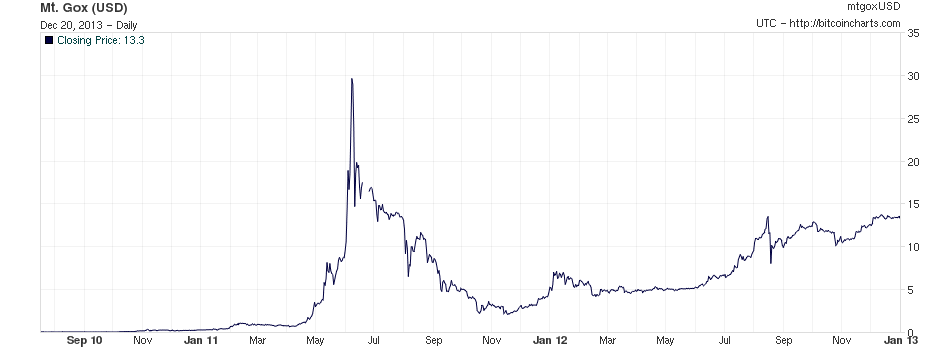
<p>The earliest data for the US dollar/Bitcoin exchange rate comes from the Mt Gox exchange, going back to July 2010. In the first three months of trading, Bitcoin fluctuated between 5 and 10 cents, but by the end of the year it had reached 30 cents. The first huge spike (and the only one that still shows up on charts that include today’s price) began in late April 2011, with Bitcoin hitting a peak of around $30 on 8 June before crashing below $15 just three days later. By the end of the year, Bitcoin was down below $5 again. The first half of 2012 was uneventful by Bitcoin standards, but the price took off again after May, climbing above $13 by the end of the year.</p>

<p><a href="http://manyzeros.com/images/bitcoin_bubble_1.png"><img src="http://manyzeros.com/images/bitcoin_bubble_1.png" alt="Bitcoin price in US dollars on Mt Gox, July 2010 to end of 2012" /></a></p>

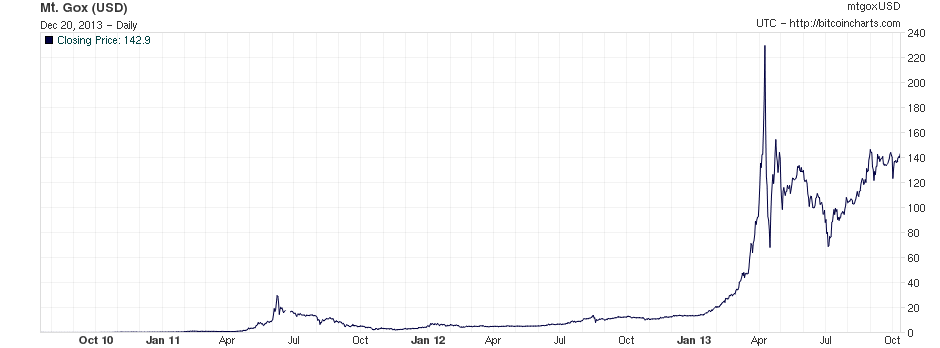
<p>Bitcoin quickly gathered momentum in early 2013 and exploded in late March, hitting a peak price of $266 on 10 April before plunging to $50 over the course of the following week. (For visual clarity, I’ve plotted the closing price, so intra-day peaks and troughs don’t show up on the graphs.) By early October, the price had recovered to around $125, and by the end of the month it was around $200.</p>

<p><a href="http://manyzeros.com/images/bitcoin_bubble_2.png"><img src="http://manyzeros.com/images/bitcoin_bubble_2.png" alt="Bitcoin price in US dollars on Mt Gox, July 2010 to mid-October 2013" /></a></p>

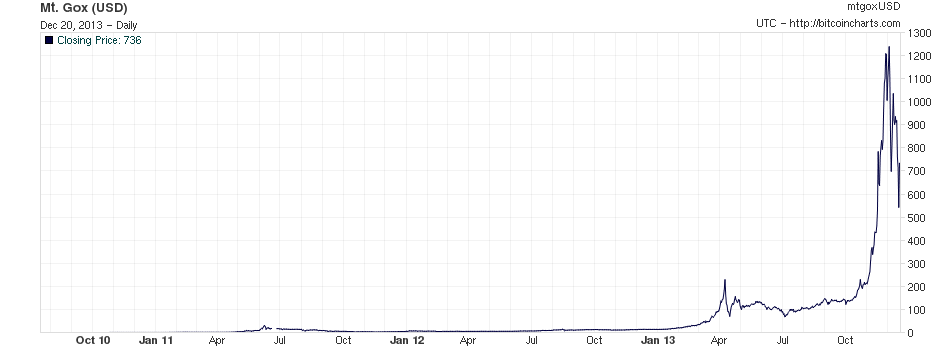
<p>November and December of 2013 have been Bitcoin’s most dramatic months so far. 29 November saw the highest price paid for a Bitcoin on Mt Gox to date: $1,242—within $12 of the symbolic threshold of the <a href="http://www.wolframalpha.com/input/?i=gold+price+on+2013-11-29">price of a troy ounce of gold that day</a>. The Bitcoin price has been extremely volatile since then, dipping to a low of $455 on 18 December. At the time of writing, the price was around $700.</p>

<p><a href="http://manyzeros.com/images/bitcoin_bubble_3.png"><img src="http://manyzeros.com/images/bitcoin_bubble_3.png" alt="Bitcoin price in US dollars on Mt Gox, July 2010 to December 2013" /></a></p>

<p>A lesson to be drawn from Bitcoin’s history so far is that bubbles are relative. A speculator who bought at the April 2013 peak and sold at the (current) December trough would still have roughly doubled his money. Still, anyone hoping to get in on the next Bitcoin bubble should heed the message for which Fama was awarded his share of the Nobel Prize: short-run asset price movements are extremely unpredictable.</p>
]]></content>
  </entry>
  
  <entry>
    <title type="html"><![CDATA[All-or-Nothing Crowdfunding as a Coordinating&nbsp;Device]]></title>
    <link href="http://manyzeros.com/2013/05/crowdfunding/"/>
    <updated>2013-05-26T04:49:00+01:00</updated>
    <id>http://manyzeros.com/2013/05/crowdfunding</id>
    <content type="html"><![CDATA[<p>Suppose you have an idea for a creative project, but you don’t have enough money to get it off the ground. If you can’t persuade your family and friends or a bank to lend you the money, you might turn to your potential customers for funding. If you can convince enough of them to pay you in advance, you’ll have enough money to get your project underway.</p>

<p>Consider an entrepreneur trying to fund a new product by taking pre-orders through her own website. Suppose that she offers a discount on the retail price as an incentive for people to pre-order. If her business goes bankrupt before production finishes, anyone who took a leap of faith by pre-ordering will lose their money. This means that potential customers have to worry about what <em>other</em> potential customers will do. If they think the project will succeed, they are better off pre-ordering and getting the discount than waiting and paying the full retail price. However, if they think that very few others will pre-order and the project will fail, it makes sense for them to wait and see what happens.</p>

<p>For example, suppose the retail price is $20 and the pre-order price is $10. A potential customer who values the product at $30 and thinks the probability of the project succeeding is <em>p</em> faces the following options:</p>

<ul>
  <li>Pre-order, and get ($30−$10) of consumer surplus with probability <em>p</em> and lose $10 with probability 1−<em>p</em>.</li>
  <li>Wait, and get ($30−$20) of consumer surplus with probability <em>p</em> and nothing with probability 1−<em>p</em>.</li>
</ul>

<p>Assuming for simplicity that our potential customer is risk-neutral, he will only pre-order if he thinks the project has a 50% or better chance of success. Since the success of the project depends on enough people like him pre-ordering, there is the potential here for multiple equilibria and self-fulfilling prophecies. </p>

<table class="game">
    <caption>Potential Customer&#8217;s Payoffs<br />(Non-Refundable Pre-orders)</caption>
	<tr>
		<td></td>
		<td></td>
		<td class="player2" colspan="2">All Other Customers</td>
	</tr>
	<tr>
	    <td></td>
	    <td></td>
		<td class="player2action">Pre-order</td>
		<td class="player2action">Wait &amp; See</td>
	</tr>
	<tr>
		<td class="player1" rowspan="2">Customer</td>
		<td class="player1action">Pre-order</td>
		<td class="payoff">$20</td>
		<td class="payoff">&#8722;$10</td>
	</tr>
	<tr>
		<td class="player1action">Wait &amp; See</td>
		<td class="payoff">$10</td>
		<td class="payoff">$0</td>
	</tr>
</table>

<p>In the good equilibrium, everybody is happy to pre-order because they expect everyone else to do the same, the project succeeds and everyone gets $20 of consumer surplus. In the bad equilibrium, nobody pre-orders because they (correctly) anticipate that the project will fail.</p>

<p>An important benefit of crowdfunding sites like Kickstarter is that they can eliminate this kind of coordination failure. There are now many sites using a similar formula: entrepreneurs create a project page to pitch their idea and offer rewards, and set a funding goal and a deadline. The crucial innovation, however, is in the processing of payments. Instead of charging people’s credit cards as soon as they make a pledge, Kickstarter has an “all-or-nothing” rule: if a project falls short of its funding goal, none of the backers are charged.</p>

<p>All-or-nothing funding removes the risk of losing your money because too few other people invested in the project. As long as you trust the entrepreneur to deliver on her promises, backing the project becomes what game theorists call a <em>weakly dominant strategy</em>: no matter what anyone else does, you won’t be made worse off by backing, and you may end up better off.</p>

<table class="game">
    <caption>Potential Customer&#8217;s Payoffs<br />(All-or-Nothing Funding)</caption>
	<tr>
		<td></td>
		<td></td>
		<td class="player2" colspan="2">All Other Customers</td>
	</tr>
	<tr>
	    <td></td>
	    <td></td>
		<td class="player2action">Back</td>
		<td class="player2action">Wait &amp; See</td>
	</tr>
	<tr>
		<td class="player1" rowspan="2">Customer</td>
		<td class="player1action">Back</td>
		<td class="payoff">$20</td>
		<td class="payoff">$0</td>
	</tr>
	<tr>
		<td class="player1action">Wait &amp; See</td>
		<td class="payoff">$10</td>
		<td class="payoff">$0</td>
	</tr>
</table>

<p>If there are enough people interested in a project to meet its funding goal, and they think it has some chance of succeeding (<em>p</em> &gt; 0), then with all-or-nothing funding the only equilibrium should be the good one in which the project gets funded.</p>

<p>Having seen how all-or-nothing crowdfunding might solve one kind of coordination problem between backers, let’s consider one kind of coordination problem it <em>can’t</em> solve. Suppose we have two entrepreneurs named Alice and Bob, each of whom is a potential backer of the other’s project. Let’s assume that backing a project costs $10, and they value each other’s products at $20. Both of them are on the cusp of reaching their funding goals: if Alice backs Bob, his project will be funded and vice versa.</p>

<p>Let’s also assume that the profit from a successfully funded project is $10, so each of them can only afford to back the other’s project if their own project is funded. If Bob backs Alice’s successful project but his own project fails, he has to go without another product he values even more highly (at $30, say) than the one he receives from Alice.</p>

<table class="game">
    <caption>Entrepreneurs&#8217; Payoffs</caption>
	<tr>
		<td></td>
		<td></td>
		<td class="player2" colspan="2">Bob</td>
	</tr>
	<tr>
	    <td></td>
	    <td></td>
		<td class="player2action">Back</td>
		<td class="player2action">Don&#8217;t Back</td>
	</tr>
	<tr>
		<td class="player1" rowspan="2">Alice</td>
		<td class="player1action">Back</td>
		<td class="payoff">$20, $20</td>
		<td class="payoff">&#8722;$10, $10</td>
	</tr>
	<tr>
		<td class="player1action">Don&#8217;t Back</td>
		<td class="payoff">$10, &#8722;$10</td>
		<td class="payoff">$0, $0</td>
	</tr>
</table>

<p>From the payoff table we can see that there are two equilibria here: a good one in which Alice and Bob back each others’ projects, and a bad one in which neither offer backing because they both (justifiably) fear not being funded themselves. Whereas all-or-nothing crowdfunding can ease concerns about how many others will back a given project, it can’t alleviate a reluctance to back projects based on pessimism about one’s own income.</p>
]]></content>
  </entry>
  
  <entry>
    <title type="html"><![CDATA[The Problem of Involuntary Unemployment]]></title>
    <link href="http://manyzeros.com/2012/09/involuntary-unemployment/"/>
    <updated>2012-09-16T21:57:00+01:00</updated>
    <id>http://manyzeros.com/2012/09/involuntary-unemployment</id>
    <content type="html"><![CDATA[<p>The defining feature of advanced economies is that most of what we consume is produced by other people. This makes it highly impractical for firms to pay their workers in kind: journalists can’t subsist on stacks of newspapers, nor can hairdressers survive on haircuts alone. The familiar solution is to pay workers in money, which they can then exchange for goods and services produced by other firms. This system allows the advanced division of labour upon which modern civilization depends, making us vastly better off than if we had to produce everything for ourselves.</p>

<p>The insight at the heart of John Roberts’ paper<sup id="fnref:1"><a href="#fn:1" rel="footnote">1</a></sup> is that this arrangement is fragile, and that full employment of the economy’s resources depends crucially on confidence. In the model, there are two types of firms and two types of workers. Each firm can only hire one type of worker, and must sell its output exclusively to the other type. For concreteness, suppose that the economy consists of apple orchards and banana plantations, that apple-pickers only eat bananas, and that banana-pickers only eat apples.</p>

<p>What would happen if orchard owners were to suddenly stop hiring? (We’ll ignore for a moment <em>why</em> they might do so.) Apple-pickers would find themselves without jobs and wages, and therefore unable to afford to buy bananas. Plantation owners would see demand for bananas drying up, and so would want to reduce their employment of banana-pickers. If banana-pickers weren’t working and earning wages, then there would be no demand for apples, which would be a compelling reason for orchard owners to stop hiring.</p>

<p>Having come full-circle in this stylized example, we can see that pessimistic beliefs about the economy can be self-fulfilling: if one group of employers doesn’t expect the other to hire, it makes sense for them not to hire either. This means that workers can end up involuntarily unemployed: they are willing to work for the prevailing wage, but cannot find a job no matter how hard they try. Even though this outcome is inefficient, each firm is acting rationally given what the others are doing. As Roberts puts it,</p>

<blockquote>
  <p>[F]irms are unwilling to increase hiring because each forecasts that demand will be too weak to justify its increasing output, and the resultant low level of workers’ incomes generates the weak demand that makes this conjecture correct. However, if all firms increased hiring together, the additional income generated could result in enough extra demand to justify the hiring.</p>
</blockquote>

<p>This kind of coordination failure simply isn’t possible in the standard model of market exchange taught in microeconomics classes (and also widely used in macroeconomics). In that model, wages and prices are set by an omniscient being known as the Walrasian auctioneer, who guarantees to buy or sell any good or service (including labour services) in unlimited quantities. This guarantee ensures that nobody has to worry about whether their favourite product will be in stock, or whether they’ll be able to find a buyer for what they want to sell.</p>

<p>The auctioneer’s omniscience allows him to set wages and prices such that orders and offers exactly match, so in the end his guarantee isn’t used and he just acts as a middleman. What Roberts’ model shows is that this guarantee is nevertheless essential to securing an efficient outcome. Without it, the levels of economic activity and employment depend on how confident people are, even if wages and prices are at their Walrasian levels.</p>

<p>In the absence of a Walrasian auctioneer to coordinate trade, it’s natural to ask whether some form of government policy could prevent the economy from becoming trapped in an involuntary unemployment equilibrium. Roberts himself identified this as a desirable extension of his model a quarter-century ago, but to the best of my knowledge no one has yet written a paper on the subject.</p>

<p>In a simple economy with just two different goods, a government that understood people’s preferences could in theory mandate the efficient level of employment. However, we have ample evidence from history (and present-day North Korea) that comprehensive state planning of real-world economies can have disastrous consequences. The holy grail, as I see it, is a policy that rules out the kind of involuntary unemployment identified in Roberts’ model while preserving the decentralized nature of the economy.</p>

<p>Michel De Vroey has argued<sup id="fnref:2"><a href="#fn:2" rel="footnote">2</a></sup> that, since there are models that show a role for Keynesian policies in overcoming other kinds of inefficiency, the concept of involuntary unemployment is redundant in the macroeconomic policy debate. I’m inclined to disagree, because politicians and central bankers almost always justify stimulus policies on the grounds that they will reduce the unemployment rate. If such policies can indeed tackle the problem of involuntary unemployment, it would be nice for economists to have a rigorous model of how they work.</p>

<p>On the other hand, if a policy ineffectiveness proposition could be proven in a theoretical environment similar to Roberts’ model, then this might be relevant to the debate on macroeconomic policy. For example, the fact that wages and prices are fully flexible in the model suggests that monetary policy might be ineffective (or at least might not work the way it does in most New Keynesian models).<sup id="fnref:3"><a href="#fn:3" rel="footnote">3</a></sup> If it could be shown that particular policies cannot rule out the kind of unemployment found in Roberts’ model, and if this type of unemployment is important in the real world, then this might provide a new account of why unemployment remains high despite central banks’ efforts to revive the economy.</p>

<div class="footnotes">
  <ol>
    <li id="fn:1">
      <p>John Roberts, “<a href="http://www.jstor.org/stable/1810213">An Equilibrium Model with Involuntary Unemployment at Flexible, Competitive Prices and Wages</a>”, <em>American Economic Review</em> 77, no. 5 (December 1987): 856–874. For those without journal access, an earlier version with the title “<a href="https://gsbapps.stanford.edu/researchpapers/library/RP908.pdf">An Equilibrium Model with Keynesian Unemployment at Walrasian Prices</a>” is available online as Stanford University Graduate School of Business Research Paper No. 908.<a href="#fnref:1" rel="reference">&#8617;</a></p>
    </li>
    <li id="fn:2">
      <p>Michel De Vroey, “<a href="http://www.cairn.info/revue-d-economie-politique-2005-4-page-417.htm">Have the Early Coordination Failures Models Achieved Keynes’s Programme?</a>”, <em>Revue d’économie politique</em> 115 (April 2005): 417–436.<a href="#fnref:2" rel="reference">&#8617;</a></p>
    </li>
    <li id="fn:3">
      <p>A recent working paper by Lawrence Christiano, Mathias Trabandt and Karl Walentin, “<a href="http://www.riksbank.se/Documents/Forskning/Personliga_webbsidor/2012/foe_CTWinvoluntary_main.pdf">Involuntary Unemployment and the Business Cycle</a>” shows that a surprise nominal interest rate cut reduces unemployment. However, the kind of unemployment found in their model differs from that in Roberts’, since the probability of getting a job depends only on one’s own effort (and not on macroeconomic variables like the unemployment rate). People in their model balance the costs of more intensive job search with the benefits of a higher probability of finding employment: the involuntarily unemployed are those for whom this calculated gamble did not pay off.<a href="#fnref:3" rel="reference">&#8617;</a></p>
    </li>
  </ol>
</div>
]]></content>
  </entry>
  
</feed>