<?xml version="1.0" encoding="UTF-8"?>
<feed xml:lang="en" xmlns="http://www.w3.org/2005/Atom" xmlns:opensearch="http://a9.com/-/spec/opensearch/1.1/" xmlns:s="http://jadedpixel.com/-/spec/shopify">
  <id>https://www.middleeastbooks.com/blogs/blog.atom</id>
  <link rel="alternate" type="text/html" href="https://www.middleeastbooks.com/blogs/blog"/>
  <link rel="self" type="application/atom+xml" href="https://www.middleeastbooks.com/blogs/blog.atom"/>
  <title>Middle East Books and More - Events</title>
  <updated>2021-12-02T10:53:36-05:00</updated>
  <author>
    <name>Middle East Books and More</name>
  </author>
  <entry>
    <id>https://www.middleeastbooks.com/blogs/blog/americas-founding-mythologies-are-crumbling-under-historical-scrutiny-can-the-us-israel-special-relationship-endure-that-reassessment</id>
    <published>2021-12-02T10:53:36-05:00</published>
    <updated>2021-12-02T10:54:51-05:00</updated>
    <link rel="alternate" type="text/html" href="https://www.middleeastbooks.com/blogs/blog/americas-founding-mythologies-are-crumbling-under-historical-scrutiny-can-the-us-israel-special-relationship-endure-that-reassessment"/>
    <title>Can America&apos;s “Special Relationship” with Israel Endure?</title>
    <author>
      <name>Bookstore Director</name>
    </author>
    <content type="html">
      <![CDATA[<h1 class="listing-hero-title" data-automation="listing-title">America's founding mythologies are crumbling under historical scrutiny. Can the US-Israel "special relationship" endure that reassessment?</h1>
<p>The distinguished historian and WRMEA columnist Dr. Walter L. Hixson will discuss the unique and distinctive aspects of the US-Israel "special relationship."</p>
<p>What assumptions underpinning the “special relationship” traditionally fit neatly into America's own history and national identity, such as "manifest destiny," "chosen" peoplehood, vanquishing the "savage" and settler colonialism? How did the rise of the formidable Israel lobby--by far the most powerful lobby representing a foreign nation in American history—exploit that identity to win the tiny nation of Israel more US military assistance and unconditional diplomatic support than any other country in the world? Now that Americans are grappling with their founding mythologies, can Israel's and its lobby's grip on the American psyche and body politic endure?</p>
<p>Copies of Hixson's latest two books will be available for sale and signing by the author.</p>
<h2 class="text-body-large hide-small">Date and time</h2>
<div class="event-details__data">
<p class="js-date-time-first-line">Fri, December 10, 2021</p>
<p class="js-date-time-second-line">6:00 PM – 7:30 PM EST</p>
<p class="hide-small hide-medium"> </p>
</div>
<h3 class="label-primary l-mar-bot-2">Location</h3>
<div class="event-details__data">
<p>Middle East Books and More</p>
<p>1902 18th Street Northwest</p>
<p>Washington, DC 20009</p>
<p> </p>
</div>
<div class="has-user-generated-content" data-automation="about-this-event-sc">
<div class="structured-content-rich-text structured-content__module l-align-left l-mar-vert-6 l-sm-mar-vert-4 text-body-medium">
<p> </p>
<p><strong>Please register here:</strong></p>
<p>https://www.eventbrite.com/e/can-americas-special-relationship-with-israel-endure-tickets-209344744767?aff=ebdssbdestsearch</p>
<p> </p>
</div>
</div>]]>
    </content>
  </entry>
  <entry>
    <id>https://www.middleeastbooks.com/blogs/blog/book-talk-and-review-the-movement-and-the-middle-east-how-the-arab-israeli-conflict-divided-the-american-left</id>
    <published>2020-03-08T13:09:00-04:00</published>
    <updated>2020-03-08T13:09:57-04:00</updated>
    <link rel="alternate" type="text/html" href="https://www.middleeastbooks.com/blogs/blog/book-talk-and-review-the-movement-and-the-middle-east-how-the-arab-israeli-conflict-divided-the-american-left"/>
    <title>Book Talk and Review: The Movement and the Middle East: How the Arab-Israeli Conflict Divided the American Left</title>
    <author>
      <name>Bookstore Director</name>
    </author>
    <content type="html">
      <![CDATA[<p><strong>On Wednesday, March 4, Middle East Books and More hosted </strong><strong>Professor Michael R. Fischbach to discuss his new book, <a href="https://www.middleeastbooks.com/products/the-movement-and-the-middle-east-how-the-arab-israeli-conflict-divided-the-american-left-by-michael-r-fischbach?_pos=1&amp;_sid=abad5d472&amp;_ss=r"><em>The Movement and the Middle East How the Arab-Israeli Conflict Divided the American Left</em></a>. Check out the book review, written by our bookstore director, Sami Tayeb, and listen to the talk (below), filmed by the <em>Washington Report on Middle East Affairs</em>. </strong></p>
<p><a href="https://www.middleeastbooks.com/products/the-movement-and-the-middle-east-how-the-arab-israeli-conflict-divided-the-american-left-by-michael-r-fischbach?_pos=1&amp;_sid=abad5d472&amp;_ss=r" target="_blank" rel="noopener noreferrer"><span><img src="//cdn.shopify.com/s/files/1/0511/5897/files/pid_31050_1024x1024_fad58b89-c02b-4a90-bc06-c1612560cb6e_medium.jpg?v=1583686729" alt=""></span></a></p>
<p><strong>By Michael R. Fischback, Stanford University Press, 2020, paperback, 297 pp. <a href="https://www.middleeastbooks.com/products/the-movement-and-the-middle-east-how-the-arab-israeli-conflict-divided-the-american-left-by-michael-r-fischbach?_pos=1&amp;_sid=abad5d472&amp;_ss=r" target="_blank" rel="noopener noreferrer">MEB: $25</a></strong></p>
<p><em>Reviewed by Sami Tayeb</em></p>
<meta charset="utf-8">
<p>Michael R. Fischbach’s<span> </span><em>The Movement and the Middle East</em><span> </span>is the first account to examine how the Arab-Israeli conflict fomented dissent and division within the American Left and how these divisions have informed present-day political discourse on Palestine and Israel. While “the Movement,” which he defines as a “large, loosely organized collection of people pushing for an end to the [Vietnam] war and radical change in America,” coalesced around their opposition to the Vietnam War, they were deeply divided on the question of Palestine. Fischbach lays out a nuanced and detailed history of the contentious debates that occurred in various leftist groups during the 1960s and ’70s that centered around the Arab-Israeli conflict and the actions they took—particularly in the aftermath of the 1967 Six-Day War.</p>
<p>Building on the research of his previous book, which focused on the Black Power and Civil Rights movements’ positions on Palestine, Fischbach now directs his attention to the white American Left’s attitudes on the same issue. His analysis of this diverse and multi-faceted movement, which included over 200 organizations at the height of the Vietnam War, is laid out in 12 succinct chapters, focusing on the more prominent organizations including, but not limited to: student groups and campus activism, the Old Left (Communist, Marxist and Socialist parties), the New Left (organizations of young white leftists whose activism was based on moral passion and street-level politics rather than ideological constructs), and the anti-Vietnam War coalition, as well as the feminist movement that emerged in the ’70s.</p>
<p>Perhaps most central to the debate, is a chapter on the Israel exceptionalism that existed within the Movement, which explores the contradictions that emerged and rationale that was used to justify support for Israel by members of the Left. He notes that many of the pro-Israel positions were grounded in emotion and ethnic affiliation rather than history or consistent ideology and the issue of Palestine proved to be the litmus test on radicalism, or what “distinguished the true anti-imperialists from the liberals.”</p>
<p>Jews were overly represented in the Movement, and much of what Fischbach details are divisions among Jews that were involved in leftist organizations. The main schism was between groups and individuals that had an internationalist outlook and sought to confront imperialism, colonialism, capitalism and racism wherever it may be and those that made an exception for Israel and<span> </span><a title="zionism" href="https://www.wrmea.org/special-topics/zionism-and-its-impact.html">Zionism</a>. The rationale for the latter’s position included the view that Israel was the non-aggressor in the Six-Day War; belief that Israel was the underdog surrounded by hostile Arab countries; Israel and Zionism being stand-ins for secular Jews’ Jewish identity; and that the U.S. military should be supported because it would, in turn, guarantee Israel’s military supremacy as well as create a balance of power in the region with the Soviet Union. The proponents of the last point largely came from a group that splintered from the Socialist Party of America (SPA) and later became the base of the neoconservative movement.</p>
<p>Fischbach lends insight to a variety of tactics that were employed by proponents of Israel. The most common tactic was for pro-Israel American Jews to send the message to other Jews in the Left to step in line and follow rank or else be prepared to face the backlash and vitriol of being called a self-hating Jew, not a real Jew or that they were a “psychological aberration” unable to conform to their identity as a Jew. Paradoxically, what emerges from this pro-Israel pushback is the “pro-Israel, non-Zionist” stance taken by some Jews, particularly by members of Communist Party USA.</p>
<p>Fischbach cites investigative reporter I.F. Stone to sum up the prevailing debate surrounding American Jews and Israel stating, “Israel was creating a ‘moral schizophrenia’ in world Jewry, because Jewish existence outside Israel depended upon secular, nonracial, pluralistic societies—but Israel was the exact opposite of that.”</p>
<p>The question of Palestine ultimately became a leviathan for the American Left to the extent that it was impossible to reach a consensus on this issue by the time the Movement began to decline in the mid-’70s. In fact, the issue was so contentious that there was a fear that it could unravel the anti-Vietnam War movement if the organizations involved were pressed to make a declaration on Palestine. Consequently, no declaration was seriously sought by organizers.</p>
<p>Remarkably, Fischbach is able to piece together a coherent, yet nuanced, narrative on Palestine and the debates that ensued in a fractious and dynamic Left during the anti-war movement. He also situates the historical context in which the neoconservative movement emerged from the Left and, conversely, the origins of progressive institutions that are still around today.</p>
<p>Fischbach even details a fascinating, yet brief, history of what could be called the Canary Mission’s precursor, the Youth Institute for Peace in the Middle East, which spied on other leftist and pro-Palestine groups for the Anti-Defamation League. He accomplishes this feat through numerous personal interviews, declassified FBI and CIA documents, and a thorough examination of the literature by leftist groups and individuals during this time period. Fischbach has successfully created an entryway for other researchers to further explore this fascinating yet little written history of the American Left.</p>
<p>What the reader longs for is a narrative that links the black civil rights movement to what Fischbach calls the Movement and how they complemented and differed from each other. Also, the reader wants to know what other factors contributed to the Left’s decline during this period and how the question of Palestine fits within this context. Was it the sole factor for the Left’s decline?</p>
<p>In the epilogue, Fischbach draws a tenuous link between the debates on Palestine during this time period to the politics of the present day. The reader would be well served if he devoted another chapter that sketches this out further and situates the effect this debate has had on the politics of the present. Moreover, many of the people Fischbach writes about are still active in politics today. It would be informative to hear more of these people’s stories and their influence on present day politics. For example, knowing more about the story of how Carl Gershman went from being a member of SPA to a key player among neoconservatives to becoming the president of the National Endowment for Democracy.</p>
<p>Ultimately, Fischbach’s timely and invaluable account of the Movement’s debate on Palestine offers insight on the debates the Movement grappled with, and for anyone interested in U.S. Middle East policy, the history and politics of the American Left or the Arab-Israeli conflict<span> </span><em>The<span> </span></em><em>Movement and the Middle East<span> </span></em>is a must-have for their library. Fischbach’s wide-ranging analysis opens the door for other scholars to fill in the gaps of this incredibly fascinating story, which would be a welcome addition in the years to come.</p>
<hr>
<p><em>Sami Tayeb is the director of<span> </span><a title="Middle East Books and More" href="https://www.middleeastbooks.com/">Middle East Books and More</a><span> </span>and an independent researcher who frequently writes about the political economy of the Middle East, Palestine and urban development in the region.</em></p>
<p> </p>
<p><em><iframe width="560" height="315" src="https://www.youtube.com/embed/0E4rHbIusJo" frameborder="0" allow="accelerometer; autoplay; encrypted-media; gyroscope; picture-in-picture" allowfullscreen=""></iframe></em></p>]]>
    </content>
  </entry>
  <entry>
    <id>https://www.middleeastbooks.com/blogs/blog/book-talk-the-israel-lobby-enters-state-government-rise-of-the-virginia-israel-advisory-board-by-grant-f-smith</id>
    <published>2020-03-07T12:52:00-05:00</published>
    <updated>2020-03-07T12:52:44-05:00</updated>
    <link rel="alternate" type="text/html" href="https://www.middleeastbooks.com/blogs/blog/book-talk-the-israel-lobby-enters-state-government-rise-of-the-virginia-israel-advisory-board-by-grant-f-smith"/>
    <title>Book Talk: The Israel Lobby Enters State Government: Rise of the Virginia Israel Advisory Board by Grant F. Smith</title>
    <author>
      <name>Bookstore Director</name>
    </author>
    <content type="html">
      <![CDATA[<meta charset="utf-8">
<p><span dir="auto" class="style-scope yt-formatted-string">We launched our 2020 Book Talk series a</span><span dir="auto" class="style-scope yt-formatted-string">t Middle East Books and More </span><span dir="auto" class="style-scope yt-formatted-string">on <span>February 26, 2020 </span>with Grant F. Smith of the Institute for Research: Middle Eastern Policy. He joined us in-store to discuss his latest book, <em><a href="https://www.middleeastbooks.com/products/the-israel-lobby-enters-state-government-rise-of-the-virginia-israel-advisory-board-by-grant-smith?_pos=2&amp;_sid=275a8e82f&amp;_ss=r">The Israel Lobby Enters State Government: Rise of the Virginia Israel Advisory</a>. </em>﻿</span></p>
<p><span dir="auto" class="style-scope yt-formatted-string">Check out the video of the event below, filmed by the</span><span> </span><em>Washington Report on Middle East Affairs </em>if you missed the talk. </p>
<p><span dir="auto" class="style-scope yt-formatted-string"><iframe width="560" height="315" src="https://www.youtube.com/embed/jwH0y03ClEU" frameborder="0" allow="accelerometer; autoplay; encrypted-media; gyroscope; picture-in-picture" allowfullscreen=""></iframe></span></p>]]>
    </content>
  </entry>
  <entry>
    <id>https://www.middleeastbooks.com/blogs/blog/book-talk-blind-spot-america-and-the-palestinians-with-khaled-elgindy</id>
    <published>2019-12-22T19:30:00-05:00</published>
    <updated>2019-12-22T19:31:17-05:00</updated>
    <link rel="alternate" type="text/html" href="https://www.middleeastbooks.com/blogs/blog/book-talk-blind-spot-america-and-the-palestinians-with-khaled-elgindy"/>
    <title>Book Talk: Blind Spot: America and the Palestinians by Khaled Elgindy</title>
    <author>
      <name>Bookstore Director</name>
    </author>
    <content type="html">
      <![CDATA[<p>Middle East Books welcomed Khaled Elgindy for our last book talk of 2019 on Dec. 11 to talk about his newest book <em><a href="https://www.middleeastbooks.com/products/blind-spot-america-and-the-palestinians-from-balfour-to-trump?_pos=1&amp;_sid=ba8a13f52&amp;_ss=r">Blind Spot: America and the Palestinians</a></em>. Tracing the "blind spot" in American foreign policy with Israel and Palestine, Elgindy sheds light on the factors behind the lack of success in brokering a peace deal. </p>
<p>Missed the talk? Watch the recorded event in the video below, filmed by <em>Washington Report on Middle East Affairs</em>!</p>
<p> </p>
<p><iframe width="560" height="315" src="https://www.youtube.com/embed/YQ0-RY_JHkE" frameborder="0" allow="accelerometer; autoplay; encrypted-media; gyroscope; picture-in-picture" allowfullscreen=""></iframe></p>]]>
    </content>
  </entry>
  <entry>
    <id>https://www.middleeastbooks.com/blogs/blog/book-talk-reclaiming-judaism-from-zionism</id>
    <published>2019-11-24T13:46:00-05:00</published>
    <updated>2019-11-24T13:46:48-05:00</updated>
    <link rel="alternate" type="text/html" href="https://www.middleeastbooks.com/blogs/blog/book-talk-reclaiming-judaism-from-zionism"/>
    <title>Book Talk: Reclaiming Judaism from Zionism</title>
    <author>
      <name>Bookstore Director</name>
    </author>
    <content type="html">
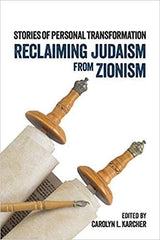
      <![CDATA[<p class="p1"><span class="s1"><b>On Oct. 30, Middle East Books and More welcomed editor Carolyn Karcher and three contributing authors, Emily Seigel, Charlie Wood, Chris Godshall, to read from and discuss <i><a href="https://www.middleeastbooks.com/products/reclaiming-judaism-from-zionism-stories-of-personal-transformation?_pos=1&amp;_sid=d7066ec10&amp;_ss=r">Reclaiming Judaism from Zionism</a>. </i></b>Through their poignant experiences and reflections, they elucidate the challenges of disentangling Jewish religious identity from Zionist nationalist ideology.<span class="Apple-converted-space">   </span></span></p>
<meta charset="utf-8">
<p class="p1"><span class="s1"><span class="Apple-converted-space">Our event was filmed by the <i>Washington Report on Middle East Affairs</i> and is now available to watch online!</span></span></p>
<p class="p1"><a href="https://www.middleeastbooks.com/products/reclaiming-judaism-from-zionism-stories-of-personal-transformation?_pos=1&amp;_sid=d7066ec10&amp;_ss=r"><span class="s1"><span class="Apple-converted-space"><img src="//cdn.shopify.com/s/files/1/0511/5897/files/41rnRGseBpL._SX331_BO1_204_203_200_1024x1024_1_medium.jpg?v=1574618612" alt=""></span></span></a></p>
<p class="p1"> </p>
<p class="p1"><span class="s1"><iframe width="560" height="315" src="https://www.youtube.com/embed/mAvSk5oOYlc" frameborder="0" allow="accelerometer; autoplay; encrypted-media; gyroscope; picture-in-picture" allowfullscreen=""></iframe></span></p>
<p class="p1"> </p>
<p class="p1"><span class="s1"><iframe width="560" height="315" src="https://www.youtube.com/embed/Ph9SgqsCcIs" frameborder="0" allow="accelerometer; autoplay; encrypted-media; gyroscope; picture-in-picture" allowfullscreen=""></iframe><br></span></p>]]>
    </content>
  </entry>
  <entry>
    <id>https://www.middleeastbooks.com/blogs/blog/book-talk-and-review-sophie-halaby-in-jerusalem-an-artist-s-life</id>
    <published>2019-11-03T16:37:00-05:00</published>
    <updated>2019-11-24T13:11:47-05:00</updated>
    <link rel="alternate" type="text/html" href="https://www.middleeastbooks.com/blogs/blog/book-talk-and-review-sophie-halaby-in-jerusalem-an-artist-s-life"/>
    <title>Book Talk and Review: Sophie Halaby in Jerusalem: An Artist’s Life</title>
    <author>
      <name>Bookstore Director</name>
    </author>
    <content type="html">
      <![CDATA[<meta charset="utf-8">
<h4></h4>
<meta charset="utf-8">
<h4>
<strong>On Oct. 16, Middle East Books and More hosted Laura Schor to speak about her newest book, <em>Sophie Halaby in Jerusalem</em>.</strong> Watch her talk, filmed by the <em>﻿Washington Report</em>﻿ <em>﻿on Middle East Affairs</em>﻿, and read the book review below.</h4>
<h4 style="text-align: left;"><a href="https://www.middleeastbooks.com/products/sophie-halaby-in-jerusalem-an-artist-s-life-by-laura-schor"><img alt="" src="//cdn.shopify.com/s/files/1/0511/5897/files/sophiehalabyinjerusalemx333_medium.jpg?v=1572817130" style="float: none;"></a></h4>
<h5>By Laura S. Schor, Syracuse University Press, 2019, paperback, 272 pp.<span> </span><a href="https://www.middleeastbooks.com/products/sophie-halaby-in-jerusalem-an-artist-s-life-by-laura-schor">MEB: $30</a>
</h5>
<p><em>Reviewed by Eleni Zaras</em></p>
<meta charset="utf-8">
<p>Many historians agree that women’s voices in Palestinian history are often absent or underrepresented in mainstream discourse. This can largely be attributed to dominant methodologies that privilege document-based sources over others, which have ultimately led to a dearth of scholarship about women. This is especially relevant to the story of Sophie Halaby, whose personal papers disappeared after her death in 1997. Professor Laura Schor’s new book on the late Palestinian artist has succeeded in overcoming this challenge. In<span> </span><a href="https://www.middleeastbooks.com/products/sophie-halaby-in-jerusalem-an-artist-s-life-by-laura-schor">Sophie Halaby in Jerusalem</a>, Schor weaves together Halaby’s art, research from oral histories, papers from family members, peers and a wide range of institutional archives to sketch the contours of the artist’s life against the backdrop of 20th century Jerusalem.</p>
<p>While Halaby is remembered today as the first Arab woman from Jerusalem to study art in Paris, where she lived from 1929-1933, her story unfolds, not in Paris, but primarily in Jerusalem. Even for those familiar with the turbulent narrative of 20th century Palestine, studying this period through the lens of a female, Arab, Russian-Orthodox artist draws due attention not only to the artistic vision of Halaby but, more broadly, to different perspectives on Jerusalem’s history.</p>
<p>Having attended the diverse and prestigious Jerusalem Girl’s College, Halaby spoke four languages, boldly pursued her art studies abroad in Paris in the early 1930s and floated in the intellectual circles of Jerusalem’s society that traversed religious barriers. Regardless of her privileged upbringing, though, her life, according to Schor, was still “deeply affected by Arab and Zionist nationalism” and by the “continuous physical changes to her city.” She and her family were subjected to displacement, land seizures by the Israeli government and raids of her home and studio.</p>
<p>Halaby’s studies in Paris expanded her worldview, which laid the foundations for her artistic style and offered new inspirations and resources. Upon her return to Jerusalem, she brought these influences with her and dedicated her art to capturing impressions of her homeland in paint and watercolors. Her palette and style evoke the artwork of Odilon Redon and the French impressionists, notes Schor, and repeated depictions of the Mount of Olives, site of a Russian Orthodox church and the graves of her parents, recall Cezanne’s fixation on Mont Sainte-Victoire. While other artists in Palestine turned to overtly political themes, Halaby’s art, with the exception of eight political cartoons that challenged both the British and Zionists, remained subtle and poetic.</p>
<p>Instead, she focuses on a single bouquet against a muted background, or a small cluster of wildflowers against soft expanses of hills and valleys. Halaby deliberately crops out signs of urban development in her landscapes, although she includes, unassumingly, the gold Dome of the Rock and contours of the city walls and low buildings the color of sand. “Her persistent painting of Jerusalem as she willed it to be was her private form of resistance,” Schor explains, as she erases the physical scars of war and occupation that transformed the city and her own life.</p>
<p>And private her work did mostly remain: She did not participate in exhibitions with artists of “The Palestinian Group,” which consisted of Jews with Palestinian passports in the 1930s; nor did she join the League of Palestinian Artists, a collective whose overt goal was to engage art with politics and to liberate Palestine (although she did participate in a 1986 exhibition of Women’s Art in Palestine).</p>
<p>Yet Halaby did persist in quiet, personal dissonance, importing paints and supplies from Paris, painting with colors banned by the Israeli authorities, and staking claim to her homeland through her repeated renderings. If she no longer had physical or legal control over the fate of her homeland, she could still wield agency through art— her visual testament to belonging.</p>
<p>Through Schor’s judicious research and writing,<span> </span><a href="https://www.middleeastbooks.com/products/sophie-halaby-in-jerusalem-an-artist-s-life-by-laura-schor">Sophie Halaby in Jerusalem</a><span> </span>recreates the world Halaby inhabited and amplifies Halaby’s quiet, but powerful voice. Schor offers much-needed nuance to Palestine women’s and art history and hopes that Halaby’s story will inspire others, like herself, “to work for a better present and future for Jerusalem and for the Palestinian people.”</p>
<meta charset="utf-8">
<p> </p>
<p><iframe width="750" height="422" src="https://www.youtube.com/embed/3P1FSSfWCfk" frameborder="0" allow="accelerometer; autoplay; encrypted-media; gyroscope; picture-in-picture" allowfullscreen=""></iframe></p>]]>
    </content>
  </entry>
  <entry>
    <id>https://www.middleeastbooks.com/blogs/blog/18573075-book-review-the-ethnic-cleansing-of-palestine</id>
    <published>2015-02-28T14:00:19-05:00</published>
    <updated>2015-02-28T14:00:19-05:00</updated>
    <link rel="alternate" type="text/html" href="https://www.middleeastbooks.com/blogs/blog/18573075-book-review-the-ethnic-cleansing-of-palestine"/>
    <title>Book Review: The Ethnic Cleansing of Palestine</title>
    <author>
      <name>Kevin Davis</name>
    </author>
    <summary type="html">
      <![CDATA[<meta charset="utf-8"><span>Since gaining access to the records of the original </span><em>Nakba, </em><span>and above all, unlike the other Israeli “new historians,” getting in touch with the narrative of the displaced Palestinians, Pappé has come to recognize the enormity of the crime committed by David Ben-Gurion and the other early Zionist leaders, and which is carried on to this day. As he says in his introduction: “When it created its nation-state, the Zionist movement did not wage a war that ”˜tragically but inevitably’ led to the expulsion of ”˜parts of’ the indigenous population, but the other way round: the main goal was the ethnic cleansing of all Palestine, which the movement coveted for its new state.” It is this reality which much of the West strangely refuses to acknowledge and which is the source of the continuing conflict in Palestine and the Middle East today. The apparent reason—misplaced Holocaust guilt/sympathy and fear of the anti-Semitism charge.</span><p><a class="read-more" href="https://www.middleeastbooks.com/blogs/blog/18573075-book-review-the-ethnic-cleansing-of-palestine">More</a></p>]]>
    </summary>
    <content type="html">
      <![CDATA[<meta charset="utf-8">
<p>By Ilan Pappé, Oneworld Publications, Ltd., 2006, 256 pp. </p>
<p><a href="http://www.middleeastbooks.com/products/the-ethnic-cleansing-of-palestine-by-ilan-pape">Get the book here!</a></p>
<h3><em>Reviewed by Albert Regan Doyle</em></h3>
<p><img src="http://www.wrmea.org/images/March_2007/books_01.jpg" alt="" width="103" height="136" border="0"></p>
<p>Every country has some shameful things in its past, right? Well, Ilan Pappe’s latest book shows that the <em>Nakba</em>—Israel’s ethnic cleansing of the Palestinian Arabs, the murder of thousands, the theft of their land, and the forced dispersal of over 700,000 refugees—happens to be essential to the very existence of the present day State of Israel. Virtually unique in the world, today’s Israel could not exist as a “Jewish state” without the crimes committed then. But they are erased from Israeli consciousness and memory, unmentioned in Israeli schools and, like the 531 Arab villages utterly destroyed and replaced by forests, parks and Israeli developments, ignored in Israeli academic discourse.</p>
<p>But not if Ilan Pappé has his say. Like the late Israel Shahak, Pappé says the problem is Israel’s Zionist ideology—not to be confused with the Jewish religion, which is practiced by only a minority of Israelis. The problem is the Zionist philosophy itself, that the country is for Jews alone. According to Pappé, “Israel has no choice but willingly to transform itself one day into a civic and democratic state”—a single state for Arabs and Jews. And that’s not going to happen soon.</p>
<p>Since gaining access to the records of the original <em>Nakba, </em>and above all, unlike the other Israeli “new historians,” getting in touch with the narrative of the displaced Palestinians, Pappé has come to recognize the enormity of the crime committed by David Ben-Gurion and the other early Zionist leaders, and which is carried on to this day. As he says in his introduction: “When it created its nation-state, the Zionist movement did not wage a war that ”˜tragically but inevitably’ led to the expulsion of ”˜parts of’ the indigenous population, but the other way round: the main goal was the ethnic cleansing of all Palestine, which the movement coveted for its new state.” It is this reality which much of the West strangely refuses to acknowledge and which is the source of the continuing conflict in Palestine and the Middle East today. The apparent reason—misplaced Holocaust guilt/sympathy and fear of the anti-Semitism charge.</p>
<p>Pappe’s book will command attention because of his sources. He recites in horrifying detail the “cleansing” of Arabs from villages, towns and cities by the Zionist terrorist forces. This was all carefully planned to drive out the Palestinian Arabs and seize their land and property. It is a sickening tale of violence against mostly innocents, many of whom were killed, with others forced out of Palestine into refugee status which still exists. There are other crimes which Pappe describes in nauseating detail that makes a cynical farce of Israel’s boast of “purity of arms.” Many villages were ground to rubble so their inhabitants could not return. Instead they are denied the right of return, in defiance of international law and United Nations resolutions, since their return would end the Zionist plan for Palestine. Pappé’s accounts are documented from official records and military orders and the diaries of Ben-Gurion, who once said, “I am for compulsory transfer; I do not see anything immoral in it.” That was one of his less indictable statements, by the way. The man makes Slobodan Milosevic look like a Boy Scout.</p>
<p>For many readers, the book’s other startling revelation will be to learn that Ben-Gurion and his cohorts were never seriously concerned about “Arab armies” crushing the supposedly beleaguered young state about which we hear today. Armed by the communist bloc and with better quality soldiers, many with wartime experience, the Zionists always felt they could handle the military situation, while their slick diplomatic front man, Abba Eban, was telling lies to the world.</p>]]>
    </content>
  </entry>
  <entry>
    <id>https://www.middleeastbooks.com/blogs/blog/18573059-book-review-waiting-for-paradise</id>
    <published>2015-02-26T18:00:02-05:00</published>
    <updated>2015-02-26T18:00:02-05:00</updated>
    <link rel="alternate" type="text/html" href="https://www.middleeastbooks.com/blogs/blog/18573059-book-review-waiting-for-paradise"/>
    <title>Book Review: Waiting for Paradise</title>
    <author>
      <name>Kevin Davis</name>
    </author>
    <summary type="html">
      <![CDATA[<meta charset="utf-8">An entertaining and exciting novel, Waiting For Paradise deals with the massacre at Deir Yassin and the ethnic cleansing that it ushered in. There are hundreds of books written on the Israeli-Palestinian conflict, of course, but most deal with it from the Israeli point of view. In standard American vernacular, this book tells the Palestinian side of 1948—and for that reason is likely to be shunned by most major presses.<p><a class="read-more" href="https://www.middleeastbooks.com/blogs/blog/18573059-book-review-waiting-for-paradise">More</a></p>]]>
    </summary>
    <content type="html">
      <![CDATA[<meta charset="utf-8">
<p>By Dan Drost, JanMar Publications, 2007, 362 pp. </p>
<p><a href="http://www.middleeastbooks.com/products/waiting-for-paradise-by-dan-drost">Get the book here!</a></p>
<h3><em>Reviewed by Dan McGowan</em></h3>
<table border="0" cellspacing="0" cellpadding="0">
<tbody>
<tr>
<td width="20%" height="50%"><img src="http://www.wrmea.org/images/Sept_Oct_2007/books1.jpg" alt="" width="150" height="231"></td>
<td align="center" width="20" height="50%"><img src="http://www.wrmea.org/images/vertrule.gif" alt="" width="1" height="100%"></td>
</tr>
</tbody>
</table>
<p>An entertaining and exciting novel, <em>Waiting For Paradise</em> deals with the massacre at Deir Yassin and the ethnic cleansing that it ushered in. There are hundreds of books written on the Israeli-Palestinian conflict, of course, but most deal with it from the Israeli point of view. In standard American vernacular, this book tells the Palestinian side of 1948—and for that reason is likely to be shunned by most major presses.</p>
<p>Drost’s very original work is in many ways a description of the metamorphosis of ordinary people raised on Zionist myths (of a land without people for a people without land, for example, or that God gave the Jews the land) whose opinions change radically when they learn the truths about 20th century Palestinian history. Many people, Jews and non-Jews alike—and especially Americans—go to Israel imbued with the half-truths continuously told by Elie Wiesel, Alan Dershowitz, Morton Klein, Dennis Ross and other political pundits. After only a short time living and talking with real Palestinians, however, they become activists for Palestinian human rights. Drost’s character, Sean MacNamee, is such a person.</p>
<p><em>Waiting for Paradise </em>is of real importance, not for the history it tells, nor for the action novel it is, but for its ability to tell historical truths to ordinary American readers. And Drost does it with subtlety and humor.</p>
<p>Sean is a middle-aged ne’er-do-well, with no particular direction. He survived Catholicism, plays table tennis with Jewish friends at the temple, is tough but tender, and has no perspective beyond drinking beer, driving an obnoxious SUV, and having sex. And yet Sean becomes interested and goes out of his way to study the Israeli-Palestinian conflict and gets drawn into it on the side of the “bad guys.”</p>
<p>It is also noteworthy that Drost moves the reader from serious historical discussion by characters Hassan and Sarah to the light-hearted and even sarcastic moods of Sean, his friend Tim, and others with no connection to the Israeli-Palestinian conflict. This is a wonderful technique. It refreshes the reader and allows him/her to rejoin the serious narrative later on. The same radical change of venue allows the reader to share the passion of being a Palestinian and the passion of being a Jew, as when Sean moves from listening to Hassan to “chilling out” at the temple with Rabinovich and Holly.</p>
<p><em>Waiting For Paradise</em> is highly readable and holds the reader’s attention throughout. It introduces new and unexpected topics (the Holocaust narrative of Sarah, the Russian connection, the role of Arab Americans who are tired of the Palestinian issue but nevertheless are sympathetic to the plight of their brethren, the vindictiveness of Zionist Americans, the pivotal role of Deir Yassin in contemporary Palestinian history). The ending is fantastic and may leave readers in tears. It would be a great movie.</p>
<p><em>Daniel A. McGowan is executive director of Deir Yassin Remembered, &lt;<a href="http://www.deiryassin.org/" target="_blank">http://www.deiryassin.org</a>&gt;.</em></p>
<p> </p>]]>
    </content>
  </entry>
  <entry>
    <id>https://www.middleeastbooks.com/blogs/blog/18571171-book-review-the-israel-lobby-and-u-s-foreign-policy</id>
    <published>2015-02-24T23:00:00-05:00</published>
    <updated>2015-02-24T23:00:00-05:00</updated>
    <link rel="alternate" type="text/html" href="https://www.middleeastbooks.com/blogs/blog/18571171-book-review-the-israel-lobby-and-u-s-foreign-policy"/>
    <title>Book Review: The Israel Lobby and U.S. Foreign Policy</title>
    <author>
      <name>Kevin Davis</name>
    </author>
    <summary type="html">
      <![CDATA[<meta charset="utf-8"><span>The volume they have co-authored, </span><em>The Israel Lobby</em><span>, is a comprehensive study of the staggering damage to U.S. national interest by the American Israel Public Affairs Committee and other pro-Israel advocacy groups. In it, they set a new standard of political bravery by proposing that further U.S. aid be conditioned on Israel withdrawing from Arab territory seized in June 1967 and on its “willingness to conform its policies to American interests.” During the past 40 years, no president or serious presidential candidate of either party has hinted—on or off the record—that even minor conditions should be put on aid to Israel. In my close experience in the thicket of Middle East politics during those years, I could count on the fingers of one hand the candidates for any office that daring. The professors are brave pioneers.</span><p><a class="read-more" href="https://www.middleeastbooks.com/blogs/blog/18571171-book-review-the-israel-lobby-and-u-s-foreign-policy">More</a></p>]]>
    </summary>
    <content type="html">
      <![CDATA[<meta charset="utf-8">
<p>By John J. Mearsheimer and Stephen M. Walt, Farrar, Straus and Giroux, 2007, 484 pp. </p>
<p><a href="http://www.middleeastbooks.com/products/the-israel-lobby-and-u-s-foreign-policy-by-john-j-mearsheimer-and-stephen-m-walt">Get the book here!</a></p>
<p><em>Reviewed by Paul Findley</em></p>
<table border="0" cellspacing="0" cellpadding="0">
<tbody>
<tr>
<td width="20%" height="50%"><img src="http://www.wrmea.org/images/Nov_2007/books1.jpg" alt="" width="150" height="245"></td>
<td align="center" width="20" height="50%"><img src="http://www.wrmea.org/images/vertrule.gif" alt="" width="1" height="100%"></td>
</tr>
</tbody>
</table>
<p>Abraham Lincoln ducked when religion surfaced during his successful campaign for Congress in 1846. Asked about a controversial Mormon village nearby, he responded with a story: “This reminds me of the farmer who confronted a tree trunk in the center of a field he was plowing. It was too green to burn, too twisted to split, and too heavy to haul away. What did he do? He plowed around it.”</p>
<p>Lincoln knew religion was a touchy issue, so he plowed around it. In contrast, John J. Mearsheimer of the University of Chicago and Stephen M. Walt of Harvard, distinguished professors in distinguished universities, plow straight into the most politically sensitive religious issue of this era—the phenomenal, harmful influence of a foreign religious state, Israel, in the formulation of U.S. foreign policy.</p>
<p>The volume they have co-authored, <em>The Israel Lobby</em>, is a comprehensive study of the staggering damage to U.S. national interest by the American Israel Public Affairs Committee and other pro-Israel advocacy groups. In it, they set a new standard of political bravery by proposing that further U.S. aid be conditioned on Israel withdrawing from Arab territory seized in June 1967 and on its “willingness to conform its policies to American interests.” During the past 40 years, no president or serious presidential candidate of either party has hinted—on or off the record—that even minor conditions should be put on aid to Israel. In my close experience in the thicket of Middle East politics during those years, I could count on the fingers of one hand the candidates for any office that daring. The professors are brave pioneers.</p>
<p>Unlike Lincoln in 1846, neither Mearsheimer nor Walt was or is a candidate for public office, but they wrote this book with their eyes wide open, fully warned by recent events that any major document presenting criticism of Israel will stir passions strong enough to threaten any career, academic or otherwise. A year earlier, their study paper on the same theme as their book, first rejected by the <em>Atlantic Monthly</em> magazine, was published by the<em>London Review of Books</em>. Widely circulated through the Internet, and reprinted by the <em>Washington Report on Middle East Affairs,</em> it prompted both caresses and cuffs. The latter even included reckless charges of anti-Semitism from Zionists like Harvard’s Alan Dershowitz who seem to think only with their glands when Israel is criticized.</p>
<p>Instead of retreating to the relative obscurity of thick ivy, Mearsheimer and Walt stood their ground without flinching, answered their critics, defended their analysis and conclusions, and spent most of the next year expanding the study paper’s theme into a book that deserves the attention of every thoughtful citizen.</p>
<p>A few of its gems:</p>
<blockquote>
<p>“Pressure from Israel and the lobby was not the only factor behind the Bush administration’s decision to attack Iraq in March 2003, but it was a crucial element.</p>
<p>“...the United States has a terrorism problem in good part because it has long been so supportive of Israel.</p>
<p>“...bin Laden and his deputies clearly see the issue of Palestine as central to their agenda...</p>
<p>“Israel’s ability to defy the United States—and even to get Washington to allow its preferred approach to dealing with the Palestinians—offers a classical illustration of interest group politics at work...</p>
<p>“Backing Israel against the Palestinians makes winning the war on terror harder, not easier.</p>
<p>“...Israel’s l.36 million non-Jews are <em>de facto</em> treated as second-class citizens.</p>
<p>“Smearing critics of Israel or the lobby with the charge of anti-Semitism works to marginalize them in the public arena.”</p>
</blockquote>
<p>The book details the terrible human and monetary cost to the American people of permitting Israel, through its U.S. lobby, to manipulate U.S. Middle East policy. The intrepid pair shuns ambiguity and reaches firm conclusions on almost every topic. They demolish the extensive mythology about Israel in 355 pages of easy-read text, buttressed by 106 pages of small-font reference notes. The language is plain and devoid of confrontational prose. The authors take care to assure the reader that they do not consider the lobby a part of a cabal or conspiracy, but their book is a veritable bombshell that should arouse the sleepiest citizen to political action.</p>
<p>Especially impressive is the book’s examination of the Israel lobby’s crucial role in the build-up for the U.S. assault on Iraq and its pressures for bombing Iran’s nuclear facilities. While the rest of the world protested strongly, lobby activity prompted Congress and the Bush administration to support and publicly endorse Israel’s bloody, destructive invasion of Lebanon in 2006. The text shows that oil interests played no significant role at any stage in the buildup for the war against Iraq. The authors lament U.S. failure to stop or even moderate Israel’s long years of brutal and humiliating treatment of Palestinians, a record that the authors find largely responsible for anti-American sentiment worldwide, especially among Muslims.</p>
<p>For me, the book is gratifying <em>déjÃ  vu</em>, bringing memories from 22 years ago when my book, <em>They Dare to Speak Out: People and Institutions Confront Israel’s Lobby, </em>plowed virgin territory similar to that visited by Mearsheimer and Walt. Zionist critics frequently demanded the right to share platforms with me—and usually succeeded. I was frequently called anti-Semitic and, after a campus lecture, a young man loudly identified me as “the new Adolf Hitler.” Still, my book enjoyed wide and generally favorable reviews, and its sales now top 300,000. I hope the professors’ volume will reach a much larger audience.</p>
<p>For 40 years, our government has pursued an Israel-centric foreign policy. The path is littered with many of thousands of needless deaths and maimed lives, not to mention the squandering of more than a trillion dollars from the U.S. Treasury. Perhaps the greatest casualty is America’s reputation. Once revered worldwide, America is now reviled.</p>
<p>The authors write: “The situation, which has no equal in American history, is due primarily to the activities of the Israel lobby.” Because of the lobby’s skill in influencing public discourse, the American people, for the most part, remain unaware that these calamities could have been avoided if our government had refused to subordinate its own interests to those of Israel.</p>
<p>Mearsheimer and Walt summon our citizens to action. I believe their book will go far in helping America retrace its steps to the high ground of moral leadership where it belongs.</p>
<p><em>Paul Findley, a member of Congress (R-IL) from 1961-83, has written three books on Middle East affairs, including </em>They Dare to Speak Out,<em> for seven weeks a </em>Washington Post <em>bestseller. Published by Lawrence Hill Books, an imprint of Chicago Review Press, it is available from the AET Book Club. The author resides in Jacksonville, IL.</em></p>]]>
    </content>
  </entry>
  <entry>
    <id>https://www.middleeastbooks.com/blogs/blog/18571123-book-review-i-jaam-an-iraqi-rhapsody</id>
    <published>2015-02-22T15:30:12-05:00</published>
    <updated>2015-02-22T15:30:12-05:00</updated>
    <link rel="alternate" type="text/html" href="https://www.middleeastbooks.com/blogs/blog/18571123-book-review-i-jaam-an-iraqi-rhapsody"/>
    <title>Book Review: I`jaam: An Iraqi Rhapsody</title>
    <author>
      <name>Kevin Davis</name>
    </author>
    <summary type="html">
      <![CDATA[<meta charset="utf-8"><em>I`jaam</em><span> is a story told through a series of remembrances and prison writings of a young dissident intellectual imprisoned and tortured by a dictatorial “leader.” The undotted manuscript—missing the Arabic diacritical marks, or </span><em>i`jaam, </em><span>necessary for clarity—tells an ambiguous story. While the words and phrases are open to interpretation, however, the chronicle itself is not.</span><p><a class="read-more" href="https://www.middleeastbooks.com/blogs/blog/18571123-book-review-i-jaam-an-iraqi-rhapsody">More</a></p>]]>
    </summary>
    <content type="html">
      <![CDATA[<meta charset="utf-8">
<p>By Sinan Antoon, City Lights Publishers, 2007, 97 pp. </p>
<p><a href="http://www.middleeastbooks.com/products/ijaam-an-iraqi-rhapsody-by-sinan-antoon">Get the book here!</a></p>
<h3><em>Reviewed by Sara Powell</em></h3>
<table border="0" cellspacing="0" cellpadding="0">
<tbody>
<tr>
<td width="20%" height="50%"><img src="http://www.wrmea.org/images/December_2007/books1.jpg" alt="" width="150" height="209" border="0"></td>
<td align="center" width="20" height="50%"> </td>
</tr>
</tbody>
</table>
<p>Author, educator, filmmaker, poet and translator Sinan Antoon is a bright new star in the rich stratosphere of Arab <em>adab</em>, or <em>belles lettres. </em>His novel <em>I`jaam</em>, originally published in 2004 and newly available in English, illuminates the atmosphere of fear and corruption under Saddam Hussain’s cruel control.</p>
<p>As Iraq continues its descent into ever-lower levels of hell under the ongoing U.S. occupation and a chaotic, murderous resistance—which has grown even worse since the book’s original publication—Antoon reminds the world that pre-invasion Iraq also was hell.</p>
<p><em>I`jaam</em> is a story told through a series of remembrances and prison writings of a young dissident intellectual imprisoned and tortured by a dictatorial “leader.” The undotted manuscript—missing the Arabic diacritical marks, or <em>i`jaam, </em>necessary for clarity—tells an ambiguous story. While the words and phrases are open to interpretation, however, the chronicle itself is not.</p>
<p>Elements of mysticism—a common stylistic device of <em>adab</em>—and a Kafkaesque surrealism light the reader’s path a step at a time through the unforeseen twists and turns of the prisoner’s encounter with the psychotic system. Antoon eschews orientalist imagery, yet invokes the Arab in the book’s sense of the labyrinthine.</p>
<p>In creating a new postmodern genre of Arabic literature, Antoon transcends classic <em>adab</em>. He successfully incorporates such <em>adab</em> devices as mysticism, dreams, letters and travel writing with a postmodern use of irony and nuance in addressing such diverse topics as feminism, pan-Arabism, elitism and internationalism within the context of a complex story of human relations.</p>
<p>Antoon’s ease with both Iraqi and U.S. society, as well as his melding of past and present understandings, inform his (and thus the reader’s) view of current society. <em>I`jaam’s </em>astute social and political commentary make it an important book, as does its moving and disturbing beauty. Sinan Antoon is indeed a worthy successor to the tradition of Arab humanist described by the late Edward Said as “scholar-activists.”</p>
<p><em>Sara Powell is the former director of the AET Book Club.</em></p>]]>
    </content>
  </entry>
  <entry>
    <id>https://www.middleeastbooks.com/blogs/blog/18571091-book-review-guilty-hollywood-s-verdict-on-arabs-after-9-11</id>
    <published>2015-02-20T15:00:13-05:00</published>
    <updated>2015-02-20T15:00:13-05:00</updated>
    <link rel="alternate" type="text/html" href="https://www.middleeastbooks.com/blogs/blog/18571091-book-review-guilty-hollywood-s-verdict-on-arabs-after-9-11"/>
    <title>Book Review: Guilty: Hollywood’s Verdict on Arabs After 9/11</title>
    <author>
      <name>Kevin Davis</name>
    </author>
    <summary type="html">
      <![CDATA[<meta charset="utf-8"><span>According to Shaheen, author of the bestseller </span><em>Reel Bad Arabs: How Hollywood Vilifies a People,</em><span>“Arabs remain the most maligned group in the history of Hollywood. Malevolent stereotypes equating Islam and Arabs with violence have endured for more than a century...Arab=Muslim=Godless Enemy.” In fact, Shaheen argues, the entertainment industry’s vilifying of Arabs and Muslims helped prepare the American public, as well as our fighting men and women, to go to war in the Middle East.</span><p><a class="read-more" href="https://www.middleeastbooks.com/blogs/blog/18571091-book-review-guilty-hollywood-s-verdict-on-arabs-after-9-11">More</a></p>]]>
    </summary>
    <content type="html">
      <![CDATA[<meta charset="utf-8">
<p>By Jack Shaheen, Olive Branch Press, 2008, paperback, 198 pp. </p>
<p><a href="http://www.middleeastbooks.com/products/guilty-hollywoods-verdict-on-arabs-after-9-11-by-jack-shaheen">Get the book here!</a></p>
<p><em>Reviewed by Jamal Najjab</em></p>
<p>The influence and power of movies in American society, as well as the rest of the world, cannot easily be avoided. One aspect of our lives that films affect more than most is how we perceive and interact with the world outside of the U.S. and those who inhabit it. According to <em>Los Angeles Times </em>film critic Kenneth Turan, “Movies are really hard-wired into our psyches, shaping how we view the world. It’s when politics infiltrate entertainment that it is most subversive—and most effective...Artful entertainment easily beats full-on propaganda.”</p>
<p>With this in mind, Professor Jack G. Shaheen—described by veteran journalist Helen Thomas as “a one-man anti-defamation league” because he’s devoted much of his adult life to persuading Hollywood to be fair in its portrayal of Arabs and Muslims—has penned his latest book, <em>Guilty: Hollywood’s Verdict on Arabs After 9/11</em>.</p>
<p>According to Shaheen, author of the bestseller <em>Reel Bad Arabs: How Hollywood Vilifies a People,</em>“Arabs remain the most maligned group in the history of Hollywood. Malevolent stereotypes equating Islam and Arabs with violence have endured for more than a century...Arab=Muslim=Godless Enemy.” In fact, Shaheen argues, the entertainment industry’s vilifying of Arabs and Muslims helped prepare the American public, as well as our fighting men and women, to go to war in the Middle East.</p>
<p>Shaheen makes it clear that the U.S. government has had a hand in ensuring that Hollywood sends the public a negative image of this part of the world and the majority of the people who live there. “Filmmaking is political,” he explains. “Dehumanizing stereotypes emerging from the cinema, TV, and other media help support government policies, enabling producers to more easily advance and solidify stereotypes.”</p>
<p>In <em>Guilty,</em> Shaheen covers a new aspect of Hollywood’s misrepresentation of Arab and Muslim Americans living among us. Before 9/11—as far as Hollywood was concerned, at any rate—they were invisible. Now, however, they are portrayed in movies and television programs as members of sleeper cells, waiting to receive the call to become active terrorists and do harm to their neighbors. Since 9/11, Shaheen has found, more and more prime time TV dramas include the theme of out-of-control Arab and Muslim terrorists.</p>
<p>Shaheen’s book is a valuable resource on a subject he knows better than anyone. Quoting well-known sources to reinforce his already strong argument, he then attempts to suggest tangible solutions to this pressing problem—leaving this Arab-American reader with a sense of hope. Finally, as he did in <em>Reel Bad Arabs</em>, he has compiled a list of the films that have been produced since 9/11 for the reader to use as a guide. The list—which now exceeds 1,150 films—includes not only offensive movies, but also those in which their makers attempted to present a more balanced representation.</p>
<p>This reader made good use of this section of the book. I was thinking of renting the film “Young Black Stallion” for my 7-year-old son after noticing that the back cover of the DVD box had pictures of Arabs with their horses. After reading Shaheen’s assessment of how negative the film is toward Arabs, however, I know not to go anywhere near the movie. On the other hand, Shaheen’s review led me to rent Roberto Benigni’s “The Tiger and the Snow,” which is set in Italy and Iraq during the 2003 U.S.-led invasion. Besides being a warm, moving and funny movie, it presents the Iraqi people as just that—people.</p>
<p>This, after all, is what Professor Shaheen and the majority of the world’s Arabs and Muslims desire: simply to be seen in an objective light, no better, no worse than anyone else. It really isn’t that much to ask—is it?</p>
<p><em>Jamal Najjab is administrative director for the American Educational Trust and </em>Washington Report on Middle East Affairs.</p>]]>
    </content>
  </entry>
  <entry>
    <id>https://www.middleeastbooks.com/blogs/blog/18571035-book-review-a-palestinian-christian-cry-for-reconciliation</id>
    <published>2015-02-18T19:00:51-05:00</published>
    <updated>2015-02-18T19:00:51-05:00</updated>
    <link rel="alternate" type="text/html" href="https://www.middleeastbooks.com/blogs/blog/18571035-book-review-a-palestinian-christian-cry-for-reconciliation"/>
    <title>Book Review: A Palestinian Christian Cry for Reconciliation</title>
    <author>
      <name>Kevin Davis</name>
    </author>
    <summary type="html">
      <![CDATA[<meta charset="utf-8"><span>The book may be even more important for Christians in the West, however, who, having little knowledge of their own scriptures’ central message against the domination and violence of empires or of Jesus and his radical, subversive teaching, repeat the mistakes of history in their allegiances to power. </span><em>A Palestinian Christian Call for Reconciliation</em><span>presents a very human Jesus who will appeal even to non-religionists (if they are peaceful ones), while also honoring the Jesus Christ of the Christian faith. Ateek also reaches back to Old Testament figures to debunk problematic Christian and Jewish theologies and uncovers ancient biblical teachings relevant to today’s Palestinian-Israeli conflict.</span><p><a class="read-more" href="https://www.middleeastbooks.com/blogs/blog/18571035-book-review-a-palestinian-christian-cry-for-reconciliation">More</a></p>]]>
    </summary>
    <content type="html">
      <![CDATA[<meta charset="utf-8">
<p>By Naim Stifan Ateek, Orbis Books, 2008 paperback, 224 pp.</p>
<p><a href="http://www.middleeastbooks.com/products/a-palestinian-christian-cry-for-reconciliation-by-naim-stifan-ateek">Get the book here!</a></p>
<h3><em>Reviewed by Sister Elaine Kelley</em></h3>
<p><img src="http://www.wrmea.org/images/May-June_2009/books.jpg" border="0" width="150" height="227" align="right">Rev. Naim Ateek is often called the “Desmond Tutu of Palestine” for his leading role in promoting Palestinian nonviolent resistance. Rejecting the misuse of scriptures by Jewish and Christian Zionists, he has written a new book offering theological insights to biblical texts that help Palestinian Christians living under Israeli occupation. These original Christians find relevance and meaning in a biblical God who is sympathetic to their cause for justice, and in Jesus of Nazareth, who suffered and died under Roman occupation.</p>
<p>The book may be even more important for Christians in the West, however, who, having little knowledge of their own scriptures’ central message against the domination and violence of empires or of Jesus and his radical, subversive teaching, repeat the mistakes of history in their allegiances to power. <em>A Palestinian Christian Call for Reconciliation</em>presents a very human Jesus who will appeal even to non-religionists (if they are peaceful ones), while also honoring the Jesus Christ of the Christian faith. Ateek also reaches back to Old Testament figures to debunk problematic Christian and Jewish theologies and uncovers ancient biblical teachings relevant to today’s Palestinian-Israeli conflict.</p>
<p>Ateek’s book belongs to the genre called liberation theology, conceived in early Latin American colonial days by missionaries who questioned the treatment of indigenous peoples by their European conquerors. Major changes in the Catholic church during Vatican II spurred a renewal in the church’s mission to the poor and its reflection on how the Gospel addresses issues of justice and peace. Supported by research discovering a whole new historical/political dimension to the Bible, liberation theology flowered in the 1960s and ’70s among church workers and the poor peasants and urban slum dwellers they served. By shedding new light on Jesus’ teachings with new knowledge of the history and culture of the New Testament, liberation theology made faith relevant to real life, helped the faithful to better understand their own suffering, inspired them to work for change, and pointed to a greater truth with definite political implications.</p>
<p>Ateek applies his knowledge of history and culture to stories and parables so ostensibly simple they can be told to children. His chapter on the Book of Jonah, for example, demonstrates how literalism and the lack of historical knowledge robs great literature of its power and meaning. Jonah is known as the Old Testament’s shortest book, a simple story about a man who disobeys God, is thrown into the sea and swallowed by a whale, learns an important lesson about obedience and forgiveness—and that’s it. Or is it? Religious Jews hear the story of Jonah every year on Yom Kippur, their Day of Atonement. “Do Jews today understand the revolutionary nature of the story,” Ateek asks, “or its implications for modern-day Israel and its relationship with Palestinians?” He goes on to explain how the writer of the Book of Jonah became “the first Palestinian liberation theologian, someone who has written the greatest book in the Old Testament.”</p>
<p>An Anglican priest from Beisan in the Galilee, Ateek attended seminary in Berkeley during the 1960s, where he had ample opportunity to learn about the new liberation theology movement, which had spread to North America from El Salvador, Nicaragua, Mexico and other very religious Third World countries. Ateek took this new theology back with him to Palestine and cultivated it in the Palestinian Christian community through church discussion groups, just as it had been developed in the Americas. He established the Sabeel Ecumenical Liberation Theology Center in Jerusalem, thereby accomplishing what the institutional churches have failed to do—taking the Gospel beyond scholarship to discipleship and witness, into the pews and streets, to checkpoints, demolished houses, refugee camps, barrier walls and political prisons.</p>
<p>This is what Jesus did, inspiring a nonviolent resistance movement to build the kingdom of God on earth. That “original flame” of the first two centuries, says Ateek, was lost when Christianity became part of the Roman Empire. But the flame has been lit again, and may it set the world on fire.</p>
<p><em>Sister Elaine Kelley is administrative officer for Friends of Sabeel”“North America.</em></p>]]>
    </content>
  </entry>
  <entry>
    <id>https://www.middleeastbooks.com/blogs/blog/18571027-saviors-and-survivors-darfur-politics-and-the-war-on-terror</id>
    <published>2015-02-17T23:00:22-05:00</published>
    <updated>2015-02-17T23:00:22-05:00</updated>
    <link rel="alternate" type="text/html" href="https://www.middleeastbooks.com/blogs/blog/18571027-saviors-and-survivors-darfur-politics-and-the-war-on-terror"/>
    <title>Saviors and Survivors: Darfur, Politics, and the War on Terror</title>
    <author>
      <name>Kevin Davis</name>
    </author>
    <summary type="html">
      <![CDATA[<meta charset="utf-8"><span>Putting the Darfur conflict in historical context, Mamdani asks a revealing question: Why was the world silent about far more deaths in conflicts in Rwanda, Angola, and the Congo, or deaths caused by AIDs and malaria on that continent, while Darfur became a tragedy of epic proportions?</span><p><a class="read-more" href="https://www.middleeastbooks.com/blogs/blog/18571027-saviors-and-survivors-darfur-politics-and-the-war-on-terror">More</a></p>]]>
    </summary>
    <content type="html">
      <![CDATA[<meta charset="utf-8">
<p>By Mahmood Mamdani, Pantheon Books, 2009, hardcover, 398 pp. </p>
<p><a href="http://www.middleeastbooks.com/products/saviors-and-survivors-darfur-politics-and-the-war-on-terror-by-mahmood-mamdani"><em>Get the book here!</em></a></p>
<p><em>Reviewed by Delinda C. Hanley</em></p>
<p><img src="http://www.wrmea.org/images/stories/Nov_2009/mamdani-saviorsandsurvivor.jpg" alt="" border="0"></p>
<p>I’m ashamed to confess that I am an “underliner,” highlighting text that I may want to refer to in future articles. By the time I finished <em>Saviors and Survivors</em>, by the author of <em>Good Muslim, Bad Muslim</em>, I had marked up so many pages of this fascinating book, which examines the crisis in Darfur and the world’s peculiar response to that crisis, that you’ll want to get your own, pristine copy.</p>
<p>Putting the Darfur conflict in historical context, Mamdani asks a revealing question: Why was the world silent about far more deaths in conflicts in Rwanda, Angola, and the Congo, or deaths caused by AIDs and malaria on that continent, while Darfur became a tragedy of epic proportions?</p>
<p>The author provides thought-provoking answers, and explains why some Americans call this conflict a genocide. It began when the United States Holocaust Museum in Washington, DC issued its very first ever “genocide alert” in 2004, and soon, along with the American Jewish World Service, launched the “interreligious umbrella organization” Save Darfur Coalition (SDC). Save Darfur drew its foot soldiers from the student community across the U.S., Mamdani explains. A panel discussion at the museum on Sept. 14, 2004 led to the formation of an outreach program, Students Take Action Now: Darfur (STAND), which quickly spread across campuses. Students led a successful divestment campaign against companies that did business in Sudan.</p>
<p>Following an impassioned speech in May 2006 by Nobel Laureate Elie Wiesel, the SDC became a powerful lobby and, Mamdani writes, “by 2007, the coalition had grown into an alliance of ”˜more than 180 faith-based, advocacy and humanitarian organizations’ claiming a ”130 million person network.’”</p>
<p>Almost none of the money raised by Darfur advocates ever reached the people in Darfur, however. With an annual budget of $14 million, derived primarily from foundation grants and individual contributions, Save Darfur employs a staff of more than 30, as well as a full-time advertising agency, M+R Services, based in Washington, DC. Expensive, full-page Save Darfur ads never corresponded to reality on the ground, Mamdani charges.</p>
<p>“Ironically, the first international outcry arose at almost the same time as the dramatic reduction in the level of fatalities,” Mamdani writes, “yet international media reports did not acknowledge this development, and the international outcry did not subside...the rhetoric of the Save Darfur movement in the United States escalated as the level of mortality in Darfur declined.”</p>
<p>In fact, figures released by the World Health Organization (WHO) in 2004, the year the Save Darfur campaign was launched, stated that most of the dead were not direct victims of violence, that the main cause of death was diarrhea, reflecting “poor environmental sanitation.” Of course, Mamdani points out, these deaths may have been indirectly caused by violence because fighting delayed and sometimes deliberately obstructed the provision of emergency relief.</p>
<p>Stars have flocked to the campaign, including Meryl Streep, Angelina Jolie, Brad Pitt, Don Cheadle, Mia Farrow, George Clooney, Matt Damon, Steven Spielberg and <em>Ocean’s Thirteen</em>producer Jerry Weintraub.</p>
<p>According to Mamdani, one of the most terrible results, intentional or otherwise, of the Save Darfur movement is that it actually distracted Americans from creating an effective mass movement around the U.S. invasion and occupation of Iraq. In Darfur, Mamdani writes, “Americans can feel themselves to be what they know they are not in Iraq: powerful saviors...Like the War on Terror, the Save Darfur Coalition speaks in the language of good and evil.”</p>
<p>In one of columnist Nicholas Kristof’s numerous articles about Darfur in <em>The New York Times,</em> he says the issue is not so much one of “human suffering” as of “human evil.” Darfur, Mamdani charges, has been “neatly integrated into the War on Terror, for Darfur gives the Warriors on Terror a valuable asset with which to demonize an enemy: a genocide perpetrated by Arabs.”</p>
<p>The central political thrust of the Save Darfur Coalition, according to Mamdani, is that there is only one way to save Darfur—that is, to occupy it through military intervention. Its <em>raison d’Ãªtre</em>is to be sought in the War on Terror.</p>
<p>“If you visit the Save Darfur Coalition Web site, you will find a record of atrocities—rapes, burnings, killings..., almost none of it telling you <em>when</em> it happened,” Mamdani writes. “There is no discussion of history or politics: no context, no analysis of causes of political violence or possible consequences of military intervention [all of which can be found in <em>Saviors and Survivors</em>]. What you see and what you get is a full-blown pornography of violence, an assault of images without context.”</p>
<p>Mamdani’s book is much more than an exposé of the Darfur lobby in the United States, which “has turned the tragedy of the people of Darfur into a knife with which to slice Africa by demonizing one group of Africans, African Arabs.” Along with his in-depth analysis of the history of the conflict he proposes real solutions. He also warns readers, “At stake is the <em>independence </em>of Africa. The Save Darfur lobby...is a clarion call for the recolonization of ”˜failed’ states in Africa. In its present form, the call for justice is really a slogan that masks a big power agenda to recolonize Africa.”</p>
<p>For its part, the Darfur lobby—including the U.S. Holocaust Museum—finally has acknowledged that the genocide in Darfur has ended. Undeterred, however, it has set its sights higher: on the entire country of Sudan. (And it’s perhaps no coincidence that its “Save Sudan” campaign was launched in the weeks leading up to a series of October protests marking the eighth anniversary of the U.S. attacks on Afghanistan.) See the preceding page for more on the morphing of the Save Darfur into the Save Sudan campaign.</p>
<p><em>Delinda C. Hanley is news editor of the</em> Washington Report on Middle East Affairs.</p>]]>
    </content>
  </entry>
  <entry>
    <id>https://www.middleeastbooks.com/blogs/blog/18570923-book-review-palestinian-village-histories-geographies-of-the-displaced</id>
    <published>2015-02-16T22:30:06-05:00</published>
    <updated>2015-02-16T22:30:06-05:00</updated>
    <link rel="alternate" type="text/html" href="https://www.middleeastbooks.com/blogs/blog/18570923-book-review-palestinian-village-histories-geographies-of-the-displaced"/>
    <title>Book Review: Palestinian Village Histories: Geographies of the Displaced</title>
    <author>
      <name>Kevin Davis</name>
    </author>
    <summary type="html">
      <![CDATA[<meta charset="utf-8"><span>Davis, an assistant professor of anthropology at Georgetown University, spent many years living in Egypt and Jordan, amassing a collection of 112 village memorial books. Excellently researched,</span><em>Palestinian Village Histories </em><span>includes textual analyses of more than 120 village books, personal interviews, and ethnographic fieldwork Davis conducted in Jordan, Syria, Lebanon, the West Bank, Gaza and Israel. In breathless detail, she illustrates the myriad ways these stories pass on village knowledge, connecting each to the Palestinian homeland, and passing on the memories to younger generations.</span><p><a class="read-more" href="https://www.middleeastbooks.com/blogs/blog/18570923-book-review-palestinian-village-histories-geographies-of-the-displaced">More</a></p>]]>
    </summary>
    <content type="html">
      <![CDATA[<meta charset="utf-8">
<p>By Rochelle A. Davis, Stanford University Press, 2010, paperback, 360 pp.</p>
<p><a href="http://www.middleeastbooks.com/products/palestinian-village-histories-geographies-of-the-displaced-by-rochelle-davis">Get the book here!</a></p>
<h3><em>Reviewed by Andrew Stimson</em></h3>
<p><img width="150" src="http://www.wrmea.org/images/stories/March_2011/DavisPalestinianCover.jpg"></p>
<p>After almost 63 years of diaspora and occupation, how will Palestinians continue to remain connected to the more than 400 villages depopulated and destroyed by Jewish militias and the Israeli army in the 1947-1949 war? The answer to this question is not just philosophical, it is crucial to the pressing issues of the right of return and demarcation of boundaries. Most of these villages were destroyed or saw their buildings appropriated and resettled by waves of Israeli immigrants. In addition, the generation of those old enough to remember life before 1948 continues to decrease and the challenge of remembrance is made more difficult because there is no Palestinian state, and thus no national museums or other institutional bodies to help develop and preserve an official, unified history.</p>
<p>Palestinians have managed to embed village histories in their daily life by naming refugee camp streets and schools after these long-lost hometowns. Since the 1980s, oral histories have become the most detailed source of remembrance. Many of these stories have been recorded in village memorial books which document geographical locations, genealogies, cultural traditions and livelihood. These books and their authors are the subject of Rochelle A. Davis' insightful book,<em>Palestinian Village Histories. </em>These histories, she argues, help maintain and reflect a Palestinian identity that exists despite the fact that many of the authors never have lived in their ancestral village. Perhaps more importantly, these records of dispossession help establish political authority, subverting Western and Zionist accounts dismissive of pre-1948 Palestine.</p>
<p>Davis, an assistant professor of anthropology at Georgetown University, spent many years living in Egypt and Jordan, amassing a collection of 112 village memorial books. Excellently researched,<em>Palestinian Village Histories </em>includes textual analyses of more than 120 village books, personal interviews, and ethnographic fieldwork Davis conducted in Jordan, Syria, Lebanon, the West Bank, Gaza and Israel. In breathless detail, she illustrates the myriad ways these stories pass on village knowledge, connecting each to the Palestinian homeland, and passing on the memories to younger generations.</p>
<p>Because their authors often work independently, without the imprimatur of official history, village books are intensely scrutinized, often contested and argued over within the communities they are meant to serve. Intercommunal and familial disputes, distortions of old memories, and some nostalgia challenge Western standards of accurate historical accounting. Indeed, as one author points out to Davis, "this new generation thinks that we were all kings back then....They don't want to accept the fact that we were riding donkeys and walking around barefoot." However, Davis argues, "we must understand how people see their past in order to know how they conceive of their lives and of their place in the world today." For many refugees, the true past is still preferable to the squalor of the camps they live in today.</p>
<p>The proliferation of Palestinian village books during the 1980s, 30 years after the destruction of Palestine, reflects the increasing importance of the national struggle as well as the failures of national leadership. Early Palestinian historians often stressed their Arab-ness as a counter to increasing Zionist influence. However, the failure of Arab nationalism and the rise of the PLO ushered in the emphasis on the Palestinian nature of the struggle. In 1985, when Israelis seized the archives of the PLO's Palestine Research Center in Beirut, Palestinians realized that they had to seek alternative sources of documentation. Subsequent failures of Palestinian leadership further encouraged individuals to invest in their voices of remembrance. This produced a unique development, Davis observes, wherein villagers, once governed by village elites and landowners, became empowered with the authority to represent who Palestinians are today.</p>
<p>Davis conducts a welcome examination of gendered themes within the village books. She notes that, among other topics, modern gender roles, common in urban settings, have altered interpretations of the past. Today, few Palestinian women work outside of the home, yet only elite village women enjoyed the kind of wealth that would have let them engage solely in housework. Either through selective memories or editorial choice, however, many village books eliminate stories that discuss the difficult work endured by women in order to help provide for their families.</p>
<p>Despite a few short sections that deal with exclusively academic debates, <em>Palestinian Village Histories</em> is eminently accessible for a general audience. The book's most notable flaw, however, is sheer ambition in the author's development of a number of important theses instead of a clear, central thesis. Perhaps this could have been avoided by dividing the book into multiple volumes. Ultimately, Davis offers the reader an invaluable study on how Palestinians are maintaining the knowledge of their village histories while simultaneously maintaining their identities against the odds.</p>]]>
    </content>
  </entry>
  <entry>
    <id>https://www.middleeastbooks.com/blogs/blog/18570947-book-review-yemen-dancing-on-the-heads-of-snakes</id>
    <published>2015-02-15T10:00:37-05:00</published>
    <updated>2015-02-15T10:00:37-05:00</updated>
    <link rel="alternate" type="text/html" href="https://www.middleeastbooks.com/blogs/blog/18570947-book-review-yemen-dancing-on-the-heads-of-snakes"/>
    <title>Book Review: Yemen: Dancing on the Heads Of Snakes</title>
    <author>
      <name>Kevin Davis</name>
    </author>
    <summary type="html">
      <![CDATA[<meta charset="utf-8"><span>Part history, part travelogue, Clark's book weaves an intricate narrative from the 16th century to the present, based on the author's extensive research and encounters with the entire spectrum of Yemeni society: from Shi'i to Sufi, Islamist </span><em>jihadis </em><span>to Marxists, tribesmen to former al-Qaeda operatives. Each footnote and character in her narrative helps to further reveal a Yemen that is rich in cultural history, fiercely isolationist, and historically divided.</span><p><a class="read-more" href="https://www.middleeastbooks.com/blogs/blog/18570947-book-review-yemen-dancing-on-the-heads-of-snakes">More</a></p>]]>
    </summary>
    <content type="html">
      <![CDATA[<meta charset="utf-8">
<p>By Victoria Clark, Yale University Press, 2010, paperback, 328 pp. </p>
<p><a href="http://www.middleeastbooks.com/products/yemen-dancing-on-the-heads-of-snakes-by-victoria-clark">Get the book here!</a></p>
<h3><em>Reviewed by Adam Chamy</em></h3>
<p><img src="http://www.wrmea.org/images/stories/clark-yemenw.jpg" alt="" width="150"></p>
<p>Most of the world views Yemen as a small country in a remote and irrelevant corner of the Middle East. in her new work, <em>Yemen: Dancing on the Heads of Snakes,</em> journalist Victoria Clark overturns this misperception, illuminating a Yemen both historically significant and increasingly present in international headlines.</p>
<p>Part history, part travelogue, Clark's book weaves an intricate narrative from the 16th century to the present, based on the author's extensive research and encounters with the entire spectrum of Yemeni society: from Shi'i to Sufi, Islamist <em>jihadis </em>to Marxists, tribesmen to former al-Qaeda operatives. Each footnote and character in her narrative helps to further reveal a Yemen that is rich in cultural history, fiercely isolationist, and historically divided.</p>
<p>From its sapping of Ottoman military strength in the late 19th century to the disproportionate role of Yemeni nationals in the Arab <em>mujahideen</em> during the fighting to evict Soviet troops from Afghanistan, Clark uncovers the hidden centrality of Yemen in the history of the Middle East. Particularly fascinating is the discussion of Gamal Abdel Nasser's mid-1960s misadventure in combatting insurgents in North Yemen, resulting in the loss of 20,000 troops and ultimately crippling his military force. Clark describes it as Egypt's "Vietnam" and alludes to Yemen being a major factor in Egypt's ultimate defeat in the Six-day War.</p>
<p>A bit too prone to overly detailed historical analysis, Clark is at her best in describing the modern concerns of Yemenis through the characters she meets on her journey. From a former al-Qaeda bodyguard turned taxi-driver to a pompous merchant-<em>cum</em>-tribal elder, Clark portrays a nation of ingenious opportunists who change identities according to the shifting sands of power.</p>
<p>Through these absorbing personal encounters, Clark shows how modern Yemen is less a unified nation than a disparate collection of tribes and competing interests arbitrated by the surprisingly clever president-for-life Ali Abdullah Salih, who remains in power by "dancing on the heads of snakes"—appeasing and manipulating the varied tribes and interests to keep his enemies at bay and his country (somewhat) stable.</p>
<p>However, Clark warns that Salih's quick-stepping may be coming to an end. As the Arab world's poorest state, Yemen's stability depends on financially pacifying its citizens through oil profits, handouts, and international aid. Economists warn of the country's impending collapse—with water set to run out by 2015, oil by 2011, and government salaries somewhere in the coming decade. Worse, given recent U.S. military drone strikes against al-Qaeda in the Arabian Peninsula and Yemen's strategic position near the oil rich Gulf, Clark cautions that Yemen could become the next Afghanistan—or worse, a completely failed state like Somalia.</p>
<p>Add two secessionist movements to the mix and the growing ire of foreign governments at Salih's rule, and Clark makes a convincing case. Describing Yemen as a ticking time-bomb, delicate to tackle but critical to diffuse—lest it erupt in violence its neighbors and Western benefactors are ill-equipped to handle.</p>
<p><em>Adam Chamy is director of the AET Book Club.</em></p>]]>
    </content>
  </entry>
  <entry>
    <id>https://www.middleeastbooks.com/blogs/blog/18570935-book-review-quicksand-americas-pursuit-of-power-in-the-middle-east</id>
    <published>2015-02-14T19:30:30-05:00</published>
    <updated>2015-02-14T19:30:30-05:00</updated>
    <link rel="alternate" type="text/html" href="https://www.middleeastbooks.com/blogs/blog/18570935-book-review-quicksand-americas-pursuit-of-power-in-the-middle-east"/>
    <title>Book Review: Quicksand: America&apos;s Pursuit of Power in the Middle East</title>
    <author>
      <name>Kevin Davis</name>
    </author>
    <summary type="html">
      <![CDATA[<meta charset="utf-8"><span>Unlike his works on European history that were warmly welcomed by the media, </span><em>Quicksand </em><span>has been ignored. It is not hard to figure out why. Clearly it is his shredding of popular myths about the establishment of Israel, his clear sympathy for the Palestinians, and his exposure of the workings of the Zionist lobby going back to the administration of President Woodrow Wilson, all of which Wawro expresses in terms that would ordinarily have Alan Dershowitz, the ADL's Abe Foxman, and the American Jewish Committee's David Harris frothing at the mouth. That they are not, at least not yet in public, is a sign of </span><em>Quicksand's </em><span>potential to damage Israel's image and their own before a broad American audience.</span><p><a class="read-more" href="https://www.middleeastbooks.com/blogs/blog/18570935-book-review-quicksand-americas-pursuit-of-power-in-the-middle-east">More</a></p>]]>
    </summary>
    <content type="html">
      <![CDATA[<meta charset="utf-8">
<p>By Geoffrey Wawro, Penquin Press HC, 2010, hardback, 704 pp. </p>
<p><a href="http://www.middleeastbooks.com/products/quicksand-america-s-pursuit-of-power-in-the-middle-east-by-geoffrey-wawro">Get the book here!</a></p>
<h3><em>Reviewed by Jeffrey Blankfort</em></h3>
<p><img width="150" src="http://www.wrmea.org/images/stories/Sept_Oct_2010/wawro-quicksand.jpg"></p>
<p>This is a book the Israel Lobby doesn't want Americans to read. Although Wawro, who teaches military history at North Texas University, has a distinguished reputation in his field, his latest book, released in April, has yet to receive a single review or even a mention in the mainstream press.</p>
<p>Before writing <em>Quicksand, </em>Wawro had specialized in 19th century European military history, a relatively safe and often a rewarding field of study. Writing a history of U.S. involvement in the Middle East that paints a critical picture of Israel and its U.S. lobby is something else. That's what Wawro has discovered to his surprise.</p>
<p>Unlike his works on European history that were warmly welcomed by the media, <em>Quicksand </em>has been ignored. It is not hard to figure out why. Clearly it is his shredding of popular myths about the establishment of Israel, his clear sympathy for the Palestinians, and his exposure of the workings of the Zionist lobby going back to the administration of President Woodrow Wilson, all of which Wawro expresses in terms that would ordinarily have Alan Dershowitz, the ADL's Abe Foxman, and the American Jewish Committee's David Harris frothing at the mouth. That they are not, at least not yet in public, is a sign of <em>Quicksand's </em>potential to damage Israel's image and their own before a broad American audience.</p>
<p>For one, there is no way that Wawro can be portrayed as a wild-eyed radical outside of the mainstream, and an "anti-Semitic" smear campaign on The Lobby's part would quite likely backfire—although it is not out of the question. Before taking his current post, the telegenic Wawro was professor of strategic studies at the Naval War College and became visible to a sizeable segment of the reading public when he hosted the History Channel's book show, "Hardcover History," and was the host and anchor of the History Channel programs, "History's Business" and "History vs. Hollywood," as well as "Hard Target," "Global View," and "History in Focus."</p>
<p>Moreover, Wawro accepts the conventional narrative for the events of 9/11 and believes, as well, that Iran, despite its denials, is engaged in its own nuclear weapons program. It was, in fact, the attack on the World Trade Center and the Pentagon which turned his attention from 19th century Europe to the Middle East and sent him on a quest to find out why people of that region bear such a degree of ill will toward the United States and the West.</p>
<p>Finally, this is not a polemic. <em>Quicksand </em>contains 60 pages of tiny footnotes, nine pages of bibliography, and a superb index, many of the former originating from documents in British and U.S. National Archives that had either been ignored or recently declassified. Taken together, they convinced Wawro that the main reason for anti-U.S. sentiments, as readers may have guessed by now, has been U.S. support for Israel and that this support has been engendered, to a large extent, by "the bluster" of the Israel [and pre-Israel] Lobby "to which every president since Wilson has succumbed."</p>
<p>"The Truman instinct on Israel," writes Wawro, "became the abiding American instinct. Every U.S. president after Truman tailored his electoral campaigns—as well as mid-term congressional ones—to the exigencies of what gradually came to be known as the 'Israel Lobby'...The Israel Lobby developed a bullying reputation—pointing out that American Jews were concentrated in critical states with vital blocs of electoral votes and that they gave generously to friendly campaigns and not at all to unfriendly ones. It became difficult for American presidents to 'reassess' Middle Eastern policy or to 'downgrade' Israel U.S. assessments for the simple reason that there was a potentially lethal political price to pay.'</p>
<p>"During the Cold War," points out Wawro, "Israel policy and lobbying involved driving a wedge between Washington and the Arabs," a salient fact that has largely been ignored in the debate over the lobby's power but of which Washington was well aware. "Domestically produced U.S. support for Israel created a strategic problem" writes Wawro, in which Israel was portrayed by Arab governments as an 'American pawn,' a conspiracy 'minted on Wall Street,' and so on. The fact that none of this was true—<em>America seemed as much a pawn to Israeli intrigues as the other way around</em>—did not diminish the canard's effectiveness in pulling important countries like Iraq, Syria and Egypt into opposition to the West" which, given its proximity to the regions' oil fields, "empowered Tel Aviv" since "Israel could now pose as the indispensable ally, committed to uphold not only the West's influence, but its energy security as well." (Emphasis added)</p>
<p>Following the collapse of the Soviet Union, Israel and its domestic lobby kept to the same game plan, only now, Wawro notes, "the threat is Arabs/al-Qaeda or Arabs/Hezbollah, and the Israelis labor to create the same polarization that worked until the fall of the Soviets, this time pitting Washington and Tel Aviv against transnational terrorism and its state sponsors. Israeli and neocon connivance in Operation Iraqi Freedom has opened eyes in Washington to the perils of this isolating dynamic, but the 'interdependence' of Israel and America, forged in Congress and on the campaign trail, remains."</p>
<p>Wawro is not sparing in his description of the manner in which five pro-Likud Jewish neocons—Paul Wolfowitz, Richard Perle, Douglas Feith, David Wurmser, and Scooter Libby, all serving in critical positions in the Bush-Cheney-Rumsfeld-Rice power structure—transferred the "Clean Break" doctrine that Perle, Wurmser, and Feith had earlier helped to prepare for Binyamin Netanyahu in 1996, calling for the overthrow of Saddam Hussain, into a collection of falsified "facts" that were used to justify the United States doing just that in 2003 with its all-too-visible attended costs. Although Wawro devotes considerable space to both U.S. wars in the Gulf, the reader doesn't even get into them until the latter portion of <em>Quicksand.</em></p>
<p>After sketching America's earliest interest in the Middle East in the middle of the 19th century in his introduction, <em>Quicksand </em>takes us chronologically from World War One and the Balfour Declaration and the discovery of oil under the sands of the Arabian desert to last year's clash between President Obama and Israeli Prime Minister Binyamin Netanyahu. This is the only way, Wawro believes, "to convey the accumulating pressures that have lodged America in the Middle East."</p>
<p>"Some readers," he warns, may be perturbed or merely surprised by the portrait of Israel and Israel-U.S. relations...but the facts lead there; indeed my approach to Israel is no different from my approach to every other country in this book. It is solidly rooted in American and British archives, journalism—'the first draft of history'—and scholarly literature." That the Saudis and other countries in or involved in the region's history of the past century fare no better at Wawro's hands will certainly not placate those for whom Israeli exceptionalism—or, to coin a word, exemptionalism—is sacrosanct.</p>
<p>In a blurb on the book's jacket, Prof. John Mearsheimer writes, "<em>Quicksand </em>should be required reading for everyone in Washington who has a hand in formulating policy toward the Arab and Islamic world." I would add that in the hands of those seriously engaged in pro-Palestinian advocacy, it can become a powerful tool.</p>
<p><em>Jeffrey Blankfort is a West Coast-based radio producer and photographer who writes extensively on the Middle East.</em></p>]]>
    </content>
  </entry>
  <entry>
    <id>https://www.middleeastbooks.com/blogs/blog/18570915-book-review-refusing-to-be-enemies</id>
    <published>2015-02-14T11:00:26-05:00</published>
    <updated>2015-02-14T11:00:26-05:00</updated>
    <link rel="alternate" type="text/html" href="https://www.middleeastbooks.com/blogs/blog/18570915-book-review-refusing-to-be-enemies"/>
    <title>Book Review: Refusing to be Enemies</title>
    <author>
      <name>Kevin Davis</name>
    </author>
    <summary type="html">
      <![CDATA[<meta charset="utf-8"><em>Refusing to be Enemies</em><span> has joined a flood of new works covering nonviolent activism in Palestine. With the international critical success of "Budrus," well-attended U.S. screenings of "Little Town of Bethlehem," and a number of similarly themed books, it seems that Western audiences finally have a wealth of mainstream alternatives to the Zionist narrative that equates Palestinians with violence and terrorism. In her book, Kaufman-Lacusta lets the practitioners of nonviolence tell their story in their own words. We learn how various activists—Palestinian and Israeli, Christian, Muslim, and Jewish—provide their own context, which nonviolence strategies they favor, and how they view the prospects for peace. The result is a multitude of voices, each unique, but revealing the common themes of a personal commitment to nonviolence and the need for just and equitable peace.</span><p><a class="read-more" href="https://www.middleeastbooks.com/blogs/blog/18570915-book-review-refusing-to-be-enemies">More</a></p>]]>
    </summary>
    <content type="html">
      <![CDATA[<meta charset="utf-8">
<p>By Maxine Kaufman-Lacusta, Ithaca Press, 2011, paperback, 502 pp. </p>
<p><a href="http://www.middleeastbooks.com/products/refusing-to-be-enemies-palestinian-and-israeli-nonviolent-resistance-to-the-israeli-occupation-by-maxine-kaufman-lacusta">Get the book here!</a></p>
<h3><em>Reviewed by Andrew Stimson</em></h3>
<p><img src="http://www.wrmea.org/images/stories/July_2011/kaufman-lacusta-refusingto.jpg" alt="alt" width="100"></p>
<p>While on tour in Washington, DC* to discuss her new book, <em>Refusing to be Enemies,</em><span>Quaker/Jewish activist and author Maxine Kaufman-Lacusta quipped, "In a way, this book is penance for the fact that I was an ardent Zionist, in my teens." Despite her teenage desire to live on a <em>kibbutz,</em><span> she began to understand the nature of the Palestinian attachment to their land while attending a Quaker-sponsored program in Ramallah in 1979. "I realized," she told the audience, "we would have to work out a way to live together in this land we both loved and regarded as our homeland."</span></span></p>
<p>Later, while living in Jerusalem from 1988-95, she worked for the Alternative Information Center as a Hebrew translator and participated in a number of joint Israeli-Palestinian nonviolent activities. She has returned frequently to the West Bank and Israel since then, collecting interviews with nonviolence activists such as Gene Sharp, Sami Awad, Jean Zaru, Neta Golan and Yonatan Shapira. Her book is the result of years of research, along with personal analysis and contributions from Jeff Halper, Ghassan Andoni and others.</p>
<p><em>Refusing to be Enemies</em><span> has joined a flood of new works covering nonviolent activism in Palestine. With the international critical success of "Budrus," well-attended U.S. screenings of "Little Town of Bethlehem," and a number of similarly themed books, it seems that Western audiences finally have a wealth of mainstream alternatives to the Zionist narrative that equates Palestinians with violence and terrorism. In her book, Kaufman-Lacusta lets the practitioners of nonviolence tell their story in their own words. We learn how various activists—Palestinian and Israeli, Christian, Muslim, and Jewish—provide their own context, which nonviolence strategies they favor, and how they view the prospects for peace. The result is a multitude of voices, each unique, but revealing the common themes of a personal commitment to nonviolence and the need for just and equitable peace.</span></p>
<p>Constituting one of the book's strongest sections is Kaufman-Lacusta's examination of the opportunities and challenges facing joint Palestinian and Israeli efforts. The successes of joint activism in the villages of Bil'in and Budrus, where coalitions were able to defend against Israeli encroachment, are promising and suggest a model for future efforts. One of the most difficult challenges facing these coalitions, however, is the phenomenon of normalization. First arising after the signing of the Oslo accords in 1993, Israeli organizations began to work with Palestinians in anticipation of the end of the conflict. As the Oslo process disintegrated and the euphoria faded, many Palestinian organizations understandably began to distrust such joint endeavors, considering them premature and possibly damaging. For Israeli activists, Kaufman-Lacusta argues, "solidarity is not enough." Non-Palestinians must be sensitive to the "inherent imbalance of power in their relationship with the Palestinians," making sure to place the Palestinian agenda before their own. Among the benefits of this cooperation, she told her DC audience, is that "those Israelis who stand side by side with Palestinians and see the conditions of their lives firsthand…are best able to heighten the awareness of other Israelis."</p>
<p>Also compelling are the sections of <em>Refusing to be Enemies </em><span>that chart a course toward more effective nonviolent movement and outline visions of a shared future. Kaufman-Lacusta observes that "a broader cross-section of Palestinians is participating in nonviolent actions and, in contrast with the past, they are now actually calling what they do 'nonviolence' (<em>la'unf, </em><span>in Arabic)." Moreover, religious and political figures are increasingly supportive of nonviolent strategies. Kaufman-Lacusta said she was surprised that a "sizeable plurality" of the activists she interviewed favored some variation of a bi-national federation, with some eventual form of "regional federation," or even an "internationalist (or nation-less) arrangement." Ultimately, Kaufman-Lacusta notes, the activists' visions of a common future are "a refreshing and hope-inspiring antidote to the despair that threatens to descend when one is confronted with the day-to-day reality in the region."</span></span></p>
<p>Kaufman-Lacusta describes <em>Refusing to Be Enemies </em><span>as intended to appeal to the broader public that is unaware of the history and widespread use of nonviolent activism by Palestinians and in the Israeli-Palestinian conflict as a whole. While her work is replete with evidence to sway the skeptical reader, however, it also contains a few structural issues that hamper its attempt to have a wider draw. The author's method of minimizing her own commentary and letting the activists speak for themselves creates a dizzying array of opinion and insight that can sometimes be overwhelming and feel inconclusive despite her helpful chapter-ending summaries. A more narrative-based structure and a brief discussion of the history of the conflict would have helped make the book more accessible to those less acquainted with the Palestinian-Israeli crisis. Nevertheless, its content makes it a treasure-trove of information on the individuals and organizations at the heart of the movement. Remarkably intimate, insightful and highly readable,<em>Refusing to Be Enemies </em><span>is an unparalleled resource for activists, academics and readers with some exposure to the complexity of this conflict.</span></span></p>
<p>*<em>*At a May 5, 2011 event co-sponsored by the American Educational Trust Book Club, Interfaith Peace-Builders, Nonviolence International, and Canadian Friends Service Committee.</em> <span>❑</span></p>]]>
    </content>
  </entry>
  <entry>
    <id>https://www.middleeastbooks.com/blogs/blog/18570911-book-review-we-are-all-moors-ending-centuries-of-crusades-against-muslims-and-other-minorities</id>
    <published>2015-02-11T15:00:30-05:00</published>
    <updated>2015-02-11T15:00:30-05:00</updated>
    <link rel="alternate" type="text/html" href="https://www.middleeastbooks.com/blogs/blog/18570911-book-review-we-are-all-moors-ending-centuries-of-crusades-against-muslims-and-other-minorities"/>
    <title>Book Review: We Are All Moors: Ending Centuries of Crusades Against Muslims and Other Minorities</title>
    <author>
      <name>Kevin Davis</name>
    </author>
    <summary type="html">
      <![CDATA[<meta charset="utf-8"><span>One does not have to dig far into today's headlines to find examples of Islamophobia that contradicts the vision of a pluralistic and tolerant United States. According to Anouar Majid, professor of English at the University of New England in Maine, however, the "othering" of Muslims has a very long history, stretching back several centuries to the foundation of European Christendom.</span><p><a class="read-more" href="https://www.middleeastbooks.com/blogs/blog/18570911-book-review-we-are-all-moors-ending-centuries-of-crusades-against-muslims-and-other-minorities">More</a></p>]]>
    </summary>
    <content type="html">
      <![CDATA[<meta charset="utf-8">
<p>By Anouar Majid, University of Minnesota Press, 2012, paperback, 228 pp. </p>
<p><a href="http://www.middleeastbooks.com/products/we-are-all-moors-ending-centuries-of-crusades-against-muslims-and-other-minorities-by-anouar-majid">Get the book here!</a></p>
<h3><em>Reviewed by Andrew Stimson</em></h3>
<p><img src="http://www.wrmea.org/images/stories/October_2012/books2.jpg" alt=""></p>
<p>One does not have to dig far into today's headlines to find examples of Islamophobia that contradicts the vision of a pluralistic and tolerant United States. According to Anouar Majid, professor of English at the University of New England in Maine, however, the "othering" of Muslims has a very long history, stretching back several centuries to the foundation of European Christendom.</p>
<p>In <em>We Are All Moors, </em>Majid reveals that European identity was fashioned in part as a way to unite competing Christian groups against the Moorish presence in Spain. From the expulsion of the Muslim kingdoms from the Iberian Peninsula came the concept of <em>limpieza de sangre </em>(cleanliness of blood) or racial purity, in which Christians denied centuries years of shared history and intermarriage with the Moors. Europeanness became a symbol of purity in contrast to the contamination of the "other," at first embodied by Muslims and Jews, but later applied to what Majid describes as "New World Moors," Native Americans, African slaves and, more recently, Mexican migrants. Majid compellingly argues that these medieval animosities still exist today, constituting a hierarchy of racial disassociation that stifles social harmony and economic stability, and continues to result in thousands of needless deaths. His book skillfully illustrates how the appeal to "pure" racial categories has distorted the fact that we are all members of some sort of minority group, in a time where no one is truly a native and majorities are fractured into many identity groups.</p>]]>
    </content>
  </entry>
  <entry>
    <id>https://www.middleeastbooks.com/blogs/blog/18570907-book-review-traditional-palestinian-costume-origins-and-evolution</id>
    <published>2015-02-08T16:30:46-05:00</published>
    <updated>2015-02-08T16:30:47-05:00</updated>
    <link rel="alternate" type="text/html" href="https://www.middleeastbooks.com/blogs/blog/18570907-book-review-traditional-palestinian-costume-origins-and-evolution"/>
    <title>Book Review: Traditional Palestinian Costume: Origins and Evolution</title>
    <author>
      <name>Kevin Davis</name>
    </author>
    <summary type="html">
      <![CDATA[<meta charset="utf-8"><span>Hanan Munayyer's </span><em>Traditional Palestinian Costume: Origins and Evolution</em><span>constitutes a decisive rebuke to those who, in a pathetic and shameful distortion of the identity of the Palestinian people, define them "invented." When Newt Gingrich, who claims to be a "historian," uttered this fallacy, a rush of other Republican candidates competed as to who could go further in amplifying this ferocious and scandalous attack on the Palestinian people and their identity. From this perspective, this collection constitutes, albeit unintentionally, the civilized response correcting the historical record.</span><p><a class="read-more" href="https://www.middleeastbooks.com/blogs/blog/18570907-book-review-traditional-palestinian-costume-origins-and-evolution">More</a></p>]]>
    </summary>
    <content type="html">
      <![CDATA[<meta charset="utf-8">
<p>By Hanan Karaman Munayyer, Interlink Publishing, 2011, hardcover, 576 pp. </p>
<p><a href="http://www.middleeastbooks.com/products/traditional-palestinian-costume-origins-and-evolution-by-hanan-karaman-munayyer-1">Get the book here!</a></p>
<h3><em>Reviewed by Clovis Maksoud</em></h3>
<p><img src="http://www.wrmea.org/images/stories/October_2012/books1.jpg" alt=""></p>
<p>Hanan Munayyer's <em>Traditional Palestinian Costume: Origins and Evolution</em>constitutes a decisive rebuke to those who, in a pathetic and shameful distortion of the identity of the Palestinian people, define them "invented." When Newt Gingrich, who claims to be a "historian," uttered this fallacy, a rush of other Republican candidates competed as to who could go further in amplifying this ferocious and scandalous attack on the Palestinian people and their identity. From this perspective, this collection constitutes, albeit unintentionally, the civilized response correcting the historical record.</p>
<p>This claim of Palestinians being "invented"—and the looseness with which this fantasy was uttered but never seriously rebutted, let alone questioned, by most of the political and media establishment in the U.S.—explains much of the flawed relations the U.S. has with many of the Arab people, despite a deep undercurrent of appreciation for its values.</p>
<p>It is this appreciation, as well as a prevailing Arab—and especially Palestinian—conviction that the U.S. is a persuadable entity, that cements the bonds among the Palestinian and Arab people with the people of the United States. Nearly a quarter of a century of research and documentation undertaken by Hanan and Farah Munayyer explains the strong commitment of the Palestinian Heritage Foundation which they founded.</p>
<p>While the notion that Palestinians are "invented" has, in one way or another, characterized U.S. treatment of Palestinian national rights, this can be altered by a constituency of conscience that, when required, can be the much needed corrective force enhancing America's national understanding of Palestinian rights.</p>
<p>Like other central Palestinian and Arab-American contributions—notably by Walid Khalidi and the late Edward Said and Hisham Sharabi, among hundreds of others—comes this exceptional compilation, which adds a new dimension to the intellectual and cultural wealth of the United States.</p>
<p>This epic landmark should embolden and reconfirm the obvious continuum, namely that Palestine exists, and rebut the invented fallacies so that the truth prevails. This monumental volume by Hanan Munayyer constitutes a significant contribution that eventually will liberate those who, for too long, were addicted to prejudice against Palestinian human and national rights.</p>
<p>The rich repertoire of embroidered patterns that have been revealed through these costumes is as relevant a source of historical data as any archaeological find. In a way, this inspiring contribution testifies to the Palestinian people's unwavering commitment to the belief that their right to national and human dignity is irreversible and its realization inevitable.</p>]]>
    </content>
  </entry>
  <entry>
    <id>https://www.middleeastbooks.com/blogs/blog/18813327-freekeh-soup-recipe</id>
    <published>2015-02-07T12:55:00-05:00</published>
    <updated>2015-02-07T12:55:03-05:00</updated>
    <link rel="alternate" type="text/html" href="https://www.middleeastbooks.com/blogs/blog/18813327-freekeh-soup-recipe"/>
    <title>Freekeh Soup Recipe!</title>
    <author>
      <name>Kevin Davis</name>
    </author>
    <content type="html">
      <![CDATA[<div id="fb-root"></div>
<script>// <![CDATA[
(function(d, s, id) { var js, fjs = d.getElementsByTagName(s)[0]; if (d.getElementById(id)) return; js = d.createElement(s); js.id = id; js.src = "//connect.facebook.net/en_US/all.js#xfbml=1"; fjs.parentNode.insertBefore(js, fjs); }(document, 'script', 'facebook-jssdk'));
// ]]]]><![CDATA[></script>
<div class="fb-post" data-href="https://www.facebook.com/middleeastbooks/posts/10152724873878214" data-width="466">
<div class="fb-xfbml-parse-ignore">
<a href="https://www.facebook.com/middleeastbooks/posts/10152724873878214">Post</a> by <a href="https://www.facebook.com/middleeastbooks">Middle East Books and More</a>.</div>
<div class="fb-xfbml-parse-ignore"><span style="line-height: 1.5;"></span></div>
<div class="fb-xfbml-parse-ignore"><span style="line-height: 1.5;">Ingredients:</span></div>
<div class="fb-xfbml-parse-ignore"><span data-ft='{"tn":"K"}' data-reactid=".1w.1:3:1:$comment852191084837307_852191451503937:0.0.$right.0.$left.0.0.1:$comment-body"><span class="UFICommentBody" data-reactid=".1w.1:3:1:$comment852191084837307_852191451503937:0.0.$right.0.$left.0.0.1:$comment-body.0"><span data-reactid=".1w.1:3:1:$comment852191084837307_852191451503937:0.0.$right.0.$left.0.0.1:$comment-body.0.0"><br data-reactid=".1w.1:3:1:$comment852191084837307_852191451503937:0.0.$right.0.$left.0.0.1:$comment-body.0.0.$end:0:$3:0"><span data-reactid=".1w.1:3:1:$comment852191084837307_852191451503937:0.0.$right.0.$left.0.0.1:$comment-body.0.0.$end:0:$4:0">3 table spoon olive oil</span></span><span data-reactid=".1w.1:3:1:$comment852191084837307_852191451503937:0.0.$right.0.$left.0.0.1:$comment-body.0.3"><span data-reactid=".1w.1:3:1:$comment852191084837307_852191451503937:0.0.$right.0.$left.0.0.1:$comment-body.0.3.0"><br data-reactid=".1w.1:3:1:$comment852191084837307_852191451503937:0.0.$right.0.$left.0.0.1:$comment-body.0.3.0.$end:0:$1:0"><span data-reactid=".1w.1:3:1:$comment852191084837307_852191451503937:0.0.$right.0.$left.0.0.1:$comment-body.0.3.0.$end:0:$2:0">1 cup onion, finely chopped</span><br data-reactid=".1w.1:3:1:$comment852191084837307_852191451503937:0.0.$right.0.$left.0.0.1:$comment-body.0.3.0.$end:0:$3:0"><span data-reactid=".1w.1:3:1:$comment852191084837307_852191451503937:0.0.$right.0.$left.0.0.1:$comment-body.0.3.0.$end:0:$4:0">1/2 cup cracked green wheat (freekeh), thoroughly washed 3 times</span><br data-reactid=".1w.1:3:1:$comment852191084837307_852191451503937:0.0.$right.0.$left.0.0.1:$comment-body.0.3.0.$end:0:$5:0"><span data-reactid=".1w.1:3:1:$comment852191084837307_852191451503937:0.0.$right.0.$left.0.0.1:$comment-body.0.3.0.$end:0:$6:0">1 cube vegetable or chicken stock</span><br data-reactid=".1w.1:3:1:$comment852191084837307_852191451503937:0.0.$right.0.$left.0.0.1:$comment-body.0.3.0.$end:0:$7:0"><span data-reactid=".1w.1:3:1:$comment852191084837307_852191451503937:0.0.$right.0.$left.0.0.1:$comment-body.0.3.0.$end:0:$8:0">Salt to taste</span><br data-reactid=".1w.1:3:1:$comment852191084837307_852191451503937:0.0.$right.0.$left.0.0.1:$comment-body.0.3.0.$end:0:$9:0"><span data-reactid=".1w.1:3:1:$comment852191084837307_852191451503937:0.0.$right.0.$left.0.0.1:$comment-body.0.3.0.$end:0:$10:0">1 tea spoon cumin</span><br data-reactid=".1w.1:3:1:$comment852191084837307_852191451503937:0.0.$right.0.$left.0.0.1:$comment-body.0.3.0.$end:0:$11:0"><br data-reactid=".1w.1:3:1:$comment852191084837307_852191451503937:0.0.$right.0.$left.0.0.1:$comment-body.0.3.0.$end:0:$13:0"><span data-reactid=".1w.1:3:1:$comment852191084837307_852191451503937:0.0.$right.0.$left.0.0.1:$comment-body.0.3.0.$end:0:$14:0">Directions:</span><br data-reactid=".1w.1:3:1:$comment852191084837307_852191451503937:0.0.$right.0.$left.0.0.1:$comment-body.0.3.0.$end:0:$15:0"><br data-reactid=".1w.1:3:1:$comment852191084837307_852191451503937:0.0.$right.0.$left.0.0.1:$comment-body.0.3.0.$end:0:$17:0"><span data-reactid=".1w.1:3:1:$comment852191084837307_852191451503937:0.0.$right.0.$left.0.0.1:$comment-body.0.3.0.$end:0:$18:0">In a pot over medium heat, saute the chopped onions with olive oil until lightly browned. Add freekeh and stir with onions for a minute or two (roasting freekeh before cooking gives them a richer flavor). Add vegetable stock and 6 cups of water . Cover the pot and leave it under low-medium heat for about an hour or until freekeh is very tender.</span><br data-reactid=".1w.1:3:1:$comment852191084837307_852191451503937:0.0.$right.0.$left.0.0.1:$comment-body.0.3.0.$end:0:$19:0"><br data-reactid=".1w.1:3:1:$comment852191084837307_852191451503937:0.0.$right.0.$left.0.0.1:$comment-body.0.3.0.$end:0:$21:0"><span data-reactid=".1w.1:3:1:$comment852191084837307_852191451503937:0.0.$right.0.$left.0.0.1:$comment-body.0.3.0.$end:0:$22:0">Now after having them cooked, add cumin and salt to taste. Serve hot with green olives and your preference of bread.</span></span></span></span></span></div>
</div>]]>
    </content>
  </entry>
  <entry>
    <id>https://www.middleeastbooks.com/blogs/blog/18570879-book-review-traveling-man-the-journey-of-ibn-battuta-1325-1354</id>
    <published>2015-02-07T06:00:20-05:00</published>
    <updated>2015-02-07T06:00:20-05:00</updated>
    <link rel="alternate" type="text/html" href="https://www.middleeastbooks.com/blogs/blog/18570879-book-review-traveling-man-the-journey-of-ibn-battuta-1325-1354"/>
    <title>Book Review: Traveling Man: The Journey of Ibn Battuta 1325-1354</title>
    <author>
      <name>Kevin Davis</name>
    </author>
    <summary type="html">
      <![CDATA[<meta charset="utf-8"><span>Born in 14th century Morocco, Ibn Battuta embarked on a journey at the young age of 21 that took 29 years to complete and spanned more than three times the equatorial circumference of the Earth (more than 75,000 miles), besting the distance traveled by his near-contemporary Marco Polo. Author and illustrator James Rumford, himself a world traveler, captures Ibn Battuta’s incredible journey in this masterful children’s book for ages 9 to 12.</span><p><a class="read-more" href="https://www.middleeastbooks.com/blogs/blog/18570879-book-review-traveling-man-the-journey-of-ibn-battuta-1325-1354">More</a></p>]]>
    </summary>
    <content type="html">
      <![CDATA[<meta charset="utf-8">
<p align="left">By James Rumford, Houghton Mifflin Books, 2001, paperback, 40 pp. </p>
<p><a href="http://www.middleeastbooks.com/products/traveling-man-the-journey-of-ibn-battuta-1325-1354-by-james-rumford">Get the book here!</a></p>
<p><img src="http://www.wrmea.org/images/2013_December/books2.jpg" alt="Traveling Man: The Journey of Ibn Battuta 1325-1354" width="175" height="130"></p>
<p>Born in 14th century Morocco, Ibn Battuta embarked on a journey at the young age of 21 that took 29 years to complete and spanned more than three times the equatorial circumference of the Earth (more than 75,000 miles), besting the distance traveled by his near-contemporary Marco Polo. Author and illustrator James Rumford, himself a world traveler, captures Ibn Battuta’s incredible journey in this masterful children’s book for ages 9 to 12.</p>
<p>In the century before Christopher Columbus, Rumford writes, “the earth was still flat and Jerusalem was the center of the world.” Ibn Battuta was born on the very edge of this flat world, just off the “Coast of Darkness,” as it was known in Arabic at the time. His journey began as a simple pilgrimage to Mecca, where he hoped to continue his religious studies. As he left Tangier on his donkey, he kissed his mother and father goodbye, telling them, “I’ll be back.” During his stay in Alexandria, Egypt, a holy man tells him that his travels will take Battuta to the edge of the earth. Indeed, after kissing the Black Stone of the Kaaba, Battuta continues on to Iraq, Persia and far beyond, traveling by boat, camel, horse and on foot. Along the way he is wounded by an arrow, experiences both great wealth and poverty, is nearly eaten by a crocodile, meets fascinating people, and arrives in Cambaluc (Quanzhou), China during riots over the emperor’s assassination. At long last, he returns home to find that his parents have died. While he sheds tears, he also becomes a gifted and valued storyteller, inspiring a new generation of travelers who wish to follow in his footsteps.</p>
<p>The many threads of text in English and Arabic that meander above, behind and around the main narrative allow young readers to revisit this book many times after their first reading. Rumford’s rich watercolor illustrations and maps make it easy to explore the locations and customs of ancient cultures and get lost in the many convolutions of Battuta’s travels. Additionally, <i>Traveling Man </i>offers children a fantastic introduction to far-flung cities and points of interest that will help them build their geographical knowledge. And if this isn’t enough to spark a young person’s budding wanderlust, Rumford sprinkles insights common to many globetrotters—for instance, when Battuta discovers that one of the joys of traveling is that “it makes you lonely then gives you a friend.”</p>]]>
    </content>
  </entry>
  <entry>
    <id>https://www.middleeastbooks.com/blogs/blog/18570895-book-review-the-gaza-kitchen-a-palestinian-culinary-journey</id>
    <published>2015-02-04T20:30:37-05:00</published>
    <updated>2015-02-04T20:30:37-05:00</updated>
    <link rel="alternate" type="text/html" href="https://www.middleeastbooks.com/blogs/blog/18570895-book-review-the-gaza-kitchen-a-palestinian-culinary-journey"/>
    <title>Book Review: The Gaza Kitchen:  A Palestinian Culinary Journey</title>
    <author>
      <name>Kevin Davis</name>
    </author>
    <summary type="html">
      <![CDATA[<meta charset="utf-8"><span>Yet, no book has managed to capture the full picture of the Gazan experience as thoroughly as </span><em>The Gaza Kitchen</em><span>. Through an exploration of the intimate world of home-cooked meals, this cookbook is more than just a collection of recipes; it is the stories of the men and women involved in food production from the fields to the kitchen, as well as the effects of humanitarian aid, history, internal political forces and Israel’s ongoing siege. </span><em>The Gaza Kitchen </em><span>is an anthropological record, an economic indictment, a practical cookbook, and a fascinating read.</span><p><a class="read-more" href="https://www.middleeastbooks.com/blogs/blog/18570895-book-review-the-gaza-kitchen-a-palestinian-culinary-journey">More</a></p>]]>
    </summary>
    <content type="html">
      <![CDATA[<meta charset="utf-8">
<p>By Laila El-Haddad &amp; Maggie Schmitt, Just World Books, 2012, Paperback, 135 pp. </p>
<p>Get the book here!</p>
<h3><em>Reviewed by Andrew Stimson</em></h3>
<p><img src="http://www.wrmea.org/images/2013_April/books.jpg" alt="The Gaza Kitchen" width="175" height="246"></p>
<p>Most Americans, if they know anything about Gaza at all, are aware only of its refugee camps, Hamas, rocket attacks, and frequent Israel Defense Forces (IDF) invasions. While Gaza is certainly no stranger to conflict and devastation, Gaza City and its environs have a rich history stretching back 3,000 years. A number of authors have taken on the challenge of introducing Western audiences to the macro and micro narratives of Gaza and the Palestinians who live there. Works such as Gerald Butt’s <em>Life at the Crossroads</em> and Sara Roy’s books,<em>Failing Peace</em> and <em>Hamas and Civil Society in Gaza</em>, have expertly captured larger historical, political and economic stories, while a number of powerful memoirs (<em>I Shall Not Hate</em>, <em>Eyes in Gaza</em>, and <em>Gaza Stay Human</em>) have reflected the personal experiences of life in Gaza (all are available from the AET Book Club).</p>
<p>Yet, no book has managed to capture the full picture of the Gazan experience as thoroughly as <em>The Gaza Kitchen</em>. Through an exploration of the intimate world of home-cooked meals, this cookbook is more than just a collection of recipes; it is the stories of the men and women involved in food production from the fields to the kitchen, as well as the effects of humanitarian aid, history, internal political forces and Israel’s ongoing siege. <em>The Gaza Kitchen </em>is an anthropological record, an economic indictment, a practical cookbook, and a fascinating read.</p>
<p>The authors focus primarily on collecting the traditional meals that their informants proudly identify as their heritage. Accompanied by pictures showing calloused hands crushing garlic in a<em>zibdiya</em>, or massaging a roll of <em>kmaj</em>, each recipe includes insights from a lifetime of cooking. The cuisine of Gaza is, in fact, the cuisine of Palestine, due to the intense concentration of refugees who fled to the 25-mile long Strip in 1948 and now constitute about 80 percent of the population. This unprecedented period of regional upheaval saw the introduction of culinary variations from hundreds of villages throughout historic Palestine. In Gaza, one can find families eating northern Palestinian cuisine, characterized by tart yogurt-based sauces, as well as southern variants using tomato-based soups or coastal dishes known for their seafood and exotic spices. As El-Haddad and Schmitt observe, Gaza is a case study, “key to understanding the conflict as a whole.”</p>
<p>Over the past 60 years eating habits in the region have been altered by Israeli-imposed isolation. The forces of de-development, a term Sara Roy used to describe the methodical dismemberment of an indigenous economy by the dominant one, have kept Gaza in a constant state of near economic collapse. El-Haddad and Schmitt outline how Israeli policies deliberately transformed a “fertile, productive, sustainable territory into a radically impoverished powder keg…at the brink of ecological disaster,” and created “a cage full of consumers.” Israel blocks nearly all exports, creating a situation the authors describe as autonomy “exchanged for dependence...where rights should be there is charity.” Examples of how this affects the food consumed in the Strip are littered throughout <em>The Gaza Kitchen: </em>electricity shortages dampen demand for local dairy products that can easily spoil; Israeli officials intermittently allow cheaper Israeli goods through the border, destabilizing the price of regularly consumed foods such as <em>tahina, </em>turning the unique local variety of red <em>tahina </em>into an endangered species. The list goes on.</p>
<p>A potent example of how political realities have created new traditions is the use of purslane in the nutritious stew called <em>Rijliya</em> (p. 74). This small-leafed succulent grows throughout North Africa and the Middle East. Found in sidewalk cracks and vacant lots, it is widely considered a weed. However, many Palestinians remember subsisting on the plant during their exodus in 1948. One of the authors’ informants, 89-year-old Um Ibrahim, recalled finding the plant growing in between bushes while fleeing Zionist militias in 1948. “For a long while,” she recounts, “it’s all we survived on.”</p>
<p>Wild greens and herbs have long found their way into Palestinian meals, but plants such as the ubiquitous <em>za’atar (Origanum vulgare) </em>have become unavailable in Gaza due to the Israeli-imposed travel ban that blocks Palestinian travel to the West Bank, where it grows best. In fact, since 1977 Israeli law has forbidden the plant’s use for all Palestinians, declaring the fast-growing herb a “protected species” and threatening foragers with hefty fines. Condemning the ancient tradition of <em>za’atar </em>cultivation as well as bans on other herbs is widely seen as strictly anti-Arab.</p>
<p>Yet, <em>The Gaza Kitchen</em> is not a catalog of lamentations. As they are elsewhere in Palestine, homemakers, farmers, fishermen, cooks and street vendors in Gaza are resilient. One of El-Haddad and Schmitt’s informants, Um Hana, remains radiant despite having just recalled how the Israelis used white phosphorus on her neighborhood during Operation Cast Lead (2008-2009). Notwithstanding the constraints placed on Gazans at all levels of society, they continue to celebrate their traditions. El-Haddad and Schmitt excellently maintain the balance between documenting hardship and extolling an irrepressible culture. With helpful conversion charts, a guide to key ingredients and substitutes, and too many classics of Gazan cuisine to mention here, about the only element missing is an index. Regardless, <em>The Gaza Kitchen </em>is a practical and endlessly browsable collection of stories and recipes. <span>❑</span></p>]]>
    </content>
  </entry>
  <entry>
    <id>https://www.middleeastbooks.com/blogs/blog/18570887-book-review-the-almond-tree</id>
    <published>2015-02-02T11:00:01-05:00</published>
    <updated>2015-02-02T11:00:01-05:00</updated>
    <link rel="alternate" type="text/html" href="https://www.middleeastbooks.com/blogs/blog/18570887-book-review-the-almond-tree"/>
    <title>Book Review: The Almond Tree</title>
    <author>
      <name>Kevin Davis</name>
    </author>
    <summary type="html">
      <![CDATA[<meta charset="utf-8"><span>We first meet 7-year-old Ichmad Hamid in 1955, as he guides his father through a field of landmines in the West Bank of Palestine to retrieve what’s left of the boy’s tiny sister Amal. As the household prepared for a holiday celebration the toddler climbed out of her crib to follow a red butterfly into their field—which Israel has designated a “Closed Area.” Ichmad guides his “baba” using a map he drew as he watched Israeli soldiers plant mines in the family’s land.</span><p><a class="read-more" href="https://www.middleeastbooks.com/blogs/blog/18570887-book-review-the-almond-tree">More</a></p>]]>
    </summary>
    <content type="html">
      <![CDATA[<p>By Michelle Cohen Corasanti, Garnet Publishing, 2012, paperback, 348 pp. </p>
<p><a href="http://www.middleeastbooks.com/products/the-almond-tree-by-michelle-cohen-corasanti">Get the book here!</a></p>
<h3><i>Reviewed by Delinda C. Hanley</i></h3>
<p><img src="http://www.wrmea.org/images/2013_September/books.jpg" alt="The Almond Tree" width="175" height="280"></p>
<p>We first meet 7-year-old Ichmad Hamid in 1955, as he guides his father through a field of landmines in the West Bank of Palestine to retrieve what’s left of the boy’s tiny sister Amal. As the household prepared for a holiday celebration the toddler climbed out of her crib to follow a red butterfly into their field—which Israel has designated a “Closed Area.” Ichmad guides his “baba” using a map he drew as he watched Israeli soldiers plant mines in the family’s land.</p>
<p>I’m not giving away the plot. Amal is killed in the first three pages of<i>The Almond Tree,</i> and that heartbreak is only the first of many catastrophes to rock this young hero in his painful coming-of-age journey. Ichmad is a gifted boy who works to keep his family together amid the senseless cruelty and overwhelming hardship that is everyday life under Israeli occupation. Along with Ichmad, the reader learns that Israeli settlers can push his family off their land, move into his home, and divert water to build a swimming pool in the illegal settlement he can watch from his favorite almond tree. Soldiers can destroy every hut or tent that shelters Ichmad’s family—but nothing can force this Palestinian, or his artist father, to give up their dreams for a normal future.</p>
<p>As Ichmad steadfastly retains his dignity, decency and resolution and tries to make something of his life, he also discovers friends, including a Palestinian teacher who prods him to pursue his studies, Israelis and Americans, who offer helping hands along the way.</p>
<p>A Spanish journalist, Guillermo Fesser, who lives in Rhinebeck, NY, first sent me <i>The Almond Tree</i>, along with his glowing book review published in Spain’s <i>Huffing­ton Post</i>. In his note he mentioned, “I believe this book could be a useful tool for Americans understanding the conflict, since it is not a political book. It’s fiction...which just happens to be in the context of Israel/Palestine.” He was so impressed by the novel that he’s created The Almond Tree Project, &lt;<a href="http://thealmondtreeproject.com/">thealmondtreeproject.com</a>&gt;, with a goal to use the arts—music, film, theater and storytelling—to promote dialogue, awareness and understanding.</p>
<p>Fesser’s website helped answer my biggest question after I read the book: Just who is this first-time author, with a decidely un-Palestinian name, who has the storytelling gift, not to mention the <i>chutzpah,</i> to tell an authentic-sounding <i>Nakba</i> story through the eyes a Palestinian boy? It turned out she has her own important coming-of-age story.</p>
<p>Michelle Cohen Corasanti grew up in a Zionist home in Utica, New York and first traveled to Israel with her rabbi’s daughter during high school in 1982. When she got there she was shocked to learn that everything she’d been taught (i.e., after the Holocaust, the Jews found a land without a people for a people without a land and made the desert bloom) “turned out to be a lie.” She lived in Israel for seven years, earning an undergraduate degree in Middle East studies from Hebrew University. “It’s easy to live there and never notice anything,” Corasanti admits. “We were segregated from Palestinians and taught that they are evil and violent and less than human, that their lives don’t matter.”</p>
<p>The last year Corasanti was in Israel, the intifada broke out. “Things went from horrible to unbearable,” so Corasanti returned to the U.S. to earn an MA from Harvard and train in international and human rights law. At Harvard, she said, she tried to tell her family and friends “about the plight of Palestinians, but no one cared. All the Harvard students I spoke with cared about was boycotting tuna fish because they killed dolphins when they caught the tuna.”</p>
<p>After a summer studying Arabic, Corasanti went with a friend to Walden Pond. Some Palestinians overheard them speaking Arabic, and it turned out one of them had lived in her same dorm at Hebrew University. They knew the same people and had the same birthday—although he was five years older. “It was love at first sight,” Corasanti recalled. He was doing his post-doctorate at Harvard with a Nobel Prize winner. In the end the two didn’t marry, as we can guess by her married name.</p>
<p>Although Corasanti had the seed of her story, she said she buried it for 15 years—until she read<i>The Kite Runner </i>by Afghan-American author Khaled Hosseini. “One might say it was a defining moment and I decided that I wanted my kids to know that I had seen injustice and tried to do something about it.” No U.S. publisher would touch <i>The Almond Tree</i>, but Garnet in the U.K. took a chance.</p>
<p>It’s clear that Corasanti has done what President Barack Obama asked Jewish students in Jerusalem to do in his March 21, 2013 speech. He urged Israelis to  “Put yourself in their shoes—look at the world through their eyes. It is not fair that a Palestinian child cannot grow up in a state of her own, and lives with the presence of a foreign army that controls the movements of her parents, every single day.” In a letter Corasanti penned to the president, thanking him for those words, she warns her fellow Jews: “We cannot turn a blind eye to the truth. We have the power now, but that won’t last if we don’t give others what we want for ourselves...We cannot keep repeating our same history: We are persecuted, we overcome, we abuse and we are persecuted again.”</p>
<p>This story would now be a screenplay for a guaranteed blockbuster if its hero, who endures and overcomes so much, came from anywhere but Palestine. Corasanti’s tale of resilience, hope and forgiveness is a must-read both for those who are stumbling through the Israeli-Palestinian minefield for the first time, and others who know its sorrows all too well.</p>
<p><em>Delinda C. Hanley is news editor of the </em>Washington Report on Middle East Affairs.</p>]]>
    </content>
  </entry>
  <entry>
    <id>https://www.middleeastbooks.com/blogs/blog/18570851-book-review-advise-dissent-memoirs-of-an-ex-senator</id>
    <published>2015-01-26T22:30:05-05:00</published>
    <updated>2015-01-26T22:30:05-05:00</updated>
    <link rel="alternate" type="text/html" href="https://www.middleeastbooks.com/blogs/blog/18570851-book-review-advise-dissent-memoirs-of-an-ex-senator"/>
    <title>Book Review: Advise &amp; Dissent: Memoirs of an Ex-Senator</title>
    <author>
      <name>Kevin Davis</name>
    </author>
    <summary type="html">
      <![CDATA[<meta charset="utf-8"><span>Jim’s </span><em>Advise </em><span>is the autobiography of a brilliant man born 82 years ago into an immigrant family of Lebanese/Syrian descent in Wood, South Dakota. Conditions there at the time were hardscrabble, with American Indians being at the bottom of the barrel. In his early days Jim, like the others, looked down on them, but a social consciousness erupted one day. A bunch of boys were bullying another boy from an unusually poor family, the Zinemas, whose mother was overweight and eccentric.</span><p><a class="read-more" href="https://www.middleeastbooks.com/blogs/blog/18570851-book-review-advise-dissent-memoirs-of-an-ex-senator">More</a></p>]]>
    </summary>
    <content type="html">
      <![CDATA[<meta charset="utf-8">
<p align="left">By James G. Abourezk, University of Nebraska Press, 2013, paperback, 275 pp. </p>
<p align="left"><a href="http://www.middleeastbooks.com/products/advise-and-dissent-memoirs-of-an-ex-senator-by-james-abourezk">Get the book here!</a></p>
<h3 align="left"><em>Reviewed by Andrew I. Killgore</em></h3>
<p><img src="http://www.wrmea.org/images/2014_March-April/books.jpg" alt="advise and dissent" width="161" height="233"></p>
<p>Former Congressman and U.S. Senator from Rapid City, South Dakota James (Jim) Abourezk mulls over his life and career with special praise for some and harsh words for others. The balance comes out about even, but Jim’s summing up of people and events leaves a tart taste in the mouth.</p>
<p>Jim’s <em>Advise </em>is the autobiography of a brilliant man born 82 years ago into an immigrant family of Lebanese/Syrian descent in Wood, South Dakota. Conditions there at the time were hardscrabble, with American Indians being at the bottom of the barrel. In his early days Jim, like the others, looked down on them, but a social consciousness erupted one day. A bunch of boys were bullying another boy from an unusually poor family, the Zinemas, whose mother was overweight and eccentric.</p>
<p>Suddenly Jim shouted out that they should pick on him instead. The bigger boy beat Jim up, but Jim inflicted some damage himself. That early fight says something true about Jim Abourezk. He simply cannot abide or tolerate injustice.</p>
<p>Jim spent a hitch in the U.S. Navy and went to Japan, where Japanese girls taught him a semi-fluent version of Japanese. When he got out he met the erudite Dr. Joseph Studenberg, who introduced him to great writers and liberal journals such as <em>The Nation</em> and <em>The New Republic.</em>When all the doctors in Wood decided to charge $5 for an immunization, Studenberg said he would charge only $1. The $1 charge stuck.</p>
<p>With a burst of energy Jim earned a degree in engineering but found it hard going, with not much money coming in. He then earned a law degree from the University of South Dakota. If one has a vision of a slick lawyer making lots of money, Jim had done everything before he became a lawyer: a bouncer, bartender and traveling salesman trying to make a living.</p>
<p>But he met and became friends with fellow South Dakota Congressman and Senator George McGovern, who inspired him with his sky-high principles and personal grace. McGovern’s battles with conservative Sen. Karl Mundt were gripping.</p>
<p>Then Jim ran for Congress and won. Serving only one term, he then ran for the Senate and won. But he became disillusioned with the culture of the Senate and decided well before his term expired that he would not seek re-election.</p>
<p>A compelling reason for reading <em>Advise</em> is that it contains the South Dakota tales of Jim Abourezk, a master storyteller. It’s simply full of the most delightful recollections.</p>
<p>Jim took up the cause of the mistreated Indians both in Congress and afterward. At Wounded Knee he dealt with Indian leaders Russell Means and Dennis Banks. The 70-day drama of Wounded Knee was a mixture of tragedy with an overlay of humor.</p>
<p>As Jim looks back on his career he does not claim to have climbed the mountain. But he is in fact a lion of Arab America—I would say <em>The Lion. </em>He is by all odds a great American. He successfully created the important American-Arab Anti-Discrimination Committee (ADC) to fight off Arab and Muslim denigration by Zionists and by the media.</p>
<p>He lists the 15th century’s Sir Thomas More, St. Joan of Arc, Mohandas Gandhi, Martin Luther King and the boxer Muhammad Ali as people who valued their souls and their principles over their own lives. Then he lists George McGovern and Mahmoud Ali Dieb (the father of his present and third wife) in the same category. The two men had something in common.</p>
<p>Jim describes a driving tour of South Dakota with McGovern, who tells him of the Food for Peace program which McGovern had headed. As McGovern describes it, the program enabled poor African girls of ages 11 or 12 to avoid marriage simply to provide support of their families.</p>
<p>Jim’s father-in-law, Mahmoud Dieb, had been left on his own at age 6. But he was a hustler and slowly became well off. When he married in Syria he insisted on educating his daughters, including Jim’s wife.</p>
<p>Jim concludes his epilogue with these words: “The conservative majority on the U.S. Supreme Court unleashed the moneyed class with their <em>Citizens United,</em> which allowed unlimited amounts of money, most of it untraceable, to be dumped on federal candidates for office.” He says democracy will not be advanced.</p>
<p>The now not-so-young lion is despondent at the end of his epilogue. “There will be fewer and fewer George McGoverns—and others like him—who will be willing to challenge the moneyed class. There will be less and less democracy, until finally we will be confronted with another Great Barbecue [the titanic corruption at the end of the Civil War]. Money will be the only thing that counts, and men and women with principles and morals will only be available to read about in the history books.”</p>
<p>Jim Abourezk is a great man admired by many thousands, and many of these, including this writer, feel a real affection for him.</p>
<p><em>Andrew I. Killgore is publisher of the </em>Washington Report on Middle East Affairs.</p>]]>
    </content>
  </entry>
  <entry>
    <id>https://www.middleeastbooks.com/blogs/blog/18573119-book-review-in-search-of-fatima-a-palestinian-story</id>
    <published>2015-01-25T23:00:55-05:00</published>
    <updated>2015-01-25T23:00:55-05:00</updated>
    <link rel="alternate" type="text/html" href="https://www.middleeastbooks.com/blogs/blog/18573119-book-review-in-search-of-fatima-a-palestinian-story"/>
    <title>Book Review: In Search of Fatima: A Palestinian Story</title>
    <author>
      <name>Kevin Davis</name>
    </author>
    <summary type="html">
      <![CDATA[<meta charset="utf-8"><span>Like Edward Said’s </span><em><a href="http://www.middleeastbooks.com/products/out-of-place-a-memoir-by-edward-said">Out of Place</a>, </em><span>Karmi’s memoir is a story of loss and alienation, but it is also a story of growth, adaptation and reclamation. I cried when I read the first page, and I cried again at the end. In the pages that depicted Karmi’s life in between, however, I traveled with her back to her early days, when the incomprehensible events of 1948 punctuated her childhood bliss. Her ensuing exile to Damascus, at first painful, soon evolved into more of an extended family reunion; testimony of a child’s resilience. When only the nuclear family moved to England, however, where her father could find work with the BBC’s Arabic serivice, Karmi was exiled once again, and once again she adapted.</span><p><a class="read-more" href="https://www.middleeastbooks.com/blogs/blog/18573119-book-review-in-search-of-fatima-a-palestinian-story">More</a></p>]]>
    </summary>
    <content type="html">
      <![CDATA[<meta charset="utf-8">
<h2><em>Reviewed by Sara Powell</em></h2>
<p><a href="http://www.middleeastbooks.com/products/in-search-of-fatima-a-palestinian-story-by-ghada-karmi"><em>Get the book here!</em></a></p>
<p><em>By Ghada Karmi, Verso, 2002, 451 pp. List: $16; AET: $11.</em></p>
<table border="0" cellspacing="0" cellpadding="0">
<tbody>
<tr>
<td width="20%" height="50%"><img src="http://www.wrmea.org/images/powell_02.jpg" alt="" width="94" height="127" border="0"></td>
<td align="center" width="20" height="50%"><img src="http://www.wrmea.org/images/vertrule.gif" alt="" width="1" height="100%" border="0"></td>
</tr>
</tbody>
</table>
<p>Like Edward Said’s <em><a href="http://www.middleeastbooks.com/products/out-of-place-a-memoir-by-edward-said">Out of Place</a>, </em>Karmi’s memoir is a story of loss and alienation, but it is also a story of growth, adaptation and reclamation. I cried when I read the first page, and I cried again at the end. In the pages that depicted Karmi’s life in between, however, I traveled with her back to her early days, when the incomprehensible events of 1948 punctuated her childhood bliss. Her ensuing exile to Damascus, at first painful, soon evolved into more of an extended family reunion; testimony of a child’s resilience. When only the nuclear family moved to England, however, where her father could find work with the BBC’s Arabic serivice, Karmi was exiled once again, and once again she adapted.</p>
<p><em>In Search of Fatima </em>recounts the story of a little girl who doesn’t understand, an adolescent anxious to fit in, and a proud young woman reclaiming her identity. It is also the story of an old nation, besieged by outside forces, ripped apart and forced to adapt. But the nation, too, ultimately recovers its pride and reclaims its identity as it attempts to reclaim its land.</p>
<p>A young woman bought this book from me at a conference recently. She was Palestinian, she told me, but her passport was Jordanian, and her Palestinian parents insisted that Jordan was where she had been born, and that therefore she was Jordanian. But she knew she was not. She now lives in the U.S.—still not at home. She had gravitated to the perfect choice, I felt. This was the book for her—and for all Palestinians who have felt the alienation of homelessness and the diaspora, as well as for those who somehow managed to remain in their homeland. It is also, however, for readers who have felt any kind of exile when they had to adapt to a way of life unlike home, for those who have struggled to find their place in the world, for those who would like to know what it is really like to be a Palestinian wrenched from your home or watching your history being systematically eradicated as though you never existed. In other words, this is a book to read.</p>]]>
    </content>
  </entry>
  <entry>
    <id>https://www.middleeastbooks.com/blogs/blog/18570859-book-review-brokers-of-deceit-how-the-us-has-undermined-peace-in-the-middle-east</id>
    <published>2015-01-24T17:30:41-05:00</published>
    <updated>2015-01-24T17:30:41-05:00</updated>
    <link rel="alternate" type="text/html" href="https://www.middleeastbooks.com/blogs/blog/18570859-book-review-brokers-of-deceit-how-the-us-has-undermined-peace-in-the-middle-east"/>
    <title>Book Review: Brokers of Deceit: How the US Has Undermined Peace in the Middle East</title>
    <author>
      <name>Kevin Davis</name>
    </author>
    <summary type="html">
      <![CDATA[<meta charset="utf-8"><span>Columbia University history professor Rashid Khalidi begins his latest book with a quote from George Orwell on the corruption of language and thought employed by the United States and Israel when dealing with the Arab-Israeli dispute. An example is the word “terrorism.” In the American/Israeli context it applies exclusively to the actions of Arab militants, never to those of the militaries of Israel and the United States. Other such Orwellian terms include “security,” “self-determination,” “autonomy,” “honest broker” and “peace process.”</span><p><a class="read-more" href="https://www.middleeastbooks.com/blogs/blog/18570859-book-review-brokers-of-deceit-how-the-us-has-undermined-peace-in-the-middle-east">More</a></p>]]>
    </summary>
    <content type="html">
      <![CDATA[<meta charset="utf-8">
<p align="left">By Rashid Khalidi, Beacon Press, 2013, hardcover, 208 pp. </p>
<p align="left"><a href="http://www.middleeastbooks.com/products/brokers-of-deceit-how-the-u-s-has-undermined-peace-in-the-middle-east-by-rashid-khalidi">Get the book here!</a></p>
<h3 align="left"><em>Reviewed by Andrew I. Killgore</em></h3>
<p><img src="http://www.wrmea.org/images/2014_Jan-Feb/books.jpg" alt="Brokers of Deceit" width="175" height="251"></p>
<p>Columbia University history professor Rashid Khalidi begins his latest book with a quote from George Orwell on the corruption of language and thought employed by the United States and Israel when dealing with the Arab-Israeli dispute. An example is the word “terrorism.” In the American/Israeli context it applies exclusively to the actions of Arab militants, never to those of the militaries of Israel and the United States. Other such Orwellian terms include “security,” “self-determination,” “autonomy,” “honest broker” and “peace process.”</p>
<p>Khalidi argues that U.S. support for Israel’s largely “invisible structure” of its occupation of Palestine is so strong that the concept of the “Palestinians as a people” has been in question since 1948. He reminds us that Republican presidential candidate Mitt Romney could not or would not “see” the silent occupation during a visit to Jerusalem in 2012.</p>
<p>In 1945, Khalidi notes, President Franklin Roosevelt promised King Ibn Saud of Saudi Arabia that the United States would not take “hostile” action against the people of Palestine. But President Harry Truman ignored his predecessor’s promise. Truman called three serving diplomats back to Washington to see him. He delayed seeing them until after the election of 1948 and then told them that “hundreds of thousands” of Jewish supporters of Zionism looked to him, while there were few Arab-American voters.</p>
<p>Khalidi writes that subsequent American presidents always supported Israel against the Palestinians. Only President Dwight Eisenhower pressured Israel (and Britain and France) in 1956 to withdraw their forces from Egyptian territory.</p>
<p>After a dense and highly detailed “Introduction,” <em>Deceit</em> follows with three moments (chapters): “The First Moment: Begin and Palestinian Autonomy in 1982”; “The Second Moment: The Madrid-Washington Negotiations, 1991-1993” (in which Khalidi took part); and “The Third Moment: Barack Obama and Palestine, 2009-12.”</p>
<p>(Khalidi, a Palestinian intellectual from a distinguished family, formerly taught at the University of Chicago, where he overlapped with Barack Obama, who taught constitutional law. He obviously knew Obama, but avoids any mention of their conversations.)</p>
<p>In Professor Khalidi’s first “Moment” he lists three conditions that were always present in U.S. Middle Eastern negotiations: an almost total lack of pressure from the Arab Gulf monarchies; the impact of U.S. domestic politics, driven by the Israel lobby; and an unconcern about Palestinian rights.</p>
<p>When the Israeli army besieged Beirut in 1982, U.S. Ambassador Philip Habib promised that the Palestinians left behind when PLO fighters left Beirut for Tunisia would be safe and secure. But when Lebanese militants with the connivance of Israel slaughtered hundreds of Palestinians in the Sabra and Shatila refugee camps, the promise was violated. Khalidi makes the point that promises to the Palestinians generally are not honored, while promises to Israel are kept.</p>
<p>Despite—or perhaps because of—its scholarly brilliance, <em>Deceit </em>is ultimately a depressing book. The whole mood is a downer. In his account Khalidi features Aaron David Miller, David Kurtzer and Dennis Ross, all able Zionists who worked on the “peace process” (while in fact working to thwart peace). On one occasion Palestinian negotiators told Miller and Kurtzer that they (the Palestinians) had secretly agreed with Israel on something without telling the Americans. The Americans were astonished and visibly hurt that they had been left out. In an open recognition that the “peace process” was moving at a painfully slothful pace, then-Secretary of State James Baker said directly to Miller, “Aaron, I want you to know that if I had a second life, I would want to be a Middle East specialist like you, because it would mean guaranteed permanent employment.”</p>
<p>Khalidi’s last chapter is titled “Israel’s Lawyers.” The leading “negotiator” was always the ubiquitous Ross, who was allowed by American presidents to run the show and was prone, as one observer stated, to “pre-emptive capitulations of [Israel’s] red lines.”</p>
<p>Dr. Khalidi’s somber expression of disappointment in America’s conduct of Middle East negotiations is contained in a statement in the final chapter: “Any American decision maker, at any stage from Madrid onward, could have insisted on an outcome that would have resulted in a resolution of the conflict, rather than continuing policies that have exacerbated it and perpetuated the status quo….This would have required a willingness to endure not only serious friction with Israel and its lobby….It also would have necessitated involving input from officials and experts who were closely attuned to the real situation in Palestine and the Arab world….But officials capable of providing such input have long since been driven out of top positions (or learned to keep their mouths shut) in a long-running but quite thorough purge of the so-called Arabists in the State Department.”</p>
<p>I highly recommend <em>Brokers of Deceit, </em>especially for American readers. A non-settlement of the Arab-Israeli dispute, Khalidi argues, harms the Palestinians, the Americans and Israel. As far as U.S. policy toward the issue, an honest person must hang his or her head. <span>❑</span></p>
<hr>
<p><em>Andrew I. Killgore, a former U.S. ambassador to Qatar, is publisher of the </em>Washington Report on Middle East Affairs.</p>]]>
    </content>
  </entry>
  <entry>
    <id>https://www.middleeastbooks.com/blogs/blog/18570843-book-review-zionism-unsettled-a-congregational-study-guide</id>
    <published>2015-01-20T03:30:14-05:00</published>
    <updated>2015-01-20T03:30:14-05:00</updated>
    <link rel="alternate" type="text/html" href="https://www.middleeastbooks.com/blogs/blog/18570843-book-review-zionism-unsettled-a-congregational-study-guide"/>
    <title>Book Review: Zionism Unsettled: A Congregational Study Guide</title>
    <author>
      <name>Kevin Davis</name>
    </author>
    <summary type="html">
      <![CDATA[<meta charset="utf-8"><span>The Israel/Palestine Mission Network (IPMN) of the Presbyterian Church (USA) has generated a tsunami of controversy with the recent publication of Zionism Unsettled: A Congregational Study Guide (available from the AET Bookstore), a lavishly illustrated 74-page book accompanied by a DVD, which provides a wealth of information and provocative questions for discussion in book clubs and church and synagogue groups. Among the savage condemnations of this book is the review by Rabbis Abraham Cooper and Yitzchok Adlerstein on the Fox News website which bears the title “Why is U.S. church sending Jews to the trash-heap of history?” It accuses the authors of “poisoning attitudes among its members toward their Jewish neighbors,” and exhorts members of PCUSA to abandon their church.</span><p><a class="read-more" href="https://www.middleeastbooks.com/blogs/blog/18570843-book-review-zionism-unsettled-a-congregational-study-guide">More</a></p>]]>
    </summary>
    <content type="html">
      <![CDATA[<meta charset="utf-8">
<p><a href="http://www.middleeastbooks.com/products/zionism-unsettled-a-congregational-study-guide-by-the-israel-palestine-mission-network-of-the-presbyterian-church"><em>Get the book here!</em></a></p>
<h2><em>By Carole Monica Burnett</em></h2>
<p align="left"><img src="http://www.wrmea.org/images/2014_May/burnett.jpg" alt=""></p>
<p align="left">The Israel/Palestine Mission Network (IPMN) of the Presbyterian Church (USA) has generated a tsunami of controversy with the recent publication of Zionism Unsettled: A Congregational Study Guide (available from the AET Bookstore), a lavishly illustrated 74-page book accompanied by a DVD, which provides a wealth of information and provocative questions for discussion in book clubs and church and synagogue groups. Among the savage condemnations of this book is the review by Rabbis Abraham Cooper and Yitzchok Adlerstein on the Fox News website which bears the title “Why is U.S. church sending Jews to the trash-heap of history?” It accuses the authors of “poisoning attitudes among its members toward their Jewish neighbors,” and exhorts members of PCUSA to abandon their church.</p>
<p align="left">By contrast, Jewish-American psychologist Mark Braverman, in a post on the Mondoweiss blog, applauds the book as a “jewel” and “an urgently needed tool for a church that is poised to fulfill its social justice calling,” and the acclaimed Protestant Old Testament scholar Walter Brueggemann has endorsed it as “an effective vehicle for helping to mobilize public opinion so that both attitudes and policies can be transformed in the face of an imperious and exploitative ideology.” Others have joined the fray, including a staff columnist of <em>The Economist </em>magazine.</p>
<p align="left">An intriguing exchange of conflicting views has erupted between the Rev. Chris Leighton, a Presbyterian opponent of the book, and Rabbi Brant Rosen, author of <em>Wrestling in the Daylight</em>(also available from the AET Bookstore), who is featured in the book and DVD. In the reverend’s open letter rebuking <em>Zionism Unsettled</em> on the website of Baltimore’s Institute of Christian and Jewish Studies, where he serves as executive director, he undertakes to instruct his readers on the indispensable centrality of a homeland in the Jewish faith. Rabbi Rosen responds on his blog by distinguishing clearly between Judaism and Zionism, pointing out the broad diversity in the Jewish community. Reverend Leighton’s response, hosted on Rabbi Rosen’s website, promotes political sovereignty for Jews in the Holy Land and accuses the authors of <em>Zionism Unsettled </em>of “dishonesty” and “an unwillingness to come clean” about their agenda. Rabbi Rosen’s lengthy rejoinder offers a point-by-point refutation, among which is the rabbi’s unequivocal rejection of the use of the Bible to undergird claims to political power. Rosen’s <em>coup de grâce</em> in this piece is a moving quotation about God’s omnipresence from the rabbinical literature of his own Jewish tradition.</p>
<p align="left">What is the agenda of <em>Zionism Unsettled</em>? The authors present it forthrightly—and, yes, honestly—in the first chapter: it is a clarion call to repudiate exceptionalism of all sorts and to understand Zionist exceptionalism as the cause of the present tragedy in the Holy Land. The authors state explicitly that adherents of all three Abrahamic faiths (Christianity, Judaism and Islam) have indulged in the exceptionalist belief that their own community enjoys God’s special favor, and they proceed throughout the book to reject exceptionalism, citing as deplorable examples the ideology of white supremacy and the Christian theology of supersessionism (the belief that the Church has replaced Israel as the Chosen People). Thus the book’s criticism is obviously not confined to Zionists. Nevertheless, it is the exceptionalism of Zionism that is under the microscope here.</p>
<p align="left">The second and third chapters, together with a detailed timeline, trace the development of Zionist thought and leadership until 2013. This lively history describes the varieties of Zionism: political, cultural, Revisionist, Labor and religious. It identifies the root of Zionism as the necessity to escape from anti-Semitic persecution in the historically Christian countries of Europe.</p>
<p align="left">This shameful culpability of Christendom is probed in Chapter 4 and in one of the DVD’s segments, which features James Carroll, author of <em>Constantine’s Sword</em>. The Catholic Church’s initial disapproval of Zionism was based on its distrust of non-Christians, but the insights of the Second Vatican Council (1962-1965) on interfaith relations have encouraged religious tolerance and refocused the Church’s attention to address the sufferings of Palestinians. This chapter concludes with the ruminations of Walt Davis (one of the book’s authors) on the dilemma faced by all religious believers: how to embrace one’s own faith as divine truth while at the same time sincerely extending equal respect to other traditions.</p>
<p align="left">Protestant readers will be looking for a discussion of their own tradition vis-à-vis Zionism, and<em>Zionism Unsettled</em> does not disappoint, with one chapter devoted to evangelical Protestants, and another to the mainline.</p>
<p align="left">Christian Zionism arose among evangelicals and has attained a powerful position in the American landscape under the leadership of Jerry Falwell, Pat Robertson and John Hagee. Its theological basis is a dispensationalist view of history that advocates the mass relocation of Jews to the Holy Land as a precondition for the return of Christ and the end of time. Another feature of this theology is the belief that two concurrent covenants are fully operative in today’s world: for Jews, the Old Testament covenant with its divine promise of land; and for non-Jews, the New Testament promise of salvation. On this issue we are given an enlightening glimpse into the thinking of evangelical theologian Gary Burge, a firm opponent of Christian Zionism, who has pondered the question of covenants and the problem of how to uphold the cosmic significance of Christ without slipping into supersessionism.</p>
<p align="left">The Holocaust jolted mainline Protestant leaders, driving them to pour strenuous efforts into Jewish-Christian relations, but consuming their attention at the expense of Western-Arab relations. The 20th-century theologians Reinhold Niebuhr, Paul Tillich and Krister Stendhal boldly condemned the genocidal policies of the Third Reich, yet they enthusiastically supported Zionism, turning a blind eye to the ethnic cleansing inflicted on Palestinians. This paradox is ironic in light of the fact that Niebuhr’s “Christian Realism” urged vigilance toward the ubiquitous nature of societal sin.</p>
<p align="left">Another chapter presents Rabbi Brant Rosen’s journey from an unquestioning embrace of Zionism to his current activism on behalf of justice in the Holy Land—a fascinating story. Rosen’s “Jewish theology of liberation” rejects “Constantinian Judaism,” the alliance of Jewish religion with the politics of power (as occurred in fourth-century Christianity). He wrestles with the biblical texts that sequentially follow the narrative of the Exodus from Egypt; these comprise the story of the Eisodus, the violent entry into Canaan and extermination of its indigenous people, which has been heartlessly applied to the Palestinians.</p>
<p align="left">The book would not be complete without the voices of those who have experienced Zionism first-hand. In two chapters we hear respectively the voices of a Palestinian Muslim and a Palestinian Christian. Mustafa Abu Sway, a professor at Al Quds University, laments the exclusivist nature of Zionism, which is responsible for the “hard ethnic cleansing” that occurred in 1947-1948, the “soft ethnic cleansing” that underlies the ongoing revocation of Palestinian residency permits, and the “ethnic cleansing by stealth” that attempts to erase Palestinian cultural identity. A Palestinian Anglican priest, Naim Ateek, points to the 2009 Kairos Palestine document as an exposé of the theological heterodoxy of Zionism and of its life-negating implications.</p>
<p align="left">A segment of the DVD spotlights a group of West Bank settlers, converts to Judaism, who believe that one cannot live as a Jew outside the Holy Land and that the Palestinians have no right whatsoever to their ancestral lands. The rigidity and zeal of their beliefs are eye-opening. Settler violence is also a focus of this segment.</p>
<p>Interspersed among the book’s chapters are mustard-colored “Focus” pages that investigate in depth various aspects of Israeli and Palestinian life, such as Jewish attitudes toward the Diaspora and Israel’s cultivation of its public image, or <em>hasbara</em>. Throughout the entire book, the plentiful photographs, maps and charts, in combination with the DVD, produce a visual feast. The entire package is an unforgettable voyage of discovery. Order it from &lt;<a href="http://www.middleeastbooks.com/">www.middleeastbooks.com</a>&gt;.</p>
<p><em>Carole Monica Burnett serves on the Leadership Council of Sabeel DC Metro. She is the editor of, and a contributor to, the book </em>Zionism through Christian Lenses<i>.</i></p>]]>
    </content>
  </entry>
  <entry>
    <id>https://www.middleeastbooks.com/blogs/blog/18573099-book-review-the-second-palestinian-intifada-a-chronicle-of-a-people-s-struggle</id>
    <published>2015-01-19T22:30:13-05:00</published>
    <updated>2015-01-19T22:30:13-05:00</updated>
    <link rel="alternate" type="text/html" href="https://www.middleeastbooks.com/blogs/blog/18573099-book-review-the-second-palestinian-intifada-a-chronicle-of-a-people-s-struggle"/>
    <title>Book Review: The Second Palestinian Intifada: A Chronicle of a People’s Struggle</title>
    <author>
      <name>Kevin Davis</name>
    </author>
    <summary type="html">
      <![CDATA[<meta charset="utf-8">
<p>In <em>The Second Palestinian Intifada, </em>Ramzy Baroud defies such polite conventions by taking readers on a journey into the heart of the Palestinian people’s struggle to survive war, massacres, assassinations, poverty, and exile.</p>
<p>A prominent writer, scholar, historian, and editor <em>(Searching Jenin: Eyewitness Accounts of the Israeli Invasion), </em>Baroud grew up in a poverty-stricken refugee camp. He lived among Palestinians who grew old holding the rusted keys to homes confiscated by the Israeli government. His own grandfather kept hope alive by listening to the radio, believing that one day he would hear the call to return to his beloved olive orchards and the only way of life he and his ancestors had ever known. Instead, the author’s grandfather died hearing the sounds of an army determined to destroy the will of the Palestinian people.</p><p><a class="read-more" href="https://www.middleeastbooks.com/blogs/blog/18573099-book-review-the-second-palestinian-intifada-a-chronicle-of-a-people-s-struggle">More</a></p>]]>
    </summary>
    <content type="html">
      <![CDATA[<meta charset="utf-8">
<p>By Ramzy Baroud, Pluto Press, 2006, 216 pp.</p>
<p><a href="http://www.middleeastbooks.com/products/the-second-palestinian-intifada-a-chronicle-of-a-peoples-struggle-by-ramzy-baroud">Get the book here!</a></p>
<p><em>Reviewed by Prof. Fred A. Wilcox</em></p>
<p><img src="http://www.wrmea.org/images/Jan-Feb_2007/books_01.jpg" alt="" width="91" height="145" border="0"></p>
<p>All too often, historians and scholars write about war from a comfortable distance. Readers do not feel the pain of families driven from their homes by invading armies, or hear children scream in terror when their siblings and parents are murdered in front of them. Human suffering is just another episode in a war-torn world.</p>
<p>In <em>The Second Palestinian Intifada, </em>Ramzy Baroud defies such polite conventions by taking readers on a journey into the heart of the Palestinian people’s struggle to survive war, massacres, assassinations, poverty, and exile.</p>
<p>A prominent writer, scholar, historian, and editor <em>(Searching Jenin: Eyewitness Accounts of the Israeli Invasion), </em>Baroud grew up in a poverty-stricken refugee camp. He lived among Palestinians who grew old holding the rusted keys to homes confiscated by the Israeli government. His own grandfather kept hope alive by listening to the radio, believing that one day he would hear the call to return to his beloved olive orchards and the only way of life he and his ancestors had ever known. Instead, the author’s grandfather died hearing the sounds of an army determined to destroy the will of the Palestinian people.</p>
<p>Baroud was a high school student in Gaza when the first Palestinian intifada broke out in December 1987. At the time, he writes, “grief-stricken residents of my Gaza refugee camp were consumed with other, more worldly matters; would they eat today, would they find clean water, would they seize their long-awaited freedom?”</p>
<p>In spite of these concerns, Palestinians rose together against an illegal and relentlessly brutal occupation. Writes Baroud:</p>
<p>“It was an awesome awakening which forced all parties that had traditionally laid claim to the Palestinian struggle to relinquish their stake. Ordinary Palestinians took to the streets, defying the Israeli army and articulating a collective stance that echoed a seemingly eternal commitment across the generations.”</p>
<p>The author does not romanticize violence. He simply describes, without rancor and with a quiet passion, what it is like to live, not year after year, but decade after decade, watching children go hungry and suffer brain damage from malnutrition, watching the Israeli army harass, insult, disappear, and murder friends and family; watching, perhaps most tragically, young men and women blow themselves to pieces in crowded Israeli cafés. Baroud wants readers to understand the reasons behind these attacks, but argues that suicide bombers mimic the indiscriminate brutality of the occupation.</p>
<p>Palestinians who resist the occupation suffer terrible consequences, but they are not alone. An Israeli sniper in the Jenin refugee camp wounded Ian Hook, a United Nations coordinator. Hook bled to death because the IDF refused to permit an ambulance to take him to a hospital. On the same day Hook was murdered, Israeli soldiers shot and wounded a 23-year-old Irish activist, Caoimhe Butterly, who was standing in the line of fire between the IDF and Palestinian children. On March 16, American peace activist Rachel Corrie was attempting to keep an Israeli bulldozer driver from destroying a house in the Rafah refugee camp south of Gaza City. Although she was wearing a florescent orange vest and calling through a megaphone, the driver deliberately ran her over, then reversed his machine and ran back over her body again. Commentators in the United States called Rachel “stupid,” while the “pro-Israeli crowd” claimed that she was offering protection to a gang of terrorists.</p>
<p><em>The Second Palestinian Intifida </em>chronicles the crimes that former Prime Minister Ariel Sharon and many other Israeli politicians have committed against the Palestinian people. But these details are less important, really, than the questions the author poses time and again in this book: Why does the United States continue to fund the expropriation of Palestinian land? Why have a succession of U.S. administrations supported Israel’s illegal occupation of Gaza and the West Bank? How could it be that the lives of Palestinian children are so much less important than those of their Israeli counterparts?</p>
<p>Writing about the Camp David accords, the author points out that Israel did not place a legitimate offer on the table. On the contrary, according to Palestinian intellectual Hanan Ashrawi and others, Israeli negotiators failed to present a written proposal to the Palestinian delegation. The “offer,” touted by the American media as a reasonable settlement, was for the occupied territories to be cut into three cantons, “separated by Israeli military zones and Israeli-only bypass roads, of the continuous presence of illegal settlements, and of Israel’s domination over Occupied East Jerusalem.”</p>
<p>This is not a book for those seeking a facile, sanitized account of the Palestinian Diaspora. Ramzy Baroud is committed to truth telling, and his new book will undoubtedly disturb, shock and outrage his readers. One can only hope that those who claim to love and support the state of Israel will not only read, but study, this important book. Not to make anyone feel ashamed, but so that even Israel’s most ardent supporters will understand that no nation can brutalize, indeed terrorize, an innocent people forever.</p>
<p><em>Prof. Fred A. Wilcox is an associate professor of writing at Ithica College in New York.</em></p>]]>
    </content>
  </entry>
  <entry>
    <id>https://www.middleeastbooks.com/blogs/blog/18573111-book-review-the-yacoubian-building</id>
    <published>2015-01-17T01:30:00-05:00</published>
    <updated>2015-01-21T17:04:00-05:00</updated>
    <link rel="alternate" type="text/html" href="https://www.middleeastbooks.com/blogs/blog/18573111-book-review-the-yacoubian-building"/>
    <title>Book Review: The Yacoubian Building</title>
    <author>
      <name>Kevin Davis</name>
    </author>
    <summary type="html">
      <![CDATA[<meta charset="utf-8"><span>Since it was first released in Arabic in 2002, </span><em>The Yacoubian Building </em><span>has been shrouded by controversy in a country where the Ministry of Information (and, by extension, the state-owned media) have a history of controlling content with an iron fist. By using non-traditional characters, Al Aswany sheds light on a number of the country’s most sensitive taboos, most notably corruption, prison torture, homosexuality, and the rise of fundamental Islam. Thus the underlying tension, which the novel boldly puts forth, is one of religious morality versus secularism, and one of tradition versus modernity.</span><p><a class="read-more" href="https://www.middleeastbooks.com/blogs/blog/18573111-book-review-the-yacoubian-building">More</a></p>]]>
    </summary>
    <content type="html">
      <![CDATA[<meta charset="utf-8">
<p>By Alaa Al Aswany, The American University in Cairo Press, 2004, 245 pp. </p>
<p><a href="http://www.middleeastbooks.com/products/the-yacoubian-building-a-novel-by-alaa-al-aswany">Get the book here!</a></p>
<p><em>Reviewed by Amie Daraves</em></p>
<p><img src="https://notevenpast.org/wp-content/uploads/YB.jpeg" width="141" height="213"></p>
<p>A rare and penetrating look into modern Egyptian society can be found in Alaa Al Aswany’s novel, <em>The Yacoubian Building. </em>Set in an actual building in downtown Cairo, the controversial best-seller weaves together the lives of several characters to create a daring social critique.</p>
<p>From the underprivileged locals who squat on the roof, to the building’s legitimate tenants—a politician, a store owner, and a gay scholar—the Yacoubian is home to Cairenes young and old, rich and poor. Representing a cross-section of class and religion in Egypt, as their lives unfold for the reader so, too, do the many hardships of contemporary Cairo life. By intertwining their stories, Al Aswany creates an ensemble of sympathetic characters living at the crossroads of change in a modernizing society.</p>
<p>Since it was first released in Arabic in 2002, <em>The Yacoubian Building </em>has been shrouded by controversy in a country where the Ministry of Information (and, by extension, the state-owned media) have a history of controlling content with an iron fist. By using non-traditional characters, Al Aswany sheds light on a number of the country’s most sensitive taboos, most notably corruption, prison torture, homosexuality, and the rise of fundamental Islam. Thus the underlying tension, which the novel boldly puts forth, is one of religious morality versus secularism, and one of tradition versus modernity.</p>
<p>Indeed, <em>The Yacoubian Building </em>was a rare victory for freedom of expression in Egypt. Regrettably, in July 2006 the Egyptian Parliament censored the film version of the novel.</p>
<p><em>Amie Daraves is a </em>Washington Report on Middle East Affairs, <em>intern.</em></p>]]>
    </content>
  </entry>
  <entry>
    <id>https://www.middleeastbooks.com/blogs/blog/18570835-book-review-against-our-better-judgment-how-the-u-s-was-used-to-create-israel</id>
    <published>2015-01-13T02:00:08-05:00</published>
    <updated>2015-01-13T02:00:08-05:00</updated>
    <link rel="alternate" type="text/html" href="https://www.middleeastbooks.com/blogs/blog/18570835-book-review-against-our-better-judgment-how-the-u-s-was-used-to-create-israel"/>
    <title>Book Review: Against Our Better Judgment: How the U.S. was Used to Create Israel</title>
    <author>
      <name>Kevin Davis</name>
    </author>
    <summary type="html">
      <![CDATA[<meta charset="utf-8">
<p>That, as Alison Weir has made clear, is Israel’s situation. In <em>Against Our Better Judgment, </em>Weir writes with great clarity how the Zionist movement was able to move politicians, both in America and in England, to legalize a most illegal act—that of stealing an entire nation—and crying foul when those from whom it was stolen complained, then tried to retake the land.</p><p><a class="read-more" href="https://www.middleeastbooks.com/blogs/blog/18570835-book-review-against-our-better-judgment-how-the-u-s-was-used-to-create-israel">More</a></p>]]>
    </summary>
    <content type="html">
      <![CDATA[<meta charset="utf-8">
<p align="left">By Alison Weir, <a href="http://ifamericansknew.org/">ifamericansknew.org</a>, 2014, paperback, 240 pp. </p>
<p align="left"><a href="http://www.middleeastbooks.com/products/against-our-better-judgment-the-hidden-history-of-how-the-u-s-was-used-to-create-israel-by-alison-weir">Get the book here!</a></p>
<h3 align="left"><em>Reviewed by James Abourezk</em></h3>
<p><img src="http://www.wrmea.org/images/2014_May/books.jpg" alt="Against Our Better Judgment" width="175" height="251"></p>
<p>Having studied enough American Indian tribes over the years, I have grown accustomed to creation myths that each tribe assigns itself as its reason for being. And the definition of “chutzpah” that I’ve been taught is that of a young man on trial for murdering his parents, who throws himself on the mercy of the court on grounds that he is an orphan.</p>
<p>That, as Alison Weir has made clear, is Israel’s situation. In <em>Against Our Better Judgment, </em>Weir writes with great clarity how the Zionist movement was able to move politicians, both in America and in England, to legalize a most illegal act—that of stealing an entire nation—and crying foul when those from whom it was stolen complained, then tried to retake the land.</p>
<p>Weir’s in-depth research to expose Zionist actions in earlier times provides a solid basis for her conclusions about creating Israel from a land called Palestine. And she documents the intense lobbying done by Israel’s Zionist creators and their American and British fellow travelers.</p>
<p>We are now living with the consequences of that bit of grand theft, i.e., the continuing violence in the Middle East, affecting everything America might want to do in the region. We only recently witnessed Bibi Netanyahu’s so-far-failed effort to have America invade and conquer Iran, a country that obviously is too much of a mouthful for Israel to bite off itself. Suddenly, even Barack Obama recognizes the danger in following Israel’s advice on how to conduct itself in the Middle East. The president tiptoed to the edge of the abyss but backed away when Israel’s trained seals in the U.S. Congress tried to push the nation over the edge.</p>
<p>We saw congressional supporters of Israel shamefully initiating the dozens of standing ovations when a Joint Session of Congress entertained Prime Minister Netanyahu, who obliged the assembled mass with aggressive applause lines designed to favor those who have a penchant for violence and to show how Israel is “America’s staunchest ally” in the Middle East. </p>
<p>During the 1970s, when I was a member of the U.S. Senate, I was waiting my turn to testify on the Middle East situation before the Senate Foreign Relations Committee. As is the custom, the administration witness was testifying ahead of me. I do not recall his name, but I felt very sorry for him when New York Sen. Jacob Javits asked from the dais, “Please explain why Israel is our most important ally in the Middle East.”</p>
<p>The poor fellow did not have an answer. Granted, he was a lower level State Department official, but his lack of an answer was indicative of the lack of a story provided to him by his seniors in the State Department.</p>
<p>So Senator Javits asked him again, and again, and again, trying to have a statement from some government official which Israel’s Lobby could use in its propaganda campaign to maintain Israel’s lofty position in the American mind. But the State Department official was unable to come up with an answer, which left Senator Javits and his cohorts to try some other avenue. The Israel-is-a-vital-ally shibboleth has since been made into an overused slogan by supporters of Israel.          </p>
<p>But each time I hear that phrase, “staunchest ally,” I think of the American sailors on the U.S.S.<em>Liberty, </em>who, during the 1967 Israeli-Arab War, died when the Israeli military was ordered to destroy its “ally’s” intelligence ship. During that act of friendship, America’s staunchest ally killed some 34 American sailors, and wounded another 170.</p>
<p>I also think of Jonathan Pollard, an American employee of our Pentagon, who sold what has been described as “a truckload” of the Pentagon’s secrets to Israel. I say “sold,” because Israel paid Pollard for the secrets, which Israel then traded to the Soviet Union for that country’s relaxation of rules with respect to Jewish emigration from the Soviet Union to Israel.</p>
<p>With Weir’s well-researched history in mind, I am forced to think of the cadre of American journalists who lately have assigned “oil” as the reason for George Bush’s folly—the 2003 U.S. invasion of Iraq. They say nothing of the well known fact that George Bush had a number of Israel’s supporters giving him advice on the issue of Iraq. I’ve lost count of the billions of American dollars that were sucked up by that war, as well as the precious American lives that were lost to satisfy Israel’s agents in the Bush administration, those who convinced President Bush to do something that Israel wanted, but knowing it was better if “America did it.” President Obama should be applauded for refusing to fall into the same trap with respect to Syria.</p>
<p>This provocative book documents a history that is essential in understanding today’s world. Scholarly, yet readable, it is a must for all Americans. We all need to know what we have spent by coddling Israel and its aggressions, and why the cost has become more than we bargained for.</p>
<p><em>James Abourezk is a former U.S. senator from South Dakota who plunged into the Middle East morass when he saw the cost to our country of Israel’s efforts to connive to have our country do Israel’s dirty work.</em></p>]]>
    </content>
  </entry>
</feed>