<?xml version="1.0" encoding="utf-8" ?>
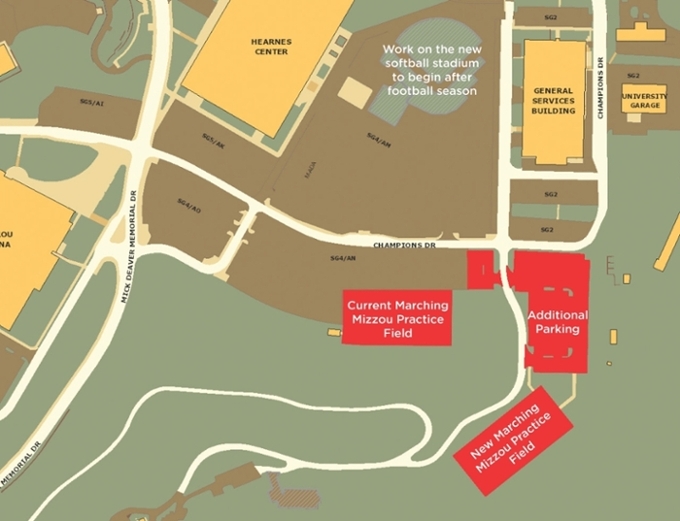
<feed xmlns="http://www.w3.org/2005/Atom" xml:base="http://www.example.org" xml:lang="en"><title>Mizzou Weekly</title><id>tag:mizzouweekly.missouri.edu,2009-11-05:/index.xml</id><subtitle>Mizzou news for faculty and staff</subtitle><updated>2015-07-09T07:53:01-06:00</updated><link href="http://mizzouweekly.missouri.edu" rel="alternate" type="text/html"/><link href="http://mizzouweekly.missouri.edu/index.xml" rel="self"/><author><name>Office of Publications and Alumni Communication</name></author><entry><id>tag:mizzouweekly.missouri.edu,2015-07-07:/2015/36-33/construction/index.php</id><title>Stadium construction to hamper Champions and Providence Point drives</title><link href="http://mizzouweekly.missouri.edu/archive/2015/36-33/construction/index.php?utm_source=MizzouWeeklyFeed&amp;utm_medium=Syndication&amp;utm_campaign=MizzouWeeklyFeed" rel="alternate" type="text/html"/><link href="archive/2015/36-33/construction/index.php" rel="self"/><published>2015-07-07T15:36:48-06:00</published><updated>2015-07-09T07:45:41-06:00</updated><content type="xhtml"><div xmlns="http://www.w3.org/1999/xhtml"><p>Beginning this month and lasting through November, construction will take place along Providence Point Drive to create additional parking areas to compensate for spaces lost when the Mizzou Softball stadium construction begins in November at the north end of the Hearnes Center lot.</p>
<p>The work will involve converting the current Marching Mizzou practice field into a parking area and building a new practice field along Providence Point Drive.</p>
<p>During this work, drivers and pedestrians should be mindful of increased construction traffic on Champions Drive and Providence Point Drive. Avoid the area by taking alternate routes if possible. Temporary lane relocations will likely take place, but two-way traffic will be maintained.</p>
<p>Questions should be directed to Campus Facilities Customer Service at 882-8211.</p>
<p><img alt="map" height="521" src="http://mizzouweekly.missouri.edu/archive/2015/36-33/construction/Softball Map.jpg" width="680"/></p></div></content></entry><entry><id>tag:mizzouweekly.missouri.edu,2015-07-07:/2015/36-33/conference/index.php</id><title>Register for the Southeastern Conference Symposium</title><link href="http://mizzouweekly.missouri.edu/archive/2015/36-33/conference/index.php?utm_source=MizzouWeeklyFeed&amp;utm_medium=Syndication&amp;utm_campaign=MizzouWeeklyFeed" rel="alternate" type="text/html"/><link href="archive/2015/36-33/conference/index.php" rel="self"/><published>2015-07-07T16:07:56-06:00</published><updated>2015-07-07T16:11:31-06:00</updated><content type="xhtml"><div xmlns="http://www.w3.org/1999/xhtml"><p>MU faculty and students are invited to register for the <a href="http://secsymposium.com/" target="_blank">2015 Southeastern Conference Symposium Sept. 20&#8211;22</a> in Atlanta at the Hyatt Regency. The theme is &#8220;Creativity, Innovation and Entrepreneurship: Driving a 21<sup>st</sup> Century.&#8221;</p>
<p>The talks and panels focus on helping faculty, students and company personnel use their knowledge specialty for business creation, innovation, commercialization and developing university-industry partnerships.</p>
<p>Registration is through Aug. 31.</p>
<ul>
<li>Administrators and faculty, $225 per person</li>
<li>Graduate and postdoctoral students, $75</li>
<li>Undergraduate students, $25</li>
</ul>
<p><a href="http://www.secsymposium.com/registration.php">Register here</a>.&#160;</p>
<p>Read more about the symposium in this <a href="http://mizzouweekly.missouri.edu/archive/2015/36-30/secupromo/index.php" target="_blank">Mizzou Weekly story</a>.&#160;</p></div></content></entry><entry><id>tag:mizzouweekly.missouri.edu,2015-07-08:/2015/36-33/healthcare/index.php</id><title>UM System selects United Healthcare for employee medical benefits plan</title><link href="http://mizzouweekly.missouri.edu/archive/2015/36-33/healthcare/index.php?utm_source=MizzouWeeklyFeed&amp;utm_medium=Syndication&amp;utm_campaign=MizzouWeeklyFeed" rel="alternate" type="text/html"/><link href="archive/2015/36-33/healthcare/index.php" rel="self"/><published>2015-07-08T08:24:15-06:00</published><updated>2015-07-09T07:44:54-06:00</updated><content type="xhtml"><div xmlns="http://www.w3.org/1999/xhtml"><h4>Employee benefits will not be affected by the change</h4><p>United Healthcare will be the new partner for employee medical benefits plan administration within the University of Missouri System beginning Jan. 1, 2016. The Board of Curators approved the change in a June meeting at the University of Missouri. United Healthcare replaces Coventry/Aetna.</p>
<p>Because the UM System is self-insured, the change will not affect covered benefits, deductibles, co-payments and co-insurance of employees.</p>
<p>The reason for the change is to provide the most competitive benefits at the best price for employees, said Betsy Rodriguez, vice president for human resources at the UM System. Officials made the change after an extensive Request for Proposal (RFP) process.</p>
<p>The university routinely conducts a competitive RFP process to ensure that the administrative fees, administrative services and network discounts associated with its current medical benefits plan are competitive in the market. Following initial RFP responses, the university invited qualified finalists to meetings and visited each provider to help determine which would be selected as the system&#8217;s long-term partner.</p>
<p>&#8220;United Healthcare demonstrated strong commitment and capabilities throughout the entire procurement process, and as such we believe their proposed offering aligns best with the long-term goals and strategies of the university as it relates to health-care administration and management,&#8221; Rodriguez said.&#160;While basic benefits for employees remain unchanged, the United Healthcare plan will offer a broader network than the current plan. Some of the claims currently out-of -the-network with Coventry will be in-network with United.</p>
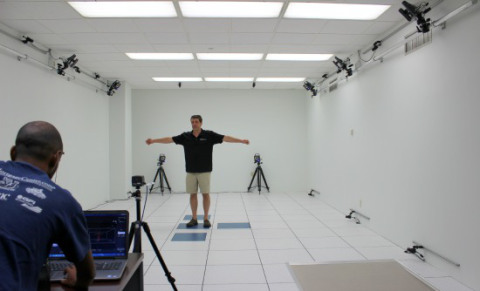
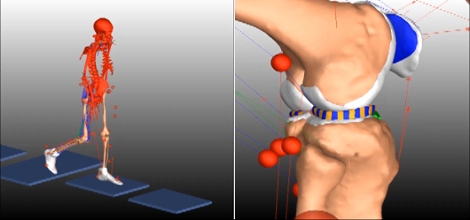
<p>If you have questions, call the <a href="http://hrs.missouri.edu/" target="_blank">Human Resources Service Center</a> at 882-2146, or email hrservicecenter@umsystem.edu.</p></div></content></entry><entry><id>tag:mizzouweekly.missouri.edu,2015-07-08:/2015/36-33/Guess/index.php</id><title>Trained engineer finds fulfillment in health research</title><link href="http://mizzouweekly.missouri.edu/archive/2015/36-33/Guess/index.php?utm_source=MizzouWeeklyFeed&amp;utm_medium=Syndication&amp;utm_campaign=MizzouWeeklyFeed" rel="alternate" type="text/html"/><link href="archive/2015/36-33/Guess/index.php" rel="self"/><published>2015-07-08T08:37:45-06:00</published><updated>2015-07-08T09:01:55-06:00</updated><content type="xhtml"><div xmlns="http://www.w3.org/1999/xhtml"><div class="inset-horizontal"><img alt="Alternate text" src="http://mizzouweekly.missouri.edu/archive/2015/36-33/Guess/lead.jpg"/><p><em>Trent Guess demonstrates how the force on joints and cartilage is tracked in the Motion Analysis Center in Clark Hall. Courtesy of the Mizzou Motion Analysis Center.</em></p></div><h4>Trent Guess directs the Mizzou Motion Analysis Center</h4><p>The joints of the body are a wonder of mechanical engineering. A simple squat, for example, places four times the body weight on a healthy knee joint without causing the squatter the slightest pain.</p>
<p>Trent Guess has a deep appreciation for body mechanics. While studying for his doctorate in mechanical engineering at the University of Kansas, he became fascinated with the mechanics of human joints, especially the knee. Today, the trained engineer who once worked as a designer of computer hard drives leads the <a href="http://mizzoumotioncenter.com/" target="_blank">Mizzou Motion Analysis Center</a>, which combines the tools of engineering with the clinical expertise of physical therapy and orthopedics.</p>
<p>&#8220;Some of the control techniques I learned designing hard drives, we are using here,&#8221; Guess said recently while conducting research in the motion lab in the basement of Clark Hall. &#8220;Mechanical engineering can actually help with things I thought were outside my realm.&#8221;</p>
<p>That a mechanical engineer is part of human joint research is a testament to the interdisciplinary culture at MU. Engineering professors and students work alongside faculty and students in the <a href="http://healthprofessions.missouri.edu/" target="_blank">School of Health Professions</a> and other disciplines to solve problems.</p>
<p>&#8220;There is no way any one discipline could tackle problems like this,&#8221; said Guess, the HealthSouth associate professor of physical therapy in the MU School of Health Professions and of orthopaedic surgery in the MU <a href="http://medicine.missouri.edu/" target="_blank">School of Medicine</a>. &#8220;It takes biologists, clinicians, engineers and others to tackle the incredibly complex joints of the human body.&#8221;</p>
<p>Guess recently co-authored a paper on the menisci, which are rubber-like pads of cartilage tissue on the knee between the thigh and shin bones. In March, the paper appeared in the online <em>Journal of Biomechanics</em> under the title &#8220;Predicted loading on the menisci during gait: The effect of horn laxity.&#8221; The paper&#8217;s other co-authors were MU&#8217;s Swithin Razu and Hamidreza Jahandar, and Antonis Stylianou of the University of Missouri, Kansas City.</p>
<p>Menisci absorb the tremendous force of the upper leg on the lower leg, and improve knee movement and stability. But over time, menisci lose flexibility and can easily be injured.<span class="float-right">&#65279;<img alt="Guess" height="220" src="http://mizzouweekly.missouri.edu/archive/2015/36-33/Guess/Guess-Meniscus11083.jpg" width="470"/></span> They are also prone to osteoarthritis.&#160;</p>
<p>In the motion lab, which opened in Clark Hall in summer 2014, technology can track the force placed on human joints and on cartilage like the menisci. Researchers place quarter-size motion markers on the bodies of patients. Video cameras track the markers, which a computer transforms into a moving schematic of active joints. On the test-area floor are tiles wired to measure force when a participant steps or leaps on them. Computational models estimate the force on knee ligaments and cartilage, including the menisci.</p>
<p>Early signs of osteoarthritis include aberrant joint force that the developed models can track, offering the potential to catch the disease early and begin medical treatment.</p>
<p>A model that predicts loads on human tissue has many applications for knee treatment. &#8220;There are models of the knee and there are models of muscle movement simulations,&#8221; Guess said. &#8220;We have a model that combines the two.&#8221;</p>
<p>&#8220;It is a new way of looking at the knee joint,&#8221; Guess continued. &#8220;I can build a model of the meniscus, but if it is not based on an actual person&#8217;s condition, we receive limited information.&#8221;</p>
<p>Though Guess enjoyed his computer-engineering work, applying mechanical engineering to help someone walk comfortably has its rewards, too.&#160;</p>
<p>&#8220;What I am doing now is much more satisfying,&#8221; Guess said.&#160;</p></div></content></entry><entry><id>tag:mizzouweekly.missouri.edu,2015-07-08:/2015/36-33/biodesign/index.php</id><title>Biodesign fellows gain hands-on experience in innovation, business creation </title><link href="http://mizzouweekly.missouri.edu/archive/2015/36-33/biodesign/index.php?utm_source=MizzouWeeklyFeed&amp;utm_medium=Syndication&amp;utm_campaign=MizzouWeeklyFeed" rel="alternate" type="text/html"/><link href="archive/2015/36-33/biodesign/index.php" rel="self"/><published>2015-07-08T09:44:34-06:00</published><updated>2015-07-09T07:55:01-06:00</updated><content type="xhtml"><div xmlns="http://www.w3.org/1999/xhtml"><div class="inset-horizontal"><img alt="Alternate text" src="http://mizzouweekly.missouri.edu/archive/2015/36-33/biodesign/lead.jpg"/><p><em>Ellie Koehly, left, Dr. Yaw Sarpong and Jaya Ghosh were the three fellows in the MU Biodesign and Innovation Program from July 1, 2014, to June 30, 2015. Fellows gain hands-on experience in innovation, invention and business creation. Photo courtesy of MUBIP.</em></p></div><h4>Medical companies express interest in several fellows projects</h4><p>A physician, an engineer and a business person walk into a bar.</p>
<p>If they were fellows of the University of Missouri&#8217;s <a href="http://medicine.missouri.edu/biodesign/" target="_blank">Biodesign and Innovation Program</a>, a lot more might happen than a punchline. Perhaps the trio would end up designing an ergonomic bar stool for barflys, then market it to businesses.&#160;</p>
<p>The University of Missouri Biodesign and Innovation Program (MUBIP) brings together three individuals charged with identifying a health care need, developing technology to resolve the need and forming a plan to put the technology on the market. Fellows gain hands-on experience in innovation, invention and business creation.</p>
<p>&#8220;We find unmet needs and try to solve them,&#8221; said Roger de la Torre, director of MUBIP and adviser to the fellows. &#8220;Once we find a need, we want to innovate and develop technology to meet the need.&#8221;</p>
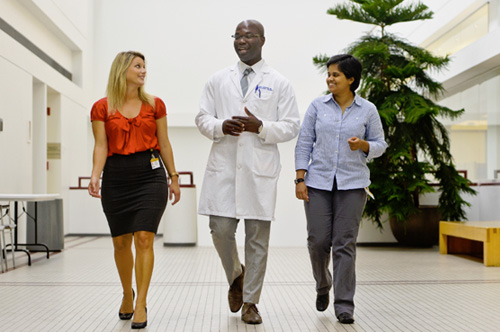
<p>At the Day of Biodesign event June 26 in Reynolds Alumni Center, the three fellows presented their group projects. The fellows were:</p>
<ul>
<li>business person Ellie Koehly, who earned a biological sciences degree in 2012 and a master&#8217;s in business administration at MU in 2014</li>
</ul>
<ul>
<li>engineer Jaya Ghosh, who earned a doctorate in biological engineering at MU in 2013</li>
</ul>
<ul>
<li>Dr. Yaw Sarpong, currently in a five-year residency in neurosurgery at MU</li>
</ul>
<p>Adam Rau, who earned a degree in business administration in 2005 and a master&#8217;s in business administration in 2013 at MU, is a &#8220;super fellow,&#8221; a second-year participant focused on commercialization and product development.&#160;</p>
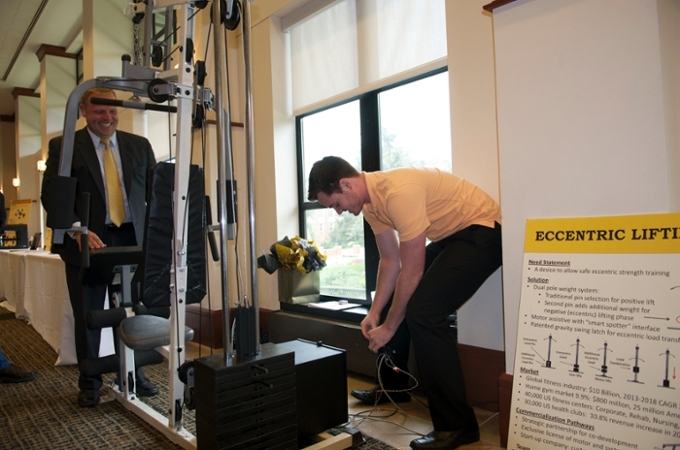
<p><strong><img alt="eccentric" height="450" src="http://mizzouweekly.missouri.edu/archive/2015/36-33/biodesign/eccentric guy 3.jpg" width="680"/>&#160;</strong><span class="caption">Adam Rau, left, a second-year fellow in the program, is helped by graduate student Nick Smith during a demonstration of the weight machine prototype at the Day of Biodesign event June 26. Photo by Mark Barna.</span></p>
<p><strong>Meet the Projects</strong></p>
<p>MUBIP began with collaboration between the Department of Surgery and the College of Engineering. It has grown to include many other units, such as the College of Veterinary Medicine and various departments in MU Health Care. The program offers paid one-year fellowships from July 1 to June 30. The physician fellowship requires at least two years of residency. The other two fellowships require at least a master's. Twenty-four fellows have taken part since the program&#8217;s inception in 2007.</p>
<p>Among universities, only Stanford has a similar program founded prior to MU&#8217;s.</p>
<p>For the first four months, the fellows interview and observe scientists and physicians to pinpoint a need. &#8220;We have several eyes looking at the same problem and coming up with a conclusion,&#8221; said de la Torre, chief of general surgery at the University of Missouri Health System.</p>
<p>One of the projects presented involved developing a hand-held device for physical therapists to use on soft-tissue injuries. Another project was creating an app to tell patients when to take pills and the proper dosage. The third was developing a surgical instrument used in hernia operations.</p>
<p>A medical company has already shown interest in securing an exclusive licensing agreement for the soft-tissue device, Koehly said. And talks are underway with two medical device companies interested in the hernia surgery tool.</p>
<p><img alt="softtissue thing" height="449" src="http://mizzouweekly.missouri.edu/archive/2015/36-33/biodesign/woman physical therapy thing.jpg" width="680"/></p>
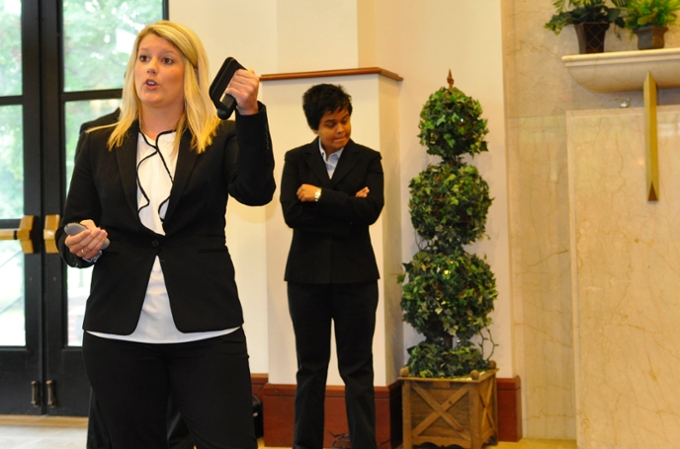
<p class="caption">Ellie Koehly explains the soft-tissue device, held in her left hand, created during the team's one-year fellowship. Jaya Ghosh is in the background. Photo by Mark Barna.</p>
<p><strong>Exercise Machine</strong></p>
<p>In the exercise and physical therapy industries, it is well known that, for building strength, the act of lowering weights, which lengthens muscle contraction, is as important as lifting the weights. Optimally, the weight being lowered should be greater than the weight being lifted; if you lift 40 pounds in a bar curl, you should lower, say, 60 pounds. But that is nearly impossible without a spotter adding and subtracting weights.</p>
<p>Enter the device created and developed by Rau and his team: a machine that automatically adds extra weight during weight lowering. Eventually the machine will be marketed to physical therapists, public gyms and the general public, Rau said.</p>
<p>Brett Hayes, director of physical therapy at MU Health Care, is enthusiastic about the prototype and hopes to test it after further development. &#8220;We know that a lot of our best strength gains and improvements on our patients are made by lengthening muscle contraction,&#8221; Hayes said. &#8220;A machine like this has great application to what we are trying to do.&#8221;</p></div></content></entry></feed>