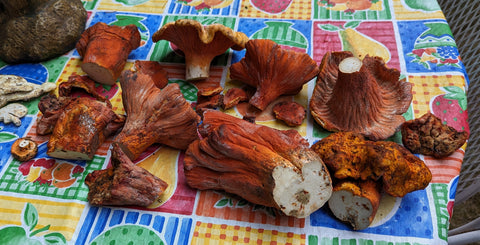
<?xml version="1.0" encoding="UTF-8"?>
<feed xml:lang="en" xmlns="http://www.w3.org/2005/Atom" xmlns:opensearch="http://a9.com/-/spec/opensearch/1.1/" xmlns:s="http://jadedpixel.com/-/spec/shopify">
  <id>https://mushroom-obsession.myshopify.com/blogs/mushroom-obsession.atom</id>
  <link rel="alternate" type="text/html" href="https://mushroom-obsession.myshopify.com/blogs/mushroom-obsession"/>
  <link rel="self" type="application/atom+xml" href="https://mushroom-obsession.myshopify.com/blogs/mushroom-obsession.atom"/>
  <title>Mushroom Obsession - Mushroom Obsession</title>
  <updated>2023-10-31T06:46:39-07:00</updated>
  <author>
    <name>Mushroom Obsession</name>
  </author>
  <entry>
    <id>https://mushroom-obsession.myshopify.com/blogs/mushroom-obsession/spectacular-fall-2023-mushroom-forays-happy-halloween</id>
    <published>2023-10-31T06:46:39-07:00</published>
    <updated>2023-11-01T18:05:14-07:00</updated>
    <link rel="alternate" type="text/html" href="https://mushroom-obsession.myshopify.com/blogs/mushroom-obsession/spectacular-fall-2023-mushroom-forays-happy-halloween"/>
    <title>Spectacular Fall 2023 Mushroom Forays ... Happy Halloween!</title>
    <author>
      <name>Lawrence Short</name>
    </author>
    <summary type="html">
      <![CDATA[<span data-mce-fragment="1">Our Fall 2023 mushroom forays in the Gifford Pinchot National Forest have been spectacular, yielding Golden Chanterelles, Lobsters, King Boletes, Admirable Boletes, Fat Jacks, Slipper Jacks, Cauliflower Mushrooms, Hedgehogs, Shaggy Mane, Shaggy Parasols, Angel Wings, Oysters, Chicken of the Woods, Pig's Ears, and Fluted Black Elfin Saddle, among many others.</span><p><a class="read-more" href="https://mushroom-obsession.myshopify.com/blogs/mushroom-obsession/spectacular-fall-2023-mushroom-forays-happy-halloween">More</a></p>]]>
    </summary>
    <content type="html">
      <![CDATA[<p><em>Featured image: This great foray was organized by a former nursing colleague of my wife's, named Diana (second from right), and we had a wonderful time. The group found one of two large Cauliflower Mushrooms discovered during October, quite a few Golden Chanterelles, Hedgehogs, and many other interesting mushrooms.</em></p>
<p>Our Fall 2023 mushroom forays in the Gifford Pinchot National Forest have been spectacular. They're not over yet (we may or may not do one more next Saturday, depending on the results of a research foray today to evaluate the impact of recent freezing temperatures on the shrooms), but I wanted to quickly show off some of the visitors we've really enjoyed, as well as the exotic mushrooms themselves.</p>
<p>A couple of high-level bullet points first:</p>
<ul>
<li>Due to a dry spring and summer, we were concerned about having a bust year like we did in 2022. However, thanks to some bountiful September/October rains and falling temps, our fears were mostly unfounded.</li>
<li>The main thing we hunt for, <a href="https://en.wikipedia.org/wiki/Cantharellus" title="Golden Chanterelles">Golden Chanterelles</a> (<em>Cantharellus</em>), were still in relatively low supply, but at least there were some out there this year!</li>
<li>
<a href="https://en.wikipedia.org/wiki/Hypomyces_lactifluorum" title="Lobster mushrooms">Lobsters</a> (<em>Russula brevipes</em> infected by the <em>Hypomyces lactiflourum</em> fungus) were plentiful in September and into October.</li>
<li>Boletes -- primarily <a href="https://en.wikipedia.org/wiki/Suillus_luteus" title="Slippery Jacks">Slippery Jacks</a> (<em>Suillus luteus</em>) early on, then later <a href="https://en.wikipedia.org/wiki/Suillus_americanus" title="Fat Jacks">Fat Jacks</a> (<em>Suillus americanus</em>), <a href="https://en.wikipedia.org/wiki/Aureoboletus_mirabilis" title="Admirable Bolete">Admirables</a> (<em>Aureoboletus mirabilis</em>), and a few <a href="https://en.wikipedia.org/wiki/Boletus_edulis" title="King Bolete">Kings</a> (<em>Boletus edulis</em>) -- were everywhere. Especially Admirables -- in a typical year we find only one or two, but this year we found 30+ during a single foray! And some were enormous, with caps 8" in diameter.</li>
<li>Much to my personal delight, my favorite of all Fall mushrooms, the <a href="https://en.wikipedia.org/wiki/Hydnum_repandum" title="Hedgehog mushrooms">Hedgehog mushroom</a> (<em>Hydnum repandum</em>) was back. I hadn't seen these for the past four years, but last month found enough for several breakfasts' worth.</li>
<li>Lots of Angel Wings (<em>Pleurocybella porrigens</em>) this Fall. (I've harvested and eaten this for years and think it's quite good, but as you'll read on <a href="https://en.wikipedia.org/wiki/Pleurocybella_porrigens" title="Wikipedia">Wikipedia</a> it has a storied history and so caution is advised.)</li>
<li>In early abundance was the common <a href="https://en.wikipedia.org/wiki/Lycoperdon_perlatum" title="Lycoperdon perlatum">puffball</a>, <em>Lycoperdon</em> (which is Latin for "wolf fart" ... they get their name from exuding clouds of brownish-green "spore smoke" when mature specimens are trod upon)</li>
<li>Also coming on in large numbers was several species of <a title="coral or club fungus" href="https://en.wikipedia.org/wiki/Ramaria">coral or club fungus</a> (<i>Ramaria</i>). Many are considered edible, though some cause digestive distress. (I've eaten them but don't care for the flavor and texture. On recommendation, I've even pickled them. <em>Yuk! Pickled mushrooms?</em>)</li>
<li>We found a number of other unusual mushrooms that we hadn't seen any or much of during recent years, including ...</li>
<ul>
<li>The excellent <a href="https://en.wikipedia.org/wiki/Sparassis" title="Cauliflower Mushroom">Cauliflower Mushroom</a> (<em>Sparassis</em>)</li>
<li>
<a href="https://en.wikipedia.org/wiki/Gomphus_clavatus" title="Pig's Ears mushroom">Pig's Ears</a>, also known as Violent Chanterelle (<em>Gomphus clavatus</em>)</li>
<li>
<a href="https://en.wikipedia.org/wiki/Helvella_lacunosa" title="Fluted Black Elfin Saddle">Fluted Black Elfin Saddle</a> (<em>Helvella lacunosa</em>)</li>
<li>
<a href="https://en.wikipedia.org/wiki/Coprinus_comatus" title="Shaggy Mane">Shaggy Mane</a>, also known as Shaggy Ink Cap (<em>Coprinus comatus</em>)</li>
<li>
<a href="https://en.wikipedia.org/wiki/Shaggy_parasol" title="Shaggy Parasol mushroom">Shaggy Parasol</a> (<i speechify-initial-font-family="sans-serif" speechify-initial-font-size="14px" data-mce-fragment="1">Chlorophyllum rhacodes</i>)</li>
</ul>
</ul>
<p>Okay, now, here are the photos you have been waiting for. (While we enjoyed about two dozen foray guests during October, not all are depicted.)</p>
<p><img alt='This group of foragers hit the jackpot with more than 30 Admirable Boletes collected, some as large as 8" in diameter!' src="https://cdn.shopify.com/s/files/1/1372/3133/files/Admirable-bolete-bonanza-foray_PXL_20231014_222327476_1_480x480.jpg?v=1698698617"></p>
<p>This group of foragers hit the jackpot with more than 30 Admirable Boletes collected, some as large as 8" in diameter!</p>
<p><img alt="Eli proudly displays his first find of a nice Golden Chanterelle." src="https://cdn.shopify.com/s/files/1/1372/3133/files/Eli_displays_his_first_chanterelle_PXL_20231014_174000735_480x480.jpg?v=1698698712"></p>
<p>Eli proudly displays his first find of a nice Golden Chanterelle.</p>
<p><img alt="Early Golden Chanterelles" src="https://cdn.shopify.com/s/files/1/1372/3133/files/early_chanterelles_PXL_20230919_163522025_480x480.jpg?v=1698758077"></p>
<p>Early Golden Chanterelles (this one from September) are lighter in color than their more later counterparts.</p>
<p><img alt="My long-time hunting companion and beloved son Nathan shows off our first (of many) Admirable Bolete." src="https://cdn.shopify.com/s/files/1/1372/3133/files/Nathan_and_his_Admirable_Bolete_PXL_20231007_170310445_480x480.jpg?v=1698698770"></p>
<p>My long-time hunting companion and beloved son Nathan shows off our first (of many) Admirable Bolete.</p>
<p><img alt="Gill view of one of the Pig's Ears (Violet Chanterelle) we found. And below is the cap view, which more closely resembles actual pigs' ears!" src="https://cdn.shopify.com/s/files/1/1372/3133/files/Pigs-ear-gill-view_PXL_20231011_201845532_480x480.jpg?v=1698698862"></p>
<p>Above is the gill view of one of several Pig's Ears mushrooms we found, and below is the view from above the cap, which more closely resembles the name "Pig's Ears."</p>
<p><img alt="Pig's Ears mushroom, top view." src="https://cdn.shopify.com/s/files/1/1372/3133/files/Pigs-ear-cap-view_PXL_20231011_201837009_480x480.jpg?v=1698698969"></p>
<p><img alt="Rainy day foray" src="https://cdn.shopify.com/s/files/1/1372/3133/files/rainy-day-foray_PXL_20231010_224403728_480x480.jpg?v=1698699028"></p>
<p>Despite a particularly rainy day in the rainforest, a foray participant (right) shows off a nice Golden Chanterelle, while I hoist a medium-sized Admirable Bolete.</p>
<p><img alt="Admirable Boletes in situ." src="https://cdn.shopify.com/s/files/1/1372/3133/files/2-admirable-boletes-in-situ_PXL_20231010_221308183_480x480.jpg?v=1698699120"></p>
<p>More Admirable Boletes, in situ. These always grow out of decaying wood. Some don't care for the flavor, which is somewhat lemony, but I like the savory nature of the mushroom. And they can grow as large as 8" diameter caps.</p>
<p><img alt="Large Admirable Bolete" src="https://cdn.shopify.com/s/files/1/1372/3133/files/Large_Admirable_PXL_20231014_212813069_480x480.jpg?v=1698757995"></p>
<p>Here's a nice large Admirable Bolete procured by one of our foray participants.</p>
<p><img alt="2-pound Cauliflower Mushroom" src="https://cdn.shopify.com/s/files/1/1372/3133/files/cauliflower_mushroom_found_at_base_of_dying_fir_tree_2_plus_lbs_PXL_20230930_175451726_480x480.jpg?v=1698699294"></p>
<p>Speaking of large, here is one of two wonderfully edible and choice Cauliflower Mushrooms we harvested. These reportably infest one out of every 1,000 dying fir trees! And frequently return in subsequent years.</p>
<p><img alt="Clockwise from upper left: Shaggy Parasol, two large Shaggy Manes, and a collection of my Fall favorite, the Hedgehog Mushroom." src="https://cdn.shopify.com/s/files/1/1372/3133/files/hedgehogs-and-shaggies_PXL_20231021_154033998_480x480.jpg?v=1698699351"></p>
<p>Here are some other favorite finds: Clockwise from upper left, a Shaggy Parasol, two large Shaggy Manes, and a collection of my Fall favorite, the Hedgehog Mushroom.</p>
<p><img alt="" src="https://cdn.shopify.com/s/files/1/1372/3133/files/white-jelly-fungus_angels-wing_PXL_20231011_205529206_480x480.jpg?v=1698756590"></p>
<p>In this photo, the unusual (particularly unusually textured, almost like soft rubber) mushroom on top is a white Toothed Jelly Mushroom (<em>Pseudohydnum gelatinosum, </em>subspecies<em> pusillum</em>), compared to the gill side of a single Angel Wing below it.</p>
<p><img src="https://cdn.shopify.com/s/files/1/1372/3133/files/Angel_wings_PXL_20230930_004220488_480x480.jpg?v=1698760659" alt="Angel Wings"></p>
<p>This shows Angel Wings in situ. They always appear brilliantly in dead and down fir trees.</p>
<p><img alt="Dr. Dave Lingenfelter displays a Lobster mushroom" src="https://cdn.shopify.com/s/files/1/1372/3133/files/Dr_Dave_PXL_20230919_152926135_1_480x480.jpg?v=1698758220"></p>
<p>Our research associate, Dr. Dave Lingenfelter, displays a nice Lobster. (In the background is our new basecamp rig, an all-solar GoSun Camp365.)</p>
<p><img alt="Lobster mushroom popping out of the humus" src="https://cdn.shopify.com/s/files/1/1372/3133/files/Lobster_mushroom_popping_out_PXL_20230930_004453901_480x480.jpg?v=1698758312"></p>
<p>This Lobster mushroom announces its presence as it pops out of the humus.</p>
<p><img alt="Research foray results includes a large Lobster, and also small puffballs and coral mushrooms. At far left are some unusual shrooms set aside for research purposes." src="https://cdn.shopify.com/s/files/1/1372/3133/files/Research_foray_PXL_20230919_174551946_480x480.jpg?v=1698758447"></p>
<p>The results of a final research foray in early October convinces me that we are ready to start hosting regular forays for our public. Results includes a large Lobster at upper left, and also small puffballs and coral mushrooms front and center. Lots of Slippery Jacks upper right, and Golden Chanterelles below them. At far left are some unusual polypores set aside for research purposes.</p>
<p>While we found many edibles, we had as usual to weed out some inedibles, including ...</p>
<p><img alt="Amanita muscaria, or Fly Agaric. Photo courtesy first-nature.com." src="https://cdn.shopify.com/s/files/1/1372/3133/files/amanita_muscaria_480x480.jpg?v=1698759260"></p>
<p><em>Amanita muscaria</em>, or <a href="https://en.wikipedia.org/wiki/Amanita_muscaria" title="Fly Agaric">Fly Agaric</a>. As these contain psychoactive compounds, they are technically considered toxic, although some seek them for enjoyment of their effects. Personally, I boil off the water-soluble toxins and enjoy the remaining mushroom flesh, which is edible. <em>Photo courtesy of first-nature.com. </em></p>
<p><img alt="False chanterelles" src="https://cdn.shopify.com/s/files/1/1372/3133/files/false-chanterelles_PXL_20231010_210901345_480x480.jpg?v=1698755880"></p>
<p>Lots of False Chanterelles out there right now. The caps look similar from above, but the gill structure and dark, flimsy stipes will give them away. (The insides of true Golden Chanterelle stipes are firm and white.) I've eaten one of these falsies (by accident, in a batch of true chanterelles) once and regretted it for a day or two.</p>
<p><img alt="" src="https://cdn.shopify.com/s/files/1/1372/3133/files/Angel-of-death_PXL_20231005_200444572_480x480.jpg?v=1698756077"></p>
<p>Worse by far are the pretty but highly toxic <em>Amanitas</em> which are springing up in everyone's lawns right now. I'm not 100% certain but believe this sample to be <em>Amanita smithiana</em>, which will make you quite sick with kidney failure. Eating even one of certain <em>Amanitas</em> can be deadly, which is why we practice 100% positive identification.</p>
<p><img alt="Happy Halloween from a mushroom!" src="https://cdn.shopify.com/s/files/1/1372/3133/files/mushroom-skeleton_PXL_20231025_185742027_480x480.jpg?v=1698756250"></p>
<p>On the up side, hunting and eating exotic edible mushrooms is a fun and healthful pasttime, and one that helps you to learn and appreciate the amazing world around us. And sometimes, you can even use mushrooms for holiday decorations, as this student at one of the schools we work at showed us!</p>
<p>Happy Halloween, and happy hunting!</p>
<p> </p>
<h3>HALLOWEEN RESEARCH FORAY UPDATE:</h3>
<div style="text-align: left;"><img style="margin-right: 8px; float: left;" alt="Halloween 2023 research foray results: boletes, angel wings, fluted black elfin saddle, hedgehogs, lobsters, a fly agaric, and golden chanterelles." src="https://cdn.shopify.com/s/files/1/1372/3133/files/10312023_foray_results_480x480.jpg?v=1698886977"></div>
<p>In follow-up, here are results from my Halloween research foray. It's clear many mushrooms have survived the recent frosts, although edible varieties are decreasing in quantity.<br data-mce-fragment="1"><br data-mce-fragment="1">Clockwise from top left: Miscellaneous boletes, probably Fat Jacks; one medium-sized Admirable Bolete; Angel Wings; a Fluted Black Elfin Saddle (I ate that this morning for breakfast and it was delicious!); a nice collection of Hedgehogs (my favorite Fall mushroom, and tomorrow morning's breakfast); a few remaining decent Lobsters; a Fly Agaric (center, orange-ish red with white spots); and quite a few decent (though nearing the end of their lifespan) Golden Chanterelles.</p>]]>
    </content>
  </entry>
  <entry>
    <id>https://mushroom-obsession.myshopify.com/blogs/mushroom-obsession/jackpot</id>
    <published>2023-10-01T19:34:26-07:00</published>
    <updated>2023-10-03T10:36:12-07:00</updated>
    <link rel="alternate" type="text/html" href="https://mushroom-obsession.myshopify.com/blogs/mushroom-obsession/jackpot"/>
    <title>Jackpot!</title>
    <author>
      <name>Lawrence Short</name>
    </author>
    <content type="html">
      <![CDATA[<p>Our first official Fall forays of 2023 occurred in the Gifford Pinchot National Forest last weekend. And one of them started off with a rare find -- <em>Sparassis crispa,</em> the highly sought-after <a title="Cauliflower Mushroom" href="https://en.wikipedia.org/wiki/Sparassis" target="_blank">Cauliflower Mushroom</a>!</p>
<p>These grow at the base of dying fir trees. When cleaned and chunked the flesh is reminiscent (in appearance) of egg noodles. They are typically between 1-10 pounds in size (though finds as big as 100 pounds have been recorded). This was was just over 2 pounds, which snugly fills a one-gallon baggy.</p>
<p><img src="https://cdn.shopify.com/s/files/1/1372/3133/files/PXL_20231002_005513708_480x480.jpg?v=1696211118" alt=""></p>
<p>I'll be trying recipes this week and let you know my favorite. Deep fried mushroom dipped in egg batter is first, then cauliflower mushroom/creamed corn quiche, and then beef soup with cauliflower mushroom. (People I've read rave about the flavor which they said is similar to morels, meaty but not quite as savory. We'll see.)</p>
<p>We were also finding lots of good <a title="Lobster mushrooms" href="https://en.wikipedia.org/wiki/Hypomyces_lactifluorum" target="_blank">Lobster mushrooms</a> still out there, and the <a title="Golden Chanterelles" href="https://en.wikipedia.org/wiki/Cantharellus">Golden Chan</a><a title="Golden Chanterelles" href="https://en.wikipedia.org/wiki/Cantharellus" target="_blank">t</a><a title="Golden Chanterelles" href="https://en.wikipedia.org/wiki/Cantharellus">erelles</a> are beginning to pop thanks to recent rains and cooler weather. And there are tons of <a title="Boletes" href="https://en.wikipedia.org/wiki/Boletus" target="_blank">Boletes</a> everywhere you look. Also <a title="Puffballs" href="https://en.wikipedia.org/wiki/Lycoperdon" target="_blank">Puffballs</a>, <a title="Angel Wings" href="https://en.wikipedia.org/wiki/Pleurocybella_porrigens" target="_blank">Angel Wings</a>, <a title="Chicken of the Woods" href="https://en.wikipedia.org/wiki/Laetiporus" target="_blank">Chicken of the Woods</a>, <a title="Oyster mushrooms" href="https://en.wikipedia.org/wiki/Pleurotus" target="_blank">Oyster mushrooms</a>, and more have already been found thus far this season.</p>
<p><img src="https://cdn.shopify.com/s/files/1/1372/3133/files/PXL_20230919_174551051_480x480.jpg?v=1696211546" alt="An early research foray last week yielded lobsters, golden chanterelles, boletes, and more."></p>
<h3>Foray Schedule</h3>
<p>Ten more forays are planned, but are filling up fast. Here are the planned forays and how many spots remain open at the moment. <em>(Please note that the schedule has changed slightly since <a title="our last blog post" href="https://mushroomobsession.com/blogs/mushroom-obsession/2023-fall-mushroom-forays-announced" target="_blank">our last blog post</a>.)</em></p>
<p speechify-initial-font-family='Roboto, HelveticaNeue, "Helvetica Neue", sans-serif' speechify-initial-font-size="14px"><span speechify-initial-font-family='Roboto, HelveticaNeue, "Helvetica Neue", sans-serif' speechify-initial-font-size="14px"><strong speechify-initial-font-family='Roboto, HelveticaNeue, "Helvetica Neue", sans-serif' speechify-initial-font-size="14px"><span id="speechify-first-word-listening-nudge-15">Friday, October 6</span></strong></span></p>
<p speechify-initial-font-family='Roboto, HelveticaNeue, "Helvetica Neue", sans-serif' speechify-initial-font-size="14px"><span id="speechify-first-word-listening-nudge-root-16"></span><span style="color: #ff8000;"><span id="speechify-first-word-listening-nudge-17">Foray 1: 4-6</span> p.m. (3 spots remain)</span><br speechify-initial-font-family='Roboto, HelveticaNeue, "Helvetica Neue", sans-serif' speechify-initial-font-size="14px"><span style="color: #ff8000;">Dinner in the forest: 6-7 p.m.</span></p>
<p speechify-initial-font-family='Roboto, HelveticaNeue, "Helvetica Neue", sans-serif' speechify-initial-font-size="14px"><span speechify-initial-font-family='Roboto, HelveticaNeue, "Helvetica Neue", sans-serif' speechify-initial-font-size="14px"><strong speechify-initial-font-family='Roboto, HelveticaNeue, "Helvetica Neue", sans-serif' speechify-initial-font-size="14px"><span id="speechify-first-word-listening-nudge-18">Tuesday, October 10</span></strong></span></p>
<p speechify-initial-font-family='Roboto, HelveticaNeue, "Helvetica Neue", sans-serif' speechify-initial-font-size="14px"><span style="color: #ff8000;">Lunch in the forest: Noon-1 p.m.<br>Foray 2: 1-3 p.m. (2 spots remain)</span></p>
<p speechify-initial-font-family='Roboto, HelveticaNeue, "Helvetica Neue", sans-serif' speechify-initial-font-size="14px"><span speechify-initial-font-family='Roboto, HelveticaNeue, "Helvetica Neue", sans-serif' speechify-initial-font-size="14px"><strong speechify-initial-font-family='Roboto, HelveticaNeue, "Helvetica Neue", sans-serif' speechify-initial-font-size="14px"><span id="speechify-first-word-listening-nudge-18">Friday, October 13</span></strong></span></p>
<p speechify-initial-font-family='Roboto, HelveticaNeue, "Helvetica Neue", sans-serif' speechify-initial-font-size="14px"><span id="speechify-first-word-listening-nudge-root-19"></span><span style="color: #ff8000;"><span id="speechify-first-word-listening-nudge-19">Foray 3: 3</span>-5 p.m. (3 spots remain)</span><br speechify-initial-font-family='Roboto, HelveticaNeue, "Helvetica Neue", sans-serif' speechify-initial-font-size="14px"><span style="color: #ff8000;">Dinner in the forest: 5-6 p.m.</span></p>
<p speechify-initial-font-family='Roboto, HelveticaNeue, "Helvetica Neue", sans-serif' speechify-initial-font-size="14px"><span speechify-initial-font-family='Roboto, HelveticaNeue, "Helvetica Neue", sans-serif' speechify-initial-font-size="14px"><strong speechify-initial-font-family='Roboto, HelveticaNeue, "Helvetica Neue", sans-serif' speechify-initial-font-size="14px"><span id="speechify-first-word-listening-nudge-root-20"></span><span id="speechify-first-word-listening-nudge-20">Saturday, October 14</span></strong></span></p>
<p speechify-initial-font-family='Roboto, HelveticaNeue, "Helvetica Neue", sans-serif' speechify-initial-font-size="14px"><span id="speechify-first-word-listening-nudge-root-21"></span><span style="color: #ff2a00;"><span id="speechify-first-word-listening-nudge-22">Foray 4: 10</span> a.m.-noon (0 spots remain)</span><br speechify-initial-font-family='Roboto, HelveticaNeue, "Helvetica Neue", sans-serif' speechify-initial-font-size="14px"><span style="color: #ff2a00;">Lunch in the forest: Noon-1 p.m.</span><br speechify-initial-font-family='Roboto, HelveticaNeue, "Helvetica Neue", sans-serif' speechify-initial-font-size="14px"><span style="color: #ff2a00;">Foray 5: 1-3 p.m. (0 spots remain)</span></p>
<p speechify-initial-font-family='Roboto, HelveticaNeue, "Helvetica Neue", sans-serif' speechify-initial-font-size="14px"><span speechify-initial-font-family='Roboto, HelveticaNeue, "Helvetica Neue", sans-serif' speechify-initial-font-size="14px"><strong speechify-initial-font-family='Roboto, HelveticaNeue, "Helvetica Neue", sans-serif' speechify-initial-font-size="14px"><span id="speechify-first-word-listening-nudge-root-23"></span><span id="speechify-first-word-listening-nudge-23">Friday, October 20</span></strong></span></p>
<p speechify-initial-font-family='Roboto, HelveticaNeue, "Helvetica Neue", sans-serif' speechify-initial-font-size="14px"><span id="speechify-first-word-listening-nudge-root-24"></span><span style="color: #ff2a00;"><span id="speechify-first-word-listening-nudge-24">Lunch in the</span> forest: Noon-1 p.m.</span><br speechify-initial-font-family='Roboto, HelveticaNeue, "Helvetica Neue", sans-serif' speechify-initial-font-size="14px"><span style="color: #ff2a00;">Foray 6: 1-3 p.m. (0 spots remain)</span><br>Foray 7: 3-5 p.m. (5 spots remain)<br>Dinner in the forest: 5-6 p.m.</p>
<p speechify-initial-font-family='Roboto, HelveticaNeue, "Helvetica Neue", sans-serif' speechify-initial-font-size="14px"><span speechify-initial-font-family='Roboto, HelveticaNeue, "Helvetica Neue", sans-serif' speechify-initial-font-size="14px"><strong speechify-initial-font-family='Roboto, HelveticaNeue, "Helvetica Neue", sans-serif' speechify-initial-font-size="14px"><span id="speechify-first-word-listening-nudge-root-26"></span><span id="speechify-first-word-listening-nudge-26">Friday, October 27</span></strong></span></p>
<p speechify-initial-font-family='Roboto, HelveticaNeue, "Helvetica Neue", sans-serif' speechify-initial-font-size="14px"><span id="speechify-first-word-listening-nudge-root-27"></span><span id="speechify-first-word-listening-nudge-27">Foray 8: 3</span>-5 p.m. (5 spots remain)<br speechify-initial-font-family='Roboto, HelveticaNeue, "Helvetica Neue", sans-serif' speechify-initial-font-size="14px">Dinner in the forest: 5 - 6 p.m.</p>
<p speechify-initial-font-family='Roboto, HelveticaNeue, "Helvetica Neue", sans-serif' speechify-initial-font-size="14px"><span speechify-initial-font-family='Roboto, HelveticaNeue, "Helvetica Neue", sans-serif' speechify-initial-font-size="14px"><strong speechify-initial-font-family='Roboto, HelveticaNeue, "Helvetica Neue", sans-serif' speechify-initial-font-size="14px"><span id="speechify-first-word-listening-nudge-root-28"></span><span id="speechify-first-word-listening-nudge-28">Saturday, October 28</span></strong></span></p>
<p speechify-initial-font-family='Roboto, HelveticaNeue, "Helvetica Neue", sans-serif' speechify-initial-font-size="14px"><span id="speechify-first-word-listening-nudge-root-29"></span><span id="speechify-first-word-listening-nudge-30">Foray 9: 10</span><span> </span>a.m.-noon (5 spots remain)<br speechify-initial-font-family='Roboto, HelveticaNeue, "Helvetica Neue", sans-serif' speechify-initial-font-size="14px">Lunch in the forest: Noon - 1 p.m.<br speechify-initial-font-family='Roboto, HelveticaNeue, "Helvetica Neue", sans-serif' speechify-initial-font-size="14px">Foray 10: 1 - 3 p.m. (5 spots remain)</p>
<h3 speechify-initial-font-family='Roboto, HelveticaNeue, "Helvetica Neue", sans-serif' speechify-initial-font-size="14px">Reservation Policy</h3>
<p speechify-initial-font-family='Roboto, HelveticaNeue, "Helvetica Neue", sans-serif' speechify-initial-font-size="14px">By way of reminder, our educational forays themselves are free. However, we invite you to join us for lunch and request a $10 per person donation for doing so. Please pay in advance (we will send Venmo and other instructions), and (because we have to buy food) this is forfeit in case of no-shows or cancellations with less than 24 hours' notice.</p>
<p speechify-initial-font-family='Roboto, HelveticaNeue, "Helvetica Neue", sans-serif' speechify-initial-font-size="14px">Also, if you are not available to join us for a meal, we request a deposit of $10/person for the foray in advance, same rules as above (forfeit in case of no shows or cancellations with less than 24 hours' notice). But this deposit will be promptly refunded to you (minus any processing costs) after your foray is completed. (And we will promptly and fully refund any deposits in case we are the ones who need to cancel.)</p>
<h3 speechify-initial-font-family='Roboto, HelveticaNeue, "Helvetica Neue", sans-serif' speechify-initial-font-size="14px">Other Important Details</h3>
<p speechify-initial-font-family='Roboto, HelveticaNeue, "Helvetica Neue", sans-serif' speechify-initial-font-size="14px">Since we are a hobby organization, and not an official business, participation is at your own risk and you agree to not hold us liable for any accidental loss, injury, or death. But of course our top priority is to keep you safe, and much more information about this and further instructions can be found on <a title="our previous blog post" href="https://mushroomobsession.com/blogs/mushroom-obsession/2023-fall-mushroom-forays-announced">our previous blog post</a>.</p>
<h3 speechify-initial-font-family='Roboto, HelveticaNeue, "Helvetica Neue", sans-serif' speechify-initial-font-size="14px">How To Get Signed Up</h3>
<p speechify-initial-font-family='Roboto, HelveticaNeue, "Helvetica Neue", sans-serif' speechify-initial-font-size="14px">Email me here: <a title="LarryShort@gmail.com" href="mailto:LarryShort@gmail.com" target="_blank">LarryShort@gmail.com</a>. Be sure to include your full name as contact, the number of people in your party (maximum 5), everyone's age (if under 18 or over 90), and your contact info (email address and mobile phone). Also let us know if you will be joining us for the adjoining meal in the forest. I will reply to confirm your reservation, then send further instructions shortly.</p>
<p speechify-initial-font-family='Roboto, HelveticaNeue, "Helvetica Neue", sans-serif' speechify-initial-font-size="14px">If you've ever wanted to learn how to safely hunt for exotic edible mushrooms on the foothills of Mt. Rainier, this is your chance! We look forward to hearing from you.</p>]]>
    </content>
  </entry>
  <entry>
    <id>https://mushroom-obsession.myshopify.com/blogs/mushroom-obsession/2023-fall-mushroom-forays-announced</id>
    <published>2023-09-21T09:14:56-07:00</published>
    <updated>2023-09-21T15:33:22-07:00</updated>
    <link rel="alternate" type="text/html" href="https://mushroom-obsession.myshopify.com/blogs/mushroom-obsession/2023-fall-mushroom-forays-announced"/>
    <title>2023 Fall Mushroom Forays Announced</title>
    <author>
      <name>Lawrence Short</name>
    </author>
    <content type="html">
      <![CDATA[<p>Great news! A research foray this week has revealed that many desirable mushrooms are now going in the Gifford Pinchot National Forest. So we are now planning specific foray dates and hope you will be a part.</p>
<div style="text-align: left;"><img style="float: none;" alt="Close-up of mushrooms harvested during a one-hour research foray on September 20, 2023" src="https://cdn.shopify.com/s/files/1/1372/3133/files/mushroom-ID-20230919_PXL_20230919_174551051_480x480.jpg?v=1695312475"></div>
<p><em>As a reminder:</em> Our mushroom operation is an educational "hobby" business and not designed to generate income. Therefore the forays themselves are FREE. Our goal is to help you understand where the exotic edible mushrooms can be found, and how to identify and hunt for them safely.</p>
<p>We do this through 2-hour forays that focus on hiking safety and positive identification.</p>
<p>Because this is a "hobby" business we ask those who join us to assume any liability for your adventure. (Because we do not make any money on this, we cannot afford liability insurance!) However, that said, we will do our best to keep you and your family safe and to ensure you have a great hunting experience. (We have been hunting in this area for more than 20 years and so have gained  a lot of knowledge and experience that will help you get started well.)</p>
<h3>Fall 2023 Foray Dates</h3>
<p>Now, here are the tentative foray dates (16 of them) that we are planning over the next six weeks. Each is dependent on weather and forest conditions and attendance. (We can support up to 5 individuals per foray ... if we don't get that many reservations for a given foray, we reserve the right to combine groups.) Forays are open to anyone who can do the hiking safely, but you have to reserve your spot in advance and commit to following our guidance.</p>
<p><img alt="Basecamp Radagast with towing vehicle" src="https://cdn.shopify.com/s/files/1/1372/3133/files/basecamp-Radagast_PXL_20230613_220353234_1_480x480.jpg?v=1695312541"></p>
<p><em>Come see "Radagast: Mushroom Wizard of the Forest," Mushroom Obsession's new off-grid portable basecamp. It's a one-of-a-kind in the green state of Washington ... 100% solar, easily towable, based on a collaboration between <a href="https://gosun.co/products/camp365" title="GoSun and Camp365 collaborated to create Mushroom Obsession's &quot;Radagast: Mushroom Wizard of the Forest&quot;">GoSun and Camp365</a>.</em></p>
<p>Each foray (in a specific location in the Gifford Pinchot National Forest, about 1-1/4 hours southeast of South Hill and 15 minutes southeast of Ashford) is scheduled adjacent to a BBQ meal at our basecamp in the forest. Lunch or dinner meals will include burgers (ground sirloin, salmon or chicken), three sides (including exotic edible mushrooms prepared to accompany), and a drink.</p>
<p><img alt="MushroomObsession.com research associate Dr. Dave Lingenfelter shows off a large bolete. Dave says our salmon burgers and sauteed boletes are among the best he's ever had!" src="https://cdn.shopify.com/s/files/1/1372/3133/files/Dave-large-bolete_20230918_PXL_20230919_152926135_480x480.jpg?v=1695334214"></p>
<p><em>MushroomObsession.com research associate Dr. Dave Lingenfelter shows off a large bolete. By the way, Dave says our salmon burgers and sauteed boletes are among the best he's ever had!</em></p>
<p>Breakfast will include bacon or sausage and eggs (cheese optional), toast and coffee. We ask for a $10 donation per person per meal, which will include one free "Mushroom Obsession" coffee mug.</p>
<p><img alt='Mushroom Obsession "coffee in the forest" mug' src="https://cdn.shopify.com/s/files/1/1372/3133/files/Mushroom-Obsession-mug_PXL_20230921_221841952_480x480.jpg?v=1695335133"></p>
<p><em>Now here is the schedule:</em></p>
<p><span style="text-decoration: underline;"><strong>Friday, September 29</strong></span></p>
<p>Foray 1: 4 - 6 p.m.<br>Dinner in the forest: 6 - 7 p.m.</p>
<p><span style="text-decoration: underline;"><strong>Saturday, September 30</strong></span></p>
<p>Breakfast in the forest: 7 - 8 a.m.<br>Foray 2: 8 - 10 a.m.</p>
<p>Foray 3: 10 a.m. - noon<br>Lunch in the forest: Noon - 1 p.m.<br>Foray 4: 1 - 3 p.m.</p>
<p><span style="text-decoration: underline;"><strong>Friday, October 6</strong></span></p>
<p>Lunch in the forest: 1 - 2 p.m.<br>Foray 5: 2-4 p.m.</p>
<p>Foray 6: 4-6 p.m.<br>Dinner in the forest: 6-7 p.m.</p>
<p><span style="text-decoration: underline;"><strong>Friday, October 13</strong></span></p>
<p>Foray 7: 4 - 6 p.m.<br>Dinner in the forest: 6 - 7 p.m.</p>
<p><span style="text-decoration: underline;"><strong>Saturday, October 14</strong></span></p>
<p>Breakfast in the forest: 7 - 8 a.m.<br>Foray 8: 8 - 10 a.m.</p>
<p>Foray 9: 10 a.m. - noon<br>Lunch in the forest: Noon - 1 p.m.<br>Foray 10: 1 - 3 p.m.</p>
<p><span style="text-decoration: underline;"><strong>Friday, October 20</strong></span></p>
<p>Lunch in the forest: 1 - 2 p.m.<br>Foray 11: 2-4 p.m.</p>
<p>Foray 12: 4-6 p.m.<br>Dinner in the forest: 6-7 p.m.</p>
<p><span style="text-decoration: underline;"><strong>Friday, October 27</strong></span></p>
<p>Foray 13: 4 - 6 p.m.<br>Dinner in the forest: 6 - 7 p.m.</p>
<p><span style="text-decoration: underline;"><strong>Saturday, October 28</strong></span></p>
<p>Breakfast in the forest: 7 - 8 a.m.<br>Foray 14: 8 - 10 a.m.</p>
<p>Foray 15: 10 a.m. - noon<br>Lunch in the forest: Noon - 1 p.m.<br>Foray 16: 1 - 3 p.m.</p>
<h3>Requirements for participating</h3>
<p>Participants must be between 5 and 89 years of age (exceptions may apply, let's talk). Minors must be accompanied and monitored closely by a parent or guardian.</p>
<p>All participants must be physically capable of hiking on- and off-trail in moderately strenuous conditions for two hours.</p>
<p>Each participant must secure in advance a (free) hobby mushroom hunting permit from the Gifford Pinchot National Forest Service. (<a href="https://gp.fs2c.usda.gov/gp/">Click here to apply online.</a>) This permit must be in your possession while hunting.</p>
<p>Each participant agrees to hold MushroomObsession.com and its principles harmless (not liable) for any incidental or accidental loss, damage, injury or death incurred during the hunt.</p>
<p>Each participant agrees to retain and consume (in a safe manner, thoroughly cooked and tested first in small quantities) only mushrooms indicated by MushroomObsession.com principles to be safe edibles. We will go through mushrooms you collect and throw out anything not meeting our standards as such.</p>
<p>Each participant agrees to bring any clothing and personal safety items indicated as necessary for safe hunting by MushroomObsession.com principles, and to refrain from bringing any items (such as firearms) that might cause others accidental harm.</p>
<h3>Edible (Fall) Mushrooms You Might Be Able to Find and Collect</h3>
<p>In abundance right now: Boletes (mostly Slippery Jacks and Fat Jacks, but also some Admirables or King Boletes possible), Golden Chanterelles, Lobsters (<em>Russula brevipes</em> infected by the parasitic fungus <span data-mce-fragment="1"><em>Hypomyces lactifluorum</em>)</span>, small Puffballs (<em>Lycoperdon</em>), Angel Wings (we advise caution when ingesting, start in small quantities ... there are no known negative reactions in North America, but they were popular in Japan until some fatalities occurred), Oysters, and various Club or Coral fungi (edibility varies).</p>
<p>Occasionally also found in our hunting zone: Angel Wings, Hawk Wings, Oysters, White Chanterelles, Sulphur Shelf (Chicken of the Woods), and Porcupine Hedgehogs.</p>
<p>Rarely but occasionally spotted in our hunting zone or adjacent areas: Lion's Mane (also known as Bearded Tooth Fungus or Bearded Hedgehog), Matsutake (Pine Mushroom), Black Trumpets, and Morels (spring only).</p>
<p>This list is not comprehensive as others are possible. No mushrooms are promised, but the list above is sorted by likelihood of finding these mushrooms. You may also see a lot of mushrooms which are interesting to look at but not 100% identifiable as edibles. We encourage you to take lots of photos of these, but don't collect.</p>
<p><em>Note:</em> Some of these mushrooms, most notably Chanterelles, have look-alikes which are not edible. We will help you distinguish between them. Also, some individuals can be allergic even to mushrooms known as commonly edible, so if it's your first time consuming, we advise you start with small quantities. And always thoroughly cook all wild mushrooms harvested before consuming.</p>
<h3>What's Next If I'm Interested?</h3>
<p>Reach out to us <a href="mailto:LarryShort@gmail.com">here</a> and provide your name and contact information (phone and email), the names and ages of all in your party, and your first, second, and third choice of foray to participate in. (Also please let us know if you will be joining us for the associated meal in the forest.) And let us know of any questions you might have.</p>
<p>We will reply promptly with confirmation of your reserved foray date, a location and directions to our basecamp in the forest (accessible on a gravel Forest Service road which is suitable for most two-wheel drive vehicles), and refer you to the list of what to bring to help ensure your safety while hunting, which can be found below.</p>
<p><em>Note:</em> There is no cell phone signal in our immediate hunting zone, although signal access exists for most networks only about a quarter mile to the southwest of our basecamp. We also utilize a GPS-based channel which provides immediate satellite access to emergency services in the forest. Our hunting zone is at an altitude of approximately 2,000-2,500 feet above sea level.</p>
<p><img alt="Garmin GPS location bookmarks special finds and features and also provides emergency assistance if needed" src="https://cdn.shopify.com/s/files/1/1372/3133/files/GPS-coordinates_PXL_20230711_194102130_480x480.jpg?v=1695312806"></p>
<p>We will provide weather estimates closer to the date of the foray.</p>
<h3>What to Bring for Your Comfort, Safety, and Enjoyment</h3>
<p>Check the weather forecast for the Ashford area, subtract 5 degrees (as we are a little higher in elevation and in an area with a lot of trees and undergrowth), and dress accordingly (preferably in layers). We advise sturdy, waterproof shoes or hiking boots, covering your arms and legs, and a hat which prevents tree debris from dropping down around your neck. Lightweight gloves may also be advisable. (We don't typically have many problems with insects, but as we occasionally run into nests of small ground wasps, mosquitoes, or biting black flies, you may wish to bring insect repellent.)</p>
<p>Wear bright colors (orange, yellow, flourescents, etc.) to distinguish yourself from prey (bears and deer, primarily) occasionally sought by hunters in the area.</p>
<p>Many find a walking stick handy for moderately challenging terrain, and a light backpack for carrying gear in addition to your mushroom basket.</p>
<p>Sturdy woven baskets serve best as mushroom collection containers, as they allow mushroom spores to re-seed the ground you are walking on. There is a maximum 2-gallon limit for mushrooms collected with a hobby permit.</p>
<p>We advise a sharp knife for cutting mushrooms off at the base (stipe) just above the soil. We practice "leave no trace," so be sure to pack out anything you bring in.</p>
<p>Think in terms of: <em>What would I need if I got lost in the forest and had to survive overnight?</em> Here is a possible list:</p>
<ul>
<li>Clean drinking water (at least 32 fluid ounces) or a filtered bottle for accessing water from streams.</li>
<li>Any medicines you need or first aid that might come in handy.</li>
<li>An emergency reflective blanket.</li>
<li>A light source (good flashlight).</li>
<li>A noisemaker (sharp whistle).</li>
<li>A compass and/or GPS for finding your way back to the trail. And a fully-charged cellphone (although you may or may not get a signal).</li>
</ul>
<p>In our hunting zone, getting lost (for more than an hour) is extremely unlikely ... but not impossible. We will conduct a quick briefing at the beginning of the hunt about how NOT to get lost, and what to do (or not do) if you DO get lost.</p>
<p>Other possible hazards to be aware of in our hunting zone:</p>
<ul>
<li>Other hikers and hunters. Be courteous, highly visible, and stay aware. It's generally not legal to shoot firearms in the forest but occasionally people are out there doing target practice. If you hear shooting, stay away and make lots of noise.</li>
<li>Wild animals: In 20 years of hunting, while we have seen evidence of black bears and mountain lions, we have never seen an actual specimen. They are normally quite bashful and will steer well clear of people, particularly if you are making plenty of noise. If you do see one, DON'T RUN, just make yourself look as large as possible, shout loudly or blow your whistle, and back away slowly.</li>
<li>There are no poisonous snakes in this part of the country, and few poisonous insects. Wasps are about the worst of it.</li>
<li>Rabies is always a possibility if you happen to get bit by a bat, rodent or other animal, so seek medical attention immediately if this happens.</li>
<li>Accidents caused by rough terrain or falling trees. This is probably the most likely possible cause of injury, so mind where you step and exercise caution while hiking. Also be sure to keep your mushroom knife carefully sheathed while you are moving about.</li>
<li>And please drive safely to and from our basecamp! Your greatest risks will always be on the highway.</li>
</ul>
<p>We hope you will join us for an upcoming foray!</p>]]>
    </content>
  </entry>
  <entry>
    <id>https://mushroom-obsession.myshopify.com/blogs/mushroom-obsession/2023-mushroom-happenings-update</id>
    <published>2023-09-14T23:00:56-07:00</published>
    <updated>2023-09-14T23:21:42-07:00</updated>
    <link rel="alternate" type="text/html" href="https://mushroom-obsession.myshopify.com/blogs/mushroom-obsession/2023-mushroom-happenings-update"/>
    <title>2023 Mushroom Happenings Update</title>
    <author>
      <name>Lawrence Short</name>
    </author>
    <content type="html">
      <![CDATA[<p>In May and June 2023 we completed our fourth annual coast-to-coast mushroom tour, focusing on the northeast states of Pennsylvania, New York, Connecticut, and Vermont. We found some nice blond morels in south-central Pennsylvania, and also foraged a lot of ramps, but in general were too late in the season to harvest mushrooms elsewhere.</p>
<p><img alt="First blonde morel find in south-central Pennsylvania." src="https://cdn.shopify.com/s/files/1/1372/3133/files/PXL_20230509_172830074_First_morel_find_in_the_woods_in_Bedford_County_PA_480x480.jpg?v=1694757160"><br><em>First blonde morel find in the woods of south-central Pennsylvania.</em></p>
<p>The prior spring (2022) we had great luck with fire morels in the Schneider Springs burn area about 15 miles due east of Mt. Rainier in the wilderness, collecting more than 250 morels. But a 2023 return to this area left us emptyhanded.</p>
<p><img src="https://cdn.shopify.com/s/files/1/1372/3133/files/Some_edible_fiddleheads_foraged_fern_tops_collected_in_Bedford_County_PA_480x480.jpg?v=1694757831" alt="In the spring of 2023 was the first time we foraged both edible fern fiddleheads (depicted) and ramps."></p>
<p><em>In the spring of 2023 was the first time we foraged both edible fern fiddleheads (depicted above) and ramps (wild leeks, below, with morels). We've also harvested a good crop of mountain huckleberries.</em></p>
<p><img src="https://cdn.shopify.com/s/files/1/1372/3133/files/A_basket_of_ramps_and_blond_morels_foraged_in_Bedford_County_PA_480x480.jpg?v=1694757974" alt="Ramps and blonde morels found in the woods of south-central Pennsylvania."></p>
<p>In the Fall of 2022, due to warm and dry conditions throughout September and October, we also came up short on Fall mushrooms in our usual hunting areas in the Gifford Pinchot National Forest as well as the Olympic Peninsula. We found small quantities of chanterelles, boletes, and lobsters, but nothing to write home about.</p>
<h3>Fall 2023 Thus Far</h3>
<p>Since mid-August we have been doing every-other-week forays in the Gifford Pinchot, hoping for better results. The past four weeks we've harvested a good crop of nice lobsters, and small quantities of chicken of the woods; but not a single chanterelle, bolete, hedgehog or other exotic edible has yet been harvested.</p>
<p><img alt="Lobsters harvested from the Gifford Pinchot National Forest in August 2023." src="https://cdn.shopify.com/s/files/1/1372/3133/files/Lobsters_20230823-harvest_PXL_20230827_004001723_480x480.jpg?v=1694757343"></p>
<p><em>Nice lobsters harvested in the Gifford Pinchot National Forest in August 2023.</em></p>
<p>Intermittent rains and cooler weather ought to bring out some chanterelles and boletes. We return for a new survey next Monday evening and Tuesday and will report back on our findings.</p>
<h3>Welcome Radagast, Mushroom Wizard of the Forest</h3>
<p>In other news, we retired our former basecamp vehicle, a class C RV fondly referred to as "Jedediah." In June we acquired a new off-grid towable basecamp vehicle which we christened "Radagast, Mushroom Wizard of the Forest." This unique folding cabin is a 100% solar mobile trailer manufactured in a partnership between Camp365 in Minnesota and GoSun in Iowa. We had Radagast prepared to our specs and picked it up during our return from our Spring tour of the northeast states.</p>
<p><img src="https://cdn.shopify.com/s/files/1/1372/3133/files/PXL_20230526_234654927_Radagast_solar_and_privacy_tent_deployed_480x480.jpg?v=1694757540" alt=""></p>
<p>Since it's 100% solar, the easily towable Radagast can go many places other RVs can't and stay off-grid for up to weeks at a time. Currently it's the only vehicle of it's type in the state of Washington. Attached on top is a photo of our Radagast basecamp in the wilderness east of Mt. Rainier, and above with the solar setup deployed in our driveway at home.</p>
<p><img alt="Radagast, mushroom wizard of the forest" src="https://cdn.shopify.com/s/files/1/1372/3133/files/Radagast_poster_480x480.jpg?v=1694758875"></p>
<p> </p>
<p>As Fall mushrooms begin to appear in greater quantities at altitude, we will announce a series of 2-hour weekend forays and invite our followers to sign up for these. During these free forays we teach hunting safety and positive identification.</p>
<p>So stay tuned to this space for more updates!</p>]]>
    </content>
  </entry>
  <entry>
    <id>https://mushroom-obsession.myshopify.com/blogs/mushroom-obsession/2022-fall-update</id>
    <published>2022-10-25T21:09:59-07:00</published>
    <updated>2022-10-25T21:12:37-07:00</updated>
    <link rel="alternate" type="text/html" href="https://mushroom-obsession.myshopify.com/blogs/mushroom-obsession/2022-fall-update"/>
    <title>2022 Fall Mushroom Update</title>
    <author>
      <name>Lawrence Short</name>
    </author>
    <summary type="html">
      <![CDATA[While Spring forays (for morels) were fantastic this year, 2022 was a bitter disappointment for Fall mushroom hunting, due primarily to the historically low levels of rainfall here in the Pacific Northwest.<p><a class="read-more" href="https://mushroom-obsession.myshopify.com/blogs/mushroom-obsession/2022-fall-update">More</a></p>]]>
    </summary>
    <content type="html">
      <![CDATA[Hello, mushroom-loving friends!<br><br>Well, the rains are finally here! And we all know Fall mushrooms love (and were apparently waiting for) the rains.<br><br>So it was with great hope and expectation that I travelled on Sunday afternoon into my traditional hunting grounds in the Gifford-Pinchot National Forest, after rains started on Friday.<br><br>It was quite drippy, and wet. And chilly. My hunting grounds were one or two thousand feet below the snow line.<br><br>But unfortunately, while I enjoyed the hike and met some wonderful new hunting friends (pictured below), three hours of hunting yielded very few actual mushrooms. I was looking primarily for Chanterelles and Lobsters (though I knew it was late for lobsters). I found three or four lobsters, but all not in very good condition. And about the same number of Chanterelles, but those were very dark and aged-looking. Apparently it is a bit too far past Chanterelle season now, despite the rains.<br><br>I also found a few boletes. Just a few.<br><br>Not much to speak of. So I've decided to call it a year. I may go out one more time, in a week or two, just to look, and I could be surprised. But at this point, I think our historically low rain level (over the past 5 months) has doomed this to be a not-very-famous mushroom season.<br><br>I hold high hopes for next fall!<img src="https://cdn.shopify.com/s/files/1/1372/3133/files/PXL_20221023_223402627_480x480.jpg?v=1666757262" alt="">]]>
    </content>
  </entry>
  <entry>
    <id>https://mushroom-obsession.myshopify.com/blogs/mushroom-obsession/morel-recap-spring-2022</id>
    <published>2022-08-31T21:28:21-07:00</published>
    <updated>2022-08-31T21:28:21-07:00</updated>
    <link rel="alternate" type="text/html" href="https://mushroom-obsession.myshopify.com/blogs/mushroom-obsession/morel-recap-spring-2022"/>
    <title>Morel Recap -- Spring 2022</title>
    <author>
      <name>Lawrence Short</name>
    </author>
    <summary type="html">
      <![CDATA[We had an awesome time in May, June and July hunting morels in the wilds east of Mt. Rainier. This blog gives the details.<p><a class="read-more" href="https://mushroom-obsession.myshopify.com/blogs/mushroom-obsession/morel-recap-spring-2022">More</a></p>]]>
    </summary>
    <content type="html">
      <![CDATA[Here's how our Spring Morel hunting in Washington State went.<br><br>First, we researched 2021 burn areas at the 4,000-foot level. Washington's largest burn (in September 2021) was the Schneider Springs fire. This covered a large portion of forest (almost 110,000 acres) about 15 miles east of Mt. Rainier.<br><br>In May I made a preliminary (research) foray out to the area. I talked with a lot of locals and found some who were collecting nice-looking morels. I did a little hunting, but mostly in areas easily accessible to the public which were already picked over. On this trip I didn't really have time to get into the back-country.<br><br>Over the next 2 months I made three more forays into the back country in the Schneider Springs burn area. I found a nice rustic campground that was accessible to my Class C RV on forest service roads, at about the 4,000-5,000 foot elevation level. At that point the nights were still cool and we had occasional rain. My first time out, during 2 hours of hunting I found more than 50 nice fire morels in the burn area.<br><br>Our second time out we spent about 5 or 6 hours hunting and found more than 200 morels, ranging in size from the size of your fist downward. Expecting morels, and on a trip to the East Coast, we brought a deydrator with us. We ate as much as we could (yumm!) and dehydrated the rest. (Morels dehydrate and rehydrate wonderfully.)<br><br>On the way back from our East Coast trip, several weeks later, we stopped in the area again. The mushrooms were thinner (by this time it was warmer and drier) but we still found more than 20 in about an hour of hunting.<br><br>So all told we collected nearly 300 fire morels from this area during May - July.<br><br>I plan to repeat this strategy next year! So stay tuned.<br><br>Now here is a link to a little photo slideshow video I did of our spring forays: <a href="https://www.facebook.com/ShortLawrence/videos/603483147835859">https://www.facebook.com/ShortLawrence/videos/603483147835859</a>]]>
    </content>
  </entry>
  <entry>
    <id>https://mushroom-obsession.myshopify.com/blogs/mushroom-obsession/getting-ready-for-fall-forays-at-the-foothills-southwest-of-mt-rainier</id>
    <published>2022-08-31T21:28:05-07:00</published>
    <updated>2022-08-31T21:28:05-07:00</updated>
    <link rel="alternate" type="text/html" href="https://mushroom-obsession.myshopify.com/blogs/mushroom-obsession/getting-ready-for-fall-forays-at-the-foothills-southwest-of-mt-rainier"/>
    <title>Getting ready for fall forays at the foothills southwest of Mt. Rainier</title>
    <author>
      <name>Lawrence Short</name>
    </author>
    <summary type="html">
      <![CDATA[Summarizing the results of our first exploratory foray into the foothills southwest of Mt. Rainier for the Fall 2022 mushroom hunting season.<p><a class="read-more" href="https://mushroom-obsession.myshopify.com/blogs/mushroom-obsession/getting-ready-for-fall-forays-at-the-foothills-southwest-of-mt-rainier">More</a></p>]]>
    </summary>
    <content type="html">
      <![CDATA[<p><span>Hello fellow mushroom lovers! A quick update on the local hunting situation ...</span></p>
<p><span>I was a bit skeptical because of our recent warm and dry weather, but I had seen reports online of some people finding early Chanterelles and Lobsters, so I went out on a preliminary (exploratory) foray into my usual productive spots in the foothills of Mt. Rainier on Saturday.</span></p>
<p><span>I enjoyed beautiful weather and a lovely 3-hour hunt. Two good things happened during that time ...</span></p>
<p><span>1) I made a new friend, a fellow shroomophile I met named Kevin, and his two beautiful dogs who were thankfully very happy to meet someone else tromping around with a basket in the woods! Kevin has been hunting in the same spots I've been hunting in for a number of years, and yet we'd never met before. I enjoyed getting to know him. But he was frustrated because he wasn't finding much. He showed me his basket with a few small Lobsters, and a few quite immature Chanterelles. "It's simply too hot and dry still," he said, and I agreed. He told me he probably would come back in a month. I hope to see him again sometime soon.</span></p>
<p><span>2) I proceeded on to see for myself if I could find anything. And during 3 hours of hunting, I only found one mushroom! Although it was a very nice Lobster, so that was a little bit of a consolation. (The attached photo is of a similar lobster from a previous hunt, as I neglected to get a photo of this one before I dehydrated it!)</span></p>
<p><span>By the way, while many people enjoy cooking and eating lobsters fresh, my favorite thing to do with them is dehydrate them and grind them into a powder which I use as a base for soups and stews. It thickens wonderfully and retains its good, lobster-ish flavor and color. For this reason, Lobsters are very popular with vegetarians and can even fetch upwards of $30 per pound when they are harvested for profit (often illegally for sending into Asian markets, where they are prized).</span></p>
<p><span>I've found Lobsters that were upwards of 3 pounds in size, so you can do the math. But they have to be good quality, and they are often not. In September you often see piles of slices of Lobster out in the forests, where hunters have cut through the stipes to try and determine their quality.</span></p>
<p><span>The Lobster has a fascinating story, by the way. It is born a very basic, white, tasteless mushroom called <em>Russula brevipes,</em> but somewhere along the way many if not most of them seem to get infected with another invading fungus (<em>Hypomyces lactifluorum</em>). The result of this infection is these boring Russulas balloon in size, turn bright (almost flourescent, at times) reddish-orange (and are hence quite easy to spot), and take on the flavor of lobster! Amazing.</span></p>
<p><span>Lobster mushrooms are found in very damp forest floors, usually near streams, where Skunk Cabbage and Devil's Club abound. They cohabitate very nicely alongside Chanterelles, but typically come forth slightly earlier.</span></p>
<p><span>Anyway, I know many of you are excited about going out on a foray (as soon as there are mushrooms to be had in abundance). After we get a good rain, I will go out again and take another look and bring back a report. If we have lots of mushrooms out there, I will schedule a foray and invite everyone who is interested to join in!</span></p>
<p><span>Cheers! Pray for rain and cooler Fall-like weather!</span></p>]]>
    </content>
  </entry>
  <entry>
    <id>https://mushroom-obsession.myshopify.com/blogs/mushroom-obsession/fall-forays-are-happening-now-in-the-gifford-pinchot</id>
    <published>2021-09-10T12:33:24-07:00</published>
    <updated>2021-09-10T12:33:24-07:00</updated>
    <link rel="alternate" type="text/html" href="https://mushroom-obsession.myshopify.com/blogs/mushroom-obsession/fall-forays-are-happening-now-in-the-gifford-pinchot"/>
    <title>Fall Forays are happening now in the Gifford Pinchot!</title>
    <author>
      <name>Lawrence Short</name>
    </author>
    <summary type="html">
      <![CDATA[<p>Here's how to join one of our free Fall 2021 mushroom forays in the Gifford Pinchot National Forest (about 75 minutes south of Puyallup, WA).</p><p><a class="read-more" href="https://mushroom-obsession.myshopify.com/blogs/mushroom-obsession/fall-forays-are-happening-now-in-the-gifford-pinchot">More</a></p>]]>
    </summary>
    <content type="html">
      <![CDATA[<p>There are early Golden Chanterelles, Boletes, and some other mushrooms out there! (See photos.)<br><br>If you haven't yet joined a MushroomObsession free foray, you will enjoy the experience. Here are upcoming scheduled forays:</p>
<ul>
<li>Friday, September 10, 5-7 p.m.</li>
<li>Saturday, September 11, 8-10 a.m.</li>
<li>Saturday, September 11, 10 a.m. - noon</li>
<li>BBQ lunch in the forest, Saturday, September 11, Noon-1:30 p.m. ($5 donation, or $10 which includes a MushroomObsession camping mug)</li>
<li>Saturday, September 11, 1:30 - 3:30 p.m.</li>
</ul>
<p>You must contact me for directions and foray instructions, either by commenting on this blog post or calling (253) 906-9676. Foray locations are on moderately easily accessible national forest roads about 75 minutes south of Puyallup, WA.<br><br>For urgent contact after 3 p.m. on Friday, September 10, leave a message at (253) 226-9327.</p>
<p> <img src="https://cdn.shopify.com/s/files/1/1372/3133/files/lobsters-broken_20171009_480x480.JPG?v=1508858490" alt=""><br>Lobster mushrooms<br><br><img src="https://cdn.shopify.com/s/files/1/1372/3133/files/New-chanties_f47164e3-cbdf-44f4-b4da-5dd98d0bcfd5_480x480.jpg?v=1631302043" alt="Early season Golden Chanterelles"><br>Early season Golden Chanterelles</p>]]>
    </content>
  </entry>
  <entry>
    <id>https://mushroom-obsession.myshopify.com/blogs/mushroom-obsession/coast-to-coast-fall-mushroom-tour-2019</id>
    <published>2019-11-19T21:47:00-08:00</published>
    <updated>2019-11-19T21:51:14-08:00</updated>
    <link rel="alternate" type="text/html" href="https://mushroom-obsession.myshopify.com/blogs/mushroom-obsession/coast-to-coast-fall-mushroom-tour-2019"/>
    <title>Coast to coast Fall Mushroom Tour 2019 (part 1 of 3)</title>
    <author>
      <name>Lawrence Short</name>
    </author>
    <summary type="html">
      <![CDATA[Our Fall Mushroom Tour 2019 saw us cover more than 7,500 miles of the USA in search of mushrooms. The first of three, this blog covers the outbound leg of our tour from Washington to Pennsylvania.<p><a class="read-more" href="https://mushroom-obsession.myshopify.com/blogs/mushroom-obsession/coast-to-coast-fall-mushroom-tour-2019">More</a></p>]]>
    </summary>
    <content type="html">
      <![CDATA[<p>Accompanied by my son-in-law Mike for a good portion of it, I was privileged last month to launch Mushroom Obsession's Fall 2019 Coast-to-Coast Mushroom Tour!</p>
<p>Here's a quick report of the outbound leg (Washington to Pennsylvania), 3,444 miles of foray. I'll talk about the hunting we did in Pennsylvania and Virginia, and the return leg, separately.</p>
<p><em><strong>October 9, 218 miles</strong></em> -- I picked Mike up at SeaTac Airport (he flew from his home in south-central Pennsylvania to join me) and we proceeded due south from Washington into Oregon.</p>
<p style="float: right;"><img alt="Jed, Larry Short and Mike Teeter at the Humongous Fungus in Malheur National Forest, Oregon" src="//cdn.shopify.com/s/files/1/1372/3133/files/Jed_at_the_Humongous_Fungus_medium.jpg?v=1574227798" style="margin-left: 8px; margin-bottom: 6px; float: right;"><em><strong>October 10, 392 miles --</strong></em> After camping near the Cascade Locks on the mighty Columbia River, we proceeded east into the Mahleur National Forest to see the Humongous Fungus, arguably the world's largest single living organism. This is a 4-square mile Honey Mushroom infestation that has been killing pine trees out in this lonely spot for several thousand years, expands outward at the rate of 3 inches per year, and is considered unstoppable. But before we reached the fungus we also had lunch and got advice at the 1811 brewery in John Day, as well as a stop at the ranger station in Prairie City.</p>
<p style="float: right;"><img alt="Other than dead trees, the only indication of the Humongous Fungus' presence was this white latex-like mycelium invading the bark of dying trees." src="//cdn.shopify.com/s/files/1/1372/3133/files/Humongous_Fungus_mycelium_medium.jpg?v=1574228255" style="margin-left: 8px; margin-bottom: 6px; float: right;">As you can see from the photos, there really isn't much evidence (after traveling 7 miles up this gravel forest service road) that you are actually there. I think we were a few weeks too late to see any fruiting, but we saw lots of dead trees, and the evidence of the Amarillia ostayae mycelium that is killing them.</p>
<p>After seeing the humongous fungus, we proceeded south through the Mahleur Forest and saw some very beautiful and interesting geology and paleontology through the sparsely populated regions of eastern Oregon. Our class C motorhome (a Sprinter/Jayco Melbourne named "Jed" after the famous explorer) had a startling run-in (at 50mph with a very large black bat in the middle of nowhere, then we spent the night at the RV park where the media and many of the protestors involved in the Bundy protest in eastern Oregon (which some refer to as the State of Jefferson). In the wee morning hours it was so cold (18F) that our RV water shut down to protect itself! Not a whole lot of mushrooms out there in those kind of temps.</p>
<p style="float: right;"><img alt="Mike savors a brew from one of our favorite coffee roasteries, Jack Mormon Coffee in Salt Lake City." src="//cdn.shopify.com/s/files/1/1372/3133/files/Jack_Mormon_Coffee_medium.jpg?v=1574228064" style="margin-left: 8px; margin-bottom: 6px; float: right;"><em><strong>October 11. 541 miles --</strong></em> We proceeded east to Salt Lake City, where we had reserved the very nice Pony Express RV park for Jed to rest up in, only to discover our after-hours check-in packet had been stolen by a group of three international tourists who were tent camping on our pad in this RV-only park. The management wasn't pleased and interrupted their tea time to usher them out. We had a good laugh (although we were concerned about people tent camping in below-freezing temperatures) and a good night of rest before proceeding east.</p>
<p style="float: right;"><img alt="Pronghorn antelope in Wyoming" src="//cdn.shopify.com/s/files/1/1372/3133/files/Wyoming_Pronghorn_medium.jpg?v=1574228171" style="margin-left: 8px; margin-bottom: 6px; float: right;"><em><strong>October 12, 462 miles --</strong></em> We hit the road early and on our way out traveled through the heart of Salt Lake City, enjoying lots of interesting Mormon architecture, great coffee at Jack Mormon roastery, and marveling at a heavy police presence downtown. We then headed over the beautiful gorges of central/eastern Utah, turning north as we skirted a major winter storm up in Montana. (Our original plan was to follow a more directly northerly route, but the storm changed our minds the day before we left.)</p>
<p>The scenery in Wyoming was less entertaining, and we kept our minds busy by looking for the famed Pronghorn Antelope, a native to North America which really isn't an antelope at all. When we finally saw one we were so excited I backed the rig over a road marker in order to get a picture. But no harm was done so we continued on, and then of course we saw lots of Pronghorn. But no mushrooms.</p>
<p style="float: right;"><img alt="Jackalope monument in Douglas, Wyoming" src="//cdn.shopify.com/s/files/1/1372/3133/files/Jackalope_momument_in_Douglas_WY_medium.jpg?v=1574228381" style="margin-left: 8px; margin-bottom: 6px; float: right;">We had lunch at Bitter Creek Brewing, then arrived for the evening at the KOA park in Douglas, Wyoming, self-proclaimed jackelope capital of the world. We saw lots of jackrabbits and lots of antelope, and concluded that whoever somehow combined the two into a single image had had way too much to drink and perhaps their mind had been tweaked by the boredom of miles of Wyoming scrub.</p>
<p style="float: right;"><em><strong><img alt="Four presidents and two mushroom guys at Mt. Rushmore, South Dakota." src="//cdn.shopify.com/s/files/1/1372/3133/files/Four_presidents_and_two_mushroom_guys_medium.jpg?v=1574228492" style="margin-left: 8px; margin-bottom: 6px; float: right;">October 13, 389 miles --</strong></em> On day 5 of our journey we headed northeast out of Wyoming and into South Dakota. There were somethings we wanted to see there -- Mt. Rushmore (which neither of us had heretofore had the privilege of visiting), Wall Drug, the Corn Palace, and the Badlands. We also toured the Bicycle Monument in Pringle, looked at the Crazy Horse Memorial near Rushmore (a sandstone carving in progress that will end up being larger than Mt. Rushmore itself), and did a little shopping for the missus in Keystone, heart of Black Hills Gold country. (Nice set of earrings -- our wedding bands are all Black Hills Gold.) We saw gold, lots of bicycles, and even more sandstone -- but no jackelopes or mushrooms.</p>
<p style="float: right;">We had dinner at the Rusty Spur in Murdo (nothing to write home about), then pressed on to our spot for the night in Presho (the New Frontier RV Park) ... one of the weirdest places we stayed thanks to a maintenance man who monopolized the shower room for many hours that evening in ways that I won't elaborate on here. (Here's a map tracing this portion of our journey: <a href="https://goo.gl/maps/69N7v6zXg4c8oGgi6">https://goo.gl/maps/69N7v6zXg4c8oGgi6</a>.)</p>
<p style="float: right;"><em><strong><img alt="The Corn Palace in South Dakota" src="//cdn.shopify.com/s/files/1/1372/3133/files/The_Corn_Palace_medium.jpg?v=1574228741" style="margin-left: 8px; margin-bottom: 6px; float: right;">October 14, 821 miles --</strong></em> After a good evening of rest we left Presho before sunrise as we wanted to make good progress eastward. We had some very good coffee at the Elixir Roasterie in Mitchell, before proceeding to see the nearby world-famous "Corn Palace" (closed because this was "Indigenous Peoples Day" in South Dakota, formerly Columbus Day, although the birds who were pecking at the corn murals didn't seem to care). South Dakota is one weird place. I kind of like it.</p>
<p style="float: right;"><img alt="Jed in South Dakota's Badlands National Park." src="//cdn.shopify.com/s/files/1/1372/3133/files/Jed_in_the_Badlands_of_South_Dakota_medium.jpg?v=1574228601" style="margin-left: 8px; margin-bottom: 6px; float: right;">And one of the most interesting stops (which added 21 miles to the map) was our tour of Badlands National Park. Now that I'm 62 I've been able to secure a lifetime national park pass, so I definitely took advantage of that this trip. Didn't see any mushrooms there, but lots of Prairie Dogs, a bighorn sheep, and lots of beautiful geology.</p>
<p>We headed east through Sioux Falls and into La Crosse, Wisconsin, where we marveled at the largest beer store either of us had ever seen. After procuring several cases of hard-to-find specialties, we continued on to the Wisconsin Dells, where we had a very good dinner at Sprecher's. Then we pressed on around Chicago (where we paid what seemed like endless road tolls to get where we wanted to go), and stopped for the night at the Indiana Dunes State Park on the southeast shores of Lake Michigan.</p>
<p style="float: right;"><img alt="A predawn start for our longest day on the road." src="//cdn.shopify.com/s/files/1/1372/3133/files/Early_start_in_South_Dakota_medium.jpg?v=1574228926" style="margin-left: 8px; margin-bottom: 6px; float: right;">We didn't have a reservation here and were surprised to find the RV park completely full. It was late (after midnight, after a our longest day of driving) and we were tired. After circling a few times we had decided to go search for a Wal-Mart, but the nearest was many miles away. Fortunately a young hippie couple (no doubt intrigued after they saw the mushroom logo on the back of our RV invited us to share their space, and we shared some of our beer bounty with them in return.</p>
<p><em><strong>October 15, 541 miles --</strong></em> after an 800 mile day, we felt like we could easily press on through Indiana and Ohio and to Mike's home in Osterburg, Pennsylvania. After some truly bad coffee in Toledo, we made up for it by having an awesome late lunch at Great Lakes Brewing in Cleveland, which had some of the best beer of the trip. We then pressed on to arrive in Osterburg for a great dinner. (Here's the map of the second half of our outbound leg -- https://goo.gl/maps/8ctNPo7scakF4HwY7.)</p>
<p>So -- other than the humongous fungus, which was interesting but not much to look at -- from a mushroom standpoint the trip out was a bit of a bust. But the rest of our time was better, and I'll talk more about this on the next post.</p>]]>
    </content>
  </entry>
  <entry>
    <id>https://mushroom-obsession.myshopify.com/blogs/mushroom-obsession/dont-look-now-but-theres-a-humongous-fungus-among-us</id>
    <published>2019-10-21T07:55:00-07:00</published>
    <updated>2019-10-21T09:09:42-07:00</updated>
    <link rel="alternate" type="text/html" href="https://mushroom-obsession.myshopify.com/blogs/mushroom-obsession/dont-look-now-but-theres-a-humongous-fungus-among-us"/>
    <title>Don&apos;t look now, but there&apos;s a humongous fungus among us</title>
    <author>
      <name>Lawrence Short</name>
    </author>
    <content type="html">
      <![CDATA[<p>On October 9 we headed out for a 3,444-mile foray across the northern U.S., from west to east, to visit national forests and see the mushroom sites. (Along the way my son-in-law Mike and I also stopped at 8 coffee roasters and a half dozen brew pubs. Mike is a true coffee connoisseur, and the daily caffeine overdose was a small price to pay for his extremely helpful participation in my schemes.)</p>
<p>First stop on our seven-day itinerary was the Malheur National Forest in northeast Oregon, home of the world's largest single living organism, an A<span>rmillaria ostoyae (Honey Mushroom) infestation in the pine forest. While many mushrooms coexist peacefully with trees, this one basically eats them. Unless it's late summer/early fall and the mushroom is fruiting, the only evidence you will see of its existence is plenty of dead or dying pines.</span></p>
<p>According to <a href="https://www.nationalgeographic.com.au/nature/the-worlds-largest-living-organism.aspx" title="National Geographic - The world's largest living organism">National Geographic</a>, the largest infestation (and there are several separate infestations in this general area) covers 2,385 acres (nearly 4 square miles). It is estimated to be at least 24 centuries old, and possibly as ancient as 8,650 years, making it also the planet's oldest living organism.</p>
<p><span>This all sounds quite dramatic, but the truth is that unless you're there when it's fruiting, there's really not much to see. Just a lot of dead and dying trees. As usual, of course, the organism is largely hidden underground and in the trees.</span></p>
<p><span>Mike and I joked a lot about how we might be eaten by this enormous fungus, but the truth is that it grows very, very slowly, spreading out at only about 3 inches per year.</span></p>
<p><span>Even so, it's virtually unstoppable. In tens of thousands more years, it might actually swallow up a large portion of the forests of northeast Oregon.</span></p>
<p>See Mushroom Obsession's <a href="https://www.facebook.com/MushroomObsession/posts/908639876189131?__xts__%5B0%5D=68.ARAZG0_bg7DpArHueX0cFCF-cyyYDR0JFrM0JsIXWWfitFlL6bLMHNl0GlzFA4I0fUJOH8bqqfKrDFc87v3Eu-JQYCdTz0GHtEgu3tAqnDJcjz-D5x4b-z4ou0o9SAV-HFHxF2jaGvlR-L1CcbQVlY2nkBVZx1cs2o69mcwNO5V-OljHAngqyGrRni1p7FUusp7yJEB5QET-5fMl4PAQHCxB4304NCtCWFju3vjUZBWFkcbuDypbVr-xs22en8unYRcEfjrbf0h5c96XqF1OCgaj9NVxb87tbaipnQmrGYhY46p_OJXJ6HrMRLnpuPQdDWAkYONve5RREWRx50wIGJc&amp;__tn__=-R" title="Humongous Fungus, Armarillia ostontae, Malheur National Forest, Mushroom Obsession, Fall 2019 Mushroom Tour">Facebook page</a> for more reflections and photos from our adventure.</p>
<p><span>One of the questions most asked online is, how do you get to where this fungus is growing? Since we were unable to ascertain any clear directions online, we thought this a good opportunity to give our readers a clear, step by step approach:</span></p>
<p><span>Coming in from the Seattle area, we traveled south on interstate 5, then east on 84 to Pendleton, before turning south on 395 to Mt. Vernon. From there we headed east on Hwy. 26, through the quaint town of John Day and into Prairie City, where we stopped at the Ranger Station for instructions. Armed with their helpful information, from there we continued east on the 26 until we were in the Malheur National Forest.</span></p>
<p> About 16 miles east of Prairie City, watch for the Forest Service Rd 2635 (Clear Creek Rd) sign on the right, as pictured. Turn right (south) onto this gravel road and travel about 7 miles until you see dead trees on the right. (If you hit the hairpin turn on the map, you've gone at least a mile too far.) Here's a Google Maps link to the exact spot, from the Ranger Station in Prairie City:</p>
<p><a href="https://goo.gl/maps/K6GzE2kop4ewHnm26" title="Google Maps link to Humongous Fungus">https://goo.gl/maps/K6GzE2kop4ewHnm26</a></p>
<p>Also see <a href="https://www.nationalgeographic.com.au/nature/the-worlds-largest-living-organism.aspx" title="National Geographic map of the humongous fungus">this map</a> on the National Geographic site which gives the outline of the Humongous Fungus. (About seven miles in, FS 2635 touches it on the right side as it heads down south toward the hairpin.) Also note several other "smaller" A. ostoyae infestations noted on this map.</p>
<p>For more on the Humongous Fungus, also see these interesting articles:</p>
<ul>
<li><a href="https://www.independent.co.uk/news/science/oregons-monster-mushroom-is-worlds-biggest-living-thing-5527898.html" title="UK Independent article - Oregon's monster mushroom is world's biggest living thing">In the UK Independent</a></li>
<li><a href="https://www.opb.org/television/programs/ofg/segment/oregon-humongous-fungus/" title="Oregon Public Broadcasting - Oregon Humongous Fungus">Oregon Public Broadcasting</a></li>
<li><a href="https://en.wikipedia.org/wiki/Armillaria_ostoyae" title="Armarillia ostoyae">Wikipedia</a></li>
</ul>]]>
    </content>
  </entry>
  <entry>
    <id>https://mushroom-obsession.myshopify.com/blogs/mushroom-obsession/fall-season-still-going-strong-a-cornucopia-of-shrooms</id>
    <published>2018-10-23T14:58:00-07:00</published>
    <updated>2018-10-23T15:59:37-07:00</updated>
    <link rel="alternate" type="text/html" href="https://mushroom-obsession.myshopify.com/blogs/mushroom-obsession/fall-season-still-going-strong-a-cornucopia-of-shrooms"/>
    <title>Fall season still going strong: A cornucopia of shrooms!</title>
    <author>
      <name>Lawrence Short</name>
    </author>
    <content type="html">
      <![CDATA[<p style="float: right;"><img alt="Zeller's Boletes" src="//cdn.shopify.com/s/files/1/1372/3133/files/zellers-boletes_medium.jpg?v=1540332734" style="margin-left: 8px; margin-bottom: 4px; float: right;">Every week I'm out there (on the slopes of Mt. Rainier) hunting this fall, there seems to be a different variety of exotic mushrooms predominating. At first (about a month or so ago) it was Lobsters, loads of Lobsters. Then shortly after that the Chanterelles started, but didn't come in as strong as usual; but after the rains what did come in strong were the Boletes: Fat Jacks, Zeller's Boletes (pictured at right), even Admirables.<br><br>We've had a few weeks with almost no rain, now, and the Boletes are drying out and thinning out a bit. But what is coming on strong now is Chanterelles, lots and lots of them! You can see some beauties in my basket above, which is the result of a two-hour foray on Sunday afternoon.</p>
<p style="float: right;"><br><img alt="Angel Wings mushrooms on large decaying fir log" src="//cdn.shopify.com/s/files/1/1372/3133/files/angel-wings-on-decaying-fir_large.jpg?v=1540333108" style="margin-right: 8px; float: left;">Also in the basket: Angel Wings, more than I've ever seen before. (They are the white oyster-like shrooms in the basket pictured ... these typically grow on down and decaying fir, as in the photo above.) I'm going to be a little cautious with those, because while no one in the Western Hemisphere (that I am aware of in my reading) has ever been sickened by sufficiently prepared Angel Wings, there was a bizarre case in Japan a few years back where a number of elderly feasted on a large batch of Angel Wings, and several died afterward. They are not toxic, and so my guess would be either they weren't sufficiently sanitized, or something evil got mixed in somehow. But caution is warranted with Angel Wings, nonetheless.</p>
<p style="float: right;"><img alt="" src="//cdn.shopify.com/s/files/1/1372/3133/files/Ramaria_683c9c9a-492d-420b-8552-9fab79270552_medium.jpg?v=1540332706" style="float: right; margin-left: 6px;">Also still going (though in much smaller quantities): Lobsters! I had three smallish ones in the basket pictured. As well as Ramaria (club fungus, or coral fungus). Ramaria is very pretty, but there are many varieties nad some have a tendency to give many people diarrhea. I've eaten Ramaria with no ill effect, but in my opinion they just don't taste that great, so it's not really worth the risk. But they are pretty!<br><br>The one thing that I haven't seen out there yet (which I really miss) is Hedgehogs, or Hydnum repandum. A toothed fungus, they are a relative of Lion's Mane (which I love but rarely find here in the wild). They are a beigey-golden color and rounder than Chanterelles, but have little teeth on the bottom rather than gills. I rarely find them in large quantity, but when I find them at all I rejoice, as they are one of my favorite savory breakfast mushrooms.</p>
<p style="float: left;">They do like moist little rivulets full of ferns, and cool weather, so they may be yet to come on. Believe me, I've been looking!<br><br><img alt="" src="//cdn.shopify.com/s/files/1/1372/3133/files/fairie-ring_medium.jpg?v=1540332787" style="margin-right: 8px; float: left;">Well, the good news is that we're not done yet with the Fall Mushroom Season here in the Pacific Northwest. We have about two weeks of rain in the forecast, but no freezing temperatures yet. I'm hopeful that after two weeks we can get back out there and be up to our ears in mushrooms again! Please let me know if you are interested in a Friday afternoon/Saturday forage, potentially on November 2/3 or 9/10 depending on weather.<br><br>Also, I've been having loads of fun this season introducing young families to the joy of hunting. The kids pictured here did awesome and really enjoyed themselves!<br><br>We founded MushroomObsession as a "family-friendly" organization, one of our key goals being to teach families how to help their kids enjoy a safe and productive outdoor adventure, enjoying God's creation the way it's meant to be enjoyed (leave no trace, etc.). Too many people out there are trashing the forests. We seek to help raise up a generation that will respect what God has created.</p>
<p style="float: right;"><img alt="Two young hunters enjoy looking at (but not harvesting) a beautiful Russula rosacea." src="//cdn.shopify.com/s/files/1/1372/3133/files/george-kids-enjoying-Russula-rosacea_medium.jpg?v=1540334644" style="margin-left: 6px; float: right;">So if you'd like to join us in a foray (they're free, we just ask for a donation if you join us for a BBQ lunch at our basecamp in the forest afterward), please let us know! And then, next year we'll begin offering key mushroom-related products on this website where you can help support this effort and pay it back. Happy shrooming!</p>]]>
    </content>
  </entry>
  <entry>
    <id>https://mushroom-obsession.myshopify.com/blogs/mushroom-obsession/fall-mushroom-heaven</id>
    <published>2018-10-05T08:38:00-07:00</published>
    <updated>2018-10-05T08:45:54-07:00</updated>
    <link rel="alternate" type="text/html" href="https://mushroom-obsession.myshopify.com/blogs/mushroom-obsession/fall-mushroom-heaven"/>
    <title>Fall Mushroom Heaven!</title>
    <author>
      <name>Lawrence Short</name>
    </author>
    <summary type="html">
      <![CDATA[<p>Fall is our favorite time of the year here in the Pacific Northwest ... because the weather is nice, the colors great, but mostly because of the mushrooms! They are springing up everywhere. Recent forays have yielded lots of Boletes (Slippery Jacks and Admirables), Golden Chanterelles, Lobsters, Puffballs, and others. This blog shares more about upcoming forays in the Puget Sound, and also a status report on cultured Shaggy Parasols now springing up.</p><p><a class="read-more" href="https://mushroom-obsession.myshopify.com/blogs/mushroom-obsession/fall-mushroom-heaven">More</a></p>]]>
    </summary>
    <content type="html">
      <![CDATA[<p>Fall is our favorite time of the year here in the Pacific Northwest ... because the weather is nice, the colors great, but mostly because of the mushrooms! They are springing up everywhere.</p>
<p>Recent forays have yielded lots of Boletes (Slippery Jacks and Admirables), Golden Chanterelles, Lobsters, Puffballs, and others.</p>
<p>In addition, our maple leaf culture here at home is shooting up Shaggy Parasols like crazy, as you can see in the feature photo associated with this post. I took that two days ago, before harvesting more than 100 of the delicious caps, some as large as 6 inches in diameter.</p>
<p>I've spent the last few days dehydrating Shaggies, which is pretty easy since they are very open and have little moisture anyway. It only takes about 12 hours to get a good solid dehyd. Then you bag them up and store them for a year or two, which only intensifies their magnificent flavor. Later you can rehydrate them right into soups or stews, or serve with your favorite meat. Awesome!</p>
<p>More info on harvesting Shaggies <a href="https://www.mushroomobsession.com/blogs/mushroom-obsession/shaggy-parasols-grow-them-in-your-own-back-yard-1">here</a>, <a href="https://www.mushroomobsession.com/blogs/mushroom-obsession/more-shaggy-parasols-and-one-of-thems-a-monster">here</a> and <a href="https://www.mushroomobsession.com/blogs/mushroom-obsession/shaggy-parasols-on-the-table">here</a> ... including a recipe, plus an important word of warning about toxic lookalikes. Also, if you live in a place where bigleaf maple thrives and the falls are cool and damp, you may be able to culture your own Shaggies. You can order fresh bag of culture from us <a href="https://www.mushroomobsession.com/collections/cultivate/products/shaggy-parasol-culture-mycelium-in-maple-leaves">here</a>.</p>
<p>In case you are in the Puget Sound region and interested in joining, we have two weekends full of forays scheduled in October (and possibly more, depending on weather and mushrooming conditions). The first starts this afternoon, with more scheduled tomorrow (Saturday, Oct. 6) morning. The second set of forays will occur on Oct. 19 and 20. Do let me know if you are interested, so I can provide more information, by visiting our Facebook page and leaving a comment on the post there.</p>
<p>Finally, I have lots of mushroom friends who are posting information and photos about Chanterelles and other mushrooms they are finding in abundance right now. And I'd love to hear from you regarding your own experience!</p>]]>
    </content>
  </entry>
  <entry>
    <id>https://mushroom-obsession.myshopify.com/blogs/mushroom-obsession/first-fall-foray-of-2018-smoked-lobsters</id>
    <published>2018-08-21T21:20:00-07:00</published>
    <updated>2018-08-21T21:20:26-07:00</updated>
    <link rel="alternate" type="text/html" href="https://mushroom-obsession.myshopify.com/blogs/mushroom-obsession/first-fall-foray-of-2018-smoked-lobsters"/>
    <title>First Fall Foray of 2018: Smoked Lobsters</title>
    <author>
      <name>Lawrence Short</name>
    </author>
    <content type="html">
      <![CDATA[<p>It's August 21. It's warm and dry and the skies are filled with smoke from British Colombia (and some Washington) wildfires, but we had a decent rain at the beginning of last week, and I've been reading reports of lobster mushrooms appearing in Oregon. So I decided to take a few hours off today and do some look-see down in the Gifford Pinchot.</p>
<p>And I did find lobsters -- all of them near streams at the 2,500-foot level southeast of Ashford, WA. I collected about a dozen in a two-hour foray. None were much larger than my fist, all were fairly new and fresh and still pretty well hidden beneath the humus.</p>
<p>No Chanterelles, Hedgehogs, or Boletes in sight yet (they probably need some more rain and cooler weather), but if you like lobsters (which in this area are Russula brevipes shrooms infected with the parasitic <span>Hypomyces lactifluorum</span> fungus. The infection causes the plain white Russula to swell in size, turn bright red, and take on the flavor of the tasty crustacean after which it is named!<br><br>Lobsters are often first to appear in the Fall, and are best harvested before they have the chance to start rotting where they sit. The flesh should be firm and white, and smell more like live lobster than dead fish.<br><br>We have another spot of rain coming this weekend, so I'm hoping to take another foray next week. I'll keep you posted. As soon as there is a good sampling of mushrooms growing out there, we will schedule a Saturday group session.</p>]]>
    </content>
  </entry>
  <entry>
    <id>https://mushroom-obsession.myshopify.com/blogs/mushroom-obsession/fire-morels-abundant-in-first-forays-of-the-2018-season</id>
    <published>2018-05-27T17:28:00-07:00</published>
    <updated>2018-10-05T08:41:38-07:00</updated>
    <link rel="alternate" type="text/html" href="https://mushroom-obsession.myshopify.com/blogs/mushroom-obsession/fire-morels-abundant-in-first-forays-of-the-2018-season"/>
    <title>Fire Morels abundant in first forays of the 2018 season</title>
    <author>
      <name>Lawrence Short</name>
    </author>
    <content type="html">
      <![CDATA[<p>It's become tradition for my son Nathan and I to head to Eastern Washington in the Mother's Day timeframe. This is about the time the Morel Mushrooms begin showing their lovely little heads, typically in areas that have been ravaged by forest fires the prior summer.</p>
<p style="float: right;"><img alt="The mushroom mobile, Jedediah, on the hunt in Eastern Washington." src="//cdn.shopify.com/s/files/1/1372/3133/files/IMG_20180522_210025_medium.jpg?v=1527467359" style="margin-right: 8px; float: left;">This year we started early in May in some minor burn areas north of Leavenworth. We've had good luck in the past in the general vicinity. But we found nary a mushroom, so we did what we should have done earlier and paid the local (Wenatchee) Ranger Station a call. (The rangers are always VERY helpful!)<br><br><img alt="A number of decent-sized fire morels have been bagged so far this season." src="//cdn.shopify.com/s/files/1/1372/3133/files/IMG_20180519_101911_medium.jpg?v=1527467423" style="margin-left: 6px; float: right;">They hadn't heard any reports of mushrooms in the area we were hunting, either, but they did suggest we try a large burn area that had been designated a commercial hunting zone, north of the town of Cle Elum, and gave us a lovely map. After ensuring we had the appropriate permit (which in the case of hobby hunters in the Wenatchee National Forest is only an "<a href="https://www.fs.usda.gov/Internet/FSE_DOCUMENTS/fseprd497571.pdf">incidental use mushroom information sheet</a>" which has to be kept on your person while hunting). Since this burn area was actually a half hour closer to our home in the Puget Sound, we were happy to give it a shot.</p>
<p>We started by following Jungle Creek west upstream of where it empties into the North Fork of the Teanaway River. The burn area looked promising, but after a few hours of thorough searching we had found no true morels.</p>
<p style="float: left;"><img alt="The Snowbank Morel (Gyromitra montana), a potentially toxic false morel, is easily distinguishable from true morels (photos below)." src="//cdn.shopify.com/s/files/1/1372/3133/files/snowbank-morel_early-May-2018-above-Cle-Elum_medium.jpg?v=1527466717" style="float: left; margin-right: 8px;">We did, however, find a Snowbank Morel (left), a false Morel which is toxic if not prepared properly. (Some say if you cook the hydrazine out of it thoroughly enough, they taste just like true morels and have no ill effect. I've never felt in the mood to chance it.)<br><br>What we do know about Snowbank Morels, however, is that they are frequently harbingers of true Morels (shown at right), arriving just slightly earlier. So, and week and a half later, we were back.</p>
<p style="float: right;"><img alt="" src="//cdn.shopify.com/s/files/1/1372/3133/files/fire-morels-popping-up_medium.JPG?v=1527466835" style="margin-left: 6px; float: right;"> </p>
<p>Let's just say, if at first you don't succeed, try, try again. I guess you could say, that's the morel of the story.<br><br><span>In a 4-hour foray on our return, with two of us hunting, we found 222 beautiful Fire Morels! We found them primarily on steep slopes that had been burned, beneath pine trees, popping up typically under a collection of both short and long pine needles, often with grass or other fresh vegetation nearby. </span></p>
<p style="float: left;"><img alt="222 fire morels weigh in (after some evaporation occurring during transit) at just under 3 pounds." src="//cdn.shopify.com/s/files/1/1372/3133/files/2018-05-19_200-plus-morels_medium.jpg?v=1527466923" style="margin-right: 8px; float: left;">The morels we found upon our return (222 of them in total, in four hours of hunting) were nearly always near the base of burned pine trees, and often in groups. (I found one group of 18 morels, all within 5 feet of one another. See the bottom of this post for a shot of that fun spot.)<br><br>These Fire Morels were more typically found in shade than in full sun, and more often in damp soil (but not too muddy).<br><br>We had three wonderful meals featuring morel mushrooms with tri-tip or sirloin steak, sauteed with snow peas and asparagus! This is a personal favorite.</p>
<p style="float: right;"><img alt="Morels for breakfast, dry sauteed and then mixed into omelettes with sirloin steak and smoked gouda cheese! Yummm." src="//cdn.shopify.com/s/files/1/1372/3133/files/fire-morels-for-breakfast_medium.jpg?v=1527467039" style="margin-left: 6px; float: right;">The morels are just fine dry sauteed with some butter, but if you are so inclined you can grind in a little salt and pepper to taste, and finish with a dash of sweet red wine, like a port, sherry, or marsala. (At the point where all the natural liquid has sizzled out of the morel during the sauteing process, they will begin to suck up any juices around them and adopt the character of the wine, which is a really wonderful combination, the natural morel flavor and the red wine.)<br><br>As you can see from the photo at right, two of our meals were actually breakfasts. I discovered that morels are amazing in an omelette with sirloin or tri-tip steak (rare and sliced thin) and your favorite cheese. Dry saute them first in the pan and add something like Worchestershire Sauce for a bit of flavor.</p>
<p> </p>
<p style="float: left;"><img alt="Fire morels dehydrate very nicely. The remainder of what we ate and gave away we dehydrated, and the quantity in this quart baggie will expand to several cups' worth when rehydrated." src="//cdn.shopify.com/s/files/1/1372/3133/files/IMG_20180521_130325_medium.jpg?v=1527467130" style="margin-right: 8px; float: left;">After the meals we prepared, we still had some (mostly smaller) morels left, and they don't stay fresh very long, so into the dehydrator they went. Morels dehydrate very well and their flavor on rehydration, later, is still exceptional. Several cups of morels yielded a half quart-baggie of dehydrated product.<br><br>A few days later, having run out of morels, I returned to the spot, on my own, to explore more territory. A brief exploration of the first site we had hunted at yielded very little, but I was there in failing light and without much time to hunt. The next morning I tried a new spot, further into the mountains, with better light, and had more luck.<br><br>I have a feeling that even further in (at least 3 miles up the trail, which is where many of the hunters we passed were heading) would have worked much better.</p>
<p style="float: left;">I'd love to get out at least one more time before the season ends, but it is quite a drive for me (at least two and a half hours each way) and I'm not sure how long they will last. But the allure of the Fire Morel is a powerful one, and even though it is difficult to find and spot (blending in as it does with its surroundings), the rewards in the finding are great!</p>
<p><em><img src="//cdn.shopify.com/s/files/1/1372/3133/files/IMG_20180519_092109_large.jpg?v=1527467217" alt="" style="display: block; margin-left: auto; margin-right: auto;"></em></p>
<p><em>Our forays yielded some very impressive clusters of morels, including this grouping of 18 found in the shade under a stand of burned-out pines!</em></p>
<p>So, did you do any Fire Morel hunting this year? If so, drop us a line or comment below and let us know how you did!</p>]]>
    </content>
  </entry>
  <entry>
    <id>https://mushroom-obsession.myshopify.com/blogs/mushroom-obsession/last-foray-of-the-season-and-its-in-the-snow</id>
    <published>2017-11-06T20:05:00-08:00</published>
    <updated>2017-11-06T20:15:10-08:00</updated>
    <link rel="alternate" type="text/html" href="https://mushroom-obsession.myshopify.com/blogs/mushroom-obsession/last-foray-of-the-season-and-its-in-the-snow"/>
    <title>Last foray of the season ... and it&apos;s in the snow!</title>
    <author>
      <name>Lawrence Short</name>
    </author>
    <content type="html">
      <![CDATA[<p>The weather was originally forecast to be dry and sunny on Saturday. So we planned a foray.</p>
<p>Last year, we were hunting into mid-November, when the weather finally turned cold and rainy (then snowy). We typically hunt at the 2,000-3,000 foot elevation on the southwestern slopes of Mt. Rainier, in the Gifford Pinchot National Forest. We have a spot where we find a wide variety of nice fall mushrooms. Streams run through it, and the rainforest is typically quite damp. It's not always the easiest hiking, but it is beautiful, and we enjoy the hike regardless of what we find out there.</p>
<p>And we often find large quantities of mushrooms. Many edibles, and dozens and dozens of varieties of many others. We rarely leave disappointed.</p>
<p>And, we were disappointed on Saturday ... but we were cold and wet after a few hours of hunting! The nice thing about these conifer forests is that it typically has to snow quite awhile and heavily before the ground (and the mushrooms) will be covered. And as long as there haven't been a whole lot of evenings when the temp dipped below the low 30s, there may still be lots of hardy fall mushrooms out there. In fact, many shrooms prefer the cool temps.</p>
<p style="float: left;"><img alt="Nathan showing some of the many False Chanterelles we found." src="//cdn.shopify.com/s/files/1/1372/3133/files/false-chanterelles-Nathan_20171104_large.jpg?v=1510027405" style="margin-right: 8px; margin-bottom: 3px; float: left;">On Saturday, we did find some decent Golden Chanterelles, and also nearly as any false Chanterelles. The edible Chanterelle quantities had declined quite a bit since the last time we were out, a few weeks ago. We found one good Lobster, but we were tripping over those a month ago. We started to see some Boletes (mostly Slippery Jacks, but also a few Admirables), though not near as many as last November. And a few small-ish coral fungi (Ramaria).<br><br>By the way, I don't recall whether I wrote about this here on this blog, or not, but I did recently try eating some Ramaria. There are lots of cautions you read about when it comes to eating Ramaria, which causes digestive distress (primarily diarrhea) in many people. Hence I was cautious, and started small, with about an ounce of a beige coral fungus which I pickled. Suffering no ill effects from that, I dry sauteed another ounce (in with some Chanterelles) the next day, and consumed that. Still no issues. So for me, I think Ramaria is fine, at least most of the varieties that grow around here. (And there are 500 different varieties of Ramaria, one of which is particularly toxic, but doesn't grow around here.<br><br>In general, I stay away from any Ramaria that is too gelatinous, especially if it's called "Ramaria gelatinosa."<br><br>Another first for me this season was giant puffball (Calvatia gigantea). I found a nice one in Pennsylvania. But out here we just get the small ones (Lycoperdon), which I prepared and ate last Fall. They were a lot of trouble and fairly tasteless, so I probably won't do that again anytime soon. The large one, however, was quite good!<br><br>Anyway, I digress. Nathan says he has Lycoperdon growing in his yard in Edgewood (south of Seattle) right now, but I haven't seen any either here in my yard (which is out in the forests on South Hill), or in our foray. </p>
<p style="float: right;"><img alt="This was a very pretty stand of cluster mushrooms. Not sure exactly what they are, but they stood out in a forest otherwise fairly devoid of mushroom activity." src="//cdn.shopify.com/s/files/1/1372/3133/files/cluster-mushrooms_20171104_large.jpg?v=1510027485" style="float: right; margin-left: 6px; margin-bottom: 3px;">Equally notable was what I didn't find. Not much in the way of shelf mushrooms (saw a few Angel Wings, is all), and not a single hedgehog. Hedgehogs are my favorite, and prefer the cool wet climes of late fall. But this year, I didn't see any.<br><br>All in all, I don't think it was a great fall, here in the Pacific Northwest, for mushrooms, with the possible exception of Lobster mushrooms, which seemed plentiful. Chanterelles have been out there the past few weeks, but quite a bit thinner than other years. Boletes were thinner than last year. Coral fungus was smaller. I blame the long, dry summer, and the early onset of snow.<br><br>Well, we will occupy ourselves this winter with dreams of Morels, and then get out there in the spring to see what awaits! Happy shrooming!</p>]]>
    </content>
  </entry>
  <entry>
    <id>https://mushroom-obsession.myshopify.com/blogs/mushroom-obsession/i-ate-a-mushroom-larger-than-a-human-brain</id>
    <published>2017-11-03T22:59:00-07:00</published>
    <updated>2017-11-03T22:59:38-07:00</updated>
    <link rel="alternate" type="text/html" href="https://mushroom-obsession.myshopify.com/blogs/mushroom-obsession/i-ate-a-mushroom-larger-than-a-human-brain"/>
    <title>I ate a mushroom larger than a human brain!</title>
    <author>
      <name>Lawrence Short</name>
    </author>
    <content type="html">
      <![CDATA[<p>Several years ago, we found some Giant Puffball mushrooms growing on my daughter's farm in Pennsylvania. They were the size of small beachballs, and I was very excited to find them ... but disappointed when, upon slicing them open, we discovered that they had gone to spore. They were a disgusting, yellow-green, custardy consistency on the inside, instead of the firm white meat of a Giant Puffball (Calvatia gigantea, or "huge head") in its early, edible stage.</p>
<p>But my appetite was whet. I've been reading up on Giant Puffballs, and how to prepare them, and this year when we returned to Pennsylvania in late October, I had my eyes open.</p>
<p>We were rewarded by a beautiful find in the Shawnee State Park near Bedford. It was right there, in the grass near a playground. It was approximately the shape of a human brain, only larger.</p>
<p>These puffballs have a smooth, leathery outer shell, and when you slice into them, if they are in edible stage, they are firm and white. This one was perfect. So I proceeded to do what I had long dreamt of doing ... grilling and eating it.</p>
<p style="float: left;"><img alt="When sliced, edible Giant Puffball mushroom slices look like white bread." src="//cdn.shopify.com/s/files/1/1372/3133/files/puffballs-sliced_medium.jpg?v=1509773284" style="margin-right: 8px; margin-bottom: 3px; float: left;">There are several ways to prepare a puffball, but we chose to grill it as steaks, about 3/4 of an inch thick. Normally I would do this on a char griller, but it was raining so hard outside we decided to prepare it indoors. After slicing and cutting away the skin, I rubbed olive oil on both sides of the steaks then seasoned them with Himalayan salt, garlic, and coarse ground pepper. Then, onto a hot flatiron they went. I gave each side a few minutes to brown, then removed my treasure and served it up.</p>
<p>The truly unusual thing about these puffball steaks was the odor, which was a little off-putting at first. But the taste was completely different than the smell. My best comparison is chicken, although the puffball itself has a consistency closer to that of tofu.</p>
<p style="float: right;"><img alt="Puffball slices coated with olive oil and seasoned, grilling on cast iron." src="//cdn.shopify.com/s/files/1/1372/3133/files/puffball-grilling_medium.jpg?v=1509775029" style="margin-left: 6px; margin-bottom: 3px; float: right;">I've written about preparing puffballs before. Here in the Northwest we typically only find the smaller, golfball-sized variety, which are much more challenging to prepare. The flavor of the giant puffball was similar, but the reward was greater because of the size of the steaks and the ease of preparation.</p>
<p>I couldn't eat the entire meal in one sitting, so I let the remainder sit overnight (covered) in the refrigerator, and pulled them out for lunch the next day. This was a mistake, as they had grown somewhat soggy sitting in the refrigerator, and liquid was oozing out. Much less appetizing that way. In fact, my main complaint with the puffballs, at least with the way I prepared them, was that the consistency wasn't as crisp as I would have liked.</p>
<p>I've read that many people use puffball slices in place of dough when making pizza. I can see how this might be good, although I think the consistency would be much less firm than baked pizza dough.</p>
<p style="float: left;"><img alt="Grilled puffball steaks, ready to eat" src="//cdn.shopify.com/s/files/1/1372/3133/files/puffballs-seasoned-ready-to-eat_large.jpg?v=1509775095" style="margin-right: 8px; margin-bottom: 3px; float: left;">I've also read many people chop up sauteed puffball and use it in soups. I think this would also be tasty. Or perhaps you could use it in many Asian recipes, just as you would use fried tofu.</p>
<p>The health benefits of consuming C. gigantea are well known. They contain (in very small quantities) a tumor-fighting mucoprotein called Calvacin. Moreover, Puffball was frequently harvested in advance of Civil War battles to be used as a styptic (a substance which helps stem blood flow and loss) to be applied to wounds, either as a powder or in slices.</p>
<p>The Calvatia gigantea is safe eating and has few lookalikes. Exercise caution if you are picking them small, as some highly toxic Amanitas can assume a similar spherical shape. In addition, the toxic earthstar is of similar appearance. But the test is to cut them open: The contents of an edible puffball are smooth and white; an early Amanita would show gill structure within the sphere, and an earthstar would be moving toward its adult black interior.</p>
<p>Have you ever found (and consumed) a puffball? How large was it? How did you prepare it?</p>]]>
    </content>
  </entry>
  <entry>
    <id>https://mushroom-obsession.myshopify.com/blogs/mushroom-obsession/the-drought-is-over-heres-your-mid-october-report-for-the-puget-sound</id>
    <published>2017-10-24T08:25:00-07:00</published>
    <updated>2017-10-24T08:29:34-07:00</updated>
    <link rel="alternate" type="text/html" href="https://mushroom-obsession.myshopify.com/blogs/mushroom-obsession/the-drought-is-over-heres-your-mid-october-report-for-the-puget-sound"/>
    <title>The drought is over! Here&apos;s your mid-October report for the Puget Sound</title>
    <author>
      <name>Lawrence Short</name>
    </author>
    <content type="html">
      <![CDATA[<p>Mushrooms are now to be had in the forests near Mt. Rainier. (Not in the national park, unfortunately ... you can't hunt there. But in the national forests like Gifford Pinchot, learn the licensing and hunting regulations and get out there!)</p>
<p style="float: left;"><img alt="Lunch break while mushroom hunting in the Gifford Pinchot National Forest" src="//cdn.shopify.com/s/files/1/1372/3133/files/lunch-in-the-forest_201710_large.jpg?v=1508858375" style="margin-right: 8px; margin-bottom: 3px; float: left;" width="404" height="300">I haven't yet visited outlying areas (like Tiger Mountain, where I frequently hunt Chanterelles and Sulfur Shelf; or the Olympic Peninsula), but I've heard reports that they are going well in these places too.<br><br>(<em>Photo at left:</em> It's hard to take time for a lunch break while surrounded by mushrooms!)<br><br>
Thanks to abundant rains, a wide variety of very interesting mushrooms are springing up. I was out two weeks ago (before the most recent deluge) and found lots of Golden Chanterelles, and also early Ramaria (coral mushrooms).<br><br>
Lobsters were also still going, but nearing the end. The "pro" hunters have been through and gotten most of the good ones already, but there are still a few out there left for harvesting</p>
<h2>Lobsters</h2>
<p style="float: right;"><img alt="Lobster Mushrooms are easy to spot. When we went out last week, they were almost done ... many, like these, had actually collapsed under their own weight." src="//cdn.shopify.com/s/files/1/1372/3133/files/lobsters-broken_20171009_large.JPG?v=1508858490" style="margin-left: 8px; margin-bottom: 3px; float: right;">If you haven't yet tried lobsters, there's a reason they are prized. We are discovering that if you dehydrate them (and they dehydrate well), the seafood flavor actually intensifies after you rehydrate them. Use them in soups, stews, and any dish where you would like a lobster flavor.<br><br>They are sufficiently prized that the dehydrated versions often sell for upwards of $100 a pound. Dehydrating them naturally diminishes their weight by 80 or 90% (like all mushrooms, they are mostly water), but in season they are large and plentiful. Just be sure to check that they are firm and uneaten by worms. And cleaning them is a bit of a task.<br><br>To dehydrate, I clean and then cut in chunks about 1 or 2" in size. I lay them out in sheets (pieces should not touch each other) in a dehydrator set at about 120 degrees or so, and let them dehydrate fully, about 24 hours. You can then bag them up in regular quart or gallon-sized ziplock baggies and store them for years before rehydrating.</p>
<h2>Chanterelles</h2>
<p>Chanterelles also dehydrate, but not nearly as well, as it affects consistency and doesn't improve the flavor. In my opinion, the best way to store Chanterelles is to dry saute them (see this blog post for a recipe and further instructions), then freeze the sauteed mixture in ziplock baggies.</p>
<h2>Coral Mushrooms</h2>
<p style="float: left;"><img alt="Ramaria, or coral mushrooms, were just starting up when we went on our foray." src="//cdn.shopify.com/s/files/1/1372/3133/files/Ramaria_large.jpg?v=1508858676" style="margin-right: 8px; margin-bottom: 3px; float: left;" width="359" height="280">There are nearly 500 different varieties of Ramaria, or coral mushrooms. A few are fairly toxic (causing severe gastrointestinal distress), but I don't believe these typically occur here in the Pacific Northwest. In the forests where I hunt, a beige version of Coral Mushroom typically starts about the time Chanterelles start, and is nearly the same coloration as the Golden Chanterelle. I've tried different methods of preparing them (pickling and sauteeing), and I think I prefer sauteeing because the texture is fairly crisp and pleasing. The flavor is decent, but nothing to write home about.<br><br>Also, all Ramaria have a tendency to cause diarrhea in many people, so my recommendation if you are going to start is to start small and slow. I started by pickling a jar and trying a piece about an ounce (an inch or two in diameter) in size. I let it settle for two days, found no ill effects, so two days later I tried a piece the same size and sauteed in the same manner I dry saute Chanterelles.</p>
<p>The trick with all wild mushrooms is to make sure they are cooked thoroughly, so that any bacteria hiding in their crevices is eliminated. I've read that more people are sickened by eating good edible mushrooms raw (or undercooked) than are sickened by eating toxic mushrooms, though I'm not sure about the statistics behind this claim.</p>
<h2>Other Varieties</h2>
<p>You should see many other varieties beginning to pop up in the woods at this time of year: oysters, angel wings, sulphur shelf (chicken of the woods), maitake (hen of the woods), parasols (I have a bunch of these growing in maple leaf cultures in my back yard right now .... they are wonderful!), boletes, hedgehogs, etc. I haven't seen boletes or hedgehogs yet, but I would keep my eyes open for them because they began to fruit last year about this time. And they are both favorites.</p>
<p>This Saturday should be a great time to hunt, as the weather is predicted to be quite nice here in the Northwest, following our recent deluge. So get out there! (Unfortunately, I will be in Pennsylvania ... hopefully hunting there! Their climate and season is very similar to ours.)</p>
<p>Do drop me a comment to this post and let us all know what you find, okay?</p>]]>
    </content>
  </entry>
  <entry>
    <id>https://mushroom-obsession.myshopify.com/blogs/mushroom-obsession/the-impact-of-the-drought-on-our-little-mushroom-friends-mid-foray-report</id>
    <published>2017-09-14T08:34:00-07:00</published>
    <updated>2017-09-14T08:42:22-07:00</updated>
    <link rel="alternate" type="text/html" href="https://mushroom-obsession.myshopify.com/blogs/mushroom-obsession/the-impact-of-the-drought-on-our-little-mushroom-friends-mid-foray-report"/>
    <title>The Impact of the Drought on Our Little Mushroom Friends (mid-September Foray Report)</title>
    <author>
      <name>Lawrence Short</name>
    </author>
    <content type="html">
      <![CDATA[<p>Okay, it's September. The time of year when, at least here in the Great Northwet, the forest floors are usually crawling with Chanterelles.</p>
<p>But, we're in the midst of a drought. We had the longest rain-free period on record this summer, broken only late last week by a fine spitty smattering of rain. So little, you could barely call it rain.</p>
<p>I'd been out on a foray a few weeks earlier, and found some Chanterelles struggling to survive in the dry forest. So, my hopes were lit at even at that pathetic little pinch of precipitation, thinking perhaps it might be enough to revive our friends.</p>
<p>I took my faithful steed Jedediah (actually, Jed is a small Class 3 motorhome that I can fit easily into a number of spots in the National Forest and use as a basecamp) and headed for the hills Tuesday night. I camped in my favorite spot then launched out, after a good breakfast, at first light on Wednesday morning to take a look.</p>
<p>I spent more than three hours traversing my usual hunting grounds. I sampled every spot where in previous years I had found an abundance of Chanterelles in September.</p>
<p>And here is what I came up with:</p>
<p><img src="//cdn.shopify.com/s/files/1/1372/3133/files/shrooms-in-drought-20170913_large.jpg?v=1505402790" alt=""></p>
<p>What you're looking at is the bottom of a fairly empty box. After about 2 hours or so, I found (in one spot) a struggling clump of Chanterelles. Those are on the upper right. (Look carefully, or you'll miss them!) They were dropping spores like white dust in a desperate effort to ensure the survival of their species in the face of the overwhelming drought.</p>
<p>On the left are Lobsters (R. brevipes infected with the Hypomyces lactifluorum fungus). These seem to be fairly drought-tolerant and have done quite well this year, although when they get large (and they are typically much larger than this) they rot quickly.</p>
<p>Whenever I've been out I've also seen evidence that the "pro" hunters (typically poachers) have been out in full force after the Lobsters. The forest is full of Lobster slices. (They slice through the stipes when they find them to see whether or not they are worth harvesting.)</p>
<p>I will happily turn these Lobsters over to my son, if he wants them, to use in his Asian food preparation. Or dehydrate them for later use (Lobsters dehydrate well). I will probably throw the poor Chanterelles into a larger group of rehydrated Chanties and make my favorite Cream of Chanterelle soup.<br><br>Not much to show for three hours of hard hiking, eh? We had planned to take groups out on Saturdays this month, but I think we'll place those plans on hold at least until we get a nice hard rain. I'll have to go out again and take another look to see if it helps revive our prospects.</p>
<p>By the way, it's not just Chanterelles that are affected by the drought. Normally at this time of year we see all sorts of Russulas and many others, including edibles like Boletes, Puffballs, Coral, Oysters and Angel Wings, Hedgehogs, etc. I found a very small (and nearly dead) Chicken of the Woods specimen, but no other edibles. I found just a few Russulas (which normally you can hardly avoid stepping on), and they all looked like this, or worse:</p>
<p><img src="//cdn.shopify.com/s/files/1/1372/3133/files/shrooms-impact-from-drought_20170913_large.jpg?v=1505403248" alt=""></p>
<p>Note the green fuzz around the upturned edge. Yuk. Poor things.</p>
<p>And even the moss itself, normally brilliant green, is struggling ...</p>
<p><img src="//cdn.shopify.com/s/files/1/1372/3133/files/shroom-moss-in-drought_20170913_large.jpg?v=1505403324" alt=""></p>
<p>Note the dead spot in the center. Sort of shaped like a mushroom, huh? Sending me a message, no doubt: "The mushrooms are dying ... send water!"</p>]]>
    </content>
  </entry>
  <entry>
    <id>https://mushroom-obsession.myshopify.com/blogs/mushroom-obsession/like-lobster-now-is-the-time-to-get-out-there-and-get-yours</id>
    <published>2017-08-29T09:58:00-07:00</published>
    <updated>2017-08-29T10:35:09-07:00</updated>
    <link rel="alternate" type="text/html" href="https://mushroom-obsession.myshopify.com/blogs/mushroom-obsession/like-lobster-now-is-the-time-to-get-out-there-and-get-yours"/>
    <title>Like lobster? Now is the time to get out there and get yours!</title>
    <author>
      <name>Lawrence Short</name>
    </author>
    <content type="html">
      <![CDATA[<div style="float: left;">
<img alt="3 Lobster mushrooms still in ground" src="//cdn.shopify.com/s/files/1/1372/3133/files/lobsters-in-ground_201708_large.jpg?v=1504025200" style="float: left; margin-right: 12px; margin-bottom: 6px;">When I suggest to people that we are heading out to hunt Lobsters, I get a lot of raised eyebrows. "I thought you were into mushrooms?" they say. "Are you switching over to seafood now?"<br> <br> No, I assure them. While I do like seafood — a lot, and crabbing is one of my favorite things — of course I'm speaking of Lobster mushrooms, which is the vegetarian equivalent of the tasty crustacean. And there's lots of good news here ... the first is, you don't need to get wet (well, at least not very wet) to hunt them. The second is, the price. While these mushrooms can command nearly $30 in the supers, when you can find them, it's easy to walk away with 5 or 10 pounds after only an hour or two of hunting in the right spot. And third, you won't get pinched in the process!<br><br>What is a Lobster Mushroom? There are several varieties of mushroom that, while edible, are pretty boring. But, they are susceptible to infection by a fungus called <em>Hypomyces lactiflourum</em>.<br> <br> The type of mushroom around these parts (the Pacific Northwest) that most commonly gets infected is the <em>Russula brevipes</em>. We sometimes find R. brevipes that have not yet been infected, and they are boring indeed.<br> <br>But, what happens when they get infected is another story. They typically balloon up to a much larger size (I've seen them weighing several pounds each), turn bright red like a boiled lobster (which makes them easy to spot, though as you can see in the photo above they are still a little bashful and the bulk of them is usually under the humus), and the flavor changes to ... guess what? Yup. Lobster! Amazing.</div>
<div style="float: left;"></div>
<div style="float: left;">
<br> (By the way ... I often tell people that, to me, mushrooms prove the existence of God. I've written a lot of blog posts about this. And this is just another evidence of that. God has an amazing sense of humor. Who would have thought that infecting a boring mushroom with another fungus would cause it to look and taste like a wonderful lobster? Ponder that for a bit, if you will.)</div>
<div style="float: left;">
<br>Lobster mushrooms like this time of year, coming on shortly before the Chanterelles do. There are a lot of Chanterelles out there right now, but due to lack of recent rains they are fairly immature and dry in texture. But the lobsters go deep, frequently growing near streams, and suck up the moisture as they swell.<br> <br><img src="//cdn.shopify.com/s/files/1/1372/3133/files/MN-surf-and-turf-with-lobster-mushrooms-2-522x400_large.jpg?v=1504027818" alt="I love this 'surf &amp; turf' idea (venison with lobster mushrooms) from the Voyager Chef website: http://foragerchef.com/venison-steak-and-lobster-mushrooms-minnesota-surf-and-turf/" style="float: right; margin-left: 8px; margin-bottom: 6px;">Lobsters are highly prized in Asia, so many migratory pickers comb through the forests looking for them. We see them almost every time we are out. They are in a hurry. When they find a lobster, they slice through the stipe (the stem), looking for evidence of worms or rotting (which lobsters are susceptible to as they get older). We see large piles of sliced lobster stipe, and some discarded mushrooms, every time we are hunting. In fact, that's one clue that lobsters may be near.<br> <br>I always start along streams, as they usually occur within 50 or 100 feet. The humus (the decaying matter on the forest floor) must be thick with pine needles and other debris. And they are often found in the same types of turf preferred by Chanterelles.<br> <br>When you harvest, smell them and make sure they are firm to the touch and don't smell like rotting fish. If they are soft, chalky, and break off too easily, they are probably past their prime.<br> <br>So, how do you prepare Lobsters? My son, Nathan, is the expert at this. He likes to roast them in the oven, sprinkling them with olive oil then kosher salt and fresh ground pepper. He also likes them as a lobster substitute in certain Asian dishes, particularly Thai foods like Tom kha.<br> <br><img src="//cdn.shopify.com/s/files/1/1372/3133/files/lobsters-and-chanties_20160905_large.jpg?v=1504026838" alt="A few decent Lobsters and immature Chanterelles found in a late August foray." style="float: left; margin-right: 12px; margin-bottom: 6px;">The good news is that just a few good Lobsters go a long ways. As you can see from the "selfie" photo associated with this post, they are a decent size, often a pound or heavier. Collecting just a half dozen in a foray gives me plenty to deal with. I find they dehydrate well; I cut them into large chunks and dry them for 24 hours in the dehydrator, then store them for at least a year in ziplock baggies. Rehydrating is easy; stir them as is into soups, or let them sit in warm water for a few hours. (And you may want to reserve the liquid, which will be lobster-flavored!)<br> <br>As with most wild mushrooms, be sure to clean thoroughly with a soft brush, and cook well in the process of preparation, as you will be sure to be ingesting some little bits of forest debris. Many people are sickened by eating wild mushrooms raw; not by the mushrooms themselves, but by whatever bacteria may be living on them.<br> <br>Enjoy those delicious crustacean wannabees! And please let me know your favorite recipes, okay?<br><br> <i>Photos on this page:</i><br> <br>Top: A "Lobster selfie" taken yesterday morning with foray friends Mary and John in the Gifford Pinchot National Forest.<br> <br>Above left: Three lobsters still in the ground, poking their bright orange selves out of the humus.<br><br>Above right: I love this "surf &amp; turf" idea (venison with lobster mushrooms) from <a href="http://foragerchef.com/venison-steak-and-lobster-mushrooms-minnesota-surf-and-turf/" target="_blank" rel="noopener noreferrer">the "Forager Chef" website</a>.<br><br>Bottom left: Several nice lobsters found near streams during a mid-August foray, with some rather immature and dry-ish Golden Chanterelles found on the slopes above them.</div>]]>
    </content>
  </entry>
  <entry>
    <id>https://mushroom-obsession.myshopify.com/blogs/mushroom-obsession/there-you-are-my-precious-my-first-morel-find-of-the-season</id>
    <published>2017-05-12T12:37:00-07:00</published>
    <updated>2017-05-12T12:51:14-07:00</updated>
    <link rel="alternate" type="text/html" href="https://mushroom-obsession.myshopify.com/blogs/mushroom-obsession/there-you-are-my-precious-my-first-morel-find-of-the-season"/>
    <title>&quot;There you are, my Precious!!!&quot; (My first Morel find of the season!)</title>
    <author>
      <name>Lawrence Short</name>
    </author>
    <content type="html">
      <![CDATA[<p><em>But, hopefully not the last!</em></p>
<p>I know ... mushroom-obsessed people can be a little creepy sometimes. I felt a bit like Gollum, two weekends ago, when my son Nathan and I went on our first morel-hunting foray down into Oregon, and he snapped this photo of me sneaking up on my first morel find of the season, a nice yellow (or blonde) morel.</p>
<p style="float: left;"><img alt="" src="//cdn.shopify.com/s/files/1/1372/3133/files/unsuccessful-morel-hunt-near-leavenworth_large.jpg?v=1494617732" style="float: left; margin-right: 8px; margin-bottom: 4px;">Some friends and I, pictured at left, had taken a previous foray, in mid-April, into a canyon which had a 2015 burn where we had previously found fire morels, near the town of Leavenworth. Because of the wet winter, we had found lots of brown mushrooms, but no morels yet. There was still unmelted snow on the ground, in some places, and my sense was that we were still too early, at least at this altitude in Eastern Washington. We committed to returning, and plan to do so in two weekends.<br><br>So, smarting a bit from our lack of good fortune in our Eastern Washington foray, we instead decided to head south into Northern Oregon. There was one area we identified as a possible target, a 2014 burn along the ridges above the Clackamas River basin, about an hour southeast of Portland. (There were many other burn areas in southeastern Oregon, and I was reading lots of reports of nice morel finds there, but these were all a bit out of our range for our available hunting timeslot. It sucks having real work to do on the weekdays, doesn't it?)</p>
<p>So we took the RV up, camped in a nice little RV park outside Portland on Friday night, and got an early start toward the Clackamas on Saturday morning. We found a decent place to park the rig (Jedediah is his name) along the river, near a crossing bridge that gave us access to the far side, and after hunting a bit unsuccessfully down near the river, headed up a forest service road (barred to motor vehicles) about a thousand vertical feet or so to a ridge that looked promising.</p>
<p style="float: right;"><img alt="Gyromitra esculenta (snowbank morel)" src="//cdn.shopify.com/s/files/1/1372/3133/files/IMG_20170429_123107_large.jpg?v=1494614798" style="float: right; margin-bottom: 4px; margin-left: 6px;">Once on the ridge, the hunting began in earnest. During our forays off the trail into one promising-looking spot (lots of tall fir trees which had been toasted in the burn, and pine needle loam covering the forest floor), we soon found a false morel — Gyromitra esculenta, pictured at right. These are said to be highly toxic, unless you cook off the hydrazine fumes in a well-ventilated area. If you do, some people have said, you are rewarded with a very morel-like flavor. These are called "Snowbank Morels" (even though they're not really morels), I assume because they often appear early in these high wooded areas.</p>
<p style="float: left;"><img alt="" src="//cdn.shopify.com/s/files/1/1372/3133/files/IMG_20170429_123713_large.jpg?v=1494617901" style="float: left; margin-right: 8px; margin-bottom: 4px;">We found and collected maybe a half-dozen of these Snowbank Morels. I intended to experiment with them to test the cooked edibility theory (trying very small batches after cooking thoroughly outdoors, of course), but never quite worked up the courage.</p>
<p style="float: left;">Also, we knew from previous experience that the presence of G. esculenta indicated the possibility of real morels nearby. So we began focusing our search in this area ... and were soon rewarded by our first yellow morel find. Nathan claims the honors. I posted the following photo on the Pacific Northwest Mushroom Identification Forum, and someone said it reminded them of the one I posted below it. I have no idea why:</p>
<p style="text-align: center;"><img alt="Nathan find our first yellow morel of the foray." src="//cdn.shopify.com/s/files/1/1372/3133/files/Nathan-Yellow-Morel-Clackamas-River_large.jpg?v=1494616287" style="float: none;" width="341" height="454"></p>
<p style="text-align: center;"><img alt="" src="//cdn.shopify.com/s/files/1/1372/3133/files/Burt-Reynolds-pose_large.jpg?v=1494616298" style="float: none;"></p>
<p>Anyway, at this point I was feeling pretty jealous, of course, so I was gratified to find the second yellow morel.</p>
<p style="float: right;">By the way, Nathan stuffed our Yellow Morels with Blue Cheese and sauteed them with flank steak. Mmmmmmm!<br><br><img alt="Pearl Oysters in dead tree trunk" src="//cdn.shopify.com/s/files/1/1372/3133/files/IMG_20170429_135913_large.jpg?v=1494617368" style="float: right; margin-left: 6px; margin-bottom: 4px;">We also encountered a dead tree trunk (still standing) with a huge profusion of Pearl Oyster mushrooms fruiting out of it. It was on a very steep slope, just below the road, and we didn't dare scale it, so we did our best to harvest what we could reach ... which was about 10 pounds worth of oysters!</p>
<p>As I mentioned, our next foray in a few weeks will probably be into Eastern Washington (again), or possibly up into Southern BC. David Arora (of "<a href="https://smile.amazon.com/All-That-Rain-Promises-More/dp/0898153883/ref=sr_1_1?ie=UTF8&amp;qid=1494616856&amp;sr=8-1&amp;keywords=David+Arora" title="David Arora">All That the Rain Promises, and More</a>" fame) has been posting very nice photos of a wide variety of morels he's been finding there. And that will probably bring us near to the end of the morel season.</p>
<p>How about you? What have you been finding out there? I think this unusually wet winter has created some interesting possibilities for spring Morel hunting.</p>
<p style="float: left;"><img alt="Steamed mussels with a butter/garlic/shallot dipping sauce" src="//cdn.shopify.com/s/files/1/1372/3133/files/IMG_20170428_212309_large.jpg?v=1494617138" style="float: left; margin-right: 8px; margin-bottom: 4px;">Also, in closing, I thought I should share five other photos: 1) this mouth-watering preparatory morel-hunting meal which Nathan fixed the night before our big hunt. That is a big bucket of steamed muscles, and dipping sauce made of butter, garlic, and shallots. Eat your hearts out!</p>
<p style="float: right;"><img alt="Geocache on a ridge over the Clackamas River" src="//cdn.shopify.com/s/files/1/1372/3133/files/IMG_20170429_113434_large.jpg?v=1494617206" style="float: right; margin-left: 6px; margin-bottom: 4px;">2) We found a cool geocache while we were up on the ridge hunting. I would have contributed a morel if I thought it might have survived and been appreciated!</p>
<p style="float: left;"><img alt="A field of clover covered the ground beneath the Douglas Firs in many places in our morel-hunting grounds" src="//cdn.shopify.com/s/files/1/1372/3133/files/IMG_20170429_122548_large.jpg?v=1494617305" style="float: left; margin-right: 8px; margin-bottom: 4px;">3) Soak in this lovely view of a very verdant covering of clover on the forest floor where we were hunting morels!</p>
<p style="float: right;"><img alt="Unidentified jelly fungus" src="//cdn.shopify.com/s/files/1/1372/3133/files/IMG_20170429_104627_large.jpg?v=1494617493" style="float: right; margin-left: 6px; margin-bottom: 4px;">4) Not edible, but I thought this jelly fungus was pretty.</p>
<p style="float: left;"><img alt="Conch - shelf fungus." src="//cdn.shopify.com/s/files/1/1372/3133/files/IMG_20170429_103613_large.jpg?v=1494617592" style="float: left; margin-right: 8px; margin-bottom: 4px;">5) And, finally, the same thing goes for this pretty shelf fungus (commonly called a conch)</p>
<p> </p>
<p> </p>]]>
    </content>
  </entry>
  <entry>
    <id>https://mushroom-obsession.myshopify.com/blogs/mushroom-obsession/shaggy-parasols-on-the-table</id>
    <published>2017-01-10T16:40:00-08:00</published>
    <updated>2018-10-05T08:43:29-07:00</updated>
    <link rel="alternate" type="text/html" href="https://mushroom-obsession.myshopify.com/blogs/mushroom-obsession/shaggy-parasols-on-the-table"/>
    <title>Shaggy Parasols on the Table</title>
    <author>
      <name>Lawrence Short</name>
    </author>
    <content type="html">
      <![CDATA[<p>Here at Shortsinwoods, we harvested a huge crop of Shaggy Parasols <em>(Chlorophylum rhacodes)</em> this Fall. These mushrooms dehydrate very easily, and after doing this we found ourselves with about a half dozen gallon-size bags full!</p>
<p>These beautiful mushrooms began growing (wild) in our gravel driveway a few years ago, then took up residence in a decaying pile of Bigleaf Maple leaves which I had been using as a repository for the huge Bigleaf Maple tree in our back yard when it dumped its leaves each fall. The caps have a lovely feathery appearance and can be 7" or more in diameter. They start out egg-shaped then break away from the stipe, leaving a pretty ring, before they begin to flatten out into their characteristic parasol shape. This mushroom culture has spread like crazy throughout the maple leaves and is now making its way out elsewhere into the forest surrounding our home on the foothills of Mt. Rainier (lovingly dubbed "Shortsinwoods").</p>
<p>Pests also love Shaggies, but the only real problem we had was with small slugs which would crawl up the stipe and eat their way into a pocket among the gills. But these were easily enough brushed out, and no other cleaning was really necessary.</p>
<p>As I began to study Shaggy Parasols a few years ago, I discovered that they are one of America's most beloved edible mushrooms, but also are a leading cause of poisonings in this country when people mistakenly harvest a close look-alike by accident (<em>Chlorophylum molybdites</em>, which causes severe intestinal distress when consumed).</p>
<p>I didn't want to spend any time at all clinging to a toilet (I love mushrooms, but not THAT much) so I tested mine thoroughly to be 100% certain they were the edible variety, and not <em>C. molybdites</em>, or some other even more dangerous species. (We did have some deadly Amanitas making their way into the culture as well, but they are easy to spot and remove.) The principle means of discerning between <em>C. rhacodes</em> (or its companion edibles <em>C. olivieri</em> and <em>C. brunneum</em>) and <em>C. molybdites</em> is by conducting a spore test: Parasols which drop greenish-tinged spores are the bad variety, and true Shaggy Parasols drop whitish spores. (To conduct a spore test, harvest a cap and leave it gill side down on a sheet of black paper, or a piece of glass positioned atop a black background, for a full 24 hours. Then remove the cap and carefully examine the spore print.)</p>
<p>Fortunately, mine are the good kind. (And there are actually very few of the bad kind here in Washington State, increasing my comfort margin considerably. But I tested nonetheless, and also followed the standard shroomers' protocol of starting with very small quantities and working my way up to the full meal deal.)</p>
<p>Our culture has now grown so large, and we have harvested so many beautiful mushrooms, that we are doing two things: 1) Testing whether we can export portions of the culture to other parts of the country and have folks who are willing to test our hypothesis develop their own Shaggy Parasol colonies in decaying Bigleaf Maple leaf beds. After next Fall, we should be able to report back whether or not this effort has been successful. If you are interested in being a part of this test, please contact us and we will provide instructions.</p>
<p>And 2) We are testing out various recipes utilizing Shaggy Parasol mushrooms, so we can report back here on what we have found.</p>
<h3><em>The Recipes</em></h3>
<p>Three of the most promising recipes I have found, thus far, are on a page on one of my favorite mycological websites, that of the Mycological Society of San Francisco. <a href="http://www.mssf.org/cookbook/shaggyparasol.html">Here is a link to their page full of Shaggy Parasol recipes</a>. We will be testing each one of them!</p>
<p>This week, the second one on the page sounded intriguing, so we tried it. They call it, "Beef and Red Wine in a Clay Pot." The title of the recipe mentions nothing about its primary ingredient, Shaggy Parasols, so I am retitling this wonderful recipe:</p>
<h3><em>Clay Pot Beef with Shaggy Parasols and Red Wine</em></h3>
<p style="float: left;"><img alt="Clay Pot Beef With Shaggy Parasols and Red Wine. Mashed potatoes and sauteed Chinese Pea Pods (with Enoki Mushrooms and almonds) on the side." src="//cdn.shopify.com/s/files/1/1372/3133/files/clay-pot-beef-with-shaggy-parasols_large.JPG?v=1484095998" style="float: left; margin: 0px 8px 0px 0px;">I actually don't own a clay pot (the cooking variety), though they sound quite wonderful, so I am planning on obtaining one as soon as I can find a good one. But instead, I used what is probably the next best thing, a nice ceramic Dutch Oven.<br><br>I depleted one of my gallon bags of Shaggy Parasol caps, dehydrated just about four months ago. A year or two of sitting in a dehydrated state is said to be preferred, but from my perspective the flavor was still wonderful.<br><br>I had dehydrated whole caps (not strips), so before adding into the Dutch Oven I simply broke each cap into bite-sized sections.<br><br>I found I needed a little more flour and salt than the recipe called for, in order to fully prepare two pounds of cubed beef, so I about doubled those portions.<br><br>The recipe doesn't specify what kind of oil to use to fry the floured beef cubes in, so I used my favorite, olive oil, which seemed to work well.<br><br>Also, I didn't have small boiling onions, so I just cut up a large yellow onion into sections instead, and also added some dried diced onions. Next time I'll use two white onions instead, cut into sections.<br><br>I also had a sense that (in the Dutch oven, which because of the cast iron I'm sure cooks hotter than a water-saturated clay pot) I could shorten the cooking time, so I shortened it to a little more than an hour. Despite this change, the mushrooms were still tender and the flavor wonderful. No problem at all.<br><br>One other thing I did, mostly because I just thought it sounded good: I added a few strands of saffron to the mix of spices (otherwise predominantly garlic, black pepper and marjoram). I love the flavor of saffron, but the recipe probably wouldn't be significantly different without it.<br><br>The finished product is very dark and dense, almost brown-black, as you can see in the photo. Instead of serving over wide egg noodles, as they recommended, I made my favorite fresh mashed potato recipe and used that as a side instead. I also served a side of vegetables as you can see in the photo: My own recipe in which Chinese Pea Pods (de-strung) are sauteed with Enoki mushrooms and almonds in Sesame Oil and Yoshida sauce. Quite tasty.<br><br>For red wine, I used the Cabernet Sauvignon produced by Kirkland. It is mellow and smooth and a great bargain for the price (about $8 for a large bottle). Two cups for the recipe don't make much of a dent in the bottle, so there was plenty left over to drink with the meal!<br><br>I must say, my wife and I both loved the "Clay Pot Beef With Shaggy Parasols and Red Wine" and will make it again, for sure. The Parasol flavor is intense and the beef tender and tasty. This is a generous recipe, plenty enough for six people. The two of us had twice as much left over as we ate for dinner last night. So we had it again for lunch today, and it was just as tasty left over!</p>
<p><br><br>I think you will really enjoy this recipe. I am reproducing it below, as it was originally posted, but make note of the changes I suggested above. Many thanks to the MSSF and Louise Freedman for posting this.</p>
<p><em><strong>Serves 6 as a main course ...</strong></em></p>
<table cellpadding="10">
<tbody>
<tr>
<td valign="top">
<p>The shaggy parasol is a strongly flavored mushroom that will stand up to long cooking. Soaking dried mushrooms is unnecessary for this dish, for the long slow cooking time makes them succulent. Serve over buttered noodles, with a salad and a green vegetable.</p>
<ul>
<li>1 teaspoon salt</li>
<li>1/4 cup flour</li>
<li>3 pounds lean chuck roast, cut into cubes</li>
<li>3 tablespoons oil</li>
<li>1 garlic clove, minced</li>
<li>7 to 10 boiling onions</li>
<li>1-1/2 pounds fresh or 3 ounces dried shaggy parasol mushrooms</li>
<li>1 bay leaf</li>
<li>1 teaspoon dried marjoram</li>
<li>12 peppercorns</li>
<li>2 cups dry red wine</li>
<li>Freshly ground black pepper to taste</li>
</ul>
</td>
<td valign="top">
<p>Soak a clay pot in water for 15 minutes.</p>
<p>In a mixing bowl, mix the salt and flour together. Roll the meat in the flour. Heat the oil in a sauté pan or skillet and sauté the meat until it is browned. Transfer the meat to the clay pot and add the garlic, onions, mushrooms, bay leaf, marjoram, and peppercorns. Pour the wine over these ingredients.</p>
<p>Place in a cold oven set to 400º and cook for 2 hours. Remove the bay leaf before serving. Add the pepper just before serving.</p>
<p class="author">--Louise Freedman</p>
</td>
</tr>
</tbody>
</table>
<p><em>ALTERNATE MUSHROOMS: Black Saddle Mushroom, Hedgehog Mushroom</em></p>
<p>Next up we're going to try the first recipe on the MSSF page, "Shaggy Parasols With Noodles." We'll let you know what we think of that one too!</p>]]>
    </content>
  </entry>
  <entry>
    <id>https://mushroom-obsession.myshopify.com/blogs/mushroom-obsession/ready-or-not-morel-hunting-season-is-on-the-horizon</id>
    <published>2017-01-09T10:34:00-08:00</published>
    <updated>2017-01-09T10:43:04-08:00</updated>
    <link rel="alternate" type="text/html" href="https://mushroom-obsession.myshopify.com/blogs/mushroom-obsession/ready-or-not-morel-hunting-season-is-on-the-horizon"/>
    <title>Ready or not, Morel hunting season is on the horizon!</title>
    <author>
      <name>Lawrence Short</name>
    </author>
    <content type="html">
      <![CDATA[<p><img src="//cdn.shopify.com/s/files/1/1372/3133/files/Morel-large-Black_large.JPG?v=1482965349" alt="" width="172" height="229" align="left" hspace="8">The Morel may be my favorite mushroom (taste-wise), but the Spring season isn't my favorite season. There are a few other mushrooms out there in the Spring, but not near as many as in the Fall. So Morels are definitely the focus.</p>
<p>And here in Washington State, Morel hunting is a tough go. This is primarily because they grow mainly in burned-out Douglas Fir forests, and there is fierce competition for them with professional hunters, who take the lion's share. These hardy folk are out there each Spring, and they know where their favorite spots are. Makes it hard to compete.</p>
<p>Another limiting factor is my relatively poor eyesight. Morels are usually quite hard to spot, looking a little like a pine cone sitting in a pile of pine needles (and other pine cones).</p>
<p><br>Nonetheless, my Morel-loving friends and I have seen some limited success in past years. The photo below shows our take during a Spring hunt a few years ago in a canyon near Leavenworth, Washington. My hunting companions, the couple pictured, are my sister Kay, and her husband Tom.</p>
<p style="float: right;"><img alt="My sister Kay and her husband Tom assisted me in a Spring Morel hunt in a burned-out canyon west of Leavenworth, Washington. We found a few decent Fire Morels, mostly growing in the shade on the north side of downed logs, within 50 feet of a stream." src="//cdn.shopify.com/s/files/1/1372/3133/files/tom-kay-morels_medium.jpg?v=1483986566" style="float: right; margin: 0px 0px 0px 6px;">In addition to the Morels, we also found something which you will never find when hunting for Fall mushrooms in Western Washington. I came within inches of stepping on a Western Rattlesnake which was sunning itself on top of a natural log bridge suspended over a rushing stream. He rattled like crazy trying to warn me, but naturally I couldn't hear the rattle over the noise of the stream. I'd say my foot was about 8 inches from his head when I spotted him, and almost fell off the log into the boulder-strewn creek below (which could have been equally bad as getting bit ... very few rattlesnake bites are actually fatal, although being a good three-mile hike from any ability to contact emergency help, a bite from a four-foot Western Rattler would probably have made me very sick).<br><br>After I gained a safe distance and called Tom and Kay over to take a look, he asked me if I wanted him to take care of it. (He works for Homeland Security and is a very good shot with a pistol.) I don't really believe in karma, per se, but I nonetheless told him, "No, that would be bad form. He didn't kill me when he had the chance, so I think I'll return the favor!" Hopefully he didn't bite any other hunters, or I would wish I hadn't been so magnanimous.</p>
<p>Anyway, back to morels. A year later, two church friends of mine, Sebastian and Eric, pictured above, returned with me to the same canyon. Though we looked carefully this time, we didn't see any more rattlesnakes. And we only found one very teeny, tiny Fire Morel. My friends mocked me mercilessly both during and after our rigorous hike. <em>("Can we eat it now! We may starve to death out here!")</em></p>
<p style="float: left;"><img alt="My sister Kay helped me scour the hillsides for Morels the spring after some severe fires in Northern Washington." src="//cdn.shopify.com/s/files/1/1372/3133/files/kay-hunting-fruitlessly-for-morels_medium.jpg?v=1483986741" style="float: left; margin: 0px 8px 0px 0px;">Before our Leavenworth area hike, Kay and I searched the burned-out forests in Okanogan County, near Winthrop, the spring following the bad fires there in 2014. Professional pickers were out and we sat at a buyer's station watching them bring in bushels of Fire Morels. (We even bought a pound or two of top grade shrooms from one picker for quite a reasonable price, after we failed to come up with a single shroom of our own during an afternoon of hunting. When I expressed my frustration at being thusly skunked to the picker, he laughed. "It took me three full days of fruitless hunting until I found the spot where I found these," he informed me graciously.)</p>
<p><img src="//cdn.shopify.com/s/files/1/1372/3133/files/the-world-s-best-meal_large.jpg?v=1482965312" alt="Black Morels grilled with steak" width="185" height="246" align="right" hspace="6">The prior Spring, before the Okanogan fires, my son Nathan and I had found some nice (in terms of quality, not quantity) Fire Morels in the Blewitt Pass region, and had them with a campfire New York steak dinner which I consider a highlight meal of my life so far. (My son is a masterful chef! And the Morels were fantastic simmered in steak drippings in a cast iron pan over a maplewood fire.)</p>
<p>I am frequently asked whether Morels grow in Western Washington. One friend swore that he had picked them every spring in a Cottonwood stand down by a local river, and enjoyed them for years. After he described where he had found them, and what they looked like, I informed him that what he had been enjoying were most likely False Morels -- <em>Verpa</em>. (The difference between Verpa and true Morels is mainly that the stipes of true Morels are hollow, and Verpa are filled with a fluffy white substance.) But I've read that Verpa taste just like real Morels, and don't bother most people who eat them. I've not yet tried it, even though I found a few up in the Bellingham area once.<br><br></p>
<p style="float: left;"><img alt="Yellow morels (and possibly one Black) found in a residential beauty bark landscaping bed in South Hill, Washington." src="//cdn.shopify.com/s/files/1/1372/3133/files/morels-collected-from-beauty-bark_medium.jpg?v=1483986902" style="float: left; margin: 0px 8px 0px 0px;">I did find some true Morels once (yellows and maybe a black or two) here in my hometown of South Hill, Washington. A friend texted me a photo of some Morels he found growing in his lawn, on the edge of a beauty bark bed. ("They look just like dog turds," he informed me. "Don't touch them!" I exclaimed excitedly. "I'll be right there!" The 10-minute drive seemed like forever. I tried cooking them in a new recipe (breaded and deep-friend, Ohio-style), and decided I didn't care for them that way near as much as I liked them grilled. But oh well. For some reason my friend declined to try any. His loss.<br><br>I've heard of other beauty bark Morel stories scattered throughout Western Washington. I assume the beauty bark is impregnated with Morel spores in its natural habitat, and it's good for a single season after that. I checked my friend's beauty bark for several years afterward, and never found another mushroom there.</p>
<p>Even Fire Morels seem to diminish in the same spot over time. The Spring after the fire they are most prominent, but in year two they are quite decreased. I've read that in year three they come back in quantity, then in year four, once again, they are very limited. They usually disappear after that.</p>
<p>I have no personal experience with this (yet), but I'm told the story is much different in the Midwest, where Morels grow in many relatively undisturbed forest locations. Michigan seems to be the national sweet spot for Morels each year, and I've also read reports of them occurring in many other states in the Midwest, the northern South, all the way out to the East Coast. My daughter and her husband, who live in Pennsylvania, feed me reports of many morel finds there each summer.</p>
<p style="float: right;"><br><img alt="My brother Don and I hunting in the Gifford Pinchot National Forest while using Jedediah the Shroommobile as a base camp." src="//cdn.shopify.com/s/files/1/1372/3133/files/Melbourne-in-foray-mode_medium.jpg?v=1483987002" style="float: right; margin: 0px 0px 0px 6px;">So I guess I need to do what I always do when it comes to finding exotic mushrooms — TEST. This coming Spring I am tentatively planning a national Morel tour. I will gird up my mushroom mobile (Jedediah, pictured in action in the Gifford Pinchot National Forest, at right) and head east. We'll take the northern route across, hunting in northeast Washington, Idaho, Montana, and North Dakota before swinging down into Minnesota, Wisconsin, Illinois, Indiana, then up into Michigan.<br><br>After thoroughly exploring Michigan I will swing down into Ohio then east into Pennsylvania, where I will hunt with my daughter and her family. Then the return voyage will see me heading south into West Virginia, and west into Kentucky, Missouri, and possibly Oklahoma before heading home (there are lots of friends and family I need to visit in Colorado, Arizona, and California on the way home ... and I also want to check out reported Morel sightings in Northern California and Oregon).</p>
<p>This will probably take all of May and part of June, and while I'm on the road, in addition to driving and hunting, I will continue to do a lot of writing and posting to <a href="http://MushroomObsession.com/">MushroomObsession.com</a>.</p>
<p>I know most wild mushroom hunters have a reputation for being secretive, but one of the things that has always driven me as a mycophile is the desire to share what I am learning with others. Hence I've trained dozens of people how to hunt in my own favorite Fall hunting grounds on the flanks of Mt. Rainier. And I plan to continue this tradition during the Spring Mushroom Tour, blogging about where I'm finding the best mushrooms, so others can enjoy them as well. (There are plenty of wild mushrooms out there for all of us, in my opinion!)</p>
<p>I'll be using sites such as <a href="http://www.morelhunters.com/" target="_blank">http://www.morelhunters.com/</a>, which reports Morel sightings, in my journey, but I'd also like to hear from (and possibly meet up with) you! Do you have a favorite spot where you hunt Morels or other spring mushrooms? Please let me know, so I can include it in my adventures, if possible. Simply email <a href="mailto:MushroomObsession@LarryShort.com" target="_blank">MushroomObsession@LarryShort.com</a>. I reply to all inquiries except those sent by spammers. Thank you!</p>]]>
    </content>
  </entry>
  <entry>
    <id>https://mushroom-obsession.myshopify.com/blogs/mushroom-obsession/does-the-design-of-mushrooms-show-a-divine-sense-of-humor</id>
    <published>2016-12-17T10:45:00-08:00</published>
    <updated>2016-12-17T10:55:37-08:00</updated>
    <link rel="alternate" type="text/html" href="https://mushroom-obsession.myshopify.com/blogs/mushroom-obsession/does-the-design-of-mushrooms-show-a-divine-sense-of-humor"/>
    <title>Does the design of mushrooms show a divine sense of humor?</title>
    <author>
      <name>Lawrence Short</name>
    </author>
    <content type="html">
      <![CDATA[<p>Okay, I promised I'd share my thoughts about <em>Lycoperdon</em> (Puffball mushrooms).</p>
<p><img src="//cdn.shopify.com/s/files/1/1372/3133/files/puffballs-sliced-in-half_large.JPG?v=1476907252" alt="Young puffballs prepared for peeling" height="50%" width="50%" align="left" hspace="8">Each fall we see clusters of these rimming the various trails through the forest areas where we hunt Chanterelles and other delicious shrooms. We've harvested them while they're young (firm and white), but they are a lot of trouble to peel. Their flavor is fairly nondescript, many compare it to scrambled eggs or tofu. And like tofu, they pretty much soak up the flavor of whatever you cook them in or with.</p>
<p>But the painful part is that you have to peel off the tough, leathery outer shell, and when the mushrooms are small, like Lycoperdon, this is quite tedious. When puffballs grow huge, like Calvatea (which means "giant head" — on my daughter's farm in Pennsylvania, they get Calvatea puffballs the size of softballs, as my granddaughter demonstrates below, or even volleyballs) then consuming them is much more appealing. Many people even slice them and use them as pizza dough or similar uses.</p>
<p>That firm white stuff inside puffballs is seminal spore material. Once they hit middle-age that white stuff begins to turn yucky grayish, greenish, or yellowish, and more custard-like in consistency. Eventually the Calvatea can swell and burst, sending billions of spores aloft. The smaller Lycoperdon sometimes develop vents on the top through which some spores escape, but mostly depend upon being smashed ... usually trodden underfoot, I'm assuming by animals, or else stomped on by humans.</p>
<p><img src="//cdn.shopify.com/s/files/1/1372/3133/files/Annabelles-puffball_large.JPG?v=1482000393" alt="My granddaughter Annabelle with a Calvatea harvested on her farm in Pennsylvania." height="50%" width="50%" align="right" hspace="6">The amazing thing, to me, is why it's so tempting to stomp on mature <em>Lycoperdon</em>. The translation from the Latin gives a clue as to what happens next: These "wolf farts" explode in an amazing and delightful display of greenish-brown "smoke" which contains the billions of airborne spores. What kid (even grown kids-at-heart like me) can resist THAT?</p>
<p>The interesting thing is, I've never really seen puffballs growing in soft soil, off trail. They do grow in my grass at home, and even, incredibly on my gravel driveway, where I invariably run over or step on them accidentally.</p>
<p>I suppose it could be chance that puffballs like the hard-pack, or perhaps even that they "evolved" through adaptive permutations to prefer places where humans and animals enjoy walking.</p>
<p>But how on earth could they know that their profuse display of smoky fireworks would make them so attractive to little boys at heart like me, that we would send countless trillions of their spores aloft each fall simply to satisfy our sense of boyish mischief?</p>
<p>Could all be chance, I suppose. But Occam's Razor tells me otherwise. There is an amazing and profuse array of life on this planet, and if you understand ANYTHING about it the conclusion that it appears "designed" is nearly inescapable. You have to do mental contortions to convince yourself that it is all accidental.</p>
<p>The eye of a relatively dumb bird, an eagle, is a miracle of engineering which cannot be paralleled by anything humans have invented. In fact, our own brains and how they operate are fundamentally beyond our comprehension. We know enough to dabble, sometimes just enough to be dangerous. But do we really understand how our own bodies work? Not yet, not fully.</p>
<p>From the simplest mushroom, like a puffball, all the way up to the most complex animal on the planet; and beyond, to the complex dance of the stars and galaxies and the "dark energy" that fills the universe, which we have never yet seen and can only theoretically comprehend because of the fantastic effects we see exerted upon the cosmos — the conclusion that it's all designed for a purpose is inescapable.</p>
<p>So the question that next begs is: <em>What is the purpose?</em></p>]]>
    </content>
  </entry>
  <entry>
    <id>https://mushroom-obsession.myshopify.com/blogs/mushroom-obsession/do-mushrooms-scheme</id>
    <published>2016-12-16T11:44:00-08:00</published>
    <updated>2016-12-16T11:46:28-08:00</updated>
    <link rel="alternate" type="text/html" href="https://mushroom-obsession.myshopify.com/blogs/mushroom-obsession/do-mushrooms-scheme"/>
    <title>Do mushrooms &quot;scheme?&quot;</title>
    <author>
      <name>Lawrence Short</name>
    </author>
    <content type="html">
      <![CDATA[<p>Well, the obvious answer is "no" ... right? Mushrooms aren't sentient. They don't have brains. How could they <em>scheme?</em></p>
<p>The more I get to know mushrooms, the more I'm confronted by some of life's greatest anomalies. Evolutionists tell us that mushrooms evolved not from plants, but from animals. And they do indeed exhibit some very animal-like characteristics.</p>
<p><img src="//cdn.shopify.com/s/files/1/1372/3133/files/pleurotus-hyphae_large.jpg?v=1481917130" height="50%" width="50%" alt='A microscopic view of Pleurotus (Oyster mushroom) mycelium, exhibiting the "hyphae" blobs which attract, immobilize and invade nematodes, enabling the mushroom to both avoid predation and find the nitrogen it needs to survive in hardwood.' align="left" hspace="8">For instance, we've been talking a lot about Oyster Mushrooms. Some time ago I learned something amazing about Oyster Mushrooms which I really can't explain, at least by appealing to evolution. Here it is, hopefully in a nutshell ...</p>
<p>Oyster mushrooms, like many other specific types of mushrooms, propagate not out of the soil, but in decaying wood, right? I have a number of oyster mushroom "logs" in my back yard. I drilled 50 holes each in some 3-foot-long sections of maple which had fallen in the forest behind my house (each is about 6 or 8 inches in diameter), and inserted Ostreatus pleurotus (Oyster mushroom) mycelium-infested wooden dowels into the holes, then sealed these with wax. After a few months, the mycelium (the little hairlike "roots" of the mushroom which actually comprise the majority of its hidden fungal lifeform, the portions we call "mushrooms" actually being only the fruiting body which the organism uses for propagation) propagate themselves all throughout the hardwood. Eventually, when the organism feels the need to reproduce, it shoots out the fruiting bodies to spread its billions of unseen microscopic spores aloft. (And we humans then remove the fruiting bodies and enjoy them with steak and eggs!)</p>
<p>So, here's the rub. Ostreatus only grows in hardwood. But it needs nitrogen to survive. Plants themselves (hardwoods included) produce precious little nitrogen. That's something that comes from the decaying bodies of the animal side of the spectrum.</p>
<p>However, decaying hardwood is also filled with millions of microscopic little worm-like nematodes, merrily eating their way through the wood. The mycelium seeks out the little worms, but it literally first has to trap them, and then kill them, in order to harvest their nitrogen for its survival. And the fact is that even though nematodes are microscopic, they are much larger (and stronger) than the mycelium.</p>
<p>So, how does the Oyster Mushroom do this? A great summary of the process can be found on the Northern Woodlands website, in an article cleverly entitled "<a href="http://northernwoodlands.org/outside_story/article/mushrooms-attack">When Mushrooms Attack</a>." First, the mycelium has to lure the hapless nematode to its doom. The mycelium achieves this by emitting a substance which attracts the nematodes (the article says it "smells like dinner").</p>
<p>Next, the Oyster mushroom has to immobilize the nematode. To to this it sends out little extensions with a sticky blob that attaches itself to the nematode's body. (I've read in alternate sources that these are either blob-like, or sometimes like little loops that can constrict around the nematode. I'm not sure which is accurate, or perhaps both, but in either case it's amazing!</p>
<p>Like a spider preying on a fly, the mycelium then inject a paralyzing substance into the body of the nematode. Under a microscope, the worm can be seen to struggle, but in its weakened state it is a futile battle. The mushroom then slowly invades the body of the nematode (through its mouth), and extracts nitrogen from its poor, dying prey.</p>
<p>Here's something else interesting: Nematodes themselves are also potential predators of Oyster mushrooms, as they seek to eat anything animal, vegetable or fungal living in the hardwood. <a href="http://bioweb.uwlax.edu/bio203/2011/woller_ryan/adaptation.htm">This website</a> says that the Pleurotus developed the "hyphae" (the little extensions which first attract, then immobilize the nematodes) as a defense mechanism!</p>
<p>When I first learned of this, I was astounded. I struggled and struggled to understand how the theory of evolution could account for such behavior in a fungus. As you are probably aware, the theory (nicknamed "survival of the fittest") says that species evolve into higher forms by "accidentally" developing a characteristic which improves its prospects for survival. Since its prospects are improved, organisms which exhibit the accidental modification then are more likely to survive than those which don't.</p>
<p>Sounds great, right? There's only one (or perhaps more than one) logical problem with this theory, and it becomes evident when you think about the Oyster mushroom.</p>
<p>Oyster mushrooms can only survive and propagate in hardwood. But hardwood doesn't have what they need to survive and propagate. In order to get it, They would have had to "accidentally" evolve the substance which attracts the nematodes, AND simultaneously "accidentally" evolve the sticky little blob extensions, or loops, or whatever; AND simultaneously "accidentally" evolve the substance which paralyzes the nematodes so that the mycelium can invade and harvest the nitrogen ... all before they could successfully infest and survive in hardwood.<br><br>Seems like way too many "accidents" to occur simultaneously in order for a fungus to successfully adapt to the hardwood environment.</p>
<p>And this problem is very similar to a key problem which occurs in all living organisms at the cellular level. Scientists tell us there are 26 separate factors, structurally and chemically speaking, which need to be functioning in any living cell in order for that cell to survive and propagate. Remove any one of the 26, and the cell dies.</p>
<p>So, would someone please tell me how ALL 26 of these factors came to be in place in the very first cell when it "accidentally" evolved from something not-cellular, such as some sort of amino acids being spewed out of a volcanic vent in the ocean somewhere? Once again, too many accidents. You can't account for this by appealing to "adaptation."</p>
<p>There's a scientific principle called "Occam's Razor" which basically says that the simplest and most straightforward explanation of a phenomenon is most likely to be the right one. And it seems to me the simplest and most straightforward explanation of the Oyster Mushroom's survival behavior is not that it was a complex "accidental" adaption, but that it was instead "designed."</p>
<p><em><strong>But, designed by who?</strong></em></p>
<p>This problem for evolutionary theory, the delicate balance of life and the appearance of design that occurs all throughout nature (not simply in the mushroom world!), has given rise to a number of wild possible explanations. A master race of aliens seeded the galaxy with life, for example. But the problem for such theories always circles back to the beginning: Who created the master race of aliens, who must themselves be (necessarily) sufficiently complex to create such life of amazing complexity?</p>
<p>The only solution to this Occam's Razor problem, that I can see, is the one that's been staring us, as a relatively "intelligent" species, in the face for more than 4,000 years. There is a record of revelation that clearly points us to a Creative Intelligence. It's internally consistent, it's compelling, and it makes a lot of sense. Why then do we seem so reluctant to believe that the God who must have created the universe, created mushrooms, and created us, is the God who also invites us to be in relationship with Him?<br><br>I promised elsewhere on this website to talk about how something as simple and funny as "wolf farts" (<em>Lycoperdon</em> puffball mushrooms) also demonstrate creative intelligence, and I'll do that in my next blog, so stay tuned! And please, let me know YOUR thoughts on this topic.</p>]]>
    </content>
  </entry>
  <entry>
    <id>https://mushroom-obsession.myshopify.com/blogs/mushroom-obsession/you-want-to-start-with-cultivating-something-healthy-easy-and-delicious-try-oyster-mushrooms</id>
    <published>2016-10-29T12:21:00-07:00</published>
    <updated>2016-10-29T12:49:56-07:00</updated>
    <link rel="alternate" type="text/html" href="https://mushroom-obsession.myshopify.com/blogs/mushroom-obsession/you-want-to-start-with-cultivating-something-healthy-easy-and-delicious-try-oyster-mushrooms"/>
    <title>You want to start with cultivating something healthy, easy, and delicious? Try Oyster Mushrooms!</title>
    <author>
      <name>Lawrence Short</name>
    </author>
    <content type="html">
      <![CDATA[<p>In my last blog I briefly discussed my recent (successful) attempts to cultivate <em>Ostreatus pleurotus</em>, the lovely Pearl Oyster Mushroom. (These come in a variety of colors, but the one I've attempted is the most common, the pearl-grayish-white color of the prolific Pearl Oyster.)</p>
<p><img src="//cdn.shopify.com/s/files/1/1372/3133/files/oysters-fruiting-from-maple-log_large.JPG?v=1477768622" alt="Oyster mushrooms fruiting from a maple cultivation log" align="left" hspace="8">The method I spoke of was using 3-foot lengths of cut maple lots, about 5 or 6 inches in diameter, with mycelium-impregnated spawn plugs (commercially available) hammered into quarter-inch, inch-deep holes drilled into the log, then sealed with wax. The log is then mounted on a tripod-like mount (which I made of outdoor wood) about 18" tall, which keeps the log off the ground. This method produces fruitings typically in the spring or fall, and supposedly can continue for many years. The entire apparatus is depicted at left, and you can see some of the plugs fruiting.</p>
<p>In my opinion it's pretty hard to fail in cultivating Oysters using either method, fast or slow, since they are so hardy and grow in such a wide range of media. <a href="http://www.huffingtonpost.com/paul-stamets/oyster-mushroom_b_2522084.html" title="The Mighty Oyster Mushroom: The Workhorse of Gourmet Fungi">This article in the Huffington Post</a> (which I'll discuss in more detail in tomorrow's blog) says: "<span>They grow readily on dead wood, straw, grasses (wheat, rye, rice, fescues, corn, bamboo), cotton, cacti, Scotch broom, hemp, coffee wastes, paper products, and practically any other dried cellulosic plant material."<br><br>But first you have to prepare a mycelium culture with which to impregnate your growing medium. The fast method (which I attempted before settling on the slow method, for reasons I described in my last blog) involves boiling strips of cardboard to sterilize and moisten them, then after it cools sufficiently, pulling it apart and layering (using a flame sterilized knife) slices of Oyster Mushrooms between the layers. (Since I really like to eat the caps, I use the less desirable stem portions for this purpose.)</span></p>
<p><span>I sealed my Oyster nurseries in Mason jars with coffee filters replacing the lids (for airflow), and let these rest at room temperature in a dark place for about a week. If the top of the culture looked at all like it was drying out, I would remove the lid and remoisten it with a spritz or two of distilled water.</span></p>
<p><span>After several days' time you should see the hair-like, white, cottony <em>Ostreatus pleurotus</em> mycelium spreading all throughout the cardboard. If you see green (indicating mold), it's most likely ruined and you can throw it out. But in 80 or 90% of the cases I tried, the pleurotus grew in sufficient quantities to overwhelm any mold culture that might have snuck in there. (If you are really serious about mushroom cultivation, you can install in your working space a sterilizing air filter that removes mold spores from the air where you are working. But that's a little too fancy for my purposes.)</span></p>
<p><span>The next step is to don sterile gloves and stuff plastic bags (which you can purchase sterilized and pre-prepared for the purpose) full of sterilized straw, then carefully remove and insert several of the mycelium-impregnated strips into each straw bag. Close its open end with a zip-tie.</span></p>
<p><span>These bags can be hung in a dark place, once again at room temperature. In another week you should see the mycelium begin to take over the straw with its fuzzy whiteness.</span></p>
<p><span><img src="//cdn.shopify.com/s/files/1/1372/3133/files/oyster-straw-log-fruiiting-2_large.JPG?v=1477768710" alt="This is how I set up my straw logs in a window area, with a pan of water beneath. Photo minus the plastic tent." align="right" hspace="8">If you use bags purchased for the purpose, as I did with the bag depicted at right, they will have perforations which allow for the Oyster Mushrooms to fruit out when the organism is ready. Once you see that your pleurotus mycelium has taken hold (once again, watch out for green mold, which will spoil the batch), you can start "stressing" the organism to cause it to fruit rapidly.</span></p>
<p><span>To do this, move it near a natural light source, like in front of a window. Also make sure there is plenty of ambient moisture (humidity) in the environment. I hung my straw bags from a length of cord attached to a ceiling hook, over open pans of distilled water, then "tented" around the straw logs with plastic sheeting to hold the moisture in and keep bugs out. (Although Oyster Mushrooms are not at all susceptible to insect infestations and have many healthy, natural anti-insect and anti-bacterial properties, as you will read in the aforementioned Huffington Post article.)</span></p>
<p><span>Within days your straw logs should be fruiting wildly, and you can cut mushrooms when they look at their peak of readiness. After cutting, return the bag to its dark closet for a few days, letting the mycelium recover a bit, then re-introduce it to light and moisture to encourage a second fruiting.</span></p>
<p><span>Sometimes, using this method, you can even achieve a third fruiting before the medium in the bag is fully expended.</span></p>
<p><span>Afterward, you can of course recycle the straw into mulch, as well as the plastic bag (if you are using the right kind of bag!) In the photo below, the bag at right is older than the bag at left, and you can see it is completely filled with white mycelium. That particular bag was done fruiting, though I left it hanging for awhile just to be sure.</span></p>
<p><span>Speaking of health, I wanted to make mention of two potential health hazards here. First off, remember that you should always cook Oyster Mushrooms and not eat them raw. I've read that they contain some sort of toxin which some people may be sensitive to in quantity, which is boiled off when the mushroom is cooked at at least 140 degrees F, as it should be.</span></p>
<p><span><img src="//cdn.shopify.com/s/files/1/1372/3133/files/oyster-straw-logs-outdoors_large.JPG?v=1477768753" alt="I moved my Oyster Mushroom straw logs out-of-doors after discovering my wife had Mushroom Workers Lung" align="left" hspace="8">Second, I mentioned in my last blog how we discovered that "Mushroom Worker's Lung" is a real thing with Oyster mushrooms. Some people are allergic to the airborne spores (my wife is, I am not). These cause flu-like symptoms of respiratory distress. The problem can be alleviated by using a filter mask capable of filtering out objects at least 3 microns in size (as Oyster Mushroom spores are typically 8-10.5 x 3-3.5 µ), or by avoiding indoors areas where Oyster Mushrooms are fruiting. I haven't heard of anyone (my wife included) experiencing problems in outdoor areas where they are fruiting (like my back yard).</span></p>
<p><span>Now that you know how to grow your own Oysters, in my next blog I'd like to tackle WHY you should do this! The Oyster Mushroom is one of the most amazing of God's creations, and we will discuss some of the reasons why. So, stay tuned!</span></p>]]>
    </content>
  </entry>
  <entry>
    <id>https://mushroom-obsession.myshopify.com/blogs/mushroom-obsession/why-do-oysters-need-a-bath</id>
    <published>2016-10-27T18:06:00-07:00</published>
    <updated>2016-10-27T18:08:31-07:00</updated>
    <link rel="alternate" type="text/html" href="https://mushroom-obsession.myshopify.com/blogs/mushroom-obsession/why-do-oysters-need-a-bath"/>
    <title>Why do Oysters need a bath?</title>
    <author>
      <name>Lawrence Short</name>
    </author>
    <content type="html">
      <![CDATA[<p>Yesterday we were talking about hedgehogs (the mushroom) and today we will be talking about oysters (the mushroom). Sense a theme here?</p>
<p><img src="//cdn.shopify.com/s/files/1/1372/3133/files/oyster-mushrooms-fruiting_large.jpg?v=1477616637" alt="Oyster Mushrooms fruiting in straw logs" align="left" hspace="8">Last summer I began raising Oyster Mushrooms in "straw logs" indoors, in a room above our garage that doubles as a wine cellar and exercise room. I was growing oyster mushrooms like crazy, and very inexpensively (I'll blog sometime about that). but the experiment went south when my wife discovered that the oyster spores were making her sick every time she went up to exercise!</p>
<p>I had a hard time believing it, at the time, but it turns out it's a real thing ... "Mushroom Worker's Lung," it's called, and it's actually an allergy or sensitivity that some people have to the billions of spores pumped out into the air by the lovely Oyster mushroom (Pleurotus ostreatus). She could eat them just fine, she just couldn't be in a room when they were sending out spores. So I moved my whole Oyster growing operation out of doors.</p>
<p>Growing Oysters from straw logs is fast and relatively easy, but doesn't work as well out of doors, so I decided to go a different route. I purchased about 200 Oyster spawn plugs, little wooden dowels impregnated with the mycelium of Pleurotus ostreatus. You find a piece of wood that Oyster Mushrooms love (like Maple), cut it so that it can begin to decay (I cut my 6" diameter logs into 3-foot lengths), drill a bunch of holes (up to 50) in each one, tap the spawn plugs into the holes then seal the holes with red food-grade wax. You mount the logs so that they aren't touching the ground and let them season outdoors, rain or shine.</p>
<p>In a few short months my logs started bearing mushrooms, and I was in business. I could harvest maybe a half pound or a pound at a time out of each log. I have 6 logs and I had a few really good breakfasts.</p>
<p>I would like to make more, as they can go months at a time between fruiting. (Now, a little over a year later I've gotten about three or four good fruitings from each log.) My understanding is that they will keep doing this, fruiting periodically for years, if the conditions are right.</p>
<p><img src="//cdn.shopify.com/s/files/1/1372/3133/files/oysters_medium.jpg?v=1477616736" alt="Oyster mushrooms harvested" align="right" hspace="8">The mushroom organism (which is primarily mycelium, hidden in whatever medium it grows in, usually either soil or wood, but sometimes other things) usually doesn't fruit unless it is stressed somehow ... by changes in season, in temperature, or by excessive moisture. The latter is said to work quite well for Oysters, and when I was growing them indoors out of straw logs I tented them with clear plastic, suspended above open pans of water to keep the humidity level up. And I placed them near windows. The light and moisture seemed to cause them to fruit quite quickly and well.</p>
<p>I'm trying a similar principle now with my maple Oyster logs. I've read that you can stress these by submerging them in water for a period of 24 hours at a time.</p>
<p>So I built an oyster "bath," using 2x6 outdoor wood, nailed into the form of an open-topped box, with the inside lined with sheet plastic of the variety used by painters. You have to have a box big enough to be able to submerge the log and the apparatus that keeps it off the ground. My box is about 40" long by 17" wide by 12" in height. I have been submerging one log at a time, upside down, for 24 hours.</p>
<p>I'm hoping this will initiate some good fruiting action. I'll report back and let you know!</p>]]>
    </content>
  </entry>
  <entry>
    <id>https://mushroom-obsession.myshopify.com/blogs/mushroom-obsession/have-you-ever-had-a-hedgehog</id>
    <published>2016-10-25T15:02:00-07:00</published>
    <updated>2016-10-25T15:02:48-07:00</updated>
    <link rel="alternate" type="text/html" href="https://mushroom-obsession.myshopify.com/blogs/mushroom-obsession/have-you-ever-had-a-hedgehog"/>
    <title>Have you ever had a Hedgehog?</title>
    <author>
      <name>Lawrence Short</name>
    </author>
    <content type="html">
      <![CDATA[<p>And no, I'm not talking about the cute little ball spiny mammal, or even the cartoon character that goes by the name "Sonic." I'm talking about mushrooms!</p>
<p><img src="//cdn.shopify.com/s/files/1/1372/3133/files/Sonic-The-Hedgehog_large.png?v=1477432904" alt="" width="145" height="247" align="right" hspace="8">Hedgehogs are a late fall/early winter mushroom that grows in damp, ferny areas, and in my mind it is one of the more savory and simple-to-cook shrooms. I love it as a side dish, or as a breakfast mushroom with scrambled eggs.</p>
<p>I'm going to share my favorite Hedgehog recipe in a moment ... believe me, it's REALLY easy ... but first, let's talk about defining characteristics of the Hedgehog mushroom.</p>
<p>As you can see from the photo, Hedgehogs do not have gills. Instead, they are a class of shroom that releases its spoors through spines.</p>
<p>Their coloration is similar to Golden Chanterelles, except a little more on the ivory side. They have a characteristic darkened dimple in the center of the cap which earns some of them the name "Bellybutton Hedgehogs."</p>
<p>My first Hedgehog I discovered by accident. I was harvesting Chanterelles and sent a batch home with my son. He did as all good mushroom hunters should do, and gave each mushroom in the batch a careful look-over once he got home. Then he called me. "Dad!" he said, "you've got a mushroom in here that's NOT a Chanterelle!"</p>
<p>"Really?" I replied, concerned. "What is it?"</p>
<p>"I don't know," he confessed, "but instead of gills it has spines under the cap."</p>
<p>I retrieved the errant mushroom and worked to come up with a positive identification. I was pleased to learn that it was <em>Hydnum repandum</em>, or a "Hedgehog." Also called a "Sweet Tooth," I was grateful to learn it has no toxic lookalikes.</p>
<p><img src="//cdn.shopify.com/s/files/1/1372/3133/files/hedgehogs-ready-to-cook_large.jpg?v=1477428816" alt="Hedgehog Mushrooms" align="left" hspace="8" width="415" height="386">Since my discovery, <em>Hydnum repandum</em> has been a favorite, and I look forward to collecting them each year at this time. It is a close relative to the spiny <a href="https://en.wikipedia.org/wiki/Hericium_erinaceus"><em>Hericeum erinaceus</em></a>, or "Lion's Mane," and although they both have spines, they look nothing alike. But Lion's Mane is also a delicious edible. With both mushrooms, you have to catch them early on; the flavor deteriorates toward the bitter side when they get older.</p>
<p>And both are prepared in a similar manner: Heat a tablespoon of olive oil or butter in a nonstick pan or iron skillet. When the oil is hot, add the mushrooms, whole if small or cut into large pieces of larger, into a single layer in the pan and fry until the moisture is evaporated out and the sizzling subsides (about 3-5 minutes) stirring occasionally. You'll want to make sure as much mushroom as possible is in contact with the oil, which will improve the flavor and texture of the final product.</p>
<p>Remove from heat and sprinkle lightly with coarse salt and some fine chopped parsley, and your Hedgehogs are ready to eat!</p>
<p><img src="//cdn.shopify.com/s/files/1/1372/3133/files/hedgehog-mushroom-spines_large.jpg?v=1476382828" alt="Hedgehog Mushrooms" align="right" hspace="8" width="407" height="305">Like their cousin the Golden Chanterelle, Hedgehogs can also be dehydrated for long-term storage; but as in Chanterelles, some complex flavor characteristics as well as texture is lost in doing this. (I haven't yet tried dehydrating and making "Cream of Hedgehog" soup with them, but I do plan to do that this winter, and will report back!) But some chefs have learned to preserve (or rather "conserve") them by pickling them, after a fashion. <a href="http://foragerchef.com/hedgehog-mushroom-conserve/" title="Pickled Hedgehog Mushrooms Hydnum repandum">Here's a good recipe</a> for a pickeled Hedgehog on Forager Chef.</p>
<p>Have you had the opportunity to collect Hedgehogs ... the mushroom, that is? I'd like to know what you think of them!</p>]]>
    </content>
  </entry>
  <entry>
    <id>https://mushroom-obsession.myshopify.com/blogs/mushroom-obsession/preparing-to-partake-in-the-putting-away-of-a-plateful-of-palatable-puffballs</id>
    <published>2016-10-19T13:22:00-07:00</published>
    <updated>2016-10-19T13:22:19-07:00</updated>
    <link rel="alternate" type="text/html" href="https://mushroom-obsession.myshopify.com/blogs/mushroom-obsession/preparing-to-partake-in-the-putting-away-of-a-plateful-of-palatable-puffballs"/>
    <title>Preparing to partake in the putting away of a plateful of palatable Puffballs</title>
    <author>
      <name>Lawrence Short</name>
    </author>
    <content type="html">
      <![CDATA[<p>Okay, okay, I realize I'm getting a little carried away with the alliterated titling of these blog posts! I blame last month's bounteous bundles of beautious Boletes. I keep having to outdo myself.</p>
<p>All linguistic acrobatics aside, what do you do with Puffballs? (Other than the boyish delight of stomping on them and watching the little "wolf farts"* spew greenish-brown "smoke" comprised of billions of puffball spores into the air!)</p>
<p>Most puffballs are indeed edible. I had never had them before, and this season we saw a goodly number of Lycoperdon* not only out in the forests, but in the gravel of my driveway, so we decided to put them to the test.</p>
<p>The puffballs I've found out here are small ... about golf-ball sized, at best. So preparing them is a lot more trouble than it would be if you found a giant puffball (Calvatia gigantea, which roughly translates to "giant bald head"). We found some the size of soccerballs on our daughter's farm in Pennsylvania last year, and were surprised our granddaughter (then 4) hadn't yet kicked them into oblivion. But unfortunately, by the time we found them, they were "past their prime."</p>
<p>This year Annabelle, now 5, was quick to procure the first of what hopefully may be more puffballs to come, and larger, in the same spot we found them last year. After my daughter took the photo that leads this blog, Annabelle then delightedly dashed this beautiful specimen to the ground with glee, and it smashed into a million pieces. But this time, those pieces were pure white. That puffball was edible, of course. Or rather, used to be.</p>
<p>At any rate, that's how you know a puffball is good. Cut it in half (don't smash it on the ground!) and look at the cross section. It should be uniformly white, the consistency of scrambled eggs (not custardy, yellowish, or brownish), but pure white. Doesn't matter the size of the puffball. Take a look at the small ones I collected around here this year:</p>
<p><img src="//cdn.shopify.com/s/files/1/1372/3133/files/puffballs-sliced-in-half_large.JPG?v=1476907252" alt=""></p>
<p>Cutting a puffball in half also guards against the deadly mistake of accidently ingesting a toxic Amanita, which in their younger stages can look just like a puffball. But even a young Amanita, cut open, will display its characteristic immature cap and gill structure, rather than the solid white core that you see above.</p>
<p>There are toxic puffballs, but these are dark purple or black on the inside, not white. So never eat any puffball that isn't bright white!</p>
<p>That core is where the spores slowly mature. Mature puffballs, depending on variety, may exude their own spores out through a hole in the top of the sphere (see the photo below of mature Lycoperdon). Or they may await some unsuspecting animal or fun-loving human to come along and trod on them, in which case they erupt into greenish-brown smoke, and spread their spores aloft.</p>
<p><img src="//cdn.shopify.com/s/files/1/1372/3133/files/puffballs_large.jpg?v=1476907289" alt=""></p>
<p>I've found most puffballs don't typically grow out in the soft loam of the forest floor, but rather on more hard-packed trailside soil, or even in gravel as they are growing on my driveway at home this year. They also frequently appear in grass or open meadow, just as they have done on my daughter's farm.</p>
<h3><em><i>Preparing Puffballs</i></em></h3>
<p>The key thing to know about preparing puffballs is that you want to scoop out the white material on the inside, and discard the rather tough, leathery skin on the outside, which has been known to cause stomach problems to some sensitive individuals. (I did try it, last month, and experienced no issues myself. But the consistency is not all that pleasing.) This can be a challenge with small puffballs, I discovered, as it is a tedious process which doesn't leave you much to eat for your time and trouble. But with larger Calvatia, it's much simpler and yields a lot of nice mushroom "meat." (Search YouTube on "puffball mushrooms" and you'll find lots of great instructional videos on how to prepare these.)</p>
<p>What does it taste like? In my experience, and according to many people I've read, it's fairly bland. Kind of a cross between tofu and eggs. And, like tofu or eggs, it will "soak up" whatever sort of flavor you add to it.</p>
<p>Puffball is often called a "breakfast mushroom," because many people feel it goes well with eggs. I think you would want to pan fry it first with some sort of tastiness (butter, bacon fat, soy sauce, etc.) which would provide a good contrast in the eggs.</p>
<p>In our little experiment, after cutting all the puffballs in half I tediously skinned them. I found the skin to be more brittle on the top, and a little easier to remove, and tougher down toward the stipe of the Puffball.</p>
<p>After skinning all the puffballs you see above, which took me maybe a half hour, we had a small bowl's worth, enough for four people to share in a dinner meal and everyone to get a good taste.</p>
<p>By the way, don't wash your wild mushrooms ... just remove as much of the dirt and debris as you can, either with a knife as we have done with puffballs, or a brush or compressed air which is effective with other kinds of mushrooms. Washing a mushroom, except in rare cases, tends to make it soggy.</p>
<p>My son Nathan was grilling a duck, and since duck fat is quite rich and tasty, we thought it might impart a nice flavor to the Puffballs. So we grilled those for about 10 minutes in the duck fat (with a little coarse salt and ground pepper added in for good measure), until they were golden brown, then served them up as a side dish.</p>
<p>I won't say they got rave reviews; but they were reasonably tasty.</p>
<p>Others have written extensively about other interesting-sounding ways to prepare Puffballs, particularly the larger variety. If they are big enough, among the most interesting recipes I've read shows how you can thin-slice the "meat" into quarter-inch slices and use them like pizza crust. I'd love to try this sometime. (If you have, please let me know what you thought of it!)</p>
<p>I also enjoyed <a href="https://www.youtube.com/watch?v=rEIemg1EwhY" title="william hovey smith puffball mushrooms recipe cooking">this video</a> of a gentleman demonstrating how to prepare Giant Puffballs several different ways. They also can be grilled, as demonstrated in <a href="https://www.youtube.com/watch?v=g2YxzEV-Z6I" title="grilling giant puffball mushrooms">this video</a>. And <a href="https://www.youtube.com/watch?v=lW0pzrn9J4E" title="giant puffball mushrooms stuffed with cheese and grilled">this gentleman</a> stuffs them with cheese, breads and then grills them, almost like grilled cheese sandwiches! That actually looks really tasty.</p>
<p>Obviously, I'm fairly new to my experience with Puffballs ... but I certainly will do more experimentation when I find more! If you find a good way to prepare them, please comment and let me know!<br><br><em>Now here is the usual caveat:</em> Before consuming ANY mushroom, be sure to make a 100% identificable that it is an edible mushroom! Consult an expert to be sure, and if you're not sure, don't eat it!</p>]]>
    </content>
  </entry>
  <entry>
    <id>https://mushroom-obsession.myshopify.com/blogs/mushroom-obsession/how-to-identify-false-chanterelles</id>
    <published>2016-10-13T11:14:00-07:00</published>
    <updated>2016-10-13T11:41:06-07:00</updated>
    <link rel="alternate" type="text/html" href="https://mushroom-obsession.myshopify.com/blogs/mushroom-obsession/how-to-identify-false-chanterelles"/>
    <title>How to Identify False Chanterelles!</title>
    <author>
      <name>Lawrence Short</name>
    </author>
    <content type="html">
      <![CDATA[<p>This time of year there are tons and tons of Chanterelles out there in the forests of Western Washington. And among them, false Chanterelles, hiding like wolves in sheep's clothing! How can you spot them?</p>
<h3><em><strong>Hygrophoropsis aurantiaca</strong></em></h3>
<p><br><img src="//cdn.shopify.com/s/files/1/1372/3133/files/false-chanterelle-cap_large.jpg?v=1476383532" alt="False Chanterelle, view looking down on the cap" height="81%" width="81%" hspace="8" align="left">There are several different false Chanterelles to watch for. One that we found (in abundance, sometimes mixed right in with real Chanterelles) during our foray last Friday was <em>Hygrophoropsis aurantiaca</em>, aptly named "False Chanterelle." Note the color in the attached three photos (side view above, cap view at left, and gill view below), which is very similar to that of Golden Chanterelles. The cap shape also can mimic that of young Golden Chanterelles.</p>
<p><img src="//cdn.shopify.com/s/files/1/1372/3133/files/false-chanterelle-gills-view_large.png?v=1476380322" alt="False Chanterelle, gills view under cap" height="80%" width="80%" hspace="8" align="right">The real difference is in the gills. The gills of true Chanterelles are "forked" in places, and less deep or less pronounced than the gills of the False Chanterelle, which are typically not forked. Also, the False Chanterelle gills connect more abruptly with the stipe (or stem), whereas true Chanterelle gills are more likely to merge gracefully and gradually down onto the stipe.</p>
<p>Also, there is a marked difference in the stipe of the two. The stipe of a False Chanterelle is less solid, and not solid white inside (like the stipe of a true Chanterelle) when you cut it through. And it may be a slightly different color than the cap of the False Chanterelle, which is not true with a true Chanterelle.</p>
<h3><em><strong>Jack O'Lanterns</strong></em></h3>
<p><img src="//cdn.shopify.com/s/files/1/1372/3133/files/jackolantern-mushroom_large.jpg?v=1476382709" alt="The toxic Jack O'Lantern mushroom" height="80%" width="80%" hspace="8" align="left">Another class of mushrooms some mistake for Chanterelles is the Jack O'Lantern (<span class="italic"><em>Omphalotus olearius</em></span><span>,</span><span class="italic"><em>Omphalotus illudens</em></span><span>, </span><span class="italic"><em>Omphalotus olivascens</em>). Once again, the color is very similar, and this time the gills are quite similar too, except that (unlike true Chantelles) the <em>Omphalotus</em> gills do not fork. But note the distinct coloration (which goes darker in places) on the cap. The color of true Chanterelles is quite uniform. Also, Jack O'Lanterns (and I haven't seen any of these yet in my forays here in the Pacific Northwest, even though they are said to grow here) spring up in profuse clusters. You may find Golden Chanterelles in clusters of 2, 3, 4, even 6, but nothing like what you see in the adjacent photo.<br><br>But perhaps the easiest way to tell the difference is by cutting into the stipe. The stipe of true Chanterelles is white. The stipe of Jack O'Lanterns is orange.</span></p>
<h3><em><strong><span class="italic">Hedgehogs</span></strong></em></h3>
<p><span class="italic"><img src="//cdn.shopify.com/s/files/1/1372/3133/files/hedgehog-mushroom-spines_large.jpg?v=1476382828" alt="Under the cap of a Hedgehog mushroom ... spines!" height="70%" width="70%" hspace="8" align="right">I've also mistaken Hedgehogs (<i>Hydnum repandum</i>) for young Golden Chanterelles, mostly due to the color. However, the marked difference with Hedgehogs is underneath the cap. Hedgehogs have a series of fine spines which release their spores, rather than gills.</span></p>
<h3><em><strong><span class="italic">What happens if you get it wrong?</span></strong></em></h3>
<p><span class="italic">If you get a Hedgehog mixed in (as I did once) by accident, no problem! They are delicious and highly prized edibles.</span></p>
<p><span class="italic">Most experts think the False Chanterelle itself (<em>Hygrophoropsis aurantiaca</em>) isn't actually toxic, though it has reportedly caused stomach problems in some. But this mushroom reportedly has very bitter taste. But personally I don't think one would cause serious problems if it got mixed into your batch of Chanties by accident.</span></p>
<p><span class="italic">Jack O'Lanterns, on the other hand, are definitely toxic, and great care should be taken not to accidentally include them in any harvesting of Chanterelles! </span></p>
<h3><em><strong>Get to know the real thing!</strong></em></h3>
<p><img src="//cdn.shopify.com/s/files/1/1372/3133/files/golden-chanterelles_large.jpg?v=1476382914" alt="Golden Chanterelles, the real thing!" height="80%" width="80%" hspace="8" align="left">Once again, the important part of identifying any counterfeit edible mushroom is getting to know the real thing! That (and caution) is the easiest way to prevent misidentification and accidentally ingesting a false Chanterelle. So be sure to go through your basket when you are done collecting. Look at the color of the cut stipe, and the gills. If anything is off, toss it ... better safe than sorry!</p>]]>
    </content>
  </entry>
  <entry>
    <id>https://mushroom-obsession.myshopify.com/blogs/mushroom-obsession/boletes-the-bacon-of-the-mushroom-world</id>
    <published>2016-10-04T08:30:47-07:00</published>
    <updated>2016-10-04T08:30:47-07:00</updated>
    <link rel="alternate" type="text/html" href="https://mushroom-obsession.myshopify.com/blogs/mushroom-obsession/boletes-the-bacon-of-the-mushroom-world"/>
    <title>Boletes: The bacon of the mushroom world</title>
    <author>
      <name>Lawrence Short</name>
    </author>
    <content type="html">
      <![CDATA[<p>In my last blog I recounted how my newfound friend PJ and I went hunting in the Gifford Pinchot Nat'l Forest last weekend, looking for Golden Chanterelles, and wound up instead with bushels of beautiful Boletes.</p>
<p>We harvested two kinds of Boletes (commonly known as Porcini): Admirable Boletes, and Slippery Jacks. But if you found King Boletes you could also prepare them this way.</p>
<p>PJ is a master chef and couldn't wait for me to let him loose in my kitchen to see what he could do with those Boletes (mostly Admirable Boletes, and also some Slippery Jacks).</p>
<p>What he did wasn't a whole lot different than what I would have done with them, but there were some subtle twists which I will share with you here.</p>
<p><img src="//cdn.shopify.com/s/files/1/1372/3133/files/boletes-ready-to-eat_large.jpg?v=1475562484" alt="Prepared boletes, ready to eat!" height="60%" width="60%" align="left" hspace="8">First we sliced up all our Boletes in roughly quarter- to third-inch slices, after brushing them clean and inspecting for worms, which they are prone too if they are too old or sit too long. The younger, firmer ones with brighter colored pores under the cap seem to be the best.</p>
<p>(Also, I think I mentioned when picking Boletes that there are species out there that are not considered edible. The general rule of thumb I follow here in the Northwest is, if it stains blue when you cut or bruise it, toss it. Also don't use Boletes where the underside is too dark or too reddish in color.)</p>
<p>PJ heated a cast iron skillet, added a few tablespoons of olive oil and a quarter stick of butter and then sizzled a few cloves of finally chopped, fresh garlic in the mixture. He then added the boletes, just a few handfuls at a time.</p>
<p>Boletes are like many other mushrooms: mostly moisture. When they first hit the pan the liquid begins to sizzle out. You want to wait (leaving them undisturbed for a few minutes) until the sizzling simmers down, which means the liquid is never gone.</p>
<p>Then you flip them. The first side should be a crispy brown, but not black. As the second side is cooking, add kosher or gourmet salt (iodine-free) and fresh ground pepper to taste. After the other side of the shrooms is nearly ready, splash in a few tablespoons of a nice port and add a teaspoon of fresh chopped rosemary.</p>
<p>Your final product should be browned and crispy on the outside, and aromatic with the fragrance of the port and the rosemary. It was fabulous!</p>
<p><img src="//cdn.shopify.com/s/files/1/1372/3133/files/boletes-for-breakfast_large.jpg?v=1475562574" alt="Boletes on scrambled eggs." height="60%" width="60%" align="right" hspace="8">Continue throwing in more sliced boletes into the mixture, two handfuls at a time. (You should have enough each time to cover the bottom of the pan, but not stacked on top of each other, as connection with the sizzling oil is what makes this recipe work.) You will occasionally need to add more ingredients, usually the port and sometimes rosemary.</p>
<p>Serve hot as a side dish, or on scrambled eggs with cheese. (Don't do what I did in the photo ... had them with guacamole on eggs ... that created a little too much flavor competition.)</p>
<p>One of my friends, who is not so fanatical about mushrooms as I am, said they looked like fried slugs! But he tried some anyway, and then asked for more!</p>
<p>(See my recipe on <a href="http://allrecipes.com/personal-recipe/64603985/bolete-bacon/" title="Bolete Bacon recipe">AllRecipes.com</a>.)</p>]]>
    </content>
  </entry>
</feed>