tag:magazine.nd.edu,2005:/storiestag:magazine.nd.edu,2005:/latestNotre Dame Magazine | Stories2026-06-06T05:00:00-04:00Notre Dame Magazine has something to say about the state of the world. We offer good reading, literate conversations in print and online about what makes you think, what makes you feel, what touches your soul.tag:magazine.nd.edu,2005:News/1823292026-06-06T05:00:00-04:002026-06-06T00:02:43-04:00What I’m Reading: D-Day, Stephen Ambrose
Inscribed on the walls of a small, sunlit chapel in France are the words “Through the Gate of Death May They Pass to Their Joyful Resurrection.”
The invocation is in English, not French. That’s because this chapel sits button-like on the bluffs above Omaha Beach in the Normandy American Cemetery and Memorial. If you have seen Saving Private Ryan, you know the place. The movie’s opening and closing scenes were filmed at this serene site where where 9,385 soldiers and four civilians are buried.
I recently spent two days in a minivan with a local guide touring the Normandy battlefields. Being there moved me in ways I had not expected. Maybe it’s because I was at the cemetery near dusk when “Taps” was played, and I stood with my hand over my heart to honor men braver than me. I fought back tears. I still do when I think about them.
Maybe it’s because my Uncle Charles, an artillery battalion officer, landed here shortly after D-Day. It was the largest military assault in history and involved nearly 7,000 ships and more than 10,000 aircraft and 150,000 soldiers. (The D in military terminology represents an unknown day when an event will occur.)
He suffered bombing, endured shelling, saw freed slave laborers, and fought his way into Germany, a pistol on his hip. “There are many things I could tell you all, but they would only tend to make you worry,” he wrote his parents.
I had seen, more than once, the ponderous 1962 John Wayne epic, The Longest Day, and I had read the eponymous mega-bestseller, but I realized I knew nothing of that June day in 1944 when the Allies invaded northern France with the goal of defeating Nazi Germany. I had no comprehension of what went down on Omaha Beach.
So, on a chilly, windy early spring afternoon I stood there. Today it’s a beachgoers mecca, thanks to its golden sand and gentle slope. I saw strollers and watched trotting horses pull passengers in sulkies, two-wheeled racing carts.
I had not realized that Omaha Beach was at least 900 yards long. (It was one of several landing sites that ranged over 50 miles of coastline.) Vast enough to accommodate an armada of flat-bottomed freighters, tanks, and trucks, it lay adorned with a hell-quilt of mines and hedgehogs, x-shaped black iron obstacles that looked like jacks thrown by giant, wanton children.
Nor had I understood that the first wave of the Allied attack landed here at low tide. Cold, wet, seasick, and lugging guns and gear, they ran, staggered, stumbled, and crawled fully 400 yards to reach pebbly scrabble under the bluffs. Most soldiers did not make it. About 2,400 Americans were either killed or wounded there that day.
To learn more, I turned to the masterful D-Day, June 6, 1944: The Climactic Battle of World War II. If you want a comprehensive and detailed account of D-Day from its planning to its air, land and sea execution, make this book your pulse-rousing road map.
Soldiers struggled ashore “shellshocked, leaderless, unorganized,” writes its author, Stephen Ambrose.
“The most extreme experience a human being can go through is being a combat infantryman,” according to the late historian who also penned Band of Brothers. “And nowhere in World War II was the combat more extreme than at Omaha in the early morning hours of June 6.”
That’s because Germans spent months building hidden gun emplacements and calculating precise angles for gunning down invaders.
You feel sick reading quotes from those who survived the metal hail. When Private. Ray Moon reached the top of the bluffs he looked back down. “The view was unforgettable," he commented. "The beach was a shooting gallery for machine gunners. The scene below reminded me of the Chicago stockyard cattle pens and its slaughter house.”
Sergeant Warner Hamlett inched his way up, too, but was soon wounded. “As I painfully walked back to the beach, thousands of parts of bodies lined it,” he recalled. “They were floating—heads, arms, legs. I realized what being in the first wave was all about.”
If there is a reason not to read Ambrose’s history, it would be to avoid confronting his anecdotes. They bleed through dozens of pages.
A GI comes across a soldier whose “eyeball and teeth and jawbone were plainly visible. It looked like one of those medical drawings. . . . I asked him how he was doing. He said he felt OK.”
A seaman watches an amphibious truck strike a mine. “I saw the bodies of two crewmen blown hundreds of feet in the air twisting around like tops up there,” he recalled 45 years later. “It was like watching a slow-motion Ferris wheel.” Later his ship, a small patrol craft, is hit. “Blood was gushing down the gunwales of that boat like a river.”
Anyone who says the supposedly stoic Greatest Generation never spoke of their war experiences must not have asked the right questions.
Troops were told the landing would be a cakewalk. Allied bombers pulverized the coastline. At Pointe-du-Hoc, where rangers used rocket-fired grappling hooks and ropes to clamber up the cliff, the Allies dropped more than 10 kilotons of explosives, equal to the power of the Hiroshima bomb.
“Huge chunks of concrete, as big as houses, are scattered over the kilometer-square area, as if the gods were playing dice,” writes Ambrose. I toured an intact, still-gloomy pillbox. Car-sized craters dotting its moonscape will haunt the concrete chamber for centuries.
Following the bombers, battleships pulverized the bluffs “like Zeus hurling thunderbolts.” Lieutenant Cyrus Aydlett of the attack transport USS Bayfield recalled, “It was like the fireworks display of a thousand Fourth of Julys rolled into one. The heavens seemed to open, spilling a million stars on the coastline before us, each one spattering luminous, tentaclelike branches of flame in every direction.”
“This was the critical moment in the battle,” writes Ambrose. “It was an ultimate test: could a democracy produce young men tough enough to take charge, to lead?”
But the Germans were dug in. What kept Omaha from being a disaster? How did the men get off the beach?
Ambrose explains how the Allies fooled the Germans into thinking the invasion would happen elsewhere. Their command structure was “a disaster.” Tanks kept inland stayed put because Hitler had to order their use. He was asleep. No one wanted to wake him. Behind his back, top generals whispered about his Wolkenkuckucksheim (cloud cuckoo land) ideas.
While German officers and enlisted men feared taking the initiative, “the men fighting for democracy were able to make quick, on-site decisions and act on them.” That as much as anything else, Ambrose argues, is what turned the day.
Faith in God helped, too. Back home, “the impulse to pray was overwhelming,” he writes. Church bells in Georgia sounded at 3 a.m. The New York Daily News replaced lead stories with the Lord’s Prayer. In Columbus, Ohio, the mayor ordered factory whistles blown as a call to prayer.
On the beach Father Joe Lacy, “a small, old, fat Irishman,” dragged wounded to safer positions. He told Rangers if he caught any of them praying “I’m gonna come up and boot you in the tail. You leave the praying to me, and you do the fighting.”
Generals and privates alike realized that to survive they had to get off the beach and get up the bluffs, and that’s what they did singly and in small groups. Private Robert Zafft, a 24-year-old infantryman, said, “I made it up the hill, I made it all the way to where the Germans had stopped us for the night, and I guess I made it up the hill of manhood.”
Sergeant John Robert Slaughter knew the predicament of being trapped on the beach “turned the boys into men. Some would be very brave men, others would soon be dead men, but all of those who survived would be frightened men. Some wet their britches, others cried unashamedly, and many just had to find it within themselves to get the job done. This is where the discipline and training took over.”
As for Sergeant Hamlett, who saw body parts carpet the surf, unlike his namesake, he was decisive. After recuperating for two months in England, he went back into action and was wounded twice more. “I would do it all over again to stop someone like Hitler,” he said.
]]>
George Spencertag:magazine.nd.edu,2005:News/1821022026-05-29T08:00:00-04:002026-05-28T16:53:58-04:00Hoofing It
Deer gather at the Notre Dame Linked Experimental Ecosystem Facility at St. Patrick’s County Park in South Bend.
Photo of the Week highlights images from campus and from the Notre Dame family around the world. Have a snapshot you think we should see? Email mmcdani2@nd.edu to be considered for publication.
]]>
Michael Caterinatag:magazine.nd.edu,2005:News/1820852026-05-27T13:07:00-04:002026-05-27T13:07:19-04:00Beyond Words
After a reading I once gave at a bookstore in Iowa City, a graduate student asked me if I considered myself a spiritual writer.
“Maybe,” I said after a long pause, disarmed by the enormity of the question.
“Well, what IS it?” she persisted.
“What’s what?” I said.
“What is spiritual writing?” she asked, now impatient. “Isn’t all good writing spiritual?”
“Maybe,” I said again after another long pause, still unsure.
Now, a decade later, I finally have a more coherent response.
For me, the arts of writing and faith are closely related, in that writing is an act of faith in creation. And that act is often a spiritual process, a journey into mystery. It’s also a search for belonging — for ways to reconcile my vast longings with my being, to look out with the eye while looking in at the “I,” to somehow balance self and world.
I call this balancing — this learning how to see and believe and create — a deliberate life. It’s a term I borrowed long ago from the hermit-philosopher Henry David Thoreau, a writer I found incredibly boring and confusing in high school. Back then, I struggled with his elaborate metaphors and the dense detail in his sentences, which meandered like long, slow-moving rivers that never really arrived anywhere. I had not yet learned how to use his periods and commas as little rocks where I could rest and consider the shifting currents and hidden pools of insight that I had missed the first time through. Nor did I recognize that a creative faith is not about arriving.
But that all began to change in my 20s, when I started to take reading and writing more seriously. After completing one master’s degree in creative writing and another in religion, I was drawn to writers whose spirituality somehow converged with their writing practice. People like James Baldwin, Kathleen Norris, Annie Dillard and, eventually, Thoreau.
Illustration by Andrea Eberbach
That was when I returned to his classic nature memoir, Walden, and rediscovered this iconic line: “I went to the woods because I wished to live deliberately, to front only the essential facts of life, and see if I could not learn what it had to teach, and not, when I came to die, discover that I had not lived.”
I soon learned that “deliberate” doesn’t just mean intentional or careful; it means balanced. The word comes from libra, the two-pan scale of justice, which is for weighing and balancing things: ideas, fears, love. Or maybe garlic. I once saw such a scale at a market in a French village. The farmer put two 100-gram weights in one silver pan and the handful of garlic I wanted to buy in the other. The known weight was balanced against the unknown. The farmer’s guess was correct: the two pans, being equal in weight, soon leveled.
For me, deliberate living and writing is about learning how to balance the known and unknown — about using one to understand the other. Which I later learned, from Thoreau and others, is also how metaphors and similes work. An idea counterbalances a focused, concrete example or image of that idea: A long sentence is like a slow, winding river. Writing an essay is an act of faith.
One of my favorite metaphors from Thoreau: “Time is but the stream I go a-fishing in. I drink at it; but while I drink I see the sandy bottom and detect how shallow it is. Its thin current slides away, but eternity remains. I would drink deeper; fish in the sky, whose bottom is pebbly with stars.”
But what is the connection between “time” and fishing in a stream? How are we to balance the known and unknown, the seen and unseen? And why would anyone try to define “time” in the first place? It’s an enormous word and idea — in the realm of Truth or Nature or Death. Time is money, and a prison, and a thief. Time is running out. We make time and spend it and waste it and lose it and buy it and kill it. We are never on time, seldom in time, and always of time. We are always in a hurry, because the clock is ticking.
Thoreau’s image of the “river of time” is not a new metaphor, but fishing in it is. Because the heart of fishing is not catching. We don’t go trout catching. At the heart of fishing, like writing, is waiting, and watching — for a bite or nibble, for the slightest tug from whatever comes along — be it a pickerel or a pout or, maybe, an act of love or forgiveness. Thoreau waits and watches amid the quiet stream of time — of consciousness, of patience, of attentiveness.
But where did this idea come from? Where do metaphors come from? Often they come from the writer’s experience. Perhaps one clear night Thoreau saw the stars reflected on the Concord River or against the pebbly bottom of Walden Pond — the convergence of sky and earth in the water — and tried to dream of the world beyond the moving water, to “drink deeper,” to believe in the unseen and the kind of time that cannot be measured. Thoreau’s river of time is defined not by numbers but by relationships, by belonging to the river, to the stars, to the sand. Fishing in it connects the human animal to the whole of Creation.
Such ideas were helpful to me at that point in my life, given that I felt quite disconnected: I had no idea what to do with my freshly minted degrees in creative writing and religion. Neither program was the least bit practical or clearly led to a job. But reading Thoreau and others in both programs got me thinking in useful ways about how these two areas of study might converge — or somehow balance each other.
Kathleen Norris got me wondering about the relationship between poetry and prayer. “Prayer is not doing, but being,” she writes in Amazing Grace. “It is not words but the beyond-words experience of coming into the presence of something much greater than oneself.” Her concept of prayer as beyond words resonated with the sense of attentive belonging I sought when writing. And I felt it when I read her work, and Thoreau’s. They both somehow used language to take readers beyond language, which seems like what spiritual writing is always trying to do, which now seems like the whole point. The Word is beyond words. So just keep writing, and waiting, and listening for it to rise from the depths of everyday life.
Tom Montgomery Fate is a professor emeritus at College of DuPage in Glen Ellyn, Illinois, where he taught creative writing and literature courses for 30 years. He is the author of six books of creative nonfiction, including Cabin Fever, a nature memoir, and The Long Way Home, a travel memoir.
]]>
Tom Montgomery Fatetag:magazine.nd.edu,2005:News/1819982026-05-26T14:59:00-04:002026-05-26T14:59:56-04:00Filipino Trailblazers
In January 1905, a group of young people from the Philippine islands arrived in South Bend and enrolled at Notre Dame and Saint Mary’s Academy. By ship and train, they had traveled more than 8,000 miles.
“There were in the party six young men ranging in ages from 16 to 19 years, who matriculated in the university,” the South Bend Tribune reported. Five of these youths enrolled in engineering studies and the sixth in the law program. Three Filipinas matriculated at Saint Mary’s.
The young men became students under the Pensionado Act of 1903, a federal law that established and funded a scholarship program to encourage Filipinos to enroll at colleges in the United States. In the aftermath of the Spanish-American War in 1898, the Philippines had become a U.S. territory, and Filipinos were considered noncitizen U.S. nationals.
Supporters of the law said they started the program to prepare the Philippines for self-governance. Pensionado candidates took an examination, and those chosen to receive a scholarship were considered the best and the brightest of the nation, an archipelago of more than 7,000 islands located in the western Pacific Ocean between Taiwan and Indonesia. Notre Dame’s first Filipino students earned degrees in June 1906, becoming the University’s first Asian graduates.
The presence of those Asian students is a reminder that Notre Dame has long been part of a global story, says Jeremy Dela Cruz ’15, ’19M.S., the chair of the University’s Asian Pacific Alumni affinity group. Dela Cruz began researching these former students during the COVID pandemic. “Many came from prominent families in old Manila,” the capital of the Philippines, he says. “The majority were from elite backgrounds.”
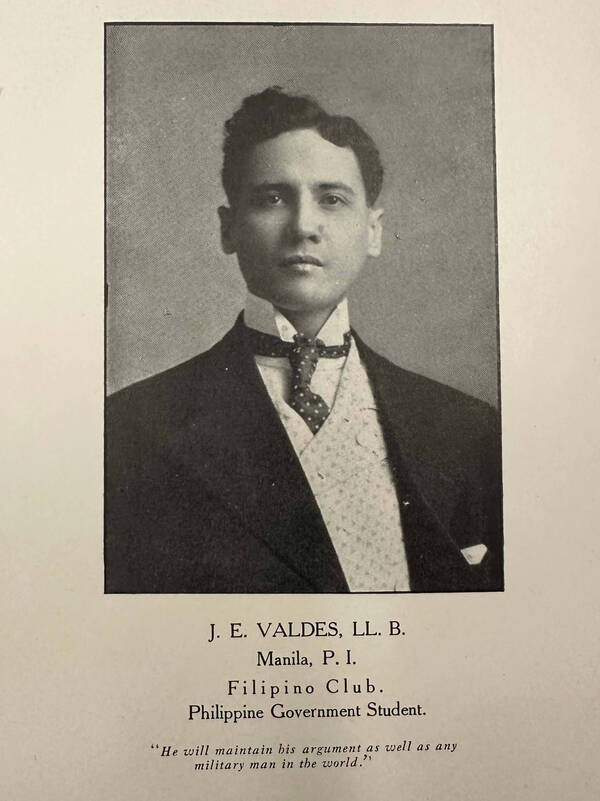
José Eduardo Valdes, Class of 1906/The Dome
Last year marked the 30th anniversary of the founding of this affinity group, but Notre Dame’s ties to the continent begin with those first Filipino students.
That legacy was born in a complicated moment in history, Dela Cruz notes. Emerging from the Spanish-American War, the Philippine-American War of 1899-1902 and the onset of U.S. colonial rule, which lasted until 1946, it’s a story shaped by pain and privilege — pain in the loss of Filipino sovereignty under the short-lived Philippine Republic, and privilege in that the pensionados were largely drawn from highly educated families being prepared for colonial leadership, he says.
By September 1905, 12 Filipino students were attending Notre Dame. In their spare time, they enjoyed baseball, track, football and swimming. “These Filipinos are very loyal to Uncle Sam and when asked regarding the American rule [in the Philippines], always express themselves in unmistakable terms that they are glad to be ‘Americans,’” the Tribune reported.
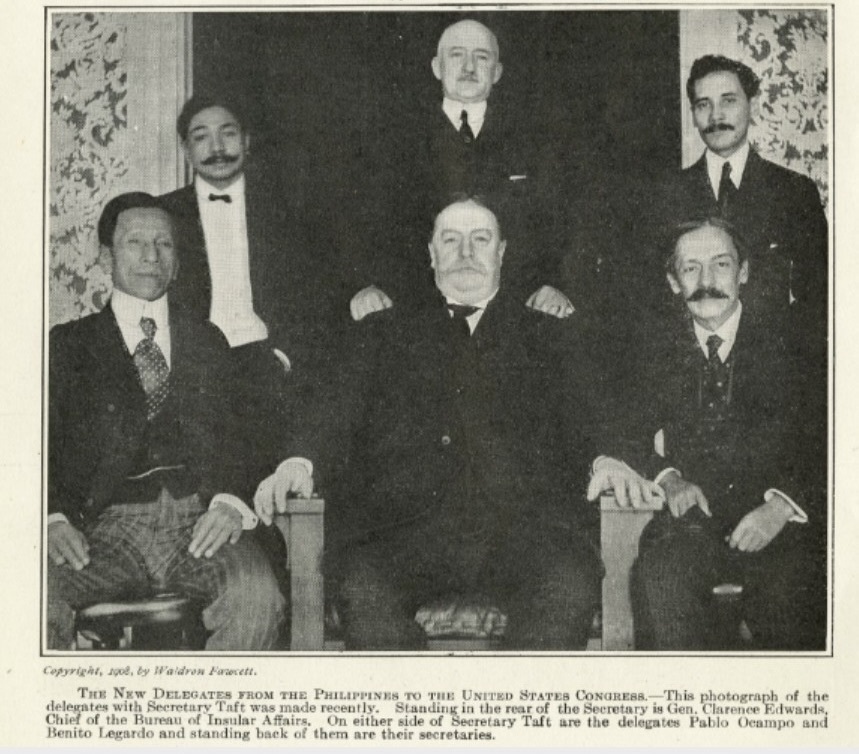
The first pensionado to earn a Notre Dame degree was José Eduardo Valdes of Manila, who received a bachelor’s degree in law with high honors in 1906. Newspapers reported that Valdes was the first pensionado to graduate from a U.S. college. He would serve in the cabinet of Benito Legarda, the first resident commissioner of the Philippines in the U.S. colonial government, and later became chief of the income tax division of the Bureau of Internal Revenue for the Philippines. His son, Gonzalo R. Valdes, graduated from Notre Dame in 1935.
The 1906 edition of the Dome yearbook devoted a page to the Philippine Government Students’ Club and its dozen members. By the 1920s the organization had become the Manila Club. Those groups were forerunners of today’s Filipino American Student Organization, a club whose events include Fiestang, an annual music and cultural showcase that culminates in a Filipino banquet.
Philippine Government Students’ Club in 1906/The Dome
The earliest Filipino student group was inward facing, says Sophia Labrador ’25, who traced those early students through campus publications for a research paper her senior year. “The point of the [first] club was to specifically connect with other Filipinos on campus,” she says, and to make a good impression on Americans who had little knowledge of the Philippine islands or their people.
Over the years, that club and its successors focused more on sharing Filipino culture through music, dance and traditional foods. Today students of any nationality are welcome to join, says Labrador, a former club officer.
When the first pensionados arrived, they found two students who hailed from the Philippines, a pair of brothers of Spanish heritage, Evaristo and José Batlle of Manila. They had enrolled in 1902 after their businessman father saw the University’s Spanish-language catalog and wrote to request more information, according to correspondence in the University Archives.
“We are the first Filipinos to come here, and we are treated with the kindest attention. You can not imagine the interest which our native land . . . [has] awakened here,” Evaristo Batlle told a Manila newspaper for an article that was republished in a March 1903 issue of the Notre Dame Scholastic. The Batlles earned bachelor’s degrees in architectural engineering in 1906.
Because the brothers were sons of a Spanish father who had worked in the Philippines, they considered themselves partly or mostly Spanish. Their home was listed as Barcelona, Spain, in the 1903-04 campus bulletin and in their commencement program, and they spent their summers in Europe. After college, Evaristo Batlle became editor of an import-export trade magazine based in New York City. José Batlle practiced architecture in Spain.
An estimated 500 Filipino pensionados received federal scholarships and attended U.S. colleges between 1903 and 1943. Thousands of other Filipino students were educated in the U.S. during those decades, with their studies paid for by other means. No comprehensive list records the names or number of pensionados who attended Notre Dame.
The University’s first pensionados arrived three months after then-Secretary of War William Howard Taft visited campus to give a lecture titled “The Church in the Philippines.” At the time, Catholic journalists had raised questions about why all the pensionados thus far were enrolled in public universities. Taft had led the effort to establish a civilian government in the Philippines.
In his speech, the future U.S. president highlighted how religious tolerance helped forge a settlement regarding ownership of lands occupied by the Catholic Church in the Philippines and expressed hope that American priests would continue missionary work in the islands.
Valdes, upper right, served in 1908 as secretary to Benito Legarda, lower right, a non-voting delegate to the U.S. Congress. U.S. House of Representatives.
Catholicism had arrived in the Philippines in 1521 with the Spanish expedition led by the Portuguese explorer Ferdinand Magellan, and the faith spread rapidly after the appearance of missionary orders. By 1900, more than 90 percent of Filipinos were Catholic.
In exchange for their scholarships, the pensionados were required to return to the Philippines and provide at least 18 months of government service to help prepare for independent rule. Depending on their training, that service might be in government, law, public health, teaching or engineering.
The Filipinos at Notre Dame “are admired both by students and professors for their studious habits and their gentlemanly behavior. I wish we had a thousand students as diligent and studious as our Filipinos,” Notre Dame President Rev. John W. Cavanaugh, CSC, wrote to a prominent Manila attorney in 1906. “One of them, Mr. Valdes, is known to you, and I look to him especially for great service to the Filipino people on his return home. I am one of those who thoroughly sympathize with the aspirations of your people for liberty, and I hope that the United States of America will adhere to her traditions when the proper time comes to allow perfect independence to your people.”
The first Filipino to earn two Notre Dame degrees was José Antonio Urquico, who earned a bachelor’s degree in 1916 and a master’s in 1917, both in law. He would serve as governor of the Philippine province of Tarlac in the 1930s.
Alfonso Ponce Enrile studied law at Notre Dame in 1905-07, and later became a prominent Filipino lawyer and politician. One of his sons, Juan Ponce Enrile, was a lawyer and politician who served as the chief architect of martial law under President Ferdinand Marcos Sr. before playing a role in toppling the Marcos regime in 1986.
Pio Montenegro was a journalism major and popular public speaker who graduated in 1923. As a student, he presented public lectures in South Bend and other American cities about the history and culture of the Philippines, arguing that the islands were ready for self-rule.
Montenegro was also one of the first students to report seeing a ghost at Washington Hall, a claim that has found its way into numerous campus publications over the past century. He said he witnessed the specter of the late Notre Dame football star George Gipp riding a white horse up the front steps and through the hall’s front doors.
Students from other Asian countries who studied at Notre Dame in the early 20th century included Yasabro Francis Sugita of Osaka, Japan, who attended 1905-07, and Wai Kyi Woo of Shanghai, China, in 1912-13. In 1921, Paul Sun Ting, of Chinese ancestry but a resident of the Philippines, graduated with a chemical engineering degree. Dominic Ching Kay Ong, Class of 1923, of Amoy, China, is considered the first graduate from mainland China. The first female graduate from the Philippines was Rebecca Nebrida of Manila, who earned a master’s degree in 1963.
On December 9, 1935, Notre Dame celebrated Philippine Day. President Franklin D. Roosevelt visited campus and delivered an address in the Fieldhouse. He and Carlos P. Romulo, a Filipino independence leader and editor and publisher of The Philippines Herald, received honorary doctor of laws degrees. The occasion honored the creation of the Philippine Commonwealth and celebrated more than 400 years of Catholicism in the Philippines. FDR was the first U.S. president to visit campus during his term in office.
The pensionado program ended in 1943, while the Philippines was under Japanese military occupation during World War II. The Philippines became an independent nation in 1946.
One Filipino who was a lasting figure at Notre Dame was Pastor Villaflor, a student from 1905 to 1910. University records don’t indicate that he earned a degree, but Villaflor returned to campus in 1926. Skilled in weaving and needlework, he became well known for his elaborate embroidery of clerical vestments. Living in a small room in Corby Hall, he made Notre Dame home until his death in 1955 at age 80.
The first Notre Dame club outside the United States was formed in Manila in 1924. Today the University still has an alumni club in the Philippines and at least 20 other clubs across Asia and the Pacific islands. More than 6,000 alumni are members of the Asian Pacific affinity group, which presents annual awards named in honor of José Eduardo Valdes.
While the University archives and old newspapers offer occasional brief mentions of the early Filipinos at Notre Dame, detailed profiles and first-person accounts of their presence are lacking. Many of these alumni returned home and lost touch with the University. Labrador was disappointed to find so few details about those students during her research. Further exploration in the Philippines may uncover the paths their lives and careers took. “I’d be curious,” she says. “What did they do with their Notre Dame education and how does that match up against other pensionados who were at other [colleges] across the U.S.?
“Maybe we could discover old letters they wrote back home. I would love to know how they felt while they were at Notre Dame.”
Margaret Fosmoe is an associate editor of this magazine.
]]>
Margaret Fosmoe ’85tag:magazine.nd.edu,2005:News/1819902026-05-22T10:44:00-04:002026-05-22T10:44:44-04:00An Irish Goodbye
Harry Clinton ’26, a former leprechaun sporting an alternative cap with his gown, celebrates with other graduates during commencement.
Photo of the Week highlights images from campus and from the Notre Dame family around the world. Have a snapshot you think we should see? Email mmcdani2@nd.edu to be considered for publication.
]]>
Michael Caterinatag:magazine.nd.edu,2005:News/1818732026-05-19T12:35:00-04:002026-05-19T15:52:21-04:0014th Annual Young Alumni Essay ContestNotre Dame Magazine’s 14th annual Young Alumni Essay Contest is accepting submissions.
The magazine’s editors, who will judge entries for the 2026 Schaal Prize — named in honor of the contest’s founder, retired managing editor Carol Schaal ’91M.A. — are looking for original creative nonfiction essays: evocative, first-person works that would appeal to a college-educated audience. For models, they suggest reading CrossCurrents essays, which can be found in each back issue and posted on our digital issue pages.
The Schaal Prize winner will receive $1,000. Second-place winner(s) will receive $500 apiece. The first- and second-place winning essays will appear in the Winter 2026-27 issue of Notre Dame Magazine. Authors of any work receiving honorable mention will win $100 and publication at magazine.nd.edu in 2027.
Eligibility:
The contest is open to those alumni who received a University of Notre Dame bachelor’s degree in the years 2017 through 2026. Only one entry per eligible writer is allowed. Previous winners may enter.
Submission requirements:
Entries must be written in English, submitted in Word format and be the original, unpublished work of a sole author. They should range in length from 800 to 1,500 words. Essays longer than 1,500 words will be disqualified. Entries will be accepted now through midnight on Monday, September 7, 2026.
Submissions must be entirely the author’s original work; the use of generative AI tools at any stage of writing is not permitted and will disqualify any participant.
Submission procedures:
Because the entries will be read blind, it is imperative that entrants follow these procedures:
Send an email to magazine@nd.edu. Include the author’s contact information in the body of the message: name; ND graduation year; postal address; email address; phone number. Make sure to include the title of the submission in this email.
Attach the manuscript of the entry to this email. The manuscript should include the title of the essay but no author-identifying information.
Judges’ decisions are final. Published essays will be subject to editing, and winners will be notified by email in October.
]]>
Notre Dame Magazinetag:magazine.nd.edu,2005:News/1817792026-05-18T09:15:00-04:002026-06-08T09:23:43-04:00Still with the MusicPhotography by Michael Caterina
On Monday evenings during the spring semester, Ricci Band Rehearsal Hall came alive with the sounds of the University Band. Under the sloped ceiling, a cacophony of instruments broke out as students, faculty members and university alumni warmed up with their trombones, saxophones, drums, clarinets and flutes, among others.
In one of the blue chairs sat 97-year-old professor emeritus William Cerny, former chair of Notre Dame’s music department. This was his first semester back in the band after more than three years.
He stopped going to rehearsals during the COVID-19 pandemic, and his wife passed away in 2022, leading him to take a break. Then he attended the band’s fall 2025 concert. He was so impressed with the performance that he approached the conductors to ask if he could re-join for the spring semester.
“They opened up the door and let me join it,” he says.
Band director Sam Sanchez ’98, ’05M.A., sent Cerny the music from the fall concert so he could make sure he was up to the task. He began participating in weekly rehearsals in January.
Cerny previously played the clarinet in the band, and this time, he has a new instrument in his hands — the flute — but his lifelong principal instrument is neither. At his core, he is a pianist. He had a five-year career as a professional accompanist in New York City, from the time he graduated from the Yale School of Music in 1954 until he became a professor at the University of Rochester’s Eastman School of Music in 1959.
“That’s what I thought I was going to do in my life,” Cerny says of his work as an accompanist, “but academia had more security.”
In 1970, while Cerny was working in Rochester, then-Notre Dame President Father Theodore M. Hesburgh, CSC, approached him to ask if he would be interested in joining the faculty at the University. He declined the offer because Notre Dame was still an all-male institution.
“With four girls, I wanted a place that was adaptable to their education,” Cerny says. He also didn’t think he could build a successful music program without female musicians.
In 1972, however, Notre Dame opened its doors to female undergraduates, so the Cernys packed up and moved to South Bend. That September, Cerny became a professor and chairman of the music department. He remained department chairman until 1981.
The music department at Notre Dame was rather humble when Cerny assumed his position. He recalled that there were only three pianos for the entire program, and many prospective students chose to attend schools with more established programs.
“The program, I felt, had to be restructured,” Cerny says. He aimed “to build up a program that would be attractive not only to beginners, but to experienced players as well.”
Cerny succeeded. In 1973, he announced an expansion of the department, which included intensifying curricula and adding musical groups and concert series. Under his leadership, the Notre Dame Symphony Orchestra gained new life, and a co-ed chorale group was established. He also taught a number of courses on topics such as Beethoven and music literature.
All four of his daughters went on to graduate from Notre Dame: Elaine ’77, Jean ’79, Mary ’83 and Carol ’85.
Cerny retired from the faculty in 2000. In his free time, he began focusing his attention on other instruments, including the piccolo, trombone, clarinet, oboe, French horn and flute. The dining room in his house is full of these instruments and many more CDs, as it doubles as his library and recording studio.
In the late 1990s, with the help of his daughter, Carol, Cerny started Wilmarc Records (a combination of his and his wife, Mary Ann’s, names). He began recording half-hour programs featuring him playing the piano and adding commentary. Those programs, “Explorations Into Piano Literature,” still air on Sundays on WSND-FM, Notre Dame’s classical and variety radio station.
In retirement, Cerny has more time for recording. He’s recorded so much music, in fact, that he says his recordings could be played once a week without any repetition for five and a half years.
“I have a very nice family that . . .” he says.
“Tolerated it,” his daughter, Jean, finishes for him, laughing.
“That’s a good way of saying it,” Cerny says.
Notre Dame’s University Band — founded in 2003 — is open to students, employees, alumni and members of the local community. The band performs one spring concert and one fall concert each year.
The free time he found during retirement also inspired him to join the University Band.
Playing in the band no longer comes as easily as it once did, but Cerny has learned to adapt. As the oldest member of the band, Cerny struggles with his eyesight and hearing, which can make rehearsal challenging. He sometimes will ask the conductors to speak louder, and he occasionally relies on assistance from the oboe players next to him, both students, to find his place in the sheet music.
Rising senior John Geitner and Cerny during a University Band practice
“I’m impressed with them, not only as musicians, but as people,” Cerny says of his fellow band members. “I’m very impressed with the student body at Notre Dame. They’re the nicest group of people, quite frankly.”
Cerny plans to continue his participation in the University Band.
“If I make it, [with] my age, I don’t know,” Cerny says. “But next semester I’d like to get back into the band again. And this time, [playing a] different instrument.”
Brigid Iannelli, a rising junior American studies major with minors in journalism and education, was this magazine’s spring intern.
]]>
Brigid Iannellitag:magazine.nd.edu,2005:News/1817322026-05-18T08:18:00-04:002026-05-18T09:19:01-04:00Harvesting Spring
It starts in late April, just as the first blooms start to fall.
Keen eyes across campus track the movement of landscaping trucks.
The Notre Dame tulip harvest has begun.
Among University employees, the harvest holds almost myth-like status: each spring, the tulips are pulled from the many beds across campus and left for anyone interested in replanting the bulbs in their own gardens. Supposedly, homes across northern Indiana mark the arrival of spring with pops of color courtesy of these emancipated bulbs.
Of course, in five years of working at Notre Dame, I’ve never gotten a single one.
Landscape crews tell you to visit an unpaved lot north of campus, where they dump old branches, grass clippings and other debris, but in my experience, the best bulbs get intercepted long before arriving there. Making nice with Landscaping Services doesn’t hurt.
Photo by Barbara Johnston
I’m not so discriminating as to seek out specific cultivars. The crimsons at the statue of Jesus on God Quad, the sunny orange and yellow alongside the Main Building, the Hesburgh Library purples, the Grotto whites — all are lovely and would be a welcome addition around our home.
This spring, I banded together with several coworkers to pool our resources to triangulate around the gardens, with a promise to divvy up any bulbs we’d obtain — all coordinated through a group chat we nicknamed “the Tulip Tribe.”
After a few false starts, last week we hit paydirt. While heading to a Friday morning coffee meeting at Cafe J., a colleague happened upon a crew working the gardens at the Main Gate on Notre Dame Avenue. One frantic scramble later, the Tulip Tribe had its first quarry of the spring.
The next day, another coworker heard from her husband, a campus usher working student move-out, that the Hesburgh Library flower beds were next on the docket. By the time I got there, the bulbs were long gone, but a chance encounter with a couple friendly guys with pitchforks cued me in on the motherlode: the Grotto tulips were getting pulled Sunday morning.
I arrived bright and early Sunday, garbage bags in tow, with my wife, Michelle, an associate editor of this magazine. I’ve heard stories of cutthroat feeding frenzies, old ladies throwing elbows over the withering stems. But the atmosphere on this sunny morning was bucolic, even lazy, and the few people who joined us to scavenge were kind and eager to share their tips on keeping the bulbs alive. When the 10 a.m. Mass at the Basilica let out, smiling families joined in, ready to root around the dirt in their Sunday best.
After this year’s harsh winter beatdown, spring’s sputtering arrival felt like the breath of life.
It’s a joy to watch Notre Dame fade into its seasonal floral regalia. Like the Holy Cross priests switching from Easter white vestments to the green of Ordinary Time, flowerbeds move from magnolias and hyacinths to irises and lilacs, a divinely orchestrated heartbeat of time. And each year, just as the more than 30,000 tulip bulbs across campus reach their peak, we arrive at final exams, move-out, Commencement. The cycle continues.
Someone with a wiser mind and greener thumb than I could surely find a lesson in the annual tulip hunt: something about joy and hope carrying us through the frustrating and frenetic search for bulbs, ultimately enlightening us to the ever-unfolding plan of the universe.
It’s silly, but in the same way one might steal a vial of sand from a beach, these bulbs feel like a souvenir to me, a touchstone of a place that’s touched me deeply. This is where I studied, met my wife, devoted a large piece of my working life. Memories, emotions, meaning — all traces of Notre Dame distilled into dirt and vegetation.
Now, walking the path to the Grotto, alongside the newly planted begonias and geraniums (whose hardier blooms will carry us well into the fall), I think of the bulbs drying on my porch at home. Once harvested like potatoes — pitchforked from the grudging earth and left in piles in the grass — now resting quietly, biding time until their next bright moment.
Sean Cuneo is a writer and aspiring gardener. He lives in South Bend in a house that, with a little luck, will be surrounded by tulips next spring.
]]>
Sean Cuneo ’12tag:magazine.nd.edu,2005:News/1817512026-05-15T10:50:00-04:002026-05-15T13:21:51-04:00Lit by Tradition
Seniors gather at the Grotto for the last time as a group before commencement this weekend.
Photo of the Week highlights images from campus and from the Notre Dame family around the world. Have a snapshot you think we should see? Email mmcdani2@nd.edu to be considered for publication.
]]>
Michael Caterinatag:magazine.nd.edu,2005:News/1815692026-05-11T09:30:00-04:002026-05-11T09:31:14-04:00Finding Moon JoyFarber stands on the Causeway with two of her children, waiting for the launch of Artemis II. Photo provided
Control-room consoles lit up during the April 1 liftoff of the Artemis II lunar mission while planetary geoscientist Kelsey Young ’09 worked at Houston’s Johnson Space Flight Center with her NASA lunar science team. Alyssa Farber ’08 watched the launch from the NASA Causeway near the Kennedy Space Center in Florida, her mother and two of her children standing beside her as the Orion spacecraft roared into the sky.
Neither Young nor Farber is quite sure when they fully exhaled again. Maybe not until the Artemis crew splashed down 10 days later, they say.
“It has been full joy since they landed,” Farber adds.
“Moon joy,” they both call it.
Artemis II, a crewed lunar flyby mission, marked humanity’s return to deep space for the first time in more than 50 years. The crew traveled farther from Earth than any humans before them, leaving low-Earth orbit and surpassing a distance record set by the Apollo 13 mission in 1970.
Young and Farber were among the thousands of people in the United States government and the private sector whose work made the mission possible.
Young has worked as a NASA scientist since 2016. For Artemis II, her role expanded into a brand-new position she created — lunar science lead.
“I have always been very comfortable defining my own path and finding my own space,” Young says.
Young works from Mission Control Center during the Artemis II mission. Photo by NASA
Before the mission’s launch, she defined its scientific and exploration goals, targeting features like impact craters and ancient lava flows on the moon’s far side. She led crew training, preparing astronauts to identify key phenomena and relay their findings to NASA. During the flight, she worked at the control console, making real-time mission decisions.
She also established two new science “backroom” teams to support mission control, one covering scientific evaluation and another science-related mission operations. The former analyzed incoming images and recordings to guide the crew’s study of geological features, while the latter focused on human factors such as monitoring radiation exposure and the astronauts’ physiological responses.
Young’s team in the Science Evaluation Room. Photo by James Blair/NASA
Because of her team’s work, Artemis II became the first NASA mission in which astronauts weren’t simply transmitting observations but were involved in an active dialogue with scientists on Earth. As they shared what they were seeing and hypothesized in real time, lunar experts could immediately respond with feedback, ask follow-up questions and request additional details, allowing the crew to adjust focus and push their discoveries further.
Young and her team won’t finish going through all the data the Artemis II astronauts brought home for several months.
Where Young focused on what the astronauts would learn on the mission, Farber’s primary concern was how they would get to the moon and back.
A software engineering senior manager overseeing flight systems at Lockheed Martin, Farber leads one of three Orion software product teams, supervising roughly 200 engineers responsible for the spacecraft’s guidance, navigation, control, propulsion, docking and backup systems.
The firm’s software governs how Orion flies from launch through splashdown — and how it operates when things go wrong. Even things like the checklist that the astronauts use for tasks are automated through software her team provides.
The work is about preparation — building layers of redundancy so that even worst-case scenarios don’t become catastrophic. Every part of the spacecraft is supported by multiple backup systems, and Farber’s team, composed of NASA and Lockheed Martin employees, continues working throughout the mission to ensure they can fix things remotely before they jeopardize the mission — or the safety of the astronauts.
“Anytime anything went wrong, boom: There were people who knew the answer,” Farber says. “They could send the right commands in seconds or pull together the resources to make the right decision.”
One issue the crew faced was how deep space radiation can disrupt spacecraft electronics. During the mission, radiation strikes temporarily disabled some computers and displays, but built-in software detected the faults, restarted the systems using backup data, and restored normal operations. Farber’s team monitored these in-flight events. Each time, everything worked as designed with no data loss.
“This mission was a hard-fought success,” Farber says. “Not just perfect and smooth sailing. But when it mattered, we had the right minds looking at the solutions.”
Photo by Joel Kowsky/NASA
For NASA’s Young, Artemis II was primarily about discovery. After all, Earth and its moon are so close together, as far as the solar system goes, that for the past 4.5 billion years, they have experienced many of the same formative events. But unlike Earth, the moon has no plate tectonics, oceans or vegetation to continually reshape and obscure its surface, meaning it offers a far clearer record of that shared history and a uniquely valuable place to study it. The moon, Young explains, is “a witness plate for the whole solar system.”
Already, the April 2026 mission has revealed new lunar insights — from noting previously undiscovered geological features to spotting subtle variations in the moon’s surface colors that may reveal its mineral composition and how it’s morphed over time. Some of these details are so faint that astronauts could see them only under specific angles of sunlight.
More discoveries remain buried in the data sent back through photographs and annotations, which Young’s team will continue to review before any public release.
“The moon is something that unites all of us.” Young says. “Every single human being all over the planet has their own way of connecting with the moon. And this mission brought the moon a little bit closer to home, to all of us, but there is still so much we have yet to understand about it.”
The last crewed lunar mission, Apollo 17, launched in 1972 — long before Farber and Young were born. NASA’s first six lunar space flights, starting in 1969, captured the American imagination, but after decades passed without further progress, much of that shared sense of awe and possibility had faded. Now, by taking another historic step toward returning astronauts to the lunar surface, Artemis II is rekindling that spirit — inviting a new generation to share in the feeling.
“Kelsey has obviously learned an awful lot since she left Notre Dame,” says lunar scientist Clive Neal, a professor of civil and environmental engineering and earth sciences, and one of Young’s mentors. “And to see her when she was on NASA TV during the mission? She couldn’t stop smiling, and that was infectious.”
Farber arrived at Notre Dame torn between mechanical engineering and theater. Despite an initial dislike of computer programming, she realized she loved “making things fly” and majored in aerospace engineering instead.
Young, an “outdoor-loving, field-trip kid,” was drawn to environmental geosciences. At a student, that curiosity took her to Iceland, where she studied volcanic formations as analogs for Mars, where similar features appear.
As students, the women had a passing connection for one year on the Notre Dame rowing team, bonding as two of the few engineering majors on the roster, but their paths seldom crossed thereafter. Years later, separated by 1,600 miles — Farber working at Lockheed Martin in Denver; Young at NASA’s Goddard Space Flight Center in Greenbelt, Maryland — they became teammates again on Artemis II.
“I got to experience Apollo through storybooks and history lessons and old videos,” Farber says. “And that was a huge cultural moment my parents were a part of, but for me, it’s just in the history books. And Artemis II is . . . happening in real time. And to know I even had a small part to play in that is just really just amazing.”
Colleagues, friends, even distant relatives reached out to both Young and Farber after liftoff.
“It was very heartwarming,” Farber says. “To have a distant relative call and be like, ‘Dude, I know you’re a part of this; I’m so proud of you.’ There was a lot of family pride in that. So it was really cool to maybe be that beacon of joy and hope for others as well.”
People watch the Artemis II liftoff from the Banana Creek Launch Viewing Area at the Kennedy Space Center. Photo by Keegan Barber/NASA
Farber’s 8-year-old son talks about following in his mother’s footsteps. Young’s 2-year-old daughter points up and shouts “Moon!” whenever she sees it.
Those involved in the mission feel the same awe. Farber remembers seeing her manager, her senior by 20 years, shed tears at splashdown. She also saw joy on the faces of employees just out of college, knowing that they were able to contribute to something momentous.
“We had full moon joy,” Farber says. “Now we have a little bit of Earth joy, too.”
Michelle Cuneo is an associate editor of this magazine.
]]>
Michelle Cuneotag:magazine.nd.edu,2005:News/1815472026-05-08T11:59:00-04:002026-05-08T11:59:58-04:00Scale Model
A 10-foot-tall dragon sculpture made of steel sheet, cast iron, steel rod, tire and copper wire peers over the wall behind Riley Hall. The piece took teaching fellow Francis Akosah eight weeks to complete and sits beside his next project-in-progress: an elephant.
Photo of the Week highlights images from campus and from the Notre Dame family around the world. Have a snapshot you think we should see? Email mmcdani2@nd.edu to be considered for publication.
]]>
Michael Caterinatag:magazine.nd.edu,2005:News/1813212026-05-01T12:57:00-04:002026-05-01T12:57:31-04:00Sink or Swim
Students celebrate the last day of classes on the Library Lawn at Summer Fest: La Dolce Vita.
Photo of the Week highlights images from campus and from the Notre Dame family around the world. Have a snapshot you think we should see? Email mmcdani2@nd.edu to be considered for publication.
]]>
Michael Caterinatag:magazine.nd.edu,2005:News/1811522026-04-28T05:00:00-04:002026-04-27T16:37:03-04:00What I’m Reading: The Rats of Montsouris, Léo Malet
It’s March, and I’m sitting with my wife on a bench in Parc Montsouris, a green space in the 14th arrondissement in Paris. We are here ostensibly so I can breathe the air of a novel I reread a few months ago. Written by Léo Malet, The Rats of Montsouris is an installment in a series of cases investigated by private detective Nestor Burma. Published in French beginning in the late 1940s, Malet’s series was hailed in its day as “Les nouveaux mystéres de Paris,” a reference to Eugène Sue’s famous gathering of tales from the 1840s depicting the filthy underbelly of La Ville-Lumière, the City of Light. Each of Malet’s novels is set in a different arrondissement, though I’m not sure he completed a full set of 20 volumes.
The Burma novels were translated into English in the 1990s and published in uniform paperbacks by Pan Books, each cover featuring a moody black-and-white image by the great Parisian photographer Robert Doisneau. The translations are now out of print and some of the titles are remarkably expensive secondhand, though I’ve managed to add seven of them to my library so far.
Of course, the whole world of Paris has changed many times over since Malet first published Les Rats in 1955. A conspicuous measure of that change in Parc Montsouris is the absence of the Palais de Bardo, which Malet mentions, and the weather station that it housed; apparently the Palais fell into disrepair and then was destroyed by fire in 1991. But some of Malet’s other landmarks endure — the obelisk erected in memory of a French expedition to North Africa massacred by the Touaregs in 1881, and the Chalet du Parc, where Nestor Burma and Hélène, his comely office assistant at the Fiat Lux Detective Agency, grab lunch and discuss the case at hand, which involves a burglary ring and murder.
But what did I expect? Inspired by the “hardboiled” American detective fiction of Raymond Chandler and Dashiell Hammett, Malet wrote his books to a market-tested formula: his Nestor Burma is a close relative of Chandler’s Philip Marlowe and Hammett’s Sam Spade. Perhaps the “reality” that Malet’s novels reflect has less to do with the time and the place in which they are set and more to do with the minds of the readers who devoured them when they were first published. Emerging from the dark days of the German occupation of Paris during World War II — Fiat Lux translates as “let there be light” — Malet created in the character of Nestor Burma a figure committed to restoring some modicum of social order and to seeing that justice is served even as he scuffs some of the finer points of lawful behavior. The popularity of the series and the fact that Burma’s detective work earned Malet prominent prizes for crime fiction (in 1947) and black humor (in 1958) certainly suggest that his hero satisfied some essential need in his readers. Tellingly, the occupation is part of the backstory of The Rats of Montsouris.
So, have I found what I came here looking for? Are my wife and I breathing the rarefied air of Nestor Burma and la belle Hélène? Well, the atmosphere remains just as Malet inscribed it more than 70 years ago: “It was peaceful but melancholy in the Parc Montsouris. We walked towards the lake under the lifeless gaze of the statues on the grass and the indifferent stare of the gardeners watering the flowers.” Plus ça change? Close enough, I guess.
But even closer is the spirit of another literary inscription of the park by Malet’s contemporary, the popular poet Jacques Prévert. (Interestingly, Malet’s Burma claims that he once lived in the same nearby building as the real-life Prévert.)
Many of Prévert’s poems in his most famous volume, Paroles, published in 1947, were translated nicely into English by the legendary San Francisco poet Lawrence Ferlinghetti in 1958. Curiously, however, Ferlinghetti omitted “Le Jardin,” one of my favorites when I muddled through Paroles in the original French a few years ago. I translated it myself back then and recited it to my wife. Should I admit that Prévert’s poem is the real reason we’re sitting on a bench in Parc Montsouris? I’ll recite it to her again now:
THE GARDEN
Millions and millions of years
Would not suffice
To tell of
The tiny second of eternity
When you kissed me
When I kissed you
One morning in the middle of winter
In Parc Montsouris in Paris
In Paris
On Earth
Earth which is a star.
Thomas O’Grady is distinguished affiliate scholar in the Keough-Naughton Institute for Irish Studies at Notre Dame and scholar-in-residence at Saint Mary’s College.
]]>
Thomas O’Grady ’85Ph.D.tag:magazine.nd.edu,2005:News/1808912026-04-20T13:54:00-04:002026-04-20T13:54:42-04:00As He Saw ItPhotography by Brian Nevins
In 1987, as I was leaving the house for my first day as a young English professor at Stonehill College, a Holy Cross school a half-hour south of Boston, my husband asked me, “Do you think you’ll ever get to meet Chet Raymo?”
Chet was professor of physics and astronomy at Stonehill, and we had been reading his weekly Science Musings column in the Boston Globe for several years. He already felt like a presence in our lives — someone who saw the world more clearly than the rest of us and opened our eyes too.
And then I went to campus that first day, and there he was, chatting with some of my English department colleagues. And thus began a 39-year friendship, memories that I’ve held close since his death on January 25 at age 89.
Chet taught us all how to pay attention. He knew how to be still. He knew how to look. He knew how to listen. He had a reverence for the world — but not in any abstract way. His reverence was grounded in the smallest, most particular things. On a campus stroll, he would stop you mid-stride to point out something you would have otherwise missed entirely. I remember the spring day he insisted I reverse direction and follow him to watch a killdeer — just to see how it behaved, feigning a wounded wing to distract predators away from its nest. And of course, once you saw a killdeer through Chet’s eyes, it wasn’t just a bird anymore. It was a small drama, a marvel, a lesson in presence.
There’s a short section of a poem by Mary Oliver that feels to me like it could have been written for Chet:
Instructions for living a life:
Pay attention.
Be astonished.
Tell about it.
That’s exactly what he did — through his columns, his rich essays in Notre Dame Magazine, his many books, his teaching and his friendships. He paid attention to the world; he allowed himself to be astonished by it; and then he gave that astonishment back to us. And he did it with joy — and with a kind of playful seriousness.
This was, after all, the man who once invited the entire Stonehill campus to gather on the quad and wait for aliens to land — and he wrapped himself in tinfoil to attract them. And the same man who, when his novel The Dork of Cork became a major motion picture — Frankie Starlight — decided the world premiere should take place at Stonehill. It was an evening I remember as one of the great communal celebrations in Stonehill’s life. The whole campus turned out — dressed up, walking a red carpet, drinking fake champagne — because we all understood that something rare and beautiful had happened in our midst.
Over the years, my husband and I — and our three daughters — were lucky to become part of Chet and Maureen’s circle of friendship, through dinners, parties, conversations, travels to visit them in Ireland and the Bahamas. Even on a visit just to sit on their front porch, we always enjoyed the easy, enduring companionship that marks a life well shared.
I’ve always loved that our stories intersected even before we knew it — that Chet and Maureen met in South Bend at the University of Notre Dame and Saint Mary’s College. And they graduated the same year I was born, 1958. My husband and I met in South Bend too, when we were in graduate school at Notre Dame. And I would never have imagined the full circle of life that would lead us back here.
But apparently Chet and Maureen had imagined it: when I was named president of Saint Mary’s in 2020, Chet’s immediate message to me so perfectly reflected the two of them — generous and full of quiet affirmation.
It simply said: “Wow! Been looking forward to this fit for years. —Chet & Mo.”
That was Chet. He saw things — sometimes long before the rest of us did. He made connections. He glimpsed possibilities. He discovered meaning in the world and potential in other people.
And so if we are wondering how to honor him, perhaps it is simply this:
To pay better attention.
To allow ourselves to be astonished.
And to tell about what we see.
Because that is what he offered us: a way of being present in the world. And that’s how we can carry him forward.
Katie Conboy is president of Saint Mary’s College. This essay was adapted from her remembrance of Raymo, originally delivered at his memorial event at Stonehill College.
]]>
Katie Conboy ’86Ph.D.tag:magazine.nd.edu,2005:News/1808892026-04-17T10:31:00-04:002026-04-17T10:31:32-04:00The Tipping Point
Students race — with varying levels of success — in the Fisher Regatta. The tradition began in 1987.
Photo of the Week highlights images from campus and from the Notre Dame family around the world. Have a snapshot you think we should see? Email mmcdani2@nd.edu to be considered for publication.
]]>
Michael Caterinatag:magazine.nd.edu,2005:News/1808332026-04-15T15:43:00-04:002026-05-14T08:30:12-04:00Birds of a Feather
Howard Hall residents are enjoying their final semester as Ducks before they fly across South Quad to their new home.
Howard, the century-old building with a double archway, will permanently close its doors as a residence hall in May. Returning residents in August will relocate to Grojean Hall, a new dorm nearing completion just south of the Rockne Memorial Building.
Students were told in November that Howard would be permanently retired as a residence hall at the end of this academic year. The University has not announced plans regarding Howard’s future.
Junior Annelise Demers, the dorm’s vice president, says she cried when she received the news that Howard would close. “I was so sad,” she says. “It’s a really tight community. Everybody knows everybody.”
Howard Hall residents turn an inflatable duck into a sled during a 2022 snow day. Matt Cashore ’94
But the women of Howard are celebrating their home and its history. On April 11, they threw open the doors and welcomed back former residents for a last tour before the dorm closes, drawing several dozen alumni from across the decades. There were hugs and reunions in the walkway under the arch. Visitors were greeted by student residents and Anna Kenny, Howard’s rector for the past seven years, who will move with the returning underclassmen and serve as Grojean rector.
Doug Hasler ’87 was among those who attended to visit his old home and relive some of his undergraduate memories. “Hall life is so special. My closest friends are the friends I met while I lived in Howard,” he says. Howard was a men’s dorm until 1987, when it was converted to a women’s residence.
Hasler stopped by Room 141, where he lived freshman year, and shared stories with the women who live there now. That room, in the northwest corner of the first floor, is now part of Howard’s “Six Chick” suite — three adjacent bedrooms, a common room and a bathroom shared by six residents.
That suite of rooms is the building’s largest and has generally been in high demand during room picks, sophomore current residents Charlotte Esteva and Taryn Wilson told him.
Kim Boro Rollings ’03 joined the open house and was flooded with memories. “It was a really supportive community,” she says of the two years she lived in Howard.
“I was super sad to hear about the closing. It was my home for four years,” says Mary Pat Pearson ’97, who drove from her home in Chicago to attend the event.
After women moved into the building, they became the Ducks — the mascot named after a 1986 film Howard the Duck, which was based on a 1970s Marvel Comics duck character. The waterfowl theme carries throughout. At almost every turn, a visitor will encounter duck pictures, duck window stickers, plush toys, rubber ducks and similar items. The common area where residents gather to socialize is called The Pond.
Photo by Sarah Cahalan ’14
Some residents say the dorm houses a resident spirit, Howie the Ghost.
Howard’s traditions include Totter for Water, an annual 24-hour teeter-totter marathon to raise money for clean water projects in developing countries; a “chapel crawl” during Lent, encouraging fellow students to attend Mass in every dorm on campus; and the Howard Hoedown, a signature hall dance with a country-western theme.
Howard was constructed in 1924-25 and opened to its first residents in fall 1925. The building was originally intended to be named Old Students’ Hall. The University began soliciting donations from graduates and other former students as early as 1916 for construction of the new dormitory, which was needed for a growing student population. Individual contributions arrived in amounts of $500, $100 and even some $25 and $5 donations.
Architectural drawing of “Old Students’ Hall” before it was renamed to Howard Hall
With its brick walls and double-barreled central archway, Howard was Notre Dame’s first use of Gothic architecture. The building’s exterior features limestone carvings, including a statue of Saint Timothy, a football player, a squirrel, an owl and a weeping schoolboy. Howard was soon joined by neighboring Morrissey and Lyons halls, the trio facing a courtyard with a view toward St. Mary’s Lake. The three buildings were designed by Notre Dame architecture professors Francis W. Kervick and Vincent F. Fagan (Class of 1920).
The first residents of Howard Hall, 1925; The Dome yearbook
Shortly before opening, the new building was formally named in honor of Timothy Howard, an 1862 and 1872 graduate who was a Civil War veteran, a professor and dean of Notre Dame Law School, and an Indiana Supreme Court justice.
Howard originally featured almost entirely single rooms and housed 150 freshmen. It’s now home to 148 residents and is the smallest women’s dorm after Badin Hall. (Grojean, the new dorm, will house 275 residents.) Howard today has an eclectic mix of singles, doubles, triples, quads and the six-person suite. It has no elevator and only the chapel and a few study rooms have air conditioning.
During World War II, Howard housed U.S. naval recruits who were at Notre Dame as part of an accelerated program to train naval officers. A fully equipped infirmary and dental clinic were set up in Howard to serve the Navy men.
U.S. naval recruits march in front of Howard Hall in 1942. The Dome yearbook
Early on March 16, 1978, a fire broke out in Howard and flames quickly spread to the roof via an elevator shaft. (The elevator later was removed.) The fire forced evacuation of all residents amid heavy smoke, although there were no injuries.
In December 1986, University leaders announced Howard would be converted to a women’s dorm by the start of the next academic year. Some Howard men were angry about the upcoming switch and what they considered to be late notice to residents. Shortly after the announcement was made, Howard residents draped their hall in bedsheet banners sporting such slogans as “Walk like an Eviction” and “Rooms for Rent (girls only).”
Notable alumni who lived in Howard during their student years include: John Burgee ’56, an internationally known architect; Bill Dwyre ’66, former sports editor of the Los Angeles Times; John Bellairs ’59, an author of gothic mystery novels for children, including The House with a Clock in Its Walls; Brittany Bock ’09, a retired professional soccer player; and Francesca Russo ’18, a Notre Dame fencer and NCAA individual champion who competed at the 2021 Tokyo Summer Olympics.
Margaret Fosmoe is an associate editor of this magazine.
]]>
Margaret Fosmoe ’85tag:magazine.nd.edu,2005:News/1808352026-04-15T15:43:00-04:002026-04-15T15:43:05-04:00Howard Hall MemoriesWith Howard Hall closing as a residence hall in May, Notre Dame Magazine put out a request on social media for former and current Howard residents to share their memories of the century-old building. Here are some of the responses, which have been edited for clarity and length.
One memory that sticks out above the others is more my grandfather's memory than my own. My sophomore year room was 239, a triple corner room. As I returned to school that August, I gave my grandparents my new address. My grandfather — Art Lavery ’33 — remarked, “Oh, that's the corner room right next to the library. I lived in that room too.”
I thought he was confused, since the library was clear across campus. Little did I know that what I knew as the architecture building, and is now Bond Hall, was the library when my grandfather attended Notre Dame. Not only was he definitely not confused, we realized that we lived in the exact same room, about 60 years apart.
I met my future husband under the arches freshman year while he was passing through on his way to Morrissey Hall.
Next weekend I'm flying in and meeting up with two of my Howard roommates for the Luke Combs concert in Notre Dame Stadium, and we'll be heading over to the dorm for some pictures and to toast our old home.
— Katie Gorman Duffy ’95
I have a watercolor painting of a female mallard hanging on the walls of my apartment in New York City. When I am asked about it, I talk about Howard Hall.
Whenever I return to campus, I need to go “say hi” to Howard. Two of my best friends, who lived in dorms on West Quad while we were undergraduates, always question that impulse and say they don’t have any strong feelings about their dorm. That’s exactly what makes Howard Howard.
On a campus of 8,500 undergraduates, living in a building of about 140 of them created an inherently tight-knit community that most other dorms’ residents cannot relate to. More than anything, my favorite part about living in Howard was how easy it was to always have a friend accessible. Everyone from all classes knew each other, for the most part. It was almost impossible not to, given how small we were.
I am so sad that the University has decided to decommission Howard. As more behemoth dorms are built, the character and history and unique experiences provided by dorms like Howard will be eroded. If there’s one thing I know, though, it’s that us surviving Ducks won’t let the memory be forgotten.
— Laura Coletti ’13
Howard Hall residents graduating in 1978
The magazine’s solicitation for Howard Hall memories got the attention of our group of Howard alumni from the classes of 1978 and 1979. The core group consists of about 10 guys who lived together in Section 3 South for two years (1976-77 and 1977-78) and we became close friends. We’ve been in each other’s wedding parties, we’ve been to all our children’s weddings and, together with spouses and some of our older children, we still travel as a group about 50 years after the guys’ first trips together for spring breaks during college.
Soon after our graduations, six of our Chicago area-based Howard group started visiting our Howard rector — Father Gene Gorski, CSC, ’53, ’55M.A. — for a long summer weekend on campus for a few years. It included staying in Howard, using the campus athletic facilities, swimming in St. Joseph’s Lake, attending Mass celebrated by Father Gene in Howard and attending Sunday breakfast with him in Corby Hall.
Once spouses and children came along, that summer event evolved into a “Howard Reunion” on campus every summer for about 20 years — even after Father Gene moved to St. Ed’s as rector after Howard’s conversion to housing women. At its largest, with the out-of-town guys and families attending and some expansion to other Howard guys and their spouses and children, our summer Howard Reunion reached about 85 people. And we have counted 21 of the children from that large group who went on to attend Notre Dame or Saint Mary’s College.
Some of our group trips over the years also included Father Gene, who went along on a Caribbean cruise and what we later called “Cruises on Land” to various destinations in the U.S. We were very close to Father Gene. At his funeral in 2015, many of his CSC colleagues knew all about the “Father Gene Howard Hall Reunions.”
Our group’s RA in Section 3 South in 1976-77 is now the chairman of Notre Dame’s board of trustees, John Veihmeyer ’77. As we would say about John: Who knew?
— Brian Mulhern ’78
As an architecture student, I found sleep was quite a precious commodity. I will be forever grateful that as a resident of Howard (although Bond Hall was truly where I spent the most time) — the close proximity allowed me to stumble next door and sleep in an actual bed sometimes — as opposed to in the studio.
Also the ducklings in the spring, under the bushes.
— Alex Apostolou ’98
I lived in Morrissey Hall the summer session of 1966. Some of my fellow Morrissey residents learned that priests were quartered that summer next door in Howard Hall. And, my peers discovered, the priests had a refrigerator in the basement — a refrigerator containing beer. And there was an honor system to pay for it.
This prospect was something so alluring that we scratched our heads for some method that would be productive. I could never have imagined what the consensus would be, but it was decided that I looked “the oldest.”
So, donning my “vestments” — a shirt with actual buttons and the requisite black shoes and slacks — I took orders one night, and slipped into Howard. I made my way to the basement. Sure enough, there was a fridge.
In full view of a few of my fellow clerics, I opened the refrigerator, removed a discreet number of bottles, dropped what loose change we had managed to combine and tried to saunter out. It all went very well, except for the obligatory nods, waves and acknowledgments to the “other” clergy. Good to see you again; hey, how are you doing?; see you in class tomorrow, etc.
Mission accomplished. We had scored our beers. But I was so unnerved by the whole experience that I refused to try the stunt again, even though I continued to be reminded that I was the “oldest looking.” With “age” comes wisdom.
— Jack Mahon ’69
Former residents stand with Father Gene 30 years after graduation.
I had the good fortune to be a resident of Howard Hall during my time at ND (79-83), including my sophomore year in the quad over the arch. What Howard Hall may have lacked in creature comforts it more than made up for in character and strong community.
Any mention of Howard Hall in the ’70s and ’80s would be incomplete without the mention of our iconic and much beloved rector, Father Gene Gorski, CSC. From the first time we entered the dorm and knocked on his door (when he warmly welcomed every resident by first name) to our graduation four years later, Father Gene was there to encourage us through our time at Notre Dame. His Sunday evening Masses in the hall chapel were epic and a much appreciated opportunity to come together as a community and prepare ourselves for the week ahead.
That friendship lasted well beyond graduation. No visit to campus was complete without a visit with Father Gene to catch up on life and introduce him to our spouses and children.
— Jan Poczobutt ’83
“Pop it, lock it, polka dot it” are lyrics all Howard Ducks know, whether it’s from our annual Hoedown-themed SYR, teaching line dances during Welcome Weekend, activities at our yearly reunion at Warren Dunes or spending an hour dancing on South Quad waiting for Dorm Day results.
Notre Dame’s Dorm Day 2024 — Student Government’s Olympics-style competition among the dorms — called to all Howard Ducks, competing or not. For each competition, the cheering section from Howard at least tripled the number of girls competing in that event, and was the largest cheering section there.
Despite being one of the smallest dorms on campus, we had one of the largest showings at Dorm Day. That fact simply just shows who Howard is. We bring camaraderie and competitiveness, always show up to support each other, and are very proud of the dorm we come from.
Our determination was expressed in the last hour of Dorm Day. After a resounding victory in tug of war (the last event), Howard spirits were high and we waited for an announcement of the overall winner. We kept up the energy by line dancing, queuing up “Hoedown Throwdown,” “Timber” and “Footloose” to pass the time. We didn’t end up winning overall, but we definitely won the spirit prize.
Thank you, Howard, for the number of rubber ducks I’ve collected, for always making me feel welcomed, for pushing me to be the best version of myself, for the lifelong friends, and for being the best home in the world. Ducks Fly Together!
— Grace Mazurek, Class of 2027
In fall 1986, I was given a room placement as a freshman in Pasquerilla West Hall. It was air conditioned, one of the newest dorms, and positioned close to the library and North Dining Hall. As an architecture major, I was always walking to what is now Bond Hall (home of the architecture program at the time), so PW wasn’t the most convenient for me. Midway through the first semester of freshman year, I met two roommates on the floor below me who got along great, and took me in as honorary third roommate.
I immediately wanted in when the notice came out that Howard would be converted to a women’s dorm the following year. It didn’t take much to convince my two future roommates that the proximity to South Dining Hall, the character of an older dorm, and the variety of room sizes were worth moving to. We applied. We got in. We got a triple.
We soon met our neighbors and learned the eccentricities of the older building. The radiators were wonderful towel-warming devices. A long phone cord reached into the shower of the bathroom next door. The electrical panel for the hallway was unlocked: a temptation my engineer roommate and I could not pass up.
We had a wonderfully low-key RA, who casually observed, upon walking by our open door, “Huh, I bet you didn’t know it was a $50 a day fine for having the screen out of your window.” “Huh! Um. No, we were not aware. Good to know!” Thus ensued the retrieval of a banner hung down from our two adjacent windows, held down by two shoes tied on the lower corners. When one shoe became stuck in the gutter below, it may or may not have involved said roommates holding me by my legs out the window so I could free the banner and retrieve the shoe.
Our senior year, with the offensive line help of one of my roommates, Howard Hall won the interhall football championship. I have photos, but not memories, of muddied friends after either the Fisher Regatta or An Tóstal celebrations. I have memories, but few photos, of TP-ing our friend’s room before she returned from a retreat.
Thank you, Howard Hall, for being our home for three years. I would choose you all over again.
— Denise Dauplaise ’91
I lived in Howard Hall in 1966-67. I was walking down the third-floor hall where I lived (Room 330) one afternoon in about February 1967. I heard beautiful guitar music coming from another room, and the style was exactly what I had envisioned myself playing for years, though I had never tried.
I knocked on the door, and the guitar player opened it. His name was Bob Edwards. He was also a sophomore, whom I had never met. I blurted out, “I have got to learn how to do that.” Bob was a little startled, but said he would teach me, and did I have a guitar to practice on. I said no, and he said he wouldn't waste his time teaching me unless I had one. I asked him where I could get one, and he told me Jack's Music Store on Main Street in downtown South Bend.
I departed, hitchhiked to Jack's, bought the guitar Bob recommended, and returned to his room an hour or so later. He began teaching me, drawing chord diagrams, picking diagrams and helping me through the steps. I was working a lot of hours at WNDU, which was located on campus back then.
Each day I came back to Howard from the station, grabbed my guitar and went to the basement — the walls and ceiling of which were constructed of some combination of plaster, earth, concrete, etc., so not another soul could hear my slow progress. This continued until I got proficient enough that I started playing at some pizza joints and coffee houses around South Bend. That has continued until this day.
I eventually bought the guitar that Bob had back then — a beautiful Martin D-21 — and I still have it propped up behind me in my home office. I will always remember Howard Hall for: first, the random coincidence of me walking down the hall at that moment when Bob was playing in his room; and second, for the role that the Howard basement played in providing me a late-night sanctuary so I could grow from a rank amateur into very good guitar player, and again, that hobby has been a part of my life for the last 59 years (so far!).
— Mike Collins ’69
The Howard community has shown me that I truly belong at this university. Whether we are on the totter at 3 a.m., having an impromptu hallway conversation, or attending Sunday Mass, the Ducks show up for one another. I remember feeling so cool after a junior who lived across the hall from me stayed and chatted after hall council on a Tuesday night. Knowing that an upperclassman was interested in getting to know me made it clear the kind of care that is present within the halls of Howard.
This academic year, I have served as the Sitting Duck commissioner. The Sitting Duck is a weekly newsletter that is posted in Howard bathroom stalls. Each week, I interview a few residents to be featured in the next issue. It’s helped me to get to know many Howard residents and introduce them to the entire hall. Next year, I’ll serve as the Grojean Hall vice president, and I hope to pass the Sitting Duck tradition (likely with a name change) to a new commissioner.
I trust that our community will work hard to maintain the spirit of Howard through the move to the new dorm. It isn’t really about the building, but about the people who live within that make Howard so special.
— Taryn Wilson, Class of 2028
My favorite part of Howard Hall was the stuffy, summer air within the dorm that felt like it was actually holding its breath for us to return to campus in August. I liked when the chunky wood dressers and desks were pushed up against the walls of the rooms, like Jenga pieces waiting to be rearranged and reinvented by the new Ducks who were to call that room their own.
I remember freshman year setting up my “puzzle room,” nicknamed so because of its tiny size and slanted ceilings that made deciding the layout like solving a jigsaw puzzle. I was excited for the challenge, being thoughtful about making either side of the room equally desirable to set a good first impression with my random roommate.
Because I’m an international student from Canada, I moved in earlier than most at the start of freshman year. I peered into the other awkwardly irregular rooms in my small detached penthouse hallway and was dying to know who my neighbors would be. I ran around ecstatically when they finally arrived, offering to help carry things, showing off my fully set-up room decor and asking if they wanted me to do a Starbucks run (which my mom had told me would help me make friends).
Howard, I’ll miss walking around barefoot on your carpets, I’ll miss your reasonless room shapes, and I’ll miss the excitement and opportunity you held within the hot summer air. Air conditioning would have ruined that. I thank rector Anna Kenny for treating every Duck like her own daughter and friend, always with a listening ear and a tight hug. But, above all else, I thank you, Howard, for the Ducks you gave me to be friends for life.
— Avery Southam, Class of 2027
Katie Ujdak and her husband, Max
As a transfer student, it was sometimes challenging for me to integrate into a dorm community without the typical frosh-o experience, but Howard welcomed me with open arms. Everyone from the rectress to my next-door neighbor made an effort to reach out and be kind.
Senior year, I lived in a fourth-floor single and also met my now-husband, a fellow marching band member. We spent plenty of evenings strolling on Bond Quad or around the lakes and watching movies in the fourth-floor lounge. After every dining hall date, he walked me back to my front door. We went to the Harry Potter-themed Howard Formal together and we still decorate our Christmas tree with ornaments we made at Howard Christmas Craft Night.
We shared our first kiss under the Howard arch, and two years later, he proposed to me in that same spot. We got married in the Basilica in 2020, and of course, we took some wedding photos in front of Howard.
— Katie Ujdak ’17
I met one of my best friends on the fourth floor of Howard on the day we moved in as freshmen. My dad and I were carrying things in when we met what seemed like her whole extended family -- turned out she was from South Bend and the many people helping her move in were only a small segment of her big and loving family, many of the rest of whom I got to meet when I spent Thanksgiving with them that year.
My freshman year triple turned into a double when one of my roommates got pregnant. She and her new husband moved into married housing and the healthy baby came along later that year.
We once had the genius idea to have a cozy winter event of making s’mores in the microwave. It was a great time until the fire alarm marked the end of that event.
I still dream about the stairwells at Howard. I think they loom large in my consciousness because that's where I spent years running into people, and all those encounters helped turn fledgling friendships into lifelong ones.
— Jackie (Mirandola Mullen) Gonzales ’10
One of the things I loved most about Howard was the single rooms. When I lived in Howard from 2001-2005, my closest friends (all Class of ’05) — Katie May, Nicole Orozco, Thuong Le and Sara Ramirez — always aimed to select singles on the same floor. It was a great opportunity to have a level of privacy that many other dorms didn't offer, while still allowing for the close-knit relationships between dormmates.
My other favorite memories of Howard Hall include Jamie Le, the night monitor, and Liz McIntyre, who kept the dorm spotless. They both cared so deeply for all the women, and they were integral to our well-being and safety.
— Sarah Daly ’05
In 1967-68, several of us in Howard Hall used to have timed nude races in the snow between the rear door on the east side and the steps of South Dining Hall and back. Shoes were allowed; however, no garments. Participants all lived adjacent to the door. Initials of some of the participants were TA, MP, AA and KB, who lived at the end of the first-floor hall.
— Tom Altmeyer ’69
I was fortunate freshman year to live over the arches, which somehow felt like bragging rights. It didn’t even matter that it was on the fourth floor, or that there wasn’t air conditioning, or that the steps were damp with humidity at the start of the year.
You knew everyone in the hall, at least in passing, and it really did feel like a family. My closest friends are fellow Ducks. We still dance to our frosh-o song “Like a Prayer” and do duck arms in photos together. We’ve taken wedding pictures under the arches and are proud of being Ducks.
It’s hard to believe that Howard won’t welcome future generations of Ducks and it makes me teary to think about. It’s hard to put the feeling into words about what others will miss: the small close-knit community, the radiators where a fellow Duck once got her finger stuck, the rubber ducks, the Hoedown. It was truly a home away from home where I met some of my closest friends on campus. But we have the memories. And, of course, Ducks Fly Together.
— Sara (Seidler) Camus ’10
I was lucky enough to live in Howard Hall for three years. My heart breaks for the future ND students that will never get to experience the double arch, the first-floor meeting room (The Pond), the fourth-floor 10x10 annex that I lived in freshman year, and the sweet old men knocking on my door on game day exclaiming, “I used to live here!”
The incredible women that filled its halls are what made it home. I met my life-long best friends in Howard. We grew up together in that dorm. When one of us succeeded, we felt it and celebrated together. Likewise, when something went wrong — whether a failed test, heartbreak or a misstep — we experienced it together, crammed into one of our tiny fourth-floor rooms freshman year or sprawled across the hallway between our third-floor singles junior year.
I met my fiancé at Notre Dame and it was on the grass outside the arches that we had our first kiss. It was also under the arches that I experienced my first heartbreak.
Howard is so inextricably intertwined with my experience at Notre Dame, it’s difficult to imagine a future in which it’s no longer a dorm and haven for ND women. Love thee Notre Dame, love thee Howard Hall!
— Gracie Georgi ’19
]]>
Readerstag:magazine.nd.edu,2005:News/1807552026-04-14T05:00:00-04:002026-04-13T12:46:13-04:00What I’m Reading: Beartown, Fredrik Backman
Due to laziness and a lack of free time, Beartown, a 2017 novel by the Swedish author Fredrik Backman, sat untouched on my nightstand for about three years before I picked it up over Christmas break. Once I did, I couldn’t put it down, a feeling I’ve really missed since becoming so busy in college (and was, admittedly, in high school, too).
I bought the book after my junior year in high school because I’m a big hockey fan, and I knew it centered on a small-town hockey team. I remember being struck by quotes from it then circulating on Twitter, like “Some people say hockey is like religion, but that’s wrong. Hockey is like faith. Religion is something between you and other people, it’s full of interpretations and theories and opinions. But faith . . . that’s just between you and God.” The beautiful but limited selections of text I’d encountered led me to believe that Beartown was going to be a charming story about a failing hockey club and its rise to success.
For the first 100 or so pages, I wasn’t totally wrong. Backman begins with the Beartown Hockey Club’s preparation for its junior team’s biggest game in decades. The perspective shifts among characters like Kevin Erdahl, the 17-year-old phenom who is being scouted by NHL teams; Amat, the 15-year-old immigrant with an unbelievable work ethic; Benji Ovich, the closeted gay player with three sisters; and Maya Andersson, the general manager’s 15-year-old daughter, who couldn’t care less about hockey. Though I had just been introduced to them, I quickly became invested in their lives. I felt like I was part of their tight-knight community, and I wanted Beartown to win as much as they did.
The underdog team pulls it off. Kevin, whose oft-absent parents are away again, throws a party at his house to celebrate. Maya and her best friend, Ana, attend, and spend the night drinking with the team. Then Kevin and one of his linemates make a bet that ends in horrifying fashion: Kevin violently rapes Maya, leaving her physically and mentally traumatized.
From this point forward, Backman explores who has value in the sports world, and how communities respond when their loyalties are challenged. It becomes clear early on that Maya’s status as the GM’s daughter is of no importance — the very fact that she is female places her much lower in Beartown’s pecking order than Kevin, who is practically untouchable. After all, he’s the one person — the one man — who may be able to revive their beloved, dying town by attracting sponsors with his play. Maya holds no such value, and the town certainly isn’t prepared to believe her based on her word alone, although they will do just that for Kevin.
After a week of fear, Maya goes to the police, who arrest Kevin before the final. It is a bigger outrage to the community, including to many women, that Kevin cannot play than that he is alleged to have committed a crime against one of their own. The outcry over his arrest is largely pointless in the end, as the police conclude they don’t have enough evidence to charge him. He wins: He can continue his life, while Maya will be afraid of the dark for the rest of hers.
Reading the aftermath of Maya’s assault was heartbreaking. Though I don’t relate to her story, I know people who could, and I’ve also been following sports long enough to have heard a number of disturbing stories about players assaulting women and facing zero repercussions. They still get drafted, sign multimillion-dollar contracts and suit up for some of the best teams in the world. It’s tough to reconcile those stories with being a sports fan: I can like sports, but it seems to me there’s often an asterisk that comes with being a woman who supports a team of men: a danger lurking behind the success. Beartown is about that asterisk.
Brigid Iannelli, a sophomore American studies major with minors in journalism and education, is this magazine’s spring intern.
]]>
Brigid Iannellitag:magazine.nd.edu,2005:News/1807392026-04-13T11:56:00-04:002026-04-13T11:56:33-04:00Focal PointsPhotography by Matt Cashore ’94
Despite the shelving decisions of many bookstores, author Jenny Odell’s How to Do Nothing is not a self-help book, a genre that promises readers nuggets of influencer insight to nourish their optimization quests. Instead, the book critiques the notion that even leisure should be curated in the service of economic efficiency.
“I have a whole section where I insist that the point of reading my book is not to make you feel refreshed enough to be more productive at work on Monday,” Odell said. “Rather, it’s to question our notions of productivity overall. What is considered productive labor and what is not, and why? It’s an important distinction to make, I write, when the phrase self-care is appropriated for commercial ends and risks becoming cliche.”
Odell was one of four featured speakers at the Downes Ballroom on campus April 10 for the inaugural Dorothy Day and Thomas Merton Culture and the Common Good Symposium. The event focused on attention (pun intended), the annual research theme for the Franco Family Institute for Liberal Arts and the Public Good.
Panelists were asked, “How should we hold attention?”
That has become an especially pressing question as we reckon with the costs of how we pay attention today. Nobody needs to be reminded that distractions are omnipresent. As we speak, white noise courses through my headphones to keep my mind on writing this rather than whatever my face-down phone has to entice me. (Nothing. I checked.)
My little sneak-a-peek brought to mind a phenomenon that another speaker, Hidden Brain podcast host, Shankar Vedantam, described at the symposium: nested interruptions.
Say you’re working on a project, Vedantam said, but you’re also expecting a text about daycare pickup. Glance at your phone, no daycare text, but you find a new message from someone you had forgotten to respond to a month ago. Replying becomes urgent, but requires a conversation with a colleague first. In the meantime, the daycare text comes in. Whatever you were working on in the first place has languished the whole time.
“That’s already three interruptions ago,” Vedantam said. “And the research finds that people sometimes take as much as 20 or 25 minutes once they become interrupted, because the first interruption leads to the second, which leads to the third . . .”
It might take a long time to wend our way back to where we started, but the amount of attention we give to any interstitial distraction on our screens has plummeted. Research into screen time has shown how far.
Once upon a time in the internet era, we spent an average of two and a half minutes focused on a single item on a screen before moving on to something else. Subsequent studies have shown that fell first to 75 seconds and now just 47 seconds of focus before flitting away.
Technology has become a kind of modern predator, but the lions on the savanna never intentionally usurped our attention. Companies and content creators now prey upon the receptive antennae that evolved to protect us from those actual, existential threats.
“This thing that has been a huge value to our ancestors, to our survival, now turns out to be something that’s hijacked by the attention economy,” Vedantam said, “because filmmakers and social media have discovered that if you change things quickly, people will pay attention to them.”
There are moments — like when I mindlessly reach for my phone, which has happened probably a dozen more times since my earlier yielding to distraction — when resistance feels futile. It’s as if attention is more than metaphorically a muscle, but a real one atrophied to the point of incapacity.
Another speaker, journalist and author Vauhini Vara, insisted we still have the strength to focus, we just don’t exercise it enough. “It’s not actually that we can’t pay close attention anymore, it’s just that we don’t,” she said. “And the question I want to raise with all of you today is why that’s the case.”
Her answer began with a slide projected on the ballroom screens featuring a 2004 Harvard Crimson photo of a college-age Mark Zuckerberg accompanying an article about the nascent campus phenomenon then known as thefacebook.com.
Zuckerberg soon introduced the website at Stanford, where Vara was a student at the time. The student paper documented its hold over users: “Classes are being skipped. Work is being ignored. Thefacebook.com craze has swept through campus.”
Why? “Nothing validates your social existence like the knowledge that someone has approved you, or is asking for your permission to list them as a friend,” Vara said, recounting one student’s explanation from the story.
Friend requests and, in time, the “like” button generated the dopamine hits our brains crave. Novelty built into the site’s design — post after post in an endless scroll — kept distracted and distractable users on the platform, attracting advertises who would pay handsomely to peddle their wares. Users paid nothing — except attention, which Facebook and its proliferating competitors have sold.
“This is naturally what the function has to be: stealing our attention,” Vara said. “Or in a more neutral way, you could say, holding or grabbing our attention.”
Panelists at the Franco symposium offered ideas to release the grip.
Left to right: Franco Institute director Kate Marshall and panelists Jenny Odell, Shankar Vedantam, Vauhini Vara and Rainn Wilson
For Odell, a municipal rose garden near her Oakland, California, home became a place of escape into nature during COVID. There she found “a more-than-human world” of flora and fauna, including her beloved night herons, as well as the mental space for contemplation, and community among the people who volunteer there. She’s still a weekly regular.
Vedantam called for an embrace of boredom, intentional sitting with unchanging surroundings, as well as a cultivation of space and time for undisturbed deep work — solitary pursuits that he described as the seedbeds of insight, sometimes slow, but necessary for mental flowering.
“If you think about germination really as a botanical phenomenon, germination cannot be rushed. It actually takes the time that it takes. You actually have to let it mature. You have to let the idea simmer. You have to let the idea grow within you,” he said. “So I think the evidence simply suggests that solitude can be good for us.”
Vara invited the audience into a meditative frame of mind, encouraging attention to the breath and passing thoughts, as well as the surrounding sights, sounds and scents of the moment. Many wrote them on cards, a selection of which Vara shared. “What a gift to be guided to slow down and focus,” one read, illuminating how concentrated attention has come to feel like a luxury.
The last panelist to take the stage, actor Rainn Wilson, best-known for playing Dwight Schrute on The Office and now host of the SoulBoom podcast, also wrestled with the stubborn question of how we resist the temptations that tamper with our attention. Start inward, he said, with a few minutes of prayer and meditation for compassion, extending into acts of service.
Attention to screen time statistics on our phones, Wilson suggested, could be an impetus to turn our focus toward a world in need. The time we have to spare is illuminated in that stark tally. Dedicate small increments to care for others — allocate time, like money, toward meaningful uses — and our compassionate interest in others would compound.
“Little by little, day by day, five minutes one day, the next month 10 minutes a day, here and there,” Wilson said, “and gradually, when you start down that path, all of a sudden it’s like a snowball and you will find more and more hours of your week devoted in service to others.”
Jason Kelly is editor of this magazine.
]]>
Jason Kelly ’95tag:magazine.nd.edu,2005:News/1806992026-04-10T08:53:00-04:002026-04-09T14:53:14-04:00Lifted Voices
The Folk Choir sings at the Easter student Mass.
Photo of the Week highlights images from campus and from the Notre Dame family around the world. Have a snapshot you think we should see? Email mmcdani2@nd.edu to be considered for publication.