<?xml version="1.0" encoding="UTF-8"?>
<?xml-stylesheet type="text/xsl" media="screen" href="/~d/styles/atom10full.xsl"?><?xml-stylesheet type="text/css" media="screen" href="http://feeds.feedburner.com/~d/styles/itemcontent.css"?><feed xmlns="http://www.w3.org/2005/Atom" xmlns:feedburner="http://rssnamespace.org/feedburner/ext/1.0">
    <title>One Laptop Per Child News</title>
    <link rel="alternate" type="text/html" href="http://www.olpcnews.com/" />
    
    <id>tag:www.olpcnews.com,2008-11-11://4</id>
    
    <subtitle>Your independent news, information, commentary, and discussion of One Laptop Per Child and the XO laptop. </subtitle>
    <generator uri="http://www.sixapart.com/movabletype/">Movable Type Pro 4.361</generator>

<atom10:link xmlns:atom10="http://www.w3.org/2005/Atom" rel="self" type="application/atom+xml" href="http://feeds.feedburner.com/OneLaptopPerChildNews" /><feedburner:info uri="onelaptopperchildnews" /><atom10:link xmlns:atom10="http://www.w3.org/2005/Atom" rel="hub" href="http://pubsubhubbub.appspot.com/" /><link rel="license" type="text/html" href="http://creativecommons.org/licenses/by-nc-sa/2.0/" /><feedburner:emailServiceId>OneLaptopPerChildNews</feedburner:emailServiceId><feedburner:feedburnerHostname>http://feedburner.google.com</feedburner:feedburnerHostname><entry>
    <title>XO Tablet Supposedly Becomes Available on June 1</title>
    <link rel="alternate" type="text/html" href="http://feedproxy.google.com/~r/OneLaptopPerChildNews/~3/IDL9WRhHT5Q/xo_tablet_supposedly_becomes_available_on_june_1.html" />
    <id>tag:www.olpcnews.com,2013://4.12308</id>

    <published>2013-05-16T15:28:19Z</published>
    <updated>2013-05-16T20:27:02Z</updated>
    <summary type="html">Resumen en español al final del artículo 

Three weeks ago I mentioned that OLPC Association has been remarkably quiet about the Android-based Walmart XO Tablet which it had introduced at CES 2013 in early January. Since then things have progressed a little bit with the Web site receiving a bit of a facelift. 

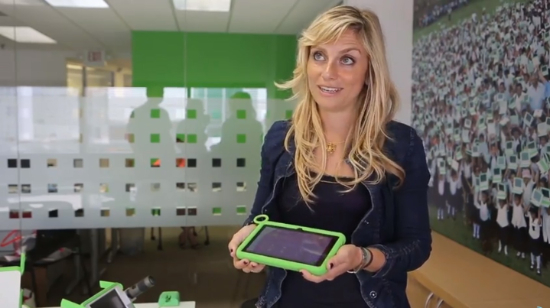
Then yesterday Engadget posted an article and video (embedded below) about the XO Tablet. The 8-minute video provides a good introduction to the device and software so I recommend watching it. 

</summary>
    <author>
        <name>Christoph Derndorfer</name>
        <uri>http://www.derndorfer.eu</uri>
    </author>
    
        <category term="XO Tablet" scheme="http://www.sixapart.com/ns/types#category" />
    
    <category term="android" label="Android" scheme="http://www.sixapart.com/ns/types#tag" />
    <category term="unitedstates" label="United States" scheme="http://www.sixapart.com/ns/types#tag" />
    <category term="walmart" label="Walmart" scheme="http://www.sixapart.com/ns/types#tag" />
    <category term="xotablet" label="XO Tablet" scheme="http://www.sixapart.com/ns/types#tag" />
    
    <content type="html" xml:lang="en" xml:base="http://www.olpcnews.com/">
        &lt;p&gt;&lt;em&gt;Resumen en español al final del artículo&lt;/em&gt;&lt;/p&gt;

&lt;p&gt;&lt;a href="http://www.olpcnews.com/countries/uruguay/plan_ceibal_to_test_10000_xo_tablets.html"&gt;Three weeks ago&lt;/a&gt; I mentioned that OLPC Association has been remarkably quiet about the Android-based &lt;strike&gt;Walmart&lt;/strike&gt; XO Tablet which it had introduced at CES 2013 in early January. Since then things have progressed a little bit with &lt;a href="http://xo-learning.org/"&gt;the Web site&lt;/a&gt; receiving a bit of a facelift.&lt;/p&gt;

&lt;p&gt;Then yesterday Engadget posted &lt;a href="http://www.engadget.com/2013/05/15/olpc-xo-tablet/"&gt;an article&lt;/a&gt; and video (embedded below) about the XO Tablet. The 8-minute video provides a good introduction to the device and software so I recommend watching it.&lt;/p&gt;

&lt;p&gt;&lt;iframe id="viddler-28994196" src="//www.viddler.com/embed/28994196/?f=1&amp;autoplay=0&amp;player=simple&amp;secret=102653076&amp;loop=false&amp;nologo=false&amp;hd=false" width="545" height="327" frameborder="0" mozallowfullscreen="true" webkitallowfullscreen="true"&gt;&lt;/iframe&gt;&lt;/p&gt;

&lt;p&gt;In terms of availability it is said that mass production of the XO Tablet recently started and that it will be sold on &lt;a href="http://www.walmart.com/"&gt;walmart.com&lt;/a&gt; starting on June 1. A month later it should also become available in a limited number of physical stores. Again no information on pricing was revealed.&lt;/p&gt;

&lt;p&gt;Now given OLPC Association's track record and the previously discussed March launch date going by without as much as a sound I remain skeptical (hence the &lt;em&gt;supposedly&lt;/em&gt; in the title) until I actually see it on walmart.com myself.&lt;/p&gt;

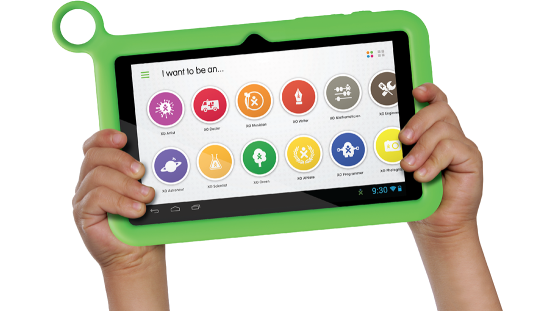
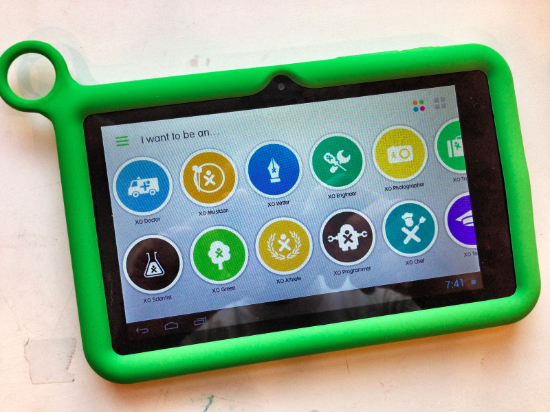
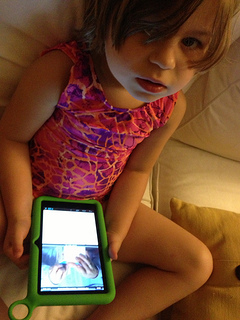
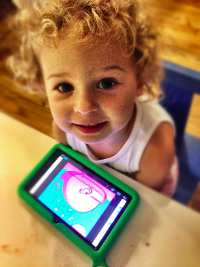
&lt;p&gt;Beyond that I'm generally still not sure what to make of the XO Tablet. Strategically it very clearly is a move to capitalize on the OLPC brand. It's also obvious that despite its planned use in Uruguay the XO Tablet is a run-of-the-mill Android device that has little to do with the broader vision and work that OLPC has done in the past 8 years. Yes, there's the &lt;em&gt;dreamy&lt;/em&gt; software interface, some content partnerships, and cute green protective cover. But it's still a commercial and US-centric product that will compete with a hundred other tablets for virtual and physical shelf-space rather than even trying to make a meaningful impact on children's education.&lt;/p&gt;

&lt;p&gt;Or I am missing a big piece of the picture? What reasons do you see for why anyone would buy an XO Tablet rather than a low-cost tablet by the likes of established consumer brands such as Acer, Archos, Amazon, Asus, Google or Samsung?&lt;/p&gt;

&lt;hr /&gt;

&lt;p&gt;&lt;strong&gt;Resumen en español:&lt;/strong&gt; En este video de Engadget se presente el XO Tablet y esta mencionado que llegara a walmart.com el primero de Junio. Pero aparte de esto la verdad es que yo todavía no estoy seguro de qué hacer con la XO Tablet. ¿Quizas me estoy perdiendo una gran parte de la imagen? ¿Qué razones le ve a por qué alguien iba a comprar una XO Tablet en lugar de una tablet de bajo costo de una de las marcas de consumo establecidos como Acer, Archos, Amazon, Asus, Google y Samsung?&lt;/p&gt;

&lt;center&gt;&lt;form style="border: 1px solid rgb(0, 0, 0); padding: 3px; text-align: center;" action="http://feedburner.google.com/fb/a/mailverify" method="post" target="popupwindow" onsubmit="window.open('http://feedburner.google.com/fb/a/mailverify?uri=OneLaptopPerChildNews', 'popupwindow', 'scrollbars=yes,width=550,height=520');return true"&gt;.&lt;p&gt;Get OLPC News daily - enter your email address:  &lt;input style="width: 140px;" name="email" type="text"&gt;&lt;input value="OneLaptopPerChildNews" name="uri" type="hidden"&gt;&lt;input name="loc" value="en_US" type="hidden"&gt;  &lt;input value="Subscribe!" type="submit"&gt;&lt;/p&gt;&lt;/form&gt;&lt;/center&gt;
        
    &lt;img src="http://feeds.feedburner.com/~r/OneLaptopPerChildNews/~4/IDL9WRhHT5Q" height="1" width="1"/&gt;</content>
<feedburner:origLink>http://www.olpcnews.com/tablets/xo_tablet/xo_tablet_supposedly_becomes_available_on_june_1.html</feedburner:origLink></entry>

<entry>
    <title>Plan Ceibal to Test 10,000 XO Tablets with 5- and 6-Year-Olds</title>
    <link rel="alternate" type="text/html" href="http://feedproxy.google.com/~r/OneLaptopPerChildNews/~3/lSylTN1fr5Y/plan_ceibal_to_test_10000_xo_tablets.html" />
    <id>tag:www.olpcnews.com,2013://4.12307</id>

    <published>2013-04-24T16:15:01Z</published>
    <updated>2013-04-24T16:10:36Z</updated>
    <summary type="html">Resumen en español al final del artículo 


Ever since it introduced the Android-based Walmart XO Tablet at CES 2013 in early January OLPC Association has been remarkably quiet about it. The official Web site at xo-learning.org still looks like it was put together in a rush on a Friday evening, the blog on the site hasn't seen any updates since late January, and the anticipated launch-month of March went by without a single word from OLPC Association. Only the @xolearning Twitter account has regularly tweeted but it's been fairly generic chatter. This lack of updates, combined with OLPC's history of launching products which much fanfare only to quietly cancel them later (XO-2, XO 3.0) has led to some people wondering whether this was yet another vaporware announcement.</summary>
    <author>
        <name>Christoph Derndorfer</name>
        <uri>http://www.derndorfer.eu</uri>
    </author>
    
        <category term="Uruguay" scheme="http://www.sixapart.com/ns/types#category" />
    
    <category term="android" label="Android" scheme="http://www.sixapart.com/ns/types#tag" />
    <category term="planceibal" label="Plan Ceibal" scheme="http://www.sixapart.com/ns/types#tag" />
    <category term="uruguay" label="Uruguay" scheme="http://www.sixapart.com/ns/types#tag" />
    <category term="xotablet" label="XO Tablet" scheme="http://www.sixapart.com/ns/types#tag" />
    <category term="xo4touch" label="XO-4 Touch" scheme="http://www.sixapart.com/ns/types#tag" />
    
    <content type="html" xml:lang="en" xml:base="http://www.olpcnews.com/">
        &lt;p&gt;&lt;em&gt;Resumen en español al final del artículo&lt;/em&gt;&lt;/p&gt;

&lt;center&gt;&lt;a href="http://www.xo-learning.org"&gt;&lt;img src="http://www.olpcnews.com/images/xo_tablet_uy.png" style="border: 2px solid rgb(0, 0, 0);"&gt;&lt;/a&gt;&lt;/center&gt;&lt;br /&gt;

&lt;p&gt;Ever since it &lt;a href="http://www.olpcnews.com/prototypes/xo/olpc_xo_tablet_to_become_available_in_us_stores_in_march.html"&gt;introduced&lt;/a&gt; the Android-based &lt;strike&gt;Walmart&lt;/strike&gt; XO Tablet at CES 2013 in early January OLPC Association has been remarkably quiet about it. The official Web site at &lt;a href="http://xo-learning.org/"&gt;xo-learning.org&lt;/a&gt; still looks like it was put together in a rush on a Friday evening, the &lt;a href="http://xo-learning.org/xo-blog/"&gt;blog&lt;/a&gt; on the site hasn't seen any updates since late January, and the anticipated launch-month of March went by without a single word from OLPC Association. Only the &lt;a href="https://twitter.com/xolearning"&gt;@xolearning&lt;/a&gt; Twitter account has regularly tweeted but it's been fairly generic chatter. This lack of updates, combined with OLPC's history of launching products which much fanfare only to quietly cancel them later (XO-2, XO 3.0) has led to some people wondering whether this was yet another vaporware announcement.&lt;/p&gt;

&lt;p&gt;However according to &lt;a href="http://www.cromo.com.uy/2013/04/plan-ceibal-estrena-10-000-tabletas-xo-con-android/"&gt;an article on a Uruguayan Web site&lt;/a&gt; from last week  Plan Ceibal recently decided to purchase 10,000 XO Tablets. According to the piece these tablets are part of an evaluation to decide whether Uruguay's 5- and 6-year-olds (which means pre-school and grade 1 pupils respectively) will receive a tablet, an XO or a hybrid (which sounds like the XO-4 Touch) in the future. Given that 47,000 pupils start primary school each year coming out on top of the evaluation could be quite a win for the XO Tablet, though naturally that would potentially cut into sales of the XO-4 (Touch).&lt;br /&gt;
What strikes me as somewhat odd about the evaluation is that the article indicates that it will be completed by the end of the year, even though the XO Tablets are only expected to be distributed in four months. Even excluding possible delays this leaves precious little time for any sort of evaluation and comparison with the 10,000 hybrid devices which are apparently also being evaluated.&lt;/p&gt;

&lt;p&gt;Another interesting detail which the article reveals is that according to the current plans the pre-school pupils will have to keep their devices in kindergarten or pre-school whereas grade 1 pupils will be allowed to take them home.&lt;/p&gt;

&lt;p&gt;Overall this is certainly good news. It's good for OLPC because, well, selling 10,000 XO Tablets indicates that it's not vaporware and Plan Ceibal has some confidence in the product. It's also good for Uruguay's pupils because it shows that Plan Ceibal continues to innovate and look for the most suitable technologies to integrate in the country's education system.&lt;/p&gt;

&lt;hr /&gt;

&lt;p&gt;&lt;strong&gt;Resumen en español:&lt;/strong&gt; Despues de no escuchar nada de OLPC Association sobre el XO Tablet que anunció en enero en los ultimos meses gente ya empezaron a preguntar si el producto verdaderamente existe. Pero la semana pasada se publicó &lt;a href="http://www.cromo.com.uy/2013/04/plan-ceibal-estrena-10-000-tabletas-xo-con-android/"&gt;un articuló en una pagina Web uruguaya&lt;/a&gt; que contó que Plan Ceibal había comprado 10,000 XO Tablets para evaluar el usó con niños de 5 y 6 años.&lt;/p&gt;

&lt;center&gt;&lt;form style="border: 1px solid rgb(0, 0, 0); padding: 3px; text-align: center;" action="http://feedburner.google.com/fb/a/mailverify" method="post" target="popupwindow" onsubmit="window.open('http://feedburner.google.com/fb/a/mailverify?uri=OneLaptopPerChildNews', 'popupwindow', 'scrollbars=yes,width=550,height=520');return true"&gt;.&lt;p&gt;Get OLPC News daily - enter your email address:  &lt;input style="width: 140px;" name="email" type="text"&gt;&lt;input value="OneLaptopPerChildNews" name="uri" type="hidden"&gt;&lt;input name="loc" value="en_US" type="hidden"&gt;  &lt;input value="Subscribe!" type="submit"&gt;&lt;/p&gt;&lt;/form&gt;&lt;/center&gt;
        
    &lt;img src="http://feeds.feedburner.com/~r/OneLaptopPerChildNews/~4/lSylTN1fr5Y" height="1" width="1"/&gt;</content>
<feedburner:origLink>http://www.olpcnews.com/countries/uruguay/plan_ceibal_to_test_10000_xo_tablets.html</feedburner:origLink></entry>

<entry>
    <title>OLPC Hits $100 Price with Ad-Supported XO-4s</title>
    <link rel="alternate" type="text/html" href="http://feedproxy.google.com/~r/OneLaptopPerChildNews/~3/YaeHrl5vWFA/olpc_hits_100_dollar_price_with_ad_supported_xo_4.html" />
    <id>tag:www.olpcnews.com,2013://4.12306</id>

    <published>2013-04-01T13:13:50Z</published>
    <updated>2013-04-01T12:31:49Z</updated>
    <summary type="html">Resumen en español al final del artículo 

Soon coming to an XO-4 near you (photo by Robert Nelson)

In what can only be described as an unexpected development OLPC Association announced that it has managed to hit the originally envisioned $100 price the XO laptop is still so widely known for. This was achieved by borrowing a page from Amazon's playbook and introducing ad-supported versions of the brand-new XO-4. 

Depending on the specific hardware configuration (non-touch display vs. touch display, 1GHz CPU vs 1.2GHz CPU, 1GB RAM vs. 2GB RAM, 4GB Flash vs. 8GB Flash) the ad-supported models will cost between $100 and $138. At this point it is unclear how much cheaper that is than the non-ad-supported XO-4 models as their prices haven't been announced yet.</summary>
    <author>
        <name>Christoph Derndorfer</name>
        <uri>http://www.derndorfer.eu</uri>
    </author>
    
        <category term="XO-4" scheme="http://www.sixapart.com/ns/types#category" />
    
    <category term="advertising" label="advertising" scheme="http://www.sixapart.com/ns/types#tag" />
    <category term="businessmodel" label="business model" scheme="http://www.sixapart.com/ns/types#tag" />
    <category term="kindle" label="Kindle" scheme="http://www.sixapart.com/ns/types#tag" />
    <category term="revenue" label="revenue" scheme="http://www.sixapart.com/ns/types#tag" />
    <category term="xotablet" label="XO Tablet" scheme="http://www.sixapart.com/ns/types#tag" />
    <category term="xo4" label="XO-4" scheme="http://www.sixapart.com/ns/types#tag" />
    
    <content type="html" xml:lang="en" xml:base="http://www.olpcnews.com/">
        &lt;p&gt;&lt;em&gt;Resumen en español al final del artículo&lt;/em&gt;&lt;/p&gt;

&lt;center&gt;&lt;a href="http://www.flickr.com/photos/robertnelson/6264033459/"&gt;&lt;img src="http://www.olpcnews.com/images/kindle_ads.jpg" style="border: 2px solid rgb(0, 0, 0);"&gt;&lt;/a&gt;&lt;br /&gt;&lt;em&gt;Soon coming to an XO-4 near you (photo by &lt;a href="http://www.flickr.com/people/robertnelson/"&gt;Robert Nelson&lt;/a&gt;)&lt;/em&gt;&lt;/center&gt;&lt;br /&gt;

&lt;p&gt;In what can only be described as an unexpected development OLPC Association announced that it has managed to hit the originally envisioned $100 price the XO laptop is still so widely known for. This was achieved by borrowing a page from Amazon's playbook and introducing ad-supported versions of the brand-new &lt;a href="http://www.olpcnews.com/laptops/xo-4/olpc_xo_4_will_provide_significant_performance_boost.html"&gt;XO-4&lt;/a&gt;.&lt;/p&gt;

&lt;p&gt;Depending on the &lt;a href="http://wiki.laptop.org/go/Manufacturing_Data#XO-4"&gt;specific hardware configuration&lt;/a&gt; (non-touch display vs. touch display, 1GHz CPU vs 1.2GHz CPU, 1GB RAM vs. 2GB RAM, 4GB Flash vs. 8GB Flash) the ad-supported models will cost between $100 and $138. At this point it is unclear how much cheaper that is than the non-ad-supported XO-4 models as their prices haven't been announced yet.&lt;/p&gt;

&lt;p&gt;One very interesting aspect of the ad system which Poisson D'Avril (OLPC Association's Director of Educational Marketing) mentioned is that it can be managed by deployments:&lt;/p&gt;

&lt;blockquote&gt;„All of the content in the ad system is curated and selected for appropriateness by OLPC Association and leading independent reviewers of age appropriate digital advertising in North and South America. Beyond that we will also provide best-practice guides and tools to our implementation partners in the public and private sectors. This will enable them to customize the ads seen by their pupils and teachers and therefore maximize their impact."&lt;/blockquote&gt;

&lt;p&gt;One thing that D'Avril didn't want to comment on is if deployments will also receive a cut of the advertising revenue or whether their main benefit will be the reduced purchase price.&lt;/p&gt;

&lt;p&gt;Asked about the risk of ads distracting pupils and teachers when using the machines she responded:&lt;/p&gt;

&lt;blockquote&gt;„Naturally we did not want to risk negatively impacting the learning experience enabled by using the XOs. So all throughout the ad system's development we ran comprehensive tests in pilot rollouts in several of our ongoing projects in North and South America. As a result and after discussions with some of our leading partners it was decided that ads will only be shown when the XO is starting up, shutting down, and on the newly added screensaver when it is in power-saving mode."&lt;/blockquote&gt;

&lt;p&gt;Beyond that D'Avril also mentioned that for some countries special agreements with local advertisers had been signed:&lt;/p&gt;

&lt;blockquote&gt;„In some South American countries advertisers have been given the option to replace the famous &lt;a href="http://wiki.laptop.org/go/Startup_sound"&gt;XO startup sound&lt;/a&gt; with their client's jingles. In other cases advertisers will include product samples such as soft drinks, sweets, comics, but also school books and pencils with every XO-4 that is shipped."&lt;/blockquote&gt;

&lt;p&gt;At this point it's unclear whether a similar approach will also be used with the &lt;a href="http://www.olpcnews.com/prototypes/xo/olpc_xo_tablet_to_become_available_in_us_stores_in_march.html"&gt;XO Tablet&lt;/a&gt; which should have become available at select Walmart stores in March. Similarly there's no word on whether the software components of that ad system will make an appearance in an update for the older XO-1 / XO-1.5 / XO-1.75 models. &lt;/p&gt;

&lt;p&gt;Now overall of course the question is whether this development should be considered a good or bad move by OLPC Association. On the one hand it will likely enable more children in developing nations to get XOs thanks to the lower price. On the other hand I can't help but feel that exposing children to more advertising isn't something I can truly support. Especially since I still vividly remember how annoyed I was when we found that after a renovation my secondary school's gym had been turned into one big advertising space for a certain soft drink manufacturer...&lt;/p&gt;

&lt;p&gt;So what do you think?&lt;/p&gt;

&lt;hr /&gt;

&lt;p&gt;&lt;strong&gt;Resumen en español:&lt;/strong&gt; En lo que sólo puede ser descrito como un desarrollo inesperado OLPC Association anunció que ha logrado llegar al precio previsto originalmente de $100 para el XO. Esto se consiguió prestando una página del libro de Amazon y la introducción de versiones del nuevo XO-4 que vienen con publicidad.&lt;/p&gt;

&lt;p&gt;Dependiendo de la configuración de hardware específica (pantalla no-táctil vs pantalla táctil, procesador de 1GHz vs 1,2GHz, 1GB de RAM vs 2GB RAM, 4GB Flash vs 8GB Flash) los modelos con publicidad tendrán un costo de entre $100 y $138. En este punto no está claro cuánto más barato es en comparación a los modelos XO-4 sin publicidad como sus precios no han sido anunciados todavía.&lt;/p&gt;

&lt;center&gt;&lt;form style="border: 1px solid rgb(0, 0, 0); padding: 3px; text-align: center;" action="http://feedburner.google.com/fb/a/mailverify" method="post" target="popupwindow" onsubmit="window.open('http://feedburner.google.com/fb/a/mailverify?uri=OneLaptopPerChildNews', 'popupwindow', 'scrollbars=yes,width=550,height=520');return true"&gt;.&lt;p&gt;Get OLPC News daily - enter your email address:  &lt;input style="width: 140px;" name="email" type="text"&gt;&lt;input value="OneLaptopPerChildNews" name="uri" type="hidden"&gt;&lt;input name="loc" value="en_US" type="hidden"&gt;  &lt;input value="Subscribe!" type="submit"&gt;&lt;/p&gt;&lt;/form&gt;&lt;/center&gt;
        
    &lt;img src="http://feeds.feedburner.com/~r/OneLaptopPerChildNews/~4/YaeHrl5vWFA" height="1" width="1"/&gt;</content>
<feedburner:origLink>http://www.olpcnews.com/laptops/xo-4/olpc_hits_100_dollar_price_with_ad_supported_xo_4.html</feedburner:origLink></entry>

<entry>
    <title>Negroponte appointed as Chairman of $10 million Global Literacy X PRIZE</title>
    <link rel="alternate" type="text/html" href="http://feedproxy.google.com/~r/OneLaptopPerChildNews/~3/IiMVW83LWDQ/negroponte_appointed_as_chairm.html" />
    <id>tag:www.olpcnews.com,2013://4.12305</id>

    <published>2013-03-28T12:39:31Z</published>
    <updated>2013-03-28T00:07:56Z</updated>
    <summary type="html">Resumen en español al final del artículo 

I'm not quite sure how I managed to miss this but thankfully some readers pointed me towards it this weekend. It being an announcement by the X PRIZE Foundation that Nicholas Negroponte will be the chairman of their planned $10 million Global Literacy competition: 

Nicholas Negroponte of OLPC 

The X PRIZE Foundation announced today that it has set a goal of funding and launching a $10 Million Global Literacy X PRIZE in 2013. The purpose of this X PRIZE is to transform established beliefs about the timeline, nature, quality, and scalability of literacy solutions to serve the needs of over 60 million children who are not receiving primary education. 

Negroponte joins the former UK Prime Minister Gordon Brown and Sir Ken Robinson of TED-fame who are both advisors to X Prize.</summary>
    <author>
        <name>Christoph Derndorfer</name>
        <uri>http://www.derndorfer.eu</uri>
    </author>
    
        <category term="Negroponte" scheme="http://www.sixapart.com/ns/types#category" />
    
    <category term="competition" label="competition" scheme="http://www.sixapart.com/ns/types#tag" />
    <category term="helicopterdeployment" label="Helicopter Deployment" scheme="http://www.sixapart.com/ns/types#tag" />
    <category term="literacy" label="literacy" scheme="http://www.sixapart.com/ns/types#tag" />
    <category term="nicholasnegroponte" label="Nicholas Negroponte" scheme="http://www.sixapart.com/ns/types#tag" />
    <category term="xprize" label="X Prize" scheme="http://www.sixapart.com/ns/types#tag" />
    
    <content type="html" xml:lang="en" xml:base="http://www.olpcnews.com/">
        &lt;p&gt;&lt;em&gt;Resumen en español al final del artículo&lt;/em&gt;&lt;/p&gt;

&lt;p&gt;I'm not quite sure how I managed to miss this but thankfully two readers pointed me towards it in the past few days. &lt;em&gt;It&lt;/em&gt; being &lt;a href="http://www.xprize.org/press-release/x-prize-foundation-announces-plans-for-10-million-global-literacy-x-prize"&gt;an announcement&lt;/a&gt; by the X PRIZE Foundation that Nicholas Negroponte will be the chairman of their planned $10 million Global Literacy competition:&lt;/p&gt;

&lt;div style="float: right; margin-left: 12px; margin-bottom: 10px;"&gt;&lt;a href="http://www.theage.com.au/news/technology/microsoft-sees-window-of-opportunity-in-lowcost-laptop/2007/10/26/1192941297938.html"&gt;&lt;img src="http://www.olpcnews.com/images/negroponte-xo.jpg" style="border: 2px solid rgb(0, 0, 0);"&gt;&lt;/a&gt;&lt;br&gt;&lt;span style="font-size: 0.9em; margin-top: 0px;"&gt;Nicholas Negroponte of OLPC&lt;/span&gt;&lt;/div&gt;

&lt;blockquote&gt;The X PRIZE Foundation announced today that it has set a goal of funding and launching a $10 Million Global Literacy X PRIZE in 2013. The purpose of this X PRIZE is to transform established beliefs about the timeline, nature, quality, and scalability of literacy solutions to serve the needs of over 60 million children who are not receiving primary education.&lt;/blockquote&gt;

&lt;p&gt;Negroponte joins the former UK Prime Minister Gordon Brown and Sir Ken Robinson of &lt;a href="http://www.ted.com/speakers/sir_ken_robinson.html"&gt;TED-fame&lt;/a&gt; who are both advisors to X Prize.&lt;/p&gt;

&lt;blockquote&gt;"A Global Literacy X PRIZE will reframe the education conversation that, to date, has been focused only on system (school) reform," says Prof. Negroponte. "By changing the conversation from 'how do we fix the system?' to 'how do we meet the unique needs of all individual learners?' we begin a critical transformation. Insofar as literacy is the key to eliminating poverty, creating world peace and saving the environment, a paradigm shift is urgently needed."&lt;/blockquote&gt;

&lt;p&gt;Based on his long-standing interesting in literacy and this quote I dare say this very much sounds like the perfect competition for Negroponte.&lt;/p&gt;

&lt;p&gt;According to the announcement X PRIZE hopes to find the necessary funding and launch the Global Literacy competition before the end of the year. It is then intended to run for two years until the end of 2015.&lt;/p&gt;

&lt;p&gt;I'll definitely keep an eye on how this competitions goes. After all the X PRIZE competition has led - and continues to lead - to some very interesting developments, especially in the area of space travel.&lt;/p&gt;

&lt;hr /&gt;

&lt;p&gt;&lt;strong&gt;Resumen en español:&lt;/strong&gt; No estoy muy seguro de cómo me lo arreglé para perder esto, pero por suerte dos lectores me mandaron el link en los ultimos días. &lt;em&gt;Esto&lt;/em&gt; siendo un anuncio de la Fundación X PRIZE que Nicholas Negroponte será el presidente de su planeado $ 10 millones competencia para alfabetización en el mundo.&lt;/p&gt;

&lt;center&gt;&lt;form style="border: 1px solid rgb(0, 0, 0); padding: 3px; text-align: center;" action="http://feedburner.google.com/fb/a/mailverify" method="post" target="popupwindow" onsubmit="window.open('http://feedburner.google.com/fb/a/mailverify?uri=OneLaptopPerChildNews', 'popupwindow', 'scrollbars=yes,width=550,height=520');return true"&gt;.&lt;p&gt;Get OLPC News daily - enter your email address:  &lt;input style="width: 140px;" name="email" type="text"&gt;&lt;input value="OneLaptopPerChildNews" name="uri" type="hidden"&gt;&lt;input name="loc" value="en_US" type="hidden"&gt;  &lt;input value="Subscribe!" type="submit"&gt;&lt;/p&gt;&lt;/form&gt;&lt;/center&gt;
        
    &lt;img src="http://feeds.feedburner.com/~r/OneLaptopPerChildNews/~4/IiMVW83LWDQ" height="1" width="1"/&gt;</content>
<feedburner:origLink>http://www.olpcnews.com/people/negroponte/negroponte_appointed_as_chairm.html</feedburner:origLink></entry>

<entry>
    <title>OLPC XO Tablet to Become Available in US Stores in March</title>
    <link rel="alternate" type="text/html" href="http://feedproxy.google.com/~r/OneLaptopPerChildNews/~3/quFrFIB8kAo/olpc_xo_tablet_to_become_available_in_us_stores_in_march.html" />
    <id>tag:www.olpcnews.com,2013://4.12302</id>

    <published>2013-01-08T10:15:19Z</published>
    <updated>2013-01-08T16:54:58Z</updated>
    <summary type="html">Resumen en español al final del artículo 

Contrary to what I had expected OLPC is using the ongoing CES 2013 trade show in Las Vegas not just to present its XO-4 and XO-4 Touch models but also to introduce a new product. According to this article by Engadget the "XO Tablet" is a 7" Android-based tablet with custom interface (so no Sugar!!) and its own app store which will be available in US Stores in March. The price has not been announced yet but is said to be "competitive". 

I've embedded Enadget's brief hands-on video for your viewing pleasure below but I'd also really recommend you to read the full article which contains some additional information and take a look at their XO Tablet gallery. 

</summary>
    <author>
        <name>Christoph Derndorfer</name>
        <uri>http://www.derndorfer.eu</uri>
    </author>
    
        <category term="XO" scheme="http://www.sixapart.com/ns/types#category" />
    
        <category term="XO Tablet" scheme="http://www.sixapart.com/ns/types#category" />
    
    <category term="android" label="Android" scheme="http://www.sixapart.com/ns/types#tag" />
    <category term="skin" label="skin" scheme="http://www.sixapart.com/ns/types#tag" />
    <category term="tablet" label="tablet" scheme="http://www.sixapart.com/ns/types#tag" />
    <category term="xo30" label="XO 3.0" scheme="http://www.sixapart.com/ns/types#tag" />
    <category term="xotablet" label="XO Tablet" scheme="http://www.sixapart.com/ns/types#tag" />
    
    <content type="html" xml:lang="en" xml:base="http://www.olpcnews.com/">
        &lt;p&gt;&lt;em&gt;Resumen en español al final del artículo&lt;/em&gt;&lt;/p&gt;

&lt;p&gt;Contrary to what I had expected OLPC is using the ongoing CES 2013 trade show in Las Vegas not just to present its &lt;a href="http://www.olpcnews.com/laptops/xo-4/olpc_xo_4_will_provide_significant_performance_boost.html"&gt;XO-4 and XO-4 Touch models&lt;/a&gt; but also to introduce a new product. According to &lt;a href="http://www.engadget.com/2013/01/07/hands-on-with-the-xo-tablet/"&gt;this article by Engadget&lt;/a&gt; the "XO Tablet" is a 7" Android-based tablet with custom interface (so no Sugar!!) and its own app store which will be available in US Stores in March. The price has not been announced yet but is said to be "&lt;em&gt;competitive&lt;/em&gt;".&lt;/p&gt;

&lt;p&gt;I've embedded Enadget's brief hands-on video for your viewing pleasure below but I'd also really recommend you to read the &lt;a href="http://www.engadget.com/2013/01/07/hands-on-with-the-xo-tablet/"&gt;full article&lt;/a&gt; which contains some additional information and take a look at their &lt;a href="http://www.engadget.com/gallery/olpc-xo-tablet"&gt;XO Tablet gallery&lt;/a&gt;.&lt;/p&gt;

&lt;div style="text-align: center;"&gt;&lt;iframe id="viddler-3f7d1d50" src="//www.viddler.com/embed/3f7d1d50/?f=1&amp;offset=0&amp;autoplay=0&amp;secret=39213658&amp;disablebranding=0&amp;view_secret=39213658" width="545" height="349" frameborder="0" mozallowfullscreen="true" webkitallowfullscreen="true"&gt;&lt;/iframe&gt;&lt;/div&gt;&lt;br /&gt;

&lt;p&gt;My first reaction to this announcement is quite simply that I'm not sure what to make of it. Hardware-wise the device itself simply seems to be just another generic 7" Android tablet. (Though the green rubber cover and especially the ring in the corner visible in the video still above and &lt;a href="http://www.engadget.com/gallery/olpc-xo-tablet/5545264/"&gt;this photo&lt;/a&gt; are definitely a tip of the hat to the &lt;a href="http://en.wikipedia.org/wiki/File:Xo3-fuse-4.jpg"&gt;early XO-3 tablet design studies&lt;/a&gt;.)&lt;/p&gt;

&lt;p&gt;On the software-side of things the custom interface and curated app store look nice but I'm not sure just how much value they can add compared to the full Google Play app store. Especially since I frankly speaking doubt that OLPC has the know-how or necessary resources to build up and maintain a second educational software and developer ecosystem besides Sugar. Yes, the content partners which OLPC announced on &lt;a href="http://blog.laptop.org/"&gt;its blog&lt;/a&gt; over the past few months will likely provide some help here but I don't see that being enough to really make it fly.&lt;/p&gt;

&lt;p&gt;Last but not least I'm very surprised to see this apparent move into the consumer market. Traditionally OLPC has always focused on large orders by governments and NGOs as the organization is simply not set up to deal with individual users and many people who participated in the 2007 Give 1, Get 1 program can attest to that. Again, maybe OLPC Association has some partnerships up its sleeve because I can't seem them executing this well on their own.&lt;/p&gt;

&lt;p&gt;Overall I can only repeat what I said earlier: I'm not sure what to make of this announcement. But maybe I'm simply missing something which is why I hope to learn more about OLPC Association's vision and plans for the XO Tablet during &lt;a href="http://www.engadget.com/2013/01/10/olpc-interview/"&gt;Engadget's on-stage interview&lt;/a&gt; with Bob Hacker (OLPC Association's CFO) and Giulia D'Amico (OLPC Association's VP of Business Development) on January 10, 2013 at 2:30 PM EST.&lt;/p&gt;

&lt;hr /&gt;

&lt;p&gt;&lt;strong&gt;Resumen en español:&lt;/strong&gt; En el CES 2013 en Las Vegas OLPC mostró un nuevo producto: El XO Tablet, una tablet de 7" con Android y un interfaz nuevo diseñado por niños.&lt;/p&gt;

&lt;center&gt;&lt;form style="border: 1px solid rgb(0, 0, 0); padding: 3px; text-align: center;" action="http://feedburner.google.com/fb/a/mailverify" method="post" target="popupwindow" onsubmit="window.open('http://feedburner.google.com/fb/a/mailverify?uri=OneLaptopPerChildNews', 'popupwindow', 'scrollbars=yes,width=550,height=520');return true"&gt;.&lt;p&gt;Get OLPC News daily - enter your email address: &lt;input style="width: 140px;" name="email" type="text"&gt;&lt;input value="OneLaptopPerChildNews" name="uri" type="hidden"&gt;&lt;input name="loc" value="en_US" type="hidden"&gt; &lt;input value="Subscribe!" type="submit"&gt;&lt;/p&gt;&lt;/form&gt;&lt;/center&gt;
        
    &lt;img src="http://feeds.feedburner.com/~r/OneLaptopPerChildNews/~4/quFrFIB8kAo" height="1" width="1"/&gt;</content>
<feedburner:origLink>http://www.olpcnews.com/prototypes/xo/olpc_xo_tablet_to_become_available_in_us_stores_in_march.html</feedburner:origLink></entry>

<entry>
    <title>Merry Christmas and A Happy New Year 2013!</title>
    <link rel="alternate" type="text/html" href="http://feedproxy.google.com/~r/OneLaptopPerChildNews/~3/Mk4qZ919vKc/merry_christmas_and_a_happy_new_year_2013.html" />
    <id>tag:www.olpcnews.com,2012://4.12301</id>

    <published>2012-12-24T18:03:23Z</published>
    <updated>2012-12-24T17:59:00Z</updated>
    <summary type="html">Resumen en español al final del artículo 


Now that we've finished decorating the tree here at the Derndorfer home everything is ready to start the celebrations: the false singing of Christmas songs, the unwrapping of presents and of course the subsequent feast (traditionally Raclette in my family). But before all of that gets underway I briefly wanted to wish all of our readers a Merry Christmas and A Happy New Year 2013. (Well, in case you happen to celebrate those two occasions that is.) 

As is tradition I will be taking it easy for a week once today's Christmas celebration are over. I'll be spending three days skiing in the Alps and I've got a bunch of (e-)books with me which I'd like to read (high up on my list this year are Paul Tough's How Children Succeed - Grit, Curiosity, and the Hidden Power of Character and Cory Doctorow's Pirate Cinema).</summary>
    <author>
        <name>Christoph Derndorfer</name>
        <uri>http://www.derndorfer.eu</uri>
    </author>
    
        <category term="OLPC News" scheme="http://www.sixapart.com/ns/types#category" />
    
    <category term="books" label="books" scheme="http://www.sixapart.com/ns/types#tag" />
    <category term="christmas" label="Christmas" scheme="http://www.sixapart.com/ns/types#tag" />
    <category term="holidays" label="holidays" scheme="http://www.sixapart.com/ns/types#tag" />
    <category term="newyear" label="New Year" scheme="http://www.sixapart.com/ns/types#tag" />
    <category term="skiing" label="skiing" scheme="http://www.sixapart.com/ns/types#tag" />
    
    <content type="html" xml:lang="en" xml:base="http://www.olpcnews.com/">
        &lt;p&gt;&lt;em&gt;Resumen en español al final del artículo&lt;/em&gt;&lt;/p&gt;

&lt;center&gt;&lt;img src="http://www.olpcnews.com/images/christmasgreetings.png"&gt;&lt;/center&gt;&lt;br /&gt;

&lt;p&gt;Now that we've finished decorating the tree here at the Derndorfer home everything is ready to start the celebrations: the false singing of Christmas songs, the unwrapping of presents and of course the subsequent feast (traditionally &lt;a href="http://en.wikipedia.org/wiki/Raclette"&gt;Raclette&lt;/a&gt; in my family). But before all of that gets underway I briefly wanted to wish all of our readers a Merry Christmas and A Happy New Year 2013. (Well, in case you happen to celebrate those two occasions that is.)&lt;/p&gt;

&lt;p&gt;As is tradition I will be taking it easy for a week once today's Christmas celebration are over. I'll be spending three days skiing in the Alps and I've got a bunch of (e-)books with me which I'd like to read (high up on my list this year are Paul Tough's &lt;a href="http://www.paultough.com/the-books/how-children-succeed/"&gt;&lt;em&gt;How Children Succeed - Grit, Curiosity, and the Hidden Power of Character&lt;/em&gt;&lt;/a&gt; and Cory Doctorow's &lt;a href="http://craphound.com/pc/"&gt;&lt;em&gt;Pirate Cinema&lt;/em&gt;&lt;/a&gt;).&lt;/p&gt;

&lt;p&gt;I'll try to do my best to stay away from any work until after New Year's. Though I might just sit down at one point or another to at least start writing up some of the stories and developments which I didn't have time to think and talk about in the past two months.&lt;/p&gt;

&lt;p&gt;Anyway, thanks a lot for being such a great, challenging, and supportive audience. I'm really looking forward to seeing you again in 2013! :-)&lt;/p&gt;

&lt;hr /&gt;

&lt;p&gt;&lt;strong&gt;Resumen en español:&lt;/strong&gt; Les deseo a todos nuestros lectores un feliz navidad y un prospero año nuevo. Despues de las celebraciones de esta noche yo voy a tomar una semana de vacaciones con tres días para esquiar en los Alpes y tiempo para leer unos libros. Muchas gracias por ser una gran audiencia, desafiante y de apoyo. Será excelente verles de nuevo en 2013!&lt;/p&gt;

&lt;center&gt;&lt;form style="border: 1px solid rgb(0, 0, 0); padding: 3px; text-align: center;" action="http://feedburner.google.com/fb/a/mailverify" method="post" target="popupwindow" onsubmit="window.open('http://feedburner.google.com/fb/a/mailverify?uri=OneLaptopPerChildNews', 'popupwindow', 'scrollbars=yes,width=550,height=520');return true"&gt;.&lt;p&gt;Get OLPC News daily - enter your email address:  &lt;input style="width: 140px;" name="email" type="text"&gt;&lt;input value="OneLaptopPerChildNews" name="uri" type="hidden"&gt;&lt;input name="loc" value="en_US" type="hidden"&gt;  &lt;input value="Subscribe!" type="submit"&gt;&lt;/p&gt;&lt;/form&gt;&lt;/center&gt;
        
    &lt;img src="http://feeds.feedburner.com/~r/OneLaptopPerChildNews/~4/Mk4qZ919vKc" height="1" width="1"/&gt;</content>
<feedburner:origLink>http://www.olpcnews.com/commentary/olpc_news/merry_christmas_and_a_happy_new_year_2013.html</feedburner:origLink></entry>

<entry>
    <title>FoodChain: The Marriage of Sugar and HTML5</title>
    <link rel="alternate" type="text/html" href="http://feedproxy.google.com/~r/OneLaptopPerChildNews/~3/GGrfEJFuV8A/foodchain_marriage_of_sugar_and_html5.html" />
    <id>tag:www.olpcnews.com,2012://4.12300</id>

    <published>2012-12-21T13:33:30Z</published>
    <updated>2012-12-21T04:47:39Z</updated>
    <summary type="html">In two previous posts here on OLPC News (post #1, post #2), I suggested that it would be nice to develop Sugar Activities using HTML5/JavaScript and pictures/audio from a new open content database: Art4apps. 

My article told about a framework that I've done using the Enyo JavaScript library. Of course, it's easier to give advices than to follow it: "eat your own food" like hackers say. So, I spent the last weeks to work on a new Sugar Activity following my own advice. 
 
FoodChain is a pedagogical game to learn the name of animals (word and pronunciation currently in French and English) and concept of food chains: Who eats what? Who eats who?</summary>
    <author>
        <name>Guest Writer</name>
        <uri>http://www.olpcnews.com/about_olpc_news/write_for_olpc_news.html</uri>
    </author>
    
        <category term="Applications" scheme="http://www.sixapart.com/ns/types#category" />
    
    <category term="activity" label="Activity" scheme="http://www.sixapart.com/ns/types#tag" />
    <category term="content" label="content" scheme="http://www.sixapart.com/ns/types#tag" />
    <category term="development" label="development" scheme="http://www.sixapart.com/ns/types#tag" />
    <category term="enyo" label="Enyo" scheme="http://www.sixapart.com/ns/types#tag" />
    <category term="foodchain" label="FoodChain" scheme="http://www.sixapart.com/ns/types#tag" />
    <category term="html5" label="HTML5" scheme="http://www.sixapart.com/ns/types#tag" />
    <category term="javascript" label="JavaScript" scheme="http://www.sixapart.com/ns/types#tag" />
    <category term="lionellaské" label="Lionel Laské" scheme="http://www.sixapart.com/ns/types#tag" />
    <category term="olpcfrance" label="OLPC France" scheme="http://www.sixapart.com/ns/types#tag" />
    <category term="sugar" label="Sugar" scheme="http://www.sixapart.com/ns/types#tag" />
    
    <content type="html" xml:lang="en" xml:base="http://www.olpcnews.com/">
        &lt;p&gt;In two previous posts here on OLPC News (&lt;a href="http://www.olpcnews.com/software/sugar/developing_sugar_activities_using_html5_part_1.html"&gt;post #1&lt;/a&gt;, &lt;a href="http://www.olpcnews.com/software/sugar/developing_sugar_activities_using_html5_part_2.html"&gt;post #2&lt;/a&gt;), I suggested that it would be nice to develop Sugar Activities using HTML5/JavaScript and pictures/audio from a new open content database: &lt;a href="http://www.art4apps.org/"&gt;Art4apps&lt;/a&gt;.&lt;/p&gt;

&lt;p&gt;My article told about a framework that I've done using the &lt;a href="http://enyojs.com/"&gt;Enyo&lt;/a&gt; JavaScript library. Of course, it's easier to give advices than to follow it: "eat your own food" like hackers say. So, I spent the last weeks to work on a new Sugar Activity following my own advice.&lt;br /&gt;
 &lt;br /&gt;
&lt;a href="http://activities.sugarlabs.org/en-US/sugar/addon/4612/"&gt;FoodChain&lt;/a&gt; is a pedagogical game to learn the name of animals (word and pronunciation currently in French and English) and concept of food chains: Who eats what? Who eats who?&lt;br /&gt;
 &lt;br /&gt;
The Activity is composed of 3 little games.&lt;br /&gt;
 &lt;br /&gt;
First game objective is to classify animals depending of their food diet (herbivore, carnivore or omnivore).&lt;br /&gt;
 &lt;br /&gt;
&lt;div style="text-align: center;"&gt;&lt;img src="http://www.olpcnews.com/images/foodchain1.png" style="border: 2px solid rgb(0, 0, 0);"&gt;&lt;/div&gt;&lt;br /&gt;
 &lt;br /&gt;
Second game objective is to order cards of animals/food in the order of who eats who. For example: Owl -eat-&gt; Bat -eat-&gt; Flies.&lt;br /&gt;
 &lt;br /&gt;
&lt;div style="text-align: center;"&gt;&lt;img src="http://www.olpcnews.com/images/foodchain2.png" style="border: 2px solid rgb(0, 0, 0);"&gt;&lt;/div&gt;&lt;br /&gt;
 &lt;br /&gt;
Third game is an arcade game (my inspiration come from the mythic &lt;a href="http://activities.sugarlabs.org/en-US/sugar/addon/4215"&gt;Falabracman&lt;/a&gt; Activity). You handle a frog and you need to eat flies avoiding being eaten by snakes and hitting rocks.&lt;br /&gt;
 &lt;br /&gt;
&lt;div style="text-align: center;"&gt;&lt;img src="http://www.olpcnews.com/images/foodchain3.png" style="border: 2px solid rgb(0, 0, 0);"&gt;&lt;/div&gt;&lt;br /&gt;
 &lt;br /&gt;
Each game has different levels of growing complexity. You should success as quickly as possible to gain more points.&lt;br /&gt;
 &lt;br /&gt;
FoodChain has everything to be a true Sugar Activity: nice graphical elements (from &lt;a href="http://www.art4apps.org/"&gt;Art4apps&lt;/a&gt; database and from &lt;a href="http://www.vickiwenderlich.com/category/free-art/game-art/"&gt;Vicki Wenderlich&lt;/a&gt;, a very talented illustrator), pretty music (inspired from the famous Popcorn song) and audio voices and sounds. FoodChain is well integrated in the Sugar environment: it has the traditional Sugar toolbar, it saves context in the Journal and it uses the Sugar localization system in &lt;a href="http://translate.sugarlabs.org/"&gt;Pootle&lt;/a&gt;. &lt;br /&gt;
 &lt;br /&gt;
But yes, FoodChain has few things to do with Python. It's almost fully written using HTML5 and JavaScript. Some nice HTML5 features are directly used in the Activity:&lt;/p&gt;

&lt;p&gt;o	Media tag to play voices, sounds and music,&lt;br /&gt;
o	Drag&amp;Drop to allow ordering or classifying cards,&lt;br /&gt;
o	SVG support for images,&lt;br /&gt;
o	Canvas element to draw "sprites" in the third arcade game,&lt;br /&gt;
o	Touch support (I don't have opportunity to test it on a XO-4 but it should work),&lt;br /&gt;
o	Extended border and background features.&lt;br /&gt;
 &lt;br /&gt;
One very cool thing with HTML5 is that it's supported on lots of different sorts of devices. So FoodChain could run on the XO (needs the &lt;a href="http://wiki.laptop.org/go/Release_notes/12.1.0"&gt;12.1.0&lt;/a&gt; build), on a PC (playable &lt;a href="http://laske.fr/foodchain/"&gt;here&lt;/a&gt; on Firefox/Chrome browser) but also on tablets (works on HP TouchPad - thanks to HP guys ;-) - and will work soon on Android via PhoneGap and Windows 8 UI.&lt;br /&gt;
 &lt;br /&gt;
&lt;div style="text-align: center;"&gt;&lt;img src="http://www.olpcnews.com/images/foodchain4.png" style="border: 2px solid rgb(0, 0, 0);"&gt;&lt;/div&gt;&lt;br /&gt;
 &lt;br /&gt;
So, this first app demonstrates the capacity to easily write new pedagogical Activities for the XO using HTML5/JavaScript. I'm sure that a lot of other apps could be write using pictures and multi-language audio from Art4apps (action, things, verbs, jobs, colors ...).&lt;/p&gt;

&lt;div style="text-align: center;"&gt;&lt;img src="http://www.olpcnews.com/images/foodchain5.png" style="border: 2px solid rgb(0, 0, 0);"&gt;&lt;/div&gt;&lt;br /&gt;

&lt;p&gt;So:&lt;/p&gt;

&lt;ul&gt;&lt;li&gt;If you're a teacher or if you've got ideas for new apps, do not hesitate to suggest what we could create for the XO.&lt;/li&gt;
	&lt;li&gt;If you're a HTML5/JavaScript developer and you want to join the OLPC adventure, please forks, copy, adapt the &lt;a href="http://git.sugarlabs.org/foodchain-activity"&gt;source code&lt;/a&gt; of the FoodChain app and help us to build new contents for children of the world.&lt;/li&gt;&lt;/ul&gt;

&lt;p&gt;&lt;em&gt;Lionel Laské is the president and co-founder of &lt;a href="http://www.olpc-france.org/"&gt;OLPC France&lt;/a&gt;.&lt;/em&gt;&lt;/p&gt;

&lt;center&gt;&lt;form style="border: 1px solid rgb(0, 0, 0); padding: 3px; text-align: center;" action="http://feedburner.google.com/fb/a/mailverify" method="post" target="popupwindow" onsubmit="window.open('http://feedburner.google.com/fb/a/mailverify?uri=OneLaptopPerChildNews', 'popupwindow', 'scrollbars=yes,width=550,height=520');return true"&gt;.&lt;p&gt;Get OLPC News daily - enter your email address: &lt;input style="width: 140px;" name="email" type="text"&gt;&lt;input value="OneLaptopPerChildNews" name="uri" type="hidden"&gt;&lt;input name="loc" value="en_US" type="hidden"&gt; &lt;input value="Subscribe!" type="submit"&gt;&lt;/p&gt;&lt;/form&gt;&lt;/center&gt;
        
    &lt;img src="http://feeds.feedburner.com/~r/OneLaptopPerChildNews/~4/GGrfEJFuV8A" height="1" width="1"/&gt;</content>
<feedburner:origLink>http://www.olpcnews.com/software/applications/foodchain_marriage_of_sugar_and_html5.html</feedburner:origLink></entry>

<entry>
    <title>We Now Return to Our Regularly Scheduled Program...</title>
    <link rel="alternate" type="text/html" href="http://feedproxy.google.com/~r/OneLaptopPerChildNews/~3/RTEuEJL-pMc/we_now_return_to_our_regularly_scheduled_program.html" />
    <id>tag:www.olpcnews.com,2012://4.12299</id>

    <published>2012-12-18T13:02:59Z</published>
    <updated>2012-12-18T09:32:45Z</updated>
    <summary type="html"> 

It's been exactly two months since our last post here on OLPC News and based on the e-mails and tweets which I've been receiving at least some people have started wondering what's going on... 

Well, the reason why I haven't had time to update this humble blog of ours is that I've simply been swamped with work since I got back from the great OLPC San Francisco Community Summit which took place in mid-October. University, my two day jobs, an interesting project with McKinsey &amp;amp; Company and Ashoka, wrapping up two OLPC (Austria) projects (including doing accounting - oh the fun!), planning and fundraising for 2013 projects, organizing my participation in an upcoming workshop in Zambia, etc. have all taken quite a toll.  

Anyway, as I wrap some of these projects and end-of-year tasks I do hope to get back into the swing of things and regularly publish posts again. After all, it's not like the olpc world stops spinning just because we don't write about it;-)</summary>
    <author>
        <name>Christoph Derndorfer</name>
        <uri>http://www.derndorfer.eu</uri>
    </author>
    
        <category term="About OLPC News" scheme="http://www.sixapart.com/ns/types#category" />
    
    <category term="break" label="break" scheme="http://www.sixapart.com/ns/types#tag" />
    <category term="ethiopia" label="Ethiopia" scheme="http://www.sixapart.com/ns/types#tag" />
    <category term="internal" label="internal" scheme="http://www.sixapart.com/ns/types#tag" />
    <category term="olpcnews" label="OLPC News" scheme="http://www.sixapart.com/ns/types#tag" />
    <category term="sugar" label="Sugar" scheme="http://www.sixapart.com/ns/types#tag" />
    <category term="tablet" label="tablet" scheme="http://www.sixapart.com/ns/types#tag" />
    <category term="xo3" label="XO 3" scheme="http://www.sixapart.com/ns/types#tag" />
    
    <content type="html" xml:lang="en" xml:base="http://www.olpcnews.com/">
        &lt;center&gt;&lt;a href="http://www.flickr.com/photos/russmorris/264303122/"&gt;&lt;img src="http://www.olpcnews.com/images/notnowbusy.jpg" style="border: 2px solid rgb(0, 0, 0);"&gt;&lt;/a&gt;&lt;/center&gt;&lt;br /&gt;

&lt;p&gt;It's been exactly two months since our last post here on OLPC News and based on the e-mails and tweets which I've been receiving at least some people have started wondering what's going on...&lt;/p&gt;

&lt;p&gt;Well, the reason why I haven't had time to update this humble blog of ours is that I've simply been swamped with work since I got back from the great &lt;a href="http://www.olpcsf.org/CommunitySummit2012"&gt;OLPC San Francisco Community Summit&lt;/a&gt; which took place in mid-October. University, my two day jobs, an interesting project with McKinsey &amp; Company and Ashoka, wrapping up two &lt;a href="http://www.olpc.at"&gt;OLPC (Austria)&lt;/a&gt; projects (including doing accounting - oh the fun!), planning and fundraising for 2013 projects, organizing my participation in an upcoming workshop in Zambia, etc. have all taken quite a toll. &lt;/p&gt;

&lt;p&gt;Anyway, as I wrap some of these projects and end-of-year tasks I do hope to get back into the swing of things and regularly publish posts again. After all, it's not like the olpc world stops spinning just because we don't write about it;-)&lt;/p&gt;

&lt;p&gt;Among other things the recent hype about OLPC's literacy project in Ethiopia deserves a closer look. Similarly the &lt;a href="http://www.computerworld.com/s/article/9234140/OLPC_cancels_XO_3_tablet_downplays_need_for_new_hardware"&gt;recently announced cancelation&lt;/a&gt; of the XO 3.0 tablet is also worth discussing for a bit. Aside of these news stories Lionel from OLPC France wrote the third part of his HTML5+Sugar tutorial which has been sitting in my inbox for too long (apologies Lionel!). Plus Guzmán Trinidad in Uruguay has continued sharing the great XO and Sugar projects that he's working on.&lt;/p&gt;

&lt;p&gt;So with these things in mind I'll stop rambling on for now and start diving into the work that needs to be done to return to our regularly scheduled program...&lt;/p&gt;
        
    &lt;img src="http://feeds.feedburner.com/~r/OneLaptopPerChildNews/~4/RTEuEJL-pMc" height="1" width="1"/&gt;</content>
<feedburner:origLink>http://www.olpcnews.com/about_olpc_news/we_now_return_to_our_regularly_scheduled_program.html</feedburner:origLink></entry>

<entry>
    <title>Un Sensor de Flexión para la XO</title>
    <link rel="alternate" type="text/html" href="http://feedproxy.google.com/~r/OneLaptopPerChildNews/~3/76akYKyMY8U/xo_butia_sensor_de_flexion_para_la_xo.html" />
    <id>tag:www.olpcnews.com,2012://4.12295</id>

    <published>2012-10-18T18:43:11Z</published>
    <updated>2012-10-18T18:16:15Z</updated>
    <summary type="html">English summary at the end of the article 

Investigando sobre sensores para poder conectar a la XO, ya sea mediante la placa controladora Usb4Butiá (desarrollada en la FIng) o directamente en el conector de micrófono (medidor de resistencia o voltaje), para que pueda interactuar con el mundo exterior, surgió la idea de este sensor. La idea viene de los viejos guantes de realidad virtual que usaban fibras ópticas para sensar cuanto se tenían flexionados los dedos y actuar en función de ello. 

</summary>
    <author>
        <name>Guest Writer</name>
        <uri>http://www.olpcnews.com/about_olpc_news/write_for_olpc_news.html</uri>
    </author>
    
        <category term="Peripherals" scheme="http://www.sixapart.com/ns/types#category" />
    
    <category term="enriquemadruga" label="Enrique Madruga" scheme="http://www.sixapart.com/ns/types#tag" />
    <category term="flexcion" label="flexcion" scheme="http://www.sixapart.com/ns/types#tag" />
    <category term="proyectos" label="proyectos" scheme="http://www.sixapart.com/ns/types#tag" />
    <category term="sensor" label="sensor" scheme="http://www.sixapart.com/ns/types#tag" />
    <category term="uruguay" label="Uruguay" scheme="http://www.sixapart.com/ns/types#tag" />
    
    <content type="html" xml:lang="en" xml:base="http://www.olpcnews.com/">
        &lt;p&gt;&lt;em&gt;English summary at the end of the article&lt;/em&gt;&lt;/p&gt;

&lt;p&gt;Investigando sobre sensores para poder conectar a la XO, ya sea mediante la placa controladora &lt;a href="http://www.olpcnews.com/use_cases/technology/usb4butia_a_truly_free_as_in_freedom_input_output_board.html"&gt;Usb4Butiá&lt;/a&gt; (desarrollada en la FIng) o directamente en el conector de micrófono (medidor de resistencia o voltaje), para que pueda interactuar con el mundo exterior, surgió la idea de este sensor. La idea viene de los viejos guantes de realidad virtual que usaban fibras ópticas para sensar cuanto se tenían flexionados los dedos y actuar en función de ello.&lt;/p&gt;

&lt;p&gt;&lt;iframe width="551" height="413" src="http://www.youtube.com/embed/7OvNeOL-TlQ" frameborder="0" allowfullscreen&gt;&lt;/iframe&gt;&lt;/p&gt;

&lt;p&gt;El sensor es simple, se coloca un LED en un extremo de una fibra óptica y un LDR en el otro extremo, se enciende el LED y la fibra óptica transmitirá la luz por toda su extensión hasta el LDR. El &lt;em&gt;gran truco&lt;/em&gt; está en "rayar" la fibra óptica, para esto lo que hacemos es quitar la mitad del forro protector a lo largo de ella y con un papel de lija (esmeril) grueso lo pasamos sobre la parte expuesta de la fibra en sentido transversal. Esto nos quita un poco la gran característica de la fibra óptica que es el transmitir la luz y a medida que la vamos doblando hacia el lado rayado se va reduciendo la cantidad de luz que transmite.&lt;/p&gt;

&lt;p&gt;En las primeras pruebas se ha utilizado la placa de sensor de escalas de grises entregada con el robot Butiá, pero para lograr un mayor rango en la medición, se ha sustituido el LDR por un Fototransistor (observar que tiene polaridad) y aumentamos la resistencia limitadora del Led para reducir un poco la luz emitida por este.&lt;/p&gt;

&lt;p&gt;Para conectarlo a la entrada medidora de resistencia (Mic) se ha usado un LDR con un preset de 22k conectado en paralelo para ajustar (un poco) el rango de la medición. Unas de la características a tener en cuenta de este sensor es que no van a haber dos exactamente iguales ya que rayar dos fibras ópticas iguales va a ser muy difícil.&lt;/p&gt;

&lt;p&gt;Aún quedan por hacer muchas pruebas y espero que a alguno de ustedes se les ocurra algún otro uso nuevo para este sensor.&lt;/p&gt;

&lt;p&gt;&lt;em&gt;Escrito por Enrique Madruga.&lt;/em&gt;&lt;/p&gt;

&lt;hr /&gt;

&lt;p&gt;&lt;strong&gt;English summary:&lt;/strong&gt; In this guest article by Enrique Madruga he explains how he built an inflection sensor for use with the previously mentioned &lt;a href="http://www.olpcnews.com/use_cases/technology/usb4butia_a_truly_free_as_in_freedom_input_output_board.html"&gt;Usb4Butiá&lt;/a&gt; and the XO.&lt;/p&gt;

&lt;center&gt;&lt;form style="border: 1px solid rgb(0, 0, 0); padding: 3px; text-align: center;" action="http://feedburner.google.com/fb/a/mailverify" method="post" target="popupwindow" onsubmit="window.open('http://feedburner.google.com/fb/a/mailverify?uri=OneLaptopPerChildNews', 'popupwindow', 'scrollbars=yes,width=550,height=520');return true"&gt;.&lt;p&gt;Get OLPC News daily - enter your email address:  &lt;input style="width: 140px;" name="email" type="text"&gt;&lt;input value="OneLaptopPerChildNews" name="uri" type="hidden"&gt;&lt;input name="loc" value="en_US" type="hidden"&gt;  &lt;input value="Subscribe!" type="submit"&gt;&lt;/p&gt;&lt;/form&gt;&lt;/center&gt;
        
    &lt;img src="http://feeds.feedburner.com/~r/OneLaptopPerChildNews/~4/76akYKyMY8U" height="1" width="1"/&gt;</content>
<feedburner:origLink>http://www.olpcnews.com/hardware/peripherals/xo_butia_sensor_de_flexion_para_la_xo.html</feedburner:origLink></entry>

<entry>
    <title>USB4butia - A Truly Free (as in Freedom) Input/Output Board</title>
    <link rel="alternate" type="text/html" href="http://feedproxy.google.com/~r/OneLaptopPerChildNews/~3/ATdxXxX3Z28/usb4butia_a_truly_free_as_in_freedom_input_output_board.html" />
    <id>tag:www.olpcnews.com,2012://4.12298</id>

    <published>2012-10-15T18:14:29Z</published>
    <updated>2012-10-15T17:20:46Z</updated>
    <summary type="html">Resumen en español al final del artículo 


Handmade USB4butia board

Since Personal Computers have discontinued to include parallel ports plenty of projects have appeared to help to connect bits with atoms. Recently, Arduino appears to be in fact a free hardware project. But according to the rules of the Free Software Foundation (FSF) a program is free (free as in freedom) if anyone can copy it and can distribute modified versions of it (among other rules). 

The problem arises when you deal with atoms. Copying bits is pretty simple, but to produce a printed circuit of two or more layers as is common in Arduino-derived projects you need special equipment that is far beyond the reach of the target population in educational environments. Most of the users are children and teachers who don't have access to the technology necessary to build multi layer circuits, and in most of the communities that they live in, access to that kind of technology is not an option or in the best-case scenario it is a very expensive one. 

Since 2003 the MINA research group of the Facultad de Ingeniería, Universidad de la República, Uruguay has been working on projects related to input/output (IO) boards and microcontrollers. When we deployed the first version of the Butiá robot in 27 public schools of Uruguay we used an Arduino Mega board and a custom design for an Arduino shield to work with the sensors and motors of the Butiá kit.</summary>
    <author>
        <name>Guest Writer</name>
        <uri>http://www.olpcnews.com/about_olpc_news/write_for_olpc_news.html</uri>
    </author>
    
        <category term="Technology" scheme="http://www.sixapart.com/ns/types#category" />
    
    <category term="andrésaguirre" label="Andrés Aguirre" scheme="http://www.sixapart.com/ns/types#tag" />
    <category term="ardunio" label="Ardunio" scheme="http://www.sixapart.com/ns/types#tag" />
    <category term="butia" label="butia" scheme="http://www.sixapart.com/ns/types#tag" />
    <category term="electronics" label="Electronics" scheme="http://www.sixapart.com/ns/types#tag" />
    <category term="inputoutput" label="input output" scheme="http://www.sixapart.com/ns/types#tag" />
    <category term="openhardware" label="open hardware" scheme="http://www.sixapart.com/ns/types#tag" />
    <category term="robot" label="robot" scheme="http://www.sixapart.com/ns/types#tag" />
    
    <content type="html" xml:lang="en" xml:base="http://www.olpcnews.com/">
        &lt;p&gt;&lt;em&gt;Resumen en español al final del artículo&lt;/em&gt;&lt;/p&gt;

&lt;p&gt;Since Personal Computers have discontinued to include &lt;a href="http://en.wikipedia.org/wiki/Parallel_port"&gt;parallel ports&lt;/a&gt; plenty of projects have appeared to help to connect bits with atoms. Recently, &lt;a href="http://www.arduino.cc/"&gt;Arduino&lt;/a&gt; appears to be in fact a free hardware project. But according to the rules of the Free Software Foundation (FSF) a program is free (free as in freedom) if anyone can copy it and can distribute modified versions of it (among other rules).&lt;/p&gt;

&lt;p&gt;The problem arises when you deal with atoms. Copying bits is pretty simple, but to produce a printed circuit of two or more layers as is common in Arduino-derived projects you need special equipment that is far beyond the reach of the target population in educational environments. Most of the users are children and teachers who don't have access to the technology necessary to build multi layer circuits, and in most of the communities that they live in, access to that kind of technology is not an option or in the best-case scenario it is a very expensive one.&lt;/p&gt;

&lt;p&gt;Since 2003 the MINA research group of the Facultad de Ingeniería, Universidad de la República, Uruguay has been working on projects related to input/output (IO) boards and microcontrollers. When we deployed the first version of the &lt;a href="http://www.fing.edu.uy/inco/proyectos/butia"&gt;Butiá robot&lt;/a&gt; in 27 public schools of Uruguay we used an &lt;a href="http://www.arduino.cc/en/Main/arduinoBoardMega"&gt;Arduino Mega board&lt;/a&gt; and a &lt;a href="http://www.fing.edu.uy/inco/proyectos/butia/mediawiki/index.php/Construccion_shield_v1.0"&gt;custom design for an Arduino shield&lt;/a&gt; to work with the sensors and motors of the Butiá kit.&lt;/p&gt;

&lt;p&gt;It wasn't long before we received an e-mail asking how to make the robot. However, getting access to that kind of technology was hard for a standard school teacher that did not have economical resources and the possibility of importing electronic components.&lt;/p&gt;

&lt;p&gt;As a way of finding a solution for technology access the idea of self construction of the IO board and sensors was set as an objective of the next version of the robot. Previous work had been done by the group with the &lt;a href="http://www.fing.edu.uy/inco/grupos/mina/pGrado/pgusb/"&gt;USB4all board&lt;/a&gt;, so that project was taken as a starting point.&lt;/p&gt;

&lt;center&gt;&lt;img src="http://www.olpcnews.com/images/usb4butia1.png" style="border: 2px solid rgb(0, 0, 0);"&gt;&lt;br /&gt;
&lt;em&gt;Handmade USB4butia board&lt;/em&gt;&lt;/center&gt;&lt;br /&gt;

&lt;p&gt;We designed the new IO board with the objective that the reproduction of the board was simple enough that anyone can do it without the need of expensive equipment and using components available in the electronic local market of Uruguay, since in many developing countries is very hard to find the state of the art in electronics. But also we wanted to maintain some good design ideas and features that we previously had, like sensors &lt;a href="http://www.bangmoney.org/presentations/hotplug/"&gt;Hot Plug&lt;/a&gt; and &lt;a href="http://en.wikipedia.org/wiki/Plug_and_play"&gt;Plug and Play&lt;/a&gt; capabilities which enables kids not to worry of nonsense details that makes the programming more difficult like specifying every time that a sensor is used in which port is connected.&lt;/p&gt;

&lt;p&gt;The printed circuit of the USB4butia board has only one layer, which makes it easy to print and transfer using simple elements that are available for everyone like an &lt;a href="http://fullnet.com/~tomg/gooteepc.htm"&gt;ordinary clothes iron&lt;/a&gt;. Our goal was to make a design of an IO board which can be built by hand as can be seen in the photo above, enabling the experience of building for those who are interested in hardware; enforcing the idea of being full developers of the platform and not only users.&lt;/p&gt;

&lt;p&gt;In that sense we consider that projects that take into account who will be the end user and the technological environment where he and his community live, giving the tools to reproduce the hardware and modify it, faithfully reflects the original spirit of the FSF free concept. It doesn't make sense as a free hardware project if the user can't access to the tools that are necessary to reproduce the components.&lt;/p&gt;

&lt;p&gt;We are also promoting alternative ways to build all the robot components based on the hardware re-utilization (recycling of old computer components). We consider that the technology appropriation experience of building your own robot is very meaningful and empowers the &lt;a href="http://wiki.sugarlabs.org/go/File:Turtle_sensors.pdf"&gt;learning process&lt;/a&gt; and the &lt;a href="http://www.fing.edu.uy/inco/proyectos/butia/mediawiki/index.php/Usb4butia"&gt;USB4butia&lt;/a&gt; is an important component in the robot fabrication.&lt;/p&gt;

&lt;p&gt;An example of free technology appropriation is the school of &lt;a href="http://es.wikipedia.org/wiki/Villa_del_Carmen_(Uruguay)"&gt;Villa del Carmen&lt;/a&gt;, a small town of Uruguay with a population of about 2.600 habitants where they modified the original design of the butiá robot to reuse an old computer case and made their USB4butia board reusing components of old computers, domestic routers and others devices. Also they &lt;a href="http://www.liceocarmendurazno.blogspot.com/"&gt;documented&lt;/a&gt; &lt;a href="http://www.youtube.com/watch?&amp;v=tzz_fLM2Rpk"&gt;all&lt;/a&gt; &lt;a href="http://www.youtube.com/watch?&amp;v=lO_DGqQURHQ"&gt;the&lt;/a&gt; &lt;a href="http://www.youtube.com/watch?&amp;v=XMHZacW_uBY"&gt;experience&lt;/a&gt; to share with others showing that there's no need to import technology to access to robots or physics labs equipment.&lt;/p&gt;

&lt;center&gt;&lt;img src="http://www.olpcnews.com/images/usb4butia2.png" style="border: 2px solid rgb(0, 0, 0);"&gt;&lt;br /&gt;
&lt;em&gt;ViPa robot, a robot based on Butiá platform using USB4butia board&lt;/em&gt;&lt;/center&gt;&lt;br /&gt;

&lt;p&gt;&lt;em&gt;Written by Andrés Aguirre who is an Assistant Professor at Universidad de la República - Uruguay and a member of the &lt;a href="http://www.fing.edu.uy/inco/proyectos/butia/"&gt;butía project&lt;/a&gt;.&lt;/em&gt;&lt;/p&gt;

&lt;hr /&gt;

&lt;p&gt;&lt;strong&gt;Resumen en español:&lt;/strong&gt; En este artículo escrito por Andrés Aguirre del &lt;a href="http://www.fing.edu.uy/inco/proyectos/butia/"&gt;proyecto Butiá&lt;/a&gt; se documenta el desarrollo de USB4butia. La cual es una placa de entrada/salida verdaderamente libre y fácil de producir con pocos recursos.&lt;/p&gt;

&lt;p&gt;&lt;br /&gt;
&lt;center&gt;&lt;form style="border: 1px solid rgb(0, 0, 0); padding: 3px; text-align: center;" action="http://feedburner.google.com/fb/a/mailverify" method="post" target="popupwindow" onsubmit="window.open('http://feedburner.google.com/fb/a/mailverify?uri=OneLaptopPerChildNews', 'popupwindow', 'scrollbars=yes,width=550,height=520');return true"&gt;.&lt;p&gt;Get OLPC News daily - enter your email address: &lt;input style="width: 140px;" name="email" type="text"&gt;&lt;input value="OneLaptopPerChildNews" name="uri" type="hidden"&gt;&lt;input name="loc" value="en_US" type="hidden"&gt; &lt;input value="Subscribe!" type="submit"&gt;&lt;/p&gt;&lt;/form&gt;&lt;/center&gt;&lt;/p&gt;
        
    &lt;img src="http://feeds.feedburner.com/~r/OneLaptopPerChildNews/~4/ATdxXxX3Z28" height="1" width="1"/&gt;</content>
<feedburner:origLink>http://www.olpcnews.com/use_cases/technology/usb4butia_a_truly_free_as_in_freedom_input_output_board.html</feedburner:origLink></entry>

<entry>
    <title>Developing Sugar Activities using HTML5: Part #2</title>
    <link rel="alternate" type="text/html" href="http://feedproxy.google.com/~r/OneLaptopPerChildNews/~3/hCq-yucBXHI/developing_sugar_activities_using_html5_part_2.html" />
    <id>tag:www.olpcnews.com,2012://4.12297</id>

    <published>2012-10-12T12:13:20Z</published>
    <updated>2012-10-11T00:14:48Z</updated>
    <summary type="html">Resumen en español al final del artículo 

(Editor's Note: This is the second - and last - part of a 1600 word saga on how to develop Sugar Activities using HTML5 and in particular the Enyo framework. You can find the first part here.) 

How to start? 

Let's start with a very simple HTML page with images and sounds coming from the Art4Apps library. Run the sample. 


When you click on an image, you could hear the pronunciation of the word.
Here is the Enyo source code for this page: 

enyo.kind({
name: "TestArt4Apps",
kind: enyo.Control,
components: [
{ components: [
{ content: "Click image or use control bar to hear the word.", classes: "title" },        
{ kind: "Item.Element", text: "Alligator", image: "images/alligator.png", sound: ["audio/alligator.ogg", "audio/alligator.mp3"], classes: "item" },
{ kind: "Item.Element", text: "Girl", image: "images/girl.png", sound: ["audio/girl.ogg", "audio/girl.mp3"], classes: "item" },
{ kind: "Item.Element", text: "Sandwich", image: "images/sandwich.png", sound: ["audio/sandwich.ogg", "audio/sandwich.mp3"], classes: "item" },
{ classes: "footer", components: [
{ content: "Images and sounds CC BY-SA from", classes: "licence" },
{ tag: "a", attributes: {"href":"http://art4apps.org/"}, content: "Art4Apps", classes: "licence" }
]}
]}                
],
 
// Constructor
create: function() {
this.inherited(arguments);
}
});
 
new TestArt4Apps().renderInto(document.body);
</summary>
    <author>
        <name>Guest Writer</name>
        <uri>http://www.olpcnews.com/about_olpc_news/write_for_olpc_news.html</uri>
    </author>
    
        <category term="Sugar" scheme="http://www.sixapart.com/ns/types#category" />
    
    <category term="activity" label="Activity" scheme="http://www.sixapart.com/ns/types#tag" />
    <category term="content" label="content" scheme="http://www.sixapart.com/ns/types#tag" />
    <category term="development" label="development" scheme="http://www.sixapart.com/ns/types#tag" />
    <category term="enyo" label="Enyo" scheme="http://www.sixapart.com/ns/types#tag" />
    <category term="html5" label="HTML5" scheme="http://www.sixapart.com/ns/types#tag" />
    <category term="javascript" label="JavaScript" scheme="http://www.sixapart.com/ns/types#tag" />
    <category term="lionellaské" label="Lionel Laské" scheme="http://www.sixapart.com/ns/types#tag" />
    <category term="olpcfrance" label="OLPC France" scheme="http://www.sixapart.com/ns/types#tag" />
    <category term="sugar" label="Sugar" scheme="http://www.sixapart.com/ns/types#tag" />
    
    <content type="html" xml:lang="en" xml:base="http://www.olpcnews.com/">
        &lt;p&gt;&lt;em&gt;Resumen en español al final del artículo&lt;/em&gt;&lt;/p&gt;

&lt;p&gt;(&lt;strong&gt;Editor's Note:&lt;/strong&gt; This is the second - and last - part of a 1600 word saga on how to develop Sugar Activities using HTML5 and in particular the Enyo framework. You can find &lt;a href="http://www.olpcnews.com/software/sugar/developing_sugar_activities_using_html5_part_1.html"&gt;the first part here&lt;/a&gt;.)&lt;/p&gt;

&lt;p&gt;&lt;strong&gt;How to start?&lt;/strong&gt;&lt;/p&gt;

&lt;p&gt;Let's start with a very simple HTML page with images and sounds coming from the Art4Apps library. Run the &lt;a href="http://laske.fr/art4apps/"&gt;sample&lt;/a&gt;.&lt;br /&gt;
 &lt;br /&gt;
&lt;div style="text-align: center;"&gt;&lt;img src="http://www.olpcnews.com/images/enyo_org.png" style="border: 2px solid rgb(0, 0, 0);"&gt;&lt;/div&gt;&lt;br /&gt;
 &lt;br /&gt;
When you click on an image, you could hear the pronunciation of the word.&lt;br /&gt;
Here is the Enyo source code for this page:&lt;br /&gt;
&lt;code&gt;&lt;br /&gt;
enyo.kind({&lt;br /&gt;
name: "TestArt4Apps",&lt;br /&gt;
kind: enyo.Control,&lt;br /&gt;
components: [&lt;br /&gt;
{ components: [&lt;br /&gt;
{ content: "Click image or use control bar to hear the word.", classes: "title" },        &lt;br /&gt;
{ kind: "Item.Element", text: "Alligator", image: "images/alligator.png", sound: ["audio/alligator.ogg", "audio/alligator.mp3"], classes: "item" },&lt;br /&gt;
{ kind: "Item.Element", text: "Girl", image: "images/girl.png", sound: ["audio/girl.ogg", "audio/girl.mp3"], classes: "item" },&lt;br /&gt;
{ kind: "Item.Element", text: "Sandwich", image: "images/sandwich.png", sound: ["audio/sandwich.ogg", "audio/sandwich.mp3"], classes: "item" },&lt;br /&gt;
{ classes: "footer", components: [&lt;br /&gt;
{ content: "Images and sounds CC BY-SA from", classes: "licence" },&lt;br /&gt;
{ tag: "a", attributes: {"href":"http://art4apps.org/"}, content: "Art4Apps", classes: "licence" }&lt;br /&gt;
]}&lt;br /&gt;
]}                &lt;br /&gt;
],&lt;br /&gt;
 &lt;br /&gt;
// Constructor&lt;br /&gt;
create: function() {&lt;br /&gt;
this.inherited(arguments);&lt;br /&gt;
}&lt;br /&gt;
});&lt;br /&gt;
 &lt;br /&gt;
new TestArt4Apps().renderInto(document.body);&lt;br /&gt;
&lt;/code&gt;&lt;br /&gt;
This source code creates a new JavaScript Enyo component "TestArt4Apps" with three "Item.Element" and some simple text contents. The last line (normally embedded in the HTML page) will create the object and will ask to Enyo framework to render it as the body of the HTML document. &lt;br /&gt;
"Item.Element" is another Enyo component that consolidates image, sound and text. Here is the source code:&lt;br /&gt;
&lt;code&gt;&lt;br /&gt;
enyo.kind({&lt;br /&gt;
name: "Item.Element",&lt;br /&gt;
kind: enyo.Control,&lt;br /&gt;
published: { image: "", sound: "", text: "" },&lt;br /&gt;
ontap: "taped",&lt;br /&gt;
components: [&lt;br /&gt;
{ name: "itemImage", classes: "itemImage", kind: "Image", ontap: "taped" },&lt;br /&gt;
{ name: "itemText", classes: "itemText", ontap: "taped" },&lt;br /&gt;
{ name: "itemSound", classes: "itemSound", kind: "HTML5.Audio", preload: "auto", autobuffer: true, controlsbar: true }&lt;br /&gt;
],&lt;br /&gt;
 &lt;br /&gt;
// Constructor&lt;br /&gt;
create: function() {&lt;br /&gt;
this.inherited(arguments);&lt;br /&gt;
this.imageChanged();&lt;br /&gt;
this.soundChanged();&lt;br /&gt;
this.textChanged();&lt;br /&gt;
},&lt;br /&gt;
 &lt;br /&gt;
...&lt;br /&gt;
});&lt;br /&gt;
&lt;/code&gt;&lt;br /&gt;
I'm sure you could appreciate here the simplicity of the Enyo framework. You just need to compound components of the page and leave styles and formatting stuff in the CSS file. &lt;br /&gt;
 &lt;br /&gt;
Let's transform this HTML page into a Sugar Activity. As you probably know a Sugar Activity is &lt;a href="http://wiki.sugarlabs.org/go/Development_Team/Almanac/Activity_Bundles"&gt;a ".XO" file&lt;/a&gt;. A "XO file" is just a zipped file with Python code and initialization (setup and a manifest). To avoid complexity related to this file, I've prepared a template &lt;a href="http://git.sugarlabs.org/art4apps-Activity/master/trees/master"&gt;here&lt;/a&gt;. The template is a standard Activity with a Web Browser that fills the main part of the screen. Here is the Python code to do that:&lt;br /&gt;
&lt;code&gt;&lt;br /&gt;
        vbox = Gtk.VBox(True)&lt;br /&gt;
        self.webview = webview  = WebKit.WebView()&lt;br /&gt;
        webview.show()&lt;br /&gt;
        vbox.pack_start(webview, True, True, 0)&lt;br /&gt;
        vbox.show()&lt;br /&gt;
&lt;/code&gt;&lt;br /&gt;
The template also includes the latest version of the Enyo Framework. So you just copy all your HTML content in a the "html" subdirectory and that's all. At startup the Python code will launch your "index.html" page in the Web Browser. Here how:&lt;br /&gt;
&lt;code&gt;&lt;br /&gt;
        web_app_page = os.path.join(Activity.get_bundle_path(), "html/index.html")&lt;br /&gt;
        self.webview.load_uri('file://' + web_app_page)&lt;br /&gt;
&lt;/code&gt;&lt;br /&gt;
I've copied my sample page into this template, the resulting XO Activity is downloadable &lt;a href="http://laske.fr/art4apps/art4app-1.xo"&gt;here&lt;/a&gt;. It's a standard Sugar Activity like any other. Here is the result:&lt;br /&gt;
 &lt;br /&gt;
&lt;div style="text-align: center;"&gt;&lt;img src="http://www.olpcnews.com/images/enyo_sweet.png" style="border: 2px solid rgb(0, 0, 0);"&gt;&lt;/div&gt;&lt;br /&gt;
 &lt;br /&gt;
The complete source code can be found on &lt;a href="http://git.sugarlabs.org/art4apps-Activity/master/trees/master"&gt;git.sugarlabs.org&lt;/a&gt;.&lt;/p&gt;

&lt;p&gt;&lt;strong&gt;How to integrate HTML5 content with Sugar?&lt;/strong&gt;&lt;/p&gt;

&lt;p&gt;Writing Activity using HTML5 and JavaScript is nice but there is some time where you probably need to call Sugar API. It's the case for example when you would interact with the Activity toolbar or when you need to store contents in the Sugar datastore (i.e. Journal).&lt;br /&gt;
 &lt;br /&gt;
To avoid integration of an HTTP Server in the Activity, I choose to develop a small framework that allows bi-directional exchange between the Activity and the embedded HTML content. The framework is available both in Python and in JavaScript. So you could call Python code from your HTML5 content and conversely.&lt;br /&gt;
 &lt;br /&gt;
On the Python side, you just need to create a new instance of a class named "Enyo" with the WebView object as parameter:&lt;br /&gt;
&lt;code&gt;&lt;br /&gt;
        self.enyo = Enyo(webview)&lt;br /&gt;
&lt;/code&gt;&lt;br /&gt;
Then you could subscribe to JavaScript events using the "connect" method. Here the "init_context" Python method will be called when the JavaScript will raise a "ready" event.&lt;br /&gt;
&lt;code&gt;&lt;br /&gt;
        self.enyo.connect("ready", self.init_context)&lt;br /&gt;
&lt;/code&gt;&lt;br /&gt;
Conversely you could send a message to the JavaScript code using the "send_message" method. Here the "forward_clicked" event is sent to JavaScript when the toolbar forward button is clicked. The event will receive a parameter (here the number 1) that could be a base type or a complex object (conversion from Python data types to JavaScript data types are handle by the framework).&lt;br /&gt;
&lt;code&gt;&lt;br /&gt;
        self.enyo.send_message("forward_clicked", 1)&lt;br /&gt;
&lt;/code&gt;&lt;br /&gt;
The JavaScript side is no more complex. You just need to instantiate a "Sugar" class object in your HTML5 content.&lt;br /&gt;
&lt;code&gt;&lt;br /&gt;
     this.sugar = new Sugar();&lt;br /&gt;
&lt;/code&gt;&lt;br /&gt;
You could subscribe to Python events using the "connect" method that you bind to a JavaScript method. Here the code to react to the toolbar event explained before.&lt;br /&gt;
&lt;code&gt;&lt;br /&gt;
    this.sugar.connect("forward_clicked", enyo.bind(this, "upgradePageCount"));&lt;br /&gt;
&lt;/code&gt;&lt;br /&gt;
You could also send a message to the Python code using the "sendMessage" method. Once again the framework will manage the optional parameter to convert it to a Python object.&lt;br /&gt;
&lt;code&gt;&lt;br /&gt;
    this.sugar.sendMessage("ready");&lt;br /&gt;
&lt;/code&gt;&lt;br /&gt;
Note that my template integrates this framework so both the Sugar object and the Enyo object are already instantiated in the template.&lt;br /&gt;
 &lt;br /&gt;
I've wrote a more complete sample to show how exchanges between Python and JavaScript works. You could &lt;a href="http://olpc-france.org/download/enyo-1.xo"&gt;download the Activity&lt;/a&gt; and &lt;a href="http://git.sugarlabs.org/enyo-Activity/"&gt;see source code&lt;/a&gt; here.&lt;br /&gt;
 &lt;br /&gt;
&lt;div style="text-align: center;"&gt;&lt;img src="http://www.olpcnews.com/images/enyo_fancy.png" style="border: 2px solid rgb(0, 0, 0);"&gt;&lt;/div&gt;&lt;br /&gt;
 &lt;br /&gt;
This other Activity use basic and complex message exchanges between Python and JavaScript and use events to synchronize Python widgets with HTML controls. More, it include a small HTML5 Logo Turtle that you could pilot from Python :-)&lt;br /&gt;
 &lt;br /&gt;
&lt;strong&gt;Conclusion&lt;/strong&gt;&lt;/p&gt;

&lt;p&gt;With the Art4apps content and the Enyo to Sugar framework, we hope that more developers will be interested by Sugar development and will expand the existing library of Sugar Activity. If you're an HTML5 developer: you've got the key so please give your talent to children!&lt;/p&gt;

&lt;p&gt;&lt;em&gt;Lionel Laské is the president and co-founder of &lt;a href="http://www.olpc-france.org/"&gt;OLPC France&lt;/a&gt;.&lt;/em&gt;&lt;/p&gt;

&lt;hr /&gt;

&lt;p&gt;&lt;strong&gt;Resumen en español:&lt;/strong&gt; En esta segunda - y ultima - parte mitad de una saga con 1600 palabras se explica lo que hay que hacer para adaptar y integrar una aplicación de HTML5 con Sugar. La primera parte está &lt;a href="http://www.olpcnews.com/software/sugar/developing_sugar_activities_using_html5_part_1.html"&gt;allí&lt;/a&gt;&lt;/p&gt;

&lt;center&gt;&lt;form style="border: 1px solid rgb(0, 0, 0); padding: 3px; text-align: center;" action="http://feedburner.google.com/fb/a/mailverify" method="post" target="popupwindow" onsubmit="window.open('http://feedburner.google.com/fb/a/mailverify?uri=OneLaptopPerChildNews', 'popupwindow', 'scrollbars=yes,width=550,height=520');return true"&gt;.&lt;p&gt;Get OLPC News daily - enter your email address: &lt;input style="width: 140px;" name="email" type="text"&gt;&lt;input value="OneLaptopPerChildNews" name="uri" type="hidden"&gt;&lt;input name="loc" value="en_US" type="hidden"&gt; &lt;input value="Subscribe!" type="submit"&gt;&lt;/p&gt;&lt;/form&gt;&lt;/center&gt;
        
    &lt;img src="http://feeds.feedburner.com/~r/OneLaptopPerChildNews/~4/hCq-yucBXHI" height="1" width="1"/&gt;</content>
<feedburner:origLink>http://www.olpcnews.com/software/sugar/developing_sugar_activities_using_html5_part_2.html</feedburner:origLink></entry>

<entry>
    <title>Developing Sugar Activities using HTML5: Part #1</title>
    <link rel="alternate" type="text/html" href="http://feedproxy.google.com/~r/OneLaptopPerChildNews/~3/Dh8WilZPxDc/developing_sugar_activities_using_html5_part_1.html" />
    <id>tag:www.olpcnews.com,2012://4.12296</id>

    <published>2012-10-10T22:30:14Z</published>
    <updated>2012-10-10T23:40:09Z</updated>
    <summary type="html">Resumen en español al final del artículo 

One of the goals at OLPC France is to develop or adapt French contents for Sugar and the XO. For example, in the past we worked on a Nutrition Activity with Danone, on a poetry Activity with Fondation Carla Bruni-Sarkozy and we consolidated a library of free French e-books for children.
  
One of major teacher's feedback in our recent experimentation at Saint-Denis was the lack of Sugar of Activities to learn to read. These posts explain how we tried to fill the gap, both providing contents and trying to expand community of developers using HTML5.  
 
Where to find contents? 

In the beginning of February, ILearn4Free an editor of iStory nice interactive stories for iPad, met Walter Bender to the USAID seminar. 


They told quickly about ways to work together. Because ILearn4Free was founded by a Francophone people, Walter sent us the contact. We found that it could be a great opportunity to enhance Sugar contents. So, two OLPC France guys, Bastien and Pierre spent time to exchange with them. Due to the specific way of working of Sugar (all content should be open), we convinced ILearn4Free to open a part of its contents. Finally they decided few weeks ago to distribute freely (under CC BY-SA) a large database of professionally recorded audio and images on a dedicated website, Art4apps.</summary>
    <author>
        <name>Guest Writer</name>
        <uri>http://www.olpcnews.com/about_olpc_news/write_for_olpc_news.html</uri>
    </author>
    
        <category term="Sugar" scheme="http://www.sixapart.com/ns/types#category" />
    
    <category term="activity" label="Activity" scheme="http://www.sixapart.com/ns/types#tag" />
    <category term="content" label="content" scheme="http://www.sixapart.com/ns/types#tag" />
    <category term="development" label="development" scheme="http://www.sixapart.com/ns/types#tag" />
    <category term="enyo" label="Enyo" scheme="http://www.sixapart.com/ns/types#tag" />
    <category term="html5" label="HTML5" scheme="http://www.sixapart.com/ns/types#tag" />
    <category term="javascript" label="JavaScript" scheme="http://www.sixapart.com/ns/types#tag" />
    <category term="lionellaské" label="Lionel Laské" scheme="http://www.sixapart.com/ns/types#tag" />
    <category term="olpcfrance" label="OLPC France" scheme="http://www.sixapart.com/ns/types#tag" />
    <category term="sugar" label="Sugar" scheme="http://www.sixapart.com/ns/types#tag" />
    
    <content type="html" xml:lang="en" xml:base="http://www.olpcnews.com/">
        &lt;p&gt;&lt;em&gt;Resumen en español al final del artículo&lt;/em&gt;&lt;/p&gt;

&lt;p&gt;One of the goals at &lt;a href="http://olpc-france.org/"&gt;OLPC France&lt;/a&gt; is to develop or adapt French contents for Sugar and the XO. For example, in the past we worked on a &lt;a href="http://www.dailymotion.com/video/xm2zmd_olpc-france-presenting-a-sugar-activity-about-nutrition-at-the-2-sugarcamp-in-paris_tech"&gt;Nutrition Activity&lt;/a&gt; with Danone, on a &lt;a href="http://www.dailymotion.com/video/xm2zri"&gt;poetry Activity&lt;/a&gt; with Fondation Carla Bruni-Sarkozy and we consolidated a library of free French e-books for children.&lt;br /&gt;
 &lt;br /&gt;
One of major teacher's feedback in our &lt;a href="http://olpc-france.org/blog/2012/02/lappropriation-du-xo-par-les-enseignants-a-letude-a-saint-denis/"&gt;recent experimentation at Saint-Denis&lt;/a&gt; was the lack of Sugar of Activities to learn to read. These posts explain how we tried to fill the gap, both providing contents and trying to expand community of developers using HTML5. &lt;br /&gt;
 &lt;br /&gt;
&lt;strong&gt;Where to find contents?&lt;/strong&gt;&lt;/p&gt;

&lt;p&gt;In the beginning of February, &lt;a href="http://ilearn4free.org/"&gt;ILearn4Free&lt;/a&gt; an editor of &lt;a href="http://istoryapps.com/"&gt;iStory&lt;/a&gt; nice interactive stories for iPad, &lt;a href="http://ilearn4free.org/blog/?paged=2"&gt;met Walter Bender&lt;/a&gt; to the USAID seminar. &lt;br /&gt;
 &lt;br /&gt;
&lt;center&gt;&lt;img src="http://www.olpcnews.com/images/jesuis_quimoi.png" style="border: 2px solid rgb(0, 0, 0);"&gt;&lt;/center&gt;&lt;br /&gt;&lt;br /&gt;
 &lt;br /&gt;
They told quickly about ways to work together. Because ILearn4Free was founded by a Francophone people, Walter sent us the contact. We found that it could be a great opportunity to enhance Sugar contents. So, two OLPC France guys, Bastien and Pierre spent time to exchange with them. Due to the specific way of working of Sugar (all content should be open), we convinced ILearn4Free to open a part of its contents. Finally they decided few weeks ago to distribute freely (under CC BY-SA) a large database of professionally recorded audio and images on a dedicated website, &lt;a href="http://www.art4apps.org/"&gt;Art4apps&lt;/a&gt;.&lt;br /&gt;
 &lt;br /&gt;
 &lt;center&gt;&lt;img src="http://www.olpcnews.com/images/art4_apps.png" style="border: 2px solid rgb(0, 0, 0);"&gt;&lt;/center&gt;&lt;br /&gt;&lt;br /&gt;
 &lt;br /&gt;
Because developers have rarely artistic knowledge. We're sure that the Art4Apps database it's a good start to conceive new reading Activities.&lt;br /&gt;
 &lt;br /&gt;
&lt;strong&gt;How to develop Activities?&lt;/strong&gt;&lt;/p&gt;

&lt;p&gt;Having contents is the first step, the second step is to develop Activities.&lt;/p&gt;

&lt;p&gt;Sugar Activities, like Sugar itself, are thought to be developed in Python. Python is a very nice dynamic language. Python has a very clear and readable syntax and is both powerful and simple to learn. More, Python is an interpreted language that allows Sugar Activities to be natively portable on multiple platform (from XO-1/1.5 based on x86 architecture to XO-1.75/XO-4 based on ARM architecture).&lt;br /&gt;
 &lt;br /&gt;
But Python is not the most popular programming platform today so all programmers don't know Python. Consequently, it's sometimes complex to find developers interested to contribute to Sugar with a sufficient knowledge in Python. It's why I've worked on a way to develop a Sugar activity using HTML5/JavaScript.&lt;/p&gt;

&lt;div style="float: right; margin-left: 10px; margin-bottom: 10px;"&gt;&lt;img src="http://www.olpcnews.com/images/html_5.png" style="border: 2px solid rgb(0, 0, 0);"&gt;&lt;/div&gt;
 
Using HTML in a Sugar Activity is not new. By nature, the Wikipedia Activity embeds HTML contents from years. To do that the idea is to integrate into the activity two things: the Sugar browser to render HTML and, a HTTP server to react to user click by calling Python code. We experimented this architecture for our &lt;a href="http://olpc-france.org/blog/2011/11/le-projet-nutrino-bilan-et-perspectives/"&gt;Nutrition Activity&lt;/a&gt; using the &lt;a href="http://flask.pocoo.org/"&gt;Flask framework&lt;/a&gt;.

&lt;p&gt;However we've not fully satisfied with this architecture. First because it's relatively complex: three paradigms is in the same application (client code, embedded HTML and HTTP server code). Second because the initial version of Sugar browser is based on an old version of Gecko (the HTML engine from Firefox), so the HTML rendering has very limited capacity.&lt;br /&gt;
 &lt;br /&gt;
The solution described above use an alternate way that allow to write Sugar Activities in HTML5/Sugar without any compromise on HTML rendering and on Sugar integration.&lt;br /&gt;
 &lt;br /&gt;
To do that, the first thing to do is to use a recent version of Sugar: &lt;a href="http://wiki.sugarlabs.org/go/0.96/Notes"&gt;Sugar 0.96&lt;/a&gt;. Sugar 0.96 is now officially available as a &lt;a href="http://wiki.laptop.org/go/Release_notes/12.1.0"&gt;signed release for XO 1, XO-1.5 and XO 1.75&lt;/a&gt;. Sugar 0.96 came with two very important features:&lt;/p&gt;

&lt;ul&gt;&lt;li&gt;Porting of Sugar to Gtk3 that allow to Sugar to have a powerful and up-to-date graphic framework,&lt;/li&gt;
	&lt;li&gt;Using of WebKit as HTML rendering engine that allow a high-level support of HTML5 features (WebKit is the rendering engine for Chrome and Safari browsers).&lt;/li&gt;&lt;/ul&gt;
 
 &lt;center&gt;&lt;img src="http://www.olpcnews.com/images/webkit_sugar.png" style="border: 2px solid rgb(0, 0, 0);"&gt;&lt;/center&gt;&lt;br /&gt;
 
The second thing to do is to use the &lt;a href="http://enyojs.com/"&gt;Enyo JavaScript Framework&lt;/a&gt;. There are plenty of Open Source JavaScript frameworks on the market today. By the way, Enyo is very simple, elegant, component-oriented and, portable. "Portable" means that an application developed with Enyo could work easily on lot of different devices (smartphones, tablets, ...). So a developer could write an application not only for Sugar but at the same time for other systems. It's very important for developer which could else view Sugar as a "limited market".

&lt;center&gt;&lt;img src="http://www.olpcnews.com/images/enyo_.png" style="border: 2px solid rgb(0, 0, 0);"&gt;&lt;/center&gt;&lt;br /&gt;

&lt;p&gt;&lt;em&gt;Lionel Laské is the president and co-founder of &lt;a href="http://www.olpc-france.org/"&gt;OLPC France&lt;/a&gt;.&lt;/em&gt;&lt;/p&gt;

&lt;div style="text-align: center;"&gt;&lt;strong&gt;The second part of Lionel's article will be published on Friday.&lt;/strong&gt;&lt;/div&gt;

&lt;hr /&gt;

&lt;p&gt;&lt;strong&gt;Resumen en español:&lt;/strong&gt; En esta primera mitad de un artículo con dos partes Lionel Laské (el presidente y co-fundador de &lt;a href="http://www.olpc-france.org/"&gt;OLPC Francia&lt;/a&gt;) describe sus esfuerzos en cuanto a generar Actividades y contenidos para Sugar con HTML5.&lt;/p&gt;

&lt;center&gt;&lt;form style="border: 1px solid rgb(0, 0, 0); padding: 3px; text-align: center;" action="http://feedburner.google.com/fb/a/mailverify" method="post" target="popupwindow" onsubmit="window.open('http://feedburner.google.com/fb/a/mailverify?uri=OneLaptopPerChildNews', 'popupwindow', 'scrollbars=yes,width=550,height=520');return true"&gt;.&lt;p&gt;Get OLPC News daily - enter your email address: &lt;input style="width: 140px;" name="email" type="text"&gt;&lt;input value="OneLaptopPerChildNews" name="uri" type="hidden"&gt;&lt;input name="loc" value="en_US" type="hidden"&gt; &lt;input value="Subscribe!" type="submit"&gt;&lt;/p&gt;&lt;/form&gt;&lt;/center&gt;
        
    &lt;img src="http://feeds.feedburner.com/~r/OneLaptopPerChildNews/~4/Dh8WilZPxDc" height="1" width="1"/&gt;</content>
<feedburner:origLink>http://www.olpcnews.com/software/sugar/developing_sugar_activities_using_html5_part_1.html</feedburner:origLink></entry>

<entry>
    <title>An Interview with Sandro Marcone About Peru's Una Laptop por Niño</title>
    <link rel="alternate" type="text/html" href="http://feedproxy.google.com/~r/OneLaptopPerChildNews/~3/cB0SJQRDUqQ/english_summary_at_the_end.html" />
    <id>tag:www.olpcnews.com,2012://4.12293</id>

    <published>2012-10-08T10:00:25Z</published>
    <updated>2012-10-08T10:18:30Z</updated>
    <summary type="html">Entrevista en español 

Sandro Marcone Flores

This interview is a full English translation of the original Spanish version which we published 1 1/2 weeks ago. In it Sandro Marcone shares information about the current status quo of Peru's Una Laptop por Niño project, its integration into the curriculum of future teachers, the increasingly important roles of regional governments, and some future plans. 

OLPC News: What is your role in the One Laptop per Child program? And how did the initiative come about in the first place? 

Sandro Marcone: As the General Director for the General Directorate of Educational Technologies (DIGETE) of the Peruvian Ministry of Education, I have received all the assets and liabilities of the "One Laptop per Child" program since this initiative was implemented by the entity that I am leading today. My administration has created a Monitoring and Evaluation Unit, which, among other things, aims to define the situation and impact of the equipment distributed nationwide. We want to generate evidence, which supports our political decisions.  

The supposed "One Laptop per Child Program - OLPC" was first mentioned in 2007, in the Ley del Presupuesto General de la República (General Budget of the Republic of Peru Act). There is no documentation on this respect. Also, the data has not been systematized and was not  entered into the National Public Investment System (Sistema Nacional de Inversión Pública - SNIP). This is why we prefer to call it an activity or an initiative, instead of a program. </summary>
    <author>
        <name>Christoph Derndorfer</name>
        <uri>http://www.derndorfer.eu</uri>
    </author>
    
        <category term="Peru" scheme="http://www.sixapart.com/ns/types#category" />
    
    <category term="crt" label="CRT" scheme="http://www.sixapart.com/ns/types#tag" />
    <category term="idb" label="IDB" scheme="http://www.sixapart.com/ns/types#tag" />
    <category term="impact" label="impact" scheme="http://www.sixapart.com/ns/types#tag" />
    <category term="integration" label="integration" scheme="http://www.sixapart.com/ns/types#tag" />
    <category term="interview" label="interview" scheme="http://www.sixapart.com/ns/types#tag" />
    <category term="peru" label="Peru" scheme="http://www.sixapart.com/ns/types#tag" />
    <category term="sandromarcone" label="Sandro Marcone" scheme="http://www.sixapart.com/ns/types#tag" />
    <category term="unalaptopporniño" label="Una laptop por niño" scheme="http://www.sixapart.com/ns/types#tag" />
    
    <content type="html" xml:lang="en" xml:base="http://www.olpcnews.com/">
        &lt;p&gt;&lt;em&gt;&lt;a href="http://www.olpcnews.com/countries/peru/una_entrevista_con_sandro_marcone_acerca_de_una_laptop_por_nino.html"&gt;Entrevista en español&lt;/a&gt;&lt;/em&gt;&lt;/p&gt;

&lt;p&gt;This interview is a full English translation of &lt;a href="http://www.olpcnews.com/countries/peru/una_entrevista_con_sandro_marcone_acerca_de_una_laptop_por_nino.html"&gt;the original Spanish version&lt;/a&gt; which we published 1 1/2 weeks ago. In it Sandro Marcone shares information about the current status quo of Peru's Una Laptop por Niño project, its integration into the curriculum of future teachers, the increasingly important roles of regional governments, and some future plans.&lt;/p&gt;

&lt;div style="float: right; margin-left: 10px; margin-bottom: 10px;"&gt;&lt;a href="http://www.minedu.gob.pe/digete/"&gt;&lt;img src="http://olpcnews.com/images/sandromarcone.jpg" style="border: 2px solid rgb(0, 0, 0);"&gt;&lt;/a&gt;&lt;br&gt;&lt;span style="font-size: 0.9em; margin-top: 0px;"&gt;Sandro Marcone Flores&lt;/span&gt;&lt;/div&gt;

&lt;p&gt;&lt;strong&gt;OLPC News: What is your role in the One Laptop per Child program? And how did the initiative come about in the first place?&lt;/strong&gt;&lt;/p&gt;

&lt;p&gt;Sandro Marcone: As the General Director for the General Directorate of Educational Technologies (DIGETE) of the Peruvian Ministry of Education, I have received all the assets and liabilities of the "One Laptop per Child" program since this initiative was implemented by the entity that I am leading today. My administration has created a Monitoring and Evaluation Unit, which, among other things, aims to define the situation and impact of the equipment distributed nationwide. We want to generate evidence, which supports our political decisions. &lt;/p&gt;

&lt;p&gt;The supposed "One Laptop per Child Program - OLPC" was first mentioned in 2007, in the Ley del Presupuesto General de la República (General Budget of the Republic of Peru Act). There is no documentation on this respect. Also, the data has not been systematized and was not  entered into the National Public Investment System (Sistema Nacional de Inversión Pública - SNIP). This is why we prefer to call it an activity or an initiative, instead of a program. &lt;/p&gt;

&lt;p&gt;&lt;strong&gt;Much has been said and written about One Laptop per Child in the past few years. However, could you still provide us with a short overview of the status quo of the initiative, how many students and teachers have received laptops, and how many schools are using them in a 1-to-1 model vs. the &lt;a href="http://www.olpcnews.com/countries/peru/peru_between_one_laptop_per_child_and_seven_children_per_laptop.html"&gt;CRT model&lt;/a&gt;, how many schools now have Internet access, etc.?&lt;/strong&gt;&lt;/p&gt;

&lt;p&gt;The previous government purchased a little more than 850.000 XO laptops. By July 2011, 500.000 XO laptops had been distributed. The current government has distributed 350.000 XO laptops (of them 210.000 were for secondary education). Currently, there is still a batch of nearly 30.000 XO laptops to be distributed (due to &lt;a href="http://www.olpcnews.com/countries/peru/warehouse_fire_in_peru_destroys_education_materials_and_40000_xos.html"&gt;the fire at the Ministry's warehouse&lt;/a&gt;).&lt;/p&gt;

&lt;p&gt;On the one hand, 600.000 XO laptops were distributed to the primary education system, benefiting 9.400 single-teacher schools and 180.000 children using a one-to-one model (one laptop per child). Also, 19.300 schools, 2.800.000 students and 130.000 teachers were benefited using the CRT model (an average ratio of 5 students per computer). On the other hand, 250.000 XO were distributed to the secondary education system using the CRT model, benefiting 6.700 schools, 1.800.000 students and 100.000 teachers. According to the 2011 National Education Survey (ENEDU 2011), 75% of these primary and secondary education schools have created a physical space for the XO.&lt;/p&gt;

&lt;p&gt;The Una Laptop por Niño initiative was mainly focused on solving the problem of equipment access in our country, especially the large gap between rural and urban areas. Today, the challenge continues to be the appropriate and pedagogical use of this investment. The first monitoring activities have reinforced &lt;a href="http://sandromarcone.blogspot.com/"&gt;my previous diagnosis&lt;/a&gt; in relation to the lack of planning and strategies used in the past to solve the other minimum variables concerning the use, appropriation and sustainability of this pedagogical tool.&lt;/p&gt;

&lt;p&gt;The General Directorate of Educational Technologies (DIGETE) is charged with providing 5.000 public education schools with Internet access. To date, 170 additional schools have been connected and, by the end of 2013, we expect to have provided at least 8.000 schools with Internet access (50% of these 3.000 new schools are located in rural areas). &lt;/p&gt;

&lt;p&gt;&lt;strong&gt;A recent article by the Associated Press mentioned that the Ministry of Education has started implementing several changes in the initiative, e.g. among other things the XO and Sugar were made part of Peru's university teacher-training curriculum. Can you tell us more about this curriculum integration, what and how intense students' exposure to the XO and Sugar will be, and what you hope to achieve with this integration?&lt;/strong&gt;&lt;/p&gt;

&lt;p&gt;In effect, a project is currently under development to train future teachers (in their last two years of education) in the pedagogical use of the XO and ICT as a whole. As part of the project and at the end of the training process, these young students will be sent to train teachers and carry out follow-up teaching activities. With this, we expect the new generations of teachers will have no difficulties in using ICT and will help us train older teachers. We also expect them to train our children. Preliminary evidence of some new research studies suggests training is a key factor for assessing the educational impact of XO laptops on Peruvian children's learning.&lt;/p&gt;

&lt;p&gt;&lt;strong&gt;When we spoke in April you said that you want regional governments to become more involved in One Laptop per Child in order to address a lack of appropriation at that level. What steps are you taking to encourage that increased involvement and how has this affected the program?&lt;/strong&gt;&lt;/p&gt;

&lt;p&gt;The first thing we did was to carry out a nationwide workshop for regional governments where good practices related to the investment in ICT4E (ICT for Education) were established. There were representatives of 12 out of 26 regional governments.&lt;/p&gt;

&lt;p&gt;We have also developed partnerships with several ICT providers in order for them to help us disseminate an implementation model, which, in addition to provide us with equipment, includes the following components: awareness-raising, training, follow-up and production of digital resources. This initiative is the PeruEduca Partnership, with the participation of private enterprises, such as Fundación Telefónica, Intel, OLPC, HP, IBM, Microsoft, as well as other Peruvian enterprises and organizations.&lt;/p&gt;

&lt;p&gt;Up to now, the regional government of Amazonas has funded a project with OLPC which includes the purchase of 13.000 XO-1.75 laptops and the development of an intensive training program. Intel is developing pilots in 2 regions and there are other two regional presidents who are planning to invest in technology and education.&lt;/p&gt;

&lt;p&gt;&lt;strong&gt;In the aforementioned Associated Press article you are also quoted as saying that "the ministry is not going to do another macro project of this type". I take it that this means that regional governments will have to purchase any additional XO laptops if they want to increase the scale of One Laptop per Child program in their area, right? Have any regional governments made such a commitment to buy large quantities of XOs, or do you expect the number of laptops in the hands of children and teachers to remain the same in the foreseeable future?&lt;/strong&gt;&lt;/p&gt;

&lt;p&gt;That's right, the Ministry of Education will not buy any more computers as it did in the past. We do not believe macro purchase projects, which provide schools with equipment (on a vertical distribution model) without any prior planning, are efficient. &lt;/p&gt;

&lt;p&gt;Computers are delivered to schools by provincial governments, district governments, private enterprises, NGOs and, even, parents. The work of the Ministry of Education is to channel this funding in order to ensure the sustainability of the current coverage of equipment (nearly 95% of primary and secondary public education schools). We should be prepared for a digital heterogeneous system where there is more than one brand or type of computer. We want the equipment that is going to be used in public schools to participate in tenders and win because they are the best. &lt;/p&gt;

&lt;p&gt;There are some impoverished and remote areas where the Ministry of Education will have to intervene directly. For example, we have a public investment project to provide Internet connection and equipment to 1.200 schools located in rural areas in 2013, where other ICT resources will be provided, in addition to XO laptops.  &lt;/p&gt;

&lt;p&gt;We are also giving priority to research and systematization of results in order to make political decisions based on evidence. There is no evidence showing that we shall generalize the 1-to-1 model or that the use of laptops is always better than using desktops, etc.&lt;/p&gt;

&lt;p&gt;&lt;strong&gt;The TCO (Total Cost of Ownership) of Uruguay's Plan Ceibal is $USD400 per child for 4 years. What is Una Laptop por Niño's TCO?&lt;/strong&gt;&lt;/p&gt;

&lt;p&gt;It is difficult to make a retrospective estimation since real costs are not very clear. For example, the contract between OLPC and the Peruvian Government establishes a per-unit cost of $188 (tax-free and China-based). There is no information on how much money has been spent to import 850.000 XO laptops, so we suppose they have been subsidized by someone else. It would be reasonable to think that the real cost (with no subsidy) could reach $200 per unit.&lt;/p&gt;

&lt;p&gt;Now, considering that not all XO laptops are connected to Internet (nearly 35%); the training lasted approximately 20 hours; there is no replacement strategy and only 180.000 (25%) XO laptops have been distributed on a one-to-one basis; we could estimate that the total cost of ownership (TCO) of the XO in Peru, for the last 4 years, was of $80 per child.&lt;/p&gt;

&lt;p&gt;&lt;strong&gt;In &lt;a href="http://sandromarcone.blogspot.com/2012/04/hasta-hace-4-meses-mi-posicion-sobre-el.html"&gt;a recent blog post&lt;/a&gt; you drew several interesting conclusions about the integration of ICT in the Peruvian education system. Among them you also wrote "Not enough information or evidence has been generated to build an evidence-based policy. The only systematic approach is the evaluation by the IDB." Have you had a chance to take steps to help generate such information and evidence? What metrics and impact dimensions do you consider to be relevant in measuring and evaluating a program such as One Laptop per Child?&lt;/strong&gt;&lt;/p&gt;

&lt;p&gt;We have created a Monitoring and Evaluation Unit, which is not only collecting primary information, but also systematizing secondary information (for example, the 2011 National Education Survey - National Institute of Statistics and Informatics).&lt;/p&gt;

&lt;p&gt;We have also begun some studies on the expectations and needs of children and teachers in relation to ICT and we have carried out an impact evaluation of the teacher training process. In addition, we are planning to carry out several pilots in 2013. Some of them will deal with the use of specific applications for mathematical reasoning and reading comprehension; one with the impact of games and another one with the possibility of using other mobile devices such as tablets or smartphones.&lt;/p&gt;

&lt;p&gt;We continue to collaborate with the IDB, which is carrying out two other new research studies. One of them seeks to identify the factors related to the efficacy of the One Laptop per Child initiative and the other focuses on the impact of XO laptops using a one-to-one model and with Internet access on secondary education students in urban areas and their homes. The Ministry of Education and the IDB are evaluating the possibility to create a Research Center on the Use of ICT in Education in Peru.&lt;/p&gt;

&lt;p&gt;Also, in addition to our evaluation based on the impact on children's learning (national and international tests: The Student Evaluation Survey "ECE" - In the Peruvian Education System, this survey aims to assess 2nd grade primary education students' performance in the area of mathematics and Reading comprehension. - and PISA), we consider it is very important to monitor the development of cognitive abilities (based on the use of the Raven's Test). We believe that the results found to date are very encouraging and will be used as the best indicator of the potential developed by children in relation to the use of computers and Internet.&lt;/p&gt;

&lt;p&gt;&lt;strong&gt;What are some of the key plans and activities you want to implement over the next year or two?&lt;/strong&gt;&lt;/p&gt;

&lt;p&gt;The general guidelines are as follows:&lt;/p&gt;

&lt;ul&gt;&lt;li&gt;To foster and to strengthen Peruvian Regional Offices of Education and Local Educational Management Units in order to carry out training, follow-up and support activities for all teachers based on the equipment provided.&lt;/li&gt;
	&lt;li&gt;Direct intervention in excluded (impoverished, remote and rural)  areas &lt;/li&gt;
	&lt;li&gt;To include school Principals in the process of use and appropriation of ICT.&lt;/li&gt;
	&lt;li&gt;Virtualization of DIGETE'S intervention, redesigning and making it more efficient.&lt;/li&gt;
	&lt;li&gt;To generate information to build an evidence-based policy. &lt;/li&gt;
	&lt;li&gt;To develop infrastructure (equipment, applications and connectivity), which allows to connect all classrooms nationwide with a systematic and comprehensive vision of the use of ICT.&lt;/li&gt;
	&lt;li&gt;To create spaces for discussion and collaboration with regions, the civil society and international counterparts.&lt;/li&gt;&lt;/ul&gt;

&lt;p&gt;Currently, these are the main activities being executed: &lt;/p&gt;

&lt;p&gt;The Ministry has begun the implementation of the project: &lt;em&gt;Improving the quality of secondary public education nationwide through the development of a Satellite Television Network&lt;/em&gt;, which will benefit more than 5.700 schools located in urban areas, 100.000 teachers and 1.800.000 secondary education students with an investment of S/70 million.&lt;/p&gt;

&lt;p&gt;A project of intervention to meet the needs of rural areas has been formulated: The Project &lt;em&gt;Learning Opportunities with ICT in rural areas&lt;/em&gt; will benefit 1.174 educational institutions (preschool, primary and secondary education level), mainly in rural and frontier areas in the 24 regions of the country.&lt;/p&gt;

&lt;p&gt;The project &lt;em&gt;Strenghtening teachers and students of Teacher Education Colleges in the use of ICT and their participation in follow-up teaching activities&lt;/em&gt; is being executed in order to streghten the abilities and performance of current and future teachers through the use and integration of ICT. This project aims to train 282 teachers and 657 students of 47 Teacher Education Colleges in 19 regions (100% of graduated students in the next 2 years). Students are expected to carry out follow-up teaching activities in 6.248 single-teacher and multigrade schools (only one teacher for all levels of primary education) in rural areas nationwide.&lt;/p&gt;

&lt;p&gt;We have also begun to upgrade the Ministry of Education's satellite system in order to provide other 1.200 additional schools (an increase in coverage of 100% to meet the learning needs of Peruvian children) with Internet access and educational television. These institutions are located in impoverished, rural, remote and frontier areas.&lt;/p&gt;

&lt;p&gt;We have trained more than 26.000 teachers and experts from Regional Education Offices and Local Educational Management Units in the use of ICT. We have also delivered seven on-line distance education courses to 6.000 teachers nationwide. By the end of 2012, we expect to have not least than 50.000 teachers trained.&lt;/p&gt;

&lt;p&gt;Finally, the &lt;a href="http://www.perueduca.pe"&gt;PeruEduca&lt;/a&gt; Digital Learning System has been designed and launched as a virtual space where parents, students, teachers, principals and the community at large will be able to consume, produce and share multimedia information. This system will act as a decentralized platform for content distribution and training nationwide, thus providing an educational service in order to meet the needs of every child in our country. The biggest part of our energy will be devoted to implement the PeruEduca system in Peruvian schools, with the coordination and support of regional governments.&lt;/p&gt;

&lt;p&gt;&lt;strong&gt;Thanks a lot for taking the time to answer our questions.&lt;/strong&gt;&lt;/p&gt;

&lt;p&gt;&lt;em&gt;English translation provided by Sandro Marcone and Cristina Abell.&lt;/em&gt;&lt;/p&gt;

&lt;center&gt;&lt;form style="border: 1px solid rgb(0, 0, 0); padding: 3px; text-align: center;" action="http://feedburner.google.com/fb/a/mailverify" method="post" target="popupwindow" onsubmit="window.open('http://feedburner.google.com/fb/a/mailverify?uri=OneLaptopPerChildNews', 'popupwindow', 'scrollbars=yes,width=550,height=520');return true"&gt;.&lt;p&gt;Get OLPC News daily - enter your email address: &lt;input style="width: 140px;" name="email" type="text"&gt;&lt;input value="OneLaptopPerChildNews" name="uri" type="hidden"&gt;&lt;input name="loc" value="en_US" type="hidden"&gt; &lt;input value="Subscribe!" type="submit"&gt;&lt;/p&gt;&lt;/form&gt;&lt;/center&gt;
        
    &lt;img src="http://feeds.feedburner.com/~r/OneLaptopPerChildNews/~4/cB0SJQRDUqQ" height="1" width="1"/&gt;</content>
<feedburner:origLink>http://www.olpcnews.com/countries/peru/english_summary_at_the_end.html</feedburner:origLink></entry>

<entry>
    <title>Una entrevista con Sandro Marcone acerca de Una Laptop por Niño en el Perú</title>
    <link rel="alternate" type="text/html" href="http://feedproxy.google.com/~r/OneLaptopPerChildNews/~3/7c8-WfXhvjk/una_entrevista_con_sandro_marcone_acerca_de_una_laptop_por_nino.html" />
    <id>tag:www.olpcnews.com,2012://4.12292</id>

    <published>2012-09-27T12:10:55Z</published>
    <updated>2012-09-27T12:35:31Z</updated>
    <summary type="html">English summary at the end of the article (We will publish a full English translation next week) 

En nuestras series mensuales de entrevistas con personas claves en las implementaciones de OLPC en todo el mundo estamos hablando con Sandro Marcone de Una Laptop por Niño en el Perú. En ella comparte información acerca de la situación actual del proyecto, su integración en el plan de estudios de los futuros maestros, el papel cada vez más importante de los gobiernos regionales y algunos planes para el futuro. 

Espero que disfruten de la lectura de sus respuestas tanto como lo hice yo. Por favor no duden en dejar cualquier pregunta para Sandro en los comentarios abajo del artículo. 

Sandro Marcone Flores

OLPC News: ¿Cuál es tu papel en Una Laptop por Niño? ¿Y cómo surgió la iniciativa en el primer lugar? 

Sandro Marcone: Como Director General de Tecnología Educativa he recibido los activos y pasivos del Programa "Una Laptop Por Niño". Esa iniciativa fue operada desde la Dirección que hoy lidero.  Se ha creado una Unidad de Evaluación y Monitoreo que buscara definir la situación e impacto del equipamiento distribuido a nivel nacional. Queremos generar evidencia que sustentan nuestras decisiones de política. 

El Programa "Una Laptop por Niño" fue mencionado por primera vez en la Ley del Presupuesto General de la República en el 2007. No hemos encontrado documentos ni sistematización del mismo. No fue ingresado al Sistema Nacional de Inversión Pública (SNIP). Es por esto que nosotros preferimos referirnos a el más como  la actividad o iniciativa y no mencionarlo como un Programa.</summary>
    <author>
        <name>Christoph Derndorfer</name>
        <uri>http://www.derndorfer.eu</uri>
    </author>
    
        <category term="Peru" scheme="http://www.sixapart.com/ns/types#category" />
    
    <category term="crt" label="CRT" scheme="http://www.sixapart.com/ns/types#tag" />
    <category term="entrevista" label="entrevista" scheme="http://www.sixapart.com/ns/types#tag" />
    <category term="impacto" label="impacto" scheme="http://www.sixapart.com/ns/types#tag" />
    <category term="integración" label="integración" scheme="http://www.sixapart.com/ns/types#tag" />
    <category term="peru" label="Peru" scheme="http://www.sixapart.com/ns/types#tag" />
    <category term="planes" label="planes" scheme="http://www.sixapart.com/ns/types#tag" />
    <category term="sandromarcone" label="Sandro Marcone" scheme="http://www.sixapart.com/ns/types#tag" />
    <category term="unalaptopporniño" label="Una laptop por niño" scheme="http://www.sixapart.com/ns/types#tag" />
    
    <content type="html" xml:lang="en" xml:base="http://www.olpcnews.com/">
        &lt;p&gt;&lt;em&gt;English summary at the end of the article (We will publish a full English translation next week)&lt;/em&gt;&lt;/p&gt;

&lt;p&gt;En nuestras series mensuales de entrevistas con personas claves en las implementaciones de OLPC en todo el mundo estamos hablando con Sandro Marcone de Una Laptop por Niño en el Perú. En ella comparte información acerca de la situación actual del proyecto, su integración en el plan de estudios de los futuros maestros, el papel cada vez más importante de los gobiernos regionales y algunos planes para el futuro.&lt;/p&gt;

&lt;p&gt;Espero que disfruten de la lectura de sus respuestas tanto como lo hice yo. Por favor no duden en dejar cualquier pregunta para Sandro en los comentarios abajo del artículo.&lt;/p&gt;

&lt;div style="float: right; margin-left: 10px; margin-bottom: 10px;"&gt;&lt;a href="http://www.minedu.gob.pe/digete/"&gt;&lt;img src="http://olpcnews.com/images/sandromarcone.jpg" style="border: 2px solid rgb(0, 0, 0);"&gt;&lt;/a&gt;&lt;br&gt;&lt;span style="font-size: 0.9em; margin-top: 0px;"&gt;Sandro Marcone Flores&lt;/span&gt;&lt;/div&gt;

&lt;p&gt;&lt;strong&gt;OLPC News: ¿Cuál es tu papel en Una Laptop por Niño? ¿Y cómo surgió la iniciativa en el primer lugar?&lt;/strong&gt;&lt;/p&gt;

&lt;p&gt;Sandro Marcone: Como Director General de Tecnología Educativa he recibido los activos y pasivos del Programa "Una Laptop Por Niño". Esa iniciativa fue operada desde la Dirección que hoy lidero.  Se ha creado una Unidad de Evaluación y Monitoreo que buscara definir la situación e impacto del equipamiento distribuido a nivel nacional. Queremos generar evidencia que sustentan nuestras decisiones de política.&lt;/p&gt;

&lt;p&gt;El Programa "Una Laptop por Niño" fue mencionado por primera vez en la Ley del Presupuesto General de la República en el 2007. No hemos encontrado documentos ni sistematización del mismo. No fue ingresado al Sistema Nacional de Inversión Pública (SNIP). Es por esto que nosotros preferimos referirnos a el más como  la actividad o iniciativa y no mencionarlo como un Programa.&lt;/p&gt;

&lt;p&gt;&lt;strong&gt;Mucho se ha dicho y escrito sobre Una Laptop por Niño en los últimos años. ¿Sin embargo, usted nos podría dar una breve descripción de la situación actual de la iniciativa, cuántos alumnos y profesores han recibido ordenadores portátiles, cuántas escuelas están utilizando en un modelo de 1-a-1 versus &lt;a href="http://www.olpcnews.com/countries/peru/peru_between_one_laptop_per_child_and_seven_children_per_laptop.html"&gt;el modelo CRT&lt;/a&gt;, cuántas escuelas ahora tienen acceso a Internet, etc?&lt;/strong&gt;&lt;/p&gt;

&lt;p&gt;Durante el gobierno anterior se compraron poco más de 850,000 XO. A Julio del 2011 se habían distribuido 500,000. El actual gobierno distribuyó 350,000 (de las cuales 210,00 fueron de secundaria). Han quedado pendientes por distribuir (a raíz del incendio del Almacén) casi 30,000. &lt;/p&gt;

&lt;p&gt;A primaria llegaron 600,000 laptops. En el modelo 1 a 1 se atendió a 9,400 escuelas unidocentes con 180,000 niños. En el modelo de Centro de Recursos Tecnológicos (CRT) se repartió a 19,300 escuelas con un total de 2,800,000 alumnos y 130,000 docentes. En secundaria se destinaron 250,000, todas en el modelo CRT. Esto implica a 6,700 escuelas, 1,800,000 alumnos y 100,000 maestros. Según la Encuesta Nacional de Educación (ENEDU 2011) el 75% de estas escuelas (tanto primaria como secundaria) le han creado un espacio físico a las XO.&lt;/p&gt;

&lt;p&gt;La iniciativa ULPN se enfoco casi exclusivamente en resolver el problema de acceso a equipamiento que teníamos como país, sobre todo la enrome brecha entre zonas urbanas y rurales. El desafío sigue siendo el uso adecuado y pedagógico de esta inversión. Las primeras acciones de monitoreo han reforzado &lt;a href="http://sandromarcone.blogspot.com/"&gt;el diagnostico previo&lt;/a&gt; sobre la falta de planificación y estrategia que se tuvo en el pasado para resolver las otras variables mínimas: el uso, apropiación y sostenibilidad.&lt;/p&gt;

&lt;p&gt;La Dirección General de Tecnología Educativa (DIGETE) tiene a su cargo atender a 5,000 centros educativos públicos con el servicio de acceso a Internet. En lo que va del año se ha conectado a 170 escuelas adicionales y esperamos terminar el 2013 con al menos 8,000 escuelas con servicio a Internet.&lt;/p&gt;

&lt;p&gt;&lt;strong&gt;Un reciente artículo de la Associated Press mencionó que el Ministerio de Educación ha comenzado a aplicar varios cambios en la iniciativa. Por ejemplo, entre otras cosas, la XO y Sugar se hicieron parte del plan de estudios de formación del profesoradoen el Perú. ¿Nos puedes decir más acerca de esta integración curricular, qué y cómo la exposición de los estudiantes a la XO y Sugar será, y lo que se espera lograr con esta integración?&lt;/strong&gt;&lt;/p&gt;

&lt;p&gt;Efectivamente se está desarrollando un proyecto para capacitar a los futuros docentes que están en sus 2 últimos años de formación en el uso y aprovechamiento pedagógico de las XO pero también de las Tecnologías de la Información y Comunicación. Estos jóvenes, como parte del proyecto, al finalizar su capacitación son enviados a capacitar y acompañar a docentes.&lt;/p&gt;

&lt;p&gt;Con esto esperamos que las nuevas generaciones de maestros no solo no tengan las limitaciones en el uso de tecnología sino que nos ayuden a capacitar a los maestros mayores. Esperamos también que capaciten a los niños. La evidencia preliminar de algunos estudios sugieren que en el impacto de las XO en los niños es un factor determinante el que reciban capacitación.&lt;/p&gt;

&lt;p&gt;&lt;strong&gt;Cuando hablamos en abril dijiste que se quiere que los gobiernos regionales participan más en Una Laptop por Niño para hacer frente a la falta de apropiación de ese nivel. ¿Qué medidas se están tomando para fomentar una mayor participación y cómo ha afectado el programa?&lt;/strong&gt;&lt;/p&gt;

&lt;p&gt;Lo primero que hicimos fue un Taller Nacional para los gobiernos regionales en donde se definieron las buenas prácticas en relación a la inversión en tecnología para la educación. Tuvimos representantes de 12 gobiernos regionales (de un total de 26).&lt;/p&gt;

&lt;p&gt;Hemos establecido alianzas con diversos proveedores de tecnología para que no solo ofrezcan equipos sino que nos ayuden a divulgar un modelo de implementación que incluya la sensibilización, la capacitación el acompañamiento y la producción de recursos digitales. Esta iniciativa es la Alianza Perú Educa y están participando Fundación Telefónica, Intel, OLPC, HP, IBM, Microsoft y otras empresas y asociaciones peruanas.&lt;/p&gt;

&lt;p&gt;Hasta el momento el Gobierno Regional de Amazonas ha financiado un proyecto con OLPC que involucra la compra de 13,000 XO 1.75 y un intenso programa de capacitación. Intel está desarrollando pilotos en 2 regiones y hay otros dos presidentes regionales con planes de inversión en tecnologías y educación. &lt;/p&gt;

&lt;p&gt;&lt;strong&gt;En el artículo de Associated Press mencionado antes también estás citado diciendo que "el ministerio no va a hacer otro proyecto macro de este tipo". Entiendo que esto significa que los gobiernos regionales tendrán que comprar laptops XO adicionales si se desea aumentar la escala de alrededor de Una Laptop Por Niño en su área, ¿no? ¿Algún gobierno regional ha hecho un compromiso para comprar grandes cantidades de XO o se espera que el número de ordenadores portátiles en las manos de los niños y los profesores siguen siendo los mismos en el futuro previsible?&lt;/strong&gt;&lt;/p&gt;

&lt;p&gt;Así es. El Ministerio ya no va a volver a comprar computadora como se hizo en el pasado. No creemos que las mega compras que llevan equipamiento a escuelas de forma vertical y sin un proceso de preparación previo valgan la pena.&lt;/p&gt;

&lt;p&gt;Las computadoras llegan a las escuelas provenientes de muchas fuentes. Gobiernos provinciales, distritales, empresas, ONGs incluso los padres de familia. El trabajo del ministerio es canalizar ese financiamiento de manera que la cobertura actual (aprox. 95%) que tenemos se mantenga en el tiempo de forma sostenible. Debemos estar preparados para un ecosistema digital heterogéneo en donde hay más de una marca o tipo de computadora. Queremos que el equipamiento que usen las escuelas públicas participen de licitaciones y ganen por ser las mejores.&lt;/p&gt;

&lt;p&gt;Existen algunas zonas muy alejadas y pobres en donde el Ministerio tendrá que intervenir directamente. Por ejemplo, tenemos un proyecto de inversión pública para conectar y equipar a 1,174 escuelas en zonas rurales en el 2013 en donde tendremos que complementar las XO con otros recursos tecnológicos.&lt;/p&gt;

&lt;p&gt;Estamos priorizando la investigación y sistematización de los resultados para poder tomar decisiones de política basada en evidencia. No tenemos evidencias de que debamos generalizar el modelo 1 a 1 o que el uso de laptop es siempre mejor que el uso de desktop, etc.&lt;/p&gt;

&lt;p&gt;&lt;strong&gt;El TCO (Total Cost of Ownership / coste total de propiedad) de Plan Ceibal de Uruguay es de $ USD400 por niño por 4 años. ¿Qué es el TCO de Una Laptop por Niño?&lt;/strong&gt;&lt;/p&gt;

&lt;p&gt;Es difícil establecer ese cálculo retrospectivamente. No hay claridad de los costos reales. Por ejemplo, el Contrato entre OLPC y el Gobierno Peruano define el precio de cada XO en $ USD188 sin impuestos y en China. No hay registros en el Ministerio de cuanto se ha gastado en la importación de esas 850,000 maquinas así que suponemos que han sido subsidiadas por alguien mas. Sería razonable pensar que el costo real (sin subsidio) podría llegar a $ USD200 por XO.&lt;/p&gt;

&lt;p&gt;Teniendo en cuenta que no todas las XO están conectadas a Internet (aprox. el 35%), que la capacitación fue de aprox. 20 horas, sin estrategia de reposición y que sólo 180,000 (25%) han sido entregadas a un niño en exclusividad (modelo 1 a 1) podríamos aproximar que el costo total de propiedad de las XO en el Perú por los últimos 4 años ha sido de $ USD80 por niño.&lt;/p&gt;

&lt;p&gt;&lt;strong&gt;En &lt;a href="http://sandromarcone.blogspot.co.at/2012/04/hasta-hace-4-meses-mi-posicion-sobre-el.html"&gt;un reciente post&lt;/a&gt; hiciste varias conclusiones interesantes sobre la integración de las TIC en el sistema educativo peruano. Entre ellos también escribiste "No se ha generado información o evidencia suficiente que permita construir una política basada en evidencias. Lo único sistematizado es la evaluación del BID."¿Han tenido la oportunidad de tomar medidas para ayudar a generar este tipo de información y pruebas? ¿Qué indicadores y dimensiones de impacto se considera relevantes en la medición y evaluación de un programa como Una Laptop Por Niño?&lt;/strong&gt;&lt;/p&gt;

&lt;p&gt;Hemos creado una Unidad de Evaluación y Monitoreo. La cual no solo está haciendo viajes para recoger información primaria sino que está sistematizando información secundaria (por ejemplo la Encuesta Nacional de Educación 2011 - INEI).&lt;/p&gt;

&lt;p&gt;Se han iniciado estudios sobre las expectativas y necesidades de niños y maestros en relación a la tecnología y una evaluación de impacto de la capacitación a los maestros. Adicionalmente estamos organizando varios pilotos para el 2013. Algunos tiene que ver con el uso de aplicaciones específicas para el razonamiento matemático y comprensión lectora, otro con el impacto de juegos y otro con la posibilidad de usar otros dispositivos como tablets o smartphones.&lt;/p&gt;

&lt;p&gt;Seguimos colaborando con el BID, que está ejecutando otras 2 nuevas investigaciones, una buscando identificar los factores asociados a la eficacia de la iniciativa Una Laptop por Niño y otra sobre el Impacto de las XO en modelo 1 a 1 y con Internet en alumnos de secundaria urbana y sus hogares. Tanto el ministerio como el BID estamos evaluando la posibilidad de crear conjuntamente un Centro de Investigación sobre Uso de Tics en la Educación en Perú.&lt;/p&gt;

&lt;p&gt;Además de insistir en nuestra evaluación en base al impacto en los aprendizajes de los niños hemos visto relevante monitorear el desarrollo de capacidades cognitivas (en base al uso del Test de Raven). Creemos que los resultados encontrados hasta el momento son muy alentadores y servirán como un mejor indicador del potencial que van desarrollando los niños con el uso de las computadoras y el internet.&lt;/p&gt;

&lt;p&gt;&lt;strong&gt;¿Cuáles son algunos de los planes y actividades clave que deseas implementar en el próximo año o dos?&lt;/strong&gt;&lt;/p&gt;

&lt;p&gt;Los lineamientos generales son:&lt;/p&gt;

&lt;ul&gt;&lt;li&gt;Incentivar y fortalecer a las DRE/UGEL (oficinas educativas de las Regiones) para que realicen acciones de capacitación, acompañamiento y soporte para todos los docentes de las escuelas, en función del equipamiento recibido.&lt;/li&gt;
	&lt;li&gt;Intervención directa en las zonas excluidas (pobres, dispersas y rurales)&lt;/li&gt;
	&lt;li&gt;Incorporar a los Directores de las escuelas en el proceso de uso y apropiación de las TICs&lt;/li&gt;
	&lt;li&gt;Virtualización de la intervención de DIGETE, rediseñarla y volverla mas eficiente&lt;/li&gt;
	&lt;li&gt;Generación de información para realizar el diseño de políticas basadas en evidencia&lt;/li&gt;
	&lt;li&gt;Desarrollo de la Infoestructura (equipamiento, aplicaciones y conectividad) que permita interconectar a todas las aulas del país con una visión sistemática e integral en el aprovechamiento de las TICs&lt;/li&gt;
	&lt;li&gt;Abrir espacios de discusión y colaboración con las regiones, con la sociedad civil y con los pares internacionales&lt;/li&gt;&lt;/ul&gt;

&lt;p&gt;Estos son los principales hitos o acciojnes en las que estamos involucrados:&lt;/p&gt;

&lt;p&gt;Se ha iniciado la implementación del proyecto &lt;em&gt;Mejoramiento de la calidad de la educación pública secundaria a nivel nacional mediante el desarrollo de una Red de Televisión Satelital&lt;/em&gt; que beneficiará a más de 5,700 instituciones educativas urbanas, 100,000 docentes y 1'800,000 alumnos del nivel secundario con una inversion de 70 millones de soles.&lt;/p&gt;

&lt;p&gt;Se ha formulado un proyecto de intervención orientado a atender las zonas rurales: Proyecto &lt;em&gt;Oportunidades de Aprendizaje con Tecnologías de Información y Comunicaciones en zonas rurales&lt;/em&gt; que beneficiará a 1,174 Instituciones Educativas (de inicial, primarias y secundarias) principalmente de la zona rural y frontera de las 24 regiones del país.&lt;/p&gt;

&lt;p&gt;Se está ejecutando el proyecto &lt;em&gt;Fortalecimiento a docentes y estudiantes de los Institutos de Educación Superior de Formación Docente, en el uso de TIC y su participación en el acompañamiento pedagógico&lt;/em&gt;, cuyo objetivo es "promover que los actuales y futuros docentes fortalezcan su formación y desempeño a partir del uso e integración de las TIC.  El proyecto tiene como meta fortalecer a 282 docentes y 657 estudiantes de 47 IESP-IES de 19 regiones (el 100% de los egresados de los proximos 2 años), así mismo se prevé que los estudiantes realicen acciones de acompañamiento pedagógico a 6,248 II.EE. unidocentes y multigrado de zonas rurales a nivel nacional".&lt;/p&gt;

&lt;p&gt;Se ha iniciado el repotenciamiento del sistema satelital del Ministerio de Educación para permtir la atención de 1,500 nuevas instituciones educativas (un aumento de al menos 100% en capacidad de atención) con acceso a Internet y Televisión. Estas instituciones estan focalizadas en zonas pobres, rurales, alejadas y de frontera.&lt;/p&gt;

&lt;p&gt;Se ha capacitado a más de 26,000 docentes y especialistas de las DRE y UGEL  a nivel nacional en el uso de Tecnologías de la Información y Comunicación. Se han dictado 7 cursos electronicos a distancia atendiendo a mas de 6,000 docentes en todo el país. Se espera terminar el 2012 con no menos de 50,000 maestros capacitados.&lt;/p&gt;

&lt;p&gt;Se ha diseñado y lanzado el Sistema Digital para el Aprendizaje: &lt;a href="http://www.perueduca.pe"&gt;PeruEduca&lt;/a&gt;. Es un espacio digital en el que padres, alumnos, docentes, directores y la comunidad podran consumir, producir y compartir información multimedia. Servirá como una plataforma descentralizada de distribución de contenidos y capacitación a nivel nacional que facilite la entrega de un servicio educativo diferenciado según las necesidades individuales de cada niño.&lt;/p&gt;

&lt;p&gt;La mayor parte de nuestra energia va a estar destinada a la implementación en las escuelas de PeruEduca, con el apoyo coordinado de los gobiernos regionales.&lt;/p&gt;

&lt;p&gt;&lt;strong&gt;Muchas gracias por tomarse el tiempo para responder a nuestras preguntas.&lt;/strong&gt;&lt;/p&gt;

&lt;hr /&gt;

&lt;p&gt;&lt;strong&gt;English summary:&lt;/strong&gt; Today we're publishing an interview with Sandro Marcone (the head of Peru's Una Laptop por Niño) in our ongoing series of conversations with people leading OLPC implementations around the world. In it he shares information about the current status quo of the project, its integration into the curriculum of future teachers, the increasingly important roles of regional governments, and some future plans. Please note that we will publish a full English translation of the interview next week.&lt;/p&gt;

&lt;center&gt;&lt;form style="border: 1px solid rgb(0, 0, 0); padding: 3px; text-align: center;" action="http://feedburner.google.com/fb/a/mailverify" method="post" target="popupwindow" onsubmit="window.open('http://feedburner.google.com/fb/a/mailverify?uri=OneLaptopPerChildNews', 'popupwindow', 'scrollbars=yes,width=550,height=520');return true"&gt;.&lt;p&gt;Get OLPC News daily - enter your email address: &lt;input style="width: 140px;" name="email" type="text"&gt;&lt;input value="OneLaptopPerChildNews" name="uri" type="hidden"&gt;&lt;input name="loc" value="en_US" type="hidden"&gt; &lt;input value="Subscribe!" type="submit"&gt;&lt;/p&gt;&lt;/form&gt;&lt;/center&gt;
        
    &lt;img src="http://feeds.feedburner.com/~r/OneLaptopPerChildNews/~4/7c8-WfXhvjk" height="1" width="1"/&gt;</content>
<feedburner:origLink>http://www.olpcnews.com/countries/peru/una_entrevista_con_sandro_marcone_acerca_de_una_laptop_por_nino.html</feedburner:origLink></entry>

<entry>
    <title>OLPC San Francisco Community Summit 2012 &amp; Sugarcamp++ (Oct 19-24)</title>
    <link rel="alternate" type="text/html" href="http://feedproxy.google.com/~r/OneLaptopPerChildNews/~3/iVKN4J_OHhA/olpc_san_francisco_community_summit_2012.html" />
    <id>tag:www.olpcnews.com,2012://4.12291</id>

    <published>2012-09-21T14:35:26Z</published>
    <updated>2012-09-21T14:34:25Z</updated>
    <summary type="html">Resumen en español al final del artículo 


It's that time of the year, when we once again gather our ideas, our projects, our hopes and come together at the OLPC San Francisco Community Summit 2012. 

As projects mature and insights become distinct, we are starting to fine tune our efforts. A spectrum has emerged. We see deployments that are structured, complete with curricula, teacher training, and support. Much credit goes to the planning and foresight of projects in Uruguay, Peru, Rwanda, Fiji, and many other places. We also see "helicopter" style deployments (note: helicopter is optional) where children have close to zero training, and are still able use the computers, support each other and come up with innovative ways of learning. Over time, we witness stories of children in projects such as in Uruguay, where they work wonders with robots. We also see how the XO laptop is a valued friend for children like Abel in Peru. In Jamaica, we see Jon Marc, a six-year old, who has figured out Python games and modifies these to make his own. Yes! It's working.</summary>
    <author>
        <name>Guest Writer</name>
        <uri>http://www.olpcnews.com/about_olpc_news/write_for_olpc_news.html</uri>
    </author>
    
        <category term="Community" scheme="http://www.sixapart.com/ns/types#category" />
    
    <category term="communitysummit" label="Community Summit" scheme="http://www.sixapart.com/ns/types#tag" />
    <category term="event" label="event" scheme="http://www.sixapart.com/ns/types#tag" />
    <category term="olpcsummit" label="OLPC Summit" scheme="http://www.sixapart.com/ns/types#tag" />
    <category term="olpcsf" label="OLPC-SF" scheme="http://www.sixapart.com/ns/types#tag" />
    <category term="sanfrancisco" label="San Francisco" scheme="http://www.sixapart.com/ns/types#tag" />
    <category term="sugarcamp" label="Sugar Camp" scheme="http://www.sixapart.com/ns/types#tag" />
    
    <content type="html" xml:lang="en" xml:base="http://www.olpcnews.com/">
        &lt;p&gt;&lt;em&gt;Resumen en español al final del artículo&lt;/em&gt;&lt;/p&gt;

&lt;center&gt;&lt;a href="http://www.olpcsf.org/CommunitySummit2012"&gt;&lt;img src="http://www.olpcnews.com/images/sf2012.jpg" style="border: 2px solid rgb(0, 0, 0);"&gt;&lt;/a&gt;&lt;/center&gt;&lt;br /&gt;

&lt;p&gt;It's that time of the year, when we once again gather our ideas, our projects, our hopes and come together at the &lt;a href=http://olpcSF.org/summit&gt;OLPC San Francisco Community Summit 2012&lt;/a&gt;.&lt;/p&gt;

&lt;p&gt;As projects mature and insights become distinct, we are starting to fine tune our efforts. A spectrum has emerged. We see deployments that are structured, complete with curricula, teacher training, and support. Much credit goes to the planning and foresight of projects in &lt;a href=http://www.ceibal.org.uy/&gt;Uruguay&lt;/a&gt;, &lt;a href=http://www.perueduca.edu.pe/olpc/OLPC_Home.html&gt;Peru&lt;/a&gt;, &lt;a href=http://laptop.org/en/children/countries/rwanda.shtml&gt;Rwanda&lt;/a&gt;, &lt;a href=http://www.fijisun.com.fj/2012/09/14/one-laptop-per-child-plan-next-month/&gt;Fiji&lt;/a&gt;, and many other places. We also see "helicopter" style deployments (note: helicopter is optional) where children have &lt;a href=http://evanszablowski.wordpress.com/2012/07/25/one-laptop-per-child/&gt;close to zero training&lt;/a&gt;, and are &lt;a href=http://bhagmalpur.wordpress.com/2011/11/28/so-whats-working/&gt;still able use the computers&lt;/a&gt;, support each other and come up with innovative ways of learning. Over time, we witness stories of children in projects such as in Uruguay, where &lt;a href=http://www.fing.edu.uy/inco/proyectos/butia/&gt;they work wonders&lt;/a&gt; with robots. We also see how the XO laptop is a valued friend for &lt;a href=http://www.youtube.com/watch?v=JnKhVajQ6rw&gt;children like Abel&lt;/a&gt; in Peru. In Jamaica, we see &lt;a href=http://www.flickr.com/photos/laura_nk/6844873639/&gt;Jon Marc&lt;/a&gt;, a six-year old, who has figured out Python games and modifies these to make his own. Yes! It's working.&lt;/p&gt;

&lt;p&gt;Once we get XOs into communities, there is a secondary effect. Children learn, but what if these machines could be used as a conduit for digital libraries? Everything from ebooks to Khan Academy videos could be made available on these green machines. That effort is under way. We need to make it better. Perhaps run solar-powered microclouds in remote environs?&lt;/p&gt;

&lt;p&gt;Then there's new hardware such as the &lt;a href=http://wiki.laptop.org/go/XO-1.75&gt;XO 1.75&lt;/a&gt;, running on very low power chips and the upcoming &lt;a href=http://techcrunch.com/2012/08/15/one-laptop-per-child-details-the-xo-4-touch-a-touchscreen-convertible-notebook-for-emerging-markets/&gt;XO-4&lt;/a&gt; promises to be even better. It even will have a touchscreen model. What will touch bring to learning? How will Sugar address this space? All of this makes for exciting anticipation.&lt;/p&gt;

&lt;p&gt;Then there's Sugarcamp. More like &lt;a href=http://wiki.sugarlabs.org/go/Sugarcamp_SF_2012&gt;Sugarcamp++&lt;/a&gt;. After our intensive weekend summit (Oct 19-21) reviewing a year's progress across education deployments small and large -- hearing powerful stories, learning painful and great lessons from Haiti, Philippines, Madagascar, Rwanda, Nicaragua, Lesotho, Nepal, Canada, Australia and continents far beyond -- the time arrives to focus on our "What Can We Improve?" weekday workshops (Oct 22-24).  Teachers, hackers, content artists, contributors of all stripe are coming together to &lt;a href=http://www.sfsu.edu&gt;San Francisco State University&lt;/a&gt; building out these crucial next steps. You are invited!  We'll be hacking together, on the many moving parts (technical and social) of our open education infrastructures:&lt;/p&gt;

&lt;ul&gt;&lt;li&gt;New School Server software (&lt;a href=https://docs.google.com/document/pub?id=1dnhU2F6EntepVXTgN8QpkME8fZVUuPjcCoMUfAVKbcc&gt;XS Community Edition&lt;/a&gt;) flexible enough to be used by all, with customizable &lt;http://www.slideshare.net/sverma/pathagar-a-book-server&gt;content-rich bookserver&lt;/a&gt;&lt;/li&gt;
&lt;li&gt;Organized ways to gather statistics on kids' usage patterns -- empowering teachers/parents/principals/funders to deepen learning experiences in-school &amp; after -- using Aleksey Lim's "sugar-client" ?&lt;/li&gt;
&lt;li&gt;New ways to access the Sugar Learning Platform like &lt;a href=http://spins.fedoraproject.org/soas/&gt;Sugar on a Stick&lt;/a&gt; on Fedora 17 and &lt;a href=http://sugardextrose.org&gt;Sugar Dextrose&lt;/a&gt; as we prepare for Sugar &lt;a href=http://wiki.sugarlabs.org/go/0.98/Roadmap&gt;0.98&lt;/a&gt; and &lt;a href=http://lists.sugarlabs.org/archive/sugar-devel/2012-August/038829.html&gt;1.0&lt;/a&gt;&lt;/li&gt;
&lt;li&gt;Science projects using friendly Electronics/Sensor designs like &lt;a href=http://cananian.livejournal.com/66654.html&gt;XOrduino&lt;/a&gt; and &lt;a href=http://wiki.laptop.org/go/User:Ndoiron/Out_Of_The_Box#Map_Lessons&gt;Geographic Maps&lt;/a&gt;&lt;/li&gt;
&lt;li&gt;New deployment/volunteering opportunities, in North America and &lt;a href=http://ict4dviewsfromthefield.wordpress.com&gt;overseas&lt;/a&gt; -- whether involving OLPC's brand new &lt;a href=http://dev.laptop.org/~pgf/junk/new_panel/&gt;15W Solar panels&lt;/a&gt;, refurbished &lt;a href=http://wiki.laptop.org/go/Contributors&gt;XO-1 laptops&lt;/a&gt;, or &lt;a href=http://translate.sugarlabs.org/&gt;vital language translations&lt;/a&gt;&lt;/li&gt;
&lt;li&gt;&lt;a href=http://wiki.laptop.org/go/Manuals&gt;Documentation&lt;/a&gt;, &lt;a href=http://khanacademy.org&gt;video tutorials&lt;/a&gt;, and actual books/histories of OLPC/Sugar's evolving movement&lt;/li&gt;
&lt;li&gt;And crucially: advancing &lt;a href=http://www.one-news.org/&gt;curricular design&lt;/a&gt; one &lt;a href=http://www.olpccanada.com/blog/&gt;country&lt;/a&gt; after &lt;a href=http://olpc-france.org/blog/&gt;another&lt;/a&gt; -- &lt;a href=http://wiki.sugarlabs.org/go/Sugarcamp_SF_2012#Topics&gt;among other topics&lt;/a&gt;!&lt;/li&gt;&lt;/ul&gt;

&lt;p&gt;Hacking education for a better world was never expected to be easy.  But after half a decade building on our experiences, we see the &lt;a href=http://www.youtube.com/user/monsoongrey&gt;transformation emerging&lt;/a&gt; and hope you will too.  Please do join your talents &amp; insights with our growing list of &lt;a href=http://wiki.sugarlabs.org/go/Sugarcamp_SF_2012#Attendees&gt;great community volunteers and leaders&lt;/a&gt; attending Sugarcamp++'s post-summit weekday workshops!&lt;/p&gt;

&lt;p&gt;And as we get ready to kick off the weekend's larger &lt;a href=http://olpcSF.org/summit&gt;OLPC San Francisco Community Summit 2012&lt;/a&gt;, we hope that you will join us in asking questions, solving problems and making things better for the citizens of tomorrow - all the things that make for an awesome community. See you soon!&lt;/p&gt;

&lt;center&gt;&lt;a href="https://www.eventbrite.com/event/4025544512"&gt;&lt;img src=http://www.eventbrite.com/custombutton?eid=4025544512&gt;&lt;/a&gt;&lt;/center&gt;&lt;br /&gt;

&lt;p&gt;&lt;em&gt;Sameer Verma is Professor of Information Systems at San Francisco State University and chief organizer of the OLPC SF community. Adam Holt organizes OLPC/Sugar grassroots worldwide, recently organizing the new &lt;a href="http://wiki.laptop.org/go/XS_Community_Edition"&gt;School Server Community Edition&lt;/a&gt; effort.&lt;/em&gt;&lt;/p&gt;

&lt;hr /&gt;

&lt;p&gt;&lt;strong&gt;Resumen en español:&lt;/strong&gt; En Octubre San Francisco estaré el centro de la comunidad mundial de OLPC y Sugar porque &lt;a href="http://www.olpcsf.org"&gt;OLPC San Francisco&lt;/a&gt; esta organizando el &lt;a href="http://olpcsf.org/CommunitySummit2012"&gt;Community Summit 2012&lt;/a&gt; y &lt;a href="http://wiki.sugarlabs.org/go/Sugarcamp_SF_2012"&gt;Sugarcamp++&lt;/a&gt;.&lt;/p&gt;

&lt;center&gt;&lt;form style="border: 1px solid rgb(0, 0, 0); padding: 3px; text-align: center;" action="http://feedburner.google.com/fb/a/mailverify" method="post" target="popupwindow" onsubmit="window.open('http://feedburner.google.com/fb/a/mailverify?uri=OneLaptopPerChildNews', 'popupwindow', 'scrollbars=yes,width=550,height=520');return true"&gt;.&lt;p&gt;Get OLPC News daily - enter your email address:  &lt;input style="width: 140px;" name="email" type="text"&gt;&lt;input value="OneLaptopPerChildNews" name="uri" type="hidden"&gt;&lt;input name="loc" value="en_US" type="hidden"&gt;  &lt;input value="Subscribe!" type="submit"&gt;&lt;/p&gt;&lt;/form&gt;&lt;/center&gt;
        
    &lt;img src="http://feeds.feedburner.com/~r/OneLaptopPerChildNews/~4/iVKN4J_OHhA" height="1" width="1"/&gt;</content>
<feedburner:origLink>http://www.olpcnews.com/use_cases/community/olpc_san_francisco_community_summit_2012.html</feedburner:origLink></entry>

</feed>