<?xml version="1.0" encoding="UTF-8"?>
<feed xml:lang="en" xmlns="http://www.w3.org/2005/Atom" xmlns:opensearch="http://a9.com/-/spec/opensearch/1.1/" xmlns:s="http://jadedpixel.com/-/spec/shopify">
  <id>https://pacifictrailers.com/blogs/boat-trailer-tips-advice.atom</id>
  <link rel="alternate" type="text/html" href="https://pacifictrailers.com/blogs/boat-trailer-tips-advice"/>
  <link rel="self" type="application/atom+xml" href="https://pacifictrailers.com/blogs/boat-trailer-tips-advice.atom"/>
  <title>Pacific Trailers - Boat Trailer Tips &amp; Advice</title>
  <updated>2024-01-05T15:59:18-08:00</updated>
  <author>
    <name>Pacific Trailers</name>
  </author>
  <entry>
    <id>https://pacifictrailers.com/blogs/boat-trailer-tips-advice/essential-dos-and-donts-for-trailer-and-boat-storage</id>
    <published>2024-01-05T15:59:18-08:00</published>
    <updated>2026-03-28T20:33:51-07:00</updated>
    <link rel="alternate" type="text/html" href="https://pacifictrailers.com/blogs/boat-trailer-tips-advice/essential-dos-and-donts-for-trailer-and-boat-storage"/>
    <title>Essential Do&apos;s and Don&apos;ts for Trailer and Boat Storage</title>
    <author>
      <name>Jeff Ash</name>
    </author>
    <summary type="html">
      <![CDATA[<meta charset="utf-8"><span data-mce-fragment="1">Proper boat and trailer storage is crucial for maintaining the condition and longevity of your valuable watercraft. Improper storage can lead to various issues, including damage from exposure to the elements, theft, and deterioration of essential components.</span><p><a class="read-more" href="https://pacifictrailers.com/blogs/boat-trailer-tips-advice/essential-dos-and-donts-for-trailer-and-boat-storage">More</a></p>]]>
    </summary>
    <content type="html">
      <![CDATA[<p data-mce-fragment="1">Proper boat and trailer storage is crucial for maintaining the condition and longevity of your valuable watercraft. Improper storage can lead to various issues, including damage from exposure to the elements, theft, and deterioration of essential components. By understanding the impact of improper storage and the benefits of investing in suitable storage solutions, you can ensure the safety and preservation of your trailer and boat.</p>
<h3 data-mce-fragment="1">The Impact Of Improper Storage On Trailers And Boats</h3>
<p data-mce-fragment="1">Improper storage can result in various detrimental effects on your boat trailer and boats. Exposure to harsh weather conditions such as extreme heat, cold, and moisture can lead to corrosion, fading of paint, and deterioration of upholstery and other materials. Additionally, leaving a boat and trailer exposed to the elements increases the risk of damage from falling debris, tree sap, and bird droppings. Furthermore, inadequate security measures at a boat storage site can make your watercraft vulnerable to theft and vandalism.</p>
<h3 data-mce-fragment="1">Benefits of Offsite Boat and Trailer Storage Solutions</h3>
<p data-mce-fragment="1">Investing in quality storage solutions offers numerous benefits for trailer and boat owners. Storing your boat in a secure and controlled storage facility helps protect it from weather-related damage, theft, and vandalism. Proper storage also prolongs the life of your watercraft, reducing the need for frequent repairs and maintenance. Additionally, when you store your boat in an offsite storage facility, it frees up space in your driveway or garage, providing convenience and peace of mind.</p>
<h2 data-mce-fragment="1">Different Boat Storage Options</h2>
<p data-mce-fragment="1">When it comes to boat and trailer storage options, there are several types to consider, each with its advantages and considerations. Think about all the things you may want vs need. Are you dealing with harsh weather during the off-season? Maybe an enclosed storage facility is an absolute must. Do you need access to your boat to make repairs? Ensure the storage facilities have plenty of parking spaces for you to use. </p>
<h3 data-mce-fragment="1">Marina Storage</h3>
<p><img src="https://cdn.shopify.com/s/files/1/1202/8294/files/boat-storage-marina.jpg?v=1704498816" alt="Boat Storage at Marina"></p>
<p data-mce-fragment="1">Marina boat and trailer storage provides a convenient option for boat owners who want easy access to their watercraft. This option is ideal for those who frequently use their boats and prefer to have them readily available for spontaneous outings. However, it's essential to consider the cost, availability, and security measures the marina offers.</p>
<h3 data-mce-fragment="1">Indoor Storage Facilities</h3>
<p data-mce-fragment="1">Indoor storage facilities offer a secure, controlled environment for storing trailers and boats. These enclosed storage facilities protect watercraft from the elements and provide security against theft and vandalism. While indoor storage may come at a higher cost, the benefits in terms of protection and preservation make it a popular choice for many boat owners.</p>
<h3 data-mce-fragment="1">Outdoor Storage Facilities</h3>
<p data-mce-fragment="1">Outdoor storage facilities, such as dedicated storage yards or assigned parking spaces, provide a more affordable option for boat owners. While outdoor storage may offer less protection from the elements, it can still be a viable choice for storing their watercraft in a secure and monitored environment.</p>
<h2 data-mce-fragment="1"><img src="https://cdn.shopify.com/s/files/1/1202/8294/files/jet-ski-fun-watercraft.jpg?v=1704498880" alt="Jet Ski Watercraft"></h2>
<h2 data-mce-fragment="1">Best Practices for Trailer and Boat Storage Facilities</h2>
<p data-mce-fragment="1">To ensure the proper storage of your boat trailer and boat, it's essential to follow best practices that cover things like cleaning and maintenance, security measures, and preparation for winter (winterization).</p>
<h3 data-mce-fragment="1">Cleaning and Maintenance Tips for Your Boat &amp; Trailer</h3>
<p data-mce-fragment="1">Regular cleaning and maintenance are essential for preserving the condition of your trailer and boat. This includes rinsing off saltwater, removing debris, and applying protective coatings to prevent corrosion and damage. Additionally, performing routine inspections and promptly addressing any issues can help avoid costly repairs. Before storing for the offseason, make any repairs necessary to give yourself plenty of time to deal with extended issues due to parts, supply chain, or other delays.</p>
<h3 data-mce-fragment="1">Security Measures for Trailers and Boat Storage</h3>
<p data-mce-fragment="1">Security measures such as locks, alarms, and surveillance cameras can help deter theft and vandalism. It's also advisable to remove any valuable items from your boat and trailer before storing them and to keep important documents and keys in a secure location.</p>
<h3 data-mce-fragment="1">Proper Storage Preparation for Winterization</h3>
<h3 data-mce-fragment="1"><img src="https://cdn.shopify.com/s/files/1/1202/8294/files/boat-trailer-storage-winter.jpg?v=1704498910" alt="Winter Trailer Storage"></h3>
<p data-mce-fragment="1">If you live in an area with cold winters, proper preparation for winterization is crucial to protect your trailer and boat from the harsh conditions. This includes draining water from the engine and plumbing systems, applying antifreeze as needed, and covering the watercraft with a reliable protective cover.</p>
<h2 data-mce-fragment="1">Conclusion</h2>
<p data-mce-fragment="1">Ensuring proper preparation for your boat and trailer storage is crucial for maintaining their condition and value. Understanding the consequences of improper storage, exploring various storage options, and adhering to best practices will help guarantee the safety and longevity of your watercraft. Whether you choose marina, indoor, or outdoor storage facilities, taking proactive steps to clean, maintain, and secure your boat will contribute to years of trouble-free boating.</p>]]>
    </content>
  </entry>
  <entry>
    <id>https://pacifictrailers.com/blogs/boat-trailer-tips-advice/5-great-tips-for-proper-boat-trailer-maintenance-that-you-might-be-overlooking</id>
    <published>2019-09-25T12:15:00-07:00</published>
    <updated>2026-03-28T20:33:49-07:00</updated>
    <link rel="alternate" type="text/html" href="https://pacifictrailers.com/blogs/boat-trailer-tips-advice/5-great-tips-for-proper-boat-trailer-maintenance-that-you-might-be-overlooking"/>
    <title>5 Great Tips For Proper Boat Trailer Maintenance That You Might Be Overlooking</title>
    <author>
      <name>Jeff Ash</name>
    </author>
    <summary type="html">
      <![CDATA[<meta charset="utf-8"><span>Getting your boat there safely might not be the first thing you think of; Here are some great boat trailer maintenance tips to keep in mind before you hit the road.</span><p><a class="read-more" href="https://pacifictrailers.com/blogs/boat-trailer-tips-advice/5-great-tips-for-proper-boat-trailer-maintenance-that-you-might-be-overlooking">More</a></p>]]>
    </summary>
    <content type="html">
      <![CDATA[<p>Boating has become a lifestyle that many have come to love with<span> </span><a href="https://www.businesswire.com/news/home/20190523005148/en/U.S.-Boat-Sales-Rise-4-Percent-2018">over 270,000 new boat owners</a><span> </span>in 2018. It feels so good to sail away and enjoy the cool breeze. Just like your other big toys and big machines, your boat trailer needs to be maintained well.</p>
<p>To have great boating experiences, you should maintain and care for your boat. When it comes to boating, getting your boat to its destination with your trailer might not be the first thing you think of. However, your boat trailer also needs some care and maintenance to ensure it is in good working condition and it can get you from one location to another.</p>
<p>Here are some great boat trailer maintenance tips to keep in mind.</p>
<h2>Proper Boat Trailer Maintenance Tips That You Might Be Overlooking</h2>
<p>You may have the<span> </span><a href="https://www.pacifictrailers.com/pages/boat-and-trailer-storage">trailer and boat storage</a><span> part </span>right, but still need to work on the maintenance portion of your boat trailer. When leaving for boating expeditions, the first step is getting your boat onto the boat trailer. After this, you may then head to the shores.</p>
<p>However, you should be on the safe side and ensure that the ride will be uneventful. Therefore, you should conduct proper boat trailer maintenance. These are some of the tips that you might be overlooking:</p>
<h3>1. Do Trailer Condition Checks</h3>
<p>If your boat trailer hits the road often, this makes it prone to wear and tear. Before you start your journey, you should conduct a physical checkup of your boat trailer. This helps you to stay safe and away from surprises that may occur along the way.</p>
<p>Inspect the safety chains and check if they are secured and working fine. You can get information on what will suit you better;<span> </span><a href="https://www.pacifictrailers.com/blogs/boat-trailer-tips-advice/safety-chains-vs-safety-cables">safety chains vs safety cables</a>.</p>
<p>Check for any corrosion or cracks in the leaf springs and ensure that the kick pin and boat trailer tongue jack are properly greased. Loading the vessel in the trailer is made easier when you keep the boat trailer winch in good shape.</p>
<p>Boat trailers can take a substantial amount of abuse, depending on road unevenness, driving conditions, and the PH/salinity of the water into which they are being submerged. Pacific Boat Trailers recommends periodic checking for tightness of the nuts, bolts, and hardware. Even after purchasing a new trailer, it is important to re-torque and check nuts and bolts after the first usage as well. Pacific Boat Trailers uses only the best hardware and products available, but mechanical, micro-movement is normal, which can ultimately loosen nuts and bolts, so proper maintenance and torque checking are essential.</p>
<h3>2. Inspect the Boat Trailer Lights</h3>
<p>Ensure that all the lights are working as expected (and required). These include the reflectors, brake lights, turn signals, and taillights. Look for any lenses that are loose or cracked, bulbs that are worn out and wires and connectors that are damaged or exposed.</p>
<p>Also, check that the fuse is working. You do not want to be pulled over and ticketed and you would also want to stay safe on the road. If your trailer is wider (more than 80 inches) or longer (more than 30ft), you may consider getting more lights and reflectors.</p>
<h3>3. Proper Inflation of the Tires</h3>
<p>You should invest in good tires to reduce maintenance costs. The tires help you in moving about and they should be in good working condition. If you have worn out bearings, incorrect PSI, and a blown-out boat trailer tire, this will cause preventable trouble for you.</p>
<p>There are two types of boat trailer tires, namely; radial and bias-ply sidewalls. Bias-ply sidewall tires are more economical and stiffer and suitable for short trips. Radial tires are more expensive and the advantages that they have include supporting more load, making less noise on the road, and minimizing heat build-up.</p>
<p>You should also check the pressure of the spare tires.</p>
<h3>4. Ball Bearings Maintenance Check</h3>
<p>The ball bearings should be in good condition and inspected before you pull away. The right time to replace your wheel bearings is when you hear it squeaking, when grease seeps out and forms on the exterior of the wheel hub, and when the wheel has some resistance, making it harder to spin with ease.</p>
<p>If you are looking for a gift for boat lovers, a coupon for them to purchase ball bearings is always a good idea. Since the wheel hubs and ball bearing come into contact with water when the boat is being submerged and pulled out, you need to maintain them regularly.</p>
<p>To do this, rinse them off with clean water after they are put into salty water. Inspect the ball bearings before you leave for your trip and replace them if you notice any discoloration on the race, which is an indication of overheating. To protect your bearings, grease them well.</p>
<h3>5. Maintain the Axle</h3>
<p>The trailer and boat are quite heavy to tow around and for this reason, you should maintain and check the condition of the axle. Since it comes into contact with water and is prone to rust and corrosion, you’re going to proactively protect it.</p>
<p>If you spot any bubbling paint or rust stains on your axle, you can scrape off surface rust using a wire brush. Using a rust inhibitor and applying top coat helps in inhibiting rust on most metals. If the rust has spread deeper into the metal surface, you should replace the axle.</p>
<h2>Additional Tips</h2>
<p>You may be looking forward to getting on the water as soon as you reach the shore. However, you should give your bearings some time to cool off before you dip the wheels and trailer into the water. If you dip into the wheels into the water almost immediately, the bearings will contract suddenly and lead to the absorption of water and dirt.</p>
<p>While making stops as you’re trailering, make additional checks on how secure the boat and trailer are and check on the heat-buildup by feeling the wheels. During the boating season, you should grease the tongue jack and coupler frequently.</p>
<p>Stay safe on land and at sea and follow all precautions, including those shared by the<span> </span><a href="https://www.nmma.org/certification/products/brochures">National Marine Manufacturers Association</a>. Carry a toolbox in case you will need to do some fixing along the way.</p>
<h2>Take Good Care of Your Boat Trailer for the Perfect Boating Experience</h2>
<p>Do not be left behind. Stay updated on all that you need to know to have exceptional boating experiences.</p>
<p>We want your boat and trailer to be in top condition and for you to enjoy the trailering and boating experience. If you have any questions on boating tips, new boat trailers, trailer parts, and trailer service and repairs, feel free to<span> </span><a href="https://www.pacifictrailers.com/pages/contact-us">contact us</a>.</p>]]>
    </content>
  </entry>
  <entry>
    <id>https://pacifictrailers.com/blogs/boat-trailer-tips-advice/safety-chains-vs-safety-cables</id>
    <published>2019-04-17T11:44:00-07:00</published>
    <updated>2026-03-28T20:33:57-07:00</updated>
    <link rel="alternate" type="text/html" href="https://pacifictrailers.com/blogs/boat-trailer-tips-advice/safety-chains-vs-safety-cables"/>
    <title>Safety Chains vs Safety Cables</title>
    <author>
      <name>Jeff Ash</name>
    </author>
    <summary type="html">
      <![CDATA[<meta charset="utf-8"><span>When it comes to towing your trailer, we’re always trying to impress the idea that safety is your first and top priority. Towing your boat trailer with poor safety measures is a risk that most boat owners avoid like the plague. Simple steps to follow make hitching up and unhitching your trailer a breeze. </span><p><a class="read-more" href="https://pacifictrailers.com/blogs/boat-trailer-tips-advice/safety-chains-vs-safety-cables">More</a></p>]]>
    </summary>
    <content type="html">
      <![CDATA[<p>When it comes to towing your trailer, we’re always trying to impress the idea that safety is your first and top priority. Towing your boat trailer with poor safety measures is a risk that most boat owners avoid like the plague. Simple steps to follow make hitching up and unhitching your trailer a breeze. But if you forget one little step, like not hitching the ball completely, a smooth ride to the water can be dangerous and costly if you hit one little bump to uncouple your trailer and cause damage to your tow vehicle, your trailer, your boat - and possibly other vehicles and people on the road.</p>
<p>Having the proper safety mechanism in place can save you the headache, heartache, and cost of damage caused by unplanned issues arising from towing your trailer. Choosing an accurate and sturdy ball and hitch are very important. But you should never overlook the backup safety precaution of having safety chains or safety cables to prevent an accident in the event of an unforeseen issue.</p>
<p>Most states legally require the use of safety chains or cables by boat trailer owners, so finding the proper product to adequately protect yourself and others on the road is extremely important.</p>
<p>Safety chains and cables are designed to provide safety in the event your trailer is uncoupled accidentally and keeps your tow vehicle tethered to the trailer allowing you to safely bring both to a stop.</p>
<h2>Safety Chains</h2>
<p>Safety chains are an old and reliable solution to keeping your trailer safe from unexpected issues. Strong, durable and built to withstand not only the marine environment but also any accidental uncoupling by your hitch and ball. Safety chains are a cost-effective tool that will give most boat trailer owners peace of mind. Safety chains come in capacities to handle from 2,000 lbs all the way up to 26,000+ lbs.</p>
<h2>Safety Cables</h2>
<p>Safety cables are a newer idea with flexibility, durability, and cost as primary factors. They are usually nylon coated to prevent rust and deterioration from the marine environment. Safety cables are also preferred to keep down road noise versus metal chains. Cables are also a bit easier to handle, taking up much less space due to coiling. Safety cables come in capacities to handle from 2,000 lbs up to 7,500 lbs.</p>
<h2>Which Should You Choose?</h2>
<p>The debate rages on about which is a better choice for your trailer safety, safety chains versus safety cables. As a premier boat trailer manufacturer, Pacific Trailers recommends safety chains over safety cables in almost every application.</p>
<h3>Safety Chains Pros</h3>
<ul>
<li>Durable, strong, highest load limits</li>
<li>Easy to detect wear and tear or any possible manufacturing defect</li>
<li>Shows signs of weathering and rust very obviously on the outside</li>
<li>Can support your trailer if it comes uncoupled without letting it touch the road/ground (if attached in a crossed pattern under coupler)</li>
</ul>
<h3>Safety Chains Cons</h3>
<ul>
<li>Heavy and can be hard to store and attach</li>
<li>Loud and bangs around during travel</li>
</ul>
<h3>Safety Cables Pros</h3>
<ul>
<li>The coiled design takes up less space</li>
<li>Nylon coating helps prevent rust and damage</li>
<li>Multiple cable strands prevent a simple fracture or single point of failure</li>
</ul>
<h3>Safety Cables Cons</h3>
<ul>
<li>Nylon sheath hides any water damage or rust</li>
<li>Splintered cable strands can poke through the nylon and make handling a challenge. NOTE: Pacific Trailers has worked with our manufacturer to improve the design to prevent this. </li>
<li>Load limits are typically much less than chains</li>
<li>Can prevent the trailer from being abandoned, but won’t stop from hitting the road or tow vehicle</li>
</ul>
<h2>Important Safety Chain Tips</h2>
<p>If you make the choice to use safety chains instead of safety cables, be sure you attach them the right way. By crossing the chains underneath the coupler as you attach them to your tow vehicle, you will create a safe cradle. This can prevent the trailer and your tow vehicle from being damaged in the event your trailer becomes uncoupled. A simple crisscross of your safety chains can keep your trailer suspended until you can safely slow down and completely stop your vehicle.</p>]]>
    </content>
  </entry>
  <entry>
    <id>https://pacifictrailers.com/blogs/boat-trailer-tips-advice/the-ultimate-boaters-checklist-to-be-ready-for-memorial-day</id>
    <published>2018-05-24T15:48:00-07:00</published>
    <updated>2026-03-28T20:33:59-07:00</updated>
    <link rel="alternate" type="text/html" href="https://pacifictrailers.com/blogs/boat-trailer-tips-advice/the-ultimate-boaters-checklist-to-be-ready-for-memorial-day"/>
    <title>The Ultimate Boater&apos;s Checklist To Be Ready for Memorial Day</title>
    <author>
      <name>Jeff Ash</name>
    </author>
    <content type="html">
      <![CDATA[<p>As Memorial Day approaches, every boat owner starts getting ideas to fire up their boat and take it for a ride in the crystal waters of the ocean or nearby lakes.</p>
<p>However, after such a long break, every boat &amp; trailer needs a good clean up and some routine maintenance to ensure they look great and work perfectly. The following are some of the things you need to check to ensure your boat and boat trailer are ready for the upcoming boating season.</p>
<h2>1. Visual Inspection</h2>
<p>After some time in storage, your boat is bound to be dirty and untidy. The first thing you need to do is to give it a good cleaning. Wash every corner of your boat while checking it for any cracks, holes, and punctures that could cause a problem while on the water and fix them immediately. If your boat is made of fiberglass, it is recommended that you wax it at least once per year to make it easier to clean after use and prevent surface dirt buildup. See our list of recommended <a href="/collections/boat-cleaners" target="_blank" title="Boat Cleaners" rel="noopener noreferrer">boat cleaners</a>.</p>
<p>Your boat trailer requires a similar visual inspection. Look around at all the welded joints, tires, rims, axles, hitch and bunks. </p>
<h2>2. Fuel Systems Inspection</h2>
<p>The fuel system must be in perfect condition or else your boat might stop moving while on the lake or even fail to start at all. Check all exposed fuel components for any signs of deterioration or rot. If your boat has a primer bulb, squeeze it to find any leaks. You need to check for any leaks - even in the hidden parts of the boat. You may also have to replace any bad fuel hoses you find. Bad fuel hoses may appear as too brittle or too soft.</p>
<h2>3. Suspension and Axles</h2>
<p>Torsion systems are common in most modern trailers, requiring less maintenance. However, there are still many trailers that use <a href="/collections/leaf-springs-trailer-suspension" target="_blank" title="Leaf Springs and Trailer Suspension" rel="noopener noreferrer">leaf springs</a> for their suspension. It is important to check for wear and tear on the springs themselves, looking for cracks, breaks or corrosion. <span>Separation of the leaf springs at the ends may indicate a weak or failing spring pack and may require replacement. </span>Verify that the eyelets and any bushings are also in good working condition. You should see an even load balance, without the trailer leaning to one side or the other. Each of the leaves should be checked individually for any bending or alignment issues. Overall the springs should have good shape and maintain their arch.</p>
<p><a href="/collections/trailer-axles-axle-parts" target="_blank" title="Boat Trailer Axles" rel="noopener noreferrer">Axles</a> have similar inspection points. Make sure the overall axle has a proper (albeit slight) bend or camber where the center of the axle is higher than the wheel mounts.  Axles can be bent from overloading or unfavorable road conditions like potholes. If the axle center is lower than the ends, it needs to be replaced or repaired. Inspect the hangers, shackle plates, and other attachment hardware for corrosion, breaks, or cracks. Keep any friction points and joints well lubricated with appropriate lubrication materials.</p>
<h2>4. Tires &amp; Wheels</h2>
<p>Check for proper inflation on all trailer tires. We recommend you inflate to the manufacturers' recommended PSI (see your tire wall for specifics). Also, check tires for any uneven wear and be sure to rotate tires, or replace, if necessary.</p>
<h2>5. Bearings &amp; Seals</h2>
<p>The <a href="/collections/bearings-seals" target="_blank" title="Wheel Bearings and Seals" rel="noopener noreferrer">bearings</a> in your boat trailer are critical to your boating enjoyment. Keep your bearings greased and have them serviced once a year, at least. If you can remove your wheel, inspect the axle for any scoring, rust, or pitting where the bearings make contact. </p>
<meta charset="utf-8">
<p>All seals should be inspected for fit and breakdown. Ensure that all rubber is in excellent condition and will help prevent dust and debris from entering the bearings.</p>
<p>All of our new Pacific Trailers boat trailers come with the <a href="/blogs/boat-trailer-tips-advice/the-vault-hybrid-lubrication-system" target="_blank" title="VAULT Hybrid Lubrication System" rel="noopener noreferrer">VAULT Hybrid lubrication system</a> which needs to be visually inspected every 5 years and carry a 10-year warranty.</p>
<h2>6. Electrical Systems Inspection</h2>
<p>Nothing can ruin a perfect boating adventure than getting stuck in the middle of a lake because your boat’s battery died! To avoid such a situation, you must test the battery to know whether it needs replacement. Charge the battery using a slow charger overnight. Let the battery sit for about a day and then take it to a parts store for load testing. This simulates the battery getting used and should give you reliable knowledge of the condition of your battery. If stored properly, the average boat battery needs to be replaced every 4-5 years. Always check to ensure all battery connections are correct to avoid blowing fuses. Any corrosion at the wires or terminals should be cleaned and the clamps tightened securely.</p>
<h2>7. Water Pump Inspection</h2>
<p>The Spring is the perfect time to consider getting a new water pump impeller especially if you haven’t replaced it after 3 to 4 years of use. Your engine needs a constant flow of cooling water or else it can get damaged in seconds especially when moving at high speeds. For emission and economy standards, modern engines run hotter and are a lot less forgiving of an overheat situation.</p>
<h2>8. Coupler and Hitch</h2>
<p>Inspect the coupler and verify that all bolts and welds are secure and in good condition. Check for rust, corrosion and misalignment issues that can cause uneven wear and tear. Be sure you keep the <a href="/collections/couplers-cables-chains" target="_blank" title="Trailer Couplers" rel="noopener noreferrer">coupler</a> lubricated to avoid excessive wear. Your hitch needs to be checked for uneven wear as well. Replace any components that show signs of excessive wear. Don't forget that most DMV's in each state require safety chains for just about any trailer. Inspect your chains for any stress cracks or fractures and corrosion.</p>
<h2>9. Gear Check</h2>
<p>You need to check if you have all the gear you need on your boat and that it is working perfectly. Check if you have enough life jackets and replace any that have rips, bad seams, or the ones that are no longer pliable. Every person who will board your boat should be provided with a life jacket that fits them. Any lines with signs of rotting should also be replaced. The fire extinguisher should also be checked regularly and placed in an easily accessible place to be ready for immediate use.<br><br>Other gear that needs checking is a distress flag, working horn, throwable device, and an anchor with a line. An anchor may seem useless to many but it is important because it can help stop your boat from drifting in case of a breakdown. A basic first aid kit and a basic toolkit are also a must-have on the boat in case of emergency.</p>
<h2></h2>
<h2>Conclusion</h2>
<p>Getting your boat ready is for the upcoming season is a task that any boat owner can handle on their own. However, if there is a complicated issue that you cannot handle or if you are unsure of the condition of your boat, hire a professional boat mechanic to inspect it for you and fix any faulty <a href="https://www.pacifictrailers.com" target="_blank" title="Boat Trailer Parts" rel="noopener noreferrer">boat trailer parts</a>. Now you are ready to get on the water and enjoy a happy and safe boating season!</p>]]>
    </content>
  </entry>
  <entry>
    <id>https://pacifictrailers.com/blogs/boat-trailer-tips-advice/which-boat-trailer-brake-type-should-i-use</id>
    <published>2018-03-07T11:24:00-08:00</published>
    <updated>2026-03-28T20:34:04-07:00</updated>
    <link rel="alternate" type="text/html" href="https://pacifictrailers.com/blogs/boat-trailer-tips-advice/which-boat-trailer-brake-type-should-i-use"/>
    <title>Which Boat Trailer Brake Type Should I Use?</title>
    <author>
      <name>Jeff Ash</name>
    </author>
    <summary type="html">
      <![CDATA[<meta charset="utf-8">
<p><span>Whether you are preparing for an upcoming fishing trip with your family or just taking your boat for a spin, it is always important to have your boat trailer parts in check. One of the most important things is your trailer brakes, especially if your boat weighs at least 1,500 pounds. </span><br><br><span>Back when the manufacturing technology for trailer brakes was not as technologically advanced as they are now, hydraulic brakes were the best option for boat trailers. Today, improved manufacturing of electric brakes makes them suitable for water which makes them another possible option. </span></p>
<meta charset="utf-8">
<p><span>We would like to help you get started by weighing in on the pros and cons of each boat trailer brake types out there.</span></p><p><a class="read-more" href="https://pacifictrailers.com/blogs/boat-trailer-tips-advice/which-boat-trailer-brake-type-should-i-use">More</a></p>]]>
    </summary>
    <content type="html">
      <![CDATA[<p>Whether you are preparing for an upcoming fishing trip with your family or just taking your boat for a spin, it is always important to have your boat trailer parts in check. One of the most important things is your trailer brakes.<br><br>Back when the manufacturing technology for trailer brakes was not as technologically advanced as they are now, there were fewer options for reliable braking systems.<br><br>We would like to help you get started by weighing in on the pros and cons of each boat trailer brake types out there.</p>
<h2></h2>
<h2>Hydraulic Surge Brakes</h2>
<p>Boating enthusiasts would say that hydraulic surge brakes are the simplest to use for boat trailers. The actuating cylinder attached to the fluid coupler in these hydraulic surge brakes has a softer impact which allows for a smoother deceleration and better control. These are our most popular braking solution.</p>
<h2>Hydraulic Disc Brakes</h2>
<p>Disc brakes are characterized by power. They have a greater pressure that works well in water. The friction created by the internal mechanisms makes the boat trailer stop faster and has greater resistance to the water. The problem with this is that they may not be suitable for salt water. Because they are made of metal, they are prone to corrosion if not washed right away with tap or freshwater. Pacific Trailers avoids this issue by using aluminum calipers, stainless steel pistons and dacromet backing plates on the brake pads. These are recommended for the boater wanting more control of the trailer’s stopping ability. Additionally, these work best for those towing through various terrain. Your brakes are only used when you depress your truck brake pedal.</p>
<h2>Electric-Over-Hydraulic Brakes</h2>
<p>Electric-over-hydraulic brakes are quite new in the market. Of course, many enthusiasts still prefer surge brakes, but it will not hurt to give these a shot. The way these brakes work is using an electric pump to transmit pressurized fluid to drum or disc brakes. Their controllers are easier to understand and install. They are also easily adjustable. These are said to work best for higher end boat trailers. Otherwise, their braking power may not be as smooth as expected. They are fantastic for long distance travel or steep hills or grades.<br><br>Now that you know the types of brakes, it’s important to ask yourself some questions to make sure you get exactly what you need. How long are you going to use your boat trailer in the water? Are you going to use it in freshwater or sea water? How big is your boat? How much work are you willing to do to maintain your boat trailer? How much is your budget for maintenance or service?<br><br>These questions will help you understand which brake type your boat trailer needs for it to function the best way possible. But don’t worry - we are here to help you figure out the best fit to guarantee that all of your future boating trips are fun, and above all, safe.</p>]]>
    </content>
  </entry>
  <entry>
    <id>https://pacifictrailers.com/blogs/boat-trailer-tips-advice/precautions-to-take-when-towing-a-trailered-boat</id>
    <published>2018-01-15T10:00:00-08:00</published>
    <updated>2026-03-28T20:33:56-07:00</updated>
    <link rel="alternate" type="text/html" href="https://pacifictrailers.com/blogs/boat-trailer-tips-advice/precautions-to-take-when-towing-a-trailered-boat"/>
    <title>Precautions to Take When Towing a Trailered Boat</title>
    <author>
      <name>Jeff Ash</name>
    </author>
    <summary type="html">
      <![CDATA[<meta charset="utf-8"><span>If you need to transport a boat, then renting or purchasing a boat trailer is likely your best option. When the trailer and tow car are set up correctly, towing a boat trailer is a fairly stress-free process. There are many experienced individuals who have been towing their boats for years without incident. To avoid any problems, these are the precautions you should take when towing a trailered boat.</span><p><a class="read-more" href="https://pacifictrailers.com/blogs/boat-trailer-tips-advice/precautions-to-take-when-towing-a-trailered-boat">More</a></p>]]>
    </summary>
    <content type="html">
      <![CDATA[<p>If you need to transport a boat, then renting or purchasing a boat trailer is likely your best option. When the trailer and tow vehicle are set up correctly, towing a boat trailer is a fairly stress-free process. There are many experienced individuals who have been towing their boats for years without incident. To avoid any problems, these are the precautions you should take when towing a trailered boat.</p>
<h2>Get The Right Gear</h2>
<p>When you start to look for a trailer, make sure that you find a trailer that will match your tow vehicle. Avoid overloading the trailer or towing a boat that’s going to be too much for your vehicle. Depending on the size of the boat or the trailer, you may need a truck to tow, although that’s not always the case.</p>
<p>Be sure to read your vehicle’s towing ability before moving forward. Pay attention to your tow rating, your gross vehicle weight rating (GVWR), your gross combined weight rating, the gross axle rating, and your vehicle’s curb weight. Keep in mind that your tow rating does not account for passengers and cargo, so make sure you adjust for those weights as well.</p>
<p>You may decide to make an investment in towing mirrors to improve your visibility. These mirrors allow you to see more of your boat and trailer than traditional mirrors on some vehicles. The law states that you need to be able to see the car behind you in full view, so if that’s not the case, you will need to upgrade your mirrors.</p>
<h2>Set Up The Trailer</h2>
<p>Once you have the trailer, make sure that your truck’s hitch is bolted securely to the frame. If you haven’t used it for a while, inspect it thoroughly, making sure that it’s free from rust and not compromised.</p>
<p>Before you hook up the trailer, inspect it thoroughly. The running gear should be ready and work properly. Inspect the tires to ensure that they have a good tread, aren’t showing signs of wear, and are inflated to the appropriate pressure. Low-pressure tires will lead to failure, so check the pressure initially as well as every 100 miles. Check that the grease is fresh and the shape of the wheel bearings are good. Inspect all areas of the frame to ensure it will support your boat.</p>
<p>As you hook up the trailer, the weight should be balanced side to side and fore and aft. The trailer’s tongue weight should be about 9-15% of the total trailer weight.</p>
<p>Once you have your trailer hooked up, don’t forget to use the safety chains. One of the best tips here is to make sure you cross the chains to form an “X”. Finally, don’t forget to hook up your trailer lights so that cars behind you will be able to see you braking and turning.</p>
<h2>Take A Test Drive</h2>
<p>Before you load the boat, drive a short stretch with just the trailer. Check that the lights on the trailer work correctly. Also, ensure that the brakes work correctly (if the trailer has brakes). Check for the feel of the trailer with steering. Does the trailer sway? Does it feel too light or unbalanced? If so, re-evaluate things like your hitch height or the condition of the trailer tires.</p>
<h2>Load The Boat</h2>
<p>Once you’ve gotten through these steps, you’re ready to load your boat, tie it down, and start driving. Give your boat and trailer one more safety check first. Double check all of your safety chains, light plugs, and latches.</p>
<p>The cargo in your towing vehicle and on your boat should also be balanced. If the back of the car or truck and the tongue of your trailer are sagging, you’ll have problems handling the vehicle and sway while driving. Put any heavy gear inside the boat right over the axle. Make sure everything inside the boat is stowed away or tied down, including life vests and coolers.</p>
<h2>While You’re Driving</h2>
<p><strong>The biggest rule to remember when towing a trailer is that you need to take it slow.</strong> Don’t assume that you can drive the same speed or in the same manner as you would without a trailer. For instance, when you take turns, you want to take them as wide as possible. Also, keep an eye on the tires of your trailer to make sure they aren’t nearing the edge of the road where they can slide or hit a curb.</p>
<p>You’ll want to give yourself plenty of room for braking so leave about 4-5 car lengths between you and the car ahead of you. If you feel your trailer begin to sway from unbalanced load or wind, remember, don’t slam on the brakes. Simply lift your foot off the accelerator to slow down. Apply the brakes very slowly if necessary.</p>
<p>Once you arrive at your destination, give your boat and trailer one more inspection to make sure everything held up during transport. Feel your hubs for warmth. If they are hot, you could have a bearing problem and will want to get those serviced by your dealer or service provider as soon as possible.</p>
<p>When you take the right safety precautions, you can feel comfortable moving your boat from one great boating spot to the next. Happy boating!</p>]]>
    </content>
  </entry>
  <entry>
    <id>https://pacifictrailers.com/blogs/boat-trailer-tips-advice/how-to-back-up-a-boat-trailer-like-a-pro-even-if-it-s-your-first-time</id>
    <published>2017-12-13T09:39:00-08:00</published>
    <updated>2026-03-28T20:33:52-07:00</updated>
    <link rel="alternate" type="text/html" href="https://pacifictrailers.com/blogs/boat-trailer-tips-advice/how-to-back-up-a-boat-trailer-like-a-pro-even-if-it-s-your-first-time"/>
    <title>How to Back Up a Boat Trailer Like a Pro (Even If It’s Your First Time)</title>
    <author>
      <name>Jeff Ash</name>
    </author>
    <summary type="html">
      <![CDATA[<meta charset="utf-8">
<p><span>The moment you have been waiting for is finally here. You have your new boat, a perfect calm lake, and the fish are jumping. But now, you have to get the boat in the water, and that means backing it down the ramp.</span></p>
<p><span>Here are five basic tips you need to consider when backing up your boat...</span></p><p><a class="read-more" href="https://pacifictrailers.com/blogs/boat-trailer-tips-advice/how-to-back-up-a-boat-trailer-like-a-pro-even-if-it-s-your-first-time">More</a></p>]]>
    </summary>
    <content type="html">
      <![CDATA[<meta charset="utf-8">
<p>The moment you have been waiting for is finally here. You have your new boat, a perfect calm lake, and the fish are jumping. But now, you have to get the boat in the water, and that means backing it down the ramp.</p>
<p><span>Backing up a boat trailer can be one of the trickiest things to do, especially if it’s your first time doing it. It can even be more intimidating if the boat ramp is overcrowded with onlookers.</span></p>
<p><span>But to avoid all the embarrassment and disappointment that come with backing and launching your boat at a bay, beach or river, you need to consider some basic tips on how to do it like a pro.</span></p>
<h1><span>Here are five basic tips you need to consider when backing up your boat:</span></h1>
<h3>1. Have a Strategy in Mind</h3>
<p>Before taking your new or borrowed boat to a river or bay (where you may have never been before), it is important to study the road leading to the ramp ahead of time. This will help you devise a plan on how to maneuver with safety while you back the boat.  You’ll come knowing where to start making minor yet important adjustments as you get near your destination. You might consider coming for a practice run during an off-peak time.</p>
<h3>2. Adjust Your Side Mirrors Properly</h3>
<p>Using your side mirrors as a constant source of information to adjust the boat can be of significant value, especially when you are towing it with a camper or larger truck. Roll down the windows for a clear view of the side mirrors, but don’t turn around and try to look out at the back from outside the window. Proper adjustment of the side mirrors will help you to see the direction the boat is headed and allow to correct any form of slanting. From the driver’s seat, you should be able to see the side of the trailer from the inner portion of each mirror. The outer portion of each mirror should be left open so you can see any hazards.</p>
<h3>3. Go Slow and Steady</h3>
<p><span>Going slowly and steady when backing up your boat will not only ensure you avoid going the wrong direction but also ensure your boat or trailer isn’t damaged in case it starts getting too close to a dock wall or other object. You can always feel free to drive forward in order to re-align your vehicle with the road to allow for easier backing up. If necessary, you can have a person outside to monitor the direction of the trailer or better still, you can get out of the vehicle to get a vantage point of where you are headed. </span></p>
<h3>4. Let Go of Conventional Steering Rules  </h3>
<p><span>One of the things that make backing up a trailer tricky is that when you turn left, the trailer goes right and vice versa. The back of the trailer moves in the opposite direction of your truck. So, backing slowly is key as this backward steering can take some time to get used to. You also want to make sure you go slowly so that you don’t oversteer and jack-knife.</span></p>
<p><span>One trick is to keep your hand at the 6:00 portion of the steering wheel (at the bottom). Then, if you want your trailer to go to the left, you turn the wheel to the left from the bottom. If you want the trailer to go to the right, you turn it to the right. This can be helpful for those who have trouble turning the wheel “backward” from the top.</span></p>
<h3>5. Practice</h3>
<p><span>It’s always important to do some practice before attempting to back your trailer at the lake or into your driveway coming back home. You can use such venues as empty parking lots, driveways, and vacant dirt roads for practices. Setting up different obstacles like cones in the process can also go a long way in getting you prepared for a smooth ride.</span></p>]]>
    </content>
  </entry>
  <entry>
    <id>https://pacifictrailers.com/blogs/boat-trailer-tips-advice/towing-your-boat-trailer</id>
    <published>2017-04-13T11:06:00-07:00</published>
    <updated>2026-03-28T20:34:00-07:00</updated>
    <link rel="alternate" type="text/html" href="https://pacifictrailers.com/blogs/boat-trailer-tips-advice/towing-your-boat-trailer"/>
    <title>Towing Your Boat Trailer</title>
    <author>
      <name>Jeff Ash</name>
    </author>
    <summary type="html">
      <![CDATA[Towing your boat safely is the only option. See some of our tips to keep you, and others, safe on the road while towing your boat trailer.<p><a class="read-more" href="https://pacifictrailers.com/blogs/boat-trailer-tips-advice/towing-your-boat-trailer">More</a></p>]]>
    </summary>
    <content type="html">
      <![CDATA[<h1>Towing a Trailer</h1>
<p><span><strong>Before you hit the road, be sure to check the following:</strong></span></p>
<ul>
<li><span>Always make sure that your tires are properly inflated to the PSI recommendation on the side of the tire.</span></li>
<li><span>Next, be sure to check to see if your trailer's coupler is securely attached to the trailer ball on your tow vehicle.</span></li>
<li><span>Check your safety chains or cables to see if they are properly attached to your tow vehicle. Remember to always crisscross your chains/cables under the tongue of your trailer. This crisscross prevents the tongue from dropping to the road if the coupler or ball hitch should fail.</span></li>
<li><span>Take a walk around your trailer and check your trailers running lights, stop lights, and turn signals to ensure they are functioning properly.</span></li>
<li><span>Always remember to check the lug nuts on your trailer to ensure they are tight.</span></li>
<li><span>Regularly and before each trip check all nuts and bolts to ensure they are secure and tight.</span></li>
<li><span>Regularly check your trailer's tires for wear and tear.</span></li>
<li><span>Follow your owner’s manual instructions for regular maintenance.</span></li>
<li><span>Check and pack wheel bearings yearly.</span></li>
<li><span>Finally, make sure your boat is secure to the trailer. Check to see if the bow eye safety chain is secure and check your rear tie downs to see if they are safe and tight.</span></li>
</ul>
<p><span><strong>Storage and maintenance:</strong></span></p>
<ul>
<li><span>If you are using your trailer in salt or brackish water, it’s a good idea to rinse down your trailer with fresh water after each use. This cleaning will extend the life of your trailer significantly.</span></li>
<li><span>If you own a painted trailer, try using a good car wax to help protect the finish. Touch up paint is available through us, or a local Pacific dealer.</span></li>
<li><span>Check your trailer's coupler for any unusual wear or damage. It is also important to keep the coupler clean and lubricated with a light coat of grease in the ball cavity.</span></li>
</ul>]]>
    </content>
  </entry>
  <entry>
    <id>https://pacifictrailers.com/blogs/boat-trailer-tips-advice/led-lighting-advantages-vs-standard-incandescent</id>
    <published>2017-03-02T10:54:00-08:00</published>
    <updated>2026-03-28T20:33:55-07:00</updated>
    <link rel="alternate" type="text/html" href="https://pacifictrailers.com/blogs/boat-trailer-tips-advice/led-lighting-advantages-vs-standard-incandescent"/>
    <title>LED Lighting Advantages vs Standard Incandescent</title>
    <author>
      <name>Jeff Ash</name>
    </author>
    <summary type="html">
      <![CDATA[Using LED lights on your boat trailer has become a standard that everyone should follow. An LED is a solid-state, semiconductor device that has been specially designed to emit light. In fact, "LED" is an acronym meaning "Light Emitting Diode." At the heart of the LED is a tiny diode that generates light when a small electric current is applied. Unlike traditional, incandescent lights that use bulbs, LED lamps do not use delicate wire filaments that stretch, weaken and eventually fail.<p><a class="read-more" href="https://pacifictrailers.com/blogs/boat-trailer-tips-advice/led-lighting-advantages-vs-standard-incandescent">More</a></p>]]>
    </summary>
    <content type="html">
      <![CDATA[<h2>What is an LED Light?</h2>
<img src="//cdn.shopify.com/s/files/1/1202/8294/files/medled_image_large.jpg?v=1473448951" alt="" style="float: right;">
<p>An LED is a solid-state, semiconductor device that has been specially designed to emit light. In fact, "LED" is an acronym meaning "Light Emitting Diode." At the heart of the LED is a tiny diode that generates light when a small electric current is applied.</p>
<p>Unlike traditional, incandescent lights that use bulbs, LED lamps do not use delicate wire filaments that stretch, weaken and eventually fail.</p>
<ul>
<li>LED lamps last longer because they withstand road vibration and shock much more effectively than bulbs.<br> </li>
<li>The life expectancy of an LED is 100,000 hours or six times that of an average incandescent bulb.<br> </li>
<li>Besides the longevity, LED lamps consume significantly less power than incandescent lights. The amp draw of an LED can be as low as 1/10th that of an incandescent light. The lower amp draw means more power for other critical electrical needs.<br> </li>
<li>LED units are also growing in popularity because of greater emphasis on safety issues.</li>
</ul>
<p>When a vehicle’s brake lights are applied, LEDs respond instantaneously and provide a brighter, more focused illumination. Incandescent lights take about a quarter of a second to get to 90% full brightness.</p>
<p>A study by the University of Michigan’s Transportation Research Institute found that LED lamps respond on an average 2/10th of a second faster than standard incandescent lamps. <strong>Using test results at 65 mph, LEDs improved reaction time and decreased braking distance by 16 feet.</strong></p>
<p>See our <a href="https://www.pacifictrailers.com/collections/lighting-wiring/led-light-kits-tail-lights" title="LED Boat Trailer Lights">boat trailer LED lighting</a> options or give us a call to discuss your specific needs - (888) 479-6920.</p>]]>
    </content>
  </entry>
  <entry>
    <id>https://pacifictrailers.com/blogs/boat-trailer-tips-advice/trailer-brake-bleeding-instructions</id>
    <published>2017-02-03T10:30:00-08:00</published>
    <updated>2026-03-28T20:34:02-07:00</updated>
    <link rel="alternate" type="text/html" href="https://pacifictrailers.com/blogs/boat-trailer-tips-advice/trailer-brake-bleeding-instructions"/>
    <title>Trailer Brake Bleeding Instructions</title>
    <author>
      <name>Jeff Ash</name>
    </author>
    <summary type="html">
      <![CDATA[Learn how to manually bleed your boat trailer braking system. It is important to read all instructions on how to bleed the braking system for your specific boat trailer. We recommend two people to get the job done right.<p><a class="read-more" href="https://pacifictrailers.com/blogs/boat-trailer-tips-advice/trailer-brake-bleeding-instructions">More</a></p>]]>
    </summary>
    <content type="html">
      <![CDATA[<h2>Manual Bleeding of the UFP Trailer Brake System</h2>
<p style="float: right;">If you are not skilled in performing the following procedures, have a qualified service shop do the job.  Check that all hydraulic fittings are secure. Read and understand all instructions before starting. Two people are required for manual bleeding.</p>
<ol>
<li>Remove the master cylinder reservoir plug and fill the reservoir with brake fluid. Use either DOT 3 or DOT 4 automotive brake fluid. Follow instructions on brake fluid container. Avoid shaking brake fluid container and pour liquid slowly to minimize air entrapment. Let fluid in reservoir stand until completely free of air bubbles.</li>
<li>IMPORTANT: Before bleeding brake lines, bleed the actuator master cylinder. Insert a screw driver through the hole in the bottom of the inner member and use short strokes to pry on push rod (while holding safety release bracket up) until no air bubbles are seen coming from small orifice hole in the bottom of the master cylinder reservoir.</li>
<li>Start bleeding procedure on the brake furthest from the master cylinder.</li>
<li>At the brake assembly, connect a transparent bleeder hose to bleed screw fitting on wheel cylinder and submerge free end into a container partially filled with brake fluid. Do not reuse this fluid.</li>
<li>The first person strokes the pushrod slowly while holding safety release bracket up. The second person opens the bleed screw fitting. He then closes the bleed screw fitting BEFORE the first person SLOWLY releases the pushrod. Repeat this procedure until the fluid expelled from the bleeder hose is free of air bubbles. Remember to always tighten the bleeder screw before releasing pushrod. During this process, the master cylinder reservoir fluid level must be maintained at no less than 1/2 full.</li>
<li>Repeat steps 4 and 5 for the other brake and the brakes on the front axle, if equipped with tandem brake axles.</li>
<li>If the installation is tandem axle with brakes on both axles, repeat bleeding procedure on rear axle brakes for the second time to assure purging of all air in the system.</li>
<li>As a final check after bleeding is completed, stroke pushrod and check to be sure brake system is pressurized by attempting to rotate a tire.</li>
<li>Push up on the safety release bracket to ensure that pushrod is in the released position.</li>
<li>After bleeding has been completed, re-check fluid level in master cylinder. Fill the master cylinder reservoir to the indicator on reservoir plug. Do not overfill.</li>
</ol>
<p style="text-align: left;"><img alt="Brake Bleeding Instruction Diagram" src="https://cdn.shopify.com/s/files/1/1202/8294/files/lgbleeding_brakes_large.png?v=1485206056" style="float: none;"></p>]]>
    </content>
  </entry>
  <entry>
    <id>https://pacifictrailers.com/blogs/boat-trailer-tips-advice/the-vault-hybrid-lubrication-system</id>
    <published>2017-01-29T11:28:00-08:00</published>
    <updated>2026-03-28T20:33:59-07:00</updated>
    <link rel="alternate" type="text/html" href="https://pacifictrailers.com/blogs/boat-trailer-tips-advice/the-vault-hybrid-lubrication-system"/>
    <title>The VAULT Hybrid Lubrication System</title>
    <author>
      <name>Jeff Ash</name>
    </author>
    <summary type="html">
      <![CDATA[<meta charset="utf-8"><span>The </span><strong>VAULT “Hybrid Lubrication System”</strong><span> uses a semi-fluid oil in a pressurized chamber to give you the ultimate in wheel bearing lubrication and protection. At ambient temperatures, the oil is thick with a viscosity approaching grease. As the bearing temperature rises during towing, the VAULT’s hybrid oil thins out replenishing the bearings with lubricant and dissipating heat. No inspection, no maintenance and no service required.</span><p><a class="read-more" href="https://pacifictrailers.com/blogs/boat-trailer-tips-advice/the-vault-hybrid-lubrication-system">More</a></p>]]>
    </summary>
    <content type="html">
      <![CDATA[<p>The <strong>VAULT “Hybrid Lubrication System”</strong> uses a semi-fluid oil in a pressurized chamber to give you the ultimate in wheel bearing lubrication and protection. At ambient temperatures, the oil is thick with a viscosity approaching grease. As the bearing temperature rises during towing, the VAULT’s hybrid oil thins out replenishing the bearings with lubricant and dissipating heat. No inspection, no maintenance and no service required.</p>
<div style="text-align: center;"><img alt="Compare The Vault Hybrid to Grease and Oil" src="https://cdn.shopify.com/s/files/1/1202/8294/files/vault_benefits.png?v=1473451508" style="float: none;"></div>
<div>
<ul>
<li>10-year (unlimited mile), warranty available</li>
<li>Pressurized sealed chamber means nothing gets in or out</li>
<li>Stainless steel components, high-temperature piston</li>
<li>Hybrid oil continuously replenishes the lubricant to the bearings</li>
<li>Bearings run cooler due to reduced friction</li>
<li>No visual inspection required</li>
<li>No access hole in wheel centers allows for better-looking wheels</li>
<li>No maintenance/service provides lower operating costs</li>
</ul>
</div>
<img alt="Temperature of Wheel Bearings Graph" src="https://cdn.shopify.com/s/files/1/1202/8294/files/vault_chart.png?v=1473451636" style="float: right;"><br>
<div>
<h3>PRESSURIZED SYSTEM WON’T DAMAGE SEALS</h3>
<p>The slight (3-6 psi) pressure the VAULT system generates inside the hub chamber WILL NOT damage the inner oil seals. The pressure inside the hub is needed to keep water out of the hub chamber when the hub is submerged under water during boat launching and retrieval.</p>
<h3>RECOMMENDED LUBRICANT</h3>
<p>There is no need for inspection or replenishment of the lubricant. The VAULT “Hybrid Lubrication System” uses proprietary hybrid oil lubricant specially designed by UFP. At ambient temperatures, the oil is thick, with a viscosity approaching grease. As the bearing temperature rises during towing, the oil thins out, replenishing the bearings with lubricant and dissipating heat. For optimal performance, only UFP’s Hybrid Oil Lubricant should be used in this system.</p>
<h3>ADDING / CHANGING HYBRID OIL LUBRICANT</h3>
<p>Adding or changing the lubricant in the VAULT is not necessary or recommended for the first five years of service, or ten years with the extended warranty. All warranty service must be pre-approved by UFP, or the claim will not be considered valid. After your warranty period expires, refer to the “SERVICE” section for additional instructions. The VAULT combines the benefits of oil and grease, lubricating and protecting your wheel bearings in a sealed pressurized chamber impenetrable by outside elements.</p>
<h3>BEARING CHECK</h3>
<p>If the bearings need to be adjusted or replaced, you must contact UFP first. We will help diagnose the problem and send instructions to assure that the work is done correctly. Failure to contact UFP before the work has begun will void the warranty. Wheel bearings have been precisely torque-set at the factory. To assure your bearings are in good working order, we suggest you check your bearing adjustment at least once a year by following this procedure. Jack up on the side of the trailer (make sure you use jack stands and chock the trailer wheels to keep the trailer from moving). Grip the edge of the tire and see if you can rock or move it. If you can move the outer edge of the tire more than 1/8”, your bearings may need to be re-adjusted. Contact UFP for warranty instructions.</p>
<h3>OIL LEAKAGE AT REAR SEAL</h3>
<p>A slight amount of oil seepage at the rear seal is normal and necessary to lubricate the wiper lip of the seal for long life and sealing contaminants out. If excessive leakage is occurring, contact UFP for instructions.</p>
<h3>WHAT ELSE TO CHECK</h3>
<p>As a minimum general rule, before towing any trailer, make sure to at least check the following items on the trailer:</p>
<ul>
<li>Check cold tire pressures. Improperly inflated tires can cause catastrophic tire failure</li>
<li>Verify that the trailer is level to the ground with both the trailer and tow vehicle loaded with gear.</li>
<li>Make sure your wheel lug nuts are tight. Wheel lug nuts should be tightened to a specific torque using a torque wrench (see your owners manual). Never use an impact wrench to tighten lug nuts.</li>
<li>Be sure the coupler is secured. As insurance, insert the safety hitch pin or another locking device into the hole in the coupler to be sure it is properly latched and won’t accidentally pop open.</li>
<li>Be sure the trailer jack is raised and locked in place. Check that the trailer wiring is correctly hooked up and working.</li>
<li>Be sure the safety chains (or cables) and emergency brake cable (if equipped) are in place and properly secured so that they won’t fall off.</li>
</ul>
<h3>SERVICE</h3>
<p>The VAULT does not usually require any service. If you believe service is required, you must contact UFP before performing any work that would be covered under warranty.</p>
<h3>BEARING ADJUSTMENT</h3>
<p>This procedure is only to be carried out if bearing adjustment is deemed necessary after performing the bearing check procedure described in “BEARING CHECK” section. Remove the VAULT wheel bearing protector. The protector is held in the hub by an interference fit. To remove the cap, lay a block of wood against the side of it and strike the wood with a hammer. Place the wood on the opposite side and hit it again. Continue this procedure until you slowly “walk” the cap out of the hub. Remove the cotter pin and spindle nut retainer.  While rotating hub, tighten the spindle nut to 18-20 inch-pounds, which is about “finger tight.” Do not over tighten. When the unit is positioned properly, the wheel should turn easily - there should be no end-play (lateral movement) of the hub in respect to the spindle. To replace the nut retainer, find a position where it will fit over the spindle nut at so that the cotter pin can be inserted without having to loosen or tighten the nut. Insert a new cotter pin. Recheck end-play. Spread the ends of the cotter pin to keep it in place. Make sure the rubber o-ring is installed in the nose of the hub. Clean the bore of the hub cavity thoroughly. Add Hybrid Oil Lubricant to the inside of the VAULT protector. Apply a thin film of Permatex High-Temp RTV Silicone Gasket Maker to the bore surface. Install the protector with a soft mallet until the shoulder seats against the hub nose.</p>
<h3>OIL SEALS</h3>
<p>Each hub has a rear (inner) seal which keeps oil from leaking out of the back of the hub. The spring-loaded seals used on your axle are the best available for the application. The axle spindles are equipped with permanent, polished stainless steel seal surfaces for the seals to rotate. This system should provide many years of use before seals need to be replaced.</p>
<h3>REPLACEMENT PARTS</h3>
<p>Please contact Pacific Trailers for certified replacement parts. Although some parts look identical or have the same description, they may not have the quality or dimensional tolerances needed to assure trouble free operation and optimum performance.</p>
<h3>REPLACING SEALS</h3>
<p>The hub or rotor must be removed from the axle and the seal forced out. It is impossible to remove the seal without damaging it. So, when you remove it, plan on replacing it. Because seals are a high-quality design not widely available, you will have to obtain a replacement from the dealer, a bearing supply company, the trailer manufacturer or Unique Functional Products. Seals installed at the factory may have a Hypalon coating on the outside diameter. If you replace seals without Hypalon apply a thin film of Permatex High-Temp RTV Silicone Gasket Maker on the seal outside diameter and hub bore before installation.</p>
<p><strong>Seals currently in use are:</strong></p>
<table width="100%">
<tbody>
<tr>
<td><strong>Axle Load Capacity</strong></td>
<td>
<div></div>
<strong>Seal Outer &amp; Inner Diameter</strong>
</td>
<td>
<div></div>
<strong>Inner Bearing Cone</strong>
</td>
</tr>
<tr>
<td>
<div></div>
1500#-2500#</td>
<td>
<div></div>
<span> 1.98” x 1.38”</span><strong></strong>
</td>
<td>
<div></div>
<span>L44649</span><strong></strong>
</td>
</tr>
<tr>
<td>
<div></div>
<span>2900#-4200#</span>
</td>
<td>
<div></div>
<span><span>2.33” x 1.68” or </span></span><span>2.56” x 1.68”<br></span>
</td>
<td>
<div></div>
<span>L68149</span>
</td>
</tr>
<tr>
<td>
<div></div>
<span>5200#-6000# (6 Bolt)</span>
</td>
<td>
<div></div>
<span>3.38” x 2.13”</span><span><span></span></span>
</td>
<td>
<div></div>
<span>25580</span><span></span>
</td>
</tr>
<tr>
<td>
<div></div>
<span>7000# (8 Bolt)</span>
</td>
<td>
<div></div>
<span>3.38” x 2.13”</span><span></span>
</td>
<td>
<div></div>
<span>25580</span>
</td>
</tr>
</tbody>
</table>
<strong></strong>
</div>
<div></div>
<p>* Axle load capacity will vary depending on beam size and overhang.</p>
<h3>SEAL CONVERSION INFORMATION</h3>
<p><strong>Replacement Part Numbers:</strong></p>
<table width="100%">
<tbody>
<tr style="height: 22px;">
<td style="height: 22px;"><strong>Seal Description</strong></td>
<td style="height: 22px;">
<div></div>
<strong>Trailer Buddy</strong>
</td>
<td style="height: 22px;">
<div></div>
<strong>NOK</strong>
</td>
<td style="height: 22px;">
<div></div>
<strong>CR</strong>
</td>
<td style="height: 22px;">
<div></div>
<strong>National</strong>
</td>
</tr>
<tr style="height: 22px;">
<td style="height: 22px;">
<div></div>
<span>198-138-SP1-1</span>
</td>
<td style="height: 22px;">
<div></div>
<span>07026</span><span></span>
</td>
<td style="height: 22px;">
<div></div>
<span>AB1990EO</span><span></span>
</td>
<td style="height: 22px;">
<div></div>
<span>13557</span><span></span>
</td>
<td style="height: 22px;">
<div></div>
<span>482163N</span><span></span>
</td>
</tr>
<tr style="height: 22px;">
<td style="height: 22px;">
<div></div>
<span>233-168-SP2-1</span>
</td>
<td style="height: 22px;">
<div></div>
<span>07027</span><span></span>
</td>
<td style="height: 22px;">
<div></div>
<span>AD2527EO</span><span></span>
</td>
<td style="height: 22px;">
<div></div>
<span>16657</span><span></span>
</td>
<td style="height: 22px;">
<div></div>
<span>473317</span><span></span>
</td>
</tr>
<tr style="height: 10px;">
<td style="height: 10px;">
<div></div>
<span>256-168-SP2-1</span>
</td>
<td style="height: 10px;">
<div></div>
<span>07028</span>
</td>
<td style="height: 10px;">
<div></div>
<span>AD2528EO</span>
</td>
<td style="height: 10px;">--</td>
</tr>
<tr style="height: 10px;">
<td style="height: 10px;">
<div></div>
<span>326-213-SP2-1</span>
</td>
<td style="height: 10px;">
<div></div>
<span>07029</span>
</td>
<td style="height: 10px;">
<div></div>
<span>AD7131EO</span>
</td>
<td style="height: 10px;">--</td>
</tr>
<tr style="height: 10px;">
<td style="height: 10px;">
<div></div>
<span>338-213-SP2-1</span>
</td>
<td style="height: 10px;">
<div></div>
<span>07040</span><span></span>
</td>
<td style="height: 10px;">
<div></div>
<span>AD8717EO</span><span></span>
</td>
<td style="height: 10px;">
<div></div>
<span>21352</span>
</td>
<td style="height: 10px;">--</td>
</tr>
</tbody>
</table>
<p>*Axle load capacity will vary depending on beam size and overhang.</p>]]>
    </content>
  </entry>
  <entry>
    <id>https://pacifictrailers.com/blogs/boat-trailer-tips-advice/atwood-hydraulic-brake-actuator-parts-list-and-schematic</id>
    <published>2017-01-27T10:21:00-08:00</published>
    <updated>2026-03-28T20:33:50-07:00</updated>
    <link rel="alternate" type="text/html" href="https://pacifictrailers.com/blogs/boat-trailer-tips-advice/atwood-hydraulic-brake-actuator-parts-list-and-schematic"/>
    <title>Atwood Hydraulic Brake Actuator Parts List and Schematic</title>
    <author>
      <name>Jeff Ash</name>
    </author>
    <summary type="html">
      <![CDATA[A unique design for superior braking. Atwood hydraulic brake actuators are designed with your safety in mind. Their unique design creates more pressure at the brakes than in-line actuator systems. Parts are interchangeable between 6K and 8K actuators. Lock-out feature allows use with standard hydraulic brakes for backing up. No need for specific free-backing brakes. The Atwood breakaway device will set trailer brakes automatically should separation from tow-ball occur while driving.<p><a class="read-more" href="https://pacifictrailers.com/blogs/boat-trailer-tips-advice/atwood-hydraulic-brake-actuator-parts-list-and-schematic">More</a></p>]]>
    </summary>
    <content type="html">
      <![CDATA[<h3>Atwood's Unique Design for Superior Braking</h3>
<ul>
<li>Unique design creates more pressure on the brakes than in-line actuator systems.</li>
<li>Parts interchangeability between 6K and 8K actuators.</li>
<li>Lock-out feature allows use with standard hydraulic brakes for backing up. No need for specific free-backing brakes.</li>
<li>Disc brake actuators available specifically for use with disc brake systems. Supplies, even more, fluid pressure to brakes than standard hydraulic.</li>
<li>A breakaway device will set trailer brakes automatically should separation from tow ball occur.</li>
</ul>
<img alt="Atwood Hydraulic Brake Actuator Schematic" src="https://cdn.shopify.com/s/files/1/1202/8294/files/atwood_schematic_8_large.png?v=1485206375" style="float: right;">
<h3>Ordering Replacement Atwood Parts</h3>
<p><img src="https://cdn.shopify.com/s/files/1/1202/8294/files/medatwood_thumb.gif?v=1485206429" alt="Atwood Logo"></p>
<p>Replacement Parts are no longer available, but we recommend using the UFP A-60s or A-75s. Some modifications may be needed. Possibly drilling new holes. </p>
<ul>
<li>Atwood Hydraulic Surge Brake Actuators for both DIsc and Drum Brake Applications.</li>
<li>Atwood 6,000 lb. Capacity Brake Actuators Include Model numbers: 82543, 83153, 84132, 84133, 88730, 88740</li>
<li>Atwood 8,000 lb. Capacity Brake Actuators Include Model numbers:</li>
<li>83000, 83005, 83010, 83060, 8036</li>
</ul>]]>
    </content>
  </entry>
  <entry>
    <id>https://pacifictrailers.com/blogs/boat-trailer-tips-advice/how-to-measure-your-trailers-wheel-bolt-circle-lug-or-bolt-pattern</id>
    <published>2017-01-23T09:44:00-08:00</published>
    <updated>2026-03-28T20:33:54-07:00</updated>
    <link rel="alternate" type="text/html" href="https://pacifictrailers.com/blogs/boat-trailer-tips-advice/how-to-measure-your-trailers-wheel-bolt-circle-lug-or-bolt-pattern"/>
    <title>How to Measure your Trailer&apos;s Wheel Bolt Circle Lug or Bolt Pattern</title>
    <author>
      <name>Jeff Ash</name>
    </author>
    <summary type="html">
      <![CDATA[<p>In order to replace a hub on your trailer, you will need to know the bolt pattern or lug pattern. Trailer wheel hub patterns can be defined by the number of bolts or lugs per wheel and the diameter of the circle that the bolts are arranged on. Determining the bolt pattern is rather easy, but it is very important that accurate measurements are taken. The majority of boat trailers on the road have a 4, 5 or 6 lug pattern.</p>
<p>Learn how to determine the bolt pattern on your trailer.</p><p><a class="read-more" href="https://pacifictrailers.com/blogs/boat-trailer-tips-advice/how-to-measure-your-trailers-wheel-bolt-circle-lug-or-bolt-pattern">More</a></p>]]>
    </summary>
    <content type="html">
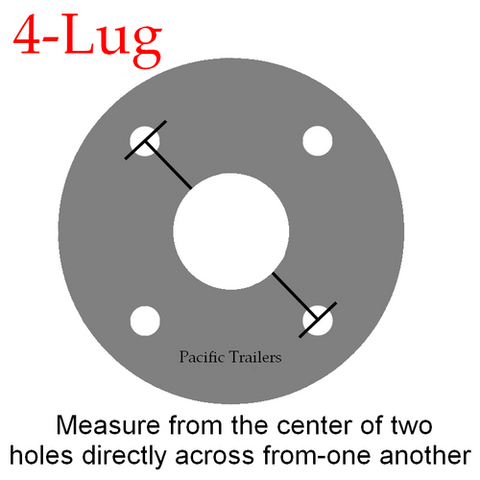
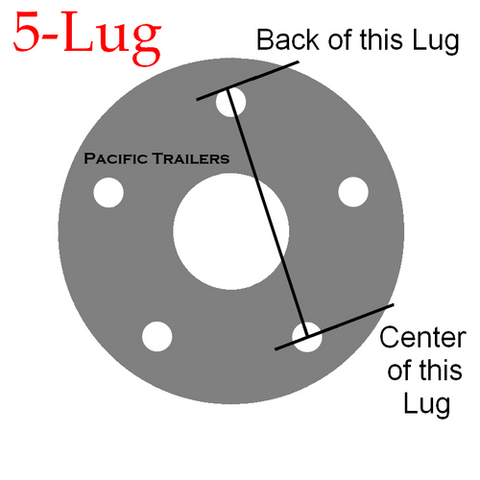
      <![CDATA[<p>In order to replace a hub on your trailer, you will need to know the bolt pattern or lug pattern. Trailer wheel hub patterns can be defined by the number of bolts or lugs per wheel and the diameter of the circle that the bolts are arranged on.  Determining the bolt pattern is rather easy, but it is very important that accurate measurements are taken.  The majority of boat trailers on the road have a 4, 5 or 6 lug pattern. A very common designation for boat trailer hubs would be 5 on 4-1/2 or 545 for short.  This means that the hub has 5 bolts spaced evenly on a 4-1/2" circle (see 5-lug diagram).</p>
<h3>Determining the bolt pattern on your trailer:</h3>
<ol>
<li><span>You will need to first count the number of lug bolts on one wheel. Most trailer hubs typically have 4 or 5 lugs per wheel/hub. Heavier duty, higher capacity trailers generally have 6 or 8 Lugs per wheel.</span></li>
<li><span>If the trailer hubs have an even number of bolts holding the wheel, measure from the center of one bolt to the center of the bolt directly opposite using a ruler, tape measure or caliper.  The hub lug bolt pattern will be determined by the number of lug bolts and the distance between the opposing hub bolt (see 4-lug hub diagram).  All but 5-lug patterns are measured in this manner.  </span></li>
<li><span>If your trailer wheel hubs have 5 lug bolts, measuring is slightly different. Choose any lug bolt and measure the distance between the back of one lug to the center of another that is directly across from it. Be sure that you skip one bolt when measuring.  You can measure the distance in either direction</span></li>
</ol>
<div><span>The two most common lug patterns are <strong>4 on 4" and  5 on 4-1/2" hubs</strong>. These hubs are typically seen on smaller boat and utility trailers. </span></div>
<div><strong></strong></div>
<div>
<strong>NOTE:</strong>  If you are replacing older wheel hubs, wheels, integrated hub/drums or hub/rotors the bearings should be checked for wear and replaced as necessary. Always use a high-temperature wheel bearing grease when re-packing your trailers hubs.</div>
<div><span><br> <em>4, 6 and 8 Lug trailer wheel hubs are all measured in the same manner.</em></span></div>
<div><span><em><img src="//cdn.shopify.com/s/files/1/1202/8294/files/lg4-lug_patter_1_large.png?v=1473450122" alt="Measure 4-Lug Trailer Wheel Bolt Pattern"></em></span></div>
<div></div>
<div style="text-align: left;"><img alt="Measure 5-Lug Trailer Wheel Bolt Pattern" src="//cdn.shopify.com/s/files/1/1202/8294/files/lgbolt_pattern-png_large.png?v=1473450163" style="float: none;"></div>
<div style="text-align: left;">If you need to replace your hubs, please see our current selection of <a href="https://www.pacifictrailers.com/collections/hubs-marine-grease-oil" title="Boat Trailer Hubs">boat trailer hubs</a>. We also have a full selection of <a href="/collections/hubs-marine-grease-oil/grease-oil" title="Grease &amp; Oil">grease &amp; oil</a> and <a href="/collections/bearings-seals" title="Bearings and Seals">bearings &amp; seals</a> for all your needs.</div>]]>
    </content>
  </entry>
  <entry>
    <id>https://pacifictrailers.com/blogs/boat-trailer-tips-advice/installing-trailer-fenders</id>
    <published>2017-01-03T10:45:00-08:00</published>
    <updated>2026-03-28T20:33:55-07:00</updated>
    <link rel="alternate" type="text/html" href="https://pacifictrailers.com/blogs/boat-trailer-tips-advice/installing-trailer-fenders"/>
    <title>Installing Trailer Fenders</title>
    <author>
      <name>Jeff Ash</name>
    </author>
    <summary type="html">
      <![CDATA[Installing new boat trailer fenders can make a huge difference in the aesthetic appeal of your trailer. Choose between chrome, painted, or galvanized finishes to match the exact look of the rest of your boat trailer. We'll show you how to get it done in 8 easy steps.<p><a class="read-more" href="https://pacifictrailers.com/blogs/boat-trailer-tips-advice/installing-trailer-fenders">More</a></p>]]>
    </summary>
    <content type="html">
      <![CDATA[<div class="docWizSection">
<div class="contentArea">
<h1>Installing Trailer Fenders</h1>
</div>
</div>
<table border="0" cellpadding="0" cellspacing="0" width="100%">
<tbody>
<tr>
<td valign="top" width="200">
<div style="text-align: left;"><img alt="" src="//cdn.shopify.com/s/files/1/1202/8294/files/Step1_1.jpg?v=1473452756" style="float: none;"></div>
</td>
<td valign="top">
<div class="contentArea">
<p><b>STEP 1:</b> Before you start, make sure that your new fender is the correct size. Fender lengths can be stretched or shortened by 1/2” to 3/4”. Simple either pull the ends together or pull them apart. Please make sure to protect the fender surface if doing so.</p>
</div>
</td>
</tr>
</tbody>
</table>
<table border="0" cellpadding="0" cellspacing="0" width="100%">
<tbody>
<tr>
<td valign="top" width="200">
<div><img src="//cdn.shopify.com/s/files/1/1202/8294/files/Step2_1.jpg?v=1473452777" alt=""></div>
</td>
<td valign="top">
<div class="contentArea">
<p><b>STEP 2:</b> Block the trailer wheels. If necessary jack up the trailer and remove one or more of the wheels for clearance.</p>
</div>
</td>
</tr>
</tbody>
</table>
<table border="0" cellpadding="0" cellspacing="0" width="100%">
<tbody>
<tr>
<td valign="top" width="200">
<div style="text-align: left;"><img alt="" src="//cdn.shopify.com/s/files/1/1202/8294/files/Step3_1.jpg?v=1473452807" style="float: none;"></div>
</td>
<td valign="top">
<div class="contentArea">
<p><b>STEP 3:</b> Remove the existing fender. Unbolt from the trailer steps or the fender supports. If the fender is welded on to the supports or steps, then all the welds must be ground off to remove the fender.</p>
</div>
</td>
</tr>
</tbody>
</table>
<table border="0" cellpadding="0" cellspacing="0" width="100%">
<tbody>
<tr>
<td valign="top" width="200">
<div><img src="//cdn.shopify.com/s/files/1/1202/8294/files/Step4_1.jpg?v=1473452837" alt=""></div>
</td>
<td valign="top">
<div class="contentArea">
<p><b>STEP 4:</b> If applicable, remove the fender back. Lay the fender on its back next to the replacement fender and mark any holes on to the new polished stainless steel fender.</p>
</div>
</td>
</tr>
</tbody>
</table>
<table border="0" cellpadding="0" cellspacing="0" width="100%">
<tbody>
<tr>
<td valign="top" width="200">
<div><img src="//cdn.shopify.com/s/files/1/1202/8294/files/Step5_1.jpg?v=1473452862" alt=""></div>
</td>
<td valign="top">
<div class="contentArea">
<p><b>STEP 5:</b> Center punch and drill the holes for the fender back.</p>
</div>
</td>
</tr>
</tbody>
</table>
<table border="0" cellpadding="0" cellspacing="0" width="100%">
<tbody>
<tr>
<td valign="top" width="200">
<div><img src="//cdn.shopify.com/s/files/1/1202/8294/files/Step6_1.jpg?v=1473452889" alt=""></div>
</td>
<td valign="top">
<div class="contentArea">
<p><b>STEP 6:</b> Mark the step mounting holes onto the new polished stainless steel fender.</p>
</div>
</td>
</tr>
</tbody>
</table>
<table border="0" cellpadding="0" cellspacing="0" width="100%">
<tbody>
<tr>
<td valign="top" width="200">
<div><img src="//cdn.shopify.com/s/files/1/1202/8294/files/Step7_1.jpg?v=1473452914" alt=""></div>
</td>
<td valign="top">
<div class="contentArea">
<p><b>STEP 7:</b> Drill or plasma cut the step mounting holes into the new polished stainless steel fender.</p>
</div>
</td>
</tr>
</tbody>
</table>
<table border="0" cellpadding="0" cellspacing="0" width="100%">
<tbody>
<tr>
<td valign="top" width="200">
<div><img src="//cdn.shopify.com/s/files/1/1202/8294/files/Step8_1.jpg?v=1473452936" alt=""></div>
</td>
<td valign="top">
<div class="contentArea">
<p><b>STEP 8:</b> Remove the protective PVC plastic cover from the fender, install the new fender and reinstall the wheels. Make sure to check that all mounting bolts are tight. Tighten the wheel lug nuts to your trailer manufacturers specifications. <b>MAKE SURE TO DOUBLE CHECK THE LUG NUTS ARE TIGHT.</b></p>
</div>
</td>
</tr>
</tbody>
</table>
<table border="0" cellpadding="0" cellspacing="0" width="100%">
<tbody>
<tr>
<td valign="top" width="200">
<div><img src="//cdn.shopify.com/s/files/1/1202/8294/files/Step9_1.jpg?v=1473452954" alt=""></div>
</td>
<td valign="top">
<div class="contentArea">
<p><b>STEP 9:</b> Repeat steps 1 to 8 on the opposite side.</p>
</div>
</td>
</tr>
</tbody>
</table>]]>
    </content>
  </entry>
  <entry>
    <id>https://pacifictrailers.com/blogs/boat-trailer-tips-advice/trailer-and-rv-travel-towing-and-braking-laws</id>
    <published>2017-01-01T13:30:00-08:00</published>
    <updated>2026-03-28T20:34:01-07:00</updated>
    <link rel="alternate" type="text/html" href="https://pacifictrailers.com/blogs/boat-trailer-tips-advice/trailer-and-rv-travel-towing-and-braking-laws"/>
    <title>Trailer and RV Travel Towing and Braking Laws</title>
    <author>
      <name>Jeff Ash</name>
    </author>
    <summary type="html">
      <![CDATA[<meta charset="utf-8"><span>Traveling with a trailer need not be a worrisome experience. A little planning and some additional experience behind the wheel, however, are helpful. See more tips on how to prepare for your next road trip.</span><p><a class="read-more" href="https://pacifictrailers.com/blogs/boat-trailer-tips-advice/trailer-and-rv-travel-towing-and-braking-laws">More</a></p>]]>
    </summary>
    <content type="html">
      <![CDATA[<p>Traveling with a trailer need not be a worrisome experience. A little planning and some additional experience behind the wheel, however, are helpful.</p>
<p>First, you should ensure that your trailer and related equipment comply with the laws of your state and all other states through which you intend to travel. These regulations vary widely from each state in the US. Then, if you still have questions, consult your AAA/CAA club.</p>
<p>Make sure your towing vehicle is ready to handle the weight of the trailer. The rear springs should be strong enough to maintain the car at a nearly level position. Check the shock absorbers and wheel alignment. Adding a little air to the rear tires - usually no more than 4 or 5 pounds and never exceeding the manufacturer's specification - can be helpful.</p>
<p>Load your car and trailer for optimum stability on the road. Keep heavy items out of the trunk and rear seat to help the vehicle absorb the weight of the trailer. Load the trailer with about 60% of the weight toward the front and 40% toward the rear. To provide a low center of gravity, place the heaviest items near the floor.</p>
<p>Cabinet doors and drawers are usually made so they will remain closed in transit. Most importantly, pack the cabinets, drawers and storage compartments securely to limit movement of contents. Secure large articles such as bicycles tightly to outside carriers rather than laying them inside where unsecured, they can become dangerous during sudden stops.</p>
<p>If your trailer has an independent braking system, check the brakes before starting out. Inspect the car and trailer, paying particular attention to the hitch, the tires on both vehicles, safety chains, the load and how well both vehicles seem to remain level. On trailers so equipped, check the water, electrical and LP gas systems. It is a good practice to repeat the visual inspection at each stop along your route. Unusual noises should be investigated immediately, after pulling well off the highway. <b><i>Do not drive an unstable car-trailer combination</i></b>; a swaying trailer is both tiring and hazardous.</p>
<p>The two leading causes of instability on the road are high speeds and traveling downhill. To minimize their ill effects, always obey the speed limit for towed vehicles. Anticipate downhill grades: Slow up before, not after, starting the descent and use a lower gear to keep from overworking the brakes. Use a lower gear on uphill pulls as well. You will get more power at less cost to your car. On long grades use the climbing lane if there is one, or pull over when the opportunity permits to let faster traffic pass.</p>
<p>Since a car-trailer combination is heavier and longer than a car alone, you will need to allow a greater distance for stopping, both in the city and on the open road. More time and distance are also required for passing. Remember that air suction, sometimes created when you overtake another vehicle, can cause both to lurch unexpectedly.</p>
<p>Keep in mind, too, that when turning corners or rounding curves, the trailer wheels will not follow the same track as your car's rear wheels. They will travel considerably closer to the inside of the curve. To compensate, and to avoid running over the curb of off the pavement, you will have to start your turn not only from farther to the outside but also from farther into the curve or intersection. Proceed with deliberation - and practice.</p>
<p>Practice is the key word for mastering the art of backing up a trailer. Although it is very different from backing a car, it can be relatively straightforward. First, place your hand at the bottom of the steering wheel, then move your hand in the same direction you want the trailer to go. For example, move your hand left to move the trailer left. Should the trailer jackknife, pull forward, straighten up, then try again.</p>
<p>Before starting out, be sure to contact your AAA/CAA club for a routing that affords the most favorable terrain and road conditions for trailer travel.</p>
<p><b>WARNING!</b> NEVER CARRY EXTRA GASOLINE, IN ANY CONTAINER. Combustion from fumes or accident is a lethal possibility.</p>]]>
    </content>
  </entry>
  <entry>
    <id>https://pacifictrailers.com/blogs/boat-trailer-tips-advice/how-to-measure-a-trailer-axle</id>
    <published>2016-12-12T11:00:00-08:00</published>
    <updated>2026-03-28T20:33:53-07:00</updated>
    <link rel="alternate" type="text/html" href="https://pacifictrailers.com/blogs/boat-trailer-tips-advice/how-to-measure-a-trailer-axle"/>
    <title>How To Measure a Trailer Axle</title>
    <author>
      <name>Jeff Ash</name>
    </author>
    <summary type="html">
      <![CDATA[When selecting an axle it is important to determine the axle capacity required for your trailer. Trailer capacity is based on the lowest capacity of the trailer components. This includes but is not limited to frame, axle, spindles, hubs, bearings, wheels, tires, springs and all hardware. It is important to know what axle type you have when reusing old mounting hardware and for proper tire clearance.<p><a class="read-more" href="https://pacifictrailers.com/blogs/boat-trailer-tips-advice/how-to-measure-a-trailer-axle">More</a></p>]]>
    </summary>
    <content type="html">
      <![CDATA[<h2>Selecting and Measuring Your Trailer Axle</h2>
<img alt="Trailer Axle Types" src="//cdn.shopify.com/s/files/1/1202/8294/files/smaxle_style_large.png?v=1473448610" style="float: right; margin-top: 5px; margin-left: 5px; margin-bottom: 5px;">
<p>When selecting an axle it is important to determine the axle capacity required for your trailer. Trailer capacity is based on the lowest capacity of the trailer components. This includes but is not limited to frame, axle, spindles, hubs, bearings, wheels, tires, springs and all hardware. It is important to know what axle type you have when reusing old mounting hardware and for proper tire clearance. This includes straight axles (round or square), drop axles with offset spindles, and torsion axles. Also, consider spindle size when reusing existing hubs or drums.</p>
<h2>Trailer Axle Hub Face</h2>
<p>Trailer axle hub face is the distance from the outside of hub mounting flange to outside of hub mounting flange, measured one-half way between top and bottom of the hub.  The hub face is also known as the mounting surface where the wheel studs are located. Hub face to hub face can also be called the axle track or the center line of the tire to the center line of the tire.</p>
<p style="text-align: left;"><img alt="Trailer Axle Hub Face Dimensions" src="//cdn.shopify.com/s/files/1/1202/8294/files/lgaxle_dimensions_1.png?v=1473448634" style="float: none;"></p>
<h2>Trailer Axle Drop</h2>
<p>Trailer axle drop is the distance from the centerline of spindle to bottom of the main axle tube.</p>
<p><strong>NOTE:</strong> In straight axles, you measure from the spindle centerline and axle main beam center line. Therefore, there is no drop.</p>
<p style="text-align: left;"><img alt="Trailer Axle Drop" src="//cdn.shopify.com/s/files/1/1202/8294/files/medPacific_Axle_Drop-w.jpg?v=1473448661" style="float: none;"></p>
<h2>Trailer Axle Spring Center</h2>
<p>Trailer axle spring center is the distance between the center of one spring to the center of the other.</p>
<h2>Trailer Axle Spring Center Pads</h2>
<p>Trailer axle spring center pads are locating or centering pads that can be welded or left loose and are meant for the leaf springs to mount onto.  Springs pads can be located at the top or bottom of the axle main beam.  <strong><em><u>DO NOT</u></em></strong> drill holes in the beam in lieu of using spring pads.  This would set up stress concentration points, which will weaken the axle beam and allow water to enter.</p>
<h2>Mounting your Axle</h2>
<p>When replacing your trailer axle, determine how it was previously mounted. Under slung mounts have the spring mounted below the axle and over slung mounts have the spring mounted on top (also called reverse axle).  Spring seats or centering pads can be mounted over or under the axle.  Some axles have "camber" or road set, so there will be a bow in the axle until weight is applied.  Cambered axles should be mounted with the center bow on top.</p>
<div><img src="//cdn.shopify.com/s/files/1/1202/8294/files/lgsingle_1.gif?v=1473448685" alt="Single Axle Diagram"></div>]]>
    </content>
  </entry>
  <entry>
    <id>https://pacifictrailers.com/blogs/boat-trailer-tips-advice/ufp-brake-actuator-parts-list-and-schematic</id>
    <published>2016-11-03T11:27:00-07:00</published>
    <updated>2026-03-28T20:34:03-07:00</updated>
    <link rel="alternate" type="text/html" href="https://pacifictrailers.com/blogs/boat-trailer-tips-advice/ufp-brake-actuator-parts-list-and-schematic"/>
    <title>UFP Brake Actuator Parts List and Schematic</title>
    <author>
      <name>Jeff Ash</name>
    </author>
    <summary type="html">
      <![CDATA[Pacific Trailers offer a complete line of UFP replacement hydraulic brake actuators and replacement parts.  Trailer Buddy disc brake parts are also available for models DB-42 and DB-35.<p><a class="read-more" href="https://pacifictrailers.com/blogs/boat-trailer-tips-advice/ufp-brake-actuator-parts-list-and-schematic">More</a></p>]]>
    </summary>
    <content type="html">
      <![CDATA[<h2>UFP A-60 Series Replacement Parts List and Schematic</h2>
<p>Pacific Trailers offer a complete line of UFP replacement hydraulic brake actuators and replacement parts.  Trailer Buddy disc brake parts are also available for models DB-42 and DB-35.</p>
<p style="float: right;">To order replacement brake actuator parts for the UFP A-60, A-75, A-84, and A-160 please contact us or order online here with our secure online shopping cart. </p>
<div style="text-align: left;">
<img alt="UFP Actuators" src="//cdn.shopify.com/s/files/1/1202/8294/files/smUFP_3_Actuators_large.png?v=1473452046" style="float: none;">  
<h3></h3>
<h3>Ordering Replacement Parts</h3>
<p>Order all your replacement parts for the UFP A-60 online. Generally, all parts listed to the left are in stock and ready to ship.</p>
<p><strong>NOTE:</strong> Most A-60 actuator parts are interchangeable with all UFP actuator models (with the exception of the A-160 which has some parts not listed below). UFP makes actuators available for both disc and drum brake applications. Disc brakes require an electric reverse solenoid #27 part #34500. Disc brakes on 1-trailer axle require a push rod assembly for 1-axle brakes. Disc brakes on 2 and 3 axles requires push rod assemblies according to how many braked axles you are running.</p>
</div>
<div><img src="//cdn.shopify.com/s/files/1/1202/8294/files/UFP_PARTS_LIST-3_1.png?v=1473452081" alt="UFP Parts List"></div>
<div><img alt="UFP Schematic" src="//cdn.shopify.com/s/files/1/1202/8294/files/ufp_schematic_1.png?v=1473452179"></div>]]>
    </content>
  </entry>
</feed>