<?xml version="1.0" encoding="UTF-8"?>
<feed xml:lang="en" xmlns="http://www.w3.org/2005/Atom" xmlns:opensearch="http://a9.com/-/spec/opensearch/1.1/" xmlns:s="http://jadedpixel.com/-/spec/shopify">
  <id>https://www.paladinshaving.com/blogs/brooms-blog.atom</id>
  <link rel="alternate" type="text/html" href="https://www.paladinshaving.com/blogs/brooms-blog"/>
  <link rel="self" type="application/atom+xml" href="https://www.paladinshaving.com/blogs/brooms-blog.atom"/>
  <title>Dark Holler Design Works, LLC - Broom&apos;s Blog</title>
  <updated>2022-12-23T14:31:33-07:00</updated>
  <author>
    <name>Dark Holler Design Works, LLC</name>
  </author>
  <entry>
    <id>https://www.paladinshaving.com/blogs/brooms-blog/re-2ch3k4-knots</id>
    <published>2022-12-23T14:31:33-07:00</published>
    <updated>2022-12-23T14:31:33-07:00</updated>
    <link rel="alternate" type="text/html" href="https://www.paladinshaving.com/blogs/brooms-blog/re-2ch3k4-knots"/>
    <title>Re: 2CH3K4 knots</title>
    <author>
      <name>Ken Lynn</name>
    </author>
    <content type="html">
      <![CDATA[<p>This past week was a ballbuster. I didn’t find time to shave once, so the 26 mm 2CH3K4 I’ve mainly focused on testing since 11/15 hasn’t seen use since Saturday of Thanksgiving weekend (i.e., 12/02). The last two times I lathered with that knot (which is set in the Butterscotch Moe handle shown above), it didn’t give up a single hair. That – along with assurances from the supplier and time we spent rinsing, combing, palm-brushing, and vacuuming every single 2CH3K4 knot we’ve set in a handle so far – satisfied me that we could responsibly release 2CH3K4 brushes notwithstanding some initial concerns as described in the Knot Notes I posted on 11/24.<br><br>But yesterday I caught sight of the Moe, took it in hand, and lightly palm-brushed the knot as I thought about whether I might be able to squeeze in a shave. Then I noticed a couple loose hairs pop up. I continued brushing. More hairs emerged. That was it. I showed Pam (my wife) and then called Cody. This is what we decided to do.<br><br>1) We’re suspending sales of brushes with 2CH3K4 knots until we can determine and communicate with high confidence a causal explanation for the shedding we’ve observed.<br><br>2) We’re going to issue a $20 refund for every brush with a 2CH3K4 knot we’ve sold to date (that’s 29 brushes in total). We didn’t intend for our customers to serve as Guinea pigs to trial these knots.<br><br>3) Although we encourage those who have already purchased one of these brushes to keep and use it long enough to see whether it settles out satisfactorily, we will accept returns from original purchasers and grant full refunds inclusive of customary shipping costs upon request. In any such case where the brush was forwarded directly to a buyer outside the US, we’ll work to achieve a fair resolution.<br><br>For what it’s worth, I remain optimistic that these knots will settle out and fulfill our expectations in terms positive performance. But we certainly won’t order any more of them unless and until we sort out with the supplier what accounts for the loose hairs and come up with a reliable solution. I sincerely hope that happens. The hair used to make these knots uniformly (and that’s a key word) exhibits characteristics we want to offer as a select type with reliable consistency.<br><br>With all of that said, here’s what I think is going on with these knots. And I still think it with pretty high confidence, just not quite as much as I need in light of the Moe’s little back-slide yesterday.<br><br>As mentioned in the Knot Notes entry for the 2CH3K4 code, a sample knot I used several times before placing a substantial order behaved in much the same way as the test knot set in the Moe. I related that, along with photos, to the supplier and was given strong assurances in response. But I’ve had my share of experience with hollow assurances, and when the 2CH3K4 knots were delivered on November 15, I randomly selected a 26 mm semi-bulb and headed straight for the shave den. Déjà vu awaited. I shared this with the supplier once again and got back much the same response as before, this time accompanied by photos of techniques commonly used to remove loose hairs that I must understand inevitably occur with badger-hair knots. Of course, I already knew that. I also knew that I was encountering more loose hairs with these knots than I ever had before.<br> <br>Absent some traumatic event, a single hair sheds from a knot for one of three reasons: 1) it was insecurely bound by glue and separated from the base to which it had been attached, 2) the length that shed broke off from a lower segment that remained bound to the base, or 3) it somehow came to be bound in the knot among other hairs secured by glue but did <strong>not</strong> itself come into any effective contact with glue. Hairs that become separated from glue without breaking typically exhibit some residue. Hairs that have broken off above a knot’s glue base should be expected to display a somewhat uneven appearance at their broken end. It seems reasonable to assume that a shed hair which appears to have a very cleanly cut and residue-free base-end most probably was bundled and tied (perhaps very tightly) in the knot but never came into any effective contact with glue when the knot was cemented.<br><br>Immediately after first use of the test knot, I pulled another 26 mm knot from the box and cut it in half with a bandsaw. (That’s something I usually do anyway when new orders arrive.) On this occasion the one I cut in half appeared to be well constructed with general penetration by hair into the glue base measuring in the range of 4-5 mm.</p>
<p><img src="//cdn.shopify.com/s/files/1/0904/2570/files/2CH3K4-bisected-base-1_1024x1024.jpg?v=1512341484" alt="" style="display: block; margin-left: auto; margin-right: auto;"></p>
<p>We have a large collection of hairs that were liberated from these knots by combing, palm-brushing, vacuum suction, lathering, and some other techniques. We’ll be sending a bunch of them back to the supplier for its examination. I’ve paid closest attention to hairs that shed from the Moe’s test knot during ordinary handling and use as shown in the photo below.</p>
<p><img src="//cdn.shopify.com/s/files/1/0904/2570/files/2CH3K4-hairs-shed-from-Moe_1024x1024.jpg?v=1512341503" alt="" style="display: block; margin-left: auto; margin-right: auto;"></p>
<p><span>Here is a higher resolution inset from the photo above. Note the even ends and absence of apparent residue .</span></p>
<p><span><img src="//cdn.shopify.com/s/files/1/0904/2570/files/2CH3K4-hairs-shed-from-Moe-inset_1024x1024.jpg?v=1512341507" alt=""></span></p>
<p>Almost all of the loose hairs I’ve collected from the Moe and measured were close to 46 mm in length compared to free loft at the center of about 48 mm.</p>
<p><img src="//cdn.shopify.com/s/files/1/0904/2570/files/2CH3K4-hair-in-calipers-set-at-47-mm_1024x1024.jpg?v=1512341513" alt=""><br><br>Below are two microscopic photos (approx. x140) of the same hair’s base end. This hair shed from the Moe during use. The end appears to me to have been cut.</p>
<p><img src="//cdn.shopify.com/s/files/1/0904/2570/files/A097---20171125_083954_1024x1024.jpg?v=1512341525" alt=""></p>
<p><img src="//cdn.shopify.com/s/files/1/0904/2570/files/A096---20171125_083025_1024x1024.jpg?v=1512341520" alt=""><br><br>Next is a pair of photos, the first taken at the base end and the second at the tip of another hair collected from the Moe during use.</p>
<p><img src="//cdn.shopify.com/s/files/1/0904/2570/files/A102---20171126_090032_1024x1024.jpg?v=1512341530" alt=""></p>
<p><img src="//cdn.shopify.com/s/files/1/0904/2570/files/A105---20171126_090615_1024x1024.jpg?v=1512341536" alt=""></p>
<p>Finally, below are two photos showing a 2CH3K4 hair that I cut near both ends with surgical scissors. Although I’d guess the German-made, precision instrument I used might be a little superior in quality to whatever tools are used by knot-makers in China to cut the base-ends of badger hair, just the same, I’d say these look a lot like the ends of shed hairs in the previous photos.</p>
<p><img src="//cdn.shopify.com/s/files/1/0904/2570/files/A106---20171126_091255_1024x1024.jpg?v=1512341541" alt=""></p>
<p><img src="//cdn.shopify.com/s/files/1/0904/2570/files/A107---20171126_091357_1024x1024.jpg?v=1512341546" alt=""> <br>Conclusion:</p>
<p>None of this stands as proof of cause, but I believe it supports the hypothesis that the shedding we’ve observed with 2CH3K4 knots is attributable to unglued hairs dislodging rather than glue failure or breakage. In any case, we’ll take this up again with the supplier and almost certainly learn more about something.<br><br>This obviously isn’t a situation we’d choose to be in, but we’ll make the best of it. Hopefully, if nothing else, our customers and others who might be paying attention will see that we’re highly focused on problem solving and continuous improvement toward making the best brushes we possibly can.<br><br>We’ll share more about this as we have more to share.</p>]]>
    </content>
  </entry>
  <entry>
    <id>https://www.paladinshaving.com/blogs/brooms-blog/frank-and-lynn-mcinroy-part-2-of-3</id>
    <published>2019-11-12T20:23:00-07:00</published>
    <updated>2019-11-12T20:23:58-07:00</updated>
    <link rel="alternate" type="text/html" href="https://www.paladinshaving.com/blogs/brooms-blog/frank-and-lynn-mcinroy-part-2-of-3"/>
    <title>Frank and Lynn McInroy (Part 2 of 3)</title>
    <author>
      <name>Ken Lynn</name>
    </author>
    <content type="html">
      <![CDATA[<h2 style="text-align: center;"><strong>Foundations</strong></h2>
<div style="text-align: left;"><strong></strong></div>
<p>This installment introduces Frank and Lynn McInroy and the two-person, family business they created together. It also provides some history with regard to the lathe and its evolution over the past 540 years. The latter section is probably too long and might fairly be criticized as smacking of pedantry, but it’s there to drive an important point.</p>
<p>The terms <em>CAD-CAM</em> and <em>CNC</em> are occasionally employed with a purpose to conjure images of robot machines that dehumanize manufacturing work and their output. By way of example, one self-styled <em>master wood-turner</em> refers to the <em>slew of artisan brush makers out there, most</em> [of whom] <em>use simple manual wood or metal lathes, while some utilize computer controlled machines capable of creating hundreds of identical brush handles in a fraction of the time needed to do similar work by hand</em>. That characterization may be factually true as far as it goes, but it also, in my opinion, peddles a bit of BS. Although pursuit of efficiency and productive capacity has driven a large part of innovation in machining technology, so has a quest for improved control and resulting precision. The stereotyped notion that operation of a CNC lathe intrinsically involves less skill, craftsmanship, mindful care, investment of soul, sweat, blood, time and/or labor, than work performed by someone who turns objects manually is simply wrong. Not all artisans employing computer-controlled machines gain efficiency or achieve relative scale by their use. And no matter what level of skill might be applied to turning a brush handle manually, hand-turners simply can’t match the repeatable fidelity of execution that CAD, CAM, and CNC enable.</p>
<p>There may a <em>slew of</em> <em>artisan brush-makers out there</em>, but there was only one FrankLynn Technology. And what Lee Sabini accomplished in resurrecting Rooney shaving brushes and establishing Morris &amp; Forndran as a brand depended heavily on the background, skills, and capabilities Frank and Lynn McInroy were uniquely positioned to contribute.</p>
<p><strong>Frank McInroy and the making of an artisan-machinist</strong></p>
<p>Frank McInroy is 76 years old. He grew up in Aberdeenshire, Scotland, and attended Skene School. His father was a gamekeeper on the Castle Fraser estate. Frank has been actively engaged in engineering for over 60 years. What follows in italics are Frank’s own words with very minor editing.</p>
<p><em>The school leaving age in my day was fifteen, and the minimum legal age to get an apprenticeship was sixteen. Back then it was all about getting you ready for the workplace and hopefully an apprenticeship.  I was lucky, because the secondary school I attended offered three years of one day a week that consisted of Woodworking, Metalwork, and Technical Drawing. </em></p>
<p><em>If an apprenticeship was your goal, after leaving school you had to find suitable part time work or go to college for extra training. There were a limited number of technical colleges around then, and unlike today, you had either to pay or sit the entrance exam and gain a bursary. Fortunately, I passed the entrance exam and obtained a bursary, so I was able to lay on extra technical training until my sixteenth birthday, when I acquired an apprenticeship.</em></p>
<p><em>An apprenticeship was a real prize. This was where you trained and gained experience in your chosen trade. After five years, you’d would be known as a journeyman and could then go on and get a job in your chosen profession as a skilled person.</em></p>
<p><em>By the time I completed my apprenticeship I had attained a good grasp of technical drawing. Long before CAD (Computer Aided Design) engineers always worked to a drawing, and if you didn’t have one, you had to make one that was precise and included all the dimensions and related information necessary for anyone else anywhere to reproduce the same component. You would always have a sort of three-dimensional image in your head. That’s how things were made. If you were very good at it, you most likely became a draughtsman and would end up in design. But if you also had good hands-on skills with tools and machinery, the foremen of the day would never let you go to design. You’d be considered too skilled for that and be regarded as an artisan of your craft.</em></p>
<p>Frank turned 16 in 1959, completed his apprenticeship five years later in 1964, and came to be regarded as an artisan of his craft almost four decades before being approached by Lee Sabini to assist in the resurrection of Rooney shaving brushes. Frank was not, however, the type of artisan who previously would have been employed to turn Rooney or Simpson shaving-brush handles on a manually operated lathe (whether powered by water or electricity). He was precision engineer, and very importantly to Lee at that time, Frank was a precision engineer who had mastered the use of CNC lathes to turn modern plastics into elegantly refined shapes embodying complex geometries. As such, Frank was enabled by technologies, methods, and skills developed over the course of five centuries by engineers whose pursuit of excellence required progressive departure from handwork. </p>
<p><strong>Lathes, precision machining, NC, CNC, CAD and CAM</strong></p>
<p>A 1963 <em>Scientific American</em> article entitled “The Origins of the Lathe” by Robert S. Woodbury begins:</p>
<p><em>Machine tools lie at the heart of the industrial production, and the acknowledged queen of machine tools is the lathe. Yet because the lathe originated in antiquity and has no single inventor it receives short shrift in most histories, which often describe the Industrial Revolution as if it had been evoked solely by the steam engine, the power loom and the cotton gin. Without major developments in the lathe between 1750 and 1830 the Industrial Revolution could not have taken place. </em>[And, it might be added, without those developments and their enablement of the Industrial Revolution, the motor-driven lathes almost all hand-turners use today (most of which are made in China) would not exist.]</p>
<p>Archeological artifacts suggest the lathe was invented nearly 3,000 years ago. The earliest known graphic representation of a lathe is carved on the wall of a third century B.C.E. Egyptian grave. Advances from that time until the late 15<sup>th</sup> century related for the most part to methods of spindle rotation. But in about 1480 a drawing was included in the <em>Mittelalterliche Hausbuch</em> showing a lathe in which the cutting tool was placed in a mechanical device (now called a <em>slide rest</em>) rather than held in the hands of the turner. <em>The cutting tool was fed into the work by means of a screw mechanism much like modern cross-feed devices. Moreover, the toolholder was held fixed in the lateral direction, while the workpiece was moved past it by means of what is now known as a lead screw, turned by a crank. </em>From that point forward, evolution of machines of the type Frank McInroy would eventually operate diverged substantially from lathes fed by hand.</p>
<p>In the early 1700s clock and instrument makers began making important contributions to lathe design with a primary focus on improving precision. The first fully documented, all metal, slide-lathe was invented by Jacques de Vaucanson (1709–1782) in 1751. Vaucanson was a genius French engineer who is also credited with creating the world's first true robots, as well as the first programmable power loom (which utilized punch cards). The first truly modern screw-cutting lathe was likely constructed by Jesse Ramsden in 1775. His device included a leadscrew, slide rest, and change gear mechanism. Ramsden employed that lathe to make even more accurate lathes, by use of which he made an exceptionally accurate dividing engine, and with that, some of the finest astronomical, surveying, and navigational instruments of the 18th century. <span style="text-decoration: line-through;"></span></p>
<p>At some point, lathes that evolved along the lines of those made by Vaucanson and Ramsden came to be most commonly referred to as <em>metal lathes</em>. Their development continued through innovation, synthesis, and refinement throughout the 19<sup>th</sup> century and up to the present. One innovation that bears mention here is the duplicating (or copy) lathe invented by Thomas Blanchard in 1818. Originally adopted mainly for woodworking applications, this type of lathe was able to create shapes identical to a standard pattern. Crossover eventually occurred, however, and by the 1960s duplicating attachments for metal lathes were being used in the UK motor industry. Frank gained extensive experience fitting hydraulic units to Colchester production lathes and mastering the challenges of their use, which resulted in significant advantage when FrankLynn Tech undertook to reproduce shapes with CNC lathes. In Frank’s words: <em>The shape of the stylus was very important. I used to make mine almost like the tips I used for CNC machining brush handles, so I already had ideas about how to turn beads. Having that three-dimensional image fixed in mind stood me in good stead, and when Lynn was able to get on top of the CAD and CNC programming, we made a good team.</em></p>
<p>The immediate predecessors of CNC machines were constructed by modifying manually operated machines in order to effect slide motion via precise numeric control (NC) of attached motors (in lieu of hand-turned cranks). Positioning instructions, referred to as G-codes, were fed into NC machines on punched tape. The first such machines were developed in the late 1940s for the purpose of producing aircraft parts with intricate geometries.</p>
<p>A serious limitation of NC machines was that their logic elements were hardwired, which made it impossible to change the pre-set parameters. This was remedied by the development of CNC, which harnessed advancing computer technology to enable more adaptive programming. Evolution of CNC accelerated with the development of CAD and CAM software applications in the 1970s. (In the early days of CAD and CAM, those abbreviations were often used and understood to stand for <em>Computer Aided Drafting</em> and <em>Computer Aided Machining</em>. As software functionality broadened, however, <em>Computer Aided Design</em> and <em>Manufacturing</em> largely displaced the former usage.) By 1989, CNC machines had become the industry standard.</p>
<p><strong>Lynn McInroy and FrankLynn Technology</strong></p>
<p>When Frank McInroy acquired a pair of bench-top CNC lathes in 1998 and a CNC mill a year later, he had a powerful advantage above and beyond the thirty-plus years he’d worked as an artisan machinist; he had a wife, named Lynn, who complemented him almost perfectly in relation to the task at hand, i.e., mastering CAD-CAM in combination with CNC and putting those machines to productive use.</p>
<p>Growing up in London, Lynn had educational opportunities that weren’t available to Frank. She attended an excellent girl’s grammar school from the ages of 11 to 18, and then went on to study Math at Southampton University. After college she went into the engineering industry. Most of her employed life was spent in Aircraft Simulation, where she analyzed aircraft data and programmed the analysis. She learned ALGOL (<em>Algorithmic Language</em>) as part of her university course, and used BASIC, octal machine code, assembly language, and Fortran during her employed life, serving as Project Systems Engineer on six projects.</p>
<p>Lynn left work when her and Frank’s first child was born. After that she did intermittent sub-contract work, before teaming up with Frank in FrankLynn Technology. There, Lynn handled all the paperwork (<em>of course!</em>), putting it on a computer. When FrankLynn Tech acquired CNC machines, she learned CAD, which enabled her to produce all the drawings that were needed, and she did the major part of programming the machines (which she also frequently ran, along with doing occasional small jobs on manual machines). Lynn also performed assembly work from time to time and learned a lot about production engineering from Frank, who for his part acknowledges Lynn as having been an indispensable asset in adding CAD-CAM and CNC to the FrankLynn Tech arsenal.</p>
<p>When the CNC lathes were placed into productive service, FrankLynn Tech had a variety of customers and used the machines to turn wide range of materials, including stainless steel, alloys, polypropylene, and acetal. Frank soon discovered, however, that the lathes were especially well suited to machining decorative polyesters and acrylics, which could be sourced from nearby GPS Agencies.</p>
<p>In fairly short time, GPS began feeding leads to FrankLynn Tech by reason of the fact many GPS customers had no idea how to machine or polish the materials (polyesters and acrylics) GPS supplied. In turn, FrankLynn Tech’s mastery of CAD in combination with CNC machining brought about requests to create and execute <em>bespoke designs</em>. Increasing demand for their services led Frank and Lynn to add vibratory polishing capabilities (in addition to continued hand-polishing) in order to keep up with the work. All of this combined to position FrankLynn Tech as the best partner for Lee Sabini when he assumed the role of Managing Director of R.A. Rooney &amp; Sons in 2003 without any significant background related to the production of shaving brushes.</p>]]>
    </content>
  </entry>
  <entry>
    <id>https://www.paladinshaving.com/blogs/brooms-blog/frank-and-lynn-mcinroy-part-1</id>
    <published>2019-11-06T15:42:00-07:00</published>
    <updated>2019-11-12T20:15:03-07:00</updated>
    <link rel="alternate" type="text/html" href="https://www.paladinshaving.com/blogs/brooms-blog/frank-and-lynn-mcinroy-part-1"/>
    <title>Frank and Lynn McInroy  (Part 1 of 3)</title>
    <author>
      <name>Ken Lynn</name>
    </author>
    <content type="html">
      <![CDATA[<h2 style="text-align: center;"><strong>Backstory</strong></h2>
<p>Seven years ago today, I ventured to make direct contact with Lee Sabini by email using an address I’d obtained from a B&amp;B (badgerandblade.com) member. My understanding at the time was that Lee had been the owner of R. A. Rooney &amp; Sons (makers of Rooney shaving brushes, with which enterprise Lee was widely believed to continue some involvement) and that he personally hand-crafted Morris &amp; Forndran (<em>M&amp;F</em>) shaving brushes (which often incorporated handle designs identified with the vaunted Rooney Heritage line).</p>
<p>That first email was brief and to the point. It stated: “I’d like to discuss having you make a custom brush for me with a faux jade handle. Please let me know if that might be possible and you’d be willing.” I was braced for disappointment. Lee was notoriously elusive, and much of online discussion regarding M&amp;F brushes was hash upon rehash of frustration over failed efforts to get a response from Lee. To my great surprise, however, Lee replied as follows almost immediately: “Thanks for finding me the only brushes I have in jade at the moments is the L7 handles size knots 22 mm 24 mm 26mm if you are interested prices start as 80 pounds up to 110 pounds including shipping in blonde hair.” I quickly confirmed an order for a 24 mm jade L7.</p>
<p>That L7 turned out to serve as a point of departure with profound significance for me and my family. It inspired a derivative handle design (eventually dubbed the <em>Chief</em>), that led to an M&amp;F group-buy project on B&amp;B in 2013, which was capped by a meeting with Lee in London in October of that year, which led in January of 2014 to my acquisition of a lathe for use in prototyping further handle designs, which enabled turning the first PK-47, which resulted in a proposal from Lee in July of 2014 to collaborate on the production of 70-100 shaving brushes, which led to the establishment of Dark Holler Design Works and Paladin Shaving.</p>
<p>I figured out early in the course of the M&amp;F group-buy project that the handles used to make Sabini-era Rooney and M&amp;F shaving brushes were turned on CNC (Computer Number Controlled) lathes. I continued unquestioningly, however, for quite a while to assume Lee himself created those handles. But after Cody and I hauled a small bench-top lathe (actually, there were three) to our home in Overland Park, Kansas from a shop in Wisconsin in early January of 2014, and I started peppering Lee with questions about G-code, spindle speeds, feed rates, and tooling; it became obvious that Lee didn’t know much more about CAD design, G-code, or CNC machine operation than I did. And so, I finally got around to asking who, in fact, did turn the handles. He told me it was a precision engineer by the name of Frank, who had very recently retired “to go off and make model steam engines.” I don’t recall ever pressing Lee for any further information regarding Frank. I suppose I assumed if Lee wished to share more about him, he would do so without being asked.</p>
<p>I was not unmindful of the opportunity Frank’s retirement might (and soon did) bring about to create new brushes in collaboration with Lee. I focused intently on learning how to use CAD programs, construct G-code, and operate my machines in order to make shaving brush handles. Cody (who in June of 2014 graduated from the University of Kansas with a degree in Industrial Design) pitched in and worked to develop and refine finishing techniques. Almost every time one of us solved a problem, we ended up on a new level that presented more challenging problems. And with each step along the way, I came to hold deeper appreciation of Frank’s mastery in creating the Rooney Heritage and M&amp;F handles. Early in the process, I brought an unused B&amp;B Group Buy Chief and a pair of Rooney 2XLs (aka <em>Chubbies</em>) down to where we had the lathe and finishing equipment set up. Those brushes remained there for a long time representing the level of excellence in design, machining, and finish quality we were striving to achieve.  </p>
<p>We produced about 450 Paladin shaving brushes in collaboration with Lee before deciding to carry forward independently in the second half of 2015. Frank continued, however, to serve as an imaginary overseer of handle production in our shop. And from my perspective his stature continued to grow. In November of 2016 I posted a reply on B&amp;B that stated in part: <em>The M&amp;F Chief handles were turned by a precision engineer named Frank who worked for Lee Sabini. Frank was an absolute master, who IMO belongs in the Shaving Brush Hall of Fame, along with A.E. Simpson and Stan Archer.</em></p>
<p>I searched the internet a few times to see if I might find a <em>Frank</em> listed in connection with model steam engine conventions or the like, but with no success. Then, last year Frank’s name came up in a discussion with Matt Roff, the managing director of GPS Agencies, our principal supplier of machinable rod in England. Matt’s predecessor, I learned, introduced Frank (whose last name is McInroy) and Lee to each other not very long after Lee had acquired a controlling ownership position in R. A. Rooney &amp; Sons in 2003. I mentioned an interest in being introduced to Frank but didn’t press for it at the time. Late last year, however, a couple threads cropped up on shavenook.com (TSN) regarding the origin/authenticity of some Rooney-labeled, Heritage-style shaving brushes that had recently appeared on eBay described as NOS (<em>new old stock</em>). I called and emailed Lee to obtain his opinion. He promised to get back to me but didn’t. That finally provided the stimulus to locate and establish contact with Frank if I could, which I did, and WOW, what a rewarding experience it has been to get to know him and his wife Lynn through correspondence over the past year! Now it’s time to share some of their story, without which there would be no Paladin Shaving story to tell.</p>
<p>Stay tuned for Part 2.</p>]]>
    </content>
  </entry>
  <entry>
    <id>https://www.paladinshaving.com/blogs/brooms-blog/paladin-proof-of-concept-fordite</id>
    <published>2019-01-19T08:20:00-07:00</published>
    <updated>2019-01-19T08:24:42-07:00</updated>
    <link rel="alternate" type="text/html" href="https://www.paladinshaving.com/blogs/brooms-blog/paladin-proof-of-concept-fordite"/>
    <title>Paladin Proof of Concept: Fordite</title>
    <author>
      <name>Ken Lynn</name>
    </author>
    <content type="html">
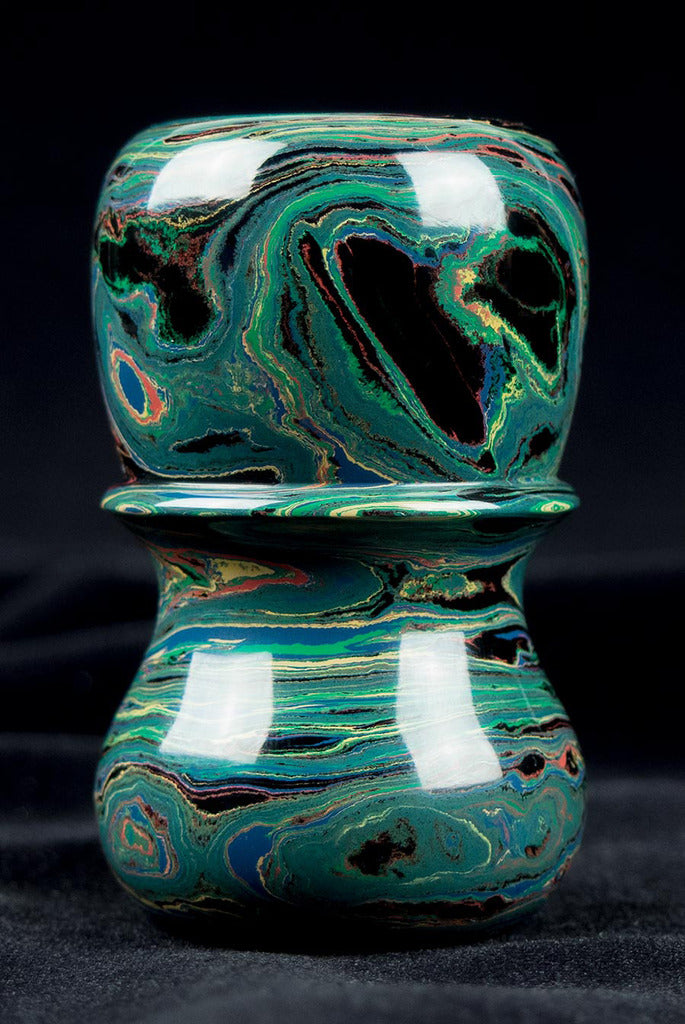
      <![CDATA[<p>Fordite came onto our radar in July-August 2014 when Cody found some examples while doing research aimed at identifying materials we could possibly use to make novel brush handles. But we didn’t turn up any sources of Fordite at the time; Ebonite captured our attention; and then Lee Sabini proposed the collaboration that set our course and dictated focus over most of the next year. Since then, we’ve mainly concentrated on 1) creating our website, 2) designing and making handles using resins and Ebonite, 3) sourcing the highest quality knots available, and 4) producing enough brushes to catch and keep up with demand. We never, however, abandoned our objective to pursue innovative use of other materials, and Fordite continued to crop up in conversation from time to time.</p>
<p>A couple months ago, we were approached out of the blue by David Guzman, a customer, friend, and Paladin Shaving Round Table member, who had obtained some Fordite and wanted to know if we’d be interested in evaluating its suitability for use in making brush handles. We said yes and turned the first prototype while Cody was home with us for the holidays. That trial was a success. Cody has since done a test engraving, which worked well.</p>
<p>More testing needs to be done. The piece we used machined nicely, but the smell was very, very powerful in a not good way. We need to figure out how to manage that. I think I’d prefer to work with Fordite outdoors.</p>
<p>I should caution against anyone getting excited about scoring a Fordite-handled brush anytime soon. We still don’t know whether it will prove out to be well-suited for that purpose. It’s scarce. I’d expect any brush with a Fordite handle to be priced at a level only a few would willingly pay. And for my part, assuming I have one, I don’t think I’d want to turn very many Fordite handles. I spent the summer of 1967 working in a body shop. I just don’t like the smell of automotive paint. (One of my jobs was to spray the inside of old grain-truck cabs.) Nonetheless, it’s pretty damn cool stuff. And we’re pleased and proud to have had this opportunity to make what I’d guess with high confidence is the first Fordite shaving-brush handle. We like being first. Thanks, David!</p>
<p>Note that the first photo below is of the handle just as it came off the lathe.</p>
<p><img src="//cdn.shopify.com/s/files/1/0904/2570/files/PC273846cc1200ws.jpg?v=1547910677" alt=""><img src="//cdn.shopify.com/s/files/1/0904/2570/files/PC273856cc.jpg?v=1547910691" alt=""><img src="//cdn.shopify.com/s/files/1/0904/2570/files/PC273857cc.jpg?v=1547910698" alt=""><img src="//cdn.shopify.com/s/files/1/0904/2570/files/PC273858cc.jpg?v=1547910706" alt=""><img src="//cdn.shopify.com/s/files/1/0904/2570/files/PC273861cc.jpg?v=1547910713" alt=""><img src="//cdn.shopify.com/s/files/1/0904/2570/files/PC273862cc.jpg?v=1547910719" alt=""></p>]]>
    </content>
  </entry>
  <entry>
    <id>https://www.paladinshaving.com/blogs/brooms-blog/introducing-the-paladin-atlas-zephyr-moby-and-oscar-handle-designs</id>
    <published>2018-12-26T10:13:00-07:00</published>
    <updated>2018-12-29T13:34:59-07:00</updated>
    <link rel="alternate" type="text/html" href="https://www.paladinshaving.com/blogs/brooms-blog/introducing-the-paladin-atlas-zephyr-moby-and-oscar-handle-designs"/>
    <title>Introducing the Paladin Atlas, Zephyr, Moby, and Oscar</title>
    <author>
      <name>Ken Lynn</name>
    </author>
    <content type="html">
      <![CDATA[<p style="text-align: left;"><img src="//cdn.shopify.com/s/files/1/0904/2570/files/Atas_Zephyr_Moby_Oscar_1024x1024.jpg?v=1545797176" alt=""></p>
<p style="text-align: left;">We plan to ring in the New Year with a small release showcasing four new handle designs we developed over the course of a week or two this past summer but didn’t advance beyond prototyping until early December. Although each of the four designs has its own distinctive character, they all share a common origin. </p>
<p style="text-align: left;">Release-time is set for 10:00 PM Central (i.e., Kansas City time), December 31. Photos of the brushes to be included can previewed <a href="https://www.flickr.com/photos/141014234@N04/sets/72157699217526290/with/32643706638/" target="_blank" rel="noopener noreferrer">here</a>. Please note that all of these brushes are associated with a new Knot Code (2CLNL5), which can be found <a href="https://www.paladinshaving.com/pages/knot-notes" target="_blank" rel="noopener noreferrer">here</a> (scroll to the bottom of the table).</p>
<p style="text-align: left;">The Paladin™ Atlas™ handle-design (at left in the photo above) is based closely on a Kent V10 in our collection of vintage shaving brushes. We did not undertake in that project to explore modifications for the sake of enhancement; our objective was simply to resurrect an abandoned handle-style that we’ve long admired. The only minor changes we purposely made were to 1) extend the top and bottom sections each by about 0.5 mm in height (i.e., 1.0 mm total) and 2) add a slight chamfer to the bottom edge. Otherwise, the 28 mm Paladin Atlas is scaled 1:1 with our example of the V10.</p>
<p style="text-align: left;">The Paladin Zephyr™ handle-design (second from left above) was derived directly (and very simply) from the Atlas. As simple and obvious as it seemed to be, however, we haven’t seen a closely similar handle design that pre-dates our Zephyr.</p>
<p style="text-align: left;">The Paladin Moby™ handle-design (third from left above) was derived directly from the Zephyr without reference to any other handle. That said, the Moby clearly suggests the venerable Jar motif (e.g., Simpson’s Persian Jar).</p>
<p style="text-align: left;">The Paladin Oscar™ handle design (at right in the photo above) was derived directly from the Moby (by addition of a ring) without reference to any other handle. Nevertheless, our Oscar bears obvious resemblance to antecedents harking back to the Victorian era.</p>
<p style="text-align: left;"><strong><img src="//cdn.shopify.com/s/files/1/0904/2570/files/Atlas.jpg?v=1545797690" alt="">﻿</strong></p>
<p style="text-align: left;"><img src="//cdn.shopify.com/s/files/1/0904/2570/files/Zephyr_961a0f60-d5cc-46a1-aca7-3bb6ba137e61.jpg?v=1545840848" alt=""><br><img src="//cdn.shopify.com/s/files/1/0904/2570/files/Moby_58721a40-f2f9-4fe6-a475-f47e0a37c4f5.jpg?v=1545840740" alt=""><br><img src="//cdn.shopify.com/s/files/1/0904/2570/files/Oscar.jpg?v=1545798269" alt=""></p>]]>
    </content>
  </entry>
  <entry>
    <id>https://www.paladinshaving.com/blogs/brooms-blog/103720774-ebonite-redux</id>
    <published>2017-09-22T07:11:00-06:00</published>
    <updated>2017-09-22T07:11:21-06:00</updated>
    <link rel="alternate" type="text/html" href="https://www.paladinshaving.com/blogs/brooms-blog/103720774-ebonite-redux"/>
    <title>Ebonite Redux</title>
    <author>
      <name>Ken Lynn</name>
    </author>
    <content type="html">
      <![CDATA[<p>It's one thing to milk a brand, something else to create and build one.</p>
<p><img src="https://cdn.shopify.com/s/files/1/0904/2570/files/Bring-it-1_zpsznh7kdt8.jpg?7127106742583721524" alt=""></p>
<p><img src="https://cdn.shopify.com/s/files/1/0904/2570/files/Bring-it-2_zpspzrsu91o.jpg?1159053494783855865" alt=""></p>
<p><img src="https://cdn.shopify.com/s/files/1/0904/2570/files/Bring-it-3_zpsg7guryh1.jpg?10587210993470679584" alt=""></p>
<p><img src="https://cdn.shopify.com/s/files/1/0904/2570/files/Bring-it-4_zpswcl49frd.jpg?11910016882898890825" alt=""></p>
<p><img src="https://cdn.shopify.com/s/files/1/0904/2570/files/Bring-it-6_zpsag1dbuyy_fcc0e8fc-cd1a-4257-ae27-e9308b594e07.jpg?11405507727609113953" alt=""></p>
<p><img src="https://cdn.shopify.com/s/files/1/0904/2570/files/Bring-it-5_zpsb7ucfo7v.jpg?12752913481874366179" alt=""></p>
<p>We innovate: Tradition on the Cutting Edge.</p>
<p> </p>
<p> </p>
<p> </p>
<p> </p>
<p> </p>
<p> </p>]]>
    </content>
  </entry>
  <entry>
    <id>https://www.paladinshaving.com/blogs/brooms-blog/ch-ch-ch-ch-changes</id>
    <published>2017-07-30T11:27:00-06:00</published>
    <updated>2017-07-30T17:50:00-06:00</updated>
    <link rel="alternate" type="text/html" href="https://www.paladinshaving.com/blogs/brooms-blog/ch-ch-ch-ch-changes"/>
    <title>Ch-ch-ch-ch-changes</title>
    <author>
      <name>Ken Lynn</name>
    </author>
    <content type="html">
      <![CDATA[<p>We launched <a href="http://www.paladinshaving.com">www.paladinshaving.com</a> and began offering brushes for sale exclusively from our online shop on March 22, 2016. At that time, there were 440 names and email addresses on the customer list we started building (based solely on requests) shortly after first introducing Dark Holler Design Works and Paladin® shaving brushes on Badger &amp; Blade in September 2014. We haven’t used or updated that list since sending out notice of our website’s launch on the day it went live.</p>
<p>Opening our online shop followed an 8 ½ month period (beginning in early July 2015) during which we didn’t accept any new orders for Paladin shaving brushes. We were highly sensitive to the pent-up demand that accumulated over that period, and we acknowledged in an update circulated a few days in advance of resuming sales that, at least for a while, customers trying to buy one of our brushes might experience more frustration than satisfaction. We did not, however, anticipate that brushes would continue to sell out within an hour or two of their release for over a year.</p>
<p>To be completely honest, although it has never been our purpose or vision for the Paladin shop to subject patrons to Black Friday-type sales, the fact is it was exciting for us to see our brushes fly off the shelves. And we were a little deflated the first time a few brushes remained in the shop on the morning after a release (that occurred this past May). Just the same, having some selection of brushes in the store at most times, allowing customers to evaluate them and make selections at their leisure, has always been our objective. Now it appears we’re finally making progress in that direction.</p>
<p>Since opening the Paladin shop, we’ve sold brushes to about 365 different customers. Over half of them have purchased just one brush, and only about one out of ten has bought more than four. We greatly value our returning customers, without whose support we wouldn’t be here. At the same time, we need to work effectively toward expanding our base in order to succeed as a business. This isn’t a hobby for us.</p>
<p>We’ve observed with interest that a high percentage of brush sales occurring one or more days after each of the past few releases have been by first-time customers. And there have been a lot more visitors in the shop between recent releases. That’s not altogether surprising. We adopted the process we’ve followed since mid-last year because we thought it was optimal in the circumstances, though by no means without compromises. I’m sure it would have been more frustrating to most of our customers had we placed small numbers of brushes in the shop randomly and without notice, making it catch-as-catch-can and placing at significant disadvantage those (that is most of us) who don’t have time or inclination to check unpredictably variable stock in an online shop countless times every day of the week. But scheduled releases don’t suit the preferences of many others, who might rather drop in to see what’s available at times of their own choosing and have opportunities to purchase a brush without feeling like they’re engaged in a frantic competition.</p>
<p>So, we think it’s time to experiment a little. We’re going to try mixing in some different approaches and see how they work. We’ll continue to be transparent along the way.</p>
<p>We’re targeting our next release for Wednesday, August 2 (stay tuned for more details). We plan to include about 30 brushes and hold some number out to put in the store, probably a few at a time throughout the week. I think we might also try offering a brush or two on one of the boards from time to time, but we’re not sure about that yet. Releases will continue to be preceded by advance announcements and previews, as usual. I expect we’ll make more use of Twitter and Facebook in connection with pop-up sales, but there’s no settled plan for that either. The point is we’re going to try some new approaches and see if we can discover ways to make things work better for more customers as we move forward. Undoubtedly, we’ll try some things that won’t pan out. That’s how we learn.</p>
<p>Sincere thanks from the four of us (Courtney, Cody’s new wife since last month, is now helping out with processing photos) to everyone who has supported Paladin Shaving.</p>]]>
    </content>
  </entry>
  <entry>
    <id>https://www.paladinshaving.com/blogs/brooms-blog/in-the-works</id>
    <published>2017-01-05T11:29:00-07:00</published>
    <updated>2017-01-05T11:29:04-07:00</updated>
    <link rel="alternate" type="text/html" href="https://www.paladinshaving.com/blogs/brooms-blog/in-the-works"/>
    <title>In the works</title>
    <author>
      <name>Ken Lynn</name>
    </author>
    <content type="html">
      <![CDATA[<p>Happy New Year to all!</p>
<p>2016 was a highly productive year for us in many respects, but we didn't have much time to work on new handle designs. We're determined to get back to that in 2017, and I also plan to do more substantive posting here.</p>
<p>Between Christmas and New Year's Day, we managed to turn out final prototypes of two new handles, one a beehive-style and the other an appreciative derivative of an old, Simpson family-era M8 (with equally venerable US Rubberset antecedents) that I picked up from a seller in Wichita, KS of all places.  </p>
<p>We expect to introduce brushes made with these handles ( as well as at least one or two others presently in the works) fairly soon. Given our limited production capacity and the fact we usually make handles in small batches of two to four dozen, stirring in new styles will affect the rate at which we cycle back around to make more of the earlier ones (e.g., Chief, PK-47, etc.). We're set to do our first release of this year tonight. There will be a good number of PK-47s in this one and probably the next, but then it might be a while before many more show up. This simply reflects the way we work, not any purpose to game supply.</p>
<p>Thanks to everyone who followed us and bought a brush (or tried to buy one) last year. We hope you'll stay with us. Thanks especially to those who have supported us on the boards and in various social media, or simply recommended us by word of mouth to a friend or family member. We appreciate that there is some sacrifice of a patron's self-interest involved in broadening awareness of Paladin Shaving and thereby contributing to demand for brushes that have been in frustratingly short supply. </p>
<p>Stay tuned.<br> </p>
<p style="text-align: left;"><img alt="" src="//cdn.shopify.com/s/files/1/0904/2570/files/Paladin-Beehive-P1.jpg?v=1483637108" style="float: none;"></p>
<p style="text-align: left;"><img alt="" src="//cdn.shopify.com/s/files/1/0904/2570/files/Paladin-Beehive-P2.jpg?v=1483637094" style="float: none;"></p>
<p style="text-align: left;"><img alt="" src="//cdn.shopify.com/s/files/1/0904/2570/files/Paladin-M64-P1.jpg?v=1483637083" style="float: none;"></p>
<p style="text-align: left;"><img alt="" src="//cdn.shopify.com/s/files/1/0904/2570/files/Paladin-M64-P2.jpg?v=1483637050" style="float: none;"></p>]]>
    </content>
  </entry>
  <entry>
    <id>https://www.paladinshaving.com/blogs/brooms-blog/54918211-inaugural-post</id>
    <published>2016-03-01T12:45:00-07:00</published>
    <updated>2016-05-10T20:21:49-06:00</updated>
    <link rel="alternate" type="text/html" href="https://www.paladinshaving.com/blogs/brooms-blog/54918211-inaugural-post"/>
    <title>Inaugural post</title>
    <author>
      <name>Ken Lynn</name>
    </author>
    <content type="html">
      <![CDATA[<p>Welcome to the Paladin Shaving™ website! It's been a long time coming. We give heartfelt thanks for the continuing interest and support of all who have (more or less) patiently waited for us to get it together. The fact is we’re still not quite there yet, but this is definitely a big step.</p>
<p>We established Dark Holler Design Works and started making Paladin™ shaving brushes in August of 2014. The story of how that all came about will be the subject of a separate article. I want to use the inaugural post on this blog simply to introduce the website and say a few things about its objectives.</p>
<p>First, paladinshaving.com is and will probably remain a work in progress. (So is this venture for that matter.) We invite you to visit and explore the site frequently. Our goals for it are 1) to provide a means of efficient communication regarding our products; 2) to offer an online shopping experience that comes as close as possible to that of selecting a shaving brush in a physical store; 3) to share our thoughts and perspectives related to wet-shaving; and 4) to contribute to building and maintaining the community of traditional wet-shavers.</p>
<p>The Paladin Shaving Brush Shop (hosted by Shopify with payments processed by PayPal Pro) is, to the best of our knowledge, unique in a few significant respects. One of those is that we post front and back photos of every individual brush offered for sale in the shop. (Note in this regard that we individually hand-wash and comb each knot before it's set. We find it easier to match knots to handles when we know what the knots look like after they’ve opened up a bit.) We also include an approximate measurement of <em>free loft</em> (for a definition of that term see <a href="http://www.paladinshaving.com/pages/knot-notes">Knot Notes</a>). And finally, every Paladin brush made available for purchase on this site is associated with both a serial number and a <em>knot code</em> (also discussed in <a href="http://www.paladinshaving.com/pages/knot-notes">Knot Notes</a>) that provides information regarding source, type, general characteristics, and acquisition date of the batch from which that particular brush’s knot was selected for installation in its handle. Of course, it's perfectly fine not to have any interest in those details. But they're of interest to us, so we share them.</p>
<p>The way we go about making brushes limits how many we can produce. And our production capacity can very depending on a number a factors. We presently don’t have a basis for confidently forecasting future demand, but I won’t be surprised if the stock we have on hand at opening is rapidly depleted. We suspended acceptance of new orders in July of last year until we could get a site up, and in the time since a sizable list of prospective brush-buyers has accumulated. Please don’t be discouraged if what you want isn’t available (or it quickly disappears) when you first browse the shop. More brushes are in the works. There will probably be some lag (hopefully not more than a few weeks) between the launch of this site and replenishment of stock. We have a knot order in process, fulfillment of which will temporarily gate production of more completed brushes, but not for long. </p>
<p>At this time, shipping orders outside the United States poses significant challenges for us. We’re working to resolve those issues. Until that is accomplished, best would be for international customers to make arrangements for a friend or family member in the U.S. to purchase and/or forward desired orders on their behalf. We apologize for any resulting frustration or inconvenience. Trust that it doesn’t reflect a lack of concern or respect on our part.</p>
<p><strong>A Few Thoughts for Prospective Wet-shavers</strong></p>
<p>Although opportunities to introduce variety into the practice abound, enlightened shaving only requires an open mind, a few quality products, mastery of some basic techniques, and willingness to give up thinking about everything else in the world for a few minutes.</p>
<p>A decent razor and functional shaving brush are the essential tools for traditional wet-shaving. And the truth is that both of these can be obtained for a very modest price. The last thing we want to do is discourage any prospective wet-shaver by suggesting that one needs to spend $150 or more on a badger-hair brush to achieve satisfying results. It just ain’t so. And for most, it’s probably best to start out with a focus on the basics. We’ll still be here when you’re ready for a Paladin Shaving Brush. In the meantime, feel free to hang around anyhow. We enjoy the company.</p>
<p>Thanks once again to all whose support, interest, and encouragement has contributed in some way to making this venture possible for us. You know who you are. So do we.</p>]]>
    </content>
  </entry>
</feed>