<?xml version="1.0" encoding="UTF-8"?>
<feed xml:lang="en" xmlns="http://www.w3.org/2005/Atom" xmlns:opensearch="http://a9.com/-/spec/opensearch/1.1/" xmlns:s="http://jadedpixel.com/-/spec/shopify">
  <id>https://www.panzermodels.co.uk/blogs/news.atom</id>
  <link rel="alternate" type="text/html" href="https://www.panzermodels.co.uk/blogs/news"/>
  <link rel="self" type="application/atom+xml" href="https://www.panzermodels.co.uk/blogs/news.atom"/>
  <title>Panzer Models - News, reviews and guides for 1/35 scale modelling</title>
  <updated>2018-11-16T11:10:31+00:00</updated>
  <author>
    <name>Panzer Models</name>
  </author>
  <entry>
    <id>https://www.panzermodels.co.uk/blogs/news/the-t-55-enigma-by-iwan-hughes</id>
    <published>2018-11-16T11:10:31+00:00</published>
    <updated>2018-11-16T11:10:31+00:00</updated>
    <link rel="alternate" type="text/html" href="https://www.panzermodels.co.uk/blogs/news/the-t-55-enigma-by-iwan-hughes"/>
    <title>The T-55 Enigma by Iwan Hughes</title>
    <author>
      <name>Panzer Models</name>
    </author>
    <content type="html">
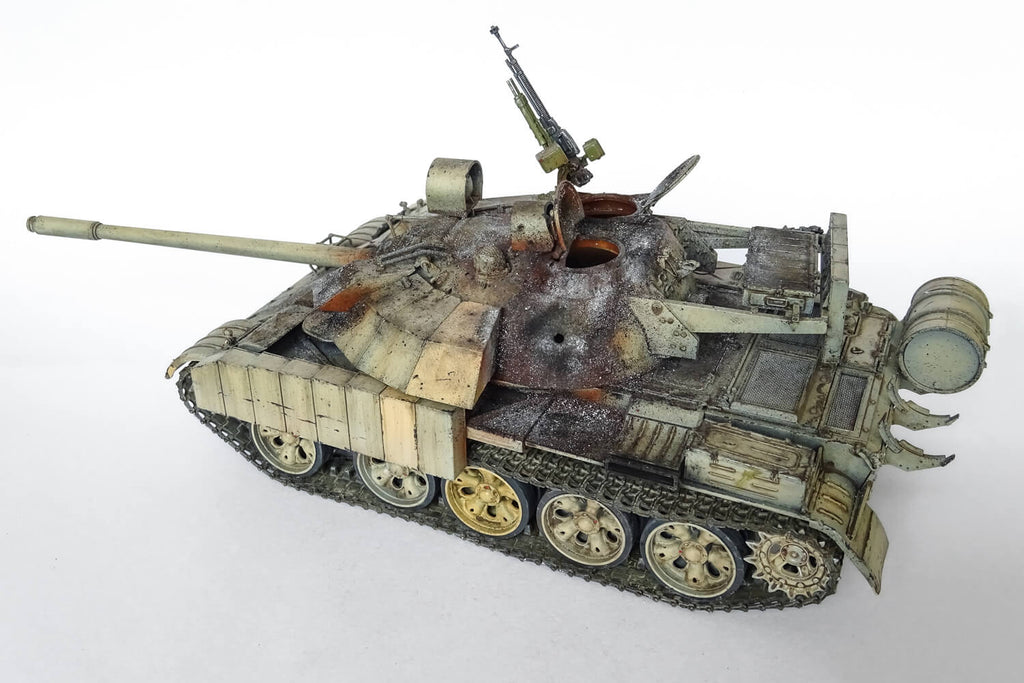
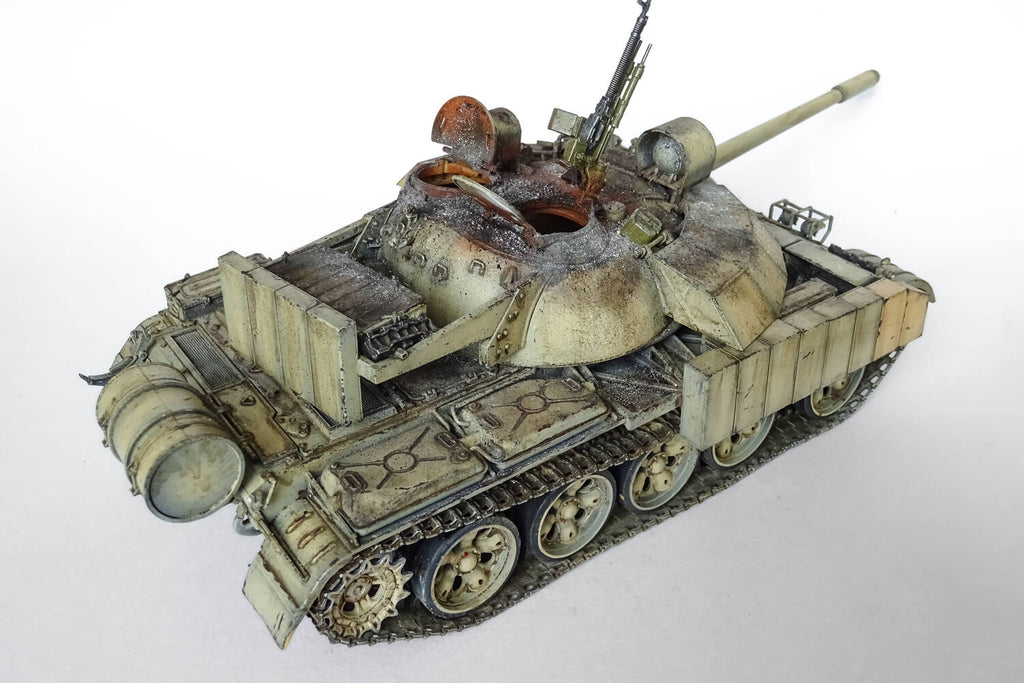
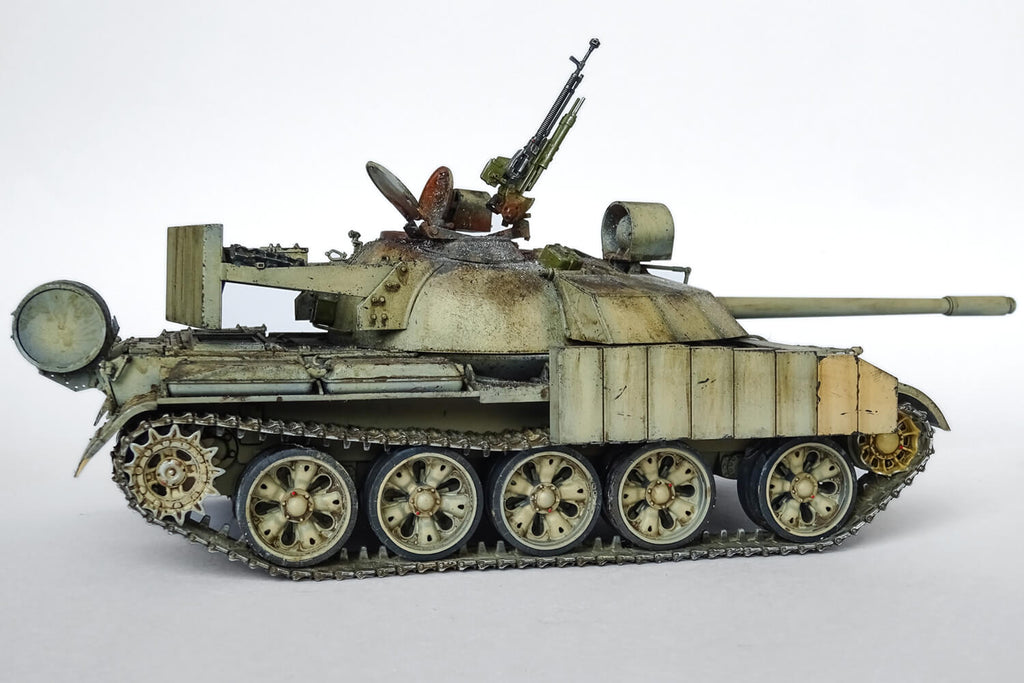
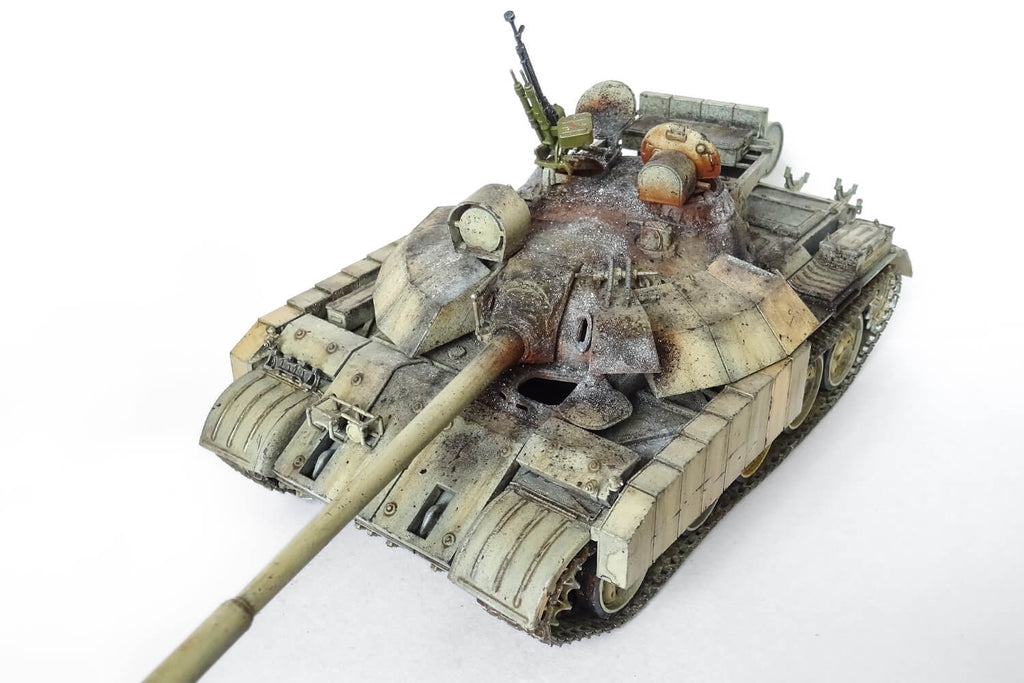
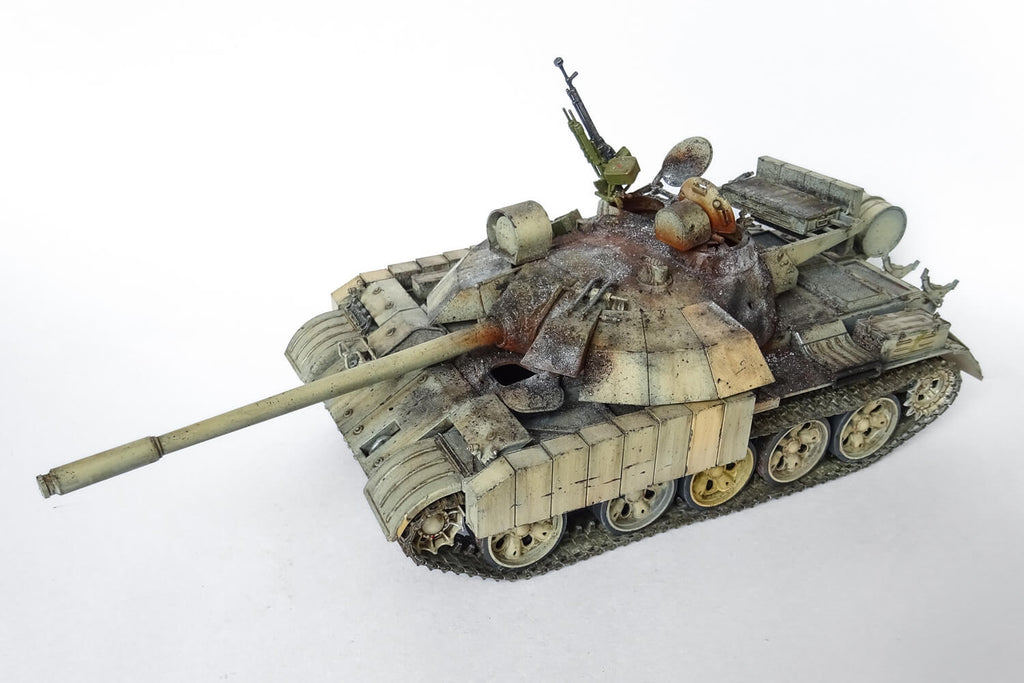
      <![CDATA[<p>Iwan Hughes <a href="https://www.instagram.com/hughesy_models/" target="_blank" title="Iwan Hughes @hughesy_models on Instagram" rel="noopener noreferrer">@hughesy_models</a> has built an adaptation of the classic T-55 Main Battle Tank -The Iraqi T-55 “Enigma”, known locally as the “Al-Faw”.<br><br><img src="//cdn.shopify.com/s/files/1/1120/3680/files/Panzer_Models_Blog_T-55_Enigma_19_1024x1024.jpg?v=1540897707" alt="1/35 scale T-55 Enigma Build"><br><br>This vehicle was developed in the late 80s around the time of the Iran-Iraq war. It is in essence an up-armoured T-55 with large armour blocks added to the front of the turret, and glacis plate &amp; front sides added to the hull. The armour was made up of sheets of steel and rubber, believed to have been created to counter the threat from HEAT (High Explosive Anti-Tank) shells and ATGMs (Anti-Tank Guided Missiles).<br><br>The Iran-Iraq War had devastated the Iraqi economy, and almost exhausted Iraqi military production capacity, with the exception of low-quality local production workshops. The 1990 invasion of Kuwait also prompted the adoption of United Nations Security Resolution 661, which meant that no modern arms could be bought from abroad. In this context, the T-55 Enigma was quite an ingenious solution to the conundrum.<br><br>The first encounter of a T-55 Enigma was made during the Battle of Kajif (29th January - 2nd February 1991), and despite accounts recorded stating that the crude armour was in part effective against ATGMs, the vehicle was no match to its modern coalition counterparts, such as the AMX-30 and an AC-130 ‘Spectre’ Gunship circling above.<br><br><img src="//cdn.shopify.com/s/files/1/1120/3680/files/Panzer_Models_Blog_T-55_Enigma_8_1024x1024.jpg?v=1540897789" alt="1/35 scale T-55 Enigma Build"><br><br></p>
<p><img src="//cdn.shopify.com/s/files/1/1120/3680/files/Panzer_Models_Blog_T-55_Enigma_11_1024x1024.jpg?v=1540897853" alt="1/35 scale T-55 Enigma Build"></p>
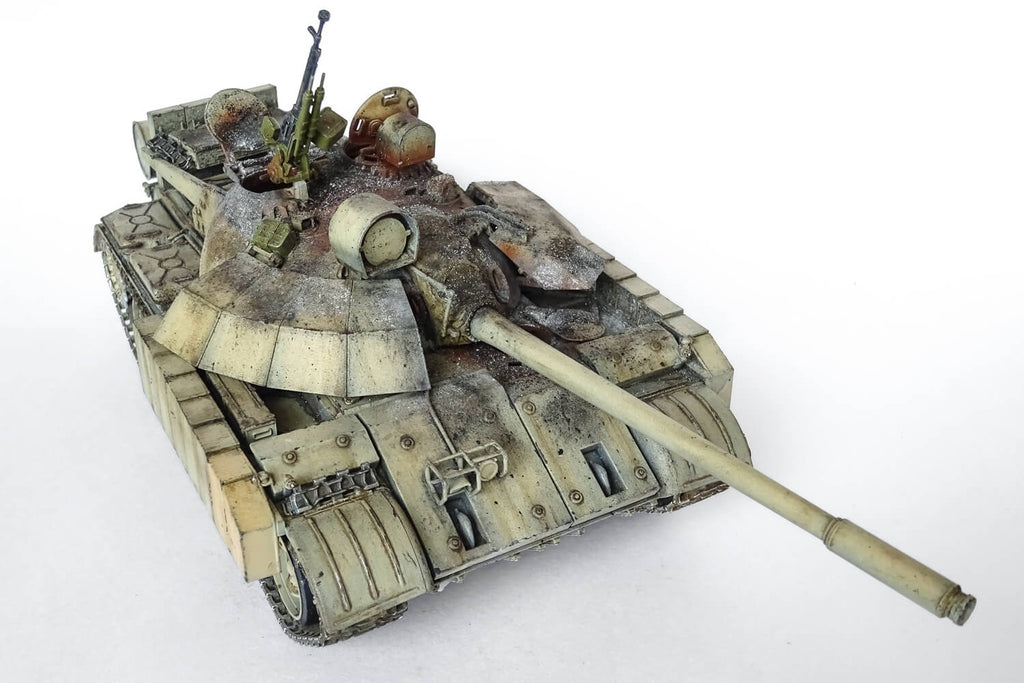
<p><br>For this build I used the 1/35 scale Tamiya Iraqi Tank T-55 ‘Enigma’ (kit number 35324). The kit is a highly detailed product with moulded sprues. The detail of the vehicle is outstanding with weld seams on the armour blocks and a cast appearance to the turret surface.<br><br>The hulls upper deck has moulded braces for the additional armour and the hull bottom has crude but satisfactory axle channels set in to the kit. The tracks are the ‘rubber band’ type; and in hindsight, I should have bought an aftermarket set as the kit ones do not sit very well. <br><br>A detail that was disappointingly missing from this kit are the fuel lines which connect the fuel cells to each other and to the tank. I overcame this by constructing the fuel lines from 20 gauge beading wire.</p>
<p>The kit does not come with a decal sheet as the ‘real-life’ ‘Enigmas’ had no unit marks or identification.<br><br><img src="//cdn.shopify.com/s/files/1/1120/3680/files/Panzer_Models_Blog_T-55_Enigma_3_1024x1024.jpg?v=1540897961" alt="1/35 scale T-55 Enigma Build"></p>
<p><img src="//cdn.shopify.com/s/files/1/1120/3680/files/Panzer_Models_Blog_T-55_Enigma_6_1024x1024.jpg?v=1540898004" alt="1/35 scale T-55 Enigma Build"></p>
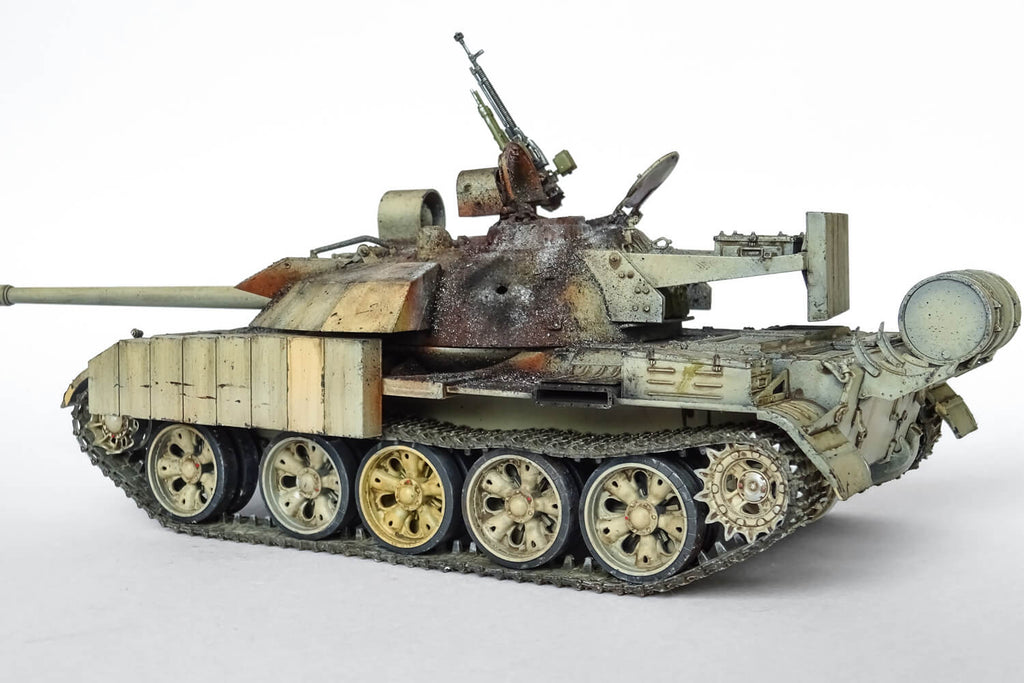
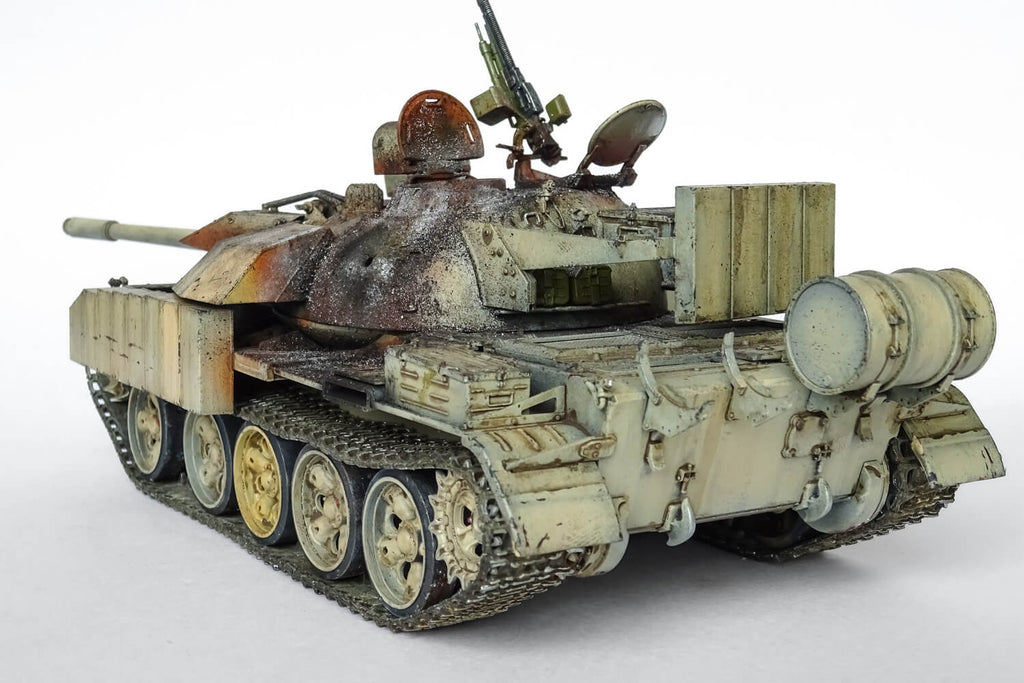
<p>One of the main ironies I found with this vehicle when I was researching it was that the developers and builders had tried so hard to up-armour their project to face up to what was a far superior coalition force; however, they had left gaping holes in the additional armour which left the vehicle, from some angles, completely vulnerable.<br><br>I decided to depict my vehicle as being a destroyed “Enigma” having taken a round through the ‘un-armoured’ rear quarter of the turret. To do this, I studied the appearance of shells and missile strikes to armour. I also wanted to give the appearance of an ‘Ammo Cookoff’ with extreme burning around the hatches and roof of the turret.<br><br><img src="//cdn.shopify.com/s/files/1/1120/3680/files/Panzer_Models_Blog_T-55_Enigma_4_1024x1024.jpg?v=1540898068" alt="1/35 scale T-55 Enigma Build"></p>
<p><img src="//cdn.shopify.com/s/files/1/1120/3680/files/Panzer_Models_Blog_T-55_Enigma_14_1024x1024.jpg?v=1540898236" alt="1/35 scale T-55 Enigma Build"></p>
<p>The construction of this kit is classic Tamiya; very straight forward with all of the pieces going together perfectly. I did not need to use any filler for gaps on this build! As with most of my projects, I completed the construction completely before the painting stage.<br><br>For the damage I wanted to show on this vehicle, I selected an area on the rear quarter of the turret and pierced it with a heated sanding file, making a hole approximately 2mm in diameter to keep it in scale. For the explosive damage and shrapnel, I heated the end of a safety-pin and pressed it into the turret lengthways; this made a perfectly straight score in the plastic which faded as it went outwards from the impact spot. I used this method to scar the area around the hole and also where I felt shrapnel may strike in the vicinity.<br><br>I used the 20 gauge beading wire to add some cables to the headlight cluster and thinner copper wire for the smaller manoeuvring lights around the vehicle.<br><br><img src="//cdn.shopify.com/s/files/1/1120/3680/files/Panzer_Models_Blog_T-55_Enigma_10_1024x1024.jpg?v=1540898188" alt="1/35 scale T-55 Enigma Build"><br><br>Once the build was complete, I began the painting process. I painted the whole kit with a coat of <a href="https://www.panzermodels.co.uk/collections/all/products/vallejo-polyurethane-surface-primer-black-60ml" target="_blank" title="Vallejo Polyurethane - Surface Primer Black 60ml" rel="noopener noreferrer">black Vallejo surface primer (73.602)</a>. As this vehicle is finished in a single light tone, I decided to use the ‘Black &amp; White’ technique’ of painting which would emphasise depth and shadows. I used AK Interactive ‘Light Grey’ (AK784) to highlight the upper panels, large open panels and also the centre portions of the applique armour.<br><br>I used <a href="https://www.panzermodels.co.uk/products/ak-interactive-iraq-afghanistan-set" target="_blank" title="AK Interactive Iraq &amp; Afghanistan Paint Set" rel="noopener noreferrer">AK Interactive ‘New Iraqui Army Sand' (AK725)</a> for the colour of the vehicle. I applied this using an airbrush in several very thin coats; this was to allow the shading and highlights from the primer coat to show through. To illustrate the modular style of the additional armour on this vehicle, I decided to paint some of the blocks a slightly different colour to the main vehicle. I carefully masked off some of the blocks and painted them with <a href="https://www.panzermodels.co.uk/products/ak-interactive-iraq-afghanistan-set" target="_blank" title="AK Interactive Iraq &amp; Afghanistan Paint Set" rel="noopener noreferrer">AK Interactive ‘British Sand Yellow’ (AK726)</a>. I also painted one wheel and idler the same colour.<br><br>As this vehicle was very ‘non-descript’ in terms of a paint job; I gave the kit a coat of <a href="https://www.panzermodels.co.uk/collections/all/products/vallejo-model-color-matt-varnish-17ml" target="_blank" title="Vallejo Model Color - Matt Varnish 17ml" rel="noopener noreferrer">Vallejo Matt Varnish (70.520)</a> before moving onto the weathering.<br><br><img src="//cdn.shopify.com/s/files/1/1120/3680/files/Panzer_Models_Blog_T-55_Enigma_15_1024x1024.jpg?v=1540898104" alt="1/35 scale T-55 Enigma Build"><br><br>I gave the whole vehicle a coat of <a href="https://www.panzermodels.co.uk/collections/all/products/ak-interactive-dark-yellow-wash-35ml" target="_blank" title="AK Interactive Dark Yellow Wash 35ml" rel="noopener noreferrer">AK interactive Dark Yellow Wash (AK300)</a> thinned with white spirit. This achieved the effect of dulling down all of the colours and gave a ‘dusty’ look whilst also emphasising edges and corners. Once this was dry, I applied a pin-wash to all of the details with <a href="https://www.panzermodels.co.uk/products/ak-interactive-35ml-streaking-grime" target="_blank" title="AK Interactive 35ml Streaking Grime" rel="noopener noreferrer">AK Interactive ‘Streaking Grime’ (AK012)</a>.<br><br>I used a small sponge and fine brush to create a chipped and scratched appearance to the edges and flat surface of the vehicle using Vallejo ‘Black Grey’ (70.862).</p>
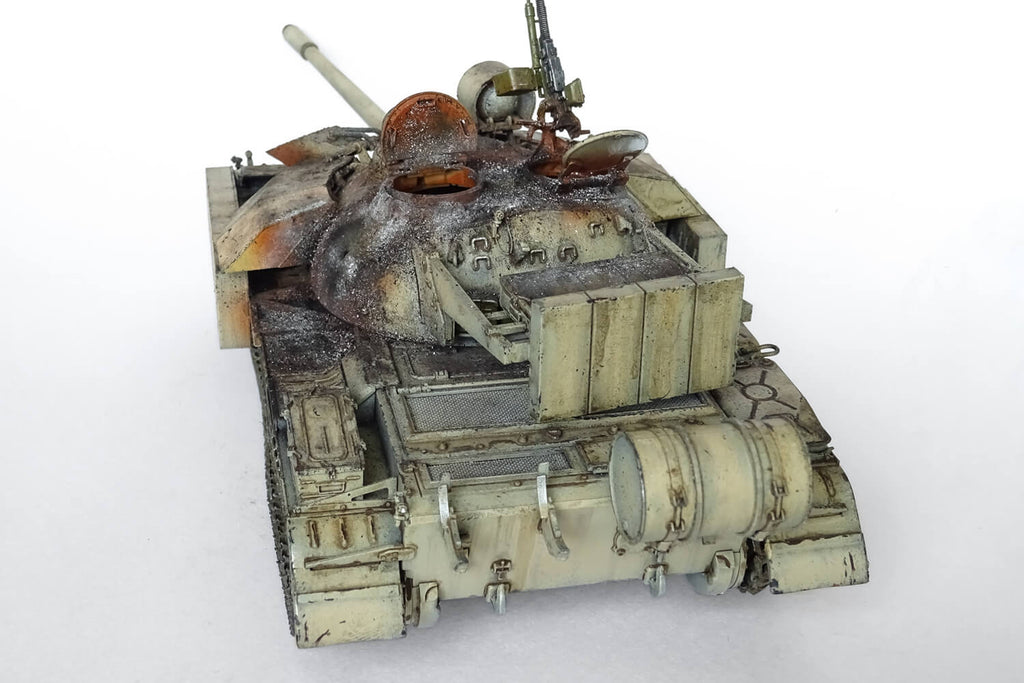
<p>I painted the tracks using <a href="https://www.panzermodels.co.uk/products/ak-interactive-track-and-wheels-set" target="_blank" title="AK Interactive Track and Wheels Paint Set" rel="noopener noreferrer">AK interactive ‘Dark Tracks’ (AK722)</a>. I then dry brushed the edges and teeth of the tracks, the DShKM and some of the vehicle edges and panels where I would expect ware with <a href="https://www.panzermodels.co.uk/products/ak-interactive-true-metal-paints?variant=26065531783" target="_blank" title="AK Interactive True Metal Paints Steel" rel="noopener noreferrer">AK Interactive ‘True Metal, Steel’ (AK457)</a>. As this vehicle was used in hot and sandy areas; I believe the sand abrasion would give metal a brushed appearance. <br><br>Next, I needed to recreate the appearance of extreme burning seen when ammo ‘cooks-off’ in a tank. This produces jets of fire tearing out of open hatches and cavities. Using my Chiminea in the back garden for reference, I applied a coat of Ammo Mig Red ‘Red Primer Light Base’ (A.MIG-921) around the hatches an on the roof of the turret. I then used ‘RAL 8012 Rotbraun' (A.MIG-014) to highlight some of these areas to add contrast.<br><br>To complete the burnt appearance, I used <a href="https://www.panzermodels.co.uk/products/ak-interactive-burnt-vehicles-weathering-set" target="_blank" title="AK Interactive Burnt Vehicles Weathering Set" rel="noopener noreferrer">AK Interactive Burnt Vehicles Weathering set</a>. Firstly, I brushed on thin coat of the Pigment Fixer fluid onto the areas I wanted to cover. I then used a broad head dry brush to dust the binder with pigments. The first coat around the extremities of the burning was covered with ‘Burnt Umber’, then working inwards towards the hatches, I applied ‘Black’ fading between both colours. Once the binder had dried, I dusted ‘White Ashes' over the whole area and a very sparse dusting of ‘Burnt Rust Red’.<br><br>Whilst applying the pigment, I found that some accidentally flicked over other parts of the vehicle. I removed most of it not to go ‘over the top’ with the pigment, however I did leave some parts as I'm sure burning such as this would have made quite a mess!<br><br>To finish the kit, I applied a mixture of earth tone pigments onto the tracks to replicate sand and dust gathering.<br><br>I would like to thank <a href="https://panzermodels.co.uk/" target="_blank" title="Panzer Models UK" rel="noopener noreferrer">Panzermodels.co.uk</a> for their support in this build!</p>]]>
    </content>
  </entry>
  <entry>
    <id>https://www.panzermodels.co.uk/blogs/news/the-snow-panther-by-bruno-capeller</id>
    <published>2017-06-08T15:06:00+01:00</published>
    <updated>2017-06-08T15:06:00+01:00</updated>
    <link rel="alternate" type="text/html" href="https://www.panzermodels.co.uk/blogs/news/the-snow-panther-by-bruno-capeller"/>
    <title>The Snow Panther by Bruno Capeller</title>
    <author>
      <name>Panzer Models</name>
    </author>
    <content type="html">
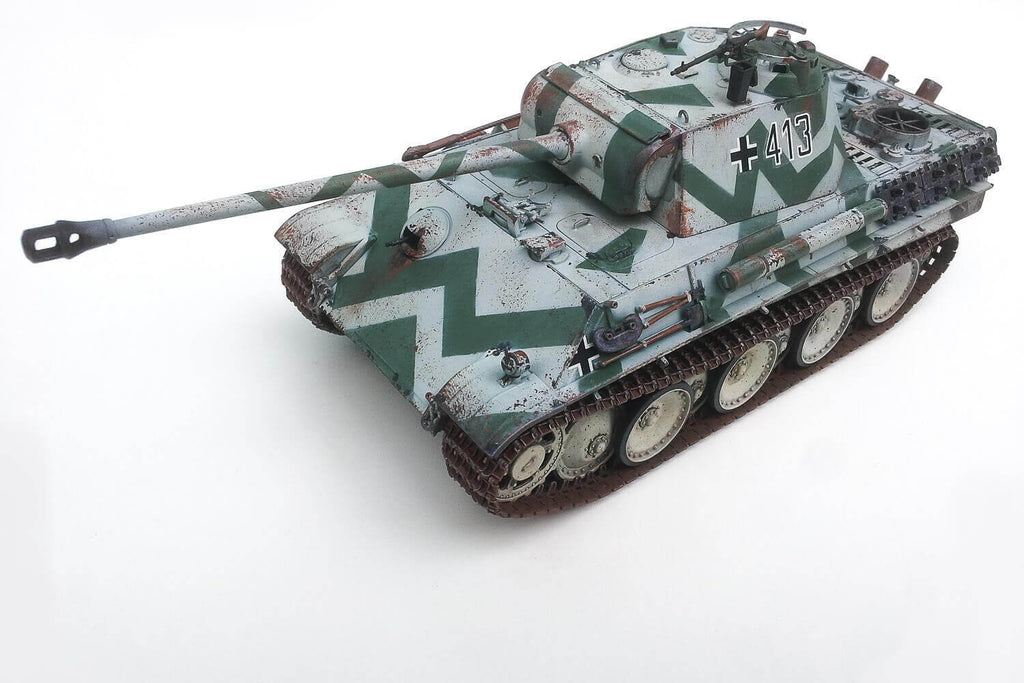
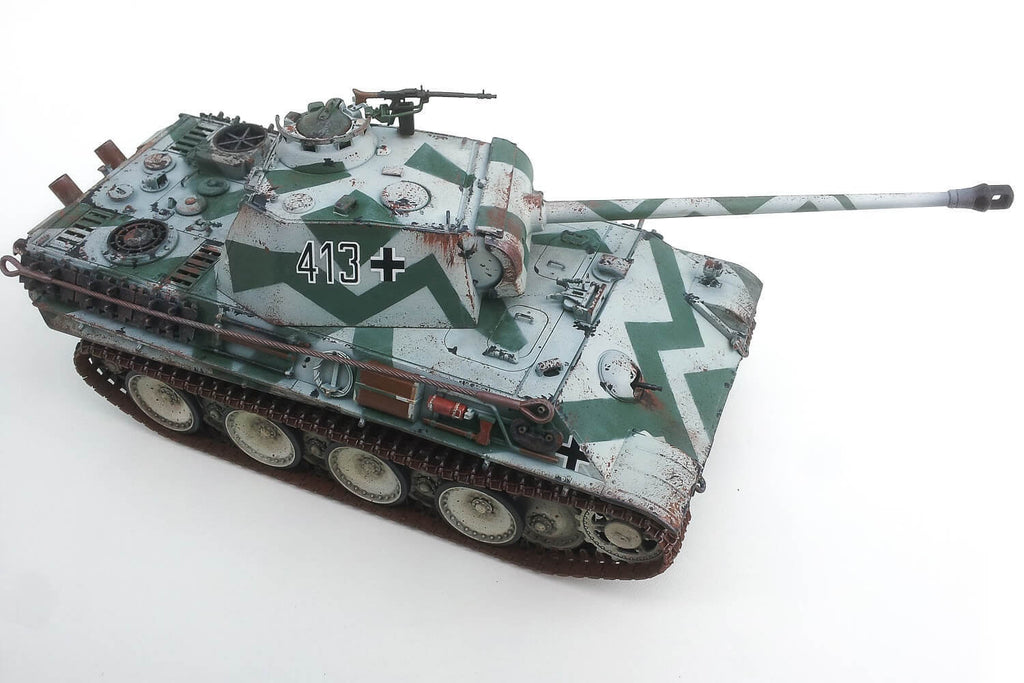
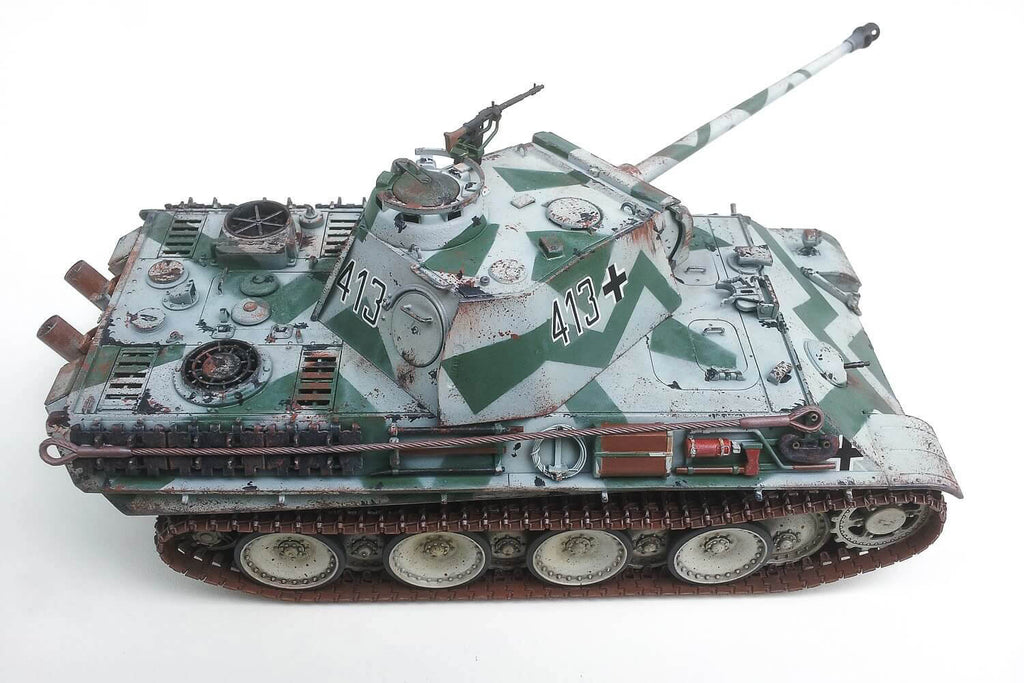
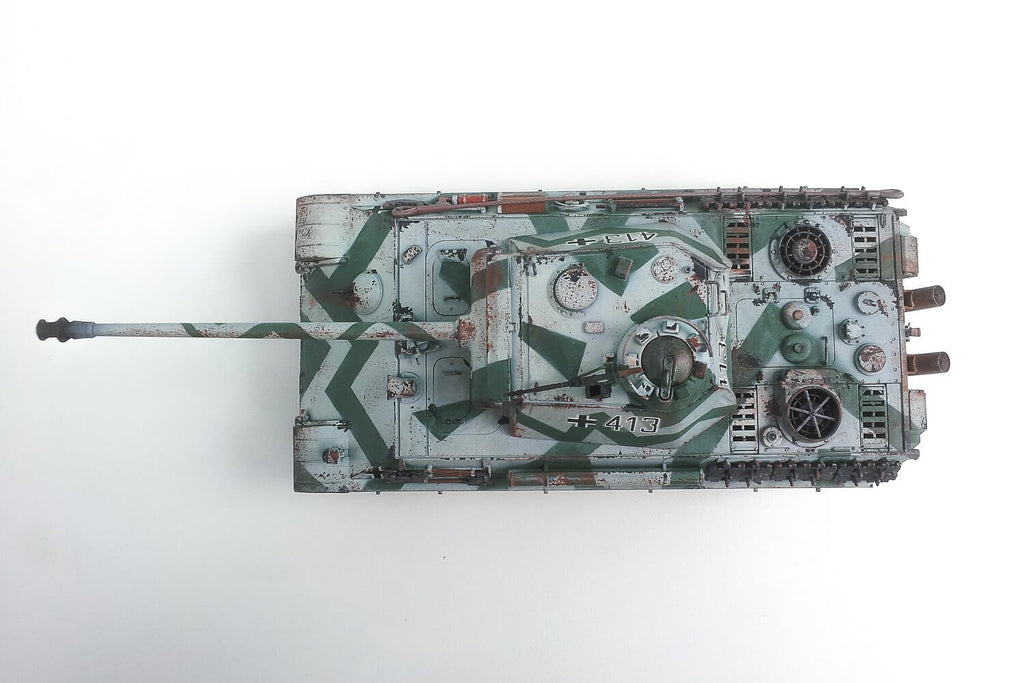
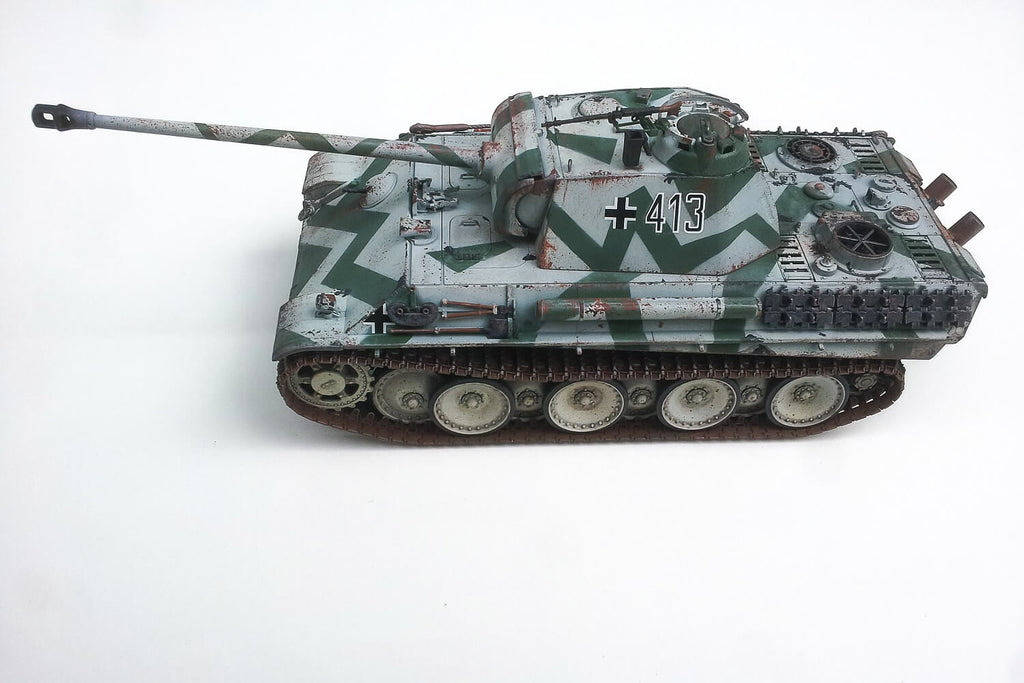
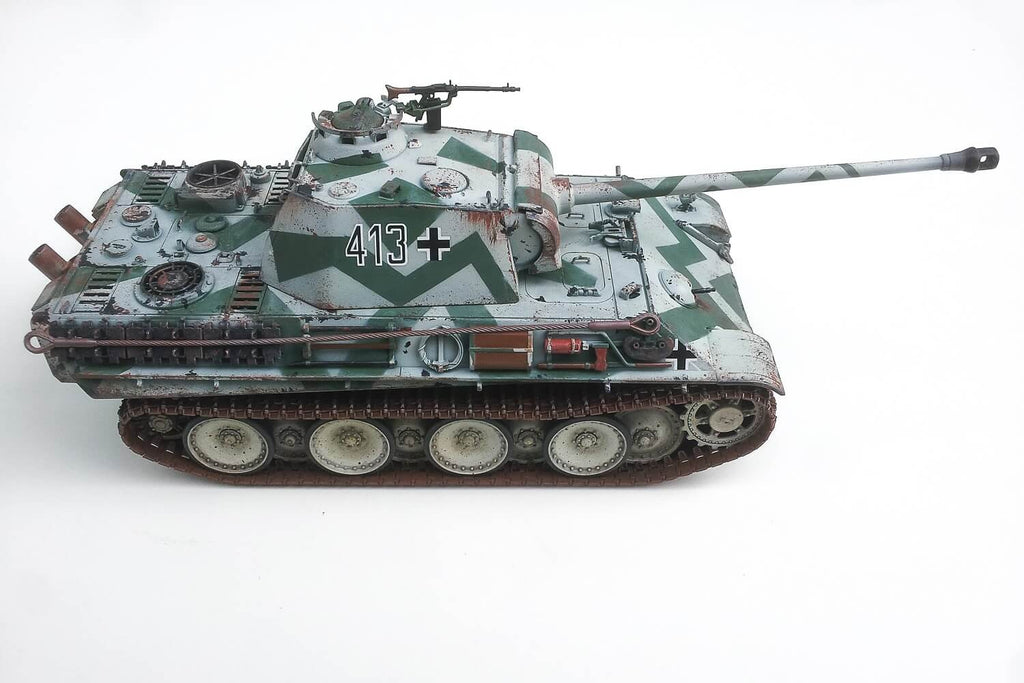
      <![CDATA[<p>In this post we want to show off an impressive build of the German Panther tank shared with us by a talented modeller from Brazil, Bruno Capeller. Several versions of this tank were produced between 1943 and 1945, and this kit is the last one, the version G. For this build Bruno used Tamiya's 1/35 scale kit which he chose to paint in winter camouflage colours. The markings represent a tank used by the 116th Panzer Division.</p>
<p>The tank was mostly painted with an airbrush, with the exception of a few details that were finished with a brush. Bruno used a mix of water based acrylic paints from various manufacturers.</p>
<p style="text-align: left;"><img alt="Panzer Models Blog Bruno Capeller Panther Tank" src="//cdn.shopify.com/s/files/1/1120/3680/files/Panzer_Models_Bruno_Capeller_Blog_22_1024x1024.jpg?v=1496573267" style="float: none;"></p>
<p style="text-align: left;"><img alt="Panzer Models Blog Bruno Capeller Panther Tank" src="//cdn.shopify.com/s/files/1/1120/3680/files/Panzer_Models_Bruno_Capeller_Blog_11_1024x1024.jpg?v=1496573245" style="float: none;"></p>
<p>All parts were primed with a grey colour separately (main body, tower, wheels, tracks). Then a base layer of green was applied - a mixture of Vallejo RAL6020 with White and a little water. One application was enough. Once the base layer was completely dry, small straps of adhesive tape were applied to form the camouflage pattern. This process is very time consuming, and care should be taken not to remove the paint from the previous layer. The final camouflage pattern is based on historical photos with a number of changes.</p>
<p>The next step was applying a coat of white paint from the Vallejo Panzer Aces range <a href="https://www.panzermodels.co.uk/products/vallejo-panzer-aces-17ml?variant=34940062922" target="_blank" title="Vallejo Panzer Aces - German Winter Tank Crew" rel="noopener noreferrer">"German Winter Tank Crew"</a> over the areas that were not covered with the tape. One application was sufficient for the purpose. Once the white paint was dry, the tape was carefully removed and the winter camouflage pattern was ready.</p>
<p style="text-align: left;"><img alt="Panzer Models Blog Bruno Capeller Panther Tank" src="//cdn.shopify.com/s/files/1/1120/3680/files/Panzer_Models_Bruno_Capeller_Blog_55_1024x1024.jpg?v=1496573303" style="float: none;"></p>
<p style="text-align: left;"><img alt="Panzer Models Blog Bruno Capeller Panther Tank" src="//cdn.shopify.com/s/files/1/1120/3680/files/Panzer_Models_Bruno_Capeller_Blog_8_1024x1024.jpg?v=1496572470" style="float: none;"></p>
<p>The wheels were painted separately. Bruno coated them in the same white colour from Vallejo followed by the black paint from Acrilex (Brazilian manufacturer) applied with a brush. For the tracks, <a href="https://www.panzermodels.co.uk/products/vallejo-panzer-aces-17ml?variant=34939519434" target="_blank" title="Vallejo Panzer Aces - Light Rust" rel="noopener noreferrer">"Light Rust" from Vallejo</a> was used with a few drops of black paint and some water to make the right mix to apply with an airbrush. Two layers were applied on each side of the tracks followed by a paint called "Tin" from Corfix (Brazil) applied using the drybrush technique.</p>
<p>As for the ageing effect, Bruno chose to replicate rust caused by weather conditions and battles. It should be noted that when these tanks were manufactured, Germany suffered from a lack of raw materials and everything was rationed. This resulted in the vehicles being painted in fairly thin layers, therefore rust and chipping caused by the use were evident even after a short time. This was taken into account when painting this Panther Ausf. G.</p>
<p style="text-align: left;"><img alt="Panzer Models Blog Bruno Capeller Panther Tank" src="//cdn.shopify.com/s/files/1/1120/3680/files/Panzer_Models_Bruno_Capeller_Blog_6_1024x1024.jpg?v=1496572523" style="float: none;"></p>
<p style="text-align: left;"><img alt="Panzer Models Blog Bruno Capeller Panther Tank" src="//cdn.shopify.com/s/files/1/1120/3680/files/Panzer_Models_Bruno_Capeller_Blog_7_1024x1024.jpg?v=1496572553" style="float: none;"></p>
<p style="text-align: left;">Thank you for reading and big thanks to Bruno for sharing this build with us!</p>]]>
    </content>
  </entry>
  <entry>
    <id>https://www.panzermodels.co.uk/blogs/news/1-35-scale-tiger-i-from-academy-13264-out-of-the-box-build</id>
    <published>2017-03-29T16:50:00+01:00</published>
    <updated>2017-03-29T16:52:07+01:00</updated>
    <link rel="alternate" type="text/html" href="https://www.panzermodels.co.uk/blogs/news/1-35-scale-tiger-i-from-academy-13264-out-of-the-box-build"/>
    <title>1/35 scale Tiger I from Academy - Out of the box build</title>
    <author>
      <name>Panzer Models</name>
    </author>
    <content type="html">
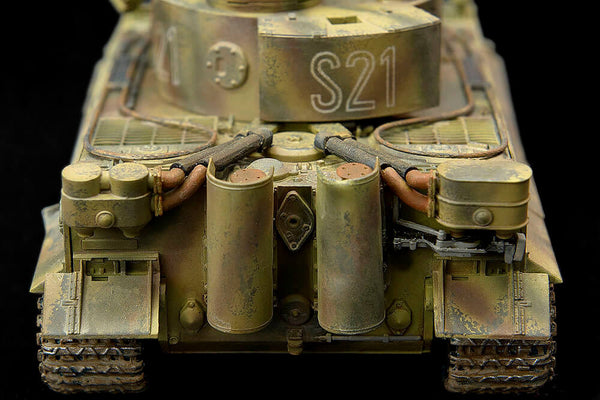
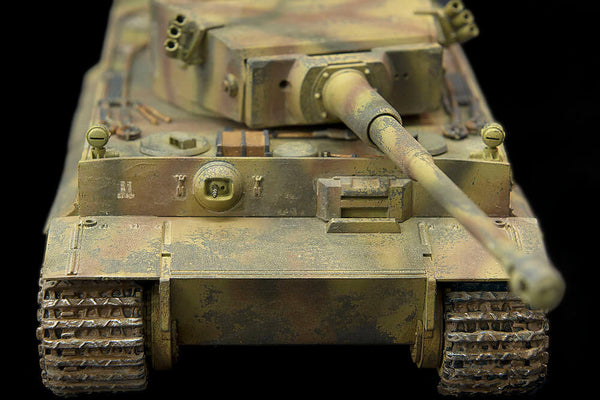
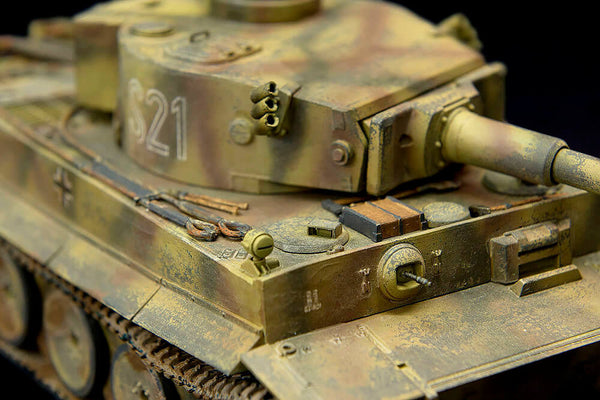
      <![CDATA[<p>In this post we would like to share a build of the Tiger I tank in 1/35 scale with step by step photos, all done by Canadian modeller Jon Blacker who we've enjoyed collaborating with. The kit used is the <a href="https://www.panzermodels.co.uk/products/academy-1-35-german-pz-kpfw-vi-tiger-i-early-version-no-interior" target="_blank" title="1/35 scale Academy Pz. Kpfw. VI Tiger I Early Version Exterior">German Pz. Kpfw. VI Tiger I (Early version, no interior)</a> from Academy, kit #13264.</p>
<p>The kit was built straight from the box with no aftermarket additions. However, some modifications have been made during the process - for example, the damage to the mud guards, which have also been separated into individual sections. </p>
<p>And now - for the build...</p>
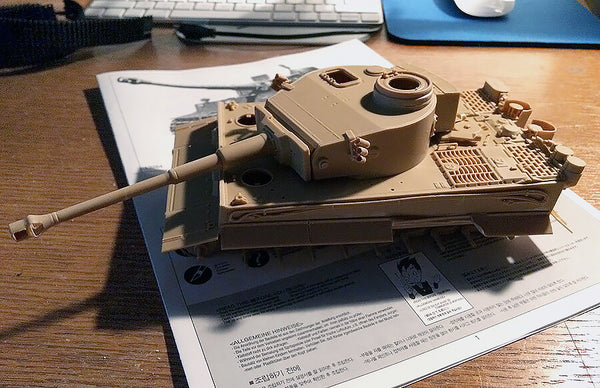
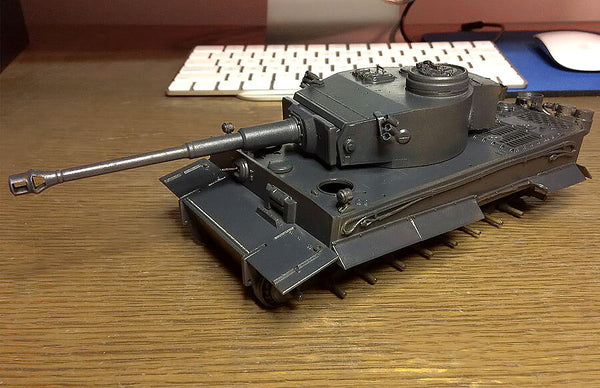
<p>Step 1 - The tank has been partially assembled. There is still a number of detail parts to add to the upper hull before the painting process begins.</p>
<p style="text-align: left;"><img src="//cdn.shopify.com/s/files/1/1120/3680/files/Academy_German_Pz_Kpfw_VI_Tiger_I_Early_Blog_1_grande.jpg?v=1490795584" alt="Academy German Pz Kpfw VI Tiger I Early Panzer Models Blog"></p>
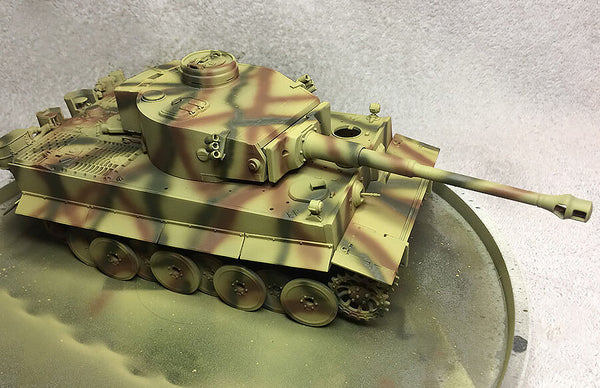
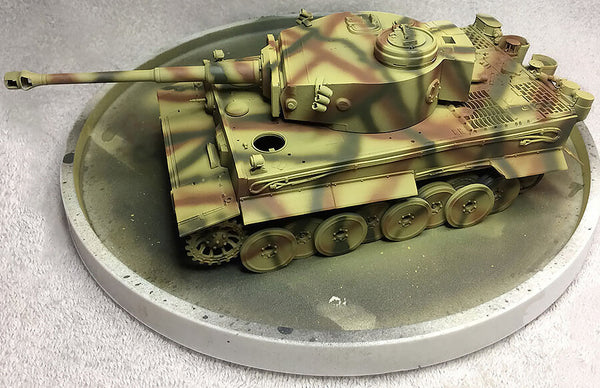
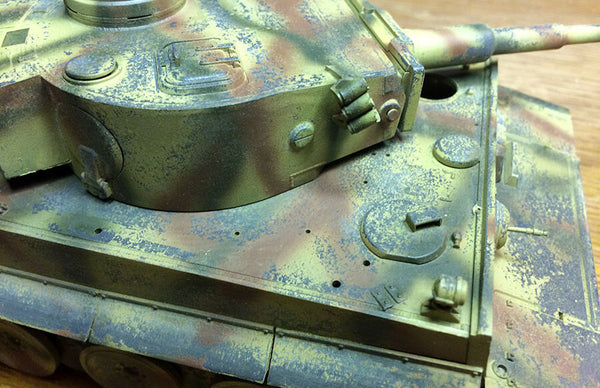
<p>Step 2 - The Tiger with a base coat and several coats of sealer. The sealer will need a day or two to fully cure and will be followed by a few coats of hair spray and some colour. The tank will have a dark yellow/green/red-brown camouflage pattern.</p>
<p><img src="//cdn.shopify.com/s/files/1/1120/3680/files/Academy_German_Pz_Kpfw_VI_Tiger_I_Early_Blog_2_grande.jpg?v=1490795646" alt="Academy German Pz Kpfw VI Tiger I Early Panzer Models Blog"></p>
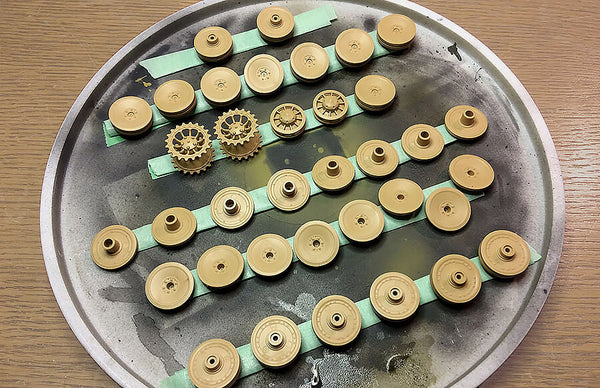
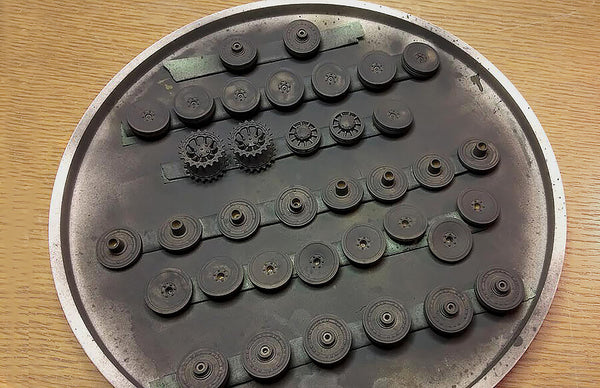
<p>Step 3 - The wheels are painted with a light base coat, and then sealed with <a href="http://www.scalemodelguide.com/hints-tips/general/using-klear-floor-varnish/" title="Using Future/Klear Floor varnish for scale modelling" target="_blank">Future</a>.</p>
<p style="text-align: left;"><img src="//cdn.shopify.com/s/files/1/1120/3680/files/Academy_German_Pz_Kpfw_VI_Tiger_I_Early_Blog_3_grande.jpg?v=1490795694" alt="Academy German Pz Kpfw VI Tiger I Early Panzer Models Blog"></p>
<p style="text-align: left;"><img src="//cdn.shopify.com/s/files/1/1120/3680/files/Academy_German_Pz_Kpfw_VI_Tiger_I_Early_Blog_4_grande.jpg?v=1490795709" alt="Academy German Pz Kpfw VI Tiger I Early Panzer Models Blog"></p>
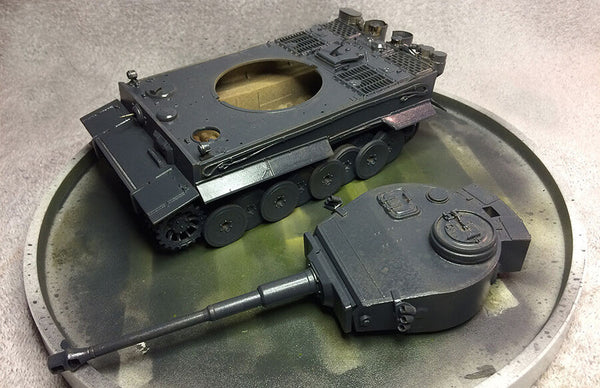
<p><span>Step 4 - </span>The wheels are then installed and the entire model is sprayed with a coat of hair spray.</p>
<p><img src="//cdn.shopify.com/s/files/1/1120/3680/files/Academy_German_Pz_Kpfw_VI_Tiger_I_Early_Blog_5_grande.jpg?v=1490795724" alt="Academy German Pz Kpfw VI Tiger I Early Panzer Models Blog"></p>
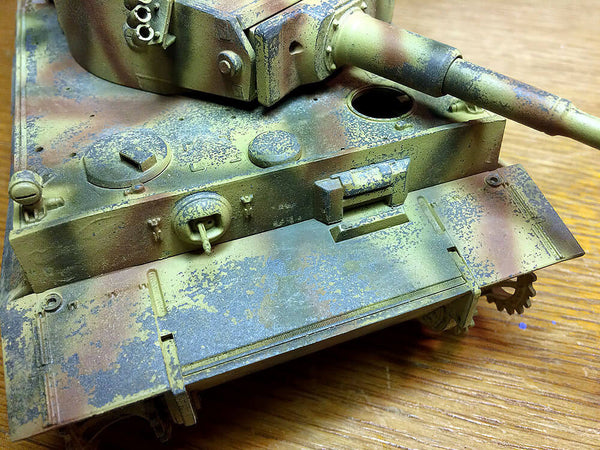
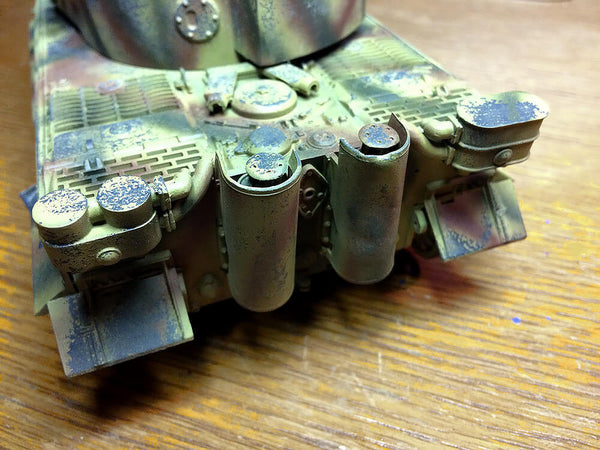
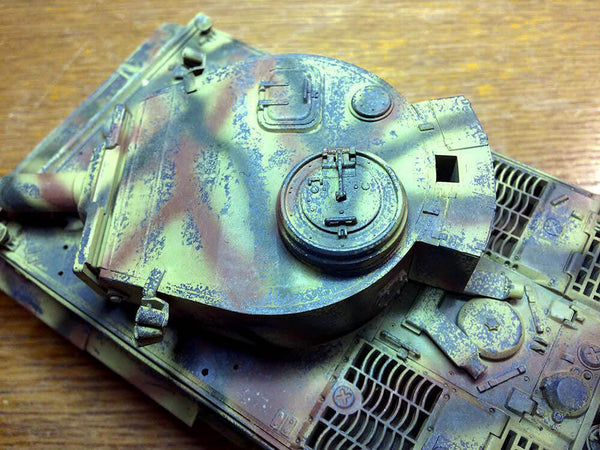
<p><span>Step 5 - </span>The Tiger is sprayed with Tamiya XF60 Dark Yellow and a tri-colour camo treatment with Tamiya XF64 Red Brown and XF70 Dark Green.</p>
<p><img src="//cdn.shopify.com/s/files/1/1120/3680/files/Academy_German_Pz_Kpfw_VI_Tiger_I_Early_Blog_6_grande.jpg?v=1490795738" alt="Academy German Pz Kpfw VI Tiger I Early Panzer Models Blog"></p>
<p><img src="//cdn.shopify.com/s/files/1/1120/3680/files/Academy_German_Pz_Kpfw_VI_Tiger_I_Early_Blog_7_grande.jpg?v=1490795751" alt="Academy German Pz Kpfw VI Tiger I Early Panzer Models Blog"></p>
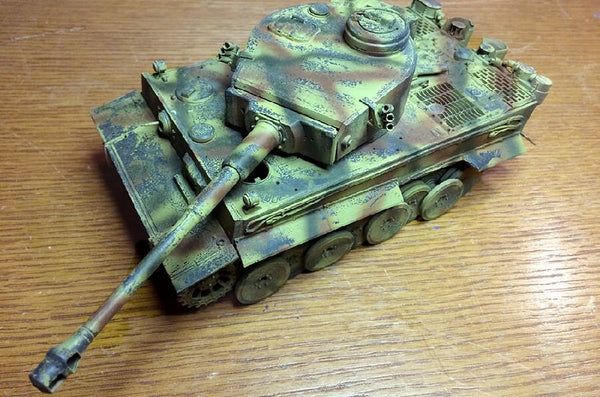
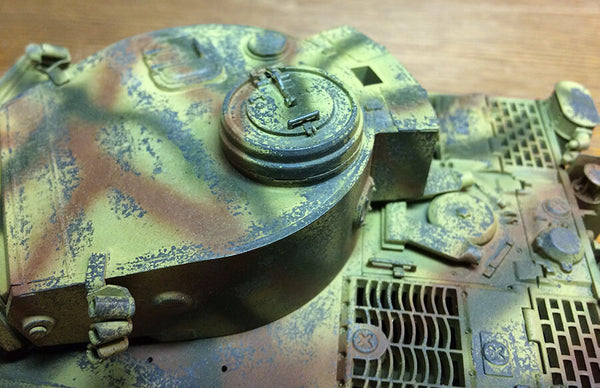
<p><span>Step 6 - Time for adding some heavy</span> chipping effects with water, a stiff short bristled paintbrush and an old toothbrush.</p>
<p><img src="//cdn.shopify.com/s/files/1/1120/3680/files/Academy_German_Pz_Kpfw_VI_Tiger_I_Early_Blog_8_grande.jpg?v=1490795765" alt="Academy German Pz Kpfw VI Tiger I Early Panzer Models Blog"></p>
<p><img src="//cdn.shopify.com/s/files/1/1120/3680/files/Academy_German_Pz_Kpfw_VI_Tiger_I_Early_Blog_9_grande.jpg?v=1490795782" alt="Academy German Pz Kpfw VI Tiger I Early Panzer Models Blog"></p>
<p><img src="//cdn.shopify.com/s/files/1/1120/3680/files/Academy_German_Pz_Kpfw_VI_Tiger_I_Early_Blog_10_grande.jpg?v=1490795796" alt="Academy German Pz Kpfw VI Tiger I Early Panzer Models Blog"></p>
<p><img src="//cdn.shopify.com/s/files/1/1120/3680/files/Academy_German_Pz_Kpfw_VI_Tiger_I_Early_Blog_11_grande.jpg?v=1490795810" alt="Academy German Pz Kpfw VI Tiger I Early Panzer Models Blog"></p>
<p><img src="//cdn.shopify.com/s/files/1/1120/3680/files/Academy_German_Pz_Kpfw_VI_Tiger_I_Early_Blog_12_grande.jpg?v=1490795824" alt="Academy German Pz Kpfw VI Tiger I Early Panzer Models Blog"></p>
<p><img src="//cdn.shopify.com/s/files/1/1120/3680/files/Academy_German_Pz_Kpfw_VI_Tiger_I_Early_Blog_13_grande.jpg?v=1490795836" alt="Academy German Pz Kpfw VI Tiger I Early Panzer Models Blog"></p>
<p><img src="//cdn.shopify.com/s/files/1/1120/3680/files/Academy_German_Pz_Kpfw_VI_Tiger_I_Early_Blog_14_grande.jpg?v=1490795852" alt="Academy German Pz Kpfw VI Tiger I Early Panzer Models Blog"></p>
<p>Up next - washes which will tone down both the overall paint as well as the chipping, followed by some rusting and weathering.</p>
<p>Step 7 - Tools and tow cables are done. This will be followed by muddying up the tracks and a few more touch ups before the model is complete.</p>
<p><img src="//cdn.shopify.com/s/files/1/1120/3680/files/Academy_German_Pz_Kpfw_VI_Tiger_I_Early_Blog_15_grande.jpg?v=1490795866" alt="Academy German Pz Kpfw VI Tiger I Early Panzer Models Blog"></p>
<p><img src="//cdn.shopify.com/s/files/1/1120/3680/files/Academy_German_Pz_Kpfw_VI_Tiger_I_Early_Blog_16_grande.jpg?v=1490795879" alt="Academy German Pz Kpfw VI Tiger I Early Panzer Models Blog"></p>
<p><img src="//cdn.shopify.com/s/files/1/1120/3680/files/Academy_German_Pz_Kpfw_VI_Tiger_I_Early_Blog_17_grande.jpg?v=1490795891" alt="Academy German Pz Kpfw VI Tiger I Early Panzer Models Blog"></p>
<p>Step 8 - The Tiger is complete. As we mentioned earlier, it is 100% out of the box, including the rubber band tracks, with no aftermarket details with a single exception - Jon used <a href="https://www.panzermodels.co.uk/collections/all/alliance-modelworks-stencils" target="_blank" title="Alliance Modelworks Stencils Tiger I">Alliance ModelWorks airbrush stencils</a> for the numbers, crosses and the division mark instead of the decals that were included in the kit. </p>
<p>Paints used - a mix of Tamiya for the base colour &amp; camo, and cheap craft store acrylics for the undercoat and weathering, with a dark gray base and hair spray coat for chipping of the camo coats.</p>
<p>Big thanks to Jon for working on this build and providing us with the photos, we look forward to our next collaboration.</p>
<p>Enjoy!</p>
<p><img src="//cdn.shopify.com/s/files/1/1120/3680/files/Academy_German_Pz_Kpfw_VI_Tiger_I_Early_Blog_18_grande.jpg?v=1490796016" alt="Academy German Pz Kpfw VI Tiger I Early Panzer Models Blog"></p>
<p><img src="//cdn.shopify.com/s/files/1/1120/3680/files/Academy_German_Pz_Kpfw_VI_Tiger_I_Early_Blog_19_grande.jpg?v=1490796032" alt="Academy German Pz Kpfw VI Tiger I Early Panzer Models Blog"></p>
<p><img src="//cdn.shopify.com/s/files/1/1120/3680/files/Academy_German_Pz_Kpfw_VI_Tiger_I_Early_Blog_20_grande.jpg?v=1490796044" alt="Academy German Pz Kpfw VI Tiger I Early Panzer Models Blog"></p>
<p><img src="//cdn.shopify.com/s/files/1/1120/3680/files/Academy_German_Pz_Kpfw_VI_Tiger_I_Early_Blog_21_grande.jpg?v=1490796056" alt="Academy German Pz Kpfw VI Tiger I Early Panzer Models Blog"></p>
<p><img src="//cdn.shopify.com/s/files/1/1120/3680/files/Academy_German_Pz_Kpfw_VI_Tiger_I_Early_Blog_22_grande.jpg?v=1490796072" alt="Academy German Pz Kpfw VI Tiger I Early Panzer Models Blog"></p>
<p><img src="//cdn.shopify.com/s/files/1/1120/3680/files/Academy_German_Pz_Kpfw_VI_Tiger_I_Early_Blog_23_grande.jpg?v=1490796087" alt="Academy German Pz Kpfw VI Tiger I Early Panzer Models Blog"></p>
<p><img src="//cdn.shopify.com/s/files/1/1120/3680/files/Academy_German_Pz_Kpfw_VI_Tiger_I_Early_Blog_24_grande.jpg?v=1490796105" alt="Academy German Pz Kpfw VI Tiger I Early Panzer Models Blog"></p>
<p><img src="//cdn.shopify.com/s/files/1/1120/3680/files/Academy_German_Pz_Kpfw_VI_Tiger_I_Early_Blog_25_grande.jpg?v=1490796119" alt="Academy German Pz Kpfw VI Tiger I Early Panzer Models Blog"></p>
<p><img src="//cdn.shopify.com/s/files/1/1120/3680/files/Academy_German_Pz_Kpfw_VI_Tiger_I_Early_Blog_26_grande.jpg?v=1490796134" alt="Academy German Pz Kpfw VI Tiger I Early Panzer Models Blog"></p>
<p><img src="//cdn.shopify.com/s/files/1/1120/3680/files/Academy_German_Pz_Kpfw_VI_Tiger_I_Early_Blog_27_grande.jpg?v=1490796147" alt="Academy German Pz Kpfw VI Tiger I Early Panzer Models Blog"></p>
<p><img src="//cdn.shopify.com/s/files/1/1120/3680/files/Academy_German_Pz_Kpfw_VI_Tiger_I_Early_Blog_28_grande.jpg?v=1490796168" alt="Academy German Pz Kpfw VI Tiger I Early Panzer Models Blog"></p>
<p><img src="//cdn.shopify.com/s/files/1/1120/3680/files/Academy_German_Pz_Kpfw_VI_Tiger_I_Early_Blog_29_grande.jpg?v=1490796193" alt="Academy German Pz Kpfw VI Tiger I Early Panzer Models Blog"></p>
<p><img src="//cdn.shopify.com/s/files/1/1120/3680/files/Academy_German_Pz_Kpfw_VI_Tiger_I_Early_Blog_30_grande.jpg?v=1490796208" alt="Academy German Pz Kpfw VI Tiger I Early Panzer Models Blog"></p>
<p><img src="//cdn.shopify.com/s/files/1/1120/3680/files/Academy_German_Pz_Kpfw_VI_Tiger_I_Early_Blog_31_grande.jpg?v=1490796229" alt="Academy German Pz Kpfw VI Tiger I Early Panzer Models Blog"></p>
<p><img src="//cdn.shopify.com/s/files/1/1120/3680/files/Academy_German_Pz_Kpfw_VI_Tiger_I_Early_Blog_32_grande.jpg?v=1490796245" alt="Academy German Pz Kpfw VI Tiger I Early Panzer Models Blog"></p>
<p> </p>]]>
    </content>
  </entry>
  <entry>
    <id>https://www.panzermodels.co.uk/blogs/news/wwii-uniform-painting-reference-guide-for-vallejo-paints</id>
    <published>2017-02-26T18:16:00+00:00</published>
    <updated>2017-02-26T23:26:43+00:00</updated>
    <link rel="alternate" type="text/html" href="https://www.panzermodels.co.uk/blogs/news/wwii-uniform-painting-reference-guide-for-vallejo-paints"/>
    <title>German Uniforms of WWII plus a reference guide for Vallejo Paints</title>
    <author>
      <name>Panzer Models</name>
    </author>
    <content type="html">
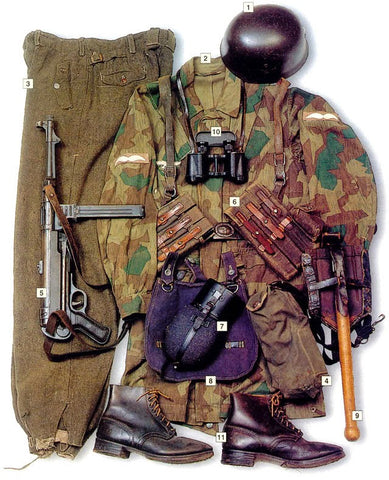
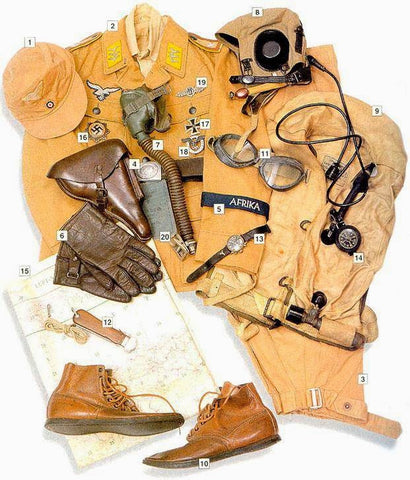
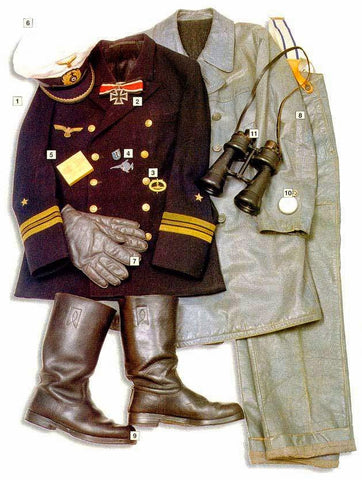
      <![CDATA[<div>We are posting this because it's nice to have this kind of information in one place, instead of having to go hunting for it on forums and across social media. Enclosed is some valuable information that may be of some use to anyone working with Vallejo paints on their 1:35 scale WWII figures. See below for images of WWII German Uniforms, including a breakdown of the clothing and equipment pictured. Then colour reference Vallejo charts for accurately recreating the look and feel of the period.</div>
<div></div>
<br>
<h3><strong>Fallschirmjäger Unteroffizier (Corporal), 1944</strong></h3>
<br>
<div><img alt="Fallschirmjäger Unteroffizier (Corporal), 1944 " src="//cdn.shopify.com/s/files/1/1120/3680/files/Fallschirmjager_Unteroffizier_1944_large.jpg?v=1488125561"></div>
<div> </div>
<div>01 - Fallschirmschützen-Stahlhelm 38 jump helmet<br>02 - Fallschirmschützen Bluse camouflage sweatshirt in "Splittermuster" camo, rank insignia on the sleeves, Luftwaffe eagle on the right breast<br>03 - M-37 trousers<br>04 - M-38 gas mask in a tarpaulin bag<br>05 - 9 mm MP-40 SMG<br>06 - Ammo pouches for MP-40, main belt and webbing<br>07 - M-31 canteen in "Fliegerblau"- "aviation blue"<br>08 - M-31 breadbag<br>09 - folding shovel<br>10 - Ziess 6x30 binoculars<br>11 - Boots<br>
<ul></ul>
<meta charset="utf-8">
<div>
<meta charset="utf-8">
<div></div>
<br>
<h3><strong>German Captain (Hauptmann), 1940 </strong></h3>
<br>
<h3><img alt="German Captain (Hauptmann), 1940 " src="//cdn.shopify.com/s/files/1/1120/3680/files/German_Hauptmann_1939-1940_large.jpg?v=1488125601"></h3>
</div>
<div></div>
<div></div>
<div>01- M-38 officers' forage cap<br>02 - M-35 helmet with Heeres markings<br>03 - M-35 officers' jacket, white markings on the collar tabs and shoulder straps (Waffenfarbe Weiss)- infantry<br>04 - M-34 officers' belt<br>05 - Zeiss 6x30 binoculars<br>06 - SA sport badge<br>07 - Compass<br>08 - M-35 map pouch<br>09 - Holster for Luger P-08 pistol<br>10 - Officers' gloves<br>11 - Boots<br>12 - Watch</div>
<div></div>
<br>
<h3><strong>German Cavalry Sergeant Major (Oberwachtmeister) 1939-40 </strong></h3>
<p> </p>
</div>
<h3><img alt="German Cavalry Sergeant Major (Oberwachtmeister) 1939-40" src="//cdn.shopify.com/s/files/1/1120/3680/files/German_Cavalry_Oberwachtmeister_1939-1940_large.jpg?v=1488125594"></h3>
<div></div>
<div>
<div>01 - M-35 steel helmet<br>02 - Feldgrau jacket with gold ("Waffenfarbe Goldgelb") markings of the cavalry<br>03 - Steingrau cavalry breeches<br>04 - Black leather belt<br>05 - Holster for Luger P-08 pistol<br>06 - Leather webbing- "Koppeltraggestell"<br>07 - Cavalry boots with spurs<br>08 - M-38 gas mask<br>09 - Anti-mustard gas cloth<br>10 - Trumpet</div>
<div></div>
<div>
<meta charset="utf-8">
<br>
<h3><strong>German Corporal (Unteroffizier), 1939-1940</strong></h3>
<br>
<div><strong></strong></div>
<div></div>
<img alt="German Corporal (Unteroffizier), 1939-1940" src="//cdn.shopify.com/s/files/1/1120/3680/files/German_Unteroffizier_1939-1940_large.jpg?v=1488125612">
</div>
<div></div>
</div>
<div>
<div>01 - M-35 field jacket with Unteroffizier's insignia<br>02 - M-35 steel helmet with Heeres markings<br>03 - Zeltbahn M-31 tent cloth in “Splittermuster” camouflage<br>04 - Grey ("Steingrau") trousers<br>05 - Leather belt<br>06 - Anti-mustard gas cloth<br>07 - M-38 gas mask<br>08 - M-24 grenade<br>09 - Black leather ammo pouches<br>10 - M-31 aluminium canteen<br>11 - Boots<br>12 - 7.92 mm Mauser 98k rifle<br>13 - Seitengewehr 84/98 bayonet<br>14 - Wire cutting shears
<div></div>
<div></div>
<div>
<meta charset="utf-8">
<br>
<h3><strong>Panzertruppe Leutnant, 1939 </strong></h3>
<br>
<div></div>
<div></div>
</div>
<div></div>
<img alt="Panzertruppe Leutnant, 1939 " src="//cdn.shopify.com/s/files/1/1120/3680/files/Panzertruppe_Leutnant_1939_large.jpg?v=1488125639"><br>
<div>
<ul></ul>
<div></div>
</div>
</div>
<div></div>
<div>
<meta charset="utf-8">
<div><span>01 - Officers' cap with with pink band of the armoured corps ("Waffenfarbe Rosa")</span></div>
<div><span>02 - Black officers' jacket, Prussian Death Hussars' Totenkopf on the collar tabs.</span></div>
<div><span>03 - Grey shirt </span></div>
<div><span>04 - Armoured troops' trousers</span></div>
<div><span>05 - Officers' boots</span></div>
<div><span>06 - Headphones</span></div>
<div><span>07 - Laryngophone</span></div>
<div><span>08 - Protective goggles</span></div>
<div><span>09 - M-34 leather belt</span></div>
<div><span>10 - Leather holster for Luger P-08 pistol</span></div>
<div><span>11 - Leather gloves</span></div>
<div><span>12 - Standard grey socks</span></div>
<div><span>13 - M-31 Meldetasche- map pouch</span></div>
<div><span>14 - Zeiss 6x30 binoculars</span></div>
<div><span></span></div>
<div>
<meta charset="utf-8">
<br>
<h3><span> <b>Private, Volksgrenadier Division, Italy/Greece, 1944</b> <br> </span></h3>
<p> </p>
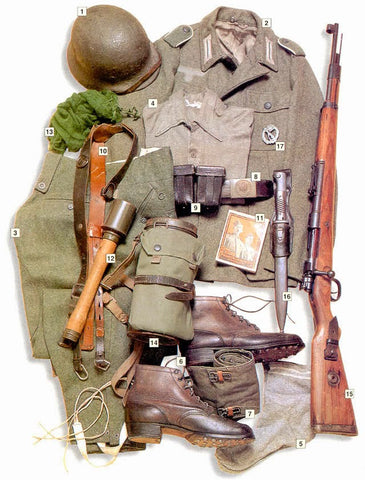
<p><span><b><img src="//cdn.shopify.com/s/files/1/1120/3680/files/Private_Volksgrenadier_Division_1944_large.jpg?v=1488125648" alt="Private, Volksgrenadier Division, Italy/Greece, 1944"></b></span></p>
<meta charset="utf-8">
<div><span>01 - M-40 helmet</span></div>
<div><span>02 - M-43 summer jacket</span></div>
<div><span>03 - Ski trousers</span></div>
<div><span>04 - Shirt</span></div>
<div><span>05 - Socks</span></div>
<div><span>06 - Boots</span></div>
<div><span>07 - M-41 leggings</span></div>
<div><span>08 - Main belt</span></div>
<div><span>09 - Ammo pouches</span></div>
<div><span>10 - M-38 webbing</span></div>
<div><span>11 - Military songbook</span></div>
<div><span>12 - M-24 grenade</span></div>
<div><span>13 - Face net</span></div>
<div><span>14 - M-38 gas mask</span></div>
<div><span>15 - 7.92 mm Mauser 98k rifle</span></div>
<div><span>16 - M-84/98 bayonet</span></div>
<div><span>17 - "Infanterie-Sturmabzeichen"- Infantry assault badge</span></div>
<div><span></span></div>
<div>
<meta charset="utf-8">
<br>
<h3><span><b>SS- Haupsturmfuhrer (Captain)</b></span></h3>
<br>
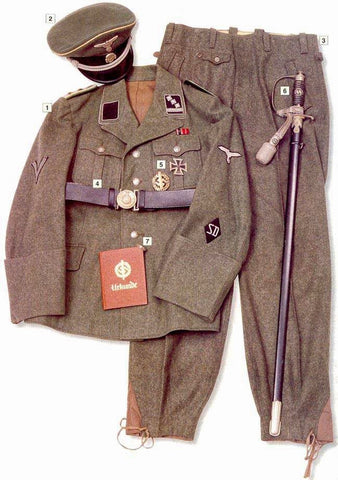
<p><span><b><img src="//cdn.shopify.com/s/files/1/1120/3680/files/SS_Haupsturmfuhrer_large.jpg?v=1488125659" alt="SS- Haupsturmfuhrer (Captain)"></b></span></p>
<p> </p>
<meta charset="utf-8">
<div><span>01 - M-38 SS officers' jacket, with SD rhombus on the left sleeve, silver chevron on the right sleeve means that the uniform owner joined NSDAP before 30.01.1933</span></div>
<div><span>02 - Schirmmütze officers' cap</span></div>
<div><span>03 - M-44 officers' trousers</span></div>
<div><span>04 - M-34 officers' belt</span></div>
<div><span>05 - Decorations:</span></div>
<div>- Iron Cross 1st Class<br>- ribbons: "Kriegsverdienstkreuz" (war service cross), medal for the winter campaign on the eastern front 1941/42, bronze SA sport badge</div>
<div>06 - Ehrendegen des Reichsführers-SS, "Reichsfuhrer's Honorary Sword"</div>
<div><span>07 - Totenkopfring der SS</span></div>
<div><span></span></div>
<div>
<meta charset="utf-8">
<br>
<h3><span><b>SS-Reiter (Private), 8. SS-Kavallerie Division "Florian Geyer", Summer 1944 </b></span></h3>
<br>
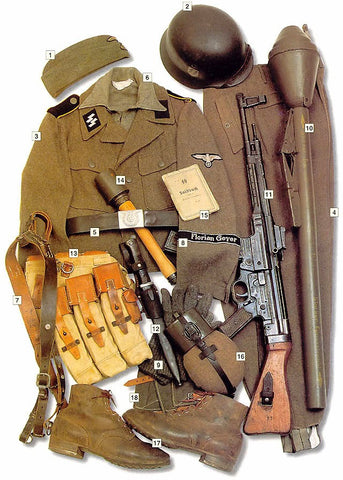
<p> <img src="//cdn.shopify.com/s/files/1/1120/3680/files/SS_Reiter_SS_Kavallerie_Division_Florian_Geyer_1944_large.jpg?v=1488125671" alt='SS-Reiter (Private), 8. SS-Kavallerie Division "Florian Geyer", Summer 1944 '></p>
<meta charset="utf-8">
<div><span></span></div>
<div><span>01 - M-40 Feldmutze field cap</span></div>
<div><span>02 - M-40 helemt with SS badges</span></div>
<div><span>03 - Feldbluse 44- new sweatshirt, inspired by the British battle dress, cavalry markings on the shoulder straps</span></div>
<div><span>04 - Trousers</span></div>
<div><span>05 - M-35 belt</span></div>
<div><span>06 - Wool shirt</span></div>
<div><span>07 - M-39 webbing</span></div>
<div><span>08 - "Florian Geyer" division armband</span></div>
<div><span>09 - Woollen gloves</span></div>
<div><span>10 - Panzerfaust 60</span></div>
<div><span>11 - 7.92 mm Sturmgewehr 44</span></div>
<div><span>12 - M-84/98 bayonet </span></div>
<div><span>13 - Tarpaulin ammo pouches</span></div>
<div><span>14 - M-24 grenade</span></div>
<div><span>15 - Waffen SS payment book</span></div>
<div><span>16 - M-31 canteen</span></div>
<div><span>17 - M-43 leather boots</span></div>
<div><span>18 - Leggings</span></div>
<div><span></span></div>
<div>
<meta charset="utf-8">
<br>
<h3><span><b>Waffen SS Sturmmann (Corporal), Normandy 1944</b></span></h3>
<br>
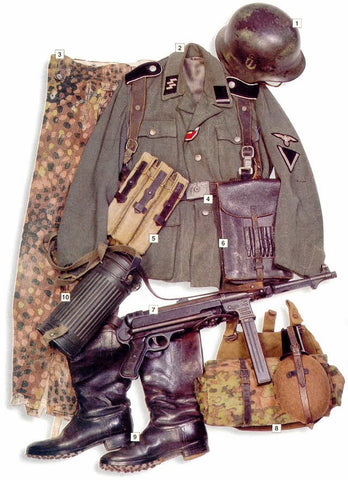
<p><span><b><img src="//cdn.shopify.com/s/files/1/1120/3680/files/Waffen_SS_Sturmmann_1944_large.jpg?v=1488125579" alt="Waffen SS Sturmmann (Corporal), Normandy 1944"></b></span></p>
<p> </p>
<meta charset="utf-8">
<div><span>01 - M-40 helmet with SS badges</span></div>
<div><span>02 - M-43 SS Feldbluse, Sturmmann's insignia on the collar tabs and left sleeve, Iron Cross 2nd Class ribbon on the button</span></div>
<div><span>03 - Trousers from the Drillichtanzug 43 uniform, in "Tupfenmuster" camo</span></div>
<div><span>04 - SS main belt with webbing</span></div>
<div><span>05 - Patronentasche für MP-Magazine, ammo pouches for MP-38/40</span></div>
<div><span>06 - Map pouch</span></div>
<div><span>07 - 9mm MP-40 SMG</span></div>
<div><span>08 - Breadbag, canteen, Zeltbahn tent cloth</span></div>
<div><span>09 - Boots</span></div>
<div><span>10 - Gas mask canister</span></div>
<div><span></span></div>
<div>
<meta charset="utf-8">
<br>
<h3>
<b><span>Sergeant Major (Feldwebel), Luftwaffe, Africa, 1943</span></b><br><br>
</h3>
<p><img src="//cdn.shopify.com/s/files/1/1120/3680/files/Feldwebel_Luftwaffe_1943_large.jpg?v=1488125587" alt="Sergeant Major (Feldwebel), Luftwaffe, Africa, 1943"></p>
</div>
<p> </p>
<meta charset="utf-8">
<p><span>01 - M-41 field cap with Luftwaffe eagle</span><br><span>02 - M-41 Luftwaffe tropical jacket, yellow collar tabs of the flying personnel</span><br><span>03 - Linen trousers</span><br><span>04 - Main belt with holster for the P-08 pistol</span><br><span>05 - "Afrika" armband of the Luftwaffe's African theater units</span><br><span>06 - Leather gloves</span><br><span>07 - Oxygen mask (bomber version)</span><br><span>08 - Linen pilots' cap with earphones</span><br><span>09 - Life jacket</span><br><span>10 - Leather boots</span><br><span>11 - Aviation goggles</span><br><span>12 - Kappmesser M-37 knife</span><br><span>13 - "Hankart" watch</span><br><span>14 - Compass</span><br><span>15 - Map</span><br><span>16 - Deutsches Kreuz in Gold- Golden German Cross, established 1941</span><br><span>17 - Iron Cross 1st Class</span><br><span>18 - Luftwaffe pilot badge</span><br><span>19 - Bomber crew badge</span><br><span>20 - Pilot's military ID</span></p>
<meta charset="utf-8">
</div>
<div></div>
</div>
<br>
<h3><strong>Captain (Kapitanleutnant)- U-boat Commander, 1941</strong></h3>
<p> </p>
<p><img src="//cdn.shopify.com/s/files/1/1120/3680/files/Kapitanleutnant_UBoat_1941_large.jpg?v=1488125620" alt="Captain (Kapitanleutnant)- U-boat Commander, 1941"></p>
<p> </p>
<meta charset="utf-8">
<p>01 - Officers' jacket, Kapitanleutnant insignia <br>02 - Kninght's Cross of the Iron Cross<br>03 - U-boat crew badge<br>04 - Unofficial badges of the 1st and 9th U-boat flotilas<br>05 - Cigarettes<br>06 - Kriegsmarine officers' cap<br>07 - Leather gloves<br>08 - Leather "U-Boot-Päckchen" - U-boat battle dress<br>09 - Boots<br>10 - "Junghans" watch<br>11 - Naval binoculars</p>
<p> </p>
<meta charset="utf-8">
<h3>Vallejo Model Colour paint guide for WWII German Uniforms &amp; Equipment</h3>
<p>Quick links to our Vallejo range:</p>
<p><a href="https://www.panzermodels.co.uk/products/vallejo-model-colour-17ml" target="_blank" title="VALLEJO MODEL COLOUR 17ML">Model Colour</a></p>
<p><a href="https://www.panzermodels.co.uk/products/vallejo-model-air" target="_blank" title="VALLEJO - 17 ML MODEL AIR">Model Air</a></p>
<p><a href="https://www.panzermodels.co.uk/products/vallejo-panzer-aces-17ml" title="VALLEJO PANZER ACES 17ML" target="_blank">Panzer Aces</a></p>
<p><a href="https://www.panzermodels.co.uk/products/vallejo-model-colour-metallics" title="VALLEJO MODEL COLOUR - METALLICS" target="_blank">Model Colour - Metallics</a></p>
<p><a href="https://www.panzermodels.co.uk/products/vallejo-model-air-metallic-colours" target="_blank" title="VALLEJO MODEL AIR - METALLIC COLOURS">Model Air - Metallics</a></p>
<p><a href="https://www.panzermodels.co.uk/products/vallejo-model-wash-dark-green-wash-35ml" target="_blank" title="VALLEJO - MODEL WASH 35ML">Model Wash</a></p>
<p> </p>
<p><strong>General</strong></p>
Uniforms: German Field Grey <meta charset="utf-8">V70.830<br>Collar: Deep Green <meta charset="utf-8">V70.970 <br>Jack boots: Black <meta charset="utf-8">
<span>V70.950</span><br>Low boots: German Brown Black <meta charset="utf-8">V70.822<br>Waders: Field Grey <meta charset="utf-8">V70.830 <br>Webbing: German Cam Black Brown <meta charset="utf-8">V70.822<br>Ammo pouches:<meta charset="utf-8">
<span>German Cam Black Brown </span><span>V70.822</span><br>Haversack: Deck Tan <meta charset="utf-8">V70.986 <br>Canteen: German Black Brown <meta charset="utf-8">V70.822 <br>Or Mahogany Brown <meta charset="utf-8">V70.846 <br>Mess Tin: Olive Green <meta charset="utf-8">V70.967 <br>Gas Mask: Neutral Grey <meta charset="utf-8">V70.992 <br>Helmet: German Grey <meta charset="utf-8">V70.995 <br>Reed Green Uniform: German Uniform <meta charset="utf-8">V70.920 <br>
<p><br><strong>Basic Uniform 1939+</strong></p>
<p>Tunic: German Uniform V70.920<br>Trousers: Neutral Grey V 992<br>Webbing: Black V70.950<br>Ordinance: Green Yellow Olive V 892<br>Field cap: German Field Grey V70.830<br>Helmet: Olive Green V70.967<br>Tunic Collar: Black Green V70.980<br><br><strong>Basic Uniform 1941+</strong><br>Tunic: German Field Grey WWII V 830<br>Trousers: German Field Grey WWII V70.830<br>Webbing: Black V70.950<br>Ordinance: Green Yellow Olive V70.892<br>Field cap: German Field Grey WWII V70.830<br>Helmet: Olive Green V70.967 / German Grey V70.995<br>Tunic Collar: German Field Grey WWII V70.830 <br><br><strong>Basic Uniform 1944+</strong><br>Tunic: Russian Uniform V70.924<br>Trousers: Russian Uniform V70.924<br>Webbing: Black V70.950<br>Ordinance: Green Yellow Olive V70.892<br>Field cap: German Field Grey WWII V70.830<br>Helmet: Olive Green V70.967 / German Grey V70.995<br>Tunic: Collar Russian Uniform V70.924<br>Ammo Pouches: Dark Grey V70.994<br><br><strong>Uniform Variations 1944+</strong><br>Tunic: English Uniform V70.921<br>Trousers: English Uniform V 921<br>Webbing: Yellow Ochre V70.913 / Dark Grey V70.994<br>Ordinance: Green Yellow Ochre V70.913<br>Field cap: Russian Uniform V70.924<br>Helmet: Yellow Ochre V70.913<br>Anklets: Green V70.975<br><br><strong>Tropical Uniform/Desert</strong><br>Uniform: Yellow Ochre V70.913 / Khaki V70.988 / Desert Yellow V70.977<br>Webbing: Mahogany Brown V70.846 / Sand Yellow V70.916<br>Ordinance: Yellow Dark Sand V 847<br>Field cap: Yellow Ochre V70.913<br>Helmet: Tan Yellow V70.912<br>Boots: Red Leather V 818<br><br><strong>Panzer Crew 1939-1945</strong><br>Field Cap: Neutral Grey V70.992<br>Beret: Black V70.950<br>Officer Cap: German Uniform V70.920<br>Cap/Tunic/Trousers: Black V70.950 / Grey V70.994<br>Waffenfarbe: Sunset Red V70.802<br>Belt/Boots: Black V70.950 / Grey V70.994<br>Shirt/Gloves: Neutral Grey V70.992<br><br><strong>Splinter Camo</strong><br>Base Colour (pale): Pastel Green V70.885<br>Base Colour (dark): Russian Uniform V70.924<br>Base Colour (marsh): Buff V70.976<br>Brown Colour: Beige Brown V70.875<br>Green Colour: Luftwaffe Cam Green V70.823<br>Raindrop Colour: Black Green V70.980<br><br><strong>Fallschirmjäger</strong><br>Bread Bag: German Grey V70.995<br>Webbing/Pouches: Chocolate Brown V70.872<br>Water Bottles: Chocolate Brown V70.872<br>Holsters: Chocolate Brown V70.872<br><br><strong>1939-1940 Plain Green</strong><br>Helmet: German Grey V70.995<br>Smock/Helmet Cover: Green Grey V70.886<br>Trousers/Pouches: Field Grey V70.830<br><br><strong>Crete-1945 Splinter</strong><br>Smock/Cover: German Cam Beige (Base) V70.821<br>Luftwaffe Camo: Luftwaffe Cam Green V70.823 / Flat Brown V70.984<br>Trousers/Pouches: Field Grey V70.830<br><br><strong>N. Africa and Italy Camo</strong><br>Smock/cover: German Cam Beige (Base) V70.821<br>Luftwaffe Camouflage: Luftwaffe Cam Green V70.823 / Flat Brown V70.984<br>Trousers/Pouches: Desert Yellow V70.977<br><br><strong>Italian Camo Pattern</strong><br>Olive Grey (Base) V70.888<br>German Cam Medium Brown V70.826<br>Sand Yellow V70.916</p>
<p><strong>General equipment</strong><br>Zeltbahn base: V70.821, Zeltbahn Geometric pattern: V70.826, V70.890<br>SS Collars: Black / V70.896 Extra Dark Green<br>Haversack: V70.886 Green Grey / V70.986 Deck Tan / V70.819 Iraqi Sand / V70.977 Desert Yellow<br>Mess Tin / Gas Mask: V 995 German Grey<br>Helmet: V 995 German Grey<br>Ammo Cans: Dark Yellow V 978<br>SMG Ammo Pouches: V 914 Green Ochre<br>Map Cases " "<br>Map/Binoc Cases: GW Dark Flesh<br>Gebirgsjäger Anorak: 66% V 887 Brown Violet, 33% V 992 Neutral Grey<br>M39 Grenade: V 975 Green<br>Field Flask: V875 Beige Brown / V70822 Brown<br>Cook Pot: V790 Silver<br>M38 Gas Mask case: V896 Dark Green<br>Gas Cape: V975 Green / V70886 Green Grey<br>Spade Holder: V994 Grey <br>Scabbard - Black</p>
</div>
<div></div>
</div>
</div>
</div>]]>
    </content>
  </entry>
  <entry>
    <id>https://www.panzermodels.co.uk/blogs/news/weathering-effects-basics</id>
    <published>2016-10-29T13:15:00+01:00</published>
    <updated>2016-10-29T13:18:56+01:00</updated>
    <link rel="alternate" type="text/html" href="https://www.panzermodels.co.uk/blogs/news/weathering-effects-basics"/>
    <title>Weathering effects - the basics</title>
    <author>
      <name>Panzer Models</name>
    </author>
    <content type="html">
      <![CDATA[<p>Tanks and combat vehicles are constantly exposed to sunlight, water, fire, smoke, mud and wind. In service they are unlikely to avoid mechanical damage, scratches, bullet marks, and ageing. If you want to achieve a true-to-life look on your models there are plenty of weathering techniques that can be used separately or in combination in order to simulate dust, dirt, paint wear, rust effects, etc. We’d like to share some of them here in our first blog post on weathering effects for 1/35 scale models.<br><br><strong>Filters</strong></p>
<p>Once you’ve assembled and painted your model you might want to make the end colours less contrasting, especially if you’ve created a camouflage pattern. For this purpose you can use a filter, or a thin layer of diluted paint. Using a filter will also help you achieve realistic deep colours on your model.</p>
<p>The ratio of 95% thinner to 5% colour will make the solution almost transparent. Filters are usually applied with a large brush. Try to cover the whole surface very quickly to get a uniform layer.</p>
<p><img src="//cdn.shopify.com/s/files/1/1120/3680/files/weathering_blog_2_grande.jpg?v=1477676243" alt="Weathering Effects on Scale Model Tanks AFVs"><br><br>Filters are ideal for matt and satin surfaces and they dry fairly fast. However, matt surfaces need only one or two layers whereas satin ones might require up to 12 coverings to reach the desired effect. Glossy surfaces dry slowly and should be carefully monitored while drying because on this kind of surface filters tend to be spread unevenly. <br><br><strong>Scratches</strong></p>
<p>Scratches on armour are unavoidable. In order to create them on your model, all you need is to have coloured pencils at hand. Choose the colours that go with your general colour scheme and using the tip of a pencil draw the scratches on your model. To make the model look realistic, don't overdo the scratches. If necessary, it will be easy to add more later, but you don't want to have to remove the extra ones.</p>
<p><img src="//cdn.shopify.com/s/files/1/1120/3680/files/weathering_blog_10_grande.jpg?v=1477676290" alt="Weathering Effects on Scale Model Tanks AFVs Scratches"></p>
<p>Another useful tool for making scratches is a tooth pick. Apply Vallejo Heavy Chipping solution on your base coat in several layers, let it dry and apply a top coat on your model. After that, dampen the required area with a brush, and a few minutes later scratch it where necessary with a tooth pick. Realistic looking scratches are ready.<br><br><strong>Chipped Paint</strong></p>
<p>Chipped paint is another characteristic of a worn vehicle. The two most popular techniques to achieve the effect of paint chips are brush and sponge methods. Using a brush is delicate work that requires skill and patience. Choose a paint that you want to show through your chips, take a good brush and start applying the paint with a tapping motion. The tapping motion will give your chips a more realistic look.</p>
<p><img src="//cdn.shopify.com/s/files/1/1120/3680/files/weathering_blog_12_grande.jpg?v=1477676360" alt="Weathering Effects on Scale Model Tanks AFVs"></p>
<p>Using a sponge is perfect for areas of high wear, like cupolas. Dip your sponge into the paint, then press it on a paper towel to remove excess paint and make sure you have very little paint remaining on the sponge, because you don't want to ruin the model. Press the sponge where you want to simulate chipped paint.</p>
<p><img src="//cdn.shopify.com/s/files/1/1120/3680/files/weathering_blog_8_grande.jpg?v=1477676397" alt="Weathering Effects on Scale Model Tanks AFVs"></p>
<p>With both brush and sponge methods, try to keep your chips random and remember to examine what you have done every now and then. It will be very difficult to remove the chips, so do not overdo.</p>
<p><strong>Mud</strong></p>
<p>The easiest way to replicate mud is mixing up a purchased product specifically designed for this purpose with a small amount of <a href="https://www.panzermodels.co.uk/products/ak-interactive-weathering-plaster-base" title="AK Interactive Weathering Plaster Base">plaster </a>to give depth and volume. The mixture should be rich enough, but you should be able to easily spread it all over the required area with a brush. Another good idea is to use AK interactive <a href="https://www.panzermodels.co.uk/products/ak-interactive-heavy-muddy-set" title="AK Interactive Heavy Muddy Set">Heavy Mud Set</a> which includes all necessary components to achieve the most realistic result.</p>
<p><strong>Dust</strong></p>
<p>Dusting comes last, just like in real life. The lower parts of vehicles and the underside of aircraft require a very thin, transparent layer of dust, but overall it's your own choice how much dust to apply on your model. To make the dust effect realistic, try using <a href="https://www.panzermodels.co.uk/collections/types?q=Pigments" title="Panzer Models UK - Pigments">dry pigments</a> <span>or ground pastels </span>and <a href="https://www.panzermodels.co.uk/collections/all/products/ak-interactive-35ml-pigment-fixer" title="AK Interactive 35 ml Pigment Fixer">AK Interactive Pigment Fixer</a>. Add dry pigment to the areas which are more likely to get covered with dust, for example, in the nooks or around small details. Dip the brush into the fixer and dab the pigment with a brush tip. At first it may seem that the pigment is getting dissolved, but once the fixer is dry <span>you will see the final effect.</span></p>
<p><img src="//cdn.shopify.com/s/files/1/1120/3680/files/weathering_blog_5_grande.jpg?v=1477676534" alt="Weathering Effects on Scale Model Tanks AFVs"></p>
<p>When you create weathering effects, apply your inventiveness and use various tools and materials that turned out to be at hand, or check out our online shop for plenty of products which will make the process fun and interesting.</p>]]>
    </content>
  </entry>
  <entry>
    <id>https://www.panzermodels.co.uk/blogs/news/creating-water-effects-in-dioramas</id>
    <published>2016-10-13T15:35:00+01:00</published>
    <updated>2016-10-13T15:40:18+01:00</updated>
    <link rel="alternate" type="text/html" href="https://www.panzermodels.co.uk/blogs/news/creating-water-effects-in-dioramas"/>
    <title>Creating water in dioramas</title>
    <author>
      <name>Panzer Models</name>
    </author>
    <content type="html">
      <![CDATA[<p style="text-align: left;">Water is a unique element that occurs in diverse forms and shapes. The dynamic nature of water makes it rather challenging to create realistic water texture in dioramas. However, a variety of products available on market today simplifies this process. Here are some tips to help you get started.<br><br>Still Water</p>
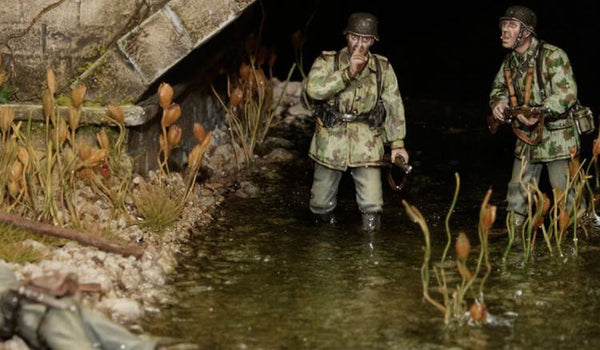
<p style="text-align: left;">In order to create still water for your diorama, you will need special products designed for producing a transparent flat coverage. We recommend using Vallejo Still Water or Solid Water from Deluxe Materials. With <span>Vallejo Still Water, </span>you will need to pour the product layer by layer onto a painted surface giving each layer time to dry. If your base has any cracks, use glue to fill them in before you start. Keep the layers thin; otherwise it will affect the drying time and the smoothness of the surface. To give your water colour and depth, you can mix the liquid with a few drops of paint, which will add more realism. <br>While your water hasn't dried completely, you can add some objects like rocks, fish, or figurines. Having done that, spread the product evenly to make sure the coverage is smooth.</p>
<p style="text-align: left;"><img alt="Water effects scale model diorama" src="//cdn.shopify.com/s/files/1/1120/3680/files/water_diorama_8_grande.jpg?v=1476366334"></p>
<p style="text-align: left;">If you use <span>Solid Water from Deluxe Materials, take a syringe and measure 2 parts of resin into a mixing cup. Using another syringe, add 1 part of hardener. Mind that adding extra hardener will not accelerate the curing time. Mix thoroughly, add colour if necessary, and pour the mixture into your prepared base. It will take about 24 hours for the product to fully harden.<span> </span></span><br><br>Ripples and flow</p>
<p style="text-align: left;">The same products can be used for creating ripples and realistic water flow. For ripples, <span>squeeze a small amount of Vallejo Still Water <span>onto the surface to make a puddle. Let it dry and then add an even smaller amount of Still Water into the middle of the puddle. Go on with it until you make as many ripples as you want to get. Once the work is done, simply put the finished puddle on your water to lend it the ripple effect.</span></span></p>
<p style="text-align: left;"><span><span>In order to create an illusion of a realistic flow of water, use Solid Water from Deluxe Materials and take all the steps necessary to create still water. After 8 to 10 hours add texture to the surface </span></span>with a toothbrush. </p>
<p style="text-align: left;"><br><img src="//cdn.shopify.com/s/files/1/1120/3680/files/water_diorama_4_grande.jpg?v=1476366308" alt="Water effects scale model diorama"><br><br>Waves</p>
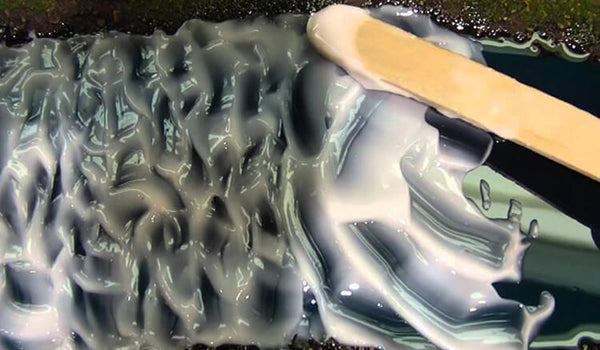
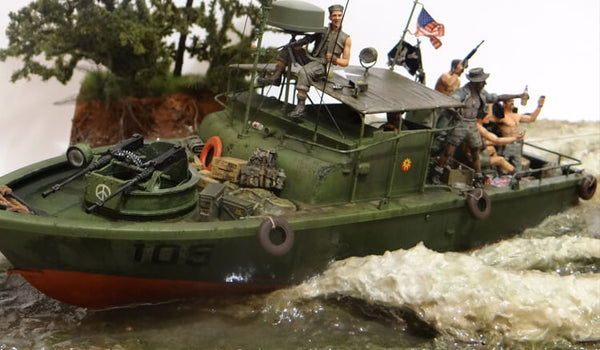
<p style="text-align: left;">You can find a number of products suitable for creating waves, for example gels such as Vallejo Pacific Blue or Vallejo Atlantic blue. Gels have a thicker consistency and are perfect for giving water different shapes and forms. The application is simple: spread some gel over the coloured base and mold it into the desired form with a paintbrush, ice cream stick or any other tool that you have at hand. Wait until the first layer is dry and repeat the procedure if needed. The surface of the base itself can be irregular - it will intensify the effect of waves.<br>To finalise your water texture, cover the waves with some paint or recreate foam on the peaks with Vallejo Foam and Snow.</p>
<p style="text-align: left;"><img alt="Water effects scale model diorama" src="//cdn.shopify.com/s/files/1/1120/3680/files/water_diorama_6_grande.jpg?v=1476368896" style="float: none;"><br><br><img src="//cdn.shopify.com/s/files/1/1120/3680/files/water_diorama_1_grande.jpg?v=1476366242" alt="Water effects scale model diorama"><br><br>Splashes</p>
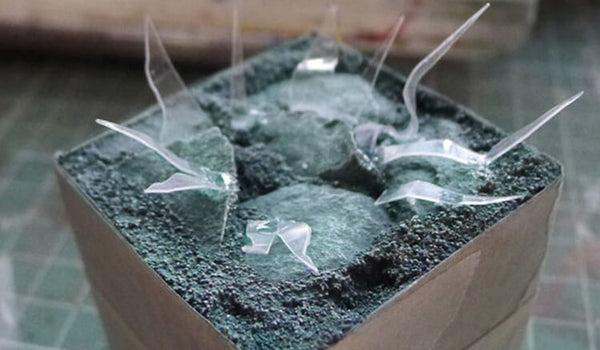
<p style="text-align: left;">If you would like to replicate water splashes, some blister plastic might come in handy. Cut off small pieces of plastic, bend them using fire or a hairdryer and then fix them on the base with a bit of glue. Next, apply some gel onto the plastic and all over the surface, and let it dry as usual. Place the second layer if you like.</p>
<p style="text-align: left;"><img alt="Water effects scale model diorama" src="//cdn.shopify.com/s/files/1/1120/3680/files/water_diorama_5_grande.jpg?v=1476368840" style="float: none;"><br><br><img src="//cdn.shopify.com/s/files/1/1120/3680/files/water_diorama_2_grande.jpg?v=1476366273" alt="Water effects scale model diorama"><br><br>As you can see, a couple of specialised products and some common objects that can be found in every house can help you transform your ideas into reality. Good luck!</p>]]>
    </content>
  </entry>
  <entry>
    <id>https://www.panzermodels.co.uk/blogs/news/choosing-tracks-for-your-scale-models</id>
    <published>2016-08-28T15:13:19+01:00</published>
    <updated>2016-08-28T15:13:19+01:00</updated>
    <link rel="alternate" type="text/html" href="https://www.panzermodels.co.uk/blogs/news/choosing-tracks-for-your-scale-models"/>
    <title>Choosing tracks for your scale models</title>
    <author>
      <name>Panzer Models</name>
    </author>
    <content type="html">
      <![CDATA[<p>If you are building model tanks or AFVs, it is useful to know what options you have when it comes to making tracks. In plenty of modern plastic kits, tracks are of better quality and much more realistic than they were years ago, which helps you achieve better results with less effort. However, for various reasons you might want to find an alternative to the tracks included in your kit. In this blog post we are going to talk about different types of standard and after market tracks, what is available on the market, and why you might prefer one option over another.</p>
<p>The quality of tracks is an important factor which greatly affects how realistic your model will look at the end. If you look at the photos of real tanks, you will notice that track links always sag due to the heavy weight of metal. This effect can be difficult to achieve with plastic and rubber tracks, which is why some modellers choose to buy after market metal track links. A Hungarian manufacturer Friulmodel has a wide range of metal tracks, mainly for 1/35 scale, but also for 1/16, 1/25 and 1/48. A typical set includes individual track links and a wire to make track pivots and hold the links together. These metal tracks have amazing detail, they will sag just as real tracks, and they make it easier for you to create wear effects just by sanding some areas until the metal shows through (however, this effect is not impossible to achieve on plastic or rubber tracks using dry brushing techniques).</p>
<p style="text-align: left;"><img alt="After market scale model tank tracks" src="//cdn.shopify.com/s/files/1/1120/3680/files/blog1_large.jpg?v=1472367055" style="float: none;"></p>
<p>Overall Friulmodel metal tracks help create a very realistic effect because they are basically just miniature versions of the real ones. To add even more realism to your model, you can find solutions that via a chemical reaction, alter the colour of metal tracks, for example: Rail Weathering Solution from Micro Engineering. The downside of Friulmodel metal tracks is that they might cost you nearly as much as the kit itself, on average – over £20 (€27 or $30). You should also keep in mind that since these are individual track links, it might take you quite a while to assemble them.  Sometimes you might even have to re-drill the openings in the track links because the casting does not always leave them perfect.</p>
<p style="text-align: left;"><img alt="After market scale model tank tracks" src="//cdn.shopify.com/s/files/1/1120/3680/files/blog8_large.jpg?v=1472367091" style="float: none;"></p>
<p>Another type of track is those made from rubber, or rubber bands. Various manufacturers supply their kits with rubber tracks, and the main advantage here is that you do not have to spend much time assembling them. You can often find rubber tracks of very good quality which will make your models look realistic. Tamiya kits, for example, often come with good rubber tracks, so you will not have to spend extra time and money on after market alternatives. However, if you are building a diorama with a damaged tank and broken track links, you will have to choose an after market option. Another disadvantage of rubber tracks is recreating a realistic sag. Due to their weight, these tracks will not sag naturally, and you will have to glue them to the wheels or use a needle and thread to imitate the desired effect.</p>
<p style="text-align: left;"><img alt="After market scale model tank tracks" src="//cdn.shopify.com/s/files/1/1120/3680/files/blog2_large.jpg?v=1472367133" style="float: none;"></p>
<p>Finally, there are plastic tracks which you can find included into the kits or sold separately. One of the most popular plastic track manufacturers is a Japanese company ModelKasten. ModelKasten offers a variety of workable and non-workable track sets. Some of the track sets need glue to assemble them, others come with little plastic pins to hold the links together. As with any plastic parts, ModelKasten and other plastic tracks will often require a clean up. It is possible to create a perfect sag with some plastic tracks, but you might find it more difficult than with naturally heavy metal ones.</p>
<p style="text-align: left;"><img src="//cdn.shopify.com/s/files/1/1120/3680/files/blog3_large.jpg?v=1472367258" alt="After market scale model tank tracks"></p>
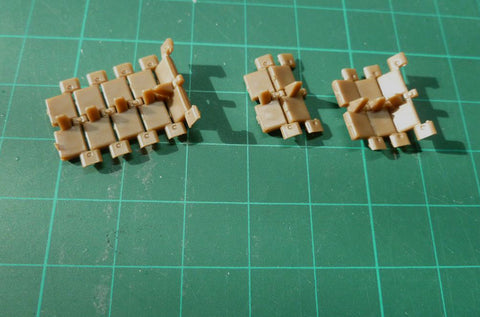
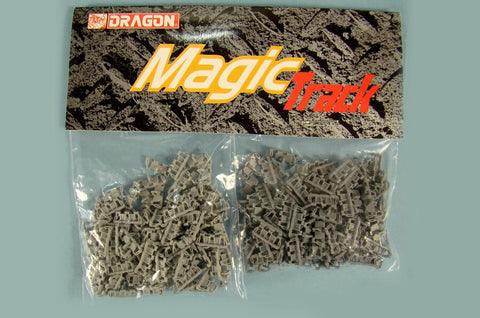
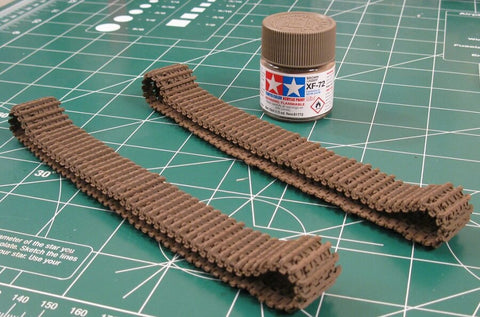
<p>Some plastic tracks come already removed from the sprue, like the Magic Tracks from Dragon. They will save you the time you would spend on cutting tracks off the sprue, however you might still need to do a bit of clean up to remove the seam lines. Magic Tracks are highly detailed and generally good for achieving a realistic effect. However, they do not have plastic pins to connect the links, and require glueing. The Dragon Magic Tracks come in two bags containing tracks for the right and the left side of the vehicle, which slightly differ in colour.</p>
<p style="text-align: left;"><img src="//cdn.shopify.com/s/files/1/1120/3680/files/dragon-magic-tracks-blog_1_large.jpg?v=1472372076" alt="After market scale model tank tracks"></p>
<p>Some kit manufacturers sell a limited number of after market tracks. They are usually intended for use with the kits from the same manufacturer, but in general can be suitable for other brands as well. For example, HobbyBoss offers a limited number of tracks for several types of vehicles like the King Tiger, Sd.Kfz. 184 "Elephant", Soviet T-35, and some others. Most HobbyBoss kits have individual plastic track links on a sprue. Some models, for example the kit #82424 - M26 Pershing, have soft rubber band tracks.</p>
<p>MasterBox supplies tracks for <span>the Jagdpanzer I Ausf. B, the Befeglwagen 3KLB, the Opel Blitz Maultier, and the Panzer I Ausf. B</span>; these are individual tracks on a sprue which require glueing.</p>
<p>AFV Club has workable tracks for several models – the U.S. M60 and M48 T142, M1A1 / M1A2 Abrams T-158, M3 Stuart Early T-16, M5 Light Tank, M8 Howitzer Motor Carriage, M4 Sherman T51, and some others.</p>
<p>Tamiya offers vinyl tracks for Tamiya kits – Pz.Kpfw.V Panther Ausf.D, Pz.Kpfw.V Panther, the King Tiger.</p>
<p>Trumpeter has workable track links for several models - Jagdpanzer 38(t) 'Hetzer', Russian PT-76, Soviet T-64, IDF Merkava MK3, Pz.Kpfw.II Ausf.J, Russian T-72, and some others.</p>
<p>Bronco Models have a number of workable track link sets – for Panzer II, British Challenger, German Leopard, Valentine, Sherman, Pz.Kpfw.V Panther, and other models.</p>
<p style="text-align: left;"><img alt="After market scale model tank tracks" src="//cdn.shopify.com/s/files/1/1120/3680/files/6383Tracks_zpsace6c2ae_1_large.jpg?v=1472368933" style="float: none;"></p>
<p>We recommend choosing the tracks depending on your skills and the end result you are aiming for. If you are building your first model, it might be a good idea to choose a kit with rubber tracks and focus on the basics of assembling and painting the model instead of spending hours on individual track links which require more skill. If you are an experienced modeller and want to built a truly realistic diorama, you are very likely to prefer metal tracks. However, some high quality plastic and rubber tracks can also work well for your purpose.</p>
<p>Thank you for reading, look forward to our next post on creating weathering effects on tracks.</p>]]>
    </content>
  </entry>
  <entry>
    <id>https://www.panzermodels.co.uk/blogs/news/brushing-vs-airbrushing</id>
    <published>2016-08-02T08:15:00+01:00</published>
    <updated>2016-08-06T07:25:03+01:00</updated>
    <link rel="alternate" type="text/html" href="https://www.panzermodels.co.uk/blogs/news/brushing-vs-airbrushing"/>
    <title>Brushing vs Airbrushing</title>
    <author>
      <name>Panzer Models</name>
    </author>
    <content type="html">
      <![CDATA[<p>If you are new to modelling, or are considering trying an airbrush for the first time, it might be useful for you to know what are the pros and cons of brushing and airbrushing are, and what you should base your decision on when choosing between the two.</p>
<p>Versatility</p>
<p>Generally, a brush is considered more versatile than an airbrush, because with enough skill and practice you can do any kind of painting with a brush alone. The Airbrush is perfect for large areas, whereas the brush allows you to paint the smallest details. Technically it is possible to do detailed work with an airbrush, but this requires a lot of experience.</p>
<p>Equipment</p>
<p>All you need to paint your models with a brush is a brush itself and the necessary paints. Everything above that, for example palettes for mixing your colours or empty jars for keeping them are helpful too, but it is a matter of choice. For airbrushing, you need an airbrush, an air compressor, special paints designed for airbrush use, or regular paints and a thinner to dilute them before usage, and some protective equipment (see the next point).</p>
<p style="text-align: left;"><img src="//cdn.shopify.com/s/files/1/1120/3680/files/2222_1_111_grande.jpg?3937392003864004729" alt=""></p>
<p>Safety</p>
<p>Spraying paints causes fumes, so you will have to wear a filter mask, which is not necessary for using brushes. You might choose to do your airbrushing outside the house, for example in a garage. If you are doing it at home, make sure you have enough ventilation and protect the surrounding areas and your clothes from possible overspray.</p>
<p>Price</p>
<p>Several good brushes will cost you less than £20 or $27 (about £3 or $4 each). To get a good airbrush you will probably have to spend between £100-150 ($130-200) plus the same amount of money or more for an air compressor. It is of course possible to buy a starter kit fairly cheap with everything you need included, but usually trying to save a bit of money when buying airbrushing equipment is not a good idea. A high quality airbrush will not only make it easier for you to achieve greater results, but will also serve you well for a much longer time if properly maintained.</p>
<p style="text-align: left;"><img src="//cdn.shopify.com/s/files/1/1120/3680/files/111_1_111_grande.jpg?15101150581892056476" alt=""></p>
<p>Even coating</p>
<p>It is much easier to achieve an even layer of paint on your models when you are using an airbrush, provided that you’ve chosen good quality paints. Remember that some paints need to be thinned before airbrush use, while others already have a consistency suitable for this purpose.  Brushing can leave brush marks, and some areas may turn out thicker than others. Using an airbrush will help you to avoid these problems. Moreover, in some cases an airbrush allows you to paint areas which would be difficult or impossible to reach with a brush.  </p>
<p>Cleaning</p>
<p>Both brush and airbrush require cleaning when you change colours and after you’ve finished painting. However, this procedure is far more time consuming if you are using an airbrush. Every time you want to change a colour or if you have painted everything you needed, you should clean your airbrush thoroughly using a special cleaner or thinner. This is very important, because the majority of problems with an airbrush can be avoided by regular cleaning.</p>
<p>Conclusion</p>
<p>We believe that in order to achieve great results on various types of models (figures, armour, etc.), the best option is to have a number of brushes of different sizes and an airbrush. In this case you will be able to choose your tools based on the work you are doing – airbrushing for larger areas, subtle lines and certain camouflages, and brushing for smaller details, for example figure faces or hands.</p>
<p>Good luck with your models!</p>]]>
    </content>
  </entry>
  <entry>
    <id>https://www.panzermodels.co.uk/blogs/news/gully-in-don-steppe-1-35-scale-wwii-diorama</id>
    <published>2016-07-11T16:11:00+01:00</published>
    <updated>2016-07-11T16:12:22+01:00</updated>
    <link rel="alternate" type="text/html" href="https://www.panzermodels.co.uk/blogs/news/gully-in-don-steppe-1-35-scale-wwii-diorama"/>
    <title>Gully in Don Steppe - 1:35 scale WWII diorama</title>
    <author>
      <name>Panzer Models</name>
    </author>
    <content type="html">
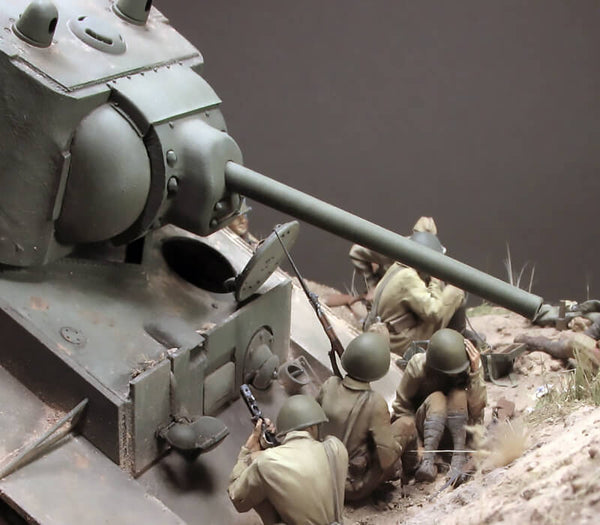
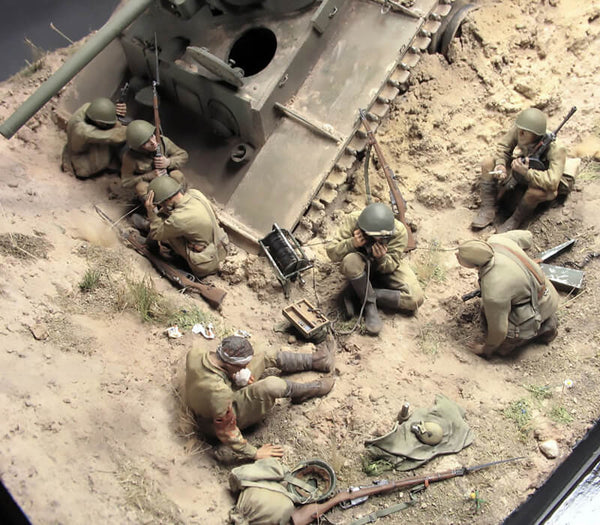
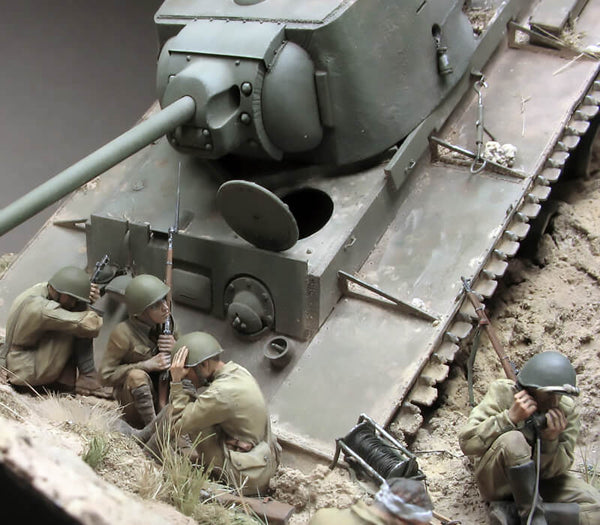
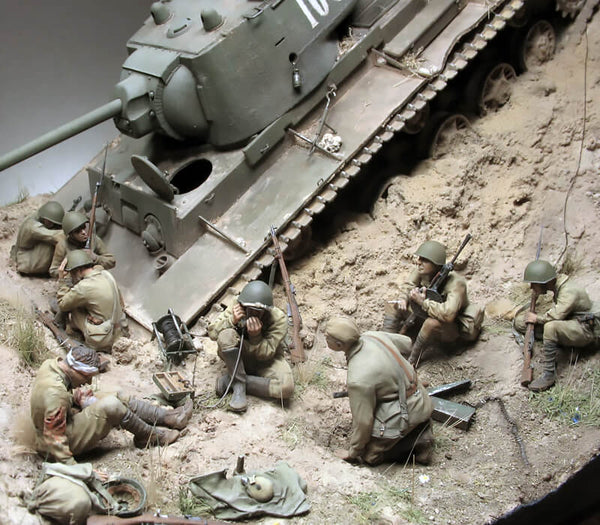
      <![CDATA[<p>This diorama represents the period of summer battles between the Soviet and German armies in 1942. During the summer Germany intended to invade Caucasus, Stalingrad and Astrakhan. The Red Army was defeated in Kharkiv and the Crimea, and weakened by these defeats it could not stop the enemy from advancing inland. At the battle of Kharkiv alone Soviet casualties were almost 300,000, whereas Germans and their allies lost 20,000 people. The Germans occupied Donbass and Rostov-on-Don. Their initial plan was to secure the Don and Volga rivers, and then drive towards the Caucasus in order to capture the oil fields of Baku. However, Hitler ordered to attempt both objectives simultaneously. Rostov-on-Don was recaptured on 24 July. Despite the resistance of the Red Army and multiple counterattacks, the summer battles allowed Wehrmacht to advance from Kharkiv to Stalingrad.</p>
<p style="text-align: left;"><img alt="1/35 scale model diorama WWII" src="//cdn.shopify.com/s/files/1/1120/3680/files/Untitled-1_grande.jpg?2648535113160383036" style="float: none;"></p>
<p style="text-align: left;"><img alt="1/35 scale model diorama WWII" src="//cdn.shopify.com/s/files/1/1120/3680/files/Untitled-3_grande.jpg?2648535113160383036" style="float: none;"></p>
<p style="text-align: left;"><img alt="1/35 scale model diorama WWII" src="//cdn.shopify.com/s/files/1/1120/3680/files/Untitled-4_grande.jpg?2648535113160383036" style="float: none;"></p>
<p style="text-align: left;"><img alt="1/35 scale model diorama WWII" src="//cdn.shopify.com/s/files/1/1120/3680/files/Untitled-6_grande.jpg?2648535113160383036" style="float: none;"></p>
<p style="text-align: left;"><img alt="1/35 scale model diorama WWII" src="//cdn.shopify.com/s/files/1/1120/3680/files/Untitled-7_grande.jpg?2648535113160383036" style="float: none;"></p>]]>
    </content>
  </entry>
  <entry>
    <id>https://www.panzermodels.co.uk/blogs/news/184611719-airbrushing-things-to-know-before-you-start</id>
    <published>2016-06-12T11:41:00+01:00</published>
    <updated>2017-03-05T17:08:24+00:00</updated>
    <link rel="alternate" type="text/html" href="https://www.panzermodels.co.uk/blogs/news/184611719-airbrushing-things-to-know-before-you-start"/>
    <title>AIRBRUSHING: THINGS TO KNOW BEFORE YOU START</title>
    <author>
      <name>Panzer Models</name>
    </author>
    <content type="html">
      <![CDATA[<p>Before you start airbrushing you will need to understand the tools required and how they contribute to the effect you want to achieve on your models. The most important things you will need are: an airbrush set including hoses, jars and bowls; an air compressor; paints; small bucket or bowl and thinner.</p>
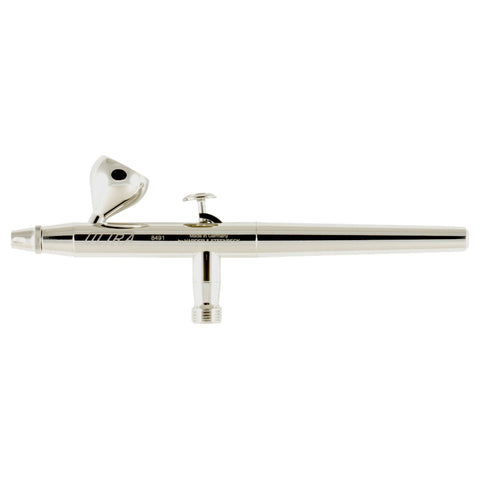
<p>1. There are two major types of airbrushes: single and double action. Modellers often start with a single-action but there is nothing complicated about double, it just takes more practice. With a single action airbrush all you need to do is push down on the button, and paint will come out. With a double action air brush you will have to push down for air, and pull back on the trigger for paint. Single action airbrushes are less expensive and easier to clean because they have fewer parts. Double action offer greater control, flexibility and finer lines, but are also a bit more complex and certainly more expensive. One of the leading brands in producing premium quality airbrushes is Harder &amp; Steenbeck, check out this <a href="https://www.panzermodels.co.uk/products/vallejo-model-air-set-ultra-airbrush-10-camo-colours" title="Vallejo Model Air Set Ultra Airbrush 10 Camo Colors">Model Air set from Vallejo</a> with 10 camouflage colours and the H&amp;S Ultra airbrush. You can also use many other types of paints in your airbrush, getting a poor result is often blamed on the paint, but there are many factors, read on for more.</p>
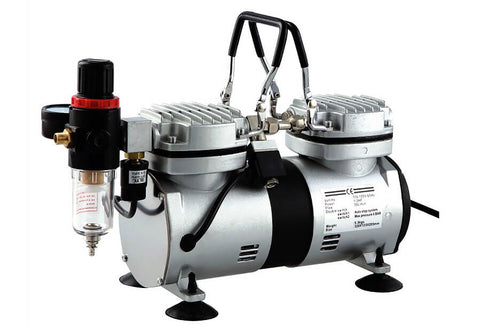
<p style="text-align: left;"><img alt="Harder Steenbeck Ultra Airbrush for scale models 1/35 panzer tank" src="//cdn.shopify.com/s/files/1/1120/3680/files/Ultra_HS_large.jpg?7208920999301478277" style="float: none;"><br><span style="font-size: 1.07143rem; letter-spacing: initial; line-height: 1.42857rem; text-transform: initial;"> </span><br>2. For an airbrush to spray properly you will need a compressor that supplies the air pressure. You can choose between a tanked and a tankless compressor. A tanked compressor fills a tank with air which then powers your airbrush, and gives you a constant stream of air. Tankless compressors are cheaper and occupy less space, but they are not so good for long spray sessions because the stream of air is less constant. Note that airbrush compressors are quite expensive because they are designed to be silent or make very little noise (between 50 and 55 db).</p>
<p style="text-align: left;"> </p>
<p style="text-align: left;"><img alt="Airbrush Compressor for model airbrushing" src="//cdn.shopify.com/s/files/1/1120/3680/files/Airbrush-TG230-1_1_large.jpg?14078067292304391025" style="float: none;"></p>
<p style="text-align: left;"> </p>
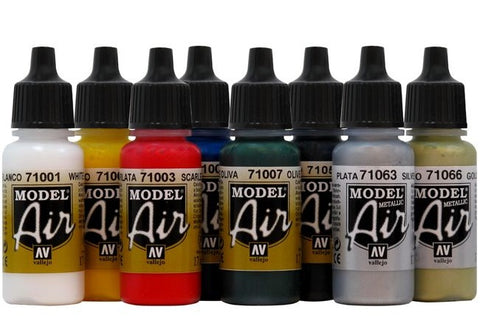
<p style="text-align: left;">3. Choose and prepare your paint. An airbrush allows you to use lacquers, acrylics and enamels. Any paint you choose should be properly prepared before usage. Shake a closed bottle vigorously, then stir the paint with a toothpick, close the cap and shake again. For the paint to run through an airbrush correctly, it usually needs to be thinned (some paints are supposedly pre-thinned - see below). Choose the correct type of thinner and thin your paint until it has the consistency of milk. Remember that you can always add more thinner but you can't always thicken paint, so make sure to practice on a test surface before spraying your model. You can also find liquid acrylics designed for airbrushing like this <a href="https://www.panzermodels.co.uk/products/vallejo-model-air" title="Vallejo Model Air 17ml">Model Air range from Vallejo</a>.</p>
<p style="text-align: left;"> </p>
<p style="text-align: left;"><img alt="Vallejo Model Air paints for airbrushing" src="//cdn.shopify.com/s/files/1/1120/3680/files/prod_1311067651_Vallejo-model-air-set-71147-650_large.jpg?2485472286354424872" style="float: none;"></p>
<p> 4. When working with an airbrush, make sure there is plenty of ventilation in the room or consider working outside when there is no wind. Lacquers generally require you to wear a respirator with a filter. If you are using water-based paints (acrylics), it’s usually enough to wear a dust mask to cover your mouth and nose. There are also airbrush suction units designed to be used at home made by companies such as Wiltec.</p>
<p>5. Always test your paint: try spraying it on a test surface to check the consistency, and practice using your airbrush. To achieve the smoothest effect, keep the airbrush about 8 inches away from the surface of the model.</p>
<p>6. Practice controlling the atomisation – how finely the paint particles are sprayed – by regulating the air pressure. The higher the pressure, the finer atomisation you will achieve. Start at around 10 psi, try spraying, and then turn the pressure up until you get the desired effect. Remember that every colour sprays slightly differently. Lighter colours, especially white, tend to cause more problems than darker ones. Thicker paints require greater pressure to pull and atomize the paint, and vice versa.</p>
<p>7. Paint buildup can harm the airbrush, so always remember to clean it with a thinner. Clean your airbrush when you change colours and at the end of every painting session– it solves most airbrushing problems.</p>
<p>8. An airbrush uses a well on the top to feed the paint down to the nozzle, getting the paint from the bottle to this well is tricky, you don't want to try and pour it in from the paint jar. In our opinion the best thing to do is to use glass eye droppers and small plastic or glass cups. So you have a cup for thinners, a cup for the paint you are working with and you eye drop from the paint jar into your cup, then mix, then eye drop from your cup into the airbrush well. </p>
<p><strong>Troubleshooting and common questions:</strong></p>
<p><span style="text-decoration: underline;">I want to use Tamiya Paints, any advice?</span></p>
<p>Yes, Tamiya paints are excellent for airbrushing and we recommend you use a ratio of 1:1 (1 drop of paint to 1 drop of thinners). Stick to Tamiya thinners.</p>
<p><span style="text-decoration: underline;">I seem to be using up all my paint very quickly, what to do?</span></p>
<p>This is a common mistake for beginners - usually this means the psi or pressure on your airbrush is too high. For scale modelling we rarely want the paint to leave the airbrush so fast, so make sure you start at around 10 psi. To learn how to change the pressure on your airbrush, consult the manual.</p>
<p><span style="text-decoration: underline;">I am getting splatter or inconsistent pressure, how to fix this?</span></p>
<p>This is less of an obvious problem - it could be the paint needs to be thinned further, it could be related to the level of pressure (some thicker paints need a bit more than 10 psi) or it could be your airbrush isn't cut out for spraying for long periods of time (overheating). Try running thinners through your brush to clean it out and see if that helps.</p>
<p><span style="text-decoration: underline;">What is colour modulation?</span></p>
<p>Colour modulation is where you want to try and create the sense of light hitting the model. This subject deserves a long blog post on its own, but a quick start guide is that you want to choose your base colour, then us black to darken it a bit, start with this as a base coat, then use the base colour to build up highlights slowly. Next add white to your base colour and build up the highlights even further. The range of your dark to light areas will depend on how dark you start and how much white you add. Our advice is don't test your first modulation on an expensive model, test on something cheaper. </p>
<p>Have another question you need answered? <a href="https://www.panzermodels.co.uk/pages/contact-us" target="_blank" title="Contact Us Panzer Models ">Email us</a> and we will answer you and add it here for others to see.</p>
<p> </p>
<p> </p>
<p>If you would like to see a guide on a different aspect of modelling, please drop us an email or message us on <a href="https://www.facebook.com/panzermodelsuk/" title="Panzer Models UK Facebook">Facebook </a>or <a href="https://www.instagram.com/panzermodelsuk/" title="Panzer Models UK Instagram">Instagram</a>.</p>]]>
    </content>
  </entry>
  <entry>
    <id>https://www.panzermodels.co.uk/blogs/news/175624519-may-1940-fall-of-france-1-35-scale-model-diorama</id>
    <published>2016-05-27T08:14:00+01:00</published>
    <updated>2016-05-27T08:16:11+01:00</updated>
    <link rel="alternate" type="text/html" href="https://www.panzermodels.co.uk/blogs/news/175624519-may-1940-fall-of-france-1-35-scale-model-diorama"/>
    <title>May 1940 Fall of France 1:35 Scale Model Diorama</title>
    <author>
      <name>Panzer Models</name>
    </author>
    <content type="html">
      <![CDATA[<p>The Fall of France, or the Battle of France, began on 10 May 1940 when German forces defeated Allied forces in a series of operations.</p>
<p>The diorama features 6th Panzer Division. Heinz Guderian, the German general, has arrived in his Sd.Kfz. 251/6 to determine what has halted his advance in the race to reach the channel coast. Two French Hotchkiss tanks have formed a road block to try and slow the German's advance to give others time to escape, and the surviving crewmen have been captured after the short battle. Luftwaffe radio operators are calling on air cover to sweep the road ahead of any resistance whilst two Panzer crewmen listen to the radio reports.</p>
<p>The Battle of France eventually lead to the conquest of France, Belgium, Luxembourg and the Netherlands.</p>
<p> <img src="//cdn.shopify.com/s/files/1/1120/3680/files/b_9565_2_grande.jpg?4129218650824895868" alt="1/35 Scale Model Diorama Fall of France Panzer"></p>
<p><img src="//cdn.shopify.com/s/files/1/1120/3680/files/b_9565_6_grande.jpg?4129218650824895868" alt="1/35 Scale Model Diorama Fall of France Panzer"></p>
<p><img src="//cdn.shopify.com/s/files/1/1120/3680/files/b_9565_7_grande.jpg?4129218650824895868" alt="1/35 Scale Model Diorama Fall of France Panzer"></p>
<p><img src="//cdn.shopify.com/s/files/1/1120/3680/files/b_9565_13_grande.jpg?4129218650824895868" alt="1/35 Scale Model Diorama Fall of France Panzer"></p>
<p><img src="//cdn.shopify.com/s/files/1/1120/3680/files/b_9565_15_grande.jpg?4129218650824895868" alt="1/35 Scale Model Diorama Fall of France Panzer"></p>
<p><img src="//cdn.shopify.com/s/files/1/1120/3680/files/b_9565_16_grande.jpg?4129218650824895868" alt="1/35 Scale Model Diorama Fall of France Panzer"></p>
<p><img src="//cdn.shopify.com/s/files/1/1120/3680/files/b_9565_18_grande.jpg?4129218650824895868" alt="1/35 Scale Model Diorama Fall of France Panzer"></p>
<p><img src="//cdn.shopify.com/s/files/1/1120/3680/files/b_9565_26_grande.jpg?4129218650824895868" alt="1/35 Scale Model Diorama Fall of France Panzer"></p>
<p> </p>]]>
    </content>
  </entry>
  <entry>
    <id>https://www.panzermodels.co.uk/blogs/news/162759815-german-tramcar-641-1-35-scale-model-diorama</id>
    <published>2016-05-04T18:44:08+01:00</published>
    <updated>2016-05-04T18:44:08+01:00</updated>
    <link rel="alternate" type="text/html" href="https://www.panzermodels.co.uk/blogs/news/162759815-german-tramcar-641-1-35-scale-model-diorama"/>
    <title>German Tramcar 641 1:35 Scale Model Diorama</title>
    <author>
      <name>Panzer Models</name>
    </author>
    <content type="html">
      <![CDATA[<p>Trams were commonly used for transportation in cities before and during the Second World War. Sometimes they were even used as blockade, for example in the Battle of Berlin Germans used trams to stop Red Army tanks from advancing. The German Tramcar 641, or Straβenbahn Triebwagen 641, entered production in 1913, and was in service for 53 years until 1966. <br><br>The kit used in this diorama is 1/35 MiniArt German Tramcar 641 (Straβenbahn Triebwagen 641). The figures in this kit are a mix of MiniArt Tram Crew &amp; Passengers, and German Civilians. The detailed Miniart kit of the Tramcar 641 is <a href="https://www.panzermodels.co.uk/products/miniart-1-35-german-tramcar-641-stra-enbahn-triebwagen-641" title="German Tramcar 641">available in our store</a>.</p>
<p> </p>
<p style="text-align: left;"><img alt="1/35 scale model Miniart German Tramcar 641 Straβenbahn Triebwagen Plastic model kit 38003" src="//cdn.shopify.com/s/files/1/1120/3680/files/b_10166_1_grande.jpg?4861116916285178255" style="float: none;"></p>
<p style="text-align: left;"><img alt="1/35 scale model Miniart German Tramcar 641 Straβenbahn Triebwagen Plastic model kit 38003" src="//cdn.shopify.com/s/files/1/1120/3680/files/b_10166_5_grande.jpg?4861116916285178255" style="float: none;"></p>
<p style="text-align: left;"><img alt="1/35 scale model Miniart German Tramcar 641 Straβenbahn Triebwagen Plastic model kit 38003" src="//cdn.shopify.com/s/files/1/1120/3680/files/b_10166_4_grande.jpg?4861116916285178255" style="float: none;"></p>
<p style="text-align: left;"><img alt="1/35 scale model Miniart German Tramcar 641 Straβenbahn Triebwagen Plastic model kit 38003" src="//cdn.shopify.com/s/files/1/1120/3680/files/b_10166_2_grande.jpg?4861116916285178255" style="float: none;"></p>
<p style="text-align: left;"><img alt="1/35 scale model Miniart German Tramcar 641 Straβenbahn Triebwagen Plastic model kit 38003" src="//cdn.shopify.com/s/files/1/1120/3680/files/b_10166_3_grande.jpg?4861116916285178255" style="float: none;"></p>
<p style="text-align: left;"><img alt="1/35 scale model Miniart German Tramcar 641 Straβenbahn Triebwagen Plastic model kit 38003" src="//cdn.shopify.com/s/files/1/1120/3680/files/b_10166_9_grande.jpg?4861116916285178255" style="float: none;"></p>
<p style="text-align: left;"><img alt="1/35 scale model Miniart German Tramcar 641 Straβenbahn Triebwagen Plastic model kit 38003" src="//cdn.shopify.com/s/files/1/1120/3680/files/b_10166_6_grande.jpg?4861116916285178255" style="float: none;"></p>]]>
    </content>
  </entry>
  <entry>
    <id>https://www.panzermodels.co.uk/blogs/news/155719687-detailed-images-of-the-trumpeter-152mm-soviet-howitzer-d-20</id>
    <published>2016-04-20T13:26:00+01:00</published>
    <updated>2016-04-20T13:29:40+01:00</updated>
    <link rel="alternate" type="text/html" href="https://www.panzermodels.co.uk/blogs/news/155719687-detailed-images-of-the-trumpeter-152mm-soviet-howitzer-d-20"/>
    <title>DETAILED IMAGES OF THE TRUMPETER 152MM SOVIET HOWITZER D-20</title>
    <author>
      <name>Panzer Models</name>
    </author>
    <content type="html">
      <![CDATA[<p>Here is a series of detailed images of the 152mm Soviet Howitzer D-20, the 1/35 Trumpeter kit built by Kyle Nelson.<br><br><a href="https://www.panzermodels.co.uk/products/trumpeter-1-35-soviet-152mm-howitzer-d-20" target="_blank" title="1/35 Trumpeter 152mm Soviet Howitzer D-20">Now available from us</a><br><br>The 152mm Soviet Howitzer, or D-20, entered production in the 1950s as a replacement of the ML-20 gun-howitzer as well as various 152mm howitzers of WWII era. The gun had a 34 calibre (5.195m) barrel and incorporated a semi-automatic vertical sliding block breech. The D-20 was used in Vietnam War, Six-Day War, Yom Kippur War, Soviet war in Afghanistan, Syrian civil war and a number of other conflicts. The D-20 was manufactured in the People's Republic of China as the Type 66. Today the howitzer is in operation in over 20 countries.</p>
<p style="text-align: left;"><img alt="1/35 scale model Trumpeter 152mm Soviet Howitzer D-20 Plastic kit 02333" src="//cdn.shopify.com/s/files/1/1120/3680/files/Howitzer_2_grande.jpg?11481664450265136854" style="float: none;"></p>
<p style="text-align: left;"><img alt="1/35 scale model Trumpeter 152mm Soviet Howitzer D-20 Plastic kit 02333" src="//cdn.shopify.com/s/files/1/1120/3680/files/Howitzer_3_grande.jpg?11481664450265136854" style="float: none;"></p>
<p style="text-align: left;"><img alt="1/35 scale model Trumpeter 152mm Soviet Howitzer D-20 Plastic kit 02333" src="//cdn.shopify.com/s/files/1/1120/3680/files/Howitzer_4_grande.jpg?11481664450265136854" style="float: none;"></p>
<p style="text-align: left;"><img alt="1/35 scale model Trumpeter 152mm Soviet Howitzer D-20 Plastic kit 02333" src="//cdn.shopify.com/s/files/1/1120/3680/files/Howitzer_5_grande.jpg?11481664450265136854" style="float: none;"></p>
<p style="text-align: left;"><img alt="1/35 scale model Trumpeter 152mm Soviet Howitzer D-20 Plastic kit 02333" src="//cdn.shopify.com/s/files/1/1120/3680/files/Howitzer_6_grande.jpg?11481664450265136854" style="float: none;"></p>
<p style="text-align: left;"><img alt="1/35 scale model Trumpeter 152mm Soviet Howitzer D-20 Plastic kit 02333" src="//cdn.shopify.com/s/files/1/1120/3680/files/Howitzer_7_grande.jpg?11481664450265136854" style="float: none;"></p>
<p style="text-align: left;"><img alt="1/35 scale model Trumpeter 152mm Soviet Howitzer D-20 Plastic kit 02333" src="//cdn.shopify.com/s/files/1/1120/3680/files/Howitzer_8_grande.jpg?11481664450265136854" style="float: none;"></p>]]>
    </content>
  </entry>
  <entry>
    <id>https://www.panzermodels.co.uk/blogs/news/145470471-the-soviet-kv-8s-heavy-tank-detailed-images-of-the-trumpeter-kit</id>
    <published>2016-04-02T17:52:00+01:00</published>
    <updated>2016-04-02T17:59:52+01:00</updated>
    <link rel="alternate" type="text/html" href="https://www.panzermodels.co.uk/blogs/news/145470471-the-soviet-kv-8s-heavy-tank-detailed-images-of-the-trumpeter-kit"/>
    <title>The Soviet KV-8S Heavy Tank: detailed images of the Trumpeter kit</title>
    <author>
      <name>Panzer Models</name>
    </author>
    <content type="html">
      <![CDATA[<p style="text-align: left;">Here are some amazing images of the 1/35 scale model the Trumpeter KV-8S heavy tank kit, detailed work by Kyle Nelson.</p>
<p><a href="https://www.panzermodels.co.uk/products/trumpeter-1-35-soviet-kv-8s-heavy-tank" target="_blank" title="Trumpeter 1:35 - Soviet KV-8S Heavy Tank - Plastic model kit #01572">Now available in our store</a><br><br>The Soviet KV tanks were heavy tanks used by the Red Army during the Second World War. KV stood for Kliment Voroshilov, the Soviet politician and defense commissar. The KV tanks were famous for their heavy armour protection. The KV-1 was invulnerable to most German weapons except the 8.8cm Flak gun, until the Germans developed more effective guns. The KV-1 outclassed the French Char B1, which was the only other heavy tank in service at that time. However, the KV tank had serious flaws: it was difficult to steer, the transmission was unreliable, and the ergonomics were poor. These flaws were rectified with the introduction of the KV-1S, which was lighter and had thinner armour.</p>
<p>The KV-8S was based on the KV-1S and had an ATO-42 flamethrower (improved version of the ATO-41 used in the KV-1 and KV-8). However, after a few years it turned out that the expensive KV tanks could be replaced by the T-34 medium tanks with a better performance. The KV series became a base for the development of the IS tanks (IS stands for Josif Stalin).</p>
<p style="text-align: left;"><img alt="1/35 scale model Trumpeter Soviet KV-8S Heavy Tank Plastic kit 01572" src="//cdn.shopify.com/s/files/1/1120/3680/files/KV-8_pt._3_007_ps_82ba2160-7c4b-49ed-b245-c3ca3b8e2605_grande.jpg?14792740249393622326" style="float: none;"></p>
<p style="text-align: left;"><img alt="1/35 scale model Trumpeter Soviet KV-8S Heavy Tank Plastic kit 01572" src="//cdn.shopify.com/s/files/1/1120/3680/files/KV-8_pt._3_008_ps_grande.jpg?7302720594689154880" style="float: none;"></p>
<p style="text-align: left;"><img alt="1/35 scale model Trumpeter Soviet KV-8S Heavy Tank Plastic kit 01572" src="//cdn.shopify.com/s/files/1/1120/3680/files/KV-8_pt._3_010_ps_grande.jpg?441907928349951061" style="float: none;"></p>
<p style="text-align: left;"><img alt="1/35 scale model Trumpeter Soviet KV-8S Heavy Tank Plastic kit 01572" src="//cdn.shopify.com/s/files/1/1120/3680/files/KV-8_pt._3_012_ps_grande.jpg?6755875921577834802" style="float: none;"></p>]]>
    </content>
  </entry>
  <entry>
    <id>https://www.panzermodels.co.uk/blogs/news/123778503-german-army-zeltbahn-31-pattern-splittertarn-or-splinter-camo-splittermuster</id>
    <published>2016-02-24T03:46:00+00:00</published>
    <updated>2016-02-29T04:12:58+00:00</updated>
    <link rel="alternate" type="text/html" href="https://www.panzermodels.co.uk/blogs/news/123778503-german-army-zeltbahn-31-pattern-splittertarn-or-splinter-camo-splittermuster"/>
    <title>German Army Zeltbahn 31 Pattern - Splittertarn or Splinter Camo (Splittermuster)</title>
    <author>
      <name>Panzer Models</name>
    </author>
    <content type="html">
      <![CDATA[<p>Zeltbahn's or Half Shelters were a fairly important piece of kit for the Wehrmacht infantryman during WW2. The pattern used on these personal tents/ponchos and of course also on many uniforms was known as Splittertarn (among other names). While working on a small infantry diorama we started thinking about the possibility of printing a Splittertarn pattern onto some thin card (on both sides to reflect the lighter shade underneath), or onto some nice paper stock to experiment with the results.</p>
<p><img src="//cdn.shopify.com/s/files/1/1120/3680/files/zelt_003_grande.jpg?1583986641130986947" alt="GERMAN ARMY ZELTBAHN 31 PATTERN - SPLITTERTARN OR SPLINTER CAMO"></p>
<p>First thing to do was to find a vector pattern of the camouflage, but after a lot of searching, we couldn't find a vector pattern to download anywhere. So we made one using Adobe Illustrator and thought we would share it with anyone who needs it. Getting the colours right I think is a matter of personal preference, we prepared three variants, judge for yourself which is the most realistic or, if you have Adobe Illustrator or Photoshop, fine tune the colours yourself. Hope this helps someone who was unsuccessfully searching for this vector like us, please leave any comments below.</p>
<p>Maybe we should do some more vector camo patterns? Let us know what you think.</p>
<p>Free Vector Download's of our Splittertarn / Splinter Camouflage Fabric Print - follow the links below. Enjoy and please share this Blog post or follow us on <a href="http://www.facebook.com/panzermodelsuk" target="_blank" title="Panzer Models Facebook page">Facebook</a> or <a href="http://www.instagram.com/panzermodelsuk" target="_blank" title="Panzer Models Instagram page">Instagram</a>.</p>
<p>These are .ai files (If you need an eps please email us):</p>
<p><a href="https://cdn.shopify.com/s/files/1/1120/3680/files/Splittertarn_1.ai?2928433497162533956" target="_blank" title="Splittertarn Splinter Camo German Army Vector Free Download ">Splittertarn 1</a></p>
<p><a href="https://cdn.shopify.com/s/files/1/1120/3680/files/Splittertarn_2.ai?2928433497162533956" target="_blank" title="Splittertarn Splinter Camo German Army Vector Free Download ">Splittertarn 2</a></p>
<p><a href="https://cdn.shopify.com/s/files/1/1120/3680/files/Splittertarn_3.ai?2928433497162533956" target="_blank" title="Splittertarn Splinter Camo German Army Vector Free Download">Splittertarn 3</a></p>
<p>If you just want a PNG file (not a vector) see below:</p>
<p><a href="https://cdn.shopify.com/s/files/1/1120/3680/files/Tile.png?2928433497162533956" target="_blank" title="Splittertarn Splinter Camo German Army Vector Free Download ">Splittertarn 1 PNG</a></p>
<meta charset="utf-8">
<p><a href="https://cdn.shopify.com/s/files/1/1120/3680/files/Tile_2.png?5024645369285824166" target="_blank" title="Splittertarn Splinter Camo German Army Vector Free Download ">Splittertarn 2 PNG</a></p>
<meta charset="utf-8">
<p><a href="https://cdn.shopify.com/s/files/1/1120/3680/files/Tile_3.png?5024645369285824166" target="_blank" title="Splittertarn Splinter Camo German Army Vector Free Download ">Splittertarn 3 PNG</a></p>
<p>Here is a bit of official background on the pattern:</p>
<p>Splittertarnmuster or simply Splittertarn or Splittermuster (splinter-pattern) is a four-colour military camouflage pattern developed by Germany in the late 1920s, and was first issued to the Reichswehr in 1931. It was first printed on the newly designed and issued triangular tent/poncho called the dreieckszeltbahn ("3-corner tent"). Known in German as Buntfarbenaufdruck 31 ("colourful print 31"), for its year of introduction, splittertarn was later issued on a very wide basis to practically all regular military (Wehrmacht) units. The pattern consists of a disruptive, zig-zag pattern of hard-edged wood-brown and medium green polygons printed on a light field-grey or tan background. A random pattern of green dashes, called "raindrops", was applied in places to improve the camouflage effect.</p>
<p><img src="//cdn.shopify.com/s/files/1/1120/3680/files/Tile_grande.png?14026650516100978639" alt="Splittertarn Vector Download Fabric Wehrmacht WW2 German Camo"><br><br>Proposed in 1931 and introduced in 1932, the four-colour camouflage patterns incorporated "splinters" on top of the 1918 colour pattern. This pattern included ochre, rust, and brown overlaid on a green foundation, with sharp corners between coloured patches. This new pattern was printed on zeltbahn (triangular tent) material, and could also be used as a camouflage rain poncho in the field. Both sides of the material showed the same pattern, but the printing was brighter on one side.<br><br>A subdued grey-beige tint replaced the yellow-ochre colour. On top of this background, green and brown irregular patterns were screen-printed. A final innovation applied to this camouflage colour printing were the "splinters" irregularly printed on the fabric. Directional, dark-green dashed lines ("grass") were printed in selected areas to help break up the silhouette. During the war, cost-saving measures required textiles to be printed with changed colours. In addition, many of the lower-cost two-colour options were abandoned. These cost-saving measures caused significant deviations from the original colour patterns.<br><br>Equipment in the stained colour printing units were issued to the following: Heeres-Splittertarnmuster 31, and Luftwaffen-Splittertarnmuster 41.</p>
<p> </p>
<meta charset="utf-8">
<p><img alt="Splinter Camo Free Download Panzer Models Splittertarn WWII" src="//cdn.shopify.com/s/files/1/1120/3680/files/Tile_3_grande.png?5024645369285824166"></p>
<p><img src="//cdn.shopify.com/s/files/1/1120/3680/files/Tile_2_grande.png?12905483121656787397" alt="GERMAN ARMY ZELTBAHN 31 PATTERN - SPLITTERTARN OR SPLINTER CAMO"></p>
<p> </p>
<meta charset="utf-8">
<p>Some extra Zeltbahn images below showing the two tone sides, overview of construction and the variation in colours, Zeltbahn's were not all the same, some were just green or grey, without pattern.</p>
<p><img src="//cdn.shopify.com/s/files/1/1120/3680/files/zelt_004_grande.jpg?1583986641130986947" alt="GERMAN ARMY ZELTBAHN 31 PATTERN - SPLITTERTARN OR SPLINTER CAMO"><img src="//cdn.shopify.com/s/files/1/1120/3680/files/zelt_005_grande.jpg?1583986641130986947" alt="GERMAN ARMY ZELTBAHN 31 PATTERN - SPLITTERTARN OR SPLINTER CAMO"><img src="//cdn.shopify.com/s/files/1/1120/3680/files/reduced_pattern_01_grande.jpg?1583986641130986947" alt="GERMAN ARMY ZELTBAHN 31 PATTERN - SPLITTERTARN OR SPLINTER CAMO"><img src="//cdn.shopify.com/s/files/1/1120/3680/files/zelt_029_grande.jpg?1583986641130986947" alt="GERMAN ARMY ZELTBAHN 31 PATTERN - SPLITTERTARN OR SPLINTER CAMO"></p>
<p> </p>]]>
    </content>
  </entry>
  <entry>
    <id>https://www.panzermodels.co.uk/blogs/news/121909319-german-retreat-1-35-scale-model-diorama-wwii-kischentsy-ukraine-1943</id>
    <published>2016-02-20T12:20:00+00:00</published>
    <updated>2016-02-20T12:25:21+00:00</updated>
    <link rel="alternate" type="text/html" href="https://www.panzermodels.co.uk/blogs/news/121909319-german-retreat-1-35-scale-model-diorama-wwii-kischentsy-ukraine-1943"/>
    <title>German Retreat 1:35 Scale Model Diorama WWII Kischentsy, Ukraine 1943</title>
    <author>
      <name>Panzer Models</name>
    </author>
    <content type="html">
      <![CDATA[<p>Thinking of your next 1:35 scale model military diorama? Or just want to appreciate some impressive work. Here is a re-supply/retreat scene with German troops, armour and support units, created by <a href="http://precisemodeling.com/" target="_blank" title="WW2 Diorama 1:35 Scale">Precise Modelling</a>. It's as well photographed as it is built and painted. Enjoy!</p>
<h3>1943 Kischentsy, Ukraine</h3>
<p>In the fall of 1943, most of Germany’s forces were forced to withdraw throughout the eastern front in the Soviet Union. This was due to the massive Soviet offensives launched after the Wehrmacht’s failure at Kursk.<br><br>This diorama portrays Michael Wittmann’s Tiger tank, belonging to 501st SS Heavy Tank Battalion, next to an 8 tonne semi track 3.7cm flak 37 sd.kfz 7/2 at rest beside an abandoned village home in Kichentsy, Ukraine. Four exhausted soldiers from Battalion 113 (Panzer Grenadier Regiment) are seen walking by on a muddy village road, probably after an encounter with Soviet T-34 tanks in the large offensive. This #007 late-production Tiger was destroyed at Villers Bocage, France, during the retreat further from Ukraine in 1944, by several Sherman VC "Firefly" tanks, part of British 7th Armoured Division.</p>
<meta charset="utf-8">
<h3>The Build</h3>
<p>The kits used in this diorama are 1/35 Tamiya Tiger I tank with scratch built improvements, along with 1/35 Tamiya 8 tonne half track with minor modifications.<br><br>The soldiers in this kit are a mix of Dragon with several Tamiya, with heavy modifications made to the weapons and equipment.</p>
<p><img src="//cdn.shopify.com/s/files/1/1120/3680/files/precise-modeling-diorama-wwii-ukraine_0_grande.jpg?16892070604370309400" alt="Axis Forces 1:35 Scale Diorama WWII Ukraine 1943"><img src="//cdn.shopify.com/s/files/1/1120/3680/files/precise-modeling-diorama-wwii-ukraine3_grande.jpg?16892070604370309400" alt="Axis Forces 1:35 Scale Diorama WWII Ukraine 1943"><img src="//cdn.shopify.com/s/files/1/1120/3680/files/precise-modeling-diorama-wwii-ukraine9_grande.jpg?16892070604370309400" alt="Axis Forces 1:35 Scale Diorama WWII Ukraine 1943"><img src="//cdn.shopify.com/s/files/1/1120/3680/files/precise-modeling-diorama-wwii-ukraine8_grande.jpg?16892070604370309400" alt="Axis Forces 1:35 Scale Diorama WWII Ukraine 1943"><img src="//cdn.shopify.com/s/files/1/1120/3680/files/precise-modeling-diorama-wwii-ukraine11_grande.jpg?16892070604370309400" alt="Axis Forces 1:35 Scale Diorama WWII Ukraine 1943"><img src="//cdn.shopify.com/s/files/1/1120/3680/files/precise-modeling-diorama-wwii-ukraine7_grande.jpg?16892070604370309400" alt="Axis Forces 1:35 Scale Diorama WWII Ukraine 1943"><img src="//cdn.shopify.com/s/files/1/1120/3680/files/precise-modeling-diorama-wwii-ukraine4_grande.jpg?16892070604370309400" alt="Axis Forces 1:35 Scale Diorama WWII Ukraine 1943"><img src="//cdn.shopify.com/s/files/1/1120/3680/files/precise-modeling-diorama-wwii-ukraine2_grande.jpg?16892070604370309400" alt="Axis Forces 1:35 Scale Diorama WWII Ukraine 1943"></p>
<p> </p>
<p> </p>]]>
    </content>
  </entry>
  <entry>
    <id>https://www.panzermodels.co.uk/blogs/news/121420487-verlinden-products-now-available-to-order</id>
    <published>2016-02-19T12:55:00+00:00</published>
    <updated>2016-02-19T12:52:35+00:00</updated>
    <link rel="alternate" type="text/html" href="https://www.panzermodels.co.uk/blogs/news/121420487-verlinden-products-now-available-to-order"/>
    <title>Verlinden Products now available to order</title>
    <author>
      <name>Panzer Models</name>
    </author>
    <content type="html">
      <![CDATA[<meta charset="utf-8">
<p>There is nothing quite like Verlinden Productions accessories to take your diorama to the next level. We can now order in the entire catalogue, so please feel free to contact us with any requests and for a price. Message us via Facebook or email <a href="mailto:sales@panzermodels.co.uk" target="_blank" title="Verlinden Products Enquiry">sales@panzermodels.co.uk</a></p>
<p>Here are some nice resin diorama base images plus a few accessory kits to remind you of what a vast range they have for 1/35 scale modellers. Verlinden also have figurines, armour, photo-etched, printed, ceramic buildings and even 1/35 scale submarines!</p>
<p> </p>
<p style="text-align: left;"><img alt="Verlinden Products 1/35 scale" src="//cdn.shopify.com/s/files/1/1120/3680/files/2766_grande.jpg?5304208600033781643" style="float: none;"><img alt="Verlinden Products 1/35 scale" src="//cdn.shopify.com/s/files/1/1120/3680/files/2764_1_grande.jpg?5304208600033781643" style="float: none;"><img alt="Verlinden Products 1/35 scale" src="//cdn.shopify.com/s/files/1/1120/3680/files/2767_grande.jpg?5304208600033781643" style="float: none;"><img alt="Verlinden Products 1/35 scale" src="//cdn.shopify.com/s/files/1/1120/3680/files/2779_grande.jpg?5304208600033781643" style="float: none;"><img alt="Verlinden Products 1/35 scale" src="//cdn.shopify.com/s/files/1/1120/3680/files/2670_grande.jpg?5304208600033781643" style="float: none;"><img alt="Verlinden Products 1/35 scale" src="//cdn.shopify.com/s/files/1/1120/3680/files/2778_grande.jpg?5304208600033781643" style="float: none;"><img alt="Verlinden Products 1/35 scale" src="//cdn.shopify.com/s/files/1/1120/3680/files/0810_7_grande.jpg?5304208600033781643" style="float: none;"></p>]]>
    </content>
  </entry>
  <entry>
    <id>https://www.panzermodels.co.uk/blogs/news/117824455-gallery-of-a-diorama-using-the-hobbyboss-1-35-flak-bergepanther-tank</id>
    <published>2016-02-12T19:39:00+00:00</published>
    <updated>2016-02-19T12:03:24+00:00</updated>
    <link rel="alternate" type="text/html" href="https://www.panzermodels.co.uk/blogs/news/117824455-gallery-of-a-diorama-using-the-hobbyboss-1-35-flak-bergepanther-tank"/>
    <title>Gallery of a diorama using the HobbyBoss 1/35 Flak Bergepanther tank</title>
    <author>
      <name>Panzer Models</name>
    </author>
    <content type="html">
      <![CDATA[<p>Here are some images of the HobbyBoss Bergepanther 1/35 scale tank, built, painted and added to a diorama by a French modeller, <a href="http://warpaints.net/viewtopic.php?f=60&amp;t=1865" target="_blank" title="Bergepanther HobbyBoss kit built by Hellcat">Hellcat.</a></p>
<p>We have this 1/35 scale Panther tank kit in stock, which you can see <a href="http://www.panzermodels.co.uk/products/hobbyboss-german-panther-ausf-d-flak-bergepanther" target="_blank" title="Bergepanther HobbyBoss 1/35 scale Flak tank ">here</a>.</p>
<p>The Panzerkampfwagen V Panther (also named Panzer V), which served from the middle of 1943 till 1945 in European battlefields, is a German tank of World War II. It was designed to oppose the Russian T-34 and replace the Panzer III and Panzer IV, and also to fight together with other heavy tanks until the end of the war. The Panzerkampfwagen V Panther, next to the PzKpfw VI Tiger, is the best-known German tank of World War II. The Panther and the Soviet T-34/85 are considered to be the best tanks of World War II. The derived models are Panther Ausf. A, Panther Ausf. D, Panther Ausf. G, Panther Ausf. F. There is also a considerable quantity of modified variants such as maintenance tanks, air defence tanks etc.</p>
<p> <img src="//cdn.shopify.com/s/files/1/1120/3680/files/bp_12_grande.jpg?411605965303114742" alt="HOBBYBOSS GERMAN PANTHER AUSF. D FLAK BERGEPANTHER"><img src="//cdn.shopify.com/s/files/1/1120/3680/files/bp_4_grande.jpg?411605965303114742" alt="HOBBYBOSS GERMAN PANTHER AUSF. D FLAK BERGEPANTHER"><img src="//cdn.shopify.com/s/files/1/1120/3680/files/bp_6_grande.jpg?411605965303114742" alt="HOBBYBOSS GERMAN PANTHER AUSF. D FLAK BERGEPANTHER"><img src="//cdn.shopify.com/s/files/1/1120/3680/files/bp_10_grande.jpg?411605965303114742" alt="HOBBYBOSS GERMAN PANTHER AUSF. D FLAK BERGEPANTHER"><img src="//cdn.shopify.com/s/files/1/1120/3680/files/bp_9_grande.jpg?411605965303114742" alt="HOBBYBOSS GERMAN PANTHER AUSF. D FLAK BERGEPANTHER"></p>]]>
    </content>
  </entry>
  <entry>
    <id>https://www.panzermodels.co.uk/blogs/news/117620935-detailed-images-of-the-eduard-german-pz-kpfw-vi-ausf-b-tiger-ii-weekend-edition</id>
    <published>2016-02-12T11:50:00+00:00</published>
    <updated>2016-02-19T12:06:36+00:00</updated>
    <link rel="alternate" type="text/html" href="https://www.panzermodels.co.uk/blogs/news/117620935-detailed-images-of-the-eduard-german-pz-kpfw-vi-ausf-b-tiger-ii-weekend-edition"/>
    <title>Detailed images of the Eduard German PZ. KPFW. VI AUSF. B TIGER II Weekend Edition</title>
    <author>
      <name>Panzer Models</name>
    </author>
    <content type="html">
      <![CDATA[<p>Here are a selection of fantastic images of a build of the 1/35 scale model Eduard Tiger II tank kit.</p>
<p><a href="http://www.panzermodels.co.uk/products/pz-kpfw-vi-ausf-b-tiger-ii-weekend-1-35" target="_blank" title="EDUARD GERMAN PZ. KPFW. VI AUSF. B TIGER II WEEKEND 1/35 SCALE TANK">Now available from us</a> </p>
<meta charset="utf-8">
<p><span>The Tiger II was a German heavy tank of the Second World War. The final official German designation was Panzerkampfwagen Tiger Ausf. B, often shortened to Tiger B. It is also known under the informal name Königstiger (the German name for the "Bengal Tiger"), often semi-literally translated as the King Tiger or Royal Tiger by Allied soldiers.</span> </p>
<div style="text-align: left;"><img alt="Eduard German PZ. KPFW. VI AUSF. B TIGER II Weekend Edition" src="//cdn.shopify.com/s/files/1/1120/3680/files/3715_00_grande.jpg?8098844361818250119" style="float: none;"></div>
<br>
<div style="text-align: left;"><img alt="Eduard German PZ. KPFW. VI AUSF. B TIGER II Weekend Edition" src="//cdn.shopify.com/s/files/1/1120/3680/files/3715_01_grande.jpg?8098844361818250119" style="float: none;"></div>
<p> </p>
<p style="text-align: left;"><img alt="Eduard German PZ. KPFW. VI AUSF. B TIGER II Weekend Edition" src="//cdn.shopify.com/s/files/1/1120/3680/files/3715_03_grande.jpg?8098844361818250119" style="float: none;"></p>
<p style="text-align: left;"><img alt="Eduard German PZ. KPFW. VI AUSF. B TIGER II Weekend Edition" src="//cdn.shopify.com/s/files/1/1120/3680/files/3715_04_grande.jpg?8098844361818250119" style="float: none;"><img alt="Eduard German PZ. KPFW. VI AUSF. B TIGER II Weekend Edition" src="//cdn.shopify.com/s/files/1/1120/3680/files/3715_05_grande.jpg?8098844361818250119" style="float: none;"></p>
<p> </p>]]>
    </content>
  </entry>
  <entry>
    <id>https://www.panzermodels.co.uk/blogs/news/100271943-first-post-for-panzer-models</id>
    <published>2016-01-08T15:16:00+00:00</published>
    <updated>2016-02-19T11:54:47+00:00</updated>
    <link rel="alternate" type="text/html" href="https://www.panzermodels.co.uk/blogs/news/100271943-first-post-for-panzer-models"/>
    <title>First post for Panzer Models</title>
    <author>
      <name>Panzer Models</name>
    </author>
    <content type="html">
      <![CDATA[<p>This is our very first blog post and we are excited to be launching our online store and bringing high quality 1/35 scale model kits to you at good prices, hopefully with excellent service. We have designed this website to make the experience of viewing our products as easy as possible, whatever device you are using. Our hope for the future is to massively expand our range and not only stock more items but be known as a shop that has very good supporting information for modelling and historical interest. </p>
<p>For now we are stocking some classic German Panzer tank kits, as befits our name, most are made by HobbyBoss, these have many parts and are especially rewarding for the advanced modeller. Photo etched and metal parts add great finishing potential. Figurines are in from Masterbox, who always seem to capture the spirit of dioramas in their characterisation, we are also big fans of Verlinden figures and accessories, so look forward to seeing some of their products in our store too.</p>
<p> </p>
<p> </p>]]>
    </content>
  </entry>
</feed>