<?xml version="1.0" encoding="UTF-8"?>
<feed xml:lang="en" xmlns="http://www.w3.org/2005/Atom" xmlns:opensearch="http://a9.com/-/spec/opensearch/1.1/" xmlns:s="http://jadedpixel.com/-/spec/shopify">
  <id>https://www.pi-learning.com/blogs/news.atom</id>
  <link rel="alternate" type="text/html" href="https://www.pi-learning.com/blogs/news"/>
  <link rel="self" type="application/atom+xml" href="https://www.pi-learning.com/blogs/news.atom"/>
  <title>Proven Impact Learning - News</title>
  <updated>2015-05-08T16:27:00-06:00</updated>
  <author>
    <name>Proven Impact Learning</name>
  </author>
  <entry>
    <id>https://www.pi-learning.com/blogs/news/19383172-what-is-so-big-about-smart-data</id>
    <published>2015-05-08T16:27:00-06:00</published>
    <updated>2015-05-08T16:27:46-06:00</updated>
    <link rel="alternate" type="text/html" href="https://www.pi-learning.com/blogs/news/19383172-what-is-so-big-about-smart-data"/>
    <title>What Is So Big About Smart Data?</title>
    <author>
      <name>Mike Ostoja</name>
    </author>
    <content type="html">
      <![CDATA[<p>A couple of years ago almost no one had heard of “big data.” Now the term has become overused, and we already have to learn a new name for a similar concept. Is “smart data” just going to be another overused term that has been stripped of tangible value?</p>
<h2>Big vs. Smart Data</h2>
<p>Big data refers to the idea that large collections of data open opportunities that were not possible with smaller amounts. The term originated from massive offline astrophysics and genomics data sets and was later used for applications that employ machine-learning, such as Internet search, voice recognition and language translation. These days many products with data analysis and statistics features tend to use the term “big data” simply for the sake of marketing.</p>
<p>Smart data, on the other hand, is not about data per se, but rather refers to the ways to analyze and make sense of it. From business perspective, big data is what we know about consumer behavior, while smart data is how we discover the underlying rationale and predict repetition of such behavior.</p>
<p>Technically, it is about separating and ignoring the noise, finding relevant data points, and extracting signals of higher value. Practically, it is about providing meaningful information, change recommendations and interactive visualization – all for a particular business context.</p>
<p>In short, smart data is adding advanced business intelligence (BI) on top of big data, in order to provide actionable insights.</p>
<h2>Business Challenges</h2>
<p>There is a spectacular gap between what smart data means by definition and how it can really benefit your company.</p>
<p>As with any new business trend, the first problem is talent. There are not enough people who know how to ask the right questions – or query the data – let alone how to extract the answers. This requires a unique blend of mathematics, psychology and business acumen. McKinsey &amp; Company estimates that, in the US alone, there is a shortfall of 190,000 analytics experts and 1.5 million data-savvy managers.</p>
<p>According to research by Tata Consultancy Services, the greatest challenges of getting business value from big data are as much cultural as they are technological. The highest-rated challenge is getting business units within a company to share information across the organizational silos, such as divisions, business functions, etc. This issue has plagued companies for decades. Business departments become protective of their data and often don’t have any incentive to share it internally.</p>
<p>Because of this, in large organizations inconsistent versions of the same data may be used in different parts of its operations. This problem can be solved with master data management that consistently provides a single point of reference. Data must be accessible by analysts across multiple domains in order for them to be most effective. By providing this access, analysts are empowered to ask broader and ultimately better questions.</p>
<p>Other possible organizational issues that concern decision-making workflow include selecting correct key performance indicators (KPIs) for various roles; trust between data scientists and functional managers; visualization usability and interactivity; and recording and implementing decisions in real life.</p>
<h2>Technology Limitations</h2>
<p>Perhaps one of the biggest challenges for big data analytics is the sheer volume, diversity and speed with which data is now being collected and processed.</p>
<p>Data can be analyzed in many different forms, depending on the way it is measured and its origin. With more sources stemming from web services, networks and cloud computing, the diversity of the data is growing more complex by the day. And so is the amount of work involved in its intelligent integration.</p>
<p>Big data is generally unstructured and requires investment in new tools, technologies, skill sets and team members to manage it. In recent research from TDWI (The Data Warehousing Institute), 88% of organizations cited structured transactional and analytical data as their primary type.</p>
<p>If your data sets are too large and complex to manage within traditional relational databases, then scaling of both resources and performance might be an issue. A study by Enterprise Management Associates shows that nearly half of big data projects are still based on Oracle and/or SQL servers that are incapable of managing them, and only 28% are concerned that their current systems cannot scale to meet the growing demands.</p>
<h2>Data-Driven Marketing</h2>
<p>The use of smart data in marketing is often called data-driven marketing. For example, if you run an ecommerce business, traffic logs represent only raw data. What you really need to know is not how many unique users visited your storefront, but rather what percentage converted to actual customers and why.</p>
<p>You need to ask smart questions, such as how behavior is different depending on the referral source; are there any bottleneck in the sales funnel on mobile devices; can you build up a habit of using your website; and do customers admire your product and service offering, or just cope with it? All of these questions can be answered with advanced analytics based on customers’ behavior data.</p>
<p>Mark Jeffery in his book, <em>Data-Driven Marketing: The 15 Metrics Everyone in Marketing Should Know</em>, suggests 15 main metrics of data-driven marketing: brand awareness, test-drive, churn, customer satisfaction, take rate, profit, net present value, internal rate of return, payback, customer lifetime value, cost per click, transaction conversion rate, return on ad dollar spent, bounce rate, and social media reach. HubSpot mentions six in its white paper: customer acquisition cost (CAC), marketing % of CAC, ratio of customer lifetime value (LTV) to CAC, time to payback CAC, marketing originated customer % and marketing influenced customer %.</p>
<p>Your business case may require other insights to make informed decisions. It is the Chief Marketing Officer’s job to take ownership and responsibility for technology issues to a new degree. No longer can one rely on cloud solutions and work around IT operation.</p>
<p>If we want big data to become smart, new technology should meet traditional business needs and provide answers that actually improve customer lives and experiences.</p>
<p>This article and more information can be found at: <a href="http://blog.nxcgroup.com/2014/what-is-so-big-about-smart-data/#.VU02bemUCP8">http://blog.nxcgroup.com/2014/what-is-so-big-about-smart-data/#.VU02bemUCP8</a></p>]]>
    </content>
  </entry>
  <entry>
    <id>https://www.pi-learning.com/blogs/news/19159876-is-big-data-dead-the-rise-of-smart-data</id>
    <published>2015-05-06T12:22:00-06:00</published>
    <updated>2015-05-06T12:25:28-06:00</updated>
    <link rel="alternate" type="text/html" href="https://www.pi-learning.com/blogs/news/19159876-is-big-data-dead-the-rise-of-smart-data"/>
    <title>Is big data dead? The rise of smart data</title>
    <author>
      <name>Mike Ostoja</name>
    </author>
    <content type="html">
      <![CDATA[<p>Big data as a concept is defined around four aspects: data volume, data velocity, data veracity and data value.</p>
<p>Two patterns emerge when these characteristics are looked at closely. While the volume and velocity aspects refer to data generation process and how to capture and store the data, veracity and value aspects deal with the quality and the usefulness of the data leading to the point.</p>
<p>Data management is a major challenge for most enterprises – even small data is plagued by quality and management issues.</p>
<p>In addition, the digital world is generating new sets of data coming in from different sources (mostly from web) in structured format and unstructured format.</p>
<p>If businesses simply go by the volume and velocity aspects, it qualifies as a big data problem. However, in reality, a lot of this data comprises ‘noise’ (information or metadata having low or no real value for the enterprise).</p>
<p>The purpose of smart data (veracity and value) is to filter out the noise and hold the valuable data, which can be effectively used by the enterprise to solve business problems.</p>
<p>If businesses take the smart data approach, they can always argue that bigger isn't always better. For a predictive model, will a simple random sample suffice?</p>
<p>What's the marginal impact on a predictive model's accuracy if it runs on five million rows versus 10 billion rows? Statistically speaking, the marginal impact is negligible.</p>
<h4>So, how does big data become smart data?</h4>
<p>There are no formulas, but one has to better understand the clues in the questions around the data. Analysing data qualitatively enables one to not only become data-driven but also creates opportunities to become creatively-driven. And this is where big data can become smart data.</p>
<p>Instead of just looking at the numbers and making wild guesses about why something works or doesn’t, people who work with data have to humanise it and essentially become ‘data whisperers’.</p>
<p>It is the skill of further analysing the quantitative and qualitative aspects of data together. Businesses have to let the data tell their the story, removing as much of their own bias as possible.</p>
<p>Having lots of data is not enough. The key is to seriously question the data – is the data uniform and regular? Can it be easily extracted and analysed? Is there a significant amount of variation? Is it embedded in a mass of other irrelevant information?</p>
<p>Data interpretation should not be a random activity; it should increasingly point to clear solutions and actionable tasks. The benefits of interpreting data should be analysed.</p>
<p>The collection and exploitation of data is meaningful only when it is used to optimise and automate solutions and solve problems (data-driven decision-making).</p>
<p>There are numerous examples where it can be clearly seen when even changing the colour of a button on a web page leads to higher conversions.</p>
<p>So, the objective is to not only understand and link together the various activities happening through data, but also to improve the performance of an existing process, or develop capabilities to predict the next set of outcomes. </p>
<p>This essentially means that the focus should not just be to collect a vast amount of all possible data, but also contextualise each bit of data with its own specific context.</p>
<p>Data needs to be understood and interpreted in a specific context. For example, what is the value of some information about a website visitor clicking on a link if the context that precedes and follows the clicking is not known? </p>
<p>Does this mean big data is dead? Not really. Understanding and having a complete view of user behavior is critical, and in this case big data plays a key role.</p>
<p>If real-time perspective of user behavior across channels of interactions broken out by some demographic or geographic attribute is the need, then why discard useful data? You should go big.</p>
<p>However, if a machine-learning algorithm can give product recommendations using modest data sets, why take the big data route?</p>
<p>Approaching data science intelligently doesn't necessarily mean everything has to revolve around the notion of big data. It just means knowing when to pull out the Swiss army knife instead of a chainsaw.</p>
<p>The main objective is to move from data management organisation culture (struggling to manage all kinds of data) to learning organisation culture (leveraging all the value behind the data).</p>
<p>This is article was originally posted at: <a href="http://www.information-age.com/technology/information-management/123458486/big-data-dead-rise-smart-data">http://www.information-age.com/technology/information-management/123458486/big-data-dead-rise-smart-data</a></p>
<p> </p>]]>
    </content>
  </entry>
  <entry>
    <id>https://www.pi-learning.com/blogs/news/19158468-why-lean-ux</id>
    <published>2015-05-06T12:02:00-06:00</published>
    <updated>2015-05-06T12:11:14-06:00</updated>
    <link rel="alternate" type="text/html" href="https://www.pi-learning.com/blogs/news/19158468-why-lean-ux"/>
    <title>Why Lean UX?</title>
    <author>
      <name>Mike Ostoja</name>
    </author>
    <content type="html">
      <![CDATA[<h4></h4>
<p>Most software development teams have embraced the short release cycles enabled by agile/scrum software development methodology. Yet visual and interaction designers find it hard to fit into the agile development cycles, let alone user experience specialists.</p>
<p>The Lean UX is an attempt to combine the best of Agile, Lean, UX and design.</p>
<p>This article and details in his book can be found at: <br><a href="http://edward-designer.com/web/ux-design-in-agile-development/">http://edward-designer.com/web/ux-design-in-agile-development/</a></p>
<h4>Three foundations of Lean UX</h4>
<ol>
<li>
<strong>Design Thinking:</strong> thinks like a designer, drive the business direction by observing what people want and need, like or dislike and refine accordingly</li>
<li>
<strong>Agile Software Development:</strong> Lean UX applies the four core principles of Agile development</li>
<ol>
<li>Individuals and interactions over processes and tools</li>
<li>Working software over comprehensive documentation</li>
<li>Customer collaboration over contract negotiation</li>
<li>Responding to change over following a plan</li>
</ol>
<li>
<strong>Lean Startup Methods:</strong> build the Minimum Viable Products (MVPs) for rapid learning of market response</li>
</ol>
<h4>Core Principles</h4>
<p>The 15 Lean UX Principles introduced in the book are digested into the following 5 core principles for more clarity. The last principle is specifically for designers.</p>
<p><strong>Build a Small, Colocated, Cross-functional Teams:</strong> build a team of &lt;10 members, everyone is engaged in every step for team efficiency, team work is highly valued, lessons learned in a collective manner with the team as a whole, the deeper into the process, the better the team at guessing what the market actually needs</p>
<p><strong>User-Centered Design Process:</strong> get feedback from real users as a way of learning, ideas and designs are tested against real users for new discovery and refinement, ideas can be proved first before scaling</p>
<p><strong>Lightweight and Fast Actions</strong>: the team should try to use the shortest duration to build products (MVP) for testing, the more the testing, the faster to find the right direction</p>
<p><strong>Performance is Assessed by  Outcomes:</strong> teams are assigned problems instead of output specifications, they are given the free hand to try different solutions for maximum impact, outcomes are business goals (like increased conversion rate), the team must be safe to fail which can breed a culture of experimentation</p>
<p><strong>Designers should Work in Small Steps:</strong> resources are scarce, designers should laser focus on the most important tasks by creating designs that are crucial for the current MVPs and avoid presenting a large-batch polished design upfront, designers should also use sketches and wireframe to discuss their ideas early in the design process before building the design</p>
<h4>The Process</h4>
<p>Lean UX is a discovery process. User feedback is collected, analyzed and utilized continually throughout the whole design/development process. The following steps describes a typical cycle of formulating assumptions, building, testing and learning.</p>
<p><img src="//cdn.shopify.com/s/files/1/0249/9019/files/lean-ux-process.png?15383675935261946597"></p>
<h4>Step 0: Preparation</h4>
<ul>
<li>Build a measurement system (e.g. digital analytics) into the current service/product to collect data for benchmarking</li>
<li>Define and prioritize the personas for the service/product, personas represents the typical users (maybe up to 10 personas with 1-2 primary personas), personas must be derived from actual user profiles but given fictitious details (name, age, photo, occupation, needs and problems with the service/product)</li>
<li>Create and maintain a Style Guide which contains the most updated design components and patterns ever used (e.g. buttons, graphs, navigations, forms), usually with sample code and style (e.g <a href="http://codepen.io/">CodePen</a> is a good choice for storing style guides for web applications). Updates should be communicated to all users. A very first example is the <a href="http://www.slideshare.net/thegreatsunra/industrial-internetslides2013">Industrial Internet Design System</a> (IIDS) used by GE.</li>
</ul>
<h4>Step 1A: Declare Assumptions</h4>
<p>Lean UX is concerned about testing and learning. We have to test the validity of hypotheses and make adjustments accordingly.</p>
<p>Who: All team members</p>
<p>What: Create and prioritize the problem statements (goals, a current problem and an explicit request) and test with hypotheses statements.</p>
<p>An example of problem statement:</p>
<p>[Our service/product] was designed to achieve [goals]. We have observed that the service/product isn’t meeting [these goals], which is causing [this adverse effect] to our business. How might we improve [service/product] so that our customers are more successful based on [these measurable criteria]? </p>
<p>An example of hypotheses statement:</p>
<p>We believe [doing this] for [these personas] will achieve [this outcome]. We will know we’re [right/wrong] with [qualitative feedback/quantitative feedback/KPI changes].</p>
<h4>Step 1B: Initial Understanding</h4>
<p>Mutual understanding between all members, in particular designers and developers, is crucial.</p>
<p>Who: All team members</p>
<p>What: The designer leads a meeting with all team members to discuss and come to agreement with some initial ideas to the problem. The meeting can be in the form of stand-up meeting or design studios (everyone brainstorm, discuss and choose the initial solution by consensus) by using low fidelity sketches on whiteboard or paper.</p>
<h4>Step 2: Create an MVP</h4>
<p>MVP stands for Minimum Viable Products. They are not the finished marketable products but rather complete products ready for testing.</p>
<p>Who: Designers and/or developers</p>
<p>What: Decide what to learn and how to learn the quickest. Define the signals/metrics in advance. Since we are mostly concerned about testing and learning in this stage, the MVPs can range from low-fidelity prototypes, high-fidelity mockups to fully functional demos as long as they serve the purpose. If you are just testing for the market demands for a certain product, using google adwords and a ‘button to nowhere’ can test whether actual users are interested in it.</p>
<h4>Step 3: Run an Experiment</h4>
<p>It’s show time.</p>
<p>Who: Designated Testers and/or The Team</p>
<p>What: Ask people come to your place to test out the new features or bring the product/service to places with your defined personas. If your product is targeted at developers, go to developer conference and ask for feedback on the spot.</p>
<h4>Step 4: Feedback and Research</h4>
<p>While the primary feedback is collected from field testing of the MVPs, more feedback can be found in on-site search data, third party review sites, customer service calls, enquiry emails, and from the social media networks.</p>
<p>Who: The Team</p>
<p>What: To make sense of the feedback by i) looking for patterns, ii) finding an explanation for outliers, iii) double verify the patterns with other sources. Knowledge gained in this step is to be fed into Step 1 for another cycle of learning and discovery.</p>
<p>Building Lean UX into Agile/Scrum</p>
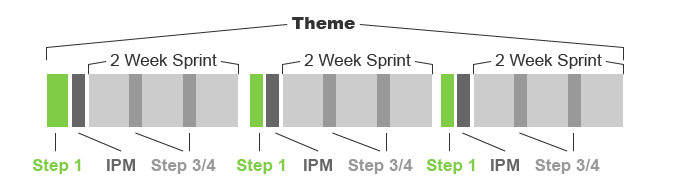
<p>Typically, Scrum employs a 2 week sprints model. Several related sprints may be grouped into a theme.</p>
<p>Declare Assumptions (Step 1A) and Initial Understanding (Step 1B) can be fitted into the beginning of each sprint (maybe longer at the beginning of a theme), just before the iteration planning meeting (IPM). IPM is used to plan and agree on what to do for the sprint that follows. Create the MVP (Step 2) is the meat of each iteration.</p>
<p><img src="//cdn.shopify.com/s/files/1/0249/9019/files/lean-ux-with-scrum.png?13802130823247195040"></p>
<p>Run an experiment (Step 3) and Feedback and Research (Step 4) can be added to each sprint with a “3-12-1″ cycle (3 users, by 12 noon, 1 a week):</p>
<p><img src="//cdn.shopify.com/s/files/1/0249/9019/files/typical-testing-cycle.png?963275642783389199"></p>
<h4>Conclusion</h4>
<p>In an era where UX rules, Lean UX offers the best integration of UX into Agile Development Methodology. UX designers are no longer considered as outsiders or hindrance to the development team, everyone in the team is engaged in every step of the development.</p>]]>
    </content>
  </entry>
  <entry>
    <id>https://www.pi-learning.com/blogs/news/17611300-cisco-ccna-collaboration-and-ccnp-collaboration-certifications</id>
    <published>2015-03-04T12:28:00-07:00</published>
    <updated>2015-03-04T12:30:14-07:00</updated>
    <link rel="alternate" type="text/html" href="https://www.pi-learning.com/blogs/news/17611300-cisco-ccna-collaboration-and-ccnp-collaboration-certifications"/>
    <title>Cisco CCNA Collaboration and CCNP Collaboration Certifications</title>
    <author>
      <name>Mike Ostoja</name>
    </author>
    <content type="html">
      <![CDATA[<p>Effective February 17, 2015, Learning@Cisco is proud to announce the expansion of the Cisco Collaboration certification portfolio to include an Associate-level and Professional-level certification. The portfolio now offers a complete career path for voice and video network engineers who want to develop, advance, and assess their expertise as the need for skilled collaboration professionals who can maximize the value of business investments continues to grow. To address the convergence of voice and video job roles and build collaboration knowledge and skills, the new certifications and supporting curricula focus on the following:</p>
<ul>
<li>Planning and designing collaboration and video networks using Cisco Collaboration solutions</li>
<li>Implementing basic configurations of Cisco Collaboration solutions</li>
<li>Maintaining and optimizing collaboration solutions</li>
</ul>
<p>The CCNA Collaboration training courses and exams represent the merging of the current CCNA Voice and CCNA Video curricula. Major updates have been made to reflect the integration of new technologies. The CCNA Collaboration Convergence Document highlights the major updates to domain topics, both hardware and software, which have been made to the following curricula:</p>
<ul>
<li>ICOMM curriculum, which has been updated and is  included in the new CICD course and exam</li>
<li>VIVND curriculum, which has been updated and is included  in the new CIVND courses and exam</li>
</ul>
<p>The Collaboration certification training course and exam information is as follows:</p>
<p><strong>CCNA Collaboration Training Course and Exam Summary</strong></p>
<table style="border-collapse: collapse;">
<tbody>
<tr>
<th style="border-collapse: collapse;">
<p><strong>Required Exam(s)</strong></p>
</th>
<th style="border-collapse: collapse;">
<p><strong>Recommended Training</strong></p>
</th>
</tr>
<tr>
<td style="border-collapse: collapse;">
<p><span style="color: #2e6583;" color="#2e6583">210-060 CICD</span></p>
</td>
<td valign="top" style="border-collapse: collapse;">
<p>Implementing Cisco Collaboration Devices (<a title="CICD" class="jive-link-external-small" href="http://tools.cisco.com/GlobalLearningLocator/courseDetails.do?actionType=executeCourseDetail&amp;courseID=6075" target="_blank"><span style="color: #2e6583;" color="#2e6583">CICD</span></a>)</p>
</td>
</tr>
<tr>
<td style="border-collapse: collapse;" rowspan="2">
<p><span style="color: #2e6583;" color="#2e6583">210-065 CIVND</span></p>
</td>
<td style="border-collapse: collapse;">
<p>Implementing Cisco Video Network Devices, Part 1 (<a title="CIVND1" class="jive-link-external-small" href="https://learningnetworkstore.cisco.com/collaboration/implementing-cisco-video-network-devices-part-1-collab-civnd1-v1-017829" target="_blank"><span style="color: #2e6583;" color="#2e6583">CIVND1</span></a>)</p>
</td>
</tr>
<tr>
<td style="border-collapse: collapse;">
<p>Implementing Cisco Video Network Devices, Part 2 (<a title="CIVND2" class="jive-link-external-small" href="http://tools.cisco.com/GlobalLearningLocator/courseDetails.do?actionType=executeCourseDetail&amp;courseID=6074" target="_blank"><span style="color: #2e6583;" color="#2e6583">CIVND2</span></a>)</p>
</td>
</tr>
</tbody>
</table>
<p style="padding: 0px; height: 8pt; min-height: 8pt;"> </p>
<p><strong>CCNP Collaboration Training Course and Exam Summary *</strong></p>
<p style="padding: 0px; height: 8pt; min-height: 8pt;"> </p>
<table style="border-collapse: collapse;">
<tbody>
<tr>
<th style="border-collapse: collapse;">
<p><strong>Required Exam(s)</strong></p>
</th>
<th style="border-collapse: collapse;">
<p><strong>Recommended Training</strong></p>
</th>
</tr>
<tr>
<td style="border-collapse: collapse;">
<p>300-070 CIPTV1</p>
</td>
<td valign="top" style="border-collapse: collapse;">
<p>Implementing Cisco IP Telephony and Video, Part 1 (CIPTV1)</p>
</td>
</tr>
<tr>
<td style="border-collapse: collapse;">
<p>300-075 CIPTV2</p>
</td>
<td style="border-collapse: collapse;">
<p>Implementing Cisco IP Telephony and Video, Part 2 (CIPTV2)</p>
</td>
</tr>
<tr>
<td style="border-collapse: collapse;">
<p>300-080 CTCOLLAB</p>
</td>
<td style="border-collapse: collapse;">
<p>Troubleshooting Cisco IP Telephony and Video (CTCOLLAB)</p>
</td>
</tr>
<tr>
<td style="border-collapse: collapse;">
<p>300-085 CAPPS</p>
</td>
<td style="border-collapse: collapse;">
<p>Implementing Cisco Collaboration Applications (CAPPS)</p>
</td>
</tr>
</tbody>
</table>
<p style="padding: 0px; height: 8pt; min-height: 8pt;"> </p>
<p>*Training Courses and Exams will be available April 2015</p>
<p><strong><span style="color: #2e6583;" color="#2e6583">Get started with CCNA Collaboration Certification</span></strong></p>
<p><strong><span style="color: #2e6583;" color="#2e6583">Get started with CCNP Collaboration Certification</span></strong></p>
<hr>
<h3>Retirement of CCNA Voice, CCNP Voice, and CCNA Video Certifications</h3>
<p>Learning@Cisco is also announcing the retirement of the following certifications:</p>
<ul>
<li>CCNA Voice certification</li>
<li>CCNP Voice certification</li>
<li>CCNA Video certification</li>
</ul>
<p>The last day to test for the CCNA Voice and CCNA Video certifications will be August 14, 2015.  No new certifications for CCNA Voice and CCNA Video will be issued beginning August 15, 2015.</p>
<p>For CCNP Voice certification, a separate notification will be provided at a later date to communicate the retirement date.</p>]]>
    </content>
  </entry>
  <entry>
    <id>https://www.pi-learning.com/blogs/news/17462136-red-hat-announces-new-red-hat-certified-architect-concentrations</id>
    <published>2015-02-25T12:34:00-07:00</published>
    <updated>2015-02-25T12:34:32-07:00</updated>
    <link rel="alternate" type="text/html" href="https://www.pi-learning.com/blogs/news/17462136-red-hat-announces-new-red-hat-certified-architect-concentrations"/>
    <title>Red Hat Announces New Red Hat Certified Architect Concentrations</title>
    <author>
      <name>Mike Ostoja</name>
    </author>
    <content type="html">
      <![CDATA[<p>RALEIGH, N.C. — <span class="dtstart"><time><span class="date-display-single">February 10, 2015</span></time> </span> — Red Hat, Inc. (NYSE: RHT), the world's leading provider of open source solutions, today announced it is enhancing its Red Hat Certification program with the addition of three new Red Hat Certified Architect (RHCA) concentrations. The concentrations are focused on the company's datacenter, cloud, and application platforms and are designed to help personnel on their journey to becoming a RHCA – the highest level of certification offered by Red Hat.</p>
<p>“Technology professionals with datacenter, cloud, application platform, and open source software skills are in demand. Our new Red Hat Certified Architect concentrations are built to address this demand. Most importantly, they allow technology professionals to position themselves as experts on Red Hat's leading open source software solutions."</p>
<blockquote class="pr-pullquote"><footer><span class="pr-pullquote-name">Ken Goetz</span><span class="pr-pullquote-title">vice president, worldwide training, Red Hat</span></footer></blockquote>
<p>Today, enterprise architecture includes traditional datacenters, hybrid clouds, and other solutions. The new RHCA concentrations are tracks, recommended by Red Hat, that are designed to prove and verify technical professionals’ skills and knowledge on Red Hat solutions for each of these solutions.</p>
<p>To earn the title of RHCA, one must attain Red Hat Certified Engineer (RHCE) status and acquire at least five of the eligible certifications, each of which cover different product and solution areas. Participants select the concentration they wish to focus on.  </p>
<p>The Datacenter concentration includes:</p>
<ul>
<li>Securing Red Hat systems against unauthorized access</li>
<li>Enhancing logging, auditing, and identity management capabilities</li>
<li>Deploying and managing virtualization infrastructure, hosts, and guests</li>
<li>Implementing high availability services on Red Hat Enterprise Linux</li>
<li>Using the on-premise capabilities of Red Hat Storage Server</li>
<li>Deploying applications using Red Hat JBoss Enterprise Application Platform (EAP)</li>
<li>Managing multiple systems using Red Hat Satellite</li>
</ul>
<p>The Cloud concentration includes:</p>
<ul>
<li>Creating, configuring, and managing private clouds using Red Hat Enterprise Linux OpenStack Platform</li>
<li>Managing virtual, private, and hybrid cloud infrastructures with Red Hat CloudForms</li>
<li>Creating, configuring, and managing a cloud application platform with OpenShift Enterprise by Red Hat</li>
<li>Implementing flexible storage solutions for on-premise and hybrid clouds</li>
<li>Managing multiple systems using Red Hat Satellite</li>
</ul>
<p>The Application platform concentration includes:</p>
<ul>
<li>Installing, configuring, and managing Red Hat JBoss EAP and the applications running on it</li>
<li>Creating, configuring, and managing a cloud application platform with OpenShift Enterprise</li>
<li>Federating data from multiple source using Red Hat JBoss Data Virtualization</li>
<li>Managing applications in hybrid cloud environments</li>
</ul>
<p>The Red Hat certification program also offers a portal that provides online verification, the ability to search for certified individuals, and other services. Prospective employers and clients can use the portal to verify an individual’s credentials and find qualified professionals who can help them get the most out of their IT infrastructure. Only certifications and certificates that are considered current are reported, verified, or found through a search. Red Hat Certified Professionals must agree to Terms and Conditions and map their certification IDs to have their information displayed.</p>
<p>A Red Hat certification provides validation of knowledge and expertise that is beneficial to both individuals and their employers. The certification program gives employers and managers ways to find and develop qualified professionals. It also helps individuals prove their skills with Red Hat's solutions.</p>
<p><em>Posted from: <a href="http://www.redhat.com/en/about/press-releases/red-hat-announces-new-red-hat-certified-architect-concentrations">http://www.redhat.com/en/about/press-releases/red-hat-announces-new-red-hat-certified-architect-concentrations</a></em></p>]]>
    </content>
  </entry>
  <entry>
    <id>https://www.pi-learning.com/blogs/news/16904996-vmware-announces-new-vcp6-dt-certification-as-two-exams-are-retired</id>
    <published>2015-01-28T11:34:00-07:00</published>
    <updated>2015-01-28T11:34:34-07:00</updated>
    <link rel="alternate" type="text/html" href="https://www.pi-learning.com/blogs/news/16904996-vmware-announces-new-vcp6-dt-certification-as-two-exams-are-retired"/>
    <title>VMware Announces New VCP6-DT Certification as Two Exams are Retired</title>
    <author>
      <name>Mike Ostoja</name>
    </author>
    <content type="html">
      <![CDATA[<p>VMware releases VMware Certified Professional 6 – Desktop (VCP6-DT), a new certification for system engineers and desktop virtualization specialists, while at the same time announcing the retirement of the VDCA510 and VDCD510 exams. The new VCP6-DT certification is intended for virtualization professionals who have a foundation in vSphere implementation and administration and wish to work with VMware Horizon 6 (with View).</p>
<p>This environment delivers virtualized and remote desktops and applications through a single platform and supports end users with access to all of their Windows and online resources through one unified workspace. So, the new qualification validates the knowledge and skills required to implement, install and configure Horizon 6 (with View) deployed on vSphere, with the emphasis on:</p>
<ul>
<li>Creating and administering virtual desktops.</li>
<li>Configuring and administering View, Mirage and the Workspace Portal.</li>
<li>Configuring host networking and storage.</li>
<li>Working with DRS, HA and other cluster-related vSphere features.</li>
</ul>
<p>For those interested in earning the certification, there are two starting points:</p>
<ol>
<li>If you’re just starting with VMware desktop technology, you must complete one of the following courses prior to taking the exam:
<ul>
<li>VMware Horizon (with View): Install, Configure, Manage (V6.0)</li>
<li>VMware Mirage (5.0) and Horizon View Fast track (v6.0)</li>
</ul>
</li>
<li>If you already hold a valid VCP-level certification, then completion of one of the above courses prior to the exam is simply recommended rather than mandatory.</li>
</ol>
<p>Meanwhile, VMware has also announced that the following two exams will be retired on January 31, 2015:</p>
<ul>
<li>VDCA510, which qualified candidates for the VMware Certified Advanced Professional 5 – Data Center Administration (VCAP5-DCA) certification and was based on vSphere V5.0.</li>
<li>VDCD510, which qualified candidates for the VMware Certified Advanced Professional 5 – Data Center Design (VCAP5-DCD) certification and was based on vSphere V5.0.</li>
</ul>
<p>After the January 31<sup><span style="font-size: small;" size="2">st</span></sup> retirement date, you will not be able to schedule either of these exams, but you will still be able to earn the VCAP5-DCA or VCAP5-DCD certifications by passing the exams based on vSphere V5.5 (VDCA550 and VDCD550, respectively).</p>]]>
    </content>
  </entry>
  <entry>
    <id>https://www.pi-learning.com/blogs/news/16582788-gazing-into-the-crystal-ball-red-hatters-offer-tech-predictions-for-2015</id>
    <published>2015-01-07T12:38:00-07:00</published>
    <updated>2015-01-07T12:38:28-07:00</updated>
    <link rel="alternate" type="text/html" href="https://www.pi-learning.com/blogs/news/16582788-gazing-into-the-crystal-ball-red-hatters-offer-tech-predictions-for-2015"/>
    <title>Gazing into the crystal ball: Red Hatters offer tech predictions for 2015</title>
    <author>
      <name>Mike Ostoja</name>
    </author>
    <content type="html">
      <![CDATA[<p><em>As 2014 comes to a close, we asked Red Hat executives and subject matter experts to weigh in with their thoughts on what they expect to see happen in the world of tech in 2015. You can view the article at:</em></p>
<p><a href="http://www.redhat.com/en/about/blog/gazing-crystal-ball-red-hatters-offer-tech-predictions-2015-part-1">http://www.redhat.com/en/about/blog/gazing-crystal-ball-red-hatters-offer-tech-predictions-2015-part-1</a></p>
<p><em>We’ve grouped predictions from these experts on many topics, including:</em></p>
<ul>
<li><em>    Big data</em></li>
<li><em>    Business of tech</em></li>
<li><em>    Cloud computing</em></li>
<li><em>    Containers</em></li>
<li><em>    Developers and application development</em></li>
<li><em>    Internet of Things</em></li>
<li><em>    Mobile</em></li>
<li><em>    OpenStack</em></li>
<li><em>    Security</em></li>
<li><em>    Software-defined datacenter</em></li>
</ul>
<p><em>In today’s post, we’ll highlight big data, business of tech, cloud comuting, and container predictions for 2015. Come back tomorrow for the remaining predictions. And, if you haven’t already, make sure you check out what Red Hat customers identified as their top tech priorities for 2015.</em></p>
<p><strong>BIG DATA</strong></p>
<div><strong>The importance of enterprise data scientists</strong></div>
<div>The line between big data and data will continue to blur. CIOs will look to consolidate and integrate traditional data sources (e.g. data warehouses), business analytics with business intelligence dashboards, and data sets with new "big data" technologies such as Hadoop. New disruptive businesses and market segments will be created through big data insights. New data scientists roles will grow significantly including data hygienists to improve data quality, data explorers for data culling, and campaign experts to drive results from data insights. Additionally, the pace of open source based big data innovation will also accelerate and nascent technologies, such as Storm and Spark, will gain adoption.</div>
<div><em>- Greg Kleiman, director, strategy, Storage and Big Data</em></div>
<div> </div>
<div>Integrating and processing data will lead to competitive advantage. Wearable smart technology like watches and glasses will take off, expanding the IoT and generating even a larger tidal wave of big data. Enterprises that can integrate, intelligently process and make rapid decisions incorporating these data flows into their business will pull ahead. Technologies required to build the requisite IT infrastructure include cloud IaaS and PaaS platforms to enable a flexible and agile base to develop and execute the applications and business processes; highly productive service and mobile application platforms; lightweight, cloud-based integration technologies to bring these data, applications, and business processes together to work in harmony from a customer point of view; and lastly, business process and decision automation platforms that enable rapid automation and modification of the business processes and decisions necessary to provide a higher level of customer engagement.</div>
<div><em>- Pierre Fricke, director, product marketing, Middleware</em></div>
<div> </div>
<div>Just as the hit show House of Cards was a result of big data analytics at Netflix, new disruptive businesses and market segments will be created through big data insights.</div>
<div><em>- Irshad Raihan, senior principal product marketing manager, Storage and Big Data</em></div>
<h2> </h2>
<h2><strong>BUSINESS OF TECH</strong></h2>
<div>I expect a frothy 2015, with IPOs, acquisitions and investment focused across all of the hot new areas in enterprise tech. At the same time, I think we’ll see some legacy vendors split and shed parts of their portfolios. I wouldn’t bet against seeing more old guard companies go private either.</div>
<div><em>- Joe Fitzgerald, vice president and general manager, Cloud Management</em></div>
<div> </div>
<div>As technology become more and more ingrained in the operation and future of business, a CIO of a FORTUNE 500 company will become CEO.</div>
<div><em>- Erich Morisse, director, strategy, Cloud Management</em></div>
<div> </div>
<div>One thing we've already been seeing is that PaaS providers themselves have been changing strategies over time. Docker did this, instead of focusing themselves on just Dotcloud they pivoted to containers. PaaS providers may have lots of tools and frameworks, but they have longer lifecycle requirements. This is what's making it difficult for providers who are focusing solely on private cloud -- a hybrid cloud strategy is the way to go.</div>
<div><em>- Ashesh Badani, vice president and general manager, OpenShift</em></div>
<div> </div>
<div>Increasingly natural, intelligent, and aware systems of engagement and/or interaction platforms drive customer experiences to higher levels. Higher levels of engagement include predictive, contextual, and timely offerings and services even when the customer has not yet indicated his emerging need, but has opted into such advanced services. GPS systems that have real-time traffic, construction, and other delay information guiding people to the fastest—rather than the shortest—route represents an example. Another example could be a local garage that connects a car to an application that analyzes the car maintenance and condition and brings up a list of parts to print on a local 3D printer to preemptively repair the car. A third example would be a travel reservation system that alerts you to cancellations/delays and offers up reworked itinerary options to select in real time while at the airport, before the delay is posted on the local screen.</div>
<div> </div>
<div>These systems of engagement build on contextually-aware applications and business processes. An application or business process must be aware and make the right decisions, deliver the right answers or products, and delight customers and users. The systems of engagement are built on lightweight, enterprise-ready, and productive mobile systems, hosted on cloud infrastructure, and integrated with all needed applications, data, and business decision and process automation services required. This is the “secret” to successful customer engagement in 2015.</div>
<div><em>- Pierre Fricke, director, product marketing, Middleware</em></div>
<h2> </h2>
<h2><strong>CLOUD COMPUTING</strong></h2>
<div>
<strong>Hybrid cloud gains steam.</strong>
<div>There is a lot of innovation that's happening in the public cloud, especially with recent announcements from Amazon Web Services and Google. Enterprises look at this and are very interested in trying out the public cloud and, while these innovations are interesting, some may make a commitment to the public cloud and end up isolating their existing investments, reducing customer portability and interoperability across those worlds. There will be more innovation from enterprises as they want to balance the two worlds -- get public cloud and continue to experiment as they move toward a hybrid cloud.</div>
<div><em>- Ashesh Badani, vice president and general manager, OpenShift</em></div>
<div> </div>
<div>More customers will realize that hybrid cloud is the way to go and will need a way to manage it. Going private cloud or virtualized infrastructure only makes them less nimble. Going public is too expensive and incomplete.</div>
<div><em>- David Egts, chief technologist, U.S. Public Sector</em></div>
<div> </div>
<div>Enterprises will adopt public clouds more in 2015 and will experience some of the benefits of scaling, but also experience the challenges of the public cloud, especially in terms of outages and unpredictable behaviors in performance. The hybrid approach will be deployed more and more--not technically, but rather logically, as in the consumption of more SaaS applications.</div>
<div><em>- Marco Bill-Peter, vice president, Customer Experience and Engagement</em></div>
<div> </div>
<div>Interest in cloud technology is really becoming global, we’re seeing it’s not just as an advanced phenomenon today, and that adoption will expand further in 2015. There is a lot of interest in public cloud accompanied by concern across the world regarding privacy, and security and regulatory issues, continuing to bolster hybrid clouds.</div>
<div><em>- Ashesh Badani, vice president and general manager, OpenShift</em></div>
<div> </div>
<div>The definition of the word “hybrid” will evolve to mean more than public and private clouds – it will become more common to describe hybrid deployment patterns (physical/virtual/cloud), hybrid service models (IaaS/PaaS/SaaS), hybrid architectures (scale up and scale out), hybrid applications (COTs vs. Custom and new vs. Legacy), and hybrid IT provider models (hosters, MSPs and CSPs, on premise).</div>
<div><em>- Mark Coggin, senior director, product marketing, Platform</em></div>
<div> </div>
<div>
<strong>Bare-metal will be a key use case for cloud computing.</strong>
<div>Bare-metal will become a top-5 target environment for new cloud deployments.</div>
<div><em>- Bryan Che, general manager, Cloud Product Strategy</em></div>
<div> </div>
<div>
<strong>Public cloud wars will continue.</strong>
<div>Amazon, Google, and Microsoft will square off in a big way on pricing, service differentiation, and hybrid cloud capabilities.</div>
<div><em>- Joe Fitzgerald, vice president and general manager, Cloud Management</em></div>
<div> </div>
<div>
<strong>The new age of ‘Cloud Sprawl’</strong>
<div>Cloud sprawl will emerge in 2015 as a major trend in the datacenter. Similar to virtualization addressing server sprawl and subsequently cloud computing addressed virtualization sprawl, the IT industry will enter the age of cloud sprawl. The combination of affordable cloud service provider services and the rise of the line of business IT department resulted in an explosion of numerous small projects housed in private, public and hybrid clouds that has contributed to a significantly larger risk exposure to the enterprise.
<div>
<div>- Irshad Raihan, senior principal product marketing manager, Storage and Big Data</div>
<div> </div>
<div>
<strong>IT will learn manufacturing 101</strong>
<div>Operational Technology, from manufacturing, will become a "thing" in IT and Cloud.
<div>
<div><em>- Erich Morisse, director, strategy, Cloud Management</em></div>
<div> </div>
<div>
<strong>Two kinds of cloud workloads</strong>
<div>Cloud workloads will bifurcate into two distinct but related categories. One category will be more virtual machine (VM)-centric workloads that are stateful, require isolation from other applications, can share compute resources but may not co-exist well, are infrastructure consolidation-driven (tens of VMs), and are aimed at applications that scale out rather than up. The other category will be container-centric cloud workloads that reside on multiple hosts, require integration and orchestration across hosts, have resource management as a prerequisite, exhibit hyper-density (hundreds or thousands of containers), and are aimed at applications that scale out and everywhere.
<div>
<div><em>- Mark Coggin, senior director, product marketing, Platform</em></div>
<div> </div>
<div>
<strong>Elastic Storage will enable inelastic applications.</strong>
<div>Attracted by the efficiency benefits, enterprises will try to drive as much legacy infrastructure to the cloud as possible with varying success. Legacy applications will continue to prove hard to migrate and will mostly remain where they currently run but they will be re-architected to more easily consume scale-out storage, both on and off-premise, which often proves to be the easiest tier to scale.
<div>
<div><em>- Neil Levine, senior director, product management, Storage and Big Data</em></div>
<div> </div>
<div>
<strong>IPv6 as the default</strong>
<div>IPv6 will become the default tenant access networking option for VM in most clouds.
<div>
<div><em>- Nicolas Barcet, director, OpenStack product management</em></div>
<div> </div>
<h2><strong>CONTAINERS</strong></h2>
<div>
<strong>Container discussions shift from use cases to standards</strong>
<div>Application containers will dominate industry discussion in 2015. The conversation will move from "Why containers?" to "How can I effectively take advantage of containers to make my IT more efficient?" Instead of talking about the benefits of containers, the discussion will be on the standards that can help organization make their apps portable.
<div>
<div><em>- Krishnan Subramanian, director, strategy, OpenShift</em></div>
<div> </div>
<div>Container technologies such as Docker and Kubernetes will emerge as de facto standards for containerization and orchestration, respectively, and usher in a new generation of cloud computing solutions.
<div>
<div><em>- Joe Fernandes, director, product management, OpenShift</em></div>
<div> </div>
<div>
<strong>Containers move beyond the hype</strong>
<div>2015 will see containers progress past the hype phase to where organizations realize this type of software delivery has distinct needs for security, updates, and content authenticity, validation, and curation.
<div>
<div><em>- Tim Burke, vice president, Cloud and Operating System Infrastructure</em></div>
<div> </div>
<div>Next year we'll see a lot more mainstream activity around containers, and people asking providers “What's your container strategy.” As a cloud provider basically everyone has to have a container strategy, and a fair amount of skills need to be developed by users and ISV's who need to containerize their applications.
<div>
<div><em>- Ashesh Badani, vice president and general manager, OpenShift</em></div>
<div> </div>
<div>In 2015, IT operations departments will learn about containers and the technology will scare the heck out of them. How do you manage containerized applications? How do you secure them? What about provenance? [Today, Linux containers provide all the things that developers care about but not the things that operations teams care about. In the coming year, we predict that these apps will go from development to production and it will be a day of reckoning.
<div>
<div><em>- David Egts, chief technologist, U.S. Public Sector</em></div>
<div> </div>
<div>Linux containers will deliver on some of the original promises of Service-Oriented Architecture (SOA) but on a more manageable scale. Standards-based composite applications delivered as microservices but stitched together as an application fabric will become production use cases. Orchestrating these applications across multiple hosts with technologies like Kubernetes will allow for a new class of applications and use cases that deliver resilient architectures that are elastic, scale across geographic boundaries, and can easily respond to changing business conditions.
<div>
<div><em>- Mark Coggin, senior director, product marketing, Platform</em></div>
<div> </div>
<div>
<strong>Containers will (continue to) change the cloud landscape and win new workloads</strong>
<div>Docker has created a lingua franca for application delivery which will force old-school enterprise IT management vendors to compete against open source rivals to make containers useful.
<div>
<div><em>- Gunnar Hellekson, chief strategist, U.S. Public Sector</em></div>
<div> </div>
<div>Container technology will become the enabler for a much broader adoption of public clouds by enterprises.
<div>
<div><em>- Werner Knoblich, senior vice president and general manager, EMEA</em></div>
<div> </div>
<div>Linux containers and Docker will overtake individual configuration management tools as the single most popular technology for deploying applications in the cloud.
<div>
<div><em>- Bryan Che, general manager, Cloud Product Strategy</em></div>
<div> </div>
<div>Linux containers will continue to gain traction within enterprises and be increasingly evaluated as an alternative to traditional hypervisor-based virtualization for new application workloads.
<div>
<div><em>- Joe Fernandes, director, product management, OpenShift</em></div>
<div> </div>
<div>
<strong>Containers will change business models and offerings from ISVs</strong>
<div>A growing number of independent software vendors (ISVs) will begin offering their solutions packaged as certified, portable container images.
<div>
<div><em>- Joe Fernandes, director, product management, OpenShift</em></div>
<div> </div>
<div>Linux containers will open up new business models for software vendors. Traditional license sale/on-premise software vendors will now be able to capitalize on subscription models, app-store like distribution mechanisms, and also have a relatively easy transition to become a SaaS vendor. The modular, trackable, and fungible technology of "containers" will make all of these trends real in 2015. Technological capabilities that exist in other ares such as digital certificates/digital rights management (DRM), application metering, service catalogs including software registry/repositories, and application lifecycle management will all need to play catch-up to facilitate these new business models for ISVs.
<div>
<div><em>- Mark Coggin, senior director, product marketing, Platform</em></div>
<div> </div>
<div>
<strong>Containerized OpenStack offerings emerge in the market</strong>
<div>By the end of 2015, we will see at least one vendor offering an OpenStack product deployed in containers, and deploying only container workloads.</div>
<div> </div>
<div>We have already seen community efforts to containerize OpenStack, and container management and orchestration with Kubernetes launched with great momentum during 2014. The next step will be to bring these to market, and I anticipate that we will see someone coming to market with a self-service container deployment platform, running and managing a containerized OpenStack.
<div>
<div><em>- Dave Neary, principal software engineer, Open Source and Standards</em></div>
<div> </div>
<div>
<strong>Containers collide and open source projects consolidate in 2015.</strong>
<div>OpenStack and Linux container technologies will begin to collide and we will begin to see multiple projects aimed at similar approaches consolidate, such as workload orchestration (Heat, Kubernetes, Mesos, Yarn) and service catalogs (Murano, various container index/registries). Another trend will be the containerization of OpenStack services - this will help to address the installation complexities of OpenStack, and also facilitate the building of more complex solutions like high availability and fail-over, workload clustering and load balancing, high performance storage infrastructure, and application autoscaling.</div>
<div>
<div><em>- Mark Coggin, senior director, product marketing, Platform</em></div>
<div>
<div> </div>
</div>
</div>
</div>
</div>
</div>
</div>
</div>
</div>
</div>
</div>
</div>
</div>
</div>
</div>
</div>
</div>
</div>
</div>
</div>
</div>
</div>
</div>
</div>
</div>
</div>
</div>
</div>
</div>
</div>
</div>
</div>
</div>
</div>
</div>
</div>
</div>
</div>
</div>
</div>
</div>
</div>
</div>
</div>
</div>
</div>
</div>
</div>
</div>
</div>
</div>
</div>
</div>
<p> </p>]]>
    </content>
  </entry>
  <entry>
    <id>https://www.pi-learning.com/blogs/news/16186920-huawei-and-red-hat-collaborate-on-openstack-for-network-functions-virtualization</id>
    <published>2014-12-08T10:30:00-07:00</published>
    <updated>2014-12-08T10:33:32-07:00</updated>
    <link rel="alternate" type="text/html" href="https://www.pi-learning.com/blogs/news/16186920-huawei-and-red-hat-collaborate-on-openstack-for-network-functions-virtualization"/>
    <title>Huawei and Red Hat Collaborate on OpenStack for Network Functions Virtualization</title>
    <author>
      <name>Mike Ostoja</name>
    </author>
    <content type="html">
      <![CDATA[<p>Huawei and Red Hat, Inc. (NYSE: RHT), the world’s leading provider of open source solutions, today announced a new global partnership to enable OpenStack-based cloud deployments. By expanding their relationship, Huawei and Red Hat aim to accelerate collaboration around OpenStack for Network Functions Virtualization (NFV) required by Communication Service Providers (CSPs).</p>
<p class="western" style="line-height: 100%; margin-bottom: 0in;"> </p>
<p class="western" style="line-height: 100%; margin-bottom: 0in;">According to the 2014 SDN and NFV Strategies: Global Service Provider Survey, conducted by Infonetics Research, 93 percent of telecommunications operators interviewed plan to deploy NFV as carriers work to modernize the way telecommunications networks are built and operated. As OpenStack establishes itself as the platform of choice for NFV workloads, Huawei and Red Hat are engaging in a global partnership to cooperatively engineer carrier-grade cloud solutions for CSPs.</p>
<p class="western" style="line-height: 100%; margin-bottom: 0in;"> </p>
<p class="western" style="line-height: 100%; margin-bottom: 0in;">As part of this initiative, Huawei and Red Hat aim to combine Huawei's world class domain expertise and extensive global experience with telecommunications companies and Red Hat's leading OpenStack and open source expertise to help CSPs embrace cloud computing with a carrier-grade OpenStack solution. Huawei and Red Hat plan to integrate Red Hat Enterprise Linux OpenStack Platform and Huawei’s FusionSphere Cloud OS at the management layer to offer a unified open, flexible, and production-ready cloud solution to support telecommunication carriers' NFV evolution. Working together, Huawei and Red Hat plan to align upstream contributions, engineering, product, and go-to-market efforts to drive the adoption of OpenStack for NFV implementations by CSPs.</p>
<p class="western" style="line-height: 100%; margin-bottom: 0in;"> </p>
<p class="western" style="line-height: 100%; margin-bottom: 0in;">Huawei and Red Hat will work together to contribute NFV enabling features to the upstream OpenStack community, which are required by CSP cloud deployments, and serve as the foundation of highly scalable Infrastructure-as-a-Service (IaaS) solutions. By contributing results from their collaboration to the upstream community, Red Hat and Huawei are enabling the broader OpenStack community to benefit from their collaboration, unlike approaches that favor proprietary add-ons and further vendor lock-in.</p>
<p class="western" style="line-height: 100%; margin-bottom: 0in;"> </p>
<p class="western" style="line-height: 100%; margin-bottom: 0in;">Huawei and Red Hat also plan to work together to certify the joint solutions, giving CSPs confidence that the solutions will provide consistent performance and capability.</p>
<p class="western" style="line-height: 100%; margin-bottom: 0in;"> </p>
<p class="western" style="line-height: 100%; margin-bottom: 0in;"><b>Supporting Quotes</b></p>
<p class="western" style="line-height: 100%; margin-bottom: 0in;"><i>Ren Zhipeng, President of Huawei's Cloud Computing Product Line</i></p>
<p class="western" style="line-height: 100%; margin-bottom: 0in;">“Huawei offers its customers a true carrier-grade OpenStack solution, and we are honored to expand our existing partnership with Red Hat to include collaboration on OpenStack for Network Functions Virtualization (NFV). Through open collaboration with partners like Red Hat, Huawei aims to support the business reform and transformation of the telecom industry. This partnership will focus on NFV and the development of joint solutions to foster an open, interconnected, and innovative ecosystem that supports the entire OpenStack community.”</p>
<p class="western" style="line-height: 100%; margin-bottom: 0in;"> </p>
<p class="western" style="line-height: 100%; margin-bottom: 0in;"><i>Tim Yeaton, senior vice president, Infrastructure Business, Red Hat</i></p>
<p class="western" style="line-height: 100%; margin-bottom: 0in;">“Carriers and telecommunications service providers are under pressure to modernize their network infrastructure to meet demands created by new service offerings and the explosive volume of data crossing the network. As a result, many are exploring the benefits OpenStack-based clouds can bring to NFV projects. By combining Huawei’s leadership in the telecommunications industry with Red Hat’s leadership in OpenStack and, more broadly, enterprise open source, we are well positioned to deliver cloud solutions that enable carriers to meet their network modernization challenges.”</p>
<p class="western" style="line-height: 100%; margin-bottom: 0in;"> </p>]]>
    </content>
  </entry>
  <entry>
    <id>https://www.pi-learning.com/blogs/news/15756424-red-hat-releases-new-openstack-courses</id>
    <published>2014-11-05T23:07:00-07:00</published>
    <updated>2014-11-05T23:17:53-07:00</updated>
    <link rel="alternate" type="text/html" href="https://www.pi-learning.com/blogs/news/15756424-red-hat-releases-new-openstack-courses"/>
    <title>Red Hat Releases New OpenStack Courses</title>
    <author>
      <name>Mike Ostoja</name>
    </author>
    <content type="html">
      <![CDATA[<h3 class="column title">OpenStack Skills are in Demand</h3>
<p class="column title">The New Stack and the Linux Foundation ranked OpenStack as the most popular open source project.<sup><span style="font-size: small;" size="2"> </span></sup>And Red Hat is leading the way. Customers have aggressive OpenStack adoption plans, but they list IT skills as their #1 challenge to getting started. Red Hat training and certification is here to boost your career—and help your company—with skills that are in demand.  The hands-on OpenStack courses are conducted like guided labs. Most of your time is spent developing skills working directly on our products.</p>
<div class="column title"></div>
<h3 class="column title">Red Hat OpenStack Training Courses</h3>
<div class="column title"></div>
<div class="content"></div>
<div class="container"></div>
<section class="container"></section>
<section class="container">
<div></div>
</section>
<div class="container">
<ul></ul>
</div>
<section class="content">
<p>Learn how to deploy and manage private cloud infrastructures using Red Hat Enterprise Linux OpenStack Platform</p>
</section>
<div class="content">
<ul>
<li>
<a href="http://www.pi-learning.com/collections/red-hat/products/1195">CL210: Red Hat® OpenStack Administration</a> teaches system administrators how to implement a cloud-computing environment using Red Hat Enterprise Linux OpenStack Platform, including installation, configuration, and maintenance. The course can also help prepare students for the Red Hat Certified OpenStack Administrator exam (EX210).</li>
</ul>
</div>
<section class="column title">
<p>Implement RabbitMQ as a stand-alone service or as part of Red Hat Enterprise Linux OpenStack Platform</p>
</section>
<div class="column title">
<ul>
<li>
<a href="http://www.pi-learning.com/collections/red-hat/products/rabbitmq-messaging-with-red-hat-enterprise-linux-openstack-platform">CL315: RabbitMQ Messaging with Red Hat Enterprise Linux OpenStack Platform</a> teaches you how to use RabbitMQ Messaging, including implementation, troubleshooting, performance tuning, and high availability. This course provides a deeper dive into messaging than our Red Hat OpenStack Administration (CL210) course.</li>
</ul>
</div>
<p>Learn how to use Pacemaker, Corosync, CMAN tools, and HAProxy to implement cluster and other high-availability tools</p>
<ul>
<li>High Availability with Red Hat Enterprise Linux OpenStack Platform (CL332) uses the top open source clustering and high-availability solutions on the market and provides a comprehensive plan to connect them with Red Hat Enterprise Linux OpenStack Platform. This course provides a deeper dive into high availability than our Red Hat OpenStack Administration (CL210) course.</li>
</ul>
<p>Implement Apache Qpid as a stand-alone service or as part of Red Hat Enterprise Linux OpenStack Platform</p>
<ul>
<li>Apache Qpid Messaging with Red Hat Enterprise Linux OpenStack Platform (CL314) is for system administrators, cloud administrators, and cloud operators and provides a thorough look at Apache Qpid messaging.</li>
</ul>
<section>
<div></div>
</section>
<section>
<p>For questions about enrolling in any of the these training courses or bringing the class onsite to your team, please contact Proven Impact at <a href="mailto:sales@pi-learning.com">sales@pi-learning.com</a></p>
</section>
<section>
<div></div>
</section>
<section></section>]]>
    </content>
  </entry>
  <entry>
    <id>https://www.pi-learning.com/blogs/news/15713028-hadoop-administrator-training-gets-hands-on</id>
    <published>2014-10-28T00:44:00-06:00</published>
    <updated>2014-10-28T00:47:31-06:00</updated>
    <link rel="alternate" type="text/html" href="https://www.pi-learning.com/blogs/news/15713028-hadoop-administrator-training-gets-hands-on"/>
    <title>Hadoop Administrator Training Gets Hands-On</title>
    <author>
      <name>Mike Ostoja</name>
    </author>
    <content type="html">
      <![CDATA[<p class="heading "><a href="http://pi-learning.com/collections/cloudera/products/3907">Cloudera Administrator Training for Apache Hadoop</a> now has more than quadrupled the amount of hands-on exercises from the previous version, adding a full day to the course. At four days, it’s now the most thorough training for Hadoop administrators and truly the best way to start building expertise.</p>
<p><br>by David Goldsmith<br>October 01, 2013</p>
<p>This blog article was posted and can be found at: <a href="http://blog.cloudera.com/blog/2013/10/hadoop-administrator-training-gets-hands-on/">http://blog.cloudera.com/blog/2013/10/hadoop-administrator-training-gets-hands-on/</a></p>
<p><br>I’ve always held a strong bias that education is most effective when the student learns by doing. As a developer of technical curricula, my goal is to have training participants engage with real and relevant problems as much as possible through hands-on exercises. The high rate at which Apache Hadoop is changing, both as a technology and as an ecosystem, makes developing Cloudera training courses not only demanding but also seriously fun and rewarding.</p>
<p>I recently undertook the challenge of upgrading the <a href="http://pi-learning.com/collections/cloudera/products/3907">Cloudera Administrator Training for Apache Hadoop</a>. I more than quadrupled the amount of hands-on exercises from the previous version, adding a full day to the course. At four days, it’s now the most thorough training for Hadoop administrators and truly the best way to start building expertise.</p>
<div class="text-block">
<p>While developing the course, I collaborated with some of the most knowledgeable Hadoop administrators I could find, including Eric Sammer, Amandeep Khurana, Kathleen Ting, Romain Rigaux, and many other smart folks at Cloudera. The upgrades to the curriculum and exercises are based on best practices used to resolve our customers’ biggest problems. These insights resonate throughout the course, including the determination that administrators should learn installation, configuration, maintenance, monitoring, and troubleshooting using the standard Hadoop tools. Although we certainly hope that Hadoop users take advantage of Cloudera Manager to simplify and streamline many of these tasks, we believe that every good administrator needs to first take a look under the hood and tinker with Hadoop’s guts. There’s no replacement for get-your-hands-dirty experience to achieve expertise.</p>
<h2>Cluster in the Cloud</h2>
<p>In addition to making changes to the course materials and adding a bunch of exercises, I really got my geek on and built a new training environment. Students in the Cloudera Administrator Training class still start by working in a pseudo-distributed environment — a fully operational Hadoop cluster running on a single machine — but very quickly graduate to working with a full, four-instance cluster. Each student gets his or her own cluster to build up, configure, mess up, fix, mess up again, and explore.</p>
<p>The new class environment is really cool. Students are given four Amazon EC2 instances to connect when they start doing their exercises. The EC2 instances are generated from public AMIs so that students can recreate the instances on their own AWS accounts and work their way through the exercises again after class is over. A local environment with four virtual machines is also available for situations where it is not possible to connect to the cloud from a classroom. The local environment operates identically to the cloud-based version.</p>
<p>Combined with a catch-up script — a powerful tool that lets students automatically set their clusters to the starting point for any exercise within the course — the environment encourages students to perform exercises on their own, at their desired pace, and as many times as they wish. The catch-up script is very helpful for students who get called out of class because of pressing issues at work or for students who simply felt rushed trying to get exercises working during class time. Every student has the option to go through the hands-on exercises again later and at his or her own pace to gain greater understanding through repeat experience and to focus on the exercises that are most relevant, regardless of where they fall in the stack.</p>
<p>The ability to perform hand-on exercises at one’s own pace, both during and after class, can really personalize the learning experience. My goal was to convey the sense that training does not end when the class ends, and that the course is “just in time and just for you.”</p>
<h2>Hands On, Hands On, Hands On</h2>
<p>I firmly believe hands-on training is the best first step toward achieving the efficiencies and unlocking the opportunities Hadoop offers. Over the course of four days, there are lots of highlights in the new Cloudera Administrator Training. Students get to:</p>
<ul>
<li>Install CDH on the cluster’s four instances</li>
<li>Get Hive and Impala working and see if Impala queries can run as fast as Cloudera says they can</li>
<li>Install Hue and configure it so that users in different roles have access to different Hadoop functionality in the Hue UI</li>
<li>Configure Apache Hadoop for HDFS high availability</li>
<li>Configure the Hadoop Fair Scheduler</li>
</ul>
<p>As an added bonus, there’s a troubleshooting challenge at the conclusion of the course in which students test their newly acquired skills by diagnosing and then attempting to fix a messy, but altogether common, misconfiguration. </p>
<p>It’s rewarding being a curriculum developer at Cloudera because so many administrators from different types of companies rely on the curriculum to learn how to effectively store, manage, and access their Big Data. It’s fun, too, because Cloudera’s customers and engineers are advancing the Hadoop platform and ecosystem so rapidly that I have a whole new set of challenges in front of me every day. I’ll certainly be updating the Cloudera Administrator Training exercises and course content to work with CDH 4.4, which was recently released. And I’ve recently started taking a look at some exciting new technology, so we’ll see where that takes me!</p>
</div>]]>
    </content>
  </entry>
  <entry>
    <id>https://www.pi-learning.com/blogs/news/15403737-2014s-hottest-it-certifications</id>
    <published>2014-09-15T11:05:00-06:00</published>
    <updated>2014-09-15T11:05:41-06:00</updated>
    <link rel="alternate" type="text/html" href="https://www.pi-learning.com/blogs/news/15403737-2014s-hottest-it-certifications"/>
    <title>2014&apos;s hottest IT certifications</title>
    <author>
      <name>Mike Ostoja</name>
    </author>
    <content type="html">
      <![CDATA[<p>David Foote, chief analyst and research officer with Foote Partners, lists the certifications that are on fire in today's IT market. View more on: <a title="http://www.infoworld.com/" href="http://www.infoworld.com/slideshow/161879/2014s-hottest-it-certifications-248455#slide1">http://www.infoworld.com/</a></p>
<p> </p>
<p>With more than half of 2014  behind us, it's that time of the year where we look at IT certifications standings in real world IT. The right certifications can help earn tech workers premium pay or land the job they've been aspiring to. That's why knowing what is "hot" with employers is important when considering your professional development.</p>
<p>Every quarter <a title="Foote Partners website" href="http://www.footepartners.com/" target="_newTarget">Foote Partners</a> compiles their data in the IT Skills Demand and Pay Trends Report, and they speak with over 2600 employers to bridge the disconnect between job titles, job content and compensation. Read on to find out where the heat is in regards to IT certifications, salaries, and employer needs. The top certifications are:<br /><br /></p>
<div id="slide_headline"><a title="Open Group Certifications" href="http://www.opengroup.org/certifications" target="_newTarget">Open Group</a></div>
<p>"Generally speaking, the market is responding to anything that has to do with architecture," says David Foote, co-founder, chief analyst and research officer with Foote Partners. These items are in demand, and employers are willing to pay a premium for them. In fact, all three of these IT certifications made it into Foote Partner's highest paying IT certifications. TOGAF9, for example, has increased 25 percent in the last 6 months.<br /><br /></p>
<p><a title="AWS Certification Program" href="http://aws.amazon.com/certification/" target="_newTarget">Amazon Web Services</a></p>
<p>Amazon is the heavy in the cloud wars right now, and as a result, "skills pay" for these certifications are on the rise. AWS Certified Solutions Architect - Professional is another new entry to Foote Partners research, and already it's made the highest paying IT certification list.</p>
<p>"These have just been added to our list. Amazon is hot right now. So many companies have adopted that [Amazon Cloud] solution," says Foote.</p>
<p><br /><a title="VMware Certifications" href="http://mylearn.vmware.com/portals/certification/" target="_newTarget">VMware</a></p>
<p>VMware cloud certifications are all pretty hot right now. Premium pay for VCDX increased 28.6 percent in the last 12 months, while VCP-Cloud also saw a premium pay increase of 12.5 percent over the last year.</p>
<p>While there hasn't been significant growth over the last year, recipients of the VCAP-CID certification are receiving 8-13 percent of base pay salary as a "skills pay" premium from employers.</p>
<p> </p>
<div id="slide_headline"><a title="Microsoft Private Cloud certification" href="https://www.microsoft.com/learning/en-us/private-cloud-certification.aspx" target="_newTarget">Microsoft Certified Solutions Expert: Private Cloud</a></div>
<p>Microsoft has a lot of muscle in the certification arena, and its flexing it on a big push for Azure. Foote says this certification is something to consider should you find your organization migrating to Hyper-V.</p>
<p>"This certification is being elevated by the push they're giving to Azure. There's so much Microsoft out there, and they are migrating to Hyper-V," says Foote.</p>
<p> </p>
<div id="slide_headline"><a title="PMI Agile Certified Practitioner (PMI-ACP) certification" href="http://www.pmi.org/Certification/New-PMI-Agile-Certification.aspx" target="_newTarget">PMI Agile Certified Practitioner (PMI-ACP) </a></div>
<p>The PMI-ACP tied for number three on the highest paying IT certifications. It's currently receiving an 11 to 15 percent skills premium pay, and according to Foote's predictions, that is likely to increase as demand for everything agile increases, not just agile project management. "We will introduce Certified Scrum Master next quarter, and that will be on our hot list for certain because it addresses the demand for agile skills," says Foote.</p>
<p> </p>
<div id="slide_headline"><a title="IASSC website" href="http://www.iassc.org/" target="_newTarget">Lean SixSigma</a></div>
<p>Another newcomer to the list of highest paying IT certifications, SixSigma is making its move, and it's hot according to Foote, who says, "There is no standard certification body for Six Sigma, but instead many certification services are offered by various associations. But that doesn't negate the fact that it's a not certification to have."</p>
<p>Master BlackBelt grew 9.1 percent in value in last 3 months, and the Black Belt gained 12.5 percent in the same period.</p>
<p> </p>
<div id="slide_headline"><a title="EC-Council Computer Hacking Forensic Investigator certification" href="http://www.eccouncil.org/certification/computer-hacking-forensics-investigator" target="_newTarget">EC-Council Computer Hacking Forensic Investigator </a></div>
<p>It's no secret as to why the next two certifications have made the list; security is on everyone's mind these days with each day bringing another news story of a major data breach.</p>
<p>In fact, EC-Council's Computer Hacking Forensic Investigator certification, a new entry to the highest paying IT certification list, gained an astounding 66.7 percent over the 12 months.</p>
<p> </p>
<div id="slide_headline"><a title="Certified Secure Software Lifecycle Professional Certification" href="https://www.isc2.org/csslp-certification.aspx" target="_newTarget">Certified Secure Software Lifecycle Professional (CSSLP)</a></div>
<p>In 2014, any talk of hot security certifications has to include CSSLP. In the last 3 months, it's grown 17 percent, and in the last 12 months there has been a 40 percent growth in premium pay. It's also tied for number two on Foote Partner's highest paying IT certifications list.</p>
<p> </p>
<div id="slide_headline"><a title="Cloudera Certifications" href="http://www.cloudera.com/content/cloudera/en/training/certification.html" target="_newTarget">Cloudera Certifications</a></div>
<p>The Professional: Data Scientist has only been recently included in Foote Partner's research. In the time they have been tracking this cert, it's hit the top of the highest paying IT certifications, coming in tied for number 5. "We just added this to our Skills Pay Index because people were asking for it. It includes a pretty tough lab/practicum where you have to really do the stuff, not simply complete a written test," says Foote.</p>
<p>Number six on the list of highest paying certifications is Certified Developer for Apache Hadoop. Hadoop development and big data are both areas increasing in demand as organizations use them to simplify processes, decrease time to production, and gain a competitive advantage.</p>
<p> </p>
<div id="slide_headline"><a title="Cisco Certified Design Expert (CCDE) certification" href="http://www.cisco.com/web/learning/certifications/expert/ccde/index.html" target="_newTarget">Cisco Certified Design Expert (CCDE) </a></div>
<p>Another data certification, the CCDE is hot according to Foote, but not according to the numbers. It hasn't made any significant gains over the last 12 months but there is a reason. The CCDE is hot Foote says, "...specifically for companies moving network functions to virtualization, migrating to cloud, doing SDN, etc."</p>]]>
    </content>
  </entry>
  <entry>
    <id>https://www.pi-learning.com/blogs/news/15008249-project-portfolio-management-training-promo-15-off</id>
    <published>2014-07-31T12:06:00-06:00</published>
    <updated>2014-07-31T12:08:30-06:00</updated>
    <link rel="alternate" type="text/html" href="https://www.pi-learning.com/blogs/news/15008249-project-portfolio-management-training-promo-15-off"/>
    <title>Project Portfolio Management Training Promo 15% Off</title>
    <author>
      <name>Mike Ostoja</name>
    </author>
    <content type="html">
      <![CDATA[Project Delivery: The sheer amount of projects being managed by the IT organization is challenge within itself. Combine that with the ever increasing demand to deliver more agile solutions with shorter deadlines the need for Project Management standardization becomes increasingly important.  Proven Impact helps bring your PM skills full circle with a special offer on the following courses.  Use Promo Code PIPPM15 at checkout and receive 15% off the price of these in demand courses.   <br /><br /><a title="Project Management Fundamentals" href="http://pi-learning.com/products/2868">Project Management Fundamentals</a><br /><a title="PMI Agile Certified Practitioner (PMI-ACP)® Workshop" href="http://pi-learning.com/products/2401">PMI Agile Certified Practitioner (PMI-ACP) Workshop</a><br /><a title="PMP® Exam Prep Boot Camp" href="http://pi-learning.com/products/2387">PMP Exam Prep Boot Camp</a><br /><a title="http://pi-learning.com/products/2658" href="http://pi-learning.com/products/2658">Project Management, Leadership, and Communication</a><br /><a title="IT Project Management" href="http://pi-learning.com/products/2819">IT Project Management</a>]]>
    </content>
  </entry>
  <entry>
    <id>https://www.pi-learning.com/blogs/news/14902921-proven-impact-top-5-for-enterprise-mobility</id>
    <published>2014-07-21T12:58:00-06:00</published>
    <updated>2014-07-29T18:15:02-06:00</updated>
    <link rel="alternate" type="text/html" href="https://www.pi-learning.com/blogs/news/14902921-proven-impact-top-5-for-enterprise-mobility"/>
    <title>Proven Impact - Top 5 for Enterprise Mobility</title>
    <author>
      <name>Mike Ostoja</name>
    </author>
    <content type="html">
      <![CDATA[<p>With the demand of a 24/7 connected enterprise, the need to make your business more accessible to your employees and customers can create a new set of challenges. </p>
<p>We can help provide solutions from mobile app development to tackling BYOD and inherited security risks.<strong>  </strong></p>
<p><a href="http://pi-learning.com/products/5375" title="SIMOS Implementing Cisco Secure Mobility Solutions">SIMOS - Implementing Cisco Secure Mobility Solutions </a> <br /><a href="http://pi-learning.com/products/5909" title="IUWMS - Implementing Cisco Unified Wireless Mobility Services v2.0  ">IUWMS - Implementing Cisco Unified Wireless Mobility Services v2.0  </a><br /><a href="http://pi-learning.com/products/5374" title="SISAS - Implementing Cisco Secure Access Solutions">SISAS - Implementing Cisco Secure Access Solutions<br /></a><a href="http://pi-learning.com/products/7529" title="Android App Development (AndroidDev)  ">Android App Development (AndroidDev)  </a><br /><a href="http://pi-learning.com/products/4222" title="HTML5 for Mobile Applications Development (TT4635)">HTML5 for Mobile Applications Development (TT4635)</a></p>]]>
    </content>
  </entry>
  <entry>
    <id>https://www.pi-learning.com/blogs/news/14868929-proven-impact-top-cloud-computing-courses</id>
    <published>2014-07-17T00:38:00-06:00</published>
    <updated>2014-07-17T00:38:39-06:00</updated>
    <link rel="alternate" type="text/html" href="https://www.pi-learning.com/blogs/news/14868929-proven-impact-top-cloud-computing-courses"/>
    <title>Proven Impact - Top Cloud Computing Courses</title>
    <author>
      <name>Mike Ostoja</name>
    </author>
    <content type="html">
      <![CDATA[<p>Cloud Computing and Virtualization continue to be at the top of every CIO’s agenda.  From adoption to implementation, and ongoing security concerns virtualization leads the future of computing.  Below is a list of our most popular courses.  <strong>  </strong></p>
<ul>
<li><strong style="line-height: 1.2;"><a href="http://www.pi-learning.com/products/2461" title="Cloud and Virtualization Essentials">Cloud and Virtualization Essentials</a></strong></li>
<li><a href="http://www.pi-learning.com/products/3121" title="VMware vSphere: Install, Configure, Manage [V5.5]" style="line-height: 1.2;"><strong>VMware vSphere: Install, Configure, Manage [V5.5]</strong></a></li>
<li><a href="http://www.pi-learning.com/products/3115" title="VMware Horizon View: Install, Configure, Manage [V5.2]" style="line-height: 1.2;"><strong>VMware Horizon View: Install, Configure, Manage [V5.2]</strong></a></li>
<li><a href="http://www.pi-learning.com/products/4427" title="Virtualized Data Center and Cloud Infrastructure Planning and Design" style="line-height: 1.2;"><strong>Virtualized Data Center and Cloud Infrastructure Planning and Design</strong></a></li>
<li><a href="http://www.pi-learning.com/products/4440" title="IT-as-a-Service Planning and Design" style="line-height: 1.2;"><strong>IT-as-a-Service Planning and Design</strong></a></li>
<li><a href="http://www.pi-learning.com/products/6912" title="CL211 Red Hat OpenStack Administration with Expertise Exam" style="line-height: 1.2;"><strong>Red Hat OpenStack Administration with Expertise Exam (CL211)</strong></a></li>
<li><a href="http://www.pi-learning.com/products/6262" title="M10215: Implementing and Managing Microsoft Server Virtualization" style="line-height: 1.2;"><strong>Implementing and Managing Microsoft Server Virtualization (M10215)</strong></a></li>
</ul>]]>
    </content>
  </entry>
  <entry>
    <id>https://www.pi-learning.com/blogs/news/14493445-proven-impact-top-5-for-big-data-training</id>
    <published>2014-06-14T10:20:00-06:00</published>
    <updated>2014-06-14T10:23:41-06:00</updated>
    <link rel="alternate" type="text/html" href="https://www.pi-learning.com/blogs/news/14493445-proven-impact-top-5-for-big-data-training"/>
    <title>Proven Impact - Top 5 for Big Data Training</title>
    <author>
      <name>Mike Ostoja</name>
    </author>
    <content type="html">
      <![CDATA[<p><strong>Big Data:  </strong>Big Data presents a huge frontier in how we use data to predict behavior.  It also presents new challenges in determining how to manage this data, the cost, and ultimate benefit the organization is able to realize.</p>
<p>With 1.8 trillion gigabytes of structured and unstructured data in the world, and the volume doubling every two years, the need for big data analysis and business intelligence has never been greater. </p>
<p><a href="http://pi-learning.com/products/4509" title="Big Data on AWS Training" target="_blank">Big Data on AWS<br /></a><a href="http://pi-learning.com/products/4447" target="_blank" title="Big Data Analytics Training including MapReduce and Hadoop">Data Science and Big Data Analytics<br /></a><a href="http://pi-learning.com/products/3907" title="Cloudera Administration Training including Hadoop">Cloudera Administrator Training for Apache Hadoop<br /></a><a href="http://pi-learning.com/products/3902" target="_blank" title="Cloudera Developer Training for Hadoop">Cloudera Developer Training for Apache Hadoop<br /></a><a href="http://pi-learning.com/products/4503" target="_blank" title="Systems Operations on AWS for Big Data">Systems Operations on AWS</a></p>
<p><br />Proven Impact has Subject Matter Experts in all areas pertaining to Big Data. We can deliver individual or fully customized learning events and workshops designed to help organizations harness the true potential of Big Data analytics. </p>
<p> </p>]]>
    </content>
  </entry>
  <entry>
    <id>https://www.pi-learning.com/blogs/news/14486717-the-top-10-strategic-technology-trends-for-2014</id>
    <published>2014-06-13T08:28:00-06:00</published>
    <updated>2014-06-13T08:30:18-06:00</updated>
    <link rel="alternate" type="text/html" href="https://www.pi-learning.com/blogs/news/14486717-the-top-10-strategic-technology-trends-for-2014"/>
    <title>The Top 10 Strategic Technology Trends for 2014</title>
    <author>
      <name>Mike Ostoja</name>
    </author>
    <content type="html">
      <![CDATA[<p>Gartner has compiled its annual list of the top 10 strategic technology trends that have the potential to disrupt individuals, businesses and IT organizations. Read the report here:<br /> </p>
<h4><span class="green">1. Web-Scale IT</span></h4>
<div class="research-dotted-none">
<div class="vertical-bg">
<div class="research-details">
<h5>Strategic Technology Trend: Web-Scale Singularity Means Goodbye to Conventional IT Wisdom</h5>
<p class="date">During the past decade, leading cloud services organizations have been experimenting with new ways to deliver IT services. Their efforts have resulted in a singularity event that changed the trajectory of the IT landscape. Enterprise IT leaders ignore this development at their own risk.</p>
</div>
</div>
</div>
<div class="clear"></div>
<h4><span class="green">2. Smart Machines</span></h4>
<div class="research-dotted-none">
<div class="vertical-bg">
<div class="research-details">
<h5>Top 10 Strategic Technologies — The Rise of Smart Machines</h5>
<p class="date">IT leaders need to aggressively examine and act on the promise, threat and effects of smart machines on work patterns (man-machine collaboration), staffing shifts and enterprise business opportunities.</p>
</div>
</div>
</div>
<div class="clear"></div>
<h4><span class="green">3. 3D Printing</span></h4>
<div class="research-dotted-none">
<div class="vertical-bg">
<div class="research-details">
<h5>Strategic Technology Trend — 3D Printing Transforms Organizations</h5>
<p class="date">3D printing transforms organizations, industries and markets. CIOs, CTOs and IT leaders must learn about and apply the key 3D printing trends that are driving changes to their organization.</p>
</div>
</div>
</div>
<div class="clear"></div>
<h4><span class="green">4. The Era of Personal Cloud</span></h4>
<div class="research-dotted-none">
<div class="vertical-bg">
<div class="research-details">
<h5>How the Personal Cloud Impacts IT Organizations</h5>
<p class="date">As the personal cloud rises in importance, IT organizations will find current approaches to dealing with users will fail. IT leaders must be flexible and respond with new techniques, tools and policies, or risk irrelevance with their user base.</p>
</div>
</div>
</div>
<div class="clear"></div>
<h4><span class="green">5. Software-Defined Anything</span></h4>
<div class="research-dotted-none">
<div class="vertical-bg">
<div class="research-details">
<h5>Hype Cycle for Virtualization, 2013</h5>
<p class="date">Server virtualization is a mature technology but, as an IT initiative, it can still be disruptive to IT users and providers. Virtualization provides a foundation for software-defined anything, cloud computing and cost-effective, greener data center projects.</p>
</div>
<div class="gutter10px"></div>
<div class="research-details-b research-details">
<h5>Software-Defined Networking Will Change the Data Center Network Vendor Landscape</h5>
<p class="date">Adoption of software-defined networking will spark a new race among traditional and new data center networking vendors with a reorganization of the supply side, creating competition and opportunities for all vendors.</p>
</div>
</div>
</div>
<div class="clear"></div>
<h4><span class="green">6. Mobile Device Diversity and Management</span></h4>
<div class="research-dotted-none">
<div class="vertical-bg">
<div class="research-details">
<h5>Managed Diversity Defines Best Practices for BYOD and Endpoint Management Policies</h5>
<p class="date">Our consumer-driven, BYOD culture pressures IT leaders to give enterprise end users a wider range of device choices. Gartner's managed diversity model is a structured compromise that offers end-user device choice while protecting enterprise assets and supporting end-user productivity.</p>
</div>
<div class="gutter10px"></div>
<div class="research-details-b research-details">
<h5>ODMs and EMS Companies Are Ready to Capture Their Share of the Future Wearable Device Market</h5>
<p class="date">With the rise of wearable devices, pioneered by Google and Samsung, more OEMs, original design manufacturers and electronics manufacturing service companies are exploring the market to develop products for the Internet of Things in the long term. By 2016, this market is expected to top $10 billion.</p>
</div>
</div>
</div>
<div class="clear"></div>
<h4><span class="green">7. Mobile Apps and Applications</span></h4>
<div class="research-dotted-none">
<div class="vertical-bg">
<div class="research-details">
<h5>Use Mobile Apps to Provide Customer Value, and Revenue Will Follow</h5>
<p class="date">IT and business leaders supporting e-commerce should incorporate the five attributes of successful mobile apps, which improve the customer experience. Providing a valuable customer experience will increase mobile commerce app adoption, drive usage, and increase both loyalty and revenue.</p>
</div>
<div class="gutter10px"></div>
<div class="research-details-b research-details">
<h5>How Apps Will Impact the Management of Application Development</h5>
<p class="date">Apps, an emerging software construct that ties value to purposefulness, will have dramatic impacts for enterprise IT application leaders on design strategies, software life cycle management and funding arrangements.</p>
</div>
</div>
</div>
<div class="clear"></div>
<h4><span class="green">8. The Internet of Everything</span></h4>
<div class="research-dotted-none">
<div class="vertical-bg">
<div class="research-details">
<h5>The Potential Size and Diversity of the Internet of Things Mask Immediate Opportunities for IT Leaders</h5>
<p class="date">The Internet of Things will be big, but just how big depends on exactly what is included. This research helps business and IT leaders understand this emergent technology and applications, and describes how IT leaders can help identify significant new opportunities.</p>
</div>
<div class="gutter10px"></div>
<div class="research-details-b research-details">
<h5>Forecast: The Internet of Things, Worldwide 2013</h5>
<p class="date">The Internet of Things will include 26 billion units installed by 2020. IoT product and service suppliers will generate incremental revenue exceeding $300 billion, mostly in services, in 2020. It will result in $1.9 trillion in global economic value-add through sales into diverse end markets.</p>
</div>
</div>
</div>
<div class="clear"></div>
<h4><span class="green">9. Hybrid Cloud &amp; IT as a Service Broker</span></h4>
<div class="research-dotted-none">
<div class="vertical-bg">
<div class="research-details">
<h5>2014 Strategic Road Map for Business Process Innovation in Hybrid IT</h5>
<p class="date">No cloud service stands alone, but mastery over hybrid IT eludes all but a few enterprises. This road map prepares line-of-business managers and IT leaders to capitalize on the contributions that cloud makes to business process innovation.</p>
</div>
</div>
</div>
<div class="clear"></div>
<h4><span class="green">10. Cloud/Client Architecture</span></h4>
<div class="research-dotted-none">
<div class="vertical-bg">
<div class="research-details">
<h5>Client-Cloud Applications: The Rebirth of Client/Server Architecture</h5>
<p class="date">Enterprises are faced with the increasing power of mobile devices, the advantages of cloud computing as a delivery model for applications, and the need for better and more-differentiated user experiences. The client-cloud application model sits at the intersection of these trends.</p>
</div>
<div class="gutter10px"></div>
<div class="research-details-b research-details research-details-hover">
<h5>Hype Cycle for Application Development, 2013</h5>
<p class="date">Application development organizations continue to face rapid changes. Cloud and mobile will change the type of applications developed, while the need for business agility will change how they are developed.</p>
</div>
</div>
</div>]]>
    </content>
  </entry>
  <entry>
    <id>https://www.pi-learning.com/blogs/news/14136689-vmware-recertification-policy-change</id>
    <published>2014-05-14T15:56:00-06:00</published>
    <updated>2014-05-14T15:56:14-06:00</updated>
    <link rel="alternate" type="text/html" href="https://www.pi-learning.com/blogs/news/14136689-vmware-recertification-policy-change"/>
    <title>VMware Recertification Policy Change</title>
    <author>
      <name>Mike Ostoja</name>
    </author>
    <content type="html">
      <![CDATA[<p class="yiv4732765302MsoNormal" id="yui_3_16_0_1_1400104059186_4384"><span id="yui_3_16_0_1_1400104059186_4383" lang="EN">How to keep your VCP following VMware recertification policy change:<br /><br /></span>Certifications are valuable assets for any IT professional. They validate your technical expertise. They demonstrate your ability to learn. And they prove that you have the initiative to invest in your future.</p>
<p>If you’ve earned a VMware Certified Professional (VCP) certification, you have already demonstrated exceptional competence in employing current VMware products using best practices in operational environments. But maintaining currency in the expertise gained and proven by VCP certification is just as important as becoming a VCP in the first place. If your skills are not current, your certification loses value. The technical and business communities expect that every VCP will be current on the latest technologies and capable of implementing VMware products with the required level of skill. To ensure that all VCPs meet these expectations, VMware has instituted a recertification policy.</p>
<p>Recertification is widely recognized in the IT industry and beyond as an important element of continuing professional growth. It enhances your credibility and demonstrates a commitment to your career, your employer, and your customers. The new VMware recertification policy works like this:</p>
<p style="padding-left: 30px;">VCP holders must recertify by taking a VCP level exam or advancing to VCAP or VCDX level certification within two years of earning their most recent VCP certification. Prerequisite course requirements are waived, but the exam and exam cost are the same as those required for initial certification. Failure to recertify by the required date will result in revocation of your certification.</p>
<p>In other words, your three recertification options are:</p>
<ul>
<li>Pass the current exam for the VCP certification you currently hold. For example, a VCP3 could recertify by passing the current VCP5-Data Center Virtualization (VCP5-DCV) exam.</li>
<li>Earn a new VCP certification in a different solution track. For example, a VCP-Cloud could recertify by earning a VCP-Desktop (VCP5-DT) certification.</li>
<li>Advance to the next level by earning a VMware Certified Advanced Professional (VCAP) certification. For example, a VCP5-DCV could earn VCAP5-DCA certification.</li>
</ul>
<p>The choice is yours. But we hope that you will take advantage of the opportunity to extend your certification resume, which will help you add more value to your projects and earn greater recognition throughout your career. For more information on the recertification policy, please contact Mike Ostoja at 831-524-0714</p>
<p class="yiv4732765302MsoNormal" id="yui_3_16_0_1_1400104059186_4390"> </p>]]>
    </content>
  </entry>
  <entry>
    <id>https://www.pi-learning.com/blogs/news/14136625-red-hat-enterprise-linux-7-release-candidate-now-publicly-available</id>
    <published>2014-05-14T15:52:00-06:00</published>
    <updated>2014-05-14T15:52:46-06:00</updated>
    <link rel="alternate" type="text/html" href="https://www.pi-learning.com/blogs/news/14136625-red-hat-enterprise-linux-7-release-candidate-now-publicly-available"/>
    <title>Red Hat Enterprise Linux 7 Release Candidate Now Publicly Available</title>
    <author>
      <name>Mike Ostoja</name>
    </author>
    <content type="html">
      <![CDATA[<p class="yiv9189506358MsoNormal" id="yui_3_16_0_1_1400104059186_1897"><b id="yui_3_16_0_1_1400104059186_2213"><span id="yui_3_16_0_1_1400104059186_2212" lang="EN" style="font-size: 12pt;">The Red Hat Enterprise Linux Team<br /><br /></span></b><span id="yui_3_16_0_1_1400104059186_2206" lang="EN" style="font-size: 12pt;">As mentioned during Red Hat Summit 2014 last week, we are excited to announce that Red Hat Enterprise Linux 7 Release Candidate (RC) is now publicly available for testing. A pre-release build of Red Hat Enterprise Linux 7, Red Hat Enterprise Linux 7 RC offers a near-final look at Red Hat’s flagship operating system crafted for the open hybrid cloud, building upon the feedback collected during the beta program for Red Hat Enterprise Linux 7.<br /><br /> Vital for helping Red Hat’s strategic partners facilitate full certification of their applications and systems with Red Hat Enterprise Linux 7, Red Hat Enterprise Linux 7 RC is now accessible to all interested parties, from end users to enterprises, seeking to gain insight into how Red Hat redefines the enterprise operating system.<br /><br /> Key features in Red Hat Enterprise Linux 7 RC include:</span></p>
<ul id="yui_3_16_0_1_1400104059186_2198" type="disc">
<li class="yiv9189506358MsoNormal" id="yui_3_16_0_1_1400104059186_2205"><span id="yui_3_16_0_1_1400104059186_2204" lang="EN" style="font-size: 12pt;">Expanded Windows interoperability capabilities, including integration with Microsoft Active Directory domains;</span></li>
<li class="yiv9189506358MsoNormal" id="yui_3_16_0_1_1400104059186_2203"><span id="yui_3_16_0_1_1400104059186_2202" lang="EN" style="font-size: 12pt;">Significant file system enhancements, including XFS as the default, scaling to support file systems up to 500 TB;</span></li>
<li class="yiv9189506358MsoNormal" id="yui_3_16_0_1_1400104059186_2201"><span id="yui_3_16_0_1_1400104059186_2200" lang="EN" style="font-size: 12pt;">Improved subsystem management through OpenLMI; and</span></li>
<li class="yiv9189506358MsoNormal" id="yui_3_16_0_1_1400104059186_2197"><span id="yui_3_16_0_1_1400104059186_2199" lang="EN" style="font-size: 12pt;">Virtual machine (VM) migration from Red Hat Enterprise Linux 6 hosts to Red Hat Enterprise Linux 7 hosts without downtime or VM modification.</span></li>
</ul>
<p class="yiv9189506358MsoNormal" id="yui_3_16_0_1_1400104059186_2140"><span id="yui_3_16_0_1_1400104059186_2139" lang="EN" style="font-size: 12pt;">To download Red Hat Enterprise Linux 7 RC, please visit: <a id="yui_3_16_0_1_1400104059186_2138" href="https://access.redhat.com/site/products/Red_Hat_Enterprise_Linux/Get-Beta" target="_blank" rel="nofollow"><span id="yui_3_16_0_1_1400104059186_2137" style="color: blue;">https://access.redhat.com/site/products/Red_Hat_Enterprise_Linux/Get-Beta</span></a>.</span></p>
<p class="yiv9189506358MsoNormal" id="yui_3_16_0_1_1400104059186_2141"> </p>]]>
    </content>
  </entry>
  <entry>
    <id>https://www.pi-learning.com/blogs/news/8324818-ccie-routing-and-switching-certification-revision</id>
    <published>2014-03-06T13:30:00-07:00</published>
    <updated>2014-03-25T01:08:07-06:00</updated>
    <link rel="alternate" type="text/html" href="https://www.pi-learning.com/blogs/news/8324818-ccie-routing-and-switching-certification-revision"/>
    <title>CCIE Routing and Switching Certification Revision</title>
    <author>
      <name>Mike Ostoja</name>
    </author>
    <content type="html">
      <![CDATA[<p><!-- [DocumentBodyStart:4f40e628-f4ba-469f-9b06-51ba2663efd3] -->Cisco is announcing that the CCIE Routing and Switching (R&amp;S) exam curriculum will be revised from version 4.0 to version 5.0. Cisco continually assesses and validates the technical expertise of network engineers working in global enterprise environments. The revision reflects both changes in technology and the evolution of job roles.</p>
<p style="padding: 0px; height: 8pt; min-height: 8pt;"> </p>
<p class="jive-rendered-content" sizset="0" sizcache="3">The last day to test for both the Written exam v4.0 (350-001) and Lab exam v4.0 will be June 3, 2014. The CCIE R&amp;S Written and Lab exam v5.0 will be available for testing on June 4, 2014. This announcement provides a six-month notice to candidates allowing them time to schedule and pass Written and Lab exams v4.0.</p>
<p style="padding: 0px; height: 8pt; min-height: 8pt;"> </p>
<p class="jive-rendered-content" sizset="0" sizcache="3">Cisco will also be releasing new training materials within the Cisco expert-level training, preparing candidates for the version 5.0 Lab exam. They will include new virtual rack rentals, videos on demand, new workbook labs, and full-scale graded assessment labs, along with new courses. The virtual rack rentals will enable candidates to perform the workbook and technology-specific labs using an efficient and scalable delivery environment. These materials will be available starting in January 2014.</p>
<p style="padding: 0px; height: 8pt; min-height: 8pt;"> </p>
<p class="jive-rendered-content" sizset="0" sizcache="3">New instructor-led courses are available immediately through Proven Impact:</p>
<p style="padding: 0px; height: 8pt; min-height: 8pt;"> </p>
<ul>
<li><a href="http://www.pi-learning.com/products/5098">Cisco Expert Level Training for CCIE Routing and Switching Advanced Workshop 1(CIERS1) v5.0</a></li>
<li><a href="http://www.pi-learning.com/products/5099">Cisco Expert Level Training for CCIE Routing and Switching Advanced Workshop 2 (CIERS2) v5.0</a></li>
</ul>
<p style="padding: 0px; height: 8pt; min-height: 8pt;"> </p>
<p>The exam topics and equipment lists are available now:</p>
<p style="padding: 0px; height: 8pt; min-height: 8pt;"> </p>
<ul>
<li>CCIE Routing and Switching Exam Topic Updates v4.0 to v5.0 •</li>
<li>Written Exam Topics v5.0</li>
<li>Lab Exam Topics v5.0</li>
<li>Equipment List v5.0</li>
</ul>
<p>For more information on how this change will impact you, please contact us at <a href="mailto:training@pi-learning.com">training@pi-learning.com</a></p>
<a title="Equipment List v5.0" class="jive-link-external-small" href="https://learningnetwork.cisco.com/docs/DOC-22701" target="_blank"><span style="color: #2e6583;" color="#2e6583"></span></a>]]>
    </content>
  </entry>
  <entry>
    <id>https://www.pi-learning.com/blogs/news/13112645-gartner-identifies-the-top-10-strategic-technology-trends-for-2014</id>
    <published>2014-02-18T12:30:00-07:00</published>
    <updated>2014-03-25T01:19:48-06:00</updated>
    <link rel="alternate" type="text/html" href="https://www.pi-learning.com/blogs/news/13112645-gartner-identifies-the-top-10-strategic-technology-trends-for-2014"/>
    <title>Gartner Identifies the Top 10 Strategic Technology Trends for 2014</title>
    <author>
      <name>Mike Ostoja</name>
    </author>
    <content type="html">
      <![CDATA[<p class="docTitle"><a href="http://www.gartner.com/newsroom/id/2603623">http://www.gartner.com/newsroom/id/2603623</a></p>
<p class="subText"><br />Gartner, Inc. today highlighted the top ten technologies and trends that will be strategic for most organizations in 2014.  Analysts presented their findings during Gartner Symposium/ITxpo, being held here through October 10.</p>
<p align="left">Gartner defines a strategic technology as one with the potential for significant impact on the enterprise in the next three years. Factors that denote significant impact include a high potential for disruption to IT or the business, the need for a major dollar investment, or the risk of being late to adopt.</p>
<p>A strategic technology may be an existing technology that has matured and/or become suitable for a wider range of uses. It may also be an emerging technology that offers an opportunity for strategic business advantage for early adopters or with potential for significant market disruption in the next five years. These technologies impact the organization's long-term plans, programs and initiatives.</p>
<p>“We have identified the top 10 technologies that companies should factor into their strategic planning processes,” said David Cearley. “This does not necessarily mean adoption and investment in all of the listed technologies, but companies should look to make deliberate decisions about them during the next two years.”</p>
<p>Mr. Cearley said that the Nexus of Forces, the convergence of four powerful forces: social, mobile, cloud and information, continues to drive change and create new opportunities, creating demand for advanced programmable infrastructure that can execute at web-scale.</p>
<p>The top ten strategic technology trends for 2014 include:</p>
<p><strong>Mobile Device Diversity and Management</strong></p>
<p>Through 2018, the growing variety of devices, computing styles, user contexts and interaction paradigms will make "everything everywhere" strategies unachievable. The unexpected consequence of bring your own device (BYOD) programs is a doubling or even tripling of the size of the mobile workforce. This is placing tremendous strain on IT and Finance organizations. Enterprise policies on employee-owned hardware usage need to be thoroughly reviewed and, where necessary, updated and extended. Most companies only have policies for employees accessing their networks through devices that the enterprise owns and manages. Set policies to define clear expectations around what they can and can't do. Balance flexibility with confidentiality and privacy requirements</p>
<p><strong>Mobile Apps and Applications</strong></p>
<p>Gartner predicts that through 2014, improved JavaScript performance will begin to push HTML5 and the browser as a mainstream enterprise application development environment. Gartner recommends that developers focus on creating expanded user interface models including richer voice and video that can connect people in new and different ways. Apps will continue to grow while applications will begin to shrink. Apps are smaller, and more targeted, while a larger application is more comprehensive. Devlopers should look for ways to snap together apps to create larger applications. Building application user interfaces that span a variety of devices require an understanding of fragmented building blocks and an adaptable programming structure that assembles them into optimized content for each device. The market for tools to create consumer and enterprise facing apps is complex with well over 100 potential tools vendors. For the next few years no single tool will be optimal for all types of mobile application so expect to employ several. The next evolution in user experience will be to leverage intent, inferred from emotion and actions, to motivate changes in end-user behavior.</p>
<p><strong>The Internet of Everything</strong></p>
<p>The Internet is expanding beyond PCs and mobile devices into enterprise assets such as field equipment, and consumer items such as cars and televisions. The problem is that most enterprises and technology vendors have yet to explore the possibilities of an expanded internet and are not operationally or organizationally ready. Imagine digitizing the most important products, services and assets. The combination of data streams and services created by digitizing everything creates four basic usage models – Manage; Monetize; Operate; Extend. These four basic models can be applied to any of the four "internets” (people, things, information and places).  Enterprises should not limit themselves to thinking that only the Internet of Things (i.e., assets and machines) has the potential to leverage these four models. Enterprises from all industries (heavy, mixed, and weightless) can leverage these four models.</p>
<p><strong>Hybrid Cloud and IT as Service Broker</strong></p>
<p align="left">Bringing together personal clouds and external private cloud services is an imperative. Enterprises should design private cloud services with a hybrid future in mind and make sure future integration/interoperability is possible. Hybrid cloud services can be composed in many ways, varying from relatively static to very dynamic. Managing this composition will often be the responsibility of something filling the role of cloud service broker (CSB), which handles aggregation, integration and customization of services. Enterprises that are expanding into hybrid cloud computing from private cloud services are taking on the CSB role. Terms like "overdrafting" and "cloudbursting" are often used to describe what hybrid cloud computing will make possible. However, the vast majority of hybrid cloud services will initially be much less dynamic than that. Early hybrid cloud services will likely be more static, engineered compositions (such as integration between an internal private cloud and a public cloud service for certain functionality or data). More deployment compositions will emerge as CSBs evolve (for example, private infrastructure as a service [IaaS] offerings that can leverage external service providers based on policy and utilization).</p>
<p><strong>Cloud/Client Architecture</strong></p>
<p>Cloud/client computing models are shifting. In the cloud/client architecture, the client is a rich application running on an Internet-connected device, and the server is a set of application services hosted in an increasingly elastically scalable cloud computing platform. The cloud is the control point and system or record and applications can span multiple client devices. The client environment may be a native application or browser-based; the increasing power of the browser is available to many client devices, mobile and desktop alike. Robust capabilities in many mobile devices, the increased demand on networks, the cost of networks and the need to manage bandwidth use creates incentives, in some cases, to minimize the cloud application computing and storage footprint, and to exploit the intelligence and storage of the client device. However, the increasingly complex demands of mobile users will drive apps to demand increasing amounts of server-side computing and storage capacity.<strong></strong></p>
<p><strong>The Era of Personal Cloud</strong></p>
<p align="left">The personal cloud era will mark a power shift away from devices toward services. In this new world, the specifics of devices will become less important for the organization to worry about, although the devices will still be necessary. Users will use a collection of devices, with the PC remaining one of many options, but no one device will be the primary hub. Rather, the personal cloud will take on that role. Access to the cloud and the content stored or shared from the cloud will be managed and secured, rather than solely focusing on the device itself.</p>
<p align="left"><strong>Software Defined Anything</strong></p>
<p align="left">Software-defined anything (SDx) is a collective term that encapsulates the growing market momentum for improved standards for infrastructure programmability and data center interoperability driven by automation inherent to cloud computing, DevOps and fast infrastructure provisioning. As a collective, SDx also incorporates various initiatives like OpenStack, OpenFlow, the Open Compute Project and Open Rack, which share similar visions. As individual SDx technology silos evolve and consortiums arise, look for emerging standards and bridging capabilities to benefit portfolios, but challenge individual technology suppliers to demonstrate their commitment to true interoperability standards within their specific domains. While openness will always be a claimed vendor objective, different interpretations of SDx definitions may be anything but open. Vendors of SDN (network), SDDC (data center), SDS (storage), and SDI (infrastructure) technologies are all trying to maintain leadership in their respective domains, while deploying SDx initiatives to aid market adjacency plays. So vendors who dominate a sector of the infrastructure may only reluctantly want to abide by standards that have the potential to lower margins and open broader competitive opportunities, even when the consumer will benefit by simplicity, cost reduction and consolidation efficiency.</p>
<p align="left"><strong>Web-Scale IT</strong></p>
<p align="left">Web-scale IT is a pattern of global-class computing that delivers the capabilities of large cloud service providers within an enterprise IT setting by rethinking positions across several dimensions. Large cloud services providers such as Amazon, Google, Facebook, etc., are re-inventing the way IT in which IT services can be delivered.  Their capabilities go beyond scale in terms of sheer size to also include scale as it pertains to speed and agility. If enterprises want to keep pace, then they need to emulate the architectures, processes and practices of these exemplary cloud providers. Gartner calls the combination of all of these elements Web-scale IT. Web-scale IT looks to change the IT value chain in a systemic fashion.  Data centers are designed with an industrial engineering perspective that looks for every opportunity to reduce cost and waste.  This goes beyond re-designing facilities to be more energy efficient to also include in-house design of key hardware components such as servers, storage and networks. Web-oriented architectures allows developers to build very flexible and resilient systems that recover from failure more quickly.</p>
<p align="left"><strong>Smart Machines</strong></p>
<p align="left">Through 2020, the smart machine era will blossom with a proliferation of contextually aware, intelligent personal assistants, smart advisors (such as IBM Watson), advanced global industrial systems and public availability of early examples of autonomous vehicles. The smart machine era will be the most disruptive in the history of IT. New systems that begin to fulfill some of the earliest visions for what information technologies might accomplish — doing what we thought only people could do and machines could not —are now finally emerging. Gartner expects individuals will invest in, control and use their own smart machines to become more successful. Enterprises will similarly invest in smart machines. Consumerization versus central control tensions will not abate in the era of smart-machine-driven disruption. If anything, smart machines will strengthen the forces of consumerization after the first surge of enterprise buying commences.</p>
<p align="left"><strong>3-D Printing </strong></p>
<p align="left">Worldwide shipments of 3D printers are expected to grow 75 percent in 2014 followed by a near doubling of unit shipments in 2015. While very expensive “additive manufacturing” devices have been around for 20 years, the market for devices ranging from $50,000 to $500, and with commensurate material and build capabilities, is nascent yet growing rapidly. The consumer market hype has made organizations aware of the fact 3D printing is a real, viable and cost-effective means to reduce costs through improved designs, streamlined prototyping and short-run manufacturing.</p>
<p align="left"><strong>About Gartner Symposium/ITxpo</strong></p>
<p>Gartner Symposium/ITxpo is the world's most important gathering of CIOs and senior IT executives. This event delivers independent and objective content with the authority and weight of the world's leading IT research and advisory organization, and provides access to the latest solutions from key technology providers. Gartner's annual Symposium/ITxpo events are key components of attendees' annual planning efforts. IT executives rely on Gartner Symposium/ITxpo to gain insight into how their organizations can use IT to address business challenges and improve operational efficiency.</p>
<p> </p>
<h5 class="subHeadA"> </h5>
<!-- end contacts --> <!-- end body content -->
<h5 class="subHeadA" id="aboutGsub">About Gartner</h5>
<p id="aboutG">Gartner, Inc. (NYSE: IT) is the world's leading information technology research and advisory company. Gartner delivers the technology-related insight necessary for its clients to make the right decisions, every day. From CIOs and senior IT leaders in corporations and government agencies, to business leaders in high-tech and telecom enterprises and professional services firms, to technology investors, Gartner is the valuable partner in over 13,000 distinct organizations. Through the resources of Gartner Research, Gartner Executive Programs, Gartner Consulting and Gartner Events, Gartner works with every client to research, analyze and interpret the business of IT within the context of their individual role. Founded in 1979, Gartner is headquartered in Stamford, Connecticut, U.S.A., and has 5,800 associates, including 1,450 research analysts and consultants, and clients in 85 countries. For more information, visit <a href="http://www.gartner.com/">www.gartner.com</a>.</p>]]>
    </content>
  </entry>
</feed>