The post How to Find Out Who Lives at an Address appeared first on Real Estate Weekly.
]]>A reverse address lookup is the solution you need in this case. It works by searching for a physical address in a database to retrieve information about the current and former residents associated with a property. Unlike traditional directory searches that require a person’s full name, reverse address searches use geographic location data to reveal certain details.
But what exactly can you unearth with a reverse address search? And is it legal? We answer these questions and more in this blog post.
What Can a Reverse Address Lookup Uncover?
Public records reveal pretty much anything one needs to know to keep themselves safe. In addition, a reverse address lookup can satisfy simple curiosity or help people reconnect with estranged family members, friends, former neighbors, or other people they’ve lost touch with.
But what exactly can you find? Let’s take a closer look at what information you might find after reverse searching someone’s address.
- Property owner’s name and other information, including age, marital status, and personal contact details
- Their move-in or purchase date
- Names of other people associated with a property
- Previous residents associated with an address
- Previous addresses of property owners
- Property details, such as the type of property, estimated value, year built, home ownership, number of bedrooms and bathrooms, and more
- Neighborhood information, including the names of the people who live in the area, their ages, phone numbers, emails, court records, and more
- Employment information (some platforms usually charge a fee)
- Sex offenders in the area
- Criminal records
Note, however, that what you can uncover varies by lookup service and the availability of public records. Not everything you’re searching for may be available on one platform, and for better efficiency, it’s recommended to check multiple platforms.
What You Won’t Find With a Reverse Address Lookup
It’s quite unlikely that a reverse address lookup will help you get hold of the following details:
- Property owners’ or other residents’ exact current location if they’ve recently moved or their records are outdated
- Real-time whereabouts
- Medical or other protected health information
- Private phone numbers, emails, social media profiles (the ones that the owner hasn’t mentioned publicly)
- Renter details (unless the landlord has made them public)
- Social Security numbers and other private information that can’t be revealed online
- Residents who are under the age of 18 (at least on platforms that respect privacy laws)
When People Use a Reverse Address Search
People turn to a reverse property lookup in a variety of instances. Here are some of the common ones:
- Getting in touch with friends, family, or other people
The thing is, life has its own surprises. One day you’re in a good relationship with your aunt who lives in Ohio, and then you suddenly lose touch. Years pass, and you don’t know anything about the person who once was an important part of your life. Or, let’s imagine you want to reconnect with your college friend. When the only thing you know is their address (even if it’s outdated), the chances of locating them are higher.
- Verifying an address
Let’s say you want to send someone a package or visit the person who lived at a certain address many years ago. Reverse searching the address can help you find out if that’s the correct property.
- Researching a property before buying or renting
Apart from owner information such as age or email addresses, a reverse address lookup can reveal property information that’s good to know if you’re keeping an eye on a particular home. Want to know when the property was built or how many rooms it has? A reverse address lookup is most likely to reveal these.
- Checking a property’s history
Wondering who lived at your property before you moved in or when the house was built? You definitely won’t have a hard time figuring this out.
- Finding out if there are sex offenders in your area
If don’t research, you’ll never know who lives next door. It might be a sexual offender who has a history you’d want to know about, especially if you have children or simply want to feel safe in your neighborhood.
- Genealogy search
Tracing your ancestry is more than just knowing the names of your ancestors. It also involves digging deeper records, including the addresses where they lived.
- Checking an unfamiliar address
Did you receive mail or a package connected to an address you don’t recognize? It’s definitely a good idea to run an address lookup to see who lives there.
How to Perform a Reverse Address Search
We’ve summarized some of the most effective tips to track down the current residents of a property.
Check the Address on Google
It may sound too simple, but trust us when we say that this search engine is one of the places you should check out to find out who resides at an address. For this, you can use exact match quotation marks (“123 Main Street, Springfield, IL”). This makes Google display only pages that contain that precise address, which often surfaces public records, news articles, personal blogs, listings from real estate websites, social media accounts where someone has mentioned the address, or business registrations tied to the property.
Use Rew Online
Rew Online is a reverse address lookup platform where you can find out who lives at an address. It works pretty simple: just enter the address in the search bar and click Search. After this, you’ll be redirected to a page that contains the information about the property at the address you’ve just searched. The information may include the property owner, residents of the place, and property details, among other things.
With almost 800,000 sexual offenders in the country, many parents are wondering where they can look up individuals with this type of crime. On Rew Online, you can do just that. Simply enter the address and find out if a sexual offender lives at the property.
In addition, even if you have an outdated address, Rew Online can help you find the previous owners of the house to determine who lived there at a certain point in time, helping you locate people despite having out-of-date address information.
Identify Through the County Clerk or Recorder of Deeds
These are the official government repositories for local real estate records. They’re one of the most accurate sources for identifying property owners. Since these sources maintain public access to deeds, tax assessments, and mortgage documents, they can provide a transparent paper trail for every parcel of land.
You can access these records either online through county search portals or in person at the county seat.
Search County Tax Records
County tax records show who owns the property, which isn’t always who physically lives there. However, if the property’s owner mailing address matches the physical property address, there’s a high chance that the owner lives there.
If the property is owned by a landlord, the tax records will show the landlord’s name and mailing address. They won’t list the names of the tenants currently residing at that home. Either way, knowing the landlord’s name might help you find the names of the tenants through other methods.
Visit Real Estate Platforms
Real estate sites like Zillow and Redfin generally show the property, listing agent, price, sales history, and other property information. Typically, they don’t display the current owner’s name. However, if you’re lucky, you may find this information in a property listing. When an owner’s name does appear on these platforms, it usually happens through descriptions. An agent may write a narrative bio mentioning the seller directly (e.g., “Custom-built by the Smith family in 2007“.)
Moreover, attached disclosure packets, HOA documents, or seller disclosures uploaded to the platform occasionally contain unredacted signature pages.
Explore Newspapers and Online Archives
Local reporting frequently documents residents alongside their street addresses. This might be your chance to uncover who lives at an address. Newspapers.com and Chronicling America (by the Library of Congress), for example, provide millions of digitized paper pages that you can search. Old newspapers are especially effective when you need to know who lived at a certain address in the past, say, 50 years ago.
It’s a good idea to look for everyday mention categories, such as:
- Obituaries and birth notices: they frequently list survivors, immediate relatives, and their specific residential street addresses.
- Police blotters and court news: mention home addresses for witnesses, local arrests, or traffic incidents.
- Social pages and classifieds: historical small-town papers routinely published “around town” sections detailing who hosted dinner parties or garage sales.
Contact Property Managers or HOAs
If the neighborhood has a Homeowners Association or an apartment manager, contact the board or office. Privacy rules, however, may not let them reveal certain information, but they can confirm whether the property is occupied or forward a message to the resident on your behalf.
Turn to Social Media
It’s possible to use social platforms like Instagram and Facebook to match an address to a resident, as many users tag locations in personal posts or list home-based businesses.
On Facebook, for example, you can search the address in the search bar or navigate to Events or Posts tagged at nearby locations. You can also join local community groups to search street names or post an inquiry.
On Instagram, users sometimes post photos of their homes, housewarming events, or home projects geotagged directly to their street. You can search the street name or specific neighborhood location tag under Instagram’s Places tab.
Talk to the Neighbors
Although not an official way to learn who resides at a place, asking neighbors directly is sometimes the fastest way to reveal information. You can simply strike up a casual conversation while neighbors are outdoors. As it usually happens, casual neighborhood chatter often reveals far more details than official records ever could. People frequently share tidbits about new move-ins, landlord tensions, or dynamic living situations.
Let’s Sum Up
It’s never been easier to track down the residents of a property than it is today. With so many tools at your disposal (both online and offline), you can easily find out who resides at an address. These days, you don’t need to be a private investigator or spend hours driving down to a city hall just to get a straight answer about a current address.
Just use the tools wisely and respect people’s boundaries.
Frequently Asked Questions
Is it legal to look up who lives at an address?
Yes, it’s entirely legal. The information comes from public government records. However, if you’re performing security verification, conducting background checks for hiring, or screening potential candidates, you must comply with the Fair Credit Reporting Act (FCRA). In these cases, it’s important to use the platforms specifically designed for these purposes.
How accurate are online reserve address lookup tools?
The accuracy of these tools depends a lot on how frequently their databases are updated. Free online lookup sites gather information from public sources, and there’s often a waiting period before recent home sales or address changes show up.
Does the homeowner or resident know if I look up their address?
No. Property searches conducted through reverse address lookup platforms or county record portals are completely anonymous. The resident or owner will never be made aware that you searched their address, regardless of which state the home is located in.
Can I find out who lives at an address for free, or do I have to pay?
You can find a lot of information for free, including on Rew Online. Paid background check services usually step in when you need deep background reports that have court records, traffic tickets, and more.
The post How to Find Out Who Lives at an Address appeared first on Real Estate Weekly.
]]>The post Buying a House Without Seeing It in Person? Here’s What to Know appeared first on Real Estate Weekly.
]]>In fact, advances in technology have made the process of purchasing a house without even seeing it in person a piece of cake. This was especially a thing during the pandemic in 2020, when 63% of homebuyers acquired properties without viewing them in person. And who can blame them? High-quality video tours and 3D walkthroughs make everything look realistic.
However, despite simplicity, purchasing a home remotely has its challenges. That’s why certain essential steps need to be taken before committing to the idea. Prior to making an offer from a distance, it’s important to understand all the strategies and risks.
Is Buying a Home Sight Unseen Right for You?
If you’re having a hard time deciding whether making an offer on a home without an in-person visit is for you, we’ve prepared some of the pros and cons of this decision.
You may be a good candidate if you:
- Are moving on a tight timeline (starting a new job in another country or state soon)
- Already have familiarity with the city or neighborhood after visiting before
- Are comfortable with technology and flexible enough to accept mild surprises
- Are an investor focused on numbers more than emotional feel
You should be cautious if you:
- Are a first-time buyer with no local support or friends in the area
- Are highly detail-sensitive, easily bothered by smells, textures, or noise that virtual tours can’t reveal
- Are pushing the top of your budget with no room for unexpected repair costs
Steps to Take When You Want to Buy a Property You Can’t See in Person
In this section, you’ll find the relevant tips that will help you make a property-purchasing decision without stepping foot on the property.
Research the Area
To take a look at the area, it would be a good idea to “see” the neighborhood virtually since you can’t be there in person.
Start with Google Maps, Google Street View, and satellite view. Check proximity to major roads, rail lines, airports, and industrial sites. Research neighborhood noise sources like highways or airports that could create constant disruption. “Walk” the block virtually at different zoom levels, looking for red flags such as boarded-up homes, heavy on-street parking, or obvious drainage issues.
To get a precise idea about the neighbors, visit Rew Online, a reverse address lookup platform. It gathers all the important information about a property and the neighborhood where it’s located, including median land area, construction year, number of bedrooms and bathrooms, and much more. When it comes to the neighbors, you’ll be able to find their names, phone numbers and emails, ages, property details, and other things.
Choose a Good Real Estate Agent
When you buy a house without seeing it, a good real estate agent becomes your stand-in at every step, so it’s wise to choose someone professional.
Questions to ask your real estate agent:
- How many home sight unseen transactions did you close in the last 12–24 months?
- What technology do you use for remote showings (FaceTime, Zoom, WhatsApp, 3D tours)?
- How do you document issues: video walk-throughs, annotated photos, written summaries?
A truly good real estate agent for remote buyers will point out flaws on camera without hesitation, measure rooms live, know local building quirks (like 1950s slab foundations or 1980s polybutylene plumbing), and be responsive across time zones.
Prepare Your Financing and Offer Strategy
In competitive real estate markets, buyers who intend to buy a house sight unseen must be financially prepared to move fast.
If you’d like to move with a mortgage, get preapproved for it before making an offer. The preapproval process means collecting W-2s, pay stubs, bank statements, and credit reports, then obtaining a full preapproval letter from a lender stating a specific price range. This isn’t the same as prequalification. For a sight unseen offer, preapproval is especially crucial because it reassures sellers who may be nervous about accepting an offer from someone far away.
Earnest money typically runs 1–3% of the purchase price, held in escrow. Under most contingency failures (inspection, financing, appraisal), the buyer gets it back. Make sure to discuss your maximum budget, walk-away points, and risk tolerance with your agent in advance.
Virtually Tour Your Potential Dream Home
Virtual touring gives more than scrolling through listing photos. It’s a deliberate process that’s designed to replace your physical senses when buying a house you’ve never seen in real life.
How a live video tour should work:
- Agent on site with a phone or tablet, buyer watching via a video call
- Buyer directs the pace, requesting close-ups of windows, ceilings, under sinks, behind doors, and other places of the property
- A buyer asks real-time questions in the moment instead of relying on photos or a pre-recorded video
Remember that static photos and staged 3D tours aren’t enough on their own. They often hide flaws such as street noise when windows are open, uneven floors, or dark corners.
If possible, ask a friend, colleague, or family member in the area to attend the tour with the agent and share their own sense of the space afterward. It’s also a good idea to request unedited video clips and extra photos of anything borderline so you can rewatch calmly after the live call ends.
Protect Yourself with Inspections, Disclosures, and Contingencies
In the absence of in-person visits, a thorough home inspection and a well-written contract become the main safety net for buyers.
A standard home inspection covers structure, roof, electrical, plumbing, HVAC, major appliances, and safety issues. Inspectors can identify issues like foundation problems and moisture damage that cameras simply won’t catch. Hire an inspector who regularly works with out-of-town or home sight unseen clients. Redfin’s guide to common inspection problems shows the most frequently flagged issues include structural damage, roof problems, and plumbing failures.
Closing Remotely on a House You’ve Never Visited
In many U.S. states, the entire closing process for purchasing a home can now be handled remotely. As of early 2025, 45 states plus D.C. have permanent laws authorizing remote online notarization.
Between inspection and closing, you’ll negotiate repairs or credits, lock your mortgage rate, receive the final Closing Disclosure, and schedule signing. Options for remote signing include fully online e-closings, hybrid closings where most documents are signed digitally with a few notarized in person, and mobile notary services that visit your current home or office.
A detailed remote final walk-through is non-negotiable. Your agent should be on site with live video, comparing the current condition to the inspection report, verifying that the agreed-upon repairs were completed, and confirming the property is empty and clean.
Pros and Cons of Buying a House Without an In-Person Visit
Even with smart planning, buying a house sight unseen has real trade-offs.

Let’s Recap
For some people, purchasing a property without physically seeing it seems like a risky adventure. But reality shows that thanks to the right strategies, it has become a practical and increasingly common choice for modern buyers. Technology has made the process of remote home buying pretty easy, but the key to pulling it off smoothly isn’t just staring at pretty 3D tours and calling it a day.
Researching the area, working with a professional and reliable real estate agent, preparing financially, taking a virtual tour around the property, and conducting a thorough home inspection are effective strategies remote homebuyers rely on for a successful deal closure.
Frequently Asked Questions
Is it legal to buy a house without seeing it first?
Yes. In the U.S. and many other countries, there’s no law requiring buyers to physically visit a property before purchasing it. Contracts and disclosures govern the transaction, not in-person visits. Lenders and title companies are comfortable with home sight unseen deals as long as standard appraisals, inspections, and identification checks are completed.
Can I back out if I finally see the home and don’t like it?
Backing out depends on what contingencies are in the contract. Inspection, appraisal, and financing contingencies are the most common exit routes. Some buyers negotiate a special “sight unseen” clause or tie their obligation to a satisfactory final walk-through, but this must be written into the purchase agreement from the start. Canceling without a valid contractual reason can cost you your earnest money deposit, so always consult your agent or attorney before withdrawing.
What is a sight-unseen addendum?
It’s a legally binding rider attached to a real estate purchase contract or lease agreement. It’s used when a buyer submits an offer without being physically present at the property. Its primary purpose is liability protection for sellers while establishing clear expectations for the homebuyer.
How do property taxes and insurance work when buying from out of state?
Property taxes and homeowners insurance are calculated based on the home’s specific address, not where you currently live. However, if you’re buying a property as an investment or second home rather than your primary residence, your mortgage interest rate, insurance premiums, and property tax rates may be higher.
The post Buying a House Without Seeing It in Person? Here’s What to Know appeared first on Real Estate Weekly.
]]>The post How Your Neighbors Can Increase (or Destroy) Your Equity appeared first on Real Estate Weekly.
]]>In real estate, it’s called the Neighborhood Effect — a powerful, often unpredictable dynamic where the choices made on the other side of your property line directly impact your home’s equity.
Your neighbors and other circumstances beyond their control (such as the rise of crime in the area or job growth in the area) can either add in passive valuation or scare away qualified buyers.
To learn more about how the people next door can make or break your biggest financial asset, read on below.
How Does Home Equity Work? Explained in Simple Words
Home equity is the portion of your home that you actually own outright. It’s the difference between what your house is worth on the market today and how much you still owe on your mortgage.

For example, if your home is valued $500,000 and your remaining mortgage balance is $250,000, your equity is $250,000. Equity grows in two ways: as you pay down your loan each month, and as home values in your area increase over time.
But did you know that $250,000 isn’t just a number on paper? In reality, it’s usable wealth. Through options like a Home Equity Line of Credit (HELOC) or a cash out refinance, homeowners can borrow against their equity to fund major goals. For example, to consolidate debt, pay for tuition, or put down a payment on an investment property.
In the U.S., home equity is the single largest driver of household net worth for the vast majority of Americans. Due to rapid housing appreciation over the last several years, American homeowners are sitting on an unprecedented amount of home equity. According to the Federal Reserve Bank of St.Louis, the real estate equity for Q1 2026 in total U.S. households translates to roughly $34.9 trillion.
How Your Neighbors Can Boost Your Home Equity
Your property’s value is heavily shaped by what economists call positive housing externalities — the benefits created by nearby homes or community improvements. Because home values are based on what’s known in real estate as “comps” (comparable sales of homes nearby), when your neighbors improve their properties or the community is strengthened, your equity goes up.
Here are some of the examples:
The Curb Appeal
When you’re grocery shopping and you see two tomatoes, but one of them is rotten, which one would you choose? If your answer is a fresh tomato (most likely), then you pretty much already understand what curb appeal in real estate is. The thing is, first impressions drive buyer demand. When surrounding homes maintain pristine landscaping, it creates an attractive streetscape.
As stated by ForeverYard, the diligent upkeep of a nearby house can add between 5% and 11% to the value of your home.
High-Priced Arms-Length Home Sales Nearby
When a neighbor closes a high-priced deal, it isn’t just good news for them. It’s what also can instantly boost your home equity. But know that for a sale to affect your home equity, real estate appraisers must first verify that it was a legitimate market transaction. For example, the deal can also be non-arms-length. If your neighbor sells their $500,000 house to their child for $200,000, an appraiser will discard the transaction. The thing is, it reflects family generosity, not true market value.
Real estate valuation relies on CMA (Comparable Market Analysis). Appraisers look backward at recent sales (typically within a 0.50-mile radius) to determine what a bank is willing to lend on your property.
Homeowners Association’s Involvement
In the Journal of Urban Economics, it’s said that homes in HOAs sell for an average 4% premium over similar homes in non-HOA neighborhoods.
But how does it work? The primary way an HAO protects equity is by preventing neighbors from engaging in actions that might lower neighborhood perception. The organization ensures timely lawn care, fence repairs, trash container storage, and other things that prevent the poor upkeep of the neighborhood.
In addition, a proactive HOA board maintains a healthy reserve fund, the collective savings account that’s used to repair roads, roofs, entrance gates, and more.
Neighborhood Watch Groups and Other Safety Initiatives
Crime is an immediate equity killer. Criminology and local economics studies show that property values decline by 1.5% for every 1% rise in crime.
So, neighbors who organize Neighborhood Watch Groups, install security cameras, or work with local city councils can reduce local crime rates. Also, watch groups don’t just report crimes; they report public property damage, code violations, and municipal issues before those minor eyesores drag down the block’s overall curb appeal.
And last but not least, Neighborhood Watch Groups are a source of emotional security. When prospective buyers attend open houses, they walk or drive through the neighborhood to gauge the environment. Seeing neighbors interacting and watching out for one another’s properties creates a strong sense of safety.
How Your Neighbors Can Drag Down Your Home Equity
Unfortunately, just as the people who live nearby can boost your home equity, they can also lower it.
Here’s how they can do it:
Poor Property Maintenance
When a property owner neglects basic upkeep over a prolonged period, it creates a negative externality that damages the market value of every surrounding home. While a messy lawn on a Friday isn’t a disaster, long-term property neglect definitely is. Broken fences, abandoned vehicles, and cluttered yards also fall into this category.
Real estate studies estimate that living across from severely neglected properties causes an immediate 5% to 10% reduction in a home’s appraised value.
Noise, Odors, and Code Violations
Imagine living in a neighborhood with non-stop loud music, late-night parties, or visible trash accumulation. Or all of these and more. Those market conditions make it less likely to find a financially qualified property buyer.
Real estate transactions are time-sensitive. If a nuisance occurs during a private showing, it definitely destroys the first impression. In addition, in some jurisdictions, sellers are legally required to disclose known neighborhood issues on official property disclosure forms.
It goes without saying that homes affected by chronic neighborhood issues sit on the market longer. It leads to buyers assuming there’s something wrong with the property, meaning a home’s estimated current market value may decline.
High Crime or Safety Issues
Pervasive property crimes, such as break-ins, theft, vandalism, and burglary, are common reasons why homebuyers avoid acquiring properties in certain neighborhoods. High-profile or frequent violent crimes incidents have an even more compounding effect. In neighborhoods with such safety concerns, appraisers adjust market values downward to account for longer marketing times and reduced buyer demand.
In addition, higher crime rates mean not only physical and emotional risks. They also result in annual insurance premiums for every house on the block, increasing financial commitment.
Lack of Community Engagement
Try to answer this question honestly: would you feel at peace in a neighborhood where neighbors don’t communicate, participate in Neighborhood Watch activities, or look out for one another’s properties? While it might seem harmless compared to, let’s say, poor property maintenance, it quietly erodes home equity over time as it allows small problems to snowball into major ones.
On the contrary, an engaged block creates a security network through simple daily interaction. Knowing who belongs on the street, when someone is on vacation, or when a suspicious vehicle is parked out front are just some of the things that might give away a trouble, and a cautious neighbor can prevent it.
How Can You Check Equity in Your Home?
In this day and age, unlocking your home’s equity takes a few clicks. Below, you’ll find some of the easiest ways to do this.
Calculate It Manually
It’s pretty easy to estimate your property equity on your own. For this, you need to find your current mortgage balance and look for the principal balance. Next, it’s important to estimate your property’s market value. You can do this by looking up recent sales of similar homes in your neighborhood (with similar square footage, bedroom counts, and condition). Then, subtract the balance from the value; the remaining total gives you your estimated equity.
Home Equity = Current Estimated Market Value – Remaining Mortgage Balance
Request a Comparative Market Analysis
If you’re thinking about selling your house, local real estate agents can calculate a Comparative Market Analysis (CMA). It’s one of the most effective ways to find out your home’s true market value, and, by extension, your actual home equity. A typical CMA evaluates recently sold homes, pending sales, active listings, and expired or cancelled listings. In addition, when an agent prepares a CMA, they make dollar adjustments to the comp prices to match your home improvements (unique features, such as upgrades, renovations, lot size, and more).
Get a Professional Home Appraisal
When precision is a must, a licensed appraiser will evaluate your home in person. They evaluate the condition, upgrades, layout, and hyper-local comp data to deliver you an official valuation. Unlike real estate agents — who might be motivated by securing a listing — an appraiser has no financial stake in the outcome of your home’s value.
Use Rew Online, a Reverse Address Lookup Platform
Manual comps and appraisals work well, but they’re either time-consuming or expensive. If you need to know your home equity fast without paying fees, then you can reverse search your address on Rew Online.

Rew Online is a modern real estate intelligence platform that provides instantaneous results into property ownership and performance. The website delivers accurate information about a property in the U.S., including estimated home equity, pricing and transaction history, median land area, construction year, and more. In addition, it makes it possible to gain insight into previous property owners. So, if you’ve been wondering who lived in your property before you, it’s possible to quickly find this out.
Conclusion
At the end of the day, your home’s value is a team effort. Maintaining strong community ties and keeping an eye on local comps is the best way to safeguard how much equity you build over time. After all, the more your home appreciates, the lower your loan-to-value ratio drops, which could even help you eliminate private mortgage insurance sooner than expected.
Once you’ve built up that value, your equity becomes a powerful financial tool. Knowing your outstanding balance and market value allows you to tap into your wealth when you need to borrow money for major milestones.
Frequently Asked Questions
How do I build equity in my home faster?
You build equity in two main ways: through local market appreciation and by paying down your mortgage. To speed up the process, you can make extra principal payments each month, make smart home improvements that boost your property’s market value, or choose a shorter loan term (like a 15-year mortgage).
What is a home equity loan, and how does it work?
A home equity loan is a lump-sum loan secured by your home’s equity. With a home equity loan, a borrower receives all the funds upfront and repays the debt over a fixed period with predictable monthly payments and a fixed interest rate. Because home equity loans typically offer lower interest rates than credit cards or personal loans, they are a popular choice for financing major expenses like home renovations or debt consolidation.
What happens when a HELOC draw period ends?
During the draw period of a Home Equity Line of Credit (HELOC), you can borrow funds as needed and often pay only interest. Once the draw period ends, the loan converts to the repayment period. During this phase, you can no longer draw additional funds, and your payments will increase significantly because you must pay back both the principal balance and interest through regular monthly installments.
Is the interest on a home equity loan tax deductible?
The interest on a home equity loan may be tax deductible, but only under specific IRS rules. To qualify, the borrowed funds must be used to buy, build, or substantially improve the home that secures the loan. If you use the money to pay off credit card debt or cover college tuition, the interest is generally not tax-deductible. Always consult a qualified tax professional to see how these rules apply to your situation.
The post How Your Neighbors Can Increase (or Destroy) Your Equity appeared first on Real Estate Weekly.
]]>The post Median Home Price by US State in 2026 appeared first on Real Estate Weekly.
]]>In some states, a surge in new construction has finally triggered a price drop. In others, however, certain factors, such as low inventory, keep competition fierce.
But what other factors determine property prices in each US state? Let’s split the states into two categories: high-demand and low-demand. California, New York, and Florida, for example, attract new residents with their booming job markets and weather. West Virginia and Mississippi, on the other hand, belong to the latter category, with lower incomes and fewer high-paying jobs, among other things, dictating the relatively low (in comparison with other states) real estate prices.
If you are wondering about the prices of properties in your state or want to know where your budget can buy you a backyard, read on for the complete 2026 state-by-state breakdown of median house prices.
Average vs. Median Home Price: What Is the Difference?
Most home prices by state rankings use median home prices rather than averages, because the median better represents what a typical home costs. It’s important to understand the difference before you start comparing data across states.
The average home price is the total of all home prices divided by homes sold. The median home price is the middle value of homes sold, meaning half sold for more and half sold for less. Median price is not affected by outliers in home values, which is why analysts prefer it. In states like California and New York, a handful of multimillion-dollar sales can pull the average upward dramatically, while the median stays anchored closer to what most buyers actually pay.
Here is a quick example: imagine a coastal market where five homes sell for $300K, $350K, $400K, $500K, and $4,000,000. The average sale price is $1,110,000, but the median is just $400K. The average is nearly three times higher because of a single luxury sale. This is exactly why median figures are more useful for most buyers.
What It Costs to Buy a Home Across America This Year
Check the table below to see state-by-state median single-family home prices (provided by Forbes Advisor). The results are not available for North Dakota and Wyoming.
States with the Highest Median Home Prices
The highest median home prices are concentrated in a handful of coastal and high-demand markets. These states typically share common traits: strong job bases, limited land, and strict zoning rules that restrict new buildings.
Here is a breakdown of the most expensive markets in the United States (single-family home prices).
California
California has the highest median home price among the 50 states at $854,000. The homeownership rate in the state is 55.3%. Strong technology and finance sectors lead to higher home values in the state.
In the Bay Area and coastal metros, expect prices far above that figure. San Francisco and San Jose, for example, push well beyond the statewide figure.
The structural reasons are well-documented: a powerful tech and entertainment economy, geographic constraints (coastline, mountains), strict local zoning, and decades of underbuilding that keep housing supply tight. The result is that California also faces one of the highest homelessness rates.
Hawaii
Hawaii’s median home price is $773,400. Homeownership sits at around 60.9%, according to USAFacts, and high costs extend to utilities, insurance, and transportation. Housing desirability is influenced by climate, geographic features, and amenities, all of which Hawaii offers in abundance.
Washington, D.C.
Washington, D.C. has a median home price of $676,500 for single-family homes. The District’s homeownership rate is 40.3%, reflecting its dense urban character and rental-heavy market.
Massachusetts
Massachusetts’s median home price is $645,400. The state is the global hub for biotech, life sciences, healthcare, and robotics, alongside massive finance and higher education sectors. The homeownership rate in the state stands at 62.4%. In fact, the state is no longer just a tourism and agricultural economy. Instead, it has evolved into one of the country’s most knowledge-intensive economies.
Colorado
In the state of Colorado, the median home price stands at $604,600. Its mix of 300 days of sunshine, world-class outdoor recreation, and a progressive cultural scene has drawn hundreds of thousands of new residents over the last decade. The Front Range has transformed into a massive aerospace, tech, defense, and clean-energy hub. In addition, the state has a homeownership rate of 62.9%.
States with the Lowest Median Home Prices
Many of the lowest median home prices in the US are found in the Midwest and parts of the South, where land is more abundant, construction faces fewer regulatory hurdles, and job markets are less concentrated in a few superstar cities.
Here are several of the least expensive states:
Iowa
Iowa has the lowest median home price at $250,700, making it one of the cheapest statewide markets. The homeownership rate in the state is 70.2%. The thing is that, unlike Hawaii (surrounded by the ocean), Colorado (blocked by mountains), or Massachusetts (densely built out and coastal), Iowa has vast, flat, and accessible land. The abundance of buildable land keeps the raw cost of land low, which prevents the artificial scarcity that drives up prices elsewhere.
West Virginia
The beautiful state located in the Appalachian region of the Southern United States has a median home price of $253,300. Its homeownership rate, however, is the highest in the country — 78.1%. But there are reasons that make the state one of the most affordable areas in the US. Historically, West Virginia’s economy relied heavily on traditional industries like coal mining, manufacturing, and agriculture. As those sectors contracted over the decades, the state didn’t experience the massive influx of high-paying tech or corporate jobs in other parts of the country, which has kept housing demand and prices modest.
Oklahoma
Oklahoma’s median home price stands at $256,700, and its homeownership rate is 63.8%. But why does the state rank as one of the most affordable? Major cities like Oklahoma City and Tulsa are not hemmed in by oceans or mountains. Also, because the raw supply of buildable land is basically unlimited, the cost of land remains quite low. In addition, building permits in the state are issued rather quickly, and the minimal red tape allows homebuilders to quickly reach market demand, with new construction swiftly flowing into the market.
Louisiana
$260,300 is the median home price in the state, with the homeownership rate being 69.3%. One of the reasons for such a relatively low median residence price is slower population growth. Unlike states in the Mountain West or parts of the Sunbelt that have seen massive rates of incoming residents, Louisiana has experienced stagnant population growth and even net out-migration over the last decade.
Ohio
In Ohio, the typical home value is $262,900. The homeownership rate in the state stands at 70.3%. There are a few reasons for the state’s relatively low median house price. Some of them are a massive supply of older housing stock, geographic accessibility, and high property taxes (it frequently ranks in the top 10 to 15 states for high property tax rates).
Home Affordability by State: Prices vs. Incomes
Home affordability is not just about house prices. It depends heavily on local incomes and mortgage rates, typically measured by how many years of income it would take to buy a median-priced home. Home prices are influenced by supply and demand dynamics, but so is the money residents have available to spend.
In some states like Montana and Idaho, home prices have climbed so fast that they now require more years of income than historically expensive states like California, particularly after pandemic-era migration drove up demand. The “years of income to buy a home” metric, calculated by dividing the median home price by the median household income, reveals whether housing costs are outpacing earnings across the country.
Sun Belt states like Texas and Florida have seen affordability deteriorate, even though their home prices remain below the most expensive coastal states. The Midwest, on the other hand, including Iowa, Ohio, Indiana, Kansas, and Illinois, stands out as an affordability stronghold, where a typical home often costs 3 to 4 years of income instead of 7 to 9. In addition, states with slightly lower prices but also low wages can still feel unaffordable, which is why looking at price alone does not tell the whole story.
How Many Years of Income to Afford a Home in Each US State?
Using median home prices and median household incomes, you can estimate how many years of gross income are needed to purchase a typical home in each state. This gives a quick snapshot of home affordability differences.
See the table below with the information provided by the Visual Capitalist to find out how many years of gross median household income it takes to cover the cost of a typical home in each U.S. state

Strategies to Improve Home Affordability
You cannot control median home prices, but you can take concrete steps to lower your personal housing costs and improve home affordability. Here’s how:
- Strengthen your credit score. Even a modest improvement can help you qualify for competitive rates, which reduces monthly mortgage payments, especially in high-cost states.
- Compare multiple mortgage offers. Shop across loan types: conventional, FHA, and VA. Each has different down payment requirements and rate structures. Minor fluctuations in fixed mortgage rates heavily impact buyer purchasing power, so locking in the best rate matters.
- Target slightly smaller homes or adjacent neighborhoods. Using Rew Online, you can check similar properties in the area that may have smaller differences. In addition, on this real estate intelligence platform, you can find a property’s price, condition, occupancy status, and other details that will help you find high-potential real estate opportunities.
- Increase your down payment if possible. A larger down payment reduces your loan amount, cuts interest costs, and helps you avoid private mortgage insurance, which adds to monthly expenses.
- Time your purchase strategically. Competition and prices are often slightly lower in late fall and winter, when fewer buyers are active.
Frequently Asked Questions
Which state officially has the most expensive homes in 2026?
California and Hawaii constantly battle for the number one spot, with median home prices sitting at $854,000 and $773,400, respectively. Hawaii’s island geography creates a natural land shortage, while California’s massive tech and coastal economies continue to pull prices sky-high.
Why do median home prices vary so much by US state?
Housing prices depend on local demand, population growth, job market, and land availability. States that have strong tech or finance industries tend to have higher real estate prices. On the other hand, rural or less densely populated areas are the ones that are more affordable.
Why do some states with lower home prices still feel unaffordable to locals?
Because looking at the sticker price of a house only tells half the story. States like Louisiana and Mississippi boast low baseline real estate prices, but they also have lower median household incomes and high localized costs like homeowner insurance. Affordability is all about the gap between a house’s price and how much a person earns.
Does remote work affect home prices across states?
Yes, remote work has actually increased demand in previously lower-cost states. The thing is, buyers are moving away from expensive urban hubs in search of affordability. This, however, has caused price growth in suburban and rural markets.
What factors could change housing price trends?
Inflation, job market changes, or mortgage rate cuts can quickly affect prices. Natural disasters and insurance costs are also increasingly influential.
The post Median Home Price by US State in 2026 appeared first on Real Estate Weekly.
]]>The post How Many Homes Are Sold in the US Each Year? appeared first on Real Estate Weekly.
]]>The volume of annual transactions in real estate has become the definitive factor of consumer confidence. So, how many homes are actually sold in the US every year? Is the market currently running a fever, or is it cooling down to a steady walk?
What Is the Current Number of Homes Sold per Year in the US?
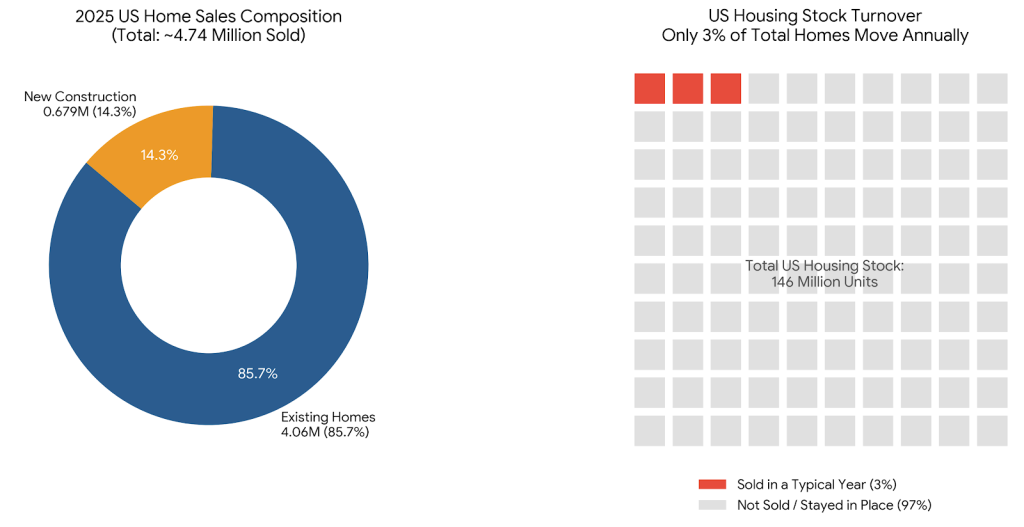
Historically, existing home sales make up around 85% to 90% of the market. Newly constructed homes, on the other hand, account for the remaining 10% to 15%, with average transaction prices ranging from $550,000 to $700,000 per year. But why? The thing is, new homes are more expensive because builders must account for fluctuating material costs, stricter modern building codes, and escalating land values. At times, however, when existing homes refuse to sell, newly constructed homes step in to fill the inventory void. During this period, new construction can temporarily shoot up to capture nearly 30% of all single-family homes available for sale.
Now let’s answer the main question: how many residences, both existing and recently built, are sold in the US every year? Annual US home sales average between 4 to 5 million transactions. In 2025, about 4.06 million existing homes were sold alongside roughly 679,000 new single-family homes.
While 4 to 5 million homes change hands each year, that represents only a small fraction of the nation’s housing stock. With more than 146 million housing units across the US, only about 3% of the residences are sold in a typical year. In other words, most Americans stay in their homes for years before moving.
How Monthly Home Sales Translate Into Annual Totals
A seasonally adjusted annual rate takes one month of sales, removes predictable seasonal patterns like the spring buying surge or winter slowdown, and projects the result across twelve months. Housing analysts use SAAR because raw monthly numbers bounce around too much to be useful on their own.
In practical terms, if existing home sales run at a SAAR of about 4.17 million in May 2026, that means the country would sell roughly 4.17 million existing homes over a full year if that month’s pace held steady. In May 2026, 308,446 homes were actually sold in the U.S. during that single month. The U.S. housing market saw a 5.2% increase in sales year over year compared to the same period.
Individual months can swing based on weather, mortgage rate changes, and inventory. That’s why to understand how many homes are sold each year, economists typically average monthly SAAR readings across all twelve months rather than fixating on a single report from, say, June or January. A strong March or April can be offset by a weaker September or November, and the annual average smooths those bumps out.
How Home Prices and Mortgage Rates Affect Annual Home Sales
Two forces exert the most influence over how many homes sell in any given year: the sales price of homes and the cost of borrowing money to buy them.
When the national average 30-year fixed mortgage rate falls, more households can qualify for loans. As of May 2026, rates sit around 6.4%, down from about 6.82% a year earlier. That decline has helped, but mortgage rates above 6.5% have significantly suppressed home sales demand throughout 2023–2025. The rate essentially determines monthly payments, and even small movements can shift affordability for millions of households.
On the price side, the median home price in the US, according to Redfin, is $398,771 as of May 2026. U.S. home prices rose 2.0% year over year in May 2026, continuing a pattern of steady appreciation. In 2024, the median home price reached $407,500 due to low inventory and high demand. These record-high price levels, combined with elevated rates, have priced out significant numbers of potential buyers.
The affordability squeeze (when the cost of a residence rises much faster than a typical household’s income) hits unevenly across the country. A $1,000 increase in median price pushes out roughly 9,573 households in Florida, 9,151 in Texas, and 7,243 in California, which clearly shows how sensitive demand is to even modest price changes.
Regional and Demographic Patterns in Annual Home Sales
National totals hide wide variation between regions, metros, and buyer types. The South accounts for roughly 45% of national sales volume in the United States, driven by more affordable land and faster population growth. Sales activity has varied regionally with notable activity in the South and Midwest, while the West has seen relatively unchanged transaction counts in recent months.
In May 2026, median prices varied dramatically by region: the West topped $625,000, the Northeast reached about $535,000, while the Midwest and South remained more moderate. First-time home buyers accounted for about 35% of existing home sales in May 2026, up from 30–33% in prior months. This group is especially sensitive to affordability and tends to gravitate toward markets where median home prices remain closer to the nationwide average.
Migration trends between late 2025 and early 2026 showed roughly 30% of buyers searching for homes in a different metro, with Florida, Arizona, North Carolina, Tennessee, and South Carolina attracting many movers. Cash purchases hovered around 25–30% of all transactions, which reflects continued investor and second-home buyer activity across the country.
Trends and Outlook: Will Annual Home Sales Rise or Fall?
After a pronounced slowdown in 2023–2024, most forecasts project modest growth in annual home sales if mortgage rates gradually ease. Existing home sales in the US are projected at 3,800 thousand by Q2 2026, while in 2027, existing home sales are projected to trend around 3,600 thousand.
Several forces will shape whether annual totals climb back toward 5 million:
- If mortgage rates drift below 6%, inventory increases, and affordability improves, sellers who have been locked into low-rate mortgages may finally list.
- Millennials are entering peak home-buying age, providing a demographic tailwind that could sustain demand for years. Contact with agents and mortgage pre-approvals from this cohort have risen steadily.
- NAR chief economist Dr. Lawrence Yun has emphasized that unlocking more inventory and improving affordability are the two keys to lifting annual home sales from their current low levels. “Homeowners will continue to build wealth, while renters are simply spinning their wheels,” he added.
- New construction calculated at current rates would need to accelerate to offset the existing home shortage, especially in growing metros across the economy.
Risks remain. Persistently high home prices, construction cost inflation, and any economic shocks could keep annual sales closer to 4 million than 5 million for the foreseeable future.
What Home Buyers Search for in a Potential Property
Even during the times of high mortgage rates, most people don’t just randomly pick what’s available on the market. What buyers look for in a property has changed dramatically.
But what’s the real deal maker? Apparently, it is the location. 71% of real estate purchasers claim that the surrounding neighborhood is the most important aspect. They opt for low crime rates, proximity to parks, and walkability. Good schools, short commute, and access to public transport are other no-less-significant factors. Without doubt, a monthly mortgage payment is a huge factor that home buyers weigh in before purchasing a property.
And let us tell you, layout is not the last thing. The number of bedrooms and bathrooms, a functional kitchen, and the presence of a garage are no less important when it comes to choosing a home.
As a potential home buyer, you can check the property you want to buy on Rew Online, a real estate intelligence platform. There, it’s easy to find a residence’s value and price, assess the condition, and learn about the condition of the houses in the area. In addition, the platform also makes it easy to get hold of the contact details of the current homeowners in case you’ve got any questions about potential purchasing.
Frequently Asked Questions
Do Americans have $35 trillion in home equity?
Yes, according to the data tracked by the Federal Reserve, the total collective home equity held by Americans stands at $34.9 trillion. This is an absolute all-time historic high. As stated by experts, this equity boom is the result of the 2023-2024 housing slowdown. Because a shortage of available homes kept buyers competing over few listings, home values have surged.
Do condos and townhomes count in existing home sales numbers?
Yes. NAR’s existing home sales series includes single-family homes, townhomes, condos, and co-ops, as long as they are previously owned properties and the sale has closed. This comprehensive sample is what makes the report the most widely cited page for housing market data in the nation.
Are cash purchases included in annual home sales data?
Cash transactions are fully included in both monthly and annual existing home sales figures, alongside financed purchases with mortgages. For instance, according to the National Mortgage Professional, all-cash transactions in the United States accounted for 32.8% of sales in the first half of 2025.
What does “SAAR” mean in monthly housing market reports?
SAAR stands for seasonally adjusted annual rate. SAAR takes a one-month snapshot of home sales and converts it into an annualized number while adjusting for normal seasonal patterns.
Which region of the United States accounts for the most home sales?
The South is typically the region with the largest share of home sales. It consistently dominates US housing transactions because it has faster population growth, more new construction (especially in Texas, Florida, and North Carolina), and relatively lower prices compared to the West and Northeast.
But even though the South is at the top of the list in home sales, the West (especially California) often leads in total dollar value of transactions and median home prices.
The post How Many Homes Are Sold in the US Each Year? appeared first on Real Estate Weekly.
]]>The post Avison Young arranges 99-year ground lease for an estimated $21.5 million appeared first on Real Estate Weekly.
]]>The owner was represented by Charles Kingsley, Principal; Neil Helman, Principal; Erik Edeen, Principal and Director of Tri-State Investment Sales; James Nelson, Principal and Head of Tri-State Investment Sales; and Brandon Polakoff, Principal and Executive Director of Tri-State Investment Sales, all located in Avison Young’s New York City office. The lessee, Naftali, represented themselves.
“Our client had a desire to continue their ownership of this asset at a prominent corner at the confluence of two Manhattan neighborhoods – Gramercy and Kips Bay,” said Kingsley. “This transaction allows them to remove any management burden and the ability to transfer the development risk to another party in exchange for a long-term annuity.”
The corner lot with a combined 172’ of frontage along Third Avenue and East 23rd Street offers flexibility in development along with a desirable location near Madison Square, Union Square, and Stuyvesant Square Parks. Flexibility in proposed development plans allow for a maximum of 72,268-square-feet (sf) of ZFA as-of-right or 86,721-sf of ZFA when taking advantage of an Inclusionary Housing bonus.
The post Avison Young arranges 99-year ground lease for an estimated $21.5 million appeared first on Real Estate Weekly.
]]>The post Rosewood Realty Group Brokers $36.5 Million Sale of 15-Story Hells Kitchen Mixed-Use Building appeared first on Real Estate Weekly.
]]>Rosewood Realty’s Aaron Jungreis, Ben Khakshoor and Alex Fuchs represented both the buyer, Duc Huang, a private family office and the sellers, Sol Kurtz, a private investor and Rubin Schron of Cammeby’s International.
The building features 42 residential apartments, five commercial spaces and 11 office spaces.
The 85,309 sq. ft. building, that was built in 1923, also features 27,806 sq. ft. of air rights.
The building sold for a Caprate of 3.86%, a GRM of 10.5 and a price per sq. ft. of $427. The building was 70% free market apartments and a large portion of the building was delivered vacant.
“This transaction represents a prime trophy Manhattan elevator asset with the ability to implement a value-add strategy through conversions and renovations to the vacant apartments,” said Fuchs. “Even in a tough interest rate environment, we were able to close this transaction smoothly.” “Also the property traded in the most tenuous real estate environment in the past 30 years,” added Khakshoor. “The fact that we were able to achieve a sub 4% cap rate goes to show that there will always be a strong demand for prime Manhattan elevator buildings.”
The post Rosewood Realty Group Brokers $36.5 Million Sale of 15-Story Hells Kitchen Mixed-Use Building appeared first on Real Estate Weekly.
]]>The post AI and cloud adoption propel data center demand to record levels for 2023 appeared first on Real Estate Weekly.
]]>The first half of 2023 finished with record absorption as hyperscalers, financial firms, healthcare companies and other major enterprises raced to secure data center space. Most of the supply that will be delivered in the third and fourth quarter of 2023 has already been preleased or is under exclusivity. Due to primary market power constraints, supply coming online in 2024 will also be preleased, resulting in limited options for users who are not in the market far in advance of their preferred go-live date.
“The data center industry is continuing to experience explosive growth in demand which is leading to completely sold-out primary markets, secondary market expansion and the development of newer tertiary markets,” said Andy Cvengros, Managing Director, JLL. “Major markets and most secondary markets have reached a state of supply and demand imbalance; the development timeline for new data centers has grown to three to five years – or more in some cases. If you want a new data center within that timeframe, start planning for it now, as we don’t see any sign of this demand slowing or the power situation getting any better.”
When it comes to primary data center markets, Phoenix and the Northwest have outpaced Northern Virginia as the leader in absorption with 194.5 MW and 185.9 MW, respectively, compared to 184 MW for the first half of 2023. Primary markets already have a limited inventory of colocation space, leading data center operators to increase pricing by up to 20 to 30%. JLL Research anticipates secondary markets, including Columbus, Salt Lake City, Reno and Austin, to continue to support the overflow from these constrained primary markets.
AI changes everything
AI is expected to accelerate this demand as more and more industries adopt AI as a tool to achieve corporate objectives. The last three years have seen massive investments in AI and machine learning through venture capital, private equity and M&A. So far, 2023 has seen $32 billion in investments through Q1.
“AI implementation requires significant computing power and resources, which translates to increases in leasing,” said Kari Beets, Senior Manager, Research, JLL. “AI needs also require higher power densities which require additional infrastructure in most data centers.”
Additionally, the demand for edge computing is accelerating. Generative AI, like ChatGPT, is also driving demand for edge computing requirements, as cloud companies are leveraging edge to enhance scale and deliver AI applications for faster, better responses.
AI models are also changing data center infrastructure, with some large requirements driving densities to 50-100 kW per rack. Many colocation providers have adjusted the voltage delivered to the floor to 415 volts, which can reduce the upfront cost of delivering power to these high-density clusters.
“Data centers are massive power users and require significant efforts to keep cool,” said Matt Landek, Managing Director, Data Centers & Telecom, Work Dynamics, JLL. “Given hyperscaler and colocation provider sustainability goals, the data center industry will need new innovations to improve cooling and energy efficiency for AI uses.”
Data center investment market remains strong
Even with a high interest rate environment, data center lender and investor demand remain strong, a bright spot for the capital markets. The sector is still attracting a variety of lenders, including life companies, banks, debt funds and CMBS/SASB, and the record-setting M&A activity of the last two years in the data center sector continues, with a flurry of recent major announcements.
“Evidence of growing investor demand is apparent when analyzing the trend of M&A valuation and EBITDA multiples, which is, simply put, a measure of a company’s return on their investment,” said Carl Beardsley, Managing Director, Capital Markets, JLL. “In the trailing 12 months, EBITDA multiples have averaged 26.5x versus an average of 23.2x since January 2017, meaning that investment value is increasing.”
The post AI and cloud adoption propel data center demand to record levels for 2023 appeared first on Real Estate Weekly.
]]>The post Miller Construction Begins Work on an 80,000-Square-Foot Build-to-Suit Industrial Warehouse in Orlando appeared first on Real Estate Weekly.
]]>Located at 2140 North John Young Parkway in Orlando, the industrial site spans 3.53 acres with convenient access to the area’s major highways: I-4 and 408 Expressway. The tilt wall structure is scheduled to be delivered in the first half of 2024.
“Central Florida has had immense growth over the last few years with many major businesses setting up shop locally and we are excited to partner with MSI on their first project in the area,” said Brian Sudduth, President of Miller Construction. “Our firm plans to execute our construction plan efficiently with top-notch service and reliability for our client.”
The warehouse will have 25 columns with 50-foot by 54-foot spacing, 29 parking spots, 13 dock doors (some with recessed truck wells for deliveries), full warehouse lighting, exhaust fans and louvers. Miller will also include tenant buildouts of four private office spaces and one open office space measuring roughly 9,500 square feet. Additionally, Miller’s team is installing a unique internal crane rail system to lift and move flooring and countertop products around the warehouse.
MSI has valued Miller’s preconstruction team during the planning process as the site is extremely tight for a tilt-wall construction project. Precision will be key for the team with only about eight feet of clearance between the neighboring Tesla Dealership on the south side of the property line.
The project team includes Eleven18 Architecture, Construction Engineering Group (MEP), Gutherman Structural Inc. (structural) and NV5 (civil).
The post Miller Construction Begins Work on an 80,000-Square-Foot Build-to-Suit Industrial Warehouse in Orlando appeared first on Real Estate Weekly.
]]>The post Local Development Corp. Votes Final Approval of $195 Million Bond Financing for Construction of New 162,626 SF Patient Care Tower at Westchester Medical Center appeared first on Real Estate Weekly.
]]>“Today’s historic approval by the Local Development Corporation is yet another example of how we are working with our not-for-profit community in securing tax-exempt bond financing benefits that are provided at no cost or risk to the taxpayers of Westchester County. This magnificent new project will further enhance our County’s world-class healthcare sector while providing a boost to our region’s economy,” said Westchester County Executive George Latimer.
“The Local Development Corporation is very pleased to approve the bond financing for this very important healthcare development at the Westchester Medical Center campus. As a result, nearly 900 construction jobs and new full-time jobs will be created and the County will receive more than $3.5 million in total economic benefits,” said Local Development Corporation Chair Joan McDonald.
“The LDC has a clear vision for the future of Westchester County, and we’re happy that vision includes projects such as the Patient Care Tower,” said Michael D. Israel, President and Chief Executive Officer, Westchester Medical Center Health Network (WMCHealth). “The Patient Care Tower on the Westchester Medical Center campus will be the Hudson Valley’s hub of critical care medicine as it will bring together critical care and medical-surgical specialties in one location, enabling Westchester Medical Center to convert to all private inpatient rooms across the rest of the campus. Additionally, the Patient Care Tower will advance our academic mission by giving medical residents and students a state-of-the-art facility in which to train.”
According to a cost benefit analysis prepared for the LDC, the project would provide the County with total benefits of $3,531,780 over 30 years. The total benefits are comprised of $722,468 in sales tax revenue from construction; $2,528,062 of sales tax revenue from operations over 30 years, and $281,250 in fees to be collected by the LDC based on the bond proceeds. The project is also estimated to create more than 770 construction jobs and 127 new full-time jobs.
The $221.3 million Patient Care Tower project would feature a five-story, 128-bed structure with all of its inpatient rooms ICU-equipped and a patient-centric design with leading edge amenities that will create a soothing, healing environment. It will house vital services for WMCHealth patients and their families including trauma, neurosciences, cardiology and general surgery.
The Local Development Corporation assists Westchester not-for-profit organizations in securing tax-exempt bond financing benefits. These benefits are provided at no cost or risk to the taxpayers of Westchester County. Since its inception in 2012, LDC has assisted not-for-profit organizations in securing tax-exempt bond financing totaling over $500 million.
The post Local Development Corp. Votes Final Approval of $195 Million Bond Financing for Construction of New 162,626 SF Patient Care Tower at Westchester Medical Center appeared first on Real Estate Weekly.
]]>