
<?xml version="1.0" encoding="UTF-8"?>
<?xml-stylesheet type="text/xsl" media="screen" href="/~d/styles/rss2enclosuresfull.xsl"?><?xml-stylesheet type="text/css" media="screen" href="http://feeds.feedburner.com/~d/styles/itemcontent.css"?><rss xmlns:atom="http://www.w3.org/2005/Atom" xmlns:openSearch="http://a9.com/-/spec/opensearch/1.1/" xmlns:georss="http://www.georss.org/georss" xmlns:gd="http://schemas.google.com/g/2005" xmlns:thr="http://purl.org/syndication/thread/1.0" xmlns:media="http://search.yahoo.com/mrss/" xmlns:itunes="http://www.itunes.com/dtds/podcast-1.0.dtd" version="2.0"><channel><atom:id>tag:blogger.com,1999:blog-3556576518294497114</atom:id><lastBuildDate>Tue, 14 Feb 2012 17:36:55 +0000</lastBuildDate><category>Photos</category><category>hosannachildren</category><category>Sermons and Articles</category><category>Podcast</category><title>Saint Aidan Orthodox Church</title><description>Bearing the love of Jesus Christ to the East Kootenay.</description><link>http://www.saintaidan.ca/</link><managingEditor>noreply@blogger.com (St.Aidan's)</managingEditor><generator>Blogger</generator><openSearch:totalResults>220</openSearch:totalResults><openSearch:startIndex>1</openSearch:startIndex><openSearch:itemsPerPage>25</openSearch:itemsPerPage><atom10:link xmlns:atom10="http://www.w3.org/2005/Atom" rel="self" type="application/rss+xml" href="http://feeds.feedburner.com/SaintAidanOrthodoxChurch" /><feedburner:info xmlns:feedburner="http://rssnamespace.org/feedburner/ext/1.0" uri="saintaidanorthodoxchurch" /><atom10:link xmlns:atom10="http://www.w3.org/2005/Atom" rel="hub" href="http://pubsubhubbub.appspot.com/" /><media:thumbnail url="http://staidan.ca/images/Church.jpg" /><media:keywords>Orthodox,Christian,Orthodox,Spirituality,Eastern,Orthodoxy,Eastern,Christianity,Orthodox,theology,Orthodox,Catechism</media:keywords><media:category scheme="http://www.itunes.com/dtds/podcast-1.0.dtd">Religion &amp; Spirituality/Christianity</media:category><itunes:owner><itunes:email>lindisfarne@saintaidan.ca</itunes:email></itunes:owner><itunes:explicit>no</itunes:explicit><itunes:image href="http://staidan.ca/images/Church.jpg" /><itunes:keywords>Orthodox,Christian,Orthodox,Spirituality,Eastern,Orthodoxy,Eastern,Christianity,Orthodox,theology,Orthodox,Catechism</itunes:keywords><itunes:subtitle>A Regular Teaching for Saint Aidan Orthodox Church Community</itunes:subtitle><itunes:summary>This is a weekly teaching offered for the members of Saint Aidan Orthodox Church community, on a variety of topics related to Eastern Orthodox Christianity.</itunes:summary><itunes:category text="Religion &amp; Spirituality"><itunes:category text="Christianity" /></itunes:category><item><guid isPermaLink="false">tag:blogger.com,1999:blog-3556576518294497114.post-678088199464580106</guid><pubDate>Tue, 14 Feb 2012 17:36:00 +0000</pubDate><atom:updated>2012-02-14T10:36:55.181-07:00</atom:updated><category domain="http://www.blogger.com/atom/ns#">Sermons and Articles</category><title>The Structure of Prayer</title><description>Many Christians commonly assume that lack of structure in worship and prayer leads to freedom. If we could just be spontaneous enough, they argue, if we can just allow ourselves to be taken wherever our feelings lead us, then we will truly follow the Spirit. By contrast, the use of structure, ritual, and (God forbid) liturgical prayer are nothing less than the way to kill the Spirit and make void the word of God with the traditions of men.&lt;br /&gt;
&lt;br /&gt;
Many flaws may be found in such thinking. For instance, is it really true that God cannot work through a form that we create? Do hymns or choruses—which are structured and ordered by very definition—crush God's ability to speak directly into our hearts? Furthermore, is there such a thing as totally unstructured worship or prayer? Don't we all have to plan our services ahead of time? And finally (and most importantly of all) who says that our feelings are a trustworthy indication of the Spirit's voice anyway? How many churches have come to grief because they were misled by the collective emotional impulses of their congregations?&lt;br /&gt;
&lt;br /&gt;
The fact is, structure is crucial to a healthy and happy existence. Parents know that children are most contented in a familiar environment with good routines. Left to their own devices, they become aggressive, restless and anxious. Because they never know what to expect, they are always on edge and afraid. By contrast, kids whose parents have established good routines for them feel safe, and therefore happy. They grow into well-adjusted adults who themselves maintain healthy structures around eating and sleeping, playing and working.&lt;br /&gt;
&lt;br /&gt;
If structure is essential for our psychological development as human beings, it is perhaps even more essential for our spiritual formation. The collective experience of Christians through the centuries has shown that when prayer is ordered within a daily framework, we can stand before God in peace, free from the anxiety of reinventing the wheel, while the familiarity of our habit liberates us to open our hearts to His transforming Presence.&lt;br /&gt;
&lt;br /&gt;
What does the daily structure of prayer look like? In the Scriptures, we see that the Jewish practice of prayer was built around the hours of the day and night. The Psalms speak of prayer seven times a day, at  midnight, evening, morning and noonday. (see Psalms 55 and 119) The habit of praying at particular hours of the day did not end with Judaism, but carried over into the practice of the Apostles and the early Church. (see Acts 10:3,9 and 16:25)&lt;br /&gt;
&lt;br /&gt;
Throughout history, Christians continued to maintain this daily structure of prayer in their worship. The “prayers of the hours” began with Matins, before the dawn. Dawn itself was marked by the first hour, nine o'clock the third hour, noon the sixth hour, three o'clock the nine hour (the time of Jesus' death). Sunset was marked with the praying of Vespers (which just means 'evening' in Latin), followed by Compline (which means 'completion' to signify the end of the work day) and Nocturn (which is the midnight hymns that we see the Apostles Paul and Silas praying in Acts 16:25). In short, Christians punctuated the entire 24 hour period with prayer.&lt;br /&gt;
&lt;br /&gt;
What the Apostles and early Christians actually prayed during those hours is a subject for another article. My point here is that it's time for Christians to rethink some of our assumptions about what makes for meaningful worship, and frankly, build a more regular structure into our prayer lives. We can only benefit  from a little more focus and intentionality in following the teachings and example of the Apostles and the early Christians, not to mention the generations that followed them. If it worked for them, why can't it work for us? With their 'Spirit-killing' formality, they brought the Roman Empire to its knees. With thousands of denominations devoted to 'Spirit-led' worship, modern western Christians are rapidly losing members to unbelief or non-Christian religions, at least one of which insists on a daily structure of prayer five times a day...&lt;div class="blogger-post-footer"&gt;&lt;img width='1' height='1' src='https://blogger.googleusercontent.com/tracker/3556576518294497114-678088199464580106?l=www.saintaidan.ca' alt='' /&gt;&lt;/div&gt;
&lt;p&gt;&lt;a href="http://feedads.g.doubleclick.net/~a/5RXBZioBuXuSJNjz326cEI9Sr9I/0/da"&gt;&lt;img src="http://feedads.g.doubleclick.net/~a/5RXBZioBuXuSJNjz326cEI9Sr9I/0/di" border="0" ismap="true"&gt;&lt;/img&gt;&lt;/a&gt;&lt;br/&gt;
&lt;a href="http://feedads.g.doubleclick.net/~a/5RXBZioBuXuSJNjz326cEI9Sr9I/1/da"&gt;&lt;img src="http://feedads.g.doubleclick.net/~a/5RXBZioBuXuSJNjz326cEI9Sr9I/1/di" border="0" ismap="true"&gt;&lt;/img&gt;&lt;/a&gt;&lt;/p&gt;</description><link>http://www.saintaidan.ca/2012/02/structure-of-prayer.html</link><author>lindisfarne@saintaidan.ca</author><thr:total>0</thr:total></item><item><guid isPermaLink="false">tag:blogger.com,1999:blog-3556576518294497114.post-6911681883514970165</guid><pubDate>Wed, 08 Feb 2012 17:46:00 +0000</pubDate><atom:updated>2012-02-08T10:47:31.622-07:00</atom:updated><category domain="http://www.blogger.com/atom/ns#">Podcast</category><title>Check Out the Latest Podcast from Mysterion: "Look Up and Seek Your Maker"</title><description>&lt;div class="separator" style="clear: both; text-align: center;"&gt;&lt;a href="http://ancientfaith.com/podcasts/mysterion/look_up_and_see_your_maker" target="_blank"&gt;&lt;img border="0" height="200" src="http://2.bp.blogspot.com/-yL-B7CpjINE/TzK0eDV5l9I/AAAAAAAAAnU/-oSJAjwY9Fs/s320/Mysterion.jpg" width="200" /&gt;&lt;/a&gt;&lt;/div&gt;&lt;br /&gt;
&lt;div style="text-align: center;"&gt;Click on the picture to go to the Podcast&lt;/div&gt;&lt;div class="blogger-post-footer"&gt;&lt;img width='1' height='1' src='https://blogger.googleusercontent.com/tracker/3556576518294497114-6911681883514970165?l=www.saintaidan.ca' alt='' /&gt;&lt;/div&gt;
&lt;p&gt;&lt;a href="http://feedads.g.doubleclick.net/~a/oebcVRv4kApTbZtCVsR9vb7dmA4/0/da"&gt;&lt;img src="http://feedads.g.doubleclick.net/~a/oebcVRv4kApTbZtCVsR9vb7dmA4/0/di" border="0" ismap="true"&gt;&lt;/img&gt;&lt;/a&gt;&lt;br/&gt;
&lt;a href="http://feedads.g.doubleclick.net/~a/oebcVRv4kApTbZtCVsR9vb7dmA4/1/da"&gt;&lt;img src="http://feedads.g.doubleclick.net/~a/oebcVRv4kApTbZtCVsR9vb7dmA4/1/di" border="0" ismap="true"&gt;&lt;/img&gt;&lt;/a&gt;&lt;/p&gt;</description><link>http://www.saintaidan.ca/2012/02/check-out-latest-podcast-from-mysterion.html</link><author>lindisfarne@saintaidan.ca</author><media:thumbnail url="http://2.bp.blogspot.com/-yL-B7CpjINE/TzK0eDV5l9I/AAAAAAAAAnU/-oSJAjwY9Fs/s72-c/Mysterion.jpg" height="72" width="72" /><thr:total>0</thr:total></item><item><guid isPermaLink="false">tag:blogger.com,1999:blog-3556576518294497114.post-1376099516885776395</guid><pubDate>Wed, 08 Feb 2012 02:07:00 +0000</pubDate><atom:updated>2012-02-07T19:09:48.457-07:00</atom:updated><category domain="http://www.blogger.com/atom/ns#">Sermons and Articles</category><title>Living with the Same Old</title><description>Perform a little thought experiment with me, if you would. Think back over the past five months, from the New Year until the present, and ask yourself how many days you would characterize as exciting, extraordinary, or life-altering.&lt;br /&gt;
&lt;br /&gt;
Having trouble? As hard I could, I could count no more than five days that come anywhere close to meeting the above criteria. Five days out of about 150—that’s just over 3%. In this, I don’t think I’m really unique. For most of us, 99% of life consists of the mundane, the ordinary, and the plain old dull. We get up, go to work, take care of family stuff, play, watch TV, eat, go on the Internet, go to bed, get up…&lt;br /&gt;
&lt;br /&gt;
The rituals of daily, weekly, monthly, and yearly existence are relatively conventional for all of us: births and birthdays, weddings, funerals, graduations, medical appointments, and so on. As human beings, we share this common heritage of customs, ceremonies, and common experiences that bind us together. The “spikes”—unusual or unique events that distinguish us and change our lives—are few and far between.&lt;br /&gt;
&lt;br /&gt;
This reality stands in sharp contrast with human life as it is often portrayed in movies, literature (especially the escapist kind), internet and television. The media by its very nature depicts the high points and the low points of life, often within the span of minutes, not hours. For the most part, the pervasive ordinariness that we all know is glossed over or ignored in favour of the most glamorous or dolorous moments.&lt;br /&gt;
&lt;br /&gt;
If we spend a lot of time consuming media in all its different varieties, we may be tempted into thinking that life should be the way the media portrays it. I remember a comedy sketch I recently heard in which the comedian lamented that he couldn’t say, as characters did in the movies, that he would “be on the next flight out” whenever he wanted to. He was stuck instead looking for the best deals online, and managing all of the frustrating little travel details that movie characters never seem to have to deal with.&lt;br /&gt;
&lt;br /&gt;
The problems start when we come to believe that the life depicted in the media is somehow attainable in the real world. We start to think that the mundane quality of our lives are unusual, perhaps reflecting some defect in ourselves, whether it is a lack of money or a lack of character. Our dissatisfaction drives us to seek out more and more wealth and material possessions. Our unhappiness drives us to fill our lives with “highs” in the form of constant entertainment, thrill-seeking, sex, alcohol or drugs…&lt;br /&gt;
&lt;br /&gt;
When we give in to the media’s deceit, the vast bulk of our daily routines can become a burden to us. We can’t wait for the weekend, when we can inject a little excitement into our existence. We live for the excitement, while a pall falls over the rest of our days, which must be merely endured until the next high arrives.&lt;br /&gt;
&lt;br /&gt;
I think we can all agree that this is no way to live. The question is, how can we stop merely putting up with the “same old” and start actually finding value in it? The first step, I think, is to remind ourselves that media reality does not and cannot correspond one-to-one with real human life. No one on the planet, even the most wealthy and powerful, live exactly as the movies would portray them. Sex is never accompanied by an orchestra, and no one ever just jumps on the next flight to wherever they want to go. Even Bill Gates has to wait for clearance before taking off in his private jet…&lt;br /&gt;
&lt;br /&gt;
We need to stop denying that life is vastly ordinary and mostly pretty dull. Let’s get that through our heads by spending a little less time listening to the voices and watching the images that try to tell us otherwise.&lt;br /&gt;
&lt;br /&gt;
Secondly, we need to realize that routine, ritual, and repetition are processes inherent to human life. God built a whole lot of “same old” into our lives for a reason. We seem to need those times to percolate, marinate, and generally soak in the more intense moments of our existence. We seem to understand deep experiences best by having a period to consider and reflect upon them in long, uninterrupted stretches.&lt;br /&gt;
&lt;br /&gt;
Take marriage, for instance. The intensity and excitement of the engagement, the wedding, the honeymoon, the early months, and even the birth of the first child, require years of quiet routine and habit to find their true meaning in our lives. There is certainly excitement to be found throughout the life of a marriage; my point is that the true significance of a marriage does not become fully evident without those times in which nothing much happens, or else in which the same thing happens over and over again.&lt;br /&gt;
&lt;br /&gt;
The “same old” exists to teach us the deeper meaning of life. Don’t ask me why; it just seems to be the way we were built.&lt;br /&gt;
&lt;br /&gt;
Finally, we need to see the ordinariness of life as a challenge to look deeper and discover the extraordinary. Jesus commands us to avoid “vain repetitions,” but in life—as in prayer—repetition is only vain if we are not really paying attention. The solution to vain repetitions—both in life and prayer—is simply an attitude of greater attentiveness to that which we would otherwise ignore: our own hearts, where the Presence of God dwells. Only the absence of distractions that is the ordinary awakens us to that extraordinary miracle.&lt;br /&gt;
&lt;br /&gt;
The “same old”—those flat, occasionally undulating plains of existence—call us to look at mundane things like clouds and sunsets, to smell the coming rain, to touch a new leaf and taste a cherry, and discover again what Gerard Manley Hopkins called “the dearest freshness deep down things.” The ordinary, repetitive sounds of life—the rush of traffic, the creak of the house, a bird singing, the wind in the trees—call us to delve deeper and really hear the “still, small voice” that speaks to us of eternity.&lt;div class="blogger-post-footer"&gt;&lt;img width='1' height='1' src='https://blogger.googleusercontent.com/tracker/3556576518294497114-1376099516885776395?l=www.saintaidan.ca' alt='' /&gt;&lt;/div&gt;
&lt;p&gt;&lt;a href="http://feedads.g.doubleclick.net/~a/iU9X-9TuaLIp3Tn1uvkdTbvKN9U/0/da"&gt;&lt;img src="http://feedads.g.doubleclick.net/~a/iU9X-9TuaLIp3Tn1uvkdTbvKN9U/0/di" border="0" ismap="true"&gt;&lt;/img&gt;&lt;/a&gt;&lt;br/&gt;
&lt;a href="http://feedads.g.doubleclick.net/~a/iU9X-9TuaLIp3Tn1uvkdTbvKN9U/1/da"&gt;&lt;img src="http://feedads.g.doubleclick.net/~a/iU9X-9TuaLIp3Tn1uvkdTbvKN9U/1/di" border="0" ismap="true"&gt;&lt;/img&gt;&lt;/a&gt;&lt;/p&gt;</description><link>http://www.saintaidan.ca/2012/02/living-with-same-old.html</link><author>lindisfarne@saintaidan.ca</author><thr:total>0</thr:total></item><item><guid isPermaLink="false">tag:blogger.com,1999:blog-3556576518294497114.post-3805448424104895285</guid><pubDate>Tue, 31 Jan 2012 17:00:00 +0000</pubDate><atom:updated>2012-01-31T10:00:55.372-07:00</atom:updated><category domain="http://www.blogger.com/atom/ns#">Sermons and Articles</category><title>The Instinct for Greatness</title><description>I am going to begin this article with a personal confession. Throughout my adult life I have often faced the urge to strive for and achieve some kind of “greatness.” In my teens, I wanted to be a great mathematician or cosmologist like Ramanujan, Einstein or Stephen Hawking.&lt;br /&gt;
&lt;br /&gt;
In my twenties, I wanted to be a great poet along the lines of Dylan Thomas, T.S. Eliot, W.B. Yeats, or Rainer Maria Rilke. Then I sought to be a great writer of prose, taking as my idols Gabriel Garcia Marquez, Hemingway, and Steinbeck.&lt;br /&gt;
&lt;br /&gt;
Some of my efforts paid off: poems and short stories published in journals, and eventually a couple of young adult novels. And of course, I continue to write articles for the local newspaper and the Church web site...&lt;br /&gt;
&lt;br /&gt;
Still, these modest rewards weren’t enough. I still wanted to be “great.” You know, really great, with my name sitting on “Top 10” lists for generations to come. Poet, writer, preacher, teacher, pastor, father, husband—it didn’t matter what “Top 10” list it was, so long as I was on it, somewhere near the top...&lt;br /&gt;
&lt;br /&gt;
It sounds silly and prideful, and it is. I think, though, that within each of us resides a similar impulse to greatness. Deep down, we all want to know that we are fulfilling our potential. We all want to be told that we are doing a great job. At the root of our being, we all desire to be valued in a way that is distinct from others.&lt;br /&gt;
&lt;br /&gt;
Time and experience often erode our impulse to greatness, or sour it into bitterness and a kind of resigned mediocrity. Somewhere deep inside, though, I believe that the urge remains in some form or another, and an important task in the spiritual life involves accounting for it and addressing it in some way.&lt;br /&gt;
&lt;br /&gt;
But how?&lt;br /&gt;
&lt;br /&gt;
It is my belief that every human impulse is rooted something good and pure that is often used for an unnatural purpose. As the fulfillment of love, sex is good, but it is easily twisted using others for selfish ends. Enjoying food is good but when overindulged, it easily slips into gluttony. The thirst for justice and indignation at injustice can easily be perverted to judge, condemn and even harm other people.&lt;br /&gt;
&lt;br /&gt;
In a similar way, the impulse to greatness lies in a natural and good desire to become the human beings we were created to be. A 7th century Christian teacher called Maximus taught that when God created us, He did so with a “logos” or idea of our potential in life. This idea is rooted in God’s ultimate “Logos,” His ultimate “Idea” for the ideal human life—Jesus Christ, who is the final and definitive “Word of God” made flesh.&lt;br /&gt;
&lt;br /&gt;
Maximus’ theology is complex, but the short of it is that when we live out our lives in obedience to the ultimate pattern that God has provided in Jesus Christ, we also fulfill our own particular pattern of existence. To put it simply, we become an expression of Jesus Christ in our own unique and particular personalities and ways. We each become a singular “word” that speaks the Word—Jesus Christ—in our own lives.&lt;br /&gt;
&lt;br /&gt;
In that light, my impulse to greatness is really the impulse to fulfill God’s “idea” of who He created me to be. What I really want in the end is for every aspect of my life to fully and completely “speak” the Word of God—Jesus Christ—to the world, using a “word” that is uniquely mine and no one else’s.&lt;br /&gt;
&lt;br /&gt;
Knowing this, however, the question remains: how can I attain this goal? The answer is simpler than you might think: I don’t need to do anything, because everything has been accomplished. God has already given Himself in Christ, and in baptism, we have become “a letter from Christ … written not with ink but with the Spirit of the living God, not on tablets of stone but on tablets of human hearts.” (2 Cor. 3:3)&lt;br /&gt;
&lt;br /&gt;
The person that I was created to be has already been born. By grace, I have everything I need to be complete, fulfilled and perfected, and now my only task is to allow God to feed and nurture that embryonic person day by day “to mature manhood, to the measure of the stature of the fulness of Christ.” (Eph. 4:13)&lt;br /&gt;
&lt;br /&gt;
This is an inward effort, not an outward one. Being a “great” human being doesn’t mean excelling in the realms of science, art, literature, theology, parenting or whatever. Being a “great” human being does not mean being a great achiever in the world and receiving applause from our fellow human beings. That inclination is just a twisted version of the true impulse to greatness, which is the desire to live in complete acceptance of the life God has given us, and to be content with His praise alone.&lt;br /&gt;
&lt;br /&gt;
My goal in the New Year, then, is simple: to strive for true greatness by becoming more present with whatever and whoever He gives me in each moment. The more I accept what He gives, the more I allow myself to be shaped by what He gives into the “word” that He wants me to be, the greater I become. It’s that simple.&lt;br /&gt;
&lt;br /&gt;
If my efforts result in less than perfect worldly “achievements,” because I was more concerned with the person or situation in front of me, rather than with crafting some article or sermon to perfection, so be it. Just as Jesus Himself had “no beauty that we should desire Him,” (Is. 53:2) a life perfected in His image and likeness need not be externally glorious. I ask you to pray that I learn that lesson in 2010, even as I pray that you too would accept whatever God gives in the coming year and fulfill your deepest impulse to be made as perfect as He is.&lt;div class="blogger-post-footer"&gt;&lt;img width='1' height='1' src='https://blogger.googleusercontent.com/tracker/3556576518294497114-3805448424104895285?l=www.saintaidan.ca' alt='' /&gt;&lt;/div&gt;
&lt;p&gt;&lt;a href="http://feedads.g.doubleclick.net/~a/GijlAf03pIyL1W-m47_piC73sWA/0/da"&gt;&lt;img src="http://feedads.g.doubleclick.net/~a/GijlAf03pIyL1W-m47_piC73sWA/0/di" border="0" ismap="true"&gt;&lt;/img&gt;&lt;/a&gt;&lt;br/&gt;
&lt;a href="http://feedads.g.doubleclick.net/~a/GijlAf03pIyL1W-m47_piC73sWA/1/da"&gt;&lt;img src="http://feedads.g.doubleclick.net/~a/GijlAf03pIyL1W-m47_piC73sWA/1/di" border="0" ismap="true"&gt;&lt;/img&gt;&lt;/a&gt;&lt;/p&gt;</description><link>http://www.saintaidan.ca/2012/01/instinct-for-greatness.html</link><author>lindisfarne@saintaidan.ca</author><thr:total>2</thr:total></item><item><guid isPermaLink="false">tag:blogger.com,1999:blog-3556576518294497114.post-1876668624754966087</guid><pubDate>Wed, 25 Jan 2012 14:28:00 +0000</pubDate><atom:updated>2012-01-25T07:28:29.431-07:00</atom:updated><category domain="http://www.blogger.com/atom/ns#">Sermons and Articles</category><title>Parenting for Faith (Part Two)</title><description>In a recent article, I shared some reflections on how we can offer our children a sound and living example of faith, one that they may readily choose to follow in their own adult lives. I would like to conclude now with a few suggestions on how to formally catechize your children at home.&lt;br /&gt;
&lt;br /&gt;
Without belittling the dedicated and hardworking folks who weekly devote themselves to Christian education in their churches, I would suggest that effective catechism must primarily be rooted in a living relationship between parents and their children in the home. After all, if the primary witness to a child is his or her parents’ own lived example, shouldn’t the “talking” come from the same person who does the “walking”?&lt;br /&gt;
&lt;br /&gt;
“Yes,” you might say, “but I am no expert the tenets of in my faith. I am not equipped to teach my kids doctrine!”&lt;br /&gt;
&lt;br /&gt;
Let me share some of my experience as a professional teacher in this regard: kids can smell B.S. long before you hand it to them. What they really want to see is someone who is honest about what they know or don’t know. It’s quite okay for your kids to see that you too are a student. All that they really need to know is that finding the answers is important to you.&lt;br /&gt;
&lt;br /&gt;
Whatever you do, therefore, don’t pretend you are more well-informed than you really are. I guarantee they will discover your lie and your claim to be representative of the truth will be seriously undermined.&lt;br /&gt;
&lt;br /&gt;
So don’t worry about how expert you are. Simply embark on your own journey of learning, and having learned its lessons as thoroughly you can, pass them on as directly, honestly and as completely as possible to your children.&lt;br /&gt;
&lt;br /&gt;
But what material do you choose and how do you actually teach it? With a bewildering variety of denominations, congregations and churches, not to mention claims to absolute truth throughout the Christian world, the task of finding a catechesis is overwhelming. However, it need not be so. Assuming a generally Christian context (the only one I am familiar with), I would suggest that the foundation for sound doctrine of any sort is a complete and deeply-rooted knowledge of the Old and New Testaments.&lt;br /&gt;
&lt;br /&gt;
Don’t get me wrong here: I am not saying that Scripture should be sole source of a child’s doctrinal knowledge. As I have said before, Scripture is not self-interpreting and must be read and understood within a living framework of worship and spiritual practice—what Eastern Orthodox Christianity would call tradition.&lt;br /&gt;
&lt;br /&gt;
Before a child can appropriate the proper interpretation of Scripture in tradition, however, he or she must first grasp what is being interpreted—the scriptural material from which tradition is wrought. To put it briefly, we can’t understand who Christ is “according to the Scriptures” unless we first know the Scriptures that ultimately point to Him!&lt;br /&gt;
&lt;br /&gt;
In this view, I am not alone. The great 4th century preacher and teacher, John Chrysostom, offers similar advice in his homily, Address on Vainglory and the Right Way for Parents to Bring Up Their Children. Comparing the soul of a child to city and parents to lawmakers and rulers, Chrysostom emphasizes the importance of one of the city’s “gates”—the ears—by which “thoughts are corrupted or rightly guided.”&lt;br /&gt;
&lt;br /&gt;
How to protect this particular gate in the soul of a child? Chrysostom’s prescription is twofold. Firstly, protect your child from stories that teach vices. He offers one example: “Such and such a girl kissed such and such a man, and had no luck and hanged herself.” In other words, Chrysostom urges us to prevent our children from hearing stories in which people are involved in the destruction of their souls.&lt;br /&gt;
&lt;br /&gt;
For us, this means setting clear and firm boundaries about what books our children will read, what movies or TV shows they will see, what web sites they will visit, or what music they will listen to—itself a daunting challenge.&lt;br /&gt;
&lt;br /&gt;
Secondly, Chrysostom urges that we offer our children stories from the Scripture. He tells us specifically how this should be done:&lt;br /&gt;
&lt;br /&gt;
&lt;ol&gt;&lt;li&gt;Establish a context in which to establish a family storytelling tradition. Chrysostom advocates for an evening meal at which the whole family is gathered.&lt;/li&gt;
&lt;li&gt;Choose a story, such as that of Cain and Abel and having learned it thoroughly yourself, begin in the classic way: “Once upon a time.” At this stage, you need not insist on chapter and verse. The point is to teach the stories first, and only later to teach how they relate to one another in the wider scope of the Scriptures.&lt;/li&gt;
&lt;li&gt;Elaborate the story with relevant and appropriate details to engage the child’s mind. Include probable character motivations, as well as interpretations true to basic doctrinal teaching, e.g. Abel was received into heaven.&lt;/li&gt;
&lt;li&gt;Draw out simple, clear lessons from the story, e..g. the futility of Cain’s attempts to conceal his sins from God.&lt;/li&gt;
&lt;li&gt;Repeat the story for several nights and then ask the child to tell you the story in his or her own way.&lt;/li&gt;
&lt;li&gt;Provide the child with an opportunity to hear the story read and preached on in Church. In the Orthodox  tradition, this would also involve them hearing hymnography that would interpret the story in the light of doctrine.&lt;/li&gt;
&lt;/ol&gt;&lt;br /&gt;
Whether we are able to follow Chrysostom’s prescriptions exactly is not of vital importance. The larger point is clear. If we make a start at living lives of faith for our own salvation and as an example to our children, if we establish with them a foundation by which they can understand that life of faith through the regular telling of stories from Scripture, then we will have already gone a long way to parenting children who will hold fast to Christ, not just until their dying breath, but beyond, into the age to come.&lt;div class="blogger-post-footer"&gt;&lt;img width='1' height='1' src='https://blogger.googleusercontent.com/tracker/3556576518294497114-1876668624754966087?l=www.saintaidan.ca' alt='' /&gt;&lt;/div&gt;
&lt;p&gt;&lt;a href="http://feedads.g.doubleclick.net/~a/6qmdeeC_hjPQ67GmbsxKGZ7BUqI/0/da"&gt;&lt;img src="http://feedads.g.doubleclick.net/~a/6qmdeeC_hjPQ67GmbsxKGZ7BUqI/0/di" border="0" ismap="true"&gt;&lt;/img&gt;&lt;/a&gt;&lt;br/&gt;
&lt;a href="http://feedads.g.doubleclick.net/~a/6qmdeeC_hjPQ67GmbsxKGZ7BUqI/1/da"&gt;&lt;img src="http://feedads.g.doubleclick.net/~a/6qmdeeC_hjPQ67GmbsxKGZ7BUqI/1/di" border="0" ismap="true"&gt;&lt;/img&gt;&lt;/a&gt;&lt;/p&gt;</description><link>http://www.saintaidan.ca/2012/01/parenting-for-faith-part-two.html</link><author>lindisfarne@saintaidan.ca</author><thr:total>0</thr:total></item><item><guid isPermaLink="false">tag:blogger.com,1999:blog-3556576518294497114.post-9017434911587912798</guid><pubDate>Sun, 22 Jan 2012 00:17:00 +0000</pubDate><atom:updated>2012-01-21T17:17:09.163-07:00</atom:updated><category domain="http://www.blogger.com/atom/ns#">Sermons and Articles</category><title>The Sanctity of Human Life</title><description>This week, many Christian churches throughout North America will celebrate the Sanctity of Human Life in protest of the ongoing prevalence of legalized abortion in our society. My goal in this article is not to enter into this controversial debate, but simply to present the Orthodox position on the moral and legal issues around abortion.&lt;br /&gt;
&lt;br /&gt;
The Orthodox Christian Church has always asserted that life begins at conception. Numerous written proofs aside, the Church calendar celebrates both birthdays and conception days. Most well-known is March 25th, when Christ was conceived by the Holy Spirit of the Virgin Mary at the Annunciation. Significantly, this celebration takes place nine months before Christ’s birth on December 25th... In addition, we also celebrate the conceptions of Saint John the Baptist (September 23rd) and Mary the Mother of God (December 9th).&lt;br /&gt;
&lt;br /&gt;
The sanctity of conception flows from the Orthodox teaching that God creates all of us in His image and likeness from the beginning: “For You formed my inward parts, You knitted me together in my mother's womb.” (Ps. 139:13) Our dignity as human beings does not primarily derive from national citizenship upon birth. Rather, we possess inherent value and worth because God loved us and cared for us and called us His children from the very instant He granted us the spark of life at conception.&lt;br /&gt;
&lt;br /&gt;
Following on this logic, the Church has always condemned the conscious and wilful act of destroying the foetus as the taking of a human life. Basil the Great, a Church father writing in the 4th century, puts it very bluntly: “A woman who deliberately destroys a foetus is answerable for murder. And any fine distinction between its being completely formed or unformed is not admissible among us.”&lt;br /&gt;
&lt;br /&gt;
No doubt many of you have by now labelled me a hard-line conservative, placing me on one side of a battle in which clear lines have been drawn. On one side are those who argue for the legal precedence of a woman’s rights over that of the foetus she carries in her womb. They assert that the state is not subject to the morality of the Church, but must represent the interests of all its citizens, religious and non-religious alike.&lt;br /&gt;
&lt;br /&gt;
On the other side are those who affirm basically what I have said, but go on to argue that the laws legalizing abortion should be repealed on the basis that they condone murder. They argue that both the United States and Canada were founded on Christian principles, the laws must reflect those principles if they are to be true to their identity.&lt;br /&gt;
&lt;br /&gt;
As morally conservative as I am, I would like to take a “third way” on the issue of legislation. The Orthodox Church has always held that, in the words of one prayer, the state exists to “provide peace that Your holy Church and all Your people may calm and ordered in all godliness and sanctity.” As long as the Church and its members are able to continue “working out their salvation” (see Phi. 2:12) in peace, the state can use whatever political system is expedient to meet the needs of its citizenry.&lt;br /&gt;
&lt;br /&gt;
It is for this reason that the Orthodox Church has been willing (if not always able) to exist under the Roman and Ottoman Empires, in Tsarist Russia, under Communism, not to mention socialism and democracy in their various forms. Although the Church has always welcomed Christian impulses in its civil authorities, it has never demanded that they institute a theocracy of any kind. It has simply asked them to provide a space of peace in which it can conduct its life of faith and worship.&lt;br /&gt;
&lt;br /&gt;
The Orthodox Church in North America now lives in a democracy, which has as its basic mandate equal representation for all citizens, believers and non-believers alike. If our civil leaders wish to be elected to office, they must guarantee such representation, regardless of their personal creed. This is the dilemma of Christian politicians in a democracy. They must champion the will of their constituency, even if that will contradicts their own fundamental principles. Otherwise, they must forfeit their office.&lt;br /&gt;
&lt;br /&gt;
The simple reality of democracy is “majority rules.” And the majority of Canadian citizens are not opposed to legal abortion. As a Christian, I may vehemently disagree with them, but I accept the democratic process as the least imperfect system for the attaining peace and harmony in 21st century. So as long as democracy allows the Church to continue to live in faith,  I will continue to live with democracy, if uncomfortably and with a sense of outrage at its many moral failings, including its failure to protect its unborn citizens.&lt;br /&gt;
&lt;br /&gt;
Am I failing my duty? Should I not be fighting every day to build a Christian nation through political and social lobbying? While such events as the “March for Life” taking place this Sunday in Washington, D.C., serve as a important voice of conscience for a society increasingly deaf to the suffering of its most vulnerable members, I do not believe that marches and other similar social actions alone will bring an end to social evils like abortion. Nor, as an Orthodox Christian, do I believe that my primary purpose is to establish a theocracy and legislate my beliefs for all to follow, or else suffer the consequences. Why? Because the Kingdom of God cannot be legislated into being. Like that other Law of which Saint Paul says, “By works of the law shall no one be justified,” mere legislation at best cuts off the poisonous flower of evil; it cannot reach its dark roots, which feed off our society's basic spiritual ailment: the devaluation of the human person created in the image and likeness of God.&lt;br /&gt;
&lt;br /&gt;
And so this Christian will continue to fight the war against the evil of abortion and build the Kingdom of God, not primarily on Parliament hill, but first and foremost on the more fundamental and essential battleground of my own heart, where I strive to repent of the sins that devalue me as a human being. Only then can I begin to offer a vision to those around of me of what it means to be real human being—God's precious child from conception to grave and beyond, to resurrection and eternal life.&lt;div class="blogger-post-footer"&gt;&lt;img width='1' height='1' src='https://blogger.googleusercontent.com/tracker/3556576518294497114-9017434911587912798?l=www.saintaidan.ca' alt='' /&gt;&lt;/div&gt;
&lt;p&gt;&lt;a href="http://feedads.g.doubleclick.net/~a/XgbGfAq--4ii3ip3_S23tH4ulT0/0/da"&gt;&lt;img src="http://feedads.g.doubleclick.net/~a/XgbGfAq--4ii3ip3_S23tH4ulT0/0/di" border="0" ismap="true"&gt;&lt;/img&gt;&lt;/a&gt;&lt;br/&gt;
&lt;a href="http://feedads.g.doubleclick.net/~a/XgbGfAq--4ii3ip3_S23tH4ulT0/1/da"&gt;&lt;img src="http://feedads.g.doubleclick.net/~a/XgbGfAq--4ii3ip3_S23tH4ulT0/1/di" border="0" ismap="true"&gt;&lt;/img&gt;&lt;/a&gt;&lt;/p&gt;</description><link>http://www.saintaidan.ca/2012/01/sanctity-of-human-life.html</link><author>lindisfarne@saintaidan.ca</author><thr:total>0</thr:total></item><item><guid isPermaLink="false">tag:blogger.com,1999:blog-3556576518294497114.post-7320506427769660245</guid><pubDate>Tue, 17 Jan 2012 14:50:00 +0000</pubDate><atom:updated>2012-01-17T07:50:22.486-07:00</atom:updated><category domain="http://www.blogger.com/atom/ns#">Sermons and Articles</category><title>Parenting for Faith (Part One)</title><description>As a priest and father, it is one of my greatest hopes that my three children—Lily, Gabriel and John—would grow up to be faithful Christians. Indeed, for me, this hope exceeds all others. At this moment, I don’t care what kind of work they will choose, whether they will marry or stay single, what their socioeconomic status will be—as long as they are faithful to Christ and His Church, I will be happy.&lt;br /&gt;
&lt;br /&gt;
I am sure that many of you share, or have shared my aspirations in regards to your own children. And I am certain also that you have asked the question that I ask myself almost daily: how is this to be accomplished? How do I, as a parent, live and interact to ensure that my kids mature into adults of real and lasting faith?&lt;br /&gt;
&lt;br /&gt;
I would be misleading you if I said that there was any sure-fire answer to that question. The very nature of Christian faith presupposes a fundamental freedom in the human person, freedom to choose or reject a relationship with Christ. Without this freedom, both God’s love for us and our love for Him are meaningless.&lt;br /&gt;
&lt;br /&gt;
This means simply that after we have made our best efforts to direct our children along the Way we have chosen, they must make a choice of their own, and they must continue to make that choice daily for the rest of their lives. Faith, in the Orthodox view at least, is a dynamic and continuous reality. Faith is bound up with daily faithfulness. Faith is clinging to Christ, moment by moment, and our children, once they have matured, must cling to Him by themselves, without our help or intervention.&lt;br /&gt;
&lt;br /&gt;
That being said, what is our “due diligence”? How can we “speak the truth in love” (see Ephesians 4:15) to our children in the hope that they will accept our proclamation? In future articles, I will offer some guidelines to formal catechesis. Today, however, I would suggest above and beyond all educational strategies or resources, the most important factor in bringing up children as Christians is your personal example as a parent.&lt;br /&gt;
&lt;br /&gt;
One of the biggest mistakes that Christian parents often make is to confuse catechism for education. We begin with the externals. Isn’t there a book I can read and teach to my kids? Isn’t there a curriculum I can implement? Isn’t there a moral system that I can somehow drill into their little minds? We want solutions in a box, simple equations into which we can feed our kids, from which they can emerge as believers.&lt;br /&gt;
&lt;br /&gt;
Now, I have nothing against formal education, curricula, moral systems, rules and so on. They have their place and I hope to discuss them in future articles. My point is, we need to get our priorities straight. Educating our children in their faith doesn’t go from the outside in, but from the inside out. The words of our catechism can only be meaningful to our kids if we first demonstrate their meaning in our own lives.&lt;br /&gt;
&lt;br /&gt;
How we can be witnesses to our children of a living relationship with God on a daily basis? Before I answer that question, I must make a basic point: being an effective witness to our children does not necessarily mean that we have to be paragons of moral perfection. What we do need is an attitude described best in the “Big Book” of Alcoholics Anonymous: “We are willing to grow along spiritual lines... We claim spiritual progress rather than spiritual perfection.” This fundamental mind-set will be crucial in determining whether or not our children will uphold us as spiritual role models and follow our path of faith.&lt;br /&gt;
&lt;br /&gt;
&lt;b&gt;Seeing Us Pray&lt;/b&gt;&lt;br /&gt;
Having resolved on a path of spiritual progress rather than perfection, our children should witness two basic activities in our lives. First and foremost, they should see us praying. This doesn’t mean we need to be overtly pious. Even someone who is fumbling towards the very existence of God can be a model of prayer as they cry from the depths of their soul, “If you are out there, reveal Yourself to me!”&lt;br /&gt;
&lt;br /&gt;
As long as our kids see us involved in this kind of real, consistent and honest conversation with God, we will succeed in offering them a strong witness of faith. They will come to the accurate conclusion that Dad and/or Mum are sacrificing time and effort to reach out for God, which must mean that He is somehow important...&lt;br /&gt;
&lt;br /&gt;
Of course, none of this will be effective unless the optics are correct. By this I mean that we should not only be involved in the effort of regular prayer, but that our children must also &lt;i&gt;&lt;b&gt;see&lt;/b&gt;&lt;/i&gt; us in the effort of regular prayer. It won’t hurt for them to “discover” you praying on one or two occasions. And if you set aside times for regular prayer, it is worth saying that you are “going to pray” within the reach of their little ears.&lt;br /&gt;
&lt;br /&gt;
You may feel a bit self-conscious about exposing your prayer life like this, but remember that being a parent is a public role that involves a certain amount of staging for the good of our children. Think of all the conversations you avoid having in front of them and ask yourself why it is should be so strange to make personal prayer a matter of family discussion. Then consider the goal: to inculcate in your children the awareness that you are engaged in a living relationship with God. In the end, isn’t it worth a little discomfort?&lt;br /&gt;
&lt;br /&gt;
&lt;b&gt;Seeing Us Repent&lt;/b&gt;&lt;br /&gt;
Along with seeing you pray, your children should see you repenting daily. As I said earlier, they will not ultimately care about your imperfections, as long as you took an attitude of willingness to grow and progress along spiritual lines. Inwardly, such growth and progress involves the effort to pray; outwardly, it involves the effort to say sorry and make amends.&lt;br /&gt;
&lt;br /&gt;
A story from early Christian literature tells of a traveler in the desert who came upon a monastery. Observing the monks, who were hermits, he finally asked one of the brothers, “What is it that you do every day in your cell?” The monk replied, “We fall down, we get up. We fall down, we get up. We fall down...”&lt;br /&gt;
&lt;br /&gt;
Such is the spiritual life. What counts in the end is not whether we have fallen, but whether we are struggling to rise again. As parents, this means that the most powerful witness of our faith will depend on whether or not we have the humility and the courage to “get up” by repenting of our mistakes in the presence of our children.&lt;br /&gt;
&lt;br /&gt;
This is perhaps the most difficult parenting challenge that we will face. It means apologizing to our spouses, our colleagues, friends, acquaintances and even strangers—in plain sight of our kids. Most importantly, it means making amends to the children themselves—a humbling and even terrifying prospect.&lt;br /&gt;
&lt;br /&gt;
Difficult as it may be, however, we must answer the call to be witnesses of repentance to our children. If they do not see this key piece of our spiritual life, all our prayer, all our Church attendance and external piety will count for nothing with them. They will simply dismiss us as prideful hypocrites, and rightfully so.&lt;br /&gt;
&lt;br /&gt;
According to Jesus, love for God and love for neighbour are the two benchmarks of faith (see Matthew 22:36-40 and elsewhere). The extent to which you and I respond to these benchmarks will be all-important in shaping (if not determining) what path of faith our children will choose to follow or abandon.&lt;br /&gt;
&lt;br /&gt;
If, as parents, we can manifest a love for God in a willingness to live a life of prayer (however imperfectly), and if we can demonstrate a love for our neighbour in a willingness to say sorry and make amends for our wrongs to those around us (especially in relation to our families), then we will have set in place a sound image of faith before the little ones who have been entrusted to us, and for whom we will give account on the Last Day.&lt;br /&gt;
&lt;br /&gt;
More next time on some ways to go about catechizing your children at home.&lt;div class="blogger-post-footer"&gt;&lt;img width='1' height='1' src='https://blogger.googleusercontent.com/tracker/3556576518294497114-7320506427769660245?l=www.saintaidan.ca' alt='' /&gt;&lt;/div&gt;
&lt;p&gt;&lt;a href="http://feedads.g.doubleclick.net/~a/ko8MB23N1X9gwFiP1aI9k_HXe34/0/da"&gt;&lt;img src="http://feedads.g.doubleclick.net/~a/ko8MB23N1X9gwFiP1aI9k_HXe34/0/di" border="0" ismap="true"&gt;&lt;/img&gt;&lt;/a&gt;&lt;br/&gt;
&lt;a href="http://feedads.g.doubleclick.net/~a/ko8MB23N1X9gwFiP1aI9k_HXe34/1/da"&gt;&lt;img src="http://feedads.g.doubleclick.net/~a/ko8MB23N1X9gwFiP1aI9k_HXe34/1/di" border="0" ismap="true"&gt;&lt;/img&gt;&lt;/a&gt;&lt;/p&gt;</description><link>http://www.saintaidan.ca/2012/01/parenting-for-faith-part-one.html</link><author>lindisfarne@saintaidan.ca</author><thr:total>0</thr:total></item><item><guid isPermaLink="false">tag:blogger.com,1999:blog-3556576518294497114.post-6874353860464553775</guid><pubDate>Tue, 10 Jan 2012 17:08:00 +0000</pubDate><atom:updated>2012-01-10T10:09:12.119-07:00</atom:updated><category domain="http://www.blogger.com/atom/ns#">Photos</category><title>Great Blessing of Waters 2012</title><description>&lt;table style="width:194px;"&gt;&lt;tr&gt;&lt;td align="center" style="height:194px;background:url(https://picasaweb.google.com/s/c/transparent_album_background.gif) no-repeat left"&gt;&lt;a href="https://picasaweb.google.com/saintaidanorthodoxchurch/Theophany2012?authuser=0&amp;feat=embedwebsite"&gt;&lt;img src="https://lh5.googleusercontent.com/-dMhYF33wT-8/TwxuMF2pfkE/AAAAAAAACV0/GznEY0yUjEI/s160-c/Theophany2012.jpg" width="160" height="160" style="margin:1px 0 0 4px;"&gt;&lt;/a&gt;&lt;/td&gt;&lt;/tr&gt;&lt;tr&gt;&lt;td style="text-align:center;font-family:arial,sans-serif;font-size:11px"&gt;&lt;a href="https://picasaweb.google.com/saintaidanorthodoxchurch/Theophany2012?authuser=0&amp;feat=embedwebsite" style="color:#4D4D4D;font-weight:bold;text-decoration:none;"&gt;Theophany 2012&lt;/a&gt;&lt;/td&gt;&lt;/tr&gt;&lt;/table&gt;&lt;div class="blogger-post-footer"&gt;&lt;img width='1' height='1' src='https://blogger.googleusercontent.com/tracker/3556576518294497114-6874353860464553775?l=www.saintaidan.ca' alt='' /&gt;&lt;/div&gt;
&lt;p&gt;&lt;a href="http://feedads.g.doubleclick.net/~a/6iuun4LGv1_GNCTyHs_f5wlBuMQ/0/da"&gt;&lt;img src="http://feedads.g.doubleclick.net/~a/6iuun4LGv1_GNCTyHs_f5wlBuMQ/0/di" border="0" ismap="true"&gt;&lt;/img&gt;&lt;/a&gt;&lt;br/&gt;
&lt;a href="http://feedads.g.doubleclick.net/~a/6iuun4LGv1_GNCTyHs_f5wlBuMQ/1/da"&gt;&lt;img src="http://feedads.g.doubleclick.net/~a/6iuun4LGv1_GNCTyHs_f5wlBuMQ/1/di" border="0" ismap="true"&gt;&lt;/img&gt;&lt;/a&gt;&lt;/p&gt;</description><link>http://www.saintaidan.ca/2012/01/great-blessing-of-waters-2012.html</link><author>lindisfarne@saintaidan.ca</author><media:thumbnail url="https://lh5.googleusercontent.com/-dMhYF33wT-8/TwxuMF2pfkE/AAAAAAAACV0/GznEY0yUjEI/s72-c/Theophany2012.jpg" height="72" width="72" /><thr:total>0</thr:total></item><item><guid isPermaLink="false">tag:blogger.com,1999:blog-3556576518294497114.post-8994073314799710658</guid><pubDate>Mon, 09 Jan 2012 15:49:00 +0000</pubDate><atom:updated>2012-01-09T08:49:08.333-07:00</atom:updated><category domain="http://www.blogger.com/atom/ns#">Sermons and Articles</category><title>How Do We Pray?</title><description>See if you can empathize with the following scenario. You are at a public, faith-related gathering, and someone is asked to say a prayer. Perhaps they are praying for someone who is present, or someone who is absent. Perhaps they are praying for a situation. Perhaps they are simply blessing a meal. It doesn't matter: they start to pray.&lt;br /&gt;
&lt;br /&gt;
Ten minutes later, the 'prayer' winds its way to a close, and if you are like me, you breathe an inaudible sigh of relief and suppress a faint sense of irritation. You are forgiven. After all, you have just suffered through a monologue that was part sermon, part theological lecture, part advice-giving to God, part history, part wish list, part thanksgiving for stuff no one really cares about, and part talking to hear the sound of one's own voice...&lt;br /&gt;
&lt;br /&gt;
Now, don't get me wrong. I am not judging the intentions and goodwill of folks who desire to offer up themselves and their lives to God in prayer. I just seems to me that the long, rambling self-talks that we so often hear being presented as 'prayer' are simply an indication that as people of faith, we have really forgotten what prayer is and how to pray, at least in the way that monotheistic believers have prayed for thousands of years.&lt;br /&gt;
&lt;br /&gt;
What is prayer? That's the basic question. Many answers may be given, but one fundamental truth remains, best summed up by C.S. Lewis: “Prayer doesn't change God. Prayer changes me.” By definition, God knows everything and has absolute power over everything. Whatever prayer may be, it cannot tell God things that He doesn't already know, or make Him do things that He doesn't already want to do. If we believe in an all-knowing, all-powerful God, our prayer must be simply our humble way of harmonizing our hearts and minds to His will and purpose and intention for the world. Prayer can be nothing more or less than a human way of entering into God's Presence, to do His will. Whatever the specific words we may use, we are always affirming the same thing: “God, be who You are and do what You do.”&lt;br /&gt;
&lt;br /&gt;
Interestingly enough, God's people have taken this exact approach to prayer for centuries. Beginning with the traditions of Judaism and continuing with the Christian Church from its inception, prayers to God have simply expanded on the two-part statement above—“Be who You are and do what You do”—in many and various ways.&lt;br /&gt;
&lt;br /&gt;
Classically, prayer begins by reminding ourselves who God is. In ancient Judaism, a typical prayer would identify God as “LORD, God of Abraham, Isaac, and Jacob...” In the New Testament, Jesus fundamentally redefined our relationship to God in prayer when He instructed us to begin by saying, “Our Father who is in Heaven...”&lt;br /&gt;
&lt;br /&gt;
Having identified God, the next step is to expand on this identification by remembering what He has done for His people through the ages. The examples are too numerous to list, but one Eastern Orthodox prayer for repentance and forgiveness refers to God as the One who “pardoned David through Nathan the prophet, Peter who wept bitterly for his denial, the woman weeping at Your feet, the harlot, the Publican, the Prodigal...” If we are praying for healing, we remind ourselves that God is the God who heals the infirm. If we are praying for safe travel, then He is the God who led His people through the wilderness, and so on.&lt;br /&gt;
&lt;br /&gt;
We then ask this God to do what He has always done. Again, I will share one example from the prayer with which Orthodox Christians bless water: “You are our God, who have drowned sin through water in the days of Noah. You are our God who cleft the rock in the wilderness: the waters gushed out, the streams overflowed, and You have sanctified Your thirsty people. You are our God who by water and fire through Elijah have brought back Israel from the error of Baal. Do You Yourself, O Master, now as then sanctify this water by Your Holy Spirit...”&lt;br /&gt;
&lt;br /&gt;
The point is, before we ask God to accomplish certain things in our lives, we remember that He is the kind of God who has done those mighty acts before. This should automatically exclude certain requests from our prayers. I am reminded, for example, of Janis Joplin's famous tongue-in-cheek song: “Lord, won't you buy me a Mercedes Benz?”&lt;br /&gt;
&lt;br /&gt;
And let me just say to those 'prosperity Gospel' crazies out there that God may have bestowed a 'Mercedes Benz' on people in the past, it was never as an answer to prayer. Earthly riches were always a consolation for particular people (Job, for instance) who lived faithful lives despite great suffering and tribulation. Prayer has always been, first and foremost, an alignment of our hearts and minds with God's will, whatever the earthly results.&lt;br /&gt;
&lt;br /&gt;
At this point you might protest, “Who are you to say that prayer must be anything? Who are you to dictate how I am to pray?” Or you might say, “Well, maybe they prayed that way in the olden days, but this is the 21st century. Times change!”&lt;br /&gt;
&lt;br /&gt;
To both these objections I would simply respond that you are quite free to embark on any monologue you desire, and address that monologue to someone you call God. What He chooses to do with your words is His business, not mine. My only question is, what is the ultimate purpose of your words? Are you trying to impress someone, convince someone, scold someone, make someone feel better, argue someone into something? Or are you simply trying to be united—mind, body and soul—with the One who is all-knowing, all-powerful, who is “the same yesterday, today and forever,” (Hebrews 13:8) and to whom prayer has been offered in the same way (regardless of the specific words) for as long as human beings have spoken to the One God?&lt;div class="blogger-post-footer"&gt;&lt;img width='1' height='1' src='https://blogger.googleusercontent.com/tracker/3556576518294497114-8994073314799710658?l=www.saintaidan.ca' alt='' /&gt;&lt;/div&gt;
&lt;p&gt;&lt;a href="http://feedads.g.doubleclick.net/~a/QyIwppVWnmJfchISSiNkE3yBMVU/0/da"&gt;&lt;img src="http://feedads.g.doubleclick.net/~a/QyIwppVWnmJfchISSiNkE3yBMVU/0/di" border="0" ismap="true"&gt;&lt;/img&gt;&lt;/a&gt;&lt;br/&gt;
&lt;a href="http://feedads.g.doubleclick.net/~a/QyIwppVWnmJfchISSiNkE3yBMVU/1/da"&gt;&lt;img src="http://feedads.g.doubleclick.net/~a/QyIwppVWnmJfchISSiNkE3yBMVU/1/di" border="0" ismap="true"&gt;&lt;/img&gt;&lt;/a&gt;&lt;/p&gt;</description><link>http://www.saintaidan.ca/2012/01/how-do-we-pray.html</link><author>lindisfarne@saintaidan.ca</author><thr:total>0</thr:total></item><item><guid isPermaLink="false">tag:blogger.com,1999:blog-3556576518294497114.post-9163158621954657495</guid><pubDate>Tue, 03 Jan 2012 23:32:00 +0000</pubDate><atom:updated>2012-01-03T16:32:32.226-07:00</atom:updated><category domain="http://www.blogger.com/atom/ns#">Sermons and Articles</category><title>The Professional Spirit</title><description>Suppose you were standing in line-up at McDonald’s, and the person ahead of you started to lambast the little old lady who was about to take his order. The subject of his tirade? Not her service skills, but McDonald’s business practices, the nutritional value of its food, and its contribution to the greenhouse effect.&lt;br /&gt;
&lt;br /&gt;
Wouldn’t you feel sorry for the poor employee? After all, she can hardly be held responsible for the McDonald’s corporate sins. As a reasonable onlooker of this scene, you might well say, “Lay off, will you? She just works here!”&lt;br /&gt;
&lt;br /&gt;
In the context of our secular life, “I just work here” can be used as an excuse not to take responsibility; it can be a reneging of citizenship, a refusal to have a stake in the life of your community. In the spiritual life, however, “I just work here” is essential to relating to God and one another in the proper spirit.&lt;br /&gt;
&lt;br /&gt;
This spirit, which I can only describe as “professional,” is well described in the “Big Book” of Alcoholics Anonymous:&lt;br /&gt;
&lt;br /&gt;
We had a new Employer. Being all powerful, He provided what we needed, if we kept close to Him and performed His work well. Established on such a footing we became less and less interested in ourselves, our little plans and designs. More and more we became interested in seeing what we could contribute to life. As we felt new power flow in, as we enjoyed peace of mind, as we discovered we could face life successfully, as we became conscious of His presence, we began to lose our fear of today, tomorrow or the hereafter. We were reborn. (Alcoholics Anonymous, p.63)&lt;br /&gt;
&lt;br /&gt;
For alcoholics who have based their entire lives on themselves and the needs of their egos, the refreshing solution is to live more professionally, that is, as if they were merely employees of the universal “Employer.”&lt;br /&gt;
&lt;br /&gt;
Spiritual professionalism gives birth to freedom. The McDonald’s employee is responsible for providing the best service she can and doing her work well, but beyond that, she cannot be held responsible for McDonald’s corporate vision.&lt;br /&gt;
&lt;br /&gt;
Similarly, if I as a human being “work” for the heavenly Employer, I am truly liberated from the responsibility of guiding my own destiny. All I need to do is perform the Employer’s work well, that is, be dedicated and faithful to whatever task is set in front of me. The rest I can happily leave in God’s hands.&lt;br /&gt;
&lt;br /&gt;
I believe that we could use more spiritual professionalism in our world. We are a society largely dedicated to the cult of personality. We value the larger-than-life men and women who stand above their fellow human beings in the realms of art, science, politics, and entertainment, regarding them as the ancient Greeks regarded their gods on Mount Olympus. And even when an accomplishment is clearly a group effort, our first impulse is to isolate and identify the individual genius on whom we heap our adulation.&lt;br /&gt;
&lt;br /&gt;
Consider, for instance, Canada’s hockey victory at the Olympics. Who could doubt that the gold medal was won by the entire team? And yet whose name resounded most loudly in the stadium that afternoon except that of Sidney Crosby? We might pay lip service to the team, but do we not worship Crosby as the current hockey god of Canada?&lt;br /&gt;
&lt;br /&gt;
Whatever its value may be in the secular world, the cult of personality is the source of ultimate death and destruction in the spiritual life. The fall of Lucifer came directly as a result of his attempt to style himself as God’s equal—his own cult of personality. Spiritually, our attempts to make the ego the centre of our lives is nothing less than an imitation of Satan’s prototype, with the same destructive results.&lt;br /&gt;
&lt;br /&gt;
One of my seminary professors once told me, “God is the only valid ego.” Like it or not, this is the very definition of spiritual reality. In the end, only God can say, “I am,” which is why pious Jews never spoke the Name of God (which means “I am”) out loud, for fear that “I” might be applied to the speaker. Their point is well taken: God’s personality is the only one worth building a cult around. The most everyone else can say is that we are His representatives, sent by Him and accountable to Him for everything.&lt;br /&gt;
&lt;br /&gt;
As long as we go on building our own cults of personality, the burden of orchestrating our universe will continue to crush us, and we will continue to be victims of what recovering alcoholics call “self-will run riot.”&lt;br /&gt;
&lt;br /&gt;
Instead, I propose that we try looking at our lives more professionally, viewing the challenges of being parents and children, spouses and friends, colleagues and neighbours, as simply a part of our human job description. As long as we do our work well, when some equivalent of the irate customer comes along to lambast us for something beyond our control, we can just say, “This is not about me. I just work here.”&lt;br /&gt;
&lt;br /&gt;
The professional spirit does not mean we cannot be passionate, dedicated, involved and intimate with the realities of our lives—spiritual and material. It just means that ultimately, Someone else is sitting at head office, and His is the final word. Knowing that truth is the real secret to the freedom, peace and joy of a life reborn.&lt;div class="blogger-post-footer"&gt;&lt;img width='1' height='1' src='https://blogger.googleusercontent.com/tracker/3556576518294497114-9163158621954657495?l=www.saintaidan.ca' alt='' /&gt;&lt;/div&gt;
&lt;p&gt;&lt;a href="http://feedads.g.doubleclick.net/~a/14XZjBw5CyVF9sVRbA6RSFw8kZ4/0/da"&gt;&lt;img src="http://feedads.g.doubleclick.net/~a/14XZjBw5CyVF9sVRbA6RSFw8kZ4/0/di" border="0" ismap="true"&gt;&lt;/img&gt;&lt;/a&gt;&lt;br/&gt;
&lt;a href="http://feedads.g.doubleclick.net/~a/14XZjBw5CyVF9sVRbA6RSFw8kZ4/1/da"&gt;&lt;img src="http://feedads.g.doubleclick.net/~a/14XZjBw5CyVF9sVRbA6RSFw8kZ4/1/di" border="0" ismap="true"&gt;&lt;/img&gt;&lt;/a&gt;&lt;/p&gt;</description><link>http://www.saintaidan.ca/2012/01/professional-spirit.html</link><author>lindisfarne@saintaidan.ca</author><thr:total>1</thr:total></item><item><guid isPermaLink="false">tag:blogger.com,1999:blog-3556576518294497114.post-398092798653879718</guid><pubDate>Wed, 28 Dec 2011 21:27:00 +0000</pubDate><atom:updated>2011-12-28T14:27:13.276-07:00</atom:updated><category domain="http://www.blogger.com/atom/ns#">Sermons and Articles</category><title>The Suffering God</title><description>Over three years ago, a helicopter crash in Cranbrook killed four people, including the crew and a young pedestrian named Isaiah. Such events often provoke us to wonder how could a loving God allow suffering? How can God even exist in a world where suffering can come so suddenly and so randomly?&lt;br /&gt;
&lt;br /&gt;
The little group of mourners on a hill outside Jerusalem two thousand years ago must have asked the same questions. Watching the beaten body of one they had called “Lord” and “Master,” now racked with pain on the cross, Jesus’ mother and the other women, along with the disciple John, must have asked themselves the same question we all do when faced with devastating sorrow: how could this happen?&lt;br /&gt;
&lt;br /&gt;
In the face of these questions, and all platitudes aside, Christianity can offer no propositions, statements, arguments, rationalizations to explain events that engulf us in flames and tears, and leave us empty and desolate.&lt;br /&gt;
&lt;br /&gt;
What Christianity can offer is something at once unsatisfying (on an intellectual level) and more profound, radically satisfying on the level of human experience. Forty days after the crucifixion, Jesus’ disciples returned to Jerusalem and were to be seen in the temple daily, praising and glorifying God. (Luke 24:52-53) What had happened? Ten days later, at the feast known as Pentecost, the disciples began to proclaim in many languages that Jesus had risen from the dead and ascended into heaven.&lt;br /&gt;
&lt;br /&gt;
The implications of the Apostles’ preaching took many centuries to make themselves felt, but felt they were. The most important of these implications is expressed in the Eastern Orthodox hymn for the Ascension: You ascended in glory, O Christ our God, granting joy to Your disciples by the promise of the Holy Spirit. Through the blessing, they were assured that You are the Son of God, the Redeemer of the world! &lt;br /&gt;
&lt;br /&gt;
“The Son of God.” In the language Jewish scriptural thought, this means Jesus is “of the same kind as God,” a quality rendered in the Greek of the Nicene Creed by the phrase “of one essence with the Father.” Which means simply that the man who suffered and died before the eyes of his mother and his friends on Golgotha was, according to the Apostles’ preaching, none of other than eternal God present in the flesh.&lt;br /&gt;
&lt;br /&gt;
But there is a more profound implication to this statement. If the man who suffered on Golgotha is God, then human suffering is somehow a part of who God is. The eternal, unchangeable God is a suffering God. And since God created the world in His image and likeness, His own suffering was built into the very fabric of the universe.&lt;br /&gt;
&lt;br /&gt;
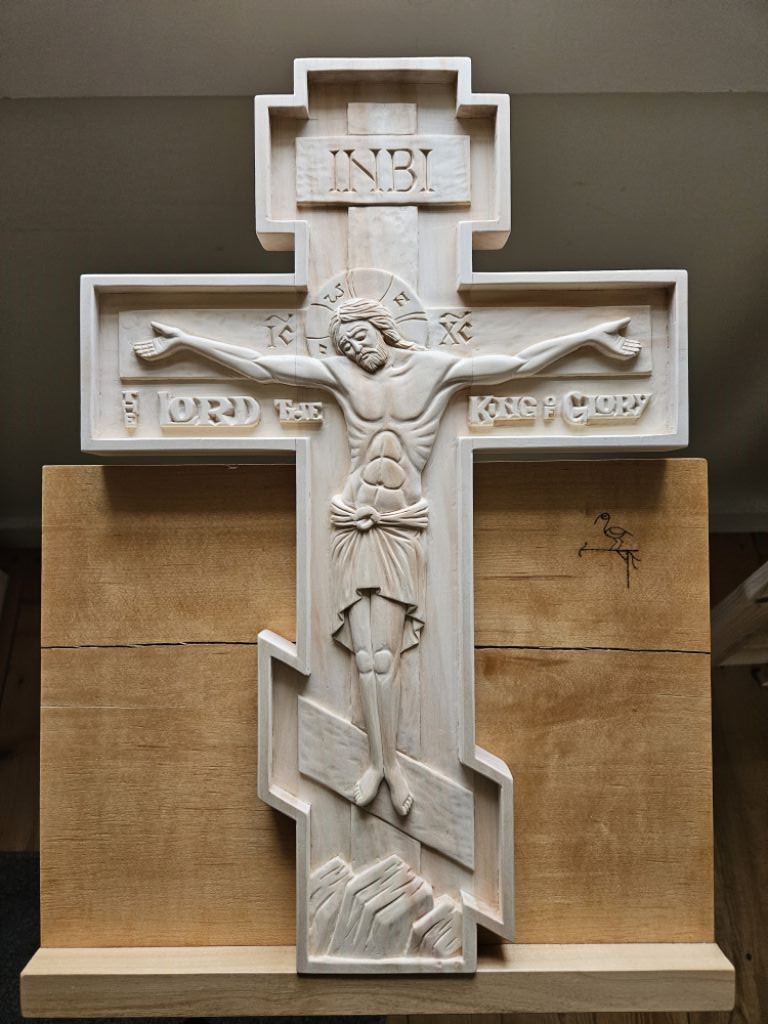
It’s a little mind-boggling, and undoubtedly difficult (if not impossible) for the intellect to grasp. That’s why Eastern theology calls it a “mystery”—something that does not satisfy the mind, but works on another, deeper level, one that can be understood by anyone who has suffered in their own life. For if the man who suffered on Golgotha was God, then the converse is also true: God suffered as a man. God suffered as we do when tragedy, pain, illness and sorrow overcome us. The silence of Jesus on the Cross is our silence in the face of circumstances that defy all reason and explanation.&lt;br /&gt;
&lt;br /&gt;
This is the only ‘answer’ that Christ can offer us in times of suffering: he suffers with us. No rationalizations, explanations, propositions, arguments or theologies can be offered because none exist. Suffering cannot be explained, because suffering just is—the fifth dimension of the universe. In response, all we have is the silence of One who is walks with us through the valley of the shadow of death.&lt;br /&gt;
&lt;br /&gt;
This may not be enough for intellects that crave explanations. But to those who are suffering and mourning at this time, I would ask: what is more comforting for you: a trite ‘reason’ offered by someone who has no idea what you are going through? Or the friend or loved one who says nothing, but simply spreads their arms to embrace and weep with you?&lt;br /&gt;
&lt;br /&gt;
On the Cross, the eternal God spread His arms to embrace the pain and sorrow of this world. It may not be the answer our minds want, but it’s the only one our hearts really need. And it’s the only one we’re going to get.&lt;div class="blogger-post-footer"&gt;&lt;img width='1' height='1' src='https://blogger.googleusercontent.com/tracker/3556576518294497114-398092798653879718?l=www.saintaidan.ca' alt='' /&gt;&lt;/div&gt;
&lt;p&gt;&lt;a href="http://feedads.g.doubleclick.net/~a/Use2rz25l6zjf9jgtBFb3K9RQ-0/0/da"&gt;&lt;img src="http://feedads.g.doubleclick.net/~a/Use2rz25l6zjf9jgtBFb3K9RQ-0/0/di" border="0" ismap="true"&gt;&lt;/img&gt;&lt;/a&gt;&lt;br/&gt;
&lt;a href="http://feedads.g.doubleclick.net/~a/Use2rz25l6zjf9jgtBFb3K9RQ-0/1/da"&gt;&lt;img src="http://feedads.g.doubleclick.net/~a/Use2rz25l6zjf9jgtBFb3K9RQ-0/1/di" border="0" ismap="true"&gt;&lt;/img&gt;&lt;/a&gt;&lt;/p&gt;</description><link>http://www.saintaidan.ca/2011/12/suffering-god.html</link><author>lindisfarne@saintaidan.ca</author><thr:total>0</thr:total></item><item><guid isPermaLink="false">tag:blogger.com,1999:blog-3556576518294497114.post-5693615890104144183</guid><pubDate>Fri, 23 Dec 2011 01:23:00 +0000</pubDate><atom:updated>2011-12-22T18:25:45.087-07:00</atom:updated><category domain="http://www.blogger.com/atom/ns#">Sermons and Articles</category><title>December 25th: A Date With Eternity</title><description>We sometimes hear that December 25th is not originally a Christian holiday. According to this argument, the Emperor Aurelian instituted a pagan holiday celebrating the birth of Sol Invictus, “the Invincible Sun,” in A.D. 274.&lt;br /&gt;
&lt;br /&gt;
In this view, the Christians appropriated this date in an effort to uproot and supplant pagan beliefs with their own. The December 25th date, we are told, is actually nothing more than Christian propaganda, one more example of just how oppressive the Church can be to groups who disagree with them.&lt;br /&gt;
&lt;br /&gt;
A bit more investigation, though, shows this argument to be only skin deep. Most scholars now agree that Christians chose December 25th as Christ’s birthday long before Emperor Aurelian instituted his pagan feast.&lt;br /&gt;
&lt;br /&gt;
According to an ancient Jewish belief (which Christians inherited), a prophet died on the same day as he was conceived. Early Christians, who held that Christ was crucified on March 25th, therefore assumed he was conceived on the same day, when the angel Gabriel announced his birth to the Virgin Mary.&lt;br /&gt;
&lt;br /&gt;
Indeed, both Roman Catholic and Eastern Orthodox churches still celebrate the Annunciation—Jesus’ conception by the Holy Spirit—on March 25th. By ancient logic, then, Jesus would have been born nine months after March 25th, on—you guessed it—December 25th.&lt;br /&gt;
&lt;br /&gt;
But the quarrel over actual dates misses a bigger point. By associating Jesus’ conception and birth with his death, the ancient Christians affirmed something crucial about the good news of Christianity. We find this fundamental truth articulated in one of the Orthodox Christmas hymns:&lt;br /&gt;
&lt;br /&gt;
Today the Virgin comes to the cave&lt;br /&gt;
Where she will give birth to the Eternal Word.&lt;br /&gt;
Hear the glad tidings and rejoice, O universe!&lt;br /&gt;
With the angels and shepherds glorify Him who reveals Himself:&lt;br /&gt;
The eternal God, a little child!&lt;br /&gt;
&lt;br /&gt;
The Nativity of Christ is the beginning of God’s great work among His people, a work completed with His death on the Cross and resurrection on the third day. Taken together, the conception, birth, life, death and resurrection of Christ constitute the very heart of the joyous Christian proclamation: that in Jesus Christ, the eternal God—transcendent, unapproachable and all-powerful—has come to unite Himself to us and so unite us to Himself, freeing us from death and sin, and making us “partakers of divine nature,” (2 Peter 1:4) As St. Athanasius the Great declared most boldly: “God became man, so that man could become God.”&lt;br /&gt;
&lt;br /&gt;
December 25th, then, is not just another example of Christian oppression. It is not just a date to remember a past event. Rather, December 25th is another opportunity bring into the present time the eternal reality of Immanuel: “God with us” from birth to death and resurrection. This Christmas, we can all rejoice in that joy once again, celebrating the moment when God Himself broke into history, in the final act of His mysterious, incomprehensible, infinite love for us.&lt;div class="blogger-post-footer"&gt;&lt;img width='1' height='1' src='https://blogger.googleusercontent.com/tracker/3556576518294497114-5693615890104144183?l=www.saintaidan.ca' alt='' /&gt;&lt;/div&gt;
&lt;p&gt;&lt;a href="http://feedads.g.doubleclick.net/~a/vpJ_UK_EEtfKagE65KOg5PvP_9w/0/da"&gt;&lt;img src="http://feedads.g.doubleclick.net/~a/vpJ_UK_EEtfKagE65KOg5PvP_9w/0/di" border="0" ismap="true"&gt;&lt;/img&gt;&lt;/a&gt;&lt;br/&gt;
&lt;a href="http://feedads.g.doubleclick.net/~a/vpJ_UK_EEtfKagE65KOg5PvP_9w/1/da"&gt;&lt;img src="http://feedads.g.doubleclick.net/~a/vpJ_UK_EEtfKagE65KOg5PvP_9w/1/di" border="0" ismap="true"&gt;&lt;/img&gt;&lt;/a&gt;&lt;/p&gt;</description><link>http://www.saintaidan.ca/2011/12/december-25th-date-with-eternity.html</link><author>lindisfarne@saintaidan.ca</author><thr:total>0</thr:total></item><item><guid isPermaLink="false">tag:blogger.com,1999:blog-3556576518294497114.post-7957245651480052032</guid><pubDate>Sat, 17 Dec 2011 00:39:00 +0000</pubDate><atom:updated>2011-12-16T17:39:54.518-07:00</atom:updated><category domain="http://www.blogger.com/atom/ns#">Sermons and Articles</category><title>Found in Translation</title><description>Several days ago, my wife and I were having a “disagreement” on the subject of Christmas trees. I won’t bore you with the details, except to say that after several minutes of bickering, we came to realize that the source of our enmity lay in our differing understandings of what the phrase “Christmas tree” actually meant.&lt;br /&gt;
&lt;br /&gt;
By this I do not mean that we were fighting about the dictionary definition of “Christmas tree” i.e. a tree of the evergreen variety, traditionally decorated and kept in the house or public places around December 25th.&lt;br /&gt;
&lt;br /&gt;
No, our problem did not lie with the surface meaning of the phrase “Christmas tree,” but rather with its deeper associations.&lt;br /&gt;
&lt;br /&gt;
You see, when my wife thinks of “Christmas tree,” she remembers those special days of childhood and youth when her family would drive out into the woods, cut down a 15 foot Noble fir, bring it home and decorate it to the accompaniment of Christmas carols, hot apple cider and cookies.&lt;br /&gt;
&lt;br /&gt;
By contrast, I am not greatly inspired by Christmas trees. I grew up on the Equator, where evergreens are non-existent. We never even had a real tree, let alone go out to cut one down. Our trees were decorated, but decorating them was just a practical task that someone accomplished at some point before Christmas.&lt;br /&gt;
&lt;br /&gt;
For my beloved Jaime, “Christmas tree” is the embodiment of family, comfort, and joy. When I hear the same words, I think of a necessary object to be acquired and decorated by whatever means is most convenient.&lt;br /&gt;
&lt;br /&gt;
No wonder, then, that my wife and I fought over the importance of Christmas trees. Although we were using the same words, we were actually speaking two different languages. Superficially identical, my wife’s “Christmas tree” and my “Christmas tree” referred to two profoundly different and opposed realities.&lt;br /&gt;
&lt;br /&gt;
If you think about it, this petty domestic squabble points to a core problem in much of human life. How many national, political or social conflicts have erupted when groups use identical words—like “freedom,” “democracy” and “human rights”—in contradictory ways, all the while insisting that their definition is correct?&lt;br /&gt;
&lt;br /&gt;
How often have we traded common words like “family,” “friendship,” or “love,” only to be hurt when others don’t seem to understand us?&lt;br /&gt;
&lt;br /&gt;
As a pastor, I am only too aware of just how loaded are words like “father,” “righteousness,” “God,” “obedience” and “authority” in the lives of those to whom I minister. And as an Eastern Orthodox priest, I am often bemused at western Christian arguments over “faith” versus “works” and “Scripture” versus “tradition”—words that are superficially familiar to me, but whose definitions I do not share.&lt;br /&gt;
&lt;br /&gt;
Whether in the realm of the national, the personal or the spiritual, the problem is the same: translation. People use words and as long as these words appear to mean the same things, they assume that they are communicating.&lt;br /&gt;
&lt;br /&gt;
It just isn’t so.&lt;br /&gt;
&lt;br /&gt;
Like my marital disagreement over Christmas trees, the problem lies in the deeper meanings. If people say, “We are fighting for freedom!” do they mean, “We are fighting so that your people can have the freedom to choose between Nike and Reebok,” or “We are fighting so that our right believing people can be free to worship Allah in a proper manner”?&lt;br /&gt;
&lt;br /&gt;
If someone says, “I love you,” are they referring to a warm and intense emotion that can flicker and fade away in time, or a lifetime commitment to give themselves to another person, regardless of emotions?&lt;br /&gt;
&lt;br /&gt;
If someone says, “We are saved by faith,” are they referring to a crucial moment in which we recognize certain propositions about God and His love in Jesus Christ, or a series of faithful choices, each of which brings us closer or pushes us further away from God? Or is it something in between?&lt;br /&gt;
&lt;br /&gt;
You can see how so many conflicts come to be. Most of us don’t really ask ourselves what someone else means by the words they use. We just see common vocabulary and plough ahead, assuming that our definition is the one the other person is using, or worse yet, that our definition is right and theirs is wrong.&lt;br /&gt;
&lt;br /&gt;
The answer to this pervasive failing in our human character lies in proper translation. By this I don’t mean better or more accurate dictionaries. I mean taking the time to understand what each person really means by the words they use.&lt;br /&gt;
&lt;br /&gt;
As a husband, recognizing my wife’s associations with the phrase “Christmas tree” went a long way to healing the rift between us. As a pastor, recognizing the emotional and spiritual baggage that many people bring to the Church has been crucial to helping them find a true reconciliation with God.&lt;br /&gt;
&lt;br /&gt;
Seeking and discovering these inner meanings takes time. It involves humility, openness and commitment. It is often painful and frustrating. It requires us to gain trust, which is reluctantly given and easily betrayed.&lt;br /&gt;
&lt;br /&gt;
As difficult as this process is, however, it must be undertaken. We must make the effort to fully translate the meanings of each other’s words, spiritually, personally, culturally. If we don’t, we may be doomed to continue talking at without understanding each other, much less achieving anything like unity or agreement.&lt;div class="blogger-post-footer"&gt;&lt;img width='1' height='1' src='https://blogger.googleusercontent.com/tracker/3556576518294497114-7957245651480052032?l=www.saintaidan.ca' alt='' /&gt;&lt;/div&gt;
&lt;p&gt;&lt;a href="http://feedads.g.doubleclick.net/~a/P-IMdXbE1Gf2_TDBcr4EJh_79G0/0/da"&gt;&lt;img src="http://feedads.g.doubleclick.net/~a/P-IMdXbE1Gf2_TDBcr4EJh_79G0/0/di" border="0" ismap="true"&gt;&lt;/img&gt;&lt;/a&gt;&lt;br/&gt;
&lt;a href="http://feedads.g.doubleclick.net/~a/P-IMdXbE1Gf2_TDBcr4EJh_79G0/1/da"&gt;&lt;img src="http://feedads.g.doubleclick.net/~a/P-IMdXbE1Gf2_TDBcr4EJh_79G0/1/di" border="0" ismap="true"&gt;&lt;/img&gt;&lt;/a&gt;&lt;/p&gt;</description><link>http://www.saintaidan.ca/2011/12/found-in-translation.html</link><author>lindisfarne@saintaidan.ca</author><thr:total>0</thr:total></item><item><guid isPermaLink="false">tag:blogger.com,1999:blog-3556576518294497114.post-5932719240818518538</guid><pubDate>Tue, 13 Dec 2011 18:25:00 +0000</pubDate><atom:updated>2011-12-13T11:25:05.242-07:00</atom:updated><category domain="http://www.blogger.com/atom/ns#">Sermons and Articles</category><title>In Honour of Saint Herman of Alaska: The Elder Herman at Sitka</title><description>I&lt;br /&gt;
You returned to the Sitka springs,&lt;br /&gt;
An old man bound with chains to your&lt;br /&gt;
Humility, your eyes speaking&lt;br /&gt;
Only the language of angels.&lt;br /&gt;
Once God drowned you in these waters&lt;br /&gt;
And the dove who became a fish&lt;br /&gt;
Descended deep into your eyes.&lt;br /&gt;
Then you rose and flew away&lt;br /&gt;
Unburdened of your miracles&lt;br /&gt;
And certain that raising the dead&lt;br /&gt;
Was your only obligation--&lt;br /&gt;
And so you returned to the Sitka springs.&lt;br /&gt;
&lt;br /&gt;
  II&lt;br /&gt;
In your thin arms you held a child&lt;br /&gt;
Who would not fly above his life:&lt;br /&gt;
He nailed a dove’s wings to the sun.&lt;br /&gt;
In your thin arms you held a child&lt;br /&gt;
Who forgot the world had ended:&lt;br /&gt;
He buried all the fallen stars.&lt;br /&gt;
In your thin arms you held a child&lt;br /&gt;
Who suffered much from being dead:&lt;br /&gt;
He could not heal the bleeding stones.&lt;br /&gt;
In your thin arms you held a child&lt;br /&gt;
Who could not see a dove descend&lt;br /&gt;
To fill the rivers in his eyes with wings.&lt;br /&gt;
&lt;br /&gt;
  III&lt;br /&gt;
When the angel had veiled himself&lt;br /&gt;
In the clear waters, only you&lt;br /&gt;
Could see where immortality&lt;br /&gt;
Had disturbed them. So, kneeling,&lt;br /&gt;
You bathed us till we were transparent&lt;br /&gt;
And went back to the sacred cave.&lt;br /&gt;
You did not see the dead birds sing&lt;br /&gt;
Nor the stars rise into heaven&lt;br /&gt;
Nor the stones turn into mountains;&lt;br /&gt;
You did not see us look up and see God;&lt;br /&gt;
For your eyes were overwhelmed by&lt;br /&gt;
Visions of more immense simplicity.&lt;div class="blogger-post-footer"&gt;&lt;img width='1' height='1' src='https://blogger.googleusercontent.com/tracker/3556576518294497114-5932719240818518538?l=www.saintaidan.ca' alt='' /&gt;&lt;/div&gt;
&lt;p&gt;&lt;a href="http://feedads.g.doubleclick.net/~a/bXBtAEOn8GHFqScYp3uu0Z91KyI/0/da"&gt;&lt;img src="http://feedads.g.doubleclick.net/~a/bXBtAEOn8GHFqScYp3uu0Z91KyI/0/di" border="0" ismap="true"&gt;&lt;/img&gt;&lt;/a&gt;&lt;br/&gt;
&lt;a href="http://feedads.g.doubleclick.net/~a/bXBtAEOn8GHFqScYp3uu0Z91KyI/1/da"&gt;&lt;img src="http://feedads.g.doubleclick.net/~a/bXBtAEOn8GHFqScYp3uu0Z91KyI/1/di" border="0" ismap="true"&gt;&lt;/img&gt;&lt;/a&gt;&lt;/p&gt;</description><link>http://www.saintaidan.ca/2011/12/in-honour-of-saint-herman-of-alaska.html</link><author>lindisfarne@saintaidan.ca</author><thr:total>0</thr:total></item><item><guid isPermaLink="false">tag:blogger.com,1999:blog-3556576518294497114.post-7510374220338831187</guid><pubDate>Wed, 07 Dec 2011 14:31:00 +0000</pubDate><atom:updated>2011-12-07T07:34:58.992-07:00</atom:updated><category domain="http://www.blogger.com/atom/ns#">Photos</category><title>Saint Nicholas Day Celebration!</title><description>&lt;table style="width:194px;"&gt;&lt;tr&gt;&lt;td align="center" style="height:194px;background:url(https://picasaweb.google.com/s/c/transparent_album_background.gif) no-repeat left"&gt;&lt;a href="https://picasaweb.google.com/saintaidanorthodoxchurch/SaintNicholasDayCelebration?authuser=0&amp;feat=embedwebsite"&gt;&lt;img src="https://lh4.googleusercontent.com/-8AcDxszaJpI/Tt93wZ7UFtE/AAAAAAAACUM/Q26gHmMh0Q4/s160-c/SaintNicholasDayCelebration.jpg" width="160" height="160" style="margin:1px 0 0 4px;"&gt;&lt;/a&gt;&lt;/td&gt;&lt;/tr&gt;&lt;tr&gt;&lt;td style="text-align:center;font-family:arial,sans-serif;font-size:11px"&gt;&lt;a href="https://picasaweb.google.com/saintaidanorthodoxchurch/SaintNicholasDayCelebration?authuser=0&amp;feat=embedwebsite" style="color:#4D4D4D;font-weight:bold;text-decoration:none;"&gt;Saint Nicholas Day Celebration&lt;/a&gt;&lt;/td&gt;&lt;/tr&gt;&lt;/table&gt;&lt;div class="blogger-post-footer"&gt;&lt;img width='1' height='1' src='https://blogger.googleusercontent.com/tracker/3556576518294497114-7510374220338831187?l=www.saintaidan.ca' alt='' /&gt;&lt;/div&gt;
&lt;p&gt;&lt;a href="http://feedads.g.doubleclick.net/~a/xqYabC1_pn_718n0N8XZZBOzHkw/0/da"&gt;&lt;img src="http://feedads.g.doubleclick.net/~a/xqYabC1_pn_718n0N8XZZBOzHkw/0/di" border="0" ismap="true"&gt;&lt;/img&gt;&lt;/a&gt;&lt;br/&gt;
&lt;a href="http://feedads.g.doubleclick.net/~a/xqYabC1_pn_718n0N8XZZBOzHkw/1/da"&gt;&lt;img src="http://feedads.g.doubleclick.net/~a/xqYabC1_pn_718n0N8XZZBOzHkw/1/di" border="0" ismap="true"&gt;&lt;/img&gt;&lt;/a&gt;&lt;/p&gt;</description><link>http://www.saintaidan.ca/2011/12/saint-nicholas-day-celebration.html</link><author>lindisfarne@saintaidan.ca</author><media:thumbnail url="https://lh4.googleusercontent.com/-8AcDxszaJpI/Tt93wZ7UFtE/AAAAAAAACUM/Q26gHmMh0Q4/s72-c/SaintNicholasDayCelebration.jpg" height="72" width="72" /><thr:total>0</thr:total></item><item><guid isPermaLink="false">tag:blogger.com,1999:blog-3556576518294497114.post-8283896759175535958</guid><pubDate>Tue, 06 Dec 2011 20:10:00 +0000</pubDate><atom:updated>2011-12-06T13:10:58.372-07:00</atom:updated><category domain="http://www.blogger.com/atom/ns#">Sermons and Articles</category><title>The Golden Gate Solution</title><description>Did you know that more people commit suicide at the Golden Gate bridge in San Francisco than any other site in the world? While I cannot account for the many reasons behind this statistic, I would  suggest that the Golden Gate may well be the final destination for those who have been unable to find peace in other places.&lt;br /&gt;
&lt;br /&gt;
The story could go something like this: one morning, you wake up in your home town—let's say it's New York. You are unhappy with life and have been for a while. This morning, however, you come to a realization: New York is to blame for your problems. The city is too big, with too many people who are unfriendly and hostile.&lt;br /&gt;
&lt;br /&gt;
After thinking about it, you decide to move to, say the Midwest. A country lifestyle will be a change, a fresh start. So you pick up, say goodbye to your life in New York, and move to Kansas. For the first year or so, it's heaven: open skies, open spaces, open and friendly people. Then unhappiness starts to creep in again. The life you have chosen is dull. You don't like the weather. The people are getting less friendly by the day...&lt;br /&gt;
&lt;br /&gt;
One morning, you wake up, still unhappy, and decide that Kansas is to blame for your problems. Perhaps it's time for a move, say to California. It's sunny and warm there. You hear that the people are fun-loving and open-minded, quite unlike the residents of Kansas. So you pack up, say goodbye, and relocate to San Francisco.&lt;br /&gt;
&lt;br /&gt;
Can you guess what happens next? After a time, the unhappiness returns, but tragically, there is no place left to blame. You're in San Francisco, one of the most beautiful cities in the world. You're in California, where it's almost always sunny and warm. You're on the Pacific ocean, with nature's beauty on full display. If you can't be happy here, where can you be happy? If you can't find peace here on the West coast, where else can you go?&lt;br /&gt;
&lt;br /&gt;
My flippant answer is, right off the Golden Gate bridge.&lt;br /&gt;
&lt;br /&gt;
Whether this account reflects an actual sociological process or not is irrelevant. I believe that it speaks of a very real spiritual process, which I frequently witness as a pastor. When life becomes a struggle, we too easily look to other places, people, and circumstances that we believe will ease the pain in our hearts. It's the Golden Gate solution, also known as the geographical solution. A better life, a fresh start, always exists somewhere else.&lt;br /&gt;
&lt;br /&gt;
The problem with the Golden Gate solution is that it doesn't work, at least not for very long. Once the superficial pleasures of new-found relationships wear off, we discover that people are essentially the same wherever we find them. If they caused us difficulties in New York, they will probably cause us similar difficulties in San Francisco, simply because they are human beings. Can we really blame our problems on the rest of humanity? Furthermore, if we find ourselves just as unhappy in the sunshine and surf of California as we were in the snow and wind of Kansas, can we really blame our unhappiness on weather and geography?&lt;br /&gt;
&lt;br /&gt;
The reality is, our problems don't lie 'out there,' but within our hearts, in our own fears, resentments and desires. To quote the poet John Milton, “Me miserable! Which way shall I fly / Infinite wrath, and infinite despair? / Which way I fly is Hell; myself am Hell.” The Big Book of AA puts it in more basically: “I need to concentrate not so much on what needs to be changed in the world as on what needs to be changed in me and in my attitudes.”&lt;br /&gt;
&lt;br /&gt;
No truer words have ever been set down on paper.&lt;br /&gt;
&lt;br /&gt;
Apart from not working, the Golden Gate solution has another, more dangerous effect: it confines us to the shallow end of the spiritual pool. Jesus' two fundamental commands are love God and love your neighbour. In the Christian understanding, this love has nothing to do with warm fuzzy feelings and everything to do with action—sacrificing one's time, energy and material resources to secure the life of another human being, preferably one who is a stranger. That effort will cost us; it will be painful, stressful and unimaginably difficult.&lt;br /&gt;
&lt;br /&gt;
If, however, we keep on uprooting and moving elsewhere whenever we face this challenging test of love, we can never really know the meaning of Jesus' command, let alone follow it with any real consistency. When we live in continual movement, engaging in relationships that don't have an opportunity to deepen and grow, we are deprived of the opportunity to truly love others and ultimately, to truly know the love of God Himself.&lt;br /&gt;
&lt;br /&gt;
Saint Anthony the Great once said, “Whoever you may be, always have God before your eyes, whatever you do, do it according to the testimony of the holy Scriptures; in whatever place you live, do not easily leave it. Keep these three precepts and you will be saved.”&lt;br /&gt;
&lt;br /&gt;
Anthony's words are simplicity itself, but they require us to be steadfastly courageous. We must have the courage to reject the temptations of the Golden Gate solution and stand our ground, whether it is in New York or San Francisco or Cranbrook, so that we can find God in the most rewarding territory of all: our own hearts. As the Elder Makarios put it: "Within the heart are unfathomable depths. It is but a small vessel and yet dragons and lions are there, and there poisonous creatures and all the treasures of wickedness; rough, uneven paths are there, and gaping chasms.  There likewise is God, there are the angels, there life and the Kingdom, there light and the Apostles, the heavenly cities and the treasures of grace; all things are there.”&lt;div class="blogger-post-footer"&gt;&lt;img width='1' height='1' src='https://blogger.googleusercontent.com/tracker/3556576518294497114-8283896759175535958?l=www.saintaidan.ca' alt='' /&gt;&lt;/div&gt;
&lt;p&gt;&lt;a href="http://feedads.g.doubleclick.net/~a/gi5BcQXHZZQbWIfTe0d4tOhGfpo/0/da"&gt;&lt;img src="http://feedads.g.doubleclick.net/~a/gi5BcQXHZZQbWIfTe0d4tOhGfpo/0/di" border="0" ismap="true"&gt;&lt;/img&gt;&lt;/a&gt;&lt;br/&gt;
&lt;a href="http://feedads.g.doubleclick.net/~a/gi5BcQXHZZQbWIfTe0d4tOhGfpo/1/da"&gt;&lt;img src="http://feedads.g.doubleclick.net/~a/gi5BcQXHZZQbWIfTe0d4tOhGfpo/1/di" border="0" ismap="true"&gt;&lt;/img&gt;&lt;/a&gt;&lt;/p&gt;</description><link>http://www.saintaidan.ca/2011/12/golden-gate-solution.html</link><author>lindisfarne@saintaidan.ca</author><thr:total>0</thr:total></item><item><guid isPermaLink="false">tag:blogger.com,1999:blog-3556576518294497114.post-769747635883770583</guid><pubDate>Sun, 04 Dec 2011 20:47:00 +0000</pubDate><atom:updated>2011-12-04T13:47:17.603-07:00</atom:updated><category domain="http://www.blogger.com/atom/ns#">Photos</category><title>Today's Church School Project: Restores, Renews, Resurrects!</title><description>&lt;div class="separator" style="clear: both; text-align: center;"&gt;&lt;a href="http://2.bp.blogspot.com/-5GWKdAynl34/TtvcKftk5WI/AAAAAAAAAmw/DX9O8nDXmRE/s1600/IMG_2861.JPG" imageanchor="1"&gt;&lt;img border="0" height="400" src="http://2.bp.blogspot.com/-5GWKdAynl34/TtvcKftk5WI/AAAAAAAAAmw/DX9O8nDXmRE/s1600/IMG_2861.JPG" width="300" /&gt;&lt;/a&gt;&lt;/div&gt;&lt;div class="blogger-post-footer"&gt;&lt;img width='1' height='1' src='https://blogger.googleusercontent.com/tracker/3556576518294497114-769747635883770583?l=www.saintaidan.ca' alt='' /&gt;&lt;/div&gt;
&lt;p&gt;&lt;a href="http://feedads.g.doubleclick.net/~a/-tHfNQKHwhlmbikIzd81xUa4jVs/0/da"&gt;&lt;img src="http://feedads.g.doubleclick.net/~a/-tHfNQKHwhlmbikIzd81xUa4jVs/0/di" border="0" ismap="true"&gt;&lt;/img&gt;&lt;/a&gt;&lt;br/&gt;
&lt;a href="http://feedads.g.doubleclick.net/~a/-tHfNQKHwhlmbikIzd81xUa4jVs/1/da"&gt;&lt;img src="http://feedads.g.doubleclick.net/~a/-tHfNQKHwhlmbikIzd81xUa4jVs/1/di" border="0" ismap="true"&gt;&lt;/img&gt;&lt;/a&gt;&lt;/p&gt;</description><link>http://www.saintaidan.ca/2011/12/todays-church-school-project-restores.html</link><author>lindisfarne@saintaidan.ca</author><media:thumbnail url="http://2.bp.blogspot.com/-5GWKdAynl34/TtvcKftk5WI/AAAAAAAAAmw/DX9O8nDXmRE/s72-c/IMG_2861.JPG" height="72" width="72" /><thr:total>0</thr:total></item><item><guid isPermaLink="false">tag:blogger.com,1999:blog-3556576518294497114.post-5230102134971393454</guid><pubDate>Tue, 29 Nov 2011 17:40:00 +0000</pubDate><atom:updated>2011-11-29T10:47:17.345-07:00</atom:updated><title>Saint Aidan's Mission: A Look Back at 2011</title><description>&lt;embed type="application/x-shockwave-flash" src="https://picasaweb.google.com/s/c/bin/slideshow.swf" flashvars="host=picasaweb.google.com&amp;amp;hl=en_US&amp;amp;feat=flashalbum&amp;amp;RGB=0x000000&amp;amp;feed=https%3A%2F%2Fpicasaweb.google.com%2Fdata%2Ffeed%2Fapi%2Fuser%2Fsaintaidanorthodoxchurch%2Falbumid%2F5680468442346119345%3Falt%3Drss%26kind%3Dphoto%26hl%3Den_US" pluginspage="http://www.macromedia.com/go/getflashplayer" height="192" width="288"&gt;&lt;/embed&gt;&lt;br /&gt;&lt;br /&gt;&lt;br /&gt;&lt;div style="text-align: center;"&gt;&lt;span style="font-weight: bold;"&gt;A Vision for 2012&lt;/span&gt;&lt;br /&gt;&lt;/div&gt;&lt;ul&gt;&lt;li&gt;Our young people will be more involved in our worship: holding candles during the readings, serving in the altar, and singing in the choir&lt;/li&gt;&lt;li&gt;Our young people will have weekly opportunities to ask questions about their faith, and monthly opportunities to build lifelong bonds of friendship&lt;/li&gt;&lt;li&gt;Every member of Saint Aidan's will host at least one community event in their home in the coming year&lt;/li&gt;&lt;li&gt;Every member of Saint Aidan's will be more intentional in inviting friends, family, co-workers and neigbours to come to Church&lt;/li&gt;&lt;/ul&gt;&lt;div style="text-align: center;"&gt;&lt;span style="font-weight: bold;"&gt;How Can You Help?&lt;/span&gt;&lt;br /&gt;&lt;/div&gt;&lt;ul&gt;&lt;li&gt;First, pray for us as we continue to the only Orthodox presence in the Kootenays.&lt;/li&gt;&lt;li&gt;Second, come and visit. We would love to have you! Find us &lt;a href="http://www.saintaidan.ca/p/times-location.html"&gt;here&lt;/a&gt;.&lt;br /&gt;&lt;/li&gt;&lt;li&gt;Third, support our ministry by donating &lt;a href="https://www.paypal.com/ca/cgi-bin/webscr?cmd=_flow&amp;amp;SESSION=5DCDLiTXcSkIE4rfttQgQhFUYLpxh4Rld1gvnDG6JJKdWjCKMXRya82pvMa&amp;amp;dispatch=5885d80a13c0db1f8e263663d3faee8db2b24f7b84f1819343fd6c338b1d9d60"&gt;here&lt;/a&gt;&lt;br /&gt;&lt;/li&gt;&lt;/ul&gt;&lt;br /&gt;&lt;div style="text-align: center;"&gt;&lt;span style="font-weight: bold;"&gt;For More Information&lt;/span&gt;&lt;br /&gt;&lt;/div&gt;&lt;div style="text-align: center;"&gt;Call Fr. Richard Rene at (250) 426-4188&lt;br /&gt;Email lindisfarne@saintaidan.ca&lt;/div&gt;&lt;div class="blogger-post-footer"&gt;&lt;img width='1' height='1' src='https://blogger.googleusercontent.com/tracker/3556576518294497114-5230102134971393454?l=www.saintaidan.ca' alt='' /&gt;&lt;/div&gt;
&lt;p&gt;&lt;a href="http://feedads.g.doubleclick.net/~a/UiFxqODR8T8mYWXsnQVbxSniDVA/0/da"&gt;&lt;img src="http://feedads.g.doubleclick.net/~a/UiFxqODR8T8mYWXsnQVbxSniDVA/0/di" border="0" ismap="true"&gt;&lt;/img&gt;&lt;/a&gt;&lt;br/&gt;
&lt;a href="http://feedads.g.doubleclick.net/~a/UiFxqODR8T8mYWXsnQVbxSniDVA/1/da"&gt;&lt;img src="http://feedads.g.doubleclick.net/~a/UiFxqODR8T8mYWXsnQVbxSniDVA/1/di" border="0" ismap="true"&gt;&lt;/img&gt;&lt;/a&gt;&lt;/p&gt;</description><link>http://www.saintaidan.ca/2011/11/saint-aidans-mission-look-back-at-2011.html</link><author>lindisfarne@saintaidan.ca</author><thr:total>1</thr:total></item><item><guid isPermaLink="false">tag:blogger.com,1999:blog-3556576518294497114.post-411122573719520353</guid><pubDate>Fri, 25 Nov 2011 21:02:00 +0000</pubDate><atom:updated>2011-11-25T14:02:09.575-07:00</atom:updated><category domain="http://www.blogger.com/atom/ns#">Sermons and Articles</category><title>Corner Gas and the Need to Belong</title><description>My favourite TV show of all time is Corner Gas, that much beloved Canadian sitcom that entertained us for six seasons with the ordinary yet hilarious lives of the residents of Dog River, Sasketchewan. No matter how many time I watch the episodes (I have lost count by now), I am always delighted at the show's witty dialogue, uproarious situations, and eccentric characters. There's something comforting about Corner Gas, like going back to your parent's home after years of being away, and finding that your old room is just as you left it.&lt;br /&gt;
&lt;br /&gt;
Perhaps because theology is my stock in trade, I am always looking for a spiritual source for my joy and satisfaction in the details of earthly life. My pleasure in Corner Gas is no different. What is it about the lives of these normal people in a small Sasketchewan town that I find so... beautiful? What makes that ordinariness so wonderful?&lt;br /&gt;
&lt;br /&gt;
A piece of dialogue from the first season of the show offers some insight. In the introductory scene, one of the main characters, Wanda Dollard, is sitting at the counter of the gas station where she works. Because this is a small town in the middle of nowhere, she doesn't have much to do, and so she is reading, not a magazine, but a textbook.&lt;br /&gt;
&lt;br /&gt;
A customer enters and the following dialogue takes place:&lt;br /&gt;
Customer: What's that, quantum physics?&lt;br /&gt;
Wanda: Yeah, I've always been fascinated that light could be a particle and a wave. I was gonna study it in college, but then I got interested in biochemistry. And then on a whim settled on liguistics with a minor in comparative religion.&lt;br /&gt;
Customer: Wow, how'd you end up in a place like this?&lt;br /&gt;
Wanda Dollard: The last girl quit, can you believe it?&lt;br /&gt;
&lt;br /&gt;
While some of the humour of this exchange is lost without the nuance that good actors can deliver, the inner irony of the joke is evident in the writing. Of all the career heights Wanda could scale, the work she most wants to be doing is that of a CSR at a rather dull and dingy gas station in a town of a 100 odd people in the middle of the prairies.&lt;br /&gt;
&lt;br /&gt;
Dog River is a place in which nothing happens. It's boring and dull. No one in the outside world knows or cares all that much about it. It is not the centre of anything. And yet, for all that, the people of Dog River are not only content to live there, they wouldn't live anywhere else! What makes the show truly funny with repeated viewings is in the characters' irrepressible conviction that this nothing little town is really the best of all possible worlds.&lt;br /&gt;
&lt;br /&gt;
Of course, Dog River is an idealized vision that finds predecessors in other fictional Canadian small towns, such as Leacock's Mariposa from &lt;i&gt;Sunshine Sketches of a Little Town&lt;/i&gt;. At the heart of the vision, though, lies a universal human need that far exceeds the need to discover, acquire, achieve or succeed: the need to belong.&lt;br /&gt;
&lt;br /&gt;
Jean Vanier, the founder of L'Arche, once said that the human need to belong is greater than the need to be loved. It's a bold claim, but one that bears itself out in observation. Consider how many battered spouses endure their marriages simply because they cannot imagine belonging anywhere else. Consider how many young people join gangs or popular groups, not because they are well treated, but because they feel at home with those people.&lt;br /&gt;
&lt;br /&gt;
In fact, the need to belong is ultimately spiritual in nature. Our inner drive to find our own versions of Dog River—places, relationships, communities in which we can find total acceptance and peace—derive from a deeper desire to find our hearts' true home in God Himself. St. Augustine famously said, “Almighty God, you have made us for Yourself, and our hearts are restless till they find their rest in You.”&lt;br /&gt;
&lt;br /&gt;
When this yearning for our home in God is not met, we seek all kinds of substitutes. We may endure abusive relationships and gravitate towards cults and sects. Many of us are already inclined to find solace in virtual pseudo-communities like Facebook. Or we may strive through social and political action to realize the Dog River ideal of belonging in our own neighborhoods and towns. But unless we find the real Source of our yearning for home in our Creator, our fundamental loneliness and restlessness will continue to consume us.&lt;br /&gt;
&lt;br /&gt;
The Gospel offers us the way back to true belonging. The life, death and resurrection of Jesus Christ was not merely an exercise in legal-spiritual debt management. More than just dying in our stead, Jesus died in our place—that is, He died just as we do—so that He could bring us back home to God. With the Cross and the Resurrection, we are no longer far from God, restlessly seeking our belonging in Him. Rather, He has put His Kingdom within us (Luke 17:21) and single-handedly brought us back to where we belong in His Presence.&lt;br /&gt;
&lt;br /&gt;
Our challenge is to give up our restless search for belonging in the many substitutes that cannot and do not satisfy, and to realize that in Christ, we truly belong, which means simply that in Him, we are loved, accepted, embraced without reservation. In Him, we are at home, once and for all. Our only task—the task for the rest of our lifetimes—is to accept the fact and live accordingly.&lt;div class="blogger-post-footer"&gt;&lt;img width='1' height='1' src='https://blogger.googleusercontent.com/tracker/3556576518294497114-411122573719520353?l=www.saintaidan.ca' alt='' /&gt;&lt;/div&gt;
&lt;p&gt;&lt;a href="http://feedads.g.doubleclick.net/~a/znEBFqjxYIB8xamiWuiL_8H9h6I/0/da"&gt;&lt;img src="http://feedads.g.doubleclick.net/~a/znEBFqjxYIB8xamiWuiL_8H9h6I/0/di" border="0" ismap="true"&gt;&lt;/img&gt;&lt;/a&gt;&lt;br/&gt;
&lt;a href="http://feedads.g.doubleclick.net/~a/znEBFqjxYIB8xamiWuiL_8H9h6I/1/da"&gt;&lt;img src="http://feedads.g.doubleclick.net/~a/znEBFqjxYIB8xamiWuiL_8H9h6I/1/di" border="0" ismap="true"&gt;&lt;/img&gt;&lt;/a&gt;&lt;/p&gt;</description><link>http://www.saintaidan.ca/2011/11/corner-gas-and-need-to-belong.html</link><author>lindisfarne@saintaidan.ca</author><thr:total>0</thr:total></item><item><guid isPermaLink="false">tag:blogger.com,1999:blog-3556576518294497114.post-303019608974087201</guid><pubDate>Fri, 18 Nov 2011 21:58:00 +0000</pubDate><atom:updated>2011-11-18T14:58:42.404-07:00</atom:updated><category domain="http://www.blogger.com/atom/ns#">Sermons and Articles</category><title>The Final Frontier</title><description>“Space: the final frontier. These are the voyages of the starship Enterprise. Her five-year mission: to explore strange new worlds, to seek out new life and new civilizations, to boldly go where no man has gone before.”&lt;br /&gt;
&lt;br /&gt;
The opening monologue from the original Star Trek television series expresses a fundamental impulse in the human spirit: the need to explore, to open up new frontiers, to discover new realities and experiences.&lt;br /&gt;
&lt;br /&gt;
Our minds and hearts follow Neil Armstrong to the moon, Ferdinand Magellan around the world, Christopher Columbus onto the shores of the Americas, and Sir Edmund Hillary to the peak of Mount Everest. And as if that were not enough, we imagine Bilbo and Frodo Baggins crossing Middle Earth to fight dragons and destroy an evil Ring, young heroes and heroines questing for Aslan in the land of Narnia, Odysseus returning home to reunite with his wife and bring order to his household.&lt;br /&gt;
&lt;br /&gt;
We long for accounts of adventures to realms unknown, where dangers abound and death is imminent, where a heart courageous and true might save the world, or least, find a great treasure and rescue a captive princess…&lt;br /&gt;
&lt;br /&gt;
For most of us, though, the opportunities to “boldly go where no man has gone before” are somewhat limited. Most of us live in relative safety and comfort, with little effort required to stay fed, sheltered, and healthy. Few of us feel as if we have to accomplish some great task on which the survival of our world depends. This, in my opinion, is why we live these stories vicariously through movies and fantasy novels, or hang breathlessly on the most recent real life attempts to rescue trapped miners in Chile…&lt;br /&gt;
&lt;br /&gt;
And yet the need to pioneer, explore, and adventure continues to cry out within us, even as we resign ourselves to a 21st century existence whose only excitement seems to be found on the screen of a television or a computer. A part of us knows this can’t be all there is. There must be a real “final frontier” somewhere out there…&lt;br /&gt;
&lt;br /&gt;
That’s the problem, though. The answer to our deepest need to explore and pioneer does not lie “out there”—in ever wilder fantasies of literature and film, or ever more extreme and dangerous “real life” crises and disasters. Our questing spirits cannot be satisfied by escaping into other people’s experiences or creations. Satisfaction must be found not “out there,” but “in here,” by which I mean in each and every human heart.&lt;br /&gt;
&lt;br /&gt;
For twenty centuries, teachers of classical Christianity have understood the heart to be the centre of the spiritual life. In this, they were not thinking of the heart as representing the kinds of emotions depicted on greeting cards and carved on tree trunks. Rather, the early Fathers believed that the heart is the meeting place of the intellect and the bodily senses. One writer, Chariton, put it this way: "The heart is the innermost man or spirit.  Here are located self-awareness, the conscience, the idea of God and one's complete dependence on Him, and all the eternal treasures of the spiritual life."&lt;br /&gt;
&lt;br /&gt;
Nor were these teachers speaking of the heart as a mere symbol. As Theophan the Recluse says, “Prayer of the heart is not only prayer of the soul and spirit but also of the body.  It must not be forgotten that the heart signifies, among other things, a bodily organ.  The body has a positive role to play in the work of prayer.”&lt;br /&gt;
&lt;br /&gt;
The heart, then, is not just an idea or a symbol; it is a real place where the work of the spiritual life takes place. Indeed, the quintessential Eastern Orthodox way of prayer known as “the Way of Inner Stillness” begins by asking us to sit, close our eyes, lower our heads, and then to pray with all our attention in our physicals hearts.&lt;br /&gt;
&lt;br /&gt;
What has this got to do with the human need to explore the frontiers of our world? An Egyptian hermit called Macarius offers an answer: “Within the heart are unfathomable depths. It is but a small vessel and yet dragons and lions are there, and there poisonous creatures and all the treasures of wickedness; rough, uneven paths are there, and gaping chasms.  There likewise is God, there are the angels, there life and the Kingdom, there light and the Apostles, the heavenly cities and the treasures of grace; all things are there."&lt;br /&gt;
&lt;br /&gt;
In short, I disagree with the writers of Star Trek: space is not the final frontier. Nothing “out there” is the final frontier. Only the heart is the final frontier. Only here can we find the one place where “no man has gone before” except us.&lt;br /&gt;
&lt;br /&gt;
We spend hours journeying with others through the virtual and imaginary realms. Now is the time for a real adventure. Now is the time for a quest that is truly our own, one that will outdo the dangers and rewards of most daring explorations of mountains, oceans, galaxies, or any world the imagination can create.&lt;br /&gt;
&lt;br /&gt;
How can you embark on this journey? It’s very simple and inexpensive. First, clear some time in your day; it doesn’t need to be very much time—ten minutes is all you will ever need. Next, sit down in a secluded spot. Lower your head and focus your attention on the place of your heart. Finally, quietly and repeatedly call upon the Name of God, which in the Eastern Orthodox tradition is the Name of Jesus Christ.&lt;br /&gt;
&lt;br /&gt;
And that’s it. Your quest has begun. May you find the treasure, rescue the princess, kill the dragon, destroy the evil Ring, meet the Great Lion, and return home safely. God speed—the survival of your world depends on you.&lt;div class="blogger-post-footer"&gt;&lt;img width='1' height='1' src='https://blogger.googleusercontent.com/tracker/3556576518294497114-303019608974087201?l=www.saintaidan.ca' alt='' /&gt;&lt;/div&gt;
&lt;p&gt;&lt;a href="http://feedads.g.doubleclick.net/~a/umW0m3EbvPzHJ-bvzOGsI7D1QfM/0/da"&gt;&lt;img src="http://feedads.g.doubleclick.net/~a/umW0m3EbvPzHJ-bvzOGsI7D1QfM/0/di" border="0" ismap="true"&gt;&lt;/img&gt;&lt;/a&gt;&lt;br/&gt;
&lt;a href="http://feedads.g.doubleclick.net/~a/umW0m3EbvPzHJ-bvzOGsI7D1QfM/1/da"&gt;&lt;img src="http://feedads.g.doubleclick.net/~a/umW0m3EbvPzHJ-bvzOGsI7D1QfM/1/di" border="0" ismap="true"&gt;&lt;/img&gt;&lt;/a&gt;&lt;/p&gt;</description><link>http://www.saintaidan.ca/2011/11/final-frontier.html</link><author>lindisfarne@saintaidan.ca</author><thr:total>0</thr:total></item><item><guid isPermaLink="false">tag:blogger.com,1999:blog-3556576518294497114.post-8287110858878373703</guid><pubDate>Tue, 15 Nov 2011 14:54:00 +0000</pubDate><atom:updated>2011-11-15T07:54:04.894-07:00</atom:updated><category domain="http://www.blogger.com/atom/ns#">Sermons and Articles</category><title>Leading with Your Weakness</title><description>When I first learned how to prepare an effective resume, someone offered me a piece of worldly advice: “Lead with your strengths.” This often meant “massaging” my skills to match the given job requirements. If, for example, I had lots of time on my hands, I was “very flexible.” If I liked to socialize, I had “great interpersonal skills.” If, on the other hand, I was lacking in some area, the common wisdom urged me not mention it. Tardiness, sloppiness, the tendency to dip into the till—these qualities did not look good on a resume.&lt;br /&gt;
&lt;br /&gt;
Lead with your strengths, conceal your weaknesses. The world lives by this adage. When someone asks, “How’s it going?” is there any response except, “Fine, thanks”? Try a different answer—the real answer—and watch the discomfort and perhaps even downright annoyance. For the world, we always have to be “Fine, thanks,” whatever may really be going on inside.&lt;br /&gt;
&lt;br /&gt;
Our spiritual lives often fall prey to the same temptation. Have you ever heard of the “church face”? It’s the face you put on only Sundays. It’s the spiritual face, the pious face, the face of someone who rarely falls into sins, who never has a doubt and who is always “happy with Jesus.” God help us if we forget to put that face on, and come to church with our doubts and fears, our alienation from God and our coldness of heart, all hanging out… Try it some time and observe the unmistakable sense from your fellow churchgoers that something vaguely unpleasant is in the air, like bad spiritual gas…&lt;br /&gt;
&lt;br /&gt;
Saint Paul offers us the radical Christian answer to this worldly culture of leading with strength. He says, “God chose what is foolish in the world to shame the wise, God chose what is weak in the world to shame the strong, God chose what is low and despised in the world, even things that are not, to bring to nothing things that are, so that no human being might boast in the presence of God.” (1 Corinthians 1:28-29)&lt;br /&gt;
&lt;br /&gt;
The heart of the Gospel proclamation is a paradoxical but powerful reality: the all-powerful God revealed Himself in all the folly, weakness, lowness and despicability to which human life can descend. Nothing could be lower for pious Jew of the first century than suffer the death of criminal and a heretic at the hands of gentiles. This, however, was precisely the fate that God chose in order to show who He is and the measure of His love for us. To put it simply: God led with His weakness on the Cross.&lt;br /&gt;
&lt;br /&gt;
An early Christian story tells of some young monks went to visit Saint Anthony, the founder of monasticism. To test them, Anthony approached each with various texts of scripture, asking what they meant. Each of the monks, wanting to lead with his strength, offered his best interpretation, and to each Anthony said, “You have not found the right answer.” Finally, he approached a monk named Joseph and asked him to interpret. The monk replied, “I do not know,” and Anthony said: “Joseph has found the right answer because he said he does not know.”&lt;br /&gt;
&lt;br /&gt;
Saint Anthony was not saying that the scriptures could not be interpreted correctly, but that more important than a correct interpretation was a recognition that we don’t have all the answers, that our so-called strengths are limited at best and illusory at worst.&lt;br /&gt;
&lt;br /&gt;
So while the world continues to beat the drum of strength, we need not be afraid to live our lives in the key of “I don’t know,” because that is the truth. I don’t have all the answers. I am just a weak and uncertain human being. And that’s actually a good thing because in Christ all human frailty has become the very means to access the life of God. Those who work 12-Step programs already understand that admission of powerlessness is the key to finding the Higher Power. For everyone else, living as the weak and broken human beings we really are is not only the only honest and true way to go, it’s the only way to find God.&lt;div class="blogger-post-footer"&gt;&lt;img width='1' height='1' src='https://blogger.googleusercontent.com/tracker/3556576518294497114-8287110858878373703?l=www.saintaidan.ca' alt='' /&gt;&lt;/div&gt;
&lt;p&gt;&lt;a href="http://feedads.g.doubleclick.net/~a/rR7Y5B_fQKciWQDezu3LOgLhxgo/0/da"&gt;&lt;img src="http://feedads.g.doubleclick.net/~a/rR7Y5B_fQKciWQDezu3LOgLhxgo/0/di" border="0" ismap="true"&gt;&lt;/img&gt;&lt;/a&gt;&lt;br/&gt;
&lt;a href="http://feedads.g.doubleclick.net/~a/rR7Y5B_fQKciWQDezu3LOgLhxgo/1/da"&gt;&lt;img src="http://feedads.g.doubleclick.net/~a/rR7Y5B_fQKciWQDezu3LOgLhxgo/1/di" border="0" ismap="true"&gt;&lt;/img&gt;&lt;/a&gt;&lt;/p&gt;</description><link>http://www.saintaidan.ca/2011/11/leading-with-your-weakness.html</link><author>lindisfarne@saintaidan.ca</author><thr:total>0</thr:total></item><item><guid isPermaLink="false">tag:blogger.com,1999:blog-3556576518294497114.post-3033349043274353754</guid><pubDate>Tue, 08 Nov 2011 14:25:00 +0000</pubDate><atom:updated>2011-11-08T07:25:09.732-07:00</atom:updated><category domain="http://www.blogger.com/atom/ns#">Sermons and Articles</category><title>Keyholes in Church History, Part 9: Schism</title><description>When I introduce myself as an Orthodox Christian, the most common response is “Orthodox what?” The second most common response is “Orthodox? That’s like Catholic, right?”&lt;br /&gt;
&lt;br /&gt;
What’s the difference between Eastern Orthodoxy and Roman Catholicism? Like so many other questions I have explored in this series, the answer is a matter of history. In 1054 A.D., a papal delegate, Cardinal Humbert, arrived in Constantinople from Rome to excommunicate the Patriarch of Constantinople and the entire Eastern Orthodox Church. Known as “the Great Schism,” this date marks the official split between the two churches, which has not yet been healed.&lt;br /&gt;
&lt;br /&gt;
How did it comes to this? Flash back six hundred years or more, to a period when no real distinction could be made between “Roman Catholic” and “Orthodox.” There was only the Church made of dioceses in urban centres throughout the Empire, each headed by a bishop who governed, along with his presbyters and deacons. &lt;br /&gt;
&lt;br /&gt;
Bishops who ruled the largest cities (like Alexandria and Constantinople), or centres of spiritual distinction (like Rome, Jerusalem and Antioch), took on a special prominence. Among these, Rome was preeminent. Both Saints Peter and Paul had been martyred there, and Saint Peter was Rome’s first bishop. In addition, Roman Christians had a reputation for solid theology. The opinion of the bishop of Rome (also known as the Pope, which means literally “Papa”) was highly regarded, and in matters of dispute, Rome regularly offered wise and godly arbitration.&lt;br /&gt;
&lt;br /&gt;
Despite his moral authority, however, the Pope did not interfere (at least in the early days) in the jurisdictions of other bishops. They often sought his opinion, but they did not need his approval to make decisions within their own dioceses. In fact, all bishops were equal by virtue of their consecration, whether they ruled prestigious urban centres or small cow towns. The governance of the Church was not the prerogative of a single individual, but of all the bishops, who acted in council with the approval of the laity.&lt;br /&gt;
&lt;br /&gt;
Then Germanic tribes invaded from the north, cutting off western Europe (which happened to be the diocese of the bishop of Rome) from the rest of the Empire, including all the remaining dioceses (Alexandria, Constantinople, Jerusalem and Antioch among them). Communication between East and West virtually ceased.&lt;br /&gt;
&lt;br /&gt;
Now in isolation, the western half of the Church faced unique problems. When Germanic converts to Christianity fell into Arianism (a heresy that denied the full equal divinity of Jesus with God the Father), Spanish theologians proposed an addition to the 4th century Nicene Creed. Where the original version said that the Holy Spirit “proceeded from the Father,” the revised version stated that the Holy Spirit “proceeded from the Father and the Son.” By adding this clause (known as filioque), the theologians hoped to equate the authority of Jesus with God the Father, and refute the Arians.&lt;br /&gt;
&lt;br /&gt;
Another unique western controversy centred around investiture. According to custom, a newly-consecrated bishop would received his staff and ring from the local lord on whose land the diocese was located. This “lay investiture” was in effect the state’s approval of Church authority. However, because Germanic legal traditions gave the lord possession over anything on his land, the lords felt that they could invest only those bishops they preferred, like their relatives or political favourites...&lt;br /&gt;
&lt;br /&gt;
In reaction to these nepotistic abuses, the Pope asserted his supreme jurisdictional authority over the Church, including all Church appointments, quite separate from state approval. Anyone who disagreed would be excommunicated.&lt;br /&gt;
&lt;br /&gt;
Remember, these controversies and their solutions took place in the West, completely isolated from the East, which faced its own difficulties and conflicts (such as the Iconoclasm, as discussed in a previous article). In fact, neither side of the Empire had any real sense of what was happening in the other, and only when western Europe emerged from its Dark Ages into some semblance of social and political stability, did westerners encounter—or rather, collide with—the East, with tragic consequences.&lt;br /&gt;
&lt;br /&gt;
Having been cut off from the East, western theologians assumed that their western problems and solutions applied to everyone. The filioque was not just a local response to a local heresy; everyone needed to accept it. The jurisdictional authority of the Pope was not just absolute in the diocese of the West; it was absolute everywhere, in the whole of Christendom, on pain of excommunication!&lt;br /&gt;
&lt;br /&gt;
For their part, the Eastern Orthodox theologians were stuck in their Byzantine Greek style of theology. They dismissed their western brethren as barbaric and irrelevant. With both sides refusing to understand one another, we arrive at that fated day in 1054, when Cardinal Humbert flung down the papal bull of excommunication on the altar of Haghia Sophia, and stormed out in a self-righteous huff. The Patriarch of Constantinople’s excommunication of the Pope followed as a matter of course.&lt;br /&gt;
&lt;br /&gt;
The division between the East and the West was not by any means sealed in 1054 A.D. Only in the 13th century, when Roman Catholic knights of the Fourth Crusade sacked and burned Constantinople, killing and raping its Eastern Orthodox citizens, was the separation between the two churches finally cemented with Christian blood.&lt;br /&gt;
&lt;br /&gt;
Today, both Roman Catholic and Eastern Orthodox theologians are striving to heal the wounds inflicted ten centuries ago. Their task is an immense one. Not only have the two churches have evolved different theological, liturgical, and spiritual traditions, they have embedded themselves into distinct cultural attitudes. The two churches share much, but often have very different understandings of what they share.&lt;br /&gt;
&lt;br /&gt;
If reunion is to come, though, it will not come from theologians working in ivory towers. My brief history shows that real unity will come from ordinary people striving to understand what happened to cause their divisions; learning each other’s cultural languages; respecting legitimate differences of experience, while striving for common ground in the Lord who prayed that “they may be one, even as we are one.” (John 17:11)&lt;div class="blogger-post-footer"&gt;&lt;img width='1' height='1' src='https://blogger.googleusercontent.com/tracker/3556576518294497114-3033349043274353754?l=www.saintaidan.ca' alt='' /&gt;&lt;/div&gt;
&lt;p&gt;&lt;a href="http://feedads.g.doubleclick.net/~a/Rj-w-D7heSbNf29mX9VhcyCMxnI/0/da"&gt;&lt;img src="http://feedads.g.doubleclick.net/~a/Rj-w-D7heSbNf29mX9VhcyCMxnI/0/di" border="0" ismap="true"&gt;&lt;/img&gt;&lt;/a&gt;&lt;br/&gt;
&lt;a href="http://feedads.g.doubleclick.net/~a/Rj-w-D7heSbNf29mX9VhcyCMxnI/1/da"&gt;&lt;img src="http://feedads.g.doubleclick.net/~a/Rj-w-D7heSbNf29mX9VhcyCMxnI/1/di" border="0" ismap="true"&gt;&lt;/img&gt;&lt;/a&gt;&lt;/p&gt;</description><link>http://www.saintaidan.ca/2011/11/keyholes-in-church-history-part-9.html</link><author>lindisfarne@saintaidan.ca</author><thr:total>0</thr:total></item><item><guid isPermaLink="false">tag:blogger.com,1999:blog-3556576518294497114.post-7076584229313253187</guid><pubDate>Wed, 26 Oct 2011 00:23:00 +0000</pubDate><atom:updated>2011-10-25T18:23:35.754-06:00</atom:updated><category domain="http://www.blogger.com/atom/ns#">Sermons and Articles</category><title>Keyholes in CHurch History, Part 8: The Gospel to the Slavs</title><description>Beginning in the 8th century, the Slavic tribes of what is now modern Belarus, Russia and Ukraine invited a handful of Viking warriors to rule over them. These Vikings (also known as Varangians) established a medieval state known as the Kievan Rus.&lt;br /&gt;
&lt;br /&gt;
After two centuries of forceful and bloody rule, one Rusyn warrior named Vladimir emerged as supreme, and established himself as the grand prince of Kiev. Having consolidated his power over the Slavs, Vladimir made a historic decision: he decided to get a religion for his people. Of course, the Slavs had a pantheistic set of beliefs, but Vladimir felt that this homemade religion would do little to gain recognition for his people among the other great empires of the earth. What he needed was a recognized faith.&lt;br /&gt;
&lt;br /&gt;
A 12th century document known as the “Primary Chronicle” or The Chronicle of Nestor, records Vladimir’s search for a national religion. He sent emissaries to explore the religions of neighbouring nations: to the German Christians in western Europe, to the Muslim Bulgarians, and to the Eastern Orthodox Byzantines of Constantinople. He even received a delegations of Jewish Khazars, in order to enquire about Judaism.&lt;br /&gt;
&lt;br /&gt;
According to the Chronicle, Vladimir rejected western Christianity because it was “too gloomy”; Islam because of its restrictions against alcohol, which Vladimir characterized as “the joy of the Rus”; and Judaism because he saw the loss of Jerusalem as a sign of their being “abandoned by God.” When his emissaries returned from Constantinople, however, they excitedly described the worship of the Byzantine Church: “We no longer knew whether we were in heaven or on earth, nor such beauty, and we know not how to tell of it.”&lt;br /&gt;
&lt;br /&gt;
Whether he was motivated by the beauty of Byzantine worship, or by some other more political motive, Vladimir chose Byzantine Christianity for both himself and his people. He received baptism, and married a Byzantine princess. He tore down the pagan temples of his people, and built churches in their place. He ordered a statue of the supreme Slavic god Perun to be thrown into the Dnieper river. Finally, he ordered the residents of Kiev to come down to the Dnieper, where they were to receive baptism as he had done.&lt;br /&gt;
&lt;br /&gt;
The Chronicle records this iconic event in the following way: “Vladimir made known throughout his village: ‘Those who day after tomorrow do not appear on the bank of the river, rich or poor, will be considered as rebels and traitors.’ The day following Vladimir accompanied by the priests, those of the empress and those of Kherson, went to the Dnieper, where there was gathered an innumerable crowd of men who entered into the water, some up to the neck, others only to the chest. The children stayed on the bank and were covered with water; some plunged into the river. Others swam here and there while the priests read their prayers. And this formed a spectacle tremendously curious and beautiful to see. At last, when all the people were baptized, each returned to his home.”&lt;br /&gt;
&lt;br /&gt;
Left to Vladimir’s heavy-handed methods (he was a Viking, after all), the Slavs may never have taken to Christianity. However, the Byzantine missionaries who came to catechize the newly Christianized people did so not by force, but through cultural baptism, a process I have spoken about in a previous article. Here again, six centuries after Christianity first appropriated pagan Roman culture for its own purposes, was a sensibility that insisted on the inherent value of local culture and spiritual traditions, and attempted to translate Christianity into those contexts, rather than imposing it at the point of the sword.&lt;br /&gt;
&lt;br /&gt;
Most significant among these efforts was the creation of a written form of the Slavic language of Vladimir’s people. The Cyrillic alphabet, so named after one of its originators, Cyril, a Byzantine missionary monk, was used to transcribe Old Slavonic, and render the Scriptures in a language the people could understand.&lt;br /&gt;
&lt;br /&gt;
So effective were these methods that eight centuries later, a group of Russian missionaries sent to North America brought with them an inherent respect for native cultures. Arriving in Alaska, the Russian missionary monks simply re-enacted the process that their ancestors had experienced: they sought to live with and understand the First Nations they found: the Yupik, the Aleut, and the Tlingit nations of the Northwest. Indeed, such Russian missionaries as Innocent Veniaminov even imitated Cyril, and created a written form of Tlingit in which he could write the Gospels for teaching purposes.&lt;br /&gt;
&lt;br /&gt;
Contrast this with Protestant missionaries who appeared one century later, destroying native language and culture, and we can see the historical significance of the mass conversion of Slavs in the 10th century. We can see that winning people to belief is not accomplished by political force driven by a vision of nation or Empire. Rather, it is a matter of speaking to minds and hearts in a language that can be understood. This conversation begins with literal spoken language, of course, but it goes beyond that. It also means speaking the language of a people’s way of life, which can only be learned by living among them. And ultimately, it means speaking the universal language of love, the language of the One who spoke the language of human existence so that we might speak the language of God.&lt;br /&gt;
&lt;br /&gt;
For more information on Eastern Orthodoxy in Alaska, see Michael Oleksa’s excellent book Orthodox Alaska.&lt;br /&gt;
&lt;br /&gt;
Next time: the Great Schism between East and West.&lt;div class="blogger-post-footer"&gt;&lt;img width='1' height='1' src='https://blogger.googleusercontent.com/tracker/3556576518294497114-7076584229313253187?l=www.saintaidan.ca' alt='' /&gt;&lt;/div&gt;
&lt;p&gt;&lt;a href="http://feedads.g.doubleclick.net/~a/JvSV0psc-B0YqKPbuOGBXYVRpmE/0/da"&gt;&lt;img src="http://feedads.g.doubleclick.net/~a/JvSV0psc-B0YqKPbuOGBXYVRpmE/0/di" border="0" ismap="true"&gt;&lt;/img&gt;&lt;/a&gt;&lt;br/&gt;
&lt;a href="http://feedads.g.doubleclick.net/~a/JvSV0psc-B0YqKPbuOGBXYVRpmE/1/da"&gt;&lt;img src="http://feedads.g.doubleclick.net/~a/JvSV0psc-B0YqKPbuOGBXYVRpmE/1/di" border="0" ismap="true"&gt;&lt;/img&gt;&lt;/a&gt;&lt;/p&gt;</description><link>http://www.saintaidan.ca/2011/10/keyholes-in-church-history-part-8.html</link><author>lindisfarne@saintaidan.ca</author><thr:total>0</thr:total></item><item><guid isPermaLink="false">tag:blogger.com,1999:blog-3556576518294497114.post-5403223537044813450</guid><pubDate>Sun, 23 Oct 2011 22:32:00 +0000</pubDate><atom:updated>2011-10-25T18:26:36.545-06:00</atom:updated><category domain="http://www.blogger.com/atom/ns#">Photos</category><title>Why We Do What We Do</title><description>&lt;table style="width:194px;"&gt;&lt;tr&gt;&lt;td align="center" style="height:194px;background:url(https://picasaweb.google.com/s/c/transparent_album_background.gif) no-repeat left"&gt;&lt;a href="https://picasaweb.google.com/saintaidanorthodoxchurch/Oct232011?authuser=0&amp;authkey=Gv1sRgCOX6lKrF3qOA8AE&amp;feat=embedwebsite"&gt;&lt;img src="https://lh5.googleusercontent.com/-8jzqERrFEKM/TqSW4jA7q-E/AAAAAAAACM8/W3g4xJXR63M/s160-c/Oct232011.jpg" width="160" height="160" style="margin:1px 0 0 4px;"&gt;&lt;/a&gt;&lt;/td&gt;&lt;/tr&gt;&lt;tr&gt;&lt;td style="text-align:center;font-family:arial,sans-serif;font-size:11px"&gt;&lt;a href="https://picasaweb.google.com/saintaidanorthodoxchurch/Oct232011?authuser=0&amp;authkey=Gv1sRgCOX6lKrF3qOA8AE&amp;feat=embedwebsite" style="color:#4D4D4D;font-weight:bold;text-decoration:none;"&gt;Oct 23, 2011&lt;/a&gt;&lt;/td&gt;&lt;/tr&gt;&lt;/table&gt;&lt;div class="blogger-post-footer"&gt;&lt;img width='1' height='1' src='https://blogger.googleusercontent.com/tracker/3556576518294497114-5403223537044813450?l=www.saintaidan.ca' alt='' /&gt;&lt;/div&gt;
&lt;p&gt;&lt;a href="http://feedads.g.doubleclick.net/~a/BDEPefzMKNqVqrx4PtPZmVmy6V4/0/da"&gt;&lt;img src="http://feedads.g.doubleclick.net/~a/BDEPefzMKNqVqrx4PtPZmVmy6V4/0/di" border="0" ismap="true"&gt;&lt;/img&gt;&lt;/a&gt;&lt;br/&gt;
&lt;a href="http://feedads.g.doubleclick.net/~a/BDEPefzMKNqVqrx4PtPZmVmy6V4/1/da"&gt;&lt;img src="http://feedads.g.doubleclick.net/~a/BDEPefzMKNqVqrx4PtPZmVmy6V4/1/di" border="0" ismap="true"&gt;&lt;/img&gt;&lt;/a&gt;&lt;/p&gt;</description><link>http://www.saintaidan.ca/2011/10/blessed-fall.html</link><author>lindisfarne@saintaidan.ca</author><media:thumbnail url="https://lh5.googleusercontent.com/-8jzqERrFEKM/TqSW4jA7q-E/AAAAAAAACM8/W3g4xJXR63M/s72-c/Oct232011.jpg" height="72" width="72" /><thr:total>0</thr:total></item><item><guid isPermaLink="false">tag:blogger.com,1999:blog-3556576518294497114.post-6552137654189741622</guid><pubDate>Tue, 18 Oct 2011 23:27:00 +0000</pubDate><atom:updated>2011-10-18T17:27:21.187-06:00</atom:updated><category domain="http://www.blogger.com/atom/ns#">Sermons and Articles</category><title>Keyholes into Church History, Part 7: The Conciliar Spirit</title><description>Between the 4th and 15th centuries, while the West underwent in its Dark and Middle Ages, much took place in the Eastern half of the Roman Empire (known also as the Byzantine Empire). Most importantly for this forum, the Church during this time established the principles of its governance, namely, through councils.&lt;br /&gt;
&lt;br /&gt;
The principles of a Church council derive from the New Testament. The Acts of the Apostles, relates how the early Church faced the question as to whether or not gentile Christians should also be circumcised as Jews. After engaging in “no small dissension and debate” (Acts 15:2) with these “Judaizers,” the Apostles Paul and Barnabas went up to Jerusalem, where “the apostles and the elders were gathered together to consider this matter.” (Acts 15:6) After much debate, the council accepted that baptism alone was sufficient to make the gentiles acceptable before God. A letter was then delivered to the gentile Christians in Antioch, Syria and Cilicia, who received the decision with joy. (Acts 15:31)&lt;br /&gt;
&lt;br /&gt;
Three centuries later, another controversy arose. Arius, a presbyter from Alexandria, began teaching that Jesus was not really the same as God, but rather a quasi-divine being who had been created some time before the beginning of human history. Like the teachings of the Judaizers, Arius’ teaching raised no small dissension and debate, which threatened to tear apart the Church even as it emerged into its age of peace.&lt;br /&gt;
&lt;br /&gt;
The new Christian Emperor Constantine, perhaps sensing that political instability would result from this theological division, insisted that the Church leaders meet to resolve their differences in the traditional New Testament manner. So it was that in 325 A.D., a Church council was held in the city of Nicaea. Constantine, though present and involved, did not actively govern the council, leaving that job to the bishops and presbyters under the leadership of a Spanish bishop, Hosias of Cordoba.&lt;br /&gt;
&lt;br /&gt;
The ancient Church historian Eusebius, writing a few years after the council, recounts the events: “Some began to accuse their neighbours, who defended themselves, and recriminated in their turn. In this manner numberless assertions were put forth by each party, and a violent controversy arose at the very commencement.” After much debate, Arius’ teaching was condemned and the council reached “one mind and judgment respecting every disputed question.” Eusebius adds: “Those points also which were sanctioned by the resolution of the whole body were committed to writing, and received the signature of each several member.”&lt;br /&gt;
&lt;br /&gt;
Of course, the issue did not end with the conclusion of the council. The decisions of the bishops and presbyters needed to be presented to Christians throughout the Empire for their approval. This resulted in almost 60 years of further discussion and debate among the general Christian populace, before the decisions of Nicaea were finally accepted as ecumenical: universal and binding for all Christians who claimed to follow the faith of the Apostles.&lt;br /&gt;
&lt;br /&gt;
In the centuries that followed, numerous theological divisions resulted in Church councils throughout the Byzantine Empire. Of the many councils held, the Eastern Orthodox Church accepts seven as ecumenical: Nicaea I (325 A.D.), Constantinople I (381 A.D.), Ephesus (431 A.D.), Chalcedon (451 A.D.), Constantinople II and III (553 A.D. and 680 A.D. respectively) and Nicaea II (787 A.D.).&lt;br /&gt;
&lt;br /&gt;
These and other councils followed the general pattern laid down in Acts 15. 1) Dissension arose over particular matters. 2) Church elders and leaders assembled. 3) Debate and discussion ensued. 4) Consensus was finally reached and a decision made. 4) The decision was offered to the faithful for their acceptance. In time, the assembly of the Church either accepted or rejected the councils’ decisions, as the Holy Spirit guided them.&lt;br /&gt;
&lt;br /&gt;
In the Eastern Orthodox understanding, Church councils are neither theological commissions that hand down their decisions like laws from on high, nor are they democratic free-for-alls in which a mere 51% majority is accepted as “the will of the people.” They are neither the tyranny of men nor the “rule by numbers.”&lt;br /&gt;
&lt;br /&gt;
Rather, councils operate on the assumption that individual Christians (both lay and clerical) have, by virtue of their baptism, received “all the fullness of God” (Eph. 3:19). Through debate and discussion, the people of God strive to articulate the one truth of God that lies within them. And as they move towards this consensus, like spokes moving towards the centre of a wheel, they are united in “one Lord, one faith, one baptism, one God and Father of us all, who is above all and through all and in all.” (Eph. 4:5-6)&lt;br /&gt;
&lt;br /&gt;
Church history clearly demonstrates that finding such God-inspired consensus (known as conciliarity) is always a messy and protracted process. But it is necessarily so. For only when God’s people take the time required to internalize and articulate the one truth in diverse and unique voices, can they fully reveal the life of the Trinity itself, where one God is made known in three Persons: unity in diversity, and diversity in unity.&lt;div class="blogger-post-footer"&gt;&lt;img width='1' height='1' src='https://blogger.googleusercontent.com/tracker/3556576518294497114-6552137654189741622?l=www.saintaidan.ca' alt='' /&gt;&lt;/div&gt;
&lt;p&gt;&lt;a href="http://feedads.g.doubleclick.net/~a/20mptfnbixS_Schn8YHrHhMVETw/0/da"&gt;&lt;img src="http://feedads.g.doubleclick.net/~a/20mptfnbixS_Schn8YHrHhMVETw/0/di" border="0" ismap="true"&gt;&lt;/img&gt;&lt;/a&gt;&lt;br/&gt;
&lt;a href="http://feedads.g.doubleclick.net/~a/20mptfnbixS_Schn8YHrHhMVETw/1/da"&gt;&lt;img src="http://feedads.g.doubleclick.net/~a/20mptfnbixS_Schn8YHrHhMVETw/1/di" border="0" ismap="true"&gt;&lt;/img&gt;&lt;/a&gt;&lt;/p&gt;</description><link>http://www.saintaidan.ca/2011/10/keyholes-into-church-history-part-7.html</link><author>lindisfarne@saintaidan.ca</author><thr:total>0</thr:total></item><language>en-us</language><media:rating>nonadult</media:rating><media:description type="plain">A Regular Teaching for Saint Aidan Orthodox Church Community</media:description></channel></rss>