<?xml version="1.0" encoding="utf-8"?>
<feed xmlns="http://www.w3.org/2005/Atom">

  <title>Simple Stock Investing</title>
  <subtitle>Simple Stock Investing includes articles about the essentials of buy &amp; hold investing plus decision-aiding information.</subtitle>
  <link href="http://www.simplestockinvesting.com" />
 <updated>2011-03-21T02:38:19+03:00</updated>
  <author><name>Andres Djordjalian</name></author> 
  <link rel="self" type="application/atom+xml" 
   href="http://www.simplestockinvesting.com/index.xml"/>
  <id>tag:www.simplestockinvesting.com,2009-07-17:/20090717035420705</id>


<entry>
<title>Investment Performance Measurement: Return, Volatility, Alpha &amp; Beta</title>
<link href="http://www.simplestockinvesting.com/guide/measures-investment-performance.htm" />
<id>tag:www.simplestockinvesting.com,2011-03-21:/guide/20110321053819188</id>
<content type="html"><![CDATA[
<div id="content">

<div id="toc"><p id="sectiontitle">SECTIONS: </p>
<a href="#total-return">Total Return</a> &nbsp;|&nbsp; <a href="#benchmarking">Benchmarking</a> &nbsp;|&nbsp; <a href="#risk-and-volatility">Risk &amp; Volatility</a> &nbsp;|&nbsp; <a href="#beta">Beta</a> &nbsp;|&nbsp; <a href="#jensens-alpha">Jensen's Alpha</a> &nbsp;|&nbsp; <a href="#closing-summary">Summary</a>
</div><br />

<p>Don't be fooled into thinking that your success as a stock investor is measured by the increase in price of your portfolio's holdings. <b>What you really want is to make the most money with the least risk</b>. The profits you make are not only price increases, you have to add the money that securities distribute regularly in the form of stock dividends and bond coupons. Moreover, there are <b>fees and taxes to deduct</b> from those gross profits, which depend on your investment decisions. Besides, <b>we also need to factor in the risks</i> involved</b>, because a risky investment that provides modest gains is not as good as a conservative one that earns the same amount.</p>

<a name="total-return-volatility"></a><h2 id="total-return">Total Return</h2>

<div class="hr"><p>Total return is more adequate than pice increase because distributions usually comprise a significant part of profits.</p></div>
<p><b>Gross profit, which is price increase plus distributions, is called <a href="http://www.simplestockinvesting.com/total-return-stock-performance.htm">total return</a>.</b> For the purpose of investment performance measurement, this metric is more adequate than the rate of change in price alone, because distributions normally comprise a significant part of investment profits in the long run, especially when they are reinvested as soon as they are collected &mdash; never underestimate the power of <a href="http://www.investopedia.com/terms/c/compounding.asp">compounding</a>. The <a href="http://www.simplestockinvesting.com/SP500-historical-real-total-returns.htm#averages">average return of the stock market, with dividends reinvested</a>, from 1950 to 2009 was 11&nbsp;%, while its average price increase for the same period was only 7.2&nbsp;%. By the way, when we read <i>total return</i> it is usually implicit that they mean with dividends <i>reinvested</i>, but it doesn't strictly have to be so.</p>

<p>Bear in mind that publications that inform returns typically <a href="http://www.simplestockinvesting.com/total-return-limitations.htm">don't include taxes, fees (or at least not all fees) or risk</a>. Still, they are useful, as long as we keep in mind that it is convenient to factor in those other elements before making investment decisions. Be careful because some publications completely overlook taxes and fees when, for example, they praise the results of a large-turnover strategy without consideration to its tax efficiency and the costs incurred through brokerage commissions.</p>

<h2 id="benchmarking">Benchmarking</h2>

<div style="float:right;width:281px;text-align:center;margin:10px;padding:10px;font-size:.8em;background-color:#f0f0f0"><img src="http://www.simplestockinvesting.com/images/investment-value-over-time.jpg" alt="Graph of the value of an investment doubling during a period of time." /><i>It looks like this investment did great...</i><img src="http://www.simplestockinvesting.com/images/investment-value-versus-benchmark.jpg" alt="Graph of the value of an investment doubling but underperforming a benchmark that tripled." style="margin-top:20px" /><i>... but it doesn't look so great if a relevant benchmark did much better during the same period.</i></div>
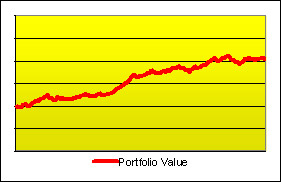
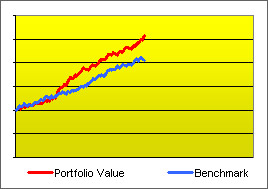
<p>The value of investments sometimes rises because of their own merits and sometimes they rise because the whole market is moving up. If we intend to evaluate the skill of an investor, the craftsmanship put into a portfolio or the performance of a particular stock, <b>it is not informative enough to study its total return &mdash; we will want to compare it with the whole market's</b>. Actually, to be fair, we will want to compare against the portion of the market that the investor or portfolio is invested in or to which the stock belongs. For example, if a professional was commissioned to design a portfolio of German stocks, we may evaluate her work by comparing her performance (meaning the total return of the portfolio she builds) to an average performance of all the stock markets in the world, but we would obtain a better measure of her success &mdash; and thus a better indication of her skill &mdash; if we compared against the average performance of German stocks exclusively.</p>

<p>The <b>&lsquo;averages&rsquo; employed for these purposes are called <i><a href="http://www.simplestockinvesting.com/guide/index-funds.htm#stock-market-indexes">indices</a></i></b>. A well-known index is the <a href="http://www.standardandpoors.com/indices/sp-500/en/us/?indexId=spusa-500-usduf--p-us-l--">Standard &amp; Poor's 500</a>, or S&amp;P&nbsp;500, which represents the universe of U.S. large-cap stocks. Other commonly-used indices are the U.S. Dow Jones Industrial Average (DJIA) and Russell 2000, the British FTSE 100, the Japanese Nikkei 225, the German DAX, etc. For example, to evaluate the past performance of a portfolio of U.S. large-cap stocks, we may be interested in comparing its total return with that of the S&amp;P&nbsp;500 during the same period of time, and we would talk of an <i>out-performance</i> or an <i>under-performance</i> accordingly.</p>

<p>This practice of comparing against a reference is frequently called <i>benchmarking</i>. A <i>benchmark</i> is a point of reference &mdash; the word originates from the practice of land surveying but it is nowadays used in many fields.</p>

<h2 id="risk-and-volatility">Risk &amp; Volatility</h2>

<p>At the beginning of the article we said that good investment performance means making money with the least risk. Or, better put, it means to have a good relation between the total return that was obtained and the risk (of losing money) that was incurred. But we haven't commented on risk yet, let's start by discussing <b>how a proxy to risk can be established and measured</b>.</p> 
<div class="hl"><p>Price volatility is like the result of a poll among investors where they're asked about how uncertain they consider the future of the asset to be.</p></div>

<p>Risk is often measured as how much the return of the investment varies around an average (or <i>expected</i>) value. In finance, this &lsquo;amount of variation&rsquo; is called <i>volatility</i>. <b>Why is the volatility of a past record of price changes used as a proxy of investment risk?</b> The reason lies in the fact that asset-price movement is usually a response to everyday news that affect the outlook of the asset. When news are (in average) considered to be good, market participants trade at higher prices, and the opposite occurs when news are considered to be bad. If the price movements of a stock have been pronounced in its recent history, it means that traders have been (in average) judging that the future value of the stock was very much dependant on news, which hints that the price may plunge if future news happen to be bad. On the other hand, if prices have low variability, it indicates that the stock is considered resistant to events. Therefore, price volatility is like the result of a poll among investors where they're asked about how uncertain they consider the future of the asset to be &mdash; or, put in other words, how risky they think it is.</p>

<p>To give an example, let's compare a savings account with a stock investment. Money saved in a saving account will grow at around 3.5&nbsp;% per year. Some years it might grow a little less, a bit more during others, but the invested value will always be close to the expected value based on the approximate rate of 3.5&nbsp;% unless something unlikely happens like the bankruptcy of the bank. Variation around the average value, or <i>volatility</i>, is pretty low. On the other hand, stock investments can vary quite much. As we said before, the historical profitability of the U.S. large-cap market is of approximately 11&nbsp;% per year, but it is not unlikely to see a 30&nbsp;% rise or a 10&nbsp;% drop in one year. Stock investments are therefore much more volatile. This obviously implies more risk, because stocks may lose a significant portion of their value anytime, which wouldn't happen with an investment with little volatility such as a certificate of deposit or savings account.</p>

<p>Typical metrics of volatility &mdash;and consequently of investment risk&mdash; are <b>variance</b> and <b>standard deviation</b>. These terms come from statistical science and reflect essentially the same thing but expressed in different ways &mdash; the standard deviation of a set of numbers is equal to the positive square root of the variance of the same set. For investment-risk calculation, the set of numbers that is used is a set of historical price changes &mdash; either daily price changes, monthly, yearly, etcetera, depending on the type of investment volatility being calculated (e.g., &lsquo;monthly variance&rsquo; or &lsquo;daily standard deviation&rsquo;). To understand how a variance or a standard deviation can describe the spreadness of a set of numbers you can visit <a href="http://www.mathsisfun.com/data/standard-deviation.html">this short and sweet tutorial</a> where the numbers in question are the heights of some cute dogs (in that article they use the word <i>mean</i> to refer to what we called <i>expected value</i>).</p>

<h2 id="beta">Beta</h2>

<p>In financial theory, <b>riskier investments are expected to be more profitable</b> because investments normally offer a reward in exchange of risk absorption &mdash; if they offered no reward, investors would buy the less-risky assets instead. The savings account in the example above offered a non-impressive return but it was reasonable given its predictable performance. Historically, stock investments offered larger returns, as it would be expected from their higher uncertainty. We say that stock investments offered a <i>risk-premium</i> over savings accounts.</p>

<p>From what we said so far, we may infer that the expected return of an investment depends on its volatility as measured through the standard deviation (or variance) of historical prices, but that conclusion would be wrong because there's more to the argument.</p>

<div class="hr"><p>Not all kinds of risk offer risk premium. Risky assets that are good diversifiers offer low or no premium.</p></div>
<p>Imagine an hypothetical, very volatile investment that has a positive expected return and experiences daily price changes that don't go in the same direction as the fluctuations of the market as a whole. One day the market (as represented by an index) rises 0.5&nbsp;% while the investment drops 2&nbsp;%, another day the index loses 1&nbsp;% but the investment gains 5&nbsp;%. On some days both either rise or drop, but more frequently they move in opposite directions. We would say that their price changes are <i>negatively correlated</i>. What may we infer from such a behavior? As we said before, price movements are market responses to everyday news. If an investment generally moves in direction opposite to the market, it means that news that affect the market negatively have a positive impact on the investment. The market participants would thus be expressing that they think that, if the whole market does bad in the future, the investment will do well.</p>

<p>If such an investment had a positive expected return, it would make a great diversifier for any broad-market portfolio. Investors will want to purchase it, regardless of its volatility, to incorporate certainty into their portfolios because, if the market does badly, that component will probably do well and compensate for some of their losses. Therefore, the investment wouldn't need to offer a reward to be chosen.</p>

<p>Such extreme examples are infrequent &mdash;actually they are practically inexistent, because assets that are negatively correlated to the market normally have negative expected return&mdash; but the same concept applies to normal investments: <b>if the price changes of an asset are less correlated to the market's, the asset is a better diversifier and thus offers less risk premium</b>. Not all kinds of risk offer risk premium.</p>

<p>Investment volatility reflects the sum of two forms of risk: <i>idiosyncratic risk</i>, which is the one that can be eliminated through diversification, and <i>systematic risk</i>, which is the one that cannot. The investment in the example above has a lot of risk, as shown by its high volatility, but it is all idiosyncratic risk. <b>Only systematic risk offers a reward</b>.</p>

<div class="hl"><p>A common mistake is to think that low-beta investments are low risk, but beta says nothing about idiosyncratic risk.</p></div>
<p>A frequently-used measure of systematic risk is <a href="http://en.wikipedia.org/wiki/Beta_%28finance%29">beta</a>. It is a relative measure: <b>beta is the relation between an investment's systematic risk and the market risk</b>. If a stock or a portfolio has a beta equal to 1, it means that it has as much systematic risk as there is risk in the market. Volatile stocks can present high betas, for example equal to 3 or 4. As explained before, those kinds of stocks are expected to return a premium in exchange for the unavoidable risk they contain.</p>

<p>A common mistake is to think that low-beta investments are low risk, but beta says nothing about idiosyncratic risk. Low-beta investments can be very volatile, and therefore risky, because they can contain much idiosyncratic risk. If you are incorporating such an investment into a well-diversified portfolio, then beta is a reasonable measure of the risk you're adding because idiosyncratic risk will be pretty much &lsquo;washed away&rsquo; by diversification. But <b>be careful if you use betas with undiversified portfolios</b>.</p> 

<h2 id="jensens-alpha">Jensen's Alpha</h2>

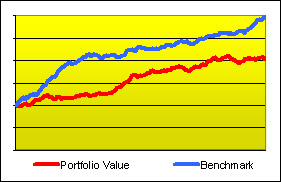
<div style="float:right;width:281px;text-align:center;margin:10px;padding:10px;font-size:.8em;background-color:#f0f0f0"><img src="http://www.simplestockinvesting.com/images/risk-reward-relationship-partial.jpg" alt="Graph of an investment beating a benchmark with both on the rise." /><i>The portfolio managers seem to be doing a great job!</i><img src="http://www.simplestockinvesting.com/images/risk-reward-relationship-full.jpg" alt="Graph of an investment beating a benchmark when on the rise and falling back during a later drawdown, to end up underperforming for the full period." style="margin-top:20px" /><i>But, when a longer period is seen, signs of higher risk taking surface. Were they doing a great job or simply taking more risk?</i></div><p>In the section about <a href="#benchmarking">benchmarking</a> we talked about the convenience of comparing performance with a benchmark but we didn't factor in risk. We gave the example of an asset manager investing in German stocks, showing that it would be informative to compare her performance with that of a relevant index such as the DAX because a greater total return may hint that the portfolio was constructed with superior skill. <b>But greater total return may also be simply the consequence of higher risk taking.</b> Therefore, a higher return doesn't say much about the manager's ability unless we bring risk into the picture. A popular metric that takes risk into account, or what we call a <i>risk-adjusted</i> measure, is <i>Jensen's alpha</i>.</p>
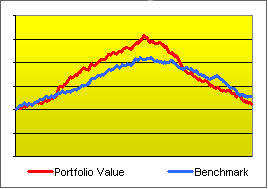

<p><b>Jensen's alpha is the return obtained on top of the market return discounting any effect that can be attributed to risk taking</b>. If a portfolio has as much systematic risk as the market (or at least it seems to be as suggested by historical volatilities) and it returned 1&nbsp;% more than the market annually, then its alpha is said to be +1. In this calculation, the market is represented by an index such as the S&nbsp;P 500, so it is relevant to state which index is being used in the calculation of alpha. Likewise, if the portfolio returned 1&nbsp;% less than the index, alpha is equal to -1. Now, if a portfolio has more risk than the market, then it should have gotten more than a 1&nbsp;% extra return to obtain an alpha of 1. If the risk difference is large enough, a 1&nbsp;% extra return may even result in a negative alpha.</p><div class="hr"><p>Adherents to the efficient-markets theory would say that positive alpha is entirely attributable to luck, and therefore unsustainable.</p></div>

<p>Therefore, we may say that the asset manager in the German-stock-portfolio example did a good job if she obtained a positive (Jensen's) alpha measured relative to the DAX. Nevertheless, that out-performance could also be, in part or in full, the result of plain good luck &mdash; adherents to the <a href="http://www.simplestockinvesting.com/efficient-market-hypothesis.htm">efficient-market theory</a> would say that it is fully explained by luck.</p>

<h2 id="closing-summary">Summary</h2>
 
<p>Let's summarize some important points that were covered:</p>

<ul>
<li><b>Price increases can be misleading</b> if taken as measures of investment performance, total return is a more-adequate metric.</li>
<li><b>Remember to include the taxes and fees</b> that apply to your case before making investment decisions.</li>
<li>To evaluate managers, portfolios and stocks, it is informative to <b>compare their returns to that of relevant indices</b>.</li>
<li><b>Price volatility is a reasonable proxy for investment risk</b>. It can be expressed as standard deviation or variance.</li>
<li><b>Undiversifiable risk</b>, also called <i>systematic risk</i>, normally offers a <b>reward</b> in terms of return.</li>
<li><b>Beta indicates systematic risk</b>. High beta stocks have high risk.</li>
<li><b>Low beta stocks may or may not have low risk</b>, because beta says nothing about diversifiable risk (also called <i>idiosyncratic risk</i>).</li>
<li>Therefore, beta is a reasonable measure of risk if you are dealing with diversified portfolios, but <b>be careful if you're using them with undiversified ones</b>.</li>
<li><b>Jensen's alpha is a popular risk-adjusted measure of performance relative to an index</b>. Positive alpha can be attributed to skill but also to luck.</li>
</ul>

<em>&ldquo;<a href="http://www.simplestockinvesting.com/guide/measures-investment-performance.htm">Investment Performance Measurement: Return, Volatility, Alpha &amp; Beta</a>&rdquo; was originally published at <a href="http://www.simplestockinvesting.com/">SimpleStockInvesting.com</a>.</em>

</div><!-- CONTENT -->
]]>
</content>
<updated>2011-03-21T02:38:19+03:00</updated>
</entry>

  
<entry>
<title>Invest in Brazilian &amp; Latin-American Stocks with Covestor Investment Management</title>
<link href="http://www.simplestockinvesting.com/Latin-America/Invest-in-Brazilian-Latin-American-Stocks-with-CVIM.htm" />
<id>tag:www.simplestockinvesting.com,2010-06-07:/20100607035346004</id>
<content type="html"><![CDATA[
<div id="content">

<div id="toc"><p id="sectiontitle">SECTIONS</p>
<a href="#Is_CVIM_safe">Is CVIM safe?</a> &nbsp;|&nbsp; <a href="#Why_South_America">Why South America?</a> &nbsp;|&nbsp; <a href="#Investment_objective">Investment objective</a> &nbsp;|&nbsp; <a href="#Advantages">Advantages</a><br /><a href="#Past_performance">Past performance</a> &nbsp;|&nbsp; <a href="#The_bottom_line">The bottom line</a> &nbsp;|&nbsp; <a href="#What_to_do_next">What to do next</a>
</div>

<div class="hr"><p>Covestor offers a managed South-American stock portfolio with a $5K minimum investment, at a competitive cost</p></div>

<p><b>Covestor<sup>&reg;</sup> Investment Management (CVIM)</b> provides an approach to money management that was previously only available to high-net-worth customers. At <a rel="nofollow" href="http://cv.im/">their platform</a>, a retail investor can select model stock portfolios that are crafted by proven investors (the <i>model publishers</i>), and have their trades be automatically mirrored in her or his own brokerage account. This empowers these customers with <b>easy and cost-effective access to portfolio management</b> based on the decisions of experienced individuals and <a href="http://www.investopedia.com/terms/r/ria.asp">registered investment advisors (RIA)</a> of their choice, while they enjoy the <b>transparency</b> of the system and its <b>community-like experience</b>.</p>

<p>I am Andy Djordjalian, publisher of a <a rel="nofollow" href="http://cv.im/models/profile/a-djordjalian">South-American model at CVIM</a>. In this article I will present you this model that, I believe, is an informed way to invest in Brazilian stock, as well as equity from other South-American countries. Please have in consideration that Covestor pays me a fee for each client that subscribes to this model. This page is for informational purposes only, all the disclaimers on the model's profile page apply, and please take appropriate professional advice in any investment decisions.</p> 

<h2 id="Is_CVIM_safe">Is it safe to invest with CVIM?</h2>

<div style="float:left;display:inline;padding:0 1.4em .4em;"><img src="http://www.simplestockinvesting.com/Latin-America/cvim-screenshot.jpg" width="251px" height="160px" alt="Screenshot of CVIM's website" /></div>
<p>Several facts support Covestor's claims regarding the <b>transparency and responsibility of their service</b>. An SEC-registered investment advisor themselves, they provide professional personalized advise to each customer, granting them access only to portfolios considered suitable for them. The company manages the mirroring process and summarizes each portfolio's data on <a rel="nofollow" href="http://cv.im/models/">individual profile pages</a>. Stocks that trade in low volume, or have a market capitalization that is too small, are excluded from the system as an additional measure of protection. These mechanisms are further <a rel="nofollow" href="http://cv.im/how-it-works">explained on CVIM's website</a> and are commented on the <b>extensive coverage that the company has received</b>, with articles in <a rel="nofollow" href="http://blogs.wsj.com/wallet/2009/07/29/web-sites-wade-into-money-management/">Wall Street Journal</a>, <a rel="nofollow" href="http://online.barrons.com/article/SB125089364207050419.html">Barron's</a>, <a href="http://www.investmentnews.com/article/20091127/FREE/911279997">Investment News</a>, <a href="http://www.ft.com/cms/s/ee3caa5e-a3b6-11de-9fed-00144feabdc0,Authorised=false.html?_i_location=http%3A%2F%2Fwww.ft.com%2Fcms%2Fs%2F0%2Fee3caa5e-a3b6-11de-9fed-00144feabdc0.html%3Fnclick_check%3D1&_i_referer=&nclick_check=1" rel="nofollow">Financial Times</a>, <a href="http://www.wallstreetandtech.com/wealth-management/showArticle.jhtml?articleID=218600187" rel="nofollow">Wall Street &amp; Technology</a>, <a href="http://www.businesswire.com/portal/site/home/permalink/?ndmViewId=news_view&newsId=20100331005204&newsLang=en" rel="nofollow">Business Wire</a>, <a href="http://www.marketwatch.com/story/web-sites-let-you-invest-like-the-top-pros-2010-04-16">MarketWatch</a> and other publications.</p>

<p>The trades that are executed in the customers accounts are those that the model publishers perform in their own brokerage accounts (though some trades are not replicated, as <a rel="nofollow" href="http://cv.im/how-it-works">explained at CVIM's website</a>). <b>Publishers have their own money at stake</b> in those accounts, and they are also putting their <b>reputation</b> in play. I have worked hard to achieve <a href="#Past_performance">good past performance</a> in terms of return and volatility. That history brings trust to my model, so I would not like to lose it as much as I would not like to lose money from my account.</p>

<p>Regarding the assets, each customer's shares are held in their own brokerage accounts with well-known brokers like <a href="http://www.interactivebrokers.com/ibg/main.php">Interactive Brokers</a> and <a href="http://www.tdameritrade.com/welcome1.html">TD Ameritrade</a>. You can verify that Covestor is properly regulated by using <a href="http://www.adviserinfo.sec.gov/IAPD/Content/IapdMain/iapd_SiteMap.aspx">this tool</a> and you can check the same for the brokerage firms with the use of <a href="http://www.finra.org/Investors/ToolsCalculators/BrokerCheck/index.htm">this other one</a>.</p>

<h2 id="Why_South_America">Why South America?</h2>

<div style="float:right;display:inline;padding:0 0 .6em 1.4em;text-align:center;font-size:.7em"><img src="http://www.simplestockinvesting.com/Latin-America/south-america.jpg" alt="Small map of South America" width="155px" height="230px" /><br /><i>Image courtesy of NASA</i></div>
<p><b>Latin America is one of the most developing regions in the world</b>. Rich in resources, with mature financial institutions, political stability and a thriving middle class, Brazil and much of the rest of South America have excelled financially in recent years. The region produces <b>commodities that are in high demand because of the industrialization and urbanization of Asian emerging economies</b>, like metals (e.g., iron ore, copper, zinc, silver, tantalum, palladium and lithium), petroleum and grains. As a consequence, it is receiving large inflows of capital. Foreign reserves at the Central Banks have been enlarged thanks to these, which, combined with a more responsible fiscal policy, configure a financial outlook that differs significantly from the crisis and debt problems of the past.</p>

<p>The Brazilian and South American potential is not limited to commodity exports driven by Chinese and Indian economies. The region has considerable <b>domestic consumption</b>, more <i>per capita</i> than average in emerging markets. Moreover, the consuming middle class is growing, thanks to the commodity boom and to the process of social change that these countries have been undergoing for many years. In addition, it has <b>reserves of gold and other precious metals</b>, plus some <b>emerging world-class exports</b> with significant value added. For example, <a href="http://www.embraer.com/english/content/home/">aircraft from Brazil's Embraer</a>, which has recently become the third-largest producer in the world in terms of yearly delivery, and <a href="http://en.wikipedia.org/wiki/Argentine_wine">wine from Argentina</a> <a href="http://en.wikipedia.org/wiki/Chilean_wine">and Chile</a>, countries that are its fifth and ninth producers, respectively. Thanks to these various opportunities for profit, investments in the region can be diversified.</p>

<p>Many renowned economists and investors recommend that US individuals have larger allocations in emerging markets, especially resource-rich ones. For example, Princeton's Burton Malkiel, author of one of the most influential investing books ever, <i>A Random Walk Down Wall Street</i>, in the following video from <a href="http://moneywatch.bnet.com/investing/">CBS MoneyWatch</a>:</p>
<center><object type="application/x-shockwave-flash" data="http://image.com.com/gamespot/images/cne_flash/production/media_player/proteus/one/proteus2.swf" width="432" height="362"><param name="FlashVars" value="playerMode=embedded&allowFullScreen=1&flavor=EmbeddedPlayerVersion&showOptions=0&skin=http://image.com.com/gamespot/images/cne_flash/production/media_player/proteus/one/skins/proteus_money.png&autoPlay=false&movieAspect=4.3&embeddingAllowed=true&clockColor=0xb2ad98&paramsURI=http%3A%2F%2Fwww.bnet.com%2F2461-17910_23-388541.xml%3Fwidth%3D432%26height%3D362%26ptype%3D6475%26mode%3Dembedded%26autoplay%3Dfalse%26siteId%3D252%26section%3D19546%26site%3Dmw%26ttag%3DJeff%2BNash%26assetId%3D326558%26conttypid%3D26%26nc%3D1274050778203%26nodeId%3D19546" /><param name="movie" value="http://image.com.com/gamespot/images/cne_flash/production/media_player/proteus/one/proteus2.swf" /><param name="wmode" value="transparent" /><param name="allowScriptAccess" value="always"></object></center><br />

<p>For these reasons, <b>I believe that Brazilian stock, combined with equity from other countries in South America, are excellent components for the portfolios of US and global investors, that can spice those investments up with profit potential and diversification</b>. I have lived in Argentina all my life, immersed in the regional environment and following business publications in Spanish and Portuguese for many years. When the people at Covestor invited me to publish a South American model, I agreed that it may result in an interesting product for their clients, and accepted. We started the <i>South America Focus</i> model in early December of 2009, and <a href="#Past_performance">it has been working comparatively well since</a>.</p>

<h2 id="Investment_objective">Investment objective</h2>

<p>The model provides a means for U.S. citizens, and foreigners with accounts in the U.S., to invest in South America, because it is composed of <a href="http://en.wikipedia.org/wiki/American_Depositary_Receipt">ADR's</a> that correspond to South-American stocks, plus stock traded in those exchanges that are not ADR's but belong to companies that have a majority of their operations in South America, plus Latin-America ETF's and closed-end funds (CEF's). All of these are <b>traded in U.S. exchanges</b> (i.e., NYSE, NYSE Arca and NASDAQ). The resulting portfolio is <b>an alternative to state-of-the-art Latin-American investment vehicles</b>, with their positive aspects but also some differences that are, hopefully, improvements. By &ldquo;state-of-the-art vehicles&rdquo;, I mean top Latin America mutual funds like <a href="http://content.members.fidelity.com/mfl/summary/0,,315910844,00.html">Fidelity Latin America</a> (FLATX), <a href="http://www3.troweprice.com/fb2/fbkweb/snapshot.do?ticker=PRLAX">T. Rowe Price Latin America</a> (PRLAX) and <a href="http://www.blackrock.wallst.com/public/fund/profile.asp?symbol=MDLTX">BlackRock Latin America</a> (MDLTX), the largest Latin America ETF <a href="http://us.ishares.com/product_info/fund/overview/ILF.htm">iShares S&amp;P Latin America 40 Index</a> (ILF), and the top Brazil ETF's <a href="http://us.ishares.com/product_info/fund/overview/EWZ.htm">iShares MSCI Brazil Index</a> (EWZ) and <a href="http://www.vaneck.com/funds/BRF.aspx">Market Vectors Brazil Small-Cap ETF</a> (BRF). These six funds add up to more than $20 billion in assets and are leading products for investors interested in the region.</p>

<p>The CVIM system has a critical advantage over those funds: <b>the possibility to trade more flexibly</b>. Successful funds manage so much money that their trading costs are quite high, unless they trade very liquid securities or do it in small portions. With the CVIM system we are much less restrained, because the assets of each model's subscribers do not add up to hundreds of millions of dollars.</p>

<div class="hl"><p>My model is diversified, I do not trade very often and I stay fully invested as much as possible</p></div><p><b>That advantage creates opportunities</b>. Some publishers at CVIM use it to offer interesting, speculative portfolios, focused on small caps, long and short, etc. But I decided to adopt a lower-risk approach, combining this flexibility with a good level of diversification, in an attempt to obtain a result that is somewhat better than that of the aforementioned state-of-the-art funds. I think a small outperformance is a healthy objective, because accumulated over time it can make a big difference, without having to resort to risk taking and good luck as much as more speculative investments require. The South-American theme offers enough profit potential by itself, there is no need to focus on few stock. Therefore, my model is diversified, I do not trade very often and I stay fully invested as much as possible and long only (meaning that I don't bet on shares going down, for the reasons explained in <a href="http://www.simplestockinvesting.com/investing-gambling-and-insurance-1.htm">this four-part article</a>).</p>

<h2 id="Unique_features">Advantages</h2>

<p>I will try to summarize the differences &mdash; hopefully, advantages &mdash; that South America Focus has compared to the portfolios of Latin America and Brazil ETF's and mutual funds:</p>

<ul>
<li><p><b>Weighting based on top-down analysis, not constrained by market caps</b>. To alleviate their trading costs, most big funds have the greater part of their portfolios in liquid companies with high market capitalizations. That often leads to questionable levels of diversification. For example, iShares MSCI Brazil Index (EWZ), the largest Brazil ETF, has currently a <a href="http://us.ishares.com/product_info/fund/overview/EWZ.htm">37% of its portfolio tied to only two companies</a>, Petroleo Brasilero (Petrobr�s) and Vale. Even though these are good companies that have done well, a Brazilian investment can be diversified much better. Moreover, let's consider that, when people pay fees for a passive fund instead of buying shares from a few companies, they do it to obtain diversification. I wonder if all of EWZ's investors are aware of the real value they are getting in exchange for the fees they pay. . .</p>

<p>Without going to that extreme, the big Latin-American stock funds are also heavily biased towards market-cap weighting. For example, <a href="http://www.simplestockinvesting.com/compare-mutual-funds.htm">Morningstar</a> currently reports that FLATX, PRLAX, MDLTX and ILF have just a 13.4%, 8.5%, 6.7% and 15.8%, respectively, in stock from countries other than Brazil and Mexico (EWZ and BRF are Brazil-only funds), despite the profit and diversification potential offered by those other countries.</p>

<div class="hl"><p>The CVIM system has a critical advantage over those funds: the possibility to trade more flexibly</p></div><p>For South America Focus, weighting is decided after a top-down analysis that uses market caps as one of many elements. Brazil is still dominant, and I give much consideration to Petrobr�s and Vale, but I aim at obtaining better diversification by making more extensive use of stock from other countries and from less-capitalized companies.</p></li>

<li><p><b>A fixed-income allocation</b>. To diversify more, I allocate about a 15% to 20% of the model in fixed-income instruments. Emerging-market bonds have performed very well in the past decade, and even though the developing countries are in relatively-good financial standing, they are still paying higher interest than developed economies.</p></li>

<li><p><b>Closed-end funds (CEFs)</b>. I use CEFs for the fixed-income allocation (there are none for South-American debt only, so I use emerging-market debt funds, which have a portion of their portfolios in South-American bonds). As with all CEF investments, there is an additional potential for profit besides the increase in value of the underlying assets per share (also called <i>Net Asset Value</i> or NAV), which is the improvement of their market price relative to their NAV. With open-ended funds, like mutual funds and ETF's, the market price and the NAV are about equal all the time, but with CEFs they are not, which constitutes an additional opportunity to buy low and sell high. </p></li>

<li><p><b>Junior mining</b>. Several junior mining-exploration companies, that search for precious and industrial metals, operate in Latin America, but they are not held by big funds because they are incorporated elsewhere and trade in volumes that are not large enough for them. South America Focus does include them. About a 9% of the portfolio is currently assigned to Canadian junior explorers, plus an 8% that is allocated to a larger miner from the same country. These holdings are an opportunity for profits and diversification that is absent in the funds mentioned before.</p></li>

<li><p>It is not necessarily an advantage, but <b>Mexico is not included</b>. The model covers South America only. Therefore, although it is not a one-country instrument like EWZ and BRF, it does not include Mexico like the Latin-America funds.</p></li>
</ul>

<h2 id="Past_performance">Past performance</h2>

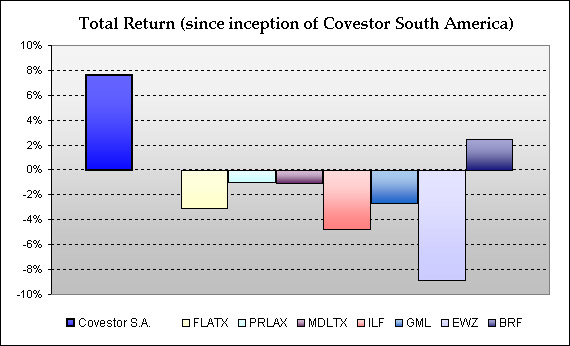
<p>This figure shows the performance of the first six months of the model portfolio, from December 3, 2009 to the day of this writing, June 3, 2010. It is <b>compared to the top Latin-American mutual funds and ETF's</b> that were mentioned before, displaying <b>a noticeable outperformance</b>. It has not been a good period at all for Latin-American equity, particularly for the Brazilian stock market (represented by EWZ and BRF). These funds lost between a 9.6% and a 16.1% of their original value, while our model lost very little.</p>

<img src="http://www.simplestockinvesting.com/Latin-America/total-return-latin-american-funds-brazil-etf.jpg" alt="Total return of Latin America funds compared with South America Focus" width="570px" height="346px" style="padding-left:1.4em;" />

<p>Even though the model is more conservative than the other funds, it is not much so, and it has also over-performed during some positive periods included in these 6 months. Since early December it has been fully invested, with the exception of a very small cash allocation and occasional to-be-credited cash. Therefore, this result is not explained by excessive conservatism or lucky timing &mdash; <b>the aforementioned advantages are a better explanation</b>.</p> 

<p>In future articles we will compare risk metrics and quarterly results, please subscribe to receive those updates <a href="http://feedburner.google.com/fb/a/mailverify?uri=SimpleStockInvesting&loc=en_US">in your email</a> or <a href="http://feeds.simplestockinvesting.com/SimpleStockInvesting">news reader</a>.</p>

<p>The reported performance of the CVIM portfolio was taken from its profile page, which does not include the fees collected by Covestor (1.50% annually) and the trading fees (which, as far as I know, are currently $1 per transaction on Interactive Brokers accounts or $8 with TD Ameritrade). It currently requires 15 purchases to enter the model and, besides those, we have been having 3.4 transactions per month, which should be about normal. BlackRock Latin America (MDLTX) has a 5.25% front load that has not been deducted from its return in the graph. Performance data for the funds were obtained from <a href="http://www.simplestockinvesting.com/compare-mutual-funds.htm">Morningstar</a> and <a href="http://finance.yahoo.com/">Yahoo Finance</a>. For more information, you may visit the <a rel="nofollow" href="http://cv.im/models/profile/a-djordjalian">CVIM profile page</a><!-- and read our <a href="">performance comparison with Latin-American and Brazilian funds</a>-->. Please bear in mind that past performance is no guarantee of future results, and that this is just a 6-month comparison.</p>

<h2 id="The_bottom_line">The bottom line</h2>

<p>Portfolios offered through the CVIM system can have more flexible trading than big mutual funds and ETF's. This South-American portfolio makes use of that advantage, <b>to reduce risk by better diversification, and to try to exploit mispricing that, presumably, occurs in some stocks that are not traded in massive volume</b>, such as fixed-income closed-end funds and junior-mining shares.</p>

<p>For example, if we were to favor large-cap companies incorporated in Latin America as much as the regional mutual funds and ETF's do, we would have few choices to invest in precious-metal producers. Only Peruvian <a href="http://www.buenaventura.com/">Minas Buenaventura</a> (BVN) is worth mentioning, Latin-America funds typically have a 1% to 2% of their portfolios in this company. But it is disadvantageous to have so little and through only one company, because there is more precious-metal mining in Latin America and these companies are good diversifiers. On South America Focus, we are currently holding some Canadian miners that operate in the region, exploring for, and producing, precious and industrial metals. Namely, <a href="http://www.silver-standard.com/">Silver Standard Resources</a> (SSRI), <a href="http://www.exeterresource.com/">Exeter Resource Corp.</a> (XRA) and <a href="http://www.solitarioresources.com/">Solitario Exploration &amp; Royalty</a> (XPL). This allocation was created for its diversification potential, and it has been useful as such during the past months, explaining much of the outperformance of the model compared to its benchmarks.</p>

<div id="sectionbox" style="float:right;display:inline;padding-right:0.8em;padding-left:2.1em;margin-left:1.2em;text-align:right;">
<p id="sectiontitle">MORE ABOUT <b>SOUTH AMERICA FOCUS</b></p><!--Performance comparison with <a href="http://www.simplestockinvesting.com/Latin-America/Latin-American-funds-compared-with-South-America-Focus.htm">Latin-America funds.</a><br />-->
<ul>
<li>Jan/10: <a href="http://www.simplestockinvesting.com/Latin-America/investment-reports/Chilean-stock-Exeter-Jan-2010.htm">Chilean stock and Exeter</a></li>
<li>May/10: <a href="http://www.simplestockinvesting.com/Latin-America/investment-reports/Mining-May-2010.htm">Vale, Silver Standard and junior miners</a></li>
<li><a rel="nofollow" href="http://cv.im/models/profile/a-djordjalian">More at Covestor Investment Mgmt</a></li>
</ul>
</div>
<p>If large-cap shares like the ones typically included in the big funds, like heavyweights Petr�leo Brasilero (PBR) and Vale (VALE), soar and outperform the allocations we have for diversification purposes, then those funds will probably return more than our portfolio. But in many probable scenarios, our model may offer better, more stable, returns. That makes it <b>a good vehicle to invest in one of the most developing regions of the world, and to add diversification and profit potential to a U.S. or global investment portfolio</b>, and this claim is supported by the first 6 months of history of the model, that have just elapsed as I am writing this.</p>

<h2 id="What_to_do_next">What to do next</h2>

<p>If you are interested, you can visit <a rel="nofollow" href="http://cv.im/">Covestor Investment Management</a> and, particularly, <a rel="nofollow" href="http://cv.im/models/profile/a-djordjalian">this model's profile page at their site</a>. Consider opening an account with them, there are many other models to subscribe to. This variety can be used to assemble a diversified investment that covers various themes.</p> 

<p>Thank you for your interest. I wish you the best in your pursuit of financial success!</p>

<p><a href="/articles.htm">&laquo; View the complete list of articles at Simple Stock Investing</a>
]]>
</content>
<updated>2010-06-07T06:45:20+03:00</updated>
</entry>

<entry>
<title>CFP Requirements: How to Become a Certified Financial Planner</title>
<link href="http://www.simplestockinvesting.com/requirements-to-become-a-CFP.htm" />
<id>tag:www.simplestockinvesting.com,2009-07-17:/20090717035346004</id>
<content type="html"><![CDATA[<p><i>Certified Financial Planner</i> (CFP<sup>&reg;</sup>) certification plays a major role in the growing demand for financial-advisory professional services. Although it is not legally regulated, and as such it doesn't give special privileges by law, the high standards set by its administrant, the <a href="http://www.cfp.net">U.S. Certified Financial Planner Board of Standards, Inc.</a> (or <i>CFP Board</i>), makes it a very desirable mark for engaging customers who are looking for highly-qualified practitioners committed to ethics and skilled at working with people. According to &ldquo;<a href="http://www.cfp.net/media/survey.asp?id=4">CFP Board's 2004 Consumer Survey</a>&rdquo;, 28% of upper-income consumers sought out professional financial advice and assistance, which was 3% more compared to 1999. Among the criteria for selecting an adviser, professional accreditation was mentioned by 81% of the respondents. Plus, 84% of those who used a CFP certificant as their primary adviser said they were extremely or very satisfied.</p>

<p>Earning a CFP Certification can be a crucial step in your career advancement. Reasons are twofold: you would enhance your professional opportunities while acquiring a broad body of knowledge on financial planning, related subjects and professional practice. This document explains the steps required for achieving this rewarding goal.</p> 

<p>Go on reading on <a href="http://www.simplestockinvesting.com/requirements-to-become-a-CFP.htm">how to become a CFP</a> at Simple Stock Investing.  i2t98gqchn</p>]]>
</content>
<updated>2009-07-17T00:54:20+03:00</updated>
</entry>
	
<entry>
<title>Updates at Simple Stock Investing</title>
<link href="http://www.simplestockinvesting.com/" />
<id>tag:www.simplestockinvesting.com,2009-07-17:/20090717035330740</id>
<content type="html"><![CDATA[<p>During June and July, there were several improvements at SimpleStockInvesting.com. A wider, 3-column layout was implemented, as very few of our visitors use, these days, a resolution that is below 1024 pixels wide. This allowed moving ads to the sides, making them less disruptive. Usability was also addressed with the addition of a table of contents for each page, and the inclusion of highlights throughout the pages, in blue boxes. These were not implemented for all pages as of yet, but we plan to do so in the future. As always, all feedback is welcome, so please let us know your ideas about the usability of SSI, using <a href="http://www.simplestockinvesting.com/about-us.htm#contact">our contact page</a>.</p>

<p>Regarding content, the most important change was the update of  <a href="http://www.simplestockinvesting.com/SP500-historical-real-total-returns.htm">our page on the Standard &amp; Poors 500 historical performance</a>, with the addition of data for 2008, which was a sensible year for stock returns, as we all know. Before the update, the long-term (1950 to 2007) average annual return for the stock market was informed as being of 11.8%. With the 2008 data factored in, that number reduced to 10.8%, due to the 37% drop for 2008. More so, the difference is only a 1% because of the rounding error: it would be 1.1% if one more digit was used. Let's hope that the performance of 2009 and the following years put that statistic back to several tenths above 11%.</p>]]>
</content>
<updated>2009-07-17T00:50:20+03:00</updated>
</entry>
	
<entry>
<title>First Release of our Investing Guide </title>
<link href="http://www.simplestockinvesting.com/guide/" />
<id>tag:www.simplestockinvesting.com,2009-07-17:/20090717035313501</id>
<content>The first release of our investing guide is online. It is a work in progress that currently has 8 short sections that begin with reasons to invest in the stock market, go through the basics of investing explained briefly to end, for the time being, at index funds and asset allocation.</content>
<updated>2008-07-17T00:54:20+03:00</updated>
</entry>

	
<entry>
<title type="html">S&amp;P 500: Total and Inflation-Adjusted Historical Returns</title>
<link href="http://www.simplestockinvesting.com/SP500-historical-real-total-returns.htm" />
<id>tag:www.simplestockinvesting.com,2009-07-17:/20090717035303304</id>
<content type="html">Historical performance of the U.S. stock market, measured through the S&amp;P500 index. Charts for total return and inflation-adjusted data are included. Read this and other articles at www.simplestockinvesting.com .</content>
<updated>2008-07-16T00:54:20+03:00</updated>
</entry>

<entry>
<title>The Efficient Market Hypothesis: Definition and Practical Implications</title>
<link href="http://www.simplestockinvesting.com/efficient-market-hypothesis.htm" />
<id>tag:www.simplestockinvesting.com,2009-07-17:/20090717035250411</id>
<content>Concise tutorial about the Efficient Market Hypothesis (EMH): Its multiple definitions and some consequences. The Efficient Market Hypothesis is a controversial theory that states that security prices reflect all available information so it is fruitless to pick stocks (this is, analyze stock in an attempt to select winners). The rationale behind this is that the plentiful well-informed motivated professionals that work in the financial markets allegedly form an efficient system for assigning each security the perfect price given the available information, therefore no individuals can outsmart this fabulous group and beat the market by regularly buying securities at prices that are lower than what they should be. Read this and other articles at www.simplestockinvesting.com .</content>
<updated>2008-07-15T00:54:20+03:00</updated>
</entry>

<entry>
<title>Limitations of Total Return as a Measure for Fund, Bond and Stock Performance</title>
<link href="http://www.simplestockinvesting.com/total-return-limitations.htm" />
<id>tag:www.simplestockinvesting.com,2009-07-17:/20090717035227264</id>
<content>Explains why total return is a good but imperfect measure of investment perfomance. Read this and other articles at www.simplestockinvesting.com .</content>
<updated>2008-07-14T00:54:20+03:00</updated>
</entry>

<entry>
<title>Total Return to Measure Fund, Bond and Stock Performance</title>
<link href="http://www.simplestockinvesting.com/total-return-stock-performance.htm" />
<id>tag:www.simplestockinvesting.com,2009-07-17:/20090717035159075</id>
<content>Total return, a measure of investment performance that is better than price increase, is explained concisely in this article. Read this and other articles at www.simplestockinvesting.com .</content>
<updated>2008-07-13T00:54:20+03:00</updated>
</entry>

<entry>
<title>Why Investing Isn't Gambling, Although It Can Be</title>
<link href="http://www.simplestockinvesting.com/investing-gambling-and-insurance-1.htm" />
<id>tag:www.simplestockinvesting.com,2009-07-17:/20090717035136601</id>
<content>Diversification, risk/reward and other important investing concepts explained through analogies with gambling and insurance. Read this and other articles at www.simplestockinvesting.com .</content>
<updated>2008-07-12T00:54:20+03:00</updated>
</entry>

<entry>
<title>ETF Market Expanding with Narrower, More Expensive Funds</title>
<link href="http://www.simplestockinvesting.com/ETF-market-expanding-with-narrower-more-expensive-funds.htm" />
<id>tag:www.simplestockinvesting.com,2009-07-17:/20090717035114230</id>
<content>We have more and more ETFs to choose from, although the survival of many new offerings is yet to be seen, but that doesn't imply any significant risk for investors. Most of the new niche offerings are tailored for professionals, but small individual investors may use them for some cautious speculation, without losing too much diversification as it would be the case with buying individual stock. But keep an eye on expenses, as the narrow funds tend to have much higher ones than what the good old broad ETFs have got us used to. Read this and other articles at www.simplestockinvesting.com .</content>
<updated>2008-07-11T00:54:20+03:00</updated>
</entry>

<entry>
<title>Leverage: What It Is and How We Can Profit from It.</title>
<link href="http://www.simplestockinvesting.com/leverage.htm" />
<id>tag:www.simplestockinvesting.com,2009-07-17:/20090717035053256</id>
<content>A brief tutorial to financial leverage applied to investments. Read this article before investing in a leveraged fund. In the context of investing, leverage means using one of many techniques to improve our speculative capacity, amplifying the effect of the money we invest in the pursuit of a higher rate of return. Read this and other articles at www.simplestockinvesting.com .</content>
<updated>2008-07-10T00:54:20+03:00</updated>
</entry>

<entry>
<title>Tips for a College Student who wants to Invest for Retirement</title>
<link href="http://www.simplestockinvesting.com/tips-for-college-student.htm" />
<id>tag:www.simplestockinvesting.com,2009-07-17:/20090717034955781</id>
<content>Brief tutorial on how to prepare a long-term investment. Read this article and others at Simple Stock Investing. Read this and other articles at www.simplestockinvesting.com .</content>
<updated>2008-07-09T00:54:20+03:00</updated>
</entry>

<entry>
<title>Introducing Simple Stock Investing</title>
<link href="http://www.simplestockinvesting.com" />
<id>tag:www.simplestockinvesting.com,2009-07-17:/20090717034923387</id>
<content>Simple Stock Investing is a guide tailored for the individual investor who prefers safe investments to thrilling ones. By safe we don't mean of modest profits. On the contrary, we will argument on how diversification and long-term investing can yield the best results, as long as they are done efficiently. Simple Stock Investing publishes articles to assist you in achieving that efficiency. Let us be an important step towards learning how to design and manage your own portfolio of long-term diversified investments. Read more about this site at www.simplestockinvesting.com .</content>
<updated>2008-07-08T00:54:20+03:00</updated>
</entry>

</feed>