The post Global Renewable Energy Capacity Surging to New Heights appeared first on Solar Tribune.
]]>
IEA Report Outlines Record Expectations for 2023
The International Energy Administration’s (IEA) mid-year Market Update released last month notes the historic growth in renewable energy generation expected this year and next. The agency ascribes much of the expected growth to pro-renewables policy momentum, high fossil fuel prices, and renewed concerns about energy security both arising from Russia’s now years-long war in Ukraine.
The report’s key findings include:
- Global renewable capacity additions are on pace to increase by 107 gigawatts (GW), the largest absolute increase ever, to more than 440 GW in 2023.
- Solar PV capacity accounts for two-thirds of this year’s projected increase in global renewable capacity.
- Cumulative global renewable energy capacity is on pace to reach over 4,500 GW by the end of 2024. This is equal to the total combined power capacity of the United States and China.
Wind & Solar Overtake Coal for the First Time Ever
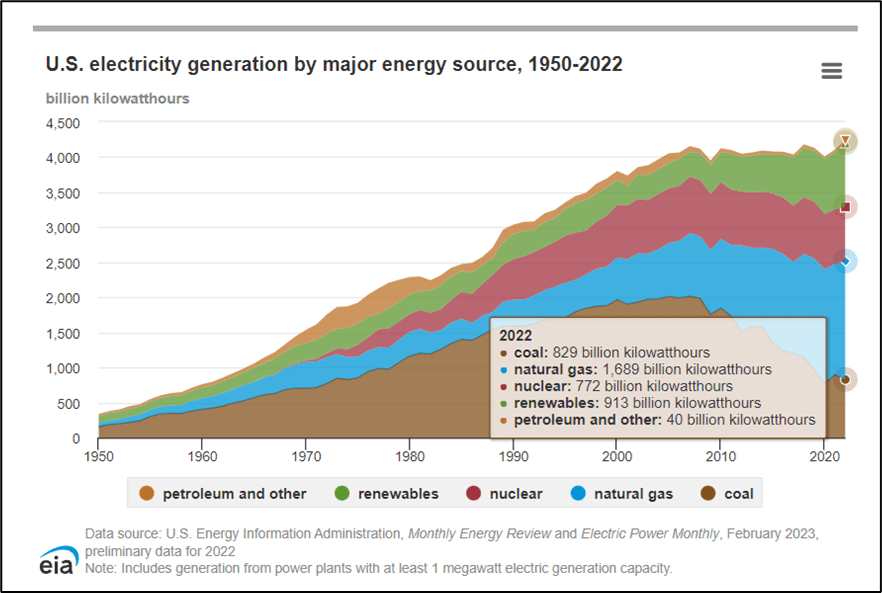
The renewable energy sector’s historic global capacity growth isn’t the only positive news wave the industry is riding these days. According to analysis by E&E News, wind and solar combined to produce 252 terawatt-hours (TWh) in the first 5 months of 2023, eclipsing the 249 TWh produced by coal over the same time period. This marks the first time ever that solar and wind energy sources collectively outperformed coal over any consecutive 5-month period.
This symbolic milestone seemingly happened in the blink of an eye. Less than two decades ago, coal accounted for almost 50% of the United States’ total energy production. In 2007, coal production topped 1,171.5 million short tons – a record high. Those days now seem like a distant memory. The Administrator of the U.S. Energy Information Administration (EIA), Joe DeCarolis, stated earlier this year, “we expect that the United States will generate less electricity from coal this year than in any year this century.” Put more bluntly, Andy Blumenfeld, an industry analyst at McCloskey by Oil Price Information Service (OPIS) recently told E&E News, “from a coal perspective, it has been a disaster…The decline is happening faster than anyone anticipated.”
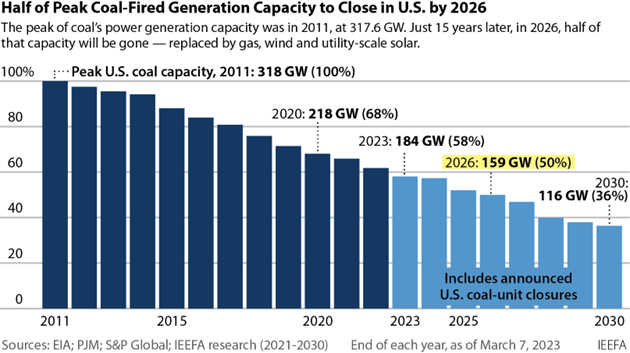
The pace of coal plant closures in the U.S. is only expected to accelerate as the economics of coal increasingly lose out to those of renewables. According to the Institute for Energy Economics and Financial Analysis, the U.S. is on track to close half of its coal-fired generation capacity by 2026, just 15 years after hitting its peak in 2011.
Will the Momentum Continue?
The decline of coal in the United States has been steady over recent years. The brief exception being in 2022 when global gas markets were roiled by Russia’s invasion of Ukraine, and the ensuing energy security concerns that forced many countries in Europe to rely on the “quick fix” of doubling down on coal plants.
The global pendulum has since shifted back on the heels of a mild winter in both Europe and the United States. A recent EIA report noted that 11 GW of U.S. coal capacity was retired from June 2022 to May 2023, and the agency anticipates there being 15% less coal-fired generation in the U.S. this summer compared to last.
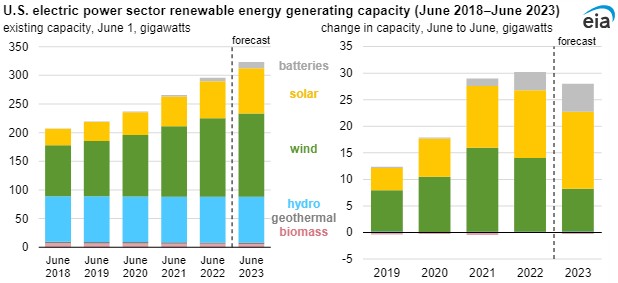
Meanwhile, the momentum being experienced by the solar and wind industries is expected to swell even further. According to the EIA, the U.S. electric power sector added an estimated 14.5 GW of solar generating capacity and about 8.0 GW of wind capacity during the 12 months ending May 31, 2023. The EIA expects solar generation to increase by 24% (10.8 TWh) this summer versus last summer, which beats the expectations for every other energy source.
A confluence of world events, policy decisions, and economics have combined to put the solar industry on stable footing around the world. On the latter point, solar PV costs have fallen a remarkable 76% since 2010 according to the Lawrence Berkeley National Laboratory.
The summer’s sweltering heat reminds us of the urgency to address the global effects of climate change. The growing prominence of solar energy in the global energy landscape coupled with the continued decline of the emissions-heavy coal industry offers hopeful signs for the future.
Cover Photo Source: Syracuse.com
The post Global Renewable Energy Capacity Surging to New Heights appeared first on Solar Tribune.
]]>The post Texas Emerges as Solar’s Latest Hotspot As Legislative Threats Emerge appeared first on Solar Tribune.
]]>
Texas Solar Capacity Hits Peak
In 2022, Texas led the country in the amount of solar capacity added to the grid for the first time in history. The Lone Star State added 1,664 MW of solar capacity from 2021 to 2022, eclipsing California who added 1,308 MW during the same time period according to a report from Climate Central’s Weather Power. Texas also saw the largest jump in solar generation from 2021 to 2022 (6,252,720 MWh), once again besting California (4,722,732 MWh).
Texas is poised to ascend up the solar charts even more this year. According to the Energy Information Administration (EIA), Texas is on pace to add 7.7 GW of solar capacity in 2023 – the most in the country – while California will add 4.2 GW. By themselves, the two states will account for 41% of new solar capacity this year in the United States.

Photo Source: Energy Information Administration (EIA)
The rich oil fields in West Texas and the oil refineries that dot the state’s Gulf Coast have been a fixture of the state’s landscape – and economy – for generations. As solar energy continues its ascension in Texas there are clear signs that the fossil fuels industry is losing its vise grip on the state. Fossil fuels-related jobs in Texas have fallen steadily over the past few years, from over 344,000 in 2019 to just over 265,000 in 2021.
Public Opinion Shifts in Favor of Clean Energy
As the trendlines for the solar industry and the fossil fuels industry move in opposite directions in the state, the mood of your average Texan is also markedly shifting. Two years after Winter Storm Uri crippled the state’s largely fossil fuels-dependent grid system, a clear majority of Texans now favor a shift to renewable energy production.
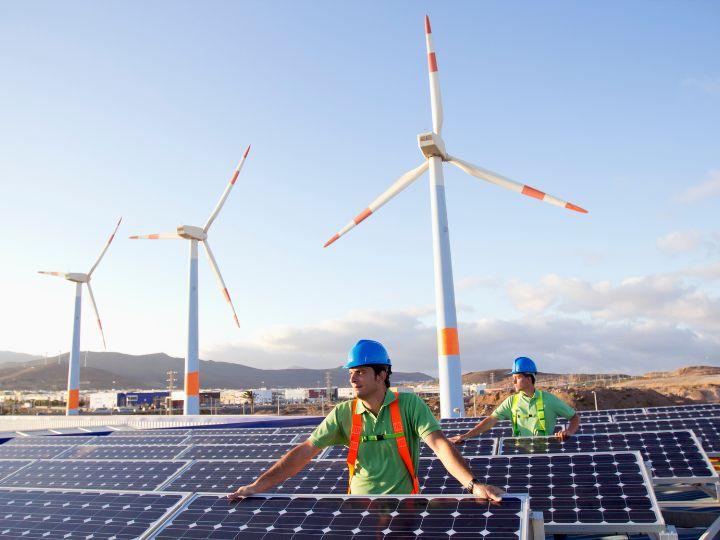
Photo Source: University of Houston Hobby School of Public Affairs
According to survey findings from the University of Houston’s Hobby School of Public Affairs, 64% of Texans favor expanding the nation’s reliance on solar energy. Meanwhile, just 42% of respondents favor expanding U.S. reliance on natural gas fired power plants, 35% favor expanding reliance on fracking for oil and natural gas, and 27% favor expanding reliance on coal mining and coal fired power plants.
Texans also strongly favored other solar-specific policies, including overwhelming support (90%) for net-metering legislation and for tax incentives for homeowners and businesses to install rooftop solar panels and battery storage (82% in favor).
Anti-Renewables Lawmakers Intervene
Instead of embracing Texas’ rising stature as a national leader in solar capacity and embracing the bounty of economic benefits that come with that, opportunistic state politicians are instead seeking to stem the tide by propping up the state’s fossil fuels industry.
Texas’ rise up the utility-scale solar ranks is poised to grind to a halt after the Texas Senate recently approved S.B. 624. The bill ranks up there as one of the most anti-renewables bills ever seen. It is riddled with punitive measures specifically designed to cripple the state’s solar and wind industries. Here is a sampling of the measures in the bill:
- Forces renewable energy developers doing business in Texas to pay a yearly operating fee. Fossil fuel companies are exempt.
- Requires solar & wind facilities to obtain a statewide permit from the Public Utility Commission (PUC). Fossil fuel projects are exempt. Note: all members of the PUC have been appointed by Gov. Greg Abbott who has long supported the fossil fuels industry and pushed misinformation about renewables.
- Renewable projects must be 500 ft. from any property lines and 1,000 ft. from habitable structures unless a written waiver is obtained from each affected property owner.
- Renewable developers would be required to pull a permit any time significant changes are made to an existing project.
- Applies new permit requirements retroactively to existing renewable energy sites.
- Gives the PUC the authority to enter project sites and remove installed capacity if they are deemed to not comply with the new restrictive permits.
- Requires that any potential renewable energy project must alert counties within 25 miles that they are applying for a permit, a regulation clearly designed to help drum up community opposition.

Photo Source: CNN
The bill now heads to the GOP-controlled House for consideration before it ends up on Gov. Abbott’s desk to potentially become law. This nakedly punitive and partisan piece of legislation that singles out a whole industry flies in the face of the laissez faire posture the state has long had to development, especially energy development.
The irony of this moment is striking. Texas was blessed with oil and gas resources that helped catapult its economy to new heights during the “Oil Boon” era about 100 years ago. A similar combination of steady winds and extended sunlight exposure have helped the state dominate in a new energy era as tens of thousands of jobs and billions of dollars of corporate investment in solar and wind projects flow to the state during the present era of rapid clean energy growth. Instead of supporting this promising economic opportunity, Texas legislators beholden to the fossil fuels industry donor class seem hellbent on stifling this growth with burdensome regulations.
Hopefully rationality can once again take root in the Texas legislature and the free market – not emotional politicians – can once again guide the state’s energy policy. S.B. 624 sets a bad precedent that Texas can’t allow to become the new normal.
The post Texas Emerges as Solar’s Latest Hotspot As Legislative Threats Emerge appeared first on Solar Tribune.
]]>The post Solar Manufacturing Growth Picks up in U.S. appeared first on Solar Tribune.
]]>
China’s Market Dominance
It’s hard to overstate how much of a stranglehold China has over the global solar energy supply chain. A recent deep-dive report compiled by the International Energy Agency (IEA) puts this fact into stark terms. According to the report:
“China’s share in all the manufacturing stages of solar panels (such as polysilicon, ingots, wafers, cells and modules) exceeds 80%. This is more than double China’s share of global PV demand. In addition, the country is home to the world’s 10 top suppliers of solar PV manufacturing equipment.”
China’s commanding influence is seen across all major solar panel inputs. In 2021, China could lay claim to 79% of global polysilicon capacity, 97% of wafer manufacturing, and was responsible for producing 85% of the world’s solar cells. Incredibly, the report even notes that 1-in-7 solar panels produced in the world comes from one single facility in China’s Xinjiang province.
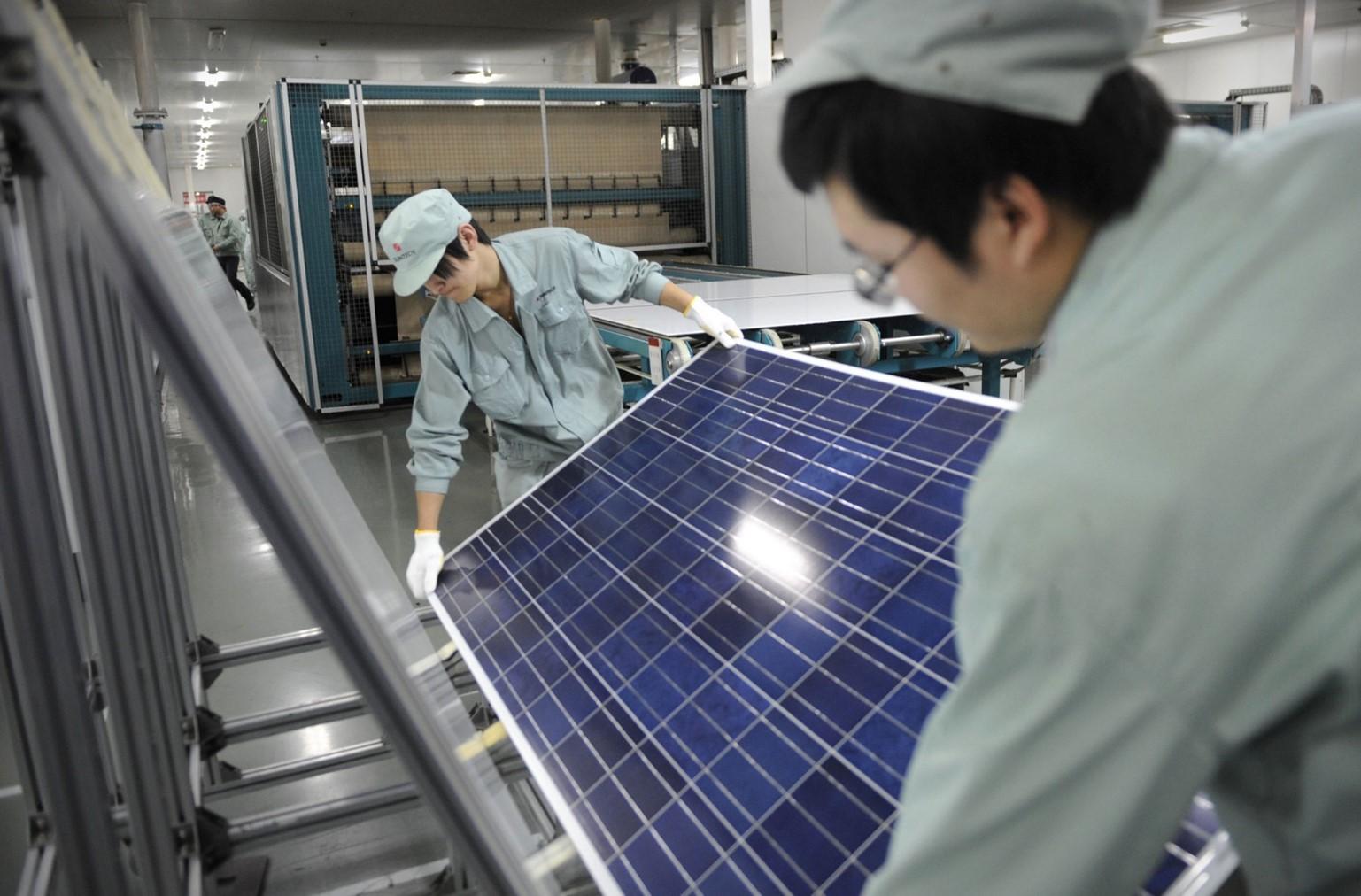
Photo Source: The New York Times
The issues this poses to the global solar PV supply chain are obvious. When so much of an industry’s supply chain is focused on a small portion of the globe, production and shipping bottlenecks are inevitable and their global impacts could be paralyzing. Region-specific extreme weather events, shipping issues, political unrest, and labor shortages are just a sampling of the issues that could go wrong and bring the global PV supply chain to its knees. Not to mention potential Black Swan-like events like economic fallout from China’s simmering tensions with Taiwan.
The geographic concentration of mission critical solar PV components has led to massive supply-demand imbalances, which ultimately, has driven costs up. The IEA report notes, for example, that the price of solar panels spiked by 20% over the last year, largely spurred by an eye-popping quadrupling in the price of polysilicon.
The solar manufacturing cost advantages that China has cemented in recent decades are a direct result of policies championed by the Chinese government highlighting the solar PV industry as a national economic priority. Government policies encouraged economies of scale and innovations that helped to drive down production costs for solar. As a result, solar manufacturing costs in China are 20% lower than the United States.
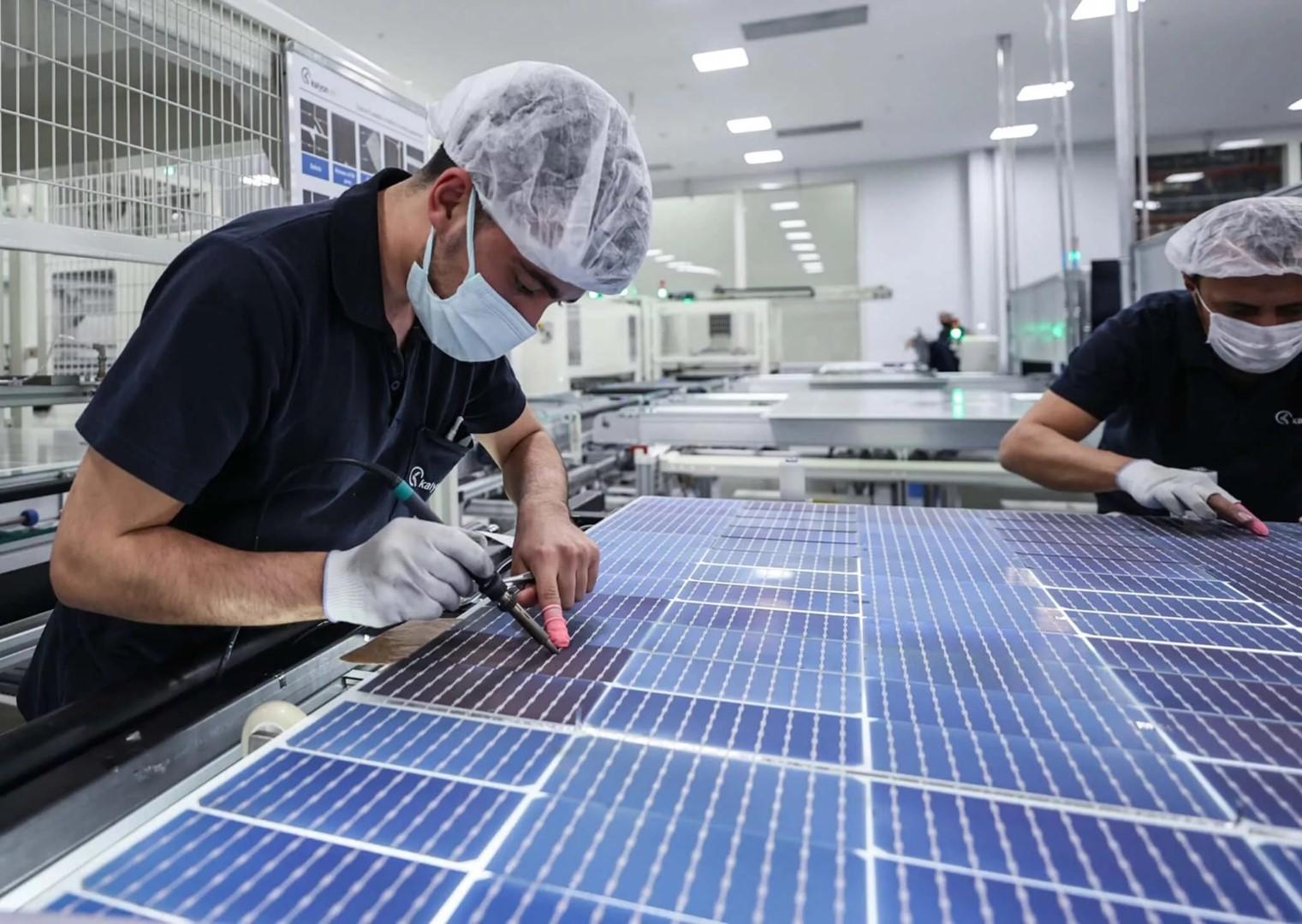
Photo Source: EcoWatch
IRA Seeks to Turn the Tide
The IEA report put in stark terms the competitive imbalance between the U.S. and China when it comes to solar manufacturing, and called on policymakers to establish financial and tax incentives that can help to reverse the tide.
The passage of the much-heralded IRA last year included such financial incentives to induce more domestic fabrication like an increase in the Investment Tax Credit (ITC) from 30-40% for projects using domestic products, as well as a product-specific production tax credit (PTC). The most impactful benefit, however, is the timeframe which extends the bill’s various incentives for 10 years, giving much-needed long-term certainty to manufacturers.
Photo Source: Renewable Energy World
In addition to the IRA, the Biden Administration has been aggressive in pulling other levers of power to accelerate solar manufacturing growth opportunities in the United States. Last June, President Biden invoked the Defense Production Act (DPA) to boost domestic manufacturing of clean energy sectors – like solar panel manufacturing – while also instructing the federal government to increase purchasing commitments of U.S.-made solar panels and related clean energy products.
The President also announced around the same time period a 2-year moratorium from tariffs on solar panel imports from Cambodia, Malaysia, Thailand, and Vietnam. The goal of the move was to protect vulnerable solar jobs in the U.S. amid significant supply chain disruptions brought on by the Department of Commerce’s ongoing investigation into whether panels imported from these four Southeast Asian counties evaded tariffs placed on Chinese-made solar products.
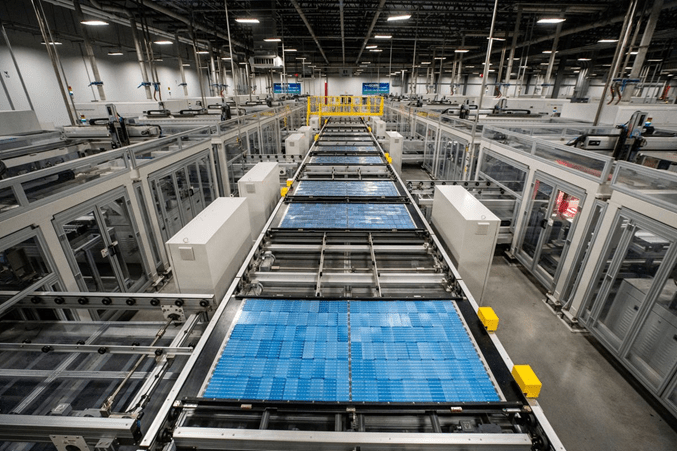
Photo Source: Bloomberg
Solar Manufacturing Announcements Start to Pile Up
One of the primary goals of the IRA was to launch U.S. solar manufacturing capacity to new heights, and it sure is hard to argue with the results. The clean energy-focused non-profit advocacy group, Climate Power, released a report recently documenting new clean energy investments occurring in the U.S. between the signing of the IRA in August through the month of January.
The research by Climate Power shows that companies have announced more than 100,000 clean energy jobs in the United States since the passage of the IRA. These jobs are tied to 90 different clean energy economic development announcements across 31 different states, and they collectively represent nearly $90B in new capital investment. These figures are simply staggering by any measure and they once again underscore that climate action and our country’s economic future are inextricably tied to each other.
Advancing the nation’s solar energy capacity goals is imperative for addressing the global climate crisis, and the economic benefits that Americans stand to see are more evident now than ever. The national security imperative for domestic clean energy production investments are also increasingly clear. Just days ago, China was chided by the U.S. for having a surveillance balloon floating over the country’s heartland. With tensions between the two countries on the rise, the case for growing solar production capacity at home and weaning off the Chinese-based supply chain speaks for itself. The IRA has certainly primed the pump for doing just that, and we are excited to see the numerous domestic investments in solar production facilities announced in recent months. Hopefully this trend marks a turning point for the U.S. solar industry.
The post Solar Manufacturing Growth Picks up in U.S. appeared first on Solar Tribune.
]]>The post Floating Solar Panels Sail Forward appeared first on Solar Tribune.
]]>
How Do They Work?
Solar panels themselves are an engineering marvel, and floating solar panels are even more so. Metal components are a significant part of land-based solar energy systems, which presents a challenge for floating solar panels since metal and water are not a good mix. Ground mounted solar panels are installed on mounting systems that are typically anchored into the ground by a steel helical pile.
Floating solar panels on the other hand are typically placed upon polyethylene-based “floaters,” which are buoyant and strong enough to hold 2.5 times their weight. The floating structure itself is coated with magnesium alloy, which is highly resistant to corrosion and rust. The floating solar structure is kept in place via mooring lines and anchors that rest at the bottom of the body of water.

Just as ground-mounted systems typically require flat terrain, floating solar energy systems require calm waters with minimal choppiness. You won’t find them out on the open ocean. Instead, you’ll find them on lakes, canals, and similar (often man-made) bodies of water.
To date, floating solar has mainly been installed overseas. The largest floating solar arrays are all in Asia, including the largest such installation in the world, the mammoth 320 MW Dezhou Dingzhuang floating solar array in China.
Meanwhile, Portugal is home to Europe’s largest floating solar array with a 5 MW, 12,000 panel system located in the region of Alqueva.
Pros and Cons
Floating solar panels are a revolutionary technology that are disrupting conventional approaches to generating solar energy. Floating solar panels present a number of advantages over land-based alternatives, and some flaws as well. Here are some of the main pros and cons of floating solar panels.
Pros:
- Cooling effect allows for better efficiency: A common issue with solar panels is that the rising panel surface temperatures resulting from a long sunny day can actually reduce panel efficiency. Floating solar panels are able to mitigate these efficiency loss issues thanks to the cooling effect of the water on the underside of the panels.
- No loss of land: Arguably the biggest advantage of floating solar panels is that they do not occupy otherwise scarce land that in turn can be freed up for other residential, industrial, commercial, or land preservation purposes. This is an especially useful evolution in an era where community pushback against large solar farms is becoming increasingly common.
- Compatibility with hydropower plants: Floating solar is most often found on calm, man-made bodies of water like lakes and reservoirs. Hydropower power plants have such a dammed reservoir nearby, which presents an attractive “double whammy” opportunity to generate power at these locations. Power generated by floating solar panels on these reservoirs can benefit from the existing infrastructure at the power plant, helping to reduce costs and making it easier to send power to the grid.
- Shade avoidance: Vertical obstructions are a no-no for optimizing solar energy production since they can shade solar panels and reduce system efficiency. The benefit of floating solar panels is that they are typically placed on expansive open bodies of water, helping to remove the threat of shade. There are subtle environmental benefits as well since the removal of trees, which can be common for ground-mounted systems, is not applicable to floating solar energy systems.
Cons:
- Higher maintenance costs: Floating solar is still a relatively new technology. The specialized equipment it requires and the niche knowledge and experience required of floating solar installers helps lead to higher installation costs. Long-term maintenance costs are also higher for similar reasons. There are unique costs like the cleaning costs associated with bird droppings arising from birds roosting on or near the floating solar panels.
- Disruption to aquatic life: The floating solar panels block out sunlight below, which can deprive aquatic plants of key nutrients and disrupt sensitive aquatic ecosystems. Aquatic life is typically sparse on man-made lakes and reservoirs where floating solar panels are most typically located, so this helps to mitigate widespread harmful effects. There are also some subtle benefits to the shade cover like reducing the presence of dangerous algae blooms.
California Canals
Floating solar panel systems are much more prolific internationally than they are in the United States. The largest U.S.-based floating solar farm is a 4.8 MW system sitting on two ponds at Healdsburg, CA’s wastewater treatment plant. This system is dwarfed by the 320 MW Dezhou Dingzhuang floating PV array in China.
California is seeking to help the U.S. along and make water-integrated solar panel systems more mainstream by employing a unique adaptation to long running efforts to mitigate drought effects. If it were a country, California would have the 4th largest economy in the world. Much of California’s modern-day success is owed to the state’s elaborate aqueduct system which was initially constructed some 60+ years ago. The state’s aqueduct system includes over 4,000 miles of canals designed to deliver water from wet Northern California to comparatively dry Southern California.
The State of California is hoping to complement this series of man-made canals with solar panels. The state-funded effort, dubbed “Project Nexus,” will affix solar panel canopies over three sections of the Turlock Irrigation District (TID), totaling approximately 8,500 feet of space. Construction on the project is expected to commence in 2023.

Photo Source: Smithsonianmag.com
The marriage between solar canopies and canals can help to solve dual issues in California. The shade cover provided by the canopies can help to combat omnipresent drought concerns in California by reducing evaporation, while the solar canopies add another tool to the state’s toolbox to achieving 50% clean energy generation by 2025 and 60% by 2030.
Researchers at UC Merced and the University of California Santa Cruz first planted the idea of ‘solar canals’ in a study published last year in Nature Sustainability. The hope is that this pilot project shows promise and can be scaled up significantly across the state. The researchers estimate that the water saving effects and solar generation potential will be profound. According to their research findings cited in a recent PBS article:
The research suggests that covering all of California’s canals – spanning roughly 4,000 miles – with solar panels could save up to 63 billion gallons of water and generate 13 gigawatts of renewable power annually. One gigawatt is equal to the energy consumption of 100 million LEDs, or as others put it, enough to power 750,000 homes.
It would have been preposterous a couple decades ago to think that floating solar panels or solar panel canopies built over Californian canals would ever be feasible. The emergence of these water-integrated solar innovations is yet another reminder of how groundbreaking technologies are continuing to open up new possibilities for how we harness the Sun’s power.
Floating solar in particular is just barely scratching the surface when it comes to its long-term potential. Currently, only 2% of new solar installations are on water, yet the United States has more than 24,000 human-made bodies of water. It will be fascinating to follow the growth in the floating solar panel industry in years to come. The prospects are clearly bright.
Cover Photo Source: NREL
The post Floating Solar Panels Sail Forward appeared first on Solar Tribune.
]]>The post NIMBYism Threatens to Stymie Solar Progress appeared first on Solar Tribune.
]]>
A Worrying Trend
The passage of the IRA is a seminal moment for the solar industry that will likely spur a “gold rush” of sorts as developers seek to take advantage of the increased market certainty and race to gobble up suitable land for large solar farms. Solar farms have been around for some time, but favorable market dynamics continue to increase their prevalence. According to data from 2018 gathered by the Energy Information Administration (EIA), there are over 2,500 utility-scale solar PV developments generating electricity in the United States. More recent data from the Solar Energy Industries Association (SEIA) puts the number closer to 10,000.
As utility-scale solar farms have become more commonplace, so too have the concerted efforts to push back against them. This pushback has been led by grassroots community activists who are often adept at leveraging social media to organize opposition around solar developments. According to an April analysis by Reuters, there were:
“45 groups or pages on Facebook dedicated to opposing large solar projects, with names such as “No Solar in Our Backyards!” and “Stop Solar Farms.” Only nine existed prior to 2020, and nearly half were created in 2021. The groups together boast nearly 20,000 members.”

The ultimate goal of these grassroots activists is to influence the decision-making of local planning commission members and elected officials who are tasked with evaluating these projects. There is evidence that they are doing just that. An NBC News article from March documented the following:
“NBC News counted 57 cities, towns and counties across the country where residents have proposed solar moratoriums since the start of 2021, according to local news reports, and not every proposed ban gets local news coverage. At least 40 of those approved the measures. Other localities did so in earlier years.”
A Google search of “solar moratoriums” show plenty local solar moratoriums that have been established by municipalities across the country in just recent years.
Dispelling the Myths
The opponents of utility-scale solar projects can be quite a motley crew. On one end of the spectrum, there are climate skeptics who think climate change is a “hoax” and outright oppose renewable energy investments on the grounds that they are not needed. And then there are opponents with environmental and land conservation concerns who worry about deforestation and related ecological impacts associated with utility-scale solar developments.
The reasons cited by opponents of solar projects generally fall into two buckets; a) misinformation or b) valid concerns that are easily addressed by appropriate developer-led mitigation efforts. Here are some of the most common reasons that people oppose solar projects.
Common Myths:
- Solar panels contain hazardous materials that can leach into the soil and surrounding water systems
- Solar panels are generally comprised of materials that are abundant and commonplace like glass, aluminum, cooper, and silicon. However, it is true that some panels incorporate some heavy metals and hazardous materials like lead, arsenic, and cadmium telluride. An abundance of research shows that extremely limited amounts of the hazardous materials from solar panels leach into the environment. This academic paper from the National Library of Medicine concludes that very little cadmium escapes into the environment, even under harsh landfill conditions. Research by the International Energy Agency (IEA) likewise concluded that the risk posed by the leaching of heavy metals out of solar panels is well below U.S. regulatory thresholds.
- Solar developments have a negative impact on the property values of nearby homeowners.
- There are plenty of reports and statements – often from home appraisers – stating that there is no evidence to support the theory that solar farms negatively affect property values of nearby property owners. One of the most widely circulated independent investigations into the topic is this 2018 report by researchers at the University of Texas’ LBJ School of Public Affairs. The majority of surveyed home appraisers (66%) said it was their professional opinion that proximity to a solar installation had no impact on nearby home values, while 11% said they actually had a positive impact.
Valid Concerns & Appropriate Mitigation Response:
- Solar developments that require the removal of a large amount of mature trees and other vegetation can lead to soil erosion that can affect nearby properties.
- Solar panels are angled in such a way that a lot of rainwater hits over and over again at the “drip line.” The sheer size of utility-scale solar farms creates valid concerns over how this rainwater is dealt with. Thankfully, there are a number of mitigation tactics that can be pursued, in addition to standard industrial-grade stormwater management practices like drainage ditches and retention ponds. Incorporating native grasses and other vegetation is one of the most affordable low-hanging fruit options. The plants help to absorb water and their root systems give the soil more stability. Geotextile fabrics are also an increasingly popular method of erosion control on solar farms.
- Solar developments in rural America can occupy large amounts of farmland that have important cultural and economic importance in a community.
- Solar farms are indeed best suited for placement on agricultural land due to the general expansiveness of such property, lack of shade producing vertical obstructions, and favorable municipal regulations. A common myth is that solar panels prevent said land from ever being used for agricultural use. In fact, solar panels can be a complement to the existing agricultural use. The whole cottage industry of “agrivoltaics” has emerged to show that solar panels can coexist on property used for livestock, and both crop and honey harvesting.
- Solar panels can disrupt sightlines for nearby homeowners who otherwise prefer natural surroundings.
- Concerns by neighbors over disrupted viewsheds are among the most often cited criticisms of solar farms. A tree fence or similar landscape buffer is a common remedy to alleviate these concerns, and sometimes, an additional setback can be employed to further appease neighbors who want more action to be taken.
Finding Common Ground
The most effective solar developers are those who view community pushback not as a headache, but as an educational opportunity that can ultimately lead to pivotal long-term relationships with community stakeholders.
Solar developers who go out of their way to engage with community members – even those who oppose their project – are best positioned to achieve positive outcomes. Putting forward a good faith effort to engage with and educate community members should be a foundational aspect of any stakeholder engagement process. The unique thing about solar farms is that they have 30+ year lifespans, which really underscores the need for developers to be intentional about developing and maintain long-term relationships in the communities that they work. Many prominent solar developers provide grants or similar philanthropic donations in the communities that they work in that support community and/or economic development priorities. Partnering with the local community college around solar worker-focused training programs is another common and effective way for developers and communities to align around common priorities.
It is hard to talk about opposition to solar projects without talking about politics. Utility-scale solar projects are primarily located in rural communities that have conservative politics. Once upon a time, this fact wasn’t that noteworthy, but it is now quite relevant in an era of increased political polarization. Support by conservative voters for solar and wind farms has dropped sharply in recent years, according to the Pew Research Center. In 2020, 84% of Republicans and Republican-leaning independents supported “solar panel farms,” but this support fell to 73% by 2021. This is clearly an ominous sign since these renewable projects are often a best fit in conservative-leaning communities.
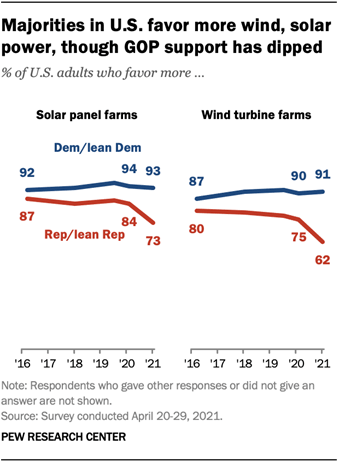
Photo Source: Pew Research Center
Instead of shunning these solar skeptics, the partisan divide over support for solar farms represents a great opportunity for developers to partner with organizations committed to bridging this growing partisan gap. Conservatives for Clean Energy (CCE) is one such organization with a growing presence in the Southeast. From their website, the organization “proudly educates the public and decision-makers on the economic benefits of clean energy and advocates for continued investments across the Southeast.” CCE has state-based chapters in Florida, Georgia, North Carolina, South Carolina, and Virginia. This podcast interview by the North Carolina Sustainable Energy Association (NCSEA) with CCE President/CEO, Mark Fleming, covers a lot of relevant topics about how CCE seeks to be a resource to conservative lawmakers.
The Center for Energy Education is another organization involved in educating lawmakers and the general public about the benefits of solar energy. The Center claims on their website to have educated over 730 public officials on the virtues of solar energy. The organization has provided structured training and workshops to thousands more across the country.
Advocacy organizations like these play such a critical role in breaking through misinformation and educating the public on the myriad of benefits that solar energy can bring to their community. Successful large-scale solar developments hinge on the ability to secure local support. It is critical for solar developers and local stakeholders alike to embrace the opportunity to learn from one another, and approach these projects with an open mind and collaborative spirt.
Cover Photo Source: LenConnect.com
The post NIMBYism Threatens to Stymie Solar Progress appeared first on Solar Tribune.
]]>The post IRA Passage Ushers in New Era of Stability for Solar Industry appeared first on Solar Tribune.
]]>
How Will the Solar Industry be Impacted?
The IRA is chock full of measures to advance the country’s decarbonization goals, including incentives to spur innovation and further growth in the clean energy sector. The solar industry stands to potentially be one of the biggest beneficiaries of the bill’s passage. Here’s a high-level overview of the primary solar incentives in the bill that will give the industry a major jolt in the arm:
- The bill restores the 30% federal Investment Tax Credit (ITC), extending it for another 10 years. This policy certainty has long evaded the solar industry as Congress has made a habit of fiddling with the ITC and driving boom-bust cycles with their last-minute decision making. Energy storage technologies are now also eligible for the ITC.
- For the first time, solar projects will now also be eligible for the Production Tax Credit (PTC). Unlike the ITC which offers a one-time tax credit for project investors, the PTC is tied to the power that a renewable project generates over 10 years.
- Additional add-on tax credits can be applied to the ITC and PTC. There are an array of additional “bonus” add-ons that can be stacked together to create an especially lucrative financial incentive. These add-ons seek to encourage more solar projects to locate in low-income communities and in formerly coal-dependent communities, in addition to encouraging sourcing materials from domestic suppliers and paying prevailing wages for project workers. The graphics below show the myriad of add-on components of the ITC and PTC and their significant cumulative value.
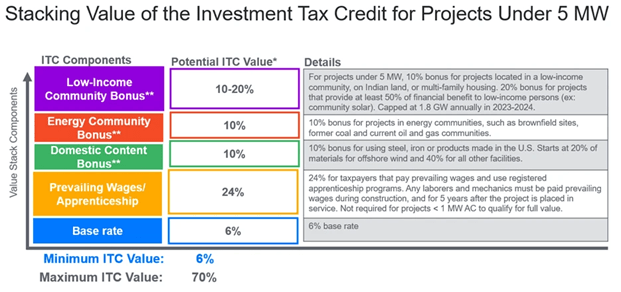
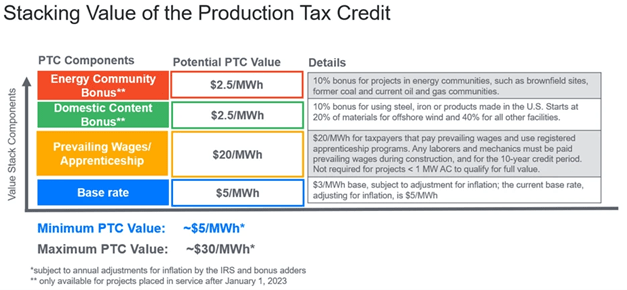
Photo Source: Edison Energy
The various pro-solar initiatives baked into the IRA have already led to a boon in domestic manufacturing, as leading solar companies make renewed commitments to bring solar manufacturing jobs to the United States.
First Solar, the largest solar panel manufacturer in the U.S., announced in late August that they will invest up to $1.2B to expand solar panel manufacturing capacity in the country. About $1B will go towards a new facility to be located in the Southeast, which will employ hundreds and begin operations by 2025. An additional $185M will go towards expanding production capacity at the company’s existing factory in Ohio.
Photo Source: Toledo Blade
SPI Energy, a PV project developer and EPC firm, announced just days after the passage of the IRA that they intend to secure 1.5GW of solar wafer manufacturing equipment for a new U.S. production facility. The company is targeting delivery and production of 1.5GW of solar wafers production capacity by 2023, with plans to double that capacity by 2024. This will be the first silicon wafer facility based in the U.S. in nearly a decade’s time.
European PV Hardware, one of the largest solar tracker providers in the world, also announced recently plans to bring a 6 GW factory to Texas that will be operational by next year. Q Cells is also poking around states as it scouts a location for a nearly $2B 9 MW module manufacturing facility.

Photo Source: PV Hardware
These recent investments are just the tip of the iceberg, according to the Solar Industry Energy Association (SEIA). SEIA foresees an avalanche of additional solar manufacturing investments coming to the U.S. in coming years:
“As a direct result of the IRA, we expect to see significant new investments in domestic solar module, tracker, inverter and racking capacity within the next 2-3 years, followed by new investments in solar ingot, wafer and cell capacity within 3-5 years. By the end of the decade, the IRA will be instrumental in ensuring the U.S. solar industry meets its goal of 50 gigawatts (GW) of domestic solar manufacturing capacity across all key industry segments by 2030.”
Burden for Success Shifts to States
The passage of the IRA has brought renewed enthusiasm to climate activists and renewable energy enthusiasts who now see a much more feasible path forward to meeting climate goals. Lost in the euphoria, however, is the fact that while the federal action is indeed historic and desperately needed, it is not an instantaneous cure-all. States, municipalities, and utilities will play an outsized role in maximizing the true potential of the IRA.
The shear scale of new renewables capacity required to be developed in the U.S. in order to meet climate targets is significant. This presents an opportunity that is both exciting and daunting. In a recent guest article for Forbes, Senior Policy Expert for Energy Innovation’s Power Sector Transformation team, Daniel Esposito, points out in stark terms just how much the status quo will need to be upended in order to maximize the full potential of the IRA:
“The U.S. must build roughly 100 gigawatts (GW) of wind and solar capacity annually through 2030 to hit its climate targets, but it developed just 28 GW in 2021. More than 920 GW have applied for grid interconnection, but most projects drop out when faced with insurmountable transmission upgrade costs that have many “free-rider” beneficiaries. Successful ones languish for years waiting for approval.”
The traditional process of getting solar projects approved is overly bureaucratic, time-consuming, and far from streamlined. As noted by Esposito, there are a number of prominent challenges that the industry has historically faced that will need to be addressed so as to not impede the IRA’s plans to drastically increase renewables capacity.
- Patchwork permitting process: solar projects have long been plagued by a disjointed permitting process that differs – often significantly – from county to county. The lack of uniformity adds time and uncertainty to projects, both of which can be debilitating. The worrisome trend of solar farm moratoriums that are sprouting up across the country is not helping matters either.
- Interconnection issues: The time that solar projects spend in interconnection queues is increasing. These queues are a byproduct of the various impact studies that utilities and transmission system operators require before a project can be greenlighted. According to a report from the Lawrence Berkely National Laboratory of all energy projects, “the typical duration from connection request to commercial operation increased from ~2.1 years for projects built in 2000-2010 to ~3.7 years for those built in 2011-2021.”
- Transmission access: Solar companies can build out as much solar capacity as they want, but all will be for naught without improvements and extension of the electric grid, all of which has a long-time horizon.
The common denominator to all of the above is time. These time-consuming hurdles to solar project development and grid connection threaten so much of the ambitious plans set forth in the IRA.
There is another omnipresent threat to the success of the IRA in ramping up renewables deployment – politics. A lot of the models predicting that the IRA will help to rapidly expand renewable capacity in the country are based on economic models that fail to account for political differences among the states. In many states, state utility commissions play an outsized role in determining how much renewable energy capacity to incorporate into the grid. While solar capacity is growing off the charts in this country, there are still many states where the fossil fuels industry has commanding influence over the state legislators and utility commissions that will dictate how much of the pro-renewable initiatives in the IRA will actually happen in their respective states.
Lest we forgot the recently decided Supreme Court case West Virginia vs. EPA where a bevy of Republican-led states and fossil fuel companies successfully sued to block the EPA’s ability to regulate carbon dioxide emissions related to climate change.
It is worth pointing out that the IRA was signed into law strictly along party lines with no Republican support for the bill. As such, ambitious Republican state elected officials will see little political incentive to go to the mat to take advantage of the pro-renewables initiatives in the IRA given the political exposure they would open themselves up to during a primary campaign.
Even so, there is reason for optimism. The economics of solar and wind energy continue to improve by leaps and bounds with each passing decade. The IRA is loaded with incentives that will continue to bend the cost curve down, and most importantly, that establish a degree of certainty that has long eluded the renewable energy industry. Bi-partisan advocacy organizations like the U.S. Climate Alliance, led by Red-state and Blue-state governors alike, have only hardened their resolve to make sure that the benefits of renewable energy flow to every corner of this country in the wake of the IRA’s passage. There are clear challenges to implementation for sure, but the solar industry has proven itself to be resilient time and time again, and we are confident that key industry players will rise to meet the moment.
Cover Photo Source: ADT Solar
The post IRA Passage Ushers in New Era of Stability for Solar Industry appeared first on Solar Tribune.
]]>The post Global Heat Wave Puts Solar Panels to the Test appeared first on Solar Tribune.
]]>
Too Much of a Good Thing
The dynamic between heat, sunlight, and solar panels can all seem counterintuitive. You would think that bright, sunny, long summer days would be most ideal for capturing solar energy. In actuality, excessive heat is a stressor that can erode solar PV panel efficiency.
Solar panels are manufactured and tested to function at their peak performance at a temperature of 25 °C (77 °F). Drops in energy efficiency start to happen once temps get above that 25°C mark. The slow erosion of PV efficiency is generally negligible on say an 88 °F degree summer day, but the compounding effect of efficiency losses can really weigh down performance on those especially hot 38+°C (100 °F) days.
The easiest way to explain the effect that ambient heat has on a solar panel’s performance is through temperature coefficients, which essentially indicate how much of a loss in efficiency will be incurred for every additional degree in surface temperature above 25 °C. For example, if the temperature coefficient of a solar panel is -0.5%, then for every 1°C rise, the panels maximum power will be reduced by 0.5%. So, on a 40 °C day, a solar panel’s output will be reduced by 7.5%.
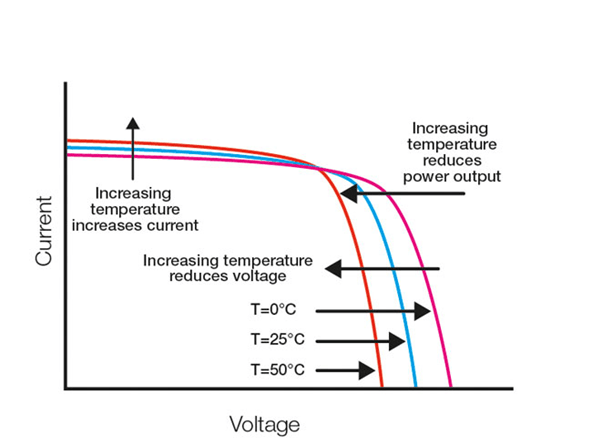
Photo Source: Seaward.com
July Heat Cripples Vulnerable Regions
A July heat wave ravaged countries across the world, but the effects were most pronounced in Western Europe where, unlike in the U.S., air conditioning is not a widespread household commodity. Temps above 38°C took hold across much of Europe, which in some cases was a nearly 15-degree deviation from historical summer temps that typically hover closer to 25°C.

London experienced its hottest day ever on July 19 when temps at Heathrow Airport hit 40.2 °C (104.4 °F). The hottest temps on the continent during the July heat wave were felt in the small town of Pinhão, Portugal were the high on July 14 reached a hard to comprehend 116.6 °F. The unprecedented heat and dry conditions in Europe during July led to widespread wildfires that wreaked havoc all over the continent. Over 5,400 people in Europe died during the month due to complications from the heat, many of whom were elderly people living in dwellings not equipped with A/C.

Photo Source: The Atlantic
The U.S. was not spared from the historic heat wave that crippled Europe. According to an Axios article from July 25, 1,403 daily high-temperature records and 2,856 records for warmest overnight low temperature were set in the 30 days prior (Source: NOAA). Like in Europe, the blazing temps have fueled wildfires like the still burning Oak Fire in California, which has destroyed over 19,000 acres and forced the evacuation of over 6,000 people.
The once unfathomable record-breaking global temps that occurred in July are, of course, just the latest real-time manifestation of the climate crisis that we are all living in. UCLA climate scientist, Daniel Swain, recently made the following blunt assessment:
“Climate change is making extreme and unprecedented heat events both more intense and more common, pretty much universally throughout the world. Heat waves are probably the most underestimated type of potential disaster because they routinely kill a lot of people. And we just don’t hear about it because it doesn’t kill them in, to put it bluntly, sufficiently dramatic ways.”
The threat to human life and personal property are challenges wrought by the climate crisis, but the widespread threat to critical public infrastructure (like the electric grid) are of equal concern. In England, the oppressive heat compromised airport runways and buckled heat-sensitive train rails, leading to significant disruptions in travel. Meanwhile in Texas, the hottest month on record strained the state’s grid as previous demand records were broken 11 times in the month, including exceeding 80,000 MW for the first time ever.
The extreme temps can also pose similar issues to solar panel infrastructure. Although exceedingly rare, solar panel fires can occur. They are most often due to a design flaw, component defect, or faulty installation, but extreme heat is another contributing factor. A contained roof fire at a house in Quincy, MA in July was blamed on overheated solar panels, and just days ago – amidst prolonged 100+°F daily highs – a number of solar panels atop an office building in Dallas, TX caught fire.

Photo Source: NBC DFW
Perhaps the most realistic fire threat involving solar panels is a wildfire-esque situation where dry vegetation underneath ground-mounted solar panels catches fire and spreads across a solar farm. This very situation has happened just in the past couple weeks amidst the July heat wave in Europe. An on-site grass fire affected a 30 MW solar farm in the Netherlands, and the same occurred at a 20 MW solar farm in the United Kingdom. Fire crews contained the fires in both instances and damage to the panels was minimal.

Photo Source: Dailymail UK
Overcoming the Heat Challenge
The solar industry is adapting to the growing climate challenges posed by a warming planet as numerous innovations are being developed to reduce the threat to efficiency that excessive heat can bring.
For one, the type of solar PV cell used matters. Monocrystalline and polycrystalline are the most common type of solar cells used on commercial panels, and they have the worst temperature coefficient of between -0.45% – 0.50%. The increasingly popular thin film solar cells have a temperature coefficient about half that at around -0.20%, while hybrid solar cells that combine both technologies sit roughly in the middle at -0.30%. A lot of concerns over heat-related efficiency loss can be alleviated as solar cell technology gets more sophisticated and market applications for thin film cells increase.
A range of active cooling technologies can also help solve the solar heat conundrum.
Companies like Sunbooster have harnessed an active cooling system that cools the surface of the panels by recycling rainwater and deploying it in an irrigation-like manner over top the panels during hot days.
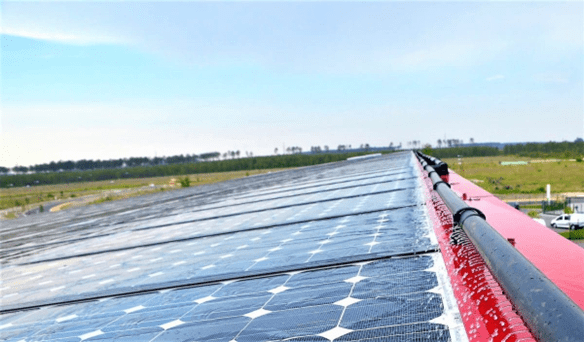
Photo Source: PV Magazine
Researchers at King Abdullah University of Science and Technology (KAUST) in Saudi Arabia and the Hong Kong Polytechnic University (PolyU) have also researched a hydrogel substance that can possibly have significant cooling capabilities. According to a PhysicsWorld article, “the researchers pressed a 1-cm-thick layer of the hydrogel against the underside of a standard silicon solar panel. When the temperature drops in the evening and overnight, the water absorbed by the material condenses to form liquid water. During the daytime, as the temperature increases, the heat from the PV panel causes the water to evaporate – a process that not only removes heat from the panel, but also regenerates the vapour sorbent so that the atmospheric water harvester (AWH) is ready for the next night-day cycle.” The technology is not yet fit for commercialization, but the researchers are optimistic about its long-term viability.
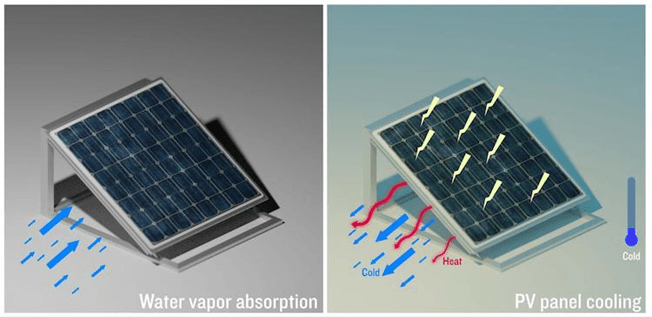
Photo Source: Physics World
And in the “low hanging fruit” department, one of the easiest ways to cool solar panels is to combine them with their close cousin, the wind turbine. Wind turbines placed strategically on a solar farm act as massive fans, circulating cool air that flows over and around the ground-mounted panels below.

Photo Source: Linquip Technews
So much of the infrastructure relied on in the U.S. and elsewhere in the world was built during a time of fundamentally different assumptions about weather and climate. Clearly, the heat impacts felt last month are a reminder of how an ever-warming planet is changing this antiquated approach. The solar industry needs to harness promising innovations to adapt to new climate realities or run the risk of falling behind at a time when humankind needs it the most.
Cover Photo Source: LA Fire Department
The post Global Heat Wave Puts Solar Panels to the Test appeared first on Solar Tribune.
]]>The post Rooftop solar: Good for the economy, good for the grid appeared first on Solar Tribune.
]]>Solar continues to create jobs, investment, economic development and grid resilience while reducing energy costs for utilities, businesses, industry and consumers. It reduces the environmental impact on air, water and carbon. And amazingly, it can be placed atop your house.
Guest Post by Tim Echols, Originally posted in the Athens Banner-Herald
Tim Echols is Vice-Chair of the Georgia Public Service Commission.
Georgia is a national leader when it comes to solar energy. It began in 2013 with who I call the solar trifecta: Commissioner McDonald, the late Commissioner Doug Everett and yours truly.
The Georgia Public Service Commission created a solar framework and compelled Georgia Power to move forward on solar at scale, and the program has been wildly successful, helping Georgia rank in the top 10 states nationally for total solar installed – but that doesn’t tell the whole story.
More about the topic: Georgia Power plan ends coal, but doesn’t do enough for efficiency, climate, critics say
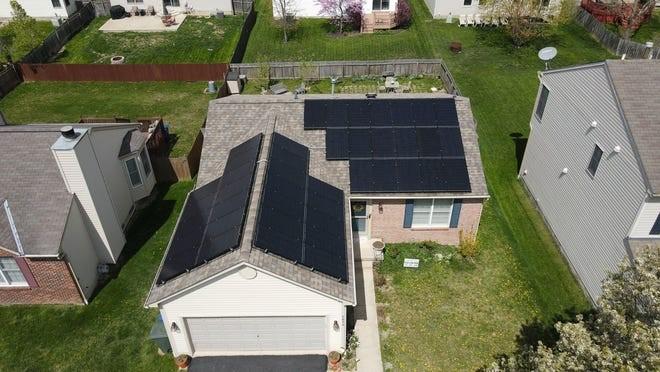
Solar Panels on a house in Galloway. Solar United Neighbors
While most of that growth has been large-scale solar installations, the next frontier in solar includes significant opportunities for Georgia to build on our success and become a leader in small-scale and rooftop solar, too. Let me explain.
The value of solar systems
In 2019, I offered a motion to our tri-annual rate proceeding with Georgia Power to create a monthly “net metering” pilot program for 5,000 Georgia Power customers.
Net metering is a crediting policy that makes rooftop solar much more affordable, by allowing customers to use all their homegrown solar on-site to meet their energy needs before buying electricity from their utility. It reduces the payback period by about a third as well.
Simply put, if a customer doesn’t have additional electricity needs while their solar panels are producing, the electricity is pushed back onto the utility’s grid. With net metering in place, that electricity is banked each month. At the end of each monthly billing period, the exported electricity produced on-site is subtracted from the electricity purchased from the utility – giving the rooftop solar customer 100 percent of the value for their homegrown energy. Hence the word “net.”
The post Rooftop solar: Good for the economy, good for the grid appeared first on Solar Tribune.
]]>The post Solar Panels Helping Old Landfills Embrace a Greener Future appeared first on Solar Tribune.
]]>
Giving Landfills a New Lease on Life
Any hope of meeting near-term decarbonization goals in the U.S. will require millions of acres of new solar energy capacity, and will necessitate putting solar panels in places never thought of before. Capped landfills are a unique option to meet the growing demand for more solar energy capacity in the United States.
A capped landfill is a landfill that is past its useful life as a site for storing waste and has been capped at the surface to minimize deleterious environmental impacts from water seepage . The “cap” is usually comprised of concrete/asphalt, soil, clay, a gravel-based drainage layer, a geomembrane, or some combination of these options.
According to a report from RMI, a non-profit renewable energy research organization, the potential for repurposing capped landfills into solar energy producing mega sites is significant. This was the report’s main takeaway:
“Out of the 10,000 closed landfills across the country, at least 4,000 of them could host solar projects, the report concludes. The total generation capacity of solar at these sites could exceed 63 gigawatts, more than two-thirds of the country’s entire solar capacity installed through 2020.”
The total number of solar arrays installed on capped landfills and the amount of megawatts they produce has steadily been increasing over the past decade, and yet, it is still just a fraction of what is possible. The room for growth is significant.
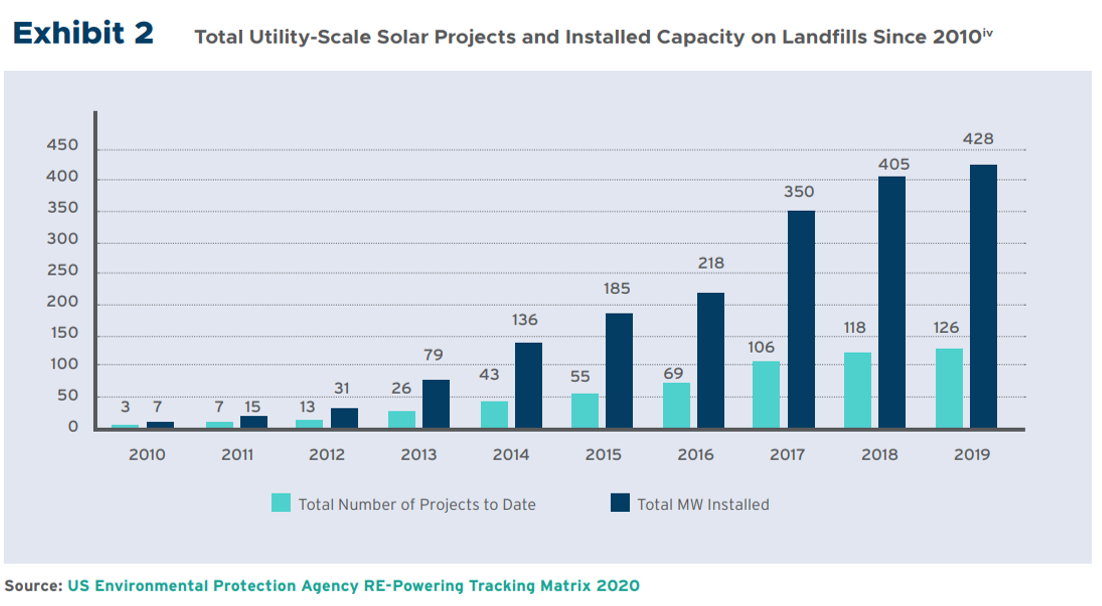
Photo Source: RMI
The optics of converting an old, capped landfill site into a solar energy producing juggernaut are very appealing. These brownfield sites are limited in their future use given contamination concerns and environmental monitoring requirements. What better way to lead on climate change then to turn these symbols of excess waste and overconsumption into hotbeds of renewable energy activity?
Pros and Cons
Here’s a look at some of the primary pros and cons of putting solar arrays on capped landfills.
Pros:
- For better or for worse, landfills are often located near low-income neighborhoods. By placing a solar energy source near these areas, low-income residents can benefit from reduced energy costs and greater energy reliability.
- Landfills have good sun exposure given their sheer expansiveness and lack of nearby vertical obstructions.
- Solar production can be combined with landfill-generated methane gas conversion to create a “double whammy” effect and turn old landfills into potent energy producers.
- The symbolism of converting brownfield sites formerly used for waste storage into solar energy producing powerhouses is incredibly appealing.
Cons:
- There are engineering challenges associated with placing large-scale solar arrays on capped landfills, especially if the landfills have been capped with concrete or asphalt.
- There is additional environmental liability that comes with placing solar panels on capped landfills since monitoring groundwater contamination and methane gas and carbon dioxide emissions are necessary.
- Settling over time is common with capped landfills as the waste decomposes over time. This can cause complications to the otherwise rigid infrastructure used to house solar arrays. One way around this is to target solar for landfills that have been capped for at least 10 years as that is when the bulk of the decomposing process takes place.
- When combined together, the increased environmental liability and engineering challenges associated with placing solar panels on capped landfills can add costs to such a project. Solar projects placed on landfills are typically 10-20% more costly than traditional ground mounted solar energy systems.
Key Strategy for Solar Equity
A priority in recent years for solar energy stakeholders has been to highlight the growing need to place equity at the heart of the push for increased solar energy capacity. Even amidst historically low solar energy costs, there is a perception that residential solar is something that is reserved for the well-heeled. Connecting low-income communities to the myriad of benefits of solar energy has been and should be a top focus of the industry. The whole concept of “community solar” is predicated on this very belief, aiming to democratize the availability of solar energy. Solar projects placed on capped landfills represent a key potential strategy to drive these more equitable solutions.
The Sunnyside Solar Project in Houston, TX is one such example of an equity-focused capped landfill solar project that led to widespread community benefits. In April of this year, the City of Houston gave the greenlight to convert a vacant landfill in the low-income Sunnyside neighborhood into a massive solar farm. The $70M project will include 70 MW of solar panels installed over 224 acres that will produce enough energy to power 5,000 to 10,000 homes. The project is the largest brownfield solar project in the country.
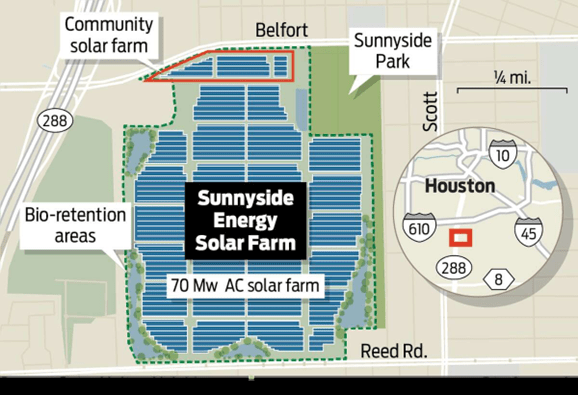
Photo Source: Houston Chronicle
The project will result in a number of ancillary benefits that will be felt by the Sunnyside community. Those benefits include:
- Power discounts will be made available to residents in the Sunnyside neighborhood.
- Increased local job opportunities. A partnership between Houston Community College and Lone Star College will train 175 Houstonians for solar jobs related to the Sunnyside Solar Project.
- The project will include investments in bioretention areas, an integrated biking and walking path, an electric vehicle charging station, and battery back-up to the Sunnyside Community Center
- The project will include an Agricultural Hub and Training Center that will have an aquaponic greenhouse and promote other biodiversity training opportunities focused on beekeeping and native plant preservation.
Environmental justice and racial equity were at the heart of the Sunnyside Solar Project. The project had the support from key local organizations like Population Education and the Houston chapter of the NAACP. The project also has a strong supporter in the city’s mayor, Sylvester Turner. In a press release celebrating the project, Turner stated:
“The Sunnyside landfill has been one of Houston’s biggest community challenges for decades, and I am proud we are one step closer to its transformation. I thank the Sunnyside community because this project would not have come together without its support. This project is an example of how cities can work with the community to address long-standing environmental justice concerns holistically, create green jobs and generate renewable energy in the process.”
Nexamp’s Solar Star Urbana Landfill project offers another promising example of the broader community benefits of landfill-based solar projects. This 40-acre, 14,000 solar panel project sits on a capped landfill and produces 5.3 MW of solar energy for residents in Illinois. The project delivers subsidized energy to low- and moderate-income residents in Illinois through the Illinois Solar for All program, a community solar program that incentivizes low income residents to connect to solar power.
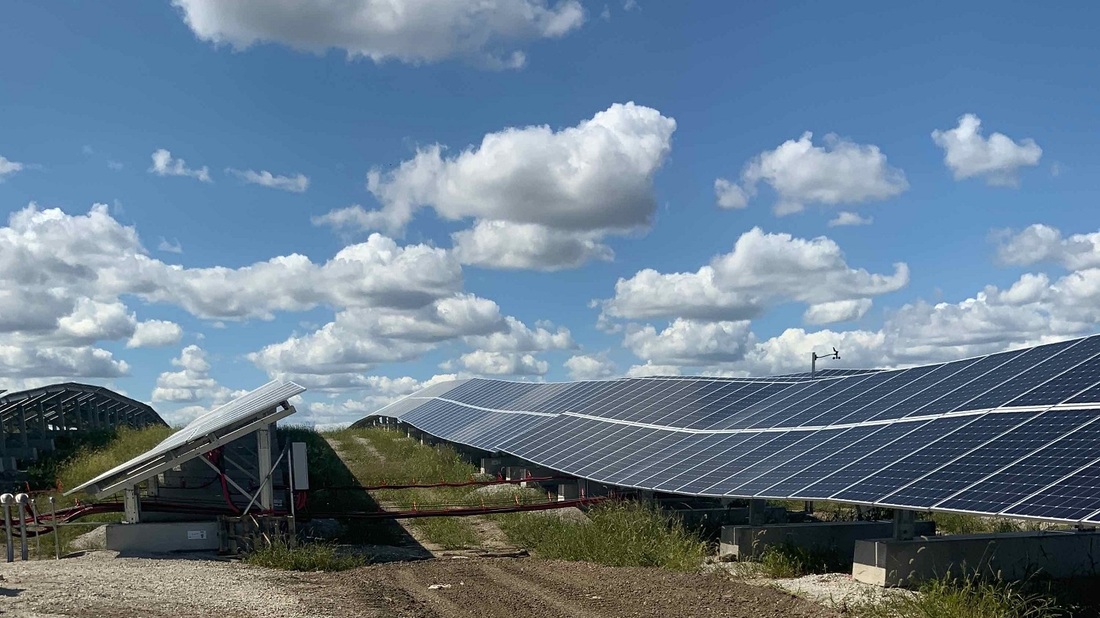
Photo Source: Nexamp
Another positive example can be found in Annapolis, MD. There, a 16.8 MW solar project placed on an 80-acre capped landfill sells some of the power generated on its site to the City of Annapolis, Anne Arundel County, and the county’s board of education.
Placing solar projects on brownfield sites like capped landfills represents a real low-hanging opportunity for the industry to further add to the nation’s capacity and connect more underserved communities to the benefits of solar industry. We at Solar Tribune have documented similar efforts to place solar projects on old coalfields in Kentucky and the benefits this has brought to economically distressed parts of Appalachia. These projects help generate local jobs and wealth, make vulnerable communities more resilient in the face of growing grid disruptions brought on by climate change, and bring much-needed investments to communities who need them most. This is an industry trend that we can all get behind.
Cover Photo Source: Biz Times
The post Solar Panels Helping Old Landfills Embrace a Greener Future appeared first on Solar Tribune.
]]>The post The Rise of Agrivoltaics appeared first on Solar Tribune.
]]>
What is Agrivoltaics?
Agrivoltaics is a term used to describe the marriage between solar power generation and agricultural production. The U.S. Department of Energy defines it as “agricultural production, such as crop production, livestock grazing, and pollinator habitat that exist underneath solar panels and/or in between rows of solar panels.”
The concept underscores the multi-faceted life-giving qualities of the Sun. Plants and livestock not only benefit from sunlight in the traditional way, but sunlight absorbed by solar panels is used in part to support on-site agricultural production, such as powering irrigation systems and agricultural equipment.
Unlike typical utility-scale solar farms, agrivoltaics involves the solar panels being much higher off the ground and strategically “clustered” in ways that optimize sun/shade exposure for optimal crop production. Contrary to popular belief, few crops thrive on all-day sun exposure. Solar panels on the other hand thrive with lengthy sun exposure. Agrivoltaics allows for the best of both worlds.

Photo Source: N-Sci Technologies
The temperature moderating effects of the elevated solar panels also have crop production benefits. Air and land underneath the panels is cooler in the summer, which helps insulate crops from drought impacts as moisture is more easily retained in the soil. The elevated panels also benefit from the cooling effects of having ample air flow above and below them, since solar panels lose efficiency when their surface temperatures get too hot.
A 2019 study by the U.S. Department of Energy’s National Renewable Energy Laboratory’s (NREL) documented numerous food production, water savings, and energy production benefits of agrivoltaics. The study found that solar panels were kept 16°F cooler by evaporation from the crops below, which was enough to increase energy production by 2%. The crops below the solar panels that were tested were found to be 100%-300% more productive, depending on the species, while solar panel shade cover reduced irrigation-water use by 15% and overall water consumption by over 150%. Pretty impressive numbers all around.
The wide-ranging benefits of agrivoltaics ultimately mean more cash in the pocket of farmers. Not only do crop yields increase and maintenance costs decrease, but they are often able to benefit from dual income streams from a solar land lease arrangement and improved crop production.
Solar Sheep
Solar grazing is a phenomenon that few could have conceived of once upon a time, but now, the practice is routinely employed to the collective benefit of animal, farmer, and solar operator. According to the aptly named American Solar Grazing Association (ASGA), the U.S. has over 15,000 acres of sheep-maintained solar sites.
Once you can get past the odd visual, relying on sheep to graze on the land where massive solar arrays sit is a no-brainer. Grazing sheep munch on grasses and weeds, which helps to optimize solar panel efficiency by removing shade threats and keeping the panels otherwise unobstructed. This reduces the need for traditional mowing and landscaping, which can help to prevent unwanted structural damage to the solar arrays and helps to keep stray grass clippings and dirt from soiling the surface of the panels. We also implicitly associate solar energy systems with carbon reduction and environmental benefits, so ditching gas-powered lawnmowers and chemical herbicides for grazing sheep is a meaningful shift that can amplify the broader benefits of solar energy production.
For their troubles, the sheep get a comfortable supply of food to munch on and ample protection from the sun and weather elements underneath the solar panels.
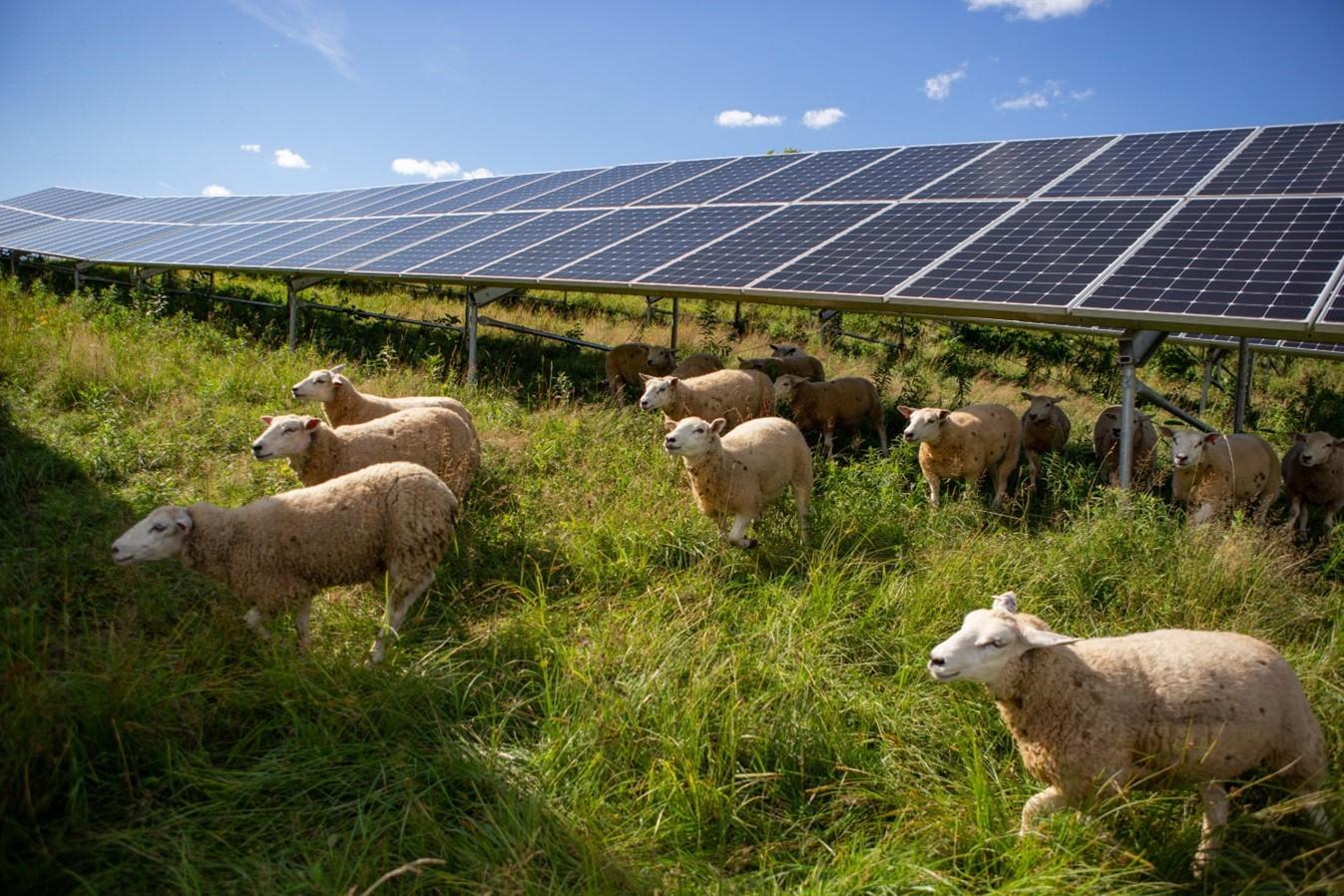
Photo Source: American Solar Grazing Association
The cost-savings for all parties involved is another reason to like the solar-sheep arrangement. The solar operator no longer has to worry about maintenance fees associated with traditional landscaping and potential damages from mowing mishaps or overgrown vegetation. Meanwhile, the sheep farmer receives a steady income stream for the use of their sheep without sacrificing meat, dairy, or wool production capabilities. According to the ASGA, solar operators typically pay farmers $250-$750 per year for an acre of land to be grazed.
Powering Pollinators
Incorporating pollinator-friendly habitats into solar farm sites is another aspect of the agrivoltaics movement that has far-ranging benefits.
The decline in pollinator populations – especially among bees – is well-documented. Habitat loss, climate change impacts, and insecticide use are some of the main challenges that pollinators continually face these days.
By incorporating native plant habitats on solar sites, great progress can be made to support critical pollinator populations. Other associated benefits like reducing erosion and runoff issues, and promoting overall biodiversity are an added bonus. When accompanied with pollinator-friendly vegetation management practices, like eliminating insecticide use, solar sites can help to foster pollinator activity on-site and in the surrounding area. The participating farmer and neighboring agricultural sites stand to benefit from all of the increased pollinator activity given the obvious role that pollination plays in crop production.
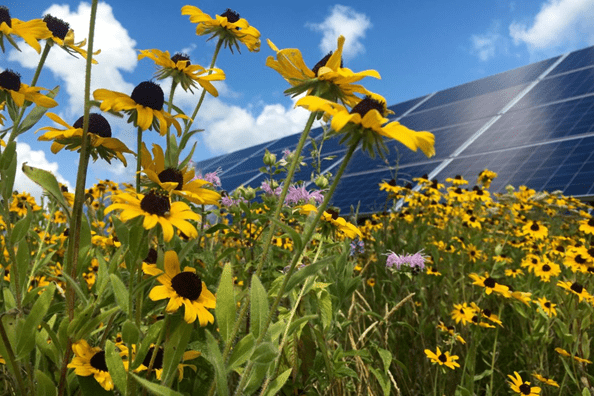
Photo Source: Fresh-Energy
The Environmental Protection Agency (EPA) has general guidelines to protect pollinators from harmful insecticides, and there are no shortage of pollinator-friendly organizations out there that promote best practices in supporting pollinators in your home garden, school, business, etc. Many states are now implementing their own pollinator-friendly solar farm standards to incentivize pollinator habitats specifically on solar farm developments. Minnesota was the first state to do just that back in 2016, when then Governor Mark Dayton signed the Pollinator Friendly Solar Act into law. This first-of-its-kind legislation outlined voluntary standards and benchmarks that participating solar sites can meet in order to achieve recognition as a “pollinator-friendly” solar location. Several other states have followed Minnesota’s lead and developed their own voluntary standards to certify solar sites as pollinator-friendly.
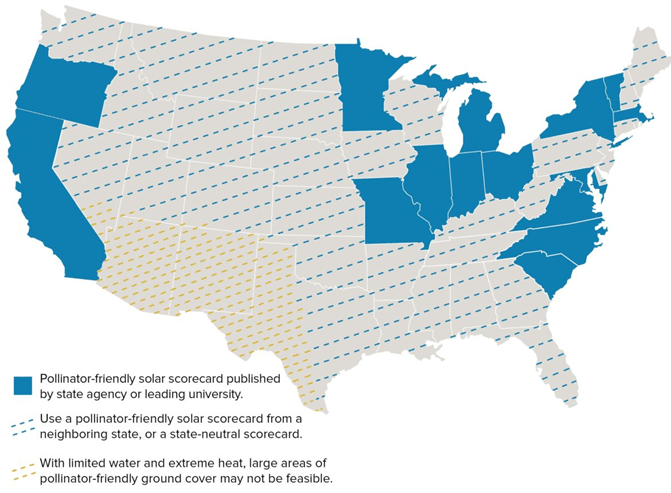
Photo Source: Fresh-Energy
We’ve seen consumers’ pro-renewable preferences influence all sorts of industries and the honey industry is no different. Not only are pollinator-friendly solar sites becoming more common as a way to benefit farmers and vulnerable pollinator populations, but honey producers are also realizing the appeal of marketing honey harvested on solar farms. Companies like Minnesota-based Bare Honey are embracing this promising market opportunity and showcasing the multiple layers of economic and environmental benefits of solar-based honey production.
The cross-cutting benefits of solar energy never cease to amaze us. The emerging prominence of agrivoltaics is but the latest manifestation of the broad benefits associated with solar energy. Not only can solar energy lead the way to powering the world in a more sustainable way, but it can totally transform the way that we produce food. Imagine a future where acres of farmland is covered with solar panels and high yielding crops; grazing sheep and abundant honey producers. Global de-carbonization goals will require wholesale changes across many industries. The ongoing innovations in the agriculture industry and the emergence of agrivoltaics are a great example of how solar energy will continue to shape (and improve) the future.
Cover Photo Source: Enel Green Power
The post The Rise of Agrivoltaics appeared first on Solar Tribune.
]]>The post The Solar Powered Cars are Coming…Sort of appeared first on Solar Tribune.
]]>
On the surface, the prospect of a car powered by an infinite and free power source that is never “off” sounds like a dream come true for renewable energy enthusiasts. But as the old adage says, ‘if something sounds too good to be true, it probably is.”
Check out the following Youtube video from Engineering Explained for an in-depth and wonky overview of the mathematical and engineering challenges of solar-powered cars.
Here’s a cliff notes version of the main limitations to such a technology:
- Optimal charging times are inconvenient to most car users: Peak sunlight exposure comes around noon, with off-angle sunlight during the morning and evening significantly limiting solar absorption capabilities. This inconveniently coincides with traditional commute times where you presumably would like to be banking some charging time.
- Limited Surface Area: There are clear engineering limitations presented by the car’s rather limited surface area itself. There is only so much semi-horizontal space on a vehicle to which solar cells could be optimally used. A good portion of the vehicle consists of non-solar surfaces (glass windows, tires, etc.) that are oriented vertically. Collectively, this places a low ceiling on overall energy input. The Engineering Explained video points out that if a Tesla Model 3’s roof was equipped entirely with solar cells then it would only produce around 1.5 kW of power, effectively allowing it to drive endlessly, but only at a max speed of 12 miles per hour.
- The Shade Problem: When you think about it, cars spend a lot of their daytime hours shielded from the sun, especially in an era where working from home is increasingly common. Home garages and mature tree cover are sought after amenities for many homebuyers. Never mind the fact that parking garages are a fixture of major metros across the country. From airports to hospitals to office buildings and apartment buildings, Americans love their sunlight stifling multi-level parking garages and decks.
- The Engineering Just Doesn’t Work: Under perfect conditions, a hypothetical solar car would of course be able to charge itself…It would just take so long that it would be impractical to most users. The Engineering Explained video notes that with cloudless skies, it would take 200 hours (almost 8.5 days) to fully charge a Tesla Model 3’s 75-kWh battery.
Solar Features Still Making Their Way on EVs
While engineering limitations make a vehicle fully powered by the sun a fantasy prospect for consumers, solar cell technology is being adopted at a much-limited scale in many modern-day electrified vehicles.
The futuristic Mercedes Benz VISION EQXX comes equipped with a 117-cell solar array embedded in its roof. Energy generated from the solar cells is sent to and stored in a separate 12-volt battery, powering the infotainment/navigation system and the car’s lights. As far as what the solar capabilities of the car do to its range, well, the answer is not much. Mercedes claims that the car’s solar roof can add around 15 miles of range on long-distance journeys. For perspective, that amounts to about 2.5% of the miles that the car can get when fully charged. To be clear, the VISION EQXX is a “concept car” not yet fit for mass production.
The VISION EQXX is a solar power plant of its own. Its ultra-thin roof panels feed the battery system for up to 25 kilometers of extra range.#MercedesBenz #VISIONEQXX pic.twitter.com/m1tKwPirMc
— Mercedes-Benz (@MercedesBenz) April 9, 2022
The Lightyear One developed by a Dutch startup is arguably the gold standard in the solar-equipped EV space. With its expansive solar array affixed to nearly every horizontal corner of the car, the Lightyear One can purportedly add 7 miles of range for every hour that the car is parked under ideal solar charging conditions.

Source: Lightyear One
Some level of solar charging capabilities are becoming more and more mainstream with the latest EV models. The Hyundai Ioniq 5, Hyundai Sonata Hybrid, and Toyota bz4x are just some of the recent electrified vehicle models coming with some level of solar charging capability. The Fisker Ocean SUV is another top option in the emerging market of solar-integrated vehicles available to consumers. Fisker claims that the Ocean vehicle can produce up to 1,500 additional miles from its “SolarSky” technology, and up to 2,000 miles under ideal conditions.

Source: MotorTrend
Options are also increasing in the pickup truck market as some EVs in this class pay homage to the convertible with a retractable solar apparatus that increases the surface area of the vehicle available to generate solar energy. Tesla’s Cybertruck comes with a solar roof option in the form of a solar cell-equipped tonneau cover. Exact specs and charging details for the still-in-production Cybertruck are murky but Musk claims that the solar tonneau cover can add 15 miles per day to a vehicle’s range.

Photo Source: Tesla
The much less well-established Chinese startup Edison Future has plans for a Cybertruck-esque solar-equipped vehicle as well. Instead of a traditional tonneau cover, this vehicle will have an extendable bed cover of solar PV segments that resembles a turtle shell. The company optimistically claims that the solar panels will be able to add 25-35 miles of added range. Such a claim seems hard to take seriously, but we shall see. The company hopes to start delivering vehicles in 2025.

Photo Source: Edison Futures
Just like with any market, electric vehicle manufacturers will provide a product that satisfies the evolving desires of their customer base. Even though the effectiveness of solar features on an EV are limited when it comes to extending the car’s driving range, consumers may just fall in love with the novelty of the idea. This dynamic is perhaps not too dissimilar from the residential solar energy market. As costs have come down and new companies have entered the market, residential solar use has taken off and become more commonplace.
While solar integration in EVs will not change these vehicles into endlessly powered long-range vehicles, it is nonetheless an exciting example of the simultaneous maturation of both the EV and the solar industry. It is yet another example of the array of benefits that renewable energy innovations are bringing to our everyday lives.
Cover Photo Source: BBC
The post The Solar Powered Cars are Coming…Sort of appeared first on Solar Tribune.
]]>The post Cleaning Innovations Key to Solar PV Efficiency appeared first on Solar Tribune.
]]>
The Dust Problem
Spring is a dreadful time of year for many with seasonal allergies, as pollen begins to permeate the air and aggravate sensitive nasal passageways. Pollen, dust, and other particulate are a similar pain for solar panels. The National Renewables Energy Laboratory (NREL) estimates that dust and grime accumulated on a solar panel can lead to 7% energy loss annually in the United States and up to as high as 50% in the excessively dusty Middle East.
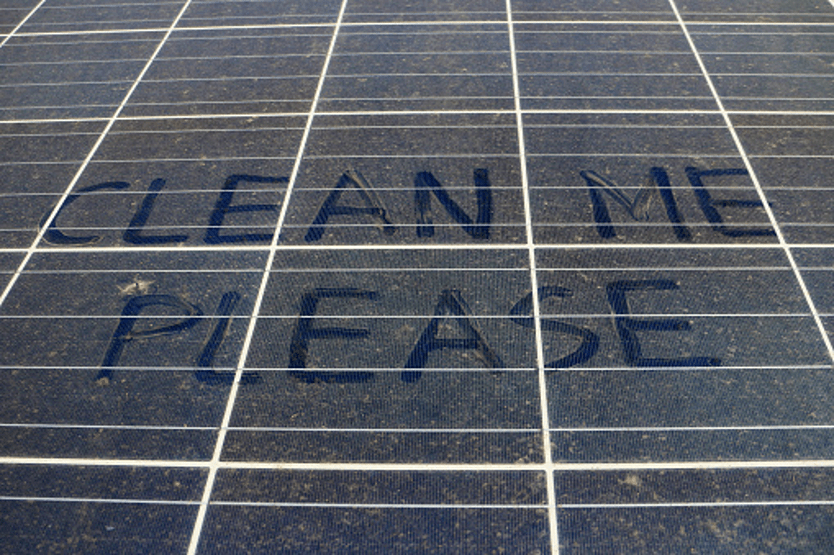
Photo Source: iStock by Getty Images
This issue can generally be solved after a good rainstorm, but those events are obviously sporadic and unpredictable. Overnight cooling combined with morning dew and surface heating as the day goes on can also lead to a process called cementation where the grime hardens on the panels and is nearly impossible for a regular rain shower to remove.
How Are Solar Panels Typically Cleaned?
Traditional solar panel cleaning methods vary depending on whether we’re talking about a ground-mounted solar array or one affixed to a house, but regardless, the process generally involves water and a brush/sponge/squeegee. The process doesn’t differ meaningfully from washing your own car. Just like washing your car, great care needs to be taken to not scratch the surface glass of the panel as any surface damage can reduce the panel’s efficiency.
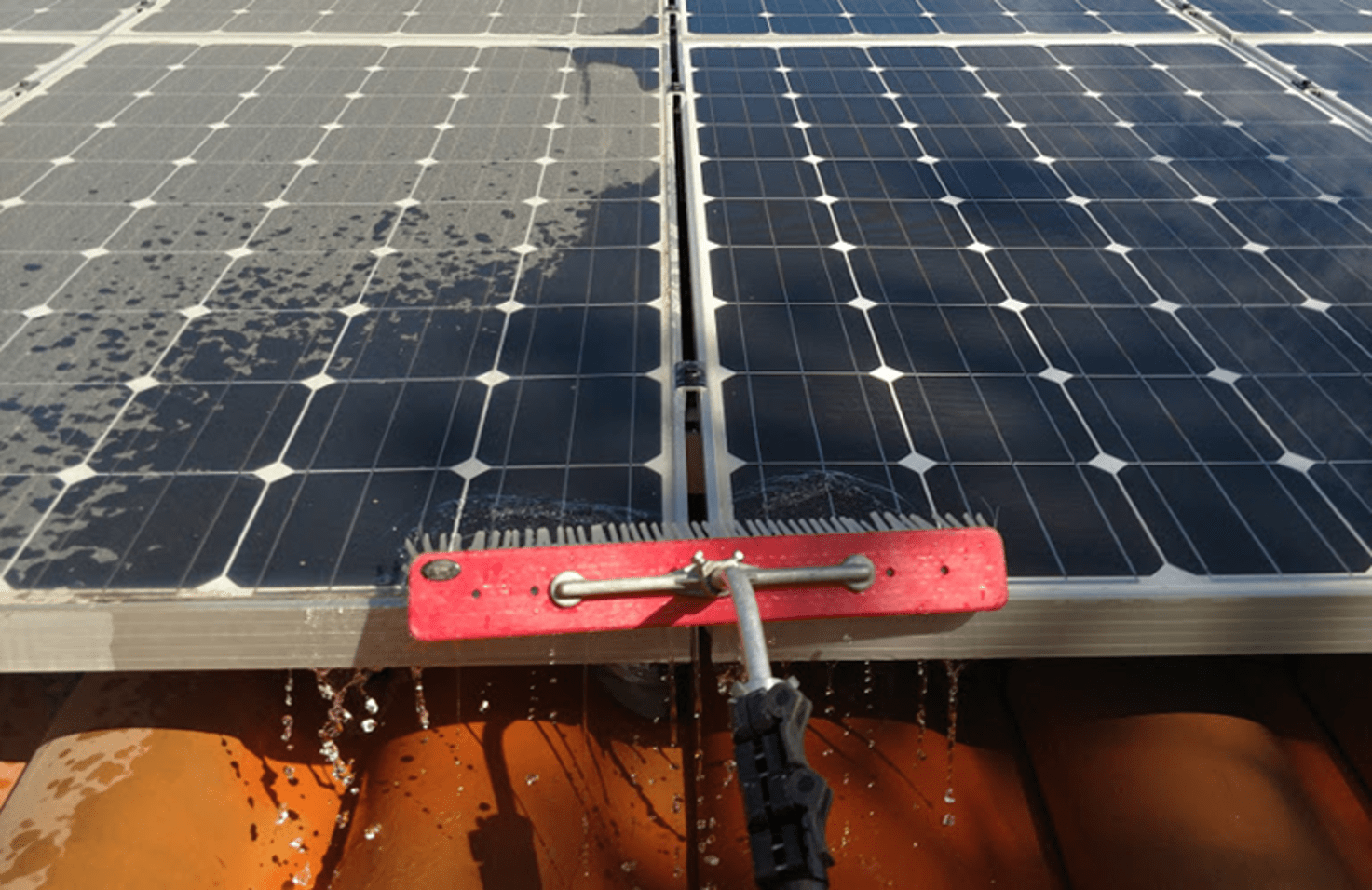
Photo Source: Premier Solar Cleaning
The major flaw with this traditional cleaning method is that it requires the use of water. For residential users this results in added cost in the form of higher water bills, but perhaps more importantly, relying on water to clean solar panels is incongruent with the broader sustainability goals of using solar energy in the first place. It is estimated that 10 billion gallons of water is used per year to clean the world’s solar panels. To put that in perspective, that amount of water could satisfy the drinking needs of up to 2 million people. Clearly, the massive water consumption footprint associated with cleaning of solar panels does not represent a long-term solution for the industry.
Solar Panel Cleaning Robots
Establishing a waterless fix to the soiled solar panel conundrum has inspired a burgeoning niche market within the solar industry – solar cleaning robots.
Art Robotics, a fledgling Belgian startup, is one such company involved in the space. The company uses a drone to deliver a small slender robot (named HELIOS) to roof-affixed solar panels which clean the panel surface using vacuuming technology. The contraption is basically a Roomba for your solar panels. The product is pitched as a cleaning service that you would sign up for as needed or in regular intervals.
SolarCleano is one of the more well-known providers of robots for cleaning solar panels, although many of their robots use water. Their SolarCleano B1 robot is one exception. This gigantic solar cleaning system is designed for use on ground-mounted utility scale solar farms. The fully autonomous system consists of a robot on wheels equipped with a large rotating bristle brush that “drives” around cleaning the surface of the solar panels.
While the waterless brush-based robots help to solve the excessive water challenge, there are concerns that over time the constant scrubbing can lead to scaring of the solar panels, which ultimately leads to a reduction in solar efficiency and in useful life.
MIT’s Static Electricity Solution
Existing solutions to cleaning solar panels are better than nothing, but far from ideal. They are either labor intensive and waste a lot of water (manual brush system) or susceptible to damaging the panels with excessive use (robotic dry brushing). Leave it to the bright minds at MIT to stumble upon a breakthrough technology that can totally change how we approach the cleaning of solar panels.
Earlier this month, researchers at MIT released a study highlighting a solar panel cleaning approach rooted in the power of static electricity. A small electrode that hovers above the solar panel creates an electrostatic charge that repels dust particles off the surface of the panel. The process is less effective with high humidity or moisture (ie, morning dew) on the panels, so its use in desert-like arid environments is particularly promising.
The technology is still very much in the lab prototype phase, but its potential application for commercial use seems promising. Such a simple solution could be a boon to ramping up solar energy production in arid climates where sun is abundant but where dust storms threaten the long-term feasibility of solar energy applications. The American Southwest, Sahara Desert, and Middle East immediately come to mind.
Innovations in the solar panel itself has helped drive down costs and drive-up adoptability over recent decades. The potential breakthrough solar cleaning innovation being pursued by MIT researchers may further drive up global solar capacity as the door to solar energy adoption and long-term viability opens up in new regions across the world.
Cover Photo Source: MIT
The post Cleaning Innovations Key to Solar PV Efficiency appeared first on Solar Tribune.
]]>The post Putin’s War Accelerates Clean Energy Push appeared first on Solar Tribune.
]]>
Oil & Gas Key to Putin’s War Politics
It can hardly be a coincidence that every military excursion that Russia has launched on Putin’s watch has happened during stretches of all-time high oil prices. During the August 2008 war in Georgia, crude oil prices were just coming off an historic high of almost $140/barrel (global benchmark crude Brent) set two months prior. Oil prices were similarly high in February 2014 when Russia seized Crimea ($108.21/barrel). Putin’s invasion of Ukraine came as the price for crude oil was over $90/barrel – a seven-year high.
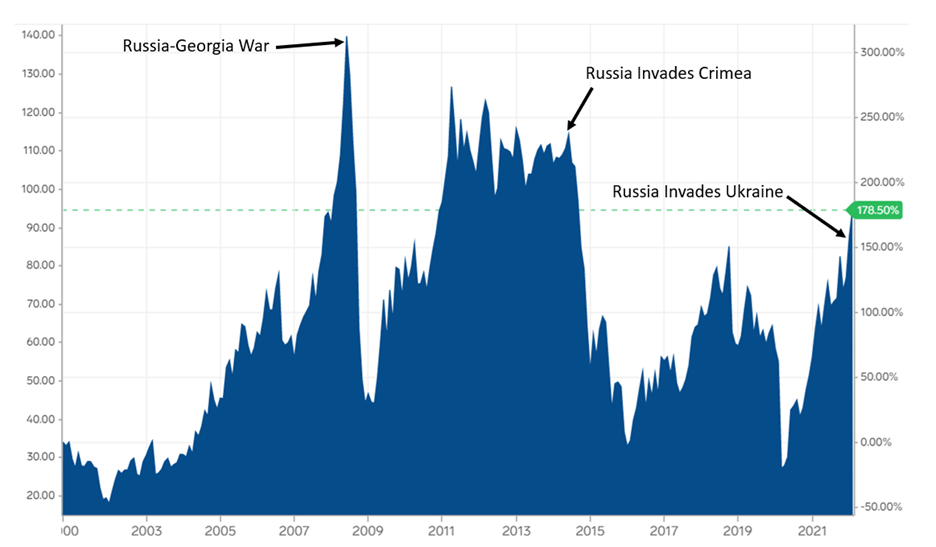
Source: Business Insider
Clearly, Putin uses record high oil prices to fill Russia’s coffers, fund the country’s war machine, and blunt the blow of international sanctions. Putin’s third attempt at such a strategy, however, is likely to be his most fatal.
Russia’s status as one of the most fossil fuels-rich countries in the world has allowed the country to maintain geo-political influence even as growing authoritarian tendencies in the country turned off many global democracies.
Many of the world’s global powers, like the U.S. and much of Western Europe, have performed an awkward dance with Putin’s Russia for years. On the one hand, these countries assume a confrontational posture on the global stage, criticizing Putin’s anti-democratic instincts, all while they maintain reliance on Russia’s oil and gas products behind the scenes. Those days are likely to change significantly, and Russia is poised to be the biggest loser as the latest upheaval to global energy politics reshuffles the world order. The Biden Administration took the unprecedented step recently to ban all Russian oil imports in what is perhaps the most severe sanction the United States has placed on Russia to-date. The NY Times’ ominous yet fitting headline about the move, The Future Turns Dark for Russia’s Oil Industry, accurately describes the bleak future that Russia now faces.
Europe Pledges an Even Greener Future
The fallout from Russia’s invasion of Ukraine has been unprecedented. European, American, and other democratic voices across the world have coalesced around a global strategy to send military support to Ukraine and isolate Russia through severe economic sanctions.
In the early days of the assault on Ukraine, German Chancellor Olaf Scholz announced the suspension of the Nord Stream 2 natural gas pipeline tied to Russian energy company Gazprom. President Biden also slapped sanctions specifically on the Nord Stream 2 AG company that is in charge of building the pipeline. This comes as countries like the United Kingdom, Canada, and others cascade sanctions on Russian energy giants Gazprom and Rosneft.

Source: Getty Images
These moves, while good for the overall global push to adopt more renewables, leave Germany and other European countries in a tough spot. Germany in particular closed the door on nuclear power after the 2011 Fukushima disaster and pledged in 2019 to shutter coal-fired power plants by 2038. Reversing course on either at this juncture would be politically difficult, but reporting indicates that Germany is at least considering extending their coal phase-out plans.
To say that Germany has a complicated relationship with Russian gas would be quite the understatement. The country relies on Russia for two-thirds of its natural gas supply and one-third of its oil. Germany has almost no short-term leverage over Russia when it comes to severing these long-standing ties. That’s perhaps why Germany and other EU countries are all but slamming the door on any outright ban on Russian oil imports in the near future.
The short-term reality aside, the energy politics in Germany and across Europe have changed dramatically in favor of a greener future. German officials in particular are now more motivated than ever to fully embrace renewables back home. Germany recently announced plans to meet all of the country’s energy needs from renewable sources by 2035, an accelerated timeline from the previously set date of 2040.
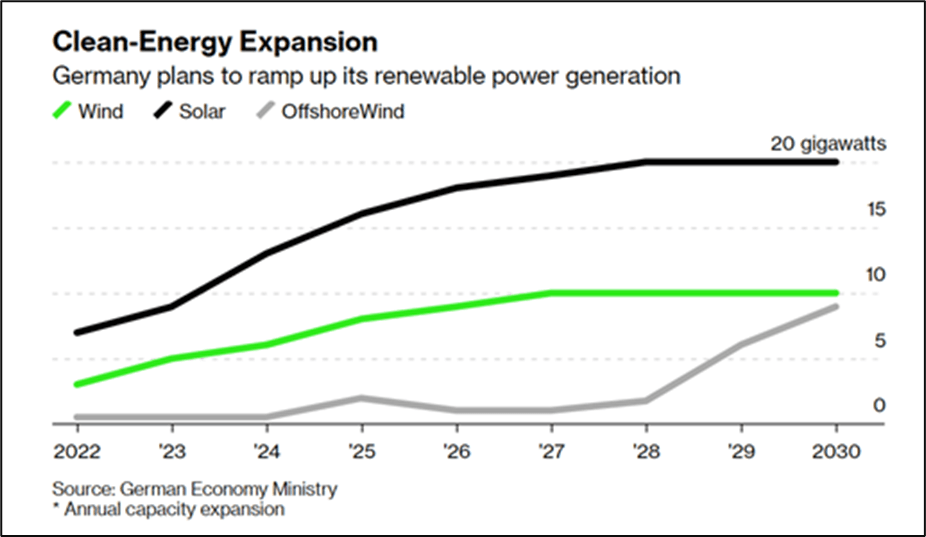
Source: Bloomberg Energy
Climate Change as National Security Threat
The predicament that Germany finds itself in is a perfect example of the growing ties between climate change and national security. This reality was underscored recently by a Ukrainian climate scientist, Dr. Svitlana Krakovska, at a UN climate meeting where she called out the common denominator for the worrisome near-term and long-term future her people face. Said Krakovska:
“Human-induced climate change and the war on Ukraine have the same roots—fossil fuels—and our dependence on them.”
It is no coincidence that recent wars and hostile military actions have been concentrated in and around major fossil fuel-producing countries. Iraq, Venezuela, Saudi Arabia, and Russia all come to mind. The more that the developed world can wean itself off of tainted global oil produced from hostile countries the better.
Just like Germany, the United States is reassessing its own predicament over global oil reliance. Amid sky rocketing gas prices, the Biden Administration is doing the once unthinkable; considering reaching out to Saudi Arabia to tap more of its oil reserves and considering the relaxing of oil sanctions previously placed on Venezuela. To put it mildly, Saudi Arabia and Venezuela aren’t exactly saints on the global peacekeeping front. The fact that the United States is so reliant on fossil fuels from such bellicose countries to meet its energy needs is highly problematic to say the least.
Combating climate change has long been positioned in moral terms, and increasingly, in economic terms as the costs of renewables have dramatically fallen in recent decades. The ongoing crisis in Ukraine is now forcing everyone to view the problem through the lens of sovereignty. It is not only the climate that is at stake, but the very nature of sovereignty for much of Europe is at stake as well. The best way to diminish the geo-political influence of petro-aggressor states like Russia is to commit to an energy policy that puts renewables at the center of a plan for energy sovereignty.
Cover Photo Source: World Economic Forum
The post Putin’s War Accelerates Clean Energy Push appeared first on Solar Tribune.
]]>The post Big Box Retailers Key to U.S. Solar Ambitions appeared first on Solar Tribune.
]]>
Big Rooftops = Big Solar Potential
A report recently released by the non-profit Environment America underscores just how immense the solar generation potential is for America’s big box retailers.
Regardless of where you live in the U.S., big box stores likely feel like a ubiquitous fixture of your landscape. According to Environment America’s report, the nation’s big box retail stores, supercenters, large grocery stores, and malls collectively boast 7.2 billion square feet of cumulative rooftop space. In solar capacity terms, these rooftops have the potential of generating a jaw-dropping 84.4 terawatt-hours (TWh) of solar electricity each year. This is roughly equivalent to the amount of electricity used to power 8 million average U.S. homes. This immense solar potential touches almost every state in the country.

Photo Source: Environment America
Incorporating solar panels on every square foot of cumulative big box retailer rooftop space would reduce greenhouse gas emissions by 52 million metric tons of carbon dioxide a year, or put another way, it would be like taking more than 11.3 million cars off the road.
A Winning Business Case
The falling cost of solar energy systems and the unpredictable and steadily increasing cost of electricity from the grid makes the financial case for solar adoption on commercial rooftops a no brainer. The Environment America report notes that America’s big box retailers spend just under $18 billion per year on electricity, and by equipping their stores with rooftop solar panels, retailers could cut their annual electricity costs in half. In addition to this direct cost savings, a host of additional financial benefits could be captured by retailers who embrace rooftop solar. For example:
- Solar panels equipped with energy storage could reduce demand charges for large commercial users. Demand charges often represent 30-70% of a commercial customers’ bill.
- Solar panels affixed to a large retailer’s roof can indirectly reduce cooling and heating costs for the company by shading roofs during the day and providing insulation at night.
- Corporate brands that go “all-in” on highly visible renewable energy commitments can benefit from increased customer loyalty. A Deloitte report from last year found that nearly a quarter of surveyed consumers said they would switch to buying a company’s products specifically because of shared values on the environment. This dynamic is especially pronounced in the Gen Z cohort – who has burgeoning purchase power – as this group is three times more likely to switch brands based on shared values than those 65 years old and above.
Who’s Leading the Way?
It is no secret that many of the world’s most prominent businesses have embraced renewable energy in a big way in recent years, as pressure has mounted from consumers and shareholders alike. Tech giants like Apple, Facebook, Microsoft, and Google have traditionally been among the world’s top purchasers of off-site renewable energy as these companies seek to green up their image given the power-sucking aspect of their line of business.
Even though as a collective big box retailers are just scratching the surface on installed on-site solar capacity, the Environment America report points out those companies that are leading the way – namely Target, Wal-Mart, and IKEA.
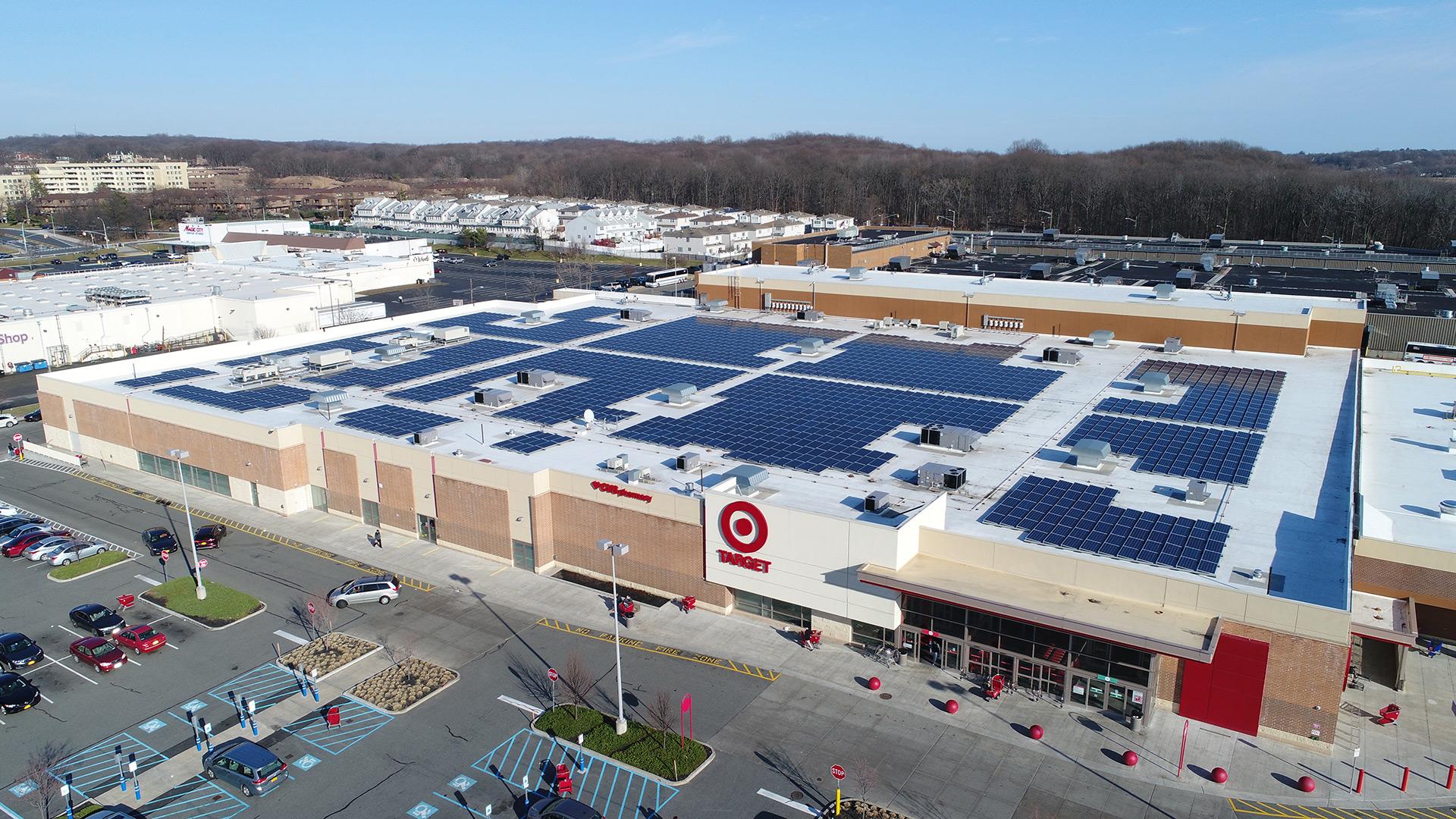
Photo Source: SEIA
At the end of 2019, Target had 259 MW of solar generation capacity installed on its stores and distribution centers across the country, while Wal-Mart had 194 MW through the end of FY2021. Target’s solar installations provide between 15% and 40% of its location’s electricity needs, while Wal-Mart on-site installations provide between 20% and 30%. Meanwhile, IKEA has solar installations on 90% of its U.S. locations, and sources more than half of its global direct energy needs by renewable sources.
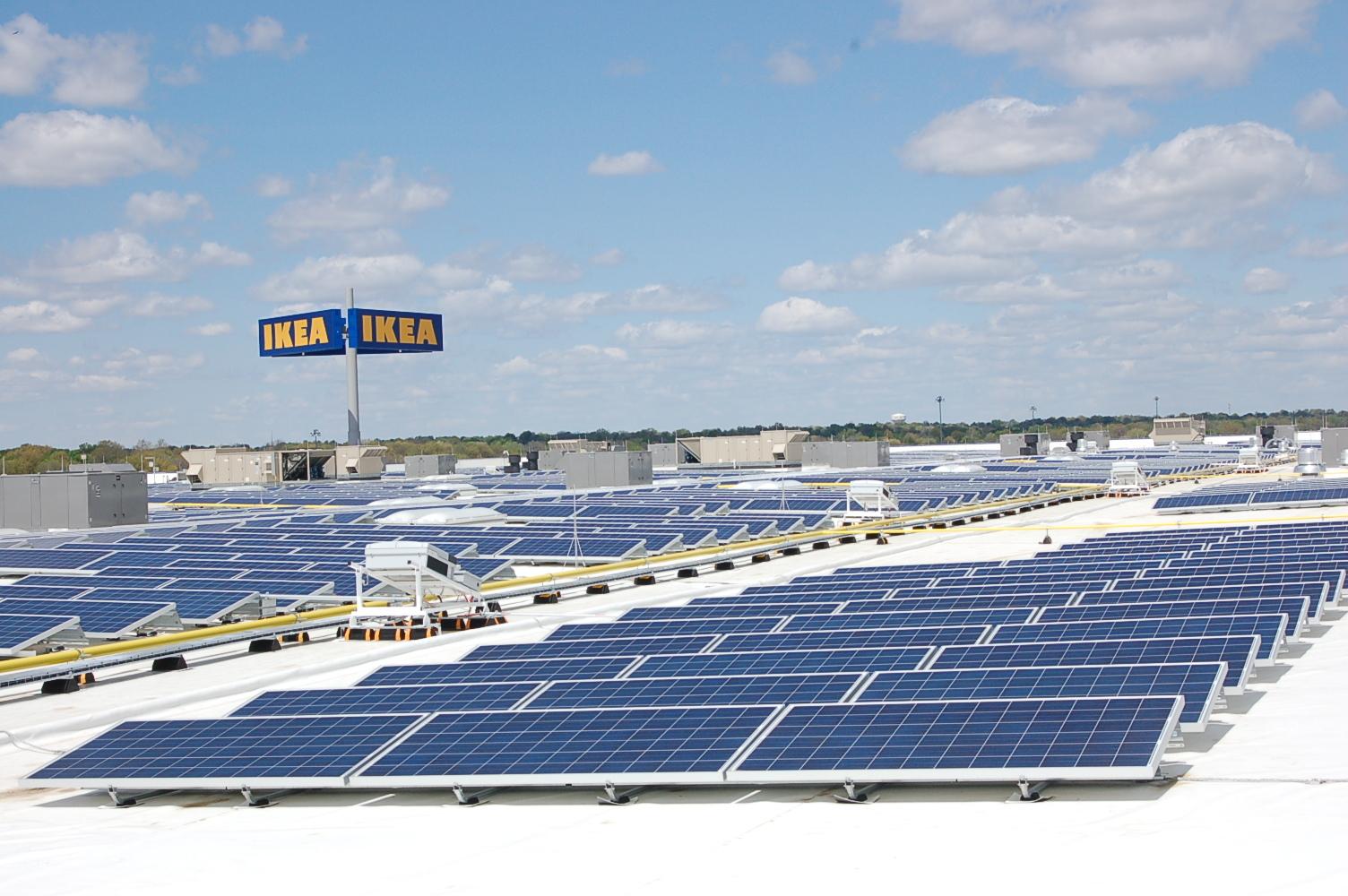
Photo Source: SEIA
The on-site investments by Target, Wal-Mart, IKEA, and other competitors are laudatory and yet also just scratching the surface of what is possible, as noted in the Environment America report. All three companies have near-term net-zero emissions goals, so hopefully renewable energy investments will continue to swell by these industry leaders. Target’s goal is to hit net-zero emissions by 2040, Walmart plans to have zero emissions with no carbon offsets also by 2040, and IKEA is striving for net-zero or net-negative emissions by 2030.
Putting rooftop solar on the facilities of companies with large footprints is both a logical and untapped opportunity to greatly advance global and national climate goals. Creative solutions will need to be pursued and solar panels will have to find their way to some unconventional spots in the process. The public and private sector should collectively view this as an opportunity to collaborate and advance mutually beneficial clean energy goals. Put simply, we will need more instances of solar panels being put on airfields, big box retailer rooftops, and other unique places like along highway noise barriers.
We, the consumer, should remember that we have a lot of pull when it comes to nudging the private sector towards committing to and following through on ambitious clean energy targets that help to make the world more sustainable for future generations.
Cover Photo Source: Wal-Mart
The post Big Box Retailers Key to U.S. Solar Ambitions appeared first on Solar Tribune.
]]>The post Solar Power Takes Off at U.S. Airports appeared first on Solar Tribune.
]]>
An Ideal Fit
The basics of finding an ideal site for optimal solar energy production are quite easy. Flat, expansive swaths of land are the hallmark of any large solar array. All the better if said land is minimally shaded from surrounding trees or tall buildings, thus allowing for maximum daily sunlight exposure. And lest we forget that the less landowners involved, the better. Site control is often the biggest barrier to building a solar farm, as working with multiple landowners with competing interests (and the omnipresent litigation concerns) is never fun.
This brief description sounds an awful lot like every single airport you’ve probably ever been to. Large and flat developments occupying wide open spaces without a vertical obstruction in sight. Add in the expansive rooftop surface area at airport terminals, hangars, and other buildings along with the gargantuan surface parking lots and public bus station infrastructure at airports (hello solar canopies!) and the opportunities for solar production should make any solar developer salivate.
Denver, Austin Airports Rise Above
According to a 2020 study conducted last year by the University of Colorado, 20% of public airports in the United States have adopted solar panels in some capacity over the last decade. The home state Denver International Airport is one such airport that has emerged as a national leader in harnessing the potential of on-site solar. Since 2008, the airport has installed over 42,600 solar panels across 56 acres and they’re not done yet. Construction began earlier this fall on two more solar arrays on airport property that will bring the airport’s total solar capacity to a whopping 34 MW.
“After the two new systems are energized, the airport will have solar panels spread across over 140 acres of land, making (the airport) one of the largest hosts of solar energy at any airport in the world.”
-Scott Morrissey, Senior VP of Sustainability, Denver International Airport
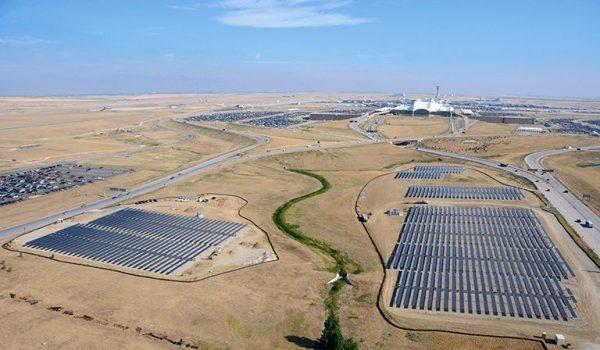
Source: Worldwatersolar.com
Austin-Bergstrom International Airport (AUS) is another major U.S. airport being hailed as a global leader in the renewable energy space. Earlier this month, AUS was recognized as one of four airports in North America to reach carbon neutrality. The airport’s renewable energy commitments are numerous and include partnering with the local utility (Austin Energy) to expand EV charging infrastructure at the airport, and purchasing renewable energy and carbon off-sets from sustainable sources. The airport also produces its own on-site renewable power thanks to a solar project completed earlier this year. AUS installed 6,642 solar panels that also double as shaded parking for airport visitors. The solar array can produce 1.8 MW of power, and thanks to an arrangement with Austin Energy’s Community Solar Program, a portion of the energy is sent back to the grid for local residential customers to benefit from.
More Airports Big and Small Turning to Solar
The accolades for solar-friendly airports don’t stop in Denver and Austin. There are in fact numerous examples throughout the country of airports that are turning to solar to reduce operating expenses and to meet sustainability goals, including some unconventional names on the list.
Take Chattanooga for example. Did you know that Tennessee’s Chattanooga Metropolitan Airport was the first U.S. airport to be powered entirely by solar energy? Completed in 3 phases and measuring the size of about 16 football fields, the airport’s on-site 2.7 MW solar farm – and battery storage technology – produces enough energy to support daily operations.
This airport’s airfield will be the first in the U.S. to run completely on solar power.
Welcome to the new @ChattAirport pic.twitter.com/2d2TKCSWW1
— Bloomberg Quicktake (@Quicktake) December 9, 2018
Solar is also taking root in another off-the-beaten-path destination, notably unsunny Maine. Just this month, a 17.5 MW planned solar farm was approved at the state-operated Augusta State Airport. The ground-mounted solar array will occupy 18.4 acres of airport property and feed electricity back to the grid, offsetting the state’s electrical costs over the life of the 21-year lease with a private developer. The economics of the project are extraordinarily favorable for Maine taxpayers. State officials expect the project to generate enough electricity to effectively save Maine $6 million over 20 years.
Meanwhile, a 12.3 MW solar + storage canopy system being built over surface parking space at New York’s JFK Airport would be the state’s largest such solar project where solar energy is produced and stored in one place. Solar energy produced by the project would power the airport’s AirTrain and send discounted clean energy to the Queens power grid. Then there is Kansas City where city officials are kicking the tires on an enormous 2,000-acre solar farm that would sit on city-owned property at the airport. City officials say that the proposed 300 MW solar farm would provide enough energy to meet all of Kansas City’s energy needs.
Airports Offer Unprecedented Scale Advantage
The ‘diamond in the rough’ solar potential of global airports really comes into focus when you consider the massive efficiency gains of putting solar projects at an airport compared to residential solar developments.
Earlier this year, researchers at Australia’s Royal Melbourne Institute of Technology published a report showing the tremendous potential of solar housed at the nation’s airports. Using satellite imagery to determine optimal solar coverage, the researchers analyzed open space at Australia’s 21 airports and compared that to 17,000 residential solar panels in a town just outside of Melbourne. They determined that if solar panels were affixed to all of the open space at Australia’s 21 airports it could generate 10 times as much energy as those 17,000 residential solar panels. Solarizing all of those airports would produce enough power to power some 136,000 homes.
The energy resilience that comes with solarizing airports can also help to solve the Achilles heel of any airport…extended power outages. Suffice it to say that losing power at a major airport can lead to chaos and steep economic losses. In 2017, an extended outage at Atlanta’s Hartsfield-Jackson Airport led to the cancellation of 1,400 flights by Atlanta-based Delta Airlines, costing the carrier some $25 million. Earlier this year, Pittsburgh International Airport became the world’s first major airport to be completely powered by its own microgrid, a move clearly designed to protect against some of the aforementioned crippling effects of losing power at the airport. The hybrid 20 MW microgrid consists of just under 10,000 solar panels installed across 8 acres of airport property along with 5 natural gas generators.
Photo Source: Pittsburgh International Airport
The conversation about solarizing America’s airports is of course playing out amongst the much less rosy backdrop about the outsized carbon footprint of commercial air travel. Passenger air travel continues to be responsible for the fastest growth in global carbon emissions. The commercial aviation industry is barreling towards electrification, however, even if at a snail’s pace. Making progress towards global climate goals will require a transformation of all sectors of the transportation industry. The overhauling of the aviation industry and shift to solar adoption at commercial airports is a trend that we can certainly get behind.
Cover Photo Source: State Aviation Journal
The post Solar Power Takes Off at U.S. Airports appeared first on Solar Tribune.
]]>The post 2021 Guide for Solar-Inspired Holiday Gifts appeared first on Solar Tribune.
]]>Assuming that a brand new Tesla vehicle or solar roof is outside your gift buying budget, we hope that the below suggestions help spark an idea about how a solar-inspired gift can bring joy to the loved one in your life.
Solar-Powered Portable Power Stations
These are definitely among the priciest solar-powered items you could gift to someone this holiday season, but they are also among the most important for those who have mobile energy needs or who rely on 24/7 energy reliability at home.
Gas-powered generators are incredibly polluting, and if used improperly, incredibly dangerous. One 5 kW generator can emit as much carbon monoxide as approximately 450 idling cars (!!!). According to the Consumer Product Safety Commission, more than 900 people died of carbon monoxide poisoning from portable gas generators between 2005 and 2017, with another 15,400 having to be treated in the emergency room for portable generator-related carbon monoxide poisoning.
Jackery Solar Generator 500 + 100W Panels – $ 799.98

This solar generator combo from Jackery combines a portable power station with a portable, lightweight 100W SolarSaga solar panel to power your energy needs. The power station can recharge via one of 3 ways: wall outlet, car outlet, or the solar panels. We are certainly partial to the latter option. This product is great for your next camping adventure, football tailgating party, or just to have handy as a backup for a bad thunderstorm or ice storm that knocks your power out for an extended amount of time.
Check out this solar generator review on Popular Mechanics for a more detailed overview of options to consider when buying a solar generator.
BioLite SolarHome 620+ Lights, Charger and Radio – $112.46
This all-in-one system uses a 6W solar panel to charge up a portable central unit that in turn powers 3 hanging lights, an MP3/FM radio, and USB charge-out. The three hanging lights come with their own individual light switches allowing them to be used independently in 3 separate rooms. The setup is ideal for tiny house living, cabins, sheds, or hunting structures.
Purchasing of this product also supports a great mission. BioLite is a company that is committed to bringing affordable, small scale renewable energy solutions to poverty-stricken populations in undeveloped countries. This product and other BioLite products have benefited over 3.2 million people across Africa and Asia.
Solar-Powered Educational Toys for Kids
Educational toys that incorporate STEM principles are a growing niche market in the toy industry. These hands-on experiential learning devices help children develop critical problem-solving skills that will serve them well in life, especially if a STEM career field is in their future.
4M Green Science Solar Rover DIY Kit – $19.98

How cool is this lil’ thing? It’s like a mini-Mars rover. This toy uses a rudimentary solar panel and some basic wiring to propel a vehicle using either the provided vehicle body or a soda can. This toy teaches kids the basics about solar power capabilities, while also reinforcing the good habit of re-using disposable household items. Speaking of which…
Eco.6 Solar Recycler Robot Kit – $16.99

This toy also encourages kids to put old disposables to good use in a fun and creative way. This solar robot can be adapted to 6 different functions: Street Roller, Walking Robot, Bottle Yacht, Drummer Robot, Flying Bird, or CD Racer. Soda cans, water bottles, and old CDs are the starring subjects of this solar kit that teaches kids about the value of re-using items otherwise destined for a landfill.
Pica Toys Remote Control Solar Car Kit – $21.58

Remote control cars have been an age-old reliable holiday gift for generations. This solar-powered option allows slightly older kids (8-12 year olds) to build one from scratch and learn the basics about electrical engineering in the process. This gift may be especially relevant to young kids growing up right now since electrification, batteries, and solar energy will all transform personal transportation during the lives of today’s youth.
Check out this review of STEM-focused solar toys at STEM Geek for more ideas on what to gift the young budding solar enthusiast in your life.
Solar-Powered Gifts for the Outdoor Enthusiast
Solar-powered knickknacks and outdoor recreation go hand-in-hand like peanut butter and jelly. Below are a few such gifts for the outdoorsy person in your life.
Solar Powered Bike Light and Horn Set – $23.99

This solar-powered light kit is an important safety feature for expert and novice bike riders alike, especially with hours of daylight dwindling as we enter the winter months. This apparatus includes both a bright 350 lumens headlight and a taillight with multiple lighting modes. The kicker is the small but mighty (140 dB) horn that comes with the kit to add another important layer of safety.
Solar Spark Lighter Fire Starter – $5.99

A little old school and a little new school, this solar-powered spark lighter is the perfect stocking stuffer for the backpacker in your life. The simple invention uses a parabolic shaped container to concentrate an intense amount of heat from the sun onto a piece of material held into place by a prong in the middle of the device. I’m glad I didn’t have access to one of these as a mischievous 10-year-old.
Chill Solar Cooler – $649
I’ve lugged around some coolers in my day and I can tell you that the weight of the ice packed cooler and the pain of having to drain the melted ice from a small drain plug at the end of your outing are two annoyances that I could do without. This innovative cooler solution by GoSun solves both problems by getting rid of the ice altogether. Using brushless compressors, solar power, and a lithium battery for storage, the cooler is able to act as a bona fide freezer if you need it to with the ability to cool down to -4 degrees Fahrenheit. The cooler can be powered by a regular wall outlet, via a 30W folding solar panel, or even better, a 60W ‘solar table’ that integrates a panel into a folding table.
It is great to see solar energy becoming so ubiquitous these days that it is integrated into many common household items. Hopefully you can find space on your holiday shopping list to gift such an item to a loved one in your life.
We at Solar Tribune wish you and yours a very joyous and safe holiday season this year!
The post 2021 Guide for Solar-Inspired Holiday Gifts appeared first on Solar Tribune.
]]>The post American Indian Tribes Are Unsung Heroes of Clean Energy Movement appeared first on Solar Tribune.
]]>
Seizing the Solar Opportunity
The renewable energy generation potential of America’s tribal lands is profound. Many American Indian tribes in the West and Midwest in particular occupy land with some of the nation’s best solar and wind resources.
According to a 2018 study by the National Renewable Energy Laboratory (NREL), tribal lands have the potential to generate 6,035 GW of utility scale solar power, or 5% of the nation’s total capacity. Tribal lands also have the potential to generate 891 GW of wind power, which represents 8.8% of the nation’s total wind generation capacity.
Despite the promising prospects for renewable energy production on tribal lands, a rather miniscule 400 MW of installed renewable energy capacity had been put on land owned by federally recognized Indian tribes by 2019 according to an S&P Global article that cited NREL data. A U.S. Government and Accountability Office (GAO) report from 2015 ascribed much of the blame for the disconnect to inefficiencies in the disbursement process for federally funded renewable energy projects.
Thankfully, a number of non-profit organizations with a mission to promote equity in the renewable energy space – with a specific focus on American Indian tribes – are working to pick up the slack and help tribal governments capitalize on solar opportunities. GRID Alternatives is perhaps the most prominent such organization. GRID is a national leader in developing and installing solar projects that benefit underserved communities. Their Tribal Program leverages both government and philanthropic dollars to install solar energy projects on tribal lands. These projects result not only in the obvious benefits (jobs and clean energy), but they often come with job training opportunities and other workforce development programs targeted at young people that can really help to move the needle in what are some of the most impoverished communities in the country.
Since its inception in 2010, GRID Alternatives’ Tribal Program has supported the installation of 849 solar energy systems on tribal lands across the country, collectively representing over 5.9 GW in installed solar capacity. Over 1700 people benefited from hands-on solar workforce training as a result of these projects as well.
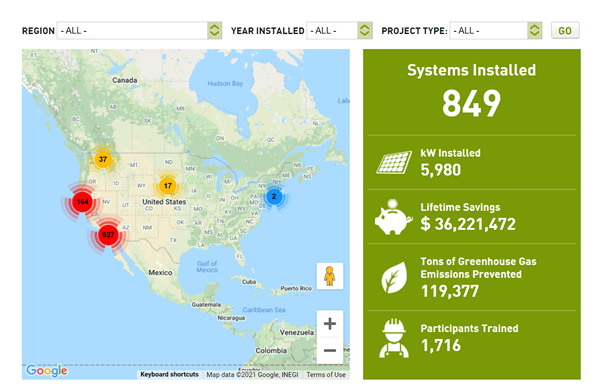
Organizations like GRID Alternatives play a critical role in filling the solar void on tribal lands, since tribal reservation communities have limited access to traditional solar tax incentives offered by the federal government as they are sovereign nations that do not pay federal taxes.
Sovereignty Through Energy Independence
The pursuit of sovereignty is an ingrained principle in tribal communities. Which begs the question, how sovereign can a government and group of people be if they have no control over their own energy infrastructure? The attractiveness of achieving energy sovereignty through renewable energy has logically bubbled upon as a priority for many of the nation’s Indian tribes.
Native communities, and other communities of color, have long been subject to the destructive effects of pollutive industries that often locate in or proximate to low-income and communities of color (See: Environmental Racism). This dynamic is especially present in the fossil fuels industry which has scared Native lands from coast to coast. Lest we forget that it was Native Alaskans and American Indian tribes in the Gulf Coast who bore the brunt of the long-term damage from the Exxon Valdez oil spill in 1989 and the equally infamous Deepwater Horizon oil spill off the Gulf coast in 2010.
To that end, renewable energy projects on tribal lands are far more than just an economics play, which is the context they are most often otherwise put in. The potential of renewable energy connects Native people to their ancestral roots, placing a great emphasis on the immense offerings that Mother Earth provides to her people. Energy sovereignty is also a vital component to the quest for self-sufficiency which is a dominate historical pursuit for Native people.
This case study example from the DOE’s Office of Indian Energy Policy and Programs about the Eastern Band of Cherokee Indians’ (EBCI) foray into the solar world reveals the myriad of benefits that the Tribe’s energy sovereignty pursuit has brought to its citizens.
The EBCI installed a 700 kW PV system on land adjacent to the Tribe’s casino in Western North Carolina to power the casino, a hotel, and 2 administrative buildings. The project was made possible by a $1M grant from the DOE and a $1.3M investment by the Tribe.
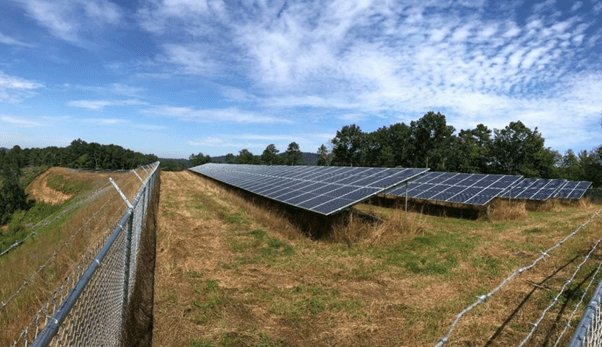
Photo Source: Energy.gov
According to Joey Owle, Secretary of Agriculture and Natural Resources for the EBCI, the main energy challenges that the tribe has historically faced involve supplying reliable service to the buildings that drive the tribe’s economy. The most prominent of which is the casino which operates on a business model that requires around-the-clock energy consumption. The new solar array is also a big cost saver for the tribe, to the tune of just under $100,000 annually that the tribe can re-allocate to other essential tribal needs.
The EBCI’s embrace of solar energy is simple yet meaningful for a group of people for whom self-sufficiency is a way of life. As Owle put it:
“How can we call ourselves sovereign if we’re dependent for multiple functions? Energy independence is a component of our sovereignty. We are taking our independence and sovereignty into our own hands by investing in this industry to meet the needs of our community members.”
Standing Rock Sioux Tribe Continues to Lead
It is hard to imagine an American Indian tribe that has done more for the Native-led environmental justice movement than the Standing Rock Sioux Tribe. The Tribe’s famous protests from 2016-2017 against the Dakota Access Pipeline turned them into a household name across the globe. Even though the pipeline was ultimately approved, the tribe’s fight invigorated tribal members who were growing anxious about the threat climate change posed to their way of life. In 2019, the Standing Rock Sioux Tribe built a 300-kilowatt solar farm just 3 miles from the controversial pipeline that power two buildings of great significance for the tribe – the Cannonball Youth Activity Center and the Veterans Memorial Building. The Cannonball Community Solar Farm is the state of North Dakota’s first every solar farm.

Photo Source: Al Jazeera
In a state that is dead last in the country in installed solar, the Standing Rock Sioux Tribe’s modest 300-kW solar farm is a big deal and offers important symbolism. For far too long indigenous people in this country have had their sacred lands desecrated by the fossil fuels industry. While Big Oil profited off their lands, the economic benefits to tribal members were fleeting. The Standing Rock Sioux Tribe’s efforts to sustain themselves in North Dakota through solar investments are heroic, but hardly the only example of American Indian tribes awakening to the bad bill of goods pushed on them by the fossil fuels industry.

Photo Source: GivePower
For decades, the Navajo Generating Station operated as one of the nation’s largest coal plants on land belonging to the Navajo Nation, until its eventual decommissioning in 2019 and subsequent demolition the following year. The plant was a vital economic powerhouse for the tribe, providing it with the bulk of the tribe’s total revenues. Since its closure, the Navajo Nation has moved forward with multiple solar arrays on tribal lands including 2 from just earlier this year. The solar projects will provide several hundred of jobs for tribal members and rake in tens of millions of dollars in energy payments, land lease payments, and tax revenues for the tribe.
The Moapa Band of Paiutes in Nevada, another community previously dependent on the coal industry, also has multiple solar projects in its growing renewable energy portfolio. One of which, the Moapa Southern Paiute Solar Project, was the first large-scale solar project to ever receive construction approval on a tribal land in all of North America.
Many tribal governments are freeing themselves from the burdens of long-standing ties to the fossil fuels industry in favor of a much brighter future powered by the Sun. In the process, they are achieving energy independence and improving the economic well-being of their people. Solar energy is especially empowering to a constituency whose ancestors knew how best to harvest all that Mother Earth had to give. We should all find inspiration in this worthy pursuit.
Cover Photo Source: Bismarck Tribune
The post American Indian Tribes Are Unsung Heroes of Clean Energy Movement appeared first on Solar Tribune.
]]>The post The Electric Vehicle Era is Here appeared first on Solar Tribune.
]]>
Competition Heats Up
It wasn’t too long ago that Tesla was considered to be the only reputable player in town on the electric vehicle manufacturing front. Technologically speaking, Tesla still maintains superior advantages over its competitors, but the electric vehicle market is still much more crowded today than it was just a handful of years ago. We don’t hide from our pro-Tesla bias at Solar Tribune, but even we must recognize that the increased number of electric vehicle models with competitive price points is ultimately good for overall market development. Major electric vehicle pronouncements by auto companies in recent years include:
- By 2035, General Motors plans to exclusively manufacture electric vehicles
- Toyota unveiled their first all-electric vehicle offering in the U.S. market earlier this year. Toyota plans to expand to around 70 electrified vehicle offerings globally by 2025, including 15 fully electric vehicle options.
- Ford plans to sell only fully electric vehicles in Europe by 2030.
Just about every other major global auto company from Honda to Audi to Volkswagen have announced similar “all-electric” commitments to be met within roughly the next 15 years. Electric vehicle start-ups Lucid Motors and Rivian, the latter of which recently beat Tesla and GM in producing the first all-electric pick-up truck, add further diversity of options to the electric vehicle marketplace.
Ford also made waves in the industry just days ago when they announced plans to invest $11.4B on new auto plants in Tennessee and Kentucky that will produce electric vehicles and the batteries that power them, that latter of which is an important goal as domestic auto players try to wean themselves off of foreign EV battery supply chains. Ford Executive Chair Bill Ford, fully understanding the significance of Ford’s embrace of electrification, put the move in important context:
“With this investment and a spirit of innovation, we can achieve goals once thought mutually exclusive – protect our planet, build great EVs Americans will love and contribute to our nation’s prosperity.”
Electric Vehicles by the Numbers
Fully electric vehicles and their various hybrid variations continue to grow in popularity in the United States. Since 2010, over 4.1 million hybrid electric vehicles, 633,809 plug-in hybrid electric vehicles (PHEVs), and over 1 million fully electric vehicles have been sold domestically. The growth in fully electric vehicle sales has increased every single year since 2010. The 761,100 electrified vehicles sold in the U.S. in 2020 are a record, and it represents the fifth consecutive year of growth in EV sales in the United States.
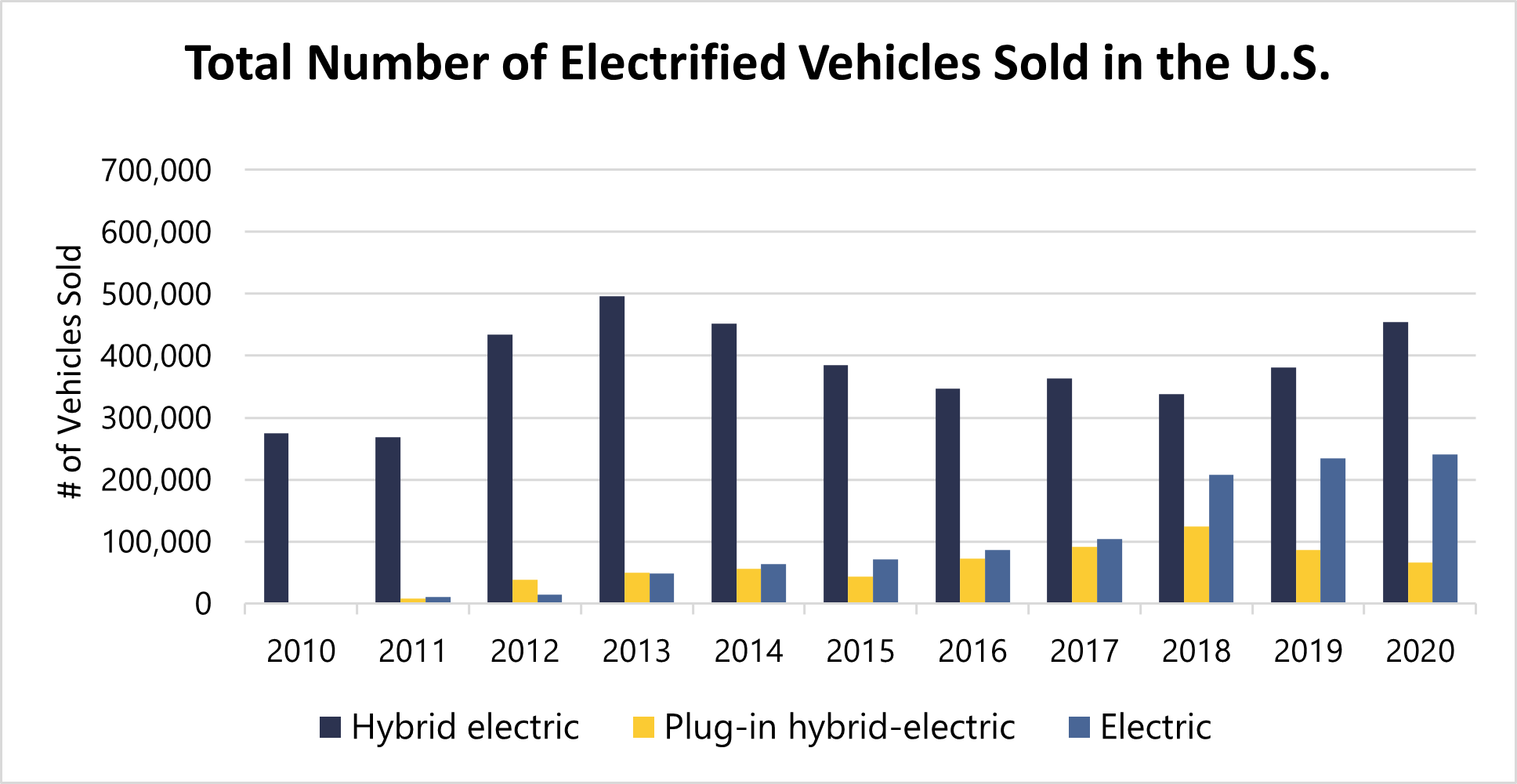
Data Source: Bureau of Transportation Statistics
California accounts for 42% of all electric vehicle registrations in the country, according to the U.S. Department of Energy’s Alternative Fuels Data Center. For perspective, electric vehicles registered in California exceed that of the total number registered in the next 14 states combined.
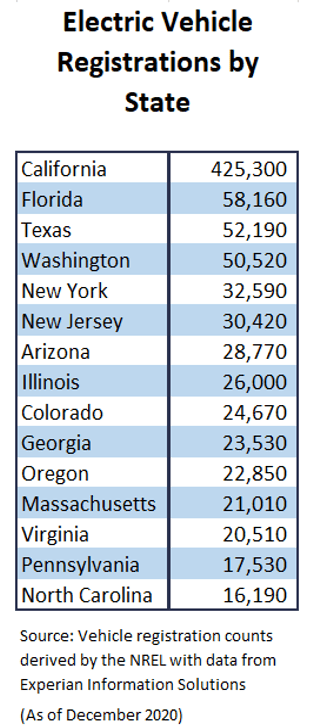
The Tesla Model 3 is by far and away the most popular electric vehicle sold in the United States. According to data from the Transportation Research Center at Argonne National Laboratory, sales of the Tesla Model 3 accounted for 47.4% of all electrified vehicle sales in 2019 covering 45 different vehicle models. Even though the electrified vehicle marketplace has become more crowded in recent years, it is clear that Tesla still dominates.
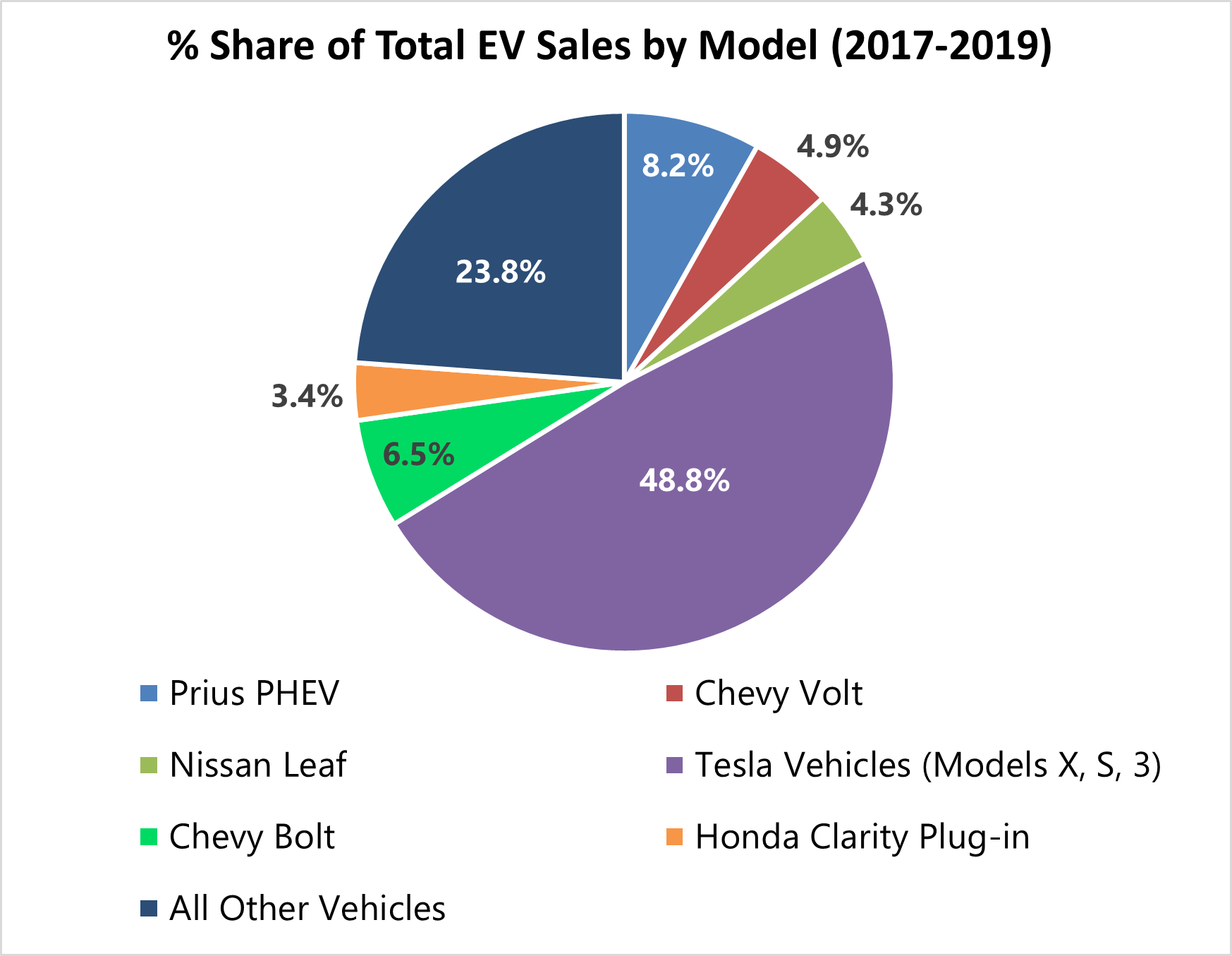
Data Source: Transportation Research Center at Argonne National Laboratory
Busting Common Myths
Despite the growing adoption rates of electrified vehicles, myths still linger. Here are some of the most common busted myths:
“Electric vehicles are only for rich people”
The escalating sales of EVs in the United States are quite directly tied to the improving price point of said vehicles. Numerous hybrid electric vehicles can be had for under $30,000. The same is true for several PHEV models, and while fully electric vehicles will be pricier than their aforementioned counterparts, many models still will keep the consumer in the low $30,000s range. And don’t forget about the federal tax credit of up to $7,500 (varies based on EV battery size) that can further bring down the sticker price.
Purchase price aside, the lifetime costs of owning an ICE vehicle vs. the costs of owning an electric vehicle make the economics of electric vehicle ownership a complete no-brainer. According to analysis by ConsumerReports, owners of EVs can expect to save up to $1,000/year and $9,000 over the lifetime of a car in fuel costs alone when compared to an ICE vehicle (driven 200,000 miles). The absence of necessary fluid changes and other regular repair costs that come with the more complex ICE vehicle lead to even further savings for EV owners. The average dollar savings from reduced maintenance and repair costs over the lifetime of vehicle ownership amounts to $4,600.
“I’ll save on gas costs, but those savings will be offset by increased electricity costs from home charging”
The math will vary based on multiple factors, but it is hard to imagine many scenarios in which regular overnight charging at your house will increase your monthly energy bill over what you would typically pay in monthly fuel costs for an ICE vehicle. The aforementioned ConsumerReports study noted that an EV driver will save an average of $800 to $1,000 a year on fueling costs over an equivalent gasoline-powered car.
“The range of electrified vehicles is too low for me to do any meaningful amount of driving.”
Many of the most affordable fully electric vehicle models available on the market today offer a driving range of roughly 150 to 250 miles on a full charge. Slightly more expensive options like the various Tesla models easily clear the 300-mile mark. Most of the industry leading ranges for PHEVs will be closer to 40 miles, meaning that you can drive those vehicles in “electric” mode for about 40 miles before your car’s internal combustion engine starts to kick in and use up gas. Such a range is going to be more than sufficient to cover the daily round trip commuting needs of most Americans.
The main Achilles Heel of electrified vehicles when it comes to driving range is that distance driving can get especially complicated given the relative dearth of charging stations in the U.S., especially compared to the more ubiquitous gas station. While this fact is indeed a challenge, there is nowhere to go but up from here. The building of the U.S. EV charging infrastructure is inevitable, and the growth will likely be exponential given the fact that almost all major auto makers are slamming the door on ICE vehicle production by the end of this decade. According to the Bureau of Transportation Statistics, the number of public EV charging stations in the U.S. grew by 245% from 2014 to 2020.
All Eyes on Congress
Even though electric vehicle sales in the U.S. continue to rise, the industry is still very much in the developmental stages. After all, EV sales in Q2 of 2021 amounted to just 3.6% of total vehicle sales according to McKinsey. Significant public investments to build out the national charging infrastructure and additional financial incentives to draw people to the EV market will be necessary as the industry seeks to become more mature.
All eyes are on our Capitol Hill these days as we follow the status of the bipartisan Infrastructure Investment and Jobs Act. The bill has a number of provisions that specifically target the EV industry. The most prominent of which include:
- $7.5B set aside for nationwide EV charging station investments
- $7.5B to help school districts across the country replace diesel fuel engine school buses and ferries with low- and zero-emission replacements.
Democrats have also proposed in their $3.5B budget bill an increase in the EV tax credit to up to $12,500 for U.S.-made, union-made zero emissions vehicles, a meaningful increase from the $7,500 incentive that is currently in place for most other electric vehicles.
Lawmakers continue to hash out the details of the aforementioned pieces of legislation. What the final numbers look like for EV-impacted investments is anybody’s guess right now. Regardless of what formally comes out of Capitol Hill, the momentum in the EV industry is unmistakable. Electrification commitments from major auto makers, tougher emissions standards at multiple levels of government, and state-level EV incentive programs will help to accelerate the EV revolution.
Industry analysts were claiming that 2020 would be the year of the electric car, but the Coronavirus pandemic and resulting downturn in the global economy had other plans. Nailing down the “year of the electric car” may be a fun parlor game, but it is clear that we are at something of an inflection point in the auto industry. The pace of change in the industry and the rate of electric vehicle adoption globally will only accelerate from here. Buckle up – it’s going to be a heckuva ride.
Cover Photo Source: Ernst & Young
The post The Electric Vehicle Era is Here appeared first on Solar Tribune.
]]>The post Beer Industry Taps into the Power of Solar Energy appeared first on Solar Tribune.
]]>
A Match Made in Heaven
An assortment of industries across the global are increasingly turning to solar energy to power their facilities as the cost of solar continues to go down and as renewable energy commitments by major corporations continue to go up. The beer industry is no different. From eco-conscious microbreweries to the most prominent beer giants in the world, solar-focused beer production is taking the industry by storm.
The marriage between beer and solar power makes plenty of sense. Local craft breweries and other artisanal beer makers place a premium on natural ingredients and they have a deep appreciation for their product’s connection to the Earth. After all, the two biggest inputs to get beer are water and hops, and you’ll never meet a brewer willing to compromise on the quality of either. From incorporating best practices around water management to providing farmers with spent hops for fertilizer, good environmental stewardship is a corporate value that is foundational to many local breweries. Embracing solar energy is a natural fit for these types of companies who largely share a common commitment to sustainability. The process of making beer is also incredibly energy intensive, with most breweries requiring between 12 to 22 kWh of electricity just to produce one barrel of beer. The cost savings of solar energy are a no-brainer, especially for the ‘little guys’ in the industry.
Local breweries get the credit for being early adopters of solar energy in the industry, but the involvement of name brand beer giants in recent years has helped turn a niche trend into an industry-wide standard with big global impacts.

Photo Source: PackagingDigest.com
The largest brewer in the world, Anheuser-Busch InBev, is a global leader in the renewable energy space. The company is committing to a future that places renewable energy – and solar in particular – at the forefront. Anheuser-Busch is a member of RE100, a corporate leadership initiative on 100% renewable electricity led by The Climate Group in partnership with CDP. In 2017, Anheuser-Busch made a commitment to source 100% of their purchased electricity from renewable by 2025. Earlier this summer, Anheuser-Busch announced that they had smashed through that goal years ahead of schedule, thanks largely to a slew of PPAs the company inked with both providers of solar and wind energy. The company’s 222 MW 2,000+ acre solar farm in Pecos County, TX came to fruition through a PPA with Canada’s Recurrent Energy. The Anheuser-Busch Solar Farm was completed this year and it is the largest solar project for any U.S. beverage company.
Solar Breweries by the Numbers
Statistics are difficult to come by, but according to at least one source the first known brewery to install a solar energy system was California’s own Anderson Valley Brewing Company. The almost 35-year-old company has been able to generate nearly 40% of its electricity from its own solar energy system that was installed in 2006.
The largest known on-site solar-powered brewery can be claimed by the famous Dutch beer maker, Heineken. Heineken’s journey into solar energy dates back to 2011 when the company first outfitted their European-based breweries with solar arrays. The company’s production facility in Den Bosch, Netherlands is the world’s largest with over 16,500 solar panels covering a distance equivalent to 8 football stadiums. The Den Bosch solar array is a 5.8 MW system. All of the company’s self-generating solar energy systems add up to a solar portfolio of just under 16 MW.
Heineken’s dominance aside, the density of solar-powered breweries is undoubtedly concentrated in the United States. According to SolarPlaza’s 2019 ranking or largest solar-powered breweries, 74 of them were in the United States.
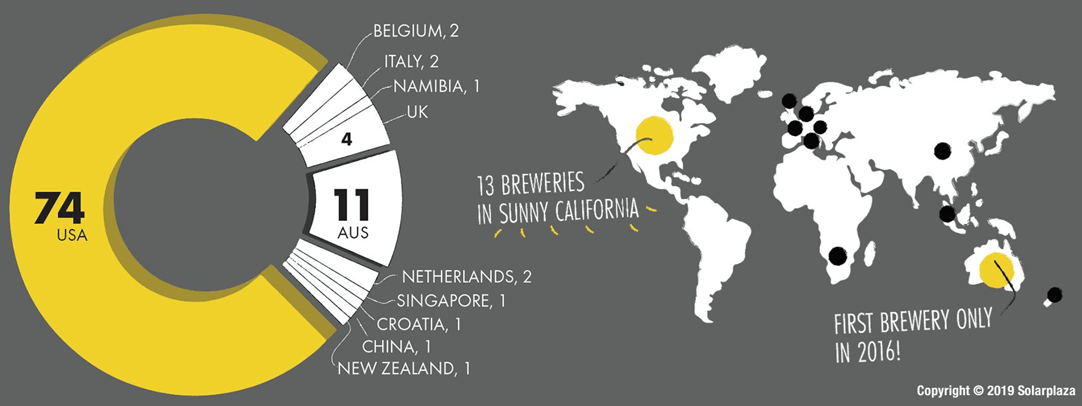
Photo Source: SolarPlaza
The 10,000+ solar panel, 3.2 MW solar energy system at the MillerCoors production facility in Irwindale, CA and Sierra Nevada’s 10,000+ solar panel 2.6 MW system in Chico, CA are recognized as the largest such on-site facilities in the United States. That distinction will not last much longer, however, with the recently announced plans by beer behemoth Anheuser-Busch to invest $64M in solar panels and other emission-reduction technologies at its Los Angeles brewery. With completion anticipated by year’s end, the array is expected to be the largest on-site solar installation of any brewery in the United States, and have the ability to cover more than 10% of the site’s total electricity usage.
A New Type of Solar Incentive
People turn to solar energy for all sorts of reasons. The environmental/moral/ethical appeal is sufficient to draw many people to the solar energy lifestyle, while others are drawn largely due to the well-documented financial incentives of going solar. The federal investment tax credit (ITC) is far and away the most popular of solar incentives available to the American consumer. An assortment of state tax credits and upfront cash rebate opportunities add further appeal to those drawn by solar financial incentives.
A brewery in Australia has figured out another powerful solar incentive – free beer. Australia’s Victoria Bitter, in partnership with ad agency Clemenger BBDO Melbourne, launched a ‘Solar Exchange’ program earlier this year allowing customers to trade excess solar energy (in the form of solar credits on their energy bill) in exchange for a slab of 24 canned beers worth roughly $50 AUD. That is a heckuva deal if you ask me.
The offer is part of an effort by Victoria Bitter’s parent company, Carlton and United Breweries (CUB), to make good on a renewable energy target to use 100% renewable energy by 2025. The marketing strategy complements other renewable energy efforts being carried out by CUB like outfitting multiple breweries with solar panels and purchasing power from a large solar farm in Australia via a PPA.
You can call it a gimmick if you want, but this is the type of creative think-outside-the-box marketing strategy that can help encourage a new subset of the population to redouble their efforts to lead a more sustainable life by harnessing the power of solar energy.
Beer is a lovely treat that requires a boat load of electricity to produce. Making breweries the world over more focused on renewable energy practices – like outfitting them with solar energy systems – helps to remove some of the energy-sucking guilt out of one of the world’s favorite guilty pleasures. The odds are good that the next brew you enjoy will be one that was produced using solar energy. That is something that all of us solar/beer enthusiasts can offer a ‘cheers’ to.
Cover Photo Source: Craft Brewing Business
The post Beer Industry Taps into the Power of Solar Energy appeared first on Solar Tribune.
]]>The post ‘Kentucky Solar’ No Longer an Oxymoron appeared first on Solar Tribune.
]]>
A Nascent Industry Finding its Footing
Even by the most optimistic of outlooks, Kentucky’s solar industry is just barely beginning its growth journey. As of 2020, the state could lay claim to having 59.53 MW of cumulative installed solar capacity, a figure that was good for a rather humbling ranking of 48th out of the 50 U.S. states. A meager 0.1% of the state’s electricity was generated from solar sources.
For perspective, the leading solar state in the country, California, had 31,288 MW of cumulative installed solar capacity in 2020, and just under 23% of the state’s electricity was generated from solar.
Kentucky’s position relative to its peers may not be overly impressive, but the trendline is clear. Just 10 short years ago Kentucky had basically no installed solar capacity (0.2 MW). The SEIA projects that the state may clear 845 MW of installed capacity by as soon as 2025, as costs continue to plummet and favorable pro-solar policies entrench themselves at the state level.
Turning Lemons into Lemonade
In a strange twist of irony, the prospects of the state of Kentucky’s solar industry may rest in the coalfields that have anchored the state’s energy production capabilities – and cultural identity – for generations.
Carbon offsets are a popular way for corporations pursuing sustainability goals to achieve the “net” in their net-zero emissions goals. Carbon offsets essentially work as credits that companies can leverage to offset operations that are otherwise not carbon neutral. Kentucky’s nascent solar industry positions the state well to benefit from these offsets, given the state’s still heavy reliance on fossil fuels. About 73% of the state’s electricity generated in 2019 came from coal. Carbon offsets can be quicker to achieve and be far more impactful in a place like Kentucky, as opposed to say just building another solar farm in California.
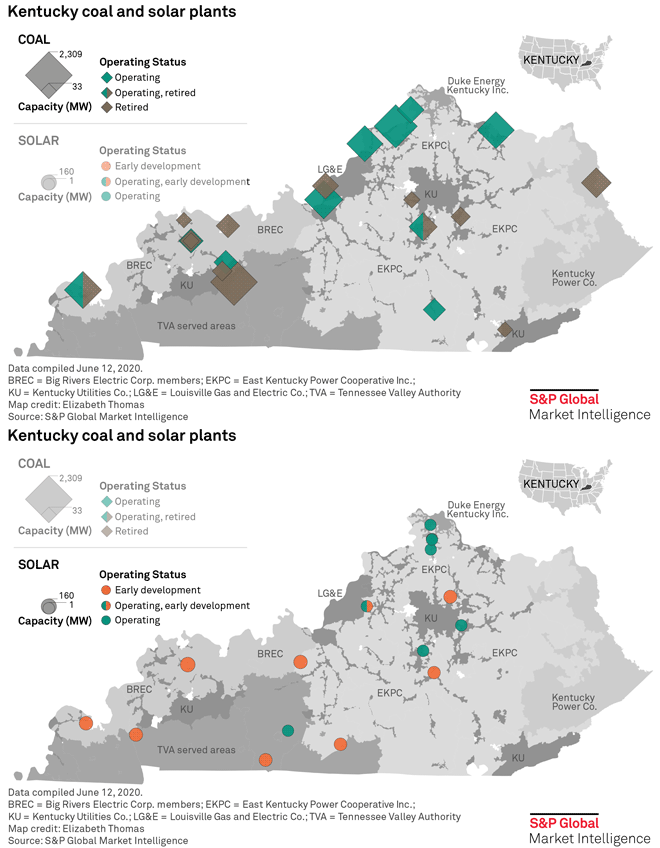
Kentucky’s hundreds of thousands of acres of coalfields (many of which are abandoned) represent an interesting adaptive reuse opportunity for solar developers. Just last month, the state of Kentucky unveiled a web-based tool to make it easier for solar developers to site arrays on reclaimed mine lands in the state.
Kentucky’s eastern most county – Pike County – will soon be the home to one such solar array which will be affixed to land that formerly operated as a coal mine. First announced in 2017, the solar array will occupy 700 acres on a former strip mine on Kentucky’s Bent Mountain and it will consist of over half a million solar panels. Global auto manufacturing giant, Toyota, is partnering on the solar project and providing a critical boost to the economics of the project by committing to a 15 to 20-year power purchase agreement (PPA).

Photo Source: RH Group
Renewables-Minded Corporations Providing Momentum
Unlike more established state solar markets, residential solar is not a primary driver of solar growth in Kentucky. Installed residential solar capacity has ticked up in recent years, but it still barely registers as a blip on the radar with regards to the state’s overall solar capacity. A somewhat humorous example of this is this story from earlier in the year highlighting a Tesla solar rooftop owner in Louisville who is the only Tesla solar roof homeowner within 500 miles of Louisville.
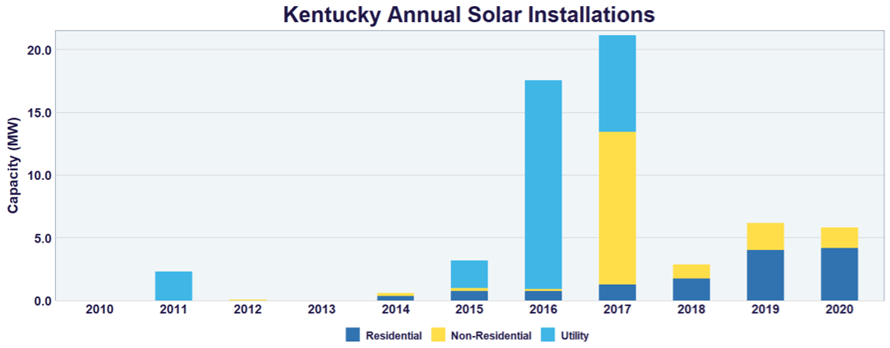
Photo Source: SEIA
Kentucky’s recent solar success and promising future is owed mainly to the growing number of major corporations with ambitious renewable energy goals that are committing to power purchase agreements (PPA) for solar farms in the state.
In May, Acciona Energy got the greenlight from regulators to build a 188-MW solar farm, one of multiple that the company plans to build to serve the needs of Amazon. Acciona and Amazon inked a deal last December committing Amazon to buy 641 MW of electricity from multiple solar arrays in Kentucky, Ohio, and Illinois. In March, the Tennessee Valley Authority made public their plans to develop a 173 MW solar-plus-storage project just outside of Bowling Green, KY that would power a nearby data center for Facebook and a nearby production facility for General Motors. Meanwhile, Dow and Toyota are the beneficiaries of a 100-MW solar farm just south of Louisville that is expected to be commercially operational next year.
Industry Gets Major Jolt from Recent Ruling
The days of Kentucky’s residential solar market largely taking a backseat to the state’s overall solar picture may be numbered, though, thanks to a pivotal state ruling expected to give the residential market a major jolt in the arm.
Just a couple months ago, Kentucky’s Public Service Commission (PSC) released a precedent setting ruling on net metering that greatly favors residential solar users. The PSC ruling tabbed the offset for excess electricity sent back to the grid by solar users at $0.09/Kwh, which was 3 times higher than the $0.03/Kwh level that Kentucky Power – a utility company serving 100,000+ households in Eastern Kentucky – was advocating for.
Prior to this recent ruling, Kentucky solar homeowners were credited for every Kwh of energy that was sent back to the grid and Kentucky Power sold that excess energy to neighboring utilities for the retail price of $0.11/Kwh. When Kentucky Power proposed their latest rate hike, the utility company tried to lower that compensation rate significantly, which among other things, would have significantly stunted growth prospects for the state’s resident solar market.
The PSC wasn’t having it. It is worth noting what a relief (and surprise) the PSC’s ruling was. Kentucky Power has long been a thorn in the side for Kentucky’s solar industry, and public policy victories and favorable regulator rulings have been hard to come by for Kentucky’s solar advocates. The PSC’s ruling ensures that the financial incentives for solar homeowners remain strong in Kentucky, just like they are in so many other U.S. states.
It will be worth following where Kentucky’s solar industry goes from here. The PSC’s ruling on net metering, the growing interest in corporate PPAs in the state, the expansive development opportunities on old coal mines, and the constantly improving solar economics in the state vis-à-vis coal all combine to put a lot of wind at the sails of the state’s nascent solar industry.
The proof will be in the pudding, but the symbolism is clear – the benefits of solar energy are breaking through in the heart of coal country.
Cover Photo Source: Inside Climate News
The post ‘Kentucky Solar’ No Longer an Oxymoron appeared first on Solar Tribune.
]]>The post Local Climate Action Plan Best Practices appeared first on Solar Tribune.
]]>We’re speaking with government officials who are actively working to reduce the effects of climate change within their local communities. Our goal is to get their perspective on what the best actions for an effective climate action plan might look like. The main areas of focus that continue to come up in these conversations are:
Buildings

Decarbonizing residential and commercial buildings is an impactful way for local governments to offset the effects of climate change because the technology to conserve energy and reduce emissions already exists. When buildings become more environmentally responsible, running costs are lessened and there are fewer pollutants being transmitted into the atmosphere, making communities a healthier place to live, work, and visit.
There are many ways government officials can work to decarbonize their community’s buildings. These actions include:
- Establishing emissions caps for large buildings, over a certain square foot
- Replacing gas-powered plants with battery storage that’s powered by renewable energy sources
- Providing new residential buildings and commercial buildings with a solar photovoltaic system or a green roof
- Implementing built environment policies, such as building energy codes and shifting what materials are used to build new spaces
Departments that Highlight Buildings in their Climate Initiatives
“In implementing the Building Standards Code for the state of California (with the energy codes being part of those standards), the state law allows jurisdictions to charge up to $500 for residential rooftop solar systems. Our previous fee was $221, and we reduced that fee to a $165 charge (about a 33% reduction) for the cost of a solar permit. I believe it is one of the lowest solar permits in the state.” – Jeff Thomas, Chief Building Official, City of Fairfield, CA
“We’ve been implementing an energy reduction program in our buildings by doing LED light fixture upgrades, pumps, HVAC, controls, reroofing, and doing a variety of projects that are going to reduce how much energy we use. In addition to that, we’re also adding a significant amount of solar and sustainability initiatives all around. In fact, we are in the process of bringing a combined 25MW of solar and battery storage online to serve our City facilities. By reducing how much energy we use, combined with solar generation, we are able to use much of the 20-year savings to pay off the project itself and reinvest those savings back into sustainability and our community.”– Ann Kloose, Division Manager of Sustainability, City of Fresno, CA
“On the generation side, while we reduce emissions, we wanted to start transitioning our buildings to all-electric. The first step we took was to implement a local ordinance that requires new buildings to use electric space and water heating, effectively prohibiting gas, and therefore encouraging heat pump technology that is highly efficient. We also have 4,500 existing residential buildings that use gas furnaces and gas water heaters, so we’re looking to design policies and incentives to get people to remove them and install a heat pump system.” – Felicia Smith, Utility Conservation Analyst, City of Healdsburg, CA
Energy
Whether it’s through decarbonizing the electrical grid or responsibly using energy through conservation, efficiency, and renewables, several cities and counties across the country are leading the way in accelerating the transition to cleaner energy sources. By increasing investments in clean energy, these communities are committed to making alternative energy sources easily available so that consumption goes down and they are no longer reliant on burning fossil fuels as an energy source.
There are many actions that can be taken to transition to cleaner energy sources, including:
- Working with utilities to procure more clean energy technology
- Encouraging community partners to install renewable systems on their facilities
- Offering renewable energy system financing to small commercial properties
- Implementing renewable energy policies, such as Renewable Portfolio Standards, or RPS
Departments that Highlight Energy in their Climate Initiatives
“We did a Power Purchase Agreement to get solar panels installed in our parks. At the time, it was really uncommon for a Power Purchase Agreement to have something written into it that would allow us to be able to keep all the renewable energy credits from those solar panels. Most of the time, for greater cost savings, that’s not written into it. We felt that it was important for the city to retain those credits because it’s a part of our efforts to reduce greenhouse gasses and to be more sustainable.” –Benjamin Lucha, Environmental & Technology Manager, Publics Works, City of Palmdale, CA
“The best way anybody, on a small scale or a larger scale, can reduce their carbon footprint is to use less energy. Generating power and generating renewable energy is great, but the best and most effective way that we can be good stewards of the environment is to use fewer resources across the board. Whether you’re in your home, running a business, or you’re part of a municipality, reducing anything that you use is the first line of defense.”– Ann Kloose, Division Manager of Sustainability, City of Fresno, CA
“Within sustainability, energy is obviously a big focus – anything from energy efficiency and renewables to energy storage – really focusing initially on cost-saving measures. We’ve been able to optimize our systems, replacing all inefficient lights with efficient lights. We’ve been doing a lot of things in that space. We’ve been able to replace over 6,000 street lights last year – all from high-pressure sodium to LED by partnering with our utility.” – Salem Afeworki, Energy and Sustainability Services Manager, City of Costa Mesa, CA
“The County of Marin, through Marin Clean Energy, offers residents and businesses the option to sign up for Deep Green 100% Renewable Energy. Deep Green Energy guarantees that all of the power you buy for your home or business comes from 100% non-polluting wind and solar power, produced in California.” – Phil Boyle, Senior Planner, Town of Corte Madera
“I’d say that the most impactful thing that our city has done in the last few years is join a Community Choice Aggregation program, also known as a CCA. Our CCA is called the Clean Power Alliance, which is made up of thirty-two jurisdictions in LA and Ventura Counties, and so by pooling the resources and customer base of these thirty-two communities, the Clean Power Alliance is able to procure renewable energy on our behalf and sell it to customers at competitive rates, through Southern California Edison’s transmission distribution system. With electricity decarbonizing at a rapid pace, we must work to make the rest of our community fossil-fuel-free by electrifying transportation and home appliances.” – Drew Johnstone, Senior Sustainability Analyst, City of Santa Monica, CA
“I think that energy has the most impact in drawing down greenhouse gas emissions, and what I love about it is, once you decarbonize the grid and you electrify it, it doesn’t require a lot of human behavior. When you think about water conservation or more importantly, the zero-waste movement, you’re asking people to make a lot of decisions every single day, so I like the energy space because we can transition away from fossil fuels, reduce greenhouse gas emissions, and not be so dependent on day-to-day human behavior changes.” – Felicia Smith, Utility Conservation Analyst, City of Healdsburg, CA
Transportation

As we’re starting to see more rapid advancements in cleaner transportation technologies, more cities and counties are supporting energy-efficient transportation as part of their climate action planning. By prioritizing cleaner transportation, local governments can offset and even eliminate a huge portion of today’s carbon emissions. Since the transportation sector is so broad, more is needed than simple technological improvements. Government support is also crucial.
The following actions can be done to support energy-efficient transportation within a local government:
- Utilizing low-carbon transportation technologies
- Building new housing near public transportation services to limit excess travel and reduce emissions
- Encouraging more people to walk and bike
- Using transportation data to ensure that clean energy options are equitably available across the community
- Increasing electric vehicle use through community outreach and encouragement
- Enacting transportation policies, such as vehicle performance standards
Departments that Highlight Transportation in their Climate Initiatives
“Within a year, we were able to build our first publicly available EV charging station – we now have nine of them up and running for residents, city staff, and visitors to use at any time. This is the first one that the city owns – unlike those owned by a private sector or someone else – this is our first.” – Salem Afeworki, Energy and Sustainability Services Manager, City of Costa Mesa, CA
“A lot of cities and counties across the state [of California] were awarded planning grants last year, and with that funding, we’re trying to increase housing downtown to reduce people’s trips and reduce the need for parking. The goal here is to have fewer car trips. We also have a train station, and locating housing within half a mile of that train station has been a long-standing priority. We’ve had the train station built for almost 10 years now, and the train doesn’t come to Cloverdale yet, but that’s what we’re planning for, as we try to get housing within walking distance.” – Rafael Miranda, Associate Planner, City of Cloverdale, CA
“We are currently electrifying our fleets from every angle. Everywhere from public works fleets, to electric aviation at our airport, all the way to personal fleets; working with individual employees to electrify, so they can either move from a straight gasoline engine to hybrid or even full electric. Throughout all efforts, we are ensuring collaboration and support with city hall, major employers and industries, community groups and individual citizens committed to establishing and maintaining a more sustainable transportation environment.” – Rob Terry, Community Development Director, City of Reedley, CA
Waste Disposal

One of the most well-known aspects of sustainability has always been the idea of “reduce, reuse, recycle.” With that in mind, several local governments are calling for a more feasible approach to waste disposal, through limiting the use of landfills, reducing wastes, and establishing initiatives to prevent littering and unnecessary dumping. By limiting the amount of waste that ends up in landfills, there will be fewer harmful greenhouse gasses, such as methane being emitted.
Some actions that cities and counties can take to address waste disposal include:
- Encouraging residents to reduce, reuse, and recycle more in daily life
- Reducing carbon emissions from waste disposal by diverting community waste from landfills
- Implementing new amenities, such as waste collection services, drop off centers, and transfer facilities
- Setting new standards for waste disposal, including requirements, fees, bans
- Investing in education and outreach initiatives for residents and businesses to adopt more responsible disposal protocols
Departments that Highlight Waste Disposal in their Climate Initiatives
“Think about the things that you can incorporate into your daily routine so that they become a habit for you and your family. An example could be ensuring all food waste is regularly composted or consuming only what you need for any given time and being conscious about the types of goods you purchase.” – Robyn L. Eason, Senior Sustainability Planner, City of West Hollywood, CA
“We’re one of the few cities in Southern California that has a full operating organics program for our commercial businesses. That’s something I’m really proud of – that we’re able to offset methane emissions, using a biodigester to turn it into renewable, natural gas that’s pumped right back into the SoCal gas pipeline.” – Jessica Sutorus, Environmental Conservation Supervisor, City of Colton, CA
Water/ Wastewater Management

Several communities across the country are actively working to preserve their water, reduce wastewater, and prevent water pollution, through more efficient management techniques. Long-term changes, such as increasing water use efficiency and recycling wastewater are crucial in protecting our water sources, improving the overall quality, and taking better care of the environment.
Local communities can efficiently manage their water/ wastewater by considering the following actions:
- Protecting natural sources of water, through land-use policies
- Recycling wastewater and capturing stormwater
- Sourcing water locally
- Providing better drinking water access in areas of highest need
- Developing programs to address on-site plumbing issues, including old drinking water pipes
Departments that Highlight Water/ Wastewater Management in their Climate Initiatives
“A lot of the decision-making around growth centers around water, so we’re doing everything we can to make good use of our water. Through development standards, the homes that get built have many drought-tolerant features in them. The other thing the City has done a really good job of is maximizing the uses for our recycled water. The effluents that we receive from residences and businesses goes through a state-of-the-art wastewater treatment plant and then gets used on parks and some agricultural crops, like alfalfa, that would go to feeding livestock.” – Michael King, Director of Public Works, City of Lathrop, CA
“We’re working on many fronts to capture, treat and reuse stormwater. We’re retraining developers, through the LID (Low Impact Development) ordinance, to make sure that they are responsible for capturing that first inch or so of rain so that it just doesn’t collect all the pollution that comes from those cars, from some of us who may litter, over water, over-fertilize, pick up after our dogs, etc. All of that pollution gets into our waterways, wreaks havoc on our beaches, destroys the quality of life that we have in our parks. Tourists come to LA to enjoy our beaches, for example, so teaching people about those connections is something that we’re proud of.” – Doug Walters, Chief Sustainability Officer, LA Sanitation & Environment, City of Los Angeles, CA
“The piece of technology that I am most excited about is a biochar system to process our biosolids from our wastewater treatment plant. Currently, we end up with a blackish, dried mud-like substance that we pay to have trucked to the central valley where it is applied to cotton crops as a soil amendment. It is not an ideal solution – we pay a lot in trucking (because the trucks burn a lot of diesel), as a soil amendment it is not that great – there are better fertilizers and amendments out there but the farmers take the biosolids because we give them away for free.” –Alex Yasbek, Civil Engineer and Climate Action Coordinator, City of Watsonville, CA
Green Spaces

Climate change ultimately begins with the way we’ve been treating the planet and the natural spaces that we occupy. When looking to lessen the effects of climate change, many local governments are keeping an eye on protecting and utilizing natural resources. In addition to reducing emissions, these communities are working hard to increase parklands and green spaces, as well as preserving the natural land that surrounds them.
Cities and counties looking to highlight green spaces in their climate action plan can take actions, such as:
- Working with departments, like Parks and Recreation and Planning and Community Development to increase city parklands and green spaces
- Maintaining and increasing the area’s tree canopy to reduce peak temperatures and air pollution
- Increasing financing for agriculture and farming practices
Departments that Highlight Green Spaces in their Climate Initiatives
“To reduce climate change, we need to reduce the heat effect that we have in Los Angeles and our surrounding areas, so we’re very proud of all the efforts and the grants that we have secured to enable us to plant thousands of trees. There’s a disparity of tree canopies in our various neighborhoods, and we’ve been successful in getting several million dollars to start doing some cutting out of concrete to give the trees a chance to survive, once we do plant them.” – Doug Walters, Chief Sustainability Officer, LA Sanitation & Environment, City of Los Angeles, CA
Food

Providing better access to locally sourced food, assuring food security, and encouraging healthier, more sustainable diets is a recurring aspect of most climate action plans. Several communities across the United States have committed to addressing issues related to food in their community development initiatives.
Some food-related actions that local governments can take include:
- Supporting the development of new healthy food access projects in underserved communities
- Expanding farmers markets and allowing year-round access to locally sourced food
- Keeping food waste out of landfills
- Conducting public outreach campaigns to encourage more sustainable eating
Departments that Highlight Food in their Climate Initiatives
“Residents are encouraged to divert their food waste – along with their green waste, and that includes things like napkins or paper boxes. That is one of the biggest focuses of the state’s recent CalRecycle Short-lived Climate Pollutants: Organic Waste Reductions (SB 1383) regulation that compels jurisdictions to have food diversion programs, as well as food rescue programs. Not only will this regulation require cities to have organics collections (with food waste) but also take steps to rescue edible food and get that food to folks that may be food insecure.” – Judy Erlandson, Public Works Manager, City of Livermore, CA
Community Engagement

One of the most cost-effective and talked about aspects of climate action planning is creating a community where the residents are engaged and invested in living more sustainable lives. Many effective plans have a strong emphasis on producing results at the community level, guided by communities themselves.
Local governments that are looking to highlight community engagement should consider the following actions:
- Including community organizations, businesses, schools, and city departments in climate action planning
- Partnering with stakeholders to secure investments in sustainability and economic growth
- Working to achieve shared goals with community partners
- Ensuring that everyone has access to all sustainability initiatives
- Assembling members of the community to identify priorities and help evaluate the impact of existing climate programs
Departments that Highlight Community Engagement in their Climate Initiatives
“We partnered with three nonprofit organizations within our city limits that specifically do outreach and engagement with more vulnerable populations (populations that are more vulnerable to climate change, such as our seniors, youth, and our Latino population on the Coastside). So even prior to drafting a document, we decided we wanted to go out and have a conversation with these especially vulnerable populations to ask them what they knew about climate change, what their understanding of it was, so they could actually engage in that conversation more comprehensively and really help us form that first draft before anything was even written down.” – Jennifer Chong, Public Works Program Manager, City of Half Moon Bay, CA
“We’ve had to adapt during the Covid-19 pandemic like many others for climate-related outreach. We got creative to deliver project messages and seek input, placing flyers for transportation planning efforts in bags of food at the local food banks for families to take home. Also, we are trying to support community-capacity building to advise and encourage groups to work with the City proactively on climate issues, rather than react to projects. The City invested in the launch and convening of Sacramento’s Environmental Justice Collaborative Governance Committee, a community-based effort intended to build capacity while engaging City staff to design with, and not for, the community.” – Jennifer Venema, Interim Climate Action Lead, City of Sacramento, CA
“The climate action plan we have in place is really a pathway for San Francisco to achieve net-zero greenhouse gas admissions by 2045. At the same time, the document feeds into ways of addressing racial and social inequity, public health, economic recovery (particularly now in California with public safety shutoffs and wildfires), and finally, we want to document planning that provides safe and affordable housing.” – Lowell Chu, Energy Program Manager, City & County of San Francisco, CA
“There’s a very strong view of this climate action plan through the lens of equity, and I think that is something that is emphasized through our work and something that we really prioritize. That really drives a lot of the motivation within our climate action plan.” – Ryan Ramos, Senior Energy Efficiency Specialist, City & County of San Francisco, CA
“We need to meet the current generations’ needs in a way that does not compromise the ability of future generations to meet their own needs. We have economic viability, environmental responsibility, and social equity to consider. We have partnerships with several private businesses, the school district, and other public agencies to improve the community’s sustainability and reach those goals.” – Tiffany Twisselmann, Public Works Supervisor, City of Gonzales, California
“We strive towards the community-driven planning approach as a best practice for addressing some of the systemic inequities that already exist within society and anticipating how climate change can exacerbate those inequities. If you’re a frontline community impacted by climate change, you should be at the table when policy decisions are being discussed and governments should be taking initiative to make sure those voices are included. It really focuses on relationship building and trust building with community partners.” – Hoi-Fei Mok, PhD, Sustainability Manager, City of San Leandro, CA
“Marin Climate Energy Partnership (MCEP) is a county-wide organization that is made up of representatives from each of the cities and towns that make up the county of Marin, and I represent Corte Madera. We meet once a month to strategize, collaborate, and keep informed on what each jurisdiction is doing to reduce greenhouse gasses and reduce consumption of resources.” – Phil Boyle, Senior Planner, Town of Corte Madera
“One of the big things for me, as I started to get into the various projects that we’ve done now, was to create a web presence to document all of the things that our city has been doing to reduce its carbon footprint. Our sustainability page is a prime example of that; it’s kind of a one-stop-shop for all things sustainability, where someone who really wanted to either understand what the city is doing or understand what they can do – as a call to action – can go on that website and find out information at their will. For me, creating that awareness is a pivotal first step.” – Robyn L. Eason, Senior Sustainability Planner, City of West Hollywood, CA
“We stay engaged with neighborhood councils, we do a lot of work with NGOs (Non-governmental Organizations), like TreePeople, Heal the Bay, and many disadvantaged communities – that’s another thing I’m particularly proud of: the advocacy work that we’re doing to make everybody aware but also start to address a lot of the issues that have overburdened those communities, so we can lift them and bring more attention to improving their quality of life and reducing the disparity and mortality rates that you may see from one side of the city to another.” – Doug Walters, Chief Sustainability Officer, LA Sanitation & Environment, City of Los Angeles, CA
“We do a lot of outreach through social media, newsletters, and presentations for groups we want to present to. At least in Chula Vista, there’s a pretty big awareness of climate issues, and a lot of people want to take action, so they look to us to connect to the right resources.” – Cory Downs, Conservation Specialist, City of Chula Vista, CA
“We’re starting to explore an online tool that will allow residents to create a profile, answer questions about their lifestyle, and upload their energy use data to get a picture of their carbon footprint. Then the tool will show them things they can do to live a more sustainable life, along with associated costs and available resources. People can have competitions among neighborhoods, schools, or community groups. We’ve even had a council member mention that we could have all our council members compete and see who can reduce their carbon footprint the most over the next month or six months or maybe we set a community goal. We really want to get individuals and households involved, so this is a fun tool that will encourage people to do more and give them access to important resources that can help.” – Tricia Pontau, Associate Planner, City of Livermore, CA
“Up until a few years ago, climate action plans meant greenhouse gas reduction plans – that’s what climate action was. What I’m really excited about is the expansion of that concept, away from just greenhouse gas planning and mitigation measures, to include adaptation, a recognition that climate change is going to happen, and how we are going to prepare for it. Also, expanding into what we’re calling restoration and figuring out how we can start undoing the damage that we’ve done, how do we start to repair the natural world and prepare our communities because so much of climate change is in every aspect of people’s lives.” – Alex Yasbek, Civil Engineer and Climate Action Coordinator, City of Watsonville, CA
Learn More:
National Association of Climate Resilience Planners
Urban Sustainability Directors Network
The post Local Climate Action Plan Best Practices appeared first on Solar Tribune.
]]>The post Theme Parks Embracing Solar Attractions appeared first on Solar Tribune.
]]>
An Unlikely Source of Inspiration
Theme parks have never exactly been noted for their low environmental impact. People often travel across long distances via car or even worse, commercial jet, to spend time at a theme park. Single use plastics and other landfill-destined consumable goods are typically in over abundance at theme parks as well. When you consider the fact that hundreds of millions of people worldwide attend theme parks on an annual basis (Over 20 million at Disney’s Magic Kingdom alone), you can understand how environmentalists might give theme parks the cold shoulder.
That is all changing now.
As the threat of climate change grows by the day and the number of increasingly eco-conscious global consumers grows with it, theme parks of the 21st-Century are taking on a different design and purpose than those of yesteryear. The Walt Disney Company is one such enterprise that is playing a leading role in blending together a message of fun and sustainability at global theme parks.
Disney’s Earth Day Announcement
The Walt Disney Company recently marked Earth Day by unveiling a renewed list of environmental sustainability commitments that placed solar power at the forefront.
Among the most notable of the company’s commitments is its plan to develop two new 75 MW solar facilities with plans to bring them online in 2 years. The planned solar projects join Disney’s other recent solar investments. The first of which was a 22-acre, Mickey-shaped solar farm built near Epcot in 2016 and a much larger 270-acre, 57 MW solar project developed in 2019. Collectively, these four solar facilities will allow Disney to produce enough solar power to cover 40% of their total annual energy consumption.
As any avid Disney fan knows, the company’s footprint extends far beyond Orlando, FL, and the company has likewise spread its solar investments across multiple global attractions. In addition to the previously mentioned Walt Disney World Resort projects, solar investments can also be noted at the following:
- Castaway Cay: Plans are in the works to build a solar array totaling over 4,000 solar panels at Disney’s private island in the Bahamas that will power over 70% of the island.
- Disneyland Resort: 1,400 solar panels sit atop the radiator springs racers attraction
- Disneyland Paris: Solar canopies in guest parking lots collectively produce enough energy to power a small city
- Hong Kong Disneyland Resort: The park’s 5,000 solar panels make it the largest solar site in Hong Kong
- Tokyo Disney Resort: The park generates enough solar energy to power the iconic Dreamlights Parade with solar panels installed at eight backstage locations across the resort.
Reportedly, the amount of solar energy produced across Disney’s global portfolio is enough to power over 65,000 homes for a year, or put another way, the equivalent of 8 Magic Kingdoms!
Disney’s Earth Day announcement is part of its renewed long-term vision to reach zero net greenhouse gas emissions for its direct operations by 2030.
Disney Isn’t Alone
Disney is far from the only global theme park to embrace environmental sustainability. Other theme parks both in the U.S. and abroad are doubling down on environmental sustainability commitments, and some parks are even themed around the topic of climate change itself.
Six Flags Great Adventure: Thanks to a partnership with KDC Solar, Six Flags Great Adventure in New Jersey now runs entirely on solar energy. KDC Solar was behind a multi-faceted 23.5 MW solar project that debuted at Six Flags in 2019, which ranks as New Jersey’s largest ever net metered solar project. By powering the whole park on solar energy, as much as 1.5 million tons of carbon particles are now no longer being released into the atmosphere.
DefiPlanet (France): DefiPlanet doesn’t have the name recognition as Disney, but it is arguably the world’s crown jewel of environmentally sustainable theme parks. The over 60-acre park’s whole purpose is to educate revelers on climate change. They do so in a creative and fun way that uses mythical creatures to guide families along the park on fun adventures while simultaneously warning them about the perils of a warming planet.

Photo Source: DefiPlanet
Greenwood Forest Park (United Kingdom): Six Flags in the United States can lay claim to being the first solar-powered theme park in the U.S., but it is the United Kingdom’s Greenwood Forest Park that makes that claim internationally. In 2015, the Park installed a 576-panel 150 kWh solar system that meets 80% of the Park’s daily energy needs. The solar energy system covers all of the power needs of the Park’s famed SolarSplash water slide, which is the UK’s first ever solar-powered amusement ride.
PortAventura World (Spain): The PortAventura World amusement park in Spain is yet another example of sustainable tourism done right in Europe. In 2019, the park laid claim to being the first carbon-neutral resort in the World. In 2020, they unveiled an on-site solar project that provides about one-third of the whole resort’s power needs on an annual basis. The 22,000 PV panel system is the largest self-consumption solar PV facility in Europe. PortAventura World’s sustainability commitments extend beyond just solar, as the resort also eliminated use of all plastic products on resort grounds in 2020.
Children are the future, and the future for the world’s citizens is at great risk without concerted effort to reverse the effects of climate change. Even though they are not typically the paying customer, theme parks are ostensibly venues that exist to entertain children. It is heartening to see some of the world’s most prominent theme parks embrace the opportunity to harness this momentum and further excite children about renewable energy and the importance of combating climate change.
It is no accident that children are the face of the global movement to combat climate change thanks to the global ascendance of Greta Thunberg and the emergence of youth-centric climate change advocacy organizations like the Sunrise Movement. I, for one, am optimistic that the seeds of interest in renewable energy that global theme parks are helping plant today in children across the world will bear fruit years down the line in the form of a more just and sustainable world.
The post Theme Parks Embracing Solar Attractions appeared first on Solar Tribune.
]]>The post The Green Saudi and Green Middle East initiatives appeared first on Solar Tribune.
]]>Saudi Arabia is the largest country in oil production, worldwide. It is also the most effective player in stabilizing the global oil price due to its position in leading the Organization of the Petroleum Exporting Countries (OPEC). Since 2016 Saudi Arabia has launched multiple initiatives to help create different types of energy resources. Saudi’s target is to have 50% of electricity generated from green energy by 2030. The Green Saudi and Green Middle East initiatives were recently announced by the Saudi Crown Prince, Mohammad Bin Salman (MBS), and are part of the Saudi 2030 vision.
The Saudi Crown Prince, MBS, expresses the nation’s responsibility in combating climate change in his statement “As a leading global oil producer, we are fully aware of our share of responsibility in advancing the fight against the climate crisis, and that, as our pioneering role in stabilizing energy markets during the oil and gas era, we will act to lead the next green era,” (MBS)
The Green Saudi Initiative aims to plant 10 Billion trees across Saudi in the upcoming decades, which is equivalent to 1% of the global goal in combating climate change. This will increase the country’s vegetation coverage 12 times its current size. It also aims to reduce about 130 Million tons of CO2 emissions.
The Green Middle East Initiative aims to plant 40 billion trees across the Middle East. This will help reduce the CO2 emission resulting from the hydrocarbon production in the region by 60%. Also, the initiative aims to enhance the efficiency of hydrocarbon technologies in the region. Another goal is to rehabilitate and reforest more than 40 hectares of degraded land. This initiative has been welcomed by many Middle Eastern leaders and the initial communication has started.
It was also welcomed by the UN, according to Stephane Dujarric, spokesman for UN Secretary-General Antonio Guterres that said “We’re following with great interest the efforts made by countries like Saudi Arabia to step up their climate ambitions.”
Global warming is the top threat to our planet. According to a study concluded by Saudi officials, “ An annual average of $13 Billion was lost due to the region’s sand storms”. Their studies also show that the populations’ average age is decreasing by 1.5 years due to carbon emissions. Applying such initiatives, in addition to the increase in renewable energy use, will result in a positive impact on climate change.
The post The Green Saudi and Green Middle East initiatives appeared first on Solar Tribune.
]]>The post 2021 Climate Policy & Industry Priorities: Survey of Industry, Academic, and Political Leaders appeared first on Solar Tribune.
]]>
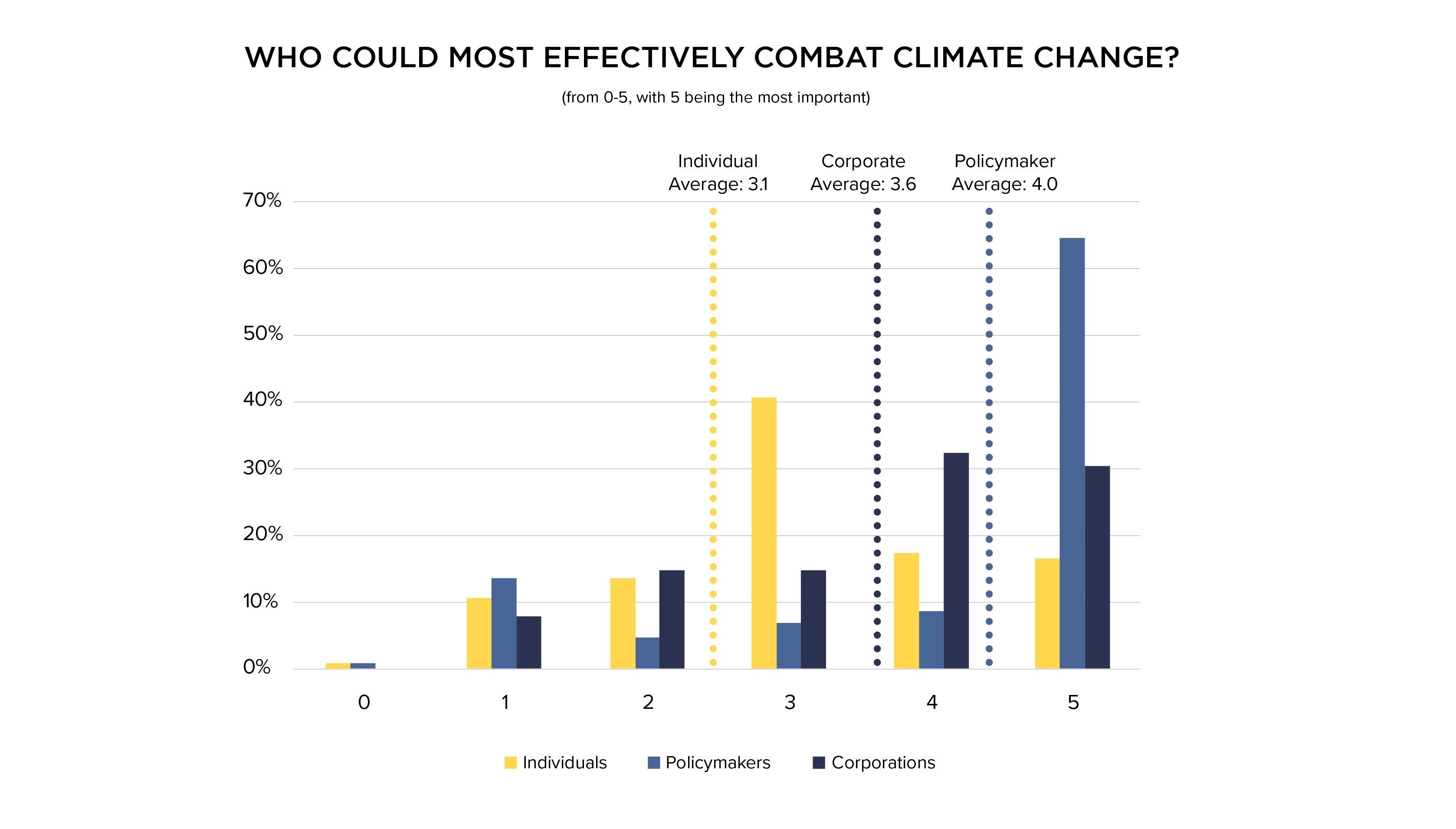
Of possible policy options, shifting subsidies from fossil fuels to clean energy sources was deemed to be the most important policy mechanism we can use to combat climate change.
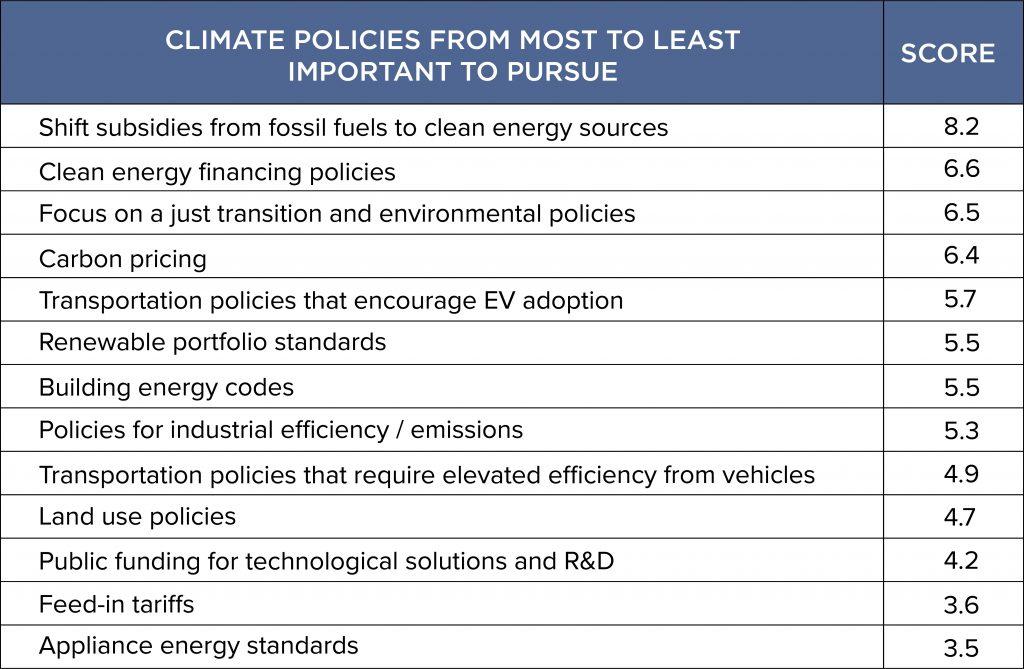
Methodology & In-Depth Findings
Over the past year, Solar Tribune has invested extensive time and resources interviewing experts across every sector and field that touches upon climate change and the need for action: advocacy groups, scientists and academics, politicians and government leaders, writers, influencers, and more. In connecting with these over 100 experts, our goal has been to ask them for input on the type of action that we need to be seeing, both on a collective and an individual level, to fight climate change.
A key resource built out thanks to these invaluable conversations has been a compendium of proposals, supporting quotes, and links and documents where Solar Tribune readers can find out more information when they want to dig deeper. You can wade through the bevy of policy priorities, individual recommendations, and other outcomes from this project at the following links:
This extensive interviewing process is still an ongoing and ever-evolving effort, meaning we’re continuing to build out the above resources (so, please continue to check in on them and see these ‘virtual conversations’ grow!). But in answering those questions, the experts with whom we were connecting started sharing insights into some additional questions outside of the original prompts. Where we were asking for policy proposals that were important, these thought leaders were debating which were the most effective compared with which got the most bang for the buck (whether literal dollars and cents or in terms of political capital). They also highlighted actions that maybe weren’t as directly impactful on a CO2 level but were still intangibly vital. And a common theme of questions that kept coming up: how much should we really be discussing the importance of individual action compared with demanding accountability from politicians? Similarly, how much should we care about our household carbon footprints when the real impact is no doubt coming from the corporate carbon footprint?
Recognizing that these questions were just as critical, if not more so, than the original ones we had been asking, as well as reflecting on the fact that we had inherently built an extensive rolodex of climate experts (both those who participated with shareable quotes and those we’ve connected with on other levels behind the scenes), we realized it was important to take the next step. We want our contribution to the climate conversation to not just be listing out possible routes to take, but using these expert voices to quantitatively evaluate priorities.
With that, we rolled out our Solar Tribune Climate Expert Survey. Thanks to our over 100 participants who were generous enough to share their time and insights with us via private survey, we’re happy to now be publishing version 1.0 of those results. This iteration is just version 1.0, not a final product, because we do recognize some limitations inherent in our results thus far, and we want to engage with more experts, people with more diverse backgrounds and perspectives, and build a consortium of climate experts who can help us minimize those limitations while maximizing the applicability of our results.
The goal is to really gauge where the climate action winds are blowing, where they may be blowing in coming years, and (most importantly) where they should be going. So, let’s dive in..
Questions Asked
To start with, we collected 13 of the top climate policy priorities that came from our one-on-one expert interviews. These 13 items represent themes, policy mechanisms, and actions that authoritative thought leaders have advocated for in our discussions, and (in no particular order) they are:
- Carbon pricing
- Shifting subsidies from fossil fuels to clean energy sources
- Clean energy financing policies
- Renewable portfolio standards
- Feed-in tariffs
- Transportation policies that encourage EV adoption
- Transportation policies that require elevated efficiency from vehicles
- Building energy codes
- Appliance energy standards
- Policies for industrial efficiency / emissions
- Public funding for technological solutions and R&D
- Land use policies
- Focus on a just transition and environmental justice
Presenting these 13 policies, we asked each survey responded to rank all of these options against each other in three different categories:
- Importance
- Cost-effectiveness
- Effectiveness in reducing CO2
Another topic that came up frequently in expert interviews was the debate about how much emphasis should be placed on different potential groups and influencers for climate action. Some activists express anger and frustration about the trend of focusing on how individuals can reduce their carbon emissions because it is theoretically letting the most polluting entities—corporations—off the hook. Along that same train of thought, many argue that it simply should not matter what any particular individual or corporation can do because, in the end, they’re always going to act in their self-interest. As such, this argument goes, regulators and policymakers must be the ones instilling certain requirements towards sustainability, or at the very least putting a thumb on the scale to make sure the dangerous externalities of climate change are priced into the decisions made by people and companies. To address these points, we asked our respondents to rank on a scale of 0-5 how important it was to:
- Encourage individual citizens to take action on climate
- Encourage policymakers to take action on climate
- Encourage individual corporations to take action on climate
And, lastly, to ensure we knew who we were talking to, we asked from demographic information from any respondents who were comfortable sharing the following:
- Their political affiliation
- Their state or country
- Their gender
- The industry/sector in which they work
- Whether they consider themselves a climate activist
Initial Results
The results from this Version 1.0 of the survey are thought-provoking, and they can best be expressed through graphical representation:
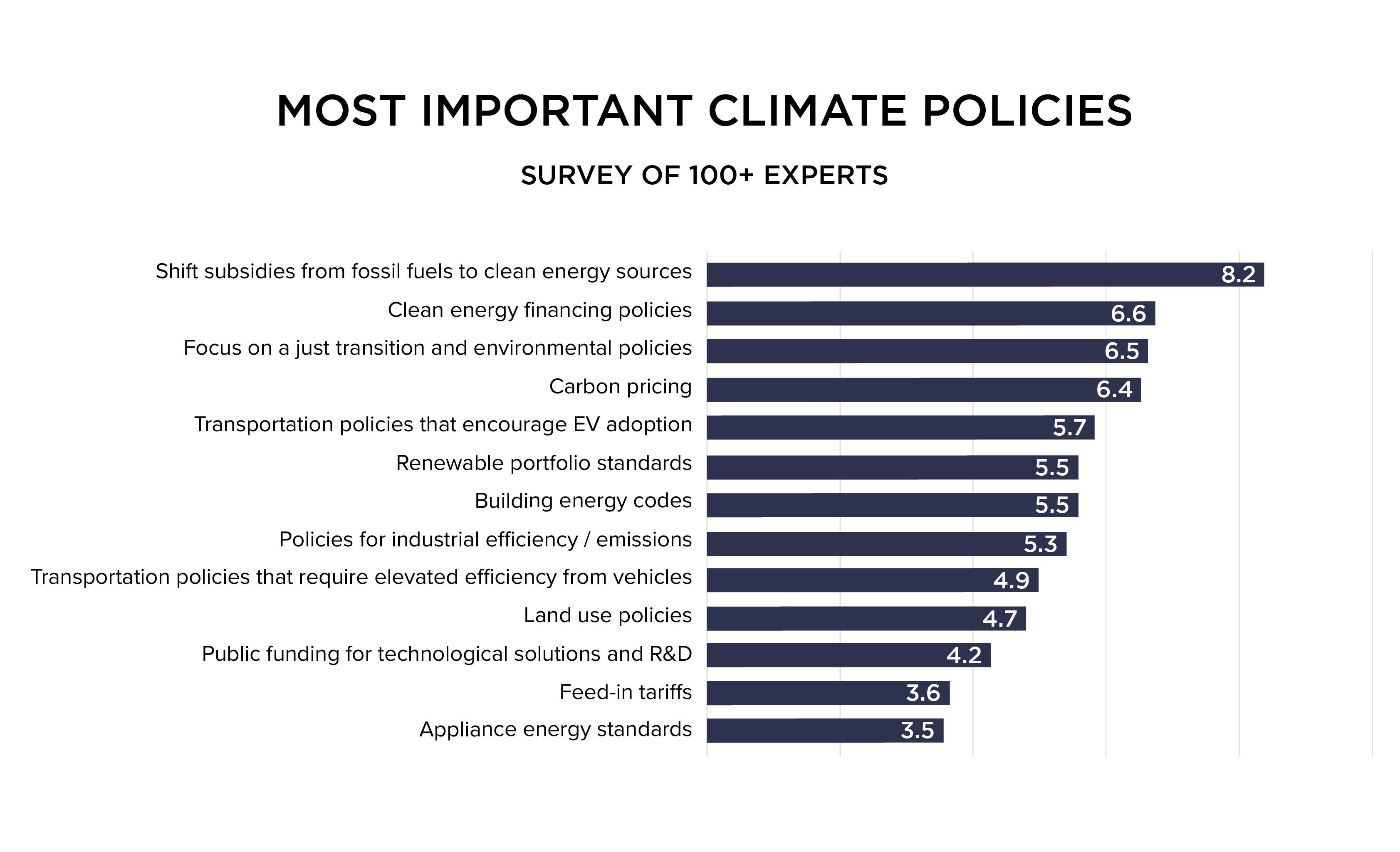
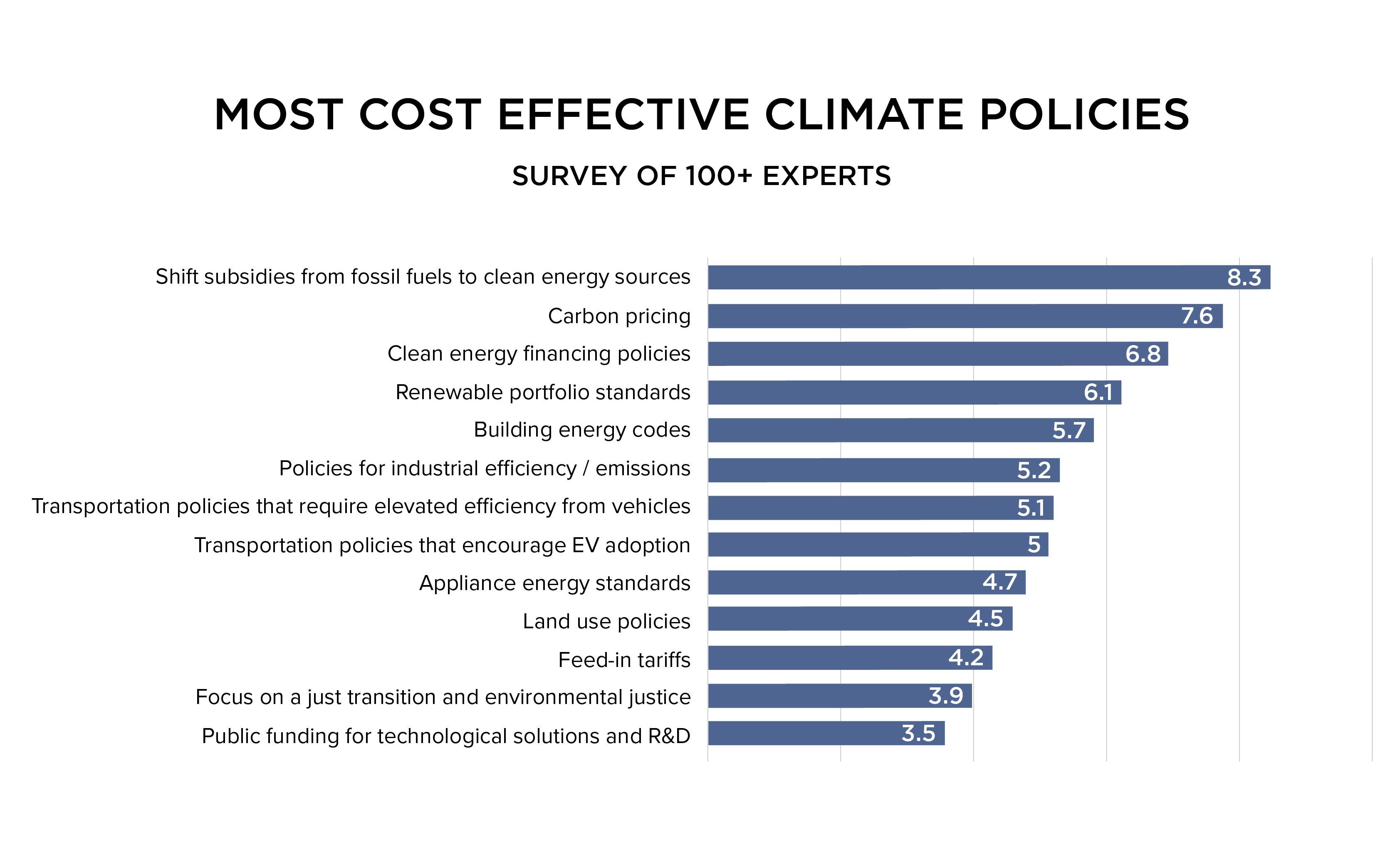
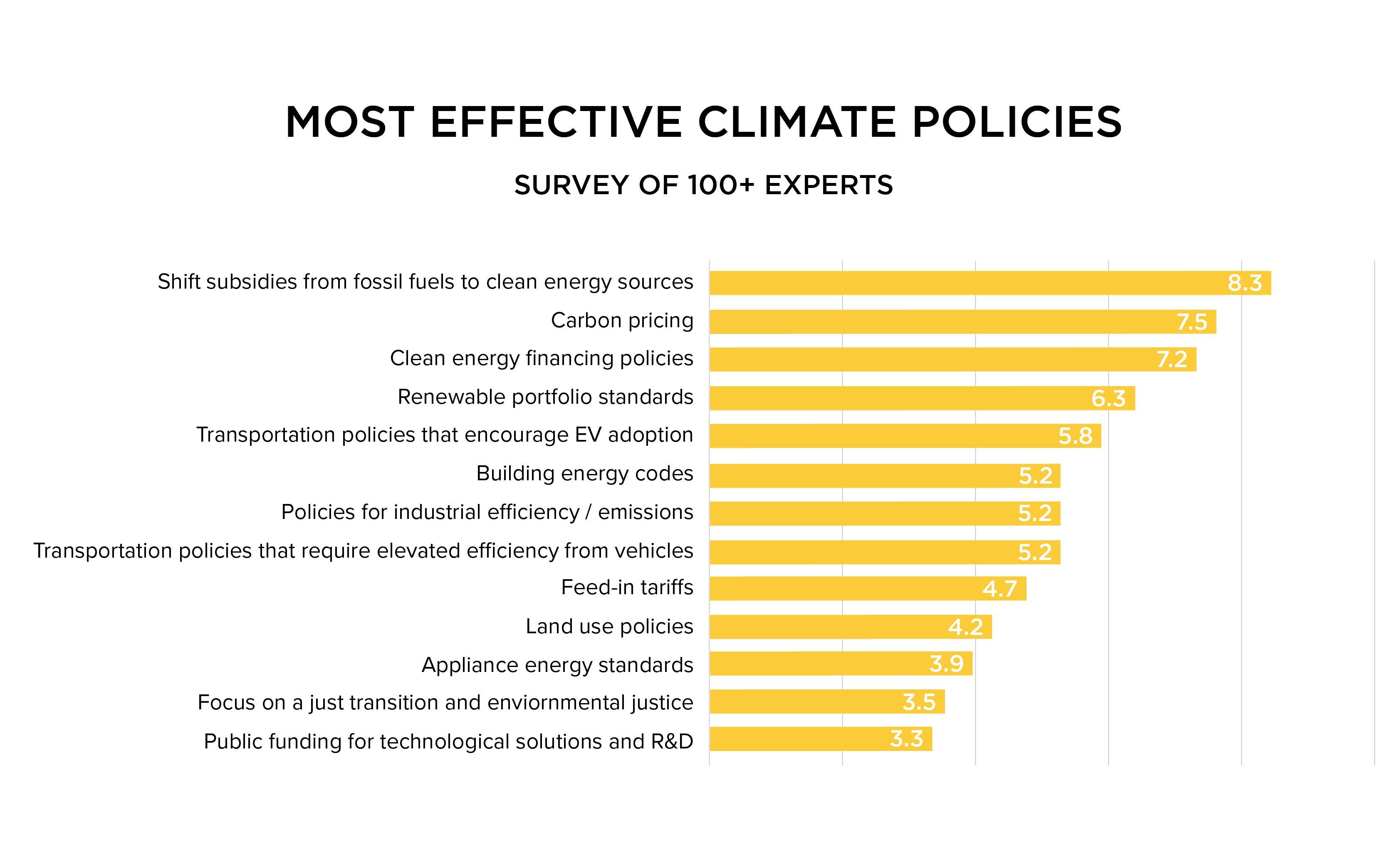
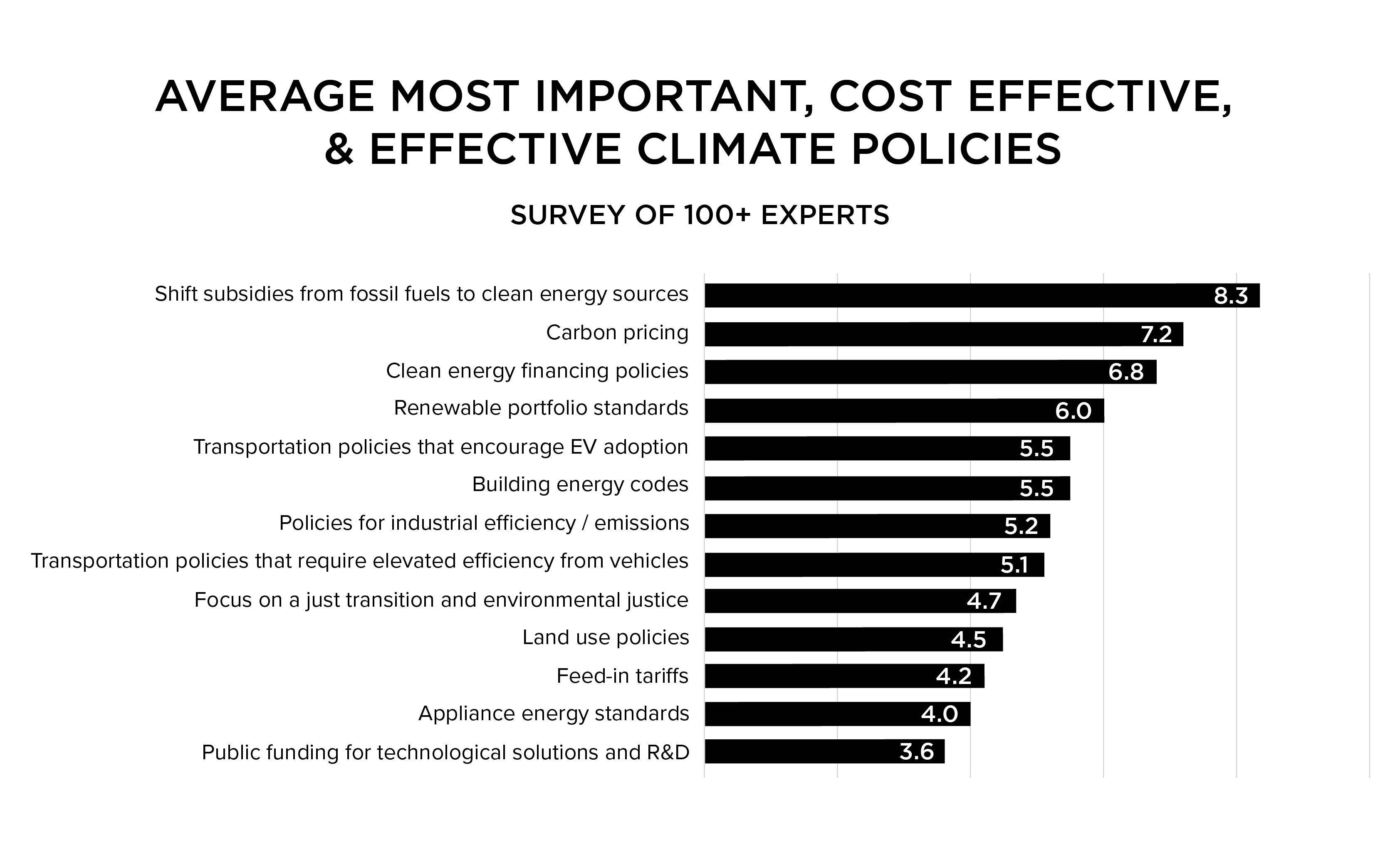
Limitations of the Survey
Before diving into the implications from these results and the conclusions we can begin to make, we must walk through some of the previously suggested limitations. These limitations are important to analyze because they should give us some pause in declaring the results authoritative quite yet.
The biggest limitation established was in who we were able to get to complete the survey. Though we spent extensive effort in reaching a broad set of leaders—people of different political persuasions, lines of work, and more—the people who did end up participating are still a self-selecting group. As such, for full transparency, we do want to present a breakdown of who these 120 people are whose answers comprise version 1.0:
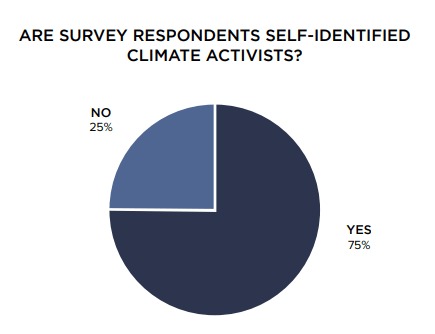
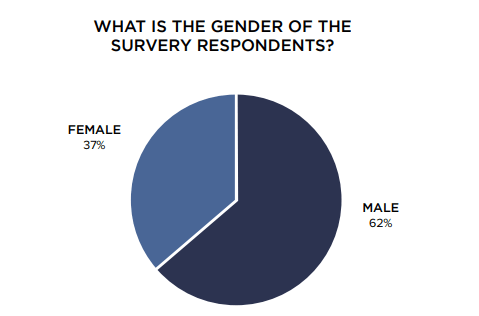
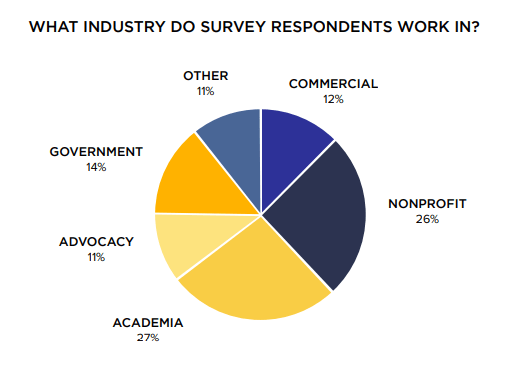
 Note: Dark blue has most respondents, lighter blue is moderate respondents, yellow is very few submissions.
 Note: Dark blue has most respondents, lighter blue is moderate respondents, yellow is very few submissions.
Obviously, we’d love to fill this out more completely and fully representatively. We want respondents in equal amounts from both sides of the aisle; we want as many women as men to participate, we want to target influencers and stakeholders who don’t purely consider themselves as climate advocates but are actually just operating in their industry while considering the realities of carbon emissions. If you fit the bill of any of these groups currently underrepresented in our survey, or you know anyone who would fit the bill and is indeed a thought leader, please let us know!
Outside of those who participated, the structure of our survey also has inherent shortcomings that should be acknowledged. Our list of climate policy proposals is, of course, incomplete, and it’s also ignoring that the ideal direction is a suite of complementary policies rather than just one ‘best’ option. No single proposal will be a silver bullet, but by tapping into all of the best tools available that’s how you can build great success. That theme came up time and again in our interviews, and we’ve acknowledged the need for this discussion of ‘System Changes, No Silver Bullet’ on this page, but by artificially requiring respondents to pick one policy over another some of that nuance can certainly be lost.
Another limitation came from the fact that we lumped together policies that stretch expanded beyond single sectors: transportation to power generation to the built environment to land use and more. Each of these sectors has specific goals and unique considerations, so pitting them head to head is a bit of an apples and oranges comparison, in theory. That said, we’re approaching this as a theoretical government leader or political candidate must approach it in practice. When these leaders commit to climate action, various sectors are all essential to address, though some may be more urgent, have lower-hanging fruit, or require different levels of political capital. In that way, pitting these policies against each other is often what leaders must do.
But those limitations should not mean the results of this survey are moot. In fact, in conducting this survey we accomplished an important feat in getting responses from curated experts, not the general public or not decision-makers who aren’t as well-versed in the climate reality as they are in general politics. The people who have provided answers in this version 1.0 are the people who live, work, and breathe these important topics. So, let’s see what insights we can glean from the previously listed results.
Implications of the Results
Recognizing that we have to hedge how much we read into these results given the above limitations, we can still start to recognize some important and valuable trends. First and foremost, the relative ranking of policy options prove to be telling. Shifting subsidies from fossil fuels to clean energy was definitely the most recommended by our experts, as it was rated as the most important, the most effective, and the most cost effective policy across the board.
Trailing behind, carbon pricing and clean energy financing were both in the top 3 of each of these categories as well, showing that these are also critical to any sort of massive package of policies to push forth.
On the other side of the equation, the bottom 5 of each of the categories included public funding of R&D, appliance energy standards, feed-in tariffs, and land use policies. Note that these low relative rankings doesn’t necessarily mean these policy options aren’t worthwhile. In fact, our one-on-one interviews with experts have provided us with key insider quotes endorsing them specifically (see these quotes endorsing R&D, appliance energy standards, feed-in tariffs, and land use). That said, the inherent ‘game’ of this survey was prioritizing and figuring out which policies were atop the priority list and which were less imperative and/or time sensitive. Given that reality, if there was compromise needed to get a wide-scale package implemented, for example, perhaps these types of policies would need to be at the top of the chopping block
While these notes are the most obvious standout points from the survey results, one of the most compelling discussion points come where there’s disparity between the questions. Environmental justice, in particular, ranked as the fourth most important policy consideration but in the bottom three in terms of effectiveness and cost-effectiveness. That result demonstrates that building in the social equity factor will surely add costs to a policy package without as much direct impact to CO2 results, but our experts still ranked it highly for all the obvious reasons why it’s the right thing to do.
Another important conclusion comes in the ranking of individual vs. corporate vs. policy focus. Our expert respondents overwhelming found that policymakers are the ones that should be held most accountable, followed by corporations, and with individuals coming in last. This relative ranking tracks with the scale of potential impact (i.e., government action can have impact many individual corporations, and the typical corporate impact encompasses the carbon footprint equivalent of hundreds to thousands to even millions of individuals). Similarly, these results fall in line with the role each actor plays: a government’s job is to protect its people and ensure they prosper, while a corporation’s sole goal in a capitalist environment is to maximize shareholder return, and an individual is most likely to work altruistically after their basic needs are met—but again the impact of what individuals can do is limited without them trying to tap into that corporate or government level (in fact, that’s the individual action many of our experts recommended—trying to influence change at your workplace or with your wallet as a vote in the economy, or by mobilizing voters and putting pressure on elected officials).
Refining and Building Out Moving Forward
As stated, these results simply represent version 1.0. The Solar Tribune goal is to multiply the number of respondents to our survey and make them more representative and then check back in with a version 2.0.
If you would like to participate, please get in touch with us at matt@solartribune.com. If you specifically have recommendations about experts who should get involved that are women, Republicans, or not climate advocates, per se, then we’d love for you to make those connections for us as well!
And even if you aren’t in those groups who are less represented in our results, we still want more volume of respondents so we have the granularity in version 2.0 we can break out the results even further:
- What policies are favored for Republicans vs. Democrats?
- How does the sector in which you work in influence who you think should be pushed most between individuals, corporations, and government officials?
- Do men and women differ in the priority they place on different sectors of action?
These are the nuanced and important questions we’re eager to answer—but we need your help to do so!
The post 2021 Climate Policy & Industry Priorities: Survey of Industry, Academic, and Political Leaders appeared first on Solar Tribune.
]]>The post The Solar Decade is Here appeared first on Solar Tribune.
]]>
2020 Was Solar’s Best Year Ever
Even in the face of unprecedented challenges brought on by the COVID-19 pandemic, the solar industry enjoyed its best year ever in 2020, this according to the “U.S. Solar Market Insight 2020 Year-in-Review” report released in March by the SEIA and Wood Mackenzie. A record 19.2 GW of new solar capacity was added in 2020, breaking the previous high-water mark of 15.1 GW set back in 2016.
This note from the SEIA’s press release is perhaps the most remarkable detail of the whole report:
“The 8 GWdc of new installations in fourth quarter 2020 marks the largest quarter in US solar history. For perspective, the US solar market added 7.5 GWdc of new capacity in all of 2015.”
In 5 short years, the solar industry is now adding more capacity on a quarterly basis than it used to add annually! And this type of explosive growth may now be the norm, according to SEIA projections.
The SEIA/Wood Mackenzie report predicts that the solar industry will reach a landmark annual installation rate of 50 GW in new solar capacity by 2030. The result will be an addition of more than 324 GW of solar capacity over the next 10 years, quadrupling from current levels.
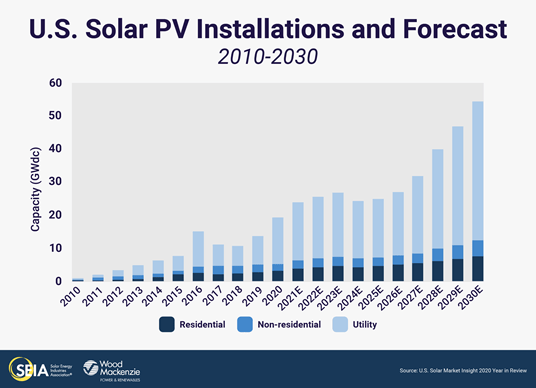
The ambitious projections are in part a result of broader trends among customers, utilities, and corporations to decarbonize the grid, in addition to the improved solar economics that make the energy source cheaper by the year. Increased support from the federal government and a number of state governments is putting additional wind at the sails of the industry. In fact, the report credits the two year extension of the federal investment tax credit (ITC) with increasing the solar deployment forecasts from 2021 to 2025 by 17%.
Feds Pledge to Cut Solar Costs
If the solar industry is going to take off in the next 10 years, like the SEIA predicts, it will be in no small part due to pro-solar public policies taking hold across the country that provide a significant accelerate to fueling broader solar adoption. Just this month, there were significant pronouncements by the federal government and several state governments on that exact front.
The U.S. Department of Energy announced in March that they are setting a new target to cut the cost of solar energy by 60% within the next ten years. The goal was described as necessary to accelerating solar deployment across the country and achieving the Biden Administration’s goal of a 100% clean electricity grid by 2035.
DOE is putting $128M in federal funding behind the effort, which will go to targeted initiatives designed to advance already promising solar technologies. Funding priorities through DOE’s Solar Energy Technologies Office (SETO) will include:
- $40M for Perovskite R&D: DOE awarded funding to 22 R&D projects across the country “that will advance perovskite PV device and manufacturing research and development—as well as performance through the formation of a new $14 million testing center.”
- $3M for Perovskite Startup Prize: Funding for this program will allow for more rapid commercialization of promising Perovskite technologies by providing critical seed funding to early-stage companies involved in the space.
- $20M for Cadmium Telluride PV development: The National Renewable Energy Laboratory (NREL) was awarded $20M to advance research and domestic production of Cadmium Telluride PV solar cells, a promising thin-film solar technology that is cheap and efficient.
The feds aren’t the only ones putting their money where their mouth is when it comes to encouraging the expansion of the nation’s solar energy generation capabilities. Governors in Pennsylvania and Massachusetts likewise made waves by announcing historic efforts to accelerate their respective state’s transition to a cleaner energy future.
Pennsylvania Governor, Tom Wolf, recently committed to a 191 MW solar procurement via planned expansive solar arrays across nearly 2,000 acres of Pennsylvania farmland. This represents the largest such solar commitment made by any state in the country. Pennsylvania plans to purchase at least half of all electricity used by the state’s government buildings from the planned solar arrays. The plan is for the arrays to be producing power by Jan 1, 2023.
Just days ago, Massachusetts Governor Charlie Baker signed a sweeping clean energy bill into law that establishes 2050 as the state’s benchmark to reach net-zero for greenhouse gas emissions. Among other things, the bill expands access to solar net metering credits and removes barriers in current solar policies that limit solar energy access to low-income communities, thus allowing for more equitable access to renewable energy for all residents of Massachusetts.
Perfect Storm of Opportunities in 2020-2030
The solar industry’s promising near-term future is owed in large part to a confluence of factors that are simultaneously at play and helping to fuel widespread solar adoption across multiple sectors. These factors can generally be summed up as follows:
- Historic government support for solar initiatives: As noted in previous articles, President Biden has made combating climate change an administration-wide priority. If even a fraction of his campaign promises and post-election commitments come to fruition, then his Administration will still clearly be the most pro-solar Administration we’ve ever seen in this country. The previously mentioned DOE funding announcement is a sign of what’s to come. As public opinion continues to shift in favor of renewables, expect lots of states (see Pennsylvania and Massachusetts) to follow suit.
- Solar costs continue to plummet: It was just a handful of months ago when solar energy was officially dubbed the cheapest form of electricity in history. This comes as little surprise as the costs associated with solar energy systems have plummeted in recent years. The unmistakable downward trend will continue this decade, making solar more and more affordable for the average homeowner.
- Residential demand fueled by desire for energy resilience: The recent energy grid crisis in Texas, sparked by a rare cold snap in the Deep South, is just the latest reminder of the perils of being beholden to an antiquated energy grid. Similar situations were experienced in Puerto Rico after Hurricane Maria and in California after its recent rash of devastating wildfires. The fact of the matter is that climate change is making these otherwise rare weather events far more commonplace. Look for more and more homeowners in the next several years to look to the solar energy market to achieve a degree of energy independence from an increasingly unreliable energy grid.
- Corporate-driven demand: Large corporations continue to be a major driver of increased growth in the U.S. solar market as more and more major corporations adopt ambitious renewable energy goals. Annual installed corporate solar capacity (both on-site and off-site) in 2019 was 1,283 MW, a nearly 75% increase from just 4 years earlier. Expect that trendline to only continue as environmental sustainability continues to become a point of emphasis in corporate boardrooms across the country.
When taken together, these factors combine to set the solar industry up for some historic achievements to take place over the next decade. It is no wonder that the SEIA and Wood Mackenzie are so bullish on what the possibilities are for the industry in upcoming years. The forecast for the industry is good news for humankind, as we cannot afford to lose any more ground in the fight to reverse the effects of climate change. Bold actions and big results will be needed.
Cover Photo Source: Forbes
The post The Solar Decade is Here appeared first on Solar Tribune.
]]>