<?xml version="1.0" encoding="UTF-8"?>
<!--Generated by Squarespace V5 Site Server v5.13.594-SNAPSHOT-1 (http://www.squarespace.com) on Tue, 09 Jun 2026 03:31:56 GMT--><feed xmlns="http://www.w3.org/2005/Atom" xmlns:dc="http://purl.org/dc/elements/1.1/"><title>Blog</title><subtitle>Blog</subtitle><id>http://www.hivviralload.com/blog/</id><link rel="alternate" type="application/xhtml+xml" href="http://www.hivviralload.com/blog/"/><link rel="self" type="application/atom+xml" href="http://www.hivviralload.com/blog/atom.xml"/><updated>2020-04-02T07:09:15Z</updated><generator uri="http://www.squarespace.com/" version="Squarespace V5 Site Server v5.13.594-SNAPSHOT-1 (http://www.squarespace.com)">Squarespace</generator><entry><title>Familiar themes for a novel virus</title><id>http://www.hivviralload.com/blog/2020/3/26/familiar-themes-for-a-novel-virus.html</id><link rel="alternate" type="text/html" href="http://www.hivviralload.com/blog/2020/3/26/familiar-themes-for-a-novel-virus.html"/><author><name>Cavidi Employees</name></author><published>2020-03-26T12:04:02Z</published><updated>2020-03-26T12:04:02Z</updated><content type="html" xml:lang="en-US"><![CDATA[<p><span><em>Reflections on COVID-19 and the Corona Virus Pandemic</em></span></p>
<p><span class="full-image-block ssNonEditable"><span><img src="http://www.hivviralload.com/storage/Covid-19_Cavidi_Blog_post_Summary.png?__SQUARESPACE_CACHEVERSION=1585231213486" alt="" /></span></span></p>
<ul>
</ul>
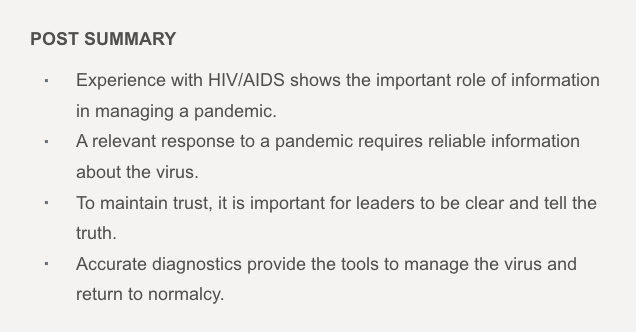
<p><span>As panic over the new virus spread, a group of protestors marched through downtown Manhattan carrying a banner that read, &ldquo;We Need Research Not Hysteria.&rdquo; They were not referring to coronavirus disease (COVID-19). It was June 1983 and they were protesting the cloud of misinformation that was hampering research into a relatively new disease called &ldquo;acquired immune deficiency syndrome&rdquo; (AIDS).&nbsp;</span></p>
<p><span>On March 11, 2020, COVID-19 joined AIDS as the world&rsquo;s second active pandemic. The two pathogens responsible for these diseases, human immunodeficiency virus (HIV) and severe acute respiratory syndrome coronavirus 2 (SARS-CoV-2), are very different organisms with different pathologies. However, at the outset, the pandemics they triggered are both characterized by the same critical shortages. I&rsquo;m not talking about face masks, hand sanitizer, or even toilet paper. The biggest shortage the public faces today is the shortage of reliable information about the disease. &nbsp;</span></p>
<p><span>If the HIV/AIDS pandemic has taught us nothing else, it&rsquo;s that the wrong information can trigger hysteria, accelerate transmission, stall funding, delay a proper public health response, and ultimately result in otherwise avoidable loss of life. Given that, anyone in a position of leadership during a public health crisis would be well advised to take these matters to heart.</span></p>
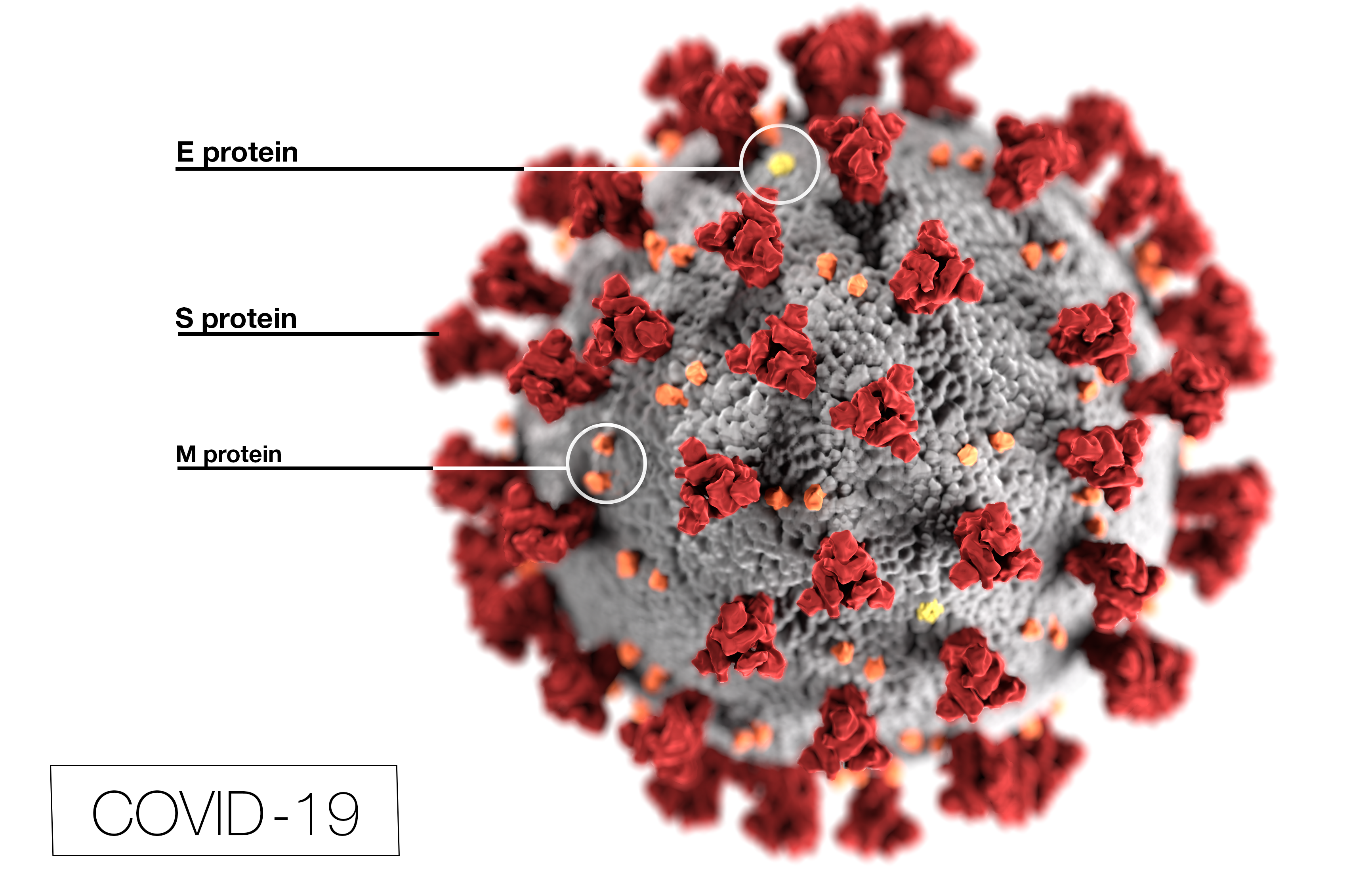
<p><span><span class="full-image-inline ssNonEditable"><span><img style="width: 450px;" src="http://www.hivviralload.com/storage/Covid-19.tif?__SQUARESPACE_CACHEVERSION=1585230354254" alt="" /></span><span class="thumbnail-caption" style="width: 450px;">This illustration, created by the US Centers for Disease Control and Prevention (CDC), reveals ultrastructural morphology exhibited by coronaviruses. A novel coronavirus, named Severe Acute Respiratory Syndrome coronavirus 2 (SARS-CoV-2), was identified as the cause of an outbreak of respiratory illness first detected in Wuhan, China in 2019. The illness caused by this virus has been named coronavirus disease 2019 (COVID-19).</span></span></span></p>
<p><span><strong>Misinformation</strong></span></p>
<p>No individual, organization, or government can control what information is shared. Misinformation is a result of the general confusion that surrounds any emerging infectious disease. New research and facts are published at such breakneck speed in the early days of a pandemic that it can be difficult for anyone to keep up. Just today, I rewatched an interview with a highly regarded infectious disease expert from March 5, 2020. He made perfect sense two weeks ago but about 20% of what he said has since been proven wrong. &nbsp;</p>
<p><span>Misinformation seems to be an unavoidable byproduct of people trying to come to grips with the nature of the pathogen they are fighting. At the outset of the HIV/AIDS pandemic, the resulting illness was given several misleading names by well-intentioned individuals based on its symptoms and similarities among its first victims. It was called &ldquo;Gay Men&rsquo;s Pneumonia,&rdquo; &ldquo;Gay Cancer,&rdquo; and &ldquo;Gay-Related Immune Deficiency.&rdquo; Researchers would soon learn that the virus was capable of infecting any man, woman, or child. On September 24, 1983, the more accurate term &ldquo;acquired immune deficiency syndrome&rdquo; (AIDS) was first used by the US Centers for Disease Control and Prevention (CDC), but almost 37 years later, many of the original myths surrounding the disease persist and continue to shape public opinion. &nbsp;</span></p>
<p><span>In 1981 there was no public internet or social media. By today&rsquo;s standards, news traveled slowly from one news outlet to another, sometimes crossing borders over the course of weeks. Today, information itself &ldquo;goes viral&rdquo; spreading around the world in a matter of hours. Well-intentioned internet users, eager to share with each other, often spread information from sources that vary wildly in validity. This isn&rsquo;t malicious, its human nature. But it is why the public needs trusted, unbiased sources of information in times of crisis and why our leaders need to make a concerted effort to provide it.&nbsp;</span></p>
<p><span><strong>Disinformation</strong></span></p>
<p><span>Then, of course, there are the bad actors who seek to exploit the situation surrounding pandemics by purposely spreading false information. This is not merely a Facebook phenomenon and is not limited to politicians seeking reelection. We saw it in 1985 when the former East German secret service, the Stasi, pushed a false story that HIV was created in a US government bio-weapons lab to target certain marginalized populations and was accidentally released. They were looking to use the HIV/AIDS pandemic as an opportunity to discredit the US. The story began to spread around Europe and eventually made it to mainstream media in the US. By 1987 the story was published over 200 times in over 70 countries. I could not help but make this connection when I heard the unfounded allegations that the severe acute respiratory syndrome coronavirus 2&nbsp;(SARS-CoV-2) was likewise created and accidentally released from a Chinese bio-weapons lab in Wuhan. &nbsp;</span></p>
<p><span>Recently, students on Spring Break in the US were criticized for defiantly ignoring advice to practice social distancing as they partied in Florida. With an estimated 20% of the world&rsquo;s population currently on lockdown, it&rsquo;s understandable that many people were enraged with them. They were cited as an example of everything that&rsquo;s wrong with young people today. But using the folly of youth as an excuse misses the real culprit. For every ER physician and global pandemic expert extolling the severity of the COVID-19 risk and the need for social distancing, there were ample pundits and politicians downplaying the threat and encouraging business as usual during the outbreak. It&rsquo;s hard for people of any age to discern the real risks of a pandemic when the media is awash in contradiction. And had a student, or anyone else choosing to ignore health officials, felt the need to have their actions validated, then they could have simply cherry-picked news sources that conformed to their views and opinions.&nbsp; Up to now, the real-life consequences of this type of selective societal listening have mostly been political. During a pandemic it can be a matter of life and death. &nbsp;</span></p>
<p><span>Putting a positive spin on a dangerous pandemic can only make matters worse. John Barry, who wrote <em>The Great Influenza: The Story of the Deadliest Pandemic in History,</em> recently published an article in The New York Times. While he acknowledges that COVID-19 does not seem to be as deadly as the 1918 flu pandemic, he states that there is still much we can learn from our past. The most important lesson, he says, is to tell the truth no matter how unsettling or difficult. He says that lying about the severity of the crisis in 1918 had dire consequences. &ldquo;Trust in authority disintegrated, and at its core, society is based on trust. Not knowing whom or what to believe, people also lost trust in one another. They became alienated, isolated. Intimacy was destroyed.&rdquo;</span></p>
<p><span><strong>Clinical Information</strong></span></p>
<p><span>The need for reliable information does not stop even after the public comes to grips with a pandemic. It moves to care and treatment. To paraphrase business thinker Peter Drucker, you can&rsquo;t manage what you can&rsquo;t measure. Managing infection, whether for a population or an individual patient, relies on accurate quantification on a clinical level.&nbsp; This is as true for HIV/AIDS as it is for COVID-19. Universal access to tests that can reliably quantify HIV in the clinic has been an issue that has dogged treatment efforts in resource-limited settings for decades. Even when treatment is available, the inability to quantify viral load in a patient undermines outcomes in HIV-positive patients. We are just beginning this journey with SARS-CoV-2 and hopefully will benefit from lessons learned with HIV</span></p>
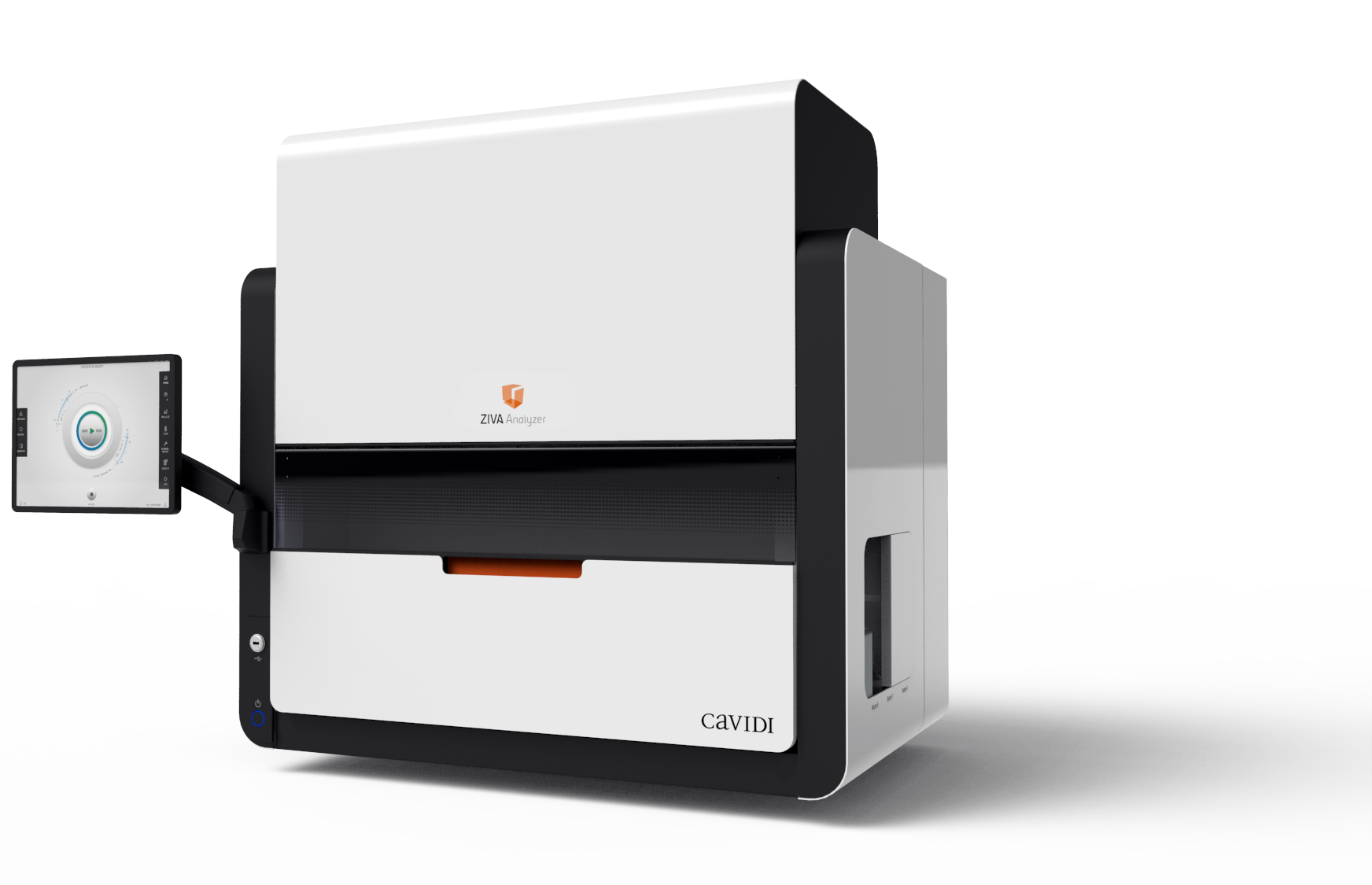
<p><span><span class="full-image-block ssNonEditable"><span><img style="width: 450px;" src="http://www.hivviralload.com/storage/Cavidi_Ziva-HIV_Viral_Load_Testing.png?__SQUARESPACE_CACHEVERSION=1585230387800" alt="" /></span><span class="thumbnail-caption" style="width: 450px;">ZIVA&trade; delivers a fully-automated, immunodiagnostic platform purpose-built to meet the requirements of decentralized labs like those in district hospitals.</span></span></span></p>
<p>As with HIV/AIDS, we can anticipate that there will be an ongoing need for global, decentralized testing not only to diagnose COVID-19 but also to track disease progression for patients and populations. Today companies that provide diagnostic test kits, ventilators, and face masks are working hard to adapt to the COVID-19 pandemic. Likewise, diagnostic companies will need to do the same to ensure we have accurate information to track and manage this emerging pathogen moving forward. For example, at Cavidi we have found a way to modify our ZIVA immunodiagnostic platform to address the COVID-19 pandemic. <a href="https://cavidi.se/clinical-products/ziva-viral-load/" target="_blank">ZIVA was designed to monitor HIV viral load</a> with the ability to expand and accommodate other tests. The ZIVA platform could easily be adapted to provide an accurate determination of immunity to SARS-CoV-2&nbsp;</p>
<p><span>I&rsquo;m pleased to announce that the ZIVA platform will be able to contribute to the fight against the COVID-19 pandemic. It will offer clinicians and public health authorities a deployable and highly sensitive assay to quantify IgG and IgM antibody titers. This work is straightforward and could be completed within months with adequate funding, which would have the following applications.</span></p>
<p><span><strong>Peri-pandemic applications include:</strong>&nbsp;</span></p>
<ul>
<li><span>Screening first responders and providers (healthcare, police, military, etc.) for immunity so they can then be deployed without fear of infection/reinfection. &nbsp;</span></li>
<li><span>Reducing/lifting individual movement restrictions since confirmed immune individuals would not need to observe quarantine/travel restrictions. &nbsp;</span></li>
<li><span>Immune people could serve as a barrier to the infection to their family/friends by running the critical household errands.&nbsp;</span></li>
<li>Allowing people to safely return to work if immunity is confirmed.&nbsp;</li>
<li>Allowing for vaccine triage: the first round of vaccines will need to be rationed and knowledge of immune status due to previous infection will be crucial.&nbsp; </li>
</ul>
<p><span><strong>Post-pandemic applications include:</strong>&nbsp;</span></p>
<ul>
<li>The short-lived nature of immunity against Coronaviruses, in general, may require routine immunological testing on a scale not seen before to ensure the pandemic does not repeat itself.&nbsp;</li>
<li>It could be used as a screening tool to select those in need of a booster vaccine.&nbsp; </li>
</ul>
<p><span>In times of uncertainty and crisis, clear information saves lives. This is as true on a national level as it is in the clinic. As with the HIV/AIDS pandemic in 1984, medical diagnostic companies like Cavidi once again find themselves in a position to help provide that vital information to stem the tide of a global pandemic. I can give you my assurance that we do not take this responsibility lightly. Cavidi will continue to work through this current crisis to give healthcare providers the information they need to better manage this pandemic and care for their patients.&nbsp;</span></p>
<p><span class="full-image-block ssNonEditable"><span><img style="width: 250px;" src="http://www.hivviralload.com/storage/John_Reisky_de_Dubnic.png?__SQUARESPACE_CACHEVERSION=1585298969338" alt="" /></span></span>&nbsp;</p>
<p><span><br /></span></p>]]></content></entry><entry><title>EIB award underscores the need for innovation in HIV management</title><id>http://www.hivviralload.com/blog/2018/2/1/eib-award-underscores-the-need-for-innovation-in-hiv-managem.html</id><link rel="alternate" type="text/html" href="http://www.hivviralload.com/blog/2018/2/1/eib-award-underscores-the-need-for-innovation-in-hiv-managem.html"/><author><name>Cavidi Employees</name></author><published>2018-02-01T09:00:00Z</published><updated>2018-02-01T09:00:00Z</updated><content type="html" xml:lang="en-US"><![CDATA[<p>Being chosen by the <a href="http://www.eib.org/">European Investment Bank (EIB)</a> as recipient of their <a href="http://www.eib.org/products/blending/innovfin/products/infectious-diseases.htm">Infectious Diseases Innovation Loan</a> for 2015 is a great honor for <a href="http://www.cavidi.se">Cavidi</a>, but it is an even bigger win for people infected with HIV around the world.</p>
<p><span><span class="full-image-float-left ssNonEditable"><span><img src="http://www.hivviralload.com/storage/timeisnow.jpg?__SQUARESPACE_CACHEVERSION=1442500133913" alt="" /></span></span></span><a href="http://www.eib.org/products/blending/innovfin/">InnovFin</a> is EIB&rsquo;s program to support innovation in the EU. The program has an allocation for innovations in infectious diseases that provides investment in the development of innovative vaccines, drugs, medical and diagnostic devices, or novel research infrastructures for infectious diseases. This part of the InnovFin project targets project developers like Cavidi, who are in the field of infectious diseases and have successfully completed the pre-clinical stage and begun&nbsp;early stage clinical development and now require clinical validation or are ready for later stage clinical trials. To qualify, projects need to exhibit a proven public health impact and market potential and enjoy the commitment of promoters to substantially co-fund the project.</p>
<p><span>Cavidi will be the first recipient of the InnovFin Infectious Diseases Innovation Loan. This is as important a moment for the EIB as it for Cavidi. Jonathan Taylor, EIB Vice-President with responsibility for lending in Sweden, stated: &ldquo;We are pleased to be partnering with Cavidi in this breakthrough operation as it will enable the EU bank to support future technologies whose concrete applications will effectively tackle the HIV pandemic. With this first InnovFin Infectious Diseases Loan, we confirm our commitment to providing easier access to finance</span><span>.&rdquo; Carlos Moedas, European Commissioner for Research, Science, and Innovation said, &ldquo;This first loan under InnovFin Infectious Diseases will not only help speed up the development of an innovative device for monitoring HIV treatment for the benefit of patients, but will also support the growth of an innovative family-owned European business.&rdquo;</span></p>
<p><span class="full-image-block ssNonEditable"><span><img src="http://www.hivviralload.com/storage/EIB%20logo.jpg?__SQUARESPACE_CACHEVERSION=1442500553507" alt="" /></span></span><br /><span class="full-image-block ssNonEditable">Competition and vetting for these loans is intense. In addition to providing significant innovation and proven success in the area of infectious diseases, the recipient must clearly contribute to EU policy goals and meet the EIB&rsquo;s high standards economically, financially, technically, and environmentally. Cavidi competed against many other deserving projects for the EIB&rsquo;s consideration. This level of scrutiny and vetting against Europe&rsquo;s top innovators in infectious diseases provides even greater validity to the project and the impact it will have on the treatment of HIV.</span></p>
<p>While the &euro;10 million loan is only part of the investment required to get <a href="http://www.cavidi.se/ziva/">Ziva&trade; </a>to market, it will go far to provide access to viral load monitoring earlier for millions living with HIV.</p>
<p><span class="full-image-block ssNonEditable"><span><img src="http://www.hivviralload.com/storage/john%20signature.png?__SQUARESPACE_CACHEVERSION=1442500354157" alt="" /></span></span></p>]]></content></entry><entry><title>“Treat All” provides new hope as well as new challenges in the fight against HIV</title><id>http://www.hivviralload.com/blog/2015/11/30/treat-all-provides-new-hope-as-well-as-new-challenges-in-the.html</id><link rel="alternate" type="text/html" href="http://www.hivviralload.com/blog/2015/11/30/treat-all-provides-new-hope-as-well-as-new-challenges-in-the.html"/><author><name>Cavidi Employees</name></author><published>2015-11-30T14:12:08Z</published><updated>2015-11-30T14:12:08Z</updated><content type="html" xml:lang="en-US"><![CDATA[<p>World Aids Day 2015 once again directs the public&rsquo;s attention toward the ongoing HIV pandemic and the efforts to contain it. As the year draws to an end, we can see great progress over the past twelve months and a clear agenda for 2016.</p>
<p>This past May, we learned that the <a href="http://www.unaids.org/sites/default/files/media_asset/2015_Implications_of_the_START_study_data_en.pdf"><span class="Hyperlink0">START study</span></a>, sponsored by UNAIDS, was being prematurely concluded by study organizers because results were already so clear: Data showed that those who received anti-retroviral therapy (ART) immediately upon HIV diagnosis were 53% less likely to die during the trial or develop AIDS or a serious illness than those who waited for&nbsp;initiation of treatment.</p>
<p>The START study addressed a point that had been widely debated by the HIV healthcare community for years. That debate was swiftly resolved when Michel Sidib&eacute;, Executive Director of UNAIDS, concluded that, &ldquo;Every person living with HIV should have immediate access to life-saving antiretroviral therapy. Delaying access to HIV treatment under any pretext is denying the right to health.&rdquo;</p>
<p>It didn&rsquo;t take long for the World Health Organization (WHO) to act on the findings. In September of this year, the <a href="http://www.who.int/hiv/pub/guidelines/earlyrelease-arv/en/"><span class="Hyperlink0">WHO updated its treatment guidelines</span></a> to include a &ldquo;treat all&rdquo; provision. It recommends that everyone with HIV is provided ART immediately after diagnosis. This is one of the most significant developments in the treatment of HIV over the last decade. Michel Sidib&eacute; explained that the policy change could help prevent 21 million AIDS-related deaths and 28 million new infections by 2030.</p>
<p><span class="full-image-block ssNonEditable"><span><img src="http://www.hivviralload.com/storage/table.png?__SQUARESPACE_CACHEVERSION=1448892975394" alt="" /></span></span></p>
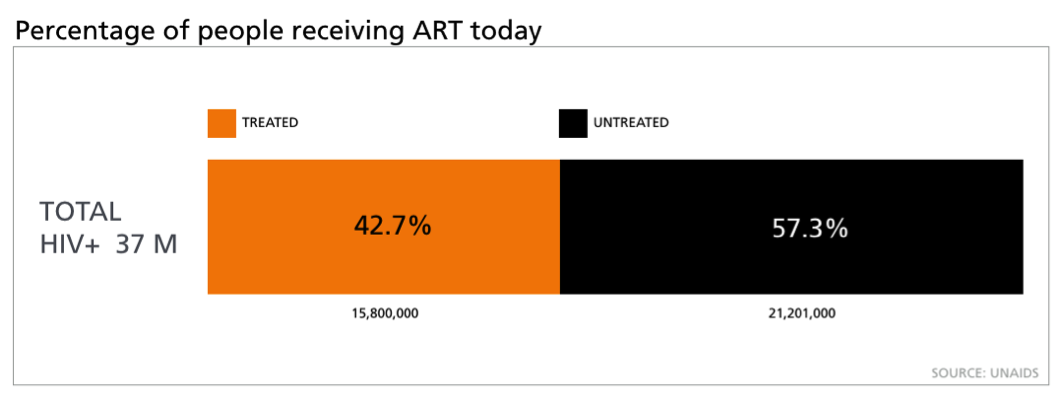
<p>Of course, with the new WHO guidelines come new challenges for healthcare providers around the world. According to UNAID&rsquo;s estimates, 57% of HIV positive adults do not receive treatment today. Based on that figure, the new WHO guidelines will mean proving ART to an additional 21 million people globally.</p>
<p>One of the greatest challenges in making &ldquo;treat all&rdquo; a reality is that the overwhelming majority of the untreated live in resource-limited settings. In developing nations around the world, healthcare organizations are working to find ways to increase access to ART, as well as to the viral load monitoring required for proper administration of the life-saving drugs. I&rsquo;m happy to report progress on that front as well.</p>
<p>In September of this year, Cavidi was selected by the European Investment Bank (EIB) as a recipient&nbsp;of their <a href="http://cavidi.mynewsdesk.com/pressreleases/eib-supports-cavidi-s-development-of-hiv-viral-load-monitoring-device-1191629"><span class="Hyperlink0">Infectious Diseases Innovation Loan for 2015</span></a>. The focus of the loan is our Ziva&trade; viral load monitoring system. Viral load monitoring is an essential part of HIV treatment, but, until now, it has been difficult to administer in near-patient settings. <a href="http://www.cavidi.se/ziva/"><span class="Hyperlink0">Ziva</span></a>&trade; changes that by providing a medium throughput, fully-automated viral load monitoring system purpose-built to meet the requirements of decentralized labs like those found in district hospitals across the developing world. Its unique Reverse Transcriptase (RT) technology makes fully-automated gold-standard results possible for decentralized testing.</p>
<p>The recognition of the EIB is a great honor for Cavidi, but an even bigger win for people infected with HIV around the world. While the &euro;10 million loan is only part of the investment required to get Ziva&trade; to market, it will go far to provide access to viral load monitoring sooner for millions living with HIV.</p>
<p>All things considered, 2015 has been a pivotal year in the battle against HIV and cause for renewed optimism. The new WHO guidelines mark a significant shift in the global treatment mindset. The HIV treatment community has overcome great challenges to reach this point where &ldquo;treat all&rdquo; is the official policy moving forward. The financial and logistic challenges we now face to implement the policy are significant, yet dwarfed in comparison. Addressing these new challenges will be our focus at Cavidi for 2016 and beyond.&nbsp;</p>
<p><span class="full-image-block ssNonEditable"><span><img src="http://www.hivviralload.com/storage/john%20signature.png?__SQUARESPACE_CACHEVERSION=1448894033452" alt="" /></span></span></p>]]></content></entry><entry><title>What the EIB InnovFin award means for Cavidi and HIV management</title><category term="Cavidi"/><category term="EIB"/><category term="EIB"/><category term="European Investment Bank"/><category term="HIV"/><category term="HIV diagnostics"/><category term="HIV monitoring"/><category term="Infectious Diseases Innovation Loan"/><category term="InnovFin"/><category term="Ziva"/><id>http://www.hivviralload.com/blog/2015/9/16/what-the-eib-innovfin-award-means-for-cavidi-and-hiv-managem.html</id><link rel="alternate" type="text/html" href="http://www.hivviralload.com/blog/2015/9/16/what-the-eib-innovfin-award-means-for-cavidi-and-hiv-managem.html"/><author><name>Cavidi Employees</name></author><published>2015-09-16T08:54:43Z</published><updated>2015-09-16T08:54:43Z</updated><content type="html" xml:lang="en-US"><![CDATA[<p>Speaking on behalf of the entire Cavidi team, we are honored to be chosen by the European Investment Bank (EIB) as <a href="http://ec.europa.eu/research/index.cfm?pg=newsalert&amp;year=2015&amp;na=na-130715">recipient of their Infectious Diseases Innovation Loan for 2015</a>. This &euro;10 million award will provide a substantial portion of the investment required to bring <a href="http://www.cavidi.se/ziva/">Ziva&trade;</a> to market in 2016. Just as importantly, it underscores the importance of the groundbreaking work <a href="http://www.cavidi.se">Cavidi</a>&nbsp;is doing in the area of HIV management.</p>
<p><span>Viral load monitoring is an essential part of HIV treatment, but it has always been difficult to administer in near-patient settings. Ziva&trade; changes that. Building off of Cavidi&rsquo;s proprietary Reverse Transcriptase (RT) technology, we have designed Ziva&trade; as a medium throughput, fully-automated viral load monitoring system. It is purpose-built to meet the requirements of decentralized labs like those in district hospitals. When it reaches the market, Ziva&trade; will be a game changer, making routine viral load testing accessible to millions of people around the globe.&nbsp;</span></p>
<p><span><span class="full-image-float-left ssNonEditable"><span><img src="http://www.hivviralload.com/storage/ziva.jpg?__SQUARESPACE_CACHEVERSION=1442394942812" alt="" /></span></span>In providing the loan, the EIB recognized the importance of viral load testing and the groundbreaking work Cavidi has been doing in the treatment of HIV. The EIB is the European Union's bank. They are the only bank owned by and representing the interests of the European Union Member States. The bank makes long-term financing available for sound investments in order to contribute toward EU policy goals. As part of that aim, the EIB has set up a program to help innovative firms access financing more easily. Over the next seven years, "InnovFin &ndash; EU Finance for Innovators" will make more than &euro;24 billion EUR of financial support available for research and innovation (R&amp;I) by small, medium-sized, and large companies.</span></p>
<p><span>Thank you to all those involved with InnovFin at EIB. And, thank you to my team at Cavidi for once again making history in the area of HIV diagnostics.</span>&nbsp;</p>
<p><span><span class="full-image-block ssNonEditable"><span><img src="http://www.hivviralload.com/storage/john signature.png?__SQUARESPACE_CACHEVERSION=1442395032326" alt="" /></span></span><br /></span></p>]]></content></entry><entry><title>How you can help make viral load testing a reality this World Aids Day</title><category term="AIDS"/><category term="ART"/><category term="Aids"/><category term="Assays comparison"/><category term="Cavidi"/><category term="Comparison"/><category term="HIV Viral Load Monitoring"/><category term="HIV monitoring info"/><category term="HIV viral load"/><category term="Load Zero Foundattion"/><category term="WAD2014"/><category term="World AIDS Day"/><category term="World Aids Day"/><category term="resource-limited settings"/><id>http://www.hivviralload.com/blog/2014/11/30/how-you-can-help-make-viral-load-testing-a-reality-this-worl.html</id><link rel="alternate" type="text/html" href="http://www.hivviralload.com/blog/2014/11/30/how-you-can-help-make-viral-load-testing-a-reality-this-worl.html"/><author><name>Cavidi Employees</name></author><published>2014-11-30T07:21:00Z</published><updated>2014-11-30T07:21:00Z</updated><summary type="html" xml:lang="en-US"><![CDATA[<p><span class="thumbnail-image-float-left ssNonEditable"><span><a href="javascript:showFullImage('/display/ShowImage?imageUrl=%2Fstorage%2FHIV-Viral-Load-Assay-Sensitivity-Comparison.png%3F__SQUARESPACE_CACHEVERSION%3D1417182176224',606,999);"><img src="http://www.hivviralload.com/storage/thumbnails/16045038-25715459-thumbnail.jpg?__SQUARESPACE_CACHEVERSION=1417182176225" alt="" /></a></span></span></p>
<p><span>The time for viral load testing is now.&rdquo;For years this has been the focus of this company and each of our employees. Today, it has become policy for developing nations around the world as recommended by the World Health Organization (WHO).</span></p>]]></summary></entry><entry><title>Investment with Impact: Closing the HIV treatment gap</title><category term="ARV"/><category term="Cavendish Global"/><category term="Cavendish Global Health Impact Forum"/><category term="Cavendish Global Health Impact Forum"/><category term="Cavidi"/><category term="Close HIV gap"/><category term="HIV Viral Load Monitoring"/><category term="HIV Viral load video"/><category term="HIV viral load"/><category term="RT assay"/><category term="Treatment 2015"/><category term="resource-limited settings"/><id>http://www.hivviralload.com/blog/2014/5/9/investment-with-impact-closing-the-hiv-treatment-gap.html</id><link rel="alternate" type="text/html" href="http://www.hivviralload.com/blog/2014/5/9/investment-with-impact-closing-the-hiv-treatment-gap.html"/><author><name>Cavidi Employees</name></author><published>2014-05-09T08:11:52Z</published><updated>2014-05-09T08:11:52Z</updated><content type="html" xml:lang="en-US"><![CDATA[<p><strong><em>A presentation on the importance of global viral load monitoring to contain the HIV pandemic.&nbsp;</em></strong></p>
<p>I was pleased to speak at the United Nations this week as part of the <a href="http://cavendishglobal.com/" target="_blank">Cavendish Global Health Impact Forum</a>. The idea of the forum is to introduce good investment opportunities that have positive social impact with individuals and foundations who want to make a difference. Typically, these are investors who wish to invest in businesses within the health and life sciences, where the financial return is magnified by the social good derived from helping the business venture.&nbsp; This is a criteria well-suited for Cavidi&rsquo;s aim to help contain the HIV pandemic by creating greater access to HIV-related monitoring solutions.</p>
<blockquote>
<p>&ldquo;Cavendish assists family offices in identifying the best scientific minds, accomplished healthcare delivery professionals, innovative private sector companies, philanthropic organizations, and health policy experts engaged in transforming medical outcomes on a regional, national and global basis.&rdquo; Cavendish Mission</p>
</blockquote>
<p>The Global Health Impact Forum is hosted by the Global Partnerships Forum together with <a href="http://cavendishglobal.com/" target="_blank">Cavendish Global</a>, <a href="http://www.nyas.org/" target="_blank">The New York Academy of Sciences</a>, and <a href="http://www.itu.int/" target="_blank">International Telecommunication Union</a> at the United Nations Headquarters in New York. Participants are a mixture of scientists and CEOs, carefully vetted and invited to present their case before the investors. I was honored to be included in this select group and proud to represent everyone at Cavidi who has worked so hard to get us to where we are today.&nbsp;</p>
<p>Given the venue, I was pleased to see global health elevated on par with global peace, climate change, and human rights as one of the most pressing issues of our time. Innovation and technology play key roles in making this happen.</p>
<p>As Amir Dossal, Chairman of the Global Partnerships Forum, mentioned in his opening remarks at the event, one of the most critical issues facing the UN, and society in general, is providing global access to healthcare, particularly in developing countries. Mr. Dossal specified the need for technology and training to help medical workers on the front lines monitor and manage disease. I don&rsquo;t think I could have asked for a more appropriate introduction to my talk and the important work that Cavidi is doing today.&nbsp;</p>
<p>Below is a video of my presentation, where I make the case for the impact that Cavidi and our new automated viral load monitoring platform can make to the nearly 36 million people infected with HIV around the world today, and future generations to come.&nbsp; I would welcome any comments or questions you have about the event or Cavidi&rsquo;s involvement.&nbsp;</p>
<p><iframe width="480" height="270" src="http://www.hivviralload.com//www.youtube.com/embed/43oXuH4R5wQ?rel=0" frameborder="0" allowfullscreen></iframe></p>
<p>For those who would like more details on the event,&nbsp; you can see the entire <a href="http://bit.ly/Cavendish_Forum" target="_blank">Cavendish Global Health Impact Forum 2014 program</a> from this link. And if you would like to know more about our new automated HIV viral load monitoring platform, feel free to contact <a href="mailto:john.reisky@cavidi.se" target="_blank">me</a>.</p>
<p><span class="full-image-block ssNonEditable"><span><img src="http://www.hivviralload.com/storage/Screen%20Shot%202013-11-27%20at%205.10.42%20PM.png?__SQUARESPACE_CACHEVERSION=1399624286719" alt="" /></span></span></p>
<p>&nbsp;</p>]]></content></entry><entry><title>World Aids Day 2013: Halfway to Zero</title><category term="Aids"/><category term="Cavidi"/><category term="ExaVir"/><category term="Getting to Zero"/><category term="HIV"/><category term="HIV Viral Load Monitoring"/><category term="HIV monitoring"/><category term="Viral load monitoring"/><category term="World Aids Day"/><id>http://www.hivviralload.com/blog/2013/11/28/world-aids-day-2013-halfway-to-zero.html</id><link rel="alternate" type="text/html" href="http://www.hivviralload.com/blog/2013/11/28/world-aids-day-2013-halfway-to-zero.html"/><author><name>Cavidi Employees</name></author><published>2013-11-28T09:00:00Z</published><updated>2013-11-28T09:00:00Z</updated><content type="html" xml:lang="en-US"><![CDATA[<p class="p1"><span class="s1">Each year World Aids Day helps raise awareness around the world. It&rsquo;s also a time for everyone involved in the fight against HIV to step back and assess our progress. Looking at the HIV community as a whole and <a title="www.cavidi.se" href="http://www.cavidi.se/" target="_blank"><span class="s2">Cavidi</span></a> in particular, I can say it&rsquo;s been a good year overall. We have seen great progress in the treatment of HIV worldwide. At the same time, these developments have further clarified the challenges that remain to providing universal access to proper HIV treatment and prevention.&nbsp;</span></p>
<p class="p1"><span class="full-image-block ssNonEditable"><a href="http://worldaidsdaynw.org/"><img style="width: 670px;" src="http://www.hivviralload.com/storage/Screen%20Shot%202013-11-27%20at%205.02.21%20PM.png?__SQUARESPACE_CACHEVERSION=1385568360809" alt="" /></a><span class="thumbnail-caption" style="width: 670px;">World Aids Day Graphic from http://worldaidsdaynw.org/</span></span></p>
<p class="p1">World Aids Day 2013 marks the halfway point of UNAIDS&rsquo; <a title="http://www.unaids.org/en/media/unaids/contentassets/documents/epidemiology/2013/gr2013/20130923_FactSheet_Global_en.pdf" href="http://www.unaids.org/en/media/unaids/contentassets/documents/epidemiology/2013/gr2013/20130923_FactSheet_Global_en.pdf" target="_blank"><span class="s2">Getting to Zero</span></a> initiative. This ambitious initiative has three core <a title="http://www.unaids.org/en/media/unaids/contentassets/documents/unaidspublication/2010/jc2034_unaids_strategy_en.pdf" href="http://www.unaids.org/en/media/unaids/contentassets/documents/unaidspublication/2010/jc2034_unaids_strategy_en.pdf" target="_blank"><span class="s2">objectives</span></a> to achieve by 2015:</p>
<ul>
<li class="li1"><span class="s1">Zero new HIV infections</span></li>
<li class="li1"><span class="s1">Zero AIDS-related deaths</span></li>
<li class="li1"><span class="s1">Zero HIV-related discrimination</span></li>
</ul>
<p class="p1"><span class="s1">So where does the world stand at the halfway mark? Many of the statistics coming from the WHO are cause for optimism taken at face value. But with an estimated 2 million people contracting HIV each year and over 1.5 million deaths attributed to AIDS, it&rsquo;s clear that we are still a long way from zero.&nbsp;</span></p>
<p class="p1"><span class="s1">Given the complexity of these issues and the limitations of the available data, it&rsquo;s often quite difficult to get a fix on where we are on our journey to zero. Roger Tatoud explains just how difficult this task can be in an excellent post he wrote a few weeks ago on the <a title="http://www.incidence0.org/2013/11/18/world-aids-day-at-25/" href="http://www.incidence0.org/2013/11/18/world-aids-day-at-25/" target="_blank"><span class="s2">0 Incidence blog</span></a>. In his post, Roger boils down a sea of data into three clear graphs that together start to give us insight into where we stand today. I was particularly interested in his analysis of how we are doing in terms of providing access to HIV treatment. The year-on-year increase in the number of people able to access HIV treatment has been rising steadily since 2006. That&rsquo;s all good. However, the rate of change year-on-year over the same period has been in steady decline, meaning that although more people are accessing HIV treatment each year, the rate at which people are accessing HIV treatment is slowing down. That&rsquo;s not good. Roger concludes, &ldquo;<em>This suggests that current approaches to deliver treatment are reaching a limit (or that something is limiting further expansion) and that for treatment to reach more people more effort will be needed or that we will need to do things differently.</em>&rdquo;&nbsp;</span></p>
<p class="p1"><span class="s1">Part of that difference may well be an increased role for viral load monitoring in the treatment of HIV. 2013 saw viral load monitoring receiving increased attention among the world&rsquo;s most influential healthcare bodies such as <a title="http://www.who.int/hiv/pub/guidelines/arv2013/art/artmonitoring/en/index3.html" href="http://www.who.int/hiv/pub/guidelines/arv2013/art/artmonitoring/en/index3.html" target="_blank"><span class="s2">WHO</span></a>, <a title="http://www.unaids.org/en/media/unaids/contentassets/documents/epidemiology/2013/2013_TechnicalUpdate_WHO_UNAIDS_HIVincidenceAssays.pdf" href="http://www.unaids.org/en/media/unaids/contentassets/documents/epidemiology/2013/2013_TechnicalUpdate_WHO_UNAIDS_HIVincidenceAssays.pdf" target="_blank"><span class="s2">UNAIDS</span></a>, <a title="http://www.unitaid.eu/en/resources/press-centre/news/1231-third-annual-edition-of-the-hiv-aids-diagnostic-technology-landscape" href="http://www.unitaid.eu/en/resources/press-centre/news/1231-third-annual-edition-of-the-hiv-aids-diagnostic-technology-landscape" target="_blank"><span class="s2">UNITAID</span></a> and <a title="http://www.msfaccess.org/about-us/media-room/press-releases/msf-applauds-new-who-recommendations-accelerating-hiv-treatment" href="http://www.msfaccess.org/about-us/media-room/press-releases/msf-applauds-new-who-recommendations-accelerating-hiv-treatment" target="_blank"><span class="s2">MSF</span></a>. A decade after acknowledging the importance of HIV viral load monitoring, the World Health Organization 2013 revised <a title="http://www.who.int/hiv/pub/guidelines/arv2013/art/artmonitoring/en/index3.html" href="http://www.who.int/hiv/pub/guidelines/arv2013/art/artmonitoring/en/index3.html" target="_blank"><span class="s2">guidelines</span></a>,&nbsp;calling for developing countries to roll out routine virological monitoring, with viral load tests at both six and twelve months after treatment initiation, and then at least every twelve months thereafter. In this way, treatment adherence problems are corrected more quickly and patient treatment can be adjusted if the viral infection is not responding to therapy.&nbsp;</span></p>
<p class="p2">This decision was further supported by a&nbsp;<a title="http://www.msfaccess.org/content/putting-hiv-treatment-test" href="http://www.msfaccess.org/content/putting-hiv-treatment-test" target="_blank"><span class="s2">report from M&eacute;decins Sans Fronti&egrave;res</span></a>&nbsp;(MSF) that highlights the importance of routine HIV viral load monitoring in low-income countries. Today, most clinics in resource-limited settings try to monitor disease progression with CD4 tests alone. The MSF research provides ten specific benefits that programs in developing nations can hope to achieve by adopting the <a title="http://www.who.int/hiv/pub/guidelines/arv2013/progmanager/box10_3/en/index.html" href="http://www.who.int/hiv/pub/guidelines/arv2013/progmanager/box10_3/en/index.html" target="_blank"><span class="s2">WHO recommendation</span></a> for routine HIV viral load testing. Among them are confirmation of treatment failure, prevention of HIV mother-to-child transmission, and improvement in HIV treatment outcomes in low-income countries. If realized, the benefits outlined in the <a title="http://www.msfaccess.org/sites/default/files/HIV_Report_VL_ENG_2013_0.pdf" href="http://www.msfaccess.org/sites/default/files/HIV_Report_VL_ENG_2013_0.pdf" target="_blank"><span class="s2">MSF report</span></a> would certainly move us closer to UNAIDS Getting to Zero goals.&nbsp;</p>
<p class="p1"><span class="s1">The increased interest in viral load monitoring witnessed over the past year has been accompanied by increased interest in point-of-care solutions. The idea is to get the HIV monitoring test out to where the problem is. I sense this is a reaction to address the inadequacies of centralized testing, particularly in resource-limited settings where simply transporting samples to a central lab can be a limiting factor. While the point-of-care initiatives are a welcome development to dysfunctional centralized options, there is middle ground that needs to be kept in mind.</span></p>
<p class="p1"><span class="full-image-block ssNonEditable"><img src="http://www.hivviralload.com/storage/Screen Shot 2013-11-27 at 5.07.22 PM.png?__SQUARESPACE_CACHEVERSION=1385568485966" alt="" /></span></p>
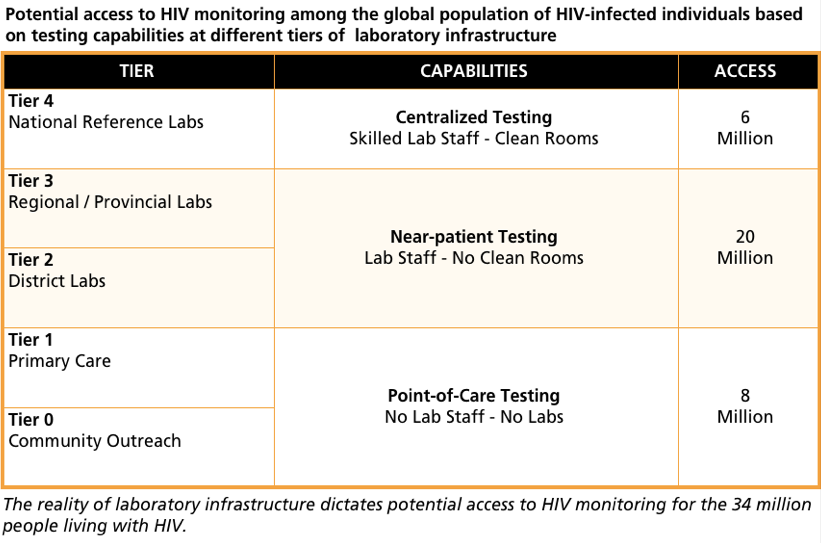
<p class="p1"><span class="s1">Any solutions for HIV treatment have to work with the realities of existing laboratory infrastructure. The WHO has designated five tiers of laboratory infrastructure.&nbsp; Each has its capabilities in terms of what types of tests can be run and the throughput that is possible. This, in turn, influences the access to testing that we can expect from any tier. For instance Tiers 0 and 1 may interact with a large population of people living with HIV, but since there is no lab infrastructure and a shortage of skilled staff exists at that level, testing is limited to one-at-a-time, point of care testing with low throughput.&nbsp; We have drawn on throughput projections and population geography to provide a picture of&nbsp; potential access to monitoring at the different levels.&nbsp;</span></p>
<p class="p1"><span class="s1">If we estimate the global population of people living with HIV to be at around 34 million, we can divide them by this type of access. There we see that the centralized testing schemes used by reference labs in Tier 4 could access about 6 million people living with HIV and this is where, traditionally, much of the emphasis has been placed. Primary care facilities and community outreach programs in Tier 0 and 1 could reach about 8 million people living with HIV and this is where point-of-care solutions can have the greatest impact. But with near-patient testing, regional and district-level facilities in Tier 2 and 3 could provide access to over 20 million or 60 % of cases. Today, Cavidi&rsquo;s <span class="s2"><a title="http://www.cavidi.se/ExaVirLoad.aspx" href="http://www.cavidi.se/ExaVirLoad.aspx" target="_blank">ExaVir&trade; Load</a></span> test is the only test capable of providing viral load monitoring coverage on a regional and district level.</span></p>
<p class="p1"><span class="s1">These middle tiers are where Cavidi focuses its efforts both with our current product, ExaVir&trade; Load, and with our R&amp;D efforts to develop new monitoring solutions that will increase throughput and access even further. I&rsquo;m pleased to announce that we have made significant progress in both areas over the past year.&nbsp;</span></p>
<p class="p1"><span class="s1">In 2013 we reached another milestone with our ExaVir&trade; Load HIV viral load monitoring kit as we began shipping to the Philippines. This marks the 25</span><span class="s3"><sup>th</sup></span><span class="s1"> country to adopt ExaVir&trade; Load for clinical use in addition to over a dozen other countries where the test is currently being evaluated for use. The test offers the same sensitivity and accuracy of Tier 4 reference tests but, unlike those tests, it can be run in Tier 2 and 3 facilities &ndash; and at a fraction of the cost.&nbsp;</span></p>
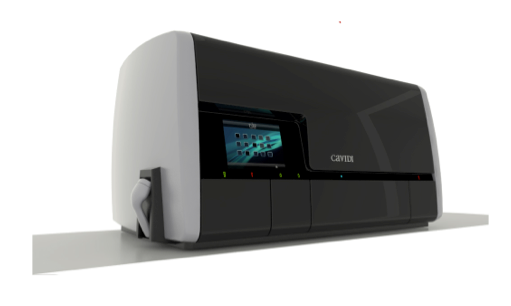
<p class="p1"><span class="full-image-block ssNonEditable"><span><img style="width: 450px;" src="http://www.hivviralload.com/storage/Screen%20Shot%202013-11-27%20at%205.08.39%20PM.png?__SQUARESPACE_CACHEVERSION=1385645637717" alt="" /></span><span class="thumbnail-caption" style="width: 450px;">Cavidi&rsquo;s new Automated Monitoring System will provide viral load and be adding other optional HIV test kits, such as CD4, EID, and drug resistance in one robust bench-top unit.</span></span></p>
<p class="p1"><span class="s1">We are also making steady progress on the next generation of HIV viral load monitoring diagnostics. Codenamed the Automated Monitoring System, the new system is now in the prototype stage. This new product uses the same proven RT-technology found in our ExaVir&trade; Load test but it is fully automated, requiring less time from lab technicians and greater throughput. In addition to viral load testing, we will be adding other optional HIV test kits like CD4, EID, and drug resistance in one bench-top unit.&nbsp; Like ExaVir&trade; Load, our new system is ideally suited to the near-patient testing needs of Tier 2 and 3 regional and district level facilities. Bringing this product to market will be a game changer for increasing both access and quality of HIV treatment globally. I look forward to sharing more news on the project throughout 2014.&nbsp;</span></p>
<p class="p1"><span class="s1">While 2013 saw progress in the battle against HIV, it&rsquo;s clear that we still have lots of work ahead of us. That&rsquo;s why we need to ensure that the public remains aware and vigilant. My colleagues and I at Cavidi will continue to work to increase awareness, access, and quality of HIV treatment worldwide. In the interest of raising awareness among your peer network, I hope you will share this post. If you would like more information about Cavidi&rsquo;s work in this area, feel free to contact <a title="mailto:john@cavidi.se?subject=AMS%20Questions%20from%20the%20blog" href="mailto:john@cavidi.se?subject=AMS%20Questions%20from%20the%20blog" target="_blank"><span class="s2">me</span></a> directly.&nbsp;</span></p>
<p class="p1"><span class="s1"><span class="full-image-float-left ssNonEditable"><img src="http://www.hivviralload.com/storage/Screen Shot 2013-11-27 at 5.10.42 PM.png?__SQUARESPACE_CACHEVERSION=1385568698054" alt="" /></span><br /></span></p>]]></content></entry><entry><title>Viral load monitoring enters the mainstream</title><category term="ART"/><category term="ARV"/><category term="CD4"/><category term="Cavidi"/><category term="Cavidi"/><category term="Current Affairs"/><category term="Doctors without borders"/><category term="HIV Viral Load Monitoring"/><category term="HIV monitoring info"/><category term="HIV viral load"/><category term="MSF"/><category term="Ministry of International Development &amp; Cooperation"/><category term="UNITAID"/><category term="WHO"/><category term="antiretroviral treatment"/><category term="resource-limited settings"/><id>http://www.hivviralload.com/blog/2013/7/10/viral-load-monitoring-enters-the-mainstream.html</id><link rel="alternate" type="text/html" href="http://www.hivviralload.com/blog/2013/7/10/viral-load-monitoring-enters-the-mainstream.html"/><author><name>Cavidi Employees</name></author><published>2013-07-10T07:26:34Z</published><updated>2013-07-10T07:26:34Z</updated><content type="html" xml:lang="en-US"><![CDATA[<p>Last night I attended a dinner in Stockholm hosted by the Swedish Ministry for International Development &amp; Cooperation. I was fortunate to have the chance to chat with Dr. Mark Dybul, Executive Director of the Global Fund. The subject of HIV viral load monitoring came up. As you might imagine, this topic has been a central theme of my dinner conversations for several years. But last night&rsquo;s discussion took on a very different tone.&nbsp;</p>
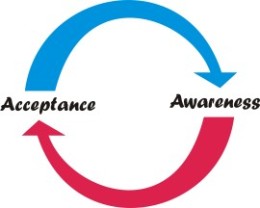
<p><span class="full-image-float-left ssNonEditable"><span><img src="http://www.hivviralload.com/storage/CAVI%20Awareness-Acceptance2.jpg?__SQUARESPACE_CACHEVERSION=1373448957429" alt="" /></span><span class="thumbnail-caption" style="width: 260px;">Viral load monitoring officially endorsed by the world&rsquo;s most respected public health authority</span></span></p>
<p>With almost&nbsp;<a href="http://www.who.int/mediacentre/factsheets/fs360/en/" target="_blank">ten million</a>&nbsp;people in developing nations currently receiving antiretroviral treatment (ART) for HIV, it&rsquo;s fair to say that great progress has been made in addressing the HIV pandemic. However, one area has remained well behind the curve when comparing treatment standards in developed nations to those in the developing world. That deficiency is most strikingly evident in HIV viral load monitoring. Antiretroviral&nbsp;drugs (ARVs) can be used much more effectively when combined with viral load monitoring. Conversely, administering ARVs in the absence of viral load monitoring means replacing data with guesswork, which puts patients at risk and can waste resources. That is why every HIV patient in the developed world receives regular viral load monitoring as a central part of treatment. And, why it&rsquo;s a shame that this diagnostic has not been widely regarded as a critical component of routine practice in the areas hardest hit by the HIV pandemic.</p>
<p>Which brings me back to my dinner with Dr. Dybul&hellip;During our discussion it suddenly occurred to me that I no longer felt like a radical evangelist advocating viral load monitoring from the sidelines of the war on HIV. It felt more like preaching to the choir. That&rsquo;s because, for the first time, routine viral load monitoring has been officially endorsed by the world&rsquo;s most respected public health authority. The World Health Organization (WHO) recently revised their&nbsp;<a href="http://www.who.int/hiv/pub/guidelines/arv2013/art/artmonitoring/en/index.html" target="_blank">guidelines</a>&nbsp;for HIV treatment and now strongly&nbsp;<a href="http://www.who.int/diagnostics_laboratory/evaluations/viral_load/en/index.html" target="_blank">recommends</a>&nbsp;implementing routine viral load monitoring in resource-limited settings.&nbsp;</p>
<p>WHO recognized the importance of viral load monitoring as early as 2003, but fell short of including the test in its official HIV treatment guidelines for developing nations. Priorities back then were focused on getting ARVs into resource-limited countries. Now that the ARVs have arrived, viral load monitoring takes on much more significance. The revised&nbsp;<a href="http://www.who.int/hiv/pub/guidelines/arv2013/art/artmonitoring/en/index3.html" target="_blank">WHO guidelines</a>&nbsp;call for developing countries to roll out routine virological monitoring, with viral load tests at both six and twelve months after treatment initiation, and then at least every twelve months thereafter. In this way, treatment adherence problems are corrected more quickly and patient treatment can be adjusted immediately as indications arise.</p>
<p><span class="ssNonEditable full-image-block"><a href="http://www.who.int/hiv/pub/guidelines/arv2013/art/artmonitoring/en/index3.html" target="_blank"><img src="http://www.hivviralload.com/storage/cavi%20who.png?__SQUARESPACE_CACHEVERSION=1373444031854" alt="" /></a><span class="thumbnail-caption">WHO Consolidated ARV guidelines 2013</span></span></p>
<p>A recent&nbsp;<span><a href="http://www.msfaccess.org/content/putting-hiv-treatment-test" target="_blank">report from M&eacute;decins Sans Fronti&egrave;res</a></span>&nbsp;(MSF) highlighted the importance of routine viral load monitoring for a number of reasons, some of which include confirmation of treatment failure, prevention of HIV mother-to-child transmission, and improvement in HIV treatment outcomes in low-income countries. MSF currently provides treatment for 285,000 HIV patients in 21 countries. Today, most clinics in resource-limited settings try to monitor disease progression with CD4 tests alone. This research provides ten specific benefits that programs in developing nations can hope to achieve by adopting the WHO recommendation for routine viral load testing. These include:</p>
<ul>
<li>Support of treatment adherence</li>
<li>Confirmation of treatment failure early, before CD4 decline</li>
<li>Revelation of previously hidden viral loads, then help reducing them</li>
<li>Enablement of program decentralization and task shifting</li>
<li>Improvement of treatment efficacy</li>
<li>Help meeting programwide goals</li>
<li>Improvement of early infant diagnosis</li>
<li>Delivery of systemic benefits, from the individual to the institution</li>
<li>Cost benefits for programs by reducing:         
<ul>
<li>cost of drugs by preserving first-line therapy</li>
<li>costs associated with redundant testing</li>
<li>cost for viral load equipment and operations</li>
<li>testing costs through the use of pooled samples</li>
</ul>
</li>
<li>Prolongation of treatment options for patients</li>
</ul>
<p>Clearly, the addition of routine viral load testing offers significant gains for both programs and patients in resource-limited settings. Now that WHO has endorsed viral load monitoring, the biggest barricade to access will be ensuring that we provide viral load tests at an affordable cost. Our own viral load monitoring product,&nbsp;<a href="http://www.cavidi.se/ExaVirLoad.aspx" target="_blank">ExaVir&trade;Load</a>, was purposely designed with that aim in mind. It is an RT-based ELISA test that measures viral load with comparable sensitivity and reliability to standard DNA-based tests. The difference is that&nbsp;<a href="http://www.cavidi.se/ExaVirLoad.aspx" target="_blank">ExaVir&trade;Load</a>&nbsp;can be run in simple and/or rural laboratory environments with&nbsp;<a href="http://www.who.int/bulletin/volumes/90/12/12-102780/en/index.html" target="_blank">low initial investment</a>. An automated version of the test is currently in development, as outlined in the recent&nbsp;<a href="http://www.unitaid.eu/images/marketdynamics/publications/UNITAID-HIV_Diagnostic_Landscape-3rd_edition.pdf" target="_blank">UNITAID&nbsp;<span>HIV Diagnostic Landscape</span>&nbsp;report</a>.</p>
<p>Viral load monitoring is no longer a fringe consideration when treating HIV in resource-limited settings. That&rsquo;s great news for people with HIV in&nbsp;<a href="http://www.hivviralload.com/blog/2012/10/16/hiv-viral-load-monitoring-from-patient-to-public-health-issu.html" target="_blank">the developing world</a>. The revised WHO guidelines have helped viral load monitoring enter the mainstream. On behalf of&nbsp;<a href="http://www.cavidi.se/" target="_blank">Cavidi</a>, I promise to keep it there with tests that are both reliable and affordable. I am proud that&nbsp;<a href="http://www.cavidi.se/" target="_blank">Cavidi</a>&nbsp;can play a central role in carrying out the WHO&rsquo;s recommendation. Moreover, I&rsquo;m pleased to see that leadership in organizations such as WHO and the Global Fund are all in agreement that the time for viral load monitoring is now.&nbsp;</p>
<p>&nbsp;</p>
<p><span class="ssNonEditable full-image-float-left"><img src="http://www.hivviralload.com/storage/JohnReiskydeDubnic.png?__SQUARESPACE_CACHEVERSION=1373443057630" alt="" /></span></p>
<p>John Reisky de Dubnic</p>
<p>CEO</p>
<p>Cavidi</p>]]></content></entry><entry><title>Time for a new gold standard in HIV viral load monitoring</title><category term="EID"/><category term="Early Infant Diagnosis"/><category term="Gold Standard"/><category term="HIV"/><category term="HIV Viral Load Monitoring"/><category term="HIV viral load"/><category term="Public health issue"/><category term="RT assay"/><category term="RT technology"/><category term="World AIDS Day"/><category term="World Aids Day"/><category term="resource-limited settings"/><id>http://www.hivviralload.com/blog/2012/11/29/time-for-a-new-gold-standard-in-hiv-viral-load-monitoring.html</id><link rel="alternate" type="text/html" href="http://www.hivviralload.com/blog/2012/11/29/time-for-a-new-gold-standard-in-hiv-viral-load-monitoring.html"/><author><name>Cavidi Employees</name></author><published>2012-11-29T15:56:32Z</published><updated>2012-11-29T15:56:32Z</updated><content type="html" xml:lang="en-US"><![CDATA[<p class="p1"><span class="s1"><span class="full-image-float-left ssNonEditable"><span><a href="http://www.amfar.org/articles/around_the_world/world_aids_day_2012__getting_to_zero/" target="_blank"><img style="width: 250px;" src="http://www.hivviralload.com/storage/World%20Aids%20day%202012.png?__SQUARESPACE_CACHEVERSION=1354180191889" alt="" /></a></span></span> </span></p>
<div></div>
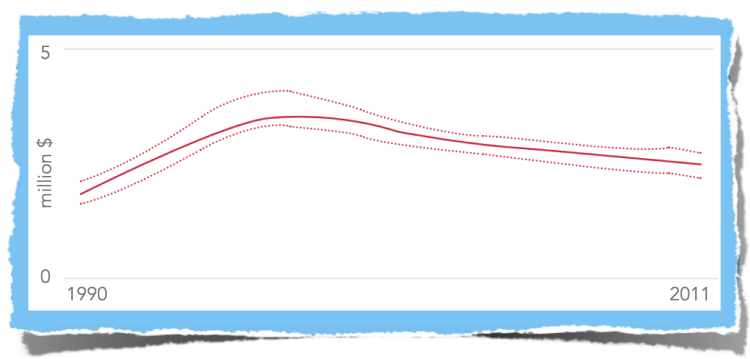
<p>This past year has brought more good news in the battle against HIV/AIDS with UNAIDS stating, &ldquo;On the cusp of the fourth decade of the AIDS epidemic, the world has turned the corner&mdash;it has halted and begun to reverse the spread of HIV.&rdquo;&nbsp;<a href="http://www.unaids.org/en/media/unaids/contentassets/documents/epidemiology/2012/gr2012/JC2434_WorldAIDSday_results_en.pdf " target="_blank">UNAID&rsquo;s 2012 report</a> cited 700,000 fewer new HIV infections in 2011 than in 2001. AIDS-related deaths have been reduced by one-third in the past six years. And access to antiretroviral therapy (ART)&nbsp;continues to grow at unprecedented rates. But as the battle against HIV enters a new phase, it introduces <a href="http://www.hivviralload.com/blog/2012/10/16/hiv-viral-load-monitoring-from-patient-to-public-health-issu.html" target="_blank">new challenges to the healthcare community</a>, particularly with regard to diagnostics.&nbsp;In response, the World Health Organization and <a href="http://www.unitaid.eu/aids2012/9-uncategorised/983-the-decade-of-diagnostics-2012-update-catalyzing-markets-to-accelerate-access-to-point-of-care-hiv-testing" target="_blank">UNITAID</a> have dubbed the next ten years, &ldquo;the decade of diagnostics.&rdquo; In their <a href="http://pag.aids2012.org/session.aspx?s=162" target="_blank">session at AIDS 2012</a> in Washington D.C. they emphasized the important role that cheaper, simplified diagnostics must play in the next phase of the campaign to stem the HIV pandemic. This emphasis is redefining the role of HIV viral load testing in treatment and is placing new demands on how these tests are conducted.<span style="text-align: center;">&nbsp;</span></p>
<p style="text-align: center;"><strong>Number of people newly infected with HIV, Global, 1990-2011</strong></p>
<p class="p1"><span><span class="full-image-block ssNonEditable"><span><a href="http://www.unaids.org/en/resources/campaigns/20121120_globalreport2012/globalreport/" target="_blank"><img src="http://www.hivviralload.com/storage/Number of people newly infected with HIV.png?__SQUARESPACE_CACHEVERSION=1354184068950" alt="" /></a></span></span></span><span class="thumbnail-caption">UNAIDS Report (2012)</span></p>
<p class="p1">For decades the gold standard for HIV viral load diagnostics have been RNA-based tests. But in this new diagnostic landscape I see centralized RNA-based testing rapidly losing relevance to tools that are better suited to meet the diagnostics challenges that we see today in both the developed and developing world. Most notable among these are: a) the need to scale HIV viral load monitoring in step with the burgeoning number of men, women and children entering treatment, b) managing the rise in drug-resistant HIV strains that accompany greater access to ARV treatment and c) address the diagnostic needs of infants born to HIV-positive mothers.&nbsp;</p>
<p class="p1"><span class="s2">In low-to-middle income countries, access to HIV viral load testing has become a more critical issue given the recent increase in access to ART.&nbsp;</span><span class="s1"> According to the&nbsp;<a href="http://www.who.int/mediacentre/factsheets/fs360/en/index.html" target="_blank">World Health Organization</a>&nbsp;(WHO), there was a 20-fold increase in the number of people receiving ART in developing countries between 2003 and 2011, and a 20% increase in just one year (from 6.6 million in 2010 to more than 8 million in 2011). The rapid increase in access to Antiretroviral drugs (ARV)&nbsp;has triggered a corresponding increase in the need to monitor those receiving treatment. This helps to ensure the virus is being suppressed and helps the doctor know when the patient needs to be switched to a new treatment regimen.&nbsp;</span>&nbsp;</p>
<p class="p1"><span class="s1">Originally developed for use in North America and Europe, RNA-based tests are proving impractical for decentralized use in low-to-middle income countries. Around <a href="http://www.unaids.org/en/media/unaids/contentassets/documents/epidemiology/2012/gr2012/20121120_UNAIDS_Global_Report_2012_en.pdf" target="_blank">70%</a> of the world&rsquo;s HIV population live in sub-Saharan Africa. As a result, district hospitals and clinics outside the capital have to either send blood samples away to a central reference hospital or, more likely, forgo HIV viral load monitoring altogether. In light of this, it seems the gold standard is shifting in favor of a HIV viral load monitoring solution that can deliver the same reliability in a decentralized model with testing conducted near-patient.</span></p>
<p class="p2">This has created a flurry of innovation in the HIV viral load POC testing arena. Maurine Murtagh has identified 13 different entrants in this area in the 2nd edition of <a href="http://www.unitaid.eu/resources-2/news/949-2nd-edition-of-unitaid-diagnostic-technology-landscape-report-published" target="_blank">UNITAID Diagnostic Technology Landscape Report</a>.&nbsp; Of the options available today, <a href="http://www.hivviralload.com/blog/2008/9/24/watch-how-hiv-works.html" target="_blank">Reverse Transcriptase</a> (RT)-based testing seems to offer the most plausible solution on several fronts. First, RT is a very stable marker since it is not affected by mutation and is always present when the HIV virus is replicating. Since RT-based tests do not target a specific nucleic acid sequence, they are able to quantify all types and subtypes of HIV, including new strains, without any modification to the test. RT-based tests have historically been significantly less expensive than RNA tests both in terms of start-up and running costs. Further, the RT platform has an unmatched track record among this next generation of HIV viral load tests. It has been in the field for over a decade with more than 40 peer-reviewed journal articles and over 350,000 tests run. Several studies over the past decade have compared <a href="http://www.cavidi.se/ExaVirLoad.aspx" target="_blank">ExaVir&trade; Load</a> to the gold standard PCR tests and all have found excellent correlation with RNA-based tests.&nbsp;</p>
<p class="p1"><span class="s2">The benefits of RT-based HIV viral load testing go <a href="http://www.hivviralload.com/blog/2012/4/18/commentary-on-reverse-innovation.html" target="_blank">beyond resource-limited settings</a>. In the developed world, HIV viral load monitoring is a main line of defense against the rise in drug resistant strains of HIV.&nbsp; </span><span class="s1"><a href="http://www.hsph.harvard.edu/news/magazine/infectious-diseases/when-infection-wont-quit/" target="_blank">Eric Rubin</a>, professor of immunology and infectious diseases at HSPH&nbsp;put it eloquently, "Drug resistance is the product of success: With treatment, we have drug resistance." Since ARV treatment has been more prevalent in developed countries, resistance has mainly been a problem for these nations.&nbsp; For instance, <a href="http://www.plosone.org/article/info:doi/10.1371/journal.pone.0025281" target="_blank">a recent study</a> in San Francisco revealed that 60 percent of new HIV&nbsp;infections are drug resistant. One of the key factors in stemming this tide is early detection of treatment failure through HIV viral load monitoring of all HIV positive patients. Since healthcare systems the world over are straining to manage budgets, a more cost-effective decentralized HIV viral load monitoring solution may benefit developed nations as much as it does low-to-middle income countries.&nbsp;</span>&nbsp;</p>
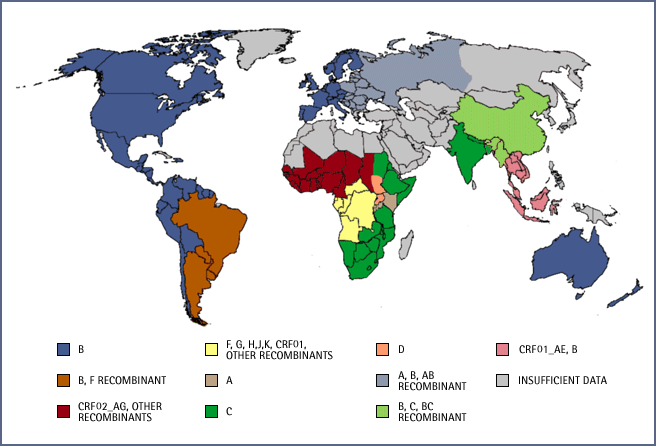
<p class="p1"><span class="s2">In areas where the subtype of the individual may be unknown RT-based testing provides additional advantages. This has </span><span class="s1">not been much of a concern in the US where the vast majority of HIV-1 infections are subtype B&mdash;98 percent according to some surveys. But an article from <a href="http://www.cap.org/apps/cap.portal?_nfpb=true&amp;cntvwrPtlt_actionOverride=%2Fportlets%2FcontentViewer%2Fshow&amp;_windowLabel=cntvwrPtlt&amp;cntvwrPtlt%7BactionForm.contentReference%7D=cap_today%2F0908%2F0908_subtypes_put_HIV.html&amp;_state=maximized&amp;_pageLabel=cntvwr" target="_blank">CAP Foundation</a> asserts that it may be time for the US to&nbsp; &ldquo;catch up to what&rsquo;s happening in Tanzania and elsewhere in Africa. Specifically, HIV-1 subtypes common in Africa may be making inroads in the United States, as they have in Europe.&rdquo;&nbsp; Of the testing options available, only RT-based testing is able to detect any HIV activity without modifying the test &mdash; including new HIV strains</span><span class="s2">.</span></p>
<p class="p1" style="text-align: center;"><span class="s2"><strong>World map of Global distribution of HIV-1 strains</strong></span></p>
<p class="p1"><span class="full-image-block ssNonEditable"><span><a href="http://www.pbs.org/wgbh/pages/frontline/aids/atlas/clade.html" target="_blank"><img style="width: 650px;" src="http://www.hivviralload.com/storage/HIV%20clademap.gif?__SQUARESPACE_CACHEVERSION=1354121422881" alt="" /></a></span><span class="thumbnail-caption" style="width: 650px;">IAVI Report (2003)</span></span></p>
<p class="p1"><span class="s2">Lastly, with <a href="http://www.unaids.org/en/media/unaids/contentassets/documents/epidemiology/2012/20120718_togetherwewillendaids_en.pdf" target="_blank">half</a> of the world&rsquo;s HIV population being women and many of them of child-bearing age, there has been increased focus in recent years on mother-to-child transmission. </span><span class="s1">Here too we see great strides have been made with <a href="http://www.who.int/mediacentre/factsheets/fs360/en/index.html" target="_blank">57%</a> of HIV positive pregnant woman living in low-and middle-income countries receiving treatment in 2011. One persistent problem has been the early infant diagnosis (EID) since standard rapid tests won&rsquo;t work on newborns. This is another area where RT-based testing has been found to convey an advantage. Over the past year more <a href="http://www.hivviralload.com/blog/2012/7/22/could-rt-technology-help-close-the-eid-gap.html" target="_blank">studies have confirmed</a> that in addition to RT-based EID solutions being significantly less expensive than RNA-based tests, they are also able to detect and quantify HIV infection in infants more reliably and at a much younger age. &nbsp;</span></p>
<p class="p1"><span class="s1">This <a href="http://www.worldaidsday.org" target="_blank">World AIDS Day</a>, as <a href="http://www.cavidi.se" target="_blank">Cavidi</a> celebrates the <a href="http://www.mynewsdesk.com/pressroom/cavidi/news/view/cavidi-celebrates-25-year-mark-42315" target="_blank">25</a></span><span class="s4"><sup><a href="http://www.mynewsdesk.com/pressroom/cavidi/news/view/cavidi-celebrates-25-year-mark-42315" target="_blank">th</a></sup></span><span class="s1"><a href="http://www.mynewsdesk.com/pressroom/cavidi/news/view/cavidi-celebrates-25-year-mark-42315" target="_blank"> Anniversary</a> of our RT-technology, I&rsquo;m pleased to report that we are making steady progress on three fronts to address the challenges above.&nbsp; First, we continue to support the increasing uptake of our manual ExaVir Load HIV viral load monitoring test which is increasing access to affordable HIV viral load testing around the world.&nbsp; Second, we have made excellent progress developing a new automated platform for near patient HIV viral load monitoring. The platform design is now entering final stages of prototype development and testing. And third, over this past year we have initiated further studies into the development of an RT-based EID test. I look forward to sharing more details on these exciting developments over the next year. </span></p>
<p class="p1"><span class="s1">New challenges require new solutions. As we enter the decade of diagnostics I hope to see a new gold standard emerge that will make HIV viral load testing more accessible and reliable. My team will do their part as they continue to bring innovative RT-based diagnostics to the world in 2013 and beyond.&nbsp;</span></p>
<p><span class="full-image-float-left ssNonEditable"><img src="http://hivviralload.squarespace.com/storage/JohnReiskydeDubnic.png?__SQUARESPACE_CACHEVERSION=1334831799073" alt="" /></span></p>
<p>&nbsp;John Reisky de Dubnic</p>
<p>CEO</p>
<p>Cavidi</p>]]></content></entry><entry><title>HIV Viral load monitoring: from patient to public health issue</title><category term="ART"/><category term="ART"/><category term="ARVs"/><category term="HIV monitoring info"/><category term="HIV viral load"/><category term="Public health issue"/><category term="Viral load monitoring"/><id>http://www.hivviralload.com/blog/2012/10/16/hiv-viral-load-monitoring-from-patient-to-public-health-issu.html</id><link rel="alternate" type="text/html" href="http://www.hivviralload.com/blog/2012/10/16/hiv-viral-load-monitoring-from-patient-to-public-health-issu.html"/><author><name>Cavidi Employees</name></author><published>2012-10-16T20:00:00Z</published><updated>2012-10-16T20:00:00Z</updated><content type="html" xml:lang="en-US"><![CDATA[<div></div>
<div><span class="s1"><br />Amazing strides have been made in providing access to Antiretroviral Therapy (ART) in resource-limited settings. In 2011, around </span><span class="s2"><a href="http://www.who.int/mediacentre/factsheets/fs360/en/index.html" target="_blank">8 million</a></span><span class="s1"> HIV-infected patients living in low- and middle-income countries have access to ART compared to just <a href="http://whqlibdoc.who.int/publications/2011/9789241501651_eng.pdf " target="_blank">400,000</a> a decade a go. Greater access to </span><span class="s3">Antiretroviral drugs (AR</span><span class="s1">Vs) is good news, but it has magnified the need for HIV viral load monitoring to properly administer these drugs. A recent M&eacute;decins Sans Fronti&egrave;res (MSF) review of <a href="http://www.msfaccess.org/content/undetectable-how-viral-load-monitoring-can-improve-hiv-treatment-developing-countries" target="_blank">data</a> from 12 low- and middle-income countries found that only 2% of patients had ever received a HIV viral load test result, no less received them every 6-months as recommended by the World Health Organization (WHO).</span></div>
<div><span class="s1"><br /></span></div>
<div>
<p class="p2"><span class="full-image-float-left ssNonEditable"><span><img style="width: 250px;" src="http://www.hivviralload.com/storage/hope.jpeg?__SQUARESPACE_CACHEVERSION=1350401776891" alt="" /></span><span class="thumbnail-caption" style="width: 250px;">One Hope by Joe Average was used for the XI International AIDS Conference in Vancouver in 1996</span></span>The direct benefits of HIV viral load testing to the patient are well documented in terms of better outcomes with decreased mortality. That&rsquo;s why HIV viral load testing has long been a standard part of treatment in middle- to upper-income nations. But if we look beyond the patient, there is an equally compelling public health case to be made for ensuring access to HIV viral load testing in the low- and middle-income countries where the vast majority of HIV patients live. Here are four ways HIV viral load testing protects the public as well as the patient.&nbsp;</p>
<p class="p2"><span class="s1">&nbsp;</span><strong>1. Help clinical resources go further by targeting counseling where it is needed. </strong>Some patients will take their medication as instructed &ndash; many will not. Noncompliant patients will usually show elevated viral activity which can lead to increases in treatment failure, transmission, comorbidity, drug resistance, and mortality. Counseling has been found to be very effective at helping with adherence issues but is labor intensive.&nbsp; This can be an enormous strain affecting the entire clinic. With HIV viral load monitoring the clinic can identify noncompliant patients early and more efficiently target counseling only to those who need it.&nbsp;</p>
<p class="p2"><span class="s1">&nbsp;</span><span class="s1"><strong>2. Reduce treatment costs by helping less-expensive first-line ART last longer.&nbsp;</strong> HIV mutates at such a remarkable rate that it is a foregone conclusion the virus will eventually be able to resist first-line treatment. The only question is when. If proper concentrations of the drugs are not properly maintained in the blood it makes this job a lot easier for the virus and thus will lead to treatment failure sooner. Monitoring viral load helps identify viral activity and address it before the treatment fails and the patient needs to be moved to a new treatment (if available).&nbsp; Without viral load measurement, doctors can also misattribute patient symptoms to treatment failure and switch them before it is required. Since first-line ART is always cheaper than second-line treatment</span><span class="s4"> (in some cases <a href="http://www.irinnews.org/Report/91247/UGANDA-Striving-to-provide-first-second-and-third-line-ARVs" target="_blank">one-quarter the price</a>)</span><span class="s1">, keeping patients on first-line treatment for as long as possible helps resources go further.&nbsp;</span></p>
<p class="p2"><span class="s1"><strong>3. Reduce the spread of HIV.&nbsp;</strong> Studies have found that transmission among HIV-infected persons with a viral load below 1,500 copies/ml is rare.&nbsp; Put simply, if there is no virus circulating in the patient&rsquo;s blood, then they are unlikely to spread the disease.&nbsp; So managing HIV viral load can, in itself, contribute to prevention. But you can&rsquo;t manage what you can&rsquo;t measure. This is where HIV viral load monitoring contributes.&nbsp;</span><a href="http://www.iasociety.org/Default.aspx?pageId=5&amp;elementId=14622" target="_blank">A mathematical model</a> published in the <em>AIDS</em> journal this year demonstrated that routine virological monitoring combined with ART can lead to a 31% reduction in HIV transmission.&nbsp;</p>
<p class="p2"><span class="s1">&nbsp;</span><strong>4. Combat the global problem of HIV drug-resistance. </strong>If HIV is allowed to remain active in the presence of drugs meant to suppress it, then it is just a matter of time before it will produce a viable mutation that will be resistant to the drug. We are already seeing this. A 2010 study in resource-limited settings found that in the absence of HIV viral load monitoring, the incidence of drug-resistant mutations following treatment failure is high.&nbsp; Of course this causes secondary resistance in these patients. But there&rsquo;s a knock-on effect in that these resistant patients begin spreading a strain of HIV to others that drugs can&rsquo;t treat. MSF reports that primary resistance in sub-Saharan Africa is already at 5.6% overall. If we look at countries where ART have been dispensed without HIV viral load monitoring for 10 years or longer we see a rate of 12%.&nbsp; Worse still, the drug-resistant mutations that are being found in newly infected people who have never been on treatment are resistant to both first- and second-line drugs. That&rsquo;s a trend that could unravel much of the progress made over the last 20 years in the battle against HIV.&nbsp;</p>
<p class="p3">When we look at HIV viral load monitoring from a public health perspective it becomes clear that the issues above are not limited to low- and middle-income countries. First, because any HIV viral load monitoring solution that is inexpensive enough to be viable in resource-limited settings could lower the cost of HIV treatment for any healthcare system. Secondly, because issues like the spread of HIV infection and drug resistance know no borders. HIV/AIDS is a <a href="http://www.advocate.com/arts-entertainment/commentary/2012/07/23/researchers-say-end-hiv-and-aids-epidemic-must-come" target="_blank">global problem</a> and affordable HIV viral load monitoring is an important part of the solution whether you are in Nairobi, New York, Melbourne, Lusaka, London, Harare or Hong Kong.&nbsp;</p>
<p class="p2"><span class="s1">&nbsp;</span><span class="s1">As access to ARVs grows across low- and middle-income regions, so does the public health imperative to dispense those drugs in a responsible manner with regular HIV viral load monitoring of patients.&nbsp; As <a href="http://www.msfaccess.org/content/undetectable-how-viral-load-monitoring-can-improve-hiv-treatment-developing-countries" target="_blank">MSF put it</a>, &ldquo;</span><span class="s6"><em>Funding the implementation of viral load should not be seen as a luxurious and avoidable expense, but should rather be recognized as a necessary and potentially cost-saving addition to current international commitments to scaling up treatment.</em></span><span class="s1">&rdquo;&nbsp; Today, Cavidi and others have <a href="http://www.cavidi.se/ExaVirLoad.aspx" target="_blank">the technology</a> to address this public health issue and provide inexpensive, near-patient HIV viral load monitoring where ever it is needed. Doing so will not only serve the patient but protect the public. All we need is the collective will to make it happen. One more reason why the time for HIV viral load testing is now.&nbsp;</span></p>
<p><span class="ssNonEditable full-image-float-left"><br /><img src="http://hivviralload.squarespace.com/storage/JohnReiskydeDubnic.png?__SQUARESPACE_CACHEVERSION=1334831799073" alt="" /></span></p>
<p>&nbsp;</p>
<p>John Reisky de Dubnic</p>
<p>CEO</p>
<p>Cavidi</p>
<p><span class="s7">Further reading</span><span class="s1">:</span></p>
<ul>
<li class="li6"><span class="s1">Aghokeng AF, Kouanfack C, Laurent C, Ebong E, Atem-Tambe A, Butel C, Montavon C, Mpoudi-Ngole E, Delaporte E, Peeters M: Scale-up of antiretroviral treatment in sub-Saharan Africa is accompanied by increasing HIV-1 drug resistance mutations in drug-naive patients. AIDS 2011, <a href="http://www.ncbi.nlm.nih.gov/pubmed/21860346" target="_blank">25: 2183 &ndash;2188</a>.</span></li>
<li class="li6"><span class="s1">Estill J, Aubriere C, Egger M, Johnson L, Wood R, Garone D, Gsponer T, Wandeler G, Boulle A, Davies M-A, Hallett T, Keiser O: Viral load monitoring of antiretroviral therapy, cohort viral load and HIV transmission in Southern Africa: A mathematical modelling analysis. AIDS 2012, <a href="http://www.ncbi.nlm.nih.gov/pubmed/22421243" target="_blank">26: 1413.</a></span></li>
<li class="li6"><span class="s1">Hamers RL, Wallis CL, Kityo C, Siwale M, Mandaliya K, Conradie F, Botes ME, Wellington M, Osibogun A, Sigaloff KCE, Nankya I, Schuurman R, Wit FW, Stevens WS, van Vugt M, de Wit TFR: HIV-1 drug resistance in antiretroviralnaive individuals in sub-Saharan Africa after rollout of antiretroviral therapy: a multicentre observational study. Lancet Infect Dis 2011, <a href="http://www.ncbi.nlm.nih.gov/pubmed/21802367" target="_blank">11: 750 &ndash;759.</a></span></li>
<li class="li6"><span class="s1">Lynen L, Van Griensven J, Elliott J: Monitoring for treatment failure in patients on first-line antiretroviral treatment in resource-constrained settings. Curr Opin HIV AIDS 2010, <a href="http://www.ncbi.nlm.nih.gov/pubmed/20046141" target="_blank">5: 1&ndash;5</a>.</span></li>
<li class="li6"><span class="s1">M&eacute;decins Sans Fronti&egrave;res: Undetectable &ndash; How Viral Load Monitoring Can Improve HIV Treatment in Developing Countries, <a href="http://www.msfaccess.org/content/undetectable-how-viral-load-monitoring-can-improve-hiv-treatment-developing-countries" target="_blank">July 2012</a></span></li>
<li class="li6"><span class="s1">Murtagh M: UNITAID HIV/AIDS Diagnostic Landscape 2nd Edition. <a href="http://www.unitaid.eu/resources-2/news/949-2nd-edition-of-unitaid-diagnostic-technology-landscape-report-published" target="_blank">2012.</a></span></li>
<li class="li7"><span class="s1">Quinn T, Wawer M, Sewankambo N: Viral Load and Heterosexual Transmission of Human Immunodeficiency Virus Type 1. N Engl J Med 2000, <a href="http://www.ncbi.nlm.nih.gov/pubmed/10738050" target="_blank">342: 921&ndash;929</a>.</span></li>
</ul>
</div>]]></content></entry></feed>