<?xml version="1.0" encoding="UTF-8"?>
<feed xml:lang="en" xmlns="http://www.w3.org/2005/Atom" xmlns:opensearch="http://a9.com/-/spec/opensearch/1.1/" xmlns:s="http://jadedpixel.com/-/spec/shopify">
  <id>https://tulsabodyjewelry.com/blogs/news.atom</id>
  <link rel="alternate" type="text/html" href="https://tulsabodyjewelry.com/blogs/news"/>
  <link rel="self" type="application/atom+xml" href="https://tulsabodyjewelry.com/blogs/news.atom"/>
  <title>Tulsa Body Jewelry - TBJ Blog</title>
  <updated>2022-09-12T11:28:17-05:00</updated>
  <author>
    <name>Tulsa Body Jewelry</name>
  </author>
  <entry>
    <id>https://tulsabodyjewelry.com/blogs/news/got-wood</id>
    <published>2022-09-12T11:28:17-05:00</published>
    <updated>2022-09-12T11:28:43-05:00</updated>
    <link rel="alternate" type="text/html" href="https://tulsabodyjewelry.com/blogs/news/got-wood"/>
    <title>GOT WOOD?</title>
    <author>
      <name>Brett Barnard</name>
    </author>
    <content type="html">
      <![CDATA[Our advice for maintaining plugs and tunnels made entirely from wood. Additional care is likely required for jewelry designs that feature other inlaid materials with their own specific properties! Please keep in mind that hand washing with fragrance free antibacterial soap helps to prevent fresh contamination when changing out any body jewelry. <br><br>PLEASE DO<br>Dampen a soft cloth in mild non-chemical soapy water to gently clean as needed. Never soak wood jewelry in water or any other liquid solution. Tea tree oil can be used sparingly (often diluted) to disinfect with a lovely scent, but please be certain you are not allergic. Pat them dry with a soft cloth and then allow to air dry thoroughly. We recommend polishing wood jewelry with a dab of beeswax. Overuse of wax results in dull accumulations instead of the desired shine! You can finish with a light rubdown of vitamin E, Jojoba, or mineral oil. Wood jewelry will often get darker in color with regular wear and oil treatments. Rough spots can be removed from the surface with gentle use of a fine grit sandpaper (#600 or higher).<br><br>PLEASE DON'T<br>Never wear wood plugs while swimming, in the hot tub, sauna or even your everyday shower. Wood will expand and contract a bit with with every exposure, weathering the finish and may lead to cracking. Avoid storing your organic jewelry near a heat source or exposure to direct sunlight as it will dry wood. Obviously, wood and other organics should never be autoclaved or treated with any alcohol-based product. Avoid contact with hair spray, perfume, lotions, sunscreen and insect repellent. Almost anything can easily soak into wood, causing discolorations, damage and a potential for skin irritation.<br><br>GOT SUPPLIES?<br><a href="https://www.tulsabodyjewelry.com/products/microfiber-polishing-cloth" title="Microfiber Polish Cloth">Microfiber Polishing Cloth</a><br><a href="https://www.tulsabodyjewelry.com/products/100-pure-unrefined-golden-jojoba" title="Organic Jojoba Oil">Organic Jojoba Oil</a><br><a href="https://www.tulsabodyjewelry.com/collections/all/products/100-organic-beeswax" title="Organic Beeswax">Organic Beeswax</a><br><a href="https://www.tulsabodyjewelry.com/products/australian-tea-tree-essential-oil" title="Tea Tree Oil">Tea Tree Oil</a>]]>
    </content>
  </entry>
  <entry>
    <id>https://tulsabodyjewelry.com/blogs/news/kaos-softwear-silicone-body-jewelry</id>
    <published>2017-09-14T13:44:00-05:00</published>
    <updated>2021-03-03T10:50:56-06:00</updated>
    <link rel="alternate" type="text/html" href="https://tulsabodyjewelry.com/blogs/news/kaos-softwear-silicone-body-jewelry"/>
    <title>Kaos Softwear Silicone Body Jewelry</title>
    <author>
      <name>Bold Apps</name>
    </author>
    <content type="html">
      <![CDATA[<p>Kaos Softwear was founded in 2002 by Jesse Jarrell and Steve Haworth. They were first to mass market silicone body jewelry and remain the leading edge for quality and design. We proud to carry every color they make and try our best to keep them all in stock. We've put together a roundup of everything that Kaos is currently offering in their wholesale catalog. They do offer <a href="https://www.kaossoftwear.com/kustomize/" title="Kaos Softwear Custom Colors" target="_blank" rel="noopener noreferrer">custom color options</a> through their website, but you'd have to order those directly from them!</p>
<p> </p>
<p>It's a fairly common practice, but <span style="color: #ff0000;">silicone jewelry is <span style="text-decoration: underline;">not</span> a recommended method for stretching your lobes</span>. We recommend using silicone body jewelry in well-healed piercings only!</p>
<p> </p>
<p><img src="//cdn.shopify.com/s/files/1/0615/1873/files/Dark-Blue-Skin-Eyelets_small.jpg?v=1505411622" alt="Kaos Dark Blue Ear Skins"><img src="//cdn.shopify.com/s/files/1/0615/1873/files/Hot-Pink-Skins-Kaos-Softwear_small.jpg?v=1505411610" alt="Kaos Hot Pink Ear Skins"><img src="//cdn.shopify.com/s/files/1/0615/1873/files/Emerald-Pearl-Skins-Kaos-Softwear_small.jpg?v=1505411430" alt="Kaos Emerald Pearl Ear Skins"></p>
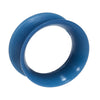
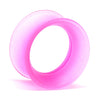
<h3><strong>Skin Eyelets</strong></h3>
<p>Skin eyelets are the most popular style we carry from Kaos Softwear. Perhaps it's because they're available in the widest variety of kick-ass colors. The skins are widely imitated but never duplicated. The wearable area is 5/16" from 10g up to one inch, and 3/8" from 1-1/8" up to three inches. Most colors are available from 6g up to one inch unless marked with an asterisk(s). <a href="https://tulsabodyjewelry.com/products/autumn-brown-skin-eyelets-kaos">Autumn Brown</a>, <a href="https://tulsabodyjewelry.com/products/avocado-skin-eyelets-kaos-softwear">Avocado</a>, <a href="https://tulsabodyjewelry.com/products/aztec-gold-skin-eyelets-kaos">Aztec Gold</a>****, <a href="https://tulsabodyjewelry.com/products/black-skin-eyelets-kaos-softwear">Black</a>*, <a href="https://tulsabodyjewelry.com/products/clear-skin-eyelets-kaos-softwear">Clear</a>*, <a href="https://tulsabodyjewelry.com/products/cobalt-pearl-skin-eyelets-kaos">Cobalt Pearl</a>, <a href="https://tulsabodyjewelry.com/products/copper-skin-eyelets-kaos-softwear">Copper</a>***, <a href="https://tulsabodyjewelry.com/products/cranberry-skin-eyelets-kaos-softwear">Cranberry</a>*****, <a href="https://tulsabodyjewelry.com/products/dark-blue-skin-eyelets-kaos">Dark Blue</a>, <a href="https://tulsabodyjewelry.com/products/emerald-pearl-skin-eyelets-kaos">Emerald Pearl</a>, <a href="https://tulsabodyjewelry.com/products/gold-skin-eyelets-kaos-softwear">Gold</a>***, <a href="https://tulsabodyjewelry.com/products/grey-skin-eyelets-kaos-softwear">Grey</a>, <a href="https://tulsabodyjewelry.com/products/hot-pink-skin-eyelets-kaos">Hot Pink</a>, <a href="https://tulsabodyjewelry.com/products/lavender-pearl-skin-eyelets-kaos">Lavender Pearl</a>, <a href="https://tulsabodyjewelry.com/products/maple-skin-eyelets-kaos-softwear">Maple</a>*****, <a href="https://tulsabodyjewelry.com/products/maroon-pearl-skin-eyelets-kaos">Maroon Pearl</a>, <a href="https://tulsabodyjewelry.com/products/metallic-silver-skin-eyelets-kaos">Metallic Silver</a>****, <a href="https://tulsabodyjewelry.com/products/mint-skin-eyelets-kaos-softwear">Mint</a>*****, <a href="https://tulsabodyjewelry.com/products/misty-rose-skin-eyelets-kaos-softwear">Misty Rose</a>****, <a href="https://tulsabodyjewelry.com/products/ocean-blue-skin-eyelets-kaos-softwear">Ocean Blue</a>****, <a href="https://tulsabodyjewelry.com/products/red-skin-eyelets-kaos-softwear">Red</a>, <a href="https://tulsabodyjewelry.com/products/rose-gold-skin-eyelets-kaos-softwear">Rose Gold</a>***, <a href="https://tulsabodyjewelry.com/products/royal-purple-skin-eyelets-kaos">Royal Purple</a>**, <a href="https://tulsabodyjewelry.com/products/sea-blue-pearl-skin-eyelets">Sea Blue Pearl</a>, <a href="https://tulsabodyjewelry.com/products/sea-foam-pearl-skin-eyelets">Sea Foam Pearl</a>, <a href="https://tulsabodyjewelry.com/products/shell-pink-pearl-skin-eyelets">Shell Pink Pearl</a>, <a href="https://tulsabodyjewelry.com/products/silver-skin-eyelets-kaos-softwear">Silver</a>***, <a href="https://tulsabodyjewelry.com/products/slate-blue-skin-eyelets-kaos">Slate Blue</a>, <a href="https://tulsabodyjewelry.com/products/spruce-skin-eyelets-kaos-softwear">Spruce</a>*****, <a href="https://tulsabodyjewelry.com/products/tropical-green-skin-eyelets-kaos-softwear">Tropical Green</a>****, <a href="https://tulsabodyjewelry.com/products/true-blue-skin-eyelets-kaos">True Blue</a>, <a href="https://tulsabodyjewelry.com/products/true-purple-skin-eyelets-kaos">True Purple</a>, <a href="https://tulsabodyjewelry.com/products/uv-green-skins-kaos-softwear">UV Green</a>, <a href="https://tulsabodyjewelry.com/products/uv-magenta-skins-kaos-softwear">UV Magenta</a>, <a href="https://tulsabodyjewelry.com/products/uv-orange-skins-kaos-softwear">UV Orange</a>, <a href="https://tulsabodyjewelry.com/products/uv-purple-skins-kaos-softwear">UV Purple</a>, <a href="https://tulsabodyjewelry.com/products/uv-red-skins-kaos-softwear">UV Red</a>, <a href="https://tulsabodyjewelry.com/products/uv-yellow-skins-kaos-softwear">UV Yellow</a>, <a href="https://tulsabodyjewelry.com/products/white-pearl-skin-eyelets-kaos">White Pearl</a>**, <a href="https://tulsabodyjewelry.com/products/yellow-skin-eyelets-kaos-softwear">Yellow</a>, <a href="https://tulsabodyjewelry.com/products/white-skin-eyelets-kaos-softwear">White</a>*.</p>
<p style="text-align: center;">* available in 10g up to 3"<br>** available in 6g up to 3"<br>*** available in 1-1/8" up to 3"<br>**** discontinued color<br>***** new colors available in 10g up to 1"</p>
<p> </p>
<p><img src="//cdn.shopify.com/s/files/1/0615/1873/files/Red-Tunnels-Kaos-Softwear_small.jpg?v=1505413371" alt="Kaos Red Tunnels"><img src="//cdn.shopify.com/s/files/1/0615/1873/files/Grey-Tunnels-Kaos-Softwear_small.jpg?v=1505413361" alt="Kaos Grey Tunnels"><img src="//cdn.shopify.com/s/files/1/0615/1873/files/Yellow-Tunnels-Kaos-Softwear_small.jpg?v=1505413381" alt="Kaos Yellow Tunnels"></p>
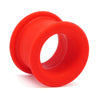
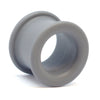
<h3><strong>Tunnels</strong></h3>
<p>Tunnels are a bit thicker and more limited in color selection, but they still have a loyal following. All color are available in sizes from 0g up to one inch with a wearable area of 3/8". <a href="https://tulsabodyjewelry.com/products/black-tunnels-kaos-softwear">Black</a>, <a href="https://tulsabodyjewelry.com/products/clear-tunnels-kaos-softwear">Clear</a>, <a href="https://tulsabodyjewelry.com/products/grey-tunnels-kaos-softwear">Grey</a>, <a href="https://tulsabodyjewelry.com/products/red-tunnels-kaos-softwear">Red</a>, <a href="https://tulsabodyjewelry.com/products/true-blue-tunnels-kaos-softwear">True Blue</a>, <a href="https://tulsabodyjewelry.com/products/white-tunnels-kaos-softwear">White</a> or <a href="https://tulsabodyjewelry.com/products/yellow-tunnels-kaos-softwear">Yellow</a>.</p>
<p> </p>
<p><img src="//cdn.shopify.com/s/files/1/0615/1873/files/Gold_Hydra_Teardrop_Eyelets_small.jpg?v=1505413671" alt="Kaos Gold Hydra Tunnels"><img src="//cdn.shopify.com/s/files/1/0615/1873/files/Silver_Hydra_Teardrop_Eyelets_small.jpg?v=1505413603" alt="Kaos Silver Hydra Tunnels"><img src="//cdn.shopify.com/s/files/1/0615/1873/files/Copper_Hydra_Teardrop_Eyelets_small.jpg?v=1505413620" alt="Kaos Copper Hydra Tunnels"></p>
<h3><strong>Hydra Tunnels</strong></h3>
<p>Teardrop-shaped hydra tunnels can be especially good for distributing weight when combined with heavier jewelry or ear weights. The wearable area is 5/16" from 00g up to one inch, and 3/8" from 1-1/8" up to two inches. <a href="https://tulsabodyjewelry.com/products/black-hydra-eyelets-kaos-softwear">Black</a>, <a href="https://tulsabodyjewelry.com/products/clear-hydra-eyelets-kaos-softwear">Clear</a>, <a href="https://tulsabodyjewelry.com/products/copper-hydra-eyelets-kaos-softwear">Copper</a>, <a href="https://tulsabodyjewelry.com/products/gold-hydra-eyelets-kaos-softwear">Gold</a>, <a href="https://tulsabodyjewelry.com/products/rose-gold-hydra-eyelets-kaos">Rose Gold</a>, <a href="https://tulsabodyjewelry.com/products/silver-hydra-eyelets-kaos-softwear">Silver</a>, <a href="https://tulsabodyjewelry.com/products/white-hydra-eyelets-kaos-softwear">White</a>.</p>
<p> </p>
<p><img src="//cdn.shopify.com/s/files/1/0615/1873/files/True-Blue-Hollow-Plugs-Kaos-Softwear_small.jpg?v=1505412126" alt="Kaos True Blue Hollow Plugs"><img src="//cdn.shopify.com/s/files/1/0615/1873/files/White-Hollow-Plugs-Kaos-Softwear_small.jpg?v=1505412138" alt="Kaos White Hollow Plugs"><img src="//cdn.shopify.com/s/files/1/0615/1873/files/Red-Hollow-Plugs-Kaos-Softwear_small.jpg?v=1505412090" alt="Kaos Red Hollow Plugs"></p>
<h3><strong>Hollow Plugs</strong></h3>
<p>The hollow plugs look solid from the front, but are almost completely hollow when viewed from the backside. The result is a comfortable plug that has a little more squish to give, allowing for easy insertion. They're available in sizes from 10g up to one inch with a wearable area of 3/8". <a href="https://tulsabodyjewelry.com/products/black-plugs-kaos-softwear">Black</a>, <a href="https://tulsabodyjewelry.com/products/red-plugs-kaos-softwear">Red</a>, <a href="https://tulsabodyjewelry.com/products/blue-plugs-kaos-softwear">True Blue</a>, <a href="https://tulsabodyjewelry.com/products/white-plugs-kaos-softwear">White</a>, <a href="https://tulsabodyjewelry.com/products/yellow-plugs-kaos-softwear">Yellow</a>.</p>
<p> </p>
<p> </p>
<p><img src="//cdn.shopify.com/s/files/1/0615/1873/files/kaos-hiders.jpg?v=1505411933" width="400" alt="Kaos Hider Plugs"></p>
<h3><strong>Hider Plugs</strong></h3>
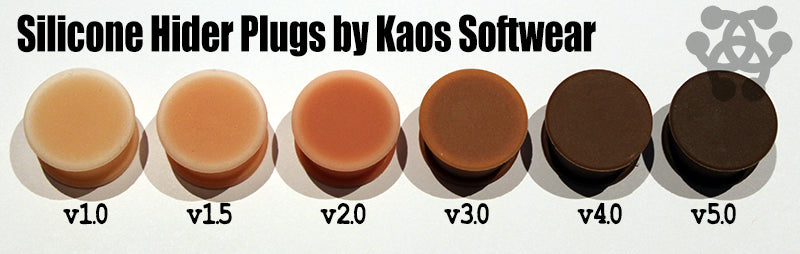
<p><a href="https://tulsabodyjewelry.com/products/silicone-hider-plugs-kaos-softwear">Kaos hider plugs</a> are identical to hollow plugs except they come in size different flesh tones. It was a happy day when we first received these here at the shop. I always felt awkward that we had only a selection of (generic silicone) caucasian hiders, but that was all we could find at the time. The come in 6 different flesh tones from 10g up to one inch and a wearable area of 3/8". I really wish they'd make these up to 1-1/2" or maybe 2"!</p>
<p> </p>
<p><img src="//cdn.shopify.com/s/files/1/0615/1873/files/kaos-softwear-hr-clear_small.jpg?v=1505409294" alt="Clear Kaos Heart Retainer"><img src="//cdn.shopify.com/s/files/1/0615/1873/files/Kaos-Softwear-Heart-Retainer_small.jpg?v=1505408673" alt="Light Kaos Heart Retainer"><img src="//cdn.shopify.com/s/files/1/0615/1873/files/kaos-softwear-hr-v5_small.jpg?v=1505409307" alt="Dark Kaos Heart Retainer"></p>
<h3><strong>Heart Retainers</strong></h3>
<p>The new <a href="https://tulsabodyjewelry.com/products/silicone-heart-retainer-by-kaos-softwear">Kaos heart retainers</a> may be the biggest innovation in body piercing retainers ever. It takes a minute to wrap one's head around the process of inserting one of these things, but it should be doable with a little practice. These are the ultimate retainer for athletics, but do an amazing job of blending in at work or school. Heart retainers are available in clear or choice of six flesh tone colors.</p>
<p> </p>
<p> </p>
<div style="text-align: center;">
<a href="https://tulsabodyjewelry.com/collections/kaos-softwear" style="color: #0000ff; text-decoration: underline;">Shop our complete selection of Kaos Softwear Body Jewelry</a>
<p> </p>
<a href="https://www.kaossoftwear.com/" style="color: #0000ff; text-decoration: underline;" target="_blank" title="Kaos Softwear Body Jewelry" rel="noopener noreferrer">Kaos Softwear Official Website</a>
</div>]]>
    </content>
  </entry>
  <entry>
    <id>https://tulsabodyjewelry.com/blogs/news/body-piercing-troubleshooting</id>
    <published>2017-05-11T08:13:00-05:00</published>
    <updated>2021-03-03T10:51:03-06:00</updated>
    <link rel="alternate" type="text/html" href="https://tulsabodyjewelry.com/blogs/news/body-piercing-troubleshooting"/>
    <title>Body Piercing Troubleshooting for You and Your Healthcare Professional</title>
    <author>
      <name>Brett Barnard</name>
    </author>
    <content type="html">
      <![CDATA[<p><strong>For the Piercee: Choosing a Medical Professional</strong></p>
<p>Medical personnel have tremendous knowledge of the human body but often do not have specific training about this unique form of body art. As a piercee, you may have more information about the suggested care and maintenance of piercings than they do. It is up to you to make certain that your chosen medical professional has access to facts that will facilitate your treatment. To save yourself from a bad experience, ask the following questions before settling on a doctor or other practitioner. Is this healthcare professional:</p>
<ul>
<li>Accepting of body piercings?</li>
<li>Experienced in treating problem piercings?</li>
<li>Willing to consult with a trusted expert body piercer, or seek other resources for information about piercing?</li>
</ul>
<p> </p>
<p><strong>For the Piercee: When to See a Doctor</strong></p>
<p>If you experience a problem that is beyond the scope of your piercer, the following facts can assist you and your healthcare provider in decision-making about the best care and treatment.</p>
<ul>
<li>Visit a doctor immediately if you have problems with your piercing and you:</li>
<li>Experience severe redness, swelling, or pain from the piercing</li>
<li>Have a large amount of discharge that is thick, green, yellow, or gray and smells bad</li>
<li>Have red streaks coming from from the piercing site</li>
<li>Take steroids or have a chronic illness or other health condition</li>
<li>Have symptoms that last for a week or get worse</li>
<li>Experience fever, chills, nausea, vomiting, dizziness, or disorientation</li>
</ul>
<p> </p>
<p><strong>For the Piercee and the Medical Professional:</strong></p>
<p><strong>Important Piercing Facts</strong></p>
<ul>
<li>When piercings are properly performed and cared for, complications such as irritation or allergy are far more common than infection.</li>
<li>Even momentary removal of jewelry from a piercing can result in rapid closure of the channel, and make reinsertion difficult or impossible.</li>
<li>Simply taking out the jewelry may not resolve the problem, and if an infection is present, removal can lead to a more serious problem--the formation of an abscess.</li>
<li>Most piercing complications can be handled without the piercing being lost.</li>
<li>Changing aftercare and/or jewelry size, style, or material often resolves problems.</li>
</ul>
<p> </p>
<p><strong>Inappropriate Aftercare is One of the Most Common Causes of a Distressed Piercing:</strong></p>
<ul>
<li>Alcohol, hydrogen peroxide, Betadine, Hibiclens, harsh soaps, and/or ointment(s) are not appropriate products for the care of a healing ear or body piercing.</li>
<li>Over-cleaning and using strong products can irritate piercings and delay healing.</li>
<li>Mild, non-iodized sea-salt or normal saline soaks and/or cleaning with a liquid anti-microbial or germicidal soap once or twice a day is suggested for body piercings.*</li>
<li>Rinsing with mild non-iodized sea salt and/or antimicrobial or antibacterial alcohol-free mouthwash, 4-5 times a day is suggested for oral piercings.*</li>
</ul>
<p> </p>
<p><strong>Normal Healing Piercings May Have the Following Characteristics:</strong></p>
<ul>
<li>Discoloration: reddish, brownish, pinkish, or purplish; can remain for many months on navel, surface, and other piercings.</li>
<li>Swelling/Induration: localized; may be significant with oral piercings such as the lip or tongue, and usually lasts for several days following the initial piercing.</li>
<li>Excretion: exudate of interstitial fluid, dead cells, etc. that forms a small amount of crystalline-appearing crust at the openings of the piercing; should not be copious, malodorous, or green.</li>
</ul>
<p> </p>
<p><strong>Ointments are Not Preferred for Topical Treatment of Piercings:</strong></p>
<ul>
<li>They are occlusive and limit oxygen circulation to the area, which can delay healing of this type of wound.</li>
<li>They leave a sticky residue that makes cleaning the healing tissue more difficult.</li>
<li>If necessary, gels, creams, or other water-soluble products are preferred for topical application.</li>
</ul>
<p> </p>
<p><strong>Migration/Rejection</strong></p>
<p>If the jewelry moves closer to the surface or the tissue gets narrower between the openings of a piercing, this is termed “migration.” If the piercing migrates past a point of remaining viable or comes all the way to the surface, this is termed “rejection.” For safety and longevity, a piercing should have at least 5/16” inch (almost 8 mm) of tissue between the entrance and exit holes. A body piercing should be abandoned if the tissue between the entry and exit progressively gets smaller or thinner over time plus any of the following:</p>
<ul>
<li>The skin between the openings is flaking or peeling, red or inflamed, and/or hard and calloused-looking</li>
<li>There is 1/4” of tissue or less between the openings</li>
<li>Just a thin filament of nearly transparent tissue is left, and the jewelry can be seen through the skin</li>
</ul>
<p> </p>
<p><strong>For the Medical Professional: Troubleshooting Piercing Problems</strong></p>
<p>A piercing is a unique type of wound because it is intentional, and healing must take place around a foreign object. This information is intended to familiarize you with piercing complications you might encounter, and the treatments found to be most efficacious.</p>
<p> </p>
<p><strong>IN THE EVENT THAT YOU DIAGNOSE A LOCALIZED PIERCING INFECTION:</strong></p>
<ul>
<li>Important: removing jewelry in the presence of an infection may result in an abscess. Quality body jewelry or a retainer of an appropriate size, style, and material should be left in place so the infection can drain</li>
<li>Isotonic saline soaks and/or hot compresses can encourage drainage</li>
<li>Bactroban (Mupirocin) cream or gel (not ointment) has been found to be effective for topical treatment of bacterial infections</li>
</ul>
<p> </p>
<p><strong>CONTACT DERMATITIS — METAL ALLERGY OR PRODUCT SENSITIVITY</strong></p>
<p>A skin sensitivity or allergy can be induced by a cleaning product or inferior jewelry that contains too much nickel or other irritating alloy</p>
<p>SYMPTOMS:</p>
<ul>
<li>Red, itchy rash surrounds the piercing or covers a large area (up to several inches away)</li>
<li>The opening to the piercing may appear significantly larger than the size of the jewelry</li>
<li>Tenderness, though sometimes there is no discomfort</li>
<li>Skin eruptions below the piercing (where soap suds run during bathing) clearly demonstrate contact dermatitis caused by a cleaning product</li>
</ul>
<p>TREATMENT:</p>
<ul>
<li>Topical or oral benadryl or other antihistamine</li>
<li>Advise a change to a different jewelry material such as titanium, if nickel sensitivity is suspected, or an approved inert plastic. See the APP brochure: Jewelry for Initial Piercings.</li>
<li>Discontinue current care regimen in favor of a milder cleaning product</li>
</ul>
<p> </p>
<p><strong>"LOCALIZED PIERCING PIMPLE"</strong></p>
<p>A single pustule occurs adjacent a piercing—often in a recurrent cycle</p>
<p>SYMPTOMS:</p>
<ul>
<li>Small, slightly elevated pustule</li>
<li>Red and inflamed, but contained locally</li>
<li>May be tender, itch, or burn, though some are painless</li>
<li>Secretes pus and/or blood when drained or popped</li>
</ul>
<p>TREATMENT:</p>
<ul>
<li>Treat as a minor localized infection</li>
<li>Over-the-counter antihistamines can diminish itching and inflammation</li>
<li>Warm saline soaks or hot compresses several times daily; these should be continued daily for two weeks after the problem seems resolved</li>
<li>Light localized massage may help break up the pocket and prevent it from refilling</li>
<li>If recurrences continue, a culture may be needed to identify the invading microorganism so you can prescribe medication to target the problem</li>
</ul>
<p> </p>
<p><strong>HYPERGRANULATION TISSUE</strong></p>
<p>Excess granulation tissue is most common on piercings of navels, nostrils, outer labia, and the mucosal surface of lips--though it may also occur on other piercings <strong>TREATMENT:</strong></p>
<ul>
<li>The same treatments used on infants’ umbilical granulomas may be used for piercing-related hypergranulation tissue: silver nitrate, electrocautery, or liquid nitrogen; a ligature technique can be used if the lesion is pedunculated</li>
<li>Some affected piercings do heal successfully, but if the problem proves intractable after treatment, the piercing should be abandoned</li>
</ul>
<p> </p>
<p><strong>COMPOUNDED PROBLEMS:</strong></p>
<p>Any one of the above problems can make additional or secondary problems more likely; i.e. an allergic reaction to a particular jewelry material or care product can make a piercee more vulnerable to secondary infection. Multiple causes are sometimes responsible for complications; i.e. ill-fitting jewelry and poor aftercare. In addition, overall health and stress levels can impact the healing process and should be evaluated and dealt with as a potential cause for piercing complications.</p>
<p> </p>
<p><strong>Piercings and X-rays, MRIs, and CAT Scans</strong></p>
<ul>
<li>Metal body jewelry will result in an opaque density on MRI and x-ray, but will not otherwise affect visibility on film</li>
<li>Metal body jewelry causes visible interference and should be removed for CAT scans if in the area of examination</li>
<li>Nipple piercings are unlikely to obstruct visibility of pathology on thoracic x-rays if both AP (or PA) and lateral views are taken</li>
<li>Appropriate body jewelry is non-magnetic, and as such does not need to be removed for MRI procedures unless it is located in the region being examined (use a strong hand-magnet to test)</li>
<li>Even momentary removal of jewelry from a piercing can result in amazingly rapid closure of the channel, and make reinsertion difficult or impossible</li>
<li>Non-metallic retainers can often be used to safeguard the patency of a piercing; sterile tubing from a catheter needle can be used as an emergency retainer</li>
<li>*Please refer to the APP brochures: <a href="https://tulsabodyjewelry.com/blogs/news/aftercare-for-body-piercings">Aftercare Guidelines for Body Piercings</a> (or <a href="https://tulsabodyjewelry.com/blogs/news/aftercare-for-oral-piercings">Oral Piercings</a>) for detailed information on the suggested care of healing piercings.</li>
</ul>
<p> </p>
<p><strong>Disclaimer:</strong> The suggestions contained in this brochure are not to be considered a substitute for medical advice from a doctor; they are simply intended to assist you and your healthcare provider in troubleshooting problematic piercings. The information is based on a combination of vast professional experience, common sense, research, and extensive clinical practice, along with input from piercing-friendly medical professionals. Your local piercer may be able to refer you to a piercing-friendly medical professional if necessary. Use of this brochure does not imply membership in the APP. A current list of APP members can be found at safepiercing.org. False claims of membership should be reported to the APP.</p>
<p> </p>
<p>*Information in this brochure is provided by the <a href="https://www.safepiercing.org/publications/brochures/body-aftercare/">Association of Professional Piercers</a>.</p>
<p>**Tulsa Body Jewelry is not an APP member.</p>]]>
    </content>
  </entry>
  <entry>
    <id>https://tulsabodyjewelry.com/blogs/news/aftercare-for-oral-piercings</id>
    <published>2017-05-10T23:37:00-05:00</published>
    <updated>2021-03-03T10:51:08-06:00</updated>
    <link rel="alternate" type="text/html" href="https://tulsabodyjewelry.com/blogs/news/aftercare-for-oral-piercings"/>
    <title>Suggested Aftercare for Oral Piercings</title>
    <author>
      <name>Bold Apps</name>
    </author>
    <content type="html">
      <![CDATA[<p><strong>CLEANING SOLUTIONS</strong></p>
<p>Use one or both of the following solutions for inside the mouth:</p>
<ul>
<li>Antimicrobial or antibacterial alcohol-free mouth rinse.</li>
<li>Packaged sterile saline solution with no additives (read the label) or non-iodized sea salt mixture: Dissolve 1/8 to 1/4 teaspoon of non-iodized (iodine free) sea salt into one cup (8 oz) of warm distilled or bottled water. A stronger mixture is <strong>not</strong> better. Saline solution that is too strong can irritate your piercing. (If you have high blood pressure or a heart condition, please check with your doctor before using a saline product as your primary cleaning solution.)</li>
</ul>
<p>(Consult your piercer, the APP website, or call (888) 888-APP for current suggested products.)</p>
<p> </p>
<p><strong>CLEANING INSTRUCTIONS FOR INSIDE THE MOUTH</strong></p>
<p>Rinse mouth with cleaning solution for 30 seconds after meals and at bedtime (4-5 times daily) during the entire healing period. Cleaning too often or with too strong a rinse can cause discoloration and irritation of your mouth and piercing.</p>
<p> </p>
<p><strong>CLEANING INSTRUCTIONS FOR THE EXTERIOR OF LABRET (CHEEK AND LIP) PIERCINGS</strong></p>
<p>Soak in saline solution and/or wash in mild, fragrance-free liquid soap-preferably anti-microbial or germicidal.</p>
<ul>
<li>
<strong>WASH</strong> your hands thoroughly prior to cleaning or touching your piercing for any reason.</li>
<li>
<strong>SALINE</strong> soak at least two to three times daily. Simply soak directly in a cup of warm saline solution for five to ten minutes. For certain placements it may be easier to apply using clean gauze saturated with saline solution. A brief rinse afterward will remove any residue.</li>
<li>
<strong>SOAP</strong> no more than once or twice a day. While showering, lather up a pearl size drop of the soap to clean the jewelry and the piercing. Leave the cleanser on the piercing no more than thirty seconds.</li>
<li>
<strong>RINSE </strong>thoroughly to remove all traces of the soap from the piercing. It is not necessary to rotate the jewelry through the piercing.</li>
<li>
<strong>DRY</strong> by gently patting with clean, disposable paper products. Cloth towels can harbor bacteria and snag on jewelry, causing injury.</li>
</ul>
<p> </p>
<p><strong>WHAT IS NORMAL?</strong></p>
<ul>
<li>For the first three to five days: significant swelling, light bleeding, bruising, and/or tenderness.</li>
<li>After that: Some swelling, light secretion of a whitish yellow fluid (not pus).</li>
<li>A piercing may seem healed before the healing process is complete. This is because they heal from the outside in, and although it feels fine, the tissue remains fragile on the inside. <strong>Be patient</strong>, and keep cleaning throughout the entire healing period.</li>
<li>Even healed piercings can shrink or close in minutes after having been there for years! This varies from person to person; if you like your piercing, keep jewelry in-do not leave the hole empty.</li>
</ul>
<p> </p>
<p><strong>WHAT TO DO</strong></p>
<p><em>TO HELP REDUCE SWELLING:</em></p>
<ul>
<li>Allow small pieces of ice to dissolve in the mouth.</li>
<li>Take an over the counter, non-steroidal anti-inflammatory such as ibuprofen or naproxen sodium according to package instructions.</li>
<li>Don’t speak or move your jewelry more than necessary.</li>
<li>Sleep with your head elevated above your heart during the first few nights.</li>
</ul>
<p><em>TO MAINTAIN GOOD ORAL HYGIENE:</em></p>
<ul>
<li>Use a new soft-bristled toothbrush and store it in a clean area away from other toothbrushes.</li>
<li>Brush your teeth and use your chosen rinse (saline or mouthwash) after every meal.</li>
<li>During healing floss daily, and gently brush your teeth, tongue and jewelry. Once healed, brush the jewelry more thoroughly to avoid plaque build up.</li>
</ul>
<p><em>TO STAY HEALTHY:</em></p>
<ul>
<li>The healthier your lifestyle, the easier it will be for your piercing to heal.</li>
<li>Get enough sleep and eat a nutritious diet.</li>
<li>Avoid emotional stress, which can increase healing times by up to 40%.</li>
<li>To help healing and bolster your ability to fight infection, take nutritional supplements daily, including iron, B vitamins, 1,000-5,000 mg of vitamin C (divided into a few equal doses throughout the day), and 30 mg of inc for women (50 mg for men).</li>
</ul>
<p> </p>
<p><strong>ORAL PIERCING HINTS AND TIPS</strong></p>
<p><em>JEWELRY:</em></p>
<ul>
<li>Once the swelling has subsided, it is <strong>vital</strong> to replace the original, longer jewelry with a shorter post to avoid intra-oral damage. Consult your piercer for their downsize policy.</li>
<li>Because this necessary jewelry change often occurs during healing, it should be done by a qualified piercer.</li>
<li>With clean hands or paper product, be sure to regularly check threaded ends on your jewelry for tightness (“Righty-tighty, lefty-loosey.”)</li>
<li>Carry a clean spare ball in case of loss or breakage.</li>
<li>Contact your piercer for a non-metallic jewelry alternative if your metal jewelry must be temporarily removes (such as for a medical procedure).</li>
<li>Should you decide you no longer want the piercing, simply remove the jewelry (or have a professional piercer remove it) and continue cleaning the piercing until the hole closes. In most cases only a small mark will remain.</li>
<li>In the even an infection is suspected, quality jewelry or an inert alternative should be left in place to allow for drainage or the infection. Should the jewelry be removed, the surface cells can close up sealing the infection inside the piercing channel, resulting in an abcess. Until an infection is cleared up, the the jewelry in!</li>
</ul>
<p><em>EATING:</em></p>
<ul>
<li>Slowly eat small bites of food placed directly onto your molars.</li>
<li>Avoid eating spicy, salty, acidic, or hot temperature foods or beverages for a few days.</li>
<li>Cold foods and beverages are soothing and help reduce swelling.</li>
<li>Foods like mashed potatoes and oatmeal are hard to eat because they stick to your mouth and jewelry.</li>
<li>For tongue piercing, try to keep your tongue level in your mouth as you eat because the jewelry can get between your teeth when your tongue turns.</li>
<li>For labret (cheek and lip) piercings: be cautious about opening your mouth too wide as this can result in the jewelry catching on your teeth.</li>
<li>Each body is unique and healing times vary considerably. If you have any questions, please contact your piercer.</li>
</ul>
<p> </p>
<p><strong>WHAT TO AVOID</strong></p>
<ul>
<li>
<strong>Do not play with your jewelry.</strong> Long term effects include permanent damage to teeth, gums, and other oral structures. See the APP’s Brochure: <em>Oral Piercing Risks and Safety Measures</em> for more information.</li>
<li>Avoid undue trauma; excessive talking or playing with the jewelry during healing can cause the formation of unsightly and uncomfortable scar tissue, migration, and other complications.</li>
<li>Avoid using mouthwash containing alcohol. It can irritate the piercing and delay healing.</li>
<li>Avoid oral sexual contact including French (wet) kissing or oral sex during healing (even with a long-term partner).</li>
<li>Avoid chewing on tobacco, gum, fingernails, pencils, sunglasses, and other foreign objects that could harbor bacteria.</li>
<li>Avoid sharing plates, cups, and eating utensils.</li>
<li>Avoid smoking! It increases risks and lengthens healing time.</li>
<li>Avoid stress and all recreational drug use.</li>
<li>Avoid aspirin, alcohol, and large amounts of caffeine as long as you are experiencing bleeding or swelling.</li>
<li>Avoid submerging healing piercings in bodies of water such as lakes, pools, etc.</li>
</ul>
<p>Each body is unique and healing times vary considerably. If you have any questions, please contact your piercer.</p>
<p> </p>
<p><strong>* DISCLAIMER:</strong></p>
<p>These guidelines are based on a combination of vast professional experience, common sense, research and extensive clinical practice. This is not to be considered a substitute for medical advice from a doctor. If you suspect an infection, seek medical attention. Be aware that many doctors have not received specific training regarding piercing. Your local piercer may be able to refer you to a piercing-friendly medical professional. For more information, see the APP Brochure <a href="https://tulsabodyjewelry.com/blogs/news/body-piercing-troubleshooting">Troubleshooting For You and Your Healthcare Professional</a>.</p>
<p> </p>
<p>*Information in this brochure is provided by the <a href="https://www.safepiercing.org/publications/brochures/oral-aftercare/">Association of Professional Piercers</a>.</p>
<p>**Tulsa Body Jewelry is not an APP member.</p>]]>
    </content>
  </entry>
  <entry>
    <id>https://tulsabodyjewelry.com/blogs/news/aftercare-for-body-piercings</id>
    <published>2017-05-10T22:22:00-05:00</published>
    <updated>2021-03-03T10:51:12-06:00</updated>
    <link rel="alternate" type="text/html" href="https://tulsabodyjewelry.com/blogs/news/aftercare-for-body-piercings"/>
    <title>Suggested Aftercare Guidelines for Body Piercings</title>
    <author>
      <name>Brett Barnard</name>
    </author>
    <content type="html">
      <![CDATA[<p><strong>CLEANING SOLUTIONS</strong></p>
<p>Use one or both of the following solutions for healing piercings:</p>
<ul>
<li>Packaged sterile saline (with no additives, read the label) is a gentle choice for piercing aftercare. Saline for contact lenses should not be used as piercing aftercare. Wound wash saline is available as a spray at pharmacies throughout North America.</li>
<li>Sea salt mixture: Dissolve 1/8 to 1/4 teaspoon (.75 to 1.42 grams) of non-iodized (iodine-free) sea salt into one cup (8 oz / 250 ml) of warm distilled or bottled water. A stronger mixture is not better; a saline solution that is too strong can irritate the piercing.</li>
</ul>
<p> </p>
<p><strong>CLEANING INSTRUCTIONS FOR BODY PIERCINGS</strong></p>
<ul>
<li>WASH your hands thoroughly prior to cleaning or touching your piercing for any reason.</li>
<li>SALINE soak for five to ten minutes once or more per day. Invert a cup of warm saline solution over the area to form a vacuum. For certain piercings it may be easier to apply using clean gauze or paper towels saturated with saline solution.</li>
<li>If your piercer suggests using soap, gently lather around the piercing and rinse as needed. Avoid using harsh soaps, or soaps with dyes, fragrances, or triclosan.</li>
<li>RINSE thoroughly to remove all traces of the soap from the piercing. It is not necessary to rotate the jewelry through the piercing.</li>
<li>DRY by gently patting with clean, disposable paper products. Cloth towels can harbor bacteria and snag on jewelry, causing injury.</li>
</ul>
<p> </p>
<p><strong>WHAT IS NORMAL?</strong></p>
<ul>
<li>Initially: some bleeding, localized swelling, tenderness, or bruising.</li>
<li>During healing: some discoloration, itching, secretion of a whitish-yellow fluid (not pus) that will form some crust on the jewelry. The tissue may tighten around the jewelry as it heals.</li>
<li>Once healed: the jewelry may not move freely in the piercing; do not force it. If you fail to include cleaning your piercing as part of your daily hygiene routine, normal but smelly bodily secretions may accumulate.</li>
<li>A piercing may seem healed before the healing process is complete. This is because tissue heals from the outside in, and although it feels fine, the interior remains fragile. Be patient, and keep cleaning throughout the entire healing period.</li>
<li>Even healed piercings can shrink or close in minutes after having been there for years! This varies from person to person; if you like your piercing, keep jewelry in—do not leave it empty.</li>
</ul>
<p> </p>
<p><strong>WHAT TO DO</strong></p>
<ul>
<li>Wash your hands prior to touching the piercing; leave it alone except when cleaning. During healing, it is not necessary to rotate your jewelry.</li>
<li>Stay healthy; the healthier your lifestyle, the easier it will be for your piercing to heal. Get enough sleep and eat a nutritious diet. Exercise during healing is fine; listen to your body.</li>
<li>Make sure your bedding is washed and changed regularly. Wear clean, comfortable, breathable clothing that protects your piercing while you are sleeping.</li>
<li>Showers tend to be safer than taking baths, as bathtubs can harbor bacteria. If you bathe in a tub, clean it well before each use and rinse off your piercing when you get out.</li>
</ul>
<p> </p>
<p><strong>WHAT TO AVOID</strong></p>
<ul>
<li>Avoid moving jewelry in an unhealed piercing, or picking away dried discharge with your fingers.</li>
<li>Avoid cleaning with Betadine®, Hibiciens®, alcohol, hydrogen peroxide, Dial® or other soaps containing triclosan, as these can damage cells. Also avoid ointments as they prevent necessary air circulation. Click here to download information on triclosan dangers</li>
<li>Avoid Bactine®, pierced ear care solutions and other products containing Benzalkonium Chloride (BZK). These can be irritating and are not intended for long term wound care.</li>
<li>Avoid over-cleaning. This can delay your healing and irritate your piercing.</li>
<li>Avoid undue trauma such as friction from clothing, excessive motion of the area, playing with the jewelry, and vigorous cleaning. These activities can cause the formation of unsightly and uncomfortable scar tissue, migration, prolonged healing, and other complications.</li>
<li>Avoid all oral contact, rough play, and contact with others’ bodily fluids on or near your piercing during healing.</li>
<li>Avoid stress and recreational drug use, including excessive caffeine, nicotine, and alcohol.</li>
<li>Avoid submerging the piercing in unhygenic bodies of water such as lakes, pools, hot tubs, etc. Or, protect your piercing using a waterproof wound-sealant bandage (such as 3M™ Nexcare™ Clean Seals). These are available at most drugstores.</li>
<li>Avoid all beauty and personal care products on or around the piercing including cosmetics, lotions, and sprays, etc.</li>
<li>Don’t hang charms or any object from your jewelry until the piercing is fully healed.</li>
</ul>
<p> </p>
<p><strong>HINTS AND TIPS</strong></p>
<p><strong>JEWELRY:</strong></p>
<ul>
<li>Unless there is a problem with the size, style, or material of the initial jewelry, leave it in the place for the entire healing period. See a qualified piercer to perform any jewelry change that becomes necessary during healing. See the APP website to locate an APP member, or to request a copy of our Picking Your Piercer brochure.)</li>
<li>Contact your piercer if your jewelry must be removed (such as for a medical procedure). There are non-metallic jewelry alternatives available.</li>
<li>Leave jewelry in at all times. Even old or well-healed piercing can shrink or close in minutes even after having been there for years. If removed, re-insertion can be difficult or impossible.</li>
<li>With clean hands or paper product, be sure to regularly check threaded ends on your jewelry for tightness. (“Righty-tighty, lefty-loosey.”)</li>
<li>Should you decide you no longer want the piercing, simply remove the jewelry (or have a professional piercer remove it) and continue cleaning the piercing until the hole closes. In most cases only a small mark will remain.</li>
<li>In the event an infection is suspected, quality jewelry or an inert alternative should be left in place to allow for drainage of the infection. If the jewelry is removed, the surface cells can close up, which can seal the infection inside the piercing channel and result in an abscess. Do not remove jewelry unless instructed to by a medical professional.</li>
</ul>
<p> </p>
<p><strong>FOR PARTICULAR AREAS</strong></p>
<p><strong>NAVEL:</strong></p>
<ul>
<li>A hard, vented eye patch (sold at pharmacies) can be applied under tight clothing (such as nylon stockings) or secured using a length of Ace® bandage around the body (to avoid irritation from adhesive). This can protect the area from restrictive clothing, excess irritation, and impact during physical activities such as contact sports.</li>
</ul>
<p> </p>
<p><strong>EAR/EAR CARTILAGE AND FACIAL:</strong></p>
<ul>
<li>Use the t-shirt trick: Dress your pillow in a large, clean t-shirt and turn it nightly; one clean t-shirt provides four clean surfaces for sleeping.</li>
<li>Maintain cleanliness of telephones, headphones, eyeglasses, helmets, hats, and anything that contacts the pierced area.</li>
<li>Use caution when styling your hair and advise your stylist of a new or healing piercing.</li>
</ul>
<p> </p>
<p><strong>NIPPLES:</strong></p>
<ul>
<li>The support of a tight cotton shirt or sports bra may provide protection and feel comfortable, especially for sleeping.</li>
</ul>
<p> </p>
<p><strong>GENITAL:</strong></p>
<ul>
<li>Genital Piercings—especially Prince Alberts, Ampallangs, and Apadravyas—can bleed freely for the first few days. Be prepared.</li>
<li>Urinate after using soap to clean any piercing that is near the urethra.</li>
<li>Wash your hands before touching on (or near) a healing piercing.</li>
<li>In most cases you can engage in sexual activity as soon as you feel ready, but maintaining hygiene and avoiding trauma are vital; all sexual activities should be gentle during the healing period.</li>
<li>Use barriers such as condoms, dental dams, and waterproof bandages, etc. to avoid contact with your partners’ body fluids, even in monogamous relationships.</li>
<li>Use clean, disposable barriers on sex toys.</li>
<li>Use a new container of water-based lubricant; do not use saliva.</li>
<li>After sex, an additional saline soak or clean water rinse is suggested.</li>
<li>Each body is unique and healing times vary considerably. If you have any questions, please contact your piercer.</li>
</ul>
<p> </p>
<p><strong>* DISCLAIMER:</strong></p>
<p>These guidelines are based on a combination of vast professional experience, common sense, research and extensive clinical practice. This is not to be considered a substitute for medical advice from a doctor. If you suspect an infection, seek medical attention. Be aware that many doctors have not received specific training regarding piercing. Your local piercer may be able to refer you to a piercing-friendly medical professional. For more information, see the APP Brochure <a href="https://tulsabodyjewelry.com/blogs/news/body-piercing-troubleshooting">Troubleshooting For You and Your Healthcare Professional</a>.</p>
<p> </p>
<p>*Information in this brochure is provided by the <a href="https://www.safepiercing.org/publications/brochures/body-aftercare/">Association of Professional Piercers</a>.</p>
<p>**Tulsa Body Jewelry is not an APP member.</p>]]>
    </content>
  </entry>
  <entry>
    <id>https://tulsabodyjewelry.com/blogs/news/threadless-body-jewelry-neometal</id>
    <published>2016-11-08T23:05:00-06:00</published>
    <updated>2021-03-03T10:51:19-06:00</updated>
    <link rel="alternate" type="text/html" href="https://tulsabodyjewelry.com/blogs/news/threadless-body-jewelry-neometal"/>
    <title>NeoMetal Threadless Body Jewelry</title>
    <author>
      <name>Brett Barnard</name>
    </author>
    <content type="html">
      <![CDATA[<img alt="NeoMetal Body Jewelry" src="//cdn.shopify.com/s/files/1/0615/1873/files/NeoMetal-Body-Jewelry_compact.jpg?v=1485023214" style="float: right; margin: 8px 0px 0px 15px;">Do your piercings have a metal sensitivity (nickel allergy), but gold is too expensive or just not your style?  Are you tired of losing and replacing the same jewelry over and over again?  Do you have trouble remembering the correct gauge for your piercings?  Consider Neometal.
<div dir="ltr"></div>
<p dir="ltr"><span>Here are just some of the good things about NeoMetal Jewelry:</span></p>
<div dir="ltr"></div>
<ul>
<li dir="ltr">Made out of solid implant-grade titanium (That means it’s nonallergenic and more durable than gold)</li>
<li dir="ltr">Made with SWAROVSKI cubic zirconia and other high-quality synthetic gems &amp; opals</li>
<li dir="ltr">“Snap-together” threadless system (The top can’t come unscrewed; harder to lose)</li>
<li dir="ltr">Guaranteed for life against any defects</li>
</ul>
<div dir="ltr"></div>
<p dir="ltr"><span>Many people think they can only wear gold if they have sensitive skin.  Not only is gold expensive, it’s also soft and over time it may become scratched or the threads may wear out.  Because NeoMetal Jewelry uses implant-grade titanium, it is built to last forever.  This could just be the last barbell you ever buy!  Titanium is exceptionally strong and durable.  Implant-grade means that it is safe for permanent body implantation, as in a hip or knee joint replacement.  Their gems, opals, and stones are crimp-set in the same implant-grade titanium, which means no glue and no losing the gem, ever!  This jewelry comes with a lifetime guarantee.</span></p>
<p dir="ltr"> </p>
<div style="text-align: center;">
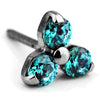
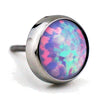
<img src="//cdn.shopify.com/s/files/1/0615/1873/files/NeoMetal-16g-Prong-CZ-Emerald_small.jpg?v=1485024132" alt="NeoMetal Prong Emerald"><img src="//cdn.shopify.com/s/files/1/0615/1873/files/NeoMetal-Trinity_small.jpg?v=1485024188" alt="NeoMetal Trinity Mint Green"><img src="//cdn.shopify.com/s/files/1/0615/1873/files/NeoMetal-BOP-Purple_small.jpg?v=1485024257" alt="NeoMetal Bezel Opal Purple">
</div>
<p> </p>
<div dir="ltr"></div>
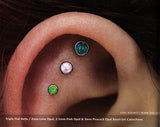
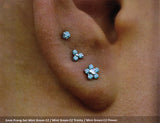
<p dir="ltr"><span><img src="//cdn.shopify.com/s/files/1/0615/1873/files/Opal-Triple-Flat-Helix-NeoMetal_compact.jpg?v=1485024578" alt="Opal Triple Flat Helix" style="float: right; margin: 8px 0px 0px 15px;">Our favorite part about NeoMetal Jewelry has to be the universality of the tops.  No matter if your piercing is 18g or 14g, they all use the same tops.  So, the bases may be different gauges, but they all accept the same type of tops.  Normally, you would have to purchase tops according to the gauge of the barbell and the type of threading (internal vs. external), but with Neometal Jewelry you have the flexibility to use the exact same type of Neometal top(s) for every piercing.  </span></p>
<div dir="ltr"></div>
<p dir="ltr"><span>With normal threaded jewelry, there is always the likelihood that the top may come unscrewed from its base.  Threads can become stripped and inevitably will need to be replaced.  With NeoMetal threadless jewelry, your parts don’t come loose accidentally.</span></p>
<div dir="ltr"></div>
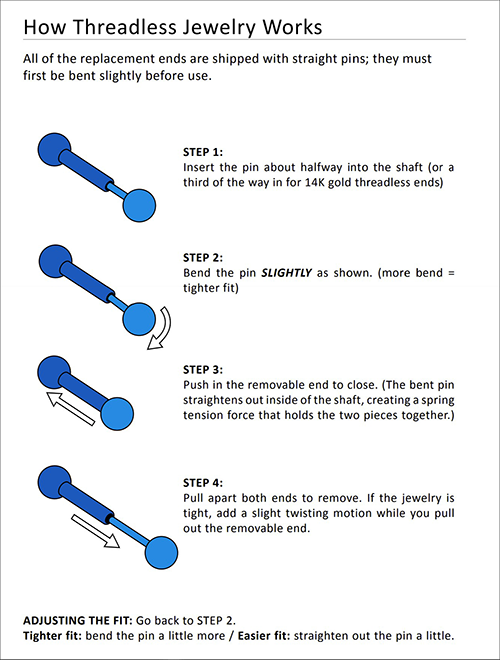
<p dir="ltr"><span><img src="//cdn.shopify.com/s/files/1/0615/1873/files/CZ-Trinity-Ends-NeoMetal_compact.jpg?v=1485025048" alt="Opal Triple Flat Helix" style="float: left; margin: 8px 15px 0px 0px;">Slightly bending the pin on a Neometal top creates tension when the top is pushed into the base.  The tension of forcing the not-quite-straight pin into the barrel of the hollow barbell is what keeps your jewelry in place.  The pins are adjustable, so you can determine how easily the top comes out of its base.  If you’re the type to stick to one piece of jewelry for a long period of time, you can make the bend more angled to create more tension when putting the jewelry together.  If you want the freedom to change your tops more frequently, you can make the top easier to remove by straightening out the pin a little.</span></p>
<div dir="ltr"></div>
<p dir="ltr"><span>NeoMetal jewelry requires no tools; just use the barbell itself to bend or straighten the pin by inserting it about halfway into the base and applying pressure.  To remove, just get a good grip on both ends of the barbell and pull apart.  It’s that simple!</span></p>
<div dir="ltr"></div>
<p dir="ltr"> </p>
<div style="text-align: center;">
<a id="instructions"></a><img alt="NeoMetal Body Jewelry Instructions" src="//cdn.shopify.com/s/files/1/0615/1873/files/neometal-instructions.png?v=1507571341" style="float: none;">
</div>
<div style="text-align: center;"></div>
<p dir="ltr"> </p>
<p dir="ltr"> </p>
<div style="text-align: center;">
<a href="https://tulsabodyjewelry.com/collections/neometal" style="color: #0000ff; text-decoration: underline;">Shop our complete selection of NeoMetal Body Jewelry</a>
<p> </p>
<a href="https://www.neometal.com/" style="color: #0000ff; text-decoration: underline;" target="_blank" title="Kaos Softwear Body Jewelry" rel="noopener noreferrer">NeoMetal Official Website</a>
</div>
<p dir="ltr"> </p>]]>
    </content>
  </entry>
  <entry>
    <id>https://tulsabodyjewelry.com/blogs/news/93757190-stretching-methods-for-ear-lobes</id>
    <published>2016-02-19T23:36:00-06:00</published>
    <updated>2021-03-03T10:51:23-06:00</updated>
    <link rel="alternate" type="text/html" href="https://tulsabodyjewelry.com/blogs/news/93757190-stretching-methods-for-ear-lobes"/>
    <title>Stretching Methods for Ear Lobes</title>
    <author>
      <name>Brett Barnard</name>
    </author>
    <content type="html">
      <![CDATA[<p dir="ltr">Before stretching the ear lobe, the skin must be completely healed from piercing.  This typically takes six months to a year.  While in the process of stretching the ear lobe, it is necessary to wait a minimum of one month between small stretches (20g down to 8g) and a minimum of three months for a typical 1mm stretch.  Up to an 8g, the difference between stretches is about 0.5mm.  From an 8g - 2g, the difference is 1mm.  Beyond a 2g the increments double and even triple, but a safe stretch is no more than 1 millimeter at a time. Therefore it is important never to skip sizes when stretching ears, or else the “stretch” turns into a “rip”.  When stretching bigger than a 2g (~6mm), it is important to continue stretching 1mm at a time despite what the next “gauge” size is.</p>
<p dir="ltr"><span>Approaching the jumps from 2g to 0g and 0g to 00g, the difference between sizes increases to two millimeters.  This is why the stretch is often difficult, and almost always results in ripped tissue.  To avoid damaging the ear lobe, it is necessary to use “half sizes” to keep the stretches at one millimeter increments.  The half size between 2g and 0g is 7mm, also known as 1g.  The half size between 0g and 00g is 9mm and is occasionally called 00g.</span></p>
<p dir="ltr"><span>Forcing a stretch too big or too soon will result in a ripped ear lobe.  Even if the lobe is not visibly bleeding, micro-tears on the inside of the lobe occur.  These tiny rips turn into scar tissue, which is tougher than other tissue and more resistant to stretching.  Thus, skipping sizes or stretching too soon is counterproductive, because it will only make it harder to continue to stretch.  </span></p>
<p dir="ltr"> </p>
<p dir="ltr" style="text-align: center;"><strong>Stretching Methods</strong></p>
<p dir="ltr"><strong>Single-flare Glass</strong></p>
<p dir="ltr"><span><span> </span></span><span>Using a single-flare borosilicate glass plug is the safest way to stretch.  Glass is nonporous and therefore ideal for healing lobes.  It can be worn for an unlimited amount of time and will not absorb bacteria.  The rounded back of the plug combined with the smoothness of the glass means that there is no need for a taper; the jewelry will fit if the lobe is ready.</span></p>
<p dir="ltr"> </p>
<p dir="ltr"><a href="http://www.tulsabodyjewelry.com/collections/tapers-and-expanders" title="Tapers &amp; Expanders"><strong>Tapers/Expanders</strong></a></p>
<p dir="ltr"><span><span> </span></span><span>Tapers are a commonly used method of stretching ear lobes.  The taper is a long, cone-shaped tool that gradually expands the hole as it is pushed through.  Professional piercers tend to use threaded expanders to insert jewelry, which are much more gradual and allow for a smooth transition to the new jewelry.  Tapers are available for sale in many materials (acrylic, steel, titanium, glass, etc.).  When used to slowly expand the lobe, tapers can be helpful.  However, tapers are easily misused because they can be forced through the ear lobe and create a tear instead of a stretch.</span></p>
<p dir="ltr"> </p>
<p dir="ltr"><strong>Taping</strong></p>
<p dir="ltr"><span>Another method of stretching is the use of skin-safe or medical grade tape.  The tape is carefully wrapped around the piece of jewelry and (along with lubrication) inserted in the ear lobe.  The jewelry should go in easily and not feel uncomfortably big.  Tape may be added as needed, but as with any method of stretching it is important not to overstretch by taping the jewelry too much.  Because the tape is porous it must be replaced often, perhaps every other day, or else the lobe may be exposed to bacteria.  That means either a new piece of tape can be added, or better yet, the old tape is completely removed from the jewelry and wrapped with fresh tape to the same size it was before.  In order to keep track of how big it is, it either needs to be measured regularly or the number of tape wraps around the jewelry must be kept track of.</span></p>
<p dir="ltr"> </p>
<p dir="ltr"><a href="http://www.tulsabodyjewelry.com/collections/ear-weights" title="Ear Weights"><strong>Weight</strong></a></p>
<p dir="ltr"><span><span> </span></span><span>While wearing heavy jewelry may help stretch out the lobe, the risks of stretching with weight outweigh the small benefit.  Too much weight (or even moderate weight too often) restricts the blood flow throughout the ear lobe.  Restricted blood flow in the ear lobes leads to thinning and in extreme cases tissue death.  Blood flow is essential for healthy, stretchy ear lobes.  When wearing heavy jewelry, it is important to give the lobes a break from the weight to restore blood flow.  It is for this reason that ear weights are ornamental and not meant to be worn all the time.</span></p>
<p dir="ltr"> </p>]]>
    </content>
  </entry>
  <entry>
    <id>https://tulsabodyjewelry.com/blogs/news/ear-piercing-guide-chart</id>
    <published>2016-02-19T22:14:00-06:00</published>
    <updated>2021-11-06T15:12:11-05:00</updated>
    <link rel="alternate" type="text/html" href="https://tulsabodyjewelry.com/blogs/news/ear-piercing-guide-chart"/>
    <title>Ear Piercing Guide &amp; Chart</title>
    <author>
      <name>Brett Barnard</name>
    </author>
    <content type="html">
      <![CDATA[<p dir="ltr" style="text-align: center;"><img src="//cdn.shopify.com/s/files/1/0615/1873/files/blog-ear-cartilage_b2a2cfac-2bfb-4b48-b25c-8b5d488cf46a_large.jpg?10355846998593957373" alt="ear piercing chart"></p>
<p dir="ltr" style="text-align: center;"><strong>-Outer Ear Piercings-</strong></p>
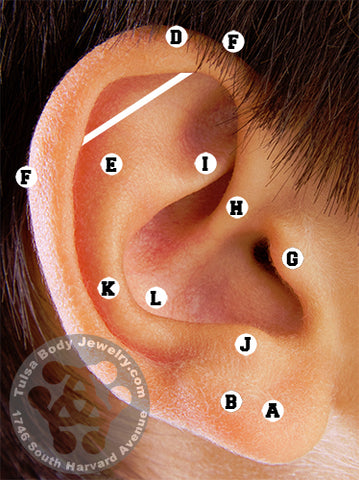
<p dir="ltr"><a href="https://www.tulsabodyjewelry.com/collections/earrings-studs" title="earring studs and hoops"><strong>A. Standard Ear Lobe</strong></a></p>
<p dir="ltr"><span>Despite what most people may think, even your standard ear lobe piercings should be executed by a professional. Often ear lobe piercings are done by amateurs using a painful gun to force a sharpened earring post through the lobe.  The earring posts used in a gun are often made of sterling silver or 14k gold, both of which are considered inappropriate for piercing because they are soft metals and may contain nickel.  Forcing the post through the ear lobe promotes excessive scarring within the lobe as the tissue is traumatized and torn by the force of the gun, and then the post must push aside tissue to make the piercing hole.  </span></p>
<p dir="ltr"><span>When a piercing is done by a professional, a hollow needle is used to gently remove tissue to allow room for the jewelry.  This promotes faster healing with minimal scarring, and is often considered less painful than a piercing gun.  Additionally, professional piercers will use jewelry that is a thicker gauge than a typical earring post.  This promotes faster healing because a thicker gauge will not irritate the healing piercing as much as a thinner gauge would when it is accidentally hit or pulled.  Lastly, a professional piercer can provide you with a cleaning regimen that is appropriate for the piercing while an unlicensed piercer can cause further harm to the piercings by providing you with incorrect aftercare instructions.</span></p>
<p dir="ltr"><span>Standard ear piercings are a 20g or 18g if they were pierced by a gun.  If they were pierced by a professional, the lobe piercing will typically be a 16g or 14g.  After a minimum of two months it is typically safe to change the jewelry, but the piercing may still feel sensitive.  After waiting six months to a year, the earlobe is safe to stretch.</span></p>
<p dir="ltr"> </p>
<p dir="ltr"><a href="https://www.tulsabodyjewelry.com/collections/stud-earrings" title="earring studs and hoops"><strong>B. Upper Ear Lobe</strong></a></p>
<p dir="ltr"><span>Often called “doubles” (as in double-pierced ears), the upper ear lobe piercing is placed just above the standard ear piercing.   It is the same soft tissue as the lower part of the lobe, and above this piercing is where the cartilage of the outer ear begins.</span></p>
<p dir="ltr"> </p>
<p dir="ltr"><strong>C. Orbital</strong></p>
<p dir="ltr"><span>Located just above the upper ear lobe piercing is the orbital.  This is the where the cartilage begins on the outer ear.  The orbital is a unique piercing because it uses one piece of jewelry, typically a captive bead ring, to connect two piercings.  The piercings are vertical on the cartilage so that only one side of the hoop is visible and the other side of the hoop is in the back of the ear.  The jewelry is usually a 16g or 14g.  As with all piercings connected by one piece of jewelry, the healing process can be long and easy to disrupt.  The jewelry may be changed two or three months after being pierced but may not completely heal until around a year.</span></p>
<p dir="ltr"> </p>
<p dir="ltr"><a href="https://www.tulsabodyjewelry.com/collections/helix-piercing-jewelry" title="Helix Piercing Jewelry"><strong>D. Helix</strong></a></p>
<p dir="ltr"><span>The helix is the upper part of the outer cartilage and sits just beneath where the flap of cartilage folds over.  This can also be described as an upper cartilage piercing.  It is commonly pierced at a 16g with a labret or captive bead ring, unless it was pierced with a gun, in which case the piercing will be an 18g or 20g earring post.  The jewelry may be changed two or three months after being pierced but may not completely heal until six months or more.</span></p>
<p dir="ltr"> </p>
<p dir="ltr"><a href="https://www.tulsabodyjewelry.com/collections/outer-conch-piercing-jewelry" title="Outer Conch Piercing Jewelry"><strong>E. Outer Conch</strong></a></p>
<p dir="ltr"><span>The flat area of the outer cartilage is known as the outer conch.  This piercing is either a 16g or 14g.  Because it is closer to the inside of the ear than the helix, it is less common to see a hoop used in this piercing.  More common are labrets, which have a flat disc in the back and some type of ball front.  Hoops used in this piercing would have to be a wide diameter, at least 1/2” or 12-13mm.  The jewelry may be changed two or three months after being pierced but may not completely heal until six months or more.</span></p>
<p dir="ltr"> </p>
<p dir="ltr"><a href="https://www.tulsabodyjewelry.com/collections/industrial-barbells" title="Industrial Piercing Jewelry"><strong>F. Industrial</strong></a></p>
<p dir="ltr"><span>The industrial consists of two piercings, one through the innermost flap of cartilage and one through the outermost area of the flap of cartilage, resulting in a diagonal barbell going across the ear.  Healing is likely to be prolonged if the two piercings are connected by one long straight barbell, however.  The piercings typically heal faster when pierced with separate pieces of jewelry, either captive bead rings or shorter straight barbells.  The straight barbells are most commonly between the lengths of 1 1/4” (32mm) and 1 1/2” (38mm), but every person’s anatomy is different.  Although some piercers use 16g jewelry in these piercings, it is much more common to be a 14g.   It may be safe to change the jewelry in two to four months, but the piercings will likely remain vulnerable for around a year.</span></p>
<p dir="ltr"> </p>
<p dir="ltr" style="text-align: center;"><strong>-Inner Ear Piercings-</strong></p>
<p dir="ltr"><a href="https://www.tulsabodyjewelry.com/collections/tragus-piercing-jewelry" title="tragus piercing jewelry"><strong>G. Tragus</strong></a></p>
<p dir="ltr"><span>The tragus is the cartilage that sticks out in front of the ear canal.  This piercing is most commonly done with a 16g labret which is 3/8” for a new piercing or 5/16” for a healed piercing (or 1/4” for especially thin cartilage).  Alternatively the piercing can be done with a hoop, usually a 16g captive bead ring that is wide to allow for swelling and downsized at a later time.  A hoop for a healed tragus is typically 5/16” in diameter.  The healing process for the tragus piercing can be easily disrupted by using ear buds or q-tips, and for that reason it may take up to six months or more to heal.  Initial jewelry may be changed after two to three months.</span></p>
<p dir="ltr"> </p>
<p dir="ltr"><a href="https://www.tulsabodyjewelry.com/collections/daith-piercing-jewelry" title="Daith Piercing Jewelry"><strong>H. Daith</strong></a></p>
<p dir="ltr"><span><span> </span></span><span>Just above the tragus is the piece of cartilage that bridges from the inner to the outer ear.  This “bridge” is called the daith and is usually pierced with a curved piece of jewelry to fit in the cramped space.  This piercing is commonly a 16g and can fit a small captive bead ring, circular barbell, or curved barbell depending on preference.  The jewelry may be changed two or three months after being pierced but may not completely heal until six months or more.</span></p>
<p dir="ltr"> </p>
<p dir="ltr"><strong><a href="https://www.tulsabodyjewelry.com/collections/rook-piercing-jewelry" title="Rook Piercing Jewelry">I. Rook</a></strong></p>
<p dir="ltr"><span>Just above the daith is the rook, the fold of cartilage that leads to the outer conch.  This fold of cartilage is typically pierced with a curved piece of jewelry like a curved barbell or a captive bead ring at a 16g.  The jewelry may be changed two or three months after being pierced but may not heal until around six months or more.</span></p>
<p dir="ltr"> </p>
<p dir="ltr"><a href="https://www.tulsabodyjewelry.com/collections/snug-piercing-jewelry" title="Snug Piercing Jewelry"><strong>J. Snug</strong></a></p>
<p dir="ltr"><span>Following the fold of cartilage downward toward the outer ear leads to the snug.  This piercing is about midway on the ear and is typically worn with a 16g captive bead ring.  The jewelry may be changed two or three months after being pierced but may not heal until around six months or more.</span></p>
<p dir="ltr"> </p>
<p dir="ltr"><a href="https://www.tulsabodyjewelry.com/collections/anti-tragus-piercing-jewelry" title="Anti-Tragus Piercing Jewelry"><strong>K. Anti-Tragus</strong></a></p>
<p dir="ltr"><span><span> </span></span><span>The anti-tragus is the flap of cartilage that sticks out opposite to the tragus and is directly connected to the earlobe.  This flap of cartilage is typically pierced at a 16g with a curved piece of jewelry like a curved barbell or a captive bead ring.  The jewelry may be changed two or three months after being pierced but may not heal until around six months or more.</span></p>
<p dir="ltr"> </p>
<p dir="ltr"><a href="https://www.tulsabodyjewelry.com/collections/inner-conch-piercing-jewelry" title="Inner Conch Piercing Jewelry"><strong>L. Inner Conch</strong></a></p>
<p><span><span> </span></span><span>The inner conch is the concave, bowl-like area in the lower ear.  The piercing is usually a 14g or thicker, although some piercers may pierce it as small as a 16g.  A straight barbell or labret is best for the initial jewelry to limit jewelry movement.  After healing a wide hoop can be worn that goes from the inner ear around to the back of the ear.  The jewelry may be changed two or three months after being pierced but may not heal until six months to a year.</span></p>
<p> </p>]]>
    </content>
  </entry>
</feed>