<?xml version="1.0" encoding="UTF-8"?><feed
	xmlns="http://www.w3.org/2005/Atom"
	xmlns:thr="http://purl.org/syndication/thread/1.0"
	xml:lang="en-GB"
	>
	<title type="text">Tuppenceworth.ie blog</title>
	<subtitle type="text">Art, media, opinion and ideas</subtitle>

	<updated>2025-08-12T17:45:34Z</updated>

	<link rel="alternate" type="text/html" href="https://www.tuppenceworth.ie/blog" />
	<id>https://www.tuppenceworth.ie/blog/feed/atom/</id>
	<link rel="self" type="application/atom+xml" href="https://www.tuppenceworth.ie/blog/feed/atom/" />

	<generator uri="https://wordpress.org/" version="6.8.3">WordPress</generator>
	<entry>
		<author>
			<name>Simon McGarr</name>
							<uri>http://www.tuppenceworth.ie</uri>
						</author>

		<title type="html"><![CDATA[Flying Ant Day 2025]]></title>
		<link rel="alternate" type="text/html" href="https://www.tuppenceworth.ie/blog/2025/07/08/flying-ant-day-2025/" />

		<id>https://www.tuppenceworth.ie/blog/?p=2165</id>
		<updated>2025-08-12T17:45:34Z</updated>
		<published>2025-07-08T20:51:09Z</published>
		<category scheme="https://www.tuppenceworth.ie/blog" term="General" /><category scheme="https://www.tuppenceworth.ie/blog" term="ants" />
		<summary type="html"><![CDATA[This year, flying ant day in Dublin 17 is on the 8th July 2025. I have been recording when I notice a Flying Ant Day for about 20 years now. I just jot it down here on the old blog. You can do a search for other entries. It can be a bit uncomfortable knowing, for example that Flying Ant Night was a full month later, on the 9th August 2005.]]></summary>

					<content type="html" xml:base="https://www.tuppenceworth.ie/blog/2025/07/08/flying-ant-day-2025/"><![CDATA[
<p>This year, flying ant day in Dublin 17 is on the 8th July 2025.</p>


<p>I have been recording when I notice a Flying Ant Day for about 20 years now. I just jot it down here on the old blog. You can do a search for other entries. </p>


<p>It can be a bit uncomfortable knowing, for example that <a href="https://www.tuppenceworth.ie/blog/2005/08/09/flying-ant-night/" data-type="post" data-id="73">Flying Ant Night</a><span style="font-size: revert;"> was a full month later, on the 9th August 2005.</span></p>


<div class="wp-block-columns is-layout-flex wp-container-core-columns-is-layout-9d6595d7 wp-block-columns-is-layout-flex">
<div class="wp-block-column is-layout-flow wp-block-column-is-layout-flow">
<figure class="wp-block-image size-large"><img fetchpriority="high" decoding="async" width="845" height="457" src="https://www.tuppenceworth.ie/blog/wp-content/uploads/2025/07/IMG_7312-845x457.jpeg" alt="" class="wp-image-2167" srcset="https://www.tuppenceworth.ie/blog/wp-content/uploads/2025/07/IMG_7312-845x457.jpeg 845w, https://www.tuppenceworth.ie/blog/wp-content/uploads/2025/07/IMG_7312-300x162.jpeg 300w, https://www.tuppenceworth.ie/blog/wp-content/uploads/2025/07/IMG_7312-768x415.jpeg 768w, https://www.tuppenceworth.ie/blog/wp-content/uploads/2025/07/IMG_7312-1536x830.jpeg 1536w, https://www.tuppenceworth.ie/blog/wp-content/uploads/2025/07/IMG_7312-2048x1107.jpeg 2048w" sizes="(max-width: 845px) 100vw, 845px" /></figure>
</div>


<div class="wp-block-column is-layout-flow wp-block-column-is-layout-flow"><div class="wp-block-image">
<figure class="aligncenter size-large"><img decoding="async" width="768" height="1024" src="https://www.tuppenceworth.ie/blog/wp-content/uploads/2025/07/image-768x1024.jpg" alt="" class="wp-image-2168" srcset="https://www.tuppenceworth.ie/blog/wp-content/uploads/2025/07/image-768x1024.jpg 768w, https://www.tuppenceworth.ie/blog/wp-content/uploads/2025/07/image-225x300.jpg 225w, https://www.tuppenceworth.ie/blog/wp-content/uploads/2025/07/image-1152x1536.jpg 1152w, https://www.tuppenceworth.ie/blog/wp-content/uploads/2025/07/image-1536x2048.jpg 1536w, https://www.tuppenceworth.ie/blog/wp-content/uploads/2025/07/image-scaled.jpg 1920w" sizes="(max-width: 768px) 100vw, 768px" /></figure></div></div>
</div>


<p></p>
]]></content>
		
			</entry>
		<entry>
		<author>
			<name>Simon McGarr</name>
							<uri>http://www.tuppenceworth.ie</uri>
						</author>

		<title type="html"><![CDATA[Mother and Baby Home Commission records: An EU Law Perspective]]></title>
		<link rel="alternate" type="text/html" href="https://www.tuppenceworth.ie/blog/2020/10/20/mother-and-baby-home-commission-records-an-eu-law-perspective/" />

		<id>http://www.tuppenceworth.ie/blog/?p=2125</id>
		<updated>2020-10-20T22:01:43Z</updated>
		<published>2020-10-20T21:59:47Z</published>
		<category scheme="https://www.tuppenceworth.ie/blog" term="General" /><category scheme="https://www.tuppenceworth.ie/blog" term="Data-Protection" /><category scheme="https://www.tuppenceworth.ie/blog" term="EU-law" />
		<summary type="html"><![CDATA[It is critical that the state does not compound an administrative error being made by the Commission of Investigation into Mother and Baby Homes and Certain Related Matters, in failing to take account of its duties under the Charter of Fundamental Rights and GDPR to set aside any national provision which would conflict with the rights of access and other data protection rights. The Commissions of Investigation Act 2004 has been superseded by the GDPR and the Data Protection Act of 2018. Its provisions providing for secrecy cannot be applied by any emanation of the state where they conflict with either Article 15 rights of access or Article 18 rights of the data subject to restrict any proposed processing. In addition, the proposal to ‘seal’ the archive of documents to be presented to the Minister for 30 years is simply impermissible under EU law. Even where national legislation allows for restrictions on data subjects’ rights, those restrictions must be tightly limited and necessary for an overriding purpose of national importance. The collective body of all the data protection authorities, the European Data Protection Board (EDPB) has, on the 2nd June 2020, issued a policy document setting out the limits of permissible national legislation restricting GDPR rights (see EDPB, ‘Statement on restrictions on data subject rights in connection to the state of emergency in Member States’, adopted on 2 June 2020, https://edpb.europa.eu/our-work-tools/our-documents/autre/statement-restrictions-data-subject-rights-connection-state_en). The EDPB confirmed: “Any restriction must respect the essence of the right that is being restricted. Restrictions which are general, extensive or intrusive to the extent that they void a fundamental right of its basic content cannot be justified. If the essence of the right is compromised, the restriction must be considered unlawful, without the need to further assess whether it serves an objective of general interest or satisfies the necessity and proportionality criteria. The processing of personal data should be designed to serve humankind and, within this context, one of the main objectives of data protection law is to enhance data subjects’ control over their data.” The EDPB described the limits of national restrictions: “In line with the GDPR and the case law of the Court of Justice of the European Union and of the European Court of Human Rights, it is indeed essential that legislative measures’, which seek to restrict the scope of data subject rights, are foreseeable to persons subject to them, including with regard to [&#8230;]]]></summary>

					<content type="html" xml:base="https://www.tuppenceworth.ie/blog/2020/10/20/mother-and-baby-home-commission-records-an-eu-law-perspective/"><![CDATA[<p>It is critical that the state does not compound an administrative error being made by the Commission of Investigation into Mother and Baby Homes and Certain Related Matters, in failing to take account of its duties under the Charter of Fundamental Rights and GDPR to set aside any national provision which would conflict with the rights of access and other data protection rights.</p>
<p>The Commissions of Investigation Act 2004 has been superseded by the GDPR and the Data Protection Act of 2018. Its provisions providing for secrecy cannot be applied by any emanation of the state where they conflict with either Article 15 rights of access or Article 18 rights of the data subject to restrict any proposed processing.</p>
<p>In addition, the proposal to ‘seal’ the archive of documents to be presented to the Minister for 30 years is simply impermissible under EU law. Even where national legislation allows for restrictions on data subjects’ rights, those restrictions must be tightly limited and necessary for an overriding purpose of national importance.</p>
<p>The collective body of all the data protection authorities, the European Data Protection Board (EDPB) has, on the 2nd June 2020, issued a policy document setting out the limits of permissible national legislation restricting GDPR rights (see EDPB, ‘Statement on restrictions on data subject rights in connection to the state of emergency in Member States’, adopted on 2 June 2020, <a href="https://edpb.europa.eu/our-work-tools/our-documents/autre/statement-restrictions-data-subject-rights-connection-state_en">https://edpb.europa.eu/our-work-tools/our-documents/autre/statement-restrictions-data-subject-rights-connection-state_en</a>).</p>
<p>The EDPB confirmed:</p>
<blockquote><p>“Any restriction must respect the essence of the right that is being restricted. Restrictions which are general, extensive or intrusive to the extent that they void a fundamental right of its basic content cannot be justified. If the essence of the right is compromised, the restriction must be considered unlawful, without the need to further assess whether it serves an objective of general interest or satisfies the necessity and proportionality criteria.</p>
<p>The processing of personal data should be designed to serve humankind and, within this context, one of the main objectives of data protection law is to enhance data subjects’ control over their data.”</p></blockquote>
<p>The EDPB described the limits of national restrictions:</p>
<blockquote><p>“In line with the GDPR and the case law of the Court of Justice of the European Union and of the European Court of Human Rights, it is indeed essential that legislative measures’, which seek to restrict the scope of data subject rights, are foreseeable to persons subject to them, including with regard to their duration in time. In this regard, in particular where restrictions are adopted in the context of a state of emergency to safeguard public health, the EDPB considers that restrictions, imposed for a duration not precisely limited in time, which apply retroactively or are subject to undefined conditions, do not meet the foreseeability criterion.</p>
<p>Furthermore, restrictions are exceptions to the general rule and, as such, should be applied only in limited circumstances. As laid down in Article 23 of the GDPR, restrictions must be a necessary and proportionate measure in a democratic society to safeguard an important objective of general public interest of the Union or of a Member State&#8230;”</p></blockquote>
<p>The CJEU, in <a href="http://curia.europa.eu/juris/document/document.jsf;jsessionid=5B8F7A95E3CDBD0C8DC790A27E7FAB50?text=&amp;docid=208381&amp;pageIndex=0&amp;doclang=en&amp;mode=lst&amp;dir=&amp;occ=first&amp;part=1&amp;cid=8967410">Case C-378/17 The Minister for Justice and Equality and The Commissioner of the Garda Síochána v Workplace Relations Commission</a> confirmed that;</p>
<blockquote><p>“It follows from the principle of primacy of EU law, as interpreted by the Court in the case-law referred to in paragraphs 35 to 38 of the present judgment, that bodies called upon, within the exercise of their respective powers, to apply EU law are obliged to adopt all the measures necessary to ensure that EU law is fully effective, disapplying if need be any national provisions or national case-law that are contrary to EU law. This means that those bodies, in order to ensure that EU law is fully effective, must neither request nor await the prior setting aside of such a provision or such case-law by legislative or other constitutional means.”</p></blockquote>
<p>It is therefore both the Commission’s duty to uphold the EU law principle that they should ‘enhance the data subject’s access to their personal data’ , and the Minister’s duty not to compound, repeat or exacerbate the Commission’s errors in failing to do so.</p>
<p>This is not merely a matter of policy &#8211; though the moral case is unanswerable.</p>
<p>It is a matter of EU law, and a direct duty on Ireland and all the emanations of the state to uphold those rights.</p>
<p>As the EDPB notes in the close of its June 2020 statement:</p>
<blockquote><p>“The EDPB recalls that the European Commission, as Guardian of the Treaties, has the duty to monitor the application of EU primary and secondary law and to ensure its uniform application throughout the EU, including by taking actions where national measures would fail to comply with EU law.”</p></blockquote>
<p>It would be a perverse legacy for the government to legislate to deprive people of data they so sorely wish to access about themselves and open Ireland up to the risk of fines on foot of enforcement by the European Commission in order to do so.</p>
]]></content>
		
			</entry>
		<entry>
		<author>
			<name>Simon McGarr</name>
							<uri>http://www.tuppenceworth.ie</uri>
						</author>

		<title type="html"><![CDATA[Flying Ant Day 2020]]></title>
		<link rel="alternate" type="text/html" href="https://www.tuppenceworth.ie/blog/2020/07/20/flying-ant-day-2020/" />

		<id>https://www.tuppenceworth.ie/blog/?p=2123</id>
		<updated>2020-07-20T20:04:04Z</updated>
		<published>2020-07-20T20:04:02Z</published>
		<category scheme="https://www.tuppenceworth.ie/blog" term="General" />
		<summary type="html"><![CDATA[It&#8217;s flying Ant day.]]></summary>

					<content type="html" xml:base="https://www.tuppenceworth.ie/blog/2020/07/20/flying-ant-day-2020/"><![CDATA[<p>It&#8217;s flying Ant day.</p>
<p><img decoding="async" src="https://www.tuppenceworth.ie/blog/wp-content/uploads/2020/07/img_3458.jpg" class="size-full wp-image-2122" width="1422" height="1724" srcset="https://www.tuppenceworth.ie/blog/wp-content/uploads/2020/07/img_3458.jpg 1422w, https://www.tuppenceworth.ie/blog/wp-content/uploads/2020/07/img_3458-247x300.jpg 247w, https://www.tuppenceworth.ie/blog/wp-content/uploads/2020/07/img_3458-845x1024.jpg 845w, https://www.tuppenceworth.ie/blog/wp-content/uploads/2020/07/img_3458-768x931.jpg 768w, https://www.tuppenceworth.ie/blog/wp-content/uploads/2020/07/img_3458-1267x1536.jpg 1267w" sizes="(max-width: 1422px) 100vw, 1422px" /></p>
]]></content>
		
			</entry>
		<entry>
		<author>
			<name>Simon McGarr</name>
							<uri>http://www.tuppenceworth.ie</uri>
						</author>

		<title type="html"><![CDATA[RTE: A proposal for the funding issue]]></title>
		<link rel="alternate" type="text/html" href="https://www.tuppenceworth.ie/blog/2019/11/12/rte-a-proposal-for-the-funding-issue/" />

		<id>http://www.tuppenceworth.ie/blog/?p=2112</id>
		<updated>2019-12-29T10:48:29Z</updated>
		<published>2019-11-12T19:00:08Z</published>
		<category scheme="https://www.tuppenceworth.ie/blog" term="Broadcasting" /><category scheme="https://www.tuppenceworth.ie/blog" term="RTE" /><category scheme="https://www.tuppenceworth.ie/blog" term="Sit Down And Be Counted" />
		<summary type="html"><![CDATA[I wrote recently about some of the reasons I thought that public service broadcasting remained relevant after Netflix and other commercial streaming services. At the end I suggested that we, the public for whom all this broadcasting was being done, should start our own discussion on how to solve the problems which have, in the last week alone, seen RTE issue a plan to slash services, staff and costs. That plan alone, as the RTE Board&#8217;s Chairwoman acknowledged in an interview on the Marian Finucane radio programme, still doesn&#8217;t solve the major strategic problems RTE faces. So, let&#8217;s start. Let&#8217;s Not Regress Pretend that the problems of RTE as an institution has been solved. That is a different discussion for a different day. Let&#8217;s just look at one thing at a time- this time, funding models. This proposal should be read as deciding what proportion of the national wealth should be used for public service broadcasting- in whatever medium by whatever body. The licence fee is regressive taxation, once it is widespread. It only made sense, morally, when only rich people had TVs. But if you just leave RTE to be funded by general funds in the annual budget it can be starved for political purposes. There’s an interesting section in Sit Down and Be Counted where they say that the people who had worked in Radio Eireann had seen the advent of advertising money as a boon to independence, because they had been, up to that point, having to please individual Civil Servants with their output. The household charge basically takes the error of the regressive, flat-tax approach of the licence fee and tries to apply it to more people, making that error worse. Not a Licence Fee, Not a budget line So, taking some lessons from the BBC Royal Charter, this proposal is; Pass legislation locking RTE funding to a fixed proportion of Government revenue. Let them save in the good years to prepare for the lean ones. Let them borrow also against future upturns for strategic investment or infrastructure. I’ve given the example of the funding that would have come from 0.5% of Gov revenue. Have this rate locked for a fixed number of years- 10 being the BBC example. (Here, RTE should be read as standing in for whatever vehicles or institutions are given the job of delivering public service broadcasting) Last year, this would have [&#8230;]]]></summary>

					<content type="html" xml:base="https://www.tuppenceworth.ie/blog/2019/11/12/rte-a-proposal-for-the-funding-issue/"><![CDATA[<p>I wrote recently about some of the reasons I thought that <a href="https://www.tuppenceworth.ie/blog/2019/09/14/rte-after-netflix-recasting-broadcast/">public service broadcasting remained relevant after Netflix</a> and other commercial streaming services.</p>
<p>At the end I suggested that we, the public for whom all this broadcasting was being done, should start our own discussion on how to solve the problems which have, in the last week alone, <a href="https://www.irishtimes.com/news/ireland/irish-news/rt%C3%A9-needs-government-rescue-plan-says-moya-doherty-1.4078156?mode=sample&#038;auth-failed=1&#038;pw-origin=https%3A%2F%2Fwww.irishtimes.com%2Fnews%2Fireland%2Firish-news%2Frt%25C3%25A9-needs-government-rescue-plan-says-moya-doherty-1.4078156">seen RTE issue a plan to slash services, staff and costs</a>.</p>
<p>That plan alone, as the RTE Board&#8217;s Chairwoman acknowledged in an <a href="https://www.rte.ie/news/ireland/2019/1109/1089736-rte/">interview on the Marian Finucane</a> radio programme, still doesn&#8217;t solve the major strategic problems RTE faces.</p>
<p>So, let&#8217;s start.</p>
<h4>Let&#8217;s Not Regress</h4>
<p>Pretend that the problems of RTE as an institution has been solved. That is a different discussion for a different day. Let&#8217;s just look at one thing at a time- this time, funding models.</p>
<p>This proposal should be read as deciding what proportion of the national wealth should be used for public service broadcasting- in whatever medium by whatever body.</p>
<p>The licence fee is regressive taxation, once it is widespread. It only made sense, morally, when only rich people had TVs.</p>
<p>But if you just leave RTE to be funded by general funds in the annual budget it can be starved for political purposes. There’s an interesting section in Sit Down and Be Counted where they say that the people who had worked in Radio Eireann had seen the advent of advertising money as a boon to independence, because they had been, up to that point, having to please individual Civil Servants with their output.</p>
<p>The household charge basically takes the error of the regressive, flat-tax approach of the licence fee and tries to apply it to more people, making that error worse.</p>
<h4>Not a Licence Fee, Not a budget line</h4>
<p>So, taking some lessons from the BBC Royal Charter, this proposal is;</p>
<ul>
<li>Pass legislation locking RTE funding to a fixed proportion of Government revenue. Let them save in the good years to prepare for the lean ones.</li>
<li>Let them borrow also against future upturns for strategic investment or infrastructure. I’ve given the example of the funding that would have come from 0.5% of Gov revenue.</li>
<li>Have this rate locked for a fixed number of years- 10 being the BBC example.</li>
</ul>
<p>(Here, RTE should be read as standing in for whatever vehicles or institutions are given the job of delivering public service broadcasting)</p>
<p>Last year, this would have delivered €410m in funding, as opposed to RTE’s actual income of €337m.</p>
<h4>A conversation starter</h4>
<p>Half a percentage point of Government revenue may be the right percentage, or it may not be enough, or it may be the wrong thing to tie this payment to. But it has no additional collection costs and no possibility of evasion and it’s paid for mostly through progressive taxation.</p>
<p>What do you think?</p>
]]></content>
		
					<link rel="replies" type="text/html" href="https://www.tuppenceworth.ie/blog/2019/11/12/rte-a-proposal-for-the-funding-issue/#comments" thr:count="2" />
			<link rel="replies" type="application/atom+xml" href="https://www.tuppenceworth.ie/blog/2019/11/12/rte-a-proposal-for-the-funding-issue/feed/atom/" thr:count="2" />
			<thr:total>2</thr:total>
			</entry>
		<entry>
		<author>
			<name>Simon McGarr</name>
							<uri>http://www.tuppenceworth.ie</uri>
						</author>

		<title type="html"><![CDATA[The National Childcare Scheme and the PSC]]></title>
		<link rel="alternate" type="text/html" href="https://www.tuppenceworth.ie/blog/2019/09/18/2102/" />

		<id>https://www.tuppenceworth.ie/blog/?p=2102</id>
		<updated>2019-09-18T12:23:55Z</updated>
		<published>2019-09-18T10:24:40Z</published>
		<category scheme="https://www.tuppenceworth.ie/blog" term="Digital Rights Ireland" /><category scheme="https://www.tuppenceworth.ie/blog" term="#psc" /><category scheme="https://www.tuppenceworth.ie/blog" term="Data-Protection" />
		<summary type="html"><![CDATA[My quick thoughts on the requirement to have a PSC and a MyGovID account in order to access payments under the New Childcare Scheme. I was speaking about this on Today with Sean O&#8217;Rourke on RTE1 radio this morning. 1) The DPC has said this requirement is illegal in her report (published yesterday) &#8220;THE SPECIFIED BODY CANNOT REFUSE TO ENGAGE IN A TRANSACTION WITH A PERSON WHO DOES NOT HAVE A PSC AND WHO DOES NOT OBTAIN ONE&#8221; &#8211; DPC Report, Page 12 The Government has argued with this finding in public, but it has not appealed it. It is now out of time to do so (21 days). Section 26(1) of the Data Protection Act 1988 is below, setting out that time limit. The text has been amended, but the 21 day time limit remains. The finding stands unchallenged. The time is up to challenge it. There can be no backdoor reset of the appeal time limit. The Department of Children has acknowledged it is aware that its policy is contrarty to the DPC&#8217;s finding. However, the Department of Children and Youth Affairs has confirmed that, as things stand, online applications for the scheme will only be processed for people in possession of a verified MyGovID, the web equivalent of the physical PSC. &#8220;The Dept of Children is legally responsible for any breach it makes of the GDPR, but it appears to be reluctant to adopt its responsibility. &#8220;The Department of Children referred questions regarding the DPC’s decision to the Department of Social Protection, which it said is “considering it and will respond in due course”. &#8220;Officials in the Department of Children and Youth Affairs are liaising with them in this regard,” said the spokesperson.&#8221; The alternative system, without a PSC, is not available until Jan. But if the PSC isn&#8217;t needed in that system, it is not needed at all.&#8221;However, the manual, postal application process will not come on line until late January next year, meaning that for the first three months of the scheme’s life the PSC will be the only means by which people can access the plan’s subsidies. The DPC&#8217;s report acknowledged this trend to use the PSC not to access public services but to act as a barrier to them.&#8220;Rather than the PSC being any kind of enabler for the purpose of accessing public services (other than social welfare services and free travel), it can in fact [&#8230;]]]></summary>

					<content type="html" xml:base="https://www.tuppenceworth.ie/blog/2019/09/18/2102/"><![CDATA[<p>My quick thoughts on the requirement to have a PSC and a MyGovID account in order to access payments under the New Childcare Scheme. I was speaking about this on Today with Sean O&#8217;Rourke on RTE1 radio this morning.</p>
<ol>
<li>1) The DPC has said this requirement is illegal in her report (published yesterday)<br />
&#8220;THE SPECIFIED BODY CANNOT REFUSE TO ENGAGE IN A TRANSACTION WITH A PERSON WHO DOES NOT HAVE A PSC AND WHO DOES NOT OBTAIN ONE&#8221; &#8211; <a href="https://www.dropbox.com/s/23euat9znz8qkvj/pr170919.pdf?dl=0" target="_blank" rel="noopener noreferrer">DPC Repo</a>rt, Page 12</li>
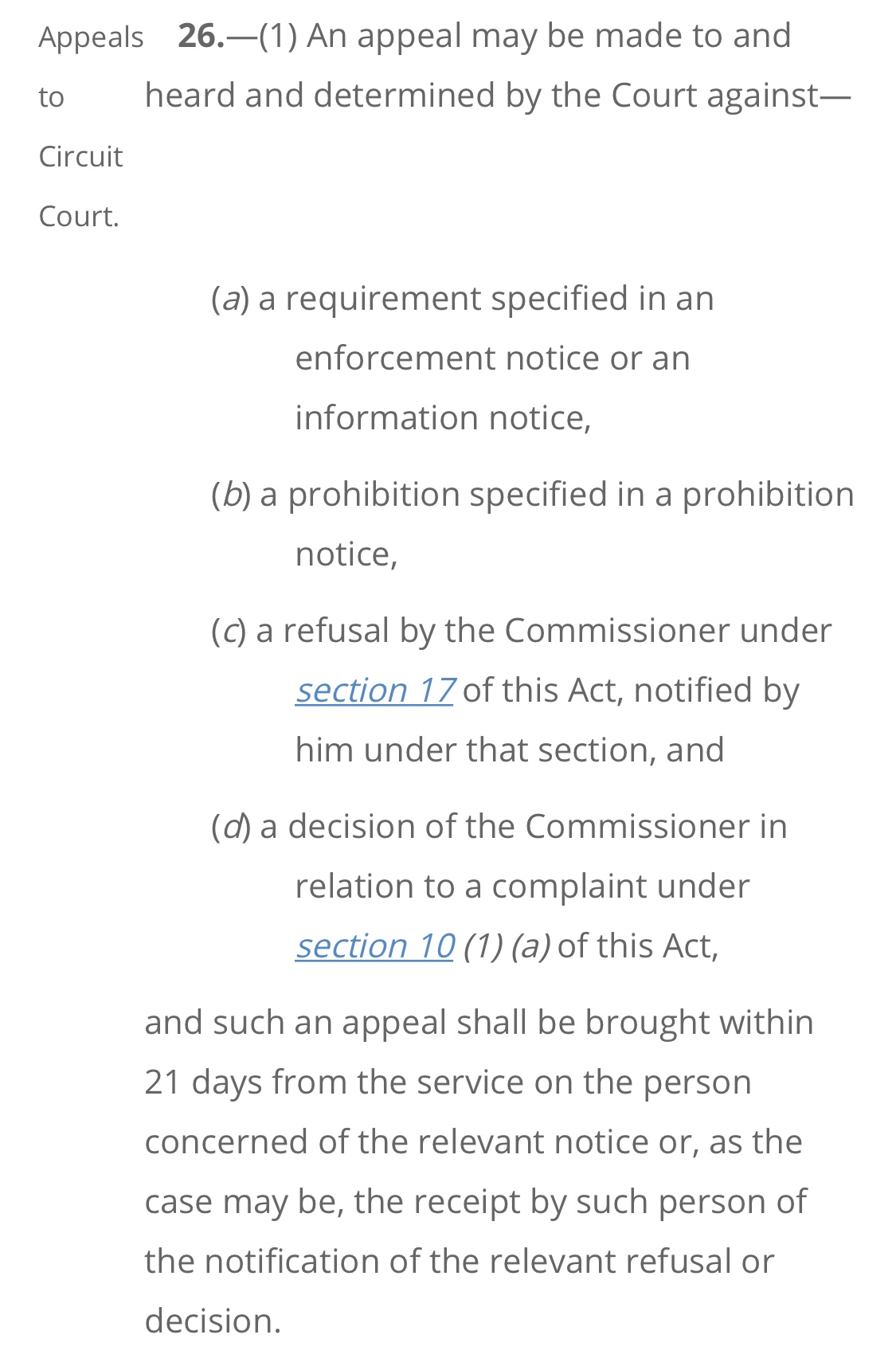
<li>The Government has argued with this finding in public, but it has not appealed it. It is now out of time to do so (21 days).<span class="Apple-converted-space"> </span>Section 26(1) of the Data Protection Act 1988 is below, setting out that time limit.<br />
<img loading="lazy" decoding="async" class="wp-image-2100 aligncenter" src="https://www.tuppenceworth.ie/blog/wp-content/uploads/2019/09/img_3008.jpg" width="459" height="698" srcset="https://www.tuppenceworth.ie/blog/wp-content/uploads/2019/09/img_3008.jpg 1125w, https://www.tuppenceworth.ie/blog/wp-content/uploads/2019/09/img_3008-197x300.jpg 197w, https://www.tuppenceworth.ie/blog/wp-content/uploads/2019/09/img_3008-768x1167.jpg 768w, https://www.tuppenceworth.ie/blog/wp-content/uploads/2019/09/img_3008-674x1024.jpg 674w" sizes="auto, (max-width: 459px) 100vw, 459px" /></li>
<li>The text <a href="http://revisedacts.lawreform.ie/eli/1988/act/25/section/10/revised/en/html">has been amended,</a> but the 21 day time limit remains. The finding stands unchallenged.<span class="Apple-converted-space"> </span>The time is up to challenge it. There can be no backdoor reset of the appeal time limit. The Department of Children has acknowledged it is aware that its policy is contrarty to the DPC&#8217;s finding.</li>
<li>However, the Department of Children and Youth Affairs <a href="https://www.irishexaminer.com/breakingnews/ireland/public-services-card-only-route-to-childcare-scheme-947910.html">has confirmed that,</a> as things stand, online applications for the scheme will only be processed for people in possession of a verified MyGovID, the web equivalent of the physical PSC.</li>
<li>&#8220;The Dept of Children is legally responsible for any breach it makes of the GDPR, but it appears to be <a href="https://www.irishexaminer.com/breakingnews/ireland/public-services-card-only-route-to-childcare-scheme-947910.html">reluctant to adopt its responsibility.</a><span class="Apple-converted-space"> </span>&#8220;The Department of Children referred questions regarding the DPC’s decision to the Department of Social Protection, which it said is “considering it and will respond in due course”. &#8220;Officials in the Department of Children and Youth Affairs are liaising with them in this regard,” said the spokesperson.&#8221;</li>
<li>The alternative system, without a PSC, is not available until Jan. But if the PSC isn&#8217;t needed in that system, it is not needed at all.&#8221;However, the manual, postal application process will not come on line until late January next year, meaning that for the first three months of the scheme’s life the PSC will be the only means by which people can access the plan’s subsidies.</li>
<li>The DPC&#8217;s report acknowledged this trend to use the PSC not to access public services but to act as a barrier to them.<strong>&#8220;Rather than the PSC being any kind of enabler for the purpose of accessing public services (other than social welfare services and free travel), it can in fact operate as an impediment to accessing public services.&#8221;</strong></li>
</ol>
]]></content>
		
			</entry>
		<entry>
		<author>
			<name>Simon McGarr</name>
							<uri>http://www.tuppenceworth.ie</uri>
						</author>

		<title type="html"><![CDATA[RTÉ after Netflix: Recasting Broadcast]]></title>
		<link rel="alternate" type="text/html" href="https://www.tuppenceworth.ie/blog/2019/09/14/rte-after-netflix-recasting-broadcast/" />

		<id>http://www.tuppenceworth.ie/blog/?p=2085</id>
		<updated>2020-01-02T23:05:44Z</updated>
		<published>2019-09-14T09:31:52Z</published>
		<category scheme="https://www.tuppenceworth.ie/blog" term="media" /><category scheme="https://www.tuppenceworth.ie/blog" term="Netflix" /><category scheme="https://www.tuppenceworth.ie/blog" term="RTE" />
		<summary type="html"><![CDATA[Not a licence fee, not a yearly budget item, no ads.
A new proposal to fund public service broadcasting in Ireland.]]></summary>

					<content type="html" xml:base="https://www.tuppenceworth.ie/blog/2019/09/14/rte-after-netflix-recasting-broadcast/"><![CDATA[<p>What is the point of a Broadcast TV station in a post-Netflix streaming world?</p>
<p>There is a crisis of relevance in the slow-moving and state regulated world of broadcast TV. What is the point of turning up and having programmes being beamed indiscrimiately across a specific geographical location when you can just stream or download anything, anytime, anywhere?</p>
<h5>The Long Now</h5>
<p>RTÉ is <a href="https://www.thejournal.ie/rte-reassessing-everything-it-does-amid-unprecedented-financial-situation-4799084-Sep2019/">gasping financially</a>, the government having <a href="https://www.rte.ie/news/2019/0802/1066568-rte-tv-licence-fee-reform/">kicked away</a> any change in the structure of the licence fee for at least five years. The advertising market continues to gradually drain away to the online duopoly of Google and Facebook, <a href="https://mii.ie/blogpost/1316142/295195/Core-s-Outlook-2018-Report-forecasts-a-6-7-increase-in-advertising-spend-in-Ireland">in Ireland</a> as <a href="https://www.theguardian.com/media/2018/nov/14/festive-advertisers-dump-tv-for-online-media">much as</a> <a href="https://pmyb.co.uk/traditional-television-advertising-dying-2018/">internationally</a>.</p>
<p>Meanwhile, Netflix has proved the streaming model so succesfully that a myriad of competitors are in the works, all basically slotting their own content into the familiar binge-watch choice model.</p>
<p>So, it might seem like a strange idea to suggest that now is the moment to focus again on the things that broadcast TV can do that others can&#8217;t. Specifically, broadcast is about <span class="ILfuVd"><span class="e24Kjd"><b>Simultaneity- these are things (live events or broadcasts) which are happening at the same time, and in the same way in everyone&#8217;s home. </b></span></span></p>
<p>A football match, a political event, X-Factor, The Late Late Toy Show, god help us the Rose of Tralee. And, most crucially for the public sphere- the News.</p>
<p>They&#8217;re the backbone of public discussion. The things that happened, that we all saw, or that everyone else saw and we missed and now we have to catch up.</p>
<h5>Netflix avoids the zeitgeist</h5>
<p>Meantime, on Netflix, something weird hovers around the art direction of the shows it is building up. A Netflix original show doesn&#8217;t have to be a huge hit when it comes out (though they&#8217;d like it if it was). What it has to show is the ability to stick around- to be watched and rewatched over time, so you&#8217;re less likely to drop your subscription because then you wouldn&#8217;t have that comfortable favourite.</p>
<p>There&#8217;s a reason Netflix paid €100m for the rights to show Friends repeats. It&#8217;s basically pre-chewed tv for your brain.</p>
<p>But take a look at Gotham &#8211; (aka Young Batman). What decade is it set in? 1940s rotary dial phones on desks, non-specific mobiles in pockets, suit lapels that swell and shrink outside the bounds of fashion.</p>
<p>Netflix wants series set in the future, in the past or inside the memory of other stories.</p>
<p>It is not interested in telling stories about us, now. Because it wants its programming to still be as (non) contemporary in 5 years as it is now.</p>
<h5>Broadcast lets the nation talk</h5>
<p>That’s 100% fine as a commercial entertainment entity. But it leaves the field wide open to public service broadcasters to do the things they are meant to do- to be a nation talking to itself, about itself.</p>
<p>Except RTÉ approaches this space hobbled- as it has always been- by the founding errors of the Broadcasting Acts. Hemmed in on one side by public subsidy (via the Licence Fee) which no Govt is in a hurry to pay the political price needed to update and on the other by advertising revenues which are structurally doomed to dwindle away.</p>
<p>This week sees the current Director General of RTÉ warning of cuts and structural changes to come as it continues to run at a loss.</p>
<p>There is talk of dropping the public service elements of RTÉ (LyricFM, orchestras, etc) in favour of activities which raise money via advertising. It is possible for a broadcaster to be profitable if it limits its output to whatever it can sell more ads against. But it isn’t possible for them to remain a Public Service Broadcaster. It’s just commercial telly with a weird tax subsidy.</p>
<p>If we’re going to preserve the value RTÉ offers us- it’s audience and it’s owners, both- we are going to have to take control of the discussion. This is never going to be solved at the political level, where there are no votes in imposing price increases to fund more scrutiny of the political class. It isn’t going to come from RTÉ’s executive level, who have no access to any of the levers of power that might change their structurally broken legislative underpinnings.</p>
<h5>Heresies to set us free</h5>
<p>If we’re going to seize control of the discussion, l’d like to set out the heresies we should start with that nobody else will touch.</p>
<ol>
<li>A very substantial increase in public funding.</li>
<li>Eliminate advertising.</li>
<li>Presenter salaries are a distraction. We need to be able to discuss RTÉ without having the conversation derailed by a sterile bunfight of almost zero financial significance. Just&#8230; forget it.</li>
</ol>
<p>Number 1 and number 2 are two sides of the same coin. If we&#8217;re going to get rid of advertising, we&#8217;ll need to replace the fund with money from elsewhere. It&#8217;s a public service broadcaster we want. So, like the BBC, we need to fund it from the public.</p>
<p>How that funding is delivered isn&#8217;t straightforward- a TV licence looks like a weird model in a world where screens can live in your pocket. But direct funding from central funds leaves the station open to direct influence and threat year to year in every budget. The BBC&#8217;s Charter comes up for renewal every 10 years, and it still distorts and influences output as it approaches. An annual leash for a broadcaster would be hobbling.</p>
<p>Removing Advertising from RTÉ would, ironically, also serve the rest of the media market who do rely on ads, giving them all a suddenly bigger slice of that slowly shrinking pie.</p>
<p>That&#8217;s the sort of conversation we need. We need to ask how we deliver the service we want without introducing new problems. This is the heart of constructive dialog.</p>
<p>Number 3 is about making room for that structual conversation by just parking the nonsense that has distracted us- the audience- from having it. Presenter salaries are a piece of shiny paper on a stick, drawing attention from the structural and legislative changes RTÉ needs. We can&#8217;t solve the real problems of a €300 million company if the only thing we can talk about is the €3m spent on the top ten presenters. The deficit is €13million. Fire them all and replace them with ads for sliderobes and you still haven&#8217;t addressed anything.</p>
<p>It doesn&#8217;t matter, so&#8230; just forget it.</p>
<p>RTÉ has serious flaws and failings. The programmes are too frequently baggy and aimed at people who think middle aged men are young. There&#8217;s a lack of originality. It&#8217;s instiutionally frozen in the headlights of the internet. There&#8217;s [insert your criticism here]. But none of that can be fixed while its starving to death.</p>
<p>If we want RTÉ to change, we need it to survive.</p>
<p>So, first things first.</p>
]]></content>
		
			</entry>
		<entry>
		<author>
			<name>Simon McGarr</name>
							<uri>http://www.tuppenceworth.ie</uri>
						</author>

		<title type="html"><![CDATA[Why the BAI is not the body to regulate the internet]]></title>
		<link rel="alternate" type="text/html" href="https://www.tuppenceworth.ie/blog/2019/06/24/why-the-bai-is-not-the-body-to-regulate-the-internet/" />

		<id>http://www.tuppenceworth.ie/blog/?p=2078</id>
		<updated>2019-06-24T12:04:41Z</updated>
		<published>2019-06-24T12:04:41Z</published>
		<category scheme="https://www.tuppenceworth.ie/blog" term="General" />
		<summary type="html"><![CDATA[The Sunday Independent had an eyecatching report this weekend. Headlined &#8220;First social media controls revealed: Irish watchdog to police content across EU&#8221; it sets out the Broadcasting Authority of Ireland&#8217;s proposals to Government as to how the the AV Services Directive should be transposed into Irish law. If it stopped at those sensible and straightforward proposals, there would be nothing objectionable in the sensible idea of the BAI becoming the local implementing body of EU requirements for common age classification on Netflix, or an increase in EU produced material to protect Europe&#8217;s cultural identity. But, in response to a specific set of queries from the Minister the BAI went further than the implementation of the EU law. They suggested that their role be hugely expanded to become a general regulator of all content (in any form, rather than just video) on the internet. And not just public content. They suggest that they, acting in a new role as an Online Service Regulator (OSR), should have the power to block or censor private communications between individuals. &#8220;The OSR should be able to issue HOC Notices to both “open” online services (e.g. social media platforms) and “encrypted” online services (e.g. private messaging services).&#8221; Taken simply on its own, this demonstrates why making a Broadcasting Regulator a regulator of individuals&#8217; private communications is a bad idea. Institutionally, the instincts of regulating Broadcast (with all its panoply of editorial controls, licencing arrangements etc) should not be applied to private messages between citizens. After that comes the question of how the BAI would propose to access encrypted private messages- and whether it has made that suggestion unaware of its impracticality. In addition, the BAI outlines its approach to how it would go about implementing EU Law: &#160; This commitment to implementing what the law should say over what it says is, to my knowledge, a novel approach to implementing EU Law. The proposal also addresses one of the more difficult issues in regulating completely unalike media- Broadcast and Internet. It does this by simply asserting they can both be treated the same. Problem. Solved. The BAI welcomes the greater degree of regulatory consistency between on-demand and linear broadcasting services which is reflective of changing consumption patterns amongst audiences&#8230; As a general regulatory principle, the BAI takes the view that it is desirable for “like” services to be obliged to follow “like” rules. Given the significant [&#8230;]]]></summary>

					<content type="html" xml:base="https://www.tuppenceworth.ie/blog/2019/06/24/why-the-bai-is-not-the-body-to-regulate-the-internet/"><![CDATA[<p>The Sunday Independent had an eyecatching report this weekend.</p>
<p>Headlined <a href="https://www.independent.ie/business/technology/first-social-media-controls-revealed-irish-watchdog-to-police-content-across-eu-38244333.html">&#8220;First social media controls revealed: Irish watchdog to police content across EU&#8221; </a>it sets out the <a href="https://www.tuppenceworth.ie/blog/wp-content/uploads/2019/06/Embargoed-9.30am-24.06.19-BAI-submission.pdf">Broadcasting Authority of Ireland&#8217;s proposals to Government</a> as to how the the AV Services Directive should be transposed into Irish law. If it stopped at those sensible and straightforward proposals, there would be nothing objectionable in the sensible idea of the BAI becoming the local implementing body of EU requirements for common age classification on Netflix, or an increase in EU produced material to protect Europe&#8217;s cultural identity.</p>
<p>But, in response to a specific set of queries from the Minister the BAI went further than the implementation of the EU law. They suggested that their role be hugely expanded to become a general regulator of all content (in any form, rather than just video) on the internet. And not just public content. They suggest that they, acting in a new role as an Online Service Regulator (OSR), should have the power to block or censor private communications between individuals.</p>
<blockquote><p>&#8220;The OSR should be able to issue HOC Notices to both “open” online services (e.g. social media platforms) and “encrypted” online services (e.g. private messaging services).&#8221;</p></blockquote>
<p>Taken simply on its own, this demonstrates why making a Broadcasting Regulator a regulator of individuals&#8217; private communications is a bad idea. Institutionally, the instincts of regulating Broadcast (with all its panoply of editorial controls, licencing arrangements etc) should not be applied to private messages between citizens. After that comes the question of how the BAI would propose to access encrypted private messages- and whether it has made that suggestion unaware of its impracticality.</p>
<p>In addition, the BAI outlines its approach to how it would go about implementing EU Law:</p>
<p><div id="attachment_2079" style="width: 855px" class="wp-caption aligncenter"><a href="https://www.tuppenceworth.ie/blog/wp-content/uploads/2019/06/Screen-Shot-2019-06-24-at-12.40.24.png"><img loading="lazy" decoding="async" aria-describedby="caption-attachment-2079" class="wp-image-2079 size-large" src="https://www.tuppenceworth.ie/blog/wp-content/uploads/2019/06/Screen-Shot-2019-06-24-at-12.40.24-845x127.png" alt="Extract from BAI Proposal" width="845" height="127" srcset="https://www.tuppenceworth.ie/blog/wp-content/uploads/2019/06/Screen-Shot-2019-06-24-at-12.40.24-845x127.png 845w, https://www.tuppenceworth.ie/blog/wp-content/uploads/2019/06/Screen-Shot-2019-06-24-at-12.40.24-300x45.png 300w, https://www.tuppenceworth.ie/blog/wp-content/uploads/2019/06/Screen-Shot-2019-06-24-at-12.40.24-768x116.png 768w, https://www.tuppenceworth.ie/blog/wp-content/uploads/2019/06/Screen-Shot-2019-06-24-at-12.40.24.png 996w" sizes="auto, (max-width: 845px) 100vw, 845px" /></a><p id="caption-attachment-2079" class="wp-caption-text">To that extent, the key question in determining whether essential functionality applies from a constructive perspective is not to ask if the Directive applies, but rather should the Directive apply such services having regard to the need for protections to be put in place for audiences and the European Institutions&#8217; intentions.</p></div></p>
<p>&nbsp;</p>
<p>This commitment to implementing what the law <em>should</em> say over what it says is, to my knowledge, a <strong>novel</strong> approach to implementing EU Law.</p>
<p>The proposal also addresses one of the more difficult issues in regulating completely unalike media- Broadcast and Internet.</p>
<p>It does this by simply asserting they can both be treated the same. Problem. Solved.</p>
<blockquote><p>The BAI welcomes the greater degree of regulatory consistency between on-demand and linear broadcasting services which is reflective of changing consumption patterns amongst audiences&#8230; As a general regulatory principle, the BAI takes the view that it is desirable for “like” services to be obliged to follow “like” rules. Given the significant convergence of the market for audiovisual media over the past decade, the BAI endorses the more level playing field envisioned by the Directive between television broadcasting services and on-demand services&#8230;.</p>
<p>To the extent that an area of regulation is harmonised by the Directive, however, the BAI feels that it is entirely appropriate that television broadcasting services and on-demand services should be obliged to follow similar rules ensuring similar standards of protection for audiences. Taking measures to ensure greater equivalency in these areas is both a legal obligation and desirable from an audience perspective.</p></blockquote>
<p>The BAI is a creature of the Broadcasting Act 2009. I have <a href="https://www.tuppenceworth.ie/blog/2014/02/04/what-we-can-learn-from-the-pantigate-scandal/">written previously</a> about the inappropriateness of that Act to a modern society in the past.</p>
<p>Section 39 (1) (d) of that act says;</p>
<blockquote><p>Every broadcaster shall ensure that “anything which may reasonably be regarded as causing harm or offence, or as being likely to promote, or incite to, crime or as tending to undermine the authority of the State, is not broadcast by the broadcaster,”</p></blockquote>
<p>This section puts causing offence to be just as serious a breach as undermining the authority of the State. But no society can ever improve itself, can ever acknowledge what is wrong and address how to make things better, if we can only say things that cause nobody any offence.</p>
<p>By outlawing the giving of offence <a href="http://www.irishstatutebook.ie/pdf/2009/en.act.2009.0018.pdf">Section 39(1)(d)</a> is a ban on open discussion on our airwaves, making the broadcasting complaints process a happy hunting ground for people who don’t want to be disturbed in their cosy beliefs.</p>
<p>If the BAI thinks that this is the appropriate standard to apply to online discussion- and they do say that they would seek to censor things which were not illegal- then that, by itself is a demonstration that it has all the wrong impulses to be left responsible for the most important communications and social medium in human history.</p>
]]></content>
		
			</entry>
		<entry>
		<author>
			<name>Simon McGarr</name>
							<uri>http://www.tuppenceworth.ie</uri>
						</author>

		<title type="html"><![CDATA[From PIAB To InjuriesBoard to PIAB again]]></title>
		<link rel="alternate" type="text/html" href="https://www.tuppenceworth.ie/blog/2019/02/15/from-piab-to-injuriesboard-to-piab-again/" />

		<id>http://www.tuppenceworth.ie/blog/?p=2065</id>
		<updated>2019-02-15T16:30:55Z</updated>
		<published>2019-02-15T16:29:45Z</published>
		<category scheme="https://www.tuppenceworth.ie/blog" term="General" /><category scheme="https://www.tuppenceworth.ie/blog" term="&quot;injuries board&quot;" /><category scheme="https://www.tuppenceworth.ie/blog" term="piab" />
		<summary type="html"><![CDATA[The Personal Injuries Assessment Board, or PIAB, was created by statute in 2003. It was set up as an institution to deal with injured people&#8217;s claims- back injuries, falling over on a banana skin in the supermarket, you name it. Only medical negligence was removed from its scope- those sorts of claims are particularly tricky and it wasn&#8217;t considered to be appropriate to roll them in with everything else. For years, the PIAB called itself PIAB. The logo was as workmanlike as you could hope for. We are talking about the original does-what it says on the tin sort of approach. Let&#8217;s just write out the name, and that&#8217;s the logo. All change Then, suddenly one day, it seems like it was gripped by a sudden and profound wish to be less acronymatic. PIAB was out, Out, OUT- and the fresh new branding of InjuriesBoard.ie was in, In, IN. We were all-in on using the URL as the brand. It even had one of those spectacular &#8216;dot and swirls&#8217; celtic tiger era state logos. It even came with just the hint of an abstraction of an injured person, crocked and humpbacked. I mean, most back injury claims probably involve people with limbs or a face still, but you get the idea. And then, suddenly, a few months ago, it was all change. InjuriesBoard.ie was out,Out, OUT and the venerable PIAB.ie was back,Back, BACK! The new PIAB logo was all swirls, no dots. Who knows what mysterious forces lead a monopoly state body to expend so much consideration on their branding? After all, InjuriesBoard.ie or PIAB, they&#8217;re the only place you can go if you want your injury claim assessment dealt with. But as always, for the niche-interest community of state logo afficianados the one certain thing is that this will not be the last time we get to witness one of these evolutions.]]></summary>

					<content type="html" xml:base="https://www.tuppenceworth.ie/blog/2019/02/15/from-piab-to-injuriesboard-to-piab-again/"><![CDATA[<p>The <a href="http://www.piab.ie/">Personal Injuries Assessment Board</a>, or <a href="https://www.mcgarrsolicitors.ie/piab-2/">PIAB</a>, was created by statute in 2003. It was set up as an institution to deal with injured people&#8217;s claims- back injuries, falling over on a banana skin in the supermarket, you name it. Only medical negligence was removed from its scope- those sorts of claims are particularly tricky and it wasn&#8217;t considered to be appropriate to roll them in with everything else.</p>
<p>For years, the PIAB called itself PIAB. The logo was as workmanlike as you could hope for. We are talking about the original does-what it says on the tin sort of approach. Let&#8217;s just write out the name, and that&#8217;s the logo.</p>
<p><a href="https://www.tuppenceworth.ie/blog/wp-content/uploads/2019/02/Screenshot-2019-02-15-16.01.35.png"><img loading="lazy" decoding="async" width="470" height="214" class="size-full wp-image-2069 aligncenter" src="https://www.tuppenceworth.ie/blog/wp-content/uploads/2019/02/Screenshot-2019-02-15-16.01.35.png" alt="PIAB logo" srcset="https://www.tuppenceworth.ie/blog/wp-content/uploads/2019/02/Screenshot-2019-02-15-16.01.35.png 470w, https://www.tuppenceworth.ie/blog/wp-content/uploads/2019/02/Screenshot-2019-02-15-16.01.35-300x137.png 300w" sizes="auto, (max-width: 470px) 100vw, 470px" /></a></p>
<h3>All change</h3>
<p>Then, suddenly one day, it seems like it was gripped by a sudden and profound wish to be less acronymatic. PIAB was out, Out, OUT- and the fresh new branding of InjuriesBoard.ie was in, In, IN. We were all-in on using the URL as the brand.</p>
<p>It even had one of those spectacular &#8216;dot and swirls&#8217; celtic tiger era state logos. It even came with just the hint of an abstraction of an injured person, crocked and humpbacked. I mean, most <a href="https://www.personalinjuryireland.com/2009/07/back-injury-compensation-claims/">back injury claims</a> probably involve people with limbs or a face still, but you get the idea.</p>
<p><a href="https://www.tuppenceworth.ie/blog/wp-content/uploads/2019/02/Injuries-Board-Logo.jpg"><img loading="lazy" decoding="async" width="124" height="102" class="size-full wp-image-2070 aligncenter" src="https://www.tuppenceworth.ie/blog/wp-content/uploads/2019/02/Injuries-Board-Logo.jpg" alt="Injuries Board logo" /></a></p>
<p>And then, suddenly, a few months ago, it was all change. InjuriesBoard.ie was out,Out, OUT and the venerable PIAB.ie was back,Back, BACK!</p>
<p><a href="https://www.tuppenceworth.ie/blog/wp-content/uploads/2019/02/Screenshot-2019-02-15-16.16.47.png"><img loading="lazy" decoding="async" width="845" height="204" class="size-large wp-image-2071 aligncenter" src="https://www.tuppenceworth.ie/blog/wp-content/uploads/2019/02/Screenshot-2019-02-15-16.16.47-845x204.png" alt="New PIAB Logo" srcset="https://www.tuppenceworth.ie/blog/wp-content/uploads/2019/02/Screenshot-2019-02-15-16.16.47-845x204.png 845w, https://www.tuppenceworth.ie/blog/wp-content/uploads/2019/02/Screenshot-2019-02-15-16.16.47-300x72.png 300w, https://www.tuppenceworth.ie/blog/wp-content/uploads/2019/02/Screenshot-2019-02-15-16.16.47-768x185.png 768w, https://www.tuppenceworth.ie/blog/wp-content/uploads/2019/02/Screenshot-2019-02-15-16.16.47.png 846w" sizes="auto, (max-width: 845px) 100vw, 845px" /></a></p>
<p>The new PIAB logo was all swirls, no dots. Who knows what mysterious forces lead a monopoly state body to expend so much consideration on their branding? After all, InjuriesBoard.ie or PIAB, they&#8217;re the only place you can go if you want your injury claim assessment dealt with.</p>
<p>But as always, for the niche-interest community of state logo afficianados the one certain thing is that this will not be the last time we get to witness one of these evolutions.</p>
]]></content>
		
			</entry>
		<entry>
		<author>
			<name>Simon McGarr</name>
							<uri>http://www.tuppenceworth.ie</uri>
						</author>

		<title type="html"><![CDATA[Blue Peter: England’s dream of childhood]]></title>
		<link rel="alternate" type="text/html" href="https://www.tuppenceworth.ie/blog/2018/10/18/blue-peter-englands-dream-of-childhood/" />

		<id>https://www.tuppenceworth.ie/blog/?p=2060</id>
		<updated>2018-10-17T23:02:12Z</updated>
		<published>2018-10-17T23:02:10Z</published>
		<category scheme="https://www.tuppenceworth.ie/blog" term="General" />
		<summary type="html"><![CDATA[It is the 60th anniversary of Blue Peter. Described airily as a “magazine show” to those unfamiliar with its sui generis format, Blue Peter has sat in the BBC schedule as unwaveringly as the 9 O’Clock News for a televisual eon. The reason, I suspect with an outsider’s perspective, is that Blue Peter is the collective dream of English childhood given form and that the culture could no more abandon that dream then it could abandon the idea of adulthood embodied in the News. I say an English dream of childhood, rather than a British one, because whether they knew it or not, Blue Peter has never been about how children in Scotland, or Wales (and certainly not Northern Ireland) lived and played and imagined. They may well have all had the same dreams and been excited by the same Blyton-esque mix of pluck, exploration, make and do and dogs. Being Irish, I don’t know. But it was clear to me when I watched it (not often, not with any enthusiasm) that the programme didn’t know either- and didn’t care. These were English pals (and the capacity to cast really likeable sorts for Blue Peter remains one of its spectacular skills) mucking in, or mucking about. Digging in the Blue Peter garden, exploring the British landscape (though always through the eyes of the English visitor), having adventures, making biscuits or honest terrible Christmas decorations and so on and so on. But in fact, the producers (well, really the founding master and commander of Blue Peter, Biddy Baxter) understood their ostensibly factual programme was playing in the imagination as much as any Doctor Who or Wombles. Blue Peter has pets, because there are many children who would like to have a pet, but can’t. And Biddy Baxter gave those children dogs and cats to live with- animals who would grow up and then old with them. She imagined living in one of the newly built, post-war estates of high rise flats. So the Blue Peter Garden was created, so those children would have a garden- a patch of nature to tend along with the presenters. Biddy Baxter understood that the reality of many children’s lives was not Blyton, but Kes. But her programme chose to offer them an escape, not a mirror. Even the famous Blue Peter badge- a talisman which allowed the bearer to access museums, galleries and the rest [&#8230;]]]></summary>

					<content type="html" xml:base="https://www.tuppenceworth.ie/blog/2018/10/18/blue-peter-englands-dream-of-childhood/"><![CDATA[<p><img loading="lazy" decoding="async" src="https://www.tuppenceworth.ie/blog/wp-content/uploads/2018/10/img_0780.png" class="size-full wp-image-2059" height="500" width="1500" srcset="https://www.tuppenceworth.ie/blog/wp-content/uploads/2018/10/img_0780.png 1500w, https://www.tuppenceworth.ie/blog/wp-content/uploads/2018/10/img_0780-300x100.png 300w, https://www.tuppenceworth.ie/blog/wp-content/uploads/2018/10/img_0780-768x256.png 768w, https://www.tuppenceworth.ie/blog/wp-content/uploads/2018/10/img_0780-845x282.png 845w" sizes="auto, (max-width: 1500px) 100vw, 1500px" />It is the 60th anniversary of Blue Peter. Described airily as a “magazine show” to those unfamiliar with its sui generis format, Blue Peter has sat in the BBC schedule as unwaveringly as the 9 O’Clock News for a televisual eon.</p>
<p>The reason, I suspect with an outsider’s perspective, is that Blue Peter is the collective dream of English childhood given form and that the culture could no more abandon that dream then it could abandon the idea of adulthood embodied in the News.</p>
<p>I say an English dream of childhood, rather than a British one, because whether they knew it or not, Blue Peter has never been about how children in Scotland, or Wales (and certainly not Northern Ireland) lived and played and imagined. They may well have all had the same dreams and been excited by the same Blyton-esque mix of pluck, exploration, make and do and dogs.</p>
<p>Being Irish, I don’t know. But it was clear to me when I watched it (not often, not with any enthusiasm) that the programme didn’t know either- and didn’t care.</p>
<p>These were English pals (and the capacity to cast really likeable sorts for Blue Peter remains one of its spectacular skills) mucking in, or mucking about. Digging in the Blue Peter garden, exploring the British landscape (though always through the eyes of the English visitor), having adventures, making biscuits or honest terrible Christmas decorations and so on and so on.</p>
<p>But in fact, the producers (well, really the founding master and commander of Blue Peter, Biddy Baxter) understood their ostensibly factual programme was playing in the imagination as much as any Doctor Who or Wombles.</p>
<p>Blue Peter has pets, because there are many children who would like to have a pet, but can’t. And Biddy Baxter gave those children dogs and cats to live with- animals who would grow up and then old with them.</p>
<p>She imagined living in one of the newly built, post-war estates of high rise flats. So the Blue Peter Garden was created, so those children would have a garden- a patch of nature to tend along with the presenters.</p>
<p>Biddy Baxter understood that the reality of many children’s lives was not Blyton, but Kes. But her programme chose to offer them an escape, not a mirror. Even the famous Blue Peter badge- a talisman which allowed the bearer to access museums, galleries and the rest of the cultural world at discount or for free- was an unacknowledged effort to spread that access to children who might never manage it any other way.</p>
<p>None of this was ever acknowledged on screen, but was a quiet river of radicalism buried under the conventional enthusiasms of the middle classes.</p>
<p>Even the famous fund raising feats of the Blue Peter Appeal- where tens of thousands of children sent in bottle-tops or other tokens of value to help a charity- were more than their apparent Good Works at the Village Fête. What they really tried to demonstrate to children was the potential of collective action to make change.</p>
<p>A 60 year anniversary in television is an achievement difficult to imagine being repeated by any programme starting now.</p>
<p>Blue Peter’s continuing power comes from having offered more than imagined friends, pets or gardens.</p>
<p>It offered an imagined England that was always consciously and deliberately better than the real thing- because children deserved better.</p>
<p>Just there, in that studio, twice a week, England’s dreaming.</p>
<p>And just for once, we should be glad of it</p>
]]></content>
		
			</entry>
		<entry>
		<author>
			<name>Simon McGarr</name>
							<uri>http://www.tuppenceworth.ie</uri>
						</author>

		<title type="html"><![CDATA[When the Sheriff loses it]]></title>
		<link rel="alternate" type="text/html" href="https://www.tuppenceworth.ie/blog/2017/09/06/when-the-sheriff-loses-it/" />

		<id>http://www.tuppenceworth.ie/blog/?p=2004</id>
		<updated>2017-09-06T21:41:21Z</updated>
		<published>2017-09-06T21:11:08Z</published>
		<category scheme="https://www.tuppenceworth.ie/blog" term="Irish Politics" /><category scheme="https://www.tuppenceworth.ie/blog" term="#psc" /><category scheme="https://www.tuppenceworth.ie/blog" term="administration" /><category scheme="https://www.tuppenceworth.ie/blog" term="public services card" />
		<summary type="html"><![CDATA[Here&#8217;s an interesting specific (and extreme) example of an administration body which becomes sociopathic by losing sight of its purpose. It is a institutional disorder which seems to be endemic across corporate entities. It&#8217;s most serious in state bodies, because of they&#8217;re gifted with state coercion powers. So, let&#8217;s take the Sheriff&#8217;s office as an example. Usually, they spend their time enforcing warrants. All very good (provided the warrants system hasn&#8217;t been debased or corrupted). That&#8217;s what they do, for most of the time (let&#8217;s say. Doubtless they do other things. Being a sheriff, posses, I presume, feature). And they forget that isn&#8217;t actually what they are *for*. Their purpose is to increase the security of the society they police. The warrant business is just part of that broader purpose. Now, suddenly, part of the context they exist in alters. The entire nearby population is facing a simultaneous security threat (hurricane Irma). The purpose of the Sheriff&#8217;s office hasn&#8217;t changed- secure the security of all the nearby humans. But they still think they are for warrants. The institution has mistaken what they do for what they are for. And we, as outsiders not conditioned by months and years of warrent enforcement, say, that&#8217;s mad and *evil* and the institution feels hurt and gets angry and defensive. This is same thing it has always done, after all. It can&#8217;t see that the shift in context (keeping humans alive now may need specific acts) has meant that continuing to do what it was doing before has become contrary to the purpose of the institution. This has all, of course, been an analogy for the behaviour of the Dept of Social Protection and its Public Services Card actions. #psc]]></summary>

					<content type="html" xml:base="https://www.tuppenceworth.ie/blog/2017/09/06/when-the-sheriff-loses-it/"><![CDATA[<p>Here&#8217;s an interesting specific (and extreme) example of an administration body which becomes sociopathic by losing sight of its purpose.</p>
<p><img loading="lazy" decoding="async" src="https://www.tuppenceworth.ie/blog/wp-content/uploads/2017/09/1504731115.jpg" alt="Polk Sheriff tweet" class="aligncenter size-full" width="600" height="600" /></p>
<p>It is a institutional disorder which seems to be endemic across corporate entities. It&#8217;s most serious in state bodies, because of they&#8217;re gifted with state coercion powers. </p>
<p>So, let&#8217;s take the Sheriff&#8217;s office as an example. Usually, they spend their time enforcing warrants. All very good (provided the warrants system hasn&#8217;t been <a href="https://www.techdirt.com/articles/20141231/07133929557/how-florida-police-falsely-arrest-shame-men-as-child-sexual-predators-steal-their-cars-then-try-to-hide-records.shtml">debased or corrupted</a>).</p>
<p>That&#8217;s what they do, for most of the time (let&#8217;s say. Doubtless they do other things. Being a sheriff, posses, I presume, feature).</p>
<p>And they forget that isn&#8217;t actually what they are *for*. Their purpose is to increase the security of the society they police.</p>
<p>The warrant business is just part of that broader purpose.</p>
<p>Now, suddenly, part of the context they exist in alters. The entire nearby population is facing a simultaneous security threat (hurricane Irma).</p>
<p><img loading="lazy" decoding="async" src="https://www.tuppenceworth.ie/blog/wp-content/uploads/2017/09/1504731829.jpg" alt="Hurricane Irma from space" class="aligncenter size-full" width="600" height="450" /></p>
<p>The purpose of the Sheriff&#8217;s office hasn&#8217;t changed- secure the security of all the nearby humans. But they still think they are for warrants.</p>
<p>The institution has mistaken <i><b>what they do</b></i> for <i><b>what they are for</b></i>.</p>
<p>And we, as outsiders not conditioned by months and years of warrent enforcement, say, that&#8217;s mad and *evil* and the institution feels hurt and gets angry and defensive.</p>
<p>This is same thing it has always done, after all. It can&#8217;t see that the shift in context (keeping humans alive now may need specific acts) has meant that continuing to do what it was doing before has become contrary to the <b>purpose</b> of the institution.</p>
<p>This has all, of course, been an analogy for the behaviour of the <a href="https://www.irishtimes.com/news/social-affairs/regina-doherty-says-public-services-card-now-mandatory-for-welfare-1.3198024?mode=amp">Dept of Social Protection and its Public Services Card actions. #psc<br />
</a></p>
]]></content>
		
			</entry>
		<entry>
		<author>
			<name>Simon McGarr</name>
							<uri>http://www.tuppenceworth.ie</uri>
						</author>

		<title type="html"><![CDATA[Trump v Nixon: Disapproval rating]]></title>
		<link rel="alternate" type="text/html" href="https://www.tuppenceworth.ie/blog/2017/02/06/trump-v-nixon-disapproval-rating/" />

		<id>http://www.tuppenceworth.ie/blog/?p=1991</id>
		<updated>2017-02-06T02:59:16Z</updated>
		<published>2017-02-06T00:05:34Z</published>
		<category scheme="https://www.tuppenceworth.ie/blog" term="General" />
		<summary type="html"><![CDATA[Richard Nixon matched Donald Trump's disapproval ratings after two weeks in office exactly one year before he resigned.]]></summary>

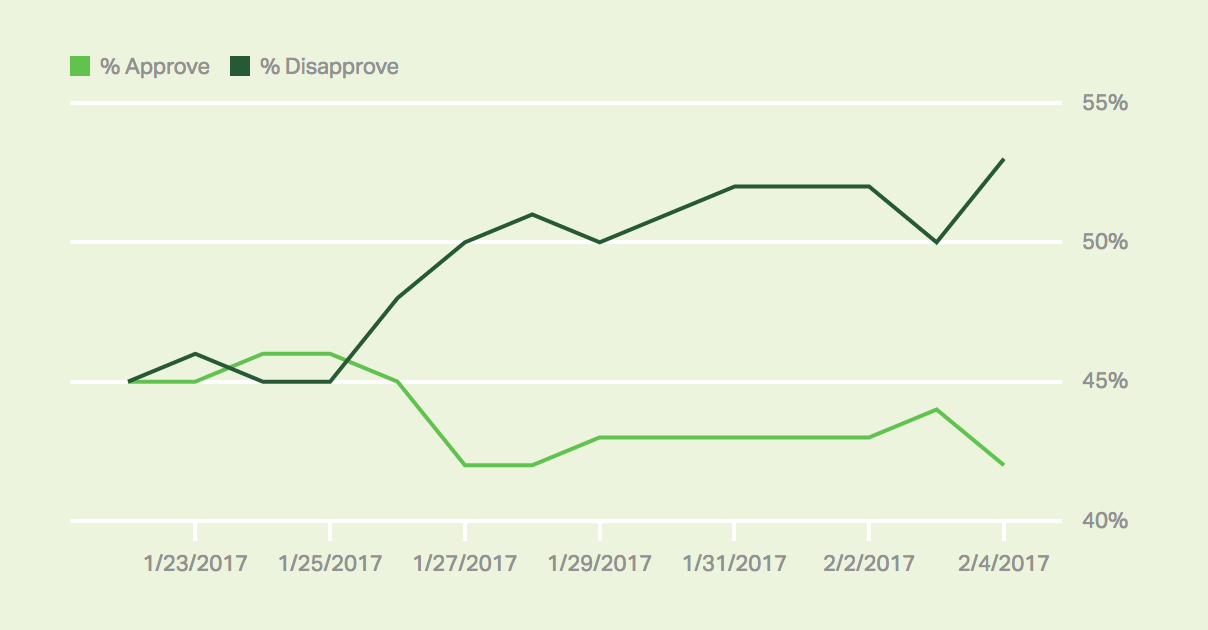
					<content type="html" xml:base="https://www.tuppenceworth.ie/blog/2017/02/06/trump-v-nixon-disapproval-rating/"><![CDATA[<p>Donald Trump has been President of the US for just over a fortnight now. Gallup, the polling people, have been tracking his approval and disapproval ratings daily. Today, <a href="http://www.gallup.com/poll/201617/gallup-daily-trump-job-approval.aspx">his disapproval rating</a> hit a new high of 53% of all US adults.</p>
<p><a href="https://www.tuppenceworth.ie/blog/wp-content/uploads/2017/02/Screenshot-2017-02-06-02.24.53.png"><img loading="lazy" decoding="async" width="845" height="441" class="aligncenter size-large wp-image-1992" src="https://www.tuppenceworth.ie/blog/wp-content/uploads/2017/02/Screenshot-2017-02-06-02.24.53-845x441.png" alt="" srcset="https://www.tuppenceworth.ie/blog/wp-content/uploads/2017/02/Screenshot-2017-02-06-02.24.53-845x441.png 845w, https://www.tuppenceworth.ie/blog/wp-content/uploads/2017/02/Screenshot-2017-02-06-02.24.53-300x156.png 300w, https://www.tuppenceworth.ie/blog/wp-content/uploads/2017/02/Screenshot-2017-02-06-02.24.53-768x401.png 768w, https://www.tuppenceworth.ie/blog/wp-content/uploads/2017/02/Screenshot-2017-02-06-02.24.53.png 1208w" sizes="auto, (max-width: 845px) 100vw, 845px" /></a></p>
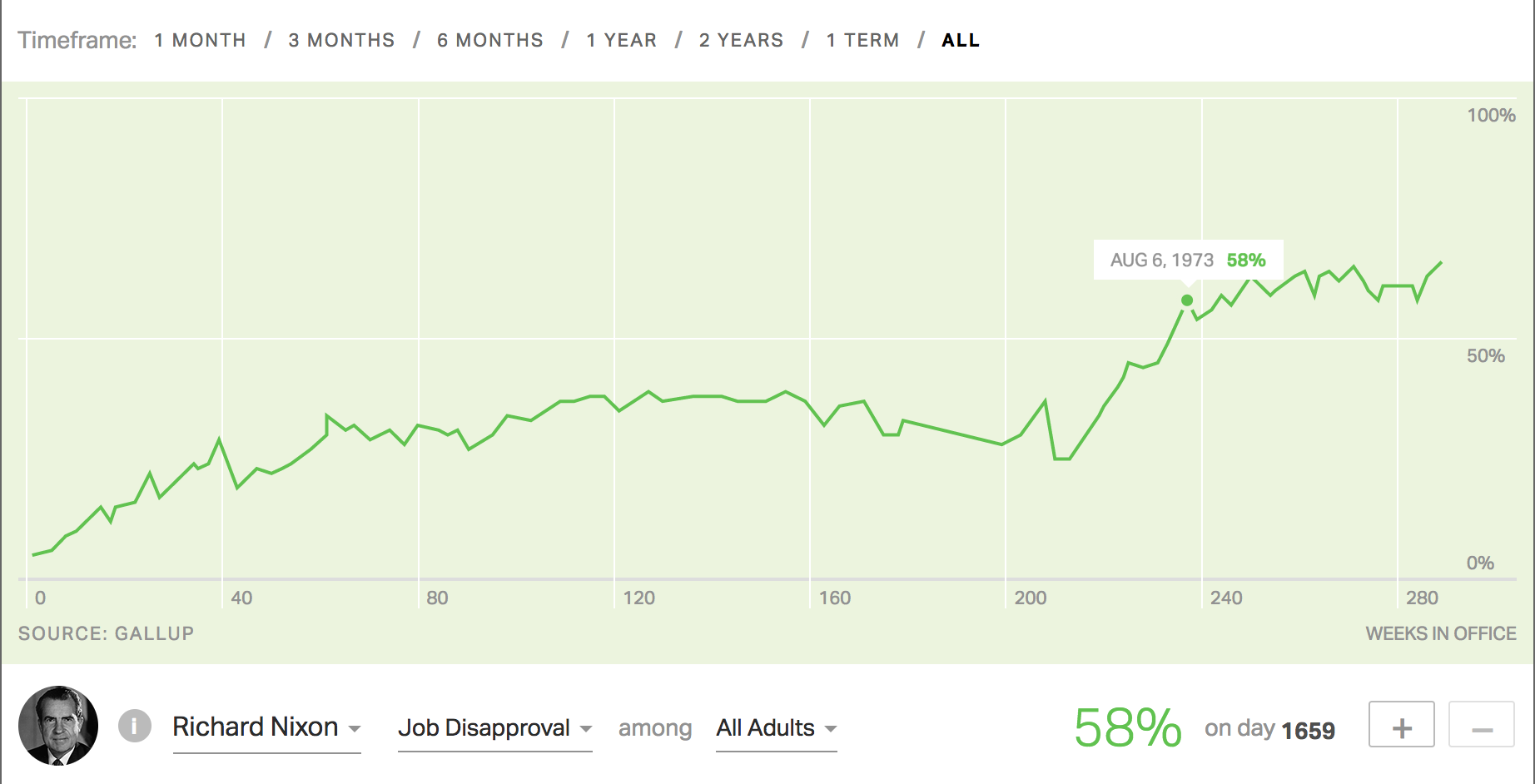
<p>Something in the back of my mind stirred. I thought I&#8217;d take a look at what was happening in <a href="http://www.gallup.com/interactives/185273/presidential-job-approval-center.aspx?g_source=WWWV7HP&amp;g_medium=topic&amp;g_campaign=tiles">Richard Nixon&#8217;s Presidency</a> when he hit that sort of number.</p>
<p><a href="https://www.tuppenceworth.ie/blog/wp-content/uploads/2017/02/Screenshot-2017-02-06-02.23.28.png"><img loading="lazy" decoding="async" width="845" height="432" class="aligncenter size-large wp-image-1993" src="https://www.tuppenceworth.ie/blog/wp-content/uploads/2017/02/Screenshot-2017-02-06-02.23.28-845x432.png" alt="" srcset="https://www.tuppenceworth.ie/blog/wp-content/uploads/2017/02/Screenshot-2017-02-06-02.23.28-845x432.png 845w, https://www.tuppenceworth.ie/blog/wp-content/uploads/2017/02/Screenshot-2017-02-06-02.23.28-300x153.png 300w, https://www.tuppenceworth.ie/blog/wp-content/uploads/2017/02/Screenshot-2017-02-06-02.23.28-768x392.png 768w, https://www.tuppenceworth.ie/blog/wp-content/uploads/2017/02/Screenshot-2017-02-06-02.23.28.png 1844w" sizes="auto, (max-width: 845px) 100vw, 845px" /></a></p>
<p>Well, as you can see, Nixon took a while longer to reach Mr. Trump&#8217;s level of unpopularity. In fact, by the time he broke the 50% disapproval barrier, the Watergate break-in was already in the past, as were all of the events of <a href="https://en.wikipedia.org/wiki/All_the_President's_Men_(film)">All The President&#8217;s Men</a>. (The final scene takes place as he is sworn in for his second term.)</p>
<p><iframe loading="lazy" src="https://www.youtube-nocookie.com/embed/4tGUP3GimO8?rel=0" width="640" height="360" frameborder="0" allowfullscreen="allowfullscreen"></iframe></p>
<p>However, I thought it was worth recalling just exactly what it had taken to push Richard Nixon to Mr. Trump&#8217;s current state of disapproval. The Senate had already launched an inquiry into Watergate. On 13th July 1973, it had been revealed that all the conversations and calls in and out of the President&#8217;s office have been recorded. By the 6th August 1973, President Nixon is openly defying a Senate subpoena for the tapes.</p>
<p>This was the first time that President Nixon&#8217;s disapproval rating reaches the level achieved by Mr. Trump after two weeks on the job. As it turned out, President Nixon was, at that moment, exactly one year from resignation.</p>
]]></content>
		
			</entry>
		<entry>
		<author>
			<name>Simon McGarr</name>
							<uri>http://www.tuppenceworth.ie</uri>
						</author>

		<title type="html"><![CDATA[RTE want to stop making kids TV. This is a mistake.]]></title>
		<link rel="alternate" type="text/html" href="https://www.tuppenceworth.ie/blog/2016/11/28/rte-want-stop-making-kids-tv-mistake/" />

		<id>http://www.tuppenceworth.ie/blog/?p=1985</id>
		<updated>2016-11-29T09:02:05Z</updated>
		<published>2016-11-28T02:06:19Z</published>
		<category scheme="https://www.tuppenceworth.ie/blog" term="Children&#039;s TV" />
		<summary type="html"><![CDATA[[View the story &#8220;RTE abruptly announce they&#8217;re going to stop making kids TV&#8221; on Storify]]]></summary>

					<content type="html" xml:base="https://www.tuppenceworth.ie/blog/2016/11/28/rte-want-stop-making-kids-tv-mistake/"><![CDATA[<p><a href="https://youtu.be/1T04qVMQwy4">https://youtu.be/1T04qVMQwy4</a></p>
<div class="storify"><iframe loading="lazy" src="//storify.com/tupp_ed/rte-abruptly-announce-they-are-going-to-stop-makin/embed?border=false" width="100%" height="750" frameborder="no"></iframe><script src="//storify.com/tupp_ed/rte-abruptly-announce-they-are-going-to-stop-makin.js?border=false"></script><noscript>[<a href="//storify.com/tupp_ed/rte-abruptly-announce-they-are-going-to-stop-makin" target="_blank">View the story &#8220;RTE abruptly announce they&#8217;re going to stop making kids TV&#8221; on Storify</a>]</noscript></div>
]]></content>
		
			</entry>
	</feed>