The post Best White-Label Marketplace Software for Online Businesses appeared first on YoKart Blog.
]]>The expansion of eCommerce has pushed businesses to adopt faster, scalable, and cost-effective digital solutions. Due to this, the most effective models gaining traction today are the white-label marketplace model that enables businesses to launch fully branded multi-vendor platforms without building complex systems from the ground up.
Instead of spending months and investing heavily in custom development, companies can leverage white-label marketplace software to quickly create fully functional online marketplaces similar to Amazon, Etsy, or Alibaba, under their own brand identity. Additionally, this approach allows businesses to focus more on growth and customer acquisition rather than technical hurdles.
Whether you are a startup testing a new idea or an enterprise expanding digitally, this approach offers speed, flexibility, and lower risk. In this blog, we will explore what white-label marketplace software is, its benefits, and the best white-label marketplace software solutions available today, with a detailed breakdown of features, ratings, and ideal use cases.
Table of Contents
- What is White-label Marketplace Software?
- Why are Businesses Choosing White-Label Marketplace Software?
- Best White-label Marketplace Software (Top 10 List)
- Comparing the Best White-Label eCommerce Marketplace Software
- Key Things to Consider Before Choosing a White-Label Marketplace Software
- Conclusion
- FAQs
What is White-label Marketplace Software?
White-label Marketplace Software is a pre-built, ready-to-deploy digital solution that allows businesses to launch and operate their own multi-vendor online marketplace under a completely customized brand identity. It provides a full marketplace infrastructure that can be rebranded and configured as per business requirements, without the need to develop complex systems from the ground up.
Instead of investing significant time and resources into building core marketplace components such as vendor management, product listings, payment systems, and order processing, businesses can use an existing solution and customize it to match their business model and branding. This allows businesses to focus on growth, customer acquisition, and operating rather than spending excessive time and money on development.
Whether you want to build a marketplace for products, services, rentals, or B2B trade, white-label solutions offer the flexibility to adapt features and workflows according to your business model.
Businesses can typically customize areas such as:
- Logo, color scheme, and domain name
- Marketplace functionalities and features
- Vendor onboarding and product management workflows
- Payment processing and shipping integrations
- Mobile apps and customer experience elements
Why are Businesses Choosing White-Label Marketplace Software?
Digital commerce is gaining traction rapidly, which is why businesses are looking for faster and more cost-effective ways to launch online marketplaces. White-label multi-vendor marketplace software has become a preferred choice because it offers ready-made infrastructure, branding flexibility, and lower development risk.
Mentioned below are some of the reasons that clarify why businesses are choosing white-label marketplace software:
1. Faster Time-to-Market
Developing a multi-vendor platform via custom development can take several months or even years. White-label marketplace software, on the other hand, significantly reduces this time by offering pre-built modules such as vendor onboarding, product listings, payments, and order management.
2. Lower Development Cost
Building a marketplace from the ground up requires major investment in design, development, testing, and maintenance. Whereas white-label solutions help businesses avoid these high upfront costs while still accessing enterprise-grade features.
3. Scalable Architecture
Most of the modern white-label marketplace software are designed with scalability in mind. They can handle increasing traffic, product catalogs, and vendor numbers without affecting performance. This makes them suitable for startups as well as growing enterprises.
4. Reduced Technical Complexity
White-label software providers usually handle core architecture, updates, and technical support. This reduces the burden on internal teams and allows businesses to focus on operations and expansion.
5. Proven Business Model
Since these software solutions are already tested across industries, businesses benefit from stable systems, optimized workflows, and built-in best practices that reduce launch risks.
Create Your Own Multi-Vendor Marketplace Without Heavy Development
Best White-label Marketplace Software (Top 10 List)
With so many options available in the market, selecting the right white-label solution can be difficult. Thus, we have curated a list of some of the best white-label marketplace solutions to help you make the right decision. Let’s have a look at them:
1. Yo!Kart
Yo!Kart is a powerful self-hosted white-label marketplace software designed for building scalable multi-vendor eCommerce platforms with full ownership and customization. Built to support B2C, B2B, and niche marketplace models, it offers a ready-made foundation with advanced marketplace capabilities.
The software comes with built-in modules for vendor management, order processing, and payment integration. It also includes dedicated mobile apps for both buyers and sellers, helping businesses deliver a seamless omnichannel experience. With a one-time license option and no recurring commissions, it is a highly cost-effective choice in the long run.
Key Features
- Multi-vendor management system
- Buyer and Seller Mobile apps (iOS & Android)
- Admin and seller dashboards
- Multiple payment gateway integration
- Built-in SEO-friendly architecture
- Fully customizable design
- Multi-lingual and multi-currency support
- Scalable architecture for growing marketplaces
Rating: 4.8 / 5
Best For: Startups, SMEs, and enterprises wanting full ownership and scalability
Explore Yo!Kart With a Live Demo
2. Mirakl
Mirakl is an enterprise-grade SaaS marketplace solution used by global brands to build and manage digital marketplaces. It is known for its automation in vendor onboarding and catalog management. Mirakl also integrates with ERP, CRM, and logistics systems, making it suitable for enterprise ecosystems. With AI-driven tools, it optimizes marketplace operations and improves seller performance. However, it is expensive and mainly targeted at large organizations.
Key Features
- Scalable architecture
- AI-powered catalog management
- Vendor automation tools
- API integrations
- Multi-region support
- Advanced analytics
Limitations
- High pricing for small businesses
- Custom implementation may take time
- Requires dedicated internal resources
Rating: 4.7 / 5
Best For: Large enterprises and global marketplaces
3. CS-Cart Multi-Vendor
CS-Cart Multi-Vendor is a self-hosted marketplace solution that provides complete control over marketplace operations. It allows businesses to manage vendors, commissions, and product approvals efficiently. The platform includes a powerful admin panel and supports multiple payment gateways. Additionally, it offers SEO tools and a responsive design for a better customer experience. Its add-on marketplace allows businesses to extend functionality as they grow.
Key Features
- Vendor management system
- Commission and payout control
- Add-on marketplace ecosystem
- SEO-friendly tools
- Multi-language support
- Advanced admin dashboard
Limitations
- Extra cost for premium add-ons
- Requires maintenance management
- Advanced customization may need developers
Rating: 4.5 / 5
Best For: Medium to large businesses
Suggested Read: Yo!Kart – The Best CS-Cart Alternative
4. Arcadier
Arcadier is a cloud-based marketplace builder that allows users to create marketplaces for products, services, rentals, and bookings. It offers a quick setup process with minimal technical knowledge required. The platform provides ready-made templates and API-based customization options. Arcadier is flexible and suitable for multiple industries such as retail, education, and healthcare.
Key Features
- Multi-model marketplace support
- Ready-made templates
- API customization options
- Vendor onboarding tools
- Payment gateway integration
- Mobile-friendly design
Limitations
- Limited deep customization on lower plans
- Recurring SaaS subscription costs
- Less ownership compared to self-hosted platforms
Rating: 4.2 / 5
Best For: Startups and enterprises needing a quick launch
5. Sharetribe
Sharetribe is a no-code marketplace platform designed for entrepreneurs who want to launch quickly without coding. It offers a simple interface to build and manage marketplaces. In addition to it, the platform handles hosting, security, and maintenance, reducing technical complexity. It supports both product and service marketplaces. However, customization is limited compared to self-hosted platforms.
Key Features
- No-code marketplace builder
- Fully hosted solution
- Fast deployment process
- Built-in payments tools
- Secure infrastructure
- Simple setup
Limitations
- The monthly subscription cost can grow
- Advanced features may need upgrades
- Limited deep customization options
Rating: 4.3 / 5
Best For: Startups and MVPs
6. Magento (Adobe Commerce)
Magento is a powerful enterprise eCommerce platform that can be converted into a marketplace using extensions and third-party modules. It is known for customization and high scalability. Magento supports complex product catalogs and advanced integrations. It is widely used by large enterprises with strong technical teams. However, it requires development expertise for setup and maintenance.
Key Features
- Highly customizable architecture
- Large extension ecosystem
- Multi-store support
- SEO capabilities
- Advanced product management
- Enterprise scalability
Limitations
- Requires experienced developers
- Longer implementation timelines
- Hosting and optimization needed
Rating: 4.6 / 5
Best For: Large enterprises
Looking for a Magento alternative? Visit here
7. Shopify Plus (Marketplace Apps)
Shopify Plus is an enterprise SaaS commerce platform that can be extended into a marketplace using third-party apps. It provides a reliable and scalable infrastructure while handling hosting, security, and updates, making it easy to manage. With marketplace apps, businesses can enable multi-vendor functionality.
Key Features
- SaaS-based platform
- App-based marketplace support
- High scalability
- Secure hosting
- Large app ecosystem
- Easy interface
Limitations
- Marketplace features rely on third-party apps
- Ongoing subscription and app costs
- Limited backend control
Rating: 4.6 / 5
Best For: Growing brands and enterprises
Ready to Take Your Online Business to the Next Level?
8. BigCommerce
BigCommerce is a SaaS eCommerce platform that supports marketplace functionality through third-party integrations. It offers strong built-in eCommerce tools such as SEO, product management, and payment integration. BigCommerce is highly scalable and supports multi-channel selling. However, multi-vendor features require third-party extensions.
Key Features
- SaaS architecture
- Multi-channel selling
- SEO tools
- Payment integration
- API support
- Scalable system
Limitations
- Multi-vendor features need third-party apps
- Monthly subscription costs can rise
- Advanced customization may require developers
Rating: 4.4 / 5
Best For: Mid-sized businesses
9. WooCommerce + Dokan
WooCommerce combined with Dokan creates a flexible WordPress-based marketplace solution for businesses that want affordability and customization. WooCommerce handles eCommerce functionality while Dokan enables multi-vendor features. It is cost-effective and highly flexible due to WordPress plugins. Businesses can customize almost everything using plugins. However, performance depends on hosting quality.
Key Features
- WordPress-based system
- Vendor dashboards
- WooCommerce integration
- Plugin flexibility
- Low-cost setup
- Easy customization
Limitations
- Performance depends on hosting quality
- Frequent plugin updates may create conflicts
- Scaling large marketplaces can be challenging
Rating: 4.4 / 5
Best For: Startups and small businesses
10. Webkul Magento Marketplace
Webkul’s Magento Marketplace extension that converts Magento stores into multi-vendor marketplaces. It provides vendor management, commission handling, and product approval workflows. The solution integrates deeply with Magento’s ecosystem. It also supports multiple payment and shipping methods. Webkul also offers additional modules for extended functionality.
Key Features
- Magento marketplace extension
- Vendor commission system
- Product approval workflow
- Advanced Magento integrations
- Multi-payment support
- Custom modules
Limitations
- Requires Magento technical expertise
- Additional modules may increase costs
- Setup and maintenance can be complex
Rating: 4.3 / 5
Best For: Magento-based businesses
Comparing the Best White-Label eCommerce Marketplace Software
Selecting the right solution impacts launch speed, scalability, and ownership. To simplify this decision for you, below, we compare the leading self-hosted and SaaS solutions:
| Software | Type | Ownership | Ease of Use | Scalability | Key Strength |
| Yo!Kart | Self-hosted | Full | High | Very High | Lifetime ownership + mobile apps |
| Mirakl | SaaS | Limited | Medium | High | Enterprise automation |
| CS-Cart Multi-Vendor | Self-hosted | Full | Medium | High | Add-on flexibility |
| Arcadier | SaaS | Limited | Easy | Medium | Multi-model support |
| Sharetribe | SaaS | Limited | Easy | Medium | No-code setup |
| Magento | Self-hosted | Full | Hard | Very High | Enterprise customization |
| Shopify Plus | SaaS | Limited | Easy | High | App ecosystem |
| BigCommerce | SaaS | Limited | Easy | High | SEO + scalability |
| WooCommerce + Dokan | Self-hosted | Full | Easy | Medium | Cost-effective solution |
| Webkul Magento | Extension | Full | Medium | High | Magento integration |
Suggested Read: Top White-Label Marketplace App Software in 2026
Key Things to Consider Before Choosing a White-Label Marketplace Software.
The white-label software you select directly impacts the growth, operational efficiency, and long-term profitability of your business. Therefore, before making a decision, it is crucial for businesses to evaluate the software based on some critical parameters, such as:
1. Customization and Branding Flexibility
Select a solution that allows complete customization of design, workflows, and features. Your marketplace should reflect your brand identity rather than looking like a generic template.
2. Ownership and Licensing Model
Understand whether the software is self-hosted or SaaS-based. SaaS offers convenience, while self-hosted solutions provide greater ownership, control, and long-term cost benefits.
3. Scalability and Performance
Ensure the software can handle increasing traffic, more vendors, and larger product catalogs as your business grows. Performance bottlenecks can slow expansion.
4. Built-in Marketplace Features
Check for essential features such as vendor dashboards, payment gateways, shipping tools, analytics, commission, and dispute management. Strong built-in features reduce dependency on third-party tools.
5. Integration Capabilities
Your marketplace may need CRM, ERP, accounting, logistics, or marketing integrations. Choose a solution with APIs or ready integrations to streamline operations.
6. Support, Security, and Maintenance
Reliable technical support, regular updates, and strong security standards are critical. A secure and well-supported solution protects customer data and ensures smooth daily operations.
Launch Smarter With the Right White-Label Marketplace Solution
Conclusion
Choosing the right white-label marketplace software is a critical decision for any business aiming to build a scalable and competitive online marketplace. The ideal solution should align with your business goals, technical capabilities, budget, and long-term growth strategy.
SaaS-based solutions are well-suited for startups because they offer faster deployment, ease of use, and lower technical complexity. On the other hand, self-hosted solutions provide greater control, customization, and ownership, which are better suited for businesses focused on long-term scalability and brand independence.
Ultimately, the right choice is the one that balances functionality, flexibility, and cost-effectiveness while supporting your marketplace vision. By carefully evaluating available options, businesses can significantly reduce time-to-market and build a strong digital commerce presence.
FAQs
Q 1. Who should use white-label marketplace software?
Ans. White-label marketplace software is ideal for startups, SMEs, and enterprises that want to launch an online marketplace quickly. It works well for businesses looking to validate ideas, expand digitally, or create multi-vendor platforms without investing heavily in custom development.
Q 2. Is white-label marketplace software customizable?
Ans. Yes, most white-label marketplace solutions allow customization of branding, features, workflows, payment systems, and user experience to match business requirements. This flexibility allows companies to create a marketplace that aligns with their business model and brand identity.
Q 3. What is the difference between SaaS and self-hosted marketplace software?
Ans. SaaS solutions are cloud-based and managed by the provider, offering ease of use and faster setup. Self-hosted solutions, on the other hand, provide full ownership, deeper customization, and greater control over the platform features, security, and long-term scalability.
Q 4. Which is the best white-label marketplace software?
Ans. The best white-label marketplace software depends on your business goals, budget, and technical needs. Some businesses prefer SaaS solutions for speed, while others choose self-hosted options like Yo!Kart for balanced ownership, scalability, and feature-rich functionality.
Q 5. Can I scale my business using white-label marketplace software?
Ans. Yes, most of the white-label marketplace software are designed with scalable architecture, allowing businesses to expand vendors, products, and traffic as they grow. Choosing a scalable solution helps ensure smooth performance and future-ready operations as demand increases.
The post Best White-Label Marketplace Software for Online Businesses appeared first on YoKart Blog.
]]>The post How to Transform an Online eCommerce Store into a Multi-Vendor Marketplace Platform appeared first on YoKart Blog.
]]>The modern eCommerce industry has evolved far beyond basic online stores. What began as simple online storefronts selling limited inventories has now expanded into vast digital ecosystems powered by network effects, third-party sellers, and scalable technology infrastructures. This shift has changed how modern businesses scale online.
Industry giants like Amazon and eBay did not achieve global dominance by merely selling their own products. Instead, they leveraged the multi-vendor marketplace model, enabling thousands of independent sellers to list and sell products on their platforms. Leveraging this approach, they were able to expand product catalogs exponentially, reduce inventory risks, and create self-sustaining ecosystems that grow stronger with every new vendor.
If you are an entrepreneur running a traditional eCommerce website or single-vendor store, this shift represents a powerful opportunity. Transitioning your existing website or a single-seller model to a marketplace model can unlock new revenue streams, accelerate growth, and position your business for long-term scalability. With the right strategy and technology, your store can evolve into a scalable marketplace business.
Table of Contents
- What is a Multi-Vendor Marketplace?
- Why Convert Your eCommerce Store into a Marketplace?
- When Should You Turn Your eCommerce Store Into a Marketplace?
- Key Features Required in a Multi-Vendor Marketplace
- Challenges in Converting an eCommerce Website
- Best Way to Convert: Use a Ready-Made Multi-Vendor Marketplace Software
- Yo!Kart: Best Solution to Build a Multi-Vendor Marketplace
- Conclusion
What is a Multi-Vendor Marketplace?
A multi-vendor marketplace is an online platform that enables multiple independent sellers to register, showcase their products, and sell directly to customers, while the platform owner facilitates the entire ecosystem.
Unlike a traditional eCommerce website, where you are responsible for sourcing, stocking, and shipping products, a marketplace decentralizes these responsibilities among vendors. They manage their own inventory and fulfillment, while your platform provides visibility, infrastructure, and trust.
Think of It This Way:
- A single-vendor store = You sell your own products
- A marketplace = You build the mall, and others open shops inside it
This shift changes your role from a seller to a platform owner, a far more scalable and profitable position.
Core Components of a Marketplace
- Vendor onboarding and management: Smooth seller registration, approvals, and account management.
- Product listing and catalog management: Tools for vendors to add, update, and organize products.
- Unified checkout system: Customers can purchase from multiple sellers through one seamless checkout.
- Commission and payment distribution: Automated commission settings and payout management for vendors.
- Ratings, reviews, and trust mechanisms: Features that build credibility and improve buyer trust.
This model thrives on network effects: the more vendors you have, the more products you offer; the more products you offer, the more customers you attract.
Unlock Growth With a Multi-Vendor Marketplace Model
Why Convert Your eCommerce Store into a Marketplace?
Transitioning to a multi-vendor marketplace is not just a passing trend. It is a strategic move that offers several long-term advantages. Instead of relying only on your own products, you build a platform where multiple sellers contribute to growth.
1. Expand Product Catalog Without Inventory
One of the biggest limitations of a traditional eCommerce website is inventory management. By allowing third-party sellers to list products, you can significantly expand your catalog without investing in stock.
2. Generate Multiple Revenue Streams
A multi-vendor marketplace can earn revenue through several channels, such as:
- Commission on each sale
- Vendor subscription fees
- Featured listings
- Advertising revenue
This diversification in revenue streams reduces dependency on product sales alone.
3. Reduce Operational Burden
Managing inventory, warehousing, and logistics can be resource-intensive. In a marketplace model, vendors handle these aspects, allowing you to focus on platform growth, user experience, and marketing.
4. Scale Faster with Vendor Network
Growth becomes exponential as more vendors join your platform. Each new seller brings additional products, attracts customers, and increases the visibility of your marketplace.
5. Increase Customer Retention
A wider product range and competitive pricing improve customer satisfaction. This encourages repeat purchases, long-term loyalty, and better retention.
Suggested Read: Why Scaling to a Multivendor Marketplace is the Right Choice
When Should You Turn Your eCommerce Store Into a Marketplace?
Not every business is ready to become a marketplace, but certain indicators clearly indicate when it is the right time to make the shift:
1. Limited Inventory Growth
If your product expansion has slowed due to storage limitations, supplier constraints, or capital investment, it’s a strong signal. A marketplace model allows you to bypass these restrictions by enabling third-party sellers to list their products, instantly expanding your catalog without additional inventory burden.
2. High Product Demand but Low Supply
When customers frequently search for products you don’t offer, you’re leaving revenue on the table. Instead of sourcing every item yourself, a multi-vendor marketplace lets external vendors fill these gaps, helping you capture unmet demand while improving customer satisfaction.
3. Increasing Operational Costs
Rising expenses in warehousing, logistics, and inventory management can quickly eat into your margins. By transitioning to a marketplace model, you shift these responsibilities to vendors, allowing you to operate more efficiently and focus on scaling the platform.
4. Desire to Scale Without Owning Stock
If your goal is rapid growth with minimal financial risk, owning inventory becomes a bottleneck. A marketplace model removes this limitation, enabling you to scale through vendor participation rather than capital-intensive stock management.
In short, when growth starts being limited by inventory, cost, or operational complexity, it’s a clear indication that your business is ready to transition into a more scalable marketplace model.
Turn Growth Limits Into Marketplace Opportunities
Key Features Required in a Multi-Vendor Marketplace
To successfully convert your ecommerce website into a marketplace, you need a robust feature set that supports both vendors and customers.
| Feature Category | Key Features | Why It Matters |
| Vendor Management System | Vendor registration Smooth onboarding Seller dashboards Performance analytics |
Helps vendors join easily, manage operations, and track growth |
| Product Management | Multi-vendor listings Category management Bulk product uploads |
Keeps product catalogs organized and simplifies product listing |
| Order & Inventory Management | Real-time order tracking Inventory sync Automated alerts |
Improves order accuracy and keeps sellers updated |
| Payment & Commission System | Split payments Configurable commissions Multiple payment gateways |
Ensures smooth financial transactions between all parties |
| User Experience Features | Advanced search Filters Reviews and ratings Wishlists Recommendations |
Enhances shopping experience and boosts engagement |
| Admin Controls | Vendor approvals Commission settings Reports Analytics Dispute management |
Gives admins full control over marketplace operations |
| Scalability & Performance | High traffic handling Growing vendor support Stable architecture |
Supports long-term growth without performance issues |
| Security & Trust | Secure payments User verification Fraud protection |
Builds trust among buyers and sellers |
Suggested Read: Top Features a Modern Multi-Vendor Marketplace Should Have
Challenges in Converting an eCommerce Website
While turning an eCommerce website into a multi-vendor marketplace offers major growth potential, the transition is not that simple. Expanding from a single-seller model to a marketplace with multiple vendors introduces technical, operational, and management challenges that require the right planning and technology.
1. Technical Complexity
Transforming your existing store into a multi-vendor system requires major architectural changes. You need to redesign workflows for product management, order processing, vendor roles, and permissions. Without the right foundation, this can quickly become difficult to manage and maintain.
2. Vendor Management System
Introducing multiple sellers adds an entirely new layer of complexity and responsibility. From onboarding vendors and verifying their profiles to monitoring performance and maintaining quality standards, managing a marketplace requires robust control mechanisms. Most traditional eCommerce stores are not built for this level of seller management.
3. Payment Splitting & Commissions
Handling payments in a multi-vendor environment is significantly more complex than a standard eCommerce setup. You need secure and reliable systems to split payments between sellers, manage commissions, process payouts, and handle refunds or disputes smoothly. Without this, trust and efficiency can suffer.
4. Scalability Issues
As your marketplace grows, so do its technical demands. Increased traffic, multiple vendors, and higher transaction volumes require a platform that can scale without performance issues. Many traditional eCommerce setups struggle to handle this level of complexity.
5. Long Development Time
If you rely on custom development or heavy plugin modifications, the process can become time-consuming and resource-intensive. It may take months to implement, test, and stabilize the system, delaying your time-to-market.
The Real Challenge
Most businesses try to convert their existing store using plugins or manual development, but this often leads to limited functionality, performance issues, and scalability constraints. To build a successful marketplace, you need software designed specifically for multi-vendor operations from the start.
Simplify Your eCommerce Website to Marketplace Transition
Best Way to Convert: Use a Ready-Made Multi-Vendor Marketplace Software
For most entrepreneurs, the smartest and most efficient way to convert an existing eCommerce website into a marketplace is by using a ready-made multi-vendor marketplace software.
Instead of developing your platform from scratch or relying on multiple plugins that may not integrate well, ready-made solutions offer a complete, unified framework specifically designed for marketplace operations. This approach not only simplifies the transition but also ensures long-term scalability and stability.
Why Ready-Made Solutions Are Better
- Faster Deployment
Ready-made solutions significantly reduce development time, allowing you to launch your marketplace in weeks instead of months. This faster time-to-market helps you start onboarding vendors and generating revenue early.
- Lower Cost
Custom development involves high upfront investment and ongoing maintenance costs. In contrast, ready-made solutions eliminate most of these expenses, making them a cost-effective choice for startups and growing businesses.
- Built-In Marketplace Features
You get all essential marketplace functionalities, including:
- Vendor onboarding and management
- Commission and payment systems
- Product and order management
- Reviews and ratings
This removes the need to build or integrate multiple systems separately.
- Proven Architecture
These platforms are specifically designed for multi-vendor environments and are already tested for real-world use cases. This ensures better performance, fewer technical issues, and a more reliable user experience.
Yo!Kart: Best Solution to Build a Multi-Vendor Marketplace
When it comes to turning an eCommerce website into a fully functional multi-vendor marketplace, Yo!Kart stands out as a powerful and dependable solution. Unlike plugins or extensions that try to add marketplace functionality to an existing store, Yo!Kart is a purpose-built system designed from the ground up for multi-vendor operations. This means vendors, admins, and customers can interact through one seamless system without relying on multiple third-party tools. The result is a more stable, scalable, and efficient platform built for long-term growth.
Key Benefits of Yo!Kart
- Quick Deployment
Yo!Kart enables you to launch your marketplace quickly without rebuilding your platform from scratch. This allows you to enter the market faster and start generating revenue sooner.
- Fully Customizable & White Label
The solution offers complete flexibility to align with your brand identity. From design to functionality, everything can be tailored to your business needs.
- Self-Hosted Solution
Yo!Kart’s self-hosted model gives you full ownership of your marketplace platform. It gives you better control over data, customizations, integrations, and operations without depending on third-party providers or recurring platform restrictions.
- Advanced Vendor Management
Yo!Kart provides a comprehensive system to manage vendor onboarding, performance tracking, commission control, and dedicated dashboards. These tools help admins manage sellers efficiently while giving vendors everything needed to grow sales.
- Built-In Payment & Commission System
Yo!Kart includes integrated payment solutions with automatic commission handling, eliminating the need for third-party workarounds.
- Scalable Architecture
Whether you’re a startup or an enterprise, Yo!Kart can scale with your business, supporting increasing traffic, vendors, and transactions.
- Mobile-Ready Platform
With mobile commerce on the rise, Yo!Kart ensures your marketplace is optimized for all devices, delivering a seamless user experience.
Schedule a Personalized Demo to See Yo!Kart in Action
Conclusion
Moving from a traditional eCommerce website to a multi-vendor marketplace is not just a technological upgrade. It is a strategic transformation that can redefine your business growth trajectory. Instead of relying only on your own inventory, you can expand product offerings, create multiple revenue streams, reduce daily operational pressure, and scale faster.
That said, the transition requires the right strategy and technology. While custom development and plugin-based solutions may seem viable, they often introduce limitations, delays, and unnecessary complexity. Whereas, a ready-made multi-vendor marketplace software like Yo!Kart provides a streamlined, cost-effective, and scalable solution, enabling you to launch and grow your marketplace with confidence.
The post How to Transform an Online eCommerce Store into a Multi-Vendor Marketplace Platform appeared first on YoKart Blog.
]]>The post Automotive Parts & Equipment Marketplace Development Guide appeared first on YoKart Blog.
]]>The automotive industry and the equipment market size are ever-growing with increasing global automobilisation and are undergoing a massive digital shift, making the online automotive and equipment marketplace the backbone of parts and equipment sold in bulk as well as for one-time purchases. Moreover, this digitisation of the industry has conveniently assisted individual car owners, large-scale fleet operators, and buyers to access competitive pricings gain instant access to a wide range of automotive products online. According to reports, this transformation is backed by strong market growth, with the global automotive aftermarket industry reaching a market size of USD 489 billion in 2025 and projected to reach more than USD 643 billion by 2033, and is experiencing stable growth.
This exponential growth has presented a lucrative opportunity for aspiring entrepreneurs, existing and new businesses to capitalize on the industry. Therefore, it is the prime time to enter the auto parts business and invest in a strategic and efficient roadmap to marketplace app development.
This blog uncovers the roadmap to develop an all-rounded and powerful automotive and equipment marketplace app, which has become a necessary strategic step to enhance your business in the digital-first landscape.
Table of Contents
- What is an Automotive Parts & Equipment Marketplace?
- What is the Industry Scope & Why invest in launching one?
- Why Invest in Automotive Parts and Equipment Marketplace App Development?
- The Most Sought-After Business Models
- Eliminate Industry Obstacles to Start Your Auto Parts Marketplace
- Quick 06-Steps to Launch Your Automotive & Equipment Marketplace
- Challenges in Automotive Marketplace App Development
- Introducing Yo!Kart: The Chosen eCommerce Multi-vendor Software
- Final Conclusion
- Frequently Asked Questions
What is an Automotive Parts & Equipment Marketplace?
An automotive parts and equipment marketplace is an aggregate eCommerce multi-vendor marketplace that connects multiple buyers, individuals, mechanics, shops, vehicle owners, and more with multiple sellers, such as distributors, retailers, and salvage yards.
The auto parts marketplace app development must be conducted with an essential focus on supporting a wide variety of inventory, which may range from new OEM parts to aftermarket, recycled, and performance auto parts. Moreover, it should be equipped with VIN scanners or advanced filters to ensure parts fit specific vehicle models.
To elucidate, an automotive parts and equipment marketplace caters to do-it-yourself customers, along with professional repair shops offering direct communication, quick sourcing, and delivery options, and more.
What is the Industry Scope & Why invest in launching one?
The automotive parts and equipment marketplaces can be investment-heavy sectors with high entry barriers, resulting in reduced overall competition in the automotive industry. But if you are an aspiring entrepreneur or new business owner, you can launch an aggregate automotive parts and equipment marketplace, which is an asset-light business investment in the proliferating industry. Get more insights into the market below.
- The industry domain of the automotive aftermarket is projected to grow at a CAGR of 16.9% through 2030.
- North America has one of the largest markets, valued at USD 74 billion in 2033, driven by a high average vehicle age of 12 years.
- The top-selling product for the industry is engine parts with approx 30%, followed by lighting and electronic components, and EV/LED demand.
- Expansion of Last-Mile logistics and same-day delivery networks, and expanding your reach to over 80% Americans, similar to the AutoZone auto parts business.
- Successful sellers have profited from the omnichannel approach and from combining the online platforms with the physical stores.
- There is a rise in demand with the adoption of sustainable options in the EV-Specific parts, such as tires, thermal management, and more.
Note: Capitalize on the April National Car Care Month
Initiated by the Car Care Council, a non-profit US-based organisation, the National Car Care Month is celebrated two times in a year, in April and October. April is the month of spring cleaning and cleaning off winter grime. Furthermore, it gives a strategic window to business owners to capitalise on this demand and expand their auto parts business by investing in an automotive parts and equipment marketplace app development.
A business owner should launch their app, partnering with right app development company that offers experienced and client-centric services.
Interested to Capitalize on the Automotive and Equipment Marketplace Industry?
Why Invest in Automotive Parts and Equipment Marketplace App Development?
Driven by technological advancements, economic cycles, and vehicle usage trends, the auto parts and equipment marketplace is increasing the overall market size. Growing at a CAGR of 16%, the proliferating sector is inviting business owners to invest in the high-return business venture.
1. Repair over Replace
According to reports, the average age of automobiles in the US is expected to reach 13 years in 2026, which points towards high vehicle durability, prompting owners to invest in repairs and not replacement. Therefore, the aftermarket automotive part market has also added to creating one-time buyers into lifetime subscribers and positively affected the customer lifetime value (CLV).
2. Lowered Overhead Charges
An auto parts business and equipment marketplace presents an opportunity for businesses to enhance their operational efficiency. Lowering overhead charge is accomplished by supplying on-time inventory and minimising inventory holding costs, and freeing up capital. Furthermore, an automotive parts marketplace app lowers the physical infrastructure requirements, automates administrative tasks, and reduces the overall labour costs and operational costs.
3. Enhanced Customer Experience
Customers can access the automotive parts and equipment marketplace app from anywhere, and at anytime 24*7 with high digital convenience, allowing quick searches, price comparison, and immediate access. Moreover, the customers also leverage the benefits of high-accuracy fitment, search, reduced errors, personalised and immersive shopping, supported by efficient delivery and returns. An online auto parts business attains enhanced visibility and transparency with a powerful automotive parts and equipment marketplace app
4. Convergence of B2B and B2C
Investing in a business-to-business (B2B) and business-to-customer (B2C) unified capitalization on their independent repair enterprise and other auto-parts business enterprises to invest in the automotive parts and equipment marketplace. This is a high-growth and return-on-investment business model that offers an enhanced customer experience, with accessibility to global reach, and data-driven decision making.
5. Digitization of Supply Chains
The supply chains are connected via digital apps, offering real-time stock tracking, stockout prevention, reduction in human errors, and more. Moreover, automated inventory and procurement allow digital platforms to efficiently adapt to digital and sourcing strategies. Along with this, a business can integrate the app with multiseller integration and facilitate large-scale operations, leading to high-return potential.
Capitalising on this industry is a high-return business venture with high operational convenience for the marketplace owner as well as the sellers and customers. Therefore, investing in a robust automotive parts and equipment marketplace app development is a high-priority step, but before a business can finalise its business model, the next section discusses the most prevalent ones in the industry.
The Most Sought-After Business Models
The automotive parts and equipment marketplace is evidently experiencing a rapid shift in the means of acquiring products in the e-commerce-based digital transformation. With high convenience and high ROI potential, these business models can effectively assist in logistics handling, customer acquisition, long-term sustainability, and more.
1. Business-to-Business- B2B Model
The B2B model connects manufacturers, wholesalers, and distributors directly with repair shops, service centers, and commercial fleets. This model eliminates the mediator and assists in faster inventory turnover.
The B2B business model enables effective industry capitalization with a marketplace app for an auto parts business or an equipment marketplace by digitising the manual method of purchasing, inventory management, bulk purchasing, and more.
Examples: Driven Advantage, PartsTrader, Machinery Marketplace, and more.
Key Features
- VIN-based parts lookup
- Bulk Ordering
- Tiered Pricing
- ERP Integration, and more.
2. Business–to–Consumers- B2C Model
The B2C model connects auto parts retailers or manufacturers directly with individuals and car owners for buying auto part accessories, tools, machinery, and more for DIY (Do it Yourself) or DIFM (Do it For Me) consumer approaches, which are gaining prevalence in the modern age. B2C sales enable business owners to acquire higher profit margins, enabling brands to build direct relationships with customers.
Examples: Carvana, eBay Motors, OK4WD, and more.
Key Features
- Advanced Search filtering for your Vehicle
- User-Friendly Interface
- Extensive Product Catalogue
- Fitment Assurance, and more.
3. Product-Based Model
The product-based business model is a focused niche-based marketplace that focuses on selling specific automotive products, such as engine oils, batteries, tires, or brake systems. These auto parts marketplaces and equipment marketplaces enable users to leverage AI-backed smart searches to find compatible parts based on the user’s vehicle profile. This product-based business model enables deep specialisation in the highly competitive auto parts business and equipment marketplace.
Examples: Kaiser Willys, Autoplicity, IronPlanet, and more.
Key Features
- AI- Powered Vehicle Fitment and Search
- Inventory and ERP Integration
- Advanced Logistics and Order Tracking
- AI Recommendation and Personalisation
4. Refurbished Products
This business model supports an auto-parts business and an equipment marketplace platform that lists reconditioned or recycled auto parts or equipment. These platforms support sustainability, original equipment manufacturer- quality components at an aftermarket and cost-effective price. This model is extremely popular in the P2P and B2C segments.
Examples: Equipt, EquipNet, JASPER, and more.
Key Features
- Detailed Quality Reports
- Warranty Information
- Vetted Seller History and Certifications
- Rigorous Quality Control and Grading
5. Hyperlocal Marketplace
The hyperlocal marketplace business model connects users with local shops, salvage yards, location-based dealers, and geographic areas for same-day orders and delivery. Investing in a hyperlocal business model assists in attracting the target audience that addresses the ‘last mile’ pain point. This also enables local repair shops to acquire these parts in no time, resolve urgent requirements, support local businesses, and more.
Examples: O’Reilly Auto, NAPA Auto Parts, Tuffwerx, and more.
Key Features
- Real-time Inventory Management
- Urgent Delivery Options
- GPS- based search and partner selection
- Hyperlocal Marketplace Tools
Once the interested business owner or aspiring entrepreneur decides upon the business model that is most prevalent and foresighted, along with determining their target audience. The next order of business is to determine the alignment of steps to invest in a high-returning auto part business and equipment marketplace app development. Therefore, the next section outlines these quick steps to capitalize on the industry.
Invest in the Expert and Experienced Multi-Vendor eCommerce Software!
Eliminate Industry Obstacles to Start Your Auto Parts Marketplace.
The automotive parts and equipment industry is full of lucrative opportunities for new business owners and aspiring entrepreneurs, but it also comes with its own set of strategic as well as industry-based challenges- ranging from managing complex inventories, building trust, careful planning, and right tech support, etc. These challenges, when navigated efficiently, can create a successful business.
1. Faltering Global Expansion
An offline automotive parts and equipment marketplace can establish its name in the hyperlocal location, but to expand its services beyond its full potential becomes a challenge. Furthermore, during crises the supply chain and inventory management, including coordinating with multiple suppliers, maintaining inventory, can be complex.
SOLUTION: To cater to this stagnant growth it is recommended to enhance your online marketplace presence by investing in your automotive parts and equipment marketplace. Moreover, develop a strong relationship with your trusted suppliers, strengthening the relationship to ensure continuous supply of quality products.
2. Difficulty Managing Product and Inventory
The offline auto parts businesses and equipment marketplaces with millions of SKUs (Stock Keeping Units) and their VIN compatibility checks, must find it overwhelming to effectively cater to the customers in less time and with more accuracy. Furthermore, the pain point of overstocking or miscounting results in the misuse of the capital.
SOLUTION: An automotive parts and Equipment marketplace should be integrated with PIM/ERP integration, and advanced search tools for simplified search. Furthermore, a business owner can utilize data-driven forecasting for forecasting inventory and reduce dead stock and other transparent operational convenience tools.
3. Lack of Accurate Fitment Data
The auto parts and equipment marketplace is a niche-specific industry that requires specified features that assist business owners in navigating the industry challenges, such as elevated operational costs due to inaccurate fitments, damaged reputation, outdated information sources, complex vehicle compatibility, and a lack of OEM data.
SOLUTION: The solution to these industry challenges is to invest in software while adhering to the industry standards, such as ACES (Aftermarket Catalog Enhanced Standard) and PIES (Product Information Exchange standard) to ensure industry system-compatible systems, along with implementing validation tools to verify compatibility before product listing.
4. Gaining Customer Trust
The automotive and equipment marketplace is a rapidly evolving industry that requires high initial investment to build an inventory based on part compatibility, product quality, and return policies, etc., as well as assuring the quality of all the products. Therefore, it is essential to invest in launching a business that aligns with the fitment accuracy and data complexity, and quality assurance of the third-party sellers, to avoid bottlenecks after investing in the growing market. Furthermore, it is important to enable fast deliveries and clear and easy return processes.
SOLUTION: By creating an efficient and strategic business plan, an auto parts business and equipment marketplace owner can launch a successful business. This can be achieved by implementing robust fitment tools, listing products by verified reviews and sellers, integrating with the feature of reviews and ratings, offering inventory transparency, and investing in customer service while starting your business.
5. Diminishes manual efforts and Errors
The automotive and equipment business owners face the challenge of manual data entry errors, complex fitment, catalog management issues, inventory discrepancies, managing supply chains, and logistical bottlenecks.
SOLUTION: To manage your automotive parts and equipment marketplace effectively a business owner can integrate their platform with automated catalog and fitment data, eliminating long manual data entry. Furthermore, the business owner can leverage features such as AI-powered search filters, automation tools, and more.
The automotive and equipment industry has been influx with the new industry trends, digital transformation and is adapting to this ongoing shift. Therefore, a business owner looking to invest in the sector can look for the researched and market-proven steps that simplify the overall cumbersome process.
Quick 06-Steps to Launch Your Automotive & Equipment Marketplace
This six-step guide provides a strategic roadmap for launching an automotive and equipment marketplace, consolidating years of industry experience into a functional approach. Launching your auto parts marketplace or equipment marketplace can be a cumbersome task that requires meticulous planning, but with a detailed and experienced team at your disposal, the marketplace app development can be an effortless undertaking.
1. Conduct In-depth Industry Market Research
In-depth market research is essential to validate your business idea and establish clear objectives. Market research is a combination of multiple research factors, ranging from determining the target audience, market scope, analysing market trends, and analysing market competitors. This research involves,
a. Competitor Analyses
A well-defined strategy, such as Porters 5 Forces, which involves in-depth analyses of existing rivalry, threat of new entrants, buyer and seller bargaining power, and threat of substitutes. Uncover the industry gaps to launch a successful automotive and equipment marketplace app.
b. Understand Pain Points of the Target Audience
Implementing the consumer feedback and demands to your new founded auto parts business or your heavy equipment marketplace to attract your target audience. To initiate a fruitful research procedure, a marketplace app business owner must implement features that address consumer pain points, such as high acquisition cost, low transparency in inventory, fragmented and broken overall processes, and more, depending on the regional analysis.
c. Identify Potential Industry Risk
Identifying and catering to the potential risk of launching your automotive parts and equipment marketplace will result in a future-proof marketplace app development. This risk research can be completed with multiple research methods, such as PESTLE Analysis and SWOT Analysis. Additionally, operational risk, ineffective logistics, high cost, and technological risk must also be pre-planned
Map your marketplace app development with respect to these analyses. A business owner can either invest in a business analyst for the same or invest some individual time for the same.
2. In-Demand Categories of the Industry
To set your auto parts business and equipment marketplace apart in the competitive industry can be a complex undertaking until you are fully aware of the setbacks or the in-demand categories. Therefore the next step is to identify the most prominent sectors in the industry. Listed are some of the same product categories,
| Automotive Parts Marketplace App | Equipment Marketplace Marketplace App |
| Exterior Parts | Used Automotive Equipment |
| Wheels and Suspensions | Speciality Equipment (SEMA) |
| Maintenance & Performance Tools | EV Specific Equipment |
| Heavy Machinery | Classic Car & Restoration Equipment |
| Customisation & Auto Accessories | Performance & Tuning Parts |
If your auto parts business or equipment marketplace specializes in some other unsaturated category, find an expert automotive parts and equipment marketplace app development software and service provider that can facilitate your marketplace demands.
3. Select Aligning and Industry- Specific Features
The features define the quality of your automotive parts and equipment marketplace. Therefore, it is essential to integrate your business with the right and aligning features that convert in the long run. Given below is the user-based feature list that is necessary to deliver a user-friendly marketplace app.
| ADMIN | SELLER | BUYER |
| Easy Customisation | Storefront & Product Management | Advanced Search Filter |
| Vendor Management | Bulk Upload & Order Management | Inquiries and Negotiation |
| Analytics and Reports | Automated Notifications | Internal Messaging |
| Commission Management | Offer Discounts and Promotions | Comparison Tools |
| Security and Compliance | Pricing Flexibility | Thorough Product Documentation |
| Secure Transactions | Multiple Payment Options | Bulk & Quick Ordering |
| Product Catalogue | Location-based Product Sorting | RFQ Feature |
| Multiple Payment Gateways | Traffic-Insights | Favorite and Reordering |
| Tax Management | Marketing Features | Traffic-Insights |
4. Integrating the Right Business Model or Revenue Model
The integration of the right revenue models fully equips your automotive parts and equipment marketplace app to make large profits with enhanced business growth of your platform. Therefore, it requires strategic mapping and effective planning. Here are a few of the most sought after revenue models that can be integrated in your marketplace app.
a. Transaction or Platform Fees
The transaction or platform fees create a sustained revenue channel for the business owner of the automotive parts and equipment marketplace. These fees are charged on every transaction that takes place via the website and can be charged from both buyers and sellers.
b. Subscription Fees
This is the recurring charges, again adding the sustained revenue that can be generated from the marketplace. The subscription fees can be charged from sellers to use the platform to list parts, manage inventories, access customer analytics, receive enhanced support, and more.
c. Value-added Services
B2B marketplaces can offer value-added services such as fitment data tools, lead generation fees, or other specialised and personalised services in exchange for certain fees, adding to the revenue stream.
d. Advertising and Marketing Charges
The automotive parts and equipment marketplace owner can generate additional revenue by listing related third-party advertisements on the marketplace in exchange for a certain fee. These fees can also be in exchange for featured listing to the dealers or the sellers on the highlighted section of the marketplace.
These are the well-established and proven revenue streams, now that a business owner is fully aware of the essential integrations to achieve success in the industry, it is time to look at the varied developmental approaches that can launch your powerful auto parts business.
5. Select the Right Development Approach for your Automotive Parts & Equipment Marketplace
The developmental approach to launching your automotive parts and equipment marketplace determines the budget and timeline efficiency of your platform. In the automotive parts and equipment industry, complexity is higher due to the fitment data, large inventories, vendor diversity, and inventory management. Therefore, your chosen approach must balance speed, cost, scalability, and customisations.
Primarily, there are two developmental approaches that are chosen by business owners- custom development and readymade solutions. Choosing the right approach assists businesses in reaching their goals in a timely and effective manner. Given below is an elaborate description of the methodologies.
a. Custom Development
Custom development requires a business owner to invest in dedicated development of the automotive parts and equipment marketplace from scratch. It offers flexibility to design unique features. However, this method requires more time, over six months to a year, higher investment up to 10 times than the readymade software, and also requires a skilled developmental team aware of the right developmental frameworks.
b. Readymade Marketplace Development
The readymade solutions are pre-built marketplace software equipped with industry-specific features and functionalities, with full customisation and a scalability framework. These solutions are designed and developed to enable faster deployment of your automotive and equipment marketplace. This approach is a cost and time-efficient option with capabilities to adapt to the unique business models at an extensively lower cost. This method is ideal for start-ups, SMBs, and large enterprises.
c. Hybrid Developmental Approach
The hybrid developmental approach is an ideal developmental approach that can enhance the overall process. A hybrid approach is a combination of a readymade solution and custom feature integration over the source code. A business owner can save a hefty cost investment for the development process by manifold, as a business owner only pays hourly app development costs that are added to the pre-built, fully equipped, readymade software that is feature-laden with industry-specific requirements and can be customized easily over its flexible architecture.
Looking for an Industry-Specific & Expert Readymade Solution to Deploy your App?
6. Implement the Right Marketing Strategies
Launching an automotive parts and equipment marketplace, followed by robust marketing strategies, enables efficient marketing that converts in the long run. This step drives consistent traffic, attracts reliable vendors, and can assist in creating an aligned roadmap to enhance visibility and scale efficiently.
Some of the Marketing channels that are integrated in an efficient automotive parts and equipment marketplace software are listed below,
a. Build a Strategic SEO Foundation
b. Leverage Content Marketing
c. Utilise Social Media Marketing
d. Onboard Vendors with Targeted Outreach
e. Invest in Paid Advertising (PPC)
After the business owner is aware of all the prerequisites for automotive parts and equipment app development, here are some solution-backed challenges that they can encounter in the marketplace app development process.
Challenges in Automotive Marketplace App Development
Developing an automotive parts and equipment app can be a complex process for a business owner with little to no technical expertise or coding knowledge. Therefore, it must be conducted with a deep understanding of the industry as well as the development approaches. If there are lapses in this procedure, it may create lapses in the user experience and background integration. Below are key challenges that businesses face while developing their auto parts business and equipment marketplace.
1. Complex UI/UX & Bloated Feature List
An eCommerce automotive marketplace app has features such as technical product discovery, and unlike the typical shopping apps, the auto parts business requires a detailed product discovery process, with searches based on vehicle model, year, engine type, and more. Hence, it requires a mobile interface that accommodates these features, as failing to do so may deplete the interest of the user with a poor search experience.
SOLUTION: To tackle this challenge successfully, an automotive parts and equipment marketplace business owner can accumulate customer feedback before integrating additional features, which can assist in avoiding feature bloating, laggy loading, and well-established cross-platform development. Furthermore, focus on intuitive and responsive UI/UX that can assist in simplifying complex searches, with predictive suggestions.
2. Unsatisfactory Backend Architecture
It is essential to integrate your automation and equipment marketplace app with multiple backend systems such as inventory database, vendor panels, payment gateways, logistics provider, and more. An unsatisfactory backend architecture leads to data synchronization delays, complexities in API integration, delays in real-time updates for inventory and pricing, and more.
SOLUTION: A business owner can navigate through this challenge by using a scalable and versatile architecture and framework, along with robust third-party API integrations. Hybrid solutions like Yo!Kart- with a readymade industry-specific solution features with a fully scalable and customisable architecture, secure API management, and robust performance testing.
3. Sustain Technological Advancements with Secure Measures
Limited scalability and unaligned technological advancements in the auto parts business and equipment marketplace app development, with limited scalability and performance bottlenecks, technological misalignment with the latest technologies, inventory management challenges, and more. Additionally, a business owner may be a victim of data breaches due to a lack of security measures, which may increase cyber attacks.
SOLUTION: To navigate through these frameworks and security bottlenecks, a business owner can adopt a scalable software that accommodates enhanced business growth and manages peak loads. These solutions are built with a modular and API-first architecture that allows new technologies to be integrated in a compatible manner without hampering the platform’s performance. Furthermore, to enhance the security of the platform, a business owner can invest in an end-to-end equipped automotive and marketplace app development that not only prevents data tampering but also integrates the platform with a real-time inventory management system.
4. Choosing the Wrong Developmental Team or Company
This is one of the most critical steps and challenges that should be addressed effectively, as it may result in potential risk of security failures, poor UI/UX implementation, and budget overruns, project delays, etc. These challenges may transpire in the form of a lack of understanding of the complex automotive parts industry, an inexperienced team delivering software with neglected data security, cluttered UI/UX, and delivering slow and buggy apps that fail under high loading.
SOLUTION: It is important to look for companies and software after a valid background check, analysing case studies and portfolios, followed by customer reviews. Furthermore, an auto parts business and equipment marketplace owner must ensure that the team is culturally adept and follows transparent, clear communication, with an end-to-end understanding of the app development process. The best solution is to find an industry-fit software with essential features, accessibility, and then invest in customisation according to the app and user requirements.
5. Ambiguous & Unclear Business Goals
The business owner of an automotive parts and equipment marketplace app with unclear business goals may encounter scope creep and feature overload, with unnecessary features that result in a chaotic user experience and delayed launches. Furthermore, integration issues, such as OEM databases and inventory management, without defined goals, may result in integration failures and issues. Without a defined, unique selling proposition, a business owner may encounter missed monetisation opportunities, hampered user experience, and severed scaling opportunities.
SOLUTION: A business owner must craft a strategic blueprint that focuses on a specific niche and business plan, and create a regular, measurable plan by creating user personas, launching an MVP, integrating monetization streams, implementing rigorous verification systems, and using high standards for establishing user trust and loyalty. It is recommended to have a systematically laid out workflow and monetization channels that convert in the long run.
Now, it is time to introduce the aspiring entrepreneurs, business owners with the eCommerce multi-vendor marketplace expert readymade solution- Yo!Kart. With a high market experience, it is trusted by global brands such as, UNI Diamonds, Tajer, Voyij and more for fulfilling their niche- industry based requirements.
Introducing Yo!Kart: The Chosen eCommerce Multi-vendor Software
Yo!Kart is a premium, hybrid software pre-built with e-commerce multi-vendor industry-specific features that provide endless customization and scalability potential. The software is fully self-hosted and white-label, providing endless branding freedom to the automotive business and equipment marketplace with car parts stores, specialised service, restoration accessories, and more. Yo!Kart is a powerful software built with separate extensive dashboards for all user types- seller, buyer, and reliable, data-backed one for the admin.
The software has been designed and developed to fit several global eCommerce multi-vendor horizontal and vertical marketplace models. With its team of experienced industry professionals, expert designers, and developers, the software has garnered the eCommerce multivendor industry experience of 10+ years, producing multiple successful business models.
Yo!Kart has evolved every year, aligning with the latest trends and technological advancements that offer steadfast software benefits. It has launched multiple comprehensive horizontal marketplace websites in diverse business domains and cross-platform apps that are tested for their high-quality architecture and mobile app development benefits.
Key Highlights
a. Comprehensive Vendor Management
b. Product Catalogue Management
c. Built-in Marketing and SEO
d. Support multi-lingual (70+ languages) and multi-currency functionality
e. Flexible and Multiple Revenue Streams, and more
Unique Selling Points
a. White-label and Self Hosted
b. High Customisation and Scalability
c. One-time cost for lifetime licenses
d. One-Year Free Technical Support
e. Free Personalised Demo, and more
Know more about Why Choose Yo!Kart for your Automotive & Equipment marketplace.
Yo!Kart Empowering Different Business Sizes
1. Start-up Businesses: These businesses leverage the benefits of quick deployment, cost-effectiveness, and ready-to-use infrastructure
2. Small & Medium Enterprises: SMEs can take advantage of the flexibility, high customisability, and sustainable scaling.
3. Large Enterprises: The large-scale businesses rely on Yo!Kart software infrastructure to accomplish varied branding requirements, robust infrastructure and integrations, complete ownership, and sustained management of large and complex business model ecosystems.
Yo!Kart Powered Niche-based Marketplaces
1. UNI Diamonds
- Based In: Israel
- Industry: Enterprise-grade Trading Marketplace
UNI Diamonds is launched to digitise the complex B2B diamond trading ecosystem by transforming the traditional diamond trading process with organisational convenience. Yo1Kart assisted the client in seamlessly launching their diamond trading iOS, Android mobile apps and website. The eCommerce marketplace is built catering to all local security measures, GDPR-compliant ecosystem, built for high-value, trust-sensitive transactions. Furthermore, with structured workflows, and transparency supported by Yo!Kart, today it has achieved efficient growth.
2. Tajer
- Based In: Qatar
- Industry: Multi-Category Retail eCommerce Marketplace
Tajer is an enterprise-grade eCommerce marketplace that lists a wide range of service categories across its iOS and Android mobile apps and website, powered by Yo!Kart. The business has scaled endlessly with over 20K app downloads today. The software offered a powerful, fully equipped white-label solution with seamless third-party integrations and eCommerce and industry-specific features that offer a versatile architecture that supports enhanced business growth. Tajer is a community-driven business that supports local businesses and enhances their online presence through the marketplace.
3. Voyij
- Based In: Alaska
- Industry: Travel Activities and Shopping Platform
Voyij is a niche-based travel and experience economy, connecting local vendors with global travelers. The marketplace provides the user types with a unified experience of booking activities, experiences, buying local souvenirs, supporting local businesses, and reference guides for the adventure of Alaska, overall, a holistic support. Yo!Kart provided the software with business-specific features such as a mobile-first platform, dynamic pricing based on demand and availability, real-time booking, multi-service categories, a highly scalable and customisable architecture, and market-tested workflow.
- Based In: United States
- Industry: Truck Aftermarket Parts & Accessories Marketplace
CustomizeYourTruck is a multi-vendor marketplace that allows multiple buyers and sellers to list their products to be easily bought on the marketplace, powered by Yo!KArt to provide a Mobile-first experience to the truck owners. The software manifested the vision of the marketplace business owner by providing industry-specific features such as an advanced search module, guest RFQ, in-store pick-up, map view, and more
Experience the Powerful Feature-list of Yo!Kart with One-on-One Demo with Experts
Final Conclusion
The automotive parts and equipment marketplace is a growing and continuously evolving industry. With increasing digital adoption, this industry will witness enhanced trends adoption, and this enhanced convenience demand can be capitalised on to gain extensive profits, as it is the ideal time to invest in the sector. By maneuvering through the industrial and developmental challenges, it can be a successful business venture.
Yo!Kart is the ideal software with tried and tested features and functionalities, and proven business models, and when paired with the right business strategy and technology, it can yield extensive business results. Launch a scalable, future-ready, and highly competitive automotive parts and equipment marketplace.
Frequently Asked Questions
Q 1. How is an automotive parts online marketplace different from a single vendor auto parts & equipment store?
Ans. An automotive parts & equipment marketplace app offers a wide variety of auto parts, tyres, batteries, filters, accessories, OEM parts, aftermarket OE parts, and more, with an enhanced focus on convenience. large market, competitive pricing, and a broad inventory.
While a single-vendor auto parts & equipment store or dealership has a reduced reach, lower inventory, and in a multivendor setting, it has a less profitable business model.
Q 2. How much time is taken in an automotive parts and equipment marketplace development?
Ans. The time taken to develop and launch your automotive and equipment marketplace depends on the developmental approach chosen by the business owner.
- Custom Development: 6 months- 12 months
- Readymade Solution: A few weeks to a month
- Hybrid Development: This method can take from a few weeks to a few months. (Depending on the customisations)
Q 3. How much does it cost to develop an automotive parts and equipment marketplace?
Ans. The cost of developing an automotive parts and equipment marketplace depends on the developmental approach chosen by the business owner.
- Custom Development: USD 15,000 to USD 250,000 (Hourly-based)
- Self -hosted Readymade Solution: USD 2000 to USD 10,000 (One-time)
- Cloud-based Readymade Solution: USD 80/month – USD 120/month (making up to 1500/annual amount- additional of advanced features)
Q 4. How is fitment or product compatibility handled in automotive marketplaces, and how does Yo!Kart support it?
Ans. Product compatibility ensures matching specific vehicles and its parts. Automotive marketplaces typically use advanced filtering systems, vehicle databases, or VIN-based search to improve accuracy.
Meticulously designed software like Yo!Kart supports custom fitment features by allowing compatibility filters integration, structured product descriptions, and database-driven search systems enabling reduction in incorrect purchases and improving customer satisfaction.
Q 5. How do I choose the right software for my automotive parts and equipment marketplace app development?
Ans. Choose your development partner based on your business requirements. These parameters can be listed after conducting in-depth market research, and efficient software comparison. Find the prerequisites below.
- Software Usability
- Features and integrations
- Cost and Time of Development
- Pre and post launch support
- Data Security and Privacy
The post Automotive Parts & Equipment Marketplace Development Guide appeared first on YoKart Blog.
]]>The post Best Alternatives to SaaS Marketplace Platforms for Growing Businesses appeared first on YoKart Blog.
]]>Online marketplaces are reshaping how businesses sell products and services globally. From niche B2B marketplaces to large multi-vendor retail platforms, the marketplace model allows businesses to scale faster, connect buyers and sellers, and generate recurring revenue streams.
However, while many startups initially choose SaaS marketplace platforms because they are quick to launch, many growing businesses soon discover the limitations of SaaS-based solutions such as high transaction fees, limited customization, scalability constraints, and a lack of full ownership.
This is why many marketplace founders eventually start looking for alternatives to SaaS marketplace platforms, solutions that provide greater flexibility, control, and long-term scalability.
In this guide, we will explore the key limitations of SaaS marketplace platforms and explore powerful alternatives designed for growth. Whether you’re scaling operations or planning for long-term success, this blog will help you make a smarter platform choice.
Table of Contents
- Understanding SaaS Marketplace Platforms
- Challenges of SaaS Marketplace Platforms for Growing Businesses
- Why Growing Businesses Look for SaaS Alternatives?
- Best Alternatives to SaaS Marketplace Platforms
- Why Self-Hosted Solutions are Becoming the Preferred Choice?
- Yo!Kart: A Powerful Alternative to SaaS Marketplace Platforms
- Conclusion
- FAQs
Understanding SaaS Marketplace Platforms
SaaS (Software-as-a-Service) marketplace platforms are ready-to-use, cloud-hosted solutions that allow entrepreneurs to launch an online marketplace using a subscription-based model. They make it easy to get started quickly and bring your idea to life.
Some well-known SaaS marketplace builders offer pre-built templates, tools, and managed hosting, allowing businesses to launch faster with minimal upfront effort.
Key Characteristics of SaaS Marketplace Platforms
SaaS marketplace solutions generally include:
- Subscription-based pricing
- Cloud hosting managed by the provider
- Pre-built marketplace features and templates
- Limited customization options
- Regular platform updates managed by the provider
For startups that want to validate their marketplace idea quickly, SaaS platforms can be a convenient starting point. However, once the marketplace starts growing, several limitations begin to surface.
Challenges of SaaS Marketplace Platforms for Growing Businesses
While SaaS solutions offer convenience, they often fail to meet the needs of scaling marketplace businesses. What initially felt like a fast and convenient solution can start slowing down your progress when your marketplace needs more flexibility, control, and scalability.
Here are the most common challenges founders face:
1. High Recurring Costs
One of the biggest drawbacks of SaaS marketplace platforms is the ongoing subscription cost. What starts as an affordable monthly plan often expands into multiple expenses as your marketplace grows. Most platforms charge monthly subscription fees, transaction fees, payment processing fees, and add-on feature costs.
As marketplace transactions increase, these costs can significantly reduce profit margins. Hence, for growing businesses, this pricing model becomes unsustainable.
2. Limited Customization
Every marketplace has unique requirements depending on the industry. For example, automotive parts marketplaces, rental marketplaces, B2B wholesale marketplaces, and hyperlocal marketplaces. However, SaaS platforms often provide limited customization capabilities. This makes it difficult for businesses to modify core functionalities, add custom workflows, integrate unique features, implement complex vendor commissions, and differentiate. This lack of flexibility restricts innovation and differentiation.
3. Restricted Platform Ownership
With SaaS platforms, businesses do not fully own the platform. Instead, they are dependent on the SaaS provider for hosting, feature updates, platform policies, and data management. This dependency means you must adapt to their pricing, policies, or service terms. Additionally, this lack of ownership creates long-term dependency.
4. Scalability Constraints
Marketplace growth brings new technical challenges, such as handling more users, vendors, products, and transactions. This growth brings technical complexity that not all SaaS platforms are built to support. This leads to performance issues, feature limitations, integration restrictions, and more obstacles, which eventually force businesses to migrate to a more scalable platform.
5. Limited Integration Capabilities
Modern marketplaces require integration with various third-party services such as payment gateways, logistics providers, CRMs, and marketing platforms. SaaS platforms often support only limited integrations. This makes it difficult to build a seamless, connected ecosystem, leading to inefficiencies in operations and missed growth opportunities.
Eliminate Growth Barriers With A Future-Ready Marketplace Solution
Why Growing Businesses Look for SaaS Alternatives?
SaaS marketplace platforms are often the go-to choice for entrepreneurs in the early stages. They offer a quick and low-effort way to validate an idea and launch a marketplace without worrying about infrastructure or development complexities.
However, as the business begins to grow, the very advantages that made SaaS appealing can start turning into limitations.
1. Transition from Validation to Scaling Stage
In the beginning, speed matters more than flexibility. SaaS platforms help businesses launch quickly and test market demand. But once the marketplace gains traction, with more vendors, products, and users, operational complexity increases. At this stage, businesses need more control over workflows, features, and performance, which SaaS platforms often struggle to provide.
2. Increasing Need for Flexibility, Control, and Cost Efficiency
As marketplaces expand, so do their requirements. Businesses need the ability to customize user experiences, introduce new features, and adapt to evolving customer expectations. At the same time, rising subscription and transaction costs start impacting profitability. This combination pushes businesses to look for solutions that offer greater flexibility, full control over the platform, and a more sustainable cost structure.
3. Strategic Limitations of SaaS Platforms
Long-term growth requires continuous innovation and adaptability. Whether it’s launching new revenue models, integrating advanced tools, or expanding into new markets, businesses need a platform that supports strategic evolution. SaaS platforms, with their predefined structures and limited customization, often restrict this level of agility. As a result, growing businesses begin exploring alternatives that allow them to build and scale on their own terms.
Best Alternatives to SaaS Marketplace Platforms
While SaaS marketplace platforms provide a convenient starting point for launching an online marketplace, many growing businesses eventually seek alternatives that offer greater flexibility, ownership, and long-term scalability.
As marketplaces expand, founders often need more control over platform functionality, integrations, and business workflows, something SaaS solutions may not always provide. This has led many entrepreneurs to explore alternative marketplace development approaches that allow them to build more scalable and customizable platforms.
Below are some of the most effective alternatives to SaaS marketplace platforms for businesses that are ready to scale:.
1. Custom Marketplace Development
Custom marketplace development involves building a platform from the ground up using modern development frameworks and technologies such as Laravel, Node.js, React, Angular, or Python.
This approach allows businesses to design their marketplace exactly according to their unique business model and operational requirements.
Advantages
Custom development provides several benefits:
- Complete platform ownership
- Unlimited customization possibilities
- Ability to build highly specialized features
- Full control over integrations and workflows
- Flexible scalability for future growth
Because the platform is built from scratch, businesses can tailor every component, from the user interface to vendor management systems and commission structures.
Challenges
Despite its advantages, custom development is often a complex and resource-intensive process.
Businesses must consider factors such as:
- High development costs
- Long development timelines
- Requirement for skilled developers
- Ongoing maintenance and updates
Building a fully functional marketplace platform from scratch can take 6 to 12 months or even longer, depending on the complexity of the project. For startups or SMEs, this approach may require a significant investment of time and financial resources.
2. Open-Source Marketplace Platforms
Open-source marketplace platforms provide publicly available source code that businesses can modify, customize, and deploy on their own servers.
Many entrepreneurs choose open-source solutions because they offer greater control compared to SaaS platforms and allow developers to modify the software according to specific needs.
Advantages
Some key advantages include:
- Access to source code
- Freedom to customize features
- Self-hosted deployment options
- No mandatory subscription fees
This flexibility makes open-source platforms appealing for businesses that have strong technical expertise and in-house development teams.
Limitations
Open-source marketplace solutions also come with several challenges.
Businesses often face issues such as:
- Limited or no dedicated technical support
- Security vulnerabilities if not properly maintained
- Requirement for continuous development resources
- Complex updates and version management
Without proper technical expertise, managing and maintaining an open-source platform can become time-consuming and costly over time.
3. Self-Hosted Marketplace Software
For many growing businesses, self-hosted marketplace software provides the perfect balance between flexibility and efficiency.
Unlike SaaS platforms that operate on recurring subscriptions, self-hosted solutions typically provide a ready-made marketplace solution that businesses can deploy on their own servers with a one-time licensing model.
This approach combines the advantages of custom development and SaaS solutions while minimizing their limitations.
Key Benefits of Self-Hosted Marketplace Software:
Self-hosted marketplace platforms offer several advantages, including:
- Full ownership of the platform
- Greater customization flexibility
- One-time licensing cost instead of recurring subscriptions
- Ability to scale infrastructure according to business needs
- Integration flexibility with third-party tools
Because businesses control hosting and platform infrastructure, they can scale their marketplace without being restricted by SaaS provider limitations.
Self-hosted solutions also allow companies to implement custom features and integrations that support their long-term marketplace strategy.
One notable solution in this category is Yo!Kart, a purpose-built multi-vendor marketplace software designed for businesses that want to build scalable online marketplaces without the constraints of SaaS platforms.
Launch A Scalable Marketplace With Complete Flexibility And Control
Why Self-Hosted Solutions Are Becoming the Preferred Choice?
As the marketplace economy continues to grow, more entrepreneurs are realizing that platform ownership and flexibility are critical for long-term success.
Self-hosted marketplace software enables businesses to:
- Build a fully customized marketplace ecosystem
- Maintain control over data and infrastructure
- Avoid ongoing subscription and transaction fees
- Implement unique business models and monetization strategies
These advantages make self-hosted solutions increasingly popular among startups, SMEs, and enterprise marketplace businesses alike.
Solutions like Yo!Kart helps bridge the gap between expensive custom development and restrictive SaaS platforms, enabling businesses to launch feature-rich marketplaces faster while maintaining complete control over their platform.
Yo!Kart: A Powerful Alternative to SaaS Marketplace Platforms
For entrepreneurs seeking an alternative to SaaS marketplace builders, Yo!Kart provides a comprehensive solution for building scalable multi-vendor marketplaces. It is a self-hosted marketplace software, which gives you full control over the platform, along with the flexibility to customize features, workflows, and user experience as the marketplace evolves.
Designed for startups, SMEs, and enterprises, Yo!Kart enables the launch of diverse marketplace models, such as Amazon-style product marketplaces, B2B wholesale marketplaces, Niche product marketplaces, and multi-category retail platforms. Its versatility and ready-to-use capabilities make it an ideal choice for businesses aiming to build a powerful, future-ready marketplace without SaaS constraints.
Key Features That Make Yo!Kart a Strong SaaS Alternative
1. One-Time License Cost
Unlike SaaS platforms that charge recurring fees, Yo!Kart operates on a one-time license model. This allows businesses to eliminate ongoing subscription costs, significantly reduce long-term operational expenses, and improve overall profitability as they scale.
2. Full Platform Ownership
With Yo!Kart, businesses receive full ownership of their marketplace platform, including control over hosting, access to source code, and full data ownership. This level of independence enables founders to customize, manage, and scale their marketplace without relying on external providers or facing platform restrictions.
3. Advanced Marketplace Features
Yo!Kart comes with a wide range of built-in marketplace features designed specifically for multi-vendor platforms. Key features include vendor and commission management, product catalog handling, multi-language and multi-currency support, advanced search filters, ratings and reviews, order management, and secure payment integrations. These ready-to-use capabilities help businesses launch faster and reduce development time.
4. High Customization Capabilities
Every marketplace business has unique operational needs. Yo!Kart allows businesses to customize their platform according to their requirements. Businesses can modify UI and UX, add or adjust features, integrate third-party tools, and tailor workflows according to their operational needs, enabling them to create a truly differentiated marketplace experience.
5. Scalable Architecture
Yo!Kart is designed to support the growth of marketplace businesses. It can efficiently handle large product catalogs, high user traffic, multiple vendors, and complex operations, ensuring that businesses can scale seamlessly without worrying about outgrowing their platform.
6. Built-In Marketing Tools
Marketing plays a crucial role in marketplace growth. Yo!Kart includes built-in marketing features such as discount coupons, product promotions, SEO-friendly URLs, email notifications, and affiliate modules. These tools help marketplace owners attract and retain users.
Suggested Read: Yo!Kart V11 Coming Soon: Transforming Marketplace Delivery Management & Checkout Experience
When Should Businesses Switch from SaaS to Yo!Kart?
Businesses should consider moving away from SaaS marketplace platforms when they experience:
- Rising transaction fees
- Limited customization options
- Integration challenges
- Platform scalability issues
- Lack of platform ownership
Switching to a self-hosted marketplace platform like Yo!Kart allows businesses to overcome these limitations and build a more sustainable marketplace ecosystem.
How Yo!Kart Supports Marketplace Growth?
Yo!Kart has already helped entrepreneurs launch marketplaces across multiple industries, including:
- Electronics marketplaces
- Automotive parts marketplaces
- Fashion marketplaces
- B2B wholesale marketplaces
- Niche product marketplaces
Its flexibility makes it suitable for both product-based and niche marketplaces.
The platform also offers continuous updates, technical support, and customization services to help businesses grow their marketplaces.
Schedule a Personalized Demo to See Yo!Kart in Action
Conclusion
SaaS marketplace platforms can be a good starting point for launching an online marketplace quickly. However, as businesses grow, the limitations of SaaS solutions, such as recurring costs, limited customization, and a lack of ownership, can become major barriers to growth.
Exploring alternatives like custom development, open-source platforms, or self-hosted marketplace software can help businesses build a more scalable and flexible marketplace ecosystem.
Among these alternatives, Yo!Kart stands out as a powerful and cost-effective solution for entrepreneurs looking to launch and scale a multi-vendor marketplace without the limitations of SaaS platforms.
By offering full ownership, extensive customization capabilities, and advanced marketplace features, Yo!Kart enables businesses to build marketplaces that can grow alongside their ambitions.
FAQs
Q 1. What are SaaS marketplace platforms?
Ans. SaaS marketplace platforms are cloud-based solutions that allow businesses to launch an online marketplace through a subscription model. They handle hosting, maintenance, and updates, allowing entrepreneurs to focus on operations instead of technical setup. These platforms are ideal for quick launches but often come with limitations as business needs grow and become more complex.
Q 2. Why do businesses move away from SaaS marketplace platforms?
Ans. Growing businesses often move away from SaaS platforms as they scale and encounter limitations. Rising subscription and transaction costs and limited customization restrict innovation. Additionally, a lack of full ownership and challenges in scaling or integrating advanced tools push growing businesses to seek more flexible and cost-efficient alternatives.
Q 3. What is the best alternative to SaaS marketplace platforms?
Ans. Self-hosted marketplace software is considered one of the best alternatives because it provides platform ownership, flexibility, and customizations. With a one-time licensing model in many cases, it also helps reduce long-term costs, making it a practical choice for businesses aiming for sustainable marketplace growth.
Q 4. How does Yo!Kart differs from SaaS marketplace platforms?
Ans. Yo!Kart is a self-hosted marketplace solution offered through a one-time license fee. This gives businesses full ownership of their platform, along with greater flexibility to customize features, integrations, and workflows. It also provides better scalability, allowing marketplaces to grow without the limitations typically associated with SaaS models.
Q 5. Is Yo!Kart suitable for startups?
Ans. Yes, Yo!Kart is suitable for startups as well as growing businesses that want to launch scalable multi-vendor marketplaces without investing heavily in custom development. At the same time, its customization capabilities ensure that startups can expand their platform as their business grows without needing to rebuild from scratch.
Q 6. Can Yo!Kart support large marketplaces?
Ans. Yes, Yo!Kart is designed with a scalable architecture that can support large marketplaces with multiple vendors, large product catalogs, and high user traffic. This makes it suitable not only for growing businesses but also for enterprise-level marketplaces that require strong performance, flexibility, and the ability to scale operations seamlessly.
The post Best Alternatives to SaaS Marketplace Platforms for Growing Businesses appeared first on YoKart Blog.
]]>The post How Retail Chains Can Build Their Own Online Marketplace appeared first on YoKart Blog.
]]>The retail industry is evolving faster than ever. Large retail chains are no longer limited to physical stores or even traditional eCommerce websites. Instead, many are shifting toward a marketplace model, a platform where multiple vendors can sell products under one brand ecosystem.
Retail giants like Amazon, Walmart, and Alibaba Group have demonstrated how powerful the marketplace model can be. Today, thousands of retail chains worldwide are exploring ways to build an online marketplace that allows them to expand product offerings, attract third-party sellers, and create new revenue streams.
In this guide, we’ll explore why retail chains should build their own online marketplace, the development process, key features required, challenges to consider, and how ready-made marketplace solutions like Yo!Kart simplifies the journey.
Table of Contents
- Why Retail Chains Should Build an Online Marketplace?
- Marketplace vs Traditional eCommerce: What’s the Difference?
- Types of Marketplaces Retail Chains Can Build
- Essential Features Required for Marketplace Development
- Step-by-Step Process to Build an Online Marketplace
- Challenges Retail Chains Face in Marketplace Development
- How Ready-Made Marketplace Solutions Simplify Development
- Why Retail Chains Choose Yo!Kart for Marketplace Development
- Best Practices for Launching a Successful Marketplace
- Conclusion
- FAQs
Why Retail Chains Should Build an Online Marketplace?
With the rise of digital commerce, the retail landscape has evolved significantly. Today’s consumers expect greater product variety, competitive pricing, and convenience, all in one place. This shift has encouraged many retail businesses to move beyond traditional eCommerce and adopt the online marketplace model.
Global platforms such as Amazon, Walmart, and Alibaba Group have demonstrated how powerful the marketplace model can be. By allowing third-party sellers to list products on their platforms, these companies have created massive ecosystems that connect buyers and sellers at scale.
For retail chains, choosing to build an online marketplace is a strategic step toward building a scalable platform business. Here are some key reasons why marketplace development is becoming a priority for modern retailers.
1. Expand Product Selection Without Inventory Risk
Traditional retail requires businesses to invest heavily in inventory, storage, and supply chain management. However, when retailers build an online marketplace, vendors manage their own inventory while the platform hosts their products.
This allows retail chains to:
- Expand product catalogs quickly
- Enter new product categories
- Reduce inventory and storage costs
Platforms like Amazon have successfully used this model to offer millions of products without owning all the inventory.
2. Generate Multiple Revenue Streams
Unlike traditional retail models that rely solely on product sales, marketplaces offer several monetization opportunities.
Retail chains can earn revenue through:
- Commission on vendor sales
- Vendor subscription fees
- Featured listings and advertisements
- Logistics or fulfillment services
Companies like Alibaba Group have built highly profitable ecosystems by leveraging these diversified revenue streams.
3. Attract More Customers Through Product Variety
Consumers prefer platforms where they can browse multiple brands and compare products easily. A marketplace enables retailers to offer a wider range of products by onboarding multiple vendors.
This increased variety helps:
- Improve customer engagement
- Increase average order value
- Encourage repeat purchases
Retailers such as Walmart adopted the marketplace model to expand their online catalog and compete with larger digital platforms.
4. Transform Into a Scalable Platform Business
Launching an online marketplace allows retail chains to evolve from traditional sellers into platform operators that connect vendors and customers.
This transformation helps retailers:
- Build a strong vendor ecosystem
- Scale faster without expanding inventory
- Establish long-term digital growth
5. Accelerate Marketplace Launch With the Right Technology
Building a marketplace from scratch can require significant time and technical resources. To simplify the process, many businesses use ready-made marketplace solutions like Yo!Kart, which offers built-in vendor management, product catalog tools, and commission systems.
Using a dedicated solution helps retail chains launch faster, reduce development costs, and scale their marketplace efficiently.
Transform Your Retail Business Into a Scalable Marketplace
Marketplace vs Traditional eCommerce: What’s the Difference?
Before starting marketplace development, retail chains must understand how an online marketplace differs from a traditional eCommerce store. While both models enable online selling, their structure, revenue model, and scalability are significantly different.
A traditional eCommerce website operates as a single-vendor store, where the business sells products directly to customers. In contrast, an online marketplace acts as a platform connecting multiple sellers with buyers, allowing different vendors to list and sell their products under one unified platform.
Major platforms such as Amazon and Alibaba Group operate on the marketplace model, enabling thousands of vendors to reach global customers while the platform earns revenue through commissions and services.
For retail chains planning to build an online marketplace, understanding this distinction is essential because the role of the business shifts from being just a seller to becoming a marketplace operator and ecosystem builder.
Below is a quick comparison to illustrate the key differences.
| Feature | Traditional eCommerce Store | Online Marketplace |
| Sellers | Single seller (store owner) | Multiple independent vendors |
| Inventory | Managed and owned by the retailer | Managed by individual vendors |
| Revenue Model | Product sales margin | Commission, subscriptions, and service fees |
| Product Variety | Limited to owned inventory | Extensive catalog from multiple sellers |
| Scalability | Slower growth due to inventory limitations | Highly scalable with vendor expansion |
| Platform Role | Seller and distributor | Marketplace operator connecting buyers and sellers |
In simple terms, an eCommerce store focuses on selling products, while a marketplace focuses on facilitating transactions between buyers and sellers.
Suggested Read: How to Make a Marketplace Website from Scratch
Types of Marketplaces Retail Chains Can Build
When retail chains decide to build an online marketplace, one of the first strategic decisions involves choosing the type of marketplace model that aligns with their business goals, industry focus, and target audience.
Different marketplace models serve different purposes. Some focus on selling physical products, while others combine multiple retail strategies or target specific niche industries. Understanding these models helps businesses plan their marketplace development strategy more effectively.
Below are some of the most common types of marketplaces retail chains can build.
1. Product Marketplace
A product marketplace is the most common marketplace model, where multiple vendors sell physical goods through a single platform. Retail chains act as the marketplace operator, providing the infrastructure while vendors manage their own inventory and product listings.
This model allows retailers to expand their product catalog significantly without increasing inventory investments.
Common product marketplace categories include:
- Electronics and gadgets
- Fashion and apparel
- Grocery and household items
- Automotive parts and accessories
Large global platforms like Alibaba Group have successfully scaled this model by connecting millions of buyers with sellers across different industries.
For retail chains looking to enter digital commerce, product marketplaces offer a highly scalable and flexible business model.
2. Hybrid Retail + Marketplace Model
Many retail chains prefer a hybrid marketplace model, where the business sells its own products while also allowing third-party vendors to list their items on the same platform.
This approach combines the benefits of traditional eCommerce with marketplace expansion.
Advantages of the hybrid model include:
- Greater control over product quality
- Ability to promote in-house products alongside vendor listings
- Increased product variety for customers
- Additional revenue through vendor commissions
Retail leaders such as Walmart have adopted this strategy to expand their digital offerings while maintaining their own retail presence.
3. Niche Marketplaces
Another effective approach is building a niche marketplace that focuses on a specific industry or product category. Instead of offering a wide range of products, niche marketplaces target a specialized audience with focused offerings.
Examples of niche marketplaces include:
- Automotive parts marketplaces
- Electronics marketplaces
- Fashion marketplaces
- Furniture or home décor marketplaces
Niche marketplaces often gain traction faster because they attract a highly targeted audience with specific purchasing needs.
Find Your Ideal Marketplace Model and Launch With Confidence
By focusing on a particular industry, retail chains can position themselves as specialized marketplace leaders, which helps build stronger brand authority and customer trust.
Essential Features Required for Marketplace Development
When retail chains plan to build an online marketplace, choosing the right technology and feature set is critical. A successful marketplace must support seamless interactions between buyers, sellers, and the platform administrator while ensuring smooth operations and scalability.
From vendor management to secure payments, the right set of features can significantly impact the success of marketplace development. Below are some of the essential features every online marketplace platform should include.
1. Vendor Management System
A vendor management system enables seamless onboarding, verification, and management of sellers within the marketplace. It provides dedicated dashboards where vendors can manage products, track orders, monitor performance, and access sales reports. This system ensures smooth coordination, improves seller experience, and helps maintain a structured and scalable multi-vendor ecosystem.
2. Product Catalog Management
Product catalog management allows vendors to efficiently upload, organize, and update their product listings. It supports bulk uploads, product variations, and structured categorization for easy navigation. A well-managed catalog enhances product discovery, ensures accurate inventory tracking, and creates a smooth browsing experience for customers across multiple vendors.
3. Commission and Revenue Management
Commission and revenue management tools enable marketplace owners to define flexible earning models. Admins can set commission rates, track transactions, manage vendor payouts, and generate financial reports. These features ensure transparency, streamline financial operations, and help maintain consistent revenue flow while supporting scalable marketplace growth.
4. Secure Payment Processing
Secure payment processing ensures safe and reliable transactions between buyers and sellers. It supports multiple payment gateways, automated payouts, and secure checkout experiences. With features like multi-currency support and fraud protection, it builds user trust, reduces transaction friction, and ensures smooth financial operations across the platform.
5. Order and Logistics Management
Order and logistics management systems streamline the handling of purchases across multiple vendors. They enable order tracking, shipping integrations, automated notifications, and return management. This ensures timely deliveries, improves operational efficiency, and enhances the overall customer experience by providing transparency throughout the order lifecycle.
6. Ratings and Reviews System
A ratings and reviews system allows customers to share feedback on products and vendors. This transparency builds trust, helps buyers make informed decisions, and encourages sellers to maintain quality standards. User-generated reviews also improve platform credibility and contribute to better engagement and long-term customer retention.
7. Marketing and SEO Tools
Marketing and SEO tools help marketplaces attract, engage, and retain users. Features like discount campaigns, featured listings, email marketing integrations, and SEO-friendly pages improve visibility. These tools empower both vendors and administrators to promote products effectively, drive traffic, and support sustainable marketplace growth.
A marketplace equipped with these essential features provides a strong foundation for successful marketplace development. Many businesses prefer using specialized marketplace platforms such as Yo!Kart, which already includes these capabilities and helps retailers launch and manage their marketplaces efficiently.
Launch a Marketplace Equipped With All Essential Features
Step-by-Step Process to Build an Online Marketplace
Launching a successful marketplace requires more than just creating a website. Retail chains need a clear strategy, the right technology, and a well-defined vendor ecosystem to ensure long-term growth. A structured approach to marketplace development helps businesses minimize risks and accelerate their launch.
Below is a step-by-step process retail chains can follow to build an online marketplace efficiently.
Step 1: Define Your Marketplace Strategy
The first step in marketplace development is establishing a clear business strategy. Retail chains must determine the purpose, target audience, and revenue model of their marketplace.
Key questions to consider include:
- What industry or product categories will the marketplace focus on?
- Who will be the target vendors and customers?
- What commission structure will be used?
- How will logistics and order fulfillment be handled?
A well-defined strategy provides the foundation for building a scalable and sustainable marketplace.
Step 2: Develop Core Marketplace Features
A successful marketplace requires several key features that enable smooth interactions between vendors and customers.
Essential marketplace features include:
- Vendor registration and management dashboards
- Product catalog and inventory management
- Secure payment gateway integration
- Order and shipping management
- Ratings and reviews system
- Commission and revenue management tools
These features ensure the platform operates efficiently while delivering a seamless experience for both sellers and buyers.
Step 3: Choose the Right Marketplace Development Approach
Retail chains typically have two options when planning marketplace development: custom development or ready-made marketplace software.
- Custom Marketplace Development
Building a marketplace from scratch offers complete flexibility and customization. However, it often requires significant time, technical expertise, and investment.
- Ready-Made Marketplace Solutions
Many businesses choose a specialized marketplace solution such as Yo!Kart, which comes with built-in marketplace functionality. These solutions allow businesses to launch faster while reducing development complexity.
Selecting the right technology approach plays a crucial role in the success of the marketplace.
Accelerate Your Marketplace Launch With a Scalable Marketplace Solution
Step 4: Launch and Promote the Marketplace
Once the platform is ready, the next step is launching and promoting the marketplace to attract vendors and customers.
Effective launch strategies may include:
- Digital marketing campaigns
- Social media promotions
- Influencer partnerships
- Vendor incentives for early adoption
- SEO-driven content marketing
Consistent marketing efforts help build visibility and drive traffic to the marketplace.
Challenges Retail Chains Face in Marketplace Development
While the decision to build an online marketplace offers significant growth opportunities, the process is not without its challenges. Retail chains entering the marketplace must carefully address operational, technological, and strategic hurdles to ensure long-term success.
Understanding these potential obstacles early in the marketplace development journey helps businesses plan effectively and implement the right solutions.
Below are some of the most common challenges retail chains face when launching and managing an online marketplace.
1. Vendor Acquisition and Onboarding
One of the biggest challenges in marketplace development is attracting and onboarding reliable vendors. A marketplace without a diverse and high-quality seller base will struggle to attract customers.
To avoid that, retail chains must focus on:
- Identifying trusted vendors and suppliers
- Creating a simple onboarding process
- Offering competitive commission structures
- Providing tools that help vendors manage their stores efficiently
A strong vendor ecosystem is essential for maintaining product variety and ensuring long-term marketplace growth.
2. Managing Platform Scalability
As the marketplace grows, the platform must handle increasing numbers of vendors, products, customers, and transactions. Without a scalable infrastructure, marketplaces may experience slow performance, system errors, or downtime.
To address this challenge, retail chains should ensure their marketplace platform is capable of:
- Handling high traffic volumes
- Managing large product catalogs
- Processing multiple transactions simultaneously
Choosing a reliable technology foundation is critical for supporting future marketplace expansion.
3. Logistics and Order Fulfillment
Coordinating deliveries across multiple vendors can become complex, especially when each seller manages their own inventory and shipping processes.
To tackle this issue, marketplace operators must ensure that:
- Orders are processed efficiently
- Shipping timelines are clearly communicated
- Customers can easily track their deliveries
Integrating reliable shipping and logistics systems can help streamline fulfillment and improve customer satisfaction.
4. Maintaining Product Quality and Trust
Customer trust is crucial for any marketplace platform. Since products are sold by multiple vendors, maintaining consistent product quality can be challenging.
Thus, retail chains must establish clear vendor guidelines and monitoring systems to ensure sellers meet quality standards. This may include:
- Vendor verification processes
- Customer reviews and rating systems
- Quality checks for product listings
Building trust between buyers and sellers is essential for sustaining marketplace credibility.
5. Balancing Vendor Competition
Another challenge marketplace operators face is managing competition among vendors selling similar products. Without proper controls, price wars or duplicate listings may occur, which can affect both vendor relationships and customer experience.
To address this, marketplaces should implement:
- Fair pricing policies
- Clear product listing guidelines
- Tools that help vendors differentiate their offerings
A balanced marketplace environment benefits both sellers and customers.
6. Technology and Platform Management
Developing and maintaining a multi-vendor marketplace platform can be technically demanding. Retail chains must ensure that the platform remains secure, scalable, and user-friendly.
Many businesses simplify this process by using specialized marketplace solutions such as Yo!Kart, which is designed to handle the complexities of multi-vendor marketplace operations.
Suggested Read: 8 Steps to Launch an Online eCommerce Marketplace
How Ready-Made Marketplace Solutions Simplify Development
Building a multi-vendor marketplace from scratch can be a complex and resource-intensive process. It typically requires extensive planning, skilled development teams, continuous testing, and long development timelines. For many retail chains, this approach can significantly delay market entry and increase overall development costs.
To overcome these challenges, many businesses are now turning to ready-made marketplace solutions that are specifically designed to support multi-vendor platforms. These solutions provide pre-built marketplace functionalities, allowing businesses to launch faster while reducing technical complexity.
One such solution is Yo!Kart, which offers a comprehensive set of tools tailored for marketplace businesses.
Below are some of the key ways ready-made marketplace solutions simplify the development process.
1. Faster Time-to-Market
Ready-made marketplace software significantly reduces development time by offering pre-built features. Instead of building from scratch, businesses can focus on customization and launch quickly, allowing them to enter the market faster and start onboarding vendors and customers without long delays.
2. Reduced Development Costs
Custom development can be expensive due to high resource and maintenance costs. Ready-made solutions provide a cost-effective alternative with a ready-to-deploy framework, helping businesses avoid large upfront investments while still accessing essential marketplace functionalities.
3. Built-In Marketplace Features
Ready-made platforms come with essential features like vendor management, product catalogs, order tracking, secure payments, and commission systems. This eliminates the need to build core functionalities from scratch and allows businesses to manage operations efficiently from a single dashboard.
4. Scalability for Growing Marketplaces
These solutions are designed to handle growth, supporting increasing vendors, products, and transactions without performance issues. This ensures a smooth user experience and allows businesses to scale their marketplace efficiently as demand grows.
5. Ongoing Support and Updates
Ready-made solutions offer regular updates, security enhancements, and technical support. This reduces the burden of maintenance, allowing businesses to focus on growth, vendor acquisition, and marketing instead of managing complex technical operations.
By leveraging ready-made solutions like Yo!Kart, retail chains can simplify the marketplace development process, reduce time-to-market, and launch scalable online marketplaces with greater efficiency.
Why Retail Chains Choose Yo!Kart for Marketplace Development
Retail businesses exploring marketplace development often consider Yo!Kart because it is designed specifically for building multi-vendor marketplaces.
Here are some key reasons.
1. Multi-Vendor Architecture
Yo!Kart supports multiple sellers, enabling retail chains to onboard vendors and manage marketplace operations efficiently.
2. Customization Capabilities
Retail chains can customize the platform according to their brand and business model.
3. Advanced Vendor Dashboards
Vendors get access to dashboards where they can manage:
- Products
- Orders
- Sales analytics
4. Scalable Marketplace Infrastructure
The platform is designed to support growing marketplaces with increasing vendors and customers.
5. Integrated Marketing Features
Yo!Kart includes built-in tools like:
- Promotions
- Discount coupons
- SEO features
These tools help marketplaces attract customers and grow faster.
Schedule a Personalized Demo to see Yo!Kart in Action
Best Practices for Launching a Successful Marketplace
Retail chains should follow certain best practices when launching their marketplace. By following proven best practices, businesses can reduce risks, improve user adoption, and create a strong foundation for long-term marketplace growth.
1. Start with a Focused Niche
Instead of targeting too many product categories from the beginning, focus on a specific niche. A niche approach helps attract a targeted audience, reduces competition, and allows you to build authority faster before gradually expanding into additional categories.
2. Build Strong Vendor Relationships
Marketplace success depends on vendors. Providing support and incentives helps build long-term partnerships. A well-supported vendor network ensures consistent product quality, better service, and long-term platform sustainability.
3. Invest in Marketing
Effective marketing is the key to driving traffic and building marketplace visibility. A combination of SEO, social media advertising, influencer collaborations, and content marketing helps attract both customers and vendors.
4. Focus on Customer Experience
Customer experience plays a critical role in marketplace success. Features like intuitive navigation, fast checkout, mobile responsiveness, and reliable customer support enhance user satisfaction. A seamless shopping experience encourages repeat purchases, builds trust, and strengthens overall platform retention.
5. Future of Online Marketplaces
The marketplace model is rapidly shaping the future of eCommerce, driven by changing consumer behavior and technological advancements. As digital commerce continues to evolve, marketplaces are becoming the preferred model for scalability, product variety, and customer convenience.
Retail chains that invest in marketplace development today will gain a competitive advantage in the digital economy.
Conclusion
Retail chains have a unique opportunity to transform their businesses by building their own online marketplaces. By allowing third-party sellers to join their ecosystem, they can expand product offerings, attract more customers, and create new revenue streams.
However, successful marketplace development requires the right strategy, technology infrastructure, and vendor management systems.
Instead of building complex platforms from scratch, many businesses now rely on ready-made marketplace solutions like Yo!Kart to accelerate their launch and scale their marketplace efficiently.
With the right tools and approach, retail chains can successfully build a thriving digital marketplace and stay competitive in the evolving eCommerce landscape.
FAQs
Q 1. What does it mean to build an online marketplace?
Ans. Building an online marketplace means creating a digital platform where multiple vendors can sell products or services under one ecosystem. The marketplace owner manages operations, connects buyers and sellers, and earns revenue through commissions, subscriptions, or service fees.
Q 2. How long does marketplace development take?
Ans. The timeline depends on your approach. Custom marketplace development can take 6-18 months due to planning and coding. In contrast, ready-made marketplace software solutions significantly reduce this time, allowing businesses to launch within weeks and enter the market faster.
Q 3. What are the benefits of marketplace development for retail chains?
Ans. Marketplace development helps retail chains expand product offerings without managing inventory, reduce operational risks, and create multiple revenue streams. It also boosts customer engagement by offering greater variety, ultimately helping businesses scale faster and build a more sustainable digital ecosystem.
Q 4. What features should a marketplace platform include?
Ans. A marketplace platform should include essential features like:
- Vendor management
- Product catalog management
- Payment processing
- Commission management
- Order tracking
These features ensure smooth operations, efficient transactions, and a seamless experience for both sellers and buyers.
Q 5. What software can help build a multi-vendor marketplace?
Ans. Ready-made marketplace software like Yo!Kart helps businesses launch quickly with built-in features. It simplifies vendor management, payments, and operations, allowing entrepreneurs to focus on growth, user acquisition, and scaling their online marketplace efficiently.
The post How Retail Chains Can Build Their Own Online Marketplace appeared first on YoKart Blog.
]]>The post Marketplace Software vs Custom Build: What’s the Better Choice in 2026? appeared first on YoKart Blog.
]]>However, before embarking on development, there is a pivotal decision that will shape the success of your marketplace: whether to leverage marketplace software or invest in custom marketplace development. This choice influences your time to market, overall investment, ability to scale, and competitive positioning in an increasingly crowded digital landscape.
This guide aims to provide a clear comparison of both approaches in depth, examining what each truly entails, their practical advantages and limitations, cost considerations, and scalability potential.
Table of Contents
- What is Custom Marketplace Development?
- What is Marketplace Software?
- Custom Marketplace Development: Pros & Cons
- Marketplace Software: Pros & Cons
- Which Option is Best for Starting Your eCommerce Business in 2026?
- Top Marketplace Software Solutions to Consider in 2026
- Conclusion
- Frequently Asked Questions (FAQs)
What is Custom Marketplace Development?
Custom marketplace development refers to building a multi-vendor platform entirely from scratch, tailored to your unique business model, workflows, and user experience. Unlike pre-built systems, every component, from the database architecture to the frontend interface, is developed specifically for your platform. This gives you complete control over functionality, scalability, and design, allowing you to shape the marketplace exactly the way you envision.
1. How Does it Work?
Building a custom marketplace is a structured and resource-intensive process that typically involves:
- Requirement analysis and technical planning to define features and system architecture
- UI/UX design from scratch to ensure a seamless user experience
- Backend and frontend development tailored to your business needs
- Integration with third-party services, such as payment gateways, shipping APIs, and analytics tools
- Rigorous testing, deployment, and ongoing maintenance
This process requires a specialized team, often including developers, UI/UX designers, QA engineers, and DevOps specialists, to ensure smooth performance, scalability, and long-term stability.
2. When Businesses Consider Custom Development
Custom marketplace development is often chosen when:
- The business model is highly unique or unconventional
- Complex workflows are required, such as bidding systems or AI-based matching
- Complete control over infrastructure, data, and security is essential
- Compliance and industry-specific regulations must be strictly followed
- Important Trade-Offs to Understand
While custom development offers unmatched flexibility and the potential for competitive differentiation, it comes with clear trade-offs. Development timelines can stretch from several months to over a year, and costs can escalate quickly, particularly if requirements evolve mid-project. Ongoing maintenance is another major factor, requiring continuous investment in updates, bug fixes, and security enhancements.
In short, custom development gives you freedom and total control, but at a significant cost of time, money, and technical complexity. However, it is best suited for businesses with unique requirements, sufficient resources, and a long-term growth perspective.
What is Marketplace Software?
Marketplace software is a ready-made solution designed to help businesses build an eCommerce marketplace quickly without developing everything from scratch. It provides a pre-built foundation with essential features already in place, allowing businesses to launch faster, reduce costs, and focus on growth rather than technical development. Unlike custom development, marketplace software comes with tested workflows and scalable architecture, making it a reliable option for startups as well as growing enterprises.
1. How Does it Work?
Marketplace software is designed to simplify the entire setup process and typically includes:
- Pre-integrated features such as vendor onboarding, product catalog management, and order processing
- Payment gateway integration and automated commission handling
- User dashboards for buyers and sellers, providing analytics and reporting tools
- Configurable modules or extensions to add new features without major coding
- Regular updates, maintenance, and support from the software provider
Most marketplace software is designed to be user-friendly, requiring minimal technical expertise. Businesses can often launch their platform within weeks, test their marketplace concept, and scale operations as their user base grows.
2. Types of Marketplace Software
Marketplace software comes in different forms to match varying business needs:
- SaaS-Based Platforms: Cloud-hosted solutions with subscription pricing, ideal for fast deployment and minimal technical overhead
- Self-Hosted Platforms: One-time license solutions with full ownership, offering more control over data and customizations
3. Why Businesses Choose Marketplace Software
Marketplace software is often the preferred choice when:
- Rapid time to market is critical for a competitive advantage
- Budget constraints make custom development impractical
- Businesses want a tested, scalable solution with minimal risk
- Focus needs to be on marketing, vendor acquisition, and growth rather than technical maintenance
Modern marketplace software provides sufficient customization options through APIs, modules, and integrations, making it a practical and efficient solution for most businesses in 2026.
Ready To Simplify Your Marketplace Journey With The Right Solution?
Custom Marketplace Development: Pros & Cons
Custom marketplace development offers complete control and flexibility, making it a strong choice for businesses with unique requirements. However, it also involves significant investment, longer timelines, and higher complexity. Understanding both its advantages and limitations is essential before committing to this approach.
Advantages
- Full control over features, workflow, and user experience.
- Complete flexibility to align the platform with your business vision.
- Ideal for highly unique or niche marketplace models.
- Enables deep integration with internal systems and enterprise tools.
- Can evolve into a strong,g long-term competitive asset.
Limitations
- High upfront investment and continuous development costs.
- Requires a skilled technical team for ongoing support and upgrades
- Longer time to market, delaying launch, and revenue generation
- Higher risk of delays, bugs, and scope changes
- Budget overruns can impact scalability and growth plans
Marketplace Software: Pros & Cons
Marketplace software provides a faster, more accessible way to launch an online platform without heavy development efforts. It reduces technical complexity and lowers initial investment, making it suitable for most businesses. However, it operates within certain limitations that should be considered based on your requirements.
Advantages
- Rapid deployment, enabling faster time to market
- Lower initial investment with predictable costs
- Pre-built and tested features reduce technical risks
- Scalable architecture to support business growth
- Helps you focus on growth strategies, such as customer acquisition, vendor onboarding, marketing, and expansion
- Minimal technical expertise required to launch and manage
Limitations
- Dependency on the software provider, especially in SaaS models
- Advanced or highly specific requirements may need additional customization
However, for most businesses, these limitations are minor compared to the benefits.
Which Option is Best for Starting Your eCommerce Business in 2026?
In today’s fast-paced digital landscape, success is not just about having a great idea. It’s about how quickly and effectively you can bring that vision to life. To achieve that, one of the most critical decisions that an entrepreneur has to make is whether to build a marketplace from scratch through custom development or leverage marketplace software. While both options have their advantages, understanding how they differ across key factors can help you make an informed decision.
| Aspect | Custom Marketplace Development | Marketplace Software |
| Development Time | 6-18 months or more | 2-8 weeks |
| Initial Cost | High (development + team) | Lower, predictable |
| Customization Possiblity | Unlimited | High but structured |
| Scalability | Depends on the architecture | Built-in scalability |
| Technical Expertise | Required | Minimal to moderate |
| Maintenance | Fully your responsibility | Often supported |
| Risk Level | High | Lower |
| Time to Revenue | Delayed | Faster |
Looking For The Smartest Way To Start Your Marketplace?
For most startups, SMEs, and even growing enterprises in 2026, multi-vendor marketplace software emerges as the smarter choice. It allows businesses to launch quickly, validate their idea, and gain traction without long development cycles. With pre-built features, built-in scalability, and ongoing support, it reduces both risk and technical burden. This enables founders to focus on growth strategies, vendor acquisition, and customer experience rather than managing development teams or maintaining complex infrastructure.
Custom development, while offering unmatched flexibility and control, is best suited for businesses with highly unconventional models, complex workflows, or specific regulatory requirements. However, it demands significant time, financial investment, and technical expertise, with returns taking longer to materialize.
In short, for the majority of businesses aiming to build an eCommerce marketplace in 2026, marketplace software offers the fastest, most practical, and cost-effective path to launch, scale, and succeed.
Top Marketplace Software Solutions to Consider in 2026
Choosing the right platform is as crucial as choosing the approach. The software you select directly impacts how quickly you can launch, how well your marketplace scales, and how much flexibility you have as your business grows. With several options available, it is important to pick a solution that aligns with your goals, budget, and technical capabilities.
Here are some of the leading marketplace software solutions to consider in 2026:
1. Yo!Kart
Yo!Kart is a self-hosted, feature-rich marketplace solution designed for both startups and growing enterprises. It offers a lifetime license model, making it a cost-effective option in the long-run. With advanced vendor management, multiple payment gateway integrations, and a scalable architecture, it supports business growth seamlessly. Its flexibility allows entrepreneurs to customize workflows and branding while benefiting from a ready-made foundation, making it ideal for businesses that want speed without compromising control.
Ready To Explore Yo!Kart In Action?
2. Sharetribe
Sharetribe is a SaaS-based marketplace solution known for its simplicity and rapid deployment. It allows entrepreneurs to launch a fully functional marketplace in a matter of weeks without heavy technical expertise. The platform comes with essential features such as vendor onboarding, product listings, and payment processing. While it offers ease of use and speed, deep customization options are limited compared to self-hosted or open-source solutions, making it better suited for small to medium-sized marketplaces.
3. CS-Cart Multi-Vendor
CS-Cart Multi-Vendor strikes a powerful balance between built-in functionality and customization. It comes with a robust admin panel, vendor management tools, and a wide range of features. CS-Cart supports scalability and offers a reliable architecture, making it suitable for growing marketplaces looking for both flexibility and stability.
Take a look at: Yo!Kart: The Best CS-Cart Alternative
4. Magento (Adobe Commerce)
Magento, now part of Adobe Commerce, is a highly flexible eCommerce platform that can be extended into a multi-vendor marketplace using modules and extensions. It offers advanced capabilities for product management, analytics, and scalability, but it requires a dedicated development team for setup, maintenance, and optimization.
5. Shopify with Marketplace Apps
Shopify is a user-friendly platform that can be transformed into a marketplace using third-party apps and plugins. It handles hosting, security, and updates, reducing the technical burden on entrepreneurs. This makes it ideal for small to medium businesses that want to launch quickly. However, its marketplace capabilities depend heavily on apps for extended functionality, and deep customization is limited compared to self-hosted solutions.
Suggested Read: How to Choose the Right eCommerce Marketplace Platform
Why Yo!Kart is the Best Choice?
Choosing the right marketplace software can make a significant difference in how quickly and efficiently you launch and scale your platform. Yo!Kart stands out as a reliable option because it combines speed, flexibility, and scalability, helping businesses move from idea to execution without unnecessary complexity.
It is designed to support both startups and growing businesses, offering a strong foundation with built-in features and customization capabilities. This allows entrepreneurs to focus on business growth while relying on a proven system to manage operations smoothly and efficiently.
Key Advantages:
- No coding required to launch a marketplace quickly
- Feature-rich solution with vendor management and analytics tools
- Support multiple payment gateways and global transactions
- Separate dashboards for admin, buyers, and sellers
- Built-in marketing tools
- Scalable architecture to support business growth
- Customizable design and workflows for brand flexibility
- One-time license model with long-term cost efficiency
Marketplaces Launched with Yo!Kart
1. Tajer
Tajer is a B2B eCommerce marketplace in Qatar that connects suppliers and buyers through a streamlined digital platform. Built on Yo!Kart, it offers efficient vendor onboarding, product management, and seamless transactions, enabling businesses to scale their operations and digitize procurement processes effectively.
2. Sawa Shopping
Sawa Shopping is a multi-vendor marketplace designed to support local businesses in Lebanon. Powered by Yo!Kart, it enables sellers to create online stores, manage products, and reach a wider audience, helping drive digital commerce in a competitive regional market.
3. Customize Your Truck
Customize yout truck This niche marketplace focuses on truck customization products and accessories. Leveraging Yo!Kart, it delivers a tailored buying experience with advanced product listings and vendor management, allowing users to easily explore and purchase specialized automotive solutions.
4. Regake
Regake is a digital products marketplace offering items like software, templates, and online resources. Built with Yo!Kart, it supports digital product delivery, vendor management, and secure transactions, creating a seamless experience for both sellers and buyers in the digital goods space.
See the eCommerce Marketplace Platforms Powered By Yo!Kart
Conclusion
The decision between custom marketplace development and marketplace software ultimately comes down to your business goals, budget, and timeline. While custom development offers flexibility, it requires heavy investment and patience. On the other hand, marketplace software provides a faster, more efficient, and lower-risk path to launching your platform.
In 2026, where speed and adaptability define success, businesses that move quickly and iterate effectively have a clear advantage. For most entrepreneurs, marketplace software provides the right balance of efficiency, scalability, and cost-effectiveness, allowing them to validate ideas, scale confidently, and focus on growth.
FAQs
Q 1. What are the cost implications of choosing custom development over marketplace software?
Ans. Custom development usually requires a significant upfront investment. It includes the cost for design, development, testing, and ongoing maintenance. Readymade marketplace software, on the other hand, are mor budget-friendly to start with and comes with pre-built modules and a market-tested framework. They allow you to launch your marketplace without heavy investment.
Q 2. How long does it take to build a marketplace via custom development?
Ans. Custom marketplace development typically takes 6 to 12 months or even more, depending on the feature complexity, integrations, and testing. Timelines often extend due to bug fixes and changing requirements. However, for entrepreneurs aiming for a quick market entry, a more efficient approach is leveraging a readymade marketplace software. It minimizes delays, lowers risk, and helps you enter the market faster while focusing on growth and user acquisition.
Q 3. How do scalability and performance compare between the two options?
Ans. Custom development allows full control over scalability, but achieving it requires time, expertise, and continuous investment. Marketplace software, in contrast, is built with scalability in mind. Most modern solutions handle a growing user base efficiently without added complexity. Moreover, they provide a reliable and practical way to scale without managing technical infrastructure or investing heavily in performance optimization.
Q 4. Is readymade marketplace software suitable for startups?
Ans. Yes, readymade marketplace software is often the best choice for startups. It reduces technical complexity and allows founders to focus on growth, marketing, and user experience. Additionally, early market entry enables startups to gather real feedback and improve quickly.
Q 5. Is a hybrid approach, using marketplace software with custom integrations, a practical middle ground?
Ans. Yes, adapting a hybrid approach is a highly practical option for many businesses. Starting with a marketplace software allows for quick deployment, while custom integrations can be added as needs evolve. This balance helps reduce initial costs while still offering flexibility. It enables businesses to scale gradually without overinvesting early, making it a smart strategy for long-term growth.
Q 6. Can marketplace software be customized to match specific business processes?
Ans. Yes, marketplace software offers customization to match specific business processes. Entrepreneurs can tailor workflow, integrate third-party tools, and enhance functionality without building from scratch. For more specific needs, additional customizations can be done, making it a flexible and efficient alternative to full custom development.
The post Marketplace Software vs Custom Build: What’s the Better Choice in 2026? appeared first on YoKart Blog.
]]>The post Top Multi-Vendor Marketplace App Builders in 2026 appeared first on YoKart Blog.
]]>For entrepreneurs, businesses, and startups, multi-vendor marketplaces offer a powerful opportunity to scale faster, expand reach, and reduce operational overhead. But here’s the critical question: What truly determines the success of such a marketplace?
The answer lies in the technology behind it. The choice of a multi-vendor marketplace app builder directly impacts performance, scalability, user experience, and long-term growth. The right solution can accelerate your journey, while the wrong one can limit your potential.
In this blog, we break down the top 10 multi-vendor marketplace app builders in 2026, evaluating their key features, ratings, and benefits, helping you make an informed decision to build a high-performing marketplace.
Table of Contents
What is a Multi-Vendor Marketplace App?
A multi-vendor marketplace app is an eCommerce platform that allows multiple sellers to list and sell products or services under a single brand or domain. Unlike traditional online stores, where one business manages all inventory, multi-vendor platforms decentralize operations while providing a seamless and unified shopping experience to customers.
These apps typically include:
- Seller dashboards to manage listings, inventory, and orders
- Customer interfaces for browsing, searching, and purchasing products from multiple vendors
- Admin panel to oversee operations, monitor vendors, and manage the entire ecosystem
Popular examples in the real world include marketplaces like Amazon, Etsy, and Alibaba. But to build your own similar marketplace, you need a robust, scalable, and feature-rich app builder.
How Marketplace App Builders Accelerate Business Growth?
Building a marketplace from scratch can be time-consuming, expensive, and technically complex. This is where multi-vendor marketplace app builders offer a clear advantage. They provide a ready foundation with essential features, allowing businesses to focus on growth, user acquisition, and operations instead of development challenges.
1. Faster Time to Market
Marketplace app builders come with pre-built functionalities, enabling you to launch your platform quickly. This helps you validate your business idea faster and start generating revenue without long development cycles.
2. Cost Efficiency
Instead of investing heavily in custom development, app builders offer a more budget-friendly approach. With reduced development and maintenance costs, businesses can allocate resources toward marketing and scaling.
3. Scalability and Flexibility
As your marketplace grows, these platforms can handle increasing vendors, users, and transactions. Many solutions also offer customization options, allowing your platform to evolve with changing business needs.
4. Simplified Vendor Management
Managing multiple sellers becomes seamless with built-in tools for onboarding, product listings, commissions, and order handling. This reduces operational complexity and improves efficiency.
5. Enhanced User Experience
Modern marketplace builders are designed with intuitive interfaces, ensuring a smooth experience for both buyers and sellers. Features like search, filters, and real-time tracking improve engagement and satisfaction.
6. Built-in Marketing and SEO Tools
Many platforms include tools for promotions, discounts, and search engine optimization. This helps attract traffic, improve visibility, and increase conversions without relying heavily on external tools.
7. Secure and Reliable Infrastructure
Marketplace app builders often come with robust security measures, including data encryption and secure payment processing. This builds trust among users and ensures safe transactions.
Must-Have Features in a Multi-Vendor Marketplace App
Before exploring the top builders, it’s essential to understand the features that make a marketplace successful. The right set of features not only simplifies operations but also ensures a seamless experience for sellers, buyers, and administrations alike. A well-equipped marketplace is easier to manage, scales faster, and delivers long-term value:
1. Multi-Seller Management: A strong marketplace foundation starts with enabling multiple vendors to create profiles, add products, and manage orders independently. This decentralization helps scale operations without increasing administrative burden.
2. Product Catalog & Inventory Management: Efficient catalog management allows vendors to upload products in bulk, manage variations, and track inventory in real time. This ensures accurate listings and prevents overselling.
3. Secure Payment Gateways: Seamless and secure payment processing is critical. A reliable platform supports multiple payment options and automates commission distribution between admin and vendors.
4. Order & Delivery Tracking: Real-time tracking enhances transparency and builds trust. Both customers and vendors should be able to monitor order status, shipping progress, and delivery timelines.
5. Customizable UI & Branding: Your marketplace should reflect your brand identity. Customizable design and interface options help create a unique, professional, and user-friendly experience.
6. Analytics & Reports: Data-driven insights into sales, vendor performance, and customer behavior enable smarter decision-making and continuous optimization of your marketplace.
Power Your Marketplace with Robust Features
7. Scalability: As your marketplace grows, your platforms should handle increasing vendors, products, and traffic without compromising performance or user experience.
8. Mobile Compatibility: With a growing number of users shopping via smartphones, a fully responsive design or dedicated mobile apps for iOS and Android are essential to maximize reach and engagement.
9. Marketing & SEO Tools: Built-in tools for discounts, promotions, and SEO optimization help attract traffic, improve visibility, and drive conversions.
10. Security & Compliance: Strong security measures such as data encryption, GDPR compliance, and secure transactions ensure user trust and protect sensitive information.
Top 10 Multi-Vendor Marketplace App Builders in 2026
Choosing the right multi-vendor marketplace app builder can define how quickly and efficiently your business grows. With several platforms available, each offering different capabilities, it’s important to evaluate them based on scalability, flexibility, ease of use, and long-term value.
Given below is a curated list of the top 10 multivendor marketplace app builders in 2026:
1. Yo!Kart
Yo!Kart is a powerful, feature-rich, and fully customizable multi-vendor marketplace app builder designed for entrepreneurs looking to launch and scale online marketplaces for products, services, or digital goods. It provides end-to-end solutions for managing vendors, inventory, orders, payments, and customer interactions, all from a centralized dashboard.
What truly sets Yo!Kart apart is its ability to scale effortlessly. Whether you are starting small or aiming to manage thousands of vendors and products, it enables your platform to maintain consistent performance without complexity. Its dedicated mobile apps for iOS and Android ensure a seamless shopping experience, while built-in marketing and SEO tools help boost visibility, attract, and retain customers.
In addition, Yo!Kart is built with strong security features, an easy-to-use interface, and white-label capabilities, making it suitable for both startups and large enterprises. Many leading marketplaces worldwide trust Yo!Kart to launch fast, scale efficiently, and maintain high operational standards.
Rating: 4.6/5
Key Benefits:
- Fully customizable and white-label solution
- Scalable to thousands of vendors and products
- Advanced analytics and reporting
- Integrated mobile apps for iOS and Android
- SEO-friendly and marketing-ready
Why Yo!Kart is the Best:
Yo!Kart strikes the right balance between flexibility and performance. It is designed to be easy to use while still offering the depth and scalability needed to grow a successful marketplace. This makes it a practical choice for businesses at any stage, from early startups to established enterprises.
Schedule a Personalized Demo to See Yo!Kart in Action
2. Sharetribe
Sharetribe is a SaaS-based marketplace builder designed for entrepreneurs who want to launch marketplaces quickly with minimal technical expertise. It supports a wide range of business models, including product sales, rentals, or services marketplaces, making it a versatile choice for different use cases.
Sharetribe handles all backend operations such as payment processing, vendor management, and order tracking. Its cloud-based infrastructure ensures uptime and reliability, while customizable templates allow businesses to align the platform with their branding.
Rating: 4.7/5
Key Benefits:
- Quick deployment via cloud hosting
- Customizable templates for various industries
- Subscription and commission models supported
- Built-in payment integrations
Points to Consider:
- Limited deep customization compared to fully custom solutions
- Scaling beyond mid-level marketplaces may require migration
- Ongoing subscription costs can add up over time
Best For: Small to medium-scale marketplaces looking for rapid deployment.
3. Magento (Adobe Commerce)
Magento, now known as Adobe Commerce, is an open-source eCommerce solution that supports multi-vendor marketplaces through extensions such as Webkul. It provides flexibility and customization, allowing businesses to create highly tailored marketplaces.
Magento supports advanced SEO tools, marketing capabilities, and analytics that help drive growth and optimize performance. While it offers enterprise-grade scalability and security, it does require technical expertise or developer support to implement and manage effectively. Its multi-language, multi-currency support makes it a reliable choice for global marketplaces.
Rating: 4/5
Key Benefits:
- Highly customizable and developer-friendly
- Supports large-scale marketplaces
- Advanced SEO, marketing, and analytics tools
- Robust security features
Points to Consider:
- Requires technical expertise or dedicated developers
- Higher development and maintenance costs
- Longer time to launch compared to ready-made solutions
Best For: Tech-savvy businesses or developers who want full control.
4. CS-Cart Multi-Vendor
CS-Cart Multi-Vendor is a self-hosted marketplace solution that allows multiple sellers to independently manage their inventory, products, and orders. It provides a user-friendly admin panel for marketplace owners to oversee operations efficiently.
It supports mobile-optimized storefronts and a variety of payment gateways, along with multi-language and multi-currency capabilities. Apart from one-time payment options, it also offers a subscription fee model. Its strong community support and extensive documentation help businesses implement and scale marketplaces effectively.
Rating: 4.8/5
Key Benefits:
- One-time payment with no recurring fees
- Mobile-optimized storefronts
- Powerful admin panel for marketplace management
- Multi-currency and multi-language support
Points to Consider:
- Requires hosting setup and technical handling
- Customization may need developer assistance
- Scaling large marketplaces may need infrastructure upgrades
Best For: Businesses looking for a cost-effective, self-hosted solution.
5. Dokan
Dokan is a popular WordPress plugin that transforms a standard WooCommerce store into a fully functional multi-vendor marketplace. It is especially appealing to users already familiar with the WordPress ecosystem, offering a smooth and intuitive setup experience.
With features like vendor dashboards, commission management, and product listing capabilities, Dokan enables sellers to manage their own stores while admins maintain overall control. Its wide range of extensions and themes makes customization relatively straightforward, allowing businesses to tailor the marketplace to their needs. Additionally, tools like shipping management, vendor subscription plans, and analytics help streamline operations and track performance.
Rating: 4.6/5
Key Benefits:
- Seamless WordPress/WooCommerce integration
- Vendor-specific dashboards and commissions
- Subscription and shipping management
- Extensive add-ons for customization
Points to Consider:
- May require multiple plugins for advanced features
- Performance depends on hosting and WooCommerce setup
- Limited scalability compared to enterprise-grade platforms
Best For: Small businesses and bloggers using WordPress.
6. Marketplacer
Marketplacer is an enterprise-grade marketplace platform that enables businesses to launch complex marketplaces across B2C and B2B sectors. It supports both digital and physical products, providing comprehensive tools for vendors onboarding, payment management, and order tracking.
It is highly scalable, suitable for large marketplaces with thousands of vendors. Its analytics and reporting tools offer actionable insights into sales and customer behavior. Additionally, Marketplacer supports multi-language, multi-currency, and API integrations, making it suitable for global operations.
Rating: 4.8/5
Key Benefits:
- End-to-end marketplace management
- Supports digital products and services
- Advanced analytics and marketing tools
- Enterprise-level security and scalability
Points to Consider:
- Higher cost compared to SMB-focused platforms
- May require technical expertise for setup and integrations
Longer implementation timeline
Best For: Large-scale marketplaces and B2B platforms.
7. Arcadier
Arcadier is a cloud-based marketplace builder that supports a variety of business models, including product sales, rentals, and service marketplaces. Its drag-and-drop interface allows entrepreneurs to set up marketplaces quickly without technical expertise.
Its customizable templates and API integrations provide flexibility for branding and third-party tools. Furthermore, Arcadier’s SaaS model ensures lower upfront costs, scalability, and easy maintenance, making it ideal for niche marketplaces, service marketplaces, and businesses testing new concepts.
Rating: 4.3/5
Key Benefits:
- Easy drag-and-drop interface
- Payment, shipping, and vendor management
- Customizable templates
- API and third-party integration support
Points to Consider:
- Limited deep customization compared to self-hosted solutions
- Scalability may be moderate for very large marketplaces
- Advanced features may require higher-tier plans
Best For: Entrepreneurs seeking SaaS convenience with moderate scalability.
8. Mirakl
Mirakl is designed for enterprises that want to build and manage large-scale marketplaces with precision and control. It allows businesses to onboard multiple sellers, manage product catalogs, and streamline fulfillment efficiently.
Mirakl’s platform supports API integrations, advanced analytics, and reporting features to optimize marketplace operations. Its enterprise-grade scalability makes it suitable for large, complex marketplaces that require robust vendor and customer management. Security, compliance, and uptime are top priorities, making it a trusted solution for established global brands. Mirakl also offers tailored support for onboarding, training, and system optimization.
Rating: 4.1/5
Key Benefits:
- Enterprise-level scalability
- Advanced seller onboarding and management
- API-first architecture for integration
- AI-driven insights and reporting
Points to Consider:
- Higher cost compared to other solutions
- Requires technical resources for implementation
- May be complex for small or early-stage startups
Best For: Large enterprises and brands requiring robust marketplace control.
9. Near Me
Near Me is a SaaS-based marketplace platform that enables entrepreneurs to launch product, service, and booking marketplaces quickly. It offers features such as multi-vendor management, commission tracking, and integrated payment processing.
It also provides customizable templates and mobile-friendly designs to ensure a smooth customer experience. Its SaaS delivery model reduces technical overhead and ensures faster time to market. Near Me is particularly popular among startups and small businesses exploring niche marketplaces, including rental, service, and local delivery models.
Rating: NA
Key Benefits:
- Fast deployment and SaaS convenience
- Multi-vendor management and commission tracking
- Customizable marketplace templates
- Integrated payment processing
Points to Consider:
- Limited scalability compared to enterprise platforms
- Customization options may be restricted
- May not suit highly complex marketplace models
Best For: Startups and niche marketplaces needing rapid setup.
Start Building Your Marketplace with the Right Technology
10. Adalo
Adalo is a no-code app builder that enables entrepreneurs to create marketplace apps without writing code. It is particularly useful for quickly building and launching MVPs or testing new marketplace ideas.
With its drag-and-drop interface, Adalo makes app creation accessible even to non-technical users. It supports features like user authentication, database management, and integrations with third-party tools. While it may not offer deep marketplace-specific functionality out of the box, its flexibility allows users to design custom workflows and experiences. Adalo is ideal for validating concepts before investing in a more advanced solution.
Rating: 4.3/5
Key Benefits:
- No-code platform for quick and easy app development
- Drag-and-drop interface for faster setup
- Suitable for MVPs and early-stage marketplaces
- Integration with external tools and services
Points to Consider:
- Limited scalability for large marketplaces
- Requires customization to achieve advanced marketplace features
- Not ideal for enterprise-level marketplaces
Best For: Entrepreneurs and startups building MVPs or testing marketplace ideas.
Suggested Read: Top 10 White-Label No-Code Marketplace Builders in 2026
Comparison Table: Top 10 Multi-Vendor Marketplace App Builders
To simplify your decision-making, the table below provides a quick, side-by-side comparison of the top marketplace app builders. It highlights key factors like ease of use, scalability, customization, cost, and support, helping you identify the platform that best aligns with your business goals and growth plans.
Let’s have a look:
| Software | Pricing | Free Demo | Best Suited For | Free Technical Support | Scalability | Customization |
| Yo!Kart | One-time payment; lifetime license | Yes | Startups, SMBs, and large enterprises | 1 year free | High (enterprise-ready) | Fully customizable; white-label |
| Sharetribe Flex | Subscription-based | No | Startups exploring P2P or niche marketplaces | Community support; paid plans | Moderate | API + template-based |
| Magento | Varies (open-source + paid extensions) | Yes | Businesses already using eCommerce infrastructure | Depends on vendor/extension | Very high | Highly flexible; developer-friendly |
| CS-Cart | One-time payment | Yes | Growing businesses needing customization | 3 months free | Moderate | Module-based customization |
| Dokan | Subscription-based | Yes | WordPress-based marketplaces | Community + paid support | Moderate | Plugin-based customization |
| Marketplacer | Enterprise pricing (custom quote) | No | Large enterprises | Enterprise-level support included | Very high | API-driven customization |
| Arcadier | Subscription-based | No | Vertical-specific marketplace businesses | Limited free; extended via plans | Moderate | Template + API options |
| Mirakl | Enterprise pricing (custom quote) | Yes | Enterprises with existing infrastructure | Enterprise support included | Very high | API-driven customization |
| Near Me | Subscription-based | No | Small to mid-sized SaaS marketplaces | Standard SaaS support | Moderate | Template-based customization |
| Adalo | Subscription-based | Yes | MVPs and small-scale marketplaces | Community support with updates | Low to moderate | UI-focused; flexible workflows |
Connect with Experts to Plan Your Marketplace Launch
Conclusion
Choosing the right multi-vendor marketplace app builder is a strategic decision that directly shapes how your platform grows, performs, and delivers value to users. From scalability and user experience to long-term profitability, the foundation you choose matters. While each platform has its unique advantages, Yo!Kart emerges as the most balanced and powerful solution, offering superior customization, scalability, and support. Whether you’re a startup or an established business, investing in the right technology ensures your marketplace thrives in 2026 and beyond.
Frequently Asked Questions (FAQs)
Q 1. Which marketplace app builder is best for startups?
Ans. For startups, the best platform is the one that offers ease of setup, scalability, and cost efficiency. Solutions like Yo!Kart is particularly popular as they provide a ready-to-launch ecosystem with built-in features, allowing entrepreneurs to validate their business idea and scale gradually, without heavy technical investment.
Q 2. Can I customize the design and features of my marketplace?
Ans. Yes, most modern multi-vendor marketplace builders offer customization options. You can modify the design, user interface, workflows, and features to match your brand identity and business requirements. This ensures your marketplace stays unique and can adapt as your business grows.
Q 3. Do I need coding knowledge to launch a marketplace?
Ans. No, you do not need coding knowledge to launch a marketplace. Many modern solutions are designed to be user-friendly and require minimal technical expertise. However, for advanced customization or unique functionality, having access to technical support or development resources can be beneficial.
Q 4. How important is mobile compatibility for a marketplace?
Ans. Mobile compatibility is critical for a marketplace’s success. Most users shop via smartphones, so having a mobile-responsive platform or dedicated apps enhances user experience, increases engagement, and boosts conversion rates, helping your marketplace reach a wider audience.
Q 5. How long does it take to launch a multi-vendor marketplace?
Ans. The timeline to launch a multi-vendor marketplace depends on the solution and customization level. With ready-made solutions like Yo!Kart, businesses can launch within a few weeks, whereas custom-built platforms may take several months.
The post Top Multi-Vendor Marketplace App Builders in 2026 appeared first on YoKart Blog.
]]>The post Scaling a Multi-Vendor Marketplace to 10,000 Vendors: A Complete Guide appeared first on YoKart Blog.
]]>What does it really take to grow a marketplace from a handful of vendors to 10,000 active sellers? Building a multi-vendor marketplace is one thing, but scaling it to this level introduces a whole new challenge and adds a new layer of complexity, especially if your marketplace has a weak technological foundation. As complexity grows, the need for stronger systems, smarter processes, and scalable infrastructure becomes unavoidable.
This is where the right strategy plays a crucial role. In this comprehensive guide, we will walk you through how to successfully scale a multi-vendor marketplace to thousands of vendors, without compromising performance, user experience, or profitability. You will also discover how solutions like Yo!Kart supports this journey in a practical, scalable way, helping you move from early traction to sustained marketplace success.
Table of Contents
- What Does Scaling to 10,000 Vendors Really Mean?
- Core Challenges in Multi-Vendor Marketplace Development
- Building a Scalable Foundation for a Multi-Vendor Marketplace
- Key Components of a Scalable Marketplace Foundation
- Vendor Acquisition Strategies at Scale for a Multi-Vendor Marketplace
- How Yo!Kart Supports Marketplace Scaling
- Real-World Case Studies: Scaling Multi-Vendor Marketplaces with Yo!Kart
- Conclusion
- FAQs
What Does Scaling to 10,000 Vendors Really Mean?
Scaling a multi-vendor marketplace to 10,000 vendors represents a fundamental shift in how your business operates. What begins as a growing platform gradually transforms into a complex digital ecosystem where thousands of vendors interact, transact, and compete in real time. At this level, your platform evolves from a growing startup into a full-fledged digital ecosystem where thousands of independent businesses operate simultaneously.
However, it is important to look beyond numbers. Reaching “10,000 vendors” doesn’t simply mean 10,000 registered accounts. True scale is defined by active vendors, consistent transactions, and a balanced supply-demand equation.
Beyond Numbers: What Scaling Actually Involves
When you build a multi-vendor marketplace, early growth often feels steady and predictable. But once you cross a few thousand vendors, growth becomes exponential, and so do the challenges.
This is where scaling becomes a strategic challenge rather than just a numerical goal. To truly succeed, you need to understand what it actually takes to scale. Here’s what scaling truly entails:
1. Massive Product & Inventory Expansion
As your marketplace grows to 10,000 vendors, your catalog expands rapidly, often reaching millions of listings. With constant inventory updates and frequent price changes, managing this catalog requires a strong catalog system and smart search and filtering to keep product discovery seamless.
2. Complex Vendor Ecosystem Management
Each vendor operates differently, from pricing and shipping policies to product quality. Managing this diversity requires advanced vendor dashboards, standardized workflows, and automated governance systems, key pillars of successful multi-vendor marketplace development.
3. High Transaction Volume Handling
At scale, your platform must support thousands of users and transactions seamlessly. Even a slight delay or payment failure can result in lost revenue and reduced trust, making speed, stability, and secure processing critical for smooth marketplace operations.
4. Operational Automation Becomes Mandatory
Manual processes that worked for 100 vendors will completely break at 10,000. Automating onboarding, order routing, commission calculations, and dispute handling is essential to reduce workload, minimize errors, and keep operations efficient.
5. Consistent User Experience Across the Platform
Customers interact with your marketplace as a single brand, not individual vendors. This makes it essential to maintain uniform product listings, a smooth checkout process, and reliable delivery experiences across all sellers to build trust and retention.
6. Data-Driven Decision Making
As your marketplace grows, decisions can no longer rely on assumptions or intuition. Insights from vendor performance, customer behaviour, and demand trends become crucial for optimizing operations and improving both vendor success and customer satisfaction.
7. Infrastructure That Grows With You
A marketplace at this level requires a scalable infrastructure that can handle growth without disruption. Scalable cloud systems, load balancing, and optimized databases ensure your marketplace remains fast, stable, and reliable even during peak demand.
8. Governance, Trust & Quality Control
With more vendors comes greater risk, such as inconsistent quality, fraudulent sellers, and policy violations. Hence, strong moderation systems, transparent reviews, and strict policy complaince is essential to maintain trust and protect customers.
Future-Proof Your Marketplace for Rapid Expansion
Core Challenges in Multi-Vendor Marketplace Development
Scaling a multi-vendor marketplace is not just about adding more vendors, but about managing increasing complexity without losing control over performance, quality, and user experience. As your platform grows, even small inefficiencies can turn into major bottlenecks if not addressed early.
Understanding these challenges helps you build systems that are resilient, scalable, and ready to support long-term growth.
1. Vendor Management at Scale
Managing a handful of vendors is simple, but scaling to thousands introduces diverse expectations, rising support demands, and difficulty in tracking performance. Without a centralized and automated system, vendor management quickly becomes chaotic.
Solution: Implement a centralized and structured vendor management system with performance tracking, automated alerts, and self-service dashboards. This improves visibility and reduces manual intervention while keeping vendor operations efficient.
2. Performance Bottlenecks & Platform Scalability
As your vendor base grows, so does website traffic, product listings, and transactions.
This puts immense pressure on your infrastructure, leading to issues like slow page load time, server crashing, and inefficient database queries.
Solution: Invest in scalable infrastructure with load balancing, optimized databases, and caching mechanisms. A performance-focused architecture ensures your marketplace remains fast, stable, and responsive even during peak traffic.
3. Maintaining Product & Service Quality
In a multi-vendor marketplace, your brand reputation depends on vendors you don’t fully control. Issues like inaccurate listings, poor packaging, or delayed delivery can affect your brand reputation and customer trust across the entire marketplace.
Solution: Establish strict quality guidelines supported by product approval workflows and vendor rating systems. Continuous monitoring and feedback mechanisms help maintain standards and ensure a consistent experience for customers.
4. Complex Payment & Commission Management
Handling payments in a multi-vendor ecosystem is inherently complex. You need to manage multiple payment gateways, vendor payouts, commission structures, and tax compliance. Moreover, errors in financial transactions can lead to disputes, legal issues, and loss of trust among vendors and customers.
Solution: Automate payment processing and commission calculations with transparent financial systems. Integrated workflows ensure accuracy, simplify compliance, and provide vendors with clear visibility into earnings and transactions.
5. Logistics & Fulfillment Coordination
Unlike single-vendor stores, marketplaces rely on multiple sellers handling their own logistics. This leads to inconsistent shipping timelines, complex return management, and a lack of standardized fulfillment processes.
Solution: Standardize logistics workflows and integrate reliable shipping solutions. Clear policies, tracking systems, and return management processes help create a consistent and dependable fulfilment experience.
6. Vendor Onboarding & Activation Friction
Getting vendors to sign up is only half the work. Getting them to start selling is the real challenge, as common friction points like complex registration, lack of technical knowledge, and slow product uploads often prevent them from becoming active sellers.
Solution: Simplify onboarding with guided steps, automation, and support tools. A smooth, quick setup process helps vendors start selling faster and improves activation and retention rates.
7. Data Overload & Decision Complexity
As your marketplace grows, so does the volume of data, which makes it harder to interpret and act on. Without proper analytics, valuable insights remain hidden, making it difficult to optimize performance and make informed decisions.
Solution: Use analytics tools to convert raw data into actionable insights. Tracking vendor performance, customer behaviour, and demand trends helps drive smarter decisions.
8. Security & Fraud Prevention
Large marketplaces are prime targets for fake vendors, fraud, and data breaches. As your platform scales, ensuring security becomes more complex and critical to maintaining trust.
Solution: Implement strong security measures, including authentication systems, fraud detection tools, and regular audits. A proactive approach helps safeguard transactions, protect data, and build long-term trust.
9. Customer Experience Consistency
Variability in vendor operations can lead to inconsistent product pages, delivery experiences, and support quality, making it difficult to maintain a unified brand experience across the platform.
Solution: Standardize key user touchpoints such as product presentation, checkout, and support policies. Consistency ensures customers receive a reliable experience regardless of the vendor they choose.
10. Operational Inefficiencies
Manual operations might work in the early stages, but they quickly become a bottleneck. Common issues like manual order processing, delayed vendor approvals, and errors at scale limit growth and increase operational costs.
Solution: Automate core operations to reduce manual workload and errors. Streamlined workflows improve efficiency, lower costs, and enable your marketplace to scale smoothly without operational bottlenecks.
Suggested Read: Multi-Vendor eCommerce Platform Development Guide: Key Features, Challenges, Cost, and Steps
Building a Scalable Foundation for a Multi-Vendor Marketplace
If you want to successfully build a multivendor marketplace that can scale to 10,000 vendors and beyond, everything starts with the right foundation. No matter how strong your marketing or vendor acquisition strategy is, a weak technical and operational base will eventually limit your growth. In many cases, marketplaces don’t fail due to a lack of demand but because they were never built to handle scale from the beginning.
Why a Scalable Foundation Matters in Multi-Vendor Marketplace Development?
In the early stages, your platform might handle a few hundred vendors, limited product listings, and moderate traffic. However, as your marketplace grows, complexity increases rapidly, database loads rise, vendor interactions become more intricate, and transaction volume surges.
Without a scalable foundation, this growth often leads to slow performance, frequent downtime, and a poor user experience. That is why scalability should be a core principle of your multi-vendor marketplace development strategy, not added later as an afterthought.
Key Components of a Scalable Marketplace Foundation
| Component | What It Means | Why It Matters |
| Modular & Future-Ready Architecture | Use a modular structure with loosely connected components and microservices. |
|
| High-Performance Database Management | Optimize databases with indexing, efficient queries, and read/write separation. |
|
| API-First Development Approach | Build the platform with APIs for seamless integration with external tools. |
|
| Built-In Multi-Vendor Capabilities | Support vendor dashboards, commission management, and independent order processing. |
|
| Robust Security Framework | Implement encryption, secure payments, and multi-factor authentication. |
|
| Advanced Search & Navigation System | Enable smart filters, fast indexing, and intuitive navigation for catalogs. |
|
| Scalable Frontend Experience | Optimize frontend performance with lazy loading, CDN, and mobile-first design. |
|
| Automation-Ready System Design | Design systems that support automation for onboarding, orders, notifications, and reporting. |
|
| Customization & Flexibility | Allows easy customization and feature expansion as the business grows. |
|
While building your marketplace foundation, it’s easy to overlook decisions that seem minor early on but can limit your ability to scale later. Thus, it is important to select the right components from the beginning to scale your marketplace to thousands of vendors and make it more efficient, stable, and sustainable.
Suggested Read: How to Scale an eCommerce Marketplace
Vendor Acquisition Strategies at Scale for a Multi-Vendor Marketplace
Vendor acquisition is one of the most critical growth drivers for any multi-vendor marketplace. However, scaling from a few hundred sellers to 10,000+ vendors requires a structured and data-driven approach. Without a strategy designed for scale, growth can quickly slow down, regardless of how strong your platform is.
In a multi-vendor marketplace, vendors form the foundation of your supply side. Without a diverse and active vendor base, product variety remains limited, customer acquisition becomes more challenging, and overall marketplace activity declines.
As you onboard more quality vendors, your platform becomes more valuable to customers, which in turn attracts more sellers. This creates a strong network effect, where growth on one side fuels growth on the other, driving long-term marketplace success.
Given below are some of the proven vendor acquisition strategies to scale to 10,000 vendors:
1. Start with Niche Domination, Then Expand
One of the most common mistakes in multi-vendor marketplace development is trying to target multiple categories from day one. Instead, focus on a single-niche, build strong vendor density, and establish demand. Once you gain traction and credibility, expand gradually into related categories for sustainable growth.
2. Build a Strong Vendor Value Proposition
Vendors will only join your platform if it offers value. Define what sets your marketplace apart, whether it’s lower commissions, built-in marketing support, access to customers, or easy-to-use tools. A strong value proposition makes vendor acquisition faster and more effective.
3. Leverage Multi-Channel Vendor Outreach
To scale vendor acquisition, you need to go beyond organic sign-ups. Use effective channels, such as email outreach, LinkedIn, industry directories, trade networks, and even offline onboarding efforts. Combining digital and on-ground strategies helps accelerate vendor acquisition, especially in the early stages.
4. Enable Self-Serve Vendor Registration
Manual onboarding slows down growth as you scale. Simplify the process with easy sign-up forms, automated verification, and instant access to vendor dashboards. The goal is to help vendors start selling quickly with minimal friction.
5. Offer Incentives to Accelerate Vendor Sign-Ups
Incentives can significantly boost vendor acquisition, especially in the early stages. Offering benefits like zero commission for the initial period, free listings, featured placements, or marketing credits encourages faster sign-ups and early adoption.
6. Build Strategic Partnerships
Partnerships can unlock bulk vendor acquisition opportunities. Collaborate with wholesalers, manufacturers, supplier networks, and industry associations to access large vendor pools. A single strong partnership can bring in hundreds of sellers at once.
7. Launch Vendor Referral Programs
Your existing vendors can become your biggest growth channel. Encourage referrals by offering rewards, discounts, or incentives. Vendors brought through referrals are often more engaged and have higher retention rates.
8. Simplify Vendor Onboarding Experience
Even if you attract vendors, poor onboarding can lead to drop-offs. To improve activation rates, provide guided onboarding, product upload support, templates, and clear documentation.
Scale Your Marketplace with Smart Vendor Acquisition Strategies
How Yo!Kart Supports Marketplace Scaling?
Scaling a multi-vendor marketplace to 10,000 vendors requires a reliable technology backbone that can support rapid growth. While custom development can take years and require heavy investment, purpose-built solutions significantly accelerate your growth journey.
One such readymade solution is Yo!Kart is designed specifically for businesses aiming to build a multi-vendor marketplace that is scalable, efficient, and future-ready. It addresses the real challenges of multi-vendor marketplace development with built-in capabilities that support both early-stage growth and large-scale expansion.
By combining performance, automation, flexibility, and ease of use, it provides a ready-to-deploy ecosystem that can handle increasing vendor activity, streamline operations, and deliver a consistent user experience as your marketplace grows.
Key Features That Enable Marketplace Scaling
1. Native Multi-Vendor Architecture
Unlike generic eCommerce platforms, Yo!Kart is built exclusively for marketplaces. It comes with dedicated vendor dashboards, independent store management, vendor-level order processing, and role-based access control, all designed to support smooth scaling without relying on external plugins.
2. Advanced Vendor Management System
Managing thousands of vendors becomes effortless with centralized controls, performance tracking, commission management, and automated notifications. This helps streamline operations and reduces the need for constant manual oversight.
3. Scalable & High-Performance Architecture
Performance is critical when scaling a multi-vendor marketplace. Yo!Kart is built to handle high traffic, large product catalogs, and frequent transactions while maintaining fast load times, ensuring a smooth and reliable user experience.
4. Built-In Automation for Operations
Automation is essential for scaling beyond a few hundred vendors. From vendor onboarding and order processing to commission calculations and notifiations, Yo!Kart reduces manual workload and helps maintain operational efficiency.
5. Flexible Revenue & Commission Models
With the growth of the marketplace, monetization becomes more complex. Yo!Kart supports multiple revenue streams, including commissions, subscriptions, featured listings, and promotional packages, giving you flexibility as you grow.
6. Seamless Third-Party Integrations
Modern marketplaces require integrations with external services for payments, shipping, analytics, and marketing. Yo!Kart supports easy integrations, helping you build a connected ecosystem without unnecessary complexity.
7. Customization & Scalability
Every marketplace has unique requirements, and Yo!Kart is built to adapt. Its flexible architecture allows you to customize features and scale functionality as your business evolves, without needing a complete rebuild.
8. Enhanced Security & Reliability
With growth comes increased security risks. Yo!Kart ensures secure transactions, data protection, and regular system updates, helping you maintain trust among both vendors and customers.
9. Mobile-Optimized Experience
With a growing number of users accessing marketplaces via mobile, Yo!Kart offers a responsive design and mobile-friendly dashboards, ensuring a seamless experience for both buyers and sellers.
10. Faster Time-to-Market
One of the biggest advantages of using Yo!Kart is speed. Instead of spending months on development, you can launch quickly, start onboarding vendors sooner, and focus your efforts on scaling and growing your marketplace.
Schedule a Personalized Demo to See Yo!Kart in Action
Why FATbit’s Yo!Kart is a Smart Choice for Marketplace Scaling
For businesses planning to build a multi-vendor marketplace, Yo!Kart offers the perfect balance between scalability, cost-efficiency, customization, and performance. It eliminates the common bottlenecks associated with traditional multi-vendor marketplace development, allowing you to focus on growth rather than technical challenges.
Real-World Case Studies: Scaling Multi-Vendor Marketplaces with Yo!Kart
Understanding concepts is important, but seeing how real businesses scale a multi-vendor marketplace brings practical clarity. The following case studies highlight how different industries leveraged Yo!Kart to build multi-vendor marketplaces and grow sustainably.
Each example showcases a different business model, proving that scalable multi-vendor marketplace development is possible across niches when the foundation and execution are right.
1. UNI Diamonds: Digitizing a Complex B2B Trading Ecosystem
UNI Diamonds transformed the traditional diamond trading process into a structured digital marketplace.
What Makes It Unique:
- Built for high-value, trust-sensitive transactions
- Enables structured buying through listings and bidding models
- Supports detailed product attributes critical for diamond evaluation
Scaling Insight: In industries where trust and precision are non-negotiable, a multi-vendor marketplace must go beyond listings. Structured workflows and transparency are key to enabling global scalability, even in highly traditional sectors.
2. Voyij: Experience-Based Marketplace for Tours & Activities
Voyij operates in the travel and experience economy, connecting local vendors with global travelers.
What Makes It Unique:
- Focuses on time-bound inventory (tours, activities, bookings)
- Supports dynamic pricing based on availability and demand
- Designed for mobile-first users and travelers
Scaling Insight: Marketplaces are not limited to dealing with physical products. Voyij proves that you can build a multi-vendor marketplace around services and experiences, provided your platform supports scheduling, availability, and real-time booking.
3. Watersorted: Streamlining B2B Procurement in a Niche Industry
Watersorted brings together suppliers and buyers in the water management ecosystem, simplifying complex procurement processes.
What Makes It Unique:
- Focuses on bulk purchasing and B2B transactions
- Enables structured communication through quote-based systems
- Designed for industry-specific procurement workflows
Scaling Insight: For B2B marketplaces, success lies in simplifying complex buying journeys. Features like RFQs, negotiation, and structured communication play a crucial role in scaling vendor participation and transaction value.
4. Tajer: Building a Regional Multi-Category Marketplace
Tajer is a broad-based multi-vendor marketplace catering to diverse product categories in a regional market.
What Makes It Unique:
- Supports multiple product categories under one platform
- Tailored for regional preferences and compliance requirements
- Focuses on seamless user experience across vendors
Scaling Insight: Once a marketplace achieves strong vendor density in one category, expanding into multiple categories becomes a natural growth path. Tajer showcases how to scale horizontally while maintaining operational efficiency.
5. Customize Your Truck: Niche Marketplace with High-Intent Buyers
Customize Your Truck targets a specific audience, truck owners and automotive enthusiasts.
What Makes It Unique:
- Highly focused niche with strong buyer intent
- Connects specialized vendors with targeted customers
- Emphasizes advanced filtering and product discovery
Scaling Insight: A niche-first approach can lead to faster vendor acquisition and higher conversions. Instead of competing broadly, focusing on a defined segment can help your multi-vendor marketplace scale more efficiently.
These real-world examples show that there is no one-size-fits-all approach to scaling. Whether you are building a niche platform, a B2B marketplace, or a multi-category ecosystem, success depends on how well your platform aligns with your industry needs and growth strategy.
Conclusion
Scaling a multi-vendor marketplace to 10,000 vendors is more than just hitting a growth milestone. It marks a shift into operating a complex, high-performing digital ecosystem. At this stage, success depends on how well you balance vendor acquisition, platform performance, operational efficiency, and customer experience, all while keeping the system stable and scalable.
The journey to scale begins with a strong foundation, choosing the right technology, defining a clear niche, and building processes that are designed for long-term expansion. As your marketplace grows, automation, data-driven decision-making, and vendor-centric strategies become essential to sustain momentum. The most successful platforms stand out by attracting quality vendors, delivering a seamless user experience, adapting quickly to market changes, and scaling operations without adding unnecessary complexity.
This is where purpose-built solutions like Yo!Kart makes a real difference. It enables faster growth without the burden of heavy custom development. Ultimately, the goal is not just to build a multi-vendor marketplace, but to create a self-sustaining ecosystem where vendors thrive, customers stay engaged, and growth compounds over time.
FAQs
Q 1. What is a multi-vendor marketplace and how does it work?
Ans. A multi-vendor marketplace is an online platform where multiple sellers register, list their products or services, and sell to customers through a single website. The platform owner manages operations, payments, and commissions while vendors handle their own inventory and fulfillment.
How it works:
- Vendors register and create their storefronts, list products or services on the platform
- Customers browse, compare, and place orders
- The admin processes payments and deducts commission
- Vendors fulfill orders and manage inventory
Q 2. How do I build a multi-vendor marketplace from scratch?
Ans. To build a multi-vendor marketplace, you need:
- A scalable technological foundation or software
- Vendor onboarding and management system
- Payment gateway integration
- Commission and revenue model
- Marketing and growth strategy
However, leveraging readymade solutions like Yo!Kart can significantly simplify and speed up the development process.
Q 3. How long does it take to scale a marketplace to 10,000 vendors?
Ans. Scaling a marketplace to 10,000 vendors typically takes between 12 and 36 months. However, the timeline varies based on your niche, execution strategy, and available resources. Beyond that, how effectively you acquire and retain vendors through a consistent and well-planned growth strategy affects the timeline to scale.
Q 4. What are the key challenges in multi-vendor marketplace development?
Ans. Some of the major challenges in multi-vendor marketplace development include:
- Vendor management at scale
- Platform performance and scalability
- Payment and commission handling
- Maintaining product quality and trust
Addressing these challenges early with the right systems and processes is essential for building a scalable and reliable marketplace.
Q 5. What is the best platform to build a multi-vendor marketplace?
Ans. The best platform to build a multi-vendor marketplace depends on your business needs, scalability goals, and budget. Purpose-built solutions like Yo!Kart is designed specifically for marketplaces looking for scalability, making it a strong choice for businesses aiming for long-term growth.
Q 6. How can I attract customers to my marketplace?
Ans. To attract and retain customers on your marketplace, offer competitive pricing, referral programs, early-bird discounts, loyalty points, and more. Additionally, build trust through verified ratings and reviews to attract customers to the marketplace and retain them.
Q 7. What revenue models work best for marketplaces?
Ans. Popular revenue models include:
- Commission on each transaction
- Vendor subscription fees
- Featured listings and advertisements
- Value-added services
However, many successful marketplaces use a combination of these models to diversify revenue streams and maximize profitability as they scale.
Q 8. Why is scalability important in a multi-vendor marketplace?
Ans. Scalability ensures your marketplace can handle increasing vendors, products, and transactions without performance issues. It enables sustainable growth and prevents operational bottlenecks, allowing your platform to expand efficiently over time.
Q 9. Can I scale without custom development?
Ans. Yes, you can scale without custom development by using ready-made marketplace solutions like Yo!Kart. These solutions come equipped with built-in features, automation capabilities, and scalability support, helping you grow faster while reducing development time, cost, and technical complexity.
Q 10. What is the most important factor for marketplace success?
Ans. The most important factor for marketplace success is a balance between vendor growth, customer experience, and platform performance. A marketplace that consistently delivers value to both vendors and customers is more likely to scale successfully and achieve long-term success.
The post Scaling a Multi-Vendor Marketplace to 10,000 Vendors: A Complete Guide appeared first on YoKart Blog.
]]>The post Yo!Kart V11 Coming Soon: Transforming Marketplace Delivery Management & Checkout Experience appeared first on YoKart Blog.
]]>To help businesses stay ahead of these evolving expectations, Yo!Kart V11 is set to introduce a comprehensive set of advanced features focused on delivery optimization, operational efficiency, and enhanced buyer experience. Scheduled for release in the coming months, this upcoming version is designed to empower marketplace owners with the tools needed to streamline logistics, improve fulfillment accuracy, and scale their operations with confidence.
From scheduled deliveries and intelligent order broadcasting to dynamic pricing and dedicated delivery apps, Yo!Kart V11 brings everything together to help you build a future-ready multi-vendor marketplace that is faster, smarter, and built for modern commerce.
Table of Contents
What’s New in Yo!Kart V11?
Yo!Kart V11 is an upcoming, feature-rich upgrade that places a strong emphasis on last-mile delivery efficiency and checkout flexibility, two of the most critical aspects of modern eCommerce success.
Let’s explore what Yo!Kart V11 has in store:
1. Scheduled Delivery (Time-Slot Delivery)
One of the standout features in Yo!Kart V11 will be the ability for customers to schedule deliveries based on their convenience.
This feature will enable buyers to select their preferred delivery date and choose from available time slots during checkout. It will also allow businesses to offer both same-day deliveries and future-date scheduling, ensuring better planning and resource allocation.
Why This Matters?
- Enhances customer convenience and satisfaction
- Reduces missed deliveries and rescheduling issues
- Enables better inventory and logistics planning
Advanced Configuration:
- Admins and sellers will be able to define delivery slots
- Customizable for specific days or entire weeks
- Flexible control over delivery availability
This feature will be particularly beneficial for grocery marketplaces, food delivery platforms, and hyperlocal services.
2. Dedicated Delivery Partner System
Yo!Kart V11 will introduce a robust and flexible delivery partner management system, giving both admins and sellers greater control over logistics operations.
- Admin Delivery Partners
These delivery agents will be onboarded directly onto the platform and will be able to handle deliveries for multiple sellers.
- Seller Delivery Partners
Sellers will be able to create and manage their own delivery teams for independent fulfillment.
Key Advantages:
- Flexibility in choosing centralized or decentralized delivery models
- Better resource utilization
- Improved delivery efficiency across seller types
3. Smart Order Broadcasting System
Yo!Kart V11 will include an automated order broadcasting, a radius-based delivery management feature to improve delivery allocation speed.
How It Will Work?
- Orders will be broadcast to available delivery partners within a defined radius
- Drivers will be able to accept orders in real time
- Assignment will follow a first-come, first-serve model
Optional Manual Control:
Admins and sellers will still have the option to assign deliveries manually.
Business Impact:
- Faster order assignment
- Reduced delivery delays
- Improved operational efficiency
4. Delivery Slot & Radius Management
To ensure structured and efficient delivery operations, Yo!Kart V11 will offer advanced tools to help businesses manage delivery slots and service areas with precision.
Key Capabilities:
- Define hourly delivery slots
- Set delivery schedules for specific days or the entire week
- Configure the delivery radius based on operational feasibility
5. Delivery Partner Wallet & Commission System
Yo!Kart V11 introduces a structured financial system for delivery partners that includes a comprehensive wallet system to ensure transparency and better earnings management.
Key Functionalities:
- Track earnings and transactions
- Configure commission percentages
- Set minimum payout thresholds
- Support for COD handling
6. Navigation & OTP-Based Delivery Verification
To improve delivery accuracy and reliability, Yo!Kart V11 integrates smart tracking and verification features, such as:
- Integrated navigation for route optimization
- Real-time delivery tracking
- OTP-based delivery confirmation
These features will help reduce disputes and improve delivery accuracy.
7. Dedicated Delivery Partner Mobile App
A dedicated mobile app will be available for delivery partners, enabling them to:
- Order acceptance and tracking
- Real-time status updates
- Wallet and profile management
- Notifications for new orders
8. Enhanced Checkout & Fulfillment Options
Yo!Kart V11 will offer greater flexibility at checkout, allowing customers to choose how they want their orders fulfilled.
- Standard Delivery
- Scheduled Delivery
- Store Pickup
This flexibility will improve user experience and increase conversion rates.
Upgrade Your Marketplace with Smarter Fulfillment Options
How Yo!Kart V11 Will Support Marketplace Growth
In today’s fast-evolving digital commerce ecosystem, launching a multi-vendor marketplace is just the beginning; sustaining and scaling it efficiently is the real challenge. As customer expectations continue to rise and competition intensifies, marketplace owners need robust technology that not only supports current operations but also adapts to future growth demands.
This is exactly where Yo!Kart V11 makes a difference. With its upcoming release, the solution introduces a comprehensive suite of delivery and fulfillment enhancements that directly address some of the most critical operational bottlenecks faced by modern marketplaces. From improving last-mile delivery to optimizing costs and enhancing user experience, it lays a strong foundation for sustainable, long-term growth.
1. Enabling Efficient & Reliable Last-Mile Delivery
Last-mile delivery can make or break customer experience. Delays or inefficiencies directly impact trust and satisfaction.
Yo!Kart V11 aims to simplify and strengthen last-mile delivery through features such as:
- Scheduled delivery with predefined time slots, allowing better planning and execution
- Automated order broadcasting, ensuring faster assignment of deliveries to available partners
- Real-time navigation and OTP-based verification, enhancing delivery accuracy and security
2. Optimizing Logistics Efficiency & Reducing Operational Costs
One of the biggest challenges marketplace owners face is balancing delivery efficiency with cost management. Static pricing models often fall short.
Yo!Kart V11 addresses this challenge with intelligent, data-driven logistics features. With distance-based shipping and dynamic pricing, businesses will be able to:
- Adjust delivery charges based on real-time parameters such as distance, weight, and order value
- Implement flexible pricing strategies tailored to different regions or delivery conditions
- Avoid underpricing or overcharging, ensuring a balanced and sustainable pricing model
3. Enhancing Customer Experience & Driving Higher Conversions
In a competitive marketplace environment, a smooth buying journey is key to higher conversions. Any friction, especially during checkout or delivery, can lead to cart abandonment and lost revenue.
Yo!Kart V11 enhances the buyer experience by introducing:
- Multiple fulfillment options, including standard delivery, scheduled delivery, and store pickup
- Greater control over delivery timing and preferences
- Transparent and accurate delivery cost calculation
4. Empowering Sellers with Flexible Fulfillment Capabilities
A successful multi-vendor marketplace depends heavily on the efficiency and capabilities of its sellers. However, sellers often have varying levels of logistics infrastructure, which can create inconsistencies in delivery performance.
Yo!Kart V11 addresses this challenge by offering flexible delivery management options:
- Seller-managed delivery partners for vendors who prefer independent control
- Admin-managed delivery systems for centralized logistics coordination
- Configurable delivery settings to match different business needs
5. Strengthening the Delivery Partner Ecosystem
An efficient delivery ecosystem improves speed, reliability, and overall performance. However, without the right tools and incentives, managing delivery personnel can become a challenge.
Yo!Kart V11 aims to create a more structured and efficient delivery ecosystem by providing:
- A dedicated mobile app for real-time order management and updates
- A wallet system for transparent earnings and commission tracking
- Automated order allocation through broadcasting
6. Supporting Seamless Scalability & Expansion
As marketplaces grow, they face increasing complexity in managing orders, vendors, deliveries, and customer expectations. Without scalable infrastructure, growth can quickly lead to inefficiencies and operational challenges.
Yo!Kart V11 is built with scalability at its core, offering:
- Automated workflows that reduce manual intervention
- Flexible configurations that adapt to different industries and business models
- Delivery management systems that can handle increasing order volumes
7. Driving Long-Term Business Sustainability
Sustainable growth requires a balance of efficiency, cost control, and user experience. By aligning logistics efficiency, customer experience, and cost optimization, the platform enables marketplace owners to build a strong and resilient business model.
With its upcoming features, businesses will be able to:
- Increase customer retention through reliable and flexible delivery options
- Improve seller satisfaction with better control and transparency
- Build a scalable ecosystem that adapts to changing market demands
Explore the Cutting-Edge Capabilities of Yo!Kart
Conclusion
As the eCommerce landscape evolves, marketplaces must go beyond basic functionality to deliver speed, flexibility, and seamless user experiences. Managing deliveries while meeting rising customer expectations requires a solution that is both robust and scalable.
Yo!Kart V11, set to launch in the coming months, addresses these challenges with a strong focus on last-mile delivery optimization, intelligent logistics management, and enhanced checkout flexibility. Features such as scheduled delivery, order broadcasting, dynamic pricing, and a dedicated delivery partner ecosystem help streamline operations and improve fulfillment efficiency.
At the same time, enhanced checkout and flexible fulfillment options give customers greater control, leading to higher satisfaction and conversions. With this balance of efficiency and experience, Yo!Kart V11 is set to power smarter, faster, and more scalable marketplaces.
FAQs
Q 1. When will Yo!Kart V11 will be officially released?
Ans. Yo!Kart V11 is expected to launch within the next three months. While the official release is approaching, businesses can explore its upcoming features, evaluate how they align with their goals, and start preparing their marketplace strategy to ensure a smooth and timely adoption once the version goes live.
Q 2. What makes Yo!Kart V11 different from previous versions?
Ans. Yo!Kart V11 stands out with its strong focus on delivery and fulfillment optimization. It introduces features like scheduled delivery, order broadcasting, dynamic pricing, and a dedicated delivery partner ecosystem, making it more advanced and logistics-ready than previous versions.
Q 3. How can Yo!Kart V11 benefit my marketplace business?
Ans. Yo!Kart V11 helps improve operational efficiency, reduce delivery-related challenges, and enhance customer experience. With better logistics control and flexible checkout options, businesses can offer a smoother customer experience, which ultimately leads to higher conversions, better retention, and increased overall profitability.
Q 4. Is Yo!Kart V11 suitable for startups as well as large enterprises?
Ans. Yes, Yo!Kart V11 is suitable for to startups as well as enterprises. Its scalable architecture and flexible features make it suitable for startups looking to launch quickly, as well as for SMBs and enterprises aiming to manage complex operations, expand into new markets, and handle growing order volumes efficiently.
Q 5. Can I customize Yo!Kart V11 based on my business requirements?
Ans. Yes, Yo!Kart offers extensive customization capabilities, allowing businesses to tailor the platform according to their specific workflows, industry needs, and operational goals. Whether it is modifying delivery logic, adding features, or adjusting user flows, the platform can be adapted to fit specific business goals.
Q 6. How does Yo!Kart V11 improve delivery management?
Ans. Yo!Kart V11 enhances delivery management through features like automated order broadcasting, delivery partner management, dynamic pricing, real-time navigation, and OTP-based verification, ensuring faster deliveries. These capabilities improve accuracy and create a more reliable and efficient fulfilment process.
Q 7. Will Yo!Kart V11 help increase my marketplace revenue?
Ans. Yes, Yo!Kart V11 is designed to positively impact revenue by improving both operations and user experience. Faster deliveries, flexible fulfilment options, and a smoother checkout process reduce cart abandonment and increase conversions, while optimized logistics help control costs and improve overall revenue.
Q 8. Does Yo!Kart V11 support different marketplace business models?
Ans. Yes, Yo!Kart V11 is highly versatile and supports multiple business models, including B2C, B2B, hyperlocal marketplaces, rental platforms, and service-based marketplaces. Its flexible architecture allows businesses to adapt the platform according to their specific niche and operational requirements.
Q 9. Do I need technical expertise to manage Yo!Kart V11?
Ans. No, Yo!Kart V11 is designed with a user-friendly admin panel that allows you to manage your marketplace operations without requiring deep technical expertise, making it accessible even for non-technical entrepreneurs.
Q 10. Does Yo!Kart V11 includes a mobile app for delivery partners?
Ans. Yes, Yo!Kart V11 will include a dedicated mobile app for delivery partners, enabling real-time order management, status updates, and earnings tracking. It will ensure a smooth and organized delivery workflow.
Q 11. How scalable is Yo!Kart V11 for future growth?
Ans. Yo!Kart V11 is built with scalability in mind, allowing businesses to grow without operational limitations. It can efficiently handle increasing traffic, vendors, and orders while maintaining performance, making it a reliable solution for businesses planning long-term expansion.
Q 12. How can I get early access or learn more about Yo!Kart V11?
Ans. To learn more about Yo!Kart V11 or request early access, you can connect with the Yo!Kart team. They will provide detailed insights, feature walkthroughs, demos, and guidance to help you understand how the platform can support your marketplace goals before the official launch.
The post Yo!Kart V11 Coming Soon: Transforming Marketplace Delivery Management & Checkout Experience appeared first on YoKart Blog.
]]>The post How Manufacturers Can Build a Multi-Vendor Marketplace appeared first on YoKart Blog.
]]>Manufacturers today are operating in a rapidly evolving landscape where traditional distribution models are not enough to sustain growth. With rising competition and increasing digital expectations from buyers, relying solely on wholesalers, distributors, or retail networks can limit both reach and scalability. At the same time, buyers are demanding more convenience, transparency, and direct access to a wider range of products.
So how can manufacturers stay competitive while strengthening existing partnerships?
One of the most effective strategies is to build a multi-vendor marketplace that allows manufacturers, suppliers, distributors, and third-party sellers to operate on a single digital platform. This not only expands product offerings but also enables buyers to compare options, streamline procurement, and make informed decisions.
By adopting this model, manufacturers gain greater control over pricing, brand positioning, and supply chain transparency while unlocking new revenue opportunities. In this blog, we will explore how manufacturers can build a multi-vendor marketplace, the benefits of adopting this model, and the key steps required to launch and scale a successful marketplace platform.
Table of Contents
- Why Manufacturers Are Moving Toward Multi-Vendor Marketplaces
- Understanding the Multi-Vendor Marketplace Model for Manufacturers
- Key Benefits of Building a Multi-Vendor Marketplace for Manufacturers
- Key Features Required to Build a Multi-Vendor Marketplace
- Steps to Build a Multi-Vendor Marketplace for Manufacturers
- Common Challenges in Building a Multi-Vendor Marketplace
- Conclusion
- FAQs
Why Manufacturers Are Moving Toward Multi-Vendor Marketplaces?
The marketplace model has transformed how industries operate worldwide. From B2B procurement marketplaces to digital wholesale platforms, centralized marketplaces are proving to be more efficient for both buyers and sellers.
For manufacturers, this shift is not just about selling products online. It is about creating a digital ecosystem that connects suppliers, distributors, and buyers in one place. Here’s a closer look at the key factors driving this shift:
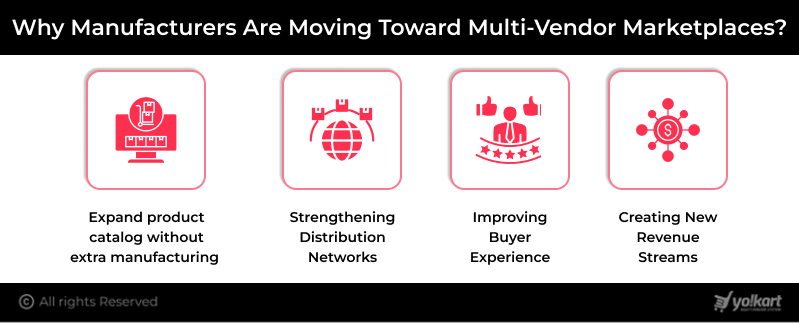
1. Expanding Product Catalog Without Additional Manufacturing
Manufacturers can significantly expand their product catalog by allowing third-partyvendors to list complementary products on the platform. For example, a manufacturer producing construction equipment can allow vendors selling tools, accessories, safetyequipment, and spare parts to join the platform. This creates a one-stop procurement hub for buyers while increasing platform engagement.
2. Strengthening Distribution Networks
Instead of replacing distributors, manufacturers can onboard them as vendors on the marketplace. This ensures that existing partners remain part of the ecosystem while benefiting from digital visibility, centralized ordering, and better inventory management.
3. Improving Buyer Experience
Modern buyers expect convenience, transparency, and quick comparisons. A multi-vendor marketplace enables buyers to compare products, review specifications, check ratings, and place bulk or customized orders, all in one place. This helps improve buyer confidence and encourages repeat purchases.
4. Creating New Revenue Streams
Manufacturers operating a marketplace can generate revenue through multiple monetization models, including vendor commissions, subscriptions, listing fees, advertising, and value-added services, turning the platform into a scalable digital business.
Understanding the Multi-Vendor Marketplace Model for Manufacturers
Before building a multi-vendor marketplace, it is important for manufacturers to clearly understand how the marketplace model works and why it is different from a traditional eCommerce store.
In a conventional online store, a single business sells its own products directly to buyers. However, a multi-vendor marketplace allows multiple independent sellers to list and sell products through a centralized platform managed by the marketplace owner.
For manufacturers, this model goes beyond online selling. It enables them to create a collaborative digital ecosystem where suppliers, distributors, wholesalers, and third-party vendors can sell products under a unified platform. While vendors manage their products and orders, the manufacturer manages the infrastructure and governance of the marketplace.
This approach allows manufacturers to move beyond being just product suppliers and instead become platform operators within their industry.
Key Participants in a Manufacturer-Led Marketplace
A successful multi-vendor marketplace operates through the collaboration of three core participants, each playing a specific role in the platform ecosystem.
a. Marketplace Owner (Manufacturer)
The manufacturer acts as the marketplace administrator and ecosystem builder. Rather than focusing only on selling its own products, the manufacturer provides the infrastructure that enables other vendors to sell through the platform.
Key responsibilities include:
- Managing vendor onboarding and verification
- Maintaining platform security and performance
- Defining commission structures and pricing policies
- Monitoring product quality and compliance
- Handling payments, disputes, and platform governance
This control helps protect brand reputation and ensures a consistent buyer experience.
b. Vendors and Suppliers
Vendors are independent sellers who join the marketplace to reach a wider audience. These may include:
- Authorized distributors
- Component suppliers
- Third-party product vendors
- Industry service providers
Each vendor typically receives access to a dedicated vendor dashboard to manage product listings, pricing, inventory, and order fulfillment. Their participation increases product variety, making the platform more valuable and comprehensive for buyers.
c. Buyers
Buyers on a manufacturer marketplace can include businesses, procurement managers, retailers, and sometimes individual consumers, depending on the marketplace model.
Instead of dealing with multiple suppliers separately, buyers benefit from a centralized procurement platform where they can:
- Compare products from multiple vendors
- Evaluate pricing and product specifications
- Review vendor ratings and reliability
- Place orders through a single checkout system
This streamlined buying experience makes the marketplace more attractive, improves trust, and encourages repeat purchases.
Want to Develop a Centralized Platform for Your Vendor Network?
Key Benefits of Building a Multi-Vendor Marketplace for Manufacturers
Building a multi-vendor marketplace for manufacturers creates a strategic foundation for growth, control, and long-term scalability in an increasingly digital landscape. Given below are some of the key benefits of building a multi-vendor marketplace for manufacturers:
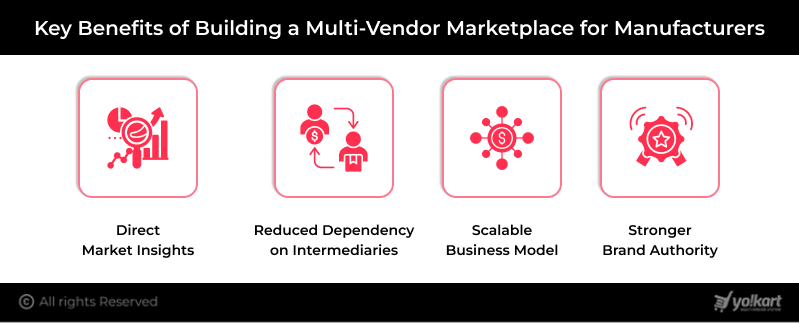
1. Direct Market Insights
Operating a marketplace gives manufacturers real-time visibility into buyer behavior, product demand, and pricing trends. These insights can be used to optimize production planning, improve product offerings, and make more informed business decisions.
2. Reduced Dependency on Intermediaries
While distributors and wholesalers remain important, a marketplace allows manufacturers to establish a direct digital channel to buyers. This helps reduce dependency on limited sales channels while maintaining stronger control over the sales process.
3. Scalable Business Model
Unlike traditional eCommerce stores, marketplaces scale quickly because vendors contribute products and inventory. As more vendors join, the platform becomes more valuable for buyers and drives higher engagement.
4. Stronger Brand Authority
By operating a marketplace, manufacturers position themselves as industry leaders and ecosystem builders. This not only strengthens brand credibility but also builds trust among vendors, partners, and buyers.
Suggested Read: A Detailed Guide For Multi-Vendor Marketplace Development
Key Features Required to Build a Multi-Vendor Marketplace
When manufacturers plan to build a multi-vendor marketplace, selecting the right set of platform features is critical for ensuring smooth operations, vendor participation, and a seamless buying experience.
Unlike a traditional eCommerce store, a marketplace must support multiple sellers, complex product catalogs, and coordinated transactions between buyers and vendors. This requires a robust and scalable infrastructure that can efficiently manage vendor activities, product listings, orders, payments, and customer interactions.
Below are some of the key features manufacturers should consider when developing a scalable multi-vendor marketplace platform.
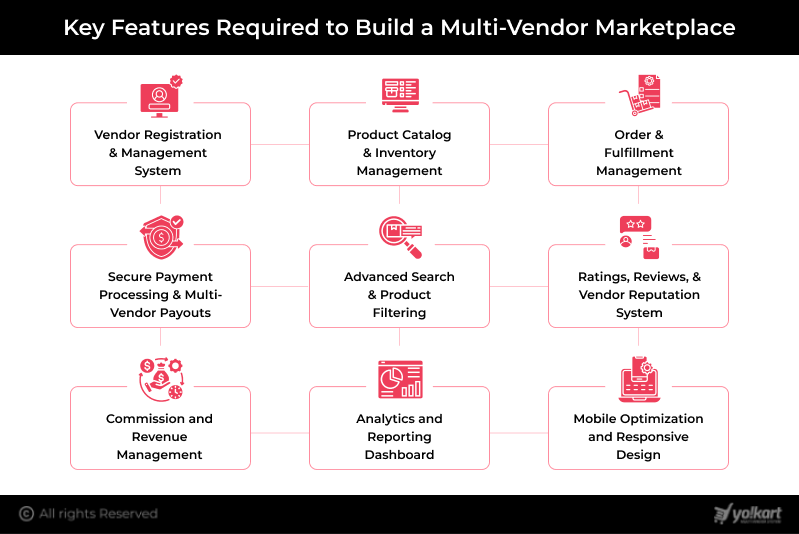
1. Vendor Registration and Management System
A marketplace must provide a streamlined onboarding process for vendors to register, create profiles, and start selling on the platform. An efficient vendor management system should allow admin/s to verify vendors, manage permissions, track performance, and oversee commissions and payouts.
At the same time, vendors should have access to a dedicated dashboard where they can manage their products, track orders, and analyze their sales performance.
2. Product Catalog and Inventory Management
A strong catalog system forms the backbone of any marketplace. It should support multiple categories, product variations, bulk pricing, and detailed specifications.
For industries like manufacturing, the ability to include technical attributes and documentation is especially important. Efficient inventory tools also help vendors update stock levels in real-time and avoid overselling.
3. Order and Fulfillment Management
A centralized order management system is essential for coordinating transactions between buyers and multiple vendors. Features like order tracking, automated notifications, vendor-specific processing, and shipment tracking ensure smooth operations.
Some marketplaces also integrate with logistics providers to simplify the shipping and delivery process.
4. Secure Payment Processing and Multi-Vendor Payouts
Handling payments in a multi-vendor setup requires flexibility and security. The platform should support trusted payment gateways, split payments or escrow systems, automated commission calculations, and timely vendor payouts.
Strong security measures, such as encrypted transactions and fraud protection, are also essential to build trust among both buyers and vendors.
5. Advanced Search and Product Filtering
As product listings grow, buyers need efficient tools to quickly find relevant products. Advanced search and filtering options help buyers quickly find relevant products based on categories, pricing, specifications, vendor ratings, and availability.
An optimized search experience significantly improves usability and drives conversions.
6. Ratings, Reviews, and Vendor Reputation System
Trust plays a major role in marketplace success. Buyers rely on ratings and reviews to make purchasing decisions.
A transparent feedback system not only helps buyers evaluate vendors but also encourages sellers to maintain high standards, improving overall platform credibility.
7. Commission and Revenue Management
A marketplace should support flexible monetization strategies such as commissions, subscriptions, featured listings, and advertising.
Having customizable revenue options ensures the marketplace can scale profitably while adapting to different vendor segments and business needs.
8. Analytics and Reporting Dashboard
Data insights are essential for marketplace growth and optimization. A robust analytics dashboard provides insights into vendor performance, buyer behaviour, product demand, and revenue trends.
These insights help manufacturers make data-driven decisions about product offerings, pricing strategies, and marketplace expansion.
9. Mobile Optimization and Responsive Design
Many buyers and vendors now access marketplaces through mobile devices. Therefore, the platform must offer a responsive design that works smoothly across smartphones, tablets, and desktops.
Some businesses also extend this experience through dedicated mobile apps to enhance engagement.
Power Your Multi-Vendor Marketplace with Robust Features
Steps to Build a Multi-Vendor Marketplace for Manufacturers
Building a multi-vendor marketplace platform requires a well-thought-out strategy that brings together the right business model, vendor ecosystem, technology infrastructure, and buyer acquisition strategy.
For manufacturers, the goal is to create a connected digital ecosystem where suppliers, distributors, and buyers can interact seamlessly while the manufacturer manages the overall platform experience.
Below are the key steps manufacturers should follow to successfully launch and scale their own marketplace.
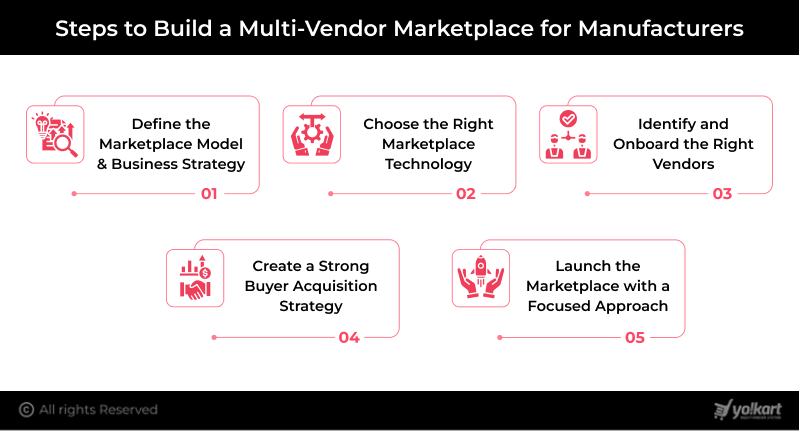
Step 1: Define the Marketplace Model and Business Strategy
The first step in marketplace development is determining the type of platform you want to build. Different industries require different marketplace models depending on the nature of the products, the target audience, and the existing supply chain structure.
Manufacturers may consider launching:
- B2B procurement marketplaces for wholesalers and retailers
- B2B2C marketplaces where distributors sell directly to end customers
- Industry-specific supplier marketplaces focused on specialized products
As clearly defining the marketplace model helps determine platform features, vendor types, and revenue strategies.
At this stage, it is also important to decide how the marketplace will generate revenue, whether through vendor commissions, subscription plans, product promotion fees, or value-added services.
Step 2: Choose the Right Marketplace Technology
Selecting the right technology solution is one of the most important decisions in the development process. As it will directly impact how quickly you can launch and how well your marketplace scales.
Manufacturers typically have two main options when they build a multi-vendor marketplace:
a. Custom Marketplace Development
Custom development offers maximum flexibility and allows businesses to build a platform tailored entirely to their requirements. However, this approach often requires significant investment, longer development timelines, and ongoing technical maintenance.
b. Readymade Marketplace Software Solutions
Another option is using ready-made marketplace software such as Yo!Kart, which provides pre-built marketplace functionality including vendor management, product catalogs, payment integrations, and order management tools.
Such platforms allow manufacturers to launch faster while still offering customization options to match specific industry needs.
Choosing the right technology framework helps ensure the marketplace is scalable, secure, and capable of supporting long-term growth.
Suggested Read: Top Multi-Vendor Marketplace Platform Development Companies
Step 3: Identify and Onboard the Right Vendors
Vendors are the foundation of your marketplace. Without a strong and reliable supply base, it becomes difficult to attract buyers.
Manufacturers already have an advantage because they often maintain long-standing relationships with distributors, suppliers, and industry partners. These existing relationships can serve as the foundation for the initial vendor network.
To build a healthy vendor ecosystem, manufacturers should:
- Invite existing distributors and suppliers to join the platform
- Partner with complementary product vendors
- Establish clear vendor policies and quality standards
- Provide incentives for early vendor adoption
Starting with a curated group of trusted vendors ensures product quality and helps build buyer confidence in the marketplace.
Step 4: Create a Strong Buyer Acquisition Strategy
Even with a large vendor base, a marketplace cannot succeed without consistent buyer demand. Attracting the right audience requires a proactive and well-planned marketing approach.
Manufacturers should leverage multiple channels such as SEO, content marketing, industry partnerships, digital advertising, and targeted email outreach to drive traffic and engagement. Their existing brand credibility and industry relationships can also play a key role in attracting early buyers.
As buyer demand increases, more vendors become interested in joining the platform, creating a positive network effect that fuels long-term growth.
Step 5: Launch the Marketplace with a Focused Approach
Many new marketplaces fail because they attempt to scale too quickly without establishing a stable foundation. Instead of onboarding hundreds of vendors immediately, manufacturers should start with a focused group of trusted partners and a limited product catalog.
This controlled launch approach allows the platform to:
- Test key marketplace features
- Optimize vendor workflows
- Gather feedback from buyers and vendors
- Improve platform performance
Once the marketplace begins generating consistent transactions, it becomes easier to scale by expanding vendor participation and product categories in a controlled and sustainable way.
Common Challenges and Their Solutions in Building a Multi-Vendor Marketplace
While many manufacturers are exploring ways to build a multi-vendor marketplace, launching and managing a successful platform comes with several operational and strategic challenges. Unlike a traditional eCommerce website, a marketplace must balance the needs of multiple stakeholders, including vendors, buyers, and platform administrators.
Understanding these challenges early helps manufacturers design better systems, implement effective strategies, and create a more sustainable marketplace ecosystem.
Below are some of the most common challenges businesses encounter when developing and scaling a marketplace platform.
1. Vendor Acquisition and Onboarding
One of the biggest challenges during the early stages of a marketplace is attracting vendors to join the platform. Most vendors prefer selling on established platforms that already have strong buyer traffic.
Solution: Manufacturers can overcome this challenge by onboarding trusted partners first, offering early incentives, and simplifying the onboarding process. A strong initial vendor base helps build product variety and attracts buyers.
2. Achieving Marketplace Liquidity
Marketplace liquidity refers to maintaining a healthy balance between supply (vendors and products) and demand (buyers and orders). If a marketplace has many vendors but very few buyers, vendors may lose interest in the platform. Similarly, if buyers visit the platform but cannot find enough product variety, they may abandon the marketplace.
Solution: To overcome this challenge, manufacturers should launch the platform with a curated vendor group, targeted niche, and invest in early buyer acquisition. Once the marketplace reaches a critical level of activity, the platform becomes more attractive to both vendors and buyers, creating a positive network effect.
3. Maintaining Product Quality and Vendor Standards
Since multiple vendors operate on the same platform, maintaining consistent product quality and service standards can be challenging. Poor vendor performance can damage the overall reputation of the marketplace and reduce buyer trust.
Solution: Manufacturers can address this challenge by implementing clear vendor guidelines, verification processes, performance tracking, and a transparent review system to help maintain quality and protect the platform’s reputation.
4. Managing Payments and Vendor Payouts
Handling payments in a multi-vendor environment is more complex than traditional eCommerce transactions. The platform must process buyer payments while ensuring that vendors receive their payouts accurately and on time.
Solution: This requires systems that can support features like split payments, automated payouts, and secure gateways to build trust and ensure smooth financial operations.
5. Platform Scalability and Technology Challenges
As the marketplace grows, the platform must be able to handle increasing numbers of vendors, product listings, transactions, and users. Poorly designed technology infrastructure can lead to performance issues, slow loading times, or system downtime, which negatively impacts user experience.
Solution: To ensure scalability, manufacturers should invest in scalable architecture, cloud infrastructure, and reliable integrations. This helps avoid costly upgrades later.
6. Building Buyer Trust and Platform Credibility
For new marketplaces, earning buyer trust can be difficult because customers are often hesitant to purchase from unfamiliar platforms. Manufacturers must focus on building credibility through transparency and reliable service.
Solution: Follow strategies such as verified vendor badges, authentic reviews, secure payments, and responsive support to strengthen buyer trust and encourage repeat purchases
7. Balancing Marketplace Governance
Managing a marketplace also means setting clear rules. Without proper governance, conflicts between vendors and buyers may arise, which can damage the platform’s reputation.
Solution: Manufacturers should implement policies covering vendor conduct, product authenticity, returns, and dispute resolution to ensure fairness and long-term platform stability.
While these challenges are real, they are far from roadblocks. With the right strategy and technology, they can be effectively managed and even turned into growth opportunities. Successful manufacturers focus on creating consistent value for both vendors and buyers while maintaining clear operational processes.
By proactively addressing key areas like vendor onboarding, marketplace liquidity, technology scalability, and buyer trust, manufacturers can develop a strong and sustainable marketplace ecosystem that supports long-term digital growth.
Build a Multi-Vendor Marketplace with Yo!Kart
Launching a multi-vendor marketplace from scratch can be complex, especially for manufacturers managing multiple vendors, product types, and transactions. To simplify this process, many businesses turn to purpose-built solutions like Yo!Kart, which provides a read-to-deploy foundation tailored for marketplace operations.
With Yo!Kart, manufacturers can move from planning to execution much faster. Instead of dealing with lengthy development cycles, the platform offers built-in features and flexible customization options, allowing businesses to create a marketplace that fits their specific industry needs while delivering a seamless experience for both vendors and buyers.
As a result, manufacturers can significantly reduce time-to-market and development costs, while allocating their resources to other important aspects, such as a strong vendor ecosystem, attracting buyers, and scaling their digital marketplace effectively.
Key Advantages of Leveraging Yo!Kart
- Faster Time-to-Market: Launch your marketplace quickly with pre-built features, reducing development time and accelerating your go-to-market strategy.
- Comprehensive Feature Set: Access all essential marketplace functionalities, including vendor management, product catalogs, payments, and order processing in one place.
- Customizable and Scalable: Adapt the platform to your business needs and scale effortlessly as your marketplace grows.
- Cost-Effective Solution: Eliminate the high costs of custom development while benefiting from a feature-rich, ready-made platform.
- Vendor-Friendly Interface: Provide vendors with intuitive dashboards and tools to manage products, orders, and performance efficiently.
- Secure and Reliable: Ensure safe transactions and platform stability with built-in security features and robust infrastructure.
- Flexible Monetization Options: Generate revenue through commissions, subscriptions, and promotional listings with configurable monetization models.
- Seamless User Experience: Deliver a smooth and responsive experience across devices, improving engagement for both buyers and vendors.
Explore Cutting-Edge Capabilities of Yo!Kart
Conclusion
Digital commerce is transforming how manufacturers interact with suppliers, distributors, and buyers. What once relied on fragmented channels is now shifting toward unified platforms where multiple stakeholders interact seamlessly. This shift is not just about going online; it is about building connected ecosystems that drive efficiency and growth.
By building a multi-vendor marketplace, manufacturers can create a centralized hub that connects vendors, expands product offerings, and simplifies procurement for buyers. A well-designed marketplace not only improves supply chain efficiency but also provides valuable data insights into customer behavior, product demand, and vendor performance. These insights help manufacturers make informed decisions about product development, pricing strategies, and future expansion.
However, launching a marketplace requires careful planning, the right technology foundation, and a clear vendor acquisition strategy. With modern marketplace solutions simplifying development, manufacturers can focus on scaling their ecosystem, unlocking new revenue streams, and staying competitive in an increasingly digital-first market.
Frequently Asked Questions
Q 1. What is a multi-vendor marketplace?
Ans. A multi-vendor marketplace is an online platform where multiple independent sellers can register, list, and sell their products to buyers through a centralized system. The marketplace owner manages the platform infrastructure, vendor policies, and transactions while vendors/sellers manage their own product listings, pricing, and order fulfillment.
Q 2. Why should manufacturers build a multi-vendor marketplace?
Ans. Manufacturers can benefit from building a marketplace because it allows them to expand their product catalog without increasing production by onboarding third-party vendors. It helps strengthen supplier relationships with distributors, reach a broader customer base, and create new revenue opportunities through commissions, vendor subscriptions, and platform services.
Q 3. What are the key features required to build a multi-vendor marketplace?
Ans. To successfully build a multi-vendor marketplace, businesses typically require features such as:
- Vendor management systems
- Product catalog management
- Secure payment processing
- Order tracking
- Commission management
- Search and filtering tools
- Analytics dashboards
These features ensure smooth interactions between vendors, buyers, and marketplace administrators.
Q 4. How long does it take to build a multi-vendor marketplace?
Ans. The development timeline to build a multi-vendor marketplace depends on the approach chosen. Custom marketplace development can take several months to complete, depending on platform complexity. Alternatively, ready-made marketplace solutions can significantly reduce development time by providing pre-built features and integrations.
Q 5. How can manufacturers attract vendors to their marketplace?
Ans. Manufacturers can attract vendors by leveraging existing supplier relationships, offering competitive commission structures, providing marketing support, and ensuring that the platform offers strong buyer traffic and visibility for vendor products. Early vendor incentives and simplified onboarding processes can also help accelerate vendor adoption.
Q 6. What are the common monetization models for a multi-vendor marketplace?
Ans. Marketplace operators typically generate revenue through various monetization strategies, including:
- Sales commissions on vendor transactions
- Vendor subscription plans
- Product listing or promotion fees
- Advertising placements
- Value-added services such as logistics or analytics tools
Using a combination of these models can help create a sustainable marketplace business.
Q 7. What technology can be used to build a multi-vendor marketplace?
Ans. Businesses can either develop a marketplace from scratch or use specialized marketplace software platforms. Solutions like Yo!Kart provides built-in features such as vendor dashboards, order management, payment integrations, and customizable marketplace functionality, which can help accelerate the launch process.
The post How Manufacturers Can Build a Multi-Vendor Marketplace appeared first on YoKart Blog.
]]>