<?xml version="1.0" encoding="UTF-8"?>
<?xml-stylesheet type="text/xsl" media="screen" href="/~d/styles/rss2full.xsl"?><?xml-stylesheet type="text/css" media="screen" href="http://feeds.feedburner.com/~d/styles/itemcontent.css"?><rss xmlns:content="http://purl.org/rss/1.0/modules/content/" xmlns:wfw="http://wellformedweb.org/CommentAPI/" xmlns:dc="http://purl.org/dc/elements/1.1/" xmlns:atom="http://www.w3.org/2005/Atom" xmlns:sy="http://purl.org/rss/1.0/modules/syndication/" xmlns:slash="http://purl.org/rss/1.0/modules/slash/" xmlns:feedburner="http://rssnamespace.org/feedburner/ext/1.0" version="2.0">

<channel>
	<title>Amvic Building System</title>
	
	<link>http://www.amvicsystem.com</link>
	<description>Insulated Concrete Forms | Rigid EPS Insulation</description>
	<lastBuildDate>Fri, 25 May 2012 14:20:34 +0000</lastBuildDate>
	<language>en</language>
	<sy:updatePeriod>hourly</sy:updatePeriod>
	<sy:updateFrequency>1</sy:updateFrequency>
	<generator>http://wordpress.org/?v=3.0</generator>
		<atom10:link xmlns:atom10="http://www.w3.org/2005/Atom" rel="self" type="application/rss+xml" href="http://feeds.feedburner.com/amvicsystem" /><feedburner:info uri="amvicsystem" /><atom10:link xmlns:atom10="http://www.w3.org/2005/Atom" rel="hub" href="http://pubsubhubbub.appspot.com/" /><item>
		<title>Rainwater Harvesting Think Tank</title>
		<link>http://feedproxy.google.com/~r/amvicsystem/~3/wmk5iencgHM/rainwater-harvesting-think-tank</link>
		<comments>http://www.amvicsystem.com/rainwater-harvesting-think-tank#comments</comments>
		<pubDate>Fri, 25 May 2012 14:10:12 +0000</pubDate>
		<dc:creator>Gary Brown</dc:creator>
				<category><![CDATA[Climate change]]></category>
		<category><![CDATA[Renewable]]></category>
		<category><![CDATA[Sustainability]]></category>
		<category><![CDATA[collection]]></category>
		<category><![CDATA[rainwater]]></category>
		<category><![CDATA[water]]></category>

		<guid isPermaLink="false">http://www.amvicsystem.com/?p=3727</guid>
		<description><![CDATA[Water shortages; we all know they're coming, but we're doing very little to stave off the inevitable. Water is the new oil. Climate change, pollution and population explosions have rendered the supply of fresh water the most precious commodity on earth. Water shortages not only affect health and hygiene, they also affect food production and energy generation. Read on to find out how you can help to reduce your own consumption and that of your business by collecting and using rainwater. ]]></description>
			<content:encoded><![CDATA[<p><img src="http://www.amvicsystem.com/wp-content/uploads/2012/05/iStock_000016544728XSmall-160x110.jpg" alt="" title="rainwater" width="160" height="110" class="alignright size-thumbnail wp-image-3730" /><a href="http://www.amvicsystem.com/water-conservation">Water shortages;</a> we all know they&#8217;re coming, but we&#8217;re doing very little to stave off the inevitable. Water is the new oil. Climate change, pollution and population explosions have rendered the supply of fresh water the most precious commodity on earth. Water shortages not only affect health and hygiene, they also affect food production and energy generation. You can help to reduce your own consumption and that of your business by collecting and using rainwater.<br />
<span id="more-3727"></span></p>
<h2>The facts</h2>
<p>Here are some water facts for you:</p>
<ul>
<li><a href="http://ag.arizona.edu/AZWATER/awr/dec99/Feature2.htm">40% of the world&#8217;s population</a> have no access to clean drinking water </li>
<li>Every year <a href="http://water.org/water-crisis/water-facts/water/">3.41 million people</a> die due to lack of water or hygiene-related illnesses </li>
<li>A <a href="http://water.org/water-crisis/water-facts/water/">5 minute shower</a> uses more water than people in developing countries use in a day</li>
</ul>
<p>If you&#8217;re thinking that water shortages don&#8217;t apply to you because there&#8217;s plenty of water where you live, you&#8217;re wrong. Just take a peek at your utilities bill and you will notice the sharp increase in pricing over the last decade. Increases in water prices mean you&#8217;re paying more for food, energy and for the products of every industry that uses water in its manufacturing process. </p>
<h2>Rainwater collection</h2>
<p><img src="http://www.amvicsystem.com/wp-content/uploads/2012/05/iStock_000014463462XSmall-200x300.jpg" alt="" title="Rainwater Collection Barrel" width="200" height="300" class="alignleft size-medium wp-image-3731" />Although <a href="http://www.cmhc-schl.gc.ca/en/inpr/su/waho/waho_002.cfm">rainwater collection</a> is not a mainstream practice in North America, large parts of Europe and Asia incorporate it into building design as a matter of course. Rainwater collected from the roofs of homes and businesses can make an important contribution to fresh water reserves. Rain runoff from your roof can be collected and stored in rain barrels or other storage units. This water may not be suitable for consumption as your roof will contain impurities, bacteria and chemicals. However, it can be put to use in toilets and showers, for laundry and dishes, when washing cars and watering the garden; activities which account for most of the water consumption around the house. Using rainwater can save about 70% of your household consumption. This means that costs from installing and plumbing a rainwater collection system are recovered in no time at all. </p>
<h2>Water harvesting; sometimes it&#8217;s illegal!</h2>
<p>In the US, some states (like New Mexico) mandate water catchment systems as part of new building construction while in others, (like Colorado) rain harvesting is against the law. In some areas, rainwater is the property of the state. One might expect that local governments tabled these laws to protect the integrity of the water aquifers that supply surrounding towns and cities. However, a <a href="http://en.wikipedia.org/wiki/Rainwater_harvesting">2007 study</a> of rainfall in Douglas County discovered that 97% of it evaporated or was absorbed by plants which meant it never made it to a river or underground aquifer. If you plan on installing a rain harvesting system, ensure that you meet with local legislative demands. </p>
<h2>Benefits of rainwater harvesting</h2>
<p>There is a plethora of advantages for your home and the environment that go beyond saving money on your utility bills.</p>
<ul>
<li>Rainwater can supplement municipal water, thereby reducing processing costs for local infrastructure. </li>
<li>Reduced water demands in urban areas save local municipalities money. </li>
<li>When rainwater is harvested, it puts less pressure on storm drains during rainy seasons. </li>
<li>Rainwater harvesting systems are not expensive and require very little maintenance. </li>
<li>Having an independent source of water is helpful during droughts. </li>
<li>Harvested rainwater provides a source of relatively clean water when natural disasters strike.</li>
</ul>
<p>Harvesting rainwater is a great choice for your pocket and for the environment. You can make your collection system as elaborate as you like or as simple as a bucket under your downspout. Whatever your system of choice, make sure that you join the movement to harvest more rainwater. </p>
]]></content:encoded>
			<wfw:commentRss>http://www.amvicsystem.com/rainwater-harvesting-think-tank/feed</wfw:commentRss>
		<slash:comments>0</slash:comments>
		<feedburner:origLink>http://www.amvicsystem.com/rainwater-harvesting-think-tank</feedburner:origLink></item>
		<item>
		<title>Energy Efficiency: Will your home pass the test?</title>
		<link>http://feedproxy.google.com/~r/amvicsystem/~3/Dv-aLNkcAnI/energy-efficiency-will-your-home-pass-the-test</link>
		<comments>http://www.amvicsystem.com/energy-efficiency-will-your-home-pass-the-test#comments</comments>
		<pubDate>Wed, 16 May 2012 20:04:29 +0000</pubDate>
		<dc:creator>Gary Brown</dc:creator>
				<category><![CDATA[Energy Efficiency]]></category>
		<category><![CDATA[residential buildings]]></category>
		<category><![CDATA[Blower door test]]></category>
		<category><![CDATA[energy audit]]></category>
		<category><![CDATA[energy efficient]]></category>
		<category><![CDATA[HERS rating]]></category>

		<guid isPermaLink="false">http://www.amvicsystem.com/?p=3719</guid>
		<description><![CDATA[Energy efficient homes often perform well below their stated efficiency goals. The reasons for this are varied; at times cutting-edge technology is not installed correctly or components are added in a piecemeal fashion and don't work as a combined system. Building construction has to be flawless as gaps or cracks in the building envelope will undermine insulation efforts. Read on to find how you can measure the energy efficiency of any building to ensure that it is performing as intended.]]></description>
			<content:encoded><![CDATA[<p><img src="http://www.amvicsystem.com/wp-content/uploads/2012/05/iStock_000018665733XSmall-300x204.jpg" alt="" title="Home Energy Audit" width="300" height="204" class="alignright size-medium wp-image-3720" />Energy efficient homes often perform well below their stated efficiency goals. The reasons for this are varied; at times cutting-edge technology is not installed correctly or components are added in a piecemeal fashion and don&#8217;t work as a combined system. Building construction has to be flawless as gaps or cracks in the building envelope will undermine insulation efforts. You can measure the energy efficiency of any building to ensure that it is performing as intended. This helps identify areas where insulation is insufficient, air sealing needs a tweak or mechanical systems are not functioning as they should.</p>
<p>Once tested, your home will get a <a href="http://en.wikipedia.org/wiki/Home_energy_rating#HERS_Index_and_related_scales">HERS rating</a>. Traditional homes score over 100 on the HERS rating scale. An energy efficient home should score around the 50 mark while a net zero home has a score of 0.<br />
<span id="more-3719"></span></p>
<h2>Blower door test</h2>
<p><img src="http://www.amvicsystem.com/wp-content/uploads/2012/05/Blower_Door_Test-183x300.jpg" alt="" title="Blower_Door_Test" width="183" height="300" class="alignleft size-medium wp-image-3721" />The purpose of a <a href="http://www.greenbuildingadvisor.com/blogs/dept/musings/blower-door-basics">blower door test</a> is to ascertain the airtightness of the building envelope and to identify leakage points. A blower door is a large fan which is held in an expandable frame and sealed into a door jamb. Air is then exhausted from the house until the house is under a negative pressure of 50 pascals. There are two main readings that blower-door tests produce; airflow at a pressure difference of 50 Pascals (cfm50) or air changes per hour at a pressure difference of 50 Pascals (ach50). Smoke sticks are then used to identify leaks in the building envelope. In new homes, this test should be conducted before the dry wall is hung to expedite remediation.</p>
<p><object width="450" height="335"><param name="movie" value="http://www.youtube.com/v/r0Vw1Mqu5hE?version=3&amp;hl=en_US&amp;rel=0"></param><param name="allowFullScreen" value="true"></param><param name="allowscriptaccess" value="always"></param><embed src="http://www.youtube.com/v/r0Vw1Mqu5hE?version=3&amp;hl=en_US&amp;rel=0" type="application/x-shockwave-flash" width="450" height="335" allowscriptaccess="always" allowfullscreen="true"></embed></object></p>
<h2>The energy audit</h2>
<p>An energy audit consists of several components that measure every aspect of your home. Your HVAC system is measured for efficiency with a duct blaster test. The duct blaster test checks that ductwork is sealed effectively. Here a device is used to pressurize ductwork to ascertain the amount of air leakage through pressure loss. EnergyStar appliances require less than 6% air leakage to perform optimally. </p>
<p>Doors and windows should be checked for a good seal during the blower door test utilizing a smoke stick. An infrared camera test can help to highlight areas where air is escaping. Thermal imaging cameras identify the heat-loss patterns invisible to the naked eye. </p>
<p>Check caulking on the exterior of your home and weather stripping around your doors and windows. Fill in any gaps or cracks with a reliable sealant. The <a href="http://www.earthworksgroup.com/">Earthworks Group</a> claim that cracks in the average home can add up to a 9 square foot hole in the wall.</p>
<p>Having an energy audit conducted on your home is a really great way to find problem areas. The tests are conducted by qualified contractors who can make recommendations for improvements that could save you thousands of dollars a year. Governments provide incentives for homeowners who conduct energy audits which usually involve tax credits or refunds (see Canadian rebates <a href="http://ecoliving.scotiabank.com/articles/rebates-ecoenergy-retrofit-program">here</a>.) Testing your home for efficiency will help you to identify the weak points and improve the efficacy of your building envelope. You can also make a more effective plan for retrofits and save fistfuls of money on your annual utilities bill. </p>
]]></content:encoded>
			<wfw:commentRss>http://www.amvicsystem.com/energy-efficiency-will-your-home-pass-the-test/feed</wfw:commentRss>
		<slash:comments>0</slash:comments>
		<feedburner:origLink>http://www.amvicsystem.com/energy-efficiency-will-your-home-pass-the-test</feedburner:origLink></item>
		<item>
		<title>Corporate sustainability</title>
		<link>http://feedproxy.google.com/~r/amvicsystem/~3/eakcLcU4Lcc/corporate-sustainability</link>
		<comments>http://www.amvicsystem.com/corporate-sustainability#comments</comments>
		<pubDate>Fri, 11 May 2012 14:15:04 +0000</pubDate>
		<dc:creator>Gary Brown</dc:creator>
				<category><![CDATA[Sustainability]]></category>
		<category><![CDATA[corporations]]></category>
		<category><![CDATA[Quantas Air]]></category>
		<category><![CDATA[sustainable]]></category>

		<guid isPermaLink="false">http://www.amvicsystem.com/?p=3714</guid>
		<description><![CDATA[Sustainability in the corporate world is a holistic approach to business. Here corporations aim to live in harmony with nature, improve the communities in which they operate and behave in a socially, culturally and economically responsible manner. Sustainable corporations take a long-term approach to development with consideration for the generations to come. It's an evolution beyond the business practices that have resulted in climate change, destruction of natural habitats and social and economic mayhem.]]></description>
			<content:encoded><![CDATA[<p><img src="http://www.amvicsystem.com/wp-content/uploads/2012/05/iStock_000019817414XSmall-300x199.jpg" alt="" title="Eco friendly businessman" width="300" height="199" class="alignright size-medium wp-image-3715" />Sustainability in the corporate world is a holistic approach to business. Here corporations aim to live in harmony with nature, improve the communities in which they operate and behave in a socially, culturally and economically responsible manner. Sustainable corporations take a long-term approach to development with consideration for the generations to come. It&#8217;s an evolution beyond the business practices that have resulted in climate change, destruction of natural habitats and social and economic mayhem.</p>
<h2>Sustainability is profitable</h2>
<p>For corporate sustainability to be viable, it must be profitable. Many corporations are beginning to see recycling as a way to increase profits. Retrofits which reduce their energy consumption have good ROIs as the corporations save money on lower utilities bills. Methods implemented to reduce their waste and carbon output will also save on carbon taxes.<br />
<span id="more-3714"></span><br />
When <a href="http://www.qantas.com.au/travel/airlines/media-releases/mar-2012/5382/global/en">Quantas Air</a> found themselves burdened by the high cost of jet fuel and carbon emissions taxes leveled by Europe, Australia and New Zealand, they decided to take a more sustainable approach to air travel. Their corporate sustainability solution; used cooking oil from fast food restaurants. The airline ran its first commercial biofuel flight of an airbus A330 from Sydney to Adelaide in April 2012. The airbus utilized a 50/50 mixture of jet fuel and recycled cooking oil. The airline hopes to reduce its carbon emissions by 60% with the biofuel planes and slash its running costs. </p>
<p><img src="http://www.amvicsystem.com/wp-content/uploads/2012/05/iStock_000013621791XSmall-300x199.jpg" alt="" title="Coins and green plant isolated on white" width="300" height="199" class="alignleft size-medium wp-image-3716" />It&#8217;s not only the savings that help sustainable corporations to improve their bottom line, it&#8217;s also the overwhelming support they enjoy as consumers increasingly opt for green products and companies they see as socially and environmentally responsible. Environmentally friendly products and services and fair trade items are gaining traction in the marketplace. </p>
<h2>Networking helps industry achieve sustainability</h2>
<p>Toronto-based organization, <a href="http://www.summerhillgroup.ca/">Summerhill</a>, endeavors to improve corporate sustainability and educates the public on how to make environmentally smarter choices. Corey Diamond, Summerhill CEO explains: &#8220;Summerhill works with forward-thinking companies and organizations to effectively address complex environmental problems through the creation of innovative strategies and initiatives that move the market toward sustainability.&#8221; Their most successful venture to date has been &#8216;Retire your Ride&#8217;. </p>
<p>Cars made prior to 1995 produce a much higher percentage of pollution than newer models. In an effort to accelerate the retirement of these older cars in favor of more fuel efficient options, or different modes of transport altogether, Summerhill launched an ambitious program. Car owners across Canada could register online or call in and have their cars picked up within 48 hours. They would receive a check of $300 and discounts at dealers who offered more fuel efficient vehicles. </p>
<p>Summerhill also partnered with transit companies and bike companies to provide additional incentives to those who no longer wanted to own a vehicle. With the biggest environmental campaign in Canadian history, they retired 138 000 vehicles in just two years. The program raised $3,588,755 for charity and prevented the release of 47,154 tonnes of carbon monoxide (CO)¹ and 4,906 tonnes (VOCs &#038; NOx)¹ into the atmosphere.</p>
<p>The success of the program has resulted in the independent adoption of the scheme by large automobile manufacturers like <a href="http://www.gm.ca/gm/?adv=88728&#038;mkwid=sb11hVeuX%7Cpcrid%7C9883094708%7Cpmt%7Cp%7Cpkw%7Cgeneral motors">GM</a> and <a href="http://www.compare.ford.ca/comparetool/Compare.jsp#selectview_yearCode=C20">Ford</a>. It has also enabled structural change in the recycling business as only recyclers who adhered to code were invited to participate in the program. This elevated many recyclers to a higher environmental standard and encouraged government to standardize recycling codes which are to be adopted in the near future. </p>
<h2>The way forward</h2>
<p>As the two-pronged benefit of reduced costs and increased customer appeal makes sustainability more attractive to corporations, many are seeking ways to reduce their carbon footprint and make products that are more environmentally friendly. From <a href="http://www.amvicsystem.com/">energy reducing retrofits</a> to renewable energy sources to sustainable materials and green transportation, the face of industry is slowly changing. </p>
]]></content:encoded>
			<wfw:commentRss>http://www.amvicsystem.com/corporate-sustainability/feed</wfw:commentRss>
		<slash:comments>0</slash:comments>
		<feedburner:origLink>http://www.amvicsystem.com/corporate-sustainability</feedburner:origLink></item>
		<item>
		<title>Rebuilding a Green Haiti</title>
		<link>http://feedproxy.google.com/~r/amvicsystem/~3/MaI_lYrV5S4/rebuilding-a-green-haiti</link>
		<comments>http://www.amvicsystem.com/rebuilding-a-green-haiti#comments</comments>
		<pubDate>Fri, 04 May 2012 14:03:43 +0000</pubDate>
		<dc:creator>Gary Brown</dc:creator>
				<category><![CDATA[Renewable]]></category>
		<category><![CDATA[green building]]></category>
		<category><![CDATA[icf construction]]></category>
		<category><![CDATA[insulated concrete forms]]></category>
		<category><![CDATA[building]]></category>
		<category><![CDATA[earthquake]]></category>
		<category><![CDATA[Haiti]]></category>
		<category><![CDATA[icf]]></category>
		<category><![CDATA[Solar Energy Light Fund]]></category>

		<guid isPermaLink="false">http://www.amvicsystem.com/?p=3709</guid>
		<description><![CDATA[On 12 January 2010, a 7.0 magnitude earthquake rocked the island nation of Haiti. Haiti has a long history of severe earthquakes, but none could compare to the death and decimation of this one. Read about the rebuilding efforts that are focusing on renewable energy and green building techniques. ]]></description>
			<content:encoded><![CDATA[<p><img src="http://www.amvicsystem.com/wp-content/uploads/2012/05/320px-Earthquake_damage_in_Jacmel_2010-01-17_4-300x199.jpg" alt="" title="320px-Earthquake_damage_in_Jacmel_2010-01-17_4" width="300" height="199" class="alignright size-medium wp-image-3710" />On 12 January 2010, a <a href="http://en.wikipedia.org/wiki/2010_Haiti_earthquake">7.0 magnitude earthquake</a> rocked the island nation of Haiti. Haiti has a long history of severe earthquakes, but none could compare to the death and decimation of this one. Now, two years after the devastating quake, rebuilding efforts are focusing on renewable energy and green building techniques.<br />
<span id="more-3709"></span></p>
<h2>Slow recovery</h2>
<p>By the end of 2010, international donations to Haiti created a fund so big, that each displaced individual could get a check for $37, 000. However, much of the Haitian aid money remains unspent. The biggest problem is property rights. Before the earthquake, 80% of Haitians did not own the home they lived in, but exactly who did was a hotly disputed topic. </p>
<p>Today over 550 000 Haitians remain homeless, stuck in temporary shelters without garbage collection or sewage systems while cholera continues to ravage the communities exposed to pollution and waste. Although progress is painfully slow, efforts are currently underway to remedy the situation. </p>
<p>UNICEF has a more positive outlook for the coming year; “The outlook at the start of 2012 appears bright. Positive progress in the public sector is matched by optimistic forecasts for private sector investment, bringing a much needed boost to the local economy.” The Red Cross has made the most progress. In 2011, they built homes for 36,270 Haitians; bringing the total number of people they’ve provided homes for to 100,000.</p>
<h2>How does one make a building earthquake proof?</h2>
<p><img class="alignright" src="/wp-content/uploads/2010/05/icfoverview/straightreversibleblock.jpg" alt="Amvic concrete forms">Haiti is regularly subjected to earthquakes as well as inclement weather. Rebuilding homes, school and hospitals requires solid building construction methods. Structures able to withstand earthquakes, strong winds and flooding will help to protect lives and properties in the future. Wherever possible, most structures are being constructed from <a href="http://www.amvicsystem.com/icf-block">ICF blocks</a> to make them earthquake resistant. <a href="http://www.amvicsystem.com/">ICF blocks</a> are rebar-reinforced and filled with concrete. The ability of an ICF structure to withstand earthquakes is dependent on the way in which it is built. Structures can be built to any of the top three strengths: Seismic C, Seismic D1, or Seismic D2, with D2 being the highest standard in the International Building Code. ICF blocks have the added advantage of reducing the energy consumption of structures by up to 50%.</p>
<h2>Let the Sunshine in</h2>
<p>While energy may not be in abundance in Haiti, sunshine certainly is. Now the Solar Energy Light Fund (<a href="http://www.holdon4haiti.org/">SELF</a>) plans to bring power to the people of Haiti with solar power installations. SELF has received help from some unusual quarters, Grammy-winning reggae outfit, Steel Pulse, has donated profits generated from their latest single, <a href="http://www.holdon4haiti.org/">HoldOn4Haiti</a> to SELF. Larry Hagman, who ironically played oil magnate J.R. Ewing in the TV drama &#8216;Dallas&#8217;, has also thrown his weight behind the project, utilizing the Solar2World organization to donate solar panels to SELF who use them to power clinics. </p>
<p>Not only does SELF&#8217;s tireless work benefit clinic patients, it often has some unexpected benefits; &#8220;Within minutes of the first lights coming on, our project director saw a small boy standing underneath them, reading a book!&#8221; Bob Freling, Executive Director of SELF. </p>
<p>It&#8217;s not just Haitians who fear earthquakes; each year, over 500 000 earthquakes occur worldwide with 100 000 causing damage and loss of life. Building earthquake-proof homes, hospitals, schools and businesses will help Haiti recover and save them from a similar fate in the future. </p>
]]></content:encoded>
			<wfw:commentRss>http://www.amvicsystem.com/rebuilding-a-green-haiti/feed</wfw:commentRss>
		<slash:comments>0</slash:comments>
		<feedburner:origLink>http://www.amvicsystem.com/rebuilding-a-green-haiti</feedburner:origLink></item>
		<item>
		<title>Straw Bale Construction</title>
		<link>http://feedproxy.google.com/~r/amvicsystem/~3/jC3zCZ6oyS0/straw-bale-construction</link>
		<comments>http://www.amvicsystem.com/straw-bale-construction#comments</comments>
		<pubDate>Wed, 25 Apr 2012 16:54:58 +0000</pubDate>
		<dc:creator>Gary Brown</dc:creator>
				<category><![CDATA[Construction]]></category>
		<category><![CDATA[Energy Efficiency]]></category>
		<category><![CDATA[Renewable]]></category>
		<category><![CDATA[green building]]></category>
		<category><![CDATA[bale]]></category>
		<category><![CDATA[carbon neutral]]></category>
		<category><![CDATA[construction]]></category>
		<category><![CDATA[Maya Guesthouse]]></category>
		<category><![CDATA[straw]]></category>

		<guid isPermaLink="false">http://www.amvicsystem.com/?p=3697</guid>
		<description><![CDATA[Straw bale construction has been around since the 1800s, but fell out of favor as people turned to the more fashionable brick and mortar building techniques. Now, as the construction industry struggles to find ways to reduce its carbon footprint, the ancient practice of straw bale construction is enjoying a rather jolly revival.]]></description>
			<content:encoded><![CDATA[<p><img src="http://www.amvicsystem.com/wp-content/uploads/2012/04/iStock_000010111478XSmall-e1335372729380-300x215.jpg" alt="" title="Summer Harvest Season" width="300" height="215" class="alignright size-medium wp-image-3698" /><a href="http://www.strawbale.com/">Straw bale</a> construction has been around since the 1800s, but fell out of favor as people turned to the more fashionable brick and mortar building techniques. Now, as the construction industry struggles to find ways to reduce its carbon footprint, the ancient practice of straw bale construction is enjoying a rather jolly revival.<br />
<span id="more-3697"></span><br />
<H2>Why cows will not want to eat your house</H2><br />
Straw is the by-product of farming and makes up 50% of the yield of cereal crops like barley, rye, oats rice and wheat. It contains no nutritional value for animals (not to be confused with hay with is used as animal feed) and is generally utilized for animal bedding or burned as a biofuel, especially for biobutanol. Straw briquettes are used as a biofuel substitute to coal. When it is harvested, the straw is tightly packed into bales and secured with string. These bales are used to construct relatively cheap, well-insulated environmentally-friendly walls. </p>
<p><H2>How it&#8217;s done</H2><br />
<a href="http://en.wikipedia.org/wiki/Straw-bale_construction">Bales</a> come in different sizes, but the most commonly used bales are about 36 inches-by-18 inches-by-14 inches. Bales must be dry and tightly packed. Damp straw can result in mold or compromise the integrity of the structure. The bales are stacked into a frame much the same way as you would bricks. Laying the bales horizontally will produce an 18 inch thick wall while vertically stacked bales will produce a 14 inch wall. Once the wall has been completed, it&#8217;s rendered and sealed with plaster, earthen stucco or lime stucco. The wall must be properly sealed.</p>
<p><img src="http://www.amvicsystem.com/wp-content/uploads/2012/04/Hay_Texture_by_WKJ_Stock.jpg" alt="" title="Hay_Texture_by_WKJ_Stock" width="200" height="282" class="alignleft size-full wp-image-3699" /><H2>The benefits of straw bale construction</H2><br />
Thanks to the carbon trapped in the straw itself, bale-constructed walls can be carbon-neutral or even carbon-negative if the straw is locally sourced. When the structure is demolished, the straw can be broken up and will biodegrade. Although loose straw is extremely flammable, once the bales are rendered, they are surprisingly resilient to both fire and wind. The BaleHaus, a two-storey structure built by Bath University, has been subjected to rigorous testing to clarify it&#8217;s safely. The fire test subjected the building to 1000°C temperatures for two hours, four times longer than the legal requirements, without it igniting.<br />
<a href="http://www.osbbc.ca/">Research</a> shows that straw bale homes have a fantastic R-value of between R-30 and R-40 which further reduces the structure&#8217;s carbon footprint by negating the need for heating (and cooling if built right) in all but the most extreme temperatures. </p>
<p><H2>What kind of structures can you build?</H2><br />
Straw bale structures are gaining traction and, as building methods improve, height. A five-star lodge in South Africa was constructed from 10 000 straw bales and has housed the likes of Nelson Mandela and Tony Blair. The <a href="http://mayaguesthouse.wordpress.com/category/nax-mont-noble/">Maya Guesthouse</a>, a three-storey hotel in the Swiss Alps, in the little village of Nax Mont-Noble, is currently being constructed and has the claim to fame of being the first hotel in Europe built entirely from straw. 34 Straw bale homes were built in <a href="https://www03.cmhc-schl.gc.ca/catalog/productDetail.cfm?cat=127&#038;itm=33&#038;lang=en&#038;fr=1335363701359">Atlanta Canada</a>; a project conducted by the Canada Housing and Mortgage Corporation. Atlanta has extreme changes in weather and the project measured the way in which the straw bale homes withstood the elements. </p>
<p>Although lacking the strength and durability of green building materials such as <a href="http://www.amvicsystem.com/">ICF blocks</a>, straw bale homes provide a natural, environmentally alternative to conventional building methods. Before considering a straw bale structure, you must investigate the licensing and building code options in your area. Good construction is crucial and the structure will only work well if it is properly built. </p>
]]></content:encoded>
			<wfw:commentRss>http://www.amvicsystem.com/straw-bale-construction/feed</wfw:commentRss>
		<slash:comments>0</slash:comments>
		<feedburner:origLink>http://www.amvicsystem.com/straw-bale-construction</feedburner:origLink></item>
		<item>
		<title>LEED-certified buildings good for business</title>
		<link>http://feedproxy.google.com/~r/amvicsystem/~3/PanGBSzCPwc/leed-certified-buildings-good-for-business</link>
		<comments>http://www.amvicsystem.com/leed-certified-buildings-good-for-business#comments</comments>
		<pubDate>Fri, 20 Apr 2012 15:43:49 +0000</pubDate>
		<dc:creator>Gary Brown</dc:creator>
				<category><![CDATA[Going Green]]></category>
		<category><![CDATA[green building]]></category>
		<category><![CDATA[certification]]></category>
		<category><![CDATA[eco-friendly]]></category>
		<category><![CDATA[leed]]></category>

		<guid isPermaLink="false">http://www.amvicsystem.com/?p=3690</guid>
		<description><![CDATA[LEED-certified buildings have been around for more than a decade and studies into the true value of their certification are turning up some surprising results. Getting your building LEED certified adds value not only to real estate income, but also to the asset-value of your real estate. Savings are compounded by low utility bills, better employee retention rates and fewer sick days. Read why building greener simply makes sense on every level for your business.]]></description>
			<content:encoded><![CDATA[<p><img src="http://www.amvicsystem.com/wp-content/uploads/2012/04/iStock_000019261633XSmall-300x297.jpg" alt="Amvic - LEED-certified buildings good for business" title="iStock_000019261633XSmall" width="300" height="297" class="alignright size-medium wp-image-3692" /><a href="http://www.cagbc.org/">LEED-certified buildings</a> have been around for more than a decade and studies into the true value of their certification are turning up some surprising results. Getting your building LEED certified adds value not only to real estate income, but also to the asset-value of your real estate. Savings are compounded by low utility bills, better employee retention rates and fewer sick days. </p>
<h2>Better for Business</h2>
<p>A <a href="http://business.nd.edu/uploadedFiles/Conlon and Glavas 2012.pdf">recent study</a> by the University of Notre Dame discovered another interesting benefit; when they compared 93 LEED-certified bank branches with 469 uncertified branches of the same bank, they found the branches housed in LEED-certified buildings significantly outperformed their rivals. Professors Edward Conlon and Ante Glavas compared branches of PNC Financial Services Group and found that the LEED-certified facilities had over $3 million more in deposit balances in each facility every year. The LEED branches opened 458 more deposit accounts, 25 more loan accounts and boasted almost $1 million more in loan balances annually. After factoring in all the variables, the LEED-certified branches netted $461, 300 more per employee per year.<br />
<span id="more-3690"></span></p>
<h2>Lower running costs</h2>
<p><img src="http://www.amvicsystem.com/wp-content/uploads/2012/03/iStock_000009566510XSmall-e1330613185907.jpg" alt="Amvic - LEED-certified buildings good for business" title="Green Office Building" width="290" height="289" class="alignleft size-full wp-image-3626" />Not only did LEED-certified branches enjoy more business, but they also paid less in utilities with a saving of $675 for each employee every year. Tom Paladino is responsible for the green branch developments: &#8220;These findings show that return on investment in green building is not only quantifiable in terms of money saved on operational expenses, but that other &#8216;intangibles&#8217; like the impact of sustainability on brand reputation may directly influence customer choices. While other studies have shown that employees are happier and more productive in green buildings, this study demonstrates the business value inherent in comprehensive and third-party-validated sustainability programs.&#8221;</p>
<h2>Employee Benefits</h2>
<p>The benefits of LEED-certified buildings for employees are legion. <a href="http://www.amvicsystem.com/healthy-body-healthy-home">Improved air quality</a> reduces fatigue, allergies and respiratory problems. Natural lighting reduces the risk of cancer, improves mood and increases concentration. A <a href="http://news.msu.edu/media/documents/2010/08/840514e8-0b32-4aa4-9fc8-276b688dfed4.pdf">study by Michigan State University</a> found that productivity in LEED-certified buildings improved by 2.18% which is an extra 39 hours a year for each employee. They also discovered that absenteeism dropped and employee retention rates improved. Workers suffered less from stress and depression and the hours which asthma and respiratory ailments affected workers every month dropped to 6.32, down from 16.28 hours. Replacing an employee can cost a business anywhere from $20 000 to $50 000, so increased job retention rates translate into huge savings for businesses.</p>
<h2>Environmentally friendly</h2>
<p>LEED-certified buildings are much more <a href="http://www.colliers-sustainability.com/resources-information/financial-benefits-of-green-building/">environmentally friendly</a>. They use 25-50% less electricity, 40% less water and produce 70% less solid waste on average. The green house gas emissions of LEED buildings are reduced by up to 35%. This environmentally friendly approach is popular with tenants and green buildings enjoy higher occupancy rates and demand higher rentals than their conventional counterparts. </p>
<p>In the US alone, buildings account for 20% of greenhouse gas emissions. By building green, industries help to improve the air and water quality, improve biodiversity, reduce waste and conserve our dwindling natural resources. Improved health and wellbeing of the building occupants also improves quality of life, increases the value of the building and increases sales. Building greener simply makes sense on every level. </p>
]]></content:encoded>
			<wfw:commentRss>http://www.amvicsystem.com/leed-certified-buildings-good-for-business/feed</wfw:commentRss>
		<slash:comments>0</slash:comments>
		<feedburner:origLink>http://www.amvicsystem.com/leed-certified-buildings-good-for-business</feedburner:origLink></item>
		<item>
		<title>ICF Construction for Las Vegas Fire Stations</title>
		<link>http://feedproxy.google.com/~r/amvicsystem/~3/GFHQxgKIauE/icf-construction-for-las-vegas-fire-stations</link>
		<comments>http://www.amvicsystem.com/icf-construction-for-las-vegas-fire-stations#comments</comments>
		<pubDate>Thu, 12 Apr 2012 19:43:44 +0000</pubDate>
		<dc:creator>Gary Brown</dc:creator>
				<category><![CDATA[commercial buildings]]></category>
		<category><![CDATA[icf construction]]></category>
		<category><![CDATA[insulated concrete forms]]></category>
		<category><![CDATA[leed]]></category>
		<category><![CDATA[EPS]]></category>
		<category><![CDATA[icf]]></category>
		<category><![CDATA[Las Vegas]]></category>

		<guid isPermaLink="false">http://www.amvicsystem.com/?p=3675</guid>
		<description><![CDATA[The Las Vegas fire department is opting for a greener approach by building LEED certified fire stations. Their construction material of choice? Insulated concrete forms (ICFs). The ICF stations will reduce energy consumption by an incredible 45% to 50%. Resistant to floods, high wind speeds and fire, ICF construction provides unprecedented protection for building occupants. ]]></description>
			<content:encoded><![CDATA[<p><img src="http://www.amvicsystem.com/wp-content/uploads/2012/04/iStock_000018872028XSmall-300x216.jpg" alt="" title="ICF Construction for Las Vegas Fire Stations - Amvic" width="300" height="216" class="alignright size-medium wp-image-3676" />The <a href="http://firechief.com/briefs/las-vegas-icf-stations-20111116">Las Vegas</a> fire department is opting for a greener approach by building LEED certified fire stations. Their construction material of choice? Insulated concrete forms (ICFs). The <a href="http://www.icfmag.com/articles/project_profiles/2011_Buckeye_Fire.html">ICF stations</a> will reduce energy consumption by an incredible 45% to 50%. Resistant to floods, high wind speeds and fire, ICF construction provides unprecedented protection for building occupants.<br />
<span id="more-3675"></span><br />
The greatest natural threat to lives and property in the US is <a href="http://www.amvicsystem.com/saving-lives-ii-fire-demented-driving-and-random-acts-of-god">wildfires</a>. Each year wildfires kill more people than all the other natural disasters combined; an average of 3,700 fatalities annually. ICFs help to protect building occupants and property by offering exceptional resistance to fire with ratings of 3 to 4 hours. A spokesperson for the Portland Cement Association: &#8220;Of all construction materials, concrete is one of the most resistant to heat and fire. Experience shows that concrete structures are more likely to remain standing through fire than are structures of other materials. Unlike wood, concrete does not burn. Unlike steel, it does not soften and bend.&#8221;</p>
<p>Owner of Rentsch Construction in Reno, Bill Rentsch, had a close call with a wildfire recently. Bill and his wife Cindy were in their home when a wildfire swept through their neighborhood. Dry conditions and winds of 40 miles an hour spurred the flames on quickly. “The flames got within 20 feet of the house, and the heat of the fire was so intense it broke one window.” said Daniel Rentsch who designed the home for his parents. &#8220;But… it didn&#8217;t suffer even smoke damage.” Their home and all their belongings made it through the ordeal unscathed. Fifteen of their neighbor&#8217;s homes were completely gutted.</p>
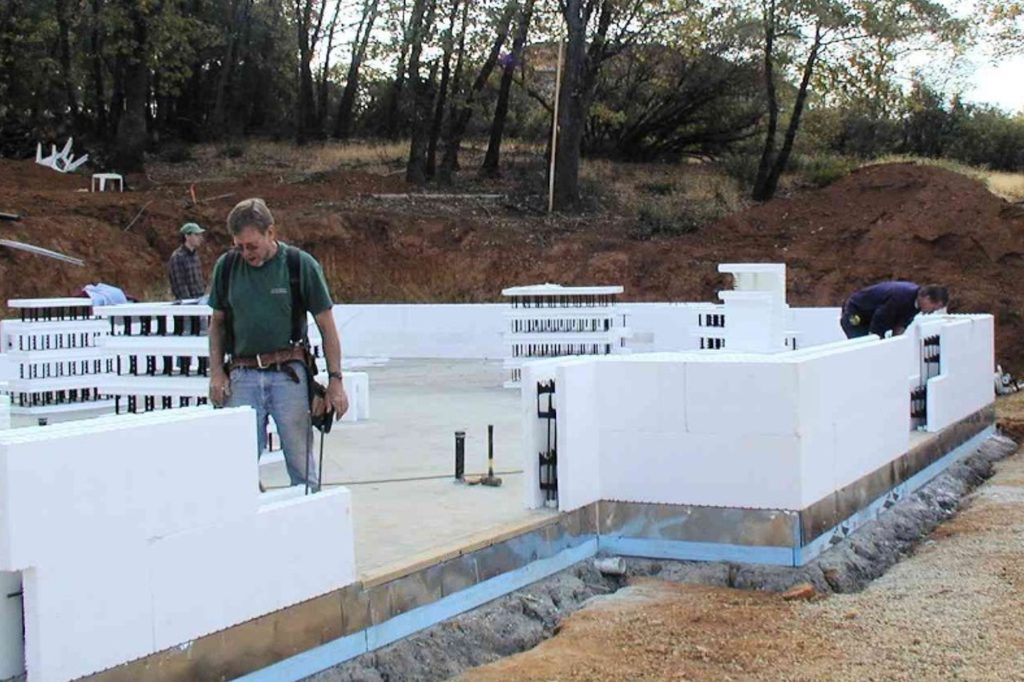
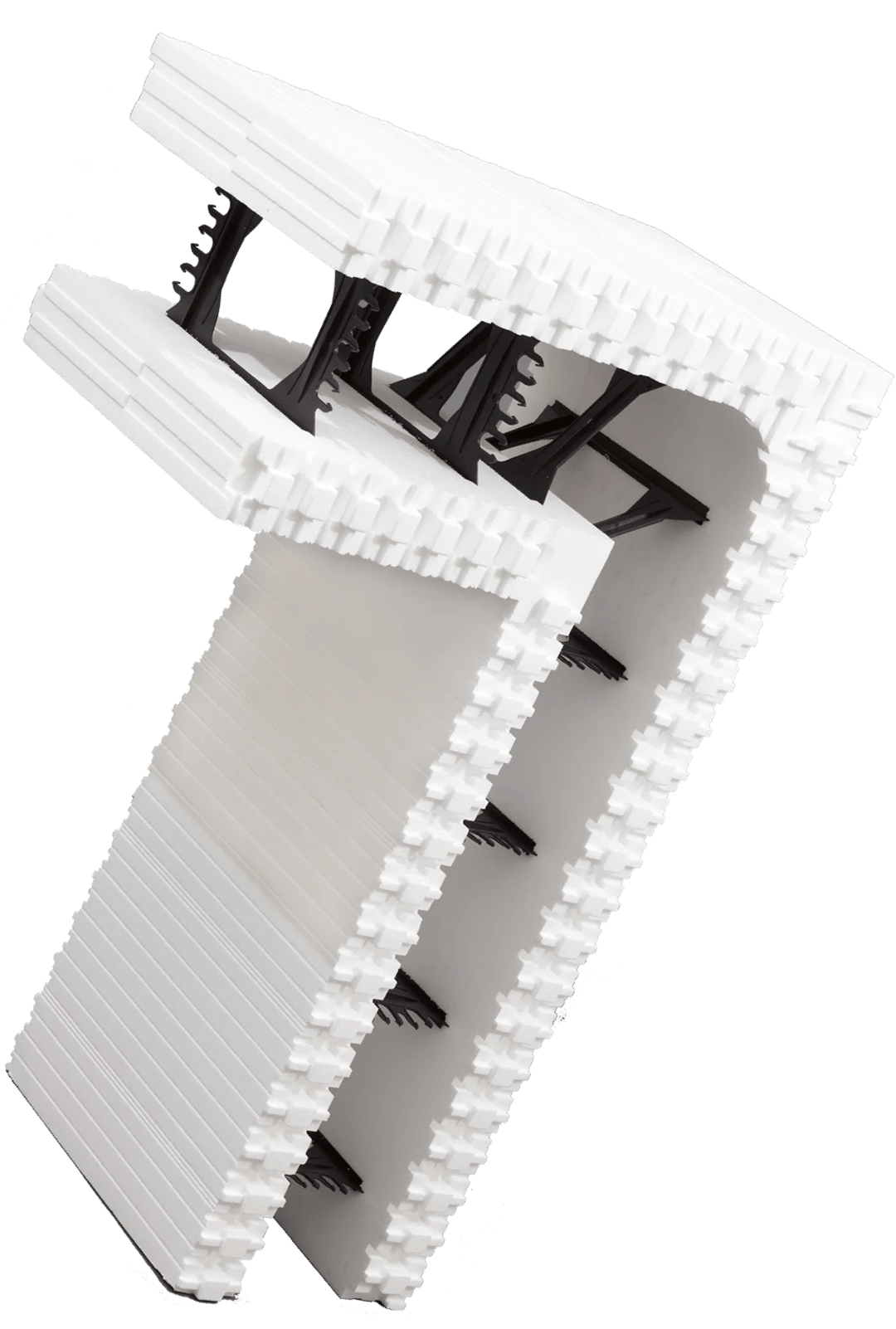
<p><img src="/wp-content/uploads/2010/05/icfoverview/straightreversibleblock.jpg" alt="Amvic concrete forms" class="alignleft" width="140" height="163">Reminiscent of large Lego pieces, ICFs are hollow building blocks that are made from expanded polystyrene (EPS) and stacked to form a wall. They are reinforced with metal rebar rods and the hollow centers are filled with concrete. ICF construction reduces the lengthy five-step building process to one easy step. This means fire stations will be completed in a fraction of the time it would take to construct them utilizing traditional building methods. </p>
<p>Once complete the ICFs form a monolithic structure with an extraordinary list of benefits. The thermal mass created by the insulated concrete walls provides the structure with an R-value of 24. In fact, energy savings of up to 50% are not uncommon. </p>
<p><object width="450" height="335"><param name="movie" value="http://www.youtube.com/v/VfgZmWXNOcA?version=3&amp;hl=en_US&amp;rel=0"></param><param name="allowFullScreen" value="true"></param><param name="allowscriptaccess" value="always"></param><embed src="http://www.youtube.com/v/VfgZmWXNOcA?version=3&amp;hl=en_US&amp;rel=0" type="application/x-shockwave-flash" width="450" height="335" allowscriptaccess="always" allowfullscreen="true"></embed></object></p>
<p>Indoor air quality is improved as there is no off-gassing of volatile organic compounds such as those found in traditional construction materials. Impervious to mould or insects that plague wood-frame homes, concrete is also naturally waterproof and fire resistant which negates the need for chemicals to achieve the same effects. </p>
<p>Concrete is more fire-resistant than other construction materials and gives occupants more than enough time to safely exit the building. ICF constructed buildings have a high wind resistance and are extremely robust which gives them a greater resistance to tornadoes, earthquakes and floods. ICF walls are twice as strong as other concrete wall construction methods and four times as strong as wood-frame houses. </p>
<p>Construction with ICFs is slightly more expensive than traditional methods, but the ROI is attractive. So reliable are ICF buildings that insurance companies offer a 10 to 15% reduction on insurance premiums. Coupled with reduced utility expenses and extended longevity, the ICF building is a very worthwhile investment for the Las Vegas municipality. </p>
]]></content:encoded>
			<wfw:commentRss>http://www.amvicsystem.com/icf-construction-for-las-vegas-fire-stations/feed</wfw:commentRss>
		<slash:comments>0</slash:comments>
		<feedburner:origLink>http://www.amvicsystem.com/icf-construction-for-las-vegas-fire-stations</feedburner:origLink></item>
		<item>
		<title>Water Conservation</title>
		<link>http://feedproxy.google.com/~r/amvicsystem/~3/MKBiTJo3Qsk/water-conservation</link>
		<comments>http://www.amvicsystem.com/water-conservation#comments</comments>
		<pubDate>Thu, 05 Apr 2012 15:37:43 +0000</pubDate>
		<dc:creator>Gary Brown</dc:creator>
				<category><![CDATA[Conservation]]></category>
		<category><![CDATA[General]]></category>
		<category><![CDATA[conservation]]></category>
		<category><![CDATA[energy efficient]]></category>
		<category><![CDATA[EPA]]></category>
		<category><![CDATA[water]]></category>

		<guid isPermaLink="false">http://www.amvicsystem.com/?p=3668</guid>
		<description><![CDATA[When combating high utilities bills and attempting to reduce carbon footprints, home and business owners tend to focus on electrical consumption. Traditionally the greatest power hog, electricity is quietly being usurped by the high energy demand of collecting, processing and transporting water. Water bills increase on average by 10% each year but there is much that can be done to reduce their assault on your paycheck. ]]></description>
			<content:encoded><![CDATA[<h2>Think outside the sink</h2>
<p><img src="http://www.amvicsystem.com/wp-content/uploads/2012/04/stock_water_sm-160x110.jpg" alt="" title="stock_water_sm" width="160" height="110" class="alignright size-thumbnail wp-image-3670" />When combating high utilities bills and attempting to reduce carbon footprints, home and business owners tend to focus on electrical consumption. Traditionally the greatest power hog, electricity is quietly being usurped by the high energy demand of collecting, processing and transporting water. Water bills increase on average by 10% each year but there is much that can be done to reduce their assault on your paycheck. </p>
<h2>Water use</h2>
<p>The average American uses 380 liters of water every day to the average Canadian&#8217;s 325 liters. If that seems like a lot, it is! Even more so when you realize that the average African uses 10 liters of water a day and has to walk 6km to get it. In 2000, the US spent <a href="http://www.nationmaster.com/graph/env_was_wat_tre_exp-environment-waste-water-treatment-expenditure">$105 per person</a> on water treatment. For a small US city of 300,000, this would mean a $31,500,000 annual price tag (about $40,320,000 today). The US spends a total of $3.5 billion each year to operate its <a href="http://www.safewater.org/PDFS/resourcesknowthefacts/Facts_Statistics_Did_Know.pdf">water treatment facilities</a>, a cost that is passed on to the consumer. As the lack of clean drinking water becomes a more pressing issue, and the cost of processing water increases, home and business owners must do more to improve their water consumption and lower their utility bills.<br />
<span id="more-3668"></span></p>
<h2>Go with the flow</h2>
<p>There are many solutions to high water consumption that are both easy and effective. Making a few small changes around your home and business will see a dramatic reduction in consumption and costs. The first option is low-flow toilets which reduce water usage from 15-19 liters per flush to just 6. Reduced-flow shower heads will cut the amount of water used in a shower by half. </p>
<p>Water efficient laundry appliances and dish washers should be your key focus with new homes or when old appliances need to be replaced. The cost of water conservation improvements will be recovered in no time. However, you can expedite your ROI by availing yourself of a plethora of government-sponsored <a href="http://www.toronto.ca/watereff/ici_water_saver.htm">rebates</a>.</p>
<h2>Water Retention</h2>
<p><img src="http://www.amvicsystem.com/wp-content/uploads/2012/04/bigstock_The_Last_Drop_3085221-226x300.jpg" alt="" title="bigstock_The_Last_Drop_3085221" width="226" height="300" class="alignleft size-medium wp-image-3671" />Reducing the use of water through fixtures and appliances can slash bills by up to 60%. Water conservation can be augmented by capturing rainwater in rooftop recovery systems. Here rainwater is captured and stored in a rainwater storage tank. This cache of water can then be used in flushing toilets, for cooling or when watering the garden.</p>
<p>A spokesperson for the EPA; &#8220;The Region 7 Science and Technology Center in Kansas City, Kansas, has incorporated a state-of-the-art rooftop rainwater recovery system in its new facility. The design consists of a 1,500-gallon underground settling tank and a 10,000-gallon holding tank. This system has the potential to save the laboratory more than 500,000 gallons of water per year.&#8221;<br />
Grey water from showers or laundry can be redirected for reuse. The most common use of grey water in homes is for the irrigation of gardens and lawns and flushing toilets. In industry, grey water can be utilized for cooling and irrigation. </p>
<p>Cleaning grey water to increase its usefulness is also a possibility. Last year&#8217;s US Department of Energy <a href="http://www.solardecathlon.gov/index.html">decathlon</a> saw a number of entrants utilize rainwater to irrigate green walls. These walls provide food, cool the home and improve indoor air quality. Rainwater was also used in toilets and for irrigation. </p>
<p>These entrants embody the vision of future building designs where every resource is used to its fullest and none are wasted or lost. We are aware of the impending water shortages that our ever-growing populations presage, yet we continue to use water with a wild abandon that is unsustainable. Implementing water conservation techniques in your home or business is not only responsible, it makes financial sense too.  </p>
]]></content:encoded>
			<wfw:commentRss>http://www.amvicsystem.com/water-conservation/feed</wfw:commentRss>
		<slash:comments>0</slash:comments>
		<feedburner:origLink>http://www.amvicsystem.com/water-conservation</feedburner:origLink></item>
		<item>
		<title>Architecture Challenge 2030</title>
		<link>http://feedproxy.google.com/~r/amvicsystem/~3/voITgOMZO9g/architecture-challenge-2030</link>
		<comments>http://www.amvicsystem.com/architecture-challenge-2030#comments</comments>
		<pubDate>Wed, 28 Mar 2012 17:42:05 +0000</pubDate>
		<dc:creator>Gary Brown</dc:creator>
				<category><![CDATA[Climate change]]></category>
		<category><![CDATA[Energy Efficiency]]></category>
		<category><![CDATA[General]]></category>
		<category><![CDATA[News]]></category>
		<category><![CDATA[Architecture Challenge 2030]]></category>
		<category><![CDATA[construction]]></category>
		<category><![CDATA[energy efficient]]></category>
		<category><![CDATA[GHG emissions]]></category>
		<category><![CDATA[green building]]></category>
		<category><![CDATA[Mercer]]></category>

		<guid isPermaLink="false">http://www.amvicsystem.com/?p=3652</guid>
		<description><![CDATA[If the unseasonably hot weather and terribly destructive storms weren't enough to convince you that climate change is happening, then a recent study by Mercer should sway even the most stalwart naysayers. The study estimates that inclement weather will have a negative effect on buildings, transportation and the construction industries to the tune of $8 trillion by 2030. Now an organization called Architecture 2030 is issuing a challenge it hopes will encourage the building industry to help prevent the worst effects of global warming. ]]></description>
			<content:encoded><![CDATA[<p><img src="http://www.amvicsystem.com/wp-content/uploads/2012/03/Screen-shot-2012-03-28-at-1.36.34-PM.png" alt="" title="architecture 2030" width="203" height="200" class="alignright size-full wp-image-3653" />If the unseasonably hot weather and terribly destructive storms weren&#8217;t enough to convince you that climate change is happening, then a recent study by <a href="http://www.mercer.com/climatechange">Mercer</a> should sway even the most stalwart naysayers. The study estimates that inclement weather will have a negative effect on buildings, transportation and the construction industries to the tune of $8 trillion by 2030. Now an organization called Architecture 2030 is issuing a challenge it hopes will encourage the building industry to help prevent the worst effects of global warming. </p>
<h2>The Challenger</h2>
<p><a href="http://architecture2030.org/2030_challenge/the_2030_challenge">Architecture Challenge 2030</a> was founded in 2003 by visionary, <a href="http://www.mazria.com/people.html">Ed Mazria</a>. Mazria was not only seminal in recognizing the potential for global warming to really ruin your day, but also brought to the attention of administrators the fact that buildings were contributing half of annual GHG emissions and needed to be regulated. There is a tipping point for global warming reformation and we are set to reach its limits in 2030. Although increasingly stringent legislature has done much to curb building GHG emissions, the process is too slow to reach target levels.<br />
<span id="more-3652"></span><br />
<img src="http://www.amvicsystem.com/wp-content/uploads/2012/03/iStock_000016988012XSmall-160x110.jpg" alt="" title="co2" width="160" height="110" class="alignleft size-thumbnail wp-image-3654" />Not only is the process too slow, but with burgeoning industrial nations like China and India stubbornly refusing to effect change in their own building codes, the onus for real progress falls on the individual building owner. Architecture Challenge 2030 hopes to appeal to the environmental conscience of building owners and goes beyond legislation to extend the challenge of creating buildings efficient enough to reach quotas that will effectively reduce GHG emissions to below 2°C above pre-industrial levels.</p>
<h2>The Challenge</h2>
<p>Architecture Challenge 2030 has issued the following targets:</p>
<ol>
<li>New buildings and retrofits should aim for an energy consumption performance standard of 60% below the regional average for buildings of that type.</li>
<li>Continuous improvements to buildings will see fossil fuel reduction standards increased to:<br />
&raquo; 70% in 2015<br />
&raquo; 80% in 2020<br />
&raquo; 90% in 2025<br />
&raquo; Carbon-neutral in 2030</li>
</ol>
<p>&#8220;These targets may be accomplished by implementing innovative sustainable design strategies, generating on-site renewable power and/or purchasing (20% maximum) renewable energy,&#8221; the website proposes. </p>
<p><object width="449" height="258"><param name="movie" value="http://www.youtube.com/v/qroQdaygbBY?version=3&amp;hl=en_US&amp;rel=0"></param><param name="allowFullScreen" value="true"></param><param name="allowscriptaccess" value="always"></param><embed src="http://www.youtube.com/v/qroQdaygbBY?version=3&amp;hl=en_US&amp;rel=0" type="application/x-shockwave-flash" width="449" height="258" allowscriptaccess="always" allowfullscreen="true"></embed></object></p>
<h2>The Challenge for Products</h2>
<p>Not only do buildings produce large GHG emissions, but the products and materials from which they are made have embodied carbon footprints. The extraction of resources used in the manufacture of building products, the manufacturing process itself and then the transportation of materials as well as their use in the construction of buildings have a huge carbon footprint. There are also the end-of-life processes to consider as materials need be recycled or disposed of. Architecture Challenge 2030 has extended their <a href="http://architecture2030.org/2030_challenge/products">challenge to the producers</a> of building materials and products. The first challenge is to reduce the embodied carbon footprint of products by 30% followed by a more stringent reduction in the years to come:</p>
<ol>
<li>35% or better in 2015</li>
<li>40% or better in 2020</li>
<li>45% or better in 2025</li>
<li>50% or better in 2030</li>
</ol>
<p>Not only have they extended this challenge, but they are also embroiled in the mammoth task of documenting all the products and their improvements so that builders and designers have a database of compliant products to choose from. Let&#8217;s hope Ed Mazria&#8217;s challenge does not go unmet as the reduction of emissions can be a financially advantageous move on the part of building owners. </p>
]]></content:encoded>
			<wfw:commentRss>http://www.amvicsystem.com/architecture-challenge-2030/feed</wfw:commentRss>
		<slash:comments>0</slash:comments>
		<feedburner:origLink>http://www.amvicsystem.com/architecture-challenge-2030</feedburner:origLink></item>
		<item>
		<title>Growing Panes and Smart Windows</title>
		<link>http://feedproxy.google.com/~r/amvicsystem/~3/Q7CLW7fYlRg/growing-panes-and-smart-windows</link>
		<comments>http://www.amvicsystem.com/growing-panes-and-smart-windows#comments</comments>
		<pubDate>Fri, 23 Mar 2012 17:56:32 +0000</pubDate>
		<dc:creator>Gary Brown</dc:creator>
				<category><![CDATA[Design]]></category>
		<category><![CDATA[Energy Efficiency]]></category>
		<category><![CDATA[commercial buildings]]></category>
		<category><![CDATA[green building]]></category>
		<category><![CDATA[energy savings]]></category>
		<category><![CDATA[Low-e windows]]></category>
		<category><![CDATA[smart glass]]></category>
		<category><![CDATA[south facing window]]></category>
		<category><![CDATA[Windows]]></category>

		<guid isPermaLink="false">http://www.amvicsystem.com/?p=3646</guid>
		<description><![CDATA[Architects and designers often struggle with glass. They understand the benefits of allowing natural light into a building such as improved happiness, reduced absenteeism, increased productivity and lower employee turnover, not to mention the aesthetic appeal that large windows bring. However, these large glass spaces leach heat in winter and allow the summer sun to toast unwary occupants. With smart windows, designers don't have to choose between form and function; they can have them both. ]]></description>
			<content:encoded><![CDATA[<h2>Smart glass windows can think for themselves</h2>
<p><img src="http://www.amvicsystem.com/wp-content/uploads/2012/03/iStock_000018294029XSmall-e1330613357134.jpg" alt="" title="iStock_000018294029XSmall" width="220" height="145" class="alignright size-full wp-image-3627" />Architects and designers often struggle with glass. They understand the benefits of allowing <a href="http://www.amvicsystem.com/healthy-body-healthy-home">natural light</a> into a building such as improved happiness, reduced absenteeism, increased productivity and lower employee turnover, not to mention the aesthetic appeal that large windows bring. However, these large glass spaces leach heat in winter and allow the summer sun to toast unwary occupants. Often, designers are forced to choose between their design and the sustainability goals of the building. With smart windows, designers don&#8217;t have to choose between form and function; they can have them both.<br />
<span id="more-3646"></span></p>
<h2>Precursors to smart glass</h2>
<p>Imagine windows that you can change from translucent to opaque with the flick of a switch. There were several precursors to today&#8217;s advanced smart glass technologies. We all know the reflective glass that covers the outside of city skyscrapers. This early version of the smart glass concept reflects solar energy, which means that even in cold winter months, desirable sun rays are lost. Low-E glass is a step up. Here solar radiation is let in during cold winter months and reflected during the summer. The angle at which the sun&#8217;s rays hit the glass dictates whether it is allowed to pass through or reflected. Smart glass goes a step further by manually or automatically controlling the amount of sunshine windows allow to pass into the interior of a building. </p>
<h2>How it works</h2>
<p>There are many different varieties of smart windows including <a href="http://www.electrochromatic.com/">electrochromic</a>, <a href="http://journals2.scholarsportal.info/details.xqy?uri=/10221360/v227i0001/357_tpgsgg.xml">thermotropics</a>, photochromics, <a href="http://www.glassonweb.com/articles/article/229/">suspended particle</a>, <a href="http://home.howstuffworks.com/home-improvement/construction/green/smart-window3.htm">liquid crystal</a> and reflective hydride. Smart windows can switch from translucent to opaque in increments which will allow some light in. The effect is achieved by running an electric current through tiny electrodes that are sandwiched between sheets of glass. In its opaque phase, the glass blocks solar radiation and also provides privacy for building occupants. The glass can change colour while preserving visibility of the outside environment. </p>
<p>Newer versions retain visibility while creating a mirror-like facade on the exterior of the building. The windows can be manually or automatically controlled. Light sensors automatically adjust the opaqueness of the windows by corresponding adjustments to the electric current passing through them. Electric currents are used only to affect opaqueness or translucency, but are not necessary to maintain them. </p>
<p>Smart glass has grown in affordability and sophistication in recent years. Newer forms of smart glass can save up to 25% on utility bills. The efficiency smart glass adds to your building depends on how much glass is used and on the kind of smart glass you choose. </p>
<h2>Applications of smart glass</h2>
<p><img src="http://www.amvicsystem.com/wp-content/uploads/2012/03/iStock_000000912016XSmall-e1332525377369.jpg" alt="" title="iStock_000000912016XSmall" width="120" height="160" class="alignleft size-full wp-image-3648" />Apart from controlling the amounts of solar radiation in a building, smart glass has many other applications too. Some cars use smart glass on rear view mirrors to reduce glare from headlights and in <a href="http://www.youtube.com/watch?v=Xb8IsDfG3uM">sunroofs</a> to admit or reflect sunlight. Museums use smart glass display cabinets to protect valuable artefacts and art from harmful UV rays. In offices and hospitals, smart glass partitions afford occupants privacy on demand and can change a boardroom window into a projection screen with the touch of a button. </p>
<p>These amazing advances in window technology allow us to have great views and all the benefits of natural lighting without a loss of efficiency. </p>
]]></content:encoded>
			<wfw:commentRss>http://www.amvicsystem.com/growing-panes-and-smart-windows/feed</wfw:commentRss>
		<slash:comments>0</slash:comments>
		<feedburner:origLink>http://www.amvicsystem.com/growing-panes-and-smart-windows</feedburner:origLink></item>
	</channel>
</rss>