<?xml version="1.0" encoding="UTF-8"?><feed
	xmlns="http://www.w3.org/2005/Atom"
	xmlns:thr="http://purl.org/syndication/thread/1.0"
	xml:lang="en"
	>
	<title type="text">AppWorks 之初加速器</title>
	<subtitle type="text"></subtitle>

	<updated>2026-09-15T06:45:50Z</updated>

	<link rel="alternate" type="text/html" href="https://appworks.tw" />
	<id>https://appworks.tw/feed/atom/</id>
	<link rel="self" type="application/atom+xml" href="https://appworks.tw/feed/atom/" />

	<generator uri="https://wordpress.org/" version="6.8.1">WordPress</generator>
<icon>https://appworks.tw/wp-content/uploads/2022/09/favicon.svg</icon>
	<entry>
		<author>
			<name>Sophie Chiu</name>
					</author>

		<title type="html"><![CDATA[The New Shape of Work]]></title>
		<link rel="alternate" type="text/html" href="https://appworks.tw/the-new-shape-of-work/?utm_source=rss&#038;utm_medium=rss&#038;utm_campaign=the-new-shape-of-work" />

		<id>https://appworks.tw/?p=16100</id>
		<updated>2026-09-15T06:45:08Z</updated>
		<published>2026-09-15T01:53:40Z</published>
		<category scheme="https://appworks.tw" term="View" />
		<summary type="html"><![CDATA[<p>with contribution from Natasha Chou, Alumni Relations Manager at AppWorks &#160; The most valuable part of working with AppWorks’ large founder community is watching founders iterate, in person, every single day. Especially since OpenClaw arrived at the start of this year, founders seem to have been handed a brand-new torch, and they are using it to [&#8230;]</p>
<p>The post <a rel="nofollow" href="https://appworks.tw/the-new-shape-of-work/">The New Shape of Work</a> appeared first on <a rel="nofollow" href="https://appworks.tw">AppWorks 之初加速器</a>.</p>
]]></summary>

					<content type="html" xml:base="https://appworks.tw/the-new-shape-of-work/?utm_source=rss&#038;utm_medium=rss&#038;utm_campaign=the-new-shape-of-work"><![CDATA[<h6><span style="font-size: 13.3333px; font-weight: 400;">with contribution from </span><span style="font-weight: 400; font-size: 10pt;">Natasha Chou, Alumni Relations Manager at AppWorks</span></h6>
<p>&nbsp;</p>
<p><img fetchpriority="high" decoding="async" class="alignnone size-full wp-image-16110" src="https://appworks.tw/wp-content/uploads/2026/09/new-shape-of-work-banner-en_2.png" alt="" width="1200" height="630" srcset="https://appworks.tw/wp-content/uploads/2026/09/new-shape-of-work-banner-en_2.png 1200w, https://appworks.tw/wp-content/uploads/2026/09/new-shape-of-work-banner-en_2-640x336.png 640w, https://appworks.tw/wp-content/uploads/2026/09/new-shape-of-work-banner-en_2-768x403.png 768w" sizes="(max-width: 1200px) 100vw, 1200px" /></p>
<p><span style="font-weight: 400;">The most valuable part of working with AppWorks’ large founder community is watching founders iterate, in person, every single day. Especially since OpenClaw arrived at the start of this year, founders seem to have been handed a brand-new torch, and they are using it to find out how many previously impassable tunnels AI can lead an organisation through.</span></p>
<p><span style="font-weight: 400;">Since April 2025, AppWorks has hosted a monthly AI Founder Circle at our Taipei office, and a bi-monthly edition has since started in Singapore where AppWorks has 98 active startups in the community. After more than ten Circles, the topics have evolved along the way: from how to use OpenClaw to how to build your own AI agent; from how to get employees to adopt AI smoothly, to building AI employees and standing up a full agent-harness platform… and now we have arrived at a new frontier: the old shape of the organisation no longer seems to fit.</span></p>
<p><span style="font-weight: 400;">Optimising the organisation has always been a rite of passage on a startup&#8217;s growth path. Almost every company starts as an agile squad of fewer than ten people, fully aligned and all-in every day. Then, as it grows, it seems obliged to follow in the footsteps of the big companies that came before: departmentalise, divisionalise, and start to feel the growing pains. When a company first reaches a size of 100 to 200 people, it will start to experience the pain of an organisation that gets bigger while its efficiency does not.</span></p>
<p><span style="font-weight: 400;">To build a big business, you need many hands on deck; but the more people you have, the harder they are to manage, because the bandwidth of human communication is limited. AI seems poised to relieve this millennia-old management pain: it moves information in greater volume, at greater speed, and with less of the distortion that comes from passing through many hands. </span></p>
<p><span style="font-weight: 400;">Pioneering founders and executives have already begun to experiment. In March, Jack Dorsey put forward the hypothesis of a fully flat organisation (see </span><a href="https://block.xyz/inside/from-hierarchy-to-intelligence" target="_blank" rel="noopener"><span style="font-weight: 400;">From Hierarchy to Intelligence</span></a><span style="font-weight: 400;">, co-written with Sequoia Managing Partner Roelof Botha); in May, Cloudflare CEO Matthew Prince wrote in The Wall Street Journal to explain why he was laying off and replacing staff at a moment of rapid revenue growth and healthy cash flow (</span><a href="https://www.wsj.com/opinion/how-i-choose-which-cloudflare-employees-to-replace-with-ai-40a197e5" target="_blank" rel="noopener"><span style="font-weight: 400;">How I Choose Which Cloudflare Employees to Replace with AI</span></a><span style="font-weight: 400;">); and in July, Jamie, our AppWorks Founder and Chairman, published 《</span><a href="https://www.eslite.com/product/10072302132683178767005" target="_blank" rel="noopener"><span style="font-weight: 400;">逆分工</span></a><span style="font-weight: 400;">》 (Reversing the Division of Labour) with Taiwan Mobile CIO Rock Tsai, exploring the productivity revolution of the AI era.</span></p>
<p><span style="font-weight: 400;">In Asia, many founders are now running the same experiment, and through their first-hand experience and iteration we have had the privilege of a close-up view. In this article we put forward a hypothesis about the shape of organisations in the AI era, and invite the founders holding the torch to glimpse the future with us — and we will also explain why the new shape is only the ticket in, not the endgame. </span></p>
<p><span style="font-weight: 400;">We have also asked several founders, at different stages and scales, to share the experiments they are running and the results so far, so this is not merely a theory proposed by AppWorks, but the product of generous contributions from the AppWorks founder community.</span></p>
<p>&nbsp;</p>
<h2><b>Every technological revolution reshapes how we organise</b></h2>
<p><img decoding="async" class="alignnone size-full wp-image-16092" src="https://appworks.tw/wp-content/uploads/2026/09/image7.png" alt="" width="1202" height="676" srcset="https://appworks.tw/wp-content/uploads/2026/09/image7.png 1202w, https://appworks.tw/wp-content/uploads/2026/09/image7-640x360.png 640w, https://appworks.tw/wp-content/uploads/2026/09/image7-768x432.png 768w, https://appworks.tw/wp-content/uploads/2026/09/image7-1200x675.png 1200w" sizes="(max-width: 1202px) 100vw, 1202px" /></p>
<p><span style="font-weight: 400;">Every technological revolution reshapes how we organise, and it has happened at least twice before.</span></p>
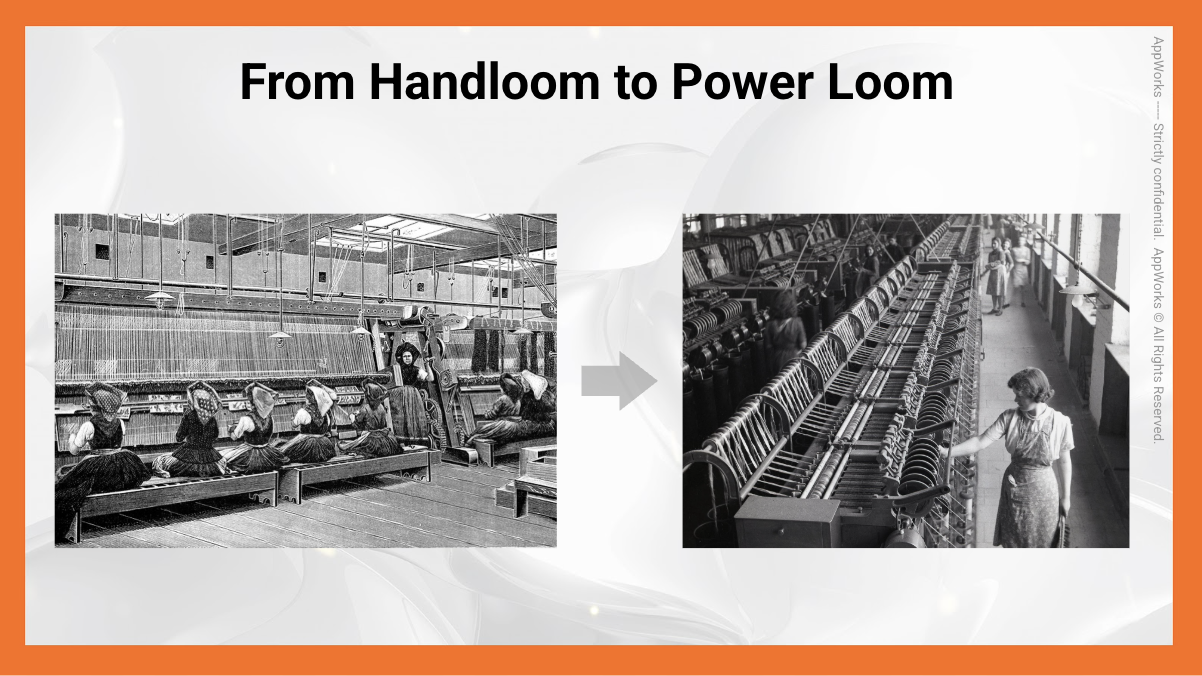
<p><span style="font-weight: 400;">The first time was in the textile mill. Before the 18th-century Industrial Revolution, the handloom was merely a tool; the craft lived in the weaver, one weaver per loom, and output was capped by the number of hands. When the power loom arrived, the machine absorbed the craft, and the human&#8217;s job became tending the machine. One person now oversaw an entire row of looms, and the work shifted from weaving by hand to setting the standard and catching the exceptions. Walk into a TSMC fab in 2026 and you still see this shape: the most advanced process engineer is not the craftsman of any single wafer, but the keeper of the machine&#8217;s yield.</span></p>
<p><img decoding="async" class="alignnone size-full wp-image-16094" src="https://appworks.tw/wp-content/uploads/2026/09/image9.png" alt="" width="1999" height="1123" srcset="https://appworks.tw/wp-content/uploads/2026/09/image9.png 1999w, https://appworks.tw/wp-content/uploads/2026/09/image9-640x360.png 640w, https://appworks.tw/wp-content/uploads/2026/09/image9-1280x719.png 1280w, https://appworks.tw/wp-content/uploads/2026/09/image9-768x431.png 768w, https://appworks.tw/wp-content/uploads/2026/09/image9-1536x863.png 1536w, https://appworks.tw/wp-content/uploads/2026/09/image9-1200x674.png 1200w" sizes="(max-width: 1999px) 100vw, 1999px" /></p>
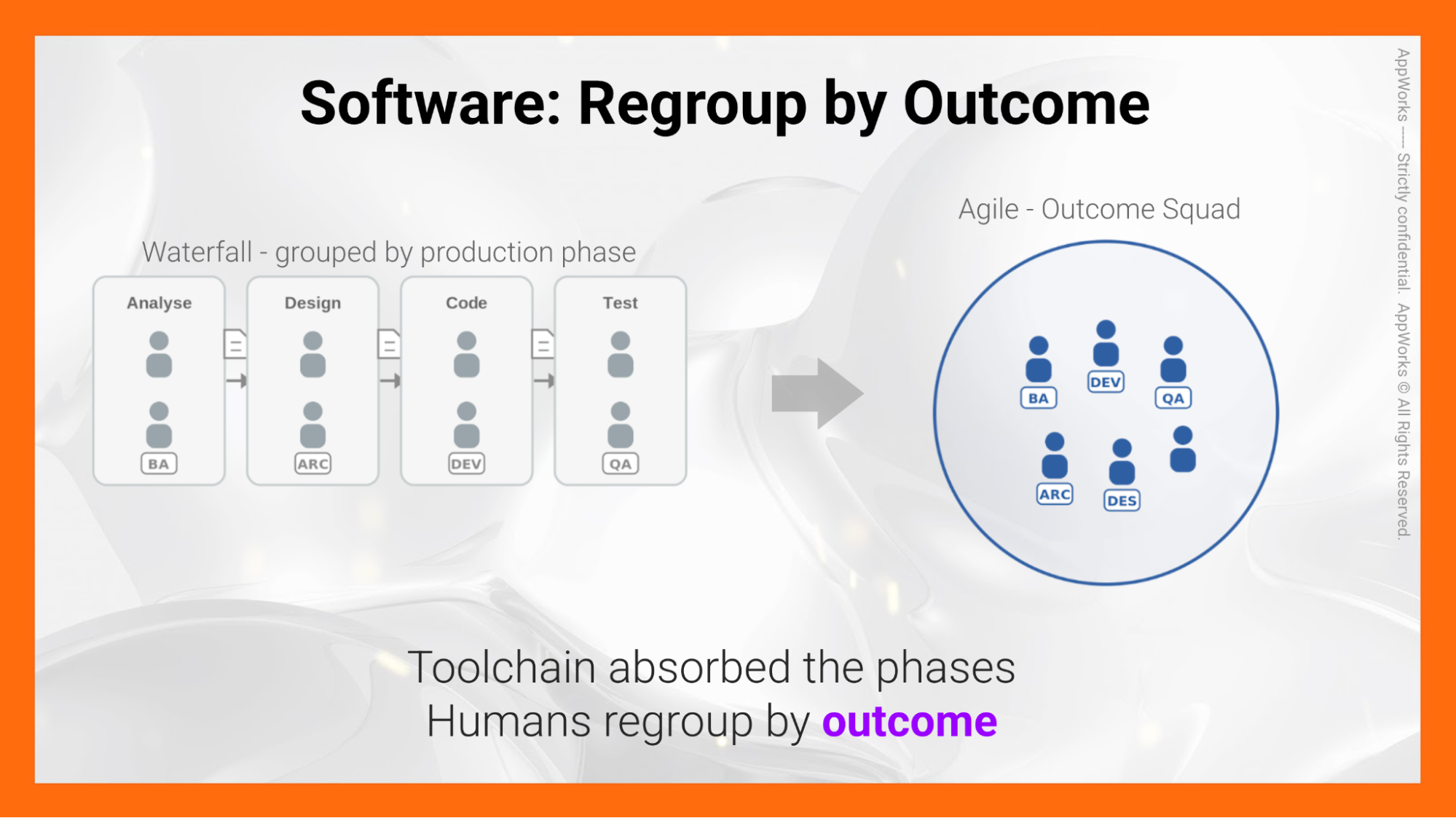
<p><span style="font-weight: 400;">The second time, it was software&#8217;s own turn. From mainframes to personal computers to the cloud, engineers&#8217; tools have a peculiar property: anything that can be written down as a rule, the tool can do for you — and the first thing it took over was proving that the person before you hadn&#8217;t got it wrong. Early waterfall grouped people by process step — analysis, design, coding, testing — four departments handing off in sequence, with documents as the stitching. What that documentation really did was carry trust from one runner to the next. Once version control, automated testing and continuous integration turned verification into a machine&#8217;s job, and the cloud turned shipping from a one-shot, live-or-die event into something you could roll back at any time, the handover documents had nothing left to prove. What collapsed wasn&#8217;t labour hours; it was the cost of making mistakes and of coordinating. Change the costs and the shape reorganises to match. From roughly 2001 onwards, agile made cross-functional teams the mainstream of the software industry: product, engineering and design sitting in one small team, jointly accountable for a specific outcome like &#8220;raise homepage conversion&#8221;. (Spotify later called such a team a squad.)</span></p>
<p><span style="font-weight: 400;">Shape never follows the prevailing ideas; it follows what actually works. That also explains a piece of industry history: over the past 25 years, agile has almost never genuinely succeeded outside the engineering teams of internet companies, because what can be moved is the ceremony, and what can&#8217;t be moved is the machine underneath it. Other departments&#8217; systems record work; they don&#8217;t do the work, and they certainly don&#8217;t check the work. A CRM records customers, but it doesn&#8217;t talk to them, and it won&#8217;t tell you the call went badly. Without that machine, what a cross-functional team delivers doesn&#8217;t get any better — it just changes how the meetings are held. So the ceremonies stay, and the shape reverts.</span></p>
<p>&nbsp;</p>
<h2><b>The knowledge worker&#8217;s industrial revolution</b></h2>
<p><img loading="lazy" decoding="async" class="alignnone size-full wp-image-16093" src="https://appworks.tw/wp-content/uploads/2026/09/image8.png" alt="" width="1999" height="1122" srcset="https://appworks.tw/wp-content/uploads/2026/09/image8.png 1999w, https://appworks.tw/wp-content/uploads/2026/09/image8-640x359.png 640w, https://appworks.tw/wp-content/uploads/2026/09/image8-1280x718.png 1280w, https://appworks.tw/wp-content/uploads/2026/09/image8-768x431.png 768w, https://appworks.tw/wp-content/uploads/2026/09/image8-1536x862.png 1536w, https://appworks.tw/wp-content/uploads/2026/09/image8-1200x674.png 1200w" sizes="auto, (max-width: 1999px) 100vw, 1999px" /></p>
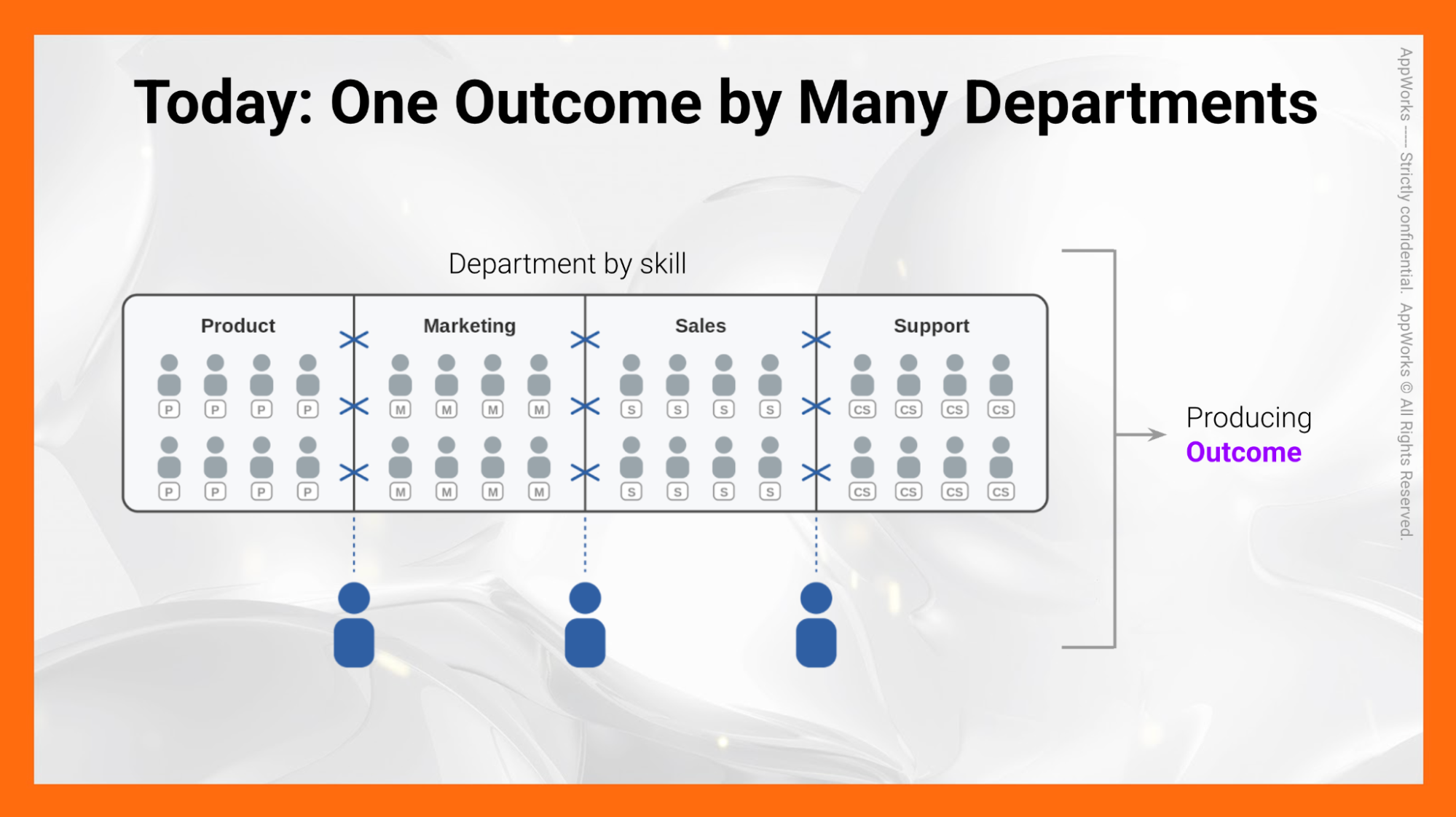
<p><span style="font-weight: 400;">Look at a company today. A single customer outcome is typically sliced across four departments: product, marketing, sales, and customer service. Each holds its own meetings and accountability to stay aligned. And most of a knowledge worker&#8217;s day is spent moving data between systems: from email into the CRM, from a report into a slide deck. Enterprise IT even has a formal term for this: the swivel-chair integration, swivelling this way to copy, and swivelling that way to paste. With a desk full of systems and tools, the knowledge worker is still living in the age of the handloom.</span></p>
<p><img loading="lazy" decoding="async" class="alignnone size-full wp-image-16095" src="https://appworks.tw/wp-content/uploads/2026/09/image10.png" alt="" width="1999" height="1124" srcset="https://appworks.tw/wp-content/uploads/2026/09/image10.png 1999w, https://appworks.tw/wp-content/uploads/2026/09/image10-640x360.png 640w, https://appworks.tw/wp-content/uploads/2026/09/image10-1280x720.png 1280w, https://appworks.tw/wp-content/uploads/2026/09/image10-768x432.png 768w, https://appworks.tw/wp-content/uploads/2026/09/image10-1536x864.png 1536w, https://appworks.tw/wp-content/uploads/2026/09/image10-1200x675.png 1200w" sizes="auto, (max-width: 1999px) 100vw, 1999px" /></p>
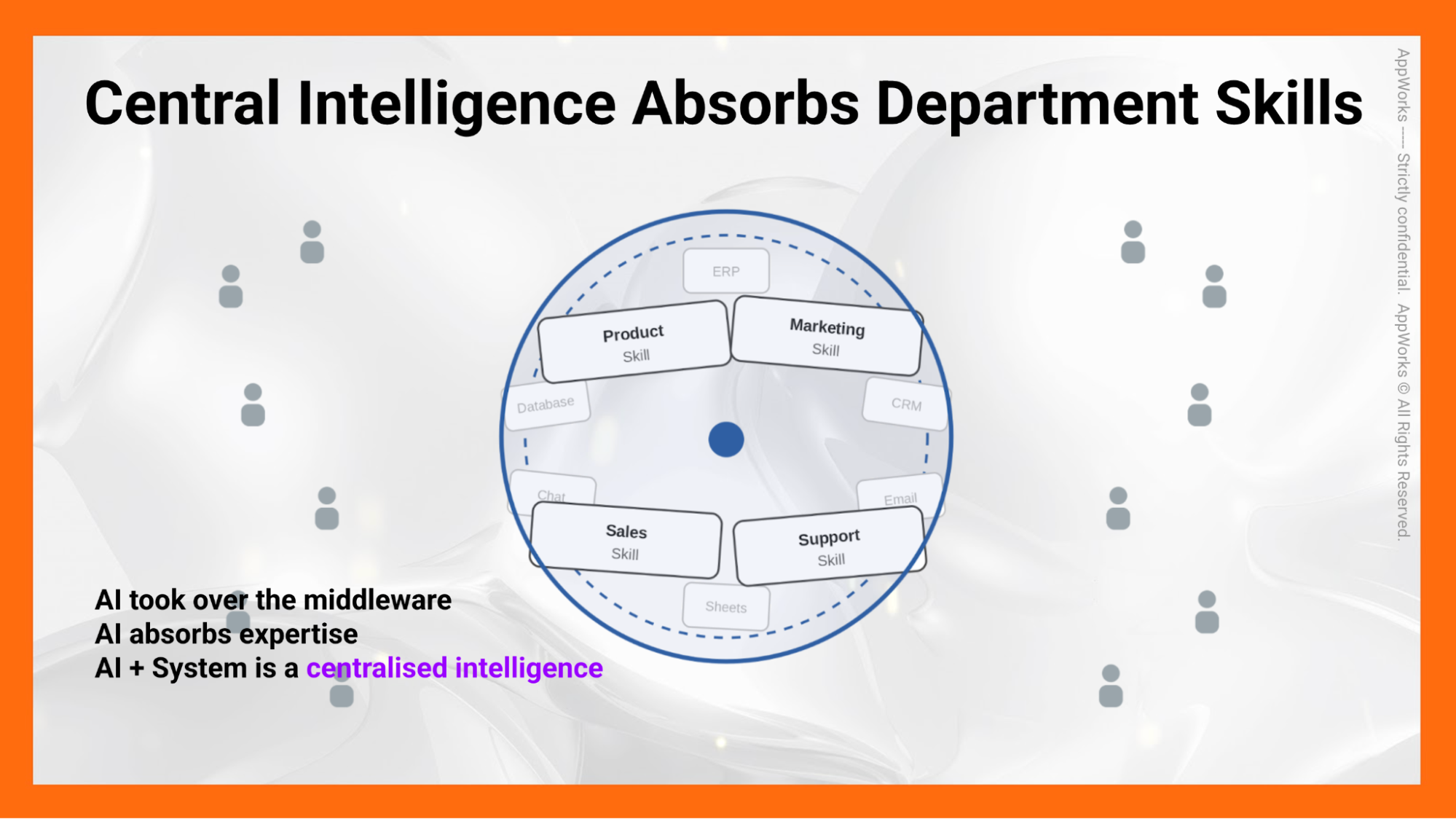
<p><span style="font-weight: 400;">What AI is doing to knowledge work is precisely what the power loom did to weaving: it draws the craft up into the machine. It first takes over the hauling and the stitching, and then absorbs each department&#8217;s execution as well: marketing&#8217;s ad placement, sales&#8217; quoting, customer service&#8217;s tickets all become on-demand capabilities inside the machine. In effect, every back-office function gets an API.</span></p>
<p><span style="font-weight: 400;">This is the industrial revolution of knowledge work. For the first time, people can truly step to the side of the machine. The next question is the hypothesis we want to discuss today: once people have stepped aside, how should they reorganise and regroup?</span></p>
<p>&nbsp;</p>
<h2><b>Our hypothesis: The New Shape of Work</b></h2>
<p><img loading="lazy" decoding="async" class="alignnone size-full wp-image-16088" src="https://appworks.tw/wp-content/uploads/2026/09/image3.png" alt="" width="1999" height="1122" srcset="https://appworks.tw/wp-content/uploads/2026/09/image3.png 1999w, https://appworks.tw/wp-content/uploads/2026/09/image3-640x359.png 640w, https://appworks.tw/wp-content/uploads/2026/09/image3-1280x718.png 1280w, https://appworks.tw/wp-content/uploads/2026/09/image3-768x431.png 768w, https://appworks.tw/wp-content/uploads/2026/09/image3-1536x862.png 1536w, https://appworks.tw/wp-content/uploads/2026/09/image3-1200x674.png 1200w" sizes="auto, (max-width: 1999px) 100vw, 1999px" /></p>
<p><span style="font-weight: 400;">The new shape of work is, first of all, a new shape of the organisation.</span></p>
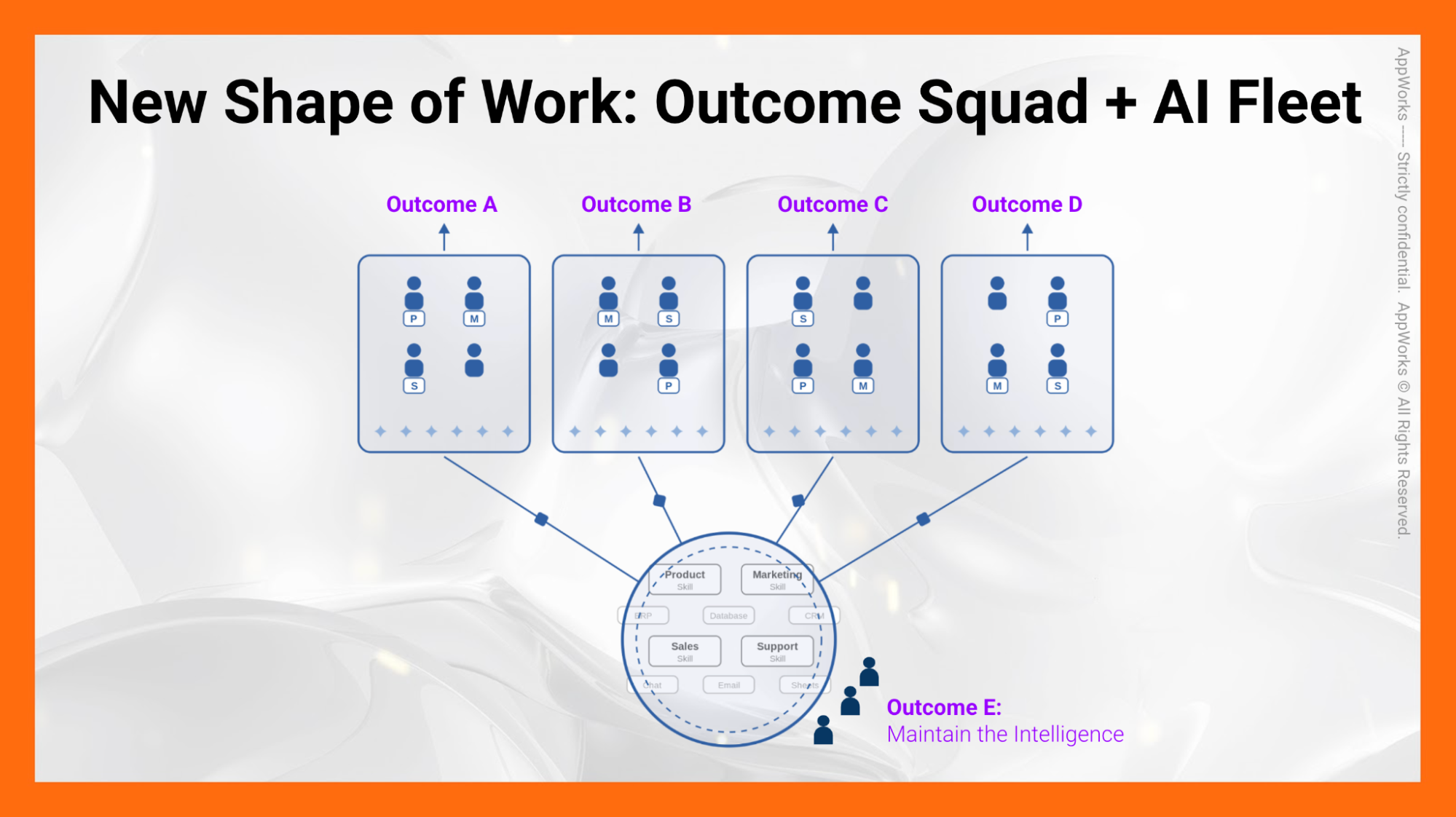
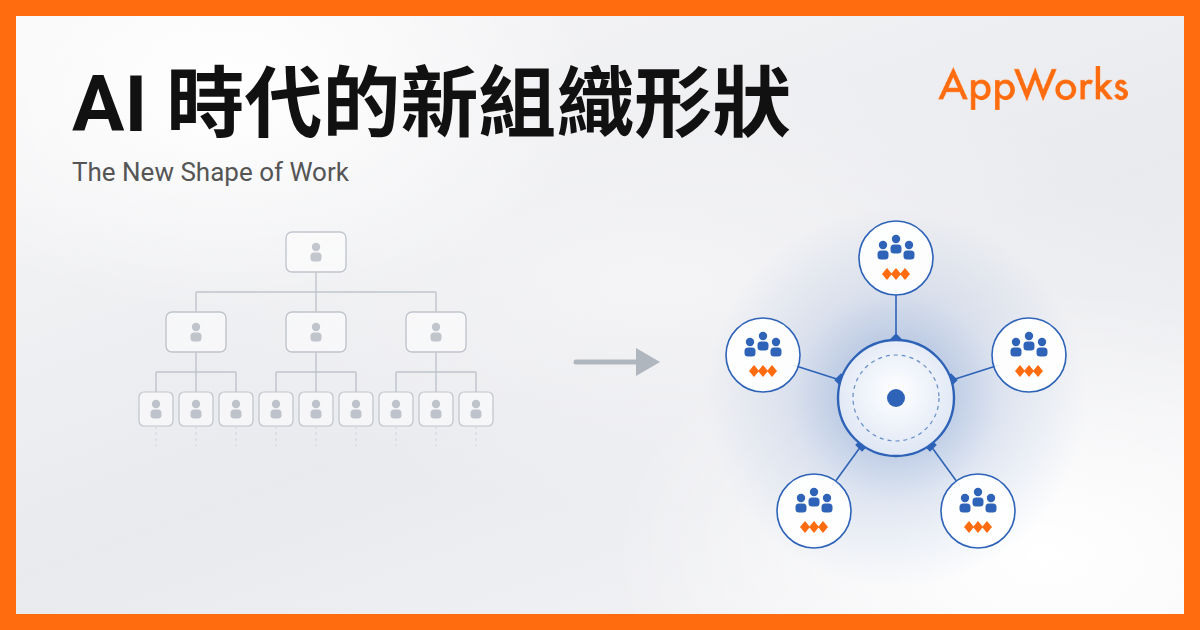
<p><span style="font-weight: 400;">Let&#8217;s lay out the full hypothesis first. We believe the organisation of the AI era may look like this: at the centre, a </span><b>shared intelligent machine</b><span style="font-weight: 400;"> that takes on integration and execution; around it, a ring of small, self-sufficient </span><b>outcome squads</b><span style="font-weight: 400;"> — two to five people plus a fleet of agents — each owning one outcome end to end; and expertise is no longer the name of a department; it is the repertoire a person brings to the work — a craft honed inside a </span><b>guild</b><span style="font-weight: 400;">.</span></p>
<p><span style="font-weight: 400;">The history of management is full of organisational experiments, and organisation is one of the reasons American firms pulled ahead. Ethan Mollick, the Wharton professor who has written most persistently about organisational change in the AI era, points to an often-forgotten estimate: 20% to 40% of the extra competitive advantage American companies enjoyed in the twentieth century came from better management — it was an era willing to run experiments on the organisation itself. Yet he also laments that most companies later gave up experimenting, outsourcing &#8220;how to run a company&#8221; to consultants and SaaS vendors (see the</span><a href="https://www.insightpartners.com/ideas/ethan-mollick-on-ai/" target="_blank" rel="noopener"> <span style="font-weight: 400;">interview published by Insight Partners</span></a><span style="font-weight: 400;">).</span></p>
<p><span style="font-weight: 400;">Indeed, looking back at management history, we have been through several major rounds of organisational experiment: the U-form of a century ago, grouped by function; then the M-form that grew up in the 1920s, grouped by division — both names in fact had to wait until 1975 for Oliver Williamson to supply them, the shapes having been alive for half a century before the theory caught up; then the amoeba system Kazuo Inamori invented at Kyocera in the 1960s, which split the company into dozens of small units each accountable for its own profit and loss; and on to Spotify&#8217;s squad model of the 2010s, copied the world over and yet never really made to live even at Spotify itself (see former Spotify PM Jeremiah Lee&#8217;s </span><a href="https://www.jeremiahlee.com/posts/failed-squad-goals/" target="_blank" rel="noopener"><span style="font-weight: 400;">Failed #SquadGoals</span></a><span style="font-weight: 400;">). Now AI has reopened the laboratory of the organisation. We would also like to give the new shape a name of its own, and in this article we tentatively call it the S-form: squad-form, an organisation grouped by outcome.</span></p>
<p>&nbsp;</p>
<h3><span style="font-weight: 400;">Four key details of the new shape</span></h3>
<p><img loading="lazy" decoding="async" class="alignnone size-full wp-image-16087" src="https://appworks.tw/wp-content/uploads/2026/09/image2.png" alt="" width="1999" height="1123" srcset="https://appworks.tw/wp-content/uploads/2026/09/image2.png 1999w, https://appworks.tw/wp-content/uploads/2026/09/image2-640x360.png 640w, https://appworks.tw/wp-content/uploads/2026/09/image2-1280x719.png 1280w, https://appworks.tw/wp-content/uploads/2026/09/image2-768x431.png 768w, https://appworks.tw/wp-content/uploads/2026/09/image2-1536x863.png 1536w, https://appworks.tw/wp-content/uploads/2026/09/image2-1200x674.png 1200w" sizes="auto, (max-width: 1999px) 100vw, 1999px" /></p>
<ol>
<li><b> Group by outcome, not by function.</b></li>
</ol>
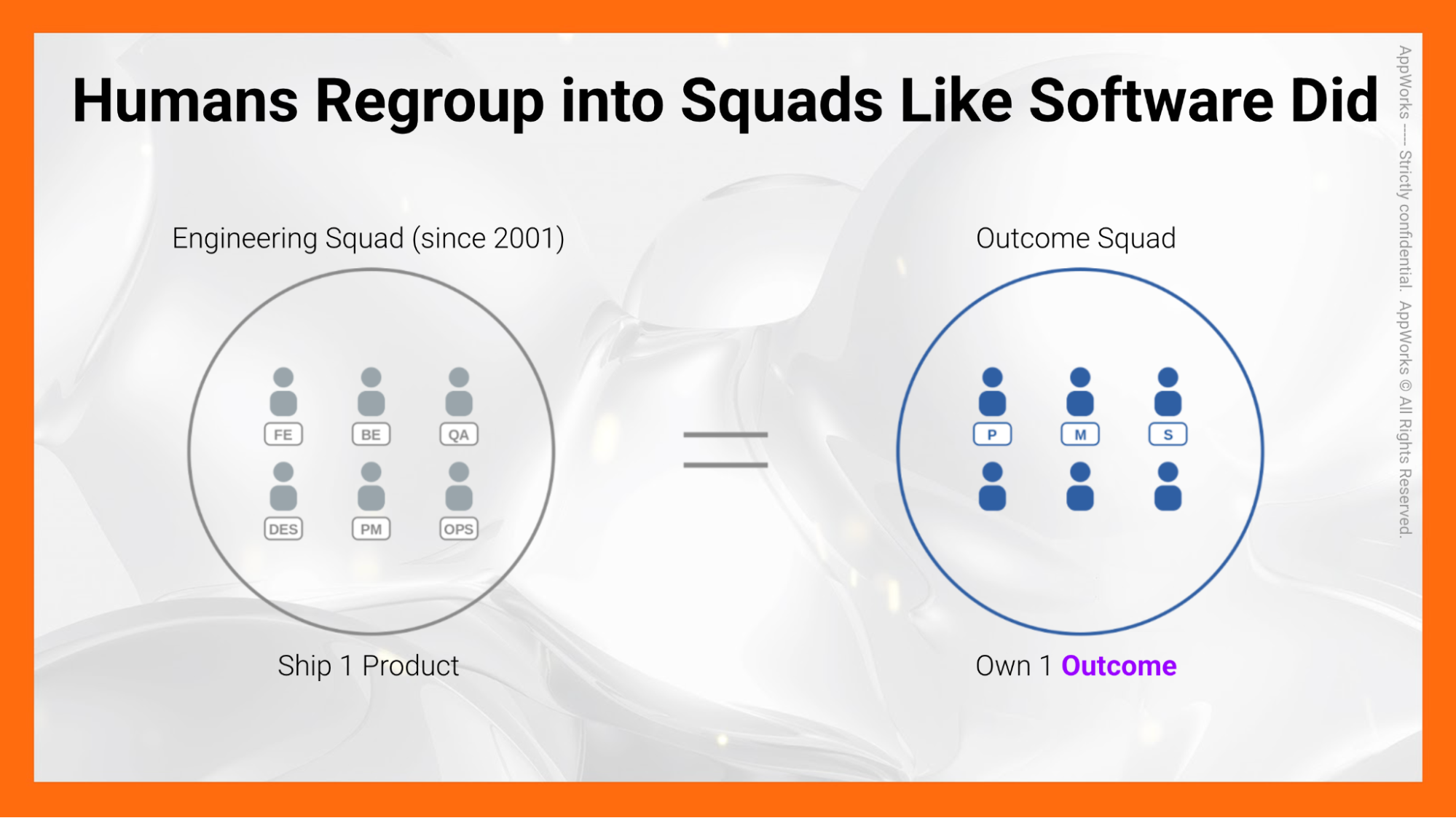
<p><span style="font-weight: 400;">Software has already taken this step. Since 2001, the engineering squad has put front-end, back-end, QA, design, PM, and ops on one team, accountable for specific outcomes instead of each returning to a functional department to wait in line.</span></p>
<p><span style="font-weight: 400;">For other kinds of knowledge work, one of the reasons departments exist is that a complete piece of output is beyond one person, or a few: a single campaign takes a whole group to see through, and no one outcome can support a full-time designer, lawyer or analyst of its own. So the only option was to gather people of the same function together and let each person&#8217;s time be shared out across different outcomes — at the price of queueing, and of negotiating the order of the queue. Once that output can be supplied by a machine on demand, an outcome no longer needs a full group assembled around it, nor does it need to share a person with anyone else, and the boundaries can be redrawn — drawn between one outcome and the next.</span></p>
<p><span style="font-weight: 400;">So what the new shape does is extend the same equation across the whole company: one team, one outcome, and inside it the best combination that could be assembled for that outcome — product, marketing, sales, perhaps — each person bringing their own profession, but sitting at the same table. The difference is this: what a squad used to deliver was one specific piece of the whole; in the age of AI, a single team can aim straight at a company-level outcome.</span></p>
<p><img loading="lazy" decoding="async" class="alignnone size-full wp-image-16086" src="https://appworks.tw/wp-content/uploads/2026/09/image1.png" alt="" width="1999" height="1124" srcset="https://appworks.tw/wp-content/uploads/2026/09/image1.png 1999w, https://appworks.tw/wp-content/uploads/2026/09/image1-640x360.png 640w, https://appworks.tw/wp-content/uploads/2026/09/image1-1280x720.png 1280w, https://appworks.tw/wp-content/uploads/2026/09/image1-768x432.png 768w, https://appworks.tw/wp-content/uploads/2026/09/image1-1536x864.png 1536w, https://appworks.tw/wp-content/uploads/2026/09/image1-1200x675.png 1200w" sizes="auto, (max-width: 1999px) 100vw, 1999px" /></p>
<ol start="2">
<li><b> Squads get smaller.</b></li>
</ol>
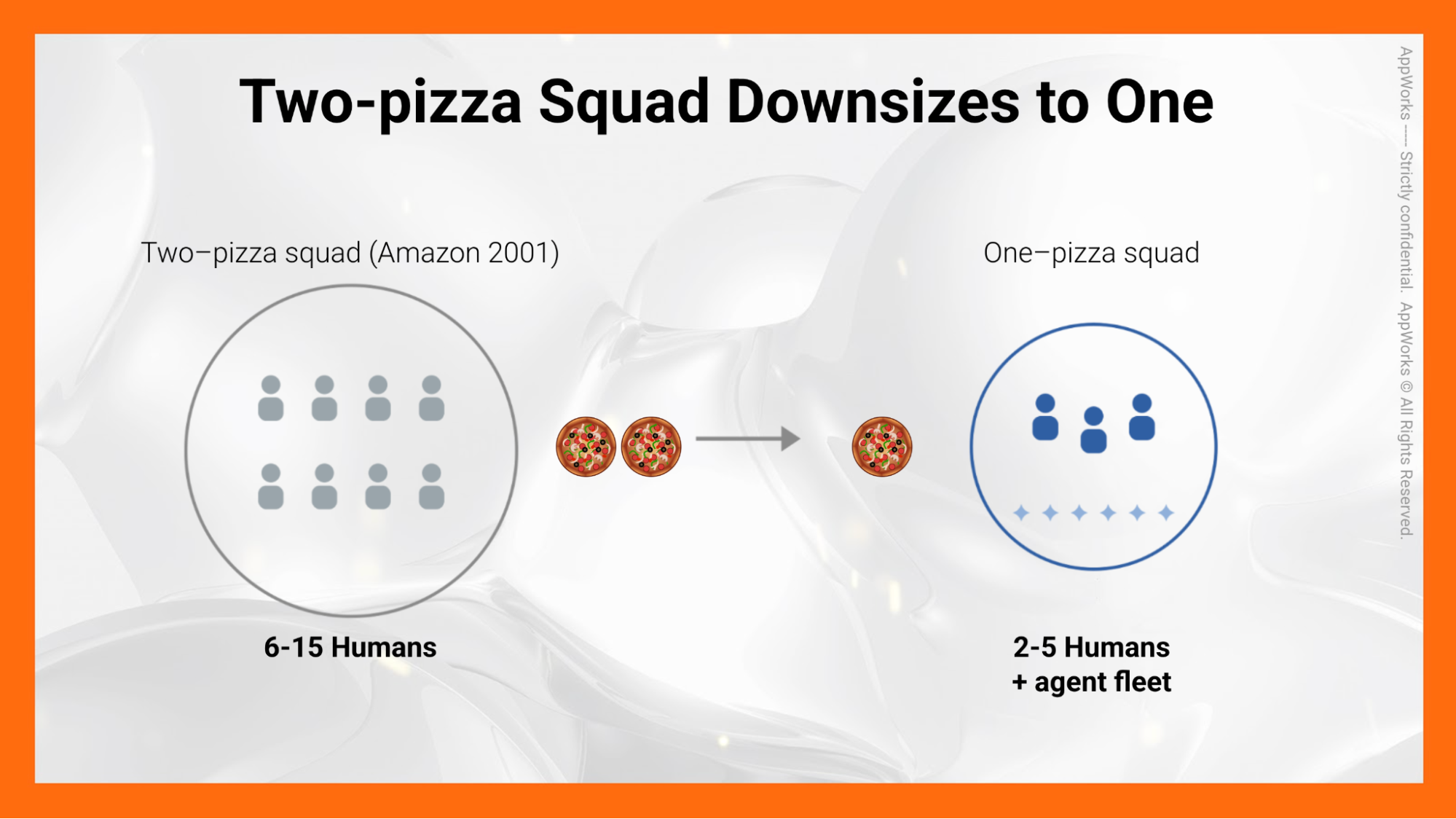
<p><span style="font-weight: 400;">The software industry&#8217;s long-standing reference point has been Amazon&#8217;s two-pizza team: small enough to be fed by two pizzas, so under ten people. But the pizzas were never the point. What Bezos actually wanted was a team that owned one thing outright, and Amazon later changed the wording to single-threaded ownership. Once most of the execution sinks into the machine, what is left for people is judgement and accountability — and that takes fewer of them still.</span></p>
<p><span style="font-weight: 400;">The direction the big technology firms are moving in is already clear: this year Instagram replaced what used to be a thirteen-person specialist line-up with four to six generalist engineers, one product person, plus one specialist relevant to the problem at hand — a pod of roughly six or seven people (from </span><a href="https://www.youtube.com/watch?v=yQ_EWmtfWvQ" target="_blank" rel="noopener"><span style="font-weight: 400;">Head of IG Adam Mosseri&#8217;s July interview on Lenny&#8217;s Podcast</span></a><span style="font-weight: 400;">). What is worth noting is that the headcount is nearly halved and the composition has changed too: specialists give way to generalists, and the boundaries between functions begin to dissolve into one another.</span></p>
<p><img loading="lazy" decoding="async" class="alignnone size-full wp-image-16089" src="https://appworks.tw/wp-content/uploads/2026/09/image4.png" alt="" width="1999" height="1123" srcset="https://appworks.tw/wp-content/uploads/2026/09/image4.png 1999w, https://appworks.tw/wp-content/uploads/2026/09/image4-640x360.png 640w, https://appworks.tw/wp-content/uploads/2026/09/image4-1280x719.png 1280w, https://appworks.tw/wp-content/uploads/2026/09/image4-768x431.png 768w, https://appworks.tw/wp-content/uploads/2026/09/image4-1536x863.png 1536w, https://appworks.tw/wp-content/uploads/2026/09/image4-1200x674.png 1200w" sizes="auto, (max-width: 1999px) 100vw, 1999px" /></p>
<ol start="3">
<li><b> Departments don&#8217;t die; they get unbundled.</b></li>
</ol>
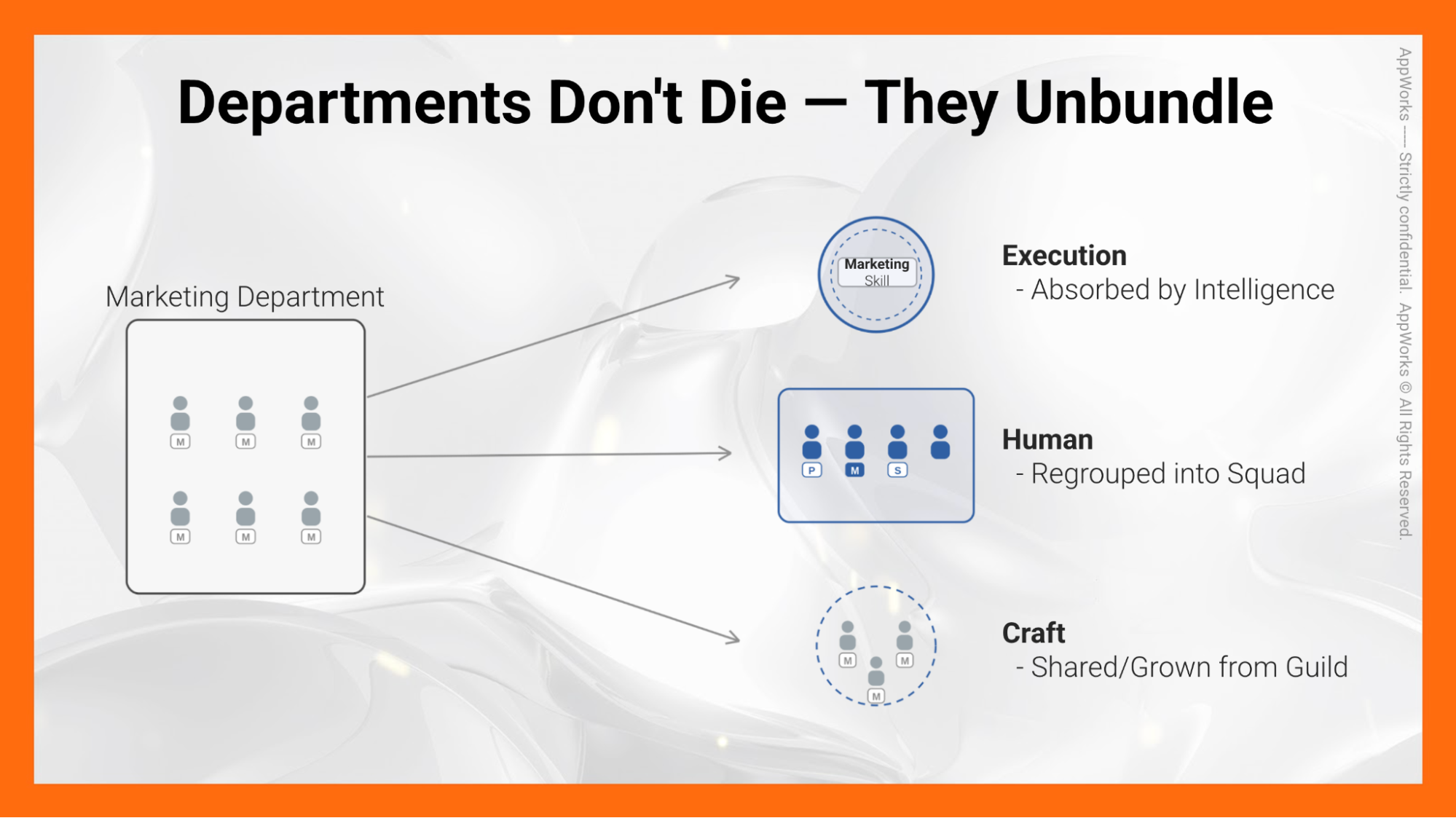
<p><span style="font-weight: 400;">This is the most misunderstood step. A department is really a bundle of three things: the capacity to execute, the power to decide whose work a person&#8217;s time goes to first, and a home for the craft. The new shape unbundles them, and each goes somewhere different.</span></p>
<p><span style="font-weight: 400;">Capacity sinks into the machine. The scheduling power simply disappears — once an outcome no longer has to share a person with anyone else, there is nothing left to put in order, and people sit directly in the outcome team. And the community of craft becomes a guild: practitioners of the same discipline still gather to trade experience, hone standards and bring on newcomers, only now the guild sits off the delivery path — it signs nothing off, and nobody queues for it. A profession, then, is no longer where a person belongs, but the practice they bring into the team: visible in the work, yet not the whole determinant of what they can do.</span></p>
<p><img loading="lazy" decoding="async" class="alignnone size-full wp-image-16088" src="https://appworks.tw/wp-content/uploads/2026/09/image3.png" alt="" width="1999" height="1122" srcset="https://appworks.tw/wp-content/uploads/2026/09/image3.png 1999w, https://appworks.tw/wp-content/uploads/2026/09/image3-640x359.png 640w, https://appworks.tw/wp-content/uploads/2026/09/image3-1280x718.png 1280w, https://appworks.tw/wp-content/uploads/2026/09/image3-768x431.png 768w, https://appworks.tw/wp-content/uploads/2026/09/image3-1536x862.png 1536w, https://appworks.tw/wp-content/uploads/2026/09/image3-1200x674.png 1200w" sizes="auto, (max-width: 1999px) 100vw, 1999px" /></p>
<ol start="4">
<li><b> Underneath is a shared machine, and the people who tend it are a squad of their own.</b></li>
</ol>
<p><span style="font-weight: 400;">Management theory named this idea a long time ago: organisational knowledge. In the 1990s, </span><a href="https://en.wikipedia.org/wiki/Ikujiro_Nonaka" target="_blank" rel="noopener"><span style="font-weight: 400;">Ikujiro Nonaka</span></a><span style="font-weight: 400;"> described how tacit knowledge becomes explicit, and industry duly built a generation of knowledge-management systems — most of which ended up as graveyards, because a knowledge base only stores, it doesn&#8217;t do the work, so nobody had any reason to open it. Thirty years on, a company&#8217;s real judgement and real way of doing things still sits, for the most part, in the heads of a handful of people (FunNow&#8217;s experiment, later on, comes back to this).</span></p>
<p><span style="font-weight: 400;">The machine underneath the new shape is the first time that old idea can actually run. It doesn&#8217;t merely remember how the company does things; it is where the company does them: integrations, campaigns, quotes and work orders all run inside it. So every run teaches it a little more — though let&#8217;s be honest here, the machine does not get cleverer by itself. Someone is tuning context, managing agents and watching yield every day, extracting what happened and feeding it back in. That team is the fab process engineer of the new organisation, and their outcome is the machine itself getting better by the day.</span></p>
<p><span style="font-weight: 400;">Don&#8217;t underestimate this team: encoding a company&#8217;s judgement, its knacks and its way of working into the machine, piece by piece, may be the single largest economic undertaking of the coming decade (a point also made by </span><a href="http://www.a16z.news/p/the-next-ai-goldrush-tokens-loops" target="_blank" rel="noopener"><span style="font-weight: 400;">George Sivulka in an a16z article</span></a><span style="font-weight: 400;">) — and every company has to do it for itself. Nobody can do it for you on contract. </span></p>
<p><span style="font-weight: 400;">This is also where the new shape&#8217;s biggest risk is buried: a shared machine is a shared dependency. If every team has to queue for this one team to supply the capability it needs, the queue you just dismantled grows straight back, merely in a different place. So the design principle for this machine is not to build bespoke features for each team, but to turn capabilities into interfaces the teams can plug into themselves — otherwise it becomes the new internal agency, which is precisely the thing the new shape set out to dismantle.</span></p>
<p>&nbsp;</p>
<h2><b>Field notes from the pioneering founders</b></h2>
<h3><img loading="lazy" decoding="async" class="alignnone size-full wp-image-16091" src="https://appworks.tw/wp-content/uploads/2026/09/image6.png" alt="" width="2000" height="1333" srcset="https://appworks.tw/wp-content/uploads/2026/09/image6.png 2000w, https://appworks.tw/wp-content/uploads/2026/09/image6-640x427.png 640w, https://appworks.tw/wp-content/uploads/2026/09/image6-1280x853.png 1280w, https://appworks.tw/wp-content/uploads/2026/09/image6-768x512.png 768w, https://appworks.tw/wp-content/uploads/2026/09/image6-1536x1024.png 1536w, https://appworks.tw/wp-content/uploads/2026/09/image6-1200x800.png 1200w" sizes="auto, (max-width: 2000px) 100vw, 2000px" /></h3>
<h3><span style="font-weight: 400;">FunNow: how a growth-stage GSEA startup is rebuilding its organisation, squad by squad</span></h3>
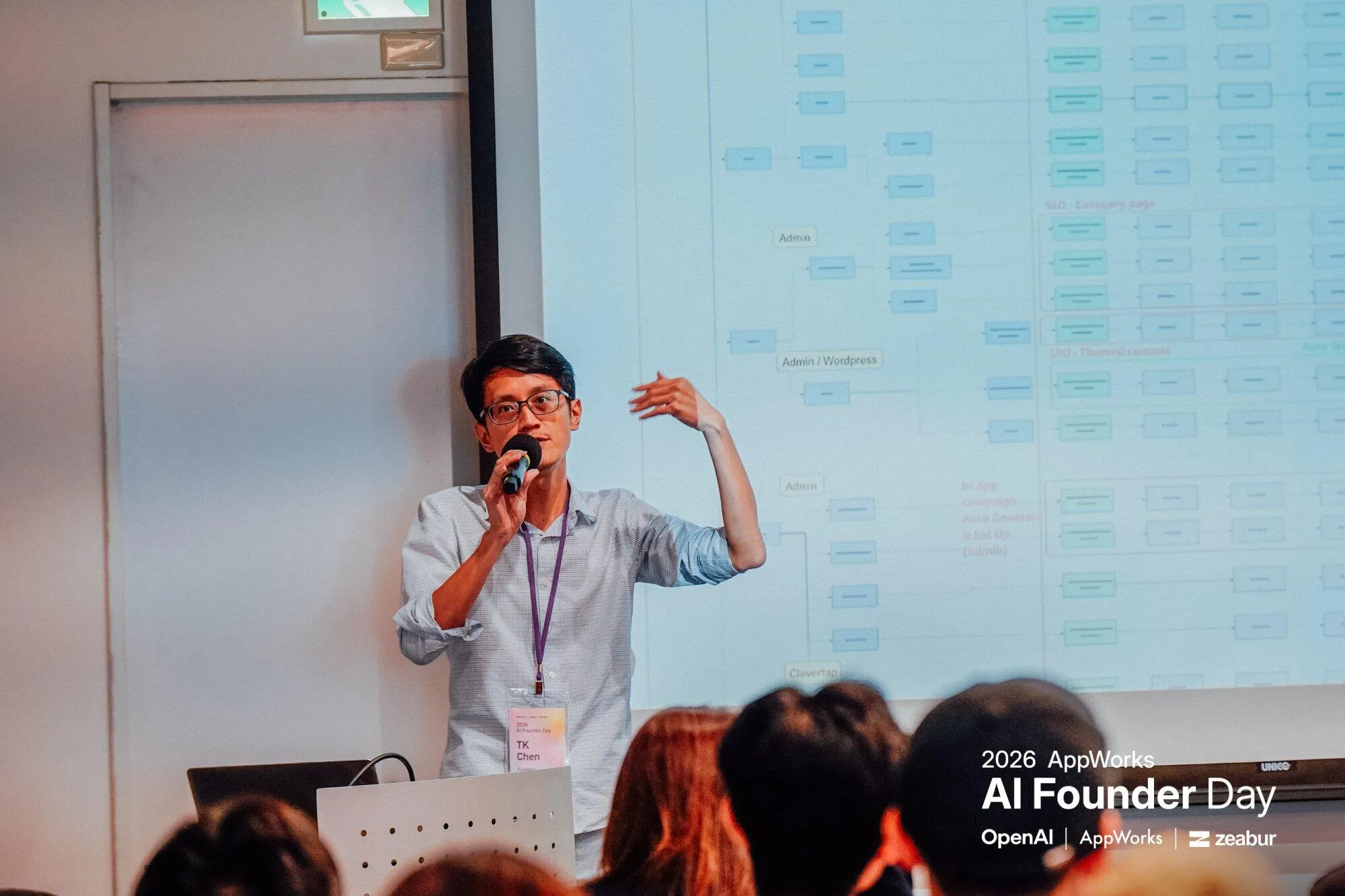
<p><span style="font-weight: 400;">The most complete experiment notes from our interviews came from FunNow, a booking platform for hospitality, dining and lifestyle services across Taiwan and Greater Southeast Asia (GSEA), led by group founder and CEO TK Chen, who is a member of the Paramount CEO Club in Taiwan and a regular mentor in the AppWorks community. </span><i><span style="font-weight: 400;">(Note: Paramount CEO Club is a community for CEOs from companies at growth stage or beyond. It was established by AppWorks in 2012 and has two chapters, in Taiwan and Indonesia.)</span></i></p>
<p><span style="font-weight: 400;">FunNow&#8217;s org chart today has no CMO and few management layers; increasingly, squads report straight to the CEO. Squads are organised by company-level outcome rather than function: one squad for conversion, one for membership and repeat purchase, one for booking flow, with payments and notifications bundled into a &#8220;core&#8221; squad. Every squad is designed to last at least twelve months, with two or three adjacent goals bundled so a team doesn&#8217;t disband when one is done. After all, familiar people and the rapport between them are still a critical part of organisational efficiency.</span></p>
<p><span style="font-weight: 400;">The motive is not fashion. FunNow is ten years old; efficiency and profitability are pressing concerns; and functional departments carry a structural friction: one outcome split across departments, priorities that can&#8217;t be reconciled, disputes landing on the CEO&#8217;s desk. When one squad owns one outcome, </span><i><span style="font-weight: 400;">&#8220;you no longer have to negotiate other departments&#8217; schedules every day.&#8221;</span></i></p>
<p><span style="font-weight: 400;">The human-to-agent ratio is set by how critical the interface is:</span><i><span style="font-weight: 400;"> &#8220;Membership features are simple, so the developer can be an agent. Payments and booking touch the core, so it may take two human developers and three agent developers.&#8221;</span></i> <a href="https://blogs.microsoft.com/blog/2025/04/23/the-2025-annual-work-trend-index-the-frontier-firm-is-born/" target="_blank" rel="noopener"><span style="font-weight: 400;">The 2025 Annual Work Trend Index from Microsoft</span></a><span style="font-weight: 400;"> calls this the human-agent ratio — it has an optimum, not a maximum. Roles are allowed to blur (</span><i><span style="font-weight: 400;">&#8220;once the UI/UX is drawn, why not add an agent and push the code yourself?&#8221;</span></i><span style="font-weight: 400;">), but every squad keeps a permanent DRI </span><span style="font-weight: 400;">(directly responsible individual)</span><span style="font-weight: 400;">. </span></p>
<p><span style="font-weight: 400;">Interestingly, Dorsey&#8217;s experiment has DRIs too, but there they are temporary roles that rotate with the task and follow the problem; what he really wants to remove is the permanent management layer. On this point, we agree with TK: that step goes too far. TK&#8217;s version keeps the DRI as a permanent person — &#8220;</span><i><span style="font-weight: 400;">whoever answers for the failure gets the final say.</span></i><span style="font-weight: 400;">&#8221; After all, it is people, not agents, who can be jailed or sued.</span></p>
<p><span style="font-weight: 400;">The rollout is incremental: </span><i><span style="font-weight: 400;">&#8220;Each time a new independent mission is confirmed, I pull out an outcome squad led by a DRI, and the old organisation gets remade bit by bit.&#8221;</span></i><span style="font-weight: 400;"> Marketing is furthest along, with agents running the chain from signal to execution while people judge and approve. From ad ideation to going live on Meta and Google used to take two weeks; it now takes under a day, and local marketing per country went from three people to two. </span><i><span style="font-weight: 400;">&#8220;How short can you make the chain from market signal to executed response? A week, a day, an hour — that is what competitiveness means in the AI era.&#8221;</span></i><span style="font-weight: 400;"> Adoption is an armoury, not a mobilisation order: </span><i><span style="font-weight: 400;">&#8220;AI is a weapon. Let everyone use it. If it works, double down.&#8221;</span></i><span style="font-weight: 400;"> Within months, users were modifying the agents themselves.</span></p>
<p><span style="font-weight: 400;">The biggest bottleneck, he says, is institutional knowledge: the organisational World Model Dorsey describes </span><i><span style="font-weight: 400;">&#8220;right now lives in the heads of individual managers and founders.&#8221;</span></i><span style="font-weight: 400;"> TK&#8217;s fix is to consolidate tools to two or three, then run weekly and monthly automated extraction so what happens becomes a company asset. The risk he names: when everyone is a builder, data permissions and deployment discipline will be the next governance problem.</span></p>
<p><img loading="lazy" decoding="async" class="alignnone size-full wp-image-16090" src="https://appworks.tw/wp-content/uploads/2026/09/image5.png" alt="" width="700" height="400" srcset="https://appworks.tw/wp-content/uploads/2026/09/image5.png 700w, https://appworks.tw/wp-content/uploads/2026/09/image5-640x366.png 640w" sizes="auto, (max-width: 700px) 100vw, 700px" /></p>
<h3><span style="font-weight: 400;">Staffinc: an Indonesian startup&#8217;s answer to uneven tech literacy</span></h3>
<p><span style="font-weight: 400;">The second set of notes comes from Indonesia. Founder Wisnu Nugrahadi is a member of the Paramount CEO Club in Indonesia. His startup, Staffinc, is an AI staffing company backed by AppWorks Fund. Wisnu began aggressively remaking the company after the shock of ChatGPT in 2023, and today it is a growth-stage startup with ten times the management efficiency of a traditional staffing agency (note: measured as the number of contract workers each HR staffer can manage).</span></p>
<p><span style="font-weight: 400;">Wisnu is frank that the market conditions he faces are not comparable to a mature economy&#8217;s: the gap in tech literacy among employees is enormous. So he has run a great many experiments — first equipping everyone with AI, then building an in-house enterprise AI along the lines of a World Model with agents, and now a further step: give up on everyone becoming an AI builder, but make sure every team has a top-tier AI engineer.</span></p>
<p><i><span style="font-weight: 400;">&#8220;It&#8217;s too expensive. When you give every employee AI, not every employee produces more, while the training and token costs are staggering.&#8221; </span></i><span style="font-weight: 400;">When their local team&#8217;s fluency with the tools can&#8217;t keep up, don&#8217;t count on everyone becoming a high-performance AI user. So their latest approach is to embed one engineer in every sales squad (squads are organised by customer type), responsible for all the tools and systems that squad needs — in effect, an internal forward-deployed engineer (FDE).</span></p>
<p><span style="font-weight: 400;">The biggest management innovations are (1) changing how engineers are evaluated: their performance is judged on the squad&#8217;s sales results, not by the engineering team; and (2) these deployed AI engineers still return to the engineers&#8217; guild every week to swap the tools and lessons they have built, so that each squad&#8217;s learning becomes the whole company&#8217;s asset. </span></p>
<p><span style="font-weight: 400;">The same shape grows different transitional forms in markets at different levels of maturity — one more illustration that &#8220;shape follows what actually works.&#8221;</span></p>
<p>&nbsp;</p>
<h3><span style="font-weight: 400;">Earlier-stage startups finding their way</span></h3>
<p><span style="font-weight: 400;">The Staffinc case shows that embedding AI into an organisation and getting outsized leverage from it is never a matter of the founder drawing a blueprint and following the script; it is a process of iteration and trial and error. Founders&#8217; key concerns are broadly the same: lower cost, higher efficiency, new revenue. However, the path there has to be found by the founder leading the team, growing the new shape that best fits the company&#8217;s DNA. That is true for relatively well-resourced growth-stage companies, and all the more so for small startups running extremely lean.</span></p>
<p><b>無毒農</b> <b>(AW#5)</b><span style="font-weight: 400;">, a fruit-and-vegetable e-commerce company in Taiwan, learned this the hard way. Founder Enzo initially handed AI adoption to his CTO to lead, but months went by with no results. So Enzo rolled up his own sleeves: he started with n8n and the most repetitive work in customer service, then reshaped the engineering team&#8217;s makeup and working habits, and went on to build an internal company MCP (</span><span style="font-weight: 400;">Model Context Protocol) server</span><span style="font-weight: 400;"> so that both AI tools and everyone on the team could pull the data they needed. The results: doubled customer service efficiency, sales up 30%, and product development capacity doubled outright.</span></p>
<p><span style="font-weight: 400;">Tammy, founder of the blockchain team </span><b>Numbers (AW#23)</b><span style="font-weight: 400;">, started by building an AI culture: every team member gets a US$20 monthly AI experimentation budget, the whole team demos their output weekly, and Tammy helps debug personally. Through six months of experimenting, she moved the people who couldn&#8217;t adapt to the AI culture out of the organisation. She then found that the cost of moving information between the existing SaaS systems was extremely high and AI couldn&#8217;t connect them effectively, so she cancelled all SaaS subscriptions and built the company an AI management system by hand, starting from the calendar. Each stage was built on the foundation of the one before, not a roadmap drawn at the outset.</span></p>
<p><b>Farmio (AW#31)</b><span style="font-weight: 400;">, a Singapore-based AI solution for the food supply chain, was founded in the GenAI era and built AI-native from day one. What an AI-native food supply chain actually looks like was something founder Paco designed himself, starting from the smallest scenario: ordering via WhatsApp. He entered at the highest-frequency touchpoint in the entire supply chain and extended down the chain one link at a time. Two years on, 72 agents cover every workflow, ordering to delivery is almost fully automated, and the company has hit the milestone of US$1 million in GMV per employee.</span></p>
<p><span style="font-weight: 400;">These three cases show the different paths smaller startups in the AppWorks community have taken, and each started its experiment at one clearly defined point: customer service, internal tools, ordering. Beyond that, the founder&#8217;s own resolve to change was critical to their success. The new shape of an organisation cannot be a job that gets outsourced — which brings us back to Professor Mollick&#8217;s lament: for decades, many companies outsourced &#8220;running the business&#8221; to consultants and system vendors, and the pioneers of this round of organisational experiments are taking it back into their own hands.</span></p>
<p>&nbsp;</p>
<h2><b>The new shape gets you the ticket; the real arena is atomic capabilities and moats</b></h2>
<p><span style="font-weight: 400;">To pull the threads together: what we have been discussing is a new shape for the organisation. Over the past six months, founders have been busy chasing the rapid evolution of AI technology, and simultaneously innovating on organisational shape to keep pace. That is the common starting point of every experiment in the first half of this article. But once you have the new shape, there is one more layer to think through: a shape is something visible and copyable. When it goes from a few people&#8217;s experiment to every company&#8217;s standard equipment, what will actually decide who wins?</span></p>
<p><span style="font-weight: 400;">In the short term, the gap between companies will come from who compounds learning first: the same headcount, several times the output. That gap is already measurable. Using the same frontier models, companies that hand out tools without touching the organisation see engineering productivity gains of roughly 20% to 40% (</span><a href="https://tomtunguz.com/ai-engineering-productivity-anything-but-normal/" target="_blank" rel="noopener"><span style="font-weight: 400;">Theory Ventures&#8217; data</span></a><span style="font-weight: 400;">), and some rigorous controlled experiments have even measured negative values; companies that rebuild AI into their workflows see 2.5x to 3x (</span><a href="https://www.youtube.com/watch?v=Z6IT4gjrcPE" target="_blank" rel="noopener"><span style="font-weight: 400;">interview with Anthropic engineers</span></a><span style="font-weight: 400;">); and in Taiwan we have already seen leading software companies reach at least 10x production speed. Everyone has the same models; the variable that makes a tenfold difference is not the model but how the organisation is built around it.</span></p>
<p><span style="font-weight: 400;">But over a longer horizon, a shape is something visible and copyable. Once every company has grown into the new shape, the value of leading on execution and efficiency will eventually be competed away, and quickly. At that point, the decisive factors come back to two things. First, </span><b>atomic capabilities</b><span style="font-weight: 400;"> — for FunNow that might be price discovery and the entertainment options it curates; for Staffinc, guaranteeing the quality and quantity of its contract workforce — and these atomic capabilities will be sorted into winners and losers ever faster. Second, </span><b>moats that AI cannot take away</b><span style="font-weight: 400;">: the licences, distribution, brand, and data loops a company needs in order to strengthen or defend that atomic capability.</span></p>
<p><span style="font-weight: 400;">But don&#8217;t read &#8220;will be competed away&#8221; as &#8220;doesn&#8217;t matter.&#8221; A company that fails to grow the new shape will very likely not even get a seat at the table. The new shape is not a trophy; it is the ticket in — and the fastest way to accumulate those scarce assets.</span></p>
<p><span style="font-weight: 400;">So before you start rebuilding, it is worth asking yourself two questions: is your atomic capability strong enough to be worth amplifying with the new shape? And what is your moat?</span></p>
<p>&nbsp;</p>
<h2><b>Closing thoughts: an invitation from the frontier</b></h2>
<p><span style="font-weight: 400;">In closing, we want to be honest about how this revolution feels right now: it is not entirely romantic. In a 2026</span><a href="https://www.lennysnewsletter.com/p/how-tech-workers-are-feeling-in-2026" target="_blank" rel="noopener"> <span style="font-weight: 400;">survey</span></a><span style="font-weight: 400;"> of nearly 6,000 tech workers, only about one in five feared being replaced by AI, while more than half feared &#8220;doing more work for the same pay.&#8221; For founders, this is not employee anxiety; it is a diagnosis. Hand out tools without changing the shape of the organisation, and the capacity AI creates ends up backfilled as more meetings and longer hours. Being filled up is not a side effect of AI; it is a symptom of the old shape.</span></p>
<p><span style="font-weight: 400;">Over a longer horizon, people&#8217;s place in the organisation tends to move toward the most valuable thing they do: judgement. After the spreadsheet arrived in the 1980s, the US lost about 400,000 bookkeeping and accounting clerks but gained about 600,000 accountants, and FP&amp;A emerged as an entirely new job category. So the real question was never &#8220;how many employees will AI replace?&#8221; It is: when the machine gives the hours back to people, where should those people be redeployed? </span></p>
<p><span style="font-weight: 400;">No one can answer this for you, and it is the most important decision a founder faces right now. Every pioneer&#8217;s opening move was small, so if we had to give one concrete piece of advice: pick the outcome that hurts you most and that you can describe most clearly, take it out of the departments&#8217; hands, and give it to a squad of two to five people plus a fleet of agents, with independent metrics and at least twelve months. You will quickly find out what your company&#8217;s new shape looks like.</span></p>
<p><span style="font-weight: 400;">Finally, my recent favourite book is Benjamín Labatut&#8217;s </span><i><span style="font-weight: 400;">When We Cease to Understand the World</span></i><span style="font-weight: 400;">. Every time one of its scientists ceases to understand the world, a new theory is about to be born. For the first time in 25 years, the org chart is on the verge of being redrawn: the uncertainty, the fumbling, are proof that we are standing at the frontier. Over the past hundred years, each generation of operators experimented on their own companies, and each left behind a name: the U-form, the M-form, the amoeba. Whether the S-form becomes the next letter is up to this generation of founders and their experiments.</span></p>
<p><span style="font-weight: 400;">At the start of the AI era, it is our honour to explore this new frontier with you.</span></p>
<p>The post <a rel="nofollow" href="https://appworks.tw/the-new-shape-of-work/">The New Shape of Work</a> appeared first on <a rel="nofollow" href="https://appworks.tw">AppWorks 之初加速器</a>.</p>
]]></content>
		
					<link rel="replies" type="text/html" href="https://appworks.tw/the-new-shape-of-work/?utm_source=rss&#038;utm_medium=rss&#038;utm_campaign=the-new-shape-of-work#comments" thr:count="0" />
			<link rel="replies" type="application/atom+xml" href="https://appworks.tw/the-new-shape-of-work/feed/atom/" thr:count="0" />
			<thr:total>0</thr:total>
			</entry>
		<entry>
		<author>
			<name>Sophie Chiu</name>
					</author>

		<title type="html"><![CDATA[AI 時代的新組織形狀  The New Shape of Work]]></title>
		<link rel="alternate" type="text/html" href="https://appworks.tw/ai-%e6%99%82%e4%bb%a3%e7%9a%84%e6%96%b0%e7%b5%84%e7%b9%94%e5%bd%a2%e7%8b%80-the-new-shape-of-work/?utm_source=rss&#038;utm_medium=rss&#038;utm_campaign=ai-%25e6%2599%2582%25e4%25bb%25a3%25e7%259a%2584%25e6%2596%25b0%25e7%25b5%2584%25e7%25b9%2594%25e5%25bd%25a2%25e7%258b%2580-the-new-shape-of-work" />

		<id>https://appworks.tw/?p=16084</id>
		<updated>2026-09-15T06:45:50Z</updated>
		<published>2026-09-15T01:44:07Z</published>
		<category scheme="https://appworks.tw" term="View" />
		<summary type="html"><![CDATA[<p>with contribution from Natasha Chou, Alumni Relations Manager at AppWorks &#160; 身處一個龐大的創業者社群，最寶貴的事，是能親眼見證創業者們每天的快速迭代。尤其今年初 OpenClaw 龍蝦登場以來，創業者們像是拿到了全新的火把，正在探勘 AI 能帶組織走進多少過去走不進的隧道。 自 2025 年 4 月起，AppWorks 每個月在台北辦公室舉辦 AI Founder Circle，同步也在我們有 98 家活躍校友新創的新加坡雙月舉辦。十多場活動下來，議題一路演進：從怎麼用龍蝦，到怎麼打造自己的 AI Agent；從怎麼讓員工順利導入 AI，到動手打造 AI 員工、架起整套 Agent harness 平台……到現在，我們來到一個新的邊境：過去的組織形狀，好像不再適用了。 組織形狀的升級優化，一直是新創成長路上必經的課題。幾乎所有公司的起點，都是一支只有數人的游擊隊，每天完全對焦、全力以赴；然後在成長的路上，似乎就得跟著大公司前輩們的足跡，走向部門化、事業部化，並開始感受到成長痛，尤其通常在一、兩百人這個區間，會經歷組織擴大了、生產力卻不見得等比增加的痛。 要成就大的生意，必得有眾人加入艦隊；但人一多，管理就難，畢竟人類傳遞資訊的頻寬有限。AI 似乎正要化解這個千年的管理之痛：它傳遞資訊，比人更大量、更迅速、也更能超越不同人經手帶來的落差。前衛的創業者與企業家已經開始實驗：Jack Dorsey 三月提出完全扁平化的假說 (參考他與 Sequoia Managing Partner Roelof Botha 合寫的 From Hierarchy to Intelligence)；Cloudflare CEO Matthew Prince 五月投書華爾街日報，解釋為何在營收高速成長、現金流健康的時刻裁員換血 (原文 [&#8230;]</p>
<p>The post <a rel="nofollow" href="https://appworks.tw/ai-%e6%99%82%e4%bb%a3%e7%9a%84%e6%96%b0%e7%b5%84%e7%b9%94%e5%bd%a2%e7%8b%80-the-new-shape-of-work/">AI 時代的新組織形狀  The New Shape of Work</a> appeared first on <a rel="nofollow" href="https://appworks.tw">AppWorks 之初加速器</a>.</p>
]]></summary>

					<content type="html" xml:base="https://appworks.tw/ai-%e6%99%82%e4%bb%a3%e7%9a%84%e6%96%b0%e7%b5%84%e7%b9%94%e5%bd%a2%e7%8b%80-the-new-shape-of-work/?utm_source=rss&#038;utm_medium=rss&#038;utm_campaign=ai-%25e6%2599%2582%25e4%25bb%25a3%25e7%259a%2584%25e6%2596%25b0%25e7%25b5%2584%25e7%25b9%2594%25e5%25bd%25a2%25e7%258b%2580-the-new-shape-of-work"><![CDATA[<h6><span style="font-size: 13.3333px; font-weight: 400;">with contribution from </span><span style="font-weight: 400; font-size: 10pt;">Natasha Chou, Alumni Relations Manager at AppWorks</span></h6>
<p>&nbsp;</p>
<p><img loading="lazy" decoding="async" class="alignnone wp-image-16109 size-full" src="https://appworks.tw/wp-content/uploads/2026/09/new-shape-of-work-banner-zh.png" alt="" width="1200" height="630" srcset="https://appworks.tw/wp-content/uploads/2026/09/new-shape-of-work-banner-zh.png 1200w, https://appworks.tw/wp-content/uploads/2026/09/new-shape-of-work-banner-zh-640x336.png 640w, https://appworks.tw/wp-content/uploads/2026/09/new-shape-of-work-banner-zh-768x403.png 768w" sizes="auto, (max-width: 1200px) 100vw, 1200px" /></p>
<p><span style="font-weight: 400;">身處一個龐大的創業者社群，最寶貴的事，是能親眼見證創業者們每天的快速迭代。尤其今年初 OpenClaw 龍蝦登場以來，創業者們像是拿到了全新的火把，正在探勘 AI 能帶組織走進多少過去走不進的隧道。</span></p>
<p><span style="font-weight: 400;">自 2025 年</span><span style="font-weight: 400;"> 4 </span><span style="font-weight: 400;">月起，AppWorks 每個月在台北辦公室舉辦 AI Founder Circle，同步也在我們有 98 家活躍校友新創的新加坡雙月舉辦。十多場活動下來，議題一路演進：從怎麼用龍蝦，到怎麼打造自己的 AI Agent；從怎麼讓員工順利導入 AI，到動手打造 AI 員工、架起整套 Agent harness 平台……到現在，我們來到一個新的邊境：過去的組織形狀，好像不再適用了。</span></p>
<p><span style="font-weight: 400;">組織形狀的升級優化，一直是新創成長路上必經的課題。幾乎所有公司的起點，都是一支只有數人的游擊隊，每天完全對焦、全力以赴；然後在成長的路上，似乎就得跟著大公司前輩們的足跡，走向部門化、事業部化，並開始感受到成長痛，尤其通常在一、兩百人這個區間，會經歷組織擴大了、生產力卻不見得等比增加的痛。</span></p>
<p><span style="font-weight: 400;">要成就大的生意，必得有眾人加入艦隊；但人一多，管理就難，畢竟人類傳遞資訊的頻寬有限。AI 似乎正要化解這個千年的管理之痛：它傳遞資訊，比人更大量、更迅速、也更能超越不同人經手帶來的落差。前衛的創業者與企業家已經開始實驗：Jack Dorsey 三月提出完全扁平化的假說 (參考他與 Sequoia Managing Partner Roelof Botha 合寫的</span><a href="https://block.xyz/inside/from-hierarchy-to-intelligence" target="_blank" rel="noopener"> <span style="font-weight: 400;">From Hierarchy to Intelligence</span></a><span style="font-weight: 400;">)</span><span style="font-weight: 400;">；Cloudflare CEO Matthew Prince 五月投書華爾街日報，解釋為何在營收高速成長、現金流健康的時刻裁員換血 (原文</span><a href="https://www.wsj.com/opinion/how-i-choose-which-cloudflare-employees-to-replace-with-ai-40a197e5" target="_blank" rel="noopener"> <span style="font-weight: 400;">How I Choose Which Cloudflare Employees to Replace with AI</span></a><span style="font-weight: 400;">)</span><span style="font-weight: 400;">；我們 AppWorks 的董事長暨合夥人 Jamie，也與台灣大哥大資訊長蔡祈岩於七月份出版《</span><a href="https://www.eslite.com/product/10072302132683178767005" target="_blank" rel="noopener"><span style="font-weight: 400;">逆分工</span></a><span style="font-weight: 400;">》探討 AI 時代的生產力革命。</span></p>
<p><span style="font-weight: 400;">在亞洲，許多創業者正同步進行這樣的實驗。透過他們第一手的經歷與迭代，我們有幸近身觀察。今天藉由這篇文章提出一個關於 AI 時代組織形狀的假說，想跟拿著火把的創業者們，一起窺見未來的樣貌；而文章的末尾，我們會說明，為什麼新形狀是重要的入場券，而不是終局。我們同時邀請了幾位不同階段與規模的創辦人，分享他們正在做的實驗與成果，所以這篇文章不只是 AppWorks 提出的一個理論，更是來自 AppWorks 創業者社群無私的分享。</span></p>
<p>&nbsp;</p>
<h2><b>每一次技術革命，都會重塑我們組織的方式</b></h2>
<p><span style="font-weight: 400;">每一次技術革命，都會重塑我們組織的方式，而這件事至少發生過兩次了。</span></p>
<p><img loading="lazy" decoding="async" class="alignnone wp-image-16092 size-full" src="https://appworks.tw/wp-content/uploads/2026/09/image7.png" alt="" width="1202" height="676" srcset="https://appworks.tw/wp-content/uploads/2026/09/image7.png 1202w, https://appworks.tw/wp-content/uploads/2026/09/image7-640x360.png 640w, https://appworks.tw/wp-content/uploads/2026/09/image7-768x432.png 768w, https://appworks.tw/wp-content/uploads/2026/09/image7-1200x675.png 1200w" sizes="auto, (max-width: 1202px) 100vw, 1202px" /></p>
<p><span style="font-weight: 400;">第一次在紡織廠。18 世紀工業革命前，織布機只是工具，手藝長在織工身上，一人一機，產量的上限就是人手。動力織布機出現之後，機器把手藝吸收了進去，人站到機器的旁邊，人來看顧機器執行手藝。一個人看管一整排機器，工作從動手織布，變成設定標準、抓出例外。2026 年的今天走進台積電的晶圓廠，你看到的仍然是這個形狀：最先進的製程工程師，不是任何一片晶圓的工匠，是機器良率的看顧者。</span></p>
<p><img loading="lazy" decoding="async" class="alignnone wp-image-16094 size-full" src="https://appworks.tw/wp-content/uploads/2026/09/image9.png" alt="" width="1999" height="1123" srcset="https://appworks.tw/wp-content/uploads/2026/09/image9.png 1999w, https://appworks.tw/wp-content/uploads/2026/09/image9-640x360.png 640w, https://appworks.tw/wp-content/uploads/2026/09/image9-1280x719.png 1280w, https://appworks.tw/wp-content/uploads/2026/09/image9-768x431.png 768w, https://appworks.tw/wp-content/uploads/2026/09/image9-1536x863.png 1536w, https://appworks.tw/wp-content/uploads/2026/09/image9-1200x674.png 1200w" sizes="auto, (max-width: 1999px) 100vw, 1999px" /></p>
<p><span style="font-weight: 400;">第二次，輪到軟體業自己。從大型主機、個人電腦到雲端，工程師的工具有個特別之處：寫得成規則的事，工具就能替你做；而它最先接管的，是「證明上一個人沒做錯」。早期的 waterfall 按工序分組，分析、設計、寫碼、測試，四個部門輪流交接，文件就是縫線；那份文件真正的功能，是把信任從上一棒交到下一棒。當版本控制、自動測試、持續整合把驗證變成機器的工作，雲端又讓上線從一次定生死變成隨時可回滾，交接的文件就沒有東西要證明了。崩掉的不是人力工時，是犯錯與協調的成本；成本一變，形狀跟著重組。大約 2001 年起，敏捷開發 (agile) 把跨職能小隊變成軟體業的主流：一個小隊裡有產品、工程、設計，一起對「提升首頁轉換率」這種專項成果負責。(Spotify 後來把這種小隊叫做 squad。)</span></p>
<p><span style="font-weight: 400;">形狀從來不跟思潮走，只跟真實的成效走。這也解釋了產業發展的往事：過去 25 年，agile 在網路服務的工程團隊以外幾乎沒有真正成功過，因為搬得走的只有儀式，搬不走的是底下那台機器。其他部門的系統只記錄工作，不做工作，更不會查工作：CRM 記錄客戶，但不去談客戶，也不會告訴你這通電話談壞了。少了那台機器，跨職能小隊交出來的成果沒有變好，只是換一種方式開會；於是儀式留著，形狀退回去。</span></p>
<p>&nbsp;</p>
<h2><b>知識工作者的革新時代</b></h2>
<p><img loading="lazy" decoding="async" class="alignnone size-full wp-image-16093" src="https://appworks.tw/wp-content/uploads/2026/09/image8.png" alt="" width="1999" height="1122" srcset="https://appworks.tw/wp-content/uploads/2026/09/image8.png 1999w, https://appworks.tw/wp-content/uploads/2026/09/image8-640x359.png 640w, https://appworks.tw/wp-content/uploads/2026/09/image8-1280x718.png 1280w, https://appworks.tw/wp-content/uploads/2026/09/image8-768x431.png 768w, https://appworks.tw/wp-content/uploads/2026/09/image8-1536x862.png 1536w, https://appworks.tw/wp-content/uploads/2026/09/image8-1200x674.png 1200w" sizes="auto, (max-width: 1999px) 100vw, 1999px" /></p>
<p><span style="font-weight: 400;">看看今天的公司：一個客戶成果，通常切給產品、行銷、業務、客服四個部門，各自對自己那一段負責，再開會對齊。而知識工作者的日常，大半是在系統之間搬資料：從 email 搬進 CRM、從報表搬進簡報。企業 IT 有個正式術語形容這件事，叫 swivel-chair integration 旋轉椅整合：這邊轉過來複製，那邊轉過去貼上。有了滿桌的系統與工具，知識工作者卻還在手搖織布機的時代。</span></p>
<p><img loading="lazy" decoding="async" class="alignnone size-full wp-image-16095" src="https://appworks.tw/wp-content/uploads/2026/09/image10.png" alt="" width="1999" height="1124" srcset="https://appworks.tw/wp-content/uploads/2026/09/image10.png 1999w, https://appworks.tw/wp-content/uploads/2026/09/image10-640x360.png 640w, https://appworks.tw/wp-content/uploads/2026/09/image10-1280x720.png 1280w, https://appworks.tw/wp-content/uploads/2026/09/image10-768x432.png 768w, https://appworks.tw/wp-content/uploads/2026/09/image10-1536x864.png 1536w, https://appworks.tw/wp-content/uploads/2026/09/image10-1200x675.png 1200w" sizes="auto, (max-width: 1999px) 100vw, 1999px" /></p>
<p><span style="font-weight: 400;">AI 對知識工作做的，正是動力織布機對紡織做的事：把手藝吸進機器裡。它先接管了搬運和串接，隨即連各部門的執行也吸了進去：行銷的投放、業務的報價、客服的工單等等，各種人力執行的工作，都變成機器裡隨叫隨到的能力，形同內勤工作的 API 化。</span></p>
<p><span style="font-weight: 400;">這是知識工作者的工業革命時代，白領第一次可以真正站到機器旁邊。下一個問題就是我們今天想要談的假說：站到旁邊的人，該怎麼重新組織、重新編隊？</span></p>
<p>&nbsp;</p>
<h2><b>我們的假說：一個新形狀 The New Shape of Work</b></h2>
<p><img loading="lazy" decoding="async" class="alignnone size-full wp-image-16088" src="https://appworks.tw/wp-content/uploads/2026/09/image3.png" alt="" width="1999" height="1122" srcset="https://appworks.tw/wp-content/uploads/2026/09/image3.png 1999w, https://appworks.tw/wp-content/uploads/2026/09/image3-640x359.png 640w, https://appworks.tw/wp-content/uploads/2026/09/image3-1280x718.png 1280w, https://appworks.tw/wp-content/uploads/2026/09/image3-768x431.png 768w, https://appworks.tw/wp-content/uploads/2026/09/image3-1536x862.png 1536w, https://appworks.tw/wp-content/uploads/2026/09/image3-1200x674.png 1200w" sizes="auto, (max-width: 1999px) 100vw, 1999px" /></p>
<p><span style="font-weight: 400;">先把完整的假說畫出來。我們認為 AI 時代的組織，可能會長這樣：</span><b>中央是一台共用的智能機器，把串接與執行扛走；機器周圍，環繞著一個個小而完整的成果小隊，每隊二到五個人加一支 agent 編隊，完整擁有一個成果；專業不再是部門的名字，是人做事的手路、行會裡磨出來的手藝。</b></p>
<p><span style="font-weight: 400;">管理學歷史上有許多組織實驗，而組織，正是美國企業得以領先的要素之一。華頓商學院副教授 Ethan Mollick 是近年談 AI 時代組織變革談得最持續的人之一，他提醒過一個常被遺忘的估算：二十世紀美國企業多出來的競爭優勢，有 20% 到 40% 來自更好的管理，那是一個願意拿組織做實驗的年代；但他也感嘆，後來多數公司放棄了實驗，把「怎麼經營公司」外包給顧問與 SaaS 廠商 (見</span><a href="https://www.insightpartners.com/ideas/ethan-mollick-on-ai/" target="_blank" rel="noopener"> <span style="font-weight: 400;">Insight Partners 刊出的訪談</span></a><span style="font-weight: 400;">)。</span></p>
<p><span style="font-weight: 400;">的確，回頭看管理史，我們經歷過幾輪大的組織實驗：一百年前按職能分組的 U-form；緊跟著在 1920 年代長出來的 M-form，按事業部分組——這兩個名字其實都要等到 1975 年才由 Oliver Williamson 補上，形狀先活了半世紀，理論才追上；1963 年稻盛和夫在京瓷發明的阿米巴，把公司切成數千個各自算損益的小單位；再到 2010 年代 Spotify 那套被全世界抄走、卻連 Spotify 自己都沒能真正活下來的 squad 模型 (見前 Spotify PM Jeremiah Lee 的</span><a href="https://www.jeremiahlee.com/posts/failed-squad-goals/" target="_blank" rel="noopener"> <span style="font-weight: 400;">Failed #SquadGoals</span></a><span style="font-weight: 400;">)。如今，AI 把組織的實驗室重新打開。我們也試圖給新形狀一個名字，暫且叫它 S-form：squad-form，按成果分組的組織。</span></p>
<p>&nbsp;</p>
<h3><span style="font-weight: 400;">新形狀的四個關鍵細節</span></h3>
<p><img loading="lazy" decoding="async" class="alignnone size-full wp-image-16087" src="https://appworks.tw/wp-content/uploads/2026/09/image2.png" alt="" width="1999" height="1123" srcset="https://appworks.tw/wp-content/uploads/2026/09/image2.png 1999w, https://appworks.tw/wp-content/uploads/2026/09/image2-640x360.png 640w, https://appworks.tw/wp-content/uploads/2026/09/image2-1280x719.png 1280w, https://appworks.tw/wp-content/uploads/2026/09/image2-768x431.png 768w, https://appworks.tw/wp-content/uploads/2026/09/image2-1536x863.png 1536w, https://appworks.tw/wp-content/uploads/2026/09/image2-1200x674.png 1200w" sizes="auto, (max-width: 1999px) 100vw, 1999px" /></p>
<p><b>一、以成果分組，不再按專業分工。</b><span style="font-weight: 400;"> </span></p>
<p><span style="font-weight: 400;">這一步軟體業早就走過：2001 年以來的工程 squad，把前端、後端、QA、設計、PM、維運湊在一隊，對特定專項目標負責，而不是各自回到職能部門排隊。</span></p>
<p><span style="font-weight: 400;">對於其他知識工作來說，部門的存在理由之一，是一個人、幾個人做不出一份完整的產出：一次投放要一整組人才跑得完，一個成果也養不起一名專職的設計、法務或分析師。所以只能把同職能的人集中起來，讓每個人的時間被不同的成果分著用，而代價是排隊，以及排隊順序怎麼談。當那份產出可以由機器隨叫隨到地補齊，一個成果不必再湊滿一組人，也不必再跟別人共用同一個人，邊界就得以重劃，劃在成果與成果之間。</span></p>
<p><span style="font-weight: 400;">所以新形狀做的事，是把同一個等式擴到整家公司：一個小隊，一個成果，裡面是為了這個成果湊齊的最適組合，可能有產品、行銷、業務，每個人帶著自己的專業，但坐在同一張桌子。差別在於：過去 squad 交付的是一個特定專項，在 AI 的時代，一個小隊可以直接瞄準公司級的成果。</span></p>
<p><img loading="lazy" decoding="async" class="alignnone size-full wp-image-16086" src="https://appworks.tw/wp-content/uploads/2026/09/image1.png" alt="" width="1999" height="1124" srcset="https://appworks.tw/wp-content/uploads/2026/09/image1.png 1999w, https://appworks.tw/wp-content/uploads/2026/09/image1-640x360.png 640w, https://appworks.tw/wp-content/uploads/2026/09/image1-1280x720.png 1280w, https://appworks.tw/wp-content/uploads/2026/09/image1-768x432.png 768w, https://appworks.tw/wp-content/uploads/2026/09/image1-1536x864.png 1536w, https://appworks.tw/wp-content/uploads/2026/09/image1-1200x675.png 1200w" sizes="auto, (max-width: 1999px) 100vw, 1999px" /></p>
<p><b>二、小隊更小。</b><span style="font-weight: 400;"> </span></p>
<p><span style="font-weight: 400;">軟體業長年的參考值是 Amazon 的 two-pizza team：兩張披薩餵得飽，十人以內。但披薩從來不是重點，Bezos 真正要的是一支隊伍完整擁有一件事，後來 Amazon 也把說法改成 single-threaded ownership。當執行大部分沉進機器，人剩下的工作是判斷和問責，需要的人就更少了。</span></p>
<p><span style="font-weight: 400;">科技大廠的移動方向已經很清楚：Instagram 今年把過去十三人的專才編制，換成四到六位通才工程師、一位 product staff，再加一位切題的專才，整支 pod 大約六到七人 (來自</span><a href="https://www.lennysnewsletter.com/p/adam-mosseri-ai-is-a-tailwind-for" target="_blank" rel="noopener"> <span style="font-weight: 400;">Head of IG Adam Mosseri 在七月份 Lenny&#8217;s Podcast 的訪談</span></a><span style="font-weight: 400;">)。值得注意的是，人數幾乎腰斬，組成也改變了：專才換成通才，功能的邊界開始互相溶解。</span></p>
<p><img loading="lazy" decoding="async" class="alignnone size-full wp-image-16089" src="https://appworks.tw/wp-content/uploads/2026/09/image4.png" alt="" width="1999" height="1123" srcset="https://appworks.tw/wp-content/uploads/2026/09/image4.png 1999w, https://appworks.tw/wp-content/uploads/2026/09/image4-640x360.png 640w, https://appworks.tw/wp-content/uploads/2026/09/image4-1280x719.png 1280w, https://appworks.tw/wp-content/uploads/2026/09/image4-768x431.png 768w, https://appworks.tw/wp-content/uploads/2026/09/image4-1536x863.png 1536w, https://appworks.tw/wp-content/uploads/2026/09/image4-1200x674.png 1200w" sizes="auto, (max-width: 1999px) 100vw, 1999px" /></p>
<p><b>三、部門不死，是拆包。</b></p>
<p><span style="font-weight: 400;">這是最常被誤解的一步。部門其實是三個東西的捆綁：執行的產能、決定一個人的時間先給誰的調度權、手藝的家。新形狀把它拆開，各有去處。</span></p>
<p><span style="font-weight: 400;">產能沉入機器；調度權消失了——當一個成果不必再跟別人共用同一個人，就沒有東西需要被排序，人直接坐進成果小隊；而手藝的社群變成行會 (guild)：同行仍然聚在一起交換經驗、磨標準、養成新人，只是行會不在交付的路徑上，不簽核、不排隊。專業於是不再是一個人的歸屬，而是他帶進小隊的手路：看得出來，但不完全決定他能做什麼。</span></p>
<p><img loading="lazy" decoding="async" class="alignnone size-full wp-image-16088" src="https://appworks.tw/wp-content/uploads/2026/09/image3.png" alt="" width="1999" height="1122" srcset="https://appworks.tw/wp-content/uploads/2026/09/image3.png 1999w, https://appworks.tw/wp-content/uploads/2026/09/image3-640x359.png 640w, https://appworks.tw/wp-content/uploads/2026/09/image3-1280x718.png 1280w, https://appworks.tw/wp-content/uploads/2026/09/image3-768x431.png 768w, https://appworks.tw/wp-content/uploads/2026/09/image3-1536x862.png 1536w, https://appworks.tw/wp-content/uploads/2026/09/image3-1200x674.png 1200w" sizes="auto, (max-width: 1999px) 100vw, 1999px" /></p>
<p><b>四、底下是一台共用的機器，而顧機器的人，自己就是一個小隊。</b><span style="font-weight: 400;"> </span></p>
<p><span style="font-weight: 400;">管理學很早就有這個概念的名字：組織知識。</span><a href="https://zh.wikipedia.org/zh-tw/%E9%87%8E%E4%B8%AD%E9%83%81%E6%AC%A1%E9%83%8E" target="_blank" rel="noopener"><span style="font-weight: 400;">野中郁次郎</span></a><span style="font-weight: 400;">在 1990 年代講內隱知識如何變成外顯知識，企業界跟著蓋了一輪知識管理系統，結果多半成為墳場——因為知識庫只存，不做事，沒有人有理由打開它。三十年過去，一家公司真正的判斷與做事方法，多半還是留在少數幾個人的腦子裡 (稍後 FunNow 的實驗會回到這一題)。</span></p>
<p><span style="font-weight: 400;">新形狀底下這台機器，是這個舊概念第一次能執行。它不只記得公司怎麼做事，它就是公司做事的地方：串接、投放、報價、工單都在裡面跑。所以每跑一次，它就多知道一點——但這裡要誠實，機器不會自己變聰明，是有人每天在調校 context、管理 agent、顧良率，把發生過的事萃取回來。這支小隊，就是新組織裡的晶圓廠製程工程師；他們的成果，是機器本身每天變得更好。</span></p>
<p><span style="font-weight: 400;">別小看這支小隊：把一家公司的判斷、眉角、做事的方式一點一點編碼進機器，可能是未來十年最大的一項經濟工程，而且每家公司都得自己做一次，沒有人能替你代工。</span></p>
<p><span style="font-weight: 400;">這裡也埋著新形狀最大的風險：一台共用的機器，就是一個共用的依賴。如果每支小隊要的能力都得排隊等這支小隊補上，剛拆掉的排隊就會原地長回來，只是換了位置。所以這台機器的設計原則，不是替每支小隊客製功能，而是把能力做成他們自己接得上去的介面——否則它就變成新的內部乙方，而那正是新形狀要拆掉的東西。</span></p>
<p>&nbsp;</p>
<h2><b>先行者的實驗筆記</b></h2>
<h3><img loading="lazy" decoding="async" class="alignnone size-full wp-image-16091" src="https://appworks.tw/wp-content/uploads/2026/09/image6.png" alt="" width="2000" height="1333" srcset="https://appworks.tw/wp-content/uploads/2026/09/image6.png 2000w, https://appworks.tw/wp-content/uploads/2026/09/image6-640x427.png 640w, https://appworks.tw/wp-content/uploads/2026/09/image6-1280x853.png 1280w, https://appworks.tw/wp-content/uploads/2026/09/image6-768x512.png 768w, https://appworks.tw/wp-content/uploads/2026/09/image6-1536x1024.png 1536w, https://appworks.tw/wp-content/uploads/2026/09/image6-1200x800.png 1200w" sizes="auto, (max-width: 2000px) 100vw, 2000px" /></h3>
<h3><span style="font-weight: 400;">FunNow：GSEA 成長期新創如何漸進重組整個組織</span></h3>
<p><span style="font-weight: 400;">這不是紙上理論。過去幾個月的訪談裡，最完整的一份實驗筆記，來自 FunNow。FunNow 是橫跨大東南亞 (Greater Southeast Asia, GSEA) 的旅宿、餐飲等生活服務即時預訂平台；集團創辦人暨執行長陳庭寬 (TK Chen) 是 AppWorks 成立的 Paramount CEO Club (峰會) 會員，也長期在 AppWorks 社群擔任創業導師。</span></p>
<p><span style="font-weight: 400;">這家橫跨多國的即時預訂平台，今天的組織圖上沒有 CMO，也沒有多階管理層，越來越多是直屬 CEO 的小隊；小隊有清楚獨立指標，為自己負責。他們正在進行一場漸進式的實驗，把切隊的軸線從職能改成公司級的成果：轉換率一隊、會員與回購一隊、訂位流程一隊，支付和通知這種相鄰的基礎設施，則綑成一個 core 小隊。</span></p>
<p><span style="font-weight: 400;">純粹按成果切隊有一個天然的問題：成果有壽命，目標做完，隊伍就地解散，好不容易磨出來的默契也跟著散掉。TK 的解法很務實：每支小隊一次綑兩三個相鄰目標，刻意設計成至少存活十二個月。熟悉的人與默契，仍然是組織效率中極為重要的一環。</span></p>
<p><span style="font-weight: 400;">人和 agent 的配比，按介面的關鍵程度來調。「舉例來說，會員功能比較簡單，RD 可以是 agent；但支付、訂位碰到核心，可能要兩個真人 RD 跟三個 agent RD。」微軟在 </span><a href="https://blogs.microsoft.com/blog/2025/04/23/the-2025-annual-work-trend-index-the-frontier-firm-is-born/" target="_blank" rel="noopener"><span style="font-weight: 400;">2025 年的 Work Trend Index</span></a><span style="font-weight: 400;"> 裡，也把這件事命名為新的管理指標 human-agent ratio：它存在的是最適值，不是最大值。</span></p>
<p><span style="font-weight: 400;">角色的邊界，則是刻意讓它溶解：「被 AI 賦能後，BA 也能畫 UIUX？UIUX 畫好，為什麼不能自己加個 agent 把 code 丟上去？」但溶解不等於沒有秩序，每隊有一位 DRI，對成果負最終責任。有趣的是，Dorsey 的實驗裡其實也有 DRI，只是那是一個隨著任務時程輪替、跟著問題走的臨時角色；他真正想拆掉的，是常設的管理層。聊到這裡，我們和 TK 的共識是：這一步走得太理想。TK 的版本把 DRI 留成常設的人，「誰最後 fail 誰說了算」，畢竟究責這題，機器接不了，輪替的人也接不牢，最終能被關、能被告的，是人不是 agent。連 Dorsey 自己都在文章裡承認：這場轉型會很艱難，「有些部分可能要先壞掉，才會開始運作」。</span></p>
<p><span style="font-weight: 400;">問 TK 為什麼此刻動手，理由並不浪漫。FunNow 創立已滿十年，是進入成長期的公司，提升效率與獲利，是迫切的營運議題，而不是趕潮流的實驗。而傳統按職能劃分的部門，始終存在一種結構性的內耗：同一個成果，被拆給不同部門分擔。B 部門同時接下三個 A 部門的需求，優先順序談不攏，最後吵到執行長桌上仲裁。這種內部的甲方乙方關係，正是新形狀要拆除的東西。當一支小隊完整擁有一個成果，「不再需要天天為其他部門排程。」</span></p>
<p><span style="font-weight: 400;">推進的方法論也值得分享：「我不是一次把它打散，每確定一個新的獨立任務，就把一個 DRI 帶領的成果小隊拉出來，舊的組織就會慢慢被改造。」目前走得最前面的是行銷：TK 把這個職能拆成左腦 (內外部數據)、右腦 (創意生成) 和雙手 (投放後台)，目標是讓 agent 從訊號到執行跑完全程，人做判斷與審批，流程完全改造。現在的成績：從廣告發想、製作並刊登到 Meta/Google 後台，原本需要兩週，現在能降到一天內完成；各國在地行銷從三人減到兩人。「能把市場訊號到反應執行的鏈縮到多短？一週、一天、一小時，才是 AI 時代公司的競爭力。」而推廣的心法是廣泛提供武器庫：「AI 就是武器，讓所有人用，打打看這武器好不好用。好用就加碼，再配備，再打。」兩三個月後，使用的人開始自己動手改 agent。</span></p>
<p><span style="font-weight: 400;">他點名的最大瓶頸，是知識的沉澱：「Jack Dorsey 的實驗中提到組織版的 World Model，也就是透過各種資訊數據沉澱成公司對內與對外的理解，其實現在都存在每個管理者、或者 founder 的心裡面。」決策散落在 Jira 的附件、GitHub、Figma 連結和 Metabase 之間。TK 則是下兩帖藥：把工具收斂 (從每個人自己嘗試，六個月內已經收斂成兩三種主流)，再靠每週、每月的自動萃取，把發生過的事實際變成公司的資產。風險他也不諱言：當每個人都是 builder，資料權限與上線紀律就是下一個治理課題。</span></p>
<p><img loading="lazy" decoding="async" class="alignnone size-full wp-image-16090" src="https://appworks.tw/wp-content/uploads/2026/09/image5.png" alt="" width="700" height="400" srcset="https://appworks.tw/wp-content/uploads/2026/09/image5.png 700w, https://appworks.tw/wp-content/uploads/2026/09/image5-640x366.png 640w" sizes="auto, (max-width: 700px) 100vw, 700px" /></p>
<h3><span style="font-weight: 400;">Staffinc</span><span style="font-weight: 400;">：印尼新創面對人才科技素質不一的組織解法</span></h3>
<p><span style="font-weight: 400;">另一份筆記來自印尼。Staffinc 創辦人 Wisnu Nugrahadi 是 AppWorks 成立的 Indonesia Paramount CEO Club 的會員，Staffinc 本身也是 AppWorks Funds 所投資的 AI 人力派遣公司。他從 2023 年被 ChatGPT 衝擊後就積極改造公司，直到今天已經成為一個相比傳統人力派遣公司有十倍管理效率 (編按：每人力資源 HR 能管理的派遣員工數) 的成長期新創。</span></p>
<p><span style="font-weight: 400;">Wisnu 坦承他們所面對的市場條件跟成熟經濟體無法比，員工的科技素質落差極大。也因此他做了非常多的實驗，先從人人配置 AI，到內部建置類似 World Model 與智能層的概念做出企業 AI，到現在有了更進一步的做法：放棄人人都成為 AI builder 的期待，但是確保每個團隊中都有超強的 AI 工程師。</span></p>
<p><span style="font-weight: 400;">「太貴了，給每個員工用 AI 的結果是：並非每個員工都可以做出更高的產出，而培訓與 token 的費用卻非常驚人。」當團隊成員對工具的熟練度跟不上的時候，就不要抱持著人人都變成高效 AI 使用者的期待。所以他們最新的做法，是在每個按客戶類型分的業務小隊裡，配備一位工程師，負責這個小隊需要的所有工具與系統，也就是內部 FDE (forward-deployed engineer)。</span></p>
<p><span style="font-weight: 400;">管理上最大的創新則是 (1) 把工程師的考績做調整，考績是看小隊的銷售成果，不是回到工程團隊；(2) 這些部署在外的 AI 工程師依然每週會回到工程師的行會，交換彼此做出來的工具與心得，讓一個個小隊的學習，變成整家公司的資產。</span></p>
<p><span style="font-weight: 400;">同一個形狀，在不同成熟度的市場，長出了不同的過渡型態，這正是「形狀跟著成效走」的另一個案例。</span></p>
<h3><span style="font-weight: 400;">小型新創的摸索之路</span></h3>
<p><span style="font-weight: 400;">從 Staffinc 的案例可以看到，把 AI 嵌進組織、槓桿出更大的效益，從來不是創辦人畫好藍圖，照圖施工，而是一段迭代試錯的過程。創業者的目的地大致相同 (降本、增效、創造新收益)，但其間途徑，得由創辦人帶領團隊自己摸索，長出最符合公司 DNA 的新形狀，資源相對充裕的成長期公司如此，人手極度緊繃的小型新創更不例外。</span></p>
<p><span style="font-weight: 400;">無毒農 (AW#5) 在台灣經營蔬果電商，創辦人 Enzo 就在這件事上吃過苦頭。他一開始把 AI 導入交給 CTO 帶頭，過了幾個月卻不見成效，後來 Enzo 自己捲起袖子，從 n8n 開始，先解決重複性最高的客服，接著調整工程團隊的體質和工作習慣，並開始自建公司內部 MCP (Model Context Protocol，讓 AI 能直接調用公司資料的介面)，讓夥伴都能調度需要的資料。結果是客服效率倍數提升、同期業績增加三成、產品開發產能直接翻倍。</span></p>
<p><span style="font-weight: 400;">區塊鏈團隊 Numbers (AW#23) 的創辦人 Tammy 則從營造 AI 文化開始：給每個夥伴每月 20 美金的 AI 實驗基金，每週全員 demo 產出，Tammy 親自幫忙 debug 除錯。半年實驗下來，她將不適應 AI 文化的夥伴調離組織。之後發現原有 SaaS 系統之間資訊轉換成本極高、AI 無法有效串接，索性撤換所有 SaaS 訂閱，親手從 calendar 開始，為公司建起一套 AI 管理系統。每個階段都建築在前面的地基之上，不是一開始就畫好的路線圖。</span></p>
<p><span style="font-weight: 400;">來自新加坡做食品供應鏈的 </span><span style="font-weight: 400;">Farmio (AW#31) </span><span style="font-weight: 400;">是在 GenAI 時代才創立的公司，從第一天就以 AI-native 來打造。而 AI-native 食品供應鏈究竟長怎樣，也是創辦人 Paco 從一個最小的場景開始設計：WhatsApp 下單。從整條供應鏈最高頻的接觸點切入，一個環節一個環節往後延伸，兩年下來走到完整的 72 個 agent 覆蓋各個工作流程、從下單到配送幾乎全自動，達成員工人均 100 萬美元 GMV 銷售金額的里程碑。</span></p>
<p><span style="font-weight: 400;">這三個案例是 AppWorks 社群內小型新創的不同摸索，都是從某個最明確的單點開始實驗：客服、內部工具、下單等等。除此之外，創辦人自己對於革新的決心，也是他們得以實驗成功的重要關鍵。組織的新形狀，不可能是一個能被委外的工作，這也回應前面提及 Wharton 教授 Mollick 的感嘆：過去幾十年，許多公司把「經營」外包給顧問與系統商；而這一輪組織實驗的先行者們，正把這件事，拿回自己手上。</span></p>
<p>&nbsp;</p>
<h2><b>新形狀決定你的入場券，真正的競技場在原子級的能力與護城河</b></h2>
<p><span style="font-weight: 400;">走到這裡，把文章的重點收攏一下：我們談的是組織的新形狀。這半年，創業者們忙著追趕 AI 的日新月異，同時在快速實驗重新發明組織的機會，這是文章前半所有真實案例的共同起點。但拿到新形狀之後，還得再多想一層：形狀是看得見、學得走的東西。當它從少數人的實驗，變成每一家公司的標配，真正決定勝負的，會是什麼？</span></p>
<p><span style="font-weight: 400;">短期內，公司之間的差距，會來自誰先讓學習複利：同樣的人數，做出數倍的成果。這個差距已經量得出來：用同樣的前沿模型，只發工具、不動組織的公司，工程生產力增益大約兩到四成 (</span><a href="https://tomtunguz.com/ai-engineering-productivity-anything-but-normal/" target="_blank" rel="noopener"><span style="font-weight: 400;">Theory Ventures 統計</span></a><span style="font-weight: 400;">)，甚至有嚴謹的對照實驗測出負值；把 AI 重建進工作流的公司，是 2.5 到 3 倍 (</span><a href="https://www.youtube.com/watch?v=Z6IT4gjrcPE" target="_blank" rel="noopener"><span style="font-weight: 400;">Anthropic 工程師訪談</span></a><span style="font-weight: 400;">)；在台灣我們也看到領先的軟體公司已經出現至少 10 倍產出速度的案例。模型人人相同，差十倍的變數，是組織的形狀。</span></p>
<p><span style="font-weight: 400;">但把時間拉長，形狀是看得見、學得走的東西；當每一家公司都長成新形狀，靠執行和效率領先的價值，最終還是會被競爭迅速稀釋。屆時，決勝點會回到兩件事：一是</span><b>原子級的能力</b><span style="font-weight: 400;">，比如對 FunNow 來說可能是價格發現與娛樂提供，對 Staffinc 則是派遣人力的質與量的保證，這些原子級的能力會更快地被分出優劣；二是 </span><b>AI 帶不走的護城河</b><span style="font-weight: 400;">，為了把原子級的能力提升或防禦，新創需要什麼樣的護城河，比如執照、通路、品牌、資料的迴路等等。</span></p>
<p><span style="font-weight: 400;">但別把「會稀釋」讀成「不重要」。沒有長出新形狀的公司，接下來很可能連牌桌都上不去。新形狀不是獎盃，是入場券，而且是你累積那些稀缺資產，最快的方式。</span></p>
<p><span style="font-weight: 400;">所以在動手重組之前，值得先問自己兩個問題：你的原子級能力，夠強到足以用新形狀放大嗎？你的護城河，又是什麼？</span></p>
<p>&nbsp;</p>
<h2><b>結語：邊境寄來的請帖</b></h2>
<p><span style="font-weight: 400;">寫在最後，想先誠實面對這場革命此刻的體感：它並不全然浪漫。2026 年一份近六千名科技工作者的</span><a href="https://www.lennysnewsletter.com/p/how-tech-workers-are-feeling-in-2026" target="_blank" rel="noopener"><span style="font-weight: 400;">調查</span></a><span style="font-weight: 400;">裡，怕被 AI 取代的只有兩成，怕「同樣的薪水、做更多的事」的超過一半。這對創業者不是員工焦慮，而是一張診斷書：只發下工具、不動組織的形狀，AI 換來的產能，最後只會回填成更多的會議、更長的工時。被填滿不是 AI 的副作用，是舊形狀的症狀。</span></p>
<p><span style="font-weight: 400;">拉長時間看，人的位置終究會往最珍貴的價值移動，那就是判斷。1980 年代試算表出現後，美國少了約四十萬名簿記與會計文員，卻多出約六十萬名會計師，FP&amp;A 更成為全新的職業品類。所以真正的問題從來不是「AI 會取代多少員工」，而是：當機器把工時還給人類，人該被重新配置到哪裡？這一題沒有人能代答，也是創業者現在最重要的決定。而先行者的起手式都很小，如果要給一個具體建議：挑一個你最痛、也最說得清楚的成果，從部門手上拿出來，交給一支二到五人加一支 agent 編隊的小隊，給他們獨立的指標和至少十二個月。你會很快知道，你公司的新形狀長什麼樣子。</span></p>
<p><span style="font-weight: 400;">近期讀到最喜歡的書，是 Benjamín Labatut 的《當我們不再理解世界》：書裡的科學家每一次「不再理解世界」，都是新理論誕生的前夜。今天組織圖也正在進入我們不再確定的狀態，而這正是我們站在邊境的證明，此刻我們講的「邊境」不是國界，而是已知與未知交界的那條線。過去一百年的 U-form、M-form、阿米巴，都是某一代經營者拿自己的公司做實驗留下的名字；而 S-form 會不會是下一個字母，就看這一代創業者的實驗。</span></p>
<p><span style="font-weight: 400;">在 AI 時代的起點，很榮幸能跟各位一起探討這場暌違 25 年的全新邊境。</span></p>
<p>The post <a rel="nofollow" href="https://appworks.tw/ai-%e6%99%82%e4%bb%a3%e7%9a%84%e6%96%b0%e7%b5%84%e7%b9%94%e5%bd%a2%e7%8b%80-the-new-shape-of-work/">AI 時代的新組織形狀  The New Shape of Work</a> appeared first on <a rel="nofollow" href="https://appworks.tw">AppWorks 之初加速器</a>.</p>
]]></content>
		
					<link rel="replies" type="text/html" href="https://appworks.tw/ai-%e6%99%82%e4%bb%a3%e7%9a%84%e6%96%b0%e7%b5%84%e7%b9%94%e5%bd%a2%e7%8b%80-the-new-shape-of-work/?utm_source=rss&#038;utm_medium=rss&#038;utm_campaign=ai-%25e6%2599%2582%25e4%25bb%25a3%25e7%259a%2584%25e6%2596%25b0%25e7%25b5%2584%25e7%25b9%2594%25e5%25bd%25a2%25e7%258b%2580-the-new-shape-of-work#comments" thr:count="0" />
			<link rel="replies" type="application/atom+xml" href="https://appworks.tw/ai-%e6%99%82%e4%bb%a3%e7%9a%84%e6%96%b0%e7%b5%84%e7%b9%94%e5%bd%a2%e7%8b%80-the-new-shape-of-work/feed/atom/" thr:count="0" />
			<thr:total>0</thr:total>
			</entry>
		<entry>
		<author>
			<name>Bill Hsu</name>
					</author>

		<title type="html"><![CDATA[Why We Invested: Samyak Jain, Founder of Fluid]]></title>
		<link rel="alternate" type="text/html" href="https://appworks.tw/why-we-invested-samyak-jain-founder-of-fluid/?utm_source=rss&#038;utm_medium=rss&#038;utm_campaign=why-we-invested-samyak-jain-founder-of-fluid" />

		<id>https://appworks.tw/?p=16046</id>
		<updated>2026-08-06T00:44:01Z</updated>
		<published>2026-08-06T00:43:42Z</published>
		<category scheme="https://appworks.tw" term="Investments" />
		<summary type="html"><![CDATA[<p>DeFi already has Aave. So the first question anyone may ask is why build another lending protocol. Yet if one digs deeper, they will realize capital fragmentation still creates a huge structural inefficiency in DeFi today. The same dollar of collateral that backs a loan on Aave cannot also be an LP position on Uniswap. [&#8230;]</p>
<p>The post <a rel="nofollow" href="https://appworks.tw/why-we-invested-samyak-jain-founder-of-fluid/">Why We Invested: Samyak Jain, Founder of Fluid</a> appeared first on <a rel="nofollow" href="https://appworks.tw">AppWorks 之初加速器</a>.</p>
]]></summary>

					<content type="html" xml:base="https://appworks.tw/why-we-invested-samyak-jain-founder-of-fluid/?utm_source=rss&#038;utm_medium=rss&#038;utm_campaign=why-we-invested-samyak-jain-founder-of-fluid"><![CDATA[<p><img loading="lazy" decoding="async" class="alignnone size-medium wp-image-16048" src="https://appworks.tw/wp-content/uploads/2026/08/Samyak-3-640x427.jpg" alt="" width="640" height="427" srcset="https://appworks.tw/wp-content/uploads/2026/08/Samyak-3-640x427.jpg 640w, https://appworks.tw/wp-content/uploads/2026/08/Samyak-3-1280x853.jpg 1280w, https://appworks.tw/wp-content/uploads/2026/08/Samyak-3-768x512.jpg 768w, https://appworks.tw/wp-content/uploads/2026/08/Samyak-3-1536x1024.jpg 1536w, https://appworks.tw/wp-content/uploads/2026/08/Samyak-3-2048x1365.jpg 2048w, https://appworks.tw/wp-content/uploads/2026/08/Samyak-3-1200x800.jpg 1200w" sizes="auto, (max-width: 640px) 100vw, 640px" /></p>
<p><span style="font-weight: 400;">DeFi already has Aave. So the first question anyone may ask is why build another lending protocol.</span></p>
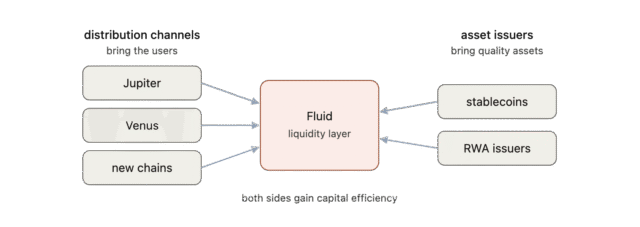
<p><span style="font-weight: 400;">Yet if one digs deeper, they will realize capital fragmentation still creates a huge structural inefficiency in DeFi today. The same dollar of collateral that backs a loan on Aave cannot also be an LP position on Uniswap. Aave, Compound, and Uniswap each wall their liquidity off from one another, so capital sits in one silo doing one job. Therefore, the world does not need another lending protocol, but we can all benefit from solving this structural inefficiency. </span></p>
<p><span style="font-weight: 400;">That’s why the world needs Fluid: it collapses those walls. The same collateral that secures a loan can finally also provide trading liquidity at the same time, and it shows up the cleanest measure of capital efficiency, revenue per dollar of TVL, where Fluid runs about 0.43% in 26Q1, the highest of any lending protocol. </span></p>
<p><span style="font-weight: 400;">But the number is not why we invested. What we care more is the team who can break the constraint while others just live with that. </span></p>
<p><b>Samyak Jain: The math geek who rebuilt everything from first principles </b></p>
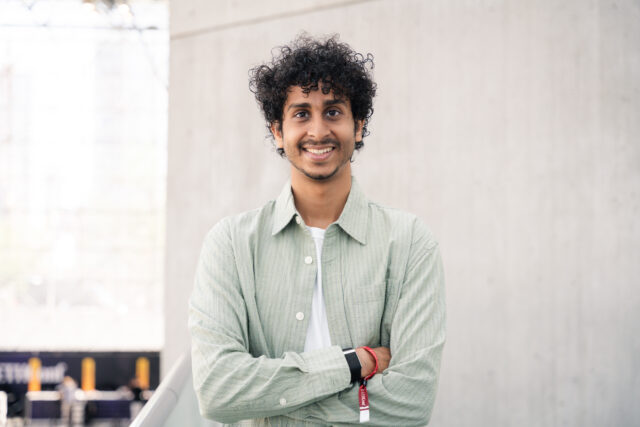
<p><span style="font-weight: 400;">Samyak and his older brother Sowmay grew up in Kota, India&#8217;s </span><span style="font-weight: 400;">academic-pressure capital</span><span style="font-weight: 400;">. Samyak watched The Social Network in ninth grade and decided he wanted to start a company. He was a math prodigy and a competitive chess player. Sowmay started trading Indian stocks in high school and wrote his own apps to track them, and Samyak joined in to write the code. That was their first project together, and it ran straight into the walls of traditional finance, where your age, a missing license, or a lack of capital can simply lock you out.</span></p>
<p><span style="font-weight: 400;">On his first day of college, Samyak told his parents he would drop out the moment he found an idea worth it. The idea showed up fast. In August 2018 the brothers entered the ETHIndia hackathon, built a tool on top of MakerDAO, and won. The takeaway stuck with him: two college students could write code that managed millions of dollars, and no one could stop them. They were crypto-native from the start, with a MetaMask wallet before a bank account. In 2019 Pantera and Naval backed them with $2.4M, Samyak dropped out, and they went all in on Instadapp. It became DeFi&#8217;s leading middleware and peaked at around $12B in TVL.</span></p>
<p><span style="font-weight: 400;">Then came the moment that decided everything. In 2022, when LUNA collapsed and stETH lost its peg, Instadapp&#8217;s Lite strategy came close to roughly $1B in liquidations, and the team scrambled through emergency loans to survive. Samyak&#8217;s own summary is that those three days taught him three years&#8217; worth of risk lessons. The most important one was simple and uncomfortable: middleware sits on top of other people&#8217;s protocols, and you cannot fix a broken foundation from the top. Most founders sitting on a $12B protocol would have kept shipping features. Samyak did the opposite. He stopped iterating on Instadapp and spent close to a year and a half rebuilding lending from the ground up, around one question: what would a bank look like if you built it from zero on-chain?</span></p>
<p><span style="font-weight: 400;">Early 2026 put both the founder and the architecture through two real tests. In March, an attacker exploited a partner protocol, Resolv, and pushed about $80M of unbacked tokens into Fluid. Two things saved it. Fluid&#8217;s automated risk limits capped how much damage that bad collateral could do before any human reacted. And within about half a day, the team had sized the loss, lined up interest-free emergency loans from partners like Cyberfund and Jupiter, and publicly guaranteed user funds, which stopped a panic before it could start.</span></p>
<p><span style="font-weight: 400;">The second test was system-wide. In April, a hack at Kelp set off a bank run across DeFi: everyone rushed to pull ETH out of lending markets at once, Aave&#8217;s ETH was fully borrowed out, and the cost of borrowing ETH spiked everywhere. Within hours, Fluid shipped a tool (its aWETH Redemption Protocol) that let lenders who were stuck in Aave get their ETH out, and in the process reduced Fluid&#8217;s own exposure at the same time. Fluid came out of the crisis looking like the lender of last resort.</span></p>
<p><span style="font-weight: 400;">Fluid could have simply waited for Resolv to resolve its own exploit. Instead the team acted first, taking measure after measure to make sure user assets were protected. That perseverance, and the instinct to put user funds ahead of everything else, is what impresses us most. This is the kind of founders we at AppWorks are proud to back: those that are willing to rebuild from zero. On top of that, across both crises, what stood out was the speed and capability with which the Fluid team handled them.</span></p>
<p><b>Beyond the design: how Fluid grows</b></p>
<p><span style="font-weight: 400;">We won&#8217;t rehearse the mechanics here. The design is genuinely clever, with three pieces doing the work (Smart Collateral, Smart Debt, and the liquidation engine), and Cyberfund has already written the clearest explanation of how they fit together in its two-part</span><a href="https://cyber.fund/content/fluid-1" target="_blank" rel="noopener"> <span style="font-weight: 400;">Demystifying Fluid</span></a><span style="font-weight: 400;"> series.</span></p>
<p><span style="font-weight: 400;">What we like just as much as the design is the go-to-market. Fluid runs its own protocol and is still building its own community, but its biggest growth lever is distribution: it takes the same engine and plugs it into channels that already have millions of users, instead of trying to win every user directly.</span></p>
<p><span style="font-weight: 400;">Jupiter is the clearest example. It is Solana&#8217;s largest trading aggregator, so Fluid provides the lending engine, Jupiter brings the users, and together they launched Jupiter Lend with the economics split roughly fifty-fifty. The deal closed fast because the founders already trusted each other. On BNB, Venus, the chain&#8217;s largest lending protocol, now runs on Fluid through Venus Flux. And institutional curators are starting to arrive: Bitwise runs an Ethena market on the Fluid-powered Jupiter Lend, the first institutional-grade curator on the system.</span></p>
<p><span style="font-weight: 400;">It is worth being precise about where the moat comes from. The obvious part is lock-in: once Fluid is the lending engine underneath a partner like Jupiter or Venus, ripping it out is so costly that almost nobody does, and Fluid gets there without paying for users through token emissions, the most expensive game in DeFi. But the deeper moat is less glamorous. Running a lending book well is genuinely hard operational work. Every collateral type needs its risk parameters set and watched, liquidations have to stay ahead of fast-moving markets, and the whole book needs constant risk management. Most teams do not want to touch any of that, which is exactly why being the team that does it well, on everyone else&#8217;s behalf, is so hard to dislodge. It also just makes economic sense: powering a partner earns Fluid far more than launching yet another vanilla lending protocol on its own would, so the partnership pays off for both sides.</span></p>
<p><span style="font-weight: 400;">That points to the bigger picture: Fluid is really a two-sided platform. On one side are the distribution channels we just described, the apps and chains that want a lending and trading engine without building one themselves. On the other side are the projects that need liquidity, like stablecoin and real-world-asset issuers, who can use Fluid&#8217;s pools to bootstrap a market far more cheaply than hiring a traditional market maker. When the reUSD stablecoin launched on Fluid, its TVL and trading volume jumped in a single day, and it has since spread across multiple chains. Fluid sits in the middle and makes both sides more capital-efficient than they could be on their own.</span></p>
<p><img loading="lazy" decoding="async" class="alignnone size-medium wp-image-16049" src="https://appworks.tw/wp-content/uploads/2026/08/Fluid-Why-We-Invest_Img0-640x227.png" alt="" width="640" height="227" srcset="https://appworks.tw/wp-content/uploads/2026/08/Fluid-Why-We-Invest_Img0-640x227.png 640w, https://appworks.tw/wp-content/uploads/2026/08/Fluid-Why-We-Invest_Img0-1280x453.png 1280w, https://appworks.tw/wp-content/uploads/2026/08/Fluid-Why-We-Invest_Img0-768x272.png 768w, https://appworks.tw/wp-content/uploads/2026/08/Fluid-Why-We-Invest_Img0-1200x425.png 1200w, https://appworks.tw/wp-content/uploads/2026/08/Fluid-Why-We-Invest_Img0.png 1514w" sizes="auto, (max-width: 640px) 100vw, 640px" /></p>
<p><span style="font-weight: 400;">The thing to understand is that these are not separate product lines. They are one architecture. Fluid is a single liquidity layer that any number of protocols can plug into, where the same capital is reused across spot, perps, FX, and credit. DEX, Perp, and FX are not different businesses, they are the same engine reaching into new asset classes, and each one adds revenue without needing fresh TVL. The north star is to rebuild banking from zero on-chain: to become the engine behind banks and neobanks, to bring real-world assets on-chain, and to make the kind of 95% LTV borrowing that today only billionaires with private bankers can get available to everyone.</span></p>
<p><b>—</b></p>
<p><span style="font-weight: 400;">We&#8217;re thrilled to back Samyak and the Fluid team as they rebuild banking from first principles on-chain, turning capital efficiency from a feature into the primitive the next financial system runs on.</span></p>
<p><span style="font-weight: 400;">And if you are a founder building on-chain banking from first principles, we would love to talk.</span></p>
<p>The post <a rel="nofollow" href="https://appworks.tw/why-we-invested-samyak-jain-founder-of-fluid/">Why We Invested: Samyak Jain, Founder of Fluid</a> appeared first on <a rel="nofollow" href="https://appworks.tw">AppWorks 之初加速器</a>.</p>
]]></content>
		
					<link rel="replies" type="text/html" href="https://appworks.tw/why-we-invested-samyak-jain-founder-of-fluid/?utm_source=rss&#038;utm_medium=rss&#038;utm_campaign=why-we-invested-samyak-jain-founder-of-fluid#comments" thr:count="0" />
			<link rel="replies" type="application/atom+xml" href="https://appworks.tw/why-we-invested-samyak-jain-founder-of-fluid/feed/atom/" thr:count="0" />
			<thr:total>0</thr:total>
			</entry>
		<entry>
		<author>
			<name>AppWorks</name>
					</author>

		<title type="html"><![CDATA[AppWorks Demo Day #32 × Wistron Demo Day #10：聚焦「製造業 AI」與「韓國新創出海」雙引擎，全面輻射泛亞洲市場版圖]]></title>
		<link rel="alternate" type="text/html" href="https://appworks.tw/appworks-demo-day-32-x-wistron-demo-day-10/?utm_source=rss&#038;utm_medium=rss&#038;utm_campaign=appworks-demo-day-32-x-wistron-demo-day-10" />

		<id>https://appworks.tw/?p=15969</id>
		<updated>2026-06-18T05:34:49Z</updated>
		<published>2026-06-18T05:22:40Z</published>
		<category scheme="https://appworks.tw" term="General" />
		<summary type="html"><![CDATA[<p>亞洲領先的創業加速器暨創投機構 AppWorks (之初加速器) 今天正式於 AppWorks Demo Day #32 揭曉最新一屆 AW#32 進駐新創陣容。本屆招募以精準的 Requests for Startups (RFS) 方式，鎖定製造業 AI (Manufacturing AI) 、國防科技 (Defense Tech) 以及鏈上金融 (On-Chain Banking) 三大垂直領域。AppWorks 堅持不收費、不抽股權的新創加速計畫，打造出亞洲最大創業生態系，目前已達 663 家活躍新創、2,189 位創業者，每年共同創造近 6,000 億台幣的年營收。 本屆團隊的組成與技術應用顯示出兩大亮點：第一，AI 應用已切入傳統難以標準化的工業與製造業前線，解決實體工廠面臨的嚴重缺工與效率瓶頸；第二，具備成熟營收實力的南韓優質新創，將台灣與亞洲視為跨國規模化的首選樞紐。 AppWorks 董事長暨合夥人林之晨表示：「AI 正在快速從『問答機』升級為『代理人』，帶動巨大的典範轉移。在 AW#32 中，我們看到創業者運用AI技術深入製造、國防等實體產業現場，將台灣國際級的硬體供應鏈，轉化為新創最豐饒的生長環境。與此同時，我們歡迎來自南韓成長期新創，利用AppWorks的平台輻射泛亞洲市場。除了既有的三大 RFS，正在接受申請的AW#33將增加後量子加密主題，歡迎相關新創加入，讓我與AppWorks幫助你加速發展。」 迎戰實體缺工痛點：台灣硬體供應鏈催生「製造業 AI」硬實力  搭上台灣無可比擬的精密硬體與製造業供應鏈優勢，AppWorks 正成為全球科技團隊協同 OEM 廠、企業夥伴進行實地概念驗證 (PoC) 的最佳戰略點 。 來自新加坡的 Innowave Tech，由擁有超過 25 年 GlobalFoundries [&#8230;]</p>
<p>The post <a rel="nofollow" href="https://appworks.tw/appworks-demo-day-32-x-wistron-demo-day-10/">AppWorks Demo Day #32 × Wistron Demo Day #10：聚焦「製造業 AI」與「韓國新創出海」雙引擎，全面輻射泛亞洲市場版圖</a> appeared first on <a rel="nofollow" href="https://appworks.tw">AppWorks 之初加速器</a>.</p>
]]></summary>

					<content type="html" xml:base="https://appworks.tw/appworks-demo-day-32-x-wistron-demo-day-10/?utm_source=rss&#038;utm_medium=rss&#038;utm_campaign=appworks-demo-day-32-x-wistron-demo-day-10"><![CDATA[<p><img loading="lazy" decoding="async" class="alignnone size-medium wp-image-15970" src="https://appworks.tw/wp-content/uploads/2026/06/DD32-640x427.jpg" alt="" width="640" height="427" srcset="https://appworks.tw/wp-content/uploads/2026/06/DD32-640x427.jpg 640w, https://appworks.tw/wp-content/uploads/2026/06/DD32-1280x853.jpg 1280w, https://appworks.tw/wp-content/uploads/2026/06/DD32-768x512.jpg 768w, https://appworks.tw/wp-content/uploads/2026/06/DD32-1536x1024.jpg 1536w, https://appworks.tw/wp-content/uploads/2026/06/DD32-1200x800.jpg 1200w, https://appworks.tw/wp-content/uploads/2026/06/DD32.jpg 1920w" sizes="auto, (max-width: 640px) 100vw, 640px" /></p>
<p><span style="font-weight: 400;">亞洲領先的創業加速器暨創投機構 AppWorks (之初加速器) 今天正式於 AppWorks Demo Day #32 揭曉最新一屆 AW#32 進駐新創陣容。本屆招募以精準的 Requests for Startups (RFS) 方式，鎖定製造業 AI (Manufacturing AI) 、國防科技 (Defense Tech) 以及鏈上金融 (On-Chain Banking) 三大垂直領域。AppWorks 堅持不收費、不抽股權的新創加速計畫，打造出亞洲最大創業生態系，目前已達 663 家活躍新創、2,189 位創業者，每年共同創造近 6,000 億台幣的年營收。</span></p>
<p><span style="font-weight: 400;">本屆團隊的組成與技術應用顯示出兩大亮點：第一，AI 應用已切入傳統難以標準化的工業與製造業前線，解決實體工廠面臨的嚴重缺工與效率瓶頸；第二，具備成熟營收實力的南韓優質新創，將台灣與亞洲視為跨國規模化的首選樞紐。</span></p>
<p><img loading="lazy" decoding="async" class="alignnone size-medium wp-image-15972" src="https://appworks.tw/wp-content/uploads/2026/06/Jamie-640x427.jpg" alt="" width="640" height="427" srcset="https://appworks.tw/wp-content/uploads/2026/06/Jamie-640x427.jpg 640w, https://appworks.tw/wp-content/uploads/2026/06/Jamie-1280x853.jpg 1280w, https://appworks.tw/wp-content/uploads/2026/06/Jamie-768x512.jpg 768w, https://appworks.tw/wp-content/uploads/2026/06/Jamie-1536x1024.jpg 1536w, https://appworks.tw/wp-content/uploads/2026/06/Jamie-1200x800.jpg 1200w, https://appworks.tw/wp-content/uploads/2026/06/Jamie.jpg 1920w" sizes="auto, (max-width: 640px) 100vw, 640px" /></p>
<p><span style="font-weight: 400;">AppWorks 董事長暨合夥人林之晨表示：「AI 正在快速從『問答機』升級為『代理人』，帶動巨大的典範轉移。在 AW#32 中，我們看到創業者運用AI技術深入製造、國防等實體產業現場，將台灣國際級的硬體供應鏈，轉化為新創最豐饒的生長環境。與此同時，我們歡迎來自南韓成長期新創，利用AppWorks的平台輻射泛亞洲市場。除了既有的三大 RFS，正在接受申請的AW#33將增加後量子加密主題，歡迎相關新創加入，讓我與AppWorks幫助你加速發展。」</span></p>
<h4><b>迎戰實體缺工痛點：台灣硬體供應鏈催生「製造業 AI」硬實力 </b></h4>
<p><span style="font-weight: 400;">搭上台灣無可比擬的精密硬體與製造業供應鏈優勢，AppWorks 正成為全球科技團隊協同 OEM 廠、企業夥伴進行實地概念驗證 (PoC) 的最佳戰略點 。</span></p>
<p><span style="font-weight: 400;">來自新加坡的 </span><b>Innowave Tech</b><span style="font-weight: 400;">，由擁有超過 25 年 GlobalFoundries 半導體晶圓廠全球營運經驗的創辦人 Jinsong 領軍，針對傳產與科技廠高度仰賴人工經驗、調整緩慢且難以標準化的工業檢測痛點 ，打造出基於自有工業大模型的「自主生產決策平台」，能實現毫秒級的自動化生產決策。目前該系統已在全球多家半導體晶圓廠落地部署，成功大幅降低一線人力需求，並將廠房的整體設備效率 (OEE) 明顯提升。目前該系統已在全球多家半導體晶圓廠落地部署，成功降低一線人力需求，並將廠房的整體設備效率 (OEE) 大幅提升 10% 以上 。</span></p>
<p><span style="font-weight: 400;">專攻 3D 空間感知與邊緣 AI 系統的 </span><b>LIPS</b><span style="font-weight: 400;">，憑藉深厚的底層技術，已成功獨家供應德國 BMW 工廠自主移動機器人(AMR)的 3D 視覺導航大腦。此外，LIPS 更為新北市打造了全台最大規模的 7&#215;24 智慧交通數位孿生監控系統，實績橫跨智慧製造與城市基礎設施，展現極高技術壁壘與跨國大廠的商業落地實力。</span></p>
<p><b>SixSense</b><span style="font-weight: 400;"> 則是專為半導體與電子製造業打造的 AI 平台，能精準辨識產品缺陷並預測設備維護需求。透過先進的電腦視覺模型，全自動檢測並精準分類晶圓上的微觀缺陷，有效取代了耗時的工程師人工複查流程，顯著加速產線週期，並為全球半導體晶圓廠預防因良率損失造成的巨大經濟折耗。</span></p>
<h4><b>打破跨境文化與數據壁壘：韓國優質新創強勢登陸台灣 </b></h4>
<p><span style="font-weight: 400;">本屆 Demo Day 的另一大核心亮點，在於成熟營收能力的韓國新創，開始選擇台灣作為跨國擴張的樞紐。</span></p>
<p><b>NOTAG KOREA</b><span style="font-weight: 400;"> 由深耕跨境貿易運營逾十年的創辦人 Aiden 創立 。由於跨國電商平台碎片化、物流體系繁雜且跨境數據格式極不標準，自動化營運難度極高，所以目前成功進軍東南亞與台灣的韓國時尚與美妝品牌不到 0.3%。NOTAG KOREA 獨創 AI 自主運營引擎，一鍵打通多國銷售通路與物流鏈 ，目前已成功將 Emis、HDEX、Covernat 等 204 個韓國知名品牌引進海外 105 個銷售通路，創造高達 400 萬美元的跨境年營收 。</span></p>
<p><span style="font-weight: 400;">韓國的 Deep Tech 代表 </span><b>Clika，</b><span style="font-weight: 400;">推出邊緣運算 (Edge AI) 的自動化模型壓縮平台。針對企業在工廠與裝置端部署 AI 時，面臨晶片太貴、太耗能的痛點，Clika 的核心技術能在不犧牲精準度的前提下，大幅壓縮 AI 模型體積，使其能流暢運行於低算力的微型晶片中，直接降低企業導入 AI 的硬體門檻與成本。</span></p>
<p><b>Notifly</b><span style="font-weight: 400;"> 創辦團隊來自 Airbnb、Coupang、Toss 與 Naver 等大廠，深諳亞洲通訊服務底層架構 。他們打造出 Kakao 原生且完美適配 Line 生態的 AI 企業訊息自動化平台，已協助包含 CJ Logistics在內的 143 家大型企業客戶自動化經營用戶旅程，月處理訊息量破億，在年化營收(ARR)突破百萬美元大關的同時，寫下 96% 的客戶留存率 。</span></p>
<p><b>Krush</b><span style="font-weight: 400;"> 是專為全球泛亞洲族群打造的跨國社交網路與實體社交俱樂部。團隊打破傳統交友軟體的單向框架，透過 AI 人臉防偽驗證與實體活動媒合，寫下 57% 的次週留存率，預估年化營收將達 200 萬美元。</span></p>
<h4><b>深科技與企業級軟體遍地開花：重塑各產業營運規則 </b></h4>
<p><span style="font-weight: 400;">除了上述兩大焦點外，本屆發表的團隊亦在諸多高度監管與專業技術場景中展現強大實力。</span></p>
<ul>
<li style="font-weight: 400;" aria-level="1"><span style="font-weight: 400;">在國防科技與海洋數據領域，</span><b>Hyarks</b><span style="font-weight: 400;"> 部署創新的無人海洋載具船隊，結合無人船搭載無人機，建立首個全球海洋數據市場，不僅能協助大型捕魚船隊一年省下高達 19 億美元的盲目搜尋油耗，更同步瞄準國防無人載具戰略商機。</span></li>
<li style="font-weight: 400;" aria-level="1"><span style="font-weight: 400;">針對高度傳統的營建與建築供應鏈，</span><b>Rosary Labs </b><span style="font-weight: 400;">開發出專為建築、工程與營造(AEC)產業設計的 AI 協作平台，將過去耗時數天的施工圖紙轉換與工程量估算，縮短至數小時內完成，並可一鍵確認是否符合最新的法規監管。已與馬來西亞公共工程部等指標性跨國公私機構展開合作 。</span></li>
<li style="font-weight: 400;" aria-level="1"><span style="font-weight: 400;">在底層基礎設施與軟體方面，</span><b>Pathors </b><span style="font-weight: 400;">主打低於 1 秒極致低延遲的企業級語音 AI 引擎，全面優化系統整合夥伴(SI)與傳統產業的來電服務體驗與營運效率。</span></li>
<li style="font-weight: 400;" aria-level="1"><span style="font-weight: 400;">專攻保險科技的 </span><b>Novo AI</b><span style="font-weight: 400;">，則利用異常偵測模型，系統化地替保險公司揪出繁雜紙本理賠中的隱性漏洞與醫療濫用，已成功協助 QBE、April 等國際一線保險巨頭，挽回 7–15% 因理賠漏洞造成的利潤流失。</span></li>
<li style="font-weight: 400;" aria-level="1"><b>OmniEase AI </b>打造全球貿易合規與通關自動化的 AI 引擎。<span style="font-weight: 400;"> 他們將傳統需耗時 5 到 7 小時的跨國關稅研究，顛覆性地縮短至 30 秒產出。目前平台已深受 </span><b>Levi&#8217;s</b><span style="font-weight: 400;"> 等全球指標大廠信賴，每月處理逾 2 萬個 SKU 的複雜分類，大幅降低品牌廠與出口商的跨境法規門檻。</span></li>
<li style="font-weight: 400;" aria-level="1"><span style="font-weight: 400;">在 AI 代理人與生成式搜尋 (AEO) 普及的時代，</span><b>Arrivl </b><span style="font-weight: 400;">打造了「AI 流量行銷引擎」。現今網路已有過半流量來自 AI 機器人，Arrivl 則能精準捕捉這些 AI 代理人足跡，幫助企業看見這群隱形訪客，進而優化品牌的 AI 推薦排名與轉換率。</span></li>
<li style="font-weight: 400;" aria-level="1"><b>Shieldbase </b><span style="font-weight: 400;">則專注於建構安全的企業級 AI 作業系統。 他們將企業的知識與系統深度整合，驅動 AI 代理人運作。具備高規格的資料隱私防護，Shieldbase 剛推出便成功攜手軟銀等指標性金融與電信，迅速開拓跨市場的企業客戶。</span></li>
<li style="font-weight: 400;" aria-level="1"><b>Decisions Lab </b><span style="font-weight: 400;">則推出「AI 買家行為模擬引擎」， 利用 AI 技術模擬目標受眾輪廓，取代傳統動輒數月的真人焦點小組訪談，協助品牌廠全面翻轉產品上市(GTM)的驗證流程，省下高達 6 到 12 個月的時間與預算。</span></li>
</ul>
<p><img loading="lazy" decoding="async" class="alignnone size-medium wp-image-15973" src="https://appworks.tw/wp-content/uploads/2026/06/Simon-640x427.jpg" alt="" width="640" height="427" srcset="https://appworks.tw/wp-content/uploads/2026/06/Simon-640x427.jpg 640w, https://appworks.tw/wp-content/uploads/2026/06/Simon-1280x853.jpg 1280w, https://appworks.tw/wp-content/uploads/2026/06/Simon-768x512.jpg 768w, https://appworks.tw/wp-content/uploads/2026/06/Simon-1536x1024.jpg 1536w, https://appworks.tw/wp-content/uploads/2026/06/Simon-1200x800.jpg 1200w, https://appworks.tw/wp-content/uploads/2026/06/Simon.jpg 1920w" sizes="auto, (max-width: 640px) 100vw, 640px" /></p>
<h4><b>緯創加速器邁入第10屆：大廠新創聯手，AI 硬科技深入半導體與太空供應鏈</b></h4>
<p><span style="font-weight: 400;">本屆邁入第 10 屆的緯創加速器(Wistron Accelerator)展示了Deep Tech與實體 AI加速重組全球供應鏈的趨勢。透過緯創傲視全球的製造實力、全球工廠資源與國際供應鏈網絡，大廠與新創聯手，將最前沿的技術帶入實地的概念驗證(PoC)與工業場景。</span></p>
<p><span style="font-weight: 400;">緯創資通董事長 林憲銘 (Simon Lin) 表示： 「在AI 時代下的緯創， 不只是基礎建設Token provider，我們更期待和新創夥伴一同探索終端應用的各種可能，創造新的產業與價值。」</span></p>
<p><span style="font-weight: 400;">本屆登台的 4 家焦點團隊正是這股趨勢的縮影：Ruomei(台灣若美科技)與 Phasetrum(星相科技)分別專攻高階晶片先進散熱材料與衛星相控陣列通訊，打入關鍵的半導體與太空供應鏈底層；而 GreenBidz 的 AI 二手工業設備競標平台與 CloudStation 的自主 AI 代理工作流，則大幅提升了跨境工廠資產流動與企業商務交付效率。透過與緯創的深度聯手，這群新創正加速推動全球工業智慧化。</span></p>
<ul>
<li style="font-weight: 400;" aria-level="1"><b>GreenBidz：</b><span style="font-weight: 400;"> 打造 AI 驅動的二手製造設備競標平台，處理大型工業設備的跨境轉移與再利用。目前已累積超過 100 家企業客戶，包含台達電、保瑞藥業、全家與西門子等，過去 12 個月平台 GMV 超過一千萬美元，更透明地推進二手機械流向新興生產基地。</span></li>
<li style="font-weight: 400;" aria-level="1"><b>Ruomei (台灣若美科技)</b><span style="font-weight: 400;">：專注於半導體精密熱管理技術 (Thermal Management)。團隊針對 HPC 與 AI 晶片的高發熱難題，推出獨創的共振散熱材料與電路板解決方案，從材料源頭破解高階晶片的散熱瓶頸。</span></li>
<li style="font-weight: 400;" aria-level="1"><b>Phasetrum (星相科技): </b><span style="font-weight: 400;">推出高整合度的「三合一相控陣列相位調整器」，支援雙波束直連並大幅減少衛星設備的晶片使用量。團隊憑藉高精度的控制與射頻封裝技術，大幅降低低軌衛星與太空通訊的硬體成本與體積。</span></li>
<li style="font-weight: 400;" aria-level="1"><b>CloudStation：</b><span style="font-weight: 400;"> 為開發者提供私有且隔離的沙盒環境，建構「Charlie AI」自動化工作流編排平台。其自主 AI 代理能自動處理程式編碼、數據分析與跨系統營運，在幾分鐘內自主執行並完成複雜的商業任務。</span></li>
</ul>
<h4><b>AppWorks Demo Day #32 登場團隊列表 (按字母排序)</b></h4>
<ul>
<li style="font-weight: 400;" aria-level="1"><b><a href="https://arrivl.ai/" target="_blank" rel="noopener">Arrivl</a> (TW):</b><span style="font-weight: 400;"> 優化生成式搜尋(AEO)時代網站 AI 代理行為與電商底層的轉換追蹤器。</span></li>
<li style="font-weight: 400;" aria-level="1"><b><a href="https://www.clika.io/" target="_blank" rel="noopener">Clika</a> (KR):</b><span style="font-weight: 400;"> 專為微型晶片與邊緣設備打造的自動化 AI 模型壓縮與輕量化優化平台。</span></li>
<li style="font-weight: 400;" aria-level="1"><b><a href="https://www.decisionslab.io/" target="_blank" rel="noopener">Decisions Lab</a> (HK):</b><span style="font-weight: 400;"> 透過 AI 買家研究模擬、縮短 6-12 個月產品上市週期的驗證引擎。</span></li>
<li style="font-weight: 400;" aria-level="1"><b><a href="https://www.hyarks.com/" target="_blank" rel="noopener">Hyarks</a> (ES/TW):</b><span style="font-weight: 400;"> 結合無人船與無人機、瞄準遠洋與國防商機的全球海洋數據市場。</span></li>
<li style="font-weight: 400;" aria-level="1"><b><a href="https://www.innowave.com.sg/" target="_blank" rel="noopener">Innowave Tech</a> (SG):</b><span style="font-weight: 400;"> 基於自有工業大模型的毫秒級自主生產決策平台。</span></li>
<li style="font-weight: 400;" aria-level="1"><b><a href="https://www.krushdating.co/" target="_blank" rel="noopener">Krush</a> (KR):</b><span style="font-weight: 400;"> 專為全球泛亞洲族群打造、結合 AI 防偽與實體媒合的跨境社交俱樂部。</span></li>
<li style="font-weight: 400;" aria-level="1"><b><a href="https://www.lips-hci.com/" target="_blank" rel="noopener">LIPS</a> (TW):</b><span style="font-weight: 400;"> 專為智慧工廠與智慧城市設計的高精度 3D 空間運算基礎設施。</span></li>
<li style="font-weight: 400;" aria-level="1"><b><a href="https://www.notaggroup.com/" target="_blank" rel="noopener">NOTAG KOREA</a> (KR):</b><span style="font-weight: 400;"> 一鍵整合多國通路與物流的韓國品牌 AI 跨境自主運營引擎。</span></li>
<li style="font-weight: 400;" aria-level="1"><b><a href="https://clix.so/" target="_blank" rel="noopener">Notify</a> (KR):</b><span style="font-weight: 400;"> 適配 LINE 與 Kakao 生態、月處理量破億的 AI 企業訊息自動化平台。</span></li>
<li style="font-weight: 400;" aria-level="1"><b><a href="https://heynovo.ai/" target="_blank" rel="noopener">Novo AI</a> (SG):</b><span style="font-weight: 400;"> 前 Google 團隊打造、替國際保險巨頭揪出紙本理賠漏洞的異常辨識模型。</span></li>
<li style="font-weight: 400;" aria-level="1"><b><a href="https://www.omniease.ai/" target="_blank" rel="noopener">OmniEase AI</a> (ID):</b><span style="font-weight: 400;"> 自動對接複雜關稅與合規申報的出口商 AI 虛擬報關行服務。</span></li>
<li style="font-weight: 400;" aria-level="1"><b><a href="https://pathors.com/" target="_blank" rel="noopener">Pathors</a> (TW):</b><span style="font-weight: 400;"> 提供低於 1 秒極致低延遲的企業級語音 AI 基礎設施引擎。</span></li>
<li style="font-weight: 400;" aria-level="1"><b><a href="https://www.rosarylabs.ai/" target="_blank" rel="noopener">Rosary Labs</a> (MY):</b><span style="font-weight: 400;"> 自動化 AEC 圖紙轉換與工程量估算、具一鍵法規監管確認的 AI 協作平台。</span></li>
<li style="font-weight: 400;" aria-level="1"><b><a href="https://shieldbase.ai/" target="_blank" rel="noopener">Shieldbase</a> (SG):</b><span style="font-weight: 400;"> 專注於企業級全方位資料隱私防護與跨國合規的基礎設施。</span></li>
<li style="font-weight: 400;" aria-level="1"><b><a href="https://www.sixsense.ai/" target="_blank" rel="noopener">SixSense</a> (SG):</b><span style="font-weight: 400;"> 專為半導體產業打造的 AI 自動缺陷分類與預測性維護平台，優化晶圓良率並減少人工複查。</span></li>
</ul>
<h4><b>Wistron Demo Day #10 登場團隊列表 (按字母排序)</b></h4>
<ul>
<li style="font-weight: 400;" aria-level="1"><b><a href="https://cloud-station.io/" target="_blank" rel="noopener">CloudStation</a> (TW):</b><span style="font-weight: 400;"> 提供隔離沙盒環境、以「Charlie AI」代理接管自動化工作流的編排平台。</span></li>
<li style="font-weight: 400;" aria-level="1"><b><a href="https://greenbidz.com/" target="_blank" rel="noopener">GreenBidz</a> (TW):</b><span style="font-weight: 400;"> 已累積百家企業客戶、GMV 破千萬美元的 AI 二手製造設備競標平台。</span></li>
<li style="font-weight: 400;" aria-level="1"><b><a href="https://phasetrum.com/" target="_blank" rel="noopener">Phasetrum</a> (TW):</b><span style="font-weight: 400;"> 研發高整合度三合一相控陣列相位調整器、賦能衛星通訊的太空供應鏈先鋒。</span></li>
<li style="font-weight: 400;" aria-level="1"><b><a href="https://ruomei.com.tw/" target="_blank" rel="noopener">Ruomei</a> (TW):</b><span style="font-weight: 400;"> 提供晶片共振原理散熱材料、破解 HPC 與 AI 晶片極限散熱痛點的熱管理專家。</span></li>
</ul>
<h3><b>關於 AppWorks (之初加速器)</b></h3>
<p><span style="font-weight: 400;">AppWorks 於 2009 年創立，是亞洲指標性的創業加速器暨創投機構。我們致力於協助軟體、硬體與 Web3 創業者規模化他們的新創。AppWorks 目前經營著亞洲最具規模的創業生態系，連結了 663 家活躍新創、2,189 位創業者。這群創業者們共同組成了一個深具互惠傳承文化的強大社群，攜手拓展台灣與亞洲市場，每年共同創造高達 186 億美元的營收，並在整個區域加速數位經濟與深科技的全面落地。</span></p>
<p>&nbsp;</p>
<p><img loading="lazy" decoding="async" class="alignnone size-full wp-image-15974" src="https://appworks.tw/wp-content/uploads/2026/06/AppWorks-Ecosystem-G.png" alt="" width="512" height="474" /></p>
<p>The post <a rel="nofollow" href="https://appworks.tw/appworks-demo-day-32-x-wistron-demo-day-10/">AppWorks Demo Day #32 × Wistron Demo Day #10：聚焦「製造業 AI」與「韓國新創出海」雙引擎，全面輻射泛亞洲市場版圖</a> appeared first on <a rel="nofollow" href="https://appworks.tw">AppWorks 之初加速器</a>.</p>
]]></content>
		
					<link rel="replies" type="text/html" href="https://appworks.tw/appworks-demo-day-32-x-wistron-demo-day-10/?utm_source=rss&#038;utm_medium=rss&#038;utm_campaign=appworks-demo-day-32-x-wistron-demo-day-10#comments" thr:count="0" />
			<link rel="replies" type="application/atom+xml" href="https://appworks.tw/appworks-demo-day-32-x-wistron-demo-day-10/feed/atom/" thr:count="0" />
			<thr:total>0</thr:total>
			</entry>
		<entry>
		<author>
			<name>AppWorks</name>
					</author>

		<title type="html"><![CDATA[AppWorks Demo Day #32 Showcases Frontier Manufacturing AI and South Korean Startups Expanding Across Asia]]></title>
		<link rel="alternate" type="text/html" href="https://appworks.tw/appworks-demo-day-32-showcases-frontier-manufacturing-ai-and-south-korean-startups-expanding-across-asia/?utm_source=rss&#038;utm_medium=rss&#038;utm_campaign=appworks-demo-day-32-showcases-frontier-manufacturing-ai-and-south-korean-startups-expanding-across-asia" />

		<id>https://appworks.tw/?p=15961</id>
		<updated>2026-06-10T13:10:44Z</updated>
		<published>2026-06-10T13:10:14Z</published>
		<category scheme="https://appworks.tw" term="General" />
		<summary type="html"><![CDATA[<p>SINGAPORE, 9 June 2026 — AppWorks Accelerator has officially introduced its latest batch, AW#32, a cohort that has marked the leading startup incubation program’s deliberate shift toward deep tech through its specialized Requests for Startups (RFS) recruiting process – Manufacturing AI, Defense Tech, and On-Chain Banking specifically for this batch. Operating an equity-and-fee-free program, AppWorks continues [&#8230;]</p>
<p>The post <a rel="nofollow" href="https://appworks.tw/appworks-demo-day-32-showcases-frontier-manufacturing-ai-and-south-korean-startups-expanding-across-asia/">AppWorks Demo Day #32 Showcases Frontier Manufacturing AI and South Korean Startups Expanding Across Asia</a> appeared first on <a rel="nofollow" href="https://appworks.tw">AppWorks 之初加速器</a>.</p>
]]></summary>

					<content type="html" xml:base="https://appworks.tw/appworks-demo-day-32-showcases-frontier-manufacturing-ai-and-south-korean-startups-expanding-across-asia/?utm_source=rss&#038;utm_medium=rss&#038;utm_campaign=appworks-demo-day-32-showcases-frontier-manufacturing-ai-and-south-korean-startups-expanding-across-asia"><![CDATA[<p><img loading="lazy" decoding="async" class="alignnone size-medium wp-image-15962" src="https://appworks.tw/wp-content/uploads/2026/06/A-19-640x427.jpg" alt="" width="640" height="427" srcset="https://appworks.tw/wp-content/uploads/2026/06/A-19-640x427.jpg 640w, https://appworks.tw/wp-content/uploads/2026/06/A-19-1280x853.jpg 1280w, https://appworks.tw/wp-content/uploads/2026/06/A-19-768x512.jpg 768w, https://appworks.tw/wp-content/uploads/2026/06/A-19-1536x1024.jpg 1536w, https://appworks.tw/wp-content/uploads/2026/06/A-19-2048x1365.jpg 2048w, https://appworks.tw/wp-content/uploads/2026/06/A-19-1200x800.jpg 1200w" sizes="auto, (max-width: 640px) 100vw, 640px" /></p>
<p><b>SINGAPORE, 9 June 2026</b><span style="font-weight: 400;"> — AppWorks Accelerator has officially introduced its latest batch, AW#32, a cohort that has marked the leading startup incubation program’s deliberate shift toward deep tech through its specialized Requests for Startups (RFS) recruiting process – Manufacturing AI, Defense Tech, and On-Chain Banking specifically for this batch. Operating an equity-and-fee-free program, AppWorks continues to grow Asia’s largest startup network, which now encompasses 663 active companies and over 2,189 founders collectively generating USD 18.6 billion in annual revenues.</span></p>
<p><span style="font-weight: 400;">This cohort reflects a powerful evolution within the regional tech landscape: the convergence of critical hardware infrastructure with advanced software, alongside a highly mature wave of South Korean startups utilizing regional networks to execute cross-border expansion strategies..</span></p>
<p><img loading="lazy" decoding="async" class="alignnone size-medium wp-image-15963" src="https://appworks.tw/wp-content/uploads/2026/06/A-2-640x427.jpg" alt="" width="640" height="427" srcset="https://appworks.tw/wp-content/uploads/2026/06/A-2-640x427.jpg 640w, https://appworks.tw/wp-content/uploads/2026/06/A-2-1280x853.jpg 1280w, https://appworks.tw/wp-content/uploads/2026/06/A-2-768x512.jpg 768w, https://appworks.tw/wp-content/uploads/2026/06/A-2-1536x1024.jpg 1536w, https://appworks.tw/wp-content/uploads/2026/06/A-2-2048x1365.jpg 2048w, https://appworks.tw/wp-content/uploads/2026/06/A-2-1200x800.jpg 1200w" sizes="auto, (max-width: 640px) 100vw, 640px" /></p>
<p><span style="font-weight: 400;">As a long-term investor and strategic partner of AppWorks funds, </span><b>K.S. Pua, Founder, Chairman, and CEO of Phison,</b><span style="font-weight: 400;"> joined the event to mentor and exchange insights with the next generation of founders. </span></p>
<p><span style="font-weight: 400;">Reflecting on his own journey, he shared: </span><i><span style="font-weight: 400;">&#8220;As an engineer by training, I co-founded Phison with just a $1M seed fund &#8211; nothing more. We bootstrapped our way to profitability within our first year, turning Phison into the publicly traded memory solutions powerhouse it is today. As a founder, your survival depends on agility. In this AI era, Phison has pivoted to deliver energy-efficient, high-performance, and secure computing storage solutions, capturing strong market demand. For today’s founders, this is a golden age for AI entrepreneurship, but this window of opportunity will only last for the next 3 to 5 years &#8211; act now before it&#8217;s too late.” </span></i></p>
<p><span style="font-weight: 400;">To further accelerate this momentum, Phison is currently planning to launch a Corporate Venture Capital (CVC) arm to back startups and drive future growth.</span></p>
<p><b>Revolutionizing the Factory Floor: The Rise of Manufacturing AI</b><span style="font-weight: 400;"> </span></p>
<p><span style="font-weight: 400;">By tying into Taiwan’s global hardware manufacturing and supply chain ecosystem, AppWorks has positioned itself as the premier launchpad for builders deploying production-ready AI within complex industrial environments.</span></p>
<p><span style="font-weight: 400;">Leading this charge is </span><b>Innowave Tech</b><span style="font-weight: 400;">, an enterprise autonomous factory platform spearheaded by founder </span><b>Jinsong</b><span style="font-weight: 400;">, who brings over 25 years of semiconductor fab leadership experience from GlobalFoundries. Innowave Tech addresses critical industrial labor shortages and operational bottlenecks by replacing slow human defect inspection with a proprietary foundation model capable of millisecond-level, closed-loop autonomous decision-making. Deployed globally across semiconductor fabs, the system has successfully automated defect processes while driving measurable enhancements of over 10% in Overall Equipment Effectiveness (OEE).</span></p>
<p><span style="font-weight: 400;">Complementing this industrial revolution is </span><b>LIPS</b><span style="font-weight: 400;">, which delivers a comprehensive &#8220;Digital Eye&#8221; spatial compute infrastructure tailored for smart factories and smart cities, deploying high-precision 3D vision systems that have already secured tier-one validation from global automotive manufacturing giants such as BMW.</span></p>
<p><b>The New Cross-Border Pipeline: South Korean Startups Scaling Internationally</b><span style="font-weight: 400;"> </span></p>
<p><span style="font-weight: 400;">A standout paradigm shift in Batch #32 is the high concentration of mature South Korean ventures scaling across Greater Southeast Asia and Taiwan. </span></p>
<p><span style="font-weight: 400;">Leading this narrative is </span><b>NOTAG KOREA</b><span style="font-weight: 400;">, a commerce and logistics automation AI engine founded by Aiden, an entrepreneur with over a decade of experience in e-commerce-based trade and distribution. The platform automates logistics and distribution, overcoming the high entry barriers that prevent 99.7% of Korean brands from expanding into SEA. Through real-time data analysis and sales forecasting, their engine cuts inventory costs and expansion friction. To date, NOTAG KOREA scales 204 brands across 105 hubs, capturing USD 4 million in cumulative revenue.</span></p>
<p><b>Refundy</b><span style="font-weight: 400;"> introduces an automated refund optimization system for global B2B marketplaces when platform prices fluctuate, empowering merchants across 55 countries to recapture margins while driving strong, profitable monthly recurring revenue (MRR) of nearly USD 150,000. </span></p>
<p><span style="font-weight: 400;">Meanwhile, </span><b>Krush </b><span style="font-weight: 400;">breaks the mold of standard matchmaking apps by engineering a transnational social network and &#8220;social club&#8221; for global Asians, capitalizing on cross-border interaction to achieve a 57% Day-7 retention rate — proving that people are looking for more than matches; they are looking for a sense of belonging.</span></p>
<p><b>Driving Global Innovation Across Deep Tech, Web3, and Enterprise Software</b><span style="font-weight: 400;"> </span></p>
<p><span style="font-weight: 400;">The remaining cohorts of the Singapore showcase highlight highly specialized applications tackling complex multi-market operational workflows.</span></p>
<p><span style="font-weight: 400;">In the deep tech and dual-use space, unmanned vehicle architect</span><b> Juan Herrero</b><span style="font-weight: 400;"> founded </span><b>Hyarks</b><span style="font-weight: 400;"> to deploy autonomous fleets of marine vessels that source real-time oceanic data. This marketplace solution eliminates the USD 1.9 billion in searching waste endured by commercial fishing fleets while simultaneously tapping into a USD 500 million defense opportunity in APAC.</span></p>
<p><span style="font-weight: 400;">On the financial security front, </span><b>Novo AI </b><span style="font-weight: 400;">enables health insurers to detect fraud, abuse and hidden claims leakage within complex, unstructured medical and billing documents. Founded by former Google leaders, the company works with enterprise insurers like Tokio Marine and April Group to improve loss ratios, automate workflows and drive smarter decisions across 4 continents.</span></p>
<p><span style="font-weight: 400;">Infrastructure capabilities are further advanced by </span><b>Pathors</b><span style="font-weight: 400;">, which supplies a hyper-low-latency enterprise Voice AI engine delivering response times under one second to optimize call-center efficiencies.</span></p>
<p><span style="font-weight: 400;">Catering to the building sector, </span><b>Rosary Labs </b><span style="font-weight: 400;">deploys AI agents for Architecture, Engineering, and Construction (AEC) industry, converting drawings from PDF to CAD to BIM, and automating BIM review and bill of quantity generation, reducing costly human error, ensuring compliance for public sectors and increasing tender success rate for top developers.</span></p>
<p><span style="font-weight: 400;">In market research, </span><b>Decisions Lab</b><span style="font-weight: 400;"> shortens standard corporate go-to-market lifecycles through an AI buyer simulation engine that role-plays target consumer personas with high accuracy.</span></p>
<p><span style="font-weight: 400;">Last but not least,  </span><b>Shieldbase, </b><span style="font-weight: 400;">founded by Diego Rojas, it&#8217;s an AI operating system for the enterprise with strong focus on governance and security</span></p>
<p><span style="font-weight: 400;">The presentation of these 11 standout teams at Demo Day #32 marks just the beginning of their cross-border growth journeys. By equipping this batch with rigorous pitch reframing, tailored corporate matchmaking, and localized landing infrastructure, AppWorks continues to solidify its role as the ultimate launchpad for deep technical moats and cross-border expansion in Greater Southeast Asia.</span></p>
<p><b>Alyssa Chen, Principal at AppWorks, noted: </b><i><span style="font-weight: 400;">&#8220;AI is transitioning from a digital efficiency tool into a core operational necessity for frontline industries. In our AW#32 batch, founders are moving far beyond pure-software applications to embed AI directly into manufacturing and defense, sectors hardest hit by labor deficits. This industrial push inherently anchors their technology in Taiwan’s global hardware infrastructure, creating an unassailable tech moat that is now drawing mature Korean startups to actively scale into our GSEA platform. At AppWorks, we are actively enabling this next generation of pan-Asian winners to orchestrate cross-border resources and execute deep, real-world localization.&#8221;</span></i></p>
<h3><b>About AppWorks</b></h3>
<p><span style="font-weight: 400;">Founded in 2009, AppWorks is one of Asia’s leading startup accelerators and venture capital firms, supporting over 663 active startups and 2,189 founders. Its equity-and-fee-free accelerator program nurtures founders at every stage, backed by strong regional networks and deep alumni engagement. By focusing on frontier AI and specialized Requests for Startups (RFS) verticals, AppWorks positions itself at the forefront of the region’s digital transformation, providing founders with institutional capital, mentorship, and a vibrant community. For more information, visit appworks.tw.</span></p>
<h3><b>AppWorks Demo Day #32 Singapore Pitching Teams</b></h3>
<ul>
<li style="font-weight: 400;" aria-level="1"><a href="https://www.innowave.com.sg/" target="_blank" rel="noopener"><b>Innowave Tech</b></a><b> (SG):</b><span style="font-weight: 400;"> An enterprise autonomous factory platform powered by a proprietary industrial foundation model enabling millisecond-level, closed-loop defect detection and operational decisions.</span></li>
<li style="font-weight: 400;" aria-level="1"><a href="https://www.notaggroup.com/" target="_blank" rel="noopener"><b>NOTAG KOREA</b></a><b> (KR):</b><span style="font-weight: 400;"> An AI-driven cross-border operations engine that unifies multi-country e-commerce channels and logistics for globalizing Korean fashion and beauty brands.</span></li>
<li style="font-weight: 400;" aria-level="1"><a href="https://www.refundy.co/en" target="_blank" rel="noopener"><b>Refundy</b></a><b> (KR):</b><span style="font-weight: 400;"> An automated B2B marketplace refund optimization platform that helps international merchants automatically recapture lost margins from platform price fluctuations.</span></li>
<li style="font-weight: 400;" aria-level="1"><a href="https://www.krushdating.co/" target="_blank" rel="noopener"><b>Krush</b></a><b> (KR):</b><span style="font-weight: 400;"> A transnational social network and physical social club engineered for global Asians utilizing AI anti-fraud verification and high-intent community matching.</span></li>
<li style="font-weight: 400;" aria-level="1"><a href="https://www.lips-hci.com/" target="_blank" rel="noopener"><b>LIPS</b></a><b> (TW):</b><span style="font-weight: 400;"> High-precision 3D vision systems and spatial compute infrastructure designed for industrial automation, smart factories, and automotive manufacturing.</span></li>
<li style="font-weight: 400;" aria-level="1"><a href="https://www.hyarks.com/" target="_blank" rel="noopener"><b>Hyarks</b></a><b> (TW):</b><span style="font-weight: 400;"> An autonomous marine vessel and drone fleet establishing a global data marketplace to optimize commercial far-sea fishing and regional maritime defense.</span></li>
<li style="font-weight: 400;" aria-level="1"><a href="https://www.rosarylabs.ai/" target="_blank" rel="noopener"><b>Rosary Labs</b></a><b> (MY):</b><span style="font-weight: 400;"> Specialized AI agents for the Architecture, Engineering, and Construction (AEC) industry that automate manual drafting conversions and quantity estimation workflows.</span></li>
<li style="font-weight: 400;" aria-level="1"><a href="https://pathors.com/" target="_blank" rel="noopener"><b>Pathors</b></a><b> (TW):</b><span style="font-weight: 400;"> A hyper-low-latency enterprise Voice AI infrastructure engine delivering real-time voice response times under one second to optimize call-center conversion.</span></li>
<li style="font-weight: 400;" aria-level="1"><a href="https://www.decisionslab.io/" target="_blank" rel="noopener"><b>Decisions Lab</b></a><b> (HK):</b><span style="font-weight: 400;"> An AI-powered buyer research simulation engine that role-plays target consumer personas to compress corporate go-to-market validation cycles.</span></li>
<li style="font-weight: 400;" aria-level="1"><a href="https://heynovo.ai/" target="_blank" rel="noopener"><b>Novo AI</b></a><b> (SG):</b><span style="font-weight: 400;"> An advanced anomaly detection and risk management model engineered by ex-Googlers to systematically catch paper-heavy leakage and billing abuses for global insurance brands.</span></li>
<li style="font-weight: 400;" aria-level="1"><a href="https://shieldbase.ai/" target="_blank" rel="noopener"><b>Shieldbase (SG)</b></a><b>:</b><span style="font-weight: 400;"> An enterprise-grade data security and privacy infrastructure engine focusing on automated sensitive data de-identification and cross-border compliance.</span></li>
</ul>
<p>The post <a rel="nofollow" href="https://appworks.tw/appworks-demo-day-32-showcases-frontier-manufacturing-ai-and-south-korean-startups-expanding-across-asia/">AppWorks Demo Day #32 Showcases Frontier Manufacturing AI and South Korean Startups Expanding Across Asia</a> appeared first on <a rel="nofollow" href="https://appworks.tw">AppWorks 之初加速器</a>.</p>
]]></content>
		
					<link rel="replies" type="text/html" href="https://appworks.tw/appworks-demo-day-32-showcases-frontier-manufacturing-ai-and-south-korean-startups-expanding-across-asia/?utm_source=rss&#038;utm_medium=rss&#038;utm_campaign=appworks-demo-day-32-showcases-frontier-manufacturing-ai-and-south-korean-startups-expanding-across-asia#comments" thr:count="0" />
			<link rel="replies" type="application/atom+xml" href="https://appworks.tw/appworks-demo-day-32-showcases-frontier-manufacturing-ai-and-south-korean-startups-expanding-across-asia/feed/atom/" thr:count="0" />
			<thr:total>0</thr:total>
			</entry>
		<entry>
		<author>
			<name>AppWorks</name>
					</author>

		<title type="html"><![CDATA[The AppWorks Accelerator FAQ (for founders applying to AW#33)]]></title>
		<link rel="alternate" type="text/html" href="https://appworks.tw/accelerator-faq/?utm_source=rss&#038;utm_medium=rss&#038;utm_campaign=accelerator-faq" />

		<id>https://appworks.tw/?p=12312</id>
		<updated>2026-08-02T11:40:24Z</updated>
		<published>2026-05-18T04:01:00Z</published>
		<category scheme="https://appworks.tw" term="Accelerator" />
		<summary type="html"><![CDATA[<p>&#160; Founded in 2010 by Jamie Lin, AppWorks Accelerator is a startup community created by founders, for founders.  Every six months, we welcome founders who are building on the edge of what’s possible &#8211; those pushing the boundaries of technology and creating what the world has yet to imagine. We equip them with the necessary [&#8230;]</p>
<p>The post <a rel="nofollow" href="https://appworks.tw/accelerator-faq/">The AppWorks Accelerator FAQ (for founders applying to AW#33)</a> appeared first on <a rel="nofollow" href="https://appworks.tw">AppWorks 之初加速器</a>.</p>
]]></summary>

					<content type="html" xml:base="https://appworks.tw/accelerator-faq/?utm_source=rss&#038;utm_medium=rss&#038;utm_campaign=accelerator-faq"><![CDATA[
<figure class="wp-block-image is-resized"><img loading="lazy" decoding="async" class="alignnone wp-image-15168 size-medium" src="https://appworks.tw/wp-content/uploads/2024/04/FAQ_AW30-640x427.jpg" alt="" width="640" height="427" srcset="https://appworks.tw/wp-content/uploads/2024/04/FAQ_AW30-640x427.jpg 640w, https://appworks.tw/wp-content/uploads/2024/04/FAQ_AW30-1280x853.jpg 1280w, https://appworks.tw/wp-content/uploads/2024/04/FAQ_AW30-768x512.jpg 768w, https://appworks.tw/wp-content/uploads/2024/04/FAQ_AW30-1536x1024.jpg 1536w, https://appworks.tw/wp-content/uploads/2024/04/FAQ_AW30-2048x1365.jpg 2048w, https://appworks.tw/wp-content/uploads/2024/04/FAQ_AW30-1200x800.jpg 1200w" sizes="auto, (max-width: 640px) 100vw, 640px" /></figure>


<p>&nbsp;</p>
<p><span style="font-weight: 400;">Founded in 2010 by </span><a href="https://www.linkedin.com/in/jamielin/" target="_blank" rel="noopener"><span style="font-weight: 400;">Jamie Lin</span></a><span style="font-weight: 400;">, AppWorks Accelerator is a startup community created by founders, for founders. </span></p>
<p><span style="font-weight: 400;">Every six months, we welcome founders who are building on the edge of what’s possible &#8211; those pushing the boundaries of technology and creating what the world has yet to imagine. We equip them with the necessary resources, mentorship, and community to turn bold visions into lasting impact.  </span></p>
<p><span style="font-weight: 400;">We know there are many considerations for founders when applying to an accelerator. That’s why we’ve created an FAQ page to help you decide whether or not AppWorks is the right fit for your startup. </span></p>
<p><span style="font-weight: 400;">As of Aug 2026, Application for AppWorks #33 is closed, but you can join the <a href="https://forms.gle/rpMvDtyGQB4x35MZ7" target="_blank" rel="noopener">waitlist</a> for AppWorks #34</span><span style="font-weight: 400;"> </span><span style="font-weight: 400;">You can find important information about the Accelerator experience on our main page.</span></p>
<p><b>The FAQs</b></p>
<h3><strong>1. What do I need to know before joining the accelerator? What is AppWorks doing to help founders make the most out of the accelerator?</strong></h3>
<p><span style="font-weight: 400;">We understand the unique needs and aspirations for founders, and we&#8217;re committed to providing an experience that&#8217;s both flexible and deeply supportive: </span></p>
<h4><strong>a. Tailored Events for Founders</strong><span style="font-weight: 400;"><strong>:</strong> </span></h4>
<p><span style="font-weight: 400;">No two founder journeys are alike — whether you’re just getting started, actively scaling, based in Taiwan, or operating from anywhere in the world, we’ve designed a flexible accelerator that blends online and offline experiences. You’ll have access to the resources, mentorship, and connections that best fit your unique path, ensuring that you get what you need, when and where you need it.</span></p>
<h4><strong>b. A Pan-Asia Founder Network: </strong></h4>
<p><span style="font-weight: 400;">Beyond flexibility, what truly sets AppWorks apart is our expansive presence across Asia. Our active founder and investor network now spans Taiwan, Singapore, Korea, Japan, Indonesia, Malaysia, Vietnam, the Philippines, and Hong Kong. Wherever you are, you’ll find peers, mentors, and partners who can share local insights, facilitate introductions, and open doors to new cross-border opportunities.</span><span style="font-weight: 400;"><br /></span></p>
<h4><strong>c. Taiwan: Your Strategic Base for Innovation:</strong></h4>
<p><span style="font-weight: 400;">Taiwan stands at the intersection of technology, manufacturing, and finance, making it an ideal base for founders building in AI, manufacturing, defense technology, and on-chain banking.</span><span style="font-weight: 400;"><br /></span><span style="font-weight: 400;"><br /></span><span style="font-weight: 400;">Its world-class engineering talent, reliable manufacturing partners, and robust supply chain give startups the speed and stability to develop and scale products efficiently. Combined with an open, innovation-friendly environment and strong digital infrastructure, Taiwan provides everything you need to move from prototype to market with confidence.</span><span style="font-weight: 400;"><br /></span><span style="font-weight: 400;"><br /></span><span style="font-weight: 400;">We encourage founders to join our in-person activities whenever possible. Face-to-face engagement within our community in Taiwan and across Asia builds deeper relationships, sharper insights, and opportunities that online meetings cannot fully replicate.</span></p>
<p><span style="font-weight: 400;">Your success is at the heart of what we do. We can&#8217;t wait to embark on this journey with you.</span></p>
<h3><strong>2. I already raised a Series A / I’m profitable, is AppWorks right for me?</strong></h3>
<p><span style="font-weight: 400;">The short answer is, yes!</span></p>
<p><span style="font-weight: 400;">The long answer is, reaching a funding goal can be a cause for celebration, but it’s also a relatively minor part of the founder journey. So many more things can go right or wrong, even with a funding round. There are many other facets to overcome and master. When we admit founders into the program, it is because we have carefully considered what they need as a founder, and how our resources and network across Asia can help them grow. </span></p>
<p><span style="font-weight: 400;">Joel Leong and Henry Chan at</span> <a href="https://www.shopback.sg/" target="_blank" rel="noopener"><span style="font-weight: 400;">ShopBack</span></a> <span style="font-weight: 400;">had already built a business model and received seed funding in 2015 when they launched in Singapore before they came to AppWorks Accelerator #13 in 2016. </span></p>
<p><span style="font-weight: 400;">Joel told us that had the team known about Taiwan’s massive</span><span style="font-weight: 400;"> US$20 billion GMV e-commerce market </span><span style="font-weight: 400;">and all the region-wide technical and tactical innovations that it would eventually yield, they would have made the move to Taiwan much sooner. Taiwan has since become one of ShopBack’s biggest markets and R&amp;D centers. It demonstrates that funding rounds and business model maturity do not limit founders in learning something new. </span></p>
<p><span style="font-weight: 400;">As long as you think that AppWorks can help you in the entrepreneurial learning process, you should apply. </span></p>
<h3><strong>3. What is an RFS? What kind of support can AppWorks Accelerator provide for startups in AW#33 RFS#1: Manufacturing AI, RFS#2: Defense Tech, RFS#3: On-Chain Banking, and RFS#4: PQC?</strong></h3>
<p><span style="font-weight: 400;">A Request for Startups (RFS) highlights the specific problem spaces AppWorks is most focused on each batch &#8211; areas we believe have strong growth potential and for founders to make a meaningful impact.</span></p>
<p><span style="font-weight: 400;">A RFS is not a restriction; it’s a signal. It helps founders understand where AppWorks can provide the most value and resources in this batch. If you’re already building in one of these areas, we’d love to meet you. But even if not, as long as your startup aligns with our focus or could benefit from joining the AppWorks founder community strategically, you are very welcome to apply.</span></p>
<p><span style="font-weight: 400;">For AppWorks #33 (AW#33), we&#8217;re looking for founders building in </span><b>Manufacturing AI, Defense Tech, On-Chain Banking, and PQC</b><span style="font-weight: 400;"> — four verticals that will redefine Asia&#8217;s industrial and economic foundation in the coming decade, and where Taiwan and the AppWorks community can provide a unique advantage.</span></p>
<h4><b>AW#33 RFS#1: Manufacturing AI</b></h4>
<p><span style="font-weight: 400;">Over the past two years, the rapid progress of AI has begun to fundamentally reshape manufacturing — from design and production to operation and maintenance. Now is the time for the industry to embrace intelligent transformation.</span></p>
<p><span style="font-weight: 400;">With Taiwan’s world-class manufacturing and supply chain ecosystem, AppWorks helps founders directly connect with leading OEMs, manufacturers, and cross-industry partners to co-develop and validate PoCs, as well as build AI-driven solutions for automation, quality inspection, and predictive maintenance.</span></p>
<p><span style="font-weight: 400;">Our community already includes startups deeply rooted in manufacturing innovation, such as </span><a href="https://nunox.io" target="_blank" rel="noopener"><span style="font-weight: 400;">NunoX</span></a><span style="font-weight: 400;"> (AW#31), which accelerates textile development with generative AI; </span><a href="http://relajet.com" target="_blank" rel="noopener"><span style="font-weight: 400;">Relajet</span></a><span style="font-weight: 400;"> (AW#17), which delivers advanced sound separation for smart acoustics; and </span><a href="http://groundup.ai" target="_blank" rel="noopener"><span style="font-weight: 400;">Groundup.AI</span></a><span style="font-weight: 400;"> (AW#27), which enables predictive maintenance through acoustic monitoring.</span></p>
<p><span style="font-weight: 400;">Through collaboration, sales partnerships, and shared know-how within our network, AppWorks helps your solution validate faster, scale faster, and reach real-world impact.</span></p>
<h4><b>AW#33 RFS#2: Defense Tech</b></h4>
<p><span style="font-weight: 400;">In an era of geopolitical uncertainty and growing emphasis on supply chain and technological sovereignty, dual-use technologies such as unmanned systems, sensing, cybersecurity, AI models, and advanced materials are becoming critical to both national and industrial resilience. This shift is also creating unprecedented opportunities for startups innovating in high-barrier sectors.</span></p>
<p><span style="font-weight: 400;">AppWorks Accelerator, together with </span><a href="https://accelerator.wistron.com/" target="_blank" rel="noopener"><span style="font-weight: 400;">Wistron Accelerator</span></a><span style="font-weight: 400;">, has long focused on hardware, AIoT, and deep tech, providing a full-scale environment for manufacturing, prototyping, and validation.</span></p>
<p><span style="font-weight: 400;">Our community already includes deep-tech startups delivering cutting-edge solutions across both defense and commercial domains — such as </span><a href="http://www.aliena.sg" target="_blank" rel="noopener"><span style="font-weight: 400;">Aliena</span></a><span style="font-weight: 400;"> (AW#30), developing propulsion systems for small satellites; </span><a href="https://aonic.com/" target="_blank" rel="noopener"><span style="font-weight: 400;">Aonic</span></a><span style="font-weight: 400;"> (AW#30), Southeast Asia’s largest industrial and agricultural drone operator; and </span><a href="https://www.mapxus.com/" target="_blank" rel="noopener"><span style="font-weight: 400;">Mapxus</span></a><span style="font-weight: 400;"> (AW#30), offering precision mapping and geospatial intelligence.</span></p>
<p><span style="font-weight: 400;">Through this ecosystem, AppWorks helps founders connect with manufacturing and enterprise partners, develop and test PoCs, access investors and R&amp;D talent, and accelerate both technological development and market adoption.</span></p>
<h4><b>AW#33 RFS#3: On-Chain Banking</b></h4>
<p><span style="font-weight: 400;">We believe the future of finance will be programmable, transparent, and borderless.</span></p>
<p><span style="font-weight: 400;">AppWorks is looking for founders reimagining financial infrastructure through Web3 technologies. From asset tokenization and decentralized clearing and settlement, to cross-border payments and on-chain compliance and regulatory tools.</span></p>
<p><span style="font-weight: 400;">As you build toward this new financial architecture, AppWorks helps you understand Asia&#8217;s fintech landscape, connecting you with regional financial institutions, compliance advisors, and investors.</span></p>
<p><span style="font-weight: 400;">Through our community of FinTech, LegalTech, and Web3 founders and mentors across nine markets in Asia, we provide hands-on insights and strategic guidance for scaling within regulated markets and driving real-world adoption. Our community already includes on-chain finance pioneers like </span><a href="https://www.straitsx.com/about" target="_blank" rel="noopener"><span style="font-weight: 400;">StraitsX</span></a><span style="font-weight: 400;"> (AW#21), a MAS-licensed stablecoin infrastructure provider powering cross-border payments and regulated settlement across Asia.</span></p>
<h4><b>AW#33 RFS#4: PQC </b></h4>
<p><span style="font-weight: 400;">The cryptographic foundations protecting the global digital economy are mathematically vulnerable to quantum computers, and the threat is closer than most assume.</span></p>
<p><span style="font-weight: 400;">In March 2026, Google&#8217;s </span><a href="https://blog.google/innovation-and-ai/technology/safety-security/cryptography-migration-timeline/" target="_blank" rel="noopener"><span style="font-weight: 400;">research</span></a><span style="font-weight: 400;"> showed that quantum computers may break today&#8217;s encryption with far fewer qubits than previously estimated, prompting Google to set 2029 as its internal PQC migration deadline. Meanwhile, &#8220;Harvest Now, Decrypt Later&#8221; attacks — where adversaries collect encrypted data today to decrypt once quantum capability arrives — are widely believed to already be underway.</span></p>
<p><span style="font-weight: 400;">Taiwan is uniquely positioned to lead this transition. Taiwanese semiconductor companies are already producing PQC-hardened hardware at scale: </span><a href="https://www.winbond.com/hq?__locale=en" target="_blank" rel="noopener"><span style="font-weight: 400;">Winbond</span></a><span style="font-weight: 400;"> became the first memory vendor in the world to integrate PQC into its secure flash, now deployed across IoT, industrial, server, and automotive applications. AppWorks&#8217; own community includes </span><a href="https://www.chelpis.com/?lang=zh" target="_blank" rel="noopener"><span style="font-weight: 400;">Chelpis Quantum</span></a><span style="font-weight: 400;"> (AW#10 / Wistron Accelerator #5), a PQC migration specialist already serving multiple financial institutions.</span></p>
<p><span style="font-weight: 400;">The verticals where PQC is most urgently needed: finance, telecom, manufacturing, and defense — map precisely onto AppWorks&#8217; LP base and ecosystem. For founders building the security layer that every other industry will depend on, there is no better time, and no better place to start, than Asia right now.</span></p>
<p><span style="font-weight: 400;">Whether you&#8217;re building the next-generation AI factory, advancing dual-use technologies, constructing the foundation of on-chain finance, or pioneering the quantum-safe security infrastructure of tomorrow, AppWorks is more than an accelerator — we&#8217;re your strategic partner for entering Taiwan and scaling across Asia. Helping you go from prototype to scale, from the lab to the real world.</span></p>
<h3><strong>4. How can AppWorks Accelerator help a web3 founder?</strong></h3>
<h4><b>a. Grow with one of the largest web3 founder communities.</b></h4>
<p><span style="font-weight: 400;">AppWorks has built a Web3 ecosystem of more than 152 active teams and 313 founders. Our accelerator alumni include</span><a href="https://www.pendle.finance/" target="_blank" rel="noopener"> <span style="font-weight: 400;">Pendle</span></a><span style="font-weight: 400;"> (AW#20), a DeFi yield-trading protocol enabling the tokenization and trading of future yield, and</span><a href="https://www.straitsx.com/" target="_blank" rel="noopener"> <span style="font-weight: 400;">StraitsX</span></a><span style="font-weight: 400;"> (AW#21), a MAS-licensed stablecoin infrastructure provider powering cross-border payments and regulated settlement across Asia. Beyond our accelerator alumni, our fund portfolio includes </span><a href="https://sanctum.so/" target="_blank" rel="noopener"><span style="font-weight: 400;">Sanctum</span></a><span style="font-weight: 400;">, the largest Solana liquid staking token infrastructure with 16.25M SOL (US$1.45B) under management, and </span><a href="https://www.signalplus.com/" target="_blank" rel="noopener"><span style="font-weight: 400;">SignalPlus</span></a><span style="font-weight: 400;">, a leading platform for digital asset options trading.</span></p>
<h4><b>b. Build PoC and product integrations with key Web2 and Web3 partners.</b></h4>
<p><span style="font-weight: 400;">Through deep collaborations with leading financial institutions, telecom operators, and exchanges in Taiwan, AppWorks provides Web3 startups with real PoC opportunities to test and refine products in a trusted and compliant environment. Beyond Web3, our large Web2 founder community spanning B2C and B2B sectors offers potential partnerships that help you reach new user profiles and accelerate adoption.</span></p>
<h4><b>c. Stay ahead of the game to capture the pulse of the ecosystem and access premium development partners</b></h4>
<p><span style="font-weight: 400;">Within the AppWorks community, nearly 95 teams are already building on major public chains such as Ethereum, Solana, Arbitrum, Hyperliquid, Sui, and Base.</span></p>
<p><span style="font-weight: 400;">We maintain close ties with leading L1 and L2 ecosystems, and partner with global blockchain infrastructure players including GSR, Alchemy, Quantstamp, and Chainlink, ensuring founders can access reliable tools, liquidity partners, and expert support to scale faster in the region.</span></p>
<h3><strong>5. How does AppWorks Accelerator help founders enter new markets?</strong></h3>
<p><span style="font-weight: 400;">Since 2010, AppWorks has made close connections within founder communities and throughout the venture capital ecosystem. When startup teams decide to enter a new market, we can quickly help them learn from local partners to tap into key resources and business models that are specifically tailored to different regions.</span></p>
<p><span style="font-weight: 400;">Today, the AppWorks community brings together over 600 active technology startups, of which more than 300 operate across multiple Asian markets. The network spans founders from Singapore, Indonesia, Vietnam, the Philippines, Malaysia, Korea, Japan, Hong Kong, and Taiwan</span><span style="font-weight: 400;">—ensuring that wherever you plan to expand, there’s already an AppWorks founder community on the ground ready to exchange insights, share local know-how, and open doors.</span></p>
<p><span style="font-weight: 400;">This community is supported by a strong layer of mentors, alumni founders, and seasoned operators, many of whom have built, scaled, or exited successful companies. Together, they form a trusted network that helps new founders navigate everything from product localization to cross-border partnerships.</span></p>
<p><span style="font-weight: 400;">Beyond the founder network, AppWorks actively invests in over 25 venture funds across AI and Web3, including AC Ventures, Golden Gate Ventures, Openspace Ventures, Ascend Vietnam Ventures, Figment Capital, and Pantera Capital. This extended capital network gives founders exposure to top investors and potential follow-on funding partners throughout Asia.</span></p>
<p><span style="font-weight: 400;">AppWorks also partners with leading corporate LPs across manufacturing, finance, media, and telecommunications. Our funds are backed by institutions such as Malaysia’s sovereign wealth fund and Korea’s government investment agencies, giving our founders privileged access to regional corporates, pilot opportunities, and distribution networks.</span></p>
<h3><strong>6. What does AppWorks look for in applications?</strong></h3>
<p><span style="font-weight: 400;">When AppWorks reviews applications submitted by founders, we pay special attention to a founder’s north star. Some questions that might help you think about whether AppWorks is a good fit for you: </span></p>
<ul>
<li style="font-weight: 400;" aria-level="1"><span style="font-weight: 400;">Why did you launch your startup?</span></li>
<li style="font-weight: 400;" aria-level="1"><span style="font-weight: 400;">What problem do you want to solve and why?</span></li>
<li style="font-weight: 400;" aria-level="1"><span style="font-weight: 400;">What do you believe fundamentally needs to exist in this world that doesn’t already?</span></li>
<li style="font-weight: 400;" aria-level="1"><span style="font-weight: 400;">What kind of future do you want to create and how will you get there?</span></li>
<li style="font-weight: 400;" aria-level="1"><span style="font-weight: 400;">What have you already done to demonstrate your commitment to tackling this problem?</span></li>
</ul>
<p><span style="font-weight: 400;">AppWorks Accelerator’s online application covers about 30 topics related to team background, product/service, business model, market analysis, and more. It is very detailed and requires time to complete. It also includes a required one-minute self-intro from the founder (CEO) for us to know you better.</span></p>
<h3><strong>7. Does AppWorks Accelerator cost anything?</strong></h3>
<p><span style="font-weight: 400;">No. AppWorks Accelerator has always been free for founders. We will not charge rent or service fees, nor will we require any form of compensation, such as sweat equity, tokens, options, revenue, or profit-sharing. Our exclusive mission is to help founders. </span></p>
<h3><strong>8. We need funding now, can we get an investment by joining AppWorks?</strong></h3>
<p><span style="font-weight: 400;">The short answer is you will have much better access to us than non-AppWorks accelerated teams. We will discuss with you and help you figure out at this stage of your startup’s journey if capital can give your startup a significant edge and/or take it to the next level, or if there are other more burning issues, e.g., achieving stronger product-market fit, figuring out a working go-to-market strategy, recruiting a solid co-founder, etc. </span></p>
<p><span style="font-weight: 400;">Any AppWorks founder is welcome to start a discussion with us on fundraising anytime. We will do our best to advise and support you with US$ 386 million in total fund size behind us. </span></p>
<h3><strong>9. My service (or product) has not yet started to make money. Can I still apply?</strong></h3>
<p><span style="font-weight: 400;">Of course! There probably isn’t a better time to learn in an accelerator than as a founder just starting out. This period before a founder has built a startup into a scalable business model with Product-Market Fit is called the “seed stage.” During this period, founders always need more than funding; they need a variety of entrepreneurial-related insights, inspiration from other founders, and room for trial and error. AppWorks Accelerator, with over 15 years of experience, was built to provide these lessons and more. </span></p>
<h3><strong>10. I’m planning to expand my business into Taiwan, however, since I am not a Taiwanese citizen, can you help me obtain a proper visa?</strong></h3>
<p><span style="font-weight: 400;">International founders admitted to AppWorks Accelerator, according to your qualifications and needs, AppWorks can help with your application for the</span> <a href="https://goldcard.nat.gov.tw/en/" target="_blank" rel="noopener"><span style="font-weight: 400;">Gold Card</span></a><span style="font-weight: 400;">, or </span><a href="https://www.boca.gov.tw/cp-166-277-41131-2.html" target="_blank" rel="noopener"><span style="font-weight: 400;">Entrepreneur Visa</span></a><span style="font-weight: 400;"> in Taiwan. This enables founders from overseas to concentrate on work in Taiwan without traveling abroad to sort out troublesome visa issues. We can offer guidance on this process.  </span></p>
<h3><strong>11. Do I have to set up a company to join AppWorks Accelerator?</strong></h3>
<p><span style="font-weight: 400;">Not necessarily, but we recommend founders to set up an office when entering a new market, especially those of you that are B2B facing. This may enable you to build relationships with business partners and make negotiating commercial agreements smoother in the future.</span></p>
<p><span style="font-weight: 400;">For the founders who are planning to land in Taiwan, AppWorks has professional accounting and legal specialists who can assist in managing the necessary procedures, making the process of setting up much easier and more efficient.</span></p>
<h3><strong>12. What is the difference between applying during the first round vs. the final round? </strong></h3>
<p><span style="font-weight: 400;">The application period is split into two intakes, with interviews and admissions facilitated on a rolling basis. Based on past experience, teams that submit their application earlier tend to have a higher chance of being admitted and are also immediately granted access to all the resources that AppWorks Accelerator has to offer.</span></p>
<h3><strong>13. I have previously applied to AppWorks and have been rejected, can I apply again? Will it affect the chances of admission?</strong></h3>
<p><span style="font-weight: 400;">Reapplying repre</span><span style="font-weight: 400;">sents the d</span><span style="font-weight: 400;">etermination of the founder and is a positive signal for us. Therefore, we will re-evaluate all aspects, not only for the growth of the founder but also for the progress of the company. In the past, some entrepreneurs applied 2-3 times before being selected. In some cases, after unsuccessful applications, they continued to explore and eventually achieved more user growth and deeper insights. In other cases, they honestly faced the fact that there was no Product-Market Fit (PMF), changed their topic, found a scalable business model, and reapplied. These entrepreneurs have performed well after graduating from the accelerator.</span></p>
<p><span style="font-weight: 400;">We hope the above FAQ can help clarify your questions about AppWorks Accelerator. If you seek more clarity, please write to:</span> <a href="mailto:a@appworks.tw"><span style="font-weight: 400;">a@appworks.tw</span></a><span style="font-weight: 400;">, </span><span style="font-weight: 400;">and we will try to answer your questions.</span></p>
<p><i><span style="font-weight: 400;">If you’re a founder creating what the world doesn’t know it needs yet, you’ve come to the right place! Applications for</span></i> <a href="https://bit.ly/4urhZkA" target="_blank" rel="noopener"><i><span style="font-weight: 400;">AppWorks #33 </span></i></a><i><span style="font-weight: 400;">will be open until </span></i><i><span style="font-weight: 400;">July 30, 2026. If you missed the deadline, join the <a href="https://forms.gle/rpMvDtyGQB4x35MZ7" target="_blank" rel="noopener">waitlist</a> for AppWorks #34</span></i></p>
<p>The post <a rel="nofollow" href="https://appworks.tw/accelerator-faq/">The AppWorks Accelerator FAQ (for founders applying to AW#33)</a> appeared first on <a rel="nofollow" href="https://appworks.tw">AppWorks 之初加速器</a>.</p>
]]></content>
		
					<link rel="replies" type="text/html" href="https://appworks.tw/accelerator-faq/?utm_source=rss&#038;utm_medium=rss&#038;utm_campaign=accelerator-faq#comments" thr:count="0" />
			<link rel="replies" type="application/atom+xml" href="https://appworks.tw/accelerator-faq/feed/atom/" thr:count="0" />
			<thr:total>0</thr:total>
			</entry>
		<entry>
		<author>
			<name>AppWorks</name>
					</author>

		<title type="html"><![CDATA[AppWorks Accelerator FAQ 創業者常見問題回覆 (為 AW#33 申請團隊準備)]]></title>
		<link rel="alternate" type="text/html" href="https://appworks.tw/faq/?utm_source=rss&#038;utm_medium=rss&#038;utm_campaign=faq" />

		<id>https://appworks.tw/?p=12287</id>
		<updated>2026-08-02T11:42:27Z</updated>
		<published>2026-05-18T04:00:00Z</published>
		<category scheme="https://appworks.tw" term="Accelerator" />
		<summary type="html"><![CDATA[<p>&#160; AppWorks Accelerator 在 2010 年由 Jamie  林之晨等創業者，為創業者所成立。每半年招募一屆，對象是來自台灣、亞洲與世界各地的新創團隊。成立 16 年以來，AppWorks Accelerator 總共已招募 32 屆，自 2026 年 5 月起，開放申請的第 33 屆 (AW#33)，將特別聚焦在站在科技最前線、致力於改寫產業規則與突破現況的創業者，並邀請正在打造智慧製造（Manufacturing AI）、國防科技（Defense Tech）、鏈上金融（On-Chain Banking），以及後量子密碼學 (PQC) 相關應用的新創團隊加入。 每次招募團隊，AppWorks 都會收到許多申請書，過程中我們發現，新創團隊在看完網站的介紹後，對我們的加速器計畫仍有些許疑問，因此，我們整理了以下常見問題，希望能為有類似疑惑的你，提供一些解答。 【AppWorks #33 申請已截止，請透過表單加入 AppWorks #34 開放申請通知】 1. 在加入加速器之前，我需要了解什麼？AppWorks 在幫助創業者充分利用加速器方面做了哪些工作？ AppWorks 致力於提供創業者彈性且全面的體驗，服務台灣本地創業者、以及國際創業者。以下是一些我們獨有的特點： 專為創業者打造的活動：無論你正處於初步驗證、產品開發，還是正在擴張成長，我們都會依照創業階段，設計最適合的活動，協助你持續突破下一個里程碑。 AppWorks 的創業者來自台灣、亞洲美國及全球各地，為了滿足跨時區與多元需求，我們提供實體與線上並行的活動形式，讓你能以最適合自己的方式參與。從工作坊、創業者對談，或是商業媒合，每場活動都經過精心設計，幫助你在每個關鍵時刻加速成長。 亞洲創業網絡：經過 15 年的持續耕耘，我們可以很自豪地分享，AppWorks 已串連起亞洲最活躍的創業生態系，包括創業者社群與投資網絡，遍佈台灣、新加坡、香港、印尼、越南、菲律賓、馬來西亞、韓國與日本，確保你無論身在何處，都能獲得需要的支持。 台灣的市場能量：台灣是亞洲科技創新的核心樞紐，擁有完整的硬體製造鏈、強大的工程與研發人才，以及開放成熟的科技環境。這裡不只是電子與半導體重鎮，更是 AI、國防科技與金融創新的理想實驗場。 AppWorks 深耕台灣超過 16 年，擁有最廣泛且活躍的在地網絡，串連企業龍頭與製造商、創投，以及頂尖學術機構。我們幫助創業者連結供應鏈資源、共同開發解決方案，並加速進入區域市場。 我們強烈建議創業者親自參與 AppWorks 在台灣與亞洲各地舉辦的實體活動，透過面對面的交流，建立更強的關係與更深的洞察，獲得真正能推動成長的連結。 [&#8230;]</p>
<p>The post <a rel="nofollow" href="https://appworks.tw/faq/">AppWorks Accelerator FAQ 創業者常見問題回覆 (為 AW#33 申請團隊準備)</a> appeared first on <a rel="nofollow" href="https://appworks.tw">AppWorks 之初加速器</a>.</p>
]]></summary>

					<content type="html" xml:base="https://appworks.tw/faq/?utm_source=rss&#038;utm_medium=rss&#038;utm_campaign=faq"><![CDATA[
<figure class="wp-block-image is-resized"><img loading="lazy" decoding="async" class="alignnone wp-image-15168 size-medium" src="https://appworks.tw/wp-content/uploads/2024/04/FAQ_AW30-640x427.jpg" alt="" width="640" height="427" srcset="https://appworks.tw/wp-content/uploads/2024/04/FAQ_AW30-640x427.jpg 640w, https://appworks.tw/wp-content/uploads/2024/04/FAQ_AW30-1280x853.jpg 1280w, https://appworks.tw/wp-content/uploads/2024/04/FAQ_AW30-768x512.jpg 768w, https://appworks.tw/wp-content/uploads/2024/04/FAQ_AW30-1536x1024.jpg 1536w, https://appworks.tw/wp-content/uploads/2024/04/FAQ_AW30-2048x1365.jpg 2048w, https://appworks.tw/wp-content/uploads/2024/04/FAQ_AW30-1200x800.jpg 1200w" sizes="auto, (max-width: 640px) 100vw, 640px" /></figure>


<p>&nbsp;</p>
<p><span style="font-weight: 400;">AppWorks Accelerator 在 2010 年由 </span><a href="https://www.linkedin.com/in/jamielin/" target="_blank" rel="noopener"><span style="font-weight: 400;">Jamie </span></a><span style="font-weight: 400;"> 林之晨等創業者，為創業者所成立。每半年招募一屆，對象是來自台灣、亞洲與世界各地的新創團隊。成立 16 年以來，AppWorks Accelerator 總共已招募 32 屆，自 2026 年 5 月起，開放申請的第 33 屆 (AW#33)，將特別聚焦在站在科技最前線、致力於改寫產業規則與突破現況的創業者，並邀請正在打造智慧製造（Manufacturing AI）、國防科技（Defense Tech）、鏈上金融（On-Chain Banking），以及後量子密碼學 (PQC) 相關應用的新創團隊加入。</span></p>
<p><span style="font-weight: 400;">每次招募團隊，AppWorks 都會收到許多申請書，過程中我們發現，新創團隊在看完網站的介紹後，對我們的加速器計畫仍有些許疑問，因此，我們整理了以下常見問題，希望能為有類似疑惑的你，提供一些解答。</span></p>
<p><span style="font-weight: 400;">【AppWorks #33 申請已截止，請透過<a href="https://forms.gle/rpMvDtyGQB4x35MZ7" target="_blank" rel="noopener">表單</a>加入 AppWorks #34 開放申請通知</span><span style="font-weight: 400;">】</span></p>
<h3><b style="font-size: 2.4rem;">1. 在加入加速器之前，我需要了解什麼？AppWorks 在幫助創業者充分利用加速器方面做了哪些工作？</b></h3>
<p><span style="font-weight: 400;">AppWorks 致力於提供創業者彈性且全面的體驗，服務台灣本地創業者、以及國際創業者。以下是一些我們獨有的特點：</span></p>
<p><b>專為創業者打造的活動</b><span style="font-weight: 400;">：無論你正處於初步驗證、產品開發，還是正在擴張成長，我們都會依照創業階段，設計最適合的活動，協助你持續突破下一個里程碑。</span></p>
<p><span style="font-weight: 400;">AppWorks 的創業者來自台灣、亞洲美國及全球各地，為了滿足跨時區與多元需求，我們提供實體與線上並行的活動形式，讓你能以最適合自己的方式參與。從工作坊、創業者對談，或是商業媒合，每場活動都經過精心設計，幫助你在每個關鍵時刻加速成長。</span></p>
<p><b>亞洲創業網絡</b><span style="font-weight: 400;">：經過 15 年的持續耕耘，我們可以很自豪地分享，AppWorks 已串連起亞洲最活躍的創業生態系，包括創業者社群與投資網絡，遍佈台灣、新加坡、香港、印尼、越南、菲律賓、馬來西亞、韓國與日本，確保你無論身在何處，都能獲得需要的支持。</span></p>
<p><b>台灣的市場能量</b><span style="font-weight: 400;">：台灣是亞洲科技創新的核心樞紐，擁有完整的硬體製造鏈、強大的工程與研發人才，以及開放成熟的科技環境。這裡不只是電子與半導體重鎮，更是 AI、國防科技與金融創新的理想實驗場。</span></p>
<p><span style="font-weight: 400;">AppWorks 深耕台灣超過 16 年，擁有最廣泛且活躍的在地網絡，串連企業龍頭與製造商、創投，以及頂尖學術機構。我們幫助創業者連結供應鏈資源、共同開發解決方案，並加速進入區域市場。</span></p>
<p><span style="font-weight: 400;">我們強烈建議創業者親自參與 AppWorks 在台灣與亞洲各地舉辦的實體活動，透過面對面的交流，建立更強的關係與更深的洞察，獲得真正能推動成長的連結。</span></p>
<h3><b style="font-size: 2.4rem;">2. 什麼是 RFS？AppWorks Accelerator 可以分別提供 AW#33 RFS#1: Manufacturing AI、RFS#2: Defense Tech、RFS#3: On-Chain Banking，以及 RFS#4: PQC 新創什麼幫助？</b></h3>
<p><span style="font-weight: 400;">RFS (Request for Startups) 是我們在每一期加速器中特別關注的主題，代表我們認為具有發展潛力、值得優秀創業者投入的方向。RFS 不是限制，而是我們希望創業者留意的訊號，讓創業者了解 AppWorks 此期聚焦的重點與我們能提供的資源。</span></p>
<p><span style="font-weight: 400;">如果你的創業題目正好屬於這些關鍵領域，我們很期待認識你；若不是，但你認為自己的解決方案與我們關注的方向相契合，或者相信加入 AppWorks 社群將能帶來策略性的成長，也同樣非常歡迎申請。</span></p>
<p><span style="font-weight: 400;">AppWorks 正在尋找致力於 </span><b>智慧製造（Manufacturing AI）</b><span style="font-weight: 400;">、</span><b>國防科技（Defense Tech）</b><span style="font-weight: 400;">、 </span><b>鏈上金融（On-Chain Banking），以及後量子密碼學（PQC）</b><span style="font-weight: 400;"> 的創業者。我們相信，這四個領域將在未來十年改變亞洲的產業結構與經濟基礎，也是台灣與 AppWorks 的社群能為創業者發揮助力的地方。</span></p>
<p><b>AW#33  RFS#1: 智慧製造（Manufacturing AI）</b><b><br /></b><span style="font-weight: 400;">過去兩年 AI 的加速發展，讓我們看到了 AI 正全面改變製造業的運作模式，從產品設計、生產製程，到後續維運，皆有機會被大幅翻轉 &#8211; 現在正是製造產業迎向智能化升級的關鍵時刻。</span></p>
<p><span style="font-weight: 400;">台灣擁有世界級的製造與供應鏈生態系，AppWorks 能協助創業者直接連結頂尖 OEM、製造商與跨產業夥伴，共同驗證 PoC、開發 AI 驅動的自動化、品質檢測與預測維護等實際應用。</span></p>
<p><span style="font-weight: 400;">同時，我們的社群中已聚集眾多 AI 與製造相關的新創，例如可加速織品開發流程的 </span><a href="https://nunox.io" target="_blank" rel="noopener"><span style="font-weight: 400;">NunoX</span></a><span style="font-weight: 400;"> (AW#31)、提供精細音訊分離技術的 </span><a href="http://relajet.com" target="_blank" rel="noopener"><span style="font-weight: 400;">Relajet</span></a><span style="font-weight: 400;"> (AW#17)、以聲音監測進行預防性維護的 </span><a href="http://groundup.ai" target="_blank" rel="noopener"><span style="font-weight: 400;">Groundup.AI</span></a><span style="font-weight: 400;"> (AW#27) 等等。透過彼此共同開發、銷售或是經驗分享，AppWorks 社群能幫助你更快驗證、更快落地，推動產品從原型走向規模。</span></p>
<p><b>AW#33  RFS#2: 國防科技（Defense Tech）</b><b><br /></b><span style="font-weight: 400;">在地緣政治緊張、各國追求供應鏈與關鍵技術自主的時代，具「雙重用途」的科技—如無人系統、感測、資安、AI 模型與新材料，正快速成為維護國家與產業安全的關鍵力量；這同時也代表著新創能以創新技術切入高門檻市場的機會。</span></p>
<p><span style="font-weight: 400;">AppWorks 加速器、以及我們與緯創集團共同運營的</span><a href="https://accelerator.wistron.com/" target="_blank" rel="noopener"><span style="font-weight: 400;">緯創加速器（Wistron Accelerator）</span></a><span style="font-weight: 400;">，長期聚焦於硬體、AIoT 與深科技領域，提供從製造生產到概念驗證的場域。</span></p>
<p><span style="font-weight: 400;">同時，我們的社群中已有多支深科技新創，提供國防與商業最前沿的科技應用。包括打造航太與小型衛星推進技術的 </span><a href="http://www.aliena.sg" target="_blank" rel="noopener"><span style="font-weight: 400;">Aliena</span></a><span style="font-weight: 400;"> (AW#30)、東南亞最大的農工業無人機服務供應商 </span><a href="https://aonic.com/" target="_blank" rel="noopener"><span style="font-weight: 400;">Aonic</span></a><span style="font-weight: 400;"> (AW#30)、提供高精度定位與地圖資料解決方案的 </span><a href="https://www.mapxus.com/" target="_blank" rel="noopener"><span style="font-weight: 400;">Mapxus</span></a><span style="font-weight: 400;"> (AW#30) 等等。</span></p>
<p><span style="font-weight: 400;">在這樣的生態網絡中，AppWorks 將協助新創團隊媒合製造與企業夥伴，開展 PoC 與試驗合作，並連結投資人與技術人才，幫助你強化研發實力、拓展商務應用。</span></p>
<p><b>AW#33  RFS#3: 鏈上金融（On-Chain Banking）</b><b><br /></b><span style="font-weight: 400;">我們相信金融的未來，將是程式化、透明且全球化的。AppWorks 正在尋找致力於用 Web3 技術重構金融基礎設施的創業者，包含資產代幣化、去中心化清算與結算、跨境支付，以及鏈上合規與監管工具等領域。</span></p>
<p><span style="font-weight: 400;">在這條通往新金融架構的路上，AppWorks 能協助你了解亞洲的金融科技生態，連結區域內的金融機構、法遵顧問與投資人，同時透過 AppWorks 社群中橫跨亞洲九個不同市場的 </span><b>Fintech、LegalTech、Web3</b><span style="font-weight: 400;"> 創業者與導師網絡，我們能為你提供在受監管市場中擴張的實戰經驗與策略建議。我們的社群中已有鏈上金融的先行者，例如 StraitsX (AW#21)，一家持有 MAS 牌照的穩定幣基礎設施供應商，在亞洲各地提供跨境支付與合規結算服務。</span></p>
<h4><span style="font-size: 12pt;"><b>AW#33 RFS#4：後量子密碼學（PQC）</b></span></h4>
<p><span style="font-weight: 400;">Google 在 2026 年 3 月發布的</span><a href="https://blog.google/innovation-and-ai/technology/safety-security/cryptography-migration-timeline/" target="_blank" rel="noopener"><span style="font-weight: 400;">研究</span></a><span style="font-weight: 400;">顯示，量子電腦破解現行加密技術所需的運算資源，遠比過去預估還更少。為此，Google 已將 2029 年定為內部完成 PQC 遷移的截止期限 &#8211; 這是目前科技大廠公開過最具份量的量子安全時間表之一。與此同時，”Harvest Now, Decrypt Later” 攻擊手法——駭客先竊取加密資料存檔，待量子電腦成熟後再解密，已被普遍認為正在發生中。</span></p>
<p><span style="font-weight: 400;">台灣在這波轉型中，擁有其他地方難以複製的條件。硬體層面，華邦電子 (</span><a href="https://www.winbond.com/hq?__locale=en" target="_blank" rel="noopener"><span style="font-weight: 400;">Winbond</span></a><span style="font-weight: 400;">) 是全球第一家將 PQC 整合進 secure flash 的記憶體廠商，產品已廣泛應用於 IoT、工業、伺服器與車用領域。AppWorks 社群中也已有先行者：</span><a href="https://www.chelpis.com/?lang=zh" target="_blank" rel="noopener"><span style="font-weight: 400;">池安量子 (Chelpis Quantum)</span></a><span style="font-weight: 400;">（AW#10 / Wistron Accelerator #5）專注於 PQC 遷移服務，已與多家金融機構簽約合作。</span></p>
<p><span style="font-weight: 400;">PQC 最迫切需要的領域：金融、電信、製造與國防，正好與 AppWorks 的 LP 網絡高度重疊。對於想打造「所有產業都將依賴的安全基礎層」的創業者而言，現在正是最好的時機，亞洲正是最好的起點。</span></p>
<p><span style="font-weight: 400;">無論你正在打造下一代 AI 智慧工廠、研發國防自主科技、建立鏈上銀行的基礎架構，或是佈局未來產業都將依賴的安全基礎層，AppWorks 的定位，並不只是加速器，而是你進入台灣與亞洲市場的策略夥伴。我們期待與你一起，從原型走向規模，從實驗室走進現場。</span></p>
<h3><b>3. AppWorks Accelerator 可以提供 web3 新創什麼幫助？</b></h3>
<h4> </h4>
<h4><span style="font-size: 12pt;">a. 與亞洲最活躍的 web3 創業者社群共同成長</span></h4>
<p><span style="font-weight: 400;">AppWorks 的 Web3 生態系已累積 152 支活躍新創團隊、超過 313 位創業者。加速器校友包括實現資產未來收益代幣化的</span><a href="https://www.pendle.finance/" target="_blank" rel="noopener"> <span style="font-weight: 400;">Pendle</span></a><span style="font-weight: 400;"> (AW#20)，以及 MAS 持牌的穩定幣支付基礎設施</span><a href="https://www.straitsx.com/" target="_blank" rel="noopener"> <span style="font-weight: 400;">StraitsX</span></a><span style="font-weight: 400;"> (AW#21)，在亞洲各地提供跨境支付與合規結算服務。此外，AppWorks 基金投資組合中也包含 Solana 上最大的流動性質押代幣 (LST) 基礎設施 </span><a href="https://sanctum.so/" target="_blank" rel="noopener"><span style="font-weight: 400;">Sanctum</span></a><span style="font-weight: 400;">（管理規模達 1,625 萬 SOL，約 14.5 億美元），以及市佔第一的數位資產期權交易平台 </span><a href="https://www.signalplus.com/" target="_blank" rel="noopener"><span style="font-weight: 400;">SignalPlus</span></a><span style="font-weight: 400;">。</span></p>
<h4><span style="color: #222222; font-size: 12pt;">b. 與 Web2 與 Web3 領域的關鍵夥伴建立 PoC 與產品整合機會</span></h4>
<p><span style="font-weight: 400;">AppWorks 與台灣的金融產業龍頭、電信公司及交易所維持深度合作，為 Web3 新創打造真實的 PoC 測試與落地機會。除了活躍的 Web3 生態外，我們的 Web2 創業者社群橫跨 B2C 與 B2B 各領域，讓 Web3 團隊能與不同用戶群的夥伴合作、快速驗證市場需求。</span></p>
<h4><span style="color: #222222; font-size: 12pt;">c. 在快速發展的 web3 生態系保持領先，並獲得優質的開發合作夥伴</span></h4>
<p><span style="font-weight: 400;">AppWorks Web3 生態系中，有近 95 支團隊已在 Ethereum、Solana、Arbitrum、Hyperliquid、Sui、Base 等主流公鏈上開發產品。此外，AppWorks 也與 GSR、Quantstamp、Chainlink 等全球知名的造市商、審計公司與開發工具供應商合作，為新創提供專業資源與支援。</span></p>
<h3><br /><b style="font-size: 2.4rem;">4. 如果我的新創已經完成 Series A/B 募資、或是已經開始獲利，AppWorks Accelerator 還適合我嗎？</b></h3>
<p><span style="font-weight: 400;">我們並沒有限定申請團隊的成熟階段，無論是正處於早期、或是已規模化擴張的團隊，只要你認為在創業過程中，AppWorks 能提供到你所需要幫助，都歡迎申請加入。</span></p>
<p><span style="font-weight: 400;">依過去的案例，也有許多較成熟的團隊加入，例如，有些團隊已經在台灣做出不錯的成績，想往東南亞發展，AppWorks 可以成為新創佈局東南亞的橋樑或跳板。</span></p>
<p><span style="font-weight: 400;">或者是規模已不小的國際團隊，如果想在台灣建立技術團隊或開發市場商機，加入 AppWorks， 可以成為在台落地的第一步。像是例如來自新加坡、在 2016 年進駐 AW#13 的 </span><a href="https://www.shopback.com.tw/" target="_blank" rel="noopener"><span style="font-weight: 400;">ShopBack</span></a><span style="font-weight: 400;">，早在 2014 年就創立，並在 2015 年完成種子輪募資並在新加坡推出服務，而透過在 AppWorks Accelerator 的時間，ShopBack 在台灣建立起技術團隊，並同時驗證了測試台灣市場的發展性可能性。如今，台灣已是 Shopback 所有經營的市場中，重要的營收來源和核心研發基地。</span></p>
<h3><strong>5. AppWorks Accelerator 可以提供想進入國際市場的新創什麼幫助？</strong></h3>
<p><span style="font-weight: 400;">AppWorks Accelerator 自 2010 年啟動迄今，累積了廣大的創業者社群與 VC 夥伴網絡，協助新創團隊在進入新市場時能快速獲取關鍵資源，並向當地的創業者學習因地制宜的商業模式。</span></p>
<p><span style="font-weight: 400;">目前，我們的社群中已有超過 600 家活躍的科技公司，其中超過 300 間已經是跨市場經營的企業。社群中不僅包含加速器校友新創與 AppWorks 基金投資的國際團隊，也有眾多曾成功規模化或退出的創業者與 Mentors。</span></p>
<p><span style="font-weight: 400;">他們分布於亞洲 9 個市場：台灣、新加坡、印尼、越南、菲律賓、馬來西亞、韓國、日本，與香港，這代表無論你想進入哪個市場，AppWorks 社群中都已有在地的創業者群體，以及曾成功拓展跨國事業的創業者，能與你交流經驗、協助引薦人脈，加速你在新市場的落地。</span></p>
<p><span style="font-weight: 400;">除了創業者社群以外，AppWorks 另外在 AI、web3 等領域投資超過 25 個創投基金，包含 AC Ventures、 </span><span style="font-weight: 400;">Golden Gate Ventures</span><span style="font-weight: 400;">、 Openspace Ventures、Ascend Vietnam Ventures、Figment Capital、Pantera 等。</span></p>
<p><span style="font-weight: 400;">此外，AppWorks 與認同我們理念的基金投資人合作，其中包括在科技製造、金融、媒體、電信等領域領先的企業，基金也獲得馬來西亞主權基金與韓國政府投資機構的支持，並與印尼最大的電信公司建立策略夥伴關係，進一步鞏固我們在亞洲的布局，讓新創團隊進入新市場時，能與不同區域的投資人合作、更有效率的拓展人脈與商機。</span></p>
<h3><b>6. AppWorks Accelerator 要收費嗎？</b></h3>
<p><span style="font-weight: 400;">AppWorks Accelerator 是針對創業者完全免費的服務。我們不會向新創團隊收取租金、服務費，也不會要求技術股、選擇權、營收、獲利分成，或是 Token 等任何形式的回饋。</span></p>
<h3><b>7. 我們現在需要一筆資金，加入 AppWorks 就可以被投資嗎？</b></h3>
<p><span style="font-weight: 400;">相較於其他新創團隊，參與 AppWorks Accelerator 的創業者，有更多與我們深度交流的機會，自然也就有更高的合作機率。無論參與的新創處於什麼階段，我們都會與創業者討論，什麼是現階段最需要且適合你的幫助。在對的時間點，當資金可以大幅提升該新創的實力與競爭優勢，我們會全力協助你完成該輪募資。但有些時候，創業者當下更重要的任務，是解決其他更急迫的問題，包括重新定義市場問題、 探索正確的目標客群、或是尋找更強的 Product Market Fit 等等。</span></p>
<p><span style="font-weight: 400;">AppWorks 管理四支創投基金規模共 3.86 億美元，無論是關於募資，或是其他策略面向的討論，我們隨時準備好提供你最適切的建議與協助。</span></p>
<h3><b>8. 我的服務 (或產品) 還沒開始賺錢，這樣能申請嗎？</b></h3>
<p><span style="font-weight: 400;">當然可以。從公司創立到找到可規模化商業模式這段期間，稱為「種子期」。種子期新創公司需要的多半不是資金，而是各種與創業有關的知識、啟發，以及嘗試與犯錯的空間。AppWorks Accelerator 有豐富的經驗，協助種子期新創尋找可規模化商業模式，幫助他們順利邁向下一階段。</span></p>
<h3><b>9. 加入 AppWorks Accelerator 一定要設立公司嗎？</b></h3>
<p><span style="font-weight: 400;">不一定，但我們會建議做 B2B 的團隊設立公司。根據我們的經驗，這將有助於你與潛在事業夥伴洽談後續合作。AppWorks 有專業的會計與法務專家，可以為創業者提供成立公司過程中所需要的協助；以及為計劃擴張到台灣的團隊處理落地的手續。</span></p>
<h3><b>10. 我不是台灣公民，能否幫忙申請簽證？</b></h3>
<p><span style="font-weight: 400;">入選 AppWorks Accelerator 的國際創業者，可根據個人的需求與條件，由 AppWorks 提供協助，申請 </span><a href="https://foreigntalentact.ndc.gov.tw/cp.aspx?n=57ABC704441FFEFC&amp;s=55CD067C9A36F3F8" target="_blank" rel="noopener"><span style="font-weight: 400;">Gold Card 就業金卡</span></a><span style="font-weight: 400;">、 </span><a href="https://www.boca.gov.tw/cp-166-277-41131-2.html" target="_blank" rel="noopener"><span style="font-weight: 400;">Entrepreneur Visa 創業家簽證</span></a><span style="font-weight: 400;"> ，讓來自海外的創業者能在台灣專心工作，不需為了簽證問題出境往返。</span></p>
<h3><b>11. 新創的申請書中，AppWorks 注重的內容有哪些？</b></h3>
<p><span style="font-weight: 400;">我們特別重視驅動創業者長期持續自我精進、沿途排除阻礙，非得要抵達的北極星。此外，以下幾個問題，也是我們關注的：</span></p>
<ul>
<li style="font-weight: 400;" aria-level="1"><span style="font-weight: 400;">為什麼要創業？</span></li>
<li style="font-weight: 400;" aria-level="1"><span style="font-weight: 400;">你希望透過創業解決什麼問題？為什麼？</span></li>
<li style="font-weight: 400;" aria-level="1"><span style="font-weight: 400;">你相信世界上，還有哪些尚未被滿足的基本需求？</span></li>
<li style="font-weight: 400;" aria-level="1"><span style="font-weight: 400;">你希望創造什麼樣的未來？計畫如何去實現？</span></li>
<li style="font-weight: 400;" aria-level="1"><span style="font-weight: 400;">你已經做了哪些努力來證明你正在解決這些問題？</span></li>
</ul>
<h3><b>12. 申請書的題目都是英文，用中文寫會不會影響分數？</b></h3>
<p><span style="font-weight: 400;">AppWorks Accelerator 的線上申請書共有約 30 個題目，包含團隊、產品、商業模式，與市場分析等眾多面向，非常詳盡，需要花一定的時間與心思填寫。我們希望透過這些題目協助每一個來申請的團隊，釐清自己當下的發展狀態與所需協助。</span></p>
<p><span style="font-weight: 400;">填寫報名表是一種自我健檢，因為在填寫過程中，創業者必須深入思考自己的產品、市場策略、團隊分工，以及整體產業環境。因此，不管申請與否，我們都建議創業者針對這些問題仔細思考、研究。</span></p>
<p><span style="font-weight: 400;">在 AppWorks，創業者有大量使用英文的機會，與各國創業者、投資人與企業夥伴溝通交流。因此，我們鼓勵你嘗試以英文作答。用中文填寫並不會影響評估結果，最重要的是必須清楚表達你想傳達的訊息。另外，我們也需要創辦人/CEO 拍攝一段一分鐘的自我介紹與產品說明影片，讓我們不僅是透過文字，能夠更加認識你。</span></p>
<h3><span style="font-weight: 400;">13. </span><b>第一階段 VS. 第二階段申請有何差別？</b></h3>
<p><span style="font-weight: 400;">AppWorks Accelerator 的面談與入選採先收先審方式 (Rolling-basis)，根據過去的經驗，先繳交申請書的團隊，有較高的入選機率，且能提早知道自己已經入選，有更充裕的時間預先規劃相關事宜。因此，我們會鼓勵創業者在第一階段就填寫申請書，以免到了最後申請截止前夕，競爭變得更加激烈。</span></p>
<h3><b>14. 我以前有申請過 AppWorks 被拒絕了、還能再申請嗎？是否會影響錄取的機率呢？</b></h3>
<p><span style="font-weight: 400;">不會影響錄取率。我們會評估你在這段時間的進展，無論是 Founder 本身的成長，或是公司的拓展。整體而言，再次申請代表了創業者的決心，對我們來說是正面的訊號。過去也有創業者申請了 2~3 次才獲選。有的案例是在申請未果後，仍繼續耐心摸索，最終成功增長更多的用戶、也累積了更深入的洞察；有的案例則是坦誠面對沒有 PMF 的事實，更換了題目後，找到可擴展的商業模式而再次申請，而這些創業者自加速器畢業後的表現也相當優秀。</span></p>
<p><span style="font-weight: 400;">希望以上整理能幫助你釐清對 AppWorks Accelerator 的諸多疑問。若還有其他需要進一步瞭解的地方，歡迎留言給我們，或是來信至：</span><a href="mailto:a@appworks.tw"><span style="font-weight: 400;">a@appworks.tw</span></a><span style="font-weight: 400;">，我們將盡量為你解答。</span></p>
<p><span style="font-weight: 400;">【歡迎所有不滿足於現狀、正致力於以嶄新方式突破傳統的創業者，加入專為你們服務的 </span><a href="https://bit.ly/4cXYqcp" target="_blank" rel="noopener"><span style="font-weight: 400;">AppWorks Accelerator</span></a><span style="font-weight: 400;">，AW#33  申請截止日為 2026 年 7 月 30 日。如果錯過截止日，請透過<a href="https://forms.gle/rpMvDtyGQB4x35MZ7" target="_blank" rel="noopener">表單</a>加入 AppWorks #34 通知名單】</span></p>
<ol start="2"></ol><p>The post <a rel="nofollow" href="https://appworks.tw/faq/">AppWorks Accelerator FAQ 創業者常見問題回覆 (為 AW#33 申請團隊準備)</a> appeared first on <a rel="nofollow" href="https://appworks.tw">AppWorks 之初加速器</a>.</p>
]]></content>
		
					<link rel="replies" type="text/html" href="https://appworks.tw/faq/?utm_source=rss&#038;utm_medium=rss&#038;utm_campaign=faq#comments" thr:count="0" />
			<link rel="replies" type="application/atom+xml" href="https://appworks.tw/faq/feed/atom/" thr:count="0" />
			<thr:total>0</thr:total>
			</entry>
		<entry>
		<author>
			<name>Johnny Chuang</name>
					</author>

		<title type="html"><![CDATA[我們為何投資 Tim Hwang，Nitra 共同創辦人]]></title>
		<link rel="alternate" type="text/html" href="https://appworks.tw/%e6%88%91%e5%80%91%e7%82%ba%e4%bd%95%e6%8a%95%e8%b3%87-tim-hwang%ef%bc%8cnitra-%e5%85%b1%e5%90%8c%e5%89%b5%e8%be%a6%e4%ba%ba/?utm_source=rss&#038;utm_medium=rss&#038;utm_campaign=%25e6%2588%2591%25e5%2580%2591%25e7%2582%25ba%25e4%25bd%2595%25e6%258a%2595%25e8%25b3%2587-tim-hwang%25ef%25bc%258cnitra-%25e5%2585%25b1%25e5%2590%258c%25e5%2589%25b5%25e8%25be%25a6%25e4%25ba%25ba" />

		<id>https://appworks.tw/?p=15927</id>
		<updated>2026-03-11T06:13:15Z</updated>
		<published>2026-03-10T12:30:40Z</published>
		<category scheme="https://appworks.tw" term="Investments" />
		<summary type="html"><![CDATA[<p>在美國的醫療門診市場中，真正限制診所成長的往往不是資金，而是那些跟看診毫無關係的瑣事。據統計，美國診所平均要耗費高達三分之一的時間處理非臨床事務，其中絕大部分是處理財務工作。考慮到美國醫療業是個 5.9 兆美元規模的市場，以及全美有著超過 35 萬家獨立診所，這樣的不效率令人難以想像。 長久以來，為了解決這個痛點，這些診所被迫使用非為他們量身打造的工具，包含費用報銷平台、會計軟體，採購系統等，靠著東拼西湊來應付系統上的落差。即便如此，還是無法真正解決效率低落的問題。 Nitra 正是為了填補這個缺口而生。他們為美國診所打造了一站式的財務與工作流程平台：包含專為醫療產業發行的信用卡、費用管理、帳單支付，以及整合了超過 35 萬種醫療用品 SKU 的採購平台。 解決一個 5.9 兆美元市場的痛點當然極具吸引力。但單靠市場夠大遠不足以成就一家偉大的企業。我們投資決策的核心，實際上是 Nitra 的創辦人 Timothy Hwang。在創辦 Nitra 之前，他曾走過一段傳奇的創業旅程：從擠在廉價的 Motel 6 汽車旅館，一路走到紐約證券交易所（NYSE）敲鐘。如今，他選擇重返起點，挑戰美國醫療體系中最棘手的難題。 從國會山莊到矽谷 和大部分典型的矽谷創業家故事不同，成為創業家前，Tim 原本志在政壇。在華盛頓特區長大的他，青少年時期就創辦了一個家教非營利組織，並將收益捐作弱勢兒童的開學用品。18 歲時，他成功當選郡教育委員會的委員，拿下 3.8 萬張選票、掌管 5 億美元預算，並肩負起 6 萬名員工的生計。隨後，他加入歐巴馬的總統競選團隊，擔任地區組織幹事。對 Tim 而言，政治從來都不是抽象的理念，而是一套能大規模動員群眾、朝共同目標邁進的系統。 這股對於「動員群眾，齊心達成目標」的信念及熱愛始終如一，但 Tim 對於政治的想法隨後發生了改變。身為少數族裔，看著茶黨運動（Tea Party Movement）重塑美國政治版圖，Tim 開始思考：從政真的是他能發揮最大影響力的一條路嗎？ 帶著這樣的疑問，他跟隨同儕來到矽谷，並在普林斯頓大學就讀期間，透過引薦認識了 Jack Dorsey 並加入 Square。這段經歷徹底改變了他的視角。他意識到，打造一家公司和打一場選戰的驅動力如出一轍：一個值得解決的問題、一股支撐你走下去的強大信念，以及號召眾人與你同行的能力。唯一的差別是，商業世界的反饋速度快多了。 從父母的地下室走向紐約證交所 2013 年，Tim 與共同創辦人 Jonathan Chen 拿著 Plug [&#8230;]</p>
<p>The post <a rel="nofollow" href="https://appworks.tw/%e6%88%91%e5%80%91%e7%82%ba%e4%bd%95%e6%8a%95%e8%b3%87-tim-hwang%ef%bc%8cnitra-%e5%85%b1%e5%90%8c%e5%89%b5%e8%be%a6%e4%ba%ba/">我們為何投資 Tim Hwang，Nitra 共同創辦人</a> appeared first on <a rel="nofollow" href="https://appworks.tw">AppWorks 之初加速器</a>.</p>
]]></summary>

					<content type="html" xml:base="https://appworks.tw/%e6%88%91%e5%80%91%e7%82%ba%e4%bd%95%e6%8a%95%e8%b3%87-tim-hwang%ef%bc%8cnitra-%e5%85%b1%e5%90%8c%e5%89%b5%e8%be%a6%e4%ba%ba/?utm_source=rss&#038;utm_medium=rss&#038;utm_campaign=%25e6%2588%2591%25e5%2580%2591%25e7%2582%25ba%25e4%25bd%2595%25e6%258a%2595%25e8%25b3%2587-tim-hwang%25ef%25bc%258cnitra-%25e5%2585%25b1%25e5%2590%258c%25e5%2589%25b5%25e8%25be%25a6%25e4%25ba%25ba"><![CDATA[<p><img loading="lazy" decoding="async" class="alignnone size-medium wp-image-15928" src="https://appworks.tw/wp-content/uploads/2026/03/image1-640x421.jpg" alt="" width="640" height="421" srcset="https://appworks.tw/wp-content/uploads/2026/03/image1-640x421.jpg 640w, https://appworks.tw/wp-content/uploads/2026/03/image1-1280x843.jpg 1280w, https://appworks.tw/wp-content/uploads/2026/03/image1-768x506.jpg 768w, https://appworks.tw/wp-content/uploads/2026/03/image1-1536x1011.jpg 1536w, https://appworks.tw/wp-content/uploads/2026/03/image1-1200x790.jpg 1200w, https://appworks.tw/wp-content/uploads/2026/03/image1.jpg 1999w" sizes="auto, (max-width: 640px) 100vw, 640px" /></p>
<p><span style="font-weight: 400;">在美國的醫療門診市場中，真正限制診所成長的往往不是資金，而是那些跟看診毫無關係的瑣事。據統計，美國診所平均要耗費高達三分之一的時間處理非臨床事務，其中絕大部分是處理財務工作。考慮到美國醫療業是個 5.9 兆美元規模的市場，以及全美有著超過 35 萬家獨立診所，這樣的不效率令人難以想像。</span></p>
<p><span style="font-weight: 400;">長久以來，為了解決這個痛點，這些診所被迫使用非為他們量身打造的工具，包含費用報銷平台、會計軟體，採購系統等，靠著東拼西湊來應付系統上的落差。即便如此，還是無法真正解決效率低落的問題。</span></p>
<p><span style="font-weight: 400;">Nitra 正是為了填補這個缺口而生。他們為美國診所打造了一站式的財務與工作流程平台：包含專為醫療產業發行的信用卡、費用管理、帳單支付，以及整合了超過 35 萬種醫療用品 SKU 的採購平台。</span></p>
<p><span style="font-weight: 400;">解決一個 5.9 兆美元市場的痛點當然極具吸引力。但單靠市場夠大遠不足以成就一家偉大的企業。我們投資決策的核心，實際上是 Nitra 的創辦人 Timothy Hwang。在創辦 Nitra 之前，他曾走過一段傳奇的創業旅程：從擠在廉價的 Motel 6 汽車旅館，一路走到紐約證券交易所（NYSE）敲鐘。如今，他選擇重返起點，挑戰美國醫療體系中最棘手的難題。</span></p>
<hr />
<h2><b>從國會山莊到矽谷</b></h2>
<p><span style="font-weight: 400;">和大部分典型的矽谷創業家故事不同，成為創業家前，Tim 原本志在政壇。在華盛頓特區長大的他，青少年時期就創辦了一個家教非營利組織，並將收益捐作弱勢兒童的開學用品。18 歲時，他成功當選郡教育委員會的委員，拿下 3.8 萬張選票、掌管 5 億美元預算，並肩負起 6 萬名員工的生計。隨後，他加入歐巴馬的總統競選團隊，擔任地區組織幹事。對 Tim 而言，政治從來都不是抽象的理念，而是一套能大規模動員群眾、朝共同目標邁進的系統。</span></p>
<p><span style="font-weight: 400;">這股對於「動員群眾，齊心達成目標」的信念及熱愛始終如一，但 Tim 對於政治的想法隨後發生了改變。身為少數族裔，看著茶黨運動（Tea Party Movement）重塑美國政治版圖，Tim 開始思考：從政真的是他能發揮最大影響力的一條路嗎？</span></p>
<p><span style="font-weight: 400;">帶著這樣的疑問，他跟隨同儕來到矽谷，並在普林斯頓大學就讀期間，透過引薦認識了 Jack Dorsey 並加入 Square。這段經歷徹底改變了他的視角。他意識到，打造一家公司和打一場選戰的驅動力如出一轍：</span>一個值得解決的問題、一股支撐你走下去的強大信念，以及號召眾人與你同行的能力。<span style="font-weight: 400;">唯一的差別是，商業世界的反饋速度快多了。</span></p>
<hr />
<h2><b>從父母的地下室走向紐約證交所</b></h2>
<p><span style="font-weight: 400;">2013 年，Tim 與共同創辦人 Jonathan Chen 拿著 Plug &amp; Play 的一筆小額種子資金，創辦了政策與市場情報 SaaS 平台 FiscalNote。在初期為了省錢，公司註冊地直接登記在 Tim 父母的地下室，整個創辦團隊更是擠在一間狹小的 Motel 6 的房間內長達數個月，只為打造出 MVP。之後，在急需資金又欠缺人脈的情況下，他們在某天半夜寄了一封 cold mail 給知名投資人 Mark Cuban，沒想到 Cuban 馬上回信。這封信件隨後開啟了一場長達六小時的即時 Due Diligence ，面對許多沒準備過的問題，兩位創辦人甚至得臨場即興發揮才能招架他犀利的提問。但這招奏效了，Cuban 最後決定投資 FiscalNote。</span></p>
<p><span style="font-weight: 400;">從那一刻起，這股敢拚、無所畏懼的基因就深植於公司。FiscalNote 在之後發展迅速，不到五年的時間內，團隊擴張至 200 多人，營收突破千萬美元。</span></p>
<p><span style="font-weight: 400;">2018 年完成 D 輪融資後，FiscalNote 迎來了與經濟學人集團旗下 CQ Roll Call，也是 FiscalNote 主要競爭對手的正面對決。Tim 找上一位與著名的羅斯柴爾德家族（同時也是經濟學人集團大股東）有交情的大學好友，成功約到了 CQ Roll Call 的執行長。對方以為這只是一場前輩指導後輩的閒聊，不料 Tim 直接攤牌：若不把數據部門賣給 FiscalNote，就準備迎戰一個資金充沛、且產品明顯優於 CQ Roll Call 的強勁對手。這場會面結束後，那位執行長帶走了一份被收購的投資意向書。最終，收購案順利落幕，奠定了 FiscalNote 在產業中的霸主地位。2022 年 8 月，公司正式在紐交所掛牌上市，如今服務全球超過 6,000 家機構，涵蓋過半的財富 500 強企業與破千個美國聯邦政府機構。</span></p>
<p><span style="font-weight: 400;">公司成功上市後，Tim 轉換了自己的角色，開始經營一家橫跨金融科技、國防與氣候科技的 Venture Studio。儘管有趣，但他總覺得少了點什麼。經過一段時間的探索後 Tim 才找到答案：</span>他懷念那種捲起袖子在第一線拚搏的實戰感。<span style="font-weight: 400;">與此同時，上述提到美國診所體系中的不效率，作為他職涯中所見過最大的未解難題，不斷在他眼前浮現。於是，他與 Jonathan Chen 再次聯手創立 Nitra。</span></p>
<p><span style="font-weight: 400;">醫療產業看似遙遠，但 Tim 在 FiscalNote 累積了十年的實戰經驗完美契合醫療市場的特性：如何贏得非科技原生傳統機構買家的信任、駕馭與合規高度相關的工作流程，並開發出能無縫融入日常營運的軟體。政府機構、律師事務所和醫療診所其實非常相似：它們都是在繁瑣法規限制下運作的專業服務機構，任何帳務疏失都會帶來財務與合規的雙重災難。當 Tim 和 Jonathan 重新踏上旅程打造 Nitra 時，他們帶著的是在 FiscalNote 打磨了十年的歷練。</span></p>
<hr />
<h2><b>為什麼是 Nitra？為什麼是現在？</b></h2>
<p><span style="font-weight: 400;">產品上線三年來，成長數據呈現驚人的複利效應。Nitra 已成功協助 700 多家診所導入系統，最新的季度總交易額（GTV）年增率高達 9.3 倍。我們也看到越來越多診所以信用卡為敲門磚，進而採用 Nitra 所提供，包含費用管理、帳單支付與採購系統在內的全面財務管理系統。</span></p>
<p><span style="font-weight: 400;">展望未來，一個直覺的問題會是：AI 將如何顛覆現有醫療診所的工作流程？而 Nitra 正在回答這個問題。如今，Nitra 的 AI Agent 已經能處理平台上的各種任務，從發行虛擬卡、下訂採購單，到標記異常費用等；而用於病患預約排程的語音 AI，及支援臨床工作流程的 AI 模組也將於今年上線。隨著這些工具更方方面面地串入診所的工作流程，我們觀察到的是，</span>Nitra 正在掌握通用型平台無法觸及的深層數據：每一筆流經診所、綁定特定供應商、藥品或療程的資金流向，<span style="font-weight: 400;">並以此來提供給診所更好的服務。多年來，診所一直在拼湊那些從未為它們設計的工具；而當基礎設施終於是量身打造的，它們不再需要東拼西補。</span></p>
<p><span style="font-weight: 400;">與此同時，AI 時代正加速傳統產業的數位轉型，而醫療保健無疑是其中最大的一塊拼圖。Tim 擁有駕馭這種產業特性的成功實績：FiscalNote 曾將數據情報成功打入政府機構、國會辦公室與律師事務所。這些客戶同樣受制於繁瑣法規、對軟體陌生，且抗拒改變。他深知如何贏得這些人的信任、讓產品成為他們日常營運不可或缺的一部分，並藉此擴展版圖。這份經驗與 Nitra 正在做的事完美契合。</span></p>
<p><span style="font-weight: 400;">是的，「市場夠大」、「時機正好」，「產品也已獲驗證」都可以是我們投資的原因。但貫穿這一切的核心，是我們對創辦人的信念。Tim 和 Jonathan 選擇在成功 IPO 後將自己歸零，挑選了美國經濟中結構最複雜的市場，帶著當初那份草根的拼勁，以及如今更深厚的商業智慧重新出發。Tim 曾把一家公司從父母的地下室一路帶進紐交所，如今他回來挑戰更艱鉅的任務。單憑這一點，就比任何市場規模預估更能說明 Nitra 的無窮潛力。在他們追求更高目標的第二段創業旅程中，我們很榮幸能與之並肩同行。</span></p>
<p>The post <a rel="nofollow" href="https://appworks.tw/%e6%88%91%e5%80%91%e7%82%ba%e4%bd%95%e6%8a%95%e8%b3%87-tim-hwang%ef%bc%8cnitra-%e5%85%b1%e5%90%8c%e5%89%b5%e8%be%a6%e4%ba%ba/">我們為何投資 Tim Hwang，Nitra 共同創辦人</a> appeared first on <a rel="nofollow" href="https://appworks.tw">AppWorks 之初加速器</a>.</p>
]]></content>
		
					<link rel="replies" type="text/html" href="https://appworks.tw/%e6%88%91%e5%80%91%e7%82%ba%e4%bd%95%e6%8a%95%e8%b3%87-tim-hwang%ef%bc%8cnitra-%e5%85%b1%e5%90%8c%e5%89%b5%e8%be%a6%e4%ba%ba/?utm_source=rss&#038;utm_medium=rss&#038;utm_campaign=%25e6%2588%2591%25e5%2580%2591%25e7%2582%25ba%25e4%25bd%2595%25e6%258a%2595%25e8%25b3%2587-tim-hwang%25ef%25bc%258cnitra-%25e5%2585%25b1%25e5%2590%258c%25e5%2589%25b5%25e8%25be%25a6%25e4%25ba%25ba#comments" thr:count="0" />
			<link rel="replies" type="application/atom+xml" href="https://appworks.tw/%e6%88%91%e5%80%91%e7%82%ba%e4%bd%95%e6%8a%95%e8%b3%87-tim-hwang%ef%bc%8cnitra-%e5%85%b1%e5%90%8c%e5%89%b5%e8%be%a6%e4%ba%ba/feed/atom/" thr:count="0" />
			<thr:total>0</thr:total>
			</entry>
		<entry>
		<author>
			<name>Johnny Chuang</name>
					</author>

		<title type="html"><![CDATA[Why We Invested: Tim Hwang, Co-founder &#038; CEO of Nitra]]></title>
		<link rel="alternate" type="text/html" href="https://appworks.tw/why-we-invested-tim-hwang-co-founder-ceo-of-nitra/?utm_source=rss&#038;utm_medium=rss&#038;utm_campaign=why-we-invested-tim-hwang-co-founder-ceo-of-nitra" />

		<id>https://appworks.tw/?p=15919</id>
		<updated>2026-03-10T12:49:07Z</updated>
		<published>2026-03-10T12:30:02Z</published>
		<category scheme="https://appworks.tw" term="Investments" />
		<summary type="html"><![CDATA[<p>In US outpatient care, the limiting factor isn&#8217;t capital. It&#8217;s the operational drag. Physicians and clinic administrators spend up to a third of their work hours on non-patient-facing tasks, and a significant share of that burden falls on financial operations. Multiply that across 350,000+ independent group practices in a $5.9T market, and the problem becomes [&#8230;]</p>
<p>The post <a rel="nofollow" href="https://appworks.tw/why-we-invested-tim-hwang-co-founder-ceo-of-nitra/">Why We Invested: Tim Hwang, Co-founder &#038; CEO of Nitra</a> appeared first on <a rel="nofollow" href="https://appworks.tw">AppWorks 之初加速器</a>.</p>
]]></summary>

					<content type="html" xml:base="https://appworks.tw/why-we-invested-tim-hwang-co-founder-ceo-of-nitra/?utm_source=rss&#038;utm_medium=rss&#038;utm_campaign=why-we-invested-tim-hwang-co-founder-ceo-of-nitra"><![CDATA[<h1><img loading="lazy" decoding="async" class="alignnone size-medium wp-image-15925" src="https://appworks.tw/wp-content/uploads/2026/03/Nitra-Why-We-Invested-26Q1_Img0-640x421.jpg" alt="" width="640" height="421" srcset="https://appworks.tw/wp-content/uploads/2026/03/Nitra-Why-We-Invested-26Q1_Img0-640x421.jpg 640w, https://appworks.tw/wp-content/uploads/2026/03/Nitra-Why-We-Invested-26Q1_Img0-1280x843.jpg 1280w, https://appworks.tw/wp-content/uploads/2026/03/Nitra-Why-We-Invested-26Q1_Img0-768x506.jpg 768w, https://appworks.tw/wp-content/uploads/2026/03/Nitra-Why-We-Invested-26Q1_Img0-1536x1011.jpg 1536w, https://appworks.tw/wp-content/uploads/2026/03/Nitra-Why-We-Invested-26Q1_Img0-1200x790.jpg 1200w, https://appworks.tw/wp-content/uploads/2026/03/Nitra-Why-We-Invested-26Q1_Img0.jpg 2048w" sizes="auto, (max-width: 640px) 100vw, 640px" /></h1>
<p><span style="font-weight: 400;">In US outpatient care, the limiting factor isn&#8217;t capital. It&#8217;s the operational drag. Physicians and clinic administrators spend up to a third of their work hours on non-patient-facing tasks, and a significant share of that burden falls on financial operations. Multiply that across 350,000+ independent group practices in a $5.9T market, and the problem becomes staggering. The tools available to most practices were never built for them. The entire stack — expense platforms, accounting software, procurement systems — was architected for a different kind of company, and practices have been patching around that mismatch ever since.</span></p>
<p><span style="font-weight: 400;">Nitra was founded to close that gap. The company provides an all-in-one finance and workflow platform for US practices: a healthcare-native credit card, expense management, bill pay, and a procurement marketplace aggregating 350,000+ medical SKUs. </span></p>
<p><span style="font-weight: 400;">Indeed, a $5.9T market is exciting, but markets don&#8217;t build companies. Underlying our thesis is Timothy Hwang — a founder who has already navigated the full journey from a shared Motel 6 room to the NYSE, and came back to do it again on one of the hardest problems in American healthcare.</span></p>
<hr />
<h2><b>From Capitol Hill to Silicon Valley</b></h2>
<p><span style="font-weight: 400;">Before startups, Tim&#8217;s early ambitions were in politics. Growing up in Washington, D.C., he started a peer-to-peer tutoring nonprofit as a teenager, donating the proceeds to purchase school supplies for children in need. By eighteen, he had run for the county&#8217;s board of education and won—38,000 votes, a $500M budget, and responsibility for 60,000 employees. He later joined the Obama presidential campaign as a regional field organizer. Politics, for Tim, was never abstract. It was a system for mobilizing people toward a shared goal at scale.</span></p>
<p><span style="font-weight: 400;">That certainty about mobilizing people never left him—but the arena shifted. As a minority watching the Tea Party Movement reshape American politics, Tim began to question whether elected office was the highest-leverage path available to him. He followed his cohort to Silicon Valley, joining Square through an introduction to Jack Dorsey while still studying full-time at Princeton. What he found there reframed everything. </span>Building a company, he realized, ran on the same fuel as a political campaign: a problem worth solving, a conviction strong enough to sustain you, and the ability to get people to move with you. The feedback loop was just much faster.</p>
<hr />
<h2><b>From Basement to NYSE</b></h2>
<p><span style="font-weight: 400;">Tim and his co-founder Jonathan Chen received a small check from Plug &amp; Play to kickstart FiscalNote, a policy and market intelligence SaaS platform, in 2013, registering the company in his parents&#8217; basement and sharing a Motel 6 room to survive. Needing funding with no warm intros, they cold emailed Mark Cuban in the middle of the night. Cuban replied instantly, and what started as an email exchange turned into a six-hour live due diligence session, with the two founders making things up on the spot to keep up with his questions. It worked. Cuban invested. From there, that scrappy, fearless energy never left the company: FiscalNote scaled quickly, growing to a team of more than 200 in under five years and reaching eight figures in revenue.</span></p>
<p><span style="font-weight: 400;">After its Series D in 2018, FiscalNote was going head-to-head with The Economist Group&#8217;s CQ Roll Call. Tim tracked down a college friend with ties to the Rothschild family, a major shareholder of The Economist Group, and secured an introduction to its CEO. </span>The CEO arrived expecting a mentorship chat; Tim arrived with a choice: sell the data division, or face a well-funded, tech-native competitor. The CEO left with a term sheet.<span style="font-weight: 400;"> The acquisition followed, cementing FiscalNote as the dominant player in its category. </span>In August 2022, the company went public on the NYSE, and today serves over 6,000 organizations globally, including more than half of the Fortune 500 and over 1,000 US federal government agencies.</p>
<p><span style="font-weight: 400;">After FiscalNote&#8217;s listing, Tim ran a venture studio across fintech, defense, and climate. He found it stimulating, but something was missing: the grind. Healthcare kept surfacing as the largest unsolved problem in his orbit, and he and Jonathan regrouped to build Nitra. The move made more sense than it looked: Tim&#8217;s decade at FiscalNote had given him a transferable playbook for exactly this kind of market: earning trust from institutional buyers who aren&#8217;t technology natives, navigating compliance-adjacent workflows, and building software that embeds into daily operations. Government agencies and law firms are not so different from healthcare practices: professional services businesses inside a regulatory maze where billing errors carry both financial and compliance consequences. When Tim and Jonathan sat down to build Nitra, that playbook came with them.</span></p>
<hr />
<h2><b>Why Nitra? Why Now?</b></h2>
<p><span style="font-weight: 400;">Three years since launch, the numbers are compounding. </span>Nitra has onboarded 700+ practices, grown quarterly GTV 9.3x year-over-year<span style="font-weight: 400;">, and is seeing a growing share of those practices adopt multiple products across its financial back office, with the card as the entry point, expense management, bill pay, and procurement building on top. </span></p>
<p><span style="font-weight: 400;">The forward-looking question is what this platform looks like with AI on top — and Nitra is already answering it. Today, </span>Nitra AI agents already handle tasks across the platform, from issuing virtual cards, placing procurement orders, to surfacing expense anomalies in one conversation, while voice AI for patient scheduling and agentic modules for clinical workflow are on deck for 2026.<span style="font-weight: 400;"> Underneath all of it, the platform is capturing what no generalist fintech ever could: every dollar moving through a practice, tied to a vendor, a drug, a procedure. The long-term vision is a full CFO and operations layer woven into how a clinic runs. Practices have spent years stitching together tools that were never built for them. When the infrastructure is finally purpose-built, they stop patching, because they no longer need to.</span></p>
<p><span style="font-weight: 400;">The AI era is also accelerating how quickly underdigitized industries can adopt software — and healthcare is one of the largest of them. Tim has a direct track record of navigating exactly this dynamic: FiscalNote brought data intelligence to government agencies, congressional offices, and law firms. All of them were institutional buyers operating inside regulatory constraints, largely unfamiliar with software, and skeptical of change. He learned how to earn their trust, embed the product into daily operations, and scale from there. That experience maps directly onto what Nitra is building. </span></p>
<p><span style="font-weight: 400;">The market is large, the timing is right, and the product is already working. Underlying all of it is our founder bet. Tim and Jonathan chose to return to zero after a public exit, picked one of the most structurally complex markets in the US economy, and are building with the same scrappiness and significantly more accumulated wisdom. The fact that Tim has already taken a company from his parents&#8217; basement to the NYSE, and came back for something harder, tells us more about what Nitra can become than any market sizing exercise. We are proud to support them on this second, more ambitious journey.</span></p>
<p>The post <a rel="nofollow" href="https://appworks.tw/why-we-invested-tim-hwang-co-founder-ceo-of-nitra/">Why We Invested: Tim Hwang, Co-founder &#038; CEO of Nitra</a> appeared first on <a rel="nofollow" href="https://appworks.tw">AppWorks 之初加速器</a>.</p>
]]></content>
		
					<link rel="replies" type="text/html" href="https://appworks.tw/why-we-invested-tim-hwang-co-founder-ceo-of-nitra/?utm_source=rss&#038;utm_medium=rss&#038;utm_campaign=why-we-invested-tim-hwang-co-founder-ceo-of-nitra#comments" thr:count="0" />
			<link rel="replies" type="application/atom+xml" href="https://appworks.tw/why-we-invested-tim-hwang-co-founder-ceo-of-nitra/feed/atom/" thr:count="0" />
			<thr:total>0</thr:total>
			</entry>
		<entry>
		<author>
			<name>Johnny Chuang</name>
					</author>

		<title type="html"><![CDATA[AppWorks 基金為何投資：FP Lee，Sanctum創辦人]]></title>
		<link rel="alternate" type="text/html" href="https://appworks.tw/appworks-%e5%9f%ba%e9%87%91%e7%82%ba%e4%bd%95%e6%8a%95%e8%b3%87%ef%bc%9afp-lee%ef%bc%8csanctum%e5%89%b5%e8%be%a6%e4%ba%ba/?utm_source=rss&#038;utm_medium=rss&#038;utm_campaign=appworks-%25e5%259f%25ba%25e9%2587%2591%25e7%2582%25ba%25e4%25bd%2595%25e6%258a%2595%25e8%25b3%2587%25ef%25bc%259afp-lee%25ef%25bc%258csanctum%25e5%2589%25b5%25e8%25be%25a6%25e4%25ba%25ba" />

		<id>https://appworks.tw/?p=15883</id>
		<updated>2026-02-05T08:46:25Z</updated>
		<published>2026-02-05T07:02:15Z</published>
		<category scheme="https://appworks.tw" term="Investments" />
		<summary type="html"><![CDATA[<p>我們很高興宣佈 AppWorks 投資了 Sanctum 的原生代幣 $CLOUD。這項投資象徵著我們對 Sanctum 創始團隊的長期信念，以及對於他們多年來建立的強大護城河的認可。 在這篇文章中，我們將分享為什麼我們認為 Sanctum 是 Solana 生態系中最重要的基礎建設之一；它將如何重塑加密貨幣領域中最被誤解的垂直賽道，以及為什麼現在 Sanctum 正處於爆發前夕。 Sanctum：打破常規的 Solana LST 要理解 Sanctum，我們首先需要了解 Solana 流動性質押代幣（LST）的歷史。 很長一段時間以來，大多數人假設 Solana 的流動性質押市場會遵循以太坊的劇本：出現一個主導者（如 Lido），而其他競爭者的市占率將逐漸被該主導者蠶食鯨吞。因此，在 Solana 流動性質押市場的早期，許多協議爭相複製 Lido 模式，試圖在早期達到規模經濟並統治該賽道。 然而，最具洞察力的創辦人往往能看見他人忽視的細節。 Sanctum 的創辦人 FP Lee 作為設計 Solana 質押帳戶合約的核心貢獻者，很早就知道 Solana 的架構設定與以太坊有著根本上的不同。每一個質押帳戶（Stake Account）本質上都是模組化、可轉移且可組合的。這意味著所有 Solana 上的 LST 在核心層面上本質是同質的（Fungible），它們只是同一個底層質押帳戶的不同包裝。 有了這個認知，下一個問題顯而易見：假設一個有著多元 LST 的世界注定將發生，那我們還缺少什麼？ 仔細觀察，質押池（Stake Pool）服務於三個不同的目的： 代幣化（Tokenize）： 將原生質押帳戶轉換為生息的 SPL 代幣。 委託（Delegate）： [&#8230;]</p>
<p>The post <a rel="nofollow" href="https://appworks.tw/appworks-%e5%9f%ba%e9%87%91%e7%82%ba%e4%bd%95%e6%8a%95%e8%b3%87%ef%bc%9afp-lee%ef%bc%8csanctum%e5%89%b5%e8%be%a6%e4%ba%ba/">AppWorks 基金為何投資：FP Lee，Sanctum創辦人</a> appeared first on <a rel="nofollow" href="https://appworks.tw">AppWorks 之初加速器</a>.</p>
]]></summary>

					<content type="html" xml:base="https://appworks.tw/appworks-%e5%9f%ba%e9%87%91%e7%82%ba%e4%bd%95%e6%8a%95%e8%b3%87%ef%bc%9afp-lee%ef%bc%8csanctum%e5%89%b5%e8%be%a6%e4%ba%ba/?utm_source=rss&#038;utm_medium=rss&#038;utm_campaign=appworks-%25e5%259f%25ba%25e9%2587%2591%25e7%2582%25ba%25e4%25bd%2595%25e6%258a%2595%25e8%25b3%2587%25ef%25bc%259afp-lee%25ef%25bc%258csanctum%25e5%2589%25b5%25e8%25be%25a6%25e4%25ba%25ba"><![CDATA[<h1><img loading="lazy" decoding="async" class="alignnone size-medium wp-image-15863" src="https://appworks.tw/wp-content/uploads/2026/02/FP.jpg-427x640.jpeg" alt="" width="427" height="640" srcset="https://appworks.tw/wp-content/uploads/2026/02/FP.jpg-427x640.jpeg 427w, https://appworks.tw/wp-content/uploads/2026/02/FP.jpg-768x1151.jpeg 768w, https://appworks.tw/wp-content/uploads/2026/02/FP.jpg.jpeg 854w" sizes="auto, (max-width: 427px) 100vw, 427px" /></h1>
<p><span style="font-weight: 400;">我們很高興宣佈 AppWorks 投資了 Sanctum 的原生代幣 $CLOUD。這項投資象徵著我們對 Sanctum 創始團隊的長期信念，以及對於他們多年來建立的強大護城河的認可。</span></p>
<p><span style="font-weight: 400;">在這篇文章中，我們將分享為什麼我們認為 Sanctum 是 Solana 生態系中最重要的基礎建設之一；它將如何重塑加密貨幣領域中最被誤解的垂直賽道，以及為什麼現在 Sanctum 正處於爆發前夕。</span></p>
<h2><span style="font-weight: 400;">Sanctum：打破常規的 Solana LST</span></h2>
<p><span style="font-weight: 400;">要理解 Sanctum，我們首先需要了解 Solana 流動性質押代幣（LST）的歷史。</span></p>
<p><span style="font-weight: 400;">很長一段時間以來，大多數人假設 Solana 的流動性質押市場會遵循以太坊的劇本：出現一個主導者（如 Lido），而其他競爭者的市占率將逐漸被該主導者蠶食鯨吞。因此，在 Solana 流動性質押市場的早期，許多協議爭相複製 Lido 模式，試圖在早期達到規模經濟並統治該賽道。</span></p>
<p><figure id="attachment_15864" aria-describedby="caption-attachment-15864" style="width: 640px" class="wp-caption alignnone"><img loading="lazy" decoding="async" class="wp-image-15864 size-medium" src="https://appworks.tw/wp-content/uploads/2026/02/fig1-640x345.png" alt="" width="640" height="345" srcset="https://appworks.tw/wp-content/uploads/2026/02/fig1-640x345.png 640w, https://appworks.tw/wp-content/uploads/2026/02/fig1-768x414.png 768w, https://appworks.tw/wp-content/uploads/2026/02/fig1.png 1168w" sizes="auto, (max-width: 640px) 100vw, 640px" /><figcaption id="caption-attachment-15864" class="wp-caption-text">資料來源: DeFillama</figcaption></figure></p>
<p><span style="font-weight: 400;">然而，最具洞察力的創辦人往往能看見他人忽視的細節。</span></p>
<p><span style="font-weight: 400;">Sanctum 的創辦人 FP Lee 作為設計 Solana 質押帳戶合約的核心貢獻者，很早就知道 Solana 的架構設定與以太坊有著根本上的不同。每一個質押帳戶（Stake Account）本質上都是模組化、可轉移且可組合的。這意味著所有 Solana 上的 LST 在核心層面上本質是同質的（Fungible），它們只是同一個底層質押帳戶的不同包裝。</span></p>
<p><span style="font-weight: 400;">有了這個認知，下一個問題顯而易見：</span><b>假設一個有著多元 LST 的世界注定將發生，那我們還缺少什麼？</b></p>
<p><span style="font-weight: 400;">仔細觀察，質押池（Stake Pool）服務於三個不同的目的：</span></p>
<ol>
<li style="font-weight: 400;" aria-level="1"><b>代幣化（Tokenize）：</b><span style="font-weight: 400;"> 將原生質押帳戶轉換為生息的 SPL 代幣。</span></li>
<li style="font-weight: 400;" aria-level="1"><b>委託（Delegate）：</b><span style="font-weight: 400;"> 實現高質押收益並分散網絡去中心化。</span></li>
<li style="font-weight: 400;" aria-level="1"><b>流動性（Liquidate）：</b><span style="font-weight: 400;"> 為質押的 SOL 提供即時流動性。</span></li>
</ol>
<p><span style="font-weight: 400;">對 FP 而言，他的答案是「流動性」。</span></p>
<p><span style="font-weight: 400;">原因很簡單：以太坊已經進行過這個實驗。Lido 之所以主導以太坊，很大程度上是因為 stETH 整合進了所有主要的 DeFi 協議，並具有極高的可組合性。多年的整合使其成為網路上最具可組合性的資產，其在派發上的優勢逐漸如滾雪球般幫助 Lido 達到了統治地位。</span></p>
<p><span style="font-weight: 400;">在 Solana 上，同樣的結論更加清晰：質押帳戶是可以互換的；每一顆質押的 SOL 在交易流中都承載著相同的經濟權重。在這個世界裡，「多 LST 並存」的未來是預設狀態，而</span><b>誰能協調流動性，誰就能贏得這場競爭。</b></p>
<p><span style="font-weight: 400;">因此，FP 沒有試圖爭奪成為單一最大的質押池，而是看到了更大的機會：</span><b>成為連結 Solana 上所有 LST 的流動性層。</b></p>
<p><b>這就是 Sanctum 的起點。</b></p>
<p><span style="font-weight: 400;">他們破解這個難題的方式與上述洞察息息相關。首先，他們創建了 「</span><b>Sanctum Router</b><span style="font-weight: 400;">」，用於在成千上萬種 LST 之間進行交換。這種交換只需簡單地「unwrap」和「re-wrap」底層質押帳戶即可完成。</span></p>
<p><figure id="attachment_15865" aria-describedby="caption-attachment-15865" style="width: 640px" class="wp-caption alignnone"><img loading="lazy" decoding="async" class="wp-image-15865 size-medium" src="https://appworks.tw/wp-content/uploads/2026/02/fig2-640x274.jpg" alt="" width="640" height="274" srcset="https://appworks.tw/wp-content/uploads/2026/02/fig2-640x274.jpg 640w, https://appworks.tw/wp-content/uploads/2026/02/fig2-768x329.jpg 768w, https://appworks.tw/wp-content/uploads/2026/02/fig2.jpg 1199w" sizes="auto, (max-width: 640px) 100vw, 640px" /><figcaption id="caption-attachment-15865" class="wp-caption-text">資料來源: Sanctum document</figcaption></figure></p>
<p><span style="font-weight: 400;">必要時，這些 Swap 也可以導流到 </span><b>Infinity Pool</b><span style="font-weight: 400;">，其這可以被視為一籃子由 Sanctum 管理的 LST 組合，且所有這些 LST 都在 Sanctum 的 LST 發行基礎設施下運作。當 Swap 被導流進入 Infinity 時，交易費用將分配給 Infinity Pool 的流動性提供者（即 $INF 持有者）。</span></p>
<p><span style="font-weight: 400;">這種設計增強了整個 Sanctum LST 生態系統的流動性，同時將 $INF 本身變成了 Solana 上最具吸引力的 LST 之一。</span></p>
<p><figure id="attachment_15866" aria-describedby="caption-attachment-15866" style="width: 640px" class="wp-caption alignnone"><img loading="lazy" decoding="async" class="wp-image-15866 size-medium" src="https://appworks.tw/wp-content/uploads/2026/02/fig3-640x202.png" alt="" width="640" height="202" srcset="https://appworks.tw/wp-content/uploads/2026/02/fig3-640x202.png 640w, https://appworks.tw/wp-content/uploads/2026/02/fig3-1280x403.png 1280w, https://appworks.tw/wp-content/uploads/2026/02/fig3-768x242.png 768w, https://appworks.tw/wp-content/uploads/2026/02/fig3-1536x484.png 1536w, https://appworks.tw/wp-content/uploads/2026/02/fig3-1200x378.png 1200w, https://appworks.tw/wp-content/uploads/2026/02/fig3.png 1600w" sizes="auto, (max-width: 640px) 100vw, 640px" /><figcaption id="caption-attachment-15866" class="wp-caption-text">資料來源: Sanctum document</figcaption></figure></p>
<p><span style="font-weight: 400;">最後，Sanctum 管理著規模可觀的原生 $SOL 儲備，這由所有 Sanctum 品牌的 LST 共享。</span><b>對於任何項目來說，他們無需自行建立數百萬美元的流動性池，只需透過 Sanctum 發行他們的 LST，而不必擔心流動性的冷啟動問題。</b></p>
<p><figure id="attachment_15867" aria-describedby="caption-attachment-15867" style="width: 640px" class="wp-caption alignnone"><img loading="lazy" decoding="async" class="wp-image-15867 size-medium" src="https://appworks.tw/wp-content/uploads/2026/02/fig4-640x482.png" alt="" width="640" height="482" srcset="https://appworks.tw/wp-content/uploads/2026/02/fig4-640x482.png 640w, https://appworks.tw/wp-content/uploads/2026/02/fig4-768x579.png 768w, https://appworks.tw/wp-content/uploads/2026/02/fig4.png 1072w" sizes="auto, (max-width: 640px) 100vw, 640px" /><figcaption id="caption-attachment-15867" class="wp-caption-text">資料來源: AppWorks</figcaption></figure></p>
<p><span style="font-weight: 400;">在不到兩年的時間裡，Sanctum 已經和 Bybit、Crypto.com、Backpack、Jupiter 等領域內的主要參與者合作，</span><b>管理著超過 20 億美元的 $SOL</b><span style="font-weight: 400;">。截至 2025 年底，Sanctum 以創紀錄的指標結束了該年度：</span><b>總管理資產達 1,436 萬顆 SOL（年增 96%），年營收達到 585 萬美元（年增 226%）。</b></p>
<p><figure id="attachment_15868" aria-describedby="caption-attachment-15868" style="width: 640px" class="wp-caption alignnone"><img loading="lazy" decoding="async" class="wp-image-15868 size-medium" src="https://appworks.tw/wp-content/uploads/2026/02/fig5-640x443.png" alt="" width="640" height="443" srcset="https://appworks.tw/wp-content/uploads/2026/02/fig5-640x443.png 640w, https://appworks.tw/wp-content/uploads/2026/02/fig5-1280x886.png 1280w, https://appworks.tw/wp-content/uploads/2026/02/fig5-768x532.png 768w, https://appworks.tw/wp-content/uploads/2026/02/fig5-1536x1064.png 1536w, https://appworks.tw/wp-content/uploads/2026/02/fig5-1200x831.png 1200w, https://appworks.tw/wp-content/uploads/2026/02/fig5.png 1600w" sizes="auto, (max-width: 640px) 100vw, 640px" /><figcaption id="caption-attachment-15868" class="wp-caption-text">資料來源: Sanctum 25Q4 Report</figcaption></figure></p>
<p><figure id="attachment_15869" aria-describedby="caption-attachment-15869" style="width: 640px" class="wp-caption alignnone"><img loading="lazy" decoding="async" class="wp-image-15869 size-medium" src="https://appworks.tw/wp-content/uploads/2026/02/fig6-640x482.png" alt="" width="640" height="482" srcset="https://appworks.tw/wp-content/uploads/2026/02/fig6-640x482.png 640w, https://appworks.tw/wp-content/uploads/2026/02/fig6.png 650w" sizes="auto, (max-width: 640px) 100vw, 640px" /><figcaption id="caption-attachment-15869" class="wp-caption-text">資料來源: Sanctum 25Q4 Report</figcaption></figure></p>
<p><span style="font-weight: 400;">另一個令人印象深刻的指標是 Sanctum 在 2025 年對 Solana LST 類別的統治力；Sanctum 實現了近 800 萬顆 $SOL 的淨累積流入，而其兩大競爭對手 Jito 和 Marinade 的 LST 產品則以淨流出結束了這一年。這種差距凸顯了 Sanctum 在 LST 市場中流動性護城河的複利競爭優勢。</span></p>
<p><figure id="attachment_15870" aria-describedby="caption-attachment-15870" style="width: 640px" class="wp-caption alignnone"><img loading="lazy" decoding="async" class="wp-image-15870 size-medium" src="https://appworks.tw/wp-content/uploads/2026/02/fig7-640x412.png" alt="" width="640" height="412" srcset="https://appworks.tw/wp-content/uploads/2026/02/fig7-640x412.png 640w, https://appworks.tw/wp-content/uploads/2026/02/fig7-1280x823.png 1280w, https://appworks.tw/wp-content/uploads/2026/02/fig7-768x494.png 768w, https://appworks.tw/wp-content/uploads/2026/02/fig7-1536x988.png 1536w, https://appworks.tw/wp-content/uploads/2026/02/fig7-1200x772.png 1200w, https://appworks.tw/wp-content/uploads/2026/02/fig7.png 1600w" sizes="auto, (max-width: 640px) 100vw, 640px" /><figcaption id="caption-attachment-15870" class="wp-caption-text">資料來源: Sanctum 25Q4 Report</figcaption></figure></p>
<p><span style="font-weight: 400;">回過頭看，人們很容易認為這一切都順理成章，彷彿 Sanctum 的崛起是注定的。但事實是，這是Sanctum 團隊於過去五年來堅持不懈、不斷迭代，並在市場寒冬中保持信念才達成的結果。這將我們引向第一個，也是最重要的投資原因：創辦人 FP Lee。</span></p>
<h2><span style="font-weight: 400;">投資論點 #1：我們對創辦人 FP Lee 的核心信念</span></h2>
<p>&nbsp;</p>
<h3><b>尋找非共識的洞見</b></h3>
<p><span style="font-weight: 400;">我們在 FP 身上看到一種獨特的能力：他能看見別人錯過的東西，並深入鑽研一個概念，直到浮現出反向的洞察。</span></p>
<p><span style="font-weight: 400;">2023 年，當許多人競相打造「Solana 版的 Lido」時，FP 注意到了上游的一些東西：Solana 的質押帳戶在設計上是模組化且同質的。這單一的觀察顛覆了整個劇本。他沒有去競爭成為最大的質押池，而是將 Sanctum 打造為連結每一個 LST 的流動性層，這徹底改變了遊戲規則。</span></p>
<p><figure id="attachment_15871" aria-describedby="caption-attachment-15871" style="width: 640px" class="wp-caption alignnone"><img loading="lazy" decoding="async" class="wp-image-15871 size-medium" src="https://appworks.tw/wp-content/uploads/2026/02/fig8-640x407.png" alt="" width="640" height="407" srcset="https://appworks.tw/wp-content/uploads/2026/02/fig8-640x407.png 640w, https://appworks.tw/wp-content/uploads/2026/02/fig8-768x489.png 768w, https://appworks.tw/wp-content/uploads/2026/02/fig8.png 1078w" sizes="auto, (max-width: 640px) 100vw, 640px" /><figcaption id="caption-attachment-15871" class="wp-caption-text">資料來源: 0xfp.com, 2023</figcaption></figure></p>
<p><span style="font-weight: 400;">如今，在 Solana 生態系中建構多年後，他又發現了另一個鮮少人注意到的低效之處：Solana 交易層的不可預測性。簡而言之，我們相信他近期收購 Ironforge 並推出 Gateway 的舉動反映了同樣的模式：</span><b>鑽得夠深，找到結構性的瓶頸，然後構建出其他人往往視為理所當然的缺失基礎設施。</b></p>
<h3><b>與社群的深度連結 </b></h3>
<p><span style="font-weight: 400;">我們認為創辦人在 Crypto 世界裡建立社群的能力常常被低估。對我們而言，FP 是少數不只是「管理」社群，而是與社群「共同建設」的創辦人之一。</span></p>
<p><span style="font-weight: 400;">Sanctum 在代幣生成事件（TGE）前舉辦的 Wonderland 活動，不僅僅是另一個積分農場（Points farm）；Sanctum 將其變成了一個協作的、遊戲化的任務層，用戶質押 LST 以賺取經驗值並共同完成社群挑戰，這使得參與度具有黏性，而非僅是為了逐利。</span></p>
<p><span style="font-weight: 400;">結果令人驚艷，Sanctum 的 TVL 在 38 天內增長了 171%，社群論壇衍生出了常態性活動（如 Cloudfam Emoji Clan 競賽），讓成員在初次空投後很久仍持續創作與招募，展現了有機的動能而非付費買來的流量。其社群（後來被親切地稱為 CloudFam）成為了 Solana 上最強大的草根運動之一。</span></p>
<p><figure id="attachment_15872" aria-describedby="caption-attachment-15872" style="width: 640px" class="wp-caption alignnone"><img loading="lazy" decoding="async" class="wp-image-15872 size-medium" src="https://appworks.tw/wp-content/uploads/2026/02/fig9-640x251.jpg" alt="" width="640" height="251" srcset="https://appworks.tw/wp-content/uploads/2026/02/fig9-640x251.jpg 640w, https://appworks.tw/wp-content/uploads/2026/02/fig9-768x301.jpg 768w, https://appworks.tw/wp-content/uploads/2026/02/fig9.jpg 1024w" sizes="auto, (max-width: 640px) 100vw, 640px" /><figcaption id="caption-attachment-15872" class="wp-caption-text">資料來源: Sanctum website</figcaption></figure></p>
<p><span style="font-weight: 400;">大多數人不知道的是，FP 和團隊為了展現這份在乎付出了多少努力。當 $CLOUD 空投的時候，他們不僅僅是跑個程式腳本或在試算表裡算數字。他們手動篩選了成千上萬個 Discord 頻道和 Telegram 聊天記錄，以識別真正的死忠用戶，並給予他們遠比大多數項目更慷慨的獎勵。</span></p>
<p><span style="font-weight: 400;">代幣終究是創辦人的第二個產品。把「代幣投資人關係（Token IR）」做好不僅僅是管理價格；更是建立信任、透明度和歸屬感。許多創辦人說他們在乎代幣持有者，但很少有人真正言行一致。</span></p>
<p><span style="font-weight: 400;">FP 是少數言行合一的創辦人之一，從發布月度更新到在 Discord 中持續與用戶互動，</span><b>他將社群建設視為一門他仍持續優化、且熱愛的事情。隨著時間推移，這種真實性會產生複利效應，將用戶群轉化為更接近「運動」的力量。我們相信這將仍然是 Sanctum 最強大的長期差異化優勢之一</b><span style="font-weight: 400;">。</span></p>
<p><figure id="attachment_15873" aria-describedby="caption-attachment-15873" style="width: 638px" class="wp-caption alignnone"><img loading="lazy" decoding="async" class="wp-image-15873 size-medium" src="https://appworks.tw/wp-content/uploads/2026/02/fig10-638x640.png" alt="" width="638" height="640" srcset="https://appworks.tw/wp-content/uploads/2026/02/fig10-638x640.png 638w, https://appworks.tw/wp-content/uploads/2026/02/fig10-150x150.png 150w, https://appworks.tw/wp-content/uploads/2026/02/fig10-768x771.png 768w, https://appworks.tw/wp-content/uploads/2026/02/fig10.png 1200w" sizes="auto, (max-width: 638px) 100vw, 638px" /><figcaption id="caption-attachment-15873" class="wp-caption-text">資料來源: Sanctum $CLOUD holder group</figcaption></figure></p>
<h3><b>找到天命</b></h3>
<p><span style="font-weight: 400;">FP 最初並沒打算成為創辦人。在進入加密貨幣領域之前，他只是一個試圖尋找方向的年輕軟體工程師。他是出於好奇和對成長的渴望而跌跌撞撞進入 Solana 的，而他之所以留下來，是因為在旅途中，他找到了天命。</span></p>
<p><span style="font-weight: 400;">這種天命的發現來自於從事真正熱愛的事情。在加密領域建設多年後，FP 經歷了許多事情：FTX 的崩潰、許多創辦人對用戶撤資跑路、項目魯莽地賭光整個國庫等等。在一個常被短期主義和貪婪籠罩的行業裡，FP 想要證明：</span><b>在 2026 的今天，你仍然可以打造一個偉大的產品、保持透明，並以正確的方式成功。</b></p>
<p><span style="font-weight: 400;">雖然聽起來有些虛無飄渺，甚至有些老套，但我們相信這是這個產業中最欠缺，卻也強大的驅動力之一，這也正是我們想要支持的使命。</span></p>
<p><figure id="attachment_15874" aria-describedby="caption-attachment-15874" style="width: 640px" class="wp-caption alignnone"><img loading="lazy" decoding="async" class="wp-image-15874 size-medium" src="https://appworks.tw/wp-content/uploads/2026/02/fig11-640x286.png" alt="" width="640" height="286" srcset="https://appworks.tw/wp-content/uploads/2026/02/fig11-640x286.png 640w, https://appworks.tw/wp-content/uploads/2026/02/fig11-1280x571.png 1280w, https://appworks.tw/wp-content/uploads/2026/02/fig11-768x343.png 768w, https://appworks.tw/wp-content/uploads/2026/02/fig11-1536x685.png 1536w, https://appworks.tw/wp-content/uploads/2026/02/fig11-1200x536.png 1200w, https://appworks.tw/wp-content/uploads/2026/02/fig11.png 1600w" sizes="auto, (max-width: 640px) 100vw, 640px" /><figcaption id="caption-attachment-15874" class="wp-caption-text">資料來源: Solana Accelerate 2025</figcaption></figure></p>
<h2><span style="font-weight: 400;">投資論點 #2：許多對於 Sanctum LST 的利好正在醞釀</span></h2>
<p>&nbsp;</p>
<p><span style="font-weight: 400;">我們看見 Sanctum LST 的幾個催化劑，並堅信現在萬事俱備，只欠東風。</span></p>
<h3>Solana LST 仍處於早期階段並在成長中</h3>
<p><span style="font-weight: 400;">Solana LST 的滲透率在兩年內增長了 4.4 倍，從 3% 增長到 13.3%。這種加速是由像 Sanctum 這樣的生態系基礎建設的出現，以及節點運營者對搶佔 LSTfi 市場份額日益增長的需求所積極推動的。</span></p>
<p><figure id="attachment_15875" aria-describedby="caption-attachment-15875" style="width: 640px" class="wp-caption alignnone"><img loading="lazy" decoding="async" class="wp-image-15875 size-medium" src="https://appworks.tw/wp-content/uploads/2026/02/fig12-640x254.png" alt="" width="640" height="254" srcset="https://appworks.tw/wp-content/uploads/2026/02/fig12-640x254.png 640w, https://appworks.tw/wp-content/uploads/2026/02/fig12-1280x509.png 1280w, https://appworks.tw/wp-content/uploads/2026/02/fig12-768x305.png 768w, https://appworks.tw/wp-content/uploads/2026/02/fig12-1536x611.png 1536w, https://appworks.tw/wp-content/uploads/2026/02/fig12-1200x477.png 1200w, https://appworks.tw/wp-content/uploads/2026/02/fig12.png 1600w" sizes="auto, (max-width: 640px) 100vw, 640px" /><figcaption id="caption-attachment-15875" class="wp-caption-text">資料來源: Dune</figcaption></figure></p>
<p><span style="font-weight: 400;">然而，這 13.3% 的滲透率意味著大多數質押的 $SOL 仍然是非流動的。對比以太坊更成熟的市場（接近 35-40% 的 LST 滲透率），顯然 Solana 的流動性質押層——這個解鎖資本效率和可組合性的關鍵——仍處於早期局勢。</span></p>
<p><span style="font-weight: 400;">在此背景下，我們相信 Sanctum 正處於那個轉折點。Sanctum 的產品套件（Router、Reserve、Infinity）被明確設計為這種中立的流動性中心。這創造了一個強大的護城河，使 Sanctum 成為這個快速擴張且碎片化市場的預設聚合點。</span></p>
<h3>LST 的網路效應</h3>
<p><span style="font-weight: 400;">對於任何發行新 LST 的協議來說，他們不想自行建立數百萬美元的流動性池。相反，最簡單的方法是接入 Sanctum，並只專注於品牌、核心產品和分發；Sanctum 提供流動性層（Router + Reserve + Infinity），使這些 LST 在第一天就能與 Solana 的其餘部分互換。這就是我們所見證的。這個聯盟每天都在變得越來越強大。迄今為止，Sanctum 正在服務所有最大的客戶，如 Jupiter、Bybit、Backpack。</span></p>
<p><figure id="attachment_15876" aria-describedby="caption-attachment-15876" style="width: 640px" class="wp-caption alignnone"><img loading="lazy" decoding="async" class="wp-image-15876 size-medium" src="https://appworks.tw/wp-content/uploads/2026/02/fig13-640x243.png" alt="" width="640" height="243" srcset="https://appworks.tw/wp-content/uploads/2026/02/fig13-640x243.png 640w, https://appworks.tw/wp-content/uploads/2026/02/fig13-1280x486.png 1280w, https://appworks.tw/wp-content/uploads/2026/02/fig13-768x291.png 768w, https://appworks.tw/wp-content/uploads/2026/02/fig13-1536x583.png 1536w, https://appworks.tw/wp-content/uploads/2026/02/fig13-1200x455.png 1200w, https://appworks.tw/wp-content/uploads/2026/02/fig13.png 1600w" sizes="auto, (max-width: 640px) 100vw, 640px" /><figcaption id="caption-attachment-15876" class="wp-caption-text">資料來源: AppWorks</figcaption></figure></p>
<p><b>更多整合 → 更多支援的 LST → 更多可互換的路徑 → 跨 DeFi 的更深層效用。 這個飛輪效應是很難被追上的。</b></p>
<h3>機構也正在採用 Solana LST</h3>
<p><span style="font-weight: 400;">對 Solana 收益的競爭正迅速演變，超越了 DeFi 原生協議的範疇。新一波規模更大的成熟資本，從傳統金融的資產管理公司、潛在的 SOL 質押 ETF 到上市公司（如 DATs），正進入這個競技場。</span></p>
<p><span style="font-weight: 400;">對於這些實體而言，基礎質押收益僅僅是起點。為了吸引龐大的資產管理規模（AUM），他們必須提供合規、品牌化且</span><b>高度差異化的流動性產品</b><span style="font-weight: 400;">。這需要在基礎 LST 之上疊加獨特的驗證者策略、透明的報告和深度的 DeFi 整合。</span></p>
<p><span style="font-weight: 400;">這正是 Sanctum 成為關鍵賦能基礎設施的地方。作為一個中立、模組化的平台，它提供了全端式的「質押即服務（Staking-as-a-Service）」，讓任何實體都能發行自己的 LST。它允許他們保留對財務策略和品牌的完全控制權，同時將深層的技術複雜性外包給 Sanctum 經過驗證的流動性層和可組合後端。</span></p>
<p><span style="font-weight: 400;">我們已經看到了強有力的驗證。2025 年 5 月，上市金融公司 DeFi Development Corp (NASDAQ: DFDV) 使用 Sanctum 的基礎設施推出了 </span><b>dfdvSOL</b><span style="font-weight: 400;">。這標誌著上市公司首次持有並使用定制的 Solana LST。他們的明確目標是將流動性貢獻回 Solana DeFi 生態系統，創造一種也能讓自家公司資產負債表受益的飛輪效應。</span></p>
<p><figure id="attachment_15862" aria-describedby="caption-attachment-15862" style="width: 640px" class="wp-caption alignnone"><img loading="lazy" decoding="async" class="wp-image-15862 size-medium" src="https://appworks.tw/wp-content/uploads/2026/02/fig14-640x323.png" alt="" width="640" height="323" srcset="https://appworks.tw/wp-content/uploads/2026/02/fig14-640x323.png 640w, https://appworks.tw/wp-content/uploads/2026/02/fig14-1280x646.png 1280w, https://appworks.tw/wp-content/uploads/2026/02/fig14-768x387.png 768w, https://appworks.tw/wp-content/uploads/2026/02/fig14-1536x775.png 1536w, https://appworks.tw/wp-content/uploads/2026/02/fig14-1200x605.png 1200w, https://appworks.tw/wp-content/uploads/2026/02/fig14.png 1594w" sizes="auto, (max-width: 640px) 100vw, 640px" /><figcaption id="caption-attachment-15862" class="wp-caption-text">資料來源: DeFillama</figcaption></figure></p>
<p><span style="font-weight: 400;">我們的核心信念是，隨著更多</span><b>結構化的 SOL 產品</b><span style="font-weight: 400;">出現以競爭這波新資本，Sanctum 將成為他們的預設發行合作夥伴和流動性骨幹。</span></p>
<p><span style="font-weight: 400;">我們的論點很明確：在中短期內，</span><b>Sanctum 是這波機構浪潮中最被低估的基礎設施標的</b><span style="font-weight: 400;">，他們正悄悄成為每個主要生息 Solana 產品所依賴的必要管線。</span></p>
<h2><span style="font-weight: 400;">投資論點 #3：Sanctum App 將成為 Solana 的實質入口</span></h2>
<p><span style="font-weight: 400;">在 2025 年 Solana Breakpoint 大會上，Sanctum 揭曉了其最新力作：Sanctum App。這是一個輕量級的手機端應用程式，旨在幫助用戶在一個有趣、遊戲化的環境中，透過每日獎勵輕鬆增長他們的 $SOL 持有量。</span></p>
<p><span style="font-weight: 400;">回到我們最初的論點，Sanctum LST 尚未達到市場滲透率峰值的主要原因是當前 DeFi 用戶體驗（UX）固有的摩擦。人們很容易忘記，許多 $SOL 持有者完全存在於「DeFi 泡沫」之外。他們對 Solana 的技術內部結構或 LST 收益背後的複雜數學不感興趣；接觸他們的唯一方法是將這些複雜性抽象化。</span></p>
<p><span style="font-weight: 400;">繼 Wonderland 的巨大成功之後，我們加倍確信 Sanctum 創始團隊是少數擁有這種「基因」的團隊之一：不僅能建立社群，更重要的是能贏得社群持久的信任。從團隊基因的角度來看，我們有信心他們能再次創造奇蹟。</span></p>
<p><span style="font-weight: 400;">從產品角度來看，這段旅程已經形成了一個完整的閉環。Sanctum 團隊是將複雜的質押帳戶概念轉化為易於使用的 LST 的先驅。現在，他們正將這一使命擴展到更廣泛的受眾。展望未來，我們預期 Sanctum App 將成為日常用戶的主要介面和入口，而 Sanctum LST 則繼續作為整個 Solana 基礎設施的基石。</span></p>
<h2><span style="font-weight: 400;">總結</span></h2>
<p><span style="font-weight: 400;">當我們看到 Sanctum 時，我們看到的不僅僅是一個協議，而是 Solana 下一個篇章的基礎：其核心是 FP，一位充滿長期思維，以信念以及熱忱建構產品的創辦人，他帶領 Sanctum 從一個簡單的想法發展成為 Solana 的流動性織物，現在更進一步擴展到交易基礎設施。除此之外，我們也預期 LST 業務將透過強大的網路效應、機構採用和跨生態系統的深度整合持續產生複利。</span></p>
<p><b>這就是我們投資的原因。FP 和 Sanctum 代表了我們所相信的一切。</b></p>
<h2><span style="font-weight: 400;">About AppWorks</span></h2>
<p><span style="font-weight: 400;">AppWorks 成立於 2010 年，是亞洲領先的創業加速器與創投機構。其生態系匯聚超過 2,000 位創業者，旗下基金管理規模達 3.86 億美元。AppWorks 加速器專注於協助早期新創實現從 0 到 1 的跨越，而 AppWorks 創投基金則支持團隊進行規模化成長。</span></p>
<p>The post <a rel="nofollow" href="https://appworks.tw/appworks-%e5%9f%ba%e9%87%91%e7%82%ba%e4%bd%95%e6%8a%95%e8%b3%87%ef%bc%9afp-lee%ef%bc%8csanctum%e5%89%b5%e8%be%a6%e4%ba%ba/">AppWorks 基金為何投資：FP Lee，Sanctum創辦人</a> appeared first on <a rel="nofollow" href="https://appworks.tw">AppWorks 之初加速器</a>.</p>
]]></content>
		
					<link rel="replies" type="text/html" href="https://appworks.tw/appworks-%e5%9f%ba%e9%87%91%e7%82%ba%e4%bd%95%e6%8a%95%e8%b3%87%ef%bc%9afp-lee%ef%bc%8csanctum%e5%89%b5%e8%be%a6%e4%ba%ba/?utm_source=rss&#038;utm_medium=rss&#038;utm_campaign=appworks-%25e5%259f%25ba%25e9%2587%2591%25e7%2582%25ba%25e4%25bd%2595%25e6%258a%2595%25e8%25b3%2587%25ef%25bc%259afp-lee%25ef%25bc%258csanctum%25e5%2589%25b5%25e8%25be%25a6%25e4%25ba%25ba#comments" thr:count="0" />
			<link rel="replies" type="application/atom+xml" href="https://appworks.tw/appworks-%e5%9f%ba%e9%87%91%e7%82%ba%e4%bd%95%e6%8a%95%e8%b3%87%ef%bc%9afp-lee%ef%bc%8csanctum%e5%89%b5%e8%be%a6%e4%ba%ba/feed/atom/" thr:count="0" />
			<thr:total>0</thr:total>
			</entry>
	</feed>