<?xml version="1.0" encoding="UTF-8"?>
<feed xml:lang="en" xmlns="http://www.w3.org/2005/Atom" xmlns:opensearch="http://a9.com/-/spec/opensearch/1.1/" xmlns:s="http://jadedpixel.com/-/spec/shopify">
  <id>https://www.artofplay.com/blogs/articles.atom</id>
  <link rel="alternate" type="text/html" href="https://www.artofplay.com/blogs/articles"/>
  <link rel="self" type="application/atom+xml" href="https://www.artofplay.com/blogs/articles.atom"/>
  <title>Art of Play - Journal of Play</title>
  <updated>2023-01-01T16:05:41-07:00</updated>
  <author>
    <name>Art of Play</name>
  </author>
  <entry>
    <id>https://www.artofplay.com/blogs/articles/the-alien-lego-cubes-of-zachary-steinman</id>
    <published>2023-01-01T16:05:41-07:00</published>
    <updated>2023-01-01T16:05:41-07:00</updated>
    <link rel="alternate" type="text/html" href="https://www.artofplay.com/blogs/articles/the-alien-lego-cubes-of-zachary-steinman"/>
    <title>The Alien Lego Cubes of Zachary Steinman</title>
    <author>
      <name>David MacNeal</name>
    </author>
    <summary type="html">
      <![CDATA[<meta charset="utf-8"><span>The Lego sculptures, these intricate cubic studies of shapes and patterns, are made on a nightly basis ... and are disassembled shortly after.</span><p><a class="read-more" href="https://www.artofplay.com/blogs/articles/the-alien-lego-cubes-of-zachary-steinman">More</a></p>]]>
    </summary>
    <content type="html">
      <![CDATA[<p>During the day, Zachary Steinman manages a bicycle shop in Nova Scotia. But at night—and we mean nearly every single night—he snaps together intricate, abstract Lego sculptures that have a temporary shelf life. “Most of the [sculptures] are gone and recycled,” he says, mentioning how he has thousands of photos of prior works. The sculptures, these cubic studies of shapes and patterns, are not preconceived. Each amorphous, geometric piece is an extension of how Steinman feels that evening. Even something as intricate as the solvable maze cube can take 35 minutes to complete.</p>
<p><img src="https://cdn.shopify.com/s/files/1/0200/7616/files/unnamed_1_3327b9bd-f027-43ce-90b1-25bc5a6f36e6_480x480.png?v=1672518043" alt="Lego maze cube"></p>
<p>Steinman grew up with Legos in the 1970s (his favorite, the “Galaxy Explorer”) but only returned to building them during the pandemic. “A lot of people rediscovered things about their creative selves,” he says about that time. He began with basic, out-of-the-box constructs like the Tantive IV from <em>Star Wars: A New Hope</em>, but he wanted to see what he could create on his own, especially since the advent of new, intricate slope and tile pieces.</p>
<p><img src="https://cdn.shopify.com/s/files/1/0200/7616/files/unnamed_2_383a72b9-c031-4b61-8f60-5b51bf04f87d_480x480.png?v=1672518110" alt="Lego celtic knot"></p>
<p>Each sculpt begins by building out the corner of a base cube, a six-sided studded plate, assembled using S.N.O.T. bricks (i.e., studs not on top) which have studs in multiple directions. From there he layers piece upon piece, organically expanding outward, creating things that look like ridged crystals found in some alien mine or a device from a Christopher Nolan film.</p>
<p><img src="https://cdn.shopify.com/s/files/1/0200/7616/files/unnamed_3_fb2a18fc-b6d5-4afa-832d-9fac064e120c_480x480.png?v=1672518143" alt="Lego gem cube"></p>
<p>“At the beginning when people were calling my stuff art, I wasn’t fully accepting,” he says, mentioning how his mom, an artist herself, encouraged for a long time. “But now … there’s been this sort of an awakening—an outlet.” Now, after multiple requests and DMs, Steinman is setting aside more sculptures to potentially show at a gallery and perhaps sell, instead of dismantle, in the future.</p>
<p><em>Find more of Steinman’s (nightly) builds on Instagram <a href="https://www.instagram.com/steinmanzachary/" target="_blank" title="Zachary Steinman lego cubes instagram" rel="noopener noreferrer">@SteinmanZachary</a>.</em></p>
<p><em>Images courtesy of Zachary Steinman</em></p>
<p><em>Words by David MacNeal</em></p>]]>
    </content>
  </entry>
  <entry>
    <id>https://www.artofplay.com/blogs/articles/alexa-meade-plays-with-perception-and-dimension</id>
    <published>2023-01-01T13:13:26-07:00</published>
    <updated>2023-01-06T11:14:14-07:00</updated>
    <link rel="alternate" type="text/html" href="https://www.artofplay.com/blogs/articles/alexa-meade-plays-with-perception-and-dimension"/>
    <title>Alexa Meade Plays with Perception and Dimension</title>
    <author>
      <name>David MacNeal</name>
    </author>
    <summary type="html">
      <![CDATA[<meta charset="utf-8"><span>While so much art tricks the brain into understanding flat images as three dimensional, Alexa Meade does the opposite with bodypainting.</span><p><a class="read-more" href="https://www.artofplay.com/blogs/articles/alexa-meade-plays-with-perception-and-dimension">More</a></p>]]>
    </summary>
    <content type="html">
      <![CDATA[<p>Alexa Meade first started painting on people instead of on canvas almost 15 years ago. While so much art tricks the brain into understanding flat images as three dimensional, Meade does the opposite. She applies paint directly to her subject, whether that’s a human being or breakfast leftovers, making three-dimensional objects look like two-dimensional painted images.</p>
<p><a href="https://www.alexameade.com/" target="_blank" title="Alexa Meade portfolio" rel="noopener noreferrer">Meade’s work</a> focuses on the contrasts between light and shadow. She highlights the details that the human eye glosses over in order to perceive the world effectively; when we look at someone’s face, we tend to take in its totality instead of picking out how shadows play across the contours of their face, for example. “There’s also reflected light,” Meade explains, “like on the edge of the nostril, where it should be dark, it’s actually bouncing light from your upper lip.”</p>
<iframe width="560" height="315" src="https://www.youtube.com/embed/GaJmRRBt6Xk" title="YouTube video player" frameborder="0" allow="accelerometer; autoplay; clipboard-write; encrypted-media; gyroscope; picture-in-picture" allowfullscreen=""></iframe>
<p>Applying paint to accentuate those details is what makes Meade’s work look like a moving 2D painted portrait instead of a human wearing body paint. “There would have been other ways to achieve a similar effect, say with Photoshop,” she says, “but that wouldn’t have involved me actually using my hands to do it.”</p>
<p>Thinking with her hands is important to Meade’s process; she lets her brush take over without too much interference from her brain. “If I try and map out how it’s going to be, it’s always less interesting and exciting than just letting it flow out of me.”</p>
<p><img src="https://cdn.shopify.com/s/files/1/0200/7616/files/Bold_Enough_to_Wait_by_Alexa_Meade_480x480.png?v=1673028806" alt="Bold Enough to Wait by Alexa Meade"></p>
<p style="text-align: center;"><em>﻿"Bold Enough to Wait" by Alexa Meade</em></p>
<p>Meade doesn’t yet have a title for her style; during our conversation we settled on calling it “the thing she does.” The original concept has grown to take many different forms since she first started investigating it in 2008. Meade sees living painting portraiture as the fine art side of her practice. “Then there are the things I create that are just fun, like giant painted installation spaces.”</p>
<p>In <a href="https://www.wonderlanddreams.com/" target="_blank" title="Wonderland Dreams art exhibit" rel="noopener noreferrer"><em>Wonderland Dreams</em></a>, a 26,000-square-foot exhibition open now in New York City, visitors can interact with the space, costumes, and props — every inch hand-painted in Meade’s favorite color, rainbow — to fall down the rabbit hole of their own imaginations. (And yes, there’s an on-theme deck of cards waiting for you at the end of the experience.)</p>
<p>“I think there’s something really beautiful about empowering people to see themselves as a work of art and create their own composition,” Meade says. “Each person changes the painted space through their participation.”</p>
<p>Meade sees her work as more serious than bodypainting, more profound than a selfie museum. She has created award-winning political pieces in her trademark style. But she’s also fed up with the idea that all art needs to make a statement. “Why do you always need to have some serious justification just to have fun with something?” she asks.</p>
<p>Play is an important driver for Meade. Many of the ideas installed at Wonderland Dreams were workshopped at Meade’s funhouse, which is what she calls the 800-square-foot “magical and fun and weird” apartment where she lives in Echo Park, Los Angeles. She designed a toy made out of reversible sequins (long before they went viral) and, under the mentorship of Ron Dubren, the inventor of Tickle Me Elmo, optioned it to Hasbro. The spirit of play means Meade is constantly experimenting, working on new units of exploration, knowing that many of her efforts may never see the light of day.</p>
<p>Recently, she has been playing with her decidedly analog style in the world of cutting-edge technology. “Paint is one of the oldest technologies,” Meade says. “It is colored mud smeared on a surface to create imagery.” As an artist-in-residence, she has collaborated with space-time researchers at the Perimeter Institute for Theoretical Physics and worked with the Google team developing <a href="https://www.youtube.com/watch?v=AUYF0tGwOvk" target="_blank" title="Light Field technology video" rel="noopener noreferrer">Light Field technology</a>. <a href="https://www.alexameade.com/nft" target="_blank" title="Alexa Meade NFT artwork" rel="noopener noreferrer">NFTs of her artwork</a> have been sold at Sotheby’s and orbited the Earth on a SpaceX rocket. <iframe width="560" height="315" src="https://www.youtube.com/embed/z4dz6myq2Yo" title="YouTube video player" frameborder="0" allow="accelerometer; autoplay; clipboard-write; encrypted-media; gyroscope; picture-in-picture" allowfullscreen=""></iframe> “I definitely embrace technology, and am fascinated and inspired by it,” she says. “But when you’re actually looking at my tangible artwork, there is something really refreshing about seeing what you’re seeing and knowing that it is unmediated. It’s colored mud on the surface that does this magical transformative thing, without any smoke and mirrors.”</p>
<p><em>Words by <a href="https://www.chloeolewitz.com/" target="_blank" title="Chloe Olewitz author" rel="noopener noreferrer">Chloe Olewitz</a></em></p>
<p><em>Photo courtesy of Alexa Meade</em></p>]]>
    </content>
  </entry>
  <entry>
    <id>https://www.artofplay.com/blogs/articles/chris-ramsay-unwraps-all-25-mystery-decks</id>
    <published>2022-12-14T14:43:05-07:00</published>
    <updated>2022-12-14T14:51:28-07:00</updated>
    <link rel="alternate" type="text/html" href="https://www.artofplay.com/blogs/articles/chris-ramsay-unwraps-all-25-mystery-decks"/>
    <title>Chris Ramsay Unwraps All 25 Mystery Decks</title>
    <author>
      <name>Art of Play</name>
    </author>
    <summary type="html">
      <![CDATA[Watch Chris Ramsay unbox 25 Mystery Decks!<p><a class="read-more" href="https://www.artofplay.com/blogs/articles/chris-ramsay-unwraps-all-25-mystery-decks">More</a></p>]]>
    </summary>
    <content type="html">
      <![CDATA[<p>Every year we send Chris Ramsay a set of <a href="https://www.artofplay.com/products/mystery-deck" title="Mystery Decks">Mystery Decks</a>. We ensure he receives one of each deck available in the collection, but we don't tell him beforehand what's inside. These are genuine mysteries, and the surprise is real.</p>
<p><iframe width="560" height="315" src="https://www.youtube-nocookie.com/embed/uOqwbrlDWjQ?controls=0" title="YouTube video player" frameborder="0" allow="accelerometer; autoplay; clipboard-write; encrypted-media; gyroscope; picture-in-picture" allowfullscreen=""></iframe></p>
<p><strong>SPOILER ALERT:</strong> If you're waiting to unwrap your own Mystery Decks and don't want to see all the decks we've included in this year's release, please enjoy this video later.</p><p>-- Buy Now -- Mystery Deck -- Buy Now --</p>]]>
    </content>
  </entry>
  <entry>
    <id>https://www.artofplay.com/blogs/articles/3-must-see-puzzle-movies</id>
    <published>2022-12-01T05:45:10-07:00</published>
    <updated>2022-12-01T05:48:47-07:00</updated>
    <link rel="alternate" type="text/html" href="https://www.artofplay.com/blogs/articles/3-must-see-puzzle-movies"/>
    <title>3 Must-See Puzzle Movies</title>
    <author>
      <name>Art of Play</name>
    </author>
    <summary type="html">
      <![CDATA[<meta charset="utf-8"><span>For fans of puzzle movies, three films stand head and shoulders above the rest: </span><em>The Last of Sheila</em><span> (1973), </span><em>Clue</em><span> (1985), and </span><em>The Game</em><span> (1997).</span><p><a class="read-more" href="https://www.artofplay.com/blogs/articles/3-must-see-puzzle-movies">More</a></p>]]>
    </summary>
    <content type="html">
      <![CDATA[<p>For fans of puzzle movies, three films stand head and shoulders above the rest: <em>The Last of Sheila</em> (1973), <em>Clue</em> (1985), and <em>The Game</em> (1997).</p>
<p>Though in different genres, each is a carefully plotted mystery story about a person or group of people who receive—literally—invitations to adventure, whether as seemingly benign as a birthday gift or as sinister as a note from a blackmailer. The people are forced to solve puzzles, assess evidence, make deductions, and undertake dangerous, revealing journeys, often as the corpses pile up around them.</p>
<p>In celebration of cinematic puzzlers, and partly because of the release of <em>Glass Onion: A Knives Out Mystery</em>, let’s begin with a look at <em>The Last of Sheila</em>—one of the greatest, little-known movies of all time and a massive inspiration for mystery-obsessed filmmakers like Rian Johnson.</p>
<p><em>Editor’s note: This article contains plot details of the aforementioned movies, but no spoilers. After all, we do love mystery!</em></p>
<p>In <a href="https://www.imdb.com/title/tt0070291/" target="_blank" title="The Last of Sheila IMDB" rel="noopener noreferrer"><em>The Last of Sheila</em></a>, directed in 1973 by Stephen Sondheim, a group of six Hollywood-adjacent friends gather on the yacht of mischievous movie producer Clinton Greene. One year earlier, their close friend Sheila was killed by a hit-and-run driver, and the murder remains unsolved.</p>
<p>To kick off the game, Greene gives each of the six guests a role such as “Informer” and “Ex-Convict.” He tells them that the roles are actually secrets held by members of their group: one person present is actually an ex-convict, while another had indeed informed on their colleagues. Over the rest of the week, the players can follow a series of elaborate clues, racing each other to locate staged scenes with evidence about each role—or to protect their own secret from being revealed.</p>
<p style="text-align: center;"><a href="https://www.imdb.com/title/tt0070291/" target="_blank" title="The Last of Sheila (1973)" rel="noopener noreferrer"><img src="https://cdn.shopify.com/s/files/1/0200/7616/files/The_Last_of_Sheila_1973_600x600.jpg?v=1669897312" alt="The Last of Sheila (1973)"></a></p>
<p>Sondheim is well-known for his musical productions, but according to his biographer, he was also a lifelong fan of puzzles and experiential games. In the late 1960s, he set cryptic crossword puzzles for <em>New York Magazine</em>, introducing the format to American audiences. And he ran elaborate treasure hunts and party games for his friends, renting limousines and sending them all over the city hunting for new clues, like slices of cake that, when recombined, formed directions about the next location in the game. In the years before his death in November 2021, he was a familiar face at New York City escape rooms.</p>
<p><strong>(Read more: “<a href="https://www.artofplay.com/blogs/articles/the-art-of-escape-rooms-six-strategies-for-success" target="_blank" title="Article about six strategies for escape rooms" rel="noopener noreferrer">The Art of Escape Rooms: Six Strategies for Success</a>.”)</strong></p>
<p>The movie <a href="https://www.imdb.com/title/tt0088930/" target="_blank" title="Clue IMDB" rel="noopener noreferrer"><em>Clue</em></a> takes its inspiration directly from the board game of the same name, designed by Anthony E. Pratt in 1943. In the <a href="https://www.artofplay.com/products/bookshelf-board-game-collection" target="_blank" title="Clue board game special edition" rel="noopener noreferrer">board game</a>, players move between rooms in an old manor house in which a murder has been committed, working to deduce the identity of the murderer. Pratt was inspired by the popular <a href="https://www.artofplay.com/products/murder-most-puzzling" target="_blank" title="Murder mystery book" rel="noopener noreferrer">detective fiction</a> of Agatha Christie, and in the United States the game was marketed with a Sherlock Holmes tie-in, although he never appears in the game.</p>
<div style="text-align: center;"></div>
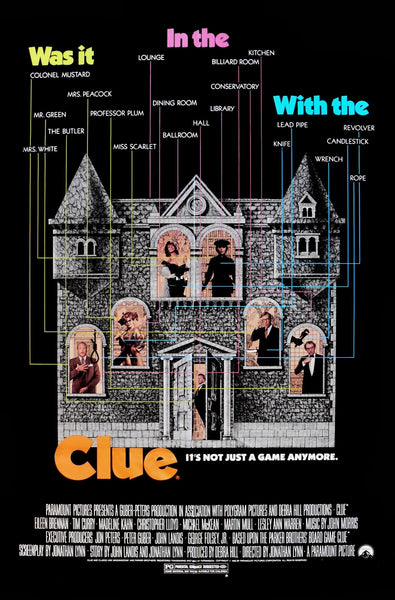
<p><em> Clue</em> carries over the detective influences of the board game, setting its scene in New England in 1954 at the heart of McCarthyism. In the film, an anonymous blackmailer invites six strangers to a remote house on a stormy night. Each person has an equally plausible reason to kill their blackmailer. The lights go out, and—blam!—suddenly there’s a body on the floor, and nobody knows whodunnit.</p>
<p>In fact, not even the viewing audience always knew. At the end of the film, Wadsworth the butler (played impeccably by Tim Curry) narrates three possible ways the murder-filled evening could have gone down, each with a different killer. If you’re watching the movie on a streaming service or a disc, you’ll see all three. But in 1985, each screening of <em>Clue</em> only featured one of the three endings. The studio hoped it would encourage repeat viewings, but it didn’t work, and the film flopped, only for it to become a cult favorite decades later.</p>
<p style="text-align: center;"><a href="https://www.imdb.com/title/tt0088930/" target="_blank" title="Clue (1985)" rel="noopener noreferrer"><img src="https://cdn.shopify.com/s/files/1/0200/7616/files/Clue_1985_600x600.jpg?v=1669897878" alt="Clue (1985)"></a></p>
<p>While <em>Clue</em> took its inspiration from a board game, The Game, directed by David Fincher, was both influenced by puzzle games and helped inspire real-world games after its release.</p>
<p>In <a href="https://www.imdb.com/title/tt0119174/" target="_blank" title="The Game" rel="noopener noreferrer"><em>The Game</em></a>, Michael Douglas plays Nicholas Van Orton, a wealthy investment banker whose younger brother gives him the ultimate “gift for the man who has everything”—a super-customized game, created by a mysterious company, Consumer Recreation Services. Strange events begin to trickle into Van Orton’s life, and he must unravel the mysterious conspiracy as the ordeals escalate.</p>
<p><em>The Game</em> was inspired by “The Game,” a real-life puzzle-based treasure hunt that was inspired by the 1980 film <em>Midnight Madness</em>, which was itself inspired by a <a href="https://en.wikipedia.org/wiki/The_Game_(treasure_hunt)" target="_blank" title="The Game treasure hunt" rel="noopener noreferrer">1973 treasure hunt</a> created by two Californians. And if that’s not enough layers for you: the film <em>The Game</em> inspired more real-world puzzle hunts and car-based games, as well as the first alternate reality game (ARG), 2001’s <em>The Beast</em>.</p>
<p style="text-align: center;"><a href="https://www.imdb.com/title/tt0119174/" target="_blank" title="The Game (1997)" rel="noopener noreferrer"><img src="https://cdn.shopify.com/s/files/1/0200/7616/files/The_Game_1997_600x600.jpg?v=1669898557" alt="The Game (1997)"></a></p>
<p>The popularity of 2019’s <em>Knives Out</em> and its 2022 sequel <em>Glass Onion</em> shows that audiences are still hungry for intriguing puzzles, twisty plots, clever detectives, and a bit of murder; the playful spirit that viewers embrace will surely sow its seeds in a new generation of designers to come.</p>
<p><em>Feel like going down your very own puzzle rabbit hole? Check out all the hidden secrets in our art journal </em><a href="https://www.artofplay.com/pages/tangram" target="_blank" title="Tangram magazine puzzle hunt" rel="noopener noreferrer">TANGRAM</a><em>.</em></p>
<p><em>Words by Laura E. Hall</em></p>]]>
    </content>
  </entry>
  <entry>
    <id>https://www.artofplay.com/blogs/articles/tangram-vol-1-solutions-and-hints</id>
    <published>2022-11-23T12:35:16-07:00</published>
    <updated>2022-11-25T14:14:05-07:00</updated>
    <link rel="alternate" type="text/html" href="https://www.artofplay.com/blogs/articles/tangram-vol-1-solutions-and-hints"/>
    <title>Tangram Vol. 1 Puzzle Hunt - Hints and Solution</title>
    <author>
      <name>Adam Rubin</name>
    </author>
    <content type="html">
      <![CDATA[<h1>Overview</h1>
<p>Hidden throughout the pages of <a href="https://www.artofplay.com/products/tangram-volume-1" target="_blank" title="Tangram Volume 1 by Art of Play" rel="noopener noreferrer">Tangram Volume 1</a> are 6 puzzles, themed around each of the 6 artists featured in the journal.</p>
<p>A small red tangram piece marks the starting point for each puzzle, though a single puzzle may utilize elements on multiple pages throughout the journal. Each puzzle can be solved independently and leads to a word or phrase as the answer.</p>
<p>Combining the 6 puzzle answers with another element in the journal reveals a multi-stage metapuzzle progression. You’ll know you’re fully finished once you’ve looked within and discovered a 3-word mantra.</p>
<p>*CLICK* below to find progressive hints for each puzzle. Each hint reveals more explicit information about how each puzzle works, so click for hints in order as needed. The last hint for each puzzle provides a full solution.</p>
<p>Additionally, a few puzzles require cutting but will leave all the non-puzzle content of the journal intact.</p>
<h1>Bob Bosch Puzzle</h1>
<details> <summary><strong>Where to Start</strong></summary>
<p>This puzzle starts with the description of the binary search algorithm on page 103.</p>
</details> <details> <summary><strong>Hint 1</strong></summary>
<p>The algorithm provides an example that is 128 items long. What else do you have that’s the same length?</p>
</details> <details> <summary><strong>Hint 2</strong></summary>
<p>Apply a binary search to the journal itself. You’ll find some useful markings on each page you visit.</p>
</details> <details> <summary><strong>Hint 3</strong></summary>
<p>The algorithm ends at the portrait of Obama on pages 94-95. The letters you’ve collected along your search tell you where to look.</p>
</details> <details> <summary><strong>Solution</strong></summary>
<p>Apply a binary search algorithm to the Tangram Vol 1 journal. Start at the midpoint of the 128 pages (page 64) and continue onto pages 96, 80, 88, and 92. The &lt; or &gt; on each page tells you whether to look in the left or right half next. Along the way, collect the letters IN EAR.</p>
<p>You’ll end up on the Obama spread on pages 94-95. In Obama’s ear, you’ll find the answer <strong>ICONIC</strong> hiding in plain sight.</p>
<p><img src="https://cdn.shopify.com/s/files/1/0200/7616/files/bosch_solution_480x480.png?v=1653499797" alt=""></p>
<p>Note: on its own, the N in ICONIC could just as easily be an H or M in this low resolution font, but it’s unambiguously an N in context of the word.</p>
</details>
<h1>Polly Morgan Puzzle</h1>
<details> <summary><strong>Where to Start</strong></summary>
<p>This puzzle uses the block of lorem ipsum text on page 122.</p>
</details> <details> <summary><strong>Hint 1</strong></summary>
<p>Look closely at the text. Do you notice anything off?</p>
</details> <details> <summary><strong>Hint 2</strong></summary>
<p>As you find “typos” in the text, pay attention to the shape they forming.</p>
</details> <details> <summary><strong>Hint 3</strong></summary>
<p>Read along the serpentine path of typos to obtain some familiar text, plus a little something extra…</p>
</details> <details> <summary><strong>Solution</strong></summary>
<p>The full lorem ipsum repeats three times: the first is the unmodified original, and the second and third are riddled with incorrect letters. Noting the positions of these incorrect letters, using the unmodified copy of the text as reference, yields the following serpentine form:</p>
<p><img src="https://cdn.shopify.com/s/files/1/0200/7616/files/polly_morgan_solution_480x480.png?v=1653499557" alt=""></p>
<p>Follow the snake of changed letters to get yet more lorem ipsum text with extra letters in the spaces between words. These letters spell out THE ANSWER IS <strong>HISTORY</strong> (or hissssss-tory, to stay on theme for this puzzle.)</p>
</details>
<h1>Kelli Anderson Puzzle</h1>
<details> <summary><strong>Where to Start</strong></summary>
<p>This puzzle uses the colorful grid on page 64.</p>
</details> <details> <summary><strong>Hint 1</strong></summary>
<p>The grid consists of 10 pairs of letters overlaid on each other.</p>
</details> <details> <summary><strong>Hint 2</strong></summary>
<p>Do you notice any pattern amongst the letter pairs that would allow you to put them in an order?</p>
</details> <details> <summary><strong>Hint 3</strong></summary>
<p>Using one of the letters from each of the pairs, you can find the letters A-J.</p>
</details> <details> <summary><strong>Solution</strong></summary>
<p>Transcribe each of the 10 bigrams. From just the artwork, there’s no indication of which letter goes first in each pair. In page order, these pairs are: DL, EV, CE, EF, AT, DJ, IL, FG, HO, and BW.</p>
<p>Then, employing some basic logic, we can uniquely reorder these bigrams by consecutive letters of the alphabet, A-J, to get: AT, BW, CE, DL, EV, FE, GF, HO, IL, JD. The other letter from each bigram yields the answer <strong>TWELVEFOLD</strong>.</p>
<p>Note: The illustration for this puzzle is based on Kelli Anderson’s risograph depiction of 2-letter Scrabble words.</p>
</details>
<h1>Oscar Ukonu Puzzle</h1>
<details> <summary><strong>Where to Start</strong></summary>
<p>This puzzle uses the strip of strange markings on the edge of page 84.</p>
<p>This puzzle requires cutting.</p>
</details> <details> <summary><strong>Hint 1</strong></summary>
<p>Cut off the strip along the dashed line. The text alongside the strip — “Gets wrapped up in his work….” — hints at what to do next.</p>
</details> <details> <summary><strong>Hint 2</strong></summary>
<p>To solve this puzzle, you’ll also need a certain common object that is central to Oscar Ukonu’s art.</p>
</details> <details> <summary><strong>Hint 3</strong></summary>
<p>Wrap the strip of paper around a standard ballpoint pen at a slight angle, like a scytale.</p>
</details> <details> <summary><strong>Solution</strong></summary>
<p>Cut out the strip along the dashed line. Wrap it around a standard ballpoint pen — the primary tool in Oscar Ukonu’s work, as noted throughout the article — to reveal the word <strong>MAGIC</strong> when viewed from an angle.</p>
</details>
<h1>Tobias Dostal Puzzle</h1>
<details> <summary><strong>Where to Start</strong></summary>
<p>This puzzle starts with the fold-out on pages 31-34.</p>
</details> <details> <summary><strong>Hint 1</strong></summary>
<p>Accordion fold the artwork to make a physical lenticular image as instructed. Does that change anything else?</p>
</details> <details> <summary><strong>Hint 2</strong></summary>
<p>Once you’ve folded the artwork, looking at the reverse side from one side reveals an instruction in the otherwise random text. (Looking from the other direction gives nonsense.)</p>
</details> <details> <summary><strong>Hint 3</strong></summary>
<p>Look up what a “tap cipher” is. Where could you apply a tap cipher on the flip side from where you got the instruction?</p>
<p>Note: In this style of puzzles, internet searches are not just allowed but often required. Unlike in crossword culture, you’re not expected to know everything in advance, and puzzles may lead you down interesting research rabbit holes.</p>
</details> <details> <summary><strong>Hint 4</strong></summary>
<p>The dashed fold lines on the artwork, when interpreted as a tap cipher, lead you to the back cover, where you’ll need to look very closely.</p>
</details> <details> <summary><strong>Hint 5</strong></summary>
<p>The “specks” are tiny grey dots around the middle two columns of the journal’s back cover. There’s a pair of specks surrounding each of the 9 blocks. A ruler or straight edge will be helpful for this final step.</p>
</details> <details> <summary><strong>Solution</strong></summary>
<p>Accordion fold the artwork, then view the strange text on the reverse from on side to reveal the message: TAP CIPHER ON FLIP SIDE.</p>
<p>On the reverse side of this page, back on the artwork side, the dashed lines indicating where to fold can be interpreted as a tap cipher, with each column encoding a letter. There are somewhere between 1 and 5 dashes on each the top and bottom, forming pairs of numbers. This translates to: FLIP TO BACK COVER AND CONNECT SPECKS.</p>
<p>On the back cover of the journal, there are 18 small grey specks around the middle two columns. They are barely noticeable unless you’re looking for them. A pair of specks surrounds each of the 9 horizontal sections. Carefully connect these pairs with straight lines to reveal a single letter crossed by each, leading to the answer <strong>FLIPPANCY</strong>.</p>
<p><img src="https://cdn.shopify.com/s/files/1/0200/7616/files/tobias_solution_480x480.png?v=1653499770" alt=""></p>
</details>
<h1>Kensuke Koike Puzzle</h1>
<details> <summary><strong>Where to Start</strong></summary>
<p>This puzzle uses the 3 circles on page 87, along with a particular page in Kensuke Koike’s article.</p>
<p>Note: This puzzle requires cutting.</p>
</details> <details> <summary><strong>Hint 1</strong></summary>
<p>Cut out the three circles. Determine how the medium circle aligns on the large circle.</p>
</details> <details> <summary><strong>Hint 2</strong></summary>
<p>In Kensuke’s article, do you see anything that is similar in size and shape to what you’ve cut out?</p>
</details> <details> <summary><strong>Hint 3</strong></summary>
<p>The circles nest within each other and fit within the circular text on page 38, such that each of the paths leaving the large circle connects to a letter in the circular text.</p>
</details> <details> <summary><strong>Hint 4</strong></summary>
<p>To find the solution, orient the smallest circle so that the SOLUTION connects to another SOLUTION. There is only one position where this is possible.</p>
</details> <details> <summary><strong>Hint 5</strong></summary>
<p>Once each of the letters in SOLUTION on the smallest circle connects to that same letter somewhere in the surrounding circular text, you still have some extra paths you haven’t yet used.</p>
</details> <details> <summary><strong>Solution</strong></summary>
<p>Cut out the 3 circles on page 87. The rotating concentric circles allude to the journal’s cover artwork, connecting these pieces to the article about Kensuke Koike. The circular text on the first page of that article (page 38) fits around the large circle, with the outgoing paths of the large circle aligning with each letter of the text. Place the medium circle on the large circle such that all the connections match up. The small circle fits on the medium circle, and it can rotate through eight different positions.</p>
<p>2 paths lead out from each letter of SOLUTION in that small circle. Find the orientation of that circle where one of the paths for each letter connects to a matching letter on the outside text, i.e. S connects to an S, O connects to an O, etc. The letters obtained from following the unused paths, in SOLUTION order, give the answer <strong>TREASURE</strong>.</p>
</details>
<h1>Metapuzzle </h1>
<details> <summary><strong>Where to Start</strong></summary>
<p>This puzzle uses the 6 artist puzzle answers and the fake subscription card.</p>
</details> <details> <summary><strong>Hint 1</strong></summary>
<p>Fill your answers into the form. The silly labels above the fields are meaningless, but the length of each field will help determine which answer goes where.</p>
</details> <details> <summary><strong>Hint 2</strong></summary>
<p>The subscription card includes another rather circuitous element which will help to find additional meaning in the answers.</p>
</details> <details> <summary><strong>Hint 3</strong></summary>
<p>Hold the card up to the light so the squiggly path on the other side is visible through the paper.</p>
</details> <details> <summary><strong>Solution Part 1</strong></summary>
<p>Fill in the six answers on the fake subscription card. The answer lengths are unique, allowing you to determine which field each fits into.</p>
<p>Then, hold the card up to the light. The twisty path on the opposite side passes through letters in the feeder answers, spelling out the phrase: <strong>FIFTH WORDS PRIME PAGES</strong>.</p>
<p><img src="https://cdn.shopify.com/s/files/1/0200/7616/files/meta_solution_card_480x480.png?v=1653499753" alt=""></p>
</details> <details> <summary><strong>Hint 5 (starting once you have a 4-word instruction)</strong></summary>
<p>When you have the message FIFTH WORDS PRIME PAGES from the subscription card, apply this to the entire journal.</p>
</details> <details> <summary><strong>Hint 6</strong></summary>
<p>Read the fifth word on every prime-numbered page of the journal, yielding a new instruction phrase. “Fifth word” always means the fifth word reading left to right, top to bottom, however the page might be laid out.</p>
</details> <details> <summary><strong>Solution Part 2</strong></summary>
<p>The fifth words on prime-numbered pages of the journal give the instruction (with page numbers in parentheses):</p>
<p>FANTASTIQUE (2) WORK (3)!</p>
<p>CUT (5) OUT (7) SIX (11) L (13) SHAPES (17) ON (19) SUMMARY (23) PAGE (29).</p>
<p>MOUNTAIN (31) FOLD (37) ALONG (41) SQUARES (43).</p>
<p>STACK (47) AND (53) TAPE (59) MATCHING (61) COLORS (67) WITH (71) STARS (73) VISIBLE (79) ON (83) INTERIOR (89).</p>
<p>THEN (97) READ (101) OPPOSITE (103) FACES (107) FOR (109) A (113) MESSAGE (127).</p>
</details> <details> <summary><strong>Hint 7 (starting once you have a much longer instruction)</strong></summary>
<p>Once you have the long instruction that starts with FANTASTIQUE WORK, the next step is to find the Summary page. This page appears at the very end of the journal and is clearly labeled with the word “Summary.”</p>
<p>This puzzle requires cutting.</p>
</details> <details> <summary><strong>Hint 8</strong></summary>
<p>The message instructs you to cut out 6 L shapes. Each L consist of 5 adjacent squares.</p>
<p>Note: These L shapes don’t have explicit dashed cut lines, but it should be clear where to cut. Cut around the outside of each L, not along the individual squares.</p>
</details> <details> <summary><strong>Hint 9</strong></summary>
<p>Looking at the tangram letters and numbers, how many do you see of each color? Of each color with a star?</p>
</details> <details> <summary><strong>Hint 10</strong></summary>
<p>Stack matching colors, with the stars on the inside and the artist images on the outside. This won’t stay flat for long.</p>
</details> <details> <summary><strong>Hint 11</strong></summary>
<p>When correctly assembled, you’ll have made a <a href="%E2%80%9Dhttps://en.wikipedia.org/wiki/Rhombicuboctahedron%E2%80%9D">rhombicuboctahedron</a> with triangular holes.</p>
</details> <details> <summary><strong>Hint 12</strong></summary>
<p>Look through the triangular holes to examine pairs of opposite faces on the inside of the structure. Do you notice a pattern?</p>
</details> <details> <summary><strong>Solution Part 3</strong></summary>
<p>This final part of the metapuzzle has a few stages and requires both folding and cutting.</p>
<p><strong>1. Preparation:</strong> CUT OUT SIX L SHAPES from the SUMMARY PAGE (pages 124-125). Each L is identical in format, with an image in the center and smaller colored squares on the ends of the legs. Then, MOUNTAIN FOLD ALONG SQUARES, i.e. with the Summary page sides facing up, make four creases on each L piece between the squares.</p>
<p><strong>2. Assembly:</strong> The next instruction — STACK AND TAPE MATCHING COLORS, WITH STARS VISIBLE ON INTERIOR — has a few layers to it. First, observe that among the tangram letters and numbers, each non-black color repeats thrice. Also, for the smaller squares on the ends of the legs, the tangram color on the back matches the smaller square’s color on the front. In each of these triplets, one face contains a small black star. Stack and adhere together the three faces for each color, ensuring that the star face is visible on the inside and the artwork image is visible on the outside. This will form a rhombicuboctahedron that looks like this:</p>
<p><img src="https://cdn.shopify.com/s/files/1/0200/7616/files/meta_solution_480x480.png?v=1653499731" alt=""></p>
<p><strong>3. Extraction:</strong> The final instruction reads: THEN READ OPPOSITE FACES FOR A MESSAGE. Peering through the triangular holes, notice that pairs of opposite faces always consist of a number and a letter, and the numbers are 1-9. In ascending order, read the opposing letter faces for the final message and key takeaway from this puzzle hunt and the journal overall: <strong>ALL IS PLAY</strong>!</p>
</details>
<p>  </p>
<p><em>The Tangram Puzzle Hunt was designed by Matthew Stein. Follow his work at <a href="http://steinium.com/" target="_blank" title="Matthew Stein" rel="noopener noreferrer">steinium.com</a> and on Instagram <a href="https://instagram.com/enigmida" target="_blank" title="Enigmida Instagram" rel="noopener noreferrer">@enigmida</a>.</em></p>]]>
    </content>
  </entry>
  <entry>
    <id>https://www.artofplay.com/blogs/articles/just-type-playing-cards</id>
    <published>2022-11-18T10:43:22-07:00</published>
    <updated>2022-11-18T10:54:04-07:00</updated>
    <link rel="alternate" type="text/html" href="https://www.artofplay.com/blogs/articles/just-type-playing-cards"/>
    <title>Just Type Playing Cards</title>
    <author>
      <name>Art of Play</name>
    </author>
    <summary type="html">
      <![CDATA[<p>Just Type is a modern reinterpretation of classic playing card design and a tribute to the different ways in which the spirit of type can be modified.</p><p><a class="read-more" href="https://www.artofplay.com/blogs/articles/just-type-playing-cards">More</a></p>]]>
    </summary>
    <content type="html">
      <![CDATA[<p class="intro" style="text-align: left;"><b>ART OF PLAY ANNOUNCES INVENTIVE NEW SERIES OF TYPOGRAPHIC PLAYING CARDS DESIGNED BY PAULA SCHER OF PENTAGRAM.</b></p>
<p><span style="font-weight: 400;">November 18th, 2022 (NY, NY)— Art of Play, the online wonder emporium known for its eccentric catalog of collectible playing cards, games, puzzles, toys, and home amusements, has teamed up with Pentagram, the largest independently owned design studio renowned for its work in graphic design and corporate identity. Together, the two companies will produce a new series of luxury playing cards to be used for card games, cardistry, and magic. Just Type Playing Cards, Edition 1 and 2 are now available in our Shop.</span></p>
<p><span style="font-weight: 400;"><strong>Just Type</strong> is a reinterpretation of classic playing card design and a tribute to the many ways that letterforms can be used to communicate. Paula Scher, a titan of the graphic design world, has helped to redefine modern typography. Working with fellow Pentagram designers Jeff Close and Kristin Huber, Scher has playfully deconstructed the classic french design of traditional “poker cards” and removed all extraneous elements. All that’s left is Just Type.</span></p>
<div style="text-align: start;"><img src="https://cdn.shopify.com/s/files/1/0200/7616/files/just-type-playing-cards-pentagram-grid1.png?v=1668792999" alt="Just Type Playing Cards, Edition 1" style="float: none;"></div>
<p><span style="font-weight: 400;"><a href="https://www.artofplay.com/collections/playing-cards/products/just-type-playing-cards?variant=42221318930584"><strong>Edition 1</strong></a> embraces big, bold postmodern elements. Oversized numbers constructed of simple shapes fill the entirety of each card. While each composition could stand on its own as a piece of art, taken together, this collection of 56 images represents a totally unique approach to a familiar form factor. Each number and letter is pushed to the breaking point, shattered into elemental pieces that evoke abstraction, yet communicate so clearly, they can be read from across the room.</span></p>
<div style="text-align: center;"><img src="https://cdn.shopify.com/s/files/1/0200/7616/files/just-type-playing-cards-pentagram-grid2.png?v=1668793072" alt="Just Type Playing Cards, Edition 2" style="float: none;"></div>
<p><span style="font-weight: 400;"><a href="https://www.artofplay.com/collections/playing-cards/products/just-type-playing-cards?variant=42221318963352"><strong>Edition 2</strong></a> offers a minimalist approach in the spirit of classic mid-century design. Each card features an amalgamation of suit and value that expresses its identity with a single figure. An extraordinarily clever visual system makes use of negative space to incorporate the traditional pips (clubs, hearts, spades, and diamonds) into custom-drawn letterforms. The result is both beautiful and humorous. </span></p>
<p><span style="font-weight: 400;">Together, these exceedingly adaptive versatile explorations of type prove once again that Scher is a master of pushing words beyond their literal meaning into the realm of purely visual expression. Or, as she more succinctly puts it, “<em>Typography is painting with words.”</em> With these Just Type Playing Cards, Paula Scher demonstrates, once again, why she is one of the most influential and respected graphic designers in the world.</span></p>
<p><span style="font-weight: 400;">---------------</span></p>
<p><span style="font-weight: 400;"><a href="https://www.pentagram.com/" target="_blank" rel="noopener noreferrer">Pentagram</a> is a multi-disciplinary, independently owned design studio. Their work encompasses graphics and identity, strategy and positioning, products and packaging, exhibitions and installations, websites and digital experiences, advertising and communications, data visualizations and typefaces, sound, and motion. All 22 partners are practicing designers, and whether working collaboratively or independently, they do so in friendship.</span></p>
<p><span style="font-weight: 400;">Pentagram’s structure is unique. They are the only major design studio where the owners of the business are the creators of the work and serve as the primary contact for every client. This reflects their conviction that great design cannot happen without passion, intelligence and—above all—personal commitment, and is demonstrated by a portfolio that spans five decades, many industries, and clients of every size.</span></p>]]>
    </content>
  </entry>
  <entry>
    <id>https://www.artofplay.com/blogs/articles/the-absurd-genius-of-josephs-machines</id>
    <published>2022-11-16T05:00:01-07:00</published>
    <updated>2022-11-16T05:00:01-07:00</updated>
    <link rel="alternate" type="text/html" href="https://www.artofplay.com/blogs/articles/the-absurd-genius-of-josephs-machines"/>
    <title>The Absurd Genius of Joseph&apos;s Machines</title>
    <author>
      <name>David MacNeal</name>
    </author>
    <summary type="html">
      <![CDATA[Instagram artist <meta charset="utf-8"><span>Joseph Herscher builds absurd Rube-Goldberg machines for life’s most mundane tasks.</span><p><a class="read-more" href="https://www.artofplay.com/blogs/articles/the-absurd-genius-of-josephs-machines">More</a></p>]]>
    </summary>
    <content type="html">
      <![CDATA[<p>Joseph Herscher builds absurd Rube-Goldberg machines for life’s most mundane tasks. His tools? Scotch tape, paperclips, rubberbands, glue, hamsters, soup cans, hand axes … you get the point. The machines are a hodgepodge of nonsense consisting of items scrounged from a dollar store or junk lying around that might have, what he calls, “kinetic potential.” And the machines are genius.</p>
<p>So far his creations have appeared in multiple places from LEGO Technic ads to <em>Jimmy Kimmel Live</em> and <em>Sesame Street</em> and have racked up millions of views across YouTube and Instagram. “These inventions won’t improve your life,” he says. Well, at least not in a physical sense. The New Zealand native, who studied mathematics and computer science, is all about surprises, making viewers wonder what his chain-reaction machines will do next.</p>
<p>To give you an idea, here’s a few of the contraptions in his recent “Pass the Wine” video (embedded below):</p>
<ul>
<li>A hammer hits the belly of a rubber chicken launching a rubber ball from its mouth</li>
<li>A mouse, after riding a toy train, scurries towards a cartoonish slice of cheese, setting off a pool ball, setting off a large wheel of cheese</li>
<li>A cinderblock smashes a wine glass; a ballerina in a wind-up music box releases a ping-pong ball</li>
<li>A reciprocating saw buzzes through a loaf of bread, the slice then dominoes onto a line of foam squares as the saw continues to cut through the table.</li>
</ul>
<p>But that’s only a fraction of the complexity. Art of Play chatted with Herscher to learn more about his frenzied, wondrous mayhem.</p>
<blockquote class="instagram-media" data-instgrm-permalink="https://www.instagram.com/tv/CgzpfJdDYYb/?utm_source=ig_embed&amp;utm_campaign=loading" data-instgrm-version="14" style="background: #FFF; border: 0; border-radius: 3px; box-shadow: 0 0 1px 0 rgba(0,0,0,0.5),0 1px 10px 0 rgba(0,0,0,0.15); margin: 1px; max-width: 540px; min-width: 326px; padding: 0; width: calc(100% - 2px);">
<div style="padding: 16px;">
<a href="https://www.instagram.com/tv/CgzpfJdDYYb/?utm_source=ig_embed&amp;utm_campaign=loading" style="background: #FFFFFF; line-height: 0; padding: 0 0; text-align: center; text-decoration: none; width: 100%;" target="_blank" rel="noopener noreferrer">
<div style="display: flex; flex-direction: row; align-items: center;">
<div style="background-color: #f4f4f4; border-radius: 50%; flex-grow: 0; height: 40px; margin-right: 14px; width: 40px;"></div>
<div style="display: flex; flex-direction: column; flex-grow: 1; justify-content: center;">
<div style="background-color: #f4f4f4; border-radius: 4px; flex-grow: 0; height: 14px; margin-bottom: 6px; width: 100px;"></div>
<div style="background-color: #f4f4f4; border-radius: 4px; flex-grow: 0; height: 14px; width: 60px;"></div>
</div>
</div>
<div style="padding: 19% 0;"></div>
<div style="display: block; height: 50px; margin: 0 auto 12px; width: 50px;"><svg width="50px" height="50px" viewbox="0 0 60 60" version="1.1" xmlns="https://www.w3.org/2000/svg" xmlns:xlink="https://www.w3.org/1999/xlink"><g stroke="none" stroke-width="1" fill="none" fill-rule="evenodd"><g transform="translate(-511.000000, -20.000000)" fill="#000000"><g><path d="M556.869,30.41 C554.814,30.41 553.148,32.076 553.148,34.131 C553.148,36.186 554.814,37.852 556.869,37.852 C558.924,37.852 560.59,36.186 560.59,34.131 C560.59,32.076 558.924,30.41 556.869,30.41 M541,60.657 C535.114,60.657 530.342,55.887 530.342,50 C530.342,44.114 535.114,39.342 541,39.342 C546.887,39.342 551.658,44.114 551.658,50 C551.658,55.887 546.887,60.657 541,60.657 M541,33.886 C532.1,33.886 524.886,41.1 524.886,50 C524.886,58.899 532.1,66.113 541,66.113 C549.9,66.113 557.115,58.899 557.115,50 C557.115,41.1 549.9,33.886 541,33.886 M565.378,62.101 C565.244,65.022 564.756,66.606 564.346,67.663 C563.803,69.06 563.154,70.057 562.106,71.106 C561.058,72.155 560.06,72.803 558.662,73.347 C557.607,73.757 556.021,74.244 553.102,74.378 C549.944,74.521 548.997,74.552 541,74.552 C533.003,74.552 532.056,74.521 528.898,74.378 C525.979,74.244 524.393,73.757 523.338,73.347 C521.94,72.803 520.942,72.155 519.894,71.106 C518.846,70.057 518.197,69.06 517.654,67.663 C517.244,66.606 516.755,65.022 516.623,62.101 C516.479,58.943 516.448,57.996 516.448,50 C516.448,42.003 516.479,41.056 516.623,37.899 C516.755,34.978 517.244,33.391 517.654,32.338 C518.197,30.938 518.846,29.942 519.894,28.894 C520.942,27.846 521.94,27.196 523.338,26.654 C524.393,26.244 525.979,25.756 528.898,25.623 C532.057,25.479 533.004,25.448 541,25.448 C548.997,25.448 549.943,25.479 553.102,25.623 C556.021,25.756 557.607,26.244 558.662,26.654 C560.06,27.196 561.058,27.846 562.106,28.894 C563.154,29.942 563.803,30.938 564.346,32.338 C564.756,33.391 565.244,34.978 565.378,37.899 C565.522,41.056 565.552,42.003 565.552,50 C565.552,57.996 565.522,58.943 565.378,62.101 M570.82,37.631 C570.674,34.438 570.167,32.258 569.425,30.349 C568.659,28.377 567.633,26.702 565.965,25.035 C564.297,23.368 562.623,22.342 560.652,21.575 C558.743,20.834 556.562,20.326 553.369,20.18 C550.169,20.033 549.148,20 541,20 C532.853,20 531.831,20.033 528.631,20.18 C525.438,20.326 523.257,20.834 521.349,21.575 C519.376,22.342 517.703,23.368 516.035,25.035 C514.368,26.702 513.342,28.377 512.574,30.349 C511.834,32.258 511.326,34.438 511.181,37.631 C511.035,40.831 511,41.851 511,50 C511,58.147 511.035,59.17 511.181,62.369 C511.326,65.562 511.834,67.743 512.574,69.651 C513.342,71.625 514.368,73.296 516.035,74.965 C517.703,76.634 519.376,77.658 521.349,78.425 C523.257,79.167 525.438,79.673 528.631,79.82 C531.831,79.965 532.853,80.001 541,80.001 C549.148,80.001 550.169,79.965 553.369,79.82 C556.562,79.673 558.743,79.167 560.652,78.425 C562.623,77.658 564.297,76.634 565.965,74.965 C567.633,73.296 568.659,71.625 569.425,69.651 C570.167,67.743 570.674,65.562 570.82,62.369 C570.966,59.17 571,58.147 571,50 C571,41.851 570.966,40.831 570.82,37.631"></path></g></g></g></svg></div>
<div style="padding-top: 8px;">
<div style="color: #3897f0; font-family: Arial,sans-serif; font-size: 14px; font-style: normal; font-weight: 550; line-height: 18px;">View this post on Instagram</div>
</div>
<div style="padding: 12.5% 0;"></div>
<div style="display: flex; flex-direction: row; margin-bottom: 14px; align-items: center;">
<div>
<div style="background-color: #f4f4f4; border-radius: 50%; height: 12.5px; width: 12.5px; transform: translateX(0px) translateY(7px);"></div>
<div style="background-color: #f4f4f4; height: 12.5px; transform: rotate(-45deg) translateX(3px) translateY(1px); width: 12.5px; flex-grow: 0; margin-right: 14px; margin-left: 2px;"></div>
<div style="background-color: #f4f4f4; border-radius: 50%; height: 12.5px; width: 12.5px; transform: translateX(9px) translateY(-18px);"></div>
</div>
<div style="margin-left: 8px;">
<div style="background-color: #f4f4f4; border-radius: 50%; flex-grow: 0; height: 20px; width: 20px;"></div>
<div style="width: 0; height: 0; border-top: 2px solid transparent; border-left: 6px solid #f4f4f4; border-bottom: 2px solid transparent; transform: translateX(16px) translateY(-4px) rotate(30deg);"></div>
</div>
<div style="margin-left: auto;">
<div style="width: 0px; border-top: 8px solid #F4F4F4; border-right: 8px solid transparent; transform: translateY(16px);"></div>
<div style="background-color: #f4f4f4; flex-grow: 0; height: 12px; width: 16px; transform: translateY(-4px);"></div>
<div style="width: 0; height: 0; border-top: 8px solid #F4F4F4; border-left: 8px solid transparent; transform: translateY(-4px) translateX(8px);"></div>
</div>
</div>
<div style="display: flex; flex-direction: column; flex-grow: 1; justify-content: center; margin-bottom: 24px;">
<div style="background-color: #f4f4f4; border-radius: 4px; flex-grow: 0; height: 14px; margin-bottom: 6px; width: 224px;"></div>
<div style="background-color: #f4f4f4; border-radius: 4px; flex-grow: 0; height: 14px; width: 144px;"></div>
</div>
</a>
<p style="color: #c9c8cd; font-family: Arial,sans-serif; font-size: 14px; line-height: 17px; margin-bottom: 0; margin-top: 8px; overflow: hidden; padding: 8px 0 7px; text-align: center; text-overflow: ellipsis; white-space: nowrap;"><a href="https://www.instagram.com/tv/CgzpfJdDYYb/?utm_source=ig_embed&amp;utm_campaign=loading" style="color: #c9c8cd; font-family: Arial,sans-serif; font-size: 14px; font-style: normal; font-weight: normal; line-height: 17px; text-decoration: none;" target="_blank" rel="noopener noreferrer">A post shared by Joseph's Machines (@josephsmachines)</a></p>
</div>
</blockquote>
<script async="" src="//www.instagram.com/embed.js"></script>
<p><em><strong>How’d you get into this?</strong></em></p>
<p>I used to be a software developer, but then, one day, in my spare time, I began building a Rube Goldberg machine because I was inspired by these other videos on YouTube. And I got really into it. Every day I would come home from work and spend four hours building it. Seven months later, I had this enormous machine that made me a cup of tea. I filmed it, put it on YouTube, and it got a million views. I realized, “Oh, maybe this could be my new job.”</p>
<p><em><strong>What’s the most dangerous video you’ve made?</strong></em></p>
<p>I just made one where I have to duck before a wine bottle on a pendulum swings at my head. It shatters against the wall and all the wine pours out into a chute before ending up in my glass. It’s a little bit dangerous. I had to practice the timing of the duck just right.</p>
<p><strong><em>Does your background in mathematics guide the invention process?</em></strong></p>
<p>When you’re a computer engineer, you go through a long process of testing your software over and over and looking for flaws in the construction, aka bugs, and then eliminate them. You’ve got to hunt them–bugs are hard to spot sometimes. Same for my machines. Once we’ve built it, we’ll just run it over and over, trying to find all the flaws in our work when it’s not perfectly consistent. They only work one out of 100 times. So eliminating the bugs means you don’t have to film it 1,000 times.</p>
<div style="text-align: center;"><img src="https://cdn.shopify.com/s/files/1/0200/7616/files/yuri_1024x1024.png?v=1668377173" alt="Black and white photo of Joseph Herscher" style="float: none;"></div>
<p style="text-align: center;"><em>Photo by Yuri Uemura. Courtesy of Joseph Herscher</em></p>
<p><em><strong>What’s the reaction been like? How does it feel to reach millions every day?</strong></em></p>
<p>It’s crazy that I can self-publish any ideas I have. I don’t have to get permission like you had to in the old days on television. So [social media] allows me to do weird content that would not normally get made—and that is lovely. My fanbase is all over the place. I’ve seen 2 year olds entertained by these machines because you don’t have to understand a language to enjoy them. … It’s really good for kids because it inspires them to think differently about the world around them and the objects they see and all their potential uses. At its heart, that’s teaching innovation—to think outside the square. And that’s what we need.</p>
<p><em>See other Rube-Goldberg machines on Instagram <a href="https://www.instagram.com/josephsmachines/" target="_blank" title="Joseph's Machines Instagram profile" rel="noopener noreferrer">@JosephsMachines</a>.</em></p>
<p><em>Words by David MacNeal</em></p>
<meta charset="utf-8">
<p style="text-align: left;"><em>﻿Main photo by WeWork / Katelyn Perry. Courtesy of Joseph Herscher</em></p>]]>
    </content>
  </entry>
  <entry>
    <id>https://www.artofplay.com/blogs/articles/how-to-play-backgammon</id>
    <published>2022-09-23T17:43:41-06:00</published>
    <updated>2022-11-04T12:02:26-06:00</updated>
    <link rel="alternate" type="text/html" href="https://www.artofplay.com/blogs/articles/how-to-play-backgammon"/>
    <title>How to Play Backgammon</title>
    <author>
      <name>David MacNeal</name>
    </author>
    <summary type="html">
      <![CDATA[<meta charset="UTF-8"><span>What makes backgammon so compelling is its balance of chance by incorporating dice rolls, and strategy. It’s also very easy to learn and can scale in difficulty depending on who you’re playing; so, finding the right backgammon opponent can be its own fun challenge.</span><p><a class="read-more" href="https://www.artofplay.com/blogs/articles/how-to-play-backgammon">More</a></p>]]>
    </summary>
    <content type="html">
      <![CDATA[<p>Backgammon evolved from ancient games such as Rome’s <a href="https://www.britannica.com/sports/backgammon" target="_blank" title="History of backgammon" rel="noopener noreferrer">Ludus Duodecim Scriptorum</a>, making it over 5,000 years old. Thanks to such popularity, it’s become the national game for eight countries, including Egypt, Turkey, and Greece. What makes backgammon so compelling (and worthy of worldwide tournaments) is its balance of chance by incorporating dice rolls, and strategy. It’s also very easy to learn and can scale in difficulty depending on who you’re playing; so, finding the right backgammon opponent can be its own fun challenge.</p>
<h2>How to Play Backgammon</h2>
<p>Backgammon is a two-player game where each player controls 15 pieces, aka “men” or checkers, one black and one white. The first player to remove their pieces from the board wins.</p>
<p>A board consists of 24 arrow-shaped spaces, the colors split into alternating rows. Six spaces, or “points,” take up each quadrant. The home board for the white checkers is on a player’s right, while the home board for the black checkers is on a player’s left. The white checkers only move counterclockwise, and the black checkers move clockwise.</p>
<p>Each player tries to move their 15 pieces around the board until they can remove them from play by getting them to the edge of the home board. Removing a piece is known as “bearing off.” The starting position for all the pieces are as follows:</p>
<div style="text-align: left;"><img src="https://cdn.shopify.com/s/files/1/0200/7616/files/backgammon-setup_1024x1024.png?v=1663978250" alt="Backgammon Setup[Zoomable]1024x1024" style="float: none;"></div>
<p>Players move their checkers to their home quadrant to remove them from play. The player’s home quadrant contains the six rows in the quadrant originally occupied by their opponent’s two checkers (opposite left for player one and opposite right for player two).</p>
<h2>Moves and Rules</h2>
<p>Players each roll one die to see who goes first. The first player moves spaces equal to the total of that first roll (their die and their opponent’s). After that, players roll both their own dice. Gamers move up to two pieces equal to the total of the dice roll. If moving two pieces, each piece moves the same as a number on a die. For example, if you roll a 2 and a 6, one piece must move 2 and the other 6 (or 6 and then 2).</p>
<ul>
<li>If you roll doubles, you can move that number four times.</li>
<li>You <strong>can</strong> move to a space with only one of the opponent’s checkers. Your opponent’s piece is then bumped to the middle of the board, aka “jail” (which divides the four quadrants). In order to remove the piece from jail, they have to try to get the piece into their home quadrant on their next turn.</li>
<li>To escape jail, the roll must include a die with the number of moves to a free space, following rules about blocked spaces, to return a checker to play. Otherwise, that player passes their turn.</li>
<li>You <strong>cannot</strong> move a piece to a point where your opponent has at least two checkers.</li>
<li>You <strong>cannot</strong> move the same piece twice if it would land on a blocked space at the end of a single die’s count. For example, if you roll a 3 and a 4 and both the third and fourth space are blocked, you cannot move your checker to the seventh space, even if it’s free.</li>
</ul>
<h2>Winning the Game</h2>
<p>Once all 15 pieces are in your home quadrant, you can begin to roll dice to move them off the board and onto the side of the home board. You must roll at least the number of spaces plus one to bear off. Remove all your pieces to win! We are obviously huge fans of the game, hence the large variety of forms to check out, from large <a href="https://www.artofplay.com/products/quilt-games?variant=41276089630872" title="Quilt Blanket Backgammon">quilted blankets</a> to an elegant set inspired by San Francisco’s <a href="https://www.artofplay.com/products/skyline-backgammon-set" title="Skyline Backgammon Set">skyline</a>.</p>]]>
    </content>
  </entry>
  <entry>
    <id>https://www.artofplay.com/blogs/articles/the-wavelinks-puzzle</id>
    <published>2022-09-23T17:33:36-06:00</published>
    <updated>2022-11-16T10:52:01-07:00</updated>
    <link rel="alternate" type="text/html" href="https://www.artofplay.com/blogs/articles/the-wavelinks-puzzle"/>
    <title>The Wavelinks Puzzle</title>
    <author>
      <name>Art of Play</name>
    </author>
    <summary type="html">
      <![CDATA[<p>Four heavy steel pieces interlock to create a modern masterpiece of mechanical puzzles. Elegant, challenging, and deeply satisfying.</p><p><a class="read-more" href="https://www.artofplay.com/blogs/articles/the-wavelinks-puzzle">More</a></p>]]>
    </summary>
    <content type="html">
      <![CDATA[<p class="intro" style="text-align: left;">Four heavy steel pieces interlock to create a modern masterpiece of mechanical puzzles. Elegant, challenging, and deeply satisfying.</p>
<p>Introducing The Wavelinks Puzzle. Designed by Rod Bogart and produced by us (Art of Play) in collaboration with our good friends over at <a href="https://craighill.co" target="_blank" rel="noopener noreferrer">Craighill</a>. We're two curious companies with one shared obsession: creating beautiful objects that evoke wonder.</p>
<p><iframe src="https://www.youtube.com/embed/faixsr2Xeig" title="YouTube video player" allow="accelerometer; autoplay; clipboard-write; encrypted-media; gyroscope; picture-in-picture" allowfullscreen="" width="560" height="315" frameborder="0"></iframe></p>
<p>Whether you're assembling it or taking it apart, it's delightfully surprising. The Wavelinks moves in a way that's unlike anything you've experienced before.</p>
<div style="text-align: center;"><img src="https://cdn.shopify.com/s/files/1/0200/7616/files/wavelinks-puzzle-pieces_600x600.png?v=1663975939" alt="Wavelinks Puzzle Pieces" style="float: none;"></div>
<p>Even after you've unlocked the secret, the magic continues. The Wavelinks is an amazing puzzle to share with curious friends. You can blow their minds, help them through moments of frustration, and guide them into the inner sanctum of mastery and knowledge.</p>
<p>Now available for <a href="https://www.indiegogo.com/projects/the-wavelinks-puzzle#/" target="_blank" rel="noopener noreferrer">Pre-order</a>.</p>]]>
    </content>
  </entry>
  <entry>
    <id>https://www.artofplay.com/blogs/articles/eames-hang-it-all-playing-cards</id>
    <published>2022-09-16T10:14:00-06:00</published>
    <updated>2022-11-04T12:06:10-06:00</updated>
    <link rel="alternate" type="text/html" href="https://www.artofplay.com/blogs/articles/eames-hang-it-all-playing-cards"/>
    <title>Eames &quot;Hang-It-All&quot; Playing Cards</title>
    <author>
      <name>Art of Play</name>
    </author>
    <summary type="html">
      <![CDATA[<p>Designed by Art of Play in close collaboration with the Eames Office. A tribute to the timeless sensibilities of Charles &amp; Ray Eames.</p><p><a class="read-more" href="https://www.artofplay.com/blogs/articles/eames-hang-it-all-playing-cards">More</a></p>]]>
    </summary>
    <content type="html">
      <![CDATA[<p class="intro" style="text-align: left;">Charles and Ray Eames brought a sense of playfulness to midcentury design, imbuing everyday objects with unexpected joy. Our second edition of Eames Playing Cards embraces this approach with a celebration of their iconic <a href="https://www.eamesoffice.com/the-work/hang-it-all/" target="_blank" rel="noopener noreferrer">Hang-It-All</a> wall rack.</p>
<div style="text-align: center;"><img src="https://cdn.shopify.com/s/files/1/0200/7616/files/eames-hangitall-charles-and-ray-eames-herman-miller_480x480.png?v=1663335743" alt="Eames Hang-It-All Wall Rack[Zoomable]480x354" style="float: none;"></div>
<div style="text-align: center;"></div>
<blockquote>
<p>This colorful device for hanging things, hats, coats, scarfs, or even toys, is the epitome of the Eames approach to design.</p>
</blockquote>
<p><br>The first thing you’ll notice is the jubilant color palette of the early 1950s. The visual motif is a clear homage to the stick and ball components of the original design. However, in adapting the Hang-It-All to a new form, we made a surprising discovery.</p>
<div style="text-align: center;"><img src="https://cdn.shopify.com/s/files/1/0200/7616/files/hang-it-all-design-inspiration_8fa22e54-1611-4a12-b57e-d9ca40e61d7c_600x600.png?v=1663340161" alt="Design Inspiration" style="float: none;"></div>
<div style="text-align: center;"></div>
<p>When traditional playing card symbols are replaced with numerals, the result is more logical and visually cohesive. So, inspired by the rebellious spirit Ray and Charles were famous for, we decided to ditch the aristocracy entirely and adopt a more minimalist approach. You will not find any Kings or Queens in this deck, the cards are simply numbered 1-13, a subtle but gently revolutionary gesture that we’ve never attempted before.</p>
<div style="text-align: center;"><img src="https://cdn.shopify.com/s/files/1/0200/7616/files/eames-hangi-it-all-playing-cards.png?v=1663281460" alt="Eames, Edition 2 Playing Cards[Zoomable]1080x1350" style="float: none;"></div>
<p>But now, we can’t help wondering why this clarity eluded us for so long. Every time we shuffle the pack and juggle the colorful balls, we’re reminded of the Eames’ enthusiasm to defy the gravity of expectations and embrace a spirit of exploration.</p>
<p>Eames Playing Cards come packaged in a letterpress printed box reminiscent of the home that Charles and Ray designed and built in Los Angeles, California. Made in the USA.</p>
-- Buy Now -- Eames "Hang-It-All" Playing Cards -- Buy Now --]]>
    </content>
  </entry>
  <entry>
    <id>https://www.artofplay.com/blogs/articles/gibus</id>
    <published>2022-09-01T05:04:38-06:00</published>
    <updated>2022-09-01T05:07:38-06:00</updated>
    <link rel="alternate" type="text/html" href="https://www.artofplay.com/blogs/articles/gibus"/>
    <title>Tension Carved Into Wood, a Q&amp;A with Gibus</title>
    <author>
      <name>David MacNeal</name>
    </author>
    <summary type="html">
      <![CDATA[<meta charset="utf-8"><span>French sculptor </span><a href="https://www.gibus.shop/" target="_blank" title="Gibus official website" rel="noopener noreferrer">Jean-Baptiste Boutin</a><span> carves guttural truth from wood, freezing tense moments in a forever state.</span><p><a class="read-more" href="https://www.artofplay.com/blogs/articles/gibus">More</a></p>]]>
    </summary>
    <content type="html">
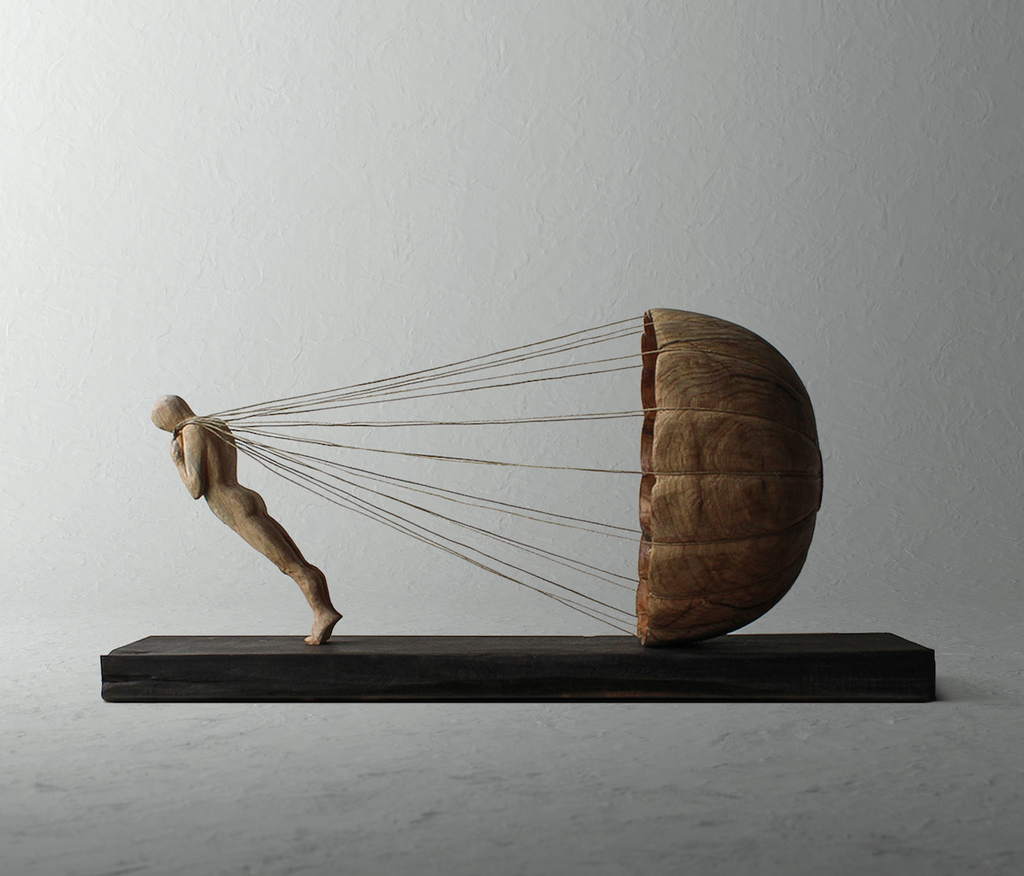
      <![CDATA[<p>French sculptor <a href="https://www.gibus.shop/" target="_blank" title="Gibus official website" rel="noopener noreferrer">Jean-Baptiste Boutin</a>, aka Gibus, carves guttural truth from wood, the way Ari Aster makes audiences confront uncomfortable aspects of reality with films like <em>Hereditary</em>. Nearly each piece has this very tangible sense of kinetic energy: a threatening cleaver about to halve someone; swinging a pickaxe at a buried bomb; or an alligator stealthily approaching someone from behind. Boutin freezes that tension in a forever state.</p>
<p>In 2017, after leaving his job as an artistic director for an advertising agency, Boutin took to woodturning. Two years later, he began a series of wood sculptures called <em>Tributes</em> which featured a figure carved from ebony wood, posed in various predicaments, like hanging off a ledge or bridging a broken bowl. So we wanted to find out how Boutin’s work has evolved over time, and what ideas he’s trying to capture.</p>
<p><em>[Editor’s note: This interview has been edited for length and clarity.]</em></p>
<div style="text-align: center;"><img src="https://cdn.shopify.com/s/files/1/0200/7616/files/The_Wind_Is_Rising_1024x1024.png?v=1661378584" alt="The Wind Is Rising by Jean-Baptiste Boudin depicting a figure pulled by a parachute" style="float: none;"></div>
<p><strong>Art of Play: <em>You mention on your website that your work is about the human condition and having the courage to face questions, getting to that existential truth. What are some of those questions you are asking? What truths are you trying to carve out?</em></strong></p>
<p><strong>Jean-Baptiste Boutin:</strong> My questions are the same as yours, no doubt. They are at the level of the humans we are. What are we? Does God exist? What is time? Are we free? What is truth/reality?</p>
<p>But the strange intuition that I have is that all these questions are born from a first question—a primary question that would be the cause of all the others. And this question precisely I do not know, and it is this one that I seek by my work, that I underlie by the whole of my pieces. Some would say that I am looking for God, others that I simply want to find my existential truth, whatever it is.</p>
<div style="text-align: center;"><img src="https://cdn.shopify.com/s/files/1/0200/7616/files/gibus_by-Benjamin-Juhel_1024x1024.png?v=1661461256" alt="Portrait of Jean-Baptiste Boutin by Benjamin Juhel" style="float: none;"></div>
<p style="text-align: center;"><em>Photo by Benjamin Juhel</em></p>
<p><strong><em>When did you begin this series? How has it evolved over time?</em></strong></p>
<p>I usually say to people who follow and encourage my work, “Follow me because I don’t know where I’m going.”</p>
<p>When I started, I didn’t know it would be a series. I didn’t know what I was looking for. Deep inside me resides a strong thirst. As time goes by, this series becomes stronger—each piece completes the others. They all have their place since each one questions differently.</p>
<p>I like to create a whole system of questions. You have to see it as a universe of open doors, and sometimes the doors lead to others. I am now at 120 pieces, and I considered that I had enough material to publish a book [called <a href="https://www.gibus.shop/book" target="_blank" title="Xylosophy book by Jean-Baptiste Boudin" rel="noopener noreferrer"><em>Xylosophy</em></a>, a contraction of the Greek words for <em>wood</em> (ξύλον) and <em>wisdom</em> (σοφία)]. I don’t know what’s next. I can’t wait to see where I’m going.</p>
<iframe width="560" height="315" src="https://www.youtube.com/embed/MaHl7uarBqU" title="YouTube video player" frameborder="0" allow="accelerometer; autoplay; clipboard-write; encrypted-media; gyroscope; picture-in-picture" allowfullscreen=""></iframe>
<p><strong><em>What are some cornerstone memories that you’d say have affected your artwork?</em></strong></p>
<p>In addition to my appetite for reflection, a particular event marked me when I was younger. I was still in high school, and my philosophy teacher, a red-haired man with a loud voice, committed suicide right after we graduated.</p>
<p>Weeks prior, we had spent a long time talking about philosophy (with all the passion of which a philosopher is capable). This man, when he left, offered something that is essential to me now: philosophy does not seek happiness, and there is a risk in the logical clarification of ideas. This is why I said that searching is sometimes a risky activity, because you take the risk of finding whatever happens.</p>
<div style="text-align: center;"><img src="https://cdn.shopify.com/s/files/1/0200/7616/files/Island_1024x1024.png?v=1661461361" alt="I is a place that is not on any map by Jean-Baptiste Boutin" style="float: none;"></div>
<p><em><strong>I’d like to get a sense of how your art pieces come together. Can you walk me through the step-by-step process of creating “ ‘I’ is a place that is not on any map”?</strong></em></p>
<p>This piece is a bit peculiar, most of it is made of wood, but the head is made of plaster and diorama materials. I had created this sphere/island a few months ago because I was amused by the idea of a small island-planet, but I had no idea yet how to use it. This is the first stage of the work, those few months during which things mature, and I often have to remind myself that the pieces don’t come out of nowhere and that the work is first and foremost intellectual, whether it is conscious or not.</p>
<p>For most pieces, I start with a tree trunk and cut it with a chainsaw. I draw the [figure’s] position on it, then I rough it out with power tools until I can begin to carve more finely. The rest is done with a chisel, a knife, a scalpel, and then, depending on the work, the finishing touches are all different. For this one, it is waxed and polished, its essence is robinia from the region where I live.</p>
<p><strong><em>One of my favorite pieces packs an incredible amount of tension. It’s of a seemingly satisfied person looking out at the world, but only a few inches from them is this massive wooden hand, middle finger curled back, primed to flick them—send them flying. What does that piece mean to you?</em></strong></p>
<p>“The Fragility of Satisfaction,” is a gentle reminder of humility. If you’re happy with yourself, wait a bit, it will pass. By measuring this feeling of pleasure and well-being, we become more solid. It is an encouragement to take a step back and take a more global and longer-term vision. Satisfaction doesn’t see very far. Austrian novelist Marie von Ebner-Eschenbach once wrote: “Humility makes you invulnerable.”</p>
<p><em>Find more work by Jean-Baptiste Boutin on Instagram <a href="https://www.instagram.com/gibus.bordeaux/" target="_blank" title="Gibus instagram profile" rel="noopener noreferrer">@gibus.bordeaux</a>.</em></p>
<p><em>Words by David MacNeal</em></p>
<p><em>Images courtesy of Jean-Baptiste Boutin</em></p>]]>
    </content>
  </entry>
  <entry>
    <id>https://www.artofplay.com/blogs/articles/the-history-of-the-slinky</id>
    <published>2022-08-22T18:16:34-06:00</published>
    <updated>2022-08-22T18:16:34-06:00</updated>
    <link rel="alternate" type="text/html" href="https://www.artofplay.com/blogs/articles/the-history-of-the-slinky"/>
    <title>The History of the Slinky</title>
    <author>
      <name>David MacNeal</name>
    </author>
    <summary type="html">
      <![CDATA[<meta charset="utf-8">
<p>Some of the greatest inventions in the world happened by accident. Silly String, Play-Doh, and ... the Slinky. Even stranger? The inventor himself.</p><p><a class="read-more" href="https://www.artofplay.com/blogs/articles/the-history-of-the-slinky">More</a></p>]]>
    </summary>
    <content type="html">
      <![CDATA[<p>Some of the greatest inventions in the world happened by accident.</p>
<p>Silly String was supposed to be an instant spray-on cast used for medical purposes until its inventors accidentally sprayed a whole canister across the room. The McVickers Soap Company originally created Play-Doh as a substance for cleaning wallpaper. And Silly Putty was the result of a doctor trying to create synthetic rubber during World War II. But another childhood memory was born around that time ...</p>
<p>In the early 1940s, a 25-year-old Navy engineer working in a shipyard was trying to create a meter that could observe the horsepower of battleships. The engineer, <a href="https://www.encyclopedia.com/education/economics-magazines/james-betty-james-richard" target="_blank" title="Richard James encyclopedia entry" rel="noopener noreferrer">Richard James</a>, used a variety of tension springs in his horsepower meter’s design, but could never quite get the right torsion.</p>
<p>One day, a spring dropped to the ship’s floor. James watched as this spring didn’t just fall to the ground but continued moving. He told his wife Betty that he could probably fashion it into a toy. Eventually, she found the perfect name while looking through the dictionary, and thus the Slinky was born. Well, at least the <em>idea</em> for the toy.</p>
<p>James spent a couple years experimenting on the right type of steel wire, one that was thin enough with the right tension and weight. (The spring that originally fell to the ship’s floor was comparatively thick and heavy.) Once he found the steel wire in that “Goldilocks zone,” he patented the toy.</p>
<p>Next came winding 80 feet of this perfect wire 98 times into a stacked coil 2.5 inches high. The Slinky can “walk” because of this coiled perfection. It transfers the energy from the first “push” along the length of the coil in what is known as a longitudinal wave. This is possible because there is no tension or compression. It’s the closest a toy comes to perpetual motion. Hypothetically, the Slinky would continue down an infinite staircase, end over end, until acted upon by a different outside force.</p>
<p>Once Richard James had perfected his design, he took out a loan for $500, which today would be around $7,500 to $8,000. He used the money to create a Philadelphia-based company, James Industries, and produce his new invention. With his company as backing, he was able to score shelf space inside Philadelphia’s famous Gimbels Department Store. Gimbels stocked 400 Slinky toys that November day, priced at $1 each (about $15 to $20 in today’s dollars). Ninety minutes later, all 400 Slinkys were sold. They would go on to sell 20,000 before Christmas and over 250,000 throughout the following year. At the two-year mark, 100 million.</p>
<p>Betty wasn’t just instrumental in the toy’s naming but also in coming up with additional products incorporating the original Slinky. Remember the Slinky Truck and Slinky Crazy Eyes? Or how about “Slink” from Pixar’s <em>Toy Story</em>?</p>
<p>But by the end of the 1950s, James did a one-eighty. He abruptly left his company, wife, and children behind to move to Bolivia with a religious cult he’d become affiliated with. Little is known about this religious group—some accounts say it was the Wycliffe Bible Translators of America—but Betty was mortified by them, <a href="https://www.straightdope.com/21343446/did-the-inventor-of-the-slinky-join-a-cult-in-bolivia" target="_blank" title="Betty James interview" rel="noopener noreferrer">according to an interview</a> with her in 2001. James ultimately funneled his company’s fortunes to the sect, leaving it and his family in financial turmoil and dying of a heart attack in 1974.</p>
<p>Betty, however, was resilient. In 1963, she brought the Slinky to a New York toy show, complete with a catchy jingle to play on TV, and the toy resurged. <iframe width="560" height="315" src="https://www.youtube.com/embed/1hayCTb3PNk" title="YouTube video player" frameborder="0" allow="accelerometer; autoplay; clipboard-write; encrypted-media; gyroscope; picture-in-picture" allowfullscreen=""></iframe> By the end of the 1990s, the History and Discovery Channels named the Slinky one of the 20th Century’s Top 10 Toys. Following that win, the toy earned several accolades:</p>
<ul>
<li>1999: Slinky gets its own <a href="https://www.pinterest.com/pin/780248704189687452/" target="_blank" title="Slinky postage stamp" rel="noopener noreferrer">USPS Postage Stamp</a>
</li>
<li>2000: National Toy Hall of Fame Inductee</li>
<li>2001: Betty becomes Toy Industry Association Hall of Fame Inductee</li>
</ul>
<p>Betty James passed away in 2008 at the age of 90. Today, the Slinky brand belongs to Michigan-based toy company Poof Products. In celebration of National Slinky Day on August 30, check out <a href="https://www.artofplay.com/products/slinky" target="_blank" title="slinky original" rel="noopener noreferrer">The Original Metal Slinky</a>, which comes in classic silver, anodized black, or giant classic silver. For the collector in you, upgrade to the <a href="https://www.artofplay.com/products/14-karat-gold-plated-slinky" target="_blank" title="Gold Slinky" rel="noopener noreferrer">14-Karat Gold-Plated Slinky</a>.</p>
<p><em>Words by Jennifer Cameron</em></p>]]>
    </content>
  </entry>
  <entry>
    <id>https://www.artofplay.com/blogs/articles/ibbini</id>
    <published>2022-08-19T18:30:00-06:00</published>
    <updated>2022-08-22T18:21:45-06:00</updated>
    <link rel="alternate" type="text/html" href="https://www.artofplay.com/blogs/articles/ibbini"/>
    <title>Julia Ibbini Evolves the Language of Arabesque</title>
    <author>
      <name>David MacNeal</name>
    </author>
    <summary type="html">
      <![CDATA[She's spent the past five years applying her own visual language to these ancient motifs, painstakingly crafting biomorphic paper sculptures.<p><a class="read-more" href="https://www.artofplay.com/blogs/articles/ibbini">More</a></p>]]>
    </summary>
    <content type="html">
      <![CDATA[<p>For centuries, the floral whorls and loops of Arabesque motifs have migrated and evolved. They are the fingerprints of the Islamic Golden Age—a biomorphic symbol for the unity of nature—patterns that touched so much of the world. The famous Persian designs found in the antique carpets of Kashan, Iran; the spiraling leaves draping Istanbul’s fragrant Grand Bazaar.</p>
<p><em>“They are like this visual language that’s being passed down,”</em> says visual artist and designer Julia Ibbini. <em>“The symmetry and the repetition. You get this beauty coming out of it.”</em></p>
<p style="text-align: right;"><img src="https://d3k81ch9hvuctc.cloudfront.net/company/afRXMx/images/ee120505-0b9d-4977-a153-fe0e30db074e.png" alt="Ornamental Mixtapes V3 by Studio Ibbini"></p>
<p>She and Stéphane Noyer, her husband and collaborator, have spent the past five years in their Abu Dhabi studio applying their own visual language to these ancient motifs by painstakingly crafting meticulous paper sculptures. The delicate motifs are sometimes composed of eight layers—some of which are broken up into a thousand tiny pieces—diligently assembled with a pin and glue. (Her vessel sculptures, which twist into sharp, organic shapes, sometimes have up to 350 layers of paper.) <em>“People keep telling me I have a lot of patience,”</em> she says, smiling.</p>
<p style="text-align: right;"><img src="https://d3k81ch9hvuctc.cloudfront.net/company/afRXMx/images/05644109-f4a4-4ad2-b616-3f9b77be63e4.png" alt="Symbio Vessel by Studio Ibbini"></p>
<p>For “Ornamental Mixtapes V3,” Ibbini began, as she does, with a digital sketch and reimagining various Arabesque motifs, with flowers and tendrils growing outwards. <em>“The way I achieved that was almost like a glitch effect,”</em> she says, explaining how she pulled the sweeping and sprouting motifs apart to create a collage of symmetries.</p>
<p>Next, the complex, curvy details are mapped out for the laser-cutting machine using a bit of computer wizardry. Noyer, a software engineer versed in computational geometry, fine tunes algorithms to cut motifs into paper without burning it. Using a mix of Adobe Illustrator and programming-language Python, he calculates how much distortion is needed within a curve so that the cut is smooth as though it were a straight line and the layers line up cleanly.</p>
<p style="text-align: center;"><img src="https://d3k81ch9hvuctc.cloudfront.net/company/afRXMx/images/5bb87ad4-16e6-4e84-92ed-f9dcc56c8c3b.png" alt="“They are like this visual language...”"></p>
<p>Even with such microscopic precision, Ibbini must balance a formula of power and speed for the laser cutter and experiment with paper types. <em>“Sometimes it comes down to the length of the line you’re cutting at the time. So you play with the power </em>within<em> the cuts,”</em> Ibbini says. Cutting one piece of paper can take as much as five hours to complete, which is a long time to wait for something to go wrong. <em>“It’s a bit of a nervous dance around the machine,”</em> she adds, laughing.</p>
<p style="text-align: right;"><img src="https://d3k81ch9hvuctc.cloudfront.net/company/afRXMx/images/fbabe8a2-79df-4070-af00-3f2809efb5ec.png" alt="The Sands of Time by Studio Ibbini"></p>
<p>But the results of <a href="https://www.ibbini.com/" target="_blank" title="Studio Ibbini homepage" rel="noopener noreferrer">Studio Ibbini</a>’s ornamental glitch motifs further expand the language of biomorphic art that evolved on ancient trade routes—worldwide influences obscured in interlacing patterns like reading tea leaves. A story altered subtly with age. <em>“Where did they come from originally?”</em> Ibbini asks with a shrug, <em>“There’s no good way to tell.”</em></p>
<p><em>Find more of work from Studio Ibbini on Instagram <a href="https://www.instagram.com/juliaibbini/" target="_blank" title="Julia Ibbini Instagram" rel="noopener noreferrer">@juliaibbini</a>.</em></p>
<p><em>Words by David MacNeal</em></p>
<p><em>Images courtesy of Studio Ibbini</em></p>]]>
    </content>
  </entry>
  <entry>
    <id>https://www.artofplay.com/blogs/articles/celebrating-9-years</id>
    <published>2022-08-13T09:59:25-06:00</published>
    <updated>2022-08-13T09:59:25-06:00</updated>
    <link rel="alternate" type="text/html" href="https://www.artofplay.com/blogs/articles/celebrating-9-years"/>
    <title>Celebrating 9 Years</title>
    <author>
      <name>Art of Play</name>
    </author>
    <summary type="html">
      <![CDATA[<span>On August 13, 2013, we launched Art of Play with over a hundred different decks, which was incomparable at the time. It was a brilliant idea, but sales suggested otherwise.</span><p><a class="read-more" href="https://www.artofplay.com/blogs/articles/celebrating-9-years">More</a></p>]]>
    </summary>
    <content type="html">
      <![CDATA[<meta charset="UTF-8">
<p>Nine years ago, Art of Play was a side project to <a href="https://dananddave.com" target="_blank" title="Dan &amp; Dave" rel="noopener noreferrer">Dan &amp; Dave</a>, an online shop for magicians. We offered self-produced instructional books and DVDs on sleight of hand and cardistry, bespoke apparatus, and luxurious playing cards for performing magicians. When playing card sales on Dan &amp; Dave began dominating sales of everything else, we recognized this is what our customers wanted. But instead of just saturating our catalog with every deck on the market, which would diminish the reputation and integrity of our brand, we imagined an independent shop for playing cards and only playing cards.</p>
<p>On August 13, 2013, we launched Art of Play with over a hundred different decks, which was incomparable at the time. It was a brilliant idea, but sales suggested otherwise. And it was disheartening to watch a few orders trickle in now and then. But we never gave up.</p>
<p>Art of Play was a fantastic resource for playing card enthusiasts, something that didn’t exist at the time. As a playing card shop, we peaked with close to 300 decks available in our catalog. As our popularity and sales increased, other card shops opened their doors. The competition challenged us to think anew.</p>
<p>Ultimately, we followed our passion. We separated away from selling magic tricks—the basis for everything we had created up to that point—and downsized Dan &amp; Dave so that we could focus on building our dream company.</p>
<p>We hired amazing people, such as Syd Segal, Justin Buck (our brother), Adam Rubin, Jen Hassen, Cece Do, and Adam Davis, to name some of our early team members. And between us, Art of Play’s reputation evolved from a boutique playing card shop to a world-class wonder emporium offering an insurmountable collection of curiosities—a place to <em>discover</em> magic. And it feels like we’re only just beginning.</p>
<p>We love that playing cards are the foundation of this company. We play with cards every day. We think with cards. And so Art of Play is, really, a house of cards, but a magical house where dreams come true. How else can we explain our collaboration with the Eames Office on a brand of cards we imagined 20 years ago in high school? How else can we explain an upcoming partnership with the Frank Lloyd Wright Foundation in light of our lifelong fascination with architecture? How else can we explain the opportunity to work with legendary designer Paula Scher on a deck of playing cards?</p>
<p>With overwhelming gratitude, this is your house too.</p>]]>
    </content>
  </entry>
  <entry>
    <id>https://www.artofplay.com/blogs/articles/designing-a-deck-of-52</id>
    <published>2022-08-01T11:00:00-06:00</published>
    <updated>2022-08-01T11:43:12-06:00</updated>
    <link rel="alternate" type="text/html" href="https://www.artofplay.com/blogs/articles/designing-a-deck-of-52"/>
    <title>Designing a Deck of 52</title>
    <author>
      <name>David MacNeal</name>
    </author>
    <summary type="html">
      <![CDATA[Art of Play founders Dan and Dave Buck discuss playing card designs, breaking conventions, and offer a sneak peek of upcoming decks.<p><a class="read-more" href="https://www.artofplay.com/blogs/articles/designing-a-deck-of-52">More</a></p>]]>
    </summary>
    <content type="html">
      <![CDATA[<p class="intro" style="text-align: left;">In 2012, Dan and Dave Buck found themselves in a dilemma. The founders of Art of Play were working with UK magician <a href="http://www.guy-hollingworth.com/" target="_blank" title="Guy Hollingworth magician" rel="noopener noreferrer">Guy Hollingworth</a> to produce an eponymous deck of cards under their <a href="https://dananddave.com/" target="_blank" title="Dan and Dave playing cards main site" rel="noopener noreferrer">Dan &amp; Dave</a> brand. And Hollingworth sought to revive something—replicate the feel of one of his favorite decks: Stud Playing Cards, which was produced by Walgreens from 1980 to 2006.</p>
<p>However, the United States Playing Card Company (USPCC) found that reproducing that style of cards—favored amongst card magicians for its ultra-thin stock—was too risky. Their machines weren’t calibrated for this technique. Still, innovation usually begins with a problem.</p>
<p><em>“We signed a waiver that said if [the USPCC’s] machines broke, we were liable,”</em> says Art of Play CEO Dave Buck. The risk was worth it, especially since at such a young age, the Buck twins hadn’t built up enough to lose. Upon release, the cards sold out almost instantly; and today, the USPCC charges a premium for what is now known as “crushed stock.” <em>“A lot of the things we do set trends and spark momentum,”</em> Dave says.</p>
<p>For the past 15 years, the Buck twins have generated that momentum through their two brands: Dan &amp; Dave and Art of Play. By spotlighting artists and collaborating with studios like Studio Muti and DKNG, the two brothers from California, along with creative partner Adam Rubin, have helped push custom card design into the mainstream. Largely because the diverse range of cards is something akin to an art museum. <em>“We always wanted to celebrate the artist,”</em> Dave says. <em>“It’s as much their product as it is ours.”</em></p>
<p><iframe width="560" height="315" src="https://www.youtube.com/embed/Yb-0jkPSr0M" title="YouTube video player" frameborder="0" allow="accelerometer; autoplay; clipboard-write; encrypted-media; gyroscope; picture-in-picture" allowfullscreen=""></iframe></p>
<p>The current state of the playing card industry has been a long time in the making. Dan and Dave’s motivation increased with the 2005 release of Tally-Ho’s “Split Spades.” <em>“Coming across anything that wasn’t Bicycle or Bee or Tally-Ho was a novelty. … So, when David Blaine put out his ‘Split Spades,’ that proved to us that we could maybe do that too—egotistical as that may sound,”</em> Dave says, laughing. Inspired, the Bucks decided that it was time to take a major leap into the custom card market.</p>
<p>Unlike the big three brands at the time (i.e., Bicycle, Bee, or Tally-Ho), making a quality deck didn’t only mean using premium stock, it meant casting the spotlight on the artist’s creative individuality. Very few decks have done this. One rare and early example of this is found in “<a href="https://www.wopc.co.uk/usa/uspcc/vanity-fair" target="_blank" title="Vanity Fair playing cards" rel="noopener noreferrer">Vanity Fair No. 41</a>.” The transformational deck, copyrighted in 1895, features unique artwork on every single card. It served as something to strive for.</p>
<p>In 2007, the Buck twins released the first edition of the famed “<a href="https://fultonsplayingcards.com/products/dan-dave-smoke-mirrors-v1-originals-first-pulls" target="_blank" title="Smoke and Mirror playing cards" rel="noopener noreferrer">Smoke &amp; Mirror</a>” playing cards, enlisting Si Scott, who’d worked on global brands like Nike. He designed the iconic whirls of smoke that pull off the serifs of each letter, curling with mystery. It marked the beginning of a decade’s worth of global collaborations.</p>
<div style="text-align: center;"><img src="https://cdn.shopify.com/s/files/1/0200/7616/files/smoke-and-mirrors-playing-cards-dananddave.png?v=1659280533" alt="Smoke &amp; Mirrors Playing Cards by Dan and Dave" style="float: none;"></div>
<p>When discussing playing card design, some draw comparisons to vinyl records, combining functionality with art. <em>“There’s a dual purpose,”</em> Dan Buck says. And the ideas can come from anywhere. Take, for instance, the tranquility-infused “<a href="https://www.artofplay.com/products/mindfulness" target="_blank" title="Mindfulness playing cards" rel="noopener noreferrer">Mindfulness</a>” deck released in 2021. Dan says the idea for the deck spawned from this moment in time where he was bringing observance to meditation and what that can do for individuals. <em>“And then we turned that into a deck,”</em> he says, smiling.</p>
<blockquote>
<p>“A lot of it is spontaneous,” Dave adds. “We’ll see something and say, ‘That looks like playing cards.’ And then we explore how to adapt that particular style.”</p>
</blockquote>
<p><br>Such was the case when Adam Rubin heard a podcast interview with Pulitzer Prize-nominated author David Haskell. Shortly after reading his book <a href="https://www.penguinrandomhouse.com/books/309637/the-forest-unseen-by-david-george-haskell/" target="_blank" title="The Forest Unseen by David Haskell" rel="noopener noreferrer"><em>The Forest Unseen</em></a>, Art of Play collaborated with Haskell and artist Ellen Litwiller on 2021’s “<a href="https://www.artofplay.com/products/eastern-forest" target="_blank" title="Eastern Forest playing cards" rel="noopener noreferrer">Eastern Forest</a>” playing cards–a deck of 54 illustrations and scientific prose that capture the flora and fauna of a miniature ecosystem.</p>
<div style="text-align: center;"><img src="https://cdn.shopify.com/s/files/1/0200/7616/files/eastern-forest-playing-cards.png?v=1659279758" alt="" style="float: none;"></div>
<p><em>“Not many people make decks with art on each card because it’s a huge undertaking,”</em> Dave says. <em>“For us, cards are more than cards. They can be a new medium for an art book. They can be left on the coffee table as a conversation piece. They can inspire. That’s what we try to focus on: What is this in </em>addition<em> to a deck of cards?”</em></p>
<p class="intro" style="text-align: left;">Brad Fulton, another pioneer in the custom market and long-time friend of the Buck twins, has been redefining playing cards with equal measure.</p>
<p><em>“I want to recreate certain times and atmospheres,”</em> Fulton says. <em>“Cards just come from wanting to hold a piece of my imagination.”</em> He gives a quick example: <em>“I wanted to be in a casino in the 1970s, so I thought, </em>What if I had my own casino?<em>”</em> He’s referring to “<a href="https://www.artofplay.com/products/ace-fultons-thunderbird-room" target="_blank" title="Thunderbird Room playing cards" rel="noopener noreferrer">Fulton’s Thunderbird Room</a>,” a retro-colored deck seemingly plucked out of some 1960s era, Arizona ephemera.</p>
<div style="text-align: center;"><img src="https://cdn.shopify.com/s/files/1/0200/7616/files/fultons-thunderbird-room-playing-cadrs.png?v=1659279660" alt="Fulton's Thunderbird Room Playing Cards" style="float: none;"></div>
<p>The majority of his cards, he says, are influenced by his life and his passion for film noir. In fact, for “<a href="https://fultonsplayingcards.com/products/fultons-clip-joint-playing-cards" target="_blank" title="Clip Joint playing cards" rel="noopener noreferrer">Clip Joint</a>”—one of his longest running and successful series—Fulton color-matched the tuck case to a <em>Mildred Pierce</em> movie poster he had from the 1940s. <em>“Playing cards are looked at as a commodity,”</em> he says. <em>“But there’s so much more you can do with it. You can tell a story. You can be a visionary.”</em></p>
<p class="intro" style="text-align: left;">Sometimes that vision can take nearly a decade to come to fruition.</p>
<p>Back in 2013, Dan Buck was scrolling through Fulton’s photo archive. As a professional photographer, Fulton had amassed thousands—a gallery of black and white photos that included images of icons like David Lynch, Tony Todd, and Keanu Reeves, as well as a number of noir-inspired and surrealist images. So, Dan asked: <em>“What if you did a photo exhibition as a deck of cards?”</em></p>
<p>“<a href="https://fultonsplayingcards.com/products/fultonal-silver-halide-gilded-edition-of-52" target="_blank" title="Fultonal playing cards" rel="noopener noreferrer">Fultonal</a>,” which is named after film developing agent Rodinal, took eight years to release because Fulton wasn’t satisfied with the end product. He needed more time. So he remained patient, refusing to rush the project. <em>“The Bucks and I never let go of a good idea. Bad ideas fall away, and the good ones keep going,”</em> he says. <em>“I’m a constant reviser. I’ll hold up a project forever. Dan [Buck] is too; so if we don’t like something, we’re not going to put it out.”</em></p>
<p>Such was the case the “<a href="https://www.artofplay.com/products/eames-playing-cards" target="_blank" title="Eames playing cards" rel="noopener noreferrer">Starburst</a>” Eames Playing Cards, which took Dan more than one hundred iterations before settling on a design. (The Second Edition of the deck called “Hang It All” is planned for this year.) Same goes for breaking design conventions with pips (i.e., the small symbols in the corner of the card determining suit and rank) in an upcoming deck in collaboration with Pentagram’s Paula Scher. Go back through the Art of Play library, and you’ll notice all the pips are all traditional—save for the Stranger &amp; Stranger “<a href="https://www.artofplay.com/products/ultimate-deck-stranger-and-stranger-playing-cards" target="_blank" title="Ultimate Deck" rel="noopener noreferrer">Ultimate Deck</a>” collaboration (which is getting a special anniversary release this year). Scher’s deck is a little different.</p>
<div style="text-align: center;"><img src="https://cdn.shopify.com/s/files/1/0200/7616/files/eames-playing-cards-starburst.png?v=1659279348" alt="Eames Playing Cards" style="float: none;"></div>
<p><em>“It really breaks the mold, so much so that we’ve struggled to figure out how to print them because of technical constraints,”</em> Dave says.</p>
<p>But technical challenges, like the crushed stock for Guy Hollingworth’s deck, present new opportunities. A deck can be anything you want it to be—even something deeply sentimental. Just look at one upcoming deck under the Dan &amp; Dave name: “Kodiak” was designed as a love letter to Alaska where the Buck twins are currently constructing an <a href="https://www.instagram.com/kodiakaframe/" target="_blank" rel="noopener noreferrer">A-frame cabin</a> on two acres on an island cliffside as though they were Bond villains.</p>
<p><em>“Alaska feels at home; nature is so beautiful,”</em> Dave says. <em>“So of course we turned it into a deck of cards.”</em> As kids, the brothers regularly hiked and camped with their grandfather, and the project is one of their lifelong goals.</p>
<blockquote>
<p>“The playing card medium,” Dan says, “is an opportunity to explore our interests in a tangible way.”</p>
</blockquote>
<p><em><br>Art of Play is celebrating its 9th anniversary this August. You can find their most recent playing cards <a href="https://www.artofplay.com/collections/playing-cards" target="_blank" title="Art of Play playing cards" rel="noopener noreferrer">here</a>.</em></p>
<p><em>Words by David MacNeal</em></p>]]>
    </content>
  </entry>
  <entry>
    <id>https://www.artofplay.com/blogs/articles/automatons-the-odd-magic-of-living-machines</id>
    <published>2022-07-25T12:00:00-06:00</published>
    <updated>2022-08-01T12:46:00-06:00</updated>
    <link rel="alternate" type="text/html" href="https://www.artofplay.com/blogs/articles/automatons-the-odd-magic-of-living-machines"/>
    <title>Automata: The Odd Magic of Living Machines</title>
    <author>
      <name>David MacNeal</name>
    </author>
    <summary type="html">
      <![CDATA[<meta charset="utf-8"><span>Self-operating machines hold a peculiar place in history, from an 18th century "pooping" duck to today's merging of technology with the human form.</span><p><a class="read-more" href="https://www.artofplay.com/blogs/articles/automatons-the-odd-magic-of-living-machines">More</a></p>]]>
    </summary>
    <content type="html">
      <![CDATA[<p>Automata—a term for self-operating machines—have been used in public entertainment like fairs and carnivals since the 18th century. Think fortune-tellers like "Zoltar" (seen in the film <em>Big</em>), photo booths, and “bird boxes” that imitated mating calls. Capturing such lifelike motions goes <em>waaay</em> back.</p>
<p>Exhibit A … the “<a href="https://www.atlasobscura.com/places/canard-digerateur-de-vaucanson-vaucansons-digesting-duck" target="_blank" title="Atlas Obscura article about the Digesting Duck" rel="noopener noreferrer">Digesting Duck</a>” created by inventor Jacques de Vaucanson in 1739. The device could flap its wings and move its head and bill, as well as "poop" out food onlookers fed it, causing a sensation among Parisians raptured by the oddity. This duck and other automata helped in crystallizing <a href="https://aeon.co/essays/can-animals-be-usefully-described-as-clockwork-machines" target="_blank" title="Aeon article about passive and active mechanisms" rel="noopener noreferrer">two competing philosophies</a> about agency in the 1700s: passive mechanism and active mechanism.</p>
<div style="text-align: center;"><img src="https://cdn.shopify.com/s/files/1/0200/7616/files/vaucanson-digesting-duck_447c8d26-b8d5-4df9-a23e-6ffb3e08f4ca_1024x1024.png?v=1659278854" alt="Vaucanson's Digesting Duck" style="float: none;"></div>
<div style="text-align: center;"></div>
<p style="text-align: center;"><strong>INTERIOR OF VAUCANSON'S AUTOMATIC DUCK</strong><br><em>A, clockwork; B, pump; C, mill for grinding grain; F, intestinal tube; J, bill; H, head; M, feet</em></p>
<p>Passive mechanisms, championed by figures like René Descartes and Isaac Newton, saw the natural world as a machine governed by external forces. Newton, for instance, considered the cosmos to be this wind-up device that required a maker to maintain it. The idea was scoffed at by German philosopher Gottfried Wilhelm Leibniz who championed active mechanisms. That philosophy proposed that nature was a self-constituting machine with its own sources of action. The debate between these two philosophies was long and complicated, but ultimately the philosophy of active mechanism won out—just consider all the artificial intelligence embedded throughout technology today.</p>
<p>Automata artists working in the aftermath of this history speak to the importance of machinery as a device for thinking about agency, free will, and the nature of life.</p>
<div style="text-align: center;"><img src="https://cdn.shopify.com/s/files/1/0200/7616/files/self-trimming-lamp-from-book-of-ingenious-devices-banu-masu_0058a536-5e00-49f0-b4dc-f77f6691ff7f_1024x1024.jpg?v=1656587823" alt="Drawing of Self Trimming Lamp from The Book of Ingenious Devices by The Banu Musa Brothers" style="margin-top: 18px; margin-bottom: 18px; float: none;"></div>
<p style="text-align: center;"><em>Drawing of Self-trimming lamp from </em>The Book of Ingenious Devices<em> by The Banu Musa Brothers</em></p>
<meta charset="utf-8">
<p>Automata (the plural form of “automaton”) were first used in religious contexts. The mid-9th century illustrated work <a href="https://en.wikipedia.org/wiki/Book_of_Ingenious_Devices" target="_blank" title="Book of Ingenious Devices wikipedia page" rel="noopener noreferrer"><em>The Book of Ingenious Devices</em></a> by the Banu Musa brothers discusses automata such as clocks and fountains made by engineers of the Islamic world. Gradually, automata evolved into secular contexts. Worthy of note is the 18th-century faux automaton "<a href="https://slate.com/human-interest/2015/08/the-turk-a-chess-playing-robot-was-a-hoax-that-started-an-early-conversation-about-ai.html" target="_blank" title="Slate article about the Mechanical Turk" rel="noopener noreferrer">The Mechanical Turk</a>" by Wolfgang von Kempelen, which was operated by someone in a hidden compartment. </p>
<div style="text-align: center;"><img src="https://cdn.shopify.com/s/files/1/0200/7616/files/the-mechanical-turk-chess-playing-automatonjpg_1024x1024.jpg?v=1656588461" alt="The Mechanical Turk by Wolfgang von Kempelen" style="margin-top: 18px; margin-bottom: 18px; float: none;"></div>
<div style="text-align: center;"><strong>THE MECHANICAL TURK</strong></div>
<div style="text-align: center;"><strong></strong></div>
<div style="text-align: center;"></div>
<p> </p>
<meta charset="utf-8">
<p>In the early 1830s, Jean Eugène Robert-Houdin created an automaton that was a technical marvel for its time and is still regarded as one of the greatest illusions of all time. Known as the “father of modern magic,” Robert-Houdin tapped into his skills as a trained clockmaker and engineered “<a href="http://auctions.potterauctions.com/lot-19827.aspx" target="_blank" title="A version of Robert-Houdin's Marvelous Orange Tree for auction" rel="noopener noreferrer">The Marvelous Orange Tree</a>.” After disappearing an audience member’s handkerchief, a small potted tree on a table would begin to bloom real oranges. After tossing the fruit to the audience, the final orange atop the tree would split open. Butterflies sprung forth, fluttering, and the handkerchief magically reappeared.</p>
<p>In the late 20th century, automata became a key part of debates about cybernetics, artificial intelligence, and cognitive science. Darwin’s theory of evolution, based on the idea of self-organizing machines, helped spark the notion that a machine could perform human processes.</p>
<p>Today’s art continues this line of thought.</p>
<p>UK artist Nik Ramage’s series of “<a href="https://www.artofplay.com/products/fingers-mechanical-sculpture" target="_blank" title="Mechanical Fingers by Nik Ramage" rel="noopener noreferrer">Fingers</a>,” for example, automate an eternally tapping copy of the artist’s own hand, the resin-cast digits drumming thoughtfully on a tabletop. The strangely compelling work is a good example of automata merged with the human form.</p>
<p>Other artists, like <a href="https://www.decimononic.com/blog/the-occult-world-of-automata-by-thomas-kuntz" target="_blank" title="The Occult World of Thomas Kuntz" rel="noopener noreferrer">Thomas Kuntz</a>, utilize steampunk automaton techniques. His "Alchemyst's Clock Tower" comprises theme-park technology and a puppet theater staffed with a magician who evokes fiery hellions, turns wood into water, spins out optical illusions, and engages with the audience.</p>
<p><iframe width="560" height="315" src="https://www.youtube.com/embed/drofW-ELc-0" title="YouTube video player" frameborder="0" allow="accelerometer; autoplay; clipboard-write; encrypted-media; gyroscope; picture-in-picture" allowfullscreen=""></iframe></p>
<p>As our world becomes increasingly automated, automata offers a way to preserve a more innocent and simple past. <a href="https://www.flickr.com/photos/wandasowry/sets/72157615113876596/" target="_blank" title="Wanda Sowry wood automaton" rel="noopener noreferrer">Wanda Sowry's wood automata</a> is a childlike exploration of creatures and scenes from childhood fables and literature who swim, walk, play instruments, or bake bread. Kazuaki Harada has a similar intent, crafting wood automata that performs whimsical stunts—vegetables dance on a counter, a door paints itself, a man wriggles beneath a teapot. Playful and sometimes nonsensical, Harada intertwines the mundane with the surreal.</p>
<p><iframe width="560" height="315" src="https://www.youtube.com/embed/3X1GpDlIkbI" title="YouTube video player" frameborder="0" allow="accelerometer; autoplay; clipboard-write; encrypted-media; gyroscope; picture-in-picture" allowfullscreen=""></iframe></p>
<p>And Keith Newstead was <a href="https://www.theguardian.com/artanddesign/2020/dec/02/keith-newstead-obituary" target="_blank" title="Keith Newstead obituary" rel="noopener noreferrer">considered by <em>The Guardian</em></a> to be “the UK’s pre-eminent maker of automata,” collaborating with artists like Terry Gilliam and <a href="https://www.artofplay.com/products/flying-dog-edition-2" target="_blank" title="Ralph Steadman playing cards" rel="noopener noreferrer">Ralph Steadman</a>. While he did unfortunately pass away in December 2020, the artist crafted some of the most playful moving toys using basic mechanisms, even going so far as to educate people on creating their own. <em>How to Make Automata</em> was released by the Cabaret Mechanical Theatre in 2015.</p>
<p><iframe title="vimeo-player" src="https://player.vimeo.com/video/123066000?h=a9b1088c08" width="640" height="480" frameborder="0" allowfullscreen=""></iframe></p>
<p>As his popularity rose in the 1990s, Newstead began creating <a href="https://www.artofplay.com/products/junk-air-automata-kit" target="_blank" title="Automata kits at Art of Play" rel="noopener noreferrer">automata kits</a> made of cardboard and affordable material so that people could assemble their own wooden robots, learning the whimsical fundamentals of clockwork engineering in the process.</p>
<p>The automata artists of today are the heirs to a long and complex history about bringing life to machines or, rather, machines that are themselves alive.</p>
<p>Historically, automata is about artifice, fooling the eye and the mind into believing that something is real when it is not. In our age of digital media and computer-generated imagery, it’s a way of grounding our experience in the physical world, reminding us that even in an age of ubiquitous screens and ever-present technology, there’s always a place for magic.</p>
<p><em>Words by Anne-Marie Yerks</em></p>]]>
    </content>
  </entry>
  <entry>
    <id>https://www.artofplay.com/blogs/articles/pelikan-puzzles-pack-perplexity</id>
    <published>2022-07-08T13:04:36-06:00</published>
    <updated>2022-07-08T13:04:36-06:00</updated>
    <link rel="alternate" type="text/html" href="https://www.artofplay.com/blogs/articles/pelikan-puzzles-pack-perplexity"/>
    <title>Pelikan Puzzles Pack Elegance and Deception</title>
    <author>
      <name>David MacNeal</name>
    </author>
    <summary type="html">
      <![CDATA[Pelikan is known as the Rolls-Royce of packing puzzles and require a great deal of spatial problem-solving.<p><a class="read-more" href="https://www.artofplay.com/blogs/articles/pelikan-puzzles-pack-perplexity">More</a></p>]]>
    </summary>
    <content type="html">
      <![CDATA[<p>In his book, <a href="https://penguinrandomhousehighereducation.com/book/?isbn=9781594485459" target="_blank" title="The Playful Brain by Richard Restak" rel="noopener noreferrer"><em>The Playful Brain</em></a>, author and neuroscientist Richard Restak explores the link between puzzle-solving and improved mental dexterity. <em>“Whether we’re trying to solve a word puzzle, Sudoku, or a Rubik’s Cube,”</em> he writes, <em>“the task is the same: To see relationships and then manipulate them.”</em> But ask any puzzler and they might tell you that mental dexterity is second to the satisfaction of conquering a challenge.</p>
<p>For some, this challenge begins with a packing puzzle, a type of interlocking sculpture made from wood, metal, or plastic. Often solved by trial and error, the goal is to disassemble the pack and put it back together again. Frustration is part of the appeal, and most end up craving the endorphin rush felt after the first victory. Many enthusiasts probably wind up at <a href="https://www.pelikanpuzzles.eu/" target="_blank" title="Pelikan Puzzles" rel="noopener noreferrer">Pelikan</a> in the quest for more complex and challenging packs.</p>
<p>Based in the Czech Republic, Pelikan is known as the Rolls-Royce of packing puzzles. Their three-dimensional wonders are made from various woods, including beech, birch, cherry, and walnut, each segment meticulously crafted, cut, and varnished. The company was reinvented in 2005, aiming to please puzzle enthusiasts around the globe with new designs and concepts.</p>
<div style="text-align: center;"><a href="https://www.artofplay.com/products/colliding-galaxies-no-2-puzzle" target="_blank" title="Colliding Galaxies Puzzle" rel="noopener noreferrer"><img src="https://cdn.shopify.com/s/files/1/0200/7616/products/Pelikan-collidinggalaxies2cherry3_1000x.png" alt="Colliding Galaxies" style="float: none;"></a></div>
<p style="text-align: center;"><em>Colliding Galaxies Puzzle</em></p>
<p>Pelikan puzzles are deceptive in their perplexity, sitting on shelves or coffee tables as an impressive <em>objet d’art</em>. And sometimes, the name of a puzzle will hint at a solution. In “<a href="https://www.artofplay.com/products/colliding-galaxies-no-2-puzzle" target="_blank" title="Colliding Galaxies packing puzzle" rel="noopener noreferrer">Colliding Galaxies</a>,” for example, four dark-brown wenge wood pieces must be packed into a 2.4-inch cubed box made of light cherry. Four pieces may not seem like much, but design subtleties require gravity for precise positioning. Master this task, and you might feel a little like you’ve accomplished something on the scale of, well, colliding galaxies.</p>
<h2>Packing Puzzle Design</h2>
<p>For some, such puzzle mastery evolves into the temptation to design one. That’s the case with Alexander Magyarics of Slovakia, one of Pelikan’s creative minds and the designer of “Colliding Galaxies.” <em>“After about six years of collecting, I thought it was time to try to come up with my own designs,”</em> he says. <em>“When I had about 50 different designs ready, I said to myself, ‘Why not offer them directly to the best manufacturers in the world?’ I approached three different craftsmen, including the Pelikan team. To my surprise, they liked my work.”</em></p>
<div style="text-align: center;"><a href="https://www.artofplay.com/products/mouse-hole" target="_blank" title="Mouse Hole Puzzle" rel="noopener noreferrer"><img src="https://cdn.shopify.com/s/files/1/0200/7616/products/Pelikan-MouseHole_1000x.png" alt="Mouse Hole Puzzle" style="float: none;"></a></div>
<p style="text-align: center;"><em>Mouse Hole Puzzle</em></p>
<p>His first puzzle for Pelikan was “Wishing Well and Pincers,” a level-eight model (i.e., demanding) shaped like a wishing well. He’s moved on since then, producing the popular “<a href="https://www.artofplay.com/products/mouse-hole" target="_blank" title="Mouse Hole packing puzzle" rel="noopener noreferrer">Mouse Hole</a>” and “<a href="https://www.artofplay.com/products/l6-puzzle" target="_blank" title="L6 Pelikan puzzle" rel="noopener noreferrer">L6</a>,” among others.</p>
<p>Packing puzzles—unlike standard jigsaw or mechanical puzzles—help inform your spatial awareness. <em>“Most often, I deal with the complexity of my new puzzles,”</em> Magyarics says, <em>“how to create it so there are challenges for more experienced solvers and at the same time kids could also play with it. … It can’t always be combined in one design, but if it works, it’s great.”</em></p>
<p>Magyarics is known for designing 3D packing puzzles with restricted openings, as seen in “<a href="https://www.pelikanpuzzles.eu/detail/rattle-snake/" target="_blank" title="Rattlesnake puzzle" rel="noopener noreferrer">The Rattlesnake</a>.” Here, players use logical steps toward the solution instead of random trial and error. <em>“The world around me is full of inspiration, I often use natural motifs—animals, plants, lightning,”</em> he says.</p>
<p style="text-align: center;"><img src="https://cdn.shopify.com/s/files/1/0200/7616/files/19th-century-puzzle-ball_1024x1024.jpg?v=1656593926" alt="A 19th-Century Puzzle Ball"></p>
<p style="text-align: center;"><em>A 19-century carved ivory puzzle ball from the <a href="https://www.rijksmuseum.nl/en/collection/AK-NM-7019" target="_blank" title="Ivory Puzzle Ball" rel="noopener noreferrer">Rijksmuseum</a> collection</em></p>
<p>In that way, he’s adding to annals of interlocking puzzles as many designers have in the past. The <a href="https://www.atlasobscura.com/articles/puzzle-balls-from-guangzhou" target="_blank" title="Atlas Obscura article about puzzle balls from China" rel="noopener noreferrer">puzzle balls and mystery balls of China</a> are one example. These heavy spheres, usually made from ivory, consist of many intricately carved layers. Turn the ball in your hands to find a hole allowing you to move one the smaller spheres inside. You can only wonder how they fit together so perfectly.</p>
<p>Magyarics is much like an artist in the way he works, sketching designs before turning to software and, when necessary, permitting ideas to incubate. <em>“For example,”</em> he says, <em>“I could not finish a design to a state where I would be satisfied with it. So I put it aside, and sometimes after a few months—even after more than a year—I returned to it and had it done in a few hours.”</em> But the road from conception to completion isn’t alway long, he explains. <em>“Sometimes it goes almost by itself—the design of ‘<a href="https://www.instagram.com/p/CVIT-eejprT/?utm_source=ig_web_copy_link" target="_blank" title="Instagram photo of She Loves Me She Loves Me Not puzzle" rel="noopener noreferrer">She Loves Me She Loves Me Not</a>’ was finished in about 15 minutes.”</em></p>
<p>Looking forward, he plans to keep on designing for Pelikan and others with the hope of making the world a little happier and healthier. <em>“Please, go out and play with your kids, parents, grandparents, friends,”</em> he says. <em>“With or without puzzles—just don’t forget to play!”</em></p>
<p><em>Learn more about Pelikan packing puzzles and Magyarics’ work <a href="https://www.artofplay.com/search?q=Magyarics*&amp;type=product" target="_blank" title="Pelikan packing puzzles by Magyarics" rel="noopener noreferrer">here</a>.</em></p>
<p><em>Words by Anne-Marie Yerks</em></p>]]>
    </content>
  </entry>
  <entry>
    <id>https://www.artofplay.com/blogs/articles/olof-davidsson-profile</id>
    <published>2022-07-06T11:35:24-06:00</published>
    <updated>2022-07-06T11:35:24-06:00</updated>
    <link rel="alternate" type="text/html" href="https://www.artofplay.com/blogs/articles/olof-davidsson-profile"/>
    <title>The Designer Who Listens to Trees</title>
    <author>
      <name>David MacNeal</name>
    </author>
    <summary type="html">
      <![CDATA[Swedish woodworker Olof Davidsson creates some of the most peculiar furniture designs with pieces that snap together like puzzles.<p><a class="read-more" href="https://www.artofplay.com/blogs/articles/olof-davidsson-profile">More</a></p>]]>
    </summary>
    <content type="html">
      <![CDATA[<p>Olof Davidsson’s woodwork videos are a montage of ASMR porn.</p>
<p>His latest features a number of peculiar joineries—pieces of wood fastened together without nails, sliding closed with satisfying clicks with grainy surfaces running the same direction. Tiny mechanical feats of engineering that strengthen furniture and cabinetry. Some feature right-angle triangles. Others dovetail seamlessly into place. And some joints lock together with pegs seemingly borrowed from a <a href="https://www.artofplay.com/blogs/articles/cluebox-puzzles-pack-a-story" target="_blank" title="Cluebox sequential puzzle box article" rel="noopener noreferrer">sequential puzzle box</a>.</p>
<p><iframe width="560" height="315" src="https://www.youtube.com/embed/9trBcWUFkcU" title="YouTube video player" frameborder="0" allow="accelerometer; autoplay; clipboard-write; encrypted-media; gyroscope; picture-in-picture" allowfullscreen=""></iframe></p>
<p>Davidsson, a woodworker attending the <a href="https://www.capellagarden.se/" target="_blank" title="Capellagarden school in Sweden" rel="noopener noreferrer">Capellagården school</a> on an island in the south of Sweden, feels that some joineries are less practical and are more intended to spark curiosity. Take, for instance, the <a href="https://www.instagram.com/reel/CdTRygUjCAb/?utm_source=ig_web_copy_link" target="_blank" title="kawai tsugite joint video example" rel="noopener noreferrer">kawai tsugite joint</a> created by Shinobu Kobayashi. This three-way joint involves two square pieces of lumber, each face carved the same but with a rotated orientation. <em>“It’s amazing,”</em> Davidsson says, laughing, <em>“but I’m not sure how to use it.”</em> One option, though, might be to create a standing lamp that can transform into an L-shaped reading light.</p>
<p>But marvel and exploration are part of his journey.</p>
<p><img src="https://cdn.shopify.com/s/files/1/0200/7616/files/Olof_Davidsson.png?v=1657126622" alt="Olof Davidsson sits in a chair made for escaping the world"></p>
<p>As a plumber for several years, Davidsson made okay money, but he never was fulfilled with the job. <em>“I felt empty,”</em> he says. So he considered other paths, like engineering—anything he could feel passionate about. In grade school, he wasn’t attracted to woodworking. But after taking a design class at a university in the late 2010s, he fell in love with wood. <em>“It was winter, and I read about all these wood pieces and trees. So I began to look at trees and know their characteristics of the branches.”</em></p>
<p>His first exposure to Japanese woodworking was through craftsman <a href="https://tecori.com/index.html" target="_blank" title="Natsuki Ishitani furniture homepage" rel="noopener noreferrer">Natsuki Ishitani</a>, whose minimalist and sturdy designs seem to take direction from the trees he sculpts.</p>
<meta charset="utf-8">
<blockquote>
<p><span>“When I work more artistically, I find a piece of wood that wants to be something specific. A plank might tell me what it wants to be.”</span></p>
</blockquote>
<p><br>So the Swedish woodworker began scavenging the forest for woods that spoke to him and began transforming them. <em>“Elm was one of the first ones I began to turn [i.e., spinning and carving wood on a lathe],”</em> he says. Swedish elm begins light but has deep and darker colors towards the center. <em>“It was so beautiful.”</em></p>
<p>Much of his work centers around Japanese and Danish design. One chair he made this year was especially Scandinavian in design. Built with a tall, airy frame crossed with a baby’s crib, the chair is giant—enough to sit cross-legged and drink coffee (for which there’s a tiny table). “I created something you could crawl into and feel safe,” he says. “Something to keep the outer world away.”</p>
<p><img src="https://cdn.shopify.com/s/files/1/0200/7616/files/puzzle_box_cabinet.png?v=1657126825" alt="Olof Davidsson puzzle box cabinet"></p>
<p>Conceived overnight, his designs usually begin with paper and pen, and then move to CAD using the Shapr3D design app on his iPad. It’s a necessity when executing more complex designs, like the puzzle cabinet that’s solved in three moves, made using alder woods and wenge, an African hardwood.</p>
<p><em>“Sometimes I’ll work with the physical wood and just see a box or imagine it being a cabinet,”</em> Davidsson explains. <em>“When I work more artistically, I find a piece of wood that wants to be something specific. A plank might tell me what it wants to be.”</em> The grain and patterns in the veneer help dictate the final result. Wood-turning bears some similarity to shaping clay.</p>
<p><img src="https://cdn.shopify.com/s/files/1/0200/7616/files/Davidsson_lathe_work.png?v=1657126991" alt="Olof Davidsson lathe work"></p>
<p><em>“Maybe that’s what I’ll return to this summer,”</em> he says in preparation for his final year at Capellagården. Rediscovering the origins. Listening to the grain and shapes of branches. <em>“Going back to my passion for woodworking. … Put a piece in a lathe and let the wood be what it wants to be.”</em></p>
<p><em>See more of Olof Davidsson’s woodwork on Instagram <a href="https://www.instagram.com/od_form/" target="_blank" title="Olof Davidsson woodworking instagram" rel="noopener noreferrer">@od_form</a>.</em></p>
<p><em>Words by David MacNeal</em></p>
<p><em>Images courtesy of Olof Davidsson</em></p>]]>
    </content>
  </entry>
  <entry>
    <id>https://www.artofplay.com/blogs/articles/exploring-narratives-for-playing-cards</id>
    <published>2022-07-04T12:00:00-06:00</published>
    <updated>2022-07-06T11:37:23-06:00</updated>
    <link rel="alternate" type="text/html" href="https://www.artofplay.com/blogs/articles/exploring-narratives-for-playing-cards"/>
    <title>Oliver Sogard on Exploring Narratives for Playing Cards</title>
    <author>
      <name>David MacNeal</name>
    </author>
    <summary type="html">
      <![CDATA[The founder of dealersgrip discusses how we can challenge the conventional idea of what a deck of cards should be.<p><a class="read-more" href="https://www.artofplay.com/blogs/articles/exploring-narratives-for-playing-cards">More</a></p>]]>
    </summary>
    <content type="html">
      <![CDATA[<p>They say a beautiful thing is never perfect. I believe a fascinating thing is never fully understood.</p>
<p>During my time shuffling and making playing cards, I have become increasingly interested in how we can challenge the conventional idea of what a deck of cards should be and bring it into the present—maybe even push it into an imagined future.</p>
<p>I attempt this by exploring ideas and narratives which spark curiosity in any aspect of life, and then find a way of positioning playing cards within that context. After all, the medium through which something is expressed can itself be a statement.</p>
<p>Let’s explore some examples.</p>
<p>Space travel must be exhausting. And if I was traveling through space for years, I’d need something to pass the time. A deck of cards would be great, so what exactly would that deck look like?</p>
<p><img src="https://cdn.shopify.com/s/files/1/0200/7616/files/interstellar.png?v=1657124744" alt="Interstellar tesseract image and Offworld playing cards"></p>
<p>Let’s try to imagine an otherworldly entity and visualize it. Perhaps future card manufacturers would put newfound cosmic creatures on the back design—either as a celebration of what we have discovered, or as a caution of what will meet you upon arrival.</p>
<p>The alien from Alex Garland’s <em>Annihilation</em> is one of my favorites. It takes on a liquid, cloud-like form and is difficult to grasp. (What are its intentions?) Similarly, the tesseract from Christopher Nolan’s <em>Interstellar</em>—although not exactly a life form—plays with our idea of expanse and stretches it with visual grace.</p>
<p>Color is a direct product of light. Within a ray of sunshine, a wide swatch of colors can be extracted depending on which wavelengths are absorbed or passed through.</p>
<p><img src="https://cdn.shopify.com/s/files/1/0200/7616/files/lighthouse_glisk.png?v=1657124488" alt="Lighthouse fresnal and Glisk playing cards"></p>
<p>The fresnel lens is a great example of this. Originally designed to enhance a light beam from a lighthouse, it can also produce wonderful sights of color through light dispersion. I find it fascinating how unpredictable this phenomenon is. The angle at which you observe, and the power of the light itself, directly determines what you see. By moving a bit to the side it looks like regular glass, but from another angle you can get a beautiful little glimpse of captivating colors.</p>
<p>You have to search for it. It’s like finding gold.</p>
<p>Within my creative practice, I strive to examine rather than explain. The graph below illustrates it beautifully. You have to find the sweet spot—not give too little nor too much information. Try to keep it vaguely precise.</p>
<p><img src="https://cdn.shopify.com/s/files/1/0200/7616/files/unnamed.png?v=1657124399" alt="Curiosity information graph"></p>
<p>You can see more of my playing card artwork, as well as cardistry, on <a href="https://dealersgrip.com/" target="_blank" title="Dealersgrip website" rel="noopener noreferrer">dealersgrip.com</a>.</p>
<p><em>Oliver Sogard is the founder of <a href="https://www.instagram.com/dealersgrip/" target="_blank" title="Dealersgrip instagram" rel="noopener noreferrer">dealersgrip</a> and is currently co-organizing a new cardistry event in Copenhagen, Denmark, called Card Club. Updates and news for the event taking place August 6 - 7 can be found on <a href="https://www.instagram.com/entercardclub/" target="_blank" title="Card Club instagram" rel="noopener noreferrer">Instagram</a>.</em></p>
<p><em>Images courtesy of Oliver Sogard</em></p>]]>
    </content>
  </entry>
  <entry>
    <id>https://www.artofplay.com/blogs/articles/perspective-shift-the-illusions-of-jan-dibbets</id>
    <published>2022-06-13T05:00:00-06:00</published>
    <updated>2022-06-30T04:46:01-06:00</updated>
    <link rel="alternate" type="text/html" href="https://www.artofplay.com/blogs/articles/perspective-shift-the-illusions-of-jan-dibbets"/>
    <title>Perspective Shift: The Illusions of Jan Dibbets</title>
    <author>
      <name>David MacNeal</name>
    </author>
    <summary type="html">
      <![CDATA[<meta charset="utf-8"><span>Jan Dibbets concerns himself with illusion and reality as he uses nearly right angles to “correct” recessive perspectives of flatland.</span><p><a class="read-more" href="https://www.artofplay.com/blogs/articles/perspective-shift-the-illusions-of-jan-dibbets">More</a></p>]]>
    </summary>
    <content type="html">
      <![CDATA[<p>Numbers don’t always seem to mesh with the art of photography, but maybe they should. For decades, Jan Dibbets, an Amsterdam-based Dutch conceptual artist born in 1941, delved into new areas of innovation. A place where geometry and mathematics take centerstage.</p>
<p>In the book <em>Catalogue of the Tate Gallery’s Collection of Modern Art</em>, art historian Ronald Alley mentions how Dibbets saw his land art photography as a “dialogue between nature and cool geometrical design by rotating the camera on its axis” with his “perspective corrections.” In his photography, Dibbets intersects Minimalism with Conceptualism and land art.</p>
<p>Architectural elements like ceilings, floors, and even windows inspire his work.</p>
<p><img src="https://cdn.shopify.com/s/files/1/0200/7616/files/dibbets_1.png?v=1655072989" alt="Perspective Corrections photo by Jan Dibbets of a grassy field"></p>
<p style="text-align: center;"><em>"Perspective Corrections" (1968) by Jan Dibbets</em></p>
<p>With his renowned series of photos entitled “Perspective Corrections,” Dibbets concerns himself with illusion and reality as he uses nearly right angles to “correct” recessive perspectives of flatland. This particular series ran from 1967 to ’69 and focused on floors, lawns, and even walls to give the photographs this 3D illusion through oblique perspective.</p>
<p>In 1971’s “<a href="https://www.tate.org.uk/art/artworks/dibbets-panorama-dutch-mountain-12-x-15-sea-ii-a-t01745" target="_blank" title="Panorama Dutch Mountain by Jan Dibbets" rel="noopener noreferrer">Panorama Dutch Mountain 12 x 15° Sea II A</a>,” he extended his exploration of geometric features in the landscape, focusing specifically on a beach in Holland during the empty winter months. He references the 15-degree angle change of his tripod in the title of the work, which enabled him to juxtapose the flat Dutch landscape with the movement of the waves to create the mountain in a panoramic view.</p>
<p>Dibbets helped to propel the medium forward, pushing the abstract. He reimagined and recreated unique perspectives in geometry and mathematics, merging spaces with shaped images and serialized grids.</p>
<p><img src="https://cdn.shopify.com/s/files/1/0200/7616/files/Perspective_Collections_Lewitt__hi_1.png?v=1655073685" alt="Perspective Correction Lewitt by Jan Dibbets"></p>
<p style="text-align: center;"><em>"Lewitt" (2004) Courtesy Jan Dibbets and Cristea Roberts Gallery, London © Jan Dibbets</em></p>
<p><em>“In the course of photography’s brief history we can see how this diabolical, hybrid medium began to insist increasingly on its place in the arts,”</em> he stated in a Musée d’Art Moderne <a href="https://www.mam.paris.fr/sites/default/files/contenu/fichiers/press_kit_jan_dibbets.pdf" title="Jan Dibbets press release">press release</a>, <em>“especially since the 1960s and the coming of Conceptualism.”</em></p>
<p>Dibbets achieved international acclaim from his showing at the Dutch Pavilion in 1972. Since then, his work has appeared in collections and exhibitions around the world at the Guggenheim Museum, the Louisiana Museum of Modern Art, the Museum of Modern Art, and the Stedelijk Museum. He continues to adopt and revolutionize, using multiple viewpoints, collages, and fragmented exposure times to further diversify his photographic practice.</p>
<p><em>Words by Esther Lombardi</em></p>]]>
    </content>
  </entry>
  <entry>
    <id>https://www.artofplay.com/blogs/articles/the-prehistoric-art-of-william-stout</id>
    <published>2022-06-02T13:00:08-06:00</published>
    <updated>2022-06-03T08:48:45-06:00</updated>
    <link rel="alternate" type="text/html" href="https://www.artofplay.com/blogs/articles/the-prehistoric-art-of-william-stout"/>
    <title>The Prehistoric Art of William Stout</title>
    <author>
      <name>David MacNeal</name>
    </author>
    <summary type="html">
      <![CDATA[From creating iconic posters like <em>Octopussy</em> to reconstructing a T-Rex, William Stout is one of the most iconic fantasy illustrators living today.<p><a class="read-more" href="https://www.artofplay.com/blogs/articles/the-prehistoric-art-of-william-stout">More</a></p>]]>
    </summary>
    <content type="html">
      <![CDATA[<p>Not many people can boast about having their own signature font style. But <a href="https://www.williamstout.com/" target="_blank" title="William Stout official website" rel="noopener noreferrer">William Stout</a>, a contemporary fantasy illustrator who’s created iconic posters for films like <em>Octopussy</em> and <em>Monty Python’s Life of Brian</em>, was resolute as a student at the California Institute of the Arts. Especially once his instructor said his lettering was “terrible” after turning in a poster assignment.</p>
<div style="text-align: center;"><img src="https://cdn.shopify.com/s/files/1/0200/7616/files/Monty-Python-Life-of-Brian-poster-by-William-Stout_600x600.jpg?v=1654194204" alt="Monty Python's Life of Brian" style="float: none;"></div>
<p><em>“[The] remarks really pissed me off,”</em> says Stout, who was born in Salt Lake City, Utah, in 1949. <em>“I vowed to master the art of lettering and become the best letterer in the school—if only to show him how wrong he was about me and my potential.”</em></p>
<p>Determined to prove the tutor wrong and become the best letterer in school, he sought additional help and worked hard to improve. Today, his best known font is “Stout-Beetle” because the letters resemble insect legs. It is an icon within fantasy art.</p>
<p>Stout is well-loved for his depictions of prehistoric creatures, but has also had a fascinating impact on the modern film industry. His first and probably most famous movie poster was for the animated feature <em>Wizards</em>, but after getting connected with Hollywood almost by accident, he got more high-profile commissions. He even received an invitation from George Lucas himself to do the art for the re-release of <em>American Graffiti</em>. <em>“That act of kindness really launched my movie poster career,”</em> he says. In 1979, Stout was hired to be the storyboard artist on Conan the Barbarian starring Arnold Schwarzenegger.</p>
<div style="text-align: center;"><img src="https://cdn.shopify.com/s/files/1/0200/7616/files/Wizards-poster-by-William-Stout_600x600.jpg?v=1654194642" alt="Wizards movie poster illustrated by William Stout" style="float: none;"></div>
<p>Stout has traveled all over the world to spark his creativity, believing that “travel is crucial to expanding an artist’s perceptions.” He has hundreds of artistic influences including late 19th-century academic art and early 20th-century children’s book illustration. He specifically cites the work of Frank Frazetta, Roy Krenkel, and John William Waterhouse as some of his biggest inspirations.</p>
<p>In the world of paleontological art, Charles R. Knight is a huge figure for Stout. <em>“He visually defined dinosaurs for the world,”</em> he says. Knight’s influence can be seen in films like <em>King Kong</em> and <em>Fantasia</em>. Stout’s own dive into things Paleolithic began when he joined the Society of Vertebrate Paleontology and began studying paleobotany in the late 1970s to stay on top of the latest scientific information to ensure his work was as accurate as possible.</p>
<p><img src="https://cdn.shopify.com/s/files/1/0200/7616/files/coastal-dinosaurs-by-william-stout_1024x1024.jpg?v=1654195144" alt="Coastal Dinosaurs by William Stout"></p>
<p>As a result, Stout was hired by museums to paint murals of prehistoric life, working with the Houston Museum of Natural Science, Walt Disney’s Animal Kingdom, and the San Diego Zoo. He was also the first person ever to create a reconstruction of the best-preserved Tyrannosaurus Rex specimen in the world, known as “Sue.”</p>
<p>Last year, Art of Play was fortunate enough to produce <a href="https://www.artofplay.com/products/dinosaurs" target="_blank" title="Dinosaur Playing Cards by William Stout" rel="noopener noreferrer">Dinosaur</a><a href="https://www.artofplay.com/products/dinosaurs" target="_blank" title="Dinosaurs deck by William Stout" rel="noopener noreferrer"> Playing Cards deck</a>, which consists of 54 original illustrations by Stout. <em>“My card backs are prehistoric parodies of the Bicycle card deck backs,”</em> he explains. <em>“I [also] divided the four playing card suits into dinosaur families. The hearts are sauropods, prosauropods and therizinosaurs; the spades are predatory dinosaurs and oviraptors; the diamonds are ceratopsians and hadrosaurs; and the clubs are stegosaurs, armored dinosaurs and pachycephalosaurs.”</em></p>
<div style="text-align: center;"><img src="https://cdn.shopify.com/s/files/1/0200/7616/files/Dinosaur-Playing-Cards-by-William-Stout_600x600.jpg?v=1654196294" alt="Preliminary sketches for Dinosaur Playing Cards by William Stout" style="float: none;"></div>
<p>In a way, Dinosaur Playing Cards functions as its own museum, which will pair nicely with a book project he’s currently working on: the first-ever visual history of life in Antarctica, from prehistoric times to modern day.</p>
<div style="text-align: center;"><a href="https://www.artofplay.com/products/dinosaur-playing-cards" target="_blank" title="Dinosaur Playing Cards" rel="noopener noreferrer"><img src="https://cdn.shopify.com/s/files/1/0200/7616/files/dinosaur-playing-cards_480x480.png?v=1654204781" alt="Dinosaur Playing Cards" style="float: none;"></a></div>
<p><em>Words by Laura Hadland</em></p>
<p><em>Images courtesy of William Stout</em></p>]]>
    </content>
  </entry>
  <entry>
    <id>https://www.artofplay.com/blogs/articles/the-art-of-escape-rooms-six-strategies-for-success</id>
    <published>2022-05-31T10:01:01-06:00</published>
    <updated>2022-06-03T09:28:21-06:00</updated>
    <link rel="alternate" type="text/html" href="https://www.artofplay.com/blogs/articles/the-art-of-escape-rooms-six-strategies-for-success"/>
    <title>The Art of Escape Rooms: Six Strategies for Success</title>
    <author>
      <name>David MacNeal</name>
    </author>
    <summary type="html">
      <![CDATA[<meta charset="utf-8"><span>I design escape rooms and puzzle games for a living, and I love mysteries. With a group of friends, I opened one of the first escape rooms in the United States.</span><p><a class="read-more" href="https://www.artofplay.com/blogs/articles/the-art-of-escape-rooms-six-strategies-for-success">More</a></p>]]>
    </summary>
    <content type="html">
      <![CDATA[<p>Imagine this: You stand shoulder to shoulder with seven other people in a little group. You’re facing a closed office door. Your assignment is to get through that door, no matter what’s stopping you.</p>
<p>And at the moment, what’s stopping you is a very stubborn secretary.</p>
<p>The secretary stands firm against your pleas. This is the office of a vital person in the communications office, she tells you, and she can’t just let you in.</p>
<p>Unless, she adds with a knowing wink, you happen to have something you can trade for her to look the other way.</p>
<p>You confer with your friends. One of your teammates hands the woman a set of food-ration coupons, usable in the made-up country of Argovia.</p>
<p>The secretary is delighted with the bribe. She thanks you profusely, saying this will more than cover her midday meal and that she’ll be back in an hour—and please, don’t break anything. She holds the office door open as your group files in, closing it behind you with a firm click. Inside the room, the lights are dim. The space is filled with large, boxy shapes.</p>
<p>You pause to let your eyes adjust to the darkness. There’s a clunking sound, like a big machine whirring to life, and an electric buzz fills the room as the lights turn on, one by one. You and your friends look around excitedly to see what you’re dealing with.</p>
<p>You find yourself standing in the office of a bureaucrat, obviously a cog in some type of dystopian government machine. There are big propaganda posters on the walls; books on a shelf locked behind a grille; a typewriter with strange letters on its keys.</p>
<p>On the wall, a timer blinks on: 60 minutes. It begins counting down. The game is on.</p>
<h2>6 Strategies for Escape Room Success</h2>
<p>Escape rooms may seem like a new trend, but in truth, they’re an extension of a long legacy of in-person entertainment. Much of today’s entertainment takes place on screens. The video game industry, for example, is worth hundreds of billions of dollars. One thing that sets escape rooms apart is that they’re “embodied”—that is, they take place in a physical space, with other people present. In the cultural context of the video game age, anything that’s successfully getting people to come together in the real world is worth a closer look.</p>
<p>Escape rooms can take the form of an in-person room, a computer game, or something played over the internet with friends in remote places. If you’ve never played an escape room before, think about who you’ll ask to be on your team. Go for a theme you think you’ll enjoy. And if you’re a novice puzzler, aim for beginner-level rooms—you can always come back to the higher difficulty games, once you’ve become an expert.</p>
<p>I design escape rooms and puzzle games for a living, and I love mysteries. With a group of friends, I opened one of the first escape rooms in the United States. And since then, we’ve been lucky to make many more exciting adventures for the curious at heart.</p>
<p>In 2021, I wrote <em>Planning Your Escape: Strategy Secrets to Make You an Escape Room Superstar</em>. My goal with the book is to open up the world of escape rooms to as many new players as possible and give them the tools to succeed.</p>
<p>There are six key strategies for doing well in an escape room or puzzle game.</p>
<h3>No. 1 - Communication</h3>
<p>Escape rooms are all about finding information, sharing what you’ve found, and using it creatively. So if everyone’s finding information, but nobody’s sharing it, you’re going to be in trouble.</p>
<h3>No. 2 - Have a game plan</h3>
<p>How well does your team communicate? When will you hand off a puzzle, or offer to help out a teammate? How often will you ask for hints? Chat about group expectations beforehand—this is a team sport, after all.</p>
<h3>No. 3 - Watch the clock</h3>
<p>Ultimately, you’re playing for fun. But beating the clock is the way to win. Keeping an eye on the time, using hints, and asking for help when you get stuck will be key.</p>
<h3>No. 4 - Do your research</h3>
<p>Many escape rooms and puzzle games use common codes and many puzzles have similar structures. Do a little studying beforehand and you'll be well prepared to succeed in a game.</p>
<h3>No. 5 - Eyes on the prize</h3>
<p>The goal of escape rooms is, well, to escape. Or to save the day, find the magical object, defuse the bomb, and so on. Every step of the game is driving you toward this end goal, so don’t get distracted by misleading objects or puzzles that don’t actually need solving. If you need a hint to move toward this end goal, take it.</p>
<h3>No. 6 - Have fun</h3>
<p>Yes, it’s a challenge; it’s team building; it’s a detailed story world. But it’s also a game, and you’re there to enjoy it. Be nice to your teammates, the game monitor, and yourself.</p>
<p><em>Learn more about the history of immersive entertainment and how to succeed in any escape room or puzzle game in </em>Planning Your Escape: Strategy Secrets to Make You an Escape Room Superstar<em> by L.E. Hall (Simon &amp; Schuster 2021), available now.</em></p>
<div style="text-align: center;"><img src="https://cdn.shopify.com/s/files/1/0200/7616/files/planning-your-escape-9781982140342_hr_1_240x240.png?v=1652906281" alt="Planning Your Escape by Laura E. Hall" style="float: none;"></div>
<p><em><strong>Laura E. Hall</strong> is an artist, writer, puzzle-maker, immersive environment and narrative designer living in Portland, Oregon. Her work focuses on the intersections between arts, culture, and technology, especially in gaming. She now creates exciting adventures for the curious at heart with Timberview Productions and Meridian Adventure Co.</em></p>]]>
    </content>
  </entry>
  <entry>
    <id>https://www.artofplay.com/blogs/articles/cybernetic-art</id>
    <published>2022-05-27T09:04:36-06:00</published>
    <updated>2022-05-27T09:07:35-06:00</updated>
    <link rel="alternate" type="text/html" href="https://www.artofplay.com/blogs/articles/cybernetic-art"/>
    <title>Cybernetic Art</title>
    <author>
      <name>Art of Play</name>
    </author>
    <summary type="html">
      <![CDATA[<p>56 original one-of-a-kind artworks created by Ivan Moscovich in his home studio using an elaborate double-pendulum drawing mechanism of his design.</p><p><a class="read-more" href="https://www.artofplay.com/blogs/articles/cybernetic-art">More</a></p>]]>
    </summary>
    <content type="html">
      <![CDATA[<p class="intro" style="text-align: left;">The intricate and colorful drawings of Ivan Moscovich have been featured at the Institute of Contemporary Arts in London, the Museum of Mathematics in New York City and prestigious galleries around the world. Now, for the first time, a limited selection of his life's work is available to a global, online audience. </p>
<div style="text-align: start;"><a href="https://www.artofplay.com/collections/harmonograms"><img src="https://cdn.shopify.com/s/files/1/0200/7616/files/cybernetic-art-ivan-moscovich-gallery-2.png?v=1653662800" alt="Cybernetic Art by Ivan Moscovich" style="float: none;"></a></div>
<p>Each <a href="https://www.artofplay.com/collections/harmonograms" title="Harmonogram's by Ivan Moscovich">Harmongram</a> offered in our collection is an original, one-of-a-kind artwork created by Ivan Moscovich in his home studio using an elaborate double-pendulum drawing mechanism of his own design.</p>
<p><a href="https://www.artofplay.com/collections/harmonograms"><img src="https://cdn.shopify.com/s/files/1/0200/7616/files/harmongrams-ivan-moscovich.png?v=1653663518" alt="Harmongram's by Ivan Moscovich"></a></p>
<p>Artist, inventor, author and Holocaust survivor, Moscovich patented his Harmonograph in 1967 and slowly honed the precise techniques required to master his innovative "cybernetic" approach to drawing. The machine produces two-dimensional oscillations which mathematicians refer to as Lissajous figures. Through variations of color, shape and composition, Moscovich was able to achieve a striking visual diversity in his images. The drawing process was time-consuming and required extensive experimentation to execute each concept successfully. For this reason, the artist never produced copies of his works.</p>
<p><a href="https://www.artofplay.com/collections/harmonograms"><img src="https://cdn.shopify.com/s/files/1/0200/7616/files/moscovich-harmonograph-patent.png?v=1653663303" alt="Moscovich Harmonogram Patent"></a></p>
<p>Each of the <a href="https://www.artofplay.com/collections/harmonograms">56 signed Moscovich Harmonogram's</a> offered in our collection is unique in the truest sense of the word, there is no other like it. Colored marker on art-board. 24 x 24 inches. </p>
-- Product Drop -- H-1 -- Product Drop -- H-2 -- Product Drop -- H-3 -- Product Drop -- H-4 -- Product Drop -- H-5 -- Product Drop -- H-6 -- Product Drop -- H-7 -- Product Drop --]]>
    </content>
  </entry>
  <entry>
    <id>https://www.artofplay.com/blogs/articles/how-to-make-geometric-paper-sculptures</id>
    <published>2022-05-17T17:53:23-06:00</published>
    <updated>2022-05-18T09:12:55-06:00</updated>
    <link rel="alternate" type="text/html" href="https://www.artofplay.com/blogs/articles/how-to-make-geometric-paper-sculptures"/>
    <title>How to Make Geometric Paper Sculptures</title>
    <author>
      <name>David MacNeal</name>
    </author>
    <summary type="html">
      <![CDATA[Matt Shlian's work is informed by a technical understanding of the paper materials he molds and manipulates into intricate forms.<p><a class="read-more" href="https://www.artofplay.com/blogs/articles/how-to-make-geometric-paper-sculptures">More</a></p>]]>
    </summary>
    <content type="html">
      <![CDATA[<p>Informed by art-science interplay and technical understanding of the paper materials he molds and manipulates into intricate forms, <a href="https://www.mattshlian.com/" target="_blank" title="Matt Shlian official page" rel="noopener noreferrer">Matt Shlian</a>’s work is always evolving. The Ann Arbor, Michigan-based artist takes an engineer’s approach to create geometric sculptures from archival papers.</p>
<div style="text-align: center;"><img src="https://cdn.shopify.com/s/files/1/0200/7616/files/matthew_shlian_at_work-_Photo_by_Chad_Jensen_1_1024x1024.png?v=1652827443" alt="Matt Shlian assembling a paper sculpture on a wall" style="float: none;"></div>
<p style="text-align: center;"><em>Photo by Chad Jensen</em></p>
<p><em>“I’d say my starting point is curiosity; I have to make the work in order to understand it,”</em> he says on his website. <em>“If I can completely visualize my final result I have no reason to make it—I need to be surprised.”</em></p>
<p>His work process is collaborative, often involving input from scientists and other experts in various fields. Shlian (pronounced “Schline”) has exhibited <a href="https://www.instagram.com/matthewshlian/" target="_blank" title="Matt Shlian Instagram profile" rel="noopener noreferrer">his artwork</a> extensively across the US and has received commissions from well-known brands such as Apple, Facebook, and PBS. In 2012, he and his collaborators received a $2 million grant from the National Science Foundation to explore the potential applications of origami in solar cell technology.</p>
<div style="text-align: center;"><img src="https://cdn.shopify.com/s/files/1/0200/7616/files/process_mini-_turn_detail_1_2_1-2_x_2_1-2_x_5-8_480x480.png?v=1652827606" alt="paper sculpture by Matt Shlian" style="float: none;"></div>
<p>Despite their complexity, Shlian’s pieces have a lighthearted quality that belie the amount of planning and experimentation that goes into their creation. <em>“I learned by taking things apart, doing things the ‘wrong way’ and being curious,”</em> he says. <em>“Getting something wrong is more important to learning than copying something perfectly.”</em></p>
<p>Once he has a prototype that he is happy with, he begins the process of refining and perfecting it. Some of his playful approach is tied to his fondness for kids and his willingness to share ideas with young minds. A father himself, he’s worked with Sesame Street to produce a video showing a group of youngsters how to use his <a href="https://www.artofplay.com/products/misfold-kinetic-sculpture" target="_blank" title="Misfold kinetic sculpture by Matt Shlian" rel="noopener noreferrer">Misfold kinetic sculpture</a> pattern to create an impressively large hanging mobile from colored paper. <iframe width="560" height="315" src="https://www.youtube.com/embed/zQVVFrJ-B5I" title="YouTube video player" frameborder="0" allow="accelerometer; autoplay; clipboard-write; encrypted-media; gyroscope; picture-in-picture" allowfullscreen=""></iframe> In addition to sharing his own creative process with students around the world, Shlian is also always happy to share his latest projects. Want to try the Misfold pattern on your own? Follow the easy step-by-step instructions below.</p>
<h2>Misfold Pattern</h2>
<ol>
<li>Download the template <a href="https://static1.squarespace.com/static/584040ffbe6594762f59f93a/t/58936807e58c621f775d5ce0/1486055454080/mattshlian-misfold.pdf" target="_blank" title="Misfold template" rel="noopener noreferrer">here</a>
</li>
<li>Print out the template and cut all along the solid outline</li>
<li>Fold the piece in half along fold line A</li>
</ol>
<div style="text-align: center;"><img src="https://cdn.shopify.com/s/files/1/0200/7616/files/Misfold-01-A_1024x1024.png?v=1652831180" alt="Misfold by Matt Shlian" style="float: none;"></div>
<ol start="4">
<li>Fold each side diagonally in half along fold lines B</li>
</ol>
<div style="text-align: center;"><img src="https://cdn.shopify.com/s/files/1/0200/7616/files/Misfold-02-B_1024x1024.png?v=1652831252" alt="Misfold by Matt Shlian" style="float: none;"></div>
<ol start="4">
<li>Fold both forward and backward to weaken the crease, then pop it inward inside the card</li>
<li>Fold creases C and D both forward and backward</li>
</ol>
<div style="text-align: center;"><img src="https://cdn.shopify.com/s/files/1/0200/7616/files/Misfold-03-CD_1024x1024.png?v=1652831288" alt="Misfold by Matt Shlian" style="float: none;"></div>
<ol start="6">
<li>Pop each side inward (along creases C) and pop each side back outward along creases D</li>
<li>Fold creases E forward and backward and pop each inward inside card</li>
</ol>
<div style="text-align: center;"><img src="https://cdn.shopify.com/s/files/1/0200/7616/files/Misfold-04-E_e43f3440-5c5e-42ce-bfc0-e78aed6aa579_1024x1024.png?v=1652831593" alt="Misfold by Matt Shlian" style="float: none;"></div>
<ol start="8">
<li>Repeat process on second sheet of paper and carefully glue pieces back to back</li>
</ol>
<p><strong>Tips for joinery</strong></p>
<ul>
<li>Gluing 4 in the same orientation (lining up pointy ends) = circular form</li>
<li>Gluing 2 in the same directions and reversing the next two = long form seen in the above video</li>
</ul>
<em>Words by Anne-Marie Yerks</em>]]>
    </content>
  </entry>
  <entry>
    <id>https://www.artofplay.com/blogs/articles/anna-devis-and-daniel-rueda-capture-joyful-mise-en-scenes</id>
    <published>2022-05-11T09:19:53-06:00</published>
    <updated>2022-05-11T09:19:53-06:00</updated>
    <link rel="alternate" type="text/html" href="https://www.artofplay.com/blogs/articles/anna-devis-and-daniel-rueda-capture-joyful-mise-en-scenes"/>
    <title>Anna Devís and Daniel Rueda Capture Joyful Mise-en-Scènes</title>
    <author>
      <name>David MacNeal</name>
    </author>
    <summary type="html">
      <![CDATA[The Spanish artists have spent nearly 7 years turning large windows into hot air balloons, brown hats into avocado pits, and much more into playful illusions.<p><a class="read-more" href="https://www.artofplay.com/blogs/articles/anna-devis-and-daniel-rueda-capture-joyful-mise-en-scenes">More</a></p>]]>
    </summary>
    <content type="html">
      <![CDATA[<p>Viewed from the right angle, the world can be a joyful mise-en-scène of childhood imagination. For nearly 7 years, Spanish artists <a href="https://annandaniel.com/" target="_blank" title="Anna Devis and Daniel Rueda official website" rel="noopener noreferrer">Anna Devís and Daniel Rueda</a> have turned large windows into hot air balloons, brown hats into avocado pits, umbrellas into Mickey Mouse silhouettes, and have created many more optical illusions utilizing nothing more than props, costumes, paint, and buildings.</p>
<div style="text-align: center;"><img src="https://cdn.shopify.com/s/files/1/0200/7616/files/Hatvocado_1_1024x1024.png?v=1652043400" alt="Hatvocado by Anna Devis and Daniel Rueda" style="float: none;"></div>
<p><em>“Sometimes architecture tells us stories,”</em> says Devís, who’s featured in the majority of the duo’s photos. <em>“Sometimes we have ideas in mind and need to find the right location.”</em></p>
<p><em>“But we always start with a blank piece of paper,”</em> Rueda says.</p>
<p>The duo prides themselves in using Photoshop only when necessary, opting instead to shoot using practical effects in real-life locations. The guerilla approach often means passersby will ask questions and hold up production by taking their own photos. But that’s part of the charm—part of the philosophy behind making these playful, humorous moments as real as possible. It also reveals the hidden fun in architecture.</p>
<p><em>“When we are walking around, our brains are actively working and scouting … even if we don’t mean to,”</em> Devís says, smiling. She mentions avoiding any screentime on a walk and taking longer paths to discover new locations.</p>
<div style="text-align: center;"><img src="https://cdn.shopify.com/s/files/1/0200/7616/files/Anna-Devis_Daniel-Rueda_Portrait_1024x1024.png?v=1652043459" alt="Anna Devis and Daniel Rueda" style="float: none;"></div>
<p>Every idea begins with a sketch. Given their design skills—the two met while studying architecture at the Universitat Politècnica de València—Devís and Rueda then use architecture software to build sets ahead of time to understand the human scale in order to create optical illusions with meticulous precision.</p>
<p><em>“Getting that right on camera is super complicated,”</em> explains Rueda. <em>“Everything in the software is scaled 1:1 so when we actually set up the camera, the props, the model, and the outfits—everything fits perfectly. … It’s a long process.”</em></p>
<div style="text-align: center;"><img src="https://cdn.shopify.com/s/files/1/0200/7616/files/Unforgettabottle-Desperados_1024x1024.png?v=1652043493" alt="Desperados by Anna Devis and Daniel Rueda" style="float: none;"></div>
<p>Such geometrical thinking is exhibited in their recent ad work for Desperados beer where a canonical lamp casts a yellow, bottle-shaped light over a couple sitting at a bar table. <em>“Everything needs to fit in this particular shape of the bottle,”</em> Rueda says. <em>“It’s not like you can buy just any table at IKEA.”</em></p>
<p><em>“But we are problem-solvers,”</em> Devís says.</p>
<p>That tenacity shows in work they’ve done for multiple brands (Disney, Netflix, Facebook), and with shoots across Argentina, Austria, Qatar, Denmark … The list goes on. But this playful perspective encapsulates a much broader idea: that beauty and imagination are ubiquitous—you just need to open your eyes.</p>
<p><em>“These,”</em> Rueda says, <em>“are our love letters to the city.”</em></p>
<div style="text-align: center;"><img src="https://cdn.shopify.com/s/files/1/0200/7616/files/Annaouncement_1024x1024.png?v=1652043551" alt="Announcement by Anna Devis and Daniel Rueda" style="float: none;"></div>
<p><em>See more of the duo’s love notes on Instagram <a href="https://www.instagram.com/drcuerda/" target="_blank" title="Danieul Rueda instagram" rel="noopener noreferrer">@drcuerda</a> and <a href="https://www.instagram.com/anniset/" target="_blank" title="Anna Devis instagram" rel="noopener noreferrer">@anniset</a>.</em></p>
<p><em>Words by David MacNeal</em></p>
<p><em>Images courtesy of Anna Devís and Daniel Rueda</em></p>]]>
    </content>
  </entry>
  <entry>
    <id>https://www.artofplay.com/blogs/articles/inside-the-mathemagical-event-called-gathering-4-gardner</id>
    <published>2022-05-10T11:59:43-06:00</published>
    <updated>2022-10-24T14:15:23-06:00</updated>
    <link rel="alternate" type="text/html" href="https://www.artofplay.com/blogs/articles/inside-the-mathemagical-event-called-gathering-4-gardner"/>
    <title>Inside the Mathemagical Event Gathering 4 Gardner</title>
    <author>
      <name>David MacNeal</name>
    </author>
    <summary type="html">
      <![CDATA[Gathering 4 Gardner invites people from all levels of education and life experience to explore the interdisciplinary fields of mathematics, art, magic, and puzzles.<p><a class="read-more" href="https://www.artofplay.com/blogs/articles/inside-the-mathemagical-event-called-gathering-4-gardner">More</a></p>]]>
    </summary>
    <content type="html">
      <![CDATA[<p>Some of the most fun and interesting people you’ll ever meet are brainiacs who play mathematical games and learn about puzzle theory. Add to that some good food, music, and a slate of fascinating presentations and you have an equation resulting in <a href="https://www.gathering4gardner.org" target="_blank" title="Gathering 4 Gardner official site" rel="noopener noreferrer">Gathering 4 Gardner</a>.</p>
<p>In celebration of the life and work of Martin Gardner, the late <a href="https://blogs.scientificamerican.com/guest-blog/the-top-10-martin-gardner-scientific-american-articles/" target="_blank" title="Scientific American columns by Martin Gardner" rel="noopener noreferrer"><em>Scientific American</em> columnist</a>, Gathering 4 Gardner (G4G) invites people from all levels of education and life experience to explore the interdisciplinary fields of mathematics, art, magic, and puzzles. Held biannually, the “mathemagical” event takes place over the course of five days, with talks and workshops focused on topics that Gardner and his readers would enjoy. There are also special events such as musical entertainment, offsite sculpture-building (candy-tray <a href="https://www.artofplay.com/products/mc-escher-kaleidocycles" target="_blank" title="MC Escher Kaleidocycles" rel="noopener noreferrer">polyhedra</a>, maybe?), and socializing.</p>
<p>This year’s G4G (the fourteenth), held at the Atlanta Ritz-Carlton Hotel, included more than fifty lectures on topics like puzzle theory, the history of chance, 3D design, and fine art.</p>
<div style="text-align: center;"><img src="https://cdn.shopify.com/s/files/1/0200/7616/files/Inside_G4G_1024x1024.png?v=1651101091" alt="Gathering 4 Gardner attendees carrying a sculpture" style="float: none;"></div>
<h2>Who Gathers for Gardner?</h2>
<p>G4G 14 attendees weren’t your stereotypical spectacled scholars. As with years prior, they included professional and amateur mathematicians, magicians and performers, artists, educators, scientists, and others inspired by the interdisciplinary curiosity that Gardner pursued and promoted throughout his life. In the tradition of the event, participants sustained his legacy not only with visual tokens like photos, murals, and buttons, but with workshops and talks that focused specifically on the conference’s backstory. Writer Peter Cannon of <em>Publishers Weekly</em>, for example, presented a personal oral history of the time he interviewed Gardner for an author profile.</p>
<p>Gardner's influence carried on in the halls and conference rooms where groups huddled together over puzzles, card games, or just sat together for conversation and connection. As always, the products of their brain power were on full display—G4G event planners encourage all attendees to contribute in the form of a five-minute presentation, an original paper, a unique exhibit, or a puzzle, magic trick, academic paper, book, or novelty item for the gift exchange.</p>
<div style="text-align: center;"><img src="https://cdn.shopify.com/s/files/1/0200/7616/files/Squirrels_at_G4G_copy_480x480.png?v=1651103816" alt="Collection of puzzles and games at Gathering 4 Gardner" style="float: none;"></div>
<h2>Speaker Spotlights</h2>
<p>The lecterns at G4G 14 spotlighted an impressive slate of artists, professors, designers, business people, and students sharing the results of their hard work and intellectual ingenuity. Math was a common thread weaving into other disciplines like graphic design, 3D modeling, physics, fine art, and crafts. Mark Burstein, the head of the <a href="https://www.lewiscarroll.org/" target="_blank" title="North American Lewis Carroll Association" rel="noopener noreferrer">North American Lewis Carroll Association</a>, launched the events with a public lecture on the enduring legacy of Lewis Carroll’s <em>Through the Looking-Glass</em>.</p>
<p>David Plaxco, a professor at Clayton State University, discussed his experiences using Rubik’s cubes to make various styles of knots, sharing algorithms and general strategies that take cube enthusiasts beyond the typical “solved” cube. Key points from Plaxco’s presentation, “Knot Theory on the n*n*n Rubik’s Cube,” are <a href="https://davidplaxco.com/blank-2" title="David Plaxco Rubik's Cube knot theory">available online</a>. <em>“N*n*n just means that the Rubik’s cubes I work with have ‘n’ layers,”</em> he says, <em>“as opposed to the traditional three-layer cube, which is often referred to as a 3 by 3 by 3 cube.”</em></p>
<div style="text-align: center;"><img src="https://cdn.shopify.com/s/files/1/0200/7616/files/Gardner_portrait_480x480.png?v=1651015309" alt="Martin Gardner portrait made of Rubik's Cubes" style="float: none;"></div>
<p style="text-align: center;"><em>﻿Portrait of Martin Gardner made by David Plaxco</em></p>
<p>Plaxco also helped design a mosaic mural (made of cubes, of course) of Garner’s face. <em>“I designed the image using a <a href="http://thecubeabides.com/" target="_blank" title="Rubik's Cube website" rel="noopener noreferrer">friend’s website</a>,”</em> he says. <em>“Then I built the stand and collected 250 cubes. I actually didn’t help much building the mural—it was crowdsourced. The kind folks attending the G4G actually built the mosaic.”</em></p>
<p>One of those kind folks was Susan Goldstine. A professor at St. Mary’s College of Maryland, Goldstine also presented “Mosaic Knitting Friezes: Seventeen Symmetries, Minus Three,” a visual demonstration of a newer form of mosaic knitting. Along with friend Carolyn Yackel, Goldstine has been researching the impact of color placement restrictions in knitting patterns. <em>“My outlook is inherently mathematical, so trying to see, understand, and construct patterns is part of everything I do,”</em> says Goldstine, who’s attended G4G several times. <em>“I use math and knitting to make sense of each other, and I try to smuggle deep mathematical ideas into non-mathematical spaces through yarn.”</em></p>
<p><iframe src="https://player.vimeo.com/video/307424619?h=8e3e2f494f" width="640" height="360" frameborder="0" allow="autoplay; fullscreen; picture-in-picture" allowfullscreen=""></iframe></p>
<p>Goldstine wasn’t the only one connecting math and geometry to arts and crafts. Artist Alexa Meade presented “Adventures in Wonderland,” showing the audience how she paints on people and 3D surfaces to make them appear as 2D paintings. <em>“My paintings are like a reverse trompe l’oeil,”</em> Meade says on her website. <em>“Unlike a <a href="https://www.artofplay.com/blogs/articles/8-people-pushing-anamorphic-art-to-new-limits" target="_blank" title="Anamorphic artists" rel="noopener noreferrer">traditional trompe l’oeil</a> painting which tricks the eye into thinking a 2D canvas might be a real 3D space, I do the opposite: I take the 3D world and create the illusion that it is a 2D painting.”</em></p>
<p>In “Further Abracadoodads,” participants learned about functional impossible objects designed by Art of Play’s own Adam Rubin, who is also the author of several children’s books. <em>“This year I presented some new videos of old abracadoodads that were filmed during the pandemic, as well as <a href="https://www.artofplay.com/products/bonus-chocolate" target="_blank" title="Optical illusion chocolate" rel="noopener noreferrer">bonus chocolate</a> which I hadn't shared at the Gathering yet,”</em> Rubin says. <em>“I also presented my impossible dice in a bottle for the first time and talked about </em><a href="https://www.penguinrandomhouse.com/books/669286/the-ice-cream-machine-by-adam-rubin/" target="_blank" title="The Ice Cream Machine by Adam Rubin" rel="noopener noreferrer">The Ice Cream Machine</a><em> a bit. Gardner was a big Lewis Carroll buff so children’s literature is one of the topics of the conference along with mathematics, magic and puzzles.”</em></p>
<p>Among the puzzle theoreticians was MIT’s Erik Demaine, who spoke on “New Adventures in Puzzle Fonts,” and presented five mathematically generated alphabets (some were recently featured in <a href="https://www.nytimes.com/2021/06/25/science/puzzles-fonts-math-demaine.html?smtyp=cur&amp;smid=tw-nytimes" target="_blank" title="New York Times link about puzzle fonts" rel="noopener noreferrer"><em>The New York Times</em></a>). Demaine’s talk takes a twist on typeface design by using Tetris shapes, sudoku squares, and other themes that, once designed, are loaded into guessing games that challenge players to uncover words and phrases.</p>
<p><iframe width="560" height="315" src="https://www.youtube.com/embed/K6M3ELHr5Ls" title="YouTube video player" frameborder="0" allow="accelerometer; autoplay; clipboard-write; encrypted-media; gyroscope; picture-in-picture" allowfullscreen=""></iframe></p>
<p>In “Adventures in 3D Puzzle Printing,” Aaron Siegel covered the efforts involved to create high-quality puzzle models ready-made for 3D printing, focusing on faithful prints of classic designs by <a href="https://www.puzzlehub.org/puzzles/stewart-coffin" target="_blank" title="Puzzle designs by Stewart Coffin" rel="noopener noreferrer">Stewart Coffin</a>. He also demonstrated <a href="https://www.puzzlehub.org/puzzlecad" title="Software library for puzzle modeling" target="_blank" rel="noopener noreferrer">Puzzlecad</a>, a new software library that automates numerous routine operations in puzzle modeling.</p>
<h2>Participation Requirements</h2>
<p>G4G is an invitation-only conference; however, you can nominate yourself or others for attendance. If you have not previously attended G4G and want to join in on the fun, you will first need to nominate yourself for attendance by <a href="https://www.gathering4gardner.org/nominate-g4g14-attendees/" target="_blank" title="Attendee nomination form for Gathering 4 Gardner" rel="noopener noreferrer">filling out the online form</a>. If your nomination is accepted, you will receive an email linked to the registration website where you can purchase conference tickets and submit your participation proposal.</p>
<p>For many attendees, G4G has more meaning than the chance to present—it’s also a chance to make friends and bring an element of magic into life and work. <em>“The presentation was fun and energizing, but the conversations afterwards were equally rewarding,”</em> Goldstine says, adding that she especially enjoyed talking to Meade. <em>“I love her artwork and the way she thinks, and it was exciting to be able to share some of my work with her and to give her some ideas back.”</em></p>
<p><em>“I met a ton of people and deepened connections with a few who I already knew,”</em> Plaxo says. <em>“I think that’s a lot of what G4G is all about—building relationships.”</em></p>
<p><em>Words by Anne-Marie Yerks</em></p>
<meta charset="utf-8">
<p><em>Images courtesy of the G4G Foundation</em></p>]]>
    </content>
  </entry>
  <entry>
    <id>https://www.artofplay.com/blogs/articles/armchair-treasure-hunts</id>
    <published>2022-05-05T16:28:26-06:00</published>
    <updated>2022-05-05T16:34:30-06:00</updated>
    <link rel="alternate" type="text/html" href="https://www.artofplay.com/blogs/articles/armchair-treasure-hunts"/>
    <title>Armchair Treasure Hunts</title>
    <author>
      <name>David MacNeal</name>
    </author>
    <summary type="html">
      <![CDATA[In this exclusive book excerpt from <em>﻿The Puzzler</em>﻿, New York Times-bestselling author A.J. Jacobs details one of the longest ongoing treasure hunts in the world.<p><a class="read-more" href="https://www.artofplay.com/blogs/articles/armchair-treasure-hunts">More</a></p>]]>
    </summary>
    <content type="html">
      <![CDATA[<p>During the pandemic, I rediscovered my love of an addictive activity called Armchair Treasure Hunts.</p>
<p>The phrase “Armchair Treasure Hunts” is actually a bit of a misnomer. The hunts may start in an armchair, but hunters soon venture out into the real world with spades and metal detectors, often digging up yards and trespassing and causing all sorts of mischief.</p>
<p>The original Armchair Hunt was birthed by a 1979 British picture book called <em>Masquerade</em> by a big-bearded and reclusive artist named Kit Williams. I loved that book as a kid, and spent countless hours studying it.</p>
<p>The book contains a series of detailed and fantastical images—a man with rabbit ears and a violin, the Sun dancing with the Moon, and so forth. The paintings contained clues to the location of a real-life treasure buried somewhere in England: a golden rabbit about the size of a paperback book, insured for £100,000.</p>
<p>Well, it drove the world insane—or at least a certain portion of the world.</p>
<p><em>“Masqueraders dug up acres of countryside, traveled hundreds of thousands of miles, wrote tens of thousands of letters to Williams, and occasionally got stuck halfway up cliffs or were apprehended by police while trespassing on historic properties,”</em> as an article in the literary journal <em>Hazlitt</em> puts it.</p>
<p>I never went to England, but I did have my theories. That seagull means it must be on the coast!</p>
<p>At the time, Kit Williams told reporters that all the unexpected attention from <em>Masquerade</em> wrecked his life. People would knock on his door at 3 a.m. He got tens of thousands of letters and terrifying packages, such as a disembodied, blood-covered plastic hand.</p>
<p>But when I tracked down Kit and chatted with him on the phone, he seemed more bemused and mystified than angry. <em>“People flew from all over, spent their life savings. It was a bit embarrassing … One man wrote me seven thousand words a day. That’s more than I ever wrote in my life!”</em></p>
<p>After two years of ransacked gardens, the rabbit was found. It was dug up in a park in the county of Bedfordshire near a statue of Catherine of Aragon, underneath the tip of the shadow she casts at noon on the equinox.</p>
<p>The discovery itself was a little messy, since the man who found it apparently had gained inside information about the general location from an ex-girlfriend of Kit’s.</p>
<p>But regardless, the great <em>Masquerade</em> hunt was over.</p>
<p>Or was it?</p>
<p>A British journalist devoted an entire book to the phenomenon called <em>The Quest for the Golden Hare</em>, and he writes:</p>
<p><em>“Tens of thousands of letters from Masqueraders have convinced me that the human mind has an equal capacity for pattern-matching and self-deception. While some addicts were busy cooking the riddle, others were more single-mindedly continuing their own pursuit of the hare quite regardless of the news that it had been found. Their own theories had come to seem so convincing that no exterior evidence could refute them.”</em></p>
<p>What a scary insight into how we think! We are not always swayed by evidence. We spot a pattern, fall in love with it, and refuse to change. QAnon followers are basically obsessed Masqueraders but chasing a nonexistent cabal of cannibals instead of a golden rabbit.</p>
<p>While researching a book about puzzles, I stumbled across several other armchair hunts that are still unsolved.</p>
<p>One in particular interested me. It was hatched by a 1982 book called <em>The Secret</em>, not to be confused with the woo-woo self-help megahit <em>The Secret</em>, which promises to make every five-foot-five-inch accountant an NBA superstar if he just visualizes it hard enough.</p>
<p>No, this <em>Secret</em> was created by a writer named Byron Preiss who buried twelve treasures around the United States and Canada—little boxes containing precious or semiprecious gems. He hid clues to the treasures in twelve paintings and twelve cryptic poems.</p>
<p>So far, three treasures have been found: one in Cleveland, one in Chicago, and, most recently, one in 2019 in Boston. That leaves nine for treasure hunters to obsess over.</p>
<p>And obsess they do—on <a href="https://thesecretatreasurehunt.blog/2019/02/" target="_blank" title="The Secret treasure hunt" rel="noopener noreferrer">websites</a>, podcasts, YouTube channels, <a href="https://go.discovery.com/video/expedition-unknown-discovery-atve-us/cracking-the-secret" target="_blank" title="Discovery episode about The Secret" rel="noopener noreferrer">episodes of a reality show</a>. Preiss died in a car accident many years ago, but thousands of fans still try to get inside his mind.</p>
<p>And things can get pretty heated.</p>
<p>There are hoaxes (people pretending to find treasure) and trolls who are banned from forums. One <em>Secret</em> hunter agreed to email with me, so long as I didn’t use his name, explaining: <em>“While 99% of armchair treasure hunters are perfectly normal people, there are a few who are literally insane yet computer-literate enough to post on forums, harass people, etc.”</em></p>
<p>I found this to be true. For instance, here’s a message on Reddit: <em>“It’s a shame the people best equipped to find this treasure are clowns like you who can’t pull your head out of your ass far enough to see the goddamn map in the goddamn painting.”</em></p>
<p>After reading several such messages, I think 99 percent might be a bit optimistic.</p>
<p>One of the big names in the <em>Secret</em> quest goes by the handle “the Oregonian.” He has a <a href="http://thesecret.pbworks.com/w/page/22148559/FrontPage" target="_blank" title="Oregonian website for The Secret treasure hunt" rel="noopener noreferrer">website</a> where he dissects clues and gives his theories. I email him mid-quarantine and tell him that I’d like to find the New York–based treasure for my book. He responds that he can help. He believes he knows exactly where it is. He includes an eleven-page attachment dissecting the painting and the poem.</p>
<div style="text-align: center;"><img src="https://cdn.shopify.com/s/files/1/0200/7616/files/Puzzle-image-from-The-Secret-of-a-woman-hovering-above-water_480x480.png?v=1651790045" alt="Puzzle image from The Secret of a woman hovering above water" style="float: none;"></div>
<div style="text-align: center;"></div>
<p>He explains that the painting—which is of a white-robed, long-haired figure floating above the ocean—has a hidden <em>74</em> in the ocean waves. This is probably the longitude of New York City.</p>
<p>The face on the hovering figure looks like the Statue of Liberty’s, so that’s another clue that it is buried within sight of the statue.</p>
<p>The poem has a line about New Yorkers speaking of “Indies native.”</p>
<p>This likely refers to Alexander Hamilton, who was born in the West Indies. That, says the Oregonian, is a hint to a Hamilton-related location (the Oregonian asked me not to reveal said location).</p>
<p>And on and on.</p>
<p>The final answer: the treasure is buried under a tree on a side street with some abandoned storefronts (again, he asked me not to reveal which borough).</p>
<p>The Oregonian admits that this sounds preposterous: <em>“To anyone who hasn’t spent some time studying </em>The Secret<em>, this solution is going to sound convoluted and ridiculous. And that’s kind of the point. It IS convoluted and ridiculous. The brain of Byron Preiss worked in fairly mysterious ways.”</em></p>
<p>So if the Oregonian knows where it is, why hasn’t he dug it up?</p>
<p>Well, he doesn’t want to go to jail. The tree is under the jurisdiction of the Parks Department. A few years ago, he got permission from the department to dig, but only if he hired an internationally certified arborist and used a power tool called an air spade–which he’d never gotten around to doing. I said I might be willing to arrange the rental of the air spade. We contacted the Parks Department. They changed their mind—no digging allowed.</p>
<p>And yet … a few months later, the Oregonian emailed me that maybe he’d found a loophole? On the Parks Department’s website, he spotted a note to New Yorkers who care about trees that it’s important to loosen “the top few inches of soil with a hand cultivator to undo compaction.”</p>
<p><em>“So . . . </em>maybe<em> you could bring a hand tool and dig a little ways?”</em> the Oregonian wrote. He also suggested I bring marigolds and plant them to avoid suspicion. He’d do it himself, but he lives far away.</p>
<p>So on a Sunday, off I went on my secret horticultural mission with a shopping bag containing marigolds and a trowel. It took me nearly an entire day. I can report that one tree in New York now boasts a couple of lovely marigolds at its base, but I can also report that the <em>Secret</em> treasure is not buried under that tree—or at least it’s more than four inches deep, which is as far as I felt comfortable digging.</p>
<p><em>Words by A.J. Jacobs</em></p>
<p><em>Illustrations from </em>The Secret<em> by Byron Preiss</em></p>
<div style="text-align: left;"><img src="https://cdn.shopify.com/s/files/1/0200/7616/files/The_Puzzler_Jacket_Image_1_240x240.png?v=1650942692" alt="The Puzzler by AJ Jacobs" style="float: none;"></div>
<p><em>Excerpted from </em><a href="https://www.penguinrandomhouse.com/books/622520/the-puzzler-by-aj-jacobs/" target="_blank" title="The Puzzler by AJ Jacobs Penguin Random House" rel="noopener noreferrer">The Puzzler</a><em> by A.J. Jacobs. Copyright © 2022 by A.J. Jacobs. All rights reserved. No part of this excerpt may be reproduced or reprinted without permission in writing from the publisher.</em></p>
<p>Interested in doing an Armchair Hunt of your own? Try solving the metapuzzles in <a href="https://www.artofplay.com/pages/tangram" target="_blank" title="Tangram magazine by Art of Play" rel="noopener noreferrer">TANGRAM magazine</a>.</p>]]>
    </content>
  </entry>
  <entry>
    <id>https://www.artofplay.com/blogs/articles/cluebox-puzzles-pack-a-story</id>
    <published>2022-04-28T19:20:45-06:00</published>
    <updated>2022-04-28T19:29:16-06:00</updated>
    <link rel="alternate" type="text/html" href="https://www.artofplay.com/blogs/articles/cluebox-puzzles-pack-a-story"/>
    <title>Cluebox Puzzles Pack a Story</title>
    <author>
      <name>David MacNeal</name>
    </author>
    <summary type="html">
      <![CDATA[<p>The Cluebox series captures the escape room experience. Here's how German company iDeventure packs stories into puzzle boxes.</p><p><a class="read-more" href="https://www.artofplay.com/blogs/articles/cluebox-puzzles-pack-a-story">More</a></p>]]>
    </summary>
    <content type="html">
      <![CDATA[<p class="intro" style="text-align: left;">My favorite type of puzzle box is one that feels a bit like an escape room, with the kind of sequential discovery where there are knobs to turn, levers to pull, and cryptic symbols to interpret. You’re simultaneously deciphering clues in the design and discovering new tools that are used in later steps. The Cluebox puzzle series captures that escape room experience, so it comes as no surprise to hear that publisher <a href="https://idventure.de/en/" target="_blank" title="iDventure main site" rel="noopener noreferrer">iDventure</a> started out as a company with escape-room-style board games.</p>
<p>With their first Cluebox, “<a href="https://www.artofplay.com/products/cluebox-60-minute-escape-room-in-a-box" target="_blank" title="Cluebox puzzle Schrodinger's Cat" rel="noopener noreferrer">Schrödinger’s Cat</a>,” the designers wanted to pack those same enthralling moments of discovery into a wooden box that could be produced at an accessible price point. They also sought to differentiate themselves from other puzzle boxes, which may have no apparent moving pieces or locks—the mental equivalent of a climber approaching a smooth wall of rock with no obvious starting toehold. For newcomers, this can be very frustrating, because until an initial <em>aha!</em> moment, a solver might make no progress for minutes, hours, or days.</p>
<meta charset="utf-8">
<blockquote>
<p>“If they don’t have a good visible clue of what to do ... they will try to kill the box.”</p>
</blockquote>
<p>Clueboxes avoid that frustration. They have a clear first step—literally, the word “Start” indicates where to focus at the beginning—and lines traced around the puzzle show how sections connect to each other. <em>“Initially the third box, [‘Nautilus’], was designed to have multiple possible starting points,”</em> says Alexander Krys, one of the creators of the Cluebox series. <em>“But we got feedback that people wanted a start indicator [like on the first two], so we added that for one of the paths.”</em></p>
<p>That kind of design affordance leads to a solving process which is not necessarily easy, but gives a steady stream of satisfying discoveries and a sense of progression—with a corresponding dopamine hit as each step of the puzzle is solved.</p>
<p>When developing a box, Krys says the team starts by first trying out different mechanisms. <em>“When we do games, we start with a story, and based on the story we build puzzles, [but for boxes], we work on nice mechanisms, and see how we can incorporate all the mechanisms together so there is logic linking them,”</em> he explains. <em>“Then we think of the story and design. We always have a raw version of the puzzle with just mechanisms, then we add the story and start adjusting the mechanisms to give them the shape of the story.”</em></p>
<p>Take, for instance, the manta ray-shaped piece in “<a href="https://www.artofplay.com/products/cluebox-3-nautilus" target="_blank" title="Cluebox puzzle Nautilus" rel="noopener noreferrer">Nautilus</a>.” For puzzle purposes, it doesn’t need to be that precise shape, but molding the mechanism to the story provides a pleasing blend of aesthetics and utility.</p>
<p>It generally takes 60 to 90 minutes to solve a Cluebox. To achieve that, iDventure drew on other escape room principles, like “gating,” i.e., clarifying what pieces are in play, and “signposting,” which helps indicate what pieces of the puzzle are related to each other. <em>“People need to know what they need to do,”</em> Krys says. <em>“If they don’t have a good visible clue of what to do, first off they will be frustrated, second they will try to kill the box.”</em></p>
<p>Even with a few designs under their belt, prototyping remains a <em>must</em> before producing thousands of copies. <em>“If something is unstable, or if we know that it will be difficult in production to assemble the box, it might be a no-go factor,”</em> Krys says. <em>“We have some mechanisms we tried to fit in, but couldn’t make reliable. ‘Nice mechanism, goodbye,’ because it is too small to work.”</em></p>
<p>A key part of the player experience is how smoothly a puzzle works, which is especially tricky with tight tolerances. Despite iDventure focusing on quality control during assembly, sometimes issues are only discovered later. Krys mentions how with “Nautilus” some customers received their box with the first stage of the puzzle box already solved. <em>“It was really surprising!”</em> he says, explaining how that stage is usually solved in seven to eight moves. <em>“I was blaming quality control—that they weren’t locking the box. But then we took a box and started shaking it and … </em>shake shake shake<em> … it was opening! This is crazy.”</em></p>
<p>Luckily, the fix was simple. After adding a sticker to hold one piece in place, the iDventure team introduced a more, er, robust form of testing (read: throwing packages at the wall and shaking them vigorously).</p>
<p>As for what’s next for Cluebox, Krys is understandably coy. He’s happy to share that their next Kickstarter will reveal not one but <em>two</em> new boxes. He does mention one will be designed as a traditional Cluebox. When asked if the other might push the envelope with new shapes and materials, he offers an intriguing: <em>“You’ll see.”</em></p>
<p><em>Words by Brett Kuehner</em></p>]]>
    </content>
  </entry>
  <entry>
    <id>https://www.artofplay.com/blogs/articles/one-of-the-biggest-tiniest-museums-is-in-las-vegas</id>
    <published>2022-04-22T14:15:13-06:00</published>
    <updated>2022-04-22T14:50:40-06:00</updated>
    <link rel="alternate" type="text/html" href="https://www.artofplay.com/blogs/articles/one-of-the-biggest-tiniest-museums-is-in-las-vegas"/>
    <title>One of the Biggest Miniature Museums is in Las Vegas</title>
    <author>
      <name>David MacNeal</name>
    </author>
    <summary type="html">
      <![CDATA[Filmmaker Jessica Oreck has spent her life hunting for the strangest miniature objects—from tiny dice to pinky-tall camels.<p><a class="read-more" href="https://www.artofplay.com/blogs/articles/one-of-the-biggest-tiniest-museums-is-in-las-vegas">More</a></p>]]>
    </summary>
    <content type="html">
      <![CDATA[<p class="intro" style="text-align: left;">When Jessica Oreck is not planning her next animated series or film project (the insect-obsessed folks in <a href="http://beetlequeen.com/" target="_blank" title="Beetle Queen Conquers Tokyo documentary" rel="noopener noreferrer"><em>Beetle Queen Conquers Tokyo</em></a> is a must-see), she’s spending “many delicious hours” combing flea markets and trash dumps to curate the micro miracle that is the <a href="http://officeofcollecting.com/" target="_blank" title="Office of Collecting and Design in Las Vegas" rel="noopener noreferrer">Office of Collecting and Design</a> (OCD). Oreck has spent her life collecting, finding lost and forgotten items and preserving them into an oversized cabinet of curiosities.</p>
<div style="text-align: center;"><img src="https://cdn.shopify.com/s/files/1/0200/7616/files/office-of-collecting-and-design.png?v=1650657206" alt="Office of Collecting and Design" style="float: none;"></div>
<p>The OCD museum, which doubles as Oreck’s work studio, is open to the public every Wednesday and promises something for everyone: from miniature cabbage to miniature pink erasers to variegated, miniature hourglasses (or, really, minute-glasses)—all of it coordinated and balanced symmetrically like a Wes Anderson movie.</p>
<p>The OCD has been used for photoshoot backdrops and BYOB cocktail hours, as well as tiny concerts, craft nights, and dinner parties. Art of Play recently caught up with Oreck as she celebrates the one-year anniversary of the OCD this May.</p>
<p><img src="https://cdn.shopify.com/s/files/1/0200/7616/files/office-of-collecting-and-design-skins.png?v=1650657511" alt="Office of Design Specimens"></p>
<p><em>Editor’s note: The following interview has been edited for length and clarity.</em></p>
<p><strong>Art of Play: <em>From miniature dice to pumpkins the size of a pinky nail, you’ve meticulously curated a fascinating world of unusual objects. How did you get started on this endeavor?</em></strong></p>
<p><strong>Jessica Oreck:</strong> My parents say that I started collecting before I started talking. (Likely some snowball mythology there, but who am I to argue?) Being a collector feels like one of my defining character traits. It isn’t just objects, but the way I live my life. The way I travel, the ideas I am drawn to, and most especially the way I work, are all built around patterns and series.</p>
<p>My longest-running (and largest) collection is of “unplayable” dice. (The pips might be slightly off, the corners chipped, handmade, poorly balanced, etc.) The earliest item in the museum was given to me when I was 12 years old. It is a tiny wooden box with two tiny tiny dice in it. The box and contents belonged to my great grandmother and were given to me by my aunt. That was the initiation of my dice collection, which now numbers at least 700 strong.</p>
<p><img src="https://cdn.shopify.com/s/files/1/0200/7616/files/office-of-collecting-and-design-dice.png?v=1650657805" alt="Office of Design Dice"></p>
<p><em><strong>Do you use the Marie Kondo method on these objects (i.e. do they speak to your heart when holding them)?</strong></em></p>
<p>Absolutely. From the slightly risqué inception of the foreign chewing gum collection to the charming history of our collection of gargoyle-esque faces carved from Tagua nuts, most of the items have a story behind them and if visitors are interested, I am always happy to share.</p>
<blockquote>
<p><span style="font-weight: 400;">The obsolete, the broken, the lost, the discarded … Those are the treasures that make my heart beat a little faster.</span></p>
</blockquote>
<p><strong><em>Is there a story behind a particular object that inspires you?</em></strong></p>
<p>When I was in Kolkata, India, for a film festival in 2019, I didn’t attend any screenings, but spent my days hunting for treasure (as I am wont to do). I was on the hunt for a particular type of tiny carved and painted wooden animal that one of my aunts had brought me many years ago. I walked several miles to a market that someone had recommended to me. No luck, but someone at that market recommended a different market. More walking and still nothing. Finally, I came upon a shopkeeper who shook his head, paused, thought for a moment, and nodded. He proceeded to give me complicated directions in Bengali.</p>
<p>After locking and closing up his little booth, he proceeded to lead me several blocks, through the kitchens of a steaming restaurant, then into a courtyard, and up three flights of stairs to a locked door. The door opened to one of the more magical spaces I’ve ever experienced. It was stacked floor to ceiling with fabrics and trimmings of every color you can imagine, the ceiling was completely obscured by garlands of beads and silk flowers, pom poms and bangles and fringe. Every single square inch was dripping with embroidered ribbons or beaded lace. The place was packed.</p>
<p>I squeezed my way to the counter and caught someone’s attention between many shouting salesmen and countless brides-to-be. I showed an employee the photo, and he pulled a plastic bucket from a high shelf. I spent an overwhelming, sweaty, and unreservedly blissful hour there, sorting out the little menagerie of tiny, hand-carved wooden animals I wished to purchase. I am forever grateful to the man who took time away from his shop to bring me to that paradise.</p>
<p><img src="https://cdn.shopify.com/s/files/1/0200/7616/files/office-of-collecting-and-design-animals.png?v=1650658101" alt="Office of Design Animals"></p>
<p><strong><em>How do you curate these micro exhibits? Aside from the stories the objects tell individually, is there this grander idea a box display is trying to convey?</em></strong></p>
<p>It’s a very intuitive process. Sometimes it only makes sense within the context of the whole.</p>
<p>One of our minuscule living rooms, complete with miniature rotary dial telephone, sits next to a box with more miniature phones nestled amidst several shelves of brightly colored Japanese pigments, which is next to a box of miniature television sets.</p>
<p>The TVs have a boat stacked on top, which leads you to another box, with one shelf devoted to tiny transportation elements. The other shelves correspond with the tiny transportation elements not based on theme, but based on color, which brings you back to the colorful pigments.</p>
<p>I am not sure that I can articulate exactly the “grander ideas” but I think the displays are a fairly accurate representation of the way my brain works. It’s riotous and joyful and abstract, but still adhering to some logic of patterns and series.</p>
<p><img src="https://cdn.shopify.com/s/files/1/0200/7616/files/office-of-design-lounge.png?v=1650658294" alt="Office of Design"></p>
<p><em><strong>What do visitors often feel when they poke around?</strong></em></p>
<p>Folks have called the museum a “time machine” and a “mix between the Hogwarts Castle and their grandparents’ home.”</p>
<p>The type of people that enjoy the museum aren’t necessarily the type to be drawn to the more mainstream elements of Las Vegas. It’s sort of like a built-in filter to find “my people.” Either you get it or you don’t. But the people that get it really, really love it. We’ve had some wonderful reactions. We once had someone stay for six hours, and a couple who came back three days in a row!</p>
<p>I love the enthusiasm of the folks that get it, but I also love the really unexpected ones. For instance, we had a really macho guy here with his girlfriend. He was trying to be polite, but was maybe a bit bored, maybe a bit confused. And then he opened a drawer and pulled out an object. He looked at me in total wonderment, with actual tears in his eyes, and said, “I haven’t thought about this since I was six years old. So many memories just came flooding back to me.”</p>
<p>He just took it and sat down with it, and was completely absorbed in those lost memories for a long while. It was so rewarding.</p>
<p><img src="https://cdn.shopify.com/s/files/1/0200/7616/files/office-of-collecting-and-design-storefront.png?v=1650658217" alt="Office of Collecting and Design"></p>
<p>The Office of Collecting and Design is currently accepting donations, especially: unplayable dice, single dominos, used pink erasers, lost game pieces, lonely buttons, stubby pencils, and basically anything miniature. You can send them to the Office of Collecting and Design, PO Box 43343, Las Vegas, NV 89116; and follow them on Instagram @office.of.collecting.</p>
<p>Tedious legal disclaimer: By accepting your donation, the OCD is not obligated to keep, display, or photograph your item(s); and is not responsible for loss or damage of the item(s) under any circumstances.</p>
<p><em>Words by David MacNeal, Photography by Homer Liwag</em></p>]]>
    </content>
  </entry>
  <entry>
    <id>https://www.artofplay.com/blogs/articles/susanna-bauer-crochets-leaves-into-masterpieces</id>
    <published>2022-04-07T15:32:21-06:00</published>
    <updated>2022-04-07T15:32:21-06:00</updated>
    <link rel="alternate" type="text/html" href="https://www.artofplay.com/blogs/articles/susanna-bauer-crochets-leaves-into-masterpieces"/>
    <title>Susanna Bauer Crochets Leaves Into Masterpieces</title>
    <author>
      <name>David MacNeal</name>
    </author>
    <summary type="html">
      <![CDATA[<p><span>Susanna Bauer's meticulous designs are made u</span>sing a hook, thread, and enough muscle control to work down to one-tenth of a millimeter.</p>
<p> </p><p><a class="read-more" href="https://www.artofplay.com/blogs/articles/susanna-bauer-crochets-leaves-into-masterpieces">More</a></p>]]>
    </summary>
    <content type="html">
      <![CDATA[<p>In the 17th century, lace was more valuable than gold. Crocheting such complex details with fine materials is labor intensive, and it’s what makes <a href="https://www.susannabauer.com/" target="_blank" title="Susanna Bauer website" rel="noopener noreferrer">Susanna Bauer</a>’s work—hand-stitched microscopic knots and patterns woven into leaves—instantly jaw-dropping. The work, she says, often begs people to ask: How?</p>
<p><img src="https://cdn.shopify.com/s/files/1/0200/7616/files/Susanna_Bauer_studio_photo_Rebekah_Taylor.png?v=1649361436" alt="Susanna Bauer in her UK studio"></p>
<p style="text-align: center;"><em>Susanna Bauer in her UK-based studio. Photo by Rebekah Taylor</em></p>
<p>As a child in Munich, Bauer built small worlds. Using a pair of tweezers, she’d diligently assemble matchbox landscapes replete with paper-folded houses. Her affinity for plants led to studying landscape architecture, which later led to a career as a model maker for film and advertising. (You can thank Bauer for the wheels of cheese in <em>Wallace &amp; Gromit: The Curse of the Were-Rabbit</em>.) But over the years she felt the need to express her own ideas.</p>
<p>Splitting her time between London and Cornwall, she took long walks collecting pieces of nature: beachwood, stones, fallen leaves. One day, she sought to “contain the experience” of nature, and, as a long-time knitter (beginning at age 6), decided to encase a branch and pebble in a crochet.</p>
<p><img src="https://cdn.shopify.com/s/files/1/0200/7616/files/Susanna_Bauer_-_Levels_detail_2015_plane_tree_leaves_cotton_thread_52_H_x_52_W_x_5_D_cm_framed_photo_www.art-photographers.co.uk.png?v=1649361967" alt="Levels maple leaves sewn by Susanna Bauer"></p>
<p style="text-align: center;"><em>"Levels" (2015)</em></p>
<p><em>“It stopped the process of this pebble,”</em> she explains, <em>“of it being tumbled about and going in the flow of time. And it becomes something else. It becomes a memory of a moment for</em> me<em>.”</em> Bauer focuses primarily on leaves to create such mementos. What’s more, the meticulously threaded chains and designs are made using only a hook, thread, and enough muscle control to work down to one-tenth of a millimeter. The patterns are then an extension of the places her mind goes, the meditative art of crocheting.</p>
<p>After 12 years of producing incredible feats like “Levels” (2015) and “Thrive” (2020), Bauer has the ability to touch a leaf and understand the tensile strength of the material. Ginkgo and maple leaves, for instance, are super thin and require a more delicate hand. And the Magnolia leaves she finds in lush, Cornish woodlands hold a dear place in her heart—she calls them the “classic leaf” given its big veins and ovular shape. That penchant for nature shows.</p>
<p><img src="https://cdn.shopify.com/s/files/1/0200/7616/files/Susanna_Bauer_-_Thrive_detail_2020_magnolia_leaf_cotton_thread_21_H_x_17_W_cm_framed_photo_www.art-photographers.co.uk_ST106782.png?v=1649362062" alt="Thrive crochet in magnolia leaf by Susanna Bauer"></p>
<p style="text-align: center;"><em>"Thrive" (2020)</em></p>
<p><em>“A fallen, autumn leaf is something people just walk through. It’s there in abundance,”</em> Bauer says.<em> “It degrades and it’s gone.”</em> For her, these are not mundane things. Much like the whorls of our fingertips, if you compare two leaves side by side, you’d notice that neither are alike. <em>“That’s why I find the meaning behind it so fascinating. Even from the same tree, each leaf has its own character. And </em>that<em> for me is loaded with symbolism. … How do we define what is precious? How much do we take nature for granted?”</em></p>
<p>See more of Bauer’s leaves on Instagram <a href="https://www.instagram.com/susanna_bauer/" target="_blank" title="Susanna Bauer instagram" rel="noopener noreferrer">@susanna_bauer</a>.</p>
<p><em>Words by David MacNeal</em></p>
<p><em>Banner photo by Steve Tanner</em></p>]]>
    </content>
  </entry>
</feed>